Tag: kuusamo 10 k classic

  • Not Spectacular, But She’ll Take It: Bjornsen Leads U.S. in 17th in Kuusamo 10 k

    Not Spectacular, But She’ll Take It: Bjornsen Leads U.S. in 17th in Kuusamo 10 k

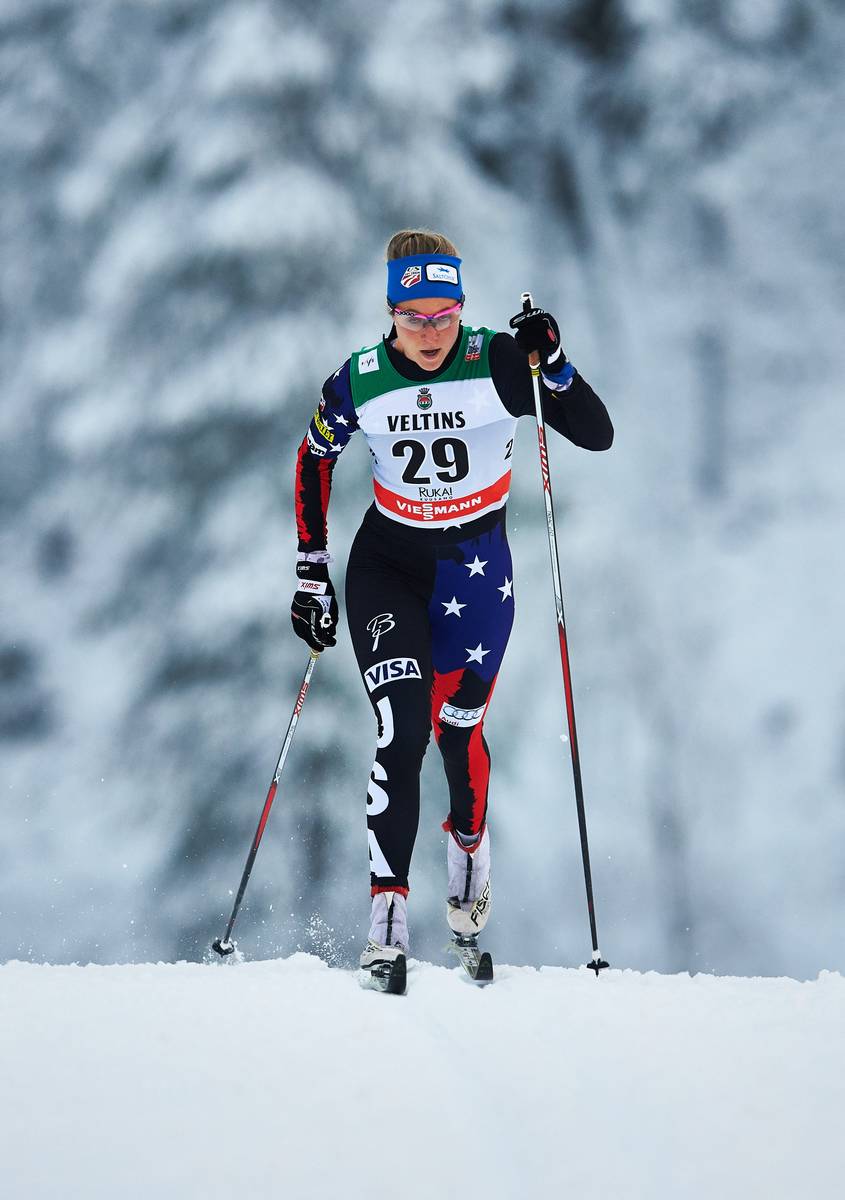
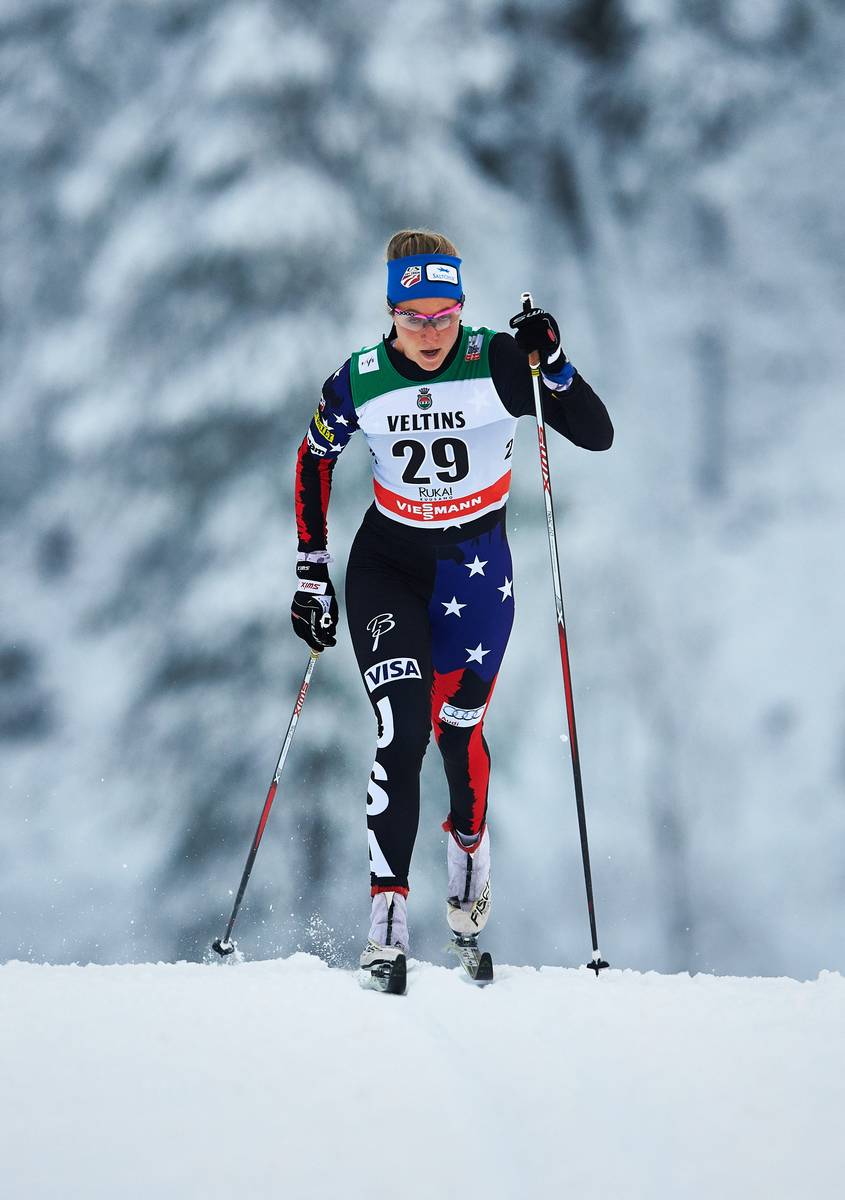
    Sadie Bjornsen (U.S. Ski Team) racing to 29th in the World Cup classic sprint on Saturday in Kuusamo, Finland. On Sunday, she placed 17th in the 10 k classic to lead the U.S. (Photo: Fischer/Nordic Focus)
    Sadie Bjornsen (U.S. Ski Team) racing to 29th in the World Cup classic sprint on Saturday in Kuusamo, Finland. On Sunday, she placed 17th in the 10 k classic to lead the U.S. (Photo: Fischer/Nordic Focus)

    Sadie Bjornsen very specifically stated that she didn’t wanted to start the season as hot as in year’s past, like last year when she was seventh in the 5-kilometer classic in Kuusamo, Finland.

    On Saturday, the 25-year-old U.S. Ski Team member made it into the points and the quarterfinals of Kuusamo’s classic sprint in 29th, which she said at the time was on par with how she hoped to perform in the first race of the season.

    Imagine how she felt after placing 17th in Sunday’s 10 k classic.

    “Sometimes how you did in the past can dictate how you feel about a result on a specific venue,” Bjornsen said on the phone after Sunday’s race. “So it would be easy to be like, ‘Oh, I got seventh last year. I wish that I did better.’ But I was actually just as satisfied today as I was one year ago. You just have different goals each year.”

    Bjornsen finished 1:53.6 minutes behind the winner, Norway’s Therese Johaug, and about 29 seconds out of the top 10. She had the best American result of the day, followed by Jessie Diggins in 39th (+2:50), Ida Sargent in 51st, and her brother Erik Bjornsen in 52nd in the men’s 15 k classic.

    Liz Stephen placed 55th in her first race of 2014/2015, Kikkan Randall was 57th, and for the men, Simi Hamilton finished 69th, Reese Hanneman was 82nd and Andy Newell 83rd on his birthday.

    And while Bjornsen said she had a good race, in which she started faster than usual and left it all on the line on the women’s two-lap course, she didn’t consider it overly special.

    “When you’re having spectacular races, you don’t notice that it’s hurting, but today was one of those days that I really did notice that it was really hurting,” she said with a laugh. “Normally, I have a tendency to have a kick at the end, and today I was just very exhausted and I didn’t have that extra gear. That’s maybe the difference between a good race and a spectacular race, but that’s often the feeling at the beginning of the season anyway.”

    “When you’re having spectacular races, you don’t notice that it’s hurting, but today was one of those days that I really did notice that it was really hurting.” — Sadie Bjornsen, top American finisher in 17th on Sunday in the first World Cup distance race of the season

    The 35th starter out of 77 women, she didn’t have much to work with in terms of splits, but that ended up helping her.

    “When you’re out there not really knowing what’s going on, then you just rely on your own pacing,” she said. “I generally start slow and speed up, and today I was generally just excited because it was the first distance race, so I started I think harder than I normally do.”

    She jumped out to the 21st-fastest time by 3.1 k, and by the halfway point, Bjornsen was up into 17th — a position she held until the finish.

    “I think more impressive than last year’s race was the fact that she just looked good today and she was able to slip in the top 20,” U.S. Women’s Coach Matt Whitcomb said. “[We’re] entering the season maybe a little bit more softly than we have in the past, and it has played out a little bit that way, but for Sadie to just lay down a solid race and be in the top 20 is incredible. I think it speaks a lot to where she can go this year.”

    Bjornsen noted that the race felt much harder than it did in Kuusamo last year, but that was because she had more races behind her at this point last season. This was only her second this year.

    “Last year, I came into the beginning of the season with some more time trials under my belt and in a different sort of a fitness place, and this year I tried to not come in quite as hot early on,” she said. “So I was quite happy with today.”
    (Photo: Angus Cockney)
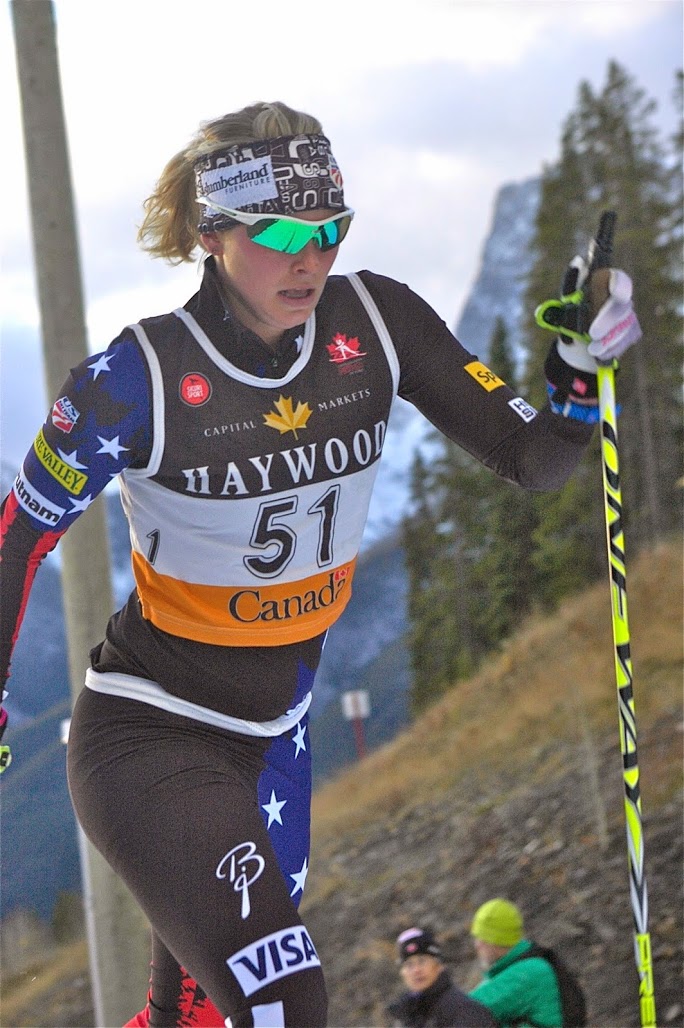
    Jessie Diggins in the Frozen Thunder classic sprint on Oct. 24 in Canmore, Alberta. That was her first unofficial race of the season; this weekend, she kicked off the 2014/2015 World Cup season with her team in Kuusamo, Finland. (Photo: Angus Cockney)

    Whitcomb pointed out that Diggins also had a “very solid race” for the first classic-distance outing of the year.

    “My race was OK, but not great…about how I thought I’d be feeling right about now!” Diggins wrote in an email. “I’m putting in a fairly large training week as a goal of mine is to be skiing faster later in the season and not coming into the races too hot.”

    She explained that she didn’t pace her 10 k to perfection after getting too excited and catching her 30-second woman, Slovena’s Nika Razinger, who started just ahead of her, around 2.5 k.

    “I paid for it later! Good lesson to learn,” Diggins wrote. “But my skis were good and I didn’t fall on the sketchy corner, so with my track record that’s actually a pretty awesome thing!”

    She crashed in Saturday’s sprint qualifier and finished 64th, and fell in last year’s Kuusamo sprint qualifier as well.

    “Matt joked, with my rate of falling down during the sprint yesterday I should have fallen 9 times out there today, but I improved a lot with no falls at all!” she added.

    Diggins reflected that her technique on the gradual climbs had improved since last season, but she made a few mistakes on the steepest hills.

    “Everyone was hopping out of the tracks and herringboning, and I tried to stay in the tracks too long because I have a pretty inefficient herringbone,” she explained. “So I was kind of stalling out and wasting energy out there! But overall, it was a great ‘training race’ and good to get the first distance race out of the way, learn some things about pacing again and get in a really hard effort.”

    Sargent, who finished a career-best fifth in Saturday’s sprint, wrote in an email that she was very excited after that race and looked forward to the first distance race.

    “I was hoping for a top 30 result but I was pretty far from that but that’s okay,” she wrote. “I was tired from yesterday and felt really flat. … After [Saturday’s] race, I know my fitness is good so I’m not too worried … I haven’t done a 10km since last winter so I wasn’t totally ready for today.”
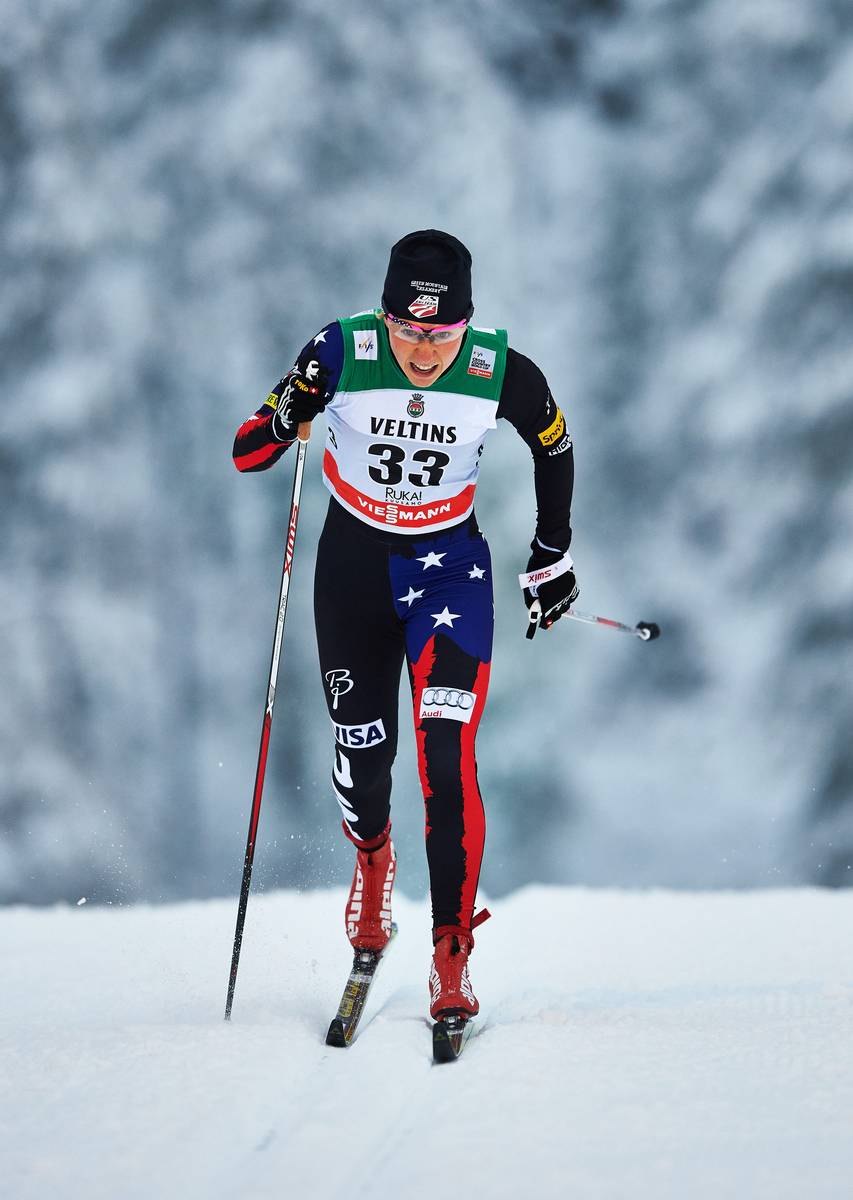
    Ida Sargent racing to a career-best fifth in Saturday's classic sprint at the World Cup opener in Kuusamo, Finland. She placed 51st in the 10 k classic the next day. (Photo: Fischer/Nordic Focus)
    Ida Sargent racing to a career-best fifth in Saturday’s classic sprint at the World Cup opener in Kuusamo, Finland. She placed 51st in the 10 k classic the next day. (Photo: Fischer/Nordic Focus)

    Whitcomb observed that Sargent was simply tired, and Stephen and Randall were “well off their mark” after struggling on the climbs and herringboning to get up them.

    “That’s not something that we necessarily worry about,” he said. “The results certainly weren’t where we can be. In Toblach [Italy] last year, I think we had five girls in the top [22], and today we were messing around in the 50s a little bit, and that’s fine. We had some athletes feeling pretty good.”

    Like he alluded to, Randall wasn’t one of them.

    “Unfortunately I wasn’t quite able to capitalize on the momentum from yesterday’s classic sprint and had a tough day in the 10km classic this morning,” Randall wrote in an email on Sunday. She finished 16th in Saturday’s sprint.

    “I attempted to start aggressively but already within the first few kilometers I could feel the fire wasn’t quite there,” she added. “I struggled to kick up the climbs and wasn’t very satisfied with my technical skiing. I like the course here in Ruka but wasn’t able to take full advantage of the terrain like I have in past races here.”

    According to Whitcomb, the wax wasn’t necessarily the problem for Randall.

    “It was tricky snow and I heard Kikkan say she had good grip on her skis, she was just struggling to make them work,” he said. “It was still slightly unstable snow today. It wasn’t that hero skiing out there, which is what you hope for with Kuusamo because the courses are so hard anyways.”

    While Randall summed up her weekend as a “mixed bag to start the season,” she explained she was glad to see Bjornsen, her Alaska Pacific University (APU) teammate, have a solid race.

    “I owe my teammates for brightening my spirits after the race,” Randall continued. “I am encouraged by the feelings in yesterday’s sprint, but can tell my distance form still has a ways to go.”

    “The results certainly weren’t where we can be. In Toblach last year, I think we had five girls in the top [22], and today we were messing around in the 50s a little bit, and that’s fine.” — U.S. Ski Team Women’s Coach Matt Whitcomb after Sunday’s 10- and 15-kilometer World Cup classic races

    Erik Bjornsen Leads U.S. Men

    Erik Bjornsen, the top American man in 52nd, started 13th of 96 men and posted one of the slowest times through the 3.1 k checkpoint.

    “I guess I was a little gun shy this morning,” he wrote in an email, explaining that he purposely started extra conservatively after blowing up in a U.S. Ski Team time trial last weekend in Muonio, Finland. “It’s all about finding the sweet spot, I thinking I’m narrowing down on it. I haven’t done much racing in the last six months and the body feels a lot different then the last time I raced.”

    Regardless, he was able to push hard on Sunday and recover on the downhills.

    “Last year I made the easy mistake of training way to hard in November and this year I tried to be a little more conservative,” Bjornsen wrote, adding he felt fortunate to start the season in Europe. “I want to make the most of all the [World Cup] starts I get. Coming into it I knew that these first two World Cup weekends were going to be some of the hardest for me. Not only are they in Scandinavia, which means lots of fast national group skiers, but I also tend to start off the season a little slow.”
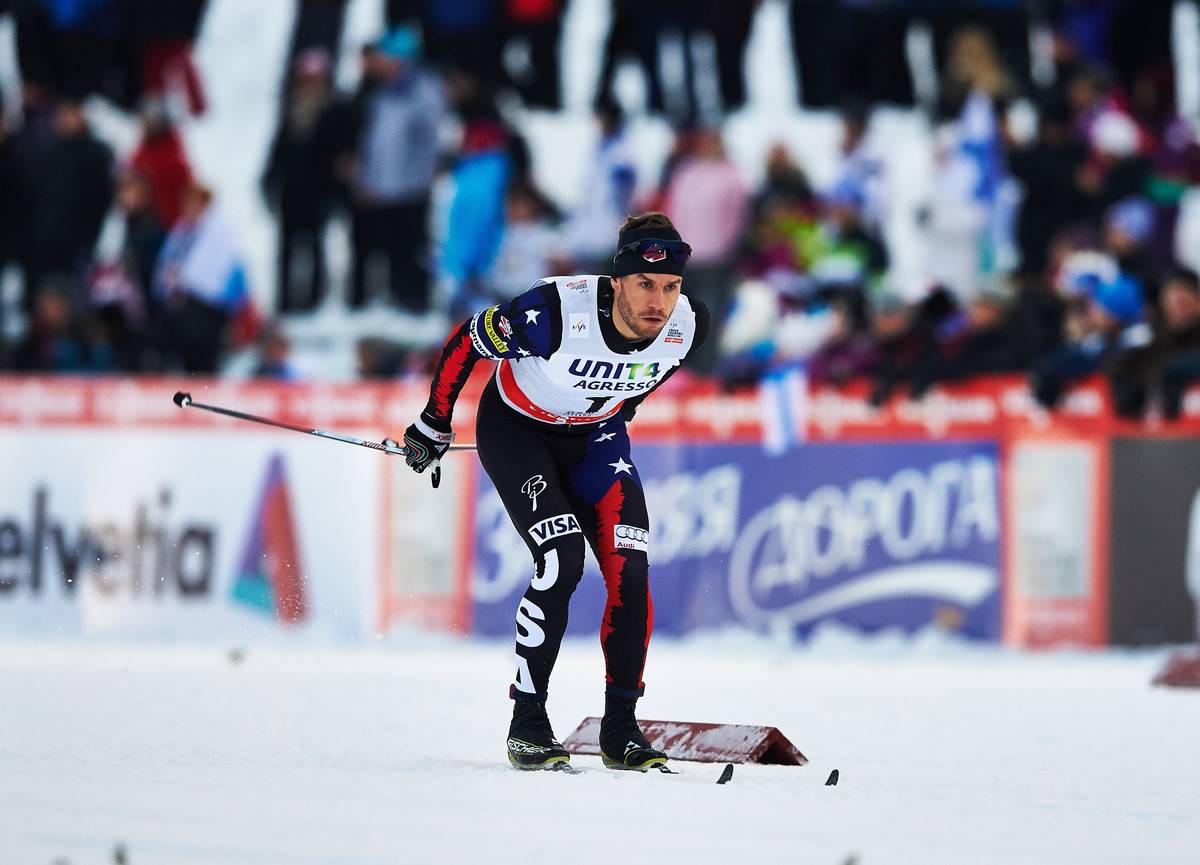
    Simi Hamilton racing to 16th in the Kuusamo classic sprint, the first race of the 2014/2015 season. The next day, he placed 69th in the 15 k classic. (Photo: Fischer/Nordic Focus)
    Simi Hamilton racing to 16th in the Kuusamo classic sprint, the first race of the 2014/2015 season. The next day, he placed 69th in the 15 k classic. (Photo: Fischer/Nordic Focus)

    The conditions in Kuusamo were a bit tough for him, and he found himself running outside the tracks and double poling hard to make up time on Sunday.

    “I was surprised with the race feelings the last couple of days,” he added. “The body has felt pretty good even though it has been a little flat the last couple weeks. I can tell that the fitness gains I made this summer are going to pay off.”

    Also a rookie at starting the season in Europe, Hanneman, the 2013/2014 SuperTour winner, explained he was mostly excited rather than nervous for Kuusamo.

    “Usually, it takes me a couple of races at the start of every season, even last year, to really get going, just because of the way I train,” Hanneman, also an APU skier, wrote in an email. “So I guess there might have been a tiny bit of that, just knowing that the consequences of not being peaked can be huge on the World Cup.”

    Hanneman fell on the same downhill Noah Hoffman crashed out of contention on, but felt fortunate he was able to finish and didn’t break anything.

    “I was being caught on the monster climb as we approached this downhill by a couple A seed guys including a Finn,” Hanneman explained. “The crowd was going nuts for him, and then when we started sending it down the downhill, he started yelling at me from behind and I wasn’t sure what side he wanted me to go on. I didn’t make across the trail it to the best line, which is riding the powder berm, so I just washed out on the crazy ice on the inside.

    “Ruka is insane; this is my first time here,” he added. “I think people in the US who haven’t seen World Cup courses really misunderstand how hard they are; I know I did before I started racing them. The climbs here are so big, and especially so steep, there’s really nothing like them in the US. And that goes for the downhills too. Any time people say downhills in the US are too fast or too technical, I’m like… “No…” These ones here are so, so fast. TV doesn’t do them justice at all.”

    One position and 2.7 seconds back in 83rd, Newell described his race as “pretty awful.”

    “I really try not to be negative but there wasn’t a whole lot of positive things for me to take away from this race,” he wrote in an email. “Maybe it’s not the course for me but I always struggle with kick here and was doing a ton of slow [herringbone] out there today.”

    His fitness felt good, he added, but he didn’t feel like he’d shown it in his first two World Cup races.

    “I think in the future I’ll need to re-think my strategy in preparing for these races or just skip them altogether and focus on starting the season on the 2nd or 3rd weekend,” Newell wrote.

    On Sunday night, even without teammate Hoffman, who was on his way to the airport 400 kilometers away to seek treatment in the U.S. for his lower-leg injury, the Americans celebrated Newell’s 31st birthday with reindeer pizza. On Monday afternoon, they planned to fly to Norway to prepare for next weekend’s mini tour in Lillehammer.

    ***

    Notes: Caitlin Gregg was listed as a DNS (did not start) after waking up Sunday morning and deciding to take the day off racing.

    “I am racing a little more strategically this year,” she wrote in an email. “I wasn’t feeling like I was going to be fighting for World Cup points this morning when I woke up so I decided to save my energy for next weekend’s skate races! At this level, feeling a little ‘off’ can put you waaay back in the results!

    “The only way I will make World Championships is if I score World Cup points in this first period,” she added. “So I am really being careful with my energy and race decisions. I am happy to report that my decision not to race didn’t take a start spot from anyone else, just let me get in another solid day of training before next weekend!”

    — Lander Karath contributed reporting
    Results: Men | Women

  • Harvey, Kershaw Exceed Expectations in 7th, 14th in Kuusamo 15 k

    Harvey, Kershaw Exceed Expectations in 7th, 14th in Kuusamo 15 k

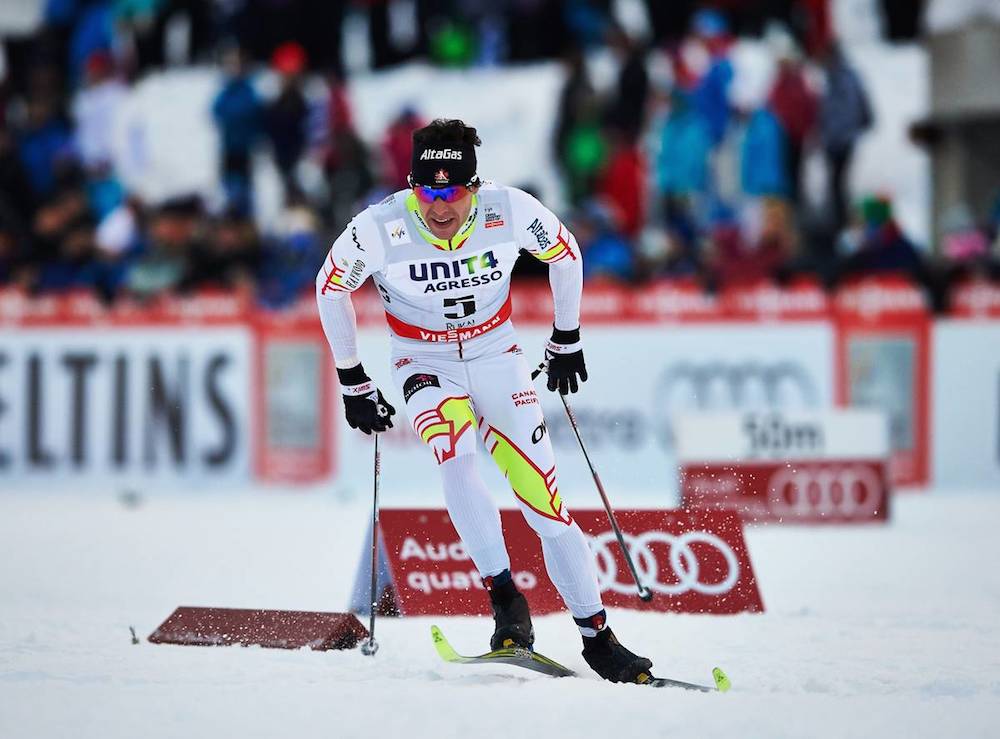
    Alex Harvey (Canadian World Cup Team) racing to 14th in Saturday's classic sprint at the World Cup opener in Kuusamo, Finland. (Photo: Fischer/Nordic Focus)
    Alex Harvey (Canadian World Cup Team) racing to 14th in Saturday’s classic sprint at the World Cup opener in Kuusamo, Finland. (Photo: Fischer/Nordic Focus)

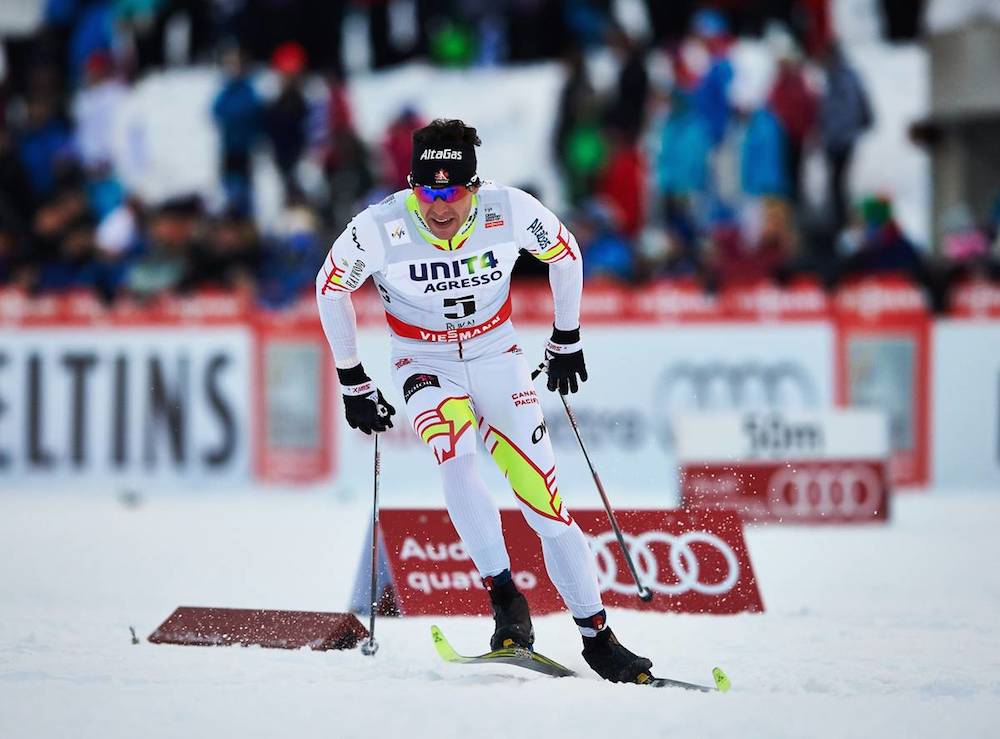
    Alex Harvey made it clear heading into the World Cup opening weekend in Kuusamo, Finland, that he had one main goal — to ski into the points. That meant the top 30, which he checked off on Saturday after placing 14th in the classic sprint. On Sunday, the 26-year-old Canadian came out with a similar attitude and ended up seventh in the 15-kilometer classic, 27.8 seconds behind the winner, Iivo Niskanen of Finland.

    Aim low, finish high? Not exactly. Harvey was simply being realistic.

    “Any time I start a race, I want to be on the podium obviously,” Harvey said on the phone after Sunday’s race. “But I know at the same time that I have no podium in my life before Christmas.”

    In Kuusamo, he had achieved as high as seventh three years ago in the 15 k classic pursuit, when the race was part of the Ruka Triple mini tour. That same year in 2011, he placed fifth in a 15 k skate in a tuneup FIS race the weekend before in Sjusjøen, and in 2010, he was ninth in Kuusamo’s skate sprint. But other than those results, Harvey said he historically has struggled to find his speed early in the season.

    Last year at the Ruka Triple, he was 38th in the classic sprint, 30th in the 10 k classic and 48th in the 15 k freestyle pursuit for 42nd overall. So yeah, seventh and 14th this time around was welcome improvement.

    “I was just really trying to be in the points, get things going, like, start the engine, and get some good feelings on skis,” he said. “After the sprint, I knew the speed was there, usually that’s the biggest issue for me, so I knew with the speed being there, my guess would’ve been probably a top 20, top 15, like after [Saturday], so that exceeded a bit my expectations.”

    Harvey started toward the back of the pack — 88th of 96 men — and by the 8.1 k checkpoint, he was into the top 10.

    “I actually tried to start a bit harder than normal,” he said, after posting the 14th-fastest time though 3.1 k. “I’ve been working on that for four years now. I know I can have one of the best last 5 k compared to anybody else, but it’s always on the first 5 k that I seem to lose a lot of time.”

    He said 14th early on was, “pretty much as good as it gets. After that I was able to slowly make my way up the field, and I was able to have a really solid last lap.”

    At the finish, Harvey was sixth, only to be bumped one place by eventual-second-place finisher Martin Johnsrud Sundby of Norway. Last season, Sundby topped everyone for the Overall World Cup crown, and Harvey finished 2013/2014 out with a career-best third overall.

    (Photo: Angus Cockney)
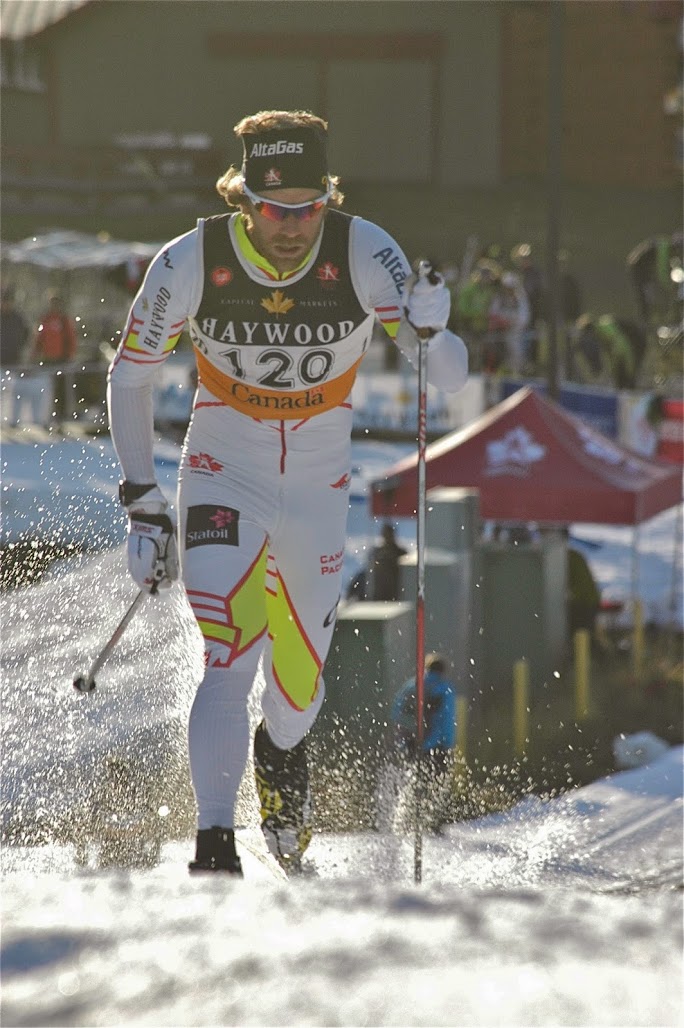
    Devon Kershaw at the Frozen Thunder classic sprint on Oct. 24 in Canmore, Alberta. After placing 57th in Saturday’s sprint in Kuusamo, Finland, he shaved his beard. (Photo: Angus Cockney)

    Kershaw Up to 14th

    Another Canadian well up into the points on Sunday was Devon Kershaw, who was 57th in the sprint qualifier the day before after struggling a bit with grippy skis. Kershaw finished 14th, 42.1 seconds back from the winner, in what he called his favorite race: the 15 k classic.

    But Kuusamo has never been an easy place to start: last season, he was 77th in the sprint, 64th in the 10 k classic and 65th overall after the 15 k pursuit. In 2012, he finished the mini tour a much-better 22nd, and his best result before that was eighth in the 2011 15 k classic pursuit.

    The course itself is widely considered one of the most brutal on the World Cup (although Canadian World Cup coach Tor-Arne Hetland said there are no easy courses on the circuit), and on Sunday, racers had to tackle three massive hills each lap.

    On top of that, Kershaw noted that North Americans, which typically have a season-long World Cup team in place at the start of the season, have to compete with Europeans vying for a spot on their respective nations’ World Championships teams every weekend.

    “It seems like Period 1 is always very difficult because the big teams are vying for spots … They can’t afford to put the focus on later in the season like I’ve been able to do my whole career as a Canadian,” he said. “So it’s a very difficult course, coupled with guys that are very well prepared. It’s always a hard place to be. If you’re a little bit off in Kuusamo, it looks worse than it is maybe.”

    Fortunately, he was firing on “normal” cylinders on Sunday.

    “I’ve made some significant changes in my training and been feeling really good about the preparations we’ve been doing and been feeling good in workouts, but you know, it doesn’t mean much if you can’t deliver with a race,” Kershaw said with a laugh. “To ski smooth and have a really solid race, it feels really good, and it’s just confirmation that I made the right changes, at least I believe I did, and we’ll just have to see moving forward. Not feeling amazing, amazing on the steep terrain, but it’s very rare that I ever have. It was very good compared to the last couple years.”

    He added that he was most pleased with his first and last laps, and said he “fell asleep a little bit” on some of the steeper climbs in the middle. Starting 50th, he finished sixth and dropped to 14th, but he expected that.

    “The splits didn’t really tell me a whole lot today … like, 28 of the best distance skiers in the world were behind me,” Kershaw said. “But I knew of course getting splits like that meant I was starting faster like I wanted and I had good snap.”

    His 3.1 k time ranked ninth fastest at the end of the day, and he hovered around 24th at 8.1 k and was back up to 13th with 2 k to go.

    “The flatter sections, the double-poling sections and the gradual sections, in my whole career that’s where I’ve been the strongest,” he explained. “I was feeling right back to normal on that terrain and the steeper hills, the first hill, I’ve still got work to do [there]. I felt like my technique was slipping a bit on that terrain, but my skis were very good today and I was super happy with what the boys put together for me. We did a good job testing [skis] after [Saturday] so we adjusted really well.”

    Ivan Babikov (Canadian World Cup Team) finished 57th, and Graeme Killick (Canadian Development B-Team) was 71st.

    Another national-development-team skier, Emily Nishikawa notched her best World Cup result in Europe, placing 38th in the women’s 10 k classic. Two years ago in Canmore, Alberta, where she lives and trains with the Alberta World Cup Academy, she placed 34th in the World Cup skiathlon.

    “I was really happy with my race today!” Nishikawa wrote in an email. “I started out a little slower, that was the plan, to really ramp it up in the 2nd half, and I was able to do that.”

    Skiing around 60th for the first half of the race, she jumped to 40th by 8.1 k and closed for 38th, 2:43.9 minutes behind Norwegian winner Therese Johaug.

    Emily Nishikawa racing in Stockholm last March. (Photo: Fischer/Nordic Focus)
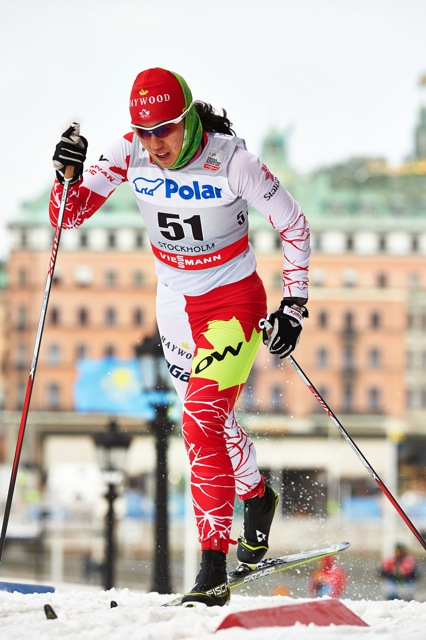
    Emily Nishikawa racing in Stockholm last March. (Photo: Fischer/Nordic Focus)

    “I caught some great rides from [Finland’s] Aino Kaisa Saarinen, and [Poland’s] Justyna Kowalczyk [who ended up fourth],” Nishikawa wrote. “I was really happy to hang on to Justyna for the last 4 km. I lost a few seconds to her on the last climb into the stadium, but I was really happy with the way I skied.

    “I am really looking to build off this great start to the season,” she added. “I know I can get into the top 30, I was close today, and that really motivates me for the next race.”

    After the first World Cup weekend in his first season with the team, Hetland was generally impressed.

    “For Emily, a personal best in the World Cup, that’s a good start for her,” he said on the phone Sunday. “That she could ski together with Aino Kaisa Saarinen, with Kowalczyk on the track, that’s a good race for her. For the boys, of course the results from Alex have been very good and also the 15 k from Devon today was also good.”

    “Ivan was a little bit under his best level in the race today, but he will be improving to the next weekend,” Hetland added.

    Babikov posted the 45th-fastest time at 3.1 k, and by 8.1 k, he was up to 37th.

    “In the start he lost a little bit time and then he had a good part in the middle and was climbing on the result list,” Hetland observed. “But on the last hill, he broke a pole and lost a little bit of time. He would have been somewhere between 29 and 45th if that didn’t happen. He will be better when he gets some more races.”

    Looking at the rest of the team, Hetland said Valjas, who missed qualifying in the sprint in 39th, was close to the heats, but not quite fast enough. “But it’s easy,” he said. “Also I think [Killick] will need some more races on this level before he’s on his best level, and he will get new chances on the next weekend.”

    Canada’s other male development skier in Europe, Jess Cockney raced at the Norwegian Cup this weekend, placing 13th in the classic sprint and 39th in the 10 k classic. Perianne Jones (Development B-team) was 48th in the women’s sprint.

    “I think it’s good racing, but there is potential for racing faster so we will keep on working hard,” Hetland added. “Now we have to reset and preparing for Lillehammer and then we will do as good as possible there.”

    Kershaw said it’s been helpful to talk with Hetland about realistic expectations and not get too wrapped up in past results — or overall finishes, like when he ended up second in the 2011/2012 World Cup.

    “I feel the funniest thing with skiing, or even with anything, is you’re kind of, or I tend to, compare myself to the best I’ve ever been — and the best I’ve ever been was the best in the world,” Kershaw said with a laugh. “It’s so unfair because the last few years, I’ve been off that mark. I’ve been talking a lot with T.A. about that, just to build through the season and not get down on myself and really focus on the process.”

    “What the past [was] is not so important,” Hetland said. “We’re racing now and what is the slogan this year? ‘This is our time.’ So we are concentrating on the races this year and we will try to improve for each weekend now. The races have been very good and the team has been performing well. Of course there is somebody that is happy with the results and some that are not so happy.”

    Results: Men | Women