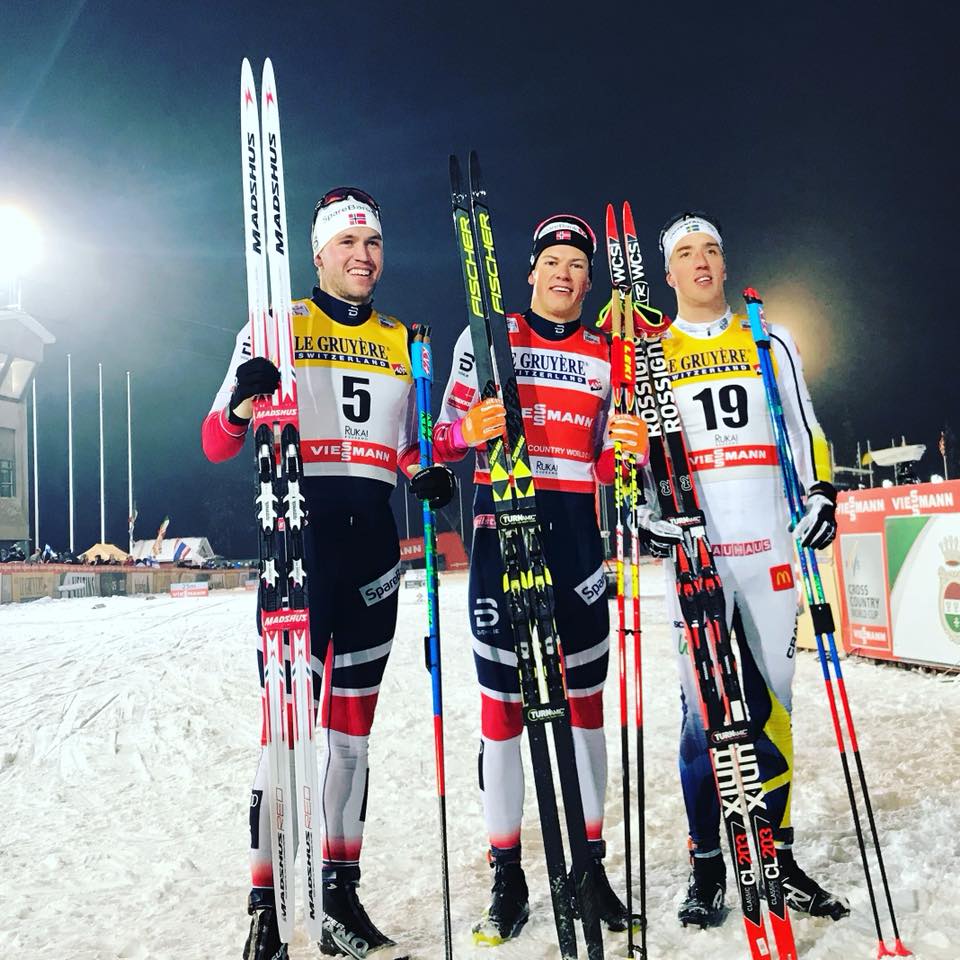
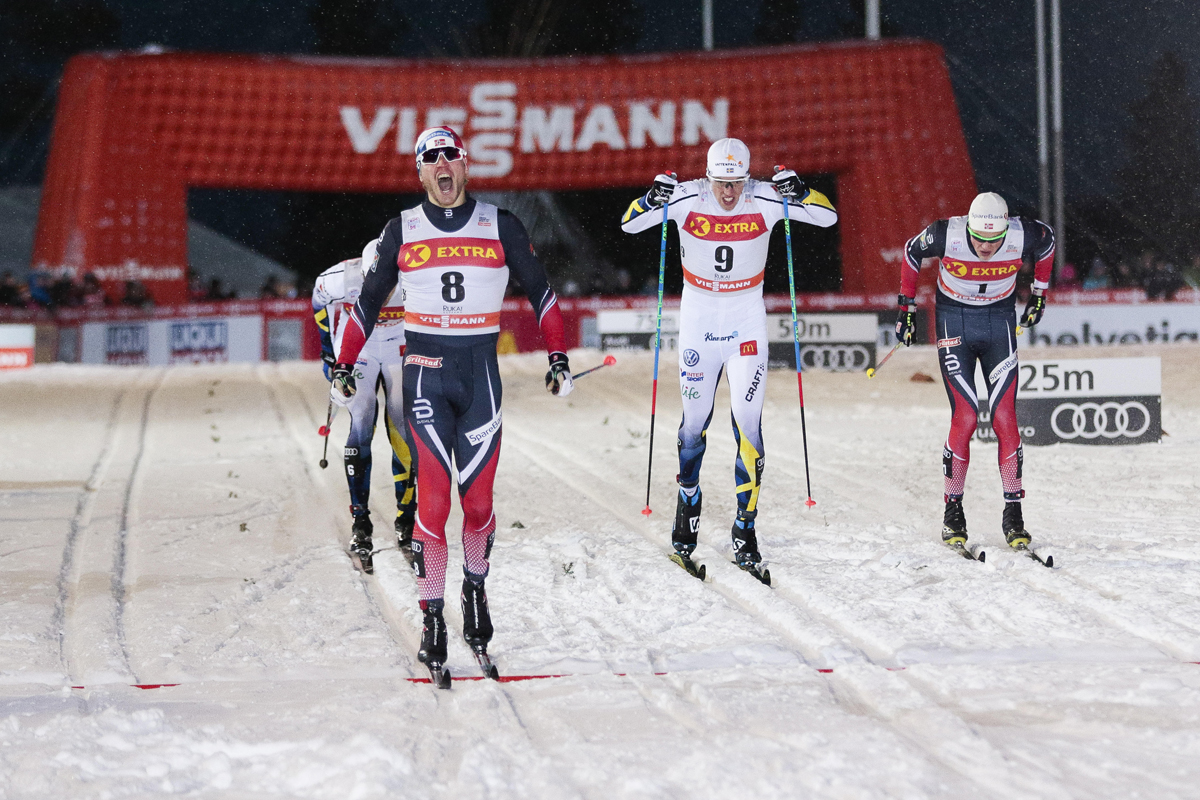
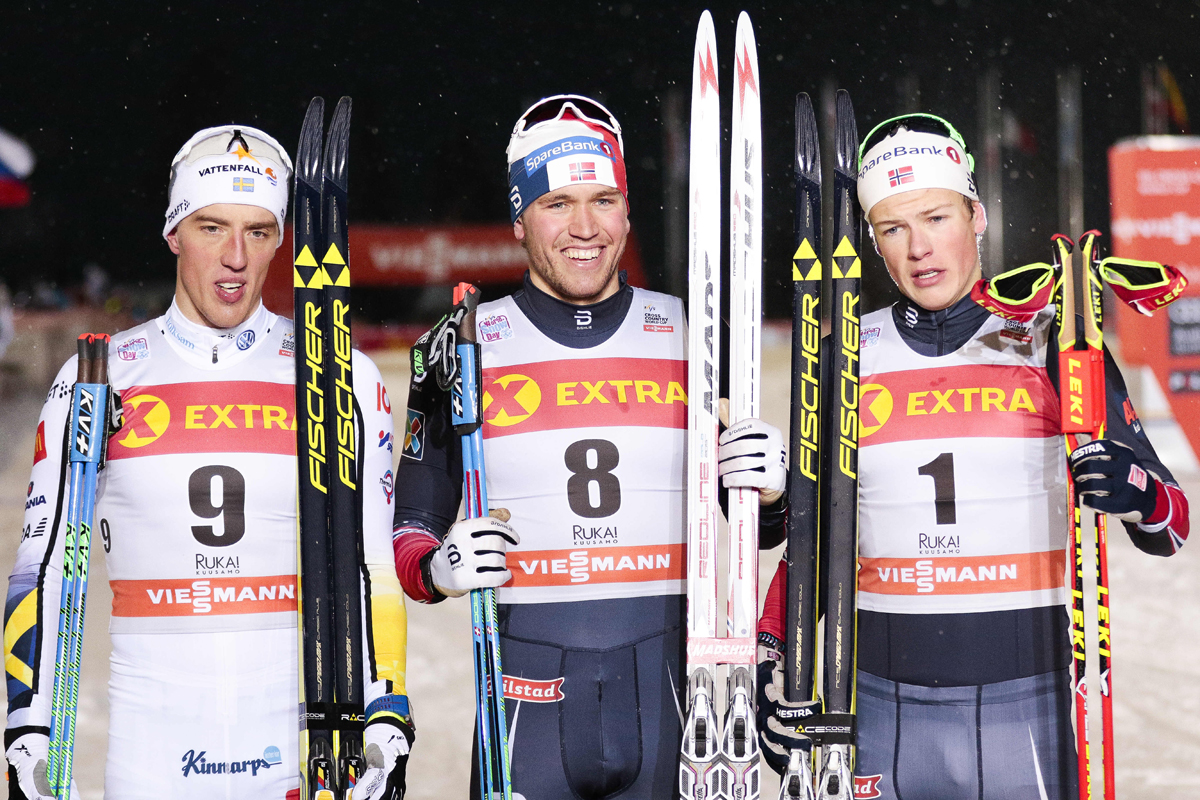
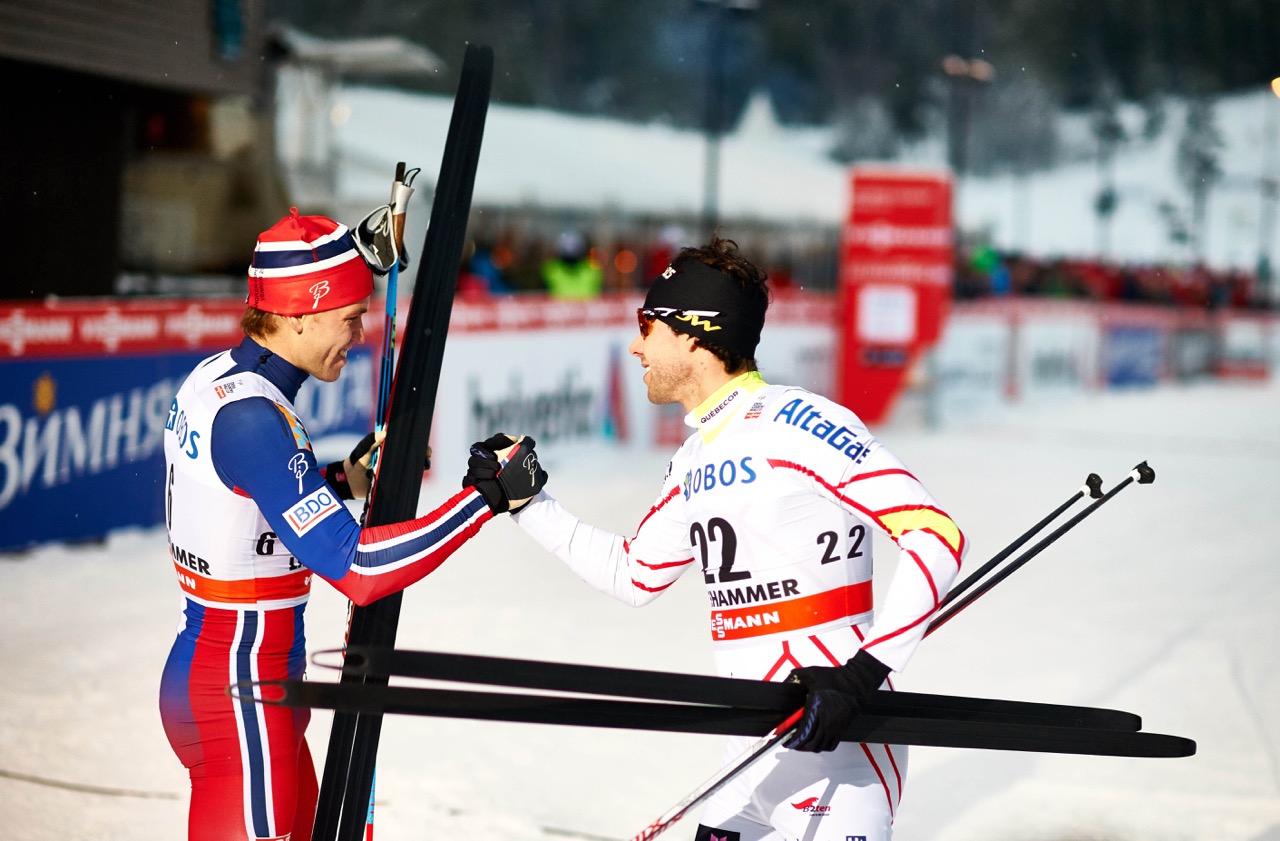
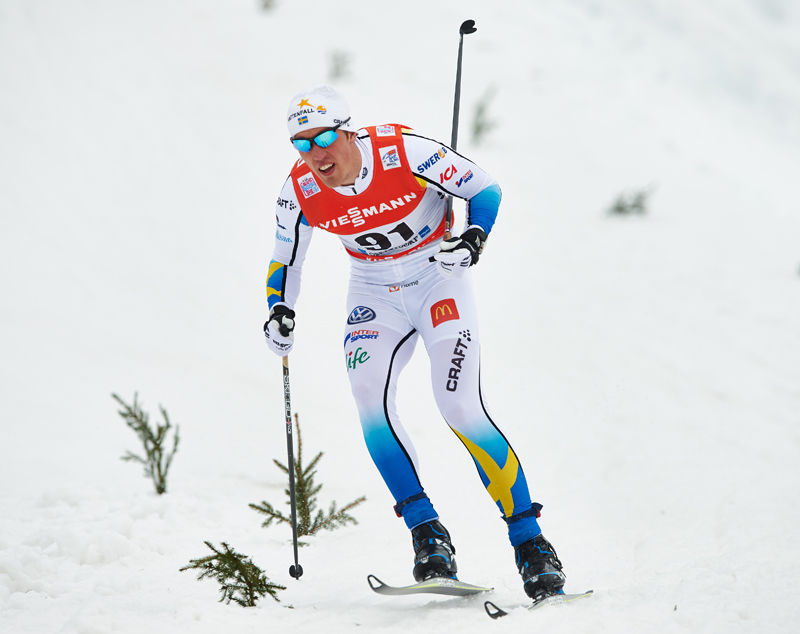
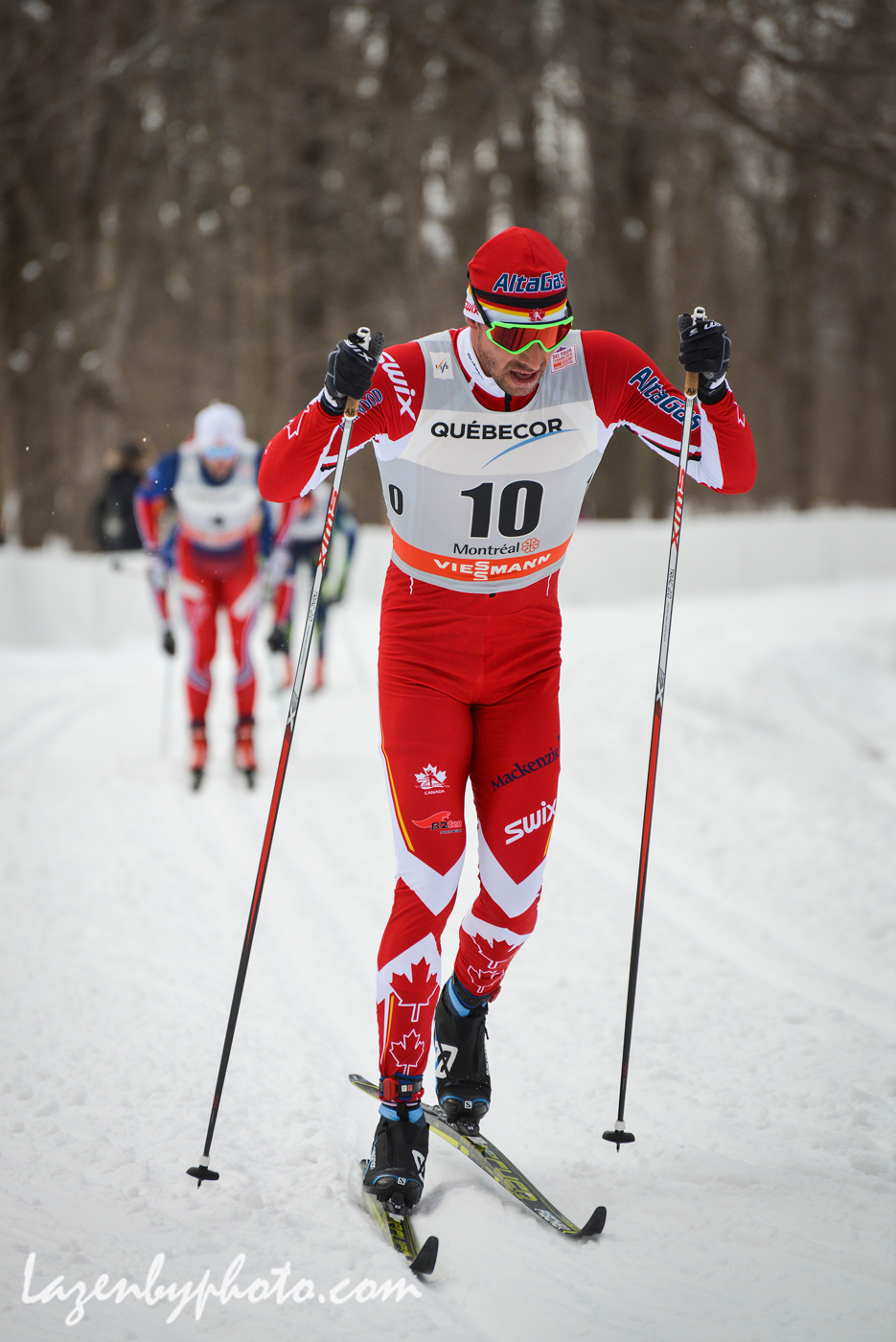
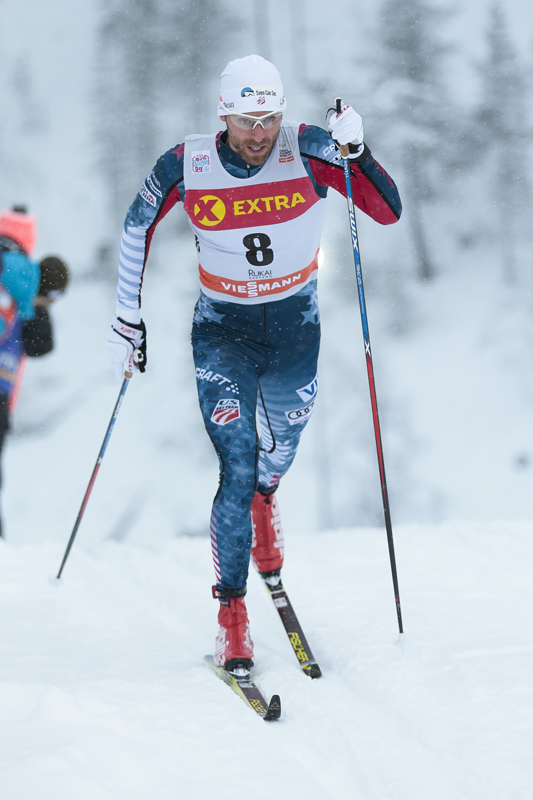
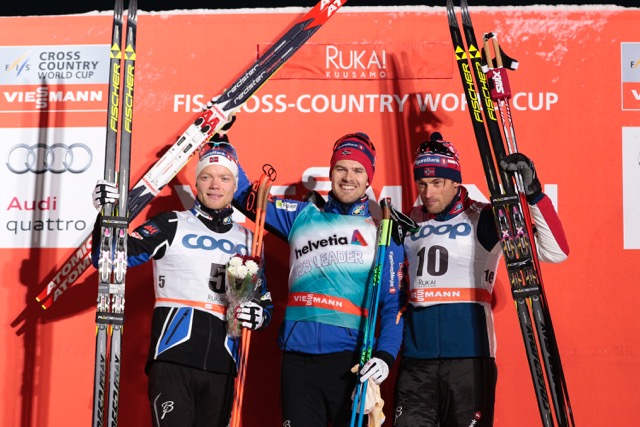
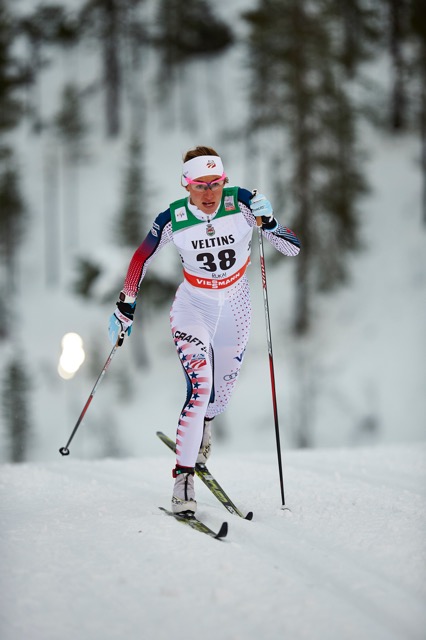
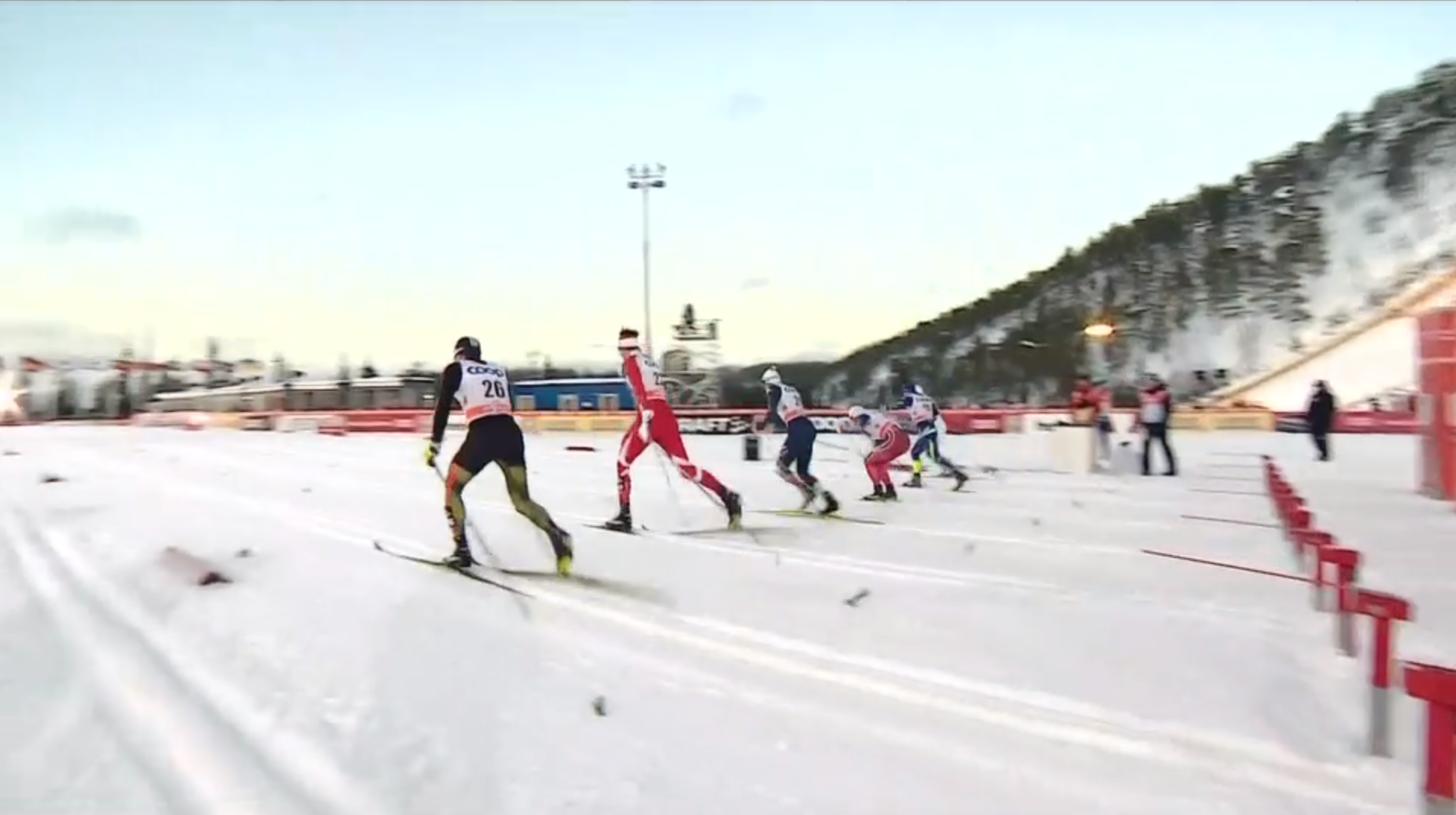
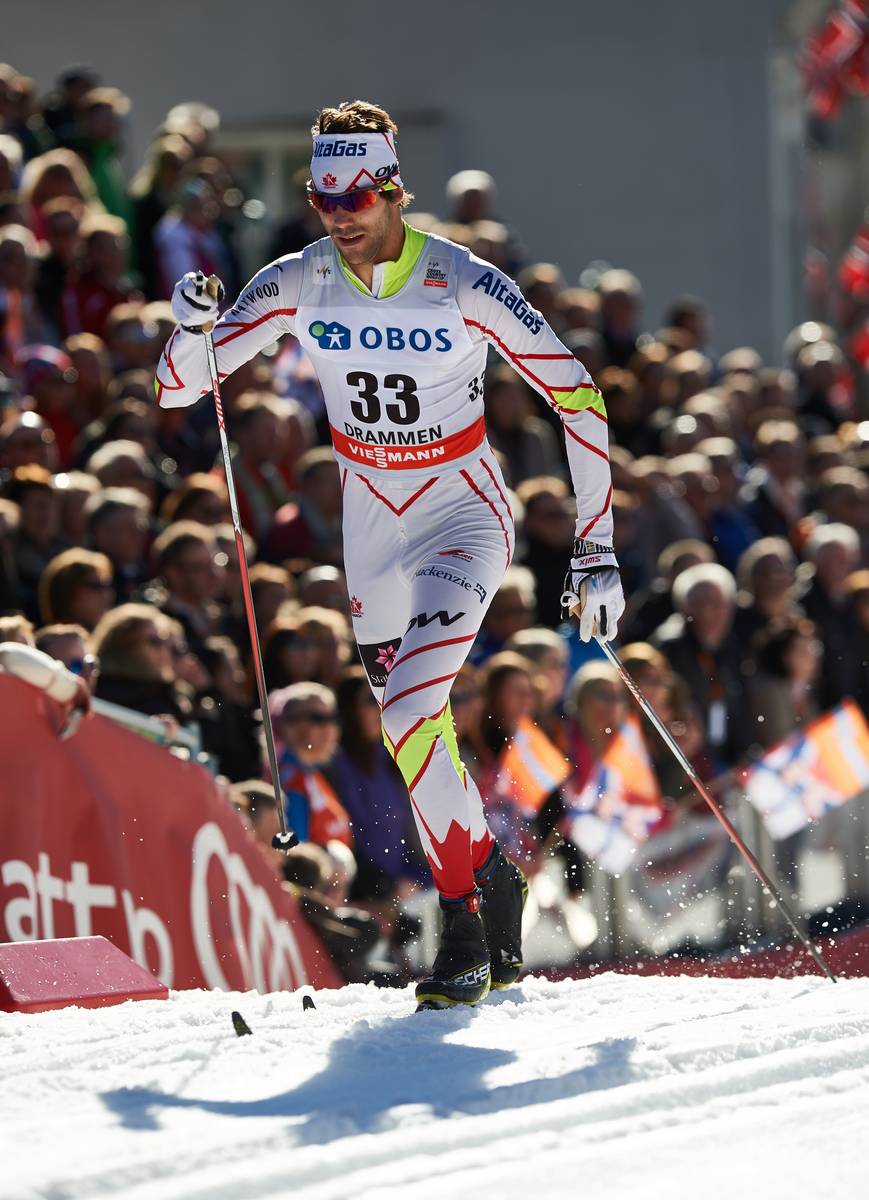
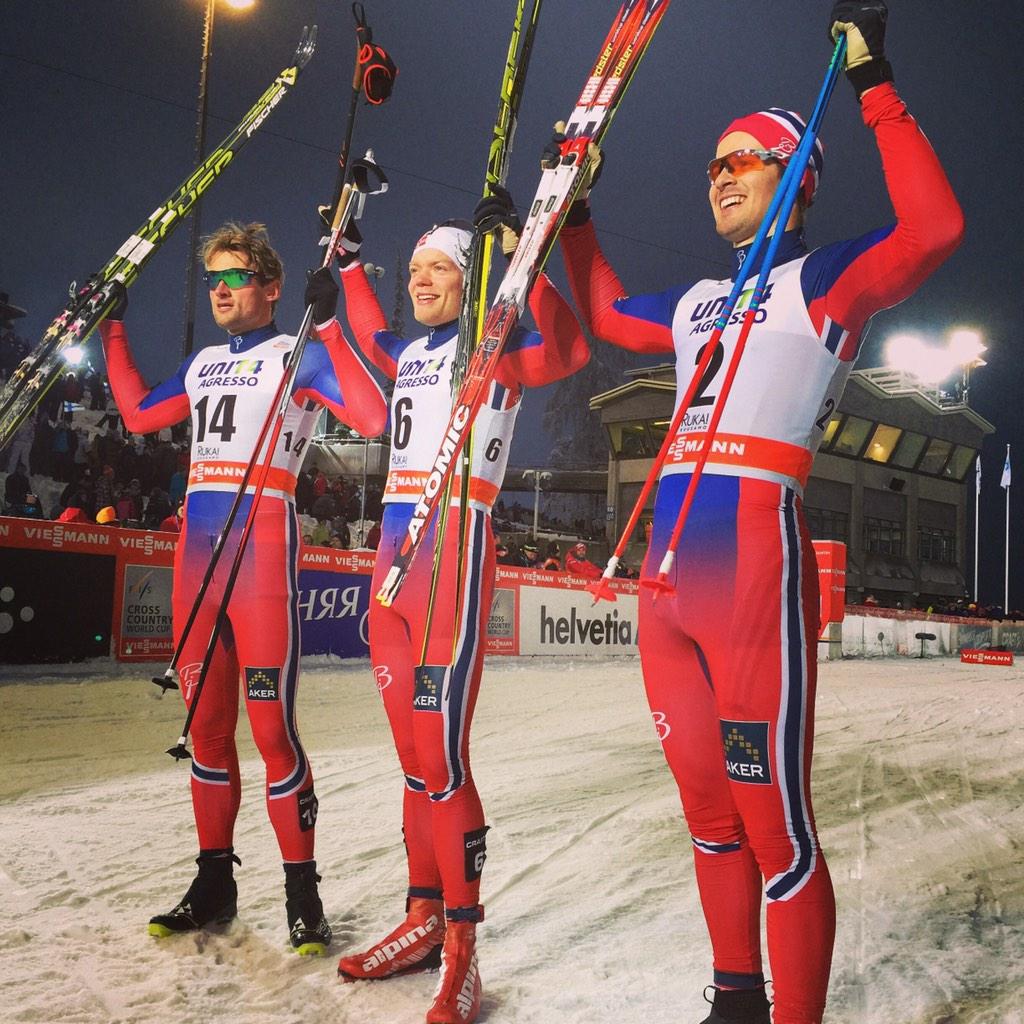
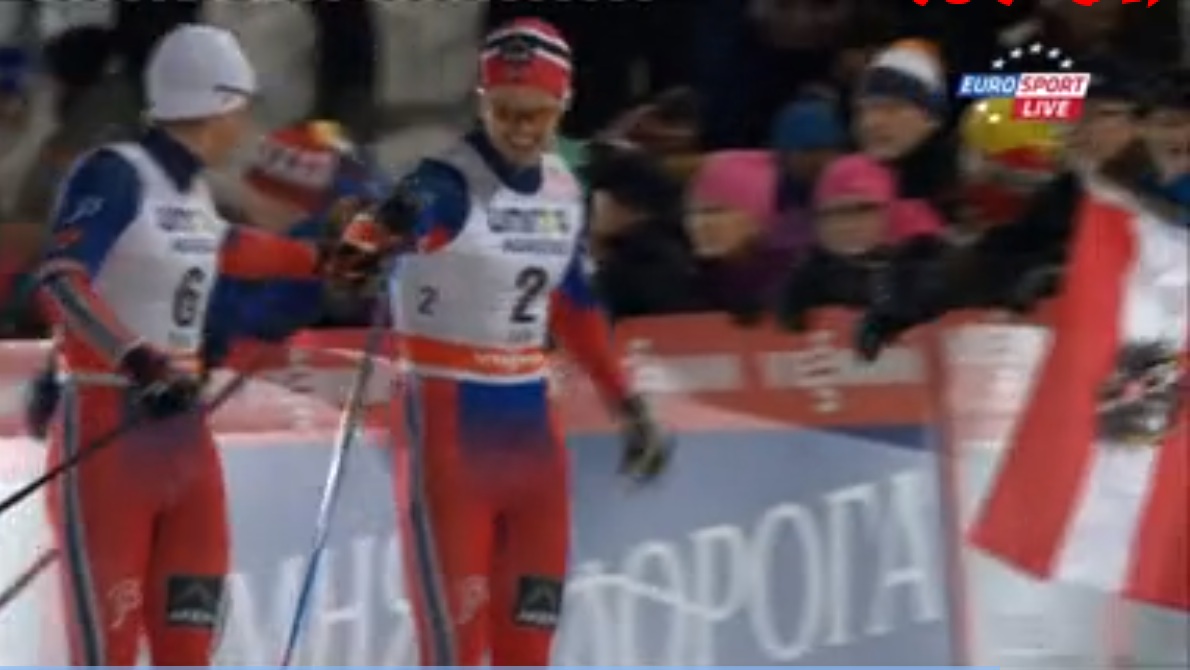
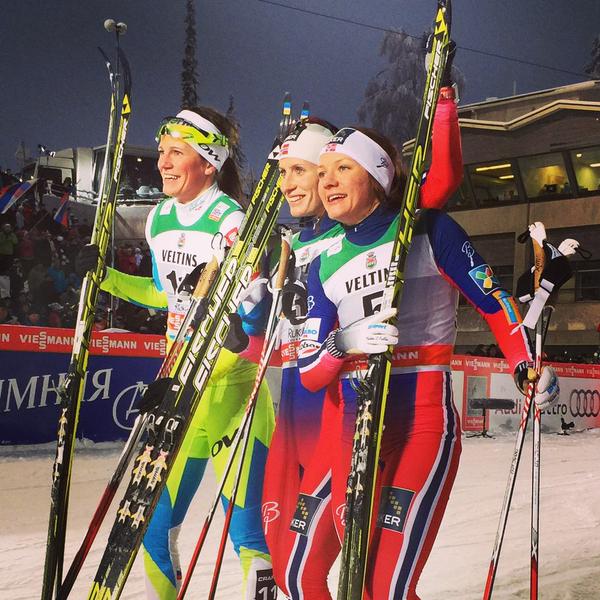
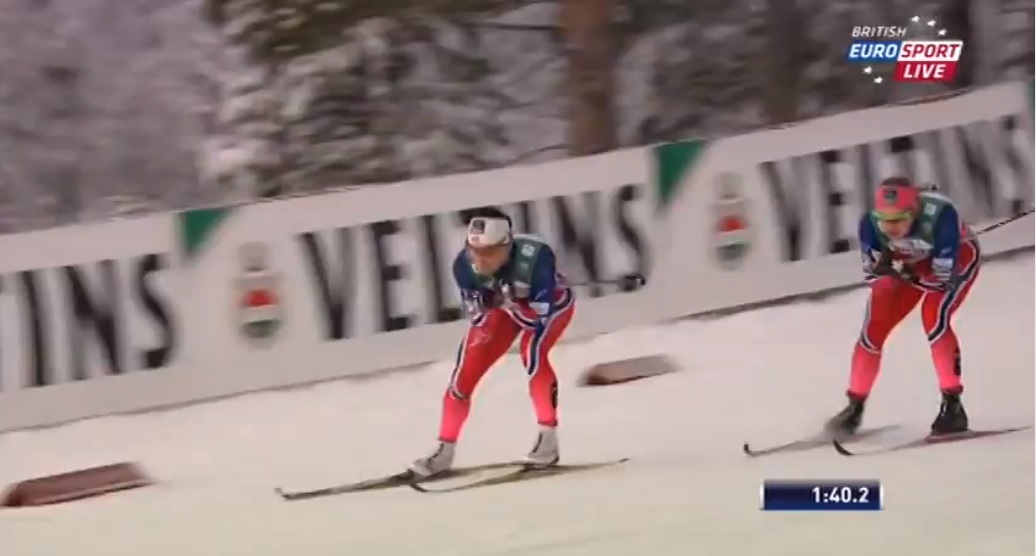
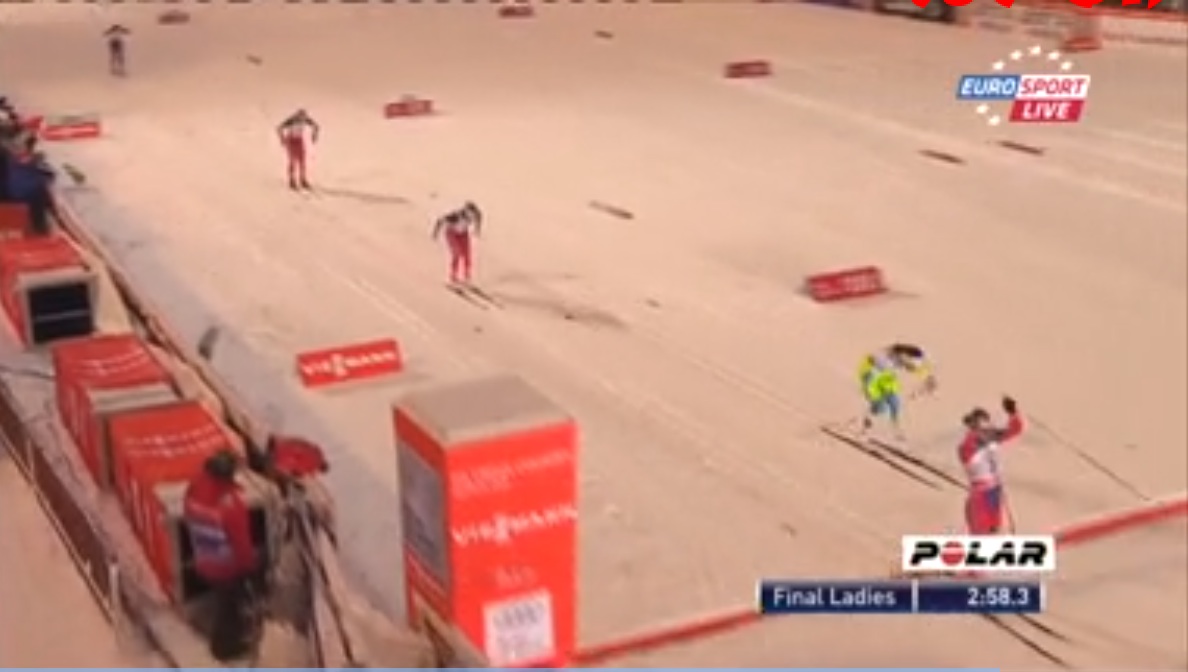
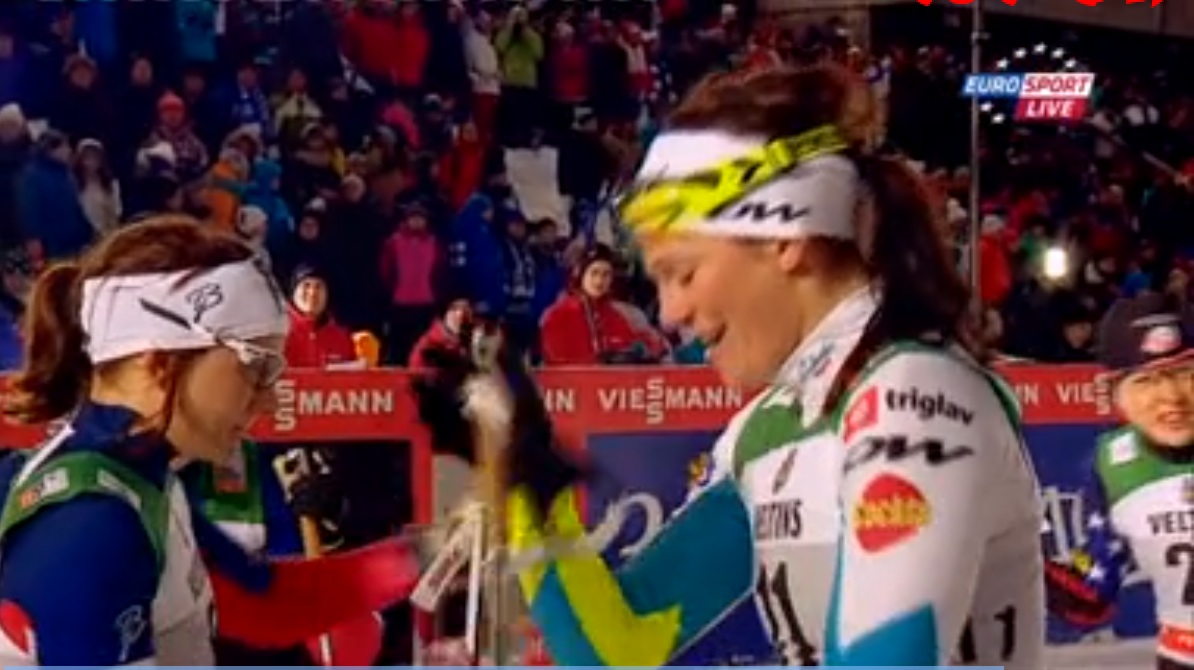
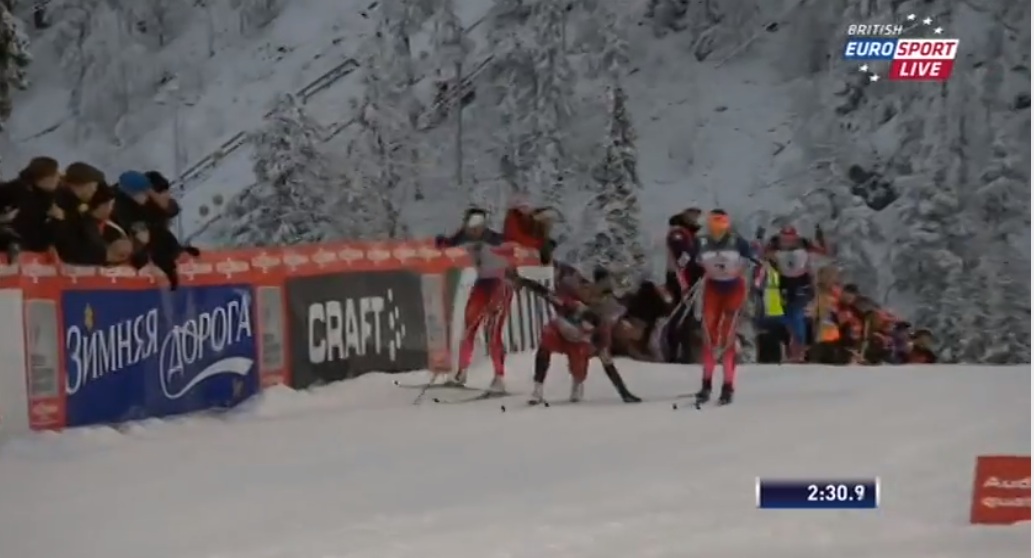
Left to right: Norwegians Pål Golberg and Johannes Høsflot Klæbo and Sweden’s Calle Halfvarsson after placing third, first and second, respectively, in the men’s 1.4-kilometer classic sprint on Friday in Kuusamo, Finland. (Photo: FIS Cross Country/Facebook)
There was no mistaking Norway’s Johannes Høsflot Klæbo in Friday’s 1.4-kilometer classic sprint, even with no natural light illuminating the course in Kuusamo, Finland, by the time the men’s final left the start line. The 21 year old’s distinct runner-like, high-tempo stride could be seen leading the five other men’s finalists on every climb, distinguishing him from the light fog and densely packed trees lining the course’s firmly packed tracks.
Making his World Cup debut in the spring of 2016, Klæbo has since racked up four-regular season World Cup individual sprint podiums — of the eight World Cup sprints that he has entered — and ended last season as the men’s U23 World Cup champion as well as the overall Sprint World Cup winner, all at the age of 20.
Last weekend at Norway’s first International Ski Federation (FIS) races of the season in Beitostølen, Klæbo not only won the classic-sprint final, but he also topped the men’s qualifier, his quarterfinal and his semifinal.
Klæbo repeated the feat this weekend in Kuusamo, starting first with the qualifier, clocking the fastest by 2.26 seconds over Finland’s Anssi Pentsinen in a time of 2:46.53 minutes. He then won his quarterfinal by 0.6 seconds over fellow Norwegian national-team member Pål Golberg. In his semifinal, Klæbo bested Sweden’s Calle Halfvarsson by 0.29 seconds and then, with a convincing gap on the rest of the field, crossed the finish line first in the final in 2:48.19, kick starting his 2017/2018 World Cup season with a win.
“It was not my plan to ski away so early but before the final hill I was told I had a five-minute lead so I went for it all the way to the finish,” Klæbo sai,d according to a FIS press release.
Even before the course’s last climb, Klæbo had already set himself apart from the rest of the racers in the men’s final: Finland’s Ristomatti Hakola, Italy’s Federico Pellegrino, Sweden’s Calle Halfvarsson, and Norway’s Golberg and Sondre Turvoll Fossli. By the bottom of the first major climb he had double poled his way to a three-meter gap.
Klæbo already in his descent, Hakola, Golberg, Pellegrino, Fossli, and Halfvarsson crested the top of the climb in a pack and settled in for the chase. But Klæbo continued to hold them off into the second major climb, extending his gap by another two meters. As the others reached the second major climb, the race became one for second place between Halfvarsson and Goldberg. Hakola, Pellegrino and Fossli had all fallen back.
Finishing with no one close enough to challenge him, Klæbo took the win in in 2:48.19. Goldberg crossed 1.35 seconds later for second place, while third went to Halfvarsson, 4.03 seconds after Klæbo.
“I’m happy about the third place, but I was quite behind Klaebo,” Halfvarsson said according to a FIS press release. “I will try to catch up for the [Olympic] Games. He was impressive today.”
Rounding out the top 10 was Finland’s Lauri Vuorinen in seventh, Russia’s Alexander Bolshunov in eighth, Switzerland’s Jovian Hediger in ninth, and Finland’s Martti Jylhä in 10th.
Canada’s Alex Harvey advanced to the quarterfinals after qualifying in 13th (+6.13), the fastest North American in the preliminary round.
“The goal was to execute a solid day of racing since it’s the first time I put a bib on this year!” Harvey, of the Canadian World Cup Team, wrote in an email to FasterSkier. “I was pretty happy with my qualifier, it’s a short sprint here so 13th for me was a great start.”
In his quarterfinal, Harvey went up against Finnish skiers Vuorinen, Iivo Niskanen, and Toni Ketelä as well as Estonia’s Marko Kilp, and Japan’s Hiroyuki Miyazawa. However, a loss in positioning before the major climb cost him a few seconds, and he finished his quarterfinal in fifth, 2.16 seconds behind Vuorinen, who won the heat in 2:47.40.
“In the 1/4 final I did 1 or 2 mistakes that just cost me in term of positioning before the big hill,” Harvey wrote. “I felt great technically and actually pretty good physically too especially for the time of the year.”
“Like normal the steep terrain is a bit of a weakness for me so again in the final wall I don’t think I was moving fast enough there,” Harvey continued. “The rest of the course I think I skied well.”
The only other North American to qualify on Friday was Erik Bjornsen of the U.S. Ski Team (USST) in 26th (+8.71). Racing in the same quarterfinal as Klæbo, Golberg, Finland’s Juho Mikkonen and Matias Strandvall, and Russia’s Gleb Retivykh, Bjornsen ultimately crossed in fifth, 5.12 seconds behind Klæbo.
“We are really proud of [Erik] to qualify as strong as he did, in Scandinavia, in a classic sprint,” USST coach Matt Whitcomb said on the phone. “This is one of the hardest races of the year to do this, and it bodes really well.”
“Talked to him between the qualification and the quarterfinals, and he was just exuding confidence and commented on how strong his double pole is feeling,” Whitcomb continued. “We saw him fire that jet in the finish stretch today. He had a really fast heat and it stressed him out a little bit, don’t know exactly what happened, but he was in the mix today and we are psyched.”
Another USST member, Andy Newell missed qualifying by 0.38 seconds in 34th. He was 9.38 seconds off Klæbo’s top qualifying time.
“It was frustrating to be so close and just on the outside of the qualification bubble,” Newell wrote in an email. “Just a few tenths of a second out of the top 25. I felt like I struggled today to get the right amount of glide vs kick… which is just as much on me as the tech. Grateful to be feeling healthy and looking forward to big races to come.”
Julien Locke of Canada’s National U25 Team was the next-fastest Canadian, placing 59th (+12.07) in the qualifier. Locke finished 0.04 seconds ahead of the American Simi Hamilton (USST) in 60th (+12.13).
“A little bit of an off day for Simi and Andy,” Whitcomb said. “For Andy on a course that is particularly good for him and he is in really good shape right now, I think he struggled with some glide.”
Canadian World Cup Team member Len Valjas finished 63rd (+12.58). Before departing Gällivare, Sweden — where he and most of his teammate had been training and raced the opening FIS competitions — Valjas suffered a shoulder subluxation and was not “back to full health” by the time Friday’s sprint rolled around, he explained in an email.
“I took the week really easy on the shoulder to let it recover, and gave it a try in today’s race,” Valjas wrote. “I didn’t have my normal strength in the double pole sections of today’s race. I just felt weak and couldn’t hold any speed on the flats.
“I was happy that I was able to compete today, but I am definitely not skiing at 100%,” Valjas continued. “The shoulder is pretty sore and stiff from the qually this morning. Huge thanks to Pete Dickinson (USA physio) for taking care of me this week and helping me speed up my recovery.”
Also competing for Canada was Knute Johnsgaard in 73rd (+12.58), Devon Kershaw in 74th (+14.01) Graeme Killick in 85th (+14.01), Jess Cockney in 95th (+18.83).
Three additional Americans raced in the qualifier, with Scott Patterson (USST) finishing 84th (+16.14), Patrick Caldwell (USST) finishing 103rd (+21.43) and Noah Hoffman finishing in 105th (+21.85).
Canada’s Continental Cup leader, Russell Kennedy (Team R.A.D.), who earned Period 1 World Cup start rights after ending winning last season’s overall NorAm title, did not start Friday’s sprint race.
Norway’s Pål Golberg (8) celebrates his first classic sprint win in the first World Cup of the 2016/2017 season on Saturday after beating out Sweden’s Calle Halfvarsson (9), Norway’s Johannes Høsflot Klæbo (far right) and Sweden’s Teodor Peterson (behind), respectively, in Kuusamo, Finland. (Photo: Fischer/NordicFocus)
The two men who landed on the first and third steps of the podium in Saturday’s World Cup opener in Kuusamo, Finland, weren’t even slated to start as of a week ago. But 20-year-old Johannes Høsflot Klæbo’s breakthrough sprint result in Beitostølen, Norway, last weekend put him on the Norwegian national team’s radar, and Pål Golberg received a call on Wednesday that he could start in Petter Northug’s place. Northug chose to skip the opening World Cup weekend because his energy wasn’t where he wanted it to be.
“It’s just so competitive [this] time of year,” Canadian Alex Harvey observed in a post-race phone interview. “The Norwegians that were first and third [Golberg and Klæbo], they weren’t even supposed to race today, it’s just ’cause [Eirik] Brandsdal got sick and Northug decided not to come, so guys were racing for their season today. … Guys are racing just to be allowed to start next weekend, so I think guys from the big nations — Russia, Finland, Sweden, and Norway — they come in close to the best shape of the season here. I think one of the deepest fields we get is Kuusamo.”
In spite of the depth, Golberg and Klæbo rose to the top, with just Sweden’s Calle Halfvarsson coming between them in second place. In his second World Cup start (his other was a classic sprint last February), Klæbo, of Norway’s U23 Team, put down the fastest qualifying time on the 1.4-kilometer course in 2:50.7 minutes. Russia’s Alexander Panzhinskiy clocked in 0.81 seconds slower in second, and the next-fastest qualifier, Estonian Marko Kilp was 2.01 seconds off Klæbo’s time in third.
The men’s classic sprint podium in the first World Cup race of the season on Saturday in Kuusamo, Finland, with Norway’s Pål Golberg (c) in first, Sweden’s Calle Halfvarsson (l) in second, and Norway’s 20-year-old Johannes Klaebo (r) in third. (Photo: Fischer/NordicFocus)
Meanwhile, Golberg, a 26-year-old former Norwegian World Cup Team member, qualified eighth, 3.4 seconds back. From there, Klæbo in bib 1 rode his momentum all the way to the final, winning his quarterfinal and semifinal by charging to the front of the pack on the last of Ruka’s two sprint climbs: a grueling, 150-meter-long ascent into the stadium.
Golberg placed fourth in his quarterfinal, nipping Harvey by two-hundredths of a second for the final spot in the semifinals. That ended Harvey’s racing for the day and put the Canadian 25th overall.
“I knew it was a fast heat so I was hoping that fourth place would be lucky loser, so that’s what I was fighting for,” Harvey explained. “But in the end it was just not enough. But I never felt that I was totally out of it until I crossed the line and I knew I couldn’t come around Pål.”
While Harvey reflected that his skis may have had just a bit too much grip in the powdery conditions, Golberg had another chance in the semifinals. There, the Norwegian raced to second in another photo finish — this time with Klæbo.
“In the quarterfinals I had a pretty bad climb; I lost a few spots so I decided to stay more in the back in the semifinals and that worked out,” Golberg said in a post-race interview with FIS.
While Klæbo led his semifinal competitors into the last climb, Golberg pushed past Finland’s Ari Luusua to move into second by the top. In the last 250 or so meters of the race, which flattens out and curves left into the finish, Golberg chased down Klæbo and finished 0.02 seconds behind him. Both automatically advanced to the final, and considering theirs was the fastest of the two semifinals, so did Sweden’s Halfvarsson and Teodor Peterson in third (+0.42) and fourth (+1.17) in that heat.
In the final, Panzhinskiy — the lone Russian in the final (two Russians reached the women’s final) — set the pace out of the start while the two Swedes followed in second and third. Halfvarsson rode his faster skis on an early descent past Panzhinskiy, while Krogh lost contact with the group early.
With Panzhinskiy on one side of Halfvarsson and Klæbo on the other, the Russian and young Norwegian challenged the Swede up the first climb, but Halfvarsson kept his spot up front. Panzhinskiy drafted and passed him on the descent before the last climb, leading Klæbo, Halfvarsson and Golberg into the base of it, while Peterson stayed in contact in back. (Krogh was well out of camera range at this point.)
Halfvarsson pushed to move into first early in the climb while Golberg ran outside the track on the far left and seized the lead over the top. Peterson double poled behind Halfvarsson and Golberg raced away from the pack to secure the victory in 2:54.12. Halfvarsson stayed ahead of Klæbo and Peterson for second place (+0.75), while Klæbo, close on Halfvarsson’s heels, switched lanes with less than 100 meters to go to edge Peterson for third (+0.87). Peterson took fourth (+1.06), Panzhinskiy settled for fifth (+8.22), and Krogh came through the stadium casually, 1:12 minutes after Golberg in sixth.
According to Krogh’s hometown paper, Altaposten, he decided to save his energy for Sunday’s 15 k classic after failing to stay with the group early in the race. He stopped on the last hill to talk to coaches.
Canada’s Alex Harvey (r) congratulates Norwegian winner Pål Golberg at the finish of a 2014 World Cup freestyle sprint in December 2014. Harvey placed fifth in that race. (Photo: Fischer/NordicFocus)
At the finish, Golberg smiled as he patted Klæbo on the back. It was Klæbo’s first World Cup podium, and Golberg’s fourth career win.
“This means a lot to me,” Golberg told NRK after. “I know very well that I can ski fast, but it’s always nice to be able to remind others of that.
“It’s a bonus that I’m here,” he added. “I know that the members of the [national] team have first priority, and that makes even more to perform well.”
The win came a week after Golberg finished second to Klæbo by 0.5 seconds in a freestyle sprint FIS race in Beitostølen. On Saturday, Klæbo told NRK in a TV interview that he was very pleased with his second World Cup start. (He placed 15th in the Drammen classic sprint last season.)
“I didn’t chose the right tracks in the last hill and the end of the final, but I’m still happy about the third place,” Klæbo said.
It snowed Friday night and throughout the day on Saturday, making Ruka’s notoriously tough sprint course even more challenging. Harvey estimated there were three to five centimeters of fresh snow in the morning, and snow continued to fall into the afternoon. He said organizers didn’t groom after around midnight on Friday to avoid making the course even softer.
“These were quite difficult conditions with the new snow, but I had perfect skis,” Golberg told FIS. “Most important today was to have a good kick on the uphill. It is great to start the season with the win.”
Sweden’s Calle Halfvarsson racing to second in the first stage of the 2015 Tour de Ski, a 4.4 k freestyle prologue, in Obertsdorf, Germany. (Photo: Fischer/NordicFocus)
For Halfvarsson, it was his first podium in a classic sprint and first time back on the podium in an individual World Cup since the Tour de Ski two years ago.
“I am very happy,” the 27-year-old Halfvarsson said. “[The] finish was really hard today. Pål was very strong there. The crowd was great.”
Harvey, who narrowly made the top-30 qualifying cutoff in 28th said he was happy to make the heats. He called Kuusamo one of the hardest places to qualify because of the depth of the field. Last year at the same venue, he placed 47th in the classic-sprint opener.
“Just qualifying made the day a positive day already,” he said. “It was a really tricky day to find the right combination of glide and kick at the same time. In the qualifier, I went for an option with kind of slick skis, but fast, and I think the skis were really fast in qualification, but I went maybe a little too thin on the grip so I came out of the track a little earlier than I would’ve hoped for, but it was still good enough to just sneak in there.”
For his quarterfinal, in which he faced Golberg, Halfvarsson, Russia’s Anton Gafarov, Norway’s Sondre Turvoll Fossli, and Finland’s Sami Jauhojärvi, Harvey went for more grip.
“Knowing that it would come down to the last climb, the strategy was to go for a little more kick,” Harvey said, adding that he decided the night before to go on faster, slicker skis for the qualifier then switch to more grip for the heats. “I think I might’ve just overdid it a little bit, but the skis were still good. They were still fast.”
Finding himself around fifth place for most of his quarterfinal, Harvey stayed in contact with the four frontrunners until the base of the last big uphill. Despite being several strides behind the group, he caught up to Golberg by the top.
Canada’s Alex Harvey racing to ninth in the second stage of the 2016 Ski Tour Canada, the men’s 17.5 k classic mass start, in Montreal, Quebec. (Photo: John Lazenby/Lazenbyphoto.com)
“In the hill, I had the skis to make a move, but you need to be so quick up that hill and I’m better when there’s more of a gliding phase in each stride, and when it’s just running like that, I’m not as quick as some of the other guys so I kind of got stuck in fifth,” he said. “In the finish I was starting to come around Pål Golberg for lucky loser, it was a photo finish between us, but I knew he beat me before I saw the photo and in the end he ended up winning the day, and at the end of the day, I had the best two guys in my quarterfinal.”
All things considered, Harvey said he felt good. “I take a lot of positive out of the day but it was not perfect. I just have to be a bit stronger in the finish.”
The seventh-ranked man in the overall World Cup last season, Harvey was the lone North American qualify for the men’s sprint rounds on Saturday.
Andy Newell led the U.S. men in 40th, missing the top 30 by 0.48 seconds and finishing 7.74 seconds behind Klæbo. Another 0.07 seconds back, Newell’s teammate Erik Bjornsen placed 42nd (+7.81), and last year’s SuperTour winner Eric Packer finished 78th (+17.3) out of 94.
“It was unexpected for me not to make the top 30 today,” Newell wrote in an email. “I felt pretty decent, but then again have not done any maximal efforts in about two weeks because of my elbow infection so it was hard to tell. I think it was a combination of being a little flat and also dragging a little too much kick wax around the course.”
Andy Newell (U.S. Ski Team) on his way to 40th in the men’s classic-sprint qualifier in the first race of the 2016/2017 World Cup season on Saturday in Kuusamo, Finland. (Photo: Fischer/NordicFocus)
Saturday marked Newell’s first race of the season after having to sit out the Beitostølen opener with a bacterial infection.
“He healed up really quickly,” U.S. coach Matt Whitcomb said on the phone after Saturday’s race. “He’s been really smart in his preparation, he hasn’t been overreaching, and today I think he was a little bit flat. He wasn’t too far out; things were pretty tight. I think that’s as far as we have to look there. He’s been looking pretty good and I think it’s a matter of getting a race under his belt.”
Whitcomb said Newell would likely start Sunday’s 15 k classic, but Newell didn’t give a definitive answer.
“I will feel things out tomorrow and see how it goes,” Newell wrote. He was listed on Sunday’s start list.
Simi Hamilton did not start on Saturday, and Whitcomb said he’s trying to get over a small cold.
“[Not] a full-blown cold, but slightly elevated heart rate when he moves, and just general feelings of lower energy,” Whitcomb explained. “He was feeling quite a bit better yesterday so we had him do a short little race prep to test things out, about a half an hour of skiing, and it ended up sending him in the wrong direction, not dramatically but it gave us the information that we needed to say, ‘Hey, it’s not going to be smart to start today.’ ”
Len Valjas placed 54th for Canada, 11.28 seconds off of the top qualifying time, Devon Kershaw was 63rd on the day (+12.28), Knute Johnsgaard 69th (+13.46), Bob Thompson 80th (+17.64), and Jess Cockney 83rd (+19.52).
Andy Newell during Friday’s 1.4 k classic-sprint qualifier in Kuusamo, Finland, in which he advanced in 12th. Newell went on to make the final and placed fourth for his best World Cup result since 2013. (Photo: Fischer/NordicFocus)
The first time Andy Newell raced in Kuusamo, Finland, was 2006. He was 22, just shy of his 23rd birthday, and he placed 12th in the classic sprint there. What’s more impressive is that he qualified in second in that race.
A year later, he placed fourth in the same 1.2 k classic sprint.
Fast-forward eight years from his 2007 classic sprint there to Friday, when Newell, a longtime U.S. Ski Team member, placed fourth yet again in a slightly longer and even tougher 1.4 k classic sprint in Kuusamo.
The first race of the Ruka Triple, Friday’s classic sprint was the official start to the 2015/2016 World Cup season, and it marked Newell’s best World Cup result since February 2013 when he was fourth in a classic sprint in Davos, Switzerland.
“It was a long, hard day to get to the finals,” Newell said in a post-race phone interview. “I wanted to fight more for the podium, but to start off the season with a fourth is perfect because it keeps me wanting more.”
Three days shy of his 32nd birthday, Newell has a long history with the Ruka course. He’s raced there almost 20 times, and in recent years, he’s seen how the course — with a brutally steep and long final climb back up to the stadium — can chew up the best of the field.
He had a few tips for his U.S. Ski Team (USST) teammates on Thursday, which was Thanksgiving in the U.S. and the night before the season-opening sprint.
“He’s the guy, as coaches, we ask for advice,” said USST Women’s Coach Matt Whitcomb, who is leading the team in Finland. “In a team meeting last night, we were talking about strategy. … Newell always has a point or two that we as coaches don’t see that he remembers from the multiple finals he’d been in here in Kuusamo.”
Newell remembered emphasizing the importance of positioning for the final climb.
“It all comes down to the final hill and making sure you’re in a position to kind of charge up that,” he said. If you get stuck in traffic, like he ran into during his quarterfinal, he said it’s all over.
Fortunately for Newell, a slight misstep on that climb in his quarterfinal didn’t cost him. He had reached the heats by qualifying in 12th, 6.44 seconds behind qualifier winner Pål Golberg of Norway. Golberg was fastest around the one-lap course in 2:32.62 and another Norwegian, Sondre Turvoll Fossli was 0.43 seconds behind him in second. Fossli went on to win the final at the end of the day for his first World Cup victory.
Of the North American men, Newell and Canada’s Lenny Valjas advanced to the heats. Valjas was 8.32 seconds back in 22nd and went on to place fifth in his quarterfinal (behind Norway’s Petter Northug, Sweden’s Teodor Peterson, France’s Baptise Gros, and Germany’s Sebastien Eisenlauer, respectively) for 25th overall.
In his quarterfinal, Newell found himself fourth at the top of the climb and entered the finishing lanes in that position, then charged late to challenge Russia’s Alexey Petukhov for third. In a photo finish for third, Petukhov took it by 0.03 seconds, finishing 1.31 seconds behind the winner of their heat, Finland’s Matias Strandvall. Norway’s Eirik Brandsdal finished 0.21 seconds back in second.
And while fourth in most quarterfinals didn’t come close to cutting it, Newell ended up advancing to the semifinals with Petukhov — both lucky losers based on time. Their quarterfinal, the first of five, had been the fastest of the day. Newell knew that it would probably be one of the fastest; that’s why he picked it.
This year on the World Cup, qualifying athletes pick which quarterfinal they want to be in, based on the order in which they qualified. Newell chose the first quarterfinal to maximize his recovery time between heats.
“I chose that first heat was because that was going to be my best pass to the final,” he explained. “It tends to be stack up to be a competitive heat, but it tends to be a good heat for lucky losers. I knew that going into it, which is why we were pushing so hard to the finish.”
That late push showed him his training had already paid off: “For the first time in a few years I’m actually passing people in the finishing stretch,” Newell said. “That feels good to me. I have a lot of power in my double pole. I was psyched to come across the finish line strong, and when I do that I know I have a pretty good chance at a lucky loser time.”
Lucky loser is always a relief because it means that the day isn’t over for the two chosen athletes per round (quarterfinals and semifinals), but for Newell to advance that way twice on Friday? He wasn’t exactly surprised.
“I could tell it was fast just by the feeling of the pace,” he said of his first semifinal, which was five seconds faster than the second semi.
While Newell moved up into third at the top of an early climb after attacking around an outside corner, Sweden’s Emil Jönsson passed him on the long uphill and Newell was in fourth coming into the finish. With another last-ditch push toward the finish, he contested Jönsson for third, and in a photo finish, Newell came out 0.03 seconds ahead. Both ended up advancing as lucky losers to the final.
To get there, Newell had done something Whitcomb found particularly impressive: when his skis failed to grip on the long, icy climb, Newell jumped out of the tracks and ran up the right side of the trail — right through the coaches’ zone.
“The brilliant thing that I saw from Andy today was that he was boxed in a little bit, slipped twice, hopped out the tracks, and just burned up the side of the trail,” Whitcomb said. “That quick decision-making at the bottom of the hill is what allowed him to have a fast time. He didn’t waste any time getting bogged down behind another skier.”
Newell said that Northug ran up that hill out of the tracks on the right side “all day long.” And Northug ultimately placed third, just over a second ahead of Newell in the final.
“It’s like being in the Tour de France. They just kind of get out of your way and you just run right through them,” Newell said of skiing through the coaches’ zone, which he found to be firmer ground than between the tracks where poles chew up the snow. “That’s a tactic skiers have used here in the past.”
The right guy to chase
The all-Norwegian men’s podium at the Ruka Triple classic sprint, with winner Sondre Turvoll Fossli (c), Eirik Brandsdal (l) in second and Petter Northug in third. (Photo: Fischer/NordicFocus)
Opting for a little more kick beneath his skis after the semi, Newell didn’t have to run through the coaches during the final. Instead, he hung between third and fourth for most of the race then followed Fossli up the last hill.
“My strategy for the final was to either have my own lane going up the big climb or make sure I chose a lane behind somebody that was ready to run,” Newell said. “I didn’t want to get stuck behind anybody because I think going up the hill is one of my strengths.”
Fossli ended up being a great choice. A 22-year-old Norwegian sprinter who was selected to this race earlier this week (in place of Ola Vigen Hattestad who welcomed the birth of his first child with Slovenia’s Katja Visnar), Fossli charged up the last hill like he had something to prove and won the final by 1.03 seconds over Brandsdal.
A year ago, Brandsdal won the Kuusamo classic sprint, ahead of Northug in second and Fossli in third. That day was a big moment for Fossli, and this was even better.
“I’m here to stay in the top three now,” Fossli told NRK after Friday’s win, according to a translation. “You always have to go out to win, but you must have confidence and I have it now.”
After qualifying in second, Fossli advanced out of the quarterfinals in second behind Jönsson, and went on to win his semifinal by 1.17 seconds over Brandsdal. Newell placed third, 2.31 seconds back in that heat, and Jönsson was fourth.
“He has always been good,” Northug said of Fossli to NRK, according to a translation. “But he shows he has had progressed and is even stronger. He might have evolved and become even tougher.”
Northug was disappointed not to finish better than third in order to have more of a cushion over his teammate Martin Johnsrud Sundby in their quest for the overall Ruka-tour win. After qualifying in third, Sundby was third in his quarterfinal for 14th overall (after Golberg in 13th).
“It’s a little emotional,” Fossli said of his win. “There are many who are behind this win: family, friends and my girlfriend. Many who have been involved in this career.”
As Fossli successfully broke away from the pack up the final hill, Newell found he had room to roam.
“He left me with a pretty open lane to charge up the hill behind him,” Newell said. “If anything, I just lost a few steps going over the top, maybe that’s possibly what took me out of the podium placing.”
Coming around the final corner in fourth, Newell decided to tuck in behind Northug to mitigate the headwind in the finishing lanes. He had hoped the two of them could rein in Fossli and Brandsdal, but they were “way too fast in the finishing stretch for Northug and I,” he recalled.
While Northug finished 1.65 seconds behind Fossli, Newell was 1.11 seconds off the podium in fourth. Peterson took fifth, about a second after Newell, and Jönsson — who jumped out to an early lead after an aggressive start — finished sixth, 22 seconds after Fossli.
Commenting on Norway’s podium sweep, Peterson said it wasn’t a surprise.
“I had hoped that I could do a little more, but in the end of the hill, I did not really,” he told Aftonbladet. “I thought it seemed impossible to keep up. … Norway will be hard to beat this weekend, then we will certainly [in the future].”
“I think Kuusamo is one of the toughest sprints of the season so I know if I can have a shot at the podium here, I can have a shot at the podium any race this year,” Newell said. “I’ve worked really hard and had a lot of focus [this offseason] so now I’m just stoked to enjoy it and have a lot of fun this season. Hopefully having fun means getting on the podium a bunch.”
Last season, Newell’s best individual World Cup result was eighth in a skate sprint in Lahti, Finland. The season before that, he made the final in the skate sprint in Szklarska Poreba, Poland, and finished sixth.
As for how this sets him up for the rest of the Ruka mini tour, with 10 k freestyle on Saturday and 15 k classic pursuit on Sunday, Newell said Saturday — the first of two distance races this weekend — will be about “damage control.”
“Individual skate is always a hard event for me. Hopefully I stay in a reasonable position to fight for a good race on Sunday,” he said.
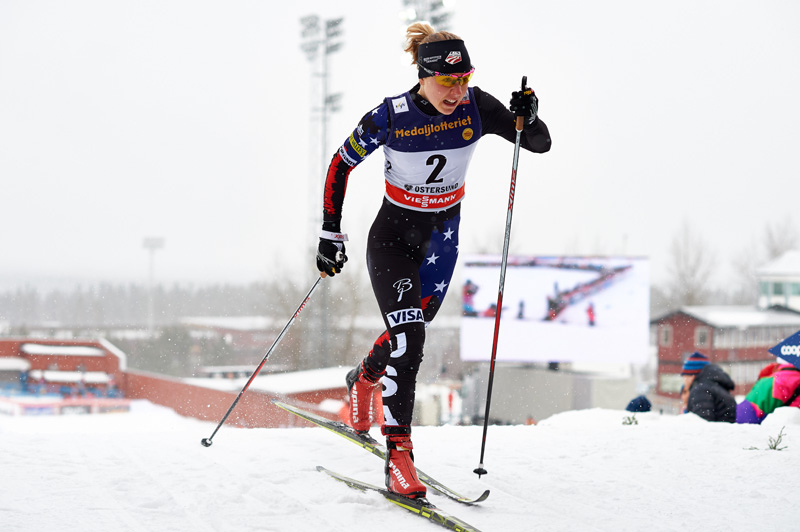
Ida Sargent of the U.S. Ski Team racing last season in a classic-sprint qualifier at the World Cup in Ostersund, Sweden. She placed 41st and did not make the heats. On Friday, Sargent placed seventh in the first World Cup of the season: the Ruka classic sprint in Kuusamo, Finland. (Photo: Fischer/NordicFocus)
With the sun barely peeking over the horizon in northern Finland, the 2015/2016 World Cup kicked off Friday morning with the Ruka Triple mini-tour in Kuusamo.
For the U.S. women, four of seven racers in the 1.4-kilometer classic sprint made the top 30 to qualify for the heats, with Sadie Bjornsen in 18th, Sophie Caldwell in 27th, Jessie Diggins in 29th, and Ida Sargent in 30th.
That’s why the story of Sargent finishing seventh, one spot shy of the final, is a good one.
At the top of the final results, Norway’s Maiken Caspersen Falla took the win in 2:58.23, after lunging at the line to beat Sweden’s Stina Nilsson in second (+0.26). Norway occupied two of the three podium places, Ragnhild Haga 1.08 seconds behind Falla in third. Another Norwegian, Invild Flugstad Østberg was fourth (+2.85), Sweden’s Ida Ingemarsdotter was fifth (+5.89), and the fourth Norwegian in the stacked final, Heidi Weng was sixth (+7.83).
Sargent, who advanced as a lucky loser out of her quarterfinal in third (behind Falla and Østberg, respectively), narrowly missed the final after placing third again in her semifinal. She finished 0.61 seconds behind Weng, the semifinal winner, and less than four-tenths of a second behind Ingemarsdotter, who advanced in second.
Bjornsen also raced in that semifinal after winning her quarterfinal in a photo finish with Sweden’s Evelina Settlin. In the semi, Bjornsen was sixth, 8.61 seconds behind Weng, which put her 12th overall on the day. Caldwell and Diggins both placed fifth in their quarterfinals and did not advance for 23rd and 25th overall, respectively.
In a phone interview after the race, U.S. women’s coach Matt Whitcomb reflected that going into this weekend, the team wanted more than a tepid start to the season.
“I’m really happy with the day; we started the season last year with a good race here from Ida,” he said, referring to Sargent’s career-best fifth in the Kuusamo classic sprint. “But in general, as a team, the first couple of weekends were more of a soft launch. We didn’t like it, the fans didn’t like it, the athletes didn’t like it. So our team cheer last night was ‘fast start.’ ”
For Sargent, perhaps the qualifier wasn’t the fast start she was hoping for, but the 27-year-old classic sprint specialist squeaked into the heats by 0.1 seconds just days after recovering from a nasty cold. (Sargent skipped last weekend’s pre-World Cup tuneup in Gällivare, Sweden, due to illness.)
Asked about expectations coming into the World Cup opener, Sargent said in a post-race phone interview that she was realistic.
“I just wasn’t really sure what to expect. I got healthy in time, but [Thursday] was my first training day again, and the first day I did intensity,” she said. “I just did a lap of the course, Level 3, and felt horrible. So I just tried not to have any expectations and just get the season going and do everything I could on that day and bring everything that I had today.”
As the last skier to qualify for the quarterfinals, Sargent took a breath, and settled into visualizing a successful run. “When I was 30th, I was like, ‘Well, that’s great!’” she said. “For me that was as good as winning the qualifier. It was just like making it through, and I knew I had a fresh start.”
No stranger to Ruka-sprinting success, Sargent says her results there have more to do with the course profile than the time of year. The sprint course features two climbs, the second of which leads up to the stadium home stretch and can extinguish a skier’s best effort. That hill, the spot where most of the day’s races were decided, was something of an asset for Sargent.
“This is a course that I love,” she said. “I think it’s the course. I like striding a lot. And this one has big hill to stride up. It just works well for me having the steep hills to stride up. I’m kind of as a smaller sprinter. I do well on hillier courses.”
In Sargent’s quarterfinal heat, she tried to ski in control and time the last hill. There, she began charging as the incline steepened.
“It was really fun to be right in there with those girls who are frequently on the podium and feel like I was going head-to-head with them,” she said. “Even when I finished and was in the finish area, Maiken Caspersen Falla says to me like, ‘I think you’ll be fine. I think we went fast enough,’ or something like that. And as it turned out it was like an insanely fast heat.”
Turns out, it was fast. Sargent qualified as a lucky loser, moving into the semifinals.
U.S. Ski Team member Sadie Bjornsen (second from left in white) races to win her quarterfinal. On the first day of the World Cup season and Ruka Triple mini tour, she finished 12th overall after placing sixth in her semifinal. (Photo: Fischer/NordicFocus)
For the U.S. women, the other highlight was Bjornsen.
Like Sargent, she also missed last week’s races due to illness.
“The funny thing here, those are the two athletes that were sick last week in Gällivare,” Whitcomb said. “And it just is one to remember … that a sickness one week does not mean bad results the next week. … When you get sick, one thing that happens is you recover a little bit.”
But sickness obviously isn’t a cure-all.
“When you are sick, the confidence can be shattered somewhat quickly,” Bjornsen said after Friday’s race on the phone. “So yeah, I would say the confidence sort of came back yesterday and today.”
Bjornsen skied steadily and with intent, coming from behind to hold off and out-double-pole Settlin to win her quarterfinal. For the third time in her World Cup career, she moved on to the semis.
And for most of her semifinal, while racing alongside Sargent, she stayed in the mix.
Bjornsen’s race derailed as she strided up the make-or-break final hill. She chose a glazed track far to the right.
“It got really slippery and I didn’t have the knowledge to jump out of the track and run up the side,” Bjornsen said. In the track, her skis iced slightly and she slipped and fell.
Yet even that mishap became a take-away moment for the emerging all-arounder.
“Unfortunately, I kind of iced on the top and fell over and had to pick myself back up with the most flooded legs in the world. I was disappointed in how the semifinals went because I felt like I wanted to win that one,” she said. “It was a great lesson because you just have so much to learn every time you sprint race. And now I realize it doesn’t hurt to jump out the track and make a decision like that.”
While Bjornsen righted herself atop the hill, Sargent charged ahead. At the top of the climb, the course arcs left into a final double-pole finishing stretch. There, Sargent pulled ahead of Norway’s Katherine Rolsted Harsem to move into third and pushed for second, but came up just short.
“It was a little frustrating to just miss out on the finals,” she said. “It was kind of like a lunge with those other girls for second and third but I think Ida Ingemarsdotter and I have had lunged in the past three or four years here and kind of go back and forth with who wins it.”
Ingemarsdotter has the height advantage of the two Idas: at 5-foot-9, she is five inches taller than Sargent.
Regardless, after finishing seventh on the day, Sargent left wanting more.
Sophie Caldwell (U.S. Ski Team) during the women’s 1.4 k classic-sprint qualifier in Kuusamo, Finland. She qualified for the first time in Kuusamo in 27th and went on to place 23rd overall. (Photo: Fischer/NordicFocus)
For Diggins, she wanted just a bit more track. Coming off wins in both Gällivare races last weekend, Diggins left her quarterfinal race chomping for just 20 more feet of straightaway before the finish. Despite not advancing into the semis, Diggins wrote in an email that her outlook remains positive.
“I was really, really happy with today’s race. It was the first time I’ve ever made the heats in a [World Cup] classic sprint, and I’ve been working so hard to improve my classic technique that it feels so good to see it all pay off!” she wrote.
In the Gällivare classic sprint, a International Ski Federation (FIS) race, Caldwell placed second to stand on the podium with Diggins. A week later, her World Cup season debut also ended in quarterfinals, but like her teammates, Caldwell’s lasting impression is a good one.
“I think last week’s race was a positive indicator of where my fitness and sprinting is right now, so I used it as a boost of confidence going into the sprint today,” Caldwell wrote in an email. “I was happy with the day. It was the first time I’ve qualified in Kuusamo and left me hungry for more.”
Overall standings for the U.S. women in the Ruka mini tour are as follows: Sargent is seventh, Bjornsen 12th, Caldwell 23rd, Diggins 25th, Rosie Brennan 42nd, Caitlin Gregg 81st, and Liz Stephen 84th.
With two distance races remaining, none of the women are out of the picture.
“These tours are really fun because you can come from 90th place on the first day and up inside of the top 15 by the last day,” Whitcomb said. It’s always the goal to have three good-or-better races, but like any sport, you can kind of drop a race and put together two great ones and so end up with a good final result.”
Racing will continue for the women on Saturday with a 5 k freestyle individual start.
Lenny Valjas (second from l, in red) heads out of the start of his quarterfinal during Friday’s 1.4 k classic sprint at the Ruka World Cup in Kuusamo, Finland. He placed fifth in his heat for 22nd overall in the sprint. He currently ranks 25th in the mini tour.
(Note: Based on two different formats of results on the FIS website, there was some discrepancy over whether Valjas placed 22nd or 25th. This article has been amended to show that he placed 22nd based on the PDF version of the final results.)
There are a couple reasons the cross-country World Cup starts in Kuusamo, Finland, each year. For one, it’s almost a sure-bet for snow in November. It’s also really, really hard.
“After training in North America all summer, this is the first chance that we have to compare against European athletes,” Canadian World Cup sprinter Lenny Valjas said on the phone after Friday’s 1.4-kilometer classic sprint — the first race of the World Cup season held annually in Kuusamo.
It’s also the first of a three-day mini tour, the Ruka Triple, and on Friday, Valjas was the lone Canadian to qualify and ended up 22nd on the day.
He was one of eight Canadians to race: after him, Alex Harvey missed qualifying in 47th, Jess Cockney was 65th, Devon Kershaw was 88th, Ivan Babikov 96th, last year’s NorAm leader Michael Somppi 97th, and Graeme Killick 103rd of 115 men. In the women’s sprint, Emily Nishikawa finished 58th of 86.
Canada’s Lenny Valjas during of the World Cup classic-sprint qualifier in Drammen, Norway. Valjas qualified 19th and placed 14th overall. (Photo: Fischer/Nordic Focus)
According to Canadian Head Coach Justin Wadsworth, with temperatures right around freezing, waxing difficulties were a factor in some of his athletes’ results.
“We went for a little more grip, which seemed to work for the most part, though there was a bit of icing up in the qualifier,” Wadsworth said.
Some skiers used klister and some went on hairies, U.S. Ski Team member Andy Newell explained. He went for a klister-covered wax and ended up fourth overall.
Valjas said he thought the Canadians has “the best grip of all nations.” The trouble was, they had to deal with hard, icy track, four centimeters of west snow from the night before, and windy, changing conditions throughout the day.
“Today’s goal was just to qualify and to make it into the points. There was no huge expectations,” he explained, adding that specific results are always a bit of an unknown at this point in the season.
He qualified in 22nd, 8.32 seconds behind Norway’s Pål Golberg, who won the qualifier in 2:32.62. In the quarterfinal, Valjas placed fifth, 4.61 seconds behind the winner of his heat, Norway’s Petter Northug. Northug went on to finish third in the final. Also in their quarterfinal, Sweden’s Teodor Peterson placed second (+0.2) and France’s Baptiste Gros was 0.52 seconds back in third.
“Len’s skis seemed to be slow in his quarterfinal,” Wadsworth observed.
Valjas said his race strategy included being quick off the start, staying in the middle of the pack and hammering up the last hill in order to advance to the semis. A quick start was essential.
“For me, it is difficult to pass from the back to the front,” he said.
On a downhill, he slipped from third to last, which may have been due to trouble with glide.
For Valjas, the Kuusamo course has been both “terrible and amazing,” he said. Slick conditions made it more difficult than usual, he said, with tracks that were “broken and wide, especially the downhill corners, which were icy and hard to get an edge on, just super sketchy.”
With the option to pick his quarterfinal heat, Valjas chose to race with Northug, figuring Northug would set a slower pace. Northug’s quarterfinal win ended up being the second slowest (Italy’s Federico Pellegrino was slower en route to the win), but that meant Valjas needed to be first or second behind him to advance to the semifinals.
While that didn’t happen and his race ended there, Valjas wasn’t too concerned. He said he was confident his form would progress according to plan. After dealing with injuries the last two seasons, he’s happy to be qualifying in the first place.
As for the rest of the weekend, Valjas will race the 10 k skate and 15 k classic pursuit “as long as I remain in good contention throughout the weekend,” he said.
According to Wadsworth, the rest of the Canadians also felt good on Friday, despite not having the quantitative results. Harvey was reported as feeling good, “but just not as sharp” at this point in the season, Wadsworth said. He added that Kershaw was frustrated with his skis as they seemed to be icing up on the hills.
Nishikawa told Wadsworth she felt good, “which is the main thing, as she’s a distance racer,” he said. He remained confident for Sunday’s overall mini-tour finishes as his athletes “don’t always perform well at this stage in the season, especially on a classic course like this,” he said.
“Ideally we would want a better start [to the season], but it is what it is, we have to be patient and we’re focusing on the positives for now,” he added.
All of the Canadians were expected to race in all three events this weekend, and Nishikawa will remain the lone women’s starter.
“We’d love to start more women in Kuusamo, but our funding is limited and only people who have been in the top 30 will be starting this [World Cup] period #1,” Wadsworth explained in an email. “However, we do have a trip racing WC period #2 where there are more women (4) selected then men (1) (as is the case with our development team that was named this year).”
Expanding on this, he said Knute Johnsgaard and four women from the national-development team (Olivia Bouffard-Nesbitt, Cendrine Browne, Dahria Beatty, Katherine Stewart-Jones) will race Period 2 World Cups in Slovenia and the Czech Republic. Nishikawa will also be part of that trip, while the Tour de Ski participants will be chosen based on World Cup points in Period 1.
An all-Norwegian men’s podium on Saturday at the 1.4 k classic-sprint World Cup opener in Kuusamo, Finland. Eirik Brandsdal (c) won it, Petter Northug (l) was second and Sondre Turvoll Fossli notched a career-best third in his first World Cup final. (Photo: FIS Cross Country/Twitter)
The World Cup season got off to a blistering start on Saturday in the northern reaches of Finland with a 1.4-kilometer classic sprint. Eighty-seven men toed the line for the prologue on a gray day in Kuusamo, Finland.
Alexander Panzhinskiy of Russia put down the best qualifying time of 2:38.35, two-tenths of a second ahead of Norway’s Sondre Turvoll Fossli in second place and 5 1/2 seconds faster than the last man to make it to the heats, Martin Jaks of the Czech Republic.
Norway managed to put eight men into the heats with host nation, Finland, grabbing seven of the 30 qualifying slots. Three North Americans — Simi Hamilton (USA), Alex Harvey (CAN), and Andy Newell (USA) — qualified in 16th, 17th and 24th, respectively. Harvey went on to place 14th, Hamilton was 26th and Newell 28th after being eliminated in the quarterfinals.
Just-below-freezing variable conditions combined with the hilly course made for difficult waxing conditions, which were evident through the day as the skiers attacked each round.
When asked how the conditions affected wax choice on Saturday, U.S. Ski Team wax technician Gus Kaeding wrote, “Finding kick wasn’t a problem, managing icing with [a] mix of dry powder and ice was. It took a combination of wax, correct application, athletes skiing the conditions, and patience to pull off good skis.
“When everything comes together we see a career best! Congrats Ida!” he added, referring to American Ida Sargent’s career-best fifth-place finish in the women’s sprint.
Two memorable moments from the men’s race came from Fossli and Italy’s Federico Pellegrino in the quarterfinals. Fossli was leading the fourth quarterfinal coming into the last turn before the finishing straight, when it appeared that his pole or strap broke leaving him to cover the last few hundred meters with a single pole. Striding hard nonetheless, he watched his teammate Finn Hågen Krogh pass him, and Krogh seemed to consider, if only for a moment, letting Fossli win. Better safe than sorry, and he led Fossli into the finish in first and second, and the two moved on to the semifinals.
The second moment came with Pellegrino as his heat entered the final climb before the stadium. Sitting in sixth at the base of that hill, Pellegrino swung to the outside and put in some extremely fast and hard striding, opening up a sizable gap between himself and the rest of the field by the top. He was unable to repeat his performance in the semifinal and finished third in that heat for seventh overall.
The final turned out to be a battle between Norway and Russia with four Norwegians and two Russians in the mix. The finalists jumped out to a clean start with the Norwegians leading the Russians into the first corner. At the bottom of the first climb, Russia’s Sergey Ustiugov put in a brief kick to attempt to take the lead, but settled into third at the crest.
Norway’s Petter Northug, whose technique and power had been less than stellar in his previous two heats, seemed to put it together on the final climb, looking strong and composed while powering from fourth to the front as the Russians faded.
Northug’s teammate, Eirik Brandsdal led Fossli, Ustiugov and Northug, the last two of which were side by side, in the flat before the climb, followed by Russia’s Alexey Petukhov and Krogh. Northug moved up at the base, passing Ustiugov and Fossli. Brandsdal remained in the lead and the Norwegians kept charging ahead while the Russians appeared to lose steam with a not as much kick.
Rising up and over the top, Northug inched ahead of Brandsdal, who slipped on his kick momentarily. Fossli moved to third ahead of Krogh. Around the last turn, Northug and Brandsdal skied alongside each other, and Brandsdal held stronger to the finish — winning in 2:34.84 by 0.47 seconds.
Saturday’s winner, Brandsdal (l) congratulates fellow Norwegian Fossli, who placed third, at the finish of the men’s classic sprint final in Kuusamo, Finland.
Norway swept the podium with Fossli placing third (+1.18), and Krogh took fourth (+1.69) ahead of Petukhov in fifth (+4.54) and Ustiugov in sixth (+14.63).
For the second-straight year, Brandsdal, 28, won the Kuusamo classic-sprint (last year beating Russia’s Anton Gafarov and Sweden’s Teodor Petterson, respectively). It was his sixth World Cup victory.
“I felt from the beginning it was my day,” he told FIS after the race. “I had also perfect skis. I struggled a little bit in the quarterfinal when I did not ski up the hill as I had planned, but the semifinal was much better. In the final I managed to keep calm and go for the victory. Sprint World Cup is one of my goals and it is great to start the season with the victory.”
Brandsdal won both his quarterfinal (by 0.5 seconds over Sweden’s Teodor Peterson) and semifinal (by nearly two seconds over Northug). And for now, he’s in the lead for the overall 2014/2015 World Cup.
“I saw the eyes of Peter. It will be tough next time,” Brandsdal told VG. “He is set on the [overall] yellow jersey.”
Northug was probably the most talked about athlete competing today. After a summer of legal battles and a 50-day jail sentence stemming from a drunk-driving incident in May, he stepped onto the course with intensity.
“It’s good to get a good start. I was only double poling in Beitostølen,” he said of his FIS classic-sprint win in Norway last week. “Today I was on grip wax and it is a tough course, and I am happy to be on the podium. On the last climb I did not have any power left. When Eirik attacked I could not react, but I am happy for the second place.”
Fossli, 21, was excited about a podium in his first World Cup final, and told FIS he felt strong all day.
“I was lucky in the quarterfinal to make it to the semifinal with one pole,” he said. “It feels great to be on the podium. I was second in Beitostølen and it is great to start the World Cup season with a podium.”
The World Cup continues Sunday in Ruka with a 10/15 k classic and then moves to Lillehammer, Norway, for a series of three races next weekend.
About the author: Tommy is a former Stratton Mountain School and Middlebury College skier. After college, he took a different route from skiing and spent nine years flying attack helicopters for the Marine Corps. After too many winters spent in hot dusty climates, he left the Marines and is back in Vermont where he couldn’t be happier.
The women’s classic sprint podium on Saturday in Kuusamo, Finland: with winner Marit Bjørgen (c), runner-up Katja Visnar (l) and Maiken Caspersen Falla in third. (Photo: FIS Cross Country/Twitter)
Marit Bjørgen appeared a little surprised with herself at the finish of Saturday’s World Cup opener. A classic-sprint win in the first race of the season? Sure, she was the 2010 Olympic champ in that event, but the 34-year-old Norwegian had barely warmed up into racing, and last year, she placed 13th in the Kuusamo classic sprint after qualifying first. Either way, she’d take it.
“I am grateful to win today,” she told FIS after the race. “It’s still a sprint and to take the victory, I’m really happy for that. We had very good skis today, the Norwegian girls.”
That was a bit of an understatement. The Norwegians across the board had rocket skis on a just-below-freezing morning and afternoon: “Norway hit the wax out of the park,” U.S. Ski Team Women’s Coach Matt Whitcomb said. “But we saw every team have everything from great kick to really slippery to icing a ton to just damage control in all three of those categories.”
Case in point: the 1.4-kilometer women’s final, in which three Norwegians — Bjørgen, Ingvild Flugstad Østberg, and Maiken Caspersen Falla — led the charge early on.
Slovenia’s Katja Visnar kept herself in the mix up front, but she was the exception.
Østberg, the fastest qualifier by 2.9 seconds over teammate Celine Brun-Lie and four more Norwegians (Bjørgen, Kari Vikhagen Gjeitnes, Falla, and Heidi Weng) in third through sixth, led both her quarterfinal and semifinal aggressively out of the start and held her own in first through the finish.
The 24-year-old Østberg tried it once more for the final, with Visnar sticking close and Bjørgen just a couple meters back in third, ahead of Falla. Meanwhile, American Ida Sargent in her first classic-sprint final kept in contact at the back with Russia’s Natalia Matveeva.
Bjørgen squeezed in front of Visnar on the lefthand turn at the top of the first major hill (one of two), and Sargent moved to fifth.
Norway’s Bjørgen (l) and Østberg (r) flying down the long descent of Kuusamo’s 1.4 k classic-sprint course while leading the final before the last, grinding climb to the finish.
By the end of the 25-second downhill on the other side, Bjørgen was up to first several meters ahead of Østberg. Visnar began to close on the second Norwegian, challenging both Østberg and Bjørgen into the long, final climb — one of the steepest on the circuit — back up to the stadium.
Østberg found the grip she needed and came back even with Bjørgen over the top, but got hung up on her iced-over skis shortly after, allowing Bjørgen, Visnar and Falla to overtake her.
It looked like Bjørgen never glanced back. She continued to keep a ski length between her and Visnar and double poled powerfully around the final turn toward the finish. With Visnar inching closer with each push, Bjørgen held her off until the finish, throwing up her arms immediately upon crossing the red line.
“I am really happy that I kept the young girls behind me,” she told FIS. “I am in good shape at the beginning of the season after the hard training I have done. I was training a lot in November.”
Marit Bjørgen (r) celebrates her win in Saturday’s sprint final in Kuusamo, ahead of Katja Visnar (Slovenia) in second, Falla (Norway) in third, Østberg (Norway) in fourth, and American Sargent (l) in fifth, ahead of Russia’s Matveeva (not shown).
Bjørgen edged Visnar by 0.46 seconds in 2:58.33. Falla took third, 1.7 seconds after Bjørgen, and Østberg settled for fourth, another 1.3 seconds back. Sargent finished fifth (+5.95) for a World Cup career best, and Matveeva was sixth (+12.37).
It was Bjørgen’s fifth podium in the Ruka classic sprint, putting her on par with Slovenian legend Petra Majdič.
Interestingly, Visnar has placed second in four World Cup races — all of which took place in either Finland or Russia, according to FIS.
Eurosport announcers observed that Bjørgen was gasping for air on the final climb — two meters longer than last year because of the way it was tracked.
“It was a difficult race, but we had very good skiing,” Bjørgen said after her 67th World Cup win (83 if you include stages).
This year, the Kuusamo classic sprint was not a stage because the venue is hosting two races Saturday and Sunday as opposed to three (known as the Ruka Triple). Therefore, the race counted toward full World Cup points.
That was good news for Bjørgen, who’s won the overall World Cup three times (in 2012, 2006, and 2005).
In addition to ideal skis, Bjørgen paced her quarterfinal and semi to near-perfection on Kuusamo’s notoriously challenging course. She won her quarterfinal by 0.23 seconds over Matveeva and 0.45 seconds ahead of another Russian, Anastasia Dotsenko. In her semifinal, she topped Matveeva once again (this time by 1.14 seconds) and bumped Polish rival Justyna Kowalczyk to third, 1.51 seconds behind.
Their semifinal was three seconds slower than the first (in which Østberg beat Visnar by one-tenth of a second and Falla by 1 second), which kept Kowalczyk from advancing to the final as a lucky loser.
Sargent, who was fourth in Østberg’s semi (3.23 seconds back), moved on instead along with Falla, the 2014 skate-sprint Olympic gold medalist.
“I was pretty excited because I have only been in one final before and haven’t ever been in a classic final,” Sargent said. “I was just psyched to have one opportunity and see what I could do.”
Østberg was slightly disappointed with her result after never having lost the lead all day until the final.
“It was really a very good day, but what happened at the end was dull,” she told NRK, according to a translation. “I got a little icing under the skis and it’s a shame when you feel so good.”
Slovenia’s Katja Visnar, who finished second in Saturday’s classic sprint, after getting hugs from the three Norwegians, including Maiken Caspersen Falla (l), in the final in Kuusamo, Finland.
Visnar, who advanced in second in both her quarterfinal and semi, was just as excited at Bjørgen at the finish — also pumping her arms and joining her on the victory lap in front of Kuusamo’s filled stadium.
“My training works, and it has brought me to where I am,” Visnar told FIS. “I have been training distance more and I am not so tired in the heats as I was before. Now when I have a good day I believe I can make it to the final. The final was fast. I had great skis and grip in the uphill. I felt strong in double poling to the finish line.”
The three Norwegian women all congratulated her afterward.
Falla won her quarterfinal with the fastest quarterfinal time of the day in 2:58.48.
“I am happy about third place today,” she told FIS after achieving her 16th World Cup podium. “It is a good start to the season.”
Justyna Kowalczyk (c) stumbles over her snow-jammed skis just after topping the final climb in her semifinal, while Norway’s Marit Bjørgen (l) and Celine Brun-Lie (r) go around either side of her.
The biggest shakeup was the absence of Kowalczyk in the final. She was second in her quarterfinal behind Falla, and third in her semifinal. Opting for more kick than most, Kowalczyk had no problem running up the last hill and holding off Bjørgen and Brun-Lie initially for first in their semi — until she tripped over the top.
Brun-Lie lost second around the final corner and Kowalczyk made up as much as she could, double poling to third behind Bjørgen and Matveeva.
According to Infostrada Sports, 15 of the last 17 classic sprints in the World Cup or World Championships belong to either Bjørgen or Kowalczyk.
Kowalczyk ended up seventh on the day after winning the Kuusamo classic sprint last year (when Kikkan Randall was second and Bjørgen was 13th). On Saturday, Randall missed out on the semifinals and settled for 16th overall.
Already in the first race of the season, reporters asked Bjørgen about her prospects for 2015 World Championships in February.
“As long as the trails are like here it’ll go well,” Bjørgen told Aftenposten. “I like trails of length, and I think that there may be opportunities in the sprint course in Falun.”
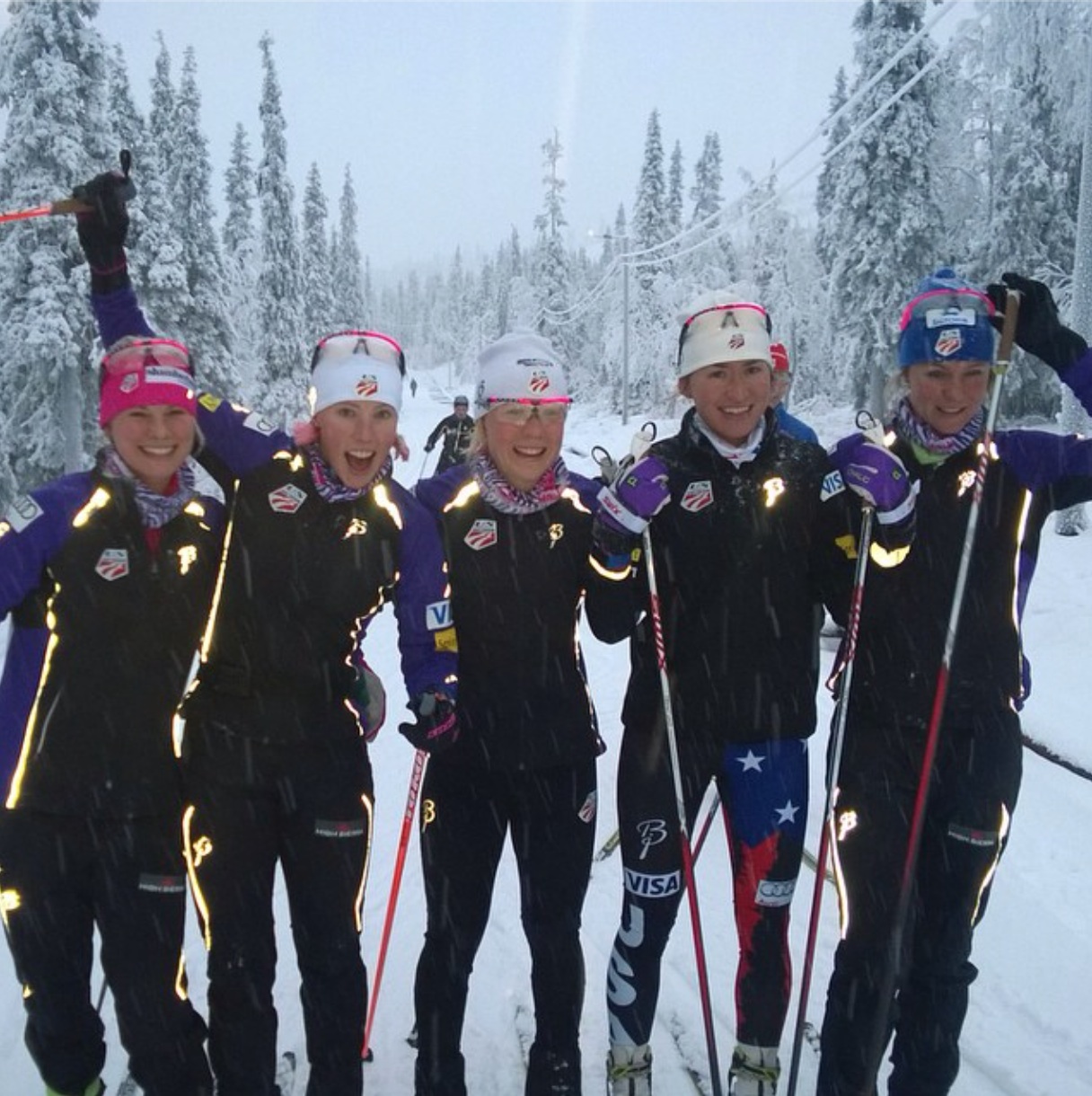
The U.S. Ski Team women earlier this week while training in Muonio, Finland. From left to right: Jessie Diggins, Kikkan Randall, Ida Sargent, Sophie Caldwell, and Sadie Bjornsen. (Photo: Ida Sargent/Instagram)
There was plenty to think about and perhaps more to stress over on Saturday at the first World Cup of the 2014/2015 season in Kuusamo, Finland.
Ida Sargent of the U.S. Ski Team tried to keep in mind everyone else was essentially going through the same thing at the 1.4-kilometer classic sprint on a day with temperatures hovering right around zero degrees Celsius. But there was so much to remember: how to warmup, when to get to the start line, what to do between heats, and when and what she should eat to keep her energy up.
Ida Sargent (U.S. Ski Team/CGRP) leads Perianne Jones (Canadian NST)during the heats of the Frozen Thunder classic sprint on Oct. 24 in Canmore, Alberta. Sargent went on to beat out Jones for first overall. (Photo: Angus Cockney)
It was a routine she and many others on the circuit would refine over the course of the four-month season, but for now, she had to do her best.
In a phone interview after the race, Sargent, 26, recalled being a little tight in the qualifier.
“We were kind of struggling with skis and got them dialed in a little bit more for the race, but I didn’t feel like I had a good warmup so I was kind of stressed and trying to get it together,” she said.
Like others, she found that the tracks were pretty washed out and glazed over from the get-go.
“I think I was kind of fighting it too much in the qualifier rather than just relaxing and skiing smoothly,” she said. “It was really unstable conditions, which is not my favorite.”
Sargent made the top-30 qualifying cut in 27th, finishing 13.86 seconds behind qualifier winner Ingvild Flugstad Østberg, who rounded the challenging course in 2:59.79.
After that, Sargent continued testing her skis, put faith in her wax technicians and took a deep breath, “Like phew, made it through that one,” she said. Next, she thought about a fresh start for the heats.
From then on, every time Sargent advanced, it was a bonus — although she would’ve liked to have done so with a little more wiggle room.
For the first time in her life in a classic sprint, the Vermont native and Craftsbury Green Racing Project skier made it all the way to the final (she had placed sixth in a 2013 World Cup skate-sprint final in Sochi, Russia, so anything better than that on Saturday was gravy, she figured).
And while she mostly honed in on what she needed to do at a given time — like racing up the last, brutal climb as fast as possible — she also had her older sister to ski for.
About three months ago, Sargent’s sister Elsa was diagnosed with breast cancer shortly after getting married in July in Vermont. Two years older than Sargent, she received her last chemotherapy treatment on Wednesday, the day before Thanksgiving.
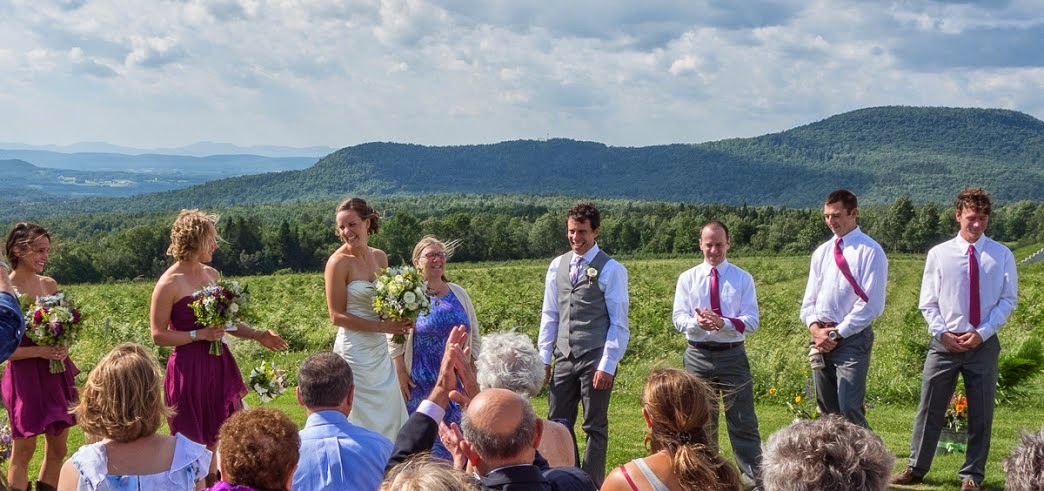
Ida Sargent (second from l) stands by the bride, her sister Elsa, during her Vermont wedding in July. (Photo: IdaSargent.blogspot.com)
“I [last] saw her at the wedding when it just was pure happiness,” Sargent said of Elsa, her best friend, who lives in Seattle. “I’ve just been really impressed with the strength that she’s had through this whole fall so I just wanted to channel that today and do my best to keep fighting. I think it’s pretty incredible to just be healthy and fit and just wanted to do my best to be strong like she has been.
“I feel really lucky that she’s on the mend and on the recovery and can move on with her normal life hopefully,” she added. “She’s always been really supportive of my skiing. We used to train together when she was still racing. She was a fierce competitor then, we had our battles and I was just impressed she had that same strength for this battle.”
Sargent was pleased with her own ability to overcome some elements that usually don’t play to her strengths: variable conditions — with icy tracks and powder over the tops of the hills — and a long, double-pole finish.
Based on her qualifier, she started in an unfavorable outside lane in each heat, then worked to come back from behind, making up the most ground on the wall before the stadium. In last at the base of the hill, she jumped up to third by the top in her quarterfinal, hung on with a strong double pole around the curving finishing flat, and lunged for third, 0.45 seconds behind Finnish winner Mona-Lisa Malvalehto.
Sargent (l) lunging for third in her quarterfinal at Saturday’s World Cup classic sprint in Kuusamo, Finland. Finland’s Mona-Lisa Malvalehto (7) won and Norway’s Kari Vikhagen Gjeitnes was second.
Her quarterfinal time turned out to be the second fastest among third-place finishers, and she advanced to the semifinal with Russia’s Anastasia Dotsenko, the other lucky loser.
“I was kind of frustrated in the quarterfinal; I had felt really strong in the uphill, but I hadn’t had a lane to find space to go, so I kind of felt like I needed a few more meters and I would’ve been top two in the quarterfinal if I had a little more time,” Sargent said. “I was just kind of hoping that I would get another chance for the semifinal and then I was pretty happy it worked out that way.”
While waiting for the final word that she was in the semis, she continued to warm up. Then during her semifinal, Sargent starting in the far lane again focused on staying patient and moving up steadily from behind. On the big climb, she moved from sixth to fourth.
“I just tried to stay in contact and be patient and find openings when I could, but I think I was always last or pretty close to last going into the uphill, but I knew I had enough kick to go up,” she said. “So I could just go hard then and not stress about the early part of the course.”
Pushing up and over the top, she double poled to maintain her position in fourth, finishing 3.23 seconds behind Østberg as the winner. Slovenia’s Katja Visnar was second in that semifinal, and another Norwegian, Maiken Caspersen Falla, took third, while Sargent outlasted Norway’s Kari Vikhagen Gjeitnes in fifth (+4.29) and Malvalehto in sixth (+14.47).
Once she found out she was a lucky loser once again and into the final — for her first time ever in a classic sprint — Sargent said she was “psyched.” She hadn’t been in a final since two seasons ago in Sochi.
According to U.S. women’s coach Matt Whitcomb, the atmosphere in Sochi for those races didn’t come anywhere close to Kuusamo.
“This is one of the classic venues, so it’s no joke,” he said. “She was able to capture a couple of lucky loser positions, which by no means were giveaways, she had to ski very fast to get those spots. It wasn’t like people were falling down in front of her and she snuck through and actually was the lucky loser — she was very fast today.”
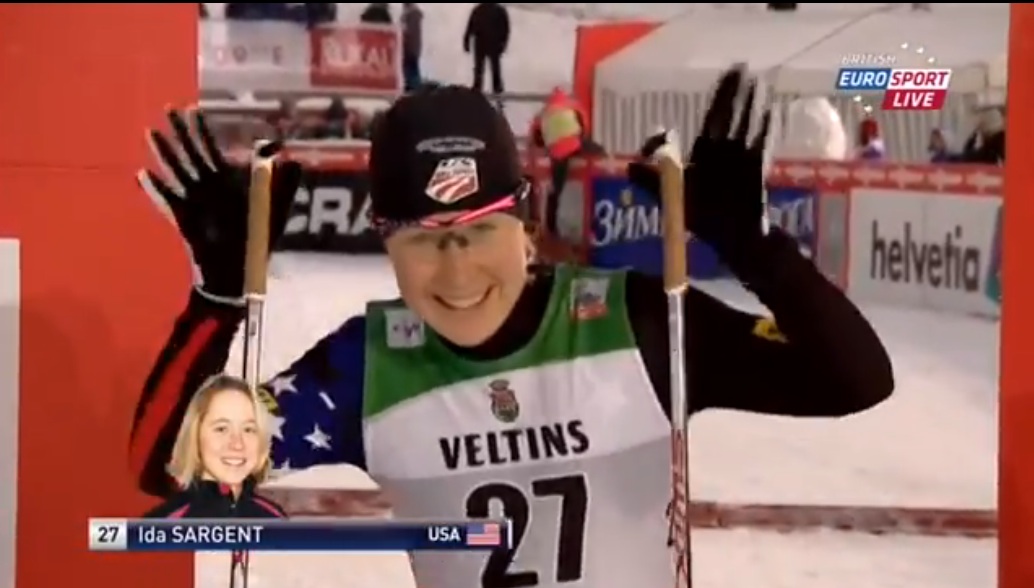
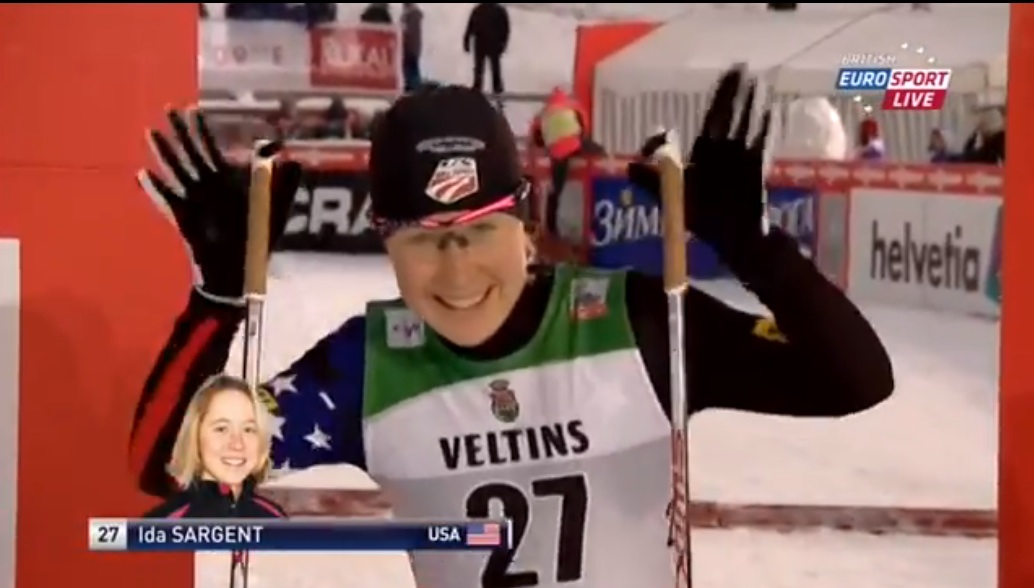
Ida Sargent smiles at the camera before the start of the women’s classic sprint final on Saturday in Kuusamo, Finland.
Lined up with five other women in the final, Sargent gave the camera a big smile when it panned to her.
“I was just psyched to have one opportunity and see what I could do,” she said. “The techs were all just taking care of the skis and really dialing things in between the heats so it was really easy for me to just focus.”
Squaring off against Norway’s Marit Bjørgen, Visnar, Falla, Østberg, and Russia’s Natalia Matveeva, Sargent resolved to go as hard as she could. Still, she remained patient up the first climb and carefully picked an open lane for the steep uphill.
“I was right there and still battling with those girls until going over the top of the hill, I missed a few strides and a little gap opened up,” she said.
Norway’s Marit Bjørgen (r) celebrates her win in Saturday’s women’s sprint final in Kuusamo, ahead of Slovenia’s Katja Visnar in second, Norway’s Falla and Østberg in third and fourth, and American Sargent (l) in fifth, ahead of Russia’s Matveeva (not shown).
Bjørgen charged to the front over the top of the big climb and never looked back for a 0.46-second victory over Visnar, who closed hard to pass Østberg, who had lost momentum after icing up a bit over the top. Falla placed third, 1.7 behind Bjørgen, Østberg was fourth (+3.02) and Sargent finished fifth (+5.95) ahead of Matveeva (+12.37).
“I kept fighting and I was really happy with that,” Sargent said. “The best part was, I got to the finish line and before I could even get my clothes on, all the rest of the girls on the team were there waiting for me. They had all been out cheering even though we have another race tomorrow, they all cheered and greeted me with tons of hugs in the finish area. It was just really special and definitely the best part of the day.”
They also reminded her of the support they’d given her after hearing about Elsa.
“Just having the support of the family and the support of all my teammates throughout this whole fall has been really wonderful,” she said.
“I am ecstatic with her top five. That is such an incredible result for the U.S.A.,” Whitcomb said on the phone after the race. “Not to mention for it just being a personal best for Ida. … When she first got on skis, she was struggling to find kick; she was very patient with the waxing process and went through four or five editions. The way Ida skis, it’s important not to start too thick with wax. It’s important to start with a thin layer, and today her pairs that we were testing out there were all a little bit too thin.”
While her skis weren’t perfect for the qualifier (no team’s were, Whitcomb said, except for maybe Norway), she was able to “sneak through” in qualification, which he said is often her biggest challenge.
“Once she’s in the heats, she tends to excel better than she does in qualification,” he said. “So I was not surprised when she was able to move through a few rounds today. The name of the game today was patience and Ida did a nice job with that. To be fifth, you have to be fast, and she was skiing with fantastic energy up these climbs, fighting eyes wide open, moving through windows, and dealing with the challenges. It’s a big success for Ida, to say nothing of the result. But the result, for our team – just makes us all just so proud.”
Randall, Bjornsen in the Rounds
Teammate Kikkan Randall, who placed 16th, after qualifying in 12th and finishing fourth in her quarterfinal, said the kind of pressure Sargent maintained until the finish of each heat was what kept her in it and would make her successful this season.
Randall striding it out last year in Kuusamo, where placed second in the classic sprint to Poland’s Justyna Kowalczyk. This year, she placed 16th in the World Cup opener, worth full World Cup points and no longer part of a mini tour. (Photo: Fischer/Nordic Focus)
“I think overall it was a really good day for our team,” Randall said, after five U.S. Ski Team (USST) members qualified for the heats, including Simi Hamilton in 16th, Sadie Bjornsen in 19th and Andy Newell in 24th.
“Those that raced today are feeling at least good about where they know their body is,” Whitcomb observed. “In general I think it was a confidence booster for the team, in spite of some areas where we could have done better.”
Randall lost ground on the big climb into the stadium when she was boxed out in her lane, directly behind Sweden’s Hanna Falk in second and beside Norway’s Barbro Kvåle.
“I almost felt like I went backwards,” Randall recalled after standing up to avoid riding up on Falk’s skis. The slowdown allowed snow to clump on the bottom of her skis, which she had asked for more grip on to get up the monster hill.
“When my skis iced [Kvåle] got even with me and she had the inside lane, came out of the turn a little bit ahead of me,” she explained.
Randall finished about a second behind Kvåle in fourth. Norway’s Celine Brun-Lie won the quarterfinal, and Falk was second (+2.84).
“I felt like I skied strong in the quarterfinals but made some wrong tactical choices,” she added in an email. “My energy was good in the rounds and I was disappointed to have my day end early after the quarterfinal.
“Now looking forward to testing out the distance shape in tomorrow’s 10km,” she of Sunday’s classic race. “I can’t believe I’m saying this but actually hoping for slightly colder weather tomorrow for better tracks!”
Sadie Bjornsen ended up 29th after placing sixth in the same quarterfinal, 4.35 seconds behind Randall.
After switching to a stickier pair of skis “which ended up being a wrong pick,” she said, Bjornsen almost went down at the back of the pack on a 180-degree turn before heading back toward the stadium. Gliding, she felt fine, but the tracks on the hills were variable, and that’s where she stumbled.
By the time she got to the final climb, Bjornsen wasn’t too far behind Randall. Norway’s Therese Johaug ended up holding her off for fifth, 6 seconds behind Brun-Lie, and Bjornsen was another 3 seconds back in sixth.
“I felt good in my qualifier; it’s the first time I’ve gone fast like that this year,” Bjornsen said. “I felt like I was not really on top of my game yet, but that’s sort of the goal this year. … This year I chose to not do any racing and try to be at my fittest in February. I felt good, but it wasn’t my most spectacular, which is what I wanted.”
Last year, she qualified in third in the Kuusamo classic sprint and went on to place 26th. And while she doesn’t need a podium at this point in the season, she’s excited about more classic skiing on Sunday.
“It’s supposed to get cooler so maybe some more Kuusamo-like conditions,” she said.
As for Sargent, Bjornsen said her teammate has always been strong on this course.
“She’s really fit this year and she’s also really good in the finishing stretch, which is what you need on a course like this,” she explained. “It’s fun to see it come together for her.”
Jessie Diggins did not qualify in 64th after crashing while descending down out of the first climb, right before the flat section.
“In the flat light and icy corner, I somehow must have caught an edge and down I went,” she explained in a Skype interview. “I actually came sliding to a stop at Simi’s feet as he was warming up, and he was cheering for me saying ‘get up! get up! You can still do this!’ so I charged as hard as I could and Johaug actually didn’t pass me, but I knew she was close so it was extra motivation to get back up to speed!
“I am really happy with how today went for a lot of reasons…my body felt great,” Diggins added. “I felt like my classic technique was a ton better and I am really happy with how my skis were from the techs, my only slip-up was falling down in some tough conditions. It was a bad place to fall because I lost all the glide and then had to use extra energy getting back up to speed, so I have a lot of confidence coming out of today because I think that if I hadn’t fallen it might have been a really good qualifier!”
Diggins explained she’s fine — not as banged up as she was after falling in last year’s Kuusamo sprint qualifier— and “nothing a little foam rolling and icing my shin won’t fix!”
She added that she was proud of Sargent. “It’s always so cool to see someone get a career best,” she said, adding, “I’m so proud of the team for getting 5 into the heats: Sadie, Kikkan, Ida, Andy, Simi…it’s really cool that on a day when it’s tricky waxing and weird conditions we can still have a strong team showing!”
Hamilton, Newell Sixth in Quarterfinals
Hamilton ended up 26th after placing sixth in his quarterfinal, and Newell was 28th with a similar result in his quarterfinal. Both had trouble on the final climb, with Hamilton struggling to find his rhythm on the way up, and Newell icing up over the top and dropping from third to sixth in the last few hundred meters.
“I think it took extra-good balance today and kind of feathery feel, which I’m not always the best at, but I think today was a step in the right direction,” Hamilton said.
He had been skiing smoothly for the first half of the race, before Finland’s Matias Strandvall jumped in front of him near the base of the big hill, he said. Rather than switch to one of the blown-out left lanes (which were used in the qualifier as well), Hamilton stuck to the right side.
“That climb is always a chaos-fest,” he said. “You get people that ski it very differently. What works best for me is skiing the bottom really relaxed and upping the tempo near the top.”
Following Strandvall, a strong classic skier who went on to place third in the heat, he said the pack all ran up it in a similar rhythm — one which wasn’t ideal for Hamilton. He tensed up early and by the time he got to the top, said he felt really tight.
“I’m never the greatest double poler, and it was a long double pole to the finish,” he said. “It’s a super-hard finish, it’s one of those courses where if you don’t have anything left in the tank for the last 30 or 40 seconds, it really shows. I think that’s been one of my weaknesses, where you have a really hard effort before a really long straight finish — that’s been something I’ll be working on and just getting better at going really hard and staying strong for the last 30 seconds, and especially in classic skiing, working on double pole.”
Between the qualifier and heats, Newell said they had plenty of time to test skis, and that’s what most of the top 30 men and top 30 women did on the last climb. Randall estimated she went up it 15 to 20 times in that period.
“I made sure after qualification I had enough kick, for sure,” Newell said, noting his skis felt slick up that hill in the qualifier. He chose a different pair of skis and different wax for the heats. “We knew it would be sticky, but we thought it would free up and kick off easily.”
For him, it didn’t.
“The snow, for some reason, was icy over the top,” he recalled of his quarterfinal. “I was charging up over the top in a decent position and over the top I couldn’t shake that and get the skis rolling so that was a little bit of a bummer. I didn’t feel super quick in the finish, either.”
Canada’s Alex Harvey was skiing alongside him up the hill at the time, and Harvey said both he and Newell slipped simultaneously. Unfortunately for Newell, he couldn’t get the skis gliding well again, lost his momentum and went from third to sixth.
“I ended up dropping quite a few places right there and the skis were dragging going around the last corner,” Newell said. “My fitness is good and I’m feeling fine, so the placings of the day don’t really indicate where we’re at as a team. It was really cool to see Ida in the final. That was huge.
“This is a hard World Cup to start in,” he added. “A lot of these Europeans have been on snow a lot longer than we have. I know it’s always a bit of a shock for me to come here and run that hill; you just don’t see terrain like that on rollerskis. … It’s just the first race so we’re not too worried about it.”
Whitcomb said the team looked good and wasn’t concerned about arriving to Scandinavia a little later than other teams.
“We had a great camp in Canmore with the Canadian National Team and the Alaskans have had 10 days on snow up around Anchorage, so we’ve had decent exposure to snow,” he said. “But adjusting to jetlag and getting over here and putting your bib on for the first time – that’s always a bit of a wildcard. … I was expecting that we’d be able to put together a great day and I think we’ll walk home from the venue satisfied this evening.
“We’ve got a good team vibe going right now,” he added. “It’s always interesting in the first week; everyone has been doing quite a bit of skiing on their own because everyone is feeling different. People have horrible nights of sleep, people have great energy, horrible energy, and so we do a lot of skiing on our own, and it’s been great to see people starting to come back together as bodies have normalized.”
On Friday, the day before the race, the USST held its traditional race prep, where every athlete — male and female — met with their personal wax techs to figure out which skis they’d use on race day then all did an agreed-upon workout.
“The sort of rule of thumb is that you don’t have to do the exact-same race preparation as everybody, but for these sprint days, we like everyone to start together,” Whitcomb said. “It helps us build that team presence, and it seems to generate a good amount of energy. … It was really fun to watch us, for the first time, putting the stars and the stripes on and hammering some race preparation together. And so you have people left wanting more after today … and they can, and so that hunger will help us as we move forward.”
Also for the U.S., Erik Bjornsen placed 56th and 2013/2014 overall SuperTour winner Reese Hanneman raced to 67th in the qualifier out of 87 men.