From the FasterSkier archive — posts syndicated from athletes’ and coaches’ own blogs between 2004 and 2012, kept online as published. Current coverage is at fasterskier.com.
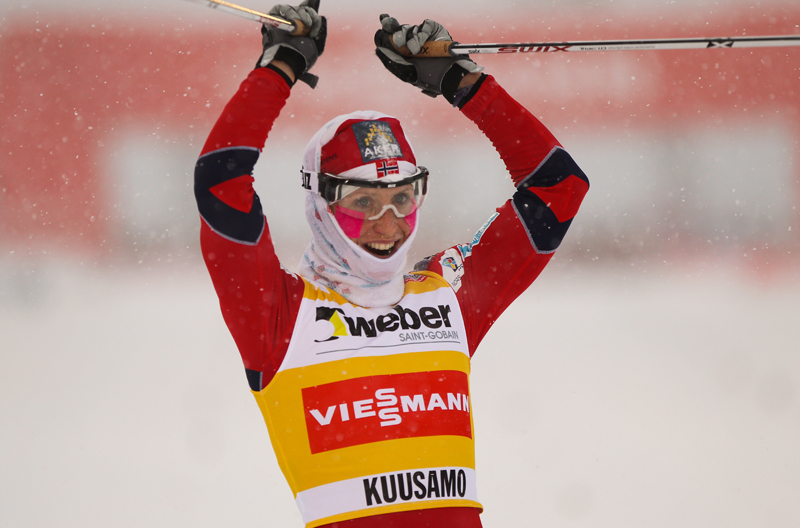
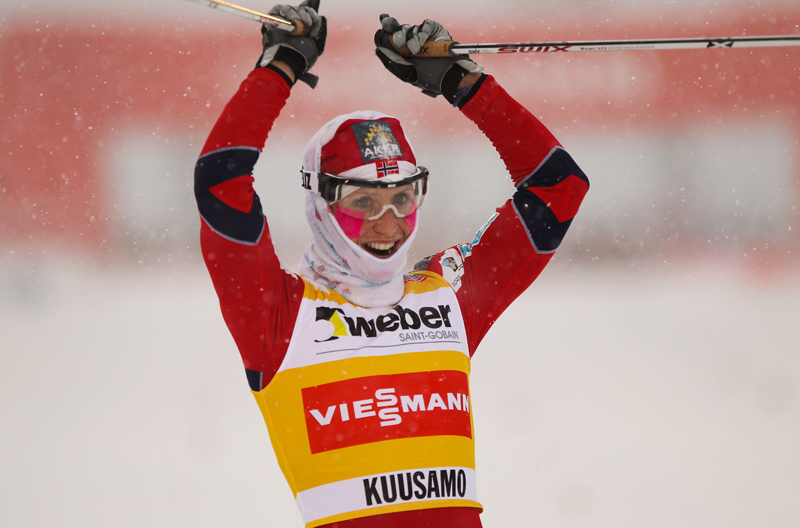
Marit Bjørgen (NOR) after winning the Kuusamo World Cup 10 k classic pursuit by a minute and 21 seconds for the Ruka Trip mini-tour title on Sunday in Kuusamo, Finland. Photo: Fischer/Nordic Focus.
As far at the television coverage showed, it didn’t look like Marit Bjørgen ever looked back on Sunday in Kuusamo, Finland. It would’ve been pointless to do so; Norway’s defending World Cup champion was always more than a minute ahead and the white-out conditions made the visibility near zero.
Starting first in the 10-kilometer classic pursuit – the culminating race of the Ruka Triple mini tour, with full World Cup points and 5,000 Swiss francs ($5,400 dollars) on the line – Bjørgen had nearly a minute to play with off the line. Kikkan Randall of the U.S. started next, 53 seconds back, and Finland’s Krista Lahteenmaki went out third (+0:59).
However, it was the next couple starters that formed the most contentious chase group within the first few kilometers, with Justyna Kowalczyk of Poland in bib 4 leading Norwegians Heidi Weng and Therese Johaug, who started fifth and seventh, respectively. (Yulia Tchekaleva of Russia did not start sixth, traveling instead to Canada in preparation for the Quebec World Cup sprints next week.)
Randall settled in behind the group and after losing contact before 4 k, worked with Lahteenmaki to try to gain back some ground on the front four. Bjørgen remained out of reach throughout the race with Kowalczyk, Weng and Johaug narrowing the gap to a minute and 14 seconds before the halfway point.
They reeled her in by about the same margin by 6.4 k, but with one lap to go, Bjørgen made up a few more seconds despite an increasingly difficult workload in the snow-covered tracks.
Justyna Kowalczyk (POL) enters the stadium and strides to second in Kuusamo 10 k classic pursuit.
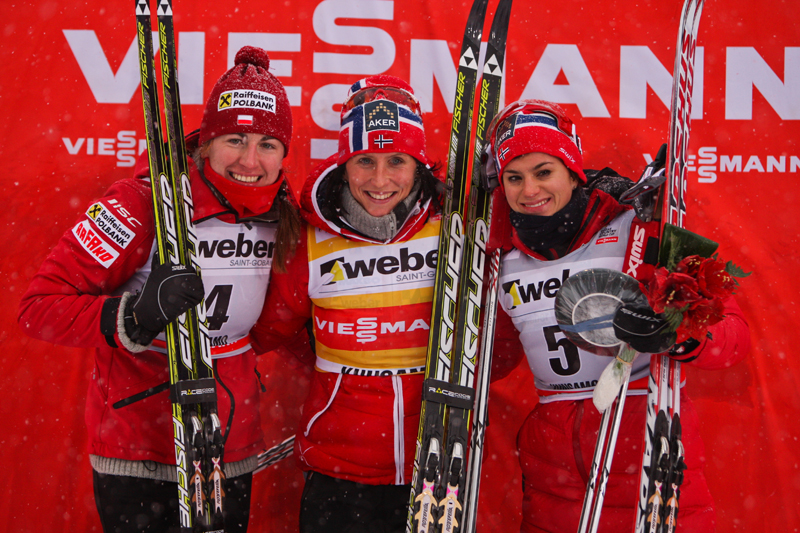
In the end, the 32-year-old Bjørgen won the fourth-straight individual World Cup race of the season; yep, every single one. She swept the mini tour, with victories in the classic sprint, 5 k freestyle and classic pursuit, winning the latter in 31:19.4. Kowalczyk pulled off second place, 1:21.4 back. Weng surged up the last hill past Johaug to challenge Kowalczyk, but settled for third (+1:23.9). Johaug was fourth (+1:34.1) with the second-fastest time of the day, 8.1 seconds behind oBjørgen.
Randall broke away from Lahteenmaki around 6.4 k to make a run for the chase group. She managed to stay ahead by at least a few seconds and ultimately finished fifth (+2:24.8) while Lahteenmaki placed sixth (+2:33.1). At the finish, all eyes were on Bjørgen, whom Randall had predicted would take an army of efforts to defeat.
“Maybe we can work together and try to reel Marit back in,” Randall said after Saturday’s 5 k, where she was second. “She’s definitely strong right now … so it’s gonna be fun and hard.”
Hard was probably the best description of it on a cold afternoon near the Arctic Circle with temperatures around -9 degrees Celsius (15.8 Fahrenheit) and snow falling heavier throughout the women’s race.
“Another incredible day for me,” Bjørgen told NTB, according to a translation. “I concentrated on doing well technically, and it went fast as I had done throughout the weekend. This was one of my best weekends in Kuusamo ever.”
She won the Kuusamo mini-tour title last year as well, and given a 53-second lead from the start, Bjørgen was confident she could keep it.
“I knew I had to focus on [myself to] succeed,” she told Eurosport.Onet.pl. “Right at the start I heard that my advantage has increased … [and] I felt that I was able to get the best time of the day. In the second part of the distance the snow was falling very strong, however, this is a winter sport and you have to compete in such an environment. I have a big advantage when the conditions do not really matter.”
For overall World Cup runner-up Kowalczyk, it was her first podium of the season.
“It was a good race,” Kowalczyk told NRK. “The shape is good and the skis were good. There is a lot of hard work, but it’s better than a week ago. My form is getting better every start. Maybe I come in the same form as Marit.”
Bjørgen, for one, is worried that it might be too much too soon.
“I hope that the form did not come too soon,” she told Eurosport. “I’m going to leave a couple of starts in order to better prepare for the Tour de Ski and World Cup.”
Bjørgen and Johaug planned to skip the Canada World Cups in preparation for the Tour de Ski and second period. According to Norwegian coach Vidar Løfsus, the rest of the women’s team will be there, including seventh- and eighth-place finishers Vibeke Skofterud and Kristin Stoermer Steira.
“I will go home now and then train two weeks at high altitude in [Italy’s] Seiser Alm to get ready for the Tour de Ski,” Bjørgen said.
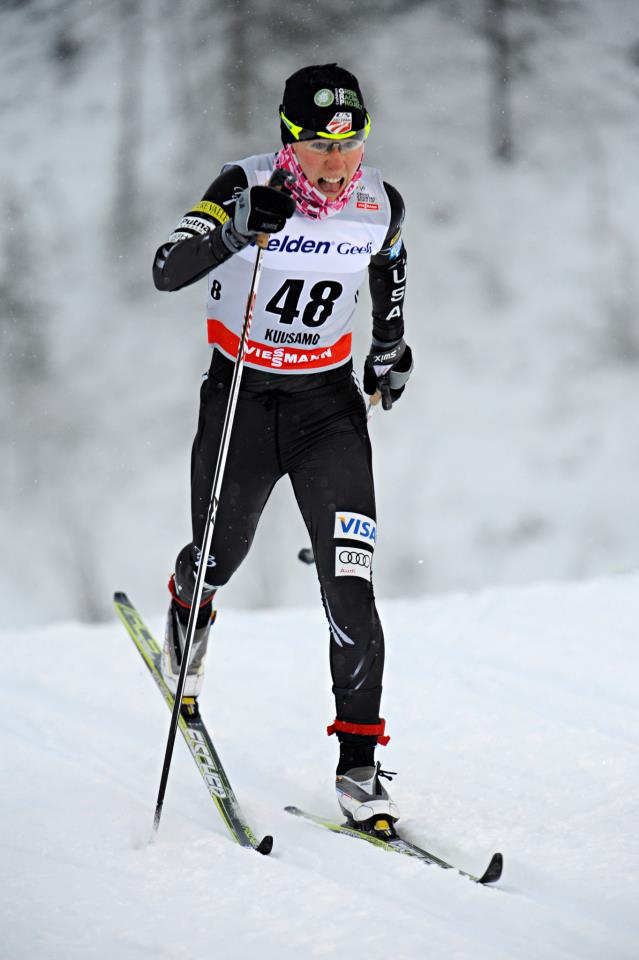
Ida Sargent (CGRP/USST) en route to a personal-best ninth in the Kuusamo World Cup 1.4 k classic sprint on Friday. (USSA photo: www.facebook.com/USSA.nordic)
Talk about depth. Last weekend, four U.S. women made history capturing third in the 4×5-kilometer relay in Gällivare, Sweden. On Friday, the lone US Ski Team (USST) female in Europe who didn’t race the team event was raring to go in Kuusamo, Finland.
Ida Sargent of the Craftsbury Green Racing Project came out with a renewed-and-focused fire in the 1.4-kilometer classic sprint, the first of three World Cup races in the Kuusamo mini tour this week. Known as a strong sprinter, her personal best in a preliminary round before Friday was 26th in last season’s Moscow World Cup skate sprint. She shattered that in Kuusamo.
Sargent, 24, led her U.S. teammates in the first sprint qualifier of the World Cup season under the lights on a chilly -12 degree Celsius (10 degree Fahrenheit) evening. She finished 13th to advance to the quarterfinals along with reigning World Cup sprint champion Kikkan Randall in 16th.
While some might have predicted Sargent would go on to achieve great things then, there’s a lot that can happen in sprints. Ask Randall.
For the next two heats, Sargent put herself in positions to stay alive, jolting from sixth to second behind Finland’s Anne Kylloenen to make the semifinals. In the second semi, she jumped up to third before the final grueling climb, and after losing some ground on the descent, fought hard for fourth in the deceivingly uphill stretch into the stadium.
Krista Lahteenmaki (FIN) ultimately edged Sargent in a double-pole showdown to the finish, nabbing the lucky loser spot and advancing to the final. Sargent settled for fifth in the heat and ninth overall – not bad for a career best that topped her 12th place in Moscow last season. Her previous best in a World Cup classic sprint was 29th.
“It’s tough being so close to the final but I’m still incredibly happy with the day,” Sargent wrote in an email. “It was a really fun day and I can’t stop smiling!”
Meanwhile, Randall also advanced to the semifinals after taking second to Slovenian Katja Višnar in the quarterfinals. In the semi, she strided alongside leaders Marit Bjørgen of Norway (the eventual overall winner) and Poland’s Justyna Kowalczyk ahead of the pack on the final climb. Soon after, she ran out of steam and finished fifth for 10th overall.
It wasn’t exactly the result Randall envisioned, but it was solid considering. After logging a great pre-race workout Thursday, Randall said on the phone that she didn’t feel as well as she’d hoped on Friday.
“I just felt a little flat out there and didn’t feel like I could kick into my sprint race gear,” she said. “I think the silver lining for me is on a bad day, I used to not even qualify, and today I didn’t bring my best, but was still a top ten.”
What’s even better was that Sargent was in there, too, Randall said.
“It was a great day for us, I mean two in the top 10 is an incredible result,” Randall added. “Really psyched with the way Ida skied today. She really came on strong there every time coming up the hill.”
That was what separated racers who were having a great day from the ones that weren’t. Bjørgen repeatedly attacked the final steep climb, and even when she struggled there in the semifinal, she found a way to gain some ground in the stadium.
“The Kuusamo course really tests the fitness of an athlete,” U.S. women’s coach Matt Whitcomb said. “It’s an incredibly strong finish with a very difficult hill followed by a long, hard false flat, and for athletes to do well here means that they are in great shape.”
Case in point: Sargent, who recorded her previous best on an even longer 1.5 k course.
“It was definitely a career-breakthrough kind of day for Ida that we’ve known has been in the cards for a long time,” Whitcomb said. “But actually seeing her hit that top-10 mark will give her all kinds of new confidence.”
For Sargent, getting there took tons of grit and work. Whitcomb laughed as he recalled what she said after the quarterfinal. She couldn’t decide which lane to be in and bounced around “five or six times” as a result, he said
“She kept getting boxed around, boxed out a little bit and just realized she needed to settle down, that she felt great and there was 35 seconds of climbing time where she knew she could make moves,” he said. “Once she settled down she found her open lane and was able to move up the pack.”
Sargent wrote that she was so excited after the qualifier that she didn’t have any expectations for the heats. Knowing her strengths in climbing and confident in her double-pole improvements, she aimed to stay calm throughout and “go for it” on the big hill.
That worked great in the quarterfinal, as she accelerated over the top and put herself in second at the finish. However, in the semifinal Sargent explained she was boxed out at the bottom and didn’t have her own track, which caused her to slow down and seek one.
“I wasn’t able to go for it as much on the uphill and then Lahteenmaki was just stronger double poling into the finish,” she wrote. “I think if I had a better track on the uphill I could have stayed at the front on the uphill and then maybe made the final … [but] I’m feeling good and excited to be here. We had awesome skis today and there is so much motivation and inspiration being on this team especially after the amazing weekend in Gällivare.”
The rest of the U.S. women recorded personal bests or close to it for a classic sprint (Jessie Diggins was 33rd, Holly Brooks 40th and Liz Stephen 68th), leaving Whitcomb pleased with the overall results.
“It’s a great day for us to put two girls and two guys into the rounds,” he said, referring to Simi Hamilton and Andy Newell, who placed 24th and 27th, respectively. “Also, really encouraged by Jessie finishing 33rd, just a half second out of qualification in what is generally not her strong event. There were a lot of great signs today and I think we’re going to see a whole lot from Andy and Simi in these sprint events. These guys are just starting to get going.”
In an email, Hamilton wrote that his goal had been to qualify, which he did in 29th. However, he hadn’t slept well the night before and felt his energy was flat throughout the day.
“I never feel great when it’s this cold, but I fought hard in my quarter and just didn’t have the zip I needed on the final long climb into the stadium,” Hamilton wrote after finishing fifth in his heat. “I’m happy with today, although skiing past the quarters would have made me much happier. I knew going into the day that it would was going to take everything I had to have a respectable race.”
The course didn’t exactly play to his strengths, he explained, and after having strep throat this time last season, he hadn’t raced in Kuusamo in two years.
“It’s a tough course for me,” he added. “There’s not a lot of technical skiing and a lot of the race rests on being light up that final climb. I am much better on courses that involve technical skiing and rolling terrain where I can use my weight to my advantage.”
Newell qualified ahead of Hamilton in 21st, and on his 28th birthday, was lucky to do so.
“In the qualification round I got super lucky because I almost went down after the first climb,” Newell wrote in an email. “There was a bit of ice before the downhill and my skis completely crossed and I don’t know how I didn’t fall but I managed to stay up despite losing a little time.”
In his quarterfinal, Newell was initially third behind Sweden’s Emil Joensson and Calle Halfvarsson, who went on to finish first and third, respectively, in the heat. All was going well until he and China’s Qinghai Sun “had a few close calls,” Newell wrote. “We were banging into each other a lot for some reason.”
Nonetheless, he was in a good position heading into the last climb, but didn’t have the kick he needed to keep up with Joensson and Norway’s Petter Northug, who was second in the heat. Newell came through in sixth.
“It’s a bummer to slip on this course and I had a few bad ones and then just wasn’t able to run the hill the way I normally can,” Newell added. “I’ve been feeling great, definitely feeling a lot better than what the results from today will show. It’s just the first sprint of the year and it’s only half points here so I’m not too concerned. Just looking forward to doing some more sprinting soon.”
Whitcomb reiterated this how early in the season it was and what Period 1 entailed.
“We are doing our best to ski fast each weekend, but we are also doing our best to maintain training volumes, good quality workouts,” Whitcomb said. “It’s possible we overreached just a little bit with regards to training [this week], but at the same time that’s what we’re training to maintain this time of year. Ultimately we’re gunning for Val di Fiemme [World Championships].”
Despite recovering well from two third-place results last weekend, Randall said she felt the effects of a hard strength workout on Tuesday.
“I think maybe that was a little hard, maybe flattened out my fast-twitch muscles a little bit, but overall I think it was a pretty solid week,” Randall said.
***
Extras
Diggins (33rd) on missing qualifying by just over ½ a second:
“Considering classic sprinting is something I’m still working on, I’m pretty psyched on today,” she wrote in an email. “I broke the course down into parts and skied each part as well as I could. I didn’t ski the last climb as well as I did in race prep however – I think I got too nervous – and that’s where I lost the most time. If I could do it again I know what I’d fix … and I get to do it again next year and the next ten years! :)”
Brooks (40th):
“My race was slightly mediocre, neither good or bad,” she wrote in an email. “The last big climb into the stadium frustrates me a bit because I feel like I always ski it better in practice and the warm up. Oh well, such is life. I have a few things to work on and that keeps it interesting! I’m really looking forward to the next two days. Saturday’s 5k skate race was my breakthrough last year so I’m crossing my fingers for another good one!”
Stephen (68th):
“Today was probably the best Kuusamo classic sprint I’ve ever had so that was good, but I’m psyched for the rest of the weekend,” she said on the phone. “I’ve skied the main uphill better every single time I’ve skied it, except for today. I think I was having a pretty good sprint until the big hill today. I couldn’t quite nail it, but the courses are awesome and they’re really good for people that are in really good shape so hopefully that bodes well for our team.”
With three straight days of racing in the only the second weekend of the World Cup, there were plenty of comments to go around. Here’s a look at what didn’t make it into the Ruka-Triple recaps from Kuusamo, Finland.
(Note: It’s pretty heavy on the men’s side, especially with the Canadians, probably because they were chatty about their performances on Sunday.)
On why athletes shouldn’t get too worked up about sub-par performances:
“If you really put too much emphasis and weight on these races you can get burned,” said Justin Wadsworth, head coach of the Canadian national cross-country ski team. “And OK, Northug wins, he wins. To get really good results, you need to peak a little bit; not just peak, but fine-tune it. I think our big goal of the year is still the Tour de Ski and the overall World Cup.”
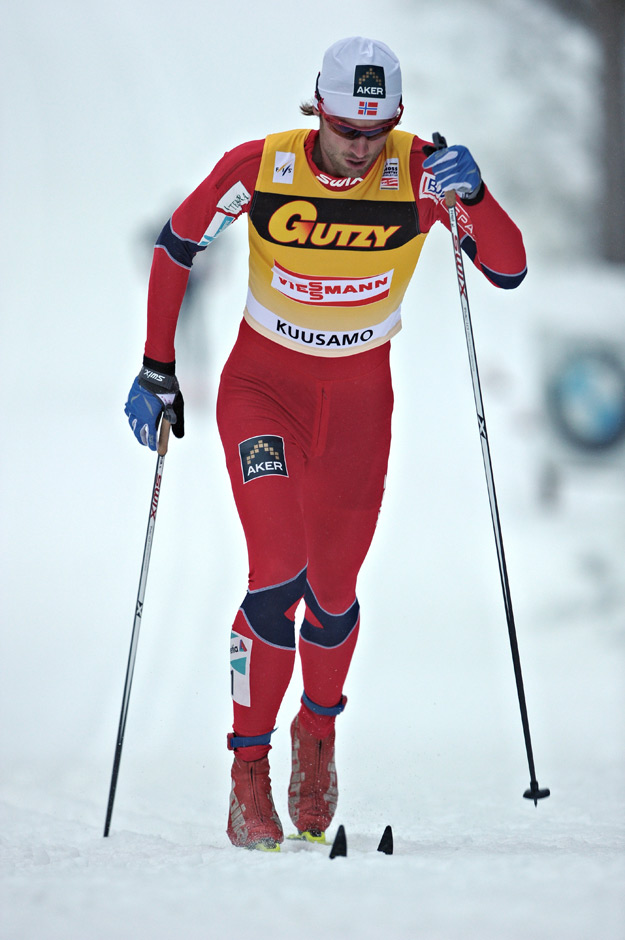
Petter Northug (NOR) striding to victory in Kuusamo Mini-Tour (Photo: Fischer/NordicFocus)
“I wasn’t a happy camper for a long time … I was probably pretty miserable to be around, no that’s not true, our team’s great,” said Canadian Devon Kershaw after placing 20th overall, a weekend-best, in Sunday’s pursuit. “I wouldn’t call it a great race, but it was solid for sure.”
Teammate Chandra Crawford tweeted on Sunday: “Did what I could and went all out, finished the Ruka triple in 54th but stayed positive and pushed it the whole way. #goingforit”
“Perianne (Jones) … definitely she’s had a good summer of training, she just overanalyzed her racing in the sprints and just missed (qualifying) by a couple seconds,” said Canadian coach Eric de Nys. “If you have one bad day, it doesn’t dictate the rest of your season.”
“The result this weekend wasn’t what I was looking for but the season is still young and I’m still getting into the swing of things,” said American Andy Newell, who finished 72nd overall. “As a team we’re still off to a great start … it’s so much more fun to have a big group of US racers on the World Cup so we can always feed of each others’ success.”
“I was tempted to lie and said I crashed but the fact is those boys are fast.” — U.S. skier Tad Elliott, on finishing 122nd in Friday’s sprint.
“Goal (is to) move up, why not? (The pursuit is) a classic race. I don’t ski that sticky stuff on the bottoms of my skis well. I have worked on it and will give it hell.” — Elliott before Sunday’s 15 k classic pursit, in which he was 95th.
On keeping their heads straight:
“Team is in good spirits. The ladies are wrecking shop. So that’s fun for team (morale). The attitude is good and happy we get to get out of the dark Monday.” — Elliott.
“The team is doing great. We are all super excited for our women’s team and their success!” — Noah Hoffman, USST.
“I’m pretty easygoing, especially around race time. I knew what I had to do, try to catch a ride and stay with as many guys as I could (in the pursuit). I wasn’t feeling too much pressure, just ski my own race and it ended up OK.” — Lenny Valjas, CCC
“Lenny is just such a chilled out guy and has an amazing attitude 365 days a year.” — Kershaw.
On Kuusamo’s course and conditions:
“The course is very difficult with a massive amount of steep hills.” — Kris Freeman, USST.
“(Saturday) it was wet (raining/humid) and insanely windy out there as well — for an individual start, those are tough conditions to ski through — especially if you end up not seeing anyone out there.” — Kershaw.
“I’m looking forward to the 15km (Sunday). It is a much harder course — should be a blast.” — Graham Nishikawa (CAN) before the pursuit, in which he finished 81st.
“Everybody dealt with changing conditions (Saturday). I think the race was very fair, a hard course, and well organized.” — Hoffman.
On pre-race routines:
“I woke up late (Saturday around 9:30 a.m.), go for a short 10-15 min “wake up” run/walk … I eat, and other than that it’s a pretty chill scene. I lay around a bit, put my feet up, play some guitar, listen to music. … I’ve been trying to warm up a little longer/harder too than usual.” — Kershaw.
On why Sunday’s pursuit suited Canada’s Alex Harvey (11th) and Devon Kershaw (20th):
Note: They posted the seventh- and eighth-fastest 15 k times in the classic race, respectively.
“They’re both good classic skiers … when they get in a classic race where it’s a mass start or kind of group situation, they’re both very savvy and they ski very well in those situations. (Earlier in the year) when we saw the schedule had gotten changed to classic on the last day, we were all pretty excited.” — Wadsworth.
Kershaw tweeted on Sunday: “Good confirmation today that I’m not a complete bum. Laps 4 & 5 we pretty rough after a fast start, but definitely satisfied #finally”
On pacing in the jam-packed pursuit:
“Guys were just going bananas, like, really, really hard pace and you have to try to ski as smooth as you can and you can’t die. If you die it’s game over, and I kind of died. I had a bit of a half-die in there for a couple laps.” — Kershaw, 20th overall.
“You need to just start really fast from the gun … it might screw up your pacing a bit, but if you’re able to catch a couple guys, like 10 of 15 seconds ahead of you, then you can just sit on them and it gets easier. I was trying to do that, but the problem is, the guys that you’re trying to catch are 10 seconds ahead of you and are also trying to catch other guys 10 seconds ahead of them.” — Harvey, 11th overall.
On leaving it all out on the course:
“At the end, Devon was asking me if I was OK. I was really pale. When we went back into the wax room, I was just sitting on the chair, having a recovery drink, and our two coaches were wondering if I was OK, if I was going to pass out. I got really beat (Sunday), but I think it was good to finish the weekend like that.” — Harvey.
On Team Canada cutting it close after Sunday’s pursuit:
Note: The men’s race finished at about 1:45 p.m. in Kuusamo, then the athletes had to cool down before the bus left at 3:30 for the airport (they flew to Helsinki that evening).
“I don’t know what was harder, the race or packing the bus in time to get to the airport. … It’s pretty crazy what we can get done after a race. It’s pretty frantic.” — Eric de Nys.
On leaving the darkness of northern Finland:
Note: The Canadians were headed to Italy to train at altitude.
“Thinking about the Tour de Ski, because it’s coming fairly fast already, so just get some altitude in, some good weather, get our psychology up to 100 percent because after the first couple weekends of training in Scandinavia in November, it’s so dark. It’s pretty hard on the head.” — Harvey
Drew Goldsack tweeted on Sunday: “Now: Helsinki, FIN. Tomorrow: Zurich and on to Davos, SUI! #GetMeToTheSun”
“Kuusamo is a nice place to spend a couple of days, but we are all looking forward to the sunshine of the Alps.” — Hoffman.
Devon Kershaw (l) and Alex Harvey (r) celebrating their team sprint victory at the 2011 World Championships. Photo from Hemmersbach/NordicFocus
The last few days, Alex Harvey struggled in the morning. It wasn’t his racing that necessarily got him down, the 23-year-old Canadian just hadn’t adapted to northern Finland in November.
“It’s so dark here in Kuusamo,” Harvey said in a phone interview from the airport before leaving the northern town for Helsinki. “You race at 1 (p.m.) so I woke up at like 10 this morning and it’s still dark … you just pound coffee but you’re still sleepy.”
On Friday and Saturday, the first two days of the three-day Ruka Triple mini-tour, Harvey found it especially hard to wake up.
“I was yawning so much,” he said. “But today … finally I got used to the darkness, and now we’re leaving so it’s good.”
The bright-eyed (or at least better-adjusted) Harvey had his best race of the weekend on Sunday, placing 11th in the men’s 15 k classic pursuit. His time of 39:41.4 was the seventh fastest of 99 racers, and he finished 59.9 seconds behind the weekend’s cumulative winner, Petter Northug of Norway.
In Saturday’s 10 k freestyle individual start, Harvey had been 24th, which set him up in a relatively crowded spot to start Sunday’s pursuit. He said it played to his strengths.
“I started pretty much as fast as I could,” he said. “After two laps, I felt that I was dead but I was able to keep going and keep catching guys.”
The pursuit featured six 2.5-k laps, which were nothing short of grueling. Long, steep climbs were rewarded with heart-pounding stretches. There was little time for gliding or recovery.
Harvey said that didn’t suit him; he liked to ski technically well and glide.
“Here … you just run up the hills and hammer over the top,” he said.
Early in the race, Harvey found himself gunning for the frontrunners with Russia’s Maxim Vylegzhanin, whom Harvey started with, 1:20 after Northug.
When Vylegzhanin pushed harder at 5 k, Harvey couldn’t hang on. The Russian moved up to ninth, while Harvey hovered around 14th. Down to fifth place at 7.5 k, Vylegzhanin fell on the downhill. He dropped back and finished 18th. Harvey didn’t regret his decision not to go with him.
“I just couldn’t go any faster and he kept charging and charging,” Harvey said. “When you cross that line and don’t come back, sometimes that’s what happens. He didn’t come back.”
While Kuusamo’s sprint and freestyle races didn’t go as Harvey had planned, his top-10 split on Sunday affirmed he was in good shape.
“Maybe after two hard races the body found the World Cup,” he said.
Teammate Devon Kershaw also found his form, finishing 20th with the eighth-fastest time (39:54.3) on Sunday. He started 37 racers back –1:32 after Northug — and cut the deficit to 1:12.8.
Considering he placed 10th overall at Kuusamo last year, Kershaw said ending up 20th wasn’t ideal, but he was pleased with his split time.
“After the last two weeks I’ve had or the last three weeks, to be honest, it’s such a good confirmation,” he said in a phone interview. “I actually needed that pretty bad.”
It was the first time Kershaw made the top 10 internationally since racing at the New Zealand Cup in August. As the weekend progressed, he wrote in an email that he sounded like a broken record. His body wasn’t cooperating, but his head was still in it.
On Sunday, Kershaw felt a little better. He wasn’t even concerned with results, he said. He was just happy the pursuit was classic.
“I was smiling pretty good in the morning (before the race) because I love classic skiing regardless,” Kershaw said. “I love those races that are super-tight and people all over the place, like NASCAR-type racing. It worked out well.”
As he continued to push himself on the course, he said his body showed signs of responding.
“Over the top of the hills for the first time this winter, I was able to still push,” Kershaw said. “Not just get to the top and be like, ‘Oh God, where is the finish line?’ ”
While he wasn’t able to stay with Sweden’s Daniel Rickardsson, who finished 13th and started 1 second ahead of him, Kershaw knew his fitness would come around. If a similar situation arose, he should be able to knock off 10 seconds to crack the top 15, he said.
“Being in the top 10 today (time-wise) and getting some World Cup points, that’s important,” Kershaw said. “I can’t get greedy.”
Another Canadian, Lenny Valjas couldn’t help but be excited about his performances throughout the weekend. Seeded 17th to start the pursuit, the team’s youngest member — primarily known for sprinting — found a way to finish 29th (+1:46.1).
“I had all the wax techs yelling at me and smiling and laughing … telling me I was still in the top 30,” the 23-year-old Valjas said. “So it was pretty funny.”
“Today was awesome for Lenny,” Canadian head coach Justin Wadsworth said on the phone from Canmore, Alberta. “To be in the top 30 in this kind of field, it’s big time. … The whole weekend was a major success for Lenny. It shows that, again, he’s coming with both distance and obviously he’s going to be scary on the sprint circuit.”
Rounding out the Canadian roster, Ivan Babikov was 46th after placing 20th in Saturday’s 10 k, Kevin Sandau was 73rd and Graham Nishikawa was 80th. Drew Goldsack did not start because he and his personal coach decided it would be better if he rested for upcoming races in Düsseldorf, Germany, Wadsworth said.
As the Canadian team waited for their flight about three hours after Sunday’s race, coach Eric de Nys said they were happy to leave Kuusamo on a pretty positive note.
“We had awesome skis today and we had awesome engines on top of the skis,” he said. “Overall it’s a great start and we’re looking for more.”
On the U.S. side, Kris Freeman had the best result of his men’s team in 43rd place (+2:23.8). He started 32nd and had hoped to finish below 20th, but wrote in an email on Saturday he knew that would be difficult.
His teammate, Andy Newell, who started uncharacteristically back in 100th, was able to climb up to 72nd (+3:38.4). He was right behind Freeman with the 58th fastest time of the day (Freeman was 56th).
“Today’s pursuit went a lot better than yesterday’s skate,” Newell wrote in an email. “Although I was still a little tired, I was able to push it into the red zone, which is something I couldn’t do yesterday. So that’s a good sign to be able to recover after a tough day both physically and mentally.”
While U.S. head coach Chris Grover acknowledged the highs and lows of the weekend for the men’s squad, he said many athletes knew their fitness was improving.
Noah Hoffman, who started 83rd and finished 58th (+3:02.2) was well on his way. He said Saturday’s performance, better than his earlier results, helped him finish stronger on Sunday. He clocked the 40th-fastest split.
At the top of a long grind on lap No. 4, Hoffman knew he turned a corner.
“My legs locked up, and I thought to myself ‘this could end up being a long day,’ ” he wrote in an email. “But I was able to fake it and do some double poling over the top. By the time I got to the bottom of the course, I felt much better.”
Looking ahead, Hoffman was eager for the 30-k World Cup race in Davos, Switzerland, in two weeks. The U.S. team was flying to Davos on Monday and the sprinters would later leave for next weekend’s World Cup races in Düsseldorf.
Hoffman, Freeman, Tad Elliott and Liz Stephen would either stay in Davos or travel to Italy to train, he said.
Elliott was 95th in Sunday’s pursuit, and another American, Lars Flora was 87th.
Petter Northug celebrating a win at the 2011 World Championships in the 30 k pursuit.
Even if he didn’t say it, Petter Northug presented the challenge from the onset. The first starter in the men’s 15 k classic pursuit would give his followers a fighting chance before playing the game of cat and mouse in Kuusamo, Finland.
The Norwegian frontrunner in the three-day Ruka Triple mini-tour wasn’t known for charging out of the gate in those types of races anyway.
As expected, he led the race with the help of one competitor: Dario Cologna (SUI), who started 12 seconds behind him in second. Cologna, the defending Tour de Ski champion, caught up by 2.5 k.
From that point on, the seven-time World Champion and two-time Olympic gold medalist dictated the race. Northug and Cologna switched the lead numerous times, carefully plodding along and keeping their distance from the third man back, which for a while was Alexander Legkov (RUS).
With less than 2 kilometers to go, Northug signified the game was on, as he suddenly pushed the pace on an uphill then slowed down directly in front of Cologna. He was testing his legs and his challenger.
On the final stretch into the stadium, Northug opened it up without much warning — but most knew it was coming. Cologna couldn’t match his double-pole sprint and finished second, 1.8 seconds behind Northug’s winning time of 38:41.5.
“In the end, I no longer had the best kick,” Cologna told Swiss Radio and Television. “I was too tired to attack him.”
After working with Cologna to stay ahead of a hungry and closing pack, Northug said he was surprised with how he felt.
“It is probably the first hard workout in the classic, and I am surprised that my legs were so good,” Northug told NRK. “I was a little skeptical before starting … but it was good that it did so early in the season.”
The win gave him the overall Ruka-Triple crown for the weekend, after Northug was 16th in Friday’s sprint and won Saturday’s 10 k freestyle. It was his first victory at the Kuusamo mini-tour after he was sick and missed the competition last year.
With mini-tour victory counting a World Cup win, Northug used the 200 points awarded to stay in first in the World Cup standing with 355 points. Cologna was second with 278.
The third man to finish in the pursuit, Eldar Roenning (NOR) skied the second-fastest time on Sunday (37:51.5) and climbed his way from starting 18th. The fastest competitor in the race was Alexey Poltoranin (KAZ) in 37:42.8. He placed fourth.
About halfway through the 15 k, Roenning and Poltoranin worked within an eight-man chase group to close the gap on Northug, Cologna and Legkov. While the top two were about 40 seconds ahead, Legkov was a more tangible target about 11 seconds in front of the pack.
Sweden’s Johan Olsson initially charged forward and passed Legkov with about 5 k remaining. Marcus Hellner (SWE) and Roenning strained to catch them, and Poltoranin made his way into the mix. With 3 k to go, the group of five skied together, all vying for third.
Hellner advanced and Legkov dropped off, and in the final stadium shakedown, Roenning emerged as the third-place victor (+20.6).
Poltoranin was fourth (+22.2), Olsson placed fifth (+24.0) and Hellner was sixth (+26.1). Legkov followed in seventh (+35.5), Maurice Manificat of France was eighth (+40.1), Lukas Bauer (CZE) was ninth (+43.3) and Petr Sedov (RUS) was 10th (+47.6).
Earlier in the race, Manificat moved up to fourth, about 37 seconds behind Northug and Cologna. By 7.5 k, he was back with the large chase group.
Canadian Alex Harvey skied the seventh-fastest time in the pursuit (38:21.2) to end up 11th overall (+59.9). His teammate, Devon Kershaw, was the eighth fastest (38:22.5) and placed 20th after starting in 37th.
Northug’s time ranked 21st among 99 skiers. Cologna was the 14th fastest on the clock.
Len Valjas, 2011 Canadian Sprint Champion, racing last season. Photo courtesy of Bill Thompson
Sweden’s Teodor Peterson wasn’t the only one knocking at the World Cup’s “Ruka Triple” mini-tour opener in Kuusamo, Finland, on Friday. Another 23 year old, Lenny Valjas of Canada was right there with him.
After cutting it relatively close in the men’s 1.4-k classic sprint qualifier, making the top 30 in 24th and 8.86 seconds behind leader Anssi Pentsinen (FIN), Peterson was one of two to advance from the quarterfinals. There, Valjas edged out four others with him.
Peterson went on to win his semifinal heat and ultimately the final, nabbing his first World Cup victory since he started the circuit in 2009. Two weekends ago, he came close, placing second in an FIS sprint in Bruksvallarna, Sweden.
“I was lucky today,” Peterson told the FIS Ski. “Two good races before (the) final made me fast in the end. Tomorrow, I will do my best, but I don’t have the same expectations.”
Valjas, who finished fifth in the final after qualifying in fourth (+4.38), knew the sprints were his strength, but he hadn’t entirely anticipated Friday’s result.
“I wasn’t expecting this at all so I’m very excited,” said Valjas, a second-year World Cup competitor, in a CCC press release. “I felt strong all day and this gives me so much confidence. Now more than ever I believe I can reach the podium. That is my goal.”
Valjas followed Russian Nikita Kriukov, who was second in the final and third in the qualifier, and Norway’s Oystein Petterson and Eirik Brandsdal, who placed a respective third and fourth in the final. Of 124 total starters, Valjas was one of the last six standing after nabbing fourth in the semifinals and advancing as a “lucky loser.”
The youngest member of Canada’s men’s team, Valjas was 17th in his first World Cup sprint last year. He went on to place ninth at a World-Cup freestyle sprint in late February, four days before finishing 15th in another short-distance skate at the 2011 World Championships.
In Bruksvallarna this year, he notched a career-best distance result, placing 18th in the 15 k freestyle. When asked the key to his early success, Valjas couldn’t pinpoint it.
“I’m not exactly sure,” the 6-foot-6 Valjas said. “I have been training extremely hard over the last few years and really working on getting stronger and bigger to use my height to an advantage.”
Canada’s head coach, Justin Wadsworth, noted Valjas’ intense training over the last year, which was especially evident in training camps and when he kept up with teammates Alex Harvey and Devon Kershaw.
“He really is quite a different athlete than he was last year at this time,” Wadsworth told FasterSkier on the phone from Canmore, Alberta. “He’s really put a lot of time and energy into really stepping up his training like a real professional, and it’s paying off.”
When it came to expectations for Valjas, Wadsworth chuckled. The day before the Kuusamo sprints, he told someone he wasn’t sure how Valjas would do.
“I said he could win or he could be like 30th or 40th,” Wadsworth said. “He’s so early in his career with big World Cup races that you know he has the capability of doing it. But so far, he hasn’t shied away from the competition, that’s for sure.”
Harvey had the next-best day for Canada, narrowly qualifying in 29th for the quarterfinals, where he was eliminated. Kershaw was 56th in the preliminaries and did not move on, along with teammates Drew Goldsack (87th), Graham Nishikawa (91st), Ivan Babikov (100th), and Kevin Sandau (111th).
Wadsworth said that while some of his athletes might be disappointed with their results, mini-tours aren’t won in the sprints. Case in point: Of the top 10 in last year’s distance pursuit on the final day of the Kuusamo mini-tour, only Kershaw qualified in the sprints (he was 16th in the sprint; 9th in the freestyle pursuit).
Wadsworth said he reminded his skiers about that, and some, like Babikov, already knew.
“Ivan skied more relaxed and had a better race than he did last year,” Wadsworth said. “So you don’t ever expect Ivan to qualify in a sprint, but at least he felt good. … Things should be fine for those guys and it will be fun to see, for the whole team in general, we could have some good racing tomorrow (in the 5 and 10 k).”
Looking ahead to Saturday, Kershaw acknowledged that his best performances don’t usually stem from individual freestyle starts, but he was still awaiting a satisfactory performance. After placing fourth in the 15 k in New Zealand in August, he struggled to crack the top 30 in an FIS race and was 37th last weekend in the 15 k freestyle.
“They say ‘patience is a virtue,’ ” Kershaw wrote in an email to FasterSkier. “And I am probably the least patient person around — so maybe it’s a test.”
He joked that he tended to overanalyze and retracted that possibility.
“It’s only November 25th. There’s a lot of season left, a lot of chances and the Tour is still over a month away — which is a big objective for me this season,” Kershaw wrote. “Everyday I wake up hoping I’ll feel better — but so far no. That’s all I can do. Keep believing, keep being patient and just get up, put one leg through my tights at a time and get out there and race my hardest.”
How the Americans Fared
For the U.S., Andy Newell was the top male and lone qualifier in 19th, but he failed to advance to the semifinals. Kris Freeman was 82nd, followed by Lars Flora (102nd), Noah Hoffman (120th) and Tad Elliott (122nd). Simi Hamilton did not start because of illness (sore throat) and is therefore ineligible for the rest of the weekend’s races.
He tweeted: “Not a great morning to wake up sick. Lying in bed …”
After Newell placed sixth in the Kuusamo sprints last year, he wasn’t exactly satisfied with Friday’s result, but intended to learn from his mistakes.
“I broke the number one rule of Kuusamo which is to make sure you have an open track on the big climb,” Newell wrote in an email. “I took some big chances but still got caught in open traffic on the climb and then blocked again going into the lanes. Then to top it off I lost the lunge for third place.”
While Newell wouldn’t make excuses for himself, U.S. head coach Chris Grover gave him the benefit of the doubt. He had not done a sprint race since training in Lake Placid in September, Grover said in a phone interview.
“I think he probably was just a little bit rusty, but I think he felt good,” Grover said. “The qualification with the exception of the guy who won … was extremely tight, as it often is here.”
In the qualifier, Newell was only about 3 ½ seconds behind the prologue’s runner-up (Jesper Modin of Sweden).
“It’s so tight that you often see guys that are incredibly great sprinters that don’t even make the rounds,” Grover said.
He referenced John Kristian Dahl (NOR), who won last year’s sprint there. He was 48th in Friday’s qualifier.
Grover said he wasn’t too concerned with the rest of his athletes’ performances in the men’s sprint. Freeman was 87th in the same race in 2010 and made a run to crack the mini-tour’s overall top 10 (but his pole broke on the last lap of the final day).
“Because there’s two distance races, the small deficit that the sprinters have gained on the distance skiers gets erased in a hurry,” Grover said. “It gets mostly erased tomorrow and it gets totally erased by Sunday.”
You can tell that North American skiing has come a long way when a day with two men in the top 15 of a World Cup race is closer to disappointing than exciting.
In the final stage of the “Ruka Triple”—a three-day mini-tour in Kuusamo, Finland—Canadian Devon Kershaw led the way for the North Americans with a 10th place in the 15 k skate pursuit. But with Alex Harvey dropping 13 places and Kris Freeman breaking a pole and missing out on a chance for the top five, there was a sense that there could have been more.
Alexander Legkov (RUS) captured the overall victory on Sunday, putting in a huge move in the last kilometer to drop the two other members of the lead pack, after a tactical final lap that had them at a near-standstill. Switzerland’s Dario Cologna was second, while Daniel Rickardsson (SWE) continued his strong early season run with third place.
While Legkov was the winner, it was Sweden’s Emil Joensson who was the first out of the gate in the pursuit start. In the past, Joensson has been almost exclusively a sprinter, but this year he has made a huge jump in his distance skiing, finishing eighth in Saturday’s 10 k classic.
On Sunday, he was off the line like a rocket, and for good reason: He was being chased by Cologna, and Kazakhstan’s rising star, Alexey Poltaranin. And despite Joensson’s improved fitness, he didn’t stand much of a chance against Cologna, the Olympic gold medalist in the 15 k skate in Vancouver.
On his blog, Joensson wrote afterwards that he knew it would be a rough day—especially after two intense competitions on Friday and Saturday. In comments to the Swedish newspaper Aftonbladet before the race, he said that he felt like he hadn’t eaten for a week, and had been stuck in a freezer while fighting Mike Tyson. (What Joensson meant about eating and boxing isn’t clear, but temperatures in Kuusamo this week were close to the legal limit for racing.)
He was quickly swallowed up by Cologna and Poltaranin before the five kilometer mark, and that pack was joined shortly thereafter by the next chase group of Legkov, Harvey, and Rickardsson.
But Harvey didn’t last very long with the leaders. He was quickly dropped, and faded hard to finish 17th.
“He felt good warming up, but for whatever reason, the body didn’t react the way he wanted it to,” said Canadian Development Coach Eric DeNys, with the team in Kuusamo. “Three days of racing in -17 C, or colder, caught up with some people.”
After Harvey fell off the pace, pressure from Legkov chewed up and spit out Joensson, then Poltaranin as well. By the time the leaders reached 10 kilometers, it was down to just Legkov, Cologna, and Rickardsson.
Behind, a large chase pack of roughly ten athletes had formed, including Kershaw and Freeman, who both took turns driving the train.
“It was going really well,” Freeman said, adding that he couldn’t believe how fresh he felt in the middle of the race.
But with three kilometers to go, Maxim Vylegzhanin (RUS) skied over Freeman’s pole and broke it, forcing him to ski 500 meters through the stadium before he could get a replacement from U.S. Ski Team coach Bryan Fish. The mishap, Freeman said, cost him a chance to fight for fourth place, which was “disappointing.” He ended up 12th.
“I wasted a lot of energy skiing with a pole and two-thirds through the stadium,” he said. “Stuff happens, and especially in ski racing…it stinks, but it happens.”
Meanwhile, at the front, Legkov had let up on the gas after dropping Poltaranin and Joensson, but neither Cologna nor Rickardsson wanted to work, either. According to de Nys, cold temperatures, slow snow, and a tough course in Kuusamo meant that nobody “was too keen on leading.”
“It was a really tough race to work in,” he said. “It was quite tactical at the front.”
At the top of one of the downhills, the lead group nearly came to a full stop. But finally, Legkov decided to make a move, and no one could match it. The Russian skied to the finish line with a 10-second lead on Cologna for his first World Cup win since the spring of 2009.
“I realized I could win the race in the uphills, as I was confident and believed in my strengths,” Legkov said afterwards. “I would like to win Tour de Ski. I’m waiting for you, Petter!”
Behind, Kershaw entered the final kilometer in a tight battle, and his bid to move up further was foiled in the finish stretch.
As Kershaw stepped out to make his move, he discovered that two of the lanes had not been skied in, and that despite clear skies, a significant frosty layer had built up. Ultimately, he was forced to drop back in to the clear lanes and settle for 10th.
Kershaw didn’t answer a call after the race, but on his Twitter account, he said that he’d had a good day.
“Best I have felt this season so far,” he said. “A little surprised, actually, but in a good way.”
Ivan Babikov, the third Canadian starter, had his first strong day of the winter, skiing up from his 89th-place starting position to finish 41st—posting the 31st-fastest time of the day. De Nys said that the effort was even more impressive considering that Babikov was skiing through traffic for the full race.
American Noah Hoffman had a similarly strong day, moving to 42nd from 79th, with the 34th-fastest time. Based on the strength of his results over the past two weeks, U.S. Ski Team Head Coach Chris Grover said that there was a chance that Hoffman could remain in Europe for two more weeks, to race the World Cup races in Davos in early December.