From the FasterSkier archive — posts syndicated from athletes’ and coaches’ own blogs between 2004 and 2012, kept online as published. Current coverage is at fasterskier.com.

Tag: Kuusamo World Cup

  • Sundby Clinches Ruka Triple with 44-Second Pursuit Win; Harvey 7th Overall

    Sundby Clinches Ruka Triple with 44-Second Pursuit Win; Harvey 7th Overall

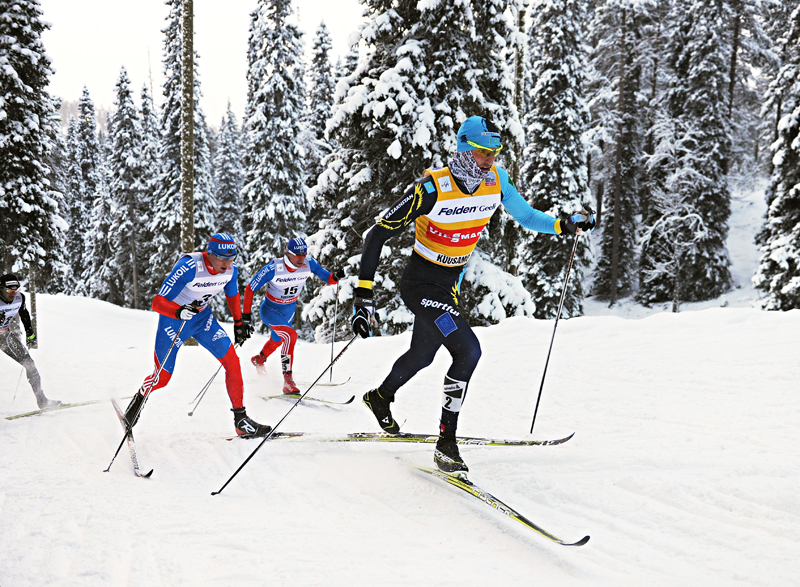
    Norway's Martin Johnsrud Sundby raced to an uncontested victory in the men's 15 k classic pursuit on Sunday, the final stage of the Ruka Triple in Kuusamo, Finland. He won the pursuit by 44 seconds and took the mini-tour victory in the season-opening World Cup weekend. (Photo: Fischer/NordicFocus)
    Norway’s Martin Johnsrud Sundby raced to an uncontested victory in the men’s 15 k classic pursuit on Sunday, the final stage of the Ruka Triple in Kuusamo, Finland. He won the pursuit by 44 seconds and took the mini-tour victory in the season-opening World Cup weekend. (Photo: Fischer/NordicFocus)

    Count them: six in a row.

    That’s how many World Cup tours Martin Johnsrud Sundby of Norway has won. He kept his streak alive in the final stage of the Ruka Triple mini tour on Sunday, the 15-kilometer classic pursuit in Kuusamo, Finland.

    With a 44.7-second win over Petter Northug, also of the Norwegian national team, Sundby, 31, illustrated he’s a world-beater and is primed to defend his World Cup overall title for the third-straight year.

    “It is a good start of the World Cup season. Today’s race was tougher than yesterday,” Sundby told FIS.
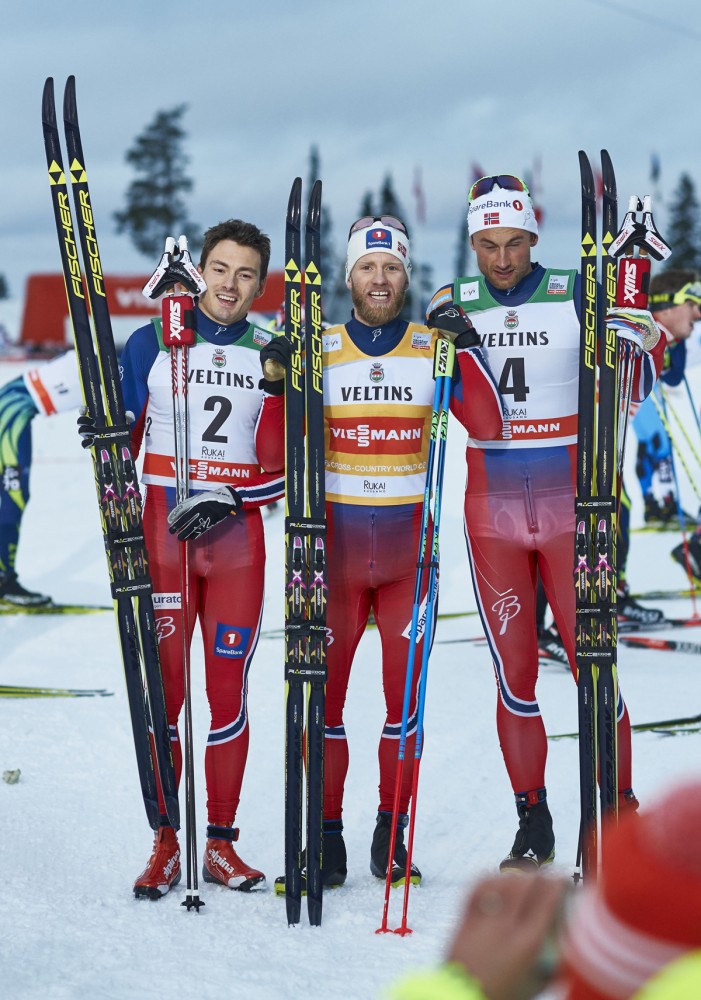
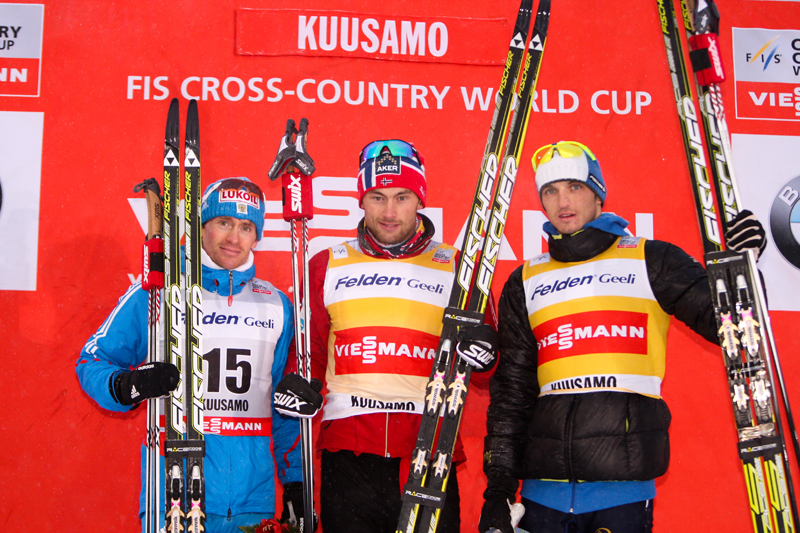
    The all-Norwegian men's podium after the Ruka Triple 15 k classic pursuit on Sunday at the World Cup in Kuusamo, Finland, with, Martin Johnsrud Sundby (c) in first, Finn Hågen Krogh (l) in second and Petter Northug (r) in third. (Photo: Fischer/NordicFocus)
    The all-Norwegian men’s podium after the Ruka Triple 15 k classic pursuit on Sunday at the World Cup in Kuusamo, Finland, with, Martin Johnsrud Sundby (c) in first, Finn Hågen Krogh (l) in second and Petter Northug (r) in third. (Photo: Fischer/NordicFocus)

    He won Saturday’s 10 k freestyle to take the mini-tour lead, then started Sunday’s pursuit with a 14-second head start on teammate Finn Hågen Krogh. While the two never skied together — and actually skied alone for most of the race — they both ended up on the podium.

    Krogh faded in the final third of the race, and Italy’s Francesco de Fabiani and Norway’s Didrik Tønseth caught him with about four kilometers to go. He stayed with them, then dug especially deep to edge de Fabiani by 0.1 seconds for third, less than two seconds behind Northug.

    “I was completely on the [brink] when [the chase group] overtook me,” Krogh told NRK.

    Norway took every spot on the podium, but de Fabiani in fourth kept the powerhouse nation from a top-six sweep. Norway’s Niklas Dyrhaug and Tønseth placed fifth (+48.5) and sixth (+50.6), respectively, and Alex Harvey of Canada was another five seconds back in seventh. In all, Norway put seven in the top 10.

    For Harvey, it was his best finish in the Kuusamo mini tour after placing 11th overall there in 2011. He was second in Saturday’s 10 k freestyle to put himself sixth in the tour heading into the final pursuit.

    “I am super satisfied with the weekend,” Harvey said in a Cross Country Canada press release. “I just felt I had something more in me today than seventh.”

    The Norwegian domination began at the outset. Sundby started alone ahead of Krogh, followed by another Norwegian, Anders Gløersen, 19 seconds back in third. Northug started fourth, 24 seconds after Sundby and a second ahead of Harvey and Switzerland’s Dario Cologna, who placed third in Saturday’s 10 k.

    While Harvey and Cologna headed out together 25 seconds back, the two formed a coalition to battle the elements, particularly the wind, and try to rein in Sundby. However, just before the 4 k mark, Sundby was already 44 seconds ahead of Krogh, 47 seconds ahead of Sweden’s Martin Johansson (who started seventh), and 48 seconds ahead of Cologna, de Fabiani, Harvey, and Gløersen, respectively.

    By 5 k, Krogh had successfully broken away from the rest of the field, skiing 13 seconds ahead of them and 42 seconds behind Sundby. Behind him, Harvey and Cologna stuck with the chase pack that remained seven-men strong by 6.4 k.

    With two laps remaining at 10 k, Cologna had fallen off the pace slightly and slipped to 16th, while Harvey skied in seventh, 15.5 seconds behind Krogh and 1:12 behind Sundby.

    When Tønseth, de Fabiani and Johansson accelerated at the start of the second-to-last lap to catch Krogh, the chase pack split and left Harvey, France’s Maurice Manificat and three Russians — Alexander Legkov, Sergey Turyshev and Maxim Vylegzhanin — in a group of their own. From there, Harvey had to fight for a top 10.
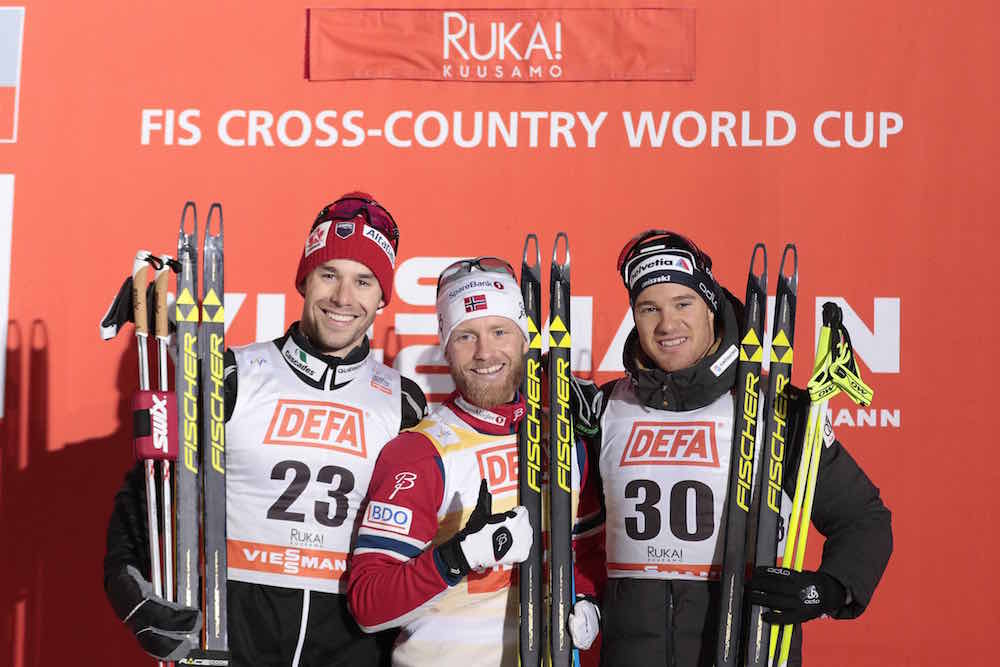
    Canadian Alex Harvey (l) placed second in Saturday's 10 k freestyle at the World Cup in Kuusamo, Finland, to share the podium with Norwegian winner Martin Johnsrud Sundby (c) and Switzerland's Dario Cologna  (r) in third. (Photo: CCC/NordicFocus)
    Canadian Alex Harvey (l) after placing second on Saturday in the World Cup 10 k freestyle in Kuusamo, Finland, to share the podium with Norwegian winner Martin Johnsrud Sundby (c) and Switzerland’s Dario Cologna (r). (Photo: CCC/NordicFocus)

    “It was a tough race for sure. I felt really good, in fact I think it was the best day I had physically, but it was really tricky waxing conditions,” Harvey explained.

    “Our skis really weren’t that bad. The speeds were average, but the difference was the Norwegians and Italians had the best skis,” he added. “I was right there until the final kilometer, but I think as the track started [deteriorating], I lost the group on the last downhill.”

    This Kuusamo course can be like shock therapy. The Ruka hills no joke for World Cup skiers in midseason form, let alone the opening races on this year’s World Cup circuit. A big climb marks the central portion of the 2.5 k loop that the men rounded six times.

    According to Canadian head coach Justin Wadsworth, his team approached the race with a straightforward mindset.

    “We didn’t talk about anything strategy wise before the race. We were so focused on the skis,” he said in a post-race phone interview. “I just told the guys that the only piece of advice that I could really offer was everyone is going to be in the same boat, and it’s going to be hard. So, that was the main thing. Just don’t worry if the skis don’t work everywhere because it’s going to be hard.”

    Although the Canadians had a relatively strong day, with Harvey in seventh and Devon Kershaw in 23rd (after starting 29th), Wadsworth said they may have come up short with ski prep.

    “We feel like we were scrambling a little bit on the skis. We were a bit slow. We could have a little bit more time for that, at least to test today,” he said. “I think maybe we focused a little too much on the the powder testing, some of the glide testing, and that pushed it a little bit later than we wanted. So we didn’t have have as much time as we like to test the kick, which is a priority because it was very, very hard day.”

    “We know what mistakes we made and the skis were a bit slow for all the athletes on the fast downhills, so that was definitely an issue,” Wadsworth continued.

    On a day with 92-percent humidity and temperatures just below freezing, no one’s skis worked everywhere. There was some striding, some ski-running, some herringbone.

    “It was one of the hardest World Cups I’ve ever watched as far as that nobody had the skis that they could run up everything and then glide well,” Wadsworth noted. “There were guys icing. They were slipping in the tracks, out of the tracks. It was a really tough race in that respect.”

    U.S. coach Matt Whitcomb reiterated the universal waxing conundrum. “The conditions today were very very difficult,” he said on the phone. “Picture some of the worst classic conditions you’ve skied in and it was pretty much that.”

    With the relentless climbs, a course profile that rarely backs off, coupled with the dicey kick, the race took a collective toll on the field.

    Meanwhile, lurking at the tail end of the top 20 with five kilometers to go, Northug kept the frontrunners within sight. In the final kilometers, he worked his way forward, eventually closing the gap on those ahead.

    With 2.5 k remaining, he was up to seventh behind Harvey. Then at 14 k, he began stalking Tønseth, de Fabiani and Krogh while skiing in fifth.
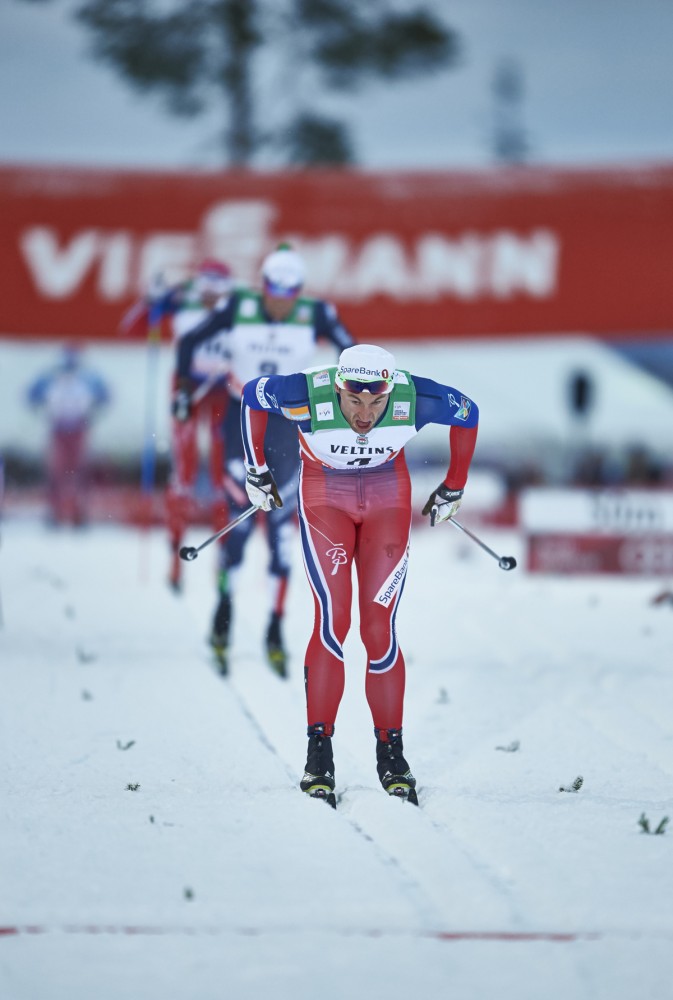
    Petter Northug powers to second in the men's 15 k classic pursuit on Sunday, the final day of the Ruka Triple World Cup in Kuusamo, Finland. (Photo: Fischer/NordicFocus)
    Petter Northug powers to second in the men’s 15 k classic pursuit on Sunday, the final day of the Ruka Triple World Cup in Kuusamo, Finland. (Photo: Fischer/NordicFocus)

    Sundby crossed the line in 37:10 without anyone in sight. Almost 45 seconds later, it was Northug who steamrolled ahead of Krogh and de Fabiani and left them fighting for third.

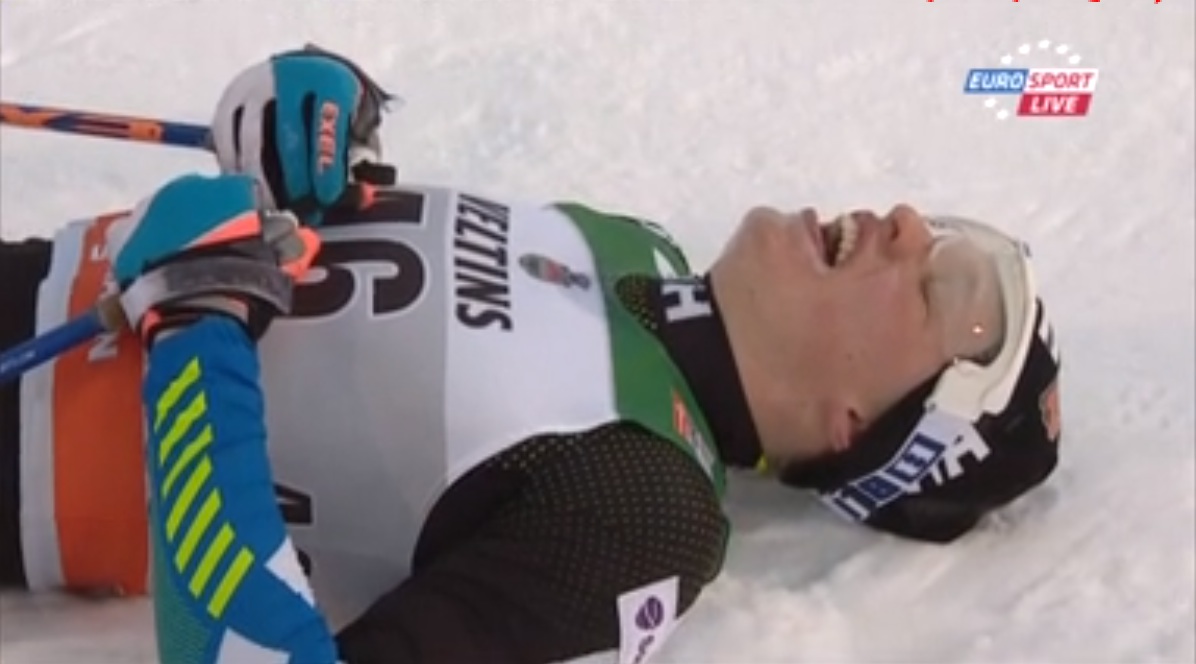
    Ever the tactical chameleon, Northug was clearly gassed at the finish. He lay prone on his back, lungs heaving. When he finally spoke to reporters, Northug explained his form and technique were not quite up to his liking.

    “I was tired. I’m not in shape to go with these guys yet … so I was [skiing] back there and I was annoyed at myself,” he said to NRK, according to a translation. “It was about being in the right place at the right time.”

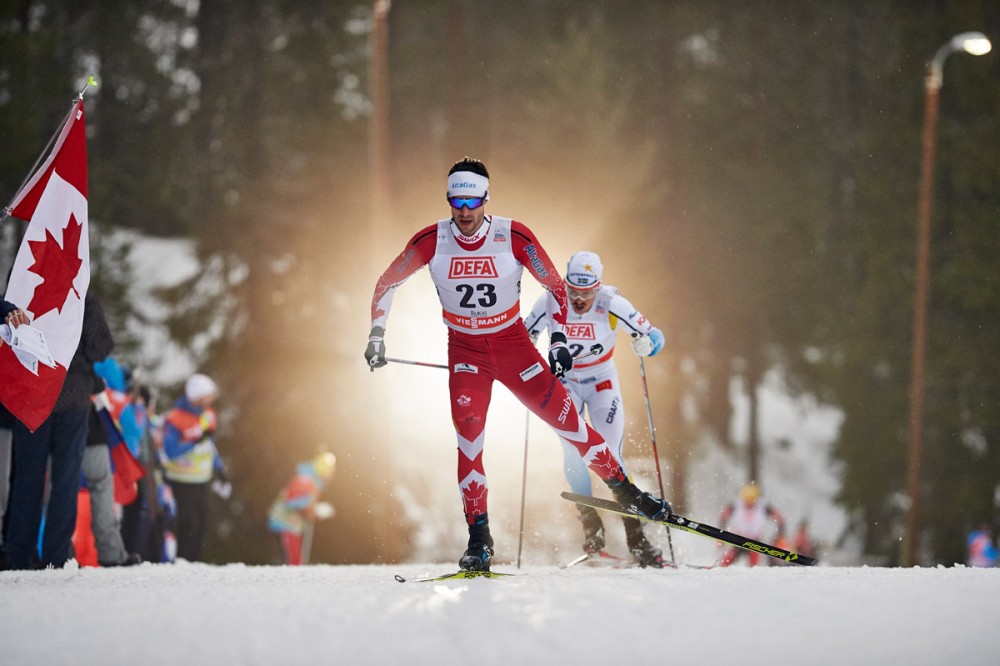
    The duo that had hoped to gain places as a unit, Harvey and Cologna faded slightly in the end to finish seventh and 13th (+1:18.8), respectively.

    As is his style, Sundby remained humble.

    “The first two laps were hard, so I tried to maintain the pace the rest of the race,” he told NRK, according to a translation. “This weekend I have had wonderful fine skiing. Things worked out and I’m in good shape. This winter I think will be exciting and I think I get a lot of exciting duels with these guys here.” 

    “I wanted the other guys think they cannot catch me, but I started way too fast,” Sundby told FIS. “I got extremely tired. After 7.5 k, I did not know how to continue. I am happy I am leaving Ruka with the overall victory in the mini-tour.”

    The fastest time on the day belonged to Dyrhaug, who completed the course in 37:08.1, almost two seconds faster than Sundby.
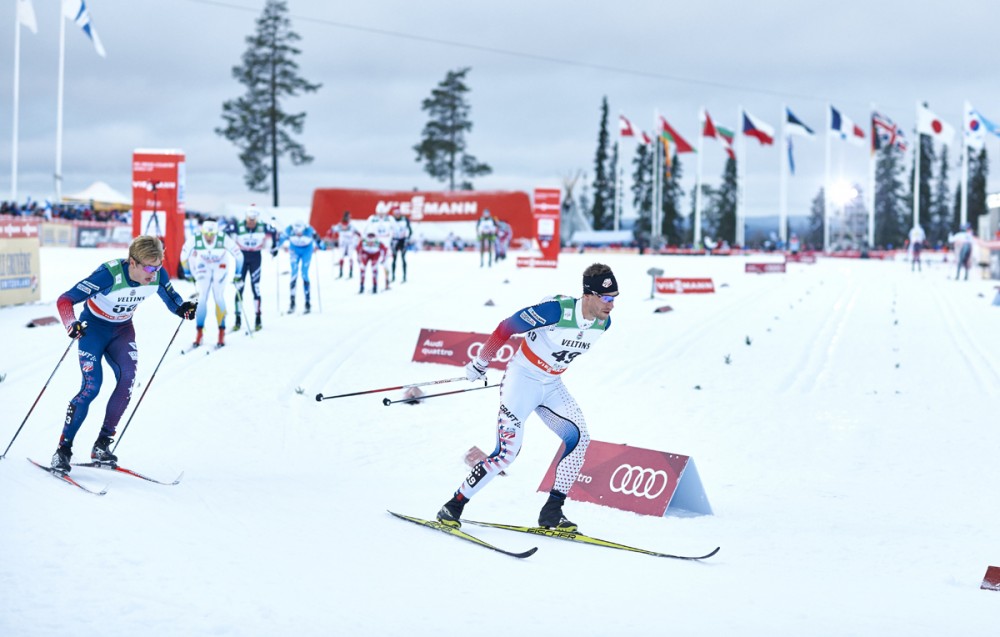
    Erik Bjornsen (l) chases U.S. teammate Simi Hamilton  during Sunday's World Cup 15 k classic pursuit at the Ruka Triple mini tour in Kuusamo, Finland. Bjornsen led the U.S. men in 46th and Hamilton placed 68th. (Photo: Fischer/NordicFocus)
    Erik Bjornsen (l) chases U.S. teammate Simi Hamilton during Sunday’s World Cup 15 k classic pursuit at the Ruka Triple mini tour in Kuusamo, Finland. Bjornsen led the U.S. men in 46th and Hamilton placed 68th. (Photo: Fischer/NordicFocus)

    The top American male was Erik Bjornsen, who finished the Ruka Triple 46th overall (+2:10.3) with the  43rd fastest time of the day.

    In an email, Bjornsen wrote he feels like he’s building his form. “I know I have to be at the top of my game to post an impressive World Cup result and I’m just not quite there right now,” he wrote.

    Racing in massive fields with world-class talent, each World Cup weekend is a learning experience, the 24 year old explained. “Racing over here is just so different, I’m trying my best to learn from all these experiences.”

    Also for the U.S., Noah Hoffman finished the weekend in 52nd (+4:25), Simi Hamilton was 68th (+5:29), Kris Freeman 73rd (+5:44.2), and Andy Newell did not finish.

    “We had some big hits this weekend and some big misses,” Whitcomb said of the U.S. Ski Team’s overall showing in Kuusamo. In the women’s pursuit, Sadie Bjornsen led the team in 14th. “It’s the first weekend of World Cup racing and Kuusamo presents some of the toughest waxing and skiing conditions of the season. It’s an agressive introduction.”

    After Harvey in seventh and Kershaw in 23rd (+1:48.5), Ivan Babikov placed 50th (+4:17.2) for Canada, Graeme Killick was 55th (+4:38.9), Michael Somppi 81st (+ 7:08), and Len Valjas did not start Sunday’s race.

    World Cup racing continues next Saturday and Sunday with a skiathlon and relay in Lillehammer, Norway.
    Results | Winner of the day

  • Canada’s Harvey in the Hunt for Ruka Overall, Second in 10 k Skate

    Canada’s Harvey in the Hunt for Ruka Overall, Second in 10 k Skate

    Canada's Alex Harvey powers to second in the World Cup 10 k freestyle, the second stage of the Ruka Triple in Kuusamo, Finland. (Photo: Fischer/NordicFocus).
    Canada’s Alex Harvey powers to second in the World Cup 10 k freestyle, the second stage of the Ruka Triple in Kuusamo, Finland. (Photo: Fischer/NordicFocus).

    Although it’s only Day 2 of a young World Cup season, the image of Alex Harvey posing for cameras amongst the podium trio could become common. It has been in the past for the four-time world championship medalist; it just doesn’t usually come this early in the season.

    In the men’s 10-kilometer freestyle on Saturday, the second day of the Ruka Triple mini-tour in Kuusamo, Finland, Norway’s Martin Johnsrud Sundby skated to the win in 21:05.5. Harvey of the Canadian World Cup Team finished in second, 11.2 seconds off the pace, and Swiss Olympic champion Dario Cologna rounded out the podium in third, 0.4 seconds back from Harvey.

    Canadian Alex Harvey (l) placed second in Saturday's 10 k freestyle at the World Cup in Kuusamo, Finland, to share the podium with Norwegian winner Martin Johnsrud Sundby (c) and Switzerland's Dario Cologna  (r) in third. (Photo: CCC/NordicFocus)
    Canadian Alex Harvey (l) placed second in Saturday’s 10 k freestyle at the World Cup in Kuusamo, Finland, to share the podium with Norwegian winner Martin Johnsrud Sundby (c) and Switzerland’s Dario Cologna (r) in third. (Photo: CCC/NordicFocus)

    Harvey, 27 is not exactly “green” when it comes to top-three results on the World Cup. But many things are new to Harvey and for the Canadian team.

    First there’s the early results.

    “It’s my first podium ever before Christmas and in Kuusamo it has been quite bad for me in skating. In the past, my best skating result here was 17th,” Harvey said in a post-race phone interview.

    A fast start for Harvey is something new; a common thread in his skiing had been about building into the season and progressively into races. Although one distance race is a small sample size, Harvey and Canada’s head coach Justin Wadsworth believe this will be among many data points marking Harvey’s rise as a contender for the overall World Cup crown.

    Second, there’s the seemingly “new” legs under Harvey. That’s the result from surgery on his iliac arteries this summer. Postoperative, Harvey says the blood flow in his legs make it so he can sustain harder efforts on steep uphills.

    “The first thing that I noticed this summer and running training, I could actually push,” Harvey said. “In the past, I couldn’t get my heart rate past 155 in running because I was purely relying on my legs. And in skiing, I was able to have good results because I could compensate with the upper body. But any time there was a course where the legs were involved, a lot like Kuusamo, like the Tour de Ski climb, I could not really play for the top ten.”

    Wadsworth predicted Harvey’s second place would be part of a trend. “From what we’ve seen from Alex in training this year, it’s been everything pointing to this,” he said.

    The second stage of the Ruka Triple, the 10 k skate, was a proving ground. Kuusamo’s course is a grind. The type of course where it’s all about steep uphills with little recovery time. A course where if Harvey’s legs were going to flood or be sluggish, he’d know right away.
    “I was pretty confident that it would be good in racing but you never know until you get a result. Black on white, written on paper,” Harvey said.

    Starting 23rd, Harvey motored as soon as he tripped the gate. Building into the race, with increasingly faster splits is a Harvey hallmark. However, on this race day, the new sensations made for a change of strategy — he wanted to go sustainably fast enough to clock top-five splits throughout the race.

    “Today, 1.5 k atop of the first big hill when I was getting good splits and my legs were not completely seizing up, I knew it was going to be a good day,” he said.

    The consistency of Harvey’s effort is reflected by his splits: at 3.1 k, he was fourth, and fourth again at 6.2 k. At 8.1 k, fourth again. He picked up his pace towards the end.

    “In an individual start I always try to pick it up for the last ‘k’ for sure,” he said. “That’s when a lot of guys are coming undone and I think for me historically in the past, that’s where I’ve been able to move from top five to the podium.”

    Dario Cologna finishes .4 seconds behind Harvey in the 2nd stage 10 K freestyle: Ruka Triple 2nd stage. (Photo Credit: Fischer/Nordic Focus).
    Dario Cologna (l) finished 0.4 seconds behind Harvey in the 10 k freestyle, second stage of the Ruka Triple World Cup on Saturday in Kuusamo, Finland. (Photo: Fischer/NordicFocus).

    Harvey crossed the line in first, bumping Norway’s Anders Gløersen out of the leader’s chair with a time that was 3.4 seconds faster than Gløersen’s. His work done, Harvey watched the adjacent screen with live results. Deciphering the list of splits, it became clear: Cologna was a threat.

    With about one kilometer to go, there’s a steep headwall of a climb. Wadsworth positioned himself there with friend and Swiss coach Christian Flury, who used to coach in Canada. They provided splits for their skiers, and noticed the duel evolving.

    “Oh yeah, when Dario went by on the last lap there when Christian was giving him all the info, how tight it was with Alex, we knew it was going to be tight at the finish,” Wadsworth said.

    Cologna bested Harvey at every split, except the one that matters. Cologna slotted into second at the finish, 0.4 seconds behind.

    With many big names still on the course — Northug and Sundby among them— Harvey knew any one of them could ski him out of contention.

    Sundby remained in the hunt. Having secured the overall World Cup the past two years, it seems Sundby rarely has an off day. Saturday’s race confirmed that consistency; he posted the fastest splits at every checkpoint after 1.2 k.
    Awaiting Sundby’s finish, Harvey said he knew what was coming.

    “I was excited, but, I mean Sundby had quite a bit gap on me throughout the whole race. Like 5-10 seconds the whole race,” he said. “Unless he crashed … I didn’t really think I was going to beat him.”

    Harvey’s exit from the leader’s chair came at the hands of Sundby, who finished in just over 21 minutes — a super-human effort even for Sundby.
    “It was hard today, tougher than I had envisioned beforehand. In this course you get no rest for two seconds,” Sundby told Norwegian broadcaster NRK.
    With the win, Sundby becomes the Ruka Triple’s overall leader by 13.8 seconds followed by teammate Finn Hågen Krogh in second.

    Another notable finish was Harvey’s teammate, Devon Kershaw in 24th. That stood as Kershaw’s best freestyle distance result since he won the 15 k skate in Rybinsk, Russia, in 2012. (He placed second in a 4.5 k freestyle prologue at the 2013/2014 Tour de Ski behind Harvey.)

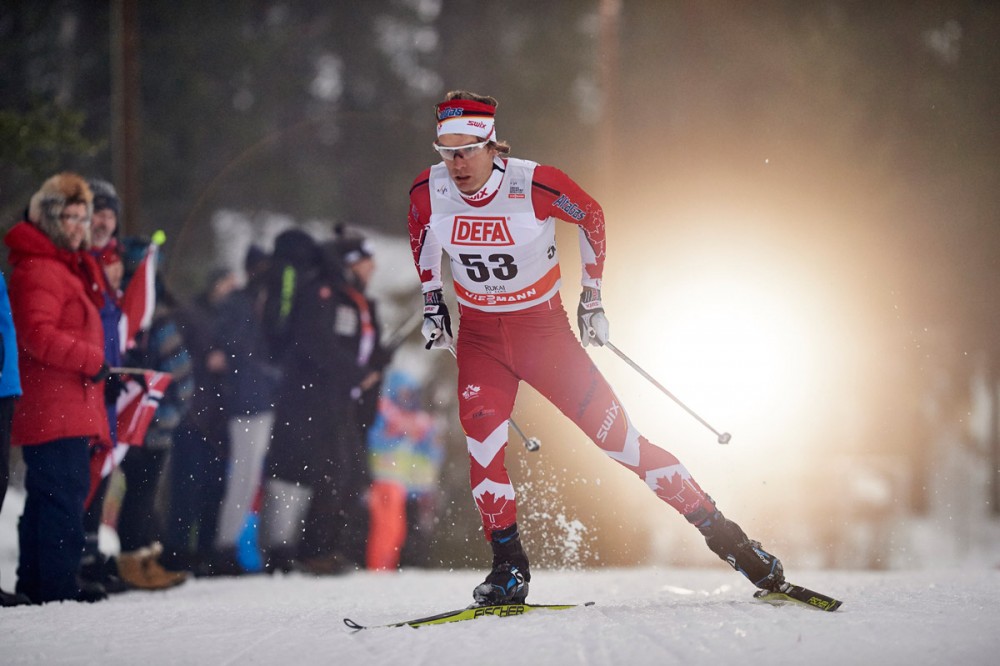
    Devon Kershaw races to 24th in the 10 k freestyle: Ruka Triple stage two. (Photo Credit: Fischer/Nordic Focus).
    Devon Kershaw races to 24th in the Ruka Triple 10 k freestyle at the World Cup in Kuusamo, Finland. (Photo: Fischer/NordicFocus).

    “I mean, for me in an individual start skate to hit the points is a solid outing — so that shows that I must have felt ok,” Kershaw wrote in email.

    Kershaw’s start bib number, 53, played into his race strategy. He started a bit conservatively, knowing eventual winner Sundby started next, only 30 seconds behind him.

    “If you can catch a ride from the best skier in the World — you try your darnedest to do just that for as long as you possibly can,” he wrote.

    Kershaw skated behind Sundby for 5 k.

    “Of course the upside when you start 30 seconds up on the World #1 the last two years in a row is that if you can stay on his pace — it can help you….but the real goal was to stay on Sundby the whole way once he caught me — and I completely came undone with about 1.8km to go — and lost oodles of time (about 15 seconds) to the line,” he added. “When he launched his attack to the line I completely blew up and I was on fumes to the finish from there.”

    Sunday’s final stage, a 15 k classic pursuit, will see Sundby start with nearly a 14-second head start. He’ll be chased by a who’s-who of skiing. But the duo to watch may be Harvey and Cologna starting 25 seconds back in fifth and sixth behind him — they’ve struck an alliance.

    “I talked with Dario already. We are going to share the workload tomorrow,” Harvey said. “I don’t really expect Petter [Northug], to be doing much work. We have an advantage over Sundby, just cause we can share that. Today was quite windy in the stadium and on the flat sections. It’s good to take a different leads.”

    Whether that alliance and those tactics succeed remains to be seen: Sundby is a force.

    Also for Canada, Ivan Babikov placed 52nd, Graeme Killick 57th, Michael Somppi 93rd, Len Valjas 95th, and Jess Cockney 101st of 111 finishers.

    Simi Hamilton led the U.S. men in 49th, Erik Bjornsen placed 54th, Noah Hoffman 58th, Andy Newell 85th, and Kris Freeman finished 88th after falling and breaking his pole. According to U.S. coach Matt Whitcomb, he was skiing just outside of the top 30 before that.

    “It was a good race from Simi Hamilton who was flirting with the top 30 through 5 k,” Whitcomb said. “He started fading a bit in the second lap, but grabbed a couple more spots the last 2k to finish 49th. He demonstrated some great skate fitness and is going to be an exciting athlete to watch in Davos in two weeks.”

    Men’s results | Tour Standings | Sunday’s pursuit start list

  • Sundby Wins Ruka 10 k; Harvey Hits Podium for First Time Before Christmas

    Sundby Wins Ruka 10 k; Harvey Hits Podium for First Time Before Christmas

    Canadian Alex Harvey (l) placed second in Saturday's 10 k freestyle at the World Cup in Kuusamo, Finland, to share the podium with Norwegian winner Martin Johnsrud Sundby (c) and Switzerland's Dario Cologna  (r) in third. (Photo: CCC/NordicFocus)
    Canadian Alex Harvey (l) placed second in Saturday’s 10 k freestyle at the World Cup in Kuusamo, Finland, to share the podium with Norwegian winner Martin Johnsrud Sundby (c) and Switzerland’s Dario Cologna (r) in third. (Photo: CCC/NordicFocus)

    (Note: This brief recap of the men’s 10 k freestyle race at the Kuusamo World Cup on Saturday was published before a full article about Alex Harvey and his second-place finish. For a more detailed account of Harvey’s race, click here.)

    The Canadians have said it before, and they’ll probably say it again: they don’t expect much before Christmas — specifically, results-wise during Period 1 on the World Cup.

    That’s why Alex Harvey’s podium on Saturday in the second race of the World Cup season, the 10-kilometer freestyle, came as a pretty big surprise for the 27-year-old Canadian World Cup Team member.

    This spring, Harvey had surgery on his iliac arteries in both his legs in hopes of remedying a longtime blood-flow issue that affected his skiing, mostly while skating up hills. Before the surgery, he skipped hill-climb freestyle events like the final climb of the Tour de Ski. This year, he was hoping he wouldn’t have to.

    After placing second in Saturday’s skate race in Kuusamo, Finland, one of the most brutal courses on the World Cup circuit, he’s feeling good about his chances.

    “It is my first podium ever before the Christmas,” Harvey told FIS after the race, in which he finished 11.2 seconds behind Norway’s Martin Johnsrud Sundby, who won in 21:05.5 and moved into first in the Ruka mini tour. In Friday’s classic sprint, Harvey missed qualifying in 47th.

    “Ruka was not the best for me because of the steep uphills. It is a good sign of recovery to be on the podium,” Harvey added. “My skis were working very well. I had to push a lot with my legs because the snow was soft.”

    Alex Harvey racing to second in the men's 10 k freestyle on Saturday at the Ruka World Cup in Kuusamo, Finland. (Photo: CCC/NordicFocus)
    Alex Harvey racing to second in the men’s 10 k freestyle on Saturday at the Ruka World Cup in Kuusamo, Finland. (Photo: CCC/NordicFocus)

    The 23rd starter, Harvey originally bumped Norway’s Anders Gløersen out of the leader’s chair, finishing 3.4 seconds ahead of him. Switzerland’s Dario Cologna started 30th and came within 0.4 seconds of Harvey, but finished second to him at the time.

    Until Sundby came charging into the finish in bib 54, Harvey enjoyed the hot seat. He sat back, appeared relaxed, then stood up to welcome his challenger into the finish. Sundby consistently clocked faster times through each checkpoint on the course, and around 8 k, he was nearly 17 seconds ahead of Harvey (who’s time ranked fourth behind Sweden’s Martin Johansson and Cologna, respectively).

    While Harvey’s final two kilometers kept him in contention for the podium, he anticipated well ahead of time that Sundby was going to take the win. He walked over to Sundby in the finish pen, and as the defending overall World Cup champion gasped for air, Harvey congratulated him. “You still got it,” he said.

    With the win, Sundby, who placed 14th in Friday’s classic sprint, moves into first in the Ruka tour standings with one race to go: the 15 k classic pursuit on Sunday. He has a 13.8-second lead on Norwegian teammate Finn Hågen Krogh, and is 19.4 seconds ahead of Gløersen in third after Gløersen placed fourth on Saturday.

    Johansson placed fifth in the 10 k, and Krogh tied Russia’s Alexander Legkov for sixth.

    “I reckon I have some seconds [to play with] tomorrow; you have to prepare mentally for doing that,” Sundby said of his lead going into the final race. “But hopefully I will have a good game tomorrow and a nice end to the tour.”

    Petter Northug, who was third on Friday and 16th on Saturday, will head out of the gate fourth, 24 seconds behind Sundby, and Cologna and Harvey will follow in fifth and sixth, 1 second later.

    He explained he would try to work with Cologna to pick off the places.

    “It is going to be a big fight,” Harvey said in a Cross Country Canada press release. “We will have to see how we wake up in the morning. We have all had two days of racing. I’ll ski as hard as I can tomorrow and hopefully get off to a good race.”

    “Before the first World Cups you never know where you [stand],” Cologna told FIS. “I wanted to keep the steady pace, but it was not always easy. Towards the end of the race I lost some time. Alex was very fast today.”

    Also in the men’s race, Canadian Devon Kershaw placed 24th. His teammates Ivan Babikov placed 52nd, Graeme Killick 57th, Michael Somppi 93rd, Len Valjas 95th, and Jess Cockney 101st of 111 finishers.

    Simi Hamilton was 49th for the U.S., Erik Bjornsen was 54th, Noah Hoffman 58th, Andy Newell 85th, and Kris Freeman finished 88th after falling and breaking his pole.

    Men’s results | Tour standings

  • Finland’s Next Messi? Iivo Niskanen Breaks Through with Kuusamo World Cup Win

    Finland’s Next Messi? Iivo Niskanen Breaks Through with Kuusamo World Cup Win

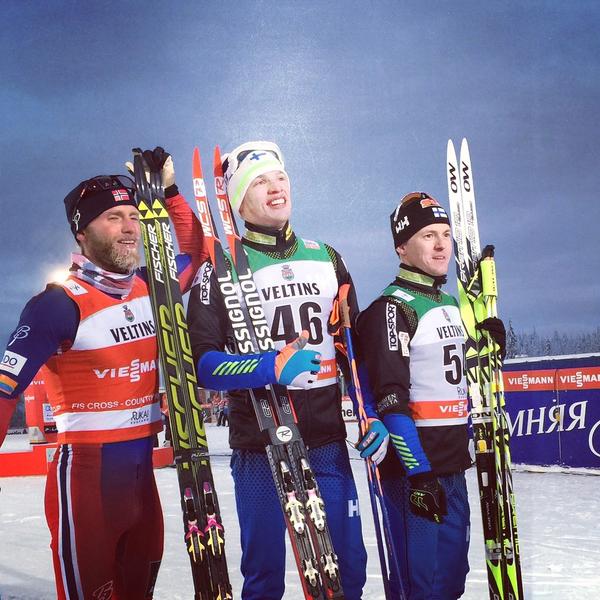
    The men's 15 k classic podium in the first World Cup distance race of the season on Sunday in Kuusamo, Finland: with Finland's Iivo Niskanen (c) in first and Sami Jauhojärvi (r) in third, and Norway's Martin Johnsrud Sundby in second. (Photo: FIS Cross Country/Twitter)
    The men’s 15 k classic podium in the first World Cup distance race of the season on Sunday in Kuusamo, Finland: with Finland’s Iivo Niskanen (c) in first and Sami Jauhojärvi (r) in third, and Norway’s Martin Johnsrud Sundby in second. (Photo: FIS Cross Country/Twitter)

    Iivo Niskanen appeared itchy in the leader’s chair on Sunday, after finishing with the fastest time of the day through 46 racers in the men’s 15-kilometer classic sprint — the first distance race of the 2014/2015 season.

    Itchy, anxious, whatever you want to call it, but happy.

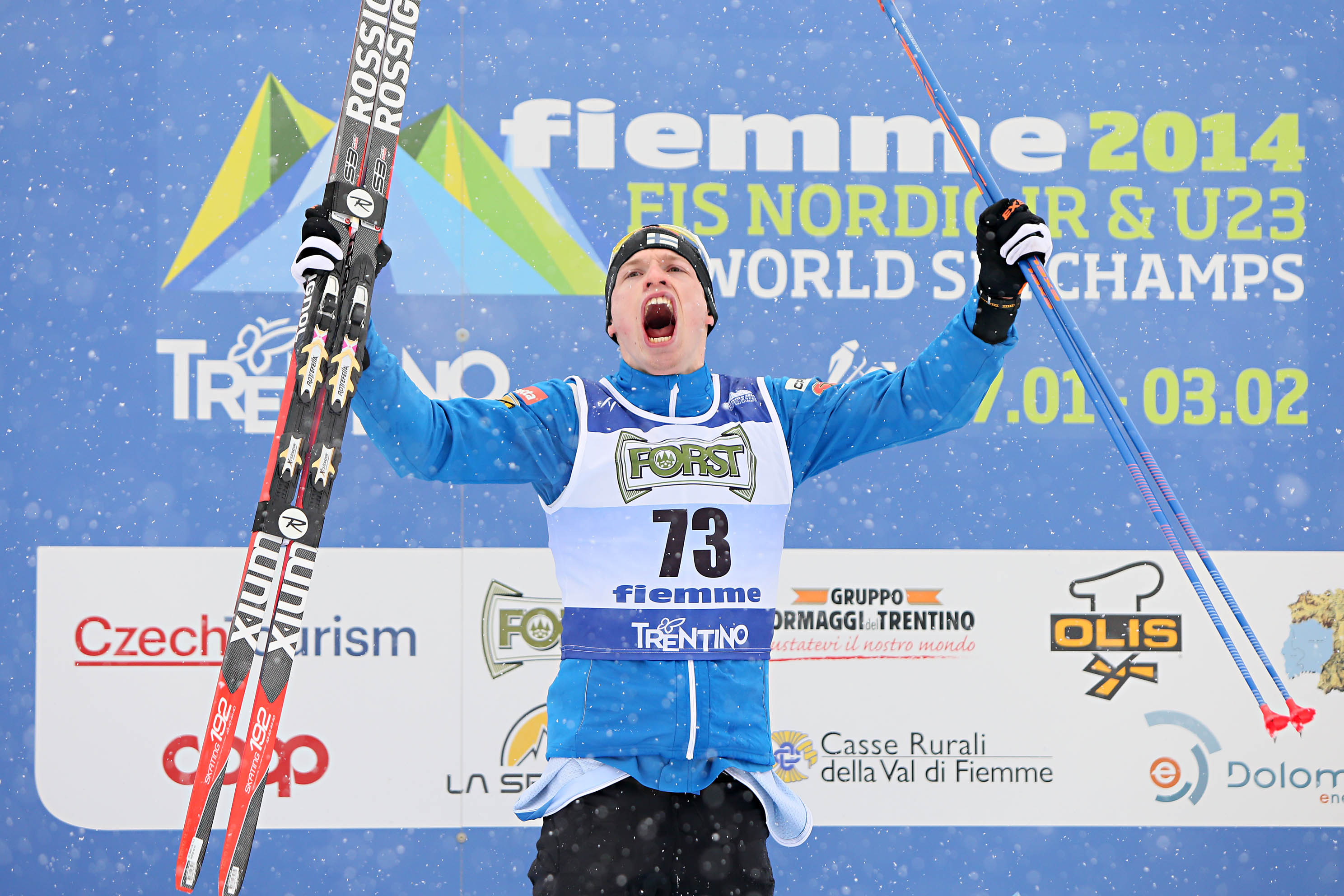
    Livo Niskanen (FIN) celebrates his win in the 15 k classic at the 2014 U23 World Championships in Val di Fiemme, Italy. (Photo: Fiemme 2014)
    Iivo Niskanen (FIN) celebrating his win in the 15 k classic at the 2014 U23 World Championships in Val di Fiemme, Italy. (Photo: Fiemme 2014)

    The 22-year-old Finnish A-team member, defending U23 World Championships 15 k classic champion and younger brother of Kerttu Niskanen, had never been on a World Cup podium before.

    He won gold in the 2014 Olympic classic team sprint with teammate Sami Jauhojärvi, but individually, this was a big deal.

    Fourteen men raced for Finland on Sunday in front of Ruka’s packed stadium in Kuusamo, Finland, but the man of the hour was Niskanen. The 33-year-old veteran Jauhojärvi wasn’t far behind him — 12.5 seconds at the finish — and ended up on the podium, too, but Niskanen soaked up the most crowd love and blew the most kisses after the race was over.

    Moments before he officially won it in 35:09.4 — by 10.3 seconds over Norway’s Martin Johnsrud Sundby — Niskanen jumped out of the cushiony chair and got ready to run like crazy down the finishing stretch.

    “It’s amazing that this [victory] came in front of a home audience,”  Niskanen told the Ilta-Sanomat, according to a translation. “I just realized a little boy’s dream. Thanks to the military forces. We have two men on the podium; it is a fine specimen of a job well done.”

    Niskanen started early in the seeded group, 46th of 96 men, and consistently clocked the fastest times through each passing checkpoint about every 1.5 kilometers. That’s impressive enough for a U23 in his first full-time World Cup season, but Niskanen’s times held up as more than 30 other races passed through.

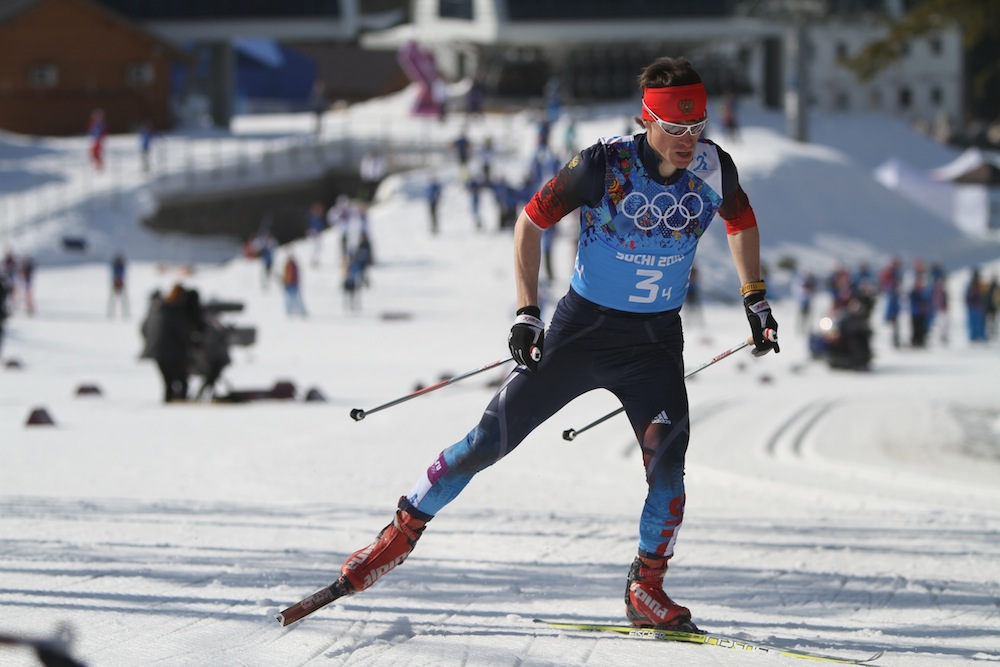
    Maxim Vylegzhanin skating the Russian 4 x 10 men's relay to silver in the 2014 Sochi Olympics.
    Maxim Vylegzhanin skating the Russian 4 x 10 men’s relay to silver in the 2014 Olympics in Sochi, Russia.

    By the time Russia’s Maxim Vylegzhanin in bib 82 hit the 1.4 k marker, Niskanen had his match. The 32-year-old Vylegzhanin came through the checkpoint 2 seconds faster than Niskanen, and by 3.1 k, he remained 1.5 seconds ahead.

    A third of the way through at 5 k, Niskanen had the edge over the Russian by 4.3 seconds, followed by Jauhojärvi, Sweden’s Daniel Richardsson, Sundby, Sweden’s Lars Nelson, and Russia’s Sergey Turyshev, respectively.

    By 6.4 k, Niskanen and Vylegzhanin were dead even, 8.8 seconds ahead of Jauhojärvi. One-and-a-half kilometers later, Niskanen had a 7.1-second cushion as Vylegzhanin began to fade.

    Jauhojärvi was still third fastest through that checkpoint, 9.7 seconds back, and Norway’s Niklas Dyrhaug was up to fourth after a conservative start.

    Dyrhaug, who started 30th, took his position in the leader’s chair after finishing in 35:22, 28.5 seconds faster then previous leader Francesco De Fabiani of Italy. The Norwegian would stay there until Niskanen bested his time by 12.6 seconds.

    At the 10 k mark, both Niskanen and Jauhojärvi were faster then Vylegzhanin, and it seemed first and second was possible for Finland. But there were still more competitive racers to come, including Sundby, the reigning overall World Cup champion.

    Niskanen had nearly 15 seconds on Jauhojärvi at 11.4 k, and Vylegzhanin was 14.8 seconds back in third. The Russian slipped to eighth by 13.1 k, and Sundby slipped momentarily on what looked like slightly slick skis — or maybe he was just getting tired on Kuusamo’s relentless three-lap course.

    With less than two kilometers to go, Sundby was up to second regardless, 14 seconds behind Niskanen. Jauhojärvi was another 1.5 seconds back in third.

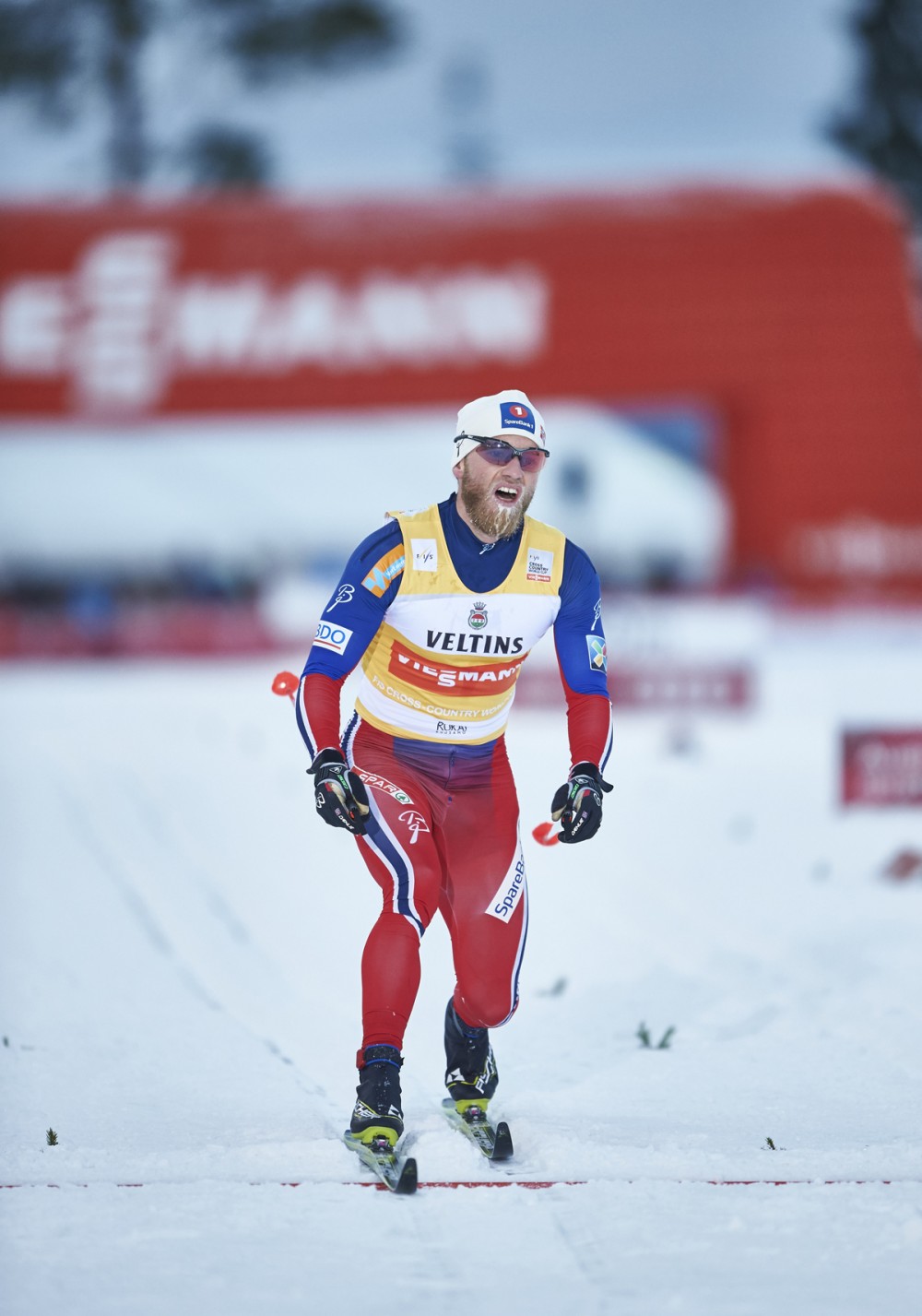
    Niskanen sat grinning from ear to ear under the lights in the Ruka stadium. As Sundby hoofed up the final climb, grimacing through a thick beard and big sunglasses, it was fairly evident he wasn’t going to touch the young Finn. Sundby put on a strong finishing kick around a Russian at the finish, and secured second, 2.2 seconds ahead of Jauhojärvi in third.

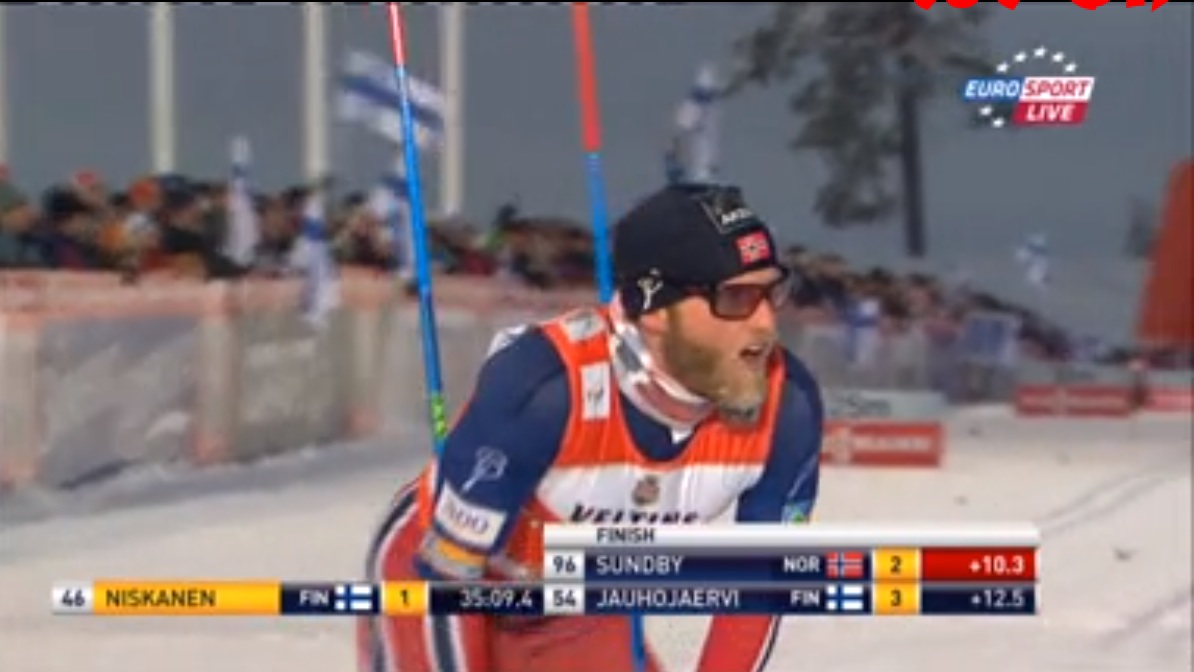
    Sundby finishing and looking up to confirm he placed second in Sunday's World Cup 15 k classic in Kuusamo, Finland.
    Sundby finishing and looking up to confirm he placed second in Sunday’s World Cup 15 k classic in Kuusamo, Finland.

    “It is lovely to get on the podium, although I wanted to win,” Sundby said to NRK, according to a translation. “I was basically shot against Iivo.”

    While he said he was “not flying on skis yet,” he hoped it would come with time.

    “My ultimate goal is to be in my best shape in Falun,” he told FIS.

    Sundby bumped fellow Norwegian Dyrhaug to fourth, just one-tenth of a second off the podium. But he wasn’t too upset.

    “I am very, very happy to be back in top form,” Dyrhaug told NRK. “I’ve had two tough years, so it’s good to know that the body is working again.”

    Standing on the podium with him for the first time in a World Cup since 2010, Jauhojärvi said he felt like he skied smoothly, but he wasn’t completely satisfied.

    “I heard from Norwegian split times that Niklas [Dyrhaug] was in the lead,” Jauhojärvi told FIS. “He was skiing behind me so I had to speed up in the last kilometers. I did not feel strong and fast today, but I had extremely good skis.”

    Niskanen, who became Finland’s first male to win in Ruka in 19 races there, said both his grip and glide were perfect.

    An exhausted Iivo Niskanen at the finish of Sunday's  15 k classic in Kuusamo, Finland, which he won for his first World Cup podium.
    An exhausted Iivo Niskanen at the finish of Sunday’s 15 k classic in Kuusamo, Finland, which he won for his first World Cup podium.

    Walking through the mixed zone, Finnish coach Magnar Dalen yelled to journalists, “Watch out for that boy there! He is a cross-country Messi!” referring to the Argentine soccer great.

    “I was an amazing day; I had to be smart,” Niskanen told NRK. “I have done many races here and knew I had to turn down the pace two notches on the hills and makes it up [on other parts of the course].

    “It was really noisy along the course,” he said to FIS. “Before the race I thought I could be in top six. I tried to improve the summer training and I seem to have done a good job. It was pretty nice that my family could be here today with me.”

    “It was impressive,” said Petter Northug, who placed 23rd and 1:02.7 back, to NRK. “Niskanen looks like he has risen.”

    Vylegzhanin tied Didrik Tønseth for 11th, 37.5 seconds behind Niskanen. Russia’s top skier, Alexander Bessmertnykh finished fifth, Calle Halfvarsson of Sweden was sixth, Canada’s Alex Harvey seventh, Simen Håkon Østensen eighth, Pål Golberg ninth, and Finland’s Matti Heikkinen 10th.

    Turyshev ended up 25th, four seconds behind Switzerland’s Dario Cologna in 24th (+1:05.2).

    "Iiiiivoooo !! Unbelievable !!!
    “Iiiiivoooo!! Unbelievable!!!” Kerttu Niskanen tweeted after Sunday’s race.

    Note: Two men did not finish Sunday: American Noah Hoffman and Poland’s Maciej Starega, who stopped somewhere after 3.1 k. Hoffman crashed hard on an icy downhill about 1 k before the finish and was taken off the course in a stretcher.

    According to U.S. Ski Team coach Matt Whitcomb, Hoffman “sustained a lower left leg injury today and will be headed home to the US as soon as possible for further evaluation. He will fly home either Monday or Tuesday. The World Cup organizers and medical personnel in Kuusamo / Ruka, as well as our US Ski team medical staff member Peter Dickenson handled the situation very well.”

    Results | with Splits

  • 7 Things You Didn’t Know About Noah Hoffman

    7 Things You Didn’t Know About Noah Hoffman

    Noah Hoffman (USA) climbing to the high point of the 15 k freestyle course on Wednesday at World Championships, where he finished a career-best 15th overall.
    U.S. Ski Team member Noah Hoffman climbing during the 15 k freestyle individual start at 2013 World Championships in Val di Fiemme, Italy, where he finished a career-best 15th. On Sunday at the 2013/2014 World Cup opener in Kuusamo, Finland, Hoffman had the race of his life with the fastest 15 k pursuit time for ninth overall.

    Continuing with our series on pointless knowledge about professional North American racers, we bring you some insight on Noah Hoffman, who posted the fastest 15 k freestyle pursuit time on the opening World Cup in Kuusamo, Finland. Das Hoff. 

    Athlete: Noah Hoffman

    Team: U.S. Ski Team (sixth season); Ski & Snowboard Club Vail/Team HomeGrown

    Age: 24

    Hometown: Aspen, Colo.

    7 Things:

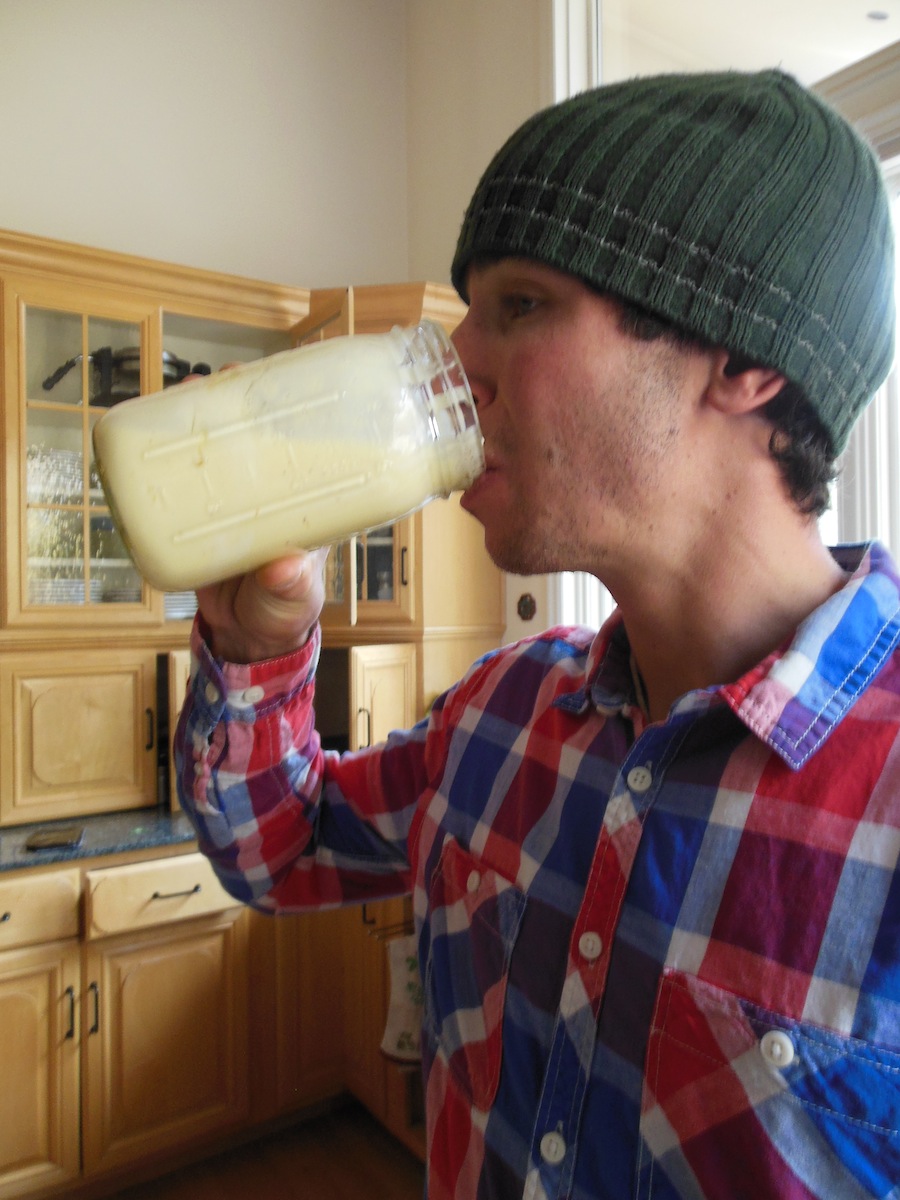
    Noah Hoffman enjoys a homemade raw-egg smoothie during a recent family vacation in Utah. (Courtesy photo)
    Noah Hoffman enjoying a homemade raw-egg smoothie. (Courtesy photo)
    1. I can’t stand olives.
    2. I want to live in a big city, maybe Manhattan. I want to live somewhere that I don’t have to own a car.
    3. I love taking public transit.
    4. I have unusually large hands.
    5. My pinkie finger on my right hand has an extra crease so it looks like I have an extra knuckle.
    6. I have extremely wide and flat feet. Duck feet.
    7. I eat raw meat and raw eggs.

    Bonus Round:

    • What do you miss most while on the road (besides family and friends)? Good Mexican food, free water and fast internet.
    • Best part about being a pro athlete: Meeting lots of motivated and successful people.
    • 3 travel essentials: Computer, hot sauce, book
    • Go-to travel meal or food: In the U.S.: Burrito or sandwich. In Europe: Whatever has the most calories for the least amount of money
    • Song that you could listen to non-stop: “Old Man” by Neil Young
    • Song you wouldn’t mind never hearing again: “What Does the Fox Say”

    ***

    See also: Sadie Bjornsen | Sophie Caldwell | Andy Newell

  • Weekend Roundup: And So It Begins

    Weekend Roundup: And So It Begins

    Sadie Bjornsen (USA) on her way to seventh place.  Photo: Fischer / Nordic Focus.
    Sadie Bjornsen (APU/USST) on her way to seventh place in Satuday’s 5 k classic. (Photo: Fischer / Nordic Focus)

    The official beginning to the 2014 racing season didn’t disappoint with tons of exciting nordic action taking place across the globe. The World Cup kicked off in all three nordic disciplines, including the highly anticipated Super Tour races in West Yellowstone, Mont., which FasterSkier covered on-site.

    World Cup racing began on Friday with the classic sprint as the first leg of the Ruka Triple mini-tour in Kuusamo, Finland. Kikkan Randall (APU/USST) come out firing with a second-place finish, her best in a World Cup classic sprint. Justyna Kowalczyk won it, looking as strong as ever. Sadie Bjornsen (APU/USST) dominated in the qualifier in third and finished the day in 26th, and teammate Ida Sargent finished 16th. On the men’s side, Eirik Brandsdal of Norway overcame Anton Gafarov and Teodor Peterson to win the first World Cup race of the season. Andy Newell was the lone North American to qualify and finished the day in 24th.

    Bjornsen demonstrated that Friday’s result was not a fluke by finishing seventh in the 5 k classic on Saturday, followed by Randall in 15th. Kowalczyk won the race with the Norwegian duo of Marit Bjørgen and Therese Johaug in hot pursuit. Lukas Bauer won the 10 k classic, followed closely by Eldar Rønning. Canadian Ivan Babikov and Noah Hoffman (USST/SSCV/Team HomeGrown) were the only two North American men to crack the top 30, finishing 21st and 28th respectively.

    On the final day of action in Kuusamo, Bjørgen captured her fourth-straight Ruka Triple title, besting Swede Charlotte Kalla and teammate Johaug by nearly 20 seconds in the 10 k pursuit. For the U.S., Randall, Jessie Diggins (SMST2/USST), and Liz Stephens (Burke/USST) respectively recorded the seventh, eighth and ninth fastest times of the day, with Randall finishing fifth overall. Hoffman made major waves and skied the fastest time in the men’s 15 k, rising from 38th to ninth in the mini tour. Norway’s Martin Sundby won the Ruka Triple, just 12 seconds ahead of Hoffman.

    The U.S. SuperTour opened in West Yellowstone and Team Gregg dominated. The Midwest couple, Caitlin and Brian Gregg conquered the field with Caitlin winning both Friday’s skate sprint and Saturday’s 10 k skate (by over a minute and 20 seconds) and Brian taking second overall in the 15 k skate (to Norwegian Mads Strøm, a University of Colorado freshman).

    The International Biathlon Union (IBU) World Cup opened on Thursday in Östersund, Sweden, with a 20 k individual, which France’s Martin Fourcade won. Canadian Jean-Philippe Le Guellec finished an impressive fourth and teammate Nathan Smith placed 16th.  More impressive results followed, with American Tim Burke notching third in Saturday’s 10 k sprint behind winner Fourcade. Teammate Lowell Bailey finished 14th, and Susan Dunklee was 16th in the women’s 7.5 k sprint on Friday. Sunday’s pursuit races were canceled due to inclement weather.

    In nordic-combined action in Kuusamo, American Taylor Fletcher posted the fastest time in his anchor leg to give the U.S. seventh in the 4 x 5 k team event.

    FIS Cross-Country World Cup, Kuusamo, Finland (results)

    Friday’s Classic Sprint | Men’s Report | Women’s Report |

    Saturday’s Classic 5 k and 10 k | Men’s Report |North American Men’s Report |North American Women’s Report|

    Sunday’s 10 k and 15 k Pursuits | Men’s Report | Women’s Report | Canadian report |

    Super Tour, West Yellowstone, Mont. (results)

    Friday’s Skate Sprint | Men’s Report | Women’s Report |

    Saturday’s Skate 10k and 15 k | Men’s Report | Women’s Report | Men’s Photo Gallery | Women’s Photo Gallery

    IBU Biathlon World Cup, Östersund, Sweden (results)

    Thursday’s 15 k and 20 k | Men’s Report | 

    Friday’s 7.5 k Sprint | Women’s Report |

    Saturday’s 10 k Sprint |Men’s Report |

    FIS Nordic Combined World Cup, Kuusamo, Finland (results) | Recap | Interview

  • Hoffman Fastest in Ruka Triple Pursuit, Ninth Overall

    Hoffman Fastest in Ruka Triple Pursuit, Ninth Overall

    Noah Hoffman (USA) turned heads today, surprising both himself and onlookers, in the final stage of the Ruka Triple in Kuusamo, Finland. Hoffman, who started the 15k freestyle pursuit in 38th and a little over a minute behind Russian Dimitry Japarov, made his way through the field, achieving the fastest time on the day to end in 9th place.

    Prior to the pursuit, Hoffman had expressed that he would be happy finishing in the top 30, and even happier in the top 20. Unexpected and unplanned, he was able to capitalize on the conditions of the day.

    Despite the big gap, he made it to the lead pack just halfway through the race.

    “A minute is a lot of time. Luckily they didn’t go out at too hard of a pace. It was basically a constant train of people,” he said in a phone interview with FasterSkier. “I was only a 1:02 back in 38th so it was more than a person every two seconds. I didn’t feel like I was chasing down this lead pack. It felt like I was just moving up person by person, group by group.”

    He was also able to catch a ride with French skiers Maurice Manificat and Jean Marc Gaillard, who eventually helped him reach the lead group. “My energy was really good and I was feeling really good. I was trying to conserve energy and stick in behind those guys,” he said of his position upon reaching the lead pack.

    Noah Hoffman (USA) climbing to the high point of the 15 k freestyle course on Wednesday at World Championships, where he finished a career-best 15th overall.
    Noah Hoffman (USA) racing at the 2013 World Championships.

    He continued to maneuver, and worked his way up to third, before making a tactical error on the big descent, a move that cost him dearly with three k to go.

    “They set one track down that hill and so you really had to figure out a place in line going into the hill. And I didn’t fight for a place,” he explained. “I was like ‘I’ll probably be ok out of the track’ and that was the fatal error. I went from skiing 3rd or 4th in the lead group to the back.”

    He didn’t dwell, and worked to make up the lost ground. “Energy was still good, and I was able to move up a couple places on the last lap,” he said.

    The final stretch of the race proved to be a defining moment for the 24-year-old, who was able to maintain his position as he crossed the finish line. “I really believe that I can hold my own. I haven’t been there that often, today, and in Canmore last year,” he said when asked about his sprinting abilities. “I really feel a sprint at the end of 15k, or a 30k, or a 50k is very different from a sprint against these guys when they’re fresh. I think at the end of one of those races I can hold my own. I had no trouble holding my position today, but I wasn’t able to move up.”

    When asked whether he would have been able to place higher had he been with the three skiers who broke away on the final hill, Hoffman had no regrets but also wished to use the race as a learning experience. “I was hurting pretty bad. If I had been up in that group, maybe I (could) hang on for dear life. You know, live and learn. I certainly will learn from that tactical error on the downhill, and the more experience I get being with the leaders at the finish of those races I think is really good for me.”

    U.S. Head Coach, Chris Grover had nothing but praise for Hoffman.

    “Hoff was on fire obviously to have the fastest time of the day by seven seconds,” he said in an interview. “I was really impressed with him because not only did he make up a minute on those guys, but then he was able to hang with them all the way to the finish line. It is really exciting for him.”

    Grover is excited to see Hoffman progress. “We knew he was in good skating shape based on that seventh place in Beitostølen last week, but this was clearly another huge step forward” Grover said. “He keeps getting better and better at skiing in a pack and making his way through a crowd and staying out of trouble.  He made some great moves and knew when to attack and when to catch his breath and just skied smart all the way through it.  It is really gratifying to see him have a great finish.”

    By having the fastest time on the day, Hoffman earned himself 50 World Cup points and 5,000 Swiss Francs in winnings, of which he said he was “pretty psyched” to have. In addition, he won another 1,125CHF for his 9th place overall in the mini-tour.

    “I am obviously excited with the result, and excited where my fitness and energy are right now and looking forward to keeping it rolling,” concluded Hoffman.

    He heads to Lillehamar as the 7th ranked distance skier in the world and 9th in the overall.

    Last year he scored a total of 151 World Cup points. This season, just three races in, he already has 111.

    “I am so happy and excited for him. He works really really hard, and it’s really fun to see someone like Noah excel,” teammate Liz Stephen told FasterSkier.

    — Topher Sabot and Matt Voisin contributed reporting.

  • Canadians Fall Short in Pursuit, Hope to Rebound in Lillehammer

    Canadians Fall Short in Pursuit, Hope to Rebound in Lillehammer

    The high hopes for today’s final stage of the Ruka Triple, in Kuusamo, Finland failed to materialize for the Canadian National Team, as they were unable to place anyone in scoring position. The Canadian men fell short of their expectations with Ivan Babikov, a traditionally strong distance skate skier, giving the team it’s best result in the 15k pursuit, with 37th place overall.

    The remainder of the Canadian squad finished further back in the field of 102 skiers, with Alex Harvey in 43rd, Devon Kershaw in 66th, and Jesse Cockney in 87th. Len Valjas did not start today’s race.

    Canadian Head Coach, Justin Wadsworth, expressed disappointment in the results. “It didn’t go well. Everyone’s not happy with it, but it is what it is,” he said in a phone interview with FasterSkier.

    Wadsworth cited a week of heavy training at altitude in addition to a lack of racing as an explanation for the poor results in today’s pursuit.

    “Other teams raced last weekend. So when you race you have lighter training going into it, and then you have the races, and then you recover a little bit,” he said.  “We just trained all last weekend and all this week. We flew up here Wednesday night up from Davos, and this was our first race weekend of the year and we got what we got.”

    Despite today’s disappointment, Wadsworth is focused on the team’s plan for the rest of the season. “It’s always tough to stomach, but we knew what we were getting, coming in and having this being our first race off of altitude. It’s just what it was, and I’m not personally too bothered by it,” he said. “It would have, of course, been nice to race better. We’re just going to move on and hopefully there will be better races in the future.”

    Looking forward, the Canadian squad looks to recover before next week’s World Cup races in Lillehammer. The Canadians tend to produce decent results following Kuusamo and hope the trend will continue. “We came in pretty loaded, so now it’s a little bit of rest and two races next weekend,” said Wadsworth. “We traditionally rebound after Kussamo pretty well. After three good, hard races here and then some recovery after that, and a little light intensity mid-week, hopefully the legs will feel a little more rested then they did today.”

    Dasha Gaiazova, the lone Canadian woman to race in Kuusamo did not start the final pursuit. She was slated to wear bib 87 2:35 back.


  • Babikov and Hoffman Lead North American Men in Ruka Triple 10 k, Look to Build on Results

    Babikov and Hoffman Lead North American Men in Ruka Triple 10 k, Look to Build on Results

    Babikov
    Babikov

    The North American men made a solid showing at the second stage of this year’s Ruka Triple in Kuusamo, Finland. The men’s individual 10 k classic was what each team described as a productive start to the season – headlined by Ivan Babikov of Canada, who tied for 21st and American Noah Hoffman who placed 28th.

    Babikov came into the race with little expectation. “We just had a camp in Davos, and I wasn’t really benefiting much (from it) on this weekend. I was just trying to get in slowly into the race, knowing that February is pretty far away and that we’ve got to pace the season,” Babikov said in a post-race interview with FasterSkier. “But it feels good to score points and be there close to the chase.”

    Only 5 seconds behind Babikov was Hoffman, who in an attempt to banish old habits, managed a well-paced race and skied from 39th at 5 k to the end result of 28th.  Despite a mediocre weekend in Beitostolen he was happy to have a solid result under his belt. “In last weeks classic race in Beitostolen I did not have a good result, and that’s always confidence shaking because you feel like you skied well,” said Hoffman in an interview. “So I didn’t really know what to expect today, but I had a plan: I need to go out and pace well, this course is extremely challenging and I wanted to stay under control, and I accomplished that goal.”

    Chris Grover, U.S. Head Coach, was very pleased with Hoffman’s result. “He skied really well and he also paced the race very well, and I think he was probably in the upper 40s or low 50s early in the race and he just kind of moved up in position throughout the race, so he had a strong pre-race plan for how he was going to pace it and he really executed that.” Grover said in an interview with FasterSkier.  “Last week he was in the 40s in a classic race in Norway and so moving to the top 30 in World Cup in a classic race already a week later is pretty awesome and it’ll just keep getting better and better for him as we go through the fall.”

    Both Babikov and Hoffman have traditionally been better in skate distance, but their results today helped instill confidence in their classic skiing abilities and the many hours they trained to improve it.

    “I spent a lot of time in the summer with Justin (Wadsworth) and I worked a lot on the double poling. I know it’s my weaker side. I spent a lot of time skiing with Devon and Alex, and trying to work a lot on my classic skiing. It looks like it’s paying off, ” said Babikov.

    Hoffman voiced a similar sentiment. “I put a lot of emphasis on double pole especially this summer and I think that’s come along really well,” he said “I think I showed some of that today, but there’s more on top of that and I’m really happy with where things are right now.”

    The rest of the North Americans did not fare as well. Canadian Alex Harvey made it into the point scoring range by placing 30th. He was followed by teammates Devon Kershaw in 65th, Jesse Cockney in 92nd, and Len Valjas in 110th.

    Canadian Head Coach, Justin Wadsworth, was satisfied with the teams results. “Anytime you’re in the top 30 that’s a solid effort especially in a race that’s pretty tight like that, so that was good,” he said of Babikov and Harvey’s results.

    In regards to the rest of the team he believes fatigue and early season training played into their results.  “Devon is just a bit fatigued still from training so it’s hard to ski fast when you’re tired. He’s in better shape than that so he’s pretty frustrated with that, but we’re here for the long haul this winter,” he said.

    “We’re here to race for sure, but it’s our first set of races for the year.  It was our strategy with such a big season, such a long season, instead of racing coming into this and trying to be fast here we just wanted to keep our team at altitude and then come in here at the last second and just try and be as fast as we can…I’d rather have our athletes fast later on.”

    The remainder of the contingent form the U.S. placed behind Hoffman with Kris Freeman finishing in 57th, Andy Newell in 77th, Simi Hamilton in 79th, and Mikey Sinnott in 114th.

    Both the Americans and the Canadians are looking forward to tomorrow’s 15 k skate pursuit.

    “We’ll see. Tomorrow is another day,” said Babikov, who is excited to skate on a course with many hills. “I’ll try my best, same as today. It’s going to be pretty crowded. It’s really tight. I could be pretty sketchy with the poles and stuff. We’ll see how it goes and I’ll do my best.”

    Wadsworth expressed optimism for the pursuit, saying that front of the field is filled sprinters who had had a faster track in today’s race. “For our guys, Ivan and Alex are in a really good position I think. Not too far off the lead and I feel like they’re all even with those guys, so I think we’re positioned well to move on with some guys that are good skaters.”

    He doesn’t discount the possibility of a medal either. “Anything’s really possible, the podiums are not out of the game tomorrow at all.  It could really bunch back up and turn into something different than the results are now, so that’s what we’re hoping for.  I’d like to see Devon be a little better and move up, maybe to the top 30 would be a really good result.”

    Hoffman is also excited for tomorrow’s final stage. “I think it sets me up well for a good pursuit tomorrow,” he said. “I feel I can ski in the top 30, if not the top 20 tomorrow in the Tour.  I’ve been feeling really good and my skating is really clicking right now. ”

    Grover expressed similar confidence in Hoffman. “Noah obviously finished last weekend with such a strong skate distance race and I think it will be exciting to see. I think he’s feeling really good about where his skating is right now. I expect that he’ll be able to move up in the ranks.”

    “It should be fun to watch,” said Grover.


    – Topher Sabot and Matt Voisin contributed reporting 


  • The Best of the Rest: Kuusamo and Canmore

    The Best of the Rest: Kuusamo and Canmore

    Kikkan Randall during the Kuusamo 10 k classic pursuit, where she placed fifth on Sunday. (Photo: Fischer/Nordic Focus)

    Phew. When the season starts, it starts in full force. On the second weekend of World Cup and U.S. SuperTour racing, the NorAm season kicked off as well. Up in Canmore, Alberta, the stakes couldn’t have been much higher for two days of domestic racing that determined Canada World Cup starts.

    While we weren’t able to be everywhere and talk to everyone after the races – spanning from Kuusamo, Finland, to Bozeman, Mont. – here are some of the best of our typical “Notes and Quotes” series. Think of it as “the best of the rest,” including thoughts from two of the top finishers in Canmore and a few North Americans in Kuusamo.

    For weekend results and highlights across the world (including biathlon and nordic combined), check out Monday’s roundup.


    Canmore NorAm

     On Swiss winner Eligius Tambornino’s impressive sprint skills:

    “He was in full beast mode heading up the second climb of the course. I didn’t think it was possible to one-skate, but he proved me wrong and did it with authority. It was impressive.”

    – Phil Widmer (Alberta World Cup Academy), the top Canadian in the freestyle sprint A-final who placed fifth to four guys from Switzerland (Tambornino, Jovian Hediger, Christoph Eigenmann and Jöri Kindschi, respectively)


    On Saturday’s strange conditions for usually consistent Canmore:

    “Conditions were all over the map! It was a weird day for Canmore, which normally has such consistent weather. The morning had cold/hard tracks typical of Canmore and the afternoon held snow and soft tracks that eventually glazed over and become super squirrelly.” –Widmer, who solidified his prequalified starts for the Canada World Cup sprints


    On race form:

    “I was really happy with my performance on Saturday. Last season I had the speed and the fitness but my tactics were lacking. Yesterday, I feel like I was finally able to put pieces together.” – Andrea Dupont (Rocky Mountain Racers), the top Canadian in the women’s sprint A-final after winner Bettina Gruber (SUI)


    On not worrying about the Swiss:

    “[Gruber] led off the front and the Canadians all seemed more concerned about our positioning amongst ourselves and no one appeared to work too hard to hang onto her. It is a long tough course, so I started out fairly conservatively and got pretty boxed in on the first climb. When I made my move on the second climb, Gruber had a fairly sizable gap. And the top 3 skied comfortably into the finish.”– Dupont, who will start both World Cup individual sprints between Quebec and Canmore


    Kuusamo World Cup

    On pacing in a pursuit race:

    “You have to be ready to go out fast because everyone is trying to catch the guy in front of him. The first lap and a half were brutal [Sunday]. I suffered for most of the race just trying to hang on to people. Yes, especially with the fresh snow, I believe the course is as brutal as it looks on TV. Haha, did I say I expect to be pacing top-20 consistently?” – Noah Hoffman, 26th in Kuusamo World Cup 15 k classic pursuit


    On sprint racing in Kuusamo:

    “What’s tricky about Kuusamo is keeping an eye on the tracks and figuring out which lane we want to be in. Certain tracks get beat up through the qualification and through kind of preferred lines, the inside track on an uphill could get chewed up and no longer be the preferred lane. That’s where Kuusamo can get difficult on a cold, dry day like today [Friday].” – Matt Whitcomb, US Ski Team women’s coach


    On nerves:

    “I was really nervous before the qualifier but then I was a late starter and I was hearing lots of finishing times in the start pen.  All the people I skied with in the Muonio sprint were doing really well so that gave me confidence that I could be there too.” – Ida Sargent, career-best ninth in Friday’s classic sprint


    On bad warmups:

    “It’s a bit of a battle (mentally) when you are feeling that while warming up (not great feelings) while you will yourself to get into a good mind-set to attack something so short and explosive like a sprint qualifier is. No ‘warming into it’ in those puppies.” – Devon Kershaw, who failed to qualify for the heats on Friday


    On the cold:

    “It’s been pretty chilly this week. [Thursday] was nasty, really windy, and that made it really cold. [Friday] the wind was less significant so that made a big difference for me. I was able to stay warm out there, and we didn’t have to put any tape on our faces so that was good, and they say it’s going to get warmer. They say Kuusamo can get really cold, and today was just moderately cold.” – Kikkan Randall, 10th in Friday’s classic sprint

    “It’s not as crazy cold as it has been in years past, still quite cold with a 16 mile-per-hour wind, pretty steady. We saw some white noses out there today, but our team was quite well prepared with Kinesio tape and Vaseline and our PT in the start with blankets and jackets and warm Gatorade at the finish if needed. People didn’t spend much time outside after the race, but nobody complained too much of struggling out there. I know Jessie [Diggins] had some cold fingers.” – Whitcomb, after Saturday’s 5/10 k individual races


    On trailside support:

    “I’d asked Matt to give me more generic comments like ‘hunt for 5 more seconds!’ instead of splits because I respond better to a challenge. It definitely helped!” – Jessie Diggins, 12th in Saturday’s 5 k individual freestyle


    On the US Ski Team’s recent widespread success:

    “The positive atmosphere on the team is contagious and I feel like we are all benefiting from the momentum that the girls built last weekend. It was awesome to watch Ida nail her best ever finish [Friday] and see Kikkan coming back into her sprint form.” – Simi Hamilton, 24th in Friday’s classic sprint

    “Our staff is doing an amazing job. They’re running around like crazy; we are definitely using every person we have [four dedicated wax techs and three coaches]. You just see some of these other teams and they’ve got coaches sitting around in the dining tent and our guys are running from one thing to the other. It’s really satisfying for the athletes when we can put some good results up on the board and kind of say thanks to all our team that’s working so hard for us.” – Randall


    On Randall’s rapid recovery:

    “We’ve had a PT on the road with us for this entire period thus far, and Kikkan’s had a lot of attention on her injury and we’ve been monitoring that really closely to make sure that she’s not returning to competition too early. All signs are certainly positive right now. From an injury perspective, Kikkan is quite healthy and we’re psyched with how that’s going.” – Whitcomb


    On Randall’s chances at the Quebec World Cup freestyle sprints next week:

    “She is looking to do big things in Quebec. She is really excited about the two skate opportunities in particular. It is a little bit of a home course advantage, not that she has skied these particular city streets. I know she is fired up. [There are] way too many wild cards to predict any results, but I think it could go very well for Kikkan.” –Whitcomb


    On not getting to blow out the candles until two days after your birthday:

    “Not too much planned for the birthday, just hanging out with the team tonight and getting ready to race again tomorrow. We might have to wait and celebrate on Sunday after the mini tour wraps up.” – Andy Newell, who turned 28 on Friday

  • On Trip Home, Bryan Fletcher Reflects on Kuusamo World Cup

    On Trip Home, Bryan Fletcher Reflects on Kuusamo World Cup

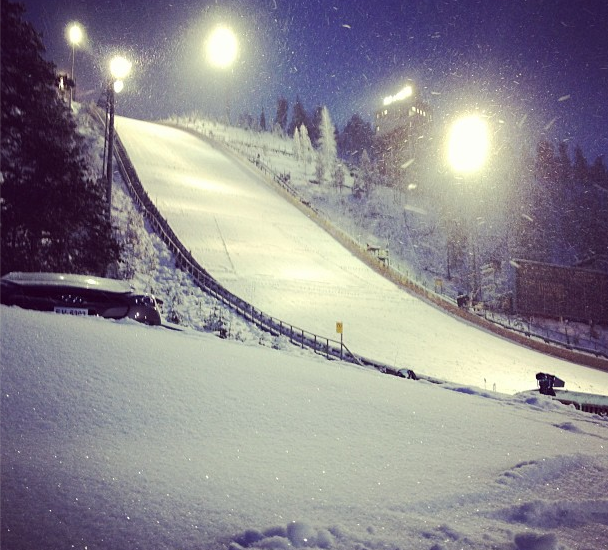
    The International Ski Federation (FIS) tweeted this photo of the ski jump in Kuusamo, Finland, with the caption “Winter Wonderland.” US Nordic Combined member Bryan Fletcher wrote on his blog it was just that: “Despite rumors of little snow in Kuusamo, by the time we arrived there was plenty of snow, cold conditions and great jumping.”

    Since arriving in Lillehammer, Norway, a few weeks ago, the US Nordic Combined Team has been seeking big things. Well, maybe not right off the bat, but any professional athlete wants good results.

    Bryan Fletcher, 26, led the effort by continuing to improve his, placing 14th in the individual large-hill competition Saturday and ninth with brother Taylor in the team event Sunday. That was up from Bryan’s results in Lillehammer, where he was 22nd in the penalty race and 38th in the preceding normal-hill competition.

    This weekend, the Fletchers were the lone Americans to qualify for Saturday after Friday’s provisional jumping round . Bryan ranked eighth on the large hill and Taylor squeaked by in 47th to make the top-50 standard. Billy Demong was 51st in the provisional round and Todd Lodwick was last in 61st.

    “Not what I was expecting today on the hill,” Lodwick tweeted on Friday, nearly a week after leading the U.S. in 24th in Lillehammer Nov. 24. “As one might say, only up from here!!! Keeping my head up …”

    On Saturday, Bryan ranked 11th on the hill while Taylor was disqualified because of his equipment. Bryan went on to post the 13th-fastest ski time for an overall finish of 14th, 33 seconds behind winner Jason Lamy Chappuis of France.

    “I kicked of the weekend by having the longest jump in the first round of official training,” Bryan wrote on his blog Monday. “I followed that up with two more solid jumps and placed 8th in the provisional comp. This brought my confidence up and I was ready to go for real the next day.

    “Saturday we were fortunate to have decent conditions on the hill and I was able to keep my jumping alive by placing 11th,” he added. “Going into the XC I was a little nervous seeing as last weekend was not my most spectacular racing by any means. After the first lap I found myself fighting for the podium, feeling good like my normal self.  I gave it a valiant effort but was unsuccessful in staying with the group.  I finished a respectable 14th place. I had the 13th fastest time though which shows that the shape is coming.”

    Excited to team up with his brother in Sunday’s two-man event, the two put themselves in ninth after the jump.

    “The snow was a major factor on Sunday, many of the teams struggled with the jumping portion,” Bryan wrote. “Taylor stepped up huge in his jumping and that was a big factor in our placing.”

    In the race, in which teammates alternate laps, the Fletchers were gunning for the top six until the second to last lap.

    “Once we lost contact with the group 9th place was our clear placement,” Bryan explained. “However both Tay and I came into the day with no expectations and to be honest we were surprised to even be in the hunt. There is still a lot of work to be done but at least we know we are on the right track.”

    On Monday, the US Nordic Combined men were flying back to Park City, Utah, where they’ll spend a week training before heading to the World Cup in Ramsau, Austria, Dec. 15-16. (they are skipping next weekend’s World Cup in Erzurum, Turkey).

    “I am excited to continue the momentum [in Ramsau],” Bryan wrote. “Hopefully combine some solid jump results with races just like the first day in Kuusamo.”

  • Not This Time: Northug Edges Russian in Kuusamo Finale

    Not This Time: Northug Edges Russian in Kuusamo Finale

    Petter Northug (NOR) on his way to his first victory of this year’s Ruka Triple mini tour on Sunday in the 15 k classic pursuit in Kuusamo, Finland. It was the only one that really mattered. Photo: Fischer/Nordic Focus.

    Petter Northug couldn’t stand to see it happen again. For the past two days, he had finished second to Russians – first Nikita Kriukov in the classic sprint, then Alexander Legkov in the 10-kilometer individual skate. Both times, the Norwegian favorite knew exactly what was on the line and sprinted hard to cross it.

    Both times, he lost.

    That must’ve been one of the only things on Northug’s mind Sunday in the 15 k classic pursuit, which he started with a 40-second lead.

    Within the first kilometer, he had extended it to nearly 50 seconds over Kazakhstan’s Alexey Poltoranin, who started second. Legkov went out of the gate third, 53 seconds after Northug, and led the quickly formed chase group around 2.5 k.

    At that point, nearly 15 men strung together to form an attack, but they didn’t make up much ground until nearly 9 k. With six kilometers (two laps) to go by the 10 k mark, Northug visibly picked up his tempo. Thirty-six seconds wasn’t quite enough time between him and the others, and if he lost it, he could drop from first to near 20th. That would be worse than placing second to a Russian again.

    Northug’s lead dwindled to 25 seconds by 11.4 k, and halfway through the last lap, it was down to 12.8 seconds. Poltoranin forged ahead with the last-ditch attack, and Northug responded with his characteristic double pole. He looked around once, and that was enough.

    Northug (1) tries to fend of the chase pack in the final kilometers of the Kuusamo World Cup 15 k classic pursuit on Sunday. He won by 1.2 seconds.

    “I felt like I had robbed 50,000 euros in a suitcase and that I had 100,000 police after me,” he told NRK. He could amass nearly that much if he won Sunday.

    Charging hardest up the last hill, Maxim Vylegzhanin of Russia whisked by Poltoranin as well as Dario Cologna, who had moved up considerably after starting 1:12 back. Vylegzhanin nearly caught Northug at the crest, and in a classic game of cat and mouse, Northug got away on the downhill. After skiing humbly in the pack until the last lap, Vylegzhanin came close again around the final curve into the stadium.

    Yet on the last day of the Ruka Triple mini tour, it was Northug who was fastest. He forged ahead in the final sprint, beating Vylegzhanin by 1.4 seconds in 41:38.3. Poltoranin was third (+3.4) and Cologna placed fourth (+7.8).

    “This is one of the toughest I’ve experienced,” Northug told TV2.no, according to a translation. “I don’t think I’ve ever fought so hard for a win before.”

    Knowing how difficult it would be to ski alone for six laps, he aimed to find his own pace for the first four.

    “I knew the group behind me would speed up,” he told FIS reporters. “I was preparing myself for the finish. I had little bit left for the last 150 meters.”

    Not much, though. In the finish area, a Norwegian coach had to lift the collapsed Northug off the ground.

    “I worked myself mentally on the last lap,” Northug said to NRK . “I was so tired. It was just painful.”

    The race tested all the top contenders, including Vylegzhanin, who notched his seventh World Cup podium after hanging behind teammates Dmitriy Japarov and Legkov for much of the race. Japarov and Poltoranin combined to share most of the load up front, and when Japarov fell around 12.5 k, Legkov looked to be Russia’s best chance.

    Alexey Poltoranin (KAZ), Alexander Legkov (RUS) and Maxim Vylegzhanin (RUS) chase Northug during the men’s pursuit in Kuusamo (FIN). Photo: Fischer/Nordic Focus.

    “After three days of competition it was very tough for me today,” Vylegzhanin told FIS. “I did everything that I could. I found a good place in the chasing group. I am very happy about the podium. I hope I will carry on the shape to the Tour de Ski and World Ski Championships.”

    After falling behind Vylegzhanin in the final stretch, Poltoranin said he was spent.

    “After the sprint on Friday I was very tired,” Poltoranin said of his fifth-place result. Then, he placed 15th in Saturday’s 10 k skate.

    “The free technique competition was not good for me,” he added. “However, today I felt very good. I had fast skis also [and] I prefer classical technique.”

    Northug took the overall World Cup lead ahead of Poltoranin. Rounding out the top 10 in Sunday’s pursuit and Ruka Triple standings, Russia’s Ilia Chernousov placed fifth (+21.1), Martin Johnsrud Sundby (NOR) was sixth (+22.4), Legkov finished seventh (+24.5), and Japarov was eighth (+24.6). Emil Joensson (SWE) placed ninth and Evgeniy Belov (RUS) took 10th.

    Just 30 seconds separated the top nine, and the top 15 finished within 45 seconds of Northug.

    ***

    Men’s pursuit results

    Maxim Vylegzhanin (RUS), Petter Northug (NOR) and Alexey Poltoranin (KAZ) gather on the podium following the Kuusamo (FIN) mini-tour. Photo: Fischer/Nordic Focus.


  • Bjørgen Busts Through Snowy Tracks to Complete Kuusamo Sweep

    Bjørgen Busts Through Snowy Tracks to Complete Kuusamo Sweep

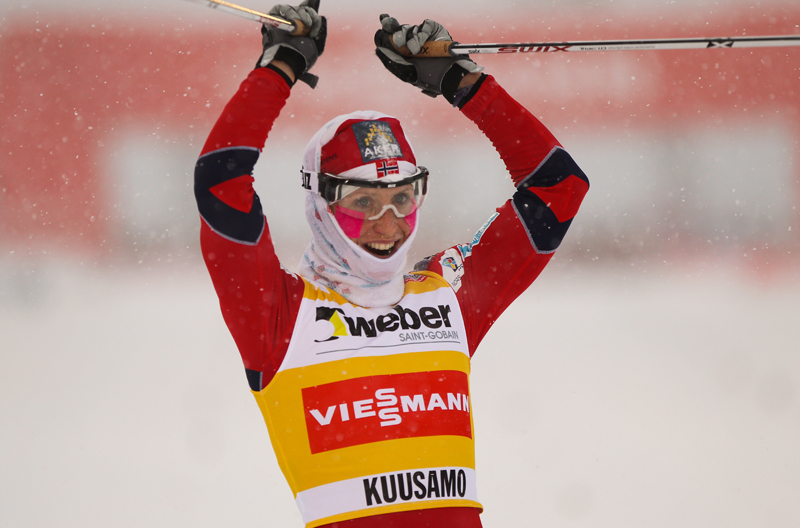
    Marit Bjørgen (NOR) after winning the Kuusamo World Cup 10 k classic pursuit by a minute and 21 seconds for the Ruka Trip mini-tour title on Sunday in Kuusamo, Finland. Photo: Fischer/Nordic Focus.

    As far at the television coverage showed, it didn’t look like Marit Bjørgen ever looked back on Sunday in Kuusamo, Finland. It would’ve been pointless to do so; Norway’s defending World Cup champion was always more than a minute ahead and the white-out conditions made the visibility near zero.

    Starting first in the 10-kilometer classic pursuit – the culminating race of the Ruka Triple mini tour, with full World Cup points and 5,000 Swiss francs ($5,400 dollars) on the line – Bjørgen had nearly a minute to play with off the line. Kikkan Randall of the U.S. started next, 53 seconds back, and Finland’s Krista Lahteenmaki went out third (+0:59).

    However, it was the next couple starters that formed the most contentious chase group within the first few kilometers, with Justyna Kowalczyk of Poland in bib 4 leading Norwegians Heidi Weng and Therese Johaug, who started fifth and seventh, respectively. (Yulia Tchekaleva of Russia did not start sixth, traveling instead to Canada in preparation for the Quebec World Cup sprints next week.)

    Randall settled in behind the group and after losing contact before 4 k, worked with Lahteenmaki to try to gain back some ground on the front four. Bjørgen remained out of reach throughout the race with Kowalczyk, Weng and Johaug narrowing the gap to a minute and 14 seconds before the halfway point.

    They reeled her in by about the same margin by 6.4 k, but with one lap to go, Bjørgen made up a few more seconds despite an increasingly difficult workload in the snow-covered tracks.

    Justyna Kowalczyk (POL) enters the stadium and strides to second in Kuusamo 10 k classic pursuit.

    In the end, the 32-year-old Bjørgen won the fourth-straight individual World Cup race of the season; yep, every single one. She swept the mini tour, with victories in the classic sprint, 5 k freestyle and classic pursuit, winning the latter in 31:19.4. Kowalczyk pulled off second place, 1:21.4 back. Weng surged up the last hill past Johaug to challenge Kowalczyk, but settled for third (+1:23.9). Johaug was fourth (+1:34.1) with the second-fastest time of the day, 8.1 seconds behind oBjørgen.

    Randall broke away from Lahteenmaki around 6.4 k to make a run for the chase group. She managed to stay ahead by at least a few seconds and ultimately finished fifth (+2:24.8) while Lahteenmaki placed sixth (+2:33.1). At the finish, all eyes were on Bjørgen, whom Randall had predicted would take an army of efforts to defeat.

    “Maybe we can work together and try to reel Marit back in,” Randall said after Saturday’s 5 k, where she was second. “She’s definitely strong right now … so it’s gonna be fun and hard.”

    Hard was probably the best description of it on a cold afternoon near the Arctic Circle with temperatures around -9 degrees Celsius (15.8 Fahrenheit) and snow falling heavier throughout the women’s race.

    “Another incredible day for me,” Bjørgen told NTB, according to a translation. “I concentrated on doing well technically, and it went fast as I had done throughout the weekend. This was one of my best weekends in Kuusamo ever.”

    She won the Kuusamo mini-tour title last year as well, and given a 53-second lead from the start, Bjørgen was confident she could keep it.

    “I knew I had to focus on [myself to] succeed,” she told Eurosport.Onet.pl. “Right at the start I heard that my advantage has increased … [and] I felt that I was able to get the best time of the day. In the second part of the distance the snow was falling very strong, however, this is a winter sport and you have to compete in such an environment. I have a big advantage when the conditions do not really matter.”

    For overall World Cup runner-up Kowalczyk, it was her first podium of the season.

    “It was a good race,” Kowalczyk told NRK. “The shape is good and the skis were good. There is a lot of hard work, but it’s better than a week ago. My form is getting better every start. Maybe I come in the same form as Marit.”

    Bjørgen, for one, is worried that it might be too much too soon.

    “I hope that the form did not come too soon,” she told Eurosport. “I’m going to leave a couple of starts in order to better prepare for the Tour de Ski and World Cup.”

    Bjørgen and Johaug planned to skip the Canada World Cups in preparation for the Tour de Ski and second period. According to Norwegian coach Vidar Løfsus, the rest of the women’s team will be there, including seventh- and eighth-place finishers Vibeke Skofterud and Kristin Stoermer Steira.

    “I will go home now and then train two weeks at high altitude in [Italy’s] Seiser Alm to get ready for the Tour de Ski,” Bjørgen said.

    ***

    Women’s pursuit results

    Justyna Kowalczyk (POL), Marit Bjoergen (NOR) and Heidi Weng (NOR) take the Kuusamo (FIN) mini-tour podium. Photo: Fischer/Nordic Focus.
  • Jones, Gaiazova Lead Canada with Aggressive Tactics in Kuusamo Sprint

    Jones, Gaiazova Lead Canada with Aggressive Tactics in Kuusamo Sprint

    Canadian National Ski Team members Perianne Jones (second from left) and Chandra Crawford (second from right) go head-to-head in a Frozen Thunder time trial in late October. Crawford won by a toe, but Jones took top honors in the first World Cup of the season on Friday at the 1.4 k classic sprint in Kuusamo, Finland. (CCC photo)

    There’s an old saying that transcends sports: ‘Be aggressive,’ and for extra emphasis: ‘B-E aggressive.’ Well, maybe that’s a Jock Jam, but either way, it got into the heads of Canadian Ski Team members Perianne Jones and Dasha Gaiazova on Friday in Kuusamo, Finland.

    The two gave their all in the 1.4-kilometer World Cup classic sprint on the opening day of the Ruka Triple mini tour, which includes two more sets of races (a 5- and 10-kilometer freestyle on Saturday, and 10/15 k classic pursuit on Sunday). Both shorter-distance specialists, it was their time to get after it in the first sprint of the season.

    Jones out of the start of the women’s 5 k classic race at Canadian Ski Nationals last March.

    Jones led the charge, tying her career best of 12th after advancing to the semifinals. Gaiazova placed 14th overall, narrowly missing a lucky-loser bid for the semis.

    After qualifying in 20th, Jones didn’t let brand names like Justyna Kowalczyk (POL) and Heidi Weng (NOR) overrun the quarterfinal. From the start, she tucked in behind the Norwegian leaders, including Ingvild Flugstad Oestberg, and hung on while Kowalczyk – a race favorite – charged forward for the win. Jones outlunged Weng for second and moved onto the semi.

    “I got in behind Kowalczyk on the last big climb because I figured she’d win the heat, and I just double-poled like mad to the finish,” Jones said in a Cross Country Canada press release.

    Four quarterfinals later, Gaiazova burst out of the start to the front, then settled in behind Finland’s Anne Kylloenen, who would go on to place fourth in the final. American Ida Sargent worked her way into the mix and Gaiazova followed as the two overtook Therese Johaug (NOR) to finish second and third in the heat, respectively. For Sargent, it was a sure way of getting to the semis while Gaiazova, who previously qualified in 18th, had to rely on her time to get her through. She ended up just short of advancing and settled for 14th.

    Not long after, Jones went for it again in the semifinal, trailing Kowalczyk and Kikkan Randall (USA) up the first gradual hill. There, she lost her balance on an icy corner and fell out of contention behind the pack, which included eventual semifinal and final winner Marit Bjørgen (NOR).

    While making it as far as possible – ultimately to the podium – is always the goal, both Jones and Gaiazova were pleased with their efforts.

    “Kuusamo has been a dark place for me in the past,” Jones said. “I’ve never really been good here so I’m really happy with today.”

    Previously, the 27-year-old’s best result in Kuusamo was 51st in a 1.2 k classic sprint. This year, the International Ski Federation (FIS) decided to lengthen many of the women’s sprints to match the men’s distances. Friday was one of the first times it did so with the 1.4 k distance, which seemed to work for Jones.

    Head coach Justin Wadsworth said on the phone that the longer sprint on a challenging course was certainly a good indicator of Jones and Gaiazova’s fitness.

    “That last uphill is really tough,” he said. “I mean it’s hard just when you’re testing skis or whatever going around it. It’s hard to get up.”

    Jones credited her skis – prepared by her husband and wax tech Joel Jaques – to much of her success, especially on the downhills. In her third time placing a personal best of 12th in a World Cup sprint, she said she’s ready to make the next step.

    “I do feel now is the time for me to start to peak and I think that is the reason we are doing a lot more intensity than usual,” she said. “I was a little worried that I wouldn’t see the results, but it is nice to see the training pay off today.”

    Dasha Gaiazova on the World Cup circuit last March.

    In an email, Gaiazova wrote that she felt fit and confident for the first half of her quarterfinal, but made a costly mistake at the bottom of the second hill “being too nice and letting a competitor jump in a track ahead of me, thus boxing myself in for the main uphill,” she wrote.

    “I wish I was more aggressive at that moment and didn’t let her in because then I would have had my own track and could have skied with a longer and more comfortable stride, as opposed to trying to match Johaug’s frantic pace and wasting energy skiing behind her,” Gaiazova continued. “Once I learn how to race aggressively for the whole duration of the race, there is no stopping me!”

    About 2 ½ seconds back from qualifying in the top 30, Canadian Chandra Crawford wrote in an email that she expected more.

    “Thought I’d get a better one but I’ve been pushing the training a bit since arriving in Europe to prepare for the Canadian races,” Crawford wrote. “Now I’ll do a bit more resting and fire up some sprint leg feeling for Canada.”

    Last season’s NorAm winner who earned early World Cup starts this year, Alysson Marshall was one spot back in 38th in the prelim.

    “I was really disappointed not to qualify, but I was close to the top-30 and I feel like I’m bouncing back from last weekend,” she said of the World Cup opener in Gällivare, Sweden. “I felt good in the qualifier but slipped a few times on the climbs and lost momentum … I was happy with my energy and I know where I lost time so I will hopefully improve for the next sprint!”

    The Canadians perhaps most accustomed to the limelight, Alex Harvey, Lenny Valjas and Devon Kershaw failed to make the rounds in the men’s 1.4 k sprint. Harvey ranked 46th in the qualifier, Valjas was 53rd and Kershaw placed 62nd.

    “They just don’t have the snap right now,” Wadsworth said. “Same way they’re been feeling, just kind of flat. It shouldn’t be a problem. That’ll come back and I know their fitness is there. Of course you’d like to have good results today, but it is what it is so you just can’t fight it.”

    That’s where aggression meets patience.

    “It appears these last years that I just lack snap, power and speed these first few weeks of the season,” Kershaw wrote in an email. “Simple as that. It’s discouraging, frustrating – but looking at my past – and knowing how well I can ski when everything comes together, I just really have to believe in what I’ve done this entire training season and be patient.”

    Harvey wrote that he “felt fine warming up, not stellar, but confident I would make the top 30. In the race I didn’t feel that bad, but I noticed that every pole plant was a bit less powerful than usual. … It’s a good reminder than were all human and it will make me appreciate even more the feeling of skiing fast when I do, hopefully!”

    Perhaps the most disappointed was Valjas, who said his hand injury was the least of his problems on Friday.

    “The cast did its job perfectly,” he wrote, referring to the healing bone near his pinky finger. “I don’t really know what happened out there today, I thought I felt fine. I chose to ski on skis that had way too little grip, which forced me to herringbone up the last hill. You can’t expect to qualify when you cant climb all of the hills on course. … Not happy about my performance today, I am actually looking forward to the distance races coming up to blow off some steam and get ready for Quebec.”

    The World Cup sprints in downtown Quebec City in exactly a week will be a highlight for the entire team, which will travel home for the event. Going into it, Wadsworth said results like Jones and Gaiazova’s were especially important.

    “They worked hard and it’s really nice to get them in there and get some confidence going heading into Canada,” he said.

    ***

  • Hjelmeset Concerned About Trend to Skip Cold Races

    GÅLÅ, Norway – There is no doubt in Odd-Bjoern Hjelmeset’s mind about this: “Skiing in extreme cold can be a nightmare for some racers. Martin Johnsrud Sundby (NOR) is one example, he can barely breathe when it gets really cold,” Hjelmeset told Langrenn.com.

    But Hjelmeset is also certain about this: “Among those who sat out the races at Gålå (Norway), this weekend, there were a number of skiers who don’t suffer from cold-induced asthma as well.”

    Hjelmeset, who chose to race at Gålå this weekend, said that it was cold, but not a big deal. “Sensitivity to cold is a very individual thing. I would compare skiing in extreme cold to training at altitude. Some do well with it, while others can barely handle it. You just have to know your own body and your own limits. But now it seems like the trend is going the direction that skiers are a little too influenced by other racers’ limits,” Hjelmeset said.

    Hjelmeset observes that the term “cold-induced asthma” is used frequently by the media. “During the broadcasts from Kuusamo, I think the term was used at least a hundred times. Of course, that will affect people’s perception of racing in the cold, and a lot of them would probably handle the cold just fine. I really think people are influenced by the media and what they report on, and of course what the elite racers say about it,” Hjelmeset said.

    Point in Case: The Torsby Tunnel

    The past year, Hjelmeset has made an observation in the Torsby ski tunnel in Sweden, which he wants to point out as an example of how people are affected by the media and reporting.

    “For a long time, it has been unpleasant to breathe inside the ski tunnel in Torsby. Racers of all levels have seen and heard that the national team skiers often use the ‘lung plus’ device or ski with a face mask in the tunnel,” Hjelmset said, explaining that he constantly reconsiders and adjusts based on his own perceptions, not the common belief.

    “This year, the air in there has been a lot better, and I’ve stopped using the ‘lung plus’ all together. I’ve been there several times this fall, and I think it’s strange that so many still are scared about the air in the tunnel.”

    Be serious about temperature cutoffs

    Hjelmeset emphasizes that when it comes to cold temperatures, some people will always run into big trouble. And he argues that temperature cutoffs were instated for a reason.

    “During the Norwegian national championships in Bardufoss a few years ago, it was extremely cold. I didn’t have any serious breathing problems before I raced there, but after those races, it’s been a lot harder for me. Several racers ruined large periods of their races seasons by skiing too hard up there. Kristian Horntvedt is one who struggled for a very long time after those events,” Hjelmeset recalls.

    However, skiing in extreme temperatures is nothing new for the veteran, who is racing outside the national team structure this year for the first time in a decade. He particularly recalls a race in Russia.

    “There was a race over there in Russia, a few years back, that was held despite the temperature being far below -20 C. It was so cold that we layered up with newspapers under the race suits, and Frode Estil decided to race with his warm-ups under his lycra. Of course, that was not healthy.”

    From Langrenn.com, November 29, 2010. By Ola Jordheim Halvorsen, translation by Inge Scheve