From the FasterSkier archive — posts syndicated from athletes’ and coaches’ own blogs between 2004 and 2012, kept online as published. Current coverage is at fasterskier.com.
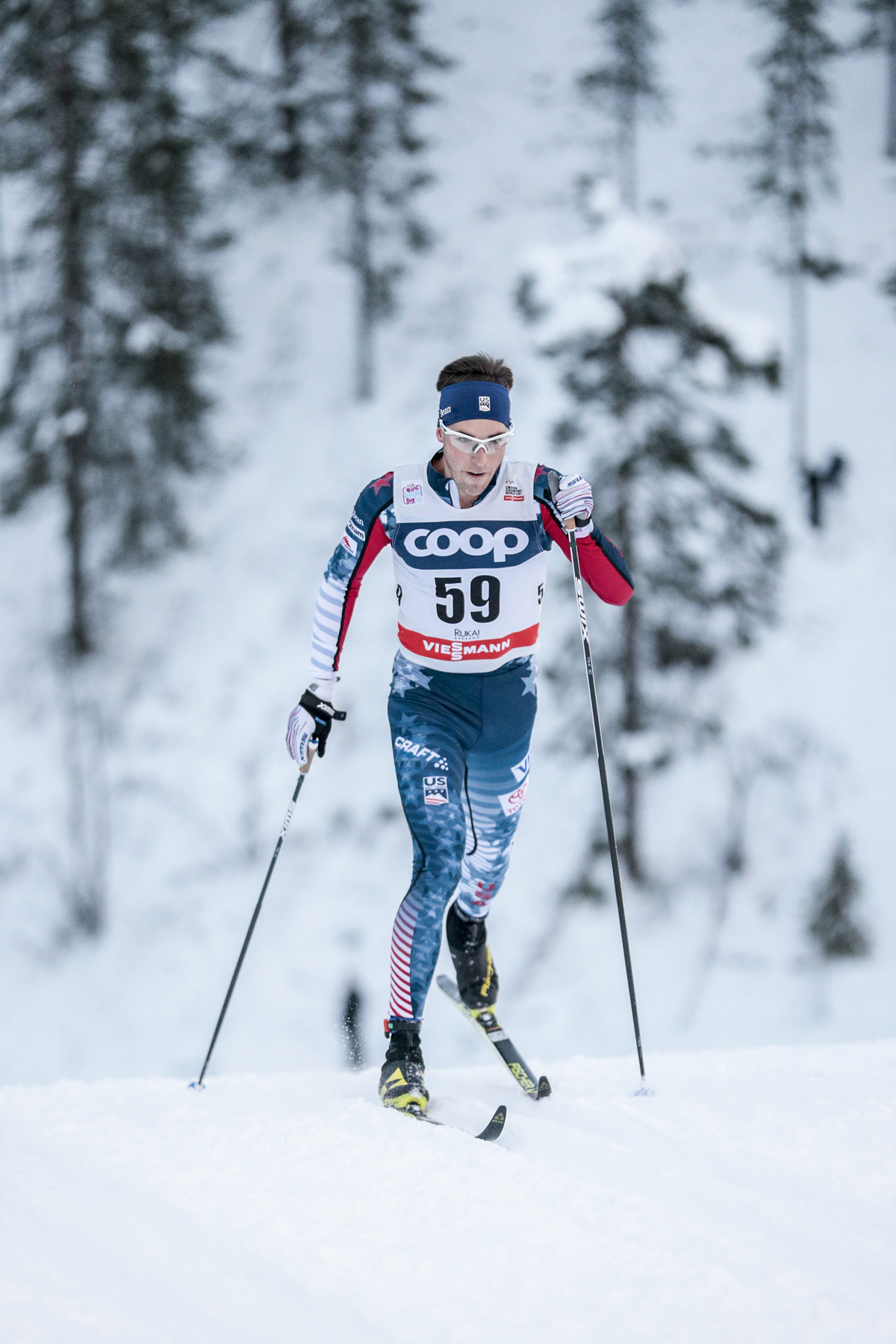
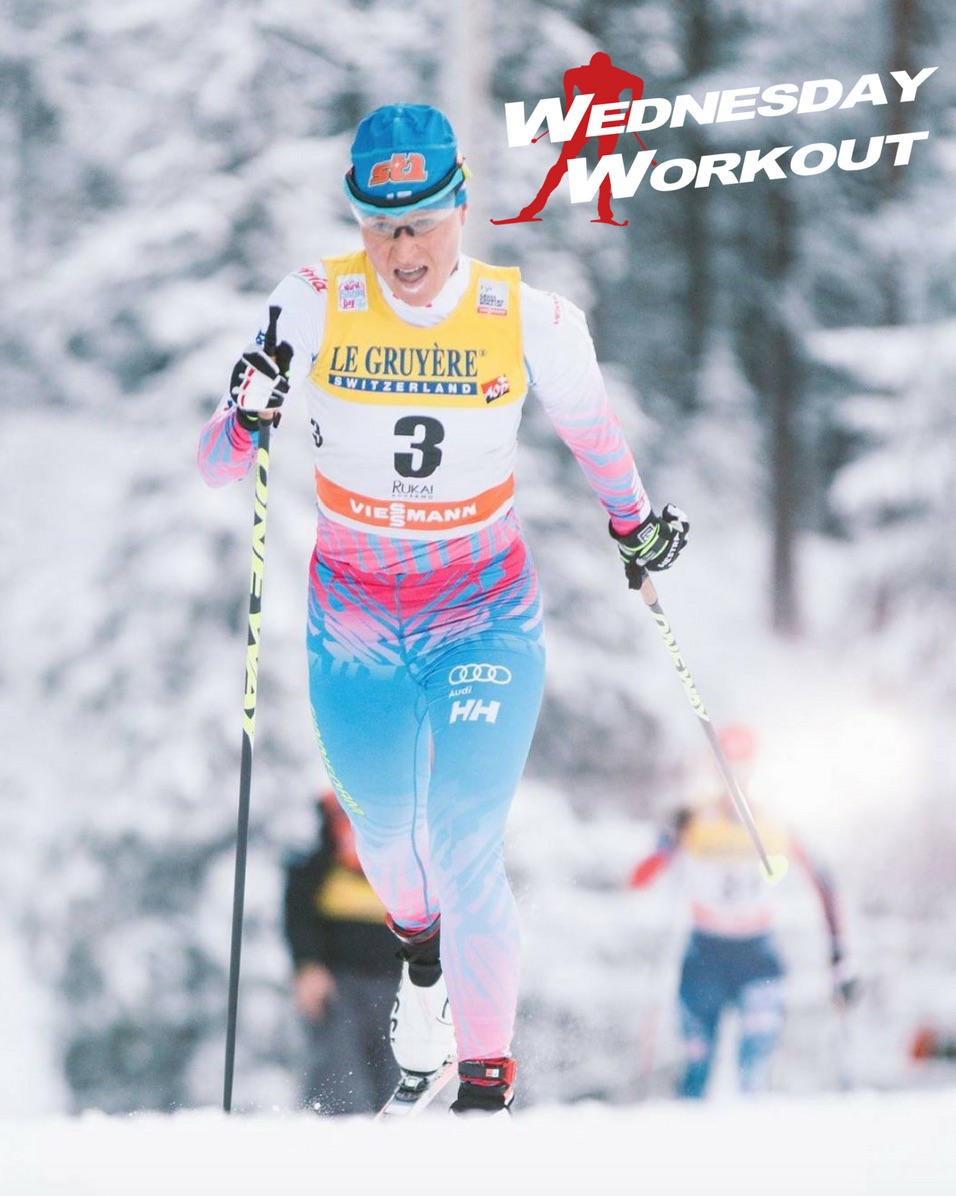
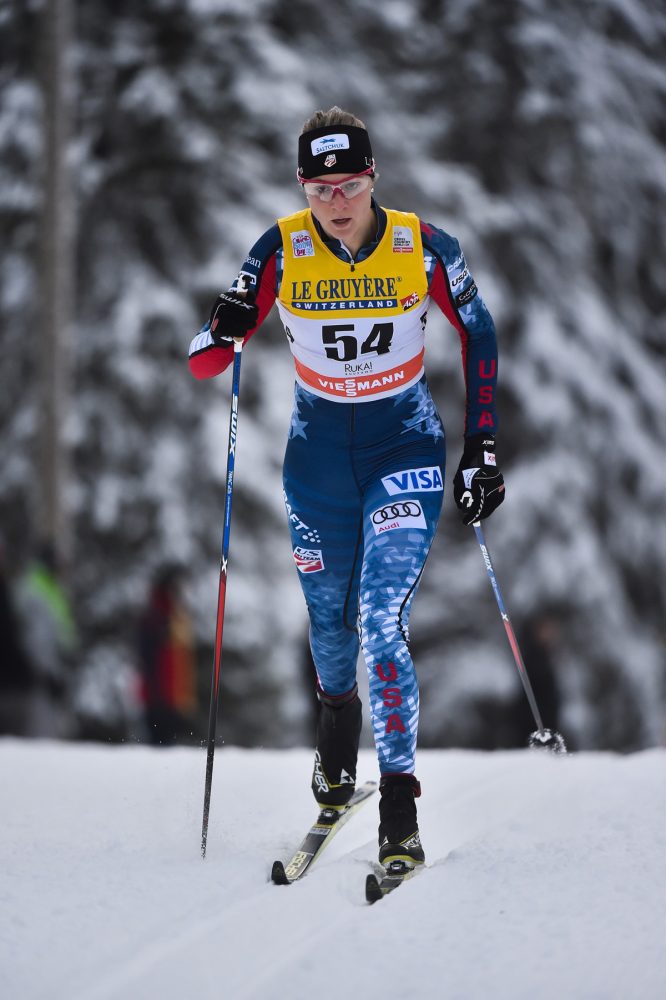
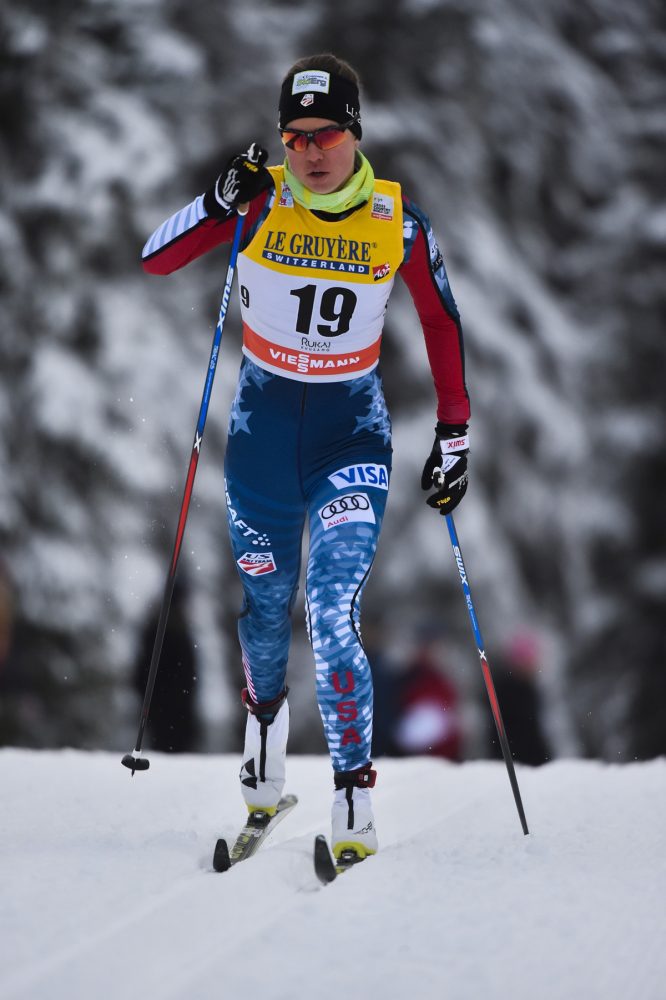
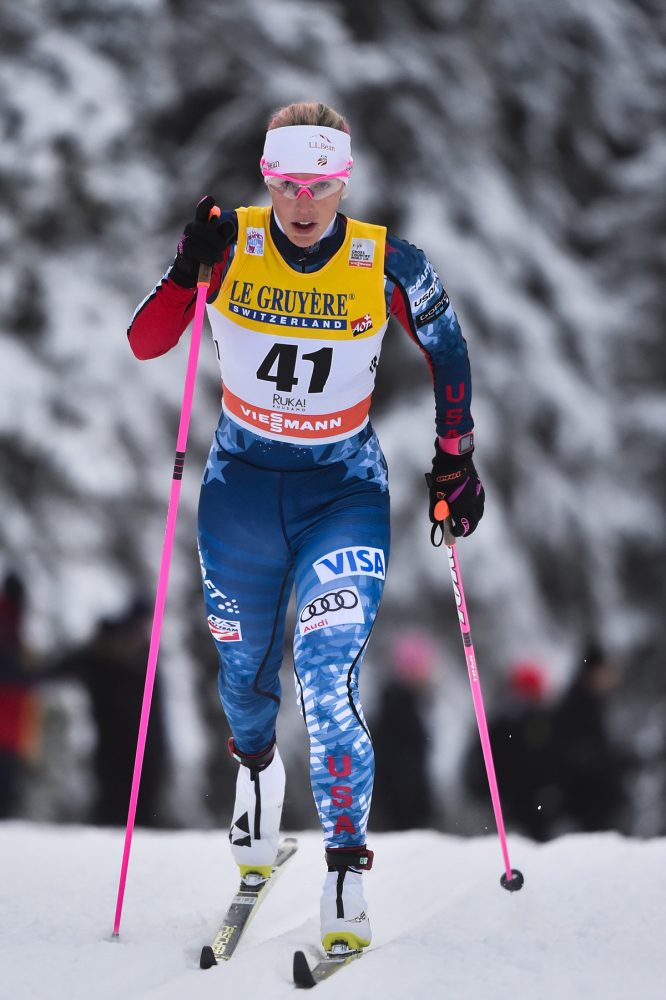
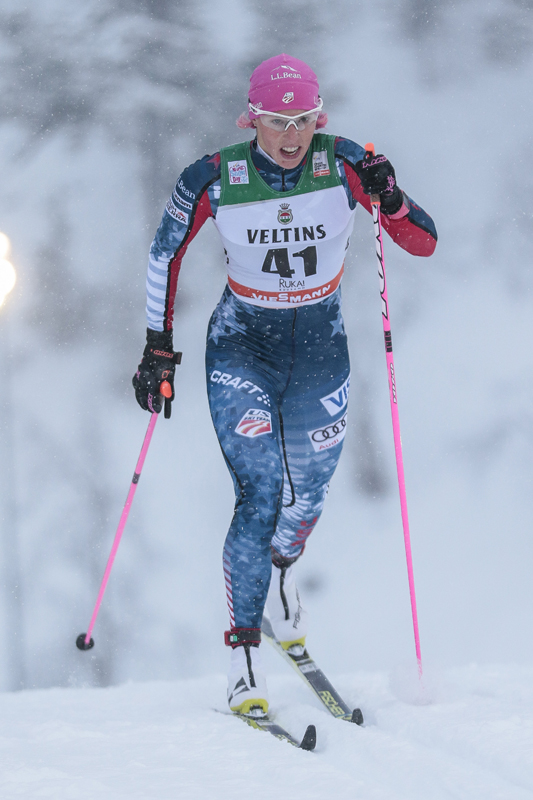
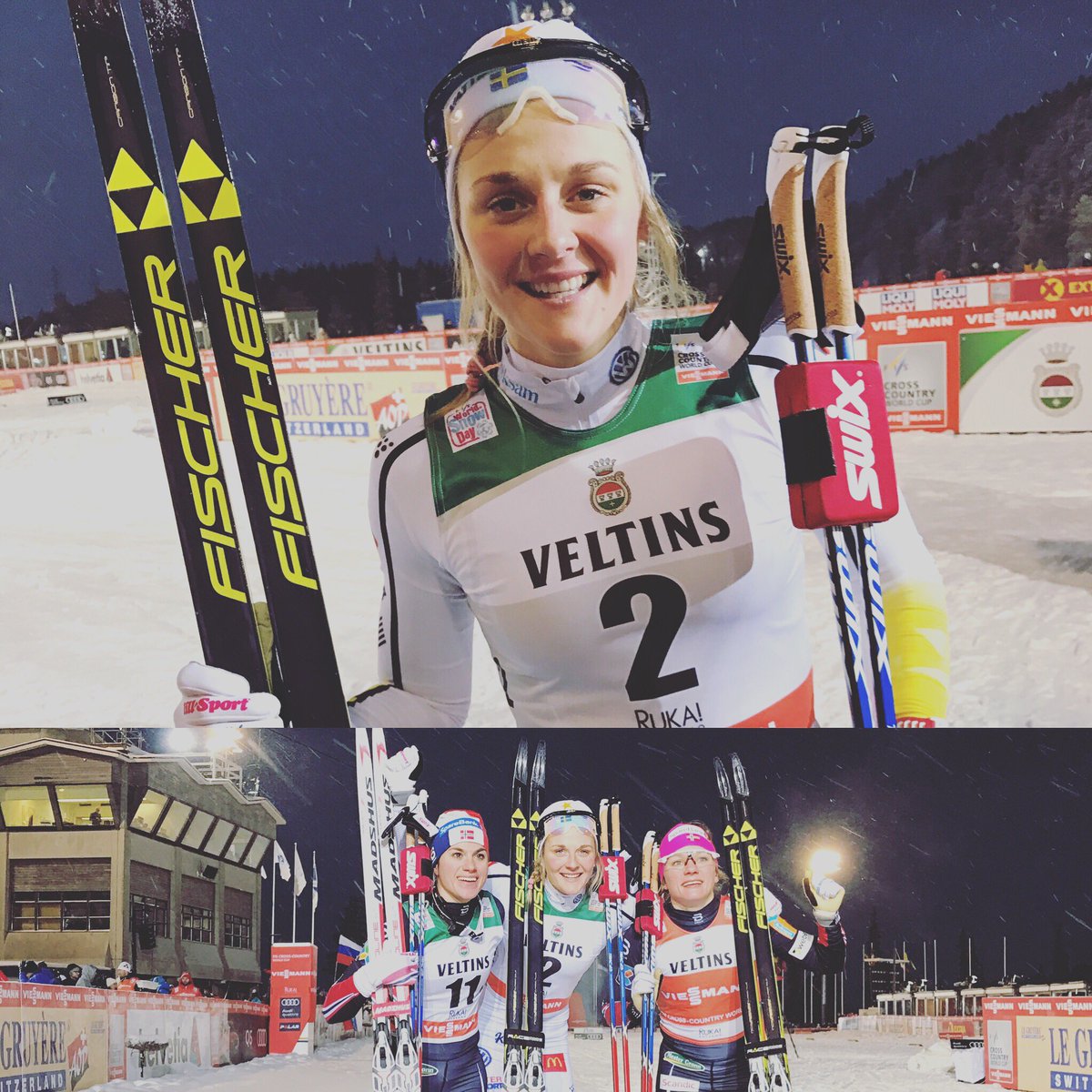
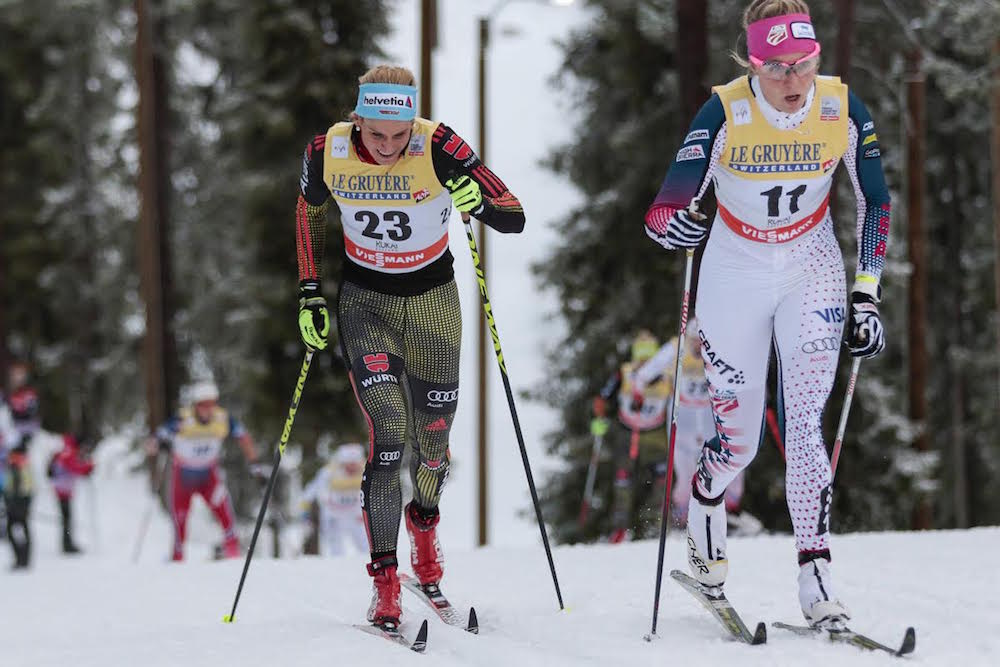
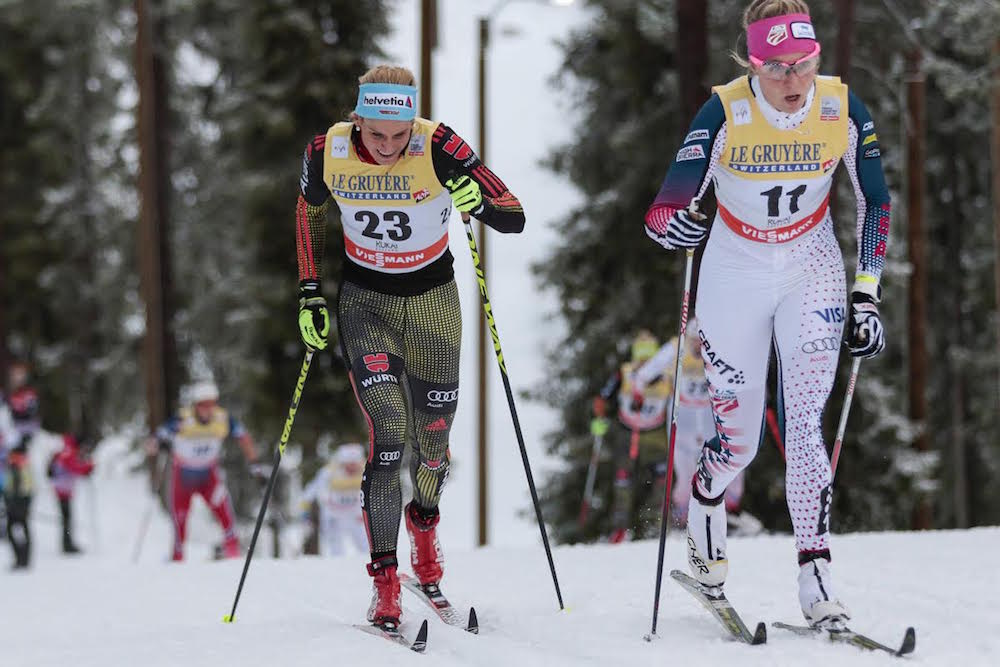
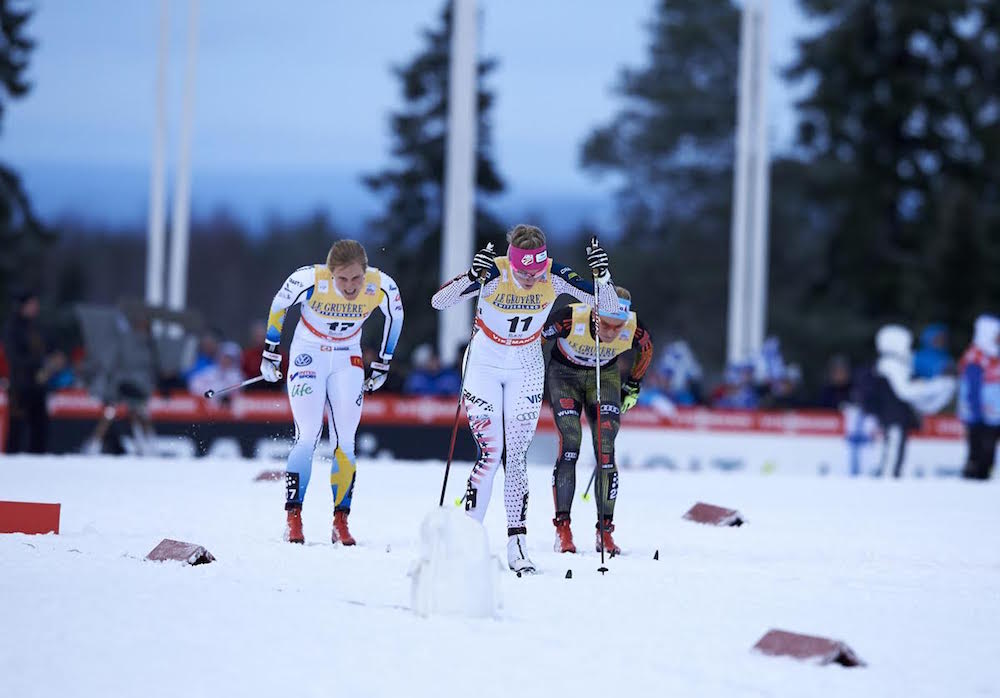
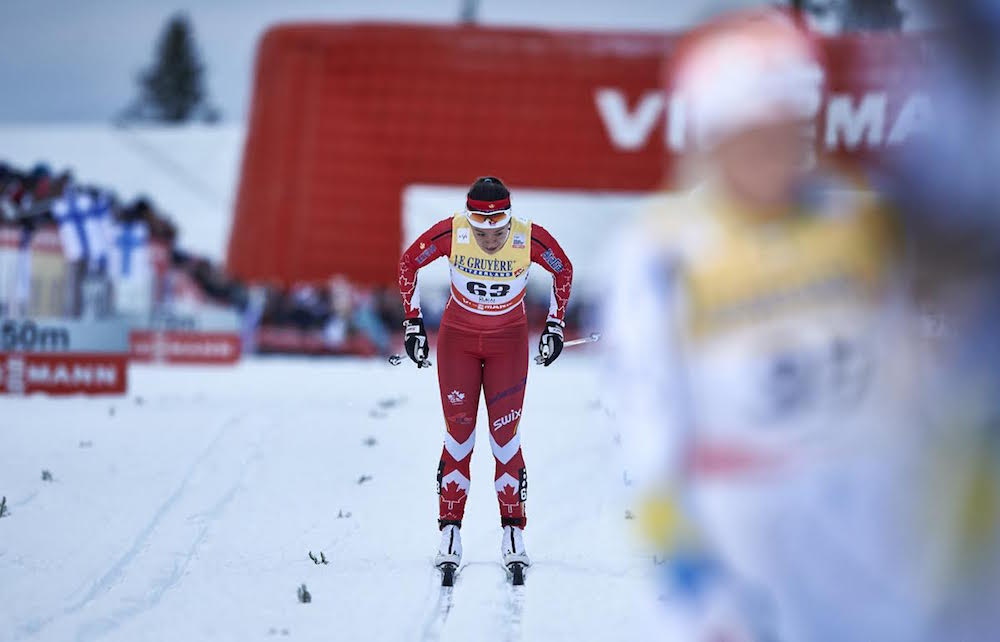
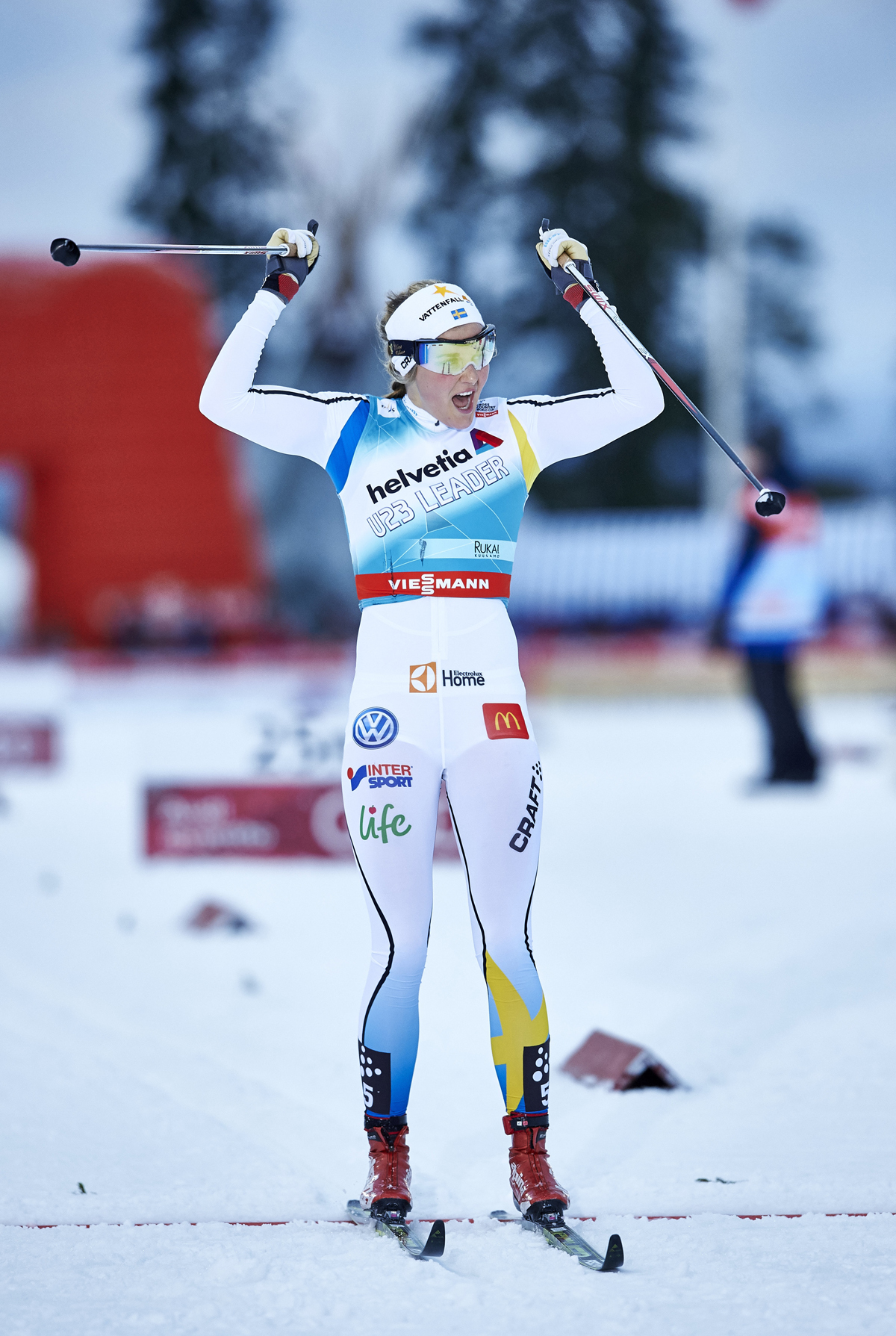
Sadie Maubet Bjornsen at the 2019 Ruka World Cup. This year, Ruka Nordic announced the three race series will be held with no fans. (Photo: Nordic Focus)
The local organizing club for the first cross-country Word Cup of the season, Kuusamon Erä-Veikot, announced on it’s website rukanordic.com the show will go on as planned with no fans.
As sure as the sun rises Nov. 27 on 9:36 AM and sets at 2:05 PM in Kuusamo, the classic sprint will kick off the 2020-2021 cross-country World Cup.
Ruka plans to host a three day series of cross-country races from Nov. 27-Nov. 29 : a classic sprint, a 10 k/15 k individual classic, and concluding with a 10 k/15 k skate pursuit. Although the organizing committee still seeks volunteers, no tickets will be sold.
The no fan policy is to reduce the potential spread of Covid-19 and to keep athletes, team staff, and volunteers as safe as possible.
According to an official statement, the decision was made after consulting with the Finnish Ski Association and the International Ski Federation (FIS). However, organizers make clear that it still awaits “final confirmation” from FIS.
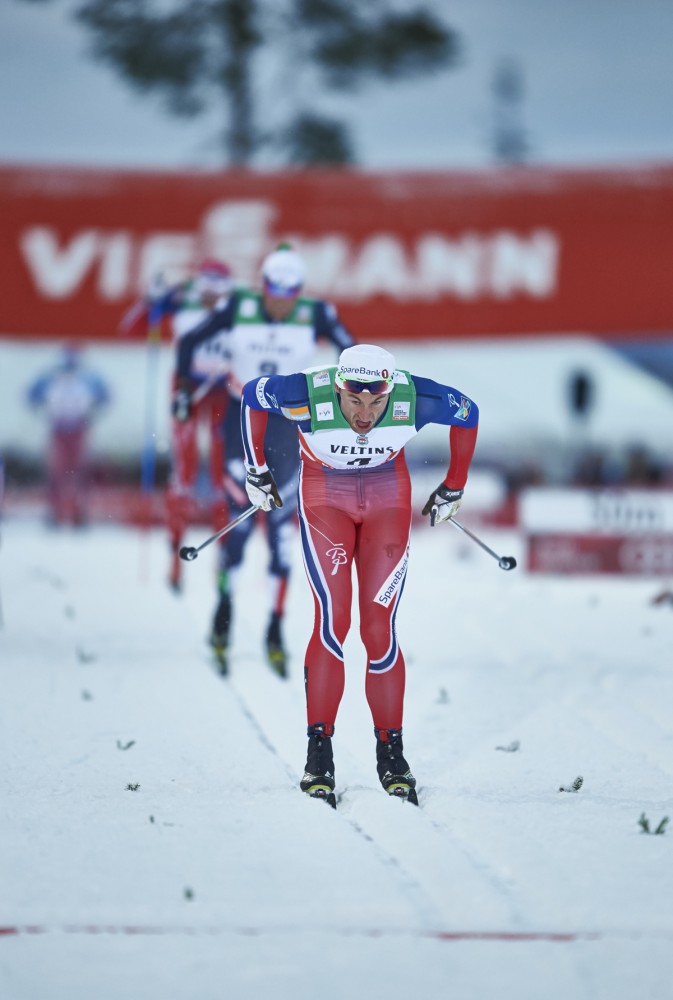
Norway’s Johannes Høsflot Klæbo en route to his third-straight win in as many days of the World-Cup-opening Ruka Triple in Kuusamo, Finland. He won the 15 k freestyle pursuit for the mini-tour title. (Photo: Fischer/Nordic Focus)
Two previous days of racing, and back-to-back victories no less, had begun to take its toll on Johannes Høsflot Klæbo within the first few laps of the men’s 15-kilometer freestyle pursuit on Sunday in Kuusamo, Finland. The 21-year-old Norwegian could feel it throughout his body; he was tired and 38 seconds of a starting cushion wasn’t going to be enough to hold off the hungry challengers behind him.
Klæbo, who won Friday’s classic sprint and Saturday’s 15 k classic individual start on the World Cup opening weekend, wasn’t invincible and he couldn’t race to another win alone. Halfway through the pursuit, the man who started in second place, 38 seconds after him, Russia’s Alexander Bolshunov (who’s actually younger than Klæbo at age 20), had cut that deficit to 19.8 seconds. After him, Norway’s Martin Johnsrud Sundby, who started 10th and 1:05 minutes behind Klæbo, was up to third and just 25.3 seconds back.
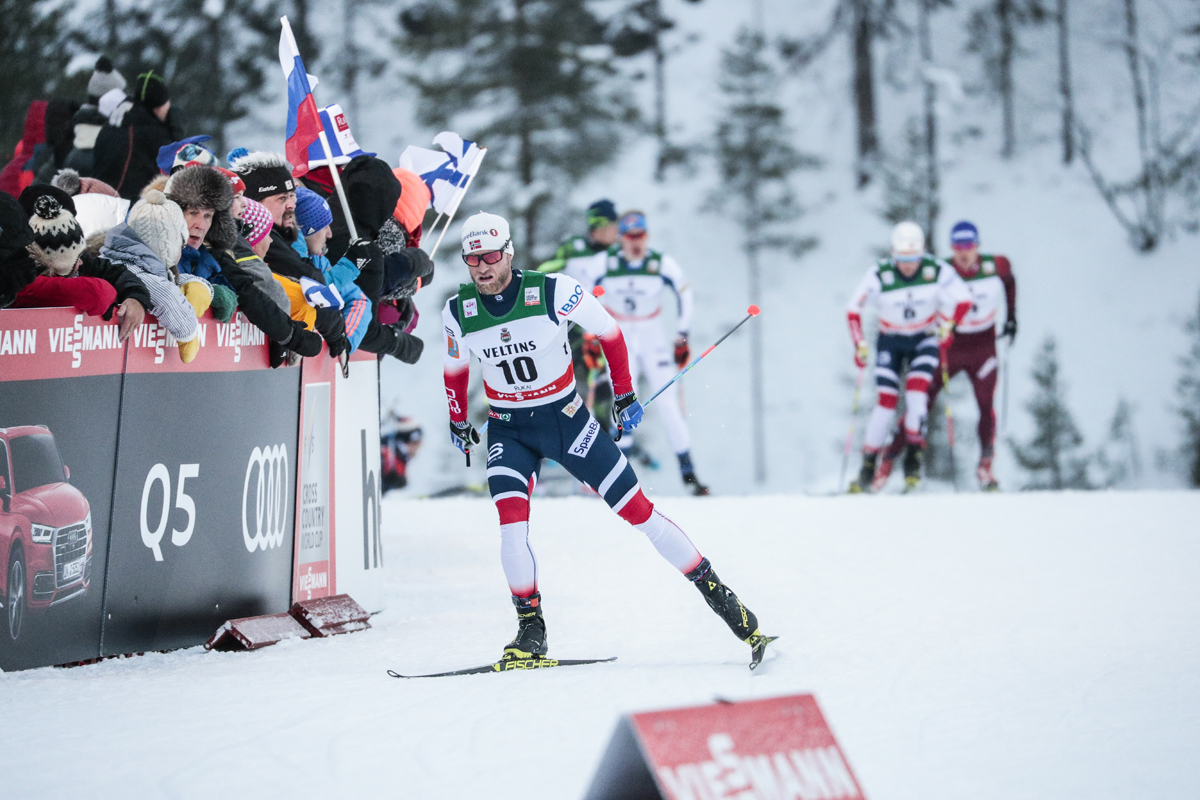
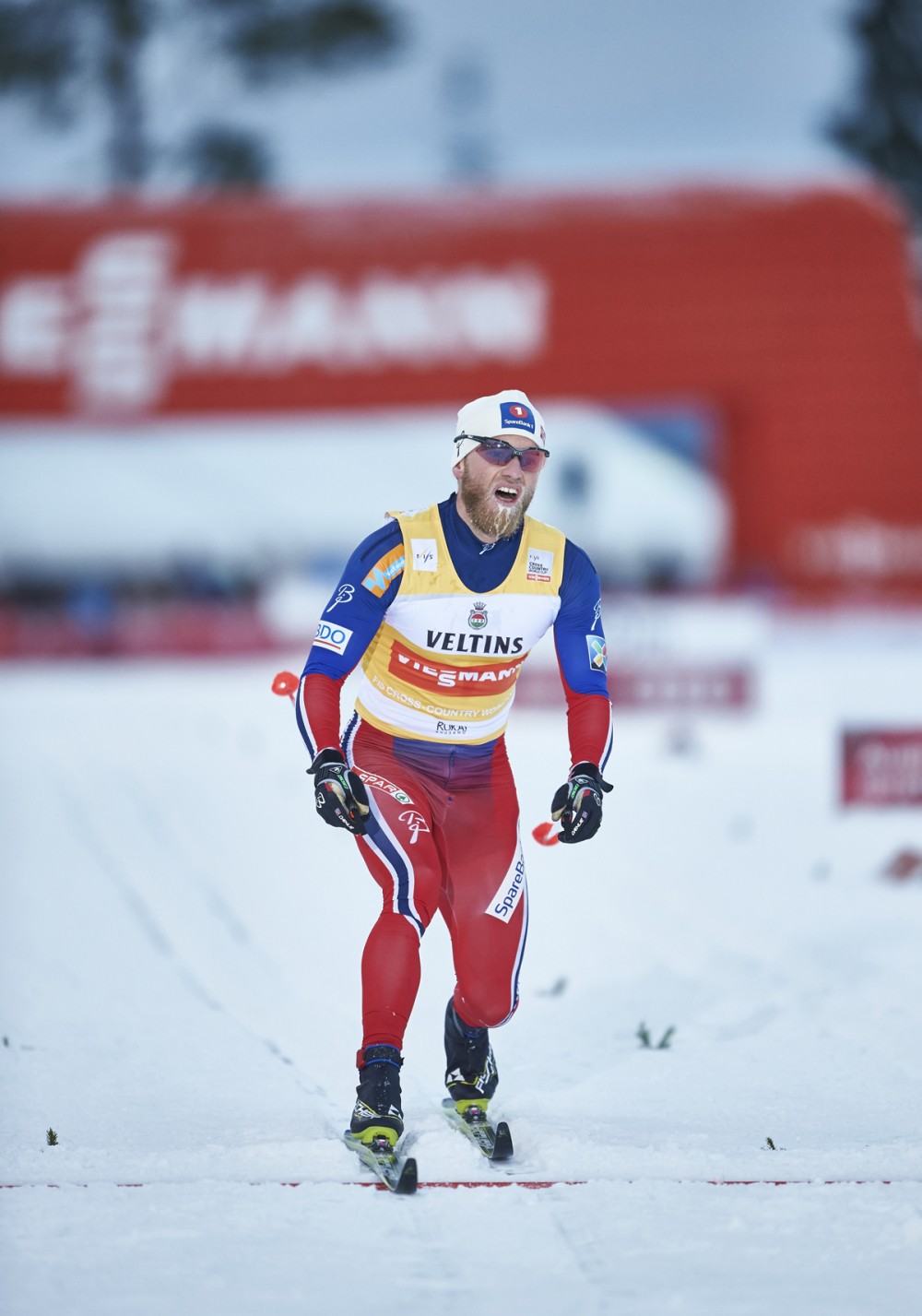
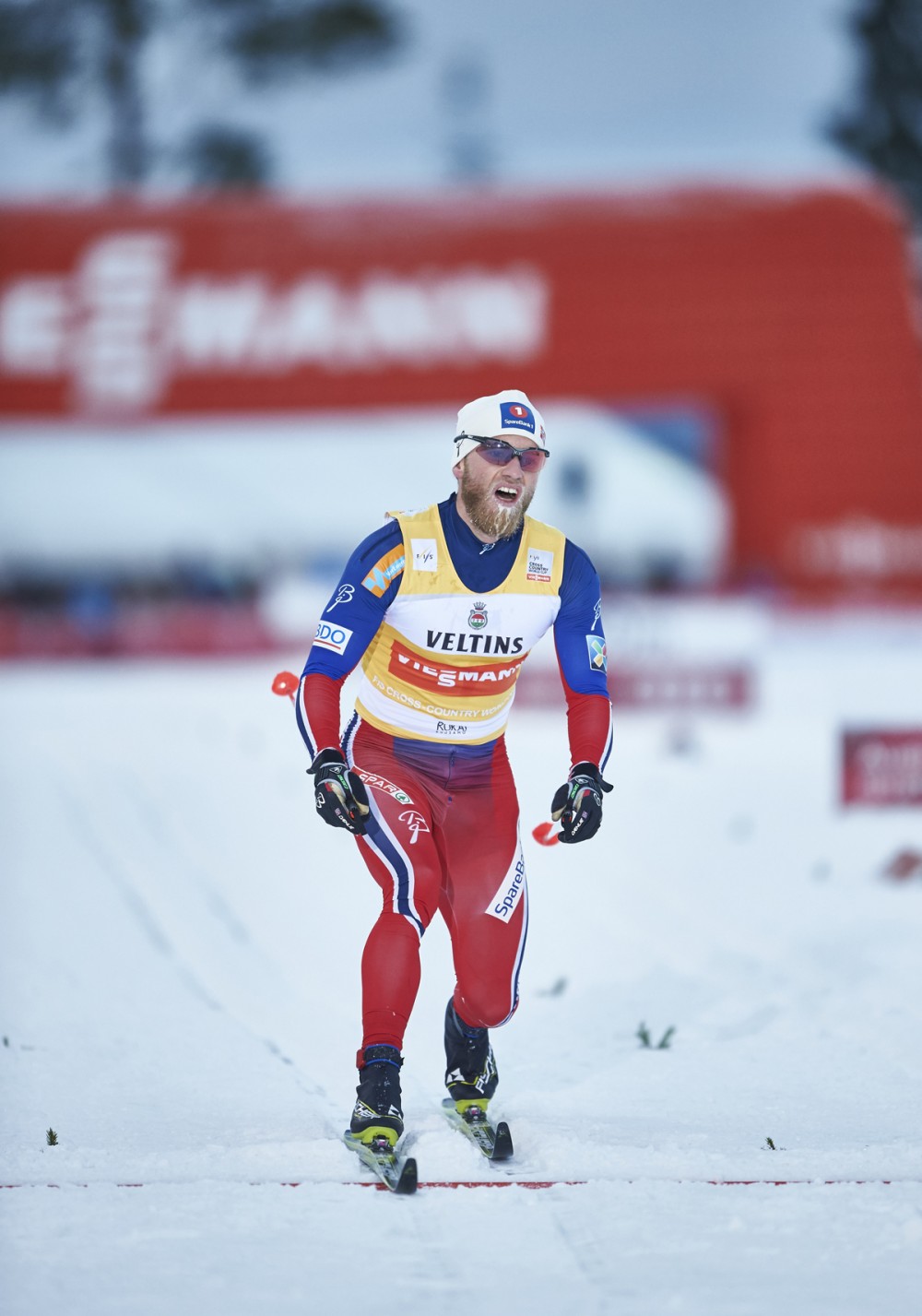
Norway’s Martin Johnsrud Sundby, who started 10th in the 15 k freestyle pursuit on Sunday, picking off the places on the final day of the Ruka Triple World Cup mini tour in Kuusamo, Finland. (Photo: Fischer/Nordic Focus)
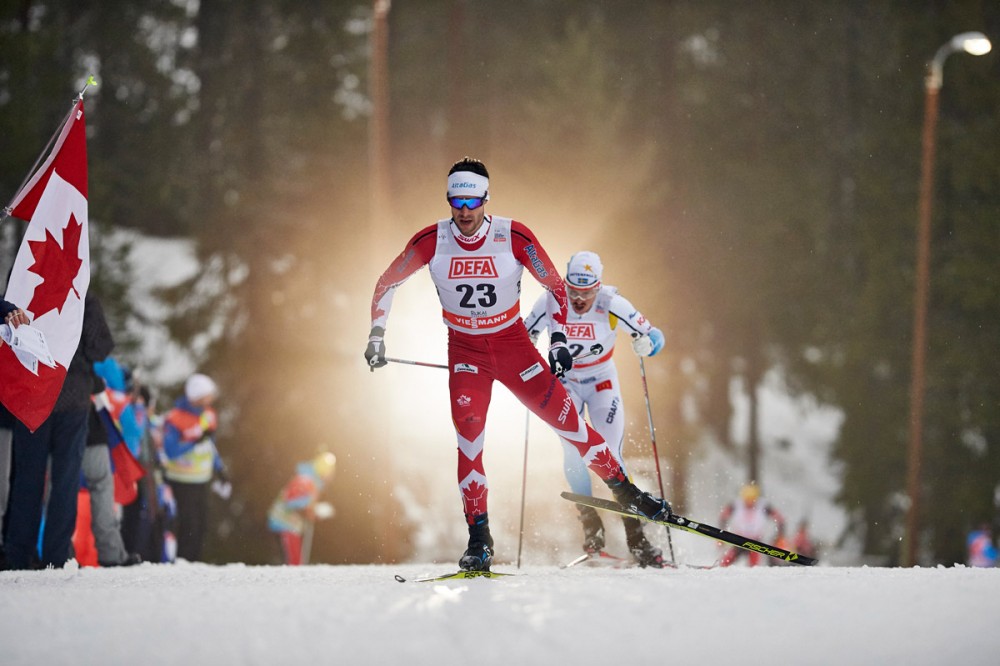
On his fourth lap, Klæbo accepted the inevitable as Bolshunov and Sundby, who had linked up in an effort to catch him, in fact caught him on a climb around 8.6 k. A larger group of pursuers, including Canada’s Alex Harvey, locked on to the three leaders as well, and from there, the race truly began to take form. Klæbo had to recover, Sundby had to figure out how to try to drop him, Bolshunov had to see what he was capable of, and Harvey had to see how much he could give in the third race of the season.
The first races of each winter aren’t easy for anyone. Despite spending the summer training for skiing, most North American World Cup skiers don’t get the opportunity to actually race — even on rollerskis — too often during the offseason. Because of the rich ski culture in Europe, rollerski races are a big deal with lots of summer and fall competitions to chose from. And because of Europe’s geography, it’s often easier to get on snow than it is for North Americans.
(“I think this applies to all the North American actually, compared to Europeans we don’t race as much in summer,” Canadian World Cup coach Ivan Babikov said on the phone on Sunday. “They have races every weekend so they come into the season pretty sharp already with some good speed workouts, when we don’t have that opportunity. So that’s why, I think, every race is a step forward. It’s just, you have to remember or remind yourself how hard it is.”)
So while Canadians and American World Cup skiers alike often look at an opening weekend like Finland’s Ruka Triple mini tour as a “chance to blow the cobwebs out” or “shake off the rust”, as some have said, it’s also an opportunity to see where you stand — as was the case for Harvey in the final meters of Sunday’s pursuit.
Later in the fourth of six laps, Klæbo pushed the tempo up a climb, Bolshunov responded, and Harvey went with them. Soon after at 10 k, they lapped through the stadium with 11 men within 2.7 seconds of first. Up front, Bolshunov led Harvey, who had started the race 1:23 back in 12th.
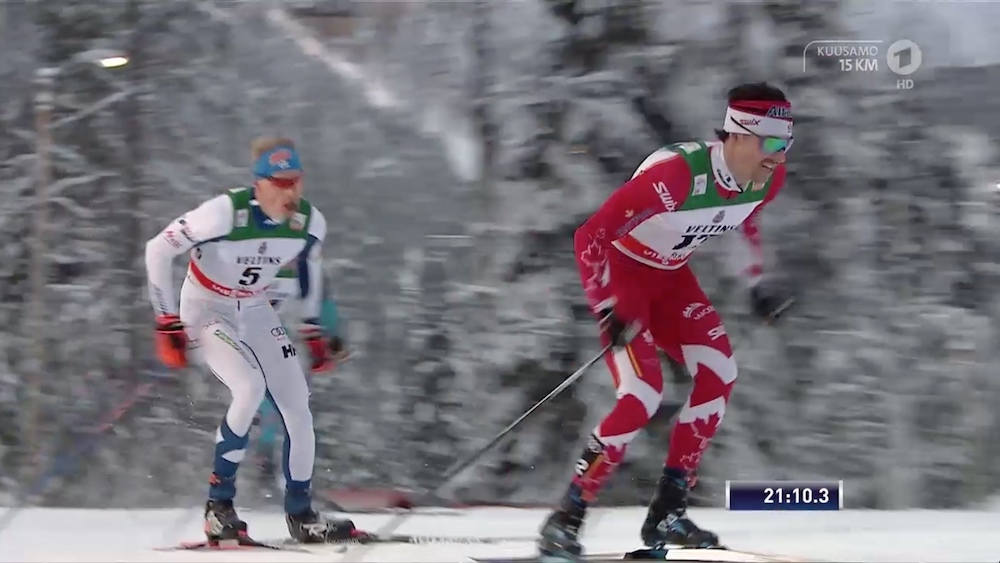
Canadian World Cup Team member Alex Harvey leads Finland’s Iivo Niskanen during the men’s 15 k freestyle pursuit on Sunday, the final day of the Ruka Triple mini tour in Kuusamo, Finland. (Screenshot: ARD)
Harvey had spent the first three laps working up to that lead group, initially with the likes of Russia’s Alexey Chervotkin (*who reportedly thanked Harvey after the race) and Sergey Ustiugov, Norway’s Hans Christer Holund and Sweden’s Marcus Hellner, and later with France’s Maurice Manificat, Sweden’s Calle Halfvarsson, Norway’s Emil Iversen, Chervotkin, and Holund, among others.
“I knew there’d be some fireworks on the last lap so I just wanted to be in the front third of the group, just be ready for a move,” Harvey explained in a post-race phone interview. “I thought Sundby would be the guy making the move, which in the end, that’s what happened. The big uphill in the last lap, that’s where he went. I just wanted to be close to Sundby and ready to respond when Sundby went.”
Sundby attacked as predicted on the second-to-last climb, around 13.6 k, and Harvey slotted behind him to follow him over the top.
“I was just actually there on that last uphill when Sundby attacked,” Babikov recalled. “Klæbo was right there. I think there were just Norwegian tactics … Sundby attacked on the last uphill and Klæbo just cooled down and wasn’t chasing him at all, so for Alex, that was his only chance. … If he didn’t chase him, then Sundby probably would have skied away and it would have been a bigger group at the finish, but at the moment he tried, and they actually created a gap … Alex second and Sundby first.”
With a few meters separating them from Norway’s Didrik Tønseth in third and Klæbo in fourth, Harvey thought he and Sundby had dropped them and that he would fight for first to the finish.
“I kind of went all-in with the Sundby move,” Harvey said. “When I looked in between my legs just before the last downhill I thought we had a big enough gap … so I was feeling pretty good about my chances there, but not good about taking [Sundby] because I was really, really dead.”
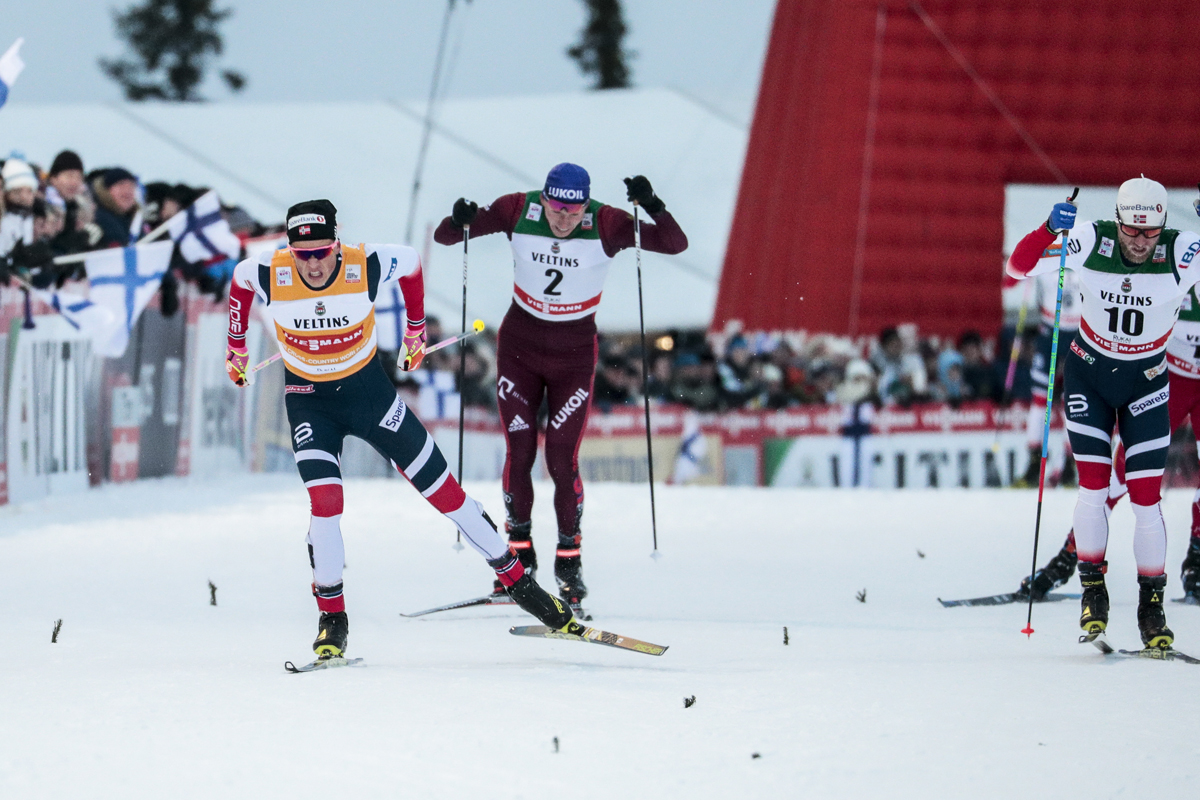
Johannes Høsflot Klæbo (l) passing fellow Norwegian World Cup Team member Martin Johnsrud Sundby (10) for the win in Sunday’s 15 k freestyle pursuit at the Ruka Triple mini tour in Kuusamo, Finland. Russia’s Alexander Bolshunov (2) was 1 second back in third place for his first World Cup podium while Canada’s Alex Harvey (behind Sundby) placed fourth. (Photo: Fischer/Nordic Focus)
After what Harvey estimated to be a 45-second downhill, he realized that wasn’t the case. Klæbo and Bolshunov had slingshot back toward the front, and while Sundby was first to the top of the last climb before the finish, Klæbo and Bolshunov were right behind him while Harvey followed in fourth.
They entered the stadium together in that order, and Klæbo passed Sundby with about 100 meters remaining to take his third-straight win of the weekend.
“Coming out of my tuck there I was just full of lactate, not feeling any fresher … then I just got passed on the hill,” Harvey recalled. “I had nothing left. That was my move. … I’m happy I made that move, but I couldn’t make a second burst after that.”
While Klæbo won the pursuit and with it, the Ruka Triple mini-tour title in 36:23.2 minutes, Sundby placed second, 0.4 seconds back, Bolshunov claimed his first World Cup podium in third (+1.0), and Harvey finished another 0.6 seconds back in fourth (+1.6).
On the day, Harvey’s course time ranked fifth fastest behind Manificat, who was the “winner of the day” in 34:50.9. Finland’s Matti Heikkinen was second fastest (+5.4) after starting 22nd and placing 14th, Holund was third fastest (+7.5) after starting 14th and finishing ninth, and Switzerland’s Dario Cologna, who started 26th and finished 17th, was fourth fastest (+8.7).
Harvey said starting 17 seconds behind Sundby was a tall task on its own, and he had started the race with a goal of breaking into the top 10 overall. All things considered, fourth place was better than he expected at this point in the season.
“… But I knew it was still within reach,” Harvey explained. “I believed in it, but I didn’t put too much hope in, let’s say, a top five or fighting for the podium. It was more like I wanted to be back in the top 10 and just that to me seemed already hard enough.”
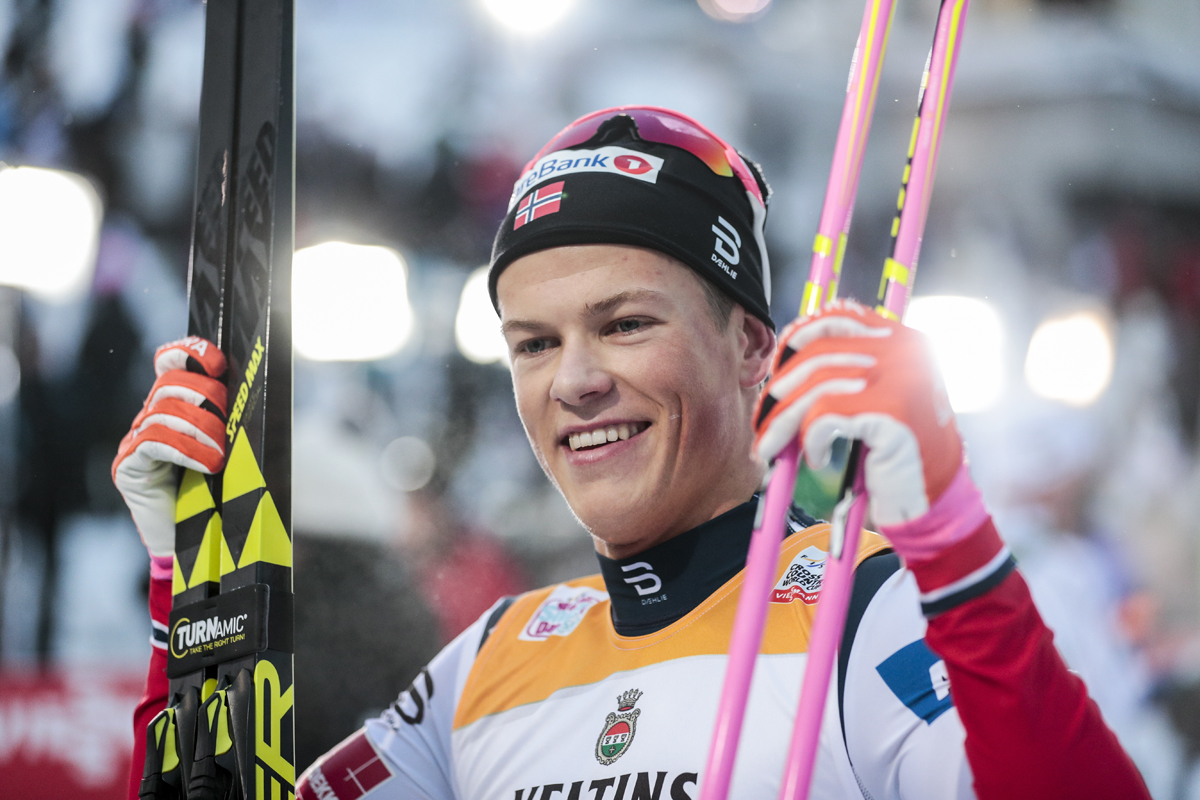
Norway’s Johannes Høsflot Klæbo after winning the 15 k freestyle pursuit on Sunday to win the Ruka Triple mini tour in Kuusamo, Finland. (Photo: Fischer/Nordic Focus)
The fact that he was able to hang with Klæbo and Sundby to the finish was a good sign, he added.
“Right now, he’s not just a good sprinter, he’s the best distance skier in the world, too,” Harvey said of Klæbo. “I mean, to win a 15 k individual you have to be in very, very good physical shape, so he’s in really good physical shape and I know I’m not yet. I’m not in my best form and Sundby probably isn’t yet, so you never know what’s going to happen later in the season at the Olympics, but for now it’s hard to drop him when he’s actually just in better shape than everybody else in the world.”
After the race, Klæbo told NRK he was relieved to get the win and have some time to rest before next weekend’s World Cup in Lillehammer, Norway.
“My legs are shaking now,” Klæbo said. “Feels incredible to be the first to cross the finish line. Now I need a few days rest.
“This was brutal,” he added. “I’m actually glad they caught up to me and luckily I had good skis. I’m glad I had a few seconds today.”
Norwegian national-team coach Tor-Arne Hetland told NRK he was “really impressed” with Klæbo. “We have a diamond in the sport of cross country skiing now,” Hetland said.
“That’s very nice of him to say. It’s probably a little too much, but it has been a good start to the season,” Klæbo responded to NRK.
Sundby spoke excitedly about having Klæbo to contest for the overall World Cup lead.
“For the moment, he’s taking international cross-country skiing for men to a whole ’nother level,” Sundby told NRK. “It is a little humiliating for the rest of us, but at the same time it’s extremely inspiring to see what he does in his second year at this level. It’s hell of fun to have a guy like that on the team.”
Bjornsen 26th, Kershaw 29th; Caldwell Posts Top-20 Time of Day
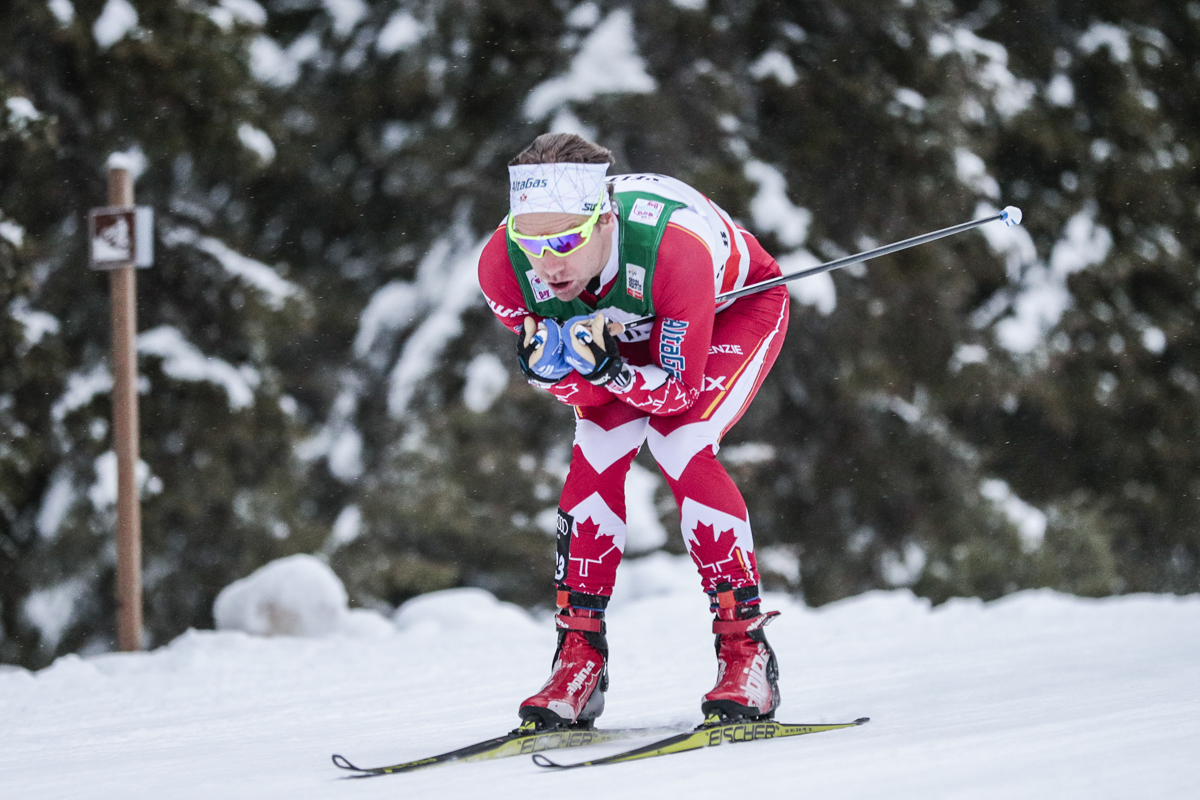
Canada had two in the top 30 on Sunday with Devon Kershaw in 29th (+1:47.8), scoring World Cup points for the second-straight day. He started 28th and 1:59 out of first, just one second behind Cologna in 26th and Russia’s Andrey Larkov in 27th.
“I just wasn’t strong enough to go with Dario,” Kershaw said on the phone. “I had the perfect chance to be able to follow Dario up the field, but he just started so fast, and on the steep terrain, my legs just — I tried up the first steep wall and at the top, I’m like, man, if I keep going like this, after 5 k I’m gonna be dead.
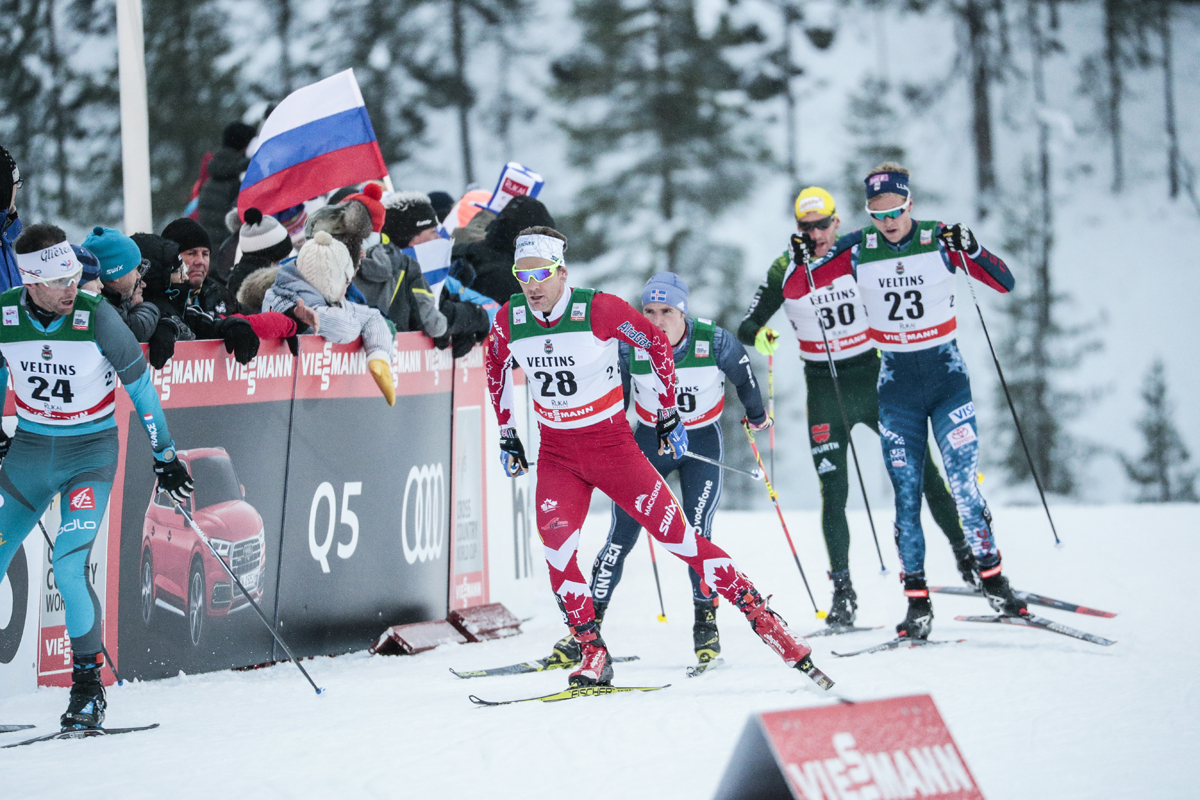
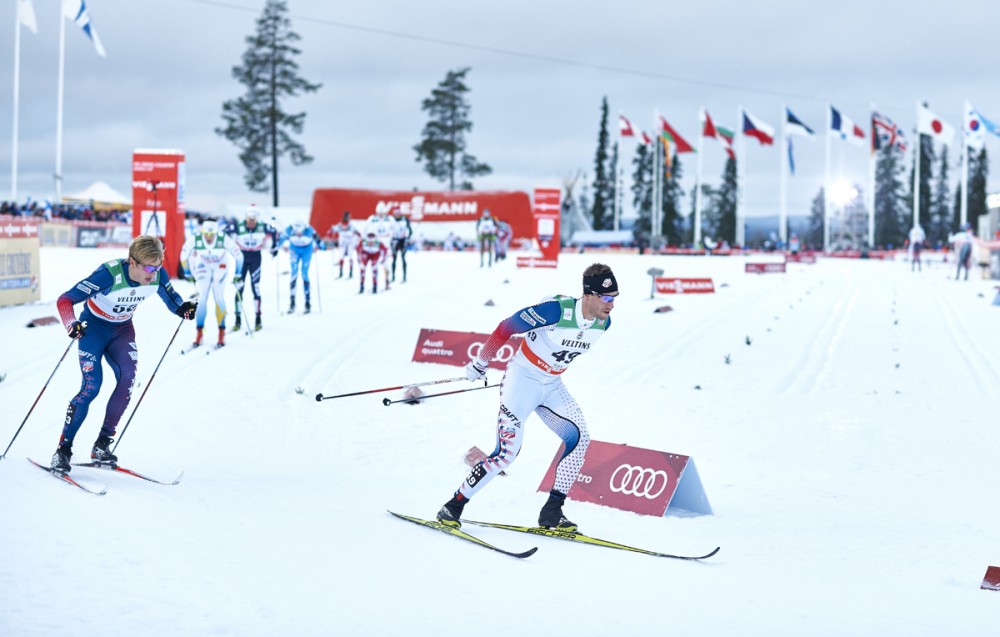
Canada’s Devon Kershaw (28) leads American Erik Bjornsen (23) and others during the World Cup men’s 15 k freestyle pursuit on Sunday in Kuusamo, Finland. (Photo: Fischer/Nordic Focus)
“So I had to manage my energy a little bit and in the end, it turned out that Bjornsen and I’s group just wasn’t strong enough,” Kershaw continued, referring to U.S. Ski Team member Erik Bjornsen, whom he started eight seconds behind and spent most of the race with. “[Our group] had a good 7 1/2 k and then after that, between 7 1/2 kilometers and 12 k, we were skiing really slow. So that’s a bit frustrating in a pursuit because you’re just stuck there in no-man’s land.”
While he felt like he was skiing the flats well, Kershaw said he struggled with the “biting” conditions, which seemed to limit glide, especially on the notoriously steep course’s climbs.
“I had to make the choice to be like, OK, I’ve got to just stay in this group and I’m not strong enough to drive the bus, because my legs just weren’t there today on the terrain” he said. “In the end I made a tactical error in the last 600 meters. I should’ve followed Bjornsen on the outside and I went on the inside and was hoping it would open up for me and it didn’t. So I ended up 29th, but that’s OK.”
Bjornsen started 24th and finished the pursuit in 26th (+1:43.6), after following Larkov in 25th (+1:42.8) across the line and holding off Iceland’s Snorri Einarsson (a former Norwegian skier who raced for the University of Utah) in 27th (+1:46.2), Great Britain’s Andrew Musgrave in 28th (+1:47.2), Kershaw in 29th, and France’s Jean-Marc Gaillard in 30th (+1:49.2).
“I started right around Cologna and [Finland’s Matti] Heikkinen but there was no way I was going to hold their pace, they were flying,” Bjornsen wrote in an email. “I had to settle in with the group around me. It soon became clear our group was not going to catch anyone in front of us or get caught, so it became a tactical game. Some surges, but for the most part nobody wanted to lead.”
Devon Kershaw (Canadian World Cup Team) en route to 29th in the 15 k freestyle pursuit on the last day of the Ruka Triple World Cup mini tour in Kuusamo, Finland. (Photo: Fischer/Nordic Focus)
Kershaw laughed when he talked about some “tips” he gave Bjornsen during the race.
“He had really fast skis so there were a few times that he came by me on the downhill and then would kind of try to hammer for a minute and then get tired and slow down again,” Kershaw said. “I told him, like, ‘Dude, you’ve got great skis. Unless you can stay in the front and really press, then it’s better just to play the game and wait for the end.’ After that, he did that and he torched us all in the end. So that was kind of fun to see for him.”
According to Bjornsen, Kershaw suggested he sit back and wait for the sprint.
“My skis were good but I think my weight is what helped me the most on that last huge downhill,” Bjornsen wrote. “I was fine going for that tactic but at the same time it would have been nice to leave a little more out there today. Stoked to get double points for 26th though!”
Paddy Caldwell (U.S. Ski Team) racing to 70th in the men’s 15 k classic on Saturday, Day of the Ruka Triple World Cup mini tour in Kuusamo, Finland. In Sunday’s 15 k freestyle pursuit, he skied up to 51st with the 19th-fastest time of day. (Photo: Fischer/Nordic Focus)
Paddy Caldwell, new to the U.S. Ski Team B-team this year, posted his best World Cup result with the 19th-fastest time of day, 50.5 seconds back from Manificat. He started with the wave in 70th and finished 51st overall (+3:03.1).
“Going into the race my goal was to move up as much as possible,” the 23-year-old Caldwell wrote in an email. “I wasn’t really thinking about place or time of day – I was just trying to ski fast and put together a good effort.
“It was really hard to move up in the pack,” he added. “I started midway back in the wave and we kept picking up more and more skiers as the race went on. I tried to relax as much as possible on the hills and build in energy to pass where I could on the flats. … I am really excited with the day and psyched to have had a good result here in Ruka. I’m looking forward to the rest of period 1 and learning more from the big dogs!”
“Very exciting race out of Erik today,” U.S. Ski Team coach Matt Whitcomb commented on the phone. “… When he settled to the back of his pack on Lap 6 and headed into the downhill with one climb to go, we just all sort of expressed confidence over the U.S. radio channel, got ready see what he could do. It is so fun to watch him in a stadium when he has to go head to head against five other athletes … he did not disappoint today. Really proud of Erik’s 26th place.”
As for Caldwell, who skied the 25th fastest time of day in the 2017 World Cup Finals freestyle pursuit, Whitcomb said, “this is his race, the skate distance.”
“There were times that he was a little bit road-blocked out there, just the way the pursuit race unfolds in that start … and it looked like today Paddy could keep going, so really great signs out of him,” Whitcomb said.
Whitcomb also highlighted the races of Scott Patterson, who raced up from 78th to 55th (+3:28.4) with the 31st-fastest time, and Noah Hoffman, who improved from 45th to 39th (+2.33.3) with the 35th-fastest time. Also for the U.S., Andy Newell finished the tour out in 75th (+5:39.6).
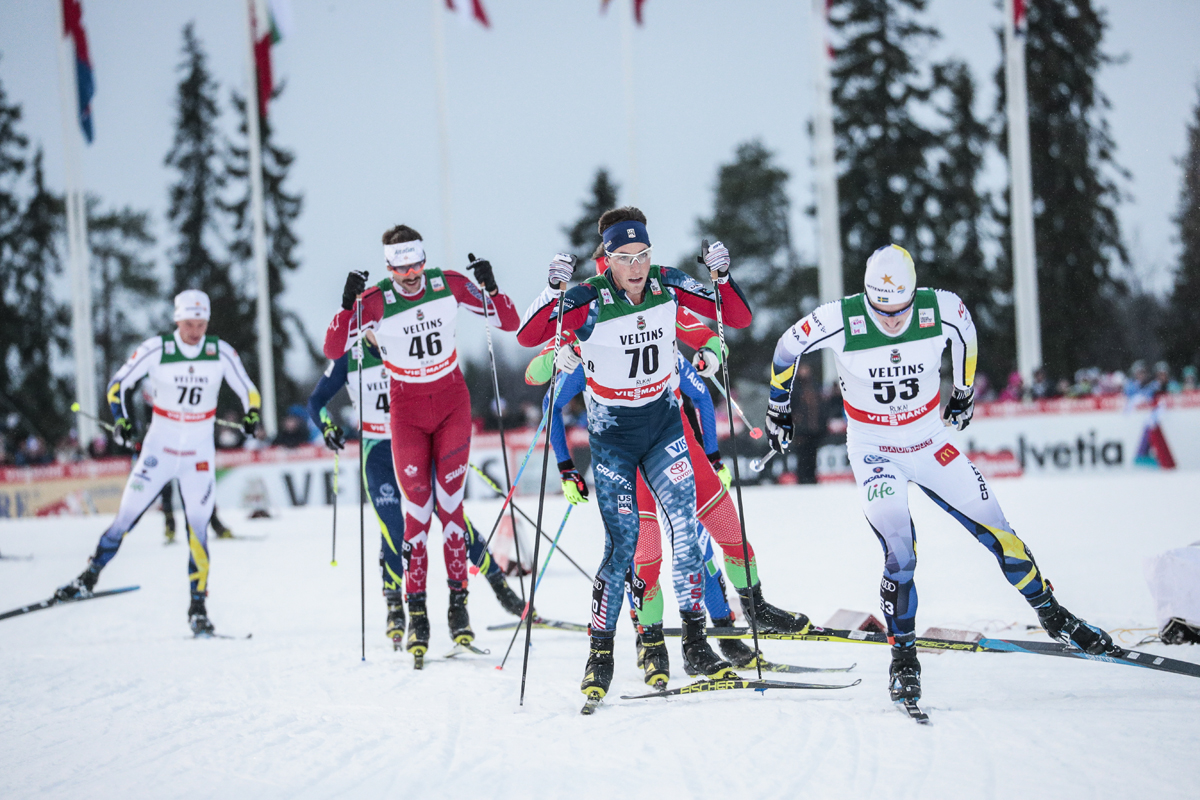
American Paddy Caldwell (70) racing with Sweden’s Jens Burman (front) and Canada’s Len Valjas (46), among others, during Sunday’s World Cup 15 k freestyle pursuit on the last day of the Ruka Triple in Kuusamo, Finland. (Photo: Fischer/Nordic Focus)
Canada’s Len Valjas moved up two places for 44th overall (+2:47.5), Graeme Killick finished the tour in 68th (+4:39.5), Knute Johnsgaard 81st (+6:43.6), and Julien Locke 83rd (+7:33.6).
Babikov pointed out that Valjas had a shoulder injury that he mostly recovered from, but caused him to struggle with double poling in Friday’s sprint. Despite placing 63rd in that sprint, Valjas was the team’s third-best man in the weekend’s distance races.
“[In] two distance races, he was third best and actually placed higher than he placed in sprint in the distance, 15 k, hardest one with lots of climbing,” Babikov said. “So that shows he has a good shape, but just needs to scrape that rust off and remember how to go fast again. I think physically he is in a good place, just need to do some more races, and it will come.”
***
*Post-race sidenote: According to Harvey, after the race, the Russian team’s massage therapist told Canadian coach Ivan Babikov that Chervotkin wanted to thank Harvey for pulling him in the pursuit. Chervotkin, 22, started 11th and finished fifth, 6.2 seconds out of first and 4.6 seconds after Harvey in fourth.
“There’s a bit of beef with the Russians and me right now,” Harvey said. “I came in wondering if they were just going to punch me in the face. They said they wanted to break my teeth, so this is a good turn of things.”
“I read that in the Norwegian news, actually, that Petukhov wanted to …,” he said with a laugh. “But I knew the media likes that sort of thing. But I think things are good now.”
Harvey noted that Bolshunov and Chervotkin, neither of which have been implicated in the doping scandal, are part of “a new generation” in Russian cross-country skiing. “I saw the results in Bruksvallarna; it looks like the have almost as much depth as Norway does. They’re really strong.”
— Aleks Tangen, Ian Tovell, Jason Albert, and Harald Zimmer contributed
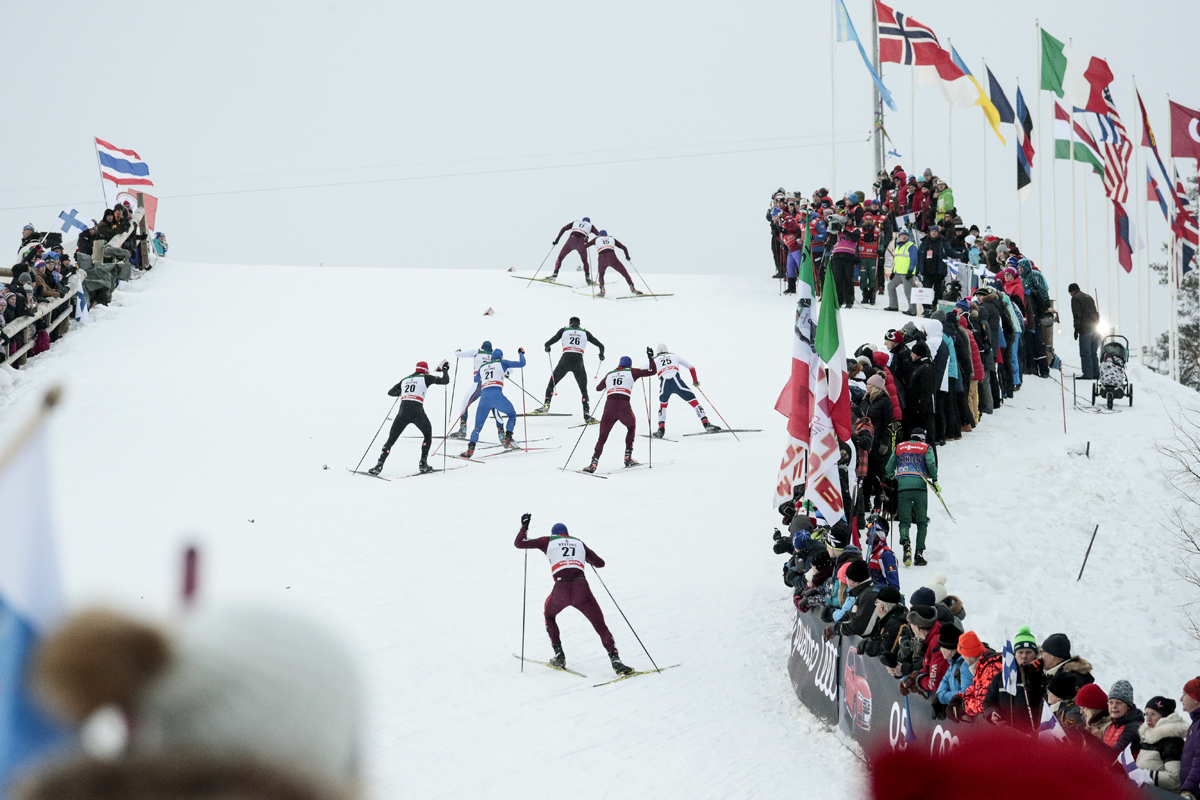
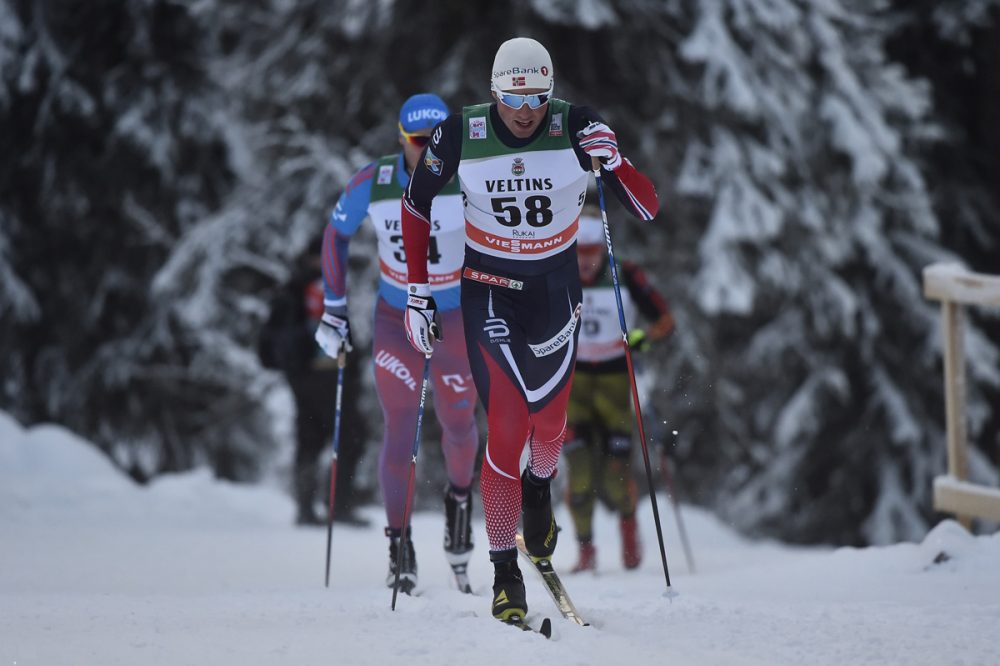
Racers in the Ruka Triple World Cup 15 k freestyle pursuit, including Russia’s Andrey Larkov, Switzerland’s Jonas Baumann, Italy’s Federico Pellegrino, Switzerland’s Dario Cologna, and Norway’s Simen Hegstad Krueger, ascend a climb in Kuusamo, Finland. (Photo: Fischer/Nordic Focus)
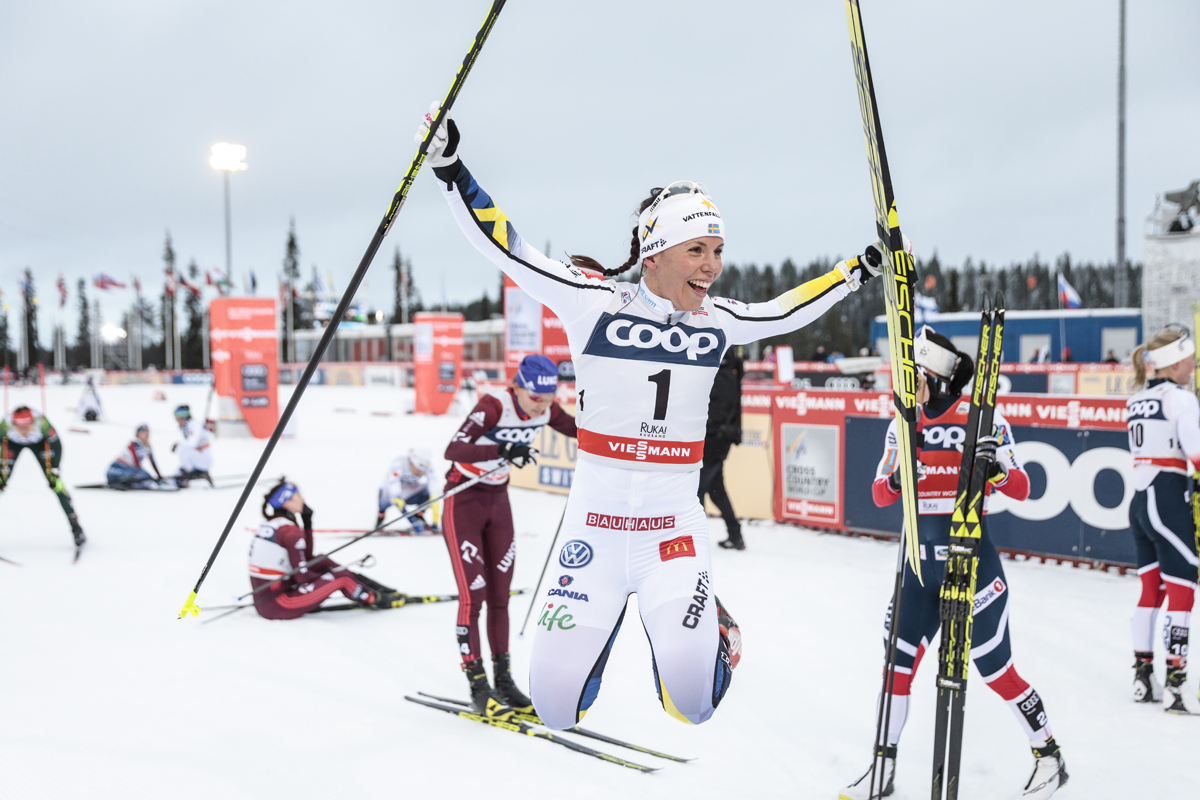
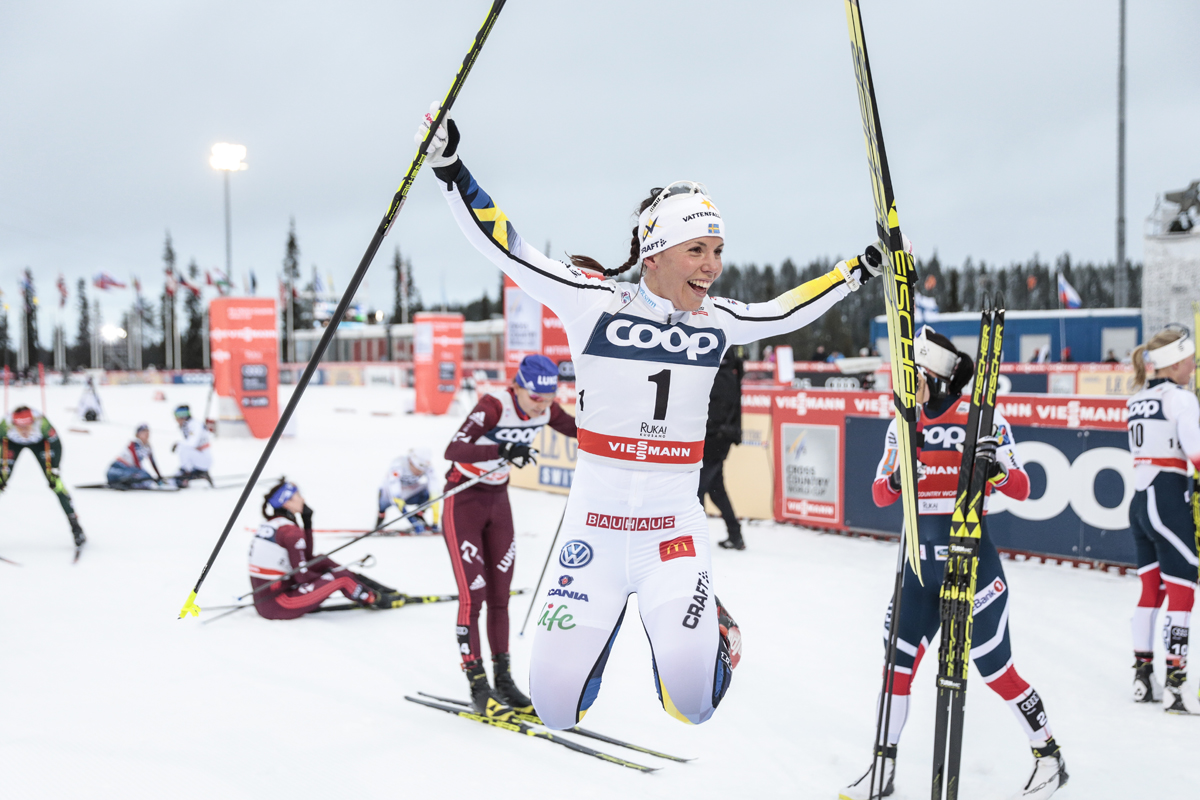
Sweden’s Charlotte Kalla jumps for joy after winning Sunday’s 10 k freestyle pursuit and overall Ruka Triple title at the World Cup opener in Kuusamo, Finland. She started 2 seconds ahead of Norway’s Marit Bjørgen (second from right) and held her off by 9.7 seconds for the win. (Photo: Fischer/Nordic Focus)
After two days of racing in Kuusamo, Finland, the Ruka Triple turned its last page on Sunday. As it turned out, the women’s 10-kilometer freestyle pursuit was a thriller.
Sweden’s Charlotte Kalla came into the final day of the mini tour wearing bib 1 and with only a 2-second lead on the last person one might want skiing on their tails, Norway’s Marit Bjørgen.
The gamesmanship, the change of pace, skiing’s version of the dodge and parry became a two-skier affair between Kalla, 30, and Bjørgen, 37. Yet, followers of the sport know Bjørgen’s end-game: push the pace, determine who can match the pace, then seemingly flip a switch and steamroll ahead solo.
The Swedish-Norwegian pairing performed an endurance duet that kept the packs of chasing skiers at bay. Sweden’s Stina Nilsson started the pursuit 12 seconds back in third, Norway’s resurgent Ingvild Flugstad Østberg 20 seconds back in fourth, and Russia’s Natalia Nepryaeva 23 seconds back in fifth. Norwegians Heidi Weng and Ragnhild Haga began 41 and 42 seconds back, respectively. None could gap up.
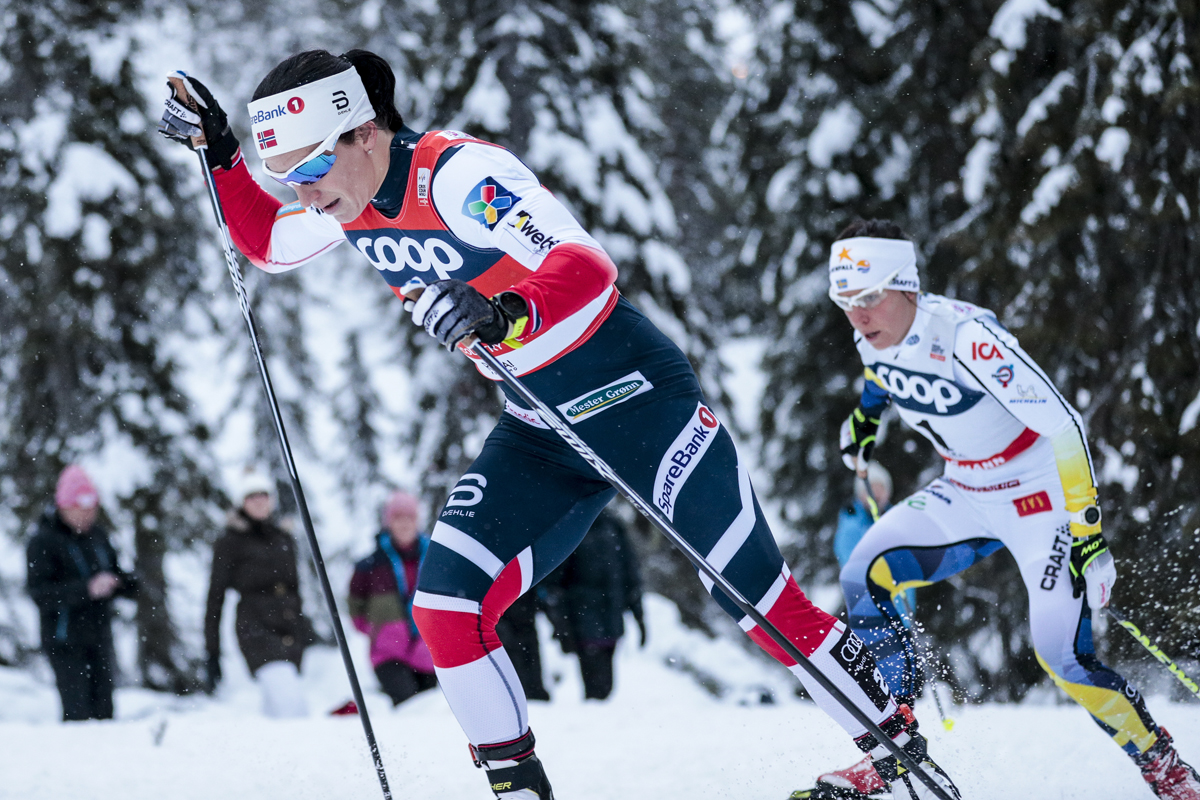
Norway’s Marit Bjørgen leads Sweden’s Charlotte Kalla during the women’s 10 k freestyle pursuit on Sunday at the Ruka Triple World Cup in Kuusamo, Finland. (Photo: Fischer/Nordic Focus)
Kalla and Bjørgen never blinked. They gradually pulled away from the chasers.
“My plan was to ski quite fast together with Marit, and not bring the ones behind us into the game,” Kalla told FasterSkier in a post-race phone interview. “Because I know that Stina is a really good sprinter, so me and Marit had to work together to keep the gap to the others.”
Heading back out into the woods on the final lap of the 2.5 k course, Kalla punched it. She accelerated the pace to what looked like a sprint, and Bjørgen initially stayed right on her tails.
How sustainable was this pace? And would it be possible to pop the Norwegian, who had won Saturday’s race over Kalla by 17 seconds? In the previous 10 k classic, Kalla had matched Bjørgen’s times until the last 1 1/2 kilometers or so, when the punishing pace took its toll and she began hemorrhaging time.
That was on her mind as Kalla kept up her furious pace.
“Well, yesterday I didn’t truly have the belief that I could ski [away] from Marit, because she did have a great performance yesterday in the classic part, especially on the last lap,” Kalla reflected. “So when I decided to speed up I also knew that I cannot look back. I had to give it a real try and just focus in front of me all the time. I could not take a look behind my back because you have to work for a long long time, and today I succeeded.”
With the difference in the two women’s skating techniques, Kalla appeared to be expending more energy, but gradually put a gap on Bjørgen – one ski length, two — easily an amount that could be closed on a downhill. It would have been easy to back off and slow down, but Kalla kept pushing and the gap grew to three seconds, four, five, six.
Bjørgen didn’t respond.
Kalla came flying into the final hill up to the stadium, the one where she had slowed so dramatically the day before, but didn’t lose any of her advantage this time around.
“I was just telling myself to look up to the top, trying to push with your legs all the way,” Kalla said of her decisive move. “In the last sprint hill, before we came up to the stadium, I was thinking, ‘Left, left, left, left… one, two, three, four, five,’ just to be able to think of something else than the pain.”
Kalla skied the turn into the finishing stretch with a clear margin and raised her hands at the finish line as she crossed in 25:50.1 minutes, 9.7 seconds before Bjørgen. She congratulated her rival before jumping in the air and shouting with joy.
“It was an amazing day today,” Kalla said. “I felt very strong during the race. Just tried to ski my very best, and saved as much energy as possible during the first three laps. My dream yesterday, when I went to bed, was to be able to push very hard when we [would go] out on the last lap. And I was a little bit nervous but decided to follow my tactic. When I was on the top of the hill my coach yelled at me that I had six seconds [lead on Bjørgen]. So I had very tired legs, but I knew that I had to fight and do my very very best until the finish line.”
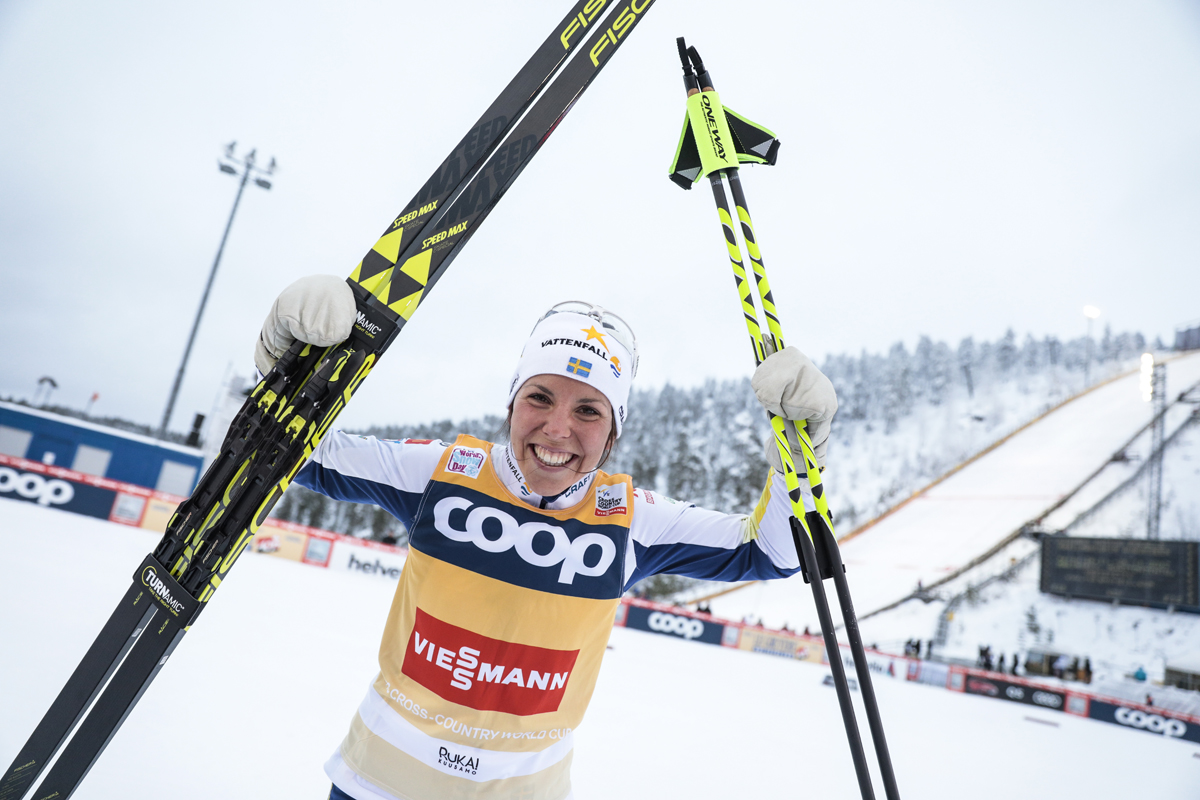
Sweden’s Charlotte Kalla in the overall World Cup leader’s bib after starting the season with a Ruka Triple mini-tour win in Kuusamo, Finland. (Photo: Fischer/Nordic Focus)
The last time Kalla won a World Cup was in 2015 when she won the 10 k skate in Östersund, Sweden, before winning the same event at the 2015 World Championships at home in Falun, Sweden.
“It was a long time since I won a race the last time,” Kalla noted. “And I think it was 2008 when I won a mini tour, and that was the Tour de Ski, actually. So I have been waiting for this day, and I’m very happy today.”
Also of note is that last year’s Ruka World Cup event Kalla suffered from a heart ailment and had to reduce to a slow-tempo ski to finish the race. One year later, she said that wasn’t on her mind.
“No, I have not been thinking about that myself,” Kalla said of her health scare last year. “But all journalists I have met remembered what happened to me last year. So it’s like night and day to think about and look back to one year ago. It’s something totally different.”
After Bjørgen, Norway took third through fifth places. Haga skied to third (+33.9) and posted the fastest time of day, skiing the course in 25:41.8 as she leapfrogged from 10th place at the start to finish on the podium. Weng finished fourth (+38.0), and Østberg fifth (+40.2).
U.S. Women Continue to Thrive
At the start of the Ruka Triple on Friday, to paraphrase a certain former U.S. Defense Secretary, there were many “known unknowns” for the U.S. Ski Team (USST) in Finland. The answers three days later are clear. Sadie Bjornsen’s (USST) second place and Sophie Caldwell’s eighth place in Friday’s classic sprint set the tone. According to U.S. women’s coach Matt Whitcomb, both Bjornsen and Caldwell have met the objective criteria for the upcoming Winter Olympics in PyeongChang, South Korea. (That criteria, as applied to Bjornsen and Caldwell, was a top eight in a World Cup classic sprint.)
Four other USST women skied into the points on Sunday. Previously, Jessie Diggins placed 10th in Saturday’s 10 k classic individual start. Ida Sargent placed 15th in the sprint and began Sunday’s final stage in 23rd, based on her 10 k classic result. Rosie Brennan popped two top 30’s in the first two stages. Kikkan Randall, who had two off days in the classic sprint and 10 k classic, stormed back for Sunday’s skate pursuit. Randall began the day in bib 48 and finished the mini tour in 25th place, skiing the eighth-fastest time of the day.
Kikkan Randall (U.S. Ski Team) racing from 48th up to 25th (with the eighth-fastest course time) in Sunday’s 10 k freestyle pursuit at the Ruka World Cup in Kuusamo, Finland. (Photo: Fischer/Nordic Focus)
“She looked really strong and in control,” Whitcomb said on the phone about Randall. “She was making kills right from the start. It’s what we have seen out of her in this exact event before with actually with a very similar split several years ago, when we had the skate on the final day. It’s nice that she can leave this weekend with some confidence. She struggled with skis for the first two days of this tour and was skiing frustrated today, and she knows she has fitness, we know she has fitness, and we are really happy she was able to show it today.”
Randall confirmed that Sunday’s effort was a more indicative performance.
“Today was a much better gauge of where my fitness actually is,” Randall emailed. “After two frustrating classic days where the wax was a big factor, it was nice to just be able to go today and use what I have … Today felt the best out of the 3 races. I felt like my body wanted to go hard and I could find good power out there. I felt decent in the two classic races but felt like I couldn’t ski with my full shape because of wax and some technical struggles. So it was nice to know my shape is there.”
Bjornsen was the U.S. women’s top finisher after three days of racing in Ruka. She began the day as the 11th starter and improved to 10th overall by the finish, 1:18 behind Kalla.
“This is where we expect to see Sadie when things are going well,” Whitcomb said of Bjornsen’s performance. “But for things to go well, a lot has to stack up for any athlete, particularly for the beginning of the season, when you are traveling all the way from Alaska. It is pretty remarkable how resilient she is, how strong she has become, and how she can just rise above so many of her European competitors, who have been on snow in this time zone or one hour earlier for the last three or four weeks. She has gone halfway around the world and shown it is not so hard, so we are so impressed with Sadie’s ability to ski the way she this weekend.”
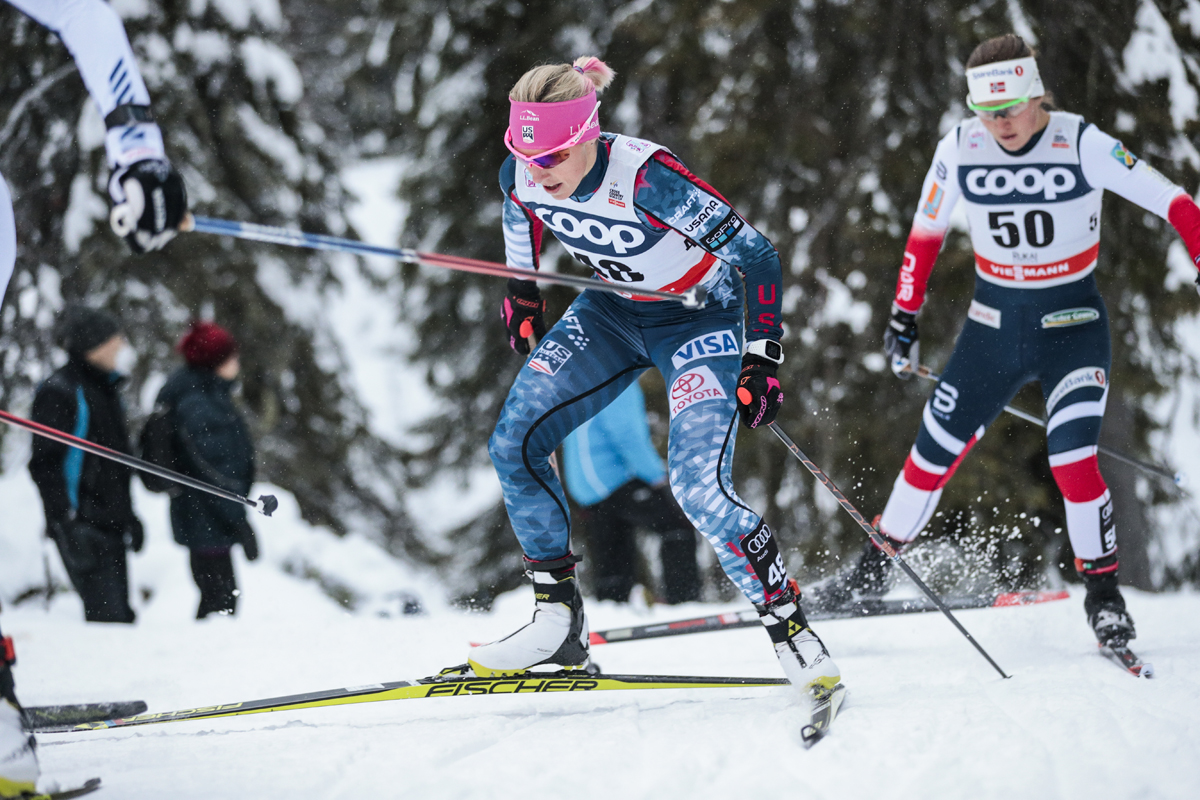
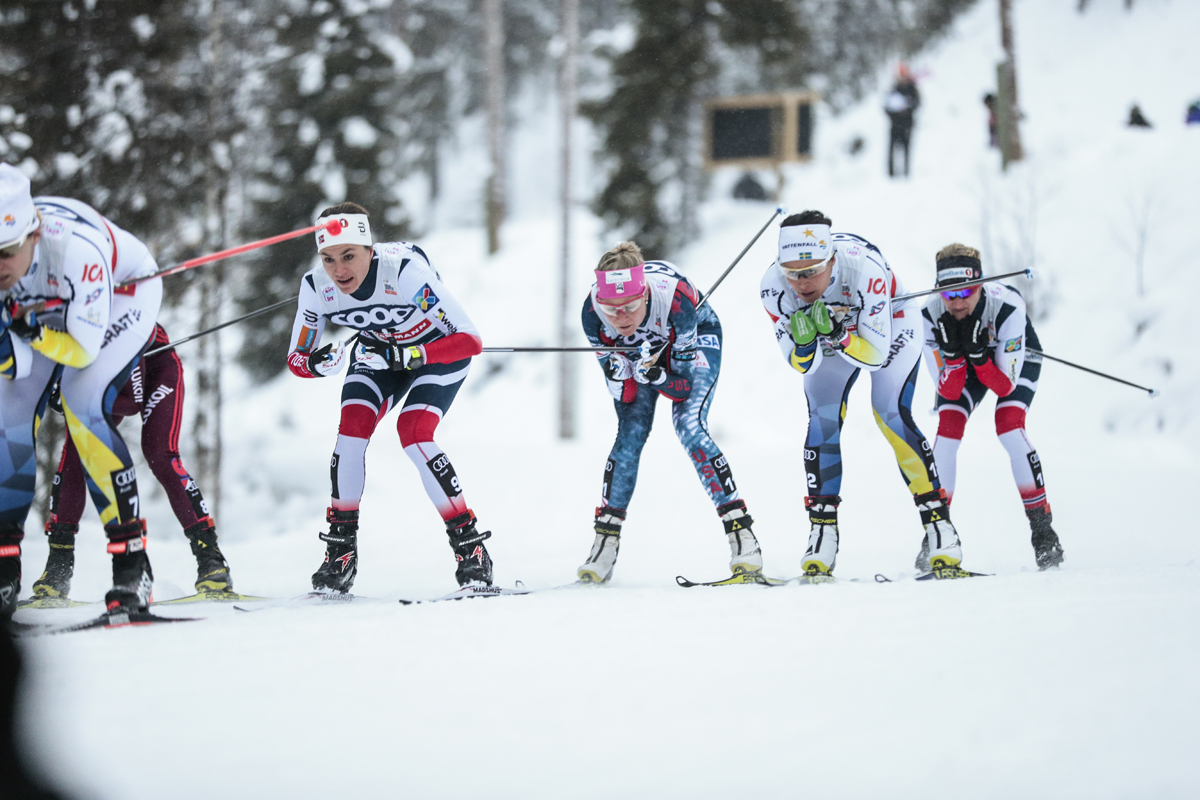
Norway’s Heidi Weng (third from left) skiing in a pack with American Sadie Bjornsen (pink headband), Sweden’s Anna Haag (second from r) and Norway’s Kathrine Rolsted Harsem (r) during the 10 k freestyle pursuit on the last day of the Ruka Triple World Cup mini tour in Kuusamo, Finland. (Photo: Fischer/Nordic Focus)
Bjornsen arrived in Europe for the start of the season on Nov. 8.
Out the on course, Whitcomb awaited his skiers atop the course’s big climb at approximately 1.2 k on the 2.5 k loop. There, Whitcomb said he witnessed Bjornsen put her personal stamp on the race’s outcome.
“Sadie had this moment in the race today where she was starting to dangle a little bit of her pack as the pace turned up between laps 2 and 3, and at the hardest part of the course she was forced to make a decision whether or not to hang,” Whitcomb recalled. “And if she just made this move for another minute or two she would be able to ski with them and their draft another three-fourths of a kilometer and pull her that much closer to the finish line and protect her that much more from the packs from behind. That decision today, I think, kept Sadie in the top 10 and that is the kind of racer she is.”
The first skate race of the year was welcomed by Bjornsen.
“Today was another fun, and tough day of racing here to complete the tour,” Bjornsen emailed. “It was nice to have skate skis under my feet after two really challenging classic days! Ruka is what I consider one of the toughest race courses on the circuit. It is just wall after wall (steep climb after steep climb), and you never seem to get a break. Today, it was my goal to catch the group in front of me, and then just hang on for dear life. I woke up feeling good, and recovered after the past two days, so I was feeling excited to see what I can do in skate skiing. I feel like I dug deeper than I have in a long time, and was really satisfied when I finally got to the finish line. I now look forward to a few days of rest before another great weekend of racing in Lillehammer.”
Diggins started the day in 16th and moved up to finish 12th overall. She also skied the 10th fastest time of day.
“A very solid day out of Jessie,” Whitcomb said. “She is perhaps most disappointed on the classic sprint [on Friday]. It was two years ago when we weren’t sure if classic sprinting would ever be in the cards for Jessie and then she is within striking distance of the podium on certain days. I am sure she has left wanting more from that classic sprint, and I am sure we will see her make the rounds and advance through the heats very soon, but to have 10th yesterday, and I believe the 10th-fastest split today on an extremely hard course, that is a great sign.”
For Diggins, who finished last season ranked sixth overall on the World Cup, the three-race weekend was a spark, reminding her body and mind of the racing routine.
“I always work into the season and was carrying a pretty high load of training into the last week, so overall I’m really happy with how the season opener went!” Diggins emailed to FasterSkier. “It was nice to finally race again and get my racing feet under me — and remember how all the testing and warming up works!”
Whitcomb also added some perspective on Diggins and whether her past results place any added undue pressure on her to perform.
“I think Jessie has matured quite a bit as far as that goes, and I think she can be more about the process, and really focus on what she really needs to do on the race each day and during a particular point on the course,” Whitcomb said. “As every k ticks by, rather than focusing on, ‘I must be fifth,’ if she is in 14th, she is going to do everything she can do be 13th and when she does that she will set her next goal. She is very goal-orientated but she is realistic. Yeah, she loves to win; she is focused on things that are in her control.”
Brennan placed 28th overall this weekend, after finishing in a photo finish with Germany’s Sandra Ringwald (in which Ringwald took 27th by 0.1 seconds).
“I am satisfied with the weekend,” Brennan wrote in an email to FasterSkier. “Kuusamo is always a tricky place for me so I am happy to come away with some strong results. I didn’t have any result expectations as it’s the first races of the year and the fields can vary. I feel I have accomplished many of my other goals in my technique and approach so I am satisfied with that … It always helps to have some strong results in the beginning. It gives me confidence in my fitness and some of the skills have been working on over the summer. I have to say, I would have expected the 10k classic to be my strongest so I think some of the work on my weaknesses is paying off and that I am happy about!”
Sargent left Ruka in 38th overall and comes away with renewed confidence. Known as a sprinter, her top 30 on Saturday bodes well for the Craftsbury, Vermont-based skier.
“I am satisfied with the weekend and mostly excited to start the season,” Sargent wrote to FasterSkier. “Yesterday was an awesome day for me so it’s cool to have a distance race carrying my weekend for me. Overall I think it was a great weekend for the team and we are just getting rolling!”
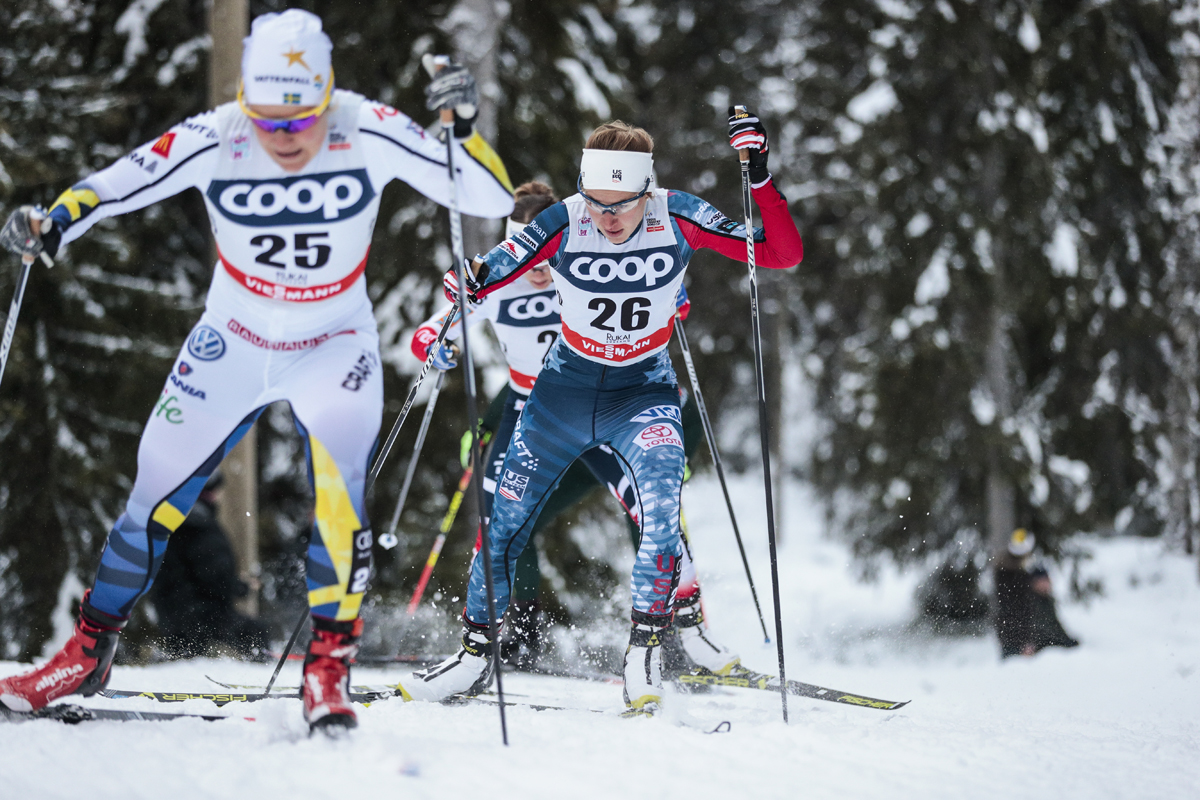
Sophie Caldwell (26), of the U.S. Ski Team, chasing Sweden’s Hanna Falk (25) in the women’s 10 k freestyle pursuit on the last day of the Ruka Triple World Cup mini tour in Kuusamo, Finland. She finished 39th overall. (Photo: Fischer/Nordic Focus)
After qualifying for the Olympics in her first race of the season, Caldwell finished one spot behind Sargent in 39th. Liz Stephen (USST) placed 56th overall, Chelsea Holmes (Alaska Pacific University) 60th, while Julia Kern (USST-D-Team) in her first European World Cup weekend was 71st.
Canada started three skiers in the women’s races. Emily Nishikawa (Canadian World Cup Team) led them in 69th overall, Cendrine Browne (National U25 Team) followed in 72nd, and Dahria Beatty (Canadian World Cup Team) placed 79th.
World Cup racing resumes in Lillehammer, Norway, next Saturday with a classic sprint.
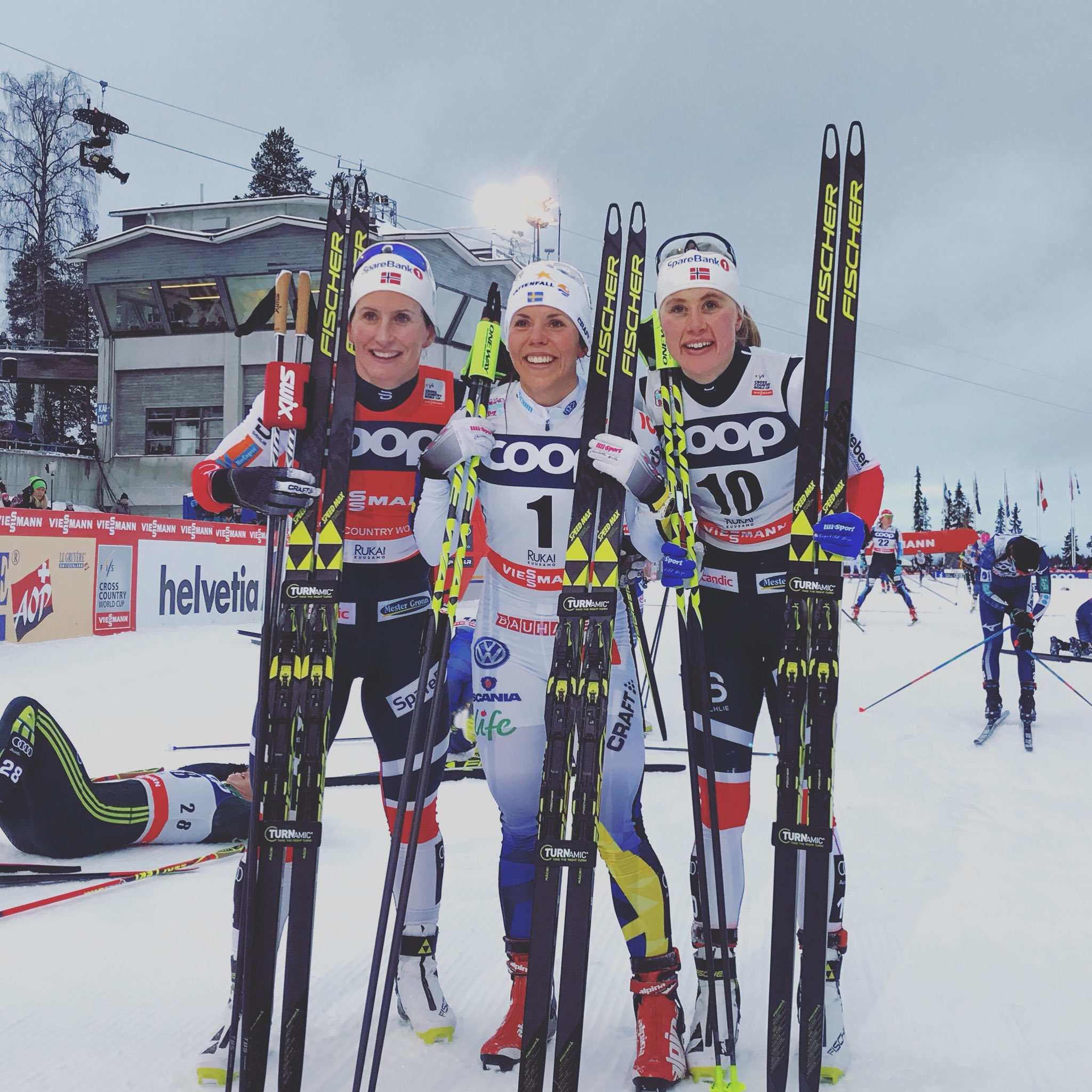
Sweden’s Charlotte Kalla (c) after winning the 2017 Ruka Triple and her first World Cup race since 2015. She won Sunday’s World Cup 10 k freestyle pursuit by 9 seconds over Norway’s Marit Bjørgen (l) and was nearly 34 seconds ahead of Norway’s Ragnhild Haga (r), who placed third. (Photo: FIS Cross Country/Twitter)
FIS Cross Country World Cup (Kuusamo, Finland): 10/15 k freestyle pursuit
Sweden’s Charlotte Kalla took down the fiercest contender women’s cross-country skiing has ever seen, challenging Norway’s Marit Bjørgen on the final lap of the women’s 10-kilometer freestyle pursuit on Sunday then successfully holding her off to the finish.
Kalla entered the final day of the three-day Ruka Triple mini tour with a 2-second lead on Bjørgen out of the pursuit start. Bjørgen quickly caught her and led for much of the four-lap race — until the last lap. The two skied alone, at least 30 seconds ahead of their nearest chasers, with three other Norwegians, Ragnhild Haga, Ingvild Flugstad Østberg and Heidi Weng leading Austria’s Teresa Stadlober and Sweden’s Stina Nilsson at 8.6 k.
Before that marker, Kalla had already launched her attack and was 6 seconds ahead of Bjørgen with 1.4 k to go. The Swede continued to push the pace and extended her buffer to Bjørgen, entering the stadium alone and winning by 9.7 seconds. For Kalla, a 2015 World Champion in the 10 k freestyle, it was her first World Cup win since 2015.
Bjørgen took second and Haga outlasted her teammates for third place (+33.9). Weng finished fourth (+38.0) and Østberg fifth (+40.2), then Stadlober in sixth (+41.0) and Nilsson in seventh (+46.7). Russia’s Natalia Nepryaeva led in the next chase group for eighth place (+1:01.6), followed by Sweden’s Ida Ingemarsdotter in ninth (+1:10.1) and American Sadie Bjornsen in 10th (+1:18.0). Another U.S. Ski Team (USST) member Jessie Diggins was close behind in 12th (+1:35.7), about five seconds behind Norway’s Kathrine Rolsted Harsem in 11th (+1:30.3).
The USST had four in the top 30, with Kikkan Randall rising from 48th at the start to 25th (+2:41.1) and Rosie Brennan improving from 34th to 28th (+2:43.2).
While Haga’s time was the fastest of the day in 25:41.8 (compared to Kalla’s finishing time of 25:50.1, which was third-fastest of the day behind Weng in second), Randall’s time was eighth fastest, Diggins was 10th fastest and Bjornsen 11th fastest of 79 in the last women’s race of the opening World Cup weekend.
Also for the U.S., Ida Sargent finished out the tour in 38th, Sophie Caldwell was 39th, Liz Stephen 56th, Chelsea Holmes 60th, and Julia Kern 73rd.
Canada’s Emily Nishikawa placed 69th overall and Cendrine Browne moved up two places to finish 72nd, while Dahria Beatty was lapped.
Klæbo Sweeps Opening Weekend
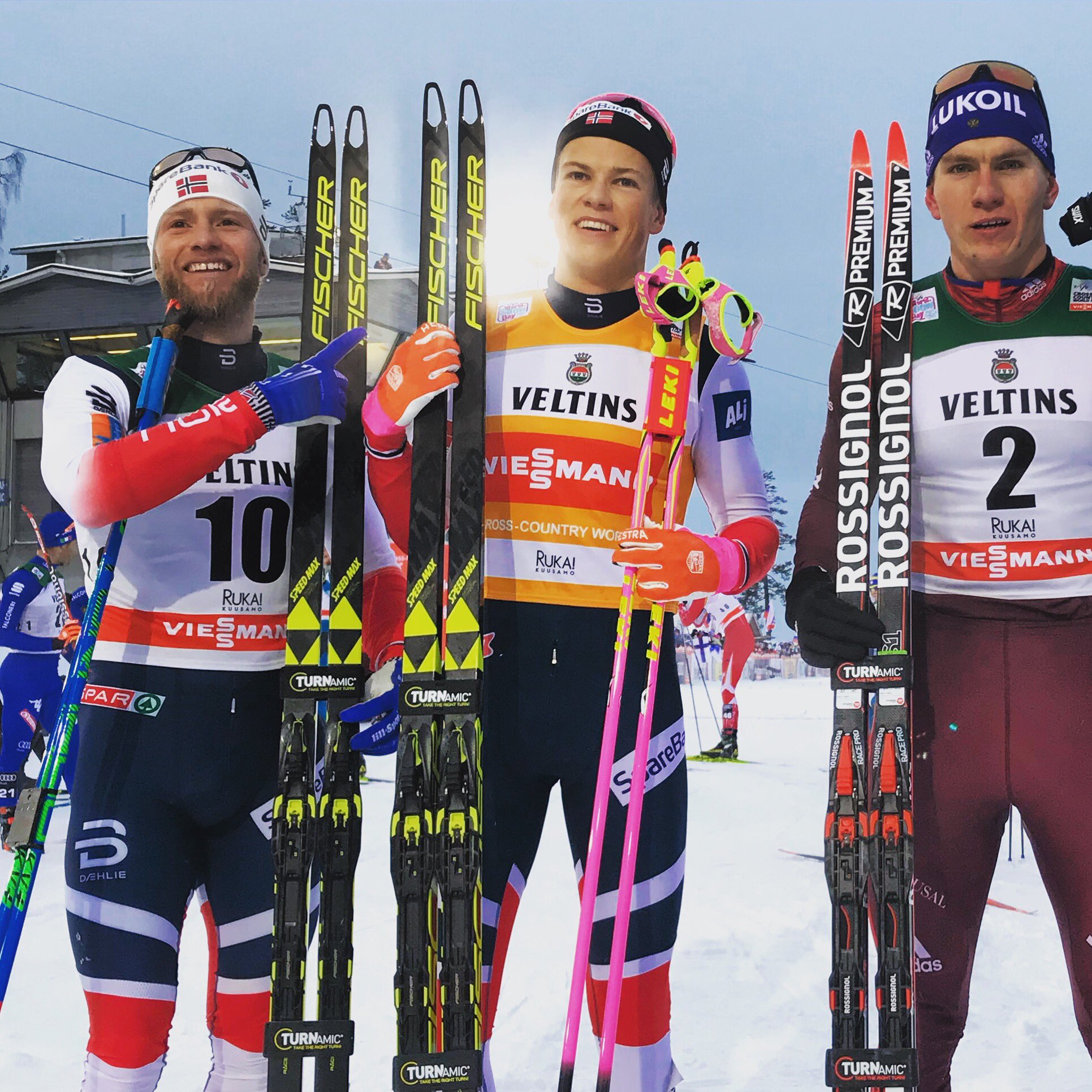
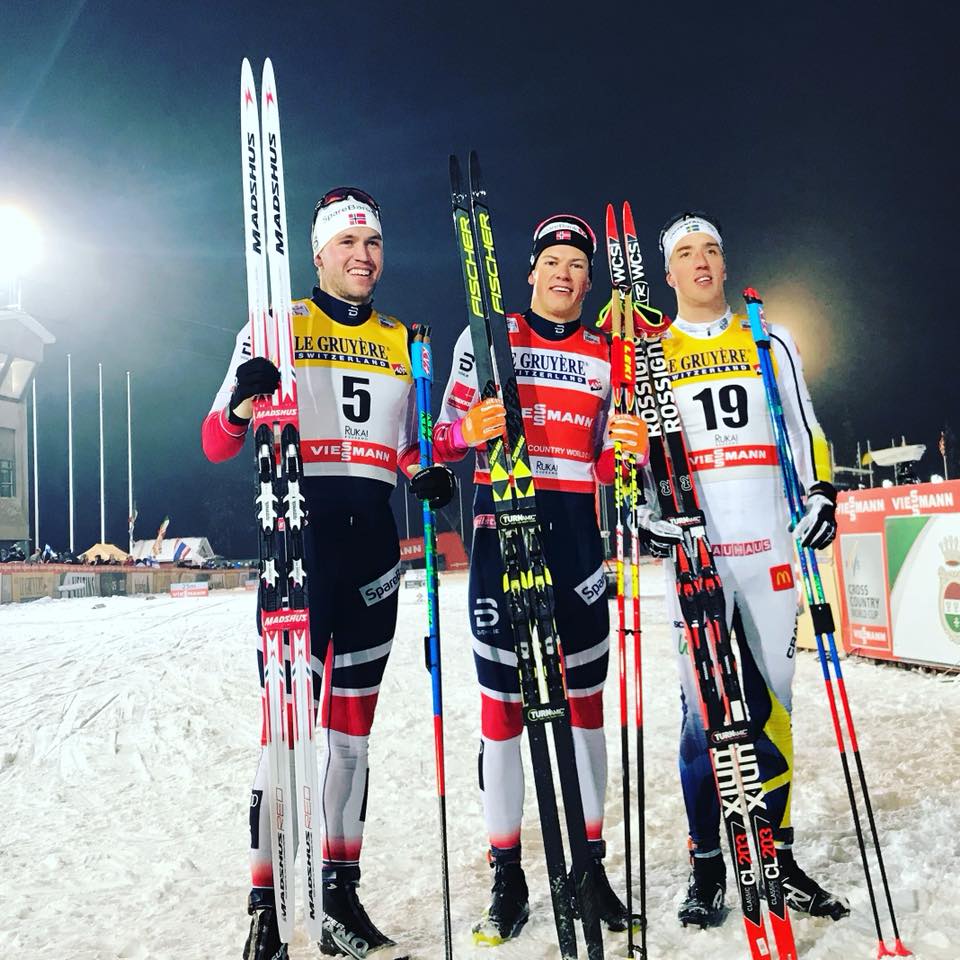
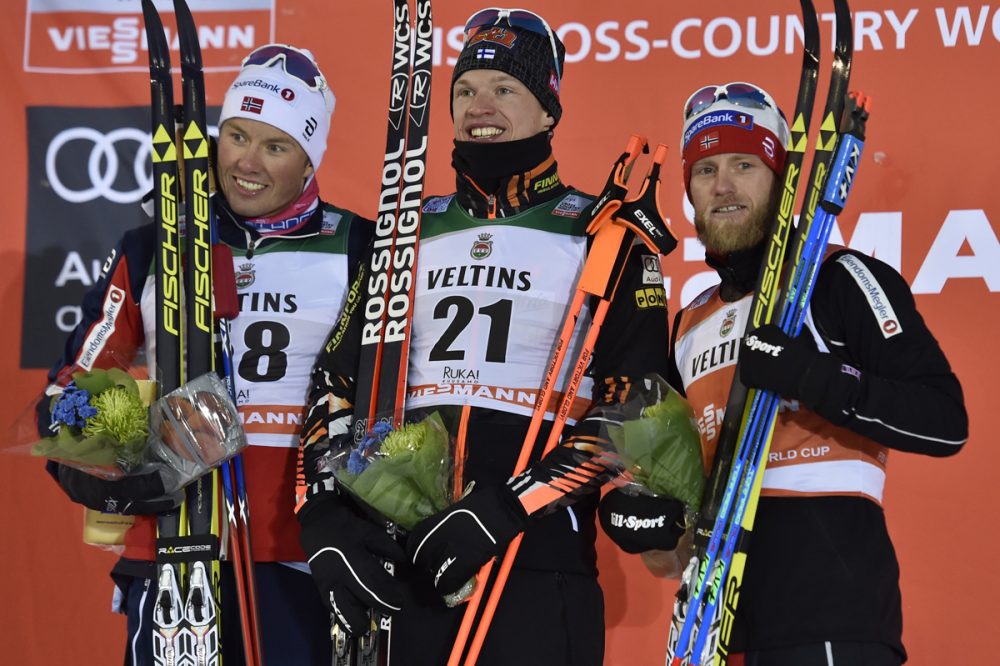
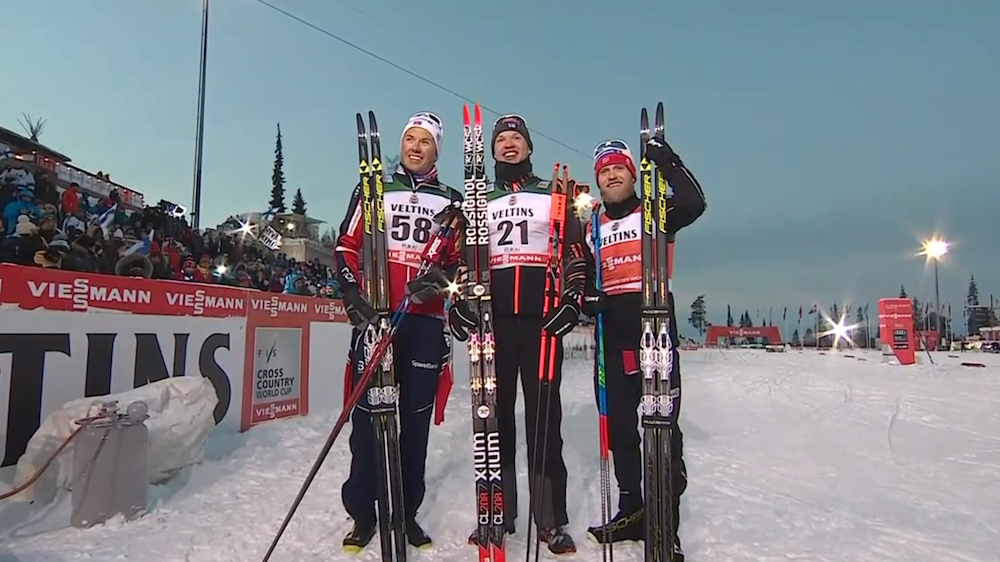
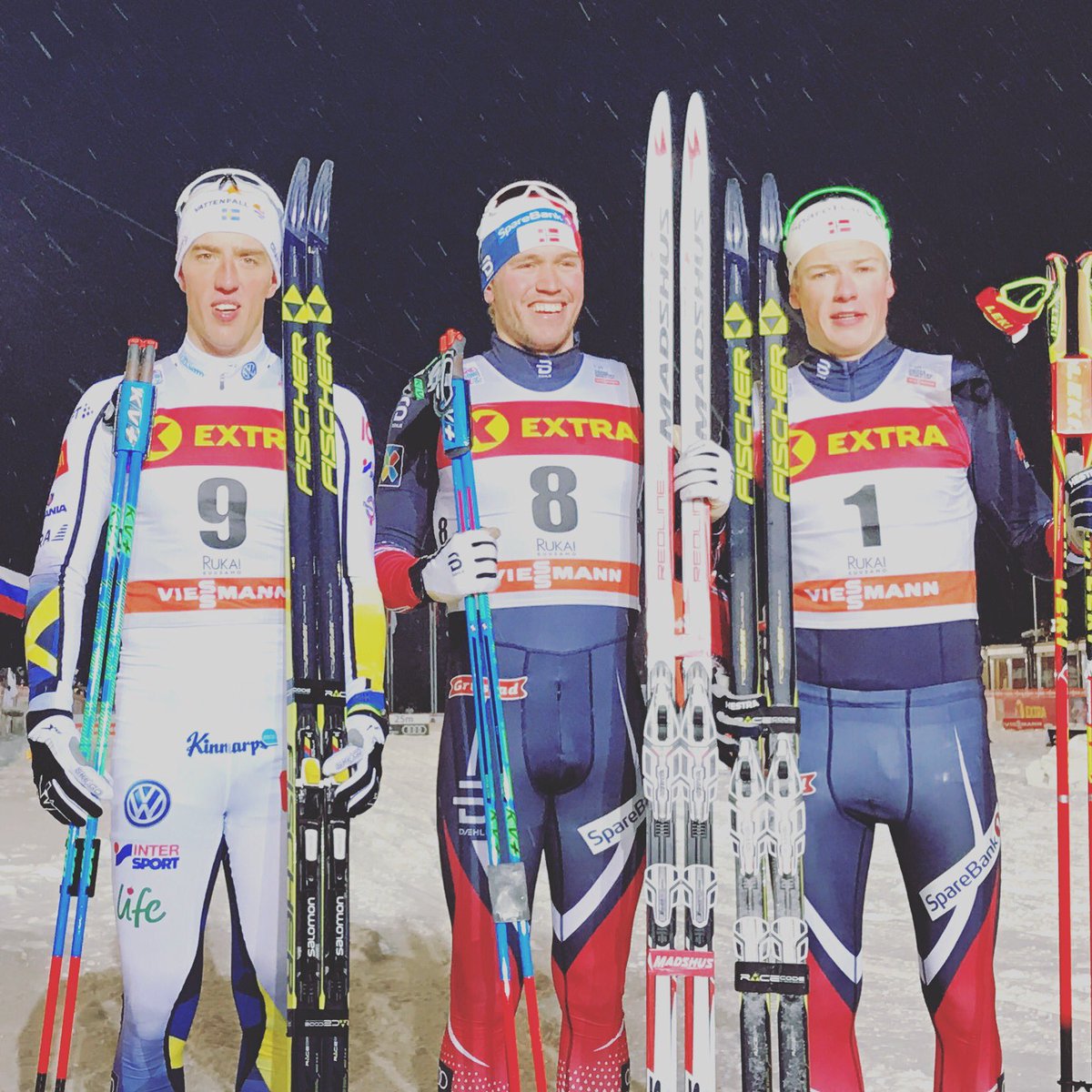
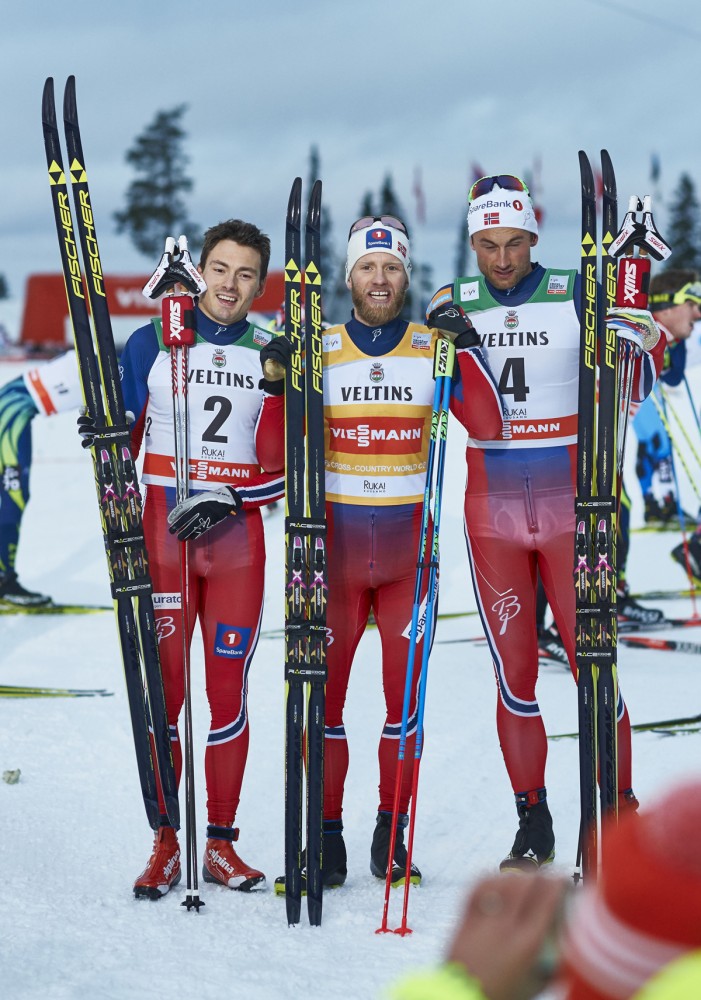
The men’s 15 k freestyle pursuit podium on the last day of the Ruka Triple in Kuusamo, Finland, with Norway’s Johannes Høsflot Klæbo (c) in first, Norway’s Martin Johnsrud Sundby in second, and Russia’s Alexander Bolshunov in third. (Photo: FIS Cross Country/Twitter)
In the men’s 15 k freestyle pursuit later in the day in Kuusamo, Johannes Høsflot Klæbo lost his 38-second buffer to the men’s field, but won the race after outlasting fellow Norwegian Martin Johnsrud Sundby, Russia’s Alexander Bolshunov and Canada’s Alex Harvey, respectively.
While Klæbo started the pursuit 38 seconds ahead of Bolshunov in second place, Sundb started 1:05 minutes back in 10th and Harvey was 1:23 behind in 12th.
Klæbo remained 32 seconds ahead of Bolshunov at 5 k, at which point Sundby led a chase group in third, followed closely by Sweden’s Calle Halfvarsson, Norway’s Didrik Tønseth, Kazakhstan’s Alexey Poltoranin, Russia’s Evgeniy Belov, Norway’s Emil Iversen, Finland’s Iivo Niskanen, and Norway’s Pal Golberg, respectively.
Harvey skied in the next group back with Sweden’s Marcus Hellner, Norway’s Hans Christer Holund, France’s Maurice Manificat, and Russia’s Alexey Chervotkin, all of which were in the top 15 at 5 k.
Over the next 2.5 k, Bolshunov cut his distance to Klæbo to 20 seconds, and at 7.5 k, Sundby was skiing alone another five seconds back in third.
Sundby caught Bolshunov and the two reeled in Klæbo over the next kilometer, catching him around 8.6 k, while 11 seconds back, Harvey led a chase group with Chervotkin, Niskanen, Holund, Poltoranin, and Manificat at 8.6 k.
Harvey lapped through the stadium at 10 k right behind Bolshunov in first, while Tønseth followed in third and Klaebo in fourth. Sundby remained in seventh, less than 2 seconds back.
At 12.5 k, 12 skiers remained in 2.6 seconds of the lead, but 1 k later, that number had dwindled to four within 3 seconds of first: Sundby, Harvey, Tønseth, and Klæbo. Bolshunov kept himself in contention just 3.8 seconds behind, and on the final climb, it became evident the race was between Klæbo, Sundby, Bolshunov, and Harvey. They finished in that order, with Harvey dropping off the pace in the finishing stretch.
Klæbo took the win in 36:23.2, just 0.4 seconds ahead of Sundby in second, while Bolshunov took third, 1 second behind Klæbo. Harvey was another 0.6 seconds back in fourth, and the Canadian’s time stood up as the fifth fastest of the day, behind Manificat in first (34:50.9). Manificat tied Holund for placed eighth overall (+8.2), behind Chervotkin in fifth (+6.2), Niskanen in sixth (+7.2), and Tønseth in seventh (+8.1).
Erik Bjornsen led the U.S. men overall in the tour in 26th (+1:43.6) for his third-straight race in the World Cup points. Also for the U.S. Ski Team, Paddy Caldwell raced to 19th for time of day (after starting 70th and finishing 51st in the pursuit).
Canada’s Devon Kershaw also landed in the points for the second-consecutive day in 29th (+1:47.8).
American Noah Hoffman finished the Ruka Triple in 39th (up from 45th at the start), Scott Patterson was 55th and Andy Newell 75th for the U.S.
Canada’s Len Valjas placed 44th overall, Graeme Killick 68th, Knute Johnsgaard 81st, and Julien Locke 83rd.
While France came in the favorites in the single mixed relay, starting a team of Martin Fourcade and Marie Dorin Habert, it was Austria who put on a master class and skied to a comfortable win today.
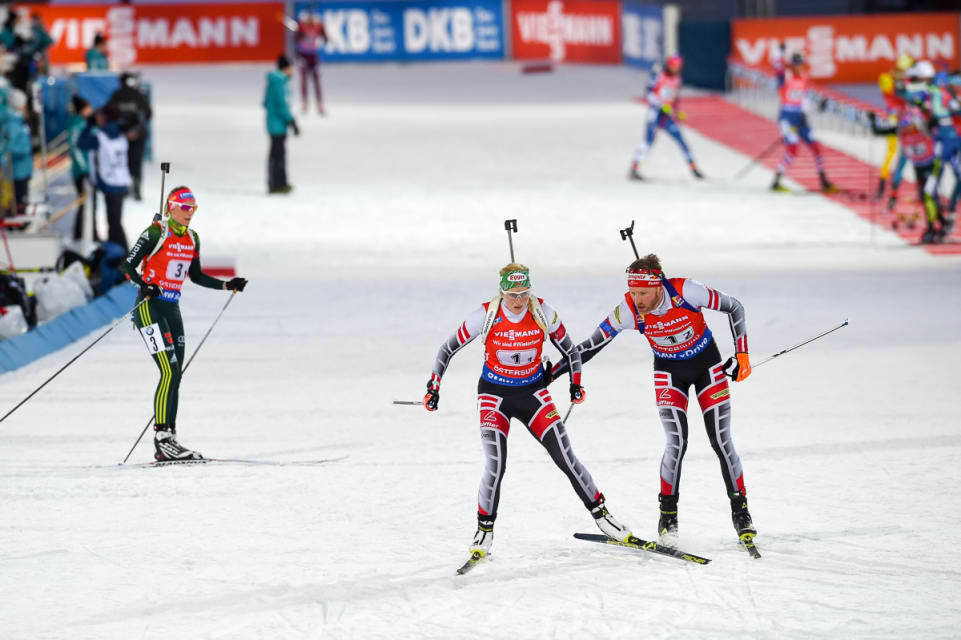
Simon Eder tags off to Lisa Theresa Hauser for Austria during the single mixed relay World Cup in Ostersund, Sweden. The pair raced to a 16.5-second win. (Photo: IBU/biathlonworld)
The Austrian duo of Lisa Theresa Hauser and Simon Eder used only two spare rounds over the course of 40 shots, the best shooting in the field by a wide margin. They led nearly the whole race and ended up with a 16.5-second victory over Germany’s Vanessa Hinz and Erik Lesser. The Germans used nine spare rounds to clean all their targets, but Lesser was aggressive on the skis and made up ground on the trails to finish 16.2 seconds clear of the rest of the field.
There, drama ensued on the last loop. Kazakhstan’s Maxim Braun came through a crash caused by Italy’s Thomas Bormolini, who was skiing in third place on the penultimate downhill and also took out Ukraine’s Dmytro Pidruchnyi. That allowed Braun, along with teammate Galina Vishnevskaya, to just barely hold on to third place. Their shooting – with five spare rounds between them, the second-best in the field – allowed this, their best relay showing ever.
Fourcade, who had left the range in seventh, came through the fray to put France into fourth, followed by Sweden (Linn Persson and Sebastian Samuelsson), then Ukraine (Pidruchnyi and Vita Semerenko) and Italy (Bormolini and Alexia Runggaldier).
Both the U.S. team of Emily Dreissigacker and Leif Nordgren and the Canadian team of Rosanna Crawford and Christian Gow were lapped. Crawford was in second position more than halfway through the race when she fell on a downhill, losing a large amount of time and affecting the functioning of her rifle once she reached the shooting range.
Later in the day, countries sent four-athlete teams out for regular mixed relays. Despite an imperfect start on the shooting range, the Norwegian team of Ingrid Tandrevold, Tiril Eckhoff, Johannes Thingnes Bø, and Emil Hegle Svendsen came away with a 5.3-second win over Italy’s Lisa Vitozzi, Dorothea Wierer, Dominik Windisch, and Lukas Hofer.
The German team of Franziska Preuss, Maren Hammerschmidt, Benedikt Doll, and Arnd Peiffer was third, +6.4, and Slovakia close behind in fourth.
Canada’s Emma Lunder, Julia Ransom, Scott Gow, and Brendan Green finished 15th, +3:28.0, and the U.S. team of Susan Dunklee, Clare Egan, Paul Schommer, and Sean Doherty 21st, +4:47.6.
Left to right: Norwegians Pål Golberg and Johannes Høsflot Klæbo and Sweden’s Calle Halfvarsson after placing third, first and second, respectively, in the men’s 1.4-kilometer classic sprint on Friday in Kuusamo, Finland. (Photo: FIS Cross Country/Facebook)
There was no mistaking Norway’s Johannes Høsflot Klæbo in Friday’s 1.4-kilometer classic sprint, even with no natural light illuminating the course in Kuusamo, Finland, by the time the men’s final left the start line. The 21 year old’s distinct runner-like, high-tempo stride could be seen leading the five other men’s finalists on every climb, distinguishing him from the light fog and densely packed trees lining the course’s firmly packed tracks.
Making his World Cup debut in the spring of 2016, Klæbo has since racked up four-regular season World Cup individual sprint podiums — of the eight World Cup sprints that he has entered — and ended last season as the men’s U23 World Cup champion as well as the overall Sprint World Cup winner, all at the age of 20.
Last weekend at Norway’s first International Ski Federation (FIS) races of the season in Beitostølen, Klæbo not only won the classic-sprint final, but he also topped the men’s qualifier, his quarterfinal and his semifinal.
Klæbo repeated the feat this weekend in Kuusamo, starting first with the qualifier, clocking the fastest by 2.26 seconds over Finland’s Anssi Pentsinen in a time of 2:46.53 minutes. He then won his quarterfinal by 0.6 seconds over fellow Norwegian national-team member Pål Golberg. In his semifinal, Klæbo bested Sweden’s Calle Halfvarsson by 0.29 seconds and then, with a convincing gap on the rest of the field, crossed the finish line first in the final in 2:48.19, kick starting his 2017/2018 World Cup season with a win.
“It was not my plan to ski away so early but before the final hill I was told I had a five-minute lead so I went for it all the way to the finish,” Klæbo sai,d according to a FIS press release.
Even before the course’s last climb, Klæbo had already set himself apart from the rest of the racers in the men’s final: Finland’s Ristomatti Hakola, Italy’s Federico Pellegrino, Sweden’s Calle Halfvarsson, and Norway’s Golberg and Sondre Turvoll Fossli. By the bottom of the first major climb he had double poled his way to a three-meter gap.
Klæbo already in his descent, Hakola, Golberg, Pellegrino, Fossli, and Halfvarsson crested the top of the climb in a pack and settled in for the chase. But Klæbo continued to hold them off into the second major climb, extending his gap by another two meters. As the others reached the second major climb, the race became one for second place between Halfvarsson and Goldberg. Hakola, Pellegrino and Fossli had all fallen back.
Finishing with no one close enough to challenge him, Klæbo took the win in in 2:48.19. Goldberg crossed 1.35 seconds later for second place, while third went to Halfvarsson, 4.03 seconds after Klæbo.
“I’m happy about the third place, but I was quite behind Klaebo,” Halfvarsson said according to a FIS press release. “I will try to catch up for the [Olympic] Games. He was impressive today.”
Rounding out the top 10 was Finland’s Lauri Vuorinen in seventh, Russia’s Alexander Bolshunov in eighth, Switzerland’s Jovian Hediger in ninth, and Finland’s Martti Jylhä in 10th.
Canada’s Alex Harvey advanced to the quarterfinals after qualifying in 13th (+6.13), the fastest North American in the preliminary round.
“The goal was to execute a solid day of racing since it’s the first time I put a bib on this year!” Harvey, of the Canadian World Cup Team, wrote in an email to FasterSkier. “I was pretty happy with my qualifier, it’s a short sprint here so 13th for me was a great start.”
In his quarterfinal, Harvey went up against Finnish skiers Vuorinen, Iivo Niskanen, and Toni Ketelä as well as Estonia’s Marko Kilp, and Japan’s Hiroyuki Miyazawa. However, a loss in positioning before the major climb cost him a few seconds, and he finished his quarterfinal in fifth, 2.16 seconds behind Vuorinen, who won the heat in 2:47.40.
“In the 1/4 final I did 1 or 2 mistakes that just cost me in term of positioning before the big hill,” Harvey wrote. “I felt great technically and actually pretty good physically too especially for the time of the year.”
“Like normal the steep terrain is a bit of a weakness for me so again in the final wall I don’t think I was moving fast enough there,” Harvey continued. “The rest of the course I think I skied well.”
The only other North American to qualify on Friday was Erik Bjornsen of the U.S. Ski Team (USST) in 26th (+8.71). Racing in the same quarterfinal as Klæbo, Golberg, Finland’s Juho Mikkonen and Matias Strandvall, and Russia’s Gleb Retivykh, Bjornsen ultimately crossed in fifth, 5.12 seconds behind Klæbo.
“We are really proud of [Erik] to qualify as strong as he did, in Scandinavia, in a classic sprint,” USST coach Matt Whitcomb said on the phone. “This is one of the hardest races of the year to do this, and it bodes really well.”
“Talked to him between the qualification and the quarterfinals, and he was just exuding confidence and commented on how strong his double pole is feeling,” Whitcomb continued. “We saw him fire that jet in the finish stretch today. He had a really fast heat and it stressed him out a little bit, don’t know exactly what happened, but he was in the mix today and we are psyched.”
Another USST member, Andy Newell missed qualifying by 0.38 seconds in 34th. He was 9.38 seconds off Klæbo’s top qualifying time.
“It was frustrating to be so close and just on the outside of the qualification bubble,” Newell wrote in an email. “Just a few tenths of a second out of the top 25. I felt like I struggled today to get the right amount of glide vs kick… which is just as much on me as the tech. Grateful to be feeling healthy and looking forward to big races to come.”
Julien Locke of Canada’s National U25 Team was the next-fastest Canadian, placing 59th (+12.07) in the qualifier. Locke finished 0.04 seconds ahead of the American Simi Hamilton (USST) in 60th (+12.13).
“A little bit of an off day for Simi and Andy,” Whitcomb said. “For Andy on a course that is particularly good for him and he is in really good shape right now, I think he struggled with some glide.”
Canadian World Cup Team member Len Valjas finished 63rd (+12.58). Before departing Gällivare, Sweden — where he and most of his teammate had been training and raced the opening FIS competitions — Valjas suffered a shoulder subluxation and was not “back to full health” by the time Friday’s sprint rolled around, he explained in an email.
“I took the week really easy on the shoulder to let it recover, and gave it a try in today’s race,” Valjas wrote. “I didn’t have my normal strength in the double pole sections of today’s race. I just felt weak and couldn’t hold any speed on the flats.
“I was happy that I was able to compete today, but I am definitely not skiing at 100%,” Valjas continued. “The shoulder is pretty sore and stiff from the qually this morning. Huge thanks to Pete Dickinson (USA physio) for taking care of me this week and helping me speed up my recovery.”
Also competing for Canada was Knute Johnsgaard in 73rd (+12.58), Devon Kershaw in 74th (+14.01) Graeme Killick in 85th (+14.01), Jess Cockney in 95th (+18.83).
Three additional Americans raced in the qualifier, with Scott Patterson (USST) finishing 84th (+16.14), Patrick Caldwell (USST) finishing 103rd (+21.43) and Noah Hoffman finishing in 105th (+21.85).
Canada’s Continental Cup leader, Russell Kennedy (Team R.A.D.), who earned Period 1 World Cup start rights after ending winning last season’s overall NorAm title, did not start Friday’s sprint race.
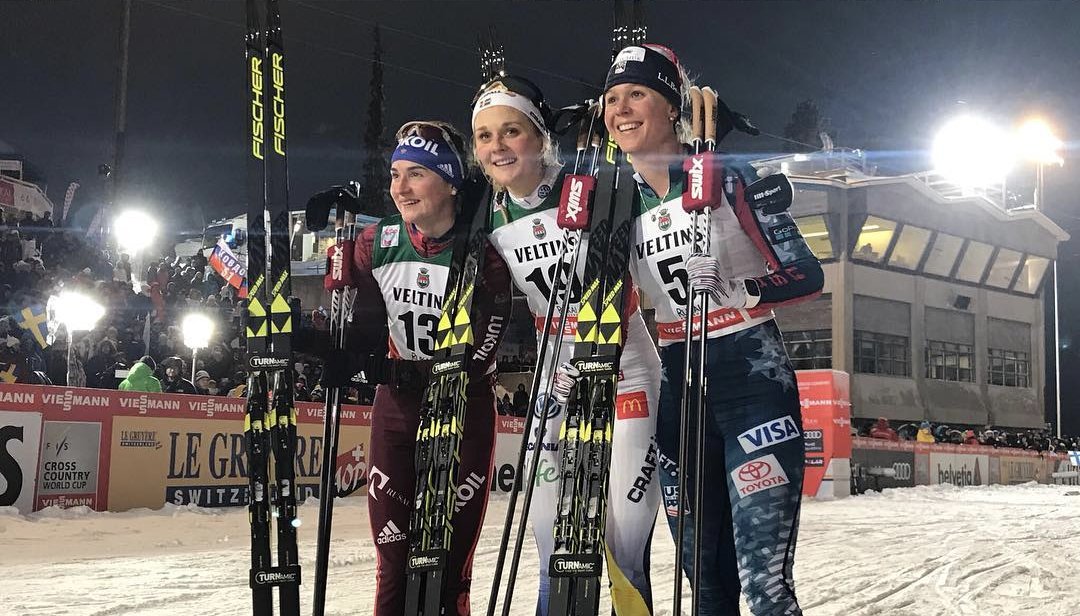
The women’s podium for the first race of the 2017/2018 World Cup season, the Ruka classic sprint in Kuusamo, Finland, with (from right to left) American Sadie Bjornsen in second, Sweden’s Stina Nilsson in first, and Russia’s Yulia Belorukova in third. (Photo: U.S. Ski Team/Twitter)
FIS Cross Country World Cup (Kuusamo, Finland): Classic sprints
In the first race of the 2017/2018 cross-country World Cup season, U.S. Ski Team (USST) member Sadie Bjornsen, who turned 28 on Tuesday, raced to the best result of her career, placing second to Sweden’s Stina Nilsson in Friday’s classic sprint in Kuusamo, Finland.
Last season, Bjornsen notched her first World Cup podium in third place in the 5-kilometer freestyle in Toblach, Italy, and teamed up with USST teammate Jessie Diggins to take third in the 2017World Championships classic team sprint. Friday’s 1.4-kilometer classic sprint — the first race of the Ruka Triple mini tour to kick of the 2017/2018 World Cup season — was Bjornsen’s first race of the season. She did not participate in any preseason International Ski Federation (FIS) races.
Bjornsen started out the day by clocking the fifth-fastest time in the qualifier, 1.98 seconds behind Sweden’s Ida Ingemarsdotter, who won the qualifier in 3:11.69 minutes. Bjornsen’s USST teammate Sophie Caldwell qualified third (+0.59) after another Swede, Hanna Falk in second (+0.19), and a total of four American women finished in the top 30 to qualify for the heats. Ida Sargent finished 22nd (+8.70) and Rosie Brennan was 26th (+9.51) to reach the quarterfinals.
There, Bjornsen won her quarterfinal by 0.39 seconds over Russia’s Yulia Belorukova. Caldwell also advanced to the semifinals by placing second in her quarterfinal, 0.7 seconds behind Sweden’s Charlotte Kalla in first.
Sargent finished third in her quarterfinal, 0.65 seconds behind the winner of that heat, Sweden’s Anna Haag. Brennan placed sixth in her quarterfinal, 4.3 seconds behind Sweden’s Nilsson in first. Neither Sargent nor Brennan advanced to the semifinals.
In the semifinals, Bjornsen again raced to first, and once again held off Belorukova — this time by just one-hundredth of a second. Caldwell followed in fourth in that semifinal, 0.5 seconds behind Bjornsen in first and 0.11 seconds behind Russia’s Evgenia Shapovalova in third (+0.39). Neither Caldwell nor Shapovalova advanced to the final.
In the final, Nilsson took the overall win in 3:17.62 and Bjornsen captured a career best in second place, 0.24 seconds out of first. Belorukova rounded out the podium in third (+0.91), while Ingemarsdotter placed fourth (+2.72), Norway’s Kathrine Rolsted Harsem was fifth (+3.54), and Finland’s Krista Parmakoski sixth (+18.62).
Overall, Caldwell placed eighth, Sargent 15th and Brennan 29th for the U.S. Diggins and Kikkan Randall missed out on qualifying in 34th and 36th, respectively. Julia Kern placed 57th, Liz Stephen 70th, and Chelsea Holmes 86th.
None of the Canadian women qualified, with Dahria Beatty in 64th, Emily Nishikawa in 74th and Cendrine Browne in 87th.
In the men’s 1.4 k classic sprint, Norway’s Johannes Høsflot Klæbo won out the day after winning the qualifier, quarterfinal and semifinal en route to another dominant performance in the final.
Klæbo started off by winning the qualifying round by 2.26 seconds in 2:46.53. Finland’s Anssi Pentsinen qualified second and another Finn, Ristomatti Hakola, qualified third (+2.35), ahead of Italy’s Federico Pellegrino in fourth (+2.66).
Cross Country Canada’s Alex Harvey was the top North American man in the qualifier, finishing 13th (+6.13), while Erik Bjornsen of the USST qualified in 26th (+8.71).
Both Harvey and Bjornsen finished fifth in their quarterfinals and did not reach the semifinals. Harvey ended up 21st on the day, after finishing 2.16 behind the winner of his heat, Finland’s Lauri Vuorinen. Bjornsen was 24th overall after finishing 5.12 seconds behind Klæbo, who won the first men’s quarterfinal.
Klæbo used the extra recovery time he had from racing an early quarterfinal to prime himself for another win in the semifinals, where he beat Sweden’s Calle Halfvarsson by 0.29 seconds. Another Norwegian, Pål Golberg, followed in third (+0.49), and Hakola placed fourth in that semi (+1.72). Both Golberg and Hakola had fast enough times to advance to the final, where they met Pellegrino — the winner of the second semifinal — and Norway’s Sondre Turvoll Fossli, who was second in the second semifinal (+0.1).
In the final, Klæbo once again won convincingly, this time by 1.35 seconds with a finishing time of 2:48.19. Golberg took second place and Halfvarsson reached the podium in third (+4.03), while Hakola placed fourth (+5.65), Pellegrino fifth (+8.87), and Fossli sixth (+17.31).
For the U.S., Andy Newell missed qualifying by 0.38 seconds in 34th and Simi Hamilton finished 60th. Scott Patterson was 84th, Paddy Caldwell was 103rd, and Noah Hoffman was 105th.
For Canada, Julien Locke, of the national U25 Team, finished 59th, Len Valjas was 63rd, Knute Johnsgaard 73rd, Devon Kershaw 74th, Graeme Killick 85th, and Jesse Cockney 95th. Last year’s NorAm winner Russell Kennedy did not start.
Finland’s Aino-Kaisa Saarinen racing to 16th in the first distance race of the 2016/2017 World Cup season, the 10 k classic, on Sunday, Nov. 27, in Kuusamo, Finland. (Photo: @AinoKaisaSaarinen Instagram)
Moms are famous for multitasking, but how do these World Cup mommas do it? We recently heard from Kikkan Randall on her return to the circuit after a year off to have her first child in mid-April, and we got a second opinion from Finland’s Aino-Kaisa Saarinen, who gave birth to a baby girl in early May.
(Above, clockwise from left: Saarinen and her husband, Tom Gustafsson; Saarinen and Randall starting their seasons in Rovaniemi, Finland; “SuperDads” Randall’s husband, Jeff Ellis, and baby Breck with Gustafsson and baby Amanda; Saarinen and Amanda with Randall and Breck)
At 37, Saarinen has been to three Olympics and racked up five medals, including an individual bronze in the 30-kilometer classic in Vancouver in 2010. Now with a 7-month-old infant in tow, she’s back for another World Cup season.
In an email in late October, Saarinen explained that her training had returned to a normal level.
“But I had to do some adjutments in early months,” she wrote. “The total training amounts were a little bit lower than normally, because there was not enough time or strength to do normal training. Therefore I tried to do more training times.”
What that amounted to was slightly fewer training hours than past years, but more training sessions. The length of these sessions was her biggest change, she explained. They were shorter.
“My new normal morning routine was to do short but intensive strength and running before breakfast when baby (Amanda) was still sleeping,” she wrote. “I did 10 – 15 minutes intensive running. At 4 min/kilometer pace.”
That’s 9.3 miles an hour, or 6:27 minute/miles, for 10 to 15 minutes.
Then she did 20 to 25 minutes of intensive strength, which she rotated among three series. One focused on core work, another was hard, intensive training to raise the heart rate, and the third was basic strength.
“This running and strength routine I did every second day,” Saarinen explained. “This worked for me good. For some reason I was lucky for being able to run very early, which is not so normal, but felt good for me. Little by little, when body feels ok, I started to do longer trainings and about three months from birth I was dong completely normal trainings.”
So that’s it — (part of) her recipe for success. Last weekend at the World Cup opener at home in Finland, Saarinen scored points in both races (her first World Cup races since last year’s opening races in Kuusamo) placing 16th in the 10 k classic and 29th in the sprint.
“World Cup season started and progressing in schedule,” she wrote Monday on Instagram. “Thumbs up for Ruka atmosphere as well as #xcteamfin success.”
(In the classic sprint, Saarinen was one of six Finnish women in the top 30, and in the distance race the next day, six Finnish women cracked the top 20.)
While Saarinen couldn’t be reached after the races, her social media posts indicated little Amanda was at the races with her.
“Finally the world cup starts with usual ski test stress :)” Saarinen wrote last Friday before the races, with a photo of her stroller (and baby inside) parked on the snow. “Inside #Thule #Urbanglide there is no stress, only cozy day nap.”
The men’s 15 k classic podium at Sunday’s World Cup in Kussamo, Finland, with Finnish winner Iivo Niskanen (c), Norway’s runner-up Emil Iversen in second and Martin Johnsrud Sundby in third (r). (Photo: Fischer/NordicFocus)
If Finland’s Iivo Niskanen has a classic race course, it’s clearly becoming the men’s 15-kilometer in Kuusamo, Finland. For the second time, Niskanen outlasted Norway’s Martin Johnsrud Sundby to take the overall title — the Finn’s first and only other World Cup win occurring in 2014 at the age of 22.
Now, two years later at 24, Niskanen is the only male to have repeated a victory in the Ruka men’s 15 k classic individual start, an event that has taken place in Kuusamo for the past nine years.
“I was confident when I saw the intermediate times,” Niskanen said during a post-race TV interview. “I believed that my pace is sufficient for victory.”
Starting in bib 21, Niskanen toggled between third and fourth place for the first 3 k on Sunday, while Sweden’s Calle Halfvarsson, bib 84, took the lead until the end of lap one. With two more laps to go, the Finnish skier took over the lead, superseding not only Halfvarsson, but Norway’s Sundby and Emil Iversen as well.
Norway’s Emil Iversen en route to second in the World Cup men’s 15 k classic on Sunday in Kuusamo, Finland. (Photo: Fischer/NordicFocus)
During the next 5 k, Iversen and Halfvarsson dueled for second place, with Iversen eventually coming out on top and taking the front position from Niskanen around the 10 k mark.
Within another kilometer, however, Niskanan had regained control of the lead and Iversen dropped back from the Finn by a little more than eight seconds. Sundby, who had been sitting comfortably in fourth for most of the race, began to dig deeper and reeled in Iversen with less than 5 k to go.
With less than a lap to go, Sundby made another push to surpass Niskanen, but it was too late. The Finn held him off for the rest of the final lap, and as Sundby started to lose steam, Iversen regained speed and moved back into second.
“This was good for my head and body,” Iversen told Langrenn.com. “I felt lousy yesterday but now I’m relieved. I considered not racing at all, but it turned out pretty good and I don’t completely know why.”
Iversen placed second overall, finishing 10.2 seconds behind Niskanen’s winning time of 35:27.6. Sundby took the final podium spot in third, 11.2 seconds out from the win.
“I got a beating from the other two,” Sundby said, referring to Niskanen and Iversen, in a post-race TV interview. “I feel like I did a good race … sadly I wasn’t good enough to win today.”
After leading for the first third of the race, Sweden’s Halfvarsson, who reached the podium in Saturday’s sprint final, dropped back to seventh (+21.2) by the end of the day. Within a little under 14 seconds of Halfvarsson was Canada’s Alex Harvey in 11th (+35.0).
The top North American on the day, Harvey, a 28-year-old Canadian World Cup Team member, narrowly missed Sunday’s top 10, with 1.2 seconds separating him from 10th. He said it was still a good sign of where his classic technique is headed as he begins a new season.
“I felt last year I never had a good classic race, a race that I felt like I skied well the whole way technically,” Harvey said on the phone, pointing out that Sunday was one race that he he did.
Despite feeling a little worn down prior to the start of Sunday’s race –which Harvey indicated may have prevented him from racing in a top-five position — the consistency he showed on course in his skiing mechanics were a positive for the Canadian.
“I’m still really happy with the result and not just the result itself, but also the way I was skiing,” he said.
Canada’s Devon Kershaw racing to 33rd in the World Cup men’s 15 k classic on Sunday in Kuusamo, Finland. (Photo: Fischer/NordicFocus)
After placing 25th in Saturday’s classic sprint, Harvey also explained that the weekend’s combined results were, for him, checkmarked accomplishments.
“I didn’t put too much [weight] on the sprint, so just being able to qualify yesterday was good,” Harvey said of Saturday. “I had a bit more expectation on today’s race [with] the goal [being] to get close or at least finish in the top ten.
“And I think that’s what I reached,” he added. “That’s mission accomplished for me, I’d say for both days.”
After Harvey, the second top North American man on the results sheet was Devon Kershaw in 33rd (+1:23.4), finishing just outside of World Cup points — not quite where he wanted to be, but on the right track.
“To be just outside of the points is never a great feeling,” Kershaw said, according to a Cross Country Canada press release. “[B]ut to know that I’m knocking on the door in only the first competition of a long World Cup season gives me some confidence moving forward. I’m looking forward to the next stop!”
Following him as the first American was U.S. Ski Team (USST) B-team member Erik Bjornsen in 41st (+1:37.2). These being Bjornsen’s first races on snow, he indicated that coming into the opening World Cup competition, his greater focus was getting the feel for racing again.
“I only did one day of classic skiing in the 30 days leading up to coming over here,” Bjornsen wrote in an email. “I took a fairly bad rollerski crash at Soldier Hollow which left my tail end and hand in a bad spot. My goal coming into this weekend was to not get to hung up on the results. Lillehammer has always been a good venue for me so I was trying to think of Ruka as a warm-up into the season.”
Canada’s Graeme Killick (World Cup B-team) finished 53rd (+2:12.9) and Noah Hoffman (USST B-team) was 64th (+2:42.6).
Canada’s Graeme Killick racing to 53rd in the World Cup men’s 15 k classic on Sunday in Kuusamo, Finland. (Photo: Fischer/NordicFocus)
“It’s an early race on a super-tough course against athletes that have been racing for two or three weeks and we know we just came up short today,” USST Women’s Coach Matt Whitcomb said on the phone.
Whitcomb indicated that, from his perspective, the men’s squad has had good preparation, training and fitness leading up to the opening World Cup races in Kuusamo. With goals of peaking for later World Cup competitions, such as those in the Tour de Ski and World Championships, Whitcomb explained the men’s team will continue to work into the season with the understanding that the opening races this weekend are early season races.
“They haven’t gotten fast yet and everybody has a pretty balanced head on their shoulders,” Whitcomb said of the U.S. men who raced on Sunday. “I think there is nothing wrong with being a little disappointed. I know they are right now but they’re also very realistic and they know that their season is about to open up.”
When asked about Hoffman, who made a notable increase in training hours this season, Whitcomb explained that the way Hoffman absorbs his training load as he comes out of it and into the race season may impact his early season and later performances.
“I would suggest that [Hoffman] has probably not fully absorbed that training load and good things are to come,” Whitcomb said. “I’ve already seen really nice changes in his strength level. He has spent a huge amount of time this year on general strength training and it has improved his double pole. … I think it is just going to take a couple weeks of being in Europe racing and training more normally for things to liven up.”
The Canadian coaches could not be reached for comment.
Norway’s Marit Bjørgen racing to first in the women’s 10 k classic on Day 2 of the 2016/2017 World Cup season in Kuusamo, Finland. (Photo: Fischer/Nordic Focus)
280 days.
That’s the average gestation time for a human baby. Then there’s the post-birth energy drain: the near constant feeding, lack of sleep. It’s a perpetual expenditure of calories.
Two days of racing.
That’s all it took of the race season for Norway’s Marit Bjørgen to win a World Cup. And to be more precise, it took 26:55.2 minutes — her winning time on Sunday’s 10-kilometer classic individual start in Kuusamo, Finland.
After having missed all of last season with the birth of her first child last December, Bjørgen took charge on Sunday. Her grip on the race wasn’t a work in progress. It was immediate. At the first splt, 3.1 k into the race, this was clear: Bjørgen’s back.
The women’s 10 k classic podium in the first World Cup distance race of the season, with Norwegian winner Marit Bjørgen (c), Finland’s Krista Parmakoski (l) in second and Norway’s Heidi Weng (r) in third. (Photo: Fischer/NordicFocus)
That’s when Bjørgen marked the fastest split. And she ran the board with the fastest splits at 5 k and 8.1 k, culminating with a 4.6-second victory over Finland’s Krista Parmakoski, who skied to second place.
Norway’s winning streak in 10 k classic individual-start races was extended to 11 in a row on Sunday. It also marks Bjørgen’s 14th victory in the event.
Although Bjørgen’s life has taken on new real-world concerns, she made her first World Cup distance race since her pregnancy and child’s birth seem like a fairy tale. Her dream of taking time off from elite sport, starting a family and returning to dominant form — it’s reality.
“I felt after the first lap that I had more to give, then I got some help from a German Victoria [Carl], who is very strong in the easy/flat parts of the race,” Bjørgen told Norwegian Broadcaster NRK after the race. “So I stayed behind her and was able to ski well in the hills, so yeah it was a good tactical race.”
In that same interview, the 36-year-old four-time Overall World Cup winner said her fitness compass hasn’t lead her astray. Instead of due north, the needle still points toward the win.
“It feels really great, absolutely, I feel like I’ve done well this fall, even if the summer was challenging, my own compass has been pointing in the right direction, so it feels really great yea,” she told NRK.
Her victory on Sunday, although sentimental, also proves that for others the new Bjørgen is really the old Bjørgen — powerful, fast and a clinical hunter when it comes to podiums. Weng, the third-place finisher, took note.
“She’s a machine,” Weng commented to NRK. “I said it beforehand, she will be back after having a kid and she will win. It’s insane.”
Three in the points for the U.S. women
The U.S. women placed three in the points, with U.S. Ski Team member (USST) Jessie Diggins in 13th (+1:09), Sadie Bjornsen (USST) 17th (+1:14.9), and Caitlin Patterson, of the Craftsbury Green Racing Project, in 28th (+1:45.4). Patterson, 26, earned Period 1 World Cup starts as last season’s overall SuperTour winner.
Despite a wintery scene to jumpstart the season in Ruka, Diggins’s world was at ease with the World Cup hustle.
“In some ways it was really easy to slip right back in the rhythm,” she said of the World Cup circus. “I am a total social butterfly so I am running around like, ‘Hi, hi, hi,’ talking to all my friends at the World Cup and that part was really fun.”
Along with systematically picking skis with her coach Jason Cork, the routine of warming up and then dialing in the race-pacing calculus, Diggins raced with mid-season poise.
On course, it was a hard-driving Diggins.
“I was getting some splits out there. It’s hard for me to listen exactly to the coaches when I am skiing out of my mind tired,” she said. Her splits would have revealed her effort was just off top-10 pace. After 3.1 k, Diggins was in 10th, 17 seconds out of first. Over the course of the race, she dropped back to 14th and 15th at 5 k and 8.1 k, respectively, but gained a few spots by the finish.
Asked about her 13th place, the Stratton Mountain School (SMS) T2 Team skier best known for her skate skiing said it was a welcome early season wake up. “I didn’t feel like a hero out there. I had spit all over my face and was drooling all over, but it was a great surprise,” she said.
U.S. Ski Team Women’s Coach Matt Whitcomb said he, too, liked what he witnessed from Diggins.
“It was great to see, watching Jessie,” Whitcomb said. “She was just engaged in this race from start to finish. Had that really hungry look on her face and good dynamic movements in her body the entire 10 kilometer race. So I felt really good about where she is; 13th place after a week on the ground in Europe is really phenomenal as well as on really challenging classic courses that haven’t always been her strength, so the work that she’s put in in her classic skiing over the last couple years has been significant and it’s worked.”
Diggins said she has taken responsibility for improving her classic technique. Those improved physical sensations have allowed her to embrace the kick-wax mantra of ‘thin to win’.
“Working with my tech in past years I’ve often just said give me kick at the expense of everything else because I don’t feel confident getting up the hill,” Diggins said about her reliance on more kick, less glide. “So I would ask for so much kick that I shorted myself on glide, which is obviously my fault. I’m not trying in anyway to blame anyone else, I’m just saying that in past years I wouldn’t have the confidence to go with the appropriate ratio of kick to glide and I’m finally starting to learn how to get it a little more at the right ratio … and so that has been really cool working with the coaches on that to get my technique and confidence up to the point where I can give myself a better chance at climbing.”
Sadie Bjornsen (U.S. Ski Team) racing to 17th in the World Cup women’s 10 k classic on Sunday in Kuusamo, Finland. (Photo: Fischer/NordicFocus)
Although not a surprise to find herself well within the points in 17th, Bjornsen was cautiously optimistic coming into Sunday’s race.
“I kind of came into this weekend without having specific expectations, but more just to set a benchmark for where to start from,” Bjornsen said.
During the offseason, Bjornsen, an omnipresent World Cup all-arounder, has been dealing with bone spurs on her feet.
“It’s particularly hard with a weekend of classic racing because it’s only my fourth time classic-ing in the last two months,” she explained. “So I don’t really have the perfect feel yet, but it’s definitely coming back. So I guess I feel encouraged by how things are starting, but I definitely have huge hopes for the weekends to come.”
If she had any questions about her fitness, they’ve been answered. A 10 k effort on Ruka’s steep terrain, going against skiers fighting for their World Cup start rights, Bjornsen couldn’t exactly fake it.
“Sadie had a pretty slow start,” Whitcomb said of her initial splits. “I was giving splits at one point at 1.2, which was also the 6.2-kilometer mark, and she had about a 15- or 16-second deficit at 1.2 k, so that’s always kind of an early warning that the body’s not quite firing. So that was a little bit scary. But a little further into the race, she started coming to life and the attention of the crowd started to draw on Sadie. She was not far from the top 10 today, she was certainly fighting with four or five other girls that all ended up within just a handful of seconds.”
Bjornsen hasn’t had a text book run-up to the season. For the former competitive swimmer, it’s been a lot of SkiErg-ing and tons of laps in the pool.
“It’s funny because I’ve done SkiErg-ing intervals and I’ve done one bounding session,” Bjornsen said of her recent training. “I just haven’t done anything remotely like racing for some time now. So in sprinting you just go as hard as you can. It’s kind of simple, you don’t have to remember how to pace anything because you just send it. So yesterday in my qualifier, I was blown away that I was able to race into seventh place. But today I was like, ‘OK, I guess you have to pace a 10 k a little bit.’ But the most that I’ve done is two-minute intervals on the SkiErg or, I did a bounding session that I did four-minute intervals, but I just haven’t done a consistent 30-minute effort.”
Bjornsen explained her early split, 23rd place at 3.1 k, as a function of starting too easy.
“I think I was just too cautious out of the beginning and I didn’t even realize it,” she said. “I honestly got to the top of the first hill and I was like, ‘Oh, I hope I didn’t go too hard at the start.’ But I think I was in 37th place. At the time Matt [Whitcomb] was like, ‘All right, time to get into it!’ but I had no idea I was way out of the race already … But it took me two kilometers to remember how to go again and I pushed it for the rest of the way and I think I gained some places back. Even that is super encouraging because I feel like next time I go out and do a distance race, I’m going to have the confidence to go a little harder at the beginning.”
The first-weekend race hurdle is over for Bjornsen, a skier who realistically eyes top-10s as newsworthy. She’ll still head into the next World Cup in Lillehammer, Norway, problem solving when it comes to pain-free skiing.
“I still haven’t quite figured it out yet, but it’s really nice to get over here and work with the boot guys and try to figure out a solution. But I haven’t cleared the bone-spur problem yet,” she said.
Maybe no real surprises so far: Three Norwegians in the top four, four in the top ten. Two U.S. skiers in the top twenty.
Then this:
“Caitlin Patterson, it’s not very often that we have COC [Continental Cup] athletes that score points,” Whitcomb said. “Just straight up, that’s a tough thing to do … Being the Continental Cup leader, it’s a tall order to get in the top 30. So Caitlin has now put together, really, a series of races starting last year that’s showing the world that she’s supposed to be here. So that’s really exciting.”
American Caitlin Patterson (Craftsbury Green Racing Project) racing to 28th in the World Cup women’s 10 k classic on Sunday in Kuusamo, Finland. (Photo: Fischer/NordicFocus)
According to the International Ski Federation (FIS) website, this is Patterson’s 15th World Cup start. Not exactly green, but she’s not the most seasoned on the World Cup.
“I figured she would be skiing as a points skier this year,” Whitcomb said when asked about his expectations for Patterson. “I wasn’t sure if it would happen already. She showed some signs of life in Muonio [Finland] that definitely turned some heads. So that was a good indicator a couple weeks ago that she was in good shape. She’s been telling that to us all along and we got to see it today and that was impressive.”
For the Alaska native, being in the points is confirmation.
“I’m definitely pretty happy with it — it was a really solid race and I knew it wasn’t going to be easy at all to squeak into the points here,” Patterson said of her performance. “It’s just typically Period 1 is really tough, there’s so many Scandinavians and really tough competitors out here.”
Not being a national-team member, she’s had to trust that what she’s been doing is World Cup worthy.
“I’ve had a little bit of comparison with some of the other girls, but I’ve mostly just had to trust that my own training has been quite good and more often than not I am training with my other Green Team Members like Kate Miller, and Liz Guiney and others,” Patterson said. “So it’s not necessarily so much World Cup skier comparison but I just have to trust that my own training is going well.”
Patterson’s first official split at 3.1 k put her in 32nd place. From there on, she was in the top 30, in the points. Like no other statement, results matter at this level. And Patterson understands the benchmark by which she is being judged.
“It’s a really good step along the progression of trusting that I belong here and that I can compete with these girls,” Paterson noted about her ability to compete on the World Cup. “I did look at the finishing results and saw that, what was it like, that if I could’ve been like 10 seconds faster, that was 6 places or something … it was like 40 seconds to the top 10 or something. So those things are really encouraging.”
Some U.S. skiers were out of the points which helps explain Whitcomb’s summation of the women’s race. “I’m very satisfied with the race today,” Whitcomb said. “It was a mix of great races and some races with disappointed athletes attached to the result. But as a team I think we skied pretty well and even those that were, some that were wanting more had some good elements that went down today so I’m happy.”
Also for the U.S. Ski Team, Rosie Brennan placed 39th (+2.22), Kikkan Randall skied to 43rd (+2:29.7), Ida Sargent 44th (+2:30.4), and Sophie Caldwell 61st (+3:13.4).
Kikkan Randall (U.S. Ski Team) racing to 43rd in the women’s 10 k classic at the Ruka World Cup in Kuusamo, Finland. A day earlier, she placed 52nd in the classic sprint. (Photo: Fischer/NordicFocus)
Randall is a longtime U.S. Ski Team member and former three-time winner of the Sprint World Cup. Also, like race-winner Bjørgen, Randall took last season off for the birth of her first child.
“I was looking forward to another chance to test myself today,” Randall wrote in an email to several media outlets, referring to her missing out on the heats in Saturday’s classic sprint. “I had a feeling distance may be better for me right now with less intensity in my system as normal.
“I paced myself a little too well,” she continued. “I lost 20 seconds in the first 1.5km and already 1:10 by halfway. Kept about the same pace 2nd lap. Had good energy in the end so I definitely could have gone out a little harder. … I need more hard efforts to get re accustomed with race pace after a year without it. I hope to get a spot to race the mini tour in Lillehammer next week and will look forward to some skate races in Davos!”
Whitcomb mentioned that for Randall, the first weekend does not reflect her race potential.
“She started out very slowly and I can’t say that I’m entirely surprised with that,” Whitcomb said of Randall’s split at 3.1 k, which ranked 51st. “She sometimes takes a little bit to get going in the distance races and having been away from it for so long, I wasn’t sure what to expect. But that was one of the leading options. But what was very cool is she started to turn things up about halfway through the race so the body started to respond and showed signs of life, and she’s had a great attitude all weekend.”
Whitcomb also sensed the importance of the moment for elite athletes when commenting on Bjørgen’s win. “I thought it was a little disrespectful that she only gave us one race where she let somebody else win, then today she was right back at it again,” he said with a laugh. “Marit’s one of those skiers that everybody’s happen when she wins, not just Norway, so you can count me as one of those fans cheering her on.”
“Inspiring and motivating to see both Bjørgen and [Finland’s Aino-Kaisa] Saarinen [who placed 16th] ski so well,” Randall wrote. “Marit is a few months ahead of me so I am optimistic about this season as it progresses. We have been talking Mom and baby stuff between the 4 of us (also Katja Visnar), it’s a fun new conversation.”
Canada entered three skiers in Sunday’s distance race. Twenty-three-old national U25 Team member Cendrine Browne was 58th (+3:04.8), World Cup B-team member Emily Nishikawa was 59th (+3:07.1), and Dahria Beatty (U25 Team) was 74th (+3:54.4).
Sweden’s Stina Nilsson, who won Saturday’s classic sprint, leaves Ruka as the World Cup overall leader with Marit Bjørgen in second, 10 points behind. Racing resumes next Friday with three days of racing in Lillehammer.
Two members of the Norwegian mixed relay, Johannes Bø and Marte Olsbu, celebrate their win in the first IBU World Cup race of the 2016/2017 season on Sunday in Östersund, Sweden. (Photo: ZDF screen shot)
Welcome to The Rundown, your quick primer of need-to-know information about the day’s racing. We’ll be updating this digest as the day goes on with additional results, photos and quotes. The Rundown is NOT a race report; stay tuned for complete race reports later today with interviews from the day’s top racers.
***
IBU Cup in Beitostølen: 7.5/10 k sprints
[UPDATE] With the second set of men’s and women’s sprints canceled Saturday and moved to Sunday in Beitostølen, Norway, the first IBU Cup relays of the season were bumped off the schedule, and no North Americans competed on Sunday. (American Russell Currier placed 44th in the IBU Cup sprint on Friday.)
In the women’s 7.5 k sprint, Marketa Davidova of the Czech Republic pulled out a 3.6-second win over Germany’s Nadine Horchler, and Germany had two on the podium with former cross-country skier Denise Herrmann in third (+29.9). Davidova hit 9 out of 10 targets (1+0) en route to the victory in 24:18.3. Horchler missed just one target as well (0+1) and Herrmann (who won the IBU Cup women’s sprint two days earlier) had three penalties (1+2) but skied fast enough for the podium.
In the men’s 10 k sprint, Russia’s Matvey Eliseev edged his teammate Dmitry Malyshko by just 3.2 seconds for the win in 26:16.8. More than a minute later, Norway’s Henrik L’Abee-Lund placed third (+1:15.9) with four penalties (1+3). Both Eliseev and Malyshko had one miss apiece, with Eliseev missing one in prone (1+0) and Malyshko missing one standing (0+1).
The next IBU Cup is set for Dec. 6-11 in Ridnaun, Italy.
The first race if the International Biathlon Union (IBU) World Cup season went to Norway, which won Sunday’s co-ed mixed relay (2 x 6 k + 2 x 7.5 k) by nearly 34 seconds over Germany in Östersund, Sweden.
The Norwegian team of Marte Olsbu, Fanny Horn Birkeland, Ole Einar Bjørndalen, and Johannes Thingnes Bø used a total of six spare rounds to get to the finish line first in 1:10.57.1.
Germany, with Franziska Hildebrand, Laura Dahlmeier, Benedikt Doll, and Arnd Peiffer, used the same amount of total spares for second place (+33.7), and both teams avoided the penalty loop.
Italy took third (+44.2), with Lisa Vittozzi, Dorothea Wierer, Lukas Hofer, and Dominik Windisch using a combined 12 spares and having one penalty loop during Hofer’s standing stage.
The Italians narrowly held off Russia (Olga Podchufarova, Tatiana Akimova, Maxim Tsvetkov, Anton Shipulin) by 0.3 seconds for the final spot the podium.
France placed fifth (+1:13.3), Sweden was sixth (+1:20.9), the Czech Republic seventh (+1:20.9), and the U.S. eighth (+2:38.5).
Susan Dunklee started first for the Americans using three spares to clean (0+1, 0+2), then tagging off to Clare Egan, who didn’t need any spares for prone, but had to use all three and skied two penalty loops in standing. Lowell Bailey used just two spares (0+1, 0+1), and Tim Burke locked up eighth for the team with a flawless prone and three spares in standing (0+0, 0+3). In all the team used 13 spares and had two penalty loops.
Of 24 teams in the race, Canada (Julia Ransom, Megan Tandy, Scott Gow, and Brendan Green) was among the four that were lapped. In seven out of eight stages, the team combined for 11 spares and two penalties.
FIS Nordic Combined World Cup in Ruka: Individual Large Hill/10 k
Germany’s 24-year-old Johannes Rydzek celebrating his first of two wins on Saturday at the Ruka Nordic Combined World Cup in Kuusamo, Finland. He now has eighth career individual World Cup victories. (Photo: FIS/NordicFocus)
Germany’s Johannes Rydzek can do the Usain-Bolt-victory stance all the way to the next Nordic Combined World Cup after winning the first two competitions of the 2016/2017 season, with another individual large hill/10 k win on Sunday in Kuusamo, Finland.
Rydzek posted the fifth-best jump after Norway’s Jarl Magnus Riiber, Watabe, Denifl, and Austria’s Mario Seidl, respectively. Rydzek started the 10 k Gundersen 1:04 minutes after Riiber and posted the seventh-fastest course time to capture first. Riiber slipped to 10th (+1:07.5) at the finish, with the 37th-ranked course time of 42 in the cross-country race.
Of note, Frenzel improved from 27th in the jump to 17th (+1:32.4) at the finish with the second-fastest course time.
Bryan Fletcher was one of two Americans in the race, finishing 31st (+3:40.7). His jump ranked 40th, but he skied the fourth-fastest course time to pick off nine places. Taylor Fletcher placed 40th (+6:24.4), improving slightly from 43rd in the jump.
The Nordic Combined World Cup now moves to Lillehammer, Norway, for a team and two individual competitions Dec. 2-4.
Visma Ski Classics Prologue in Pontresina: 8 k Classic
Petter Eliassen of Team Leaseplan Go (left) and Katerina Smutna of Team Santander (right) celebrate after winning the Visma Ski Classics 8 k prologue in Pontresina, Switzerland. (Photo: Visma Ski Classics)
The Visma Ski Classics series started off in Pontresina, Switzerland, with 8-kilometer time trials for both men and women.
In the women’s race, an individual interval start seeded last to first, Kristin Antonsen of Team Synnfjell set an early best mark. But as the previous season’s top women hit the course times began to come down, and the race ended as a battle between Britta Johansson Norgren of Team Lager 157 and Katerina Smutna of Team Santander. Smutna ended up with the win by just 0.66 seconds over Johansson Norgren, with Sara Lindborg of Team Serneke third (+20.66).
The men’s race was a team interval start, with the teams separated by five minutes and with skiers at 15 second intervals within that span. Last year’s Visma Ski Classics Champion, Petter Eliassen of Team Leaseplan Go, came out on top with a time of 19:42.66. Bastien Poirrier of Team Gel Interim Rossignol was second (+8.53), leading five members of his new France-based team into the top ten and turning heads along the way. Morten Eide Pedersen of Team BN Bank was third (+15.80).
Twenty-four-year-old Finnish A-teamer Iivo Niskanen notched his second-career World Cup victory the men’s 15-kilometer classic on Sunday, Day 2 of the Ruka World Cup in Kuusamo, Finland.
The men’s podium in Sunday’s 15 k classic at the Ruka World Cup in Kuusamo, Finland: with Finnish winner Iivo Niskanen (c) and Norway’s Emil Iversen (l) in second and Martin Johnsrud Sundby (r) in third. (Photo: NBC Sports screen shot)
Niskanen started 21st of more than 90 in the men’s field and finished in 35:27.6, which stood as the fastest time all day. After the finish, he paced between the leader’s chair and the finishing pen, even jogging around the stadium and course. But every time he looked the Finnish crowd, he was all smiles.
Niskanen held off three Norwegians in the top four, with Emil Iversen 10.2 seconds behind him in second, Martin Johnsrud Sundby 11.2 seconds back in third, and Didrik Tønseth missing the podium by about six seconds and tying Sweden’s Johan Olsson for fourth (+17.0). Norway’s Finn Hågen Krogh placed sixth (+18.3), Sweden’s Calle Halfvarsson was seventh (+21.2), Russia’s Alexander Bessmertnykh was eighth (+24.3), Finland’s Matti Heikkinen ninth (+32.0), and Great Britain’s Andrew Musgrave 10th (+33.8).
Canada’s Alex Harvey was close behind in 11th (+35), and was the lone North American man in the points on Sunday. His teammate Devon Kershaw missed the top 30 by 4.5 seconds in 33rd (+1:23.4).
Erik Bjornsen led the U.S. men in 41st (+1:37.2). Canada’s Graeme Killick was 53rd (+2:12.9), American Noah Hoffman was 64th (+2:42.6). For Canada, Len Valjas was 76th (+3:19.8), Jess Cockney 78th (+3:26), Knute Johnsgaard 85th (+3:53.4), and Andy Shields 91st (+4:26.1), and for the U.S., Eric Packer 87th (+4:01) and Andy Newell 88th (+4:17.4) out of 96.
In the women’s 10 k classic earlier in the day, Marit Bjørgen of Norway picked up her first win of the season, a 4.6-second win over Finland’s Krista Parmakoski.
Marit Bjørgen of Norway (center) collected her first World Cup win of the season in the 10 k classic in Ruka, Finland, ahead of Finland’s Krista Parmakoski (left) and Norway’s Heidi Weng (right). (Photo: FIS Cross Country/Twitter)
It is the 103rd World Cup win for the 36-year-old Bjørgen, who took last season off to have a baby. Norway followed up Bjørgen’s win with third and fourth place finishes by Heidi Weng (+12.7) and Ingvild Flugstad Ørtberg (+36.8).
Parmakoski also led a good day for the Finnish team, with Laura Mononen coming in seventh (+50.0). She was just behind sixth-place Nicole Fessel of Germany (+42.4).
Jessie Diggins led the U.S. women’s team with a 13th-place finish (+1:09.0), one of her best distance classic races ever outside of Tour and mini-tour stages. Sadie Bjornsen followed in 17th (+1.14.9), and 2016 SuperTour champion Caitlin Patterson of the Craftsbury Green Racing Project scored points in 28th (+1:45.4). The U.S. Ski Team rounded out its results with Rosie Brennan 39th (+2:22.2), Kikkan Randall 43rd (+2:29.7), Ida Sargent 44th (+2:30.4), and Sophie Caldwell 61st (+3:13.4)
Cendrine Browne and Emily Nishikawa slotted into 58th and 59th for Canada, +3:04.8 and +3:07.1, respectively. Dahria Beatty finished 74th (+3:54.4).
Kikkan Randall racing to 52nd in the World Cup classic sprint qualifier in Kuusamo, Finland, on Saturday. (Photo: Fischer/NordicFocus.com)
Kikkan Randall returned to World Cup racing on Saturday, with baby in tow. The verdict on her performance: neither as good as hoped for, nor worse than history would predict.
On Saturday, the three-time Sprint World Cup champion competed in her first World Cup competition since 2014. Randall took the 2015/2016 season off while pregnant with her son, Breck. In her return to racing, she finished 52nd – 19.75 seconds off Krista Parmakoski of Finland’s qualifying time in the 1.4-kilometer classic sprint in Ruka, Finland, and 7.91 seconds out of qualifying for the quarterfinals.
The American star was disappointed, but unfazed.
“If you were to totally take away the baby thing, my record here in Kuusamo, when it’s cold conditions and pretty straightforward skiing I have had really good results,” she said in an interview while watching the heats on TV with Breck from her apartment near the race course. “I’ve had one classic podium here and one almost-podium. When the conditions are a little trickier and the kick is not quite as straightforward, I have struggled. I have not qualified as many times as I have qualified.”
Randall’s most recent race in Ruka, in 2014, saw her making the quarterfinals and finishing 16th. Her second place finish came in 2013, showed what could have been. It was the best sprint performance ever by an American woman until Sophie Caldwell won a Tour de Ski stage in 2016.
Randall said that she was not sure where she would stack up in the World Cup field after taking time off. But based on training sessions at U.S. Ski Team camps with Sadie Bjornsen, Jessie Diggins, Ida Sargent, and Caldwell – all of whom raced in the quarterfinals in Ruka – she thought that she was in good shape.
“I had a great workout on the course yesterday,” she said. “I felt good, the energy was good today.”
But a year is a long time to take off of the World Cup circuit, and Randall was realistic about the time it might take to get back to the top level of competition.
“I think sprinting is maybe going to take me a little bit to bring around because I haven’t done a lot of high lactate qualifier-type efforts,” Randall explained. “I think things have been maybe a little bit strong for me on the distance side, so I’m excited to see what I can do tomorrow.”
Sunday: the 10 k classic interval start. Although Randall is known as a sprinter, she has a number of World Cup top 10’s in distance racing. Most of her best classic distance results have been at lightly-attended World Cups like in Canmore, Canada, and in Sklarska Poreba, Poland, in 2012.
But Randall says that she has been feeling good in workouts, and that physiological capacity is not what held her back in the classic sprint in Ruka. She blamed technique failures on her loss of time.
“I felt like technically I didn’t ski well enough to use what I had,” she explained. “That was frustrating. I had a great workout on the course yesterday. I felt good, the energy was good today, I just was flailing around. This is the type of course where you really have to be able to carry your momentum, and I lost a lot out there. It’s not the opening I was hoping for, but it’s my first race back in a while. So I guess I just have to be a little bit patient and work my way through it.”
Overall, Randall was thrilled to be back racing after a season off.
“It felt awesome to be back in what we call the World Cup circus,” she said. “Yesterday being out testing skis, everybody’s going every which way, I haven’t tested skis in over a year, so it is fun to get back into that practice again. I have new wax tech this season, so we’re learning the new system. But all that has been really fun, and doing speeds with the girls yesterday was great.”
Randall has been living in a strange space in that she’s still an international star, but with no results from the past season she is only treated as such part of the time. For the first time in years, she wasn’t in the “Red Group”, the top 30 ranked sprinters in the world, and had to start in the unseeded section of the start order.
“It has been kind of funny here,” she admitted. “I was invited to the press conference last night, so it’s like I never left, but at the same time I have to earn my way back into the group.”
That wasn’t a problem, though, at least mentally.
“It is a bit like riding a bike,” Randall said. “The sensations are all there and I’m used to it, but it’s also new again. But I kind of like that. I really enjoyed working my way to the top and where I was through the 2014 season, and now I have to work my way back. I like that challenge.”
Randall found the accommodations prepared by the International Ski Federation and the local organizing committee to be fair. Besides Randall, there are several other new mothers on the circuit: Marit Bjørgen of Norway, who finished 10th; Aino-Kaisa-Saarinen of Finland, who finished 29th; and Katja Visnar of Slovenia, who like Randall missed the heats, finishing 37th.
“I haven’t had a chance to actually use the baby room at the venue, but my dad is here helping us take care of Breck and he’s taking him around in the Thule chariot, and I’m sure, if I had been in the heats today those guys may have gone in there to take a little break in between the races,” Randall said. “So it’s nice to know that’s there.”
As Breck’s caretaker, Randall’s father has an accreditation which allows him ‘inside the fence’ to the athlete zone. Randall said that this was key.
“The setup here in Ruka is really nice,” she said.
Next weekend, she’ll have her next opportunity in a classic sprint in Lillehammer, Norway. But before that, she’s focusing on Sunday’s 10 k.
“Tomorrow I think it might snow a little less, so hopefully the track will be a little firmer and I can find some grip out there and be able to test what I actually have in my body right now,” she said.
The Ruka stadium from above in Kuusamo, Finland. (Photo: Toko)
Welcome to The Rundown, your quick primer of need-to-know information about the day’s racing. We’ll be updating this digest as the day goes on with additional results, photos and quotes. The Rundown is NOT a race report; stay tuned for complete race reports later today with interviews from the day’s top racers.
***
West Yellowstone FIS Races: 5/10 k classic
Scott Patterson (APU) double poling to the win in the men’s 10 k classic FIS race on Saturday in West Yellowstone, Mont. (Photo: Ian Harvey/Toko)
Scott Patterson of Alaska Pacific University (APU) continued his winning streak on Saturday, topping the 10-kilometer classic FIS race at the Rendezvous Ski Trails in West Yellowstone, Mont. (In the two FIS races he’s competed in — the other being a 7.5 k freestyle last weekend in Fairbanks, Alaska — Patterson is undefeated.) He won Saturday’s classic race in 22:12.2 minutes, more than 20 seconds ahead of runner-up Matt Gelso, of the Sun Valley Ski Education Foundation (SVSEF), who placed second (+20.8). Ben Lustgarten, of the Craftsbury Green Racing Project (CGRP), improved on his fifth-place finish in Friday’s 10 k freestyle, reaching the podium in third (+23.4).
David Norris (APU) placed fourth (+30.0), Kevin Bolger (University of Utah) was fifth (+33.1), and Ben Saxton, of the Stratton Mountain School (SMS) T2 Team,was sixth (+38.9). Petter Reistad, of the University of Colorado-Boulder (CU), finished seventh (+45.7), Daniel Streinz (Mountain Endurance Sports) took eighth (+49.9), Friday’s winner Paddy Caldwell, of SMS, Dartmouth College and the U.S. Ski Team (USST), was ninth (+56.0), and Martin Mikkelsen (Utah) placed 10th (+1:00.8) out of 70 male finishers.
In the women’s 5 k classic, Craftsbury’s Liz Guiney took the win in 13:06, edging Utah freshman Merete Myrseth by just 0.3 seconds. Friday’s 5 k freestyle winner, Katharine Ogden (SMS/USST) reached the podium again in third (+11.1), Jesse Knori (CU) was fourth (+13.5), and Erika Flowers (SMST2) fifth (+18.2) on her 27th birthday.
Kaitlynn Miller (CGRP) took sixth (+21.8), Christina Rolandsen (CU) was seventh (+21.9), Petra Hyncicova (CU) eighth (+24.1), Guro Jordheim (Utah) ninth (+28.9), and Jennie Bender, of the Bridger Ski Foundation, 10th (+31.2), out of 74 female finishers.
While this weekend’s FIS races are over, West Yellowstone will host again next weekend, as Bozeman SuperTour organizers announced Friday afternoon that it was moving its races to West, its southern neighbor, because of a lack of snow. Next weekend’s SuperTour races will be the first of the season, featuring the originally planned freestyle sprints on Saturday, Dec. 3, and 10/15 classic races on Sunday, Dec. 4.
Katharine Ogden (SMS/USST) racing to third in the women’s 5 k classic FIS race on Sunday in West Yellowstone, Mont. (Photo: Ian Harvey/Toko)
Erika Flowers (SMST2) racing to fifth in the women’s 5 k classic FIS race on Saturday in West Yellowstone, Mont. (Photo: Ian Harvey/Toko)
Kaitlynn Miller (CGRP) racing to sixth in the women’s 5 k classic FIS race on Saturday in West Yellowstone, Mont. (Photo: Ian Harvey/Toko)
Deedra Irwin (SVSEF) racing to 11th in the women’s 5 k classic FIS race on Saturday in West Yellowstone, Mont. (Photo: Ian Harvey/Toko)
Anne Hart (SMST2) racing to 12th in the women’s 5 k classic FIS race on Saturday in West Yellowstone, Mont. (Photo: Ian Harvey/Toko)
Jessica Yeaton (APU) racing to 15th in the women’s 5 k classic FIS race on Saturday in West Yellowstone, Mont. (Photo: Ian Harvey/Toko)
Scott Patterson (APu) racing to first in the men’s 10 k classic FIS race on Saturday in West Yellowstone, Mont. (Photo: Ian Harvey/Toko)
Matt Gelso (SVSEF) racing to second in the men’s 10 k classic FIS race on Saturday in West Yellowstone, Mont. (Photo: Ian Harvey/Toko)
Matt Gelso (SVSEF) racing to second in the men’s 10 k classic FIS race on Saturday in West Yellowstone, Mont. (Photo: Ian Harvey/Toko)
Ben Lustgarten (CGRP) racing to third in the men’s 10 k classic FIS race on Saturday in West Yellowstone, Mont. (Photo: Ian Harvey/Toko)
Ben Lustgarten (CGRP) racing to third in the men’s 10 k classic FIS race on Saturday in West Yellowstone, Mont. (Photo: Ian Harvey/Toko)
David Norris (APU) leading Nick Power (157), of the Bridger Ski Foundation, during the men’s 10 k classic FIS race on Saturday in West Yellowstone, Mont. Norris placed fourth and Power was 19th. (Photo: Ian Harvey/Toko)
David Norris (APU) racing to fourth in the men’s 10 k classic FIS race on Saturday in West Yellowstone, Mont. (Photo: Ian Harvey/Toko)
Ben Saxton (SMST2) racing to sixth in the men’s 10 k classic FIS race on Saturday in West Yellowstone, Mont. (Photo: Ian Harvey/Toko)
Ben Saxton (SMST2) racing to sixth in the men’s 10 k classic FIS race on Saturday in West Yellowstone, Mont. (Photo: Ian Harvey/Toko)
Cole Morgan (SVSEF) racing to 12th in the men’s 10 k classic FIS race in late November in West Yellowstone, Mont. (Photo: Ian Harvey/Toko)
Welly Ramsey (Farmington Ski Club) racing to 23rd in the men’s 10 k classic FIS race on Saturday in West Yellowstone, Mont. (Photo: Ian Harvey/Toko)
Welly Ramsey (Farmington Ski Club) racing to 23rd in the men’s 10 k classic FIS race on Saturday in West Yellowstone, Mont. (Photo: Ian Harvey/Toko)
***
FIS Cross-Country World Cup in Ruka: Classic sprint:
Sweden’s Stina Nilsson (top and bottom center) won her first World Cup classic sprint on Saturday in the first race of the 2016/2017 World Cup season. Norway’s Maiken Caspersen Falla (bottom right) placed second and Heidi Weng (bottom left) was third. (Photo: FIS Cross Country Twitter)
Sweden’s Stina Nilsson and Norway’s Pål Golberg emerged as the big winners on Saturday in the first race of the 2016/2017 FIS Cross-Country World Cup season, winning the women’s and men’s 1.4-kilometer classic sprint finals, respectively, in Kuusamo, Finland.
After qualifying second, Nilsson won both her quarterfinal and semifinal before dethroning Norway’s Maiken Caspersen Falla in the final. Falla had not lost a World Cup classic sprint since February 2015 (two seasons ago in Östersund, Sweden). Falla won her quarterfinal and placed third in her semifinal, advancing to the final as a lucky loser with Finland’s Krista Parmakoski. There, Nilsson held off Falla by 0.17 seconds and won the final in 3:21.61. Heidi Weng was the second Norwegian on the podium in third (+0.69), finishing ahead of two Russians, Natalia Matveeva (4th, +3.18) and Yulia Belorukova (6th, +8.94) and Parmakoski (5th, +5.12).
“This is also my first victory in classic so I’m very, very happy,” Nilsson told FIS in an on-air, post-race interview.
Norway’s Pål Golberg (r) crossing the finish line a few ski lengths ahead of his competition in the men’s classic sprint final on Saturday at the World Cup opener in Kuusamo, Finland. Sweden’s Calle Halfvarsson placed second, and Norway’s Johannes Klæbo edged Sweden’s Teodor Peterson (l) for the final podium spot in third. (Photo: NRK screenshot)
In the men’s final, Golberg surged past his competitors on Ruka’s infamous final climb and held off Sweden’s Calle Halfvarsson by 0.75 seconds for the win. Golberg found out on Wednesday of this week that he had been tapped for the sprint, after fellow Norwegian Petter Northug opted out of this weekend.
“I knew my shape was good, but the skiers from the national team are good skiers so that’s why I wasn’t supposed to be here but Petter got sick so that’s why I’m here,” Golberg told FIS in a post-race interview. “In the quarterfinals, I had a pretty bad climb [on the final hill]. I lost a few spots so I decided to stay more in the back in the semifinals and that worked out.”
The men’s classic sprint podium in the first World Cup race of the season on Saturday in Kuusamo, Finland: Norway’s Pål Golberg (c) placed first, Sweden’s Calle Halfvarsson (l) was second, and Norway’s 20-year-old Johannes Klaebo (r) was third. (Photo: FIS Cross Country Twitter)
After placing fourth in his quarterfinal, Golberg advanced as a lucky loser. In the semifinals, he placed second to ensure his spot in the final. He won the final in 2:54.12, Halfvarsson was second (+0.75) and Norway’s 20-year-old JohannesKlæbo captured his first World Cup podium in his second-ever World Cup in third (+0.87). Sweden’s Teodor Peterson narrowly missed the podium in fourth (+1.06), Russia’s Alexander Panzhinskiy was fifth (+8.22), and Norway’s Finn Hågen Krogh finished more than a minute later in sixth (+1:12.58).
In her comeback season after having a baby last December, Norway’s Marit Bjørgen placed 10th after finishing fifth in her semifinal (she qualified in 10th and was second in her quarterfinal). Another top Norwegian, Ingvild Flugstad Østberg placed seventh on the day after placing third in the Bjørgen’s semifinal.
The top American, Sadie Bjornsen posted the seventh-fastest qualifying time then finished the day in 17th overall. She placed fourth in her quarterfinal. Also for the U.S. Ski Team, Sophie Caldwell placed 20th (after qualifying in 30th then placing fourth in her quarterfinal), Ida Sargent was 23rd (qualified 23rd and was fifth in her quarterfinal), and Jessie Diggins 26th (13th in the qualifier, sixth in her quarterfinal).
The lone North American man in the heats, Alex Harvey of Canada placed 25th overall after qualifying in 28th then placing fifth in his quarterfinal. The two men directly ahead of him in his quarterfinal, Russia’s Anton Gafarov and Golberg, placed third and fourth respectively, and advanced to the semifinals as lucky losers.
In the morning’s sprint qualifier, Parmakoski andKlæbo posted the top times.
Parmakoski notched a 1.14-second qualifying win, ahead of three Swedish sprinters.Nilssonand Ida Ingemarsdotter finished second and third, +1.14 and +2.40 respectively. Their teammate Hanna Falk qualified in fourth (+3.70) ahead of Justyna Kowalczyk of Poland (+3.93).Østbergwas the top Norwegian, qualifying in sixth (+4.05).
Sadie Bjornsenled the U.S. team by qualifying in seventh (+4.41). Three teammates joined her in the quarterfinals:Diggins(13th, +6.27),Sargent(23rd, +10.28), andCaldwell(30th, +11.84).
A fifth U.S. Ski Team (USST) member, Rosie Brennan missed the heats in 44th (+15.28), and in her return to the World Cup after a year of maternity leave, Kikkan Randall (USST) finished 52nd, tied with Craftsbury’s Caitlin Patterson (+19.75). For Canada, U25 Team skiers Dahria Beatty raced to 50th (+18.80), followed by Cendrine Browne in 62nd (+26.05).
Klæbo eked out a narrower victory in the qualifier, edging Russia’sPanzhinskyby just 0.81 seconds. Marko Kilp of Estonia qualified third, +2.01, followed by two Finns: Ari Luusua (+2.18) and Anssi Pentsinen (+2.22).Petersonof Sweden rounded out the top six (+2.31).
The lone North American qualifier wasHarveyin 28th (+6.94). His Canadian teammates were left out of the heats: Len Valjas 54th (+11.28), Devon Kershaw 63rd (+12.28), Knute Johnsgaard 69th (+13.46), Bob Thompson 80th (+17.64), Jesse Cockney 83rd (+19.52), and Andy Shields 91st (+25.07).
Simi Hamilton did not start for the U.S., and according to U.S. coach Matt Whitcomb, he is fighting a small cold. Andy Newell led the team in 40th (+7.74), shortly followed by Erik Bjornsen in 42nd (+7.81). SuperTour leader Eric Packer of Alaska Pacific University finished 78th (+17.30).
The World Cup continues Sunday with the 10/15 k classic individual starts in Ruka.
FIS Nordic Combined World Cup in Ruka: Individual Large Hill/10 k
In the first Nordic Combined World Cup competition of the season, also in Kuusamo, Akito Watabe of Japan won the jumping round with a total of 145 points. Johannes Rydzek of Germany jumped into second. After jumping Bryan Fletcher was sitting in 32nd place for the U.S. and Ben Berend in 38th. The Americans started the cross-country race 3:54 and 4:08 behind Watabe.
In the 10 k Gundersen start, Fletcher improved to 23rd and Berend did not start. Fletcher finished 4:06.5 behind the winner of the day, Rydzek, who won in 27:31.7. Germany took the top two spots on the podium with Eric Frenzel in second (+34.1). Frenzel skied the fastest course time in 26:52.8, moving up six spots after ranking eighth in the jump.
Norway’s Jørgen Graabak placed third (+45.6) and Watabe ultimately finished seventh (+1:23.5). The World Cup continues Sunday in Kuusamo with another large hill/10 k individual competition.
Devon Kershaw (Canadian World Cup Team) competing in the classic sprint at the 2016 Ski Tour Canada in March in Canmore, Alberta. (Photo: Fischer/NordicFocus)
When race organizers in Gällivare, Sweden, decided to change the date of their pre-World Cup race series by a week, Canada’s Devon Kershaw lucked out. For the past couple of seasons, most of the Canadian World Cup Team has spent their final days before the start of the race season skiing and competing in Gällivare.
Once again, the team planned to travel 100 kilometers north of the Arctic Circle for a pre-World Cup camp, booking their plane tickets to Sweden for the week of Nov. 19 — when the city’s races were originally slated to take place.
However, due to a scheduling conflict with Sweden’s annual early season races in Bruksvallarna, the Gällivare race dates moved up a weekend, leaving only one of Canada’s cross-country athletes the option to race in Gällivare.
“Since I am based in Oslo, it was just sheer luck that we hadn’t booked my flight yet (from Oslo up here to Gällivare) when those changes took place,” Kershaw, who lives just outside of Oslo, Norway, with his wife Kristin Størmer Steira, wrote in an email. “So I asked to come up a few days earlier than the team to get a chance to race.”
With the help of Canadian head wax tech Yves Bilodeau, who lives in France and was able to join Kershaw, the 33-year-old Kershaw won Sunday’s 15 k classic individual start in 35:18, besting the runner-up, Petr Knop of the Czech Republic, by a minute. Michal Novak, also of the Czech Republic, placed third, (+1:05).
Though only 11 senior men entered Sunday’s 15 k, which wasn’t an International Ski Federation (FIS) sanctioned race, Kershaw indicated that from his standpoint, putting on a race bib and bringing his body back into racing was important.
“Being a slow-starter at times with regards to World Cup period #1 in my career (I have never been on the podium on the World Cup prior to Christmas) the biggest focus was just to put a bib on and blow out the cobwebs,” Kershaw wrote. “It’s nice to get nervous, test skis properly, and go through a whole routine around an organized race. In the race itself I focus on skiing technically well, being present and just being as efficient as I can be when my body is screaming to stop.”
Kershaw explained that he lucked out even more with getting into the Gällivare races, as they would be his only opportunity to for a preseason on-snow race this season.
“Time trials are great workouts, but for me I really believe that nothing replicates racing and have always have benefited from getting in some ‘lower key’ races before starting off on the World Cup,” he wrote. “This season [the Gällivare 15 k] will be the only race I get to do before the World Cup starts.”
In a post-race interview, Kershaw told Langd.se that he benefited from some summer training with Norway’s Martin Johnsrud Sundby and Sweden’s Martin Johansson, who lives in Norway. On Sunday, Kershaw took control of the race early, leading the first of four 3.75 k laps by more than 20 seconds over his nearest competitor.
“It was amazingly good conditions today, the body responded as it should and the skis were really good,” he said.
Kershaw arrived in Sweden late last Friday and will remain there until the rest of the Canadian World Cup team (except Alex Harvey, U25 Team skier Cendrine Browne and coach Louis Bouchard, who are training in Davos, Switzerland) joins him on Nov. 23. Then they’ll drive as a group to Kuusamo, Finland, where the opening World Cup will be held Nov. 26-27.
“Of course it would perhaps be nice to start the year with really competitive races in Beitostølen or Bruksvallarna (like we have done many times in the past), but with our budget having been absolutely decimated these last couple years it’s no longer realistic and/or viable,” Kershaw wrote. “The fact that we can en-masse drive to Kuusamo for the World Cups saves our team bundles of money that we can then use to support the World Cup racing as best we can.”
World Cup skiers released this photo from a gathering in the Kuusamo, Finland, ski stadium on Sunday.
Last time the United Nations held a climate change summit, U.S. cross-country skier Andy Newell traveled to New York City to walk in the People’s Climate March, the biggest climate change protest in history.
But that was summer – when it’s easy to schedule in a rest day and make the drive from Vermont.
This time around, the United Nations is holding talks in Paris and Newell is on the road in Scandinavia as he embarks on a new World Cup competition season.
So two days after placing fourth in the opening race of the year, he gathered international ski stars in a stadium in Kuusamo, Finland, and together they called on international leaders to make progress in Paris.
“I was going to be in Paris with them myself if I could during this week, but it doesn’t work out,” Newell said by phone from Lillehammer, Norway, the next stop on the World Cup circuit. “I felt like it was the least we could do to try to rally some international support through some of these big-name skiers. It shows that no matter what country you’re from, we’re all united in supporting these meetings and hoping that the U.N. can come up with a more substantial agreement than they did the last time around, and hopefully make a legally-binding agreement to hole countries responsible for their energy usage.”
Why is Newell so motivated? Among other reasons, snow sports enthusiasts will have a harder time finding their recreation opportunities in a changing climate. Numerous studies have shown that projected shifts in temperature and precipitation will shrink the area where winter sports are available.
“This is so important to our sport because our sport is changing. Last year we raced on real snow ONCE. That’s all. One race on the whole World Cup wasn’t on man-made stuff. I’d really like to share this awesome sport we do with my grandkids someday, and I hope that will be possible.”
—Jessie Diggins, U.S. Ski Team & Stratton Mountain School SMST2, on her blog
For example, in the Tyrolian Alps of Austria and Italy, ski areas will have to quadruple their snowmaking capacities to guarantee a 100-day season by the middle of the century. Many areas might not be able to afford such investment.
Andy Newell during Friday’s 1.4 k classic-sprint qualifier in Kuusamo, Finland, in which he advanced in 12th. Newell went on to make the final and placed fourth for his best World Cup result since 2013. (Photo: Fischer/NordicFocus)
In New Zealand snow depth is likely to be just half of its current level at ski resorts by the end of the century, with the same researchers predicting that in the Australian Alps our grandkids could experience snow just 20% as deep as we see now.
In the French and Spanish Pyrenees, less than half of ski resorts would survive a 2°C warming given their current infrastructure; with more investment in snowmaking that percentage would rise. But with more warming, current snowmaking technology would no longer be able to produce snow, meaning that even the best-prepared resorts might go under.
And most analyses of snowpack for the ski industry are based on alpine resorts, which are often at higher elevations than cross-country ski areas. In other words, cross-country skiing likely faces an even faster loss of trails.
Besides teammates from the U.S. – Liz Stephen and Simi Hamilton helped him organize the event – Newell was joined by Charlotte Kalla and some Swedish teammates, Eirik Brandsdal and some Norwegian teammates, and athletes from Germany and Finland.
While the trio of Americans were the galvanizing force in gathering the group, Newell said that he didn’t have to push hard.
“From talking with Charlotte [Kalla] and some of the Norwegians and Scandinavians in general, they are all very progressive when it comes to energy and being environmentally conscious,” he said. “If anything I’d say that the Scandinavians are more advanced than your average American when it comes to the rights and wrongs of energy and leaning towards more sustainable energy. So it was cool to talk with them about it.”
“That’s my general advice the ski community and really to everybody in the U.S.: try to be heard. Try to pester your senators to make sure they are making the decisions. Work on a statewide basis, and then hopefully these are trends that we can spread onto a national scale and onto a global scale to help move away completely from the fossil fuel industry and to more renewable energy.”
—Andy Newell, U.S. Ski Team & Stratton Mountain School SMST2
FIS Cross Country Chairman Vegard Ulvang joined the group as well. Just a week earlier in his introduction to the new season, Ulvang had already touched on the topic of climate.
“In the short term perspective, we have to trust in our snow guns and snow storages,” he said, according to FIS. “But also they need minus degrees which already last season forced us to cancel a lot of races. Within 50 years it is a fact that we will need new technology that can produce snow in plus degrees in a sustainable way, if it should be possible to ski around many ski resorts and cities where most people live today.”
In that talk, Ulvang noted that the World Cup and the Paris climate negotiations were beginning at the same time.
If only the climate talks could be successful, he urged.
“We can just hope that there will be taken new small steps in the global goal of cutting our common CO2 emissions that is so necessary for our future winters,” he said. “But we do also, all of us, have a personal responsibility to do whatever we can to save our future winters, both lifestyle wise as well as by choosing and branding the necessary new and sustainable technology.”
Newell was pleased that FIS leaders were thinking strategically about climate change.
“I wasn’t surprised, because they are all smart guys,” he said. “And FIS, whether it’s on their agenda or not, they are directly affected by climate change. They want to do everything they can to raise awareness and influence change.”
But he emphasized that although Ulvang agreed with him, the idea for the rally came from the athletes.
“It wasn’t organized by FIS, it was organized by the athletes ourselves,” he explained. “That makes it more genuine, I think. It’s not like FIS was like, okay guys, you need to be at the stadium at a certain time and say x and y to the media. It was much more from the athletes in a personal way.”
Newell is hoping that the rally will get picked up by news organizations in Scandinavia, carried by the names of Kalla, Brandsdal, and other stars.
Nordic countries seem receptive to the message, he said.
“Finland is pretty cool – the day I arrived in Finland I actually did an interview with YLE, which is the national broadcasting network, and they were doing a special about the Paris climate talks,” Newell explained. “For sure they are tuning into what’s happening in Paris during this week and are very committed to making some big changes.”
And while he hopes that more people will urge their leaders to make meaningful, legally-binding agreements in Paris, Newell also knows that change starts at home.
“I would say to ski fans to try to continue to reduce our usage,” he said. “But my big thing is not just reduction on a personal scale, but really getting on the backs of our politicians and our state representatives to try to make a smooth transition to more renewable energy. Really, we need to get on the backs of the guys and women in the U.S. who make these decisions and put some pressure on them.”
Great Britain’s Andrew Musgrave (pictured here at 2013 World Championships), who lives in Norway, got wax help at this weekend’s World Cup from the Norwegian national team. The arrangement benefits Britain, which has a tiny budget and can’t afford to fill its team staff quota, and also Norway – the dominant ski country can increase the number of technician bibs it is allowed on course. Musgrave finished the Kuusamo mini-tour ranked 16th and is in the top 20 in the overall World Cup.
As the FIS Cross-Country World Cup opened in Kuusamo, Finland, last weekend, Swedish media picked up on a strange image: Norwegian chief waxer Knut Nystad skiing around in a bib that said not “NOR”, but “GBR”.
Great Britain.
The news touched off a firestorm in Sweden, possibly caused by jealousy that the Norwegians had found a new rule around the FIS quotas on team staff.
The teams with the most ranked skiers have a cap off 22 staff members who can receive accreditation. In previous seasons, teams wanting to get more bibs to allow technicians on course could simply pay a small fee of 20 Euros per bib and end up with a maximum of 35 staff members.
This year, that extra possibility was removed. So Sweden, Norway, and Russia are capped at a total of 22 staff members – no more. Finland is next with 18, then Germany, France, and Italy with 16, and the United States and Canada with 14.
The rules were on one hand part of a FIS effort to level the playing field so that dominant ski countries don’t become even more dominant in a sort of positive feedback loop with resource wealth.
But it was also an effort to reduce the number of skiers on the race course before a competition. Too many trips around the track can cause snow conditions to break down, especially with more and more races being held in warm weather.
Norway had seemed to find a way around the cap by partnering with the British Ski Team.
“We have [made clear at] the team leader meeting that it is allowed to cooperate in ski preparation,” he told Norwegian broadcaster NRK, according to a translation. “We see it as positive that small nations are assisted by the major nations.This is competence that strengthens our sport.”
And if you ask the Brits, they don’t feel like they are being taken advantage of at all. With top skiers yet a miniscule budget, head coach Roy Young feels he has made a good deal.
“Our aim is to work with the Norwegian wax team – that is, our wax team will join them for testing & sharing information on test results,” he wrote in an email to FasterSkier. “The objective for us is to spend more time testing the athlete skis rather than testing wax. So we will still have our wax team and we will wax our own skis, we will have testing of skis. We hope to better prepare our athletes for the races, develop our technician team & perform better in the race while not increasing our costs.”
Other small teams don’t seem so bothered by this arrangement, conceding that it’s a smart move.
“It is very hard as you know for a small nation to fund the staff and waxing infrastructure that a big nation can,” wrote U.S. Ski Team Head Coach Chris Grover. “A small country always struggles to complete the myriad of waxing duties on a daily basis that are necessary to make fast skis… I know teams like Australia and Great Britain have teamed up before as well. Yes, this does effectively give Norway more service bibs but it also gives them a lot more skis to wax! Probably not a big advantage for them in the end, but a very helpful arrangement for Great Britain.”
“I think it’s good for smaller countries to get knowledge and support from the larger more experienced ones,” Canadian Head Coach Justin Wadsworth agreed. “But does Norway really need more of an advantage… We’ve talked in the past about potentially working with the US as a North American force, but when it comes down to it, it just isn’t realistic.”
In this case, the pairing is far from random. Two top British athletes, Andrew Musgrave and Andrew Young, are based in Norway. Musgrave is part of Team Leaseplan Go, a Norwegian ski marathon team, and both athletes already know many of the Norwegian athletes and staff. Musgrave even won a Norwegian national championship title, and often appears in the Norwegian media, where he speaks fluent Norwegian.
“My role is clear in that, I’m hired to enable the British Athletes to perform to the best of their abilities & I currently believe that a collaboration with Norway is a good way of potentially enabling the athletes to do this,” Young wrote. “As you suggest, the 2 Andrews live and train in Norway and are well known for the professionalism that they bring to sessions, which gives us a natural connection with the Norwegian team.”
The hopes of a whole country are pinned on Musgrave, Young, and their teammates, and yet in the past they have never had the type of resources which their competitors can rely on.
“When we reviewed how Sochi went for us we were very clear that the athletes did not get the amount of support they needed,” Coach Young wrote. “We identified roles we would like to see in our team and are trying to fill them. Help with wax testing allows us to cross some of the gap with little additional costs (and remember we are team struggling to find enough money to have 3 support staff at a Ruka World Cup even though we have an athlete that many people believe is capable of a top 10).”
Indeed, in Kuusamo Musgrave skied to 13th in the 10 k skate, then skied the 11th-fastest time in the 15 k classic pursuit to finish 16th in the overall mini-tour. He’s now ranked in the top 20 in the overall World Cup.
Although the Brits qualify for a staff quota of eight according to the FIS rubric, they can never fill all of those spots because of their small budget.
Young explained that the partnership was an ongoing discussion and would be re-evaluated, but that three bibs were given to Norway to help with wax testing in Kuusamo, and probably two would be shared at the next World Cup the team attends in Davos, Switzerland.
“Part of my discussion with Norway has been to make sure that there is transparency on what we are doing and that we would not transgress any rule (we Brits are very rule bound people),” Coach Young wrote. “I have written to FIS about what we are doing. Obviously, our collaboration on wax will only occur when we are racing at a world cup. Both Norway and Great Britain view this as a trial with a review on the benefits both teams feel they get from this, risks to the teams and where it can be developed.”
When asked about the arrangement by Scandinavian media, the Norwegians also stressed that FIS had been made aware of the situation and did not view it as a breach of the rules.
And in the end of the day, the goal of keeping the snow on the race courses nice and firm hasn’t been sacrificed.
“The course stays in good shape since the number of total service bibs hasn’t increased,” Grover concluded.
And Sweden? Maybe they can survive with “just” 22 team staff.
Or else they can find their own small nation to adopt.
Norway’s Martin Johnsrud Sundby raced to an uncontested victory in the men’s 15 k classic pursuit on Sunday, the final stage of the Ruka Triple in Kuusamo, Finland. He won the pursuit by 44 seconds and took the mini-tour victory in the season-opening World Cup weekend. (Photo: Fischer/NordicFocus)
Count them: six in a row.
That’s how many World Cup tours Martin Johnsrud Sundby of Norway has won. He kept his streak alive in the final stage of the Ruka Triple mini tour on Sunday, the 15-kilometer classic pursuit in Kuusamo, Finland.
With a 44.7-second win over Petter Northug, also of the Norwegian national team, Sundby, 31, illustrated he’s a world-beater and is primed to defend his World Cup overall title for the third-straight year.
“It is a good start of the World Cup season. Today’s race was tougher than yesterday,” Sundby told FIS.
The all-Norwegian men’s podium after the Ruka Triple 15 k classic pursuit on Sunday at the World Cup in Kuusamo, Finland, with, Martin Johnsrud Sundby (c) in first, Finn Hågen Krogh (l) in second and Petter Northug (r) in third. (Photo: Fischer/NordicFocus)
He won Saturday’s 10 k freestyle to take the mini-tour lead, then started Sunday’s pursuit with a 14-second head start on teammate Finn Hågen Krogh. While the two never skied together — and actually skied alone for most of the race — they both ended up on the podium.
Krogh faded in the final third of the race, and Italy’s Francesco de Fabiani and Norway’s Didrik Tønseth caught him with about four kilometers to go. He stayed with them, then dug especially deep to edge de Fabiani by 0.1 seconds for third, less than two seconds behind Northug.
“I was completely on the [brink] when [the chase group] overtook me,” Krogh told NRK.
Norway took every spot on the podium, but de Fabiani in fourth kept the powerhouse nation from a top-six sweep. Norway’s Niklas Dyrhaug and Tønseth placed fifth (+48.5) and sixth (+50.6), respectively, and Alex Harvey of Canada was another five seconds back in seventh. In all, Norway put seven in the top 10.
For Harvey, it was his best finish in the Kuusamo mini tour after placing 11th overall there in 2011. He was second in Saturday’s 10 k freestyle to put himself sixth in the tour heading into the final pursuit.
“I am super satisfied with the weekend,” Harvey said in a Cross Country Canada press release. “I just felt I had something more in me today than seventh.”
The Norwegian domination began at the outset. Sundby started alone ahead of Krogh, followed by another Norwegian, Anders Gløersen, 19 seconds back in third. Northug started fourth, 24 seconds after Sundby and a second ahead of Harvey and Switzerland’s Dario Cologna, who placed third in Saturday’s 10 k.
While Harvey and Cologna headed out together 25 seconds back, the two formed a coalition to battle the elements, particularly the wind, and try to rein in Sundby. However, just before the 4 k mark, Sundby was already 44 seconds ahead of Krogh, 47 seconds ahead of Sweden’s Martin Johansson (who started seventh), and 48 seconds ahead of Cologna, de Fabiani, Harvey, and Gløersen, respectively.
By 5 k, Krogh had successfully broken away from the rest of the field, skiing 13 seconds ahead of them and 42 seconds behind Sundby. Behind him, Harvey and Cologna stuck with the chase pack that remained seven-men strong by 6.4 k.
With two laps remaining at 10 k, Cologna had fallen off the pace slightly and slipped to 16th, while Harvey skied in seventh, 15.5 seconds behind Krogh and 1:12 behind Sundby.
When Tønseth, de Fabiani and Johansson accelerated at the start of the second-to-last lap to catch Krogh, the chase pack split and left Harvey, France’s Maurice Manificat and three Russians — Alexander Legkov, Sergey Turyshev and Maxim Vylegzhanin — in a group of their own. From there, Harvey had to fight for a top 10.
Canadian Alex Harvey (l) after placing second on Saturday in the World Cup 10 k freestyle in Kuusamo, Finland, to share the podium with Norwegian winner Martin Johnsrud Sundby (c) and Switzerland’s Dario Cologna (r). (Photo: CCC/NordicFocus)
“It was a tough race for sure. I felt really good, in fact I think it was the best day I had physically, but it was really tricky waxing conditions,” Harvey explained.
“Our skis really weren’t that bad. The speeds were average, but the difference was the Norwegians and Italians had the best skis,” he added. “I was right there until the final kilometer, but I think as the track started [deteriorating], I lost the group on the last downhill.”
This Kuusamo course can be like shock therapy. The Ruka hills no joke for World Cup skiers in midseason form, let alone the opening races on this year’s World Cup circuit. A big climb marks the central portion of the 2.5 k loop that the men rounded six times.
According to Canadian head coach Justin Wadsworth, his team approached the race with a straightforward mindset.
“We didn’t talk about anything strategy wise before the race. We were so focused on the skis,” he said in a post-race phone interview. “I just told the guys that the only piece of advice that I could really offer was everyone is going to be in the same boat, and it’s going to be hard. So, that was the main thing. Just don’t worry if the skis don’t work everywhere because it’s going to be hard.”
Although the Canadians had a relatively strong day, with Harvey in seventh and Devon Kershaw in 23rd (after starting 29th), Wadsworth said they may have come up short with ski prep.
“We feel like we were scrambling a little bit on the skis. We were a bit slow. We could have a little bit more time for that, at least to test today,” he said. “I think maybe we focused a little too much on the the powder testing, some of the glide testing, and that pushed it a little bit later than we wanted. So we didn’t have have as much time as we like to test the kick, which is a priority because it was very, very hard day.”
“We know what mistakes we made and the skis were a bit slow for all the athletes on the fast downhills, so that was definitely an issue,” Wadsworth continued.
On a day with 92-percent humidity and temperatures just below freezing, no one’s skis worked everywhere. There was some striding, some ski-running, some herringbone.
“It was one of the hardest World Cups I’ve ever watched as far as that nobody had the skis that they could run up everything and then glide well,” Wadsworth noted. “There were guys icing. They were slipping in the tracks, out of the tracks. It was a really tough race in that respect.”
U.S. coach Matt Whitcomb reiterated the universal waxing conundrum. “The conditions today were very very difficult,” he said on the phone. “Picture some of the worst classic conditions you’ve skied in and it was pretty much that.”
With the relentless climbs, a course profile that rarely backs off, coupled with the dicey kick, the race took a collective toll on the field.
Meanwhile, lurking at the tail end of the top 20 with five kilometers to go, Northug kept the frontrunners within sight. In the final kilometers, he worked his way forward, eventually closing the gap on those ahead.
With 2.5 k remaining, he was up to seventh behind Harvey. Then at 14 k, he began stalking Tønseth, de Fabiani and Krogh while skiing in fifth.
Petter Northug powers to second in the men’s 15 k classic pursuit on Sunday, the final day of the Ruka Triple World Cup in Kuusamo, Finland. (Photo: Fischer/NordicFocus)
Sundby crossed the line in 37:10 without anyone in sight. Almost 45 seconds later, it was Northug who steamrolled ahead of Krogh and de Fabiani and left them fighting for third.
Ever the tactical chameleon, Northug was clearly gassed at the finish. He lay prone on his back, lungs heaving. When he finally spoke to reporters, Northug explained his form and technique were not quite up to his liking.
“I was tired. I’m not in shape to go with these guys yet … so I was [skiing] back there and I was annoyed at myself,” he said to NRK, according to a translation. “It was about being in the right place at the right time.”
The duo that had hoped to gain places as a unit, Harvey and Cologna faded slightly in the end to finish seventh and 13th (+1:18.8), respectively.
As is his style, Sundby remained humble.
“The first two laps were hard, so I tried to maintain the pace the rest of the race,” he told NRK, according to a translation. “This weekend I have had wonderful fine skiing. Things worked out and I’m in good shape. This winter I think will be exciting and I think I get a lot of exciting duels with these guys here.”
“I wanted the other guys think they cannot catch me, but I started way too fast,” Sundby told FIS. “I got extremely tired. After 7.5 k, I did not know how to continue. I am happy I am leaving Ruka with the overall victory in the mini-tour.”
The fastest time on the day belonged to Dyrhaug, who completed the course in 37:08.1, almost two seconds faster than Sundby.
Erik Bjornsen (l) chases U.S. teammate Simi Hamilton during Sunday’s World Cup 15 k classic pursuit at the Ruka Triple mini tour in Kuusamo, Finland. Bjornsen led the U.S. men in 46th and Hamilton placed 68th. (Photo: Fischer/NordicFocus)
The top American male was Erik Bjornsen, who finished the Ruka Triple 46th overall (+2:10.3) with the 43rd fastest time of the day.
In an email, Bjornsen wrote he feels like he’s building his form. “I know I have to be at the top of my game to post an impressive World Cup result and I’m just not quite there right now,” he wrote.
Racing in massive fields with world-class talent, each World Cup weekend is a learning experience, the 24 year old explained. “Racing over here is just so different, I’m trying my best to learn from all these experiences.”
Also for the U.S., Noah Hoffman finished the weekend in 52nd (+4:25), Simi Hamilton was 68th (+5:29), Kris Freeman 73rd (+5:44.2), and Andy Newell did not finish.
“We had some big hits this weekend and some big misses,” Whitcomb said of the U.S. Ski Team’s overall showing in Kuusamo. In the women’s pursuit, Sadie Bjornsen led the team in 14th. “It’s the first weekend of World Cup racing and Kuusamo presents some of the toughest waxing and skiing conditions of the season. It’s an agressive introduction.”
After Harvey in seventh and Kershaw in 23rd (+1:48.5), Ivan Babikov placed 50th (+4:17.2) for Canada, Graeme Killick was 55th (+4:38.9), Michael Somppi 81st (+ 7:08), and Len Valjas did not start Sunday’s race.
World Cup racing continues next Saturday and Sunday with a skiathlon and relay in Lillehammer, Norway.
Sadie Bjornsen (r) of the U.S. Ski Team leads Germany’s Nicole Fessel (l) during the women’s 10 k classic pursuit on Sunday at the Ruka Triple World Cup in Kuusamo, Finland. Bjornsen started 11th and went on to place 14th. (Photo: Fischer/NordicFocus)
It’s easy to get caught up in results and what could have been. Ask Sadie Bjornsen. The 26-year-old U.S. Ski Team member was shooting for a top 10 in Sunday’s 10-kilometer classic pursuit at the World Cup in Kuusamo, Finland.
After putting herself in 11th to start the final stage of the Ruka Triple mini tour, Bjornsen considered 10th or better to be a reasonable goal. That is, until you factor everything else that typically happens in Kuusamo.
On Sunday, a mixture of rain and snow falling amid a windy, 32-degree morning, paired with a combination of natural and manmade snow on the course, made for a lot of variables. With that in mind, Bjornsen noted that it was imperative to stay positive.
She would know. Two years ago, she had her breakthrough result in the Kuusamo 5 k classic, placing seventh. The day before, Bjornsen qualified third in the classic sprint.
She ended up 17th overall in the 2013 Ruka tour. On Sunday, she posted a new personal best in the Ruka Triple in 14th overall. And while it wasn’t the top 10, it took a lot of work to get there.
“It was another fun, and extra challenging day of racing in Kuusamo,” Bjornsen wrote in an email after Sunday’s pursuit, in which she finished 14th, 2:05.6 behind Norwegian winner Therese Johaug.
She had started 35 seconds behind Johag. By 2.5, Bjornsen was about a minute back in 14th, and at the halfway point, she remained in 14th, about a minute and 24 seconds back. That’s partly because Johaug was putting a lot of time into the field; at 5 k, she had a 24.5-second gap to Norwegian teammate Ingvild Flugstad Østberg (who started with her).
But Bjornsen was also struggling.
“My first [2.5 k] lap was really hard, because I realized I had no kick in the track, and I felt like I was being passed by people constantly,” she recalled. “Finally, by the second lap, I pulled myself together, and decided to just ski outside of the track for the majority of the race, and then things worked out much better! I was even having a lot of fun on the final lap!
“Patience and optimism is the key on a day like today though, because there is such a variety of things that are going on,” Bjornsen added. “… I could have easily continued to struggle and drop after that first lap, but I gave myself a little smacking and realized I had to make my opportunity today.”
Sadie Bjornsen (c) skis with Sweden’s Hanna Falk (l) and Germany’s Nicole Fessel (r) during the women’s 10 k classic pursuit on the last day of the Ruka Triple in Kuusamo, Finland. Bjornsen placed 14th in the first World Cup and mini tour of the season. (Photo: Fischer/NordicFocus)
Instead of paying attention to the athletes near her, Bjornsen focused on doing her best with what she had available, she explained. That made her happier in the end.
It was also the key to her success, according to U.S. women’s coach Matt Whitcomb. After the race, he observed that the athletes who didn’t openly complain about how bad the wax was were the ones that fared best.
“Our athletes never complain about the wax midrace, but every now and then you hear another athlete yell in disgust about the wax,” he said. “… Everyone is slipping and sliding around this course and it was those that said, ‘This is what I’ve got, what do I have to do?’ [that succeeded.]”
“Sadie’s race was impressive, but also her reflection on the race was mature,” Whitcomb added. “She discovered after a lap that the way she was skiing wasn’t working. To get out of the tracks on the uphill gave her the biggest benefit. … She resettled, put in three really good laps and was able to hang onto a top 15.”
“There was no simple answer out there today, it was a challenge no matter what!” Bjornsen explained. “My wax tech did such an awesome job of keeping me relaxed and confident with what was going to happen, so I am so thankful for that!
“I am really stoked to finish with my best tour result ever,” she concluded. “I am really satisfied with the weekend, and I know there is more to come, and more ‘less challenging conditions’ to come as well!”
After Bjornsen, teammate Jessie Diggins started 19th, 47 seconds behind Johaug, and finished 38th (+3:17.4). She skied within the top 30 for the first 2.5 k before falling two minutes off the pace between 4 and 5 k.
“I struggled in these conditions, but it was an important step forward for me on the mental side of racing,” Diggins wrote in an email. “A few years ago, I might have heard that I was out of the top 30 and stopped skiing as hard as I could, but I never gave up and kept looking for those seconds out there, and I’m proud of that.”
A weekend after winning both FIS races in Gällivare, Sweden, including a classic sprint, Sunday’s classic distance result left Diggins disappointed, Whitcomb said.
“She’s made big progress on her classic skiing, but today’s conditions required the ability to really feather the kick,” he explained. The best classic skiers who could maintain their technique despite spotty kick tended to do better, he added
But Diggins wasn’t concerned.
“I feel that my fitness is in a good place for the start of the year, and when I let my body recover from the past few weeks of good training and the 5 races I did in the last 9 days I should see a fun boost!” she wrote.
The second-fastest U.S. woman in the pursuit, Rosie Brennan started 34th (1:09 back) and finished 34th (+3:08.5) with the 33rd-fastest time of the day.
“I had my eyes on the top 30 both for the tour and the time of day. I fell just short of both, but I guess I’m putting in my time so to say,” Brennan wrote in an email. “No one had perfect skis so it was all about finding ways to make it work. I started a little slow with some apprehension for both the downhills and my skis, but eventually started finding ways to make it all work.”
While her race had its ups and downs, “some laps I felt I had figured it out and other laps I felt like I couldn’t make anything work,” she explained, Brennan was ultimately pleased with her start to the season.
Emily Nishikawa of the Canadian Development Team skiing to 60th in the 10 k classic pursuit at the World Cup in Kuusamo, Finland. (Photo: Fischer/NordicFocus)
“I learned a lot over the weekend and got my mind back into ski racing which I think will set me up well for the coming weeks,” she wrote.
“She skied so steady in the mid 30s,” Whitcomb said of Brennan. “I know she’s a little disappointed, but points don’t come easy, particularly in Kuusamo and Lillehammer in these first two World Cups … I think it bodes well to Rosie’s trajectory.”
Also for the U.S., Ida Sargent — who placed seventh in Friday’s classic sprint — rose from starting 54th to finish 44th overall. Liz Stephen placed 59th, and Caitlin Gregg was 68th.
“I was really pleased with the whole process [this weekend],” Whitcomb said of his team. “… We really operated like medalists should … However, it wasn’t all fluffy like that. We had some disappointing results.”
“Overall, I feel good about where this team is,” Whitcomb said. “The good results weren’t completely absent this weekend … but we’re heading to Norway to prove we’re in better shape than we showed this weekend.”
Canada’s lone female competing in Kuusamo, Emily Nishikawa placed 60th (+5:11.8) after starting 63rd. Annika Taylor, a University of New Hampshire graduate and former Far West Nordic junior who’s now racing for Great Britain, went from 67th to 62nd overall (+5:33.7) in the tour.
Therese Johaug of Norway (center) celebrates the overall mini-tour win in Kuusamo, Finland, while Stina Nilsson (Sweden, right) and Ingvild Flugstad Østberg (Norway, left) take second and third and prove their distance-skiing chops. Sadie Bjornsen, in the background to the right, led the U.S. Ski Team with a 14th-place finish. (Photo: FIS Cross Country / Instagram)
Seven women started within 20 seconds of Therese Johaug in today’s 10 k classic pursuit in Kuusamo, Finland. But by the finish, the Norwegian was all on her own.
“I did a very good ski race,” she told Norwegian media. “It was a little hard leading and I had a bit slippery skis, but I probably was not alone. I got a little lump in my throat in the first hill when I felt that skis not set, but then I realized quickly that I was still making seconds on those behind me, so it was fun.”
Johaug quickly dropped teammate Ingvild Flugstad Østberg, who had started 0.4 seconds back. By 2.5 k into the competition, she had a margin of almost 15 seconds and the race was a foregone conclusion – the only question was who would place second.
Therese Johaug of Norway celebrating her win in the Ruka Triple mini-tour in Finland on Sunday. (Photo: Fischer/NordicFocus)
Despite her dominance today, it was actually the first time Johaug has won the opening mini-tour in a FIS World Cup season. In the first five iterations, her teammate Marit Bjørgen took the win, even in Johaug snagged stage victories.
“I never thought I’d start the season as well as I have,” Johaug told Norway’s VG news service. “Especially during yesterday’s race, I’m happy with where I got the skating technique to now.In classic I have felt strong for a while, so this suggests that my shape is good.”
Behind Johaug, a pack formed with Østberg and fellow Norwegian Heidi Weng, plus Swedish sprinters Stina Nilsson and Ida Ingemarsdotter.
That turned out to be a big advantage in northern Finland, where the wind was so strong that nordic combined competitions have been canceled all weekend. While the pack didn’t have a chance to catch Johaug, they were able to pull away from other chasers like Sweden’s Charlotte Kalla, who started a few more seconds behind those four and couldn’t close the gap despite working with Norway’s Maiken Caspersen Falla and, later, Astrid Jacobsen.
Coming up the steep hill into the stadium before 7.5 k, Weng put on a sprint and headed to the finish. She thought that it was her last lap and didn’t notice that Johaug wasn’t ahead of her until after she collapsed at the finish line.
“I thought it was 7.5 kilometers, so I went to the finish,” Weng told Norway’s TV2. “I may be the world’s biggest idiot sometimes. I go and I don’t know what comes next.”
Weng lay in the snow as the seconds dragged on, before realizing her mistake. She was far out of the picture for a podium finish by the time she got back on course.
With the Arctic sun low on the horizon, Therese Johaug of Norway outran the entire field. (Photo: Fischer/NordicFocus)
“I thought I must be five minutes behind already, because it felt like I had been at the finish line for so long,” she told TV2. “Then I thought ‘haha’, I’ll just keep going and make the best out of it.”
But her move did have a big effect on the field. Nilsson had tried to follow Weng’s big move, and only narrowly avoided going into the finishing tracks herself. And Ingemarsdotter was nearly shattered by the effort.
The remaining trio briefly back together for the final lap to fight it out for second place. But as had been shown when Weng put on her sprint, Nilsson was the strongest on the uphills and Ingemarsdotter slipped even further back.
Johaug crossed the line in 27:22.3, with Nilsson 22.6 seconds back and Østberg taking third another ten seconds back.
It was a good day for Nilsson and Østberg (and Ingemarsdotter, even off the podium), who are traditionally considered sprinters but who have tried to focus on becoming better all-around skiers.
Stina Nilsson bringing it home in second place for Sweden. (Photo: Fischer/NordicFocus)
“I’m very pleased and got confirmation that I made the right training for this season,” Nilsson told Sweden’s SVT broadcaster.
And it wasn’t just because they had a good starting position that the pair succeeded. Nilsson had the second-fastest ski time of the day, and Østberg and Ingemarsdotter the fourth- and fifth-fastest, proving their distance chops.
“I had hoped to be in the top ten,” Ingemarsdotter told Swedish daily Expressen. “I thought if I had a good day, I could be up there.”
It was also a relief for Sweden to be consistently on the podium this weekend.
“It’s red everywhere, and it’s nice to be able to challenge them,” Nilsson told Aftonbladet, referring to the Norwegians’ ubiquitous ski suits.
Finland’s Kerttu Niskanen had one of the fastest splits of the day, moving from a 12th place starting position up to fifth at the finish, passing Kalla on her way.
“At the beginning I felt good and easy, but today was really demanding snow conditions,” Niskanen told the Finnish Broadcasting Company. “Fortunately, we Finns had a pretty good skis. I saw that many others had much worse difficulties.”
For instance, Kalla, who she had passed.
“Bad skis, then I don’t have much more to say,” Kalla told Swedish media after finishing sixth, more than a minute behind Johaug.
Weng crossed the line in ninth place, in tears. Her blunder might have serious consequences for her World Cup points. Weng had been hoping to challenge Johaug for the season-long title, but she lost a lot of points already.
In FIS rules, mini-tours award half the normal World Cup points for each race, and then the remainder for the overall standings. So a second-place finish in the mini-tour would have been worth 160 points itself, plus whatever points Weng would have accrued for the individual effort.
Instead, she picked up just 58 points from the mini-tour and her pursuit time, which could have been one of the fastest, put her in 13th place for just 20 points on the day.
With Johaug taking two stage wins and the overall mini-tour title in the meantime, missing out on more than 100 points in a single mistake could be quite costly as the season progresses.
“I tried to comfort her a bit [at the finish] and said that this is sad, but it is soon [forgotten] in Norway and you are in good shape,” Ingemarsdotter told NRK.
It did make a little bit of a difference.
“I was really disappointed for half an hour after,” Weng told TV2. “But the Swedish were really caring. It was actually very touching.”
How important are 100 points? Last season Johaug placed second in the overall World Cup, and Weng second. They were separated by just 56 points.
Johaug now leads the overall World Cup by 33 points over Nilsson, with Østberg in third. Weng is in seventh place.
Canada’s Alex Harvey powers to second in the World Cup 10 k freestyle, the second stage of the Ruka Triple in Kuusamo, Finland. (Photo: Fischer/NordicFocus).
Although it’s only Day 2 of a young World Cup season, the image of Alex Harvey posing for cameras amongst the podium trio could become common. It has been in the past for the four-time world championship medalist; it just doesn’t usually come this early in the season.
In the men’s 10-kilometer freestyle on Saturday, the second day of the Ruka Triple mini-tour in Kuusamo, Finland, Norway’s Martin Johnsrud Sundby skated to the win in 21:05.5. Harvey of the Canadian World Cup Team finished in second, 11.2 seconds off the pace, and Swiss Olympic champion Dario Cologna rounded out the podium in third, 0.4 seconds back from Harvey.
Canadian Alex Harvey (l) placed second in Saturday’s 10 k freestyle at the World Cup in Kuusamo, Finland, to share the podium with Norwegian winner Martin Johnsrud Sundby (c) and Switzerland’s Dario Cologna (r) in third. (Photo: CCC/NordicFocus)
Harvey, 27 is not exactly “green” when it comes to top-three results on the World Cup. But many things are new to Harvey and for the Canadian team.
First there’s the early results.
“It’s my first podium ever before Christmas and in Kuusamo it has been quite bad for me in skating. In the past, my best skating result here was 17th,” Harvey said in a post-race phone interview.
A fast start for Harvey is something new; a common thread in his skiing had been about building into the season and progressively into races. Although one distance race is a small sample size, Harvey and Canada’s head coach Justin Wadsworth believe this will be among many data points marking Harvey’s rise as a contender for the overall World Cup crown.
Second, there’s the seemingly “new” legs under Harvey. That’s the result from surgery on his iliac arteries this summer. Postoperative, Harvey says the blood flow in his legs make it so he can sustain harder efforts on steep uphills.
“The first thing that I noticed this summer and running training, I could actually push,” Harvey said. “In the past, I couldn’t get my heart rate past 155 in running because I was purely relying on my legs. And in skiing, I was able to have good results because I could compensate with the upper body. But any time there was a course where the legs were involved, a lot like Kuusamo, like the Tour de Ski climb, I could not really play for the top ten.”
Wadsworth predicted Harvey’s second place would be part of a trend. “From what we’ve seen from Alex in training this year, it’s been everything pointing to this,” he said.
The second stage of the Ruka Triple, the 10 k skate, was a proving ground. Kuusamo’s course is a grind. The type of course where it’s all about steep uphills with little recovery time. A course where if Harvey’s legs were going to flood or be sluggish, he’d know right away.
“I was pretty confident that it would be good in racing but you never know until you get a result. Black on white, written on paper,” Harvey said.
Starting 23rd, Harvey motored as soon as he tripped the gate. Building into the race, with increasingly faster splits is a Harvey hallmark. However, on this race day, the new sensations made for a change of strategy — he wanted to go sustainably fast enough to clock top-five splits throughout the race.
“Today, 1.5 k atop of the first big hill when I was getting good splits and my legs were not completely seizing up, I knew it was going to be a good day,” he said.
The consistency of Harvey’s effort is reflected by his splits: at 3.1 k, he was fourth, and fourth again at 6.2 k. At 8.1 k, fourth again. He picked up his pace towards the end.
“In an individual start I always try to pick it up for the last ‘k’ for sure,” he said. “That’s when a lot of guys are coming undone and I think for me historically in the past, that’s where I’ve been able to move from top five to the podium.”
Dario Cologna (l) finished 0.4 seconds behind Harvey in the 10 k freestyle, second stage of the Ruka Triple World Cup on Saturday in Kuusamo, Finland. (Photo: Fischer/NordicFocus).
Harvey crossed the line in first, bumping Norway’s Anders Gløersen out of the leader’s chair with a time that was 3.4 seconds faster than Gløersen’s. His work done, Harvey watched the adjacent screen with live results. Deciphering the list of splits, it became clear: Cologna was a threat.
With about one kilometer to go, there’s a steep headwall of a climb. Wadsworth positioned himself there with friend and Swiss coach Christian Flury, who used to coach in Canada. They provided splits for their skiers, and noticed the duel evolving.
“Oh yeah, when Dario went by on the last lap there when Christian was giving him all the info, how tight it was with Alex, we knew it was going to be tight at the finish,” Wadsworth said.
Cologna bested Harvey at every split, except the one that matters. Cologna slotted into second at the finish, 0.4 seconds behind.
With many big names still on the course — Northug and Sundby among them— Harvey knew any one of them could ski him out of contention.
Sundby remained in the hunt. Having secured the overall World Cup the past two years, it seems Sundby rarely has an off day. Saturday’s race confirmed that consistency; he posted the fastest splits at every checkpoint after 1.2 k.
Awaiting Sundby’s finish, Harvey said he knew what was coming.
“I was excited, but, I mean Sundby had quite a bit gap on me throughout the whole race. Like 5-10 seconds the whole race,” he said. “Unless he crashed … I didn’t really think I was going to beat him.”
Harvey’s exit from the leader’s chair came at the hands of Sundby, who finished in just over 21 minutes — a super-human effort even for Sundby.
“It was hard today, tougher than I had envisioned beforehand.In this course you get no rest for two seconds,” Sundby told Norwegian broadcaster NRK.
With the win, Sundby becomes the Ruka Triple’s overall leader by 13.8 seconds followed by teammate Finn Hågen Krogh in second.
Another notable finish was Harvey’s teammate, Devon Kershaw in 24th. That stood as Kershaw’s best freestyle distance result since he won the 15 k skate in Rybinsk, Russia, in 2012. (He placed second in a 4.5 k freestyle prologue at the 2013/2014 Tour de Ski behind Harvey.)
Devon Kershaw races to 24th in the Ruka Triple 10 k freestyle at the World Cup in Kuusamo, Finland. (Photo: Fischer/NordicFocus).
“I mean, for me in an individual start skate to hit the points is a solid outing — so that shows that I must have felt ok,” Kershaw wrote in email.
Kershaw’s start bib number, 53, played into his race strategy. He started a bit conservatively, knowing eventual winner Sundby started next, only 30 seconds behind him.
“If you can catch a ride from the best skier in the World — you try your darnedest to do just that for as long as you possibly can,” he wrote.
Kershaw skated behind Sundby for 5 k.
“Of course the upside when you start 30 seconds up on the World #1 the last two years in a row is that if you can stay on his pace — it can help you….but the real goal was to stay on Sundby the whole way once he caught me — and I completely came undone with about 1.8km to go — and lost oodles of time (about 15 seconds) to the line,” he added. “When he launched his attack to the line I completely blew up and I was on fumes to the finish from there.”
Sunday’s final stage, a 15 k classic pursuit, will see Sundby start with nearly a 14-second head start. He’ll be chased by a who’s-who of skiing. But the duo to watch may be Harvey and Cologna starting 25 seconds back in fifth and sixth behind him — they’ve struck an alliance.
“I talked with Dario already. We are going to share the workload tomorrow,” Harvey said. “I don’t really expect Petter [Northug], to be doing much work. We have an advantage over Sundby, just cause we can share that. Today was quite windy in the stadium and on the flat sections. It’s good to take a different leads.”
Whether that alliance and those tactics succeed remains to be seen: Sundby is a force.
Also for Canada, Ivan Babikov placed 52nd, Graeme Killick 57th, Michael Somppi 93rd, Len Valjas 95th, and Jess Cockney 101st of 111 finishers.
Simi Hamilton led the U.S. men in 49th, Erik Bjornsen placed 54th, Noah Hoffman 58th, Andy Newell 85th, and Kris Freeman finished 88th after falling and breaking his pole. According to U.S. coach Matt Whitcomb, he was skiing just outside of the top 30 before that.
“It was a good race from Simi Hamilton who was flirting with the top 30 through 5 k,” Whitcomb said. “He started fading a bit in the second lap, but grabbed a couple more spots the last 2k to finish 49th. He demonstrated some great skate fitness and is going to be an exciting athlete to watch in Davos in two weeks.”
Norway’s Therese Johaug on her way to a monster 17-second win over five kilometers of skating in Kuusamo, Finland. (Photo: Fischer/NordicFocus)
First she qualified in 15th place in the World Cup classic sprint on Friday. For her next move, Norway’s Therese Johaug won the 5 k skate by more than she has ever won a race so short.
In fact, it was just the fifth time Johaug has won a 5 k in her career. Once was at World Junior Championships. The most recent was a 0.3-second win over teammate Marit Bjørgen in Lillehammer last year.
But at this year’s opening World Cup weekend in Kuusamo, Finland, Johaug opened up and took a 17.6-second victory over Sweden’s Charlotte Kalla, a woman assumed to be Johaug’s main rival for the overall World Cup title this season.
Usually more dominant as the distance gets longer, Johaug is showing that she’s quite a danger in shorter competitions as well.
“This was not a good distance for me before, but in recent years I have worked extensively on my strength and speed,” Johaug told Norwegian broadcaster NRK after her win on Saturday. “It is very fun for me to see that I managed myself so well.”
Although it likely wouldn’t have changed the final standings, Kalla fell on a steep uphill near the end of the race course.
Charlotte Kalla of Sweden skied to second place. (Photo: Fischer/NordicFocus)
“It was quickly rebuilt,” Kalla said when Swedish tabloid Expressen asked about how the fall affected her speed. “It’s a bit annoying, but it can happen any time.”
Kalla wasn’t thrilled with how far behind Johaug she found herself.
“I started quietly,” she told NRK, according to a translation. “But then I heard that the gap was really going up. Therese was very strong last year and she’s not any worse this year.”
Kalla’s teammate Ida Ingemarsdotter took third, 25.4 seconds behind Johaug. While Johaug impressed at a distance that’s shorter than her usual forte, it was the opposite for the Swede: the finish was Ingemarsdotter’s first podium at the World Cup level in a distance longer than a sprint.
“I wanted to stay focused on my speed and technique,” she said in the post-race press conference. “I planned to go as fast as possible from the second last uphill before the stadium.”
Her push landed her just 0.6 seconds ahead of Norway’s Heidi Weng, and 1.5 seconds ahead of Ingvild Flugstad Østberg, the Norwegian who placed second in yesterday’s sprint.
“I did not really know it was so close between me and Heidi,” said Ingemarsdotter, who with a fifth place finish in the sprint now owns the yellow overall World Cup leader’s jersey. “Tomorrow it will be really interesting and fun race. It will be a big fight.”
Johaug, who isn’t leading the World Cup but with bonus seconds accounted for will be the first woman out of the gate in Sunday’s 10 k classic pursuit, agreed.
The women’s podium in the 5 k classic in Kuusamo, Finland: winner Therese Johaug of Norway (center) and Swedish teammates Charlotte Kalla (left) and Ida Ingemarsdotter in second and third, respectively. (Photo: FIS Cross Country / Instagram)
“It will become a rat race,” Johaug told NRK of Sunday’s race. “I’m going to have them right behind me, and there are many good girls there.”
Indeed: Østberg will start 0.4 seconds behind her and Weng just 4.9 seconds back. Then there will be Ingemarsdotter 5.7 seconds behind Johaug and teammates Stina Nilsson and Kalla 11.2 and 15.5 seconds back.
Johaug has been excellent in mini-tours as well as the Tour de Ski.
“Under normal circumstances it should go that Johaug wins mini tour,” her national team coach Egil Kristiansen told Norwegian newspaper Aftenposten.
But it’s the start of a new season, and you never know. Kalla would usually be seen as the biggest threat; while her fall didn’t cost her the win in Saturday’s race, the few seconds she lost might be more important in the pursuit timing.
And Østberg, Ingemarsdotter, and Nilsson are traditionally best at sprinting, but all three have shown much improved distance skiing this season, whether at early-season FIS races in Beitostølen, Norway, and Bruskvallarna, Sweden, or in the 5 k skate, where Nilsson finished ninth.
So while Johaug might be the favorite to take the mini-tour win, it’s not a foregone conclusion.
“We need to think a little bit,” Kalla told Expressen. “I am staying with Stina and Ida, so we will use our thinking skills and see if we can come up with how to break [Johaug].”
Kerttu Niskanen of Finland placed sixth in the 5 k (+32.6), Norway’s Astrid Jacobsen seventh (+33.5), and her teammate Kari Øyre Slind eighth (+34.8).
Slind had never previously made the top 20 in a World Cup, and only got seven starts in the last five seasons. But in the season-opening FIS races in Beitostølen, she excelled and earned herself new start rights.
“I’m going there to have a good time at the races, enjoy myself and just take things as they come,” she told FasterSkier earlier this week. “I have everything to win and nothing to lose.”
After Nilsson in ninth (+37.4) was Alenka Cebasek of Slovenia (+37.5) in just her second top-ten appearance on the World Cup.