From the FasterSkier archive — posts syndicated from athletes’ and coaches’ own blogs between 2004 and 2012, kept online as published. Current coverage is at fasterskier.com.

Tag: La Clusaz

  • After Five Weeks Away, Bjørgen Back on Top in Ulricehamn; Four Americans in Top 25

    After Five Weeks Away, Bjørgen Back on Top in Ulricehamn; Four Americans in Top 25

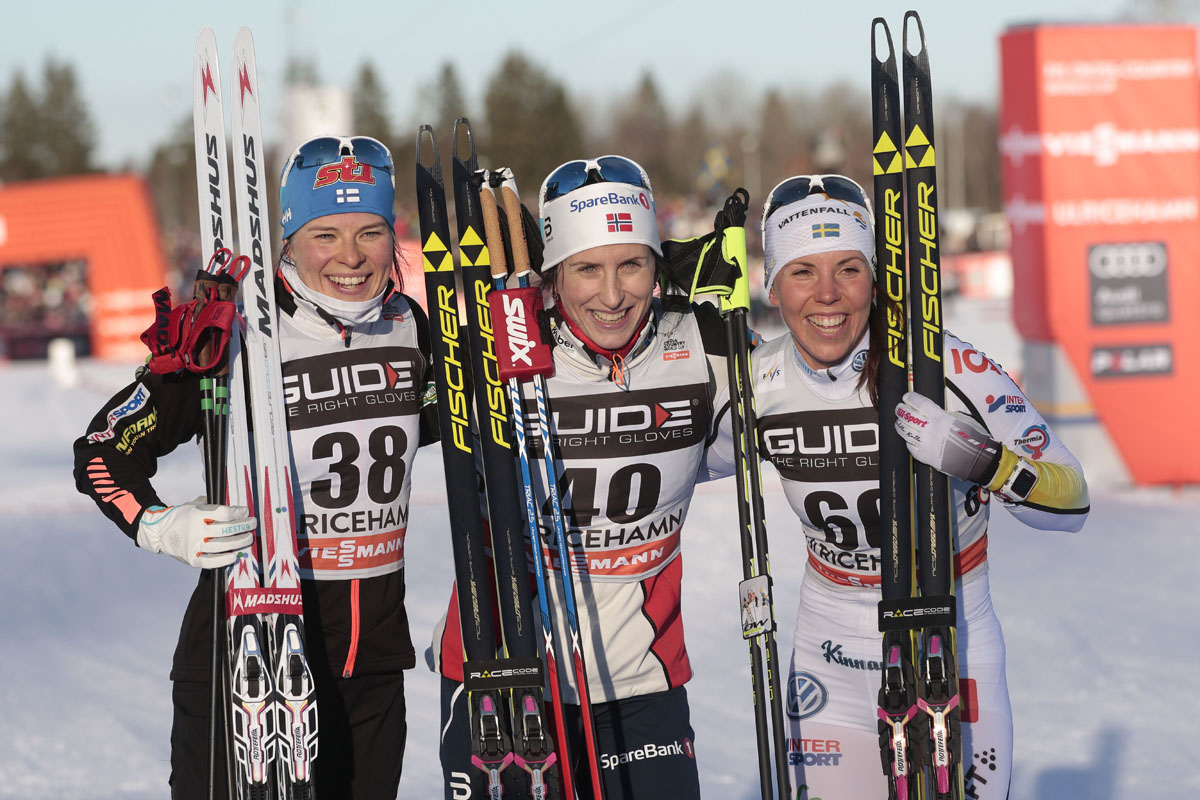
    Left to right: Finland's Krista Pärmäkoski, Norway's Marit Bjørgen and Sweden's Charlotte Kalla on the podium for the women's 10-kilometer freestyle race on Saturday in Ulricehamn, Sweden. (Photo: Fischer/Nordic Focus)
    Left to right: Finland’s Krista Pärmäkoski, Norway’s Marit Bjørgen and Sweden’s Charlotte Kalla on the podium at the World Cup women’s 10-kilometer freestyle on Saturday in Ulricehamn, Sweden. (Photo: Fischer/Nordic Focus)

    There are a lot of things Marit Bjørgen is not. She is not the only woman on Norway’s national team who knows how to win. She is not in the early stages of her cross-country career — her first World Cup debut came in December 1999. In comparison to many of her Norwegian teammates, she is not young. The average age of Norway’s women competing in Saturday’s 10-kilometer freestyle individual start in Ulricehamn, Sweden, (Bjørgen not included) was 25.

    At 36, Bjørgen’s age bests most of her teammates by close to a decade.

    But the new mom is also not letting any of that stop her from adding to her cache of cross-country wins. Saturday being the first opportunity she had since her last race in La Clusaz, France, to prove that winning is what she does.  

    “It’s so much fun to be back because I’ve been on my own for five weeks,” Bjørgen told NRK after Saturday’s race. “At least now I know that I’m on the right path.”
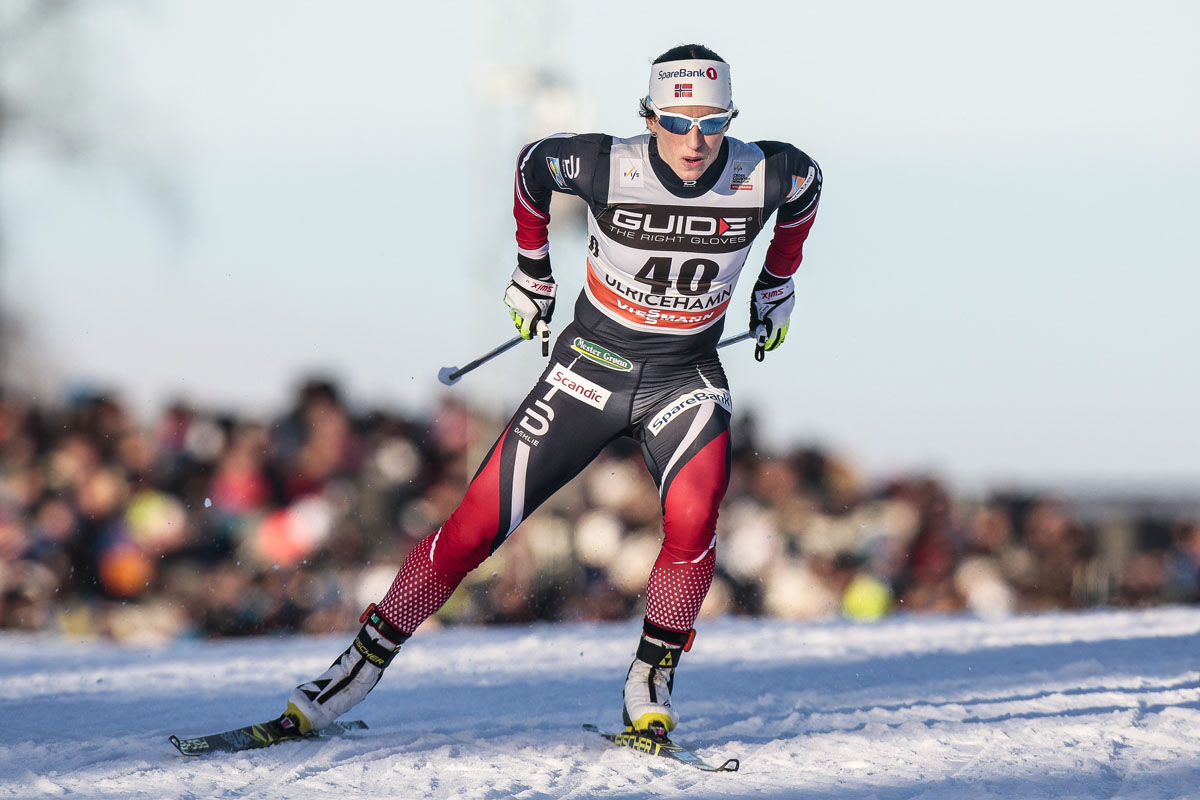
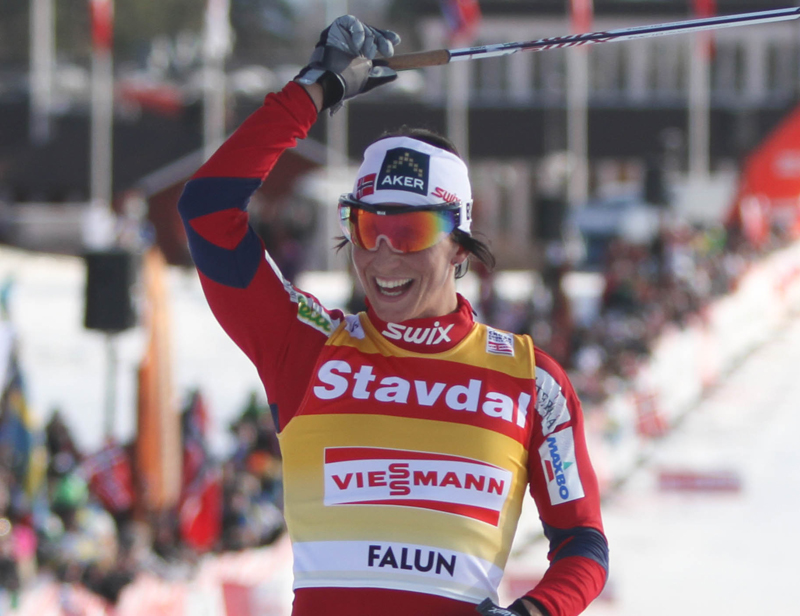
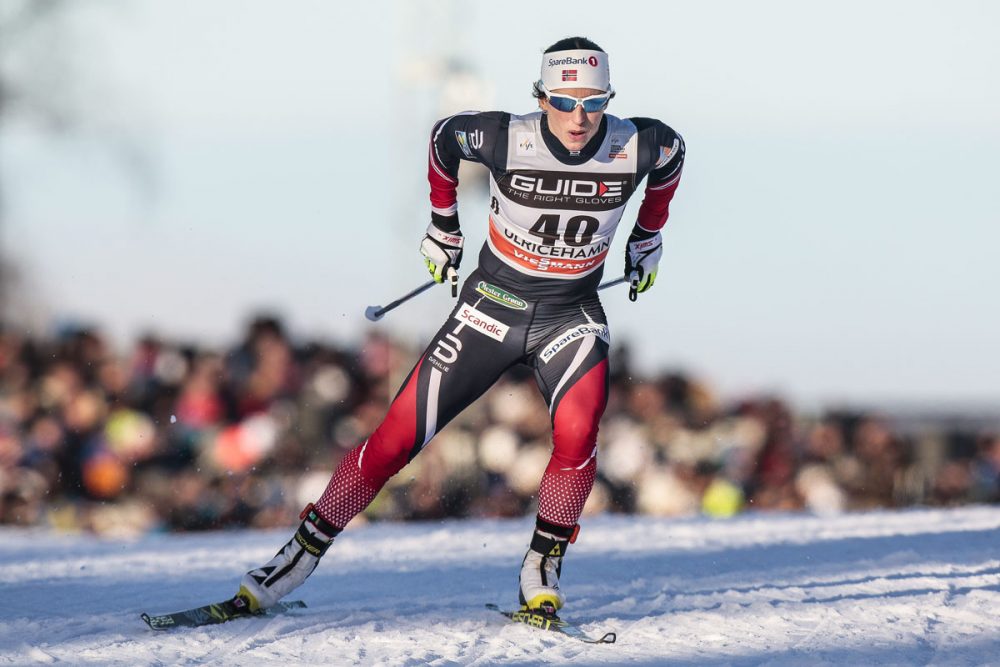
    Norway's Marit Bjørgen on her way to winning the women's 10-kilometer freestyle race on Saturday in Ulricehamn, Sweden. (Photo: Fischer/Nordic Focus)
    Norway’s Marit Bjørgen on her way to winning the World Cup women’s 10-kilometer freestyle on Saturday in Ulricehamn, Sweden. (Photo: Fischer/Nordic Focus)

    However, starting the Ulricehamn 10 k in bib 40, with 21 more racers still hungrily eyeing her back, Bjørgen would not know for sure if she made the right choice until the final starters behind her, including the likes of Sweden’s Charlotte Kalla, completed the course.

    Bjørgen’s Norwegian teammate Heidi Weng and Finland’s Krista Pärmäkoski — who both competed in this year’s Tour de Ski and finished first and second, respectively, in the overall — and started before Bjørgen, were also challenging her choice to forego five weeks of racing.

    Pärmäkoski was first to the front, leading both Weng and Bjørgen by exactly one second at the 1.5 k mark.

    Weng went next, this time Bjørgen and Pärmäkoski trailing behind by less than a second with 7 k still to go. Continually creeping up toward the top three was Kalla in fourth, less than four seconds back and American Jessie Diggins in fifth, within six seconds of the front.

    But with one 5 k lap down, Bjørgen began to break through.

    At 6.5 k, she had put close to three seconds into the Finn, now sitting in second place and more than 15 seconds into her teammate Weng, who had faded to fifth.

    With 2 k to go, Bjørgen continued to lead, while Kalla moved into third. The Swede, however, had no idea she was within 14 seconds of the front. The volume of a home crowd had her confused, thinking she was in 14th place instead.

    “It was all of the noise from the eager Swedish spectators that created the confusion, in addition to a sign with the number 14 on it,” Kalla told adressa.no. “It probably meant that I was 14 seconds behind, but I misunderstood.”
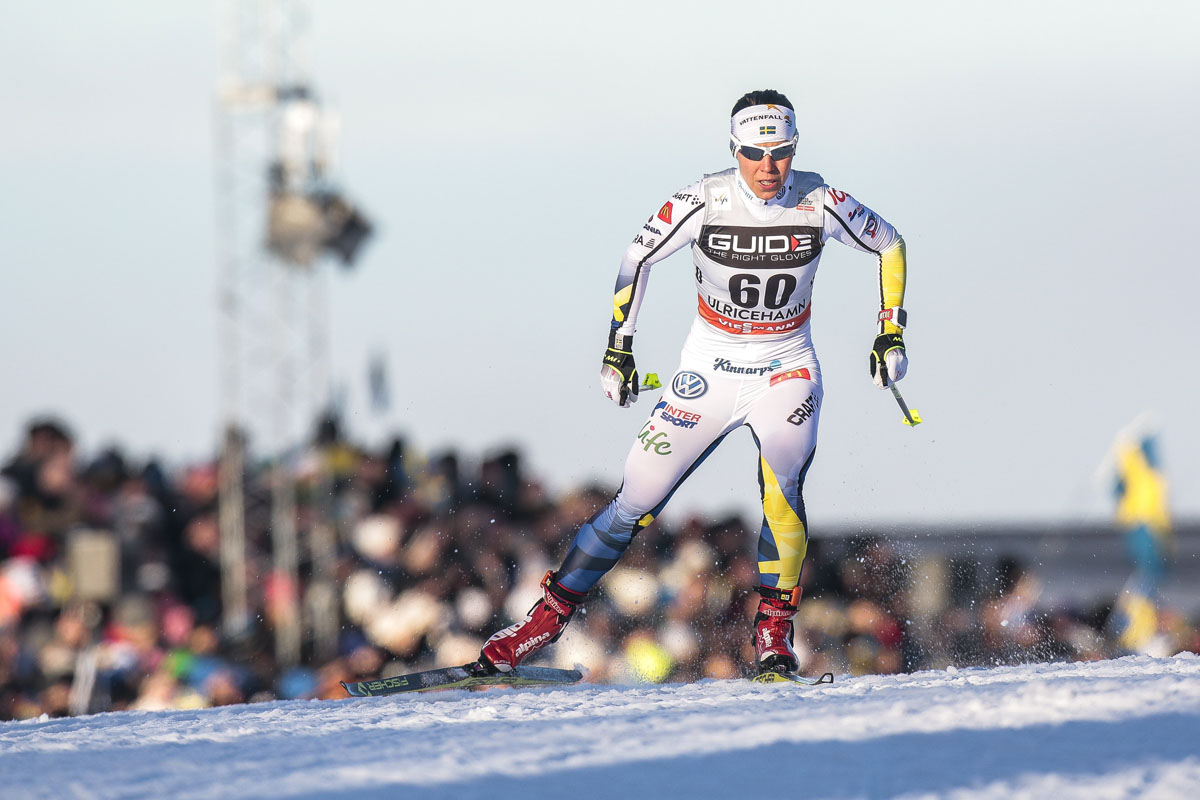
    Sweden's Charlotte Kalla racing to a third place finish in the women's 10-kilometer freestyle race on Saturday in Ulricehamn, Sweden. (Photo: Fischer/Nordic Focus)
    Sweden’s Charlotte Kalla racing to third place in the World Cup women’s 10-kilometer freestyle race on Saturday in Ulricehamn, Sweden. (Photo: Fischer/NordicFocus)

    With no intentional charge coming from Kalla, and Pärmäkoski pushing to the max of her 10 k skate pace, Bjørgen furthered her push for the win. She continued to put time into Pärmäkoski, ultimately finishing 10.7 seconds ahead of her in a time of 23:46.3 for her 104th individual World Cup title.

    When asked about the difference between her start and finishing speed, the Norwegian, who now also holds 22 individual wins on Swedish soil, responded with a bit of humor.

    “I’m starting to get old you know, it takes a while to get going,” Bjørgen told NRK.

    With a second place on Saturday, Pärmäkoski now has six individual podiums this season.

    “I had a great day,” Pärmäkoski said according to an International Ski Federation (FIS) press release. “I have proven to myself I can ski fast also in free technique.”

    Finishing 24.9 seconds behind Bjørgen, Kalla claimed the final podium spot in third, although unbeknownst to her until she received congratulations from Bjørgen and her Swedish teammate Hanna Falk, who finished eighth (+36.4).

    “I first realized that I had finished 3rd when Marit and Hanna gave a hug,” Kalla told adressa.no.

    “The audience [today] was world-class,” she added, according to a FIS press release.

    Four American Women in the Top 25

    Despite Saturday being an individual start, the two-lap 10 k course meant quite a few racers wound up skiing in company. For many of the American racers, that company came from their U.S. teammates.

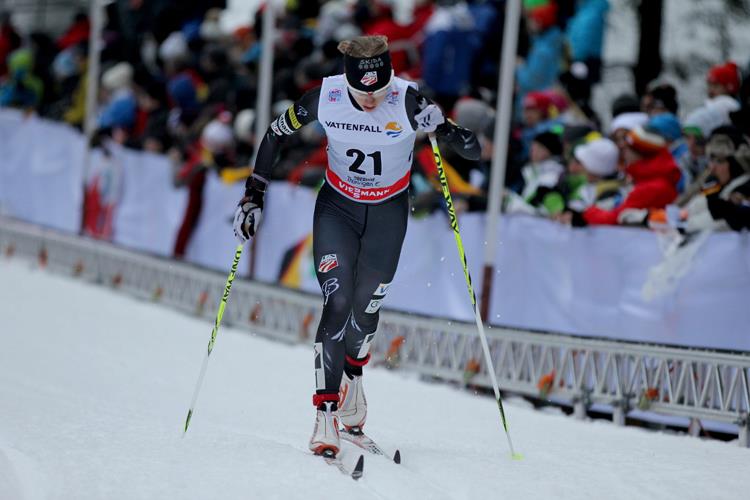
    Though she started 30 seconds behind her fellow U.S. Ski Team (USST) member Kikkan Randall, Jessie Diggins in bib 32 soon managed to catch Randall in bib 31. The 25-year-old Diggins proceeded to pass her and lead Randall through the first of two laps.

    “I didn’t have the snappy good feelings I was hoping to have in my body today, but it was a solid race,” Diggins, who finished seventh (+34.9), wrote in an email to FasterSkier.
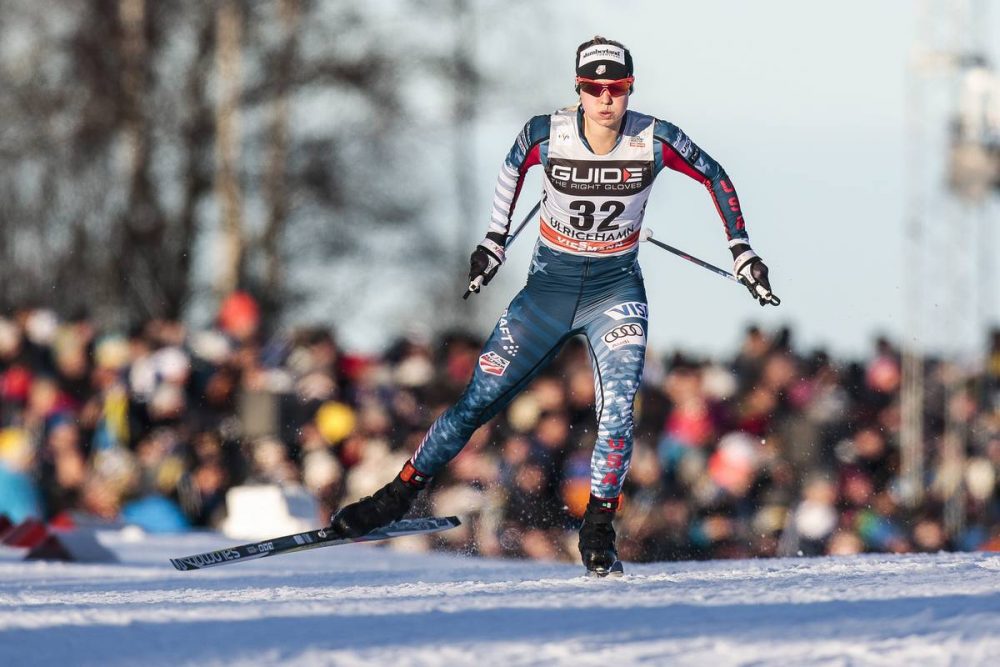
    American Jessie Diggins on her way to a seventh place finish in the women's 10-kilometer freestyle race on Saturday in Ulricehamn, Sweden. (Photo: Salomon/Nordic Focus)
    American Jessie Diggins on her way to a seventh place finish in the World Cup women’s 10-kilometer freestyle on Saturday in Ulricehamn, Sweden. (Photo: Salomon/NordicFocus)

    “It’s always hard when you know that on your best days you are capable of more, but at the same time we had great skis, and it was really fun for me to be able to ski with my teammates today!” she added.

    By the end of Diggins’s and Randall’s first lap together, their USST teammate Sadie Bjornsen cruised on course. For the next lap, Bjornsen led the trio of U.S. skiers.

    “Skating has been going well this year. I have a lot more confidence every time I start a race, so that is fun,” Bjornsen said on the phone after Saturday’s race.

    The U.S. trade-off train continued, with Bjornsen in bib 56 catching another USST member Rosie Brennan — who had start 30 seconds ahead of her in bib 55 — for their last lap.

    “It was an American line out there,” Bjornsen added, who ended the day as the second American in 12th (+1:00.5).

    The ‘American line,’ at least with Bjornsen, was something Brennan anticipated.

    “You never really want to get caught but … I love skiing with Sadie and so it was great to have her pull me into the finish,” Brennan said on the phone.

    Brennan further explained that having the comfort of a teammate, whose strengths and weakness could compliment her own, also made the pass more appreciated.

    “When some of these other fast girls come past you, [because] you’ve never skied with them before, it’s hard to truly believe you can keep up with them, but when it is someone you have spent so much time skiing with it was easy to convince myself like ‘oh of course I can stay with her’.” said Brennan, who ultimately finished 24th (+1:30.7).

    The one American who did not see any of her U.S. teammates during the race was Liz Stephen, who started 14th and finished the day in 16th (+1:07.30).

    Instead, Stephen found herself racing with another familiar face, Italy’s Virginia de Martin Topranin, who spent time training with Stephen on Eagle Glacier this summer.

    “We skied part of a lap together,” Stephen said on the phone. “But other than that I didn’t see anybody out there, which is good. That’s the point of an individual start … Mass starts you get to see plenty of people, sometimes it feels good just to be by yourself.”

    The fifth American woman to finish was Randall in 40th (+1:59.6) followed by Liz Guiney, the Period 1 SuperTour leader from the Craftsbury Green Racing Project, in 52nd (+2:33.2).

    “Competing in Ulricehamn was pretty awesome today,” Randall wrote in an email to several media outlets. “The course was packed with some of the most enthusiastic fans I’ve ever seen! It was a pretty cool course, too. Deceptively hard with a lot of gradual terrain and not many places to recover.

    “I had great skis today and a couple of really good opportunities to ski with my teammates,” she added. “But unfortunately I wasn’t able to fully capitalize on those rides and had a lackluster day. I had a decent race from about 2.5km to 7.5km but wasn’t able to keep the pedal down.”

    USST Head Coach Chris Grover noted that while there won’t be a 10 freestyle event at World Championships in a little over a month, the U.S. women’s team performance on Saturday was a good sign of where their training has taken them and where they are headed.

    “Of course you are always … hoping that we are going to have a podium but that’s not going to happen every day,” Grover said. “I think it is an excellent indication that we have a lot of women who are extremely fit and on the right day they can have some pretty extraordinary results.”
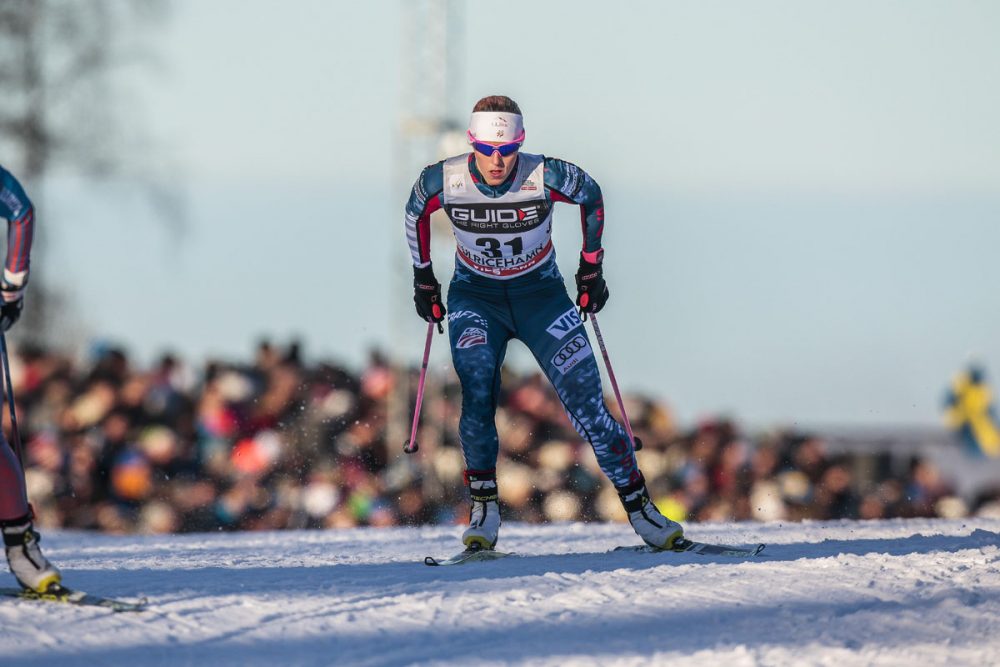
    American Kikkan Randall racing during the women's women's 10-kilometer freestyle race on Saturday in Ulricehamn, Sweden. (Photo: Fischer/Nordic Focus)
    American Kikkan Randall racing during the women’s women’s 10-kilometer freestyle race on Saturday in Ulricehamn, Sweden. (Photo: Fischer/Nordic Focus)

    The lone Canadian woman competing on Saturday in Ulricehamn, Cendrine Browne, of Canada’s national U25 Team, posted her career-best individual World Cup result in 35th (+1:52.0).

    “Along the race the coaches were telling me, ‘You’re five seconds away from top 30!’ ” Browne recalled on  the phone after. “So I was really trying to push harder. I was a little tired at the end, so next time I’d like to be less tired, but I guess you can’t really control that.”

    Browne explained that though most of her teammates remained in North America in order to prep for U23 or senior World Championships, she felt traveling to Europe and racing the World Cup was what she need to best prep for the upcoming Lahti cross-country events.

    “I had the choice to stay home, and train, and do races at home, but I also had the choice to come here and race instead, and I really love racing on the World Cup,” Browne explained.

    Athletes return tomorrow for the women’s 4 x 5 k relay. The U.S. women’s squad will field two teams, one with Brennan, Bjornsen, Stephen, and Diggins in bib 4, and the other with Randall, Sargent, Sophie Caldwell, and Guiney in bib 9.

    “I’m really looking forward to anchoring one of our TWO relay teams tomorrow!” Diggins wrote. “It’s really special for us to be able to field two teams and relays are my absolute favorite days. Time to break out the relay socks!”

    “So fun to see my teammates ski well today which has us all fired up for tomorrow’s relays!” Randall wrote. “Really pumped that we are fielding two women’s teams!”

    Results | Relay start list

  • TDS Stages 3 & 4: Oberstdorf Bonus Quotes and Photos

    TDS Stages 3 & 4: Oberstdorf Bonus Quotes and Photos

    Canada's Alex Harvey in his well-known guitar stance to celebrate third in the men's 15 k freestyle pursuit at Stage 4 of the Tour de Ski in Oberstdorf, Germany. (Photo: Salomon/NordicFocus)
    Canada’s Alex Harvey in his well-known guitar stance to celebrate third in the men’s 15 k freestyle pursuit on Wednesday at Stage 4 of the Tour de Ski in Oberstdorf, Germany. (Photo: Salomon/NordicFocus)

    Canada’s Alex Harvey is still on the podium.

    Then there’s the U.S. women’s team, with athletes in fifth, 10th and 12th in the Tour de Ski standings after big-time performances in Oberstdorf, Germany.

    Harvey kept himself in third overall and ahead of Switzerland’s Dario Cologna with a strong pursuit finish on Wednesday, and Jessie Diggins led her U.S. teammates on consecutive days, notching second on Tuesday for a career-best skiathlon result and holding onto fifth overall in the pursuit. Not far behind her, Sadie Bjornsen captured a career-best World Cup result of fifth on Tuesday, and Kikkan Randall skied into the top 10 on Wednesday. Also for the U.S., Liz Stephen clocked the seventh-fastest 10 k time in the pursuit.

    Here are some of the comments and photos that didn’t make it into our race reports:

    ***

    Tuesday’s 10/20 k skiathlon (Stage 3)

    (Race reports: Women | Men)

    Matt Whitcomb, U.S. Ski Team Women’s Coach:

    On the strategies for Jessie Diggins and Sadie Bjornsen: “The plan is flexible in the Tour. You never know what type of body is going to show up for you on any given day. We try and be a little bit flexible and try and respond to the cards that you are dealt that day. If you do feel good, try and control things a little bit, stay up near the front third of the pack that you are in, that will decrease the amount of turbulence and crashes and what not. That’s exactly what Sadie and Jessie were able to do today. It worked out fantastically.”

    On Liz Stephen: “Pretty strong classic performance out of her today. At the top of the first climb on the last classic lap, she was only 19 seconds out of the lead and just in contact with the main pack, so we expected pretty big things.” (but then skis were bad, as covered in piece.

    On slow skis: “It’s tough. We don’t often focus on it too much, but when an athlete or two are skiing really well, I think it’s important for them to be able to put some of the responsibility on the skis. It’s not always the athlete. A bit ironic today, as we felt we had some of the fastest skis in the race as well. There’s a lot that goes into making good skis… I think every brand of skis have their strengths, you know have their conditions that they’re great in. Some brands have some conditions that they can struggle in, a bit more than others. Sometimes, with this new snow, which we have a little bit of trouble with occasionally, not specific to any one. While it is a cold, fresh snow kind of day, it doesn’t mean it is going to be particularly straightforward on the glide.”

    On starting alone in a pursuit: “That’s something to consider, but in a tour like this for the women, it’s also important to remember that a lot of people will be released from the gate alone. It’s not like everybody’s in a pack except for her. It will be a pretty fair race tomorrow.”

    Sadie Bjornsen, U.S. Ski Team:

    On last weekend: “Val Müstair was a little interesting. I definitely wasn’t stoked about my sprint and then I had quite the blowup in the classic race. It definitely was challenging mentally, but I felt pretty confident in how I felt in my qualifier, the very first day, so I knew I couldn’t be in a disaster zone, I just forgot that I was at altitude in that 5 k race, and I did things a little bit wrong there.”

    On the pace in the skiathlon: “It’s hard to tell because the people in the very front look like they’re working hard, because I think they’re breaking the wind, and then there’s that draft effect for the middle section, and then you go a little bit farther back and then it becomes like they are working hard again, because it’s that constant traffic jam, it’s like, stop-go, stop-go, stop-go. I actually watched the race this afternoon, because they were showing it on TV, and that’s interesting, like it looks like it is a different pace than normal.”

    On her own pace in the skiathlon: “I felt like I was working hard at the beginning of that classic section simply because I was having to go through this accordion effect. But the times when I was conserving energy, I was certainly conserving, but it would be like conserve to sprint. That’s like a challenge of it’s own. I think that’s part of mass-start racing with not much snow anymore, you kind of deal with a little bit of that.”

    On lack of a breakaway: “I don’t really know if it was windy, I didn’t notice. I think it was just that maybe the type of snow, that it just seemed [windy]. All those downhills had flat sections afterwards, that may have a been a part of it, too. It was almost like there was more flat than normal in this course, because there’s that middle section that’s very flat. Most World Cup courses, you’re either going up or down, I think that’s what made a draft.”

    On the final climb: “It’s hard for me to remember, actually, what happened. I felt really strong going up that climb until maybe the last 20 meters of it, I was like, ‘Oh man, I hope I’m gonna make it over the top of this, ‘cause I’m red-lining.’ That’s certainly where I looked up and saw that those front four girls had gapped, and it was simply a difference right there.”

    On leading a group to the finish: “I was definitely stressed about being in the front of that pack, because I knew that there was a draft on the bottom. And I don’t know what happened, I tried to take that last downhill really well, and I had no idea what was going on behind me. I knew it was not ideal, but I was just going to go for it.”

    Jessie Diggins, U.S. Ski Team:

    On energy conservation with fast skis: “I had great skis, and then our techs did a great job. And then on top of that, downhills are my thing. So it was great because it was a really hard course to move around a lot, and change position. So if I just let myself just tuck the final parts of the downhill, like glide and draft and find myself able to kind of make some moves out there, or just chill out a little bit. So that was really cool.”

    On lack of a breakaway: “I actually don’t think anyone was really seriously trying to make any breaks, and I don’t know, that’s just my opinion, from where I was sitting, but it seemed like a different sort of race out there.”

    On uphills in traffic: “That will happen, you kind of have to keep your head on a swivel. There were times I felt like I was doing a little hopscotch thing, trying to not step on anyone’s poles, and very carefully, I’m going to put my ski here, and, ‘Oh well.’ ”

    On mixed new and manmade snow: “There were a couple sections where over the top of the hill, if it was powdery, if it had been raked or something, you might kind of get a little ‘ooh’, kind of tripping. I thought the downhills were skiing really well; they’re just fast, with some turns at the bottom. The one where the men crashed, everyone was skidding it, it was one of those corners, that maybe if you were by yourself, you could maybe just step it, but like in a group you need to skid it, and sometimes you don’t have room. Yeah, it’s always harder to ski in a group.”

    On her energy level in the Tour de Ski: “In general, tours are good for me, because I tend to get stronger as I go. And I really like the big grind of it, and because I can stay really positive, I think that’s a strength of mine. It’s not like you can smile away the tired feelings, but you kinda can [laughs]. I’m looking forward to it, so far it has felt really good.”

    ***

    Wednesday’s 10/15 k freestyle pursuit (Stage 4)

    (Race reports: Men | Women)

    Alex Harvey, Canadian World Cup Team:

    On pacing with Dario Cologna: “It was in both our interests, both him and I, to try and keep the speed high in the front and stay away from the chase group and maybe gain a few seconds from the front guys.”

    On the conditions: “It was pretty windy today so you had a big advantage by following along on the flats.”

    On race strategy: “I knew where he would try to attack me, which was on the big hill the same way he did [in the Skiathlon]. So I was just making sure I had enough legs to try and match his speed on the big hill.”

    Devon Kershaw, Canadian World Cup Team:

    On the upcoming stages: “I hope to feel good like this coming into Val de Fiemme and the classic race there, that’d be really really sweet. The uphill [final climb] is my least-favorite race in all of maybe any competition I’ve ever done, that’s a bit of a survival one, but the Saturday race is definitely something I look forward to.”

    Sadie Bjornsen

    On winter storms: “With the super-windy conditions and the slower snow, it was challenging to be exactly where you wanted when moves were made. Those hills were challenging today, but the flats were almost more challenging because of the strong wind and slow conditions. There really wasn’t any resting out there!”
    Liz Stephen, U.S. Ski Team:

    On how mass starts have been frustrating lately: “It’s a nice change! We’ve done so many mass starts, but I feel like there’s so much you can get right or get wrong. It’s nice to have a race that’s engaging because there’s people around. And I like skiing around people! I just don’t enjoy it when the courses are so narrow that you can’t make passes when you want to. Those are the only times I get frustrated with mass starts. I like to ski with people, but it’s hard to want to make these moves and feel like there’s no place to go. It’s nice to have a race I could do what I wanted out there.”
    On form coming around: “I don’t know about yesterday. I feel like I’m coming up little by little, skis are part of it, sometimes, for sure, but I feel like I’m racing myself into the kind of shape that I’ve been trying to get in the season. The Tour generally does that for me. I’m looking forward to more racing and more time going this hard. And I think it’s helping me get into the race shape I want to be in, and I think this Tour is playing its role.”

    On looking forward to Friday’s Stage 5: “Toblach is a really tough course for me. It’s just so gradual, and a 5 k is so short that I have it on my radar to not lose a ton of time. I’m not setting out there to get a podium or anything, or a top 10 on the 5 k skate here. I’m just setting out to not lose a bunch of minutes on a 5 k where I can help it. I want to pace it really well, and ski it the best that I can, and keep my eyes on the prize in Val di Fiemme.”

    On her team: “Watching Sadie skate up the hills, she’s a different Sadie than she’s ever been. Jessie is just a fireball that can’t be caught right now. I think just being a part of the momentum of this team is really a special experience for me. I feel really proud watching my team out there, for sure.”

    Noah Hoffman, U.S. Ski Team:

    On form at this point in the Tour: “I still feel like my energy is good, even though I didn’t show it with a great result today, and I’m looking forward to three more stages.”

    On the wave start: “Starting in a wave is a great position to start, getting a fast time on the day, because there are guys skiing around you who are fast, and guys to follow. I have no complaints about it. It’s basically a small mass start at that point. It’s a really effective way to have a good race.”

    Erik Bjornsen, U.S. Ski Team

    On form coming into the Tour: “I tried to put in a hard training block after La Clusaz and I think it was a little to close to the Tour. I’ve been feeling a little heavy and tired which is not the way you want to start a seven-stage tour.”

    On overall Tour position: “I won’t be competitive in the overall tour. I lost too much time in the skiathlon. That doesn’t mean I’m ready to drop out, though. I’m excited to go into the next couple races with an open mind and try my best to put together a strong race and hopefully take home some more World Cup distance points.”

    On the wave start/conditions: “In these conditions, it tends to makes drafting more important and passing even harder. Being in the wave start has its positives and negatives. It was hard to make passes out there, but at least being in the back we had a little drafting effect.”

  • SuperTour, Eastern Cup Race Reports, and La Clusaz Photos

    Toko logo

    (Original e-blast)

    Sun Valley SEF logo

    SuperTour Race Reports

    For the SuperTour Races in West Yellowstone this year we had great packed powder conditions.  The snow seemed to have a bit more moisture in it than in other years, and with slightly milder overnight temperatures we stuck to the Red waxes by in large.  For both race days we played it safe mixing HF Blue and HF Red 1:1 for a base layer.  For powder we ran Toko JetStream Red 2.0, which ran 1st or 2nd in testing all weekend.  On sprint day we ran a cold block in the morning and once the snow had a cold glaze to it, we added a cold liquid with block which helped at high speed.  Gelso had great skis and was able to race from the front of the pack all day.  For the distance classic race we were racing in heavy snow storm and temp’s around 20 degrees, so we kept it simple with JetStream Red 2.0 block over the JetStream Red 2.0 powder and focused our energy on kick.
    The next weekend we made our way up to Silver Star for the SuperTours in Canada.  It was super cold all week training, but again great conditions, and luckily it got up into the upper single digits come race days.  The Toko brand ran super well in Canada as it always does in the cold.  The snow was cold enough where mixing Toko X-Cold Powder in with LF Blue for a base layer helped harden the skis.  From there it was Toko HF Blue, Jet Blue 2.0 Powder, and Jet Blue 2.0 Block.  Some of our guys were doubling poling the CL Sprint all day so glide was important.  As the tracks got skied in throughout the day we again found success mixing Toko Blue Helix with the JetStream Blue block.  By the Sprint finals and second race on the distance day we switched to Red Helixmixed with the JetStream Blue block.
    – Chris Mallory, Head Coach Sun Valley Elite Team
    MNC
    Eastern Cup Race Report
    A really productive and fun first weekend of racing at Craftsbury. A little bit of everything when it came to snow and weather!
    Day 1: Classic Interval Start
    Cold temps overnight on a manmade base, but a lot of fresh new snow the day of the race. For kick wax we were on a very thin Toko Green Base binder ironed in. We ended up on kick wax from another brand.
    Our paraffin layer was HF blue for earlier races, with a 2:1 mix of HF Bue:HF Redfor later races. We tested a fair amount of topcoats and Jetstream Blue Bloc 2.0was arguably the most reliable and consistent performer all day so that went onto all skis rotocorked. Later starters had a slightly warmer block from another brand mixed in with the Jetstream. For structure we ended up with just the linear Toko Blue Structurite pattern on the tail of all skis for the Open Women’s and Open Men’s Races.
     
    Day 2: Freestyle Pursuit
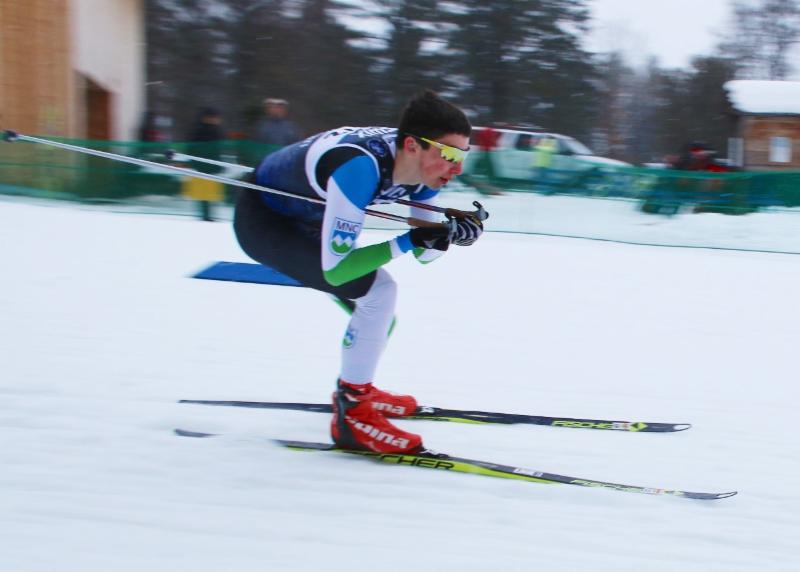
    Will Solow (Mansfield Nordic Club) racing in the Eastern Cup race at Craftsbury. (Photo: Gary Solow)
    Will Solow (Mansfield Nordic Club) racing in an Eastern Cup race at Craftsbury. (Photo: Gary Solow)
    It rained overnight with temps above freezing, but the course held up very well and remained stable and mostly firm albeit saturated.
    We saw a lot of this last year and I was really happy to have plenty of the right Toko products on-hand. From early-season temps to Junior Nationals last year, the Toko warm fluoros just seemed to be incredibly reliable and fast.
    All skis had a base of HF Red. A quick test in the morning showed that HF Yellow was not significantly better or worse, and so we stuck with the HF Red and focused on testing topcoats, application methods, and structure.
    We felt there was a pretty significant difference between powder and blocks and focused on using blocks to best effect. Our final call was Jetstream Yellowrotocorked, then brushed, with another quick hand-corked layer over that. After a final brushing, skis received Helx Red liquid on the first part of ski, with Helx Yellow on the rear.
    Early structure winner was a Swix tool that provided a left-angled and non-aggressive pattern, although at a somewhat large 1.5mm. As the course got more skied-in and churned up the tails of the skis received the combo of right- and left-angled patterns to form the crosshatch or “fishnet” pattern.
    Our skate skis seemed to be performing really well and with large packs of skiers it was easy to evaluate speed and glide. Reports from the racers were very good!
    – Adam Terko, Mansfield Nordic Club Head Coach
    Here are a few action shots of US Toko Athletes at the most recent World Cup races in La Clusaz, France. (All photos: Nordic Focus)


    (Photo: Toko/NordicFocus)
    Erik Bjornsen
    Rosie Brennan
    Rosie Brennan
    Erik Bjornsen in the field
    Erik Bjornsen in the field
  • After 8 Years, France Finds Relay Podium Again; Norway Wins La Clusaz Men’s Relay

    After 8 Years, France Finds Relay Podium Again; Norway Wins La Clusaz Men’s Relay

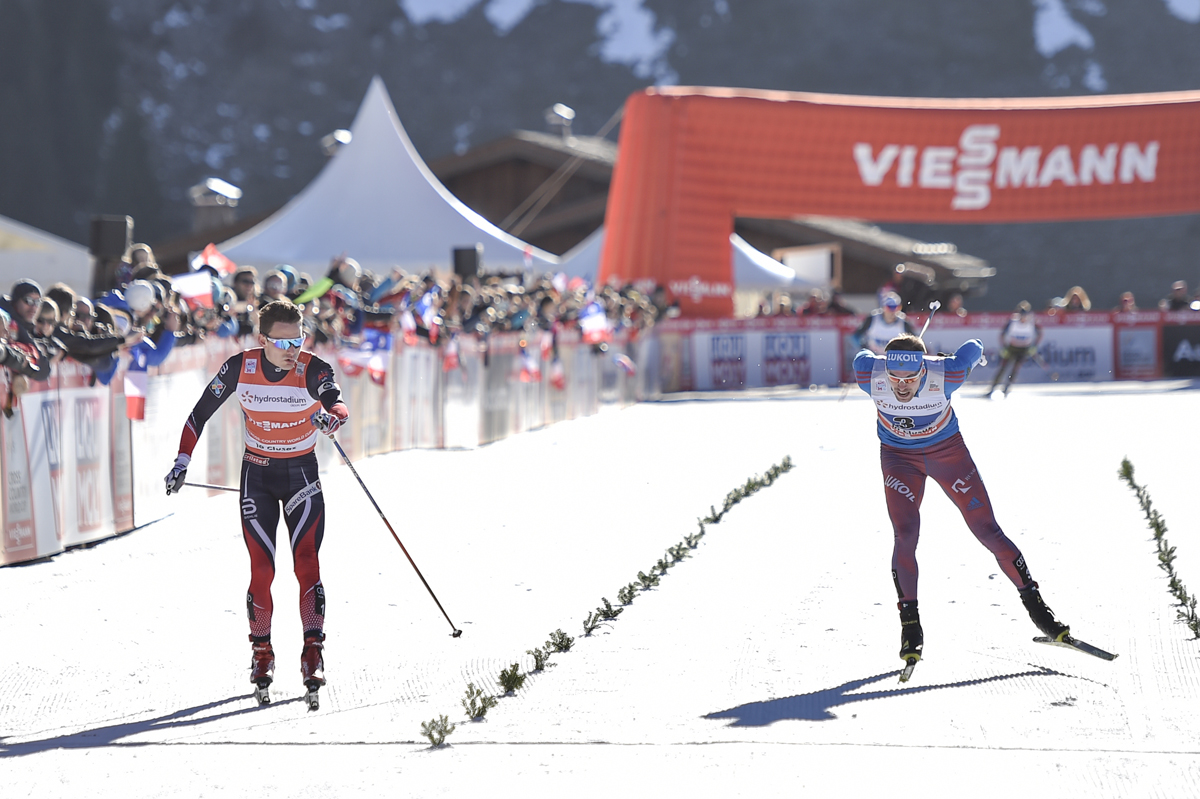
    Finn Hågen Krogh (l) crossing the line ahead of Russia's Sergey Ustiugov to give Norway the win in the men's 4 x 8 k relay, the first of the World Cup season, in La Clusaz, France. (Photo: Fischer/NordicFocus)
    Finn Hågen Krogh (l) crossing the line ahead of Russia’s Sergey Ustiugov to give Norway the win in the men’s 4 x 8 k relay, the first of the World Cup season, in La Clusaz, France. (Photo: Fischer/NordicFocus)

    Eight years ago, France’s Maurice Manificat and Jean-Marc Gaillard waved to the French cheers of their country’s fans as they climbed onto the men’s World Cup relay podium in La Clusaz, France. The two — along with their former national-team teammates, Vincent Vittoz and Emmanuel Jonnier — had secured the final podium spot by less than a minute, just barely missing out on second place.

    Little did they know as they climbed down that it would be close to a decade later before they would reach a relay podium again during the regular World Cup season.

    On Sunday, for the first time since December 2008, both Manificat and Gaillard — joined this time by their teammates and current French national-team members, Alexis Jeannerod and Clement Parisse — reclaimed their podium spot in the men’s 4 x 8-kilometer relay, once again against the backdrop of La Clusaz.

    “It was a great day for our team,” Manificat said, according to an International Ski Federation (FIS) press release. “Everybody did an awesome job on their legs. I knew Finn [Hågen Krogh] and Sergey [Ustiugov] would be the biggest opponents today on the last leg. My plan was to ski with them and eventually go away. Finn and Sergey were stronger but it is great to finish on the podium.”

    (Article continues below)

    Starting in Row 2 behind Russia’s Evgeniy Belov, Gaillard skied the first classic leg for France, holding tightly to a third place for much of the first part of his race, behind Belov and Norway’s Didrik Tønseth.

    By the 3.5 k mark, Pål Golberg of Norway’s second team and Sweden’s Emil Jönsson had overtaken the lead and Gaillard was getting pushed back to fourth then fifth and eventually seventh.

    Yet the Frenchman’s skis proved faster than most in the field and by 6 k he had regained his position in third. Belov had also found his way back to the front. As the group rounded for their final lap Goldberg charged the group to the exchange zone, putting Norway’s second team on the attack.

    Gaillard ultimately tagged off in sixth to Jeannerod for the second classic leg. Norway’s first team came through in seventh, handing off to Martin Johnsrud Sundby. Russia I tagged off in second to Alexander Legkov.

    It didn’t take long, however, for Sundby to put Norway’s first team back in the lead. By the 2 k mark it was his red bib that led the chase pack, with the Norwegian double poling on skate skis. Within the next 2 k, however, Italy’s Francesco de Fabiani, Legkov and Sweden’s Jens Burman had swallowed up Sundby, while Jeannerod now sat in seventh.

    With 2.5 k to go of the second leg, de Fabiani quickened the pace and Sundby struggled to keep up while double poling the course climbs.

    The second exchange came down to a battle between Italy and Norway’s second team, with Norway’s Niklas Dyrhaug outsprinting de Fabiani to be the first through. Russia’s first team exchanged in third, while France I was now positioned in fifth. Sundby was the last of the chase pack to come through in ninth, tagging off to Anders Gløersen for the first freestyle leg.

    “It’s necessary to take a proper stance for the classical diagonal technique,” Sundby said told VG. “I did that today by getting a real beating.”

    As the first freestyle leg began to unfold, it was Sweden’s Martin Johansson who led the charge, not far behind was Russia’s Alexey Chervotkin and France’s Parisse. Also working his way back into the mix — despite the 20 meters Sundby had lost on the lead group — was Gløersen of Norway’s first team.

    In fact, by the 3 k mark, Gløersen had propelled himself to the front and taken command of the lead.

    Norway's Ander Gløersen leading the third leg of the men's 4 x 8 k relay on Sunday at the World Cup in La Clusaz, France. (Photo: Fischer/NordicFocus)
    Norway’s Ander Gløersen leading the third leg of the men’s 4 x 8 k relay on Sunday at the World Cup in La Clusaz, France. (Photo: Fischer/NordicFocus)

    “Anders did a great job on his leg and put us back in contention,” Finn Hågen Krogh, the anchor for Norway’s first team, said according to a FIS press release.

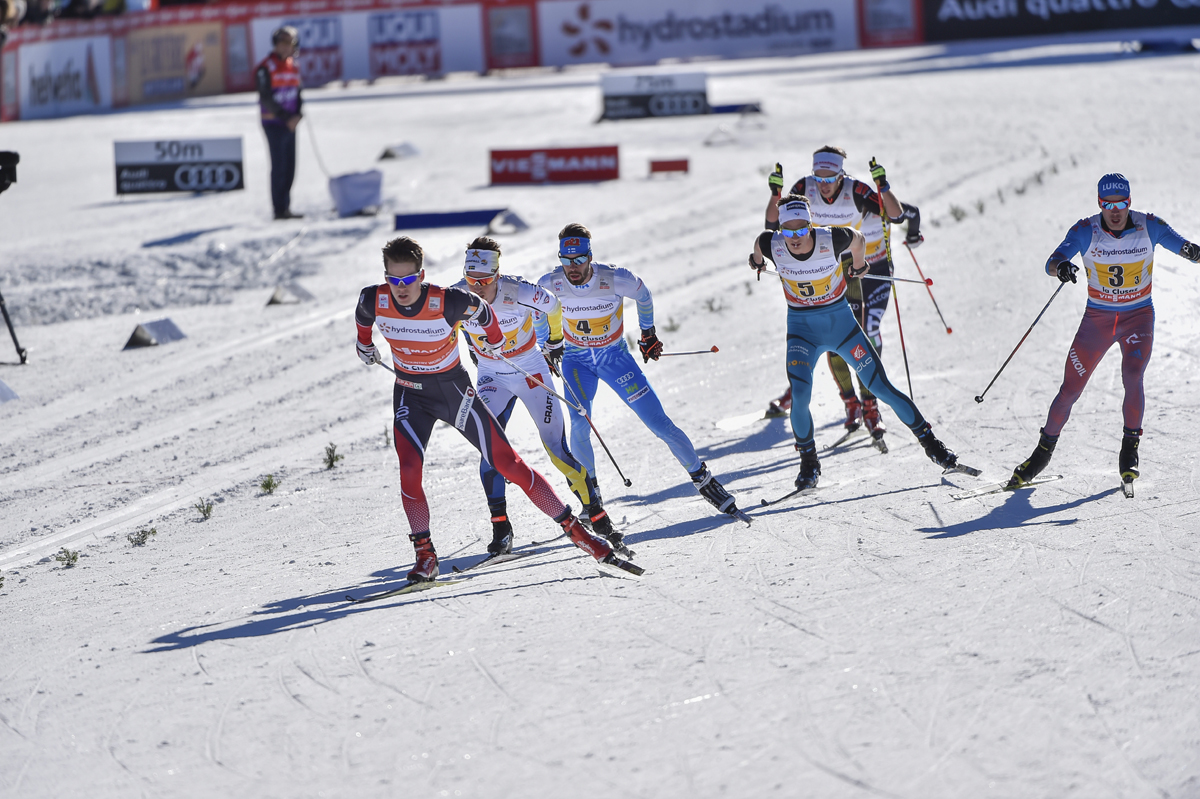
    With the lead returning to Norway, France, Russia, and Sweden were back in the hunt. The 4 k mark found a front group of seven nation’s relay teams — Norway I, France I, Germany, Sweden, Russia I, Finland, and Italy.

    Rounding the corner for the final exchange, it was Norway I, followed by Sweden, and Russia. Parisse, who tagged off to Manificat, came through in fifth.

    The anchor for Russia’s first team, Sergey Ustiugov, wasted no time moving to the front of the group to set the pace. The six other frontrunners followed closely behind, with Krogh and Germany’s Lucas Bøgl positioned in second and third respectively.

    Then came the waiting game. The group slowed, Ustiugov and Krogh casting a few glances over their shoulders to see who would make the first move. Ultimately it was Ustiugov first. The Russian began to push the pace around the 3 k mark, initiating a scramble. Yet within another kilometer, Ustiugov slowed giving the lead back over to Krogh.

    “In my leg I wanted to save some energy and gave everything in the last corner and in the finish stretch,” Krogh said, according to a FIS press release.

    The front group had now split in two, with Germany, Norway I, France I, and Russia I breaking away. Sweden, Finland and Italy had fallen behind.

    As they approached the final course climb, the real sprint began with Krogh and Ustiugov going head-to-head straight to the last 100 meters. In a lunge to the line, Krogh bested Ustiugov by two tenths of a second for the overall win in a time of 1:11:25.7. Crossing 7.7 seconds later was Manificat, securing France on the podium in third.

    “I gave everything I had in the finish,” Ustiugov said, according to a FIS press release. “The speed increased in the last two laps. It is always disappointing to lose, but Finn was very strong on the home stretch. But it is still a very good result to be second and to share the podium with my teammates.”

    Neither Canada nor the U.S. fielded a men’s relay due to illness. Racing will resume Dec. 31 in Val Mustair, Switzerland, for Stage 1 of the 2016/2017 Tour de Ski.

    Results

    — Aleks Tangen contributed reporting

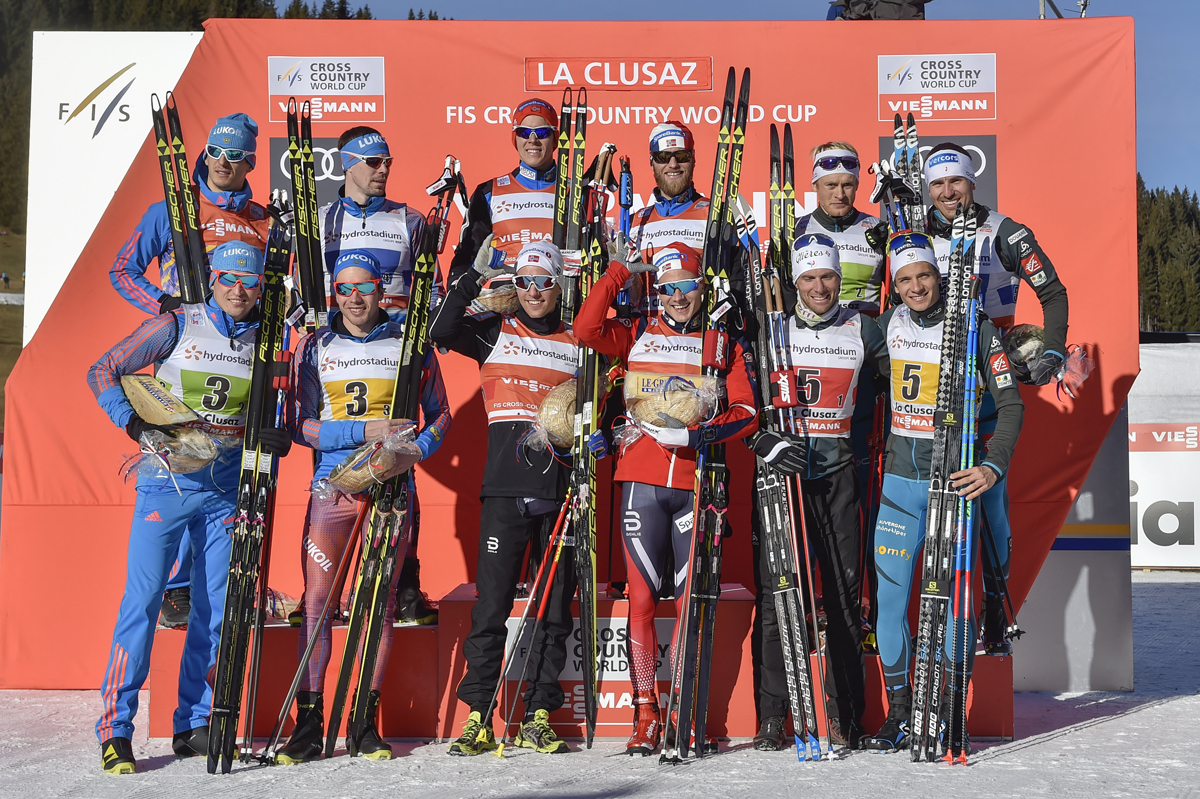
    The men's relay podium at the La Clusaz World Cup on Sunday, with Norway in first (c), Russia in second (l) and France with its first World Cup podium in eighth years in third (r). (Photo: Fischer/Nordic Focus)
    The men’s relay podium at the La Clusaz World Cup on Sunday, with Norway in first (c), Russia in second (l) and France with its first World Cup podium in eighth years in third (r). (Photo: Fischer/Nordic Focus)
  • Saturday Rundown: La Clusaz, Nove Mesto & Rossland (Updated x3)

    Saturday Rundown: La Clusaz, Nove Mesto & Rossland (Updated x3)

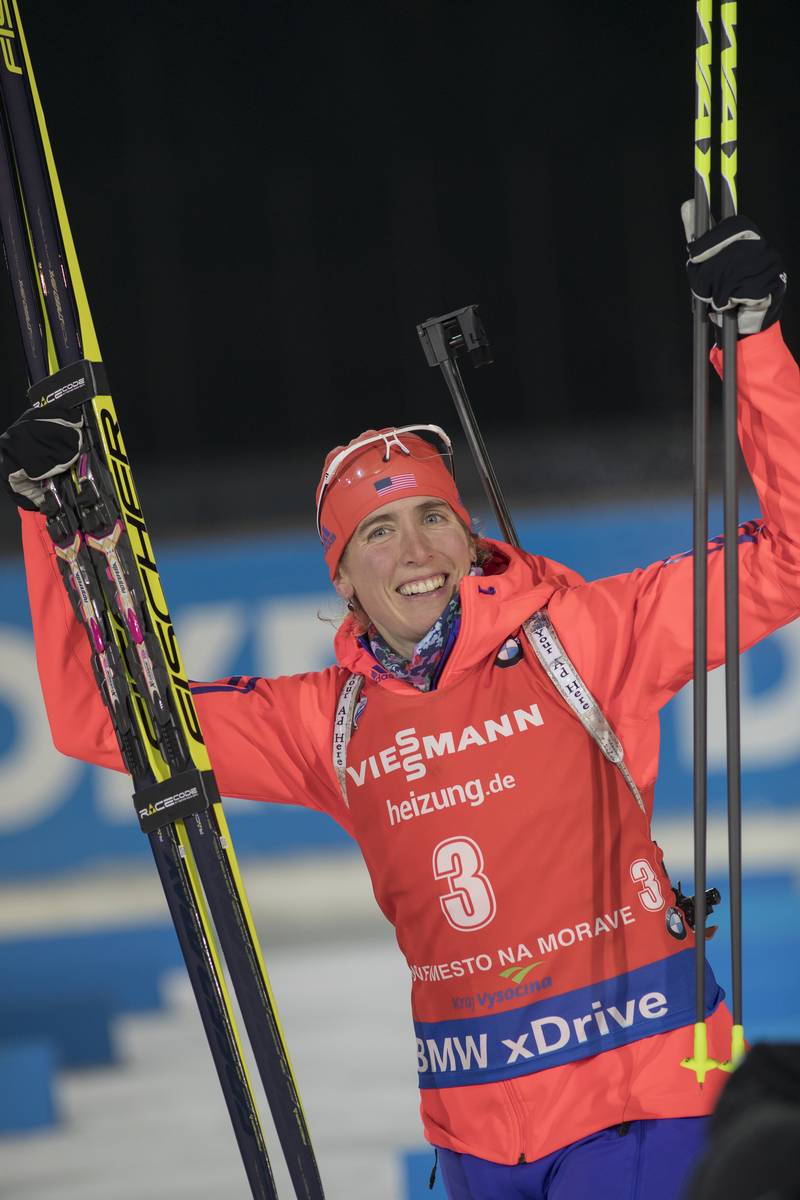
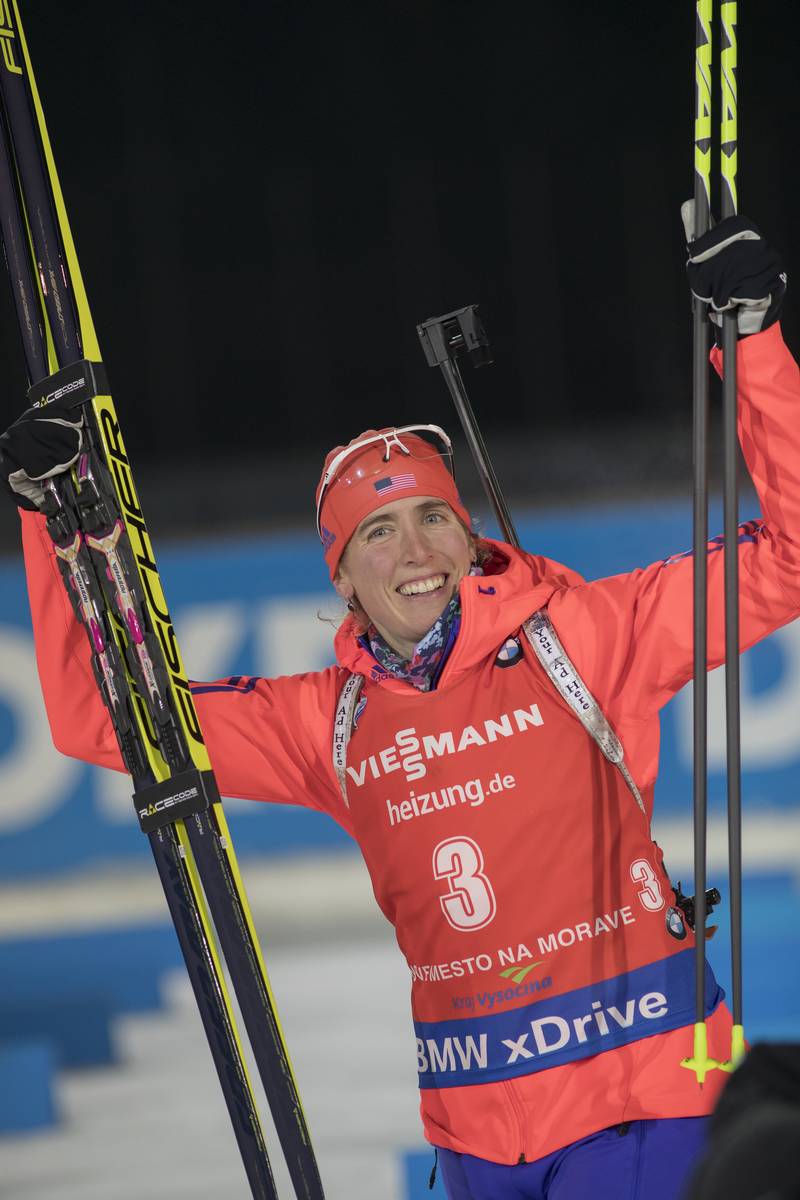
    Susan Dunklee (US Biathlon) after achieving fourth place on Saturday for a personal-best pursuit result at the IBU World Cup in Nove Mesto, Czech Republic. (Photo: USBA/NordicFocus)
    Susan Dunklee (US Biathlon) after achieving fourth place on Saturday for a personal-best pursuit result at the IBU World Cup in Nove Mesto, Czech Republic. (Photo: USBA/NordicFocus)

    Welcome to The Rundown, your quick primer of need-to-know information about the day’s racing. We’ll be updating this digest as the day goes on with additional results, photos and quotes. The Rundown is NOT a race report; stay tuned for complete race reports later today with interviews from the day’s top racers.

    ***

    IBU World Cup in Nove Mesto: 10/12.5 k pursuits

    [UPDATE] Third one day, fourth the next. That’s the streak Susan Dunklee (US Biathlon) is riding after notching her third career podium on Friday in the women’s sprint, followed by a fourth place in the women’s 10-kilometer pursuit on Saturday in Nove Mesto, Czech Republic.

    Dunklee posted the fastest range time and third-fastest shooting time overall and shot 18 for 20 (0+1+1+0) en route to fourth (Dunklee’s best pursuit result), 28 seconds behind France’s Anaïs Chevalier, who won in 30:38.1 minutes. Italy’s Dorothea Wierer landed on the podium in second (+9.5) and Friday’s sprint winner, Tatiana Akimova of Russia, placed third (+19.4). Chevalier missed just one in the first prone stage (1+0+0+0) to improve on her second-place sprint finish on Friday, which was her first podium. Wierer rose from seventh at the start to second with two penalties (0+1+1+0) and Akimova had just one miss on the first stage as well (1+0+0+0).

    Canada’s Julia Ransom tied her career best by racing to her first top 20 of the season in 19th (+1:48.5) after starting 26th. She cleaned three straight stages (0+0+0+1), and skied into 18th after the third and fourth stages, before losing one place to Norway’s Marte Olsbu (19th, +1:47.2) at the finish.

    Also for Biathlon Canada, Rosanna Crawford finished 32nd (+2:51.8), up from 37th at the start, with two penalties (1+0+1+0). Megan Tandy finished 57th (+5:32.7) with five penalties (1+1+0+3), after starting 44th.

    American Joanne Reid slipped two spots to 54th (+4:29) with two misses (1+0+1+0).

    According to the provisional start list for Sunday’s mass start, Dunklee will be the lone North American woman competing.

    US Biathlon’s Lowell Bailey raced from 20th at the start to ninth at the finish, 1:22.1 minutes behind French winner Martin Fourcade, for his best result of the season in the men’s 12.5 k pursuit.

    The first starter with a two-second head start, Fourcade hit 19 of 20 targets and cleaned the last two shooting stages (0+1+0+0) to win the second-straight men’s race in Nove Mesto. Russia’s Anton Shipulin, who started second, ended up second again at the finish (+30.2) after a penalty on each of the last two stages (0+0+1+1). France’s Quentin Fillon Maillet and Germany’s Simon Schempp both cleaned all four stages (0+0+0+0) and battled to the very end in a fight for third. Fillon Maillet took third place by one-tenth of a second, 38.3 seconds behind Fourcade, while Schempp finished fourth (+38.4).

    Bailey steadily picked off places throughout the race with just two penalties (1+0+1+0), and after leaving the range for the last time in 11th, he moved up two more spots on the final loop to place ninth for his first individual top 10 of the season.

    Canada’s Scott Gow finished 40th (+3:31.2) after starting 18th, with a total of three penalties (0+2+1+0). Brendan Green moved up slightly from 54th at the start to 52nd (+5:30.6) with five penalties (1+0+3+1), and American Russell Currier was lapped.

    Bailey was listed as the lone North American on the provisional start list for Sunday’s men’s mass start.

    Results: Women | Men 

    ***

    FIS Cross-Country World Cup in La Clusaz: 10/15 k freestyle mass starts

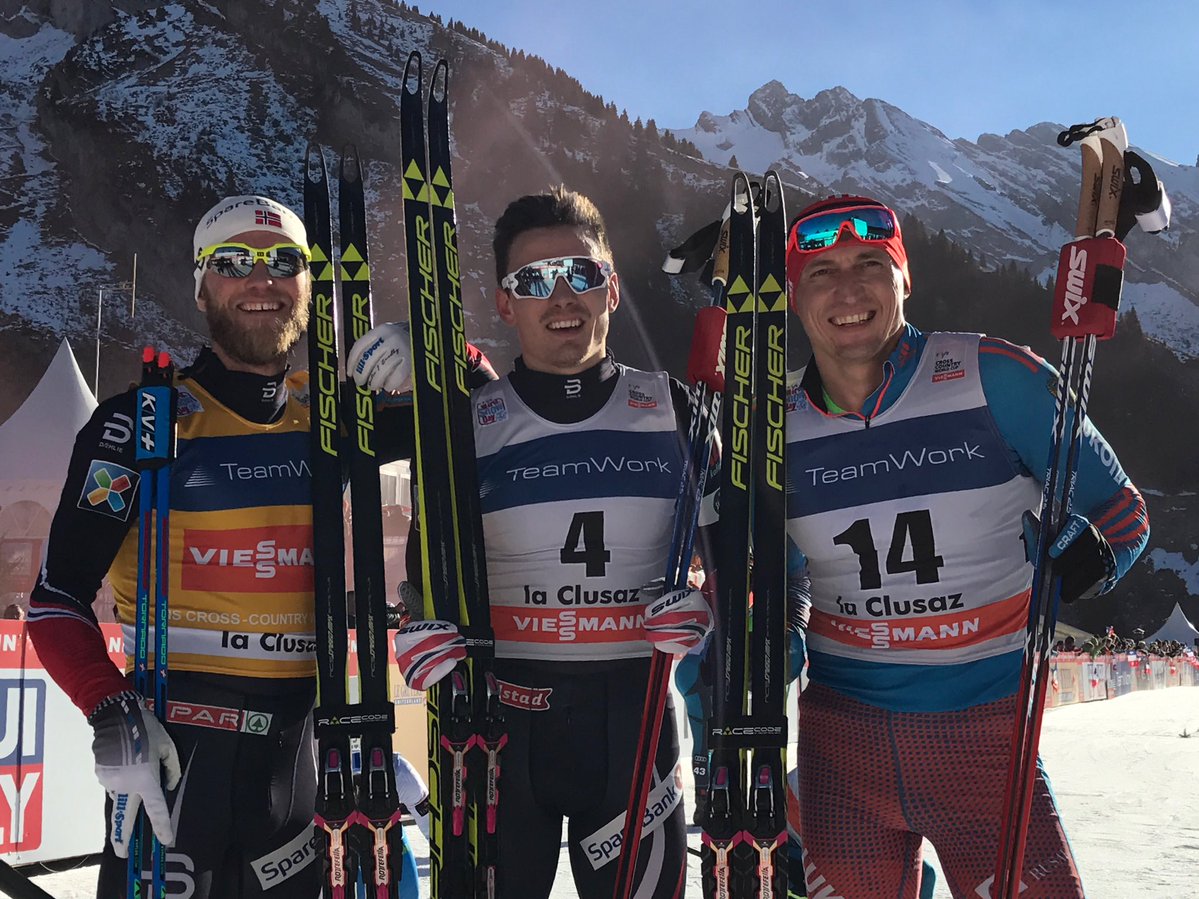
    The men's 15 k freestyle mass start podium on Saturday at the World Cup in La Clusaz, France, with Norway's Finn Hågen Krogh (c) in first, Martin Johnsrud Sundby (l) in second, and Russia's Alexander Legkov (r) in third. (Photo: FIS Cross-Country/Twitter)
    The men’s 15 k freestyle mass start podium on Saturday at the World Cup in La Clusaz, France, with Norway’s Finn Hågen Krogh (c) in first, Martin Johnsrud Sundby (l) in second, and Russia’s Alexander Legkov (r) in third. (Photo: FIS Cross-Country/Twitter)

    It was a good day for Alex Harvey of the Canadian men’s team as well as Dahria Beatty of Canada’s women’s team, and for the U.S., Erik Bjornsen, Rosie Brennan and Liz Stephen, all of which landed in the top 30 in La Clusaz, France. Two U.S. favorites, Jessie Diggins and Sadie Bjornsen did not start the freestyle mass starts due to illness.

    Harvey raced to seventh in the men’s 15-kilometer freestyle mass start, finishing 26 seconds behind Norwegian winner Finn Hågen Krogh. The big news of the day was Krogh beating his teammate and reigning overall World Cup champion Martin Johnsrud Sundby by 0.3 seconds in 34:09.3. Sundby won the last two distance races: a 15 k classic pursuit in Lillehammer, Norway, and 30 k freestyle last weekend in Davos Switzerland.

    While Sundby had to settle for second on Saturday, he held off Russia’s Alexander Legkov, who placed third, 3.1 seconds behind Krogh.

    Russia had two in the top five with Sergey Ustiugov in fifth (+25.3), behind Norway’s Didrik Tønseth in fourth (+12.1). Right behind Ustiugov, Finland’s Matti Heikkinen placed sixth (+25.4), 0.6 seconds ahead of Harvey in seventh.

    Erik Bjornsen led the U.S. men with his first top 20 of the season and second-best result of his career, placing 20th (+1:02.3). (He had previously finished 18th in a 15 k classic in February 2014.) Two weekends ago in Lillehammer, Bjornsen placed 24th in the classic sprint.

    Noah Hoffman finished 49th (+2:14.6) and Eric Packer was 66th (+4:12.5) for the U.S. Canada’s Knute Johnsgaard placed 63rd (+3:50.1), while Andy Shields was lapped for 70th place, Devon Kershaw did not finish, and Len Valjas didn’t start.

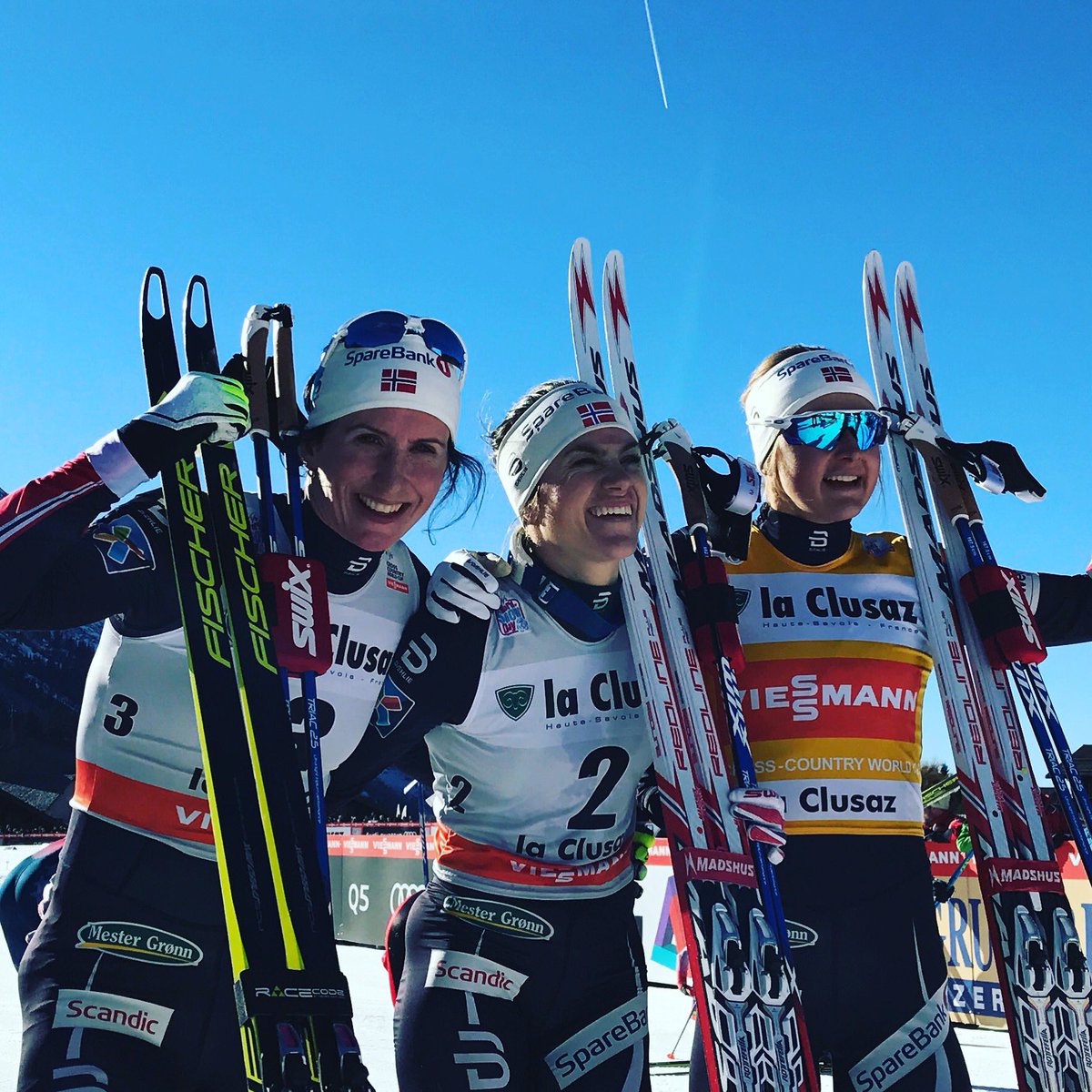
    The all-Norwegian women's 10 k freestyle mass start podium at the La Clusaz World Cup in France, with winner Heidi Weng (c), runner-up Marit Bjørgen (l), and Ingvild Flugstad Østberg (r) in third. (Photo: FIS Cross-Country/Twitter)
    The all-Norwegian women’s 10 k freestyle mass start podium at the La Clusaz World Cup in France, with winner Heidi Weng (c), runner-up Marit Bjørgen (l), and Ingvild Flugstad Østberg (r) in third. (Photo: FIS Cross-Country/Twitter)

    In the women’s 10 k freestyle mass start, Heidi Weng outlasted her Norwegian teammate Marit Bjørgen by 2.1 seconds for first, crossing the finish line in 23:43.5. Bjørgen placed second and it was an all-Norwegian podium with Ingvild Flugstad Østberg in third, 0.8 seconds behind Bjørgen and 2.9 seconds after Weng.

    Rosie Brennan was the top U.S. woman in 22nd (+1:31.9) for her first top 30 this season and Liz Stephen was next across the line in 23rd (+1:36.5). Kikkan Randall placed 36th (+2:10.6), and Caitlin Patterson 37th (+2:12.7).

    Canada’s Dahria Beatty landed in the points for her second-straight race and notched her best distance result in 26th (+1:38.7), Cendrine Browne was 41st (+2:32.3), Emily Nishikawa 48th (+2:52.4), and Sophie Carrier-Laforte 59th (+5:59.8).

    Results: Men | Women

    ***

    NorAm Mini Tour in Rossland: Freestyle sprints

    Andy Newell and Erika Flowers celebrated their reunion in Rossland with a couples victory in the freestyle technique sprints today. The Stratton Mountain School (SMS) Elite Team couple is racing in the NorAm as a bonus race before their Christmas break in Bozeman, Mont.

    Flowers, who was second in the interval start on Friday, won the A-final in 3:15.65, 0.44 seconds ahead of AWCA’s Olivia Bouffard-Nesbitt. Nakkertok’s Katherine Stewart-Jones was 7.09 seconds back, just 0.04 seconds ahead of yesterday’s winner, Chelsea Holmes of APU.

    On the men’s side, Newell won comfortably in 2:44.81 after winning the qualifier and each heat.  Black Jack’s own Julien Locke was second, 1.05 seconds back.  Yesterday’s winner, NTDC Thunder Bay’s Evan Palmer-Charrette was third, 0.05 seconds behind Locke.

    Sunday, the mini tour wraps up with a classic pursuit, where the leader after two days starts first and everyone else chases with the first person at the finish line winning the overall.

    “Starting at the front tomorrow,” Palmer-Charrette wrote, “the plan is quite simple, stay there!! I’ll have some nerves on the start line knowing there’s a group of guys hunting me down so the big focus is to ski smooth and stay relaxed.”

    On the women’s side with larger gaps, Holmes shared the most interesting race plan.

    “My strategy for tomorrow is… no surprise here… I think the expression is to go out ‘like a bat out of hell’ and do my best. It will be a hard race any which way — for sure!”

    Results

  • Widmer Waits for World Cup Window, Shines With Swiss Status

    Widmer Waits for World Cup Window, Shines With Swiss Status

    Heidi Widmer, who lives and trains in Switzerland, racing to 15th in the women's 8 k classic preseason race on Nov. 19 in Davos, Switzerland. (Photo: NORDIC-ONLINE.CH)
    Heidi Widmer, who lives and trains in Switzerland, racing to 15th in the women’s 8 k classic preseason race on Nov. 19 in Davos, Switzerland. (Photo: NORDIC-ONLINE.CH)

    In 2015, Swiss-Canadian skier Heidi Widmer moved from Canada to Switzerland. In 2016, she moved between the World Cup and the lower-tier Alpen Cup. Now she’s trying to figure out what’s next, while left rueing the difference that four-tenths of a second can make.

    Widmer, now 25, skied strongly throughout the 2013/2014 season. She represented Canada in three races at the Sochi Olympics, won her first Canadian national championship, and won the season-long NorAm sprint title (Canada’s Continental Cup). But 2014/2015 was in many ways a step back for Widmer; her results suffered, and she failed to earn World Cup or World Championship starts.

    Heidi Widmer, a former Alberta World Cup Academy and Canadian national team member, racing a skate sprint at 2014 Canadian Olympic trials. (Photo: Angus Cockney)“I was under recovered” throughout that season, Widmer told FasterSkier in May 2015, “and when your body is run down, it leads to other problems such as low iron and ferritin as well as sickness.”

    Widmer was not re-named to the Canadian national team, but wanted to continue with high-level racing. Thanks to a Swiss-born father, and a sympathetic ally in coach Christian Flury (currently in Switzerland, but formerly with Widmer’s Canadian club, the Alberta World Cup Academy), Widmer successfully embarked on the process of using her dual citizenship to begin racing for Switzerland.

    Positive results soon followed. Widmer gained World Cup starts at several weekends in the 2015/2016 season, qualifying for the heats in two out of five freestyle sprints she entered. She consistently placed in the teens on the Alpen Cup, and on the podium in Swiss Cup races. The move to trade the red-and-white maple leaf for the white-and-red Swiss cross seems to have served her well.

    But vexillology aside, her most recent results are still somewhat vexing. Widmer finished 32nd in last Sunday’s skate sprint qualifier in Davos, 0.39 seconds away from making the heats and earning World Cup points. (Sprinting can be a cruel mistress: Widmer’s 32nd in qualifying placed her ahead of, among many others, Norway’s Heidi Weng, Ida Ingemarsdotter of Sweden, and American Kikkan Randall. All three have World Cup sprint wins on their résumés. Randall and Ingemarsdotter have World Championships sprint medals.)

    Objectively speaking, that’s almost nothing, the difference between 5.95 seconds back from the qualifying winner, Jonna Sundling, and 6.34 seconds back. The literal blink of an eye. Less time than it takes a Major League fastball to reach home plate. But when it comes to World Cup-level racing, tiny margins can have a big impact.

    “It’s really hard to say now” whether or not start rights for this year’s Tour de Ski are in her future, Widmer told FasterSkier in an in-person interview shortly after her qualifying effort. “Had I qualified today it would have been an easy decision, but who knows.”

    Widmer added that she had “no idea, to be honest,” where she would be racing this coming weekend.

    “I usually play my season one step in front of the other,” she said. “My first priority is to process today and if I am granted the opportunity and the privilege next weekend in La Clusaz for the relay I would be super stoked; I know that we want to start a team in the relay there so that is unfortunately not in my hands. If I don’t go there then I will be in Goms [Switzerland] again for COC Cup [Europa Cup], which is also super-good competition. So yeah … those decisions are above my reach. And then hopefully a Tour de Ski start.”

    Widmer was disappointed with her result in Davos, but clear-eyed about the implications of 0.39 seconds at this level of competition. “[I] had really good feeling in my legs today,” she said in Davos. “I lacked that last little [bit]. 99.9 percent was there, but I lost a little; a little snap was missing. So I need to be really happy with what I put on the line today, but obviously super disappointed at the same time.”

    She continued, “It’s the name of the game that we sign ourselves up for that all the ladies here are obviously super strong, and to know it can go one way” or the other. “Last year,” Widmer recalled, she was “so close on the other side of the fence in 29th qualifying … and I think there were more ladies on the start line this year, and that’s what we want to see.”

    Stepping back to consider her season as a whole, Widmer was pleased that her training “has been really good.”

    Heidi Widmer (c) with Swiss skiers Nathalie von Siebenthal (l) and Christa Jäger after rollerski intensity on Stelvio Pass in Switzerland in June 2013. (Courtesy photo)She added that she has found a challenging and complementary training group in her fellow Swiss skiers.

    “I can say confidently that I have never trained so hard in my life and never challenged myself so much. Training with Nadine Fähndrich and Nathalie von Siebenthal is an incredible opportunity, those girls train really hard and have an incredible work ethic and professional take on the game. … We are all completely different personalities and we gel together really well. I think we challenge each other in ways that the other person can’t take the lead in and vice versa.”

    In November, Widmer was getting in some early racing on farmed snow in Davos. She said at the time that her performance was “FAR off the mark!” and that “the fitness is not where it should be.” By early December, things had come around somewhat, and Widmer was winning the season’s first Swiss Cup race in Goms, posting the top qualifying time by 1.79 seconds in a three-minute sprint. But then came last weekend in Davos, and those missing 0.39 seconds.

    “We want it to be a close game,” Widmer graciously told FasterSkier immediately after her just-short qualifying effort, “because we always – we all work so hard to be here.”

  • Davos Notes and Quotes: The Men

    Davos Notes and Quotes: The Men

    Martin Johnsrud Sundby of Norway coming into the finish for a win in the 30 k skate in Davos, Switzerland. (Photo: Fischer/NordicFocus)
    Martin Johnsrud Sundby of Norway coming into the finish for a win in the 30 k skate in Davos, Switzerland. (Photo: Fischer/NordicFocus)

    Norway’s Martin Johnsrud Sundby took a win in the 30 k freestyle in Davos, Switzerland, this weekend, but on Sunday a new team had took a trip to the podium’s top step: Russia, whose Sergey Ustiugov notched his first victory of the season in the skate sprint.

    Here’s all the reporting – and there’s a lot – that didn’t make it into the race reports.

    On that awesome feeling in your legs

    “I love lactate.”

    -Matti Heikkinen, Finland (3rd in 30 k)

    “Not so much.”

    -Anders Gløersen, Norway (2nd in 30 k)

    On how to get through a rough patch

    “Alex [Harvey] came through with a group, with a young Swede, Jens Burman. He was going quite strong– I think he finished top ten today [note: Burman was sixth]. I joined that train and just kind of faked it through the top of the lap to try to get into the draft there and was able to recover a bit and stay with him though my last lap. It was a perfect group for me to finish with and it helped me have a good last lap there.”

    -Graeme Killick, Canadian National Ski Team (21st in 30 k)

    “The hardest part for me was the second lap. I had to go a few laps where I tried to just calm down and get rid of some lactate… when [Maurice] Manificat began to get tired, I wasn’t feeling great at the time so I didn’t want to go in front. I think that’s where I lost some seconds… All in all, that Martin wins today is like it should be, because I had so much help.”

    -Gløersen

    On avoiding our interview in the mixed zone

    “Yeah, I walked straight past. I was really really disappointed with yesterday. It was just a really hard race yesterday. I did 30 k all by myself. It was really bad and really hard.”

    -Devon Kershaw, Canadian National Ski Team (43rd place in 30 k), after the sprint (49th place)

    On 21-year-old Lucas Chanavat of France, top qualifier and sixth in the sprint

    “If you qualify first you know that your are feeling good that day. You have that confidence. You know that you have really good skis with you. So it is cool to see that, stepping up and taking advantage of the opportunity of being here. He skied hell of a qualifier and a hell of, a hell of quarterfinal so that’s cool to see. It’s sweet to see guys like that.”

    -Simi Hamilton, U.S. Ski Team (23rd place in sprint)

    On sprinting at altitude

    “I think [the qualifier] went well. I didn’t feel the greatest before my heat. The qualifier took a lot out of my lungs, same with Simi [Hamilton], like our lungs are wrecked warming up. The legs were a bit heavy, but I guess it is the same for everybody.”

    -Lenny Valjas, Canadian National Ski Team (14th place in sprint)

    On sprint strategy

    “Two years ago I did that, coming wide off the last turn and was about to pass two guys. But they were still a bit ahead of me so they took the left lanes and then you’re screwed. Today I was close beside them, so they couldn’t really cut me off completely. This time it worked, last time it didn’t.”

    -Valjas

    “Today, I just wanted to do the sprint and remember how to sprint with a tired body with the Tour de Ski coming. It wasn’t very good, but I wasn’t expecting a whole lot. I just wanted to focus on doing the best I could with what I had.”

    -Kershaw

    “There was definitely headwind coming down valley. So my kind of main strategy was to just get in a nice draft through the long gradual flats here. I felt great for a lap and you know still felt good coming through on my second lap.”

    -Hamilton

    On the first period of racing

    “To be honest, I wasn’t all that confident today. I’ve raced in Davos about five or six times, and I’ve gone really slow every time, so today is by far the best I’ve ever done. I’m fairly pleased. My main focus is the 30 k skiathalon at the World Championships, and then I’m hoping to go fast at the Tour de Ski as well. Those are the two things I’m aiming most for. So I’d like to have won a race, but it’s the best, most stable start I’ve had to a season so far in my career, so it gives me a little bit of confidence going forward. At the same time it’s a long season, so there’s plenty of time to start going slow.”

    -Andrew Musgrave, Great Britain (15th in 30 k, 61st in sprint)

    “Overall kind of a disappointing weekend here in Davos, but that’s okay. Overall it’s an okay start to the season. Nothing outstanding, but I feel like I’m building well towards the Tour.”

    -Kershaw

    On next weekend’s World Cups La Clusaz, France

    “We will just have four guys for the relay, so I am psyched to take a turn in that. I think it bodes well for me that they changed the distance race to a 15 k skate on a short kind of circuit loop. Psyched to jump into that hopefully too. And see what happens. I think right now it’s like, the more I can just get my body used to the hard efforts the better. So regardless of how I feel next weekend, it will be a good opportunity to get in a couple more hard efforts before a good solid training block over Christmas.”

    -Hamilton

    “I’m really excited to do the relay. It think Killick showed he’s obviously in great form, so I think we could have some fun in the relay. And 15 k skate mass start is fun if you can stay with the group. And that’s the goal.”

    -Kershaw

    “I feel good, but I’m nervous for the relay event. I don’t know where I am going to start either. It will be fun– I know the shape is good, I just guess it’s been a lot of racing. I have done all the distance except the 30 k. So I am going to try to get my speed back and I think it will go well.”

  • Davos Notes and Quotes: The Women

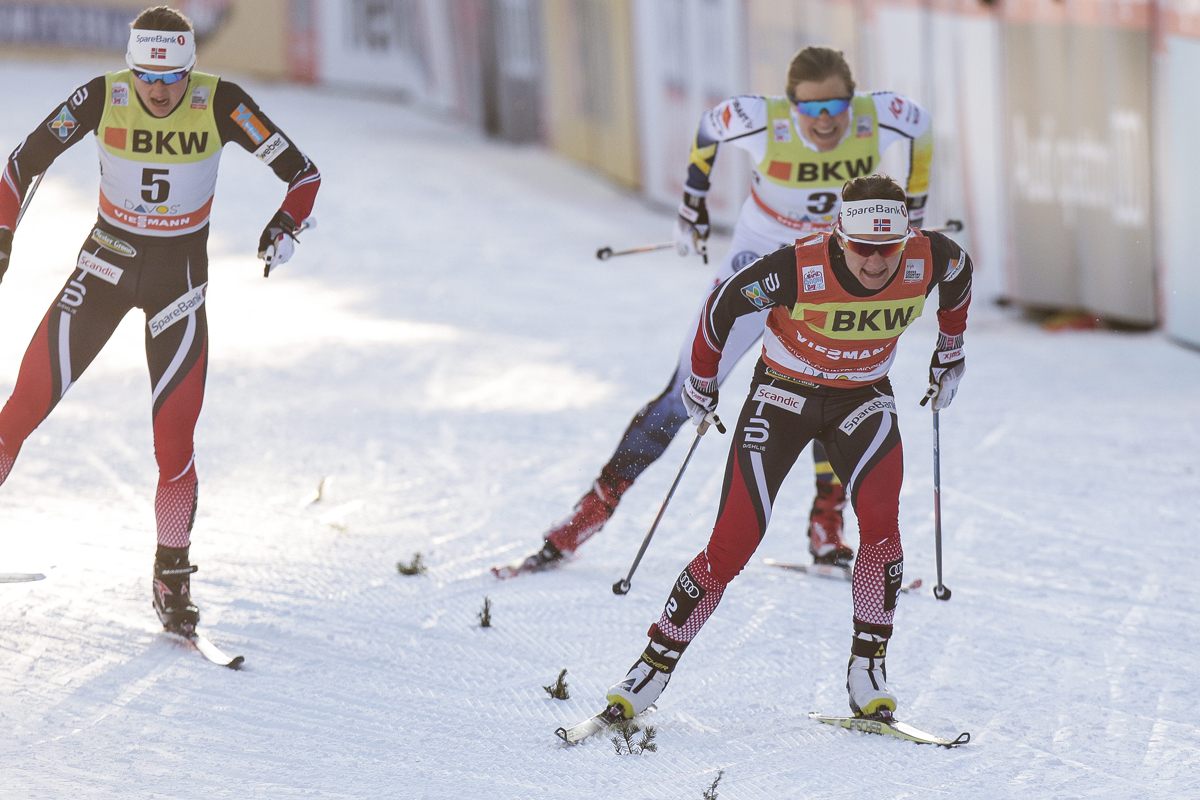
    Maiken Caspersen Falla (red bib) wins the final of the skate sprint in Davos, Switzerland, on Sunday. Norwegian teammate Ingvild Flugstad Østberg (bib 5) took second and Hanna Falk of Sweden (bib 3) third. (Photo: Fischer/NordicFocus.com)
    Maiken Caspersen Falla (red bib) wins the final of the skate sprint in Davos, Switzerland, on Sunday. Norwegian teammate Ingvild Flugstad Østberg (bib 5) took second and Hanna Falk of Sweden (bib 3) third. (Photo: Fischer/NordicFocus.com)

    A weekend of World Cup action in Davos, Switzerland, saw two Norwegian women take top honors: Ingvild Flugstad Østberg in the 15 k interval-start skate, and Maiken Caspersen Falla in the skate sprint.

    Here’s all the reporting – and there’s a lot – that didn’t make it into the race reports.

    On ending up in a sprint heat with your teammate

    “I picked that heat because it was just the heat with the least amount of people at the time. You never want to be in a heat with your teammate because maybe only one of you can go on, but sometimes you have to, and the last couple of weekends I’ve been with teammates. So it is what it is.”

    -Sadie Bjornsen, U.S. Ski Team (15th in the sprint, after a quarterfinal with Sophie Caldwell)

    On imperfect preparation

    “I had bit of a rough fall after an awesome summer training. I was at high altitude for a long time in October and I got really tired at our camp there, so I had to take a little more time off than I anticipated. Then I caught sort of a mild cold before coming over here. So it wasn’t the perfect fall, but I did try to recognize that it might take a little time to work into the season– the base that I got this summer isn’t going to just disappear. So it will come back, I just have to do some searching.”

    -Sophie Caldwell, U.S. Ski Team (12th in the sprint)

    “Unfortunately I had a filling right before I left for Europe. I actually had two. The one on the right side was totally fine and didn’t cause any pain, but from the beginning the one on the left was bothering me. And so, long story short, I was in a lot of pain after the sprint race in Norway, and so the Norwegians got me in to see a dentist in Norway. She kind of looked at it and said, ‘I think you need a root canal. Looks like you might like have an issue there.’ But I didn’t want to do it right before the other races. So she pulled the old filling out and put a temporary one in that she thought might not be pushing up against the nerve. I went into the dentist here and she pulled it all out, and was like, ‘Holy shit, you have a huge infection.’ And so I had quite a painful experience with her on Tuesday, but so far – I mean, I was exhausted after that, for sure, but, you know, I have another appointment in a couple weeks to do the actual root canal itself.”

    -Liz Stephen, U.S. Ski Team (28th in 15 k, 61st in sprint)

    On distance racing

    “I like distance racing a lot, because if you’re fit and you’re ready, you will win.”

    -Jessie Diggins, U.S. Ski Team (4th in 15 k, 5th in sprint)

    “Really exciting for Jessie and really proud of her effort. You can see she had a really strong first lap. Then you can see her getting a little fatigued at the start of the second lap, coming through at 5 k, and you know her standings in the next couple of kilometers dropped. They dropped from third down to maybe seventh or something. And then she really battled back and she was just kind of in the mix there with Roponen and Von Siebenthal and Tchekaleva, so I’m super proud that she could just battle back in that. By far her best Davos finish, and 15 k finish. A big step forward for her, so really cool to see.”

    -Chris Grover, U.S. Ski Team Head Coach

    “I think I’ve had some pretty bad races here in Davos, and I think this one stacks up as one of my better ones. I wish I could figure out how to get a ride, and actually stay on. That would really help, but honestly the downhill this year skis better than it’s skied in years. I wasn’t scared of it. That’s way more enjoyable than freaking out the whole race thinking, ‘I have to go down that thing again?!’ Overall, I’m not excited with the race, but I’m not disappointed. I guess, it’s just kind of Davos.”

    -Stephen

    “I got better throughout the race. I feel so unaquainted with the race pace, so it takes me a while to get the feeling; the second half is good. I feel like my body responded pretty well. It’s more about tuning in the mind and the body to the actual race pace, but I think overall I felt pretty good.”

    -Kikkan Randall, U.S. Ski Team (33rd in 15 k, 58th in sprint)

    On sprinting

    “I’m really satisfied with my first podium in sprint this year. I want to be fighting for the podiums in distance and sprint. With the 15 k yesterday and then today, it was more than I expected from this weekend… My goal for the day was to get in the final. Once I was in the final I really wanted to get on the podium.”

    -Ingvild Flugstad Østberg, Norway (1st in 15 k, 2nd in sprint)

    “Unfortunately Rosie [Brennan]’s not feeling great, so there was an opportunity to start and I was like, ‘Meh, I’ll just take it.’ It’s always fun. I think every sprint I’ve skied so far, I’ve skied my bib number. So I can’t say I’m super psyched on my sprinting right now, but I didn’t have any expectations. I just wanted to get some good training. It’s fun for me to kind of be the one, I don’t know,  I can make the jokes in the van, instead of being so nervous that I can’t. It’s totally fun to be a sprinter, for sure.”

    -Stephen

    On snow farming

    “You could tell where the sun had hit it was slower. But the course held up great. I’m so impressed with the organizers here in Davos, because it is not easy to hold a World Cup when we are standing on grass and dirt right here. And they managed to snow-farm extraordinarily well. I’m just very impressed.”

    -Diggins

    On fatigue

    “I’m really tired actually. I’m getting a little bit pooped, but the idea is to load high, and then rest for the Tour de Ski because you need to be able to go ‘boom, boom, boom’ during the Tour, and to be able to recover and to cope with the big load. So I think this is great practice for that. Usually I race everything; last year I raced over 30 times and I was really tired at the end. It’s less physically, more mentally the racing over and over, you have to kind of get psyched, get prepared, do all the work, do all the psychology work every race, and that is the hard part I think. Physically, once you’re in the race you get the nerves, the adrenaline, and you can finish the race, but mentally to really be engaged with the course, that’s a challenge I think.”

    –Diggins

    On next week’s World Cups in La Clusaz, France

    “I am really stoked about next weekend. I have a french boyfriend and I have for 6 years and so I am stoked to have his family and him there and having a relay there it’s like I literally can’t wait.”

    -Bjornsen

    “The relay, to me is, everything. So I want to rest up for that for sure.”

    -Diggins

    “I expect as always in this first period really strong competition in the relay. The Swedes are really strong as a team right now, the Finns are strong, Norway’s of course strong, Russia’s women have taken a step up this year with some new faces, Germany is strong, I think we will have an absolute battle on our hands come Sunday next week. It will be fun.”

    -Grover

    On not going to La Clusaz

    “I haven’t made any definite plans, but I don’t think I will go to La Clusaz because we can only start one relay team and the 10 k skate at altitude is not really my strong point! So I might just start Christmas break early. My parents are actually over here. Maybe I will just start getting in a good little training block and feel good for the beginning of the Tour.”

    -Caldwell

    “I am actually going home tomorrow. There is not a sprint there, and I just feel like I get to February sometimes and am just like, I am so tired of this…. it feels soon to be going home, but also there is good skiing there too.”

    -Ida Sargent, U.S. Ski Team, 20th in sprint

    On World Championships in Lahti, Finland

    “It’s World Championships. The skate sprint there is my biggest goal. I will go home now for some training over Christmas.”

    -Hanna Falk, Sweden (3rd in sprint)

    “My goal is to ski in Lahti.”

  • Davos World Cup Still a Go Despite Lack of Snow, to Host La Clusaz Races as Well (Updated)

    Davos World Cup Still a Go Despite Lack of Snow, to Host La Clusaz Races as Well (Updated)

    Davos is struggling to produce and collect enough snow for the weekend competitions, but will manage to pull off both a distance race and a sprint. Photo: Holly Brooks
    Davos World Cup organizers have struggled to produce and collect enough snow for this weekend’s competitions, but will manage to pull off both a distance race and a sprint. (Photo: Holly Brooks)

    Note: This article has been updated to include Friday’s announcement from the International Ski Federation (FIS), that Davos will host next weekend’s World Cup races as well, after the freestyle races in La Clusaz, France, were canceled because of a lack of snow.

    ***

    The upcoming World Cup races in Davos, Switzerland, have been scaled back due to lack of snow — but it’s still better there than La Clusaz. On Friday, the International Ski Federation (FIS) announced that next weekend’s canceled races in La Clusaz would instead take place in Davos.

    For the next two weekends, racers will compete in individual 10- and 15-kilometer distances and freestyle sprints in Davos. The Davos Nordic Organizing Committee, in conjunction with Swiss Ski and FIS, had already shortened the originally scheduled Davos races from the men’s 30-kilometer classic and women’s 15 k classic on Saturday, to a men’s 15 k classic and women’s 10 k. Freestyle sprints will take place Sunday.

    Next weekend, Davos will host 10/15 freestyle individual starts and a freestyle sprint.

    Athletes on a thin base at the 1.3 k track in Davos, Switzerland. (Photo: FIS)
    Athletes on a thin base at the 1.3 k track in Davos, Switzerland. (Photo: FIS)

    American Holly Brooks was among the flocks of skiers training in Davos this week before she headed to slightly higher grounds in Livigno, Italy, for her first marathon of the season at La Sgambeda on Friday.

    “Davos, like much of central Europe, is having one of the driest early winters on record,” Brooks wrote in an email on Wednesday.

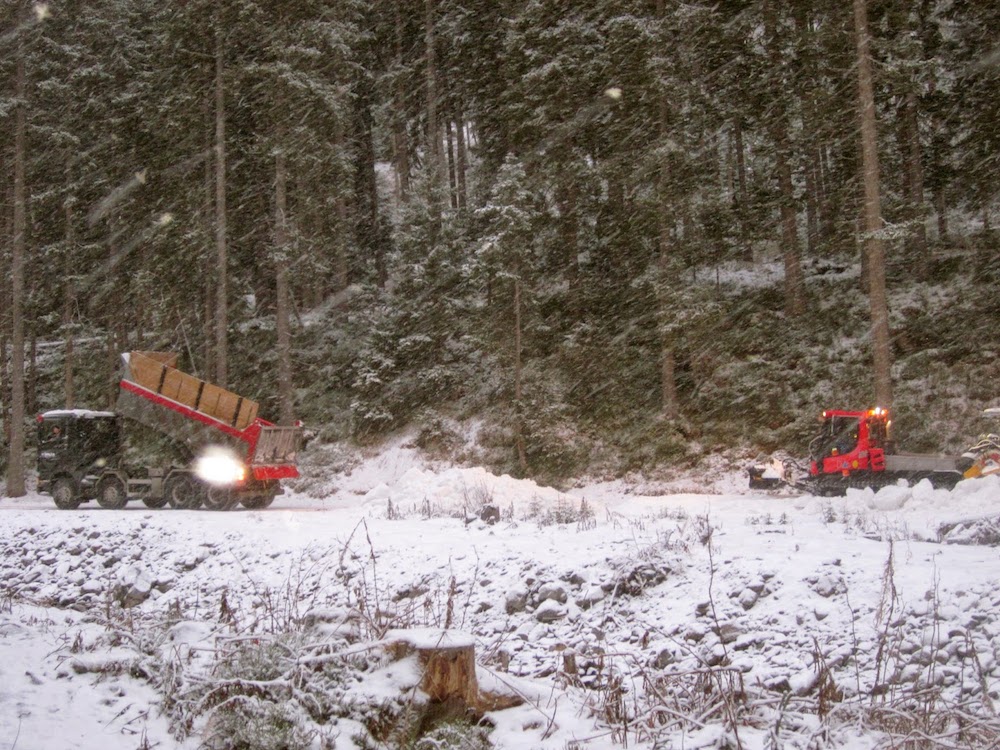
    She provided a few photos to illustrate the scene, one of which (see above) showed a truck dumping snow in front of a PistenBully, which then spread it across the World Cup course.

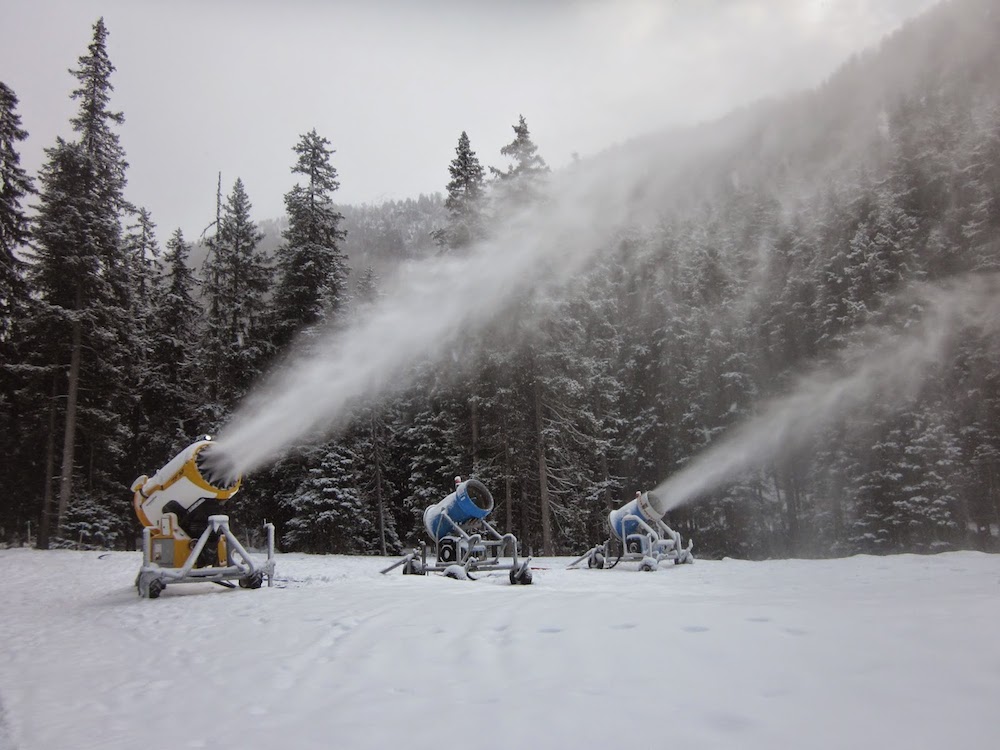
    “The organizing committee in Davos is blowing snow at a mountain pass above (where it is cold enough) and trucking it down to cover a 5 k loop for this weekend’s upcoming World Cup,” she explained. “The effort and $ going into this project is incredible. I feel very luck that just over the mountains in Livigno, the site of my marathon, there is enough snow to hold the races on a larger, 35 k loop.”

    According to FIS, the Davos Organizing Committee (OC) produced snow high up on Flüela Pass — some 2,380 meters (7,800 feet) above sea level — where temperatures were cold enough to make it.

    As of Tuesday night, the organizers has spent more than 70 hours bringing it down to the race course. They did so using PistenBullies, which also pushed natural snow down the nearby mountainsides. That snow was then collected and transported down to the Davos World Cup trails in trucks.

    “After two tough weeks with many difficult decisions, we are very happy to present the athletes our tracks,” Adriano Iseppi, head of the Davos OC, said in a press release. “Even if we were able to produce snow only for one night on the competition area, we made the impossible possible. Many thanks to all the helpers up in the mountain and out in the tracks who have been working day and night.”

    The Davos Organizing Committee is producing snow up high for the World Cup races this weekend. (Photo: Holly Brooks)
    The Davos Organizing Committee has been producing snow up high for the World Cup races this weekend. (Photo: Holly Brooks)

    A local alpine skiing legend, Paul Accola, who now owns a forestry company, also donated his time and equipment for three days to help the organizers move snow.

    Hippolyt Kempf, a Swiss Nordic-combined gold medalist (1988 Olympics) and current head of Swiss Cross-Country, was complimentary of Davos Nordic.

    “They did an amazing job working all day and all night long to make sure that the cross-country track in Davos will be ready,” he said in the release. “We are convinced that athletes alike visitors can expect stunning competitions.”

    While Davos assumed responsibility for hosting next weekend’s World Cup freestyle races as well, start times had not yet been set for Dec. 20-21.

    Davos World Cup schedule:

    • Saturday, Dec. 13
    • 11:15 CET women’s 10 k classic
    • 13:30 CET men’s 15 k classic 
    • Sunday, Dec. 14
    • 12:30 CET women’s and men’s freestyle sprint prologue
    • 14:30 CET women’s and men’s freestyle heats
    • Saturday, Dec. 20 (moved from La Clusaz; times TBD)
    • women’s 10 k freestyle
    • men’s 15 k freestyle
    • Sunday, Dec. 21 (moved from La Clusaz; times TBD)
    • women’s and men’s freestyle sprints
  • ‘They Can’t All Be Amazing’ – U.S. Women Look Past La Clusaz Relay

    ‘They Can’t All Be Amazing’ – U.S. Women Look Past La Clusaz Relay

    Jessie Diggins (USA)
    Jessie Diggins, pictured racing in Sweden last spring, was the American anchor on Sunday in La Clusaz, France, in which the women placed ninth.

    Before the 4 x 5 k relay in La Clusaz, France, on Sunday, the American women had few days on the World Cup where someone didn’t have a great result. There have been career-bests and historic finishes left and right, and with incredible depth to the team this year, one person’s off day has often presented someone else with a turn in the limelight. When Kikkan Randall felt flat in the classic race on Saturday, Liz Stephen posted her personal best result in the event.

    Sunday was a reminder that not every race can be success story, something that the team looked at with a mixture of frustration, disappointment and optimism. The team of Holly Brooks, Randall, Stephen and Jessie Diggins finished ninth out of nine relay teams in La Clusaz, 3:52 behind Norway I’s winning time of 57:05.4. It wasn’t the result any of them had hoped for, particularly after their historic third-place finish in Gallivare, Sweden, at the beginning of the season. But all four athletes took solace in knowing that when they are on form, they can do much better.

    “Although it was frustrating not to feel great today for all four of us, we know that we didn’t have a great day, we weren’t in there,” Randall said. “It’d be one thing if we went out there and went, ‘Oh, I skied with everything I had and felt great. Oh, shoot, we’re still ninth.’ We know today was just a bad day.”

    Things first went sideways 200 meters into the relay, when Ida Ingemarsdotter (SWE) and Heidi Weng (NOR) tangled right in front of Brooks and she had no choice but to collide with them.

    “It was unavoidable,” Brooks said. “After the crash we all had to sprint back up to the pack and the pace was a bit too much for me. My body, legs especially, flooded and I had a hard time for the entire race after that.”

    The crash caused Brooks to lose the pack and her groove before the race had really begun, and it had a ripple effect on the team for the rest of the race.

    “Often times I think teams respond that way,” USST women’s coach Matt Whitcomb said. “If one person’s off, that may mean something’s off for the whole team.”

    Brooks briefly latched back onto the back of the pack, but dug herself into a hole to do it. At the end of her leg the U.S. was 1:38 down. Randall left the exchange zone all alone, as did Stephen and Diggins in the subsequent exchanges.

    A combination of factors led to the women’s difficulty on Sunday. There was Brooks’ early fall, and altitude played a part — Randall, for example, had been at that elevation for only two days. Some were coming from a hard training period. But each of them thought the hardest part was skiing “in no-man’s land.”

    “That was definitely tough today, because if you could be fighting with someone it helps to keep that tempo up, so skiing alone was a little challenging,” Randall said.

    Even so, the women kept going, and it was their tenacity that made them most proud looking back on the race.

    “It’s hard to make up time and stay highly motivated when you’re skiing alone, but our teammates and coaches were awesome cheering out there, reminding us why it’s important to keep going and not give up. I’m proud of the team’s efforts and how everyone kept fighting,” Diggins said.

    Though it was a tough result to swallow for a team that expects great things of itself, the Americans were able to put it in perspective.

    “They can’t all be amazing ones, and we have had a fair share of great ones so far this year already and are hoping for more in the coming month,” Stephen said. “I am really proud of the effort we put forward today; even though we were behind early on, we all fought as hard as possible.”

    According to Whitcomb, the women’s squad was upbeat and smiling when they stopped by the wax cabin after their cool down.

    “The vibe is the same as it was in Gallivare. I’m really encouraged to see that,” he said. “How we feel about today or about the result we wanted to get doesn’t really matter. What we plan to do from here matters.”

    Results

  • Early Contenders, American Men Finish 10th in La Clusaz Relay

    Early Contenders, American Men Finish 10th in La Clusaz Relay

    U.S. Ski Team member Andy Newell during a World Cup classic-sprint qualifier on March 14 in Stockholm. Newell posted the 16th fastest time and went on to place seventh in the final.
    US Ski Team member Andy Newell during a World Cup classic-sprint qualifier last March in Stockholm. Newell went on to place seventh. Best-known as a sprinter, Newell is establishing himself on the distance scene in 2013.

    The thing about relays is anything can happen. And when you’ve got a guy like Andy Newell (riding a season-best distance result) scrambling for your team, that’s always a good start.

    The first leg of the American team in Sunday’s 4 x 7.5 k relay, with fellow US Ski Team members Noah Hoffman, Tad Elliott and Simi Hamilton behind him, Newell (Stratton Mountain School T2 Team) took his 28th place in Saturday’s 15-kilometer classic mass start in La Clusaz, France, and ran with it. Sure, he was a sprinter, but he could handle 7.5 k, too.

    After skiing comfortably in eighth for the first of three laps, Newell pushed toward the front of the 14-team pack on the second lap and held his own in fourth. At the exchange, he sent Hoffman off on the second classic leg just 2.6 seconds behind the leaders, Kazakhstan, Russia and Norway, respectively.

    From there, it seemed the Americans were on track to make history. Hoffman surged into second within the first kilometer of his leg and stayed there, directly behind Swiss leader Dario Cologna, for the next two laps. About a kilometer into his third and last time around, Hoffman found himself in a precarious position: in the middle of the pack as the tracks narrowed to two. He collided with a couple others and stood up to find himself 10 seconds back.

    Hoffman up at the front in the classic portion of the Canmore World Cup 30 k skiathlon.
    Hoffman up at the front in the classic leg of the Canmore World Cup 30 k skiathlon earlier this season, where he posted a career-best eighth.

    No problem, he thought, as he trailed the chase pack about 23 seconds back from the lead in eighth.

    “My shoulder was fine; my poles were fine at that point,” Hoffman said. “And I was skiing pretty well.”

    Then, for some reason he couldn’t explain, Hoffman drove his knee through his pole on the second-to-last hill. He went down again and slipped 50 seconds back from the lead, tagging off to Elliott in ninth.

    Elliott couldn’t make up the deficit and fell back to 11th (+2:27.8) by the final exchange. In his first 7.5 k, Hamilton as the anchor tried to pick off a few places, hanging with Italy and France and ending up 10th , 3:02.6 minutes behind Norway in first. (Finland was disqualified after Matti Heikkinen was caught skating on the second leg.)

    At the end of the day, Hoffman blamed himself, but his teammates largely remained positive.

    “Hoff skied great up until the last lap,” Newell said. “If everyone has a good day, we can definitely have a good relay team so it’s just a question of keeping people on their feet. I know Tad thought he didn’t race his best today. I think Simi skied pretty well. It was a sweet day, it was so sunny and warm … it was like sun bathing out there.”

    At least someone thought so. “This by far has been the best my distance racing has ever felt,” Newell added. “It makes distance racing a lot more fun, you know, because you can hang with the leaders. My goal was to kind of relax a little bit on the first lap and not do any work and try to bring it in pretty close to the lead.”

    He did that, leaving his teammates and coaches impressed. In the second relay of the season, the U.S. men climbed five spots higher from 15th (albeit in a smaller field than the 23-team relay in Gallivare, Sweden.)

    US Ski Team coach Matt Whitcomb said their improvement, with Hamilton in place of Kris Freeman, was a great sign.

    Newell on the big climb during the men's 4 x 10 k relay at the 2010 Vancouver Olympics.
    Newell on the big climb during the men’s 4 x 10 k relay at the 2010 Vancouver Olympics, where the Americans were 13th.

    “For the men, the relays are a marker that we’ve set on our goals,” Whitcomb said. “We saw Andy scramble his, for sure, best-ever scramble leg, his best-ever back-to-back days of distance skiing. He’s in great shape. We feel awesome about that.

    “Noah skied really well up until two-thirds of the way through his race,” he added. “Sometimes when it starts to crumble, it crumbles quickly. He was bummed, but the positive of it all was that he was skiing awesome.”

    Hoffman joked that once he learns to stay on his feet, he should be good to go. Unfortunately, his frequency of crashes (with one taking him out of Saturday’s 15 k and dislocating his problematic shoulder) was becoming old news, he said. But the shoulder wasn’t a factor.

    “I’ve raced on it the day after a dislocation several times so I knew it wasn’t going to be an issue once I got warmed up and ready to go,” he said. “I’m going to ski through the rest of the season and get it repaired at the end of the year.

    “I’m glad that I felt better today, but second relay in a row where I’ve kind of taken the team out of it and that’s not good,” Hoffman said, referring to the Gallivare relay, where the Americans went eighth after Newell’s scramble leg to 15th.

    Looking ahead, Hoffman was excited about what the team could accomplish at World Championships in just over a month.

    “If Kris anchored that team and he skis up to the level that he’s able to, we got a chance at a medal in that relay,” Hoffman said. “It’s an outside shot, everyone’s got to ski super well but I’m very impressed and excited with the way Newell’s skiing.”

    In an email, Elliott wrote that he was still feeling “off” after some travel delays hindered his recovery before La Clusaz. Sunday was better than Saturday, he explained, but he was looking forward to getting some training time over the next week in nearby Le Saisies, France.

    “I am really looking forward to having Kris and Erik Bjornsen around so that we can have a solid six guys and use the best for our relay team,” Elliott added. “I hope to be in it.”

    Hamilton was satisfied with his performance after being sick with the flu for much of the last week. For the first five kilometers of the last leg, he skied with Ivan Perrillat Boiteux, who anchored France to ninth place, 12.7 seconds ahead of the U.S.

    “From 5 to 7.5 km I was just a little heavy on the climbs and couldn’t hang,” Hamilton wrote. “With that said, I thought that I skied the course well and pushed my body to where I wanted it to be at this point in the game. I haven’t skied a relay since Nove Mesto last year, and I’ve never raced 7.5 km in my life before, so there were for sure quite a few unknowns going into the day, but I am happy with how it turned out.

    “It is always tight in any men’s WC relay and I think that today showed us all that if each of us can improve by even 5% we will be able to ski in podium contention,” he added. “The men here (Newell, Hoff, Tad, and myself) have a very good dynamic going and we are extremely psyched to be heading into a training block in Les Saisies before Sochi. There is a lot of season left and we’re looking forward to performing well, both individually and collectively, in the months ahead.”

    Men’s results

    — Audrey Mangan contributed reporting

  • Stephen Finds Good Vibes in La Clusaz, Leads North Americans in 15th in 10 k Classic

    Stephen Finds Good Vibes in La Clusaz, Leads North Americans in 15th in 10 k Classic

    Stephen hammering in the classic pursuit. Photo: Marcel Hilger.
    Liz Stephen (US Ski Team) hammering in the 9 k classic pursuit at the Tour de Ski on Dec. 30 in Oberhof, Germany, where she was 23rd. (Photo: Marcel Hilger)

    Note: This article has been updated to include comments from Jessie Diggins after an unintended oversight.

    There’s something about La Clusaz, France, and Liz Stephen can’t put her finger on it, but it works for her.

    Two years ago, the US Ski Team (USST) veteran notched her first World Cup top 20 in the small alpine village near the Swiss border, some 3,500 feet above sea level. It could’ve been the hills, maybe the thin air, but Saturday, Stephen (who turned 26 a week ago) figured it was the memory of placing 18th there in the 15-kilometer freestyle mass start that carried her to another career best.

    Stephen led the North American women in Saturday’s 10 k classic mass start, placing 15th for her best classic result. She was 1:13.8 behind Norwegian winner Marit Bjørgen, and 47.2 seconds ahead of the second American, Jessie Diggins, who posted a solid 24th despite a pole mixup before the race.

    “Less than 3 minutes to [before the start] I realized I’d grabbed the wrong poles and had two different spare ones, with loops instead of handles,” Diggins explained in an email. “I ran back to the start area looking for my poles but ended up grabbing a spare Canadian set. So when the gun went off my heart rate was already in L4!

    “I was psyched on today, and even more pumped seeing Liz have a great one,” Diggins added.

    “I was certainly remembering my first ever top 20 here 2 years ago with Morgan Arritola the other day,” Stephen wrote in an email. “I think once you have a good race somewhere, you have a good memory and feeling of the place in your mind and your confidence is higher going into the competition.  So, La Clusaz may be one of those places for me.”

    Sadie Bjornsen, who earned her starts as the early season U.S. SuperTour leader, also made it into the points in 28th (+2:29.1) and USST teammate Ida Sargent followed in 29th (+2:35.7). For the Canadians, Dasha Gaiazova led the way in 27th (+2:26.2), her second-best distance result since placing 25th in a 10 k classic last year in Poland.

    Kikkan Randall (USST) struggled with icing skis in above-freezing temperatures and variable conditions. She crashed on the last lap and finished 32nd (+2:50.9). Canada’s Perianne Jones was 38th (+3:27.9) and Chandra Crawford did not finish after her skied iced up early on, and she decided her body wasn’t feeling it and pulled out.

    On a day marred by struggles in difficult waxing conditions, Stephen came out on top – relatively speaking – placing 15th for her second straight race. It was her second-best individual result this season since finishing 13th in a 5 k classic at the Kuusamo World Cup in November. Perhaps most notably, in her previous race she was second fastest up the final climb in the last stage of the Tour de Ski, putting her 15th overall.

    A 9 k freestyle ascent up the infamous Alpe Cermis is where most people would expect Stephen to thrive. But Saturday, she made herself known in a gritty classic race.

    “She’s always been sort of a skater and doesn’t really like that,” U.S. women’s coach Matt Whitcomb said with a laugh. “She’s learning to gain confidence in her kick. She’s learning to work with her new tech [Oleg Ragilo] and dial in just some better classic performances.”

    Stephen credited the wax techs and the entire coaching staff for making the difference for her team Saturday. While most everybody struggled with snow and ice clumping beneath their skis in the moist and variable tracks, the Americans were able to generally shake it off, literally, and glide more than most.

    “With a small team like we have, it takes all hands on deck to make good skis,” Stephen wrote in an email. “Our guys never seem to slow down for a second. I mean, they penciled in a 10-minute lunch break between our race and the dudes and didn’t even get to it today.”

    With temperatures into the mid-30s before the 11:15 a.m. start and mid-40s by the end of the race, it only got warmer as the day went on. Most men opted for hairies for their afternoon race, but for the women, it was a bit of a crapshoot.

    “I think we did a good job hitting for our efforts today,” Whitcomb said. “We had very competitive skis. By no means were they perfect, they were just really good and our girls were able to [work with] that.”

    Skiing in the top 30 from the start and making her way to 18th by the 2 k checkpoint, Stephen explained that she tried to ski smart even though there were plenty of places to pass on the three-lap course.

    “With the conditions being what they were, staying in the track was best for not icing on the uphills,” she wrote. “I forced myself to stay in the tracks as much as I could, which was easy with the rollerski kick I had. I made most of my moves on the uphills, just consistent turning up the speed throughout the race and staying relaxed, trying to ski smooth and controlled and hang tough.”

    Meanwhile, Randall and Diggins skied together around 23rd and 24th two kilometers in. Randall climbed as high as 18th near the halfway point while Stephen hung in 17th.  At 5.3 k, Diggins led the rest of the Americans in 29th. Seven seconds back in 30th, Bjornsen worked to keep Diggins in sight, and Sargent an additional 10 seconds behind in 31st.

    “I wasn’t skiing with any one person for long but mostly trying to hang with the pack as long as I could,” Diggins wrote. “Once I got a system for double poling while smacking the snow off my skis I was able to ski the hills with more confidence.”

    Skiing separately but feeding off each other, Diggins, Bjornsen and Sargent continued to pick off the places while Randall started to slip.

    “For a while there was a line of four Americans with Kikkan, Jessie, Sadie, Ida, working in the mid-20s and making us proud,” Whitcomb said. “Today was by no means a big focus race for Kikkan. In a lot of ways, if there is such a thing on the World Cup, it was sort of a training race.”

    Randall didn’t make any excuses, he said, but had a hard time after 7 k. In an email, she wrote that she was satisfied with the first two laps of her race, with her skis first starting to ice during the end of loop two.

    “Going into Lap 3 I was getting tired but still moving well and gaining places until I hit the first big climb,” Randall wrote. “There my skis began to ice more and more, and soon I was only running on stilts. I tried to knock the snow free several times but the snow kept packing on more.

    “I crashed once on the downhill when my skis grabbed while I was trying to kick free. I finally stopped at the top of the 2nd to last hill and slid my skis across each other to clear the snow,” she continued. “I started icing again up the final hill but was able to kick off over the top to at least have a sprint-off.”

    Randall edged German Nicole Fessel and France’s Anouk Faivre Picon, who were 33rd and 34th, respectively.

    “I don’t think I was at 100% physically today but I was certainly a lot better than my result showed,” Randall wrote. “Unfortunately, with my technique, when I get tired, I have a tendency to run more and glide a little less which I’m sure contributed to the icing on the skis. … I am certainly a little frustrated with today but not too concerned.”

    Bjornsen, 23, shared similar frustrations, but was pleased to land in the points in a distance race. (She previously recorded a career-best of 25th in the 10 k classic mass start at the Canmore World Cup, but explained finishing 28th in Saturday’s competitive field meant more to her).

    “I think today you either had skis that were working – or skis that were testing your patience and perseverance,” Bjornsen wrote. “Today I was in the second category – but I am also very excited for how things went considering.”

    After spending most of the offseason coping with injuries, Bjornsen explained that it took her a while to get back into race shape. After working her way back to the World Cup, she couldn’t be happier with the opportunities ahead.

    “Now it is time to jump in between the other US girls momentum and follow them!” she wrote. “I am very excited for the girls relay tomorrow. Even though I will be standing on the sidelines cheering – our team is a six-woman relay team, and I believe in those girls 100%.”

    According to the start list, Holly Brooks (who did not start Saturday race because of limited spots), Randall, Stephen and Diggins will represent the U.S. in the 4 x 5 k relay. At the World Cup opener in Gallivare, Sweden, three of those women (plus Sargent instead of Randall) placed fifth in the event.

    Although she wouldn’t be racing, Sargent was excited to watch the relays Sunday after posting one of her best distance results.

    “Anytime I’m in the points is a good day,” Sargent wrote. “I was also excited that after a long break from a distance race (Canmore was my last one) that the body still feels really good.”

    In Canmore in mid-December, Sargent was 14th in a 15 k skiathlon. In two races since, she had yet to crack the top 30 in an individual World Cup.

    “Great to have 4 girls in the top 30 today,” she wrote. “It was a tough race.”

    ***

    Canadian classic-sprint specialist, Gaiazova was also positive after one of her top distance results.

    “I just wanted top pace myself a little bit and relax behind other skiers,” Gaiazova said on the phone. “I was trying to pick good lines and good rides, follow people around the course, pass them on downhills or over the tops of the hills were my skis weren’t so sticky. At the end, I know a lot of people got tired from their skis getting stuck. I was able to see people ahead of me and coaches were telling me I was close to top 30.”

    That was all she needed to carry her through to 27th, a result that helps the Canadian women secure another spot on the distance quota next season.

    “I’ve been feeling really good the last few weeks,” Gaiazova said after achieving a career-best fourth in the Liberec classic sprint last weekend. “It’s exciting; I’m really happy with where my skiing is right now.”

    Jones wrote in an email that she was not “super stoked” with her result, “but I can’t be too disappointed, either. It’s my first distance race of the season so I hope to build on it.”

    “Every time I do a distance race I hope to be in the top 30 so I have some work to do!” Jones added. “The conditions were super tough … people were icing up like crazy and having all kinds of trouble. We were pretty lucky we didn’t have it that bad at all!”

    Crawford was on the fence whether to race Saturday.

    “With a lot of bad pumped out feeling in my body lately the plan was to see how warm up felt and then decide whether or not to race, with not racing being likely the best option,” she wrote. “My decision was swayed by my optimism, love of racing, appreciation of a great opportunity, good conditions and skis, so I started.”

    After falling more than a minute back by 2 k, Crawford realized she didn’t have her normal speed and her skis were icing up. She pulled out before 3.3 k.

    One woman short of a relay, the Canadians will next race in two weekends at the World Cup in Sochi, Russia. Crawford wrote she’s “going to keep training and make a great plan with my coaches to get this worked out in the four weeks until world champs.

    “Some easy training and chilling out will help for sure,” she added. “Setbacks are set ups for comebacks, eh!”

    Results


  • Newell Leads U.S. Men With Season-Best in La Clusaz

    Newell Leads U.S. Men With Season-Best in La Clusaz

    Andy Newell (USA), shown here skiing in Canmore, Alberta, finished a season-best 28th in the 15 k classic in La Clusaz, France, on Saturday.
    Andy Newell (USA), shown here skiing in Canmore, Alberta, finished a season-best 28th in the 15 k classic in La Clusaz, France, on Saturday.

    Proving once again that he can hold his own in a distance race, Andy Newell’s led the way for the U.S. men on Saturday in La Clusaz, France, with a 28th place in the 15 k classic mass start. Teammates Noah Hoffman and Tad Elliott were 68th and 69th, respectively.

    Newell’s result was his best performance in a true distance event this season and just a few places shy of his career best in the discipline, which came last year with a 24th in Rogla, Slovenia. At this point in the year, Newell now expects to be able to land in the points on a distance day.

    “It’s for sure my best distance race of the year so far, so that’s good,” he said on the phone from La Clusaz. “I was shooting for a top 25. I think I got passed by three Swedes around the last corner which put be back in 28th, but yeah, I felt good.”

    Starting with bib 66, Newell decided before the gun went off that skiing from the middle of the pack would be his best chance. The fitness, the right conditions and the right skis let him do just that, and his race went almost exactly as planned. He finished 23 seconds off of Alexey Poltoranin’s (KAZ) winning time.

    “It’s a really hard course and it’s also at altitude, so I was planning to not come to the front too quickly,” Newell said. “Definitely the first lap I chilled really far back…and moved up more on the second or third lap. The pace picks up for those preems, but not too bad.”

    Newell moved from 44th at the 6 k mark to 32nd at 10 k, which is about where he stayed for the remaining 5 k. On a potentially tricky waxing day with temperatures hovering around freezing, Newell attributed perfect skis with part of his success on La Clusaz’s challenging course. More than any other time in a classic race this season, he said he didn’t have to overwork his arms on the climbs; his skis kicked fine on their own.

    “I chose to go with more kick over speed, which I think helped my skis out… I definitely had bomber kick on the uphills so I was able to ski them well,” Newell said. “That’s what I really wanted to do [today] because the last few distance races I didn’t have enough kick and it really made me blow up a lot more than I should have, because I was arming on the uphills and working hard to make the skis kick. So today I had bomber kick and that worked out well.”

    His compatriots didn’t have as much luck. Hoffman, who remained close to the top 30 for the first third of the race, felt flat in the last kilometers and was in 50s at 10 k. On top of not feeling 100%, he fell on a downhill in the last lap, dislocating a troublesome shoulder once again. Though not ideal, Hoffman says the arm is fine to ski on and that the crash was certainly not the defining part of his race.

    “I was struggling for most of the race… I kind of blew up after a couple lap and started drifting backwards,” he said. “I was not skiing super well before the crash. It was a little bit of a disappointing day but I know I can do better. I’m looking forward to trying again in Russia.”

    Hoffman and Elliott finished within ten seconds of each other, about four minutes behind the winning time. While Hoffman felt flat, Elliott was fairly certain recent chaos in his travel schedule partly held him back. After more than two days worth of travel time from Durango, Colo., to France, Elliott arrived in La Clusaz three days before the first race.

    “It as a little rough for me out there today,” Elliott said. “I had good skis, our coaches did a great job in really tricky waxing conditions, but unfortunately I wasn’t doing a great job out there on the course.”

    Saturday was Elliott’s first European World Cup since Kuusamo in early December. Though disappointed in his first result back, he hopes to quickly put it behind him.

    “Hopefully you get one bad one out of the way. Newell skied awesome today, scored some points, so it’s really fun when your teammate has a good day. We’re looking forward to the relay — Simi [Hamilton] should be back in action and we’re all hoping for a better day tomorrow and then looking forward to going to Sochi, where some magic’s gonna happen.”

    The men’s 4 x 7.5 k relay begins on Sunday at 6:00 a.m. EST. Newell will scramble, followed by Hoffman, Elliott and Hamilton.


    Results.

  • Canada Chances Wax but Misses Grip in La Clusaz Classic

    Canada Chances Wax but Misses Grip in La Clusaz Classic

    Ivan Babikov posted Canada's top result in the 15 k classic in La Clusaz, France, on Saturday in finicky wax conditions.
    Ivan Babikov posted Canada’s top result in the 15 k classic in La Clusaz, France, on Saturday in finicky wax conditions.

    As every skier has probably experienced at least once, sometimes the wrong wax call in the wrong conditions can be disastrous. The Canadian men were reminded of that in La Clusaz, France, on Saturday during the mass start 15 k classic, when they chose a mixture of hard wax and klister on a day that ended up better suited for something else.

    The rest of the field predominantly used hairies, and while the leaders moved around the course with relative ease the Canadian men struggled make their skis work. Ivan Babikov ended up leading the way for the team in 39th, 57.5 seconds behind Alexey Poltoranin’s (KAZ) winning mark. Alex Harvey was 42nd and Lenny Valjas was 50th.

    “It was one of those days where you had to make a call,” Babikov said. “It was 50/50, and standing at the start we all had hairies and skis with wax. We’d seen every single athlete walking by and they all had hairies, and we looked at each other and we were like, ‘Yeah, wax.’”

    Fifteen kilometers and some mid-race precipitation later, wax turned out to be the wrong call. The two options ran comparably in testing, and the Canadians’ hope that a slight change in conditions would favor hard wax mid-race didn’t come to fruition.

    “It was one of those days where we risked it and we felt like we’d get different conditions and we’d have an advantage over the other guys,” Babikov said. “We felt wax would be a safer choice but it wasn’t.”

    Though frustrated, the team was ready to brush off the day and leave it behind them. Saturday was the team’s first race back since the Tour de Ski and all three said they felt good, apart from their lack of grip.

    “The body felt fine today. It’s frustrating when you’re trying to double pole behind guys and they’re just skiing away from you,” Babikov said. “It’s tough; you don’t want to have this kind of race when you want to do something but it’s just not the day for it. We just try to scratch it and move on.”

    The missed call played out differently for each of the Canadians. Babikov had slow skis but decent kick for two laps, which fell apart when the precipitation started. Harvey characterized his equipment as “really, really, really fast skis but absolutely no grip. Like, zero.”

    Harvey sat in the top 30 through the first 6 k, dropped to the mid- 40s at 10 k and gained a few places back in the final 5 k to end up 42nd.

    “I fought to stay in the track the first two laps, kind of blew up a bit but then didn’t want to get out of the track because there was fresh snow out,” Harvey said. “I just started herringboning… My legs weren’t tired at all, I couldn’t use [them].”

    Harvey had high hopes for the day, which made the wax situation all the more frustrating.

    “I felt good warming up, felt good yesterday, felt good all week coming back from a little vacation,” he said. “I was going for the podium. So yeah, [it’s] disappointing.”

    In summation, the Canadians were looking forward to their next World Cup start, the pre-Olympic weekend in Sochi, Russia, in two week’s time. With Devon Kershaw out in La Clusaz from suspected food poisoning Canada won’t field a team in the relay on Sunday, and will start right into the next training block.

    “This stuff happens and you just deal with,” Valjas said of his skis. “Teams always make the wrong call. We’ve done well in making the right call and I guess it was our turn to make the wrong call.

    “Now we get training in, then Sochi, then World Champs is around the corner here. It’s gonna get pretty exciting soon.”

    Results.


  • Bjørgen Back on Top, Edges Johaug and Kowalczyk in La Clusaz 10 k Classic

    Bjørgen Back on Top, Edges Johaug and Kowalczyk in La Clusaz 10 k Classic

    BjoergenWorld Cup Finals, Falun, Sweden, women's 10km freestyle pursuit, 2012
    Norway’s Marit Bjørgen celebrating her 10 k freestyle pursuit victory at last year’s World Cup Finals in Falun, Sweden. Bjørgen came back from more than a month off racing to win Saturday’s 10 k classic mass start in La Clusaz, France, and keep her 2012/2013 win streak alive.

    Neither heart arrhythmia nor iced-over skis could bring Marit Bjørgen down on Saturday. It had been more than a month and the Norwegian queen of nordic skiing had missed four straight weekends of World Cup racing, including the Tour de Ski.

    It wasn’t part of her plan; an irregular heartbeat in December sent her to the hospital for an overnight observation just a week before the Tour de Ski. Bjørgen, 32, had intended to challenged the Tour’s defending champion, Justyna Kowalczyk of Poland, but never got her chance.

    Keeping her head high, she resolved to return to racing for the La Clusaz World Cup, in a French alpine village nestled near the Swiss border. Saturday’s 10-kilometer classic mass start would be her first race since she won the Dec. 2 mini tour in Kuusamo, Finland. Up to that point, she was unbeaten – winning every World Cup race to date this season.

    In Bjørgen’s absence, Kowalczyk seized every opportunity she could to top the podium and tallied eight total victories, including her fourth consecutive Tour de Ski title. In just one race – the skate sprint in Canmore – Kowalczyk didn’t make the top three. On her 30th birthday on Saturday, that uncharacteristic result of 21st wasn’t on Kowalczyk’s agenda.

    With two rivals gunning for the top spot, Norway’s Therese Johaug (back in her first race since placing second in the Tour) also made a point to stay ahead of nearly 60 others in the mass start.

    After a mostly cold and dry week in La Clusaz, waxing turned out to be a challenge with some new snow and a little rain varying conditions throughout the three-lap course. It didn’t help that temperatures were well above freezing at the start and reached 7 degrees Celsius (45 Fahrenheit).

    Justyna Kowalczyk (POL) stuggles with icy skis in the last few hundred meters of Saturday's 10 k classic mass start in La Clusaz, France. In the hunt for first, she was third, 18 seconds behind winner Marit Bjørgen (NOR).
    Justyna Kowalczyk (POL) stops to scrape ice off her skis in the last few hundred meters of Saturday’s 10 k classic mass start in La Clusaz, France. In the hunt for first, she was third.

    US Ski Team women’s coach Matt Whitcomb said several skiers had to stop during the race to scrape the ice off their skis. A few hundred meters before the finish, Kowalczyk, who led the second half of the race, was one of them.

    “It’s the kind of day where if you try to hit it out of the park, you can end up having really slippery or really icy skis,” Whitcomb said. “In general, the entire field was kind of icing over the tops of the course.”

    Kowalczyk’s tough break took some suspense out of what was shaping up into three-way fight to the finish, leaving Bjørgen and Johaug pushing for the victory. Bjørgen took it by 2.7 seconds over her teammate in 27:04.6. Kowalczyk came through in third, 18 seconds later, holding off Japan’s Masako Ishida by two-tenths of a second.

    After Johaug took the lead two kilometers in, Ishida worked her way up to fourth and stayed there for a majority of the race. The 32-year-old from Japan led the chase group initially then pulled farther ahead at 4.5 k to ski alone for the next two kilometers. By 6.6 k, Ishida nearly caught the lead three: Kowalczyk, Johaug and Bjørgen, in that order.

    Ishida finished more than 25 seconds ahead of Norway’s Heidi Weng, who was fifth (+43.6). Led by Anne Kylloenen in sixth, Finland landed three in the top 10, including Aino-Kaisa Saarinen in seventh (tying Norway’s Kristin Størmer Steira) and Kerttu Niskanen in ninth. Astrid Uhrenholdt Jacobsen was the fourth Norwegian in 10th (+1:01.2).

    A happy Bjørgen told NRK that she was lucky to pick the track she did near the finish.

    “I saw [Kowalczyk] run, and thought, ‘Now you must glide on skis,’ ” she said, according to a translation. “I’m glad I did not go in the same track, it started [tugging] on her shortly after.”

    As for Bjørgen’s heart, which has been closely monitored by her personal doctor, she told reporters before the race she wasn’t worried about it. “The heart pump fine and good,” she said after.

    Mostly she was thinking about her form after such a long stint off.

    “I was wondering if I had that little extra that it takes to win,” Bjørgen said, adding that she knew how fit her competitors were. “It was so fun to win.”

    Coming off a fatiguing Tour, Johaug said she was a little nervous about where she’d end up. All things considered, she was pleased with second.

    “It’s a little surprising that the body works so well,” Johaug said.

    From the start, Johaug and teammate Heidi Weng positioned themselves up front and were tied for the lead by 1.2 k. At 4.5 k, Weng was still in the mix in fourth behind Kowalczyk.

    “Therese did a fantastic job today,” Bjørgen said. “It’s especially fun to win when she is number two.”

    Kowalczyk remained humble, saying at a press conference that she felt “really good” during the race.

    “Today after the men’s race I will celebrate my 30th birthday,” Kowalczyk said. “It will be a perfect day I think.”

    After that, Kowalczyk plans to compete in Sochi, Russia, in two weekends. Bjørgen and Johaug said they’ll forgo the next World Cup from Feb. 1-3 to rest up for World Championships. Instead, they plan to race at Norwegian Championships next week.

    Women’s results


  • Bjørgen Returns to World Cup Action in La Clusaz

    Bjørgen Returns to World Cup Action in La Clusaz

    Marit
    Marit Bjørgen racing in Kuusamo in December, her most recent appearance in a racing bib. She rejoins the circuit this weekend in La Clusaz, France, following a break to resolve an irregular heartbeat. Photo: Fischer/Nordic Focus.

    After taking a month-long break from racing since experiencing an irregular heartbeat in December, Norway’s Marit Bjørgen is set to return to the circuit this weekend in La Clusaz, France, for the 10 k classic and 4 x 5 k relay.

    “Yes, joining the gang again,” the defending World Cup champion wrote on her website on Sunday, attached to a picture of the of the trails in La Clusaz.

    Bjørgen quickly returned to training after doctors determined nothing seriously wrong with the dysrhythmia but decided to  skip the Tour de Ski as a precautionary measure.

    “It’s important that she does not burden the body too much. Tour de Ski is a huge burden,” said her coach Egil Kristiansen immediately following her hospitalization.

    Bjørgen will ski on fresh legs this weekend with nine other Norwegian women. Despite a perfect win record in the first races of the year she faces a steep climb back up the World Cup rankings. Bjørgen missed out on a significant number of World Cup points in the past month — she skipped Canada and Liberec in addition to the Tour — and currently sits in eighth in the overall standings, 852 points behind Justyna Kowalczyk’s position at the top of the list.

    Saturday’s mass start event in La Clusaz falls just before Kowalczyk’s 30th birthday and will be the first time the old rivals have competed head to head since the Kuusamo mini-tour. The Pole’s coach, Aleksander Wierietielny, told Interia.pl Kowalczyk is ready for the duel.

    “We do not care what the rivals do, even Bjoergen,” Wierietielny said. “Does not matter to us whether they start, train, or maybe rest. For us, the most important are the world championships.”


  • Fitness, Not Insulin, Stymies Freeman in La Clusaz

    Kris Freeman’s body held him back in his 25th-place finish in the 30 k freestyle in La Clusaz on Saturday, but not in the way you might be thinking.

    Rather than his blood sugar, Freeman said that his limiting factor was just plain old fitness.

    “I think the race itself just wasn’t that great,” he said in an interview. “My fitness has been better than that this year.”

    Freeman said he raced with his pump dispensing .4 units of insulin an hour on Saturday—roughly 80 percent of what he uses to lie on the couch. That was far less than he was using last year, when his efforts in the 30 k races were plagued by severe hypoglycemic episodes.

    Freeman started with a blood sugar reading of 130 on Saturday and finished at 90, which he said was “pretty ideal.”

    He said he was feeling strong for the beginning of the race, when he was mixing it up in the top 10. What hurt him, though, was a hard effort he made to close down a gap to Lukas Bauer (CZE) and one of the Russian athletes.

    “I put a lot of energy into covering it,” he said.

    But then, the two leaders slowed down, the field caught up, and Freeman said he spent the rest of the race “just trying to survive.”

    While the 25th place wasn’t as strong as some of Freeman’s other performances this year, he said that he was still encouraged by the way his dosing worked—though next time, he said, he’d probably use a little less insulin, and take in a little less sports drink.

    “My stomach wasn’t quite hurting me,” he said, but “it wasn’t asking for more fruit punch Gatorade.”

    With just two American men racing in France, the team will not contest Sunday’s relay. After departing La Clusaz, Freeman will spend Christmas in Davos, Switzerland, then head to Germany for the opening of the 2011 edition of the Tour de Ski—his first time contesting the race. After success with his insulin dosing on Saturday—“a big question mark”—Freeman said that he was optimistic.

    “I’m definitely excited that the blood sugar worked,” he said. “I think this puts me in a good position to do the Tour de Ski.”

  • Vylegzhanin Wins in La Clusaz, But Northug is Back

    Petter Northug racing at the 2010 Olympic Games in Vancouver.

    In Switzerland last weekend, Russia’s Alexander Legkov skied to his second podium of the year, continuing a strong start to the winter. But in an interview afterwards with the Russian newspaper Sport Express, he said he was trying to relish the results as much as possible, knowing that soon, Norwegian star Petter Northug would be back on the circuit at full strength.

    “Make no mistake—a couple of races, and Northug will return to the level we’re all used to,” Legkov said. “Therefore, I’m enjoying the victories over him now.”

    Good thing, too. Because if Saturday’s mass start race in La Clusaz was any indication, it could be a while before Legkov gets the better of Northug again.

    After battling illness and overtraining for the first month of the season, Northug came roaring back in the 30 k freestyle, putting in a near-superhuman effort to catch Legkov and his teammate Maxim Vylegzhanin in the final kilometer.

    Vylegzhanin then did the impossible, just holding off the Norwegian in a sprint, but the message was clear: Northug is back.

    Legkov, who did a lot of work in the early stages of the race, was third. Devon Kershaw (CAN) was the top North American, finishing 13th, while his two teammates Ivan Babikov and Alex Harvey were 16th and 24th. Kris Freeman (USA) looked strong for the first half of the race, but faded to finish 25th.

    While he made his presence known in the final kilometers, Northug was nowhere to be seen at the start of the race. With just 103 World Cup points on the season, he was given bib 22, outside of the seeded group.

    An attack by Anders Soedergren (SWE) and Sergei Dolidovich (BLR) animated the race over the first few kilometers, but the breakaway wasn’t given much of leash—La Clusaz’s trails, winding around wide-open fields, meant that nobody ever got out of sight.

    Freeman made a few appearances at the front; Babikov and Kershaw also mixed in among the leaders for the first half of the race. Northug, on the other hand, was nowhere to be seen, sitting no higher than 16th place before the finale.

    His patience was probably wise, because for the majority of the race, the only real action came when the field arrived at the first three intermediate sprints. Those offered 15 World Cup points to the first athlete across a banner at 6.25 kilometers, 13.75 kilometers, and 21.25 kilometers.

    Legkov and Lukas Bauer (CZE) collected the lion’s share, earning a total of 35 and 30 points, respectively. (Points were also awarded for second and third place in those sprints.)

    But it was the efforts of Petr Sedov, the 20-year-old Russian phenom, that really broke the race open, with roughly five kilometers to go.

    Sedov is a lanky, three-time world junior champion who has turned heads with top-10 finishes on the World Cup this year. And on Saturday, he turned the screws on plenty of veterans with his powerful, fluid skate technique.

    At the 27.5-kilometer mark, the Russians had a stranglehold on the race, as Sedov and his teammates Legkov and Vylegzhanin held three of the top four spots. Their efforts whittled the front group down to 10, which included heavy hitters like Northug. Bauer, Soedergren, and Dario Cologna (SUI).

    The pace was too much for the North Americans, who were all left behind. Kershaw and Babikov made it into the first chase group, while Harvey and Freeman were farther back.

    As the leaders neared the final intermediate sprint, which organizers had placed at 28.75 kilometers, they were presented with what seemed like an interesting dilemma: go for the points and risk fading on the homestretch? Or conserve energy for the finish?

    Legkov, though, went for broke. He attacked on the hill leading into the sprint, and was the first to the banner, collecting the 15 points. And with Vylegzhanin just behind, he kept on charging—all the way up the climb and over the top.

    Only two men could respond: Cologna, and Northug. Head down, upper body swaying in his familiar climbing technique, Northug led the pair away from the pack and towards the Russians. After his mediocre performances in Switzerland last weekend, it didn’t seem plausible for Northug to close the gap—but he finally made contact with Legkov and Vylegzhanin at the very top of the hill. Cologna couldn’t hang on.

    The ensuing descent dropped the leaders into the stadium, where they fanned out for the uphill finish. After figuring in the first 29.8 kilometers of the race, Legkov was finally out of gas; despite an impressive sprint, he couldn’t match the closing speed of Vylegzhanin and Northug.

    Northug almost never loses sprint finishes, and as he swung to the far righthand side of the trail, it seemed that he was about to add to his legend.

    But after blowing up in the closing stages of his race last week in Switzerland, Vylegzhanin had saved just enough on Saturday. And after more than 50 World Cup starts and a handful of podiums, the 28-year-old finally took his first win.

    All in all, it was an impressive display by the Russian team, who took two of three podium places and added Sedov and Ilia Chernousov in 10th and 11th, respectively.

    With the Swedes only putting two in the top 20, the Russians will be the favorites in the men’s relay tomorrow—though the Norwegians also looked strong in the 30 k.

    In the post-race press conference, Vylegzhanin said that he would anchor his team. With Northug typically taking that position for the Norwegians, fans could be in for a reprise of Saturday’s thrilling finish.

    Link to full results.

  • Bjoergen Takes La Clusaz Mass Start; Americans 18th and 19th – Updated

    Marit Bjørgen racing in Norway last year. Photo, Geir Olsen.

    As the World Cup circuit heads towards its Christmas break, Marit Bjoergen is still in a class by herself.

    After breaking away from the pack less than five kilometers into the La Clusaz 15 k freestyle on Saturday, along with her teammate Kristin Stoermer Steira and Poland’s Justyna Kowalczyk, Bjoergen easily matched challenges by her opponents on the last of six laps, then turned on the jets on the homestretch to pull away for the win.

    Kowalczyk was second and Steira third. Americans Liz Stephen and Morgan Arritola both had their best performances of the year, finishing 18th and 19th, respectively.

    “It was incredibly fun. It was an awesome race, but tough,” she told Norwegian broadcaster NRK.

    Indeed, Bjoergen did appear vulnerable for the first time this season, biding her time until just a few hundred meters before the homestretch to make her move.

    She skied nearly the whole race with Kowalczyk and Steira, the trio having left everyone else behind before they had even skied a third of the 15 k distance.

    All three took turns at the front, and the gap to the chasers, led by Italians Arianna Follis and Marianna Longa, kept going up—it was more than a minute at the finish.

    None of the leaders dared to try anything before the last few climbs. Steira was the first to launch, putting in a few hundred meters of high-tempo, aggressive climbing, but it wasn’t nearly enough to drop Bjoergen or Kowalczyk.

    Kowalczyk was the next to go, but Bjoergen held on, then used what appeared to be a faster pair of skis to pass on one of the final descents. She shifted into a new gear as the course pitched uphill into the finish, crossing the line with a comfortable, one-second cushion.

    While the International Ski Federation credited Bjoergin with 42 victories, those don’t include overall stage race wins, or results at World Championships and the Olympics, which would push her up to 49.

    Regardless, the win was Bjoergen’s fifth in six races this season. (Her only loss came in the handicap start event in the Kuusamo mini-tour, which, for all intents and purposes, doesn’t count.) After racing the relay on Sunday with her Norwegian teammates, she’ll get a well-deserved break of nearly a full month off, since she plans on skipping the 2011 edition of the Tour de Ski.

    Stephen and Arritola skied most of the race together, with Stephen ultimately coming out on top in a head-to-head drag race to the line.

    It was Arritola’s best career result, and it was the top finish for Stephen since the 2009 World Championships in the Czech Republic. They came just in time, too—after both struggled in the early races this season, the La Clusaz race was likely their chance to prove themselves on the World Cup until February.

    Neither Arritola nor Stephen were available for comment, but in a press release, U.S. Ski Team coach Matt Whitcomb said that Stephen fell at the start, leaving her as the second-to-last woman in the race.

    “But when they met up, they skied together, pushing each other, as they have done a million times,” he said. “I am so proud of these gals; most of all, they were patient out there, and they worked together.”

    After fighting illness early this week, Kikkan Randall elected to skip the events in La Clusaz and remain in Switzerland, where she plans to spend Christmas in advance of the 2011 Tour de Ski.

    Link to full results.

  • Northug Back on the WC Circuit

    DAVOS, Switzerland – Northug appeared calm when he met the press Friday for what will be his debut on the World Cup this season.

    “Easy training days at altitude have been good for me. I’m excited to race. It’s a little strange that this will be the first World Cup races of the season, but I won’t be disappointed if I finish a little ways down on the result list,” Northug said during his 20-minute press conference in Davos, Switzerland Friday afternoon. The amount of Norwegian and Swedish press that came out for the press conference was impressive. Northug didn’t offer anything huge, but claims to be fully in control for the rest of the season.

    “I only ask advice from myself. Everything else I just shut out,” Northug explained.

    Advice from experts and former champions is not interesting to him.

    Wants to crack the code

    Northug left the FIS season opener in Beitostoelen Norway knocked out. He sat out the World Cup opener in Gällivare, Sweden, and the following World Cup round in Kuusamo, Finland. Now, Northug wants to crack the Davos code. A lot of racers run into trouble when they have to race at 1500 meters altitude. That is also true for Northug, whose 21st place here last season is his career best for Davos. Former results include a 34th and 55th place. “Bad results have nothing to do with mental strength. I just haven’t found the flow here. This time, I’ll race fast. I need a good race here. If I finish 20th, I’ll be satisfied,” Northug said. “It might have been good for me to fall down the drain a little.”

    Could have raced in Kuusamo

    “It’s not ideal, but this season, the World Championships are my main goal. If I wasn’t aiming for Oslo later this season, I might have chosen to race in Kuusamo,” Northug said.

    While the rest of the racers stay in Davos, Northug has stayed 300 meters higher. “What I need in front of the World Cup races next weekend in La Clusaz (FRA) and in the Tour de Ski after that, is some really tough training events,” he explained.

    At the press conference, Northug said he had not been following the TV coverage of the World Cup so far. “At that point, I was out training, but I’ve looked at the results. It appears that the same old racers are back to fight for the podiums this season as last,” he concluded.

    Northug will go home over Christmas to celebrate the holidays with his family. All the media coverage has not affected Petter Northug. He’s just that much more intense in chasing the points.

    From Langrenn.com, December 10, 2010. Translation by Inge Scheve