
Tag: Lahti Finland

  • He Just Wins—Klaebo Again in Lahti 10 k

    He Just Wins—Klaebo Again in Lahti 10 k

    This coverage is made possible through the generous support of Marty and Kathy Hall and A Hall Mark of Excellence Award. To learn more about A Hall Mark of Excellence Award, or to learn how you can support FasterSkier’s coverage, please contact info@fasterskier.com.

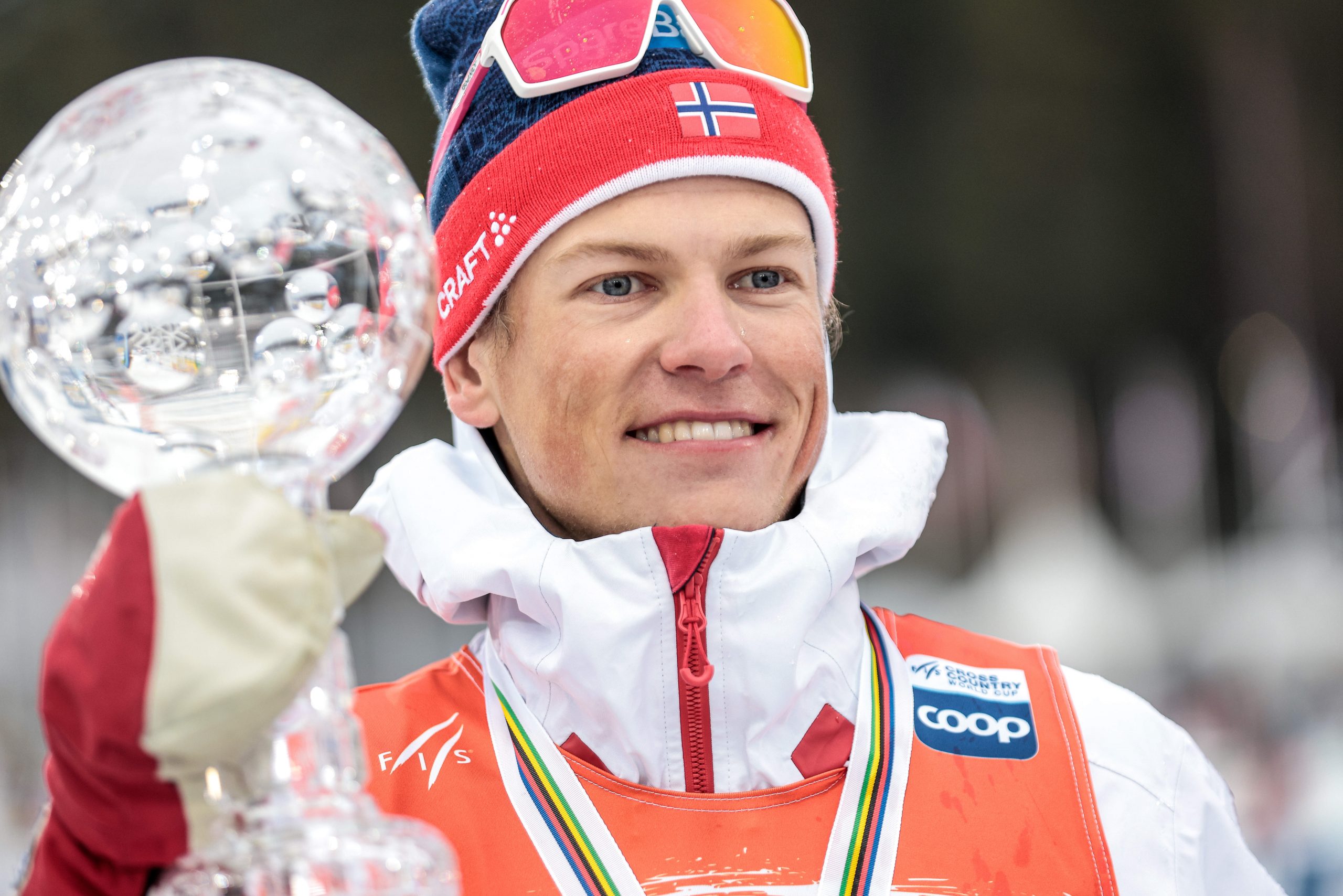
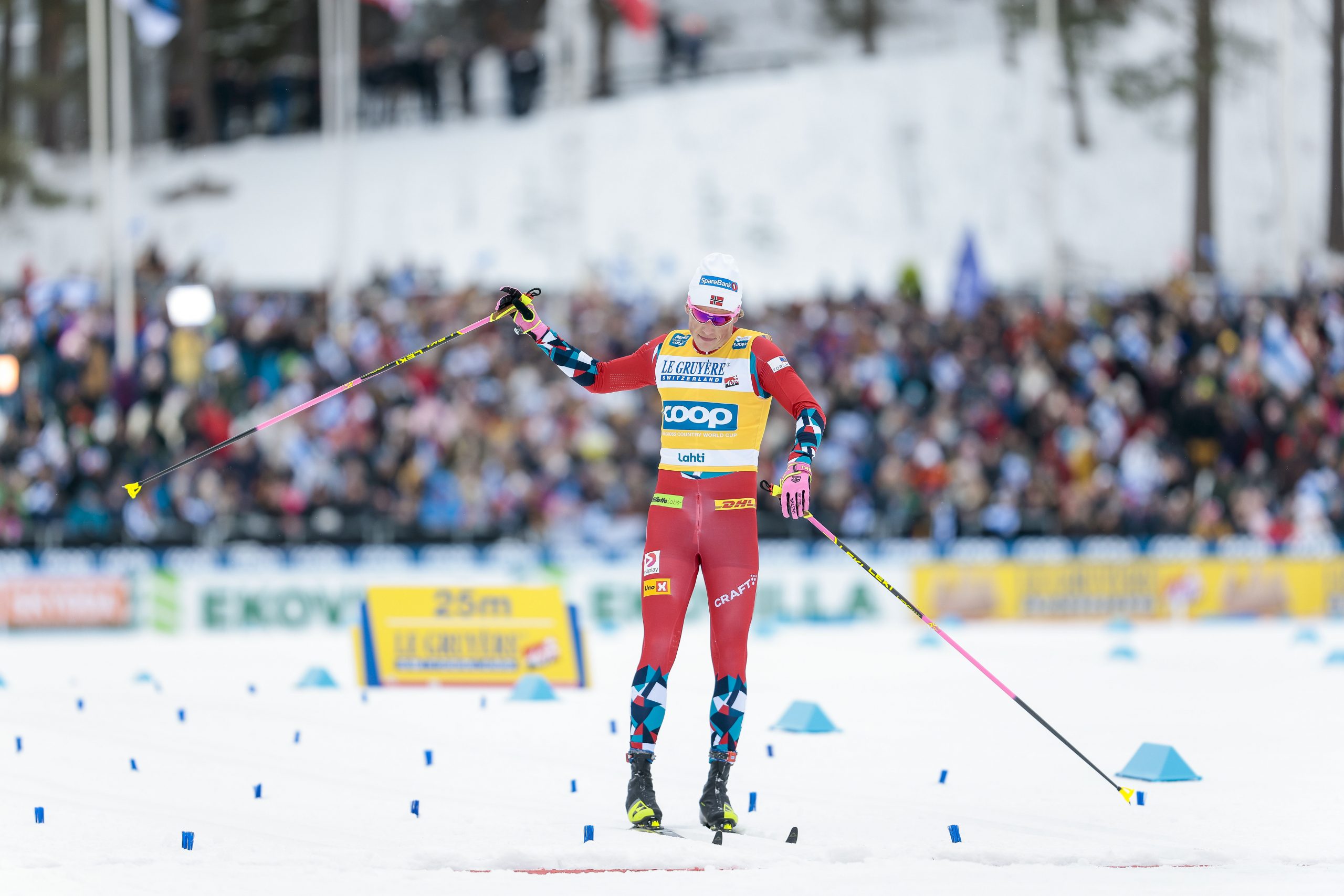
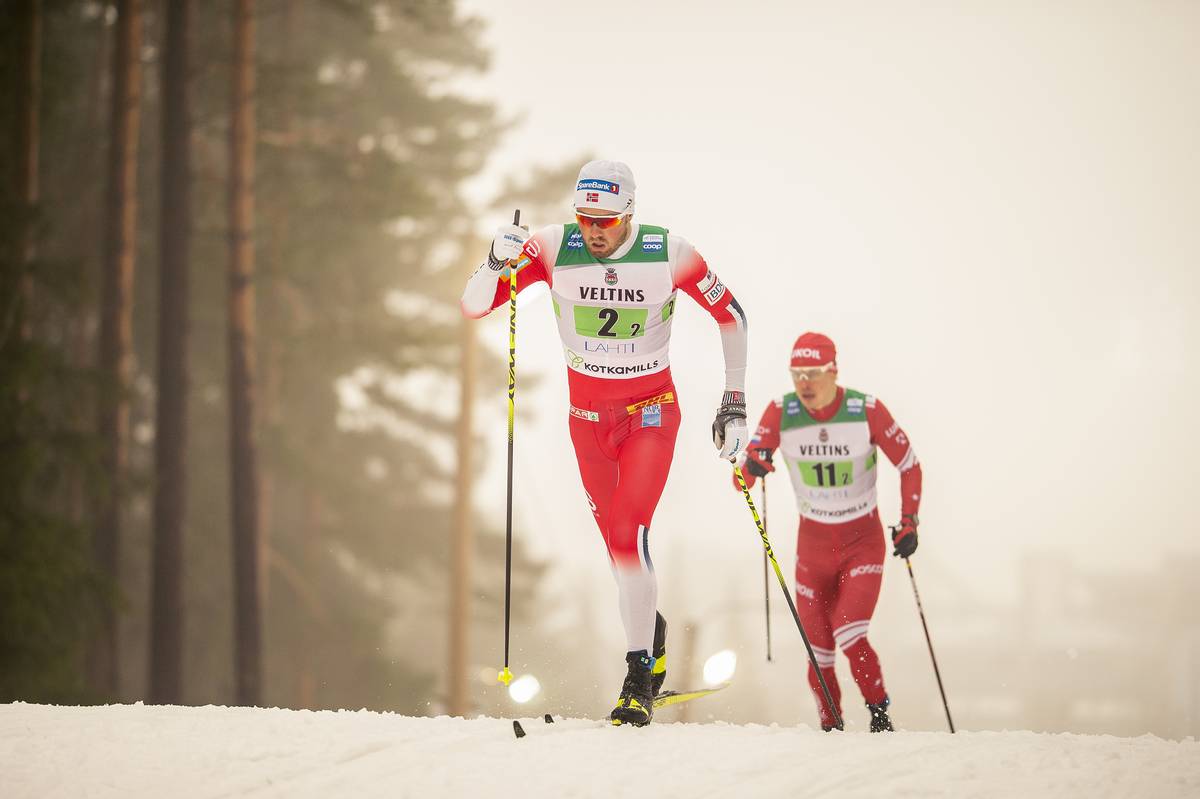
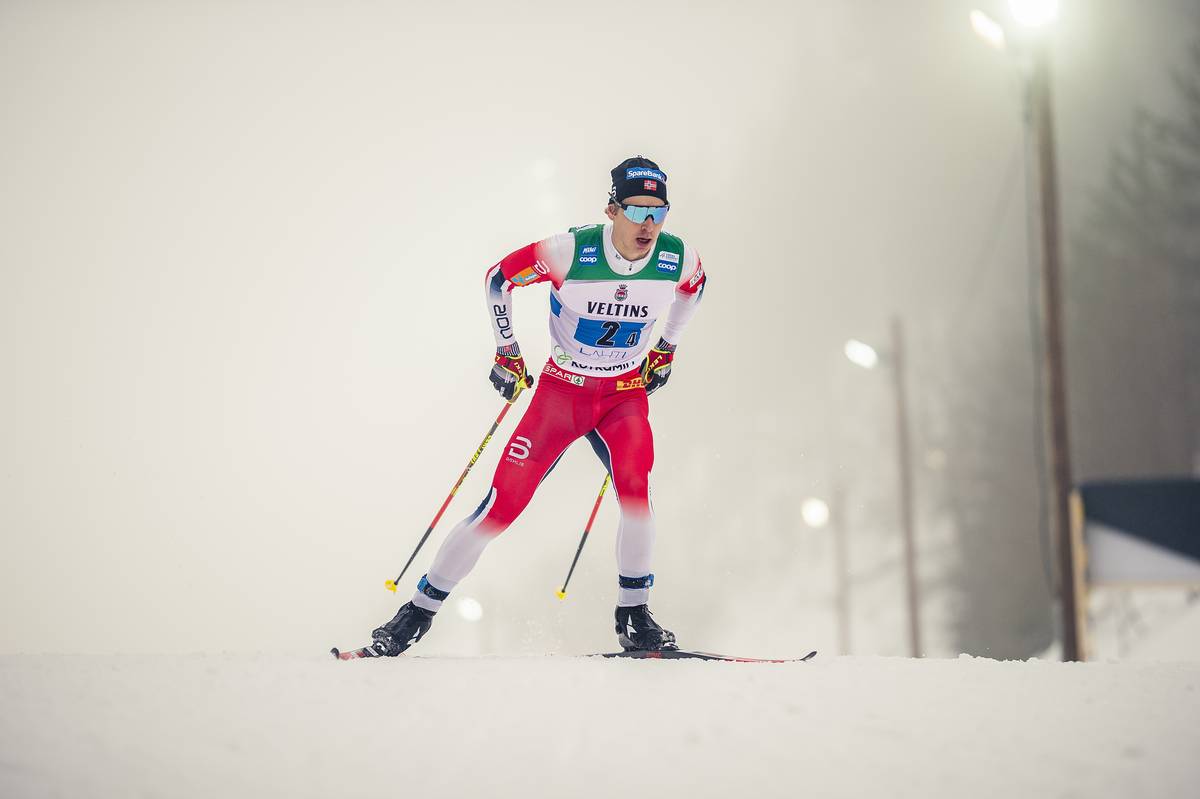
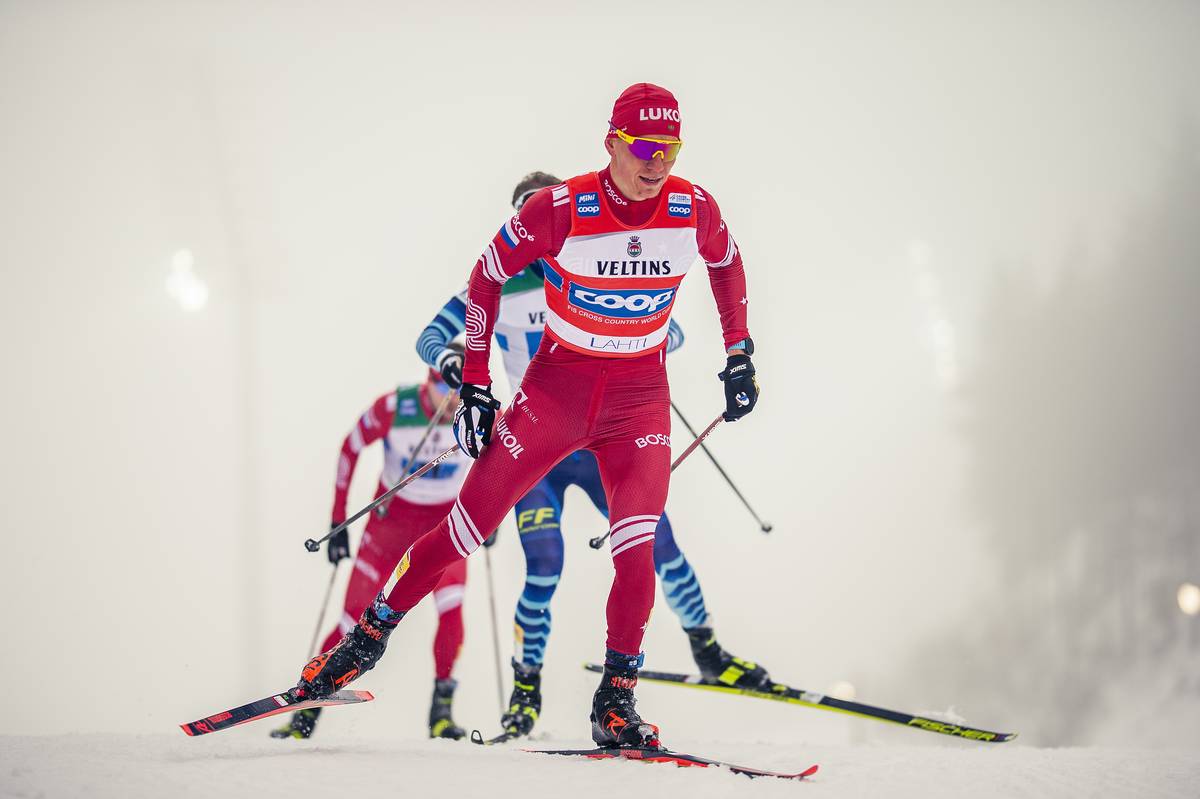
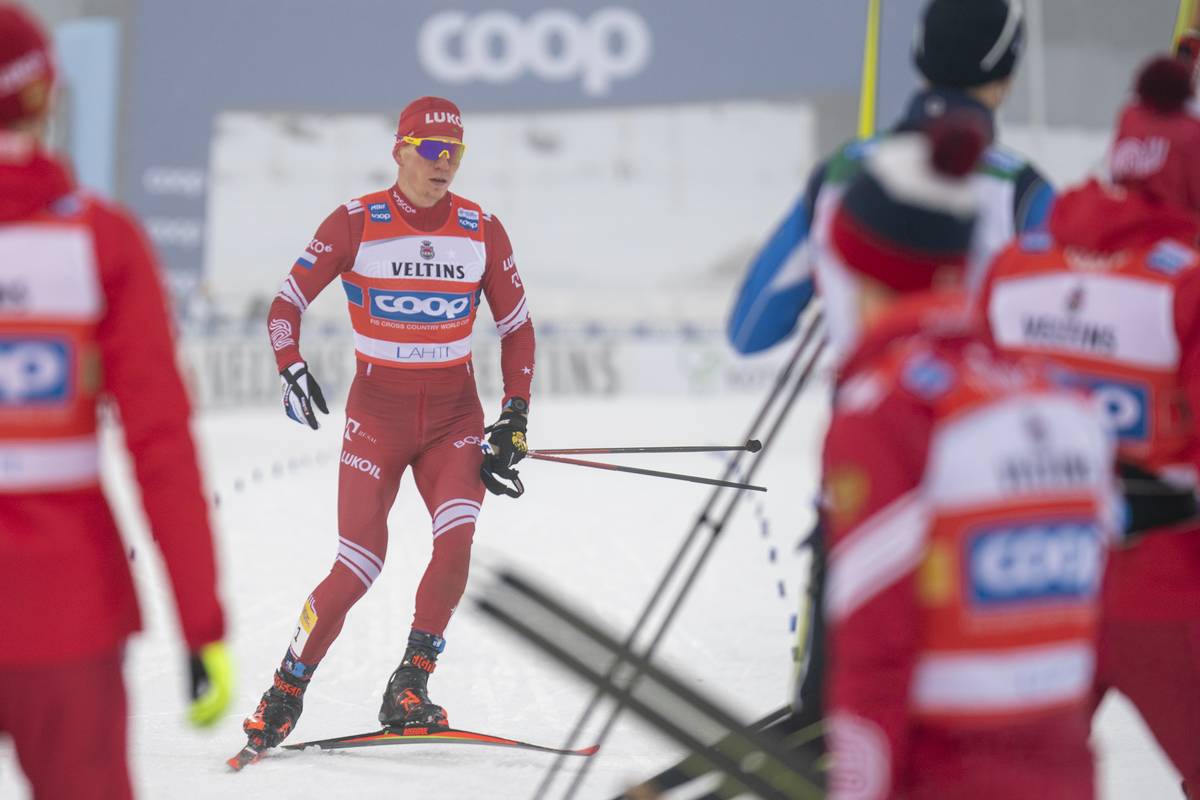
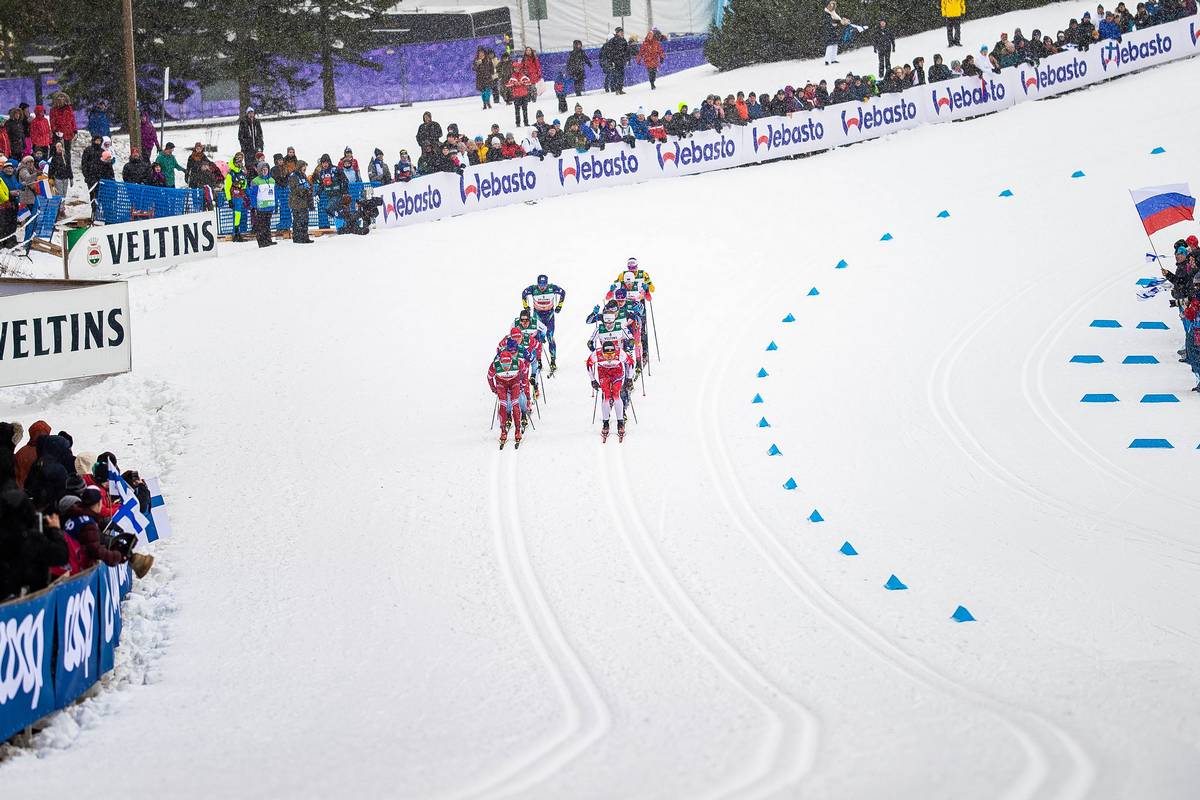
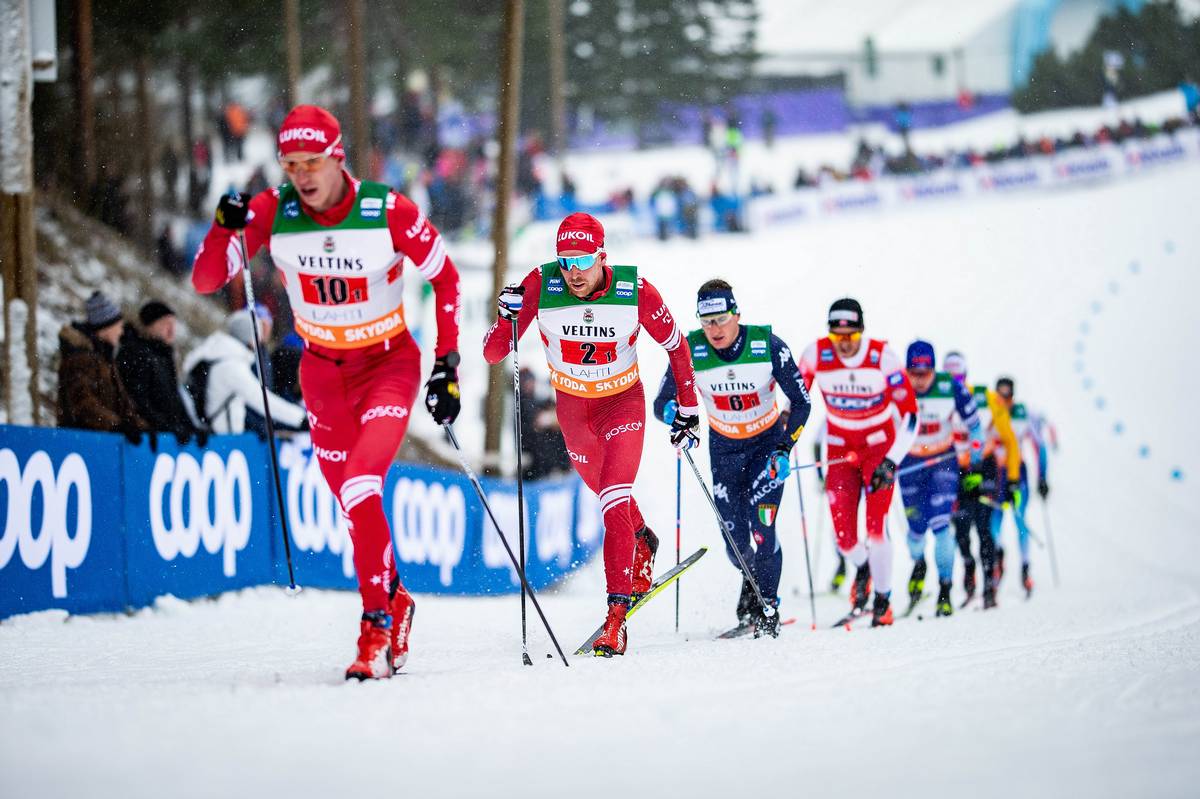
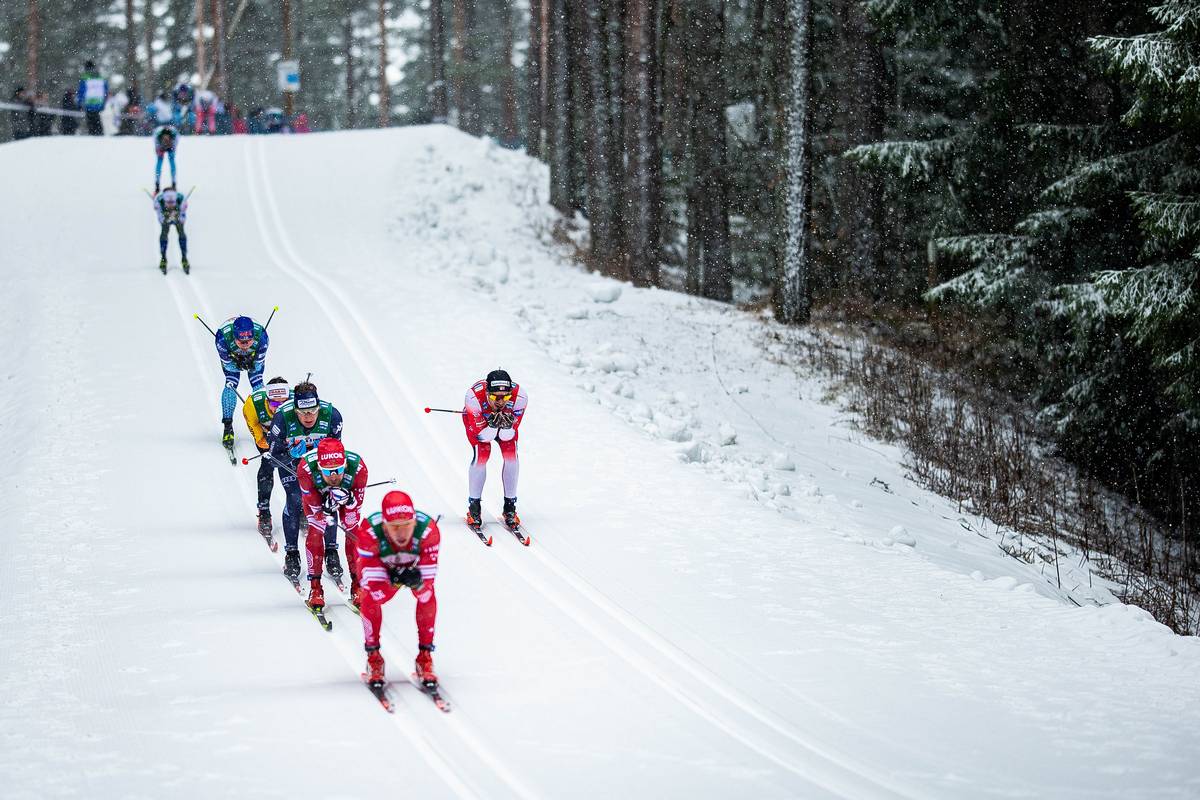
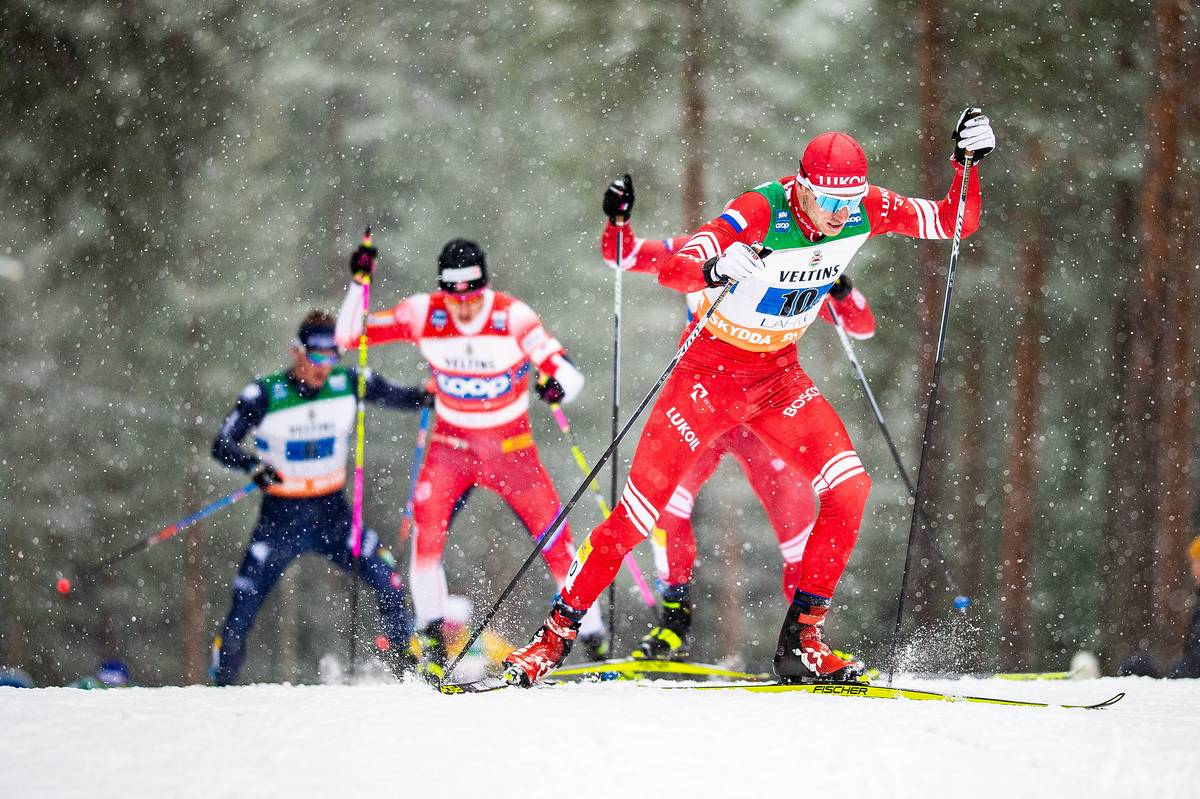
    With his win Lahti’s World Cup 10 k Classic, Johannes Hoesflot Klaebo (NOR) continues a level of dominance rarely seen in international sports. (Photo: Thibaut/NordicFocus)

    Johannes Hoesflot Klaebo may be tired, but far more daunting than any mere fatigue is what Klaebo’s rivals find themselves facing: futility.

    Weekend after weekend, race after race, kilometer after kilometer, finish line after finish line, Klaebo is proving himself to be all but unbeatable. He toys with his rivals in Sprint races, whether Classic or Freestyle; he takes advantage of his superior speed and tactical acumen in Mass Start races of every distance. He even displays superior pacing, restraint, endurance, and discipline in Interval Start events. And when Klaebo skis the anchor leg of your relay, then your team wins. Such athletic dominance is not a thing that lasts—and even Klaebo is likely to find himself beaten soon—but when an athlete’s on an historic streak like this, it’s a remarkable thing for fans of the sport to witness.

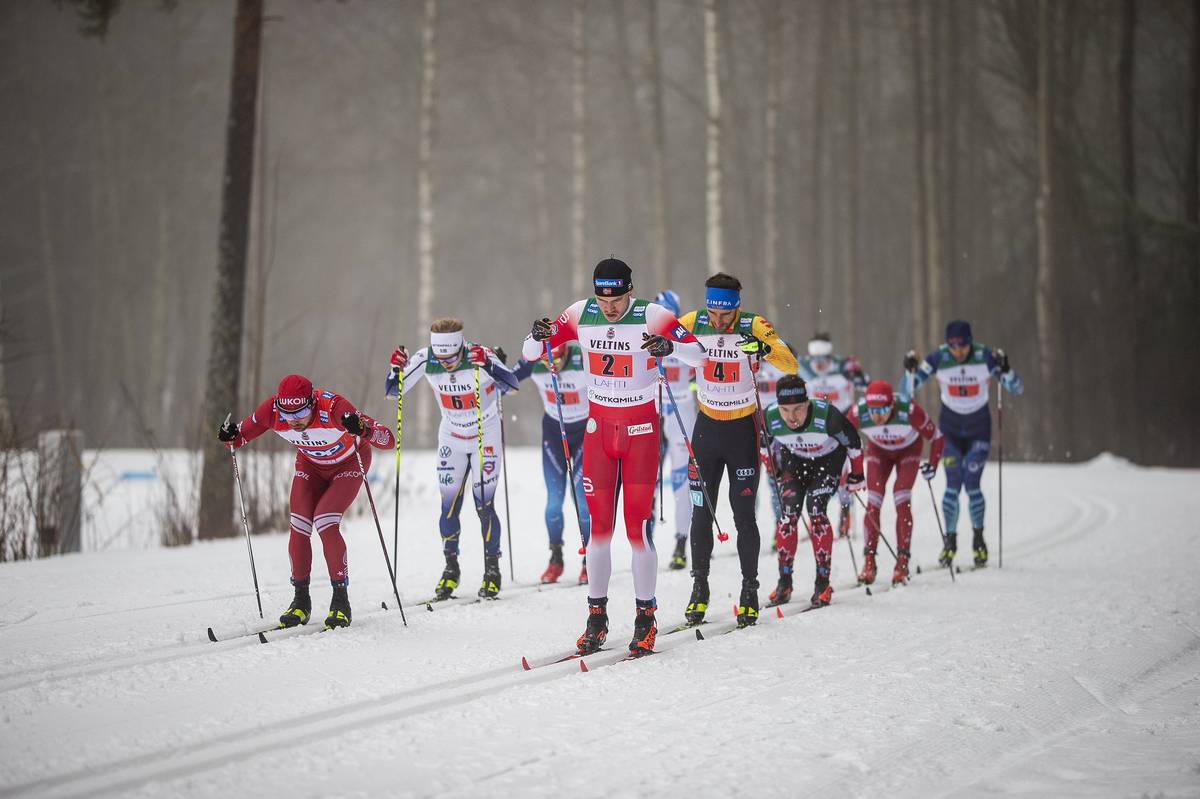
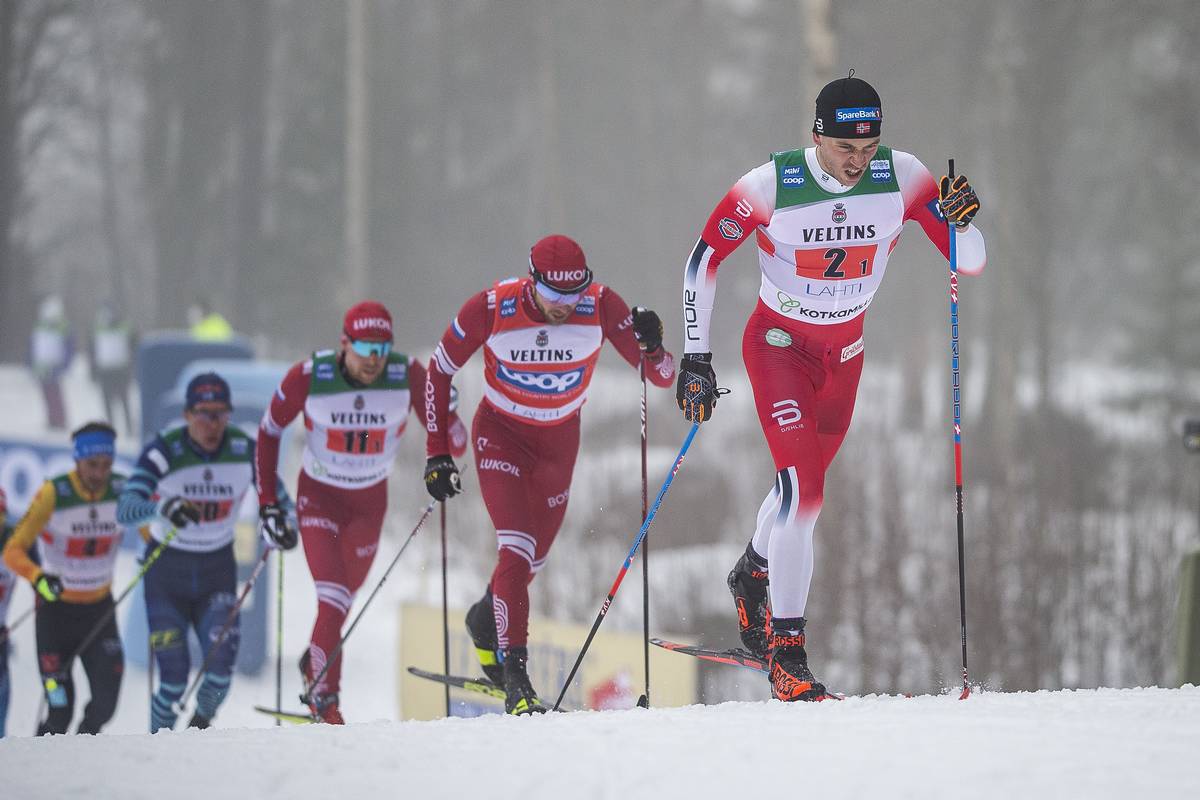
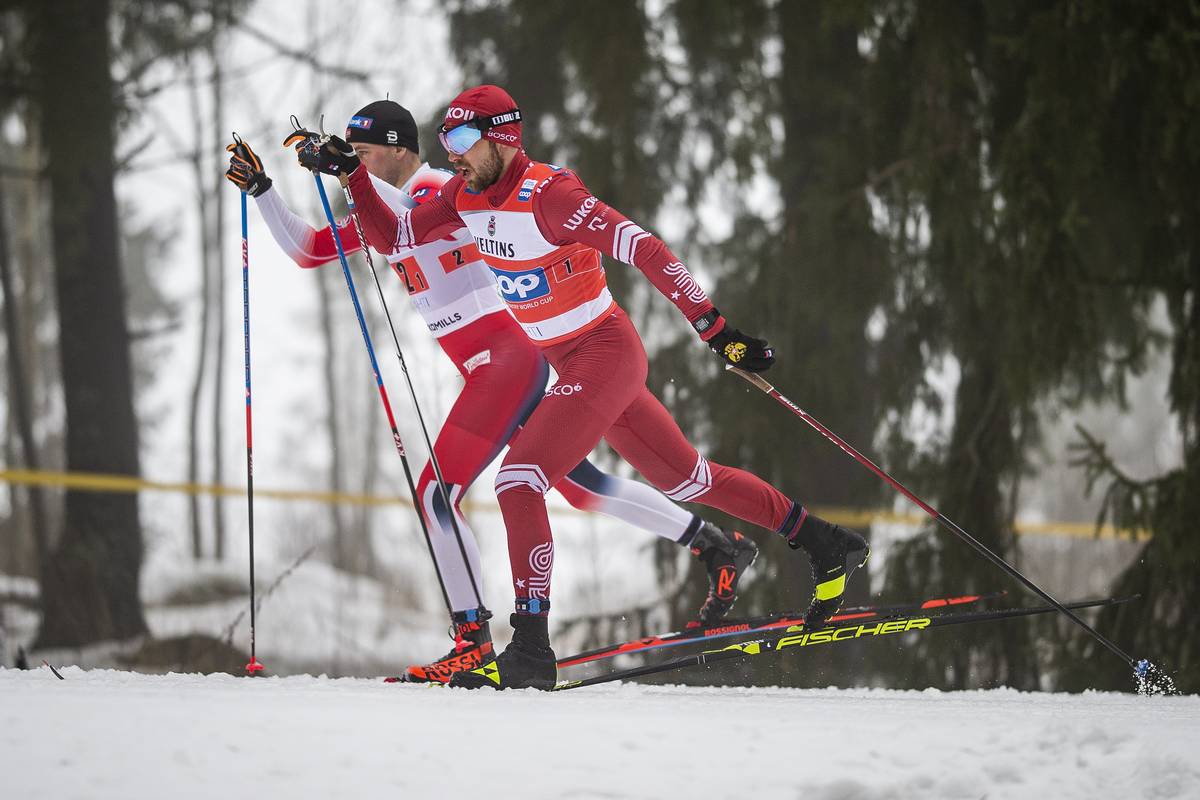
    In Lahti, Klaebo’s dominance was on display again, as he glided to yet another World Cup victory in the 10 k Classic Interval Start. Mid-race splits identified Russian independent skier, Savelii Korostelev as a challenger, but Klaebo would pull away from him in the end, bettering the young Russian’s finishing time by 34 seconds. Between them, Martin Loewstroem Nyenget mounted a challenge of his own. While Nyenget has emerged as one of the dominant Classic skiers of this generation, still he trailed Klaebo at every checkpoint. Ultimately, Nyenget would finish second, but still some 22 seconds behind.

    If all these skiers want to beat Klaebo, they need to find another way to do it. Maybe the best tactic is to simply wait. Everybody gets sick some day, don’t they? Everybody shows up flat now and then, right? Perhaps the best tactic to employ in chasing Klaebo is to stop chasing. Just let him flame out at some point, and hope to be the one best positioned in the crowd to catch the bridal bouquet when it flies through the air.

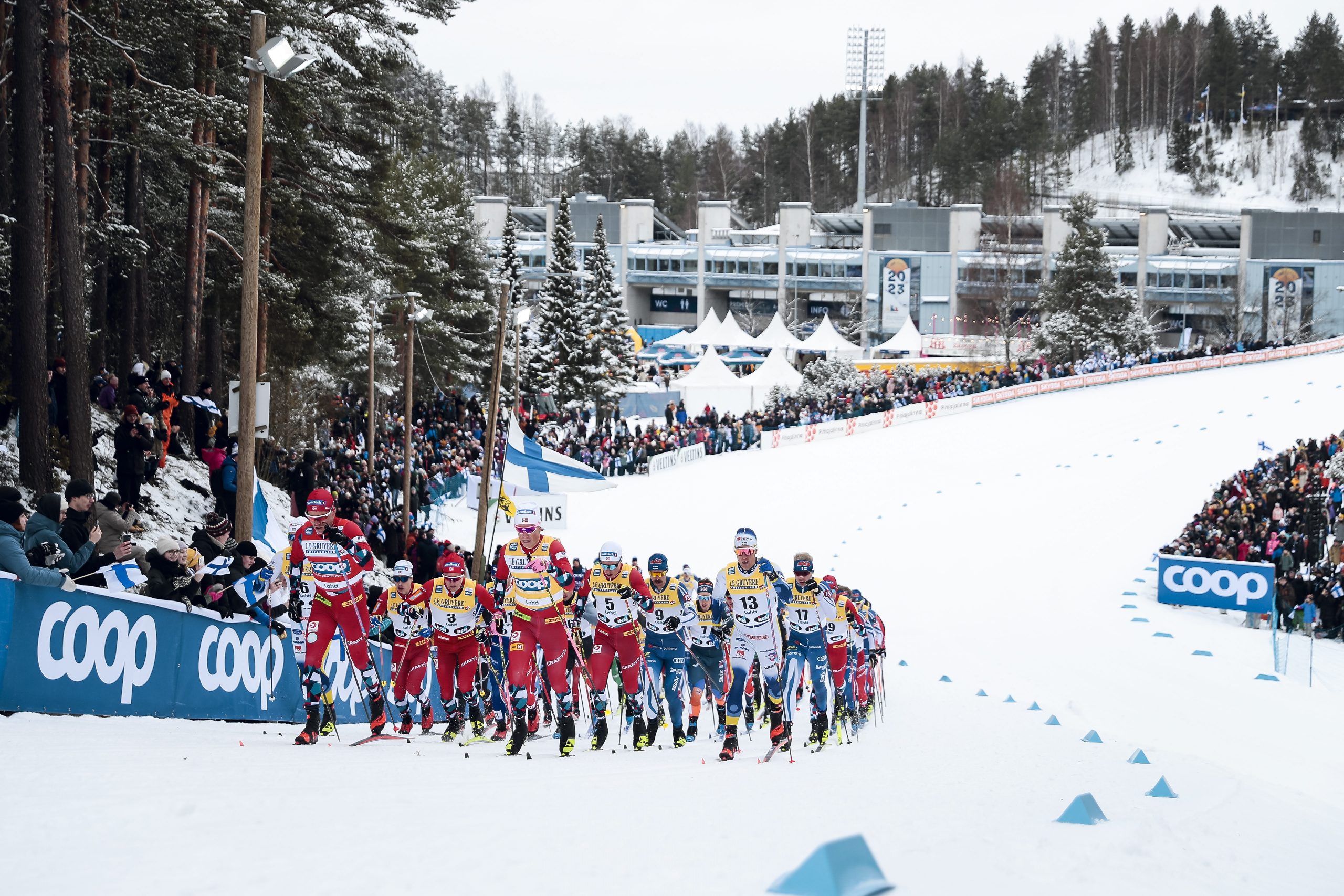
    Savelii Korostelev (AIN) was the early leader at numerous checkpoints. He would finish third on the day behind the efforts of Martin Loewstroem Nyenget (NOR) and eventual race winner, Johannes Hoesflot Klaebo (NOR). (Photo: Thibaut/NordicFocus)
    Men’s 10 k Classic

    Korostelev entered the World Cup circuit and Olympic events after Russia’s long exile, hoping to establish himself at the top of the cross-country ski standings (as he had already accomplished in races within Russia over the past two seasons). Korostelev must be asking himself “Just how fast do I need to go?” Well, “Historically fast” would appear to be the answer to Korostelev’s question.

    Here’s the pertinent question for anyone in the field not named Klaebo: just how far will they go in pursuit of this guy? It’s an especially pressing question for Klaebo’s Norwegian teammates who are compared to him on a week-by-week basis, and who are all hoping to position themselves to be his heir (even as he shows no signs of considering retirement). Any number of those Norwegian stars may have hoped to topple Klaebo in an Olympic event. He was vulnerable, after all; racing every single event while other skiers got to pick and choose. For Harald Oestberg Amundsen, for Martin Loewstroem Nyenget, for Emil Iversen, for Mattis Stenshagen, for Lars Heggen, for Einar Hedegart—all of whom had been identified as skiers with the potential to steal away one of Klaebo’s gold medal opportunities—the chase to catch Klaebo may ultimately ruin them. In the Olympics, most of them appeared flat, as though they may have over-trained, or delayed their much-needed rest, or failed to taper sufficiently in their quest to grab a career-defining medal. Alone among them, Iversen appeared satisfied to follow Klaebo’s lead, joining Klaebo for much of his training throughout the off-season and competitive-season even though it meant that Iversen was unlikely to achieve any sort of advantage over him. Iversen was smart enough to know that Klaebo’s prowess could lead them both to Olympic medals, and that’s precisely what happened. The rest of the Norwegian contingent left Milan-Cortina with anumber of medals, but draped in quite a bit less glory than they might have hoped.

    And here’s the dilemma for Klaebo, himself: how does an athlete seek to maintain the form that they have? Is it possible to just hold one’s position, or does an athlete need to keep getting better? And how much risk is involved in attempting to improve? Just ask Klaebo’s Norwegian teammates . . . they’re trying as hard as they can, trying new things, risking greatly. And it’s not working. If anything, their efforts are opening the door for the stars of other nations that are approaching from behind. Matthis Desloges (FRA) claimed numerous silver medals in the recent Olympics—medals originally thought reserved for Norwegian skiers. And as the World Cup tour enters Period 4, Norwegian skiers find themselves delivering results well down the page, rather than stacking all the Norwegian finishers at the top, which was the norm for much of the pre-Olympic season.

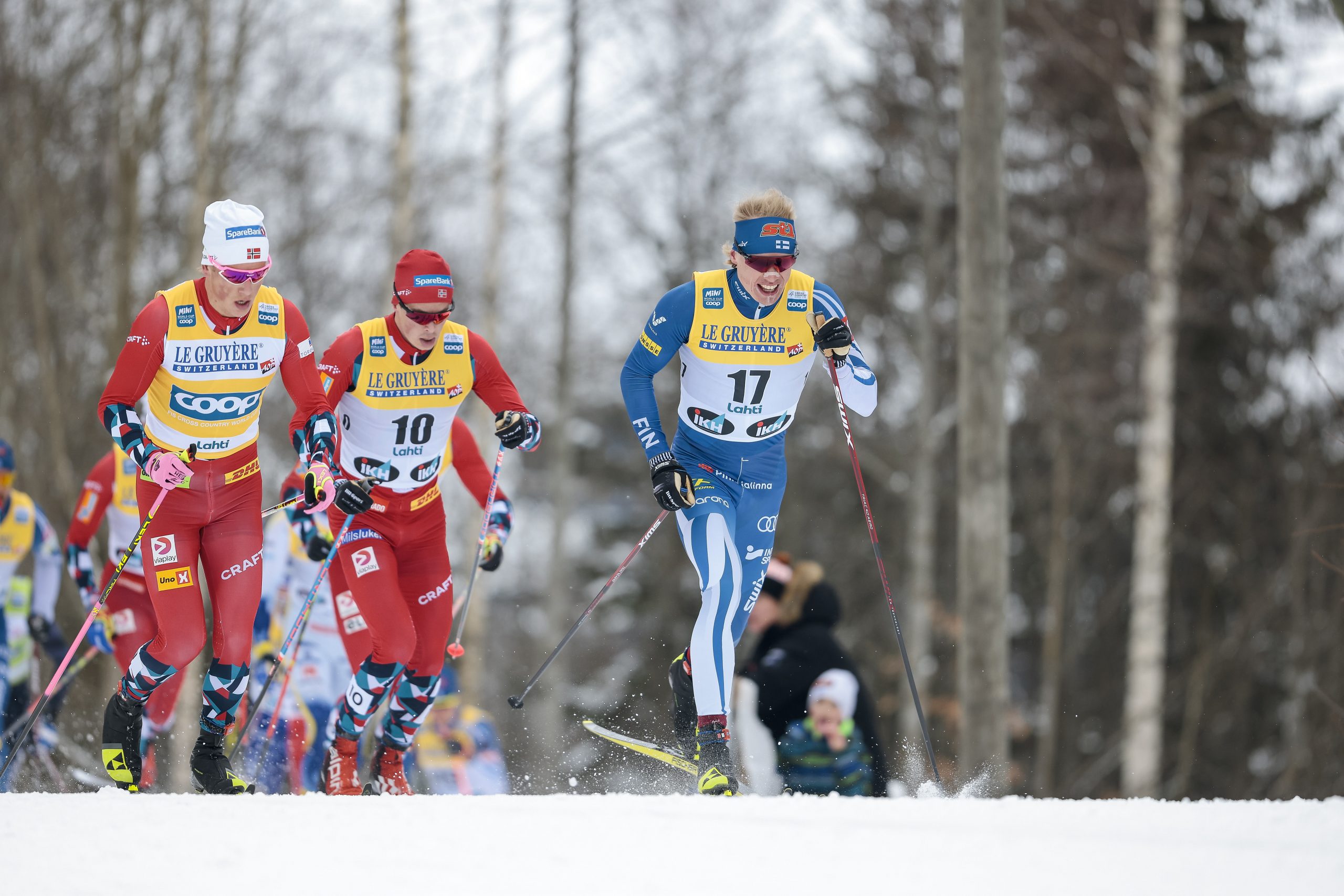
    Martin Loewstroem Nyenget (NOR) must be wondering what he needs to do. In Lahti, he delivered a striking performance in the 10 k Classic, only to find himself trailing Johanes Hoesflot Klaebo (NOR) at every checkpoint. (Photo: Thibaut/NordicFocus)

    Wearing bib 54, Klaebo was the first of the true contenders to start, meaning he would receive less info communicated to him on course when compared to other later-starting contenders. In what is often considered Klaebo’s most challenging event (the interval start 10 k) Klaebo would find himself needing to overcome that small disadvantage as well as the best efforts of his rivals.

    Korostelev came through 3.4 kilometers a full 20 seconds ahead of American, Gus Schumacher, but even Korostelev found himself overtaken by Klaebo who came through the checkpoint three seconds ahead of the neutral-skiing Russian. Klaebo would continue extending his lead over Korostelev to nearly 12 seconds by the halfway point of the race. The only questions that remained would be answered by the other contenders starting behind Klaebo. Among those, Nyenget was the first to test the waters, coming through the 3.4 kilometer mark 3.8 seconds behind Klaebo. Nyenget would lose more time on his way to the end of the lap, crossing through the stadium with a deficit of six seconds . . . still ahead of Korostelev, but dropping just a bit farther behind Klaebo.

    Klaebo held his advantage at 6.1 kilometers, but then he began extending his lead on the way to 8.4 kilometers, crossing that checkpoint 22 seconds up on Korostelev. Klaebo would only continue to extend that lead, crossing the line with a 34 second advantage. Nyenget would continue to battle, ultimately besting Korostelev but still falling 22 seconds short of Klaebo.

    Another weekend passes, another Klaebo sweep. How long can he keep this up? After yesterday’s victory in Lahti’s Freestyle Sprint, Klaebo spoke of his level of fatigue at this juncture in the World Cup season. Who could blame him for being tired? After all, he swept all the Men’s events at the Olympic Winter Games of Milano-Cortina; and this in the middle of his historic World Cup winning streak that began weeks ago, and appears likely to extend well into the future. Unfortunately for those hoping to wait him out, Klaebo seems all but immune to the factors that typically topple those at the top. “The last two weeks has been that I’m sick in the middle of the week, and then I’m racing in the weekend,” said Klaebo. “So, we’ll see if I can stay healthy now during the week so I can participate in Drammen (next week’s Sprint races). That’s the goal.”

    And that’s a problem for the rest of the field: when Klaebo sets a goal, he tends to achieve it. Anyone anticipating Klaebo falling short of that goal may have a while to wait.

    Lahti Men’s 10 k Classic Interval Start RESULTS

    Love Stories Like This? Help Keep Them Coming.

    Feature stories like this one take time, access, and care to produce. If you value thoughtful storytelling and independent ski journalism, please consider becoming a Voluntary Subscriber. Your support directly fuels the work we do to cover the people, places, and moments that make our sport special.

    Join the FasterSkier community!
    The torch isn’t being passed just yet. Savelii Korostelev (AIN), may be one of the heirs apparent in the world of international cross-country skiing, but Johannes Hoesflot Klaebo appears far from ready to make room at the top. (Photo: Thibaut/NordicFocus)


  • Sundling Returns to Win Lahti Sprint as Crystal Globe Battle Tightens

    Sundling Returns to Win Lahti Sprint as Crystal Globe Battle Tightens

    This coverage is made possible through the generous support of Marty and Kathy Hall and A Hall Mark of Excellence Award. To learn more about A Hall Mark of Excellence Award, or to learn how you can support FasterSkier’s coverage, please contact info@fasterskier.com.

    Jonna Sundling (SWE) during qualification in Lahti, Finland. (Photo: Authamayou/NordicFocus)

    The World Cup season returned to Finland this weekend, closing a circle that began more than three months ago in Ruka. In the time since Olympic teams were selected, dreams realized or deferred, experience forged, and farewells offered week after week as the long winter wears on. If the stakes in Lahti feel slightly lower than they did earlier in the season, they are tightening in another way — especially in the races for the Crystal Globes.

    With only a handful of races remaining in the season, the women’s Freestyle Sprint offered more than just another podium. The fight for both the Sprint Crystal Globe and the Overall Crystal Globe continues to tighten.

    In tricky conditions, Sweden’s Jonna Sundling emerged as the day’s winner, navigating the heats with authority before closing out the final to claim victory.

    “I think all day it’s been difficult with the conditions because it seems so nice, but when you ski it’s like icing underneath,” Sundling said in a post-race interview with FIS on the broadcast. “There were some challenges with the skiing, but I’m glad that I could ski as I did today and go all the way.”

    The victory marked a strong return for Sundling, who said she had recently been dealing with a cold and missed racing in Falun before arriving in Lahti.

    One of the most interesting moments of the women’s race came when Kristine Stavaas Skistad (NOR) was disqualified during the semifinals for what appeared to be a very minor incident.  She received a yellow card for the incident, and because she was already carrying one from a previous violation, she was disqualified. (Photo: Authamayou/NordicFocus)
    A Tactical Sprint Course

    The Lahti freestyle sprint course rewarded patience as much as power. After the individual qualification round, the top 30 athletes advanced into the head-to-head heats — five quarterfinals of six athletes each, with the top two finishers and the two fastest “lucky losers” advancing to the semifinals.

    From there, the field narrowed again: two semifinal heats would determine the six skiers racing for the win.

    While the course appeared straightforward on paper, athletes quickly discovered the conditions made positioning critical. The climb before the final hairpin offered one of the few reliable passing opportunities before the long run to the finish, which saw the race often gather back together around the final corner before the finishing stretch. And throughout the heats, several favorites discovered how narrow the margin for error could be.

    Maja Dahlqvist (SWE) got out well, but was unable to advance from the quarterfinals. (Photo: Authamayou/NordicFocus)
    Globe Leaders Falter

    Two of the athletes who have dominated the sprint standings this season — Maja Dahlqvist (Sweden) and Nadine Fähndrich (Switzerland) — both saw their days end earlier than expected, failing to advance beyond the quarterfinals.

    Their early exits added intrigue to the sprint globe race as the season heads toward its final stretch.

    Meanwhile, Sundling continued to build momentum, advancing smoothly through her heats despite the difficult snow conditions.

    “I’m super motivated,” Sundling said of the final weeks of the season in the broadcast interview. “It’s my favorite time of the year.”

    Hilla Niemela (FIN), Johanna Hagstroem (SWE), and Jessie Diggins (USA) (l-r) charge up the opening climb of the Freestyle Sprint in Lahti, Finland. (Photo: Authamayou/NordicFocus)
    Diggins Attacks, But Falls Short

    For the United States, Jessie Diggins came closest to advancing deep into the rounds.

    In her quarterfinal, Diggins launched a decisive move on the final climb, surging to the front of the group in an effort to create separation before the tight hairpin turn at the top of the hill. Over the crest, she continued the attack, aggressively no-pole skating the downhill in an attempt to open a gap.

    For a moment, the tactic appeared to work.

    But the chasing group quickly organized behind her, the draft pulling them back together on the descent into the stadium. Sweden’s Johanna Hagström surged in the final meters, lunging at the line to edge Diggins and end the American’s day in the quarterfinal.

    Diggins said the Lahti crowd helped make the experience memorable.

    “It was so cool to hear the crowd roaring. There were so many people out, really filling the stadium and along the course. It’s just a very cool environment. It was sunny and beautiful, which made it really fun.

    “I was really happy with my energy today. I feel like I skied a pretty good race and did everything I could. But again this year, I feel like I just don’t quite have that ultimate power, especially in the finishing stretch.

    “I’m excited for tomorrow and just excited to be finishing out my last stretch here in Europe. That feels really special. It’s kind of cool to take a moment to reflect on my many years spent on the road in Europe. That chapter is coming to a close now, which is really cool and really special. I’m just grateful thinking back on all the memories over all the different years.”

    Rosie Brennan (USA) fighting to maintain contact with the group as Gina Del Rio (AND) takes the opening climb out fast during their quarterfinal. (Photo: Authamayou/NordicFocus)
    Brennan Knocked Out in Quarterfinal*

    Veteran American Rosie Brennan also reached the quarterfinals but was unable to advance.

    Lauren Jortberg (USA) on her way to 37th place in qualification in Lahti, Finland. (Photo: Authamayou/NordicFocus)
    Jortberg Reflects on Qualification Miss

    For Lauren Jortberg, the Lahti sprint was a reminder of how thin the margins can be in World Cup qualification.

    Jortberg finished 37th in the qualification, just outside the top-30 cutoff needed to advance to the heats. After the race, she said the conditions on the Lahti course made it difficult to find the right balance between glide and stability.

    “There was kind of an ice sheet underneath with some sugar on top,” Jortberg told FasterSkier after the race. “So it was hard to find skis that were running really well while also being able to push off and plant well. It made the skiing a little tricky, but that’s pretty typical for what we’ve seen in Lahti the last few years.”

    Jortberg also felt she left something on the course in terms of pacing.

    “I think I just didn’t pace it very well,” she said. “I probably paced it too much. I didn’t really finish feeling that tired, so that was a bit of a bummer.”

    Part of that caution, she explained, stemmed from having dealt with illness in the days leading into the race.

    “I had been sick the last week, so I think I held back a little bit,” Jortberg said. “That’s frustrating because I felt really good and I think I could have been competitive today.”

    Even so, Jortberg said the past months of racing have helped build confidence as she continues gaining experience on the World Cup circuit.

    “One of the big takeaways from these World Cup weekends is that when I can put down a really solid qualifier, I’m very much in the mix,” she said. “Even though today wasn’t a great qualifier, I wasn’t that far out of the heats, so I think that’s something I can take confidence from going into the next few weekends.”

    Julia Kern (USA) during qualification. (Photo: Authamayou/NordicFocus)
    Julia Kern Trying to Get Back to Form*

    Julia Kern, returning to racing after illness following the Olympic Games, placed 44th in the qualification round.

    Albrecht Gaining World Cup Experience

    Emma Albrecht, competing in her fourth World Cup weekend, finished 48th in the qualification round in Lahti as she continues gaining experience at the highest level of the sport.

    Albrecht said one of the biggest adjustments to racing on the World Cup has been the razor-thin margins in sprint qualification.

    Emma Albrecht (USA) gaining experience during the qualification in Lahti, Finland. (Photo: Authamayou/NordicFocus)

    “The biggest adjustment to racing at this level is how tight the race margins are,” Albrecht told FasterSkier after the race via email. “The U.S. SuperTour field is obviously not as competitive, and it has been a shift — especially in sprinting — to have to have a fast qualifier. You are no longer guaranteed to make heats.”

    The Lahti sprint course also served as a reminder of the confidence and technical skills required to compete in crowded sprint fields.

    “Today’s qualification reminded me to take up space on the course and not be afraid of a little hop skate,” she said.

    Even with the challenges, Albrecht said the experience is fueling motivation heading into the offseason.

    “This weekend is making me very excited for summer training,” she said. “A field as deep as this really highlights weaknesses on course. I would love to become a more efficient jump skater and be more confident in my high-speed V2. I’m definitely walking away with a lot of motivation to improve.”

    Liliane Gagnon (CAN) charges up the first climb during her quarterfinal, where she narrowly missed advancing to the semifinals. (Photo: Authamayou/NordicFocus)
    Canadian Results

    Canada’s top performance came from Liliane Gagnon, who finished third in her quarterfinal — just short of advancing to the semifinals.

    Teammates Olivia Bouffard-Nesbitt and Katherine Weaver placed 43rd and 46th, respectively, in qualification.

    Jonna Sundling (SWE) celebrates the win while Coletta Rydzek (GER) and Johanna Hagstroem (SWE) lunge for third behind her. (Photo: Authamayou/NordicFocus)
    The Season’s Final Push

    With only a handful of races remaining on the World Cup calendar, the results in Lahti could prove important in shaping the final standings.

    For Sundling, the victory served as both a return to form and a statement heading into the closing weeks of the season.

    “I’m looking forward to the rest of the season,” she said.

    For others — particularly those chasing the Crystal Globes — the margin for error continues to shrink.

    And with more racing still ahead in Lahti this weekend, the battle for the season-long trophies is far from settled.


    Lahti Women’s Freestyle Sprint QUALIFICATION RESULTS

    Lahti Women’s Freestyle Sprint FINAL RESULTS


    *We hope to add more quotes above from athletes if we hear back from them, but wanted to get this race report posted in a timely fashion.


    Love Stories Like This? Help Keep Them Coming.

    Feature stories like this one take time, access, and care to produce. If you value thoughtful storytelling and independent ski journalism, please consider becoming a Voluntary Subscriber. Your support directly fuels the work we do to cover the people, places, and moments that make our sport special.

    Join the FasterSkier community!


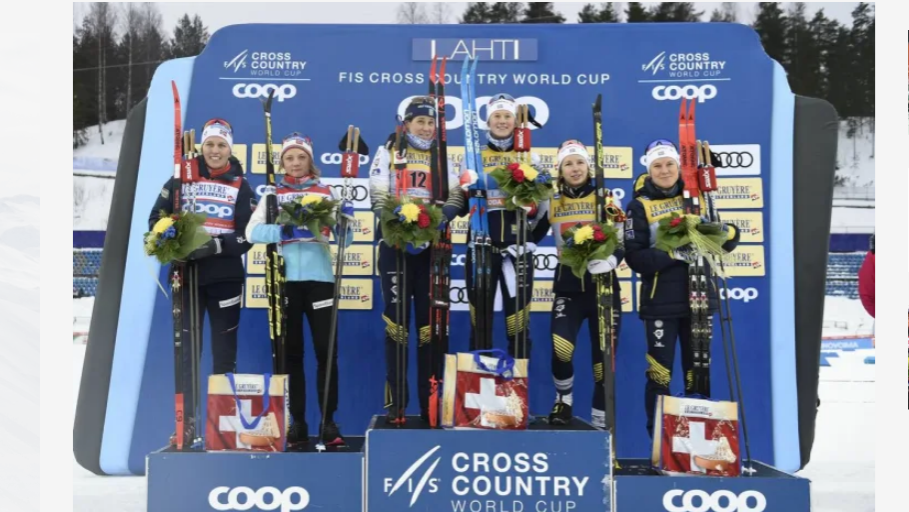
    Linn Svahn (SWE), Jonna Sundling (SWE), and Coletta Rydzek (GER), (l-r) share the Freestyle Sprint podium in Lahti, Finland. (Photo: Authamayou/NordicFocus)
  • Lahti Sprint—Klaebo Remains Unbeatable

    Lahti Sprint—Klaebo Remains Unbeatable

    This coverage is made possible through the generous support of Marty and Kathy Hall and A Hall Mark of Excellence Award. To learn more about A Hall Mark of Excellence Award, or to learn how you can support FasterSkier’s coverage, please contact info@fasterskier.com.

    Babe Ruth, Muhammad Ali, Michael Jordan, Michael Phelps, this guy—Johannes Hoesflot Klaebo (NOR). (Photo:  Authamayou/NordicFocus)

    “It’s Johannes Klaebo’s ski world,” said skiandsnowboardlive.com’s on-air commentator, Andrew Kastening. “And we’re all just living in it.” Truer words were never spoken . . .

    “I didn’t have a plan,” said Klaebo after his dominant performance in Lahti Finland’s World Cup Freestyle Sprint. “I just went for it at the end there and managed to get enough meters to the young guys. Next year it will be even harder, so we’re going to enjoy this now for the rest of this year. Next year, it’s going to be way harder, I think.”

    Well, we don’t really believe Klaebo’s “no plan” claim. In fact, we probably aren’t sure we believe that next year will be “way harder,” either. Not with the way this year has gone, anyway. But Klaebo’s suggestion that we “Enjoy this for now?” No problem . . .

    Ironically, Klaebo’s absolute dominance leaves ski reporters scrutinizing the strengths and weaknesses of other skiers—scanning the notoriety of other results—for stories that will continue to capture readers’ imaginations. Where the heck has Sindre Bjoernstad Skar been? And how much resentment do Even Northug and Lars Heggen harbor after being left off the Norwegian Olympic team? And, after his recent U23 World Championship (and the pedigree afforded him by his mother, legendary Nordic skier, Bente Skari), is Filip Skari the real thing? And is Harald Oestberg Amundsen still in the running for the Crystal Globe? Or does he just need a Sprint day to warm him up for the Distance races? And who the heck is Mathias Holbaek? On a normal World Cup weekend, those questions—Norwegian questions—would occupy the imaginations and fill the column inches of ski journalists. But that was before the Olympic Winter Games of Milano-Cortina . . . the Games in which Ben Ogden (USA) and Gus Schumacher (USA) created scenes of flashing silver excellence. Now, reporters have another story to report: American sprinters have arrived on the scene. If Ogden and Schumacher have any energy left after the predictable post-Olympic celebrations, then they’ll have something to say about Lahti’s Sprint results, too.

    Gus Schumacher (USA) and Ben Ogden (USA) and Gus Schumacher (USA) have ushered in a new era of American men’s skiing. (Photo:  Vanzetta/NordicFocus)

    Granted, Ogden and Schumacher had far fewer Norwegian Sprint rivals to navigate among, through, and past on the way to their Olympic silver medals. That’s the salient reminder, folks: while the the Olympics offer the most valued, most brightly glittering prizes in the skiing world, the Olympics also offer the best chance for anyone to break through the Norwegian medals-monopoly. That’s because Norway is only allowed the maximum number of Olympic starters in any event: four starters. Conversely, in World Cup races, Norway is allowed at least seven starters . . . sometimes eight (if the race is in Norway). Any non-Norwegians—Ogden and Schumacher included—will find it far more difficult to snatch headlines in Lahti’s World Cup Freestyle Sprint. For that matter, American Sprinters (including Jack Young, JC Schoonmaker, Kevin Bolger, Zanden McMullen) will find it considerably more difficult to qualify for the heats, much less to advance through to semifinals and finals.

    And all this drama occurs in the shadow of the most predictable story—the one that we’ve probably grown tired of repeating by now: Klaebo’s going to win, right? I mean, he’s won the last 13 races he’s entered (sprints,  distance races, relays, Classic, Freestyle), including the six Olympic races that he swept during the Games of Milano-Cortina. And lining up for another Freestyle Sprint on a course where he has generally shown himself to be unbeatable seems unlikely to offer much hope to his rivals. Well, there’s always silver . . .

    Federico Pellegrino (ITA) is in Lahti, and so soon after he captured a magnificent bronze medal for Italy in the Team Relay. And Lucas Chanavat (FRA) is here, but he may finally have realized that he has never devised a tactic that’s even come close to allowing him the sort of success that his natural power and physical prowess would’ve suggested could be his. Among Americans, Schumacher qualified eighth. Jack Young 16th, Ben Ogden 22nd, McMullen 26th. Qualifying was won by Klaebo, followed by Chanavat and Pellegrino. The stage was set in an exciting race for silver. Sorry if that sounds like a weak set-up; we’re just calling it as we see it . . .

    Zanden Mcmullen (USA) held his own in a closely contested heat with Lucas Chanavat (FRA), Benjamin Moser (AUT), Lukas Mrkonjic (AUT), and Johannes Hoesflot Klaebo (NOR),. (Photo:  Authamayou/NordicFocus)
    Sprint Heats

    McMullen drew the first heat alongside Chanavat and Klaebo. Chanavat wanted the lead, but not the pace. With Klaebo positioned alongside him (staying near the front and out of trouble) the course was clogged and the pace was slowed.  Ultimately,  Chanavat found himself suckered into the lead at the top of the final downhill where he surrendered the draft and was predictably passed by Klaebo. Chanavat would actually fall in the final turn, allowing Klaebo to cross the line unchallenged, and making room for Benjamin Moser (AUT in the second spot to qualify for the semifinal. McMullen would cross in a closely-contested third place, too slow to advance as a lucky loser, but good enough for 20th on the day. There was some question about Chanavat’s fall (and whether or not he was interfered with), but the slo-mo replay made it appear that he’d done the damage on his own.

    In the second quarterfinal, Ogden decided to play his cards at the front where he was joined by Pellegrino. But coming through to make the pace was Skar (who has been absent from the World Cup scene for a few seasons, but returned to this venue in replacement of Olympic medalist, Oskar Oppstad Vike (NOR) who was injured at the recent U23 World Championships. Pellegrino would become impatient with Skar’s pace, driving forward to take the lead at the top of the final climb. But it was Heggen who would take advantage of the draft on the final downhill to take the heat win. He was followed across the line by Janik Riebli (SUI), Pellegrino, and Skar. Ogden would coast across the line a distant sixth, 28th on in the final Sprint results.

    Schumacher bided his time at the rear of the third quarterfinal, weaving through traffic to move forward into fourth position before the final downhill. Schumacher chose the outside line on the final left-hander, rocketing forward to steal an automatic ticket into the semifinal just ahead of Holbaek and Valerio Grond (SUI).

    Jack Young started at the rear of his quarterfinal, continuing to work his way through the field, but generally finding his way blocked and his momentum stymied. He entered the final downhill in fourth position, but with precieous little room to maneuver. Young came around the final turn in third, but was late to accelerate, finding himself still third at the line. In a slow heat, Young’s finishing time was not fast enough to advance. He would finish teh day in 15th.

    “My training during the Olympics absolutely allowed me to come in to Period 4 fresher and sharper,” said Young. “I felt faster today than I did in Falun, and I think I’m still on the way up.

    “Tactically, I’m making the progress I need to make,” Young continued. “I did a lot of things today in the heat that I haven’t done in the past. I was taking up space and shutting down moves made from behind me better than I ever have. In the future I need to keep skiing aggressively and find ways to get into the top two before the last 100 meters.

    Janik Riebli (SUI), Lars Heggen (NOR), Johannes Hoesflot Klaebo (NOR), Gus Schumacher (USA), Benjamin Moser (AUT), Davide Graz (ITA) in the Freestyle Sprint inLahti, Finland. (Photo:  Authamayou/NordicFocus)
    Sprint Semifinals

    Schumacher lined up next to Klaebo in the first semifinal. Klaebo was first off the line with Schumacher attached to his tails. They marked at the front by Heggen; no one wanted to get away, no one wanted to lead. Klaebo seemed to grow bored with the tactical pace, allowing himself to glide into the lead and initiating a small attack before the top of the uphill section. All day long, skiers in the lead on the final downhill have found themselves overtaken by those in the draft. But “all day long” is not enough of a precursor to undo the ski-dominance of Klaebo. He floated down the slope, surrendering no discernible advantage to those tucked in behind him. Klaebo would execute a couple of energetic pushes in the final straightaway to remain ahead of Riebli (who edged out Heggen). Schumacher never managed to make up enough ground, finishing the semifinal in fifth position, and ninth on the day.

    Chappaz skied to tactical perfection in the second semifinal, using the draft on the downhill to slingshot into the lead in the final meters. Behind him, numerous skiers were caught in traffic as Skari emerged from the pack for the automatic semifinal spot, ahead of Grond who advanced as a lucky loser.

    Sprint Final

    In Lahti’s quarterfinal and semifinal heats, Klaebo had shown that he could win from the draft, or win from the front. Subsequently, he would continue to provide a cryptic puzzle for Skari, Heggen, Chappaz, Riebli, and Grond. I mean, we expect Klaebo to win, we just don’t know exactly which way he’ll choose to do it.

    At the crack of the starter’s pistol, Klaebo rocketed forward (that much we could anticipate), controlling the front and dictating the early pace as he so often does. The rest of the skiers were left to wonder—will he just drill it at the front and drop us? Or will he lure one of us into the lead, only to slingshot around us at the end? Here’s what the other skiers must, by now, understand pretty clearly: if Klaebo makes you lead, you lose. On the other hand, if Klaebo puts his energy into keeping the lead, there’s no one who can come around him. That’s the kind of advantage a skier earns when he’s the best of all time. And the best of all time was simply not going to get beat in this little World Cup Sprint in Lahti. Heggen and Riebli did their best to follow Klaebo, but the draft effect that Heggen needed just never materialized. Heggen was in good position on the final downhill: all the laws of physics were on his side, all the likelihoods of ski race tactics were in his favor . . . still, Heggen never made up a single meter. He would hold on for second, ahead of a late-charging Chappaz. Klaebo would coast across the line for his zillionth career World Cup victory, his we-can’t-keep-track-of-how-many wins in a row.

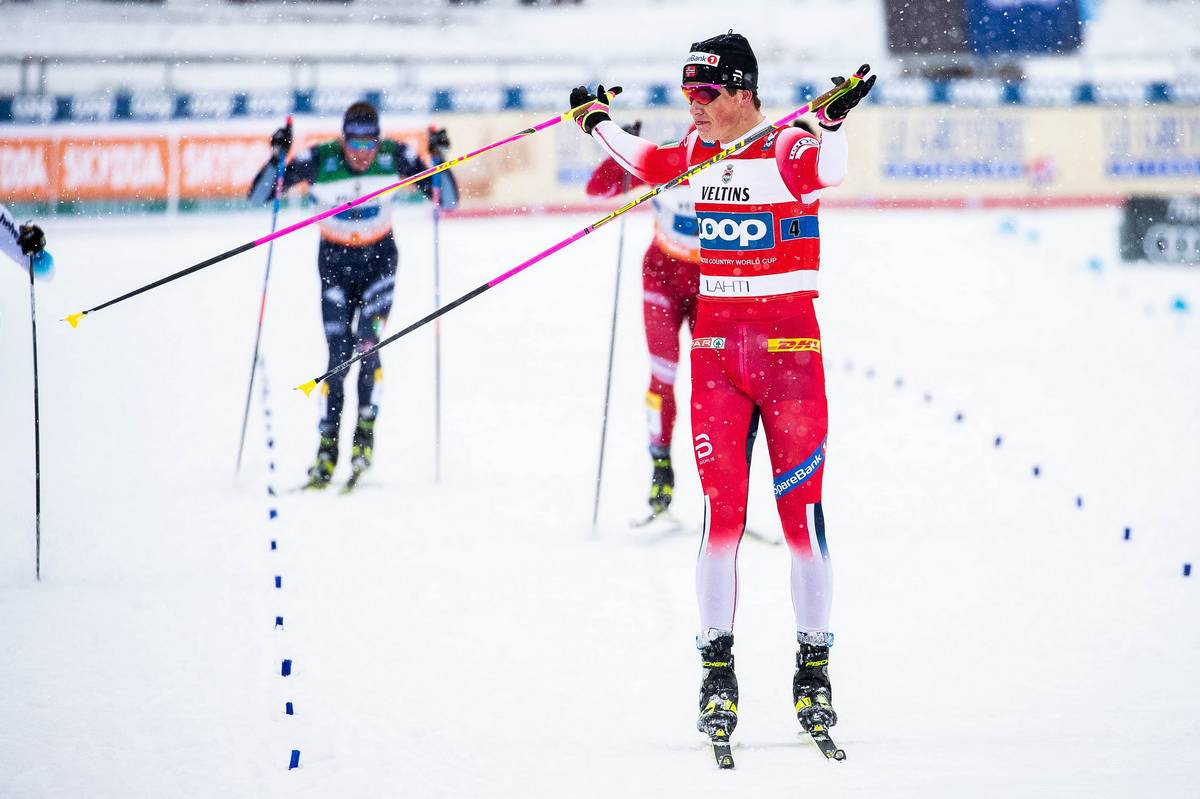
    Johannes Hoesflot Klaebo (NOR) eases up at yet another World Cup finish line. It may not be exciting any more, but it certainly remains thrilling. (Photo: Authamayou/NordicFocus)

    He doesn’t get tired, he doesn’t get sick, he doesn’t get out-maneuvered, he doesn’t get out-smarted, he doesn’t get out-sprinted. In one of the most challenging endurance sports that humans have ever contested, one guy just seems to win at will. How incredible it is to be a ski-fan in this era when one skier displays such outright dominance. The legendary Marit Bjoergen (NOR) claimed 114 wins during World Cup history’s most decorated Nordic skiing career. In Lahti, Klaebo truly began drawing within sight of that landmark number. Six races remain in the World Cup season. If he were to win out this season, Klaebo would finish the year having overtaken Bjoergen for the most-wins distinction, as well as a few others.

    “I’m tired,” admitted Klaebo. “I’m barely training between the races. I’m just racing now, but we’ll see how long we continue to do that. Hopefully, we’ll be able to do that for two more weeks.”

    There’s never been a season like this one that Klaebo is likely to complete: World Cup Overall, World Cup Distance, World Cup Sprint, Tour de Ski, and six Olympic gold medals. That’s the real story . . . and I’m so glad I’ve been here to see it. Next year may be “way harder,” predicts Klaebo. As he advises, we’ll enjoy this for now.

    Lahti Men’s Freestyle Sprint RESULTS

    Lahti Men’s Freestyle Sprint QUALIFYING

    Love Stories Like This? Help Keep Them Coming.

    Feature stories like this one take time, access, and care to produce. If you value thoughtful storytelling and independent ski journalism, please consider becoming a Voluntary Subscriber. Your support directly fuels the work we do to cover the people, places, and moments that make our sport special.

    Join the FasterSkier community!
    Johannes Hoesflot Klaebo: another win in Lahti in a season for the ages. (Photo: Authamayou/NordicFocus)


  • Klaebo: Record-Tying Win, History-Defining Cup

    Klaebo: Record-Tying Win, History-Defining Cup

    This World Cup coverage is made possible through the generous support of Marty and Kathy Hall and A Hall Mark of Excellence Award. To learn more about A Hall Mark of Excellence Award, or to learn how you can support FasterSkier’s coverage, please contact info@fasterskier.com

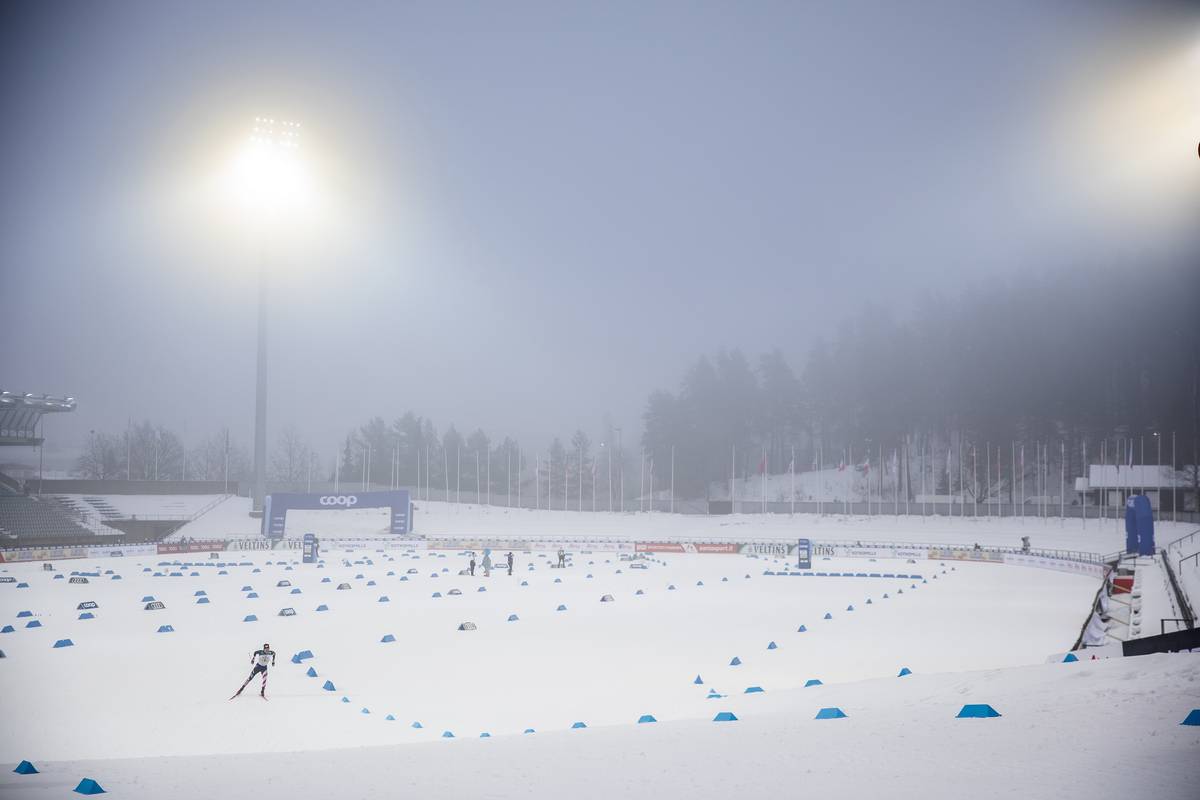
    Winter conditions greeted competitors in Lahti, Finland, site of the final weekend of World Cup racing. (Photo: Modica/NordicFocus)

    The most dominant World Cup season ever by a male skier; a tally of wins that ties Theresa Johaug (NOR) for the greatest number of victories in a single season (20) by any skier, man or woman; a level of dominance across multiple disciplines rarely seen in any sport: that was the year orchestrated by Johannes Hoesflot Klaebo (NOR). It’s true that not every one of the world’s best skiers was there to race against him (Russian athletes were banned from competition by the FIS), but an athlete can only race those who toe the same starting line. Week after week, Klaebo undertook a campaign that tested his reserve, his endurance, his health, his speed, his tactics, and his place in history. Mission accomplished: Klaebo exits Lahti, Finland with two Crystal Globes in his hands—Sprint and All Around. By any standard, that’s quite a season.

    Nearly a year ago—when an injury suffered during training threatened his World Cup season—Klaebo left the Norwegian Team’s training program for training on his own, for endless laps in a pool, for roller skiing in Soldier Hollow. It worked . . .

    Months ago—when his World Cup season was interrupted by illness—Klaebo admitted to the media that he was unlikely to contend for the season-long World Cup. He was mistaken . . .

    Just hours ago—after the starter’s pistol had fired, and the race had been run, and the finish line had been crossed—Klaebo made it clear that he is more than just a sprinter, more than just a skier. He is becoming a legend. At only 26 years of age, that legend seems likely to grow in seasons to come . . .

    This has been the season of Johannes Hoesflot Klaebo, and we devoted fans of cross country skiing should count our lucky stars that we were here to watch it happen.

    Ben Ogden (USA) started the day in the green U23 World Cup Leader’s bib, a distinction he would win in the season-long competition. (Photo: Modica/NordicFocus)

    There were other stories to be told in Lahti: Iivo Niskanen (FIN) hoping to manufacture another classic skiing win in front of his cheering countrymen, Federico Pellegrino (ITA) hoping to hold his position on the World Cup Overall podium; Antoine Cyr (CAN) delivering an eighth place finish that confirms his arrival among the elite contenders in the sport; Ben Ogden (USA) wearing the green bib of the U23 Leader and hoping to end the season with that title in his hands. Ogden raced bravely—holding on to the lead pack until the half-way point and finishing a respectable 18th. That would prove sufficient to award him the U23 title. Other North Americans included Olivier Leveille (CAN) 20th, Zak Ketterson (USA) 28th, Luke Jager (USA) 33rd, Russell Kennedy (CAN) 38th, Gus Schumacher (USA) 40th, Xavier McKeever (CAN) 41st, Scott Patterson (USA) 50th.

    Johannes Hoesflot Klaebo (NOR), Harald Oestberg Amundsen (NOR), and Iivo Niskanen (FIN) pushed the pace int the early stages of Lahti’s 20 k Classic Mass Start.  (Photo: Modica/NordicFocus)
    Men’s 20 k Mass Start Classic

    The classic course in Lahti sends skiers around four laps of five kilometers each. Fans could be forgiven if they expected Klaebo to race like just any other talented sprinter who might tuck in behind other skiers and sprint past them in the finishing straightaway. Russian skiers and fans have been known to call him “Backpack,” referring to his propensity for sitting in while others do the work. The 20 k in Lahti was a mass start event, and tactics like those are entirely legal, and often heartily advised. But that’s not the race that Klaebo raced today.

    Through the halfway point, Klaebo and Niskanen set the pace at the front of the race; not exactly a blistering pace, but one that controlled the field, strung it out a bit, and reduced the contenders to a lead pack of fifteen. Few other skiers ever stuck their noses out in the wind, content as they were to let the battle at the front be waged between a hometown hero hoping to impress his fans, and a talented sprinter out to prove a point. Niskanen pressed, Klaebo countered, and the rest of the field worked to hang on to the best seats in the house.

    Ultimately, Niskanen’s efforts exhausted even him, as the faster skis of Norwegian athletes glided away from him on each downhill. Unlike last week during the night time sprints in Tallinn, Estonia, no predetermined waxing protocols were in place today; Norwegian wax-wizards were free to perform their magic. And the skis that came out of the vaunted Norwegian wax trailer were rockets . . . Klaebo’s most of all. That equipment advantage could have allowed him to simply re-use his favorite old strategy: punch up the last uphill, rocket away from his rivals down the last downhill, and coast across the finish line alone and unchallenged. But Klaebo appeared to have something more to prove.

    When it comes to setting up the finish of a distance race, it’s risky to go early: everyone knows that. Klaebo went early . . . Niskanen had spent all he had, and other Norwegians were positioning to charge, when Klaebo floored it. With nearly three kilometers remaining, he powered up the course’s A climb, gapping Niskanen near the top and distancing himself from the field once and for all. Klaebo may still have crossed the finish line alone and unchallenged, but this time he did it a different way. That was no sprinter’s move; that was the move of a legend.

    Behind him, his season-long rival—Paal Golberg (NOR)—sprinted clear of the chase group to take second, followed closely by this season’s other U23 revelation, William Poromaa (SWE). The final finish line of a long and challenging World Cup season had been crossed. All that remained was the awarding of Crystal Globes, the many interviews and photo opps, and the flights home to begin those plans and preparations that will bring these athletes back together next fall when the World Cup circus begins traveling again.

    26.03.2023, Lahti, Finland (FIN):
    Johannes Hoesflot Klaebo (NOR) alone at the finish line. (Photo: Modica/NordicFocus)

    Men’s 20 k Classic Mass Start RESULTS

    Men’s World Cup Distance FINAL STANDINGS

    Men’s World Cup Overall FINAL STANDINGS

    Paal Golberg (NOR), Johannes Hoesflot Klaebo (NOR), William Poromaa (SWE) at the finish line of the 20 k Mass Start Classic in Lahti, Finland. (Photo: Modica/NordicFocus)
  • Norway win Men’s 4 x 7.5 k Relay in Lahti; Belligerent Bolshunov Bullies

    Norway win Men’s 4 x 7.5 k Relay in Lahti; Belligerent Bolshunov Bullies

    Early in the first leg of the men’s 4 x 7.5 k relay in Lahti, Finland. (Photo: NordicFocus)

    This World Cup coverage is made possible through the generous support of Marty and Kathy Hall and their A Hall Mark of Excellence Award. To learn more about A Hall Mark of Excellence Award or to learn how you can support FasterSkier’s coverage please contact info@fasterskier.com. 

    The fog seemed to have thickened since the completion of the women’s race earlier in the day, at times obscuring the skiers with only their silhouettes visible. Eleven teams contested this men’s 4×7.5 k relay with nine nations represented, though with the disqualification of Alexander Bolshunov (more on that in a bit), anchor for Russia I, only 10 teams officially finished.

    Historically, World Cup men’s relays have been a duel between Russia and Norway. Out of the fifteen relay races in the past 10 years (not including world championships or Olympics), Russia has won four of those times, the remaining victories all Norway. After a men’s podium sweep in the skiathlon on Saturday, it seemed fair to bet on Norway for today’s race. Indeed, when the race concluded Sunday in Lahti, Finland it was Norway once again on top. As skiathlon winner Emil Iverson so aptly put it yesterday, the Norwegians are “back with a boom.” 

    The race began, and ended with drama, particularly for team Russia I. Immediately out of the start gate, Alexey Chervotkin, who scrambled for Russia I broke a pole but recovered to quickly rejoin the field. Pål Golberg of Norway led the charge off the front, pushing the pace to string out the pack. By the end of the third lap, Golberg had created a gap to the rest of the field, followed only by Ilia Semikov of Russia II and a little way back, Chervotkin of Russia I. “It was good that it was snow and not rain coming down,” said Golberg after the race, “so it was possible to go hard at the front.” 

    Pål Golberg (NOR), Alexey Chervotkin (RUS), Ilia Semikov (RUS), Marko Kilp (EST), (l-r) during the men’s 4 x 7.5 k relay. (Photo: NordicFocus)
    Alexey Chervotkin (RUS), Pål Golberg (NOR), (l-r) scramble for their respective teams. (Photo: NordicFocus)

    At the first exchange, Golberg tagged teammate Iversen with a +0.8 lead to Ivan Yakimushkin, who took over for Russia II, and +10.7 to Evgeniy Belov of Russia I.

    These standings held steady for much of leg two. Russia II entered the tag zone +0.5 ahead of Norway for the third leg handoff. Andrey Melnichenko took over for Russia II with Sjur Røthe hot on his tails. Denis Spitsov of Russia I was tagged +11.9 back while Iivo Niskanen took over for Finland, not far behind. Over the next few minutes, Niskanen surged, catching Spitsov at the outset of their third lap. 

    Emil Iversen (NOR), Ivan Yakimushkin (RUS), (l-r), the second leg of the 4 x 7.5 k relay. (Photo: NordicFocus)
    Emil Iversen (NOR), Ivan Yakimushkin (RUS), (l-r), the second leg of the 4 x 7.5k relay in Lahti. (Photo: NordicFocus)

    Further up the trail, Røthe made a decisive move, gapping Melnichenko (Russia II) by +6.95 at 20 k. At the conclusion of the third leg, Røthe had stretched this lead to +38.3 ahead of Niskanen. 

    “I felt really good today,” said Røthe to FIS after the race, “and we had really really good skis today. It was just for me to start hard and go even harder in the end.”

    With the benefit of Røthe’s effort, Norway’s anchor, Simen Hegstad Krüger, cruised along with a healthy lead. 

    Simen Hegstad Krüger of Norway closing in for the win. (Photo: NordicFocus)

    The race for second was where the podium racing became spicey. Niskanen skied a furious third leg, bringing his team into contact with Russia I and II — moving his team into second at the final tag off. Taking over at that third exchange (final leg) for Russia I was Tour de Ski winner, Alexander Bolshunov. Sergey Ustiugov made his season debut as an anchor for Russia II after missing Period I due to COVID-19 complications. For Finland I, Joni Mæki skied anchor after the tag from Niskanen.

    Mæki, Bolshunov, and Ustiugov formed a group for the fourth relay leg as Krüger continued to stretch Norway’s lead out front.

    Joni Mæki (FIN), Alexander Bolshunov (RUS), and Sergey Ustiugov (RUS), (l-r) during the final leg of the men’s 4 x 7.5 k relay in Lahti, Finland. (Photo: NordicFocus)
    Russia’s Alexander Bolshunov leading Jon Maki (FIN) and Sergey Ustiugov (RUS). (Photo: NordicFocus)

    Exiting the stadium for the final lap Bolshunov picked up the tempo and succeeded in dropping Ustiugov, while Mæki stuck with this year’s Tour de Ski winner.

    Out on his own, Krüger cruised into the finish straights and crossed the finish line in a time of 1:07:56.8. “I took the Lahti corner nice and steady,” said Krüger, a reference to his teammate Iversen’s notorious crash there during the 2017 World Championships, “all the guys gave me such a nice starting point at the end there. Really good day for team Norway and we are back in the World Cup.”

    The ugly cross-country skis news of the day starts here – with Mæki and Bolshunov playing cat and mouse over the final kilometer. Mæki led Bolshnov into the final corner of the stadium, a sweeping left-hander. Trying to execute a slingshot move, Bolshunov took the corner wide, attempting to slot into the outside finish lane. Mæki, who was slightly ahead, shifted towards this lane too. Bolshunov continued full gas, Mæki, it appeared, made a subtle tactical move to quell the Russian’s closing speed. Pinched out of his lane, and much to his evident frustration as he swung a pole at Mæki, Bolshunov began his unraveling. Mæki crossed the finish line in second, only to be bowled over seconds later as an angry Bolshunov slid into him, knocking the Finn to the ground. This unsportsmanlike behavior resulted in the disqualification of Russia I, thus bumping Russia II into third place. According to FIS, this was Finland’s first men’s relay World Cup podium. 

    Bolshunov about to throttle Mæki. (Photo: NordicFocus)
    Bolshunov was eventually penalized and his team was disqualified. Mæki in bib 5 being tackled by a belligerent Bolshunov. (Photo: NordicFocus)

    On Twitter after the race, U.S. Head Coach Matt Whitcomb was terse in his assessment of Bolshunov’s actions. “To be clear to any kids and coaches watching: This tackle by Bolshunov is not okay. If a U.S. athlete did this, they’d be sent home and removed from the team. A disqualification would just be the beginning of their problems.”

    Not exactly good visibility in Lahti, Finland as Scott Patterson laps through the stadium in Lahti. (Photo: NordicFocus)

    The US team, composed of David Norris, Gus Schumacher, Scott Patterson, and Hunter Wonders, placed seventh (+4:04.3). The backstory for the men’s U.S. roster reveals the race was an opportunity for some to gain World Cup level relay experience. Schumacher and Wonders, both U23 skiers, were relay rookies at this level. This is Wonders’ first career World Cup weekend. He placed 46th in Saturday’s skiathlon. Norris, as many observers of the sport are aware, was diagnosed with Covid this past fall. The Lahti series is his initial foray into international racing post-diagnosis. 

    Russell Kennedy racing the anchor leg for Canada. Kennedy scored his first career distance points yesterday in the skiathlon. (Photo: NordicFocus)

    The Canadian team composed of Graham Ritchie, Antoine, Cyr, Philippe Boucher, and Russell Kennedy was lapped and is listed as ninth in the results. Like the U.S. team, Canada featured two U23 athletes in Ritchie (22) and Cyr (22). Prior to this weekend, Canada had not sent athletes to the World Cup this season. Pictured above, Kennedy scored his first career World Cup distance points in Saturday’s skiathlon. 

    Men’s Relay: Results

  • Norway Tops Podium Once Again; US Women Finish 5th

    Norway Tops Podium Once Again; US Women Finish 5th

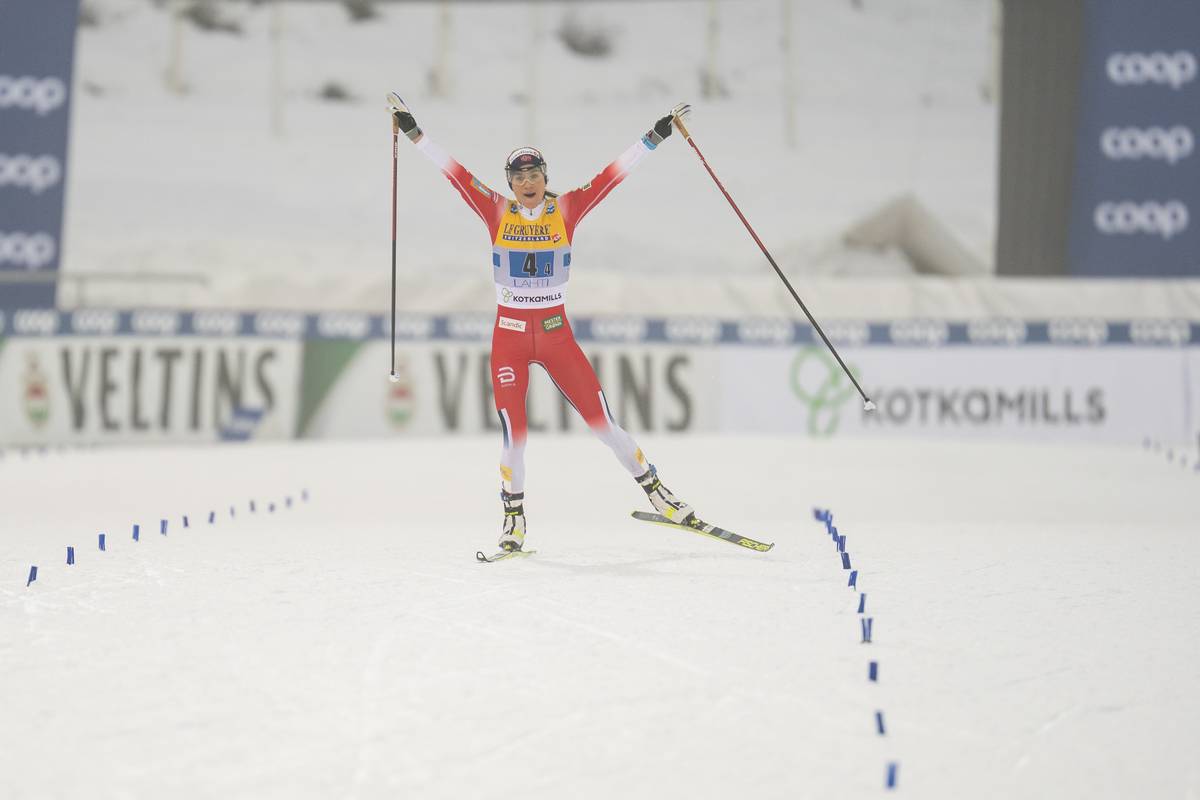
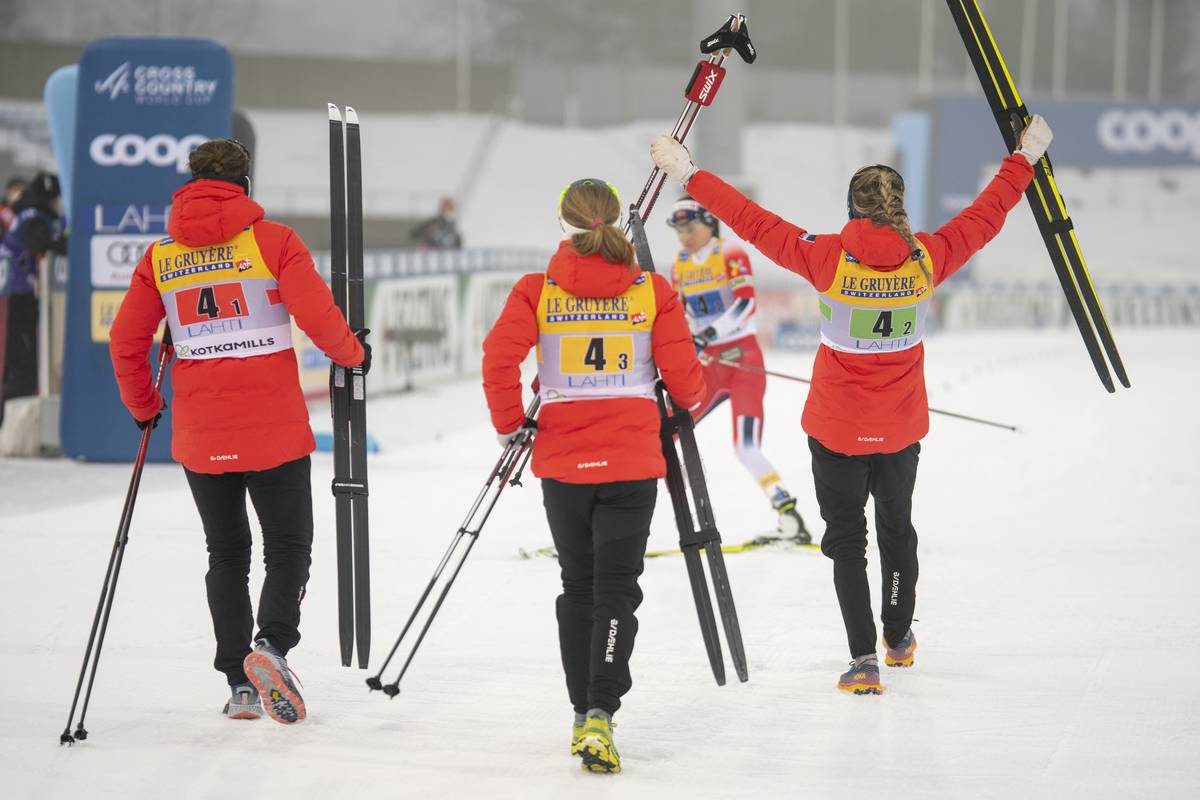
    Hands up for the uncontested Norway win, Heidi Weng clutching the 4 x 5 k relay victory in Lahti, Finland. (Photo: NordicFocus)

    This World Cup coverage is made possible through the generous support of Marty and Kathy Hall and their A Hall Mark of Excellence Award. To learn more about A Hall Mark of Excellence Award or to learn how you can support FasterSkier’s coverage please contact info@fasterskier.com. 

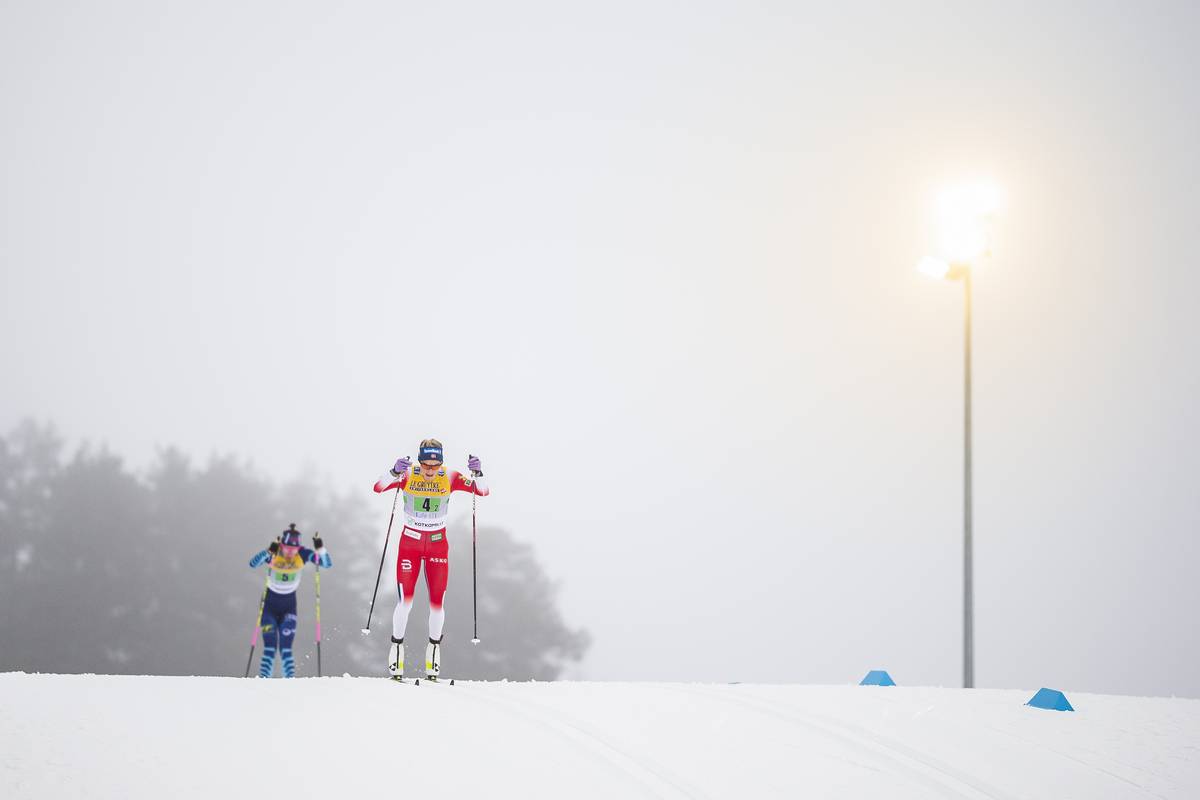
    It was a foggy morning for the women’s 4×5 k relay in Lahti, Finland. With temperatures above freezing and high humidity, the scene was less of a winter wonderland and more of a pea soup. A low visibility scene in which eleven teams lined up at the start line with nine nations represented. On paper, this was Norway’s race and after yesterday’s podium sweep in the 15 k skiathlon there seemed to be little doubt the Norwegian women were on form. To find the last time the Norwegian women failed to win a World Cup relay one must go all the way back to 2011 in Rybinsk, Russia when Italy bested the field. A major side note – the Norwegians were not present in Rybinsk. One must dig deeper into the records, way back to 2009 in Beitostølen, Norway when the Norwegian’s finished second to the Swedish women. Needless to say, the Norwegian women proved themselves peerless once again and topped the field, with a cumulative time of 49:34.4 on Sunday in Lahti.

    Gold again. The Norwegian women celebrate as Heidi Weng crosses the line in first. (Photo: Nordic Focus)

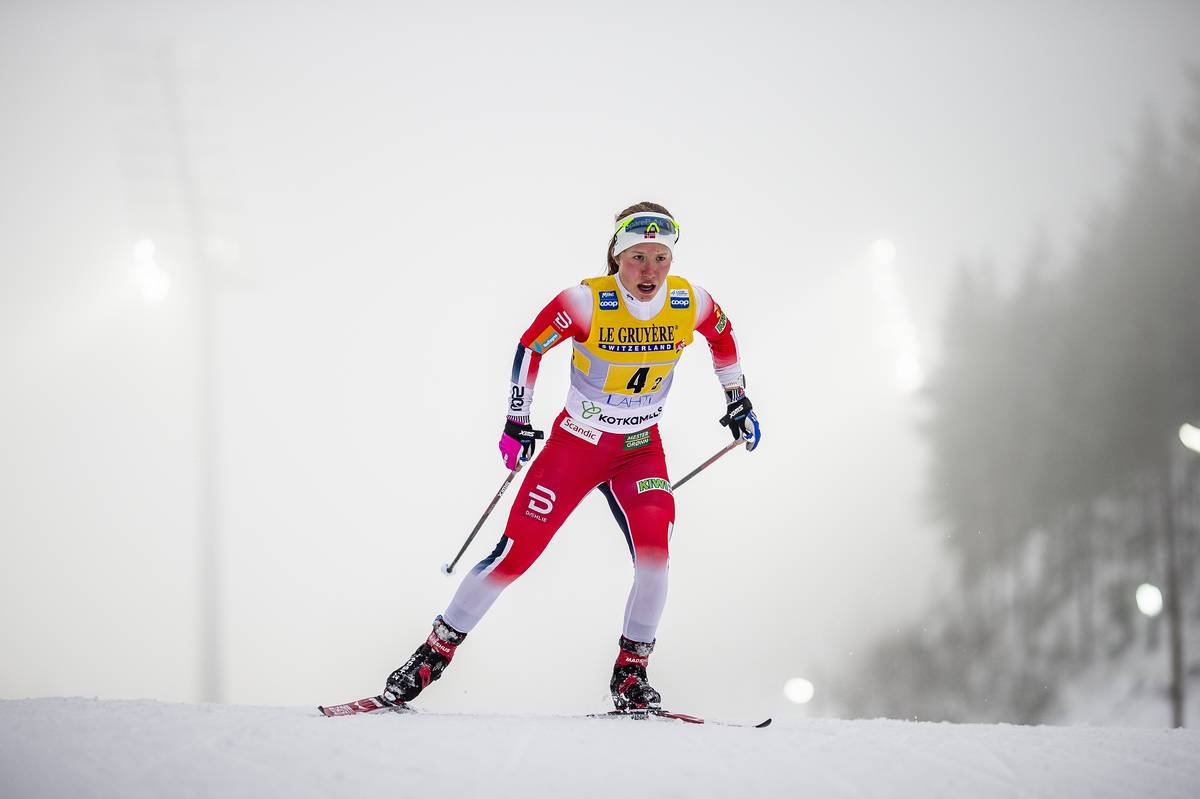
    Through the first 2.5 k of toady’s race, a pack of seven women skied together, among them Tiril Udnes Weng who started for Norway and Rosie Brennan who held the scramble leg for the U.S. As the first leg neared to a close Johanna Matintalo of Finland and Charlotte Kalla of Sweden (recently returned to the World Cup circuit), pushed the pace to stretch the group out ever so slightly. Weng tagged off to Theresa Johaug, yesterday’s skiathlon winner, who was closely shadowed by Kerttu Niskanen of Finland, Emma Ribom of Sweden, Jessie Diggins of the U.S.A., and Natalia Nepryaeva of Russia. 

    No other place for Therese Joahug (NOR) than off the front. (Photo: NordicFocus)

    At 6.3 k Johaug (NOR) made her move to the front and turned on the burners, blasting away from the rest of the field in classic fashion. However, the chasers weren’t going to let Johaug stride away uncontested and at 7.5 k Johaug was just +1.6 seconds up on Kerttu Niskanen of Finland with Sweden, U.S.A., and Russia not far behind. By the time the second-leg skiers had completed 5 k, Johaug had widened the gap to +6.9 ahead of Niskanen, while Diggins, further back, tagged off to teammate Sophia Laukli with a margin of +24.5 to the lead. 

    Helene Marie Fossesholm (NOR), young yet ready for podiums on the World Cup. Here she paces Norway on the third leg of the Lahti 4 x 5 k relay. (Photo: NordicFocus)

    Nineteen-year-old Helen Marie Fossesholm, who had a podium debut in yesterday’s skiathlon, commanded the first skate leg for Norway. At 11.3 k she had grown the gap to +15 seconds over Laura Mononen of Finland, with Lovis Modig of Sweden (+34), Anna Nechaevskaya of Russia (+37.5), and Laukli for the U.S. (+39.2) falling in behind.

    In an interview with FIS following the race, Fossesholm said, “I had a great day today in the course. The course demands a high level of technical skills, including a high level of stamina which fits me quite well.” Her springy-step and attitude were evident to viewers as the young Norwegian jumpskated the final climb, navigated the hairpin corner and tagged anchor, Heidi Weng, with a lead of +51.8 ahead of Finland. 

    As the fourth leg transpired, Weng was out on her own, skiing the final two laps largely out of sight of the rest of the field. She crossed the finish line unchallenged to bring home another victory for the Norwegian team. 

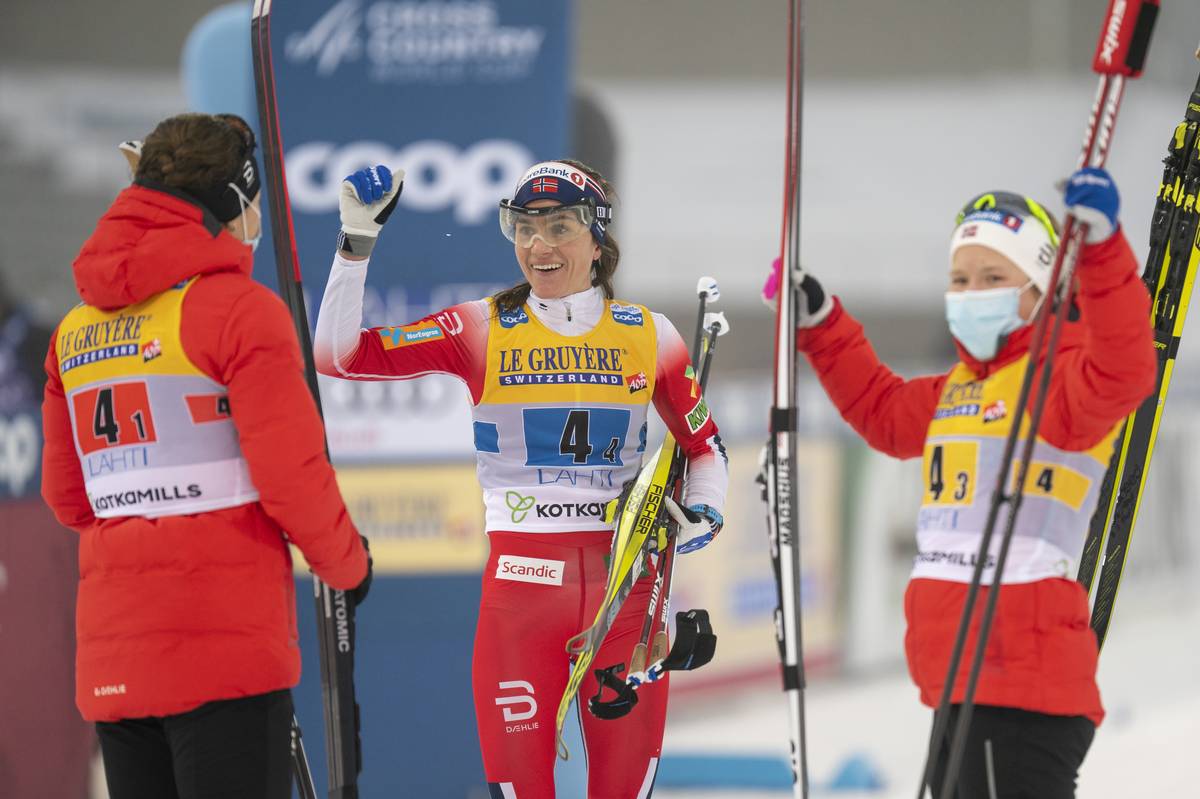
    First bumps, bows, and boot taps, the new COVID-era finish celebrations for team Norway. (Photo: Nordic Focus)

    Behind her, Ebba Andersson of Sweden swiftly made up ground on Finland’s anchor, Krista Parmakoski. (Finland I tagged off for the fourth leg roughly 8 seconds ahead of Sweden.) At 16.3 k Andersson caught Parmakoski and as the two skiers climbed out of the stadium for the final time, Andersson accelerated away from the Finn, gaining some ground on Weng and finishing +42.9, making it silver for Sweden. Parmakoski stayed strong locking in for third (+59.5). 

    Ebba Andersson (SWE) racing the 4 x 5 k relay in Lahti, Finland. (Photo: NordicFocus)
    Ebba Andersson (SWE) celebrates silver for the Swedish women at the completion of her anchor leg. (Photo: Nordic Focus)

    Today’s relay line-up for the U.S. women looked a bit different than it has in the past. In a pre-race interview with FIS, U.S. Cross-Country Program Director Chris Grover said, “It’s an interesting relay for us. We have a couple of women with a lot of experience, Jessie and Rosie, but we also have a woman that this is her first World Cup weekend, Sophia Laukli, skiing for us, and also Caitlin Patterson.”

    U.S. skiers who have been recent members of the U.S. women’s relay team, most notably Sophie Caldwell and Sadie Bjornsen, are not racing in Lahti.  

    Rosie Brennan (USA), Laura Gimmler (GER), Yana Kirpichenko (RUS), (l-r) during the scramble leg. (Photo: NordicFocus)
    Caitlin Patterson (USA) finishes her anchor leg for the American team. (Photo: Nordic Focus)

    “We are missing a few of our women… so it’s going to be a little bit of a different experience for us and we actually are doing something that we don’t often do and that’s putting Jessie and Rosie in a classic leg, so they’re up front and hopefully we learn a little bit about what their classic performances can be like in a relay.”

    The U.S. team ultimately finished fifth (+1:48.6), positioning themselves in back of Russia (+1:30.7) in fourth overall.  

    Sophia Laukli of the U.S., paces the U.S. on the third leg of Sunday’s 4 x 5 k relay. This was Laukli’s second World Cup start. (Photo: NordicFocus)

    The twenty-year-old Laukli spent the past week racing at Norwegian Nationals before making the trip to Lahti for her World Cup debut. In an email to FasterSkier she wrote, “The races in Norway, I think, definitely helped prepare me more for the World Cup races. It was a pretty intense environment and quite a step up from the college racing I’m used to. So, it was good for me to have the Norwegian National races under the belt to get a little more comfortable with this higher level racing. I also think it helped to come off those races right into the World Cup so I was already in that racing mindset. I’m definitely someone who races into shape so being able to race in Norway and quickly transition to the World Cup worked to my advantage.”

    Regarding her position as leg three in today’s relay Laukli said, “it’s safe to say I was a little stressed and nervous for the relay, just from knowing the past successes of the US women. I tried not to put too much pressure on myself, although that was easier said than done. The other girls were really great though and making sure I felt no huge expectations, and that I should just focus on skiing my own race. That was really helpful to hear. Once I started my leg and in the end, it was really just a lot of fun and I feel super lucky to have gotten to do a relay for my 2nd [World Cup] race!”

    Natalia Nepryaeva (RUS), Jessie Diggins (USA), Emma Ribom (SWE), (l-r) during the 4 x 5 k relay in Lahti, Finland. (Photo: NordicFocus)
    Jessie Diggins during the second leg of the relay. This was the U.S. skier’s first time on the World Cup slotting into a classic relay leg. (Photo: NordicFocus).

    Diggins, who skied the second classic leg as opposed to her traditional spot as skate anchor, said, “After a decade of anchoring the US relay team, I was very excited to try something a little different! For the first time in my life I asked to ski a classic leg and it was really fun to try something new. I think skating will always be my first love, but I’m finding a better relationship with my classic skiing over the years and this was a great place to work on improving it!”
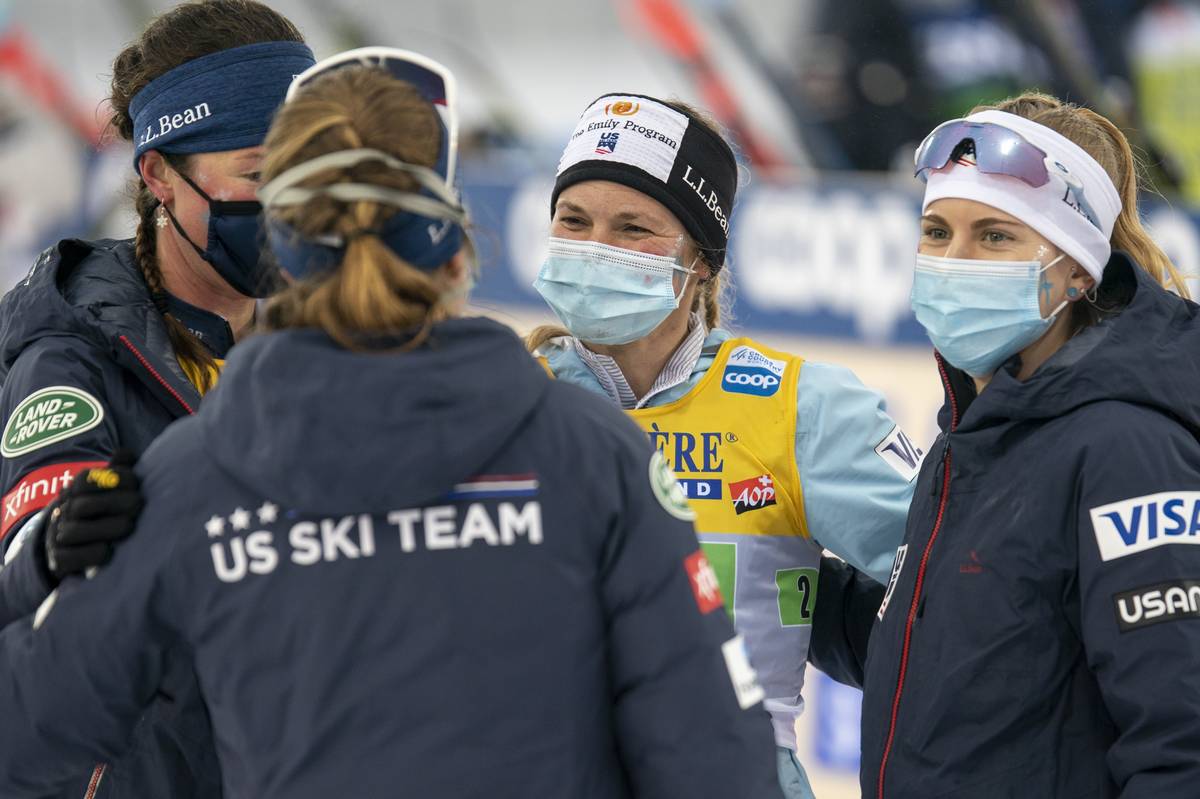
    The American women huddle at the finish line after finishing 5th in the relay. (Photo: Nordic Focus)

    “The highlight of my day was, of course, getting to hand out the socks and put the USA face paint on our guys and gals,” Diggins continued. “I love the team spirit of relay day and it keeps racing fun! Really proud of this team (the men’s and women’s) for giving it our all this morning!”
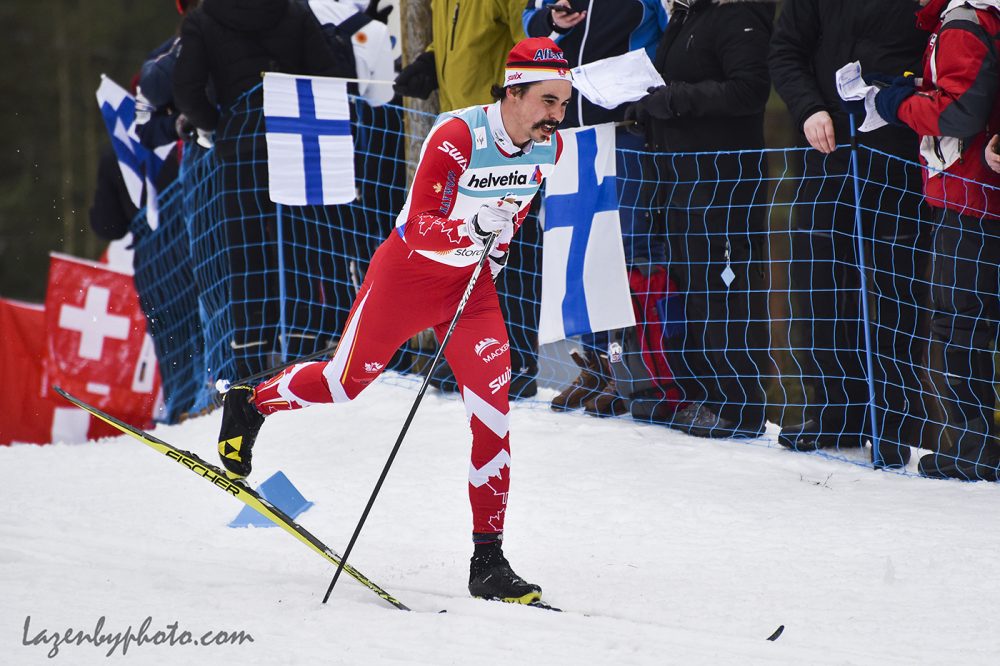
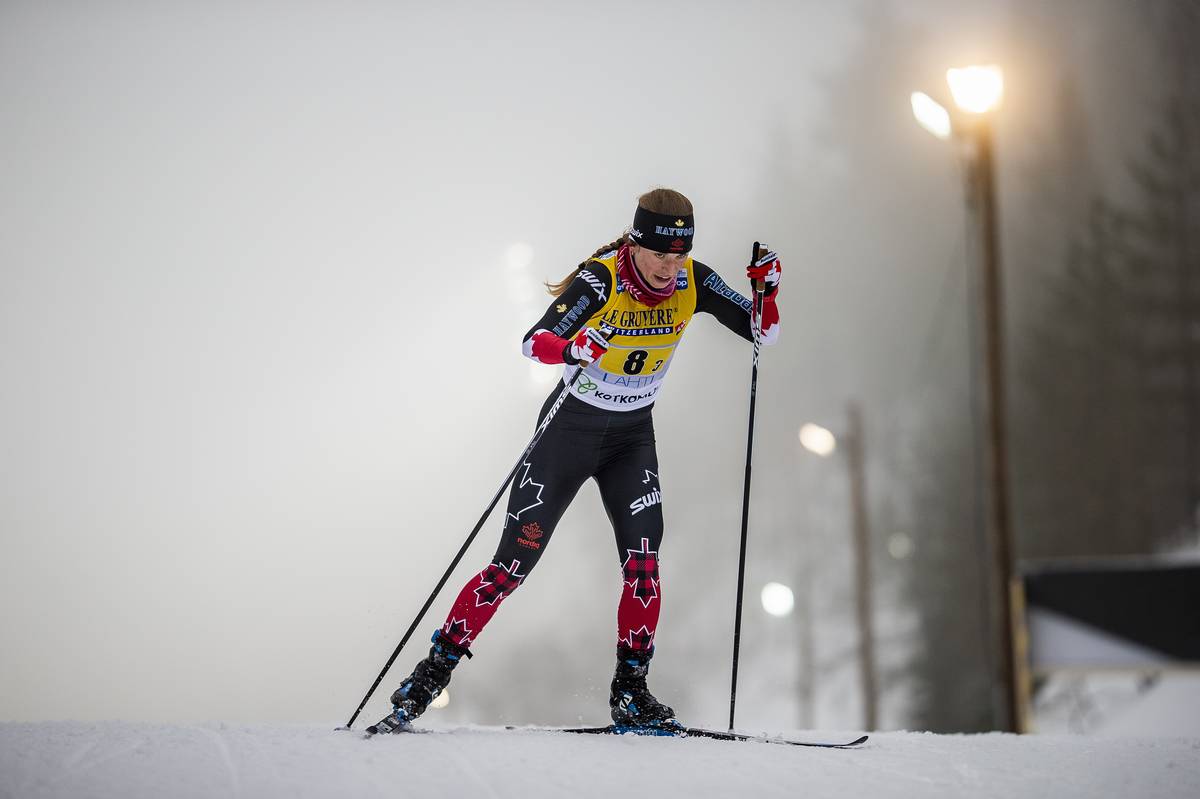
    Cendrine Browne (CAN), third leg of the 4 x 5 k relay in Lahti, Finland. (Photo: NordicFocus)

    The Canadian team, consisting of Katherine Stewart-Jones, Dahria Beatty, Cendrine Browne, and Maya Macisaac-Jones finished eighth. This is Canada’s first weekend of World Cup racing after missing Period One and the Tour de Ski.

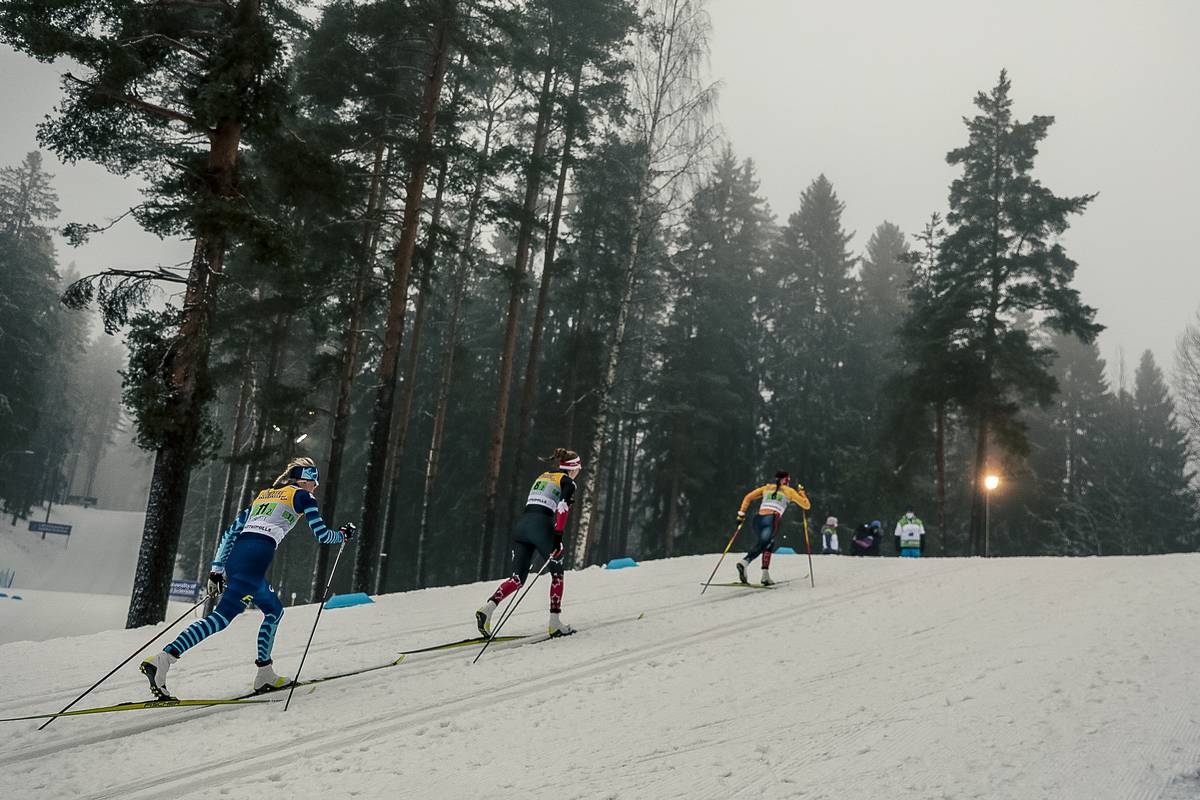
    Anne Kyllönen (FIN), Dahria Beatty (CAN), Katharina Hennig (GER), (l-r) on leg 2 of the 4 x 5 k relay in Lahti, Finland. (Photo: NordicFocus)

    Results: Women’s Relay

  • With a Klæbo Anchor Leg – Norway Claims 4 x 7.5 k Relay in Lahti

    With a Klæbo Anchor Leg – Norway Claims 4 x 7.5 k Relay in Lahti

    Sunday, for the men’s 4 x 7.5-kilometer relay in Lahti, Finland the scene was decidedly more fitting for winter sport: The race began amidst falling snow despite bare firs and hardwoods lining the course. It’s been a sparse winter in Lahti. 

    Eleven teams contested the relay, with ten nations represented; Russia fielded two teams. The U.S. was not represented. 

    First leg pack racing in Lahti, Finland. (Photo: NordicFocus)


    Russia II’s Andrey Sobakarev and Russia I’s Ilia Semikov leading out the first leg of the men’s 7.5 k relay in Lahti. (Photo: NordicFocus)

    For the first 7.5 k leg, Russia I’s Ilia Semikov and Russia II’s Andrey Sobakarev animated the sharp end with several pulses of energy to make a slinky of the pack. Norway’s Pål Golberg took some commensurate pulls too. The calories expended broke this into a front group of six teams at the first exchange separated by 2.4 seconds. The teams came through in this order: Norway, Russia I, Germany, Finland, Russia II, and Italy. Switzerland and Sweden, who had been loosely attached to the pack here and there, had popped – coming through roughly 20 seconds back.

    Leg 1 of the men’s 4 x 7.5 k relay in Lahti, Finland: Pål Golberg (NOR), Ilia Semikov (RUS), Lauri Vuorinen (FIN), Bjoern Sandstroem (SWE), Beda Klee (SUI), Giandomenico Salvadori (ITA), (l-r). (Photo: NordicFocus)

    The second leg played out much like the first, with the Russian teams, Norway, Italy, and Finland maintaining a gap. Finland’s Iivo Niskanen kept Finland in the hunt, and Russia II’s Alexey Chervotkin took a runner through the 13.6 k time check – otherwise the drama was subdued. 

    Through the woods, a leading Iivo Niskanen of Finland. (Photo: NordicFocus)

    During the first skate leg, the front group ballooned modestly to seven with the addition of Germany beyond the original six teams. As the third leg skate moved towards the tag off for leg four, Finland had popped for good, and coming down into the stadium for the tag, it became a five team affair, with Russia I, Russia II, Germany, Norway, and Italy coming through in that order. Switzerland tagged off in sixth (+6.9). 

    Artem Maltsev of Russia II taking the pull: fourth leg of the men’s 4 x 7.5 k relay in Lahti, Finland. (Photo: NordicFocus)

    During the fourth leg the Russians gave several hungry digs. But on the first pass through Lahti stadium at 25 k with a long glide out speeding into the lap area, Norway’s anchor, Johannes Høsflot Klæbo, clearly sported the slickest pair of skate skis as he moved to the front with little friction under his feet. And we all know how Klæbo can close. 

    At 27.5 k, the start of the last lap, Germany was no longer in the podium game. Five teams came through in a line led by the indomanable Klæbo. For the final 2.5 k lap, Klæbo killed the pace initially and then Russia I’s Andrey Melnichenkov tried in earnest to pull away and thin out the latched on Klæbo, Italy’s Stefan Zelger, and Switzerland’s Roman Furger. To no avail. Like he’s done before in countless sprints, Klæbo tapped into his vast stores of fast twitch muscle fiber and pulled away in the home stretch for the Norway win in 1:09: 53.

    Norway’s combo of Golberg, Hans Christer Holund, Sjur Røthe, and Klæbo momentarily reclaimed the men’s relay title over Russia -the Russians had won the last two relays, one in Lillehammer this season, the other in Ulricehamn, Sweden last year. 

    Switzerland’s Beda Klee, Dario Cologna, Jason Rueesch, and Furger placed second (+1.2), and Russia I’s Semikov, Alexander Bessmertnykh, Denis Spitsov, and Melnichenkov were third (+1.7). 

    For the Swiss, this was thier first men’s World Cup relay podium in nearly a decade.

    “Russia has won the previous two relays, it was time to take the throne back,” Golberg told FIS after the race. 

    Klæbo’s comments to FIS post-race underscored his finish speed gift. “In the start it was quite high speed and I think that all of the other guys saw that it was really difficult to get a gap,” Klæbo said of his leg. “So I was just in the front and slowing the pace down, it was almost just like training, it was a really slow pace. But in the end it was all-in and I think it was a really fun and interesting race.” 

    Racing continues in Drammen, Norway on Wednesday with a classic sprint. 

    Results

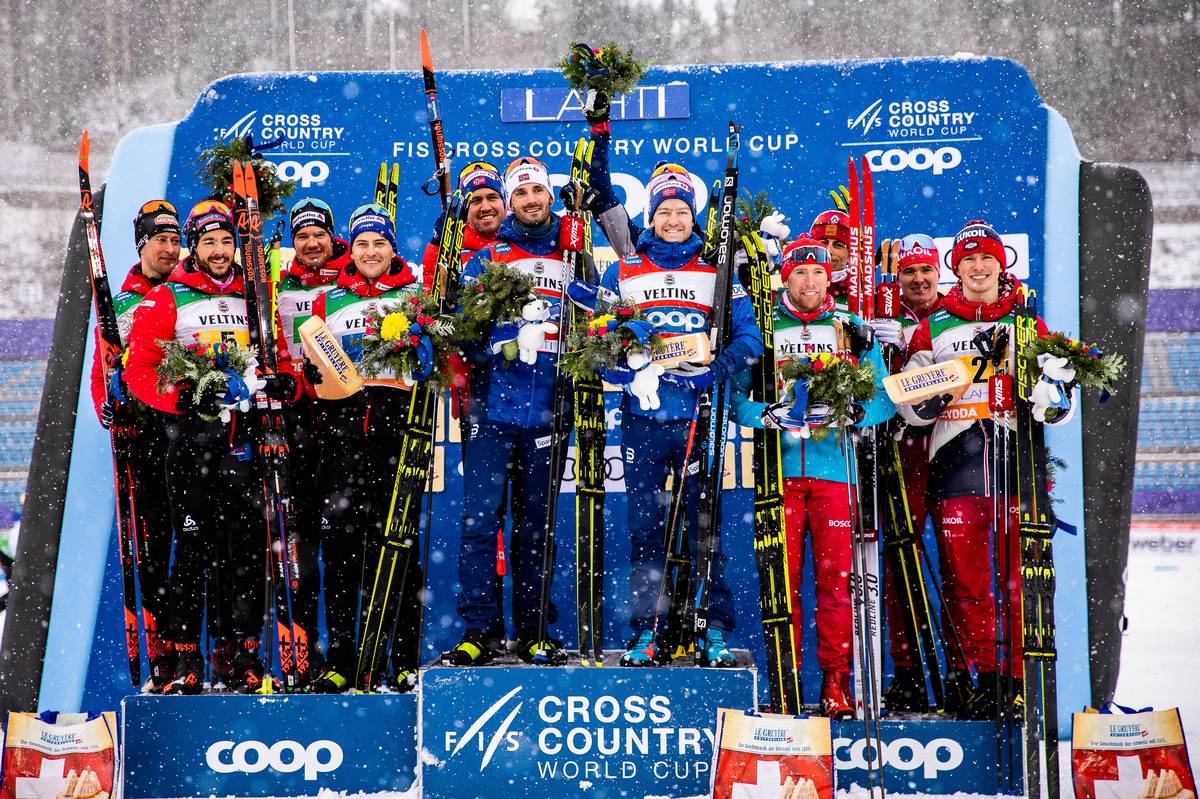
    The men’s 4 x 7.5 k podium in Lahti, Finland:
    Switzerland second, Norway first, and Russia I third (l-r). (Photo: NordicFocus)


  • The Devon Kershaw Show: Living Large in Lahti and a Wee Bit on Junior Worlds

    The Devon Kershaw Show: Living Large in Lahti and a Wee Bit on Junior Worlds

    Post-Ski Tour 2020 it was back to the basics for the World Cup: Interval start classic races for the men and women. The local boy, Iivo Niskanen, still claims the 15 k classic as his race, especially when it goes down in Finland. For the women, Norway’s Therese Johaug pipped it out the win over Ebba Andersson of Sweden.

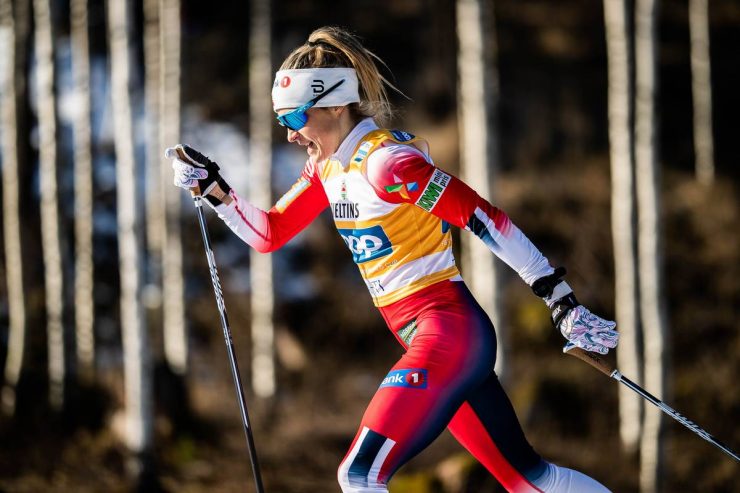
    Therese Johaug notches another distance win at the 10-kilometer interval start classic in Lahti, Finland. (Photo: NordicFocus)


    The fan-favorite in Finland: an image if Iivo Niskanen during the 15 k classic in Lahti, Finland. (Photo: NordicFocus)

    This was good solid racing in the 10 k and 15 k, respectively. Devon, by the way, is in Oberwiesenthal, Germany for the 2020 Junior/U23 Worlds. He’s there helping out the younger generation of Canadian athletes. So, needless to say, we take a dive into Junior World’s coverage as well — today’s race was a skate sprint for the juniors.

    Devon Kershaw (right) at World juniors. (Photo: Doug Stephen)


  • Sweden Snags First and Third in Lahti Classic Team Sprint

    Sweden Snags First and Third in Lahti Classic Team Sprint

    From left to right,Tiril Udnes Weng and Maiken Caspersen Falla of Norway I in second, Maja Dahlqvist and Ida Ingemarsdotter of Sweden I in first, and Evelina Settlin and Hanna Falk of Sweden II in third. (Photo: FIS cross country screenshot)

    It was a weekend of sprinting in Lahti, Finland, with many World Cup athletes closing out Sunday having traversed the famed 1.4-kilometer 2016 World Championships sprint loop at top speed close to ten times.

    By the time Sweden’s Maja Dahlqvist got on course for the final lap of the women’s classic Team Sprint, she had already tallied nine–in Saturday’s freestyle sprint she made it through the qualifier, quarterfinal, semifinal and final (placing third), and on Sunday, she and teammate Ida Ingemarsdotter had to first complete in the 6 x 1.4 k semifinals to advance to the 6 x 1.4 k final.

    Through the first two thirds of Sunday’s final, it appeared the extra kilometers had worn on the Swede. She and Ingemarsdotter remained positioned in fifth or sixth through first four exchanges, watching from behind the pace of Norway’s Team I, Norway’s Team II, Russia’s Team I and Finland’s Team I.

    In her last leg and just before the final exchange, however, Dahlqvist’s teammate Ingemarsdotter made a decisive surge to the front. By the time Ingemarsdotter handed off to Dahlqvist for the race’s final sprint lap, only Tiril Udnes Weng of Norway’s Team I remained in front. Heading into the races final kilometer and half, Sweden’s Team I was positioned in second.

    If Dahlqvist was feeling anything in her legs from the weekend’s sprint series, it must have been motivation. She charged into the last sprint lap chasing down Maiken Caspersen Falla, the anchor for Norway Team I and the winner of Saturday’s skate sprint.

    In the end, Dahlqvist’s press proved too strong for Falla. She overcame the Norwegian and Sweden’s Team I crossed first in a time of 18:24.96 for the win. Falla crossed 1.84 seconds behind to put Norway Team I in second place. Claiming third place, 3.55 seconds back from the winners, was Sweden’s Team II of Evelina Settlin and Hanna Falk.

    With World Championships just around the corner, the U.S. entered two teams in the sprint: USA I was comprised of Ida Sargent and Sophie Caldwell. The two women raced the first semifinal and finished outside of advancing to the finals, placing 12th overall. Sargent and Caldwell have partner up in the past and landed on the podium–last year in Dresden and two years ago in the Pyeongchang World Cup–so making it into the final and onto the podium had been in the back of their minds.

    “Classic team sprint I think is my favorite race so I was really excited for today but unfortunately it didn’t go as well as we hoped” Sargent wrote in an email.

    Sargent cited the pace of the semifinal as unlike team sprint semis that she has scrambled for in the past.

    “Today’s race was the fastest team sprint semifinal that I’ve ever raced,” she wrote. “It was hard from the gun rather than building into it more like some races. My skis were really slick for the first two legs so I was using a lot more energy to stay at the front than some of the girls that I was skiing with. Then on the third lap when the pace really picked up I didn’t have much left and was just trying to not completely explode.”

    Kelsey Phinney and Julia Kern were entered as USA II and placed 14th overall. The duo placed seventh in their semi-final.

    Resources were stretched a little thinner this weekend in Lahti due to the simultaneous USST pre-World’s training training camp in Davos, Switzerland. 

    “We have a really small service staff here and they were working so hard to get us great skis,” Sargent wrote. “Today was just a trickier klister day with not much time for testing so we ran out of time.  Yesterday I felt like we had the best skis in the field which was super impressive since we only had a few techs here who were all working so hard.”

    U.S. World Cup coach, Matt Whitcomb indicated that he helped with skis on Sunday and because of that role, spent most of his time waxing instead of on course. 

    “While it was definitely a disappointment not to have any teams advance through the semis today, we did see a lot of athletes ski really well,” Whitcomb said during a phone conversation. “Unfortunately, Ida struggled a little bit with her skis and Simi struggled with his glide. … Sophie and she felt like she had really awesome skis and felt really good, so she has returned from her trip home very strong,” Whitcomb continued.

    Caldwell recently returned to the U.S. to spend time with her mother.

    “I have no real regrets,” Whitcomb said. “Our team, staff, athletes, we all tried and executed the plan we intended to, sometime it all doesn’t work out as perfectly as planned.”

    Athletes will remain in Finland for two days before heading down to Cogne, Italy on Wednesday for the final World Cup races before World Championships in Seefeld, Austria.

    “While the results were a little bit disappointing today in Lahti, I really believe we have a team that is well prepared for World Championships,” Whitcomb said. “We like to go into the Championships having knocked a few races out of the park and we had a couple hits this weekend, but not as many as we intended to. So we will be looking to swing hard in Cogne. I feel very confident about our Seefeld Championships with this team, its a strong crew.”

    Results

  • An Air-Guitar Solo: Harvey Closes Out Championships with 50 k Win

    An Air-Guitar Solo: Harvey Closes Out Championships with 50 k Win

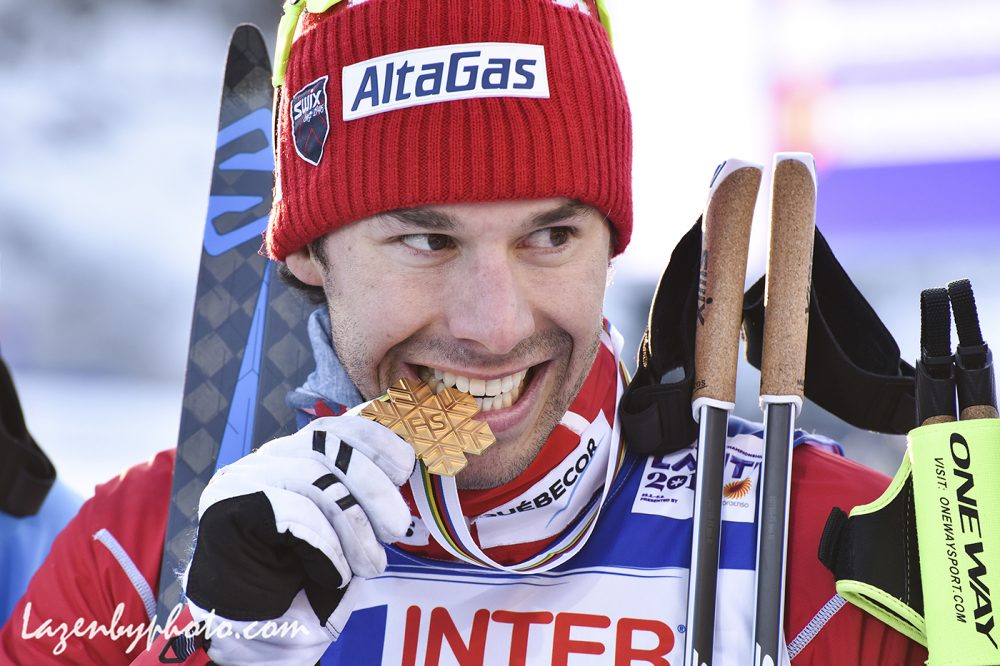
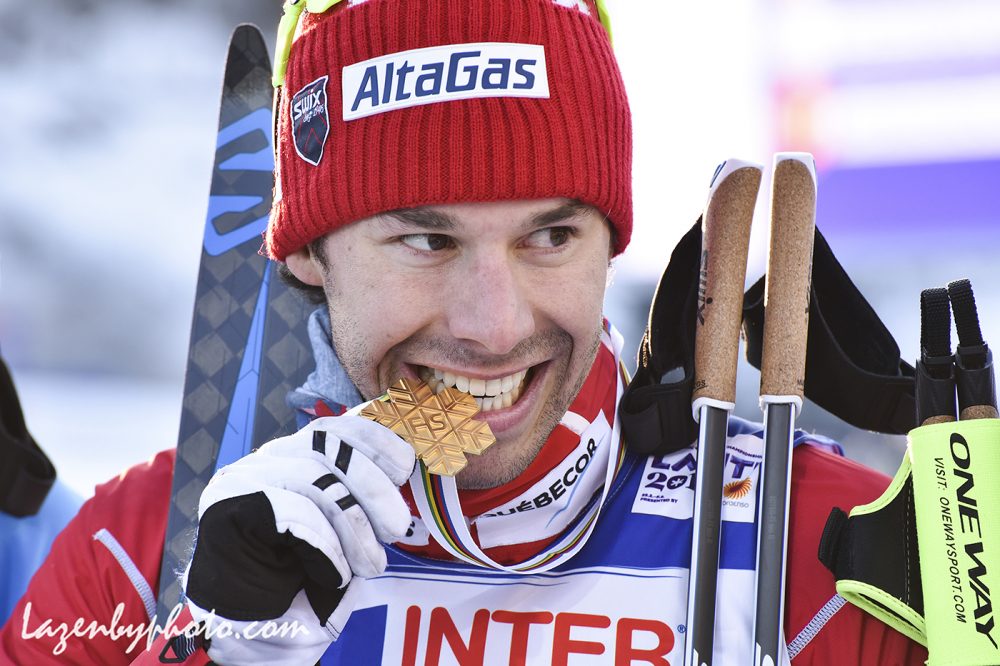
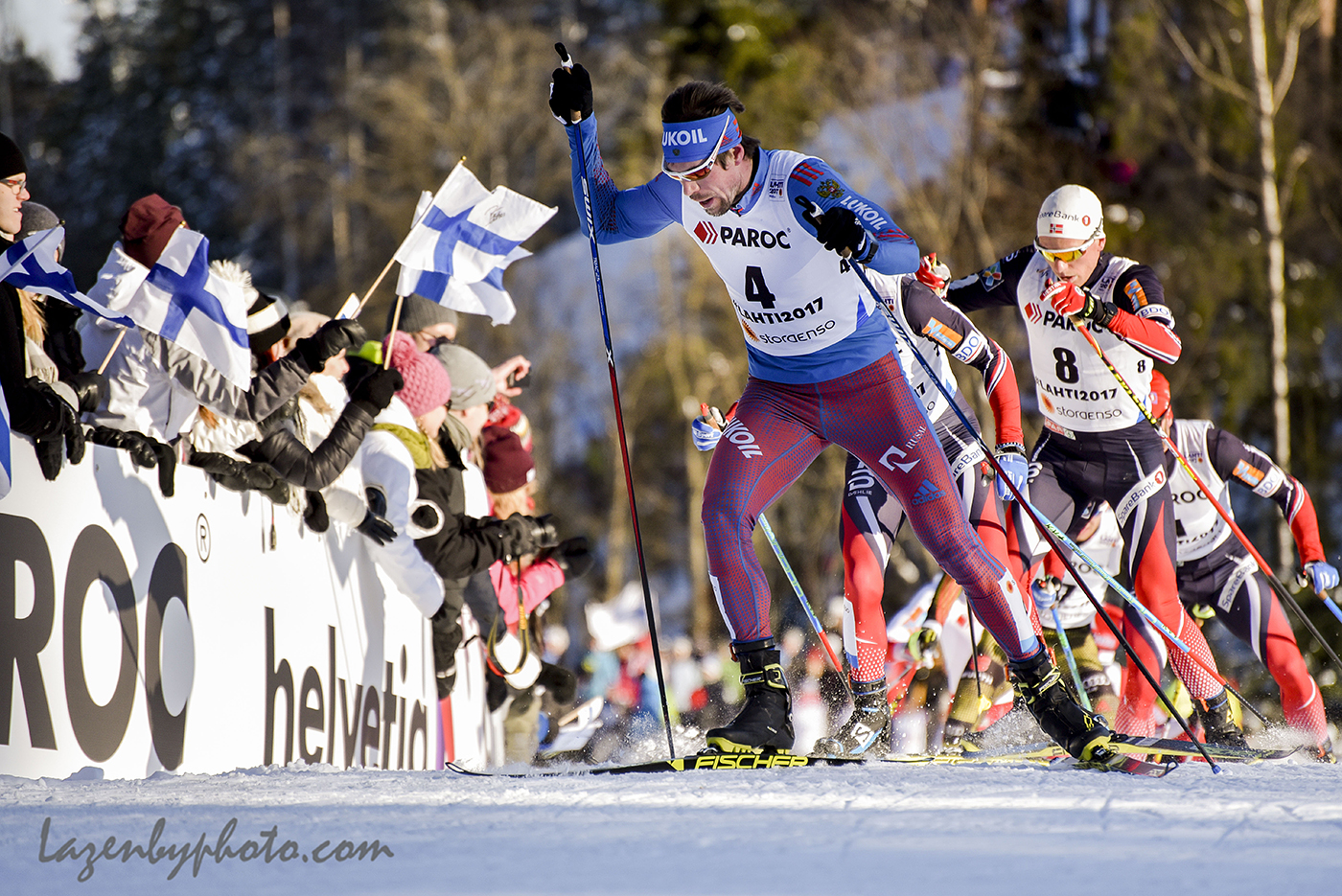
    It’s real. Canada’s Alex Harvey after winning gold in the men’s 50-kilometer freestyle mass start on Sunday at the 2017 Nordic World Championships in Lahti, Finland. (Photo: John Lazenby/Lazenbyphoto.com)

    LAHTI, Finland — Here’s the basics: fast and firm tracks, cloudless skies, and once again a stacked field for the final event of the 2017 Nordic World Championships: the men’s 50-kilometer freestyle mass start.

    Over the course of the 50 k, Canada’s Harvey had to think about one thing: be up front near the top three in order to shadow Norway’s Martin Johnsrud Sundby’s inevitable gut punch in the last kilometer. What he didn’t have to think about was playing catch up as a skier yo-yoing off the back, or his skis — they were rockets.

    In Sunday’s closing race of Lahti World Championships, Harvey was slotted in second, sliding around “Lahti Corner” just centimeters behind Sundby. Drafting off Harvey was 2017 championships legend, Russia’s Sergey Ustiugov, who had already racked up four medals previously in the week (skiathlon gold, team sprint gold, freestyle sprint silver and team relay silver). Pulling not far behind the three was Finland’s Matti Heikkinen and Andrew Musgrave of Great Britain. 

    After studying the women’s 30 k mass start on Saturday, Harvey had some cogent takeaways.

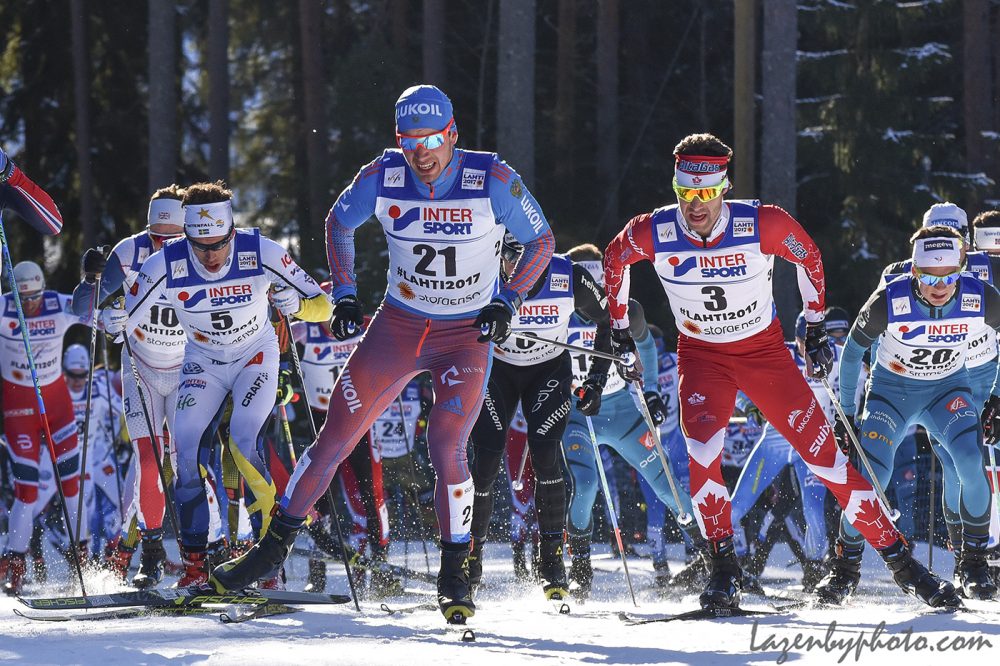
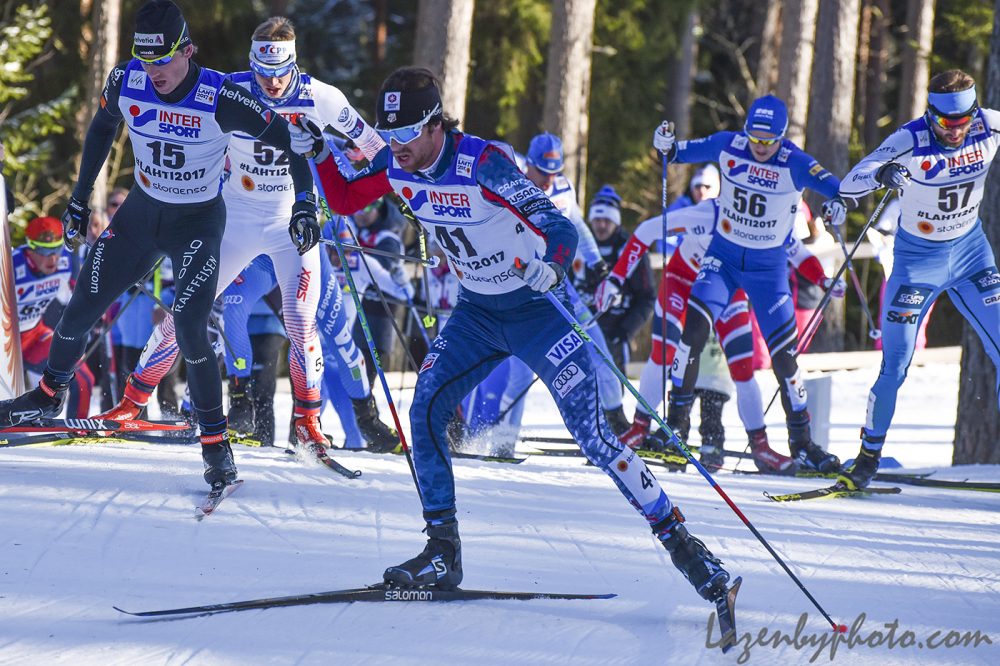
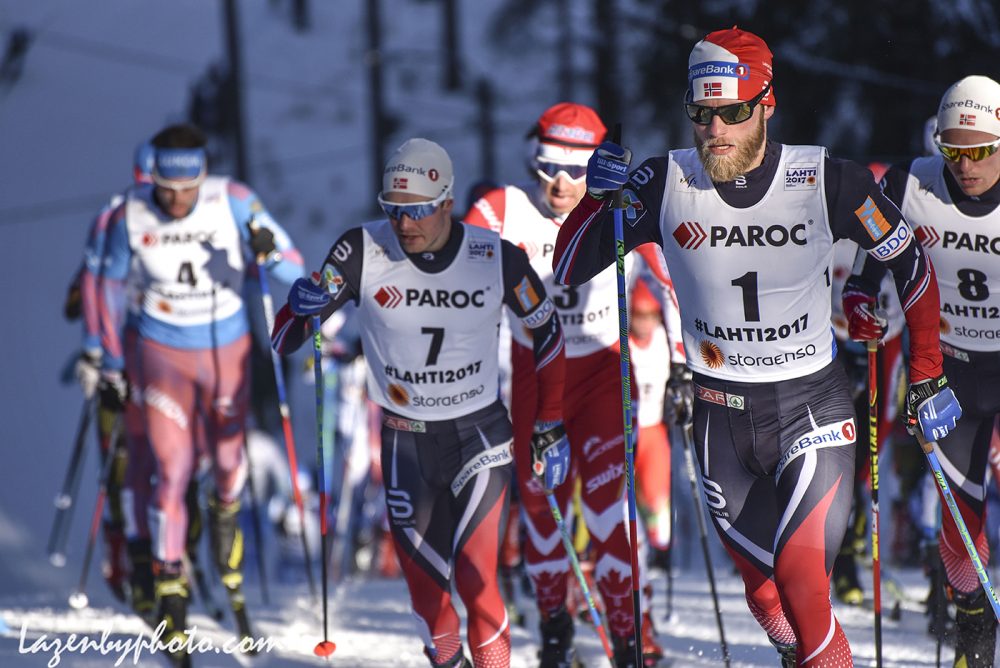
    Russia’s Alexey Chervotkin (21) leads Canada’s Alex Harvey (3) and Sweden’s Marcus Hellner (5) during the men’s 50 k freestyle mass start on Sunday at 2017 Nordic World Championships in Lahti, Finland. Harvey went on to win, Hellner placed 12th and Chervotkin 13th. (Photo: John Lazenby/Lazenbyphoto.com)

    “I saw the women’s race yesterday, and I figured if Marit Bjørgen could not distance herself from the other girls, then there is no way that the men will be able to do that,” Harvey said during Sunday’s post-race press conference. “I knew with the fast conditions, it was going to be a big group, and that leaves the potential for a lot of carnage, a lot of mayhem.”

    For the first 10 k, skiers from various nations took pulls up front, including Sundby and Ustiugov, and Norwegians Petter Northug, Hans Christer Holund, and Anders Gløersen. After testing the field and breaking away around 8 k into the race, Gløersen was still skiing alone up front, 20 seconds ahead of anyone else at 15 k.

    “Gløersen took off a bit and he was like, ‘What’s the gap? What’s the gap?’ ” Canadian World Cup coach Ivan Babikov said of Harvey. “He was always controlling the race and saving energy for the finish.”

    Eventually, the main pack surged to recover the lost time. Gløersen’s off-the-front-flier only earned him camera time. The catch came just before Lahti Corner returning to the stadium around 20 k in, where Russia’s Alexey Chervotkin took over. In another 2 k, Sundby, who had been stalking in the top 10, moved to the front as if the race were all of a sudden for real.

    Norway’s Anders Gløersen broke away early to lead the men’s 50 k freestyle mass start, skiing alone off the front for about 12 kilometers, on Sunday at the 2017 Nordic World Championships in Lahti, Finland. (Photo: John Lazenby/Lazenbyphoto.com)

    From then on, the size of the pack atrophied with each consecutive lap. At 30 k, the pack streaming through the stadium was 24 skiers long. At 45 k, the group winnowed to a train of 19. And within another 4 k, only 13 remained: Sundby, Ustiugov, Musgrave, Harvey, Heikkinen, Northug, Holund, Gløersen, Chervotkin, Sweden’s Marcus Hellner, Norway’s Sjur Røthe, Switzerland’s Dario Cologna, and France’s Maurice Manificat.

    “I wanted to be in the front, top three at least,” Harvey said, reflecting on his skiathlon tactics from last weekend, where he skied around fifth up until the final headwall and finished fifth, outside of the medals.

    “I knew that Sundby’s first chance to win gold was to break everybody,” Harvey continued. “I was expecting him to leave from kilometer 1 or 49.”

    Harvey guessed Sundby would be the only one who would try to break away. With that in mind he marked the Norwegian.

    “He knew it would be hard to break away [and that] it will be all about the finish,” Babikov said. “He was positioning himself perfectly up the last hill and just stayed on Sundby. That was his plan, ‘I’m just gonna stay on Sundby and if he changes skis, I’ll go change skis,’ but today conditions were perfect so he didn’t.”

    With ripping conditions and skis to match, Sundby never slowed nor switched skis. Neither did Harvey.

    “When he waited until the last lap, I knew exactly where he was going to do it: with a k and a half to go,” Harvey explained. “I was just lucky enough to have the legs to stick on him today and from then on it started playing more into my hands.”

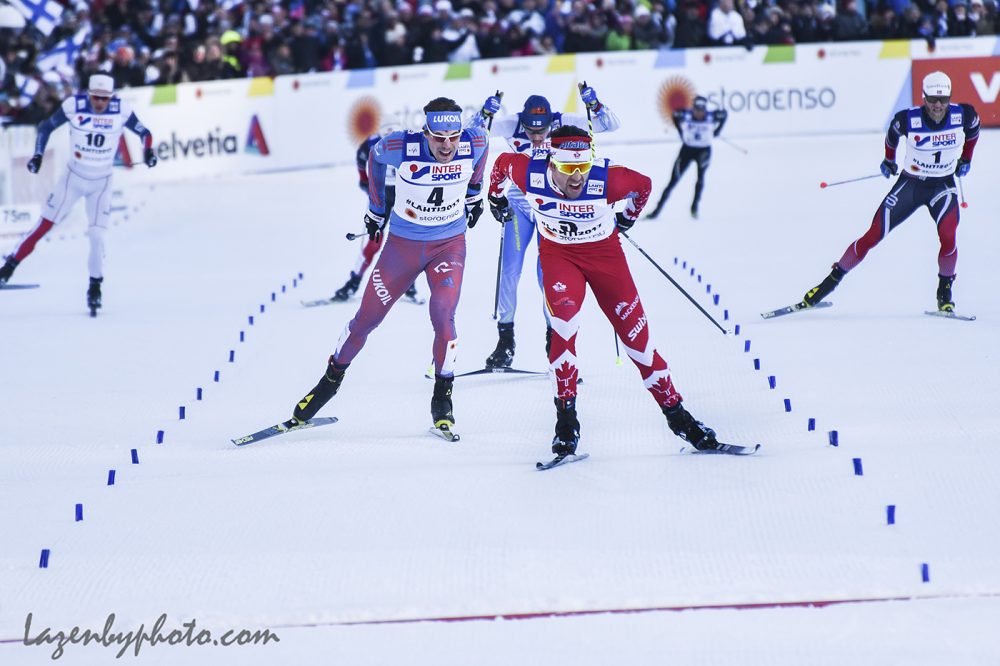
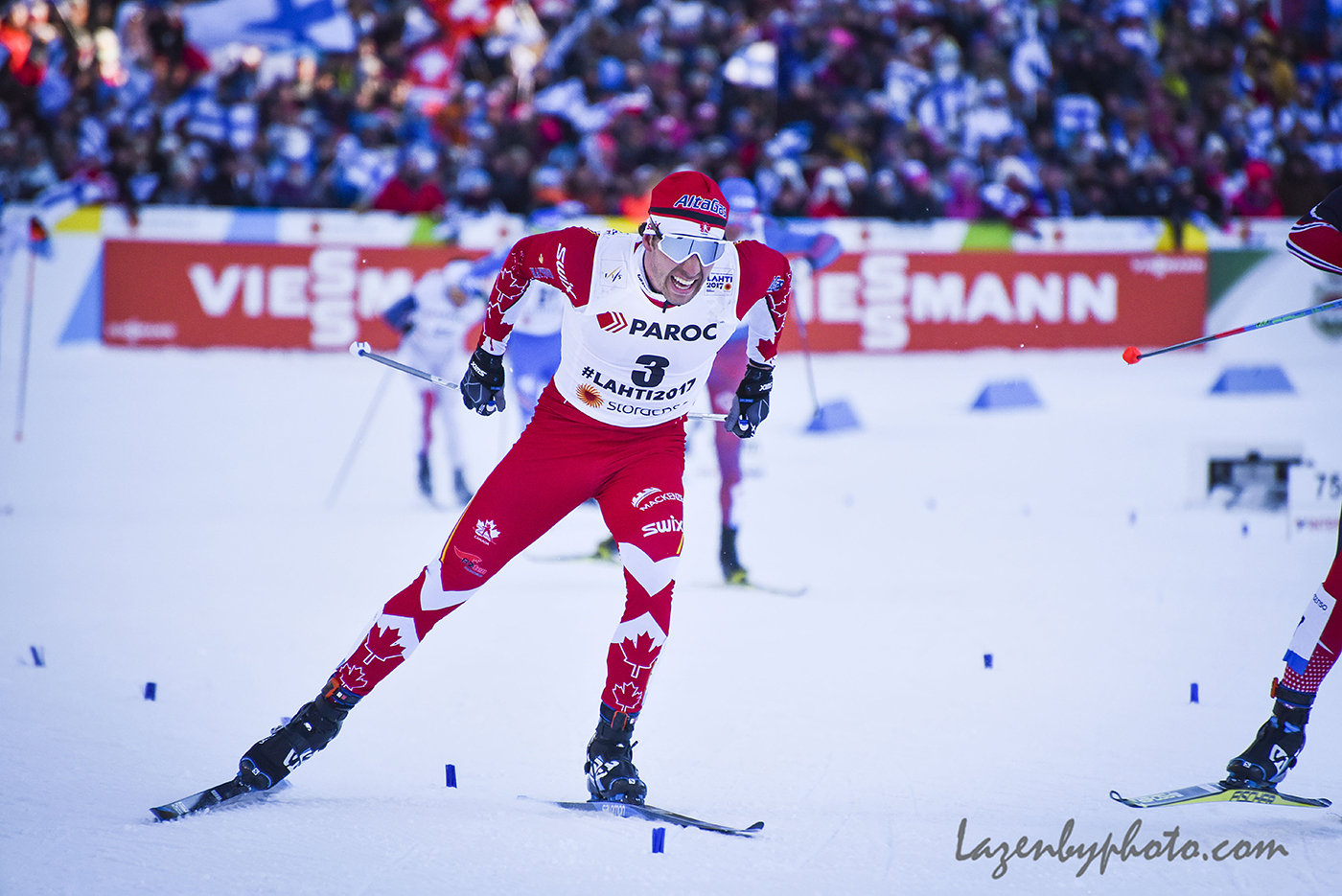
    Canada’s Alex Harvey (5) charging to the line ahead of Russia’s Sergey Ustiugov (4), Norway’s Martin Johnsrud Sundby (1), Great Britain’s Andrew Musgrave (10) and Finland’s Matti Heikkinen (behind Harvey) in the men’s 50 k freestyle mass start on Sunday at the 2017 Nordic World Championships in Lahti, Finland. (Photo: John Lazenby/Lazenbyphoto.com)

    In the closing moments of nearly every race of these world champs, the fate of winners seem come down to luck, and often someone else’s bad luck. As the leaders came into the stadium, it was as if every observer were about to witness an upset due to a tumble or a tangle.

    Harvey was clean around the final turn and unscathed down the stretch.

    “I wanted to hit the [Lahti] corner in second, right behind Sundby or whoever was in the lead,” Harvey said. “I knew I needed to do that in the skiathlon, too, and I tried to go around Finn Hågen Krogh there, but he’s a clever sprinter too. He knew he wanted to be second there.

    “In the skiathlon it didn’t work, but today it did,” Harvey continued. “I was second the whole time and then out of that corner I did one push more than Sundby. I had really fast skis, but used the draft to slingshot and then hit the final corner in first and from there, I knew it was mine to lose more than anything else.”

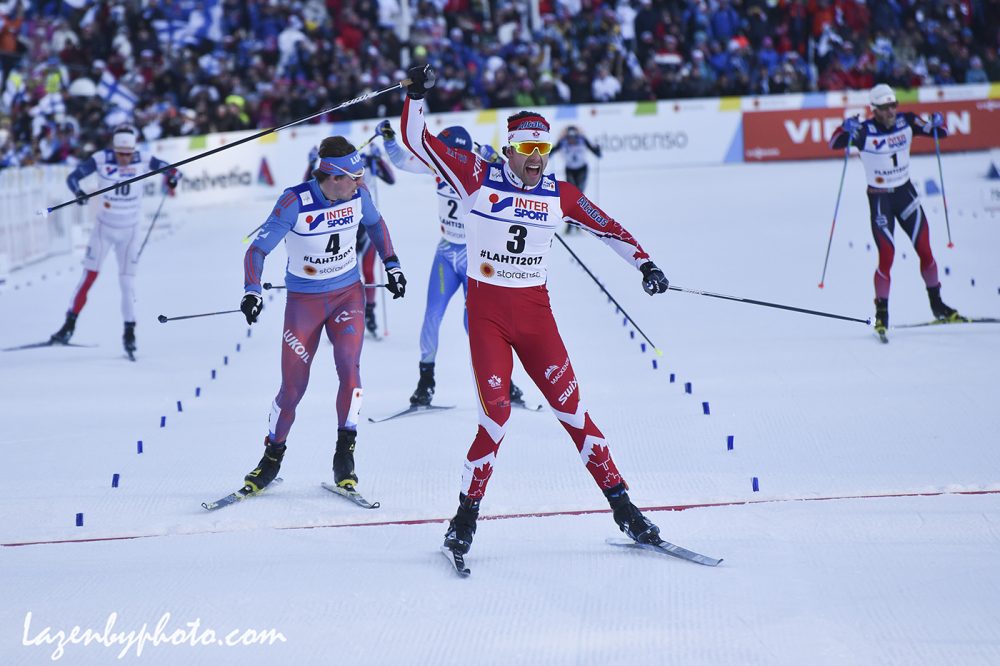
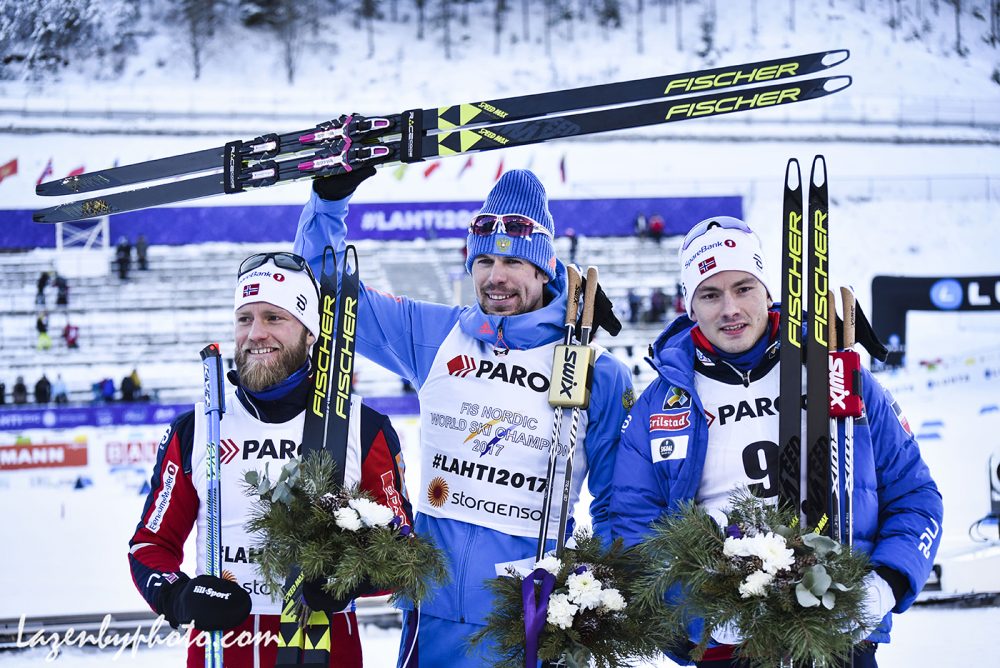
    Canada’s Alex Harvey (5) celebrates his first individual World Championships gold after winning Sunday’s 50 k freestyle mass start in Lahti, Finland, ahead of Russia’s Sergey Ustiugov (4), Norway’s Martin Johnsrud Sundby (1), and Finland’s Matti Heikkinen (2), respectively. (Photo: John Lazenby/Lazenbyphoto.com)

    And so Harvey earned the crown: 50 k world champion in 1:46:28.9 hours.

    It’s his first championships gold since winning the classic team sprint with Devon Kershaw at 2011 world champs, and fifth medal in four World Championships. 

    “He turned around these world champs for all of us,” Babikov said of the Canadian team. “He was solid. We were with no medals so far, and winning 50 k, he’s the king now.

    “This is the legit distance and he took it today,” he added.

    “It’s a long championship,” said Louis Bouchard, Harvey’s personal coach and Canada’s World Cup co-coach. “He feels every day his energy’s still there, so he knows today, if he’s good tactically, then he can do it.”

    Asked how nerve-racking it was watching the final 5 k unfold, Bouchard responded, “I was pretty nervous, too much maybe. But that’s OK.”

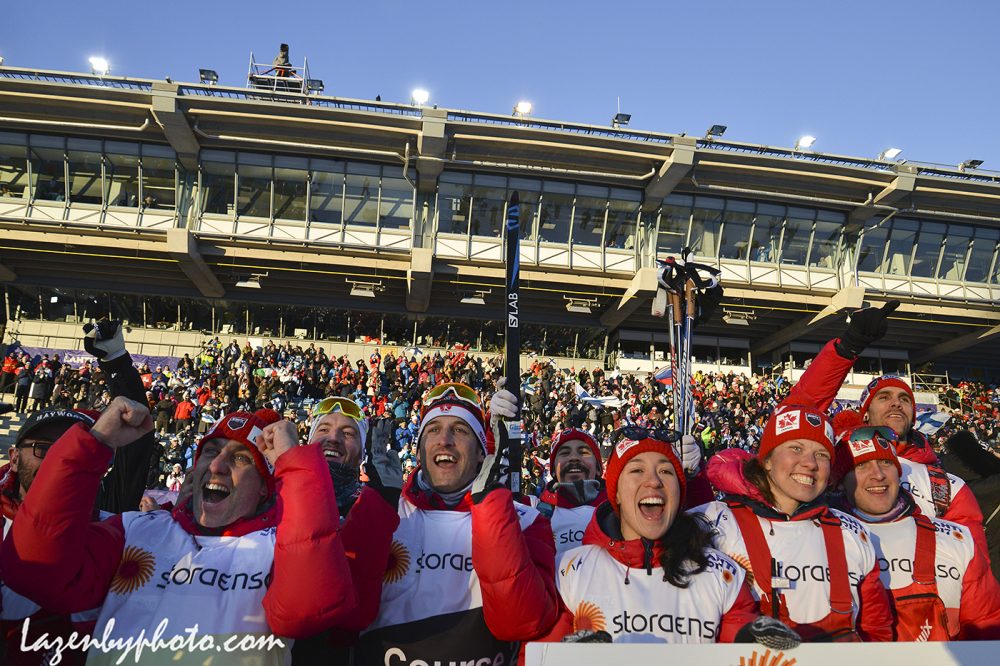
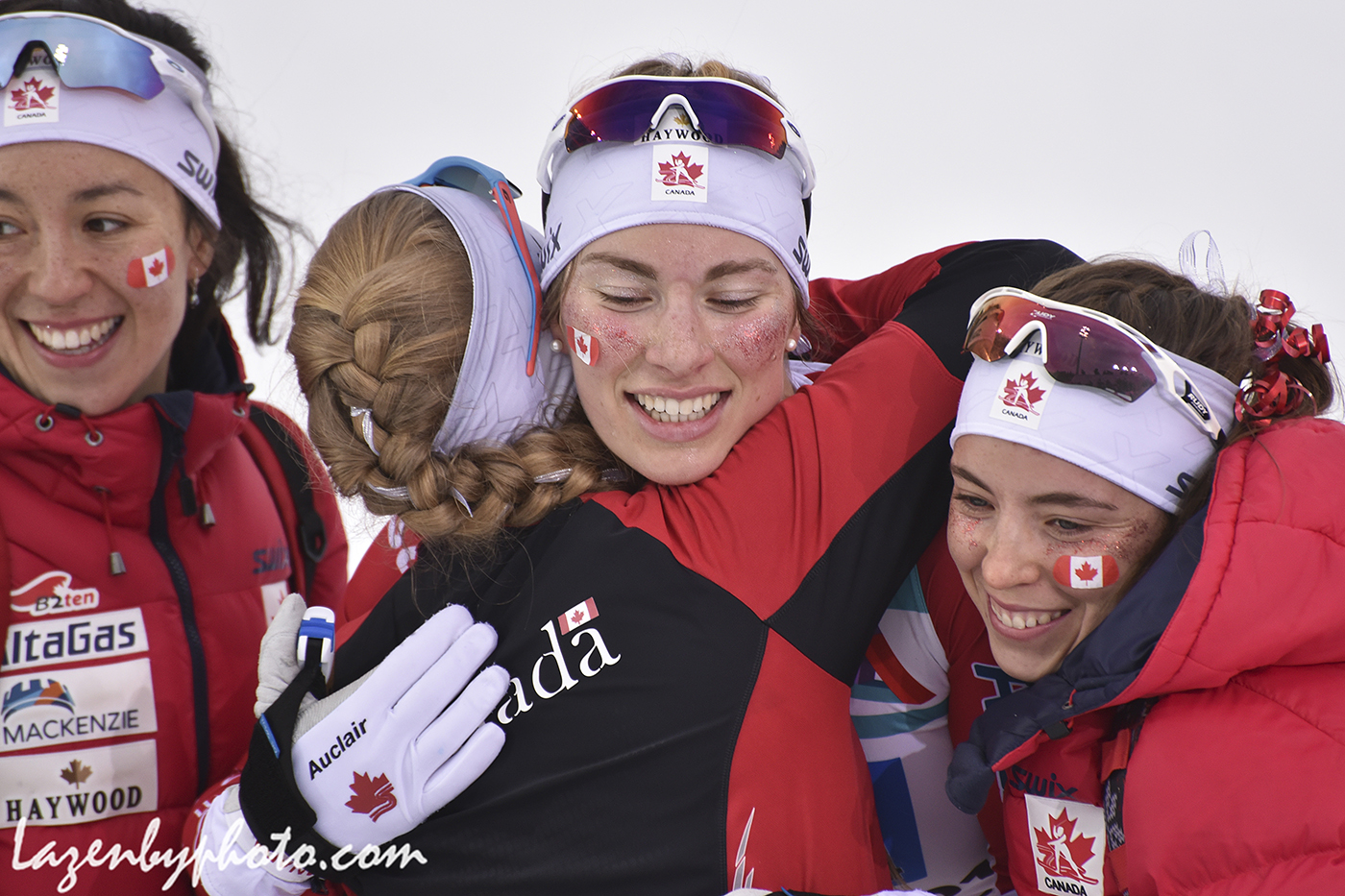
    Alex Harvey’s Canadian teammates, coaches and support team celebrate his win in the men’s 50 k freestyle mass start on Sunday at the 2017 Nordic World Championships in Lahti, Finland. (Photo: John Lazenby/Lazenbyphoto.com)

    For his fifth medal of these championships (and sixth world-champs medal of his career), the 24-year-old Ustiugov crossed second for his third silver of the week, just 0.6 seconds behind Harvey. Finland’s 33-year-old Heikkinen took third (+1.4) for his first medal since 2011 World Championships.

    “Today I skied within my own limits and at the end I was fresh enough to attack,” Heikkinen said in a press conference.

    Asked about his not-so-characteristic finishing kick on Sunday, Heikkinen said he remembered how he faded to 20th in the 50 k classic mass start at 2015 World Championships.

    “After Falun 2015 world champs, I was watching the race after and I was walking in front a mirror and I said, ‘I won’t ever again be like that after a 50 k,’ ” he said. “I’ve been training two years now at a high level [with my team] … and that’s why I’m top three in overall World Cup, so it was possible.”

    Behind him in a photo finish for fourth, Musgrave capitalized on Sundby slowing before the finish — probably after the Norwegian realized he had missed out on a medal — to place fourth (+2.9). For Musgrave, who turns 27 on Monday, it was his first World Championships top 10. For Sundby, who had been on a quest all week for his first individual championships goal — it was a bummer. The 2018 Winter Olympics in PyeongChang, South Korea, will be Sundby’s next opportunity.

    From a North American and perhaps international standpoint, American Tad Elliott skied the gutsiest of races. Halfway through the race, Elliott, a 28-year-old Colorado native and former U.S. Ski Team member, remained a not-too-far-off the back chaser, 27 seconds behind the lead group. His margin back slowly accrued over the remaining distance.

    “At 25 k, man, some guys were really struggling and they balled it up,” Elliott said afterward. “I should have sent it a little harder but that’s how it goes sometimes in that pack. I thought I could get there, but I just missed it.”

    Elliott, of Ski Club Vail, finished 27th (+3:16.8) for his best individual result in three World Championships. In recent years, Elliott has struggled with illness, which impacted his ability to train and peak. Those difficulties caused him to question whether or not his best years were behind him. Evidently not.

    American Tad Elliott (41) racing to 27th in the men’s 50 k freestyle mass start on Sunday at the 2017 Nordic World Championships in Lahti, Finland.. (Photo: John Lazenby/Lazenbyphoto.com)

    “I didn’t know if I wanted to come back [to skiing]. I was so sick. I was so bummed. I was like, ‘Am I ever going to get back? Am I ever going to get back to top-30 form?’ ” Elliott said. “We knew if everything went right, I would qualify for worlds … then to get top 30 here, man, I feel like I’m starting to get greedy. I’m starting to want more, I’m starting to want more opportunities. But I’m proud of this effort, I’m going to savor it a bit.”

    In the first few kilometers, Russia’s Petr Sedov skied too wide on a 180-degree corner and stalled out. American Kyle Bratrud, the next skier to round the turn, was unable to avoid the Russian and collided. Soon after, due to the impact, Bratrud was unable to complete the race.

    U.S. Ski Team member Noah Hoffman finished the day in 50th (+8:53.1).

    Devon Kershaw was Canada’s second skier on Sunday, crossing in 38th (+5:45.5). Also for Canada, Graeme Killick and Knute Johnsgaard finished in 43rd (+7:04.0) and 55th (+12:03.3), respectively.

    “[Alex’s performance] was incredible and such a big boost for our entire team,” Babikov said. “You should see all the techs, and Devon and Graeme and Knute, who didn’t really have a great race today, and they’re still so psyched for him.”

    Results

    — Gerry Furseth, Jake Ellis and Alex Kochon contributed

    Canadian air guitar: Alex Harvey performs his team’s signature move after winning the men’s 50 k freestyle mass start on Sunday at the 2017 Nordic World Championships in Lahti, Finland. (Photo: John Lazenby/Lazenbyphoto.com)
  • Norway Makes It 100 Championship Golds with Women’s Relay Win

    Norway Makes It 100 Championship Golds with Women’s Relay Win

    The women’s 4 x 5 k relay podium at 2017 Nordic World Ski Championships in Lahti, Finland, with Norway (c) in first, Sweden (l) in second and Finland (r) third. (Photo: John Lazenby/Lazenbyphoto.com)

    LAHTI, Finland—The Norwegian lineup for the women’s 4 x 5-kilometer team at the 2017 Nordic World Championships on Thursday was daunting: Maiken Caspersen Falla, Heidi Weng, Astrid Uhrenholdt Jacobsen, Marit Bjørgen. On paper and on snow, a rundown of names and accomplishments.

    Here during these Lahti championships the Norse foursome have hauled; Falla with a freestyle sprint gold, Falla and Weng with a classic team sprint gold, Bjørgen a 10 k individual classic gold and 15 k skiathlon gold, and Jacobsen’s hardware was a bronze in the 10 k classic.

    On Thursday the Norwegian women made the country’s historic championship gold medal count a tidy 100 by winning the 4 x 5 k relay in 52:21.5 minutes. In a sprint for the remaining two podium spots, Sweden’s anchor skier Stina Nilsson outsprinted Finland’s Krista Pärmäkoski for second.

    The Swedish team of Anna Haag, Charlotte Kalla, Ebba Andersson, and Nilsson scored silver (+1:01.6) while Finland’s home team of Aino-Kaisa Saarinen, Kerttu Niskanen, Laura Mononen, and Pärmäkoski was third (+1:02.1).

    The U.S., represented by Kikkan Randall, Sadie Bjornsen, Liz Stephen, and Jessie Diggins, placed fourth (+1:33.8).

    Two Legs of Parity, Then Norwegian Dominance

    Rabid fans of the sport know Norway is winner of the last three consecutive championship relays. And lovers of tactics also know the Norwegians like to push the pace from the gun and break the pack early.

    Halfway through the first leg, Poland’s Justyna Kowalczyk, a classic specialist, led Finland, Norway, Sweden, and the U.S. through the 2.5 k mark.

    Norway’s Maiken Caspersen Falla (l) leads one row of skiers, Poland’s Justyna Kowalczyk lead’s another, during the scramble leg of the 2017 Nordic World Championships 4 x 5 k relay in Lahti, Finland. (Photo: John Lazenby/lazenbyphoto.com)

    For Falla, Norway’s scramble leg, it was her debut in a championship 4 x 5 k relay. Despite her prior medals, her pre-relay nerves were unsettled.

    “I was really excited today and I was just hoping that the time could pass fast so I can race,” Falla said after the race. “It was a lot of waiting time, but I get good advice … and that helped me today. So I get my nerves under control.”

    According to Falla, here’s the advice: “That I should stay behind the first lap and be strong in the climbs in the last lap,” she explained. “I did that, just as they said.”

    In the last kilometer, Falla made a small break, tagging off to Weng with a near eight-second advantage on the chasers.

    Weng leads the World Cup overall standings, but racing in the Finnish ski-den, she was unable to fend off the surging Finns. Five kilometers later, Niskanen had absorbed Norway’s punch. Finland and Norway tagged off to their respective third-leg skiers simultaneously. Sweden trailed twelve seconds back.

    Up the first hill, the mother of all climbs on the skating course, Jacobsen and Mononen pulsed. Carrying Sweden’s hopes was Andersson — a 19-year-old junior fresh off a win in the 5 k skate at last month’s Junior World Championships at Soldier Hollow in Utah.

    The Finn-Norwegian duo pulled away, leaving Andersson with a 22.6-second deficit 1.3 k into the third leg.

    Astrid Uhrenholdt Jacobsen, Norway’s third-leg skier, made a decisive move to put major time into second-place Sweden and third-place Finland during the 2017 Nordic World Championships 4 x 5 k relay in Lahti, Finland. (Photo: John Lazenby/Lazenbyphoto.com)

    A resurgent Jacobsen kept pushing; her moves to drop Andersson early on weren’t only a tactic to make it a two-team race, but a sustained display of overdrive that ultimately broke the Finns, too.

    The third leg was the tipping point for Finland and Sweden. They were on the side of bleeding time to Norway; Norway on the side of looming victory. By 13.8 k, Norway was up 30.4 seconds on Finland and 45.8 seconds on Sweden.

    Andersson managed the damage. She and Mononen skied into the stadium amidst a raucous Finnish crowd. By then, Jacobsen handed Bjørgen nearly a minute cushion.

    That kind of margin and Bjørgen hustling from the line: Boom!

    You know how this ends, with the queen waving an oversized Norwegian flag.

    After the race, Jacobsen spoke of the pressure of skiing on Norway’s storied relay teams.

    Marit Bjørgen carrying the Norwegian flag as she crosses the line first for Norway’s 100th World Championship win during the women’s 4 x 5 k relay at the 2017 Nordic World Championships in Lahti, Finland. (Photo: John Lazenby/Lazenbyphoto.com)

    “I think actually the biggest pressure is the one we put on ourselves and probably because it’s so hard for us to qualify for the team,” Jacobsen said. “We are skiing for the girls who didn’t make it this year but will probably make it next year. So we ski of course for our people and our nation. But I think the biggest nerves come from the desire to perform well and do strong legs.”

    One hundred championship gold medals later, Jacobsen acknowledged it’s a full treasure chest.

    “The Norwegian people are getting spoiled in gold medals, but it not so easy like it looks,” Jacobsen said.

    Glide for glide, pole for pole, Sweden and Finland were mirror images the last leg. Known as a closer, Nilsson strategized that coming into the final corner she wanted to follow Parmakoski.  

    Sweden’s second-leg skier Kalla explained that Nilsson’s tactic was one of waiting until the end.

    “If Stina should go with some team in the end, she should wait to the stadium and just focus on her strength and she made it just like the plan,” Kalla said.

    Days earlier in the team sprint, Nilsson lost out on bronze to Diggins in a sprint to the line.

    “In the team sprint I was first in the final curve,” Nilsson reflected. “And I felt that Diggins had an advantage of it, so I didn’t want to be first today.”

    The press conference’s moderator interjected and tried to correct Nilsson, saying she was first again in the closing moments, not shadowing the Finn.

    “No, not in the curve, but after the curve,” Nilsson said with a laugh.

    The silver and bronze fight came down to Nilsson’s final kick and this time she made it stick for silver.

    (Story continues below)

    Sweden’s Stina Nilsson celebrates silver after outsprinting Finland’s Krista Parmakoski (l) in the final meters of the women’s 4 x 5 k relay at the 2017 Nordic World Championships in Lahti, Finland. (Photo: John Lazenby/Lazenbyphoto.com)

    Same Place, But Progress: U.S. Places Fourth, Canada 10th

    With three world champs medals already in the hands of American skiers prior to Thursday’s team relay, the public hope for a podium was high. Perhaps too high.

    As U.S. Ski Team (USST) Head Coach Chris Grover explained, medaling in the team relay was certainly on the radar coming into the world champs week, but not where the team’s greatest expectations were held.

    The U.S. women’s relay team, (from left to right) Sadie Bjornsen, Liz Stephen, Jessie Diggins, and Kikkan Randall, after placing fourth on Thursday at 2017 World Championships in Lahti, Finland. (Photo: John Lazenby/Lazenbyphoto.com)

    “The relay we knew was a shot, the team sprint we knew was an outside shot,” Grover said after Thursday’s race. “Probably our greatest medal opportunity was the individual sprint.”

    As a gritty group of women, the Americans exude the attitude of a top team. Adorned in red, white and blue socks and face paint sporting the U.S.A.’s emblematic stars and stripes, it’s easy to see the enthusiasm the U.S. women show for team events.

    But where does the blur between team-relay hype end and the reality of results begin?

    Disappointment in anything less than a podium only comes when the expectation of one exists. Taken over the past few world champs years, the relay event might be one where the U.S. women can, and have, improved the most.

    Eight years ago, at the 2009 world champs in Liberec, Czech Republic, the U.S. finished 13th, a little over three minutes out of third place. The following World Championships year, 2011 in Oslo, Norway, they were almost two minutes off the podium, crossing in ninth overall.

    In 2015, the team finished fourth, a little over a minute back from the bronze medal.

    This year? The U.S. once again finished fourth — the third time in a row that the team has finished one place outside the podium at a World Championships event.

    Yet, Thursday’s performance was the second closest the team has come to bronze, with the Americans crossing 31.7 seconds after third (their 2013 result in Val di Fiemme, Italy, was closer: 26.6 seconds behind third). Given room for systematic error, the statistical trend for the U.S. women in the team relay over the past five world champs: positive.

    American Kikkan Randall during the first leg of the women’s 4 x 5 k relay at the 2017 Nordic World Championships in Lahti, Finland. (Photo: John Lazenby/Lazenbyphoto.com)

    “Even though this is the third time in a row that we’ve been fourth place at a world championships, there’s progress, there’s real progress,” Grover said. “The athletes could see the competition ahead of them the whole time. … To be getting closer and closer to that top standard, that’s very gratifying.”

    When looking at the longer-distance performances from the week in tandem with Thursday’s start list, Grover further explained that the U.S. team’s incoming rank was similar to their outcoming result.

    “I guess I’d say that when you look at the start list and you look at the results from the 10 k and the skiathlon, on paper we’re fourth,” Grover said. “Sweden, Finland, Norway they’re definitely ahead of us in terms of the distance results that we’ve seen here all week. So we knew we were sort of an outside chance to be fighting for the bronze and we knew that when we’re successful on the World Cup, it’s because one of those teams has a weak leg.”

    A weak leg from Finland, Norway or Sweden — the three teams that finished ahead of the Americans — at least in Thursday’s race, was nowhere to be found for the U.S.

    From the start, Kowalczyk, pushed the pace with Falla, Haag and Saarinen in close quarters, while the USST’s Randall worked hard to hold on.

    “Unfortunately, we lost some important time there in the beginning,” Randall said. “I know that’s something I’ve got to work on for next year, but it was exciting to know that we were still in the race the whole time and made Sweden and Finland really fight for those medals.”

    Randall handed off to Bjornsen in fifth, approximately 16 seconds back from the second, third, and fourth spots. From there, the Americans raced alone, working hard to reel in the racers ahead.

    “It’s always hard to have a carrot right in front of you and not go too hard at the beginning,” Bjornsen said. “I think all of us had a hard time with that today, not going too hard to try to catch them right away.”

    By the end of her leg, Bjornsen needed another eight seconds from Randall’s time back to catch the third place position. She handed off to Stephen, who would have to make up 23.5 seconds on Sweden’s third leg, Andersson, to contend for the podium.

    The young Andersson, however, was putting on a show. And Stephen wasn’t surprised. During the early stages of her ski career, Stephen attended a weeklong camp in Sweden. While there, she’d learn invaluable lessons from countless coaches, one just happening to be Andersson’s father.

    Liz Stephen racing the third leg for the U.S. women’s team in the 4 x 5 k relay at the 2017 Nordic World Championships in Lahti, Finland. (Photo: John Lazenby/ Lazenbyphoto.com)

    “As I was lining up with her today I was just like ‘this is just full circle,’ “Stephen said after. “She’s a damn-good skier.”

    That of course didn’t stop Stephen from putting her best foot forward. The American emphasised the areas she knew were her strength, working the hills.

    “Part of me wanted to go out and blow [it] out of the water off the bat, but I also knew that these conditions are also a little bit more energy-expending than normal, hard-packed conditions,” Stephen explained.

    Halfway through the first lap, Stephen had gained close to seven seconds on Andersson. By the end of the second lap, however, Andersson had regained the ground that she had lost.

    “Unfortunately I couldn’t get her,” Stephen said. “But I did what I could out there … and I am very inspired to be on this team again. To watch my teammates give it all out there, it just makes you want to do the same.”

    When Stephen handed off to Diggins, the anchor legs for Sweden and Finland were skiing together. Diggins explained that she had hoped Nilsson and Pärmäkoski’s race tactics would provide an opportunity for her to gain on them.

    “I saw where we were coming in and I said, my only strategy is to go out as hard as I can and hope that they are playing cat and mouse in the front,” Diggins said. “[I thought] if they’re trying to be all strategic for the final sprint-out, then maybe I can catch them.”

    Ultimately the gap proved too large, with Diggins crossing in fourth.

    “I wasn’t able to close the gap but I never stopped fighting and neither did my teammates, and I’m really proud of that,” Diggins said.

    Canada’s team of Katherine Stewart-Jones, Emily Nishikawa, Cendrine Browne, and Dahria Beatty finished 10th (+4:16.2) for the fourth-best world champs result of a Canadian women’s relay team. According to a Cross Country Canada press release, this was just the fourth time in the last decade that Canada has fielded a World Championships women’s relay (excluding the Olympics).

    At the 2001 World Championships, Beckie Scott, Milane Thériault, Jaime Fortier, and Sara Renner raced to sixth for Canada. Before that, the program’s previous best was eighth at 1989 world champs, also in Lahti.

    (Left to right) Canada’s Emily Nishikawa, Cendrine Browne, Dahria Beatty, and Katherine Stewart-Jones after placing 10th in the women’s 4 x 5 k relay at the 2017 Nordic World Championships in Lahti, Finland. (Photo: John Lazenby/Lazenbyphoto.com)

    “I think today we surprised ourselves,” Canadian World Cup coach Ivan Babikov said on Thursday.

    “[Katherine Stewart-Jones] skied incredibly that first leg, with everything she could,” he added. “She was ahead of Germany, ahead of Russia, so many really good countries, and after that it was a matter of holding on and it was great.”

    Stewart-Jones finished her leg in eighth, just seven-tenths of second behind Germany’s Katharina Hennig in seventh. Though Switzerland and Italy eventually caught the Canadians, the women expressed excitement about the finish and results yet to come.

    “This is the first time we’ve fielded a world champs relay in a long time so that’s a huge accomplishment [in itself],” Nishikawa said during an in-person interview. “And then to come 10th … it’s really the beginning of something that’s pretty special.”

    “I’m really proud of us,” Browne added. “I think we all skied really strongly today, and very positive for the future.”

    — Harald Zimmer, Gerry Furseth, and Alex Kochon contributed

    Results

  • Amidst Finnatics, Niskanen Strides to 15 k Gold; Bjornsen Notches 18th at World Champs

    Amidst Finnatics, Niskanen Strides to 15 k Gold; Bjornsen Notches 18th at World Champs

    Amidst a sea of Finnish flags, Finland’s Iivo Niskanen turns the final corner on his way to gold in the men’s 15 k classic individual start on Wednesday at 2017 Nordic World Championships in Lahti, Finland. (Photo: John Lazenby/Lazenbyphoto.com)

    LAHTI, Finland — Through the first seven medal races of 2017 Nordic World Championships, the hometown Finns came close. There was Krista Parmakoski’s skiathlon silver. There was the spectacular Finn non-win when Finland’s Iivo Niskanen and Norway’s Emil Iversen tumbled 200 meters from the line during Sunday’s classic team sprint. At the moment of the tangle, Niskanen was primed to pass Iversen for what appeared to be a golden performance.

    Instead of a cheer concluding the sprint, a collective exhale deflated the crowd: Niskanen and teammate Sami Jauhojärvi ultimately settled for bronze. While it wasn’t the result they had hoped for, it remained the 25-year-old Niskanen’s first World Championships medal.

    Another race on Wednesday brought another Finnish opportunity. On a 34-degree Fahrenheit day with moist tracks and low-hanging clouds, gold was up for grabs.

    During the men’s 15-kilometer classic individual start, Niskanen channeled whatever bitter taste remained from his team sprint near-win into a controlled and sufficient pace. After 1.5 k, Niskanen ranked fourth — from then on, he was the fastest through every remaining timing point, and first when it mattered most. Niskanen won in 36:44 minutes.

    Norway’s Martin Johnsrud Sundby finished 17.9 seconds off his time for silver. Sundby’s teammate Niklas Dyrhaug clocked in 31.3 seconds back for bronze, his first-career individual championships medal.

    The men’s 15 k classic podium at 2017 Nordic World Ski Championships in Lahti, Finland: (from left to right) Norway’s Martin Johnsrud Sundby (l) in second, Finland’s Iivo Niskanen (c) in first, and Norwegian Niklas Dyrhaug (r) in third. (Photo: John Lazenby/Lazenbyphoto.com)

    “It’s for sure a really good team, Norway, and it’s a hard fight in all the places for every distances,” Dyrhaug said at the post-race press conference about making Norway’s 12-man World Championships team. “I have been a reserve for the skiathlon and the team sprint. I have been here since Otepää — ten days now. I have been ready so when I got the chance in the 15 k, yeah, I am happy to show everybody that I am in really good shape and I have something in world champs to do.”

    The 15 k classic appears an odds maker’s nightmare. It remains a fickle distance and technique with a million and one variables. There’s the course profile, the athlete’s classic technique to consider — do they thrive on headwalls or stridable terrain, double poling? The wax. The snow type. The venue’s altitude. Then there’s the pacing — go out hard? Look for negative splits? Ski it like a true distance race, not an elongated sprint?

    A single 15 k classic win at a championship or World Cup level evidently doesn’t mean more will come your way. Of the 133 starters on Wednesday, Finland’s Matti Heikkinen remains the only athlete who had won a 15 k classic at a World Championships or Olympics (at 2011 World Championships in Oslo, Norway, he won the gold in this event). Not since the ’54 and ’58 championships has an athlete won two world titles in this event.

    Finland’s Iivo Niskanen (r) celebrates his 15 k classic win with loved ones at 2017 Nordic World Championships in Lahti, Finland. (Photo: John Lazenby/Lazenbyphoto.com)

    Niskanen and the 15 k classic are sympatico and eventually he may buck the consecutive-winner’s curse. Niskanen has three career World Cup podiums: all in the 15 k classic. There’s two wins — both in Kuusamo, Finland, and a second place at the last pre-championship World Cup race last month in Otepää, Estonia.

    That doesn’t mean the Finn isn’t flawless.

    “Many times, in many races I have started too hard for the first two kilometers,” Niskanen said after the race.

    His too-early, hot-pacing issues were remedied Wednesday as he left nothing to chance. Niskanen suggested he’d had a Lahti champs dress rehearsal to test his pacing strategy.

    “It was good to race here before on the Scandinavian Cup and learn the track, today I’m ready,” Niskanen said.

    Back on Jan. 8, Lahti hosted a Scandinavian Cup 15 k classic. Like today, Niskanen won over another Norwegian, Johannes Høsflot Klæbo (+5.8).

    “Today I planned to do a half kilometer and push hard,” Niskanen said on Wednesday. “After a kilometer and a half, I was quite fresh and got quite easily a gap and pushed as hard as I can. Everyone is cheering you and so then you don’t actually feel the lactate as normal. I had a difficult last kilometers, but it was one and a half to go I just thinking about myself, ‘Now we are not going to lose 20 seconds anymore.’ ”

    That losing 20-seconds remark referred to his Scando Cup race. During that 15 k, he was 17 seconds up on Klæbo with 3 k remaining. He actually lost 12 seconds to Klæbo on that final sector, not 20, but Niskanen recognized the trend — slowing down in the final push.

    Finland’s Iivo Niskanen powers down the finishing stretch en route to gold in the men’s 15 k classic at 2017 Nordic World Championships in Lahti, Finland. (Photo: John Lazenby/lazenbyphoto.com)

    Although young, Niskanen has struggled with repeated sickness and overtraining. Promoted as a potential World Cup overall contender, Niskanen’s three 15 k classic victories remain the sole podiums highlighting his World Cup resume.

    “It has been many hard years and I said when I wake up, ‘I feel healthy today and I have hope’,” Niskanen said. “I have gotten easily sick for many years and over training, maybe I have been training too much and too hard during the last years. But this year I have trained more than ever, but I have not raced in every weekend.”

    The higher-volume, limited-racing recipe worked. This season, the Finn tailored his race schedule — not too much, not too little. To date, he’s raced 11 World Cup races.

    “The goal was to win here in Lahti and be in the best shape here and we see it with my gold,” Niskanen said.

    Norway’s Sundby remains a World Cup benchmark— he’s a mutiple overall Crystal Globe winner and leads this year’s standings. But for the reigning overall World Cup winner, an individual championship gold (at world champs or the Olympics) still eludes him.

    “I think my race was really good, I felt so fast out there,” Sundby said after the race. “And then I was 20 seconds behind, I don’t believe it. It was tough for the mind to motivate myself for fighting today, but I did what I thought was one of my best race ever at this distance.”

    Norway’s Martin Johnsrud Sundby on his way to second place in the 15 k classic at the 2017 Nordic World Championships on Wednesday in Lahti, Finland. (Photo: John Lazenby/lazenbyphoto.com)

    Asked if he felt demoralized knowing he was 20 seconds down grinding away on Lahti’s wooded tracks, Sundby explained how he attempted to remain in the hunt.

    “It is not so difficult in the World Champs … [Niskanen] did the race here in the Scan Cup a few months ago, where he for sure lost a lot of seconds in the last 3.75,” Sundby added. “And I tried to motivate myself. I said, ‘He will meet the wall, he will meet the wall, you just have to push.’ I felt good, I felt good all the way and tried to gain seconds but it was nearly impossible today.

    “It is an amazing performance Iivo showed us today, everybody,” Sundby said of his Finnish protagonist. “You have to appreciate a really good sportsman. Also with some things that happened before here in the world champs, maybe in the team sprint, and it’s called karma. Today he showed everybody.”

    Best World Champs Finishes for Bjornsen in 18th, Bratrud in 33rd

    While Niskanen took the overall victory on Wednesday, American Erik Bjornsen walked away with a win of his own. Two days earlier, the 25-year-old Washington native had raced to a historic fifth place in the classic team sprint with his U.S. Ski Team (USST) teammate Simi Hamilton for the best team-sprint result for the U.S. men’s program. Before that, the team’s best was seventh place in 2015.

    U.S. Ski Team member Erik Bjornsen (26) skiing ahead of Norway’s Niklas Dyrhaug (66) during the men’s 15-kilometer individual start at the 2017 Nordic World Championships on Wednesday in Lahti, Finland. Bjornsen went on to place 18th, while Dyrhaug captured third place for bronze. (Photo: John Lazenby/lazenbyphotography.com)

    Bjornsen had raced the anchor leg for the U.S., challenged by names like Norway’s Johannes Høsflot Klæbo, Russia’s Sergey Ustiugov and Wednesday’s eventual 15 k winner, Niskanen.

    Despite some of the heavy hitting names that challenged Bjornsen on Sunday, he found himself in the mix (two of his laps were the fifth fastest and one the fourth fastest of all second-leg skiers).

    “In the team sprint the other day, you saw some of the best skiers, I mean, I was skiing with Iivo Niskanen, who has a good shot at winning today, and I felt pretty comfortable skiing with some of those guys,” Bjornsen after Wednesday’s race. An early starter in bib 26, he initially finished third before being bumped 15 places to 18th (+1:56.7).

    “I definitely went into the [15 k] race with quite a bit of excitement from the team sprint,” he said.

    Bjornsen added that the energy he was able to find during the team sprint is something he sees as working it’s way into his longer-distance efforts.

    His performance in the 15 k appears to prove that, as he finished in the top 20 for his best individual World Championships result. The finish also ties his best individual World Cup result — he placed 18th three years ago in a 15 k in Toblach, Italy. The finish was also the best championships result of an American in the men’s 15 k classic since Kris Freeman placed fourth at Liberec world champs eight years ago. 

    Bjornsen explained that a slight bonk toward the end of his first lap caused him to put on the brakes briefly, though he found he was ultimately able to pick his pace back up before finishing.

    “I went for it in the beginning, for sure, and I think I had a pace for the first lap that would have been pretty similar to some guys in the top ten,” Bjornsen said. “Then I kind of hit a little bit of a wall there, a little bit through the first lap, and struggled for a couple of kilometers … then I was able to pick up a little bit of steam before the finish.”

    American Kyle Bratrud (CXC Team) racing to a career-best 33rd in the men’s 15 k classic at 2017 Nordic World Championships in Lahti, Finland. (Photo: John Lazenby/lazenbyphoto.com)

    “I mean hopefully I can just continue to improve and be able to keep that pace up the whole way and then I think it can come together for me,” he added.

    The second American to finish on Wednesday was Kyle Bratrud in 33rd (+3:11.5). Bratrud’s result was 20.7 seconds out of the top 30 and marks his best individual result at his second World Championships and career best at the World Cup level.

    Seeing himself as a stronger skater, Bratrud, 24, of the CXC Team, entered Wednesday wanting to test his ability to push his classic-technique limits.

    “I think I’m a little more confident in skate skiing, so classic I figured I had nothing to lose,” Bratrud said after. “I basically just went as hard as I could from the gun … to see if I could hang on.”

    While the decision resulted in Bratrud having to ease up during some of the climbs, he indicated that managed to recover well enough on the descents to regain control.

    “The course is pretty rolly and I was dying a lot on the uphills,” he said. “On the downhills I was getting some recovery and and all of a sudden I’d feel good again, but I’d get to the next hill and I’d be totally dead.

    “It was kind of a roller coaster of energy, but I just tried to keep my legs moving as fast as I could,” he added.

    With Wednesday also being his mother’s birthday (both his parents made the trek to Lahti to watch him race), Bratrud was thankful for the opportunity to race before throngs of fans, even if the names most were yelling didn’t belong to him.  

    “This is pretty awesome to not even be able to hear yourself breathing because it’s so loud,” Bratrud said “I love when people are cheering, even if it’s not for me.”

    Two other Americans competed on Wednesday, with Andy Newell (U.S. Ski Team) finishing 50th (+4:21.7) and Ben Lustgarten (Craftsbury Green Racing Project) 55th (+4:56.9).

    With his USST teammate Noah Hoffman out due to sickness, Newell explained that he was then slotted to race Wednesday’s classic event.

    “It was fun to get a 15 k in at the championships like this, it’s unfortunate that Hoff wasn’t feeling good so I had to come in and take his spot,” Newell said after.

    Adding that much of his goals are geared towards races scheduled to take place next season –particularly the 2018 Olympics in PyeongChang, South Korea — Newell is not too concerned with numerical results.

    “I felt OK in a few places, but definitely lost too much time out there. I’m just kind of going after a feeling. It wasn’t a great day, but I didn’t feel awful, either,” Newell said. “I’m hoping to build on this year and kind of use this year as a platform to be at my best by the Olympics. I’m not worried too much about results, just trying to feel good when I can.”

    Lustgarten indicated that he had been dealing with a bout of food illness prior to Wednesday. Unable to eat much in the days leading up to the race, the 24 year old had difficulty tapping into his normal race speed.

    “I was just blown. I tried to ski really smooth and then on the the steep stuff, I tried to ski really light and I tried not to throw up,” Lustgarten said. “I’m probably at 70 percent right now and I’m just trying to ski as well as I can here. … It’s a great experience and it was cool to hear the crowd going, I just wish I could ski like I was a month ago.”

    Canada’s Jess Cockney racing to 65th in Wednesday’s 15 k classic at 2017 Nordic World Championships in Lahti, Finland. (Photo: John Lazenby/lazenbyphoto.com)

    Canada was led by Devon Kershaw in 35th (+3:24.8). The next Canadian to finish was Knute Johnsgaard in 56th (+5:00.7), followed by Jess Cockney in 65th (+6:20.7).

    “I don’t think I pushed as hard as I should have. … Mentally, maybe I wasn’t totally zoned in, but I was happy to do a distance race in front of a big fan base like this in Finland for the hometown favorites, so that was good,” Cockney said.

    This being Johnsgaard’s first world champs experience, the 24 year old was happy with how he race his third individual event of the week.

    “I just went out at a pace I thought I could sustain for 15 k and kept that pace pretty steady I think and was able to push hard and kind of sprint up the last hill,” Johnsgaard said. “I felt like I paced it as well as I could, so I’m pretty satisfied with my race.”

    Results

    — Gerry Furseth and Harald Zimmer contributed

    Finnish fans celebrate Iivo Niskanen’s gold medal in the men’s 15 k classic at 2017 Nordic World Championships in Lahti, Finland. (Photo: John Lazenby/Lazenbyphoto.com)
  • Sweet Sixteen: Bjørgen Wins Lahti 10 k Classic for 16th World Title

    Sweet Sixteen: Bjørgen Wins Lahti 10 k Classic for 16th World Title

    Norway’s Marit Bjørgen on her way to her 16th career World Championships gold in Tuesday’s 10 k classic individual start at the Lahti, Finland. (Photo: John Lazenby/Lazenbyphoto.com)

    LAHTI, Finland — Moments before the women’s 10-kilometer classic individual start at the 2017 Nordic World Championships on Tuesday, temperatures read 35 degrees Fahrenheit and humidity hovered around 97 percent — the air nearly saturated. Earlier in the day, a near-ground fog lapped the tops of the three iconic ski jumps looming above the ski stadium.

    In contrast to earlier classic events at these championships — a 15 k skiathlon, and classic team sprint — the tracks glazed with a mirror-like sheen.

    For her 16th World Championship title, neither Norway’s Marit Bjørgen nor her wax techs were befuddled by the tricky tracks. Whether herringboning headwalls, firing like the nordic powerhouse she is on the flats and climbs, or streamlining the glide outs, Bjørgen remained peerless in her win over her 10 k classic competition. She finished in 25:24.9 minutes for the gold; the closest competitor Sweden’s Charlotte Kalla was 41 seconds behind.

    Tuesday’s 2017 Nordic World Championships women’s 10 k classic podium, with (from left to right) Sweden’s Charlotte Kalla in second, Norway’s Marit Bjørgen in first, and Norway’s Astrid Uhrenholdt Jacobsen in third. (Photo: John Lazenby/lazenbyphoto.com)

    With silver going to the Swede, the final podium spot went to another Norwegian, Astrid Uhrenholdt Jacobsen, who finished 55.5 seconds back from her teammate Bjørgen’s time.

    Considering their collective medal count, it was a championship-pedigreed podium: it was Kalla’s 12th career championship medal — and her second in the last week. Jacobsen earned her third-individual championship medal of seven overall. (For the 2016/2017 World Cup season, it’s Jacobsen’s first podium.

    It’s also been a decade since Jacobsen’s first World Championship medal, a classic-sprint gold in 2007 in Sapporo, Japan.

    “A lot of things have happened in those ten years,” Jacobsen, 30, said after the race. “The medal today feels better than the gold medal in Sapporo. I fought harder for this. I’m just really happy today.”

    Amongst the potential podium locks in the 10 k classic, Kalla noted she chose an earlier start as part of her race strategy; she started in bib 34.

    “I decided to go early because of the warming up opportunities” Kalla explained during the post-race press conference. “I wanted to go on the competition track as long as possible. And then I also had a better opportunity to do my own race and not focus on the times against the others, just focus on my performance in every stage on the track.”

    Sweden’s Charlotte Kalla racing to second in the women’s 10 k classic on Tuesday at 2017 Nordic World Championships in Lahti, Finland (Photo: John Lazenby/lazenbyphoto.com)

    Despite her race-time dominance, Bjørgen spoke of her jittery nerves before the start.

    “This 10 k has been one of the distances I really wanted to win,” the 36 year old said during the press conference. “I think I have two before the start of the world championships, so this was the one I wanted the gold medal. I think that’s the reason I was nervous and also I understand I was in good shape and it was really possible to take the gold, so that’s the reason.”

    A 41-second winning margin for Bjørgen isn’t definitive. And unlike every other race at these championships, where high drama like Norwegian-Finn tangles, broken poles and Diggins-grit dictated the narrative, Tuesday’s 10 k classic was clinical.

    At 1.5 k, 5 k, 6.3 k, and 7.8 k splits, Bjørgen was the fastest. Already at 6.3 k, Bjørgen had a 22-second gap on Kalla. Barring an equipment failure or tumble, by that point the win was a bygone conclusion and Bjørgen the author of this 10 k novella.

    Norway’s Astrid Uhrenholdt Jacobsen on her way to bronze during the women’s 10 k classic at the 2017 Nordic World Championships in Lahti, Finland. (Photo: John Lazenby/lazenbyphoto.com)

    “Today I had very good skis and I feel very strong, and the first 5 [k] I feel that my speed was very high,” Bjørgen added. “It was only a second from 1 kilometer to 4, and I feel that I am racing very fast and I not taking more seconds so I wonder how will I do it on the last 5 k. But then I heard it was from 6 [seconds] and then to 10 then to 20 and then understand they were opening a bit too hard.”

    Bjørgen explained the news of time-gain inroads served as a propellant.

    “I think when you heard you have second[s] on your side you just get some more power and you just want to ski more faster,” Bjørgen said. “You understand it’s well for you. You are getting so happy, it is no problem to speed up and go.”

    Many adjectives come to mind when describing Bjørgen’s career. Yet the numbers are most impressive. When mining her career-win data, there’s always something new to learn. Of all her gold medals — now 22 between World Championships and the Olympics — prior to Tuesday’s win, 20 of those had come in non-individual-start races. (Her other individual-start win came in 2011 World Championships 10 k classic in Oslo, Norway.)

    Bjornsen Leads Americans in 23rd, Randall 26th 

    Kikkan Randall (U.S. Ski Team) racing to 26th in the women’s 10-kilometer classic individual start at the 2017 Nordic World Championships on Tuesday in Lahti, Finland (Photo: John Lazenby/Lazenbyphoto.com)

    Starting four minutes ahead of Bjørgen, the last starter for the U.S. Ski Team (USST) on Tuesday was Sadie Bjornsen. After covering the course in a time of 27:46.1, the American eventually finished as the top North American in 23rd (+2:21.2). The 10 k classic event was Bjornsen’s first individual event at these World Championships.

    She also raced Sunday’s classic team sprint with her USST teammate Jessie Diggins, where the two captured bronze. Diggins did not race Tuesday’s 10 k classic.

    “It definitely gave me a lot of confidence the other day,” Bjornsen, 27, said on Tuesday, referring to her bronze-medal performance on Sunday. “So I went into today probably a bit nervous because I had more expectations.”

    Sadie Bjornsen (46) leading Sweden’s Ida Ingemarsdotter during the women’s 10-kilometer classic individual start at the 2017 Nordic World Championships on Tuesday in Lahti, Finland. (Photo: John Lazenby/Lazenbyphoto.com)

    Looking back on the effort, Bjornsen explained that she may have paced the initial part of her race too slowly. With her 10 k classic performance from Otepää in the back of her mind, Bjornsen intended to take the first few kilometers of Tuesday’s world champs 10 k event to work into the race.

    “I definitely wanted to keep things under control at the beginning, because I felt last week I started really hard and struggled to keep the pace up,” Bjornsen said. “I tend to do better when I do a more gradual start and then try to pin it after that. I haven’t seen the splits at all, but based on the way that I felt, maybe I started a little too easy.”

    With glazed tracks making for difficult steady striding, Bjornsen indicated that she might not have gotten out of the track as often as she should have to stay fresh.

    “You know, today was a day that you had to get out of the track and grind it in order to make your skis work,” Bjornsen said. “I was really trying to force it, and really tried to stay in the track. Then at 4 k, [USST Head Coach Chris] Grover was like, ‘Get out of the track. It’s much faster to run,’ and I feel like from there on I got to skiing a bit better.”

    Finishing 10.7 seconds behind Bjornsen was her teammate Kikkan Randall, the second American in the top 30 in 26th (+2:31.7). Randall had already earned an individual bronze at these championships and competed in last weekend’s 15 k skiathlon, where she finished as the top American in 17th.

    As Randall explained, her performances in these races, as well as those of other Americans competing, may influence who will start the women’s 4 x 5 k relay on Thursday.

    “I think there’s a couple of us who know we’re trying to prove we’re worthy of the relay spot,” Randall said on Tuesday. “I think for Rosie and I, we were trying to ski our first 5 k pretty hard and really use this as a test.”

    Despite working the pushing the pace for the first half of her race, Randall found herself able to adapt and finish strong.

    “It’s certainly the best opening 5 k I’ve had all year,” Randall said. “I felt my body wanted to turn on and go on the first couple hills. That’s kind of an exciting new feeling for me.”

    “The first couple climbs on the second lap I was like ‘OK, woah’,” she added. “[But] I found my groove the last two and half k, so overall a pretty solidly paced race.”

    The two other Americans to compete in Tuesday’s 10 k, Rosie Brennan placed 32nd (+2:55.4) and Ida Sargent finished 43rd (+3:55.2).

    Skiing alone for the entirety of her race, Brennan was more satisfied with her 10 k race than she was her skiathlon performance. Tuesday’s race, however, still left her hungry for more.

    “I don’t know if I was so much looking for a result as much as a feeling,” Brennan explained after. “I think I was close but not quite there.”

    All four Canadian women who traveled to Lahti competed in the 10 k event, with Katherine Stewart-Jones leading the team in 36th (+3:09.6). This season marks Stewart-Jones’s second year on the Canadian national team and it was her first World Championships.

    The 21-year-old Stewart-Jones, of the National Team Development Centre (NTDC) Thunder Bay and national U25 Team, also competed at this year’s U23 World Championships in Park City, Utah. After Tuesday’s race, she said she’s excited about where the Canadian women are headed, particularly with regards to their results thus far at world champs.

    Canada’s Katherine Stewart-Jones racing to 36th in the women’s 10-kilometer classic individual start at the 2017 Nordic World Championships on Tuesday in Lahti, Finland (Photo: John Lazenby/Lazenbyphoto.com)

    “We’re all excited to be the next generation. Just to have four girls here at world champs is super amazing,” Stewart-Jones said after her first top 40 in her third World Championships race. “I think we’re really bringing up the energy as a group and getting each other pumped up and having confidence in each other.”

    Explaining that she was able to stride for most that the race, Stewart-Jones was pleased with her result, but also the way she felt physically while skiing on course.

    “In the last lap when I was getting a little tired, I jumped out of the tracks, but I had enough energy in my legs to run,” she said. “Overall, I was able to find that extra gear on that second lap and was able to relax on the first lap, which is super important on this kind of a course. I’m just really happy with how I skied.”

    Finishing 4.6 seconds behind Stewart-Jones was Canadian World Cup Team skier Emily Nishikawa in 37th (+3:14.9). Two more members of Canada’s U25 Team, Dahria Beatty placed 39th (+3:24.9), and Cendrine Browne finished 47th (+4:05.2).

    Despite having a limited number of classic races under her belt this season, Beatty had a positive review of her performance on Tuesday.

    “I haven’t done a ton of classic races this year and doing the races last weekend in Otepää it was a really positive race for me and I was trying to build on that,” Beatty said. “That’s definitely the most fun I’ve had this week.”

    Results

    — Harald Zimmer and Gerry Fersuth contributed

  • After The Medals: Team-Sprint Bronze Medalist Sadie Bjornsen

    After The Medals: Team-Sprint Bronze Medalist Sadie Bjornsen

    American Sadie Bjornsen (r) during the women’s 6 x 1.3-kilometer classic team sprint on Sunday at the 2017 Nordic World Championships in Lahti, Finland. (Photo: John Lazenby/Lazenbyphoto.com)

    LAHTI, Finland — While Monday marked a rest day for skiers competing in the 2017 Nordic World Championships, FasterSkier took the opportunity to sit down and chat with Sadie Bjornsen of the U.S. Ski Team, one day after she earned bronze with teammate Jessie Diggins in the women’s 1.3-kilometer classic team sprint. Not only was it Bjornsen’s first-career World Championships medal, it was the first for the U.S. women’s program in a World Championships classic race.

    Bjornsen, 27, who lives and trains in Anchorage, Alaska, claimed the third spot on the podium with Diggins after a nail-biting sprint finish. With Bjornsen racing the first leg for the U.S., two of the three times she posted were the fastest first leg splits. No small feat with names like Norway’s Heidi Weng, Sweden’s Ida Ingemarsdotter, and Finland’s Aino-Kaisa Saarinen, Slovenia’s Katja Visnar, Russia’s Yulia Belorukova, Switzerland’s Nadine Fähndrich, Germany’s Stefanie Böhler among others all on the list for the first leg.

    In the interview, Bjornsen explains what the bronze medal means to her and how racing the team sprint has been a goal of hers for quite some time. She outlines some of the challenges she’s faced throughout her career up to this point and highlights the importance of her club coach, Erik Flora, of Alaska Pacific University.

    (Note: the interviews were conducted in a non-studio environment and are best listened to without headphones.)

    Bjornsen is entered in the women’s 10 k classic race slated to take place Tuesday, Diggins is not. The men will race a 15 k classic on Wednesday. Men’s start lists were not available at the time of publication.

    U.S. 10 k classic entries:

    Women

    • Sadie Bjornsen
    • Rosie Brennan
    • Kikkan Randall
    • Ida Sargent

    Canadian 10 k classic entries:

    Women

    • Dahria Beatty
    • Emily Nishikawa
    • Katherine Stewart-Jones
    • Cendrine Browne

    Start list: Women

  • Classic Combo: Bronze for Bjornsen & Diggins; Gold for Norway in World Champs Team Sprint

    Classic Combo: Bronze for Bjornsen & Diggins; Gold for Norway in World Champs Team Sprint

    U.S. Ski Team teammates Jessie Diggins (l) and Sadie Bjornsen celebrate their bronze medal in the women’s 6 x 1.3-kilometer classic team sprint on Sunday at the 2017 Nordic World Championships in Lahti, Finland. (Photo: John Lazenby/Lazenbyphoto.com)

    LAHTI, Finland — Statistically speaking, most might have bet on the Swede — particularly if it came down to a lunge to the line. After all, that’s how Sweden’s Stina Nilsson won her first World Cup sprint against Norway’s 2017 sprint world champion Maiken Caspersen Falla.

    On two other occasions, Nilsson has skate sprinted to the win in a photo finish — once during last year’s Ski Tour Canada and the other during this season’s freestyle sprint in Falun, Sweden. Perhaps most memorably, it’s also how the Swede won her first classic sprint title, denying Norway of a podium at this season’s opening World Cup weekend.

    Considering her finishing history, if Sunday’s 2017 Nordic World Ski Championships 6 x 1.3-kilometer classic team sprint came down to a lunge, Nilsson as Sweden’s anchor was ready.

    American Jessie Diggins (l) going head to head with Sweden’s Stina Nilsson (r) during the final 100 meters of women’s 6 x 1.3-kilometer classic team sprint on Sunday at the 2017 Nordic World Championships in Lahti, Finland. (Photo: John Lazenby/Lazenbyphoto.com)

    And when Nilsson’s white suit cornered the final turn centimeters behind that of American Jessie Diggins, some saw Sweden on the podium with bronze.

    Even less than a year ago, the U.S. saw themselves as an outside contender for the 2017 World Championships classic team sprint, according to U.S. Ski Team women’s coach Matt Whitcomb. American success in freestyle team sprints was a little more palpable after Diggins and Randall took gold at the 2013 World Championships in Val di Fiemme, Italy, while the year before that, Randall and her U.S. teammate, Sadie Bjornsen finished second during a regular World Cup event in Düsseldorf, Germany.

    The U.S. team’s best team-sprint result following 2013 World Championships was fifth in last year’s freestyle team sprint in Planica, Slovenia, with Sophie Caldwell and Ida Sargent. Never before had the U.S. women medaled in a classic World Championships event.

    “This was an event that, in April, we talked about as an outside medal shot,” Whitcomb said after Sunday’s race.

    With that in mind, the team started brainstorming of a way of “coming from some sort of surprising attack” when the time came in Lahti.

    “This was a team that has been in the making for a while,” Whitcomb said of the eventual Lahti Word Championships classic team-sprint combo, Bjornsen and Diggins. “Once we knew [Bjornsen] was healthy. We had her specifically skip the skiathlon because we thought with a little extra rest, she could be that much sharper. But we had four other women that were up for serious consideration for this spot and we didn’t make the call until yesterday afternoon at 2:25 p.m.”

    Whether they made the right call would not be determined until a little less than 12 hours later: in the final 100 meter showdown between Diggins and Nilsson.

    But while the Swede appeared to have experience on her side, drafting off Diggins until the final turn and pulling around to her right within the finishing stretch, the American showed no signs of letting up. With every pole Nilsson took, Diggins poled a centimeter further. Finally, with nineteen hundredths of a second to spare, Diggins crossed first, holding off Nilsson and securing bronze for the U.S.

    “I was happy it didn’t just come down to a walk-through medal,” Whitcomb said. “[Bjornsen and Diggins] felt the pressure of being selected for this team and … they’ve awarded everybody that could have been on it.”

    Bjornsen’s First, Diggins’s Fourth: Bronze Medals in the Making

    Sunday’s bronze medal marks Diggins’s fourth World Championships podium, a record for the U.S. She now has two team and two individual podium finishes in three world champs — half of those coming from this week in Lahti.

    However, Diggins is adamant that her medals would not be possible without her teammates. And with regards to the team events especially, the 25-year-old Minnesota native is right.

    Two of the three laps Bjornsen skied for the team were the fastest recorded for the first-leg skiers.

    Bjornsen, 27, led the entire field coming into the exchange after her first lap, pulling the likes of Russia’s Yulia Belorukova, Norway’s Hedi Weng, Sweden’s Ida Ingemarsdotter, and Finland’s Aino-Kaisa Saarinen behind her.

    American Jessie Diggins (10) leads Sweden’s Stina Nilsson (11) and Germany’s Nicole Fessel (12) during the first climb of the women’s 6 x 1.3-kilometer classic team sprint on Sunday at the 2017 Nordic World Championships in Lahti, Finland. (Photo: John Lazenby/Lazenbyphoto.com)

    After her third lap as well, Bjornsen was first through the exchange, putting Diggins in the front for the first climb of the final lap, just ahead of Russia’s Natalia Matveeva and Germany’s Nicole Fessel.

    “Both of us were very strong in the first hill,” Bjornsen said of her and Diggins.

    Both women strode evenly through the first climb of every lap.

    It was in the second climb, where the pitch made the switching to herringbone requisite for most skiers, that both Bjornsen and Diggins indicated they found themselves losing time.

    “Herringbone isn’t my particular strength,” Diggins explained.

    Instead, the American emphasized areas where she would excel: the downhills and flats.

    “[I was] just thinking ‘go, go, go, go, go!’ on the herringbone, and then reel them in on the double-pole and on the downhills,” Diggins added.

    The 2017 Nordic World Championships classic team sprint podium on Sunday in Lahti, Finland, with Norway’s Maiken Caspersen Falla and Heidi Weng in first (c), Russia’s Natalia Matveeva and Yulia Belorukova in second (l), and Sadie Bjornsen and Jessie Diggins in third (r). (Photo: John Lazenby/Lazenbyphoto.com)

    Diggins did just that by her final lap, regaining contact with Nilsson by the final descent back into the stadium and passing her by the final turn. She held off the Swede for third and crossed 18.6 seconds behind Falla, who clinched gold for Norway with a time of 20:20.56 minutes.

    “To go with Maiken is a dream for me,” Weng said during a press conference. “She was just flying there. I was yelling at her. So I’m so happy today.”

    Russia’s Belorukova and Matveeva finished second, 5.56 seconds behind Norway to take silver. This being Matveeva’s fifth World Championships, the 30-year-old Russian expressed gratitude at finally finding the podium, especially after crashing and missing out on the final in Thursday’s freestyle sprint.

    “It’s really great to finally have a medal from this championship,” Matveeva said during the press conference via a Russian translator.

    Though the world-champs medal is Bjornsen’s first, it’s not the first time the thought has crossed her mind. A Washington state native, Bjornsen indicated she has been targeting a world-champs podium for quite some time. The chance to do so in the classic discipline, her preferred technique, was also surreal.

    “I have been dreaming to be on a team sprint at World Championships or Olympics for a while now and it’s so cool to finally be here,” Bjornsen said after the race. “I think it’s finally sinking in, because I feel like I just wanna cry.”

    Despite it being Diggins’s fourth medal, she explained this one had no less meaning than the any of the rest. With her other world-champs podiums in the skating disciplines, she sees the classic team sprint bronze she earned alongside Bjornsen as a sign of her growing abilities as an all-around cross-country competitor.

    “For me, this is one of the most exciting ones, because as Sadie said, it’s in classic,” Diggins said.  

    Sadie Bjornsen (r) tends to her U.S. teammate Jessie Diggins after Diggins outlunged Sweden’s Stina Nilsson (not shown) for the bronze medal in the women’s 6 x 1.3-kilometer classic team sprint on Sunday at the 2017 Nordic World Championships in Lahti, Finland. (Photo: John Lazenby/Lazenbyphoto.com)

    “And I don’t want to be just a skater, or just a 5 k skater,” she added. “I want to be able to do it all, and do it with my team and do it for the team. So this is really pretty special for us.”

    Further reflecting on the race, Diggins saw her move to drop out of Saturday’s skiathlon as playing a role in her eventual podium on Sunday. Though her intent in the 15 k skiathlon had originally been to aim for top-three finish, upon realizing she was out of contention she made the decision to stop racing. Almost halfway through the race, she saw she stood a better chance at medaling in the team sprint by saving herself and not pushing through the event’s skating portion.

    “At the halfway point I had a choice to make — dig deep for a race that wasn’t going to be close to what I felt I was capable of or stop and save everything for the team sprint,” Diggins wrote in an email on Sunday after the team sprint, referring to her skiathlon effort.

    Even if the decision was hard, the youngest U.S. World Cup team member made it without any outside advice. In retrospect, her foresight to forego finishing the race appeared accurate after Sunday’s result.

    “I had to trust my gut because I believe so much in Sadie and that we had a chance to do something amazing together, and for me, the team event will always come first! And today looking back, I absolutely confirmed that it was the right choice because when Stina went on that climb I was able to follow and catch up, and have that extra gear in the finishing lanes!”

    The other North American women’s team competing on Sunday, Canada’s Cendrine Browne and Dahria Beatty finished the day in 13th, after missing a spot in the final by two places. They finished seventh in the first semifinal.

    While they didn’t advance, the two Canadian National U25 Team members were pleased with the effort and the progress they see the team as having made over the season and during these championships.

    “We pretty much always have someone who has a good day personally, whether it’s a strong result or they just felt really good,” Beatty said after. “It’s nice to have those takeaways so that when I have a bad race, someone else had a good race and you can kind of talk to them about what they did right on the course.”

    In future team sprints, too, the two see Canada as one day in the mix.

    “I think it will be possible to qualify eventually,” Browne said. “I think we were pretty close on that first and second lap. And I think we’ll get faster and we’ll be competitive at some point. So it’s positive.“

    Results

    — Jason Albert, Harald Zimmer, Chelsea Little, and Alex Kochon contributed

    The iconic U.S. women’s relay socks, belonging to Jessie Diggins (l) and Sadie Bjornsen (r), standing on the third step of the women 6 x 1.3-kilometer classic team sprint podium on Sunday at the 2017 Nordic World Championships in Lahti, Finland. (Photo: John Lazenby/Lazenbyphoto.com)
  • Sundby Stumbles, Ustiugov Surges to Win Lahti Skiathlon; Harvey 5th

    Sundby Stumbles, Ustiugov Surges to Win Lahti Skiathlon; Harvey 5th

    Russia’s Sergey Ustiugov (4) leads three Norwegians, including Didrik Tønseth, and the rest of the field during the men’s 30 k skiathlon at 2017 Nordic World Championships on Saturday in Lahti, Finland. (Photo: John Lazenby/Lazenbyphoto.com)

    LAHTI, Finland — A collective gasp fell through the stands. Flags bearing Norway’s iconic red, blue and white symbol, previously waving, went limp. With half a kilometer left in the men’s 30 k skiathlon at the 2017 Nordic World Championships in Lahti, Norway’s race favorite Martin Johnsrud Sundby had fallen.

    A half a second earlier on Saturday, the Norwegian’s shot at the win was still within sight. He and Russia’s Sergey Ustiugov had broken away from the front pack around the 20 k mark, put close to 10 seconds on the rest of the field with the next k, and almost quadruped that by the bottom of the final climb.

    Norway’s Martin Johnsrud Sundby (1) leading his teammates Sjur Røthe (7) and Didrik Tønseth and Canada’s Alex Harvey, among others, including Russia’s Sergey Ustiugov (4), during the men’s 30 k skiathlon at the 2017 Nordic World Championships in Lahti, Finland. (Photo: John Lazenby/Lazenbyphoto.com)

    Heading into the hill, there was only one man to worry about — a scene fairly familiar for the Norwegian. In last season’s 30 k skiathlon in Lahti, it was during the same final ascent that Sundby pulled away from his teammate Finn Hågen Krogh to take the win.  

    Like last year, the Norwegian upped his tempo as he began the final climb. His high turnover surpassed Ustiugov’s, and Sundby glimpsed at gold. But as just as he secured a slight lead over the Russian, Sundby’s pole slipped, sending him off balance and in a forward fall to the ground.

    As Sundby stood up, his right pole was broken. While it didn’t take long for a new one to reach him, by the time he had grasped the fresh pole grip, the Russian skier was long gone.

    “You have to remember I was skiing side-by-side with the fastest guy in the world, so if I would have one chance, I had to try and make a move,” Sundby said during the post-race press conference. “If there was a possibility to gain a few meters, I had to go for it…Unfortunately it did not work and I made a mistake.”

    With no Norwegian to contest his name, Ustiugov descended the final downhill, cornered the final stretch and crossed the finish line first in 1:09:16.7 hours for his first World Championships gold (he took silver in Thursday’s sprint, behind Italy’s Federico Pellegrino). Finishing 6.7 seconds later in second place was Sundby.

    Left to right: Norway’s Martin Johnsrud Sundby, Russia’s Sergey Ustiugov, and Norwegian Finn Hågen Krogh on the men’s 30 k skiathlon podium at the 2017 Nordic World Championships in Lahti, Finland. (Photo: John Lazenby/Lazenbyphoto.com)

    “It is a great achievement for me,” Ustiugov said the press conference through a translator. “I was disappointed after the sprint so to win the gold medal is amazing. It is not only my success. The whole team did a great job.”

    Crossing third for the men was Krogh, 31.8 seconds after Ustiugov. The bronze medal is Krogh’s first in an individual World Championships race. Although Krogh indicated he tried to go with Ustiugov and Sundby when they made their break from the pack, he admitted the two were in a league of their own in terms of the front pace.

    “The second lap of skating, I saw these guys make a gap,” Krogh said of Ustiugov and Sundby during a press conference. “I tried to push hard to hold it, but after a couple of kilometers I realized it was going to be too hard to catch them, and then I tried to save a little energy to secure the bronze.”

    Harvey Top North American in 5th

    The first man out of the exchange for the 30 k skiathlon on Saturday was not from Norway, nor Russia, or even Sweden. It was Canada.

    After racing within a front group of nearly 25 skiers for the first 15 k, Canada’s Alex Harvey led the mass during their final classic leg stadium descent and into the ski exchange. And as racers headed back out on course for the freestyle portion, it was once again the red maple leaf in the lead.

    Canada’s Alex Harvey racing to fifth in the men’s 30 k skiathlon at the 2017 Nordic World Championships in Lahti, Finland. (Photo: John Lazenby/Lazenbyphoto.com)

    While Harvey intended to position himself up front early in the skate leg, he also pointed out that he had the skis to do so, even after one broke in a fall.

    “I had really, really fast skis, both in classic and skate,” Harvey said. “Broke my classic ski during the last lap. Ustiugov cut me off and I crashed on the climb and broke my ski, but they were still running really well and I was still able to come to the exchange in the lead.”

    For most of the classic portion of the race, Harvey had raced within the top 10, at times the top three, following Sundby and Ustiugov, along with Norwegians Krogh, Sjur Røthe and Didrik Tønseth, as well as Finland’s Matti Heikkinen, Great Britain’s Andrew Musgrave and Sweden’s Calle Halfvarsson. 

    The large front group remained intact through the exchange, with Harvey in front. Within a few kilometers, however, Sundby and Ustiugov tookover the reins, and Harvey soon got caught behind Heikkinen. By the 20 k mark, Harvey could see his fight for the podium would be for bronze.

    “On the second lap of skating I was following Heikkinen and I kind of was in a good position in fourth there able to react,” Harvey said, referring to any moves made by Ustiugov or Sundby. “But [Heikkinen] just completely blew up. That’s the moment I’d like to relive in the race because I feel like I had the legs to go with the first two. But once they had a gap, it’s so windy out there, it’s really hard to come back.”

    The battle for third ensued, with Harvey holding on tight to any moves made by Krogh, Røthe or Tønseth. Coming into the final downhill turn, the Canadian was fourth and Krogh in third place, at the front of the chase pack, was making a break. The Norwegian held the lead and Harvey eventually crossed fifth (+33.3), just two tenths of a second behind Røthe in fourth (+33.1).

    “It’s disappointing to be so close to the goal,” Harvey said, explaining that Saturday’s skiathlon was one of the championships races he had been targeting a medal in.

    “But now I know that I’ll have to ski in the top three, not the top four, for the 50 k skate,” he added, indicating that his next individual target event will be the men’s 50 k freestyle mass start.

    Graeme Killick and Knute Johnsgaard also both competed in the skiathlon for Canada, with Killick finishing in 47th (+6:23.5) and Johnsgaard 55th (+8:40.2).

    Canadian Devon Kershaw, did not compete in Saturday’s event due to not feeling 100 percent. Though he explained in an email that he has had good results in the skiathlon event over the course of his career, his world champs focus is on other races.

    “The 30km [skiathlon] is punishing, and with other races slated later in this World Championships it made the most sense to take another day easy and let myself come back perfectly,” Kershaw wrote in an email. “A bit of bad luck not being able to race this first race (the 30km), since I had planned to do it, and the skiathlon has been kind to me in my career, but ‘delay doesn’t mean denial’ as an old sports psych and good friend Cal Botterill would always say to me –  so I won’t be denied of chances to show my fitness later in these Championships.”

    Kershaw’s next focus will be the men’s 15 k classic on Wednesday.

    Three Americans competed in Saturday’s skiathlon, with Tad Elliott placing 48th (+7:11.2), Kyle Bratrud 49th (+7:16.5) and Noah Hoffman 57th (+9:33.6). Ben Lustgarten did not start.

    American Tad Elliott at the arena on Wednesday at 2017 Nordic World Championships in Lahti, Finland. (Photo: John Lazenby/Lazenbyphoto.com)

    Elliott explained that while classic skiing may not be his strength, Saturday’s classic segment was one of his better efforts.

    “It was quite apparent that those guys were going to charge from the front, at a pace I wasn’t comfortable with,” Elliott said. “My strategy was to try and save something for the skate leg, wherever I was, to really let my skating take over, and try to get in the mix after that. After the first lap I knew I was going to have to dig deep in the classic to have a shot, and that was the hardest I’ve gone all year, the deepest I’ve gone.”

    Elliott attributes part of that ability to dig deeper to his growing fitness. Though he had a successful last season and reached the podium at this year’s U.S. nationals, he indicated that his fitness is just now coming around.

    “Nationals were great, but I didn’t feel like I had reached my peak form from last year, and I feel like it’s coming together here,” Elliott said. “I felt great in the skate leg. I was with Kyle, and we worked together really well to pick up as many places as we could, but we were out of contact, because of us, not because of the techs. But I think that bodes well of things to come for Kyle and I, in the skate, especially me, in the skate 50 k. To be able to go that deep in the classic and to skate pretty well. I think it’s great for the 50. I’m pretty excited.”

    Elliott skied much of the race alongside Bratrud, who finished five seconds behind him. Bratrud is also focused on the 50 k, and he viewed the skiathlon as a good opportunity to get competition experience for his later races during his second World Championships.

    Despite also breaking a pole during the first part of his classic race, Bratrud maintained composure and was able to work his way up through the results.

    “I’m shooting for the 50 k, but I had really good energy today,” Bratrud said. “I felt like I was at the back of the lead group, moving my way back up from the start in the classic, and then I got my pole stomped on, and broken at about 6 k. I spent the next 5 k exchanging different length poles, until I finally got my pole, and from there I don’t think I lost too much time. I hooked up with Tad, and we were able to skate pretty fast.”

    As for the 50 k, Bratrud described it as a “brutal course, but if you have the legs, you can do some damage,” he said. “I’m really excited for it. It’ll be a good way to end it. I’m hoping to do the 15 k classic, and the relays before that, but I’m excited for the next week.”

    Results

    — Jason Albert, Harald Zimmer and Jake Ellis contributed

    Norway’s Martin Johnsrud Sundby finishing second in the men’s 30 k skiathlon while Russia’s Sergey Ustiugov (on the big screen in the background) celebrates gold at Nordic World Championships in Lahti, Finland. (Photo: John Lazenby/Lazenbyphoto.com)
  • For Diggins and Randall, Life’s Sweet with Silver and Bronze

    For Diggins and Randall, Life’s Sweet with Silver and Bronze

    An American sandwich: U.S. Ski Team members Jessie Diggins (l) and Kikkan Randall (r) sharing the podium with Norway’s Maiken Caspersen Falla (c) after Falla won the women’s freestyle sprint at 2017 Nordic World Championships on Thursday in Lahti, Finland. Diggins placed second and Randall was third. Diggins and Randall are now tied for the most World Championships medals with three apiece. (Photo: John Lazenby/Lazenbyphoto.com)

    LAHTI, Finland — Three: that’s the magic number. On a historic night in Lahti on Thursday, three of the four U.S. women entered in the 2017 Nordic World Championships 1.4-kilometer freestyle sprint advanced from their quarterfinals to the semifinals and eventually, the final.

    Toeing the start line for the American triad was the U.S. Ski Team’s (USST) Kikkan Randall, Jessie Diggins and Sophie Caldwell. Filling the final three spots were two Swedes — Hannah Falk and Ida Ingemarsdotter — as well as Norway’s Maiken Caspersen Falla.

    Not making the cut was the week’s sprint favorite, Stina Nilsson. The young Swedish superstar had crashed while cornering the final turn in her semifinal, taking out Russia’s Natalia Matveeva and earning herself a yellow card and relegation to last in the heat. Randall and Caldwell, who were both in Nilsson’s semi, maneuvered around the spill to advance in second and third, respectively.

    With no Nilsson, Sweden put its faith in Ingemarsdotter and Falk, while the U.S. comprised half of the field in the women’s final.

    “That’s for sure the funnest final I have ever been a part of,” Randall said during a post-race press conference. “Before we went to the start we did a little team cheer … we had such good energy between the three of us.”

    Norway’s Maiken Caspersen Falla (1) leading Sweden’s Hanna Falk (r) and Stina Nilsson (l) and American Kikkan Randall (10) during the first semifinal of the women’s 1.4 k freestyle sprint at 2017 Nordic World Championships in Lahti, Finland. Falla went on to win the final for the first gold medal of the championships and Randall placed third overall. (Photo: Fischer/NordicFocus)

    Feeding off each other’s energy as they started the race, the Americans remained grouped together through the first climb toward the back of the pack. Meanwhile, Falla found herself skiing in the front by the time the finalists crested the top of the first hill.

    “That’s my favorite tactic I am always using. If I am doubting or don’t know what to do, I take the lead and hope for the best,” Falla said during the press conference.

    The Norwegian kept it that way for the remainder race, distancing herself by close to 10 meters by the top of the second climb. With one final descent to go, she had tightened her hold on the World Championships freestyle sprint title.

    Leading the charge from behind was Ingemarsdotter. Diggins pressed closely behind to the Swede’s right, Randall to the left. Breathing down their necks were Caldwell and Falk.

    By the bottom of the descent, Diggins had moved around the Swedish skier. Randall continued press from behind, but so, too, did Falk.

    Norway’s Maiken Caspersen Falla celebrates her gold medal in Thursday’s freestyle sprint ahead of Americans Jessie Diggins (19) and Kikkan Randall (r), who placed second and third, respectively, at 2017 Nordic World Championships in Lahti, Finland. The third U.S. woman in the final, Sophie Caldwell (second from r) finished sixth. (Photo: Fischer/NordicFocus)

    In the final 100 meters, Falla staved off any attempts from Diggins, crossing first in a time of 3:02.34 minutes for the gold medal. Just 1.66 seconds back, Diggins claimed silver — her third World Championships medal and second individual silver.

    Though she placed second in last year’s Lahti World Cup freestyle sprint, Diggins admitted that the 2017 event was not where she had planned to put her focus for the week.

    “I was … targeting some other races this week,” the 25-year-old Diggins said during the press conference, noting that she has been feeling strong this year on the World Cup. She’s already won two individual races this season and placed second in the skiathlon Obsterdorf, Germany. At the start of Thursday’s sprint, she recalled thinking, ” ‘Why not? This could be my day.’ ”

    Jessie Diggins (U.S. Ski team) during qualification on Thursday in the 1.4 k freestyle sprint at the Lahti World Championships. She qualified in 19th and went on to finished second overall for her second-career individual World Championships silver medal. (Photo: John Lazenby/Lazenbyphoto.com)

    The Minnesota native proved it was, with her second-place finish tying her for the most champs medals won by a U.S. woman. The other woman to have three? After capturing third place (+3.76) on Thursday, that would be Randall.

    The U.S. Ski Team veteran and three-time Sprint World Cup winner, now has two individual World Championships medals, as well: a bronze on Thursday, a silver from the 2009 sprint in Liberec, and her 2013 freestyle team-sprint gold, which she earned with Diggins in Val di Fiemme, Italy.

    “It was a slow start to the season, and it took a lot of patience,” Randall said of some of her earlier-season performances and whether those had her worried as she entered World Championships. “But the shape was building and building, and I hoped to find the best shape here, and it worked!”

    This year’s world medal, however, is a bit different for the 34-year-old Alaskan. It’s one she’s won as a mom.

    The U.S. Ski Team’s Kikkan Randall lays it down during the women’s 1.4 k freestyle sprint qualifier on Thursday at Nordic World Championships in Lahti, Finland, where she qualified 10th and went on to claim bronze in the final. (Photo: John Lazenby/Lazenbyphoto.com)

    “I think it’s very encouraging to know that it’s only been 10 months [since I had a baby], and I have been able to come back to top form,” Randall said. “I was able to train well through my pregnancy, and come back to training pretty soon after the birth. So it’s great to see everything come together here.”

    Sweden was shut out of the medals; Falk placed fourth (+3.91) and Ingemarsdotter finished fifth (+4.42).

    Caldwell once again performed on the big stage. In front of a packed Lahti Ski Stadium and a global television audience, the 26-year-old Vermonter appeared unfazed. In fact she’s been in this spot before — she placed sixth at the 2014 Sochi Olympics in the skate sprint. Déjà vu all over again? Not exactly. But in Sochi, the sprint final did feature two athletes Caldwell faced in Lahti: Falla and Ingemarsdotter. And if familiarity breeds comfort, racing against teammates Diggins and Randall positioned her against known athletes, a book she’s read hundreds of times either in practice or in competition.  

    Caldwell, teammates with Diggins at the Stratton Mountain School in Vermont, qualified 13th. And her first pass through the media zone after placing second in her quarterfinal was the look of hyper-focus.

    By the time she moved onto the final as a lucky loser — after deftly angling around Nilsson and Matveeva — a grin broke through. 

    Sophie Caldwell (U.S. Ski Team) racing to 13th in the women’s freestyle sprint qualifier on Thursday at 2017 Nordic World Championships in Lahti, Finland. She went on to reach the final, where she placed sixth to tie her career best at a world championship (actually an Olympics, after placing sixth in the skate sprint in Sochi). (Photo: John Lazenby/Lazenbyphoto.com)

    Caldwell placed sixth in the final, 5.37 seconds in back of Falla after qualifying 13th, for her best result in her third World Championships.

    “Today was an incredible day for the team. I don’t know if we ever had three people in the final,” Caldwell said. “And to have Jessie and Kikkan on the podium is amazing.”

    Caldwell acknowledged the personal significance of the evening’s sprint. “It was a great day for me, this is the first final I made this year,” she said. “And I had strong feelings throughout the day. I feel like I felt better as the day went on, with the exception of the final where my legs got a little tired.”

    Of the four U.S. women that started Thursday’s sprint, all four qualified for the heats. Ida Sargent made the top 30 in 27th, behind her teammates Randall (10th), Caldwell (13th), and Diggins (19th). Sargent went on to finish fifth in her quarterfinal (4.6 seconds behind Matveeva, who won that heat)  for 24th overall.

    “I am just really proud of the athletes,” U.S. Ski Team Head Coach Chris Grover said. “All of the athletes that were competing today, all of the athletes on the U.S. program that were not competing today that were cheering from in front of the television this evening. … I am really proud of the team that we have collected here, in terms of the service team, and coaching team, medical and support team … and everyobdy that is surrounding that for USA.”

    Kikkan Randall (l) and Jessie Diggins celebrate their bronze and silver medals, respectively, in the women’s individual freestyle sprint on Thursday, the first day of 2017 Nordic World Championships in Lahti, Finland. (Photo: John Lazenby/Lazenbyphoto.com)

    “For us this was definitely a target event,” he explained.

    In five consecutive visits to Lahti, the U.S. has reached the podium in every World Cup skate sprint. Andy Newell started the trend back in 2008, but Randall got the ball rolling for the women’s program in 2013 and 2014, winning the skate sprint there both years. Also in 2014, Caldwell reached the podium for the first time in third place. In 2015, Randall scored another Lahti podium in third (while Diggins was just off it in fourth), and last season, Diggins placed second.

    So you can say freestyle sprint, especially in Lahti, have been the U.S. team’s jam for some time.

    “It’s been a great race historically for us,” Grover said. “When we looked ahead at what our best medal-potential races were for the championships, obviously skate sprints have been one of the best events for us for years in general, but in particular for these championships, we really targeted this day.”

    Canada entered three women, all members of its U25 Team, with Dahria Beatty placing 37th and missing the top 30 necessary to qualify for the heats by 3.67 seconds. Cendrine Browne finished 48th (+20.42) and Katherine Stewart-Jones 58th (+26.29) out of 107 women in the qualifier.

    Results

    — Harald Zimmer, Chelsea Little, and Alex Kochon contributed

    Kikkan Randall (l) and Jessie Diggins (r) hold the American flag during a victory ski down the finishing lanes to celebrate their bronze and silver medals, respectively, in the women’s individual freestyle sprint on Thursday, the first day of 2017 Nordic World Championships in Lahti, Finland. Ahead of them, Norway’s Maiken Caspersen Falla celebrates gold. (Photo: Fischer/NordicFocus)
  • Finally a World Champion: Pellegrino Comes Up Big in Lahti Sprint

    Finally a World Champion: Pellegrino Comes Up Big in Lahti Sprint

    Italy’s Federico Pellegrino after winning his first World Championships title on Thursday in the men’s 1.6 k freestyle sprint final in Lahti, Finland. (Photo: John Lazenby/Lazenbyphoto.com)

    LAHTI, Finland — Up until the final 100 meters of Thursday’s race, it looked as if the 2017 Nordic World Championships sprint title belonged to Russia’s Sergey Ustiugov.

    In fact, Ustiugov had won the qualifier in a time of 3:11.72 minutes, a commanding 2.7 seconds over Norway’s Finn Hågen Krogh. The Russian reigning Tour de Ski champion placed second in his quarterfinal by a mere 0.19 seconds. He was second again in his semifinal in a three-way photo finish, in which Italy’s Federico Pellegrino came out on top, Ustiugov took second and Norwegian Johannes Høsflot Klæbo was third.

    Italy’s Federico Pellegrino outlasting Russia’s Sergey Ustiugov (not shown) and Norway’s Johannes Høsflot Klæbo (behind) for the win in the men’s freestyle sprint final at 2017 Nordic World Championships in Lahti, Finland. (Photo: John Lazenby/Lazenbyphoto.com)

    Coming down the homestretch of the men’s 1.6-kilometer freestyle sprint final, Ustiugov seemed to have learned his lesson: race your own race, let the rest play catch up.

    But charging from behind was Italy’s defending Sprint World Cup champion. As Pellegrino surged, Ustiugov faded. The end result was a repeat of their semifinal: Pellegrino in first in 3:13.76, Ustiugov second (+0.15), and Klæbo third.

    His Norwegian teammates Krogh and Petter Northug finished fourth (+0.67) and fifth (+12.13), respectively. Fan favorite, Ristomatti Hakola of Finland placed sixth (+12.28).

    Ustiugov was visibly frustrated within moments of crossing the line and letting the World Championship title slip away. World Cup sprint leader Pellegrino, along with his scores of yellow-hat-clad fan club, celebrated his win as if it were never in doubt.

    “Last year here, I was in the final against five Norwegian athletes,” Pellegrino said during a post-race press conference. “And I tried to attack in the last uphill. I was in the front of the group in the last downhill and then I finished fourth. So this year I was just thinking, don’t be the first on the last downhill.”

    The marks Pellegrino’s first individual World Championships medal. The 26 year old previously earned bronze in the 2015 World Championships freestyle team sprint with teammate Dietmar Nöckler in Falun, Sweden.

    Alex Harvey (Canadian World Cup Team) racing to 13th in the men’s freestyle sprint qualifier on Thursday at 2017 Nordic World Championships in Lahti, Finland. Harvey went on to place 12th overall after being relegated for a move in his semifinal. (Photo: John Lazenby/Lazenbyphoto.com)

    The top North American on Thursday was Canada’s Alex Harvey in 12th. Harvey advanced all the way to the second semifinal, and for a moment looked like he might make a move on the final long climb to position himself within the top two.

    “The power was good, but with this fresh snow, it’s really tough to go outside the race line,” Harvey said after. “Usually this is one of those courses where you can make a lot of moves. But today, because everybody was skiing in the middle, that made the track much faster, but on the side the fresh snow was slow. So for my style of racing, it was hard to come from the back.”

    According to Harvey, by the finishing stretch Poland’s Maciej Staręga had moved out of his lane ahead of him. In an attempt to maneuver back around Staręga, Harvey unintentionally skied over Norwegian Emil Iversen’s skis, causing Iversen to crash. The jury relegated Harvey to last in the heat.

    Moving forward, Harvey said he was looking forward to Saturday’s 30 k skiathlon, where he believes he has his best chances at a world champs medal. Harvey has four World Championships medals: one gold from the 2009 classic team sprint (with Devon Kershaw), one silver from the 2015 classic sprint, and bronze in the 2013 classic sprint and 2015 skiathlon.

    Three other Canadian men did not qualify, with Jess Cockney finishing 47th (+16.82), Len Valjas one place behind in 48th (+17.16), and Knute Johnsgaard in 53rd (+18.39).

    Andy Newell (U.S. Ski Team) racing to 20th in the in the men’s freestyle sprint qualifier on Thursday at 2017 Nordic World Championships in Lahti, Finland. Newell went on to place 21st overall after finishing fifth in his quarterfinal. (Photo: John Lazenby/Lazenbyphoto.com)

    For the U.S., Andy Newell ended up 21st after placing fifth in his quarterfinal, 1.75 seconds behind Krogh, who won that heat. Newell started his day by qualifying in 20th.

    “I’m feeling healthy and strong, I definitely have come not to take anything for granted these days,” the 33-year-old U.S. Ski Team veteran said of his international-skiing opportunities. “So I am healthy and injury free. … I am happy to be here and happy to get some World Championship races in. I am pretty motivated to try to ski fast, so we will see what the week brings.”

    Two U.S. men reached the heats, with Simi Hamilton landing 11th in the qualifying round. But with a lot of good U.S. luck on Thursday, there was some bad.

    “We had some bad luck out there with Simi crashing,” U.S. Ski Team Head Coach Chris Grover said. “[Simi] was really disappointed because he had obviously been targeting this race for a long time. But he knows that that’s part of sprinting, too. And that for the times when you do make it to the podium and to the A-final, it makes those appearances that much more special when you do those have those kind of results, knowing that there are going to be these hard days in between.”

    Simi Hamilton (U.S. Ski Team) racing to 11th in the men’s freestyle sprint qualifier on Thursday at 2017 Nordic World Championships in Lahti, Finland. Hamilton went on to place 28th overall after finishing sixth in his quarterfinal. (Photo: John Lazenby/Lazenbyphoto.com)

    After skiing within reach of the top three with space to move into the top two, Hamilton fell during the final descent into the stadium and ultimately finished sixth, 35 seconds behind Pellegrino, who won that quarterfinal. He placed 28th on the day.

    “I was feeling good … and made a good move to get kind of in the mix with everyone leading down the downhill, so I was kind of biding my time,” Hamilton, 29, said. “And we started down it, I went to pass [France’s Richard] Jouve on the right, and then I don’t know whether we tangled skis or I hooked my tip in the powder … and I just tried to take a little skate with my right to get a little more momentum over the bump, and maybe just hooked my right tip and face-planted.”

    Hamilton plans on racing in the classic team sprint on Sunday. The U.S. started four men in the sprint, with Erik Bjornsen finishing 36th in the qualifier, 2.22 seconds out of the top 30 needed to qualify, and Cole Morgan 54th (of 156 in the men’s field).

    For Morgan, 22, of the Sun Valley Ski Education Foundation, Thursday marked his World Championships debut and the only race he will compete in at this year’s world champs. He planned to return to the U.S. within the next few days.

    “It’s wild,” he said of the experience.

    Lahti’s lower elevation contrasted greatly with many of the races Morgan has raced in so far this season. “I haven’t raced at sea level yet this year, and it’s a different feeling.”

    Results

    — Harald Zimmer, Chelsea Little, and Alex Kochon contributed

    The men’s freestyle sprint podium at 2017 Nordic World Championships in Lahti, Finland with Italy’s Federico Pellegrino (c) in first, Russia’s Sergey Ustiugov (l) in second, and Norway’s Johannes Høsflot Klæbo (r) in third. (Photo: Fischer/NordicFocus)
  • Lahti Qualifiers, Press Conferences, Pre-Sprint Stats, and Photos

    Lahti Qualifiers, Press Conferences, Pre-Sprint Stats, and Photos

    Iran’s Seyed Sattar Seyd racing to fourth in the men’s 10-kilometer classic individual start, a qualifying race for World Championships, on Wednesday at the 2017 Nordic World Championships in Lahti, Finland. (Photo: John Lazenby/Lazenbyphoto.com)

    LAHTI, Finland — Yesterday’s lick of blue sky winter sun was fleeting, as Lahti woke to overcast skies and buzz that new snow was imminent. Race time temps hovered around 24 degrees Fahrenheit, but with 78-percent humidity and a brisk wind — some would say ripping —  blowing out of the west, it felt wind-brief cold.

    Wednesday’s kickoff events were an opportunity for volunteers, camera crews and even hundreds of local Finnish school children who spectated, to test the venue’s preparedness in a soft opening. For both the men and women on Wednesday, athletes from non-traditional ski countries — skiers without the prerequisite International Ski Federation (FIS) points — raced in 5/10-kilometer classic qualifiers for the 2017 FIS Nordic World Championships distance races. All registered racers are able to contest Thursday’s freestyle sprint qualification. However, only the top 10 from Wednesday’s men’s 10 k and women’s 5 k classic individual starts would qualify for Lahti’s distance events.

    In both races the list of representative countries vying for precious world-champs starts was a testament to FIS’s attempt to market a more globalized brand. There was Ecuador, Brazil, Lebanon, Venezuela, and India to name a few. A colorful splash of international pizazz. But in the end, all these aspiring skiers had to qualify on a championship-level course.

    On the women’s side Iceland’s Elsa-Gudrun Jonsdottir took the win, completing the the 5k loop in 15:23.9. Nansi Okoro from Bulgaria skied to second place (+20.1) with Australia’s Katerina Paul third (+34.2).

    Mongolia’s Otgontsetseg Chinbat racing to fourth in the women’s 5 k classic qualifying race on Wednesday at 2017 Nordic World Championships in Lahti, Finland. (The top 10 finishers qualified for the distance races at these championships.) (Photo: John Lazenby/Lazenbyphoto.com)

    Top-10 Women’s Qualifiers:

    1. Elsa-Gudrun Jonsdottir (Iceland)
    2. Nansi Okoro (Bulgaria)
    3. Katerina Paul (Australia)
    4. Otgontsetseg Chinbat (Mongolia)
    5. Gabrijela Skender (Croatia)
    6. Kitija Auzina (Latvia)
    7. Katya Galstyan (Armenia)
    8. Maria Ntanou (Greece)
    9. Enkhtuul Ariunsanaa (Mongolia)
    10. Vanesa Emilova (Bulgaria)

    In the men’s 10 k classic, Croatia’s Kresimir Crnkovic took the win in the non-medal event, covering the course in a time of 26:21.5.

    Finishing 55.6 seconds back was Lithuania’s Deividas Klisevicius in second place. Rounding out the men’s podium in third (+1:05.5), was Achbadrakh Batmunkh of Mongolia.

    Top-10 Men’s Qualifiers:

    1. Kresimir Crnkovic (Croatia)
    2. Deividas Klisevicius (Lithuania)
    3. Achbadrakh Batmunkh (Mongolia)
    4. Seyed Sattar Seyd (Iran)
    5. Jens Hulgård (Denmark)
    6. Thibaut De Marre (Belarus)
    7. Tue Rømer (Denmark)
    8. James Clugnet (Great Britain)
    9. Omer Aycicek (Turkey)
    10. Apostolos Angelis (Greece)

    Results: Women | Men

    ***

    Lahti 2017 Freestyle Sprint

    Seasoned heavy hitters to World Championships first timers will make their way to the race the venue on Thursday for the second World Championships event: a 1.4 k freestyle sprint.

    U.S. Ski Team member Jessie Diggins during training day on Wednesday at 2017 Nordic World Championships in Lahti, Finland. (Photo: John Lazenby/Lazenbyphoto.com)

    In the women’s field, Sweden’s Stina Nilsson and Norway’s Maiken Caspersen Falla rank as the top-two favorites following this World Cup season. For the past three freestyle sprints Nilsson has entered, she has placed first, her most recent victory this past Saturday in Otepää, Estonia. Falla, however should not be counted out, she took the win in last year’s freestyle sprint held in Lahti, Finland, while American Jessie Diggins claimed second.

    For the men, Italy’s Federico Pellegrino emerges as the top non-Scandinavian favorite for the sprint. He won the most recent freestyle sprint in Falun, Sweden, last month and placed second in this year’s Tour de Ski Stage 1 freestyle sprint.

    Many men, however, will be vying Pellegrino for the top spot. This includes Norwegians Johannes Høsflot Klæbo, Finn Hågen Krogh, Emil Iversen, as well as Russia’s Sergey Ustiugov, to name a few.

    U.S. Freestyle Sprint Entries:

    Women

    • Jessie Diggins
    • Sophie Caldwell
    • Ida Sargent
    • Kikkan Randall

    Men

    • Simi Hamilton
    • Andy Newell
    • Erik Bjornsen
    • Cole Morgan

    Canada Freestyle Sprint Entries:

    Women

    • Dahria Beatty
    • Cendrine Browne
    • Katherine Stewart-Jones

    Men

    • Alex Harvey
    • Len Valjas
    • Jesse Cockney
    • Knute Johnsgaard

    Qualification start lists: Women | Men

    ***

    Behind the scenes on Wednesday, FIS President Gian Franco Kasper was part of a press conference that in part discussed the latest doping news: the five Russian skiers who appealed to the Court of Arbitration in Sport (CAS) had been denied immediate reinstatement to race.

    Sarah Lewis, FIS Secretary General made this statement regarding Norwegian star Therese Johaug’s doping case. “The other one on the table is the Norwegian Anti-Doping Agency’s decision that was issued last week in the case of Therese Johaug,” Lewis said. “It was received by FIS on the 14th of January. The present status is that it is being studied by FIS doping panel and this will continue until the 7th of March and at that time a communication will be issued. In the meantime, FIS has got no further statement to give on this case.”

    During Wednesday’s press conference, FIS President Gian Franco Kasper (center) defended himself from comments he made to The New York Times.

    That part of the press conference was administrative. Then during a question-and-answer period a journalist asked this of Kasper: “You gave an interview to The New York Times where you said the sport is clean and the athletes have been irritated with that quote from you. How do you respond to the criticism that’s been thrown your way?

    (The most recent comment from Kasper in the Times was this past November. He reportedly said, “We need to stop pretending sport is clean. It’s a noble principle, but in practice? It’s entertainment. It’s drama.”)

    Kasper was blunt and stern in his response. “Well don’t forget this, your colleague from The New York Times, she wrote whatever she wanted,” Kasper said during the press conference. “Her question to me was, it must really disturb or hurt the sport of skiing in particular cross country? I said of course it hurts our credibility of sport in general and also skiing is damaged by all the open cases we have at the moment. But at the end for the public watching at home, the Olympics in particular, it’s still the drama that comes up, the joy if you win, disappointment if you lose, that is part of the game. It’s more or less a mirror of the social world … I never said it doesn’t matter for the importance of the Games, of course not.”

    Later on Wednesday, Kasper was part of a group that met with athletes to discuss his response to halt doping in nordic sport.

    ***


  • Setting the Scene: Pre-Competition Day at Lahti World Championships

    Setting the Scene: Pre-Competition Day at Lahti World Championships

    An Austrian athlete tests skis as he glides back into the main stadium. (Photo: John Lazenby/Lazenbyphoto.com)

    LAHTI, Finland — Tuesday at Lahti’s venue for the 2017 Nordic World Ski Championships, the sun sets early. Although technically sunset was 5:22 p.m., the sun on this clear-sky day was still wintertime reluctant. It seemed too short a time for the sun’s transect to thaw Lahti. Temps were in the mid-to-low 20 degrees Fahrenheit. But a brisk wind called for down coats and insulated pants for those not actively skiing — in the shade, it felt like the teens.

    Basked in an early evening glow, Lahti’s three iconic ski jumps dominate the 2017 Nordic World Championships venue. (Photo: John Lazenby/Lazenbyphoto.com)

    For athletes, it was a day of pre-competition ski and wax testing on bulletproof tracks that gradually deteriorated on the steeper climbs. The ski loops have good coverage. The snow remains coarse, as the tracks are covered with predominately manmade snow with trace amounts of natural snow tilled in.

    Lahti’s most dominant feature are its ski jumps, which are among the first objects to catch morning light. The surrounding landscape isn’t marked by serrated mountains, but by subtle hills that make the venue’s three domineering jumps (a K 116, K 90, and K 64), that much more ominous. First nordic-combined skiers then women’s ski jumpers had an opportunity for test flights off the K 90.

    On the non-skiing side of things, the venue was abuzz of last-minute prep: television cables being covered for protection before the onslaught of spectators, event producers testing the stadium’s Skycam, sponsors unpacking schwag, and media arriving to pick up credentials. Like the athletes fine tuning before the competition begins, Lahti’s organizers are near set for the big show.

    On Wednesday, two qualification races will ensue: the women’s 5-kilometer classic and men’s 10 k classic individual starts. These races are for athletes from “non-skiing” nations who have not met the FIS-point benchmark to participate in the championships. Start rights to Lahti’s distance races are granted to the top-10 male and female finishers. (All skiers are granted start rights for Thursday’s freestyle sprint regardless of their results in Wednesday’s qualifier.)

    5 k start list | 10 k start list

    ***

    Cross-Country Competition Schedule

    (All cross-country and nordic-combined events will be streamed live in the U.S. on NBCSports.com)

    A Latvian skier double poles through Lahti’s stadium on Tuesday. (Photo: John Lazenby/Lazenbyphoto.com)

    Wednesday, Feb. 22
    -Women’s 5 k classic interval start (7:00 a.m. EST)
    -Men’s 10 k classic interval start (8:30 a.m. EST)

    Thursday, Feb. 23 
    -Women’s freestyle k sprint (10:30 a.m. EST)
    -Men’s freestyle k sprint

    Saturday, Feb. 25 
    -Women’s 15 k skiathlon (5:00 a.m. EST)
    -Men’s 30 k skiathlon (7:30 a.m. EST)

    Sunday, Feb. 26
    -Women’s classic team sprint
    -Men’s classic team sprint

    (Semifinals starting at 4:30 a.m. EST, finals starting at 6:30 a.m. EST)

    Tuesday, Feb. 28 
    -Women’s 10 k classic interval start (6:45 a.m. EST)

    Wednesday, Mar. 1 
    -Men’s 15 k classic interval start (6:45 a.m. EST)

    Thursday, Mar. 2 
    -Women’s 4 x 5 k team relay (8:00 a.m. EST)

    Friday, Mar. 3
    -Men’s 4 x 10 k team relay (6:30 a.m. EST)

    Saturday, Mar. 4 
    -Women’s 30 k freestyle mass start (7:30 a.m. EST)

    Sunday, Mar. 5  
    -Men’s 50 k freestyle mass start (7:30 a.m. EST)

    U.S. 2017 World Championships Team:

    Men

    • Simi Hamilton (Stratton T2/ World Cup A-team)
    • Andy Newell (Stratton T2/ World Cup A-team)
    • Erik Bjornsen (Alaska Pacific University/World Cup B-team)
    • Noah Hoffman (Ski and Snowboard Club Vail/World Cup B-team)
    • Tad Elliott (Ski and Snowboard Club Vail)
    • Kyle Bratrud (Central Cross Country)
    • Ben Lustgarten (Craftsbury Green Racing Project)
    • Cole Morgan (Sun Valley Ski Education Foundation)

    Women

    • Jessie Diggins (Stratton T2/World Cup A-team)
    • Sadie Bjornsen (Alaska Pacific University/World Cup A-team)
    • Sophie Caldwell (Stratton T2/World Cup A-team)
    • Kikkan Randall (Alaska Pacific University/World Cup A-team)
    • Ida Sargent (Craftsbury Nordic/World Cup A-team)
    • Liz Stephen (Burke Mountain Academy/World Cup A-team)
    • Rosie Brennan (Alaska Pacific University/World Cup B-team)
    • Caitlin Gregg (Loppet Nordic Racing)
    • Chelsea Holmes (Alaska Pacific University)

    Canadian 2017 World Championships Team:

    Men

    • Alex Harvey (CNEPH/World Cup A-team)
    • Devon Kershaw (World Cup A-team)
    • Len Valjas (World Cup A-team)
    • Jess Cockney (World Cup B-team)
    • Graeme Killick (World Cup B-team)
    • Knute Johnsgaard (AWCA/NST U25 Team)

    Women

    • Emily Nishikawa (NST U25 Team)
    • Dahria Beatty (AWCA/NST U25 Team)
    • Cendrine Browne (CNEPH/NST U25 Team)
    • Katherine Stewart-Jones (NTDC Thunder Bay/NST U25 Team)

    Nordic Combined Competition Schedule:

    (All cross-country and nordic-combined events will be streamed live in the U.S. on NBCSports.com)

    Friday, Feb. 24

    -Individual HS 100 competition round (8:30 a.m. EST)

    -Individual 10 k cross-country race (6:30 a.m. EST)

    Sunday, Feb. 26

    -Team event  HS 100 competition round (5:00 a.m. EST)

    -Team event  4 x 5 k cross-country race (8:30 a.m. EST)

    Wednesday, Mar. 1

    -Individual HS 130 competition round (5:00 a.m. EST)

    -Individual 10 k cross-country race (9:15 a.m. EST)

    Friday, Mar. 3

    -Team sprint HS 130 competition round (9:00 a.m. EST)

    -Team sprint 2 x 7.5 k cross-country race (11:15 a.m. EST)

    U.S. Nordic Combined 2017 World Championships Team:

    • Bryan Fletcher
    • Taylor Fletcher
    • Benjamin Berend
    • Adam Loomis
    • Ben Loomis