From the FasterSkier archive — posts syndicated from athletes’ and coaches’ own blogs between 2004 and 2012, kept online as published. Current coverage is at fasterskier.com.

Tag: Lahti sprints

  • Golberg Wins First Sprint Race, Hattestad Falls, Harvey 7th in Lahti World Cup

    Golberg Wins First Sprint Race, Hattestad Falls, Harvey 7th in Lahti World Cup

    FIS world cup cross-country, individual sprint, Lahti (FIN)
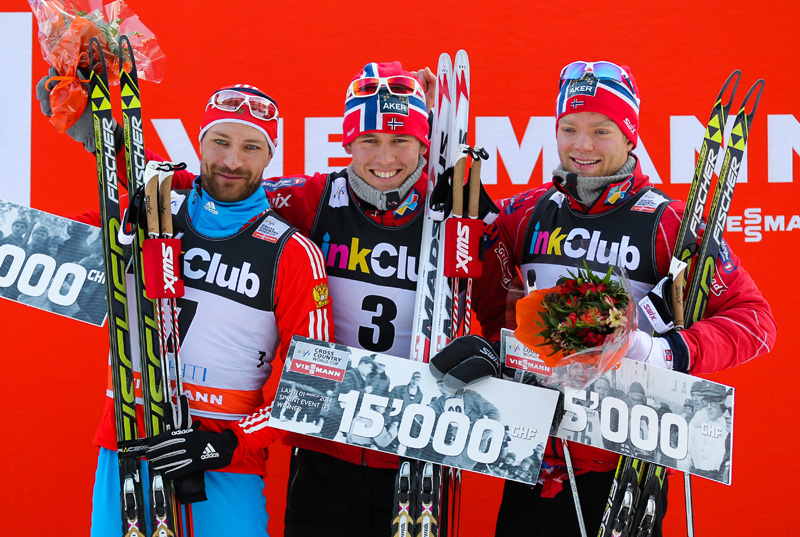
    Lahti World Cup men’s podium: (L-R) runner-up Alexey Petukhov (RUS), winner Pål Golberg (NOR), and third-place finisher Eirik Brandsdal (NOR) (Photo: Fischer/Nordic Focus)

    The World Cup returned to Lahti, Finland, on Saturday with a fast 1.55-kilometer sprint course through soft, artificial snow. With little climbing and a course that took just over two and half minutes for the men to complete, it favored the true sprinters, and those that could stay on their skis.

    In the first quarterfinal heat, Teodor Peterson of Sweden led the race from start to finish, wearing bib No. 1 as the fastest qualifier of the day, and never appeared to be under pressure. Behind him, and challenging for the second qualifying position, was Sergey Ustiugov of Russia who started intentionally slow but then quickly caught up. In the end, it was Germany’s Josef Wenzl who took second, with Estonia’s Peeter Kümmel in third.

    The second quarterfinal heat was led by the tall Swedish skier Johan Edin, who stumbled briefly as he skied over a rise, allowing Alexey Petukhov of Russia and Alex Harvey of Canada to move past him and finish in that order.

    The third quarterfinal heat saw Norway’s Sondre Turvoll Fossli push the pace for much of the race, no doubt trying to put distance between himself and sprint stars Ola Vigen Hattestad of Norway and Emil Jönsson of Sweden. Nevertheless, both Hattestad and Jönsson were faster than Fossli, who finished in third but was quick enough to earn a lucky loser place in the semifinals, along with Ristomatti Hakola of Finland.

    Finland’s Martti Jylhä lead most of the fourth quarterfinal race, until the final few hundred meters when Norway’s Haavard Solaas Taugboel, the second fastest qualifier, took the lead and outsprinted the finish duo of Jylhä and Matias Strandvall, who finished in second. Germany’s Sebastian Eisenlauer fell coming into the stadium nearly taking out Simi Hamilton of the U.S., who stumbled but didn’t fall to finish fourth in his heat.
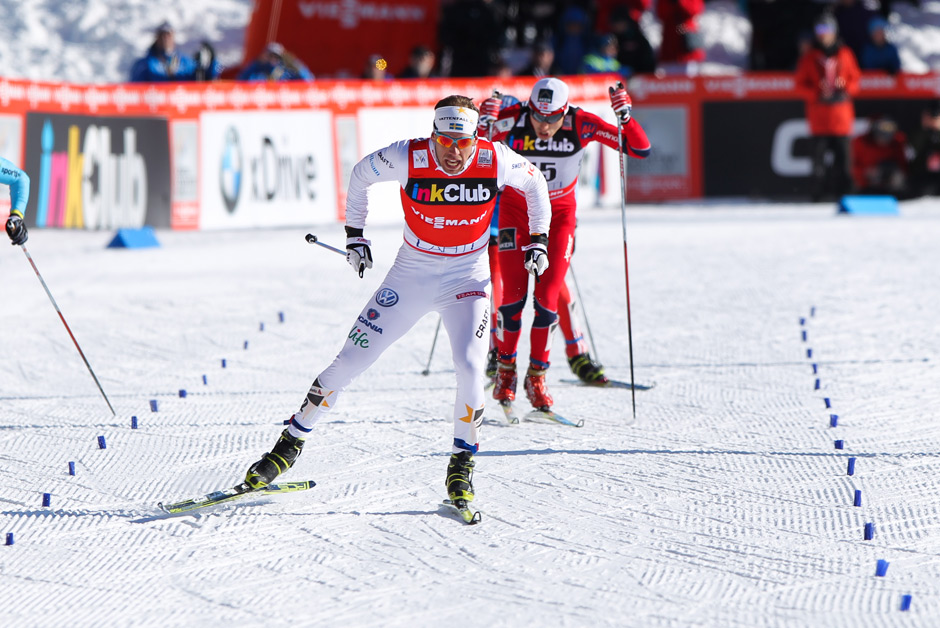
    Emil Jönsson. Photo: Fischer/NordicFocus
    Emil Jönsson. Photo: Fischer/NordicFocus

    The fifth and final quarterfinal promised to be a battle between Andy Newell of the U.S., Nikita Kriukov of Russia, and a four-man Norwegian contingent of Pål Golberg, Eirik Brandsdal, Finn Hågen Krogh, and Sindre Bjørnestad Skar.

    Trouble began, though, as soon as the gun went off. Kriukov, who was skiing to the left of Newell, took an early skating stride after leaving the double pole lane and his right ski went under Newell’s foot.

    With Kriukov’s right ski caught, the Russian was yanked back, spinning him clockwise and bringing his left ski directly into the path of Newell who was still on his feet. Newell lept high to avoid Kriukov’s sweeping ski, an impressively agile move that would have worked had his right ski not fallen off. Forced to turn around and reattach his ski, Newell was way out of contention as was Kriukov who tried, but was unable to recover from his early fall. The rest of the heat was a purely Norwegian contest with Brandsdal leading and taking first and Golberg in second.

    The first semifinal heat was led from the gun by Peterson, until just before the sharp left corner into the stadium where Petukhov cleverly cut into the lead. Behind the Russian were Peterson, Jönsson, and Harvey. Jönsson tried to move past Harvey on the inside lane and appeared to ski into the Canadian, sending Harvey wildly off balance and breaking Jönsson’s pole. Harvey regained himself, though not enough to advance to the finals. Petukhov won the heat and hurried off to prepare for the final, with Peterson finishing in second.

    It was a disappointing day for Jönsson, who has won the World Cup sprint race held in Lahti for the past three years. Jönsson was also looking for the opportunity to make history at his best venue by setting a new record for the most freestyle sprint victories. Currently he is tied with Tor Arne Hetland’s old record of seven wins, but with no remaining freestyle sprints on the World Cup calendar, Jönsson must wait until next season to try and break the record. Jönsson acknowledged his string of bad luck lately with a translated Twitter post that read, “Last three World Cup races, I have fallen / broken rod, in the Olympics, I stood up. Maybe will try to continue with that tactic #wisely #GrattisPål”
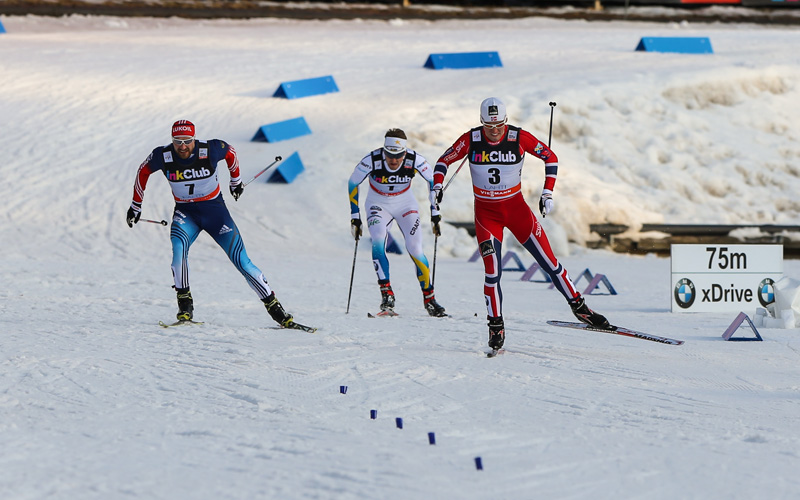
    FIS world cup cross-country, individual sprint, Lahti (FIN)
    Golberg, Petukhov, and Peterson at the finish. Photo: Laiho/NordicFocus

    The second semifinal heat was an all-Nordic affair, with four Norwegians and two Finns. Hattestad took early control of the heat, with Brandsdal and Golberg skiing alongside of him. Despite the Norwegians control of the race from the starting gun, the heat moved quite fast, with Hattestad and Brandsdal pushing the pace and finishing first and second, respectively. Behind them, Finland’s Strandvall closed his race with a strong burst of skiing after looking trapped behind the Norwegians for much of the race. Golberg finished fourth, but, like Strandvall, was fast enough for a lucky loser position.

    The final heat was led out of the gates by Peterson, who jump skated up the first slushy hill, and cornered tightly, controlling the race and keeping the pace high. Behind him at first was Strandvall, who was quickly passed by Hattestad who skied patiently behind Peterson, waiting for his opportunity.

    As the course gradually descended into the stadium through slushy snow, first Strandvall went down in the back of the pack, then an instant later, Hattestad fell skiing in second place. Both men appeared to fall simultaneously, and without cause or relation to each other. Brandsdal had to move out of the way of a falling Hattestad which put him slightly behind the now leading three of Peterson, Golberg, and Petukhov.

    In the final few hundred meters, Golberg stormed past a tiring Peterson who’s early efforts seemed to catch up with him. Petukhov tried to challenge Golberg but didn’t quite have enough power to match the 23-year-old Norwegian, and finished in second. Brandsdal, too, had a late burst of energy left and he managed to just get ahead of a steadily fading Peterson to take third, with the Swede in fourth.

    Strandvall applauded the Finnish fans in the stadium before shaking his head as he crossed the line in fifth. The good natured Hattestad smiled as he finished in fifth, looking a little amused and sheepish about his fall, and congratulated Golberg and Brandsdal on their results.
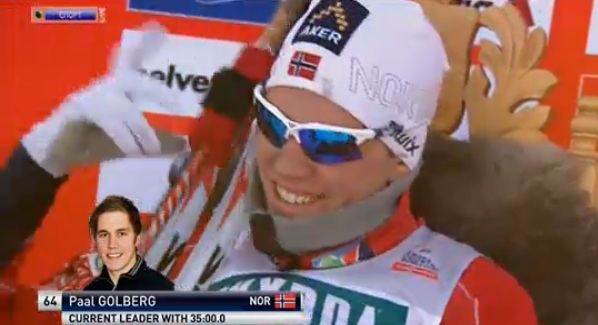
    Norway's Pål Golberg smiles while sitting in the leader's chair on Saturday, after watching Russian Alexander Legkov finish 22.2 seconds off his winning time in the 15 k classic individual start at the Lillehammer World Cup.
    Norway’s Pål Golberg in a race earlier this season.

    Golberg, for his part, appeared somewhat surprised at his victory and perhaps a little confused about how he should acknowledge it, as he skied a cool down lap in front of the stadium, stealing furtive glances at the crowd while the second place finisher Petukhov waved heroically to the crowd.

    Golberg won with a time of 2:32.29, Petukhov was 0.55 seconds behind, and Brandsdal was 1.3 seconds slower than Golberg.

    It was Golberg’s second career World Cup victory after winning Lillehammer’s 15 k classic race in December. Golberg told NRK after the race Saturday, “The way the victory came on today was probably a bit lucky, but such is skate sprinting, and today it was my turn.”

    Golberg told FIS, “It’s been a while since I won in Lillehammer. I was sick afterwards and out for almost a month. The Games did now work out well so I am happy to be back on the top of the podium today. It was a crazy final with two falls. I was bit lucky I could avoid a crash, but luck belongs to sport. For tomorrow I do not know what to expect from myself as I have not raced 15 km free a while.”

    Petukhov looked pleased with second place, and told FIS after the race, “Last two season have been quite difficult for me. Of course I am a bit disappointed I could not win but I am happy for the second place. The organizers did a great job with the course. It was quite soft but so it was also in other venues. I have to congratulate to Pål and Eirik. They are great athletes.”

    Brandsdal took the sprint leader’s bib today from Wenzl, who trails by a mere four points. Hattestad sits in third in the World Cup sprint standings, thirty points behind. With just two sprint races left in the World Cup, both in classic technique, it will be a close contest to see who hoists the crystal globe in Falun, Sweden, in two weeks time.

    Results

  • Valjas Rebounds from Illness with Eighth in Lahti

    Valjas Rebounds from Illness with Eighth in Lahti

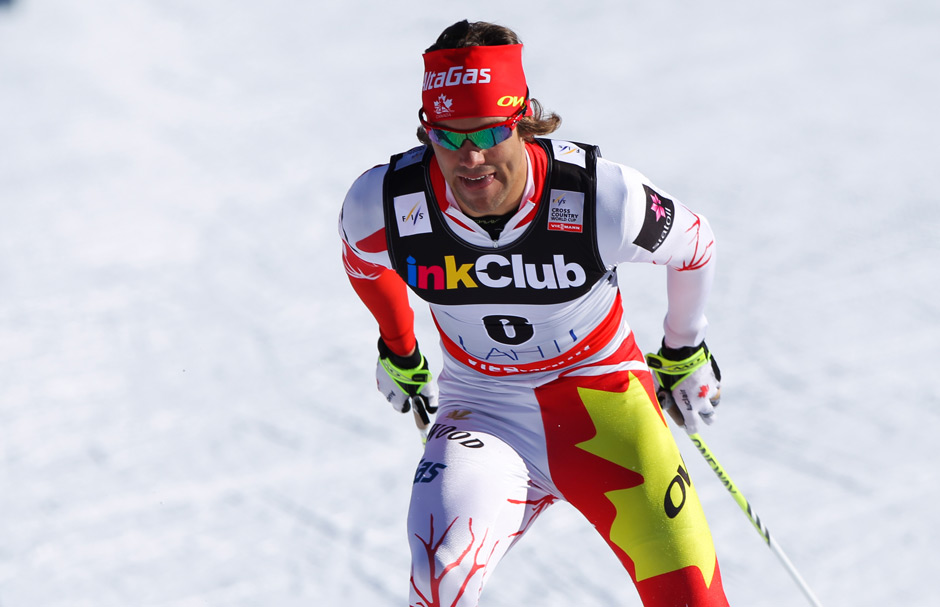
    Len Valjas (CAN) en route to a eighth-place finish in the freestyle sprint in Lahti, Finland, on Saturday. Photo: Fischer/Nordic Focus.
    Len Valjas (CAN) en route to a eighth-place finish in the freestyle sprint in Lahti, Finland, on Saturday. Photo: Fischer/Nordic Focus.

    Len Valjas (CAN) led the Canadian men on Saturday in Lahti, Finland, with an strong eighth place finish.

    His performance was just as fueled by frustration as it was fitness. Valjas toed the line today after a miserable run of sickness.

    “I was sick for nine days,” he said. “I had strep throat, then a chest cold, and laryngitis. It felt good to get out of bed.”

    The timing of the sickness couldn’t have been worse, as it forced him to sit out World Championships in Val di Fiemme, Italy, last week.

    “It sucked,” Valjas said. “We planned for two years for worlds, but that stuff happens. And now all I can do is have a good spring.”

    Prior to the World Championships, Len showed strong signs of form in Davos, notching a sixth place finish. Twenty-one days hence, in a different technique, a strong result was anything but assured. Valjas, however, was quietly confident.

    “I know the shape is there, I felt good in Davos before worlds. All I did at Worlds was rest.”

    Valjas delivered a strong qualification, finishing in 2:26.37, just 1.85 seconds off the pace of frontrunner Gleb Retivykh (RUS).

    The course, just 1.55 k long, favored pure sprinters, in contrast to the longer courses on the circuit like Sochi or Davos.

    “It was a short, fast course — a real sprint course,” Valjas said. “It was a nice change from Sochi and a few of the other ones that were super long.”

    The track, lacking steep walls or a decisive climb, demanded a strong V2 and V2-alternate rather than a dynamic V1. Valjas, who missed out on Quebec’s gentle terrain, welcomed the change in profile.

    “I like the fact that the hills aren’t that steep, so it’s a lot of 1-skate,” he said. “It’s nice having a skate sprint on a gradual course.”

    The shortened, narrow track favored a strong start. Valjas was seeded in the third quarterfinal heat, and the start was full gas right from the gun.

    “The quarterfinal was crazy fast,” Valjas said. “I had two Norwegian distance skiers in my heat, so they knew their only way to get through was to push the pace. It was surprisingly fast and it made me a bit tired.”

    Sindre Skar (NOR) took the pace right from the gun along with compatriot Finn Hagen Krogh (NOR). Vajas kept his head and settled into fourth position leading into the first hill.

    Over the roller, Valjas ate up the track and closed the space on the charging Norwegians, but fell back going through the switchback leading into the finish.

    Instead of fading in the final stretch, Vajas charged. “I had a good kick in the last 100 meters of the quarterfinal and I was able to go from fifth to third,” he said.

    Finn Haagen Krogh took the quarterfinal, with the trio of Jovian Hediger (SUI), Valjas and Skar stretching for the line just behind in a photo finish. Valjas was awarded third place for his lunge and a lucky loser position.

    It was a last-grasp effort to get through, but Valjas was pleased, saying, “My legs were heavy for the semifinals, but I was happy to get that lucky loser spot.”

    In the semifinal Valjas was seeded in the far lane and pitted against Retivykh, the qualification winner, a resurgent Ola Vigen Hattestad (NOR), hard-charger Jovian Hediger (SUI), and outsiders Anton Lindblad (SWE) and Nikolay Morilov (RUS).

    The fatigue of Valjas’s quarterfinal charge immediately manifested itself.

    “In the semifinals my legs felt a bit heavy, so I was stuck at the back again, my usual spot,” Valjas said.

    On a longer course, a slow start can be remedied. On Lahti’s course, a slow start is usually fatal. Hattestad assumed leadership duties from the start, and Valjas drifted to the back of the pack.

    Into the switchback leading into the finish Valjas trailed in last postion without enough track to reclaim some places.

    “The finishing straight was just not long enough for me to get the top two guys,” Valjas said.

    Valjas was awarded fourth place after a photo finish with Nikolay Morilov.  The heat finished in 2:25.21, which wasn’t fast enough to get through to the final, ending Valjas’s day.

    With an eighth place finish, the Canuck moved up to sixth overall in the World Cup sprint standings with 198 points, just 12 points behind Dario Cologna (SUI).

    “I’m happy with today’s race,” Valjas surmised. “I moved up in the overall. I’m sixth in the overall, so I’d like to hold on to that in the next two sprints.”

    Canadian national team coach Louis Bouchard was pleased with Valjas’s performance.

    “It was really good for Lenny,” Bouchard told FasterSkier. “It was a good race. He did well in qualification, he was strong. He was missing a little, but it was good, definitely.”

    Valjas won’t take part in tomorrow’s 15 k classic examination. He’ll rest up in preparation for Wednesday’s sprint in Drammen, Norway.

    Fellow Canadians Jesse Cockney, Alex Harvey, and Graeme Killick also took part in Saturday’s race, but failed to qualify for the heats.

    Cockney was subdued in his assessment of his race, saying, “the qualifier was really close to perfect, I maybe didn’t feel amazing but I had a good warmup and parts of the course felt really strong. The short course was good but I would have preferred more climbing.”

    Cockney was the next-best Canadian behind Valjas, finishing in 50th place in a time of 2:30:46, 5.94 seconds off the pace.

    Alex Harvey, the recent World Championships bronze medalist in the classic sprint, finished 56th place but was unavailable for comment at press time. He finished in 2:31.34, 6.82 seconds out of first.

    Bouchard expected as much, saying, “Alex knew a little bit before that it was a really short sprint. He’s never been good there. He needs a long sprint to be good.”

    Harvey will take part in the individual 15 k classic tomorrow.

    Michael Somppi finished the qualifier in 74th position. The 24-year-old was not happy with his performance.

    “The race didn’t go well,” Somppi said via email. “I felt good warming up and thought I skied the first half OK, but some nervous tension got the better of me over the second half of the course.”

    Somppi will be racing on Sunday and looks to get more comfortable on the World Cup circuit.

    “I think my form is as good as it’s been all season and I just need to get past the nervous feelings of racing World Cups in Europe.  I am racing tomorrow and hope to get more comfortable in a World Cup racing bib,” Somppi said.

    Notable absentee Devon Kershaw won’t race in Lahti, and is taking the weekend in order to recuperate after a tough world championships.

    “Devon is not here,” coach Bouchard said. “The strategy for him is to take some rest before the final World Cups. We think the rest and recovery time for him will be good for the rest of the winter. He will be in Drammen.”

    Results

    — Audrey Mangan contributed reporting.

  • Despite Fatigue, Randall and Hamilton Post Top Finishes in Lahti Sprints

    Despite Fatigue, Randall and Hamilton Post Top Finishes in Lahti Sprints

    Kikkan Randall (USA) crosses the line in the finals. Photo: Fischer/Nordic Focus.

    The Lahti Corner — the notoriously sketchy 180-degree downhill hairpin that stumps many experienced World Cup skiers every season — lived up to its reputation on Sunday in the third-to-last sprint of the year. If it wasn’t taking out several athletes at once, it was otherwise dictating tactics and forcing skiers into awkward snowplows around its icy arc.

    For Kikkan Randall, who led the Americans in fifth, the corner’s penchant for carnage necessitated extra attention in preparation. The sprint specialist scouted out potential lines around the turns during her warm up, which in competition translated to her using the corners to make up ground on her competitors.

    “I was really enjoying them,” Randall said.

    After notching the fifth-fastest qualifier, Randall skied a flawless quarterfinal. She pulled away from a field before the corner, opening a gap on Charlotte Kalla (SWE) before dropping into the stadium.

    In the semis, Randall closed down the early lead that Justyna Kowalczyk (POL) put on her competitors, again making up ground around the technical corners to come in second and advance to the last round.

    When it came time for the final, Randall said she was simply too fatigued to hang with the leaders, and crossed the line in fifth 7.1 seconds behind the winner, Marit Bjørgen (NOR).

    As the top-ranked sprinter on the World Cup with multiple podiums this season, anything outside the top three might seem like a let-down by comparison. But Randall said that overall, she’s satisfied with her race.

    “I felt strong all day — got a little tired in the final,” Randall said. “But overall I think it was very important for overall standings.”

    U.S. Ski Team Head Coach Chris Grover agreed.

    “She went out and did exactly what she needed to do,” he said.

    Randall now sits 138 points ahead of Natalia Matveeva (RUS) at the top of the World Cup sprint standings, but as she moves into the final two sprints of the season — both classic — she said she’s trying not to think too much about rankings.

    The rest of the U.S. women didn’t fare quite as well. Ida Sargent was the next American across the line in 52nd, Holly Brooks was 54th and Jessie Diggins finished 66th.

    “I don’t think Ida felt her skis gave her enough kick,” said Grover. “She liked them warming up, but not during the race.”

    He said Brooks still isn’t feeling totally “on” since arriving back in Europe after winning the 50 k American Birkebeiner.

    As for Diggins’ uncharacteristic 66th: “My head just wasn’t in it at all,” she wrote in an email. “I don’t have any excuses; the wax was great, skis were great, I just wasn’t having a good race today.”

    A solid day's work for Simeon Hamilton (USA) in Lahti (FIN). Photo: Fischer/Nordic Focus.

    On the men’s side, the U.S. showing was headlined by Simi Hamilton’s 11th-place finish, a career best in classic sprinting.

    “It was a great day,” Hamilton said. “I don’t really have much experience classic sprinting at this level so I’m really psyched to have qualified well, and the conditions definitely suited me.”

    The snow in Lahti was “fast, icy, and hard-packed” — conditions in which Hamilton feels he usually skis best.

    After posting the 13th-best qualifier, Hamilton lined up for the quarterfinals against what ended up being one of the fastest fields. The group, which included Swedish sprinters Simon Persson and Robin Bryntesson, was tightly packed even through the stadium.

    Hamilton appeared boxed out as they came around the corner into the final straightaway, but a strong final double-pole surge and lunge for the line gave him a photo-finish for second with Bryntesson. His lunge wasn’t quite good enough to automatically advance him, but Hamilton’s was the fifth and final quarter to run, and he made it through as the lucky loser.

    “I worked a lot this summer on really steep striding — quick, light on my skis — and there were points on the course I really had to do that,” said Hamilton. “I made the most of that climb.

    The sprint course in Lahti starts with a long ascent that forced many to break into a herringbone for the final few strides.

    Grover said Hamilton had been striding the climbs well all week.

    “He’s been really flying up the big steep hill, and that’s what he did in his quarter,” said Grover.

    For his semifinal, in which Hamilton finished sixth, “I just ran out of gas,” he said.

    Up the long, gradual climb out of the start, Hamilton was positioned on the inside. A 180-degree turn waited at the top, and skiers cut to the best line in anticipation, squeezing Hamilton until he was practically on top of the course barriers.

    “I definitely got caught on a V-board, but it wasn’t an important part of the course,” he said. “I wasn’t too worried.”

    But the effort of his quarterfinal minutes earlier had him spent for the remainder of the round.

    “I was definitely feeling the effect of skiing so hard right before,” he said.

    It had initially been unclear whether Hamilton had the first- or second- fastest lucky-loser time, which determined the semifinal he skied in. He soon learned that his time was fastest, and had the duration of the women’s semis to get ready to go again.

    “It was a really quick turnaround between my quarter and my semi,” said Hamilton.

    Regardless, he was happy with 11th, which is a classic sprint career-best.

    “It was definitely one of my big goals to not leave Europe without having qualified for one classic sprint, so I’m psyched to get that done especially after so many close calls early in the year,” he said, alluding to the two other classic sprints this season in which he finished outside the rounds in 33rd and 34th.

    Andrew Nevell (USA) fell victim to Lahti Corner in the quarterfinals. Photo: Fischer/Nordic Focus.

    Andy Newell was the only other American to make the heats, and he got knocked out in the quarters to finish 15th overall. He and Kent Ove Clausen (NOR) fell victim to Lahti Corner and took each other out, each falling on the ice. Newell managed to recover and finish third in his heat, 2.6 seconds behind Nikolay Morilov (RUS).

    “It was a bummer, but I felt good climbing and double poling,” said Newell.

    Newell was in third coming into the corner right behind Clausen. When Clausen put on the brakes for the hairpin, Newell made the split-second decision to try to ski on his inside rather than go wide, and didn’t quite make it.

    “It was just as much my fault as his,” Newell said.

    Behind Hamilton and Newell, the U.S. entered every man they could have. Sylvan Ellefson was 62nd, Mike Sinnott was 81st, Noah Hoffman finished 84th and Kris Freeman was 85th.

    Sinnott and Freeman both fell in their qualifiers.

    “I fell right in the stadium at the start,” Sinnott wrote in an email. “As the start track joined the heat tracks, I changed lanes, put my pole between my legs, and fell. Super classy.”

    The World Cup moves to Norway next week, beginning with the Drammen classic sprint on Wednesday and distance races in Oslo the following weekend.

    Women’s results

    Men’s results


  • Jönsson Finds Winning Form Again in Lahti; Swedes Take Top Two

    Jönsson Finds Winning Form Again in Lahti; Swedes Take Top Two

    Emil Joensson (SWE) takes top accolades in Lahti, Finland. Photo: Fischer/Nordic Focus.

    Emil Jönsson needed this. He had been sick for too long, without a top 10 result since December and mostly out of contention for a World Cup podium since the end of last season.

    Two weekends ago at the freestyle sprint in Szlarska Poreba, Poland, the Swede was 62nd. That was behind him. This was Lahti, Finland, where he won the classic sprint last year. With some of the trickiest descents on the World Cup, it was a whole different ballgame.

    Sunday started off as good as Jönsson could have planned as he won the 1.4 k classic sprint qualifier by nearly three seconds in 3:09.31, ahead of Kent Ove Clausen of Norway (+2.89).

    Another celebration for Joensson. Photo: Fischer/Nordic Focus.

    The day got even better for the 26-year-old. Jönsson was the clear-cut winner of both his quarterfinal and semifinal, beating runner-up Ola Vigen Hattestad (NOR) by 0.9 seconds in the first round. He went on to edge teammate Teodor Peterson – the World Cup sprint leader – by 0.7 seconds in the semi.

    In the final, Jönsson again stole the spotlight from his fellow Swede after Peterson led for most of the race. Jönsson somehow stayed on his feet on the infamous 180-degree final turn and charged behind Peterson.

    He had nearly collided with Russia’s Nikita Kriukov, but the two came out of the hairpin corner upright and instantly picked up the pace. Both wanted to close on Peterson, but it was Jönsson’s time.

    At precisely the right moment within a few feet of the line, Jönsson lunged ahead to upset Peterson by an inch or so. The victory was his first on the World Cup since winning a classic sprint in Stockholm nearly a year ago.

    “I am speechless,” Jönsson told FIS News. “I had so many difficulties in the past weeks and today I am back on the top. I did not believe that this is possible.”

    With the way the qualifier went, he guessed the rest of the afternoon might go as well. But after two years of injuries and illness, he couldn’t be too sure. A torn leg muscle derailed the start of his season in November and early December.

    Back in Lahti, he was far from confident to start.

    “I have never been this nervous before the race because my shape has not been good,” he said. “Now everything is a relief to be able to be up there again. I’m empty now.”

    Peterson, who was second, increased his World Cup sprint lead to 114 points. Russia’s Nikolay Morilov moved up to second in the sprint standings ahead of teammate Alexey Petukhov. Morilov was eighth on Sunday and Petukhov did not advance after ranking 48th in the prologue.

    Kriukov, Russia’s defending Olympic sprint champion, placed third. Closely trailing Peterson into the last corner, Kriukov widened his stance to keep from falling. Jönsson narrowly missed crashing into him by veering inside.

    When they came out unscathed and entered into the stadium, Jönsson was already in front.

    “The final heat was tough,” Kriukov told FIS News. “I had good speed and was fast, but the Swedish did a bit a team tactic so we had some difficulties in the curve in the downhill. At the end I took the third place and be happy to be on the podium.”

    Ola Vigen Hattestad (NOR) congratulates the winner Emil Joensson (SWE). Photo: Fischer/Nordic Focus.

    It was Kriukov’s third time in the top three this season. For Peterson, it marked his sixth individual World Cup podium. He placed fourth in Sunday’s qualifier after Norway’s Eirik Brandsdal finished in third.

    After Peterson comfortably won his quarterfinal by topping Siim Sellis (EST), who went on to place 10th went, the sprint leader decided to ski behind Jönsson in the semis. Doing so, he avoided trouble while Kriukov nearly fell on the sharp turn, but hung on in third and advanced to the final by time.

    In an interview with FIS after the race, Peterson said he strayed from his usual tactics of sitting back and pouncing late. Instead, he went out hard from the start of the final, pushing the pace on the initial climbs. It didn’t exactly work as Jönsson challenged him to the line, but he wasn’t too upset.

    “I am satisfied about my second place and also happy for Emil who had so many difficulties so far,” Peterson said.

    Hattestad came through in fourth and Sami Jauhojaervi (FIN) placed fifth. Norway’s Gleb Retivykh tried to set a blistering pace early on in the final, but blew up and finished sixth.

    Retivykh won his quarterfinal and semifinal, edging Jauhojaervi in the semi by 0.2 seconds. Fabio Pasini (ITA) was third in the heat for seventh overall. Kriukov and Hattestad advanced as lucky losers out of the faster previous semifinal.

    Morilov won the fourth quarterfinal ahead of Pasini in second and Andy Newell (USA) in third. Newell took the inside line of the final corner and fell, taking Clausen down with him. He ultimately placed 15th while Clausen ended up 26th overall.

    Simon Persson (SWE) came out on top in the fifth quarter, with teammate Robin Bryntesson advancing as well. Simi Hamilton (USA) finished just after, 0.1 seconds behind Persson, to advance by time. Persson went on to finish ninth, Hamilton was 11th and Bryntesson was 12th.

    Men’s overall results


    Men's podium: (l-r) Teodor Peterson (SWE), Emil Joensson (SWE) and Nikita Kriukov (RUS). Photo: Fischer/Nordic Focus.