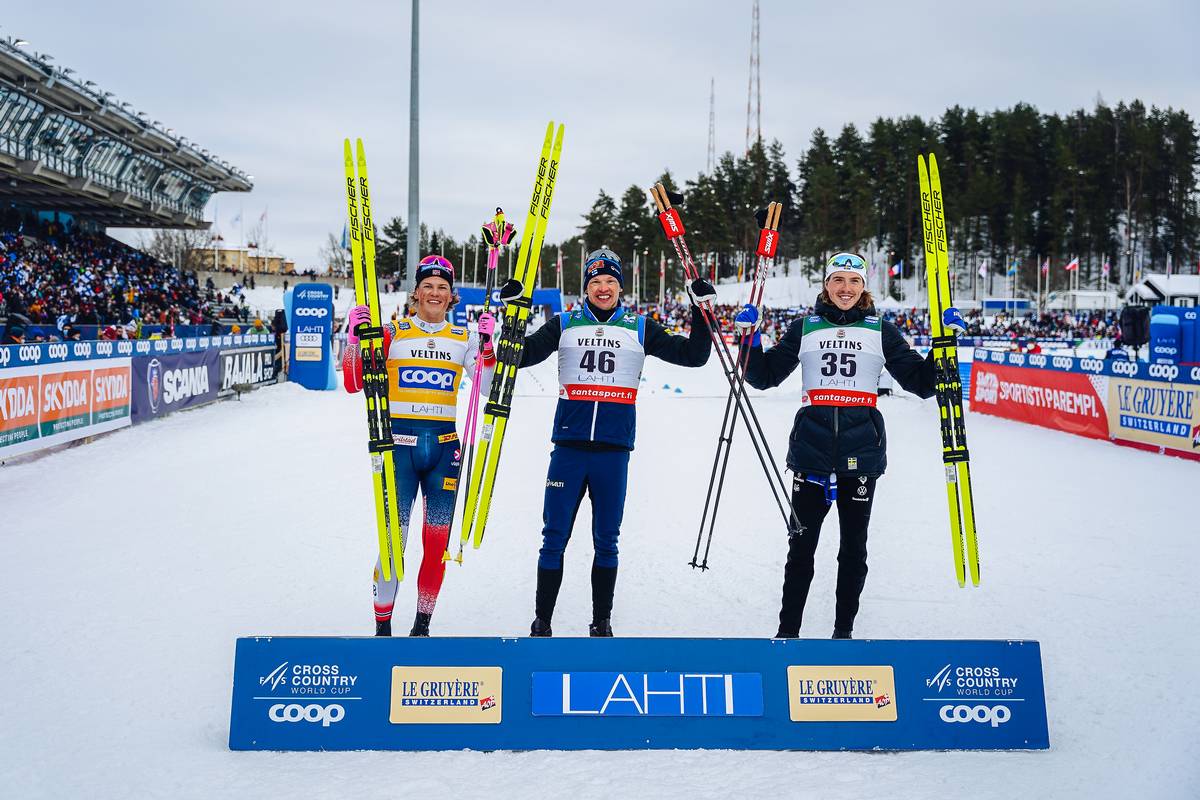
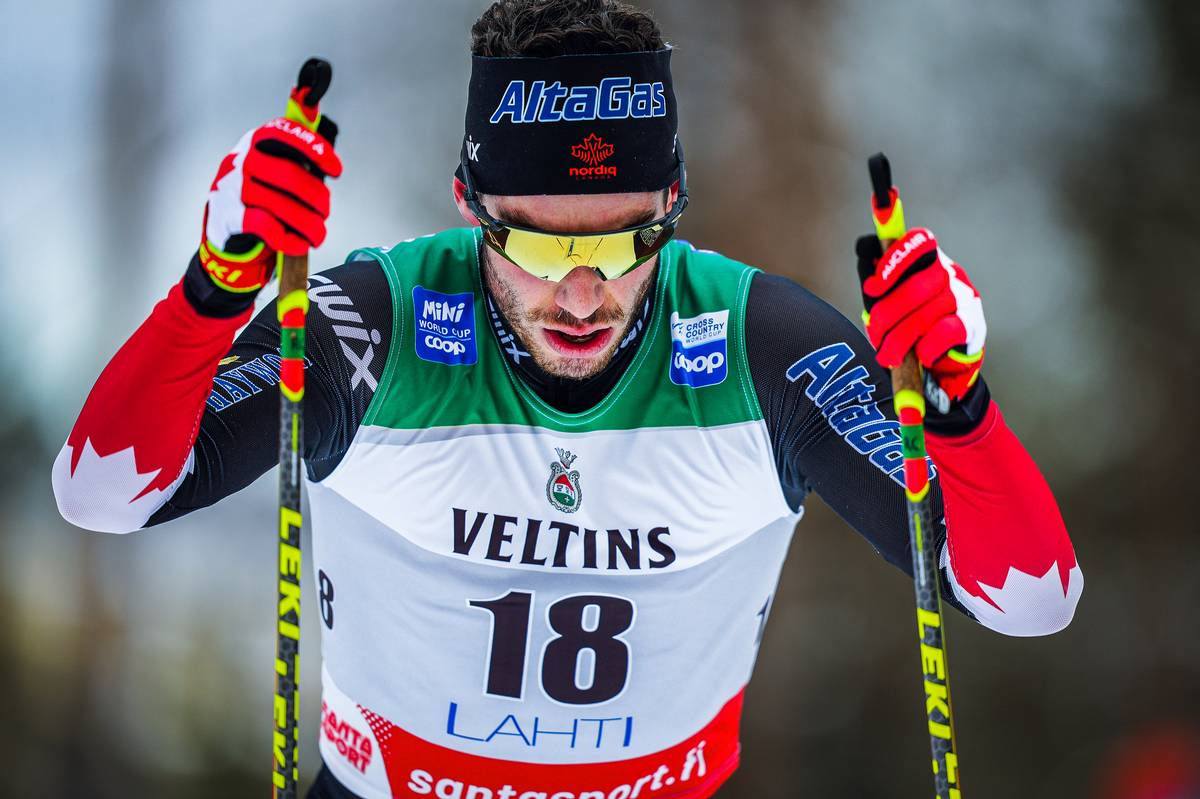
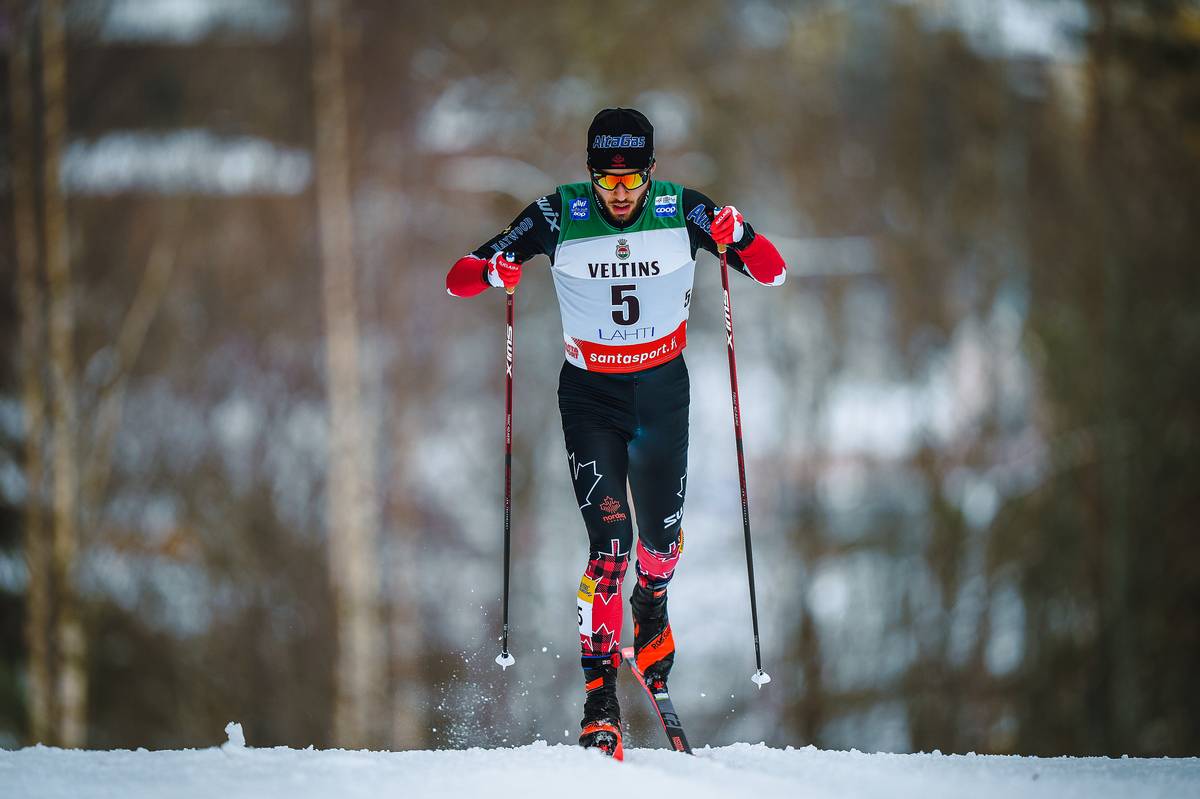
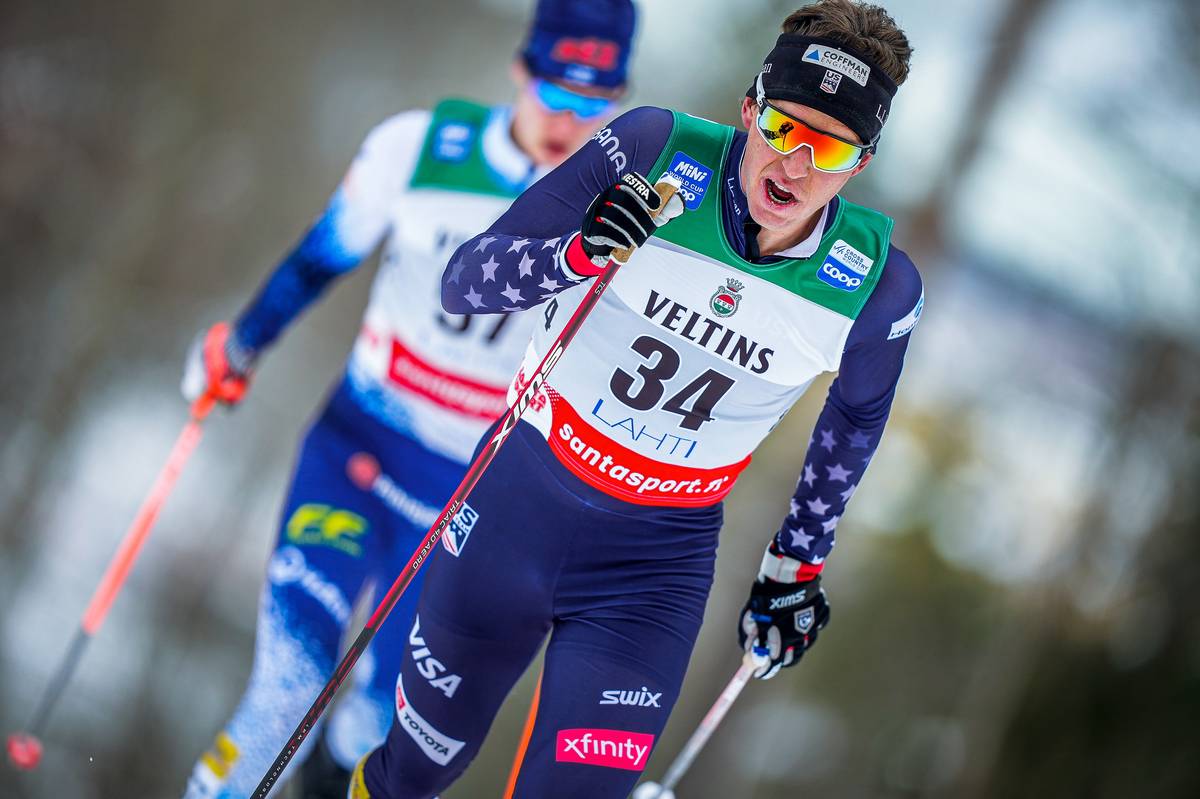
From the FasterSkier archive — posts syndicated from athletes’ and coaches’ own blogs between 2004 and 2012, kept online as published. Current coverage is at fasterskier.com.
The International Ski and Snowboard Federation (FIS) unveiled its proposed 2026/2027 cross-country skiing World Cup calendar this week at the FIS Spring Meetings in Portorož, Slovenia.
The schedule — first shared publicly through FIS social media and still pending FIS Council approval — builds the season around the 2027 World Championships in Falun, Sweden, with three pre-Christmas stops, a nine-race Tour de Ski, a stretch of three weekends between the Tour and Worlds, and a Scandinavian closing kick that ends with the Finals in Ulricehamn.
For North American fans, the calendar is once again entirely European, with no scheduled stops in Canada or the United States.
Frida Karlsson (SWE) poses with Mr. and Mrs. Claus following the 10k Classic to start last season in Ruka (FIN). (Photo: Modica/NordicFocus)
Pre-Holiday: Ruka, Trondheim, Davos
The season opens where it almost always does — in Ruka, Finland, where the World Cup begins November 27. From there, the circuit moves to Trondheim, host of the 2025 World Championships, before the pre-Christmas block closes in Davos, Switzerland, with a team sprint.
November 27-29, 2026: Ruka, Finland
27/11: 10km Interval Start Classic
28/11: Sprint Classic
29/11: 20km Mass Start Freestyle
December 1-3, 2026: Trondheim, Norway
01/12: 10km Interval Start Classic
02/12: Sprint Freestyle
03/12: 20km Skiathlon
December 11-13, 2026: Davos, Switzerland
11/12: 5km Heat Mass Start Freestyle
12/12: Sprint Freestyle
13/12: Team Sprint Freestyle
With Jessie Diggins (USA) now retired, there will be a new FIS Overall Crystal Globe and Tour de Ski champion next season (Photo: Vanzetta/NordicFocus)
Tour de Ski 2026/2027
The Tour de Ski returns to a three-country format, opening in Les Rousses, France, on New Year’s Day, moving to Oberstdorf, Germany, and finishing with three races in Val di Fiemme, Italy — capped, as ever, by the Final Climb up Alpe Cermis.
January 1-3, 2027: Les Rousses, France
01/01: Sprint Classic
02/01: 20km Mass Start Classic
03/01: 15km Pursuit Freestyle
January 5-6, 2027: Oberstdorf, Germany
05/01: 15km Mass Start Classic
06/01: 5km Heat Mass Start Freestyle
January 8-10, 2027: Val di Fiemme, Italy
08/01: 15km Skiathlon
09/01: Sprint Freestyle
10/01: Final Climb
Gus Schumacher (USA) and the rest of the US team will hope to continue their success in Toblach (ITA). (Photo: Modica/NordicFocus)
After the Tour, Before Worlds: Engadin, Toblach, Lahti
Three weekends bridge the Tour de Ski and the World Championships. Engadin opens its weekend with a mixed relay — a format the FIS has been working into more World Cup weekends — and Lahti closes the pre-Worlds stretch with its classic 20km skiathlon and 10km interval start.
January 22-24, 2027: Engadin, Switzerland
22/01: Mixed Relay
23/01: Sprint Freestyle
24/01: 20km Mass Start Freestyle
January 29-31, 2027: Toblach, Italy
29/01: 10km Interval Start Freestyle
30/01: Sprint Freestyle
31/01: 20km Mass Start Classic
February 12-14, 2027: Lahti, Finland
12/02: Sprint Classic
13/02: 20km Skiathlon
14/02: 10km Interval Start Classic
Kendall Kramer (USA) had a breakout World Cup Skiathlon in Falun (SWE) last season. (Photo: Authamayou/NordicFocus)
2027 FIS Nordic World Ski Championships: Falun, Sweden
The 2027 FIS Nordic World Ski Championships run from February 22 through March 7 in Falun, Sweden, with all title formats on the program. Falun last hosted Worlds in 2015.
Final Period: Oslo, Drammen, Ulricehamn
The closing stretch is a Scandinavian one. Oslo’s Holmenkollen weekend features back-to-back 50km mass start classic races on March 13 and 14 — long a fixture of the late-season calendar — before a one-day sprint stop in Drammen and the World Cup Finals in Ulricehamn, Sweden.
March 13-14, 2027: Oslo, Norway
13/03: 50km Mass Start Classic
14/03: 50km Mass Start Classic
March 16, 2027: Drammen, Norway
16/03: Sprint Classic
March 19-21, 2027: Ulricehamn, Sweden (World Cup Finals)
19/03: 10km Interval Start Freestyle
20/03: Sprint Freestyle
21/03: 20km Mass Start Classic
The calendar remains subject to FIS Council approval.
This coverage is made possible through the generous support of Marty and Kathy Hall and A Hall Mark of Excellence Award. To learn more about A Hall Mark of Excellence Award, or to learn how you can support FasterSkier’s coverage, please contact info@fasterskier.com.
LAKE PLACID, New York (March 21) — As the snow settled on Lake Placid and clouds began to dissipate over Mt. Van Hoevenberg, a growing sense that something momentous could happen permeated the crowd assembling for the last Sprint of the 2025-26 World Cup.
That something unusual would happen was assured. With the Sprint Globe already secured to Johannes Høsflot Klæbo, the golden-haired juggernaut would not be on the starting line – opting instead to rest his legs, and head, in hopes of defending his 12-point lead over Harald Østberg Amundsen in the Distance standings. By default, then, someone other than Klæbo would stand atop Saturday’s podium – a rare occurrence in a season where the Norwegian had already won 8 of 11 Sprints in commanding fashion. (Two wins evaded Klæbo due to falls; the third because he did not start in Oberhof).
Who would take his place? Ben Ogden, the Northeast’s homegrown favorite and the Sprint silver medalist in Milano-Cortina? Gus Schumacher, Ogden’s partner in the Olympic Team Sprint? France’s embattled specialist, Lucas Chanavat, who appeared on track to rival Klæbo during the 2023-24 season, who had seized the opportunity – and the win – after Johannes’ bobble in Davos last December? Ansgar Evensen (NOR), who had done the same in Drammen?
Or, perhaps, it would be Federico Pellegrino (ITA) – the 35-year-old elder statesman of the league; making his 344th (and penultimate) World Cup start, eyeing an 18th and final Sprint victory?
Johannes Hoesflot Klæbo (NOR) and Federico Pellegrino (ITA) after the finish of the Finals in Davos, 2022. Pellegrino bested Klæbo on the eve of the birth of his first child. (Photo: Nordic Focus)
It states the obvious to say that success in cross-country skiing is a matter of timing, and for “Chicco Pelle’s” 15 seasons, the timing had been just shy of right. The formative and final years of Pellegrino’s career were defined by the dominance of skiers other than he. Pellegrino made his World Cup debut in Drammen in March 2010, finishing 49th. The winner that day was Emil Joensson (SWE); runner-up was Petter Northug (NOR), then on his way to his first of two Overall Globes. These were the halcyon days in which Dario Cologna (CHE) descended from his Alpine fastness to rack up World Cup and Tour de Ski titles; when Northug, Joensson and Marcus Hellner (SWE) traded sprint victories and taunts in a bitter intra-Scandinavian rivalry. Pellegrino was 12th in his first World Championships Sprint (Oslo, 2011) and 11th at his first Olympic Sprint (Sochi, 2014).
While notching his debut victory in December, 2014 in the Davos Freestyle Sprint, Chicco’s break came in the 2015-16 season. He won 5 of 13 sprint races, becoming the first non-Scandinavian male to win the Sprint Globe. As Pellegrino hit his stride, Northug’s star was showing its first flickerings ahead of a dramatic waning, Joensson had entered the twilight of his career, and although Sergey Ustiugov (RUS) was approaching his own prime, the factious cast of World Cup sprinters was looking for a new leading man.
That man would not be Chicco. An upstart dramatist from Trondheim, Johannes Høsflot Klæbo, had arrived to script skiing’s long, and mind-bogglingly successful, next chapter. After making his debut in Drammen in 2016, Klæbo outscored Pellegrino in the 2016-17 Sprint standings, taking his first of 8 (and counting) Sprint Globes. The two went head to head at the 2017 World Championships in Lahti, Finland, where Pellegrino surged from behind to claim his first World Title ahead of a legendary lineup, including Ustiugov, Klæbo, and Northug, but this maiden gold would also be his last. In Pyeongchang the next year, the Olympic gold went to Klæbo; Chicco brought home silver.
The wins did keep coming for Chicco, including a tear of three consecutive Sprint victories and his second Sprint Globe in 2020-21. And, though they admittedly came in greater abundance to Klæbo (who, it should be noted, did not start in those races, or the 2020-21 Tour de Ski), it is rather glib to assert that Chicco’s career had slid “in[to] the shadow of” the Norwegian. Pellegrino bested Klæbo in Dresden and Lahti in the spring of 2018; in Lillehammer that winter; and in Davos in 2022. He was near-omnipresent on Sprint podiums and won his second Olympic silver in Beijing in 2022; moreover, he was among the very few men who could disrupt Klæbo’s dominance in the discipline, and the clear favorite when Johannes was absent.
But Pellegrino’s win in Davos in December 2022 marked the beginning of a long, and perhaps self-inflicted, World Cup drought. Chicco declared his intention to focus on distance races ahead of Milano-Cortina, and did indeed record four such podiums in classic, skate, and skiathlon formats, alongside a welter of Sprint podiums – including an ecstatic World Championships silver in Trondheim in 2025, and Olympic bronzes on home soil in the Team Sprint (alongside Elia Barp) and in the 4 x 7.5 k Relay (which he described as “the proudest day of [his] life!”) this February.
Elia Barp welcomes Federico Pellegrino to a bronze-medal finish in the Olympic Team Sprint in Milano-Cortina, February 18th, 2026. (Photo: Vanzetta/Barbieri/NordicFocus)
Outright wins, however, were not forthcoming. By the time March 21, 2026 arrived in Lake Placid, it had become Pellegrino’s last, best chance to secure one more Sprint victory.
Anticipation and emotions ran high. While Pellegrino had been impervious to the crowd in Friday’s 10 k Classic – earbuds deadening the world beyond his blue racing cap during warmups, and his face a deaf mask of exertion during the race – their excitement overwhelmed him on Saturday. During his first warmup lap, he skated calmly up the course’s A-Climb through a chorus of “CHI-CCO, CHI-CCO, CHI-CCO.” On his second, the frenzied chant began again, and the gravity of the impending race dragged him to a halt. His skis splayed wide against the pitch; he buried face in his hands. “The energies I got in the Final were coming from the warmup lap, where I stopped in the middle of the climb, crying,” Pellegrino told me at the finish line. “I think the public deserved this kind of show, and I deserved to finish my career, with a Sprint skate like this.”
Pellegrino embraces the crowd ahead of Sprint qualifying in Lake Placid. “The energies I got in the Final were coming from the warmup lap, where I stopped in the middle of the climb, crying.” (Photo: Thibaut/NordicFocus.)
To reach that final finish line, however, was a perilous journey.
After qualifying second, Pellegrino sidestepped two falls (the first from Jules Chappaz (FRA); the second from Elias Keck (GER)) in his Quarterfinal, moving from sixth to first in the course’s final descent and level hairpin. In Semifinal 1, he attempted to close on Lucas Chanavat (FRA) and Anton Grahn (SWE) through the crest of the A-Climb but couldn’t get by; pushed to the outside on the level hairpin, he was out-lunged by Lars Heggen (NOR) in the final meters, finishing third by 0.03.
While the Lucky Loser spot was Chicco’s to lose heading into Semifinal 2, Erik Johansson (SWE), Harald Amundsen (NOR), and Even Northug (NOR) lost time playing for a slipstream position as they approached the top of the A-Climb. Pellegrino was on to the final by a comfortable margin.
Lars Heggen (NOR) outlunges Federico Pellegrino (ITA) by 0.03 in Semifinal 1. Federico moved on to the Final as a Lucky Loser. (Photo: Thibaut/NordicFocus)
Once more around the track, and the day could be his. After being fourth out of the gate, he attacked from the outside on the B-Climb; breaking into an aggressive V-2 and taking Chanavat and Heggen by surprise, he moved into second behind Grahn. The pace increased again at the base of the A-Climb, but where Grahn and Chanavat’s broad frames moved up the hill in sweeping, powerful strokes, Pellegrino leapt into a furious V-1.
The move was decisive. To the adulation of the crowd, he opened a decisive gap through the crest of the climb. His lead only grew through the final descent into the level hairpin, but Chicco was taking no chances. While Grahn and Heggen grappled for second behind him, Pellegrino hammered to the line, threw his arms wide and his head back, roaring with the crowd.
An 18th victory and 46th career podium, clinched.
Federico Pellegrino secures his 18th and final World Cup victory. Lake Placid, March 21, 2026. (Photo: Thibaut/NordicFocus)
What had happened in the Semifinal, when this triumphant last dance had nearly evaded him by three hundredths of a second? And what had changed for the Final?
“I could not do what I did in the Final, because the energies of the other athletes were still quite big,” Chicco admitted our post-race interview. “About the last downhill, I was not the same as the others. I am not, I know, but I have some different qualities, and if I could get quite good gap in the top of the uphill, then I knew that I could keep it until I end. This is what I did. This is how I loved to win all along my career – not wait until the last meter, but trying before.”
“Sometimes it happened, mostly before Klæbo came,” he laughed. “But today I was there, and I studied the best tactics in the end . . . the public here in Lake Placid deserves this kind of show, and I think we are all happy now.”
And, this was nothing short of “the best way” to end his journey. “I could not do different. In the end, the last four years have been strange. I didn’t focus so much on sprinting; I tried to discover my body in different fields. Sometimes I got really great feelings and performances, but then, to come back here . . . and to win in that way, I could not do more.”
Pellegrino after his final win. “I think the public deserved this kind of show, and I deserved to finish my career, with a Sprint skate like this.” (Photo: Thibaut/NordicFocus)One more podium for Federico Pellegrino, alongside Lars Heggen (NOR) and Anton Grahn (SWE). (Photo: Thibaut/NordicFocus.)
In 15 seasons, Pellegrino proved himself to be far more than a runner-up to those Swedish and Norwegian titans who loomed large over his early and later years. He had taken the Sprint Globe from the Scandinavians for the first time; outsprinted Klæbo, Ustiugov, and Northug in Lahti; perpetually challenged – and occasionally beaten – the greatest athlete in the history of the sport; and secured Olympic medals on home soil, alongside a team of up-and-coming Italians ready and eager to fill his boots. “I’m really happy that he finished his career with probably one of the best weekends for him so far,” Elia Barp (ITA) told me on Sunday. “I’m very happy for him; I’m very happy for the team. I think we have proved that we are ready to race without him – not only me, but a few other young guys are ready to try to take victories next year . . . [He showed] that it is important to keep fighting and try to be a good overaller as he was in the last years. And, now we know that it’s possible; everyone is human as us, and we can do that.”
To Chicco’s fans, that determination – to grapple with giants; to reinvent himself; to seize the final, perfect timing and a final, perfect victory – defined his career. But for Pellegrino himself, “the biggest memories will not stay about the races, but much more about the hugs I got from the teammates, from the coaches, even outside of Italy, from my family, from the people that love me – and not only when things went well; even when things were not going so well. I think this is something that sport teaches us; that in the end, it’s only a cross-country ski race, and life is different. That’s it. The hugs are something I will remember for my entire life.”
Pellegrino, the most popular man at Zig Zag’s on Saturday, March 21. (Photo: Lily Den Hartog)
At Zig Zag’s Pub on Saturday night, Pellegrino told this reporter’s associate that his win vindicated his decision to retire. On Sunday, soaked with rain and champagne and tears after his last World Cup race, he reaffirmed it:
“That’s it. I tried to enjoy today as well . . . I tried to give my best, as always, and it was good after the finish line; under the rain, it was special. But with the teammates and coaches and waxers celebrating this moment, it was good for me.”
“Now, I really need to stay with my family. They deserve this, and I need to give them a lot of time.”
Love Stories Like This? Help Keep Them Coming.
Feature stories like this one take time, access, and care to produce. If you value thoughtful storytelling and independent ski journalism, please consider becoming a Voluntary Subscriber. Your support directly fuels the work we do to cover the people, places, and moments that make our sport special.
“Grazie Papao!!” Team Italy was waiting at the finish of the 20 k Skate with champagne and a tribute to Pellegrino’s children and wife, Greta Laurent (ITA, ret.). (Photo: Thibaut/NordicFocus)
No frills, no guests, just Devon and Nat breaking down six races from Lahti, Finland, as the World Cup returns to Scandinavia. Two more weekends to go after this one — stick with us. Send feedback, comments and anything else at devon@fasterskier.com and nat@fasterskier.com.
Has it really been a week since the Olympics already? The World Cup’s furious schedule forges on with more racing this weekend in Lahti, Finland. Special guest host, Finnish Olympic gold medalist Sami Jauhojaervi, joins us to break down those results and other Finnish highlights from this season.
We also cover results from the World Junior Championships in the early part of the podcast, and finish with a brief discussion of how cross-country skiing is handling Russian participation on the World Cup circuit given the country’s invasion of Ukraine.
This World Cup coverage is made possible through the generous support of Marty and Kathy Hall and the A Hall Mark of Excellence Award. To learn more about A Hall Mark of Excellence Award or to learn how you can support FasterSkier’s coverage please contact info@fasterskier.com.
Racing continued in Lahti, FIN with the men’s 15-kilometer classic individual start. The field was smaller than usual, with just 68 starters contrasting the 104 racers in the 15 k skate Davos in December, the last World Cup prior to the Tour de Ski. With the seeded athletes wearing the even-numbered bibs 40 and upward, the race would be watching the final starter, Johannes Høsflot Klæbo (NOR) to see if he will be able to hold off crowd-favorite, Iivo Niskanen (FIN).
Iivo Niskanen (FIN) leads the way during the 15 k interval start classic in Lahti, FIN. (Photo: NordicFocus)
That Finland was happy to have its Olympic champion back to race a 15 k classic on home turf was readily apparent as he strode through the wooded course. Chants of “Iivo! Iivo! Iivo!” matched his metronomic tempo, while Finland’s flag waved him along.
Starting near the front of the seeded group in bib 46, Niskanen set the bar through his first lap, holding a narrow lead of 0.4 seconds over Martin Løwstrøm Nyenget of Norway at the 5 k mark. Ilia Semikov and Alexander Bolshunov of Russia crossed in third (+0.8) and fourth (+1.1), while William Poromaa of Sweden rounded out the top 5 (+2.4).
Starting 11 minutes behind the Finn, Klæbo lucked into a ride as Niskanen lapped through the stadium just as the Norwegian took to the course. Accelerating to catch the Finn early, Klæbo and Niskanen pushed the pace at the top of the standings for the next 10 k, Niskanen making the winning pace clear from 5 k ahead.
Starting 11 minutes apart, Johannes Høsflot Klæbo (NOR) caught Iivo Niskanen (FIN) after his first lap, the Finn becoming a carrot for the Norwegian through his first 10 k of racing. (Photo: NordicFocus)Johannes Høsflot Klæbo (NOR) follows Finnish favorite Iivo Niskanen during the 15 k individual start classic in Lahti, FIN. (Photo: NordicFocus)
At the 10 k checkpoint, Klæbo was able to match pace with Niskanen to put himself in the lead with a +7.5 second advantage. Niskanen pulled away from Klæbo at the 11 k mark to make his final push toward the finish. Poromaa was sitting in third (+7.6), with Nygent and Bolshunov rounding out the top 5 in fourth (+9.2) and fifth (+10.1).
As Niskanen made his way to the finish, the crowd erupted. His name echoed through the packed stadium, as he threw his boot to stop the clock at 33:06.5.
Iivo Niskanen (FIN) makes his way into the stadium at the finish of the 15 k individual start classic in Lahti. (Photo: NordicFocus)
With each subsequent finisher, the crowd increased its energy while Niskanen waited in the leader’s chair, a local win looking more and more likely. The final domino was seeing where Klæbo would fall as he crossed the finish line.
Fading in his final lap, Klæbo quickly lost his advantage, sliding behind both Niskanen and Poromaa at the 13.7 k checkpoint. Starting the lap 7.5 seconds ahead of Niskanen, Klæbo had already lost nearly 23 seconds, now sitting 14.7 back on the Finn with just over a kilometer of racing to go. The question then became, can Klæbo get Poromaa?
Sipping a Red Bull and watching the clock, Niskanen watched Klæbo enter the stadium well off the Finn’s mark. Reveling in the excitement of his eighth 15 k classic victory on the World Cup, this time in front of his home crowd, the Finn hopped down and raised his arms into the air for a cacophony of cheers, before congratulating his opponent, Klæbo, on an exciting and hard-fought race.
Johannes Høsflot Klæbo (NOR) throws his boot for second place in the 15 k interval start classic in Lahti, FIN. (Photo: NordicFocus)Winner Iivo Niskanen (FIN) congratulates Johannes Høsflot Klæbo (NOR) following a 15 k individual start classic that saw the two working together for 10 k. (Photo: NordicFocus)
Klæbo held narrowly held on for second place (+17.6), just ahead of 21-year-old Poromaa who finished in third (+18.0). Alexey Chervotkin (RUS) crossed the line in fourth (+22.0) after sitting just outside the top 5 for a majority of the race. His teammate, Bolshunov rounded out the top five (+24.4).
“It was great,” Niskanen told FIS at the finish. “Couldn’t believe that it’s so nice to ski in front of this audience, so I enjoyed every moment of the course. It was one of the most emotional races, I have to say, because there are so [many] spectators here in Lahti today.”
All of Niskanen’s World Cup victories in the 15 k distance have been in classic, and he’s gone four for four this season. He is now an Olympic champion in the event, adding to his collection of Championship gold medals in the event which began with a win in the 15 k classic at the 2017 World Championships on this course in Lahti.
“I get a bit nervous during the race, because I fell down in the first lap,” Niskanen said of his confidence in today’s race. “Then we skied together with Johannes, and I think he spent a little bit too much energy in the first lap, so it was a tough finish, but at the end I was feeling quite fresh, so it was a nice last lap. We have done a lot of work with the skis now and it seemed that they worked really good in Beijing, and now it’s continuing [here] in Scandinavia. So really happy at the moment that I could make the races like this.”
The men’s 15 k classic podium in Lahti: Iivo Niskanen (FIN) took the win in his signature event, ahead of Johannes Høsflot Klæbo (NOR) and William Poromaa (SWE). (Photo: NordicFocus)
The FIS interviewer gave a nod to Niskanen’s hard work through the season, but he smiled as if to say this week may not have matched that ethic.
“I have to say, I have been so tired after the Games. We have partied too much so now it’s time to focus more on sport, and let’s see. Hopefully I can manage to win again next weekend [at the Holmenkollen].”
Antoine Cyr races the 15 k interval start classic in Lahti, FIN. (Photo: NordicFocus)
The Canadians had a strong day with two in the top 30. Antoine Cyr finished in 23rd (+1:46.5) while teammate Olivier Léveillé crossed the finish line in 29th (+1:59.1).
On the heels of a strong classic team sprint performance in Zhangjiakou, Cyr was fighting in and out of the top 20 all day. Through the 5k mark, Cry was 19th (+19.3), sliding back to 24th (+1:03.1) at the 10 k mark. Cyr was 11th and 12th in the opening distance races in Ruka in November, and won the 15 k classic during the Canadian Olympic Trials in January.
“[It was a] good day for me today,” Cyr wrote to FasterSkier in a post-race email. “It’s a really fun course and such a historic venue. I felt good and skied well. I thought I had a little bit more in me, but it was a competitive field out there and I missed the top 20 by not much. I am really happy with the result and will see how the shape is going to be for the races to come.”
Also racing for Canada, Rémi Drolet finished in 42nd (+2:41.9), while Philippe Boucher crossed the line in 59th (+3:26.9) and Leo Granbois took 62nd (+3:38.9).
Olivier Léveillé races the 15 k interval start classic in Lahti, FIN. (Photo: NordicFocus)Scott Patterson races the 15 k interval start classic in Lahti, FIN. (Photo: NordicFocus)
The top American was Scott Patterson, who was just outside the top-30 World Cup point margin finishing in 33rd (+2:11.4). Zak Ketterson was 41st (+2:41.1), while Kevin Bolger took 49th (+2:59.9), and Zanden McMullen skied to 51st (+3:04.5), returning to the World Cup following races at the ongoing 2022 U23 World Ski Championships in Lygna, NOR. The first weekend of World Cup starts for Logan Diekmann saw him cross the line in 65th (+4:30.7).
Fresh off of the 2022 U23 World Ski Championships, Zanden McMullen rejoins the World Cup for the 15 k interval start classic in Lahti, FIN. (Photo: NordicFocus)
Following the races, US Ski Team head coach Matt Whitcomb provided insights into both the men’s and women’s races in Lahti, as well as sharing the news that Östersund, SWE may become the host to the initially cancelled World Cup Finals that had been scheduled for Tyumen, Russia. Whitcomb also speaks to the “Olympic hangover” that can make hard for athletes to perform at their best the weekend following the Games, and gave a shoutout to the athletes racing at World Juniors in nearby Lygna.
This World Cup coverage is made possible through the generous support of Marty and Kathy Hall and the A Hall Mark of Excellence Award. To learn more about A Hall Mark of Excellence Award or to learn how you can support FasterSkier’s coverage please contact info@fasterskier.com.
Snapping back after a week away from racing, the World Cup resumed in wintery Lahti, Finland with a 1.6 kilometer freestyle sprint. The American women made their presence immediately known, landing three of five athletes in the top-five in qualification, with four in the top-30.
Rosie Brennan skis to fifth in qualification in Lahti. (Photo: NordicFocus)
On the heels of a bronze medal in the event, Jessie Diggins was second in qualification, +6.71 behind the time of 3:17.37 posted by Sweden’s Olympic champion Jonna Sundling. Julia Kern was next for the U.S. in fourth (+7.59) behind Russia’s Natalia Nepryaeva, with Rosie Brennan just behind in fifth (+8.61). Hailey Swirbul also raced into the heats, skiing to 26th in qualification (+16.56).
Jessie Diggins posts the second fastest time in qualification during the freestyle sprint in Lahti, FIN. (Photo: NordicFocus)
Leading the Canada team Cendrine Browne raced to 29th in qualification (+17.37), advancing to the heats.
Racing in heat five, Diggins moved to the front of the pack inside the first minute of racing, with Kern on her tails heading up the first climb, with Julia sliding back to third in the following descent. Nevertheless, the Americans maintained control of the heat heading up the climb and around the course’s hairpin turn, where cheers could be heard from the sidelines, urging “Alright, Jessie! Alright, Julia! Hard over the top! Hard over the top! Come on, push, push, push!”
Rounding the final bend to the finish, the Americans were side by side at the front, with Sweden’s Anna Divyk looking for an opportunity to sneak through from their draft. Kern was on the inside of the bend, stepping powerfully to maintain her momentum as the threesome headed into the final 100 meter sprint. Still right alongside her teammate, Kern led the boot throw to win the heat, with Diggins +0.1 back, and the Swede on their tails to cross the line +0.39 seconds back in third. As the fifth heat proved to be the fastest of the quarterfinal, Czech athlete Katerina Janatova also advanced as a lucky loser after finishing in fourth, just over a second behind Divyk.
Julia Kern and Jessie Diggins take to the course during the quarterfinals of Lahti’s freestyle sprint. (Photo: NordicFocus)
In the first semifinal, it was Sundling and Dahlqvist at the front, with teammate Emma Ribom and Nepryaeva jockeying for the third and fourth positions through the first half. The Swedes rounded the hairpin in first through third, but Nepryaeva, Nadine Fähndrich (SUI), and Janatova remained close on their heels. Coming into the finish lanes, it was Sundling in front, with Ribom nipping Dahlqvist at the line by 0.11 seconds. Nepryaeva crossed fourth, 0.6 back from Dahlqvist, leaving the two awaiting the outcome of the next semi to determine their fate heading into the final round.
The Americans raced in the second semi, along with an additional two Swedes, Divyk and Johanna Hagström, plus Slovenia’s Anamarija Lampic and a German, Coletta Rydzek.
Julia Kern tucks into Jessie Diggins draft during the freestyle sprint heats in Lahti, FIN. (Photo: NordicFocus)
Heading up the climb to the hairpin, it was Diggins at the front, with Hagström on her tails and Lampic maintaining contact. The group had thinned, leaving the remaining three women trailing behind on the descent with a gap between each.
In the adrenaline-filled final meters, it looked like Hagström would hold the advantage to the line, but a high tempo Diggins and accelerating Lampic were closing fast. Throwing their boots three abreast, the women crossed the line dead-even for a three-way photo finish.
A slow motion replay of the slide showed that it was Lampic who crossed first, with Diggins .03 seconds behind, and Hagström in third, separated by an additional 0.01 second. With Lampic’s time clocked roughly 0.7 seconds slower than Nepryaeva’s in the first semi, only the top two women advanced, leaving Hagström just off the mark.
Kern crossed fourth in the heat (+1.94) to end her day in eighth overall.
“Today was a lot of fun,” Kern said in a U.S. Ski & Snowboard press release. “The conditions were great, the stadium and course were filled with lively spectators and I was really excited to get back to racing the World Cup! I felt like I had a lot of great energy today, skied well, and enjoyed the awesome atmosphere while racing side-by-side with Jessie in the heats! I was stoked to put down maybe my best World Cup qualifier and see that my body is ready to fire after the Olympics.
“I have only raced two races in the last two months,” Kern continued, “so I have been excited for Period 4 World Cups with lots of racing opportunities. I am someone who loves to race. I had a blast skiing with Jessie in the heats today, we train together all year long, working hard and pushing each other, and also rooming together, so it is fun to ski well together and take charge of the heats. ”
Julia Kern races to eighth place in Lahti’s freestyle sprint. (Photo: NordicFocus)
Sundling looked to leave nothing to chance in the final, gapping the field before the halfway point, with Lampic and Ribom leading the chase group a few seconds back.
Descending from the hairpin, the Swedes were in first through third, with Sundling still well off the front. Diggins had moved up onto Dahlqvist’s tails in fourth, which she held heading around the final bend into the stadium and into the lanes.
Jonna Sundling (SWE) cruises through the final to win the 1.6 kilometer freestyle sprint in Lahti. (Photo: NordicFocus)
While Sundling cruised cross the line for the win in 3:12.86, it was Ribom and Dalqvist fighting for the second and third spots to determine the order of a Swedish podium sweep. It was Ribom in second at the line (+3.28), fending off Dahlqvist in third (+3.67), interrupting her streak of World Cup wins this season.
Diggins held her ground close behind the Swedes in fourth (+3.93), with Lampic closing fast for fifth (+4.01). Nepryaeva closed out the women’s final in the sixth spot (+4.69).
Jessie Diggins throws her boot for fourth in the final round of Lahti’s freestyle sprint. (Photo: NordicFocus)
Following the race, Diggins said she was happy to be feeling like herself again following the brief post-Olympic break. It was just six days ago that Diggins fought through food poisoning induced fatigue, cramping, and delirium to earn a silver medal in the 30 k skate.
“I was incredibly tired after the Olympics,” Diggins said in a post-race audio clip, embedded below. “That 30 k took more out of me than maybe any race in my entire life. So I was just feeling lucky to be out there and racing and able to feel like my body is back.”
In addition to providing insights into how things shook our for her, Diggins commented on the experience of watching newer members of the team earn their first World Cup starts, specifically Lauren Jortberg, Bill Harmeyer, and Logan Diekmann.
“Happy to be part of that rite of passage. That was really, really fun.”
Sweden’s Jonna Sundling hugs Emma Ribom (right) after finishing one-two in the freestyle sprint in Lahti, FIN. (Photo: NordicFocus)
“I feel amazing right now,” Sundling said of her win in a post-race interview with FIS at the finish. “I think I’m in a good place in my career and it feels really good to ski right now. Today, I just tried to trust my skiing and it went really [well], so I’m happy.”
When asked about the Swedish podium sweep, Sundling broke into a wide grin. “I’m so happy, and for Emma, it is her first, so it’s really good.”
A Swedish podium sweep in Lahti, with Jonna Sundling taking the top spot ahead of Emma Ribom and Maja Dahlqvist. (Photo: NordicFocus)Rosie Brennan races in the fourth quarterfinal heat in Lahti, FIN. (Photo: NordicFocus)
After sharing the lead with Slovenia’s Lampic through the second half of the fourth quarterfinal, Brennan rounded the final bend into the finish in second position, moving to Lampic’s right with 50 meters to go. While Lampic maintained a lead by several meters, Germany’s Rydzek crept up alongside Brennan, throwing her boot at the line to edge out the American by 0.04 seconds. As the third heat saw times roughly four seconds faster than the fourth, Brennan was unable to advance as a lucky loser and ended her day in 13th.
Crossing in sixth in heat one of the quarterfinal, which saw Sundling and Nepryaeva go one-two, Swirbul finished 28th today. Swirbul maintained contact with the lead pack through the hairpin turn, where Sundling and Nepryaeva accelerated off the front to thin the pack.
Hailey Swirbul races in the first quarterfinal heat in Lahti. (Photo: NordicFocus)Cendrine Browne (CAN) races in the second heat of the quarterfinals in Lahti, FIN. (Photo: NordicFocus)
Canada’s Browne also ended her day in the quarters after racing in heat two. Browne was +2.19 behind Sweden’s Maja Dahlqvist who comfortably won the heat, with the Canadian in sixth to end her day in
Also racing for the U.S., BSF Pro Team’s Lauren Jortberg raced was pulled up from the SuperTour for her first World Cup appearance. Jortberg is ranked 11th overall in the SuperTour standings and is third on the sprint list behind APU’s Rosie Frankowski and Becca Rorabaugh, both of whom opted to race the American Birkie this weekend.
Lauren Jortberg (BSF Pro) makes her first World Cup appearance in the 1.6 k freestyle sprint qualifier in Lahti, FIN. (Photo: NordicFocus)Olivia Bouffard-Nesbitt (CAN) races the 1.6 k freestyle sprint qualifier in Lahti, FIN. (Photo: NordicFocus)
Outside the top-30 for Canada, Olivia Bouffard-Nesbitt was 33rd today, less than a second away from the heats, with her teammate Dahria Beatty just 0.25 seconds behind her in 34th. Laura Leclair was the final Canadian racer in the women’s field, finishing 54th in qualification (+25.41).
Women’s racing continues tomorrow in Lahti with a 10 k individual start classic.
This World Cup coverage is made possible through the generous support of Marty and Kathy Hall and the A Hall Mark of Excellence Award. To learn more about A Hall Mark of Excellence Award or to learn how you can support FasterSkier’s coverage please contact info@fasterskier.com.
By Rachel Bachman Perkins and Ian Tovell
During a brief reprieve from racing, the top tier of international racing made its way from the high desert of Zhangjiakou, China to a venue tucked into snow-capped pines and nestled amongst the lakes of southern Finland. With more start spots per country than during the Games and some athletes choosing a weekend away from the World Cup, a number of new faces appeared on the start lists in Lahti for the 1.6-kiilometer freestyle sprint.
Logan Diekmann (BSF Pro) makes his first World Cup appearance in the 1.6 k freestyle sprint qualifier in Lahti, FIN. (Photo: NordicFocus)
For the U.S., these names included Logan Diekmann (BSF Pro Team) and Bill Harmeyer (SMS T2), both of whom earned their first World Cup starts this weekend via their performance on the SuperTour circuit this season. These athletes joined Kevin Bolger, Logan Hanneman, and Zak Ketterson; the Team Birkie athlete also earned his first World Cup starts earlier this year at the Tour de Ski.
Diekmann currently leads the SuperTour sprint standings with 119 points. He was second in the freestyle sprint during the U.S. Cross Country Championships in Soldier Hollow in January and skied to 5th in the sprint in both Duluth and Lake Placid.
Harmeyer was ranked third in the sprint standings with 83 points, behind Noel Keeffe who is currently racing at the 2022 U23 World Ski Championships in Lygna, NOR. Harmeyer has consistently posted top-five times in qualification during the SuperTour sprint races, and has raced into the final in three out of six SuperTour sprints. A fall in the quarterfinal during US Nationals left him in 24th after qualifying in fifth.
Bill Harmeyer (SMS T2) makes his first World Cup appearance in the 1.6 k freestyle sprint qualifier in Lahti, FIN. (Photo: NordicFocus)
Lucas Chanavat (FRA) was the top qualifier finishing the course in a time of 2:57.85. All five of the Americans finished outside the top-30 in qualification, but Canadian Graham Ritchie cracked into the heats for North America in 27th (+7.73).
The quarterfinal rounds played out mostly as expected, with Chanavat and Johannes Høsflot Klæbo (NOR) advancing from the first round after a close finish. Norway’s Håvard Solås Taugbøl and Olympic silver medalist Federico Pellegrino of Italy crossed the line first and second in heat two, spread by just 0.06 seconds. Winning the third heat, Andrew Young (GBR) crossed the line in 3:04.32, just ahead of Russia’s Gleb Retivykh (+.20).
The fourth quarterfinal heat saw a close finish, as Sindre Bjørnestad Skar (NOR) took the race to the line alongside Richard Jouve of France and Alexander Bolshunov of Russia were right at his heels. Skar won the closing sprint with Jouve +0.01 behind and Bolshunov in third (+0.07). Michal Novak (+.49) of the Czech Republic finished in fourth, with both Novak and Bolshunov narrowly missing out on lucky losers.
Fast racing in the fifth heat saw four competitors advance to the next round. Janik Riebli (SUI) won the heat in a time of 2:59.56, while China’s Qiang Wang finished second (+.10) to move onto the semis. A top prospect for the Chinese ski program, this is Wang’s first World Cup appearance since the pandemic began. Wang was fifth in qualification during the Olympic freestyle sprint in Zhangjiakou, where he took second in his heat to Norway’s Erik Valnes before being issued a disqualification for obstruction and being relegated last in the heat.
Qiang Wang (CHN) leads at the start of the fifth quarterfinal heat in Lahti. (Photo: NordicFocus)
Following the pace of the leaders, Maciej Starega (+.64) of Poland and Arnaud Chautemps (+1.61) of France crossed the line third and fourth to advance into the semis as lucky losers.
In the first semifinal, five skiers all remained close coming into the finish to vie for the two automatic spots. Pellegrino was able to hold the field off and win the semi with a time of 2:59.57, however, he was later disqualified, pushing him to sixth place. Klæbo crossed in second (+.07), guaranteeing his spot in the final, while Chanavant and Taugbøl were third (+.21) and fourth (+.37), respectively. Due to Pellegrino’s disqualification, Taugbøl was able to make it through to the final as a lucky loser.
In the second semi, Retivykh held off a push from Skar to win in 2:59.67, with the Norwegian 0.02 behind. Wang crossed third (+.34) with a time fast enough to earn the second lucky loser spot in the final.
Sindre Bjørnestad Skar leads his heat during the freestyle sprint in Lahti, FIN. (Photo: NordicFocus)
In the final, an early tangle between Wang and Retivykh as the two rounded a corner sent the Chinese athlete to the ground, losing contact with the pack.
The remaining five men stayed close as they powered through the course. Rounding the bend into the final 100 meters, four skiers remained in contention for the podium, but it was Klæbo who slingshot from the outside, putting his closing speed on display as he threw his boot to win a photo finish with Chanavat in 2:58.34, Skar and Taugbøl on their tails.
Johannes Høsflot Klæbo with a look before taking the win in the freestyle sprint in Lahti, FIN. (Photo: NordicFocus)
The Norwegian had advantage at the finish, with Chanavat just 0.04 seconds back in second place. Skar held off his teammate for the final podium spot in third (+.23), while Taugbøl took fourth (+0.58). Retivykh crossed a few meters back in fifth (+0.90), while Wang rebounded from his crash to finish 7.77 seconds behind in sixth.
A close race for second and third heads into the final 25 meters in Lahti. (Photo: NordicFocus)
“It was amazing,” Klæbo told FIS after the race. “It isn’t so many days since we competed in the Olympics, but still, it’s always fun to race.”
Klæbo commented on the excitement of racing in Lahti, which has hosted many championship events including the 2019 World Championships. He added that the racing on these tracks is often tight, which keeps it exciting for spectators – of which there were many today. When asked about racing in front of a crowd after nearly two years of empty stadiums, Klæbo smiled.
“It was amazing. I think what they have done, and finally seeing the end of the COVID situation – I think it’s amazing. It’s always great to compete against a big crowd, and it was amazing today as well.”
Johannes Høsflot Klæbo (NOR) takes the win in Lahti’s freestyle sprint ahead of Lucas Chanavat (FRA) and Sindre Bjørnestad Skar (NOR). (Photo: NordicFocus)Graham Ritchie races in the quarterfinal of the freestyle sprint in Lahti, FIN. (Photo: NordicFocus)
After finishing fifth in a tightly spread third quarterfinal heat, Graham Ritchie bumped up from his bib rank to finish 24th.
Kevin Bolger was the top American qualifier in Lahti in 33rd (+8.90), just 0.41 seconds off the mark needed for the top-30. On his tails was Diekmann in 34th (+9.14), with Hanneman close behind in 39th (+9.79). Ketterson was next for the U.S. in 49th (+12.13), with Harmeyer next in 50th (+12.28).
Kevin Bolger leads the American men in 33rd during the freestyle sprint qualifier in Lahti, FIN. (Photo: NordicFocus)Antoine Cyr (CAN) races the qualifier of Lahti’s freestyle sprint. (Photo: NordicFocus)
Outside the top-30 for Canada, Antoine Cyr was 40th in qualification (+9.99), with Olivier Léveillé next in 46th (+11.79), followed by Phillippe Boucher in 55th (+14.02) and Rémi Drolet in 58th (+15.87).
Racing continues tomorrow with a 15 k individual start classic.
We all thought the big news would be the return of Norway. And certainly, that was the news, just not the lead. Norway swept both the men’s and women’s skiathlon podiums on Saturday and won the 4 x 5 k and 4 x 7.5 k relays on Sunday.
Emil Iversen, tailed by Russia’s Alexander Bolshunov, leads a train of red on the way to a Norwegian podium sweep in the 30k skiathlon in Lahti, Finland. (Photo: NordicFocus)
The women’s 15 k skiathlon podium in Lahti, Finland: Helene Marie Fossesholm (NOR) second, Therese Johaug (NOR) first, and Heidi Weng (NOR) third, (l-r). (Photo: NordicFocus)
But…and this is a big but, Alexander Bolshunov made the headlines with his violent behavior as he crossed the finish line in Lahti on Sunday.
Down the final straight, Joni Mæki from Finland went wide, closing off a charging Bolshunov – the two were battling for second and third place in the men’s relay. Call it an aggressive move by Mæki or a wise tactical speed check on the incoming Bolshunov, either way, the Russian lost his cool. He swung a pole at the Finn and shortly after crossing the finish line with full steam momentum, he tackled Mæki. The Russian team was disqualified, the Finns took second place, and the podcast had an easy intro.
The takeaway – be kind and be fair when things don’t go your way. And also, we are thankful you are here to listen.
In the big global picture, much has transpired since Jessie Diggins won the Tour de Ski. On the macro side of things, that being on the World Cup, a break has transpired. On Saturday, the cross-country World Cup returns with a skiathlon. The more notable news is the Norwegian national team will spice up the skiing as they return from a self-imposed hiatus from the World Cup since early December.
We also answer some listener questions and discuss how we deal emotionally with less than desirable outcomes. So yeah, there’s an unofficial therapy session of sorts.
Thanks for listening and feel free to send questions to devon@fasterskier.com and jason@fasterskier.com.
It is Monday after all. A day late for the Lahti relay recap but right on time to discuss U.S. skier, Gus Schumacher’s 10 k classic win at World Juniors. The 19-year-old Schumacher from Anchorage, Alaska can close – and he did that Monday with a burning fast final 3.3 k loop in taking the win.
First leg pack racing in Lahti, Finland. (Photo: NordicFocus)
And yeah, the women’s 4 x 5 k and the men’s 4 x 7.5 k relays played out at Lahti’s World Cup on Sunday. It wasn’t exactly a yawner but simply put, the relays, this late in a jam-packed season lacked consequence. Like we note, some interesting racing went down (yeah Finland’s women for second place), it just simply seemed to lack some shine.
Taking it. Gus Schumacher of the U.S. wins the World Junior’s 10 k classic. (Photo: Doug Stephen)
That said, evidently, according to Kershaw, the sun was out in Oberweisenthal, Germany for maybe the first time in 27 years today. That seems excessive. Come out more often sun.
Finland celebrates its first relay podium on home soil. (Photo: NordicFocus)
Sports fans talk a lot about home field advantage. Which team will play at home at Game 7 of the World Series? Or in the playoffs before the Stanley Cup? Home turf and the swells of a crowd whose numbers are skewed toward the home team has an undeniable effect.
Yes, the Norwegian team of Tiril Udnes Weng, Ingvild Flugstad Østberg, Therese Johaug, and Heidi Weng won yet another 4×5-kilometer relay with a time of 50:04.8. As this makes 16 straight wins on the World Cup, perhaps the result no longer grabs our attention or piques our interest.
But what should spark you to continue reading is the news that the Finnish team of Johanna Matintalo, Kerttu Niskanen, Laura Mononen, and Krista Pärmäkoski earned the first ever World Cup relay podium for their country on home soil, finishing 30.3 seconds behind Norway.
For the first two classic legs of the race, not only were the Finns vying for the podium, there were making a go at the win.
Kerttu Niskanen (FIN) is tailed by Frida Karlsson (SWE) during the second leg of the 4×5-kilometer relay in Lahti. (Photo: NordicFocus)
At the end of the first leg, Matintalo had a small gap to the Norwegian, Swedish, and Russian teams. Niskanen continued to hold this lead at the end of the second, but Sweden was only a second behind. Norway exchanged a few seconds later, and Russia appeared to have fallen off the pace.
Then Johaug skated away with the reins . A few seconds was nothing for the powerhouse, and she was in the front within the first kilometer. But Mononen was not willing to let her go. She matched Johaug in the first climb as the spectators lining the course shouted her name.
Mononen began to fade, but her decision to hang onto Johaug’s ride as long as possible kept her well ahead of the other teams.
Laura Mononen chases Therese Johaug during the third leg of the 4×5-kilometer relay in Lahti. (Photo: NordicFocus)
In the fight for the third spot, Russia’s Ekaterina Smirnova closed a gap of nearly 30 seconds to Rebecca Ӧhrn of Sweden, moving into third position by the end of the lap. The German team had also made contact, making it a three nation race for the final podium spot.
Mononen tagged Pärmäkoski with roughly a 29 second deficit to the Norway’s anchor, who did not treat her leg like a victory lap. Heidi Weng hammered each of the five K’s, but she could not put additional time on Pärmäkoski.
Krista Pärmäkoski anchors the Finnish relay team in Lahti. (Photo: NordicFocus)
The Finn, who clearly came back on form this weekend, kept the margin constant as she made her way up and down the hilly wooded terrain, past waving fans chanting “Kris-ta! Kris-ta! Kris-ta!” in time with her steps.
As she made her way down the final stretch, Pärmäkoski saluted her fans in the stadium who were applauding a job well done.
Waving to the home crowd, Krista Pärmäkoski seals the deal on second place in the 4×5-kilometer relay in Lahti. (Photo: NordicFocus)
In the final battle for third, the threesome of Yana Kirpichenko (RUS), Maja Dahlqvist (SWE), and Sophie Krehl (GER) soared together through the first 2.5 k loop. The German fell off the pace in the second lap, but neither the Russian nor the Swede could break away.
Kirpichenko flew down the final descent in a tuck and curved into the straightaway in the lead, but the Swedish sprinter was right on her tails. Firing her afterburner, Dahlqvist moved alongside the Russian in the final stretch, clearly demonstrating superiority in sprinting. As the line drew near, the women threw their boots in unison, but the surging Swede was there first, if only by 0.1 seconds.
An emotional Yana Kirpichenko is consoled by her teammates after the Russians finished 4th in the 4×5-kilometer relay. (Photo: NordicFocus)
“Of course, Norway, we are a really strong team and have done a lot of good relays,” Østberg told FIS at the finish. “Tiril did a really good job in her first time on Norway I. For me, it was a hard day at work, but I fought all I could and Therese, of course, really strong and Heidi also did a really good leg. So a fantastic team and it was fun to win.”
During the race, lightly falling snow turned into misty rain, posing a challenge for the waxers. Therese Johaug fielded the FIS interviewer’s question of how this impacted their team.
“I had really good skis,” she stated. “Of course, it’s difficult conditions when the snow comes. Maybe Ingvild did not have so good grip out there, but she fought all the way. I’m so impressed with both Tiril, Ingvild, and Heidi today, and it is so fun to race a relay with the team you’re training so much with.”
Eyes locked on the win, Heidi Weng skis the final meters of the 4×5-kilometer relay in Lahti. (Photo: NordicFocus)
The Norway I team of Tiril Udnes Weng, Ingvild Flugstad Østberg, Therese Johaug, and Heidi Weng celebrate their win in Lahti. (Photo: NordicFocus)
No North American teams competed in today’s event.
Racing continues Wednesday with an individual sprint on the streets of Drammen, Norway next weekend, followed by the famed Holmenkollen 30 and 50-kilometer races in Oslo on Saturday and Sunday.
A ribbon of snow and a winter that never arrived in Lahti, Finland. (Photo: NordicFocus)
In a typical season, you might expect late February in Lahti, Finland to look wintery. 61 degrees North latitude, ample snow on the ground and clinging to the trees, maybe even a reindeer? In fact, in a plug for the venue showed a woman skiing through a snow-laden town and arriving at the base of the towering ski jumps.
But it was not so today. Women time-trialed through the woods for two laps on a 5-kilometer ribbon of man made snow. Aerial shots of the venue told the story that winter had never arrived — green trees, bare ground, and an unfrozen lake.
“It’s sad that they have no natural snow, we’re not used to it,” Theresa Stadlober of Austria told FIS before her race. “But the conditions on the track are really good, so the organizers did a really good job and I think it will be a fair race today.”
Despite a low snow year (read: no snow year), the 5 k track in Lahti was as challenging as ever. (Photo: Screenshot FIS Broadcast)
Though some athletes, like Jessie Diggins and Sadie Maubet Bjornsen, chose to sit out the weekend of distance races following the wrap of the FIS Ski Tour 2020 across Scandinavia, the field remained relatively stout.
In fact, without Diggins, the top-10 for today’s stage looked alarmingly similar to the top-10 overall in the Tour.
Norway’s Therese Johaug, who won both the Scandinavian Ski Tour and the Tour de Ski, posted the fastest time on icy tracks in Lahti, finishing in 23:53.3. Her victory here was not a given. Her margins stayed tight at each checkpoint and a slowed down clip of her climbing a short punchy hill with a few k to go showed her slipping.
Therese Johaug notches another distance win at the 10-kilometer interval start classic in Lahti, Finland. (Photo: NordicFocus)
“It was really tough today,” Johaug told FIS at the finish. “It’s a hard course here, and I like that a lot, but I had to fight with myself today. Mentally, after the Ski Tour, I have been a little bit tired, but the shape is still really good so I’m really happy to stand on top of the podium again today. It was really close to Ebba, but I have the second on my side.”
With three distance races to go, Johaug has the overall winner’s Crystal globe on lock. She leads the standings with 1311 points, over 400 ahead of the next competitor — a margin that is insurmountable given the remaining point opportunities. She leads the overall standings by an even greater margin of 721 points.
Her teammate, Heidi Weng, sits comfortably in second place in both standings. Natalia Nepryaeva of Russia is third for the overall and Ingvild Flugstad Østberg of Norway is third in distance.
Ebba Andersson slides across the finish in second at the 10-kilometer interval start classic in Lahti, Finland. (Photo: NordicFocus)
Johaug’s primary challenger today was Sweden’s Ebba Andersson, who started six bibs behind and kept herself within four seconds of the Norwegian throughout the majority race, finishing 3.4 seconds back for second place. Andersson was fourth in the Ski Tour and sits in the same position in the distance standings.
Finishing third in Lahti was Krista Pärmäkoski (+11.8). Though the Finnish veteran has a list of podium finishes and Olympic medals to her name, she has not cracked the top-3 in an individual event since January, 2019 when she took third at the final stage of the Tour de Ski (she has had top-3 results for time of day).
Krista Pärmäkoski kicks her way to a season best performance and podium in her home country. (Photo: NordicFocus)
Pärmäkoski looked like a metronome, covering the tracks with a smooth and steady kick-glide rhythm. Her only falter was untimely. Rounding a sharp downhill curve just before the finish, she found herself on the far edge of the turn where the chunky edge of the of track abutted the bare ground of the hillside.
The Finn fell to the ground, losing momentum that could have put her higher on the podium. Nonetheless, as she pushed the final meters across the line, the volume in the stadium surged, blue and white flags waving wildly, putting a smile as her face as she caught her breath.
Finishing amidst a roaring crowd in her home country, Krista Pärmäkoski takes third in Lahti. (Photo: NordicFocus)
Celebrating a podium in her home country, Krista Pärmäkoski takes third in Lahti. (Photo: NordicFocus)
Sweden’s Frida Karlsson and Østberg rounded out the top-5 in fourth (+21.9) and fifth (+25.0), respectively.
The top American of the day was Rosie Brennan in 19th (+1:28.9).
Charging to 19th, Rosie Brennan is the top American finisher in Lahti, Finland. (Photo: NordicFocus)
“There is not a flake of natural snow around Lahti, so it’s amazing that they were able to put together a full 5 k course that was all hard packed man made snow,” wrote Brennan in an email. “I felt pretty good for somewhere around 4 k’s and then fatigue hit hard. I did my best to keep moving well but unfortunately, I did lose quite a few positions… I think I am definitely feeling some tour fatigue but more so just season long fatigue as I’ve haven’t been home since mid November. I happy with how I skied all considering and certainly am optimistic that with some rest I can have a strong finish. I am headed to Park City now to rest and prepare for Canmore.”
Outside the to-30, Caitlin Patterson was 36th (+2:33.7) and Becca Rorabaugh (APU) 39th (+2:57.3).
Becca Rorabaugh on course during the 10-kilometer individual start classic in Lahti, Finland. (Photo: NordicFocus)
Becca Rorabaugh skis to 39th in her first European World Cup start in Lahti, Finland. (Photo: NordicFocus)
Today was Rorabaugh’s first European World Cup start. Though the 30-year-old was first raced a World Cup in February of 2010, her only other experiences at that level have been in Quebec and Canmore during Canadian Ski Tours or World Cup finals.
“I really enjoyed the World Cup level downhills and the perfectly firm tracks out there,” wrote Rorabaugh in an email. “Our wax guys nailed it for me so I was able to ski with a few different people, but it was a tougher course than what I’m used to in the US. This was definitely a step up in steepness of pitch and amount of climbing, and I’d love to have more domestic opportunities to work on this kind of thing. The crowds were awesome and it was cool to see all the national pride with Finnish skiers on both podiums. I’m very thankful to have had the opportunity to come over and race against such a strong field in such great conditions. I’m also excited to have more World Cup starts coming up!”
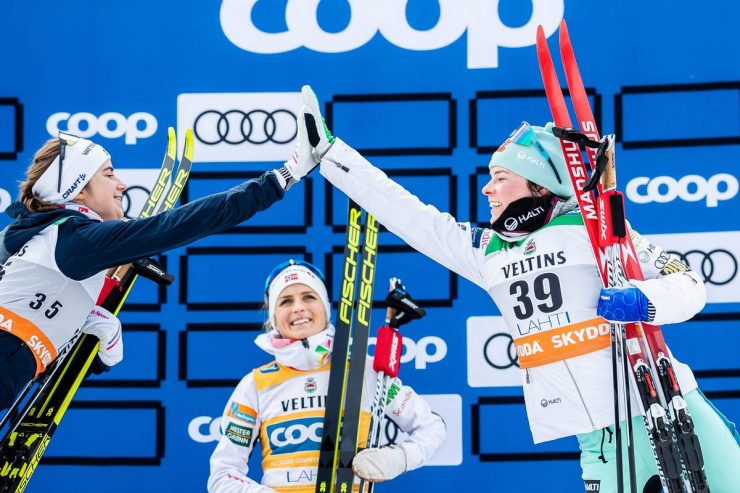
Ebba Andersson (SWE) and Krista Pärmäkoski (FIN) exchange a high five as they join Therese Johaug (NOR) on the podium in Lahti, Finland. (Photo: NordicFocus)
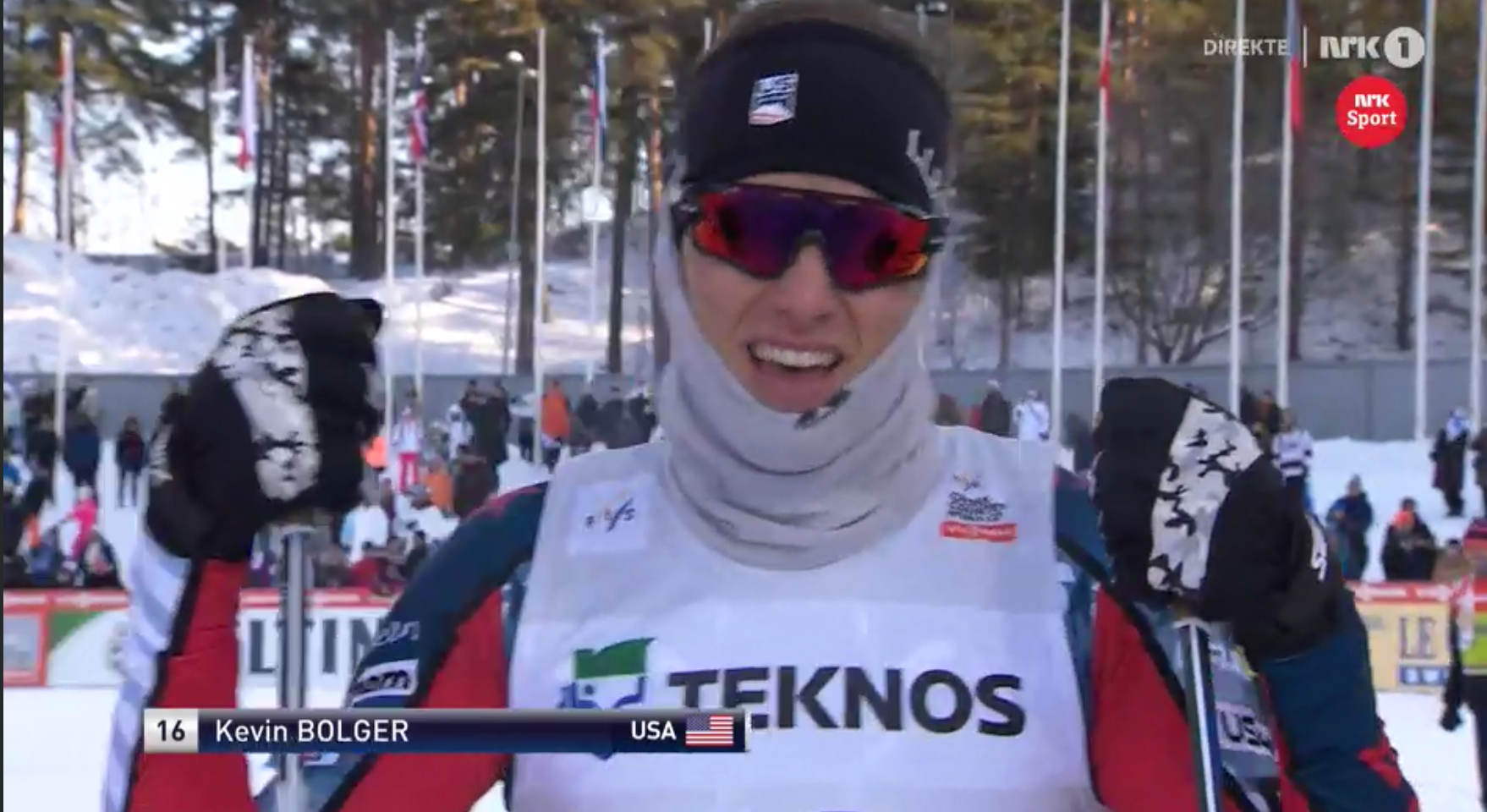
Kevin Bolger (Sun Valley XC Gold Team, second from left) in his quarterfinal heat in the World Cup skate sprint in Lahti, Finland, on Saturday. In fifth here going into the last downhill, he moved into fourth in the finishing straight and advanced to the semifinals as a lucky loser, finishing 11th on the day. (Photo: Ophira Group)
On Saturday in Lahti, Finland, Kevin Bolger of the Sun Valley XC Gold Team made his World Cup debut. In his first season since graduating from the University of Utah, Bolger earned start rights for the final period of World Cup racing by leading the SuperTour.
It was quite the debut: in the skate sprint, Bolger qualified in 16th, then advanced through the rounds to the semifinals and finished 11th on the day. There are not so many U.S. men who have ever finished that well in a World Cup in the last decade, much less on their first try – such a debut hasn’t been matched since Garrott Kuzzy finished ninth in a skate sprint in Canmore, Canada, in 2008, in his first weekend of World Cup racing.
The crowd certainly wasn’t expecting it. The Norwegian television commentators referred to him as “the surprising man”, and Bolger admitted in an interview over email after the race that he was a bit surprised himself.
The next day, he finished 54th in the 15 k classic, +3:09.5 from the time set by Kazakhstan’s Alexey Poltoranin.
The following interview has been lightly edited and condensed.
FasterSkier:Your coach, Chris Mallory, and he mentioned that getting some World Cup starts was a big goal for you this year. How does it feel to check that box, especially in such a fashion?
Kevin Bolger: Reaching the World Cup is the next step for skiers back in the U.S., so once I got my opportunity to get over here and race I wanted to capitalize on it. Just cracking the top 30 would have been amazing, so to have qualified 16th, and then overall finish in 11th on the day, is incredible, and I know there is more. But it also shows that I have what it takes to be competing over here with these guys.
FasterSkier:Do you usually consider yourself a strong qualifier skier in sprints?
Kevin Bolger: Qualifying has been, in the past, a weaker point for me. So I have been putting a lot of thought into how I can improve this with my coach Chris Mallory. I think we have dialed in a great pre-race strategy. And obviously I think this year it has been working.
FasterSkier:What were your first thoughts when you saw that you were 16th in the qualifier?
Kevin Bolger: I didn’t quite understand what happened when I finished. I remember some official telling me I was 16th, but I did not think he was talking to me. Once I saw my name up on the Live Timing board next to 16th, I was blown away. A lot of emotion kicked in. The hard part was over, now it was time to have some fun. It’s crazy watching World Cups back home, and suddenly I was in the middle of it, and I wanted to put a staple in my day!
FasterSkier:Does this course play to your strengths as a skier? Was there a part that you could work particularly well?
Kevin Bolger: I always try to ski a course and think of sections that will play into my advantage – being a big guy there are always good and bad spots. But I think this course skied well, and a lot came down to where you were positioned coming into the last turn at the top off the last climb, and coming down the final hill into the finish. The finishing stretch was my biggest strength, being a big guy and being able to really slingshot that corner and carry speed all the way to the finish, as I did in my quarterfinal. But I wasn’t where I wanted to be in the semi, and unfortunately it was too late.
FasterSkier:In your quarterfinal, you seemed stuck at the back for a long part of the heat. Was that a deliberate strategy to just save energy, or was it stressful to be back there and not able to get around people?
Kevin Bolger: My biggest strategy was just to stay on my feet, own my space, and not get intimidated. I talked a lot with Matt Whitcomb and we both agreed that I should ski confident and do what felt comfortable. Going to the back is not normally what I would like to do, but this is sprinting – sometimes what you plan doesn’t always happen and you need to be able to change your game plan and tactics. I had to work a little harder but that’s okay. I learned a lot for being my first World Cups, and next time I’ll be able to try new tactics.
FasterSkier:How did the semifinal go?
Kevin Bolger: The semi was great. Unfortunately I only had about a few minutes from the time I finished my quarterfinal until my semi started, so that was a quick turnover, but the U.S. guys were on it with my skis and helping out so much, without them I would have been a lost puppy! So, huge shout out to the U.S. crew!
FasterSkier:Are you happy with your skiing?
Kevin Bolger: After any race you can always look back and think about what you could have done differently, and of course I wish I would have skied a bit more aggressive in the final climb, but I was toeing the line with the gold and silver medalist from the Olympics, and some of the best guys in the world – so to know I’m right there shows I have what it takes to compete with these guys! I am very happy with my skiing. Not everyone gets this opportunity, so being able to show up on the world stage and ski like I know I can and throw down – I can’t be anything but happy!
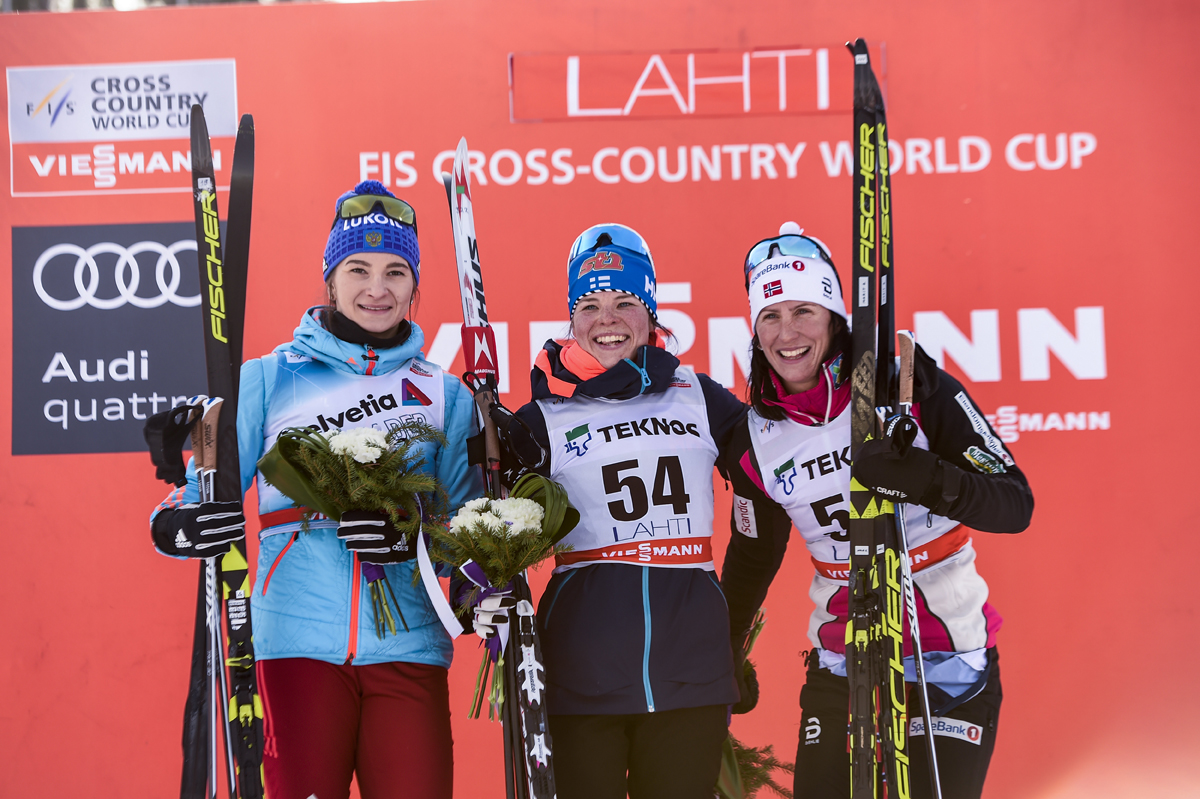
The women’s 10 k classic podium at Sunday’s World Cup in Lahti, Finland, with Finland’s Krista Pärmäkoski (c) in first, Russia’s Natalia Nepryaeva (l) in second and Norway’s Marit Bjørgen (r) in third. (Photo: Fischer/NordicFocus)
(Note: This article has been updated to include comments from American Caitlin Patterson.)
The 2018 Olympics were pretty successful for Finland, in terms of cross-country skiing: Iivo Niskanen won gold in the 50 k and Krista Pärmäkoski earned silver in the 30 k and bronze in the skiathlon and the 10 k skate.
After the Games finished, the FIS Cross Country World Cup moved to Finland, but on the first day of competition – skate sprints – the host nation was stymied.
Among the frustrated was Pärmäkoski, who was tangled up when Germany’s Victoria Carl fell in a quarterfinal heat. Carl was relegated to last for her skiing, but that didn’t lessen the sting of not advancing for Pärmäkoski, who had qualified with the third-best time in the women’s field.
Sunday brought a 10 k classic, a favorite discipline for her, however.
“Yesterday was kind of annoyed, so I wanted to show [what I could do] today,” Pärmäkoski told Finland’s YLE broadcaster, according to a translation.
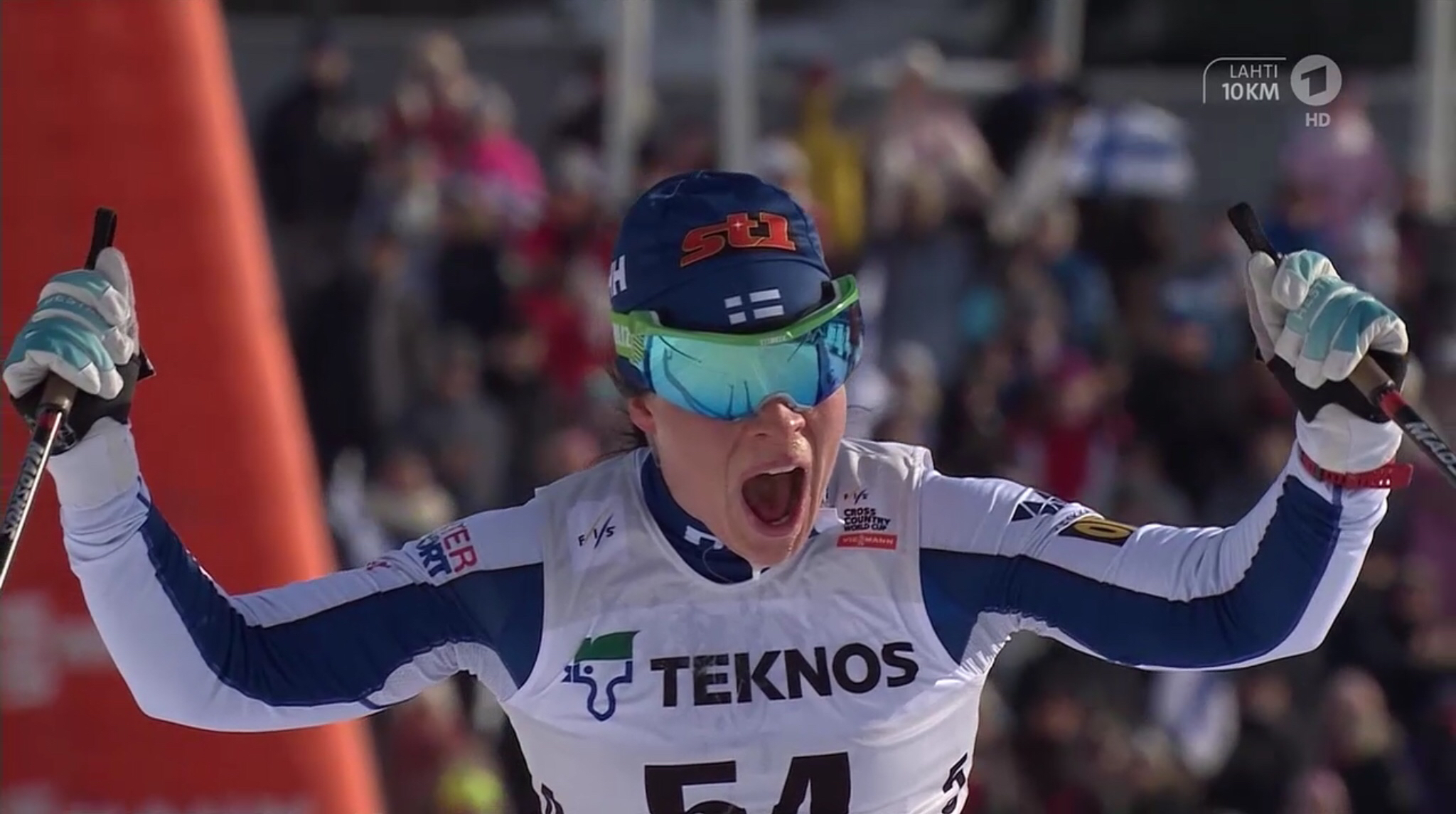
She set out with a vengeance, eventually notching her second career World Cup victory with a 20.9-second win over Natalia Nepryaeva of Russia.
Finland’s Krista Pärmäkoski celebrates the second World Cup victory of her career, on home turf in Finland in the Lahti 10 k classic. (ARD screencap)
“When in good shape, feeling bad feels good,” Pärmäkoski said.
Third place went to Norway’s Marit Bjørgen, who skied an even race to finish +29.2. She was tenth after a kilometer and a half, seventh at 3.7 k, and fifth at 5 k, but managed to ski up and bump Finland’s Kerttu Niskanen off the podium by just 0.3 seconds, for her first 10 k classic podium since 2012.
“I think it was the finish that secured [the podium],” she told Norway’s VG news site, according to a translation. “I think it went smoothly, very strong on the uphills, and I’m happy with it. I’ll take this finish with me.”
“Marit is the best athlete of all time, so it feels good that the time has come for me to be able to beat her,” Pärmäkoski told YLE.
Fifth went to Norway’s Heidi Weng, who opened hard but lost ground on the second lap of the 5 k course and finished 43.3 seconds behind Pärmäkoski. Teresa Stadlober of Austria was sixth (+52.4), Sadie Bjornsen of the U.S. seventh (+57.6), and Ingvild Flugstad Østberg of Norway eighth (+59.0). Aino Kaisa Saarinen (+59.1) and Johanna Matintalo (+1:13.4) rounded out the top ten, giving Finland four finishers in the top ten.
It was Saarinen’s last time competing on home ground, as the 39-year-old former World Champion is ending her World Cup career after this season. She cried as she was handed a bouquet of flowers at the finish line.
“It was certainly the best race of the season,” she told YLE.
Bjornsen Seventh in Post-Olympics Rebound
Sadie Bjornsen (U.S. Ski Team) finishing seventh in the women’s 10 k classic at the World Cup in Lahti, Finland. (Photo: Fischer/NordicFocus)
Like Pärmäkoski, Bjornsen had left Saturday’s sprint feeling frustrated. She had qualified in fifth position but then couldn’t make the right move in the quarterfinals and failed to advance to the semifinals.
“Yesterday was really awesome because I could see that I finally had some good feelings in my legs and I got really excited to keep racing,” Bjornsen said in an interview after the 10 k. “So, today, I don’t know, I was just approaching it like I wonder what can happen, like, let’s just send it hard and see what happens.”
With cold temperatures making for firm tracks, Bjornsen attacked the course’s long climbs – the biggest of which has a 44-meter height differential.
“I definitely really love the Lahti courses here,” she said. “I think that there’s like a lot of really awesome climbing. It’s not like they’re necessarily running hills; there’s actually some glide involved with them, and so I think it’s just really cool classic skiing… Right away I could see that I had some good skis under my feet and I just had nothing in the way, so I just went. I tried to go really hard from the start.”
The effect was immediately noticeable.
“I always try to go out hard and sometimes it’s hard, and sometimes it’s not,” Bjornsen laughed. “There’s no change in what my perceived effort. I think when I have good races is when that going hard actually is going hard. It was funny, because Matt [Whitcomb, the U.S. Ski Team women’s coach] was cheering at 3 k, and he just yelled ‘you finally went out hard!’ and I actually smiled in the race and was like, ‘ok, this is awesome.’ Like, ‘this is fun,’ you know?”
Unlike Weng and Niskanen, who faltered at the end, Bjornsen skied a fairly consistent race. She was sixth at 3.5 k, eighth at 6.1 k, and seventh at the finish, 57.6 seconds behind Pärmäkoski’s time and 30.9 seconds off the podium.
“I maybe struggled a little bit right there in the middle where I needed to continue being strong,” Bjornsen said. “I think that’s where those top girls are really making some time. When I have had my best distance races, it’s when I really nail between 5 and 7.5 k and that is kind of a point that I’ve been working on this year. And, I think that I maybe stuttered a little bit during that time. So I guess, looking back, I feel like that’s where I have to make an improvement for the future–to be in that podium place.”
Caitlin Patterson (Craftsbury Green Racing Project) racing to 32nd in the women’s 10 k classic at the World Cup in Lahti, Finland. (Photo: Fischer/NordicFocus)
For the U.S., Caitlin Pattersonwas next, just missing the World Cup points in 32nd (+2:02.7).
“The end of the race was good, but the beginning was a little rough,” Patterson wrote in an email. “The course starts out going up one of the sunniest hills, and by the time I started the snow had transitioned on that hill away from the wax that we were using. I had a terrible time getting up the first long rolling climb, but luckily I was able to pull myself together and re-focus for the rest of the race, and the skis worked much better for the rest of the course. So I’m happy with my effort, that I kept pushing and didn’t let up after a bumpy start. I would have been happier with a more consistently strong race, since I did lose quite a bit of time at the beginning that I wasn’t able to make up for later.”
Patterson raced the first and last events of the Olympics, placing 34th in the 15 k skiathlon and 26th in the 30 k classic mass start.
“My two races in Korea were separated by 15 days, but I certainly kept busy with training,” she explained. “I did a time trial, at least 3 interval sessions, some strength workouts, and distance workouts. It’s best for me to stay active and keep the speed up, since I knew that would be the best way to hopefully feel good for the 30k as well as to stay strong for the rest of the season. Beyond training in Korea, I felt really busy with all the time spent taking buses to and from places, but I did get out to watch a Big Air competition one day, and visited the Coastal village area a different day, so a bit of sight-seeing.
“I’m feeling ready to race and still excited for each start even at this point in the season,” Patterson continued. “If there was another race tomorrow, I’d absolutely want to do it. I feel like it’s been a while since I’ve had a consistent string of races, so I need more back to back to clear the cobwebs out again, and to reaffirm that I still have good racing fitness which I know is true.”
Ida Sargentand Sophie Caldwellfinished 40th (+2:21.9) and 42nd (+2:24.2), respectively. Rosie Brennanfinished 48th (+3:02.1) and SuperTour leader Kaitlynn Millerplaced 51st (+3:09.1).
Liz Stephenof the U.S. Ski Team did not start due to illness.
Canada started two women: Emily Nishikawafinished 41st (+2:22.2) and Dahria Beatty44th (+2:40.7).
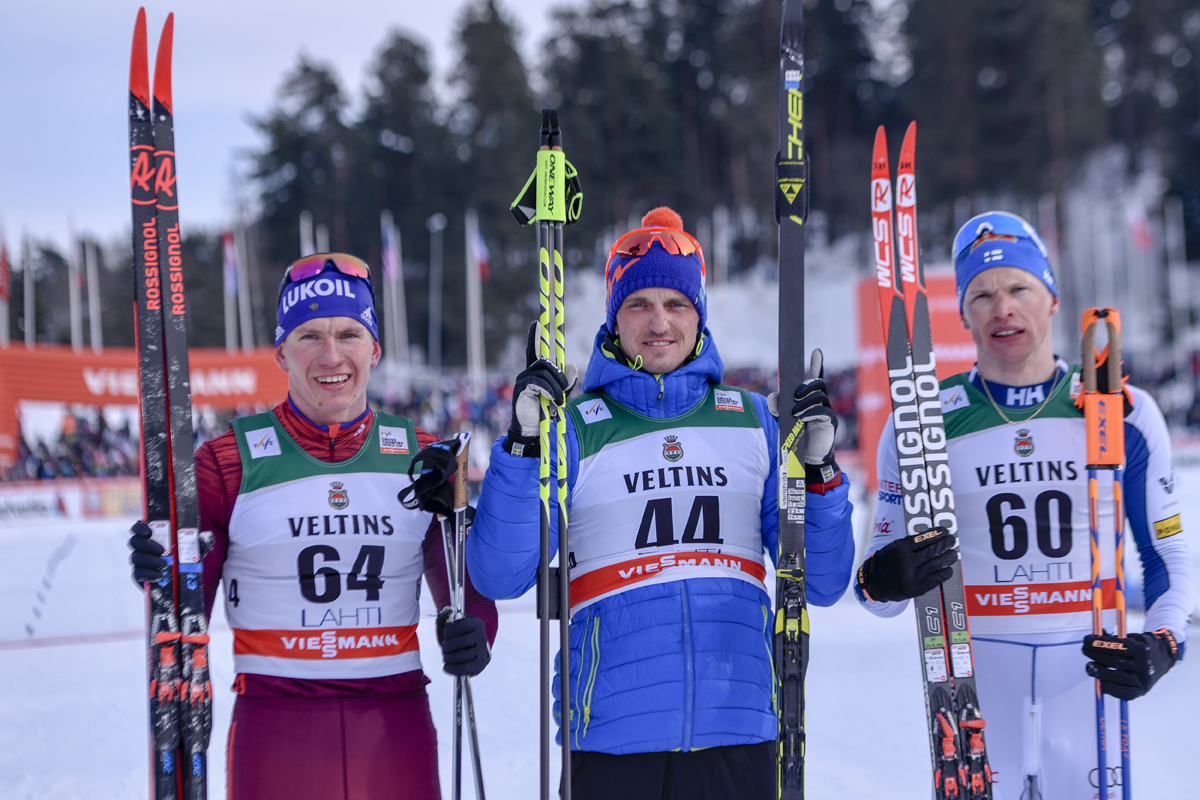
The men’s 15 k classic podium at the World Cup in Lahti, Finland, with Kazakhstan’s Alexey Poltoranin (c) in first, Russia’s Alexander Bolshunov (l) in second and Finland’s Iivo Niskanen (r) in third. (Photo: Fischer/NordicFocus)
You could call him a specialist. An all-around contender in classic distance races, Alexey Poltoranin of Kazakhstan has proven time and time again that he has the 15-kilometer classic individual start figured out.
On Sunday in Lahti, Finland, he set a new World Cup record by winning his eighth-career 15 k classic (including both individual and mass-start formats). He had previously tied Swedish legend Gunde Svan’s mark of seven with a win in the last 15 k classic contested in Planica, Slovenia.
Three of Poltoranin’s 15 k wins have come this season, and all of his 11 career World Cup victories have been in classic races. Two were of shorter distances: a 5 k classic stage race in 2013 and a classic sprint that same year.
But in the last men’s race of the 2018 Olympics last Saturday in PyeongChang, South Korea — the 50 k classic mass start — the 30-year-old Poltoranin only had about 30 k of full-tilt speed in him. For 29 valiant kilometers, he had stalked Finland’s Iivo Niskanen, who was leading the race.
But then, the wheels started to come off. In less than a kilometer, Poltoranin was passed by Russia’s Alexander Bolshunov and lost more than 10 seconds to Niskanen. By about 33 k, he was no longer able to keep up with Bolshunov as he continued the race in the dreaded position of no man’s land, skiing alone in third. The chase pack eventually caught him with 5 k to go, and he slipped to seventh. He ultimately finished 15th, more than 5 minutes behind Niskanen in first.
But that was over a week ago. By Sunday, Poltoranin was back in familiar territory at a venue he had raced at multiple times in the last 13 years, but never placed better than second at in Lahti.
He started 44th out of 71 in the men’s field and came through each timing point with some of the best, if not the best, splits over the three-lap course. But one man who started behind him was faster at every checkpoint — Bolshunov, wearing bib 64— and as Poltoranin sat in the leader’s seat at the finish, watching the rest of the race unfold, it was the Russian he was likely most nervous about.
Niskanen was looking strong, too, but as the Finnish Olympic champion skied in bib 60, a couple of minutes ahead of Bolshunov, his times were consistently about 5 seconds slower.
When Niskanen finished, he was 20.9 seconds shy of Poltoranin’s time. Then Bolshunov, who had led through the 11.1 k checkpoint where he was almost 7 seconds faster than Poltoranin, came into the stadium, yet ended up 9.1 seconds short of the win.
Poltoranin’s finishing time of 33:11.9 proved unbeatable on Sunday, and he pumped his fist as he realized the win was his.
“It’s great to win again,” Poltoranin told the International Ski Federation (FIS) after, according to a press release. “I won in Planica before the Olympics and this is a much better feeling than last weekend’s result in the Olympic 50 k.”
Bolshunov, who finished second to Niskanen in the Olympic 50 k, 18.7 seconds from the gold medal, placed second again on Sunday.
“I was disappointed after the Olympic 50 k and was a little bit tired but I am happy with how I skied today,” the 21-year-old Bolshunov, who won silver or bronze in all four races he competed in at his first Olympics, told FIS. “Thanks for the service team for great skis. Good to get another podium for Russia.”
Niskanen, 26, was a clear crowd favorite in Lahti, with several fans holding up gigantic cutout photos of his face. While he was an early race leader, Niskanen’s split times were second to Bolshunov from 3.7 k on.
“It was an OK race for me,” Niskanen told FIS. “I have had a busy and emotional week after the gold medal in PyeongChang. I think I have not fully recovered yet. I felt my muscles were quite stiff. It was a very hard race for me. I wanted to finish on the podium and it would have been nice to win in front of the home crowd.”
Note: Poltoranin is currently second in the Distance World Cup standings, 39 points behind France’s Maurice Manificat (who placed 21st on Sunday) in first. Norway’s Martin Johnsrud Sundby (who placed fifth behind teammate Emil Iversen in fourth on Sunday) is just 5 points behind Poltoranin in third in the distance rankings. Sundby is second in the Overall World Cup, 228 points behind his Norwegian teammate Johannes Høsflot Klæbo (who placed seventh on Sunday).
Kershaw in the Points in 25th
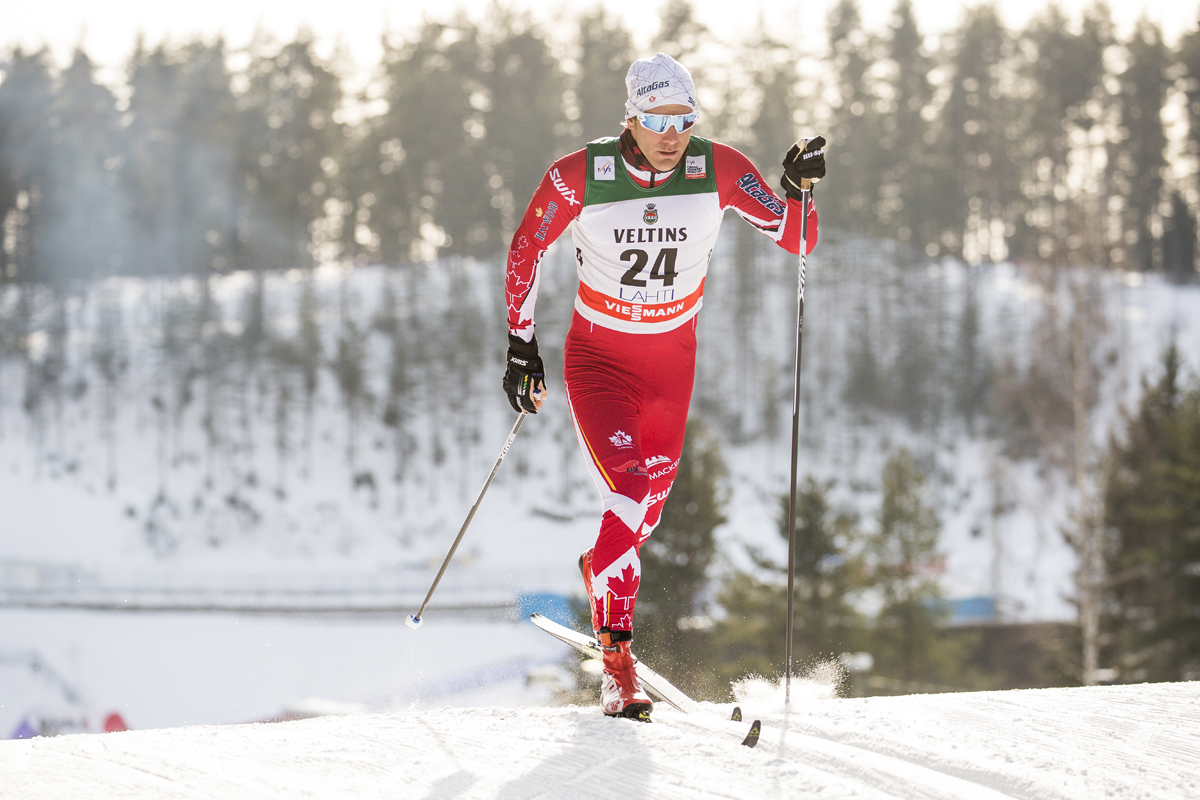
Devon Kershaw racing to 25th in the men’s 15 k classic at Sunday’s World Cup in Lahti, Finland. (Photo: Fischer/NordicFocus)
After placing 26th in the Olympic 50 k, Devon Kershaw led four Canadians in Sunday’s 15 k in 25th (+1:43.2). An early starter in bib 24, his split times were relatively consistent throughout the race, ranging from 20th at 1.1 k to 26th with about 4 k to go.
“I was actually really excited for this race,” Kershaw wrote in an email to FasterSkier. “15km classic is my favourite race we do. Also, Lahti was peaking. It was about -10, sunny (I know?! In Finland) and the track conditions were 10/10. When you love classic skiing like I do, the World Cup rarely offers conditions like we had here. I loved it. Motivation-wise, I have never really struggled too badly with that after championships if the calendar has races I enjoy and know I can be good in. With this 15km classic and then a mass start 15km classic in Falun, it makes it easier to keep motivated. Also, racing in the Nordic nations to end the year is always awesome. Good, knowledgeable fans and nice venues. I love it.”
After struggling with “major lung/breathing issues” at the Olympics, Kershaw explained that he felt much better leading into Lahti. He spent a few days after the Olympics at home Norway with his wife Kristin Størmer Steira and their 13-month-old daughter, whom he hadn’t seen in two months.
“I had some tough days for sure with that mentally,” he wrote of his time away from family before and during the Games. “But when I got home and the first time I saw my daughter in 2 months she crawled right up to me with a big smile on her face and knelt there putting her arms in the air (for me to pick her up) – that was the highlight of my winter right there. It has been great to see them again.”
While he was pleased with what he called “a solid race” on Sunday, Kershaw added that he was also disappointed that he didn’t have anyone to ski with and finished within 10 seconds of the top 20.
“But – I skied a very consistent race,” he wrote. “My pace felt like I was moving at the same speed at km 2 as I was at km 14. That’s a nice feeling. And what you strive for if you are alone in an individual start. I was missing that last gear to attack the last lap, but I didn’t die either, and was able to keep my speed, so I am satisfied. When you pace a race like I did – even if it leaves you wanting more – it shows you did do a good job managing your speed alone for 15km. And that feels good.”
Kershaw’s best result so far this season was 19th in the 30 k skiathlon in Lillehammer, Norway. At the Olympics, he competed in three events with a best result of 26th in the 50 k.
“I was massively disappointed with the Olympics,” he continued. “… 25th isn’t anything stellar or fireworks worthy, but it’s in the points and close to a season’s best for me – which is still something I’m looking to accomplish,” Kershaw added.“I have some more chances, mainly in Falun, but I’ll drag my ass around Holmenkollen this coming weekend because I have such a big respect for the race. I hope I can continue to feel good body-wise and have good energy like I feel now. I hope my lungs can continue to slowly get better and if they are better in Falun then they are now then that won’t hurt!”
Also for Canada, Graeme Killick placed 39th (+2:22.9), Julien Locke was 69th (+4:56.6) and Andy Shields 70th (+5:42.1).
Leading the U.S. men was Erik Bjornsen in 32nd (+2:06.6). After clocking the 53rd-ranked split at 1.1 k, Bjornsen sped up throughout the race to come within about eight seconds of the top 30.
Noah Hoffman finished 40th (+2:24.0), Paddy Caldwell was 45th (+2:40.5), Scott Patterson 50th (+2:58.7), Kevin Bolger 54th (+3:09.5), and David Norris 57th (+3:23.5).
With three World Cup stops remaining, the circuit continues in Drammen, Norway, this Wednesday with city classic sprints followed by the Holmenkollen 30/50 k freestyle mass starts next weekend. World Cup Finals will take place the following weekend, March 16-18, in Falun, Sweden.
Krista Pärmäkoski of Finland (center) won her second straight 10 k classic, to the delight of the crowd in Lahti. Natalia Nepryaeva of Russia (left) finished second and Marit Bjørgen of Norway third. (Photo: FIS Cross Country/Twitter)
FIS Cross Country World Cup (Lahti, Finland): 10/15 k classic
Racing at home in Finland, Krista Pärmäkoski picked a good time to collect the second World Cup victory of her career, and again in a 10 k classic. Pärmäkoski’s first win came in the 10 k classic in Planica, Slovenia, earlier this season.
In second was Russia’s Natalia Nepryaeva, who picked up her first World Cup podium. The current U23 standings leader, Nepryaeva’s time was 20.9 seconds slower than Parmakoski. Both she and Marit Bjørgen of Norway, who finished third (+26.7), used a steady pace to reach the podium. At the 5 k split, Heidi Weng of Norway – wearing the yellow bib of the overall World Cup leader – was in second at the halfway point but faded to finish fifth (+43.3), and Kerttu Niskanen of Finland was in third place but she dropped to fourth by the finish, +27.0. Austria’s Teresa Stadlober finished sixth (+52.4).
Sadie Bjornsen placed seventh (+57.6) to lead the American team. Caitlin Patterson was next, just missing the World Cup points in 32nd (+2:02.7). Ida Sargent and Sophie Caldwell finished 40th (+2:21.9) and 42nd (+2:24.2), respectively. Rosie Brennan finished 48th (+3:02.1) and SuperTour leader Kaitlynn Miller placed 51st (+3:09.1).
Liz Stephen of the U.S. Ski Team did not start due to illness.
Canada started only two women: Emily Nishikawa finished 41st (+2:22.2) and Dahria Beatty 44th (+2:40.7).
The men’s 15 k classic podium at the World Cup in Lahti, Finland, with Kazakhstan’s Alexey Poltoranin (c) in first, Russia’s Alexander Bolshunov (l) in second and Finland’s Iivo Niskanen (r) in third. (Photo: FIS Cross Country/Twitter)
In the men’s race that followed, Alexey Poltoranin of Kazakhstan got some redemption after a major bonk in the Olympics 50 k last weekend, winning the 15 k classic individual start in Lahti.
Starting in the middle of the field in bib 44 (out of 71), Poltoranin paced it perfectly, skiing a steady race with some of the top split times and then turning it up another notch over the last several kilometers to take the win in 33:11.9 minutes. His biggest threat was Russia’s Alexander Bolshunov, who started 64th and clocked faster splits at every timing point throughout the three-lap race except the one that mattered most — the finish. There, Bolshunov came up 9.1 seconds short of Poltoranin’s time to place second, and Finland’s Iivo Niskanen — the Olympic 50 k champ — placed third, 20.9 seconds out of first.
Norway took fourth through seventh, with Emil Iversen in fourth (+28.8), Martin Johnsrud Sundby in fifth (+39.9), Niklas Dyrhaug in sixth (+50.1), and Johannes Høsflot Klæbo in seventh (+1:00.3). Russia’s Alexey Chervotkin placed eighth (+1:08.3), Germany’s Thomas Bing was ninth (+1:08.5) and Sweden’s Daniel Rickardsson finished 10th (+1:09.2).
Canada’s Devon Kershaw led the North Americans in 25th (+1:43.2), and Erik Bjornsen was the top American in 32nd (+2:06.6).
Four Canadian men raced, with Graeme Killick placing 39th (+2:22.9), Julien Locke 69th (+4:56.6) and Andy Shields 70th (+5:42.1).
The U.S. was represented by six men, with Noah Hoffman placing 40th (+2:24.0), Paddy Caldwell 45th (+2:40.5), Scott Patterson 50th (+2:58.7), Kevin Bolger 54th (+3:09.5), and David Norris 57th (+3:23.5).
The World Cup picks back up again this Wednesday with classic sprints in downtown Drammen, Norway.
The men’s 1.6 k freestyle sprint podium at Saturday’s World Cup in Lahti, Finland, with Italy’s Federico Pellegrino (c) in first, Russia’s Gleb Retivykh (l) in second and Norway’s Johannes Høsflot Klæbo (r) in third. (Photo: Fischer/NordicFocus)
The men’s freestyle sprint final in Lahti, Finland, started in almost comical fashion: the six men who had made it to the final heat of the day skied slowly, then even slower, as nobody wanted to lead.
The final was full of dangerous men. Norwegian youngster Johannes Høsflot Klæbo has won five sprints this season, and he just became an Olympic gold medalist in the sprint in PyeongChang, South Korea, a mere ten days ago. In his quarterfinal and semifinal heats, he had put in big turns of speed which had dropped most of the field.
They hadn’t dropped Italy’s Federico Pellegrino, though, and the 2017 World Champion was the only man competing in Lahti who had beaten Klæbo in a sprint this season.
Then there was France’s Lucas Chanavat, who put in a huge burst of speed up a hill in his own quarterfinal, perhaps mimicking the move that Klæbo usually makes to test it out or prove a point.
They were all lurking there in the final, along with Russia’s Gleb Retivykh, Finland’s Ristomatti Hakola – consistently one of the fastest qualifiers on the World Cup – and Norway’s Sindre Bjørnestad Skar.
Norway’s Johannes Høsflot Klæbo leading his quarterfinal, which included Italy’s Federico Pellegrino (3) and American Erik Bjornsen (29), in the men’s 1.6 k skate sprint at the World Cup in Lahti, Finland. (Photo: Fischer/NordicFocus)
Klæbo finally got up to some sort of speed on a gradual downhill, stringing out the field after a full 90 seconds of being clumped together and moving at walking pace. But he still wasn’t going full bore. On one of the final opportunities, it was Skar who went to the front and sprinted up a hill, finally turning the speed dial to “full”.
Coming down the final hill into the stadium, it was Skar, Klæbo, and Pellegrino, who overtook the leader going into the last turn. In the finishing stretch, the two Norwegians seemed to just fade away; Pellegrino sprinted for the line and a big win of 0.77 seconds.
“I think that when I returned after the Olympics, back home I had a very good time, really good weather in the Alps,” Pellegrino – the silver medalist in the PyeongChang sprint – said in a post-race interview with FIS. “And it was very good to recover and train a lot, so that I could come here in the best shape. I’m really proud of this.”
Also surging past the Norwegian duo was Retivykh, who had accelerated into and through the final corners and pulled away in finishing lane.
“I have been waiting quite long for the World Cup podium,” said Retivykh, according to FIS. “Last time I was top three was in PyeongChang last year. So it feels great to be back. I am not surprised to be second because I knew I could do it. It feels great… I am sharing the podium with two great athletes.”
Klæbo hung on for third, +0.90 seconds, and Skar was fourth, +1.30. He edged Hakola (+1.44) while Chanavat was left in sixth (+7.55).
Coming into the final as the giant everyone feared, Klæbo’s tactics had not paid off.
“I’m glad this was not the Olympics,” Klæbo told Norwegian broadcaster NRK, according to a translation. “Pellegrino was too strong. I had nothing to answer with. Then you have to be thankful for third place. And I’m still smiling pretty wide.”
Pellegrino, meanwhile, played his cards exactly right. He also beat Klæbo here one year ago to win World Championships gold, and he channeled that experience.
“I lost too many races in the past when I was leading almost the whole race,” he told FIS. “I think that on this track I know how to do it.”
And with the win, Pellegrino became the most decorated skate sprinter in men’s World Cup history. It was his tenth skate sprint victory, a new record.
With third place, however, Klæbo has sealed this year’s overall Sprint Cup trophy even though there are still two sprints to come in Drammen, Norway, and Falun, Sweden.
“That is a bright spot, then,” he told NRK. “It helps a little, but there was no snap today. The [qualifier] was good, but otherwise it was a bit dead.”
By placing 11th in the freestyle sprint in Lahti, Sun Valley’s Kevin Bolger won some Gruyere cheese for being the top-ranked Continental Cup skier of the day. (Photo: Matt Whitcomb)
Bolger 11th in World Cup Debut, Bjornsen 20th
You didn’t have to scroll very far down the qualifier results sheet to find the name of a World Cup debutant. In 16th place was Kevin Bolger of the Sun Valley XC Gold Team. The SuperTour leader made the most of his opportunity, and NRK broadcasters referred to him as “the surprising man – Kevin Bolger.”
“Honestly, I didn’t necessarily expect him to qualify in a Scandinavian World Cup, in his first go at it,” Bolger’s coach Chris Mallory wrote in an email. “He generally builds into sprint days as they progress, as he’s a bit of an all-arounder. But he really stepped up to the plate today.”
In his quarterfinal, Bolger was last out of the start gates and sat in sixth place for much of the race. But near the end of the heat he moved into fifth and then coming into the finish turned on the afterburners to move up to fourth.
The last of the quarterfinals, it also turned out to be the fastest one, and both Bolger and third-place Karl-Johan Westberg of Sweden moved on to the semifinals as lucky losers behind Retivykh, the heat’s winner, and second-place Franceso De Fabiani of Italy.
“He’s a big glider, and can carry his speed really well, but he’s focused a lot on improving his speed this year,” Mallory wrote of that finishing sprint.
In the semifinal, Bolger couldn’t quite pull the same move. He was again in sixth out of the gate, but Pellegrino broke a pole, dropping to last. The two traded off places as Pellegrino then caught back up, and then replaced his pole again. Then Bolger passed Emil Iversen, but the Norwegian passed him back by the finish and Bolger ended up sixth in the semifinal and 11th on the day.
Bolger before the start of his semifinal heat. (NRK screencap)
Bolger graduated from the University of Utah last year and it is his first season as a full-time senior racer with the Gold Team, although Mallory said that Bolger had trained with Sun Valley for two years as a high school postgraduate before heading to college.
Before heading to Europe for the World Cup, Bolger had won a SuperTour sprint in Ishpeming, Michigan, and placed second and sixth in 20 k and 10 k races there. Earlier in the season, he was second in the skate sprint and fifth in the classic sprint at U.S. National Championships.
“My goal was for him to get some World Cup starts and a top 30 this season, so those opportunities would keep coming,” Mallory explained. “I watched FIS live timing all night, normally not so exciting, but last night it was!”
Erik Bjornsen of the U.S. Ski Team and APU qualified in 29th place and in his quarterfinal, had a poor start position as a result of his bib and was immediately shunted to the back of the heat.
“Up the first climb I tried to make a couple moves, but I was just kind of boxed in,” he explained.
He was in the first quarterfinal, along with Klæbo, Pellegrino, and Renaud Jay of France. By late in the heat Bjornsen was able to move up to fifth when Poland’s Maciej Starega, who had led early, began to fade. Then in the final downhill he moved into fourth and held that position through the finish.
Norway’s Johannes Høsflot Klæbo and Italy’s Federico Pellegrino (3) going head to head down the finishing stretch in the first men’s quarterfinal at the World Cup 1.6 k skate sprint in Lahti, Finland, with American Erik Bjornsen (l) chasing. (Photo: Fischer/NordicFocus)
But he hadn’t been able to get to the front early in the heat, and by the finish, the two eventual podium finishers were jetting off at hyperspeed. Though he wasn’t able to catch onto their tails, Bjornsen said that he was feeling better than he had at the Olympics, where his results had been disappointing.
“I definitely kind of struggled,” he admitted of the 2018 Olympic experience. “It was some of my worst distance racing of the year, so it was obviously very frustrating.”
After today’s sprint, however, there might be light at the end of the tunnel.
“I felt like I had good energy left,” Bjornsen said of his heat. “I tried making moves on both sides… the fitness is feeling a lot better than it was a couple of weeks ago. And so, I mean, the peaking plan for the Olympics didn’t work as planned. But it’s been a relatively good season for me, pretty consistent. I had a lot of top 30 finishes… I’m just trying to move past [the Olympics] and have a solid period four on the World Cup.”
He now looks to the 15 k classic on Sunday, which he called “one of my favorite races.”
And on getting upstaged by Bolger, Bjornsen seemed the opposite of upset.
“I was just really psyched to see that,” he said. “The kid has put in a lot of work the last few years and – I mean, I was very surprised. It was great to see. I like to see those younger dudes coming here and having successful results. It’s really impressive. You know, it’s his first World Cup and he just looked comfortable and good out there. It’s just the perfect transition to the World Cup. Keep it up!”
Canada’s Julien Locke on his way to 42nd in the men’s 1.6 k skate sprint at the World Cup in Lahti, Finland. (Photo: Fischer/NordicFocus)
“It was so awesome to have two World Cup first timers, Kelsey [Phinney] and Kevin, have such impressive results,” agreed teammate Sophie Caldwell. “Kevin had the race of the day and it was so inspiring for our entire team, staff, and hopefully all the skiers back home to see that success in a young, up and coming racer who just sent it today. We were going crazy!”
The rest of the North American field did not make it into the quarterfinals. In the qualifier, Logan Hanneman (APU) placed 49th (+11.45). Paddy Caldwell (U.S. Ski Team/SMS T2) finished 59th (+13.55), and APU’s Reese Hanneman and David Norris placed 61st (+14.33) and 67th (+19.27).
Julien Locke led Canada in 42nd place (+9.78), and Andy Shields finished 60th (+14.29).
Logan Hanneman (Alaska Pacific University) on his way to 49th in the men’s 1.6 k skate sprint at the World Cup in Lahti, Finland. (Photo: Fischer/NordicFocus)
The men’s 1.6 k freestyle sprint podium at Saturday’s World Cup in Lahti, Finland, with Italy’s Federico Pellegrino (c) in first, Russia’s Gleb Retivykh (l) in second and Norway’s Johannes Høsflot Klæbo (r) in third. (Photo: FIS Cross Country/Twitter)
FIS Cross Country World Cup (Lahti, Finland): Men’s & women’s freestyle sprints
The defending world championships from the 2017 freestyle sprint prevailed again in Lahti on Saturday, with Norway’s Maiken Caspersen Falla winning the women’s 1.4-kilometer freestyle sprint final and Italy’s Federico Pellegrino coming out on top in the men’s 1.6 k final at last year’s World Championships venue.
Falla’s rise to the final started with her qualifying in 12th, 7.96 seconds off the fastest qualifying time set by Sweden’s Hanna Falk in 2:54.72. Russia’s Natalia Nepryaeva qualified second (+0.63) and Finland’s Krista Pärmäkoski third (+3.62), just ahead of Germany’s Victoria Carl in fourth (+3.88) and American Sadie Bjornsen in fourth (+3.88). Four American women qualified for the heats, with Sophie Caldwell in 17th, Ida Sargent in 21st and Rosie Brennan in 29th.
The women’s 1.4 k freestyle sprint podium at Saturday’s World Cup in Lahti, Finland, with Norway’s Maiken Caspersen Falla (c) in first, and Sweden’s Stina Nilsson (l) and Hanna Falk (r) in second and third, respectively. (Photo: FIS Cross Country/Twitter)
Falla went on to place second in the first quarterfinal, 0.71 seconds behind Sweden’s Stina Nilsson in first. According to the race jury’s ruling, Carl obstructed Pärmäkoski coming out of the last downhill before they entered the finishing straight and both crashed out of contention, with Pärmäkoski finishing fifth in the heat (+12.11) and Carl sixth (+49.5). Carl was relegated to last (30th place) for the obstruction.
Falla then won the first semifinal by just 0.04 seconds over Nilsson in second. The two other Swedes in that heat, Falk and Ida Ingemarsdotter, advanced to the final as well as lucky losers with fast-enough times.
In the final, Falla found herself at the front of the pack early then held her position to the finish, crossing the line in 2:54.83 and beating Nilsson by 0.36 seconds. Sweden had two on the podium with Falk in third (+0.78), Germany’s Sandra Ringwald placed fourth (+0.88), Ingemarsdotter was fifth (+1.83), and Switzerland’s Laurien van der Graaff placed sixth (+3.02).
Caldwell was the lone American woman to make it past the quarterfinals, as she placed second in her quarterfinal, 0.25 seconds behind Ringwald in first, then fourth in the second semifinal, 1.46 seconds behind Ringwald, who also won that heat. Overall, Caldwell finished the day in eighth.
Bjornsen placed 17th overall after finishing fourth in her quarterfinal, 2.84 seconds behind Falk in first. Sargent had been second in her quarterfinal until the final tight lefthand corner into the finishing straight, where she slipped to sixth and ultimately finished sixth, 1.07 seconds behind Sweden’s Anna Dyvik in first. Overall, Sargent finished the day in 27th, and Brennan placed 29th overall after finishing sixth in her quarterfinal, 4.91 seconds behind Ingemarsdotter in first.
Two American men advanced to the heats as well, with Kevin Bolger of the Sun Valley Ski Education Foundation (SVSEF) qualifying in 16th in his World Cup debut, 6.38 seconds behind Norway’s Johannes Høsflot Klæbo, who topped the qualifier in 2:59.06. Erik Bjornsen of the U.S. Ski Team qualified 29th, 8.29 seconds back.
Meanwhile, Pellegrino qualified for the heats in third (+1.9) behind France’s Baptiste Gros in second (+1.23).
There, Pellegrino won the first quarterfinal by 0.19 seconds over Klæbo, with the Norwegian visibly backing off before the finish — comfortable enough to automatically advance to the semifinals in second place. But Klæbo showed Pellegrino what he’s made of in the first semifinal and beat the Italian by nine-hundredths of a second.
Bolger also raced in that first semifinal after placing fourth in his quarterfinal, 0.73 seconds behind Russia’s Gleb Retivykh in first. Bolger’s time was good enough for one of two lucky loser spots in the semifinals, where he went on to finish sixth, 1.86 seconds after Klæbo. Overall Bolger finished the day in 11th.
Erik Bjornsen placed 20th on the day after finishing fourth in the first quarterfinal (with Pellegrino and Klæbo), 1.56 seconds out of first.
In the final, Klæbo set the tone, slowing the pace to almost a stop at one point, while he and Pellegrino stood side by side at the top of the course. On the way down, they accelerated, but Norway’s Sindre Bjørnestad Skar was the one who truly attacked. It might’ve been a bit too early, as Pellegrino caught him by the top of the final climb and took the lead on the following downhill into the stadium. Pellegrino held off his challengers, including Retivykh who came on strong out of the downhill, to take the win in 3:16.73, 0.77 seconds ahead of Retivykh in second and 0.9 seconds ahead of Klæbo in third. Skar settled for fourth (+1.3), Finland’s Ristomatti Hakola placed fifth (+1.44) and France’s Lucas Chanavat finished sixth (+7.55).
In the qualifier, Canada’s Dahria Beatty finished 34th, +13.39 and just 0.9 seconds from making the quarterfinals. She was the only Canadian woman competing.
American Kelsey Phinney (SVSEF) was also close to making the cut. In her first European World Cup, she placed 36th in the qualifier, +13.74. Caitlin Patterson and Kaitlynn Miller, both of the Craftsbury Green Racing Project, placed 56th (+20.12) and 61st (+21.70).
Mathilde Petitjean of Togo, a primarily Quebec-based skier, finished in 59th (+20.80).
In the men’s qualifier, Logan Hanneman (APU) placed 49th (+11.45). Paddy Caldwell (U.S. Ski Team/SMS T2) finished 59th (+13.55), and APU’s Reese Hanneman and David Norris placed 61st (+14.33) and 67th (+19.27).
Julien Locke led Canada in 42nd place (+9.78), and Andy Shields finished 60th (+14.29).
American Chloe Levins racing to seventh in the junior women’s 7.5 k sprint on Saturday at IBU Junior World Championships in Otepää, Estonia. (Photo: Terri Dickson)
Poland’s Kamila Zuk won her second race in a row, taking gold in the junior women’s 7.5 k sprint after also winning the individual at World Junior Championships. Zuk had one penalty to two by second-place Marketa Davidova of the Czech Republic, who finished 26.0 seconds back. Bronze went to Myrtille Begue of France, who shot clean to finish 52 seconds back.
The sole U.S. starter, Chloe Levins followed up her sixth-place finish in the individual with seventh place in the sprint. Levins had a single penalty and finished +1:31.7.
For Canada, Megan Bankes was close behind Levins in ninth, with two penalties and +1:49.5. Teammate Nadia Moser was 21st, also with two penalties, +2:46.2. Emily Dickson finished 36th, +3:50.5 with two penalties, and Zoe Pekos just missed the pursuit cutoff in 66th (+6:22.4) with four missed shots.
In the junior men’s 10 k sprint, Vasilii Tomshin of Russia took the gold with perfect shooting. France’s Martin Perillat Bottonet was second, less than a penalty-loop’s worth of time back at 20.5 seconds – and he did have one penalty. Norway’s Sverre Dahlen Aspenes took bronze (+29.4) with two missed shots.
Trevor Kiers led Canada in 16th, a breakthrough result; his previous World Juniors best was 39th in the pursuit last season. Kiers missed two shots, both in prone, and finished 1:34.9 behind the time set by Tomshin.
Adam Runnalls placed 26th for Canada (+2:08.3) with three missed shots. Teo Sanchez also qualified for the pursuit by placing 53rd (+3:19.2) with one penalty, and Angus Tweedie was left on the outside looking in with 69th place (+4:41.3) with three missed shots.
Cody Johnson led the Americans in 37th, with clean shooting, 2:31.1 back from Tomshin’s time. Tim Cunningham was the next finisher in 71st (+5:13.5) with seven missed shots, followed by Jacob Pearson in 79th (+6:24.2) with two penalties and Cam Christiansen in 86th (+7:52.5) with three penalties.
The PyeongChang venue as seen in February 2017. PyeongChang, South Korea, will host the 2018 Olympic Games this coming February. (Photo: FIS Cross Country/Twitter)
Note: This is the first of a multiple-part series on the 2018 Winter Olympic selection criteria for the U.S. cross-country ski team. A parallel piece compares the cross-country team’s criteria with other U.S. winter sports.
***
Friday, July 7, will mark seven months to go until the Opening Ceremony for the 2018 Winter Olympics in PyeongChang, South Korea. As athletes across the country ramp up their commitment in this Olympic year, and #roadtopyeongchang trends across various social media platforms, FasterSkier takes a look at the recently released selection criteria and procedures for nomination to the U.S. Olympic team.
Briefly put, what does it take to get to PyeongChang? And what factors will U.S. Ski Team (USST) coaches and (newly rebranded) U.S. Ski & Snowboard leaders apply in deciding who will be wearing red, white and blue next February?
In this article, FasterSkier first breaks down the criteria themselves, then summarizes a recent interview with USST Head Coach Chris Grover about why these criteria were chosen and how they should work.
Inside the criteria: World Cup performance, discretion and potential domestic picks
The criteria themselves are little changed from the standards used to pick the American team for the last two international championship events, World Champs in Falun in 2015 and Lahti in 2017. First comes objective qualification via performance on the World Cup. Second comes the potential use of discretionary picks. Third, if any spots are left over, the highest-ranking athlete on a domestic points list may, but does not have to, be nominated to the team.
As for the overall size of the U.S. team, a maximum of 12 male or 12 female athletes may be nominated, with a final team quota of probably 17 to 20 athletes to be determined closer to the Olympics themselves. (This is up from a total team quota of 17 in 2014, though ultimately only 14 athletes were named for Sochi, and the extra three American spots were redistributed to other nations.)
The U.S. may enter up to four athletes in a single race at the Olympics. The six cross-country events in PyeongChang will be a skiathlon (15 kilometers for women and 30 k for men), individual classic sprint, freestyle team sprint, 10/15 k skate interval start, 4 x 5 k or 4 x 10 k mixed technique relay (classic, classic, skate, skate), and 30/50 k classic mass start.
As for the criteria themselves for making the U.S. Olympic team: In order:
Objective qualification via World Cup results
Athletes who have achieved a top-eight finish in one of five specific races, or who have a top-50 ranking on either the World Cup sprint or distance list midway through Period II, will be named to the team.
Most precisely, “Any eligible athlete that posts a top-8 individual final World Cup result during the selection period [Nov. 23, 2017, through Jan. 15, 2018] in the following events will be selected to the Team: Sprint C, individual start 10/15 km F, and 15/30 km Skiathlon.”
Looking to the schedule for the 2017/2018 World Cup season, classic sprints will be held on Nov. 24, in Ruka, Finland; Dec. 2, in Lillehammer, Norway; and Jan. 3 in Oberstdorf, Germany (as part of the Tour de Ski). A 10/15 k freestyle individual start will be held in Davos, Switzerland, on Dec. 10. The only skiathlon on the 2017/2018 World Cup calendar will be held in Lillehammer on Dec. 3. Any athlete posting a top-eight final result in one of those five races will be named to the Olympic team.
(The 10/15 k skate pursuits on the schedule don’t count for top-eight purposes – it’s only Olympic formats that are used for qualification. And the 10/15 k skate race in PyeongChang is an interval-start race, not a pursuit.)
So that’s high finishes in individual races. As for cumulative performance across multiple races, “Athletes ranking in the top-50 in the distance World Cup standings or the top-50 in the Sprint World Cup standings as of January 15, 2018 shall be selected to the team.” Jan. 15 marks roughly the midway point of the World Cup calendar. By that point, 18 World Cup races will have been held.
U.S. Ski Team member Sadie Bjornsen racing in the women’s 15 k skiathlon at the 2014 Winter Olympics in Sochi, Russia. Bjornsen is a veteran member of the national team heading into another Olympic year.
As of the comparable point in the 2016/2017 season, shortly after the Tour de Ski, USST members Sadie Bjornsen, Rosie Brennan, Sophie Caldwell, Jessie Diggins, Simi Hamilton, Noah Hoffman, Andy Newell, Kikkan Randall, Ida Sargent, and Liz Stephen had top-50 rankings in either or both disciplines.
A maximum of five athletes per gender may be selected based on their Sprint World Cup rankings. Tiebreaking procedures come into play at that point if necessary, generally based on an athlete’s single best finish in a sprint race.
Discretionary selection
Spots on the U.S. Olympic team will presumably remain open after the application of the objective criterion of World Cup performance. In that case, “the USSA Cross Country Head Coach may use discretion … to determine team nominations” for additional spots on the Olympic team.
Grover would at that point recommend additional athletes to a three-person committee, composed of U.S. Ski & Snowboard President Tiger Shaw, Executive Vice President of Athletics Luke Bodensteiner, and athlete representative Rosie Brennan.
If Brennan stands exposed to a potential conflict of interest from discretionary selection (that is, through no fault of her own, she “stands to benefit privately from a decision made by the Selection Committee,” as would happen if she had not qualified objectively and were being considered for discretionary selection), then she would be directed not to engage in any conduct “meant to unduly influence” the selection committee regarding her potential selection to the Olympic team.
Grover is then directed to consider any of (a) “outstanding competition results” from both this season and last season, (b) “Recent positive direction or trend of competition results indicating a potential for Olympic success,” or (c) “Indication of medal potential in future Olympic or World Championship competition (such as international age group results and rankings) that would be materially enhanced by selection to the team.”
U.S. Ski & Snowboard was not required to make discretion a means of selection to the team. It also has the discretion not to use discretion at all; as the document states, Grover may use discretion to determine additional team nominations, but does not have to.
Domestic selection. Maybe.
If there are any spots remaining on the team after applying criteria (1) and (2), U.S. Ski & Snowboard may consider the highest-ranked domestic athlete, one per gender. But it technically doesn’t have to.
(There is some ambiguity within the selection document itself as to whether more than one team spot could be filled via a domestic ranking list. On the one hand, selection criterion 3 uses the plural when it talks about “any remaining positions,” and “those positions may be filled.” On the other hand, it also mentions “the athlete with the highest rank on the 2018 Olympic Winter Games Selection List,” and both “athlete” and “rank” are in the singular. In practice, Grover clarified in a recent phone interview that the national team is potentially open to bringing more than one skier per gender, pointing out that four men and two women were brought to Lahti off the domestic rankings list.)
The 2018 Olympic Winter Games Selection List, as with the comparable list for 2017 World Champs in Lahti, is essentially the “normal” 2017/2018 SuperTour points list, plus substantial bonus points for 2018 U.S. National Championships. An athlete’s best two finishes in a single discipline (sprint or distance, not skate or classic) will be counted.
The SuperTour point totals system, and bonus points for podium finishes at 2018 U.S. nationals, appear to be precisely the same as those used last winter for Lahti. That is, first through third at the December SuperTour races will be worth 30, 25, and 21 points, respectively. The addition of nationals-only bonus points means that first through third in the four races in Anchorage count for 45, 35, and 26 points, respectively. When an athlete’s best two finishes are counted, a second and third at U.S. nationals (61 points) would be worth more than two firsts (60 points) at “normal” SuperTour races.
For this reason, in last year’spreview for 2017 U.S. nationals, FasterSkier quoted longtime racer Kris Freeman as stating that “the allocation of bonus points to Nationals essentially makes the remainder of the SuperTours irrelevant. Nationals is now World Champ and Olympic Trials which is fine, but let’s call them what they are.”
The math is the same this season as last season. This season, U.S. nationals start in Anchorage on Jan. 3, 2018. The four races there will be a skate sprint, classic sprint, 10/15 k skate interval start, and 20/30 k classic mass start.
Discretion and selection to international championship events
The appropriate role of discretion when selecting athletes for a World Ski Championships or Olympic team is a subject of recurring interest for fans and supporters of American cross-country skiing, and has frequently arisen on this site.
For example, here’s USST Women’s Coach Matt Whitcomb in an interview with FasterSkier in July 2016, answering the question, “Is it fair to say that making discretionary picks is one of the harder parts of your job as a coach?” Whitcomb replied, “For sure. We love not to do it. But in any criteria, discretion can often be one of the most important pieces. We really envy these Olympic Trials [for the American track and field athletes for the 2016 Rio Olympics] that we’re watching right now, where the top three go and fourth is either an alternate or they don’t go, and it’s just much more objective.”
And here’s Grover in January 2017, slightly ahead of the naming of the U.S. team for Lahti: “The real key thing is that, at the bottom of the selection, we followed the selection criteria. That’s key. Discretion really belongs to be used at the top, for those athletes who have a chance to come over and have big races at World Championships, and by big races I mean someone who can go on the podium, or the top five, top 10, or top 15. Look for some selections from USA, but I wouldn’t look for a lot of discretion at the end of the day.”
Or here’s Grover in January 2014, discussing why he and the rest of U.S. team leadership abjured discretion completely in taking Brian Gregg to Sochi but not Matt Liebsch, when only 0.04 points separated the two on the domestic men’s distance list: “We really tried to apply the selection criteria in the most fair way possible.That becomes, for sure, a challenge, especially on the men’s side when you get down to the sixth, seventh, eighth guys, you’re really splitting hairs because the FIS points are so close at that point. Because they were so close we opted not to use discretion. It really wasn’t a fair way to do it.”
(As things played out in Sochi, USSA selected 14 athletes out of a total possible quota of 17. Grover explained at the time, shortly after selections were made and before the Olympics began, that they had only intended to bring those athletes whom they planned on starting in races. “With seven women and seven men, we have our start positions filled,” Grover told FasterSkier before the Games. “Seven and seven was the magic number for us.” Liebsch is reported to have considered legal action to gain a spot on the U.S. team for Sochi, but found that that it was “too late” for him to do so. In Sochi a few weeks later, U.S. athlete Torin Koos did not start the 50 k skate race, a race format in which Liebsch had previously won at the American Birkebeiner.)
The U.S. Ski Team’s views on discretion
Grover, the longtime USST head coach, is aware that people feel strongly about the substance and application of selection criteria for U.S. championship teams. “I think overall I’d say people get a little bit mired up and tied up with selection criteria, and whether it’s fair or not, or how this potentially sees them falling within that criteria,” Grover told FasterSkier in a recent phone interview.
But Grover has a simple message for domestic athletes hoping to go to PyeongChang: “All you need to do is to ski fast, you need to go out there and win races, or to reach podiums. And if you can do that, your chances of being selected to the team are quite good.”
The current criteria are “better than ever, more fair than ever,” Grover continued. “I think [it] gives athletes the most direct path possible to a major championship team.”
Grover urged domestic athletes not to obsess over the apparent prioritization of discretion over domestic race results as a means of picking the Olympic team. Addressing a hypothetical non-national team member, he said, “As as an athlete domestically, don’t get hung up in the order that those things come down in the selection criteria. Discretion has to be next, because a discretionary athlete that’s picked needs to be picked because they are a top athlete who should be on the team, who has somehow been missed by the selection criteria.
“So that’s the placement it has to be,” he continued. “And that’s consistent with selection criteria across different disciplines, in different sports. So that’s just the way that the procedure needs to work. But it doesn’t mean that a large number of discretionary athletes will necessarily be selected prior to the domestic field.”
The statements that discretion “has” to have this status, and that this is “consistent with … different sports,” are not necessarily correct. As reported today in another article on FasterSkier, discretion plays a less prominent role in every other U.S. Ski & Snowboard sport.
Grover also underscored that the use of discretion within American skiing pales in comparison to its role in Norway or Russia.
“We’re competing against teams that are using 100-percent discretion to name their teams,” Grover emphasized. “So in the U.S., we have kind of the most democratic, objective, fair, I guess you could say – other nations, our Scandinavian peers, might call this an American system that we use for selecting athletes. It’s very cut-and-dried.”
The four countries that Grover mentioned by name in his interview as the Americans’ main competition – Norway, Sweden, Finland, and Russia – all finished ahead of the U.S. in the final Nations Cup standings for the 2016/2017 World Cup season.
Grover also stressed that U.S. Ski & Snowboard used only one discretionary pick for the Lahti roster, taking USST athlete Erik Bjornsen. “And the reason that we used one discretionary spot to select Erik was because he basically fell between the two criteria. He didn’t quite make the top-50 in the world standard because he had gotten sick during the selection process, and he wasn’t home domestically to race in the races domestically, but I think very few people out there would argue that that wasn’t a good use or a smart use of one discretionary spot.”
Grover further stressed that the team had used, as he initially put it, “zero discretion” when selecting athletes for Falun World Championships in 2015. (In a subsequent email to FasterSkier, Grover clarified that “We used zero discretion in the original selection of 16 athletes (8 men and 8 women) to the Falun Team, but we did add Ben [Saxton] at a later date via discretion after he finished 6th in the sprint at U23 Champs.”)
Writing criteria for the top vs. the bottom
Grover cited the decision to bring Erik Bjornsen to Lahti as an exemplary use of discretion, underscoring that Bjornsen was a skilled athlete who “had some of the very best individual results there” among American skiers.
“So that is absolutely our intention,” Grover continued, “it has been our intention, and it will be our intention going forward, is that we use discretion on the rare case where there’s an injury, or an illness, with a top athlete, and/or the criteria fail to select someone that I think most everyone would agree should be there representing the United States.”
At world champs in Lahti in 2017, Bjornsen finished 18th in the 15 k classic and teamed up with Simi Hamilton to finish fifth in the team sprint. At world champs in Falun in 2015, Saxton finished 54th in classic sprint qualifying, roughly nine seconds from making the heats.
While Grover is confident that discretion is most appropriately used for a top-performing U.S. athlete, he acknowledged some issues regarding the final athletes selected (or not selected) to a team.
Summarizing his discussion with domestic senior club coaches about the selection criteria used for Lahti, and any potential changes before PyeongChang, Grover said, “All the responses I got back were positive, people were like, Yeah, it worked well. It’s never perfect at the bottom, but I don’t really see any way to improve it.”
Indeed, he noted, the U.S. Ski & Snowboard working group “struggled with” how to select “athletes at the bottom of the selection, and make it as fair as possible. And what you come up with at the end is, in the end there’s no real perfect way to do it, and there’s going to be challenges to the way that any selection criteria works at the very bottom of the selection.”
Current success vs. preparing for the future
Another issue surrounding selection is the question of current competitiveness vs. taking a young athlete to a “practice” Olympics just for the experience – that is, is the Olympics for development or for podiums. In 2014, for example, regarding the recently named team for Sochi, Grover said, “The Olympics is the pinnacle of the performance or competition pipeline.”
Development occurs at many lower levels, Grover noted (Europa Cups, World Juniors, etc.), but “It does not and should not come at the World Championships or the Olympics. … It’s not a development trip; it’s a competition trip at the very highest level.”
Similarly, earlier this year Grover explained that junior skier Katharine Ogden (a.k.a. “KO”) was not selected for Lahti on the grounds that “athletes should first aim to be successful at – in the age group that they’re competing against. So for KO, that means World Juniors, and being successful at World Juniors.”
The third prong of discretionary selection for the current Olympic team, “Indication of medal potential in future Olympic or World Championship competition (such as international age group results and rankings) that would be materially enhanced by selection to the team,”may be said to go against these principles.
But Grover explained that this “future medal potential” path to discretionary selection is rarely if ever used, even when the Olympic team is selected with an eye to current podium potential.
“We haven’t used it that way,” Grover said. “Obviously the language is there if we were to choose to use it, but in the past we really have not used it that way, and I don’t anticipate using it going forward into this season. … We want … the fastest skiers on the start line in Korea, and those are the ones that we’re gonna be selecting.”
Different standards for men and women?
An additional issue in selecting American skiers is that the women are currently, proportionally speaking, faster than the men – that is, the U.S. women, as a team, have recently tended to achieve better results within the women’s World Cup field than the U.S. men do within the men’s World Cup field.
It is also true that the international men’s field is more top-heavy than the women’s field, across the course of a single World Cup season, meaning that a greater number of World Cup points is needed to crack the top-50 of a discipline ranking.
Perhaps for these reasons, multiple athletes have confirmed to FasterSkier the substance of a suggestion made at a recent athletes’ meeting at the season-ending 2017 U.S. Distance Nationals in Fairbanks: That the selection criteria should be made more challenging on the women’s side, such as by making the objective cutoff there be a top-40 or even a top-30 discipline ranking rather than top-50.
“I understand where the person who asked that question, where kind of they’re coming from” Grover told FasterSkier, when asked generally if there had ever been discussions about making the objective criteria different between the genders.
“They’re referring to the fact that there’s greater depth on the men’s side … there’s a lot more men ranked – that have FIS points that are say 30 and under, versus the number of women perhaps that have 30 FIS points or less.”
But, Grover continued, “top results are top results at the end of the day. And there’s three medals that are handed out, for men and for women. And if that means that selecting an athlete who ends up to be, say, 46th in the top, in terms of the top 50 in a discipline list by the middle of January, that athlete might be closer to contributing to a top result or a podium than one of the guys.”
For this reason, Grover questioned the aims served by this suggestion. “Is the end objective for that person just to provide more opportunities for men to come over and be 50th place at the Olympics? Because if that is the objective, then I don’t think it’s worthwhile pursuing. What we’re trying to do is have top results … to really compete. And that means selecting those athletes who are the closest to the top placings.”
Freeman also argued that it was illogical to use a non-championship event for selection to the USST, “whose primary stated goal is to win medals. … Is racing up a hill at the end of a nine-day tour really a fair way to determine who goes to the World Championships or Olympics?”
Grover’s stance is that it’s more difficult to finish in the overall top 30 of the Tour de Ski than reach the podium at U.S. nationals. Due to recent changes in FIS rules that will allow more pure sprinters to start the 2017/2018 Tour de Ski without counting against their nation’s start quota, he foresees a greater number of finishers in this year’s Tour.
“I would anticipate that this year you’re going to have much better numbers of athletes that are actually finishing the Tour,” he said, “and so the standard there won’t be quite as ‘easy,’ quote-unquote. It’s not necessarily easy, but won’t be as easy as it was this last year.
“Is it easier to score points, even at the end of a Tour de Ski if you can survive it, versus to have a podium at U.S. nationals, given that a bunch of the top USA athletes are doing the Tour de Ski at the same time?” he asked. “I would still guess that it’s easier to reach the podium at U.S. nationals, and thereby that would make it an easier path for an athlete to make the Olympic team.”
FasterSkier has separately addressed Freeman’s argument regarding the “access problem” of obtaining Tour or World Cup start rights in the first place. FasterSkier has also considered the approach used by the US Biathlon Association, which makes it “not a foregone conclusion” that athletes receiving World Cup starts will necessarily make the Olympics.
The bottom line
“At the end of the day,” Grover concluded, “I would anticipate that we’ll be able to bring the athletes that we want to bring so that we can fill every potential start spot at the Games. … We will fill every start at the Olympics.”
Grover and U.S. Ski & Snowboard intend to do so by making sure “that we capture any athlete who can reach the podium, any athlete who can reach the top five, the top 10, the top 15. That’s the absolute critical element, is that we give ourselves the best chance to be successful.”
And Grover believes that the current criteria are “the best way to do that.” We “were trying to create a more equitable, more concrete, easier to understand and visualize path for domestic athletes, racing SuperTour, to qualify for a major championship team,” Grover said. The result, he concludes, is “better than ever, more fair than ever. … So, you know, I feel good, I feel really good about the criteria, I feel like we got the most fair criteria for the Olympic selection that we’ve had, and I’m excited to see how it turns out.”
— Jason Albert and Chelsea Little contributed reporting
***
Stay tuned for more on this topic, including an article on American athletes’ reaction to the Olympic selection criteria and how they feel the exercise of discretion has affected them and U.S. skiing. And be sure to read about the role of discretion across other U.S. Ski & Snowboard sports, particularly biathlon.
Evan Palmer-Charrette (Photo: Peggy Hung) and Katherine Stewart-Jones (photo: John Lazenby/Lazenbyphoto.com) are our Canadian Continental Skiers of the Year.
With the 2016/2017 season officially in the rearview, FasterSkier is excited to unveil its annual award winners for this past winter. Votes stem from the FS staff, scattered across the U.S., Canada, and Europe, and while not scientific, they are intended to reflect a broader sense of the season in review. This set of honors goes to outstanding Canadian skiers competing primarily, but not exclusively, at the Continental Cup level.
***
Katherine Stewart-Jones, U25 National team/NTDC Thunder Bay/Nakkertok
In a year of changes for the Canadian women’s program, Katherine Stewart-Jones quietly delivered a great season. She was only ranked sixth in the NorAm series before Nationals, which wouldn’t usually be a sign of a great season – but by the end of the week, she had won the whole series.
This year, two of the five NorAm weekends (Sovereign Lake and Soldier Hollow) were combined with the U.S. circuit and had much deeper fields as a result. American Chelsea Holmes (Alaska Pacific University) took a commanding early-season NorAm lead by winning the BlackJack mini-tour along with six podiums in eight races.
The Canadian women’s 4 x 5 k World Championships relay team, (from left to right) Emily Nishikawa, Dahria Beatty, Katherine Stewart-Jones, and Cendrine Browne, after tallying the third-best relay result for the Canadian women at a World Championships on Thursday in Lahti, Finland. (Photo: CCC/Twitter)
Even after Holmes stopped coming to NorAms, Stewart-Jones didn’t have a clear path to the top. She missed Eastern Canadian Championships, her home event, to compete at U23 World Championships in Soldier Hollow. That was a big blow because as one of two mini-tours on the schedule, there were 400 points available compared to the usual 200 on a weekend.
But after a disappointing week at U23’s, the event that had been her main goal for the season, Stewart-Jones’s trajectory took turn towards Europe, and ultimately towards better results.
“Definitely racing in Lahti,” she wrote of her season highlight, racing at senior World Championships in Lahti, Finland. “There it’s a tie between the 10 k classic and the relay at World Champs — I felt the best I had all year.”
The 36th place in the Lahti 10 k was her best finish at the World Cup level. And the relay was significant for the women’s program, not just because Canada had four women present, but because the 10th-place result is a big step forward for the resurgent women’s program.
“The relay was a magical day, it was a real team effort and the result was the best women’s relay result in the last 10 years,” Stewart-Jones wrote.
After World Cup Finals in Quebec, where Stewart-Jones said she “wasn’t expecting to feel that good” thanks to illness picked up in Europe, she flew to Nationals in Canmore. There, Stewart-Jones bagged the Continental Cup lead with third in the 10 k classic and third in the free technique sprint, bringing her to five races in six days. After two full days without a race, she ground out a seventh-place finish in the 30 k free.
“I think the altitude training [last summer in NZ and Park City] really paid off,” she said of her ability to clinch the NorAm title at the last moment. “This summer I’m hoping to focus even more on my strength weaknesses. I want to also focus more on my skate skiing.”
In a year of Canadian highlights in Europe, the next group of Canadian men were battling for opportunities to make their own highlights.
Palmer-Charrette started the season on the bottom, eliminated in the sprint semi-final at the first NorAm race of the season when two racers fell on him in a spectacular crash.
But by the end of the season he was on top, winning the national title in the classic sprint (where he finished third behind two European racers from the University of Denver).
Angus Foster (309) untangles himself after a semifinal crash at the Sovereign Lake NorAm/SuperTour on Dec. 10, as his NTDC Thunder Bay teammate Evan Palmer-Charrette tries to get his breath back. The ski through the bib belongs to Simon Lapointe. (Photo: Shelley Woodman)
“I finally went for [compartment syndrome surgery] this summer and trained really hard after that, like really motivated to get back,” he told FasterSkier after winning his first National title in the sprint. “It’s awesome to be Canadian champion. Surprise for sure, in a classic sprint for me.”
Palmer-Charrette, who missed Eastern Canadian Championships to compete at U23 World Championships in Soldier Hollow, ended the season second overall in the NorAm series. He had collected two wins and two podiums over nine race days before Nationals. He also finished sixth in the sprint at U.S. Nationals.
After U23’s and a SuperTour stop in Michigan, he went on to the World Cup Finals for his first World Cup experience, after missing his first opportunity due to conflicts with U23’s.
“It was tough,” he told FasterSkier after the sprint qualifier. “I had pretty good focus and the first two-third’s went well but after the big climb in the middle, my legs were super acidic and lactated out more than they usually do so made for a tough last third but it was fun though.”
Obviously feeling on form, Palmer-Charrette went straight from Nationals to the final SuperTour to collect another podium, this time second place in the SuperTour Finals sprint, and put an exclamation point on a great season.
Honourable Mention: Russell Kennedy, Team R.A.D., Canmore
Russell Kennedy racing to 36th in the men’s skate sprint qualifier at World Cup Finals in Quebec City on March 17. (Photo: John Lazenby/Lazenbyphoto.com)
It says something about the state of skiing in Canada that a NorAm overall winner and Holmenkollen 50 k finisher didn’t win the award.
Kennedy had a breakthrough season, winning the NorAm title for the first time and adding five more World Cup starts to his resume. He won the pursuit at Eastern Canadian Championships to take the mini-tour and get an untouchable lead in the series.