From the FasterSkier archive — posts syndicated from athletes’ and coaches’ own blogs between 2004 and 2012, kept online as published. Current coverage is at fasterskier.com.
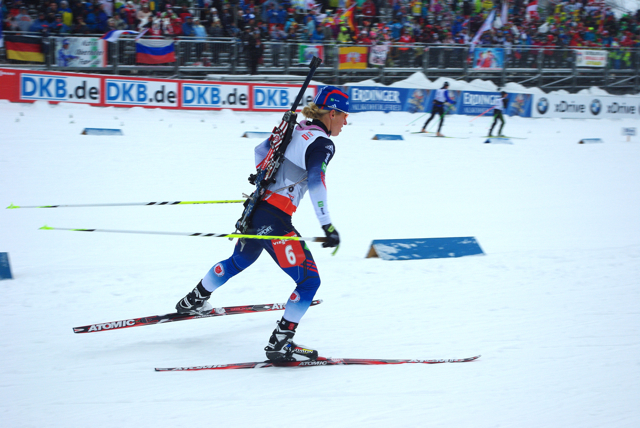
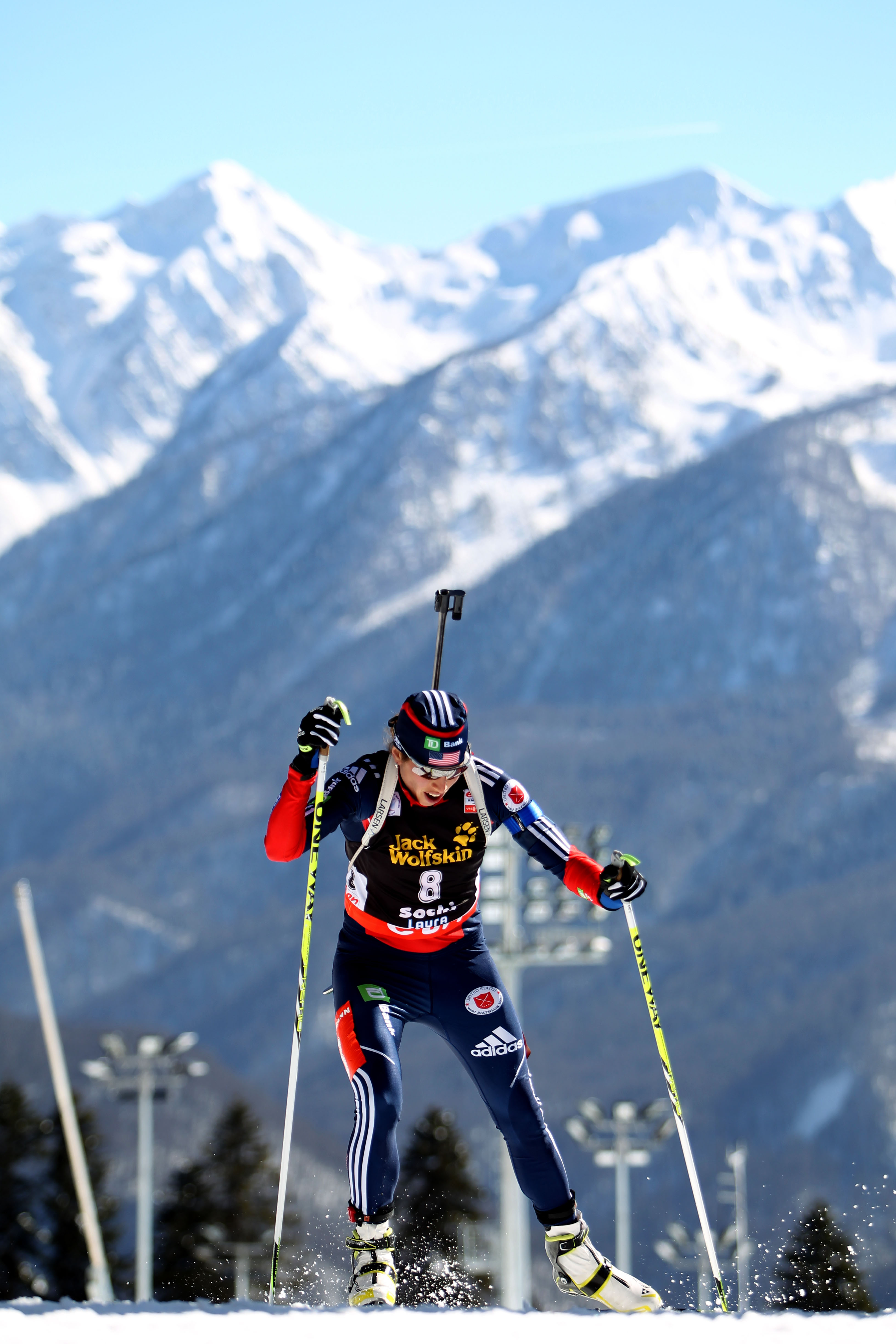
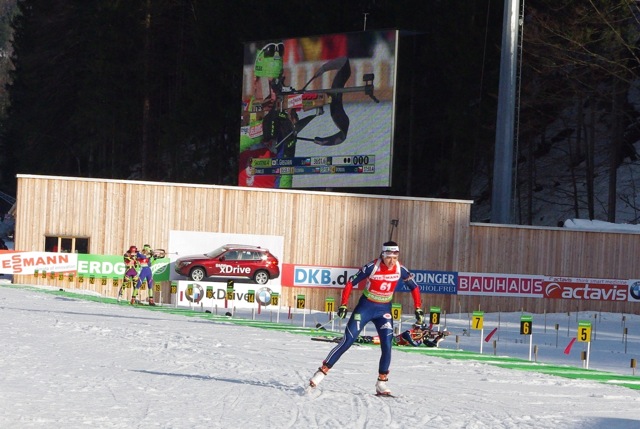
Lanny Barnes competing in the World Cup sprint on Friday.
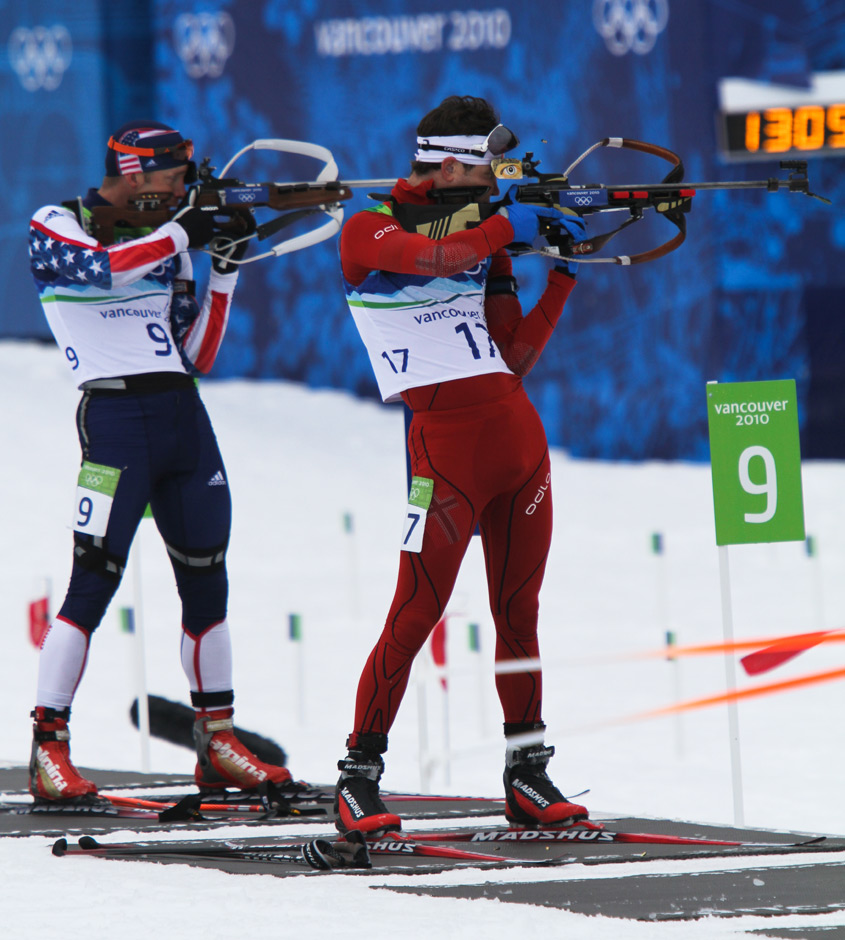
HOCHFILZEN, Austria – Four years ago at the Vancouver Olympics, the best American results in biathlon came from a pair of veterans: Jeremy Teela, who placed ninth in the sprint in the best-ever finish for a U.S. biathlete at a Games, and Lanny Barnes, whose 23rd-place finish in the sprint was a historical record for a U.S. woman.
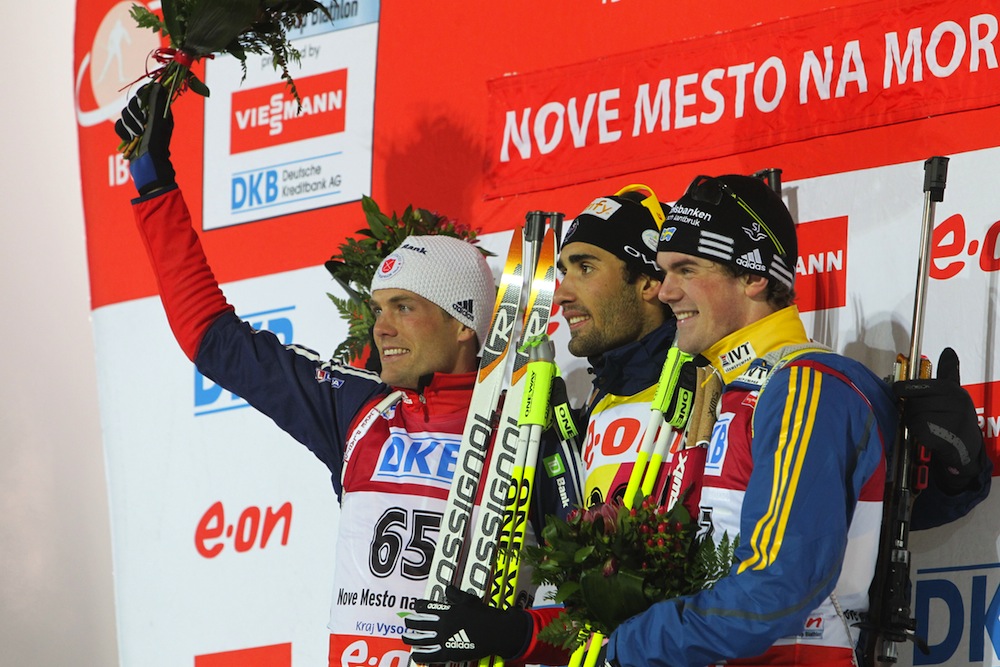
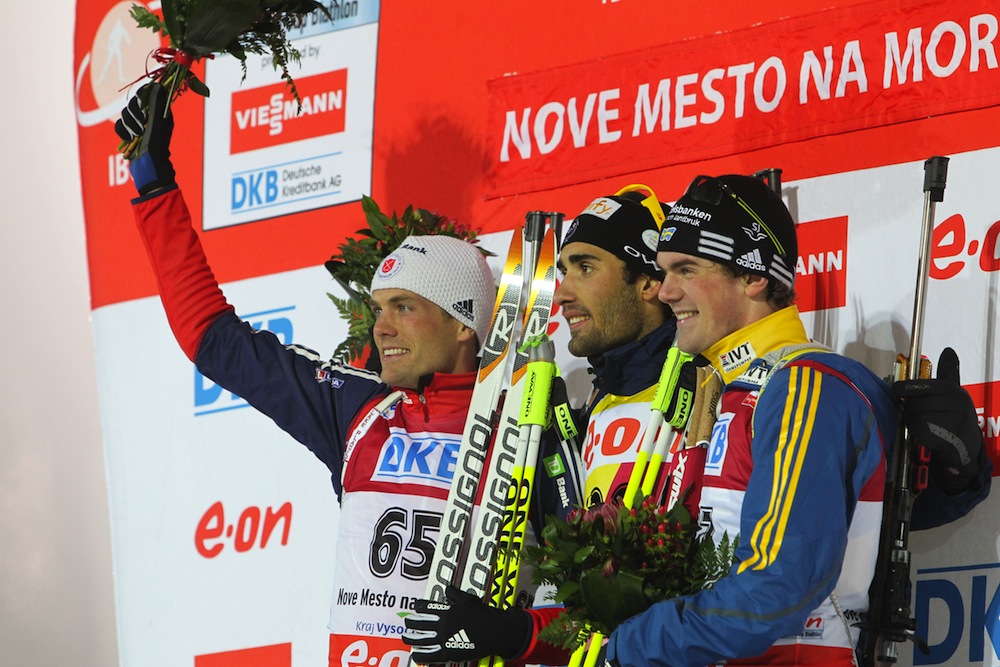
You might not have seen much of either racer last season, but they’re still around – and in fact, you might say they are making their comebacks. Both Teela and Barnes were on hand this weekend for World Cup racing after spending most of last year on the second-tier IBU Cup circuit. In Friday’s sprint, they both placed 65th, just outside the cut for Sunday’s pursuit. But on Saturday they upped their games and turned in strong relay legs: Barnes helped the U.S. women finish eighth, the best result since she joined the team more than ten years ago, and Teela tagged off after the third leg in sixth (the U.S. men eventually finished 11th, but closer time-wise to the podium than they often are).
Were these the best performances of their careers? Certainly not. But for a pair of athletes who didn’t get to see this level of competition much last season, it’s a step in the right direction.
“You might say that everything since Vancouver was a down season,” Teela laughed. “But I’ve had a really good season of training.”
Like Barnes, he is hoping to qualify for the upcoming Sochi Olympics. It would be the third Games for Barnes and the fourth for Teela – definitely his last, he said.
After Vancouver, Teela began spending more time on other aspects of his life. Maybe most importantly, he now has a child. That changes your priorities a lot, he said. He was still training hard, but wanted to spend time with his family. That’s the main reason he’ll retire at age 37 at the end of this season.
This year? All of that is suspended temporarily while he tries to go for it one more time.
“An Olympic year is always extra motivation,” Teela said. “Oh yeah.”
Both athletes qualified through rollerski races in Jericho, Vermont, and Soldier Hollow, Utah, to take part in a national team trip to Sweden this fall in advance of the race season. There, they raced in the IBU Cup openers. Teela did well enough to earn an immediate promotion to the World Cup.
Barnes wasn’t so lucky – she started off with a strong race, placing 13th in the opener, but in the second sprint shooting woes knocked her way out of contention. So she spent a second weekend on the IBU Cup while Hannah Dreissigacker got the World Cup starts. But Barnes stayed consistent in the next IBU Cup races, placing 16th and 18th, and got a promotion (the U.S. now has five women traveling with the World Cup despite only having four start spots).
“It feels good,” Barnes said on Friday of her first World Cup start of the season. “That was one of my goals for the year, was to climb my way back up.”
While Teela has fatherhood to deal with, Barnes and her sister Tracy faced a different challenge. This spring they had surgery for compartment syndrome, a painful condition that affects the lower legs, particularly in skating. They are now back to 100 percent and feeling better than ever.
“It’s night and day,” Barnes said. “I was trying to explain to a lot of people how it’s like for ten or twelve years, or maybe my whole career, I’ve learned how to not push in my legs, because I haven’t been able to use them. And now I have to remind myself to actually push with my legs. So I have to work with my technique to keep stepping on them.”
The fresh snow on Friday’s course tested her legs seriously for the first time this season – if they were ever going to feel painful, the heavy, slow conditions would have done it. But Barnes reported that there wasn’t pain, just a struggle to adjust her technique to the conditions and her new legs. That means she can focus all of her energy on racing well and making the Olympics.
“It’s always a struggle when you come back from surgery and you’re basically the bottom of the pond,” she said. “So it’s nice to finally be back here and having a chance to fight.”
Fight they will have to, if the pair want to compete in Sochi. Three athletes – Tim Burke, Lowell Bailey, and Susan Dunklee – are already qualified for the Games. Two more will be picked after this pre-Christmas World Cup period. Teela said he hopes to be that guy so he can avoid the post-Christmas selection trials process, the more painful route towards Olympic qualification.
Barnes is up against Annelies Cook, Sara Studebaker, and Dreissigacker, among others who may qualify for a January IBU Cup tour that serves as the last set of trials. Cook has the best result of the trio so far and is likely to snag the automatic qualification spot; Studebaker is also a 2010 Olympian, while Dreissigacker is a newcomer to the team who placed in the top 60 at last year’s World Championships.
For Teela, the main rival for qualifying off the World Cup is Leif Nordgren, a young but veteran World Cup and World Championships racer who is the habitual anchor for the U.S. relay team. The Americans also have Sean Doherty – last year’s World Youth Champion – on the tour, but his results so far don’t make him competitive for the Olympic spot. Racers like Russell Currier, Wynn Roberts, and Jay Hakkinen will vie for the spot available through IBU Cup qualification.
“He’s 18 years younger than I am,” Teela laughed of traveling with Doherty. “I mean, technically, I could be his father. But it’s great to have the young guys here pushing. Sean is going to be a great biathlete in the future, I just hope he doesn’t expect it to come too fast.”
Regardless of whether he makes the Olympics or not, Teela is hoping for big things from his team.
“Tim Burke is so strong and so focused,” he said. “He’s a real threat for the overall. He could medal in any race. Me, I still feel like I could get a medal, but I can’t be so good for the whole season like Tim. I’m focusing everything on being my best for three weeks, for the Olympics, and hopefully that is enough.”
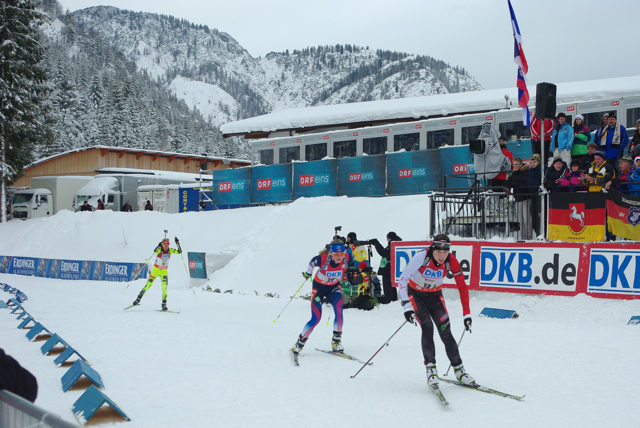
Hannah Dreissigacker (center) in the thick of it, leaving standing in eighth place behind Megan Heinicke of Canada.
HOCHFILZEN, Austria – Lanny Barnes has done a lot of relays before. But the 31-year-old had never quite found herself in the position she had today: going into the anchor leg of the 4 x 6 k World Cup relay, the United States was in seventh place, less than a minute and a half behind the leading team from Ukraine and only 40 seconds from the podium.
“The other three girls they did an awesome job of putting me right up in there,” she said. Barnes proceeded to hit all of her targets and the U.S. finished eighth, by far the best result of any of the racers’ careers. The previous best was tenth place in Antholz, Italy, last season.
Coming in with bib 17, a 16th-place ranking in the Nations Cup, and tough results the day before when none of the women made the top 60 in the sprint, the United States definitely wasn’t expected to make the top eight. It seemed like it would be especially tough with Annelies Cook, the team’s number two athlete, sitting out. Luckily the Americans are traveling with five women, so both Barnes and Hannah Dreissigacker, who had been expecting to fight each other for a chance in the relay, got to start.
To have the depth to finish eighth without one of the relay team’s traditional members? That’s certainly something new.
“It says a lot about the women’s program,” Barnes said. “We’re on our way up and even though we had a really disappointing day yesterday, it was good to come back and have a decent result today.”
For various reasons, the team really needed a strong result to get their mojo back. The most obvious was the sprint yesterday, which was mainly hampered by poor shooting: except for Barnes, the other three starters (Susan Dunklee, Cook, and Dreissigacker) all had four penalties.
Not so today, when the team used just three spare rounds between all of them over the course of eight shooting stages.
“It’s a really great statement what they are doing today,” shooting coach Armin Auchentaller said midway through the third leg. “They are awesome today – they have no penalties in prone and they’re in a good spot. They are fighting hard on the track out there and it’s really nice to see them perform in this way. It’s for sure for all of them a great confidence-booster and this will bring them forward.”
Susan Dunklee playing catch-up on her last lap. The Americans’ opening racer, she tagged off in 11th.
But there were other things, too. Dreissigacker, Barnes, and Sara Studebaker are competing for two starting positions in individual races (Cook and Dunklee have the first two of the Americans’ four-woman quota). Studebaker had to sit out the sprint, which was something of a blow. Dreissigacker has been on the bubble for basically her whole international career and is constantly trying to get results good enough to hang onto her starting spot. And Barnes is attempting a comeback after compartment syndrome surgery.
So for these women in particular, it was mission accomplished. The team member who has been on the circuit the longest, Barnes was helped out by a bit of history when she found herself setting out on course in seventh place. She showed why she was a staple of U.S. teams for so long as she was calm, collected, and perfect on the range – as well as the fastest shooter in both of her bouts – despite intense pressure.
“It was especially great to have the opportunity to do the relay here – I think I’ve cleaned every relay I have ever done here, so it gave me a little confidence in the shooting,” Barnes said. “Especially when it’s head to head and there’s a lot of pressure, because when I was coming into the range on the last loop, I could still hear the top girls just leaving. So I was really excited to have that pressure, to know that I have to hit them or else we’re dropping back, way back.”
Skiing the third leg, Dreissigacker bounced back hard from her disappointment the day before. She cleaned prone, used a single spare in standing, and skied the eighth-fastest time of all the third-leg racers.
“It’s such a relief that I can actually hit my prone targets,” she said. “This is what I have been wanting to do – to mix it up with other fast girls. And this was such a good opportunity to do that. It was just fun. That’s what biathlon is about, when it’s really a race and you’re moving back and forth. I hadn’t really gotten that chance yet [this season], so it was awesome.”
And Studebaker came out of the gate with a vengeance after missing out on Friday’s action. She didn’t need any spare rounds to clean her targets.
“Personally, it was a little bit of both,” she said when asked whether the extra rest day was a benefit or a detriment. “I was bummed not to race yesterday and I need races to get into feeling better, but at the same time it made me more hungry today to go out there and really get it… It was definitely the race that I was hoping to have after sitting out yesterday. Clean shooting, and I got to ski around some fast people.”
By the time Studebaker was finished and Dreissigacker took over, the team was in 13th. That sounds about like their usual relay results – unspectacular. But in fact, it was the perfect setup for a run towards the top.
“It was a really good place,” Dreissigacker said. “13th doesn’t sound that great but we were right with a lot of people. They really weren’t far ahead. It was the perfect opportunity to think that there’s not a lot of pressure, but they are right there and I can ski with them and shoot better than them.”
For someone like Dreissigacker, who has relatively little World Cup experience and has to treat each race like a trial to keep her spot, the relay was something of a comfort, rather than being an added stress.
“Honestly, I think I race a lot better when I’m not super, super nervous and really putting a lot of pressure on myself,” she said. “I definitely really want to do my best for the team, but having other people being a part of it too takes some pressure off and it really allowed me to just relax and say, okay, this is my focus. And then do that, just ski with that girl who is right there.”
Dreissigacker said that last night in their prep work the women “didn’t dwell on” their disappointing results in the sprint. Instead, they treated the relay like a new opportunity.
“First of all we always want to finish higher than our bib,” Studebaker said. “But it was the first relay and we’re trying some different stuff. Susan was scrambling [for the first time], and Annelies isn’t feeling great so she’s sitting out, so we were just hoping to get that relay feel and come together as a team and have a good result. We haven’t had the best team results usually, so we thought we’d try to turn it around here.”
Seems like it worked
“It was really awesome to start out the first relay like that,” Barnes concluded. “It was fun.”
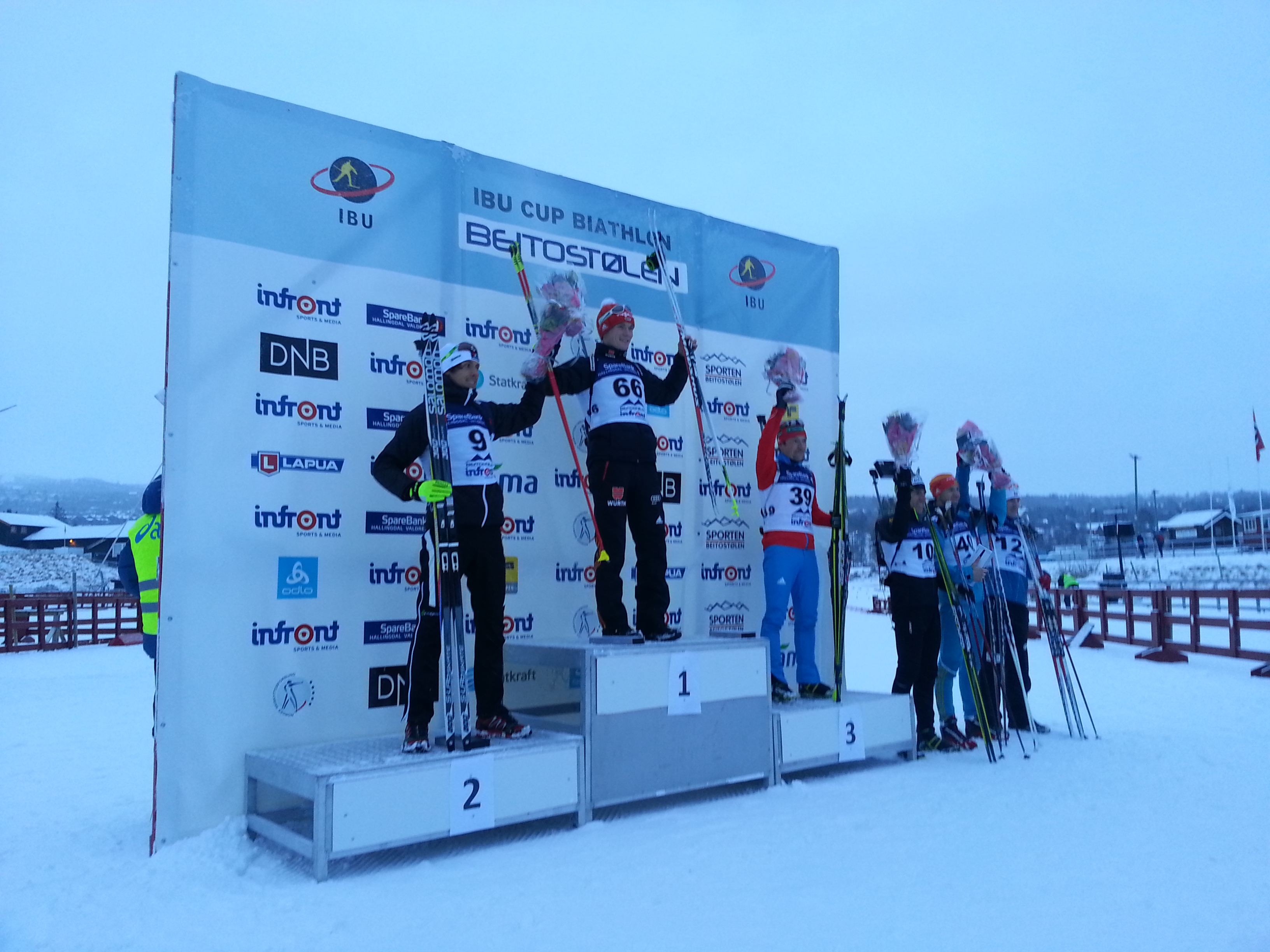
Brendan Green (left) on the podium in Beitostolen, Norway, after placing second in the men’s 20k individual IBU Cup. Photo: Roddy Ward.
If you look at Brendan Green’s competition record, it has a big gap in it. The last World Cup the 2010 Olympian competed in was Oslo, 2012 – after which he slipped a disc in his back and had to take about a year to recover, with multiple surgeries.
But this fall, Green in back in action, first easing on to the second-tier IBU Cup circuit. He started off strong in Idre, Sweden, shooting clean to place ninth in the first (and most competitive) race in Idre, Sweden. Most years, this would have earned him a promotion directly onto the World Cup – which is where Green needs to be if he wants to complete his qualification criteria for the Sochi Olympics.
This year, though, everyone in Canada has upped their game for the Olympics, and teammate Nathan Smith placed second in that race; Marc-Andre Bedard also tied for ninth. It was a banner day for Biathlon Canada. Green stayed on the IBU Cup.
But he’s not discouraged, and he came back strong today in Beitostolen, Norway, by placing second in the 20 k individual race to Benedikt Doll of Germany. Green limited himself to just one penalty, which is important in this format where each missed shot is penalized by a minute of added time.
“The wind here has been super extreme all week leading up to today, to the point where the range was closed on Wednesday for our training because it was too windy,” Green wrote in an e-mail to FasterSkier. “We tried to shoot yesterday but gave up after a couple of clips because it was impossible to hit anything, and more or less a waist of time. Fortunately today the wind had died down so shooting conditions were perfect.”
Doll, though, was in a class of his own, winning by almost a minute and a half despite also accruing one penalty.
While Green was hugely helped by a strong finish – he cleaned the all-important final standing stage and had some of the fastest loop times on the third and fourth loops – he didn’t know it at the time.
“I was an early starter being bib #9, so I didn’t have too much information to go off of,” Green said. “It was a pretty lonely race for me so I just tried to focus on consistent skiing and putting together a good shooting race. When I just had 1 miss after three bouts I knew the potential was there for a good result. My last standing shooting went perfect and from there I just tried to maintain a solid pace to the finish and crossed my fingers that my time would hold up!”
Aside from Green’s excellent result, Canada had already been having a good weekend. Up on the World Cup, JP Le Guellec placed fourth in the individual, narrowly missing the podium, and Smith a career-best 16th. According to Green, the momentu the team was feeling after that first weekend of IBU Cup racing, where five athletes were in the top ten, did not dissipate when the team split up between the IBU and World Cup circuits.
“I think as a team we’re feeling pretty confident and it was great to watch JP throw down an awesome result on the World Cup yesterday,” he wrote.
The podium on the IBU Cup doesn’t help Green directly with his Olympic qualification criteria, but it does stoke the fire for his inclusion.
“In terms of Olympic qualification, I’m unable to meet any criteria with my IBU Cup results, but they definitely help build confidence,” Green wrote. “Ultimately I would like to be racing on the World Cup, but I’m doing my best to make the most of the racing opportunities I’m given. When I think back to where I was with my injury at this point last year I wasn’t able to ski yet. I’ve come a long long ways since then, so I have to be pretty happy about that and am grateful to be back in the game!”
Also competing for Canada, Scott Gow placed 20th with two penalties, his younger brother Christian 31st, Macx Davies 62nd, and Bedard 69th. The sole American competitor, Jay Hakkinen, placed 50th with four penalties.
In the women’s 15 k, Lanny Barnes of the United States placed 18th with two penalties, 3:48 behind Olga Podchufarova of Russia. For Canada, Audrey Vaillancourt placed 34th, Claude Godbout 42nd, and Julia Ransom 62nd.
Note: This is part of an occasional series of heart-healthy and fitness-ready recipes for skiers. The following was submitted by Olympic biathlete Tracy Barnes, who co-wrote the Twin Biathletes’ Cookbook with her sister, Lanny. For more on the Colorado-based Barnes twins or to buy their book, visit their blog, twinbiathletes.com. Have a favorite recipe of your own? Share it with us by emailing alex@fasterskier.com.
It’s Friday and you know what that means! Treats for all the hard work you’ve done all week and calories you’ll burn this weekend — ideally. Anyway, here’s a killer recipe for “To Die For Homemade Brownies” with dark chocolate chips and walnuts. Who needs the box when you can make the real thing?
To Die For Homemade Brownies
You need:
2 large eggs
6 tbsp butter melted & cooled
1 cup white sugar
1/2 cup all purpose flour
1 tsp vanilla extract
1/2 cup Dutch-process Cocoa
pinch of salt
1 cup Dark Chocolate Chips
3/4 cup walnuts chopped
Directions:
Preheat oven to 375º.
Grease 8x8x2” pan.
Mix sugar, flour, cocoa & salt in large bowl.
Add eggs, vanilla, & melted-then-cooled butter and mix until smooth.
Add dark chocolate chips and walnuts.
Place batter into greased pan and bake 20-27 min, or until wet batter in the center of brownies no longer attaches to knife.
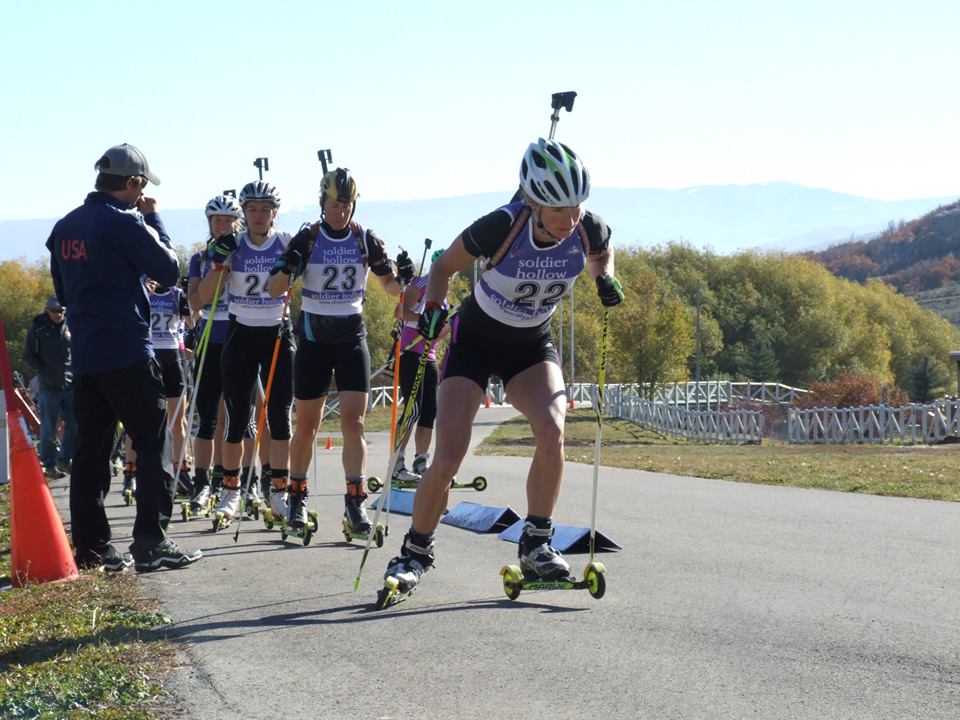
Hannah Dreissigacker leaves the start in Tuesday’s sprint at Soldier Hollow while Lanny Barnes and Sara Studebaker wait on deck. Photo: Gordon Vermeer.
After four rollerski races’ worth of battling, eleven biathletes have been selected to attend U.S. Biathlon’s fall training camp in Östersund, Sweden, to prepare for the World Cup season. The camp is also an important step in the Olympic qualification pipeline, as early-season World Cup results are one way to snag a trip to Sochi.
Six athletes – 2013 World Championships silver medalist Tim Burke, plus teammates Lowell Bailey, Leif Nordgen, Susan Dunklee, Annelies Cook, and Sara Studebaker – were prequalified for the Sweden camp. Hannah Dreissigacker and Jeremy Teela, both also members of the national team, were the trials winners after competing in Jericho, Vermont, this summer and then Soldier Hollow, Utah, last week.
Lanny Barnes, an Olympian who underwent compartment syndrome surgery at the end of the 2013 season, was added as a discretionary pick. The Durango-based athlete who trains with her sister under the team name Twin Biathletes was the next-ranked woman in the trials standings.
On the men’s side, national team veteran Jay Hakkinen earned a discretionary nod, with USBA High Performance Director Bernd Eisenbichler noting that the Alaskan was highly ranked in the trials and “actually beat Jeremy in three races.”
Sean Doherty, the 18-year-old who won three medals including one gold at World Youth Championships last season, also got the nod as a discretionary pick. The New Hampshire native trains with Algis Shalna in Jericho, Vermont.
How to Qualify: It’s Complicated
These eleven athletes aren’t necessarily the ones headed to Sochi, but booking a ticket to Europe certainly gives them an advantage in a multi-step process which provides several ways to qualify.
Importantly, the team’s top three racers – Burke, Bailey, and Dunklee – are already pre-qualified based on results from the last season of World Cup racing. They met criteria such as a top 30 ranking in the Total Score or two top-15 finishes in World Cup and World Championships racing.
The U.S. has spots for five men and five women, although the team can only start four athletes in each competition. It’s unclear whether they will bring the full roster of five or not.
The next way the U.S. will try to fill its team is based on the first period of World Cup racing. After the openers in Östersund kick off on November 24, the IBU World Cup will move to Hochfilzen, Austria, and then to Annency, France. Rosters for those races will be determined by performance at the pre-race training camp, while athletes not picked for the World Cup will be sent to the second-tier IBU Cup circuit, with the opportunity to move back and forth based on current performance.
In these early World Cups, a top-30 finish is good enough to be added to the Olympic team. Up to three men and three women can be selected to the team by the end of December, counting Burke, Bailey, and Dunklee – so one more man and two women can qualify this way. If more athletes have top-30’s, the ones with the best results will be picked. Conversely, if no athletes in a given gender reach the top-30, the athlete with the single best result will be added anyway.
Of the athletes who will go to Sweden and haven’t pre-qaulified for Sochi, Nordgren, Cook, and Studebaker all had top-30 finishes last season.
For the remaining spot or spots on the Sochi roster, athletes will have one last chance to fight their way onto the team in January. Importantly, it’s also possible for athletes who did not make it to the Sweden camp to step in on this part of the process: trials races held in December will select a few more racers to join the IBU Cup circuit, where they will join any non-qualified athletes from the fall World Cup and IBU Cup squads.
In this final step, Americans will compete in Ridnaun, Italy, or Altenburg, Germany, and also potentially in time trials. The best athletes will be selected using a percent-back ranking from three of four races and time trials. USBA also allows one discretionary pick per gender for the Olympic team.
Performance Notes: Women’s Team Looking Strong
Eisenbichler said that he was very happy with the level of performance by his women’s team, and also that it was relatively easy to identify Dreissigacker and Barnes as the two women who should be added to the roster for Sweden. Dreissigacker won the sprint in Jericho this summer as well as the final sprint in Soldier Hollow; Barnes was second in the last Soldier Hollow sprint. Her sister Tracy had better performances in Jericho, but did not compete in Soldier Hollow.
More importantly, Dreissigacker and Barnes turned their performances up a notch in the last competition, going 1-2 while both shooting clean. Barnes is a veteran and traditionally one of the best shooters on the circuit; Dreissigacker is a relative newcomer to the sport after coming in as a skier.
“That was really important to see, that even with a fair amount of pressure in that last race they shot clean,” Eisenbichler said in an interview on Saturday. “This is the first time for Hannah.”
Eisenbichler was also pleased with his pre-qualified athletes. Dunklee cleaned in a sprint win on Tuesday, where Cook was second and Studebaker third. Cook didn’t compete in the final race; she tweaked a nerve in her neck, and since she didn’t have to qualify through the races, Eisenbichler said it was “safer not to take any chances.” The problem has since been fixed and she is back to training.
He called Studebaker’s two third-place finishes in Soldier Hollow “solid” and was gratified to see that the women’s team had improved considerably since Jericho.
“Opposite of Jericho, the women really were shooting very well,” he told FasterSkier. “I don’t want to seem overoptimistic, but I’m really happy with where the team is right now.”
Men Knocking at the Door
Eisenbichler was also enthusiastic about the performances from Bailey, who has swept all four of the trials races, and from Burke and Nordgren, who were often close behind.
“I think that once these three guys get to the World Cup, they will be able to be having some really good results right away,” he explained.
After that, though, the committee’s job was considerably harder in making discretionary selections for the Sweden trip. Teela was the trials winner based almost entirely on a single exceptional performance where he cleaned his targets to place third in the first Soldier Hollow sprint.
Hakkinen and Doherty were fourth and fifth in the final sprint, behind the three pre-qualified men. Hakkinen was consistent throughout the four trials races, but these strong performances late in the game and under pressure certainly helped the pair earn their discretionary nods.
National team member Russell Currier and National Guard biathlete Wynn Roberts also had top-six finishes in Soldier Hollow; both also raced well in Jericho, where Currier was second in the sprint and Roberts seventh, but the fifth American. They found themselves just on the outside when the final rankings were tallied.
“There were a lot of guys in the mix for that fourth spot on the trip, like five or six of them,” Eisenbichler said. “Even the ones that didn’t make it, I think will have good performances if they go to the IBU Cup in January. It’s going to be very competitive.”
Doherty’s selection was probably the most surprising. He did not compete in Jericho due to illness, but had a stellar final sprint in Soldier Hollow.
“Sean’s preparation this year has been great,” Eisenbichler said. “Compared to his progression in October last year, he has made huge improvements. We really thought that sending him to Sweden will be the best thing for his development as a biathlete.”
Note: This is part of an occasional series of heart-healthy and fitness-ready recipes for skiers. The following was submitted by Olympic biathlete Tracy Barnes, who co-wrote the Twin Biathletes’ Cookbook with her sister, Lanny. For more on the Colorado-based Barnes twins or to buy their book, visit their blog, twinbiathletes.com. Have a favorite recipe of your own? Share it with us by emailing alex@fasterskier.com.
***
Spaghetti Squash is super good for you, being rich in nutrients and low in calories. It also absorbs the flavors of the other ingredients really well. Use in place of pasta. Here are two delicious spaghetti squash recipes for you to enjoy:
One of two spaghetti squash recipes from the Twin Biathletes’ Cookbook.
To cook the spaghetti squash:
Preheat oven to 375 degrees.
Cut Spaghetti squash in half lengthwise.
Scoop out the seeds and place the cut side down on a baking sheet.
Pierce the shell several times with a fork and place in oven.
Bake for 45 min to 1 hour or until squash is tender.
Remove from oven and let cool for 15 min.
Use a fork to remove the spaghetti strands from the squash. Drain any excess liquid from shell and strands
Place spaghetti strands in bowl, add ingredients (see below).
Spoon back into squash shell and place in over for 10-15 minutes.
Remove from oven and enjoy!
Spaghetti squash, asparagus, pine nuts, etc.
1 small spaghetti squash
2 tablespoons Extra-virgin olive oil
Salt and freshly ground black pepper to taste
1 bunch thin asparagus, steamed tender
2 teaspoons minced fresh rosemary
1 teaspoon McCormick Tuscan Seasonings
1/2 cup parmesan cheese
1/4 cup pine nuts
Steam asparagus and chop into 1 inch pieces. Mix all ingredients with spaghetti squash. Place back in shell. Bake for 10-15 min and enjoy.
Spaghetti squash, tomato sauce, mozzarella, prosciutto, basil etc.
1 small spaghetti squash
1-16oz. can of fire-roasted tomatoes diced
Salt and freshly ground black pepper to taste
1 small package of small fresh mozzarella balls
1 teaspoon McCormick Italian Seasonings
1/4 cup parmesan cheese
1/4 cup chopped fresh basil
1 small package of thin sliced prosciutto ham
Slice prosciutto in small pieces. Mix all ingredients with spaghetti squash. Place back in shell. Bake for 10-15 min and enjoy.
Note: This is the second recipe in an occasional series of heart-healthy and fitness-ready food recommendations for skiers. The following was submitted by Olympic biathlete Tracy Barnes, who co-wrote the Twin Biathletes’ Cookbook with her sister, Lanny. For more on the Colorado-based Barnes twins or to buy their book, visit their blog, twinbiathletes.com. Have a favorite recipe of your own? Share it with us by emailing alex@fasterskier.com.
***
For Crepes
1 egg
1 cup milk
1 cup flour
pinch of salt
For Filling
1 cup tart or sweet apple cubed
1 lb of sweet ground sausage
1/2 cup cubed Vermont cheddar
Italian seasonings
Maple syrup (to drizzle on top)
Mix crepe ingredients in a blender and blend until smooth. Heat crepe pan until hot. Pour small amount of crepe mixture into bottom of pan and spread evenly. Flip when light brown on bottom. Set aside on plate and repeat until mixture has run out.
Cook ground sausage in skillet until done and set aside. Cut apples and cheddar and set aside.
Preheat oven to 415º. With crepe open, place apples, sausage, cheddar, seasonings on one side and fold. Cook in oven for 15 minutes or until cheese is melted. Serve with Maple syrup on top! Enjoy…
Carne Asada Elk with Grilled Fruit/Corn (from Tracy and Lanny Barnes/twinbiathletes.com)
Note: This is the first in an occasional series of heart-healthy and fitness-ready recipes for skiers. The following was submitted by Olympic biathlete Tracy Barnes, who co-wrote the Twin Biathletes’ Cookbook with her sister, Lanny. For more on the Barnes twins or to buy their book, visit their blog, twinbiathletes.com. Have a favorite recipe of your own? Share it with us by emailing alex@fasterskier.com.
***
Carne Asada Elk (or Beef) with Grilled Fruit/Corn
This is a great summer time grilling recipe. The best Mexican food is simple with fresh ingredients. Hope you enjoy!
Tracy (r) and Lanny Barnes skiing together into the finish of the 2013 North American Biathlon Rollerski Championships 7.5 k sprint last weekend in Jericho, Vt. The twin sisters co-wrote a cookbook, Twin Biathletes’ Cookbook.
3 Tablespoons Lime Juice or 2 fresh squeezed limes
1 clove garlic minced
1 Tablespoon Soy Sauce
1/2 Teaspoon Salt
1 Teaspoon Ground Cumin
1 1/2 Teaspoons Liquid Smoke
1 handful of fresh cilantro chopped (stems & leaves)
Add thin sliced Elk or Beef to plastic ziploc bag. Add the rest of the ingredients. Seal ziploc bag. Mix up meat & other ingredients in bag. Place Meat & Marinade in Fridge for 1-6 hours.
Remove meat from bag and place on hot grill. Grill for a very short period of time (1-2 min) on each side. Don’t over cook. May take less than a minute on each side.
Other Ingredients:
On the grill:
Grill 2 Ears of Corn. Rotate on grill until corn is tender. Once cooked, cut corn off the cob.
Grill thin sliced pineapple. Grill for a minute or less on each side.
This is a scene the U.S. hopes will play out at the Olympics: Tim Burke on the podium after earning silver in the 20 k individual at 2013 World Championships in Nove Mesto, Czech Republic. Photo: Nordic Focus/USBA.
The last five years have seen the size, resources, and focus of the U.S. biathlon team rise and fall, then rise and fall again. There have been shifting standards on what constitutes an “A” team performance, how much discretion is used, the size of the “B” team, and even how late into the season athletes are added to the team.
But the 2014 season is different for one huge, glaring reason: Sochi, Russia, which will host the Olympic Games.
And so, in an effort to be the absolute best it can be at the Games, the U.S. Biathlon Association is sinking all of its resources into a skeleton crew of elite seniors as the big event draws near.
“That’s definitely what we’re doing, and what the [U.S.] Olympic Committee is willing to support,” USBA President Max Cobb told FasterSkier last week. “We will have a very different strategy for the 2014-15 season than we have now, that’s very clear… [but] that’s the approach we’re taking this year.”
Four men and four women were recently nominated to the “A” team for the 2013-2014 season, and just three athletes in total to the “B” team. It’s the smallest squad that the U.S. has nominated in years.
He is joined on the “A” team by Lowell Bailey, Russell Currier, and Leif Nordgren. The four men qualified automatically for “A” status by finishing fifth in the World Cup 4 x 7.5 k relay in Oberhof, Germany, in January. A top-seven relay result is specified as one of several possible qualification criteria in the national team criteria.
On the women’s side, Cobb said that Susan Dunklee, Annelies Cook, and Sara Studebaker all met individual qualification criteria for the “A” team, while Hannah Dreissigacker, who started her first World Cups partway through the season, was a discretionary pick.
Susan Dunklee had the best U.S. women’s result of the season, placing seventh in the 15 k individual at the Sochi World Cup – where the team previewed the Olympic venue. Photo: USBA/NordicFocus.
“We looked at her results and she had two top-20 finishes on the IBU Cup, and we thought she had a strong performance in the relay at World Cup 6 and at World Championships, so for the future, she has the ability to contribute,” Cobb said of Dreissigacker, who along with Dunklee is also affiliated with the Craftsbury Green Racing Project. “She had a top-60 at the World Championships and had competitive international ski times, so that was really good.”
Dreissigacker’s inclusion is also notable as it is the first time in recent memory that four women have been named to the “A” team. Cobb hoped that having a larger training group, more comparable to the atmosphere on the men’s team, would propel the women to greater success.
“We’re really excited about the progress of the women’s team,” he said. “I think that having those four women training together throughout the season is really going to drive things to an even higher level, and be a big step forward for the coming season.”
All eight “A” team athletes competed at World Championships, where they collected four top-20 results and an additional eight top-40 finishes – all of which bodes well for next year’s Olympic Games. The only two athletes not to score points at World Championships were Dreissigacker, for whom it was the first trip to the sport’s second-biggest stage, and Currier, who proved his abilities last season when he collected two individual top-ten performances on the World Cup.
B-Team Veterans
Unusually for a national team, the “B” level is filled only with veterans – all of whom have had Olympic success in the past. While none of the three achieved particularly strong international results last season, USBA is hoping that they can be in the mix come trials and make the teams more competitive.
For the women, Lanny Barnes is the sole “B” team nominee. After a mediocre year where she started on the World Cup and then saw some IBU Cup action, she and twin sister Tracy Colliander, herself a 2006 Olympian, underwent surgery for compartment syndrome. On their website they wrote that the injuries had been bothering them for a long time; they are already back on skis.
“It seems like their surgery was successful and that they were pretty quickly back able to get around again, unlike Tim’s surgery, where he was off his feet for a long time,” Cobb said. “So that’s really positive, and we’re hopeful that it will be good and that their results will come back up. But the truth is that the results really weren’t strong for either one of them this season, so there was no rationale for bringing them on to the A team.”
Can he do it again? Now a dad, Jeremy Teela (left) has his work cut out for him if he’s going to repeat his ninth-place finish from the sprint at the 2010 Vancouver Olympics.
Also on the “B” team are Jay Hakkinen and Jeremy Teela, two long-time national team veterans. Along with Lanny Barnes, Teela had the best U.S. results at the 2010 Olympics. The men hope to make one last Games this winter.
“Having spoken to both of them, they are both very concentrated and focused,” Cobb said. “You know, Jeremy welcomed his first son into the world just before the season began, and I think that he took a necessary break from the rigors of training and preparing for international competition, and he still went on and had fairly close selection races with Jay. So he was already able to compete successfully with Jay, and for both of them the big challenge is what they can make happen for this year going into the Olympics. And I think both of them will really put everything they have into it.”
This year, the “B” team designation has little benefit in the way of training or off-season support; while in the past it has been a group of athletes who live and train in Lake Placid, many of the veterans prefer to train out of their own home bases. In addition, more of the camps than usual will be limited to the “A” team.
“It’s less ‘B’ team participation than we had last year,” Cobb said. “But there has always been a difference, there have always been camps where only the ‘A’ team was invited. We have the camps where we are using rollerski competitions to qualify athletes for the on-snow training camp in Sweden, and there we will have support for the ‘B’ team athletes, but other than that, this year most of the camps will be only the ‘A’ team.”
Further Cuts to Development
What the “B” team lacks this year is the usual crop of younger athletes who are rising through the ranks. Given the team’s funding situation, Cobb said, there just wasn’t the possibility to include development in this year’s national team. The team is so small, has no new members, and only one under the age of 25.
“We are very cognizant of the fact that it is very hard right now to be a developing biathlete in the United States,” Cobb said. “It’s very difficult to stay in the sport. That said, we think that the strategy that we’re taking to give the leading group of athletes everything they need to be successful will be one that results in longer-term prosperity for all of us.”
The team nominations came with an announcement that the junior national team will be named at a later date, and Cobb mentioned that USBA is particularly excited about the development trajectories of younger athletes like Casey Smith, Anna Kubek, Tara Geraghty-Moats, and newly-minted Youth World Champion Sean Doherty.
The national team money going towards development this year will be some token amount for a junior team, the details of which are yet to be announced; it will help athletes like Sean Doherty, 2013 Youth World Champion in the pursuit and twice a silver medalist. Photo: UBSA/NordicFocus.
But the athletes left in the lurch are those that are old enough to be out of the junior ranks, but who weren’t seen to have much of a shot in this Olympic cycle. Katrina Howe of the Maine Winter Sports Center, Wynn Roberts of the National Guard, Bill Bowler (who has headed north of the border to train with the Biathlon Alberta Training Center), and Mark Johnson of Mount Itasca spring to mind, as all made international tours this season or last season. In addition, Corrine Malcolm was not re-named to the national team.
Several younger athletes, too, are just negotiating the transition out of the junior ranks. Without development funding from USBA, it’s tough to know how many might make it through the end of the next Olympic cycle, after a raft of current national team members will have presumably retired.
Cobb, however, stressed that biathlon is not alone in this challenge.
“We’re not the only sport in the country that’s really challenging from a financial standpoint to continue to progress in,” he explained. “Unfortunately it’s not that uncommon. I actually just spent a day and a half with [USOC Chief of Sport Performance] Alan Ashley and had some great conversations about long term strategies from the Olympic Committee that could try to change that, to bring more resources to bear on developing sports so that it’s not so challenging for good athletes working their way up through the system.”
Future Goals
If all goes well in Sochi, Cobb hopes that success will bring more money to the program and allow them to re-establish a better development program. And that includes, among other things, once again reaching out to the ski community in search of new biathletes – a strategy that worked well for Dartmouth College graduates Studebaker, Dunklee, and Dreissigacker.
“Seeing the success from Susan, Sara, and Hannah, we envision being able to reach out again to collegiate athletes and be able to offer them the opportunity to be able to jump into biathlon,” Cobb said. “We recognize that we have really limited resources, and we need to focus them this year as concentrated as possible on success in Sochi, and if they are successful there, that will only help us to have a broader development program in the year after.”
In the meantime, he hopes that the few club teams that exist in the U.S. can continue to shoulder the burden of funding developing athletes.
“On the positive side, we still have some good clubs,” he said. “I know that Raleigh Goessling and Casey Smith will spend some more time at Maine Winter Sports Center, and Katrina Howe is there. The Craftsbury program is really offering athletes another opportunity in biathlon now, and that seems to be growing – Algis Shalna is putting a fair amount of time into that project as well now.”
There are a few other reasons to be optimistic, too. For instance, Burke’s silver medal is an additional carrot in continuing negotiations to attract new corporate sponsors.
“There’s no question that it’s made– we had started some of the discussion with companies before Tim’s medal, and that really helped continue those discussions,” he said. “I think that the results we have this season are good and are compelling and will help that process, and there are active proposals on the table now that are into third-round discussions.”
Finally, skiing on the whole is seeing exponentially more success in the United States, and, Cobb hopes, that added visibility can help each of the sports that fall under the nordic umbrella.
“It’s also coming at a time when the cross country team and nordic combined are also very successful, more successful than we’ve been,” Cobb said. “But in general, it brings the attention back to nordic sports, and that is really, really helpful, especially going into Sochi. I know NBC is going to be very focused on Kikkan [Randall] in Sochi, and I think that will be of great benefit to nordic sports generally, and to biathlon as well.”
2013-2014 U.S. National Team:
Men “A”:
Lowell Bailey, Lake Placid, NY
Tim Burke, Paul Smiths, NY
Russell Currier, Stockholm, ME (Maine Winter Sports Center)
Leif Nordgren, Marine, MN
Men “B”:
Jay Hakkinen, Kasilof, AK
Jeremy Teela, Park City, UT
Women “A”:
Annelies Cook, Saranac Lake, NY (Maine Winter Sports Center)
Hannah Dreissigacker, Morrisville, VT (Craftsbury Green Racing Project)
Susan Dunklee, Barton,VT (Craftsbury Green Racing Project)
Lanny Barnes powering her way to a sprint victory at the North American Rollerski Biathlon Championships on Saturday in Jericho, Vt.
JERICHO, Vt. – If one thing is constant in summer biathlon races here at the Ethan Allen Firing Range, it’s the sight of Lanny and Tracy Barnes near the top of the results sheets. Since 2009, only one of the sisters, Tracy, has been off the podium – and it was just once. Lanny has won the majority of the races.
And the 2012 edition of the North American Rollerski Biathlon Championships was no different. Lanny Barnes won Saturday’s 7.5 k sprint by almost 20 seconds, and then doubled down to take the 10 k pursuit title by over a minute.
Tracy Barnes placed third in the sprint, behind Claude Godbout of Quebec, before moving up in the pursuit to finish second behind her sister.
The key for both of the Durango-based twins was shooting: over two days and a combined total of six shooting stages, or 30 shots, Lanny missed two targets and Tracy three. The other women in the race had at least four penalties in the pursuit alone.
Neither Barnes was available for comment.
Godbout approaching the range on Saturday.
Godbout, a native of Valcartier whose only World Cup experience was at the 2011 races in Fort Kent and Presque Isle, Maine, was happy with her podium finish on Saturday, but hesitated to draw conclusions about how she would stack up against the U.S. national team women she beat once the races moved to snow.
“It’s different, seeing that we all have different rollerskis and even if you have the same brand, sometimes the wheels are just used,” Godbout said after the race. “So yeah, you can compare with each other, but it’s never the same from the summer to the winter.”
Nevertheless, she appreciated the chance to race against some more experienced Americans.
“Susan [Dunklee] passed me on the second loop, and you see how she skis, and she’s really fast so you try to stay with her,” Godbout said. “And that’s fun because I’m training with three younger girls in Quebec City, so to be here training with older people who are super strong is always fun.”
Godbout is in the midst of a major increase in volume, as part of her bid to make the Olympic team in 2014; Sochi, she said, is her main focus. As a result, she didn’t feel like she had her top gear with her this weekend. But that wasn’t the point.
“It’s been a while that I’ve been training and always doing the same things,” she explained on Saturday. “So I’m trying this year to change my training a little bit and to do a lot of training, a lot of volume, and see how it goes. If it doesn’t work, then at least you tried and you still have one more year. So we’ll see how it goes. Right now I’m happy with today.”
Dunklee, like many of her national team teammates, was undone by shooting in the sprint: along with Sara Studebaker, Hannah Dreissigacker, and Corinne Malcolm, she shot one penalty in prone and four in standing, for an overall total of fifty percent. But despite five penalties to Tracy Barnes’ two, Dunklee was just nine seconds behind her in fourth place.
Tracy Barnes approaching the range on Saturday.
“I just didn’t feel very settled,” Dunklee said of her standing stage. “Sometimes if I miss the first two shots I’ll kind of reset, put my head up, look at the targets and start over again, but I’m not really sure why [that didn’t help].”
She did have one idea to explain her poor performance on the range. A fierce competitor, Dunklee had gotten wrapped up in trying to keep up with the men once they started the race a few minutes after the women.
“On that second loop I got excited because they guys had started, and they began passing us and I’d say, ‘I’m going to stick on this one,’” she explained. “So I did these little miniature sprints all over the loop. I didn’t pace myself very well. I just really like trying to ski behind people who are faster, and trying to pick up on their technique… [skiing with the men] when we’re going hard doesn’t happen very often.”
U.S. women’s coach Jonne Kahkonen wasn’t quite sure why his athletes struggled on the range on Saturday, but hypothesized that the first real races of each summer are always much more difficult than training. He also mentioned the heat and humidity, which sapped athletes’ energy this weekend.
“I don’t know what reason, but it always seems like the first tough effort here takes some adjusting,” Kahkonen said. “For us coming from Lake Placid, it’s just a little bit different approach, maybe [the uphill into the range] and the different terrain. So it seems like that plays a role, but they can adapt pretty quickly now. I’m expecting a little bit better for tomorrow.”
He was right: none of the women in the field shot fifty percent or worse in the pursuit, although none attained the Barnes standard of perfection, either.
Studebaker competing in Saturday’s sprint.
In part because she is pre-qualified for a training camp in Sweden in November, which these rollerski races serve as trials for, Dunklee skipped Sunday’s pursuit.
“I feel like the last couple years every single race I’ve been in has been a trials race of some sort, and it was so nice to not have to deal with that,” she laughed.
Instead, it was the other pre-qualified athlete, Studebaker, who broke into the top three when Godbout faltered with eight penalties. Studebaker had placed a disappointing seventh in the sprint, and started the pursuit about 80 seconds behind Godbout.
“It’s always nice to move up in a pursuit, and today was no different,” Studebaker wrote in an e-mail this morning. “Going into the last loop Annelies [Cook], Claude, Yolaine [Oddou] and I all left the penalty loop right near each other so I had a good time chasing people down and trying to end on a high note. It was definitely nice having the Quebec biathletes come down and add some depth to our field since we get to race each other all the time.”
Kahkonen said that he had been chatting with Jean Paquet, the Quebec-based Canadian men’s team coach, about how to have more joint race opportunities and even training camps.
“I think it’s always good [to have them],” he said of the Canadian athletes. “I always say that there’s only so many of us, so we should try to get the North Americans together. I hope we can do this more in the future.”
Sara Studebaker, Lanny Barnes, Annelies Cook, Susan Dunklee, and coach Jonne Kahkonen.
RUHPOLDING, Germany – When U.S. women’s coach Jonne Kahkonen showed up on the shooting range for Saturday’s women’s 4 x 6 kilometer relay, he looked a bit…. different than the last time he’d been there.
Team spirit.
The previously blonde Finn, who is in his second year coaching the U.S. women, was sporting a dark purplish pink hue atop his head, which turned out to match well with the red and blue U.S. team gear. His new look was part of a bet: Kahkonen didn’t go out as far on a limb as Canadian head coach Justin Wadsworth did when he bribed his team towards podium finishes with the lure of a trip to Hawaii last year, but Kahkonen did tell the women that if any of them finished in the top ten, they could dye his hair any color they wanted.
The four women who made up the World Championships team did a little styling of their own, and showed off lighter pink highlights during their 11th-place relay performance.
Dyed hair is nothing unusual in skiing – internationally, Kikkan Randall keeps it pink, while on the U.S. college circuit the Dartmouth freshmen traditionally fashion green mohawks for boys and neon pink ‘dos for the girls; UNH skier Kevin Rose also sported a blue ‘hawk. But at least at this championship, the American team is pretty unique. Below, a lighthearted interview with the women and their coach.
Lanny Barnes heads off on the anchor leg alongside Agnieszka Cyl of Poland.
RUHPOLDING, Germany – With only Susan Dunklee qualified for Sunday’s mass start race, Saturday’s 4 x 6 k relay was the last race of World Championships for the rest of the U.S. women.
They wanted to end the Championships on a high note, but rather than set a tough results-based goal, their approach was more in line with the temporary pink hair dye they’d all used for the occasion: the Americans wanted to have fun, soak up the atmosphere, and do their very best.
“We hadn’t really talked about any specific goals, we just talked about wanting to go out there and do our best,” anchor Lanny Barnes told FasterSkier, although she added, “I think secretly we were all hoping for a top ten.”
Scramble leg Sara Studebaker said that if she’d had to pick a goal for results, it would have been based on a different metric.
“To finish better than your bib would always be awesome,” she said.
USBA women's coach Jonne Kahkonen's hair is a more permanent pink/purple: he told the team that if anyone placed in the top ten, they could dye his hair whatever color they wanted.
In the end, the U.S. did just that, placing 11th despite being seeded 14th based on relay results from the rest of the season. And that put them just ten seconds from the top ten.
Studebaker started things off by using two spares in prone and one in standing; things didn’t appear to be going well, as she sat in 20th and 16th after the two stages. But Studebaker, who has been frustrated with her skiing all week and even all season, was able to jet past a few competitors on the final two-kilometer loop and tag off in 13th, in a dead heat with Norway.
“I was happy with my race,” Studebaker said. “Shooting was not perfect today, but my last lap especially, I was really psyched to be able to pass a couple of people.”
She tagged to Susan Dunklee, who was fresh off an exhilarating fifth-place finish in the 15 k individual race. Dunklee’s shooting wasn’t perfect either – she used two spares in prone and three in standing.
“It was okay,” Dunklee said of her race. “I was hoping to hit some more targets, especially that last standing one. I think I started moving on too soon, and then I had to pick all those spares to get it. It was just sloppy.”
It was a far cry from the shooting she displayed in that fifth-place finish, where she had hit 19 of 20 targets. But with only a few years of biathlon experience, she had come into the race realistic about her ability to shoot well consistently.
“The shooting was not magical like it was the other day,” Dunklee said. “I mean, I’ve never had it like that before, so I was hoping for it to come back, but I am not entirely surprised that it didn’t. Skiing felt good today though, I felt really good on the uphills.”
Cook leaving the range for the U.S.
Dunklee skied the eighth-fastest time of second-leg skiers, and her skiing was by far the best on the American team. When she tagged off to Annelies Cook, the U.S. was still in 13th.
Cook started an upward trajectory for the U.S. by shooting impeccably – she didn’t need any spares in prone, and gained a spot there, and then used just one in standing. Over the last loop, Cook attacked, passing the team from Poland and moving up another spot to 11th.
When Barnes took over, she did even better on the range, cleaning all of her targets with no spare rounds and having the fastest shooting times to boot.
After leaving the range for the last time, Barnes was just four seconds out of the top ten, and was determined to cross that threshold. But it didn’t work out.
“I had two right in front of me right at the end, and I started gaining on them on the first hill,” she explained. “But the right side was the only place that was hard and the Korean we were lapping got in between us. I was hupping her and hupping her and she didn’t move, and I went around in the deep stuff and they pulled away a little bit. And that was my move, you know? It foiled it.”
Still, Barnes didn’t have any regrets about the race and was happy to place 11th.
“It was kind of a bummer being that close to top ten, but it was fun,” she said. “It was a great team to be a part of. All those girls fought really hard, so it was a really great way to end the season. I really struggle in snow like this, and I was just happy to hit all my targets and gain a little bit on the last one.”
Studebaker was similarly pleased with where the team ended up.
“It’s a good result for where we all are,” she said. “It’s been kind of a tough championship for a lot of us. I’m really looking forward to going to Khantiy-Mansiysk, and it’s good to end the Championships with this relay, rather than the last one.”
The result improved on the team’s 13th-place relay finish from last season’s World Championships, and the U.S. is now ranked 11th in the Nations Cup standings. With only one weeked of World Cup racing remaining and a 700-point gap to close to Slovakia, it’s unlikely that they will move up, but they’ve already improved on their 15th-place spot from 2011.
“We keep getting further and further up,” Barnes said, satisfied. “It was better than the last relay, so we’ll definitely get there. It’s an awesome year and all the girls are doing so well. It’s nice to see that.”
Studebaker leaving the range en route to 38th place in the 15 k individual.
RUHPOLDING, Germany – Three members of the U.S. women’s biathlon team knew before they even started their races on Wednesday was going to be a good day at World Championships.
As Lanny Barnes was waiting to start her four-stage, 15 k individual race, she heard over the loudspeaker that teammate Susan Dunklee was finishing – and that she was in the lead, almost guaranteed a top-five finish or maybe even a medal.
Barnes in the start pen, listening to Dunklee's progress from the stadium announcer.
“Before I started I saw Susan doing well and that inspired me, so it was a fun day,” said Barnes, who raced to 37th place.
Teammate Sara Studebaker had started earlier, and said that she, too, got a boost from Dunklee’s eventual fifth-place finish. The two were college teammates and duked it out in a sprint finish for a carnival win in 2007; in that case, Studebaker won by a toe-slide.
“She had shot three times when I started, I think,” Studebaker told FasterSkier after the race. “Susan’s a pretty new biathlete, and to see her do so well – I mean, she’s obviously skiing insanely right now, but to see her do so well and then start, it’s like, ‘well, if she can shoot 19 out of 20, then I can have a good day.’”
Studebaker finished 38th, exactly five seconds behind Barnes, although she had three penalties to Barnes’ one. It was the best result of the Championships for both, but neither woman was entirely thrilled; strong past performances had them hoping for far more than just scoring World Cup points. Nevertheless, each was pleased to have improved from the sprint this weekend.
For Barnes, ski speed was an issue. After placing 78th in the sprint she had told FasterSkier that after living at altitude in Durango, Colorado and racing at altitude in Canmore, Alberta before coming to Germany, she was having trouble adjusting to the lower elevation.
That wasn’t entirely remedied on Wednesday, although Barnes did feel a bit better.
“In Canmore, I just felt phenomenal and like I was in complete control of my skiing,” she said. “Skiing there was a lot better than here so far. So I was really hoping that I’d feel the same way here that I did there, but I guess that’s how it goes sometimes. [Wednesday] was tons better than the sprint for sure – it’s getting there. Hopefully by the relay I’ll feel perfect.”
Barnes slips her poles back on after a shooting stage.
With her single penalty in a race where only three competitors shot clean, Barnes was on track for a good result. At the end of the fourth shooting stage, she was ranked 28th, and the U.S. coaches were hopeful that she could stay in the top thirty.
High Performance Director Bernd Eisenbichler interrupted an interview at the finish line to radio out to staff on the course.
“Keep her fighting,” he said as Barnes began to slip back through the ranks. “Five seconds to the top 30. Keep her fighting.”
Barnes wished that she could have, but thanks to her late bib (89), the course was developing deep ruts and slush that made it even more difficult for her to overcome the challenge of low elevation.
“The conditions got significantly worse each loop,” Barnes said. “It seemed like it was a real struggle on that last loop – especially in between the hills, it got so deep. The tracks kind of deteriorated, but we had great skis. So I just to tried to keep going through those sections without pushing too hard and getting bogged down – it was tough.”
More than the skiing, though, Barnes wished she could take back her single miss. The sharpshooter said she’d come close to cleaning, which would have landed her 21st.
“Really disappointed in that one miss,” she said. “It’s a thing where I hit my first four and got a little bit too confident, and I took the last one a little bit too quickly. It was so close, but that’s how it works sometimes”
Barnes was the last U.S. skier named to this team, on the merits of her podium finish at the IBU Cup series in Canmore. Considering that she hadn’t raced a World Cup since the opener in Oestersund, Sweden, Barnes said she’d take the result.
“It was a good fight,” she said. “I wish I had a little bit more in me, just to be able to fight a little bit more. But it was fun – it was definitely a good experience to be out here, and just a blessing to even have this opportunity.”
Studebaker, too was less than thrilled with her skiing; after strong results last year including 17th at World Championships in this same race, she hasn’t been able to find the same speed in 2012.
Cook warming up on the course.
“I feel like I went into this race knowing where my skiing is right now,” she told FasterSkier. “I had a good shooting race on Sunday, so I thought that if I could shoot well I could do well in this race. But overall I’m really looking forward to the relay, which will be awesome, and then going to Khanty-Mansiysk [Russia, for the final World Cups] and hopefully have a good end to the season. I’m ready to go back to the drawing board for next season, and find out why I’m not as fast.”
Studebaker started 30 seconds in front of teammate Annelies Cook, and they were aware of each other’s position throughout the entire race.
“There are a lot of turns on the course, so I could see her for most of the race behind me,” Studebaker said of Cook. “Then she caught up to me on the fourth loop, so I was able to pace off of her – but she kind of took off on the last loop.”
Cook, too, was able to use their close starting positions as an advantage.
“It was fun having her right there for me. It gave me something to think about.”
Cook had the 33rd-fastest ski time on Wednesday, but was undone by six shooting errors, which in this format equate to six minutes of added time. She finished 66th, a few spots lower than her 62nd-place sprint effort. But just as Studebaker had gone into the race realistic about her skiing abilities, Cook had gone in determined to enjoy herself and make the most of the start, regardless of what happened.
“I thought, ‘you know, this is awesome,’” she said. “I’d been sitting in my hotel room for days, so I was ready to ski and be outside. I was just really happy and I felt good skiing. But I was thought, what happens on the range happens on the range. It could go well, but if I mess it up I’m still going to go out and ski. And I did mess it up, but I just tried to have the best race anyway. And I had a lot of fun.”
Cook called her misses “a bummer,” but like the other two, she was able to find happiness in Dunklee’s performance. Cook and Barnes, along with the national team coaches and staff, attended the medals ceremony in downtown Ruhpolding that evening, where Dunklee appeared onstage with the rest of the top six competitors.
“I saw the big screen when she cleaned the last stage, I was like, ‘fuck yeah!’” Cook had said at the finish line.
“I think we all knew with Susan, it was like she was a bomb ready to go off,” Studebaker had agreed.
“As soon as she hits her targets….” she trailed off into laughter.
Canada's Marc-Andre Bedard leads Austria's Friedrich Pinter in Canmore on Saturday. Photo: Michael Potter.
Last year, the world’s best biathletes got a taste of northern Maine when the World Cup made stops in Fort Kent and Presque Isle.
This season, the top racers are staying firmly ensconced in Europe. But instead of letting the sport get too comfortable on what could be considered its home turf, the International Biathlon Union (IBU) sent their eponymously named IBU Cup circuit across the Atlantic, and for the last week the “second World Cup” has been contested in Canmore, Alberta.
For the Canadians, bringing the races to their country has been huge. But even the Americans got behind the effort. Continental solidarity was high.
“This is as close to home as I will ever get for an international competition and I’m still in the Rockies, so it feels like home here,” said U.S. biathlete Lanny Barnes, a native of Durango, Colorado, who podiumed in Canmore. “The Canadians have put on some great races and are always very welcoming to the U.S. team. This is probably one of the most beautiful venues on the world.”
Melanie Schultz takes a corner against the backdrop of the Canadian Rockies. Photo: Michael Potter.
On both Saturday and Sunday, the athletes competed in sprints – 7.5 k for women, 10 k for men, a prone and a standing shooting stage apiece. On Wednesday, they doubled their distance for individual races, which featured four shooting stages instead of two and a one-minute penalty for each missed shot. On Thursday, it was back to sprints, and the penalty loop if the athletes made any errors.
Over the four days of racing, North Americans picked up three wins, three more podium finishes, and a total of 21 top-tens.
“These races have been great for Canadian biathlon,” Biathlon Canada High Performance Director Chris Lindsay told FasterSkier.
Nathan Smith, who raced to all three of the Canadian wins at the races, agreed.
“These were the highest caliber races to be held in Canada outside of the Olympics in recent history,” he said. “It’s good for publicity and getting new people involved in the sport. Our team got a lot of medals and top-6 results here… you can feel the team’s momentum.”
Other athletes confirmed that there was a loud fan base for the weekend races, although they lamented lower midweek attendance.
“It was too bad none of the schools came out to watch on the weekdays, but we still have a good number of people out there cheering,” said Canadian biathlete Rosanna Crawford. “Hopefully this will lead to World Cups being held in Canmore.”
Men’s Races: Domination By Smith
Three-time Olympian Robin Clegg placed ninth in Saturday's sprint. Photo: Michael Potter.
The story of the week – not only for the Canadian team, but for the circuit itself – was the near-total domination by 26-year-old Calgary native Smith.
Smith, who trains in Canmore, started out by winning the opening sprint by a mere five seconds over Russia’s Sergey Klyachin; Norwegian Martin Eng, who has an 11th-place World Cup finish to his name, was another second and a half behind.
In the next sprint, Smith shot clean and extended his lead, this time finishing 40 seconds ahead of Friedrich Pinter of Austria. After sitting out the individual race, Smith made it three-for-three with a four-second victory over Pinter in Thursday’s race.
“To have my first IBU win in Canmore was… amazing!” Smith told FasterSkier. “I’ve been training here since I started biathlon. I know a lot of the volunteers, so I’m proud that I could reward them in a small way for all their hard work over the years.”
Smith’s path to dominance really started at IBU Cup races in Obertilliach, Austria in December, where he placed third in a 10 k sprint, the first podium of his career.
“The bronze I got in December in Obertilliach was very special,” Smith said. “That was the first time I’d ever put good skiing and shooting together in an international race.”
After two more top-ten finishes in IBU Cup action in January, Smith made a brief jaunt onto the World Cup himself, producing a top result of 47th in a sprint in Antholz, Italy. When he returned to Canada for these races, he knew he could once again be near the top.
“All year I had been having really good time trials amongst the national team and I was hoping for a breakout performance,” he said.
He got it, and even though Canadian events are sometimes lightly attended by international teams, in this case Smith still had to beat out the IBU Cup’s best. Pinter, for example, has a handful of World Cup podiums to his name and owns a World Championships relay medal; the top three racers in the overall IBU Cup standings were also in the mix.
“The big difference here is how the pack thins out a little farther down the result sheet,” Smith said. “I think it was mostly the slower skiers who were missing. I think my races wouldve been at or very near the top if in Europe…. I was within striking distance of first at the IBU cup in Italy twice except my shooting wasn’t as good.”
Being in familiar surroundings, Smith explained, helped achieve his career-best performances.
“I knew I would have a little leg up on a lot of the other competitors because I got back to Canmore a couple weeks before the first race,” Smith said, before laughing it off. “Fair is fair though, since most of the time its the other way around!”
In the first sprint, Smith was joined in the top ten by three-time Olympian Robin Clegg, who missed two shots to Smith’s one and finished 55 seconds back in ninth.
In the second two sprints, it was Marc-Andre Bedard who kept him company, placing seventh and fifth.
“I had great races, but it didn’t feel like it,” Bedard said of his results. “I think I’m getting in better shape, and it’s just starting to feel good. There were quite a bit fewer people here than in Europe, so that helps the results for sure, but compared to the top guys my ski times are really better [than earlier this season].”
Bedard liked the atmosphere in Canmore, but said that if he could get absolutely everything he wanted, the races would be on the other side of the country: “It was pretty cool, but I’d love to race at home in Quebec once in my life at an international race!”
Jeremy Teela led the U.S. men, finishing 11th, 13th, 25th, and 12th.
Women’s Races: Depth and Consistency
Canada's Yolaine Oddou was the first North American woman to hit the podium. Photo: Michael Potter.
The North American women couldn’t match Smith’s domination. They did, however, have something else going for them: depth. While a Canadian or American woman never topped the podium, Canadians Yolaine Oddou and Megan Heinicke and American Lanny Barnes all took their turns on the lower steps. Twice, the North Americans placed five women in the top ten.
In the opening sprint, Rosanna Crawford led the way in eighth followed one second later by Oddou in ninth; four more North Americans packed the top twenty.
“I was a bit disappointed in the race Saturday with the missed shot in prone,” said Barnes, who placed 12th. “You can’t afford to miss on a day like that with perfect conditions. The great thing was we had another opportunity on the same course and same race format to give it another go on Sunday.”
With a fire in her belly, Barnes stepped up her game in the second sprint – as did the rest of the North Americans. Oddou placed third, Barnes and Heinicke tied for fourth, and Crawford and American Laura Spector placed ninth and tenth.
Success continued in the weekday races, with Heinicke placing second and Barnes third in the individual, and then Crawford placing sixth in the sprint and leading teammate Melanie Schultz, Spector, Heinicke, and American Tracy Barnes in a six-through-ten sweep.
At 21 years old, Oddou is in her first season of racing on the IBU Cup, and these were her best results by far. Crawford is a 2010 Olympian, but also considered the races to be highlights.
“It was great to be racing in my home town, and I had my best results of the season and great shooting in all the sprint races,” Crawford told FasterSkier. “I was top Canadian two out of three sprints so that was very exciting for me.”
For Crawford, there was a little added motivation, as her mother had just been through surgery for breast cancer but still managed to get out on the trails to cheer.
“Things had been pretty stressful for me leading into these races,” Crawford said. “But she is such a strong and amazing women and is one of the main reasons I have made it this far in biathlon. She was out there everyday with her cow bells and cheering louder than anyone else!”
Lanny Barnes was the most consistent of the Americans, and was particularly pleased with her podium finish on Wednesday.
“I knew I was in race because I could practically hear the announcer everywhere on course and our staff kept giving me splits of leading the race,” said Barnes, who led through the first half of the race and then regained her lead on the penultimate loop before tiring before the finish.
“I probably started out a little harder than I wanted to, and lost a little time in the end, but was happy that my skiing is coming around,” she explained. “I was bummed that [twin sister] Tracy wasn’t right in there with me, but she is just getting over a cold otherwise I think she might have give me a run for the money!”
Tracy Barnes told FasterSkier that due to illness she had taken the races “one day at a time,” and was happy, though not thrilled, with her performances.
“I’ve placed in the top ten several times this season and know I’m capable of it,” she said.
Laura Spector (USA) in the 7.5 k sprint World Cup in Ostersund, Sweden on Saturday. Photo: Sam Merrens.
Today in Ostersund, Sweden, two women returned to the spots they’re used to occupying on the World Cup biathlon results sheet.
For Germany’s Magdalena Neuner, that spot was at the top. The 24-year-old won her 25th World Cup after placing third in a wind-dominated individual race earlier this week. For any other champion, an occasional bad day is standard. But Neuner is so good that seeing her finish over a minute and a half behind Darya Domracheva of Belarus was, well, strange.
In Saturday’s 7.5 k sprint, Neuner eked out a 0.2-second victory over Tora Berger of Norway. The pair both missed a single shot in the standing stage and were battling for the whole race; Neuner had the advantage of being later in the start order, so she knew exactly what she had to do in the last loop to win.
Neuner actually had a larger lead coming into her last shoot, but the wind – which has foiled racers all week – slowed her down.
“I had to wait quite a long time,” Neuner said in a press conference. “I had no choice, but then I had only one penalty so that was the right thing to do.”
Neuner and Berger are hands-down two of the best skiers on the circuit, and although Berger has only twelve wins to her name, they are frequent adversaries. In the press conference, they bickered about who would lead the way in Sunday’s pursuit.
“I will follow Magdalena,” Berger said, which is technically correct at least to start since she will have that 0.2-second deficit.
“We will see,” Neuner replied.
A bit farther down the results sheet, Zina Kocher also returned to the spot she’s used to. The Canadian has a World Cup podium and a handful of top-10 finishes to her name, but in 2011 she had only a single top-20 finish, placing 17th in a sprint in Slovenia. More often, she placed in the 50s or 60s – or even the 80s.
But only two races into the 2012 season, she’s already topped her best finish from the year before. Kocher placed 15th in the sprint despite three penalties.
“Every single race felt like a struggle last year, but I’ve just felt incredibly calm racing this week,” Kocher said in a Biathlon Canada press release. “I knew after the trials that my shape was much better than last year and that was a big relief. I’m just having a ton of fun.”
How did she get back on track? After losing her “A” team nomination, Kocher left the national team program and joined the new Biathlon Alberta training center with her very first coach, Richard Boruta. Kocher believes that the change was what she needed and explains a lot about her return to form.
“I needed a different environment that I positively felt confident in, to start with,” she wrote in an e-mail to FasterSkier.
But besides just feeling happy to rejoin Boruta, Kocher has been training differently this year.
“Definitely we upped the anti with high intensity volume, and this was key for me,” she said. “I seem to respond better to harder training and less long low intensity volume. Plus we worked more on technique with a focus on getting my poles forward, hips more forward, and gliding more.”
Whatever she’s done, it has worked. Kocher had the fifth-fastest ski time of the day and was the highest-placing racer with three penalties. She was actually 0.2 seconds faster on her skis than Berger, who jumped in the opening cross country World Cup earlier this year and finished fourth.
Kocher is that speedy, too.
“My body just wants to go and I feel great on the skis right now,” she said in the Biathlon Canada press release.
Kocher’s teammate Megan Imrie had a strong race of her own, finishing 33rd with two penalties. It was just the fifth time in her career that she has collected World Cup points – and in Thursday’s individual, she was 41st, just one spot outside the cutoff. To say that Imrie is off to a good start would be an understatement.
Rosanna Crawford, the third Canadian, placed 56th, meaning that all three team members will start tomorrow’s pursuit.
Dunklee. Photo: Sam Merrens.
For the Americans, there was an unfamiliar face leading the way: Susan Dunklee.
While Dunklee has been a member of the national team for several years, this weekend was the first time she actually received World Cup starts. She’s made the most of it, finishing 45th on Thursday and then 28th today.
She may be new to the big show, but talking to her about the race, she acts like she’s already a veteran.
“[It was] blustery and it unexpectedly started blizzarding a few minutes before the start,” Dunklee wrote in an e-mail. Her solution? “I tried to shoot on a far right point in prone, where I would be protected from wind.”
Racing is racing is racing, and Dunklee has approached her first World Cups as if they are just any other competition. She’s learned from her brief experience, too. On Thursday, she started out with the third-fastest opening lap; today, her pace was more measured.
“I thought it might be good to try to pace my laps a little better this time,” she said. “Soon out of the start gate I fell in with a German coming out of the range, [Tina] Bachmann I think. I decided to ski with her for my first lap, as long as she was passing people.”
Dunklee did have a steadier effort, combining the 35th-fastest ski time of the day with a very respectable two penalties.
It’s one of the best debuts by a U.S. biathlete in years, and it says almost as much about U.S. biathlon as it does about Dunklee herself. Sara Studebaker, Lanny Barnes, and Laura Spector – who finished 46th, 65th, and 73rd today – all received World Cup starts early in their careers, in part because there were a smaller number of fast women in the country.
As soon as the women rose to the top of the American field, they were shipped off to Europe, where they placed 70th, 77th, and 62nd in their first races at the senior level.
Studebaker. Photo: Sam Merrens.
Despite the rough early results, the strategy hasn’t been a bad one; all three have top-20 World Cup finishes under their belts. But the very fact that Dunklee didn’t make her World Cup debut until she was ready to excel shows that the U.S. team is getting deeper. Dunklee had to out-compete racers like Olympian Tracy Barnes and 2011 World Championship team member Annelies Cook to receive her spot on this year’s World Cup team.
“We as coaches want to keep the bar high and send the athletes out to the competitions when they are ready, either the IBU cup or the World Cup,” U.S. women’s coach Jonne Kahkonen told FasterSkier. “And Susan did exactly this path; more IBU cup races and European Champs last year, and this year she is ready to take the racing into the next level.”
Kahkonen was happy to see a new face leading the team after Spector and Studebaker were the driving forces behind last year’s results.
“It is good to see that there are others that are ready to take the next step,” he said. “This takes hopefully some pressure off of Sara and Laura.”
While none of the three older athletes had their best races today, the coach was confident that they would find their form. He mentioned that some of the team had been sick the previous week, and that while the women had managed to avoid falling ill, their immune systems may have been fighting something off.
Studebaker will start in tomorrow’s pursuit, with the goal of simply moving up as many places as possible.
“Just out of the points in today’s sprint,” she tweeted after the race. “Chance for redemption in tomorrow’s pursuit!”
For Dunklee, there’s no need for redemption. She’ll simply be out there having fun and continuing to chart new territory.
“I think half the battle happens before the start of the race,” she wrote. “I just want to feel relaxed and confident and let the training take care of the rest.”
While U.S. and Canadian skiers have been competing at FIS and World Cup races for several weeks now, the American biathletes waited until Sunday to kick off their season in an IBU Cup sprint.
The race in Ostersund, Sweden, was actually the second of the weekend, but the U.S. team sat out of Saturday’s race. While the men were lucky to have skipped the windy conditions that shook up the result sheet in the opener, the whole team was faced with a new challenge on Sunday: fresh snow.
Until that morning, there had been little natural snow on the ground in Ostersund. Instead, the race course was packed with snow hoarded from the previous winter.
“The course in Ostersund has been prepared with snow that was stockpiled last winter and covered with a tarp and wood-chips to keep it through the summer,” U.S. Biathlon Association President and CEO Max Cobb wrote in an e-mail. “Without that we would not be able to have any training or racing in Ostersund this November.”
But on Sunday, the weather finally gave the venue what it’s been wanting all along – real, fresh, new snow.
“It was snowing when I woke up this morning and it continued to storm until after the races,” said national team member Susan Dunklee. “Now it looks like a winter wonderland with several centimeters of new snow.”
The “A” team did not compete on Sunday, since they are prequalified for the World Cup. Instead, the race served as a time trial for the “B” team and independent athletes who hoped to join them next weekend and fill the team’s four-man, four-woman World Cup quota. The IBU Cup is a coordinated series of eight race weekends for racers just below the World Cup level; this weekend’s openers in Ostersund were filled with well-known World Cup athletes as well.
In the men’s 10 k sprint, Jay Hakkinen led the way in 27th place with two penalties, finishing just under two minutes behind winner and Olympic medalist Jakov Fak of Slovenia.
The veteran was philosophical about what the result meant.
“The first race of the season is always a bit unpredictable, and therefore it can be a bit stressful, which is why I was glad the first race was an IBU Cup,” Hakkinen wrote in an e-mail. “The focus was to apply what I worked on in the training to the racing, as far as shooting, technique and so on. Therefore, the overall result was not as important as gathering information.”
The U.S. Biathlon Association was also hoping to gather information, and the results led them to name Hakkinen as the last member of the World Cup squad. He joins Tim Burke, Lowell Bailey, and Leif Nordgren. The four teamed up to place sixth in the relay at World Championships last year.
The other U.S. finishers, Jeremy Teela in 49th, +2:47, and Bill Bowler in 108th, +6:33, will head to the next IBU Cup races in Ridnaun, Italy.
In the women’s 7.5 k race, Dunklee and Lanny Barnes led the way with almost identical results; the pair finished 42nd and 43rd, separated by just half a second. But they took different routes to their finishes, with Dunklee missing three shots but notching the 29th-fastest course time on the day, and Barnes collecting a single penalty but skiing the 59th-fastest time.
They also had different outlooks on their results.
“It feels great to have one race done and to already have one that I feel good about,” Dunklee told Fasterskier. “My missed prone shoots were a little wild, so that could have gone a little bit better. [But] on skis I was able to push hard on all three laps and focus on every section.”
Barnes – along with her sister Tracy, who finished 76th with four penalties – was not so cheery.
“The race was a disappointment for both of us,” the twins wrote in an e-mail. “We had both been feeling really great earlier in the week, but felt pretty lousy today. We probably pushed a bit too much in training the last two weeks we’ve been here. That is how it goes though, and this is the first race of a very long season.”
All three women noted the difficulty of skiing through inches of soft snow – something that took them entirely by surprise after the hard and fast tracks they had been practicing on all week.
“It’s funny because it turned to winter here today, and the fast icy manmade snow conditions turned to deep, slow new snow,” the Barnes wrote. “It’s dumping snow out now. Good to see some of that white stuff coming down- [we] haven’t seen any of that since we left Colorado.”
Dunklee and Lanny Barnes will join Sara Studebaker and Laura Spector on the World Cup, while Tracy Barnes and Annelies Cook, who finished 79th with five penalties, will continue on the IBU Cup circuit.
Kaisa Makarainen of Finland, last year’s overall World Cup champion, won the race by thirty seconds despite missing three shots.
Participants in the first-ever "Eagle Eyes" camp last March in Anchorage, Alaska. Courtesy photo.
Anchorage has long been home to many of the country’s best nordic skiers. With elite teams like APU, Alaska Winter Stars, the University of Alaska Anchorage, several strong high school programs, and a thriving recreational and masters race scene, skiers couldn’t ask for a more supportive community.
But biathletes? That was another story.
“I started biathlon in 2003, back when the Kincaid [shooting] range was at its old location,” 2011 World Junior Championships team member Sam Dougherty wrote in an e-mail to FasterSkier.
“The old range was equivalent to many of the ranges across the country at the time, with metal pull-string targets and carpet mats for prone shooting. [It] was built into a hill, so wind was a major factor in shooting accurately. The range had the usual problems: rusty paddles, broken prone targets, and so on. There were no lead traps, and all shots fired would inevitably land into the side of the hill.”
While Dougherty said that the old range was good to learn on, it certainly wasn’t perfect.
But all of that began to change in 2007, when the range was upgraded and moved to a new location as part of an $11 million project to support a variety of sports at Kincaid Park, the site of the 2009 and 2010 cross country national championships.
“When I trained there, I regularly had to deal with target paddles that broke off in the middle of practice,” two-time Olympian Rachel Steer told FasterSkier. “The new biathlon range, built to World Cup standards including a 30-point Hora target system, is located in an area that is less windy and offers many more trail options.”
The range is still awaiting its finishing touches, including a range house and paved loops connecting to the ski trails for summer training. But already, it has made a difference for Anchorage’s biathlon community.
“We’re growing, and the new range has been a big spark for us,” said Tom Grenier, the biathlon committee chair of the Nordic Skiing Association of Anchorage (NSAA).
Olympic Support, Olympic Standards
Steer is only one of many biathletes to have trained in Anchorage: for fifteen years spanning the late 50’s, 60’s, and early 70’s, the city hosted the U.S. national team at Fort Richardson.
Among the dozens of young men who trained there was Dick Mize, who represented the U.S. in two World Championships as well as the 1960 Olympics. According to Mize, Anchorage hasn’t always been the ski paradise that it is now.
“Back in 1958 is when they established the biathlon training center out at Fort Richardson,” he told FasterSkier. “I was in the army with several other skiers from Western State College, and we were transferred to Anchorage to be part of that unit. We were skiing on the golf course and then started designing the Arctic Valley biathlon range.”
After finishing his career as a biathlete, Mize moved to Anchorage permanently to teach in the local school system and coach skiing. Once again, he was faced with only one real set of ski trails: the golf course.
Since then, Mize has been relentless in his quest to develop more and better ski trails in the city. He listed Russian Jack Springs, Kincaid Park, and the Service High School systems as several of the many projects he had contributed to; he also helped Kincaid become one of the first ski areas in the country to go through the FIS homologation process. This year the Alaska School Activities Association inducted Mize into their hall of fame, noting that “there are few individuals that have contributed more to Nordic skiing than Dick Mize.”
So it’s not surprising that Mize eventually set his sights on a new biathlon range for Anchorage.
“In 2003, Dwayne Adams met with a small group of us out at Kincaid… we were talking about [soccer and snowmaking], and I felt that if we were going to do some major construction out at Kincaid, that the biathlon range really needed to be upgraded,” he said.
Adams eventually created the Kincaid Project Group (KPG), a nonprofit organization with a mission to “create world-class, year-round recreational opportunities at Kincaid Park for the benefit of Anchorage and the greater Alaskan community.” Both Mize and Steer joined the board.
“As more enthusiastic and motivated people got involved, the project gained momentum and increased its scope to relocating the old biathlon range, building seven natural turf fields and one stadium-style artificial turf field, a new disc golf course and an in-ground snowmaking/irrigation system,” Steer wrote. “While I have been on the board of directors for many years, it has truly been a collaborative effort to make this vision a reality.”
Although then-governor Sarah Palin vetoed a legislative funding request in 2007 and cut a million dollars out of the 2008 request, KPG has come up with nearly all of the money to fund its projects. The old biathlon range was scrapped, resurfaced, and included in an area devoted to soccer fields; nearby, a brand-new, state-of-the-art range was constructed.
(The soccer fields on the site of the old range are facing legal issues due to lead contamination, a topic that FasterSkier will examine in a later article.)
“Since this project includes so many stakeholders, we have had broad support from community organizations, private businesses and the public sector,” Steer said. “Even U.S. Biathlon Association [President] Max Cobb made a last-minute trip up to Alaska a couple of years ago to offer guidance on layout and design when we were looking at the new biathlon range location.”
The range in winter.
While fundraising is still in progress for projects such as the range house and paved connector loops linking the range to other ski trails, the core of the range is complete, and it’s one of the best in the country. Out of the handful of venues which have a full 30 points, many still rely on hand-pulled targets. In Anchorage, that isn’t necessary; there’s a Hora electronic target system instead.
“We have pretty much the same equipment they’d be looking at on the World Cup circuit as far as the electronic targets and the resets and the look of the range,” Grenier said. “So once you’re on the firing line looking down you’re essentially looking down at a World Cup-level facility.”
The venue will host the U.S. World Junior Championship Trials in December, and Grenier hoped that a successful race series would position Anchorage as a potential host for other big events.
“We’re trying to build up a reputation of being capable for that stuff,” he said. “We’re doing that by hosting our second World Junior Championship Trials this December. We did that two years ago and the races were really well-received. So we’re hoping that we’ll have that quality event again, and hopefully build on that to get a nationals bid, and take it one step at a time from there.”
Mize was more upfront about his hopes for the venue.
“We could easily host our national competitions,” he told FasterSkier. “I’d say that once we have our range building completely finished up and have everything out there including a small snowmaking system, we can host regional and World Cup races as well as Nationals. We’re set up so that we can host almost any type of race.”
It’s quite a change from when Mize first arrived in Anchorage, and the improvements are symbolic of a resurgent biathlon community in the city.
Eagle Eyes
Biathlon in Anchorage is a division of the NSAA, and it’s run with an almost entirely volunteer coaching staff. While the club has produced excellent juniors, it’s surprisingly small for such a ski-crazed town.
“We aren’t the largest biathlon community, but we have a ton of dedicated volunteers and athletes,” said Dougherty, who is now at Montana State University.
The key to growing the club, according to Grenier, is to get a greater number of young skiers involved in the sport early. With that in mind he launched a new entry-level biathlon program last March.
Eagle Eyes participants. Courtesy photo.
“Eagle Eyes”, as the program is called, began as a day camp during winter vacation. Grenier decided to keep running practices through the summer, and was surprised at the turnout; he had eight to twelve young athletes coming to almost every practice, with a few more attending less regularly.
“I thought it would die off when the snow went away, but we’ve pretty much had a consistent turnout throughout the summer, and now with the snow coming back, turnout is starting to climb up again,” Grenier said.
This fall, the NSAA added a button to their online ski registration form that parents could check to receive information about biathlon. So far, Grenier has received 70 requests.
“My limiting factor is being able to find coaches,” he said. “The guys I want to use are all our older juniors, and they’re all college-age, so they’re not in town or frequently they are taking night classes. [I want to have] a good coaching ratio for everybody.
“And then my other limiting factor is just having enough rifles.”
Dougherty, who was once a junior just like the Eagle Eyes participants, credited the surge of awareness about the sport to the new range.
A young shooter uses a wooden block to steady his rifle. Courtesy photo.
“The range has also drummed up people’s interest in biathlon,” he said. “I am excited to see our biathlon community start to grow again.”
Even though he’s having trouble finding enough coaches and equipment, Grenier hopes to develop the Eagle Eyes program even more.
“I’m hoping to expand it from a one weeknight program to a two weeknight program, and have a second opening on weekends for kids to get together,” he said. “So far it’s growing nicely and interest is really solid. Hopefully I should be able to have 20 or 30 kids training consistently for biathlon in a year or two, which would be wonderful… We’re hoping to build a base of kids who will stick with the sport and become leaders for more high-end juniors.”
Catering to the Elite
While Grenier is working on entry-level programs at the moment, improving the club’s service for elite biathletes is also in the plans. One of the biggest changes will come when the group can finally hire a full-time biathlon coach.
“If we have a good facility like we have now, hopefully we’ll be able to hire a coach whose primary job would be developing and working with biathletes,” Mize said.
While that goal is still unmet, the new range has already made a huge difference for the area’s athletes.
Sam Dougherty (USA) shooting in the youth men's individual race at 2011 World Junior Championships. Photo: Judy Geer.
“I believe that training at the Kincaid range has definitely helped me become a better biathlete, not only because it is such a nice facility, but because I feel like I have to live up to its impressiveness,” Dougherty said. “The new range helped motivate me to become a better shooter and the best biathlete I can be. I think every biathlete in Anchorage feels that way.”
Mize hopes so, and also hopes that the facility – and the future full-time coach – would lure some athletes away from skiing.
“I think we are competing for athletes with just the regular cross country,” he said. “Each coach wants to keep their skiers on their schedule. But when we finally have a coach in place, I think the coaches from the high schools and also the universities and other areas can work together so that the individuals who are really interested in biathlon can do biathlon as well as their regular cross country program. Hopefully there can be some coordination there that will help.”
Once skiers become interested in biathlon, Dougherty was confident that the shiny new range would keep them coming back. Even after a few years of training there, he is still awestruck by the new facility.
“The new range has it all,” he said. “Sheltered electronic HoRa targets from Germany, a concrete barrier behind the targets, shooting specific shooting mats, a paved firing line, and a new stadium and lighting for night races, just to list a few. In all of my travels as a biathlete, I have never shot at a nicer range than the one in my hometown.
“When I went to Biathlon World Juniors this past year, I felt confident racing on the world stage. This confidence came in part from my experience with training at a world-class facility.”
Hometown heroes are certainly benefitting from the upgrades at Kincaid Park, but biathletes from further afield are taking advantage of the new range as well. U.S. national team members Jay Hakkinen and Sara Studebaker stopped by while they were passing through Alaska, and Olympians Tracy and Lanny Barnes, originally from Durango, Colorado, stayed for nearly a month this summer.
2006 Olympian Tracy Barnes supervises young biathletes in Anchorage this summer. Courtesy photo.
“We went to Alaska because our parents have a cabin in Homer and they will eventually retire there, and we wanted to see their place,” the sisters explained in an e-mail. “The Kincaid facility is awesome… the range is world class, with 30 targets and paved shooting points. Anchorage was a great place to train.”
Unlike Studebaker and Hakkinen, the twins settled into Anchorage and helped with the club’s junior program.
“It ended up working out wonderfully,” Grenier said. “For June we had this really great situation of high-end biathletes using the range and then taking an hour or so after their training sessions to do mini-clinics with all of our juniors, from middle-school aged beginners and younger up to our folks who made the Junior World Championships team last year. You couldn’t ask for anything better.”
While the Barnes sisters raved about the training opportunities in Anchorage, they were also impressed with the club itself, and said that they enjoyed their stay.
“It was a blast, the kids were so great!” the sisters gushed. “It was a really great group to train with. The kids were really motivated and super nice. We had quite the range of ages and abilities for the clinics. The kids from Anchorage are super talented and great skiers and shooters- some of them have previously made junior and youth world teams. The coaches and parents were really helpful and made working and training at Kincaid biathlon range really easy.”
Grenier said that he would like to have more elite athletes come to use the range, especially in the summer when the days are long and the training conditions are perfect.
“That’s something we’re thinking about, is especially in the summer months, when people are doing volume, opening our doors and inviting as many high-end athletes up for summer training as we can,” he said. “So hopefully we can get that kind of buzz going.”
While he was incredibly enthusiastic about what the Barnes had done to help the program, he said that he wouldn’t require other athletes to be so involved if they were too busy.
“The last couple folks who came through just worked the range and passed on through and we have no problem with that,” Grenier explained. “When a national team member contacts us, we ask them for their schedule and we set them up with Range Safety Officers so they can just drop in on the range and train and not have to worry about opening it or closing it.”
The Barnes didn’t see any reason why their teammates and competitors shouldn’t head north and take advantage of the new range.
“Alaska may be one of the best places to train for nordic,” they wrote. “You have snow in the summer, you can get altitude training if you need it, and also be in the mountains, but get the benefits of low altitude training. The weather during the summer is typically cooler too, so it suits nordic skiers better than those super hot places. There is great rollerskiing, and tons of great trails, too.”
The takeaway message about the range, Dougherty said, is that it draws you in.
“The Kincaid Range has the potential to host National and International events, and it is my dream to see that become a reality,” he wrote. “I can’t wait to get home from college at winter break to shoot on my home range. I miss it.”
If the range has a similar effect on other biathletes, then it could have a huge effect on the geography of U.S. biathlon – and make Anchorage once again a center of excellence for the sport.
The United States Biathlon Association has named six men and six women to attend a pre-World Cup training camp in Sweden in November. The camp will be used to divide the team further into a World Cup team and a group traveling to the IBU Cup, a coordinated international race circuit are one level below the World Cup.
The national A-team athletes, including Tim Burke, Jay Hakkinen, Leif Nordgren, Lowell Bailey, Sara Studebaker, and Laura Spector, were prequalified for the training camp. Other athletes were chosen based on the results of the North American Rollerski Biathlon Championships in Jericho, Vermont this summer and from time trials held at Soldier Hollow, Utah last week.
Three-time Olympian Jeremy Teela headlined the additions to the team, and was joined by fellow national team member Bill Bowler to round out the squad of six men. All but Bowler have experience at either the Olympic Games or World Championships, and the four A-team men worked together to notch a remarkable sixth-place finish at 2011 World Championships. Both Burke and Teela have stood on the World Cup podium before, while Hakkinen and Bailey have top-ten finishes to their names.
On the women’s side, Studebaker and Spector each notched top-twenty World Cup finishes last season. They will be joined by Tracy and Lanny Barnes of Durango, Colorado, who were the top qualifiers based off of time trial results. The twin sisters are not members of the national team although they have each competed in at least one Olympics, with Lanny Barnes posting the best U.S women’s result in a decade at the 2010 Games in Vancouver. National team members Susan Dunklee, who achieved top-ten results on the IBU circuit last year and Annelies Cook, who competed in the 2011 World Championships in Khanty-Mansiysk, Russia, round out the team.
Both the men and women will receive four starting spots on the World Cup circuit this season, so at least two men and two women will be sent to the IBU Cup following the training camp in November.
For biathletes, it’s relatively easy to focus on either skiing or shooting. What’s harder is to focus on both at the same time, as is necessary in a race setting. Enter the “combo” workout, where athletes alternate running, skiing, or rollerskiing with shooting.
“The idea is simple,” said Tracy Colliander. “It’s to mimic our race conditions with the shooting, and to get an elevated heart rate with the shooting.”
She would know: Tracy and her twin sister Lanny Barnes have arguably done more combo workouts than any other women in the country. Their biathlon careers started in earnest at 2001 Junior World Championships in Khanty-Mansiysk, Russia, and haven’t slowed down since. At the same event in 2002, they joined with Carolyn Bramante to win a silver medal in junior women’s relay.
As seniors, Lanny has competed in five World Championships and Tracy in four. Both sisters raced at the 2006 Olympics in Torino, Italty, and Lanny also represented the U.S. at the Vancouver Olympics last season, where she shot clean to notch a 23rd-place finish in the individual race. It was the best finish for an American woman in 16 years.
So needless to say, the Barnes twins have done a few combos in their day.
“Combos can differ in the physical aspect ranging from running, to rollerskiing (skiing), biking or strength,” they said. “Most combo workouts are done rollerskiing or running. If a rollerloop is available at a biathlon range, then rollerskiing can be done, if not, athletes mostly run.”
That’s not the only way athletes can adapt the almost infinitely flexible structure of the combo workout.
“Combos are done at just about every pace, from level one to level five,” they said, although they noted that most combos were reserved for intensity sessions, meaning that they were performed closer to race pace.
How do they keep combos exciting after more than ten years of practice? The sisters suggested naming the workouts. For instance, if they had eight clips (five bullets each) to shoot in a workout, they could use the first two as a sprint race (one prone stage and one standing), then the second as a pursuit (two prone and then two standing) and the third as a relay (one prone, one standing) and call the whole thing “World Championships”.
“That way you kind of visualize the race when you come into shoot and try to put a little pressure on it,” the sisters said.
Here are a few examples of combo workouts that are staples in the sisters’ training plan.
Race Pace Combos
Lanny Barnes at the start of the women's sprint at North American Rollerski Biathlon Championships in August; she finished third. Photo: Elizabeth Geraghty.
Just as “four-by-four” intervals are a staple for skiers seeking to improve their ability to work at full capacity, level five combos are essential for biathletes who want to practice shooting at race pace. The Barnes sisters said that level five combos are one of their favorite workouts.
“You come into the range as hard as you can, to the point where you are on the edge of control with your shooting,” they said. “During this workout, shooting is incredibly tough and you have to work for every shot. But after doing a workout like this you’ll find that your normal race pace shooting becomes a lot easier and it gives you the confidence to come into the range pretty hard.”
Tracy and Lanny said that most of their intensity workouts were combos, although sometimes they did not add shooting to their hard days, for instance if there was better, harder terrain to be found away from the shooting range.
Easy Combos
Athletes obviously can’t do race-pace work every day; the rest of the time, they often incorporate easier combo workouts into their training. While they aren’t quite as valuable as their harder relatives in terms of learning how to shoot under stress, even adding shooting to a recovery workout gives a greater benefit than working on shooting and skiing separately.
The Barnes said that the key to adding shooting practice into a recovery workout was to find ways to keep the skiing easy.
“Most of the time if people are doing level one combos, then most of the shooting is done in the beginning of the workout or at the end of the workout with short loops, so that you are getting the heart rate up with shooting, but you aren’t spending the entire level one workout at the range,” they said. “You’ll shoot eight clips with short loops (maybe range loops) and then finish your workout with a more continuous workout without stopping to shoot.”
Strength Combos
Tracy Barnes in an IBU Cup sprint race in Altenberg, Germany last season. Photo: Viktoria Franke.
In a strength combo, rather than running or skiing, athletes focus on resistance exercises and plyometrics, and shoot after every exercise.
“We personally really like this workout, because it get’s your heart rate up a bit, but it really makes your arms and legs a bit shaky when you shoot,” the sisters said. “Often times you’ll get this same shaky feeling during a race, so the more you practice it, the more it isn’t a big deal to shoot with your legs shaking during a race.”
Ladders
To work more specifically on shooting, the Barnes do “ladder” workouts. Other athletes should take note, because the sisters are some of the fastest and most accurate shooters on the World Cup circuit.
To attain this level of speed and precision, they designed workouts to learn how to shoot quickly.
“You have a progression in shooting, and in order for you to move on to the next step on the ladder, you have to “hit” or complete that step,” the sisters explained. “For example, the first step might be you have to hit five targets on paper in the prone position in under 28 seconds. If you get that you move on, if you don’t you shoot it again. Then, the next one is five hits on paper for the standing position in under 25 seconds. Then you’d shoot prone on metal in under 23 seconds, five standing hits on metal in under 20 seconds, and so on.
“Each step or stage of the ladder is more difficult than the previous. The targets either get smaller or the time gets shorter, or both. Either way it gets progressively harder and with more pressure; the goal is to get through the progression with the allotted number of clips.”
As an added bonus, the sisters said, ladders are “tough and so much fun.” With a group, ladders can become a competitive event to see who can get through the workout with the fewest clips, which means getting stuck at the fewest number of stages.
“It helps to keep combos from getting monotonous,” said Tracy and Lanny.
Lowell Bailey racing in Saturday. Photo: Elizabeth Garaghty.
The United States Biathlon Association (USBA) held their biggest summer event in Jericho, Vermont this weekend: the North American Rollerski Biathlon Championships, which crowned men’s and women’s champions in four different age categories as well as the masters men’s division.
“Things went wonderfully,” said John Madigan, president of the Ethan Allen Biathlon Club, which hosted the races. “It is such a close and fabulous community in biathlon and it is always special when we can have all the top U.S. biathletes racing here in Vermont.”
Despite the event’s name, no Canadian teams were in attendance, making the races an all-American affair. The U.S. national team was at the end of a week-long camp in Jericho, and comprised most of the senior field. In the junior races, athletes traveled from as far away as Alaska to attend the races.
“I think the Canadians missed a great opportunity to race at the highest level at one of the best rollerski venues in the country, but they had not put it into their training plan at the beginning of the year,” Madigan said.
On Saturday, the biathletes faced a scorcher of a sprint. The races were short – 7.5 k for women and 10 k for men, with just two shooting stages. With 80-degree weather, bright sun, and 80-percent humidity, many athletes struggled to adapt.
Tracy Colliander. Photo: Judy Geer.
“Heat has always been a challenge for me and it was definitely pretty intense for the Saturday race,” national team member Lowell Bailey wrote in an e-mail. “Even with extra attention to hydration, I was still pretty dizzy by the end. I think almost everyone had the same experience.”
2006 Olympian Tracy Colliander said that the women had just as much trouble with the hot temperatures.
“The heat was a big factor in these race,” she told FasterSkier. “The biggest thing was to try to avoid overheating as long as possible. It was inevitable that you were going to overheat, but if you could delay it, you were better off.”
Bailey managed to triumph over his heat troubles in the sprint. He and Bill Bowler had the best shooting for the men – only a single penalty each – but Bailey was the faster skier, and picked up the win by 56 seconds. Jeremy Teela was another 38 seconds behind after missing three shots, and gave the national team a sweep of the podium.
Tim Burke, who is recovering from compartment syndrome surgery, finished sixth after missing eight shots.
“I was trying some new sites on my rifle but unfortunately I only received them the day before so I did not really have a chance to test them,” Burke said. “I decided the race would be the perfect situation to test them. I learned right away that they don’t work for me!”
Burke’s skiing was solid, and he was confident that he would be back in top race shape by December despite missing a large amount of ski-specific training this spring.
In the women’s race, Sara Studebaker picked up the win. Studebaker and Tracy Colliander had one penalty each; Colliander finished 15 seconds back, with her twin sister Lanny Barnes in third with two penalties.
Sara Studebaker. Photo: Judy Geer.
“Yesterday was good for me,” Studebaker wrote in an e-mail. “I was really happy with my shooting, and managed to keep things together with the skiing for most of the race despite the heat. It was super humid both days and it definitely took a toll on people.”
While she was happy to win, Studebaker didn’t want to read too much into her victory. As a member of USBA’s “A” team she is prequalified for the first period of World Cup racing and is taking the long view.
“For me, it’s certainly nice to see some good results right now, but that’s never been to goal,” she said. “I’m really focusing on December, and not having to qualify for the World Cup gives me good opportunity to treat these races like training and just get some more races under my belt without the stress. In all, training has been going really well for me. I’ve been trying some new things with my shooting and working a lot on ski technique.”
Sunday brought a simulated pursuit – although the athletes started in the order they finished on Saturday, they were separated by thirty seconds instead of the time gaps from the previous race. For Studebaker, the 15-second advantage would have been nice to hold onto.
“I think today [the heat] just caught up to me,” she wrote. “My prone shooting was solid, but by the time I got to standing I was pretty tired and just couldn’t keep things going. It was a tough one for sure.”
Pursuits feature four shooting stages – two prone and two standing. For the women, these stages are spread over 10 k. Studebaker missed seven shots and finished in sixth place.
Mark Johnson, 5th place in the sprint. Photo: Elizabeth Geraghty.
With the previous day’s winner faltering, Barnes stepped up and took the win by a solid minute over her sister. Of all the women, Barnes shot the best: she had only a single penalty to Colliander’s four. The best shooting in the men’s field was four penalties as well. The twins, who do not have national team support, have been the best American shooters for several years – and have turned heads when they appear on the World Cup circuit as well.
“We are where we want to be leading up to the next set of trials in Utah,” Colliander told FasterSkier. “It’s still early in the summer though and there is a lot of work to be done still before the season. We don’t want to be rocket fast right now, we want to be fast in the winter. You can’t look to seriously at results in the summer like this, but you can gauge how you feel and what you still need to work on before the snow flies.”
National team member Laura Spector, who is finishing up her last term at nearby Dartmouth College this summer, finished third with seven penalties.
“I’ve been training in Hanover during the week and go to Jericho for combo training on the weekend,” Spector said of her summer schedule. “It’s been pretty standard, and I just try to fit the training sessions in between classes and homework.”
In the men’s race, Bailey stuck to his winning ways, this time beating teammate Leif Nordgren by 17 seconds over 12.5 k of skiing despite having five penalties to Nordgren’s four.
“The races went pretty well,” Bailey said in a characteristically humble e-mail. “I have changed around my training a bit over the last month and I was happy to see that I was still able to perform well given those changes.”
But like Studebaker, he was careful not to take his victories to seriously.
Annelies Cook, 5th place in the sprint and 4th in the pursuit. Photo: Elizabeth Geraghty.
“As far as these races are concerned, I think it’s hard to look at summer results and make assumptions or predictions about the upcoming winter,” Bailey said. “I’m happy with the way this weekend went, and it is a good affirmation of the work I’ve been doing. However, it’s important to keep things in perspective: my focus is on the December World Cups and eventually World Champs in Ruhpolding later this winter.”
Norgren, who is the youngest member of the national team, was pleased with his second-place finish.
“The skiing was pretty fast,” he said. “I’ve made a lot of improvements this summer in both technique and strength so I was happy with how the skiing went. As to where I was last summer, I’d say I’m way ahead of there now!”
Bowler edged out Teela for the final spot on the podium, giving the national team another sweep.
What’s next for the biathletes? The “A” team will be traveling to Europe for a training camp, while the rest of the squad will stay in the U.S.
The next races at Jericho will be the International Biathlon Union’s North American Summer Biathlon Championships, which pair running with shooting. It’s unlikely that any winter biathletes will be competing.
Lanny Barnes in the start. Photo: Elizabeth Garaghty.Lowell Bailey leading Mark Johnson in the sprint. Photo: Elizabeth Geraghty.Susan Dunklee (l) and Annelies Cook on the range in the sprint. Photo: Elizabeth Geraghty.