In this episode of Nordic Nation, we feature U.S. Ski Team physician Dr. Larry Gaul. We caught up with Gaul back in late January while he was in Utah for U23/Junior World Championships.
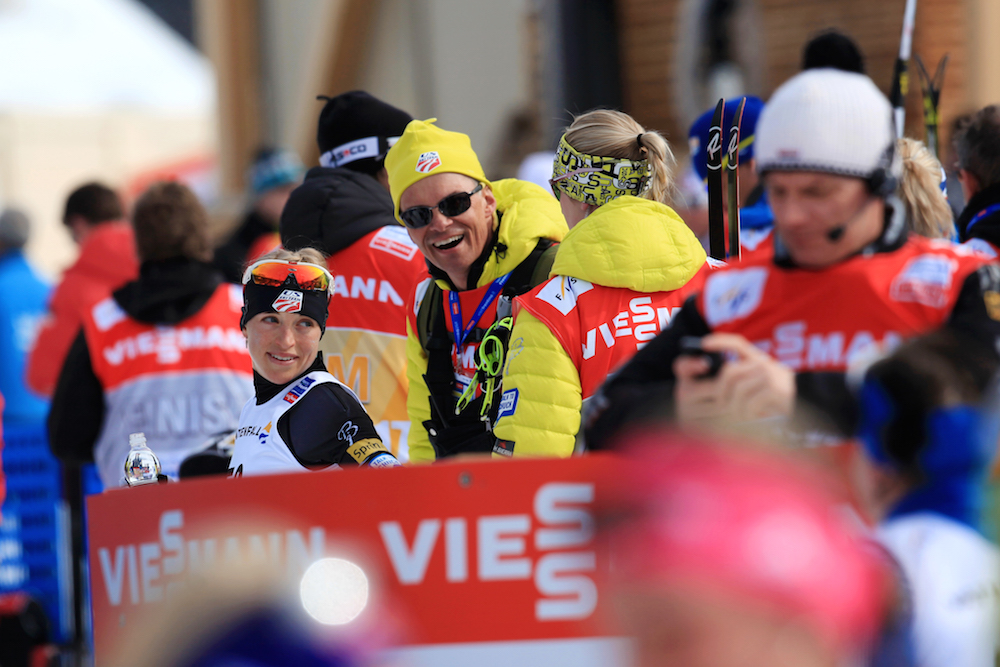
U.S. Ski Team Doctor Larry Gaul with Liz Stephen (l) and then-USSA Communications Director Margo Christiansen (r) at 2013 FIS Nordic World Ski Championships in Val di Fiemme, Italy. (Photo: Sarah Brunson/U.S. Ski Team)
Gaul has a long history working with the U.S. Ski Team’s cross-country athletes as the chief medical officer at the U.S. Ski & Snowboard Association (USSA). And on the international side of things, Gaul serves on the International Ski Federation’s (FIS) Medical Committee. It was part of his FIS duties that brought him to this year’s U23/Junior Worlds at Soldier Hollow near Midway, Utah, where he served as the FIS medical supervisor during the weeklong competition.
Listen up to hear about Gaul’s role with the U.S. team and FIS.
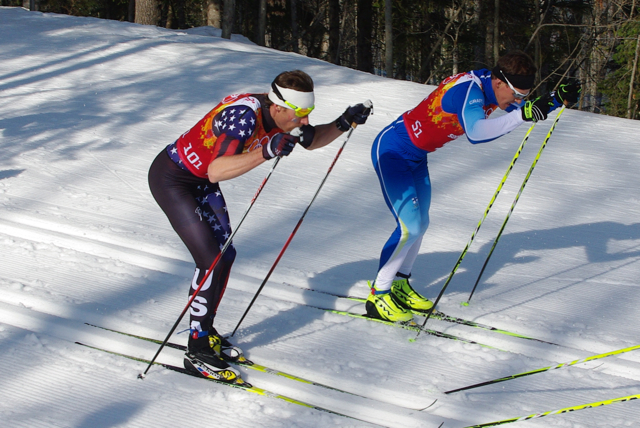
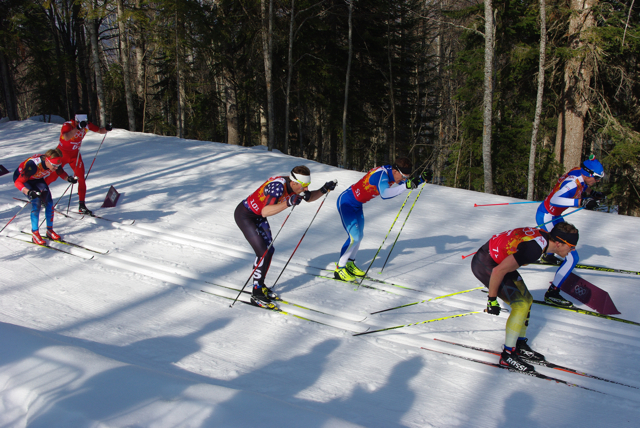
Andy Newell (center) skiing in the main pack of the Olympic men’s relay today.
SOCHI, Russia – U.S. skier Andy Newell collapsed at the finish of the scramble leg of today’s 4 x 10 k relay at the Olympics, after losing roughly a minute and 10 seconds in the final 1.7 kilometers of racing. U.S. Ski Team doctor Larry Gaul took Newell down to the team’s housing in the Olympic village before coaches had a chance to talk to him, so his status is unclear.
Newell had skied a strong opening to his relay leg, sticking with the leaders through their second of three laps; skiing through the stadium for the second time, he was in seventh place but just 2.5 seconds back. At 8.3 kilometers, he was in a pack of racers fighting for fourth place, less than ten seconds behind the leading Finns, Swedes, and French.
Up the course’s final hills, though, Newell was walking on his classic skis. By the time he tagged off to Erik Bjornsen, he was a minute and 17 seconds behind Lars Nelson of Sweden. The U.S. was in 15th place, the second-to-last team in the field.
“I don’t know how he’s doing,” U.S. Ski Team Head Coach Chris Grover said. “I don’t know if he overheated, or what happened.”
(UPDATE: in a comment below, Newell’s brother Pete Newell writes: “We talked to Andy on the phone. He says that his lungs just stopped working on the climb, and he was left gasping for air and staggering. He’s ‘not sure’ if he blacked out or not, but doesn’t really remember. He lost his lunch and then some after the tag, and subsequently couldn’t keep liquids down. I think we would have gotten more info if we’d spoken directly with the doctor, but we can report that he’s in his room and the doc is keeping an eye on him.”)
(UPDATE #2: reached by phone in the athlete village, Grover gave an update on Newell’s condition around 7:15 p.m. Sochi time. “He’s doing much better – he’s recovering well and hydrating and eating and resting a little bit,” Grover said, adding that they still weren’t sure what had happened. “I don’t think he really knows. He’s scratching his head trying to figure it out. Because he felt like he was digging deep, but not any deeper than he usually does. I think [he’ll be okay for the team sprint]. We’ll obviously check in with him tomorrow and make sure he’s coming around okay.”)
Grover was not on the course, but said that he could tell from the video screens that Newell was fading in the last kilometer. Fading, though, is different from the complete collapse that followed. Without any details from Dr. Gaul, Grover could only speculate about the cause of Newell’s collapse, but mentioned that it might be an issue with heat.
“Obviously, we’re in black suits,” he said. “We’re in a situation here where we have average temperatures which are way above what we expected. You can see that these guys have been modifying these suits, some of these teams in dark suits. We have been cautioning these guys to stay cool before they go out on course. We’re keeping them in the shade as long as we can, until right before it’s time to go out to the start. But I think overheating and dehydration could be an issue when you’re going this hard in conditions like this.”
Grover pointed out that some of the other team members (and other teams) had great races. Heat affects every athlete differently, and even the same athlete differently on different days.
Other sources suggested that Newell had simply “bonked”, run out of juice in a particularly severe way which was perhaps exacerbated by the altitude of the venue. Several athletes over the course of the last few days have seemed to completely lack their normal energy, including Norwegians Marit Bjørgen and Martin Johnsrud Sundby.
Whether driven by heat or simply “bonking”, it’s unclear how quickly Newell will be able to recover from his collapse. The team sprint is on Wednesday, and he is planned to start with teammate Simi Hamilton.
“I definitely need to see how he’s doing, for sure,” Grover said. “The great news is that we have two days off in between. But I definitely need to talk to the doctor and see how Andy’s doing, for sure.”
The U.S. team went on to place 11th after strong legs from Erik Bjornsen, who gained two spots, and Noah Hoffman, who skied the 8th-fastest time of all third-leg skiers and brought the team into the top ten. Simi Hamilton anchored the team, losing one spot to Estonia.
As little as a single beer can have a negative impact on performance, according to U.S. Ski Team Doctor Larry Gaul
The summer is in full swing. For athletes, that means building up your training base with long workouts, intensity sessions, and time in running shoes and on rollerskis. While the training is what will keep you fast for those race weekends in January and February, during July and August, the season can seem a long way off. The temptation to have a barbeque with your friends, knock back a few of your favorite adult drinks, then still head out for a long rollerski or run the next morning exists. How much harm can it do?
In an attempt to learn a little bit more about alcohol and its relation with training, FasterSkier contacted Dr. Larry Gaul, cardiologist, head team physician for the U.S. Ski Team nordic disciplines, and the United States’ medical representative to the International Ski Federation’s medical committee. Dr. Gaul stressed the importance of being extremely careful about alcohol consumption and training.
Say you and your male ski team buddies, weighing roughly 160lbs, are having a barbecue on Saturday night. You are drinking a few beers, talking about the great three-hour rollerski you’re going to go on the next morning at 7 AM, and how much fun it will be. After six or seven drinks in two hours, you all head to bed, intent on getting up and putting in a great distance workout.
Dr. Gaul saw several problems with this scenario. Depending on the individual, you could still be impaired upon starting your workout the next morning. “Alcohol acts as a sedative–it depresses all sorts of thinking skills and reaction time,” Gaul said. “It’s safe to say that if you are drunk, there is no part of the brain that works better.”
After the safety concerns, the devastating dehydrating effect of alcohol is one of the most important. “You’re starting dehydrated, at the cellular level, almost certainly,” said Gaul, “I’ve seen estimates of a decrease in performance by 20 percent from modest dehydration, and I think we have all seen people more dehydrated, who have collapsed.”
Second, alcohol is an acute toxin to the heart. According to Dr. Gaul, alcohol poisons or inhibits heart function. He cited two ways in which the heart is affected – its pumping ability, and its creation of abnormal electrical signals.
Dehydration is one of the major problems related to alcohol consumption, according to Gaul
With respect to training, both have negative effects. As you impair the heart pumping ability, “you would be working at a much higher work load at any given effort,” said Gaul. And, he continued, “the available evidence that is out there would suggest that just because you are working harder, doesn’t mean you are getting more training effect. You have inhibited all the muscle function, and in a dehydrated condition it will be destructive rather than constructive.”
As for the abnormal electrical signals in the heart, Dr. Gaul explained that it will result in “an abnormally high heart rate during exercise.” Additionally, the abnormal electrical activity makes it “extremely uncomfortable to train,” and prolongs recovery time.
Furthermore, in terms of technique, “if you still have alcohol in your system, you won’t learn it,” said Gaul. Alcohol impairs neuromuscular transmissions in the brain, crucial to developing the pathways needed for repetitive motions such as ski technique.
While it depends on the person, Dr. Gaul suggests a maximum of two to three drinks for a man, and for a woman, one or two. However, he pointed out that even with one drink, reaction time and heart function is inhibited.
If you do find yourself in a situation where you have consumed a bit too much alcohol the night before a workout, Gaul still has some suggestions. “You’re not going to get much training effect from a hard exercise session–instead, just go for an easy jog or an easy rollerski,” he said. “Allow yourself to recover, not push the envelope. If you do overindulge, drink a bunch of sport drink and lay low for a few days.”
In the long term, Dr. Gaul emphasized that the effects of alcohol on the heart and brain are “dose dependent,” meaning that the more you do it and the longer you do it, the greater the chance that your health will be significantly impacted in the long run.
According to Dr. Gaul, heavy drinking over the long term will seriously impair your ability to train and exercise well. “You have to be agile and fairly quick [in skiing], and if you can’t do that, your risk of injury is much greater,” he said.
Lastly, Dr. Gaul also stressed that chronic alcohol abuse results in a loss of brain matter, which affects thinking, reaction time and neuromuscular programming, all of which have a detrimental effect on not just on your skiing ability, but your overall health.