From the FasterSkier archive — posts syndicated from athletes’ and coaches’ own blogs between 2004 and 2012, kept online as published. Current coverage is at fasterskier.com.
(Holly Brooks, a former U.S. Ski Team member, two-time Olympian and Anchorage local, sent FasterSkier a copy of the following letter of support, addressed to the University of Alaska President Jim Johnsen, and granted permission to post.)
***
Dear President Johnsen,
My name is Holly Brooks and I am one of Alaska’s Olympic Cross Country skiers. I am writing this on behalf of several of our local Olympians, who have agreed to sign their names below, and encourage you to take the time to read this letter and gain an understanding of how much we care about the health of our ski community. We are aware that the fiscal situation facing the University is challenging and that difficult and unpopular decisions will have to be made, but we urge you to continue funding the most “Alaskan” sport UA has, ski racing. From what we understand, men’s and women’s skiing seem to be one of the few “unprotected sports” under your leadership. Thus, the purpose of this letter is to “raise our hand” in support of the University of Alaska ski team.
Alaska has a strong skiing background. UAA’s NCAA program is an integral part of the heart and soul of a sport that is a natural fit for our great state. Nordic and alpine skiing are wildly popular recreational sports in Anchorage and the collegiate teams serve as examples or “pedestals” of what many Anchorage citizens aspire to in their own athletics. Anchorage hosts the largest high school ski race in the entire country, the Lynx Loppet. Many youth in Anchorage including the Junior Nordic Program and the ASD high school programs look forward to seeing UAA skiers zip by them on the trails, serving as a “real-life” example of fitness and/or technique. What other sports can recreational or developing athletes literally jump in behind collegiate athletes and hang on for the ride?
The UAA ski team also has a long history of community service and activism. Last spring the UAA Ski Team hosted the Turnagain Arm trail race, a perennial favorite for Anchorage Trail runners. This spring the athletes and coaches volunteered their time for a program called Skiku teaching nordic skiing in remote Alaskan villages one week at a time with the goal of instilling healthy, active lifestyles. Every fall, UAA skiing athletes have volunteered for a program Sadie, Kikkan and I help host called Fast and Female – a youth empowerment through sport program that attracts 300 of Anchorage’s girls ages 9-17. At this event, adolescent girls get to meet their athletic role models including your UAA college skiers!
Skiing in particular is an amazing sport because once athletes “retire” from competing at a high level they keep skiing 9 times out of 10. Skiing is a lifelong sport. For this community it means those people are giving back as coaches and role models. I sincerely believe that a community is only as strong as it’s members and a community of people who give back are what creates economic, social & emotional stability. In these pressing times our community is our most valuable asset.
Last but not least, skiing is a sport occurring in the winter. While we haven’t had great snow lately, winter is historically a time when Alaskans opt to stay indoors. Drinking, domestic violence, and levels of depression are elevated. Because of these reasons and SAAD (Seasonal affective disorder) we believe it is imperative to support activities that promote health and wellness during our coldest and darkest months. Skiing does that and the UAA’s ski teams serve as a vehicle. Your team provides healthy heroes and role models and without that, I believe Alaskan skiing would take a large hit.
So please, I know we’re in a budget crisis but I hope that you decide to retain skiing as a UAA NCAA Division II sport. If you have any further questions or would like to speak with me, I’m all ears. Thanks for your time.
Sincerely,
Holly Brooks
2010 Vancouver & 2014 Sochi Cross Country Skiing Olympian
Kikkan Randall
2002 Salt Lake City, 2006 Torino, 2010 Vancouver, and 2014 Sochi Cross Country Skiing Olympian
Tommy Moe
1992 Albertville, 1994 Lillehammer, and 1998 Nagano Alpine Skiing Olympian
Megan Gerety
1994 Lillehammer Alpine Skiing Olympian
Lars Flora
2002 Salt Lake City, and 2006 Torino Cross Country Skiing Olympian (member of 98/99 UAA Ski Team)
Sadie Bjornsen
2014 Sochi Cross Country Skiing Olympian (member of 2008/9 UAA Ski Team)
Erik Bjornsen
2014 Sochi Cross Country Skiing Olympian (member of 2010/11 UAA Ski Team)
James Southam
2006 Torino, and 2010 Vancouver Cross Country Skiing Olympian
Adam Verrier
1994 Lillehammer Cross Country Skiing Olympian, UAA Volunteer Coach since 2009
Sara Studebaker-Hall
2010 Vancouver, and 2014 Sochi Biathlon Olympian
Anna Berecz
2010 Vancouver and 2014 Sochi Alpine Olympian for Hungary (Graduated UAA in 2015)
Rachel Steer
2002 Salt Lake City, and 2006 Torino Biathlon Olympian (Graduated UAA in 2007)
Alex Wilson
1998 Nagano Freestyle Olympian (Teaching Certificate from UAA in 2013)
NANANordic has been covered extensively by FasterSkier in the past, most recently in May 2014. Now in its fourth year, NANANordic sends elite cross-country ski racers to Alaskan villages to teach skiing to school children, with the goal that skiing become a lifestyle activity in rural Alaska.
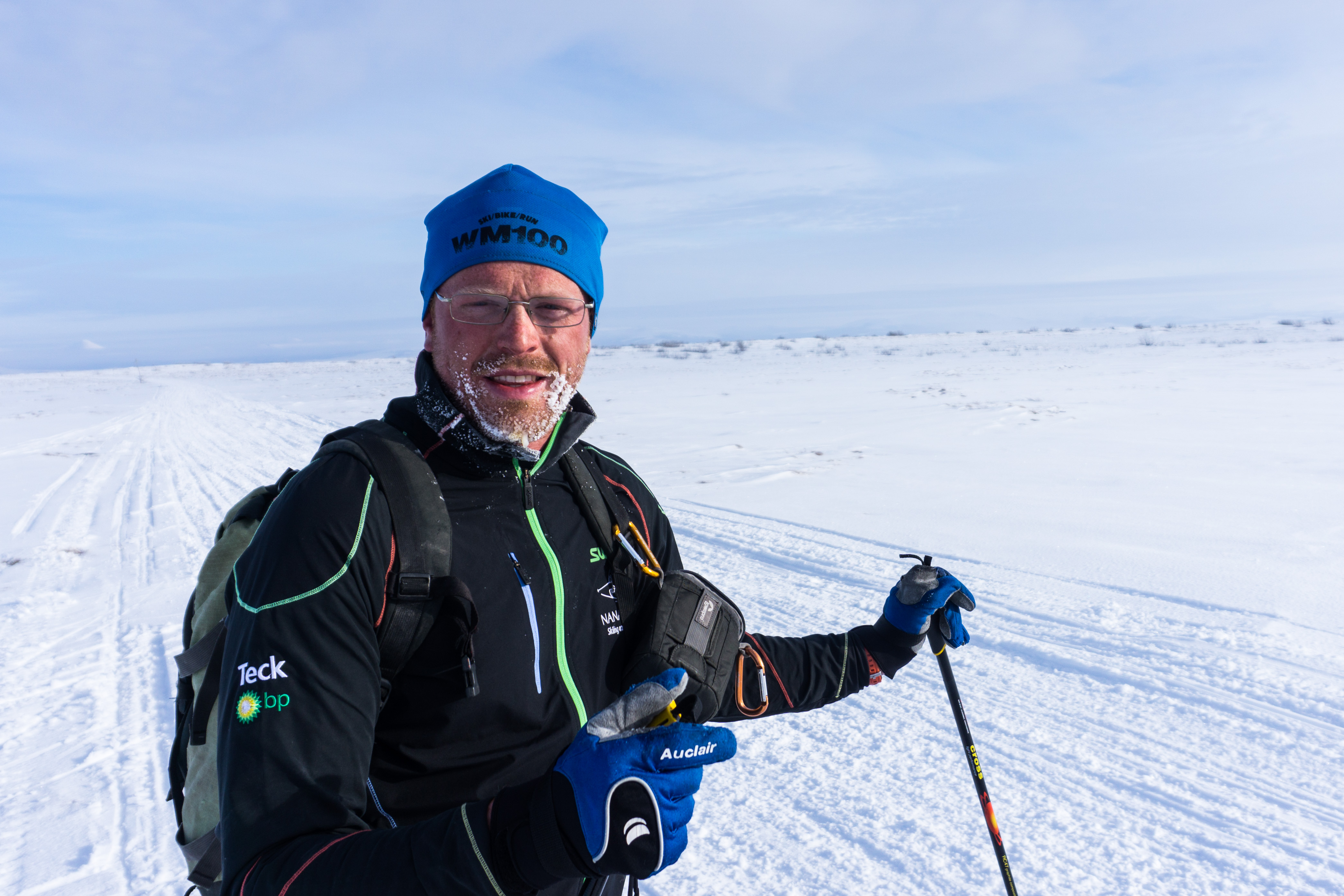
Seth Adams, a FasterSkier contributor who lives in Fairbanks, Alaska, joined the ranks of the volunteers this spring. Some of his photos from NANANordic in Noorvik appeared on this site in April. All opinions expressed here are his own.
I don’t remember what I said.
“Well, no. Not exactly,” Lars Flora responded, sounding pained. “That’s a common misconception among city Alaskans about the villages.”
I was interviewing Lars for an article I wrote last year about NANANordic, a program that Lars began in 2012 to teach skiing to kids in remote Alaskan villages.
As I write these words, a year after that interview with Lars, whatever I was wrong about wasn’t important enough to me to remember. But the take-home point was important to me. Although Lars was trying to be nice, the message was loud and clear — I thought I knew something, but I didn’t know anything. And I was part of the problem.
I’m from Fairbanks, Alaska, the state’s second-largest city. Although Alaska’s cities contain most of the state’s population, there are far more villages than there are cities. And Alaska’s cities are majority white population (like me), while the villages are almost-exclusively Alaska Native.
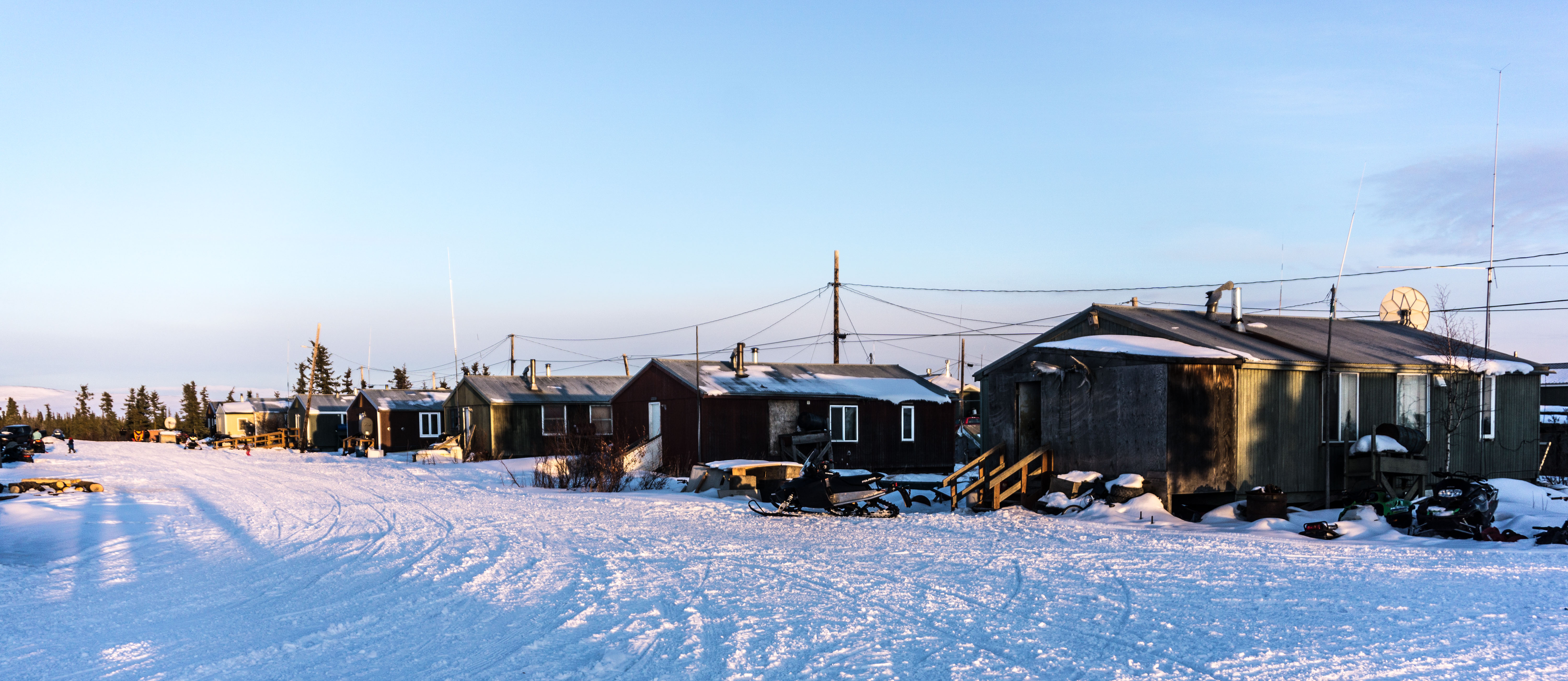
I’d never really been to any of the villages. And among white, city Alaskans, that is not at all uncommon. Most of the villages aren’t accessible by road — the only way in or out is by snowmobile, airplane or boat. And without a specific reason to go to one of the villages, most people don’t. City Alaskans often view them as grim places — devoid of economy or diversion, where alcoholism and domestic violence are more the rule than the exception.
But in spite of our lack of firsthand experience with village life and our negative opinion of what we think we know, city Alaskans tend to not be indifferent to the villages. We see these places as an integral part of our state identity and their existence as a part of the Alaskan experience.
We see these places as an integral part of our state identity and their existence as a part of the Alaskan experience.
And so when I was told that some of my preconceived ideas were wrong, it cut deep. What else didn’t I know? I decided it was time to see for myself. Besides, volunteering with NANANordic sounded fun.
Noorvik
After a hectic schedule of personal travel, I had a cold. I met my fellow coaches in the Anchorage airport at a truly uncivilized hour on the morning of April 5 to catch our flight to Kotzebue. There were a gaggle of NANANordic volunteers swarming the check-in line, all headed to different villages in the Northwest Arctic region.
I would be headed to Noorvik with four other coaches — three veterans of NANANordic: Alaska Pacific University’s Lauren Fritz, Lauren’s boyfriend and Australian National Team member Paul Kovacs, and U.S. Paralympics Nordic Development Coach Robert Rosser. And one other newbie — 15 year-old Anchorage high school skiing standout Luke Jager.
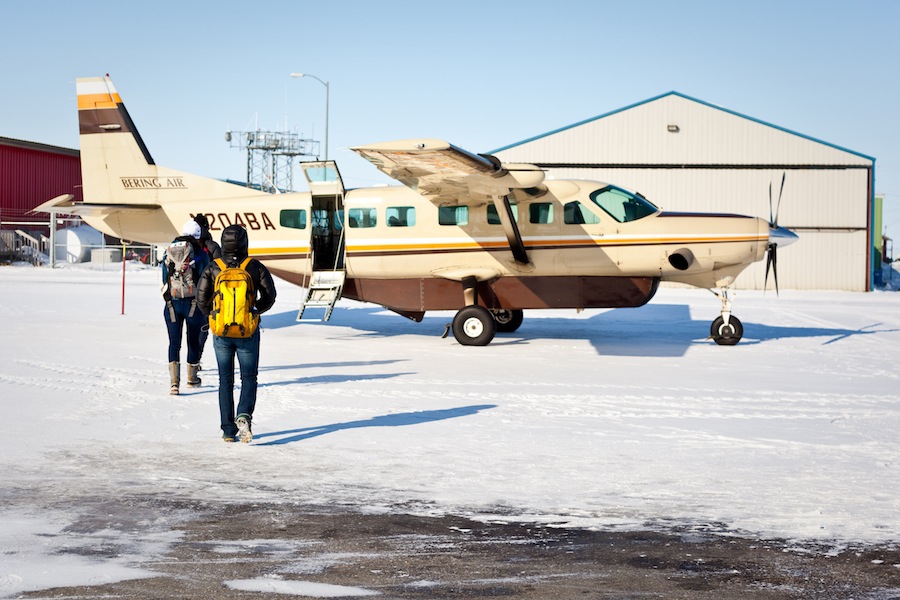
We boarded an Alaska Airlines 737-combi (half of the passenger compartment is converted to cargo space) for the hour-and-a-half flight to Kotzebue. After some shuffling and waiting for winds to calm, we settled into an eight-seater Bering Air single-engine prop plane for the 30-minute flight from Kotzebue to Noorvik. After a remarkably smooth landing amidst the whipping wind in Noorvik, we loaded our bags into a van driven by the school principal.
“The skiers are here!” the kids exclaimed as we carried our bags into the school. The school would be our home for the rest of the week. We looked around approvingly.
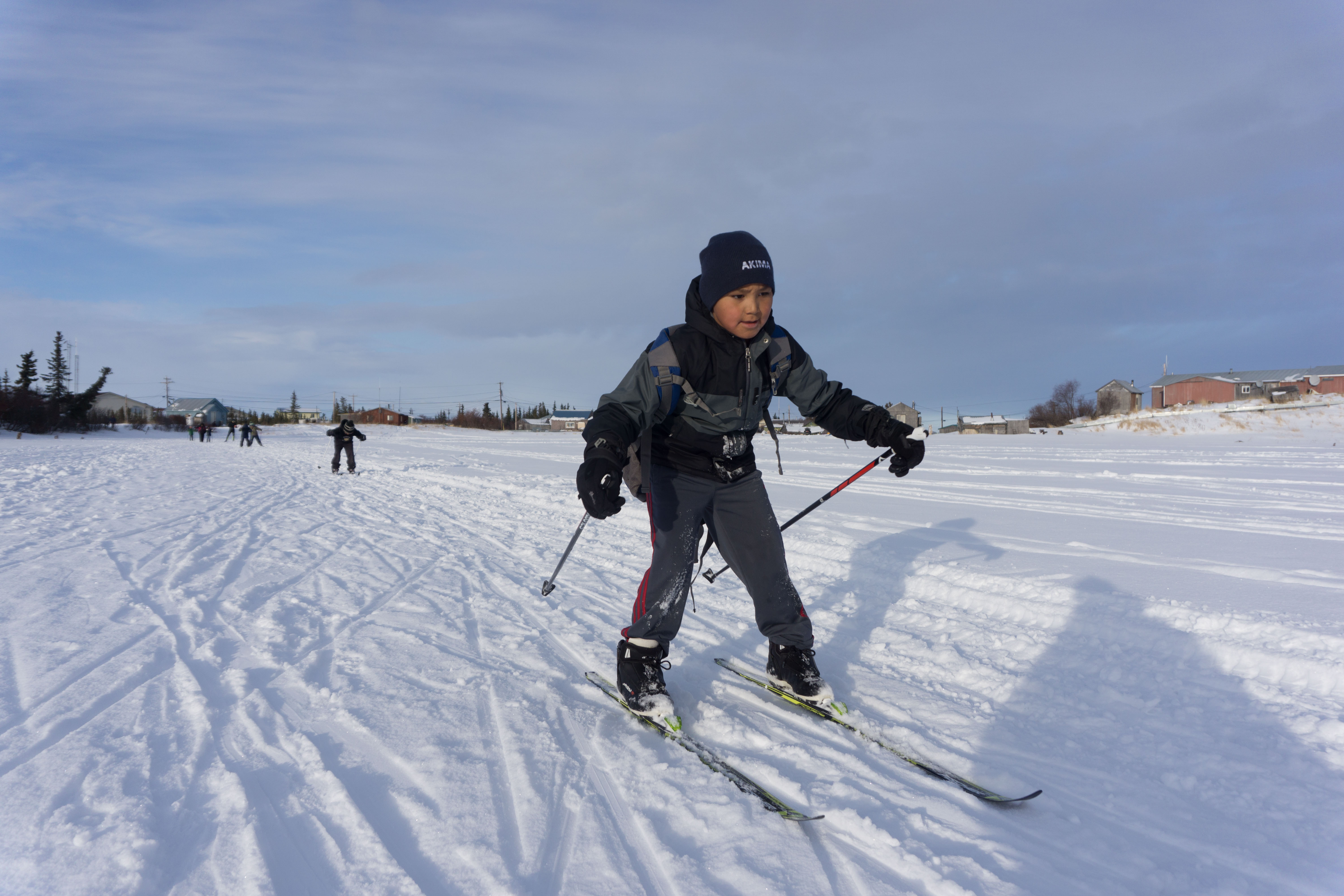
In the afternoon we went out to ski around and get oriented. Luke stood with his skis braced against the wind. He straightened his skis and began accelerating across the icy school yard as the wind pushed him backwards.
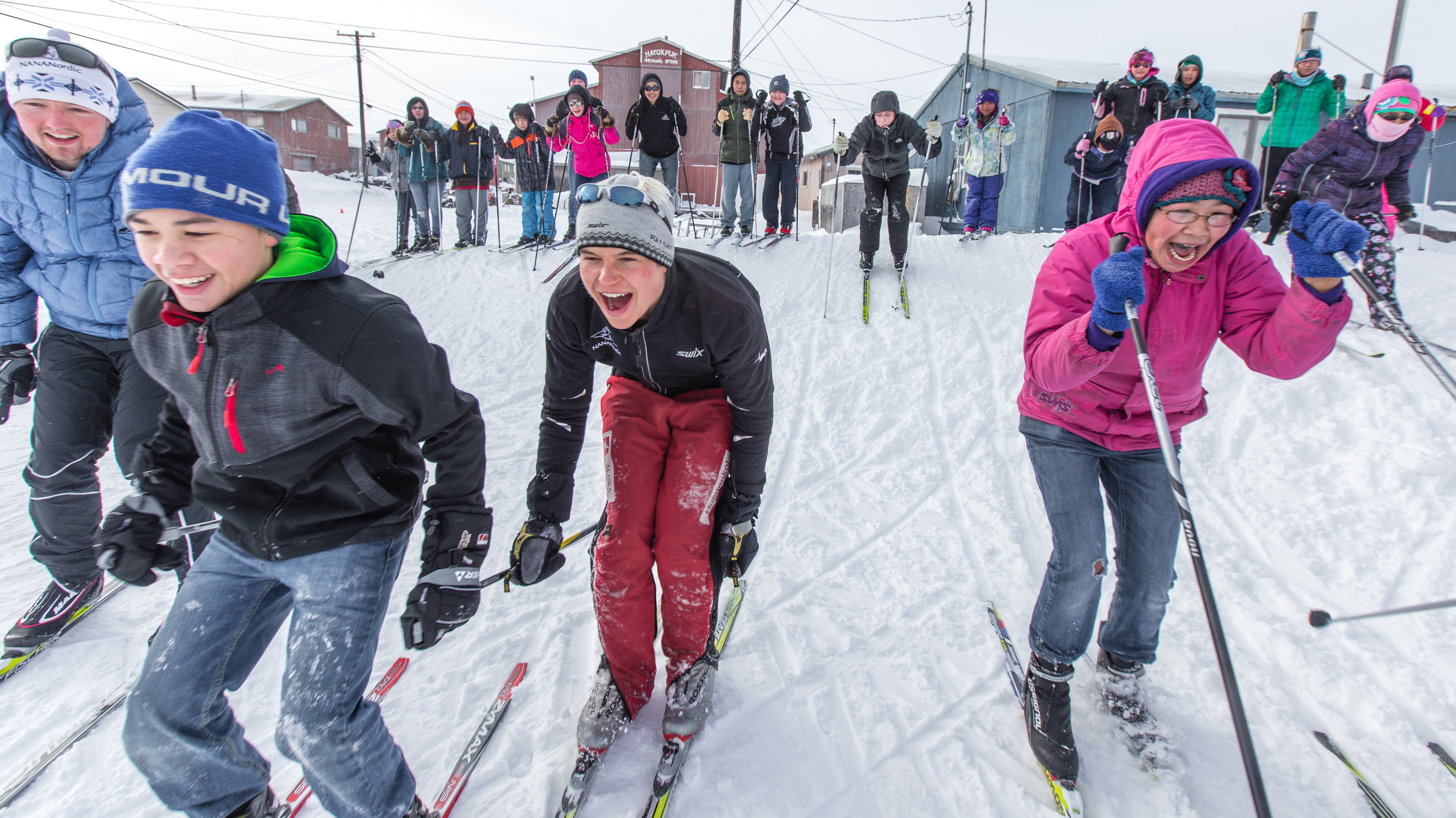
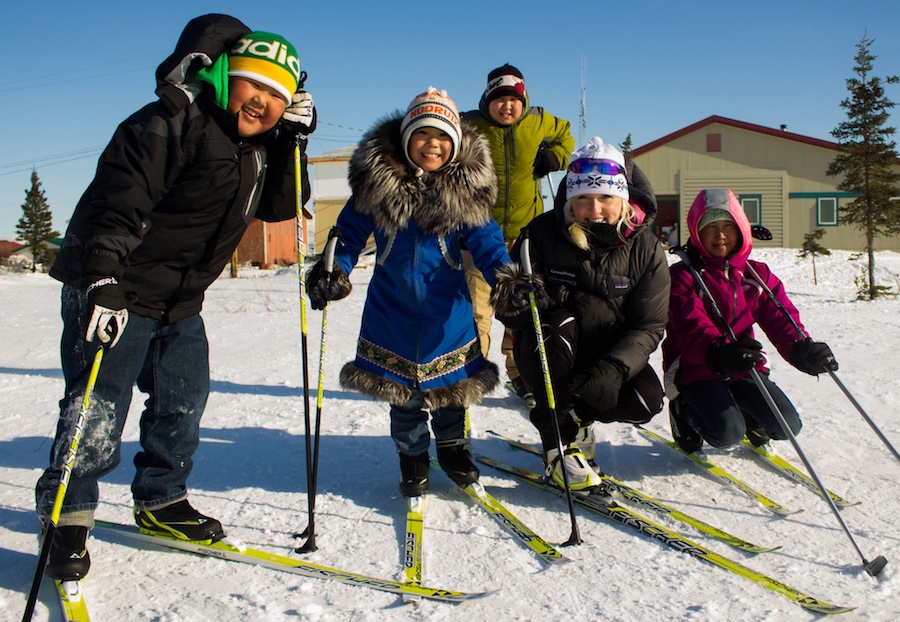
At some point during the school day, each teacher brought every kid in the school to the gym to ski. I don’t know whether or not they were forced to ski with us — but it didn’t matter seem to matter, because almost to a student, including the surly high schoolers, they wanted to.
NANANordic 2015 (Photo: Seth Adams)
NANANordic 2015 (Photo: Seth Adams)
NANANordic 2015 (Photo: Seth Adams)
NANANordic 2015 (Photo: Seth Adams)
NANANordic 2015 (Photo: Seth Adams)
NANANordic 2015 (Photo: Seth Adams)
NANANordic 2015 (Photo: Seth Adams)
NANANordic 2015 (Photo: Seth Adams)
NANANordic 2015 (Photo: Seth Adams)
NANANordic 2015 (Photo: Seth Adams)
NANANordic 2015 (Photo: Seth Adams)
NANANordic 2015 (Photo: Seth Adams)
NANANordic 2015 (Photo: Seth Adams)
NANANordic 2015 (Photo: Seth Adams)
NANANordic 2015 (Photo: Seth Adams)
NANANordic 2015 (Photo: Seth Adams)
NANANordic 2015 (Photo: Seth Adams)
NANANordic 2015 (Photo: Seth Adams)
NANANordic 2015 (Photo: Seth Adams)
NANANordic 2015 (Photo: Seth Adams)
NANANordic 2015 (Photo: Seth Adams)
NANANordic 2015 (Photo: Seth Adams)
NANANordic 2015 (Photo: Seth Adams)
NANANordic 2015 (Photo: Seth Adams)
NANANordic 2015 (Photo: Seth Adams)
NANANordic 2015 (Photo: Seth Adams)
NANANordic 2015 (Photo: Seth Adams)
NANANordic 2015 (Photo: Seth Adams)
NANANordic 2015 (Photo: Seth Adams)
NANANordic 2015 (Photo: Seth Adams)
NANANordic 2015 (Photo: Seth Adams)
NANANordic 2015 (Photo: Seth Adams)
NANANordic 2015 (Photo: Seth Adams)
NANANordic 2015 (Photo: Seth Adams)
NANANordic 2015 (Photo: Seth Adams)
NANANordic 2015 (Photo: Seth Adams)
NANANordic 2015 (Photo: Seth Adams)
NANANordic 2015 (Photo: Seth Adams)
NANANordic 2015 (Photo: Seth Adams)
NANANordic 2015 (Photo: Seth Adams)
NANANordic 2015 (Photo: Seth Adams)
NANANordic 2015 (Photo: Seth Adams)
NANANordic 2015 (Photo: Seth Adams)
NANANordic 2015 (Photo: Seth Adams)
Personally, the naturally athletic kids that easily picked up skiing weren’t the most rewarding to work with; it was the strugglers that were the most interesting.
Take a first-grader, we’ll call him Casey, as a case study. During his first time on skis, Paul and I stayed back with him, and at the end of the session we both agreed that our backs were sore from repeatedly helping him onto his feet. He could stand for only seconds at a time and asking him to untangle himself once on the ground and get back on his feet on his own seemed a bit like asking him to fly the space shuttle. There were tears and there was whimpering.
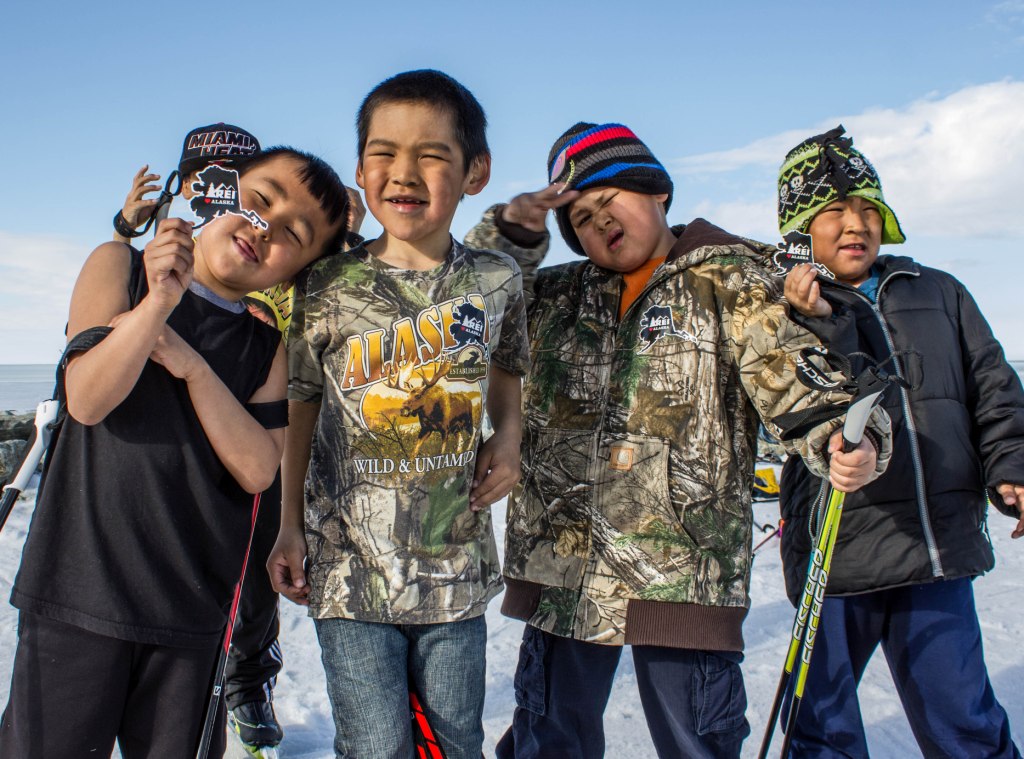
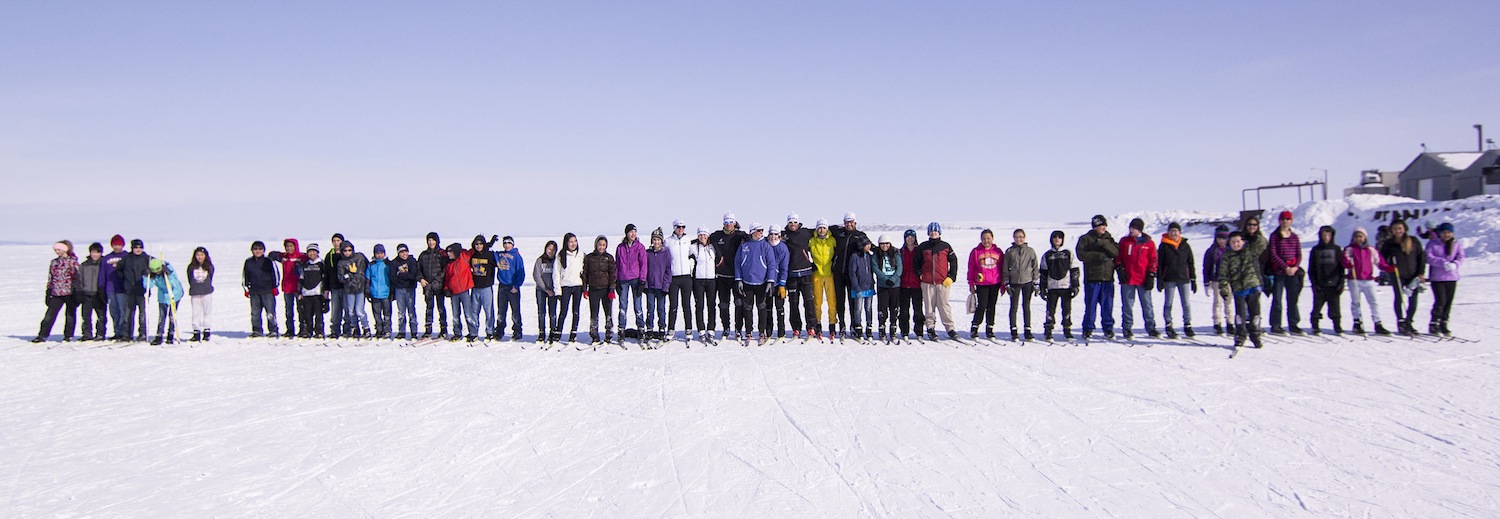
But after school, when returning to ski was their own prerogative, Casey was back. As were many other kids that we did not expect to see. Out of the 190 kids in the school, over 60 were neatly lined-up outside the gymnasium door to ski again — fully one third of the school was back to ski for a second time that day. You would definitely not see this in Fairbanks or Anchorage.
… One third of the school was back to ski for a second time that day. You would definitely not see this in Fairbanks or Anchorage.
Casey constantly asked for help with everything. Like many of the kids, he was naturally quiet and rarely used words, expressing many of his emergencies in pantomime. But there seemed to be no minimum to how ridiculous his emergencies might be. One time, he frantically gestured at me that his sock had come off and stayed in his boot after he took the boot off.
“So pull it out and put it back on,” I said.
He held up his gloved hand in alarm, to show he could not possibly remove the sock from the boot by himself, since he was hamstrung by the glove.
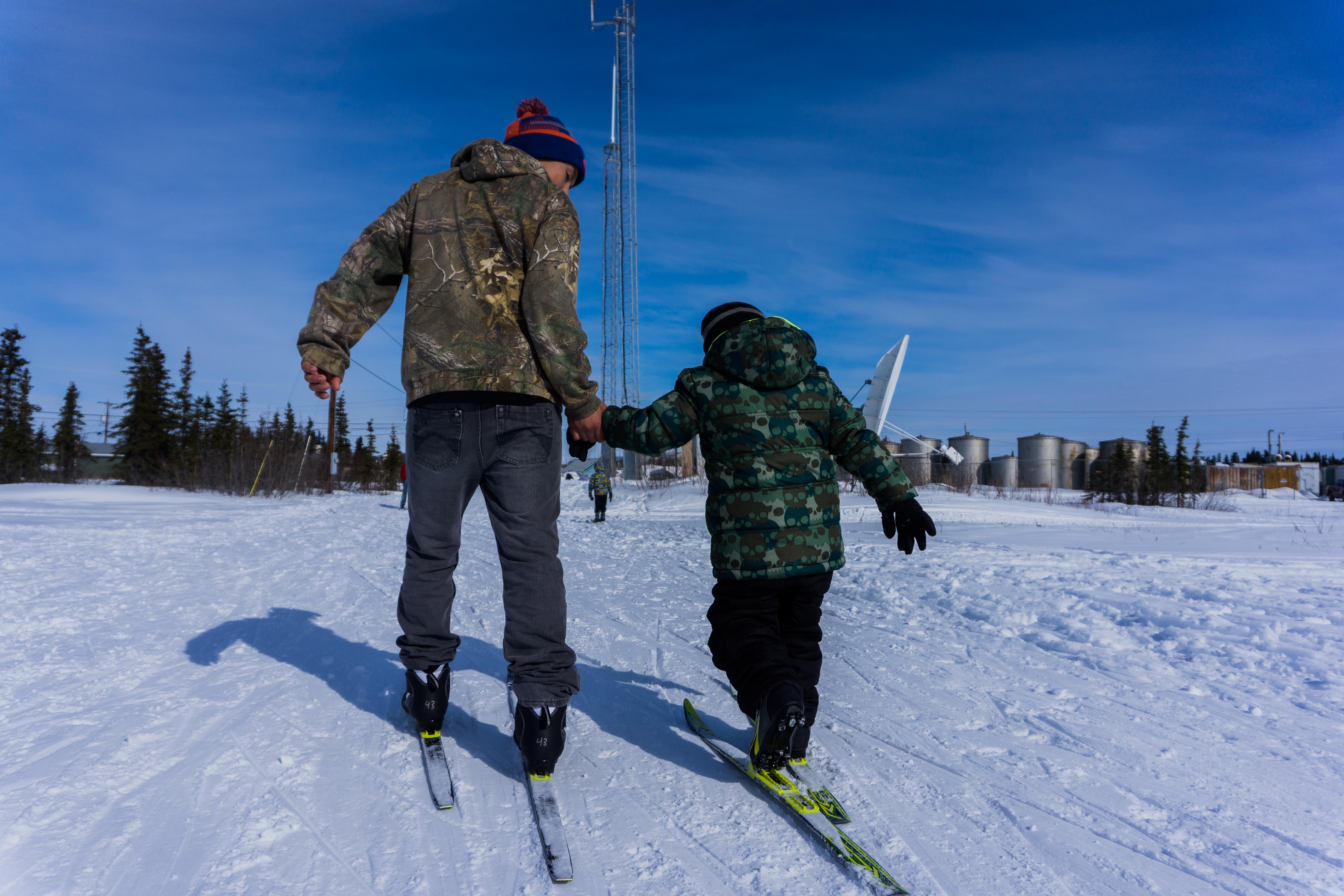
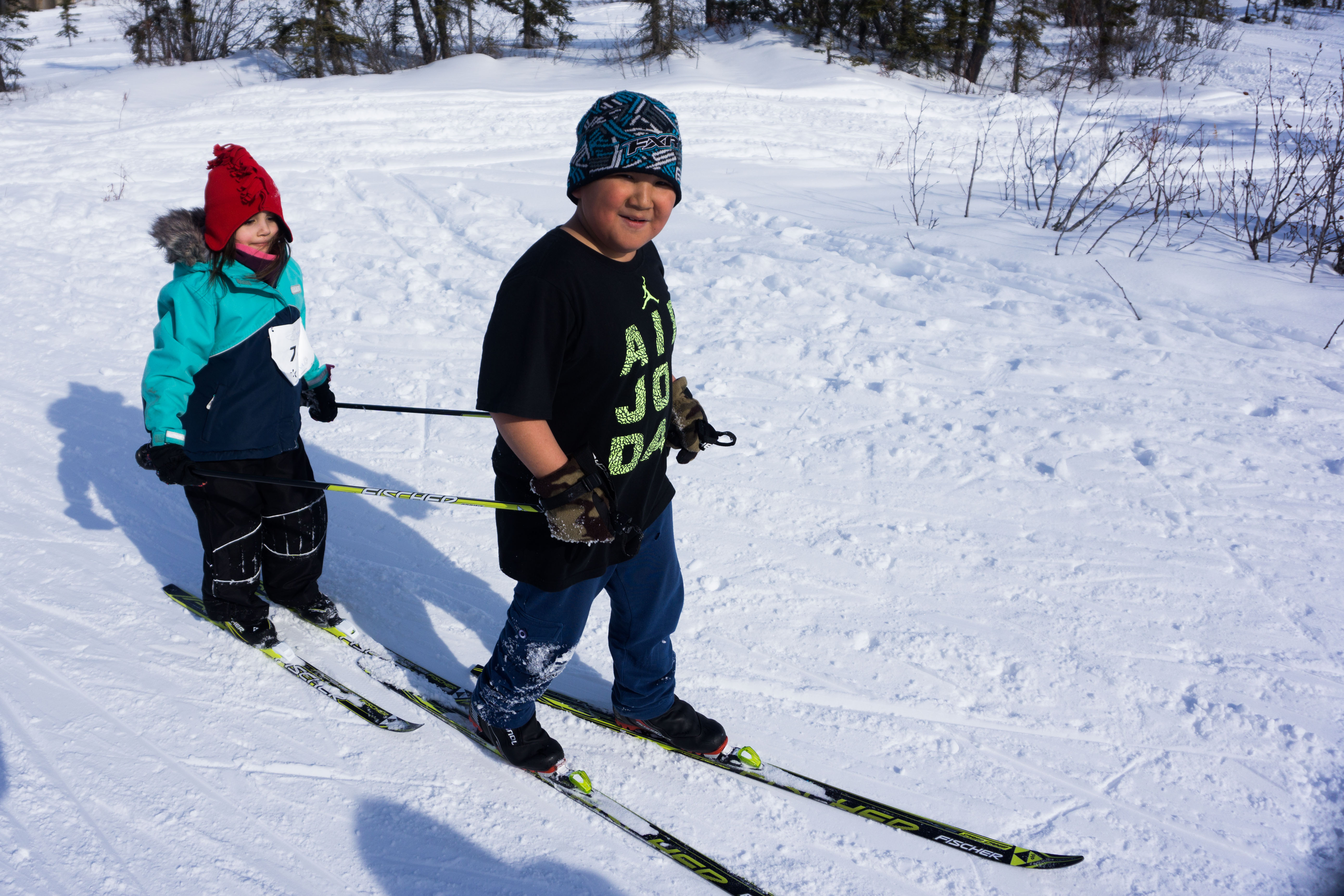
Casey tows another kid on our last day in the village.
“Take the glove off, Casey,” I said with a laugh. He shrugged in disappointment, and did it. He was perfectly capable of everything everyone else was, but somehow being helped filled a need for him.
Casey probably isn’t going to become a heroic story of having won the race or landed a 360. But he kept skiing all week, and although he never outwardly seemed to love it, at the end of each session he unfailingly asked when he could ski again. As did many of the others. The bottled-up enthusiasm for skiing and for being outdoors was something that we all found remarkable.
At the end of each day we were exhausted. We skied for at least nine hours a day, usually no-pole and in a rush to tend to one “emergency” or another. Then it was at the end of each day that we had the biggest group. We often led the whole group fairly far away from the school, with the smallest kids desperate to keep up with the biggest. At the end of the session, getting everyone back was a huge chore.
Occasionally the frayed ends of Paul’s nerves would show, which resulted in me calling him “the cranky Australian.” But I could understand why was frazzled. We’d taken the kids out to the Kobuk River on the far side of town, and they were scattered as far as we could see. It was getting late, but Luke, who is a high schooler himself, was hitting a jump with a group of older kids on the far side of the river. Paul’s jaw was repeatedly clenching and unclenching.
Right then a woman and two kids pulled up on a snowmobile and told one of the kids to get on. Another kid grabbed onto the back of the sled and got towed, face dragging through the snow as he held tight to the snowmachine, until the woman realized he was back there and scolded him off. He stood up grinning a mischievous grin.
I didn’t know who the woman was, didn’t remember the name of the kid she’d scooped, and was unsure if we’d get the skis and boots back. I looked at Paul and shrugged — we were visitors in a strange land, and our job was to teach skiing.
It’s difficult to overstate the tightness of the social fabric Noorvik. Nearly everyone is related in some way, and there is no need to be accountable for where the kids are, since everyone watches out for everyone. But this was hard for us to remember; the idea that small kids can run loose through a town and be perfectly safe is not a part of our cultural experience. We reminded ourselves that we were the only ones that were overwhelmed; for everyone else this was daily life. Except that usually they don’t have skis.
“The little kids won’t head back to the school until you guys stop hitting that jump and head back yourselves,” I told the high schoolers, trying not to beg. “Do you mind just heading back? Because otherwise we’ll be out here all night getting the small kids back.”
The count of skis and boots at the end of the day was exactly right. No equipment was missing. The woman must have returned her child’s skis and boots.
The week was a bit of a blur of chasing kids, clicking boots into skis, offering encouragement, and answering endless questions about when the next chance to ski would be. But being in Noorvik I was reminded of the conversation I’d had with Lars. I looked around, waiting to have one of my preconceived notions shattered in lightning bolt epiphany.
Noorvik wasn’t overly different from what I’d expected. Life there isn’t easy, but it wasn’t as tough as I’d imagined. Perhaps it was just seeing it that mattered and seeing how tight the social bonds are, witnessing how the older siblings watch out for the younger ones with no trace of resentment, and that all the adults in town are essentially guardians for all the kids.
Noorvik wasn’t overly different from what I’d expected. Life there isn’t easy, but it wasn’t as tough as I’d imagined.
“I like what you’re doing with our kids,” one man told me as he walked past.
A couple of hours later when he walked back by, I invited him to join us.
“No,” he replied, then, apologetically, “I’m drinking now.” The kids continued to ski in excited circles all around us.
Noorvik is a dry village, which means any possession of alcohol is prohibited. He excused himself, and I invited him back another day, but he never came. The kids, however, were all hooked on skiing. And they kept coming back.
FasterSkier contributor and NANANordic 2015 volunteer Seth Adams during his weeklong visit to Northwest Alaska.
At the end of the week, all five coaches skied 55-kilometers from Noorvik to the village of Selawik. Read about it and see pictures on Seth’s personal blog.
Nick Treinen works to keep up with the kids in Shishmaref. (Photo: Brice Habeger, Piksik)
“It’s not about skiing,” Shungnak School Principal Roger Franklin wrote in an email to FasterSkier. “It’s much more, and it’s saving lives daily.”
Just don’t tell the kids that. The hundreds of them skiing and laughing and jumping and falling down might think you were crazy.
The Shungnak School is 150 miles east of Kotzebue on the Kobuk River. Shungnak is one of 27 communities that received ski instruction through Skiku, known in the Northwest Arctic region as NANANordic. The program brings world-class ski racers, elite high-school racers, and community coaches to rural Alaskan schools each spring, along with ski equipment and enthusiasm for teaching the students to ski.
NANANordic was covered by FasterSkier in 2012, the program’s first year, and in 2013 with the addition of biathlon to the program. FasterSkier also compiled links to videos made about the program in 2013 and 2014.
“NANANordic has bought a positive trend to this region and our little village,” Franklin continued. “This program helped our kids find different ways to find a positive outlet than a negative one. It has given our students a chance to live a healthier life style and much more. It also has a component for family time spent skiing and understanding their kids’ struggles in life. It also has helped our students to stop thinking about suicides and other harmful things.”
Kids in Kivalina. (Photo: Reese Hanneman/Skiku)
The statistics on rural Alaska are heartbreaking: rates of alcoholism, sexual violence and teen suicide are many times the national averages. In many areas the rates are so high that it constitutes a public-health emergency. So when Franklin says that NANANordic/Skiku is “saving lives daily,” it’s not merely hyperbole.
History
The program was started in 2012 by Lars Flora (a former elite racer and brother of Alaska Pacific University Head Coach Erik Flora), with the help of Robin Kornfield (who works for NANA Development Corporation), and Scott Warren, an educator with the Northwest Arctic Borough School District.
That first year, NANANordic visited four villages — Kiana, Noorvik, Selawik and Kotzebue — in the NANA region in northwest Alaska. The following year it expanded to all 11 villages in the Northwest Arctic plus Anaktuvuk Pass, located in the Brooks Range, Alaska’s northernmost mountain range.
As NANANordic grew and expanded into other regions, with the door open to further expansion, they needed a name that would be inclusive of the entire state. The directors settled on Skiku, a play on the word “siku,” the Iñupiaq word for ice. Within the NANA region the program is still called NANANordic, but for the sake of clarity both will be referred to as Skiku in this article.
As NANANordic grew and expanded into other regions, with the door open to further expansion, they needed a name that would be inclusive of the entire state. The directors settled on Skiku, a play on the word “siku,” the Iñupiaq word for ice.
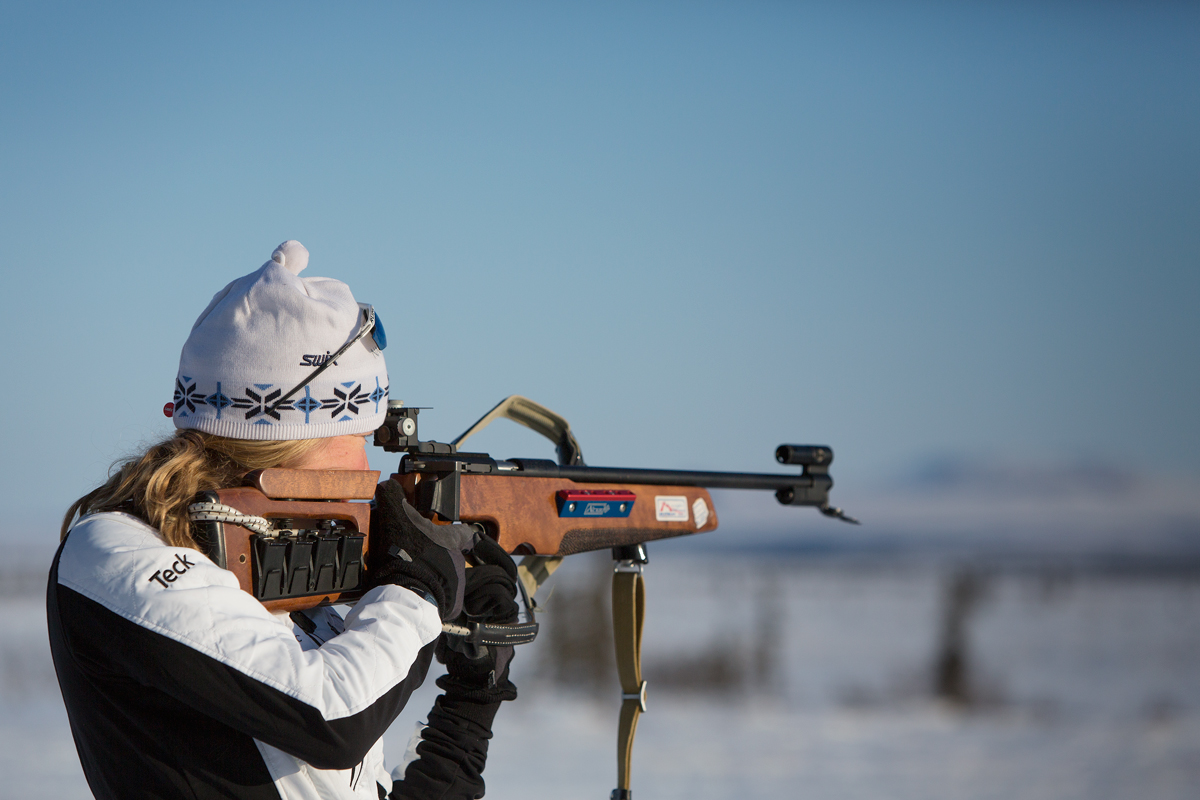
This year, Flora and a veritable army of volunteer coaches — 80 in all — helped to bring skiing to over 3,000 kids, spending a week in each village, with many students skiing during school and again afterwards. The program has also begun a push to bring biathlon to village schools — a logical sport for the students, given the strong tradition of hunting in rural Alaska. They founded AK Biathlon as a sister organization to Skiku, brought on Zach Hall as the coach, and were able to purchase four infrared rifles to use with the kids.
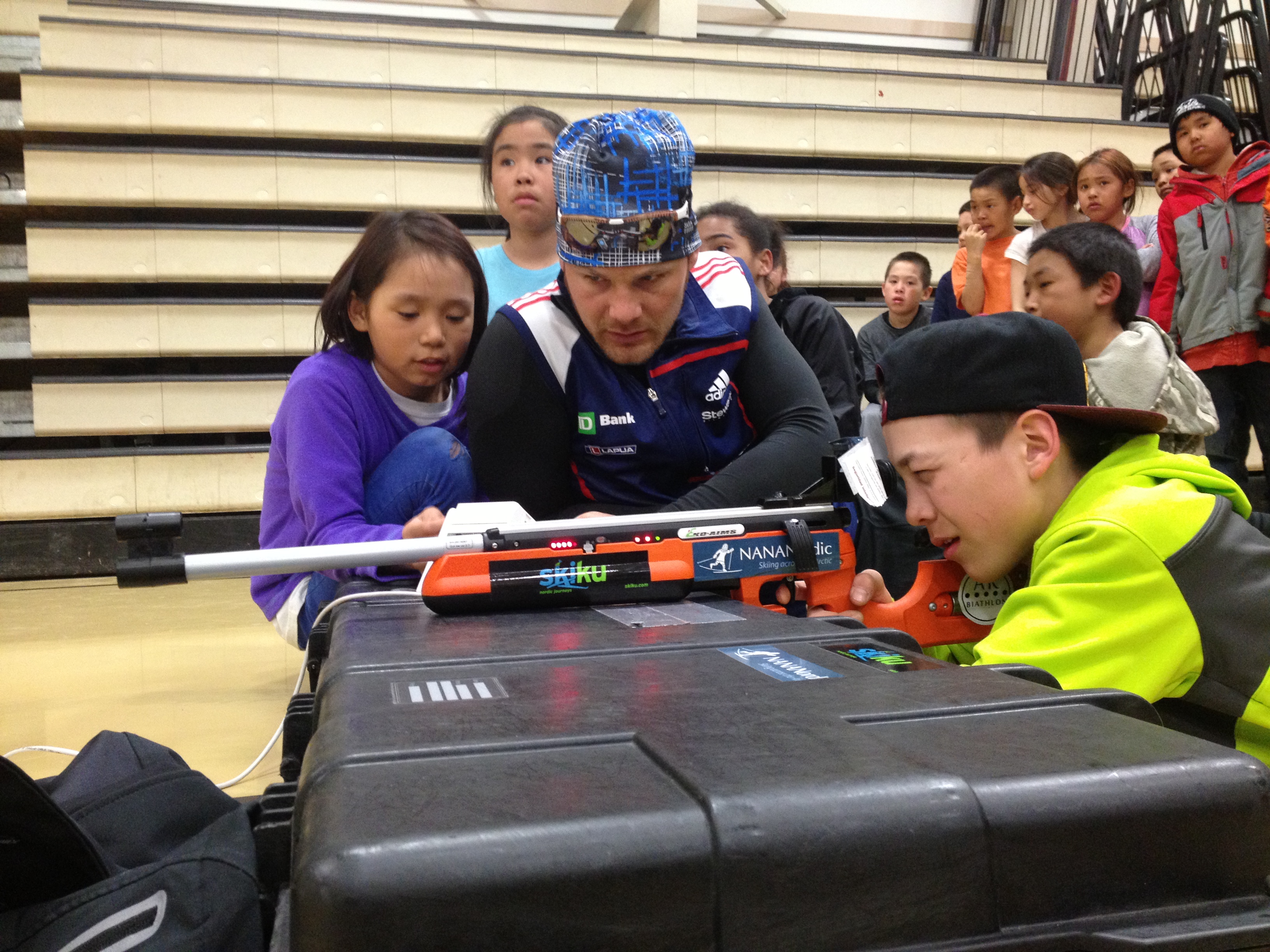
Zach Hall teaches shooting skills at an indoor range in Kotzebue. “Biathlon is a huge component of the program that makes cold days manageable since we stay inside shooting biathlon infrared systems,” Flora says. (Photo: Skiku)
Future of the Program
After the 2013 season, Flora became the full-time director of Skiku, allowing him to push the expansion of Skiku into more than twice as many communities in 2014. Such rapid expansion is complicated for a small nonprofit, and Flora plans to expand more in 2015, looking to Bethel, in the Yukon-Kuskokwim region in southwestern Alaska.
“A lot of activity directors across the state are a little worried about our expanding to so many places,” Flora said. “What [they’re worried about] is that you put the focus on teaching kids how to ski, and then what happens is that your websites aren’t polished. We could easily pull back and keep it at 27 for next year and make sure we have everything perfect in the office, but among everyone involved we just want to keep going getting the program into more places.”
When asked about his priorities for future funding, Flora said that, in addition to expanding into more areas, he’d like to find a way to keep coaches in the communities longer.
“In the very rough draft we made up, we put [next year’s volunteers] at about 110,” Flora said. “But the time spent in villages is a key piece. You can’t just dump ski equipment at a school and think that the teachers or the admin will run a ski program for you. It’s been done before, and what we’ve learned is that a lot of those kids don’t really know how to ski. At the end of the day we want to make sure that they actually learn how to ski at the places we go.”
Community Support
Photographer Brendan Smith joined the program in 2012 and 2013 as part of Healthy Portraits, an initiative by the Alaska Native Tribal Health Consortium, a native-owned public health consortium. Healthy Portraits focuses on success stories stories in rural Alaska, celebrating those who are taking steps to improve themselves and their communities. Smith produced a video about his involvement with NANANordic.
27 Villages Visited in 2014:
Barrow, Kotzebue, Kiana, Ambler, Anaktuvuk Pass, Noorvik, Shungnak, Deering, Noatak, Atqasuk, Kaktovik, Nuiqsut, Kobuk, Kivalina, Selawik, Buckland, Aniak, Sleetmute, Stony River, Crooked Creek, Nome, Shishmaref, Koyuk, Gambell, White Mountain, Unalakleet, and Pathway Home in Anchorage
The observations of the volunteers support the idea that the kids are enthusiastic about picking up the sport.
“I guess the part that has surprised me the most how quickly the kids have learned to ski,” Alaska Pacific University (APU) coach Charlie Renfro wrote in an email about his experiences. “I take a lot of video footage of the kids each year and this year was crazy. Kids are V2-ing and hitting jumps and just making it look easy. All with pretty minimal time on skis. They aren’t afraid to fall, they aren’t afraid to look silly, they aren’t really afraid of anything. I think that is such an awesome way to learn. As a result they are getting pretty proficient quickly and they all really seem to like it, which makes it super-fun for all of the coaches. The kids can feel themselves improving too, and, I think that is a big motivator.
“The NANA/Kobuk River Region is so vast and beautiful,” Renfro continued. “That, combined with the incredible people and of course the awesome interactions with the kids, has kept me coming back year after year.”
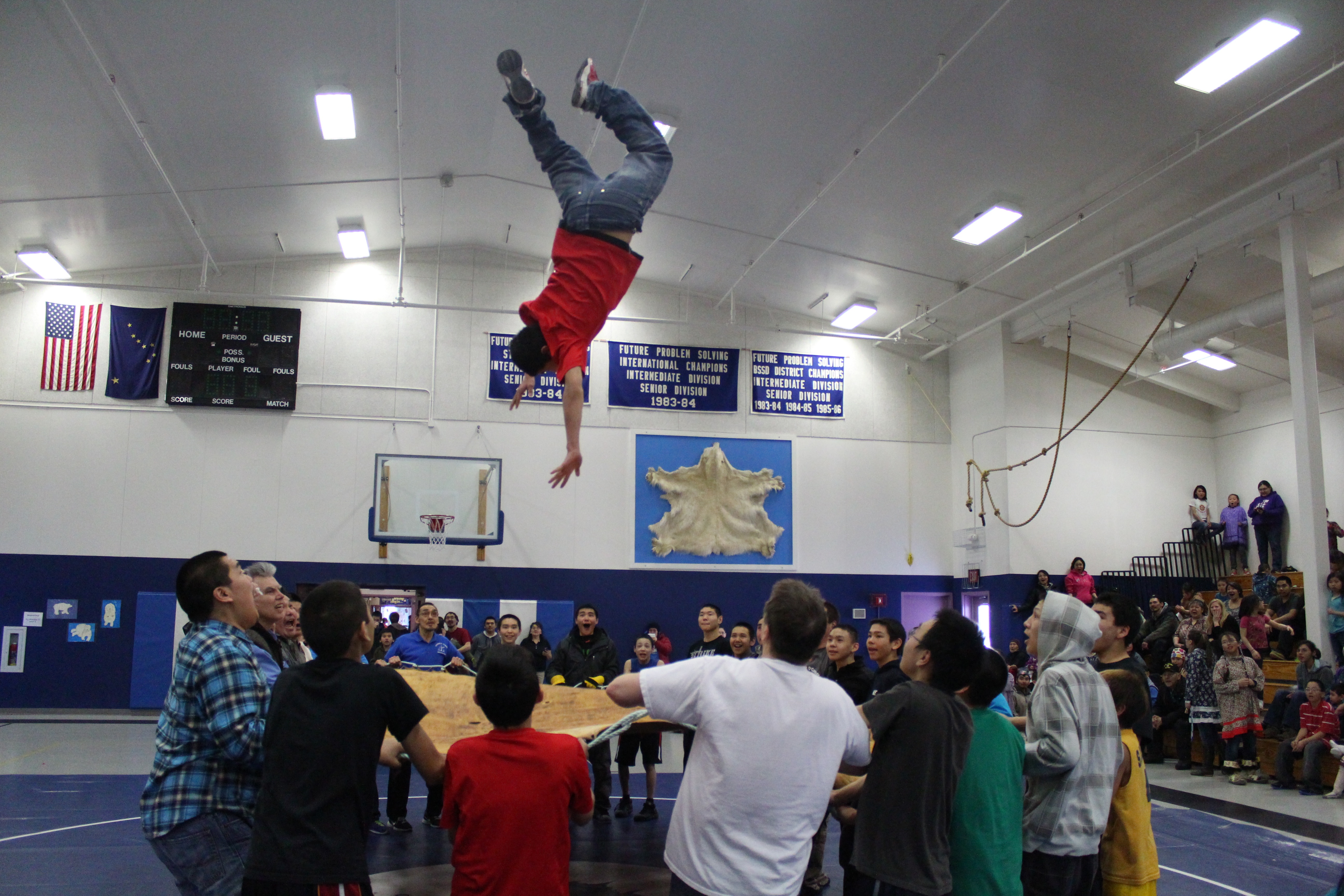
A student is thrown into the air as part of the traditional blanket toss — using a walrus hide — in the school gym in Gambell. (Photo: Skiku)
Renfro was not alone in his enthusiasm for the program. Husband and wife Brian and Caitlin Gregg of Team Gregg/Madshus participated this year for the first time.
“The whole experience was amazing,” Caitlin Gregg wrote in an email. “I really liked learning about the strong cultural history that the villages retain and teach all the youth. I left the NANANordic trip with so much excitement. The energy of the kids was amazing and I can’t believe how excited the towns were for us to be there! I look forward to spending even more time with the program next spring!”
APU Elite Team member Lex Treinen participated in NANANordic this year as an envoy of a club called club called K’enaanee Kkaazoot — a similar program started by former University of Alaska Fairbanks skier Heidi Rader in 2011.
“She had been doing gardening workshops in the villages on behalf of UAF’s Cooperative Extension Service and Tanana Chiefs Conference (the Interior non-profit native organization) and had always brought her skis,” Treinen explained in an email. “She saw that the kids were always interested. So I got to be part of the first K’enaanee trip in spring of 2012 and we went to Fort Yukon, Venetie, and Arctic Village. The next year we did a three-day trip to Ruby.
“This year Heidi decided to work through NANANordic,” Treinen continued. “Since they were expanding to regions outside of the NANA region, and got a grant that she could give to UAF students.”
Treinen went to the village of Nuiqsut, a village founded in 1974 in response to oil development on the North Slope. Treinen wrote about his experiences in UAF’s student newspaper, the SunStar.
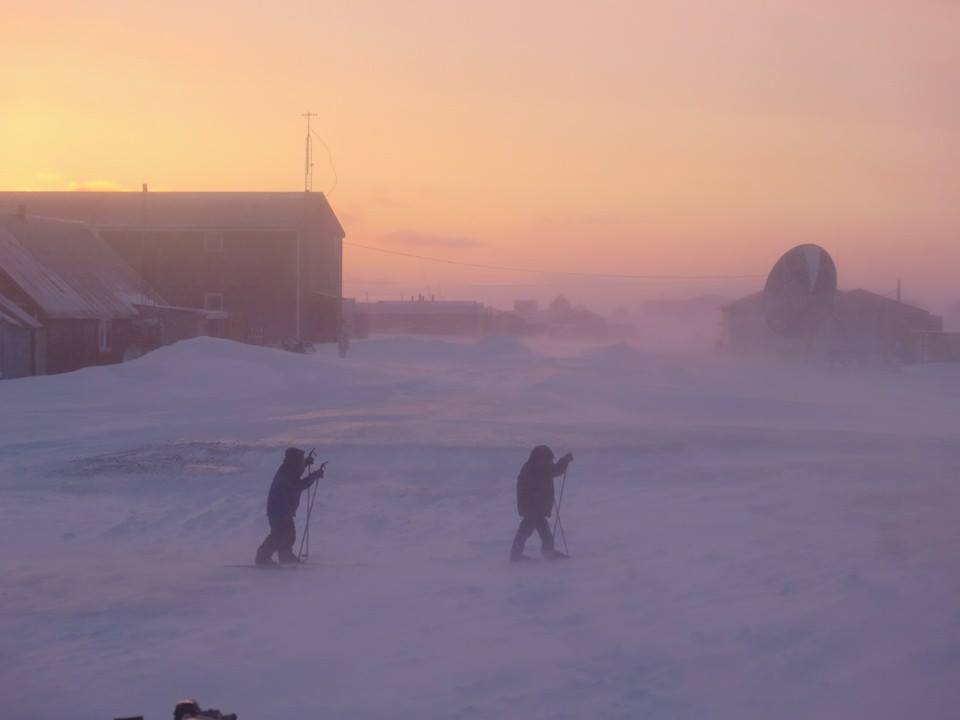
Kids brave a ground blizzard, caused by high winds, in Gambell. Gambell is on St. Lawrence Island, in the Bering Sea. (Photo: Skiku)
A Rewarding Experience
All those interviewed for this story had positive things to say about the innate ability and enthusiasm of the students for skiing in a region typically dominated by basketball and snowmobiles. The volunteers couldn’t help but be caught up in the excitement, many getting so much more from the experience than just the typical rewards of coaching.
Even Flora, who has been Nordic skiing nearly his whole life, feels the experience has changed him. In 2012 he had just finished a tough season of racing and immediately began NANANordic’s debut season.
“It was the perfect transition out of ski racing,” he wrote in an email. “It kept me involved with the ski world but opened my eyes to this amazing world that had nothing to do with ski racing. There was this deep rich Alaska Native culture that we got thrown into the first year and the NANA values started influencing our ski program in more ways than I can express.
“Basically this whole program has brought me back to my childhood memories of chasing around my two older brothers on skis and going on family ski trips,” Flora remembers. “I was so fixated on performance the last few years of my career, my performance started influencing my choices and decisions in a negative way. … My perspective on sport has changed. As a ski community we can learn a tremendous amount from villages in Alaska that can help us grow as teams, communities, and individuals. Skiku is as much about teaching kids how to ski as it is about our volunteers learning about a new culture, which can impact our own goals and dreams in life. ”
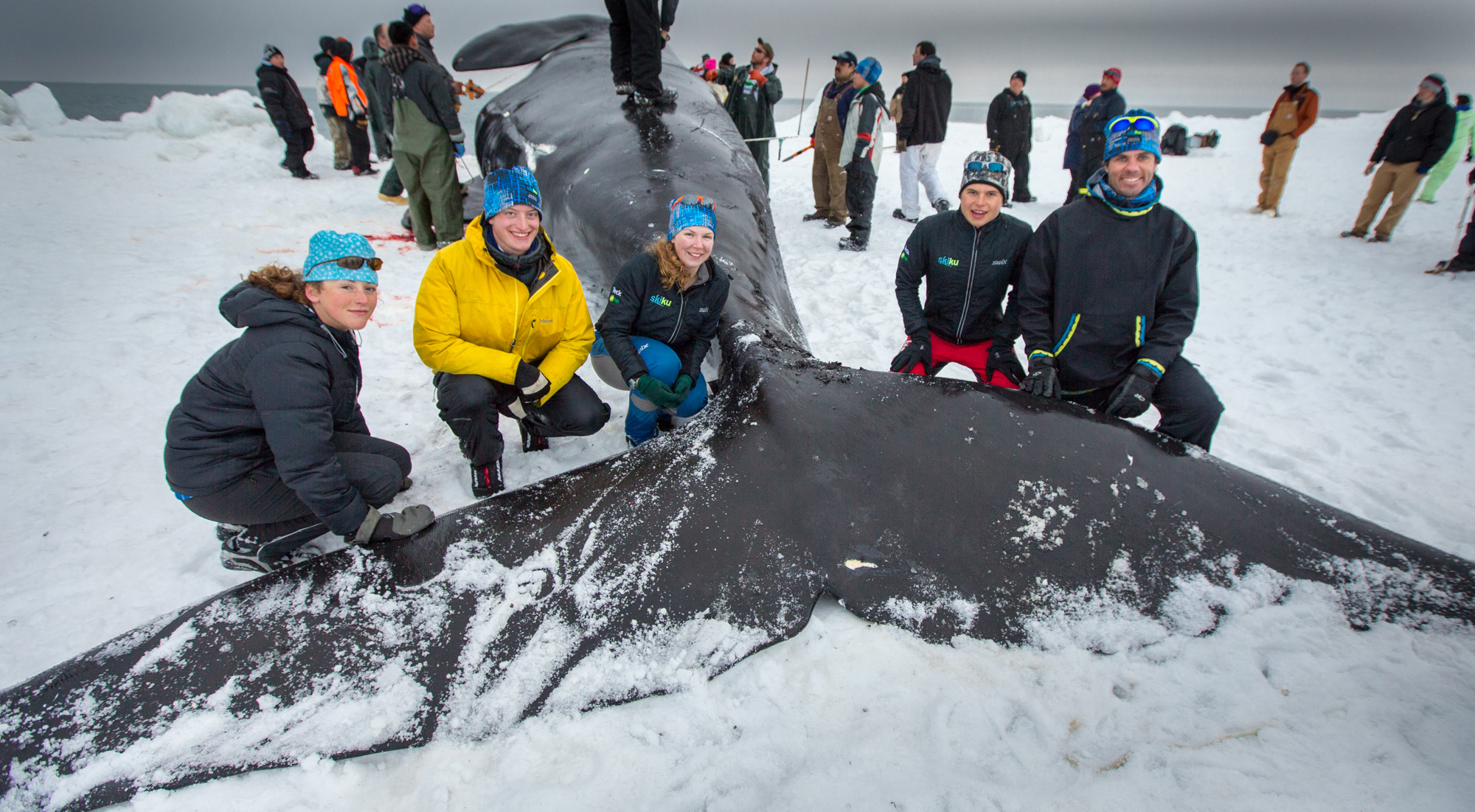
The Skiku Crew and a bowhead whale that was taken during the traditional spring whale hunt in Barrow. (Photo: Brice Habeger, Piksik)
2014 Volunteers: Aimee Demientieff, Alice Knapp, Allison Phillips, Amanda Del Frate, Ana Jager, Andrew Kastning, Andrew Dougherty, Anna Rix, Annie Connelly, Bailey Arend, Bre Donovan, Brian Gregg, Caitlin Gregg, Caitlin Patterson, Carlin Rauch, Carly Craig, Catie Bursch, Celia Haering, Charles Renfro, Conner Truskowski, Dana Tower,Dave Stamp, David Apperson, Deland Anderson, Donny Donovan, Dylan Watts, Emily Decker, Eric Packer, Erik Bjornsen, Fischer Heimburger, Frances Pillifant, Galen Flint, Gigi Banas, Greg Jernstrom, Greta Anderson, Ian White, Jaime Bronga, Jan Spurkland, Janey Hoefler, Jarrid Huckfeldt, Jasmine Neeno, Jeffery Fox, Jim Oksotaruk, John Farr, Jonas Loeffler, Josh Smullin, Julie Truskowski, Kathleen Rehm, Keri Hull, Lars Flora, Laura Pillifant, Lauren Fritz, Lauren Hess, Lex Treinen, Libby Kugel, Marie Steringer, Marine Dusser, Megan Spurkland, Michael Sinnott, Molly Schouweiler, Nancy Hanneman, Nick Treinen, Odin Brudie, Paul Kovacs, Peter Madsen Kling, Rachelle Kanady, Reese Hanneman, Robert Rosser, Rosie Brennan, Ryan Terry, Sadie Fox, Samuel Dougherty, Sara Studebaker, Sikulik Johnson, Tamra Kornfield, Taryn Hunt Smith, Tully LaBelle-Hamer, Tyler Kornfield, Will Mans, Zach Hall
ANCHORAGE, Alaska — Lars Flora, two-time Olympian and executive director and founder of NANANordic, is one of three U.S. representatives chosen to participate in the International Olympic Academy (IOA) from June 11 – 25, 2013, in Athens and Olympia, Greece. The other two are U.S. Olympic Committee staffers.
The IOA’s goal is to educate and motivate young people to use their experiences and knowledge gained from the session productively in promoting the Olympic ideas and educating others in their own countries. Flora will present NANANordic to the 200 participants from around the globe taking part in this year’s event.
“This has been an amazing journey,” said Flora. “We’ve introduced nearly 2,000 children in Northwest Alaska to Nordic skiing, giving them another winter recreation opportunity in a region where there’s snow on the ground eight months out of the year. This is just the beginning. Timing for the conference is great – we’re in the planning stages for our third season now. I’m looking forward to hearing ideas that will help NANANordic become even more successful.”
NANANordic was formed to introduce the lifetime sport of cross-country skiing to rural Alaska through a sustainable Nordic ski program, starting with villages in the NANA region. Two-time Olympian Lars Flora brought the idea to NANA Development Corporation in 2011. Funded by corporate and individual donations, Flora and 20 volunteers, in cooperation with the Northwest Arctic Borough School District, provided a month of cross-country ski instruction to 650 students in Kotzebue, Kiana, Selawik and Noorvik in 2012. This year, approximately 2,000 children in all NANA region villages, as well as Anaktuvuk Pass, had an opportunity to learn to cross-country ski from more than 45 volunteers consisting of Olympians, World Cup athletes, University and college coaches and elite high school athletes.
U.S. national team biathlete Hannah Dreissigacker demos her sport for kids in a village in the Alaskan Arctic. Photo: Brendan Smith/ANTHC.
Note: a quick read of Alex Matthews’ piece on NANANordic, published yesterday, will be helpful but not essential background.
Anyone familiar with the NANANordic project – whether from a friend who has participated, reading about it online, or glimpsing tantalizing Facebook photos of skiing in the Arctic – will find Zach Hall’s account of how he got involved pretty familiar.
“Lars (Flora) posted on Facebook that he was looking for volunteers to coach in the Arctic… and I jumped on the chance,” Hall, an Anchorage-based former U.S. national team biathlete, told FasterSkier.
That’s the usual way the story starts: excitement at the chance to give something back while also getting something in return: a glimpse of a part of America that most people might go their whole lives never thinking about. The largest of the northwestern Alaskan region’s eleven villages has a population of roughly 3,000, a number that sounds tiny to city-dwellers and suburbanites alike; one that’s 1,800 miles from the northern border of the contiguous 48? It’s not a trip that many get to make.
Noorvik students learning to ski under the blue sky of the Arctic. Photo: Chris Arend, NANANordic.
Then, the adventure begins, and those feelings only get stronger as athletes work with students who have zero background in skiing, a different view of the world, and seemingly boundless enthusiasm.
“There’s something about being involved in a program that is launched and sustained by passionate people,” Hall said of his experience last year. “All the volunteer coaches were psyched to be there and the excitement was palpable from the students. I’ve been blessed throughout my ski career with so many people that invested time and energy into my development, and it’s fun and rewarding to be in a position to begin passing that on.”
As it happened, Hall’s biathlon skills gave him an extra opportunity to pass it on, something that Flora quickly picked up on. He asked Hall and his girlfriend, current national-teamer Sara Studebaker, to bring their rifles along and introduce the kids in the village of Kiana to biathlon last year.
It was such a success that Hall, who coaches a few juniors in the Anchorage area, took on the challenge of organizing a broader biathlon program for this year. From recruiting to logistics, he was in charge of getting biathletes to six different communities in the region.
A Different Biathlon Introduction
There’s a lot of reasons that Flora thought biathlon would be a good fit for the program.
“The patience and focus needed to participate in biathlon is amazing,” Flora, an Olympic cross-country skier, told FasterSkier. “In addition, the time needed to learn about gun safety, and practicing marksmanship are extremely valuable for students and skiers.”
But as Hall, Studebaker, and Flora learned when the biathletes demoed their sport in a single village last year, there are many more reasons that it was an excellent choice for the program. Unlike most people who are introduced to the sport through nordic skiing, the villagers could see real practical use in the combination of skiing and shooting. Furthermore, biathlon, which in modern times is a military sport, actually has its roots in their type of lifestyle.
An aerial view of the town of Noorvik, where Susan Dunklee helped out as a coach. Photo: Chris Arend, NANANordic.
“I would tell a story about the history of biathlon, tie in how peoples of the north have hunted on some form of ski for thousands of years and then describe the development of this most practical hunting method into one of the most popular winter Olympic sports,” Hall said.
And the kids got the message; coach Susan Dunklee said that after a demonstration, there was always a group that wanted to hang around and talk with her about hunting.
“The hunting link isn’t too hard to make for the kids since it’s such a way of life for them,” said Hall. “It’s convenient for villagers when the caribou pass near the village, but that’s not always the case. At over $10 a gallon, the price of fuel can make hunting on a snow machine cost prohibitive, so I also tried to get kids to think about skiing as a means of transportation that is economical and sustainable.”
So the participants definitely “got” the first part of Hall’s message. But the part about how this activity, old and necessary, transformed into a sport where each race broadcast on television is watched by over 15 million people?
They got that, too.
“We had several kids that told us they want to go to the Olympics as skiers,” Hall said.
Nuts and Bolts
Sam Dougherty and a student checking out the ice in Kotzebue. Photo: Carol Richards, NANANordic.
Besides looking at the big, inspirational and aspirational picture, Hall had to get down to the gritty details, too: how do you teach hundreds of kids a sport that involves an unfamiliar endurance component, as well as a firearm component with all of its associated safety headaches?
The biggest lesson from his first year with NANANordic is that there’s no single by-the-book way to teach biathlon to the kids.
“It’s important to be really flexible with the programming, so for this year the we wanted to get biathletes into a few more of the villages and then provide a framework for how to present biathlon but to ultimately leave it up to them to respond to the interest levels of the students as well as the climate of each village,” he said.
As such, he and Flora, along with school administrators in the villages, decided that no bullets would be fired. That’s right: biathlon without bullets. They would get the participants familiar with the sport and the guns, and in future years incorporate actual shooting instruction (the kids were certainly clamoring for it). Flora reported that he and Hall are working on getting more rifles to use next year.
Meanwhile, athletes in the six villages came up with a range of different ideas of how, and how much, to teach the sport. Many incorporated what they called “biathlon basketball,” combining skiing with the kids’ favorite other sport. Shots were taken into trash cans, and the penalty loop headed out around a ski pole stuck in the snow. Many of the instructors showed the kids the routine of skiing into a stage and shooting; Hannah Dreissigacker reportedly used a caribou fur as a shooting mat.
In other places, biathlon was less actively included. One was Kotzebue, where several-time World Junior Championship team member Sam Dougherty had taken time off from school at Montana State University to travel as an instructor. His problem? The kids had a little too much enthusiasm.
“Just because of the sheer number of hysterically infatuated and enthusiastic kids we had to have our eyes on, along with dozens of sled dog teams cruising around our usual ski spots in preparation for the big Kobuk 440 race, I decided it wasn’t a smart or safe idea to be wielding a rifle,” he explained. “My biathlon exposure was unfortunately limited to discussion with the older kids.”
But despite that, he still thought it was a valuable addition to the program.
“I related biathlon to hunting caribou. If you shoot and miss the caribou, it’ll run off and you have to chase it down to take another shot (penalty loop), but if you’re smart and steady you can take the caribou sooner and don’t have to travel as far,” Dougherty said. “It worked.”
The goal of NANANordic is to create sustainable ski programs in the village; further developing a biathlon program could be a big draw to that, in that it creates another attraction and helps keep more different kids interested in skiing.
“Overall I think what we did with biathlon was a success because it exposed kids to another facet of the Nordic skiing lifestyle, and they were really excited to learn more about the sport,” Hall said. “Rifles [are] another way to connect with kids and capture their imaginations. Some kids love the freedom of being able to go exploring, others just want to jump, and biathlon leverages their existing ties to firearms in a unique way that lets us pull them into the awesome world of Nordic.”
A New Area, and New Champions?
Both Hall and Dougherty have been Alaskan their whole lives, yet the experience of living in a village was completely new for them.
“Like most Alaskans, I had never been farther north than Fairbanks and never off the road system before,” Dougherty said. “I really didn’t know what to expect… in the beginning I was a stranger in my own state.”
“Bush Alaska” refers to the roadless area where all transport is by boat, plane, or snowmobile. Athletes were flown into the villages to coach; the absence of easy transportation means that life is much, much different than in the lower part of the state.
But for Hall, it was also unbelievably rich.
Future racers? Noorvik students go for a ski. Photo: Chris Arend, NANANordic.
“I had conceived of the Arctic as being a desolate place with villages that were all pretty similar to each other,” he said. “It’s not that simple. The area can certainly be desolate, but at closer examination you realize that the region teams with fish and wildlife and the people who live there have fascinating cultures that are intricately linked to the landscapes and resources that surround them.”
Dunklee was amazed at how the athletes were welcomed into the villages and befriended by family after family. Many were offered a full-access look at what it would be like to live in a village.
“Skiing around the village we saw fresh dead caribou in the back of snow mobile sleds, as well as bear and wolf skins hanging from porches,” she said of her time in Noorvik. “One couple in the village, Dave and Audrey, invited us over to dinner several times. They hunt and gather a lot of their own food, such as caribou, swan, and blueberries… Fresh caribou meat was plentiful but I would crave fruits and veggies if I stayed there long term. The people were super friendly and welcoming- that part would not be hard to get used to.”
Most of the kids in the NANA region will likely stay there. Dunklee said that some might move to Anchorage or other southern parts of the state – a few had already been through the city to visit relatives – but that life outside Alaska itself seemed very foreign to them. Her description of her home state of Vermont was met with mostly blank looks.
But the introduction to skiing may be changing that. For one thing, the vast number of volunteer coaches, many of whom have international racing experience, provided another glimpse of the world to their students. Racing, too, might appear on their radar screen. The kids certainly have the talent.
“I was so amazed at how fast these guys picked it up,” Dougherty said. “In one week, with every day being sub-zero temperatures, I was having to chase down kids that could give the middle school racing scene a run for its money in Anchorage… We had a great coaching staff, and with such an organized program, I wouldn’t be surprised if Alaska starts to see champion skiers coming out of the NANA region in years to come.”
After the recent passing of Canadian champion Shirley Firth and the renewed focus on that country’s now-defunct Territorial Experimental Ski Project, we asked Dougherty if he thought something similar could be put in place in the NANA region. After all, the prospect of moving kids from village to village for ski races is fairly daunting.
But there is a “no road” ski conference a few hundred miles south in a different group of villages, and Dougherty said that Alaska provides other opportunities, too, for kids to start to get involved in racing if they want to.
“The Arctic Winter Games is a sports competition for countries that touch the Arctic Circle,” he explained. “I went for snowshoe biathlon in 2006, and it’s a great way to get international race experience at a young age. The Russians and Norwegians are always very good. Qualifying for Team Alaska is split up by regions of the state, so the bush areas are always represented at these events as well as urban Alaska… I do know that many village kids look at Arctic Winter Games as the highest level of competition. I certainly did when I went as a youngster.”
For Grownups, too
Finally, while NANANordic is undoubtedly focused on the kids, Hall couldn’t deny that it was fun to give another group of athletes the chance to join the NANANordic experience.
“It didn’t take too much arm twisting to get other biathletes involved,” he said. “I’ve always felt that travel is one of the best ways to challenge the assumptions we all carry of places we’re not familiar with and NANANordic is doing a great job of creating what amounts to a cross cultural exchange that benefits everybody involved… I anticipated that the program would have a big impact on each of them and based on the feedback I’ve received so far, it did.”
The athletes weren’t just being nice when they talked to Hall; the experience had made a deep impression on them.
“We spent our time playing games on skis, just delighting in being outside, in being active, and sharing that with other people,” said Susan Dunklee, the top-ranked American woman on last year’s World Cup circuit. “Sometimes in the middle of the race season you can lose sight of what you love about skiing, and this was a great reminder for me.”
The trip wasn’t quite all fun and games; athletes also had the chance to challenge themselves in a way that was every bit as tough as racing, but also completely different. They were offered the opportunity to ski from one village to the next.
“Dylan Watts, Odin Brudie and myself skied 35 miles to Selawik,” Dunklee said. “We carried heavy packs with food, dry clothes and water, plus a rifle for safety. It was cold enough that I wasn’t able to stop moving for more than a couple minutes at a time or my fingers went numb. Going into it, I was very confident in my ability, but it turned out to be surprisingly tough. We skied for 6 hours and I bonked hard the last few miles. I recovered at the end by eating a piece of muktuk [whale blubber].”
Last year, when Hall and Studebaker skid 48 miles from Deering to Buckland, 30 of that over pack ice, they surprised themselves and everyone else.
“Kids in both villages couldn’t believe that it was possible because nobody had ever done it before,” Hall explained. “Trips like that are typically reserved only for airplanes, snow machines and the occasional dogsled. With one long ski we opened their imaginations to how incredible and capable the human body is!”
For Dunklee, who had never been to Alaska even to race, the trip opened up the wonders of the state, too.
“The terrain was mostly flat and treeless with some big hills off to one side,” she said. “Sometimes when the fog lifted we could see the trail stretching out for miles ahead of us. We passed wolf tracks and a herd of caribou.”
It will be a memory to hang onto as athletes hit the roads and trails this month, writing another season of hard training into the books.
Gym class with NANANordic in Kotzebue in northwest Alaska. In its second year, the program designed to introduce nordic skiing as a lifestyle sport in rural Alaska got between 1,500 and 2,000 grade-school students on skis, between 11 villages in the NANA region and one in North Slope. (Photo: Brice Habeger)
(Note: This is the first of two articles on the NANANordic project, innovated by Lars Flora in 2011. Stay tuned for another piece on the addition of biathlon to the program.)
If you ask Lars Flora, there’s no “No” in NANANordic.
Founded by Flora, a two-time Olympic skier from Anchorage, Alaska, the program is designed to be fluid and adaptive in its effort to establish cross-country skiing in rural Alaska. If thousands of kids want to get on skis, bring the equipment to them. If adults, including military, want to learn as well, let them.
“It’s kind of the way it works out there,” Flora said of the NANA region in the Northwest Arctic, about 550 miles from Anchorage by air. “Things happen and the program evolves every day.”
With about 7,000 residents, 90 percent of which are Iñupiat (the northern-most aboriginal people in the world), the region spans some 38,000 square feet above the Arctic Circle. Locals and suppliers generally travel between NANA’s 11 incorporated villages by bush plane, but Flora wanted to ski the distances.
Alaska Pacific University junior coach Erika Klaar (second from right) during a NANANordic on-snow session in Kiana in Northwest Alaska. (Photo: Reese Hanneman)
He did so last year, assembling a team of 17 volunteers to visit four villages with a fleet of skate skis, poles and boots. They spent about five days in each, teaching grade-school students the basics during the day and sleeping in classrooms at night. He logged 135 miles, not counting his on-snow time with the kids.
Upon returning from a successful first trip last spring and gearing up for the next one in 2013, Flora met with the NANA Development Corporation (NDC), which oversees all things related to the region. One of 13 regional corporations created under the Alaska Native Claims Settlement Act, the NDC primarily encourages economic growth while preserving 10,000 years of history.
A big fan of Flora’s goal to bring nordic skiing to the region (and all of Alaska), NDC Vice President of Communications and Marketing Robin Kornfield (mother of former University of Alaska Fairbanks skier Tyler Kornfield) asked Flora to commit to four years with the program. Done, he agreed.
And what about visiting all 11 villages this year?
“About half the people who know what it’s all about running programs in these areas said, ‘That’s way too fast to grow. It’s too many places,’ ” said Flora, 35. “We usually say yes to everything and when new opportunities come up, we try to find a solution and make it happen.”
NANA Villages Visited
(between April 8 and 24, 2013): Ambler
Buckland
Deering
Kiana
Kivalina
Kobuk (video)
Kotzebue
Noatak
Noorvik
Selawik
Shungnak (video)
(plus Anaktuvuk Pass in the North Slope)
Sure enough, the program grew in its second year with more than 40 volunteers flying north to put in roughly 10-hour days with enthusiastic youth and teens. In 17 days, NANANordic touched down in all 11 villages (plus Anaktuvuk Pass in the North Slope region), getting 1,500 to 2,000 children on skis – up from 650 the year before.
“We had more interest than we knew what to do with,” said Eric Packer, a volunteer coach and Anchorage native who trains with Vermont’s Stratton Mountain School T2 Team. “It was really inspiring and motivating for me as an athlete to see that.”
After a long season of competing at home and abroad, Packer was one of dozens of well-known athletes, including U.S. Ski Team member Erik Bjornsen and U.S. Biathlon’s Susan Dunklee, Sara Studebaker and Hannah Dreissigacker, who jetted to northern Alaska to help Flora. Packer was stationed in Buckland and brought there by a bush plane.
“The nearest town is 70 miles away by snowmobile so you’re pretty far out there,” the 22-year-old said. “It was a really neat community, really tightly knit. The public school is the biggest building, so it uses the school as its hotel.”
The NANANordic volunteers shared quarters with military personnel from Arctic Care, a health and medical service that aids villages via Black Hawk helicopters. With little convincing, about 100 of the service men and women also tried skiing.
NANANordic volunteers board the plane to Shungnak in Kotzebue, Alaska. (Photo: Charlie Renfro)
“They were out there, we were out there, and everybody stays at the school so we asked if we could give them ski lessons,” Flora said. “They were all into it.”
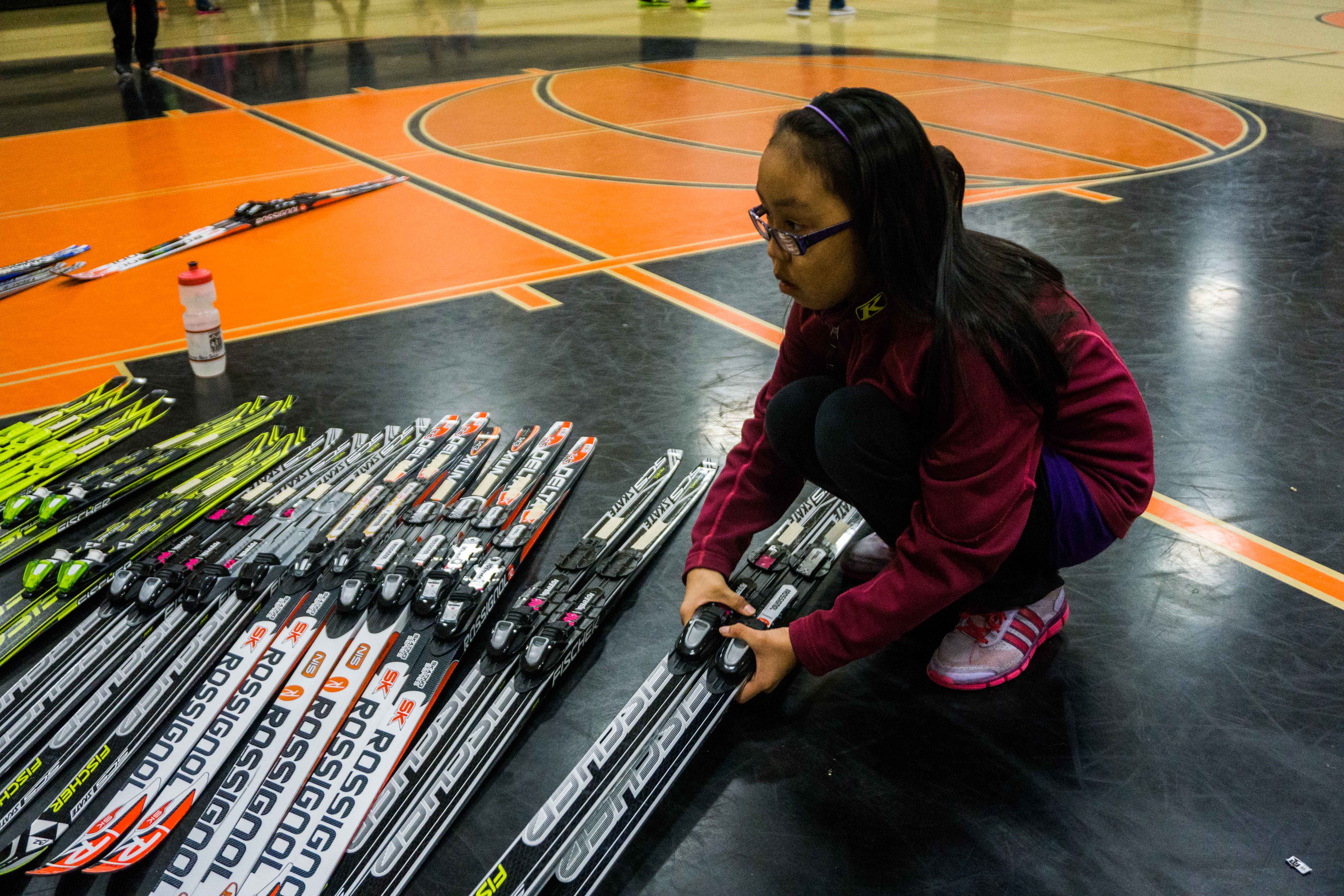
With a four-year sponsorship commitment from Teck, a Canadian mining company, Flora was able to purchase about 230 sets of equipment, building on his quota of 70 last year. Just as it had previously done, NANANordic left 20 pairs of skis, boots and poles in each village, giving the four school districts they visited last year a grand total of 40.
In places like Buckland, skiing was a completely new activity. That didn’t slow down most students, already comfortable in the outdoors.
“The kids were really self-reliant and picked it up super fast,” Packer said of the hour-long school sessions.
Additional ski time was offered after school, and Packer estimated more than 70 percent of the students came back for more.
“The bell would ring at 3:30 and at 3:31, we’d have a line out the door,” he said. “That kind of excitement that was really cool.”
Who Went:
– Directors: Lars Flora, Andrew Kastning, Charlie Renfro, Dylan Watts, Zach Hall, Tamra Kornfield
– Volunteer coaches:Amanda Del Frate,Austin Hess, Bre Donovan, Tully LaBelle-Hamer II, Caitlin Patterson, Calisa Kastning, Dave Smullin, Erik Bjornsen, Erika Klaar, Felicia Kreiter, Fischer Heimburger, Frances Pillifant, Greta Anderson, Hannah Dreissigacker, HC Holmberg, Jake Bassett, Josh Smullin, Katy Rehm, Lauren Fritz, Lauren Hess, Leah Droege, Lydia Blanchet, Meghan Clemens, Molly Schouweiler, Nick Treinen, Nils Koons, Nora Miller, Odin Brudie, Peter Kling, Reese Hanneman, Eric Packer, Donny Donovan, Sam Dougherty, Sara Studebaker, Susan Dunklee, Taryn Hunt-smyth, Siku Johnson, Asa Bergamaschi, Paul Lincoln, James Oksoktaruk
Seeing the growth and adding new elements of the program like biathlon and four untimed races, was rewarding, Flora said. Students in Kotzebue, NANA’s largest village with about 3,000 residents, got a little too cold before their race and jumped the gun, but the coaches let them go.
“They’re fun races. They’re participation,” Flora said. “Basically the last day of the week, we put bibs on the kids and made a little course.”
Next year, Flora is thinking about organizing a larger race, like an invitational. However, transporting people between villages isn’t easy; a few students could easily hop on a bush plane, but 30 to 40 would require several trips.
“There were a couple kids asking if they could make a ski team at the school,” Flora said. “I think there was 30 high-school kids wanting a ski team. … One of the goals is to have skiing as part of the school district.”
In the Bering Straits region just south of NANA, skiing and biathlon are already in the schools. According to Flora, the districts are interested in integrating classic skiing into their programs, which he intends to help them with.
The relationship has already become mutually beneficial. For the first time in 20 years, two skiers from the Bering Straits ventured to NANA to ski. A high-school senior, Asa Bergamaschi, and Sikulik Johnson, an eighth grader, came as volunteer coaches, and their experience was just as essential as that of the more elite athletes.
“I received probably 100 emails with people who wanted to go out and then I had a few coaches recruiting for me,” Flora said of the volunteer-gathering process. Next year, he anticipates they’ll have an online application.
“It’s this adventure combined with teaching kids how to ski so it’s really important for us to have some people who are here in Anchorage and know how to run programs and work with school districts,” he said of his staff.
In terms of a vision, Flora hopes the sport truly takes hold in the region in the next three years. Beyond that, he’d like to spread the love to the rest of Alaska as well.
NANANordic Director Lars Flora enjoying his time in the villages last month. (Photo: Reese Hanneman)
“The whole idea is to actually get ski programs across Alaska so we’re putting a system together that can expand to other regions,” Flora said. “Someone asked me, ‘How many villages will you plan to do next year?’ We might try to pull off 30.”
In the meantime, he’ll continue to focus on his program headed by five other directors (Charlie Renfro, Andrew Kastning, Dylan Watts, Zach Hall, and Tamra Kornfield) and keep it manageable. Later, he might consider joining forces with similar initiatives, like the Ski-Go Club in interior Alaska, run by Heidi Rader out of Fairbanks.
“There’s 200-plus villages out there and if we’re going to start programs in all of them it is going to take the nordic community to make it happen and the whole state coming together,” Flora added.
It might seem like a tough task, but it’s one he’s excited about. Flora will review the program the coming weeks to formulate future plans while continuing to pursue a degree in environmental science. He also works in the development office for the Alaska Pacific University ski team with his brother and head coach Erik Flora.
In June, Lars will represent NANANordic in Greece after the U.S. Olympic Committee selected him to visit the International Olympic Academy (IOA). The Committee chose three programs across all sports to attend the IOA Young Participants Session, and Flora will spend more than two weeks there on behalf of his mission.
“I’m definitely dedicated to keep going on with this program,” Flora said. “It’s been an amazing experience.”
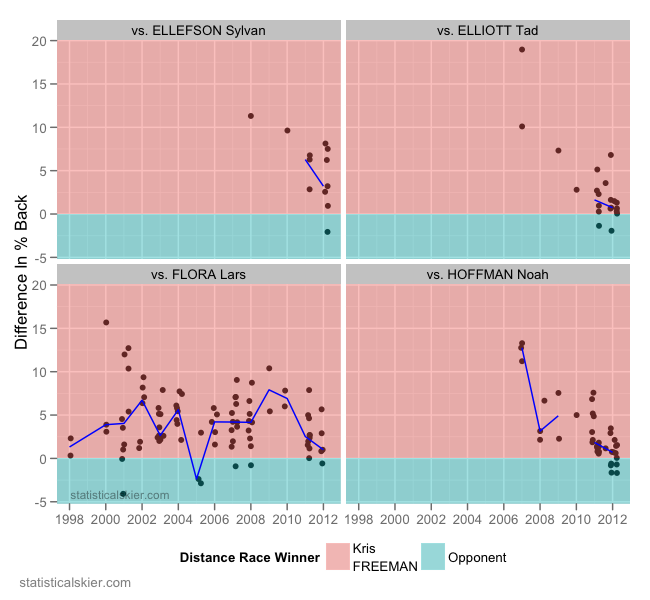
Kris Freeman and Kikkan Randall have been basically the top US skiers for quite some time now. (I’m sort of brushing Andrew Newell under the rug here, mostly just due to time contraints. I’ll do a follow up on him next week.)
Freeman has been more or less unquestionably the best US male distance skier for what seems like forever, and Randall has been fairly dominant domestically in both distance and sprint events. How long can this last? Not forever, of course. Nothing lasts forever.
But it seems like the shift may happen sooner on the men’s side than the women’s. Here’s what I mean:
This shows the head-to-head results of Freeman against a handful of the better US men’s distance skiers in recent years. Certainly, Freeman has way more wins (above zero, in the pink) than losses (below zero, in the blue). But the gaps are generally narrowing.
Now, there’s a big caveat here in that I can’t say much about whether Freeman is getting slower, or these guys are getting faster, or even if Freeman is getting faster but these guys are getting faster faster. (That made you think for a second, didn’t it?) Or maybe they’re all getting slower, and Freeman is getting slower faster. (See, now I’m just having fun messing with your head.) The point is that these are just relative comparisons, not absolute ones.
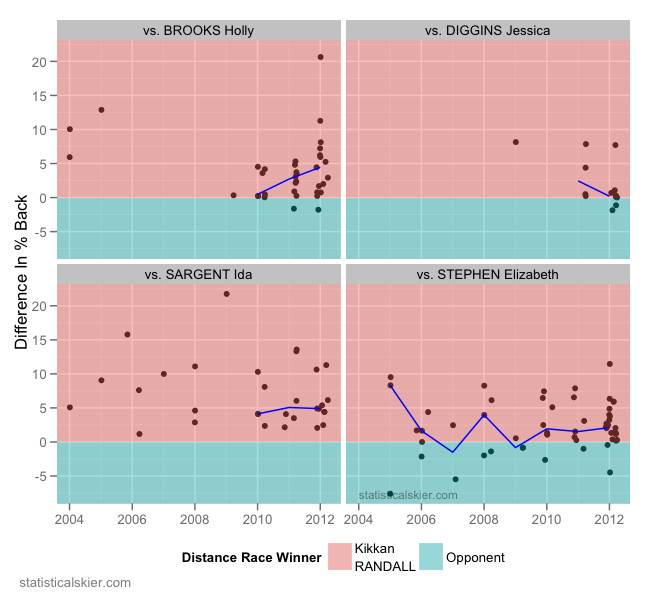
In any case, what does the similar picture look like for Kikkan Randall?
This is the same graph for Randall, in distance events. Jessie Diggins seems to be chipping away at the gap, but the other three look fairly flat. The seemingly steep decline for Brooks is mostly an illusion, and is due to her injury struggles this past season. Without those races, her trend would be mostly flat, or perhaps very slightly down.
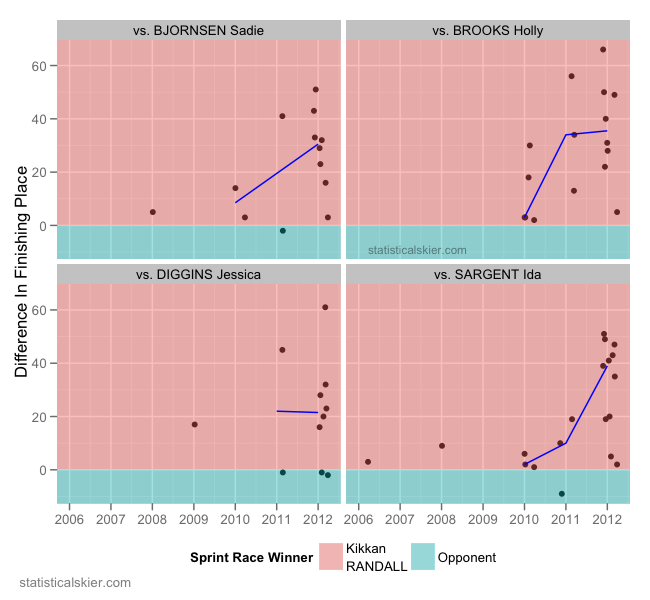
Things look even more dramatic in sprinting, as you might expect:
Again, this probably reflects Randall’s recent improvements more than any decline on the other ladies’ parts. But my point remains that it seems likely that Randall will remain on top in the near future, but I’m less certain about Freeman.
The Fire and Ice Camp crew last week at Mt. Bachelor in Bend, Ore. (MBSEF photo)
After a massive wave of spring skiers left Bend, Ore., last month, the groomers at Mt. Bachelor hardly packed it in. The U.S. and Canadian national teams and several elite squads were gone, but nearly the same amount of skiers – 150 – were expected to flock to the snow-covered trails in June.
The Mt. Bachelor Nordic Center and its club, the Mt. Bachelor Sports Education Foundation (MBSEF), planned accordingly. On June 16, the MBSEF greeted about 55 juniors to its five-day Fire and Ice camp, an annual tradition that’s followed national-team visits for years.
Lars Flora shows off his balancing skills at the Fire and Ice Camp from June 16-20 in Bend, Ore. Flora was the camp’s head coach. (MBSEF photo)
Lars Flora, a two-time Olympian and Alaska Pacific University (APU) skier, made the trip down from Anchorage for his third-straight year to serve as head coach. He worked with MBSEF Nordic Program Director Dan Simoneau, who coordinates the camp, to attract six competitive skiers to Fire and Ice as coaches.
After all the 9- to 18-year-olds said their goodbyes last Wednesday along with coaches Matt Liebsch, Torin Koos, Tyler Kornfield, Sylvan Ellefson, Ollie Burruss and Zoe Roy, Flora talked about the experience on the phone from Eugene, Ore., while watching the Olympic track and field trials on Saturday.
FasterSkier:How long has the Fire and Ice junior camp existed?
Lars Flora: Four years, I believe. It’s been going on for, off and on, forever. Now with two periods of skiing and Mt. Bachelor way more behind it, they are really getting interest from skiers. There were 300 skiers between the two periods of skiing this year, so that was really good. When the national teams were there, they were at 150, and around another 150 in the second period in June. The town’s really excited about it. It’s awesome.
FS:What’s the goal of the camp?
LF: Dan [Simoneau] and I came up with the idea to bring more top athletes to help coach and train while they’re in Bend. This was the third year we did it. This year we had a really good group of coaches. Sylvan volunteered his time because he was out there training and Matt Liebsch and Torin and Tyler Kornfield were asked early on. It was really cool that Sylvan just stepped up and wanted to help out.
FS:Where do the participants come from?
Trail running/bounding at the Fire and Ice junior camp last week in Bend, Ore. (MBSEF photo)
LF: Most of the skiers were from PNSA [Pacific Northwest Ski Association], so Washington and Oregon. There were around 55 [junior] skiers who did the camp and they range from 9 years old up to 18. It’s a pretty big range of ages.
FS:How did they respond to having so many talented coaches?
LF: Sometimes I wonder if they always realized what kind of lineup of coaches they have. You know how it is, you’re always skiing and then you just hang out with your friends and you kind of forget who these skiers are. But it’s the time we spend with athletes; we spend from 8 a.m. to 4 p.m. every day with them. We do a lot of fun stuff like rafting and paddleboarding and running and playing games, playing soccer and whatnot. I think it’s just a lot of good time to observe the top athletes and watch them and the inspiration to be around the best athletes in the U.S.
Like Matt and Sylvan and Torin, from an athlete’s standpoint, they’re great around kids; all three of them are amazing. [A University of Alaska Fairbanks skier,] Tyler’s just getting into that stuff. He’s young, he’s only 21, so it was really good for him to be there. It’s good for athletes to learn how to coach and put on clinics.
FS: How was the coaching and group size structured?
LF: It was a free-for-all (laughs). Nah, it was small groups. Sometimes we would split the group into two: the young ones, everyone under 13 and then everybody above 13. Other times we would take 10 to 15 skiers out at a time [with] one coach. It varied throughout the camp.
FS: They were on snow for all five days?
LF: Five days on snow and five days of dryland activity.
FS:How were the snow conditions and weather overall?
LF: It was really good. The first half it was a little dirtier than usual and then it snowed one night midway through and cleaned it all up. Driving over the pass [Saturday], it was snowing pretty hard. …
I would say [it was around] 50 to 60 [degrees] when we were skiing and then in town it was 70 to 80.
The first day after the camp ended it started raining so we lucked out with 10 days of sun. I say 10 days because the first five days the coaches were there training and then the second five days was the Fire and Ice camp.
FS:What were some of the most popular camp activities?
Part of the Fire and Ice Camp included whitewater rafting on the Deschutes River. (MBSEF photo)
LF: They loved to play Sharks and Minnows on skis. Sylvan actually said he might want to put that into his training plan next year. He had a good time playing Sharks and Minnows with the kids. The older ones respond to intervals with the coaches. We’ll pop into intervals with the 17- and 18-year-olds and I think that’s one of the best activities with 18-year-olds.
Everybody loves the raft trips. We had eight boats going down the Deschutes [River] and jumped in the water; a lot of water fights. I was with the 10- to 12-year-olds so that was fun to go down the Big Eddy with a bunch of young kids.
FS:And paddleboarding?
LF: Paddleboarding and rafting is with Sun Country Tours, [which] is owned by Dennis Oliphant who’s the president of MBSEF and used to be the nordic coach when I was younger. We paddleboard right down by Old Mill on the Deschutes.
FS:You mentioned the first camp sleepover this year. How did that go?
Site of the Fire and Ice camp sleepover, the Mt. Bachelor Nordic Center on Saturday after camp ended Wednesday, June 20. (MBSEF photo)
LF: Dan had this whole idea that he was going to do the first-ever sleepover at the nordic center and all the other coaches were like, ‘You’ve got to be kidding me.’ It ended up [being] great. We had a barbeque up there [on Tuesday night]. All the kids brought sleeping bags and pads, about ten of them slept out on the deck. It was a nice crisp night up there, and just kids everywhere camped out. They had a dance party.
It was pretty mellow actually, I was surprised. We had all of them to bed by 12 [a.m.] and woke up around 7 o’clock and had breakfast. We did a night ski around 10 p.m. and it was just rock-hard, perfect skiing so that was fun.
FS:How tired were you by the end of camp on Wednesday?
LF: I was pretty tired. It wasn’t so bad. It’s so much different now that I’m not training so coaching, you have way more energy. We used to do this camp while we trained, so we’d get out in the morning, and that’s what Matt and Tyler [were] doing, and Matt coached the whole time. Tyler coached two days, Torin coached two days, and Sylvan coached one day. Zoe coached one day.
FS:What draws you to these types of programs?
LF: I just think it’s really good for everyone. It’s a really good for development to get the top athletes in front of the younger skiers more, and Bend camp is the perfect place to have that happen.
FS:What do you think the impact is for the skiers and coaches?
LF: Some of the athletes were saying they’re going to spend a month out there next spring skiing and stuff. Sylvan was really excited about that and Tyler was just blown away. It was Tyler’s first time down to Bend so it was fun to bring him down there and show him a new place. He’s spent a lot of time in Alaska training in Fairbanks and Anchorage and he’s kind of at that point in his career where he needs a bit more. For him to go down to Bend and just see the resources that are in Oregon for skiing is a pretty good time. He was telling all his friends about it and sending them emails.
FS:Thanks. Are you spending the rest of the day at Hayward Field?
LF: Yeah, definitely. Rooting on the hometown boy from Bend. Ashton Eaton is leading the decathlon right now. (Note: Eaton not only qualified for the London Games this summer, but also broke the world record on Saturday.)
Lars Flora stands behind a drying rack of sheefish, a popular springtime fish in Northwest Alaska, while Elvina, an Selawik eighth-grade skier in his NANANordic program, looks on. (Photo by Charlie Renfro)
While most of his cross-country skiing brethren kicked up the last bits of snow at Spring Series in Craftsbury, Vt., Lars Flora was hard at work at home in Anchorage, Alaska, crunching numbers and finalizing details of his upcoming trip.
It would have been easy if he had been the only one traveling to Northwest Alaska, but Flora had 17 volunteer coaches and two doctors to accommodate, the NANA Development Corporation to run by, and about 650 kids waiting for him in four different villages.
NANANordic took all the focus and logistical smarts the two-time Olympian could muster. Yet every morning, the program’s potential in providing youngsters with cross-country skis was what excited him most.
A couple of schoolchildren ski below Rainbow bridge in Selawik in Northwest Alaska. Without any roads in town, Selawik is mostly made up of boardwalks and bridges and built on the Selawik river. (Photo by Reese Hanneman/Engine Room Media)
For three weeks from April 9 to May 1, Flora and a crew of peers and supporters visited schools in the Northwest Arctic, about 550 miles northwest of Anchorage by air. Slightly bigger than the state of Indiana, the region has an estimated 7,000 people living in 13 villages.
Last year, Flora made it his mission to bring skiing to each town.
Similar initiatives, such as the RurAL CAP Ski Go Club program founded by Jennifer Johnston, introduced students in the Northwest to nordic skiing in the past. The program fell by the wayside a few years ago following Johnston’s election as Anchorage assemblywoman, and Flora saw a need to pick up the pieces. His program, he decided, would be even bigger and most importantly, sustainable.
“I felt [it] was a really good fit for the region and there’s no reason there can’t be ski programs up there,” Flora said in a phone interview from Anchorage. “It’s something they can [do] outside and go do something active somewhere. A lot of times, there’s no one taking them anywhere.”
Like many city-dwellings Alaskans, Flora, 34, had always dreamt about seeing “real” Alaska, that rural part of the state where natives speak Iñupiat Eskimo and live off the land in often brutally cold conditions. He made the two-stop, two-hour flight to the region’s hub in Kotzebue for the first time last fall, where he watched the community assemble for a high-school running race.
People drove up on boats and flew in on planes to see the event. Flora stood back amazed.
“Spending time up there, you learn the people are super-warm and nice,” he said. “And when there’s a sporting event or any type of event, the whole community comes together.”
Basketball was king, he said. Everybody played and followed its superstar athletes. But for some reason, skiing wasn’t ingrained in their culture. Flora wanted to change that.
“The interesting thing about it is these kids are super active,” he said. “They were just so eager to ski. Every day, the questions would be, ‘Where are we skiing today?’ We did afterschool sessions and we ran out of equipment most of the sessions. Kids would be lined up at the door pushing down the door.”
After a whirlwind winter, in which Flora started off on the World Cup circuit, placed fourth at U.S. Nationals in the 30-kilometer classic and suffered some unlucky crashes in two ski marathons, the Alaska Pacific University racer said there was nothing he looked forward to more than seeing his program, NANANordic, come to life.
Since convincing the NDC native corporation to sponsor him last spring, Flora made it his priority. He partnered with the Northwest Arctic Borough School District, rounded up influential athletes, attracted volunteer doctors and donations from one of his sponsors – the Asthma and Allergy Foundation of Alaska – and arranged to have food and transportation paid for through NMS Food Services, Alaska Airlines and Bering Air.
Flora stands behind some students ready to go skiing in Kiana in Northwest Alaska. (Photo courtesy of NANANordic)
Fischer and Rossignol combined to donate 70 sets of equipment. Flora had the whole fleet transported between the four villages they visited – Kotzebue, Kiana, Noorvik and Selawik –and eventually left 20 sets in each.
Flora skied between the towns for a total of about 135 miles. After 3 ½ weeks up there, Flora said he was a little tired.
Each week, he and a few other coaches stayed at a given school, cooking in home-ec rooms and cozying up into sleeping bags at night. By day, Flora and about five members from his loaded staff, which included U.S. national team biathletes Sara Studebaker and Zach Hall, APU skiers Reese Hanneman, Charlie Renfro, Greta Anderson and Dylan Watts, and University of Alaska Anchorage ski coach Andrew Kastning, taught 100 to 150 students per day.
“Our first session was at nine o’clock and we were coaching all day,” Flora said. “[The kids are] basically all big hitters. They had been classic skiing on no-wax skis, but no one really knew how to skate ski so it was starting from the beginning, showing them how to put bindings on, put pole straps on, really starting with the basics.”
Most of his volunteers stuck around for about six days, coaching during gym classes and after school with students in kindergarten through 12th grade. Children played games, asked questions, laughed and caught big air on skinny skis. Flora said their enthusiasm was overwhelming, and many coaches noted that children in Anchorage or other ski communities didn’t get that excited about skiing.
Next year, Flora hopes to double the amount of villages and visit eight. Ultimately he wants to reach all 13.
“I was totally unfamiliar what it was like to be up in the villages and just getting to know the logistics part of running a program [there],” he said. “The dynamics between the school district and the native corporations, the teachers and the local community, it’s been a huge learning curve. It’s been really fun.”
A Balancing Act
The amount of work involved is what kept Flora from the SuperTour Finals in Craftsbury in late March. He had to decide whether he wanted to race there or in the Norwegian Birkebeinerrennet, one of the most challenging marathons on the Worldloppet circuit. On March 17, he ended his season in Norway placing 59th despite a tough wax day.
In all, Flora completed four marathons last season. He was third in the Gatineau Loppet after a crash near the finish, sixth in the American Birkebeiner after a tangle around 40 k, and 31st in the Swiss Engadin.
Asked whether he chose the marathon route this season to prepare for trekking between villages in Northwest Alaska, Flora laughed.
“It wasn’t totally planned out,” he said. “Coming into the season, you always put the goal out there and once you commit to it, it’s like, ‘OK, you get to go to the World Cup and see what happens, right?’ I got through the first period and realized I missed some big training periods so that’s when I started thinking that the marathons were going to be my main thing. By the time I did all those marathons, I was in great shape. I had a blast.”
His desire to do more Worldloppets had been on his mind – that and what would be required up north. After their first stop in Kotzebue, Flora and Dylan Watts skied 75 miles to Kiana. They planned to cover the distance in one day, but teachers warned them otherwise.
On the Trip:
Sara Studebaker, Zach Hall (US Biathlon); Andrew Kastning (U of Alaska Anchorage); Reese Hanneman, Charlie Renfro, Greta Anderson, Dylan Watts (APU); Crystal Pitney (U of Alaska Fairbanks); Tamra Kornfield (formerly of UAF); Evelyn Dong, Katy Rehm, Rachel Samuelson, Danielle Hess (elite racers); Forest Tarbath, John Glen, Hugh Cosgrave (Service High School); Mariah Cooper (of Ojibwe band in Hayward, Wis.); Dr. Demain & Dr. Rathkopf (Asthma & Allergy Foundation of Alaska)
“You’re going out on terrain you’re not familiar with and you’re right on the Bering Strait so the weather can chance in a second and can be blowing 60 to 70 miles an hour,” Flora said. “So we got a little nervous.”
They packed a sled with food and camping and safety equipment, including a radio, and pulled the 30-40 extra pounds behind them. They split the trip into two days, skiing five hours on the first and three on the second.
After that, Flora completed a 25-mile solo ski from Kiana to Noorvik in one day, and skied with Kastning, Renfro, Hanneman and Evelyn Dong for his last journey between villages.
Along those final 35 miles, Flora said he experienced the highlight of the trip when they came upon a herd of about two thousand caribou.
“I looked at Andrew and I was like, ‘I think I’m just going to ski right up to them,’ ”Flora said. “Andrew’s like, ‘So you’re going to be that guy? They guy who just splits the whole herd?’ Right when he said that, our friend Charlie came up and skied right through. He was like, “Let’s go!’ ”
With each skier approaching at a different angle, the herd spooked and ran by Renfro, who was ready with his camera.
“He had, I don’t know, two hundred caribou running right through him,” Flora said. “It was pretty cool.”
Skiing through about 2,000 caribou on the way to Selawik in Northwest Alaska in late April. (Photo by Charlie Renfro)
A day after returning from the region, Flora said they would immediately launch into planning for next year. At this point in his career, after some 17 years of elite racing, it was exactly what he needed.
“When I would wake up, this was the stuff that got me excited,” Flora said. “I lost that excitement to get out there and train, and once you lose it, it’s hard to get back sometimes.”
Last year was essentially an evaluation period in his ski career. He said it went “OK” considering the high he came off in 2011 with two top-40 finishes at World Championships, but in the end, he lacked training. At the Teva Winter Mountain Games in February, he suffered what he called “the worst bonk of his career.”
Three months later, Flora still has a strange sensation in his fingertips. His friend, ski racer and ER doctor, Adam Swank told him to give it a few weeks and see if the effects of dehydration, altitude and cold wore off. They didn’t, and Flora said he was going to work with a physical therapist on what he thought was a pinched nerve.
“My body doesn’t respond well going up and racing at eleven thousand feet,” Flora said. “That was brutal.”
As for next season, Flora said he’s still undecided as to whether he will continue racing or pursue a career in coaching. One thing’s for sure: he’ll be back in the Northwest Arctic with skis in tow next spring.
“When I started to see how much excitement and how much fun it was to pull this off with NANANordic, it was a good sign that I needed to move on and do something else,” he said.
Tad Elliott (l) of the U.S. Ski Team/Salomon and Matt Liebsch (r) Team Strong Heart/Team Birkie/Gear West stand outside the American Birkebeiner expo, clearly ready for Saturday's 50 k skate race with Liebsch wearing a "Birkie Fever" face mask. Courtesy photo.
All American Birkebeiner coverage is brought to you through the generous support of Concept2, makers of the SkiErg.
CABLE, Wis. – Matt Liebsch’s wife had been in a car accident.
Lars Flora couldn’t feel his fingers nearly two weeks after a ski mountaineering race in Vail, Colo.
Holly Brooks had just returned home to Alaska to recharge. Caitlin Gregg was waiting for an OK from her doctor.
Holly Brooks (APU) toughing it out in this year's Tour de Ski 10 k skiathlon in Oberstdorf, Germany.
Tad Elliott wasn’t sure what to do with a weekend off from the World Cup. His U.S. Ski Team coaches suggested he look for a ski marathon in Europe.
Brent McMurtry and Graham Nishikawa felt like flying down from Canada, Adam Swank made the short trip south from Duluth, Minn., and Bryan Cook and Maria Stuber returned to their roots in Wisconsin.
Former Central Cross Country (CXC) racer and 2012 Winter Triathlon National Champion Rebecca Dussault was back with three kids cheering her on. Last year’s classic champion, Jennie Bender couldn’t wait to give the skate race a try.
Norway’s Tore Martin Gundersen knew he’d be back as soon as he won here last year.
The paths nearly 350 elite racers took to the 39th American Birkebeiner were varied, but they made it. On Saturday, about 300 skiers will compete for the top-six money spots in the 50-kilometer men’s and women’s freestyle races from Cable to Hayward, Wis. Another 50 will contend for glory rather than cash in the 54 k classic race.
Nearly 6,000 skiers will follow them in waves 1 through 10, but the elites will likely keep their attention forward. If they look back, it will likely be to see where their familiar friends or foes are.
Really, the American Birkebeiner as North America’s largest ski marathon breaks down into several separate races. From elites to beginners, every participant enjoys or suffers through their own journey. If they’re lucky, they will all end up together after the finish on Main Street in Hayward.
That’s if they finish.
For the racers at the highest level of the sport, like more than a dozen Norwegians that ventured to the states, the event is about winning. And if they don’t win, they want to come close.
The fastest male and female in the Birkie’s 50 k skate race get $7,500 – more than twice the amount winners received at the five-stage Tour de Twin Cities SuperTour event last month. Second place in the Birkie skate race earns $4,500 and the purse trickles down to sixth place, which gets $1,000. That’s enough of a draw for most skiers.
“I think that this year might be the strongest field we’ve had in a long, long time,” said American Birkebeiner Executive Director Ned Zuelsdorff. “We have the past champions back, both in the men’s and women’s skate division.”
Norwegian Olympian and FIS Executive Director Vegard Ulvang skis with some multiple-sclerosis fundraisers at a "Ski with Vegard" event in Cable, Wis., on Thursday.
The top nine women from last year’s skate race returned, including Gregg as the defending champion who set a course record last year in 2:16.07. Seven of the top 10 men also came back, including Gundersen and Benoit Chauvet (FRA), who placed first and second, respectively, in the 2011 Birkie.
In the classic race, Norway’s six-time Olympic medalist, Vegard Ulvang, will be the man to beat – even if he isn’t really racing. He was invited as a research ambassador for the National Multiple Sclerosis Society, the Birkie’s Skiers for Cures cause. Regardless, he still gets the top elite bib in the classic race.
“I haven’t competed in a few years,” Ulvang told FasterSkier on Thursday. “If I race too much I will be disappointed because the feeling will never be as it was, so I prefer staying with the old memories.
“I will ski quite fast, I think,” he added. “But I don’t know, I have no ambitions.”
His wife and former Norwegian national team biathlete, Grete Nykkelmo, has the lowest bib among the elite women in the 50 k state.
Female Contenders
Caitlin Gregg: The reigning skate champion from CXC is back for more, although a week ago, it seemed uncertain whether she would be healthy enough to race. Upon coming down with a cold last weekend, Gregg skipped the SuperTour sprints in Madison, Wis.
Caitlin Compton Gregg (CXC) celebrates winning the 2011 American Birkebeiner 50 k skate in frigid temperatures below zero. Photo: Andy Canniff, Swix Sport USA.
“I think it was a good move,” Gregg wrote in an email. “That was my first weekend off since Nationals and it was very refreshing to be at home and catch up on sleep and rest.”
She stayed off her skis for a few days, which wasn’t a big deal because that’s what she would have done for a taper anyway.
“I am feeling much better now and got the OK from the doctor to get after it in the Birkie!” she wrote.
Last year’s win helped her pay off her debt from the 2010 Olympics, and she and her husband, Brian Gregg, bought their first house. Brian was eighth in the men’s 50 k skate last year.
Holly Brooks: After starting out on the World Cup for what she expected would be a six-week stint, this Alaska Pacific University coach and athlete remained with the U.S. Ski Team in Europe for about 13 weeks.
Despite breaking her wrist in the Tour de Ski and fighting a stomach bug in Russia, she kept competing. Two weeks ago, Brooks decided she had enough after she was unable to finish her first race in several years because of her illness. On Feb. 11, she bought her plane ticket for home and left the following day, a few hours after she helped the U.S. women nab a historical fifth in a World Cup relay.
Less than a week ago while in Anchorage, she signed up for the Birkie. Her husband and former U.S. Ski Team member, Rob Whitney, had already entered the 50 k skate.
“This is going to be my first domestic race of the entire season, my first race that’s not a World Cup, and so I think it’ll be really fun to mix it up,” Brooks said. “It’s different, not only doing a marathon, but going into a race where you’re like, ‘OK, I’m in contention for the podium or a win.’ ”
Three years ago, Brooks was second to Dussault in the Birkie skate race by one-tenth of a second. She figured now would be a good time to shoot for the podium again before heading to Lahti, Finland, for the World Cup next weekend.
“You get in a groove; it’s a physical groove, it’s a mental groove, and it feels good to keep racing,” Brooks said. “As long as you’re healthy, that’s a great thing to do.”
Other Notables
Morgan Smyth (APU) finished second to Gregg last year by three seconds. Evelyn Dong (Rossignol) was third after her pole grip slipped out of her hand and she had to ski back down a hill to retrieve it.
Nicole Deyong (Sun Valley) was fourth last year and Maria Stuber (formerly of CXC, now with Craftsbury) was fifth. Stuber rolled her ankle a few days before this year’s skate race while running in the dark, but said she would be fine to race.
Jennie Bender as the 2011 classic champion and course record holder decided to test herself in this year’s 50 k skate.
“The classic was a lot of fun,” Bender said of last year’s race. “I was really happy with how that brought me into the Midwest community, like, ‘Oh we don’t know you, but you won the classic Birkie.’ ”
While classic distance races remain her known strength, Bender tried not to downplay her potential in a marathon skate race.
“I don’t know how Saturday will go so I can’t start dismissing anything yet,” she said.
Male Contenders
2011 American Birkebeiner champion, Tore Martin Gundersen, poses for pictures. Photo: Andy Canniff, Swix Sport USA.
Tore Martin Gundersen: At one of the coldest Birkies on record, with temperatures around minus 10 degrees Fahrenheit last year at the start, this Norwegian said it didn’t faze him.
“That wasn’t hard at all,” Gundersen said on Thursday. “It’s a great event and doing so great, I just had to go back.”
He won the 2011 skate race by just over three seconds in 2:00.32.8.
“I think the trail suits me, it’s a very nice trail,” Gundersen said of the 50 k Birkie course, which winds through rolling forests and includes several short but steep hills. “I can go long distances and I am pretty fast in the end.”
Tad Elliott: Two years ago, Elliott was second to the man who set the Birkie course record, Fabio Santus of Italy. Santus won in 1:56.58, and Elliott was about eight seconds back.
That probably factored into his decision to fly to the U.S. earlier this week for the Birkie. His coaches and father, three-time Olympian Mike Elliott, suggested he skip the unnecessary travel and find a long race in Europe to keep him sharp during the bye week.
Elliott said he was on the fence about the Birkie, but his mom talked him into it. He said she loves the race, and he fed off her excitement.
Matt Liebsch: A week and a half ago, Liebsch wrote in a blog post that his wife, Marybeth, was on several medications and resting to recover from an injury to the back of her neck, which she suffered in the car accident.
On Friday, Liebsch wrote in an email that she had improved dramatically over the last few days and would watch him finish the Birkie. After placing ninth last year, he was focused on topping the podium.
“Birkie fever big time,” wrote Liebsch, a Midwest hero and Gear West employee who races for Team Strong Heart and Team Birkie.
Earlier this month, he won back-to-back distance races one weekend: the 32 k Boulder Mountain Tour in Sun Valley, Idaho, and then the City of Lakes 17 k loppet in Minneapolis.
Other Notables
Benoit Chauvet of France was last year’s runner-up by three seconds and already has two 42 k races under his belt this season. He won the Trans’ Champsaurine in early January and placed second in the White Stride in the French Alps at the end of last month. Bryan Cook (Craftsbury Green Racing Project) was fifth last year while racing for CXC. Originally from Rhinelander, Wis., he relocated to North Petersburg, N.Y., last spring with Stuber, his longtime girlfriend.
Brent McMurtry and Graham Nishikawa, both Canadian Senior Development Team members, traveled from Calgary to Cable, Wis., on Thursday for their first Birkie.
“The prize money is definitely higher than all other races I have competed in beside World Cups,” McMurtry wrote in an email. “But I feel like I have a much better chance to take home some cash here compared to on the World Cup circuit.”
“I really don’t what to expect,” Nishikawa wrote. “I am just going to try a stay out of trouble and enjoy the weekend.”
Easier said than done. Lars Flora (APU) could have won the 51 k Gatineau Loppet last weekend if not for a crash that took down three of four frontrunners shortly before the finish. Adam Swank, Flora’s roommate at the Birkie and an ER doctor in Duluth, Minn.,won the Canadian event. Also from Rhinelander, Swank is back for his 14th Birkie.
Meanwhile, Flora wrote in an email that he is still trying to feel his fingers “due to the worst bonk of my career” at the Teva Mountain Games two weeks ago.
“The Gatineau Loppet was a great experience,” he wrote. “Being a World Loppet, I thought it would be a great warmup for the Birkie. The whole trip (minus the fall at the end of the race) was a blast. … No big lessons, other than stay on your feet in the last few kms if you want to win.”
***
While FasterSkier will be tweeting as much as possible from the 39th American Birkebeiner (@fasterskier) on Saturday, this Birkie Live webcast is also available via CXC.
If you happen to miss the races starting at 8 a.m. local time (9 a.m. Eastern), check out archived videos here.
Team Homegrown and U.S. Ski Team members Tad Elliott (l) and Noah Hoffman (r) leading the men's 30 k at U.S. Nationals. Photo: Flying Point Road.
RUMFORD, Maine – There was no sugarcoating it. U.S. Ski Team member Noah Hoffman wasn’t happy with his performance on Thursday at the 2012 U.S. Cross Country Championships.
The 22-year-old had gone out too hard in the men’s 15 k freestyle individual start at Black Mountain. The definitive race leader for the first two laps, Hoffman dealt with the consequences of his pacing – or lack thereof – on the last two.
Noah Hoffman (USST/Team HomeGrown) races to a decisive victory in the 30 k classic mass start at U.S. Nationals at Black Mountain on Friday. Photo: Flying Point Road.
With the fourth-place memory still fresh in his mind, Hoffman channeled his emotions into Friday’s race, taking hold of the men’s 30 k classic mass start and refusing to let go.
“It’s relatively inexcusable, in my opinion, to make the same mistake over and over again,” Hoffman said on Friday. “I was disappointed and I felt like my energy was great so I wanted to go out there today and show what I can do.”
Hoffman won the mass start in 1 hour, 26 minutes and 49.3 seconds, nearly a minute ahead of his next closest competitor, David Norris of the Alaska Winter Stars and Montana State University (+53.6). Dartmouth skier Eric Packer was third after moving to the front of the chase group on the second to last lap. The college senior finished 1:16.7 behind Hoffman.
From the starting gun, Hoffman made a point to get out early without getting too far ahead, working with Team HomeGrown and USST teammate Tad Elliott. After pulling for the first few laps, Elliott turned to Hoffman while in a tuck after cresting the steep and winding High School Hill, and yelled, “Come on, Hoff!”
With four 3.26 k loops remaining, Elliott, who won the 30 k freestyle race at nationals last year, wanted to widen the gap they had already gained on the crowded pack of about 15 to 20 men. Hoffman wasn’t sure he was ready to go just then.
“[It] was maybe earlier than I had intended on going, but by the same token, it was a good time,” Hoffman said. “We were having fun.”
Podium Payout:
How much athletes make for placing in the top 3 in a race at U.S. Nationals:
1st: $1,200
2nd: $600
3rd: $300
Earlier in the race, the two had kept things light – skiing fast yet relaxed and making jokes along the way. As they checked off the nine laps, Hoffman gave Elliott an occasional boost on the downhills, pushing his poles while drafting him.
By the end of the fourth lap, Norris worked his way up to Hoffman with Torin Koos (Bridger Ski Foundation/Rossignol), and Elliott fell back to fourth. Hoffman maintained his game plan – to ski the first six laps as easy as possible – while holding the lead.
With three laps to go, he went for it in the stadium.
“I decided that I wanted to go, just ski a 10 k time trial and see if I could ski people off my tail,” Hoffman said. “[I] didn’t really know if it was going to last, but it just kind of kept growing.”
Over the next lap, he widened the gap by nearly 45 seconds. With one lap to go, he was about a minute and 20 seconds ahead of Norris, who was also skiing alone.
While Hoffman said his wax techs and coaches, Dan Weiland and Eric Pepper, and Caldwell Sport made his skis the fastest out there, he couldn’t stop smiling about his performance.
“It’s not very often that a race works out just like you planned, but it did today and I felt great,” Hoffman said.
“From skiing with him the whole race, I knew the writing was on the wall,” said Elliott, who placed 13th (+1:40.3). “Noah was going to have a good day.”
Traditionally known as a distance skate specialist, Elliott said he had been working on his classic technique. He started Friday’s 30 k with the notion that he’d be helping his teammates, Hoffman and Sylvan Ellefson, who finished 17th. As the race progressed, he realized he might be a podium contender.
“I knew our skis were fast, I knew we were skiing well, so I was hoping that I’d be able to stay with Noah and take 1-2 on the day,” Elliott said. “Wasn’t able to do that, but Noah held up on his end.”
After claiming the 15 k title on Thursday, Elliott figured he wouldn’t have much left at the end of Friday’s race.
David Norris (AWS/MSU) racing to a second-place finish in the U.S. Nationals 30 k classic mass start on Friday at Black Mountain in Rumford, Maine. Photo: Flying Point Road.
“I dug pretty hard in the middle of the race so I knew the snap was kind out my legs for the last lap,” he said. “I felt comfortable in the chase group. I just don’t have the finish like those guys do. They’re a little bigger than I am.”
When Hoffman charged with two laps to go, Norris knew he had plenty in the tank and hoped Hoffman didn’t.
“I just wanted to win so I went with Noah,” said Norris, a freshman at Montana State. “I was basically just redlining it, going as hard as I could and hoping that maybe Noah would blow up.”
But he didn’t. Unable to catch Hoffman, Norris decided to widen his gap from the others to secure second place. It was his best result at that distance since placing fourth two years ago at nationals in the same race.
The third man on the podium, Packer also set a personal best in the 30 k after initially setting his sights on Tuesday’s freestyle sprints. He fell in the qualifier and didn’t make the heats, and hoped his luck shape up for the rest of the week.
On Friday, he was still recovering from a cold, but felt strong enough to challenge the chase group’s leaders toward the end of the race. He successfully pulled away from Lars Flora (Alaska Pacific University), Matt Gelso (Sun Valley Ski Education Foundation) and Koos to place third by nearly 6 seconds.
“It was only around the eighth lap I thought I actually have a shot at this,” he said after hanging around the top 20. “And I went for it.”
Flora, who turned 36 on Friday, beat Koos and Gelso for fourth. After placing second in the 30 k skate and winning the 15 k classic at nationals last year, he was satisfied with his result.
“I cramped the last couple loops. I thought for sure I was about to fall down high school hill backwards,” Flora said. “Of course you want to win all the time, [but] there’s certain things going on that sometimes fourth is as good as first the year before.”
Koos captured fifth, Gelso was sixth, and Brian Gregg (CXC) placed seventh. Rounding out the top 10 was also Pat O’Brien (Craftsbury Green Racing Program) in eighth, Bryan Cook (CGRP) in ninth, Tyler Kornfield (University of Alaska Fairbanks) in 10th.
The Men's A Final enters the stadium. Photo: James Doucett.
RUMFORD, Maine — Torin Koos (Bridger Ski Foundation/Rossignol) made it three straight U.S. National sprint titles Tuesday at Black Mountain, using his veteran racing experience to navigate a fast, tactical day. In a tightly packed A-final, Bend Endurance Academy’s Dakota Blackhorse-von Jess was close behind in second, and in a fight for bronze that was close enough to protest, Tyler Kornfield (University of Alaska Fairbanks) completed the men’s podium in third mere millimeters ahead of Sylvan Ellefson (SSCV/Team Homegrown).
“I felt really good — I’ve won here before, so that probably gives [me] confidence,” Koos said. “It’s all about you and your lane. You don’t think about that other stuff going on in the other four or five lanes around you.”
The men’s racing began at 10 a.m., where Blackhorse-von Jess posted the fastest qualifying time and set himself up nicely for the rounds. Mike Sinnott (Sun Valley Ski Education Foundation) and Ellefson were both less than a second behind in 2nd and 3rd, respectively.
Smart tactics, fast skis and a knack for avoiding crashes were the trick making it through the subsequent rounds. The trails at Black Mountain were hard-packed and slick, which favored athletes that could confidently balance on their skis. With the help of cold temperatures overnight and all of Tuesday, the crew at Black Mountain was able to repair the parts of the course made thin Sunday night’s rain. Meanwhile, the wind made positioning and drafting of the utmost importance for all but the gutsiest racer.
The first men's semifinal entering the stadium. Reese Hanneman (APU) leads Tyler Kornfield (UAF) and Patrick O'Brien (GRP). Photo: James Doucett.
Ten athletes — the top two finishers in each quarterfinal — automatically advanced to the semi-finals, along with lucky losers Ellefson and Dave Norris (Alaska Winter Stars), who had the fastest qualifying times of the all the 3rd-place quarterfinal finishers.
The semifinals were hard fought. Tim Reynolds (Craftsbury Green Racing Project) entered the final few hundred meters of the first heat with a substantial gap over the rest of the field but lost his balance, ending his run for the podium. Reynolds chose not to start in the B-final, perhaps saving energy for the back-to-back races to be held later in the week.
In the B-final, Patrick O’Brien (CGRP) showed that he still had plenty left in the tank. He skied well, outpacing the rest of the field, which consisted of Norris, Reese Hanneman (APU), Sinnott, and Ryan Scott (Montana State University). O’Brien ended the day seventh overall, adding another U.S. Cross Country Championship top 10 to his name.
When it came time for the A-final, Koos proved he had a tactical expertise that only comes with race experience. The former U.S. Ski Team member made a risky move in deciding to lead for the majority of the race. In interviews afterwards, his competition said their early strategy was to let others — whoever makes the early move — do the work, and hope to slingshot out of his draft coming into the stadium.
“I think everyone was kind of trying to figure out what everyone else was going to do,” Blackhorse-von Jess said about the final. “Everyone was going ‘let’s go, let’s go,” the whole race, and the first climb [Koos] was just skiing easy.”
When Blackhorse-von Jess found himself still on Koos’ tail as the pack moved down the final hill, he thought he could end up winning. But it was not to be.
“He’s a crafty old veteran, man,” he said afterwards. “Dude pinched me out … as soon as we stood up he just started sprinting to the finish. You could feel everybody coming.”
The second men's semifinal enters the stadium, Torin Koos (BSF) leads Lars Flora (APU), David Norris (Alaska Winter Stars) and Karl Nygren (CXC). Photo: James Doucett.
At that point, he said he knew he was fighting for second.
Koos explained his ability to win from the front of the pack as a confluence of his experience and everything coming together at the right time.
“It was a race more from the front in the final,” he said. “But I thought I had enough energy for that. I had rocket skis today too. When you have that it allows you to do a bit more.”
Behind the top two men, the fight for bronze between Kornfield and Ellefson was too close to call with the naked eye, but upon film review, Kornfield was deemed the third-place finisher.
Kornfield skied each of his heats conservatively, and in the final, came from fifth off the last downhill to swing into third in the last 50 meters.
“I got a little lucky I think, but it was a good heat,” he said before he learned his unofficial third place withheld the protest. “I’m pretty excited with fourth or third— whatever I got.”
Ellefson, who is less of a sprint specialist than his A-final competitiors, was right in the mix as the pack moved through the first part of the course. He felt he had a good position in the middle of the group as he passed under the bridge, but ended up having to swing wide into the icy and little-used far left lane, where it was more difficult to see the other racers.
“I’m not sure what happened in the finish,” Ellefson said, “But I’m pretty excited on the day.”
Veteran Lara Flora (APU) and CXC skier Karl Nygren rounded out the heat finishing fifth and sixth, respectively.
Flora said he’s definitely more focused on the distance races this week, but felt good about his result.
“It was really sprinting tactics out there,” he explained. “There were four true sprinters, and Sylvan and I were kind of the distance skiers in there, so there was a lot of yo-yoing.”
Alex Matthews and Sam Evans-Brown contributed reporting.
Devon Kershaw (CAN) just before leaving the gate in Davos. Photo: Fischer/Nordic Focus.
When a starter of the men’s sprint final in Davos, Switzerland asked Devon Kershaw (CAN) what lane he’d like to take, he didn’t think the official was serious.
“I was like, ‘Are you sure I get to pick second?’” said Kershaw. He didn’t know he’d won his semi-final, and had to double check the starter had the right guy.
After deciding on a start lane, Kershaw finished 4th, which is one of the best World Cup sprint results of his career.
“It was a stellar day,” he said after returning to his hotel from the venue.
It didn’t start off the way he wanted, though. “I gave myself a huge scare; I didn’t have a really good qualifier…I thought I was going home.”
Kershaw qualified Sunday morning in 28th, but the men’s first round was so tight that he was behind the leading time by less than five seconds.
Kershaw hammering the straightaway in Davos. Photo: Fischer/Nordic Focus.
“I got in by the skin of my teeth,” said Kershaw. If he’d skied 0.06 seconds slower, he would have been out of the top 30.
If the slim margin lit a fire under the World Champion, it seemed to work. Though he got off to slow starts in his subsequent heats, he managed to pull through went it came down to the line—and if he hadn’t made a tactical error in the final meters, thinks he could have been on the podium.
“Of course I’m happy; 4th is nothing to be ashamed of,” said Kershaw. “At the same time, I made a mistake coming into the finish.”
On the big corner coming into the final straightaway, Kershaw entered the stadium with the two Swedes, Emil Joensson and Teodor Peterson. Kershaw misread the direction of Peterson’s trajectory, and in trying to pass him ended up taking the same line.
“I lost a lot of momentum, and then I had no chance,” said Kershaw about getting stuck behind Peterson. “That was where I was super strong most times—on the corners, and picking the best line… But I just got a bit choked; the one round where it didn’t work out was [in the final].”
Kershaw had two teammates make it to the rounds with him: Alex Harvey and Len Valjas, who finished the day in 9th and 28th, respectively. Harvey ended up in the same semi-final as Kershaw, which Canadian National Ski Team head coach Justin Wadsworth noted was unfortunate—it lessened the chances that they’d both advance.
Harvey in the qualifier. Photo: Fischer/Nordic Focus.
“It was tough to have them both in the same heat,” he said. “I think Devon and Alex are both in great shape.”
Valjas was unlucky in his quarter-final, and got tangled with a Finnish sprinter coming around one of the many tight corners in Davos.
“I was following the leaders when a Finnish skier decided to try and take the inside lane around the corner, taking my feet out from under me,” wrote Valjas in an email. The move caused the two to crash at a critical point in the race.
“It was a pretty aggressive move; it ended up ruining both our chances of moving on. It’s really too bad, I felt really good and was very confident that I could move onto the next round.”
Wadsworth agreed that the crash was unlucky. “This was a good course for him; I was pretty sure he’d make the semis,” he said. “But with sprinting you’re going to get some bad luck.”
For the Americans, Davos held a lot of promise early on, as Andy Newell qualified in third. But his game plan just didn’t pan out on Sunday, and he failed to move past the quarter-finals.
“I got out and sat on some people, hoping to rest a little bit and then sprint past them at the finish,” said Newell. “It just didn’t work out.”
Newell might have snuck into the semis as a lucky loser, but Kershaw’s heat was faster, and the spot went to the Canadian.
“You can always look back and speculate, ‘Maybe I should have gone to the front earlier,’” said Newell, but added that such an exercise is not usually the best way to think about a race.
Grover pointed to Newell’s stellar qualifier as indication of the sprinters capabilities. “He was back in the teens [qualifying] in Dusseldorf and Kuusamo,” he said. “All along his plan was to not to come into the season in top sprinting shape, but use the races in the first period to build fitness and be in top form for the second half of the season.”
Simi Hamilton, after sitting out every World Cup so far to recover from illness, was finally feeling healthy again and got to put on a bib. Though he didn’t qualify for the rounds, his 33rd place was only 0.14 seconds out of 30th.
“It was one of those days where it was super tight,” said Hamilton. “I think I was a little bummed out with the result, but…it’s the first race, and after taking a fair amount of time off, I think after that it takes a little bit to get that spark back.”
The next World Cup stop is in Rogla, Slovenia, and will feature a classic distance race and a skate sprint. Newell and Hamilton are both hoping to improve their results there.
“With another week of healthy training back underneath him, [Hamilton] could be really ready to go,” said Grover.
Skyler Davis got another World Cup sprint under his belt, and improved over his performance in Dusseldorf. He finished last the previous weekend, +17.81 seconds back from the leader, and in Davos moved up to +10.43, beating 12 other skiers in 77th.
“These young athletes just need time to ski the different courses,” said Grover. “When they learn how to ski each [venue], they’ll be able to break through and mike it into the rounds.”
Kris Freeman and Lars Flora, both distance specialists, finished 85th and 86th, respectively.
The U.S. Ski Team is staying in Davos to train until Wednesday before moving on to Rogla.
After a weekend of city sprinting in Germany, including gluhwein, spills, and DSQ’s, the FIS World Cup heads to Davos, Switzerland, this weekend for another pair of skate races.
Saturday sees a rare beast on the World Cup — a long distance individual start skate race (15 for the women, and 30 k for the men) — while Sunday features what might be the most intense sprint of the World Cup season.
While Dusseldorf lacked the full cup complement of skiers, missing most of the distance specialists, Davos, home of Dario Cologna and one of the most spectacular World Cup venues on the circuit, will see all of the regulars return to racing.
There are plenty of story lines heading into the weekend, but FasterSkier fills you in on some of the most intriguing.
Just up the trail from the stadium in Davos, Switzerland.
Kikkan Randall vs. Marit Bjoergen
If you’re the kind of person who likes winning streaks, try this one on for size: Kikkan Randall has now won three consecutive World Cup skate sprints.
While the connection is somewhat tenuous – it counts Dusseldorf 2011, as well as Liberec, Czech Republic and Drammen, Norway, but skips over the World Championship sprint in Oslo – it obviously matters, because U.S. Ski Team (USST) Head Coach Chris Grover was eager to mention it in an interview last weekend in Dusseldorf.
“When you think about it, she’s won the previous three skate sprints on the World Cup,” he said following her win last Saturday in Dusseldorf.
“That’s a pretty impressive record.”
Grover also mentioned that Randall fell at World Championships, cutting short her chances there. It was also the last time she faced Marit Bjoergen (NOR) in a skate sprint.
In an interview with FasterSkier on Friday, Randall wasn’t shying away from facing the Norwegian star.
“I’m excited!” said Randall of the prospect of facing Bjoergen in the sprint. “I was in the final with her here last year, and I’m looking forward to going up against her again.”
Randall is also currently the Sprint Cup leader. While it’s still early in the season, Randall is enjoying the experience.
“It’s a nice bonus for sure,” she said, of being the top-ranked sprinter on the World Cup. “I’ve been steadily working my way up to that point; it’s just fun to have an American in that position.”
But speaking of streaks, Marit Bjoergen owns a considerable one herself. The Norwegian queen has already collected 5 consecutive wins this season (if you count all three days in the Kuusamo mini-tour. Which you should, except for the individual times on Sunday – Bjoergen started so far clear it would have taken a miracle for her pursuers to catch up).
She won the skate sprint at World Championships in Oslo, and hasn’t faced off in a skate sprint against Randall since last winter in Drammen, where the American finished first, and Bjoergen was left off the podium in 5th.
Bjoergen may have a slight advantage in skipping Dusseldorf to train, but if you managed to catch any of Randall’s exploits in Dusseldorf – specifically her last-lap heroics in the team sprint, where she blasted from ninth to second place and history in the space of 850 meters – you could hardly say the high-energy Alaskan looked fatigued.
The Disappearance of Justyna Kowalczyk
In the first two weekends of the World Cup season, Kowalczyk (POL) has appeared just ordinary. She has yet to win a medal, and has been dominated not just by Bjoergen, but by most of the Norwegian women.
While the short laps and relatively small and punchy climbs in Sjusjoen, Norway, didn’t exactly suit the Polish superstar’s strength, a week later in Kuusamo, Finland, it was a different story.
Both individual skate and pursuit classic days featured tough courses with major climbs, difficult races in which Kowalczyk has traditionally excelled, even dominated. Her demise was especially worrying in the 10 k classic – while her ninth place finish isn’t catastrophic, in the last year she had no fewer than seven medals in World Cup classic races over 10 k.
In Davos, she will be handed yet another prime opportunity to turn her season around. The individual start distance skate will be filled with big climbs, giving Kowalczyk an opportunity to use her motor, rather than her woeful descending and tactical abilities.
And speaking of her lack of tactical abilities, last year in Davos in the skate sprint made some dubious decisions leading to her being bumped to the back of the final. In the last hundred meters, Kowalczyk made the mistake of cutting off none other than Kikkan Randall.
Ski testing and athlete access to the course.
The Rise of Vibeke Skofterud and Inter-Female Norwegian Competition
Vibeke Skofterud has been the surprise Norwegian this season. Everyone knew Bjoergen was hot, and Therese Johaug had a coming out party of sorts in Oslo, but Skofterud has never really been given top billing – she’s best known for anchoring a relay team that seems to be skiing so fast that they could probably survive with just about anyone skiing the final leg.
While Skofterud’s fast starts have been debated extensively in the blogosphere, FasterSkier staff are interested to see how she does in her third World Cup weekend, particularly due to the race formats.
Skofterud seems to have the package to get it done this season, whether the race be sprint, distance, mass start or individual – but so does Johaug. She and Johaug seem to be locked in competition for second-best Norwegian female. Skofterud is the better skate sprinter, while Johaug is the hill-climbing ‘Energizer Bunny’ – the weekend should be a good match-up between the two.
Surprise Swiss Sprinters
The Swiss sprint team pulled off plenty of impressive performances in Dusseldorf. Most notably was Laurien Van Der Graaf, who managed to finish 3rd in her first trip to the semi-final and final.
For the men, without Dario Cologna in attendance, three managed to slip in to the top 12, including second place qualifier Eligius Tamborino – a tall, thin man with a serious expression. Martin Jaeger and Joeri Kindschi also picked up top 15 places – just Kindschi cracked the heats in Davos last year, so you can bet the home-country boys will be skiing as hard as they can.
It has to be said that people who perform well in Dusseldorf are not guaranteed to perform well in other venues (see Wenzl, Josef).
However, at just 24 years of age, Van Der Graaf has yet to even enter her prime. Sunday will be a good test of whether she has broken through, or whether her performance in Dusseldorf was a fluke.
At the very least, the Swiss are coming off a confidence-booster of a weekend in Dusseldorf. In Davos they have home course advantage, and they also have legendary Norwegian sprinter Tor Arne Hetland for a sprint coach. While the crowds may show up mainly to support home-town hero Cologna, if they are given someone else to cheer for, they won’t hesitate to do so.
North Americans in the Sprint Arena
Speaking of sprinters, Davos has been kind to the North American contingent in the past.
Last season, Canadians Phil Widmer and Len Valjas both finished in the top 20, securing spots for Oslo, while Simi Hamilton also skied well enough for 16th place, his best finish on the World Cup last season.
And there are a few North Americans who need to borrow a little bit of Davos magic.
Hamilton (black, far right) makes a move in Davos, 2010.
Hamilton desperately needs to find some of that form he displayed last season in the Swiss ski mecca. He has had a miserable start to his European campaign thus far, suffering from illness and failing to start an individual race yet.
Skyler Davis would also like a bounce-back weekend — the young American finished last in his first World Cup start last weekend in Dusseldorf, and didn’t have a much better experience in the Team Sprint. But American fans shouldn’t panic, as in Len Valjas’ first World Cup race, he also finished atop the reverse podium.
While Davis was disappointed with his last place finish, he put it into perspective.
“Obviously it sucks to get last,” he said. “But I was 17 seconds out on my first World Cup.”
As for the women, Chandra Crawford took advantage of Dusseldorf to break out of her slump of sorts, finishing fourth in her first final since 2008.
Crawford would like to keep the ball rolling — she has started the 2011-2012 season far better than in the past, and another trip to the final would keep her in good standing.
Perianne Jones would like to find her way through to the heats as well. After making the Canadian World Cup team on the back of a 6th place finish in the Team Sprint at World Championships last February, the 26 year old is coming off one of the best training seasons of her career.
Her 32nd place in Dusseldorf (by a mere .2 of a second) was tough to swallow, and when paired with Crawford the two Canadians finished 7th on Sunday, just missing out on the money.
Another Canadian sprinter to watch is Dasha Gaiazova – she came out hot in Kuusamo, but struggled in Dusseldorf. Gaiazova was the strongest female Canadian skier on the World Cup last season, and she has traditionally been a better skater sprinter.
After a start-wand snafu in Dusseldorf, Ida Sargent will look for more in Davos.
Sadie Bjornsen (USA).
Fellow young American Sadie Bjornsen is fresh off a 36th place finish in Dusseldorf. More importantly, Bjornsen found herself paired up with Kikkan Randall on Sunday, which the rookie American admitted was a major bonus.
In an interview Friday, Bjornsen said that she liked the sprint course, and was excited about Sunday.
“I think it’ll be good, there is a good amount of hills, and a good amount of transitions, and everything in there, so it should be fun,” she said.
While the story of Sunday was Randall’s final-lap hustle, Bjornsen should be given proper credit – she was far from dead weight. In her first ever World Cup team sprint, Bjornsen stayed tight with the pack, and made sure she tagged off to her fast-finishing teammate in good enough position to give Randall a chance. Bjornsen picked up the first World Cup medal of her career, and a truck load of confidence heading to Davos.
“For the sprint it [the World Cup medal last weekend] has given me a little confidence, which is good — we’ll see what happens,” said Bjornsen.
This is also Bjornsen’s last World Cup weekend before heading back to the U.S., and she wants to make sure she goes out in style.
“Hopefully I’m going to make some heats!” she said of Sunday.
Will the North American (Distance) Men Please Stand Up?
With the exception of Alex Harvey and Len Valjas’ seemingly endless supply of tricks up his sleeve (hey, the guy has big sleeves), there has not been a lot to cheer about if you’re a fan of North American distance skiing.
Fine, so there have really only been three distance races thus far on the circuit. But between Canadians Ivan Babikov, Devon Kershaw, Graham Nishikawa, and Americans Kris Freeman, Noah Hoffman, Tad Elliot, and Lars Flora, all primarily distance-focused skiers, there have been a whopping three top-30 finishes.
Nishikawa in Bruksvallarna this November. Photo: Erik Wickström
Call us greedy here at FasterSkier, mainly because the American distance women seem to have hit their stride, but we think the NorAm male contingent also has the speed to get the job done. Unfortunately, this weekend doesn’t seem to be the best chance – Freeman and Kershaw are both better classic skiers, while Hoffmann and Elliot are all still quite new to the circuit, and are coming into Davos for the first time.
Canadian continental cup holder Graham Nishikawa is no stranger to Europe, but has yet to hit a race out of the park.
The Canadian contingent will be a little light on Saturday – both Alex Harvey and Devon Kershaw are sitting out on the recommendation of the Canadian coaches, who are focused on the Tour de Ski.
Dario Cologna, Petter Northug, and… Ivan Babikov?
Swiss superstar Dario Cologna, with his own large fan club, will be present. You can bet the crowd will be out, and on his side. Cologna is incredibly well-rounded, as when he is at the top of his game he can win anything from a 50 k classic to a skate sprint, as he has proved with two Tour de Ski wins.
Cologna with his 2011 Tour de Ski trophy. Photo: Fiemme2013.
Dressed head to toe in black, and leading what has become a strong team, the Swiss monster has yet to emerge victorious this season – can he give his fans something to cheer about?
But it won’t be an easy road – primarily due to Norwegian ace Petter Northug.
Unlike last year when he limped out of the gate due to over-training, Northug has come out swinging to start of the 2011-2012 season. He called his doubters on the carpet by finishing 2nd and 1st in the two individual start races, putting a serious dent in the ‘he can only win mass-start finishes’ whining. Then during the 15 k classic pursuit in Kuusamo, after a game of cat and mouse with a seemingly disinterested Cologna, he uncorked his traditional finishing speed to gain an early lead in the World Cup Overall standings – a title which eluded him last season.
Last season in Davos, Northug was very human, failing to get out of his quarter in the sprint, and falling to 28th. He also struggled in the 15 k classic race, finishing 13th. FasterSkier does not recommend betting on that happening again – Northug seems poised to dominate the World Cup circuit this season.
Ivan Babikov may seem like a surprise add-on to the favorites list, but this weekend has some serious upside for the hill-climbing Canadian.
He obviously won’t be in contention for the medals (or, let’s be honest, qualification) in the skate sprint – not that much has changed – but the distance race Saturday is something he has been looking forward to all year.
On Friday, Babikov said that he was excited to race Saturday.
“Its been a long time since we’ve done a 30 k – individual start especially,” he said. “In Davos it’s at altitude, and a pretty hard course, so I’m looking forward to it.”
Babikov has always done well on climber-friendly courses, and he described the hills on Saturday’s 7.5 k as “not really steep climbs, but long.”
“Pretty much half of the course is all up and the second half is all downhill, which you still have to work hard,” he said. “It’s going to be a really hard race.”
He has also somewhat bucked his recent trend of slow starts – his 16th place finish during the 10 k freestyle during the Kuusamo mini-tour is a positive indication that he has the fitness and the speed earlier than usual.
Kikkan Randall on her way to first in the Drammen sprint, 2011.
With the biggest squad in recent memory, the U.S. Ski Team (USST) looks to continue building on last season’s results on the World Cup this year, starting with the salvaged opener on November 19. Mild weather put the Americans’ travel plans in limbo last week, delaying their arrival to Europe. With their planned tune-up race in Beitostølen, Norway canceled, Saturday’s race in Sjusjøen will be the first time most of the U.S. contingent puts on a bib.
But the season is long, and Saturday’s 10/15 k freestyle marks only the first shot to show the world what they’re made of. Here’s what to look out for on the USST this season.
Veterans Target Tour de Ski
Last season was a big year for the USST. Look no further than Kikkan Randall’s three World Cup podiums (two of them gold) and overall third-place sprint ranking for evidence of serious American momentum. A plot of total U.S. World Cup points over the past 10 years reads like an environmentalist’s CO2 graph (only here, the climbing curve is a reason for optimism).
Kris Freeman.
The clear focal point of the 2010-2011 season was at World Championships in Oslo, but every three years the calendar cycles through a winter of no major championship. This year, in the absence of an Olympics or World Championships, the focus for USST veterans Randall, Andy Newell, Kris Freeman, Liz Stephen and Simi Hamilton is the Tour de Ski, the nine-event series that travels through five cities in Germany and Italy over the course of 11 days.
The Tour is only in its fifth year, and last season was a learning experience for Randall and Freeman, as it was the USST’s first time entering every stage (Newell dropped out early due to fatigue). It was also an education for the support staff, said USST Head Coach Chris Grover. On the penultimate day of racing, a mass start distance classic, team technicians missed the wax, setting Freeman and Randall back.
“If we hadn’t had that snafu on the second to last day, Kikkan and Kris would have been in the position for a top-15 finish,” he said. Randall ended up in 21st and Freeman in 28th. “Both were getting stronger towards the end…and for several athletes in the U.S., [a top-15] is not an unreachable goal this year,” Grover continued.
The U.S. isn’t the only country switching its focus to the Tour, however; expect more than 40 athletes to toe the line of each stage come early January.
As of now, all five USST athletes preparing for the Tour are planning on staying in Ramsau, Austria over Christmas in order to eliminate jet lag so close to the grueling stage race, which starts on December 29 in Oberhof, Germany.
Gaining Momentum on the World Cup
Andy Newell on his way to a season-best fifth place in Stockholm, Sweden. (Photo: Kellen MacFadyen)
Apart from the Tour, veterans are looking to build on recent breakthroughs and perform at a consistently high level. The U.S. can now claim to have some of the best sprinters in the world; Randall was the third-best overall sprinter on the World Cup last year, and the year before that Newell was ranked fourth, and made it to the finals in last season’s sprint in Stockholm. Hamilton had the speed to qualify 11th at the Davos sprint.
On the distance side, Freeman seems to have dialed in his blood-sugar management and can pop top-10s when everything goes right. Noah Hoffman’s standout performances last year were two top-30s at World Championships, including a gutsy 30th in the premier event, the 50 k. The 22-year-old is focused on his final U23 Championships in Erzurum, Turkey, where he thinks he can realistically win either two of the distance races, but he’s also aiming for consistent top-30s and a few top-20s on the World Cup.
Stephen, who sat out Spring Series at the very end of last season due to foot trouble, is back to full form. Since she started wearing custom-made Rossignol boots, she said it hasn’t given her trouble. With an outstanding 16th in the 30 k in Oslo, Stephen has the toughness to perform well under pressure.
Large Rookie Class To Build Up Experience
With six rookies on the team this year joining six veterans, this is the most robust group the USST team has seen in a while. “Rookie” is a misleading term; Ida Sargent, Sadie Bjornsen, Tad Elliott and Jessie Diggins all stepped up to the plate at World Championships in Oslo, and have multiple World Cup starts under their belts.
“They responded really well to the pressures of racing at World Champs in front of thousands of people,” said Grover.
Jessie Diggins on her way to 7th at World Juniors.
Diggins’ breakthrough onto the big stage last year was impressive: at just 19 years old, she notched two top-30s at World Championships and anchored the women’s relay to a 9th place showing. Just a few weeks prior in Estonia, she was 7th in the 5 k skate at World Juniors, the best result for an American at that event in five years.
Bjornsen is coming off equally strong international performances—she, too, had two top-30s at World Championships in her first year representing the U.S. at the highest level. Sargent has already seen action this winter in Muonio, Finland with the Craftsbury Green Racing Project, where she started off well with a 10th in the classic sprint.
Elliott, who recently put his mountain biking career on the back-burner and joined Colorado-based Team Homegrown, shows promise in distances racing. He won the American Birkebeiner in 2010, and had a strong start in 2011 by winning the 30 k at U.S. Nationals in Rumford, ME. His international results at World Championships distance World Cups were mediocre, but as it was his first year spending a significant amount of time in Europe, watch out for the Durango, CO native this year.
While the A-Team is contending for overall standings and will race every event on the World Cup, B-Team athletes are planning on a few more domestic starts. Elliott, Bjornsen and Sargent are already in Europe and will race Period 1, while Diggins will start off the season on the domestic circuit, joining the team in Italy directly after U.S. Nationals for the remainder of Period 2 on the World Cup before heading to U23s.
Tad Elliott (USA, bib 34) and Noah Hoffman (USA, bib 35).
Though the rookies shook things up at World Championships, Grover is focused on getting them familiar with individual courses this year. “Now, they need to build some experience on the World Cup, learning how to race the courses we ski on,” he said.
The recent sprint success of Randall and Newell took time, he explained, partly because they had to learn the venues. “It’s critical for sprinters…to learn to ski a course efficiently in order to be on a podium. It’s hard to be successful the first time you go. You’ve got to learn how to tactically ski some of these courses.”
Racing experience is only part of becoming familiar with Europe. Learning how to live efficiently and recover while living out of a suitcase takes doing, which will be an important next step for this group of young athletes.
Skyler Davis and Erik Bjornsen together make up the USST’s D-Team, and though neither have had World Cup starts yet, they’re both familiar with racing in Europe. Davis will be entering sprints only for Period 1, which includes Dusseldorf, Germany and Rogla, Slovenia.
The younger Bjornsen sibling was 14th in the sprint at World Junior Championships last season, and is looking forward to OPA Cups and qualifying for U23s. Though he hasn’t yet been offered a World Cup start, he may see sprint action if he’s racing fast enough as the winter progresses.
Budget Constraints: A Planning Challenge
The post-Period 1 schedule for the B-Team is a little less certain. Grover normally has to expect that sickness might cause race plans to shift mid-season, but this year he has the added challenge of contending with an uncertain amount of funding.
“It’s definitely a huge challenge for us, making our planning a little more difficult,” he said. “But even if we had unlimited resources, we would be putting on paper right now who is doing what World Cups in January or February. We’re talking about B-Team athletes with less experience; it’s hard to know now what sort of competition environment they’ll need to make the next step.”
The Drive For 25, the National Nordic Foundation’s (NNF) big push for widespread $25 donations on November 15, concluded Tuesday with nearly $23,000 raised in 24 hours. At last count, this brought the total amount of NNF’s dedicated cross-country support to $68,348 of its $250,000 goal. The doors for donations are always open, but some athletes still don’t know if they can afford to make it to later season starts.
Grover is optimistic. “I have a feeling if people are skiing really fast, they will find a way to get [needed] money,” he said. “That’s typically the way something like that works. When people in your community see you succeeding, they want to be part of it.”
Continental Cup Leaders Add Depth
Lars Flora in the pursuit at the 2011 World Championships in Oslo.
By virtue of being the overall SuperTour leaders from last season, APU’s Lars Flora and Holly Brooks get to start in the first five World Cup weekends with the rest of the USST. Both athletes have considerable experience on the World Cup. They know how to compete and recover in Europe, and have showed up with consistent results when it counts.
Brooks had three top-30s at World Championships, including a 25th in the 30 k. Flora is the defending U.S. 15 k champ, and had respectable results at World Championships, including two top-40s. His best World Cup result last year was a crack into the top 30 for the 15 k skate in Falun, Sweden.
SuperTour leaders throughout the coming season will also have the opportunity to race in later World Cup races, and with Hoffman, Diggins, the Bjornsens and Davis potentially dedicated to U23s for most of early February, those additional start rights could be crucial to filling out American ranks later in the season.
What to Watch For
“I try not to put predictions on individual athletes,” said Grover. “I don’t want to put them under even more pressure.”
That said, he thinks that overall his athletes stand a good chance at sprint podiums again. And Freeman, he noted, had one of his best years on the World Cup last year. Barring more waxing hiccups, Grover expects top-15s in the Tour de Ski to be a possibility for any of the five athletes planning on going.
In terms of the overall World Cup standings, Randall’s third place last year and Newell’s fourth final sprint ranking in 2010 are indicative of more good things to come. The two women ahead of Randall last year have retired, but there is always the potential for new faces to show up out of nowhere. And in the absence of a major championship, more athletes will likely put themselves in the running for the overall titles.
As always, it’s impossible to predict where anyone will be several months down the road. But we’re excited to wake up at the crack of dawn every weekend from now until March to watch Eurosport’s live stream and see what unfolds.
Fire and Ice, the latest cross country ski camp on groomed trails in the US will take place from June 16 to 20 on the trails of Mt. Bachelor. Run by the Mt. Bachelor Sports Education Foundation Fire and Ice is the only camp in the US offering the opportunity for skiers to ski on World Class trails with impeccable grooming that late in the year.
“Skiers around the world are looking for high quality on-snow skiing opportunities in June,” said Lars Flora, two-time Olympian and Head Coach of MBSEF’s Fire and Ice. “But unless you’re on the trails of Mt. Bachelor, there isn’t a better place in the world with deep snow, on real ski trails, with high quality grooming at a reasonable altitude.”
According to Dan Simoneau, MBSEF Nordic Program Director who organizes the camp, “Fire and Ice is the latest evolution of camps that have been on the trails and slopes of Mt. Bachelor for over 30 year. In the weeks and days leading up to Fire and Ice, the US and Canadian National teams and some of the best clubs in the US will be using the same trails. If these trails are the best training for Canada’s new World Champions Alex Harvey and Devon Kershaw and US World Cup star Kikkan Randall, then this is clearly great skiing.”
“When Lars joined the staff of Fire and Ice a year ago, I fully expected to function as head coach, but once we got on snow, it was obvious Lars would function as head coach because he just had so much to offer the skiers,” said Simoneau. “He’s been skiing these trails from November till June since he was a kid and when he got in front of skiers he just wanted to share all that he has learned. Lars is a natural and gifted coach that we’re all lucky to be able to work with.”
New to Fire and Ice is the American Summer Cross Country Championships a sprint relay held on the last day of camp.
“After a few days of skiing the campers just want to go fast so we added fun race with a fun Championship format this year,” said Simoneau. “We just don’t know if this is the last race of last year, or the first race of the coming year.”
The 2011 Fire and Ice Summer Cross Country Ski Camp will feature:
15 kilometers of groomed skiing on the trails of Mt. Bachelor.
Five on-snow training sessions (2 Classic and 3 Skating)
Five dryland training sessions
Daily video technique analysis
Whitewater raft trip on the Deschutes River
Camp t-shirt
The American Summer Cross Country Skiing Championships
A BBQ with beach volleyball, awards, and prizes.
Fire and Ice, Bend Camp 2010 will have the following options:
3 day on snow only camp for skiers 8-11 for $325.
5 day Junior Camp for skiers 12-18 for $325.
5 day Masters Camp for $325.
For more information Fire and Ice 2011 contact Dan Simoneau at dansimoneau@bendcable.com or 541-350-9126. Registration forms for the Fire and Ice camp are available at www.mbsef.org/programs/crosscountry/ or visit BendCamp on Facebook.
MBSEF: 563 SW 13th, Suite 201 – Bend, OR 97701. Tel: 541-388-0002 – www.mbsef.org
With two different continental cup series and two sets of national championships, determining the top domestic racers can be challenging. Head-to-head match ups are usually limited, and it can be difficult to compare field strength.
Such was the case this year. A strong argument can be made for both the overall SuperTour winner and the NorAm Cup. Champions. As is sometimes the case, we felt there was no better option than awarding joint winners.
Continental Skier of the Year (men):
Lars Flora (USA/APU), Graham Nishikawa (CAN, Whitehorse CCSC) In a resurgent season, the 33-year-old Flora won the overall SuperTour title for the third time in the last five years.
SuperTour leader Lars Flora (APU) skiing to victory in Lake Placid
The veteran started strong, finishing second in the first three races of the season in West Yellowstone. He went on to take home the national title in the 15km classic in Rumford, Maine and followed up with a two more national podium appearances.
His efforts earned him a spot on the World Championship team and an extended stint in Europe. He was back for the SuperTour Finals in Sun Valley where he placed seventh in the 50km national championship event, and ninth in a loaded mini-tour field.
Like most of the top US domestic racers, Flora headed north after West Yellowstone for two weekends of racing on the NorAm circuit. He won two races and placed fourth in the Blackjack mini-tour.
All told an impressive season, and if FasterSkier offered a comeback skier of the year prize, Flora would be the winner hands down. But there are several arguments against him as the top performer on North American soil.
While he entered the SuperTour finals with a chance to win both the sprint and distance cups, he was unable to wrap either up, placing second in both categories. His overall victory was also aided by the cancellation of the Madison SuperTour due to political protests..
If those races had been held, with Flora in Europe, sprint cup winner Mike Sinnott (USA/SVSEF) or distance champ Brian Gregg (USA/CXC Elite) would have had a good shot at taking the top spot.
So that brings us to Nishikawa. Like Flora, “The Nish” as he is known, is no up-and-comer at this point in his career. But despite being an annual fixture on the elite North American racing scene, he is still just 27 yeas old and potentially entering his prime – a possibility he supported with a dominating domestic campaign.
Nishikawa stood on the NorAm podium a ridiculous 18 times in 2011, including eight victories and seven second place results. His success did not come against weak competition either. While mid-season continental cup races can sometimes be sparsely attended due to European trips, Nishikawa regularly matched up against Canadian stalwarts Drew Goldsack, Brent McMurtry, Steffan Kuhn, and George Grey, among others
He also traveled to the US to contest the season opening SuperTour races in West Yellowstone, placing fourth and fifth in the two distance races.
The knock on the Nish? He did not race the Canadian National Championships at the end of the season, and Flora had the upper hand in head-to-head meetings, posting a 5-2 record.
But if you add in the last World Cup period, Nishikawa evens the score, besting Flora in all four races the two matched up. And his reason for skipping the national championships? He was busy at the World Cup Finals.
At the end of the day there really isn’t much separation between the two, and in a reprise of the 2009 award, both men earn the Continental Cup Skier of the Year award.
[poll id=”60″]
Graham Nishikawa (AWCA) in action during the NorAm in Rossland B.C. earlier this season. (Photo: Brad Jones)
Continental Skier of the Year (women):
Perianne Jones (CAN/CNST), Holly Brooks (USA/APU) While it is somewhat predictable, the women’s award is also shared by the SuperTour and NorAm winners. In some years one skier is clearly the superior North American source, but both Jones and Brooks had excellent seasons, and are deserving of the honor.
With eight victories and 12 total NorAm podiums, Jones won her second overall NorAm title in the last four years, besting runner-up Emily Nishikawa by over 200 points.
Perianne Jones (CAN), racing at the Drammen World Cup.
Jones earned a spot on the Canadian World Championship team, and raced in Europe from mid-February through the end of the season. While Canadian nationals were underway, she turned in her best-ever World Cup result, placing 12th in the Stockholm sprint.
Her consistent performance throughout the year easily made Jones the top domestic skier in Canada this year.
As for Brooks, she was no slouch south of the border. She easily won the overall SuperTour title, and both the sprint and distance cups.
Including US Nationals, Brooks had a total of five victories and five second place finishes in the US.
Additionally, she had two NorAm victories and placed third in the Backjack mini-tour.
Jones, a stronger sprinter, had a leg up on Brooks in the short distance, with better finishes in the two NorAm sprints both competed in. Throw in World Cup races, and Jones won four of five head-to-head sprints.
On the distance side, Brooks came out ahead in two of three NorAm races, and shut down Jones in Europe. In five World Cup and World Championship distance races, Brooks had a better result in all.
Ultimately both women had excellent seasons, and were clearly a step above the rest of their respective domestic fields. Jones is the stronger sprinter, and Brooks is better in the distance races.
And so, as with the men, the award is shared by both.
Honorable Mention:
APU Women’s Team The APU women’s ski team swept the overall SuperTour podium with Kate Fitzgerald and Morgan Smyth following Brooks in the standings. With Sadie Bjornsen placing fifth, and Kikkan Randall sixth, APU had five of the top six women on the SuperTour.
[poll id=”61″]
Holly Brooks (APU)
Previous Winners:
2010
Dasha Gaiazova (CAN)
Brent McMurtry (CAN)
2009
Kristina Strandberg (SWE)
Lars Flora (USA)/Graham Nishikawa (CAN)
Lars Flora (L) and Mike Sinnott going shoulder-to-shoulder in their semifinal in Friday's sprint.
After the quarters and semifinals of Friday’s classic sprint in Sun Valley, it looked like there would be two separate races in the men’s final.
The first would be for Andy Newell (USST/SMS), who had dominated his first two heats and looked to be in a class by himself.
The second would be between Lars Flora (APU) and Mike Sinnott (SVSEF), who were locked in a battle for first place in the overall SuperTour sprint standings. Friday’s race was the last in the series, and with the two separated by just one point heading into the sprint, whoever placed higher would take home a $2,000 winner’s check. The other man would go home with nothing more than their prize money from the day—if they were lucky enough to get any at all.
Andy Newell in one of his early heats.
As Newell began pulling away in the first half of the finals, it looked like the race would unfold as it was scripted. That is, until behind him, Sinnott uncorked a huge move on the course’s only climb that dropped Flora, vaulted him past Newell, and propelled him to a convincing win in the sun, in front of his home crowd. Newell held on for second over Flora, but neither were close to the win.
After some frustrating races here—and being snubbed for the U.S. team headed to this season’s World Championships—it didn’t get any better for Sinnott.
“I was digging deep, and…a lot on my mind,” he said. “I really wanted this one—it’s good to be home.”
More than just being home, though, Sinnott said that it was good to simply be butting heads in a sprint race.
He had planned on contesting two of them in the last two months, which should have given him a near-insurmountable lead on Flora in the SuperTour. But both were cut from the schedule—one in Madison, WI due to a massive political protest, and another in Tahoe, when it didn’t have sufficient entries.
“I’ve been wanting to sprint race for a while,” Sinnott said. “They keep cancelling ’em.”
Sinnott was sixth in the prologue, nearly five seconds off the fastest time set by Newell. But that was at 9 a.m., on a slick, boilerplate surface after a freeze overnight, and the track quickly dissolved into a sloppy mush that no one used, once the sun got higher in the sky.
How much did things change from the qualifier to the heats? Newell’s first-place effort in the morning clocked in at 3:03, while the fastest time in the finals was 3:38—a full 35 seconds slower.
“It’s like sprinting in slow-motion,” Newell said.
While Newell had skied like a freight train through to the finals, Sinnott had been almost as convincing, winning his first heat by more than seven seconds. His second was a little tighter, with Flora just a second behind, but the pair was nearly 10 seconds clear of their closest challenger.
While Sinnott was flying on Friday, it also helped that he had a pair of skis that he said were “perfect.”
The sprint course in Sun Valley was fairly tame—heavy on double-poling and light on striding. But there was no getting
Simi Hamilton leading his quarterfinal heat on a flat portion of the course.
around its one steep hill, three quarters of the way through. Known as Coach’s Climb, it’s only a hundred meters long, but it stymied a number of athletes and coaches, who couldn’t nail the right combination of kick and glide.
Some skiers charged up the hill, only to have their competitors pass them on the ensuing downhill into the finish like they were standing still. While both klister and zero skis were competitive, they weren’t always equal.
“It was all over the place,” said Eric Pepper, the race service director for Boulder Nordic Sport, who was waxing skis for Noah Hoffman and Kris Freeman, among others, on Friday. “It wasn’t clear. There was a mix….a lot of that depends on the pair of skis, and the application of klister, and all those things.”
Sinnott ended up on klister, and he said his skis were ideal, especially on the climb.
“Every single time I got to that hill, and I’d been watching everyone, I just felt great charging up that thing,” he said. “My skis were perfect—free, but just awesome pop climbing.”
Stratton's Skyler Davis leads up the hill.
In the finals, he said, his strategy was just to stick as close as he could to Newell, then drill it on that uphill.
Newell, the clear favorite after several World Cup top-10’s this season, looked good early in the finals. He stretching the pack, then gapping it a little bit, as the men headed into the flats and the gradual uphill leading into Coach’s Climb.
But at the tail end of a long season, in which he has consistently struggled to hold his pace through three sprint heats, he didn’t have enough to stay with Sinnott.
“I don’t have a very good top gear right now,” Newell said. “He had wicked good skis in the flat section, so he gained a ton of time right there. And then, [I] just couldn’t really make anything back.”
Sinnott had been tight with Flora, but he left him behind and closed down the gap to Newell coming into the climb. Then hammered his way up, all the while exhorted by screaming spectators.
One of the effects of the sun was on the conditions; the other was on the crowd. With temperatures hitting the high 50’s, a raucous group of athletes, coaches, and fans had gathered at the crest of Coach’s Climb.
Some were shirtless; others had beer. While these last four races in Sun Valley are officially labeled the SuperTour Finals,
The crowd exhorting Sylvan Ellefson (Team Homegrown).
the crowd, and the conditions, were a good reminder that the events used to be called Spring Series, and for good reason.
“That crowd over the top there was just deafening,” Sinnott said. “I could hardly see straight, but those guys kept me going.”
Rather than save anything for a drag race with Newell, Sinnott had put everything into the move, confident that his skis would hold any advantage all the way to the line, thanks to their speed on the downhill.
“That was something I noticed early,” he said. “I wasn’t afraid to go over the top quickly, and have a gap…I knew that I’d actually pull away, rather than [leave] any kind of draft.”
As he crested the climb, Sinnott had a gap of a couple of seconds over Newell, and a few more over Flora, and it held, as he came to the finish with an emphatic fist pump. The race, and the $2,000 check, was his.
Flora and Sinnott are friends, having skied together on the Saab Subaru Factory Team. But Flora certainly wasn’t giving Sinnott any gifts—there was even some good-natured hectoring at the beginning of the day, with each of the two men suggesting that they were paying off their teammates to take the other out.
But in the end, Flora said, the money went to the right guy. Sinnott’s three heats–quarter, semi, and final–were the three fastest of the day.
“When someone skis like that, they deserve to win the two thousand bucks,” said Flora. “I’m psyched that he won, because he just crushed us in the final.”
When a race lasts for more than two-and-a-half hours, there’s bound to be a little more material than can fit inside a single race report. Below, some extra tidbits that didn’t make the first cut:
–The conditions for the race could have ended up being a lot more challenging for waxers, had the temperature warmed more than it did—in the end, hard wax did the trick. While most of the lead men ended up with decent skis, there were a
Sun Valley's Colin Rodgers re-waxing his skis in the middle of the men's 50 k.
few horror stories—Sun Valley’s Colin Rodgers, among others, actually stopped to re-wax, and still managed to pull off 15th.
–A number of men dropped out—some suffered from debilitating cramps, while others, like Canada’s Stefan Kuhn, knew that they weren’t at their best, and opted to save energy for next week’s mini-tour.
–We didn’t give Canada’s Kevin Sandau much credit for his second-place finish, but his result was the latest in a string of impressive races for the 22-year-old. He notched a fifth in the 15 k freestyle at the U-23 World Championships in Estonia in January, then returned to Canada and took three podiums at his own country’s national championships, including a third place in the 50 k freestyle last Saturday.
Given that the racing in Sun Valley was only seven days removed from that effort, Sandau said that he tried to conserve as much as possible in the beginning of Saturday’s race.
“I just wanted to make sure I didn’t use too much energy, because I was probably pretty low on it after that,” he said. “Just
Kevin Sandau (Canadian National Ski Team) leading Japan's Yuma Yoshida at the end of the 50 k classic.
hung on in the back, and tried to not do as much work, and I guess that kind of paid off in the end…I guess, in the end, my energy was better than I thought it would be.”
After losing some of his kick wax, Sandau said that he didn’t have much hope of staying with Kris Freeman on the last seven-kilometer lap, and instead contented himself with reeling in Japanese skier Yuma Yoshida, to secure second place.
“I kind of broke him on one of the little uphills there, and kind of maintained that gap,” he said.
–More from Alaska Pacific University on the rabbits they sent out to push the pace in the first part of the race—this time from Head Coach Erik Flora.
“It was kind of cool, because it benefited both them, and…the field and our team,” he said. “There’s a lot of team tactics being used internationally, and you don’t see a lot of that in the U.S. Since we had guys that weren’t going to race this, but could get something to benefit their skiing from it, we saw it as a perfect scenario. It was for their experience, and also to see what would happen.”
–Aside from their rabbits, though, the APU men were quiet on Saturday, with Lars Flora, Erik’s brother, leading the team in seventh, and James Southam in 11th. Lars Flora was with the leaders through five of seven laps, but he suffered from severe cramping in his arms and his legs—worse than normal—that he couldn’t explain, though he said it was perhaps related to things being off after returning from Europe less than a week ago.
“I think if it wasn’t for the cramps…I mean, I know it’s a 50 k, it’s altitude, but it was kind of bizarre,” he said. “Sometimes my body goes haywire after traveling overseas—it was not normal cramps.”
Lars Flora in the pursuit at the 2011 World Championships in Oslo.
Lars Flora’s 2011 European campaign didn’t go the way he wanted, but at least it went out with a bang.
After some disappointing races at the World Championships in Oslo, and at the World Cup Final in Falun, Sweden, Flora finally put it together on Sunday, just in time for his last start before heading back to the U.S.
In the 15 k handicap start in Falun, Flora was 30th, less than two minutes behind Norway’s Finn Hagen Krogh, who won the race. In nine international-level races in Europe, it was the first time Flora had finished better than 39th—and he did so convincingly.
“I was hoping to consistently ski, all the time, like I did on Sunday,” he said in an interview this week. “There [were] only a few times—really that race, and maybe the 15 k at Worlds. I was pretty disappointed with the whole period. Overall, I was excited, looking at how the whole year went…but at the same time, of course, to be at the back of the pack in a World Cup field—you spend a little time there, and you just don’t want to be there. It takes the fun out of it.”
Even after a modest campaign at World Championships, Flora was still entitled to free entry to the last two weekends of World Cup racing, thanks to his lead in the overall standings of the SuperTour. (The top-ranked skier on the SuperTour, at various points in the season, can get reimbursed for lodging and transportation for the next batch of World Cup races.)
But the same, discouraging story ended up unfolding for Flora, 33, who has long struggled with his health. He said that he had been fighting a deep sinus infection since getting to Europe in January, and after Oslo, he caught a cold, forcing him to sit out the next two World Cup competitions, in Lahti, Finland.
The next week, in the World Cup Final, he’d had a slow start. In the opening classic sprint in Stockholm, he was 46th of 51 starters, far from making the heats, and things didn’t go much better in the next two races, a prologue and a 20 k pursuit.
After three of four stages, Flora was sitting 45th out of the 49 athletes remaining in the mini-tour. On the start list for Sunday’s handicap start, he was listed as nearly nine minutes behind the leader, Norway’s Petter Northug.
“I came into it a little run down, the whole race week, so I wasn’t expecting too much,” he said. “And the first three races were really, really rough.”
Flora racing in the pre-Worlds World Cup in Drammen, Norway.
But fortunately for Flora, all the athletes more than five minutes down on Northug started at the same time, in one big wave. So instead of heading out all by himself, at the very back of the pack, Flora got to ski alongside 19 others, including a good chunk of the Norwegian sprint team—at least for a little while.
“It broke up really quick,” he said. “There were a few guys in that pack that skied into the top 20.”
Flora ended up finishing 30th on the day, a half-second down on his teammate Kris Freeman, and 1:51 behind Krogh. (The gaps were larger at the finish, though, because both Freeman and Krogh got a head start.) At the line, Flora just lost out to Norway’s Eirik Brandsdal, a World Cup sprint winner earlier this year, but he did get the better of Brandsdal’s equally speedy teammate, John Kristian Dahl.
The race was a good one, Flora said, but still not enough to take the sting out of a disappointing trip.
“If I was 22 years old, I’d be psyched,” he said. “But I’m getting pretty old, so I’m like, ‘man, I kind of blew it again.’”
On Tuesday, Flora was in Salt Lake City; he’ll be in Idaho this weekend for the SuperTour Finals, and the national championship in the 50 k classic—which could be his last races as a professional.
He said that he loves racing and the associated lifestyle, but paying for it, since the demise of the Subaru Factory Team, has been a challenge.
“It’s just been harder and harder, with finances, so that’s kind of the limiting factor right now,” Flora said. “I think I just need to give myself a little time to figure it all out.”
He said that he’ll likely make the decision after some time with family, and a little off time, on the beach. Which, he added, “will not be the beach—it will more likely be the mountains of Alaska.”