From the FasterSkier archive — posts syndicated from athletes’ and coaches’ own blogs between 2004 and 2012, kept online as published. Current coverage is at fasterskier.com.

Tag: lars nelson

  • Harvey Does It Again with Skiathlon Bronze, Second Medal of 2015 World Champs

    Russia's Maxim Vylegzhanin (l) and Switzerland's Dario Cologna go head to head for first in the finishing stretch of the men's 30 k skiathlon on Saturday at the 2015 World Championships in Falun, Sweden. Behind, Canada's Alex Harvey and Norway's Didrik Tønseth battle for third. (Photo: FlyingPointRoad.com)
    Russia’s Maxim Vylegzhanin (l) and Switzerland’s Dario Cologna (r) go head to head for first in the finishing stretch of the men’s 30 k skiathlon on Saturday at the 2015 World Championships in Falun, Sweden. Behind, Canada’s Alex Harvey (second from l) and Norway’s Didrik Tønseth battle for third. The spectator grand total for the day was 44,300 people. (Photo: FlyingPointRoad.com)

    FasterSkier’s coverage of the 2015 FIS Nordic World Ski Championships in Falun, Sweden, is brought to you by the generous support of L.L. Bean, now featuring a complete line of Kikkan Randall training wear.

    FALUN, Sweden — The Canadian team chef better get cooking. After promising cakes in exchange for medals at 2015 FIS World Ski Championships, the man by the first name of Mattias will have to get working on his second batch following Alex Harvey’s second medal in as many races so far in Falun.

    When the team hired the Swedish chef for the two-week championships, some of its athletes requested cakes, according to Canadian World Cup Team member Ivan Babikov.

    “He joked back, ‘Well if there will be medals, there will be cakes,’ ” Babikov said. “Now he makes more cakes for Alex to celebrate with another medal.”

    Babikov’s teammate, Harvey became the first Canadian to rack up two medals at a single Nordic World Championships, and he did so in the first two races. Harvey, 26, found a final gear to rise from fourth to third in Saturday’s 30-kilometer skiathlon, passing Norway’s Didrik Tønseth late in the finishing stretch for bronze.

    Alex Harvey (Canadian World Cup Team) leads up Mördarbacken early in the classic portion of the men's 30 k skiathlon, ahead of Estonia's Aivar Rehemaa (52), Russia's Evgeniy Belov (2), Switzerland's Dario Cologna, and Norway's Niklas Dyrhaug (5) among others. Harvey went on to place third for his second-straight medal of the 2015 World Championships in Falun, Sweden. (Photo: FlyingPointRoad)
    Alex Harvey (Canadian World Cup Team) leads up Mördarbacken early in the classic portion of the men’s 30 k skiathlon, ahead of Estonia’s Aivar Rehemaa (52), Russia’s Evgeniy Belov (2), Switzerland’s Dario Cologna, and Norway’s Niklas Dyrhaug (5) among others. Harvey went on to place third for his second-straight medal of the 2015 World Championships in Falun, Sweden. (Photo: FlyingPointRoad)

    After spending most of the six-lap race in the lead, Harvey was pleased to end up third, 1.6 seconds behind the winner, after Switzerland’s Dario Cologna attacked the last time up the most grueling climb on the course: Mördarbacken. Russia’s Maxim Vylegzhanin went with him, and Tønseth eventually latched onto the two leaders with just over two kilometers remaining.

    Meanwhile, Harvey in fourth concentrated on reining in the leaders, while Cologna and Vylegzhanin duked it out up front. On the last major climb, Vylegzhanin maneuvered around Cologna and boxed him out over the top before descending into the stadium.

    The defending Olympic champion (in both the skiathlon and 15 k classic), Cologna hung on tight, but wasn’t able to get ahead of the Russian, as Vylegzhanin sealed his first World Championships title in 1:16:25.9 hours, 0.4 seconds ahead of Cologna.

    “I simply don’t have the words to describe how happy I am over this gold medal,” said Vylegzhanin, a three-time runner up at World Championships (twice in the 50 k freestyle mass start and once in the 30 k pursuit), during a press conference. “It has been a really long journey here.

    “Throughout the race it seemed like everyone around me was really, really strong,” he added. “I gave it everything I had in the final spurt and didn’t really get the feeling that it was enough for gold until I passed the goal line.”

    Harvey finished 1.6 seconds back in third and 1.8 seconds ahead of Tønseth in fourth. France’s Maurice Manificat took fifth (+10.2), and Calle Halfvarsson finished as the top Swede racing for 44,300 adoring spectators in sixth (+22.8).

    After slipping about seven seconds back from the three leaders with about 1 1/2 k to go, Harvey charged hard to close the gap, and nearly caught them on the second-to-last climb. While Cologna and Vylegzhanin skied out of reach, Harvey trailed Tønseth closely, passing him 5 seconds before the finish.

    “It was so mushy and I was starting to not see clearly,” Harvey recalled, noting that his legs felt extremely spent after 15 k of classic followed by 15 k of skating on Falun’s notoriously tough course — and in soft conditions on an above-freezing afternoon. “I knew my legs were not 100 percent, so I wouldn’t have an amazing sprint, but it was good enough to grab one place, that was good for the podium.

    “I had two medals in my career in World Championships, and now I have two in three days,” he added after achieving his fourth medal. “It’s crazy.”

    “I had two medals in my career in World Championships, and now I have two in three days. It’s crazy.” — Canada’s Alex Harvey after winning bronze in Saturday’s skiathlon

    An early leader with Finland’s Iivo Niskanen, Harvey skied in second for much of the first few kilometers before following Sweden’s Lars Nelson, France’s Jean Marc Gaillard and Swedish race-favorite Marcus Hellner, respectively, at the 5 k checkpoint.

    As the climbs began on the second classic lap, Gaillard initiated a break from the large lead group, and Nelson went with him. Nelson looked back at one point to gauge the space behind them and nearly tripped up in the tracks, but he regained his composure and the two skied together up front until about 8.5 k. There, Harvey at the front of the chase pack caught them.

    “I was trying to see if guys would want to break away. When I saw that it was Gaillard and Lars Nelson, I mean, they are good skiers, but not the favorites, I decided not to go with [them],”  Harvey said.

    Had it been someone like Cologna or Russia’s Evgeniy Belov “or some guys I think can go all the way, then I would have pushed it to break away [with them],” he added. “The plan was to try to break away if it was possible, but it just didn’t happen.”

    Instead, Harvey aimed to control the pace from the driver’s seat, leading Nelson into the stadium at the end of 10 k. With one 5 k classic lap to go, 25 men remained within eight seconds of the lead and 18 of them were 3 seconds from Harvey.

    By 11.5 k, Niskanen was back up front again, just ahead of Harvey, and Tønseth held his position in third while Nelson skied in fourth. Vylegzhanin hovered in fifth while Cologna was a few seconds back in seventh. Throughout the next lap, the lead switched several times between the frontrunners, including Tønseth and Gaillard, but by the ski change at 15 k, Harvey was back in first.

    He and Gaillard entered the transition simultaneously, and Harvey emerged 0.3 seconds faster. On the following skate lap, the Canadian sensed something he hadn’t felt during the classic — his body wasn’t feeling so great. In fact, it hadn’t felt very good in freestyle races this season, he later explained.

    Canada's Alex Harvey leads Evgeniy Belov (2) and the rest of the lead pack the first of three times skating up Mördarbacken around 18 k in the men's 30 k skiathlon at 2015 World Championships in Falun, Sweden. (Photo: FlyingPointRoad)
    Canada’s Alex Harvey leads Russia’s Evgeniy Belov (2) and the rest of the lead pack the first of three times skating up Mördarbacken around 18 k in the men’s 30 k skiathlon at 2015 World Championships in Falun, Sweden. (Photo: FlyingPointRoad)

    Harvey reasoned his best chance for staying in the race required that he keep leading, and he did so for the next five kilometers.

    “[I decided] I am going to stay in the front and go slow on the climbs, because that is where I am weak in skating, and try to do that for as long as I can,” Harvey said.

    By the end of the first skate loop, he led 15 men within seven seconds of him through the stadium.

    With two laps to go, the Canadian sprint silver medalist started to show some wear as Hellner moved to the front ahead of Belov, Norway’s Niklas Dyrhaug, Tønseth, Vylegzhanin, Cologna, and Harvey, respectively. At 21.3 k, Harvey was 4.5 seconds back in seventh.

    Even there, though, Canadian National Team Head Coach Justin Wadsworth wasn’t concerned.

    “[Leading is] what he did a lot last year in the skiathlon that he won here in the World Cup Finals, and he said he felt like that was the way he wanted to do it,” Wadsworth said. “He wanted to control and not let people make surges, and he knows that a lot of people respect him right now … no one attacked him; they knew he was one of the favorites. When you can play or use that as your advantage, I think it’s huge.”

    “When Hellner went on the second lap, I just had to drift back,” Harvey explained. “If I pass the line, it just doesn’t come back. [My leg started to cramp], so I just had to feather it a little bit.”

    That same lap, by the second-to-last climb, Harvey worked his way back up front while the two Russians in the mix — Belov and Vylegzhanin — clung tight to him.

    Wadsworth noticed how Harvey one-skated (V2-ed) most of the course while others relied on the more labor-intensive offset (V1).

    “The speed was slow enough that he could do that,” Wadsworth said. “He knew he was saving himself and he knew the legs were going to get tired at the end no matter what.”

    Hellner led the last time through the lap zone, followed by Belov, Harvey, Vylegzhanin, Dyrhaug, Gaillard, and Manificat, in that order. Cologna came through with the pack, 2.3 seconds back in eighth, just ahead of Halfvarsson, Tønseth and Norway’s Petter Northug.

    With 5 k remaining, Cologna advanced to third early in the lap to prepare for the final push. Meanwhile, Harvey skied in seventh leaving the stadium, then rose to third once more before the start of the big climbs.

    There, Cologna made what he hoped would be the game-changing attack: “I knew that I’m strong in the uphill so I was not sure what I have to do and when I have to go, but in the end I was in front on Mördarbacken the last time,” he told FasterSkier. “So I said, I will try everything, and I think it was the right tactic.”

    Tønseth worked hard to get back in contact with Cologna and Vylegzhanin, who immediately went with him up the remainder of the hill, while Harvey and Manificat fell off the pace in fourth and fifth.

    Along the next flat, Harvey decided to go hard in pursuit of third place or better.

    “You’ve just got to be selfish; I made [Manificat] work on the flat and downhill stuff to get the draft and then as soon as we hit the next little hill, I just went by him and I went full blast,” he said.

    Harvey dropped Manificat and bridged the gap to Tønseth on the penultimate climb. Up front, Cologna let up slightly to prepare for the finishing showdown with Vylegzhanin.

    “I let him go in the last uphill because I thought maybe it’s a little better to relax on the last downhill to focus for the sprint, but I was not able to pass him again in the finish,” Cologna said. “Vylegzhanin was still there and a little bit fresher at the end.”

    Despite missing out on gold by four-tenths of a second, Cologna was happy with silver.

    “It’s always great to win a medal,” he said. “Everybody wants to be in good shape and to win, so it was a very good start for me, these championships, and it’s good to have the medal already in the first race. Now I’m looking forward to the next one.”

    For Canada, ‘The biggest thing is redemption’ 

    A few seconds behind, Harvey concentrated on staying on his feet before going for bronze.

    “I was first trying to just stay on my skis because my legs were pretty jammed,” he said.

    “It’s a great day for me. Hard to believe,” he said in a Cross Country Canada press release. “The skis were fantastic. I had really good training over the summer, and I think the wax team are doing such a great job, it’s hard for me not to be on the podium these days.”

    “We’re so pumped about this,” Wadsworth said. “I think we came into the day really feeling like Alex could win the race, but realistically, how his legs are doing skating these days, a medal today is as good as gold. We couldn’t want anything more.

    “The biggest thing is redemption for our wax team,” he added. “We really battled after Sochi last year, and we added some new people and took a lot of time in the summer to meet together and to get communication working. There’s been some hiccups through the winter, but we’ve kept really pushing to get on top of it and it’s paid off. That’s the thing that’s the most exciting.”

    Babikov, who placed 23rd on Saturday after skiing up from 30th at the transition, said the team was beyond excited for Harvey — even when some of them weren’t personally having their best races.

    “Compared to Alex’s medal, [23rd is] not so good, but I’m just really happy and pumped for him,” Babikov said. “Every single person on the team … we’re just so psyched. It’s the best world championships so far for Cross Country Canada. We’re so happy for Alex. It’s good for us, it’s good for our team, it’s awesome that one of the best guys in the world is on our team and we train together.”

    “It’s the best world championships so far for Cross Country Canada.” — Ivan Babikov, Canada’s second man in Saturday’s skiathlon in 23rd

    For Harvey, it was his fourth World Championships medal of his career. In 2011, he won the classic team sprint with Devon Kershaw, and in 2013, he was third in the individual classic sprint — the event he claimed silver in two days ago.

    Wadsworth noted the impact this had on the program after Canada took home one medal between the last two previous championships (2013 World Championships and the 2014 Olympics).

    “To have two medals [in Falun], it’s more [about] showing that we do have one of the best programs for waxing and we’ve invested a lot in it,” he said. “We’ve also done things that are a little bit different than other teams or the U.S. by having a little bit smaller team. We’re here to get medals and this is what’s going to help our program in the long run, where we can put it back into development and other things. We have to go for it at these big events like this.”

    While Canada’s plan for Sunday’s team sprint was originally to start Harvey and Lenny Valjas, Wadsworth explained that would likely change out of a need to rest Harvey.

    On Saturday night, Jess Cockney and Valjas were listed to start.

    “It was [going to be Alex] and Len, but the way his legs were kind of acting at the end of [today’s] race, we’re … thinking that he might not do it and start to recover for the 50 k, maybe use the relay as a tuneup for that,” Wadsworth said.

    During Saturday’s race, Babikov explained he struggled with the sugary conditions during his classic leg and couldn’t blame it on his skis.

    “[Alex and I] had the same skis prepared so I think it was just me, I was just struggling with those conditions,” he said. “Maybe I was too tight … Most of the time in the skiathlon I have a problem with classic so I maybe worked too hard to stay with the pack so that made me too tired. That’s why I was surprised I felt so good in skate.”

    A minute behind Harvey at the halfway point, Babikov had the seventh-fastest transition time and immediately started picking off places during the freestyle leg. Twenty-eighth at 20 k, he was up to 23rd at 21.3 k.

    “[I came into the ski change] ten or 15 seconds behind [Italy’s Roland] Clara, some Germans [Jonas Dobler and Florian Notz] and some Japanese athletes [Keishin Yoshida and Akira Lenting],” he said. “I think I was with [Finland’s Sami] Jauhojaervi. I started fighting them and catching them one by one, and the group kind of exploded … I worked my way up. It took me half a lap to catch that group ahead of me, maybe on the Mördarbacken, I caught them.

    “I had a good feeling skating and was feeling pretty satisfied with my skate part,” Babikov concluded after finishing 2:43.8 behind Vylegzhanin in 23rd.

    For the rest of World Championships, he was looking forward to the 15 k freestyle “and maybe the relay,” he said.

    Results

  • Sweden Sweeps Sochi Olympic Relays; Russia Gets First XC Medal of 2014 Games

    Sweden Sweeps Sochi Olympic Relays; Russia Gets First XC Medal of 2014 Games


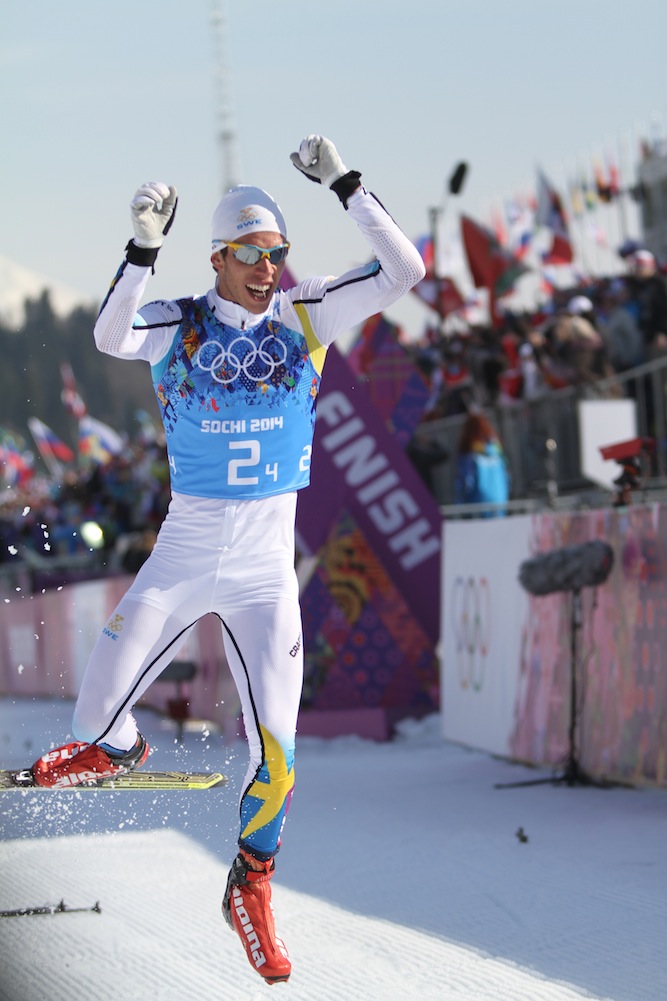
    Sweden's Marcus Hellner jumps out of his skis after anchoring his country to victory in the men's 4x10 relay at the Sochi Olympics.
    Sweden’s Marcus Hellner jumps out of his skis after anchoring his country to victory in the men’s 4×10 relay at the Sochi Olympics.

    FasterSkier’s coverage is made possible through the generous support of Rudy Project.

    SOCHI, Russia — All the buzz about the Laura Cross-Country Ski & Biathlon Center at the 2014 Olympics the last few days has been about how bad Norway’s skis have been — in both nordic and biathlon.

    On the flip side, not many asked the Swedes why they were finding success on the warm and slushy snow, that is until Sunday.

    After becoming the first country to win both the women’s and men’s Olympic relays in 42 years (the Soviet Union was the last nation to do so in 1972), the question became why are the Swedish cross-country skiers so fast.

    The oldest guy on Sweden’s 4 x 10-kilometer relay team, 34-year-old Johan Olsson replied that it was in large part thanks to their skis.

    Hellner skiing in Sunday's relay.
    Hellner skiing in Sunday’s relay.

    “I think the biggest reason is, of course, this kind of conditions here in Sochi,” the team’s third leg and three-time Olympian said in a post-race press conference. “Very, very warm conditions that make the waxing very tough that make big differences between the skis and technical teams. We have really succeeded here with the skis and that’s the part of the sport that gives us the speed that we’re standing on.”

    On Sunday, official race temperatures were listed just above 40 degrees Fahrenheit, but with intense sun shining brightly on the venue and its 3.3 k men’s course, it felt a lot warmer.

    The course had been salted and re-salted over the last few races, with warmer temperatures near 60 degrees late last week. Sunday was cooler but still a waxing nightmare for some trying to find the optimal skis for the first two classic legs.

    Sweden found it, and the rest was literally history.

    The defending men’s Olympic relay champions from 2010, Sweden repeated the feat of winning back-t0-back men’s relays like it did in 1984 and 1988. Sunday’s team skied away from Finland, Russia and France to do so, dropping Norway as well early in the race.

    Marcus Hellner anchored the win with a comfortable-enough gap to take a small plastic flag from his teammate Anders Södergren, who helped Sweden win gold in the last Olympic relay, at the top of the last climb before the finish. Hellner, who also anchored the 2010 team, waved it proudly as he skated into the stadium and finished without anyone else around him in 1:28.42.

    Reaching down to eject himself from his skis, Hellner, 28, ran toward his teammates to celebrate his third Olympic gold. Maxim Vylegzhanin secured silver for Russia, 27.3 seconds later, outlasting France’s Ivan Perrillat Boiteux by 4.6 seconds to the finish.

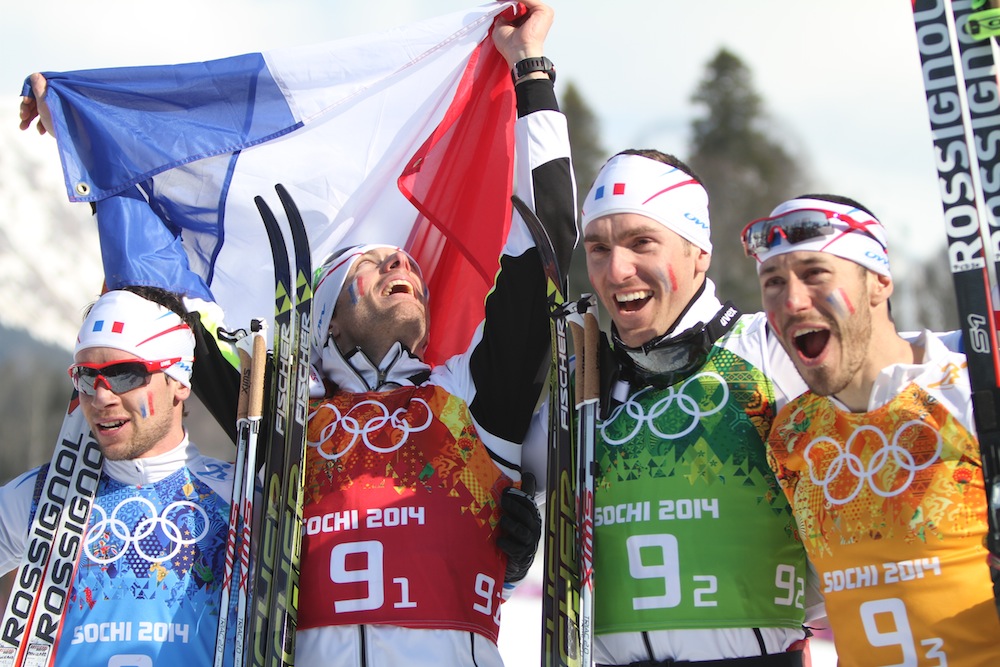
    For France, it was their nation’s 100th medal in the Olympics and their second-ever medal in cross-country (following Roddy Darragon’s silver in the 2006 Olympic sprint). For Sweden, it was another gold for three of the four original teammates from 2010,

    The french relay skiers celebrate their bronze medal in the men's relay.
    The french relay skiers celebrate their bronze medal in the men’s relay.

    including Daniel Richardsson.

    “It means a lot, especially in Sweden, the relays are really prestigious to win because it’s the team,” Olsson said. “We see also that our waxing team, they’re even more happy when the relay goes well. I think we should just focus on enjoying this moment … It’s a big thing to win on the most important day for the whole team.”

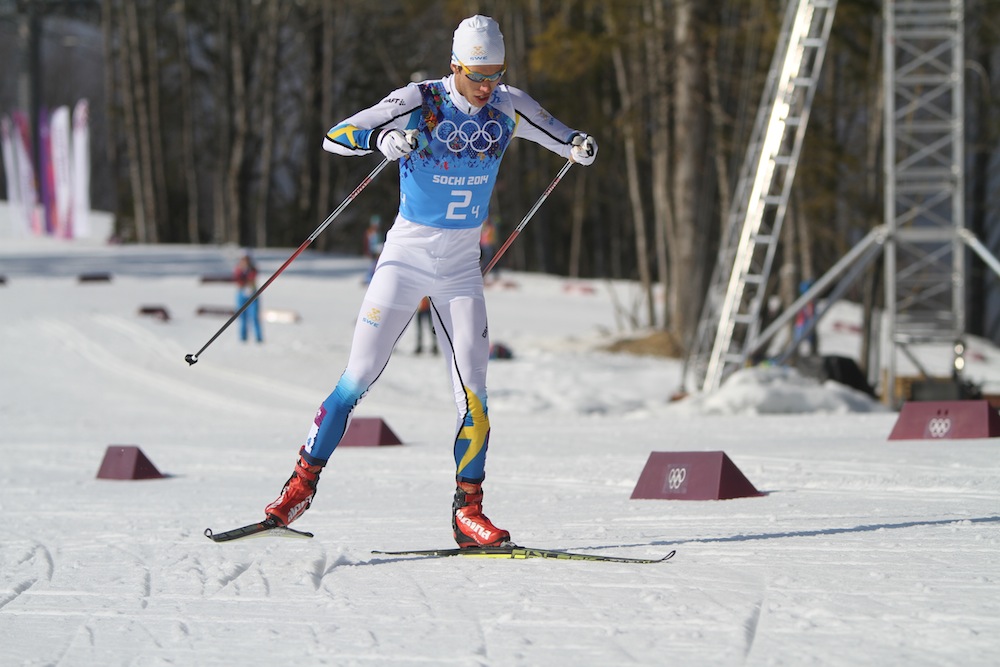
    The victory came even after the team’s newest addition, Lars Nelson, 28, fell early in the first 3.3 k lap of the race. In 12th of 16 teams halfway through the lap at 1.7 k, Nelson was up to fourth by the time he passed through the stadium.

    “Lars lost his ski, but after that, I saw him in the front of the pack and I saw that it was no problem for him,” said Richardsson, who shared the podium with Olsson two days earlier in the 15 k classic individual start. Olsson had placed second to Switzerland’s Dario Cologna, and Richardsson notched bronze.

    His teammate looked comfortable and “really strong,” he recalled.

    By the end of the first classic leg, Nelson tagged Richardsson in first, 0.3 seconds ahead of Finland’s Sami Jauhojärvi in second. Jean Marc Gaillard led off France in third, 9.6 seconds behind Nelson at the end of the first 10 k leg.

    The top three had already gapped the field by nearly 12 seconds, as Curdin Perl led the chase for Switzerland, tagging off to Jonas Baumann in fourth. Another 3.5 seconds bad, Dietmar Nöckler put Italy in contention in fifth, Eldar Rønning tagged Norway close behind in sixth and Russia’s Dmitriy Japarov came through the exchange within a second later in eighth.

    “Nelson impressed most,” Södergren told Aftonbladet, according to a translation. “It was most unexpected that he would try to [lead] in the first leg.”

    Yet Nelson not only fought his way back to the front of the 16-team pack on the second lap, but he tried to string out the group in doing so.

    “It was so impressive what he did,” Sweden’s Sara Lindborg said.

    The tactic worked as Finland’s Iivo Niskanen remained the only one capable of sticking with Richardsson on the second lap. The two tagged off together, 17.3 seconds ahead of Lukas Bauer in third.

    Russia's Alexander Legkov entering the stadium on the third leg of the relay.
    Russia’s Alexander Legkov entering the stadium on the third leg of the relay.

    Bauer had a race of his own to get from seventh to third, picking off Italy’s Giorgio di Centa first, then Norway’s Chris Andre Jespersen. By his second lap, Bauer was up to fourth after passing Russia’s Alexander Bessmertnykh and leading him into the lap lanes. For the final time around the 3.3 k loop, the Czech focused on catching Maurice Manificat — the Frenchman who had stuck with the two leaders before falling 11 seconds off the pace by 8.3 k.

    “I saw him, that he’s losing and he’s very, very tired,” Bauer said. “I was maybe 10 seconds behind him. He was my motivation to overpass him for sure. When I overpassed him it was long moment because I had no energy.”

    “First I had in my mind that I’d ask him, ‘How is it going?’ Because my feeling was, this will kill him and after that I will have no problem,” he added. “But I have no chance to breath enough to ask him and after that I was focused only on last uphill.”

    Manificat finished 6.3 seconds later to send his teammate, Robin Duvillard in fourth. Bessmertnykh put Russia in fifth, another 17.7 seconds back and di Centa tagged Italy in sixth, just 0.4 seconds behind Russia.

    Meanwhile, the Norwegians had slipped to ninth, nearly 1:03 behind Sweden. Germany’s Axel Teichmann led Switzerland’s Baumann into the lap lanes in seventh and eighth, respectively, 55 seconds after Richardsson and 7 seconds ahead of Jespersen.

    From there on out, Olsson started to put the hurt on — like he’s been known to do (see: 2013 World Championships 50 k).

    Halfway through the first skate leg, the Swede skied away from Finland’s 26-year-old Lari Lehtonen over the top of the course. Seven seconds behind at 5 k, Lehtonen slipped to more than 22 seconds back at the end of the second lap — with saliva streaming out of his mouth as he ascended the last hill.

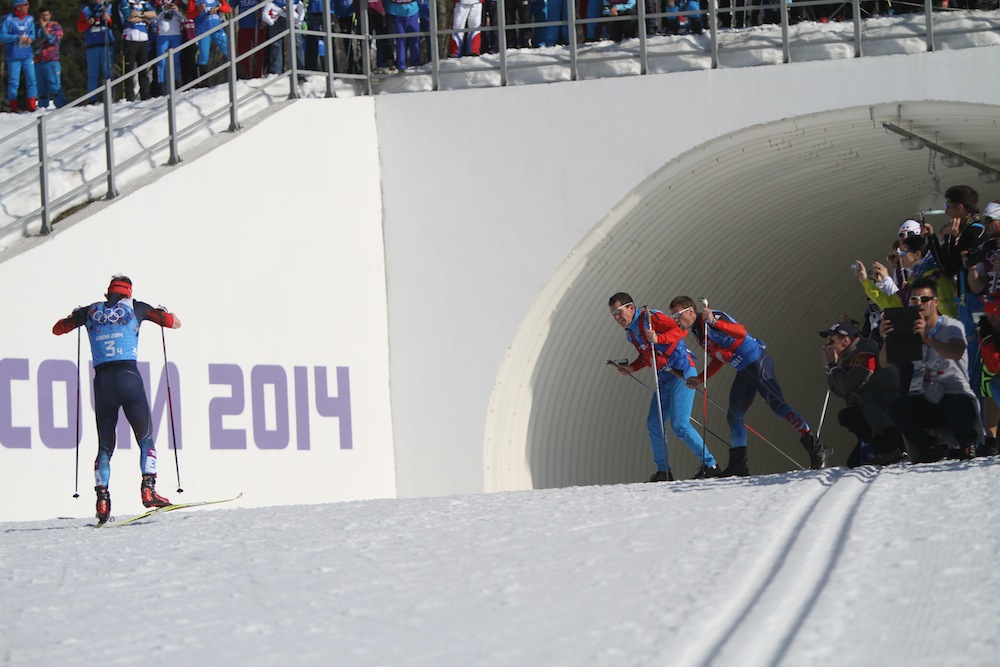
    With one lap to go in the third leg, Olsson continued to widen the gap and the Finn became a victim of a hard-charging chase pack. France’s Duvillard caught him first at the top of the climb out of the stadium, then Martin Jaks of the Czech Republic. Along with Russia’s Alexander Legkov and Norway’s Martin Johnsrud Sundby, the group skied right through him.

    Legkov continued to work his way up to second, ahead of Duvillard and Jaks, and came through the exchange 14.3 seconds after Olsson. Duvillard tagged another 4.3 seconds back in third, 23.5 seconds ahead of Italy in fourth.

    Suddenly, Russia had become a medal contender after skiing in fifth — and leading the largest chase pack — for the better part of the

    Russian team staff cheer on Maxim Vylegzhanin, the country's anchor.
    Russian team staff cheer on Maxim Vylegzhanin, the country’s anchor.

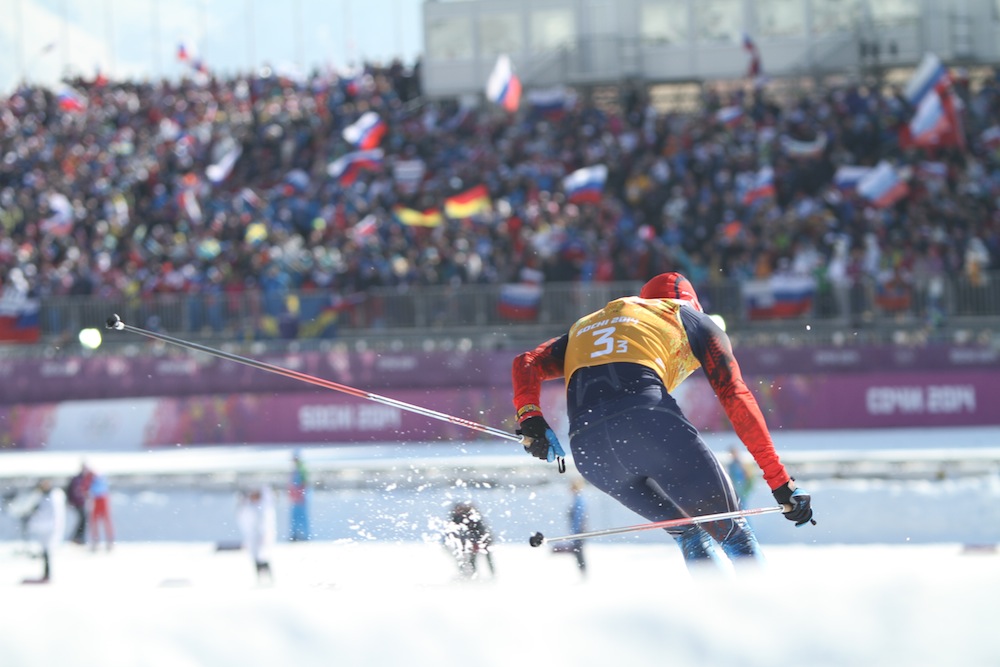
    race. Legkov clocked the fastest third leg to do so, and the Russian fans started to go wild as they lined the course with flags, noisemakers, and an amplified version of “Rus-y-ya!”

    Also Hellner set out less than 15 seconds ahead of Vylegzhanin, the tension began to build. Would he be able to hold the gap over the next three laps on an ever-softening course?

    By the end of the first loop, the answer became pretty clear. Hellner was extending his lead over not only Russia, but France as well, with Perrillat Boiteux more than 30 seconds back in third.

    Less than 2 k later, Hellner was 30 seconds ahead of Legkov and had a nearly 40-second margin with one lap to go. Meanwhile, Perrillat Boiteux struggled to hang onto bronze with Norway’s Petter Northug gaining from behind. Northug had gone from sixth to fifth with the third-fastest anchor leg.

    But France held on, finishing 31.9 seconds behind Sweden and 37.8 ahead of Norway in fourth (+1:09.7).

    Hellner skied up the last killer climb without anyone testing his grit, glancing back near the top then grabbing the flag from his teammate.

    “I was really focused during the whole leg and I tried to not think so much about the gold,” Hellner said. “I suppose it was when I saw Anders with the flag that I was absolutely sure and I could enjoy on my way down to the stadium and enjoy the teammates that I have.”

    At the finish, they all celebrated together: another gold for Sweden in one of their most successful Olympics to date.

    “I tried to make some good-looking show there at the end,” Hellner told Aftonbladet, with a laugh. “I did not fall.”

    Russia captured its first medal in eight races at its own Olympics, and President Vladimir Putin was in the stands to watch it happen. Bessmertnykh said the team wasn’t aware of his presence until after the race.

    “When I finished my lap, I looked at the [big] screen — I saw him close up on the screen,” he said through a translator. “We were not warned about it. Certainly we were really pleased the Russian president wanted to watch our competition so we are really grateful to him.”

    The Russians celebrate their silver medal.
    The Russians celebrate their silver medal.

    Legkov said the day turned out exactly as he had envisioned it — with a medal — even after breaking a pole early in his skate leg.

    “I was really anxious after that,” Legkov said through a translator. “That’s why my responsibilities grew even harder.”

    Vylegzhanin had initially tried to catch Hellner on the first lap, but once he was halfway though the second loop, he reevaluated.

    “After that it was a tactical struggle,” Vylegzhanin said through a translator. “I started fighting for second place.”

    France was all smiles after the race with its first-ever relay medal. Gaillard said it was especially meaningful after so much speculation and pressure from the media to win medals, and with most of its hopes pinned on biathlon and nordic combined.

    “There wasn’t much talk about the cross-country team,” he said. “We are all friends … and for us, for the French sport, this is a great day for skiing.”

    “I’ve never cried from joy before,” Manificat tweeted on Sunday night, according to a translation. “This relay medal is the best thing our team has ever done!”

    — Nat Herz contributed reporting

    Results

    A group of dejected Norwegians watching the men's relay.
    A group of dejected Norwegians watching the men’s relay.
  • Ultimate Comeback Kid, Cologna Captures Olympic Gold in Skiathlon Opener

    Ultimate Comeback Kid, Cologna Captures Olympic Gold in Skiathlon Opener

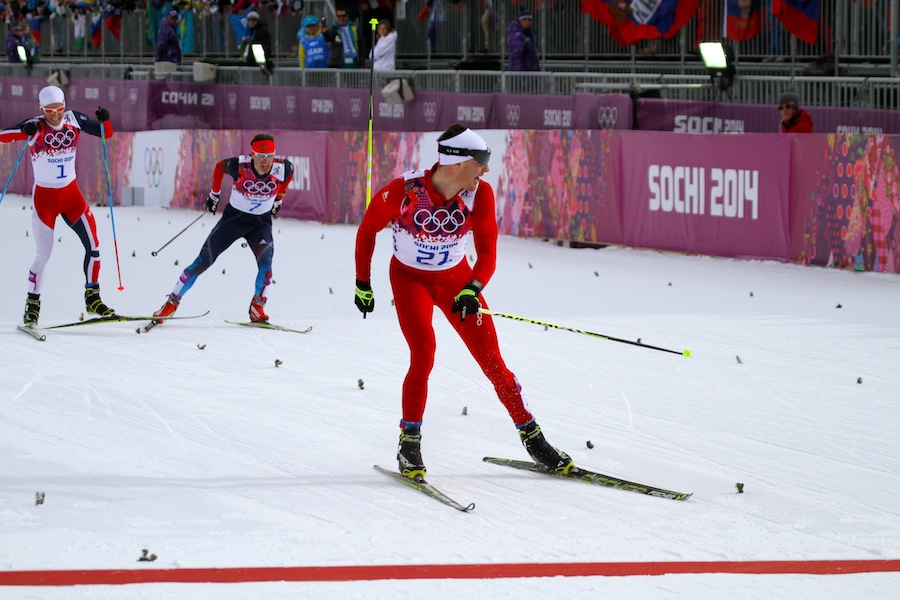
    Switzerland's Dario Cologna looks over at Sweden's Marcus Hellner (not shown) before capturing his second Olympic gold in his first race of the 2014 Olympics -- the 30 k skiathlon -- on Sunday in Sochi, Russia. Hellner placed second while Norway's Martin Johnsrud Sundby (l) and Russia's Maxim Vylegzhanin (7) sprinted for third. Sundby won it but received a written warning for obstruction.
    Switzerland’s Dario Cologna looks over at Sweden’s Marcus Hellner (not shown) before capturing his second Olympic gold in his first race of the 2014 Olympics — the 30 k skiathlon — on Sunday in Sochi, Russia. Hellner placed second while Norway’s Martin Johnsrud Sundby (l) and Russia’s Maxim Vylegzhanin (7) sprinted for third. Sundby won it but received a written warning for obstruction.

    FasterSkier’s coverage is made possible through the generous support of Rudy Project. 

    SOCHI, Russia — In the wrong place at the wrong time three months ago when he slipped on ice while running with his coach, Guri Hetland, Switzerland’s Dario Cologna made sure he was in position to do something stellar on Sunday.

    The possibility of whether Cologna, who tore three ligaments in his ankle in mid-November, could win his second Olympic gold at these Winter Games was never a question. He had already proven himself in his first World Cup race this season a week ago, where he nearly won the 15-kilometer classic individual start in Toblach, Italy — finishing second behind Russia’s Alexander Legkov by 2.9 seconds.

    Cologna, 27, had done a total of five races this winter before that. On Sunday in the 30 k skiathlon, the first men’s race of the 2014 Olympics, Cologna had to tape his foot — and he was visibly limping at the venue — off his skis.

    “The foot isn’t still 100 percent, but when I’m racing and with the tape it’s okay,” Cologna said in a post-race press conference. “Maybe when I’m sprinting, I still feel a little bit. … I’m in very good shape besides my foot.”

    On the course, he was right in the mix throughout the seven-lap race, with four 3.75-k classic loops and three 5-k skate loops. Closer to the front of the pack for the first 7.5 k with guys like Norway’s Martin Johnsrud Sundby, Sweden’s defending Olympic skiathlon champion Marcus Hellner, Kazakstan’s Alexey Poltoranin, and Germany’s Hannes Dotzler, Cologna generally hung in the middle of the lead group, which started to break up by the transition.

    Changing to his skate skis, Cologna came through the halfway point in 13th, 5.7 seconds after Sundby up front. Sundby took charge for most of the race, setting the pace and taking turns leading with Poltoranin, Dotzler, Hellner, Sweden’s Daniel Richardsson, and Austria’s Johannes Duerr. Another Swiss skier, Curdin Perl led early in the first lap, falling off the pace by about 30 seconds by the 15 k changeover.

    With the fourth-fastest transition time, Richardsson was first out of the pits, and toward the end of the first skate loop, the top 12 had slowed with Hellner up front, followed by France’s Jean Marc Gaillard and Sweden’s Lars Nelson.

    The lead group more or less stayed the same for the second-to-last lap, with Duerr leading into the last major climb before the stadium. With less than 5 k remaining, Richardsson went first down the screaming-fast descent before the long grind back up, followed by Duerr, Russia’s Maxim Vylegzhanin, Hellner, and Russia’s Alexander Legkov, respectively.

    Minutes later, Sundby led them back toward the stadium and Hellner and Cologna got in position behind him. Heading into a slight rise before the final grueling climb, Cologna accelerated to second, ahead of Hellner, and Vylegzhanin led the chase to catch the lead three.

    Making his way to first before the last leg-burner, Cologna put about eight meters into Hellner up the hill as Hellner chased him over the top. Sundby, Richardsson, and Vylegzhanin followed respectively down the curving descent toward the finishing straight — but by the time Cologna got there, the race was essentially his.

    Cologna slightly glanced over his shoulder before crossing the line, just enough to see that he had secured gold in 1:08:15.4, four-tenths of a second ahead of Hellner in second.

    Meanwhile, Sundby on the right and Vylegzhanin several meters to his left battled for third, with Sundby fading over into Vylegzhanin’s space just before the line. A second behind Hellner, Sundby edged Vylegzhanin by 0.1 seconds, causing some commotion and a jury meeting to determine whether Sundby obstructed him at the finish. He was given a written warning and kept his bronze.

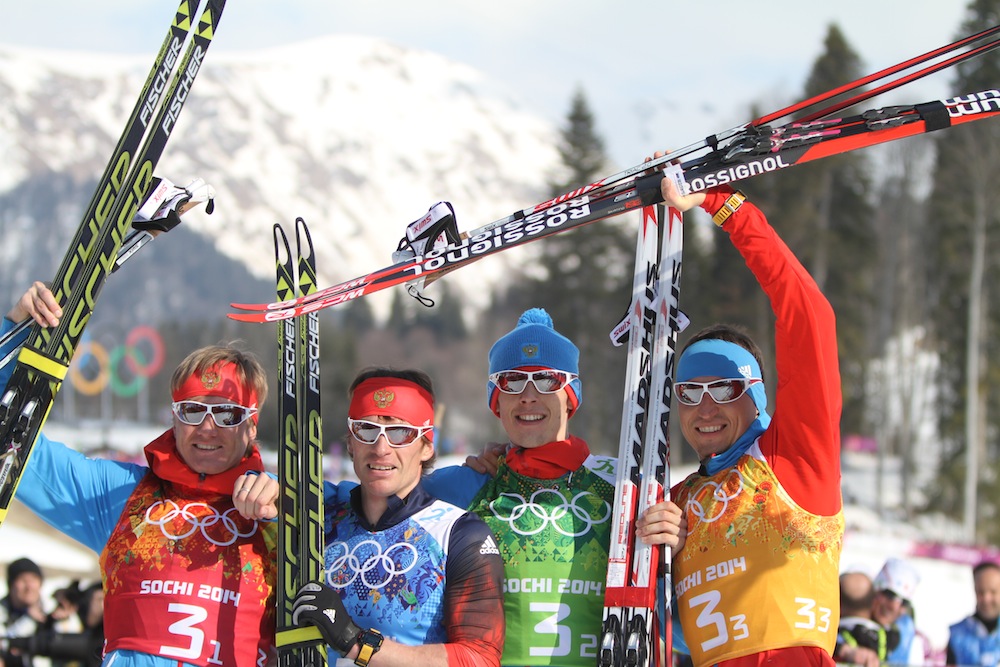
    The 2014 Olympic men's skiathlon champion, Dario Cologna of Switzerland absorbs the fruits of his efforts and three months of recovering from an ankle injury that kept him from competing for the first half of the season.
    The 2014 Olympic men’s skiathlon champion, Dario Cologna of Switzerland absorbs the fruits of his efforts and three months of recovering from an ankle injury that kept him from competing for the first half of the season.

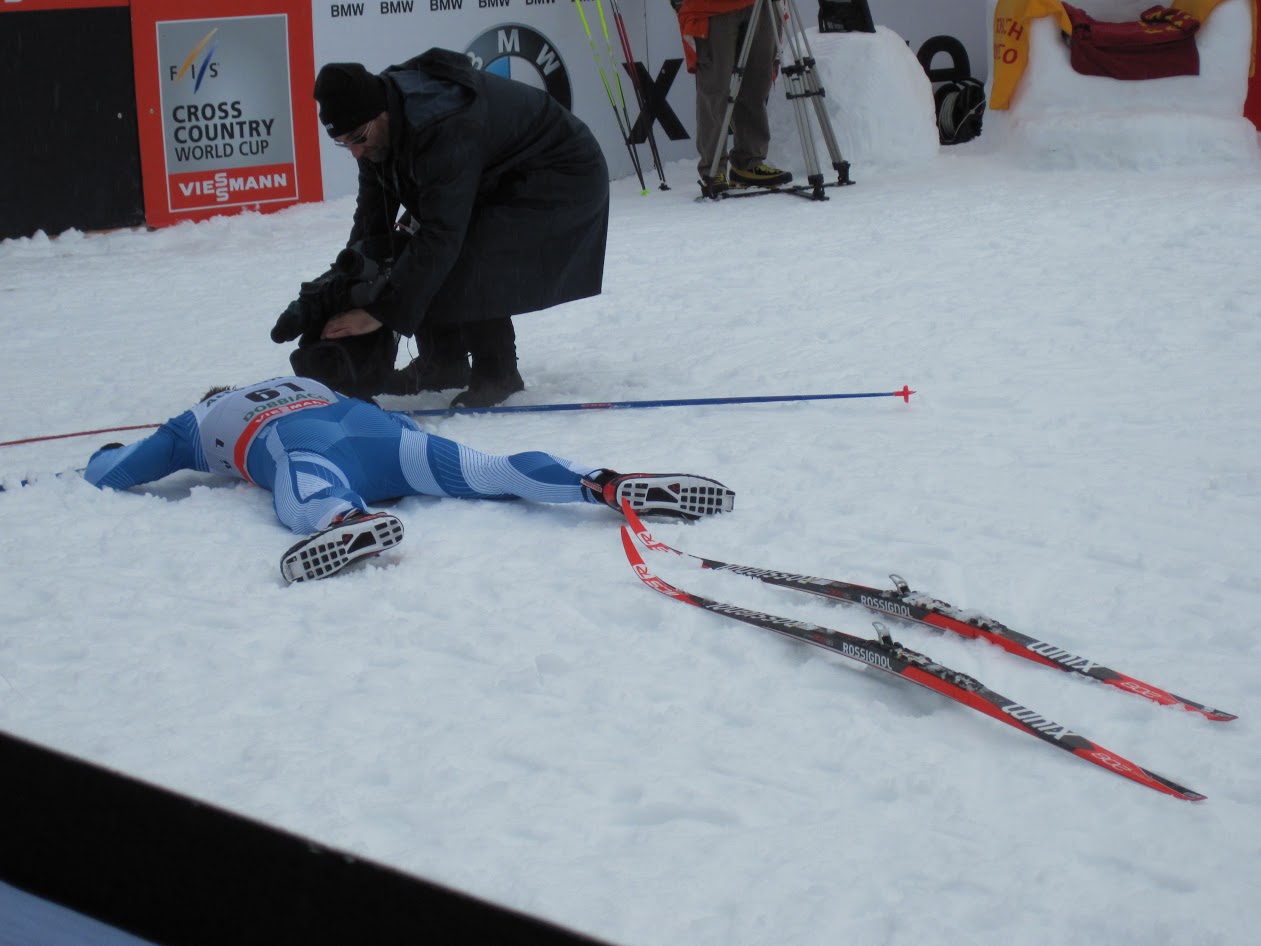
    After collapsing at the finish, Cologna rolled onto his back and sprawled out to catch his breath, then absorb the reality of what he had just done. In his first Olympic skiathlon at his second Olympics, he had won his second Olympic gold in the middle of a season he nearly had to write off to injury.

    He never did — and that’s why he won.

    “I did a lot to be ready here; it was not an easy season,” Cologna said in a post-race press conference. “I was very well prepared before the season, maybe the best shape ever. It was hard after this injury to lie in my bed and start training in the water and cycling and this boring stuff, but I did everything to be ready today and it was a very big day and very emotional for me to come back and win a gold medal. It’s my biggest thing I have won so far.”

    Cologna cried at the finish, bringing his hands to his face while on the ground, then standing up with arms spread wide to embrace the moment and Olympic crowd. His coach cried, too.

    “I did my utmost, I did my best,” Cologna said. “My coach told me to be prepared and of course the last several weeks were not as simple. It was not as easy to practice and train. I wasn’t sure if I would be able to start this race. I was really struggling, therefore I do believe I am just overfilled with emotions right now.”

    Beyond tired at the finish, he said he struggled to stay on his feet, but focused on pressing forward. It would’ve been difficult for anyone to pass him at that point, and Cologna knew that; it was part of his strategy and final attack.

    “I did everything so that nobody would overtake me at the finish line,” he said.

    Hellner, who gave Sweden its second-straight silver of the Games after Charlotte Kalla placed second in the women’s skiathlon on Saturday, told Aftonbladet that he was also primed to attack on the last lap — he just wasn’t sure where.

    “I waited until the last hill and did what I could there,” Hellner said, according to a translation. “But Dario was stronger and I was completely out of the legs at the top. … When I got to the last corner, I realized that I could do the medal, it was cruelly beautiful, it’s amazing.”

    Perl, who placed 27th, 2:07 behind Cologna, said he was sure his teammate would medal in Sunday’s race.

    “In yesterday’s interval, he was crazy,” Perl said.

    Cologna’s gold medal was a gold for Switzerland, and his impact on the team far-reaching.

    “I think that what Dario has done, he pushed cross-country so much in Switzerland,” Perl said. “It’s a bit easier to find good sponsors, and it’s also now big in the media. It’s getting cooler and cooler to be a cross-country skier in Switzerland.”

    At the press conference, Sundby said he was most concerned about obstructing Vylegzhanin.

    “I was so tired the last hundred meters, I didn’t even see the corridors; I had really big problems staying on my skis,” he said. “I would never ever do anything to obstruct any other skiers. I lost my balance the last 10 meters and as a result I probably changed lanes. I saw the pictures. I don’t think I obstructed or touched the skis of Maxim so hopefully he doesn’t feel like I destroyed his finish. For sure, from me it was not the purpose.”

    Sundby, who was slightly in front of Vylegzhanin when he started to falter, got to keep his bronze.

    “He did not feel that he was obstructed and he didn’t notice when he came to the finish line,” Sundby said. “I would feel really bad if he thought I was obstructing him from the bronze medal. I am sad that this happened. I’m really upset about it, and I never hoped for this kind of event.”

    After Vylegzhanin in fourth, another Russian Ilia Chernousov placed fifth, 13.6 seconds behind Cologna. Gaillard was sixth (+14.4), Richardsson seventh (+16.3), Duerr eighth (+16.6), France’s Maurice Manificat ninth (+18.2) and the 28-year-old Nelson 10th (+22.3) in his first Olympics.

    — Chelsea Little contributed reporting

    Results


  • Legkov Catches a Ride from Harvey, Steals Cologna Show in Toblach 15 k Classic

    Alexander Legkov of Russia pushes hard on a rainy day at the Toblach World Cup in Italy on Saturday. He ended up winning the 15 k classic individual start by 2.9 seconds over Switzerland's Dario Cologna. (Photo: FlyingPointRoad/Proceeds go to the National Nordic Foundation)
    Alexander Legkov of Russia pushes hard on a rainy day at the Toblach World Cup in Italy on Saturday. He ended up winning the 15 k classic individual start by 2.9 seconds over Switzerland’s Dario Cologna. (Photo: FlyingPointRoad/Proceeds go to the National Nordic Foundation)

    Dario Cologna played the role of protagonist to a T on Saturday — not because he was trying to, or because he’s Swiss, or because he’s Super Dario, or because he was aspiring for fame in a make-or-break race.

    The men’s 15-kilometer classic individual start at the Toblach World Cup in Italy was like any other, except that it was the last distance race before the Olympics — which start in exactly a week in Sochi, Russia — and it was Cologna’s first World Cup of the season.

    In November, he tore a ligament in his ankle and had to have surgery, keeping him from training for the better part of the next two months. The 27 year old didn’t start racing again until Jan. 10, when he jumped into a couple Alpen Cup races in Chamonix, France. There, he placed 10th in a skate sprint, fourth in a 15 k classic and third in a 20 k skate race, respectively.

    They weren’t bad results for a guy who busted his ankle two months earlier, but they weren’t exactly the norm for the 2010 Olympic champion (in the 15 k freestyle), either. Cologna went on to win the two races he competed in at Swiss nationals Jan. 18-19.

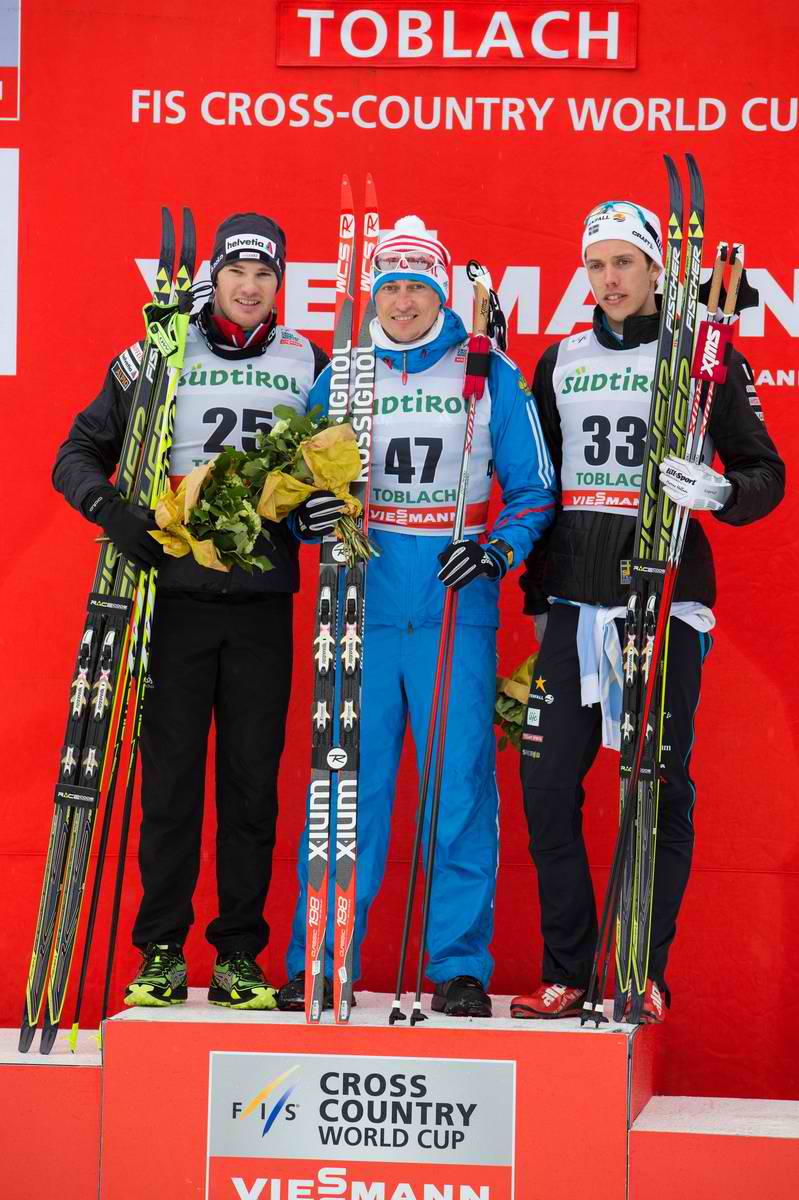
    The men's 15 k classic individual start podium at the Toblach World Cup on Saturday, with Russian winner Alexander Legkov (c), Switzerland's Dario Cologna (l) in second, and Marcus Hellner in third. ((Photo: FlyingPointRoad/NNF)
    The men’s 15 k classic individual start podium at the Toblach World Cup on Saturday, with Russian winner Alexander Legkov (c), Switzerland’s Dario Cologna (l) in second, and Marcus Hellner in third. (Photo: FlyingPointRoad/NNF)

    “I wasn’t sure I was in shape for the Olympics before this race, so I’m relieved and surprised,” Cologna told NRK, according to a translation, after sitting in the leader’s chair for a good chunk of Saturday’s 15 k.

    He had started 25th, a relatively early position for the defending world champion in the 30 k skiathlon. But considering it was his first race back, it was a respectable spot just outside the seeded list.

    Cologna started somewhat conservatively, clocking the ninth-fastest time through the 1.7 k checkpoint behind Sweden’s Lars Nelson. Halfway through, he was the fastest on the board, surpassing Nelson and holding onto the lead though the finish.

    Nelson dropped to second and out of the leader’s chair, and Cologna enjoyed the snow-carved hot seat for the next 10 minutes. A couple challengers gave him a run, the first of which was Russia’s Dmitriy Japarov, who rose from 24th at 1.7 k— with the same split as Canadian Alex Harvey — to fourth at the halfway point. The 29th starter, Japarov was 20.9 seconds short of matching Cologna, settling for second through the finish.

    Shortly after, Sweden’s Marcus Hellner in bib 33 bumped Japarov to third, coming through 14.7 seconds back from Cologna. Meanwhile, Cologna sat quietly on what was likely a soggy seat, with temperatures warming to near 5 degrees Celsius (41 Fahrenheit) after snow turned to rain for the men’s race.

    The men's 15 k classic individual start podium at the Toblach World Cup on Saturday, with Russian winner Alexander Legkov (c), Switzerland's Dario Cologna (l) in second, and Marcus Hellner in third. (Photo: Fischer/NordicFocus)
    The Toblach World Cup men’s 15 k classic individual start podium: with Russian winner Alexander Legkov (c), Switzerland’s Dario Cologna (l) in second, and Marcus Hellner in third. (Photo: Fischer/NordicFocus)

    Russia’s Alexander Legkov, who started 47th, took Cologna out of that position. Cruising into the stadium in hot pursuit of Harvey, whom Legkov started 30 seconds behind and caught him before the last of three laps, the Russian skied behind the Canadian in the same track as they both double poled hard to the finish.

    Harvey had a good day himself, rising from 24th early to 12th halfway through, and ultimately leading Legkov into the finish to place fifth. With 30 seconds on Harvey, the 30-year-old Legkov turned out to be the antagonist of Cologna’s tale.

    Pushing through the finish, Legkov bested Cologna’s time by 2.9 seconds with the winning time of 37:02.7. Cologna stood up, relinquished his seat to Legkov, and placed second. Hellner took third (+17.6), Japarov was fourth (+23.8), Harvey fifth (+27.4), and Petter Northug was the top Norwegian in sixth (+48.3).

    “It was a surprise today to win, but I’m in good shape and of course very happy with the result,” Legkov told FIS. “I want to welcome everyone to my home country next week and I think the same results are possible. I have to thank my service team. My skis were the best on a difficult day.”

    “I’m almost glad I did not win, for whoever wins the last race before the championship [may] not win the championship,” Cologna told NRK.

    Either way, the result was the positive affirmation for Cologna, who plans to race all four individual events at the Olympics. Asked of his expectations, he said they’re always the same: “to be on top.”

    “But I know it will be tough,” Cologna added. “There are many who can win races. It’s good to be on the podium now, but it may be different in a week.”

    Russia's Alexander Legkov leads Canadian Alex Harvey at 10 k in the 15 k classic individual start on Saturday at the Toblach World Cup. (Photo: Peggy Hung)
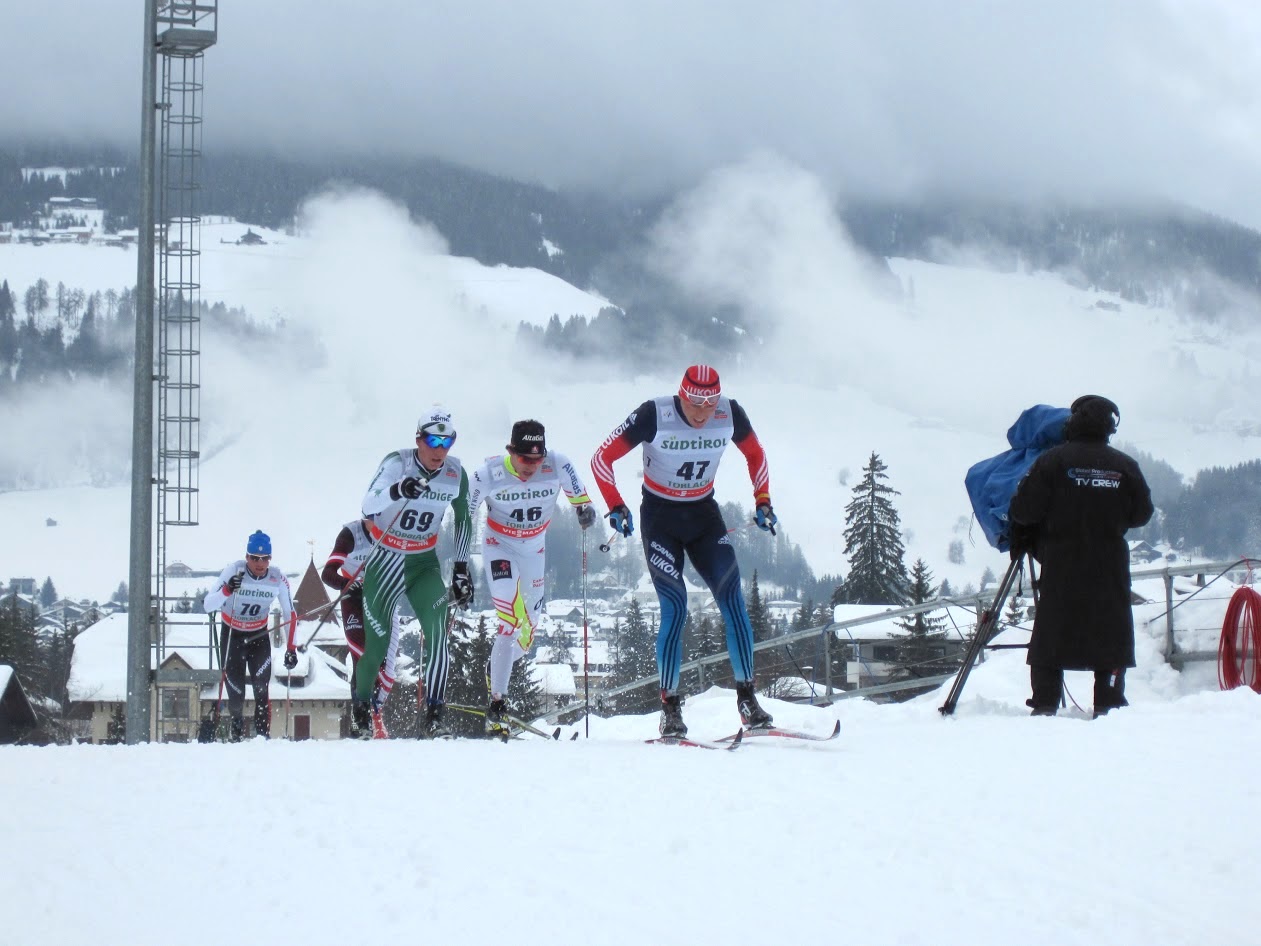
    Russia’s Alexander Legkov (47) leads Canadian Alex Harvey (46) and Italy’s Stefano Gardener (69) at 10 k in the 15 k classic individual start on Saturday at the Toblach World Cup. (Photo: Peggy Hung)

    As Cologna left the leader’s chair, Harvey approached him. The Canadian had more or less pulled Legkov around for the last lap, although Legkov led Harvey at times.

    “Alex skied a great race,” Canadian Head Coach Justin Wadsworth told FasterSkier. “Hung in there with Legkov for a while then pulled him around the last lap and ended up fifth, four seconds out of fourth. It’s a good last distance race to head into the Olympics on, for sure, especially where you’re pulling the guy who won the race around the last 5 k.”

    “I took the first lap pretty conservative and then I picked it up the last two laps and gained a lot of position there,” Harvey explained.

    Feeling a little sluggish after an altitude training block in Seiser Alm, Italy, last week and some rest earlier this week, Harvey was happy to be on form before the Olympics.

    “I was kind of feeling a bit asleep in the morning, even yesterday in training,” he said. “I feel ready good about the camp, no sickness, did a lot of training. … and looking forward to heading to Sochi.”

    The 46th starter, Harvey had the benefit of watching others ski out of the stadium while many, including some of his teammates, struggled with their skis on the wet track. Like the majority of the men’s field, most of the Canadians appeared to use some form of klister. In the preceding women’s 10 k, most everybody raced on zeroes.

    “There were some other guys today that had a good race, like [Graeme] Killick and [Jesse] Cockney were both solid for one of their handful of World Cup starts that they’ve had in their career,” Wadsworth said of the Canadian Senior Development Team members, both of which recently qualified for their first Olympics.

    Finland’s 22-year-old Iivo Niskanen after finishing a career-best in eighth in the Toblach World Cup 15 k classic individual start on Saturday. (Photo: Peggy Hung)
    Finland’s 22-year-old Iivo Niskanen after finishing a career-best in eighth in the Toblach World Cup 15 k classic individual start on Saturday. (Photo: Peggy Hung)

    Killick placed 40th, 0.6 seconds behind Canadian veteran Devon Kershaw in 39th, and Cockney was 51st. Ivan Babikov finished 62nd, 35.8 seconds behind Cockney and 3:21.7 back from Cologna.

    “Devon and Ivan struggled a little bit with skis today, but felt good physically,” Wadsworth explained. “I know the camp we did was really good so I’m pretty hopeful for some good results coming up.”

    Rounding out the top 10, Nelson notched his first World Cup top 10 in seventh (+48.6). Finland’s 22-year-old Iivo Niskanen also notched a career best in eighth (+54.9), Sweden’s Daniel Richardsson was ninth (+57.9) and Norway’s Martin Johnsrud Sundby 10th (+58.8).

    “It was a strong day for the Swedish team,” Hellner told FIS, after his team put three in the top nine. “We for sure had great skis.”

    — Gerry Furseth contributed on-site reporting

    Results