From the FasterSkier archive — posts syndicated from athletes’ and coaches’ own blogs between 2004 and 2012, kept online as published. Current coverage is at fasterskier.com.
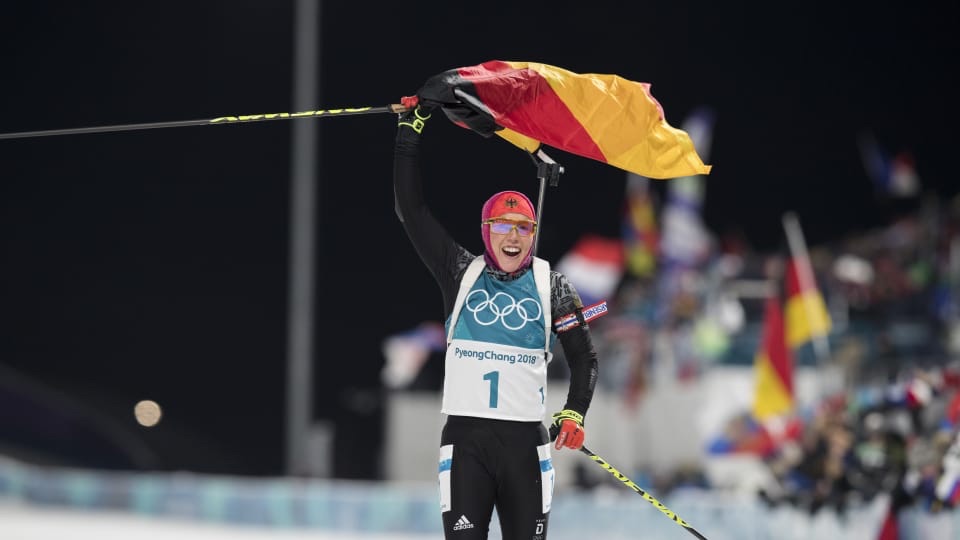
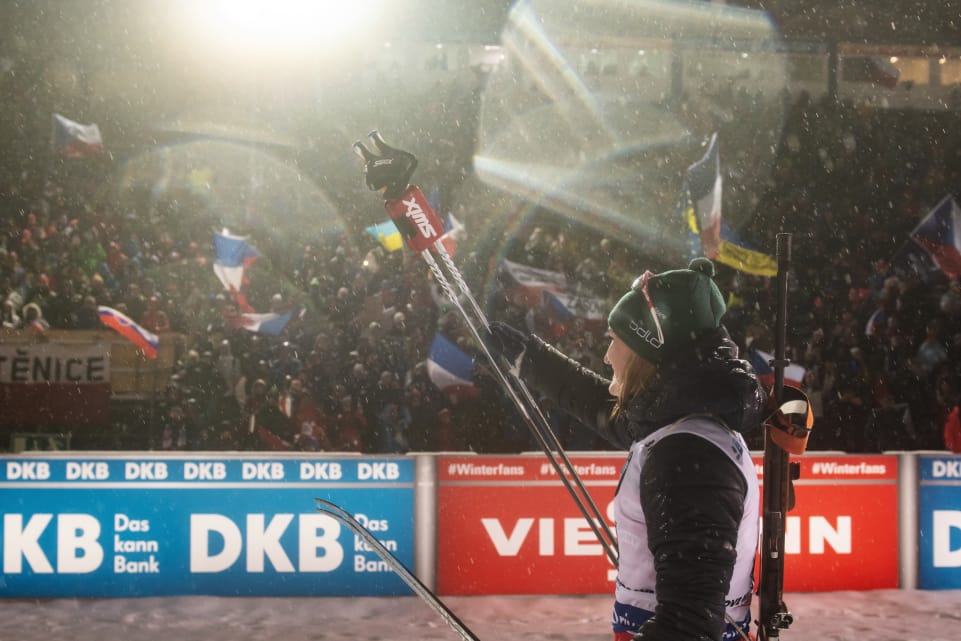
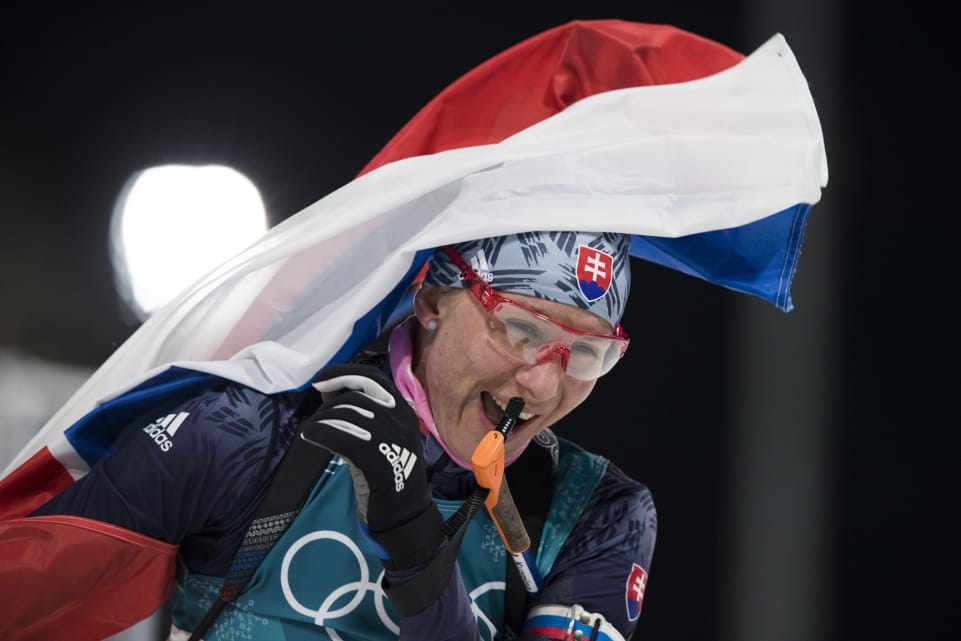
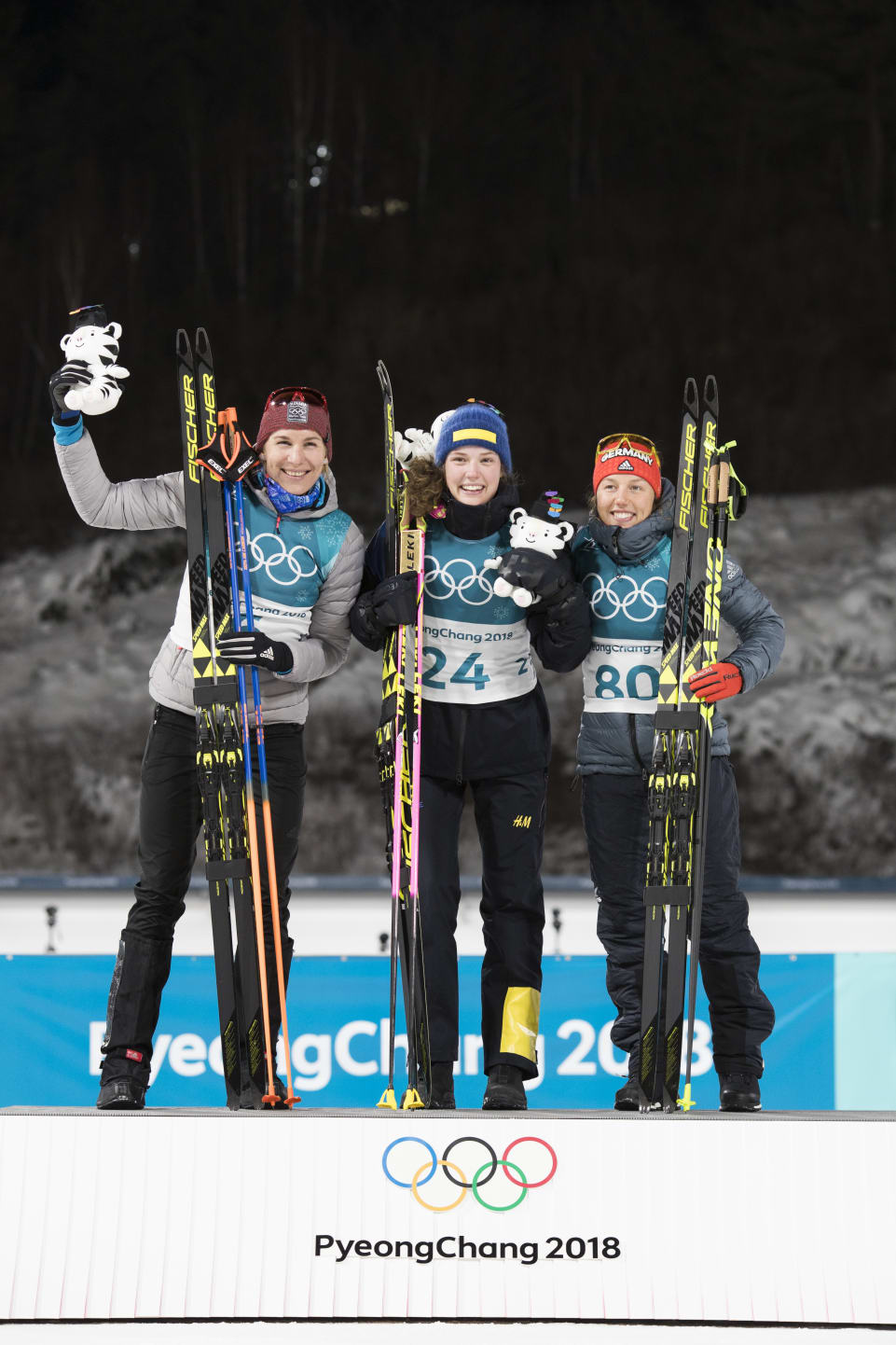
Gold medalist Laura Dahlmeier of Germany celebrates waiving a national flag as she crosses the line first in the women’s 10-kilometer pursuit at the 2018 Olympic Winter Games in PyeongChang, South Korea. (Photo: IBU Biathlonworld.com)
When she retired from international biathlon competition at twenty-five-years-old Germany’s Laura Dahlmeier retreated back into a more private existence. Although still arguably in her prime and flush with a treasure chest loaded with championship medals, Dahlmeier’s path was hers to define.
Like many nordic sport athletes of late, Dahlmeier has taken to mountain running. Although just coming to our attention, Dahlmeier’s mountain running feat on August 31, deserves some spray.
She won the 52-kilometer Karwendelmarsch, a stout mountain running race in Austria, in record time. The route presents the usual thin air ups and downs and numerous opportunities to mull why in fact one has entered such a race. Her time of 4:51:11 hours, as noted, was a new course benchmark. She beat the former course record of 4:54:18 hours set by Sweden’s Kristin Berglund. Those following the sharp end of mountain running races may have recognized that Berglund placed second in the 2019 UTMB (Ultra-Trail du Mont-Blanc), perhaps the most premier mountain running event on the planet as it circumnavigates the Mont-Blanc massif.
Berglund was only bested at the UTMB by Courtney Dauwalter, a former Minnesota State Champion in cross-country skiing who also competed for Denver University. Dauwalter transitioned to ultra trail running several years ago and has been the athlete to beat in ultra events, often coming across the line first, ahead of all the women and men. Perhaps we’ll see a Dahlmeier / Dauwalter matchup at some point?
No prognostications here, 52 k is not the massive 171 km and +10,040 meters of climbing featured in the UTMB, but it’s a start.
This post has been updated with information on Daulwalter.
Dave Stewart transitions from the University of Denver to the Steamboat Winter Sports Club.
After twelve years as the Nordic Head Coach at the University of Denver (DU), Dave Stewart will be stepping down. Under Stewart’s leadership, DU earned six NCAA Division I national championships in skiing. Stewart’s long list of accomplishments includes a 2016 co-Nordic Coach of the Year honor and five Rocky Mountain Intercollegiate Ski Association (RMSIA) Coach of the Year awards.
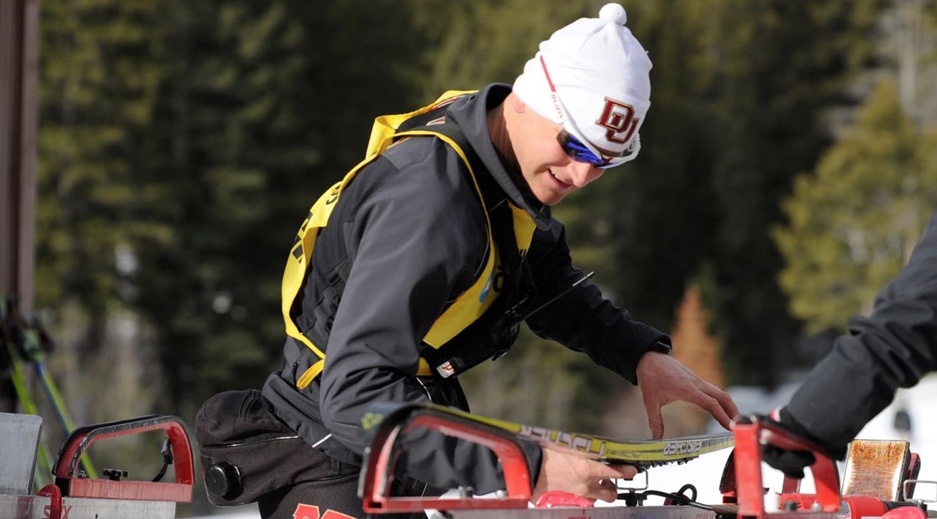
Dave Stewart waxing skis for the University of Denver. (Photo: University of Denver press release.)
Stewart will remain in Colorado as he moves to a new position with the Steamboat Winter Sports Club. Stewart will begin his new job in June as the club’s new Athletic Director. His move to Steamboat brings him closer to family members that reside in the town.
“My wife’s family is up there, her dad and brother, her brother works for the club and is a freestyle coach there,” Stewart said on the telephone with FasterSkier. “And then we love Steamboat too. It is a great community. Being back in the mountains, my wife is from Lake Placid and I am from Vermont so that is a huge drive too. And we have a two-year-old and to get him up in the mountains and expose to some snow a little bit more is a big draw for us as well.”
Stewart knows the club well as five members of the DU ski team raced with the Steamboat Springs Winter Sports Club as juniors. Moving into an administrative role, Stewart said he welcomes the new broadened opportunity in Steamboat to work with athletes across several different sports.
“It is almost like a community service working at the club,” said Stewart. “They are right there in town and getting kids out on snow.”
At DU, Stewart was tasked with not only winning but fostering a collegiate experience that combines both sport and academics.
“I am sure I will miss coaching,” Stewart reminisced. “I have been involved with cross-country ski racing for a very long time as an athlete and a coach. I have enjoyed it very much. Working with people in this age group, you know, it is like there dream to come and be a student-athlete and pursue those goals, as an athlete and a student, I am going to miss that. There is no question about it. You cannot be a ski coach forever. You get to a point where you are looking to transition to something else. And to maybe a role that is interacting with sport at a different level, more of an administrative role. I think I have some good experience from here to be able to have a good impact on young athletes and coaches in that way. This is a good opportunity to step in that direction. “
Mathias Ahrens steps away from his role with Biathlon Canada.
In Canada, Mathias Ahrens left his position of coaching the Canadian National Biathlon team this past April. Ahrens spent 15 years with the team. He becomes the Head Coach at the Biathlon Alberta Training Center.
A name familiar to cross-country ski fans, Justin Wadsworth – a former U.S. Olympian, U.S. Ski Team coach and Head Coach of the Canadian National Ski Team — has been named interim Head Coach.
German biathlon star Laura Dahlmeier has retired from the sport at the age of 25.
In a storied career, she began competing internationally in 2011. She won 22 individual World Cup races, earned seven golds, three silver, and five bronze medals at the IBU World Championships. Five of those World Championship medals were earned in Hochfilzen, Austria in 2017. Dahlmeier also won two Olympic golds along with Olympic bronze in PyeongChang.
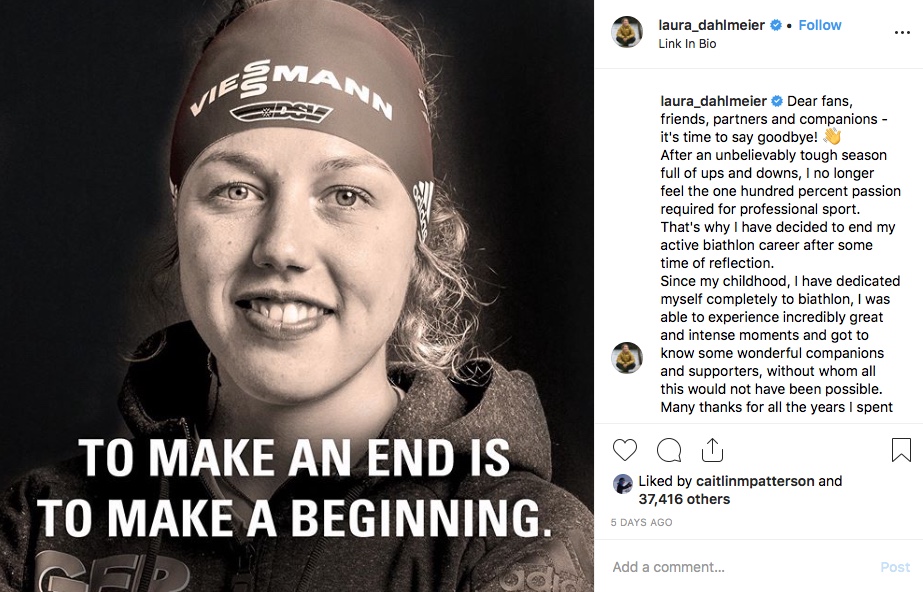
In a post on Instagram, Dahlmeier said the past season during which she struggled to perform at her historic highs, prompted her to seek a change.
“After an unbelievably tough season full of ups and downs, I no longer feel the one hundred percent passion required for professional sport. That’s why I have decided to end my active biathlon career after some time of reflection,” Dahlmeier wrote.
Dahlmeier was hospitalized in August and September of 2018 and although she returned to the World Cup, her energy levels were not the same. However, this past season she stood on the World Cup podium three times and won two bronze medals at the 2019 IBU World Championships.
Sweden’s Ida Ingemarsdotter announces her retirement.
Thirty-four-year-old Ida Ingemarsdotter has called it a career after racing on the cross-country World Cup since 2004. The Swede finished last season ranked sixth in the overall sprint standings and 15th in distance. Despite her strong season, Ingemarsdotter stated she lacked the motivation for another season at the elite level.
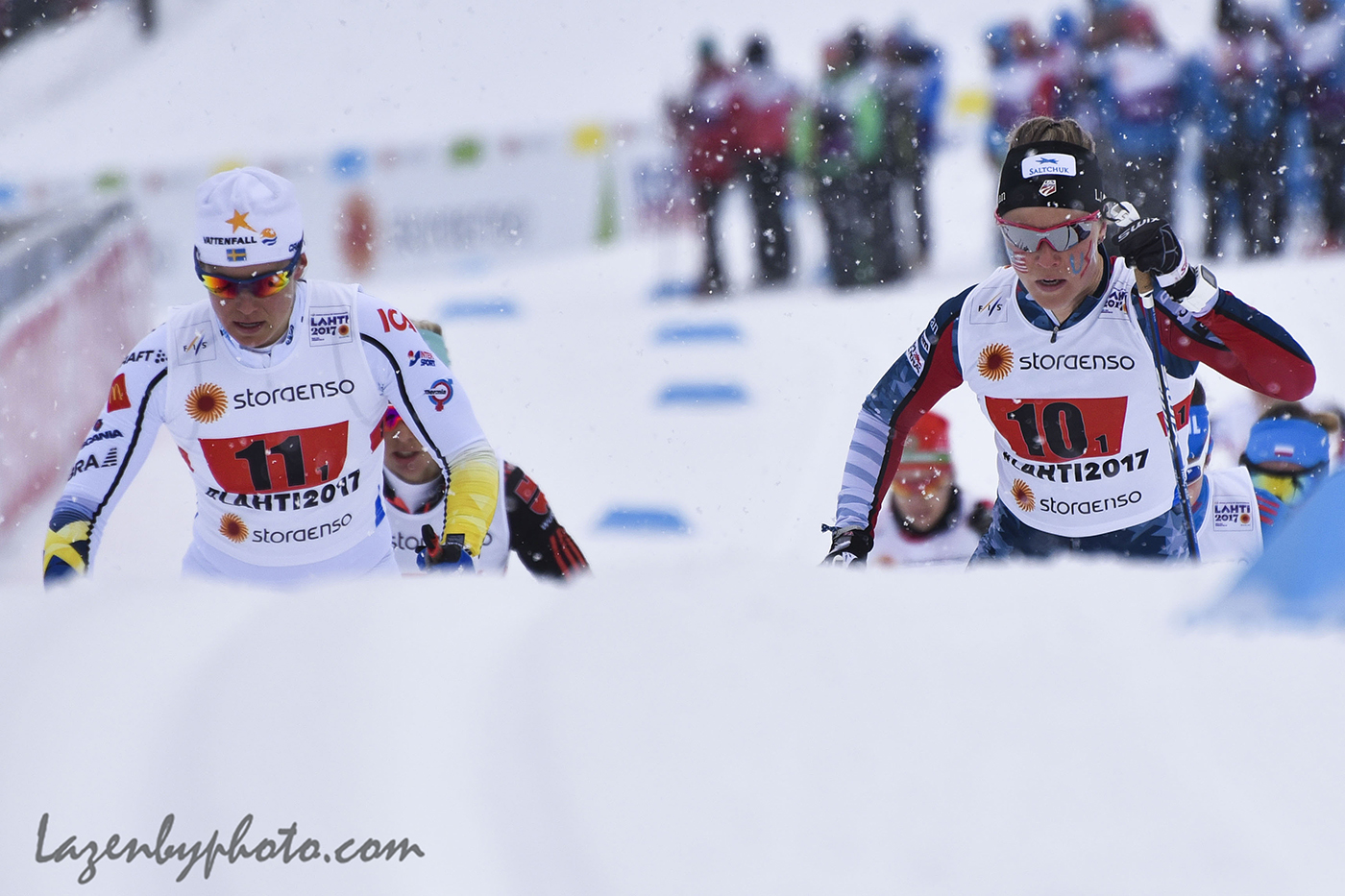
Sweden’s Ida Ingemarsdotter (11) and American Sadie Bjornsen (10) go head to head in the women’s classic sprint final at 2017 World Championships in Lahti, Finland.
She stood on two individual World Cup sprint podiums last season and placed in the top-10 eight times.
Her medal haul includes five World Championship silver medals and one gold. She also won two Olympic medals, a gold, and bronze in Sochi.
Ingemarsdotter explained in a press release that her best day skiing came during the women’s 4 x 5-kilometer relay at the Sochi Olympics.
“The biggest day in my sports life was when I took Olympic gold in relay 2014 together with Anna Haag, Charlotte Kalla and Emma Wikén. Everything went our way and it was a real dream day where tears were mixed with laughter and a strange feeling that we did something nobody thought we would succeed with,” Ingemarsdotter said according to a translation of the Swedish National Team’s official retirement announcement.
The University of Alaska Anchorage announces a new cross-country coach.
In a press release on May 10, the University of Alaska Anchorage (UAA) announced that cross-country ski coach Andrew Kastning had stepped down to pursue other opportunities. His coaching replacement is Trond Flagstad.
No stranger to the UAA program, Flagstad began as an assistant coach in cross country running and skiing at the school back in 2001. Flagstad was head nordic coach from 2004 to 2011. Most recently, Flagstad was ski coaching in Norway.
“I am very excited to be back at UAA and in the Seawolf family,” said Flagstad according to the UAA press release. “I am looking forward to working with all the great coaches and the talented student-athletes at UAA, especially with the ski team. My goal of winning the NCAA skiing championships with the UAA ski team hasn’t changed since the last time I was here, and after coaching in Norway for three years, I know I am better prepared as a coach to reach those goals. I am excited to recruit and develop young skiers from Alaska to help us win races and championships. In addition I have created some very valuable friendships and connections in Scandinavia and Europe. I have some new ideas and a coaching philosophy that I believe will benefit the UAA ski team, especially the Nordic team on our way to a championship title. I am thrilled to have this opportunity and to move our family back to the house we built up on the hillside.”
Norway’s Therese Johaug with the Holmenkollen 30 k classic win and no challengers in site. (Photo: ARD screenshot)
FIS World Cup Oslo, Norway Holmenkollen 30 k Classic
Beautiful sunshine. Norwegian crowds. And fine views of Oslo fjord from atop the Holmenkollen venue for the women’s 30-kilometer mass start classic. All things typical on a good weather March day in Oslo.
Norway’s Therese Johuag took this fine day and turned the screws on the 47 starters on Sunday to once again ski away from the field. By the second points bonus at 8k, Johaug was already 23.6 seconds up on the field. She won the race in 1:18:54.5 hours. According to the International Ski Federation (FIS), this was Johaug’s third 30 k win at Holmenkollen and her second classical victory. She won the 30 k skate in 2013. Her first Oslo 30 k classic win came in 2016.
Russia’s Natalia Nepryaeva placed second 1:45.9 minutes back. Ebba Andersson of Sweden skied to third (+149.9).
Rosie Brennan (APU) was the top U.S. skier in 33rd (+ 7:57.0). Rosie Frankowski (APU) placed 34th (+9:40.2), and Kaitlynn Miller (CGRP) 42nd (+13:43.7).
Jessica Yeaton (APU/Australian National Team) raced to 30th (+7:29.4).
IBU World Championships Östersund, Sweden 10 k/12.5k Pursuit
On Saturday’s 10 k pursuit at the IBU World Champs in Östersund, Sweden the German women took first and third. Denise Herrmann won in 31:45.9 minutes with two penalties in her third shooting stage. Tiril Eckhoff of Norwayplaced second, 31.4 seconds back while also skiing two penalties in her third shooting stage. Germany’s Laura Dahlmeier was a close third (0+0+1+0, +31.6).
Clare Egan of the U.S. was 12th (2+0+0+3, +2:44.3), Susan Dunklee raced to 24th (2+0+0+1, +3:27.6), and Joanne Reid 32nd (3+2+1+0, +4:24.2).
For Canada, Sarah Beaudry finished 42nd (2+1+1+0, +5:23.5), while Rosanna Crawford, Emma Lunder, and Megan Bankes were lapped.
In Östersund on Sunday, the men raced the 12.5 k pursuit. Ukraine’s Dmytro Pidruchnyi, who placed fourth in yesterday’s sprint, came away with the win in 31:54.1. Remarkably, it was Pidruchnyi’s first race win either on the IBU World Cup or at the championship level. The 27 year old missed two targets for the day.
Johannes Thingnes Bø of Norway, the biathlete who has dominated the men’s side this season, placed second (+8.3). Bø’s ski speed was such that he took silver despite missing five targets he won the Silver medal. Taking third (+17.7) was France’s Quentin Fillon Maillet. He missed three targets in earning bronze.
For the U.S., Sean Doherty raced to 20th (+1:54.3) while missing two targets. Leif Nordgren placed 44th (0+0+3+1, +4:02.7), and Jake Brown 53rd (1+1+4+1, +6:00.8).
Canada’s Scott Gow began in bib 50, and skied up to finish 43rd (2+0+0+2, +3:51.4).
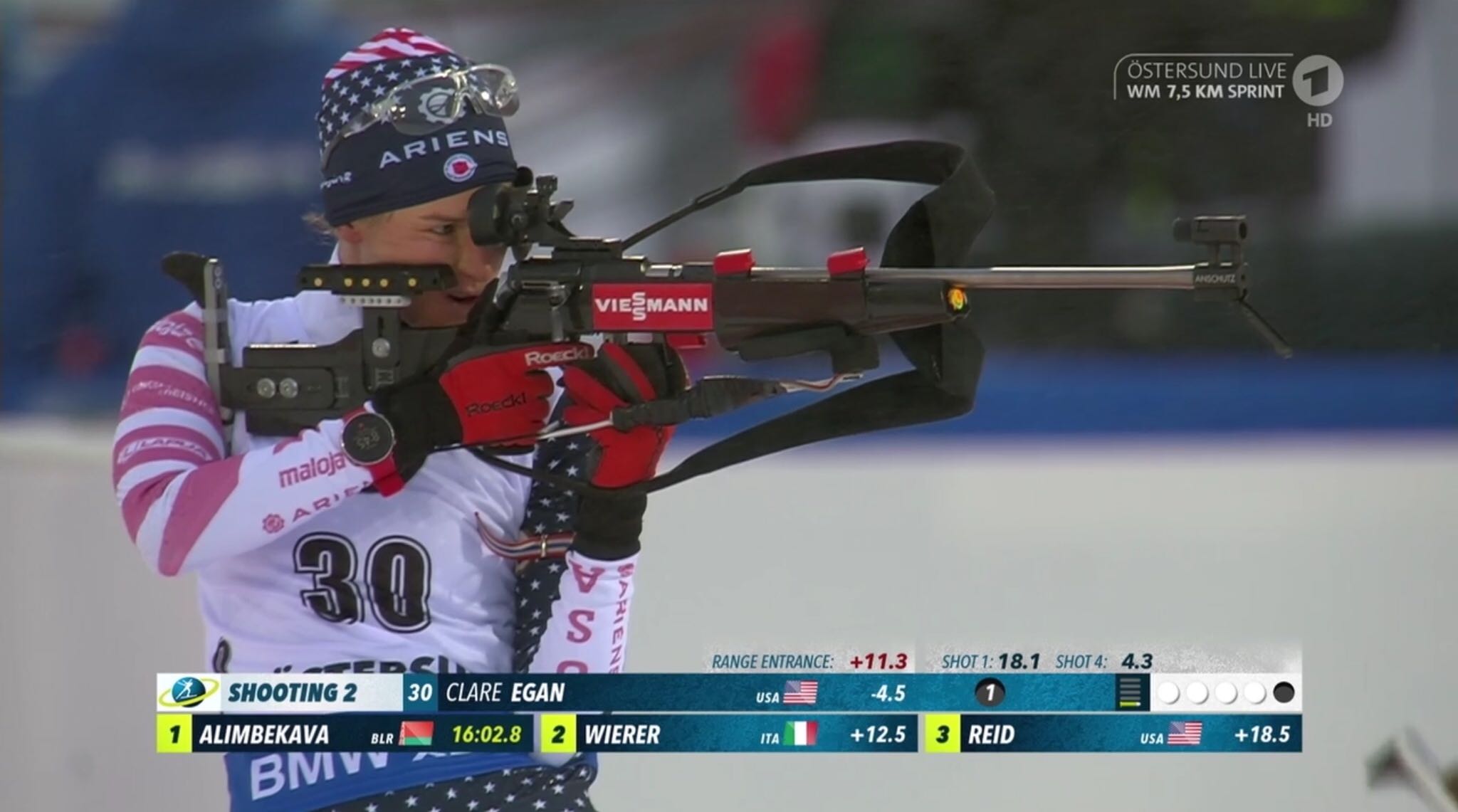
Clare Egan for the U.S. on her way to placing 11th overall in the women’s 7.5 k sprint at the 2019 IBU World Championships. (Photo: ARD screenshot)
On Friday’s second day of racing at the IBU World Championships in Östersund, Sweden the women raced the 7.5-kilometer sprint. Slovakia’s Anastasiya Kuzmina skied a single penalty lap to mark a winning time of 22:17.5 minutes. Norway’s Ingrid Landmark Tandrevold shot clean to place second, 9.7 seconds back. Laura Dahlmeier of Germany also shot clean to earn third place at 12.6 seconds behind.
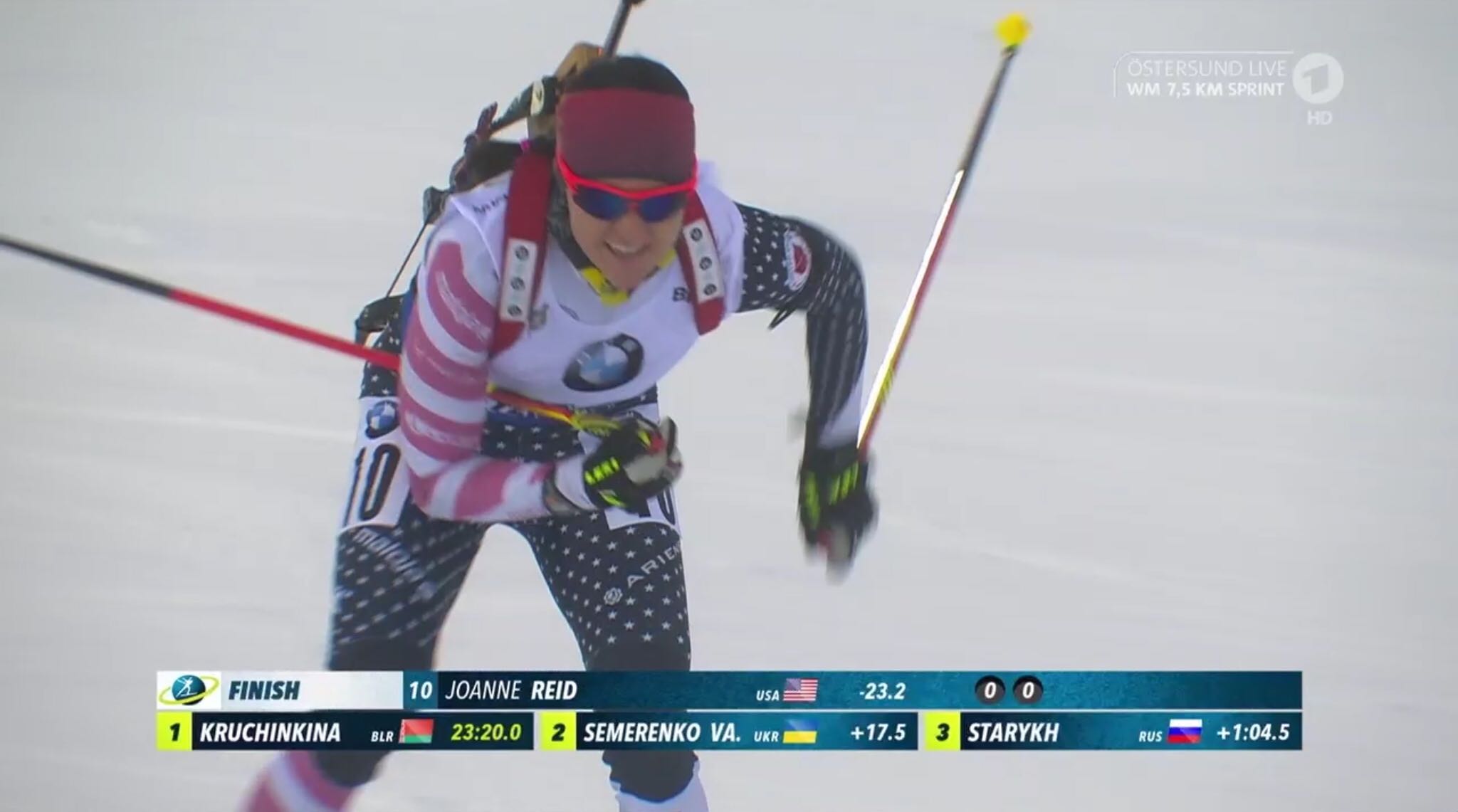
In her fourth World Championships, Clare Egan for the U.S. earned her best career individual championship result by placing 11th (+33.3). Egan skied a single penalty lap shooting prone. Also in for a championship career best was U.S. biathlete, Joanne Reid. Reid raced to 15th overall (+50.1) while shooting clean. This is Reid’s second World Championships.
Also for the U.S., Susan Dunklee placed 57th (+2:30.6) missing two targets each in prone and standing.
Joanne Reid of the U.S. skiing to 15th overall in the 7.5 k sprint at the 2019 IBU World Championships. (Photo: ARD screenshot)
Rosanna Crawford was the top Canadian in 18th. She finished 56.0 seconds back after missing a single target shooting prone. Sarah Beaudry for Canada was 47th (0+2, +2:09.8), Emma Lunder 51st (0+1,+2:11.4), and Megan Bankes 58th (0+2,+2:31.7).
The top 60 athletes advance to Sunday’s 10 k pursuit.
“Yesterday in the mixed relay was probably one of my worst ski days of the year,” Crawford wrote in a post-race email. “So I didn’t have high expectations going into today’s sprint. Especially with the conditions we were faced with, fresh deep snow is not my forte! But I just focused on what I could control, my skiing and shooting and went for it. I’m really happy with how things turned out, 9/10 on a windy day is good and skiing was one my of best of the year. Our techs have been working so hard and delivered some incredible skis today as well! I’m also pumped we have all four of us in the pursuit on Sunday!”
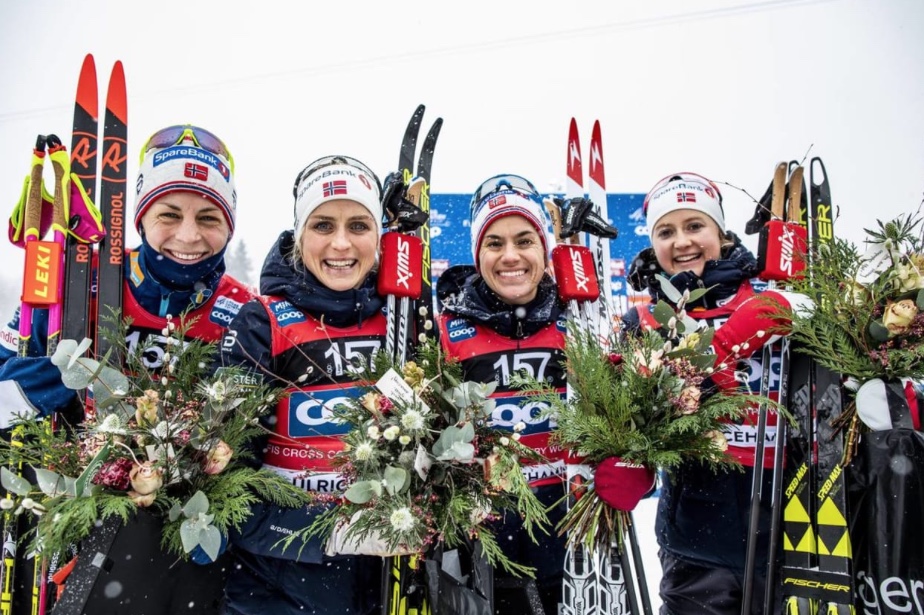
The winners of the 2019 4 x 5 k relay in Ulricehamn, Sweden: (l-r) Norway’s Astrid Uhrenholdt Jacobsen, Therese Johaug, Heidi Weng, and Ingvild Flugstad Østberg. (Photo: fis-ski.com screenshot)
FIS World Cup Ulricehamn, Sweden 4 x 5 k / 4 x 7.5 k relay
The sun rises, the sun sets, and Norway wins the women’s 4 x 5-kilometer relay in Ulricehamn, Norway on Sunday. For the 11th time in a row, a Norwegian women’s team bested the world in the storied race format.
Heidi Weng, Therese Johaug, Astrid Uhrenholdt Jacobsen, and Ingvild Flugstad Østberg won in a time of 57:06.3 minutes. For the first tag, nine teams came in separated by 8.1 seconds. Johaug, skiing the second leg for Norway, opened a gap of 9.3 seconds over Russia I by the 10 k mark.
The time back to second-placed Sweden I stretched to 37.4 seconds by the finish.
Sweden I’s team consisted of Evelina Settlin, Ebba Andersson, Charlotte Kalla, and Jonna Sundling.
Finland I placed third (+41.2) wth Laura Mononen, Krista Pärmäkoski, , Riitta-Liisa Roponen, and Evelina Piippo.
The U.S. team of Sadie Bjornsen, Rosie Brennan, Caitlin Patterson, and Jessie Diggins finished in sixth (+1:26.6).
In the men’s 4x 7.5k relay, Russia II and Russia I came away in first and second place respectively.
Russia II’s team of Evgeniy Belov, Alexander Bessmertnykh, Denis Spitsov, and Artem Maltsev won in a time of 1:17.53.2 hours.
Russia I’s Andrey Larkov, Alexander Bolshunov, Andrey Melnichenko, and Sergey Ustiugov finished 20.8 seconds back.
In third was Norway, 35.8 seconds behind. Hans Christer Holund, Didrik Tønseth, Sjur Røthe, and Simen Hegstad Krüger, Norway’s foursome, were 35.8 seconds back. On the first leg, at 9.7 k, Norway was in ninth place, with a 43.1-second deficit.
The U.S. team of Erik Bjornsen, Scott Patterson, David Norris, and Ben Lustgarten placed 13th (+4:10.8).
IBU World Cup Antholz, Germany 12.5 k / 15 k Mass Start
On Sunday in Antholz, home country athlete Germany’s Laura Dahlmeier won in 35:32.8 minutes while skiing a single penalty lap during her first prone stage. The Czech Republic’s Marketa Davidova placed second (13.1, 0+0+1+0), with Vanessa Hinz of Germany in third (+16.4 1+0+0+0).
“It’s a fantastic feeling to be right at the top again,” Dahlmeier told the IBU. “I started very badly and I felt slow. But I came back strongly and I remained virtually without error in the shooting. It was a good weekend for me.”
US Biathlon’s Clare Egan raced and shot to 15th overall, 1:05.8 back, with two penalties in her first prone stage, otherwise she shot clean.
Rosanna Crawford of Canada placed 28th (+3:50.2, 0+1+3+1).
In the men’s 15 k mass start, there was one new development: Johannes Thingnes Bø of Norway did not win. He did, however, place second to France’s Quentin Fillon Maillet. He won the race in 34:39.4 seconds while shooting clean in all four stages. Depositing between PLN 60 and PLN 199, we will receive a bonus of 125% of our deposit (a maximum of PLN 1,600), as well as a package of 50 free spins Vulkan Bet on the Doom of Dead slot machine. On the other hand, if we deposit at least PLN 200, we will get 100 free spins after the game as a reward, as well as a bonus of as much as 200% of our own deposit (a maximum of PLN 2,800 to visit).
Bø was 14.3 seconds back in second place, with a single miss in each of his standing stages. Germany’s Arnd Peiffer was third (+24.6, 0+0+0+0).
Christian Gow of Canada was the sole North American in the race. He placed 27th (+3:22.5, 1+1+0+1).
Lake Placid SuperTour 10 k/15 k mass start classic
Kaitlynn Miller (CGRP) won the women’s 1o k classic mass start in 36:12.7 minutes. Coming in 2.9 seconds back was Jessica Yeaton(APU/Australian National Team) in second place. In third, skiing for Dartmouth, was Katharine Ogden (37:27.8).
Kyle Bratrud (SMS T2) won the men’s 15 k classic mass start in 46:41.3 minutes. In second place was Adam Martin (CGRP) who raced to a time of 46:55.0. Canada’s Andy Shields (Lappe Nordic) placed third in 47:41.6.
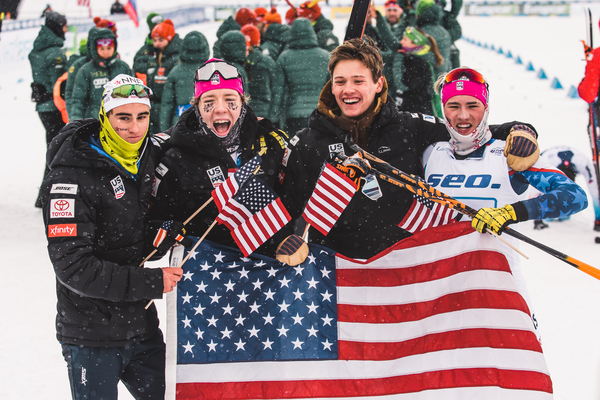
The U20 World Juniors 4 x 5 k relay first place team from the U.S, (l-r) Johnny Hagenbuch, Ben Ogden, Luke Jager, and Gus Schumacher. (Photo: JWSC2019 / Mikaela Takala)
2019 U23 World Ski Championships in Lahti, Finland 4 x 3 k and 4x 5 k relay
In a historic first for the U.S., the U20 men’s team won the 4 x 5-kilometer relay today in Lahti, Finland at the 2019 World Junior Ski Championships. Luke Jager skied the first classic leg for the U.S., Ben Ogden skied the second classic, Johnny Hagenbuch skied the first initial skate leg and Gus Schumacher raced the anchor leg.
The foursome won in a time of 45:34.7 minutes, and beat second-place Russia by 3.8 seconds.
Russia’s team was comprised of Egor Trefilov, Andrey Kuznetsov, Yaroslav Egoshin, and Alexander Terentev.
Germany’s team of Jakob Milz, Florian Knopf, Anian Sossau, and Friedrich Moch took third finishing 6.3 seconds behind.
For Canada, Remi Drolet , Sam Hendry, Xavier McKeever, and Thomas Stephen skied to 11th (+2:29.7).
In the 4 x 3.3 k U20 women’s race, Norway’s Kristin Austgulen Fosnaes, Astrid Stav, Helene Marie Fossesholm, and Kristine Stavås Skistad won at the line in 35:24.7 minutes.
Russia’s Anastasia Faleeva, Kristina Kuskova, Veronika Stepanova, and Anna Grukhvina were a close second, stopping the clock 1.0 seconds back.
Louise Lindström, Frida Karlsson, Tilde Baangman, and Lin Svahn for Sweden placed third (+33.3).
The U.S. team of Mara McCollor, Kendall Kramer, Sydney Palmer-Leger and Novie McCabe skied to fourth place, 40.5 seconds back.
For Canada, Anne-Marie Petitclerc, Jasmine Drolet, Anna Pryce, and Molly Miller placed 11th, 3:01.4 minutes behind.
FIS Cross Country World Cup Ulricehamn, Sweden 10/15 k freestyle
In what is his skiing canvas, the 15 k freestyle, France’s thirty-two-year-old Maurice Manificat won his first World Cup of the season in Ulricehamn, Sweden today in 34:55.4 minutes. It was a tight race in that Norway’s Simen Hegstad Krüger Simen Hegstad Krüger who placed second finished 1.1 seconds back. Teammate Didrik Tønseth was third (+8.7).
Canada’s Alex Harvey was the best placed North American in ninth (+31.4). Lenny Valjas skied to 57th (+2:32.1), and Bob Thompson 77th (+4:16.6).
For the U.S., Scott Patterson finished 35th (+1:26.5), David Norris 53rd (+2:11.3), Ben Lustgarten 64th (+3:04.7).
Norway’s Therese Johaug kept her distance win streak alive at eight wins in eight starts on the World Cup this season. She won the women’s 10 k skate race in 25:48.2 minutes, with teammate Astrid Uhrenholdt Jacobsen in second, 22.8 seconds back. Third place went to Sweden’s Ebba Andersson, 24.9 seconds behind.
The U.S. Ski Team’s Jessie Diggins skied to fourth place (+38.3), while teammate Sadie Bjornsen was 15th (+1:25.1). Caitlin Paterson (CGRP) had her best World Cup result of the season, skiing to 23rd (+1:49.9). Rosie Brennan (APU) placed 28th (+2:03.2), and Rosie Frankowski 42nd (+2:28.0).
Dahria Beatty was the only Canadian entered. She finished 56th (+3:54.7).
In the women’s 10 k pursuit, Italy’s Dorothea Wierer won in a time of 29:20.1 after skiing two penalties (1+0+0+1). Second place went to Germany’s Laura Dahlmeier, who finished 6.0 seconds after Wierer after one missed shot (0+0+1+0). Saturday’s third place went to another Italian, Lisa Vittozzi, who finished 16.2 seconds behind the winner after tying Wierer’s shooting score.
Clare Egan led the way for the U.S., racing to 11th (+1:31.9) after skiing two penalties (0+0+0+2).
“I’m really happy with my race today,” Egan wrote in an email. “The wind and altitude are always a challenge here, but I took my time on the range and capitalized on the fast glide of my skis to save energy on course. I made a costly and dumb mistake on my last shot but still came away with my second-best career result. I’ll take what I learned from today and go for it again tomorrow in the mass start! Can’t wait!”
Joanna Reid was the next American to finish, placing 29th (+2:55.2) after three missed shots (1+0+0+2).
For Canada, Rosanna Crawford finished 34th (+3:30.8) after skiing five penalties (2+1+1+1) and her teammate Megan Bankes finished 39th (+3:37.1) with five misses (1+0+3+1). Also skiing for Canada, Sarah Beaudry placed 46th (+5:07.5), also with five penalties (4+0+1+0).
In the men’s 12.5 k pursuit, Norway’s Johannes Thingnes Bø
won in a time of 31:33.7 after skiing three penalties (1+1+0+1). France’s Antonin Guigonnat raced to second place, 34.8 seconds behind with one missed shot (0+0+1+0). The third and final podium spot on Saturday went to France’s Quentin Fillon Maillet, who skied two penalties (1+0+0+1) and finished 40.6 seconds back from the winning time.
Sean Doherty for the U.S. placed 47th (+4:39.1, 3+2+1+0). Jake Brown was lapped and was not given an official time.
For Canada, Jules Burnotte skied to 54th (+5:42.8, 1+3+1+1), and Scott Gow 55th (+6:39.7, 4+0+2+3).
Canada’s Antoine Briand (CNEPH) was the fastest qualifier on the day in 3:14.71 minutes and won the men’s final. Dominique Moncion-Groulx (Nakkertok) placed second in the final, with Ben Saxton (SMS T2) in third.
Saxton was the second fastest qualifier, with Oliver Hamel (CNEPH) third fastest.
For the women, Sophie Caldwell (USST/SMS T2) scorched the qualifier in 3:40.44 minutes with Jessica Yeaton (APU/Australian National Team) qualifying in second (3:50.49). Dartmouth’s Katharine Ogden qualified third (3:51.79).
Caldwell went on to win the final in 3:37.06, with Yeaton in second and Kelsey Phinney (SMS T2) in third.
Marte Olsbu Røiseland of Norway celebrating her victory after Friday’s IBU World Cup sprint in Nové Město. (Photo: biathlonworld.com)
IBU World Cup Nové Město, Czech Republic Women’s 7.5 k Sprint
On Friday in Nové Město, the women contested a 7.5-kilometer sprint. Norway’s Marte OlsbuRøiseland won the day in 19:44.6 minutes for her first IBU World Cup victory. Røiseland shot clean on the day. It was her second top five result this season after placing fifth in Pokljuka, Slovenia’s pursuit.
Germany’s Laura Dahlmeier finished in second 4.5 seconds back after missing one target for her only penalty. Third place went to Paulina Fialkova of Slovakia. Fialkova was 6.2 seconds behind at the finish after shooting clean.
Canada had two athletes in the top-20. Sarah Beaudry placed 12th (+42.7, 0+0) for her best career individual IBU World Cup result. Emma Lunder finished 17th (+57.9, 1+0), which also was a career best individual result. Rosanna Crawford was 54th (+1:59.9, 2+1), and Megan Tandy 81st (+2:50.9, 1+2).
For the US Biathlon Team, Clare Egan placed 26th (+1:11.1, 1+1), Susan Dunklee 39th (+1:32.4, 1+1), Joanne Reid 52nd (+1:57.2, 1+1).
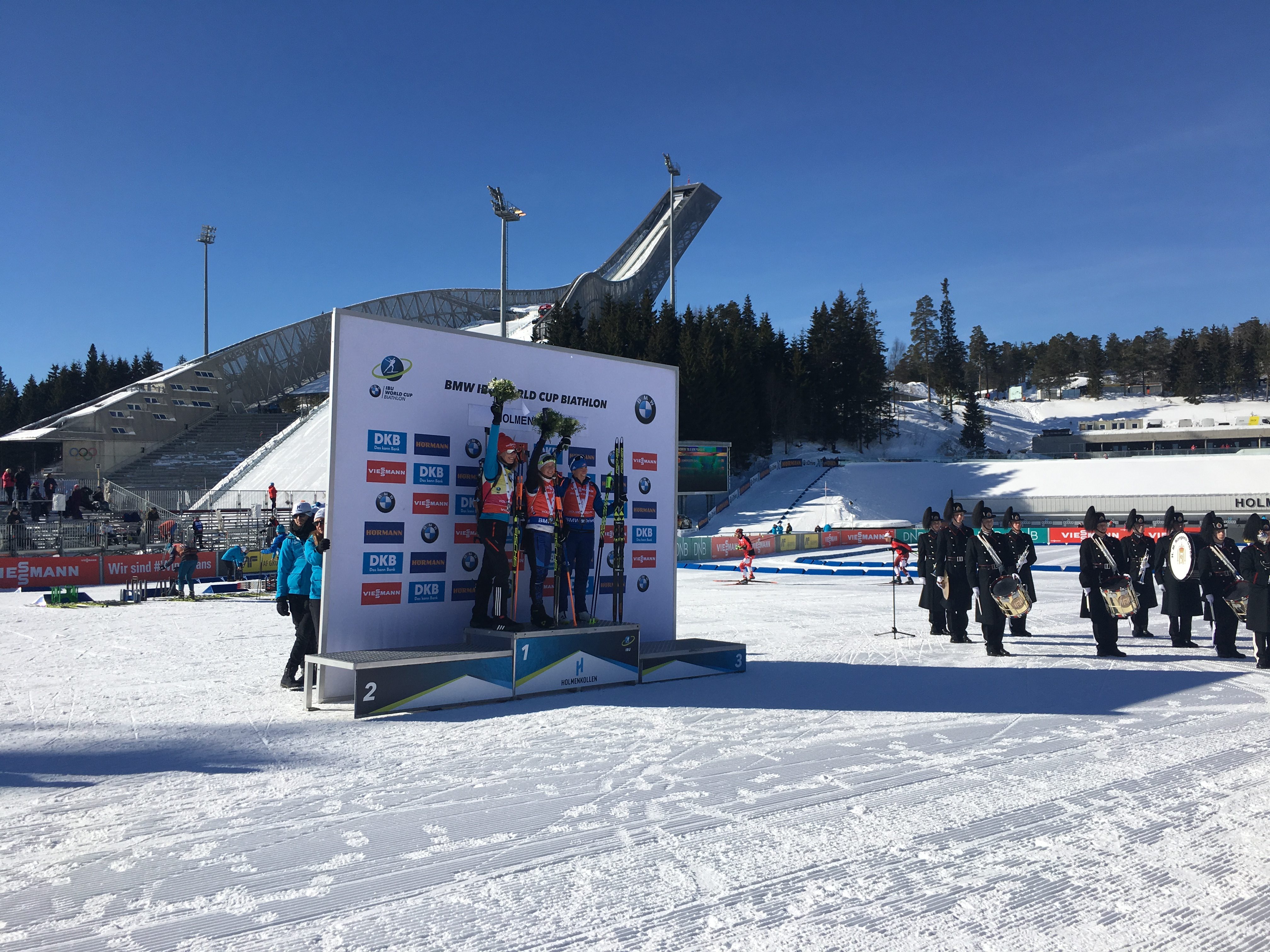
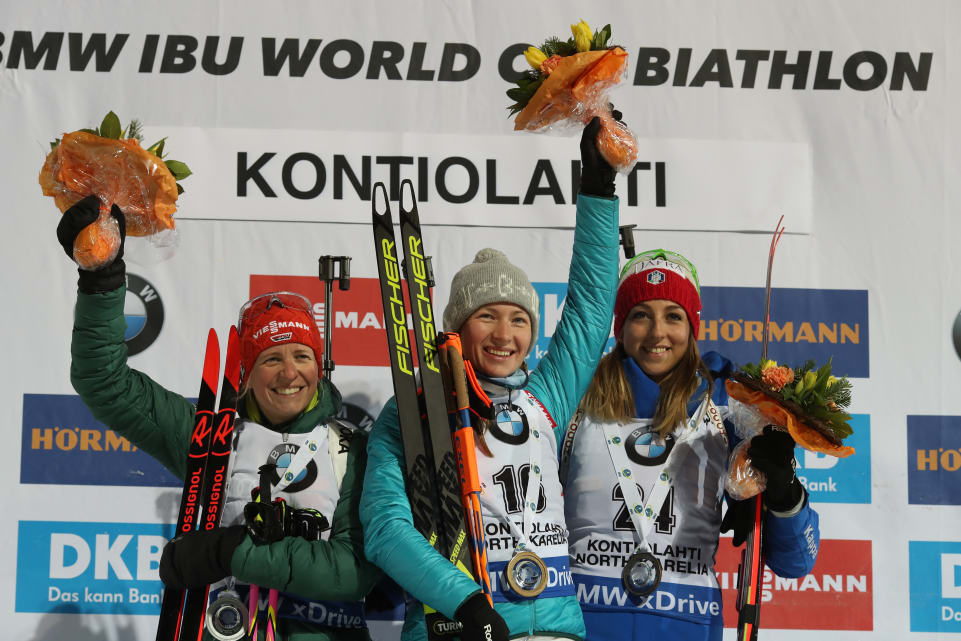
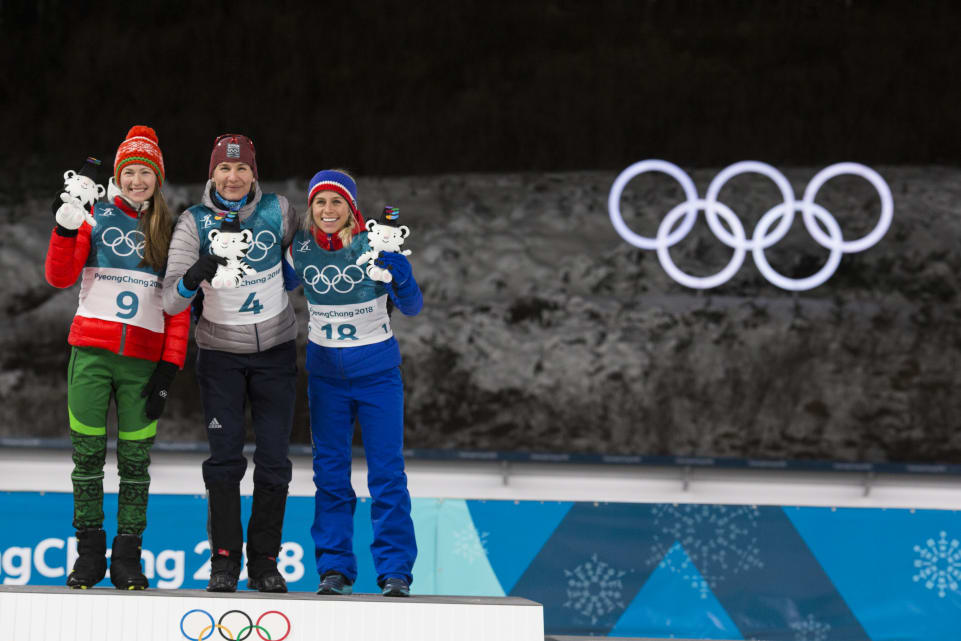
Darya Domracheva in first, Anastasiya Kuzmina in second, and Susan Dunklee in third on the podium after the women’s 10 k pursuit at Holmenkollen. (Photo: US Biathlon)
OSLO, Norway—Eight World Cup weekends, a swing by Open European Championships, two weeks at the Olympics, and it all came down to this: Susan Dunklee’s last international race of the season was also her first podium of the season, and she’s heading back to the United States with a third-place finish in the 10 k pursuit.
“I’m super happy,” Dunklee said. “I often start feeling stronger and stronger as the season goes on, and this season it took a little longer. I had a lot of sickness, and some frustrating shooting days early in the season that made it hard for me to keep going. I’m really happy right now.”
The World Cup concludes next weekend in Tyumen, Russia, but the Americans are among other teams (including Canada, the Czech Republic, and Ukraine) who are boycotting the event because Russia is not currently compliant with the World Anti-Doping Code.
Dunklee finished fourth in the 7.5 k sprint here at Holmenkollen on Thursday, and started today’s pursuit 35.7 seconds behind sprint winner Anastasiya Kuzmina of Slovakia.
She missed a shot in the first prone stage, and then another in the first standing stage. But Dunklee was never out of the top ten, bouncing around from fifth to tenth. Not a single woman in the field cleaned all 20 targets.
The race for first came down to Kuzmina and Darya Domracheva of Belarus. Both women cleaned their final stage, while Germany’s Franziska Hildebrand and Laura Dahlmeier ahead of them each missed two and fell out of contention. Kuzmina hit the trails with a 1.5-second advantage.
Domracheva caught up to her, and then pulled away on the Hellnerbacken climb coming back to the stadium. She claimed a 9.2 second win by the finish line.
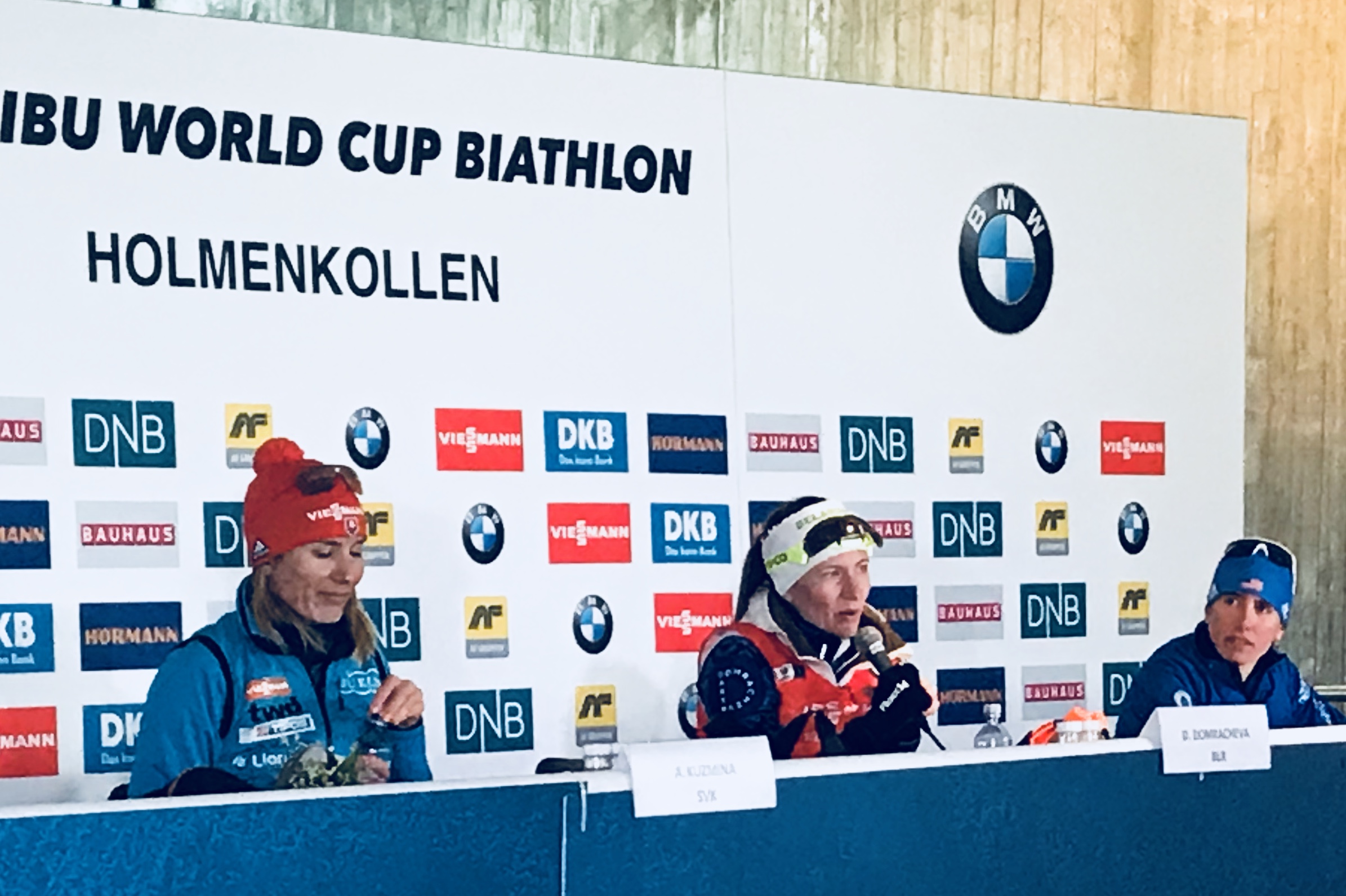
Darya Domracheva explains her race in a press conference as Anastasiya Kuzmina and Susan Dunklee look on.
Dunklee came into the final shooting in ninth place. But aside from Kuzmina and Domracheva, all those in front of her missed shots.
She left in third place, but with Fuyuko Tachizaki of Japan hot on her tails.
“She was chasing me and I heard that from the coaches right away as I was leaving the stadium,” Dunklee said. “She is a strong skier, but I was hoping I would have enough strength on that last hill to be able to take her if needed. So I was trying to put a gap on her but it was like, if she catches me, there’s a Plan B.”
Dunklee accumulated about a two-second gap on Tachizaki around the first part of the loop, but just as in the race for first, the decisive move came on the Hellnerbacken.
“I didn’t know who else was back there, and I just hammered up that back hill hoped to keep her and whoever else away,” Dunklee explained.
It worked, and she came into the stadium with a comfortable lead of 8.1 seconds, third place seemingly secured. Dunklee continued hammering up the steep hill behind the shooting range before dropping into the stadium, where she – and the other top finishers, none of them Norwegian – were met with deafening cheers by the crowd in the grandstand.
“I love this crowd,” Dunklee said. “It was great, you know they are always are happy to cheer on their own, but they also cheer on some of the underdogs. That’s kind of neat.
It wasn’t the only support she had out on course, either. None of the other American women qualified for the pursuit. That was disappointing for the team, but meant that they were out in force cheering Dunklee towards the Americans’ first podium of the World Cup season.
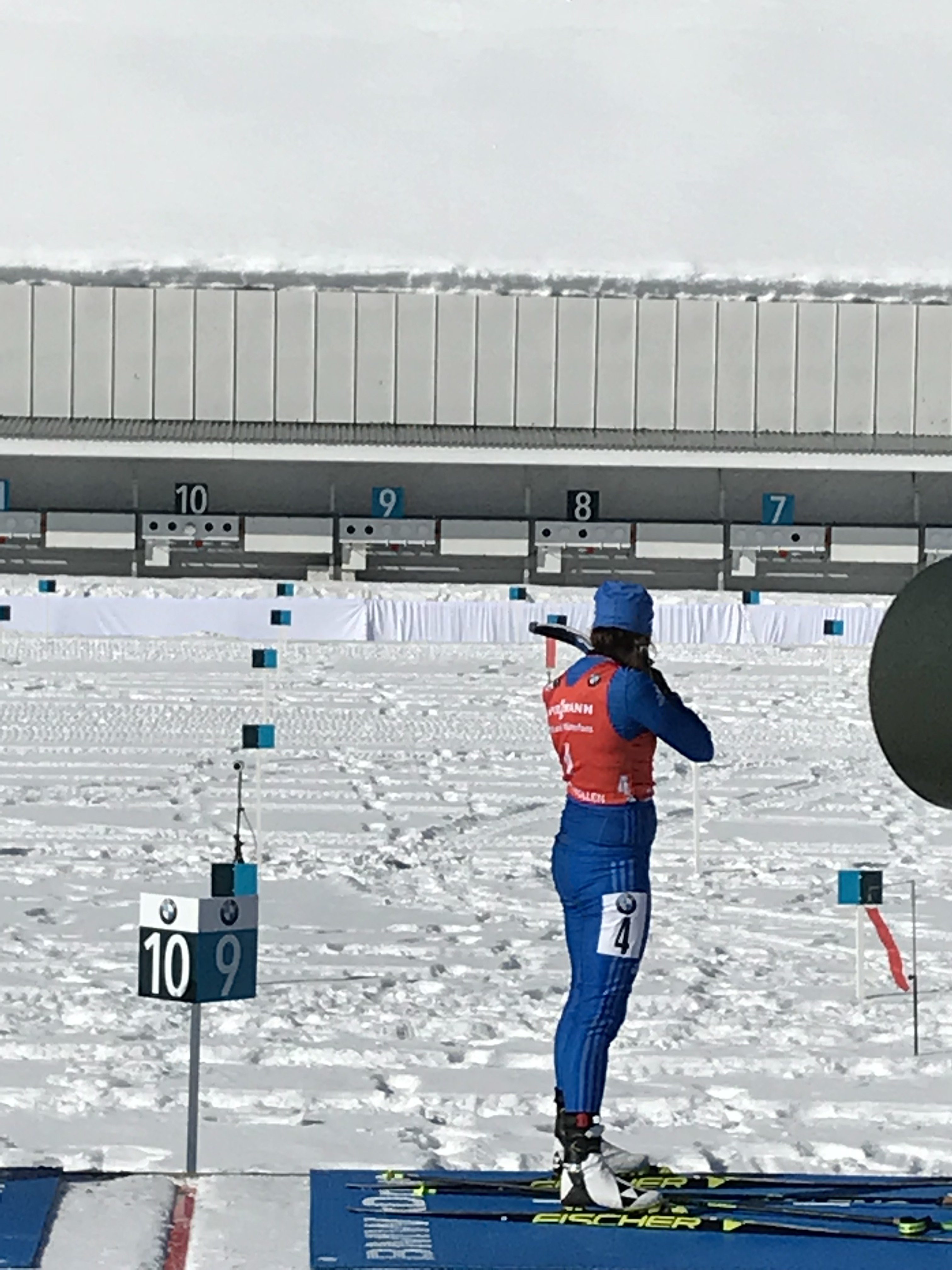
Dunklee on the shooting range, partway through cleaning her final stage.
“My teammates were out on the course, other girls, Clare [Egan], Em [Dreissigacker], and JoJo [Reid], and Alex [Howe], and that meant the world to me. I saw them multiple times through the loop. All our staff was out there. It was really cool.”
It hadn’t been a perfect shooting race from Dunklee, but as Domracheva and Kuzmina also showed, it’s the last shooting that counts.
“I don’t think that many people had a perfect race out there today,” Dunklee said. ”It’s crazy some days — I mean, it doesn’t really matter what everybody else is doing, you just have to try to put the best race you can. Because sometimes you have a perfect race and five other people do too, and then you are sixth. But some days you don’t have a perfect race and you end up third.”
As Dunklee alluded to, the beginning of her season was marred with disastrous shooting performances. But the last several weeks have seen better shooting, and two penalties was a good tally in the field today.
“I spent awhile this summer with a crazy plan of preparing myself for wind, because I knew that [the Olympics in] Korea could be windy,” Dunklee said. “I was playing with shading, which is a sort of advanced skill that I haven’t done much until this year. And that’s fine in itself, but what it did was it took my focus off the really good speed shooting, which I had going for me last year and worked really well.”
Partway through the season, Dunklee decided to abandon the shading project and go back to basics. Finally, it is starting to pay off.
“I realized half way through this winter that I can’t really keep both at the same time. at least not right now — it might take me a few more years to get there,” she said. “And so right before the Olympics, about two weeks before we went, I kind of switched to my old style. But it takes a while to get the feel for it again. But it was finally back.”
She also was sick several times throughout the winter, including before and during the Olympics, and then after the Olympics when the World Cup moved to Finland. But today her ski speed was back, too; her last loop was the 13th-fastest in the field.
“I feel a lot better than I did yesterday,” Dunklee said. “During the relay I felt kind of flat. But yeah, I often get to my strongest right as the season finishes, that is pretty typical. I think the biggest thing was that I had a cold or some sort of sickness for three or four weeks, through January/February, and that took a lot out of me. I’m finally getting healthy again.”
Dunklee is not sure whether she will keep competing for another season, saying to ask again in a month.
But whether it was the last race of her career or just the last one of the year, Oslo is a special place for her.
“My first podium was here in Oslo, and I believe Darya was ahead of me on the podium on that day too,” Dunklee said. “So it’ s a little bit déjà vu.”
Canada’s Julia Ransom and Rosanna Crawford crossed the finish line together, +4:52.4, after collecting four and five penalties, respectively.
“It was fun that Julia and I — I guess we were disappointed that we both were bad, but it led us to being able to cross the finish line together,” Crawford said. “So that was nice. Celebrate that team.”
Teammate Emma Lunder was lapped and did not finish.
Dorin Habert is also not going to Tyumen next weekend, and the Canadians were the first team to announce a boycott of the event.
“I’m disappointed that the IBU has taken away our chance to compete at World Cup Finals, because [IBU President] Besseberg and the IBU have decided not to stand up for clean sport,” Crawford said.
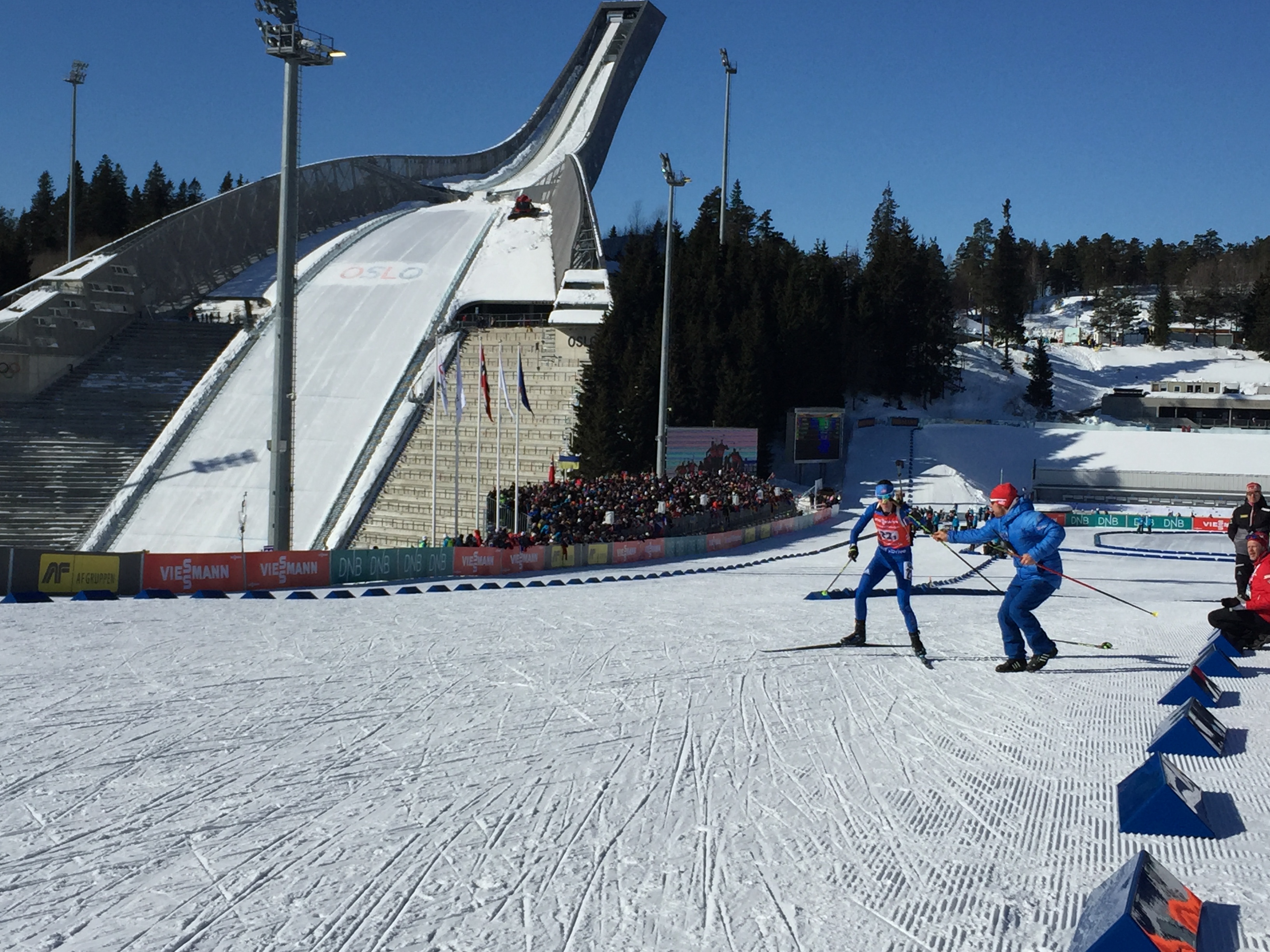
Clare Egan receives a pole from US Biathlon Chief of Sport Bernd Eisenbichler during the first leg of the women’s relay at Holmenkollen.
OSLO, Norway — In the last relay of French star Marie Dorin Habert’s career, she turned in a crucial performance to bring her team to the front. Anaïs Bescond extended the gap and France took the win in the women’s 4 x 6-kilometer relay here at Holmenkollen by 14.4 seconds over Germany.
Was she nervous going into the last team event she will ever race?
“I wasn’t really nervous,” Dorin Habert, 31, said in a press conference. “I think it’s a special thing to know that there is no more starts and no more relays for me, so I just wanted to fight and struggle hard like every relay. I think I did my best today.”
Dorin Habert won two gold medals, in the individual and the pursuit, here at World Championships two years ago. So Oslo is a special place.
“It’s so nice to end this way, to share it with all of the team, and the beautiful sun, and all the French people,” Dorin Habert said. “It’s a wonderful day for me. I would like to thank a lot, well, everyone, for being there in the biathlon family. I’m really happy to have this career, and I’m really happy for everything.
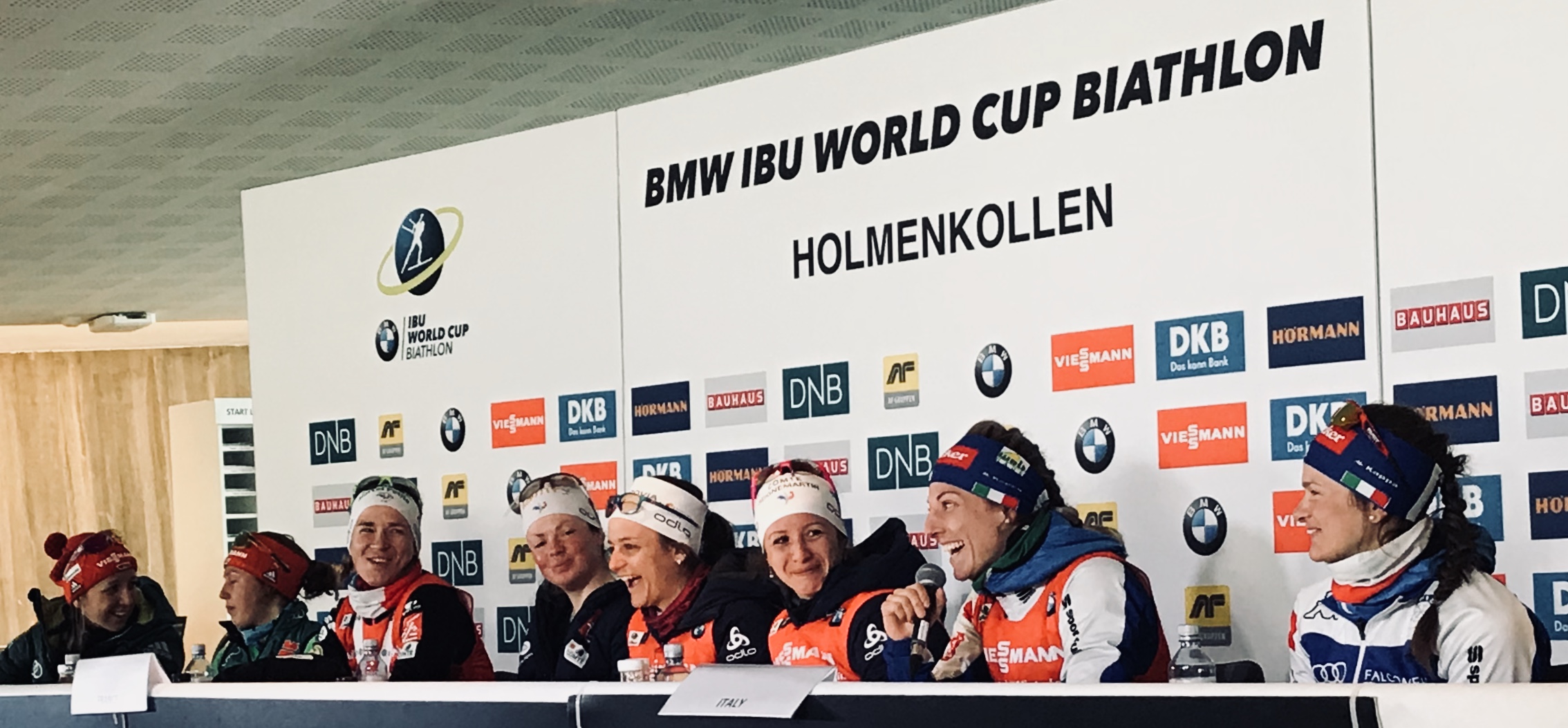
The Italian duo of Lisa Vittozzi and Dorothea Wierer put their team in first place at the halfway point, and it was their teammate Nicole Gontier whom Dorin Habert passed to pull France into first. Gontier stuck with her, and Italy was only 2.2 seconds back at the last exchange.
The German anchor, Laura Dahlmeier, charged past Italian skier Federica Sanfilippo. She was unable to catch Bescond, but Germany finished second with seven spare rounds to six by the French, and Italy placed third with eight spare rounds (+33.2).
The Italian and French teams joking in the press conference.
Norway placed fourth with a penalty loop and 10 spares (+1:26.5), Switzerland fifth with eight spare rounds (+1:54.2), and Sweden sixth with a remarkable three spare rounds (+2:27.2).
The Canadian team skied an even race, with Sarah Beaudry leading off in 12th, Julia Ransom tagging in 14th, Emma Lunder in 15th, and then Rosanna Crawford bringing the team up to 11th.
“I love coming from behind and chasing girls down, and I just looked at it as practice for tomorrow,” said Crawford, who will start Sunday’s pursuit in bib 38. “I was within somewhat contact with the other women around me, so that was nice. People to chase, people to ski with.”
It wasn’t the result the team knew they were capable of, with 11 spare rounds. But it has been a long season.
“Of course everyone is tired, every team is tired,” Crawford said. “But our fast isn’t as fast as the fastest, so our slow is, well, a lot slower. I felt so good through Finland, and I really thought the ski speed was going to hold, but then it wasn’t there in the sprint. And also, today was slightly better, but not what I had last weekend. It’s so frustrating to be up and down.”
The U.S. team started off with a tough leg by Clare Egan, who used all of her spare rounds in both prone and standing and had two penalty laps. She tagged off at the first exchange in 21st and last place.
“This is I think the worst race of my career,” she said after the finish. “I’m really embarrassed. It is the worst possible thing to do it in a relay. I hate letting everyone down. It’s a really terrible feeling.”
Her teammates, though, were more circumspect.
“I never, ever, want to hear a teammate apologizing for tagging off far back like that,” said Susan Dunklee, who took the tag from Egan. “The only thing they can apologize for is if they didn’t try. And Clare was out there and trying her best. So I have nothing but respect for that.
“What I yelled at Clare, when she was at the top corner and I was warming up, I yelled, ‘We love you and we think you’re awesome!’ ” Dunklee continued. “She was in last place, and we still do love her. You just have to know that your teammates have all been there, they have all done the same thing in the relay, and they know exactly how you feel. Usually, there’s a piece of our relay that we can look at and get really excited about, so we will do that today.”
For Egan, though, it was a race that just came apart. The team started with bib 22, one of the last in the field, but she move up 10 places to 12th by the first shooting.
Then, spare rounds and penalty laps.
“I’ve never had a penalty loop in prone, in the World Cup [in a relay], but to do that in the first stage and immediately be like a minute behind everyone – no, I didn’t lose hope,” Egan said. “I knew that anything can happen in the standing. And I actually, I didn’t come into the range last. I had passed one person. But, you know, with another [penalty lap] in standing, I was just trying to get as fast as I could to the finish because … I just hoped that my teammates all would get a chance to do the race. If we get lapped then we get pulled. That’s it.”
She also lost part of a pole early on in the race, and the replacement process did not go smoothly.
“I just had to get a new one, but then the new one was shorter than my own pole,” Egan explained. “So when I went by a coach I meant to switch out the shorter pole for a spare that was the right height, and I gave him my own pole. So then I finished the race and I was like, ‘What the heck? I still have this stupid pole.’ ”
As the relay continued, Dunklee had the seventh-fastest second leg time, and Reid the eighth-fastest third leg time; by the third exchange, the U.S. was in 17th place.
“The shooting didn’t feel really sharp today,” said Dunklee, who used three spare rounds in total. “I don’t know what the times were but I don’t think they were very fast. I just felt sluggish and, a little out of it, really.”
Reid used only one spare round, a performance she was excited about.
“It’s always easier to start from behind and work your way up because there’s no pressure,” she said. “Whereas if you come into the range in first and have to shoot on point one, and everyone is staring at you, that’s really hard. Today was low-pressure shooting.”
Emily Dreissigacker anchored the team, and used four spare rounds to move up to 15th. She caught the team from Kazakhstan and held off a challenge from Korea in a three-way sprint finish, chasing Austria who finished jut 2.1 seconds ahead.
“I don’t know when the last time I actually had to sprint for the finish was, but it was great!” she said.
China and Slovenia were disqualified, and Bulgaria and Lithuania were lapped. But despite being the last team on the first leg, the U.S. women avoided that fate by a large margin.
“I definitely went out hard,” Dreissigacker said. “I knew we were sort of in the danger zone for getting lapped, but actually, the skiing felt really good the first two laps. I kind of died at the end, so I was glad I was able to come through at the finish.”
“I think we’ve all been through some ups and downs this season and struggling with that,” Dunklee said of Egan’s relay leg. “It’s important to remember that biathlon isn’t everything. There’s other stuff going on in our daily lives that is meaningful to us. It’s important to never lose sight of that.”
Clare Egan (US Biathlon) racing to a career-best 13th in the women’s 7.5 k sprint at Friday’s IBU World Cup in Kontiolahti, Finland. (Photo: USBA/NordicFocus)
IBU World Cup (Kontiolahti, Finland): Women’s 7.5 k sprint
Darya Domracheva of Belarus raced to her third World Cup victory of the season on Friday, and American Clare Egan tallied a career best in 13th, just behind Canada’s Rosanna Crawford in 12th in the International Biathlon Union (IBU) World Cup women’s 7.5 k sprint in Kontiolahti.
The women’s 7.5 k sprint podium at the IBU World Cup in Kontiolahti, Finland, with Belarus’s Darya Domracheva (c) in first, Germany’s Franziska Hildebrand (l) in second, and Italy’s Lisa Vittozzi (r) in third. (Photo: IBU/Biathlonworld)
Domracheva started 16th and shot a perfect 5-for-5 in prone, then missed one in her standing bout, but skied to first with the fastest overall course time. Her position in the leader’s chair looked secure until Germany’s Franziska Hildebrand, who started 49th, shot clean in both stages and headed out on her last loop with a 17.6-second lead on Domracheva’s time. But Hildebrand couldn’t match Domracheva’s pace and finished 0.5 seconds short of the winning time of 20:56.8 at the finish.
“I really like to compete here in Kontiolahti,” Domracheva said, according to an IBU press release. She won two gold medals there at 2005 Youth/Junior World Championships and went on to win her first two World Cup races there in 2010.
“This is a tough track, always very difficult but it always a good chance to take some seconds if you are in good shape,” she said. “I have some good memories from here…”
“I am very proud of myself,” Hildebrand said of her race, according to the IBU. “Dasha made a really strong last loop and I tried to do it as well. It was very close but I am happy to be second … I had to concentrate and have the confidence that I could shoot clean today.”
Italy’s Lisa Vittozzi started 24th and came within 5.5 seconds of Domracheva’s time, after missing one standing target (0+1), to place third, 5 seconds behind Hildebrand.
Vittozzi achieved her first career podium in Kontiolahti last year.
“This is an amazing place for me,” she told the IBU. “I like this track so much and feel in good shape. I tried to do my best in the shooting range and finally I did it.”
Ukraine’s Yuliia Dzhima shot clean but was 11.7 seconds short of the podium in fourth place (+17.2), Germany’s Laura Dahlmeier followed in fifth (+19.4; one penalty), Veronika Vitkova of the Czech Republic placed sixth (+21.0; no penalties), Ukraine’s Vita Semerenko was seventh (+21.0; no penalties), France’s Marie Dorin Habert eighth (+32.0; no penalties), Germany’s Maren Hammerschmidt ninth (+33.9; one penalty), Finland’s Kaisa Makarainen 10th (+34.4; two penalties), and Belarus’s second woman in the top 11, Nadezhda Skardino 11th (+35.3; no penalties).
Rosanna Crawford (Biathlon Canada) leaving the range during the women’s IBU World Cup sprint earlier this season in Annecy, France. . (Photo: Glen Crawford)
Crawford led Canada in 12th (+46.5) with a single prone penalty (1+0) for her best sprint result since the 2014/2015 season. Also this season, Crawford raced to a career-best third place in a 15 k individual and fourth in a 12.5 k mass start.
“It was a little bit windy and some fresh snow made for a soft track, but I had amazing skis from our techs and was feeling good skiing,” Crawford wrote in an email. “I’m really happy with how I executed my race today, I really tried to channel my inner Jessie Diggins and never stop fighting! The hills are steep and long here, something I usually struggle with, but I tried to push them mentally aside and focus on what I am good at, there are a lot of flat sections where my two skate one skate is really strong, and on the big up hills I just tried to stick with whoever was around me.
“I had a lot of fun out there tonight, something I didn’t think I would ever say about this race course!” she continued. “… I am really happy to have some good ski speed in a spring finally!”
Egan, of the U.S., achieved her best World Cup result in 13th (+46.9) with a single standing miss (0+1) and the 14th-fastest overall course time. Her previous best was 16th in a sprint four year ago.
After the Olympics, Egan explained in an email that she rented an apartment in Helsinki and spent the first part of the off-week spending some alone time and doing “some serious R&R. I don’t think I realized how chaotic the Olympics were until I had peace and quiet for the first time in 3 weeks,” she wrote.
“After a week of mostly easy skiing on my own I was really antsy to race today,” Egan added. “I also felt motivated coming off my season-best performance in the women’s relay in Pyeongchang. My individual results have been really mediocre this year so I was looking to take the momentum and confidence from the relay and carry that into today’s race.”
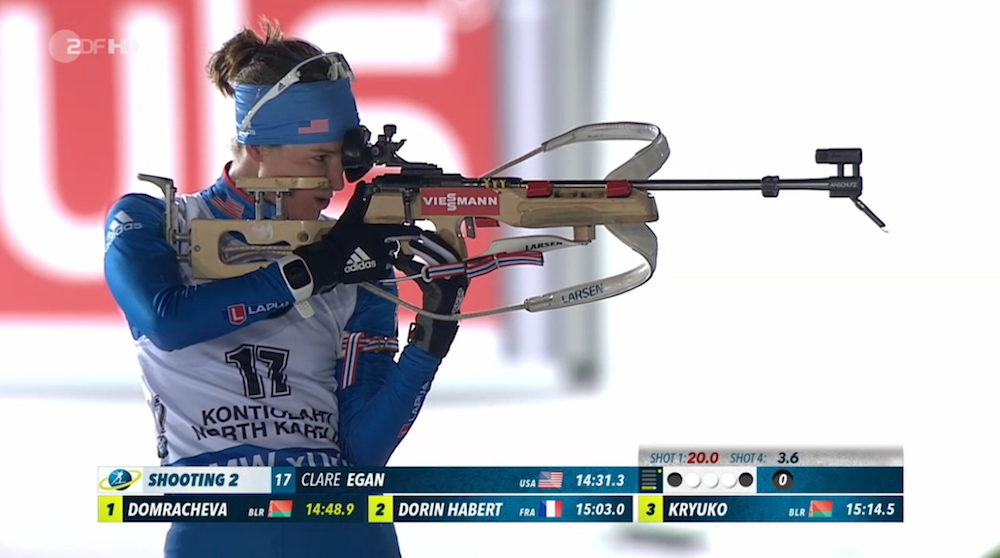
Clare Egan (US Biathlon) during her standing shooting of the IBU World Cup women’s 7.5 k sprint in Kontiolahti, Finland. (Screenshot: ZDF broadcast)
During Friday’s sprint, she noticed her skis were running really well.
“I can say without any doubt that we had the fastest skis today and that played a big role in my ski time,” Egan wrote. “I had a personal best ski time (rank) by at least 10 places today.”
After starting one bib and 30 seconds behind Domracheva, Egan knew she was having a good race when she could see the eventual winner for most of the first loop.
“Our skis were so fast that I honestly had to adjust my technique to account for the extra glide– exceptional!” she added. “On my last loop, I realized I was still ahead of Laura Dahlmeier, who started :30 seconds behind me, and I fought super hard to hold her off all the way to the finish line!
“I was shocked to have a career best with one miss,” Egan concluded. “But I had a major PR on my ski time rank, and this is biathlon! I’m very, very happy to have a great result, but happier about the performance behind the result.”
With their results on Friday, both Egan and Crawford earned starts in Sunday’s 12.5 k mass start, according to a provisional start list.
“I’ll have another opportunity tomorrow in the mixed relay and Sunday in the mass start, which is only the second of my career,” Egan wrote.
“I was pretty disappointed to not qualify for the mass start at the Olympics,” Crawford wrote. “My bad sprint had many far-reaching consequences. So I am glad I get another chance to go out there and fight with the best!”
Also for the U.S., Susan Dunklee finished 36th (+1:27.0) with three penalties (1+2), Emily Dreissigacker was 62nd (+2:15.7) with two misses (2+0), and Joanne Reid was 74th (+2:38.7) with two misses (0+2) as well.
Canada’s Emma Lunder finished 43rd (+1:48.0) with one miss (1+0), Julia Ransom was 58th (+2:07.9) with two penalties (1+1), and Sarah Beaudry finished 66th (+2:20.3) with two misses (1+1) as well.
This year’s Kontiolahti World Cup does not include a pursuit race. The single mixed relay and mixed relay are set for Saturday, followed by men’s and women’s mass starts on Sunday.
Jenna Sherrington racing at Biathlon Canada’s Youth World Trials in Valcartier, Quebec. (Photo: Jenna Sherrington/Instagram)
In an effort to showcase the North Americans competing at this week’s International Biathlon Union (IBU) 2018 Youth and Junior World Championships in Otepää, Estonia, we asked those qualifying athletes several questions about themselves — actually, we had them fill in the blanks. Here we have 16-year-old Jenna Sherrington, of Calgary, who is representing Canada at her first Youth World Championships.
In her last race of Youth Worlds, the youth women’s 7.5 k pursuit, Sherrington placed 39th (+5:28.1 with four penalties). She also finished 40th in the 10 k individual on Monday and 46th in the 6 k sprint on Friday.
***
“My full name is Jenna Sherrington but you can call me Jenna.
I was born and raised in Calgary, Alberta, and I learned to ski at age 2.
Jenna Sherrington getting some sunny training in on the Haig glacier near Canmore, Alberta. (Courtesy photo)
I spent the time between World Youth/Junior trials and Worlds training, preparing, going to school and coaching cross-country skiing to 5 year olds.
The hardest and most fun workout I did in the last training year to prepare for this was bicycle 1100 kilometers from Quebec City to Charlottetown with my Dad.
One thing I’m working on this season to improve my biathlon is being able to completely focus during a race. Last year I had quite a bit of trouble getting out of my own head while racing so I’ve been trying to improve that.
This is my first time in Estonia and first time racing internationally, and so far it’s been an incredible learning opportunity and experience.
One difference I’ve noticed between Estonia and Canada is the language is very different and they eat lots of potatoes.
One of the things I’m most excited about for World Youth/Junior Championships in Otepää is travelling to a new country and competing against the best youth biathletes in the world.
One race I’m especially targeting there is the sprint.
Watching the Olympics in the lead up to my own races was really inspiring to see the best biathletes in the world race as hard as they could for their country. One of my favourite moments of the Olympics was when Martin Fourcade won in the 15km mass start with a photo finish against Simon Schempp. I want to be like Laura Dahlmeier because she always has a smile on her face and it looks like she has a genuine love for the sport of biathlon.
At Worlds, I really hope I can chat/make friends with someone from Norway and ask them what it’s like to live in Norway and what the Norwegian culture is like.
My favorite thing at the breakfast where we are staying is the fruit, there’s always oranges or grapes, which is fantastic.
Before this trip, if you said “Estonia”, the first thing I’d think of would have been “sorry, where?”.
Now that I’m here, I’m pretty sure something I’ll always remember will be the people I meet and how incredibly sparkly the snow is.
If I had a totally free day here and didn’t have to worry about race fitness or training, I’d spend it skiing around on the absolutely breath taking trails that intertwine and surround the town.
The best way to follow me on social media is on Instagram @jennasherrington.”
Megan Bankes (Biathlon Canada) lunging at the finish of the IBU World Cup women’s sprint in Annecy, France, in December. She placed 65th. (Photo: Glen Crawford)
In an effort to showcase the North Americans competing at this week’s International Biathlon Union (IBU) 2018 Youth and Junior World Championships in Otepää, Estonia, we asked those qualifying athletes several questions about themselves — actually, we had them fill in the blanks. Here we have 20-year-old Megan Bankes, who is representing Canada at her second World Junior Championships after also competing at 2015 World Youth Championships. Bankes won gold in the junior women’s individual race at last year’s Championships. This season, she started the winter on the World Cup and contributed to a ninth-place relay effort by the Canadian women in Hochfilzen, Austria. Bankes was the sixth woman on the list for a five-woman Canadian Olympic Team in biathlon.
On Tuesday, Bankes anchored Canada’s junior women’s 3 x 6 k relay team to ninth place.
***
“My full name is Megan Bankes but you can call me Megan.
I was born and raised in Calgary, AB, and I learned to ski at age 4.
I spent the time before Worlds training in Canmore and Sjusjøen Norway.
My favorite workout I did in the last training year to prepare for this was rollerskiing up Highwood Pass, then running Ptarmigan Cirque, almost running into a grizzly on the way down, and having cookies waiting for us at the end with my Biathlon Alberta Training Center teammates .
One thing I’m working on this season to improve my biathlon is my shooting consistency.
Megan Bankes on the range in Sjusjøen, Norway. (Photo: Emily Dickson)
This is my second time in Estonia and fifth year racing internationally, and so far it’s been kind of chilly.
One difference I’ve noticed between Estonia and the Canada is their love of kefir.
One of the things I’m most excited about for World Youth/Junior Championships in Otepää is racing.
One race I’m especially targeting there is the relay.
Watching the Olympics in the leadup to my own races was fantastic. One of my favorite moments of the Games was watching Kikkan and Jessie crush it in the team sprint and also cheering on Canadians in every sport. I want to be like Laura Dahlmeier because she can pull off amazing races when it really counts, and she’s so strong.
At Worlds, I really hope I can chat/make friends with someone from Sweden and ask them about themselves and their racing.
My favorite thing at the breakfast where we are staying is the tea selection.
Before this trip, if you said “Estonia”, the first thing I’d think of would have been memories from my trip here 12 years ago with my family.
Now that I’m here, I’m pretty sure something I’ll always remember will be the knitting.
If I had a totally free day here and didn’t have to worry about race fitness or training, I’d spend it wandering around the old city in Tallinn.
Benita Peiffer competing this winter. (Courtesy photo)
In an effort to showcase the North Americans competing at this week’s International Biathlon Union (IBU) 2018 Youth and Junior World Championships in Otepää, Estonia, we asked those qualifying athletes several questions about themselves — actually, we had them fill in the blanks. Here we have 17-year-old Benita Peiffer, of Whistler, British Columbia, who is representing Canada at her first World Youth Championships.
Today in Otepää, Peiffer finished 11th in the youth women’s 10 k individual, +1:43.1 with one penalty.
***
“My full name is Benita Peiffer but you can call me B.
I was born Vancouver, BC and raised in Whistler BC and I learned to ski at Whistler Olympic Park as well as Lost Lake.
I spent the time between World Youth/Junior trials and Worlds training in Whistler to prepare, and then I came over to Europe early to do some racing in Pokljuka for Biathlon, and then I met up with the BC Ski Team to do some Cross Country Ski races in Zwiesel.
My favourite workouts I did in the last training year to prepare for this were the workouts we did in Sweden, intervals up sand dunes, swamp running, skiing in the Torsby tunnel, participating in roller ski races and doing some roller ski classic heats with a group of athletes on the BC Team and Development Squad as well as a huge group of Swedish athletes.
One thing I’m working on this season to improve my biathlon is to stick to my basics of shooting. I often get overwhelmed with everything and forget the basics as well as keeping a positive mindset because a negative attitude will never get me anywhere.
Canada’s Benita Peiffer, who finished 11th in the opening race of World Youth Championships. (Courtesy photo)
This is my first time in Estonia and third time racing internationally, and so far it’s been an amazing experience. The competition over here is definitely much harder than in Canada and has showed me how much harder I have to work if I want to get to the level of some of these athletes.
One difference I’ve noticed between Estonia and the Canada is the food. Lots of potatoes and the desserts have been very interesting.
One of the things I’m most excited about for World Youth/Junior Championships in Otepää is the Sprint race. It is one of my favourite races to compete in. It is a 6km race with two shooting bouts. It is the perfect distance for me and perfect amount of shooting for me. I don’t get too overwhelmed with the amount of shooting and I am able to leave it all out there on the course feeling satisfied with my effort.
Watching the Olympics in the leadup to my own races was very inspiring. One of my favourite moments of the Games was watching my cousin, Arnd Peiffer win gold in the men’s sprint. I want to be like Laura Dahlmeier because she is a very consistent athlete who won several medals at the PyeongChang Olympics.
At Worlds, I really hope I can chat/make friends with someone from the German team and ask them where they train in Germany because I am very interested in coming to Germany at some point to train and compete.
My favourite thing at the breakfast where we are staying is the fresh bread.
Before this trip, if you said “Estonia”, the first thing I’d think of would have been “Where?”
Now that I’m here, I’m pretty sure something I’ll always remember will be the beautiful scenery and weather here. We have been lucky to have many beautiful sunny training days.
If I had a totally free day here and didn’t have to worry about race fitness or training, I’d spend it doing a relaxed ski through the countryside followed by a walk through the town exploring what Otepää has to offer.
The best way to follow me on social media is on Instagram @benitapeiffer.
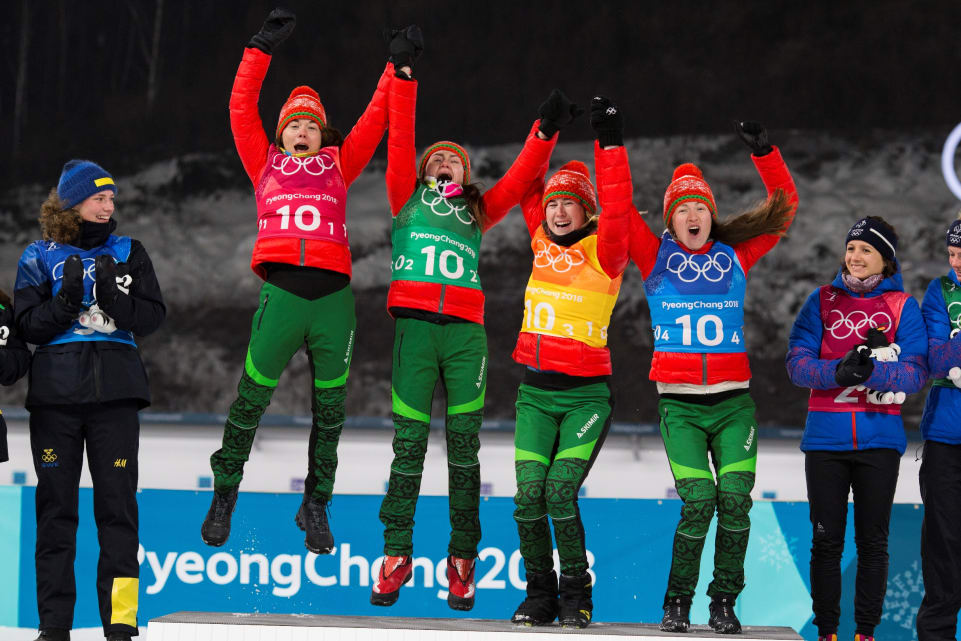
The Belarusian women’s biathlon team, with (from left to right) Nadezhda Skardino, Iryna Kryuko, Dzinara Alimbekava, and Darya Domracheva, celebrates winning a historic gold for their nation in the 4 x 6 relay at the 2018 Olympics in PyeongChang, South Korea. They were ranked 10th coming into the day. (Photo: IBU/Biathlonworld)
PYEONGCHANG, South Korea — Some things were the same on Thursday night: the attention-grabbing biathlon stadium announcer generating an atmosphere of stoke, thumping house music, and shivering yet engaged fans. Making it feel like true winter, a heavy snow squall settled in over the Alpensia Biathlon Center for the women’s 4 x 6-kilometer relay.
Ultimately, Belarus won gold in a time of 1:12:03.4 hours with Nadezhda Skardino, Iryna Kryuko, Dzinara Alimbekava, Darya Domracheva. Sweden’s Linn Persson, Mona Brorsson, Anna Magnusson, and Hanna Öberg took silver (+10.7), while France’s Anaïs Chevalier, Marie Dorin Habert, Justine Braisaz, and Anaïs Bescond claimed bronze (+17.6).
For the first few legs, however, all three medaling teams seemed an outside shot at the podium. On a windy and, for the first time at the Olympics, snowy evening, the win was up for grabs from the start.
After the first lap, a rainbow of suits came into the shooting range together, 7.8 seconds separating the leader from the field’s tail. America’s lead-off skier, Susan Dunklee, skied out of the range first after shooting clean in prone. The U.S. skier was followed by Ukraine, 2.9 seconds back. And Canada’s Sarah Beaudry had also cleaned without any spares to put her team in third, 7.1 seconds back.
Dunklee held her lead through the 2.9 k checkpoint and by 3.6 k, she was up to 8.1 seconds ahead of Japan chasing in second. Canada had fallen to 12th, 14.9 seconds back. With dumping snow and blustery wind before their second shooting round, it was Dunklee all entering the range all alone that was featured on the stadium’s jumbotron.
For her standing stage, Dunklee missed one target, but cleaned it with one spare. She left the range 5.2 second behind Italy’s Lisa Vittozzi, who had also cleaned with one spare. After the first leg’s final shooting stage, the field started to spread out. Beaudry used three spares to clean standing and avoided the penalty lap, returning to the course in 13th, 50.5 seconds out of first.
Susan Dunklee skiing the first leg of the mixed relay on Tuesday at the 2018 Olympics in PyeongChang, South Korea. She tagged the team in fifth and they went on to place 15th. On Thursday, she skied the U.S. women’s 4 x 6 k relay into second by the first exchange. (Photo: FlyingPointRoad)
“There’s some, as a friend of mine would call it, Disneyland snow, falling from the sky so it makes it exciting in the relay,” Beaudry told FasterSkier after her race. “Everyone shoots at the same time so I wouldn’t say anything is unfair. It makes opportunity. So hopefully my teammates can take advantage of that.”
Dunklee came through the 5.6 k checkpoint trailing Vittozzi by 7.2 seconds. At the first exchange, Italy tagged off first and Dunklee handed off to Clare Egan 7.6 seconds back in second.
“It has been a tough Games. We came in here with a lot of expectations and certainly haven’t really lived up to them,” Dunklee told FasterSkier after her leg. “It’s extremely frustrating. To think about every decision you make in your life over four years, with your best training in mind and your best performance in mind, and then getting sick at the wrong time is tough. The guys have struggled.
“We have had some bright spots with the girls; Emily and Joanne have carried us, they have had PR’s here. That is exciting,” Dunklee added, before looking up at the screen to see Egan skiing in third. “And this is exciting today. This is really exciting! Anything is possible.”
Beaudry tagged Canada’s Julia Ransom in 15th, 1:15 minutes out of first.
“I was really happy with my first lap and my prone,” Beaudry said after her first Olympic relay. “I tried to keep with the group on my second lap and I think that left me a little shaky in standing. I’m not too pleased with my two spares, but I mean, I missed three and I didn’t miss a spare, so at least shoot a spare, hit a spare.”
After the first loop of the second leg, Italy was still in first, with Dorothea Wierer at the helm. In prone, there was a reshuffling of leaders as Slovakia’s Anastasiya Kuzmina cleaned with one spare to move into first, 15.3 seconds ahead of Norway’s Tiril Eckhoff, who had cleaned with a single spare, in second. Egan cleaned without a miss and left the range in third (+17.3). Meanwhile, Wierer still had two targets standing after using all three spares, leaving her with two costly penalty laps and 1:11 minutes back in 13th.
Finland’s Kaisa Mäkäräinen shot clean to put her team in fourth, 23.9 seconds behind Kuzmina. France was sixth (+32.6), and Belarus ninth (+46.6). Canada’s Ransom shot clean without any spares and left the range in 12th (+1:08.3) while Sweden was 15th (+1:16.4).
While Kaisa Mäkäräinen moved into second behind Kuzmina on the next loop, Eckhoff and Egan followed them into the range in third and fourth, respectively. There, during an especially blustery standing stage, Kuzmina missed her first three shots and ended up with a penalty lap, which put her 20 seconds back in eighth. Wierer cleaned to reclaim first for Italy, just 0.9 seconds ahead of Mäkäräinen in second, who used two spares to avoid a penalty. Belarus’s Kryuko shot clean to leave the range in third (+7.9), and Egan hit five more shots without any spares to follow her in fourth (+10.7).
Ransom used three spares to avoid the penalty lap and headed back on the course in 10th (+44.2) for her final 2 k loop.
“Oh my gosh, I was really due for this,” Egan said after. “It’s by far my best race of the season so I couldn’t be more happy with my race.”
By the time the skiers came in for the second exchange, the order had changed again. Finland handed off in first, Italy second, 14.2 seconds back, Slovakia third (+16.1) and U.S. fourth (+16.8). Canada came through in 10th (+1:09.5).
“Kuzmina kept being behind me and then passing me,” Egan reflected. “I think every lap Kuzmina passed me so there is a lot of really fast skiers, most teams put their fastest skiers on their second legs. I tried to stay with them, but I can’t always do that. I did have people around me the whole time though so I was able to keep fighting.”
“All you can do is just leave it all on the track no matter what it is,” Ransom said of her race. “My standing was a little bit precarious, missing three from the clip. But I’m happy I was able to hit the precious spares. It was very gusty.”
Egan tagged off to Joanne Reid for the third of four legs. Reid slipped to sixth on her first loop and during her first prone shooting, she used three spares and had to ski a penalty lap, returning to the course in ninth, 33.6 seconds behind Italy’s Nicole Gontier, who cleaned with three spares, in first. Gontier skied just 0.4 seconds ahead of Slovakia’s Terezia Poliakova, who used one spare to clean.
Belarus had moved into third (+2.4), France into seventh (+19.2), while the Swedes sat in 11th (+1:33.6) and Canada, with Emma Lunder who had to ski a penalty, was still in 12th (+1:45.7).
As the leaders came in for their standing bout, it was Italy, France, Belarus, Norway, Finland, Slovakia, Poland, and U.S.A. Belarus’s Alimbekava took the lead after using one spare, Poland chased in second (+6.2), Slovakia was next, followed by Italy. The U.S. was back up to fifth (+28.1) after Reid used one spare to clean. France was sixth (+29.2) and Sweden eighth (+1:10). Lunder cleaned to put Canada in 11th (+1:24.7).
“I had a pretty good standing, but we need every second we can get,” Reid said after. “You never know what will happen in the next stage and the wind picking up. So even if we’re in fifth you never know. I was just trying to hang on on that uphill and give it everything I had.”
“I didn’t feel amazing, skiing, but I ripped off my standing with no spares, like, record fast, so I was really pumped about that,” Lunder reflected. “I moved up like a ton in the range there. So I think I tagged Rosanna in a decent position to be with some girls and fight a bit.”
Poland’s Krystyna Guzik caught Belarus’s Alimbekava and by the final exchange, it was Poland in first, France in second, Italy in third, and Belarus in fourth. Reid handed off to Emily Dreissigacker in sixth (+21.4) while Lunder tagged Rosanna Crawford in 13th (+1:22.6). Sweden exchanged in eighth (+59.1)
The skiers had maintained their order as they approached the range for the seventh round of shooting. Belarus’s anchor leg, Domracheva, shot clean to take the lead. France was now in second, Poland third, and the U.S. in seventh (+41.1), after Dreissigacker used two spares to clean. Sweden was back in ninth (+41.9), while Crawford cleaned with one spare and out for her second loop in 12th (+1:28.6).
Coming into the final shooting shooting round, Belarus teetered on a lock for gold, 24.8 seconds ahead of France in second. Poland still clung to third, 34.5 seconds back, while Sweden was now ranked seventh, 56.4 seconds back. The U.S. had moved back to tenth, while Canada was right behind them in 11th.
Domracheva missed three targets standing, but used three spares to clean and avoid any penalties to hang onto first. France’s Bescond needed three spares to clean but stayed out of the penalty lap and headed out on the final loop in second (+6.4). Sweden’s Öberg cleaned her second-straight stage without any misses to move all the way up into third (+10.9).
For the U.S., Dreissigacker used her three spares to clean standing, but experiencing unsteady winds, took her time to steady her shot and left the range in 12th (+1:20.2). Canada’s Crawford used one spare to clean and moved up to 11th (+1:19.9).
“It was really windy for my standing,” Crawford noted. “I really waited it out.”
“It wasn’t great,” Dreissigacker, a first-time Olympian, said of her race. “I didn’t feel that great skiing, might’ve went out a little hard, and the shooting just wasn’t good either. I was happy to at least hit them all with my spares, but standing especially, I took all three spares and the wind came up like crazy, right before I started shooting my spares, so I had to like stand there and wait out the wind, which cost me a lot of time.”
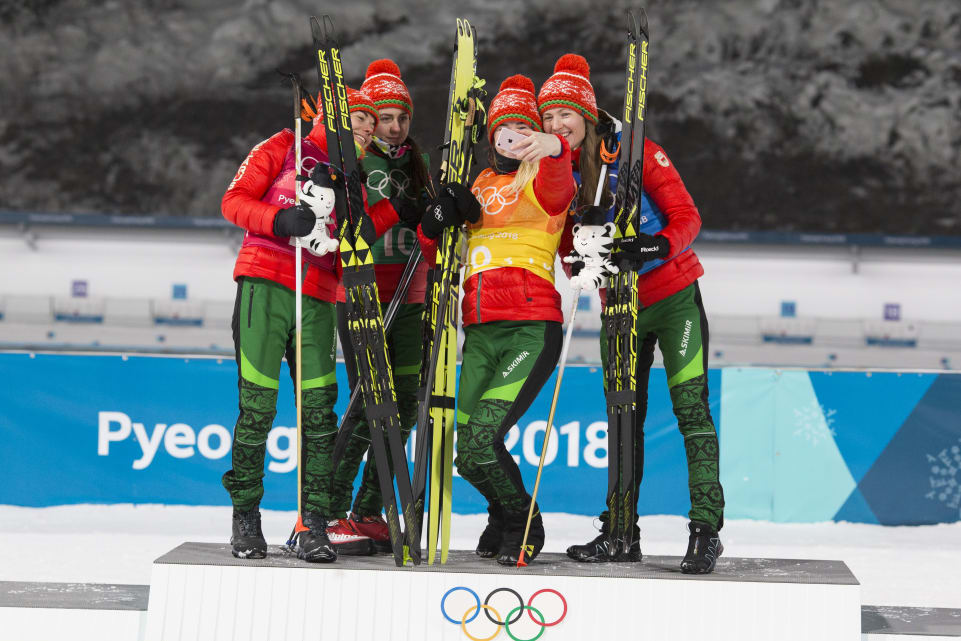
The Belarusian women’s biathlon team, with Nadezhda Skardino, Iryna Kryuko, Dzinara Alimbekava, and Darya Domracheva, snaps a podium selfie after winning their first relay gold on Thursday at the 2018 Olympics in PyeongChang, South Korea. (Photo: IBU/Biathlonworld)
Over the last 2 k of the race, Domracheva kept her competition behind her and crossed the line first for Belarus’s first relay gold in 1:12.03.4 (after its mixed relay team placed fifth two days ago).
Öberg passed Bescond to claim silver for Sweden, 10.7 seconds back, while Bescond anchored France to bronze (+17.6), ahead of Norway in fourth (+29.7), Slovakia in fifth (+38.4), Switzerland in sixth (+43.5), Poland in seventh (+43.6), Germany in eighth (+53.9), Italy in ninth (+1:04.1), and Canada in 10th (+1:33.4). The U.S. finished 13th (+2:01.9) of 18th teams.
With the first-place finish, Domracheva is the most decorated female biathlete in Olympic history, with six medals (four golds, a silver and a bronze) between three Olympics. Her husband, Ole Einar Bjørndalen of Norway, is the most successful Olympic biathlete of all time with 13 medals.
“I didn’t think that before you said it,” Domracheva, 31, said of her medal record during the post-race press conference. “Of course it was a lot of challenges for me on the way. Such days and such medals mean that it’s important to believe in yourself, important to believe in your team and overcome some difficulties, and then all doors are open for you.”
In the last four Winter Olympics, France has claimed three relay medals. Before Thursday’s bronze, their most recent was silver in 2010 and prior to that, bronze in 2006.
Sweden’s silver medal was its first in the women’s 4 x 6 k relay at the Olympics.
“This team worked together really hard for the last couple of years,” said Öberg, who won her first medal — gold — in the 15 k individual race earlier in the Games. “That we are here today is unbelievable. I’m really happy to share this medals with the rest of the girls.”
Crawford caught Ukraine’s Anastasiya Merkushyna in her final lap to anchor Canada to 10th while the U.S. finished three places later in 13th.
“My last loop I could hear Julia [Ransom] and Sarah [Beaudry] all around the course,” Crawford told FasterSkier. “They managed to be everywhere really cheering me on, and that fueled me to catch the Ukrainian.
“I’m just so proud of this women’s team,” Crawford added. “We fought so hard out there today. We’ve been through a lot this summer and really supported each other. And I’m just really proud of the team and I think biathlon in Canada has the potential to have a bright future.”
Martin Fourcade waves the tricolore down the finishing straight as France claims gold in the biathlon mixed relay on Tuesday at the 2018 Olympics in PyeongChang, South Korea. (Photo: FlyingPointRoad)
PYEONGCHANG, South Korea — In its four-card-deep deck, the French biathlon team had an ace. Anchoring France’s 2 x 6 + 2 x 7.5-kilometer mixed relay was Martin Fourcade. The 29 year old had already taken two individual gold medals at these Winter Games. The final leg of Tuesday’s race presented the opportunity for another.
Coming through the last exchange, it was Germany’s Erik Lesser tagging off to Arnd Peiffer. Without Fourcade chasing them, Germany’s chances of a medal would have seemed certain.
Peiffer, who learned around 1 p.m. that afternoon that he would start the relay in place of Simon Schempp, who reportedly was feeling under the weather, was first into the range after one loop for his round of prone shooting. There, Peiffer missed two shots, but using two spares, hit the remaining two targets and stayed out of the penalty lap.
Then came Fourcade. The Frenchman shot clean. Skiing into the range with France was Norway’s Emil Hegle Svendsen and Italy’s Dominik Windisch. Svendsen and Windisch both used one spare each to clean and steer clear of the penalty lap as well.
Out on course, Peiffer had a 6.1-second buffer between himself and Fourcade. Windisch was the third racer to depart the range, 16.3 seconds out of first, and just 0.1 seconds behind him was Svendssen.
The 6.1 seconds separating the two frontrunners was soon down to zero. Fourcade attacked on the first uphill, passing the German and was the first into the range for the standing shooting — exactly the type of stage Fourcade craves.
Five days ago, Fourcade was in a similar situation. During the men’s 20 k individual race, he skied into the range for the final round of shooting with a comfortable lead. The almost-always clutch Frenchman missed the last two targets, losing the gold and finishing fifth on the day.
Martin Fourcade cleaning his final five targets of the day to secure gold for France in the mixed relay at the 2018 Olympics in PyeongChang, South Korea. (Photo: FlyingPointRoad)
During Tuesday’s mixed relay, Fourcade was on his A-game. Five pings heard throughout the stadium and five targets down. With his remaining 2.5 k to go, another medal for France and Fourcade was certain. Not long after, it became clear that medal would be gold.
Back in the range, Peiffer struggled, using three spares and having to ski a penalty loop. Meanwhile, Svendsen used one spare to clean and Windisch two. Svendsen slid into second place, 34.3 seconds behind an already long-gone Fourcade.
Windisch left about 15 seconds after the Svendsen. After emerging from the penalty lap, Peiffer skied up behind Windisch. In a moment of déjà vu, Fourcade carrying France’s fluttering flag crossed the finish line first in a time of 1:08:34.3 for the gold medal. Svendsen held his own with the third-fastest anchor lap to secure silver for Norway, 20.9 seconds behind Fourcade.
For Fourcade, it was his fifth gold medal in two Olympics and his first in a team event. France last won the mixed relay at the world-championships level at 2016 World Championships in Oslo, Norway.
Asked what it was like capturing his fifth Olympic gold, Fourcade responded at the press conference, “Tonight it’s not about numbers, it’s not about personal, it’s a team adventure that began in 2009 in the world champs in [PyeongChang] Korea, and tonight it’s a really big emotion for the team and all the crew because we are individual athletes and the emotion of an individual Olympic gold medal is amazing, but when you can share it with your teammates it’s something really much more incredible.”
“I think for the Norwegian team, we have a big priority on this relay,” Svendsen said at the press conference. “We really like it a lot, great to race both women and men together. You can see the best biathlon nations … so great event, it was very exciting.”
Italy’s Dominik Windisch (r) celebrates bronze for his team in the mixed relay, which he took by 0.3 seconds over Germany’s Arnd Peiffer (l) at the 2018 Olympics in PyeongChang, South Korea. (Photo: IBU/Biathlonworld)
The battle for third and fourth came down to a contentious last 100 meters.
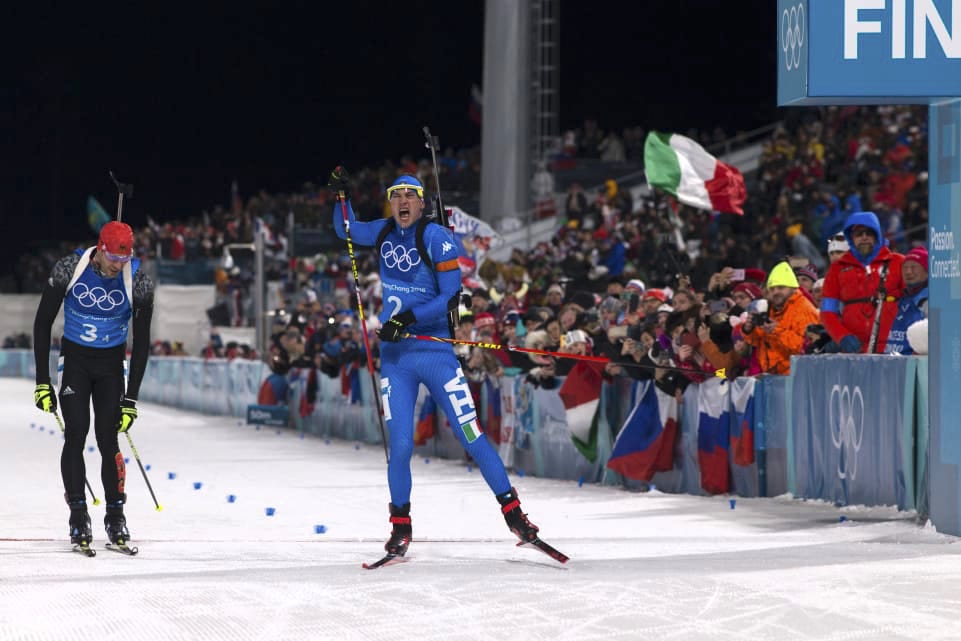
As they rounded into the finishing straight, Peiffer was skiing in the left lane and Windisch in the right. In one final push to the line, Windisch crossed over into the Peiffer’s lane and took third place and bronze medal by 0.3 seconds ahead of him, 26.9 seconds after Fourcade.
Peiffer crossed in fourth place (+27.2) and Germany subsequently filed a protest that Windisch obstructed Peiffer. Ultimately, the protest was denied and the results stood.
Speaking to German broadcaster ARD after the race, Peiffer initially said Windisch’s move was within the rules. However, after viewing the replay, he changed his mind.
“I believe he [Windisch] would have beaten me if he’d just remained straight ahead in his corridor and not skied such a curve,” Peiffer later told ARD, according to a translation. “That’s what I also told him. I told him I congratulate him because I believe he was better today. I just did a poor job today, that’s how it even came to this situation…
Germany’s mixed relay anchor Arnd Peiffer during his last shooting stage on Tuesday, where he incurred a penalty and slipped out of gold-medal contention and ultimately finished fourth in the event at the 2018 Olympics in PyeongChang, South Korea. (Photo: FlyingPointRoad)
“I took another look at it now, and to me it’s a rule violation,” Peiffer added. “But from experience I know that the jury never makes any decision or generally denies appeals. Just because they don’t have the courage, I believe. I am sorry for the other three, because they did a great job. I don’t believe I would have deserved a medal today, but it’s always sad if rules get broken.”
During a post-race press conference, the issue of Italy’s move was raised again. One reporter directed a question at Windisch, asking about his thoughts on the filed complaint.
“It happened realy really fast because it come down from the downhill and I was convinced to do the right thing because I was in front of Peiffer,” Windisch said.“The jury had a long, long meeting to take this decision and they decided for us. I am really happy about this, so I think they had their reasons and I am happy for Italy.”
The same reporter posed the question to Fourcade, stating that the move seemed like one the Frenchman has done in the past.
“As Dominik Windisch told you it happened really fast in a situation we are not fully able to decide really quickly because we already have 7.5 kilometers in the legs,” Fourcade said. “When you are looking a the picture you can see it’s probably not the best decision Dominik took, but in the end it changes nothing because Dominik is stronger than Arnd in the sprint and he didn’t change anything with the final results. I think and I’m sure if it happened again he would choose another line.”
Italy’s Strong Start
Italy’s Lisa Vittozzi (2), alongside Germany’s Vanessa Heinz, leads the first leg of the 2 x 6 + 2 x 7.5 k mixed relay on Tuesday at the 2018 Olympics in PyeongChang, South Korea. She went on to hand off in first, and Italy ultimately earned bronze in the event. (Photo: FlyingPointRoad)
In the first leg of the race, Italy’s Lisa Vittozzi and Germany’s Vanessa Heinz tagged off in first and second, respectively, with Germany 2.2 seconds back at the exchange after both skiers shot clean without any spares. Vittozzi hanged off to Dorothea Wierer, while Heinz tagged Germany’s strongest leg Laura Dahlmeier, who took gold in the sprint and pursuit to start the Games and placed third in the 15 k individual.
Dahlmeier shot clean in the first prone and used one spare to clean standing, tagging Lesser in first, 29.9 seconds ahead of Italy, at the second exchange.
Norway’s Johannes Thingnes Bø racing the third leg of the mixed relay at the 2018 Olympics in PyeongChang, South Korea. After being tagged in 10th, he skied up to fourth at the last exchange, and Norway ultimately finished second. (Photo: FlyingPointRoad)
Norway’s ascent to second place involved a strong third leg from Johannes Thingnes Bø. Using just a single spare to clean his two stages (0+0, 0+1), Bø overcame two less-than-stellar legs from teammates Marte Olsbu (0+2, 0+1) and Tiril Eckhoff, who had a penalty (0+2, 1+3). When Eckhoff tagged Bø, he was in 10th, 1:24.4 minutes behind Germany in first. With the fastest third-leg course time, Bø handed off to Svendsen in fourth place, 33.1 seconds behind the Germans and half a second behind Italy.
Canada 12th, U.S. 15th
Canada finished the relay in 12th (+2:36.7) after skiing three places up from their bib number.
Rosanna Crawford skiing the first leg of Canada’s mixed relay at the 2018 Olympics in PyeongChang, South Korea. She tagged off in 11th and Canada went on to finish 12th. (Photo:FlyingPointRoad)
Rosanna Crawford skied the opening leg, using two spares, one each in prone and standing, to avoid the penalty lap.
“I tried to be super focused in prone,” she told FasterSkier after. “I went on to have one miss, that was just a bad trigger pull on my part. Skiing wasn’t great, but I just tried my best to stick with the women around me and give Julia the best chance I could.”
Crawford tagged teammate Julia Ransom in 11th, 34.7 seconds out of first. Ransom shot without a miss in prone and used two spares to clean standing. She maintained 11th while tagging Brendan Green 1:44.7 minutes behind the leaders.
After what Ransom considered a less-than-ideal personal start to the Olympics, she was pleased with how she felt racing on Tuesday.
“Today I felt like I could actually push a little harder and have fun racing,” she said.
Canada’s Brendan Green racing the third leg of the mixed relay at the 2018 Olympics in PyeongChang, South Korea. (Photo: FlyingPointRoad)
Green used three spares in total (0+1, 0+2) but remained clear of the penalty lap. He came through the last exchange in 14th, 2:27.9 out of first.
“I thought the wind would make it a little bit challenging today,” Green said after finishing his leg, with Canada’s fourth-leg skier, Christian Gow, still on course. “It was up a bit from the other days, [but] thankfully it was fairly consistent. This won’t be the result we are hoping for but it’s a good primer for the men’s and women’s relays later this week and so looking forward to that.”
In his first mixed relay and first time anchoring a championship relay, Christian Gow headed out on the final leg to pick off some places.
Canada’s Christian Gow racing to 26th in the men’s 20 k individual for his best non-relay result at his first Olympics in PyeongChang, South Korea. (Photo: FlyingPointRoad)
“I knew there would be a bit more pressure depending on the position that we were in when I got tagged because all the teams were putting their strongest guys last,” Gow said after. “It’s some pretty big names when you’re looking at the list. You’re like, ‘OK, there are some of my idols,’ so there’s a bit more pressure there, but I have been feeling pretty good.”
The 24-year-old Gow shot clean and then used two spares in standing, racing the ninth-fastest last leg to put Canada in 12th at the finish (+2:36.7).
“I think Nathan [Smith] one time told me you can’t idolize your competition, which is very true,” Gow said of his teammate and fellow Olympian. “I think I get a little better at that every year, believing in myself a little more and not looking at the big names I’m racing as untouchable or anything like that. I am especially happy with how I have been doing that this year. You try to handle it just like any other race and it doesn’t matter who the guy is next to you, it’s what you do in the race to beat them.”
Julia Ransom racing the second leg for Canada in the mixed relay at the 2018 Olympics. She kept the team in 11th and they went on to place 12th. (Photo: FlyingPointRoad)
Four years ago at the Olympics in Sochi, Russia, the Canadian mixed relay finished 11th. As the race was still going on Tuesday, Crawford said a top eight would be a good result and top six would be “the dream result.”
Despite their goals, Ransom, a first-time Olympian, said they hadn’t felt any added pressure coming into the mixed relay.
“… Everybody on the team knows that we’re all trying our best and are gonna bring our best to the day,” Ransom, 25, said of the team’s effort on any given relay day. “It’s an unsaid sort of encouragement, I guess.”
For the U.S., Susan Dunklee skied a strong first leg, putting the team in fifth at the first exchange, 23.8 seconds out of first. She used two spares to clean prone and hit every target in standing (0+2, 0+0).
Susan Dunklee (center, in all blue) leading out for the U.S team in the first leg of mixed relay at the 2018 Olympics in PyeongChang, South Korea. She handed off in fifth and the team ultimately finished 15th. (Photo: FlyingPointRoad)
“I definitely felt better today than I did in the individual,” Dunklee said, referring to the 15 k race where she placed 19th. “I was closing on the lead group for the first kilometer or so and then by the top of the big hill, I kind of ran out of steam a little bit and was just trying to get into the finish.”
After being tagged in fifth, right behind the Czech Republic* in fourth, Joanne Reid hung in contention in sixth after cleaning prone without any spares. But in standing, she missed all five targets and used all three spares, ultimately having to ski three penalty laps. She went on to tag Tim Burke in 18th, 3:10 minutes back.
“It went poorly,” Ransom said after. “… The best I could do was just try and stick on and hand over with something they could work with, and that didn’t really work out for me today.”
“I guess the strategy was once I got tagged try to make some time, try to get in contact with at least one other team so that Lowell could have someone to chase,” Burke said.
Tim Burke racing the third leg of the U.S. mixed relay at the 2018 Olympics in PyeongChang, South Korea. After being tagged in 18th, he moved the team into 16th and they ultimately finished 15th. (Photo: FlyignPointRoad)
Burke in fact caught two other teams, shooting without a miss in prone and using three spares to clean standing (0+0, 0+3), and tagging teammate Lowell Bailey in 16th (+3:24.4).
The U.S. anchor leg, Bailey used one spare in prone and none in standing (0+1, 0+0). He skied the seventh-fastest anchor leg and finished the race in 15th (+3:31.1) out of 20 teams.
“We actually had decent performances, it was really just one bad stage,” Bailey said. “Joanne had a good race otherwise and Susan had a great start, Tim had a solid race, I feel good about my race, so unfortunately, it’s eight stages not seven, but I think everyone gave everything they had and that’s the way biathlon goes. Some days go your way and some days don’t.”
Olympic biathlon racing continues Thursday with the women’s 4 x 6 k relay.
*Note: After her race, Dunklee told reporters about her collision with the Czech Republic’s Veronika Vítková as the two first-leg skiers came through the exchange with several others. The crash broke Vítková’s rifle right after she tagged off in fourth, just ahead of Dunklee.
“I feel really bad,” Dunklee said. “I tangled with [Vítková] in the tag-off zone and she tripped and broke her rifle and that just puts a real damper on everything. So that’s sad. … It doesn’t affect her race today, but it certainly affects her races going forward. Stocks are highly customized pieces of equipment and you can spend months tinkering with them to get them to fit you just right, so it’s not easy to fix them when they break.”
The Czech team went on to finish eighth (+1:39.3).
Germany en route to a clean sweep of the podium in the men’s nordic-combined individual large hill/10 k on Tuesday at the 2018 Olympics in PyeongChang, South Korea, with Johannes Rydzek (5) leading Fabian Rießle (6) and Eric Frenzel (4). They went on to place first, second and third, respectively. (Photo: FlyingPointRoad)
A few shooting errors by pursuit bronze medalist Anais Bescond were not enough to derail France, as the team of Marie Dorin Habert, Bescond, Simon Desthieux, and Martin Fourcade took gold in the mixed relay. Skiing the first leg, Dorin Habert shot clean and tagged off just seven seconds behind the leading team from Italy. Bescond then used four spare rounds over the course of her relay leg, dropping the team to fourth (+48.9) at the halfway point. But both Desthieux and Fourcade shot 10/10, capitalized on the errors of others, and ended up with a clear 20.9 second margin for gold at the finish.
Susan Dunklee put the U.S. in fifth after the first leg of the mixed relay. (Photo: FlyingPointRoad)
Norway came back from a rough start to earn silver despite a whopping eleven spare rounds and a penalty loop. Marte Olsbu had three spare rounds to tag off in ninth, 32.8 seconds back, and then Tiril Eckhoff used two spare rounds in prone and then took a penalty loop in standing. But Johannes Thingnes Bø used just one spare round and skied the team from tenth to fourth, in contact with the medal pack, on his relay leg, and then Emil Hegle Svendsen used one spare round in each shooting stage to climb into a clear second; he skied alone on the final loop before crossing the line for silver.
There was controversy about bronze, however. Germany had led much of the race thanks to a solid leg by Vanessa Hinz to start and then a brilliant leg by Laura Dahlmeier; Erik Lesser also excelled, and at the third exchange the team had used just two spare rounds and had a 32.6-second lead on the field. But sprint gold medalist Arnd Peiffer couldn’t keep it together and first used a spare round in prone, then took a painful penalty loop in standing.
He exited the loop just as Italy’s Dominik Windisch went past. Lisa Vitozzi had put Italy in the lead after one leg thanks to perfect shooting, and despite three spare rounds Dorothea Wierer had tagged off in second at the halfway point. Lukas Hofer had maintained that position and Windisch was really only in fourth because of three of his own spare rounds.
Windisch and Peiffer battled all the way around the final 2.5 k, with Windisch leading the final downhill; the pair were nearly even coming into the stadium, but Windisch sprinted for the finishing lanes and in doing so angled from one far side of the trail to the farthest finishing lane, just barely getting there ahead of Peiffer and debatably choosing a lane before the lane markings began. Peiffer, who had skied a straight course all the way from the downhill into the finish, was forced to then switch lanes and couldn’t regain the momentum to keep up with the Italian, who crossed the line in third place.
The Germans protested, but the race jury ultimately decided to keep the Italians in third place, awarding them bronze, and the Germans finished fourth.
“The jury has decide to keep the bronze medal for Italy; Peiffer did not have to alter his speed, therefore no reason to disqualify Windisch,” the IBU stated in a tweet. (The response to that tweet has nearly unanimously condemned it as the wrong decision.)
The IBU 2016 Competition Rules give only a vague definition of obstruction, stating, “It is strictly forbidden to impede other competitors in any way at any time during the competition.”
The Canadian team of Rosanna Crawford, Julia Ransom, Brendan Green, and Christian Gow finished 12th, +2:36.7, with nine spare rounds.
The U.S. team of Susan Dunklee, Joanne Reid, Tim Burke, and Lowell Bailey finished 15th, +3:31.1, with three penalty loops and nine spare rounds.
Germany pulled off a podium sweep in the second nordic combined combined competition of the Olympics, with Johannes Rydzek, Fabian Riessle, and Eric Frenzel earning gold, silver (+0.4 seconds), and bronze (+0.8 seconds), respectively. They had been ranked fifth, sixth, and fourth after the jumping round on the big hill, but edged Norway’s Jarl Magnus Riiber off the podium. Riiber had the second-best jump of the day and ended up just 2.8 seconds out of a gold medal. Japan’s Akito Watabe topped the jumping scores and finished fifth, +12.5 seconds.
For the U.S., Bryan Fletcher led the way again and just like in the normal hill competition, finished 17th. This time he was ranked 23rd after the jump and made up six places to cross the line +1:42.9. Ben Berend, Ben Loomis, and Jasper Good finished 39th (+4:28.2), 40th (+4:38.8), and 43rd (+5:50.2).
The women’s biathlon 12.5 k mass start medalists at the 2018 Olympics in PyeongChang, South Korea, with Slovakia’s Anastasiya Kuzmina (c) in first, Belarus’s Darya Domracheva (l) in second, and Norway’s Tiril Eckhoff (r) in third. (Photo: IBU/Biathlonworld)
Slovakia’s Anastasiya Kuzmina made her intentions pretty clear early on at these Olympics.
“I am missing my brother,” she said when asked of her younger brother, Anton Shipulin, who was one of the Russian athletes banned from competing at the 2018 Games in PyeongChang. “I hoped to the last moment that he will be able to compete here … I am really sorry about what happened and that my brother is not here. I am here to fight for medals for my entire family. I won the one medal, and I want to win another medal for my brother.”
That was after she placed second in the women’s 10-kilometer pursuit on Monday. Two days before that, she had finished outside the medals, 13th, in the Olympics’ opening biathlon sprint.
But Kuzmina, who was born in Tyumen, Russia, and started racing for Slovakia in 2008, has been an all-around threat in the sport for some time. At her first Olympics in 2010 in Vancouver, British Columbia, Kuzmina won her first Olympic gold in the sprint and took silver in the pursuit.
Four years later, at the 2014 Olympics in Sochi, Russia — the Games that would later lead to her brother and multiple other top Russians being sanctioned for their alleged involvement in a systematic nationwide doping scandal — Kuzmina, still racing for Slovakia, racked up her second Olympic gold in the sprint.
She had a child after each Olympics yet came back, Olympic cycle after Olympic cycle, to dominate at the highest level of the sport.
Now 33 and in her third Olympics, Kuzmina raced to second in both the pursuit and 15 k individual on Thursday in PyeongChang. Then, on Saturday, in the last non-relay event of the championships and on yet another windy evening, she captured her third-career Olympic gold — winning the women’s 12.5 k mass start by 18.8 seconds in 35:23.0 minutes.
At a post-race press conference, she dedicated that medal to her adopted nation.
“I got my third medal here,” Kuzmina stated though a translator. “The first medal was conquered for me. The second one was conquered for my brother because I was sad that he is missing here and he was supporting me, was able to support me. And now the third medal is for entire Slovakia, for my team, and for many people which were supporting me in the hard times.”
Slovakia’s Anastasiya Kuzmina with her nation’s flag celebrating her win in the women’s 12.5 k mass start at the 2018 Olympics in PyeongChang, South Korea. (Photo: IBU/Biathlonworld)
While Kuzmina’s win was resounding — she led from the first loop to the finish — it didn’t come without a blip. After cleaning three consecutive stages in the prone-prone-standing-standing mass-start format, she missed one in the final shooting bout. But even after a penalty lap, Kuzmina was still 24.7 seconds clear of Domracheva in second.
Leading into the range for each bout, Kuzmina generally cleaned quickly (shooting the fastest time on the first prone), slowing down slightly to hit the last shot of her second prone and a little bit more so on the third stage (17th-fastest shooting time) to ensure she stayed out of the penalty lap. Her last time in the range without anyone around her, Kuzmina posted the 30th-ranked shooting time and lost at least 20 seconds with her miss, but the win was still hers.
With her third gold, she became the first female biathlete to win at three consecutive Olympics. At Saturday’s press conference, she explained that she had thought her best chance for that medal would be in the sprint.
“When that didn’t happen I was really sad and nervous before the next races,” Kuzmina said. “But it happened here and the race was mass start, a different event than in Vancouver and Sochi, and it’s an incredible feeling. Nine years ago at the 2009 World Championships here in PyeongChang I won the first-ever medal for the Slovak Republic, for my homeland, and it was a silver medal and the race was mass start. I wanted to repeat it and to be again with a medal here in the same event in the same place, just nine years later.”
She’s not sure if she’ll have another kid over the next four years, or if she’ll be at the 2022 Olympics to try to win golds in four different Games.
“The next Olympics, at the moment I don’t know if I will quit my career or not or how long I will compete, how many years,” she said. “But I am not sure that I will be able to survive the next four years and compete in the next Winter Olympics.”
For Belarus, Domracheva claimed her first medal of the Games in second, after placing ninth in the sprint, then 37th in the pursuit and 27th in the 15 k individual. The silver was her fifth-career Olympic medal after she won three races in Sochi (pursuit, individual and mass start) and took bronze in 2010 in the 15 k individual.
Like Kuzmina, Domracheva has also been raising a small child in the leadup to PyeongChang. She and her Norwegian husband Ole Einar Bjørndalen, the most decorated Winter Olympian of all time with 13 medals, welcomed the birth of their first child, Xenia Bjørndalen, on Oct. 1, 2016.
Domracheva, 31, put herself in second on Saturday by the second stage, after cleaning both prone stages. She chased Kuzmina on the third loop, skiing less than 10 seconds behind her and at least 15 seconds ahead of Germany’s Denise Herrmann and Italy’s Dorothea Wierer in third and fourth. On the third shooting stage that followed, Domracheva shot a miss and had to ski a penalty lap, putting her in fifth and 44 seconds behind Kuzmina in first.
Wierer moved into second with clean shooting, setting out on the fourth loop 28 seconds behind Kuzmina.
On the final shooting, Wierer had her costly miss of the day, which dropped her to seventh and 39 seconds back. While several of the top contenders incurred penalties on that last standing, Domracheva cleaned to reclaim second, and Norway’s Tiril Eckhoff cleaned when it counted to leave the range in third, 9.3 seconds behind Domracheva.
While Kuzmina skied the overall fastest course time, her final loop only needed to be third fastest to secure the win. Heading into the final downhill that rounded into the stadium, she grabbed a Slovakian flag from one of her team’s staff members running beside her. The wind blew it directly into her face as she tried to wave it in front of the crowd, but it didn’t derail her nor erase the huge smile on Kuzmina’s face as she finished nearly 19 seconds clear of second place.
Domracheva skied the second-fastest last loop (and third-fastest course time overall) to claim second, a result she was pleased with.
“It was a tough race … because it was so high pressure during all races before,” Domracheva said at the press conference after. “The toughest was understanding that it was my last chance for an individual medal in these Games. And it was so important to keep this focus and continue to believe in yourself and I am very very happy that I have done that so well and took this silver medal.”
She acknowledged that several of her competitors were in a similar position of seeking a medal at these Games, including but not limited to Finland’s Kaisa Mäkäräinen (who finished 10th on Saturday with two penalties) and Eckhoff, who’s previous best result this week was ninth in the pursuit (Eckhoff is a two-time bronze medalist from 2014, in the mass start and relay).
“I knew that I was in some company of the girls who are quite strong, but who were so unlucky from the beginning of the Games,” Domracheva said. “And what kind of pressure … understanding that you try to do the best that you can, but something went wrong in the previous races, and this understanding of course gave me some kind of pressure. It was important to overcome this situation and start this mass start from zero.”
Eckhoff, 27, who overcame two penalties (1+0+1+0) en route to bronze (+27.7), attributed her result to some luck.
“I was lucky today and took a medal, but all year I trained for this, and I guess Kaisa did the same,” Eckhoff said at the press conference. “I was lucky, she was not. It’s hard for everyone I think, because of the conditions. And I know, Darya said it as well, it’s really tough when you don’t succeed here. And I am very happy that I managed it today.”
While the medalists skied into the finish separately and without any close competition, the race for fourth was a close one with Italy’s Lisa Vittozzi edging Sweden’s Hanna Öberg, Wierer and Belarus’s Nadezhda Skardino. She claimed fourth (+45.6). Öberg placed fifth (+46.5), Wierer sixth (+47.3), and Skardino seventh (+47.9), ahead of Norway’s Marte Olsbu in eighth (+51.6), France’s Marie Dorin Habert in ninth (+57.9) and Mäkäräinen in 10th (+1:00.9).
Only two out of 30 cleaned on Saturday, Skardino and Poland’s Monika Hojnisz in 15th (+1:36.2).
Germany’s Laura Dahlmeier finished 16th (+1:47.1) after two early penalties (1+1+0+0). She started the race by keeping pace with Kuzmina on the first loop as the two of them slightly gapped the field before the first prone. There, Dahlmeier missed one to drop to 22nd and about 35 seconds back. She missed one more on the second prone, which put her in 21st and 1:12.4 out of first. Previously, Dahlmeier had won two races this week (sprint and pursuit) and finished third in the 15 k individual.
No North Americans qualified for either of the mass starts. The men’s 15 k mass start is scheduled for Sunday at 6:15 a.m. EST.
It wasn’t the wire-to-wire triumph that Norway sometimes achieves, but the pre-race favorites got the job done despite a scare midway through, thanks to dominant skiing by Ragnhild Haga and smooth strength from anchor Marit Bjørgen.
Norway took gold in the 4 x 5 k relay by two seconds over Sweden in 51:24.3 minutes. Olympic Athletes from Russia took bronze (+43.3), Finland fourth (+1:02.6), and the United States fifth (+1:20.5).
The first leg went out with Natalia Nepryaeva of Russia setting a blistering pace, fracturing the field almost immediately. A number of racers tried to stay with her only to get shot off the back of the pack. Taking a different pacing strategy, Slovenia’s Anamarija Lampic made up ground in the final section of the first leg to tag off in second, with Norways’ Ingvild Flugstad Østeberg third, all within a few seconds of each other.
Part of Nepryaeva’s fracturing of the field led to U.S. lead skier Sophie Caldwell getting dropped, to tag off 1:01.5 minutes back in 11th place.
In the second leg, Charlotte Kalla of Sweden and Kerttu Niskanen of Finland clocked the fastest times, making up 24.4 and 9.9 seconds that had been lost to Russia and Norway by their teammates Anna Haag and Aino Kaisa Saarinen, respectively. In the meantime, Astrid Uhrenholdt Jacobsen of Norway had a disastrous relay leg and notched just the eighth-fastest split time, falling to fourth.
Yulia Belorukova of Russia continued to lead the race on that second leg, but Kalla tagged off at the end of the classic portion just 1.4 seconds back, and Niskanen in third (+10.1). Sadie Bjornsen made up three places to tag off in eighth (+1:05.2).
Jacobsen tagged Haga 29.8 seconds out of first. From that point, Haga gradually reeled in the leaders over the course of the 5 k skate leg. It was an absolutely dominant performance, with the fastest split time by 24.7 seconds in a less than 12-minute race.
Sweden’s Ebba Andersson led Russia’s Anastasia Sedova for the whole leg and stayed clear of the field, but Haga — the gold medalist in the 10 k skate — made up enough ground to finish her effort in third, 3.4 seconds back.
That was more than enough for Bjørgen to work with, and she and Swedish anchor Stina Nilsson quickly dropped Anna Nechaevskaya of Russia and set off on their personal duel for gold. Bjørgen led the whole way, but could not make any decisive move to drop the Swede. Instead, over the top of the climb she had about a second, which Nilsson could not close on the downhill or the final flats into the finishing straight: gradually, Bjørgen just added a meter and another to her lead and crossed the line with gold.
Nechaevskaya continued to lose time on the leaders, but still held on to bronze. Krista Pärmäkoski skied an aggressive effort for Finland to pass the team from Switzerland, which had been in fourth after strong legs from Laurien van der Graaff, Nadine Fähndrich, and Nathalie von Siebenthal. But 21-year-old Lydia Hiernickel was unable to keep the pace and Switzerland dropped to seventh by the finish, getting passed by not only Parmakoski and Jessie Diggins, but also Sandra Ringwald of Germany. The Germans finished sixth (+1:49.4) and Switzerland seventh (+1:51.5).
Kikkan Randall had skied the third-fastest split of the field (behind Haga and Andersson) in the third leg to bring the U.S. into sixth, and Diggins also skied the third-fastest split (behind Bjørgen and Nilsson) for her leg to bring the team up to fifth at the finish.
The Canadian team of Dahria Beatty, Emily Nishikawa, Cendrine Browne, and Anne-Marie Comeau placed 13th (+4:50.3) of 14 teams.
The women’s biathlon 12.5 k mass start medalists at the 2018 Olympics in PyeongChang, South Korea, with Slovakia’s Anastasiya Kuzmina (c) in first, Belarus’s Darya Domracheva (l) in second, and Norway’s Tiril Eckhoff (r) in third. (Photo: IBU/Biathlonworld)
Not even a miss in the final stage could keep Slovakia’s Anastasiya Kuzmina from her third medal of the 2018 Olympics, this time gold, in the women’s 12.5-kilometer mass start on Saturday at the Alpensia Biathlon Center.
Kuzmina took charge early in the five-loop race, leading Germany’s Laura Dahlmeier into the range for the first prone shooting stage. There, Kuzmina cleaned all five targets quickly to get back out on course in first, while Dahlmeier missed one to slip out of the top 20, while several other athletes cleaned.
Kuzmina went on to hit every target over the next two shooting stages to distance herself from second place, and even with a miss on the last standing stage, she left the range 24.7 seconds clear of Darya Domracheva of Belarus in second.
Domracheva had put herself in second with clean shooting in the first two stages, then dropped to fifth with a miss on the third stage. Italy’s Dorothea Wierer was up to second by the fourth shooting after three clean stages, then fell back to seventh with a miss on the last standing.
There, Domracheva cleaned to get back into silver-medal contention, 9.3 seconds ahead of Norway’s Tiril Eckhoff in third.
Heading into the final downhill into the stadium, Kuzmina had enough time to grab a flag from one of her team’s staff members running alongside the trail. She crossed the finish line first in 35:23.0 minutes without anyone close for her third-career Olympic gold (after winning the sprint at the 2010 and 2014 Games).
Domracheva skied on her own to second, 18.8 seconds behind, for her first medal of the 2018 Games (and fifth of her career after winning three races at the 2014 Olympics).
Eckhoff, who had skied two penalty laps, took third, 27.7 seconds behind Kuzmina, while Italy’s Lisa Vittozzi held off Sweden’s Hanna Öberg, Wierer and Belarus’s Nadezhda Skardino for fourth place (+45.6). Öberg placed fifth (+46.5), Wierer was sixth (+47.3), and Skardino seventh (+47.9), ahead of Norway’s Marte Olsbu in eighth (+51.6), France’s Marie Dorin Habert in ninth (+57.9) and Finland’s Kaisa Mäkäräinen in 10th (+1:00.9). Dahlmeier, who had won two races and placed third in another at these Olympics, finished 16th (+1:47.1) with two penalties (1+1+0+0).
Sweden’s Hanna Öberg on her way to a gold medal in the women’s 15 k individual at the 2018 Olympics in PyeongChang, South Korea. Öberg skied the sixth-fastest time and shot 20/20. (Photo: IBU/Biathlonworld.com)
PYEONGCHANG, South Korea — It was a day for firsts here at the 2018 Winter Olympics.
At the Alpensia Biathlon center, athletes for the first time saw mild temperatures, blue skies, and — perhaps most importantly for success in the individual race — tame winds. All welcome firsts at what’s been a blustery and downright chilly Games, and it came just a day after the race jury postponed the women’s 15 kilometer individual race due to high winds.
But another first was the most stunning. Twenty-two year old Swedish biathlete Hanna Öberg skied with panache and shot with zen-like nerves on the biggest athletic stage of her life to win gold in the rescheduled 15 k.
“It’s really big for me that I could take this step,” she said in a press conference. “And to have my parents here, it means a lot, and also my boyfriend. To share this with everyone means the most to me. It’s really big.”
The individual race is relentless in its capacity to shatter nerves. Five three-kilometer loops in total and twenty shots — four shooting rounds alternating prone and standing — and each miss carries a draconian one-minute penalty.
Anything can happen on individual race day. Shoot clean and the podium’s top step is within grasp. Miss and you plummet through the rankings. That means opportunity, but also stress.
While many of her competitors have experience trying to manage that stress (successfully or not), Öberg hadn’t been here before.
Sweden’s Hanna Öberg at the flower ceremony celebrating her gold medal in the women’s 15 k individual at the 2018 Olympics in PyeongChang, South Korea. (Photo: IBU/Biathlonworld.com)
“I’m 22 years old and last season was my first in the World Cup, and also my first World Championships, in Hochfilzen,” Öberg said, laughing at the incredible spot she had climbed to. “The season before that, I took two gold medals at the Junior World Championships. That’s also the last time that I shot four zeros in a competition.”
Öberg has only notched three top-10′s on the World Cup, and before Thursday’s golden performance, Öberg’s fifth in the pursuit here matched a career best.
But shoot clean in this race, and you’ve made your own opportunities to grab gold.
Opportunity knocked for Öberg after three clean shooting rounds. She left the range in first place on her fourth ski loop and kept pace, setting herself up for a tense five shot sequence. Enough Swedish fans populated the stands to cheer as each of Öberg’s targets fell. The final 3 k loop remained tense for the what ifs for the young Öberg: a snagged V-board or a corner skied too wide could mean a medal gone.
None of that happened, of course.
Öberg stopped the clock in 41:02.7, but she had to wait nearly half an hour to know that she had sealed the deal. She had an early bib and among the many athletes behind her in the start order was last season’s world number one, Laura Dahlmeier of Germany, a late starter in bib 80.
But Dahlmeier only shot 19/20, and couldn’t catch Öberg’s time on the tracks, ending up with a bronze medal instead.
“I think not just me, I think everybody knows that it was a really, really great day for Hanna,” Dahlmeier – who won the other two gold medals awarded so far at these Olympics – said in the press conference. “I think it was her first time to be on the podium, and it’s really great to be on the podium at the Olympics. It must be one of the best days of her life… with a clean shooting and good skiing performance, you can win a race. And today not so many athletes shot zero, I think just three athletes. It’s great for her and also for the whole Swedish team.”
“Of course I’m surprised,” Öberg said of her win. “I could not believe this before and I knew that maybe this performance today could have taken me to a medal but that I would win this race, it’s just unbelievable.”
Slovakia’s Anastasiya Kuzmina on course in the 15 k individual at the 2018 Olympics in PyeongChang, South Korea. Kuzmina finished second to earn her second medal of these Olympic Games, two match two sprint gold medals from 2010 and 2014. (Photo: IBU/Biathlonworld.com)
If it was a surprise for Oberg, it was a turnaround for Sweden, which did not send a women’s team to the 2014 Olympics because the Olympic Committee did not feel that any of the biathletes had the potential for acceptably strong results.
But in the 15 k, Linn Persson finished 11th and Mona Brorsson 14th; Brorsson was also 10th in the pursuit.
“I just want to say, I’m super impressed with Sweden,” American biathlete Susan Dunklee said in the finish area, when Dahlmeier was still out on course. “Holy shit. In 2014, Sweden did not take a women’s team to the Olympics. I felt so bad for the one woman on the team who was on the bubble for that and they decided not to take her, which I thought was really stupid. And then turn around, four years later, you have a potential gold medalist here, [and] couple of the top 10’s or something?”
The two pre-race favorites were Anastasiya Kuzminaof Slovakia and Dahlmeier, both of whom were already medalists at this Games.
Kuzmina placed second in the 10 k pursuit on Monday. If Öberg kept it together considering her lack of championship experience, Kuzmina faltered twice on the range despite hers. Kuzmina raced to gold in the 2014 Olympic sprint, and gold and silver in the 2010 Olympic sprint and pursuit, respectively.
Germany’s Laura Dahlmeier at the finish of the women’s 15 k individual biathlon competition at the 2018 Olympics in PyeongChang, South Korea, where she won bronze. (Photo: IBU/Biathlonworld.com)
Despite suffering a single miss in the first standing and second prone rounds, for two misses total, Kuzima finished with a time just 24.7 seconds behind Öberg’s. The Slovak made up her two-minute shooting penalty on the skis, clocking the fastest ski time for each of her five ski loops to earn her first career championship medal in the individual format race.
“To be honest, I have to say that this is the event which I had the smallest ambitions from [in] for all the individual-start events here,” Kuzmina said during the press conference. “But I told myself that this is another chance to get a medal, and I wanted to do everything like in training, everything perfectly, fully focused [on] each shoot.”
Germany’s Dahlmeier, a double-gold medalist in PyeongChang, having won the sprint and pursuit, won bronze (+41.2). She had a single penalty in her first shooting round.
“With the first shooting I had this miss and just tried to stay focused,” Dahlmeier said. “I know it with one miss, it must be possible to reach the podium, but it’s better to have a clean shooting, and after the first miss, I tried to stay focused.”
Shooting clean the remainder of her rounds, Dahlmeier charged on the skis. Of her five ski loops, two were the second fastest splits, three the third fastest.
Her German teammate Franziska Preussof Germany finished fourth, +59.0 with clean shooting, and Paulina Fialkovaof Slovakia placed fifth (+1:02.3) with one missed shot. Poland’s Monika Hojniczfinished sixth (+1:54.8) with one missed shot as well.
Three North Americans in Top 30
American biathlete Susan Dunklee was the best placed North American in 19th (+3:26.3), after two misses on the range.
Posting a 66th place on Saturday’s 7.5 k sprint, Dunklee had not advanced to contest the pursuit, which was disappointing for last year’s World Championships silver medalist.
“I’m still bummed about that day,” Dunklee said of the sprint. “But I think one of the things that biathlon does is train you how to be resilient and how to pick yourself up over and over again. It was certainly not the first day that sort of things happened to me. Maybe it’s the first day at a really big, big stage like this, but I think I’ve had lots of experience over the years for refocusing. You have to let yourself be sad for a few hours but then you have to set a deadline and say, OK, by this time of day, I’m going to just start only allowing myself to focus on the positives again and move forward.”
Thursday’s 15 k proved more to Dunklee’s liking. She’s mending a cold which she says has left her feeling sapped.
“I was so happy to have that extra day off [due to the wind postponement] and I’m slowly getting over this cold,” Dunklee explained. “It’s getting better and better each day but it’s not quite 100 percent. I felt like I could focus on the shooting range. My head was a little bit more clear, less foggy, so that was really nice.”
Dunklee’s teammate Joanne Reid finished 22nd (+3:34.1), for her best-ever result in top-level international competition, with just one missed shot. Reid was not scheduled to race Thursday’s 15 k individual, after finishing 86h – second from last – in the sprint.
Instead, Reid’s teammate Maddie Phaneuf had originally been penciled in for the individual, but came down with strep throat earlier in the week.
“I am really happy that I had a good race, just because I took Maddie’s spot here,” Reid added. “I didn’t want to go out there and have a bad day. And she is really disappointed that she didn’t get to race, so this one’s for her.”
Reid made the best of her opportunity. With her limited experience on the 3 k loop, Reid said her strategy required her to dial the pacing back slightly.
“There is nothing technical out here,” Reid said. “So you really are hammering, short recovery, you’re hammering, short recovery, you’re hammering, and then it’s this long downhill into the range. And if you are not really careful your legs will start shaking and that will throw off your shooting. So you have to be really focused the whole time and that can be really hard in a 15 k.”
Also for the U.S., Clare Egan finished 62nd (+6:53.6) with four penalties and Emily Dreissigacker 67th (+7:09.2), also with four penalties.
For Canada, Rosanna Crawford led the way in 26th (+3:48.7) with two penalties — both occurred in her first shooting round. During her interview, Crawford was upset for second-guessing herself during that round.
“I’m just frustrated,” Crawford said. “I made a correction in prone and then corrected back and missed where I corrected back to. I think I definitely could’ve hit 20. I know it’s a hard thing to do in biathlon, but I was feeling really confident on the range. I’m just really mad that I didn’t trust myself. This was my best chance to have a top 10. Hopefully I’ll qualify for the mass start but we’ll have to see.”
For now, Crawford remains on the “waiting list” for the mass start. Two athletes will have to drop out for a start position to open up for the Canadian.
“As I was warming up, I was like, ‘you have to trust yourself, you have to trust yourself’, and then I just didn’t do it,” Crawford said. “The next prone and the next standings, I did trust myself and I made a correction. All the hits were centered, so I definitely learned a lot. It’s unfortunate that you have to learn a lesson in an Olympic race. You wish that you could just go out there and do what you know how to do.”
Canadian Sarah Beaudry was close behind Crawford in 29th (+3:58.4) with one missed shot. It was the second-best result of her career, behind a 23rd-place World Cup finish in Oberhof, Germany, this January.
“Overall I’m really happy hitting 19 in my first Olympic race, and especially in race like the individual where it really counts,” Beaudry said. “I was really happy with that, especially because the last couple weeks I’ve been struggling with my prone position a bit, and I really felt confident and solid in my prone, so that was nice.”
Also for Canada, Emma Lunder finished 54th (+5:49.4) with three penalties and Julia Ransom was 74th (+8:31.4) with five missed shots.
It was a disappointing opening to the Olympics for Johannes Thingnes Bø of Norway, who despite winning eight World Cup races this season started the Games with finishes of 31st and 21st in the sprint and pursuit. But on Thursday he showed why he was a medal favorite and won the 20 k individual race – only by 5.5 seconds, but that margin becomes impressive when you consider that he had two penalties, and thus two minutes of penalty time, while silver and bronze medalists Jakov Fak of Slovenia and Dominik Landertinger of Austria (+14.2) shot clean.
Johannes Thinges Bø celebrates with Norwegian team staff after winning Olympic gold in the 20 k individual despite two missed shots. (Photo: IBU/Biathlonworld.com)
Sweden’s Sebastian Samuelsson followed up a silver medal in the pursuit with fourth place in the individual, missing one shot and notching a time 29.1 seconds behind Bø. France’s Martin Fourcade, gold medalist in the pursuit, missed two shots like Bø but finished in fifth (+42.4). Switzerland’s Benjamin Weger placed sixth (+48.6) with one penalty.
It was a good day for Canada on the back of strong shooting: Scott Gow placed 14th (+2:02.5) with one penalty for a career-best result result; he had previously had two 16th-place finishes on the World Cup this season. With the same shooting, Brendan Green placed 22nd (+2:26.6). Christian Gow had two penalties to finish 26th (+2:57.2). Canada’s fourth man, Nathan Smith, missed five shots and placed 81st (+8:11.9).
For the United States, shooting was not as successful and Tim Burke led the way in 41st (+4:01.9) with four penalties. With one less penalty Sean Doherty was close behind in 44th (+4:21.8). Lowell Bailey placed 51st with four penalties (+4:53.0) and Leif Nordgren missed five shots to finish 66th (+6:27.3).
Sweden’s Hanna Oeberg (center) won gold in the biathlon women’s 15 k pursuit, followed by Slovakia’s Anastasiya Kuzmina (left) in silver and Germany’s Laura Dahlmeier in bronze. (Photo: IBU/Biathlonworld.com)
A few days after teammate Samuelson scored a career-best result to earn silver in the pursuit, Hanna Öberg of Sweden used perfect 20-for-20 shooting to capture gold in the women’s 15 k individual. The 22-year-old’s previous best results were fifth place in both Monday’s pursuit, and in a World Cup race last season.
She bested the two pre-race favorites: Anastasiya Kuzmina of Slovakia had two penalties but still managed a silver medal, her second of the games, finishing +24.7. And double gold medalist Laura Dahlmeier of Germany had one penalty and earned bronze (+41.2).
It was a good day for both of those teams as Franziska Preuss of Germany finished fourth, +59.0 with clean shooting, and Paulina Fialkova of Slovakia placed sixth (+1:02.3) with one missed shot. Poland’s Monika Hojnicz finished sixth (+1:54.8) with one missed shot as well.
The United States was led by Susan Dunklee in 19th, with two penalties (+3:26.3). Her teammate Joanne Reid finished 22nd (+3:34.1), her best-ever result in top-level international competition, with just one missed shot. Clare Egan finished 62nd (+6:53.6) and Emily Dreissigacker 67th (+7:09.2) with four penalties apiece.
For Canada, Rosanna Crawford led the way in 26th (+3:48.7) with two penalties and Sarah Beaudry was close behind in 29th (+3:58.4) with one missed shot. Emma Lunder finished 54th (+5:49.4) with three penalties and Julia Ransom was 74th (+8:31.4) with five missed shots.
Montana State University student Johanna Talihärm of Estonia finished 50th (+5:36.8) with three penalties.
Thursday afternoon saw more of the same for the women’s cross-country ski events at this year’s Winter Olympics: Scandinavia filling up the podium, with American Jessie Diggins tantalizingly close to that breakthrough American podium in fifth. This time it was Norwegian Ragnhild Haga in first in the 10 kilometer freestyle individual start, Charlotte Kalla of Sweden in second (+20.3), and Finland’s Krista Pärmäkoski and Norway’s Marit Bjørgen tied for third (+31.9).
The bronze is Bjørgen’s 12th lifetime Olympic medal, moving her into a tie with fellow Norwegian Bjørn Dæhlie for the most Olympic medals won by a cross-country skier. Countryman Ole Einar Bjørndalen, a biathlete, holds the overall Winter Olympics record with 13.
Diggins was 35.2 seconds back of Haga in fifth. She was in seventh place through 1.6 k, up to fifth at 5 k, up to third at 6.2 k, and still in third at the 8.4-k time checkpoint, 1.9 seconds up on Bjørgen and five seconds up on Pärmäkoski. But her form seemed to break down over the final uphill, and Diggins lost just enough time on Bjørgen and Pärmäkoski over the final 1.6 k to slip off the podium.
Between a 4.6-second deficit to third in Saturday’s skiathlon and a 3.3-second gap here, Diggins has now missed two bronze medals by a combined 7.9 seconds over 25 kilometers of racing.
Jessie Diggins pushing to the finish in the Olympic 10 k skate. The American finished fifth. (Photo: FlyingPointRoad)
Sixth place went to Swiss skier Nathalie von Siebenthal (+49.8), who slowed slightly after a fast start that saw her with the second-ranked time through 1.6 k. Ingvild Flugstad Østberg (+1:05.5), in seventh, was the third Norwegian in the top seven.
Olympic Athlete from Russia Anastasia Sedova (+1:07.3), Austrian Teresa Stadlober (+1:15.6), and Olympic Athlete from Russia Anna Nechaevskaya (+1:24.3) rounded out the top ten.
Sadie Bjornsen (+1:42.1) in 15th and Kikkan Randall (+1:49.9) in 16th were the next two Americans. Randall started relatively early with bib number 23, and was the leader in the clubhouse when she crossed the finish line. Liz Stephen (+2:35.4) was 30th.
For the Canadians, Emily Nishikawa (+2:41.) led the way in 32nd. Dahria Beatty (+2:48.4) was 37th, Cendrine Brown (+3:11.9) 43rd, and Anne-Marie Comeau (+4:10.8) 62nd.
Also of note, Australia’s Jessica Yeaton, who lives and trains in Anchorage with Alaska Pacific University, recorded an Olympics personal best finish of 41st (+3:09.1). University of Alaska Anchorage student Casey Wright, also competing for Australia, finished 81st (+6:55.8).
University of Colorado skier and NCAA champion Petra Hyncicova of the Czech Republic finished 60th (+4:09.4). University of New Hampshire alum Annika Taylor of Great Britain finished 75th (+5:52.4).
And Jaqueline Mourau of Brazil, who lives and trains in Quebec, was 74th (+5:49.8).