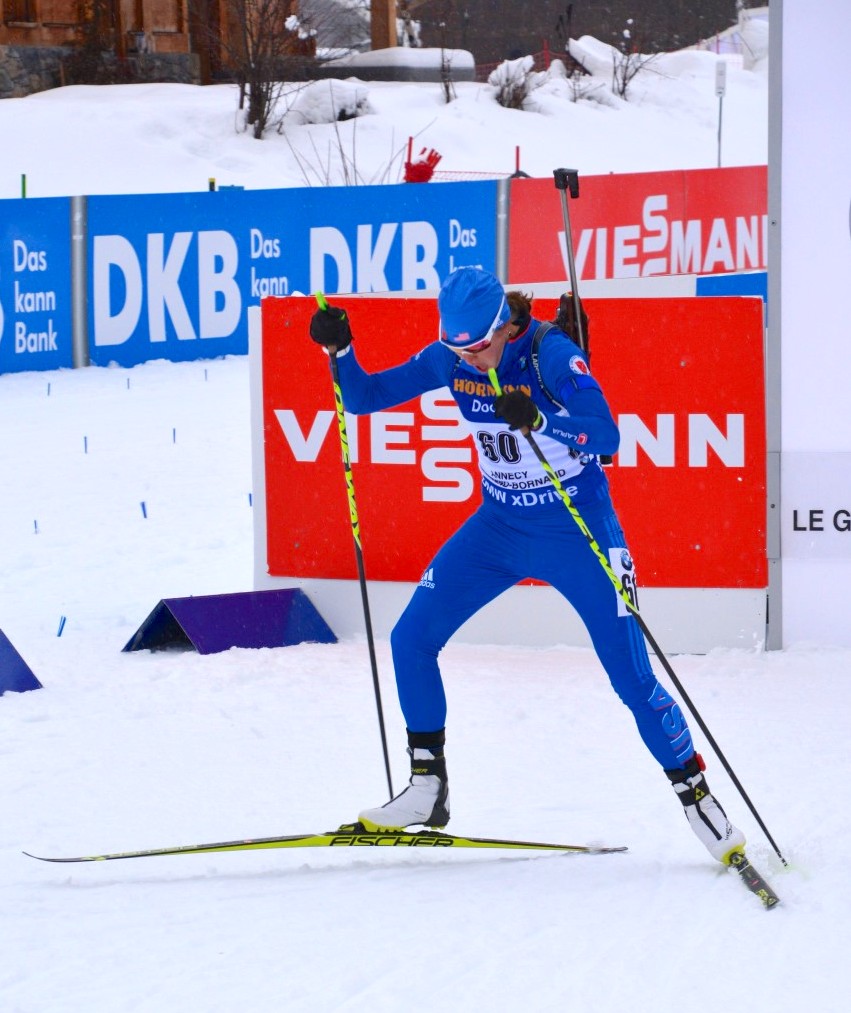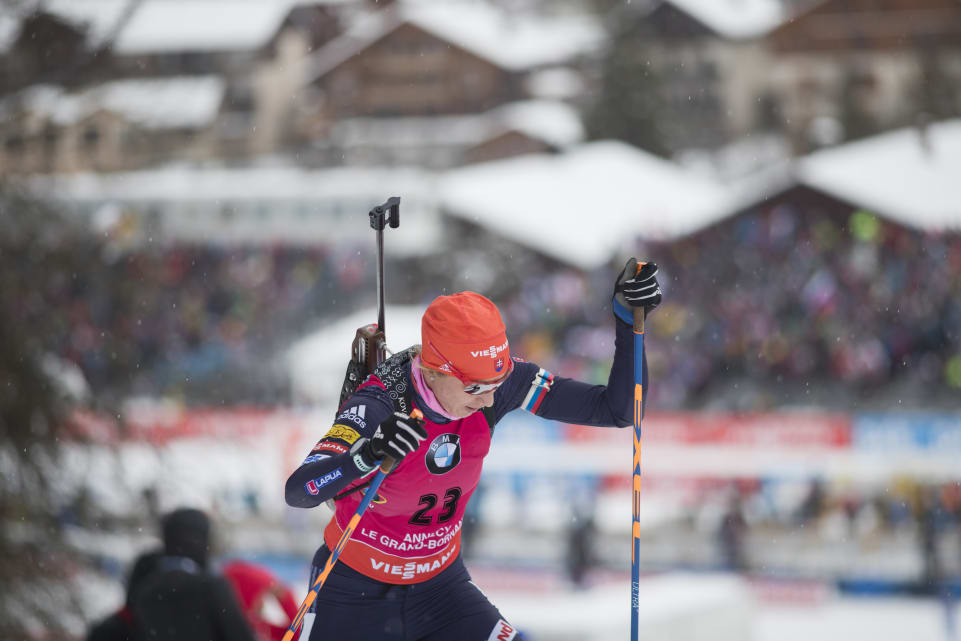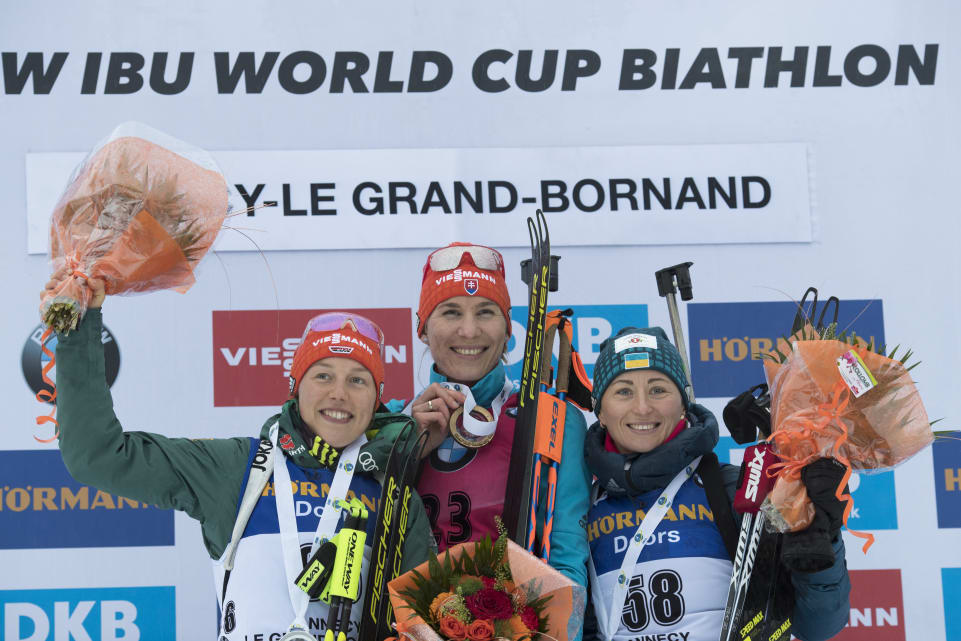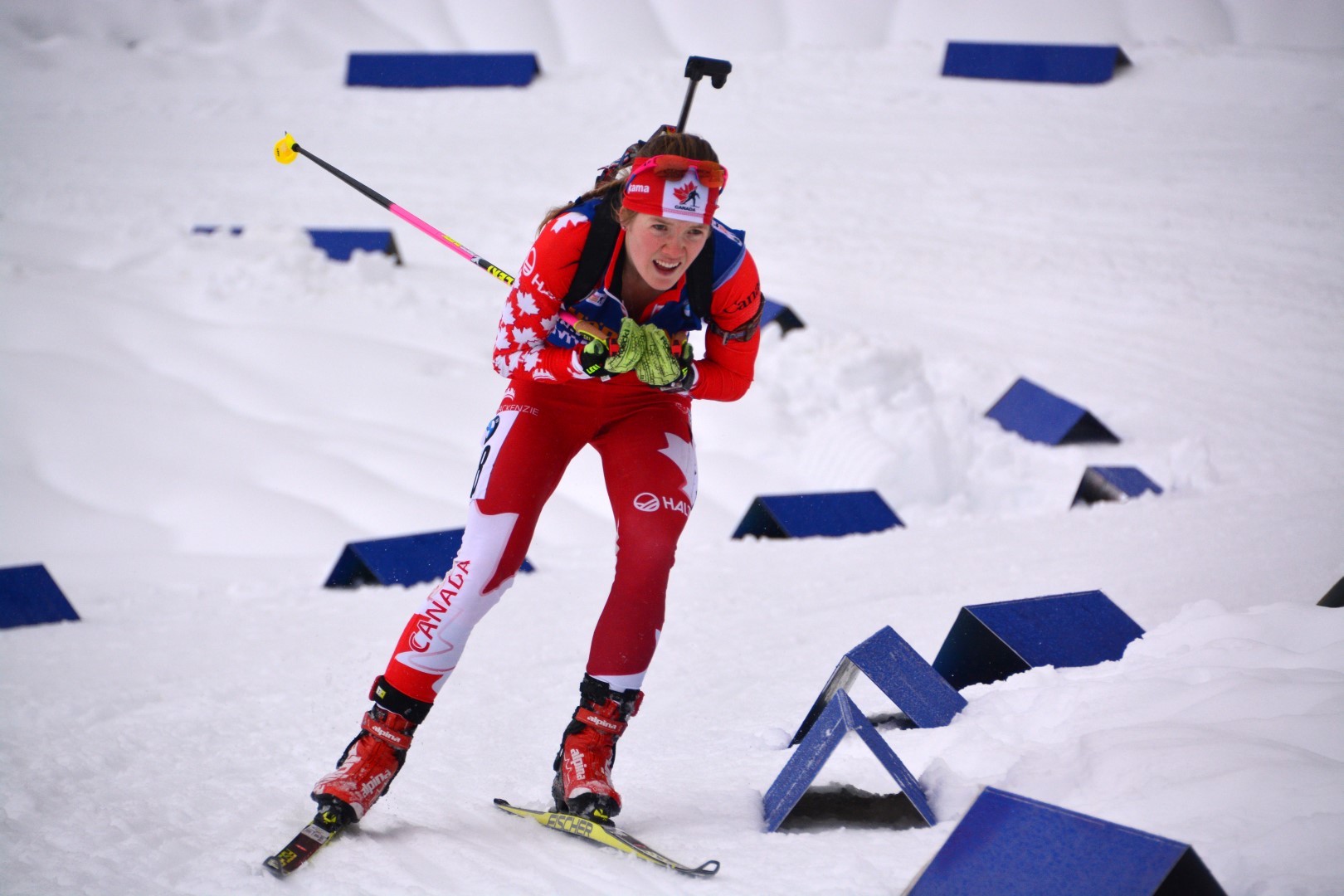
Tag: Laura Dahlmeier

  • Dahlmeier Seizes Second Gold with Frozen Fingers; Crawford 19th in PyeongChang Pursuit

    Dahlmeier Seizes Second Gold with Frozen Fingers; Crawford 19th in PyeongChang Pursuit

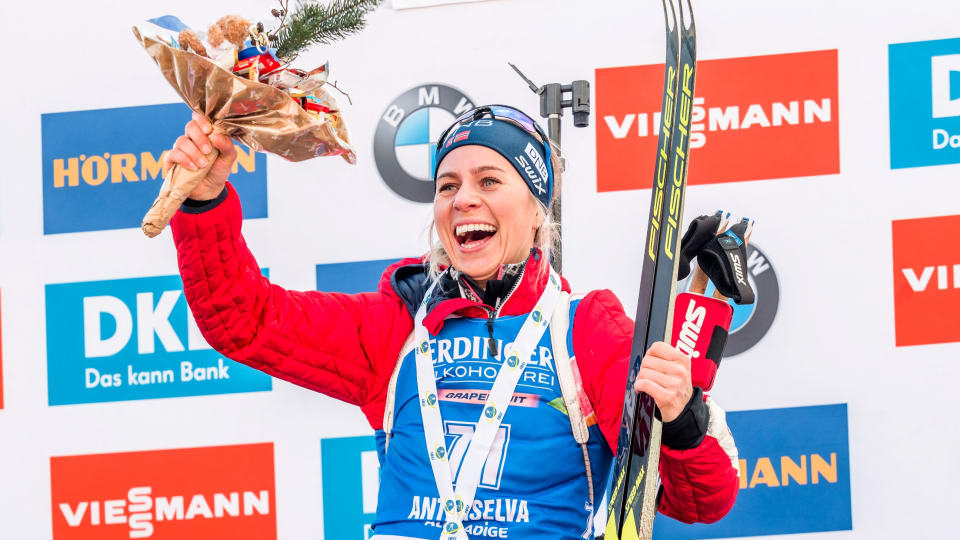
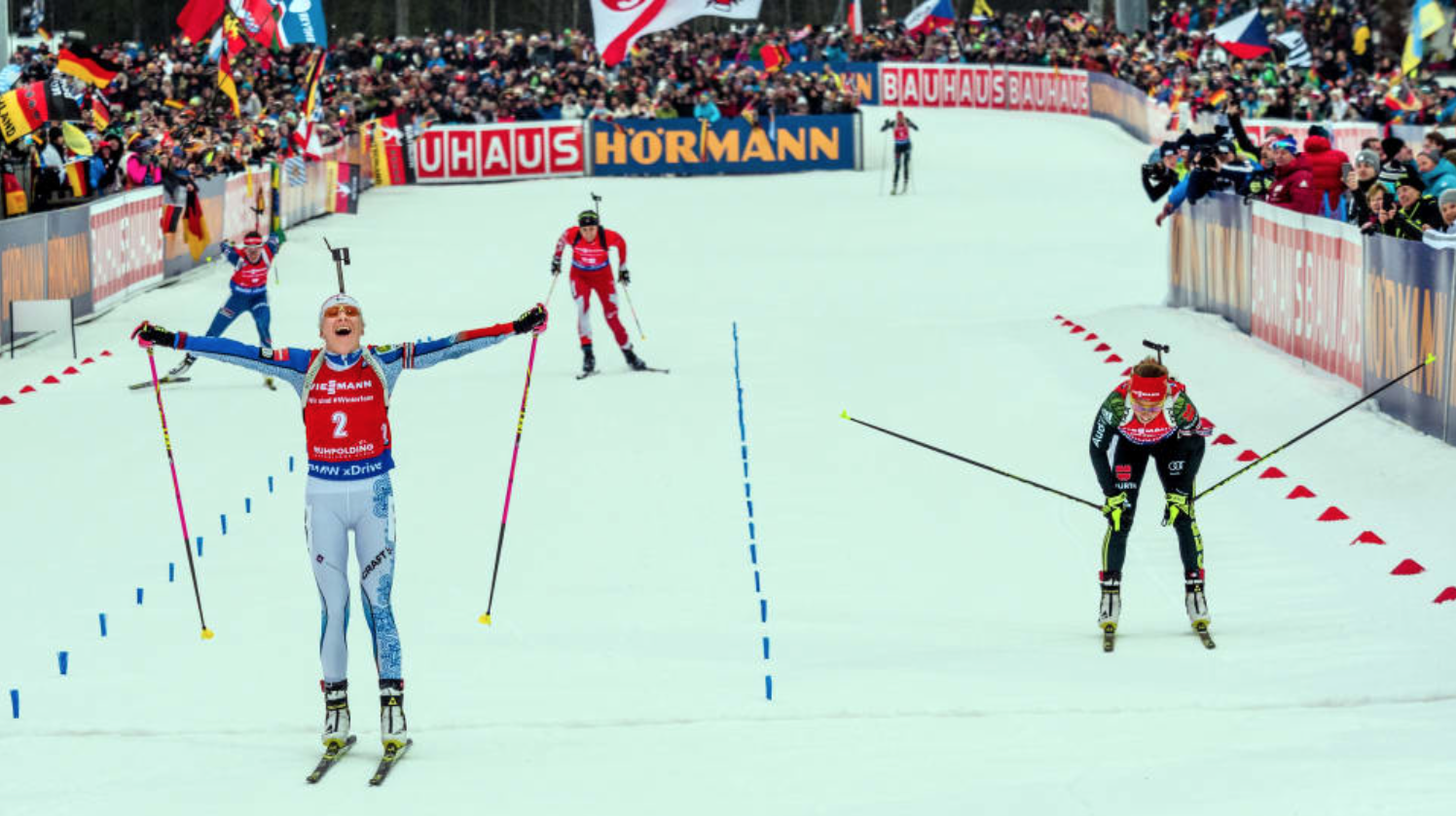
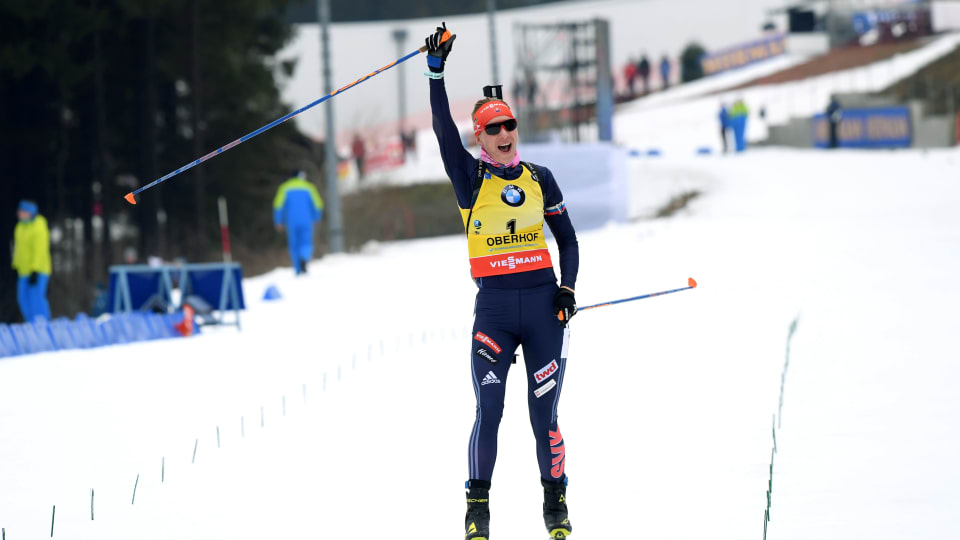
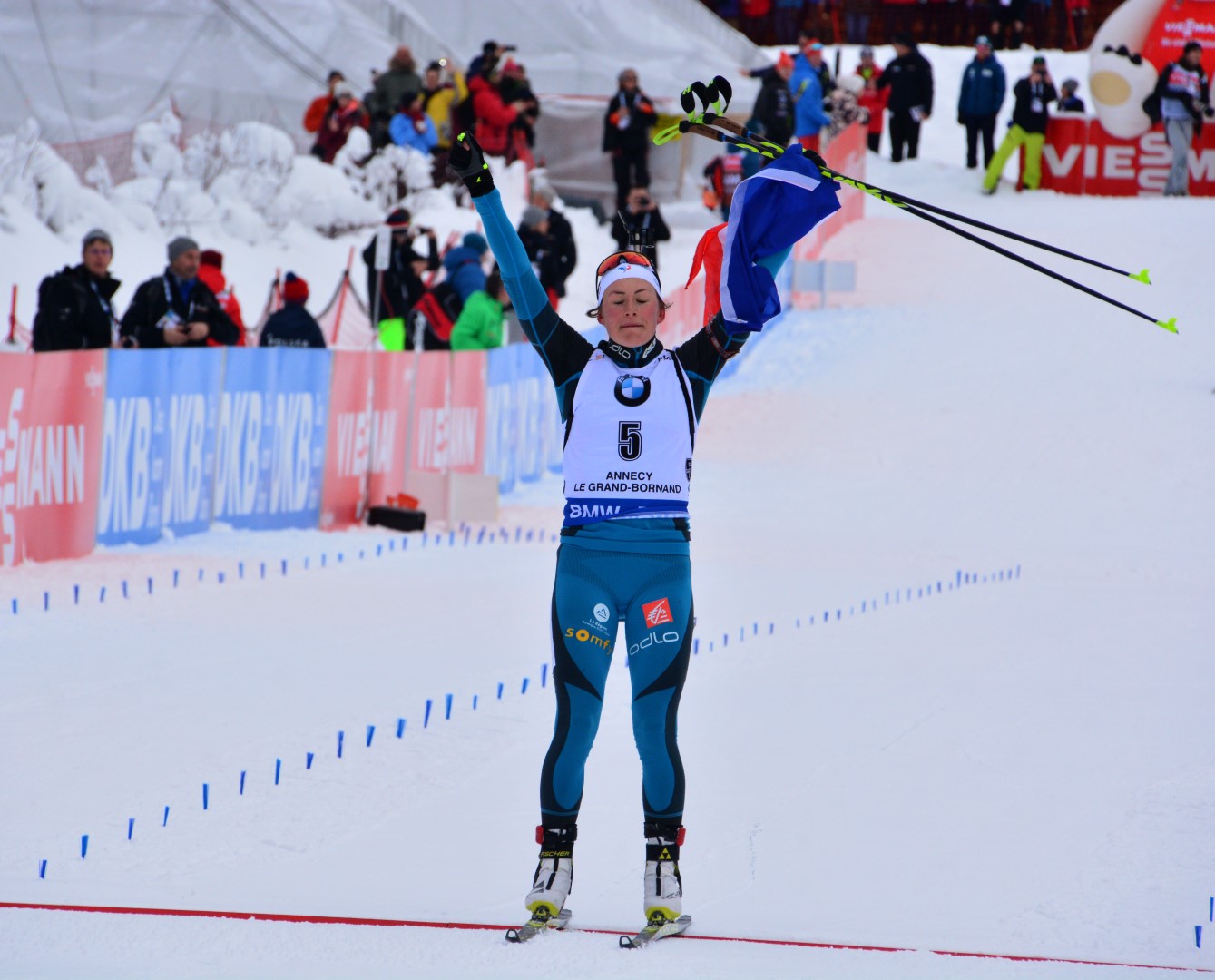
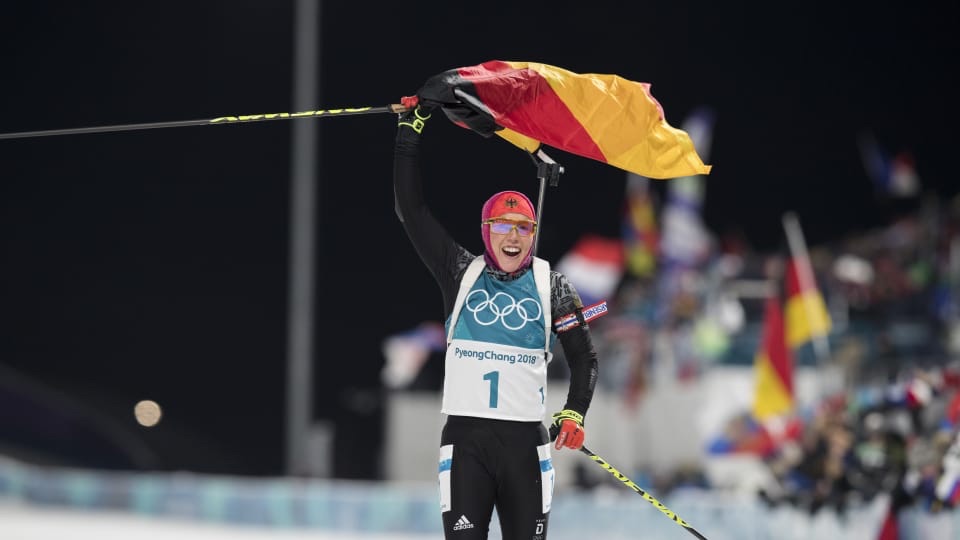
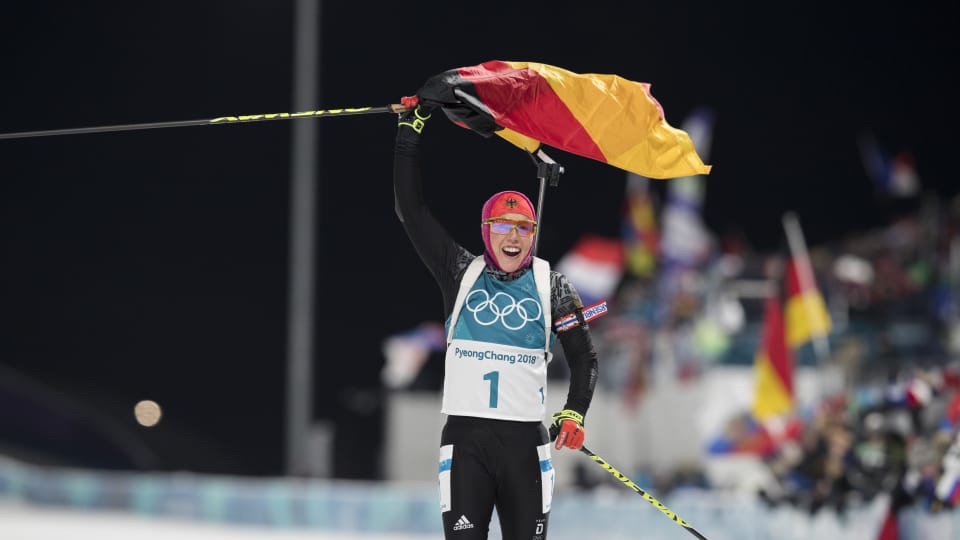
    Gold medalist Laura Dahlmeier of Germany celebrates waiving a national flag as she crosses the line first in the women’s 10-kilometer pursuit at the 2018 Olympic Winter Games in PyeongChang, South Korea. (Photo: IBU/Biathlonworld)

    FasterSkier would like to thank Fischer Sport USAMadshus USAConcept2Boulder Nordic Sport, and Swix Sport US for their generous support, which made this coverage possible.

    ***

    It was almost another start-to-finish victory at the Olympic Winter Games in PyeongChang for the current golden girl of biathlon, Germany’s Laura Dahlmeier. But it came with a painful price to pay.

    After starting the women’s 10-kilometer pursuit on Monday evening local time in freezing temperatures and with a 24-second lead following her sprint victory, Dahlmeier began the race intensely focused, again cleaning the first prone stage.

    But this time she was not uncontested.

    After starting in 13th position and almost a minute back to begin the pursuit, Slovakia’s Anastasiya Kuzmina, who’s currently second in the World Cup Total Score standings, caught up to Dahlmeier after both had incurred one penalty in the second prone shooting and avoided more by performing multiple adjustments on their rifle sights to deal with gusts of wind.

    After closing a nine-second gap, Kuzmina passed her rival on the next loop. But Dahlmeier did not seem to mind someone else helping her to set the pace in once again difficult conditions on the course and range (the race jury reportedly debated a potential postponement), and tucked behind Kuzmina to wait for her next chance in the standing shooting. There Dahlmeier cleaned again, leaving the range with a 38-second lead after Kuzmina had to twice ski through the penalty lap, but still retained second place as the closest pursuer.

    “On the third loop we raced together, and on the uphill part Anastasiya was really strong and I just wanted to follow her and we had a good speed together,” Dahlmeier later recounted at the post-race press conference. “And at the shooting range, I felt really comfortable. I know about my good standing shooting, and I just looked to my targets and wanted to hit the middle and it worked … During the last years I could improve my shooting in wind situations, but I didn’t especially train wind situations [for PyeongChang].”

    “Laura is a very hard opponent to beat,” Kuzmina said at the press conference, via a translator. “She is able to fully focus on the shooting and she is able to shoot very good also in the strong wind, so you can fight with her on the skis of course, but you need to shoot very good to beat her.”

    In her final shooting stage, Dahlmeier again cleaned all targets and left the range with a 55-second lead on Kuzmina, with France’s Anaïs Bescond right behind the Slovakian.

    “If I would already think that I might miss a target when approaching the range for the fourth time, I believe that would be the wrong mindset. I just tried to concentrate on myself, on my own targets,” Dahlmeier told German broadcaster ZDF when questioned about the final shooting, when she probably could have afforded to compensate for one penalty lap. “I have proven often enough that I can hit [when it matters], in training we simulate that every day. And I just firmly believed that it will work out again today. And it did, so I am very grateful for that.”

    With such a comfortable lead, nobody could challenge her anymore on the final loop. On the finishing stretch Dahlmeier had enough time to reach for a German flag handed to her from the stands, before crossing the line in a time of 30:35.3 minutes, with one penalty (0+1+0+0).
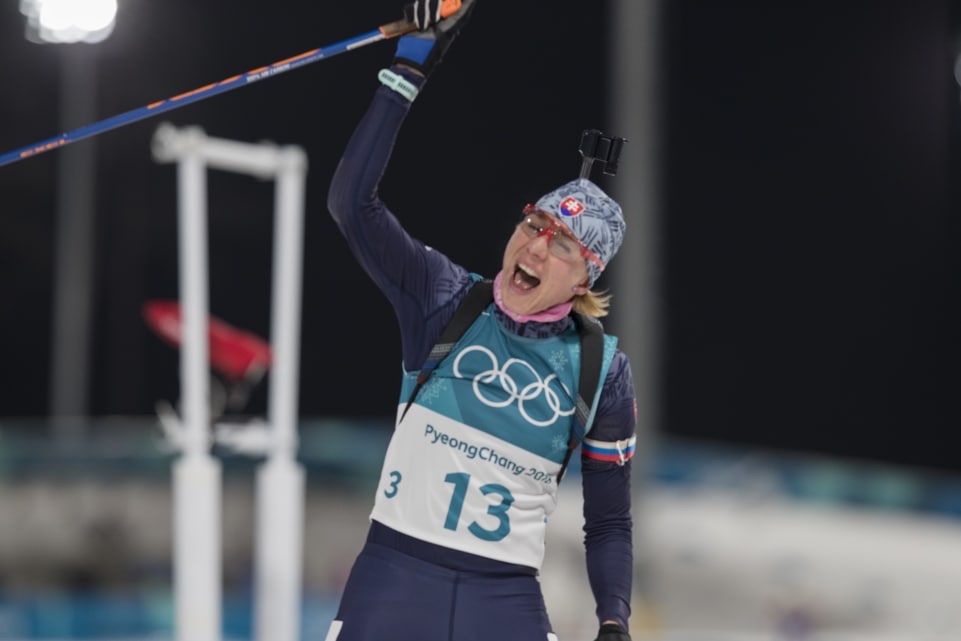
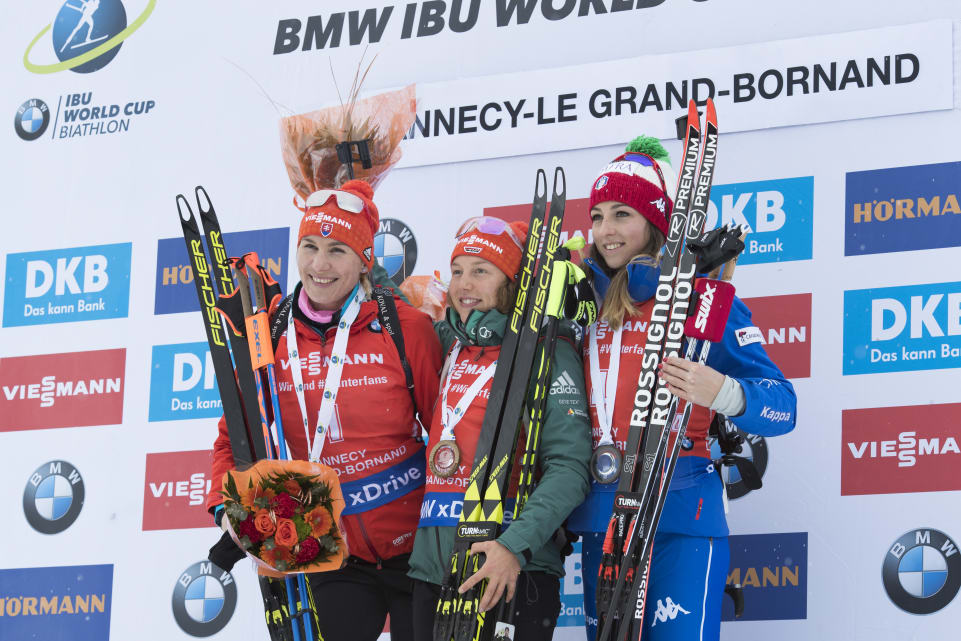
    Anastasiya Kuzmina of Slovakia celebrates after crossing the finish line in second place in the women’s 10-kilometer pursuit at the 2018 Winter Games in PyeongChang, South Korea. (Photo: IBU/ Biathlonworld)

    Fighting for the positions on the podium behind her, Kuzmina crossed the line 29.4 seconds back to claim the silver medal, winning the finishing sprint against Bescond, who had to settle for bronze (+29.6).

    Bescond moved up from a 19th starting position largely thanks to her 19-for-20 shooting with just one penalty lap (0+0+1+0), though she also skied the fifth-best overall course time, while Kuzmina overcame four misses (0+1+2+1) with the fastest course time of the day, just as she had done in the sprint.

    Almost another minute back, fourth place went to sprint silver medalist Marte Olsbu of Norway (+1:07.3, four penalties), fifth to Hanna Öberg of Sweden (+1:08.9, three penalties), and sixth to Dahlmeier’s teammate Denise Herrmann (+1:19.4, two penalties), who improved from starting in 21st position. Sprint bronze medalist Veronika Vitková of the Czech Republic fell back to seventh (+1:37.3, three penalties).

    Going to the stands a few minutes after reaching the finish, Kuzmina hugged her friends and relatives, including her husband and a teary eyed woman (presumably her mother) who was wearing a sports jacket embroidered with Russian emblems. Herself a mother of two, Kuzmina is the older sister of Russian star biathlete Anton Shipulin, who was not invited by the International Olympic Committee (IOC) to compete as part of the neutral Olympic Athletes from Russia team in PyeongChang. An appeal to the Court of Arbitration for Sports (CAS) was denied just hours before the Opening Ceremony. Kuzmina has been racing for Slovakia since 2008, only competing for Russia at two Junior World Championships and never at senior-level championships.

    “I am missing my brother. I hoped to the last moment that he will be able to compete here,” Kuzmina said about the topic when asked about it in the press conference, via a translator. “I don’t want to talk a lot about this issue. I am really sorry about what happened and that my brother is not here. I am here to fight for medals for my entire family. I won the one medal, and I want to win another medal for my brother.”

    Kuzmina, 33, is an Olympic gold medalist in the sprint and silver medalist in the pursuit at the 2010 Olympics in Vancouver, British Columbia, and sprint gold medalist from 2014 in Sochi, Russia.

    “This is a very special feeling to have the third medal from the third Olympics in a row,” Kuzmina explained. “Almost everybody who talked to me was [expecting] that I could win the sprint here, because I won the sprint in Vancouver and Sochi as well. That didn’t happen, but I am very glad that I managed to defend the silver medal in this event like in Vancouver eight years ago.”

    For the 30-year-old Bescond it was her first medal at Olympic Winter Games, after she narrowly missed out four years ago in Sochi with two fifth places in the sprint and individual.

    At 2016 World Championships she had taken silver in the 15 k individual in Oslo, Norway, and she’s also earned six medals with French relay teams. But last season was a down year where she started just one race at 2017 World Championships in Hochfilzen, Austria, and finished outside the top 50 before she rebounded with a third place in the pursuit at the World Cup test event last year in PyeongChang.

    “Of course it was never granted that I make the podium,” Bescond said in the press conference, via a translation. “It was very difficult for me not being able to do the World Championships [in Hochfilzen]. This year I really wanted to perform very well, and the Olympic Games is the best thing you could think of, the Holy Grail. So I did think about last year this time, and I was very happy to have a very good race.”

    “Laura really dominates our sport, but there a lot of good athletes out there,” Bescond stated when asked how her opponent could be beaten at these Olympics. “They are strong, they got lots of qualities, what you need to do is be faster on the skis and shoot better and faster, that’s it.”

    Sounds easy enough.

    But if her opponents couldn’t quite yet do it in the pursuit on Monday, the weather conditions and all the increased attention on Dahlmeier, who usually guards her private life closely, pushed her to her limits.

    “I am extremely happy that everything worked out so well again today,” Dahlmeier told German broadcaster ZDF right after the race. “I tried to be fully focused on the shootings, on the course I didn’t feel quite as relaxed. On the one hand the conditions were very demanding, and the past two days have taken a toll on me with a lot of media appointments, a lot of additional stuff. At the moment I am feeling quite well, but of course it is cold and when the fingers thaw up, maybe some viewers know it, that hurts quite a bit.”

    Soon after, Dahlmeier was no longer in the mood to celebrate, as she had fully exhausted herself for the victory. And her frozen fingers exposed to the cold in thin race gloves now seemingly really hurt, even though in the press conference before she had claimed that “I always spend a lot of time in the mountains and there it’s normal to have wind and cold temperatures, so perhaps I am a little bit used to it.”

    “Primarily it was the cold. She is in extreme pain,” Stefan Schwarzbach, a manager and speaker for the German Ski Federation, later told ZDF after she had to cancel a planned studio appearance. “So when [her hands] thawed up she really had tears in her eyes, it was painful to watch. After the doping control she put herself to rest, she is just completely finished.”

    At last year’s World Championships in Hochfilzen, where she won five medals, she physically collapsed after two races to the point that the German team doctor did not want her to start the mass start. In the end her stubbornness prevailed, and she also won that race overtaking American Susan Dunklee on the final lap.

    “We already know that from last year, we just have to be careful with the sum of the exertions in competition,” Schwarzbach said. “And I believe the spectators will be accepting if she reduces the media work a little bit, and then hopefully can stand at the start line for the individual with full strength. … She will be all right, but we will reduce her program to what is necessary, even if it would have been nice to celebrate the second gold medal.”

    North Americans Moving On Up

    Canada’s Rosanna Crawford finished 19th in the pursuit as the best North American, moving up from 53rd at the start, based on her sprint result, to finish 19th (+2:27.7) for her best individual result at her third Olympics.

    Canada’s Rosanna Crawford (22) during the women’s 7.5 k sprint on Saturday, Feb. 10 at the 2018 Olympics in PyeongChang, South Korea. She finished 53rd then went on to place 19th in the pursuit on Monday. (Photo: FlyingPointRoad)

    On the range, Crawford managed to cope well with the windy conditions, shooting 18-for-20 with one miss in each of her standing stages (0+0+1+1). In an interview with FasterSkier after, she said she would have liked to avoid one mistake she made in the final shooting.

    “[The wind] seems to have been more consistent,” Crawford said. “My zeroing went really well, I had my sights, I knew exactly where they were and what corrections I would need to make. So prone I was really confident. … In my last standing I didn’t mean to pull the trigger on my first shot, so that was a bit of a disappointment.”

    She enjoyed her race despite the harsh weather and demanding tracks, skiing the 19th-ranked overall course time.

    “For sure I love the 2k [pursuit loop] here,” Crawford said. “I [also] was 19th with 18-for-20 last year at the World Cup here. Yeah, the 2 k is so much fun. You just have to grit your teeth up that hill and then just rip along the top and back down to the range, and I love it so much. My skis were amazing. Our techs did such a good job. So I just had some fun out there today.”

    Asked how she got into a better mindset following the sprint, Crawford said she called her older sister, a 2006 Olympic gold medalist in cross-country skiing.

    “I had some really good chats with my sister Chandra,” Crawford said. “She’s a huge motivator for me and my biggest cheerleader now. She really just talked some sense into me to not be so down on myself after the sprint, so that was really helpful.”

    Julia Ransom (Biathlon Canada) during the women’s 7.5 k sprint at her Olympic debut in PyeongChang, South Korea. She finished 40th then went on to place 28th in the pursuit on Monday. (Photo: FlyingPointRoad)

    Teammate Julia Ransom also improved from her sprint position, moving up by 12 places to finish in 28th place (+3:03.0) with one miss in her last standing stage. She was one of just six women on Monday who shot 19-for-20, with no one shooting clean.

    “I had some really solid shooting today hitting my first 15, missing my 18th or 17th shot,” Ransom recounted after the race. “I am a confident shooter in the wind, I know corrections fairly well, and I think you just have to make good shots and that’s all you can hope for”

    On the course she skied the 44th-best course time after a faster first loop.

    “My legs were not feeling as good as I was hoping they’d be, so I was really happy to keep it together in the range and just slowly work my way up and ski with the other girls,” Ransom concluded.
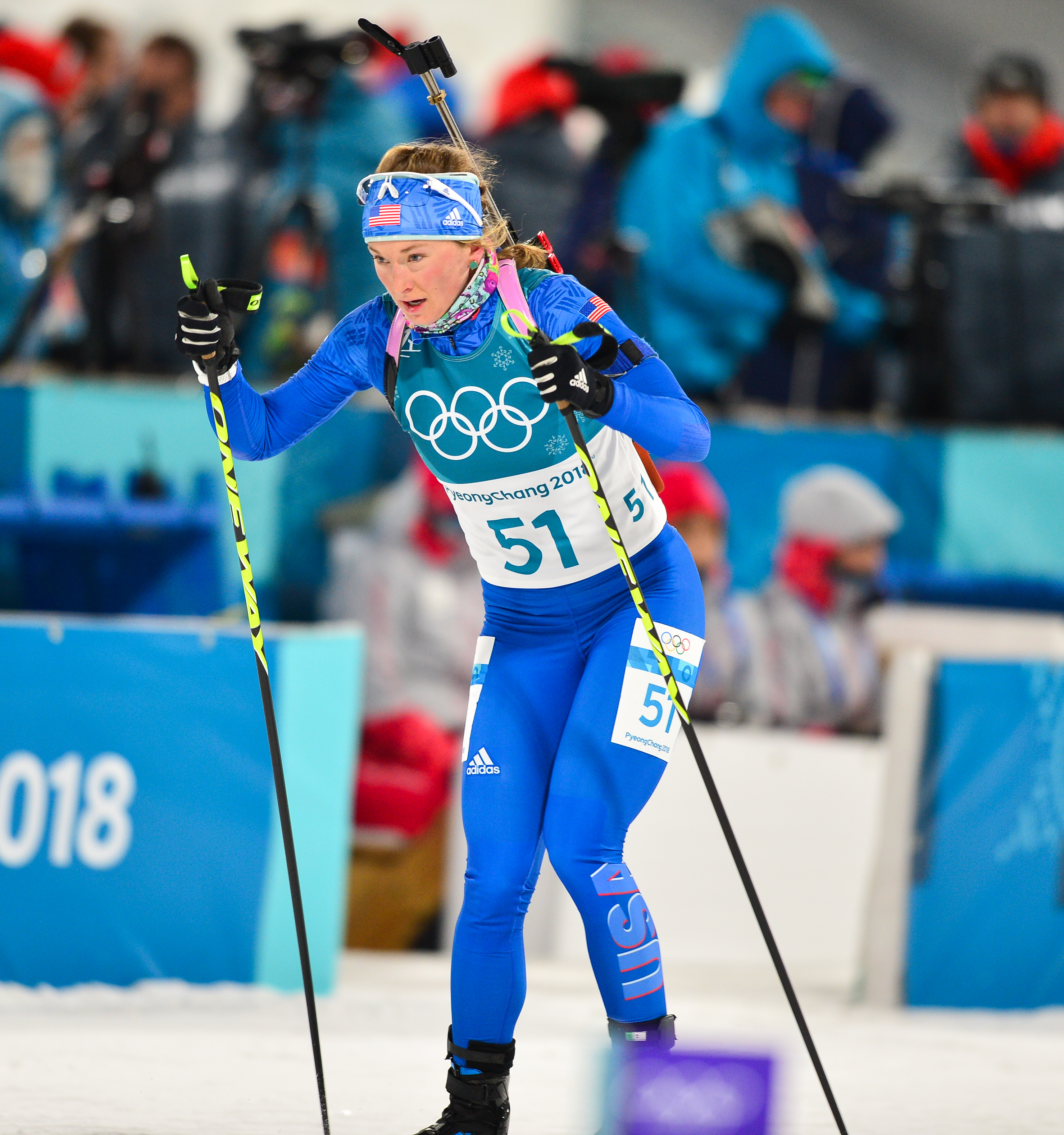
    American Emily Dreissigacker racing to 47th in the women’s 10 k pursuit at the 2018 Olympics in PyeongChang, South Korea. (Photo: Ross Burton/US Biathlon)

    Emily Dreissigacker, the lone American to qualify for the women’s pursuit, improved by four positions after starting in 51st to finish 47th (+5:01.4) with four penalties (0+1+1+2).

    That was another improvement on her personal best at the World Cup-level, which she achieved in Saturday’s sprint. Before these Olympics, Dreissigacker’s best result on the International Biathlon Union (IBU) World Cup had been 56th place in a pursuit in Antholz, Italy, last month.

    On the course she recorded the 54th course time, steadily holding her position on the three loops between the shooting stages.

    “I think the skiing felt a little better than the sprint two days ago,” Dreissigacker said after. “Getting to ski with people is always really fun, and my skis were amazingly fast.”

    Just like Crawford, she also preferred the loop the pursuit was raced on over other courses in PyeongChang.

    “I really like the 2 k course,” Dreissigacker said. “You climb up and then you come back down, which is something that I really like. I think mentally especially, I’m like ‘All right, gotta get to the top of this hill and then I have time to recover,’ which is nice.”

    “I really just like to try to keep things simple,” she said of her shooting performance and approach to the wind-exposed range. “Just relax, if the wind comes up just wait for it to pass or if it’s not going to pass take some clicks. I really think the simpler you can keep it the better.”

    “The wind can be a little tricky,” she told US Biathlon, according to a press release. “In my first standing stage, actually, I had to wait out a pretty big gust of wind. All the people around me were waiting, too, and we’re all just standing there waiting for it to die. That’s kind of just how it is. You have to be able to deal with that … be able to wait and not freak out.”

    Canada’s Emma Lunder finished 53rd (+6:16.8) after starting 54th then shooting four penalties (0+1+1+2).

    “It was not great,” Lunder reflected. “Started out with shooting OK, unfortunately missed two in my last standing and just did not have it in the legs today, so the skiing was a big struggle.”

    While not completely satisfied with her race performance, the 26-year-old Lunder said she was making the most out of her first Olympic experience.

    “The whole time I was just trying to remind myself, I am at the Olympics, racing my first Olympics. It’s such a cool atmosphere, so even if the race isn’t going as well as I would like I am still pretty happy to be here,” Lunder explained. “The racing doesn’t feel different from a World Cup. It’s being at the Athlete’s Village with athletes from every sport all over the world, the best in the world, that’s been pretty special. I have [met] quite a few people who I never thought I would meet, so I have just been trying to take it all in and also try to perform as well as I can.”

    Asked how she is dealing with the cold conditions and prepares for her upcoming races, Lunder added, “I would say a lot of it is energy management. When it’s this cold out I find I am a lot more tired, burning more calories just from shivering. So we have a therapist here with us. I will see her for some treatment, just take a bit of time to lay in bed and watch some movies, do whatever I can to rest up a little bit.”

    The fourth Canadian, Megan Tandy, did not start,as she’s working to kick a cold in time for the next race on Wednesday.

    “Disappointing news, but it is for the best,” Tandy wrote in an Instagram post before the race. “I have decided not to start the 10km Pursuit tonight in order to get healthy for our upcoming Individual Race. I will be cheering on my girls from bed, I know they can rock this stadium tonight.”

    Estonia’s Johanna Talihärm, who skis collegiately for Montana State University and last year split her training time between Bozeman, Montana, and Estonia, finished 26th (+2:59.4) with another strong performance after a career-best 22nd place in the sprint. She incurred four penalties (0+1+2+1), and skied the 27th-ranked course time.

    The biathlon competitions in PyeongChang continue on Wednesday with the women’s 15-kilometer individual and Thursday with the men’s 20-kilometer individual race.

    Results

  • Monday Olympic Rundown: Dahlmeier and Fourcade Win Pursuits, Burke 17th, Crawford 19th

    Keep calm and be the best: one missed shot early on did not keep France’s Martin Fourcade from defending his Olympic gold medal in the men’s biathlon pursuit. (Photo: FlyingPointRoad)

    FasterSkier would like to thank Fischer Sport USAMadshus USAConcept2Boulder Nordic Sport, and Swix Sport US for their generous support, which made this coverage possible.

    ***

    2018 Winter Olympics (PyeongChang, South Korea): Men’s 12.5 k pursuit

    Full report

    “Use this rage as energy!” Martin Fourcade wrote on Instagram after finishing eighth in the men’s 10-kilometer sprint on Sunday.

    Um, yeah. The French biathlon star defended his gold medal from the 2014 Olympic pursuit with just one missed shot in Monday’s 12.5 k competition, taking the lead after the third shooting stage and never giving it back. He finished with a comfortable enough margin to grab the French flag and take his time waving it down the finishing straight.

    A large pack of chasers were all in contention for second place coming into the final shooting stage, but of them all only Benedikt Doll of Germany and Sebastian Samuelsson of Sweden cleaned their targets. Samuelsson took his time to do so, and left the range with a nearly eight-second deficit on Doll. But he gradually worked his way up to the German on the trails, before putting in a spurt on one of the last small uphills on the course. The 20-year-old Swede managed to hold his lead on the swooping downhills into the stadium and not get consumed by the draft effect, and celebrated crossing the line in second place. Samuelsson’s previous best result was 13th place in a World Cup. It is Sweden’s first Olympic biathlon medal since 2010.

    Tarjei Bø of Norway finished fourth (+1:02.6) after missing three shots; all the medalists had only a single penalty apiece. Germany’s Simon Schempp was fifth (+1:02.7), also with three penalties, and Switzerland’s Benjamin Weger finished sixth with two missed shots (+1:03.1), narrowly edging France’s Simon Desthieux (+1:03.7).

    For the U.S., Tim Burke finished 17th (+2:19.6) with just two missed shots after starting in 47th position after a disappointing sprint race. Lowell Bailey placed 32nd (+3:51.6) with five penalties — all in standing — and  Leif Nordgren 50th (+5:48.7), also with five missed shots.

    For Canada, Nathan Smith finished 54th (+6:06.5) with four missed shots.

    Results

    ***

    Biathlon: Women’s 10 k pursuit

    Full report

    With just one missed shot, Germany’s Laura Dahlmeier took her second gold medal of this young Olympic Games when she won the 10 k biathlon pursuit by 29.4 seconds. Dahlmeier finished no better than 13th in the 2014 Olympics — where she was only 20 years old – but four more years of experience have made her nearly unbeatable, if last year’s triple gold haul from World Championships serves as a basis for comparison. But even if she only nets these two golds, she has already made history: no other woman has ever won both the sprint and the pursuit at the same Olympic Games.

    Dahlmeier started in bib 1 but the other medalists used stellar performances to move up after disappointing sprint races. Anastasiya Kuzmina of Slovakia edged France’s Anais Bescond by just 0.2 seconds to take silver. Kuzmina had started in bib 13 and won her medal despite four missed shots – she had the fastest course time of the whole field – while Bescond had started 19th but had hit all but one of her targets.

    Fourth place went to the sprint silver medalist Marte Olsbu of Norway (+1:07.3), fifth to Hanna Öberg of Sweden (+1:08.9), and sixth to Denise Herrman of Germany (+1:19.4).

    Rosanna Crawford of Canada started 53rd after a tough sprint race, but shot 18/20 and moved up to 19th place (+2:27.7), the best Olympic result of her career.

    Montana State University student Johanna Talihärm, representing Estonia, missed four shots to finish 26th (+2:59.4). Just behind her was Canada’s Julia Ransom in 28th (+3:03.0) with one missed shot.

    The lone American in the race, Emily Dreissigacker, set a new career best with 47th place (+5:01.4), and Canada’s Emma Lunder finished 53rd (+6:16.8). Teammate Megan Tandy did not start.

    Results

  • A Golden Dream Fulfilled for Dahlmeier; Ransom Leads North Americans in 40th

    Germany’s Laura Dahlmeier racing to her first Olympic gold (and first Olympic medal) on Saturday in the women’s 7.5 k sprint, the first biathlon race of the 2018 Winter Olympics in PyeongChang, South Korea. (Photo: FlyingPointRoad)

    FasterSkier would like to thank Fischer Sport USAMadshus USAConcept2Boulder Nordic Sport and Swix Sport US for their generous support, which made this coverage possible.

    ***

    (Note: This article has been updated to include comments from Canada’s Julia Ransom.)

    “Perfectionist” is a term the coaches of Germany’s Laura Dahlmeier often use to describe her.

    On Saturday, this quality helped Dahlmeier to brave difficult wind conditions on her way to winning the gold medal in the women’s 7.5-kilometer sprint that opened the biathlon competitions at the 2018 Winter Olympics in PyeongChang, South Korea, ahead of Norway’s Marte Olsbu in second and the Czech Republic’s Veronika Vítková in third place.

    “A childhood dream is coming true,” Dahlmeier told German broadcaster ZDF after the race, according to a translation. “I have always imagined this, that some day I would stand at the very top at the Olympics, that I could win a gold medal. And somehow exactly that happened to work out today. I am incredibly grateful and proud. It’s an amazing feeling, and I don’t think I have fully realized it yet.”

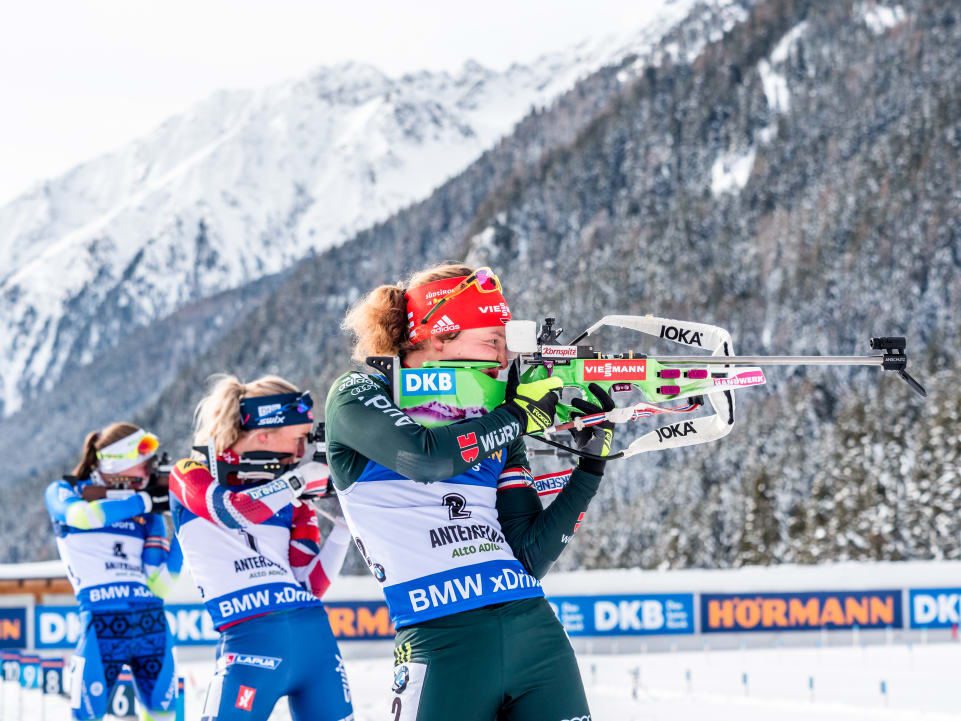
    On the shooting range, Dahlmeier twice adjusted her rifle’s sights in the prone stage to successfully cope with changing winds. Coming into the standing stage, she hit three targets in rhythm, then waited for what seemed like excruciating seconds for a gust to pass, before triggering her fourth and fifth shots. Both targets flipped over to white.

    She had taken so long that she only recorded the 76th-ranked shooting time in this stage in the field of 87 athletes, 22 seconds off the pace and almost as long as the time it takes to ski a penalty lap. But that she had hit all shots mattered the most. Only two other athletes managed to clean all 10 targets on Saturday.

    Dahlmeier followed that up by skiing the fastest course time on the final loop, and fourth-best overall. She crossed the finish line in a time of 21:06.2 minutes, lunging to not squander even a tenth of a second more, before pounding her chest and raising her arms in jubilation, knowing the time she had set would be hard to beat. Indeed her mark could not be improved again by any athlete starting later.

    “I believe if you want to win a race like this one, that doesn’t happen by chance,” Dahlmeier told ZDF. “A lot goes into that. It’s true, I really had to work for it in the race today. But also the team around me, what they had to work during the last days, weeks, months, years, that is embodied by today’s result. It’s just beautiful that I was allowed to fulfill that dream today.”

    Olsbu claimed the silver medal, 24.2 seconds back with one penalty in her prone shooting stage and just 1.6 seconds ahead of Vítková on the bronze podium spot, who had missed one target in the standing stage.

    France’s Marie Dorin Habert placed fourth (+33.1) with one penalty in prone, while Dahlmeier’s teammate Vanessa Hinz was fifth (+40.3), losing out on a potential medal when she missed the last shot of her competition. Several other favorites struggled with the wind conditions and incurred a number of penalties.

    For the two runner-ups, winning a medal at the Olympics was also a dream come true.

    “Of course I am happy, it was my best race ever,” first-time Olympian Olsbu, 27, said when asked in the press conference if she was satisfied with the silver medal. “It was difficult on the shooting range today because it was so windy, but I just stuck to my plan. And I was so happy when I crossed the finish line. … That was a dream from when I started in biathlon. Of course [compatriot] Ole Einar Bjørndalen was my hero when I was a child, and I was hoping that one day I will do the same. I don’t know what to say, it is just amazing and today I am sitting here with an Olympic medal.”

    “Yeah, it was my dream too, like for Marte, and I am happy that my dream is here,” Vítková, 29, said of her first individual Olympic medal in her third Winter Games.

    Starting early in bib 12, Vítková initially appeared dissatisfied when she crossed the finish line and saw that she had not managed to beat Olsbu’s time, after the Norwegian had finished the race just one bib ahead. The Czech feared more athletes would finish ahead of her and still push her several positions down, but aside from Dahlmeier starting in bib 23, no one managed to do that.

    So at the “flower ceremony” in the arena, where the podium finishers each received a stuffed animal as their prize (a snow-white tiger called Soohorang that is the official mascot of the 2018 Winter Olympics), Vítková was beaming just like her two peers. The Olympic medals will be awarded in an separate ceremony later.

    “I am very happy, because this medal is my first ‘big’ medal in an individual race,” Vítková explained at the press conference. “I had a [silver] medal from the Olympic Games in Sochi, but it was a mixed relay medal. And now I have MY medal!”

    Last season, Dahlmeier set a record by winning five events at a single International Biathlon Union (IBU) World Championships, taking gold in every race but the sprint (where she placed second) in Hochfilzen, Austria. But winning the gold medal in PyeongChang was indeed the fulfillment of a lifelong dream. As an elementary school student, Dahlmeier reportedly had written two career goals into a class book: Olympic champion in biathlon and becoming the manager of an Alpine Club hut, since mountaineering continues to be her other big passion. One down, one to go.

    “Today was a victory Laura had to work very hard for, that wasn’t automatic,” German women’s national team coach Gerald Hönig told ZDF, according to a translation. “My highest respect for how she withstood the conditions today. How she repeatedly had to make the right decisions by herself on the course and on the range in order to be successful. She did that great, and she is outshining a great overall team result.”

    In 2014 at her first Olympics in Sochi, Russia, the biathlon competitions for Dahlmeier, who was 20 at the time, and the rest of the German women’s team had started off as disappointing with no individual medals, and then descended into turmoil when on the eve of the women’s relay, the doping case of Evi Sachenbacher-Stehle due to a tainted food supplement came to light (her suspension later was reduced to six months) and the team again failed to reach the podium.

    “For our team this medal is particularly important,” Hönig said. “We still have the defeats of Sochi somewhere in the back of our minds. Well, I particularly do, so for me this is a gigantic moment. I believe having a medal in the very first race here makes the tasks that lie ahead much easier … It’s the prerogative of young athletes like Laura to chalk that off faster, but I have repeatedly thought about these days in Sochi … Laura showed coolness today, but also executed everything she had worked for in training.”

    Dahlmeier, now 24, became the second German athlete to win a gold medal at the Winter Olympics in the women’s sprint, after Kati Wilhelm claimed the title at the 2002 Games in Salt Lake City, Utah.

    Mixed Day for North American Starters

    Canada’s Julia Ransom was the best North American in the sprint, finishing in 40th place (+2:08.8) after she shot fast and accurately, incurring just one penalty in her standing stage.

    Julia Ransom (Biathlon Canada) racing to 40th in the women’s 7.5 k sprint at her Olympic debut in PyeongChang, South Korea. (Photo: FlyingPointRoad)

    On the course she skied the 68th-ranked time of the day, consistently losing about 45 seconds on each loop to the blazing pace set by Slovakia’s defending Olympic sprint champion and current World Cup Sprint standings leader Anastasiya Kuzmina, who ended up 13th place with three penalties (2+1).

    For Ransom it was her first start in an Olympic race, building on three appearances at Biathlon World Championships.

    “It was amazing to start the race today,” Ransom wrote in an email to FasterSkier. “Some of my family were in the stands and the others had woken up early in Canada to catch it. Definitely feeling the love!”

    She described the conditions as “windy with some extremely strong gusts,” Ransom wrote. “I noticed it more out on course than in the range. I was quite happy with my shooting today, but unfortunately my legs were just cooked (for whatever reason)! However, I think this was a good leg blowout, and after some rest, I’ll be ready for the pursuit!”

    All four Canadian women that contested Saturday’s sprint finished in the top 60 to qualify for Monday’s pursuit, with Rosanna Crawford next in line in 53rd (+2:23.0) after shooting three penalties (1+2).

    Canada’s Rosanna Crawford (22) racing to 53rd in the women’s 7.5 k sprint on Saturday at the 2018 Olympics in PyeongChang, South Korea. (Photo: FlyingPointRoad)

    “It was really tough,” Crawford told FasterSkier in the mixed zone after the race when asked about the conditions. “The wind made it hard for shooting and on the course, all of a sudden these gusts would come and blow your poles right out from underneath you. In prone, I made a correction and missed my first shot which shouldn’t have happened, and in standing I overheld [the rifle] for my second miss so I’m pretty disappointed.”

    Starting fairly early in bib 22, the race was still going on at the time of her interview, so Crawford feared she might miss the cutoff for the pursuit. At least that did not happen.

    “The sprint sets you up for the rest of the week, for two weeks, so I’m pretty bummed,” she continued. “I’m still looking forward to the relays, so that’s definitely positive. It’s just so unfortunate that the sprint dictates the other individual races, other than the 15-kilometer [individual race]. Hopefully I’ll qualify for the pursuit and can go out there and fight again. I love the 2 k course here, so I’m really looking forward to it.”

    In her third Olympics, Crawford skied the 44th-ranked course time of the day.

    Canada’s Emma Lunder racing to 54th in her Olympic debut on Saturday in the women’s 7.5 k sprint in PyeongChang, South Korea. (Photo: FlyingPointRoad)

    Just behind her, Emma Lunder in her Olympic debut placed 54th (+2:24.2) with two misses in the standing stage (0+2). Her course time ranked 65th.

    Megan Tandy, in her third Olympics, finished 57th (+2:36.6) with a penalty in each stage (1+1). She skied the 69th-ranked course time.

    “Although I am somewhat disappointed with today’s result (57th with 2 misses and heavy legs) I am thinking positive,” Tandy wrote on Instagram on Saturday. “8 years ago I was the only woman to qualify for the pursuit, this Olympics all 4 of us will be putting up a fight.”

    (Note: FS missed interviewing Ransom, Lunder and Tandy in the mixed zone, and with the race in the evening local time they could not be reached for comments at press time.)

    In her first Olympic race and on her first year with the senior women’s team, Team USA’s Emily Dreissigacker was the top American 51st place (+2:21.0) after shooting 9-for-10.

    American Emily Dreissigacker racing to 51st in the women’s 7..5 k sprint on Saturday at the 2018 Olympics in PyeongChang, South Korea. It was her career-best result at the World Cup level. (Photo: FlyingPointRoad)

    “I did I shot zero plus one [0+1], so I’m pretty happy with that,” Dreissigacker told FasterSkier after the race. “The wind was a little tricky out there. I was just trying to stay calm and think about what I could control…. Happy to make the pursuit!

    “It was kind of gusty and changing a lot,” she commented on the conditions. “Like on prone, I got a little lucky, the wind was pretty much what I had zeroed in [target practice], which was still pretty windy, but at least was consistent. Then in standing, I mean, it definitely wasn’t terrible, but I could feel the wind pushing my barrel around a little bit.”

    Dreissigacker’s course time ranked 74th overall and she slipped 10 places on the final loop.

    “I definitely died a little bit on the last lap,” she said. “I think the hills are hard. … You’re not really recovering [anywhere] before you climb back up to come back down into the stadium.”

    Previously Dreissigacker’s best result on the IBU World Cup in a sprint had been a 59th place at last month’s race in Antholz, Italy, followed by a 56th place in the pursuit.

    For the rest of the US Biathlon women, things did not work out as well as they had hoped on Saturday.

    Clare Egan (US Biathlon) racing to 61st in the women’s 7.5 k sprint at the 2018 Olympics in PyeongChang, South Korea. (Photo: FlyingPointRoad)

    Also starting in her first Olympic race, Clare Egan just missed the cutoff for the pursuit race in 61st place (+2:45.4) with three penalties (1+2), only two seconds behind Emilia Yordanova of Bulgaria.

    “Honestly as I was warming today it felt like I was warming up today for any other race, which I think is a good thing,” Egan told FasterSkier after. “I knew I was ready to go today and I was excited to do what I’ve been training to do and become an Olympian.”

    But then her race began with a mishap on the course.

    “I fell on the first loop at the bottom of the big hill, which is kind of a nightmare. I haven’t fallen in a couple years probably, but I don’t know, it just happened,” Egan said. “Weird things happen in big races I guess, but besides that I am really pleased with my skiing considering I was really sick in our pre-Olympic training camp.”

    Skiing only the 71st course time on the first loop due to the fall, her pace improved from there, capped by the 30th-ranked time on the final loop (57th overall).

    “I’m really happy with the prone,” she said of her shooting performance. “It was really tricky shooting today, windy, missed one but I am very satisfied with that. Standing I started out really solid, had three good hits and felt good about what I was doing and then I misfired actually. My bullet didn’t eject and I wish I had refocused better after that. I had to kind of pick the bullet out and I didn’t reset adequately. So then I missed my last two shots and I am not happy about that, but it was sort of a mediocre race overall.”

    Team veteran Susan Dunklee incurred an uncharacteristic five penalties (1+4) to finish in 66th position (+3:06.9).

    Starting early in the race in bib 6, she could be seen on the broadcast making a wind adaptation in the prone stage after missing her fourth shot, then went on to hit the last one having to ski once around the 150-meter penalty lap.

    She came back on the course with what would later be the 28th-ranked split time, but in the standing stage, things then turned south and with four additional penalty laps, she could not make up the deficit.

    “I’ve had better days,” the 2017 World Championships silver medalist told FasterSkier after the race. “I missed five shots. You can’t be anywhere close to where you need to be with 50-percent shooting. It’s very frustrating. You work for four years and you have big dreams, you see what’s possible, and it all comes down to one of these races like this and the sprint is so important for the rest of the races here. You really have to have a good sprint to qualify for the pursuit, to qualify for the mass start, so I’m really bummed about that, that’s for sure.”

    Unlike her teammates, Dunklee skipped Friday’s Opening Ceremony of the Winter Olympics while “fighting off a small cold,” according to a US Biathlon Instagram post.

    She skied the 42nd course time of the day and didn’t want to blame her misses all on the weather conditions.

    “The conditions are actually really nice,” she said. “It’s a little bit cold but not so cold as it was when we first got here. You can feel your fingers, which is really nice. Seems like it’s fair. You’ve got really hard-packed good tracks.

    “I think I’m going to have to figure out how to allow myself to be disappointed for another hour or so, get it out of the system a little bit and then put it behind me and move on,” Dunklee concluded.

    Joanne Reid (US Biathlon) racing to 86th in the women’s 7.5 k sprint at the 2018 Olympics in PyeongChang, South Korea. (Photo: FlyingPointRoad)

    Also in her first Olympic race, the fourth U.S. starter Joanne Reid finished 86th (+5:12.6) with seven penalties (4+3), though she explained it wasn’t due to any race jitters already having competed in front of far bigger crowds on the World Cup before.

    “I try and approach every race the same,” Reid told FasterSkier. “Same warm up. Same mentality. Just go out there and hope you hit your targets which didn’t really work out for me today.”

    She skied the 67th-ranked race time of the day overall.

    “It’s much worse on the cross-country side,” she said of the biathlon course and range conditions. “Everything is real open [to wind] over there. We have only the stadium area and the range [that] gets all the wind, but on the backside it’s pretty good, it’s sheltered. It’s actually really fun, it’s really ripping, it’s up and down with some swoopy corners.”

    Reid explained that for her standing shooting she had planned to use the wind cover from a hill on the far left side of the range, as many athletes like Dahlmeier had also done, but that was not possible when she came in to her shooting stage as all those lane positions were occupied.

    “Definitely in standing the farther lanes have less wind and when I came there was no farther lane,” Reid said. “It was 30, 29, 28, 27, 26 were all full and then big gusts coming in and that was pretty brutal. Then the longer you stand the more your muscles shake, so you know, that’s life.”

    Career Best for Johanna Talihärm

    Unlike for most of the North Americans except Dreissigacker, for Estonia’s Johanna Talihärm it was a career-best race in her second Olympics, finishing 22nd (+1:20.8) with one penalty (0+1).

    The resident of Bozeman, Montana, is well known on the U.S. collegiate cross-country skiing circuit as a Montana State University junior and a second-team All-American at last year’s NCAA Skiing Championships.

    This January leading up to the Olympics, she competed in cross-country races at the U.S. Cross Country Championships in Anchorage, Alaska, and in West Yellowstone, Montana.

    Her previous best result on the IBU World Cup was a 29th place in a pursuit race in Hochfilzen earlier this season.

    In the PyeongChang women’s sprint, she was the lone racers for Estonia. In Sochi, she finished 48th in the sprint for her best individual result and placed 16th in the women’s relay.

    The biathlon competitions in PyeongChang continue on Sunday with the the men’s 10-kilometer sprint, followed by the women’s and men’s pursuit on Monday.

    Results

  • Saturday’s Olympic Rundown: Kalla Wins Skiathlon; Diggins 5th; Dahlmeier Tops Sprint

    The start of the women’s 15 k skiathlon on Saturday, Day 1 of the 2018 Winter Olympics, with (front row, from left to right) Austria’s Teresa Stadlober, Norway’s Ingvild Flugstad Østberg, Norway’s Heidi Weng, American Jessie Diggins, and Sweden’s Charlotte Kalla leading out of the stadium in PyeongChang, South Korea. (Photo: FlyingPointRoad)

    FasterSkier would like to thank Fischer Sport USAMadshus USAConcept2Boulder Nordic Sport and Swix Sport US for their generous support, which made this coverage possible.

    2018 Winter Olympics (PyeongChang, South Korea): Women’s 15 k skiathlon

    Full report

    The 2018 Winter Games kicked off Saturday with the women’s 15-kilometer skiathlon, which saw Sweden’s Charlotte Kalla take her second-career individual Olympic gold (third including relays) and first individual gold in eight years. Not far behind her, American Jessie Diggins achieved the best Olympic result for an American woman in cross-country skiing.

    After Kalla established herself as a leader early in the opening 7.5 k classic leg, the Swede spent much of the race working with her teammate Ebba Andersson to counter any type of attack from the Norwegians, specifically Marit Bjørgen.

    On rock-solid classic conditions in PyeongChang, Bjørgen led the second half of the classic leg up until the ski exchange, where she entered the “pit stop” first, just ahead of Kalla in second. Norway’s Heidi Weng was in third at the time and swapped into her skate gear fastest, leaving the exchange about 28 seconds later in first. Her Norwegian teammate Ingvild Flugstad Østberg followed her in second and Bjørgen emerged in third, just ahead of Kalla in fourth.

    Meanwhile, Diggins skied consistently in the top 10 and within about four seconds of the lead throughout the classic leg, entering the exchange in 13th and leaving in ninth, 5.4 seconds after Weng.

    While Kalla took the lead early in that first skate lap, Switzerland’s Nathalie von Siebenthal made a move into first on a climb just before 9.75 k, while Bjørgen kept her close. Andersson continued to keep herself in the mix, skiing in third, just ahead of Kalla in fourth and Finland’s Krista Pärmäkoski in fifth. Diggins slotted behind two Norwegians, Østberg and Weng, while Austria’s Teresa Stadlober followed. At 9.75 k, 11 women were within 6 seconds of first.

    Bjørgen reclaimed the lead shortly thereafter, but Kalla made her game-changing move on a climb about 34 minutes into the race, just before the 12.5 k checkpoint. There, the Swede had begun to gap the pack and was 5.5 seconds ahead of Bjørgen in second. Andersson remained in third, 5.9 seconds back, just ahead of von Siebenthal, Pärmäkoski, and Stadlober. Diggins in seventh pushed to keep herself in the chase group and was able to with about 2.5 to go.

    One kilometer later, Kalla was nearly 10 seconds clear of Bjørgen, as well as Andersson and Pärmäkoski. The Finn moved ahead of Andersson on one of the last climbs to put herself in third as they headed down and back toward the stadium.

    Sweden’s Charlotte Kalla celebrates her victory in the women’s 15 k skiathlon on Saturday at the 2018 Olympics in PyeongChang, South Korea, and her first individual Olympic gold medal in eight years. She beat Norway’s Marit Bjørgen (behind) by nearly eight seconds. (Photo: FlyingPointRoad)

    All alone, Kalla skied to the win in 40:44.9 minutes, what Bjørgen distanced herself from third place and claimed second, 7.8 seconds later. Pärmäkoski took the bronze medal in third (+10.1), less than a second ahead of Andersson in fourth (+10.9). Kalla’s previous Olympic gold medals came individually in the 10 k freestyle at the 2010 Games in Whistler, British Columbia, and with her team in 2014 in the women’s 4 x 5 k relay in Sochi, Russia.

    Diggins finished fifth (+14.7) for a new all-time best for a female American cross-country skier at the Olympics (after Sophie Caldwell placed sixth in the sprint at the 2014 Games), about three seconds ahead of von Siebenthal in sixth (+17.6). Stadlober placed seventh (+26.6), Russia’s Natalia Nepryaeva was eighth (+33.0), Weng was ninth (+40.7), Sweden’s Stina Nilsson 10th (+48.9), and Østberg 11th (+58.3).

    In her first Olympics, Canada’s Cendrine Browne (Canadian U25 Team) led her team in 33rd (+3:17.0), ahead of American Caitlin Patterson (also in her first Olympics) in 34th (+3:30.0).

    U.S. Ski Team member Kikkan Randall placed 40th (+4:02.3), Canadian World Cup Team member Emily Nishikawa finished 44th (

    +4:31.7), Canada’s Anne-Marie Comeau was 48th (+4:57.9), Australia’s Jessica Yeaton (who trains with Alaska Pacific University) was 50th (+4:59.9), Canada’s Dahria Beatty 52nd (+5:32.4), and American Rosie Brennan 58th (+6:51.1).

    The men’s 30 k skiathlon is the next cross-country event on the schedule in PyeongChang, set for Sunday at 1:15 a.m. Eastern Standard Time.

    Results

    ***

    Germany’s Laura Dahlmeier racing to her first Olympic gold (and first Olympic medal) on Saturday in the women’s 7.5 k sprint, the first biathlon race of the 2018 Winter Olympics in PyeongChang, South Korea. (Photo: FlyingPointRoad)

    2018 Winter Olympics (PyeongChang, South Korea): Biathlon women’s 7.5 k sprint

    Full report

    While most others struggled on the range in the first biathlon race of the 2018 Olympics, Germany’s Laura Dahlmeier held steady and shot clean, then posted the winning time in the women’s 7.5 k sprint on a windy Saturday evening in PyeongChang.

    The 23rd starter (out of 87 finishers), Dahlmeier had to wait a long time for her gold medal to be confirmed, but she had done it, winning with a time of 21:06.2 minutes for her first Olympic medal. She has seven gold medals from World Championships but this was her first at her second Olympics. And on Saturday, she was one of just two women in the top 20 to hit all 10 targets in the two-stage race. Russia’s Tatiana Akimova was the other and she finished 20th.

    The 24-year-old Dahlmeier bested the time of Norway’s Marte Olsbu, who started 11th and had a single miss in prone (1+0), by 24.2 seconds. Olsbu’s time was good enough for second, just ahead of the Czech Republic’s Veronika Vítková, who started right behind her in bib 12, in third place (+25.8). Vítková also had to ski one penalty lap after a standing miss (0+1). For Olsbu, 27, this is her first Olympics. For Vítková, 29, it was her first individual medal in three Olympic Games.

    France’s Marie Dorin Habert missed the podium by 7.3 seconds in fourth (+33.1), after one prone penalty (1+0). Germany had two in the top five with Vanessa Hinz in fifth (+40.3) with one miss, Italy’s Lisa Vittozzi was sixth (+40.5) with one miss, Sweden’s Hanna Öberg seventh (+40.8) with one miss, Switzerland’s Irene Cadurisch eighth (+45.5) with one miss, Belarus’s Darya Domracheva ninth (+46.2) with two penalties, and France’s Justine Braisaz 10th (+47.9) with two penalties as well.

    Julia Ransom (Biathlon Canada) racing to 40th in the women’s 7.5 k sprint at her Olympic debut in PyeongChang, South Korea. (Photo: FlyingPointRoad)

    Canada’s Julia Ransom was the top North American in 40th (+2:08.8) with one standing penalty (0+1). Canada had all four women finish in the top 60 (thus qualifying for Monday’s pursuit) with Rosanna Crawford in 53rd (+2:23.0) with three misses (1+2), Emma Lunder in 54th (+2:24.2) with two standing misses (0+2), and Megan Tandy in 57th (+2:36.6) with a penalty in each stage (1+1).

    One American finished in the top 60 to qualify for the pursuit: Emily Dreissigacker, in her first Olympics, in 51st (+2:21.0), after shooting 9-for-10 (0+1). Clare Egan just missed the cutoff in 61st (+2:45.4) with three misses (1+2), Susan Dunklee fell out of contention with five misses (1+4) to finish 66th (+3:06.9), and Joanne Reid finished 86th (+5:12.6) with seven penalties (+3:06.9).

    Estonia’s Johanna Talihärm, a Montana State University student who lives in Bozeman, finished 22nd (+1:20.8) with one miss (0+1) for her best individual result at her second Olympics.

    The men’s 10 k sprint takes place Sunday in PyeongChang at 6:15 a.m. EST.

    Results

  • The Drama’s Behind Them: Dahlmeier and Bø Cruise to Antholz Pursuit Wins

    The Drama’s Behind Them: Dahlmeier and Bø Cruise to Antholz Pursuit Wins

    Laura Dahlmeier of Germany, Tiril Eckhoff of Norway, and Darya Domracheva of Belarus on the shooting range in the 10 k pursuit in Antholz, Italy, today. Dahlmeier went on to win the day. (Photo: IBU/Biathlonworld.com)

    Norwegian biathletes started in the lead of both of today’s World Cup pursuits in Antholz, Italy, today, and one stayed there: Johannes Thingnes Bø cruised to a one-minute win over French rival Martin Fourcade, shooting a perfect 20/20 and flying on the trails. In the women’s race, his teammate Tiril Eckhoff had a few too many missed shots, and as she faded to fourth Germany’s Laura Dahlmeier surged to eventually claim a 17.3-second win over Dorothea Wierer of Italy.

    Dahlmeier Finding Form as Olympics Near

    Dahlmeier started second today behind Eckhoff, and shot 19/20 to take the win. Her only missed target was the last shot of her very first shooting bout; from then on she was perfect, and looked calm as she knocked down target after target, even in the last shooting bout as she went head to head with Eckhoff and Belarus’s Darya Domracheva.

    “Pursuits are a real thriller,” Dahlmeier told German broadcaster ARD after the race, according to a translation. “The one who keeps her thoughts in check the best usually wins. I tried to shoot clean but had a miss right in the first stage. Then I tried to close the gap again, and in the third and fourth shootings it was incredibly suspenseful again. It was absolutely important to stay centered within yourself. And I am really really happy it worked out like this today.”

    Behind her, the race for second place was intense. With Eckhoff missing two shots in the final shooting bout, she was out of contention. Domracheva had missed one shot and headed to the penalty loop; as she came out, Wierer – who had cleaned that last bout – joined her.

    The two battled on the trails, with Domracheva initially leading but unable to drop Wierer, then Wierer passing her on the last big, open climb, but unable to drop Domracheva. In several stretches of the course, the two women were side by side, each skiing their hardest but unable to get any sort of gap.

    Dorothea Wierer crosses the finish line in second place with just one pole, as Darya Domracheva – who stepped on her other pole – eases up and settles for third. (Photo: IBU/Biathlonworld.com)

    Then rounding the final corner to the finish line, Domracheva – following Wierer closely – stepped on her competitor’s pole, pulling it off completely. In an act of sportsmanship, Domracheva hung back as Wierer skied with one pole down the finishing stretch to claim second place.

    “I was before Darya, and it can happen – of course it was really [close] between us, and she took my pole, but it is like this when you are fighting,” Wierer said in a press conference, before adding that her competitor’s response to the incident was nice. “Thank you Darya!”

    “Of course, it would be absolutely unfair from me if I would fight against an athlete with one pole,” Domracheva said in the press conference. “I was the reason that she lost it. So. Even so, I couldn’t be sure that I could be hear to this finish line. But anyway, it was not such a nice situation for us both, but I could not play it another way.”

    Both women are on an upward trajectory, with Wierer picking up her third podium in the last five races, and Domracheva taking her third podium of the season. In the last ten races, the triple Olympic gold medalist has only been out of the top eight twice.

    “I’m really happy today,” Wierer said. “Of course a lot of people expect a podium at home. It’s even more difficult – there are lots of things to do, interviews and appointments and everything. So it’s really stressful for me. But I felt really relaxed today, I felt comfortable on the skis and I think with two mistakes, it was okay, for today.”

    Eckhoff crossed the line +1:09.9. Finland’s Kaisa Makarainen finished fifth, +1:18.4, after moving up from 26th place in the sprint thanks to just two missed shots. That means that she holds on to the overall World Cup leader’s bib.

    Sixth place went to Kazakhstan’s Galina Vishnevskaya, one of just three women to shoot 20-for-20. Her result was accompanied by the news that the Kazakh team is still being investigated for doping materials found in Austria last year. The police carried out a search warrant of their team lodging and van in Antholz today, according to an International Biathlon Union press release.

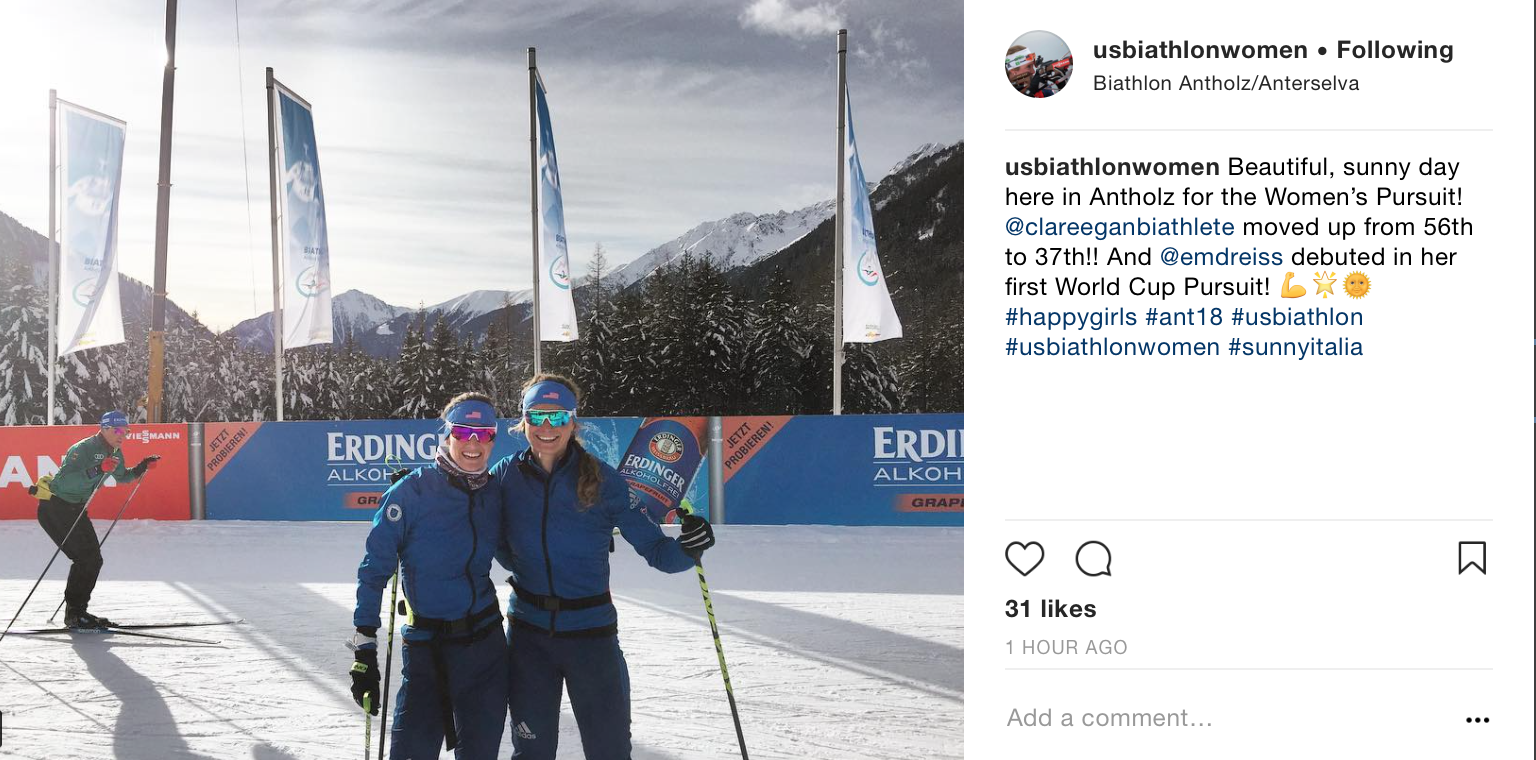
    For the U.S., the top finish came from Clare Egan, who moved from 56th up to 37th despite three missed shots; she had the 22nd-fastest ski time of the day.

    “I’m really happy with my skiing right now,” Egan wrote in an email. “I’m finally getting into race shape, just in time for the Games. Today I had the 8th fastest last lap, which is a personal best for me. I also believe I had the fastest skis out there. I was psyched to stay with Justine Braisaz all the way from the last shooting to the finish and I think if we hadn’t had to go around a few other people I could have gotten a better finishing Lane for the sprint.”

    Emily Dreissigacker, competing in her first-ever World Cup pursuit, finished 56th (+6:27.2) with four missed shots.

    “My strategy was really to just relax and try not to get too caught up in the excitement,” Dreissigacker wrote in an email. “I think I did a good job of that until my last shooting. That last standing I was definitely very tired going into it and it just felt very rushed and hectic, not relaxed at all. I think this was a good final weekend of racing before the Olympics. I definitely struggled with the altitude a little but overall I think it was good progress. I am looking forward to getting in a good training block in Ruhpolding before we head to Korea.”

    Susan Dunklee sat out the pursuit with a cold. No Canadian women qualified for the event.

    Bø Decimates Field in Men’s Pursuit, But Fourcade Still Leads World Cup

    Bø started with a lead of 12.8 seconds over Fourcade, and it only got bigger. The pair have been battling all season and between them have taken every win so far but one – that went to Bø’s brother, Tarjei.

    But today Fourcade didn’t look like a match for the Norwegian, who not only hit all his targets but also skied faster than the Frenchman, and gained a few seconds on the shooting range, too.

    With Fourcade missing just one shot, by the finish the margin between the two men had grown to a whopping 1:00.5.

    Johannes Thingnes Bø of Norway picked up his eighth win of the season. (Photo: IBU/Biathlonworld.com)

    “Until the last shooting, anything is possible,” Fourcade said in a press conference. “But since the first shoot, I knew that I had to expect Johannes [to make mistakes] to be back in the competition. Today he was perfect. There’s nothing more to add…. I’m satisfied with what I did today. It’s not my best shape, but… I’m satisfied that I did a beautiful biathlon competition and a beautiful second place.”

    Anton Shipulin of Russia moved from fourth into third place after the second shooting, and never relinquished this spot as his only penalty of the day had come in the first stage. He finished +1:18.4. Arnd Peiffer of Germany, who has started in third and missed one shot in the second stage, finished fourth, +1:47.5.

    Fifth place went to Emil Hegle Svendsen of Norway, who cleaned all his targets to move up from 32nd.

    Three men started for the U.S., with Tim Burke and Lowell Bailey both collecting just one penalty. That moved Burke from 43rd up to 21st in the pursuit, finishing +3:03.4.

    “I feel like I may have been a bit too conservative on the range in some of my previous four-stage races this season,” Burke wrote in an email. “I went out there today with the goal of being more aggressive and getting my total range time back down to a more competitive time.  Today was just one of those days when it clicked and I was able to carry through with the plan. I was in quite the group on the last lap but unfortunately was at the end of the group for the entire loop. I did not have the legs today to get around. Tomorrow I will have another chance in the mass start!”

    Bailey moved from 41st to 35th (+3:54.8).

    “Shooting was decent today, but I didn’t feel any better on the skis, unfortunately,” Bailey said in a U.S. Biathlon Association press release. “For now, I’ll take a rest day and get back to it on Monday with the preparation for the Olympics. I trust my training was good this season. Now, it’s just a matter of doing some quality training sessions over the next two weeks and focusing on the Olympics.”

    Despite three misses, Leif Nordgren climbed from 50th to 44th (+4:40.8).

    No Canadian men had qualified for the pursuit.

    Results: men / women

  • Thursday Rundown: Eckhoff Comes Up Big in Antholz Sprint

    Thursday Rundown: Eckhoff Comes Up Big in Antholz Sprint

    Norway’s Tiril Eckhoff celebrates her first World Cup win (and first top 20) of the 2017/2018 season on Thursday after winning the IBU World Cup women’s 7.5 k sprint in Antholz, Italy. (Photo: IBU/Biathlonworld)

    IBU World Cup (Antholz, Italy): Women’s 7.5 k sprint

    So far this season, Norway’s Tiril Eckhoff had yet to crack the top 20 outside a relay in the International Biathlon Union (IBU) World Cup. That all changed Thursday when she won the women’s 7.5-kilometer sprint in Antholz, Italy.

    She did so by hitting all 10 targets and besting the time of Germany’s Laura Dahlmeier by 12 seconds at the finish.

    “I was very nervous for today,” Eckhoff, 27, told German broadcaster ARD in English after the race. “My shooting has been really bad, and I wasn’t qualified for the sprint at the Olympics, and that has been my plan the whole season for the Olympics. So I am very happy to manage to do a good race and a clean shooting today.”

    Eckhoff started 71st out of 103 women, then went on to clean prone and standing and ski the second-fastest overall course time in the process. In doing so, she not only topped Dahlmeier, who started ahead of her in bib 22, but also the Czech Republic’s Veronika Vitkova, who started 21st and posted the second-fastest finishing time after Dahlmeier — until Eckhoff crossed the line. Both Dahlmeier and Vitkova also shot clean.

    “I only got positive feedback so I was really happy,” Eckhoff said of trying to beat the times of both Dahlmeier and Vitkova. “I was thinking against Dahlmeier I had to ski really really fast. Now I was very happy to manage that.”

    Germany’s Laura Dahlmeier racing to second in the women’s 7.5 k sprint at the IBU World Cup in Antholz, Italy. (Photo: IBU/Biathlonworld)

    While Eckhoff finished in 21:05.3, Dahlmeier placed second (+12.0) and Vitkova ended up third (+20.6).

    “I am very happy about my second place,” Dahlmeier told ARD. “That was a really good race today. I tried to shoot well, because in general the tendency in Antholz is to shoot a few too many misses, so I just tried to start out calm on the course and focus on the shooting.”

    Asked specifically about Eckhoff, who’s previous best sprint result this season was 50th (and season best was 22nd in a 15 k individual race), Dahlmeier said, “You probably always have to account for a Tiril Eckhoff. She is a bit of a mixed bag on the shooting range, maybe I wouldn’t quite have expected her to twice get through clean, but when she manages to do that she is right at the top. And she proved that again today.”

    Darya Domracheva of Belarus skied the fastest overall course time but had one standing penalty (0+1) that kept her from the podium as she finished fourth (+23.0), and France’s Anais Bescond shot clean to place fifth (+26.6).

    Russia’s Ekaterina Yurlova-Percht placed a season-best sixth (+39.4) with clean shooting, Italy’s Dorothea Wierer was seventh (+40.0, one penalty), Switzerland’s Elisa Gasparin eighth (+52.6; no penalties), and Germany’s Franziska Hildebrand and Denise Herrmann ninth (+54.2, no penalties) and 10th (+56.2, one penalty), respectively.

    US Biathlon started four of the five women on its Olympic team in Antholz, with Susan Dunklee leading all North Americans in 35th (+1:49.5) after a prone miss and another in standing (1+1). Clare Egan finished 56th (+2:17.0) with three penalties (2+1), Emily Dreissigacker shot clean and finished 59th (+2:26.8), thus qualifying for Saturday’s pursuit (which will be her first at the World Cup level) in the sprint top 60. Joanne Reid was the only American to miss the top 60 in 72nd (+2:43.6) with two prone misses (2+0).

    Emily Dreissigacker was the last starter in the IBU World Cup women’s 7.5 k sprint on Thursday in Antholz, Italy. She went on to place 59th to qualify for her first World Cup pursuit. (Photo: US Biathlon/NordicFocus)

    “I didn’t feel sharp on the skis and I struggled adjusting to the thin air of high altitude,” Dunklee said of the Antholz venue’s elevation around 1,600 meters (or 5,200 feet) above sea level, according to a US Biathlon press release. “I’m grateful to get another opportunity Saturday. I want to make the most of each race start as preparation for Korea. Three women in the pursuit – that’s a big step forward and a great place to see the team heading into the Games.”

    “I definitely struggled with the altitude in the skiing, but I was really happy with my shooting and, of course, am very excited to have qualified for my first World Cup pursuit,” Dreissigacker said, according to the release.

    “My shooting continues to be extremely disappointing,” Egan said. “But on the bright side I skied fast enough to give myself another chance on Saturday in the pursuit.”

    Canada was led by Nadia Moser in 85th (+3:23.4) with two misses (1+1). Sarah Beaudry, who was recently named to Biathlon Canada’s Olympic team, followed in 87th (+3:30.4) with three penalties (2+1), and Megan Bankes finished 90th (+3:46.5) with four misses (1+3).

    The Antholz World Cup men’s 10 k sprint takes place Friday at 8:15 a.m. EST.

    Results

  • Crawford Fourth in Ruhpolding Mass Start; Burke 21st

    Crawford Fourth in Ruhpolding Mass Start; Burke 21st

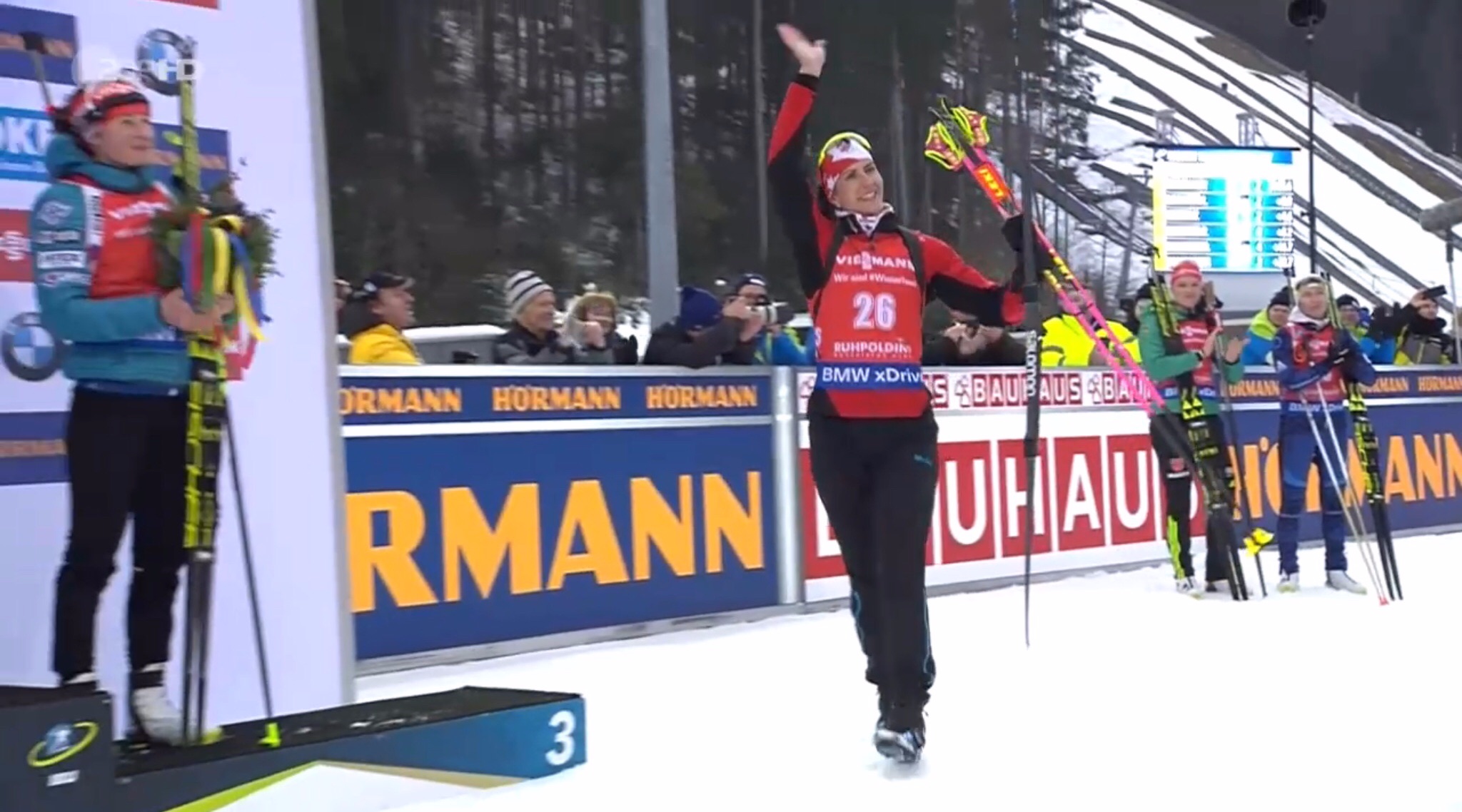
    Biathlon Canada’s Rosanna Crawford (26) waves to some 20,000 spectators in the stands during the flower ceremony of the women’s 12.5 k mass start at the 2018 IBU World Cup in Ruhpolding, Germany, after finishing in fourth place. (Screenshot: ZDF broadcast)

    Note: This article has been updated to include comments from Rosanna Crawford.

    For a few minutes, it looked like Biathlon Canada’s Rosanna Crawford could clutch her second podium in her second-straight individual race in Ruhpolding, Germany, in the women’s 12.5-kilometer mass start on Sunday. Maybe it could even be the first World Cup victory of her career.

    After cleaning also the 20th of 20 targets — as the only competitor to achieve that on Sunday in the elite mass start field of just 30 athletes — Crawford headed out on the final loop 16 seconds ahead of Czech Republic’s Veronika Vitkova, with Finland’s Kaisa Mäkäräinen and Germany’s Laura Dahlmeier a few additional seconds behind, all of them former World Cup winners and world champions.

    “I was really surprised to leave the range in 1st, these are the 30 best women in the world,” Crawford wrote in an email.

    On the prior loop, Crawford had lost just about ten seconds to those three and Darya Domracheva of Belarus, before passing them on the range with her flawless shooting. Mäkäräinen and Dahlmeier each incurred a penalty, having to ski 150 extra meters before they could return to the course to chase after her, while Vitkova had also remained clean in that stage.

    But would the Canadian’s lead be large enough to reach the finish first, keeping some of the strongest skiers of the field at bay?

    Anxiously looking behind several times, Crawford was overtaken by Dahlmeier and Mäkäräinen, but kept Vitkova behind her to stay in podium contention. Yet her lead was dwindling.

    Kaisa Makarainen of Finland celebrates winning the women’s 12.5 k mass start in Ruhpolding, Germany, as Germany’s Laura Dahlmeier (r) takes second, Veronica Vitkova of the Czech Republic (far left) races to third, and Canada’s Rosanna Crawford (c) fourth. (Photo: IBU/Biathlonworld)

    Out of the final downhill in a meandering section of turns, Mäkäräinen moved in front of Dahlmeier and held that ski-length lead into the finish. She crossed the line in a time of 34:05.6 minutes (with two penalties), with Dahlmeier just 0.8 seconds behind (also with two penalties) before collapsing to catch her breath.

    Cheered on from the side of the track by coaches and teammates, Crawford remained in front right until the little tree branches marking the finishing lanes, but Vitkova was already on her tails.

    “I really thought if I made it to the stadium in front of Vitkova I’d be able to hold her off, but she had the slip stream and I my legs just felt like concrete,” Crawford wrote.

    Choosing the lane to her right, Vitkova pushed hard and managed to outsprint Crawford to the line for third (+4.6, with two penalties) while Crawford finished 0.6 seconds back in fourth (+5.2, with no penalties). For Crawford, the result was her career best in a mass start, and she received many congratulations from her peers and the ovations from thousands of spectators during the flower ceremony following the race.

    “I would have love to hold onto a podium but was pretty dead on my last loop,” she continued, adding that she had woken up to a sore throat and congestion on Saturday, which persisted on Sunday. “In hindsight it was a mistake to be looking over my shoulder to see how close they were, I really should have just kept pushing, but this being a position I’ve never been in before I was pretty overwhelmed! Next time I will just keep fighting till I cross that red line in the snow! But having the two of the strongest women chasing me down was a bit scary! Kaisa is so fast and Laura I’m sure wanted to give the fans what they came for, a German podium!

    “I was pretty disappointed when I crossed the line in 4th, but as time went by I got more and more happy,” she added. “To have hit another 20/20 is fantastic, especially in the high pressure situation of a Mass Start. With that race I went 50/50 in Ruhpolding!”


    Germany’s Denise Herrmann followed in fifth (+16.7), almost making up for a penalty lap in each of the four stages by also skiing the fastest course time on each loop. Domracheva finished sixth (+23.7) after she had missed two more targets in the final standing stage (0+0+1+2).

    For Vitkova it was the second podium of the season, after another third place in the sprint in Oberhof, Germany.

    “I knew that Kaisa and Laura are behind me,“ Vitkova said of the exciting last loop in the post-race press conference. “My feeling on the skis was very good, and I believed that I can catch Rosanna. … It was very nice, now we have Olympic season and my results are better and better, so I am very happy.”

    For Mäkäräinen, it was her first victory of the season and 22nd overall in her career. She also moved into the lead in the overall World Cup Total Score, 19 points ahead of Slovakia’s Anastasia Kuzmina in second.

    “I appreciate silver and bronze a lot, too, since all podium places mean you had a good race, but victory is victory,” Mäkäräinen said in the press conference. “We were skiing quite fast all the last loop, I was on my limit all the time. … Happy that it ended this way.”

    Dahlmeier, coming off a cold that forced her to forego the previous week of races in Oberhof, Germany, was satisfied with her result as well, despite narrowly missing out on another victory in front of her fans after anchoring her relay team to a win on Saturday.

    “It was a lot of fun today, a really great race that had everything, suspense at the shooting range, a fight on the loop … and incredibly exciting with that finish sprint,” Dahlmeier told German broadcaster ZDF after the flower ceremony, according to a translation. “For me this was the perfect race to close out the week in Ruhpolding.”

    “It was like Kaisa said, a really fast loop for us,” Dahlmeier later explained in the press conference. “We had really good equipment today, so for me it was a little bit easier on the downhill parts. We [caught] Rosanna Crawford, and I was in front on the last hill up the [shooting range climb]. Then we had the final sprint, and Kaisa was a little bit faster than me today. But I am very happy about this second place, and I think it is a really good sign that I am in good shape.”

    As Crawford had told FasterSkier following her podium in the individual race, she considers Ruhpolding a “special place”, after she raced her first Junior World Championships there in 2008, her first World Cup in there in 2010, and on Thursday, her first World Cup podium (when she was third in the 15 k individual). She has followed that up with another one of her best results of her career.

    “The crowd was amazing in Ruhpolding this whole week! I loved having my first podium at one of the most popular World Cup venues,” she wrote. “We had incredible skis all week and our techs worked so hard, a big shout out to them! I think none of them have voices this morning from cheering so hard in yesterday’s race!!”

    And regardless of whether or not Crawford reached the podium on Sunday, multiple-time World Champion Dahlmeier pointed out, “There is no big difference even between a place in the 40s or a victory,” she said of the ups and downs of her weekend and the sport in general during the press conference. “With the shooting, you can have one or two [misses] more and you are somewhere out of the best 30. Then the next day you can win a race or be on the podium … That’s the difference between cross-country and biathlon, and that’s why we love it.”

    J.T. Bø Wins Men’s Mass Start Ahead of Fourcade; Burke 21st

    US Biathlon’s Tim Burke racing to 21st in the men’s 15-kilometer mass start at the 2018 IBU World Cup in Ruhpolding, Germany. (Photo: US Biathlon/NordicFocus)

    Earlier on Sunday, US Biathlon’s Tim Burke successfully cleaned the first two stages in the men’s 15 k mass start to stay in contention for a top position. He left the range in 11th position and just 8 seconds behind the pace set by World Cup leader Martin Fourcade of France in first and his Norwegian rival Johannes Thingnes Bø in second.

    “The atmosphere was great out on the course today with 25,000 fans,” Burke wrote in and email to FasterSkier. “No matter how many times I have done this, racing in that environment is always exciting.”

    Then Burke missed the last shot in his first standing bout and had to ski a penalty lap. He came back on the course in 13th, just ahead of Fourcade who had incurred two penalties in that stage. Then Burke skied the fifth-fastest course time on the next loop, trying to again close a gap to the group ahead.

    “I felt decent throughout the race but am definitely looking forward to racing on some different courses that better suit my strengths,” Burke wrote. “Ruhpolding is filled with short, steep climbs that are almost always followed by some type of recovery. Because of that, it ends up being an endless cycle of sprint then recover, which is definitely not my forte.”

    After he missed two more targets in the final standing stage, Burke lost 10 positions and another 50 seconds to the leaders, leaving the range in 23rd. On the final loop he made up two places, passing Norway’s Lars Helge Birkeland and Bulgaria’s Krasimir Anev, to finish 21st (+1:30.2, with three penalties).

    “Overall, I am happy with where I am at right now,” wrote Burke, who placed fourth in a 10 k sprint at the previous World Cup in Oberhof. “I just have to work on a few small details and then a top result should be possible.”

    Ahead of Burke, the mass start was decided when Johannes Bø extended his lead on the fourth loop before the final shooting to almost 20 seconds, then returned to the course in first place despite a penalty in the last standing.

    On the last loop he defended his lead ahead of three French athletes with Antonin Guigonnnat, Quentin Fillon Maillet and Fourcade chasing after him. Though Bø skied the second-fastest course time overall, he lost 14 seconds to Fourcade on the last loop and crossed the finish line 4.5 seconds ahead of Fourcade in 37:11.2 minutes (with one penalty).

    Norway’s Johannes Thingnes Bø (2) racing to a win in the men’s 15-kilometer mass start at the 2018 IBU World Cup in Ruhpolding, Germany, with France’s Martin Fourcade behind him. (Photo: IBU/Biathlonworld)

    At the press conference, Bø acknowledged that he was worried Fourcade would catch him.

    “I was thinking about it when I saw him out on the tracks there, but I tried to just stay in my own lane for the tracks, and it was very good practice to stay on the lead on the last lap,” Bø said. “It’s very tough, mentally, and you just have to think forward and not so much about the people behind.

    “When you fight for the win, you don’t want to be weak, you know?” Bø added when asked what gave him strength on that last loop. “So it’s just to be happy with the pain in the legs and ski as fast as you can.”

    Fourcade — who temporarily dropped to 15th following two misses in the third stage — could not quite catch Bø and settled for second (+4.5), with two penalties (0+0+2+0).

    “It was a really good fight at the front of the competition,” Fourcade said inatthe press conference. “I didn’t take enough time to be stable on my [first standing stage] and I missed two, but I think I could [have missed] three on that; it was a really bad one. … I knew that with two mistakes advantage, it would be really hard to come back on Johannes, and when I saw that he missed only one on the last shooting, I knew that it was already over for me.”

    So he focused on at least catching his teammates Guigonnat and Fillon Maillet on the final loop, who had left the range in second and third, respectively.

    “It was really special to fight with them because we know each other — our strong points and our weaknesses,” Fourcade said. “I knew that I had to be really faster than Antonin before the last finish [stretch], because he’s a really good sprinter.”

    Fourcade’s 26-year-old teammate Guigonnat, who had been called up to the French World Cup team for the last three races, finished third place (+8.4, with no penalty). It was the second World Cup podium of his career, following up on another third place in the sprint in Annecy, France, earlier this season.

    “I didn’t feel much pressure because I’m clearly an outsider, so nobody’s cheering for me, I think,” Guigonnat modestly said in the press conference. “And the other guys, they are fighting each other for maybe the yellow bib [of the World Cup leader] or things like this, and then I just do my job and that’s it.”

    Fillon Maillet finished fourth (+12.6, with one penalty), and Bø’s older brother Tarjei Bø placed fifth (+14.2, with one penalty) after he made up by five positions on the final loop.

    Burke learned Saturday that he could race the 30-man mass start, after being listed as the third alternate based on his current World Cup Total Score. After Sunday’s race, he’s up to 26th in the overall standings.

    “A few athletes in front of me were sick so they decided to sit out,” Burke explained in his email. “This is very normal for a mass start, you can usually count on 1 to 3 athletes sitting out. I ended up doing that earlier this season [for the World Cup in Annecy] when I sat out the Mass Start because of a cold.“

    Aside from Crawford and Burke, no other North Americans qualified for Sunday’s mass starts via the top-25 positions in the World Cup Total Scores, respectively the five best results of those outside those ranks in the individual race.

    The IBU World Cup continues in Antholz, Italy, with sprints on Thursday, Jan. 18 for the women and Friday, Jan. 19 for the men.

    “My fiancée will come down, so I’m looking forward to have her on her first World Cup outside Norway, so that will be fun,” Bø revealed when asked about Antholz at the press conference.

    “That’s good news for me, because he will be really tired for competitions,” Fourcade quipped, as both laughed.

    Fourcade continues to lead Bø in the Total Score standings, now just 44 points ahead with 666 points.

    Results: WomenMen

  • Saturday Rundown: Dresden, Ruhpolding, Kaiser Maximilian Lauf

    Saturday Rundown: Dresden, Ruhpolding, Kaiser Maximilian Lauf

    The women’s freestyle sprint podium on Saturday at the World Cup in Dresden, Germany, with Sweden’s Hanna Falk (c) and Maja Dahlqvist (l) in first and second, and American Sophie Caldwell (r) in third. (Photo: FIS Cross Country/Twitter)

    FIS Cross Country World Cup (Dresden, Germany): Freestyle sprints

    Women’s report

    Men’s report

    For her second-straight World Cup sprint, Sophie Caldwell of the U.S. Ski Team reached the podium in the women’s 1.2-kilometer freestyle sprint on Saturday in Dresden, Germany.

    Caldwell placed third in the final behind Sweden’s Hanna Falk, who won it in 2:11.02 minutes, and Maja Dahlqvist, also of Sweden, who placed second (+0.23). Caldwell and Dahlqvist both lunged in a photo finish for second, which Dahlqvist took by 0.07 seconds.

    Also in the final, which included four Swedes, Switzerland’s Laurien van der Graaff finished fourth (+0.58), and Sweden’s Anna Dyvik followed in fifth (+0.68) and Stina Nilsson sixth (+7.56) after tripping.

    Falk started the day by winning the women’s qualifier in 2:06.34, by just 0.02 seconds over Nilsson in second. Caldwell qualified 11th (+2.02). and another American Ida Sargent made it into the heats in 14th (+2.44). Kikkan Randall missed the top 30 by 0.6 seconds in 34th (+6.57), Julia Kern placed 38th (+7.78), and Caitlin Patterson, of the Craftsbury Green Racing Project (CGRP), was 40th (+8.56) out of 49 women in the qualifying round.

    Sargent finished fourth in her quarterfinal, 043 seconds behind Sweden’s Ida Ingemarsdotter in first, to finish the day in 17th overall.

    For Caldwell, who went on to advance in second in her quarterfinal and third in her semifinal, the podium came after she finished second in the last World Cup skate sprint (the first stage of the Tour de Ski) on Dec. 31 in Lenzerheide, Switzerland.

    Her boyfriend and fellow U.S. Ski Team member Simi Hamilton came close to reaching the men’s 1.2 k sprint final on Saturday after qualifying in 15th then placing second in his quarterfinal and fifth in the second semifinal, 0.38 seconds behind Sweden’s Emil Jönsson in first.

    France’s Lucas Chanavat won the qualifier in 1:50.42, 0.15 seconds ahead of Norway’s Johannes Høsflot Klæbo in second. Hamilton was 4.32 seconds back in the qualifier, and his U.S. teammate Andy Newell also qualified in 18th (+4.91). Erik Bjornsen missed qualifying by 0.23 seconds in 32nd (+6.15) and Ben Lustgarten (CGRP) finished 49th (+8.64) out of 67 men.

    The women’s freestyle sprint podium on Saturday at the World Cup in Dresden, Germany, with Italy’s Federico Pellegrino (c) in first, Norway’s Johannes Høsflot Klæbo (l) in second, and France’s Lucas Chanavat (r) in third. (Photo: FIS Cross Country/Twitter)

    While Hamilton’s day ended in the semifinals, putting him 10th overall (and Newell finished sixth in his quarterfinal to place 27th overall), Italy’s Federico Pellegrino timed his attack perfectly in the final, challenging Klæbo for the win down the finishing stretch. The Italian took it by 0.18 seconds in 1:52.77, Klæbo placed second and Chanavat third (+0.98).

    France and Norway had two men in the final, with France’s Richard Jouve placing fourth (+1.23), Sweden’s Jönsson taking fifth (+2.36) for his best individual World Cup result since December 2016. Norway’s Even Northug finished sixth (+12.04) after breaking his pole out of the start.

    Canada’s Julien Locke of the National U25 Team and Black Jack Ski Club had a career-best day, finishing 15th overall. He qualified 16th (+4.61) then placed third in his quarterfinal, crossing the line just 1 second behind Norway’s Fredrik Riseth, who won that heat. Hamilton was second in that quarterfinal, 0.67 seconds back.

    Also for Canada, Bob Thompson (NTDC Thunder Bay) finished 50th in the qualifier (+8.67), Dominique Moncion-Groulx (Alberta World Cup Academy) was 59th (+9.99) and Antoine Briand (Pierre-Harvey National Training Centre) 60th (+10.12).

    Results:

    Women’s qualifier | Women’s heats

    Men’s qualifier | Men’s heats

    ***

    Germany’s Laura Dahlmeier, Franziska Preuss, Denise Herrmann and Franziska Hildebrand (left to right) celebrating their win in the women’s 4×6-kilometer relay at the 2018 IBU World Cup in Ruhpolding, Germany. (Photo: IBU/Biathlonworld)

    IBU World Cup (Ruhpolding, Germany): Women’s relay

    The teams from Germany and Italy dueled for the top position all race in Saturday’s 4 x 6-kilometer women’s relay at the IBU World Cup in Ruhpolding, Germany. Cheered on by some 20,000 home-crowd fans, Germany’s anchor Laura Dahlmeier stayed on the ski tails of Italy’s Federica Sanfilippo after the last shooting stage, then passed her before the last major climb and held a narrow lead around the rest of the course to cross the finish line first in a time of 1:08:47.0 hours, with Italy 2.9 seconds behind. German had a team total of zero penalties and nine spares.

    “It’s incredibly fun to win in front of this audience here today,” Dahlmeier told German broadcaster ZDF in an interview right after the race, according to a translation. “I think this will boost our whole team morale. We showed today that we are a team to be reckoned with in relays. It was just a nice race.”

    Germany with Franziska Preuss, Denise Herrmann, Franziska Hildebrand, and Dahlmeier was never more than 30 seconds behind the pace, even though Hildebrand temporarily fell back from leading the field to tagging off to Dahlmeier in fourth position.

    “My race held all kinds of surprises today,” Hildebrand told ZDF with a laugh. “It started with a fall on an icy patch 100 meters after it began… Then I dropped my pole, also had to exchange the replacement one, and then three spares [in prone] to avoid the penalty. Today everything conspired in my race.”

    Italy with Lisa Vittozzi, Dorothea Wierer (coming off a victory in the individual race on Thursday), Nicole Gontier and Sanfilippo had the best shooting performance of the day, with no penalty and just three spares.

    “That last loop with Laura was really tough,” Sanfilippo said in the press conference. “I gave my best, I tried all for my team. I knew that I can be strong on the last loop. I tried to attack, but Laura was a little bit stronger. But I am also really happy that we finished in second place, I think that was really important for our team.”

    Sweden with Linn Persson, Mona Brorsson, Anna Magnusson and anchor Jenny Öberg was third, 17.2 seconds back, with no penalty and five spares. Brorsson and Öberg managed to move the team up to the podium positions, for the second one in a row following a third place from Oberhof, Germany, a week ago. Before that, the Swedish women’s team had been on a six-year hiatus from those lofty positions.

    “It’s cool to be on the podium again,” Persson said in the press conference.

    “This is like our second home and there were a lot of Swedes here, so we had big support during the race on the tracks,” Brorsson added.” That was an advantage for us.”

    Just a few seconds off the podium, Norway with Synnøve Solemdal, Tiril Eckhoff, Ingrid Landmark Tandrevold and Marte Olsbu was fourth (+23.1, with no penalty and nine spares), with Olsbu outsprinting Poland’s anchor Weronika Nowakowska on the finish stretch (+24.5, with no penalty and five spares). For both teams it was their best relay result of the season so far.

    Switzerland with the three sisters Elisa, Selina and Aita Gasparin reinforced by Lena Häcki surprisingly led the race at the third exchange after Selina had moved them in front, but her youngest sister Aita could not hold that position, falling back with a penalty lap in the last standing stage to finish eighth (+1:37.1, with one penalty and 11 spares).

    Biathlon Canada’s team of Emma Lunder, Julia Ransom, Sarah Beaudry, and Rosanna Crawford started the race with a setback after Lunder incurred a penalty in her prone stage, leaving the range in 23rd position at the end of the field and already almost a minute behind the leader. She managed to limit the gap with a clean standing stage to exchange still in 23rd position and 1:47 back.

    Taking over Ransom then remained clean in both stages to move the team up to 17th, tagging off 2:14 behind. Beaudry only required one spare in her prone stage (0+1, 0+0) to improve to the 12th position even making up 3 seconds to the leaders.

    Then Crawford, fresh off her first career podium in the individual race on Thursday, managed to also shoot clean in both stages and overtook the teams from Slovakia and Ukraine while further decreasing the gap to finish the race in 10th position, 1:56.7 back, with one penalty and just four spares.

    “Things were a bit softer and slushy today compared to the individual, but nothing too bad,” Crawford commented on the conditions in an email to FasterSkier. “There was quite a bit of wind on the range, which I think was tricking people, the wind flags weren’t showing much but I had to make 6 left correction during zero [target practice].”

    “Today was a solid showing from our team,” she added regarding their result. “Everyone cleaned standing, I think we can be really happy of this race, and take some real confidence going into the Olympic relay.”

    Previously this season Canada had finished the relay in Oberhof, also Germany, in 14th position, and the first one in Hochfilzen, Austria, in ninth.

    For US Biathlon with Susan Dunklee, Clare Egan, Emily Dreissigacker, and Joanne Reid, it was the first women’s relay of the year after missing out on the first two races of the season in this discipline.

    Thus starting at the very end of the field, veteran Dunklee moved up through the pack and got through the prone stage with one spare. But then she had to fight against a penalty lap in her standing stage requiring all three spare rounds, leaving the range in 12th position. With the fastest course time on the opening leg, she managed to slightly decrease the gap to 21.6 seconds and made up three positions to exchange in ninth place.

    Egan missed the first two shots in her prone stage, but hit the targets with her spares leaving the range over a minute back. She followed that up by cleaning her standing stage and left the range 1:29.5 back, then only lost five more seconds on the last loop to exchange in 14th.

    Dreissigacker also needed just one spare in her prone shooting, but then incurred two penalties in her standing stage, doubling the gap and falling back to 19th position at the exchange and 3:51 back.

    Anchor Reid needed three spares on her leg (0+2, 0+1) and managed to still overtake the teams from China and Finland to finish 17th, 4:57.7 behind Germany, with two penalties and 13 spares overall.

    “Finally we had a full team and raced a relay!” Dunklee wrote on Instagram. “Competing on a foreign continent has its challenges.”

    Results

    ***

    Ski Classics (Seefeld, Austria): 60 k Kaiser Maximilian Lauf

    The men’s podium at the Kaiser Maximilian Lauf 60 k Ski Classics marathon in Seefeld, Austria, with Norway’s Tord Asle Gjerdalen (c) in first, Sweden’s Andreas Holmberg (l) second, and Russia’s Ilya Chernousov (r) third. (Photo: Visma Ski Classics)

    At the third Ski Classics event of the 2017/2018 season, the 60-kilometer Kaiser Maximilian Lauf on Saturday in Seefeld, Sweden’s Britta Johansson Norgren (Lager 157 Ski Team) and Norway’s Tord Asle Gjerdalen (Team Santander) took the women’s and men’s victories, respectively.

    Johansson Norgren and Japan’s Masako Ishida (Team Koteng) broke away shortly after the start. The two went back and forth for a while until Johannson Norgren gapped Ishida in the Leutasch valley. While Ishida was caught by a chase pack with Sara Lindborg (Team Serneke), Kari Vikhagen Gjeitnes (Santander) and Lina Korsgren (Åre Ski Team), she reined Johansson Norgren back in on the long climbs after the valley. Ultimately, Johansson Norgren took the win in 2:49:16.0 hours, while Lindborg claimed second, 37.5 seconds back. Ishida finished third (+58.9), Gjeitnes placed fourth (+1:40.7) after injuring her ankle about 2 k before the finish, and Korsgren fifth (+2:05.1).

    The women’s podium at the Kaiser Maximilian Lauf 60 k Ski Classics marathon in Seefeld, Austria, with Sweden’s Britta Johansson Norgren (c) in first, Sweden’s Sara Lindborg (l) second, and Japan’s Masako Ishida (r) third. (Photo: Visma Ski Classics)

    “It was my plan to go full speed from the beginning,” Johansson Norgren said, according to a Ski Classics press release. “I knew Ishida will go fast in the climbs, but I felt strong from the beginning. It was really hard skiing alone in the valley, and when Ishida caught me up, I wasn’t sure if I could win the race. But the last part of the course was perfect for me and I had no problems securing the victory today.”
    The Leutasch valley was the turning point of the men’s race as well, where Vinjar Skogsholm (Team Parkettpartner) and Andreas Holmberg (Team Serneke) broke away from the pack and had built a 90-second gap on the chase group as they left the valley. There on the first climb out of the valley, Holmberg pushed the pace and dropped Skogsholm, while Gjerdalen and Ilya Chernousov (Bauer Ski Team) worked to catch Holmberg up front. They caught him 3 k before the finish and Gjerdalen was first across the finish line in 2:27:49 hours, 14.8 seconds ahead of Holmberg in second.

    Chernousov finished third (+32.0), Ermil Vokuev (Russian Marathon Team) was fourth (+1:07.6), and Anton Karlsson (Lager 157) fifth (+1:08.2).

    “I didn’t like the fact that we gave too much leeway for Holmberg and Skogsholm,” Gjerdalen said, according to the press release. “I’m happy that Ilya helped me in our attempt to catch up with Holmberg, but I wasn’t really sure if we were going to make it. You never know how the other person is feeling in the front, what kind of skis he has and what goes on in his mind. But I managed to win today and it feels great to be back on the top.”

    In the overall “Champion” standings, Nordgren leads with 450 points, 110 ahead of Lindborg in second. Gjerdalen is first in the men’s champion standings with 330 points, 50 points ahead of Morten Eide Pedersen in second.

    The Ski Classics tour moves to Zuoz, Switzerland, next weekend for the 65 k La Diagonela.

    Results

  • Saturday Rundown: Val di Fiemme Stage 6 and Oberhof Pursuits

    Saturday Rundown: Val di Fiemme Stage 6 and Oberhof Pursuits

    Slovakia’s Anastasia Kuzmina celebrates her second-straight IBU World Cup win in Oberhof, Germany, on Saturday with a 1:04-minute victory in the women’s 10 k pursuit. It marked her fourth win of the 2017/2018 season. (Photo: IBU/Biathlonworld)

    IBU World Cup (Oberhof): Women’s and men’s pursuits

    Men’s report

    So far in 2018, Slovakia’s Anastasiya Kuzmina is undefeated after winning her second-straight race on Saturday at the International Biathlon Union (IBU) World Cup in Oberhof, Germany — this time by 1:04.4 minutes in the women’s 10-kilometer pursuit.

    After winning Thursday’s sprint, Kuzmina started 35 seconds clear of anyone else on Saturday, while Finland’s Kaisa Mäkäräinen headed out of the gate after her in second.

    Veronika Vitkova of the Czech Republic started another 5 seconds back in third, and Germany’s Franziska Hildebrand set out in fourth, 47 seconds after Kuzmina.

    Three Canadians finished in the top 60 of Thursday’s sprint to qualify for the pursuit, with Julia Ransom heading out ninth (+1:14), Sarah Beaudry starting 23rd (+1:39), and Megan Tandy starting 59th (+2:38).

    Throughout the four-stage race, it became more and more evident that no one was going to touch Kuzmina. She cleaned the first prone stage to leave the range 55.8 seconds clear of Hildebrand, who also cleaned to move into second. Makarainen dropped to fourth with a miss and Vitkova left the range in third (+1:08.5) after skiing a penalty lap as well.

    On the second prone stage, Kuzmina missed one target, but the penalty lap only cost her about 10 seconds; Hildebrand cleaned to keep herself in second place with three loops remaining.

    The first standing stage that followed saw Kuzmina miss another target and Hildebrand clean, yet 34.6 seconds still separated them. Kuzmina finally cleaned the last standing to extender her lead back up to a minute, while Hildebrand missed one to lose sight of the podium, slipping to fifth and 1:22.4 back at the start of the final loop.

    Italy’s Dorothea Wierer as the 16th starter steadily worked her way up to podium contention, cleaning all four stages with the third-fastest overall shooting time to put herself in second after the final standing, 1:00.2 behind Kuzmina. Ukraine’s Vita Semerenko raced up from 22nd to third with perfect 20-for-20 shooting as well, leaving the range 11 seconds after Wierer with one loop to go.

    On the final loop, Kuzmina skied the 22nd-fastest time on that loop (compared to Wierer’s 28th-fastest last-loop time) to put a few more seconds into Wierer as the eventual runner-up, winning in 30:49.5. On the day, Kuzmina’s overall course time was eighth fastest.

    “It was a very interesting race for me today,” Kuzmina told the IBU after. “My shape is very good now but I was worried if I could concentrate on the shooting … After the first shooting, I was relaxed and realized it was OK. I just gave the other girls two chances … I must apologize for my emotion [on the shooting range], but I was so happy and enjoyed the last loop.”

    Wierer finished 1:04.4 minutes later for second place, and Semerenko crossed the line in third, 1:10.2 out of first. Poland’s Weronika Nowakowska finished fourth (+1:17.1) after starting sixth, with clean shooting, and Mäkäräinen ended up fifth (+1:23.4) with three penalties (1+0+1+1) and the fourth-fastest overall course time. Belarusian Darya Domracheva followed in sixth (+1:28.8) after starting seventh and shooting 18-for-20 (0+0+1+1), and Germany’s Laura Dahlmeier finished seventh (+1:28.8), up from 13th with one late penalty (0+0+0+1).

    South Korea’s Anna Frolina placed eighth (+1:36.0, two penalties) for her best result since December 2012, France’s Justine Braisaz finished ninth (+1:37.0; three penalties), and another French skier Anais Bescond 10th (+1:37.1; one penalty). Hildebrand lost six places on the final loop to end up 11th (+1:38.7; one penalty).

    Overall, France’s Celia Aymonier skied the fastest course time of the day to rise from 28th to 15th (+2:08.7; three penalties).

    Ransom finished the day in 37th (+3:54.4) with three misses (1+0+0+2). She had been in 16th after her early miss in the first prone stage then hovered around the top 20 as she entered her final standing stage. There, she missed two to drop to 36th and she ultimately lost one more place to Finland’s Mari Laukkanen (who started the loop in 37th and passed Ransom, as well as four others, to finish 32nd).

    In her first World Cup pursuit of the season, Tandy improved to 43rd (+4:31.8) with a single miss (0+0+1+0). Overall, her range time was the 18th fastest and shooting time was 23rd fastest.

    Beaudry finished 51st (+5:36.6) with three misses (1+2+0+0), recovering one place from skiing in 52nd after the second shooting.

    In the men’s 12.5 k pursuit that followed, France’s Martin Fourcade held the lead from start to finish and held off Norway’s Johannes Thingnes Bø by 6.3 seconds for his second-straight win in Oberhof. Both of the Bø brothers reached the podium with older brother Tarjei Bø placing third, 30.9 seconds back.

    Fourcade as starter No. 1 had a single penalty on the first prone to keep himself ahead (1+0+0+0) and finish first in 32:23.6. Johannes Bø had three penalties (1+1+1+0) but still managed to rise from third at the start to second at the finish. Tarjei started fifth and shot clean to reach the podium.

    The fourth starter, American Tim Burke had three penalties (0+2+0+1) and ended up 14th (+1:43.7).

    Meanwhile, Canada’s Christian Gow rose from 36th to 21st (+2:19.2) to tie his career best (which also came in a pursuit this season) with 19-for-20 shooting (0+0+0+1). Scott Gow finished 50th (+4:45.0; six penalties), and Brendan Green placed 54th (+5:26.1; three penalties).

    (Full men’s report)

    The Oberhof IBU World Cup concludes Sunday with the men’s and women’s relays. Canada has entered Beaudry, Ransom, Tandy, and Emma Lunder in the women’s 4 x 6 k, and Christian Gow, Scott Gow, Brendan Green, and Carsen Campbell in the men’s 4 x 7.5 k. The U.S. does not have enough athletes at the Oberhof World Cup to field a team in either race.
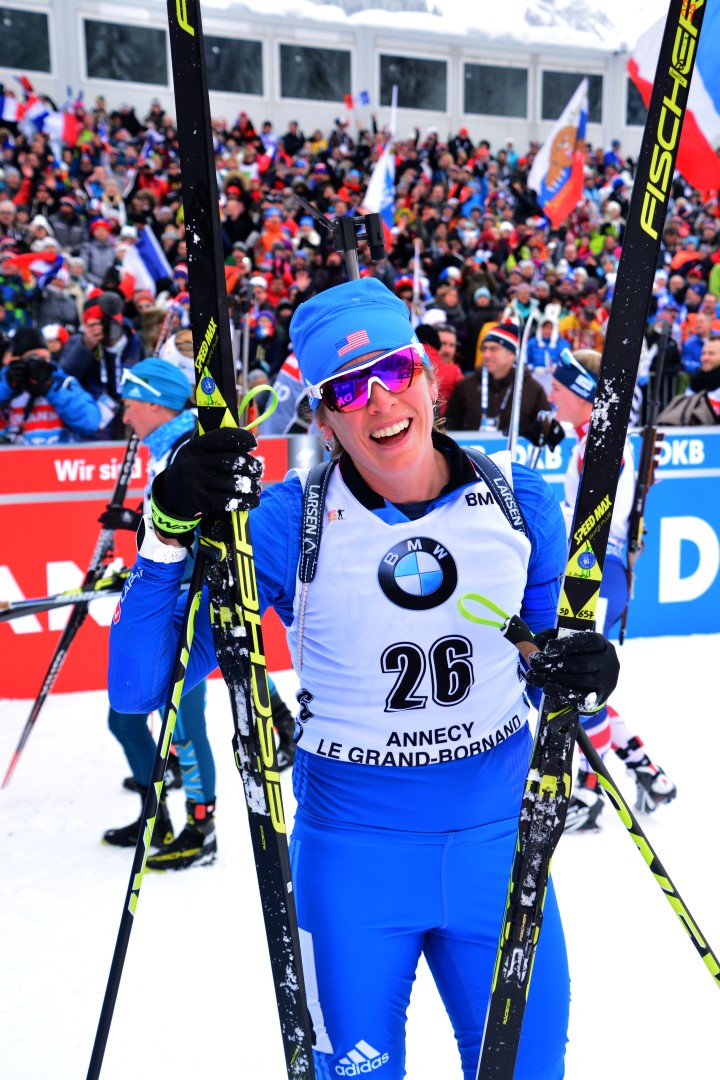
    Results: Women | Men

    ***

    Tour de Ski Stage 6 (Val di Fiemme, Italy): 10/15 k classic mass starts

    Men’s report

    Women’s report

    Alexey Poltoranin (l), Dario Cologna (c), and Alex Harvey (4) charge up the last climb of Saturday’s 15 k mass start in Val di Fiemme, Italy. Poltoranin took the win, with Andrey Larkov (behind Harvey) placing second and Harvey third at Stage 6 of the 2018 Tour de Ski. (Screenshot: ARD broadcast)

    After a soggy and windy stay in Oberstdorf, Germany where the Stage 4 sprint was canceled and the Stage 5 freestyle mass stats were a cluster, the Tour de Ski (TdS) got back to a sense of normalcy in Val di Fiemme.

    Or did they? After dominating the first part of the men’s 15 k classic mass start and picking up valuable Tour bonus seconds, Russia’s Sergey Ustiugov faded, eventually finishing 14th, 42.8 seconds out of the win.

    Instead, Alexey Poltoranin of Kazakhstan made a big push to try to break for it about halfway through the race. Dario Cologna of Switzerland, the Tour de Ski leader coming into the day, followed, as did Canada’s Alex Harvey. The trio had a small gap of a few seconds consistently for several kilometers, before Russia’s Andrey Larkov caught up to them. Behind them, the field continued to fracture into chaos, claiming what would in past years have seemed unlikely victims like Norway’s Martin Johnsrud Sundby.

    After much posturing and pushing in the final kilometer, the lead pack of four came shooting into the downhill finish with Poltoranin claiming the win by 0.4 seconds over Larkov. Harvey finished third, +0.9, and Cologna fourth, +2.3. There was a bigger gap before Russia’s Alexander Bolshunov crossed the line in fifth, +15.0.

    That means that Poltoranin takes over second place in the Tour, while Ustiugov lost ground.

    The only American starter, Paddy Caldwell, finished 48th out of 52 finishers, +3:38.6.

    Results

    The women’s 10 k classic mass start podium at Stage 6 of the 2018 Tour de Ski on Saturday in Val di Fiemme, Italy, with Norway’s Heidi Weng (c) in first, Finland’s Krista Parmakoski (l) in second and Austria’s Teresa Stadlober in third. (Photo: FIS Cross Country/Twitter)

    The women’s race went off as planned: no snafus, only burning lungs and muscles. At the start of Stage 6, Jessie Diggins was ranked third overall in the Tour (+1:56.7). Norway’s Ingvild Flugstad Østberg wore the red bib as the TdS leader, while teammate Heidi Weng was second overall (+57.0).

    As Saturday’s race transpired, Weng proved dominant. She won in 29:07.9. Finland’s Krista Parmakoski placed second (+7.6), and Austria’s Teresa Stadlober third (+8.6).

    Diggins skied a gutsy race to finish fourth (+23.6). Østberg, who at times looked like she could dominate the pace, faded to fifth (+35.2).

    U.S. skiers Sadie Bjornsen finished in 10th place (+1:11.3), Liz Stephen 24th (+2:18), and Rosie Brennan 30th (+2:47.2).

    Heading into tomorrow’s final stage, the formidable climb up the Alpe Cermis, Østberg leads the Tour with a tiny 1.8-second gap on Weng. Parmakoski is third overall (+1:33.5), Diggins fourth (+1:43.1), and Bjornsen eighth (+3:33.1).

    Results: Women’s Stage 6 |

  • Notes and Quotes: French Biathlon World Cup Weekend

    Notes and Quotes: French Biathlon World Cup Weekend

    Martin Fourcade of France leads the IBU World Cup 15 k mass start in Le Grand-Borland, France, on Sunday. (Photo: Glen Crawford)

    LE GRAND-BORNAND, France — After a long weekend of racing, beginning with heavy snow and continuing with glazed tracks, the biathlon World Cup is on break for two weeks to recalibrate and rejuvenate as the athletes prepare for the rest of the season and the 2018 Olympics in February.

    Here’s what some members of the field thought about the races this weekend – the bits of interviews and press conferences that didn’t make it into our race reports.

    On Pressure

    “This was tougher than some World Cups where we are less expected. But it’s also what we want, asking for a World Cup at home. We know that it’s not the same as when we are competing in Norway. It’s so much bigger in terms of emotions. I would do it again.”

    — Martin Fourcade (France)

    Susan Dunklee of U.S. Biathlon after the mass start, which moved her up to being ranked 30th on the World Cup after a disastrous first two weeks of racing had left her out of the points. (Photo: Glen Crawford)

    On Annecy & Le Grand-Bornand

    “I like this place. Four years ago I was on the podium too in the pursuit behind Johannes. I was one year later on holiday here. I like this place, I like the people. It’s a really nice nature, mountain, valleys. I know that I got some Reblochon cheese, too.”
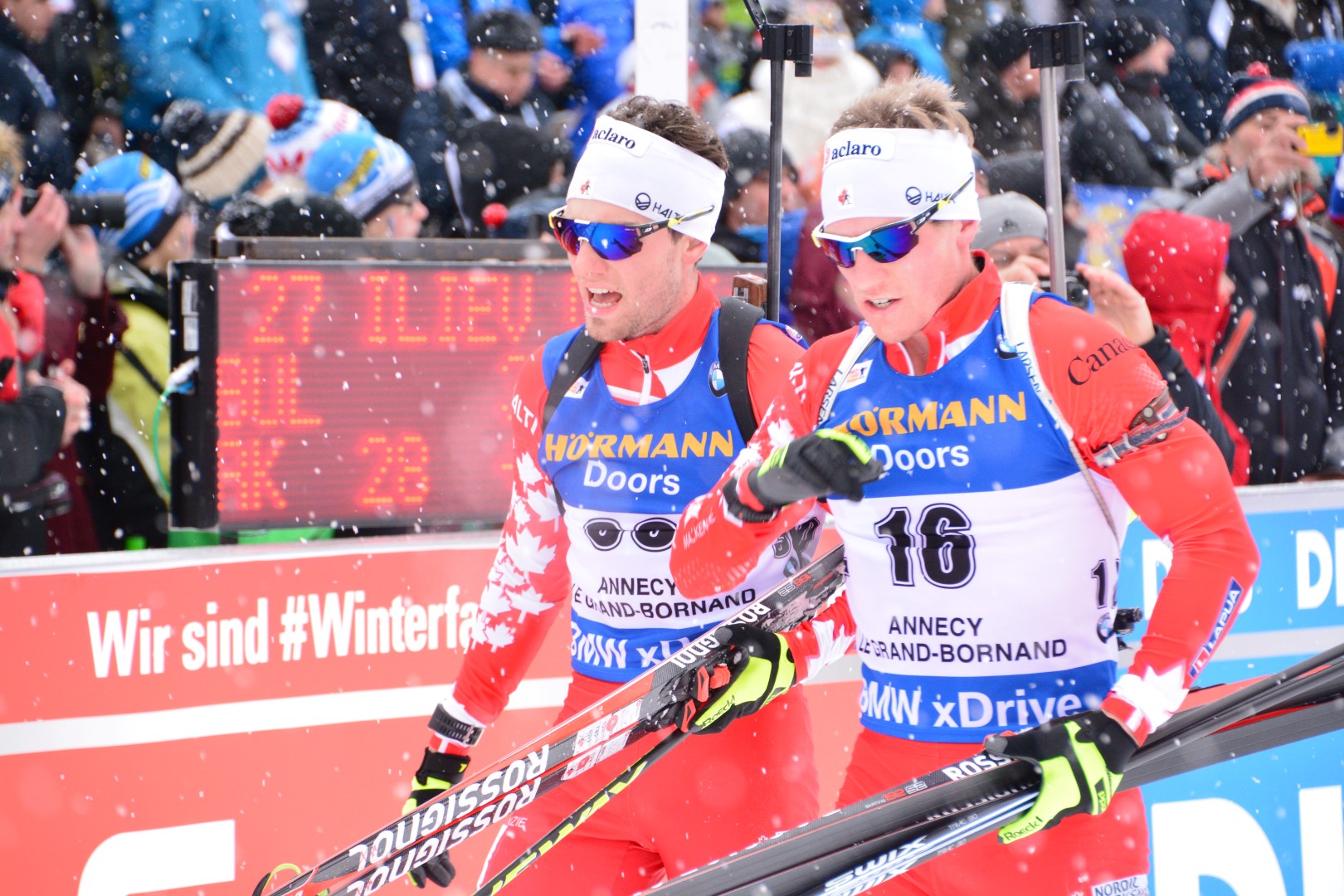
    — Erik Lesser (Germany)

    “It was very loud. I couldn’t hear what my coaches were saying on the side of the course at all. I knew they were there because I could see them out of the front of my eyes, but their voices just got lost in that big, massive noise. Getting this many people here, is absolutely incredible. It has grown so much since last time [in 2013]. It’s a lot of positive energy, and that counts for a lot.”

    — Susan Dunklee (USA)

    “I love it. It’s definitely a different race course with those steep little bumps. But I think it could be [more often] on the circuit.”

    — Julia Ransom (Canada)

    “There are amazing trails that go up the valley. I just went for a classic cruise yesterday just looking around everywhere in awe. The food… We are staying right in the downtown, and the food in our hotels is like cheese and dessert after every meal. I’m like ‘oh no I have to pass on that…’ And the fans, too, I couldn’t believe it. They are so loud, cheering for everyone. I was a little bit overwhelmed just with the sound during the race. I was like ‘okay, keep going’. I love this place.”
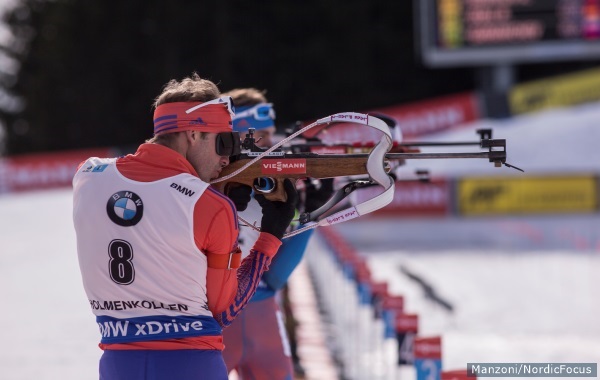
    — Emma Lunder (Canada)

    Anastasiya Kuzmin of Slovakia leading the women’s mass start. (Photo: Glen Crawford)

    “We had a really good atmosphere four years before. But now we really have so much snow in the mountains and in the village. That is why we all make biathlon – we love winter and we love the snow. I’m really happy to have such good conditions here.”

    — Laura Dahlmeier (Germany)

    “You can feel power from the mountains and the snow. What is more important is that there are many fans here… you feel the power from the people who are always supporting you. It’s like a big energy wave. On the track it helped me. Thank you so much.”

    — Anastasiya Kuzmina (Slovakia)

    “Every athlete has their World Cup which is their favorite and where they always do good races. And I think this is one of my top three venues on the World Cup. I really like it here.”

    — Johannes Thingnes Bø (Norway)

    “I want to point out that the organization and the popularity of biathlon grew a lot since 2013. I was really surprised to see so many people around the track cheering, not only local athletes but also international athletes. I could hear them saying my name. So I want to thank them for supporting us.”

    — Anton Shipulin (Russia)

    On Three Weeks of Racing, and Now a Break

    Emma Lunder of Canada competing in the mass start in Le Grand-Bornand, France. (Photo: Glen Crawford)

    “I think it’s great to finish with a nice race. Now I can enjoy the time at home, the time in France. And keep confident of the work which was done.”
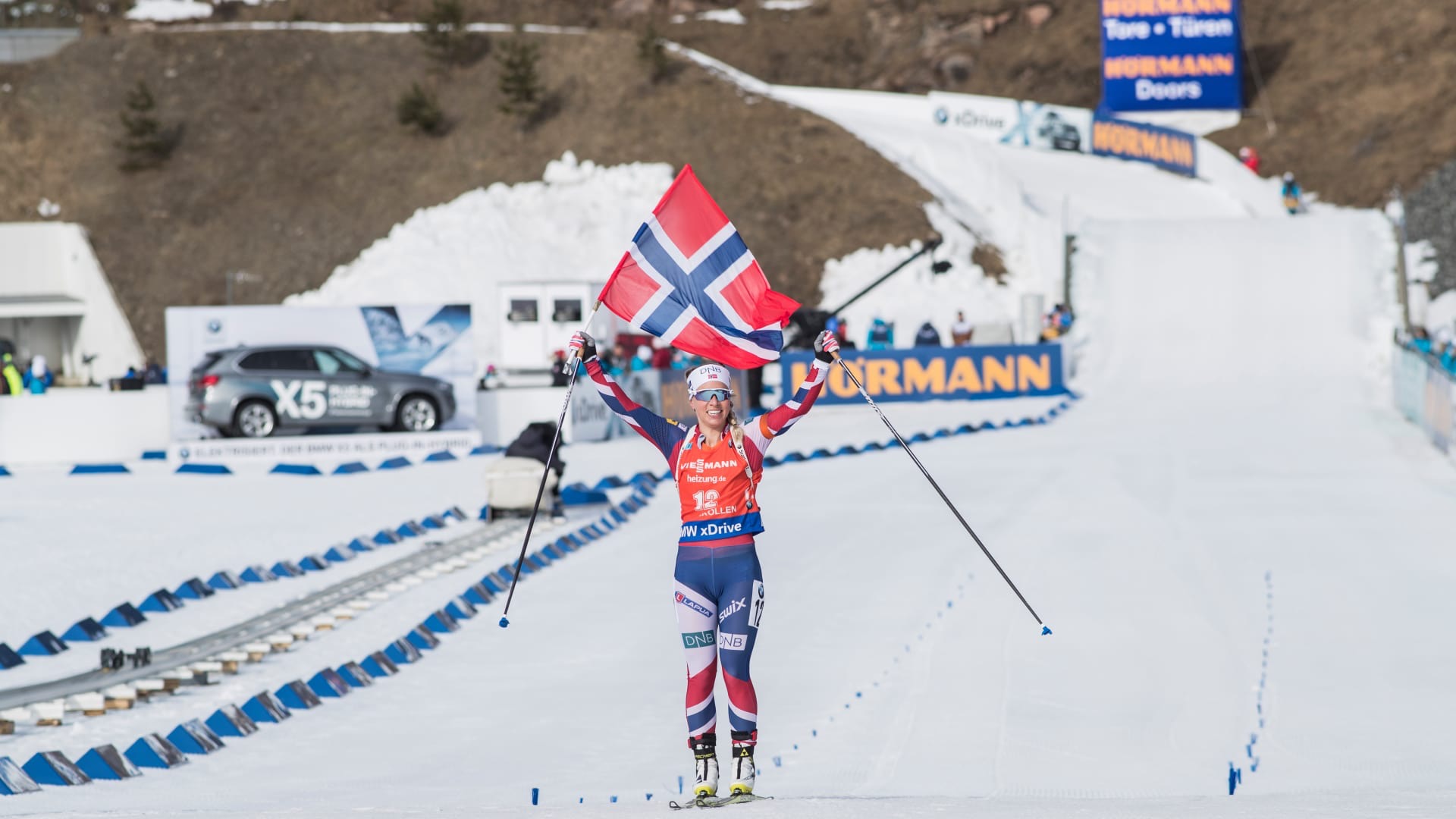
    — Justine Braisaz (France) after winning the mass start

    “I think my shape is getting better and better and also on the shooting range. It’s important to make some good races, it’s good for your own feeling. It’s good for the Christmas holiday now.”

    — Laura Dahlmeier (Germany) after finishing third in the mass start

    “To have good races going into the Christmas break, that’s all I could ask for… Now we can feel like we did a good job, relax, and get some good training in.”

    — Emma Lunder (Canada), who had her best-ever World Cup result and qualified for her first mass start

    “Yeah, I definitely felt [the fatigue] today, but you kind of come to expect that after the first trimester. Now we have a good block of recovery time, and I’ll definitely be looking forward to a few days off.”

    — Lowell Bailey (USA)

    (l-r) Erik Lesser, Martin Fourcade, and Johannes Thingnes Bø after the mass start. (Photo: Glen Crawford)

    “It is always a fight there. Today [Erik] Lesser was there also and [Anton] Shipulin is coming back top-six too. They will be stronger after Christmas.”

    — Johannes Thingnes Bø (Norway), winner of the sprint and pursuit, after the mass start

    “I’ll be getting some good volume training in, I think. Kind of reset the body and get a bit of a training load.”

    — Scott Gow (Canada)

    “I felt pretty tired today, and then on top of it everyone is fast in the mass start… I was looking forward, looking forward to the finish line.”

    — Emma Lunder (Canada), after the mass start

    “Now I’m just [working on] my good shooting and staying concentrated on the shooting position. I think I need a little bit more time, a little bit more practice. But I’m happy that my ski times are still good.”

    — Anastasia Kuzmina (Slovakia)

    Mission Accomplished

    Scott and Christian Gow of Canada after the pursuit, where they both finished in the top 30. (Photo: Glen Crawford)

    “I was hoping to just lock up the Olympic qualification and get that off my back, which is really nice. And then really just put together a solid three sets of races. Last year I was sick, and I wasn’t even in Europe at this point. I was kind of just slogging my way back to good health. So I’ve had some good races here and it’s a good block to start the year… Last year taught me how to grind through something that isn’t the best hand of cards that you could have been dealt.”

    — Sean Doherty (USA), who was named to the U.S. Olympic Team after his performances this weekend

    “I’m really glad that we are finally part of the podium. Finally third, on the World Cup.”

    — Anton Shipulin (Russia), after finishing third in the pursuit and earning Russia’s first podium of the season

    Goals

    Laura Dahlmeier of Germany setting up to shoot in Thursday’s sprint. (Photo: Glen Crawford)

    “I’ve been trying to win the yellow bib every year since I came in the World Cup. But I’ve never had a chance. So we will see this year. But I know it’s a long way there. Now I’m just focusing on the race today, and the next race, and not about the whole season. I’m in good shape here and I try to do the best I can.”

    — Johannes Thingnes Bø (Norway), currently trailing Martin Fourcade by 20 points in the World Cup Total Score

    On Ski Speed

    I’m definitely working my way back into it. I don’t feel 100% on skis. I felt good all the way up to the beginning of the season, and then got set back with some sickness. But I’m still confident with how we trained this summer, and the path towards PyeongChang, so just have to stick to the plan.”

    — Lowell Bailey (USA)

    “Honestly, my skiing, I’m not very satisfied with it at the moment. It’s coming back, step by step, and week by week it has improved, but I feel like there is a lot of room there and I don’t totally feel like myself yet. There’s still plenty of season left.”

    — Sean Doherty (USA)

  • Sunday Rundown: Ramsau, Toblach, Annecy, St. Ulrich, Rossland (Updated)

    Sunday Rundown: Ramsau, Toblach, Annecy, St. Ulrich, Rossland (Updated)

    Bryan Fletcher (USA Nordic) jumping to 45th in the Nordic Combined World Cup on Sunday in Ramsau, Austria. In the 10 k that followed, he skied the third-fastest time to finish 14th overall. (Photo: Romina Eggert/USA Nordic Facebook)

    NorAm mini tour (Rossland, B.C.): 10/15 k freestyle pursuits

    Team Gregg ended the Rossland NorAm mini tour with another double win, with American Caitlin Gregg and her husband Brian Gregg winning the 10- and 15-kilometer freestyle pursuits, respectively, at the Black Jack Ski Club trails.

    The women’s 10 k freestyle pursuit podium at the NorAm in Rossland, B.C., with American Caitlin Gregg (c) in first, and Canadians Zina Kocher (l) and Andrea Dupont (r), in second and third, respectively. (Photo: Cross Country Canada)

    Caitlin capped the long weekend with her third-straight win, a 48.28-second victory over former Canadian biathlete Zina Kocher (Foothills Nordic). Caitlin started first and was first across the finish in 29:02.86, while Kocher started ninth and rose to second place for her second-consecutive podium (after placing third in Saturday’s skate sprint). Andrea Dupont (Rocky Mountain Racers) started fourth and finished third (+1:58.35) for her second-straight podium as well (she was second in the skate sprint behind Gregg).

    Lisle Compton of the National Team Development Centre (NTDC) Thunder Bay and Canadian National Junior Team finished fourth overall (+2:07.03), Frederique Vezina of the Pierre-Harvey National Training Centre (CNEPH) was fifth (+2:16.10), and Annika Hicks of the Alberta World Cup Academy (AWCA) sixth (+2:16.51). Laura Leclair (CNEPH) placed seventh, Kaia Andal (Caledonia Nordic) was the top junior in eighth overall, Jaqueline Mourao (Brazil Ski Team) ninth, and Sophie Carrier-Laforte (Skinouk) 10th.

    Brian, who won the Rossland men’s 10 k classic on Friday, also started Sunday’s 15 k freestyle pursuit first and finished in that position in 38:43.93. Andy Shields (Lappe Nordic) raced to second overall, 7.65 seconds back, after starting fourth, and Jack Carlyle (AWCA) reached the podium in third (+8.75) after starting 10th.

    Evan Palmer-Charrette (NTDC Thunder Bay) ended the weekend in fourth (+17.68), Philippe Boucher (CNEPH) was fifth (+19.02), Brian McKeever (Canadian Para-Nordic Ski Team) sixth (+22.16), Michael Somppi (AWCA) seventh (+34.62), Alexis Dumas (CNEPH) eighth (+52.78), Bob Thompson (NTDC Thunder Bay) ninth (+54.76), and Julien Locke (Black Jack/Canadian U25 Team) 10th (+1:04.46).

    Results

    ***

    FIS Nordic Combined World Cup (Ramsau, Austria): Saturday & Sunday individual competitions

    Bryan Fletcher (USA Nordic) notched seventh in the Nordic Combined World Cup this weekend in Ramsau, Austria, for his best result since January 2016. (Photo: USA Nordic/Facebook)

    After a bye week, the Nordic Combined World Cup resumed in Ramsau am Dachstein, Austria, with back-to-back individual normal hill/10-kilometer Gundersen starts on Saturday and Sunday.

    On Saturday, American Bryan Fletcher posted his best individual result in nearly two years in seventh place, 32.6 seconds behind German winner Eric Frenzel.

    Saturday’s individual competition on Ramsau’s 98-meter hill started out with Japan’s Taihei Kato going farthest in the jump portion, the Czech Republic’s Tomas Portyk jumping to second, and Frenzel jumping to third. Fletcher tied Japan’s Yoshito Watabe for 28th and the two started the 10 k race 1:02 minutes back accordingly.

    While Frenzel picked off two places to finish first in 24:05.8 minutes, Fletcher moved up 21 spots to seventh place with the second-fastest course time of 23:48.4.

    Germany had two on the podium with Fabian Rießle just 0.7 seconds back in second place, and Norway’s Jan Schmid finished third, 8.1 seconds behind Frenzel.

    On Sunday, Rießle climbed to the top step on the podium, winning the weekend’s second normal hill/10 k in 26:12.5.

    Norway’s Jørgen Graabak led after the jump portion, yet ultimately finished sixth, 9.8 seconds behind Rießle.

    Rießle jumped to ninth and started 18 seconds out of first, then took the win on the four-lap course by just 0.3 seconds over Italy’s Alessandro Pittin. The Italian notched second place after starting 36th based on his jump and racing the fastest 10 k time in 25:00.8.

    Finland’s Eero Hirvonen finished third (+1.5) after starting 10th, and Schmid was another 2 seconds back in fourth (+3.5) after jumping to seventh. Frenzel did not start.

    Three Americans qualified for Sunday’s competition. Fletcher jumped to 45th and started 1:30 back, yet rose to 14th (+43.7) with the third-fastest course time. His younger brother Taylor Fletcher skied the second-fastest course time to finish 34th (+2:01.6), up 24 places after jumping to 58th. Adam Loomis finished 52nd (+4:38.6) after jumping to 59th.

    The U.S. Nordic Combined team is headed back to the states to prepare for U.S. Olympic trials later this month, according to the USA Nordic Facebook page.

    Results: Saturday | Sunday

    ***

    FIS Cross Country World Cup (Toblach, Italy): 10/15 k classic pursuits

    Norway’s Johannes Høsflot Klæbo after winning the men’s 15 k classic pursuit for his seventh World Cup win of the season on Sunday in Toblach, Italy. With win No. 7, he has the most wins before the new year in FIS Cross Country World Cup history. (Photo: FIS Cross Country/Twitter)

    Women’s report

    Men’s report

    If you thought Johannes Høsflot Klæbo was out, think again. After placing 10th in the men’s 15-kilometer freestyle on Saturday in Toblach, the 21-year-old Norwegian raced to his seventh victory of the season in the men’s 15 k pursuit on Sunday.

    In doing so, Klæbo broke the record for the most World Cup wins before the New Year: he’s tallied seven in the last eight races he’s contested.

    On Sunday, he started 10th, 36 seconds behind his Norwegian teammate Simen Hegstad Krüger, who won the 15 k freestyle and started first. Klæbo had worked his way up to third by 11.4 k, and at the finish, he edged Russia’s Sergey Ustiugov by 1.9 seconds for the win in 33:31.1 minutes.

    Ustiugov, who started fifth, claimed second, and Kazakhstan’s Alexey Poltoranin rose from 14th to third place (+4.5), ahead of Russia’s Alexander Bessmertnykh in fourth (+9.7), Finland’s Matti Heikkinen in fifth (+9.8), France’s Maurice Manificat in sixth (+10.7), Norway’s Hans Christer Holund in seventh (+11.1), Switzerland’s Dario Cologna in eighth (+11.8), Canada’s Alex Harvey in ninth (+16.3), and Krüger in 10th (+24.0). Norway’s defending Overall and Distance World Cup champion, Martin Johnsrud Sundby placed 11th (+34.4) after starting 20th based on his result on Saturday.

    Erik Bjornsen once again led the U.S. men, racing from 29th at the start to 26th (+1:43.1). Scott Patterson improved from 42nd to 39th (+2:37.2), Paddy Caldwell moved up from 52nd to 44th (+2:57.7), and Noah Hoffman slipped to 49th (+3:01.7) after starting 40th.

    Canada’s Devon Kershaw moved up five places to 33rd (+2:02.8), Graeme Killick finished 50th (+3:42.0), Russell Kennedy 66th (+5:05.8), and Knute Johnsgaard moved up six places to finish 76th (+6:20.8).

    The all-Norwegian women’s 10 k classic pursuit podium on Sunday at the World Cup in Toblach, Italy, with Marit Bjørgen (c) in first, Ingvild Flugstad Østberg (l) in second and Heidi Weng (r) in third. (Photo: FIS Cross Country/Twitter)

    In the women’s 10 k classic pursuit earlier in the day in Toblach, Norway’s Marit Bjørgen overcame a 22-second starting deficit to take the win by just 0.3 seconds over her teammates Ingvild Flugstad Østberg in second. It was an all-Norwegian podium with Heidi Weng in third (+0.8).

    Bjørgen started fifth, 22 seconds behind Swedish race leader Charlotte Kalla, based on their results in Saturday’s 10 k freestyle individual start. By the 6.4 k checkpoint, Bjørgen led a pack of four other Norwegians and Kalla — all within 1.4 seconds of first. At 8.5 k, Bjørgen led Østberg in second and Weng in third, while another Norwegian Astrid Uhrenholdt Jacobsen skied another eight seconds back with teammate Ragnhild Haga in fourth and fifth, respectively. By that point, Kalla was skiing alone, another 11.7 seconds in sixth, while American Jessie Diggins led a group 25 seconds behind Kalla in sixth.

    Ultimately, Bjørgen finished first in 25:19.3 and formed an all-Norwegian podium with Østberg and Weng, Jacobsen placed fourth, 21.5 seconds out of first and 20.7 seconds behind Weng in third.

    Haga was fifth (+31.8), Kalla sixth (+41.9), Diggins seventh (+53.7), Russia’s Natalia Nepryaeva eighth (+54.2), American Sadie Bjornsen ninth (+55.2), and Austria’s Teresa Stadlober 10th (+55.6) in a photo finish with Finland’s Kerttu Niskanen, who placed 11th (+55.6).

    For the U.S. Ski Team, Diggins and Bjornsen retained their starting positions of seventh and ninth, respectively, while Rosie Brennan started 19th and finished 25th (+2:14.6). Chelsea Holmes (Alaska Pacific University) finished 39th (+3:03.8) and Liz Stephen (USST) finished 48th (+4:05.2).

    Canada’s Emily Nishikawa placed 53rd (+4:14.5), Dahria Beatty finished 63rd (+5:44.7), Cendrine Browne 66th (+5:57.7), and Katherine Stewart-Jones 70th (+7:31.5).

    Results: Women Men

    ***

    IBU World Cup (Annecy, France): Women’s and men’s mass starts

    Women’s report

    Men’s report

    France’s Justine Braisaz won her first International Biathlon Union (IBU) World Cup race of the season on Sunday at home in Annecy, France, topping the women’s 12.5 k mass start by 11.2 seconds in 37:19.4.

    While Braisaz shot 19-for-20 (0+0+1+0), Iryna Kryuko of Belarus cleaned the four-stage race for second place, her first World Cup podium. Germany’s Laura Dahlmeier, who won Saturday’s 10 k pursuit, placed third (+19.9) with two penalties (0+1+0+1).

    Two North Americans qualified for the selective mass start, with Susan Dunklee (US Biathlon) racing to 20th (+1:16.3) with three misses (1+0+1+1), and Emma Lunder (Biathlon Canada) placing 28th (+2:21.4) with a single penalty (1+0+0+0).

    In the men’s 15 k mass start that followed, France’s Martin Fourcade finally got the win he was looking for, shooting clean and beating his main rival Johannes Thingnes Bø of Norway by 3.9 seconds. Fourcade crossed the finish line first in 36:30.3, Bø settled for second after skiing two early penalty loops (2+0+0+0) and Germany’s Erik Lesser tallied his second podium in Annecy (after placing third in the sprint) in third place again (+6.2) with clean shooting.

    Two Americans and a Canadian qualified for the mass start, with US Biathlon’s Lowell Bailey leading them in 23rd (+2:22.4) with three penalties, Sean Doherty following in 24th (+2:52.5) with four misses, and Biathlon Canada’s Scott Gow finishing 26th (+4:05.4) with five penalties.

    Results: Women| Men

    ***

    OPA Cup (St. Ulrich, Austria): 10/15 k freestyle pursuits

    On the final day of Alpen Cup (a.k.a. OPA Cup) racing in St. Ulrich, Ida Sargent of the U.S. Ski Team (USST) scored her third-straight top five with a fifth place in the women’s 10 k freestyle mass start. She previously placed third in the skate sprint and 5 k classic on Friday and Saturday.

    Germany’s Julia Belger won the women’s mass start on Sunday in 28:33.6, while Saturday’s 5 k winner, Elena Soboleva of Russia placed second (+0.7). Russia had two on the podium with Mariya Istomina in third (+6.4). Germany’s Elisabeth Schicho finished fourth (+15.8), just ahead of Sargent in fifth (+15.9).

    Germany’s Antonia Fräbel placed sixth (+17.1), followed by American Sophie Caldwell in seventh (+17.9). The USST had three in the top 10 with Julia Kern in 10th (+41.9), out of 60 finishers.

    In the men’s 15 k freestyle mass start, Beda Klee of Switzerland took the win in 37:14.6, 2.4 seconds ahead of Germany’s Thomas Bing in second. Six-time Olympian Sergey Dolidovich of Belarus reached the podium in third (+4.5).

    The U.S. had two men in the race, with Simi Hamilton finishing 14th, 16 seconds out of first, and Andy Newell finishing 71st (+2:25.2) out of 118.

    Results: WomenMen

  • Braisaz Stuns in Home Mass Start with First Victory; Dunklee 20th, Lunder 28th

    Braisaz Stuns in Home Mass Start with First Victory; Dunklee 20th, Lunder 28th

    Justine Braisaz of France crossing the finish line with her first World Cup victory, in Le Grand-Borland in the 15 k mass start. (Photo: Glen Crawford)

    LE GRAND-BORNAND, France—Justine Braisaz was so excited for today’s 15 k mass start that she jumped the gun, scooting forward on her skis a few seconds before the start and having to reset.

    That provoked a laugh among the crowd and perhaps even her competitors, but they weren’t laughing by the time the race finished and Braisaz had left them in the dust, claiming her first World Cup win – on her father’s birthday, no less.

    The early start was more than nervous energy. Braisaz wanted to soak in everything in the last race of the weekend, the first time in four years that the biathlon World Cup had come to her country.

    “I just wanted to take pleasure today and have no pressure at all,” she said in a press conference after the race. “It’s just like that. I did not have any serious ambition, I just wanted to try my best.”

    Once the race was off, she followed Kaisa Makarainen of Finland – who started in the front row directly ahead of her – and Anastasiya Kuzmina and Denise Herrman, and the four women gapped the field to come into the range ahead of the others, a rare situation on the first loop of a women’s mass start.

    Anastasiya Kuzmin of Slovakia leading Denise Herrmann, Kaisa Makarainen, and the rest of the women’s mass start. (Photo: Glen Crawford)

    Braisaz cleaned that stage, as well as the next, and was never far from the lead. When Braisaz and Kuzmina missed shots in the first standing stage, Herrman surged to the lead.

    A relatively recent convert to biathlon – a relay medalist in cross-country skiing at the 2014 Olympics – Herrmann has already won two races this season. She has become an impressively stable shooter given her short career, and when she came into the shooting range alone for the final bout she hit the first target.

    But then she missed. And missed, and missed. She hit the last shot, but had to ski three penalty loops and came out in 13th. With the third-fastest last-loop time she moved up to twelfth.

    Braisaz, in the meantime, had come in to the second lane of the range and hit all of her targets, skiing out in first place. When Germany’s Laura Dahlmeier, the winner of Saturday’s sprint, missed one shot behind her, Braisaz seemed to be in the clear. The next woman out on course was Belarus’s Iryna Kryuko, who had cleaned the whole race and hit the trails 15 seconds back.
    But Braisaz felt the threats behind her, real or imagined.

    Justine Braisaz leadin Denise Hermmann and Kaisa Makarainen in the middle of the race. (Photo: Glen Crawford)
    “During the last loop on the track, I just thought, the women behind me will catch me,” Braisaz said. “I was so stressed, under pressure. I did not believe it [would happen]. When I saw my wax man with the French flag, I just started breathing.”
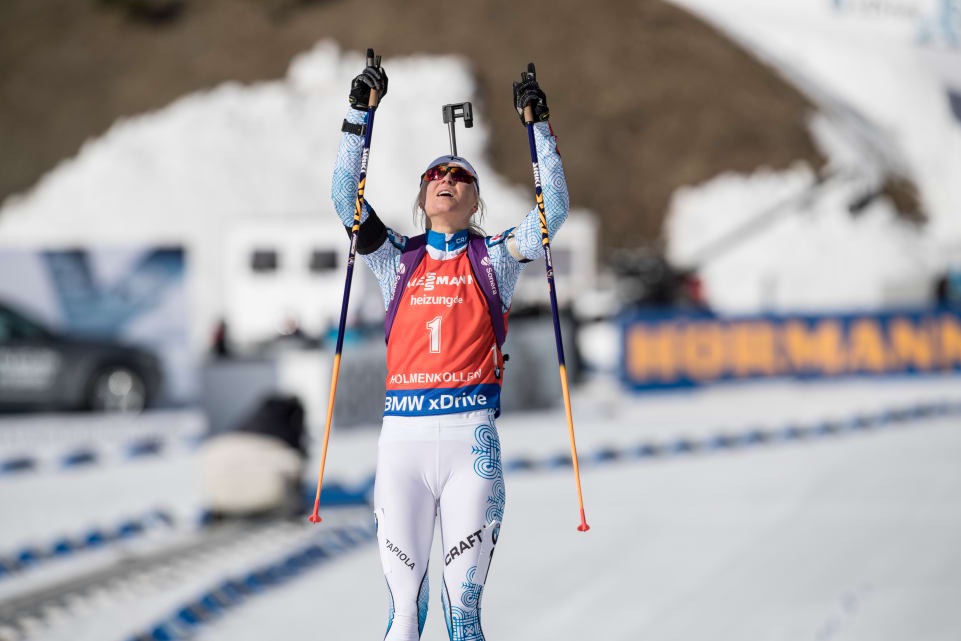
    That moment came 200 meters before the finish, when Braisaz had enough of a cushion to stop and grab the tricolore. She waved it behind her as she skied down the finishing lanes, the crowd of 15,000 spectators going more than wild.

    “It was just great,” she said. “A very nice feeling to share it with all the crowd and all the French people and everybody. It was just like a dream. But the reality is better actually.”

    Kryuko, too, hadn’t felt secure in her position on the last loop. Dahlmeier came out of the penalty loop and into third place, just under ten seconds behind her; after that was Kuzmina, whose ski speed had impressed over the last several weeks.

    “I saw that I shot clean – and I certainly saw that behind me there were some very strong girls,” Kryuko said through a translator at the press conference. “The only thing I was hoping for was to get flowers, the top six.”

    Dahlmeier put in an early surge to try to close the gap.

    “On the final lap I tried to give it everything I had,” she told German broadcaster ZDF. “I fought hard right from the beginning, and immediately went a very high tempo. I didn’t really get closer to her [Kryuko] initially, then made up a few meters, but in the end the necessary energy wasn’t there anymore to really overtake her.”

    Kryuko thus held onto second place, finishing 11.2 seconds behind Braisaz. Dahlmeier was third (+19.9), Kuzmina fourth (+25.5), and Germany’s Vanessa Hinz fifth (+28.4). Anais Chevalier gave the French crowd another reason to lose their minds when she crossed the finish line in sixth (+30.1).

    For Kryuko, her very first mass start came on the same day as her first World Cup podium. The 26-year-old’s previous best finish was ninth in the pursuit in Hochfilzen, Austria, last weekend.

    Susan Dunklee racing to 20th in the mass start. (Photo: Glen Crawford)

    “It’s my first mass start and of course my first podium,” she said. “It’s a really great feeling.”

    Dunklee 20th, Lunder 28th

    Both Susan Dunklee of the U.S. and Emma Lunder of Canada started in the back of the mass start, with bibs 26 and 29, respectively. In most World Cups, starting at the back of the pack is not a big problem, as most of the field is still together when athletes enter the range for the first shooting.

    “This course it is!” Dunklee exclaimed. “This course it absolutely is. This is a very narrow course… that first bridge, we just had this major accordion-ing, where everybody stopped for about five or six seconds in the back waiting for the top people to get up there. We had to snowplow and then just stand there and wait. We were laughing. So it was a lot of just being really patient on the first loop because there was no good way to pass.”

    “Probably 300 meters into the race there is a super steep little hill, and the back of the pack, the back 15, literally came to a standstill and then it took people a lot to get going, and it was so spread out by then,” Lunder said. “So I was last and I just tried to hang on to number 29. I had figured I would come into the range last or close to last, but I felt pretty relaxed during that lap.”

    Canada’s Emma Lunder chasing the Czech Republic’s Eva Puskarcikova in the women’s mass start in Le Grand-Bornand, France. (Photo: Glen Crawford)

    Despite strong races earlier in the week, finishing 10th and sixth, Dunklee never made contact with the leaders – in part because they had broken away already on the first lap when she was stuck in the back, and partly because she missed a shot in the first prone stage.

    Dunklee missed two more, one in the first standing stage and then the very last shot of the race.

    “With 85% shootings, it was obviously not my best, but certainly something I can be proud of,” she said.

    She crossed the line in 20th after laying down the fifth-fastest closing loop and moving up two spots.

    “I had a great battle going with Maren [Hammerschmidt] and Selina [Gasparin],” Dunklee said. “Selina got me by a tenth of a second, which is, well, ugh. She had the better lane in the finish and I just couldn’t get around her, but it was fun. I like it when it’s exciting like that.”

    Lunder also missed a shot in the first prone, but she was clean after that. She had some issues with her rifle though, which resulted in slower shooting times even though she never again had to visit the penalty loop.

    “I was a little bit shaky and I double-ejected three times,” she explained. “So then I had to load a spare and was like ‘okay, do not miss this and then have a penalty loop on top of it.’ I am so happy with shooting 19 out of 20 again, I’m really relieved. And it was a good chase again out there. On the last lap there were two Polish girls right with me, I tried so hard but I just didn’t have it in me.”

    She crossed the line 28th, +2:21.4. It was the first mass start of her career.

    “This was an awesome experience,” Lunder said. “Any time I finish in the top 30 I think I’ll still be happy… I can say I had fun. It’s like the most painful kind of fun. I felt pretty tired today, and then on top of it everyone is fast in the mass start. So I just knew that I wanted to execute on the range the same way I have been this weekend.”

    Results

  • Dunklee Sixth in Annecy Pursuit; Dahlmeier Back to World Cup Winning; Lunder 18th

    Dunklee Sixth in Annecy Pursuit; Dahlmeier Back to World Cup Winning; Lunder 18th

    Germany’s Laura Dahlmeier (c), Slovakia’s Anastasia Kuzmina (l), and Italy’s Lisa Vittozzi on the podium after Dahlmeier won the women’s IBU World Cup pursuit in Annecy-Le Grand Bornand, France, on Saturday. (Photo: IBU/biathlonworld)

    LE GRAND-BORNAND, France – Well, that didn’t take long.

    After missing the first stop on the World Cup calendar due to illness and showing less than her usual ski speed in Hochfilzen last weekend, Germany’s Laura Dahlmeier picked up her first International Biathlon Union (IBU) World Cup win of the season in the women’s 10-kilometer pursuit on Saturday.

    The 24-year-old German, who was the overall IBU World Cup champion last season as well as three-time individual gold medalist at 2017 World Championships, took an opening early in the race when Anastasia Kuzmina of Slovakia, the winner of Thursday’s sprint, missed a surprising three shots in her first shooting bout.

    “It was not easy to concentrate on the first shooting for me,” Kuzmina said in a post-race press conference. “Maybe it was [too much] emotion.”

    Dahlmeier, the second woman onto the range after being the runner-up to Kuzmina in the sprint, hit all her targets. Then again, and again. She looked on pace to clean the entire competition, but missed the last shot of her final standing bout.

    “She made three mistakes on the first shooting and then the door was a little bit open for me,” Dahlmeier said of her rival. “Then I was in front the whole time. In my last shoot was my first mistake. Then I thought, OK, she will win the race.”

    Kuzmina had climbed back to second place, and also hit the first four targets of her final shooting bout. But then she took a long, long pause before the final shot – and missed it anyway.

    “I was in the penalty loop,” Dahlmeier said. “But then she didn’t come. I couldn’t see her. I heard the sound of the spectators. And she had also this mistake. I’m very happy to be in front now.”

    “I gave a chance to Laura,” Kuzmina said of her earlier misses. “And also she gave me a chance on the last shooting, but you see the result.”

    Susan Dunklee chasing France’s Anais Chevalier en route to sixth place in the women’s 10 k pursuit on Saturday at the IBU World Cup in Annecy, France. (Photo: Glen Crawford)

    Kuzmina held on for second place, finishing 14 seconds after Dahlmeier. Italy’s Lisa Vittozzi placed third (+31.8), up from fourth place in the sprint, after shooting one penalty. Selina Gasparin of Switzerland followed in fourth (+52.8), Denise Hermann of Germany was fifth (+55.2), and Susan Dunklee of the U.S. placed sixth (+1:12.1).

    Recalibration Brings Dunklee to Flower Ceremony

    Sometimes, you have to go slow to go fast.

    Dunklee had a tough start to her season, not breaking into the top 50 and missing both pursuits in the first two weekends of racing. On Thursday she broke the pattern when she placed tenth in the sprint.

    As she explained then, she tried slowing down her shooting and going back to basics after missing so many shots in the first competitions. It was a strategy that she continued to pursue in the pursuit.

    “This year I have been doing a lot of speed shooting, like over the summer,” Dunklee explained. “But I have really gone away from that in the last two weeks. I have been trying to go back to the basics, mostly with trigger squeeze. That was all I was thinking about on the range, just trigger squeeze. And not worrying about speed at all.”

    Dunklee missed one shot in her first prone stage, dropping from 10th to 17th place. She climbed back up before again missing a shot in the first standing stage.

    When she came into the range the final time, she was in 10th place, just where she had started. And she calmly – more slowly than some races in the past – hit all the targets, leaving the range in seventh place and passing Ukraine’s Valj Semerenko to earn sixth place and a spot at the flower ceremony.

    It was a big turnaround from such a disappointing start to the season, one where she said the term “shooting struggles” would be an “understatement.”

    “After Thursday, I was just feeling relief, to be honest,” she said. “It’s so huge to get a top ten and then get a flower ceremony today.”

    Besides improving her shooting, Dunklee had the 12th-fastest ski time of the day and the sixth-fastest closing loop.

    “This was one of the first real head to head ski situations I have had since the relay in Östersund,” Dunklee said. “And it is so much easier to ski with a pack and behind people. So much more relaxed. I had some very fast people around me — I think two loops with Maren [Hammerschmidt], and a couple loops with [France’s] Anais Chevalier. I also had a lot of energy left on the last loop, which I don’t normally have for the last loop, so that was good.”

    With that performance, Dunklee qualified for Sunday’s mass start, which will give her another crack at a course that she said was unusual among the other World Cup venues.

    “Different, very narrow,” she said of the French venue, which the World Cup last visited four years ago. “You have to be smart tactically. The hills are really short and steep.”

    Career-Best for Canada’s Lunder in 18th

    Emma Lunder of Canada has been on a tear this season, with a number of top results. Today she had a career-best day, missing just one shot to move from 34th in the sprint up to 18th in the pursuit (+2:06).

    Biathlon Canada’s Emma Lunder (l) and Julia Ransom (r) after finishing 18th and 27th in the women’s 10 k pursuit on Saturday at the IBU World Cup in Annecy, France. (Photo: Glen Crawford)

    “We were talking about it yesterday — I just feel more solid in my position on the team,“ the 2017 World Championships team member said. “I think this year, honestly, I just feel a little bit more relaxed. Instead of thinking every day, ‘Oh you have to have a good race to stay on the circuit,’ I am just saying, ‘Just go doing what you know how to do,’ and it’s turning out well.”

    Not perfectly – but well. Like Dahlmeier and Kuzmina, Lunder missed the last shot of the competition. With clean shooting she would have made the top 15.

    “I tried to get focused on the range,“ she said. “And on that last shot I did everything trying not to collapse. The second I yanked the trigger I was like, ‘Oh my God, Roddy [Ward, her coach] is gonna kill me’. But I was so happy with the race.“

    Despite skiing into the top 20, a somewhat unfamiliar position, Lunder said she didn’t feel more pressure than usual. Instead, it was a bonus – she had better competitors around her.

    “There were just faster girls to ski with,“ she said. “I got passed by quite a few on the first loop, but I just tried to relax. After [the first shooting] I seemed to pick it up skiing and was able to stay with more people, so that was really fun, too.”

    With her for much of the race was teammate Julia Ransom, who had started in bib 39. Ransom accumulated two penalties, but still moved up to 27th (+2:29.8). She used the 17th-fastest course time of the day to maintain a position despite the shooting errors.

    “There was a few shots that I knew I was like, ‘Wing the prone and wing the standing,’ ” Ransom said. “But you know, overall, I’m very happy I kept it together. I could see Emma the entire time. We skied together on the first couple laps, and I was just thinking, ‘This is the dream’.”

    “Who would have thought when I was twelve and I first met Julia that we’d be skiing together in the front half of a World Cup pursuit?” Lunder said. “It was really special.”

    “Our skis were so amazing,” Lunder continued. “I was just cruising on the downhill passing people. I felt like I could keep up with so many more people just by gliding longer than they were.”

    Canada’s third woman qualified for the pursuit, Rosanna Crawford, did not start due to illness.

    Results

  • Dunklee Proves Her Resiliency, 10th in Annecy Sprint

    Dunklee Proves Her Resiliency, 10th in Annecy Sprint

    Susan Dunklee (US Biathlon) hitting every target in the prone shooting stage of the women’s 7.5 k sprint at the IBU World Cup in Annecy, France, on Thursday. She ended the day in 10th place with perfect 10-for-10 shooting. (Photo: Glen Crawford)

    Susan Dunklee’s start to another International Biathlon Union (IBU) World Cup season hadn’t played out as she’d hoped, specifically in terms of results. Coming off a banner winter, with a silver at 2017 World Championships (in the women’s mass start), Dunklee 31, had so far placed 53rd, 79th and 97th, respectively, in non-relay races over the last two weeks. She had yet to race a mass start, but also had yet to qualify for a pursuit in two World Cup sprints.

    So she went back to the drawing board, back to basics and to a “moose garden”.

    “My confidence took a big hit these past couple weeks and it was a real challenge was working through that,” Dunklee wrote in an email to FasterSkier on Thursday.

    “I tried to find some non-biathlon activities like visiting a ‘moose garden’ in Sweden and seeing the ‘Krampus’ in Austria,” she explained, referring to an Advent costume tradition, “to keep my mind fresh so I wouldn’t obsess 24/7 over disappointing results.  I also tried really hard to take a moment each evening to appreciate all the positive things that happened over the course of the day. And I kept telling myself that I am resilient.”

    After missing eight targets in last week’s snowstorm sprint in Hochfilzen, Austria, she sat down to brainstorm with US Biathlon consultant Matt Emmons, a 2004 Olympic champion in rifle shooting.

    “All summer I’ve been working on some fancier shooting skills, such as wind shading,” Dunklee explained. “Basically we decided I could benefit from focusing back on the absolute basics of shooting: sight alignment, trigger squeeze and follow [through]. That’s what I’ve been doing the last few days.”

    Susan Dunklee (US Biathlon) out of the start of the IBU World Cup women’s 7.5 k sprint on Thursday in Annecy, France, where Dunklee placed 10th overall for her best result of the season. (Photo: Glen Crawford)

    On Thursday, she started 60th out of 93 in the women’s 7.5-kilometer sprint in Annecy (Le Grand Bornand), France. In warm, slushy conditions with little wind, as Dunklee described it, she fired away for perfect 10-for-10 shooting to put herself in ninth at the finish.

    Dunklee was ultimately bumped one spot down to 10th overall, 1:16.8 minutes behind the winner, by Germany’s Laura Dahlmeier, who started in bib 86 and ended up second — 33.9 seconds behind Slovakia’s Anastasia Kuzmina in first.

    Kuzmina, who notched her second-straight individual World Cup win with a time of 20:59.6, and  the rest of the top-four finishers — Dahlmeier, Ukraine’s Vita Semerenko in third (+41.4) and Italy’s Lisa Vittozzi in fourth (+50.0) — all shot clean, just like Dunklee. Semerenko’s twin sister Valj, who placed seventh (+1:06.8), was the other woman in the top 10 to hit every target.

    Dunklee spent all of the race in the top 10, ranking eighth after the first of three loops and seventh after the second loop.

    “All the difference today for me was made on the shooting range,” Dunklee wrote. “The skiing has been fine all season. I backed off approaching the range, and I took enough time to make sure I was taking good shots.”

    Her top 10 was her best result since placing seventh in a sprint last March in Oslo, Norway. By landing in the top 60, Dunklee qualified for the Annecy pursuit on Saturday, which will be her first of the season.

    “Today helped me put to rest some doubts I was starting to have in my abilities,” she wrote. “I am very grateful to qualify for the pursuit.  It will be a good opportunity for some head to head racing which I haven’t seen much of yet this year.”

    Kuzmina in Control

    Slovakia’s Anastasia Kuzmina racing to a nearly 34-second win in the women’s IBU World Cup sprint on Thursday in Annecy, France. (Photo: IBU/biathlonworld)

    Starting in bib 23, Kuzmina rocketed to first place with the fastest course time and fourth-fastest shooting and range times, all while hitting every target.

    “It is always a great feeling to be a winner, especially when the race was pretty good from start to finish,” Kuzmina, a two-time defending Olympic sprint champion (from 2010 and 2014), told the IBU, according to a press release. “It was really important to shoot two times zero. The snow condition was not too comfortable for me; I really want to thank my service team for the skis. That was an important part of my victory.”

    The Russian-born Slovakian (whose brother is Russian biathlete Anton Shipulin) took the lead after the first shooting, leaving the range 6.3 seconds ahead of Germany’s Denise Herrmann, who started ahead of her in bib 16 and also cleaned prone. Herrmann had a penalty lap in the standing bout to slip to sixth and 45 seconds back, while Kuzmina cleaned again to start her final loop 35 seconds clear of Vittozzi, who was in second at the time wearing bib 13.

    Germany’s Laura Dahlmeier prepares to hit all five targets in the standing stage of the IBU World Cup women’s sprint on Thursday in Annecy, France. (Photo: Glen Crawford)

    A much later starter in bib 86, Dahlmeier cleaned prone to move into third, 6.7 seconds off Kuzmina’s time. Her next time in the range, Dahlmeier shot clean again to improve to second, but she was still 25.8 seconds short of Kuzmina’s time with one loop to go. Kuzmina skied the second-fastest last loop (about two seconds slower than Switzerland’s Selina Gasparin) to lock up first, while Dahlmeier ended up nearly 34 seconds back in second place.

    “This was the first podium in an individual-start race of the new season for me and that makes me very very happy,” Dahlmeier told German broadcaster ZDF, according to a translation. “I am excited that it worked out today, it took a while until I now got back in shape. I am not at 100 percent yet, but today was a super race and I am just happy about that, it was a lot of fun to race today.”

    Thursday marked Dahlmeier’s fourth race of the season after she missed the World Cup opener in Östersund, Sweden, due to illness. In Hochfilzen, she anchored the women’s 4 x 6 relay to the win and placed 10th in the pursuit and 16th in the sprint.

    “It’s a bit of an unusual situation for me to have such a late bib in an individual race, but as an anchor in relays I am kind of used to that, passing the time by listening to music or something like that,” she said. “When I was at the start gate I was focused again and just tried to do my on race. It has its pros and cons, I just tried to make the best of it.”

    The women’s IBU World Cup sprint podium on Thursday in Annecy, France, with Slovakia’s Anastasia Kuzmina (c) in first, Germany’s Laura Dahlmeier (l) in second, and Vita Semerenko (r) in third. (Photo: IBU/biathlonworld)

    For Vita Semerenko, it was her first podium since taking bronze in the sprint at the 2014 Olympics. She missed the two seasons that followed due to a back injury, and gave birth to her son just over a year ago.

    “I will never forget my first training after giving birth,” she told the IBU. “My coach said, ‘If we don’t give it a try, we will not find out what happens next.’ I said ‘OK’, but I had a lot of anxiety about coming back to biathlon, as I understood that coming back after three years would be tough. I am also thankful to my husband who told me every day after I had my child, ‘Vita, come on, come on, let’s make a comeback!’ ”

    Herrmann was the top finisher with a penalty (0+1) on Thursday in fifth place (+50.6), while Gasparin was just behind in sixth (+53.4) with one miss as well (1+0).

    “I am noticing that I am not feeling as fresh anymore as in Östersund, it was quite the number of races for me already,” Herrmann, who won both the sprint and pursuit in Östersund, told ZDF. “And I’d say deep snow conditions like today aren’t ideal for athletes over 60 kilograms. But nevertheless it was a good race, I really tried to hit every shot, and lost quite a few seconds with my shooting time. But I am back on track compared to last weekend, and hope I can continue my successes in the pursuit race.”

    In the women’s 10 k pursuit on Saturday, Kuzmina will start 34 seconds ahead of Dahlmeier in second, and Vita Semerenko will head out another 7 seconds later in third. Dunklee will start 1:17 back and just 4 seconds behind Valj Semerenko in seventh.

    Emma Lunder (Biathlon Canada) racing to 34th in the IBU World Cup women’s 7.5 k sprint on Thursday in Annecy, France. (Photo: Glen Crawford)

    Three Canadians qualified for the pursuit, with Emma Lunder leading them in 34th (+2:07.4) with one standing penalty (0+1). Julia Ransom followed in 39th (+2:13.9) with one prone miss (1+0) and Rosanna Crawford snuck into the top 60 in 60th (+2:39.1) with two penalties (1+1). They will start the pursuit 2:07, 2:14 and 2:39 back, respectively.

    Also for Biathlon Canada, Megan Bankes missed the cutoff in 65th (+2:51.5) with one penalty (1+0).

    For the U.S., Clare Egan finished 81st (+3:43.7) with three misses (1+2), and Emily Dreissigacker was 88th (+4:36.0) with three penalties as well (2+1).

    The Annecy IBU World Cup men’s 10 k sprint takes place Friday, starting at 8:15 a.m. EST.

    Results | Pursuit start list

  • U.S. Men, Canadian Women 9th in Extra Windy, Hochfilzen Relays

    U.S. Men, Canadian Women 9th in Extra Windy, Hochfilzen Relays

    Leif Nordgren (US Biathlon) skiing the second leg of the IBU World Cup men’s 4 x 7.5 k relay on Sunday in Hochfilzen, Austria. The U.S. men ended up ninth overall out of 26 teams. (Photo: IBU/NordicFocus)

    Strong gusts of wind on the range required strong nerves and a lot of luck in the women’s and men’s relay races that concluded the International Biathlon Union (IBU) World Cup in Hochfilzen, Austria, on Sunday afternoon.

    While the relays concluded with teams on the podium one might expect there, tempestuous weather conditions that at times made it almost impossible to hit the targets also gave outsiders a good chance, and both the U.S. men and Canadian women remained in contention for a long time. The men’s 4 x 7-5-kilometer relay was particularly wild with more than 100 penalty laps, and it began with a big surprise.

    Belgium’s starter Michael Rösch tagged off in first place for the first time in the history of that team, representing a country that until now, rarely had enough athletes for a relay and had thus far had a 24th place at the 2016 World Championships to its credit. And on his tails was Norway’s Ole Einar Bjørndalen, and shortly behind them US Biathlon’s Lowell Bailey in third.

    The three aforementioned athletes all raced in the Olympic relay more than a decade ago at the 2006 Winter Games in Torino, Italy, but back then Rösch raced for Germany and won gold with his team.

    “I wanted to tag off in first at all costs, to see the Belgian flag at the top,” Rösch told TV broadcaster ARD on Sunday while the race was still going on. “But Ole made it really hard for me. … I was on my last fumes, I tumbled into the finish, I was just seeing black, but it definitely was worth it.”

    Just a turn behind, Bailey had gotten off to a strong start for the U.S. team, temporarily taking the lead out of the arena on the first lap before shooting clean in his prone stage to put himself in the lead group of seven. Facing strong wind in his standing stage, Bailey missed two targets but avoided the penalty lap with his last spare in that stage (0+0, 0+3), and tagged off to teammate Leif Nordgren in third position, 23.8 seconds out of first.

    Nordgren ended up with a penalty in his first prone after missing two targets, and returned to the course in fifth. While his penalty had increased the gap to first by 50 seconds, Nordgren made up a few seconds with a clean standing bout, hitting all targets without requiring a spare (1+3, 0+0).

    Italy and France passed him on the final loop, and Nordgren handed off in seventh, 1:34.2 minutes behind Norway setting the pace up front.

    “The team came pretty close to a good result today in a relay with nasty weather,” Nordgren wrote on his Instagram account. “Personally I’m quite disappointed with my skiing, it’s been a struggle to find the top gears so far this season and I’m far from where I know I should be. It’s a long season though and there is still plenty of time to turn it around.”

    US Biathlon’s Tim Burke loading a spare in his prone stage of the men’s relay at the 2017/2018 IBU World Cup in Hochfilzen, Austria. The team went on to finish 9th. (Screenshot: ARD broadcast)

    Taking over next for the U.S. was Tim Burke, who pointed out this was one of the most challenging races in terms of wind that he’d experienced.

    “This was definitely one [of the] windiest races that I have taken part in,” Burke wrote in an email to FasterSkier. “We knew it would be very challenging right from the start but our team tried to look at it as an opportunity for a top result. I feel like our team did a great job at avoiding any big disasters on the range and this allowed us to stay near the front for most of the race.”

    After only needing one spare in his prone shooting to hit his last target, Burke incurred a penalty in his standing stage (0+1, 1+3), but kept his position on the final loop in a hard race against Switzerland’s Jeremy Finello to exchange still in seventh, now another minute back (+2:49.4).

    “I was not surprised to see a mix of different teams near the front today,” Burke wrote. “It was one of those days that any team could find themselves with multiple penalty loops after a windy shooting stage.“

    Taking over from Burke as the U.S. anchor leg was Sean Doherty, coming off two strong shooting performances in the sprint and pursuit earlier this week.

    U.S. relay anchor Sean Doherty taking aim in difficult wind conditions during his standing stage of the men’s relay at the 2017/2018 IBU World Cup in Hochfilzen, Austria. His team finished ninth. (Screenshot: ARD broadcast)

    In his prone stage, Doherty again shot clean and fast (with the second-fastest prone shooting time on his leg) and overtook Switzerland to move into sixth. He kept that position on the course, vying for a position in the top five with the teams from France, Italy, Ukraine, and Russia also in his vicinity.

    “Today was a crazy one for sure,” Doherty wrote in an email. “The conditions on the course were decent, firm tracks and we had good skis. The wind was whipping, so that really just made some sections a lot harder than normal when you added in the head wind. I have done races in bad weather before but today was amongst the most windy.

    In the standing stage, Doherty hit his first four shots in another fast sequence before missing the last one. It looked as if he had thought that final shot was also a hit as he dropped his rifle slightly, but then realized he had to load spares. Unable to clear the last target, Doherty ended up with the team’s third penalty.

    “With the shooting you try to get a general idea of how far the wind is pushing the shots and do the best you can,” Doherty explained. “It’s a total toss up and the finish order is just a ranking of who battled the wind the best and had most to least luck along the way.”

    He set out on his last loop in eighth place with Ukraine’s Dmytro Pidruchnyi and Switzerland’s Mario Dolder right ahead of him, and Russia’s Anton Shipulin ten seconds behind.

    “The fight on the last lap is always tough,” Doherty wrote. “Although I felt better today I was not able to hang with the two guys I left the range with. I was able to ski a good lap but not enough to hold off Anton.”

    After Shipulin passed him up the big last climb, Doherty came to the finish in ninth position, 3:38.3 minutes behind the winners with a team total of three penalties and 13 spares.

    “We were not too excited with the end result because we saw the potential was there for a top 5,” Burke concluded for the team. “We are also all far from our best on the tracks right now, but are hopeful that will come with more racing.”

    Norway Successful with Its ‘Second Unit’

    Norway’s Lars Helge Birkeland, Erlend Bjøntegaard, Henrik L’Abée-Lund and Ole Einar Bjørndalen (left to right) following their victory in the men’s relay at the 2017/2018 IBU World Cup in Hochfilzen, Austria. (Photo: IBU/Biathlonworld)

    Norway started the men’s relay race without Emil Hegle Svendsen, who was sidelined with a cold, and also rested brothers Johannes Thingnes Bø and Tarjei Bø, both of whom had already won races this season.

    But shooting was more important than skiing in a relay decided by strong crosswinds on the range, and that’s where the Norwegians coped by far the best. While Norway also required nine spares, which usually is a rather average performance in a relay, on Sunday this was the top shooting performance of the men’s relay.

    After veteran Bjørndalen, Henrik L’Abée-Lund and Erlend Bjøntegaard had created a fairly comfortable lead of almost a minute on the first three legs, Lars Helge Birkeland anchored them to the victory by shooting clean in prone and only needing one spare to hit every target in his final stage despite some widely spread shots.

    “It is really nice; a good start for Norway and good self confidence for the the rest of the season,” L’Abée-Lund said at the post-race press conference.

    “It’s always fun to compete on the highest level with the best guys,” Bjøntegaard said. “I think I did pretty good on my leg today. It was tough conditions as it was for everyone else. I am just happy to show what I am capable of.”

    “It feels great, it was an amazing feeling on the last loop, and really satisfied with my own leg,” Birkeland said. “I just decided to be offensive and attack and don’t think about the others and just do my own race. … We have a really strong team with a lot of good guys, so we don’t need to have all the best at the start to have a chance to win.”

    All hopes for Germany’s Simon Schempp to contend with Birkeland for first were dashed when Schempp required three spares to clear both his prone and standing stages, narrowly avoiding the penalty lap twice.

    Due to the huge distances between the top-three teams, the final loop was more of a cool down for their anchors, with Norway taking the win in 1:21:21.8 hours, just under two minutes ahead of Germany, with Erik Lesser, Benedikt Doll, Arnd Peiffer and Schempp, in second (+1:54.9, with zero penalties and 17 spares).

    “At least we avoided the penalty loop, for me it was definitely close in standing,” Peiffer told German broadcaster ARD. “There was so much wind that it was impossible to shoot calmly and controlled. … It was clear that today there would be some upsets, like Belgium being in the mix in front. You just had to somehow avoid the penalty lap.”

    “The last years in Hochfilzen we have never been on the podium, so it’s the first time in like six years we are back again,” Peiffer said at the press conference. “So that’s a good start for us because normally we are struggling here and we don’t know why.”

    France, which had rested its star Martin Fourcade and started Jean-Guillaume Beatrix, Simon Desthieux, Emilien Jacquelin, and anchor Quentin Fillon Maillet, finished another 40 seconds later in third (+2:34.0, with three penalties and 13 spares).

    Another 20 seconds back, Sweden with Peppe Femling, Jesper Nelin, Sebastian Samuelsson, and Fredrik Lindström crossed the line in fourth (+2:54.8, with three penalties and 12 spares).

    “Today was very hard, very strange result, because when we look at all the penalties on the result list it was just crazy,” Beatrix said at the press conference. “I am satisfied for the team, and I am also really satisfied for the newcomer Emilien because it’s his first two weeks on the World Cup and first relay, and he did a every good job and brought us to the podium.”

    “Today I was a little bit stressed, because the French guys are so strong and I had to be at their level, so I am happy to do a good relay today,” the 22-year-old Jacquelin said.

    And what happened to the brave team from Belgium? With three athletes who had just made an overnight trip from an IBU Cup race in Lenzerheide, Switzerland, they came through the second exchange in second place after Florent Claude only needed one spare in standing. On the last two legs, however, three penalties for both Tom Lahaye-Goffart and Thierry Langer put them in 16th at the finish (+6:24.9) , which was still a team-best relay result for Belgium.

    Just ahead of them in a finishing sprint anchored by Brendan Green was Biathlon Canada, with a lineup that earned bronze at the 2016 World Championships in Oslo, Norway. On Sunday, however, the Canadians’ race began with difficulties for brothers Christian Gow (1+3, 2+3) and Scott Gow (1+3, 2+ 3), each having to ski three penalty laps and exchanging in 21st position already 4:45.7 minutes back. Then Nathan Smith (0+0, 0+2) and Green (0+3, 0+3) were able to move them up a bit again, with Smith putting them as high as 13th by the final exchange and Green anchoring them to 15th (+6:22.5, with six penalties and 20 spares).

    Of 26 teams in the men’s relay, Norway and Germany were the only ones that succesfully avoided the penalty lap.

    Hochfilzen World Champs Women’s Podium Repeats

    Later on Sunday afternoon in the women’s 4 x 6 k relay in slightly better conditions than the men’s race, last season’s reoccurring winner Germany struck gold again.

    Germany with (left to right) Vanessa Hinz, Franziska Hildebrand, Maren Hammerschmidt and anchor Laura Dahlmeier shows off their medals following their victory in the women’s relay at the 2017/2018 IBU World Cup in Hochfilzen, Austria. (Photo: IBU/Biathlonworld)

    The victorious world-champion quartet of Vanessa Hinz, Franziska Hildebrand, Maren Hammerschmidt,and Laura Dahlmeier won with a large lead ahead of Ukraine (+44.9) and France (+1:04.5). The first-, second- and third-place teams were a repeat of last season’s World Championships relay in Hochfilzen this past February.

    Fighting for position with Ukraine and Switzerland on the third leg, Hammerschmidt got her team on the road to victory when she cleaned every target within 24 seconds despite difficult conditions to reclaim the lead, erasing the gap she had been handed of almost 30 seconds to first.

    “For me it was very important to have a good standing shooting today, because the last two days were not so good,” Hammerschmidt said at the press conference. “I thought it was one of my best standing shootings, and I was so happy to go on the last loop and fight for every second to give to Laura.”

    Dahlmeier returned to the World Cup after missing last week’s opening races with a cold, then had no major problems defending the lead. Dahlmeier used just one spare in each of her shooting stages, while Switzerland’s Irene Cadurisch as the closest pursuer had to ski a penalty lap. Germany finished in a time of 1:14:36.4, with zero penalties and nine spares.

    “It’s a really cool feeling to be here again,” Dahlmeier said at the press conference. “Especially with the team. We know we can make a good race, but it’s important for every person to be good on the range and on the tracks. Relays are special races.”

    “From the last year we have good memories about Hochfilzen … and today it was a good place, too,” Hildebrand said “I was really impressed with [Ukraine’s] Yulia Dzhima’s standing shooting, because she took all targets out while I used two extra bullets and was happy I could go out on the track again.”

    Ukraine’s Olena Pidhrushna anchored her team, with Vita Semerenko, Yulia Dzhima and Valj Semerenko, to second (+44.9), thanks to the best team shooting performance of zero penalties and five spares, and despite a fall on the first leg by Vita Semerenko.

    “I think our team spirit is very strong, without that we wouldn’t be on the podium, so I am very thankful to all the girls and our staff for making this happen,” Valj Semerenko said at the press conference, via a translator.

    “My start this season was not so good … Actually today I was so nervous ahead of the relay,” Pidrushna explained. “But I saw that we had a little bit of extra time at the last exchange, and I calmed down a little bit and it worked well in the end. … And I think my team believes in me [to anchor it successfully].”

    Twenty seconds behind her, France with Marie Dorin Habert, Celia Aymonier, Justine Braisaz and the current women’s World Cup leader Anaïs Bescond, passed Russia’s Ekaterina Yurlova-Percht on the final loop to claim third place  (+1:04.5, with two penalties and 13 spares).

    “Honestly at the beginning when I started I didn’t think a podium was still possible, but loop after loop I thought maybe I can still catch a podium [position],“ said Bescond, who skied the fastest course time on the final leg amidst strong competition.

    A few seconds behind, Russia with Victoria Slivko, Tatiana Akimova, Irina Starykh, and Ekaterina Yurlova-Percht finished fourth (+1:09.0, with no penalty and nine spares).

    Another 16 seconds back, Switzerland, with Elisa Gasparin, her older sister Selina Gasparin, Lena Häcki and Cadurisch finished fifth (+1:25.7, with two penalties and 12 spares) for Switzerland’s best women’s relay result, which fulfilled its national qualification criteria for the Olympics.

    Canada in Contention

    For Biathlon Canada, Emma Lunder started off the race in the middle of the field, and managed hit all her targets with one spare in her prone stage to leave the range in 16th position.

    Biathlon Canada’s starter Emma Lunder (r) exchanging to Rosanna Crawford in the women’s relay at the 2017/2018 IBU World Cup in Hochfilzen, Austria. Crawford temporarily moved up to fifth before the team finished in ninth position. (Screenshot: ARD broadcast)

    While a number of competitors, including France’s Dorin Habert, incurred penalties, Lunder again needed just one spare to clean (0+1, 0+1) and moved Canada up to 1oth. After losing a few more seconds on her last loop to the leaders, with Germany’s Hinz up front, she tagged Rosanna Crawford in 12th position, 51.7 seconds back.

    Crawford started out fast and also needed just one spare to hit all five prone targets, improving by three places to ninth.

    “It was a tricky shooting day today, you really had to be aware of the wind, and be prepared to do a correction even part way through a bout of shooting,” Crawford wrote in an email. “In prone I made a correction of 5 left and 2 up and it was enough to keep me pretty centred.”

    Then in her standing stage, she picked off four more positions with clean shooting and no spares to leave the range in fifth place, while most teams around her needed spares or even incurred a penalty in seemingly difficult wind conditions.

    “I was really happy with my standing today,” Crawford explained. “I saw Brendan [Green] right before zero and he said that it’s worthwhile to take your time and make each shot a good one. So I really thought about that as I came into the shooting, there was a big gust right off the start, so I waited and could hear the women around me missing. Each shot was really precise. My shooting time was 33 seconds which is really slow for standing but still the 2nd fastest of my leg, which says a lot about the wind today!”

    Biathlon Canada’s Megan Bankes shooting in her standing stage in the women’s relay at the 2017/2018 IBU World Cup in Hochfilzen, Austria. The team finished ninth overall. (Screenshot: ARD broadcast)

    Crawford tagged Megan Bankes in fifth (+36.3), after having regained 15 seconds on the leaders and skiing the second-fastest course time on the final loop.

    “It’s always fun to tag off in a high position but today was a bit of a lucky draw for what you got in the range,” Crawford concluded.

    The 20-year-old Bankes as Biathlon Canada’s youngest team member started out just as fast, nearly maintaining that time gap on the first loop.

    “I was super stoked to be tagged in such a good place, but I definitely still felt that I was able to ski my own race,” Bankes wrote in an email. “I wanted to ski my best, and not lose to much time on the tracks, but also be controlled on the range, because I knew it was going to be a tricky shooting day.”

    She was able to get through the prone stage with two spares in a stage when all leading teams needed them, keeping her in fifth. Bankes followed that up with just one spare in her standing shooting, temporarily moving up to fourth after overtaking Sweden’s Mona Brorsson.

    “Coming into the range I was focussed on my own shooting more than anything else,” Bankes wrote. “I knew that the wind was pretty variable, and that I needed to make sure I took good, smart shots, and correct appropriately for the wind. I was super happy with how I ended up doing on the range, and also with my speed on my first couple of laps.”

    On the last loop, Brorsson and Russia’s Starykh passed her, and Bankes came through the final exchange in sixth place (+1:28.8).

    “I died a bit at the end, but I still managed to tag Julia in a good position, so for me it was a pretty great race!” Bankes concluded.

    Shown on television in the exchange zone, looking back at the final curve to see when Bankes would arrive, Ransom took over as the anchor and skied a very fast first loop, just 1 second off the fastest pace on that loop.

    She then managed to still clean all five targets in a controlled fashion, leaving the range again in fifth position, with Switzerland in sight and Russia nearby as well.

    After a slower second loop, Ransom struggled to clean all her targets in the final stage, but avoided the penalty lap with her last shot and left the range in ninth position. Sweden’s anchor Anna Magnusson was still in sight, 10 seconds ahead, but extended her lead on the final loop, while Japan’s anchor Rina Mitsuhashi was already more than a minute behind Ransom in 10th.

    Ransom crossed the line in ninth place (+2:31.6) with zero penalties and nine spares for the team.

    “A top 10 is a decent result for our team, it’s nice that we were fighting for a top 6 for most of the race,” Crawford wrote. “Our team has come a long way and I’m really proud to be a part of this team! Emma and Megan had a great leg and Julia an awesome prone and then it was quite windy for her standing, but most teams have their strongest women on the last leg, so it’s always a hard fight!”

    In other good news for Biathlon Canada this weekend, the team finished eighth in an IBU Cup mixed relay and national team member Megan Tandy raced to 11th place in the sprint followed by ninth place in the pursuit this weekend in Lenzerheide, Switzerland.

    “Another #perfect #shooting day! I was hoping for more, but you gotta work with what you got – in my case very heavy legs skiing. Nonetheless, a solid race,” Tandy wrote on Instagram after shooting clean in both the sprint and mixed relay.  

    The U.S. Women and Nation Cup Standings

    US Biathlon could not start a women’s relay on Sunday because it only has three women currently on the World Cup circuit: Susan Dunklee, Clare Egan and Emily Dreissigacker. US Biathlon had hoped that its fourth woman Kelsey Dickinson, would qualify for the first trimester of World Cup racing by scoring necessary points at the IBU Cup opener in Sjusjøen, Norway. But unfortunately that did not work out.

    In addition to Dickinson missing out on the World Cup starts because of that technicality, and her teammates now missing out on one of only three opportunities on the World Cup competition calendar to prepare for the relay in the upcoming Olympics, this also means they lost out on valuable points for the Nation Cup Score. That ranking is its own award category in the World Cup season (last year Germany won it for both the women and men), but more importantly for the North American teams, also determines the starting quota for the following season.

    With a third of the races counting towards that already completed (unlike at World Championships the races at the Olympics don’t apply, neither do pursuits and mass starts), the U.S. is currently in 21st position for the women with 676 points and in danger of losing its fourth starting position for next year again, which would make team selections and travel planning even harder.

    While certainly not impossible — last year the U.S. women also did not start a relay in Pokljuka, Slovenia — it will be a bit of an uphill battle to make that up the rest of the season, requiring a number of strong results. For instance, South Korea is currently 357 points ahead in 17th, the benchmark for a fourth quota spot.

    The Canadian women are currently in 14th position with 1220 points. Last season they were 15th and the U.S. 14th. For the men’s teams, Canada is currently in 12th position with 1260 points, the U.S. is 13th with 1198.

    The teams will now travel to Annecy-Le Grand Bornand, France, for the next World Cup from Thursday, Dec. 14, to Sunday, Dec. 17.

    Results: Men | Women

  • Sunday Rundown: Davos, Hochfilzen and Sovereign

    Sunday Rundown: Davos, Hochfilzen and Sovereign

    CGRP's Caitlin Patterson charging up the wall climb. (Photo: Peggy Hung)
    Caitlin Patterson (Craftsbury Green Racing Project) charging up the wall climb en route to the win in the women’s 10 k freestyle on Sunday at the Sovereign Lake NorAm/SuperTour near Vernon, B.C. (Photo: Peggy Hung)

    NorAm/SuperTour (Sovereign Lake near Vernon, British Columbia): 10/15 k freestyle

    VERNON, B.C. — The combined NorAm and SuperTour event at the Sovereign Lake Nordic Centre continued with individual-start distance races and continued with the theme of U.S. domination of the leaderboard.

    Ian Torchia, of Northern Michigan University (NMU) and the U.S. Ski Team D-team, started the day with a big victory in the men’s 15 k freestyle, finishing in 36:29.7 minutes and on the heels of Canadian Para-Nordic guide Graham Nishikawa, who started 30 seconds ahead of him and ended up sixth. Jack Hegman of the Sun Valley Ski Education Foundation (SVSEF) placed second, 19.0 seconds back, to complete his good weekend. Canadian Para-Nordic superstar Brian McKeever rounded out the podium in third, 22.6 seconds back.

    Graham Nishikawa and Ian Torchia worked together after Torchia closed the 30 second gap. (Photo: Peggy Hung)
    Graham Nishikawa (l) and Ian Torchia worked together after Torchia closed the 30-second gap en route to a victory in the men’s 15 k freestyle on Sunday at the Sovereign Lake NorAm near Vernon, B.C. (Photo: Peggy Hung)

    The women were next to get some time in the sunshine with two laps for 10 k. Caitlin Patterson of the Craftsbury Green Racing Project (CRGRP) upgraded from Saturday’s silver to gold on Sunday with winning time of 27:13.0. Rosie Frankowski of Alaska Pacific University (APU) snatched second, 30.7 seconds back. Caitlin Gregg (Team Gregg) raced to third, 1 second behind Frankowski.

    Former Canadian national-team biathlete Zina Kocher started her new cross-country career as the top Canadian in seventh (+1:31.2).

    The weather was a repeat of Saturday: -2 degrees Celsius, windless and sunny. Smiles were evident everywhere, even for athletes who didn’t quite nail the pacing on an unforgiving course.

    Results

    ***

    France’s Maurice Manificat (c) after winning the men’s 15-kilometer freestyle on Sunday in Davos, Switzerland. He finished ahead of Russians Sergey Ustiugov (l) and Alexander Bolshunov in second and third respectively. (Photo: FIS Cross-Country/Twitter)

    FIS Cross Country World Cup (Davos, Switzerland): 10/15 k freestyle 

    Women’s report

    Men’s report

    After a day of sprinting, cross-country racers returned to the Davos World Cup venue on Sunday for the women’s 10-kilometer and men’s 15-kilometer freestyle individual start competitions.

    For his first World Cup win in almost two years, France’s Maurice Manificat took the men’s 15 k race title in a time of 33:56.2. Exactly 4 seconds flat behind Manificat in second place was Russia’s Sergey Ustiugov. Ustiugov’s teammate Alexander Bolshunov, finished 10 seconds behind Ustiugov and 14.6 seconds behind Manificat for the men’s third and final podium spot.

    The remainder of the men’s top ten included Norway’s Simen Hegstad Krüger in fourth (+21.3), Switzerland’s Dario Cologna in fifth (+26.5), Sweden’s Marcus Hellner in sixth (+35.4), Russia’s Denis Spitsov in seventh (+36.1), Hans Christer Holund of Norway in eighth (+36.9), Russian Alexey Chervotkin in ninth (+54.2), and Alex Harvey of Canada in 10th (+1:01.2).

    The next best male North American finisher was American Patrick Caldwell in 41st (1:50.2).

    Canada’s Devon Kershaw placed 44th (1:59.8), Graeme Killick 59th (+2:27.8), Russell Kennedy 68th (+2:43.4), and Julien Locke in 94th (4:27.5). Knute Johnsgaard did not start.

    For the U.S., Noah Hoffman finished 48th (2:05.5) and Scott Patterson 88th (3:46.2). Simi Hamilton did not start and Andy Newell did not finish.

    The women’s 10 k freestyle podium on Sunday at the Davos World Cup in Switzerland, with Norway’s Ingvild Flugstad Østberg (c) in first and Ragnhild Haga (l) in second, and Finland’s Krista Parmakoski (r) in third. (Photo: FIS Cross Country/Twitter)

    In the women’s 10 k, 75 starters finished the 10 k course with Norway’s Ingvild Flugstad Østberg claiming first in a time of 25:28.5. Her Norwegian teammate, Ragnhild Haga finished 5.9 seconds behind her for second place. Krista Pärmäkoski of Finland raced to the third and final podium spot, 7.9 seconds back from Østberg’s winning time.

    Rounding out the women’s top ten was Heidi Weng in fourth (+14.5), Austria’s Teresa Stadlober in fifth (+16.4), Switzerland’s Nathalie von Siebenthal in sixth (+16.4), Finland’s Kerttu Niskanen in seventh (+24.9), Sweden’s Charlotte Kalla in eighth (+26.8), Norwegian Marit Bjørgen in ninth (+35.9), and Astrid Uhrenholdt Jacobsen in tenth (+37.6).

    Leading the U.S. women was Sadie Bjornsen in 12th (+44.6), seven seconds outside the top ten. The next two Americans finishers were within 3.1 seconds of each other, with Kikkan Randall finishing 14th (+56.8) and Jessie Diggins in 15th (+59.9).

    Also scoring World Cup points for the Americans, Rosie Brennan finished in 17th (+1:11.2) and Chelsea Holmes in 29th (+1:32.9).

    The U.S.’s Liz Stephen and Sophie Caldwell finished in 40th (+1:58.5) and 52nd (+2:20.1), respectively.

    For the Canadians, the team was led by Cendrine Browne in 45th (+2:05.9), followed by Emily Nishikawa in 50th (+2:18.4). Dahria Beatty placed 73rd (+2:53.0) and Katherine Stewart-Jones 79th (+3:44.6).

    Results: Women | Men

    ***

    IBU World Cup (Hochfilzen, Austria): Men’s and women’s relays

    Men’s and women’s relays took place on the final day of racing in Hochfilzen, with Norway winning the men’s 4 x 7.5 k and Germany topping the women’s 4 x 6 k by considerable margins.

    Norway’s Ole Einar Bjørndalen, Henrik L’Abée-Lund, Erlend Bjøntegaard, and Lars Helge Birkeland raced to first in 1:21.21.8 hours, nearly two minutes clear of Germany in second, after taking the lead on L’Abée-Lund’s second leg. They avoided the penalty loop and used a total of nine spares, and never lost hold of first place for the rest of the race.

    Germany raced to second (+1:54.9) with Erik Lesser, Benedikt Doll, Arnd Peiffer, and Simon Schempp, with zero penalties and 17 spares, after Peiffer lifted them from fourth to second on the third leg. Schempp held them there, despite using a maximum of three spares on each of his shooting stages, in the final leg.

    France claimed third (+2:34.0) with Jean-Guillaume Béatrix, Simon Desthieux, Emilien Jacquelin, and Quentin Fillon Maillet, despite three penalties and 13 spares. Two of their penalties came on Beatrix’s first leg and another in Fillon Maillet’s final shooting. After being tagged in fifth, Jacquelin raced them up to third on the third leg and Fillon Maillet held onto that position for the last spot on the podium.

    The U.S. men finished ninth (+3:38.3) with Lowell Bailey, Leif Nordgren, Tim Burke, and Sean Doherty, after they combined for three penalties and 13 spares. Bailey avoided the penalty lap and put them in third at the first exchange, while Nordgren slipped to seventh after a penalty, Burke remained in seventh with one penalty as well, and Doherty had one more penalty to anchor the team to ninth.

    Canada placed 15th (+6:22.5) with six penalties and 20 spare rounds, with Christian Gow, Scott Gow, Nathan Smith, and Brendan Green. After being tagged in 21st, Smith raced them up to 13th, using just two spares to clean. Green anchored them to 15th after using six spares and skiing the 15th-ranked time on that last leg.

    In the women’s relay that followed, Germany won by 44.9 seconds over Ukraine, with Vanessa Hinz, Franziska Hildebrand, Maren Hammerschmidt, and Laura Dahlmeier using nine spares while staying out of the penalty lap.

    After Hinz raced them into first, Hildebrand slipped to fourth after using four spares on the second leg. Hammerschmidt raced the fastest third leg to put them back in first, and Dahlmeier held them there to the finish, crossing first in 1:14:36.4.

    Ukraine (0 penalties, 5 spares) took the lead on the second leg but ultimately settled for second with Vita Semerenko, Yuliia Dzhima, Valj Semerenko, and Olena Pidhrushna. Dzhima put them in second heading into the race’s halfway point, but Valj Semerenko lost two places to tag Pidhrushna in third. Pidhrushna used just two spares on the final leg to bring them to second, about 20 seconds ahead of France in third.

    Despite a tough first leg for Marie Dorin Habert, in which she had two penalties and tagged off in 14th, France rose to third place at the finish (+1:04.5) thanks to strong skiing and shooting from anchor Anaïs Bescond.

    The team had a total of two penalties and 13 spares. Celia Aymonier used four spares to put them in ninth after the second leg, and third-leg Justine Braisaz lifted them one more place to seventh before Bescond skied the fastest last leg to pick off four more places.

    Canada placed ninth (+2:31.6) with Emma Lunder, Rosanna Crawford, Megan Bankes, and Julia Ransom, with no penalties and nine spares. Crawford put them in fifth after the second leg, Bankes lost one place on the third leg, and Ransom slipped three more with three spares on her final shooting to finish ninth.

    The U.S. did not enter a women’s team.

    Results: Men | Women

  • Herrmann Captures Second Win in Östersund; Ransom 23rd

    Herrmann Captures Second Win in Östersund; Ransom 23rd

    France’s Justine Braisaz (left, second place), Germany’s Denise Herrmann (center, first place) and Norway’s Marte Olsbu (right, third place) celebrate during the flower ceremony of the women’s 10-kilometer pursuit at the 2017/2018 IBU World Cup in Östersund, Sweden. (Photo: IBU/biathlonworld)

    Twenty months ago, Germany’s Denise Herrmann was a cross-country skier, ending the Ski Tour Canada in 28th place in the 10-kilometer classic pursuit in Canmore, Alberta. And one with a very successful career, earning an Olympic bronze medal in the relay in Sochi in 2014 and narrowly missing out on another one with a fourth place in the team sprint.

    But her heart seemingly was no longer in the sport. A month after the 2015/2016 season had wrapped up, Herrmann publicly announced her intention to continue her athletic career with the goal of qualifying for the 2018 Olympics in PyeongChang, South Korea, yet no longer in cross-country skiing. Instead she dreamed about a second career in biathlon.

    Biathlon is highly popular as a spectator sport in Herrmann’s home country, arguably receiving more attention than cross-country skiing and thus providing a higher earning potential. But while a switch between the two disciplines has not been unprecedented, Germany’s senior national team is also one of the most successful and competitive ones, with no guarantee even for seasoned biathletes to make the World Cup roster. So critics wondered if that was a wise decision by Herrmann, or rather a case of giving up a bird in the hand for two in the bush.

    Herrmann had some initial success right out of the gate in her first season as a biathlete. She instantly qualified for the German team for the second-tier IBU Cup, and with the coaches trying to make use of her athletic talent she was allowed to start three World Cup races, and finished 18th in her first sprint in Pokljuka, Slovenia.

    Then ten months ago in January 2017, she might have had some second thoughts and tried a “mini-comeback” at a cross-country World Cup in Toblach, Italy, in what appeared to be an attempt to qualify for the 2017 Nordic World Championships in Lahti, Finland. Despite placing 13th in a freestyle sprint and fourth in a team sprint, but she was not nominated to Germany’s World Championships team. Instead she received more starts at the IBU World Cup test event in PyeongChang, where she won her first relay race.

    After another successful offseason of biathlon training, highlighted by winning national titles in three disciplines, she was put on the IBU Cup team again. That followed a sprint victory in Sjusjøen, Norway, after which she was ‘called up’ to the roster for this week of races in Östersund, Sweden.

    Breakthrough in Östersund

    Germany’s Denise Herrmann racing to her second career victory in the women’s 10-kilometer pursuit at the 2017/2018 IBU World Cup in Östersund, Sweden. (Photo: IBU/biathlonworld)

    This weekend, Herrmann achieved at least a big milestone on the road to her dream goal and secured her ticket for the German Olympics team for PyeongChang, fulfilling the team-internal qualification criteria (a top-eight result) with an exclamation mark by winning the sprint on Saturday.

    Now a day later she followed that up with another victory in the women’s 10 k pursuit in a time of 30:02.7 minutes with two penalties (0+0+2+0). Her transition to biathlon has come to fruition.

    While the sprint only required two shooting stages, for the pursuit she had to navigate four, an obstacle that typically weeds out inexperienced shooters, especially in the standing stages. But on Sunday, Herrmann demonstrated everything she has already learned about her new sport.

    Starting with a 15-second lead on France’s Justine Braisaz based on the sprint, Herrmann skied with a controlled pace on the first loop and went on to clean her first prone stage, returning to the course with an increased lead of 22 seconds. Then Herrmann reacted correctly to some changing wind influence by adjusting her sights to also clean the second prone stage and kept her distance to Braisaz and the next chase group.

    Herrmann later told German TV broadcaster ZDF she would not have expected to win “in a pursuit having to shoot four times and with a number of extremely good shooters breathing down my neck.”

    “To twice clean in prone made me extremely happy since that is the basis for a good pursuit,” she added. “It was good that I had a little lead so I was not under immediate pressure. With the wind on the shooting range you really had to focus today.”

    Then in the first standing stage she began with a good rhythm but narrowly missed her last two shots, hitting above the edge of the black target. Momentarily she fell back to the second place, with France’s Braisaz taking an 11-second lead after she managed to clean all of her targets.

    But Herrmann had already completed one penalty lap before any chasers had left the range, and after completing the second penalty she was able to regain her lost time on the course. For the final shooting, the two women stood side by side on the range, and both managed to clean their five targets.

    “In the third one I was shaky,” Herrmann told ZDF. “Then in the last one I tried to really give it everything I had and leave with a clean shooting. Easier said than done […] Though we practiced pressure situations like this in training with the coaches teasing us, and that helped me a bit in the last bout.”

    “When I came on the shooting range in the first position, it was the first time that happened to me, and I just had a thought, ‘Wow is it true, is that possible?’ ” Braisaz said at the IBU press conference. “It was a high difficulty today, it was tough, but I did it.”

    Braisaz started the final loop just 1.5 seconds ahead of Herrmann, who quickly passed Braisaz on a climb, then increased that lead into the finish. Braisaz crossed the line 25.8 seconds behind Herrmann, repeating her second place from the sprint and tying her career-best World Cup result for the fourth time. She was one of only three athletes to shoot clean on Sunday.

    “I was afraid,” Braisaz said in the press conference when questioned about Herrmann chasing behind her. “She just passed me on the uphill, I just tried to do my best even if it won’t work. … I am very happy, it was my main goal today to stay focused on what you have to do [on the shooting range], and I did it.”

    With a comfortable lead, Herrmann had enough time to waive to the about 3,000 spectators in the stands. “I already told [my roommate] it’s cool to win, but it must be even cooler to ski across the finish line in first and knowing you have won,” Herrmann told ZDF. “An incredible feeling. … With my tired legs I was happy that there was no battle until the finish line. Then you can really enjoy it, and I have never experienced that feeling [in cross-country], and it’s wonderful.”

    Norway’s Olsbu finished third, 48.0 seconds behind Herrmann with two penalties (0+1+0+1).

    “This means a lot to me, I felt that this week has been good for me, but it has just been almost [on the podium] so I am glad that today I got the podium,” Olsbu explained in the press conference. “I was OK on the track and my shooting was good, even though I am not so happy about my last shooting.”

    “She is really good, I am very impressed about what she is doing in the shooting,“ Olsbu said of Herrmann. “We trained in that for so many years, and she has trained for two years or something, so that is really impressing.”

    Olsbu’s teammate Synnøve Solemdal started the race with the yellow bib of the World Cup Total Score leader, earned via a second place in the individual and a fourth place in the sprint. It was the first time in her career the 28-year-old Solemdal had achieved that distinction, and after she finished 19th on Sunday (+2:23.5 with four penalties), Braisaz took over the lead in the World Cup standings after the first week of races.

    Twenty seconds behind Olsbu, Italy’s Lisa Vittozzi finished fourth (+1:09.1 with one penalty). Herrmann’s teammates Maren Hammerschmidt in fifth (+1:16.8 with two penalties), moving up from starting 14th, and Vanessa Hinz in eighth (+1:29.1 with one penalty), up from 16th, also pre-qualified for the German Olympic team.

    “I got the [qualification norm] today, and that was very important for me,” Hammerschmidt told the IBU in an interview. “I never would have thought that I could already do it here in Östersund, I thought maybe in December was good, so I am very happy to go to Hochfilzen without this [pressure next week]. When I came to the finish line I realized Denise had won again, and I am so happy for her, it is incredible what she has done.”

    Team Germany is starting to take shape for the Olympics, with Herrmann a name on the roster few fans would have expected a year ago.

    “I think Laura is coming back next weekend…,” a laughing Herrmann cautioned at the press conference.

    Laura Dahlmeier, the dominant athlete of the 2017 World Championships in Hochfilzen, Austria, has not started a race this season yet, missing the Östersund World Cup because of illness. She plans to be back for the races later this week (Dec. 8-10) at the site of her biggest successes.

    Third-Best Career Result in a Pursuit for Ransom

    Julia Ransom (Biathlon Canada) racing the second leg of the women’s 4 x 6 k relay at 2017 IBU World Championships in Hochfilzen, Austria. (Photo: Glen Crawford)

    Starting in 29th and 1:17 out of first based on her sprint result, Biathlon Canada’s Julia Ransom started her pursuit without a slip, cleaning both her prone shooting stages. Since a number of athletes in front of her incurred penalties, she had moved up all the way to the 11th position as she returned to the course after her second shooting.

    “We get pretty consistent feedback on the course so I was aware I was 11th,” Ransom wrote in an email to FasterSkier. “The wind picked up today and made for some tricky shooting. On one end of the range, the wind can swirl off the building and push the bullets one way, while it blows the bullets another way on the opposite side of the range.”

    On the next round she skied in a pack with athletes, including Finland’s Kaisa Mäkäräinen and Ukraine’s Valj Semerenko (who also cleaned the first prone on Sunday).

    “My legs were a little fatigued but those fast girls definitely helped pull me around the course!” Ransom remembered regarding that loop.

    In her first standing bout, she again cleaned the first four targets before seeming to hesitate a bit and then missed the last target, having to ski a penalty loop. She came back on the course in 17th position.

    Then in the final stage she missed another target, leaving the range for the last time in 21st.

    At the finish Ransom was 23rd for her third-best result in a pursuit behind a tied 19th place in Nove Mesto, Czech Republic, last season as well as in Antholz, Italy, two seasons ago. She achieved her best career result in a ninth place in the 15 k individual earlier this week.

    “I really wished I could have kept my focus for those last standing shots because it would have made for a very exciting race,” Ransom concluded. “That is how it goes sometimes. I am thrilled with my race! You can always say ‘what if…?’ but I am stoked with how solid the start of the season has been. I am looking forward to next weekend, especially since my parents are coming out to watch.”

    Starting in 46th position and 1:42 minutes back according to her sprint result, her teammate Rosanna Crawford initially put herself in the mix, cleaning her first prone stage to move up to 38th, even making up a few seconds to Herrmann up front.

    But in her next prone shooting, Crawford incurred three penalties, falling back to 53rd and doubling her deficit. With three more penalties in the standing stages Crawford ultimately finished 52nd, 5:25.1 back with six penalties (0+3+1+2).

    Her World Cup start in Östersund was marred by a nasty crash in the single mixed relay last Sunday. On Wednesday, she placed 39th in the individual for her best result of the week.

    Megan Bankes as Biathlon Canada’s third woman snuck into the top 60 to qualify for her first World Cup pursuit as the 60th and final starter (actually, 59th, since French athlete Anaïs Chevalier withdrew on race day).

    But that meant the 2017 Junior World champion in the individual discipline had to begin the race 2:11 minutes after Herrmann started hers.

    “I was quite excited because pursuits are always fun races, and to be racing with the 60 best women in the world is pretty neat,” Bankes wrote in an email. “Conditions on the course were pretty fast, the uphills were a little chopped up, but not bad. There was more wind today than any other race day, and I found it hard to read on the range, especially in the far lanes (28, 29, 30), because it swirls due to the wall [of a utility building at the end of the range].”

    After missing three targets already in her first prone shooting bout, she lost more time coming back on the track and was 3:50 behind she started her second loop.

    “I did not read the wind properly or make a big enough correction when I came into my first prone, so that is why I missed 3,” Bankes explained.

    After incurring another penalty in the second prone shooting and one more in the following standing stage, Banks was almost 5:30 minutes back, and the top of the field approached quickly from behind on the short 2.5-kilometer lap.

    On her final lap Herrmann passed Bankes, ending the race for the Canadian.

    “I think the techs may have yelled at me that I might be lapped, but I don’t really remember,” Bankes wrote in her email. “I knew about the rule, and knew the top girls were real fast, so I was aware of the possibility that I could be lapped. I could also see them coming into the range as I was leaving the range [after the third shooting], so I knew I had to ski pretty fast if I wanted to get to the range again before they finished. That did not happen, but I got farther on my 4th lap than I thought I would. Overall, it was a good learning experience, and a reminder that you should hit your prone targets in a pursuit!”

    In Saturday’s sprint, US Biathlon’s Clare Egan, Susan Dunklee and Emily Dreissigacker, along with Canada’s Emma Lunder, missed qualifying in the top 60 for the pursuit.

    The IBU World Cup continues next Friday Dec. 8 in Hochfilzen, Austria, with another sprint for the women and men.

    Results

  • North American Biathletes Test Speed at German Nationals

    North American Biathletes Test Speed at German Nationals

    US Biathlon’s Susan Dunklee competing in the women’s sprint as an international guest at the 2017 German National Biathlon Championships on Sept. 9 in Langdorf, Germany. (Photo: Niklas Breu)

    Dozens of German biathletes from all parts of the country descended on the small town of Langdorf (Arber) in the Bavarian Forest mountain range last weekend for their national championships. Since guests are allowed to compete in the races (a sprint and a pursuit), a number of international biathletes — including a handful of North Americans — made use of this opportunity during a training block in Europe for a performance test against some tough competition.

    The American contingent of national-team members and a few more representatives from the Craftsbury Biathlon Club of Vermont was led by 2017 IBU World Championships silver medalist Susan Dunklee and fellow national-team veteran and 2013 silver medalist Tim Burke.

    “It was a great event,” Dunklee wrote in an email to FasterSkier. “The large crowd of spectators and high level of competitors made it great practice for the winter.”

    Last season’s World Championships gold medalist Lowell Bailey did not travel with the rest of the men’s team, neither did World Championship participants Clare Egan and Maddie Phaneuf of the women’s team.

    Joining Dunklee were national-team members Joanne Reid, Emily Dreissigacker (Craftsbury Biathlon Club/US Biathlon B-team), as well as Hallie Grossman (Craftsbury/ US Biathlon National Development Group).

    On the men’s side, Burke was joined by multi-time youth/junior world champion Sean Doherty, fellow Olympian Leif Nordgren, national-team rookie Paul Schommer (A-3 team), Michael Gibson (Craftsbury), and Alex Howe (Craftsbury/US Biathlon National Development Group).

    The Canadian national team did not make the long journey overseas this summer, opting to prepare at home instead, but team member Megan Tandy (who lives and trains in Germany for large parts of the year) joined Dunklee, Reid and a group of other international athletes for a short training camp and the two races.

    “I train mostly alone so to have coaches and teammates for a week was awesome,” Tandy wrote in an email. “Great for some friendly competition, coaching feedback, some laughs and I learned a few things, too. I always appreciate the chance to train with other athletes!”

    New Biathlete Herrmann Tops Women’s Races, Dunklee Leads Americans

    Germany’s Denise Herrmann en route to a victory in the women’s pursuit at the 2017 German National Biathlon Championships on Sept. 10 in Arber, Germany. (Screenshot: BR “Blickpunkt Sport” broadcast)

    Germany’s Denise Herrmann, who switched from being a cross-country sprint specialist to biathlon only a year ago, was the standout female athlete of the weekend, winning the national title in both the sprint and pursuit.

    In the sprint on Saturday, Sept. 9, the German biathlon B-team member shot clean on her way to the victory in a time of 18 minutes, 2.5  seconds on the 7.5-kilometer course, ahead of national-team members Maren Hammerschmidt (+30.9 with zero penalties) and Laura Dahlmeier (+36.0 with zero penalties). Finland’s biathlon star Kaisa Mäkärainen placed fourth after shooting two penalties (+42.2, 1+1).

    In a field of 44 starters, Dunklee led the North American women in 15th place (+2:29.6) with three penalties (2+1). She was the fourth-best non-German woman.

    “Of course every time you toe the line you want the win but I wasn’t among the fastest there this weekend,” Dunklee explained. “My goal is to be at my best in February and my focused work at these races will help get me there. The course had a nice flow with rolling terrain which made it great for practicing uphill V2 and transitions.”

    Reid placed 18th (+2:45.8) with one penalty (0+1), while Tandy finished just behind her in 19th (+2:48.7) after having to circle three penalty laps (2+1). Dreissigacker placed 31st (+3:57.4) also with three penalties (1+2), and Grossmann was 40th (+4:57.9) with five penalties (2+3), out of 44 finishers.

    In the following 10 k pursuit on Sunday in rainy conditions, Herrmann was able to rack up her second title in as many days in 30:17.5 after shooting three penalties (0+1+1+1). Dahlmeier, by her own account not a big fan of rollerski races, was unable to catch her despite another flawless shooting score and she finished second, 43.4 seconds back. Third place went to Mäkäräinen, who overcame five penalties (+1:37.8, 3+1+1+0), while Nadine Horchler in fourth overall claimed the bronze medal among Germans, moving up from sixth at the start after a solid performance on the range (+1:48.5, 0+0+0+1).

    “I am really happy for her, that she now has been able to execute her abilities in both races,” Dahlmeier, a seven-time world champion, said of Herrmann to German broadcaster BR. “Her shooting, her racing, keeping her nerves in check. That demonstrates she has really taken another step forward. Still, this was a summer race without big pressure, but things are clearly moving in the right direction for her.”

    The newly crowned national-champion, Herrmann was invited to a TV sports talk show hosted by the network later that evening for a more wide-ranging interview about her career, transition from cross-country to biathlon and the upcoming Olympics.

    Germany’s Denise Herrmann dry firing in her kitchen. (Screenshot: Bavarian TV/BR)

    “I was hoping to be able to translate my training performances into a good result, but I really wouldn’t have expected two titles this weekend,” Herrmann said. “When I made the switch [to biathlon] the Olympics in PyeongChang were my big stated goal, and I knew this wouldn’t be easy, also because this team might be the most competitive in the world. I am on my way now. Of course this was only a summer competition, but I can finally execute my shooting performances from training. I know what is left to do the next two months, and am looking forward to the winter.”

    The program showed her training diligently on the shooting range, even doing “dry fire” practices at every opportunity while steaming coffee in her home kitchen. So far, Herrmann has pre-qualified for Germany’s IBU Cup team, but she started a few World Cups last season, including the Olympic test events in PyeongChang, South Korea, where she was part of the winning relay team.

    “Being able to race in that relay made me incredibly happy,” Herrmann explained, remembering that day from last March. “Shooting in the first lane there, I had a few other distracting thoughts in my head. But that is the mental challenge and the allure of biathlon, and I would like to create more experiences like that.”

    Clean Pursuit for Tandy on Her Birthday

    Megan Tandy rollerskiing in Germany in August 2016. (Courtesy photo)

    Dunklee again led the North Americans in 12th place in the pursuit (+3:42.1, fourth-best international) moving up three places from the sprint, with three penalties (0+1+0+2).

    Seven seconds behind her, Tandy of Canada finished 14th (+3:49.1), just 0.1 seconds behind Germany’s Marie Heinrich (+3:49.0 with two penalties), after moving up from her starting position of 19th thanks to four clean shooting stages. She did so on her 29th birthday.

    “The sprint was quite disappointing,” Tandy wrote in an email to FasterSkier. “Not the result I was aiming for… During the pursuit I really pulled the shooting together: for me it was a perfect day on the range with solid shooting times and 20/20 – it doesn’t get much better than that! To top it off, Sunday was my [29th] birthday so I was pretty pleased.”

    Tandy was also happy with her performance considering she lives about an hour away from the nearest biathlon range. She estimated she had accumulated several thousand fewer shots in practice than most of her competitors this year.

    “I had two 20/20 races on the World Cup circuit during the 2015-16 season, but I think this is the first time since then… so it has definitely been awhile!” she wrote. “The plus side is that I really value my time on the shooting range and I am approaching shooting training with such an intense focus that I am sure this summer has been some of my highest quality shooting training ever.”

    “My race form is not where it needs to be yet, but I am feeling stronger than I was at this time last year and I believe I am making good progress,” Tandy wrote of her skiing. “The potential for a great season is there, but I still have a lot of work to do before the snow flies!”

    Reid finished the pursuit in 21st place (+6:10.3) with three penalties (0+2+1+0), Dreissigacker moved up one spot to 30th (+7:34.6) with three penalties (1+0+2+0), and Grossman repeated in 40th (+12:21.9) with nine penalties (2+2+3+2).

    Nordgren Leads North American Men in Sprint

    https://www.instagram.com/p/BYnPJq7jDqT/?taken-by=leifcnordgren)

    The men’s 10 k sprint title went to Germany’s Benedikt Doll in a time of 24:33.3 despite two penalties (1+1) for his first national title. In a bit of a surprising outcome, Doll won the sprint at the 2017 World Championships in Hochfilzen, Austria, last season. On Saturday he prevailed over teammates Matthias Dorfer (+17.6, 0+1) and Simon Schempp (+24.2, 2+1), respectively. Switzerland’s Mario Dolder was the top non-German in fourth overall (+29.0, 1+0).

    Leif Nordgren placed 15th with a single standing miss to lead the North American men in the sprint, finishing 1:21.3 back from Doll. Nordgren was the third-best international guest behind Dolder and his Swiss teammate Benjamin Weger, who was ninth overall.

    “It was a fun weekend at the German summer championships in Langdorf, the race shape is not there yet though!” Nordgren wrote on Instagram.

    Just two seconds behind him, Burke placed 18th (+1:23.4, fifth-best international) with three penalties (2+1). Doherty was 27th (+2:14.3) with four penalties (2+2), Schommer finished 34th (+2:54.0) with five penalties (4+1), and Gibson placed 48th (+4:32.5) with five penalties (3+2) in the field of 54 finishers.

    Howe did not start, but posted on social media about supporting his wife Emily Dreissigacker:

    https://www.instagram.com/p/BY1RgL9jIO_/?taken-by=howecow

    Burke 7th in Pursuit

    In the men’s 12.5 k pursuit on Sunday, Germany’s Schempp improved from third at the start to claim the championship in commanding fashion in a time of 30:41.1 with a single penalty (0+1+0+0). His fellow senior national team member Erik Lesser moved up from seventh to claim the silver medal (+1:14.5 with two penalties), while Doll swapped positions on the podium with Schempp, coming in third place (+1:22.0 with four penalties). Sprint silver medalist Dorfer fell back to fifth place (+1:43.2 with four penalties).

    “Totally satisfied with my performance the first weekend of the nationals,” Schempp posted on Instagram.

    Tim Burke (USBA) racing to third in the men’s mass start at US Biathlon Rollerski Championships on Aug. 13 in Jericho, Vt. (Photo: John Lazenby/Lazenbyphoto.com)

    For the U.S., Burke moved up from 18th to seventh place with three penalties (0+0+2+1). He finished 2:16.9 minutes after Schempp and battled with local juniors David Zobel and Lucas Fratzscher to the line. Zobel placed sixth (+2:16.1 with one penalty) and Fratzscher eighth (+2:17.2, moving up from 23rd with clean shooting). Burke was the top non-German in the pursuit.

    “These races were a good opportunity for me to see where I am at after the spring/summer training season,” Burke wrote in an email. “The races over here definitely have more of a ‘winter feel’ with bigger crowds and larger start fields. Overall, I was satisfied with my results. I felt like I did well in the areas that I have been focusing on this summer, and I now have clear areas of focus heading into the winter.”

    Nordgren finished 18th (+3:33.5) slipping three positions and incurring two penalties on the shooting range (1+0+0+1). Schommer came in 29th (+5:06.1) improving by five places despite five penalties (3+1+1+0). Doherty was 30th (+5:22.0) after starting 27th, also with five penalties (1+3+1+0). Gibson finished 42nd (+8:17.8) improving by six places while registering six penalties (1+1+2+2), and Howe was unable to start after missing the sprint.

    The German athletes will continue their national championship races with mass start and relay events in Ruhpolding next weekend. Meanwhile, the US athletes planned to use the week for testing and on-snow training in a ski tunnel at the World Cup venue in Oberhof, Germany, before returning to the U.S., according to Dunklee and Burke.

    “Hopefully there will be a few more weeks of sunny fall training [in Germany] before it is time to hit the snow, before heading home to Canada for National team trials in early November,” Tandy wrote of her next plans.

    The Hohenzollern Ski Stadium venue at the Arber will host another IBU Cup in January, when some of the German and North American athletes competing last weekend might return there.

    Results:

    Sprint: Women  | Men

    Pursuit: Women | Men

  • Fourcade Wins Despite Ammo Flub; ‘Squirrel Drama’ in Women’s Mass Start in Oslo

    Fourcade Wins Despite Ammo Flub; ‘Squirrel Drama’ in Women’s Mass Start in Oslo

    France’s Martin Fourcade (c) in first, Latvia’s Andrejs Rastorgujevs (l) in second and Austria’s Simon Eder (r) in third on the podium following the men’s 15 k mass start at the season-finale 2017 IBU World Cup in Oslo, Norway. (Photo: IBU)

    Between breaking historic biathlon records and waiting for the imminent birth of his second child, France’s IBU World Cup dominator Martin Fourcade forgot one crucial detail of Biathlon 101 before Sunday’s final race of the season in the men’s 15-kilometer mass start: loading his ammunition clips.

    Fourcade only realized he had started with four empty clips when he crouched down on the shooting mat for the first prone shooting, then signaled for help. His coach standing at the range reacted the fastest and threw him a full clip. Fourcade inserted it into his rifle and went on to hit all five shots, leaving the range in 18th  position and 21 seconds behind the leaders, almost the time it takes to ski a penalty lap.

    But what he and his coach had done strictly was not allowed: Fourcade would have had to wait and receive the spare clip from a race official, because the range is a “no-coaching zone”. While the race went on, Fourcade’s name was marked with an asterisk on the timing screens, and the race jury and technical delegate started discussing if Fourcade maybe should be disqualified or hit with a time penalty.

    Fourcade later said he was aware the violation was under review, but decided to keep racing like normal. Before the second shooting he had compensated the gap passing the whole field to take the lead again, and received additional spare magazines this time from an official kneeling next to the first-lane shooting mat.

    Seemingly undeterred by the problems, Fourcade went on to clean not only the second stage, but also the two standing stages to create a lead of almost 25 seconds, already celebrating as he left the famous Holmenkollen arena for the final loop. He was the only athlete in the field to shoot clean in all four stages, crossing the line in a time of 37:32.2 minutes under the huge applause of thousands of fans in the stands who had just witnessed a demonstration of his abilities. But would his victory stand?

    “I am simply an idiot, because I forgot to reload my magazines before the start,” Fourcade explained during a press conference later. “Today I had a really good day in spite of this huge mistake. I succeeded getting back the time I lost, and then shot clean. I am really happy and proud of my competition. It was probably one of the best days in my career, but it was a competition full of stupidness.”

    Behind him, Austria’s Simon Eder and Latvia’s Andrejs Rastorgujevs – usually known as a fast skier but shaky shooter – manged to also clean the final standing stage and went out on the last loop together. Rastorgujevs was faster there, overtaking and then distancing Eder to achieve the first World Cup podium of his career with two penalties in the race (0+1+1+0), 17.4 seconds behind Fourcade. Eder finished third (+32.4) with one penalty (0+0+1+0) to claim his third individual podium of the season (plus two in single mixed relays and two in men’s relays).

    In his long career, Rastorgujevs, 28, had been on the podium at IBU European Championships, winning gold in 2014 and at Summer Biathlon World Championships on rollerskis, but never in a World Cup where he only had four fourth-place finishes to his name.

    “The first podium in I think more than five years for me, after a lot of fourth, fifth, sixth, seventh, eigth, ninth, tenth places,” Rastorgujevs said during the press conference. “I am really happy, and I want to say a big thanks to my team and my service guys, who have worked very hard for this second place … I think today is a special day, and it’s also a big party for my team … Now I think this is opening the door for more podiums. We will see what happens next season.”

    “Yesterday I joked about a podium [in an interview], I don’t know why I did that, but I am really happy I got this podium today,” Eder explained. “The third race in a row is always a problem for my body, I already know this. I prefer to have a rest day, so I knew it was gonna be hard today. I am happy I got the third place. I saw Andrejs behind me which made me happy, and tried to keep up with him as long as possible hoping for the third or maybe second place but he was too strong for me.”

    Lowell Bailey (US Biathlon) shooting during a standing stage in the men’s 15 k mass start, the last race of the 2016/2017 IBU World Cup season, on Sunday in Oslo, Norway. He went on to finish 15th. (Photo: USBA/NordicFocus)

    Halfway through the race, US Biathlon’s Lowell Bailey had been in the lead after two clean prone shooting performances, taking the first lane in the standing shooting. But he missed two targets in that stage and had to ski a penalty lap, and then missed another one in the final shooting.

    “I think this was one of my best races of the season in terms of ski speed. I felt composed and focused in prone, and was happy with two cleans,” Bailey wrote in an email to FasterSkier. “In the first standing, I didn’t necessarily plan on shooting on point 1, but [Russia’s Anton] Shipulin did not want to lead in and I thought, if anything, it would be a bit of an advantage to be on point 1 if the wind came up. Those two misses set me back a fair amount, but I’m happy I stayed in the race mentally, only had one miss in the last standing, and was able to ski my way back into a top-fifteen.”

    Bailey finished the race in 15th place with three penalties (0+0+2+1), 1:10.4 behind Fourcade. But had Fourcade actually won, or would he be disqualified or relegated back?

    After the race, the competition jury could be seen on the TV broadcast deliberating the case for several minutes, and ultimately they decided to not take any actions against Fourcade.

    “I knew after the first shooting I was under disqualification [review], because the way I got back my full magazine is not the way exactly to do it,” Fourcade said. “It was a possibility to be disqualified, so I wanted to show to everyone, to all the other athletes, to the audience, to the jury also, that it was my day. And if they decided to not give me the victory, I knew in my heart that I had it.”

    “I think the jury was right,” Bailey wrote in his email. “I’ve been there. I know what it’s like to make a simple, costly mistake, and I think he definitely didn’t gain any advantage by NOT loading his clips.”

    Aside from Rastorgujevs and Norway’s fourth-place finisher Emil Hegle Svendsen (+42.2 with two penalties), the athlete who would have stood to benefit the most from a punishment for Fourcade was Germany’s Simon Schempp, who had been in the lead in the mass-start score World Cup standings before the race. But just coming back from a lengthy illness after last month’s World Championships where he won the men’s mass start, Schempp only finished with a 20th place (+1:28.5 with three penalties) in the same discipline on Sunday, and thereby still lost that title to Fourcade.

    “The hope was there, but with my current form it is very tough,” Schempp told ARD after the race. “I gave it everything I had. I am disappointed, but something like that can’t be fixed when you come here basically without any training. I lost a lot of points in the standings the last weeks, and I can still feel the illness in my bones. I can’t help it, it happens.”

    But Schempp also did not want to get the award back “off the course” by a disqualification.

    “I wanted to thank and to give all my respect to the team of Germany and to Simon Schempp, who decided to not ask for a protest,” Fourcade said in the press conference, unprompted. “That’s a big gesture. I really take my hat off to Simon Schempp. I must say how impressed I am by their class, they deserve much more than a crystal globe today.”

    Bailey finished the season in eighth in the World Cup Total Score standings, a career best all the more impressive considering he skipped an entire week of races in Oberhof, Germany, for a longer rest and training break after Christmas. That paid off, with a gold medal in the men’s 20 k individual at World Championships in Hochfilzen, Austria, a second place in the sprint at the World Cup in PyeongChang, South Korea, and another second place in Kontiolahti, Finland, in the single mixed relay together with his teammate Susan Dunklee.

    “This is, by far, the best season of my life,” Bailey wrote reflecting on his season. “At 35 years old, I can say that I’ve waited a long time for this season. I have so many people to thank, first among them, my wife Erika for believing in me through it all, and being by side every step of the way. It’s been so great to have her and my daughter on the tour for the majority of the season.”

    Eckhoff Wins Final Mass Start at Home Despite ‘Squirrel Drama’

    Norway’s Tiril Eckhoff crossing the finish line with the Norwegian flag to celebrate her victory in the women’s 12.5 k mass start at the 2017 IBU World Cup on Sunday in Oslo, Norway. (Photo: IBU)

    “I hope I didn’t kill it,” was the first comment by Tiril Eckhoff after Sunday’s race to broadcaster NRK.

    What the Norwegian was referring to was the only small thing that disturbed her victory in the women’s 12.5-kilometer mass start at her home venue in Oslo: a streaking squirrel crossed the course in a ditch before the longest climb seven kilometers into the race, right in front of a six-person lead group that included Eckhoff, France’s Justine Braisaz and American Susan Dunklee.

    The little animal seemingly was confused which way it should try to escape, then jumped up when Braisaz tried to break, with Eckhoff almost running over it as well.

    “That squirrel was my favorite part of the race,” Dunklee wrote in an email to FasterSkier. “It ran in front of me then I saw it collide with Justine. I couldn’t help but laugh!”

    “Braisaz drove over the squirrel, so I just had to take my ski up and hope it goes well,” Eckhoff told NRK. “It’s good to see some wildlife in the forests of Norway.”

    After the race she could have a good laugh about the incident, which her home country’s TV broadcaster dubbed “Eckhoff vs. ekhorn” and “ekhorndrama” by the Norwegian word for squirrel.

    Reportedly the squirrel got away alive. And luckily it had not been Eckhoff vs. moose, another common dweller of the Norwegian forests.

    Shooting 19-for-20 after she earlier in the season had never hit more than 16 shots in a four-stage race (0+0+1+0), Eckhoff took the lead after the final shooting ahead of Czech Republic’s Gabriela Koukalová, and pushed hard throughout the last loop to create a gap that allowed her to grab a Norwegian flag before the last ski bridge in the Holmenkollen arena, waving to the fans as she skied down the homestretch before crossing the line in a time of 34:23.1.

    “I was very fed up with [always] going to the penalty loop,” Eckhoff said at the press conference. “So I just said to myself, ‘Now I’m gonna take those targets down,’ and I managed that, so now I’m really happy … because that has been my main issue.”

    Eckhoff had won gold medals in the sprint and the women’s relay at last year’s World Championships at home in Oslo, where she grew up and still lives. But partly due to illnesses she struggled with this season, she didn’t return to form until after this year’s Hochfilzen World Championships. She went on to notch a second place in the sprint in PyeongChang, South Korea, and then a sprint win in Kontiolahti, Finland.

    Behind Eckhoff, Koukalová finished Sunday’s race in second place (+22.6) with one penalty (0+1+0+0), thereby securing the World Cup title in the mass start discipline ahead of Germany’s Laura Dahlmeier, who finished ninth after shooting three misses (+54.2), not able to defend the small lead she held before the final but winning the overall World Cup Total Score title for the first time.

    After the race, Sweden’s Hanna Öberg also received the IBU award for the “Rookie of the Year”.

    “I was not under pressure today,” Koukalová said with a big smile at the press conference. “I had no expectations. I tried to imagine that I’m already somewhere else, at the athletes’ party this evening for example … It’s one of the best seasons of my life.”

    “I am totally exhausted, and happy that there is no more race tomorrow,“ her rival Dahlmeier told German broadcaster ARD after the race. “The miss at the end ruined a better result today, and on the course it was also really tough for me. I have reached my limit now … I hope some energy comes back to celebrate the season tonight.”

    Before the final shooting Dahlmeier’s teammate Franziska Hildebrand had been in the lead by almost 20 seconds thanks to three clean shooting performances, with her first individual podium of the season within her grasp. But she missed her very last shot, causing her coach to let out an audible swear, and she had to ski a penalty lap, which allowed the clean-shooting Eckhoff and Koukalová to pass her.

    Coming back on the loop still in third place, Hildebrand was chased down by Finland’s Kaisa Mäkäräinen and Czech Republic’s Veronika Vitkova, who passed her shortly before the finish skiing down into the Holmenkollen arena. Mäkäräinen claimed the third place on the podium (+34.5) with two penalties (0+0+1+1), while Vitkova finished fourth (+36.1) and Hildebrand fifth (+39.0). Mäkäräinen’s teammate Mari Laukkanen, the winner of the preceding sprint and pursuit races in Oslo, finished sixth (+40.0) to round out the most successful weekend of her biathlon career.

    “It has been some hard time the last two weeks,” Mäkäräinen said in the press conference, referring to the passing of Finnish shooting coach Asko Nuutinen. “I’m sure that has somehow affected my results in a negative way, and now yesterday and today I managed to get the power and do some better races. So I am happy with the result today. I just tried to focus on what I do, not thinking about the result that much.”

    “It’s been a very special week with what happened to the Finnish girls, and I am very impressed with Kaisa and Mari,” Eckhoff said at the press conference.

    Halfway through the women’s mass start, Dunklee had been in the lead after shooting clean in both of her prone stages, then held on with the top group on the course, mostly letting Eckhoff dictate the tempo.

    But after also struggling on the range in Saturday’s pursuit race with ten penalties, Dunklee, who recently exhibited remarkably consistent shooting performances, started to miss and incurred three penalties in the first standing stage and another two in the last one (0+0+3+2).

    “I am not entirely sure what has been off in standing this weekend,” Dunklee wrote in her email. “It’s frustrating. Maybe the biathlon gods thought it was time for a dose of humility. My ski form is the best it has been all year.“

    In the end she came to the finish in 20th place, 1:43.8 behind the winner Eckhoff.

    Still, Dunklee managed to retain the 10th position in the World Cup Total Score standings, another career best to end a season that included a silver medal in the mass start at the World Championships and another podium at the World Cup in Kontiolahti in the single mixed relay with Bailey.

    “This is the sort of history making team that every athlete dreams of being part of during their lifetime,” Dunklee reflected on the season. “We have staff who have worked for decades believing this level is possible. Now the door has been opened. I don’t think they will have to wait decades for the next relay medals or World Championships podiums.”

    Results: Men | Women

    Final World Cup Total Score standings: Men | Women

  • Saturday Rundown: Quebec City, Oslo and Lillehammer (Updated x4)

    Saturday Rundown: Quebec City, Oslo and Lillehammer (Updated x4)

    The men’s 15 k classic mass start podium on Saturday at World Cup Finals in Quebec City, with Norway’s Johannes Høsflot Klæbo (c) in first and Niklas Dyrhaug (l) in second, and Russia’s Alexander Bessmertnykh (r) in third. (Photo: FIS Cross-Country/Twitter)

    FIS Cross-Country World Cup Finals (Quebec City): 10/15 k classic mass starts

    During Saturday’s 15-kilometer classic mass start at World Cup Finals, Canada’s Alex Harvey was in it until the end. But so were Norway’s Johannes Høsflot Klæbo and Niklas Dyrhaug, and Russia’s Alexander Bessmertnykh, to name a few.

    Sitting in second with a few hundred meters to go, Harvey was primed to make his move on Dyrhaug, who was leading at the time. But then came 20-year-old Klæbo, the season-long Sprint World Cup champion, who proved to have more left in the tank than anyone else and passed them both to lead into the finishing straight.

    Klæbo took the victory — his first in a World Cup distance race — on a bluebird day under a beating sun in 35:23.7 minutes, 0.6 seconds ahead of Dyrhaug. Bessmertnykh followed another 0.2 seconds back in third (+0.8) just ahead of Harvey in fourth (+1.2).

    Norway’s Sjur Røthe took fifth (+1.7), Switzerland’s Dario Cologna placed sixth (+1.9), and Norway’s Pål Golberg was seventh (+2.5), half a second ahead of another Norwegian Didrik Tønseth in eighth (+3.0). The top nine were within 3.7 seconds of first, with Russia’s Andrey Larkov in ninth.

    Devon Kershaw was the second Canadian in the points on Saturday in 28th (+1:08.4), after breaking a pole and working his way back up from outside the top 60.

    Erik Bjornsen led the U.S. men in 31st (+1:16.8), about a second ahead of Canada’s Graeme Killick in 32nd (+1:17.7).

    Also for the U.S., Matt Gelso finished 37th, Andy Newell 45th, Scott Patterson 46th, Noah Hoffman 48th, Ben Lustgarten 49th, David Norris 50th, Simi Hamilton 54th, Paddy Caldwell 59th, Jack Hegman 62nd, Cole Morgan 64th, and Brian Gregg 69th.

    For Canada, Bob Thompson finished 55th, Knute Johnsgaard 57th, Len Valjas 61st, Russell Kennedy 63rd, Evan Palmer-Charrette 65th, Andy Shields 66th, Jess Cockney 67th, Brian McKeever 68th, Joey Foster 70th, Gareth Williams 72nd, Ricardo Izquierdo-Bernier 74th, and Julien Locke 75th.

    The women’s 10 k classic mass start podium on Saturday at World Cup Finals in Quebec City, with Norway’s Marit Bjørgen (c) in first, Norway’s Heidi Weng (l) in second and Finland’s Krista Parmakoski (r) in third. (Photo: FIS Cross-Country/Twitter)

    In the women’s 10 k classic mass start earlier in the day, Norway’s Marit Bjørgen racked up her seventh victory of the season after leading a pack of two other Norwegians and Finland’s Krista Pärmäkoski and holding them off to the finish.

    Bjørgen put a few meters into the foursome as she entered the finishing stretch and held her lead across the line in 24:23.6 minutes. Norway’s Heidi Weng finished 0.6 seconds back in second to lock up the Distance World Cup title, in addition to the Overall World Cup title she secured on Friday.

    Pärmäkoski finished 2.9 seconds after Bjørgen in third, and Norway’s Ingvild Flugstad Østberg missed the podium in fourth (+7.8).

    Behind them, Germany’s Nicole Fessel outlasted a large chase pack to place fifth (+18.6), just ahead of Sweden’s Charlotte Kalla in sixth (+19.9) and Anna Haag in seventh (+19.1).

    Sadie Bjornsen of the U.S. Ski Team led the North American women in 15th (+29.9) after skiing at the back of that chase pack in the final stretches of the race. Also for the U.S., Jessie Diggins placed 27th (+1:06.9) and Sophie Caldwell 38th (+1:56.0).

    Canada was led by Emily Nishikawa in 37th (+1:51.7). Behind her, Cendrine Browne finished 41st (+2:28.2), Dahria Beatty was 53rd, Annika Richardson 54th, Katherine Stewart-Jones 56th, Frederique Vezina 59th, Annika Hicks 60th, Sophie Carrier-Laforte 61st, Andrea Dupont 62nd, Katherine Weaver 63rd, Alannah MacLean 64th, Sadie White 66th, Lisle Compton 67th, Mia Serratore 68th, and Laura Leclair 69th.

    For the U.S. Caitlin Patterson finished 44th, Liz Guiney 45th, Kaitlynn Miller 47th, Chelsea Holmes 48th, Rosie Brennan 50th, Julia Kern 52nd, Erika Flowers 55th, Becca Rorabaugh 57th, and Jennie Bender 58th.

    One day left in the 2016/2017 World Cup season remains, with the women’s and men’s 10/15 k freestyle pursuits on Sunday in Quebec City.

    Results: MenWomen

    World Cup Finals standings (Day 2 of 3): Men | Women

    ***

    Finland’s Mari Laukkanen pointing to the sky in honor of her late shooting coach, after she won the women’s 10-kilometer pursuit on Saturday at the 2017 IBU World Cup in Oslo, Norway. (Photo: IBU)

    IBU World Cup (Oslo, Norway): Women’s and men’s pursuits

    Less than 24 hours after winning her first IBU World Cup on Friday in the women’s 7.5 k sprint, Finland’s Mari Laukkanen immediately capitalized on her ideal position with a start-to-finish victory in Saturday’s 10 k pursuit that was never in doubt, cleaning the first three shooting stages before incurring one penalty in her final standing shooting (0+0+0+1) to cross the line in a time of 29:33.3 minutes.

    In addition to experiencing the most successful weekend of her biathlon career by far, it was an emotional day for the 29-year-old Finn due to a personal reason. Laukkanen spread her arms like wings skiing down the homestretch with a commanding lead, pointing repeatedly to the sky and a black ribbon she wore around her right upper arm, before kneeling in the snow in the finish for a few seconds. With those gestures, she reportedly wanted to commemorate her shooting coach Asko Nuutinen, who passed away Friday after suffering a heart attack during the World Cup in Kontiolahti, Finland, a week ago. He was 60 years old.

    “It’s been a really emotional day for me. We have heard really really sad news that last night we lost our longtime shooting coach,” Laukkanen told reporters with a trembling voice in the press conference. “After this it was more or less only about working for him. Working as he has asked me to do for years and years. So I wasn’t thinking about losing or winning today, I was only thinking about him. And I feel really big pleasure that I was able to come to the finish like this, that I can own the victory for him.”

    “I knew it will be difficult after the first victory in my career took me so long,” she added. “And to do it again immediately with good shooting. But as I said I didn’t think about winning or losing today, just doing my work.”

    Finishing 26.5 seconds after her, the Czech Republic’s Gabriela Koukalová reached the finish, moving up from her fourth place starting position with a clean shooting performance (0+0+0+0).

    “I wanted to miss all targets yesterday because I was so tired I didn’t even want to race,” Koukalová confided in the press conference. “It’s difficult to concentrate, three World Cups after the main goal of the season [the World Championships] is too much. Last year it was many times easier… I tried to catch her, but about one kilometer before the finish I saw her far away so I was happy I didn’t have to fight with anyone and was just enjoying the last meters.”

    Despite four penalties (1+1+0+2), France’s Justine Braisaz defended the third place on the podium against a three-person chase group on the last loop (+1:01.4), falling back only one position after having finished the sprint in second.

    “I did not expect such a good place today during the race,” Braisaz commented in the press conference. “Because in the last shooting I completely [failed]. I really wanted to have a clean shooting today, and I did not succeed. So I am happy and surprised, too.”

    Her teammate Anais Bescond who had started the pursuit in third place fell back to 22nd position (+2:53.5) with seven penalties.

    Slovenia’s Teja Gregorin finished fourth with one penalty (+1:08.2), Austria’s Lisa Theresa Hauser shot clean as the only athlete aside from Koukalova on her way to move up from 22nd to fifth place (+1:12.5), while Norway’s Marte Olsbu finished sixth like in the sprint despite three penalties (+1:15.9).

    Unlike in Friday’s sprint race where Germany’s Laura Dahlmeier had still given up a seemingly commanding lead in the sprint World Cup discipline standings to Koukalova, she held onto her lead in the pursuit standings on Saturday, moving up from the 31st starting position to ninth place with a penalty in each of her standing shootings (0+0+1+1, +1:53.8). A 22nd place would have been sufficient to win the “small crystal globe” award in the pursuit. Laukkanen’s teammate Kaisa Mäkäräinen finished 8th  with two penalties in the standing stages (+1:51.2), and thereby claimed the third place in the World Cup pursuit ranking.

    “I knew that I didn’t need to have a perfect race today, just a good one, but that’s always easier said than done,” Dahlmeier told broadcaster ARD after the race. “I am incredibly happy that it worked out and that I could secure myself another small globe… It’s a bit of a weird feeling, standing at the start gate in the middle of the field and the clock ticks and ticks as one athlete after another skis out on the course. And you can only observe how far they have gone and have to wait and be patient, and not make a false start. But then the snow burns, then the chase begins!”

    US Biathlon’s Susan Dunklee experienced an uncharacteristically problematic day on the shooting range and fell back to 37th place (+4:00.2), after starting seventh and less than a minute behind Laukkanen. Dunklee had three misses between two prone stages and seven more in her standing shootings (2+1+4+3) therefore having to ski more than an additional kilometer in the penalty lap.

    “It is a testament to her fighting spirit that she notched the fourth-fastest ski time — one of her best ranks of the season — and never gave up despite suffering a biathlon blowout on the range,” teammate Clare Egan said of Dunklee, according to a US Biathlon press release. “Bad races happen to the best and Susan is no exception, but not everyone fights through till the end no matter what.”

    Egan herself started the pursuit in 34th position and initally was able to make up ground, but then fell back slightly to 41st place (+4:13.9) with four penalties (0+2+0+2).

    “I am satisfied with my race even though the result was not what I was hoping for, and that’s how I would summarize my entire season as well,” Egan said after the final race of her season. “I’ve made a good step forward but my competitors also work hard all summer and we seem to improve at a similar rate.”

    Canada Biathlon’s Julia Ransom moved up to 47th place (+5:04.8) with three penalties (1+0+1+1), after starting in 52nd position.

    [UPDATED] Later on Saturday in the last men’s 12.5 k pursuit of the season, the three best athletes of the season fought throughout the race exchanging in the lead, before they stood next to each other on the range for the final shooting to decide the winner.

    Russia’s Anton Shipulin managed to shoot clean with his elaborate rifle stock in the design of a red dragon, proudly waving to the cameras as he left the arena while his two competitors had to ski into the penalty lap. France’s Martin Fourcade – who had already secured himself the overall World Cup Total Score title as well as the award for the pursuit discipline – was left to duke it out against Norway’s Johannes Thingnes , the winner of Friday’s sprint.

    On the last big climb before the Holmenkollen arena, Fourcade accelerated with a series of explosive jump-skate steps to decisively gap Bø. He even got fairly close to Shipulin on the finish stretch, who had slowed down a bit to grab a Russian flag before skiing over the line in a time of 32:11.9 minutes with one penalty (0+0+1+0), 5.7 seconds ahead of Fourcade who had incurred two penalties (1+0+0+1). While Fourcade shook hands with Shipulin, Bø came into the finish in third place, 21.6 seconds back and also with two penalties (1+0+0+1).

    “It was a crazy race, but I am happy that I managed to finish first,” Shipulin said in the press conference through a translator. “Tough conditions on the shooting range, I had to really work to concentrate on my shooting. On the last loop I was all alone until I saw Martin chasing me, then I got a little bit scared but I managed to [keep him behind].”

    It was Shipulin’s second win of the season, for which he credited his recently improved shooting performance.

    “It was a really exciting competition with Johannes and Anton,” Fourcade agreed with his rival. “I expected to fight with them for the victory on the last loop, but then Anton was simply stronger in the last shooting. My strategy was to be focused on my technique and skills and not on the results, like I did too often in the past few weeks focusing on records and not the victory.”

    Asked about his blazing attack on the final climb, Fourcade added: “Of course I train for that, but I think a lot of athletes do. I talked to Johannes, it was my revenge for the [2016] World Champs where he did exactly the same to me on the last uphill. But I know how it is, it can be different already tomorrow.”

    “I am happy with a new podium of course,” Bø said in the press conference. “I was not at my best in the skiing today. But I still managed to shoot 18 out of 20. As Martin said it was [annoying] that we did not shoot zero [misses] and could not fight with Anton in the finish, but it was quite interesting and fun to stand there in the last shooting … I expected Martin’s attack the second he did it, but I had no energy to fight with him. That was quite strong.”

    Sweden’s Fredrik Lindström placed fourth with no penalties (+44.7), and was the only man in the field who managed to shoot clean in all four stages.

    “For the podium, I was never really close“, Lindström told the IBU in a post-race interview. “But it was a great day anyway. Four times zero [misses], and especially in the standing stages that makes you climb a lot in the standings. Super happy with my performance.”

    US Biathlon’s Lowell Bailey, who had to start closer to the back of the field in 44th position, almost two minutes behind the leaders based on his sprint result, managed to move up 21 spots in the race despite three penalties (2+0+1+0).

    “I’m happy with the race, considering it started out pretty rough with the first two misses,” Bailey told US Biathlon after placing 23rd (+2:23.3). “I just read the wind wrong and didn’t correct enough. After that, I tried to keep my head in the race and make the best of it. I was happy with my skiing and glad to clean the last stage; this brought me up nine spots and I was able to gain another in the last loop. Now, it’s just one race to go. I’m looking forward to tomorrow.”

    Shooting quickly, Bailey recorded the ninth-ranked range time of the day and the ninth-fastest last loop.

    His teammate Sean Doherty started 35th but fell back after having to ski six times through the penalty lap (1+3+1+1) to finish 46th (+4:05.6).

    For Sunday’s mass starts as the final races of the 2016/2017 IBU World Cup season, the only qualified North American starters will be Dunklee (currently in 10th position in the World Cup Total Score standings) and Bailey (currently in eighth).

    The women’s season award in the mass start discipline once more will be decided between Germany’s Dahlmeier and Czech Republic’s Koukalova, while Germany’s Simon Schempp will try to defend his narrow lead on Fourcade. But during Saturday’s final loop, the French star did consider saving energy for the final competition.

    “No,” he simply quipped when asked about this in the press conference. “Of course the mass start is important tomorrow because it will decide about the [mass start] crystal globe. But I think today the pursuit was also really important, and you fight for victory and being one of the best athletes. You can’t be satisfied with only a third place when you can claim a second, and I think all athletes in my position would do the same.”

    Results: Women | Men

    ***

    Norway’s Martin Johnsrud Sundby after winning the Norwegian 54 k classic Birkebeinerrennet, part of the Ski Classics series, on Saturday in Lillehammer, Norway. (Photo: Ski Classics)

    54 k Birkebeinerrennet (Rena to Lillehammer, Norway): Part of the Ski Classics series

    [UPDATED] Not even a snowmobile clipping him and sending him tumbling 20 k before the finish could keep Norway’s Martin Johnsrud Sundby from winning the Birkebeinerrennet on Saturday in Norway. Representing Team United Bakeries, Sundby set a high pace from the start and broke the group down to three by 9 k, with Petter Eliassen of Team LeasePlan and Simen Østensen of Team BN Bank sticking with him until about 30 k in the 54 k marathon.

    With about 20 k to go, Sundby collided with a Ski Classics TV production crew snowmobile while trying to double pole in the snowmobile’s tracks. He was OK and went on to win by 48 seconds over Eliassen in second, and smiled about the incident after the finish.

    “It came in with tremendous speed and mowed me down,” Sundby told NRK, according to a loose translation.

    Ski Classics CEO David Nilsson told NRK he didn’t know exactly how that happened and emphasized that it was unacceptable.

    “We always put safety first, but it is a difficult balancing act with the snowmobile at high speed to get TV pictures,” he said, according to a loose translation. “The skiers often ski in the [snowmobile] track and here it happened and somehow the driver missed it.”

    While Sundby pulled out the win in 2:20:53.5 hours, Eliassen took second and Østensen followed another 3.5 seconds later for third place.

    In the women’s race, Poland’s Justyna Kowalczyk (Team Santander) pulled out a 4 minute and 15 second win over Sweden’s Britta Johansson Norgren (Lager 157 Ski Team). Japan’s Masako Ishida (Team United Bakeries) was another 48.6 seconds back in third.

    “I’m really happy to win this race,” Kowalczyk said, according to a Ski Classics press release. “Everything went well and the cheering on the course was amazing. I will do the rest of the races in Visma Ski Classics, but this victory was the most important for me. Of course, I want to win again in Årefjällsloppet like I did last year, but to win here in front of this audience means so much to me.”

    Tord Asle Gjerdalen, who finished fourth in the men’s race, and Johansson Norgren continue to lead the overall Ski Classics standings with three races to go. The next stop is the Årefjällsloppet in Sweden on March 25.

    “It was a great race and we kept a high tempo up all the way,” Sundby said, according to the press release. “I was able to use uphills for my advantage and get a gap. I had good skis, the conditions were perfect, and to win here was one of my goals for the season. I have the Norwegian Championships in two weeks, and I haven’t counted out the option of going to Finland for the Visma Ski Classics finale.”

    Results