Tag: Laura Dahlmeier

  • Laukkanen Gets Her First Win in Oslo; Dunklee 7th; U.S. Men Secure 5th Quota Spot

    Laukkanen Gets Her First Win in Oslo; Dunklee 7th; U.S. Men Secure 5th Quota Spot

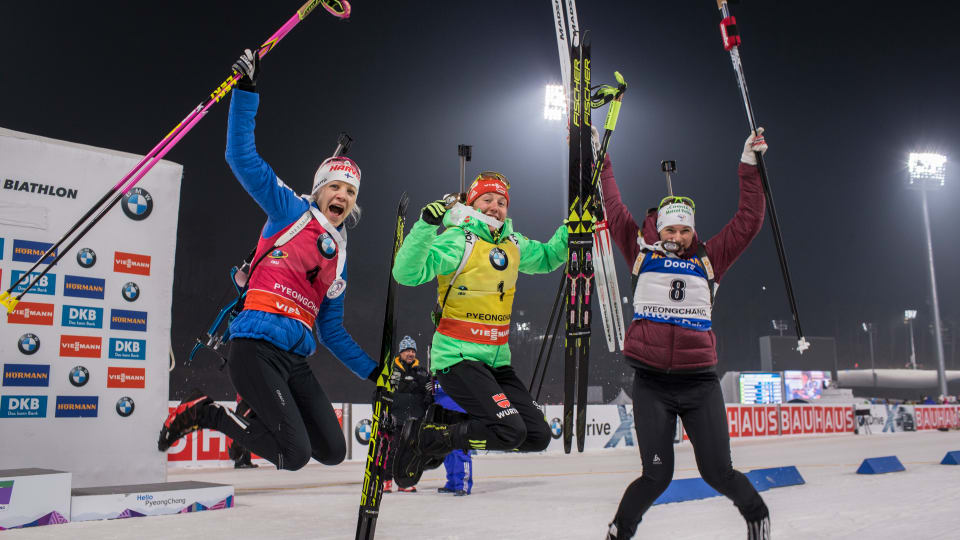
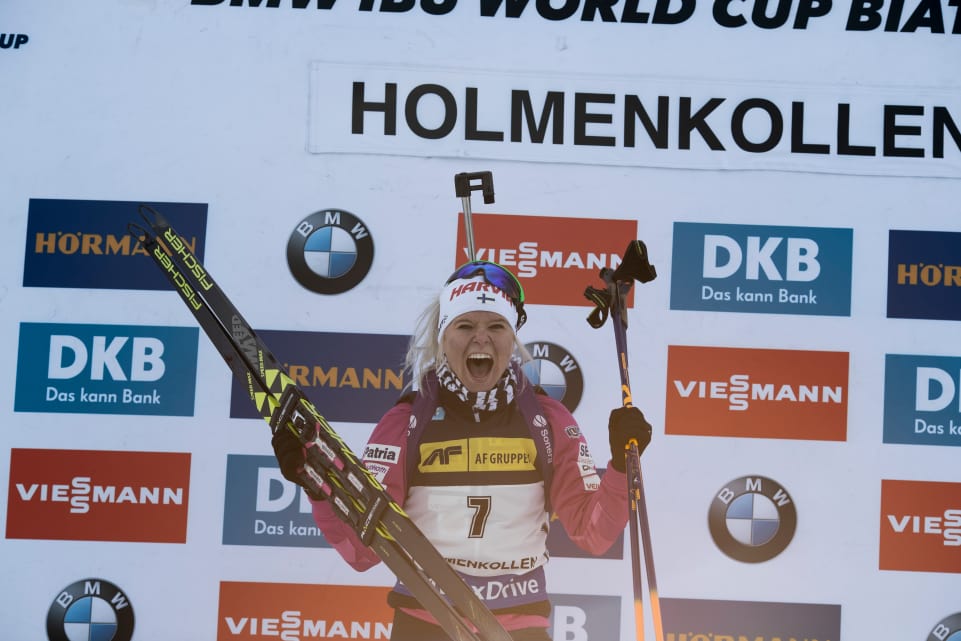
    Finland’s Mari Laukkanen celebrates her first IBU World Cup victory on Friday in the last women’s 7.5 k sprint of the season at Holmenkollen in Oslo, Norway. (Photo: IBU)

    For races and ski jumpings at the famous Holmenkollen arena on a hillside above Oslo, a frequent visitor in the audience is the King Harald V of Norway, a passionate and knowledgeable fan of all nordic sports. And usually the winners of the competition get the honor of being invited up to the royal suite overlooking the arena.

    On Friday in the women’s 7.5-kilometer sprint at the Interntional Biathlon Union (IBU) World Cup final in Oslo, American Susan Dunklee was on pace to maybe get that much-vaunted meeting with the king and his family, setting the best time after the prone shooting that no other athlete starting behind her could get close to anymore, with the next-best competitor more than 20 seconds behind at this point.

    But perhaps she started out a little too fast, and high winds posed an additional challenge on the shooting range for all the athletes.

    “Normally I am good at executing a smart controlled pacing plan but today I hammered straight out of the start and tried to hold on,” Dunklee wrote in an email to FasterSkier. “It made for a very painful second half of the race.”

    “I felt like I had rammed into a wall during the final two loops,” she added, according to a US Biathlon press release.

    In the end, a victory was no longer in the cards for Dunklee after she shot two misses in her standing stage, and the king instead got to meet Finland’s Mari Laukkanen after her first World Cup win in a time of 20:33.5 minutes, and later in the day with Norway’s Johannes Thingnes Bø, who won the men’s race and was one of his subjects he was already familiar with.
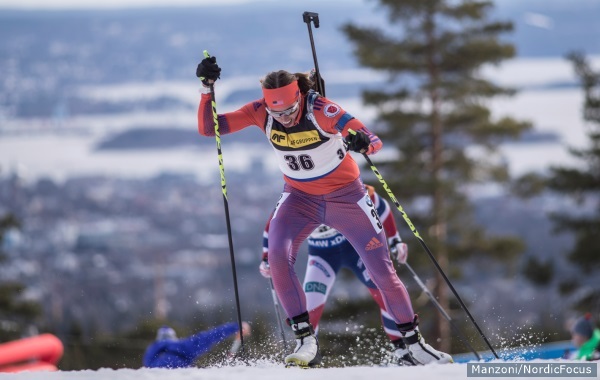
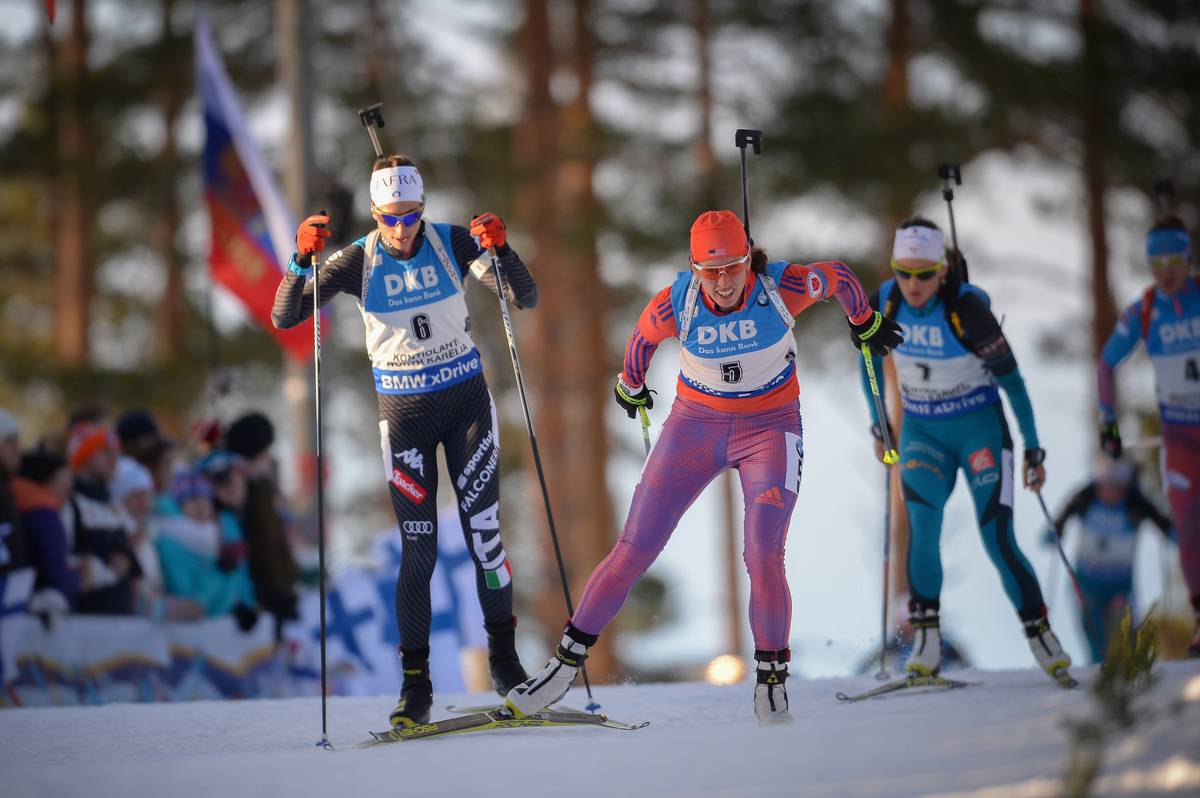
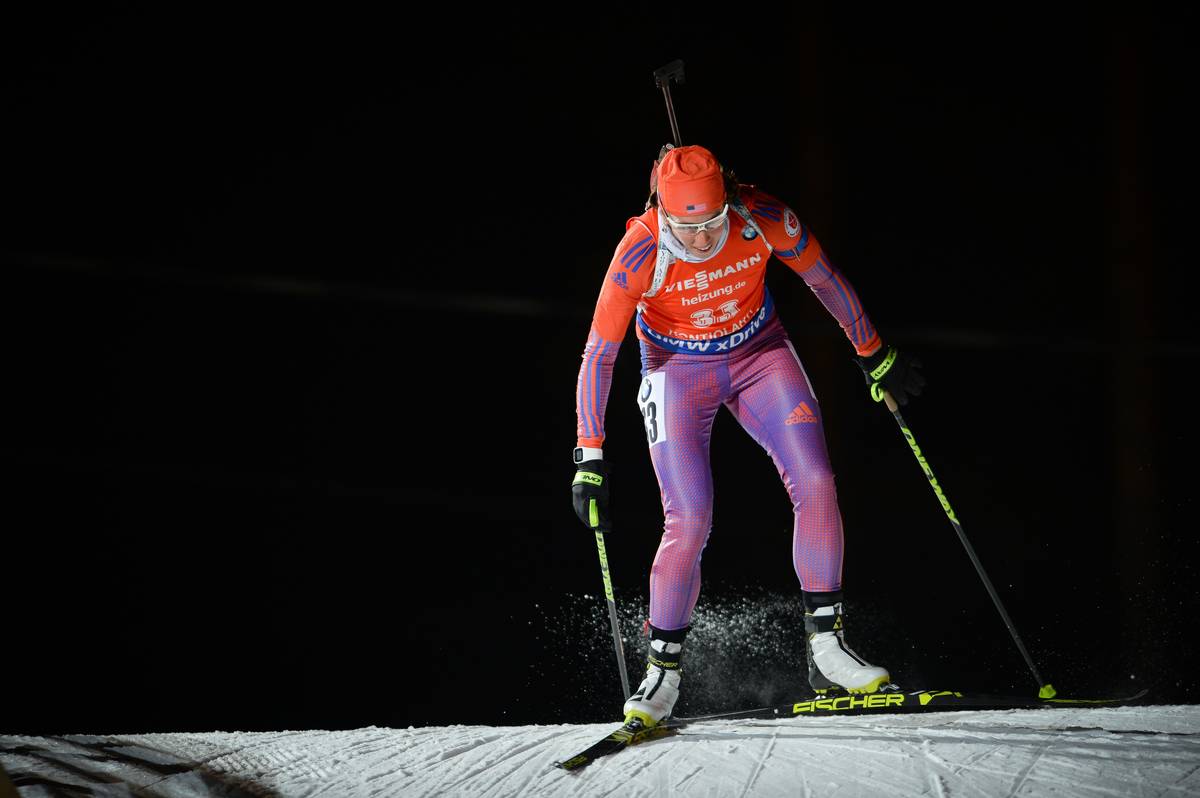
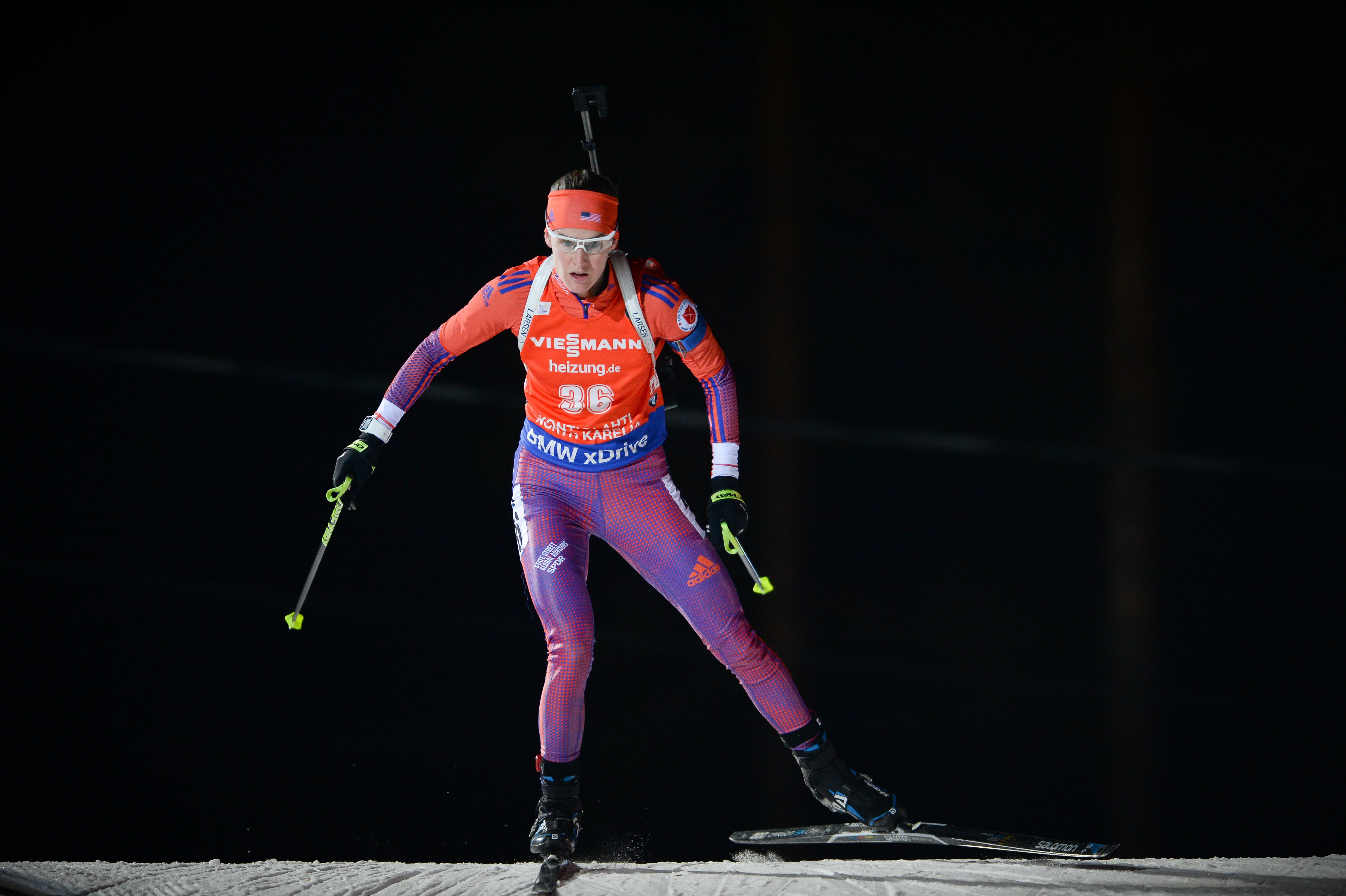
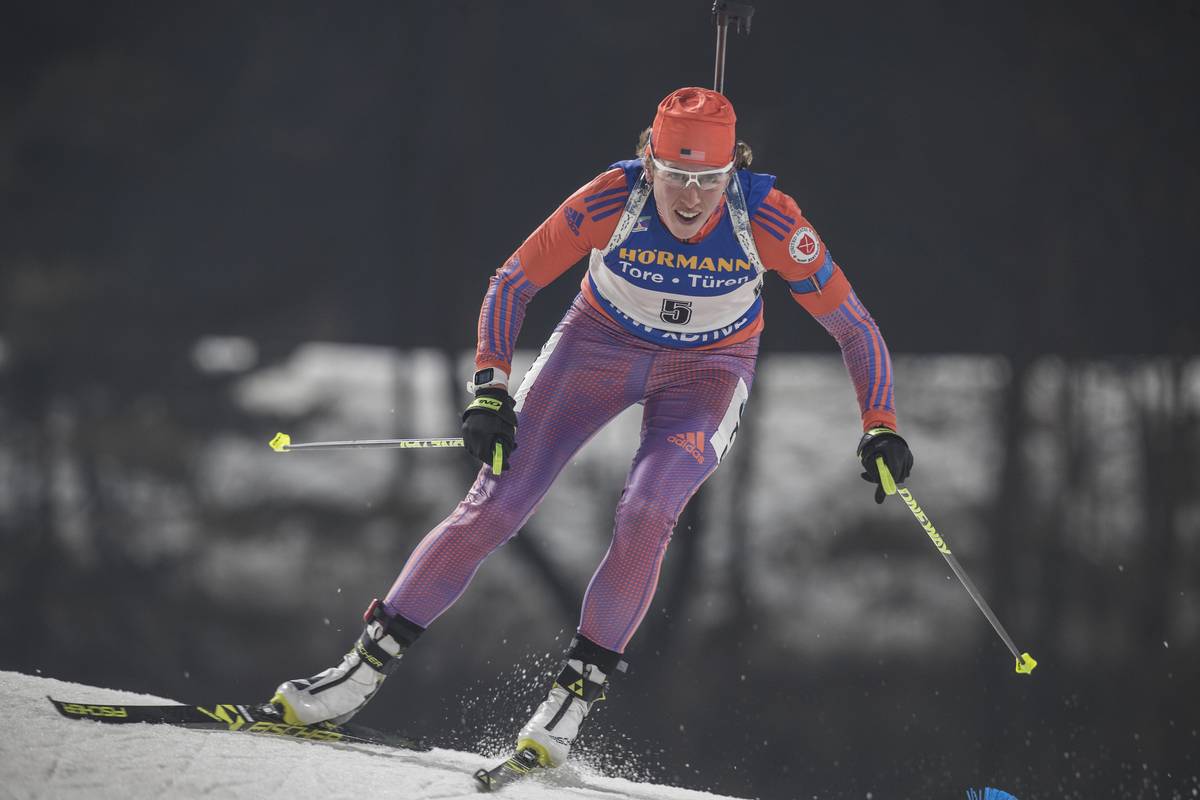
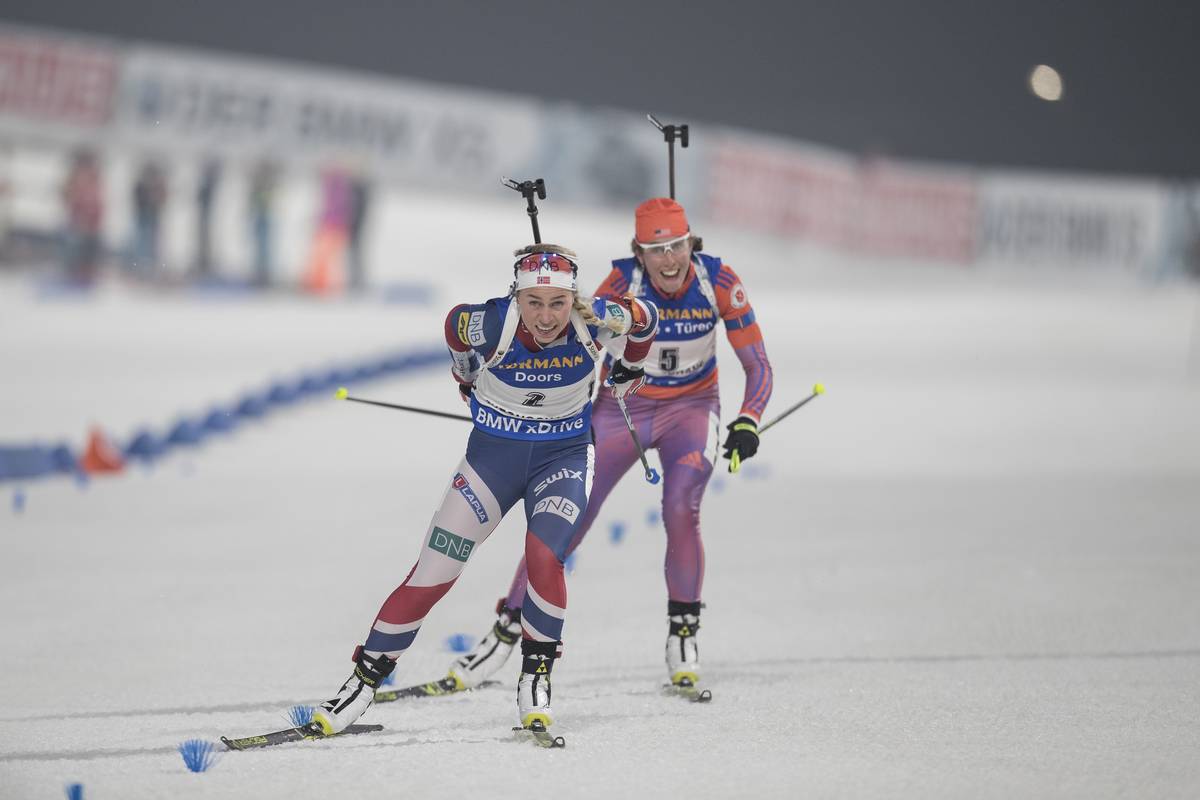
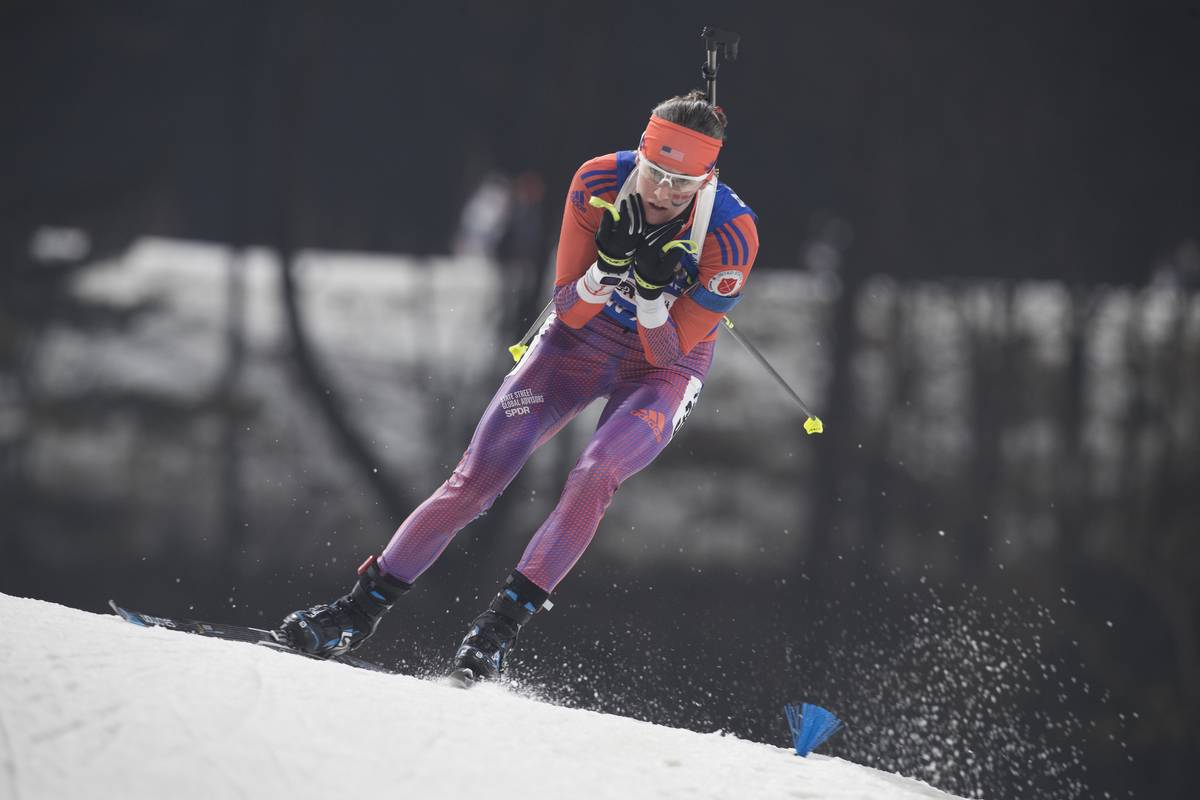
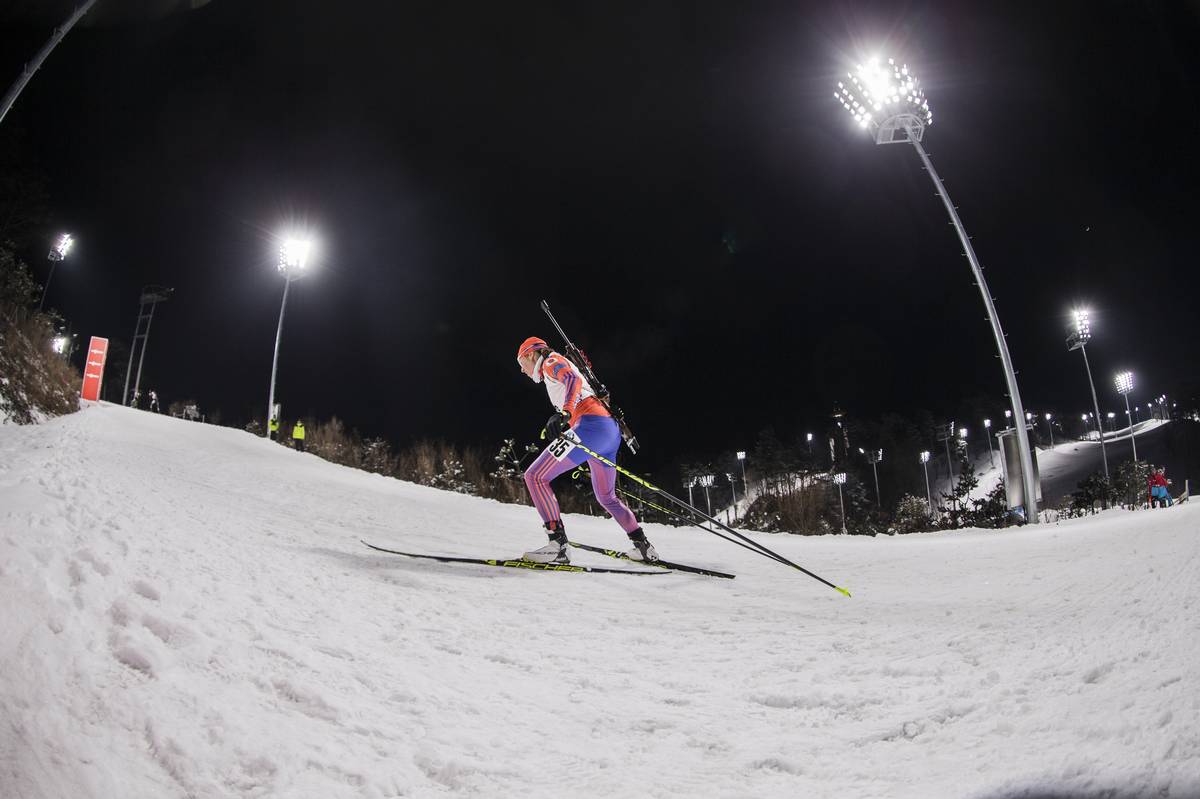
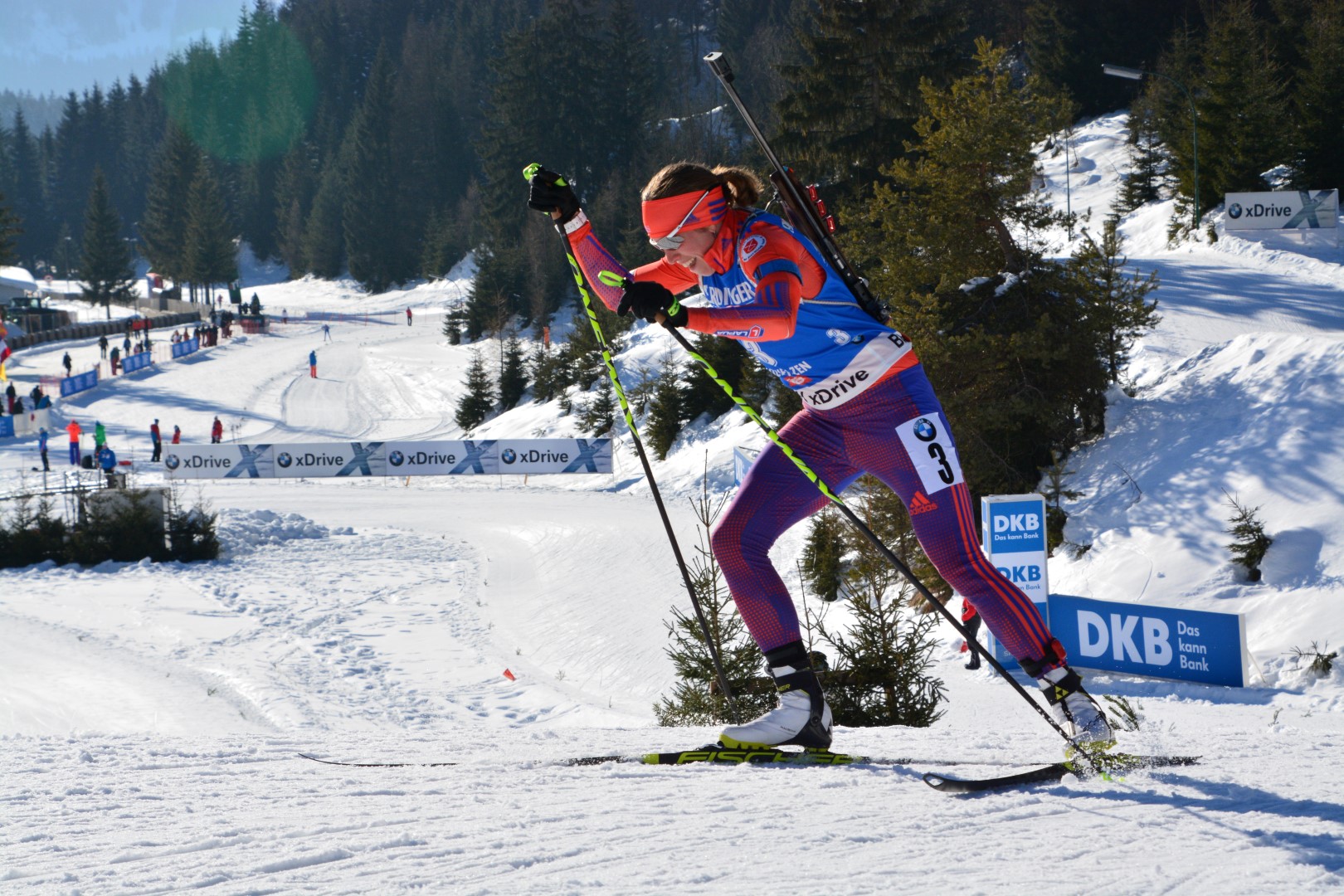
    US Biathlon’s Susan Dunklee racing to seventh place in the women’s 7.5-kilometer sprint at the 2017 IBU World Cup in Oslo, Norway. (Photo: USBA/NordicFocus)

    Dunklee initially finished sixth, before later being pushed down one more position to seventh place (+56.7). It was her sixth top-10 finish in her last seven individual races at the end of a remarkably consistent season.

    “On a windy day, half the battle is deciding the best correction to take; the other half is feeling confident in whatever decision you make,” Dunklee said of shooting. “Today I felt confident in prone. During my standing stage the wind wasn’t that bad, I just made a couple bad shots … I love racing in Holmenkollen. The crowd has a positive energy and the stadium is steeped in so much tradition.”

    Despite a tough end to her own race day, Dunklee was also happy about the first World Cup victory of Laukkanen.

    “Mari has always been nice and easy to talk to,” she added. “During my first year on the World Cup she invited our team to her family’s cabin near Kontiolahti for sauna-ing. I am happy to see her win.”

    On Friday, all three women on the podium shot clean in both stages despite the difficult conditions.

    Laukkanen started early in the field with bib 7, and combined with the third-best course time of the day set a time in the finish that would not be matched by anyone in the field of 103 starters.

    Starting just three bibs behind her, France’s Justine Braisaz came closest, leaving the range after the standing shooting just 14.4 seconds behind and continuously closing the gap on the final loop by skiing the fastest course time of the day, but it was not enough to catch up to Laukkanen anymore finishing 7.9 seconds behind.

    Braisaz’s teammate Anais Bescond started in the second group with bib 41, and her clean shooting and solid performance on the course with the 15th-ranked course time were enough to grab the third position on the podium (+23.1).

    “It feels good to shoot 0-0, the last time I shot that I was also on the podium, I should do it more often it seems,” a smiling Laukkenen said during the press conference. “I had a full crisis with myself yesterday, I was looking at my statistics and I could see that I am running stable and strong to make higher results, but I am constantly missing one or two too much. So it feels good today to make it.”

    Asked about the conditions in her shooting stages, she added, “It was not an easy day for sure, and I didn’t expect it to happen. I was a little bit lucky on the standing stage. It hasn’t been easy (for me) to clean it even without wind. So I am just happy to do it, and that it was enough to win today.”

    The 29-year-old Finn said she had to take a longer break after a disappointing last season, before she decided to continue with her athletic career. Earlier in the 2016/2017 season, Laukkanen had also taken time away from biathlon in order to qualify for and compete in the cross-country World Championships at home in Lahti, Finland, where she reached the semifinal in the women’s sprint.  At the IBU World Championships in Hochfilzen, Austria, she narrowly missed a medal in the 15 k individual finishing fourth.

    “I was a little bit nervous,” Laukkanen said about meeting the king on Friday. “For a Finn, it’s always special to win here in Holmenkollen. It’s a legendary place, mostly because of the cross-country history. It feels good.”

    For Braisaz, it was the second podium of the season, and with the second place she tied her career-best.

    “I really enjoy Oslo and Holmenkollen,” Braisaz said in the press conference. “I hoped to stay concentrated and to stay focused until the end of the season. But I was not very confident about my shooting. Especially in January and February, I was not very successful on the shooting range. So I decided to work for the future, for the next years, and to just enjoy it even though it was very windy today… I don’t think the conditions changed too much today (throughout the field), but some athletes probably were not fortunate and had no chance to clean.”

    For her teammate Bescond, it was her third podium of the season. Despite her good form, she had only received one start in the individual race at the World Championships in Hochfilzen, and also was not nominated for France’s relay teams.

    “I feel full of energy because I didn’t compete much in February,” Bescond stated in the press conference. “Now I feel good while a lot of girls here are probably tired now… It was my goal after Hochfilzen to be good in March. I am really happy with my result… My three medals from the (2016) World Championships in Oslo were a really good memory, and when I come back here I always have a lot of good things in my mind.”

    Koukalová Takes Sprint Title
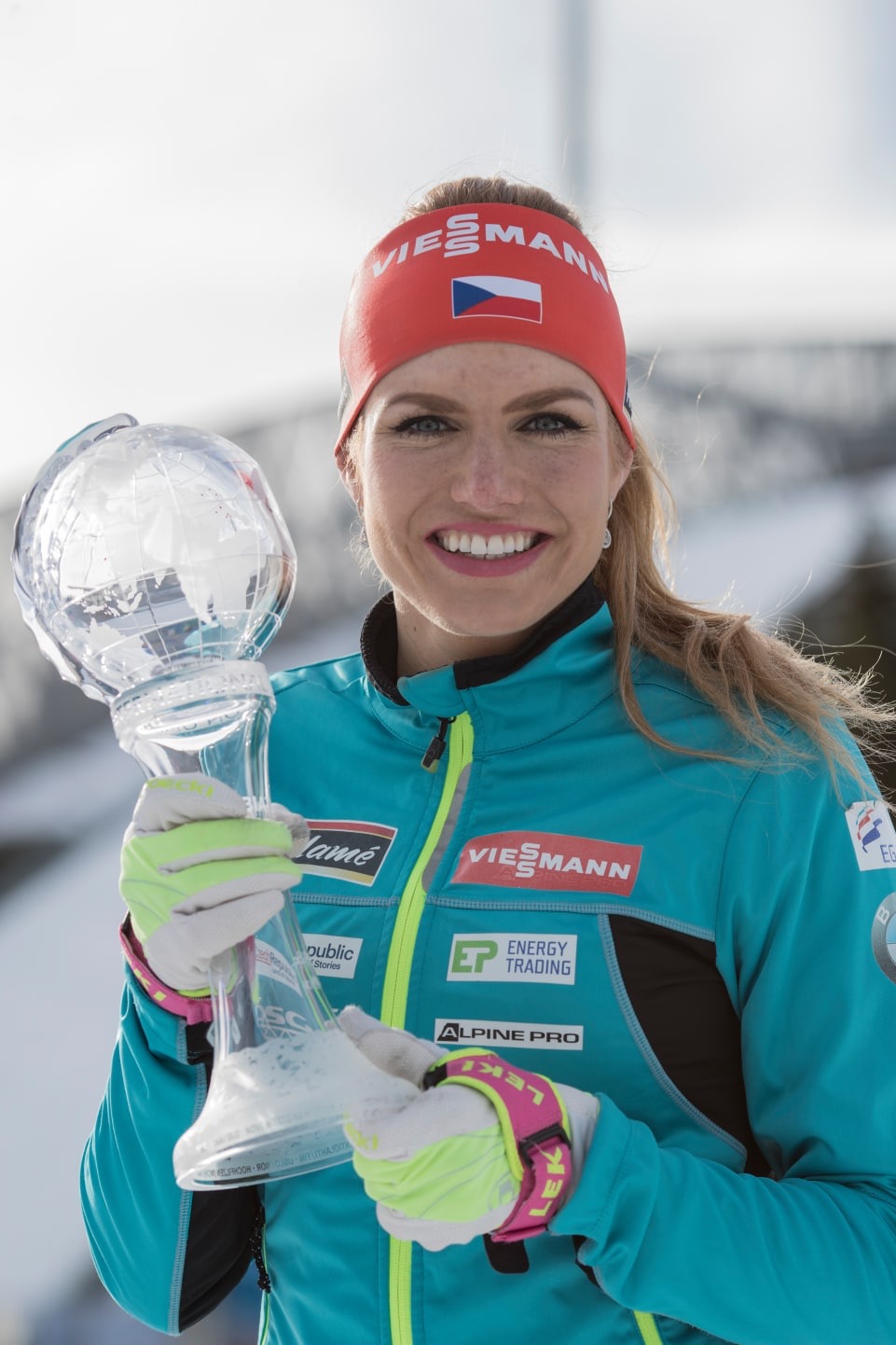
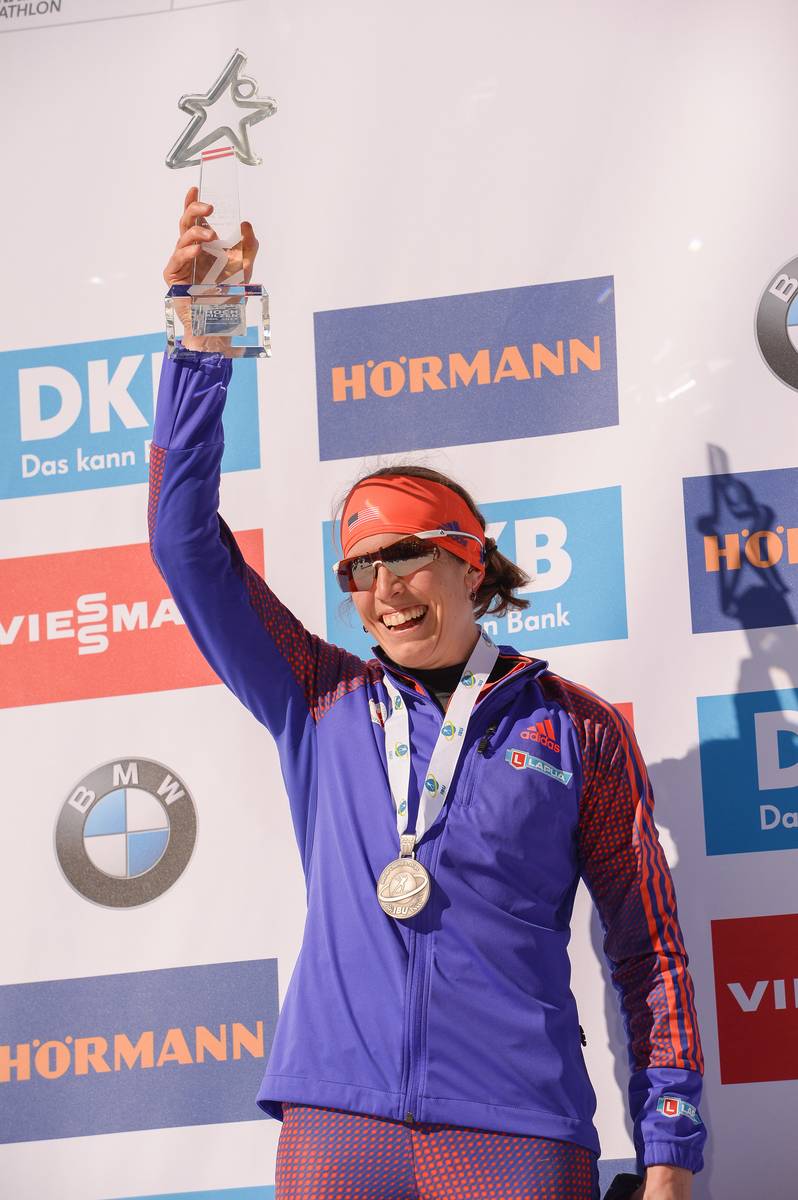
    Gabriela Koukalova of the Czech Republic with her “crystal globe” after winning of the 2016/2017 sprint discipline award following the IBU World Cup women’s 7.5 k sprint on Friday in Oslo, Norway. (Photo: IBU)

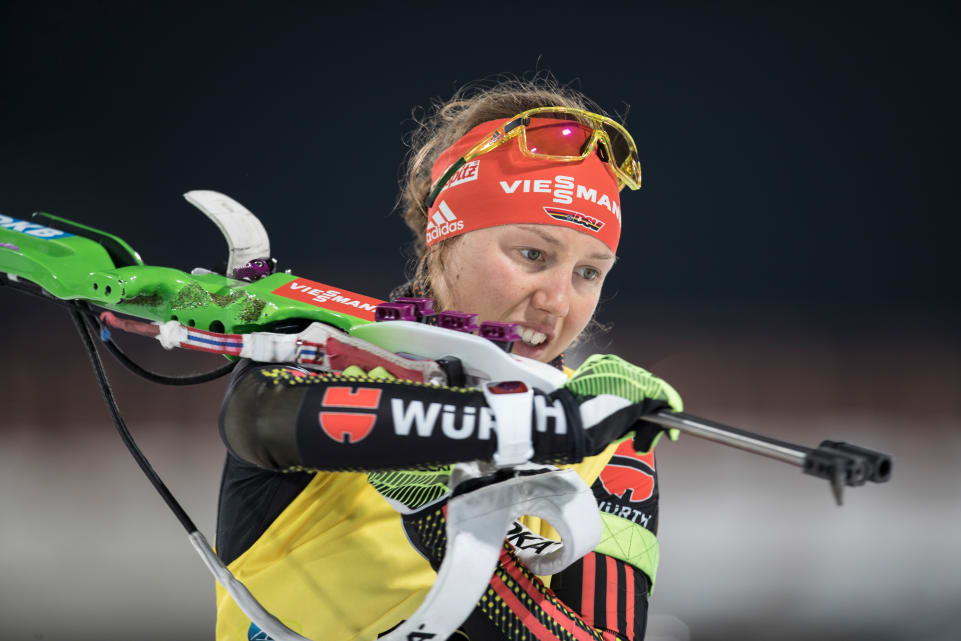
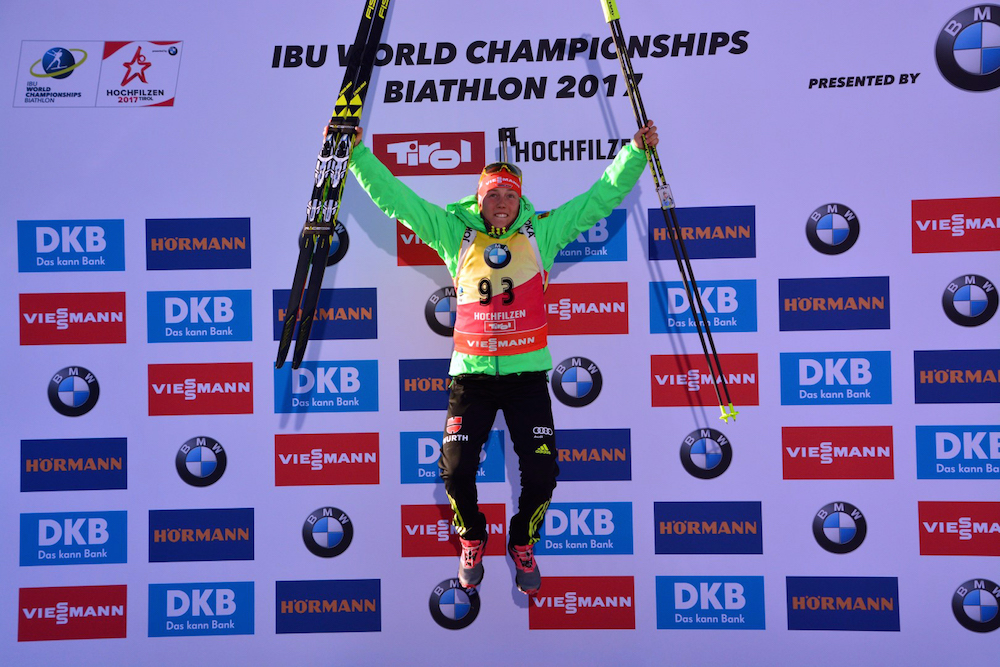
    Germany’s Laura Dahlmeier had gone into the last sprint race of the season with a 28-point lead over Gabriela Koukalová of the Czech Republic — a lead that looked fairly secure for the recently very consistent winner of the overall World Cup.

    But in Friday’s race, Dahlmeier struggled with the tricky wind conditions, incurring three penalties in the prone shooting which set her back all the way to a 93rd place, before she could move up again with a clean standing shooting, but in the end her time in the finish was only sufficient for the 31st place this time.

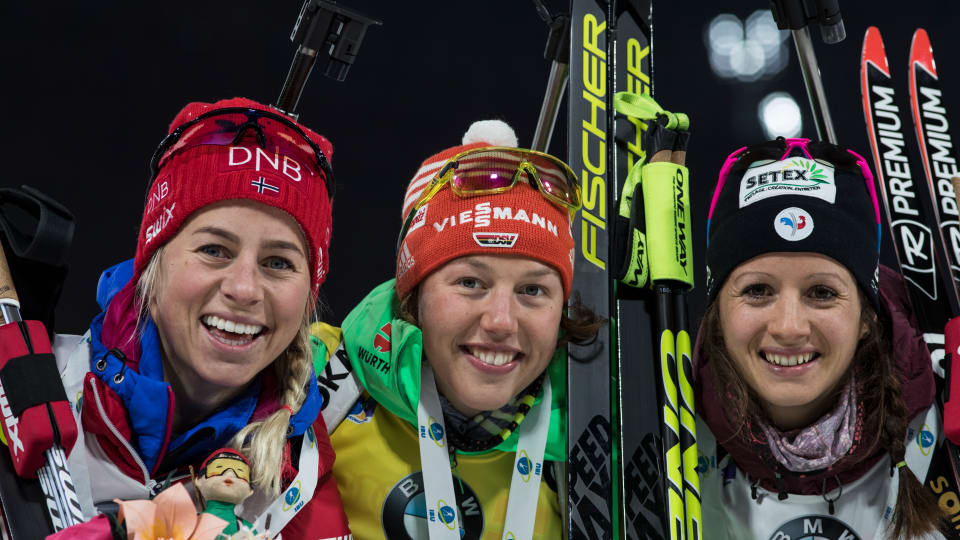
    That was not enough to match Koukalová, who only shot one penalty (0+1) and initially finished third, before Bescond bumped her to fourth (+37.4). Dahlmeier would have needed at least one more athlete to finish ahead of the Czech, who made up 33 points to finish ahead still claiming the “small globe” in that discipline.

    “Today’s race somehow was jinxed,” a disappointed Dahlmeier later told German broadcaster ARD. “That started last night with the bib draw when I got unlucky with the last position in the first group, and I think I picked the wrong skis today, in terms of waxing we were not competitive with the very best, I didn’t feel so fit anymore, and then in prone a giant screw-up happened to me. There was quite some wind, I have to analyze it again but if I remember correctly I clicked in the wrong direction [adjusting the sights]. That moved the shots left, and then the race was all but over.“

    “Of course life goes on, it was still a crazy season,” she added. “I only would have liked to show another good race in the fight for the sprint globe … Today I wouldn’t even have needed a perfect race, just a good one, that would have been sufficient.”

    After the race, Dahlmeier still received her “crystal globe” for the season’s winner of the 15 k individual discipline as a consolation. Two days of racing remain on the schedule: Saturday’s pursuit and Sunday’s mass start.

    Finland’s Kaisa Mäkäräinen placed third in the overall sprint ranking, after finishing 27th on Friday with four penalties (+1:44.6).

    Three North Americans in Pursuit

    Dunklee will be joined in Saturday’s 10 k pursuit by teammate Clare Egan, who finished 34th with one penalty (+2:03.7). The third American, Joanne Reid placed 80th with five penalties (4+1), 3:32.2 out of first.

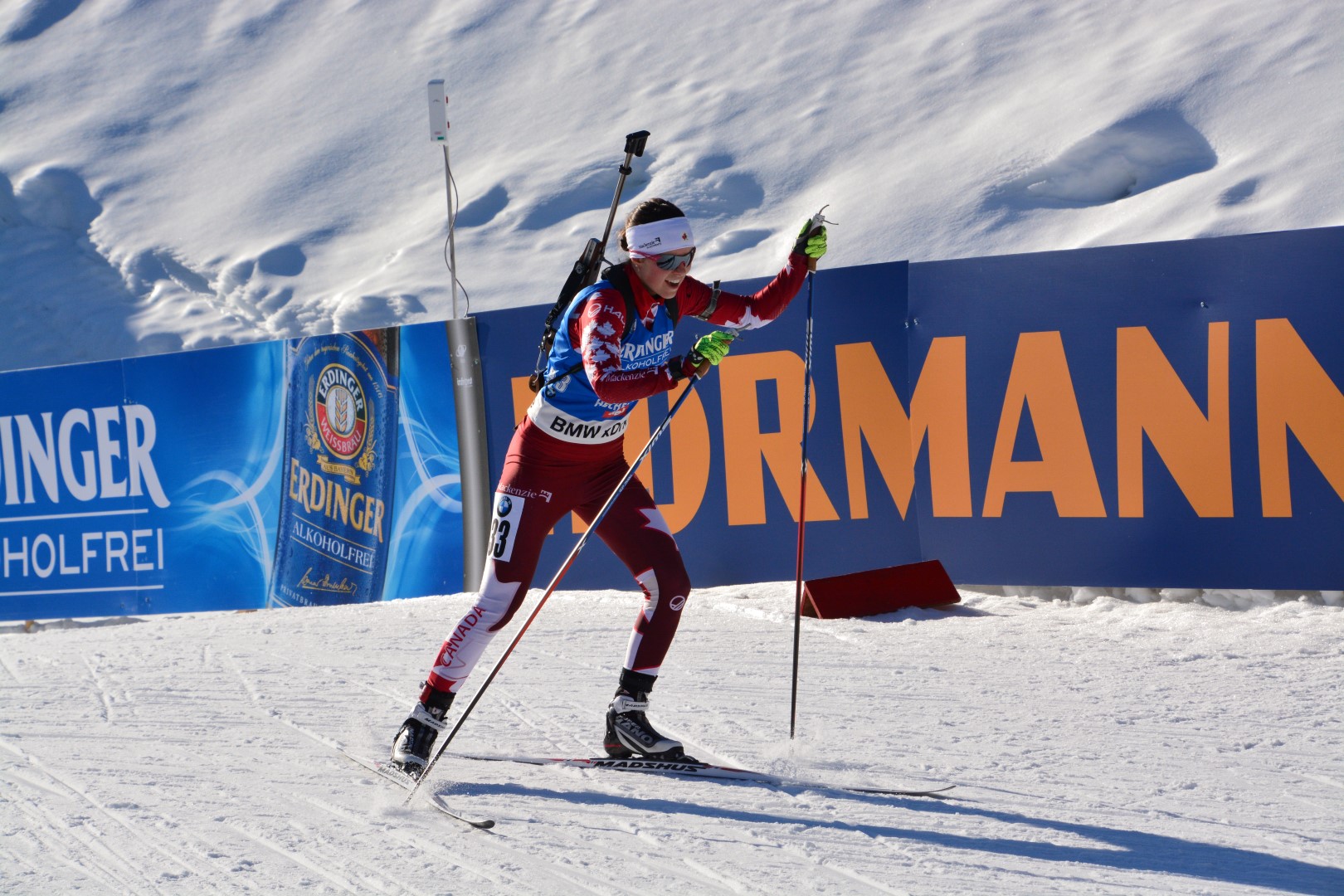
    One Canadian qualified as well, with Julia Ransom fininishing 52nd with two penalties in her standing stage (0+2), 2:28.9 back, after having been ranked as high as ninth after prone.

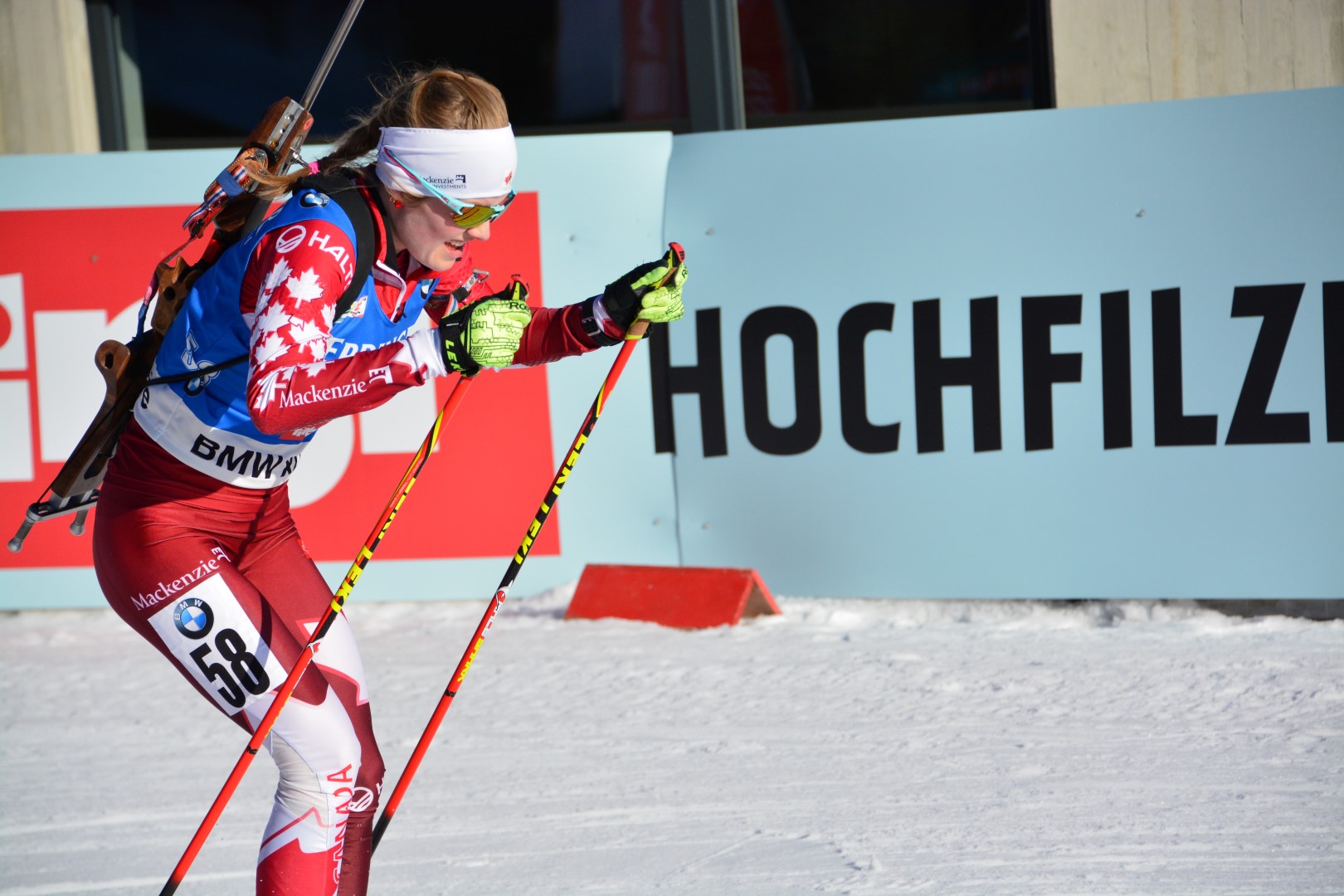
    In her second World Cup weekend, Canada’s 19-year-old Megan Bankes finished 64th (+2:53.0) with two penalties (1+1), missing the qualification for the pursuit by 12 seconds.

    Sarah Beaudry was 75th (+3:20.5) with three penalties (2+1), while the fourth Canadian Emma Lunder in 84th with the same shooting result (+3:46.7).

    “We have an incredible team of ski service technicians and coaching staff who plan to give 110 percent until the last race is done,” Dunklee said, according to the press release. “I have two tremendous opportunities still in front of me with these last races and I don’t plan on wasting them.”

    Dunklee will be in a very good position for the pursuit, starting 33 seconds behind the podium and less than a minute behind Laukkanen. Only reportedly the schedule of the King of Norway won’t permit him to attend the biathlon races on Saturday and Sunday, so there likely will be no meeting should she be successful there.

    In the Women’s Nation Cup Score, which is its own World Cup award category but also determines the starter quota spots for the following season, Germany’s women’s team secured the victory and the crystal globe with 7951 points, ahead of France (7646) and Ukraine (6605).

    The U.S. finished 14th with 4743 points (despite not starting a relay in Pokljuka, Slovenia, earlier this season), while Canada tied Finland for 15th with 4619 points. Both North American teams will retain the four guaranteed World Cup starter spots for sprints and individual races they already had this season, which enables them to travel the World Cup circuit with a full team.

    ***
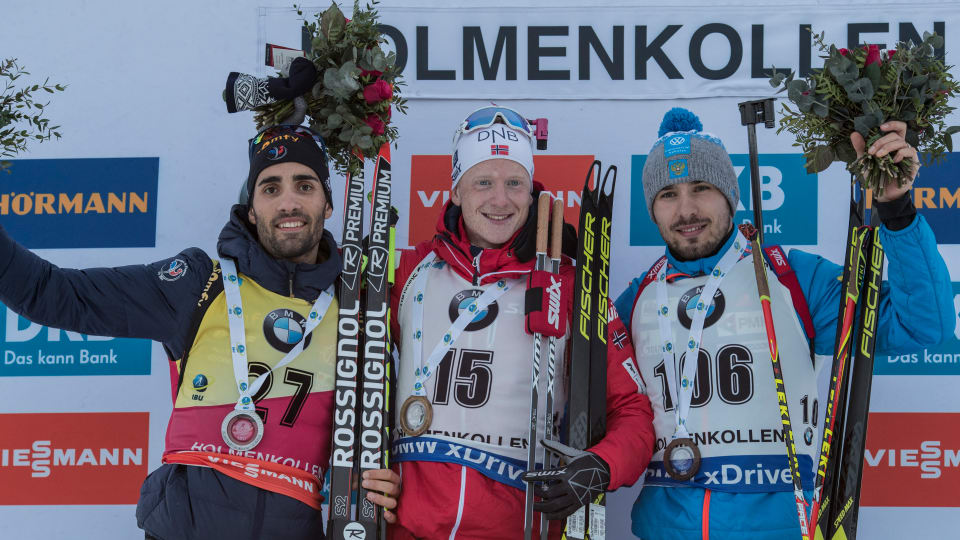
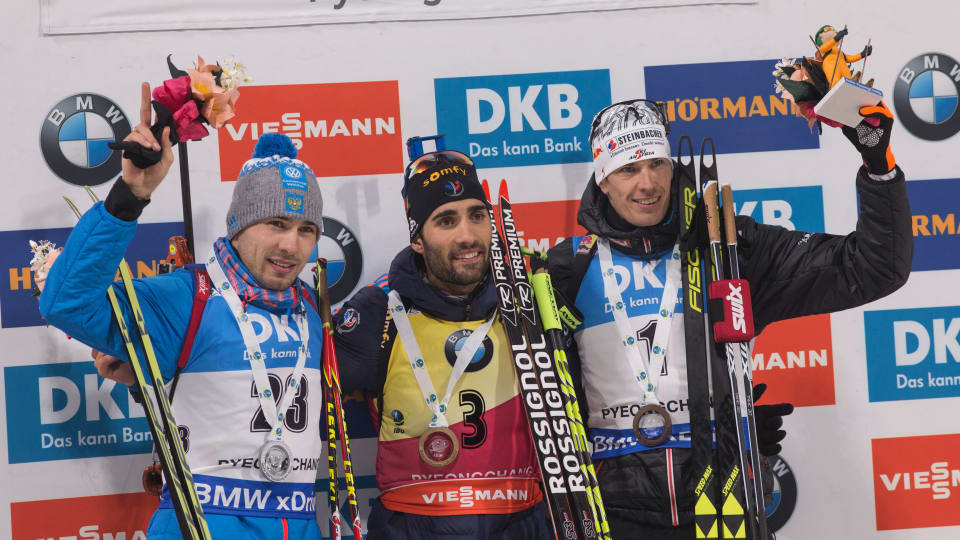
    Norway’s Johannes Thingnes Bø (c) after winning in the men’s 10-kilometer sprint at the 2017 IBU World Cup in Oslo, Norway, ahead of France’s Martin Fourcade in second (l) and Russia’s Anton Shipulin in third place. (Photo: IBU)

    Bø Wins Men’s Sprint; U.S. Men 10th in Nation Cup

    Later on Friday, Norway’s Johannes Thingnes Bø got to meet King Harald V after winning the men’s 10 k sprint, shooting clean in much calmer wind conditions than during the women’s race to finish in a time of 24:53.3.

    “That’s always nice,” Bø said in the press conference when asked about meeting the king. “It’s my second time, and that’s the most memorable thing for this season I think.”

    It was the second win of the season for the Norwegian and the 13th of his career. After starting early in bib 15, Bø had to wait a long time to see if anyone could still beat his time.

    “Of course I was happy about my race, but since I lost some seconds on the last lap I was not sure if it would hold for the win,” Bø commented in the press conference. “It was a long wait, but in the end it was worth it and I am very happy to get a win here.”

    “It’s quite nice to be back at Holmenkollen,”  Bø added. “Today was quite hard conditions … I think a lot of athletes started hard but got really tired. We had very good skis today, that helped me a lot… In shooting when the people cheer for you between the shots, I feel that helps and makes it more easy to hit the next target. That is the biggest advantage, but of course there is also the pressure.”

    France’s Martin Fourcade, the dominant male biathlete of the season who reached the podium in all but three individual races, finished second (+13.6) after missing a shot in his standing shooting and having to ski a penalty lap, and only being able to make up 10 seconds on the final loop.

    “I am angry about my miss for sure,” Fourcade said at the press conference. “I think I had the power to clean it, but I am not angry about my competition. Johannes was really good today, he was at 100 percent and I can just congratulate him to his victory. I am really satisfied with my second place.”

    Fourcade had already secured himself the “small crystal globe” title in the sprint discipline, and is anxiously awaiting the birth of his second child any day now.

    “I think my biggest challenge was to be ready for this race in spite of the challenging preparation,” he explained. “I went back to France on Sunday, and then I had a long travel to Oslo again on Wednesday missing my connection. I had only one little training yesterday to be ready for this competition. So I am really satisfied about the job I did today, and my team helped me a lot to be ready.”

    Starting very late in bib 106 out of 108 starters, Russia’s Anton Shipulin (+21.3) shot clean and bested Austria’s Dominik Landertinger, who had a penalty in standing, off the podium by just 0.2 seconds (+21.5).

    “Of course I am satisfied to be on the podium, because the guys were very strong today and I fought until the end,” Shipulin said via a translator in the press conference. “I was very well informed (about my position) during the race. I am thankful to all the staff and the fans who kept me informed and motivated.”

    “I think it was an advantage to start early today because the tracks were not that firm anymore in the end,” he added. “I had to move from left to right all the time especially in the downhills and it was quite challenging.”

    “In principle I had a perfect race today,” Landertinger told Austrian broadcaster ORF after narrowly missing out on the podium. “If you want to be in the mix in front, you have to take some risk on the shooting range. Usually one miss is too much for a podium position in sprint, although of course it was damn close today.”

    For the U.S, Sean Doherty was the top finisher in 35th with two penalties (0+2). He had been in 18th after the prone shooting stage, and after skiing 300 extra meters due to his penalties in standing he was still able to make up a few positions on the final loop with the 24th-ranked course time (29th-fastest overall). A week ago in the pursuit in Kontiolahti, Finland, Doherty achieved his best individual result of the season in 18th place after shooting clean in the four-stage race.

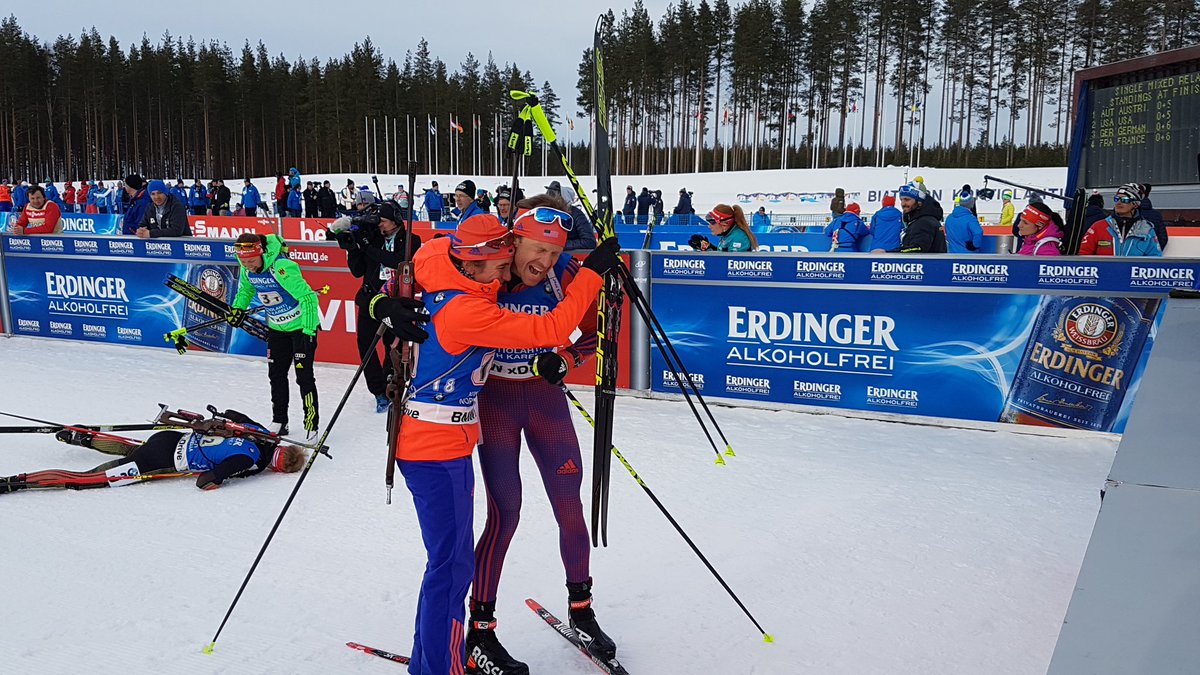
    Lowell Bailey, who had a recent series of strong shooting performances on his road to a gold medal in the individual race at World Championships and two second-place finishes in the sprint in PyeongChang, South Korea, and the single mixed relay (with teammate Dunklee) in Kontiolahti, initially shot clean in prone on Friday and left the range in 11th position. In standing, he had three penalties, which set him back to 50th position and Bailey ultimately finished 44th (+1:51.6).

    The three starters for Biathlon Canada missed qualifying in the top 60 for the pursuit.

    Christian Gow shot clean, but skied the 91st-ranked course time to finish 61st  (+2:25.8), just one position and less than two seconds behind Bulgaria’s Dimitar Gerdzhikov in 60th (+2:24.5). Brendan Green had a penalty in each stage (1+1) to finish 85th (+2:58.6), while Scott Gow was 95th (+3:25.1) with one penalty (0+1).

    Also missing the pursuit were the final two American starters Paul Schommer in 98th (+3:41.9) and Leif Nordgren in 100th (+4:07.9), each with three penalties (2+1).

    Despite not making many points in the final race of the season counting to the Nation Cup Score, the U.S. men finished in 10th place in those standings with 5290 points, thereby also securing an additional fifth quota spot for next season’s regular-season World Cups (the top five teams get six, sixth to 10th get five, 11th to 17th get four, and so on). Canada finished 13th with 4625 points, and will keep the four spots they had this season. Just like the women, Germany secured the World Cup win in this category with 7448 points, narrowly ahead of France with 7416 points, and Russia in third (7192) just ahead of Norway (7181).

    “Germany has a great team, and they deserve this victory in the Nations Score,” Fourcade said during the press conference. “France never won it, so of course it was a really big goal and we are disappointed about not winning it. But that’s the game of sport, and we will try to win it next season.”

    Results: Women | Men

    Pursuit start lists: Women | Men

  • U.S. Historic Second in Kontiolahti Single Mixed Relay, ‘Dream Come True’

    U.S. Historic Second in Kontiolahti Single Mixed Relay, ‘Dream Come True’

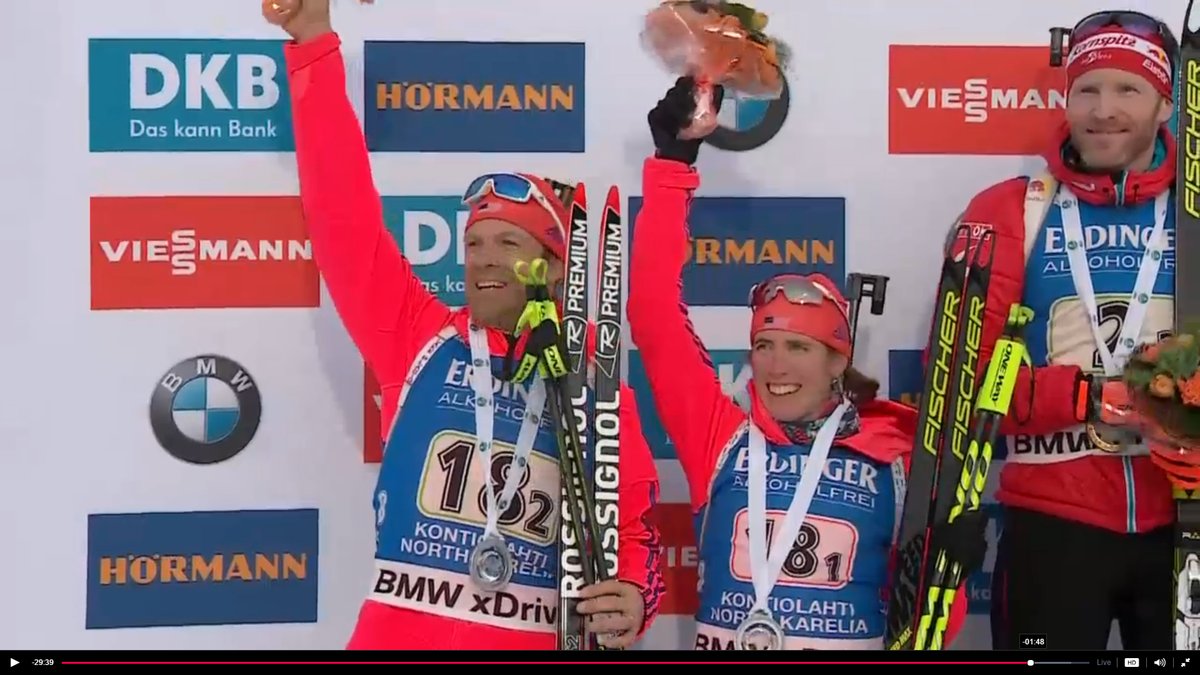
    Susan Dunklee and Lowell Bailey celebrate after finishing second in the World Cup single mixed relay in Kontiolahti, Finland. Austria won the competition. (Photo: IBU/Twitter)

    The single mixed relay is a relatively new format, and one that is not yet contested at World Championships or the Olympics.

    And so when a single mixed relay (two athletes) and a ‘normal’ mixed relay (four athletes) are held on the same day, the U.S. Biathlon World Cup team’s policy has always been clear: prioritize the mixed relay, and get the World Champs and Olympic team the most practice possible for their big days.

    All that changed in Kontiolahti, Finland, today.

    The U.S. decided to put Susan Dunklee and Lowell Bailey – both medalists at 2017 World Championships – on the single mixed relay. Even before the race began, expectations were high. The Americans were calling themselves the “dream team”.

    After the race? Oh, yeah.

    The duo finished second, claiming the first relay podium by an American biathlon team since 1994, when Beth Coats, Joan Smith Miller, Laura Tavares, and Ntala Skinner finished second in the women’s 4 x 6 k in Canmore.

    “We have known that if we had our best day on the right day, that it was possible in the mixed relay even a few years ago,” Dunklee said of having a relay podium. “For that mixed relay it just quite hasn’t happened for us. I think maybe we psyched ourselves out a few times… I have dreamed for a long time being able to run into the finishing pen and with a bib on and a rifle, and greet my teammates as they come in. It’s so cool to finally do that. It’s definitely a dream come true.”

    But if she pictured running into the finishing pen of a normal biathlon event, the single mixed relay might not have come to mind. The format of the newest World Cup competition is unusual. Loops are 1.5 kilometers, shorter than any other ski loops on the World Cup. The women ski (and shoot) twice, then tag off to the men just after shooting so the men can ski (and shoot) twice, then the women twice again, then the men twice, and finally the men getting to ski one last 1.5 k loop to reach the finish line.

    That unfamiliarity came with excitement: the team knew ahead of time that they had a good chance of a top finish. With a flat course, both Americans felt good about their power skiing. The format also has the highest shooting-to-skiing ratio of any biathlon competition, and the pair had been shooting almost unbelievably well in the second half of the season.

    “The stuff Susan and I have been working on throughout the training year in shooting, which is namely trying to reduce our shooting times and shoot quicker, lends itself to a race format like the single mixed relay,” Bailey said. “It was my first single mixed relay and Susan’s as well, and we were totally psyched. It’s a great moment to see both programs, both the men’s and the women’s teams, have a joint success like this.”

    Despite the new format, Dunklee found herself leading on the second loop, thanks to a fast and clean prone shooting.

    Then — she fell on a downhill.

    “It just happened so fast and before I knew it I was on the ground, and my rifle fell on the back of my head where I have a nice sore bruise now,” Dunklee said. “After that I just got up. I had a few hundred meters before I need to be ready to shoot, and that’s more important than freaking out and worrying about it too much.”

    She blamed “snow snakes,” but Dunklee managed to re-gain some determination. By the time she reached the shooting range she had re-focused. Dunklee hit all five targets in quick succession, claiming the fastest standing shooting time of all the women.

    She tagged off to Bailey in third place — just 8.9 seconds behind Kazakhstan and Germany — and the U.S. was back on track.

    Bailey, for his part, completed the second leg of the relay with two spare rounds, skiing comfortably  near the front of groups and tagging off in fifth, +17.2 seconds.

    “What’s interesting about this course is that it’s pretty flat except for one relatively modest uphill,” Bailey said. “Today there was quite a bit of wind on the course so to be leading was a disadvantage in a group. So you saw some tactical play up at the front of the race. I felt like I could’ve gone harder in the initial loops, but I also knew that with such a short, 1.5 k loop, the shooting really is where the race is won or lost. So my strategy was to just stay in contact with the lead group.”

    Meanwhile, Simon Eder of Austria had gone to the front and Austria would hang onto the lead for the rest of the race. Lisa Theresa Hauser had used two spare rounds in her first standing, but through both of Eder’s relay legs and Hauser’s second leg the team used only three. That turned out to be untouchable.

    “Once Austria got far enough off the chase pack, I felt it was more of a risk to try to go all out in my last leg to try to catch Austria, than try to hit my targets,” Bailey said.

    That’s because behind Austria, it was still a fight. After Bailey quickly hit his extra shots, it was Dunklee’s turn. She again cleaned prone before needing two spare rounds in standing. But the wind on the range in Kontiolahti had been tricky all day, and most of the other leaders also used spares. So despite the missed shots, Dunklee still managed to move up to second place.

    “I think everyone was struggling, especially standing,” Dunklee said. “I would not normally expect to be even with, or not lose a whole lot of places on, the leaders [with two spares], but since everybody else was struggling too it was okay… I think with this short format, you get a little bit more adrenaline and you are pushed a little bit harder in skiing. You get the shaky legs going when you’re standing.”

    With Austria seemingly untouchable, Bailey was left to battle it out with France, Germany, Switzerland, and Kazakhstan.

    After one more clean prone, he was fifth, but still with the group.

    In standing, Bailey needed a spare round. But again, he loaded them extremely fast – allowing him to leave the range in third place anyway. In his haste to hit the trails, he almost fell on the sharp corner leading out of the range and into the stadium. But he kept his balance, and then hit the gas.

    “The tactics at the front of the race in the third and fourth loops for me, the pace was not all that high, so I really felt pretty fresh when I came out of standing for that last 1.5 k loop,” Bailey said. “I knew that it was basically just a really long sprint finish. So I just tried to sprint from the mat essentially and hoped that I didn’t run out of gas by the finish line.”

    Ahead of Bailey: Roman Rees of Germany, just four seconds away. Rees is one year out of the junior ranks, and had only ever competed in one other World Cup relay of any kind. Twelve years older, Bailey set out to catch him.

    But behind: Jean Guillaume Beatrix of France, another veteran with as many podiums to his name as Bailey had. Leaving the range Beatrix was less than a second behind Bailey, and wanted to get onto the podium.

    Between Germany, France, and the United States, there was only room for two on the podium. As the 1.5 k loop wore on, Beatrix faded – only a few seconds, but enough to keep him and his French teammate Anais Chevalier in fourth place.

    By the time the race came to the stadium, Bailey had caught Rees. He tried to use all of his power to pass on the inside corner, but Rees held strong. The two ended up dueling down the finishing straight, with Bailey prevailing by just half a second.

    “YES!” he screamed as he crossed the finish line, 32.8 seconds behind the Austrian team. Dunklee ran out to meet him.

    “That was a first and it’s a great feeling,” Bailey said. “In a lot of ways it’s better than just going out and having a great race on your own, but to have a great team result like that, it’s a new experience. I shouldn’t say that, we’ve had some great team results in both the mixed relay and the men’s relay — we were fourth place last year in the mixed relay [in Canmore], but no one really wants to go out and celebrate in the finish zone with fourth place. This was the first time that you could hug your teammate in the finish zone. I’ve watched that phenomenon throughout my career so it’s nice to experience it.”

    The U.S. had matched the Austrians on the range, using just five spares to Germany’s six, but the timing was off: Austria had gone, and so Bailey had concentrated on winning second, not potentially blowing up in chase of first place.

    That turned out to be a good strategy, because Eder had knocked down his final five standing targets with scorching speed of 17.9 seconds. By comparison, Dunklee’s best mark among the women was 21.4 seconds.

    “I actually talked to Simon Eder after the race because I knew his last shooting was blistering fast, and I said, ‘Hey, what was your strategy there? You didn’t have to shoot that fast’,” Bailey said. “And he said, ‘I came in and the wind died right when I got into position so I knew I had just a few moments there to take advantage of it.’ By the time [our] chase group, which was 30 seconds or less behind him hit the mat, [the wind] was back to being gusty.”

    The Canadian team of Julia Ransom and Christian Gow finished 19th, +2:27.0, with eight spare rounds.

    In the mixed relay later in the day, the French team of Marie Dorin Habert, Anais Bescond, Simon Desthieux, and Quinton Fillon Maillet took the win, followed by Germany (+11.0 seconds) and Ukraine (+27.1).

    The American team of Clare Egan, Joanne Reid, Paul Schommer, and Sean Doherty finished eighth, +1:37.4.

    The Canadian team of Emma Lunder, Megan Bankes, Scott Gow, and Brendan Green finished 22nd in the mixed relay, +6:09.5.

    “I would just reiterated that I was just psyched to see the whole team do well, both in the single mixed and the mixed relay,” Bailey said. “It’s Nations Cup points, so it counts for our Nation Cup overall total score for the women and the men. It was a pretty important race in that regard. I’m really happy for the team. Everyone deserves it, the techs and everyone, it’s been a really long season and they’re still working as hard as ever so I’m really thankful for that.”

    Results

  • Sunday Rundown: Holmenkollen & Kontiolahti

    Sunday Rundown: Holmenkollen & Kontiolahti

    Lowell Bailey and Susan Dunklee celebrate finishing second in the single mixed relay in Kontiolahti, Finland. (Screencap: US Biathlon/Twitter)

    IBU Biathlon World Cup (Kontiolahti, Finland): Single Mixed Relay

    In the last single mixed relay of the season, Susan Dunklee held the lead after two loops of skiing. She was looking for a top tag-off to American Lowell Bailey, but she crashed on a downhill. Nevertheless, she was able to focus on the shooting range and climb back into podium position.

    The leaders were gone, however: Simon Eder and Lisa Therese Hauser of Austria ran away with the competition, using five spare rounds to race to a 32.8-second victory.

    Bailey left the last shooting in third position, and caught Germany’s Roman Rees on the trails. The pair also managed to hold off Jean Guillaume Beatrix of France, who left the range just behind them. It came down to a sprint finish, with Bailey besting Rees (and his relay partner, World Cup Total Score winner Laura Dahlmeier). The U.S. had five spare rounds to Germany’s six.

    It was the first relay podium of any kind for the United States since 1994, when the women finished second in a relay in Canmore, Alberta.

    The Canadian team of Julia Ransom and Christian Gow finished 19th (+2:27.0) with eight spare rounds.

    Results

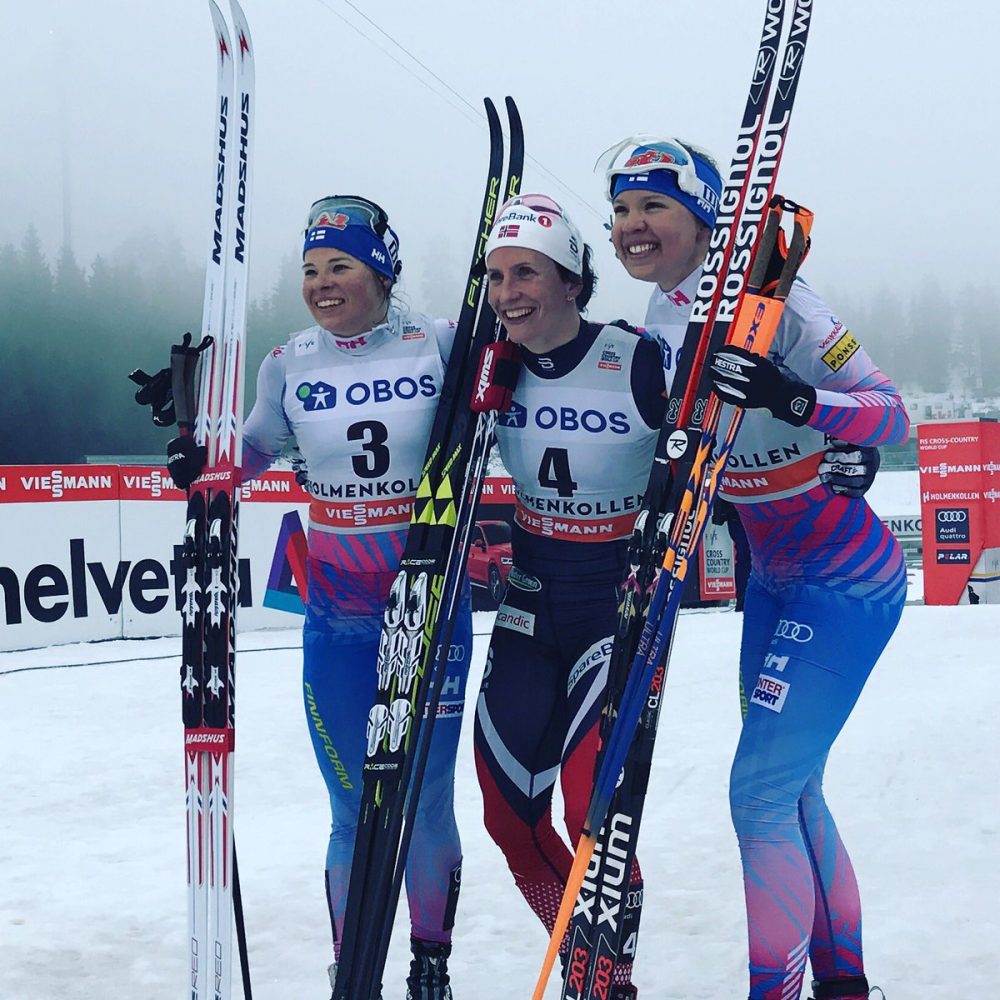
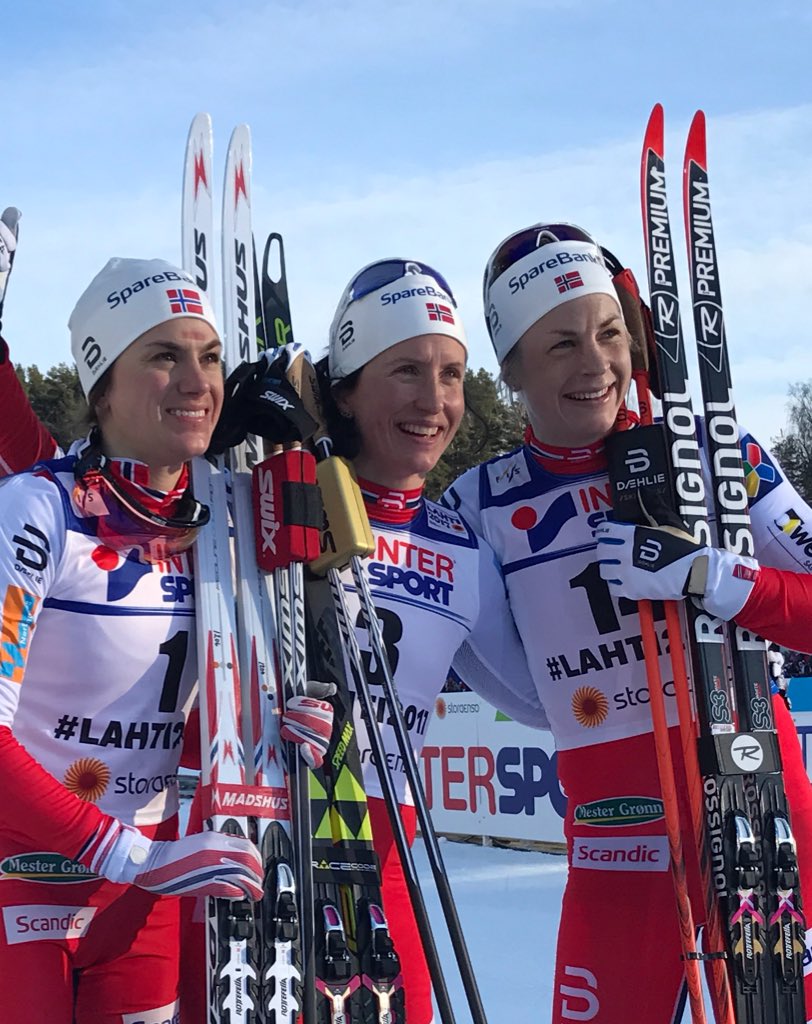
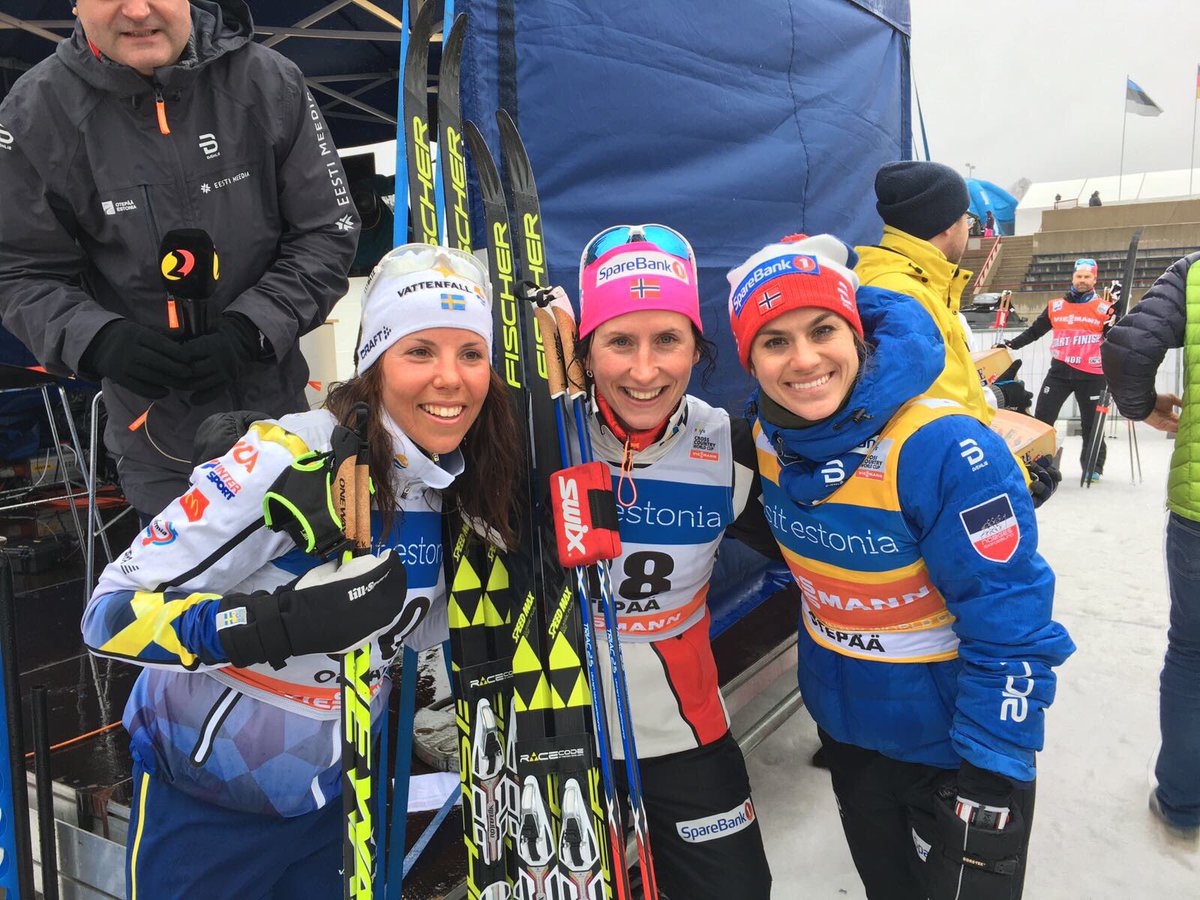
    Left to right: Finland’s Krista Pärmäkowski, Norway’s Marit Bjørgen and Finland’s Kertu Niskanenen after the women’s 30kiloimeter World Cup classic mass start on Saturday in Oslo, Norway. (Photo: FIS Cross-Country/Twitter)

    FIS Cross-Country World Cup (Oslo, Norway): Holmenkollen 30 k classic mass start:

    Norwegian Marit Bjørgen won the women’s 30-kilometer classic mass start at Homenkollen on Sunday, in a time of 1:22:59.2. She bested two Finns, Krista Pärmäkoski and Kerttu Niskanen. Pärmäkoski finished in second (+2:05.8) and Niskanen in third (+2:07.0).

    Norway’s Heidi Weng finished fourth (+2:08.6), outlasting Sweden’s Charlotte Kalla (fifth, +2:11.7). Poland’s Justyna Kowalczyk finished sixth (+2:12.9), Finland’s Aino-Kaisa Saarinen seventh (+2:19.6), Norway’s Ingvild Flugstad Øtsberg  in eighth (+2:31.3), Sweden’s Anna Haag  in ninth (+3:27.9) and Finland’s Laura Mononen in tenth (+3:28.7).

    The first North American to finish on Sunday was Kikkan Randall, who placed 20th (+6:17.2).  The next North American across the line was the U.S. Ski Team’s Sadie Bjornsen in 24th (+6:48.8). Liz Stephen finished in 31st (+8:46.8), and Chelsea Holmes (Alaska Pacific University) in 39th (+11:19.1). 

    Results

  • World Cup Titles for Dahlmeier, Fourcade; Dunklee and Doherty Top 20 for U.S.

    World Cup Titles for Dahlmeier, Fourcade; Dunklee and Doherty Top 20 for U.S.

    Susan Dunklee racing to 14th place in the 10 k pursuit in Kontiolahti, Finland. (Photo: USBA/NordicFocus.com)

    Martin Fourcade and Laura Dahlmeier: each secured some sort of crystal globe today, in recognition of their season-long consistency on the biathlon World Cup.

    But in the 12.5 kilometer and 10 kilometer pursuits in Kontiolahti, Finland, their approaches to those globes were very different.

    Fourcade, the French athlete who had already secured the season-long Total Score title, was looking to also pick up the ‘small crystal globe’ for pursuit competitions. He has won many season titles already, and many competitions this season, but wanted to clinch this title with another win.

    Instead, he missed four shots, collided on the shooting range with Norway’s Emil Hegle Svendsen, and finished fifth.

    “You know, I won the last six pursuits, so I expected to win this globe with a better competition [today],” Fourcade told the IBU. “This is how it is, when you win a lot you are always looking forward to a perfect competition and beautiful victories. Today I am a bit disappointed.”

    Capitalizing on Fourcade’s errors were a group of chasers, among whom Arnd Peiffer of Germany managed to shoot 20-for-20. The race came down to a sprint finish between him and Simon Eder  of Austria; Peiffer took a 0.3-second win for his eighth career victory. Svendsen finished third, +2.3 seconds.

    While Fourcade expected a win and a title, Dahlmeier, on the other hand, was surprised to clinch the ‘big crystal globe’: the Total Score. The German had been carefully not paying attention to the point differentials between her and rival Gabriela Koukalova of the Czech Republic.

    But with a victory in the 10 k pursuit, she’s now mathematically guaranteed the globe. She was told live on television. It is her first overall title.

    “This makes me really speechless,” she told Germany’s ARD broadcaster. “I think I first stood on skis at the age of two… I have invested a lot, I trained very very much, I was outside a lot always thinking about that big goal, and that was to some day win the overall World Cup. That just defines the most complete athlete over a whole season to be in front in that ranking. And that I now managed to do that, at 23 years of age, that is just impressive. I would like to say thanks to many many people who have accompanied me on this path.”

    Dahlmeier won by 16.5 seconds over France’s Marie Dorin Habert, with Italy’s Lisa Vittozi third (+19.9).

    Susan Dunklee started the day in fifth after a strong sprint race, but missed four shots over the course of the race and ended up 14th (+1:02.8).

    “We had deceptively tricky wind,” the American wrote in an email. “I got very lucky on the first stage to hit them all. The wind looked stronger so I took clicks, but really it was coming from behind and not pushing the bullets to the side like I thought. All my shots landed in a tight group on the edge of the target. My second prone felt unsettled and was a much larger group. Plus the wind was a challenge- the flags were swirling around in several different directions. My standing stages felt normal and I executed them well.”

    That brought an end to the streak of three consecutive fifth-place finishes, but Dunklee – who is currently tenth in the World Cup Total Score – wasn’t fazed.

    “I did make a few mistakes, but today is still a race I can feel good about,” she wrote. “I stayed focused on the present moment, I skied smart, and I dug deep.”

    Teammates Clare Egan and Joanne Reid finished 45th (+3:24.7) and 52nd (+4:07.0), respectively.

    The top American finish in the men’s 12.5 k pursuit came from Sean Doherty, who shot 20 for 20 and moved from 44th all the way up to 18th place.
    “It’s my first time cleaning a four-stage race, so I’m pretty excited about that,” Doherty said in a phone interview from Kontiolahti.

    Unlike Dunklee, Doherty assessed the shooting range as calm. After shooting 90% in the sprint, he was focused on the shooting process and keeping his positive momentum going.

    “I have been struggling a bit with shooting lately,” he said. “I kept the same focus on the same things I have been working on the last week since we got here. I really wasn’t thinking it would turn out like it did. I was just going for it and wanted to see where that got me.”

    Lowell Bailey finished 27th (+1:57.2) and Leif Nordgren 43rd (+3:24.4) with three and four penalties, respectively.

    For Canada, Christian Gow picked up just one penalty and a 37th-place finish (+2:36.0), a big improvement from his 50th-place starting position. Brendan Green placed 50th with three penalties (+4:47.3). Julia Ransom finished 53rd in the 10 k pursuit with three penalties (+4:14.0) and Emma Lunder 58th with four missed shots (+6:20.7).

    Results: menwomen

  • Dunklee Repeats in 5th; Eckhoff Gets First Win of Season in Kontiolahti Sprint

    Dunklee Repeats in 5th; Eckhoff Gets First Win of Season in Kontiolahti Sprint

    US Biathlon’s Susan Dunklee (second from r) during Friday’s flower ceremony after placing fifth in the women’s 7.5-kilometer sprint at the 2017 IBU World Cup in Kontiolahti, Finland. The race was won by Norway’s Tiril Eckhoff, ahead of Germany’s Laura Dahlmeier and Darya Domracheva of Belarus. (Photo: USBA/NordicFocus)

    Over the last month, US Biathlon’s Susan Dunklee has become a familiar face for competitors and spectators at World Cup medal and flower ceremonies, highlighted by her silver medal in the mass start at the International Biathlon Union (IBU) World Championships in Hochfilzen, Austria.

    On Friday in the women’s 7.5-kilometer sprint at the IBU World Cup in Kontiolahti, Finland, Dunklee once again returned to the flower ceremony after finishing fifth, which, coincidentally, was her third time in a row in that place (excluding the women’s relay where the U.S. finished 14th). Last week in PyeongChang, South Korea, Dunklee placed fifth in both the World Cup sprint and pursuit. In four straight races (including the World Championships mass start), she has finished in the top five.

    “It’s been an incredible run these past few weeks,” Dunklee said, according to a US Biathlon press release. “I’m riding on momentum. Sometimes you fall into biathlon funks when you don’t succeed no matter how hard you try, and other times you find a groove where it feels easy. I don’t really understand it but I do know that resilience and patience are essential in biathlon.”

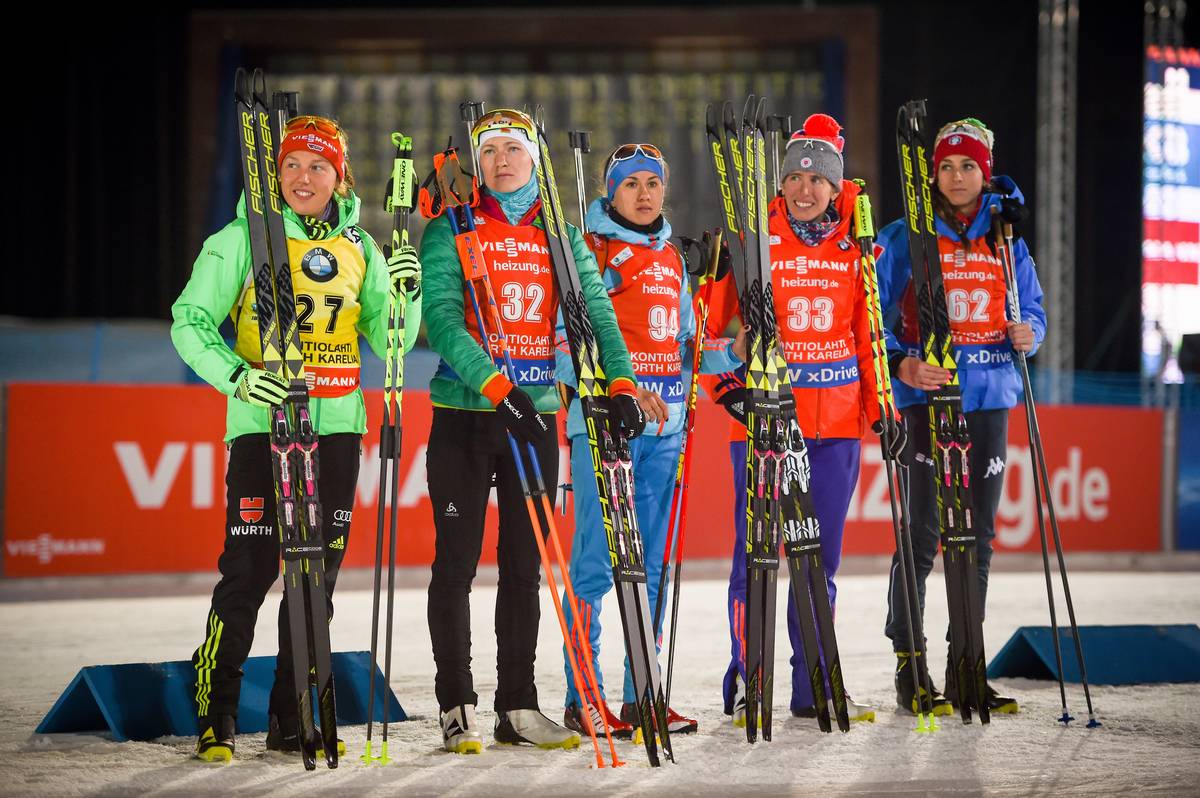
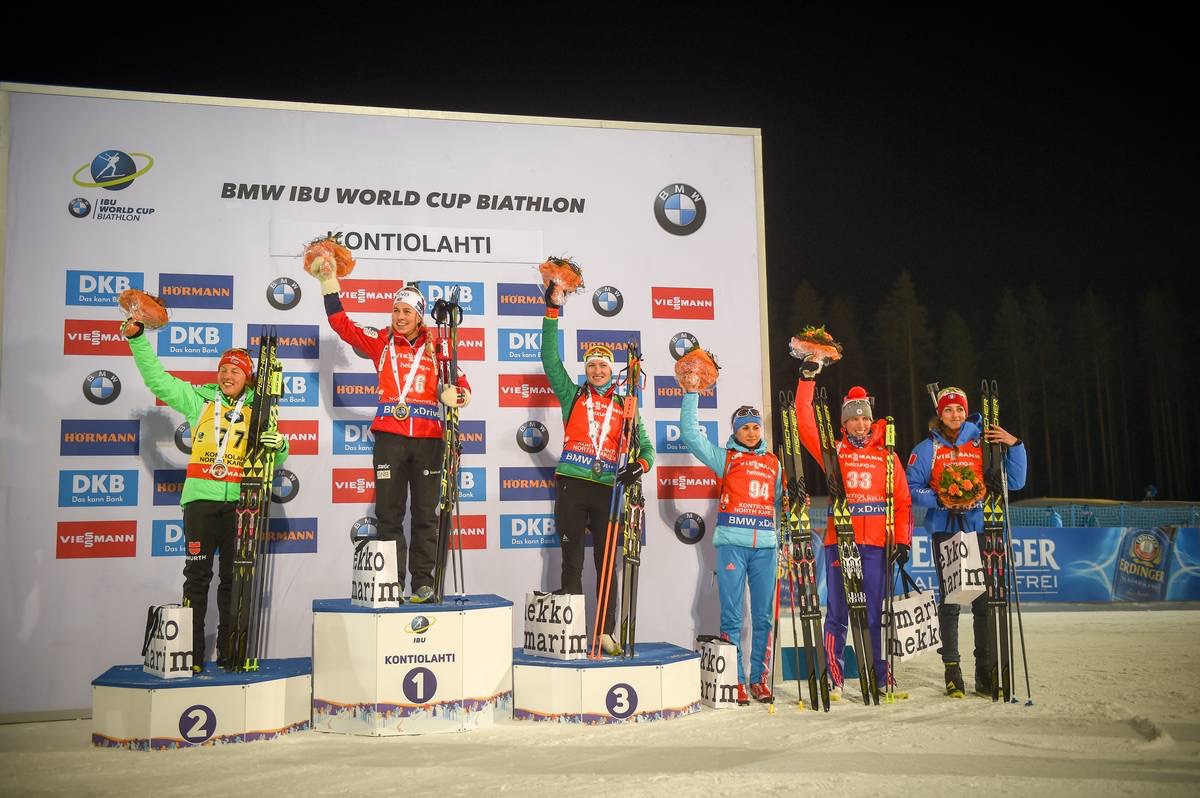
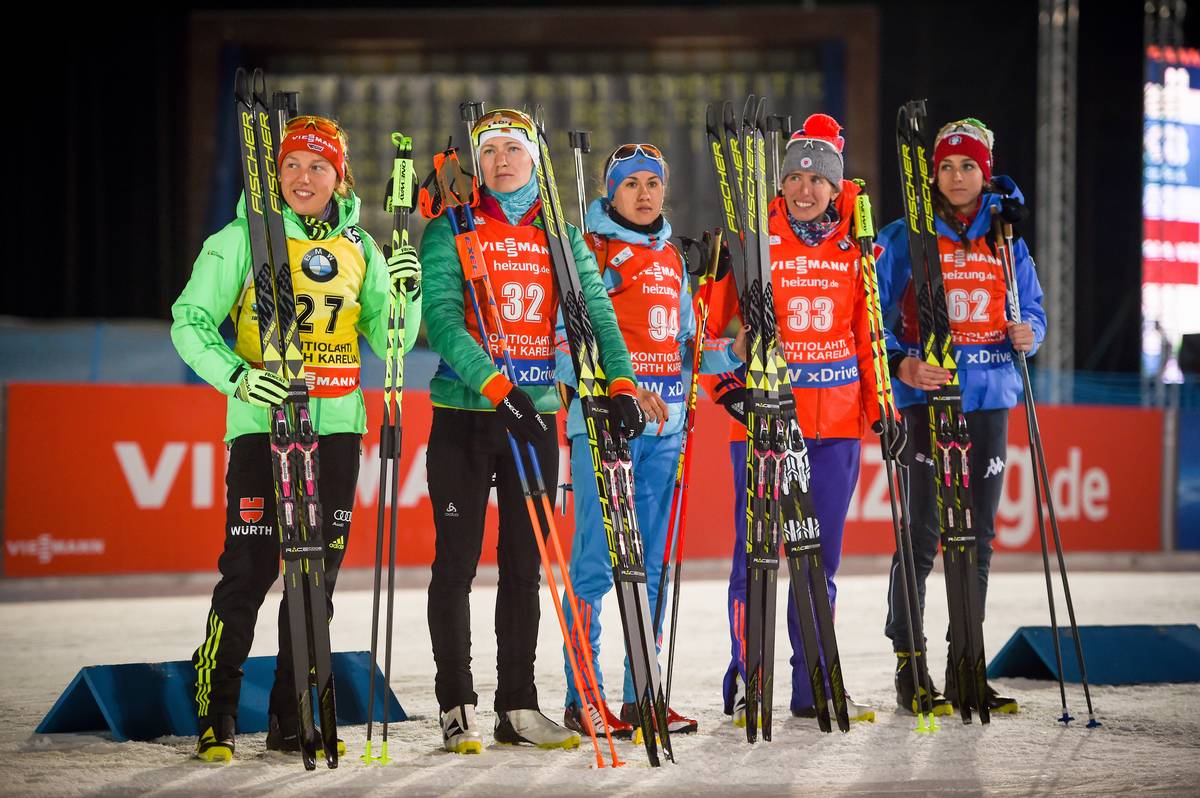
    Second through sixth place (from left to right: Germany’s Laura Dahlmeier, Belarus’s Darya Domracheva, Russia’s Daria Virolaynen, American Susan Dunklee, and Italy’s Lisa Vittozzi) await the IBU World Cup women’s 7.5 k sprint flower ceremony in Friday in Kontiolahti, Finland. (Photo: USBA/NordicFocus)

    After incurring one penalty in her prone shooting stage (1+0), Dunklee finished 34.9 seconds behind Norway’s Tiril Eckhoff, who won in 19:18.5 minutes, and 15 seconds off the podium.

    “It think it was my second shot. It was nothing remarkable,” Dunklee wrote in an email to FasterSkier about her lone miss. “With almost no wind, I knew there would be lots of clean shooting. The course was tricky with lots of icy patches. Our techs picked good skis for the conditions.”

    Dunklee’s split time after the prone shooting would only stand as the 34th-ranked time of the day, but with the 10th-fastest overall course time and a clean standing bout, Dunklee moved up significantly, pushing hard up a steep 230-meter-long climb nicknamed “The Wall” on the last loop to chase the times set by the leaders.

    “This course suits me well with lots of V2 alternate and V1,” Dunklee explained. “I remember that wall well from World Championships a couple years ago and saved a little energy so I could attack there. I had splits that I was fighting for fourth.”

    Fourth was the position she initially finished in, but the very last starter of the field in bib 94, Daria Virolaynen of Russia, shot clean and bested Dunklee’s time by one-tenth of a second, bumping the American to fifth place.

    US Biathlon’s Susan Dunklee racing to fifth in the women’s 7.5-kilometer sprint on Friday at the 2017 IBU World Cup in Kontiolahti, Finland. (Photo: USBA/NordicFocus)

    Like most of the 94 starters, Dunklee had just made the long trip to and from South Korea to test the venue for next year’s Winter Olympics. But she didn’t let the travel stress discourage her heading into the last two World Cup stops of the season, and even saw advantages.

    “It was a very long and stressful travel day and the Seoul airport was not properly prepared to efficiently inspect 100s of rifles,” Dunklee wrote. “It’s safe to say everyone is feeling run down. I reminded myself that I often perform comparatively well when tired and I have much more experience dealing with jetlag than my competition.”

    Kontiolahti is hosting the eighth World Cup stage of the season, replacing Tyumen, Russia, which would have been a significantly shorter flight from Asia, after Russia relinquished hosting in the wake of the McLaren report.

    For the clean-shooting Eckhoff, her sprint victory in Kontiolahti was her first win of the season and third of her career. The star of the last year’s IBU World Championships at home in Oslo, Norway, Eckhoff failed to crack the top 10 in a non-relay race in Hochfilzen this season, but rebounded at the PyeongChang World Cup with a second place in the sprint and relay.

    “The travel from Korea was very bad,” Eckhoff explained. “It was very long. But I slept a lot and did not train too much after that, so I think I managed it OK … I look forward very much to tomorrow (for the pursuit), and I will try to shoot as well as I did today.”

    In an interview with German broadcaster ZDF, Eckhoff explained she was proud to have surpassed the individual career wins of her older brother Stian Eckhoff, who now coaches the Norwegian women’s team.

    Starting immediately behind her on Friday, Germany’s Laura Dahlmeier, who had dominated this year’s World Championships and won the last six races, narrowly missed her seventh-straight win. Dahlmeier led the race after the prone stage, but then one of her standing shots hit the edge of the target, making it tremble but not flip over to turn white.

    Dahlmeier had to ski one penalty lap, and on the final loop, Eckhoff increased her lead by four seconds with the fastest final loop and second-fastest overall course time, leaving Dahlmeier 18.3 seconds back in second for her ninth podium in a row.

    “I am happy to be on the podium again,” Dahlmeier told ZDF. “It wasn’t easy today, also to find the right attitude after the long travel. I tried to stay focused on the range, but I noticed Tiril Eckhoff right next to me leaving the range with zero [misses]. I think that shot was really close. But that’s not a problem, I can live with that one miss. Still a good shooting, and especially a good result.”

    “I tried to stay very concentrated on the course,” she added. “It was very icy today, like a mirror.”

    Because her fiercest opponents for the overall World Cup Total Score title had weaker performances on Friday — with Gabriela Koukalová of the Czech Republic finishing 13th (+52.6, 0+1) and Finland’s hometown favorite Kaisa Mäkäräinen 49th (+1:50.4, 2+2) — Dahlmeier increased lead to 138 points over Koukalová and 204 over Mäkäräinen.

    “The most important thing this season was to stay healthy,“ Dahlmeier said at the post-race press conference. “I think this was the key to success and I am very happy about it … I think it’s over when it is over, and not now. I don’t look at the total World Cup or something else, I just want to focus from one race to the next.”

    Darya Domracheva of Belarus shot clean in both stages and was even with Dahlmeier at the last split time, but lost two seconds in the last few hundred meters to finish third (+20.4). It was her second podium finish of the season after a silver medal in the World Championships pursuit, returning to racing just a few months after the birth of her first child.

    “I did not have any expectations before the season,” Domracheva said at the press conference. “Each moment like that I take it as a present, as a compliment. I am happy to be here on the podium.”

    “No matter if second or third, it’s really good feelings,” she added. “Especially in my situation after a few months of trainings, I just can be happy now … It’s a little bit more things to organize now, and different feelings on the track after no normal season preparation. But step-by-step it is getting better and I feel that I can fight (for the podium) and that’s good to know.”

    Clare Egan (US Biathlon) racing to 59th on Friday in the women’s 7.5 k sprint at the IBU World Cup in Kontiolahti, Finland. (Photo: USBA/NordicFocus)

    All three U.S. women who raced on Friday finished in the top 60 to qualify for Saturday’s pursuit.

    “Tomorrow is another great opportunity,” Dunklee told US Biathlon. “I have several fast people close around me to ski with.”

    US Biathlon’s Joanne Reid managed to shoot clean in both stages and finished 55th (+1:59.7). Clare Egan was in 19th after a clean prone and skied a very fast second loop (11th course time on that loop), but three penalties in standing set her back. In posting the 24th-fastest overall course time, Egan clawed back a few positions on the final loop to finish 59th (+2:07.4) to narrowly qualify for the pursuit.

    Two Canadians qualified as well, with Emma Lunder in 56th (+2:02.8) with one miss (1+0) and Julia Ransom making the cut as the last qualifier in 60th (+2:08.0) with one penalty (1+0).

    In her first World Cup start, Canada’s 19-year-old Megan Bankes — coming off a gold medal in the individual race at IBU Junior World Championships in Slovenia — placed 78th (+2:56.9) with three penalties (2+1). Canadian Megan Tandy did not start due to a stomach flu.

    Results | Pursuit start list

  • Dahlmeier Perfect in PyeongChang; Dunklee 5th for Second Flower Ceremony in 3 Days

    Dahlmeier Perfect in PyeongChang; Dunklee 5th for Second Flower Ceremony in 3 Days

    Susan Dunklee (US Biathlon) racing to fifth in the women’s 10 k pursuit on Saturday at the IBU World Cup in PyeongChang, South Korea. (Photo: USBA/NordicFocus)

    In Saturday’s 10-kilometer pursuit in PyeongChang, South Korea, Laura Dahlmeier achieved a level of perfection that made biathlon almost seem unexciting.

    The German biathlon star started in bib number one after winning Thursday’s 10 k sprint on the 2018 Olympic course, then shot a perfect 20-for-20 and skied away from the field to a 1:12.6 victory.

    As she hit the last target with more than a minute of time in hand over her competitors, Dahlmeier raised her arms in the air and gave a brief celebration for her coaches and the crowd.

    “Today I had enough time for that,” she told the IBU in an interview.

    “It’s just crazy when you know, ‘Okay, there are only two kilometers left and nothing can go wrong anymore’,” she later told German broadcaster ARD. “It’s cool when you can high-five the others and say thanks to the coaches on the course. You don’t often get that opportunity to enjoy the final loop.”

    It was the 13th World Cup win of the season for the German, who is likely (though not guaranteed) to win the Total Score. She is also now within one win of tying the record for most wins in a single season by a woman, set by Magdalena Forsberg of Sweden in 2001 and tied by Tora Berger of Norway in 2013.

    “It was incredibly beautiful today,” she told ARD. “This was really the perfect race. It’s crazy, it’s a dream, and this is exactly what I trained for all year. You make so many shots in the summer, and it’s just beautiful when you can draw on that in competition. Gigantic. This was really a huge race.”

    While Dahlmeier was relaxing around the last loop, the race for the podium was still playing out behind her.

    After slowly climbing her way up from an eight-place starting position, Anais Bescond of France cleaned the last stage and went into second place. A podium finisher on the World Cup in previous seasons, she hadn’t yet had a top finish and had only been offered one start at World Championships.

    She was chased by Finland’s Kaisa Makarainen. One of the fastest skiers on the World Cup, it was no surprise that she quickly caught Bescond.

    But the French athlete hung on and crossed the finish line just 6.3 seconds behind Makarainen to claim third place.

    “It’s my goal during this season to try to catch the podium,” Bescond told the IBU. “I was not able to compete in all the competitions at World Championships, as I was sick, so I am really happy about this third place.”

    Germany’s Franziska Hildebrand left the range in fourth place, but was caught by American Susan Dunklee and Norway’s Tiril Eckhoff. Dunklee had been in position to maybe grab a podium, but missed her last shot.

    “I missed that last shot; that was a bummer, the last standing,” she said.

    But back on the trail, she gapped Hildebrand and Eckhoff going up the course’s major climb, and thought she had fourth place in the bag.

    “Honestly, that last hill on the steep section, that’s the best I’ve felt all season, attacking on the last loop,” Dunklee said in a phone interview. “I was able to dig into that sprint or jump-skate mode for that last pitch. That was a good feeling, I’ve missed that.”

    Norway’s Tiril Eckhoff leads American Susan Dunklee to the finish of Saturday’s 10 k pursuit at the IBU World Cup in PyeongChang, South Korea. Eckhoff edged Dunklee by 0.5 seconds for fourth place. (Photo: USBA/NordicFocus)

    But Eckhoff came roaring back, catching up on the downhill – which led straight into the finishing stretch. Coming out of Dunklee’s draft she had a bit more momentum to the finish line and snagged fourth place, half a second ahead of Dunklee in fifth, exactly where Dunklee had started the day.

    “In the sprint… my strategy was to push the downhills all the way into the stadium, and I made up huge amounts of time on people, especially the last loop,” Dunklee said. “So going into today, I expected the downhill to be my strength. Today it wasn’t there in the downhill, which surprised me. I pushed,and pushed, and Tiril caught up. When she caught me on that last straightaway, she had a little more speed, coming out of the draft, and there was nothing I could do at that point.”

    With three misses, Dunklee was pleased that she could appear in her second flower ceremony of the weekend – and keep a string of good results going. She was sixth and second in the final individual races of World Championships in Hochfilzen, Austria, two weeks ago, and now was fifth twice in PyeongChang on the future Olympic course.

    “It wasn’t a bad performance, but it didn’t feel like a good performance, either,” she said. “I’ve got to be really happy to get a top five with three misses. I’ll take that.”

    Crawford 18th in Last Individual Race of Season

    Coming off of a disappointing World Championships, Rosanna Crawford had almost called it a season.

    “I had some long talks with my coach about continuing on the season,” Crawford admitted. “I really wanted to go home right away, but we decided it would be good to see the Olympic venue and that we needed a fourth women to take part in the relay. So I was feeling really drained and frustrated by the end of World Championships. But a bit of time away from the team, where I got to enjoy just skiing and seeing a new part of world, really helped bring my mood around.”

    She and partner Brendan Green actually went to France to visit Bescond – and like Bescond, came to PyeongChang and turned in their best results of the season.

    Crawford finished 30th in the sprint and then had strong standing shooting in the pursuit to move up even more. After a miss in each prone, she cleaned both standing stages to climb to 24th and then the top 20.

    “These past two races I have felt the best I have all season,” Crawford wrote in an email.

    She left the shooting range in 19th, and was engulfed in a back-and-forth with several women who passed her and who she passed on the final loop. In the end, she did finish 19th (+2:49.1).

    “I was quickly caught by four women at the base of the climb,” Crawford wrote. “I knew that if I made it to the top with them that I could most likely beat them. Justine Braisaz [of France] started going hard halfway up the hill and I had to take the long way around a Ukrainian girl, but at the top I just tucked in behind her and started my ‘sprint.’ On the last downhill before the finish [Russia’s Irina] Starykh passed me and I tucked in behind her and we had a fun sprint to the finish!”

    Despite the improved results – Crawford explained that she thought time she had taken off from competition in the beginning of the season was finally beginning to give her some benefit – she is still planning to return to Canada after the weekend rather than finishing off the World Cup season in Finland and Norway.

    “Time to go home, rest and recover and get ready to start again for next year,” she wrote.

    All four Canadian women had made the pursuit, and Megan Tandy was the next across the line in 30th (+3:26.2); she had moved up from 39th with two penalties.

    Julia Ransom finished 44th (+4:18.4) with four missed shots and Emma Lunder 49th (+4:49.6) with two missed shots.

    Egan Flirts With Top 20, Finishes 36th

    For the U.S., halfway through the race it was looking like Dunklee could have company near the top of the results sheet. With two clean prone stages, Clare Egan had moved from 33rd up to 16th.

    Clare Egan (US Biathlon) racing to 36th in the women’s 10 k pursuit on Saturday at the IBU World Cup in PyeongChang, South Korea. (Photo: USBA/NordicFocus)

    But in her first standing bout, she missed three shots.

    “I have some work to do on staying calm and focused on the shooting process, rather than the potential outcome when the race is going well for me,” Egan wrote in an email. “That distraction certainly played a role in my misses today, as I was in sight of the top 10 when I came into shooting three.”

    Her penalty loops dropped her back to the 40’s, but Egan bounced back to clean the final standing stage and ended up 36th (+3:41.9).

    “I am happy with my shooting, especially my clean last stage,” she wrote. “Going 0-0-3-0 is more frustrating than some other arrangements of three misses, but when it comes down to it, I shot 85% and I’m satisfied.”

    That rebound came partly thanks to a 30th-ranked ski time (tied with Canada’s Tandy).

    “I have to say that I’m surprised by my ski time, because I have a cold,” Egan wrote. “Both physically and mentally I’m relying on autopilot right now, and I’m thankful that my body is handling it so well. Our skis were great again, everyone is suffering from the same jet lag and race schedule, and I’m clearly in good shape even if I don’t feel good. I’ll be looking to get healthy and fully refocused for our last two World Cups.”

    Joanne Reid finished 52nd (+4:53.4) with five penalties.

    Results

  • Saturday Rundown: Lahti & PyeongChang (Updated x2)

    Saturday Rundown: Lahti & PyeongChang (Updated x2)

    The all-Norwegian women’s 30 k freestyle mass start podium at 2017 Nordic World Championships in Lahti, Finland, with Marit Bjørgen (c) in first, Heidi Weng (l) in second, and Astrid Uhrenholdt Jacobsen (r) in third. (Photo: FIS Cross-Country/Twitter)

    FIS Nordic World Championships (Lahti, Finland): Women’s 30 k freestyle mass start

    Marit Bjørgen made it a four-peat on Saturday with her fourth gold and third individual win over the last week at 2017 Nordic World Championships in Lahti, Finland. (She previously won the 15-kilometer skiathlon, 10 k classic, and 4 x 5 k relay.)

    The 36-year-old Norwegian closed out the championships with a 1.9-second victory in the women’s 30-kilometer freestyle mass start, finishing in 1:08:36.8 hours after setting the pace and leading a large group for much of the race. The group began to separate around 15 k, where it was down to 13 women with five seconds of first. At that point, Americans Jessie Diggins and Chelsea Holmes were within that lead pack.

    While Holmes started to fall off the pace around 16 k, Diggins stuck with the leaders to the very end, only until four Norwegians broke away to race for the medals over the final kilometer.

    With Bjørgen still charging hard up front, her teammates Heidi Weng, Astrid Uhrenholdt Jacobsen, and Ragnhild Haga followed, while Finland’s Krista Pärmäkoski trailed another second back in fifth and Diggins was one more second behind in sixth.

    Bjørgen led the downhill into the stadium and skied away from her teammates before the finishing stretch, leaving Weng and Jacobsen to duke it out for second place. Weng got it by less than one-hundredth of a second, Jacobsen took bronze (+1.9), and Haga completed the Norwegian top-four sweep in fourth (+7.4).

    Diggins passed Pärmäkoski and notched fifth (+10.4) for her career-best 30 k result. Pärmäkoski placed sixth (+11.3), Sweden’s Charlotte Kalla finished seventh (+13.9), Austria’s Teresa Stadlober was eighth (+15.5), Sweden’s Anna Haag ninth (+20.3), and Russia’s Yulia Tchekaleva 10th (+1:20.9) after edging Switzerland’s Nathalie von Siebenthal in a photo finish. Germany’s Stefanie Böhler placed 12th (+1:23.5) and Holmes finished 13th (+1:28.1) for her career best.

    U.S. Ski Team member Liz Stephen placed 25th (+3:09.4), 6.6 seconds ahead of Canada’s national U25 Team skier Cendrine Browne, who notched a career best 26th (+3:16) in her first World Championships.

    Holmes’s Alaska Pacific University (APU) teammate Jessica Yeaton, who races for Australia, finished 33rd (+4:32), Canada’s Dahria Beatty was 34th (+4:45.2), and American Caitlin Gregg 36th (+5:03.7).

    Great Britain’s Annika Taylor, a California native, placed 38th (+6:19.4). Canada’s Emily Nishikawa was 40th (+6:41.5) and Katherine Stewart-Jones 41st (+7:18.6), and Brazil’s Jaqueline Mourão, who trains in Quebec, was 46th (+13:44.6) out of 47 finishers.

    Results

    ***

    IBU World Cup (PyeongChang, South Korea): Women’s and men’s pursuits

    The women’s 10 k pursuit podium at the IBU World Cup in PyeongChang, South Korea, with Germany’s Laura Dahlmeier (c) in first, Finland’s Kaisa Mäkäräinen (l) in second, and France’s Anais Bescond (r) in third. (Photo: IBU)

    Coming off a fifth place in Thursday’s 7.5-kilometer sprint, Susan Dunklee held her position despite three penalties in the women’s 10 k pursuit on Saturday to finish fifth again at the International Biathlon Union (IBU) World Cup in PyeongChang, South Korea.

    Germany’s Laura Dahlmeier racked up her second-straight win in as many races in PyeongChang (and sixth-straight, counting World Championships), finishing in 27:58.0 minutes with clean shooting. She was just one of four women out of 58 finishers that hit all 20 targets in Saturday’s four-stage race.

    Finishing more than a minute later, Finland’s Kaisa Mäkäräinen placed second (+1:12.6) after starting fourth based on her sprint result. Mäkäräinen had two penalties, both in the first standing, but cleaned the other three stages (0+0+2+0). France’s Anais Bescond raced up from eighth at the start to third place (+1:18.9) at the finish, with a single penalty (0+0+1+0), while Norway’s Tiril Eckhoff missed her second-straight podium in fourth place (+1:32.0) after starting second but accumulating five penalties (1+2+1+1).

    Eckhoff edged Dunklee, of the U.S., by half a second as Dunklee placed fifth (+1:32.5) with three misses (1+1+0+1).

    Canada’s Rosanna Crawford rose from 30th to 19th (+2:49.1) for her best non-relay result of the season, with two penalties (1+1+0+0). Her teammate Megan Tandy also landed her first top 30 of 2016/2017 in 30th (+3:26.2) with two misses (1+0+1+0) after starting 39th. Also for Canada, Julia Ransom finished 44th (+4:18.4) after starting 41st and skiing four penalty loops (1+0+1+2).

    Also for the U.S., Clare Egan finished 36th (+3:41.9) with three clean stages but three misses in her first standing (0+0+3+0), after starting 33rd. Joanne Reid slipped from 35th at the start to 52nd (+4:53.4), with five penalties (1+1+0+3).

    The men’s 12.5 k pursuit podium on Saturday at the IBU World Cup in PyeongChang, South Korea, with France’s Martin Fourcade (c) in first, Russia’s Anton Shipulin (l) in second and Austria’s Julian Eberhard (r) in third. (Photo: IBU)

    [UPDATED] One day after locking up the overall World Cup title, Martin Fourcade was back at the top of the podium in the men’s 12.5 k pursuit in PyeongChang.

    Fourcade started third, after finishing third in Friday’s sprint, then shot clean to win in 31:24.2. Russia’s Anton Shipulin, who started 23rd, also shot 20-for-20 to race up to second place, 34.5 seconds behind Fourcade, with the fifth-fastest course time. In comparison, Fourcade’s course time was third fastest.

    Friday’s sprint winner, Julian Eberhard of Austria finished third (+36.7) after skiing three penalty loops (0+2+0+1). His teammate Simon Eder placed fourth (+1:03.2) after starting eighth and cleaning three stages before missing two on the last standing (0+0+0+2).

    Russia’s Evgeniy Garanichev improved from ninth at the start to fifth (+1:09.5) with two penalties as well (0+1+1+0). France’s Simon Desthieux was sixth (+1:13.5), Austria’s Dominik Landertinger seventh (+1:20.3), Germany’s Benedikt Doll eighth (+1:20.4) with the fastest course time after starting 20th.

    American Lowell Bailey was another 0.2 seconds back in ninth (+1:20.6), just ahead of Italy’s Lukas Hofer in 10th, who finished with the same time. Bailey previously tallied the third podium of his career on Friday, placing second in the sprint, but had two penalties on Saturday (1+0+1+0) to slip to ninth.

    Also for the U.S., Leif Nordgren improved to 28th (+2:28.9) after starting 37th and shooting 19-for-20 (0+0+0+1).

    Christian Gow shot clean to lead Canada in 32nd (+3:17.4), up from 56th at the start. His older brother Scott Gow slipped from 27th at the start to 43rd (+4:05.9) with five penalties (0+1+1+3), and Brendan Green followed in 44th (+4:09.8) with three penalties (2+1+0+0) after starting 28th.

    Results: Women | Men

  • Dunklee Back in Podium Contention, Fifth in PyeongChang Sprint

    Dunklee Back in Podium Contention, Fifth in PyeongChang Sprint

    Susan Dunklee racing to fifth in the women’s 7.5 k sprint at the IBU World Cup in PyeongChang, South Korea, site of the upcoming 2018 Winter Olympics. (Photo: USBA/NordicFocus)

    For a while in Thursday’s 7.5-kilometer sprint, the first International Biathlon Union (IBU) World Cup race since IBU World Championships two weeks earlier, it looked like Susan Dunklee was on track for another podium.

    Dunklee, 31, of US Biathlon, had last raced to second place in the mass start on the last day of World Championships, Feb. 19 in Hochfilzen, Austria, for the best result of an American woman at Biathlon World Championships.

    The 35th starter on Thursday in PyeongChang, South Korea, she crossed the finish line in third, 59.7 seconds behind Germany’s Laura Dahlmeier in first and 51.3 seconds behind Norway’s Tiril Eckhoff in second. Dunklee had cleaned the prone shooting stage then missed her second shot in standing to leave the range in fourth as she started her final loop.

    Early in that 2.5 k loop, Dunklee’s time slipped slightly to fifth. She was racing the clock and for precious places, and she clawed her way into third at the finish.

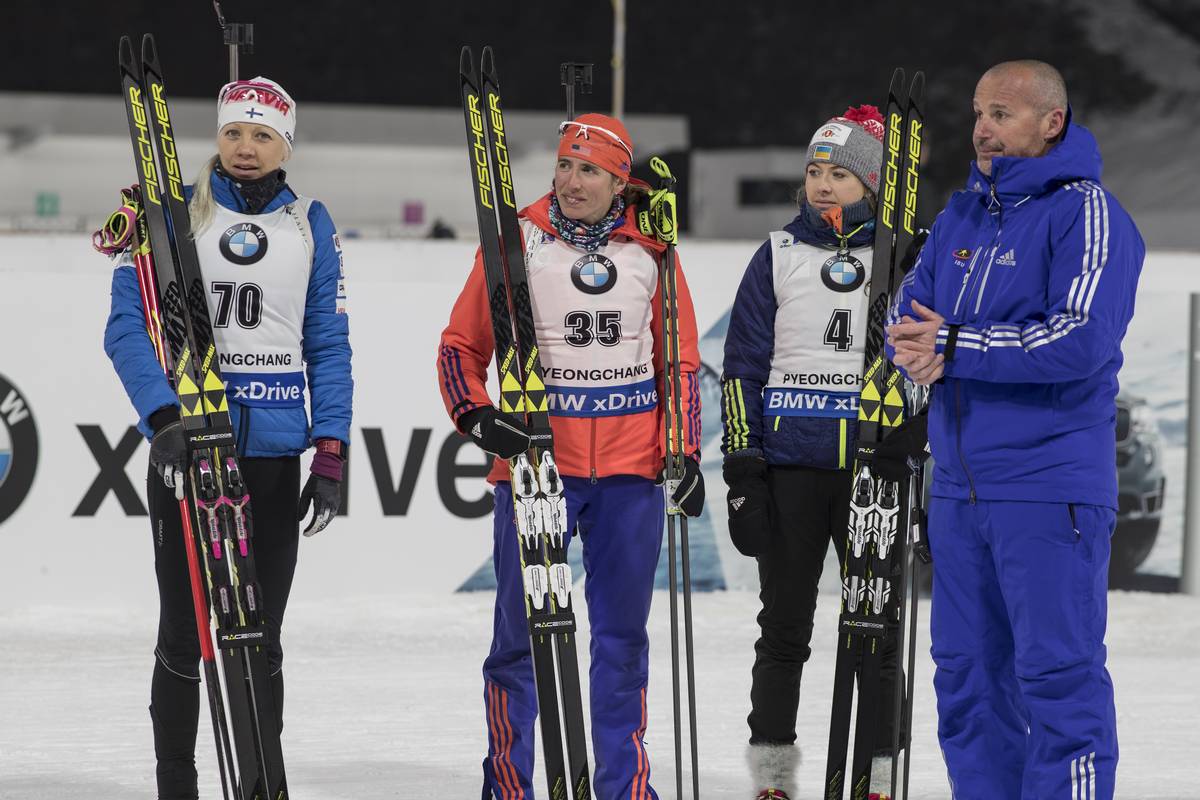
    American Susan Dunklee (35) at the flower ceremony with Finland’s Kaisa Mäkäräinen (70), who placed fourth, and Ukraine’s Yuliia Dzhima (4), who finished sixth, in the IBU World Cup women’s 7.5 k sprint on Thursday in PyeongChang, South Korea. Dunklee placed fifth for her fifth top five of the season (including World Championships). (Photo: USBA/NordicFocus)

    Ultimately, Dunklee was bumped off the podium to fifth — for her fifth top five of the season (say that five times fast).

    Dahlmeier won it, as the 18th starter with clean shooting and a finishing time of 20:43.7 minutes. France’s Anaïs Chevalier in bib 51 raced to third with fast, clean shooting (posting the second-fastest range time and third-fastest shooting), ending up 41.6 seconds off Dahlmeier’s time.

    Then there was Finland’s Kaisa Mäkäräinen, the 70th starter, who had to ski two penalty loops after standing (0+2) but skied the second-fastest overall course time to put herself in fourth at the finish (+58.7), just one second ahead of Dunklee.

    Reflecting on her race, Dunklee explained in an email that she tried to be patient, especially on the final loop. Conditions in at the brand-new Olympic venue in PyeongChang weren’t easy with what Dunklee described in an email as “a patchwork of glazed, icy and slow patches.”

    She explained that volunteers had been working with hand tools before the start to smooth out the course, which she felt helped “substantially.”

    “I think the course is good for me: big climbs with technical descents,” Dunklee wrote. “I focused on pushing the last half km of the loop where I thought other people would be tired. And our techs made great skis for these challenging conditions.”

    On that last loop, Dunklee received splits that she was seconds out of the top three.

    “That helped me fight,” she wrote. “I also caught a good ride with Marie Dorin Habert my last loop…”

    Dorin Habert, of France, who had started 67th and left the range for the last time in third with perfect shooting, did not finish her final loop. She reportedly withdrew after feeling nauseous.

    Dunklee, who spent three days on a mini vacation in Barcelona before training in Ruhpolding, Germany, and arrived in South Korea last Sunday, will start Saturday’s 10 k pursuit in fifth, exactly one minute behind Dahlmeier in first and one second behind Mäkäräinen. Beyond that, she has 18 seconds to make up to third.

    She wrote that she was looking forward to sticking with Mäkäräinen out of the start, “but I still plan to race my own race,” and “as always the key is to stay focused on the process of performing well.”

    Asked how she was feeling at this point in the season, Dunklee wrote, “More relaxed and carrying a good dose of confidence after Hochfilzen.”

    Germany’s Laura Dahlmeier racing to her fifth-straight win on Thursday in the IBU World Cup 7.5 k sprint in PyeongChang, South Korea. She shot clean and skied fastest for her eighth individual victory of the season. (Photo: IBU)

    Dahlmeier raced to her fifth-straight win on Thursday, holding off Eckhoff (in bib 29) by 8.4 seconds after all three podium finishers (including Chevalier) shot a perfect 10-for-10 despite tricky wind. Dahlmeier posted the fastest overall course time and gradually sped up each loop for her eighth individual win this season. At World Championships, she took gold in five out of six races (two being relays).

    “I try to keep the focus high, to give everything every time for the competitions,” the 23-year-old Dahlmeier told German broadcaster ARD. “That is not completely easy, there were a few days of distraction in between [World championships and now] where I tried to relax and do something very different away from biathlon. Then we had a long and arduous travel, but that’s true for everyone. Now the start times are also a bit weird, 8:15 p.m. local time. I just tried to take that as it is and managed to do that very well.”

    She tried not to be overly critical of the course conditions, yet explained they weren’t ideal.

    “To me it felt like ski-club championships. We used to have self-made loops there. That’s pretty much how the course was today,” she said. “… Conditions were really not easy. Very wavy, uneven, old snow with freshly fallen snow on top. In some parts also very dirty. So really changing conditions, in some parts a shaky track with icy patches. Not easy, but I think I got lucky with my first start group, conditions were probably still better for that. And in those conditions, the gaps on the course became a bit bigger today.”

    Germany’s head coach Gerald Hönig told ARD he was “incredibly impressed” with Dahlmeier, who leads the World Cup Total Score by 86 points over Gabriela Koukalová, who finished 21st (+1:43.4) on Thursday with two penalties (1+1).

    The women’s 7.5 k sprint podium at the IBU World Cup in PyeongChang, South Korea, with Germany’s Laura Dahlmeier (c) in first, Norway’s Tiril Eckhoff (l) in second and France’s Anaïs Chevalier (r) in third. (Photo: IBU)

    “The Laura Dahlmeier success story is continuing here,” Hönig said. “She really confirmed her level of consistency, and the successes in Hochfilzen are a difficult baggage to carry into the next races. Really difficult days for her in the aftermath of the World Championships, respectively the trip here, though that is true for most of the athletes. But I can only say hats off to how Laura always manages to execute her goals.”

    She’ll start the pursuit 8 seconds before Eckhoff. Asked how she’d spend her rest day on Friday, Dahlmeier said she didn’t have an exact plan.

    “I probably won’t go on the range and the courses are not so inviting that I need to go cross-country skiing. Maybe some cross-running and coordination,” she said. “And if the timing works out then I’d like to visit some local temple.”

    Three out of four U.S. women qualified for Saturday’s pursuit, and all four Canadian starters qualified with a top 60 in the sprint.

    Rosanna Crawford led the Canadians in 30th (+1:54.9) with one prone miss (1+0). She was followed by teammates Megan Tandy in 39th (+2:14.8), Julia Ransom in 41st (+2:19.5) and Emma Lunder in 51st (+2:38.2), all of which had one standing penalty (0+1).

    Americans Clare Egan and Joanne Reid finished 33rd (+1:59.5) and 35th (+2:07.6), respectively. Each had one standing miss as well (0+1). Maddie Phaneuf finished 68th (+3:07.7) with one standing penalty (0+1), missing the top 60 by 14.4 seconds.

    The men’s 10 k sprint takes place Friday morning at 5 Eastern time, 7 p.m. Korea time.

    Results | Pursuit start list | World Cup standings

  • Thursday Rundown: Lahti Women’s Relay & PyeongChang IBU World Cup (Updated)

    Thursday Rundown: Lahti Women’s Relay & PyeongChang IBU World Cup (Updated)

    The women’s 4 x 5 k relay podium at 2017 Nordic World Championships on Thursday in Lahti, Finland, with Norway (c) in first, Sweden (l) in second, and Finland (r) in third. (Photo: FIS Cross-Country/Twitter)

    FIS Nordic World Championships (Lahti, Finland): Women’s 4 x 5 k relay

    The Norwegian women’s team got a much-needed lift from Astrid Uhrenholdt Jacobsen, the third leg of its 4 x 5-kilometer relay, on Thursday, who tagged her teammate Marit Bjørgen nearly a minute ahead of anyone else. From there, Bjørgen anchored the Norwegians to a 1:01.6-minute victory for her third gold of 2017 Nordic World Championships in Lahti, Finland.

    Meanwhile, Sweden and Finland battled for silver, with Sweden’s anchor Stina Nilsson overtaking Finland’s Krista Parmakoski coming out of the final downhill into the stadium then leading her down the finishing stretch. Nilsson finished half a second ahead of Parmakoski for second place, while Finland claimed bronze (+1:02.1).

    The U.S. was next across the line, after Jessie Diggins worked to close a 21.5-second gap to third place at the final exchange. While Diggins came within roughly 16 seconds of Nilsson and Parmakoski, that was as close as she could get and she finished fourth (+1:33.8), 31.7 seconds out of the medals.

    The Canadian women’s 4 x 5 k World Championships relay team, (from left to right) Emily Nishikawa, Dahria Beatty, Katherine Stewart-Jones, and Cendrine Browne, after tallying the third-best relay result for the Canadian women at a World Championships on Thursday in Lahti, Finland. (Photo: CCC/Twitter)

    Canada placed 10th (+4:16.2) out of 16 teams in the women’s relay, for the best result for the Canadian women’s program since a sixth place in the 4 x 5 k relay at the 2001 World Championships (and third-best result ever), according to Cross Country Canada.

    Norway took control during the first 5 k leg, where Maiken Caspersen Falla stuck with Poland’s Justyna Kowalczyk, who set a fast pace out of the start. Only three were able to remain with Kowalczyk: Falla, Finland’s Aino-Kaisa Saarinen and Sweden’s Anna Haag, while Kikkan Randall of the U.S. fell off the pace and skied alone in fifth. Randall came through the first exchange 24.5 seconds behind Falla in first and 16.4 seconds behind Haag in fourth.

    On the second classic leg, Sweden’s Charlotte Kalla set a blistering tempo out of the start to catch Norway’s Heidi Weng 8 seconds ahead. Finland’s Kerttu Niskanen went with Kalla as the two bridged the gap to Norway. Later in that leg, Kalla began to fade while Niskanen took control and entered the exchange in first, just 0.4 seconds ahead of Weng. Kalla came through another 12.3 seconds later in third. American Sadie Bjornsen had worked hard to close the gap to third but tagged 23.5 seconds out of third in fourth (+36.2).

    On the third leg, Jacobsen opened the race up for Norway, building a 56.7-second gap to second place during her skate leg, while Sweden’s 19-year-old Ebba Andersson pushed hard in the final kilometers to put her team in second. Finland’s Laura Mononen struggled with Jacobsen’s pace and dropped to third (+58.3). Meanwhile, Liz Stephen of the U.S. held onto fourth and tagged Diggins 21.5 seconds out of third at the final exchange.

    From there, the Sweden/Finland fight for second place began. A minute ahead of them, Bjørgen skied comfortably in first, and behind them, Diggins skied alone in fourth.

    Russia’s anchor Anastasia Sedova was tagged 45.5 seconds behind the U.S. in eighth (behind Germany, Poland and Switzerland), but passed those three teams to end up fifth (+2:28.6), 54.8 seconds behind the U.S.

    Germany finished sixth, Switzerland seventh, Poland eighth, Italy ninth, and Canada 10th, with Katherine Stewart-Jones, Emily Nishikawa, Cendrine Browne, and Dahria Beatty racing for Canada. Stewart-Jones put them in eighth at the first exchange, Nishikawa slipped one spot to ninth, then Browne lost another spot for 10th, which Beatty held to the finish.

    Results

    ***

    IBU World Cup (PyeongChang, South Korea): Women’s 7.5 k sprint

    [UPDATED] The International Biathlon Union (IBU) World Cup circuit resumed on Thursday after nearly a two-week break coming off IBU World Championships, drawing competitors to PyeongChang, South Korea, the site of the upcoming 2018 Winter Olympics.

    The women’s 7.5 k sprint podium at the IBU World Cup in PyeongChang, South Korea, with Germany’s Laura Dahlmeier (c) in first, Norway’s Tiril Eckhoff (l) in second and France’s Anaïs Chevalier (r) in third. (Photo: IBU)

    Coming off five gold medals (in six races) at World Championships, Germany’s overall World Cup leader Laura Dahlmeier picked up where she left off, winning the women’s 7.5-kilometer sprint by 8.4 seconds with perfect shooting and a finishing time of 20:43.7 minutes.

    Norway’s Tiril Eckhoff came closest to her in second, after also shooting clean, and France’s Anaïs Chevalier put herself in the mix with clean shooting as well to end up third (+41.6).

    One second behind Finland’s Kaisa Mäkäräinen, who finished fourth (+58.7) despite two standing misses (0+2), was American Susan Dunklee in fifth (+59.7). The 35th starter, Dunklee initially finished third (before being bumped off the podium by Chevalier, then one more spot by Mäkäräinen).

    Dunklee missed one shot during the standing stage (0+1) and posted the eighth-fastest course time for her fifth top five of the season (including her second place in the mass start at World Championships).

    “I tried to be patient,” Dunklee wrote in an email after Thursday’s race. “I focused on pushing the last half km of the loop where I thought other people would be tired. And our techs made great skis for these challenging conditions.”

    She passed two competitors on her last loop, one of which had passed her earlier in the final 2.5 k. Dunklee described the conditions as “a patchwork of glazed, icy and slow patches. A large number of volunteers were working on it with hand tools right before the start and I think that helped substantially,” she wrote. “I think the course is good for me: big climbs with technical descents.”

    Rosanna Crawford led the Canadians in 30th (+1:54.9) with one prone miss (1+0), and Megan Tandy placed 39th (+2:14.8) with one standing penalty (0+1), just ahead of Julia Ransom in 41st (+2:19.5), who had one standing miss as well (0+1). All four Canadian women qualified for Saturday’s pursuit, with Emma Lunder placing 51st (+2:38.2) after one penalty (0+1).

    For the U.S., Clare Egan and Joanne Reid finished 33rd (+1:59.5) and 35th (+2:07.6), respectively, both with one standing penalty (0+1). Maddie Phaneuf missed the top 60 to qualify for the pursuit in 68th (+3:07.7) with one miss (0+1).

    After being in contention for a podium, France’s Marie Dorin Habert did not finish, reportedly because she felt nauseous.

    Results

  • 20-for-20 with Eli Nielsen

    20-for-20 with Eli Nielsen

    Eli Nielsen (Methow Valley Nordic) racing at the Biathlon BC Cup #3 at Whistler Olympic Park in January. (Photo: Weymuller Photography)

    In this 20-something-question, fill-in-the-blanks series, we checked in with the world-class U.S. and Canadian biathletes before they competed at 2017 International Biathlon Union (IBU) Youth & Junior World Championships Feb. 22-28 in Osrblie (also known as Brezno-Osrblie), Slovakia.

    Here’s 17-year-old Eli Nielsen, of Methow Valley Nordic (MVNT), who represented the U.S. at his first Youth Worlds. In two individual races, Nielsen finished 82nd in the youth men’s 7.5 k sprint and 91st in the 12.5 k individual.

    ***

    “My full name is Camren Eli Nielsen, but you can call me Eli. I was born in Stehekin, Wash., raised in Stehekin/Methow Valley, and one thing you should know about my hometown is there are no roads to it and I have a monopoly on the Gumball business.

    I started cross-country skiing when I was 14 and started biathlon when I was 14, thanks to my parents and coaches. I currently train in the Methow Valley with MVNT.

    If I’m not skiing, you might find me in the mountains.

    If I had to pick a favorite book, it would be ‘HMS Surprise’ by Patrick O’Brian.

    One of the things I’m most excited about for Youth/Junior World Championships in Brezno-Osrblie is some awesome race experiences!

    This will be my first Youth/Junior World Championships, and this year, I’m competing as a youth.One race I’m especially targeting there is the sprint.

    The best advice anyone ever gave me about skiing or racing was to relax and focus on the race plan.

    One of the best race memories I have is racing in Lillehammer Norway at YOG.

    If I could meet one World Cup skier, it would be Laura Dahlmeier.

    If I don’t end up being a professional skier, I’ll probably be a professional ski bum.

    I’m missing too many days of school to be here, and my teachers are probably thinking, ‘Does he still go to this school?

    You can follow me on Instagram @nielsen_eli.”

  • 20-for-20 with Shilo Rousseau

    20-for-20 with Shilo Rousseau

    Shilo Rousseau competing in a NorAm pursuit last month in Valcartier, Quebec. (Photo: Dan Guay)

    In another 20-something-question, fill-in-the-blanks series, we checked in with the world-class U.S. and Canadian biathletes that will be competing at 2017 International Biathlon Union (IBU) Youth & Junior World Championships Feb. 22-28 in Osrblie (also known as Brezno-Osrblie), Slovakia.

    Here’s 16-year-old Shilo Rousseau, of Team Hardwood, who is representing Canada at her first Youth Worlds. In three individual races at the championships, she finished 45th in the youth women’s 6 k sprint, and 54th in both the 10 k individual and 7.5 k pursuit.

    ***

    “My full name is Shilo Rousseau, but you can call me Shilo. I was born in Elliot Lake, Ontario, raised in Thessalon, Ontario, and one thing you should know about my hometown is that you need to have a good apple collection if you want to survive the many bears that roam the town.

    I started cross-country skiing when I was 10 and started biathlon when I was 11, thanks to my parents.

    Canada’s Shilo Rousseau (Team Hardwood) shooting at the Thessalon Rod and Gun club in January in her hometown of Thessalon, Ontario. (Courtesy photo)

    I currently train in Thessalon with the help of Team Hardwood.

    If I’m not skiing, you might find me listening to Broadway musicals my friend forces me to listen to.

    If I had to pick a favorite book, it would be ‘Throne of Glass’ series.

    One of the things I’m most excited about for Youth/Junior World Championships in Brezno-Osrblie is to race alongside athletes from around the world.

    This will be my first Youth/Junior World Championships, and this year, I’m competing as a youth. One race I’m especially targeting there is the sprint race.

    The best advice anyone ever gave me about skiing or racing was race so fast that you pass out on course and have to be taken to the hospital.

    One of the best race memories I have is leading the 10 km mass start with my teammate Zoë Pekos right beside me.

    If I could meet one World Cup skier, it would be Laura Dahlmeier.

    If I don’t end up being a professional skier, I’ll probably be a professional rapper because I am ultimate.

    I’m probably missing 20 days of school to be here, and my teachers/professors are probably thinking, ‘Insane‘ lol.

  • 20-for-20 with Nadia Moser

    20-for-20 with Nadia Moser

    Canada’s Nadia Moser competing in the pursuit race at 2017 Junior Open European Championships last month in Nove Mesto, Czech Republic. (Photo: Emily Dickson)

    In another 20-something-question, fill-in-the-blanks series, we checked in with the world-class U.S. and Canadian biathletes that will be competing at 2017 International Biathlon Union (IBU) Youth & Junior World Championships Feb. 22-28 in Osrblie (also known as Brezno-Osrblie), Slovakia.

    Here’s 19-year-old Nadia Moser, of the Biathlon Alberta Training Centre, who is representing Canada at her second Youth/Junior Worlds. On Saturday, Moser placed 31st in the junior women’s 7.5 k sprint after finishing 41st in the 12.5 k individual on Thursday.

    ***

    Nadia Moser racing in the youth individual race at 2016 IBU Youth/Junior World Championships in Cheile Gradestei, Romania. (Photo: Bryan Dickson)

    “My full name is Nadia Moser, but you can call me Nadia.  I was born in Edmonton, Alberta, raised in Atlin, British Columbia, and one thing you should know about my hometown is that it is home to North America’s tallest fresh-water island.

    I started cross-country skiing when I was very young and started biathlon when I was 14, thanks to a family friend’s recommendation.

    I currently train in Canmore, Alberta, with the Biathlon Alberta Training Centre (BATC).

    If I’m not skiing, you might find me reading or drawing.

    If I had to pick a favorite book, it would be ‘The Golden Compass‘.

    One of the things I’m most excited about for Youth/Junior World Championships in Brezno-Osrblie is racing.

    This will be my second Youth/Junior World Championships, and this year, I’m competing as a junior. One race I’m especially targeting there is all of them. I don’t have specific race in mind.

    The best advice anyone ever gave me about skiing or racing was to just focus on my own race.

    One of the best race memories I have is… I can’t think of any particular race moment that really stands out.

    If I could meet one World Cup skier, it would be Laura Dahlmeier.

    If I don’t end up being a professional skier, I’ll probably be some kind of artist.

    I’m missing zero days of school to be here.

  • 20-for-20 with Amanda Kautzer

    20-for-20 with Amanda Kautzer

    Amanda Kautzer (Michigan Tech/Loppet Nordic Racing) competing at 2017 U.S. nationals last month at Soldier Hollow in Midway, Utah. (Photo: Jackie Schneider)

    In another 20-something-question, fill-in-the-blanks series, we checked in with the world-class U.S. and Canadian biathletes that will be competing at 2017 International Biathlon Union (IBU) Youth & Junior World Championships Feb. 22-28 in Osrblie (also known as Brezno-Osrblie), Slovakia.

    Here’s 18-year-old Amanda Kautzer, of Michigan Tech and Loppet Nordic Racing, who is representing the U.S. at her third Youth Worlds. On Wednesday, Kautzer placed 53rd in the youth women’s 10 k individual and on Friday, she was 59th in the 6 k sprint.

    ***

    “My full name is Amanda Rose Kautzer, but you can call me Amanda, Mandy, whatever works. I was born in Singapore and raised in Plymouth, Minn.

    American Amanda Kautzer racing at an IBU Junior Cup earlier this month in Pokljuka, Slovenia. (Photo: Vladimir Cervenka)

    I started cross-country skiing when I was 12 and started biathlon when I was 14, thanks to my coach Piotr Bednarski. I currently train in Houghton, Mich., and Plymouth with the Michigan Tech Nordic Ski team and Loppet Nordic Racing, respectively.

    If I’m not skiing, you might find me skiing (the other kind). If I had to pick a favorite book, it would be ‘The Name of the Wind‘.

    One of the things I’m most excited about for Youth/Junior World Championships in Brezno-Osrblie is fast skis from great wax techs. This will be my third Youth/Junior World Championships, and this year, I’m competing as a youth.

    One race I’m especially targeting there is ummmm all of them of course.

    The best advice anyone ever gave me about skiing or racing was: ski fast (thanks Dad, super insightful, later changed to: ski faster than everyone else).

    One of the best race memories I have is getting silver in a skate sprint despite breaking a pole in the heats.

    If I could meet one World Cup skier, it would be Laura Dahlmeier.

    If I don’t end up being a professional skier, I’ll probably be a ski coach and do triathlons.

    I’m missing 36 days of school to be here, and my professors are probably thinking, ‘Are you in my class? I haven’t seen you there, not even once.’

    You can follow me on Instagram @amanda_rose_kautzer.”

  • 20-for-20 with Megan Bankes

    20-for-20 with Megan Bankes

    Canada’s Megan Bankes racing to second in the 10 k pursuit at the IBU Junior European Championships on Feb. 5 in Nove Mesto, Czech Republic. (Photo: Emily Dickson)

    In another 20-something-question, fill-in-the-blanks series, we checked in with the world-class U.S. and Canadian biathletes that will be competing at 2017 International Biathlon Union (IBU) Youth & Junior World Championships Feb. 22-28 in Osrblie (also known as Brezno-Osrblie), Slovakia.

    Here’s 19-year-old Megan Bankes, of the Biathlon Alberta Training Centre (BATC), who will be representing Canada at her fourth Youth/Junior Worlds. On Thursday, Bankes won the junior women’s 12.5 k individual to notch the second gold medal for Canada in the second day of the championships.

    ***

    “My full name is Megan Bankes, but you can call me Money Banke$. I was born in Calgary, Alberta, raised in Calgary, and one thing you should know about my hometown is it’s the sunniest major city in Canada.

    Canada’s Megan Bankes racing to 30th in the IBU Cup sprint in Obertilliach, Austria, earlier this season in December 2016. (Photo: Michel van Balkum)

    I started cross-country skiing when I was 3ish and started biathlon when I was 12, thanks to my parents/brother.

    I currently train in Canmore, Alberta, with BATC.

    If I’m not skiing, you might find me baking tasty treats with Sarah Beaudry.

    If I had to pick a favorite book, it would be ‘Through Black Spruce‘.

    One of the things I’m most excited about for Youth/Junior World Championships in Brezno-Osrblie is racing and lots of delish wafers.

    This will be my fourth Youth/Junior World Championships, and this year, I’m competing as a junior. One race I’m especially targeting there is the pursuit.

    The best advice anyone ever gave me about skiing or racing was have fun and do the best that you can do.

    One of the best race memories I have is just recently, the last lap of the pursuit at Junior OECH [European Championships], when everyone lining the course was cheering for me, particularly my teammates. I shot really well, and finished 2nd, it was a pretty stellar day.

    If I could meet one World Cup skier, it would be Laura Dahlmeier.

    If I don’t end up being a professional skier, I’ll probably own a bakery called ‘Gong Show Bakeshop’ with Sarah Beaudry, or be an ecologist.

    I’m missing zero days of school to be here, (I take an online course) and my teachers/professors are probably thinking, ‘When will Megan submit the next assignment?

    You can follow me on Instagram @moneybankes or my Facebook athlete page: Megan Bankes – Biathlete.”

  • Transcendant on the Shooting Range, Dunklee Claims World Champs Silver

    Transcendant on the Shooting Range, Dunklee Claims World Champs Silver

    Susan Dunklee celebrates silver in the women’s mass start at the 2017 IBU World Championships in Hochfilzen, Austria. She became the first U.S. woman to earn an individual medal at Biathlon World Championships. (Photo: USBA/NordicFocus)

    HOCHFILZEN, Austria—Lowell Bailey’s gold medal in the 20 k individual on Thursday was groundbreaking for the U.S. biathlon team.

    But Susan Dunklee had come with goals of her own. And if anything, they just got bigger.

    “I think back to a few years ago when he got his first podium in Kontiolahti [Finland], and I watched him do that,” Dunklee said. “I thought, he has been doing this for a long time and that’s possible. Then a week later I got my first podium in Oslo. So that thought crossed my head the other day when he won. I was like, huh, maybe I can feed off of this. You just need to get some positive momentum going and it makes it easier for the whole team to do well.”

    In Dunklee’s last race of World Championships, the 12.5 k mass start, she performed in a way that was entirely her own. From the very first shooting, the Vermonter asserted that she was the woman to beat.

    And while she didn’t match Bailey’s gold, she did end up with silver, the very first individual World Championships medal ever won by a U.S. woman in biathlon.

    Susan Dunklee (US Biathlon) racing to silver in the women’s 12.5 k mass start on the last day of 2017 IBU World Championships in Hochfilzen, Austria. The second place was a best-ever result by a U.S. woman at Biathlon World Championships. (Photo: Fischer/NordicFocus)

    Starting from bib 17, Dunklee moved into the top ten on the first loop of racing. Then, her moment came: the first prone stage.

    Dunklee took just 26 seconds to hit the mat, clean all five targets, and jump back up again. It was the fastest time of the whole field and she left with a 5.1-second lead on the rest of the women.

    It was a pattern that would repeat again and again: the others caught Dunklee on the top of the large climb on the back of the course, but then they would ski into the range together, Dunklee would clean with lightning speed, and go out with a gap again.

    “I was focusing on skiing patiently today, and efficiently, especially because I was off the front,” she explained. “I didn’t have someone to tuck behind, so I didn’t want to overdo it. I wanted to have something left in the tank on loop four and five. So I thought, I am going to ski relaxed and if they catch me I will just jump in behind them, and if they don’t catch me, well, then I will have an extra gap.”

    Dunklee knew that she had a trump card in her pocket: shooting speed. It was something she had been working on all year, and she was determined to shoot both quickly and accurately, making up time on the range.

    At her first World Championships, where Dunklee finished fifth in the 15 k individual, she was one of the slowest shooters in the field. Today, she was the absolute fastest over all four stages.

    “Repetition and discipline and training will get you to be able to shoot fast in the race,” she said. “And you have to get to the point where you trust that speed is better than shooting slow. That takes a long time, and one of the things that I have done this year is shooting on paper with speed, just to get used to that rhythm, and feel comfortable with that speedy rhythm. It has worked some days in races this year, and then other days it has totally fallen apart. But today it worked.”

    And so she came into the final standing stage with three other women, giants in the sport: Laura Dahlmeier of Germany, who had already won four gold medals at this World Championships; Gabriela Koukalova of the Czech Republic, who had won a medal in every individual race so far; and Marie Dorin Habert of France, the winningest athlete of last year’s World Championships.

    Dunklee had never cleaned a four-stage race, but she had the confidence of 15 perfect shots behind her.

    As soon as the first target turned white, she was on a roll, keeping up the speed and finally getting that 20-for-20. Again, she left in first place.

    American Susan Dunklee leaving the range first after the final shooting stage of the women’s 12.5 k mass start at IBU World Championships in Hochfilzen, Austria. She went on to place second for her first World Championships medal and the best result of a U.S. female biathlete at World Championships. (Photo: USBA/NordicFocus)

    “I thought, I have to get the hell out of here,” she said of the feeling of hitting the 20th target.

    Koukalova and Dorin Habert both missed a shot, leaving Dahlmeier as the lone chaser. (A third woman, Lisa Vittozzi of Italy, cleaned all 20 targets, but was slower on her skis and finished 11th).

    “As I was skiing out I kind of looked up [at the scoreboard] saw that I was out and Laura was five seconds back,” Dunklee recalled. “I didn’t see any other names yet, so that’s all I knew, that Laura was dive seconds back. It could be someone else that was close to her but I wasn’t sure.”

    Dunklee tried to ski big, but not to wear herself out on the first part of the loop. By the time the loop was halfway through, Dahlmeier had caught her. On the same hill where Dunklee had been caught on earlier loops, Dahlmeier put the hammer down.

    “We had this in every loop, where she goes a little bit faster in the shooting range, then we come closer closer and I got her at the highest point,” Dahlmeier said in the post-race press conference. “Then on the last loop, it was going to be the same thing. [I thought], it is possible.”

    She skied away; Dunklee couldn’t follow.

    “I didn’t quite have it to stick with her,” Dunklee said. “But I didn’t know how far back those other people were, so I as just pushing to hopefully keep a big enough gap so they don’t get any ideas in their head, you know, and chase me down.”

    It was a smart move: while Koukalova and Dorin Habert were in the penalty loop, a few other women cleaned the last stage. That set up a battle between Kaisa Makarainen of Finland, Teja Gregorin of Slovenia, Yuliya Dzhima of Ukraine, and the Czech and French stars.

    Makarainen skied the fastest last-loop time of the entire field, and claimed bronze (+20.1).

    “The first shooting I did a big mistake,” Makarainen said of her one miss in the race. “My finger was breaking early. But I knew that [if] it was my only penalty, I could still fight for the top spots. When I came to the last shooting I knew that the girls were in front of me were strong, but I worked hard in the last loop.”

    Dunklee stayed well ahead of her and crossed the line second (+4.6), earning a historic silver medal.

    “I had a feeling that [Dahlmeier] would catch me, because it is a lot easier when you are hunting than being hunted,” Dunklee said of not being able to follow the German – who with the medal became the most successful woman at a single World Championships ever – and thus missing out on gold. “Unfortunately I didn’t quite have that today, but I am pretty happy with the race and it gives me something to aim for in the future. Laura is at the top of her game right now, she’s done fantastic under pressure and I don’t think there re many people in the world ever who could have done that.”

    Dunklee’s performance was distracting, even mid-race, for teammate Clare Egan. Egan had turned in the best results of her career so far to earn the 30th and last bib in the mass start, her first time ever qualifying for the race.

    “I was paying attention to the bigscreen even on my way into my standing,” Egan admitted. “I was listening and I heard that Susan was leading after shooting four. It took the pressure off in a way, I was like, what I am doing right now doesn’t matter at all because Susan is going to medal in this race! Maybe I should have been paying a little more attention to myself,” she laughed.

    But perfect focus or no, Egan raced to 24th place (+3:04.4), one of the five best races of her career.

    “Luckily I started our last two relays, so I had some experience with mass starts,” she said. “But I still need to work on my standing shooting. I missed my last standing shot both times and I just I don’t have a lot of confidence in my shooting. And as soon as you get defensive you miss. I have a lot to work on, but I am happy — I shot 80%, I was 24th and I am content.”

    Maybe it wasn’t a medal, but seeing Egan in the mass start was another accomplishment for a team which has had their best week ever.

    Like Dunklee, Egan came from a cross-country skiing background. While Dunklee turned to biathlon immediately after graduating from college, it took Egan a few more years before she decided to make the switch. But the results are starting to come.

    “Going into this week I have met none of my goals for the season and I was pretty disappointed,” said Egan. “But I had a lot of support from our coaches, and sports psychologist and my teammates, and turned things around. I can only hope one day I will be as good as Susan, but nobody works harder than she does, she really deserves this and every other victory that she gets.”

    Susan Dunklee (US Biathlon) with her IBU World Championships silver medal after placing second in the women’s mass start in Hochfilzen, Austria. (Photo: USBA/NordicFocus)

    For Dunklee, the shooting speed and the results it has brought her have come from not only hard work on the range, but a calm attitude and a diversified lifestyle. Much like Bailey has successfully divided his time between world-class training and personal pursuits, Dunklee became a homeowner this summer and is dedicated to her home community in Craftsbury, Vermont.

    “We say I am adulating, I guess,” she laughed. “I definitely like having a little more space. I feel like it has also allowed me feel like I have done my little bit and I have other interesting things going on besides just biathlon. Like the other day I found out that my mailbox got hit by the plow truck. Now I have other things to think about, you know, it’s just its fun.”

    In the press conference, Dahlemeier talked about how mountain climbing and having other hobbies that require spending time away from biathlon (and her mobile phone) was essential for her performance. Balance, she said, was good.

    Dunklee agreed.

    “I do have a tendency to focus 100 percent on whatever I am working on at a given time,” she said. “That can be good at certain aspects, but that can also can take over my life, and when things are frustrating or a little disappointing it can be hard for me to distance myself from that. So I need to have other things that I get meaning from.”

    — Ian Tovell contributed

    Results

  • Sunday Rundown: World Champs Silver for Dunklee, Bailey 6th in Hochfilzen (Updated x2)

    Sunday Rundown: World Champs Silver for Dunklee, Bailey 6th in Hochfilzen (Updated x2)

    Susan Dunklee (US Biathlon) celebrating second place in the women’s 12.5 k mass start on the final day of 2017 IBU World Championships in Hochfilzen, Austria. It was her first World Championships medal. (Photo: US Biathlon/Twitter)

    IBU World Championships (Hochfilzen, Austria): Women’s & men’s mass starts

    Silver medal for Susan Dunklee. That’s the big news coming out of Hochfilzen, Austria, on the final day of the International Biathlon Union (IBU) World Championships after the American finished second, just 4.6 seconds out of first, in the women’s 12.5-kilometer mass start.

    Dunklee started in bib 17 in the mass start and cleaned all 20 targets to put herself in the hunt for gold. She finished just behind Germany’s Laura Dahlmeier who took the win in 33:13.8 minutes, also with perfect shooting. Just three out of 30 women cleaned, with the other being Italy’s Alexia Runggaldier in ninth.

    “I think my mistake a lot this season has been wanting the results too much,” Dunklee told FasterSkier after. “[I’ve been] slowly been coming to terms these last couple weeks, trying to focus more on the process and not worrying too much if the medal comes or not so that was a big trick today.”

    Finland’s Kaisa Mäkäräinen reached the podium with a since miss in the first prone stage in third (+20.1). The U.S. had two women in the mass start, with Clare Egan finishing 24th (+3:04.1) with four penalties (1+0+1+2).

    Lowell Bailey (US Biathlon) taking aim during the second prone stage of the men’s 15 k mass start on the last day of IBU World Championships in Hochfilzen, Austria. He cleaned all four stages to fight for the medals until the final loop, and ultimately finished sixth. (Photo: ARD broadcast screenshot)

    [UPDATED] In the men’s 15 k mass start that followed, Lowell Bailey was in contention for a medal until the very end, after being one of three athletes to clean the four-stage race.

    Bailey left the range for the last time in third, 16.8 seconds behind Austria’s Simon Eder in first and 14.5 seconds behind Germany’s Simon Schempp in second (both Eder and Schempp also cleaned every stage). Behind Bailey, Johannes Thingnes Bø had recovered quickly from a penalty on the last stage, and left the range in fourth, 8.4 seconds behind Bailey.

    Early on the final loop, Bø caught Bailey to fight for a medal. Bø didn’t stop there, catching up to Eder as well after Schempp dropped the Austrian around 13.6 k. With about a kilometer remaining, Bø passed Eder and stayed ahead of him for silver, crossing 9 seconds after Schempp in first and 1.1 seconds ahead of Eder — who notched his first World Championships medal — in third.

    Schempp hit all of his targets for his first individual World Championships gold in the final race of the championships, finishing in 35:38.3. Bø and Eder shared the podium with him, and Russia’s Anton Shipulin and France’s Martin Fourcade passed Bailey on the last loop for fifth (+25.3) and sixth (+31.3), respectively. Bailey finished sixth (+33.5) for his fourth top six (in as many individual races) at the championships, after notching a gold medal in the 20 k, fourth place in the sprint and sixth in the pursuit.

    “I just told myself to hang as long as I could,” Bailey told FasterSkier after. “Unfortunately I only had four laps and the fifth was bru-tal as they say in Germany. But I’m so psyched with this whole world champs. I never cleaned a mass start and I never cleaned an individual and I just did both at world champs.

    “I’m so happy for the team, for Susan,” he added. “Our whole team deserves this world champs. We haven’t shown what we’re capable of, there’s always been one setback or another … and the stars aligned for this one. We were waiting for this moment and everything clicked for the team and it’s so great to see, and god am I glad I stuck around to be here.”

    Results: Women | Men

    ***

    FIS Cross-Country World Cup (Otepää, Estonia): 10/15 k classic

    The women’s 10 k classic podium at the Otepaa World Cup on Sunday in Estonia, with Norwegian winner Marit Bjørgen (c), Sweden’s Charlotte Kalla (l) in second and Norway’s Heidi Weng (r) in third. (Photo: Gro Eide/FIS Cross Country Twitter)

    Remember the days when Marit Bjørgen used to win by 30 seconds or more? Well, the Norwegian multiple-time world champion was nearly there again, racing to first in the women’s 10-kilometer classic individual start with a margin of 26.5 seconds to second on Sunday.

    Bjørgen started in the middle of the pack, in bib 38, and bested the time of her teammate Heidi Weng by 57.2 seconds on the two-lap World Cup course in Otepää, Estonia.

    That bumped Weng to second, and another Norwegian Ingvild Flugstad Østberg to third (+1:17.4), until Sweden’s late-starting Charlotte Kalla in bib 60 broke up the Norwegian sweep in second. Kalla finished 26.5 seconds shy of Bjørgen, but 30 seconds faster than Weng for the second spot on the podium. Weng ended up third for the second-straight day and Østberg fourth.

    Also in the top 10, Poland’s Justyna Kowalczyk placed fifth (+1:19.7), Finland’s Krista Parmakoski was sixth (+1:23.1), Russia’s Anastasia Sedov seventh (+1:29.6), Sweden’s Anna Haag eighth (+1:50.7), Russia’s Yulia Tchekaleva ninth (+1:57.2), and Norway’s Astrid Uhrenholdt Jacobsen 10th (+1:57.8).

    American Sadie Bjornsen finished in the top 20 in 19th (+2:30.5). Also in the points for the U.S., Rosie Brennan placed 24th (+2:37.8) and Liz Stephen 29th (+2:53.8). Kikkan Randall was about 10 seconds outside the top 30 in 34th (+3:04.7), Ida Sargent finished 42nd (+3:46.1), and Chelsea Holmes 50th (+4:47.5).

    Emily Nishikawa led the Canadian women in 40th (+3:39), Dahria Beatty was 45th (+4:11.9), Cendrine Browne 54th (+5:09.2), and Katherine Stewart-Jones 57th (+5:37.1).

    The men’s 15 k classic podium at the Otepaa World Cup on Sunday in Estonia, with Norway’s Martin Johnsrud Sundby (c) in first, Finland’s Iivo Niskanen (l) in second, and Norway’s Hans Christer Holund (r) in third. (Photo: FIS Cross Country/Twitter)

    [UPDATED] Norway’s Martin Johnsrud Sundby dominated the men’s 15 k classic from start to finish on Sunday, starting near the back of the nearly 80-man field and clocking the fastest splits throughout the three-lap race.

    He topped the previous best time set by Finland’s Iivo Niskanen by 37.1 seconds with a winning time of 40:38.2. Conditions weren’t easy on the rainy afternoon in Otepää, with tracks appearing shallow at best and visibly washed out in places.

    Norway had two on the podium with Hans Christer Holund in third (+49.1). Niklas Dyrhaug was 6.2 seconds short of the podium in fourth, Finland’s Matti Heikkinen placed fifth (+58.1), Kazakhstan’s Alexey Poltoranin sixth (+1:01.3), Russia’s Alexander Bessmertnykh seventh (+1:02.5), Norway’s Sjur Røthe eighth (+1:03.5), Norway’s Didrik Tønseth ninth (+1:14.5), and France’s Maurice Manificat 10th (+1:21.3).

    Canada’s Alex Harvey led the North Americans in 19th (+1:50). Graeme Killick finished 47th (+3:44.6), Devon Kershaw 49th (+3:51.3), Knute Johnsgaard 58th (+4:50.4), and Jess Cockney 72nd (+7:15).

    Erik Bjornsen was the top American in 36th (+3:12.1) and Ben Lustgarten finished 66th (+5:34.1).

    Results: Women | Men

  • Gold for German Women’s Biathlon Relay; U.S. 14th, Canada 16th

    Gold for German Women’s Biathlon Relay; U.S. 14th, Canada 16th

    Germany’s Vanessa Hinz leading the first leg of the women’s relay, followed closely by France’s Anais Chevalier and Norway’s Kaia Woeien Nicolaisen on Friday at IBU World Championships in Hochfilzen, Austria. (Photo: Glen Crawford)

    HOCHFILZEN, Austria — Coming into the women’s 4 x 6-kilometer relay at World Championships, there was certainly one overwhelming favorite: Germany.

    Not only had the German women won every relay in the World Cup season so far, but the German mixed relay team won gold to kick off the Championships. Plus, anchor leg Laura Dahlmeier had two individual gold medals to her name and one silver so far.

    “As a team we tried to put no additional pressure on us, at least not more than we already had,” Maren Hammerschmidt told German broadcaster ARD. “For me, I can say that it was not easy to resist the pressure today. I think that was similar for my colleagues.”

    While the weather in Hochfilzen changed today from the hot, bright sun athletes had adapted to all week – instead, a snowstorm dumped wet flakes onto the course and slowed down the skis — the German team weathered the storm and again came out on top.

    It hadn’t seemed like a given. On the first leg of the relay, it looked like it was going to be a fight.

    Vanessa Hinz led the race out of the start and cleaned prone, just like you would expect from the best team in the world. Then she used two spare rounds in standing, which provided an opening for other teams.

    “In standing the second miss annoyed me greatly,” Hinz told ARD. “I just wanted to do it too fast because I noticed Anais [Chevalier] next to me had already begun shooting, so I got too distracted by that. At least I managed to hit the spares so it was alright.”

    France’s Chevalier used only one spare round, leaving the range in first place. Lisa Vitozzi of Italy also used just one spare, and left 6.3 seconds back. Chevalier, the bronze medalist from the sprint, extended her lead by another 1.2 seconds by the time she tagged off.

    “For sure everybody wants to hand over first, but not everybody could,” Hinz said in a press conference. “With ten seconds back, it was quite okay.”

    Hammerschmidt received the tag in third place, and despite four spare rounds, pulled the Germans into second.

    That was partly because the previous leader, Celia Aymonier of France, struggled, using all three spares to hit her standing targets, and slowly.

    Germany’s Franziska Hildebrand (c) tagging her team’s anchor Laura Dahlmeier (l) in first during the women’s 4 x 6 k relay on Friday at IBU World Championships in Hochfilzen, Austria. (Photo: Glen Crawford)

    “I’m in good shape, but on the last shooting my leg was shaking and the mat was wet, so I [slipped] a little bit,” she said of the snowfall. “So it was really hard for me to shoot. But I am happy to put all my extra [bullets] in, so it’s okay, it’s enough for my teammates. They are strong.”

    On the third leg, Alexia Runggaldier – the bronze medalist in the pursuit – faltered on the range, losing Italy’s lead with two spare rounds in prone. That gave Germany’s Franziska Hildebrand all the room she needed. With two clean sheets, she moved her team into the lead and they never looked back.

    “I was very happy to shoot two times clean and I could give a little bit of time forward to Laura,” Hildebrand said.

    Laura: the one everyone was waiting for. Dahlmeier didn’t disappoint, skiing the fastest anchor leg despite already being in the lead. She used three spare rounds, but even then held the lead and delivered another gold medal for Germany – and her fourth of the Championships, a feat no other German biathlete has ever accomplished.

    The German team of (l-r) Laura Dahlmeier, Franziska Hildebrand, Maren Hammerschmidt, and Vanessa Hinz celebrate World Championships relay gold. (Photo: Evgeny Tumashov/IBU/Twitter)

    “Of course that is gigantic,” Dahlmeier told ARD. “But I mostly want to point out that we were a really really good relay today, like already during the whole season. It’s just a lot of fun that we are now on the podium together, a great day for us.”

    The other Germans agreed, and emphasized that despite the high expecatations, they were simply happy to work together.

    “I think we are a strong team, and we had very good results in the past during World Championships,” Hildebrand said. “We can do it all together and have fun.”

    While Italy had faded to just out of the picture, the fight for silver was intense. Gabriela Koukalova of the Czech Republic, Olena Pidhrushna of Ukraine, and Marie Dorin Habert of France all left the final stage within 10 seconds of Dahlmeier, and more than that, within four seconds of each other.

    “During the last loop I was remembering the last year all the time,” Pidhrushna said. “In every relay last year, it was the fight on the last loop for me.”

    The three women skied together for about half a loop, until Pidhrushna’s skis proved superior on a downhill and she glided past the other two. She took the opening and put in a surge up the next hill. Koukalova dropped first, undone by seemingly slower skis, and Dorin Habert couldn’t hang on either. Silver belonged to Ukraine.

    “When I overtook the girls under the bridge I realized, this was my chance and now I have to jump for a medal,” Pidhrushna said. “And so I did, and it worked and I’m really happy.”

    She finished 6.4 seconds back. France earned bronze (+8.1) and the Czech Republic was left in fourth place (+14.0).

    “I’m very happy about this medal with all the team,” Dorin Habert said in a press conference. “It was very stressful for me. I know that Olena is a very good finisher. And of course Gabi is just crazy, she is the top this season, so in my head it wasn’t very easy to make it. So I’m happy to get this.”

    Perhaps the happiest woman on the podium was Anastasiya Merkushina of Ukraine. Just 22 years old, she was appearing at her first senior World Championships.

    “I have no words because it’s too much emotions for me,” she said in the press conference. “I cannot believe that this is my first World Championships and silver medal, it’s too big. I did not expect this result. Of course I believe in my team, but it’s really great.”

    U.S. 14th, Canada 16th

    Neither the U.S. nor Canada had perfect shooting days, with 13 spare rounds apiece; Canada also had two penalty loops.

    Clare Egan racing the first leg of the U.S. women’s 4 x 6 k relay at IBU World Championships on Friday in Hochfilzen, Austria. (Photo: Glen Crawford)

    Both teams had good, yet frustrating starts.

    The U.S. started in bib 22, after they did not field relay teams for the first part of the season and thus lost out on team ranking points.

    “The first leg, it’s so slow [with the new snow] to pass and it takes so much energy that my coaches basically said, ‘Unless there’s room in a good track to go around, don’t bother’,” Clare Egan said. “So I looked at it almost as a 4 k race after the first stage.”

    She used one spare round in prone, and then took all three in standing. Despite that, she managed to move up on the trails on every single loop, and tagged off in 16th.

    “I was really hoping to clean the prone so that I would be in a good position for that second lap, but I missed my first shot,” Egan said. “Then standing, maybe that 4 k approach meant I was a little over the redline in my shooting. I went really slowly [with the shooting], that was the problem, but I hit my targets. I missed two and then I missed the first spare. Then I had two targets, two bullets, and I’m just really happy that I managed that situation well.”

    Susan Dunklee took over and skied the fastest second-leg time among all teams, cleaning prone and then using two spares in standing. Like Aymonier, she struggled with the copious wet snow falling on the range.

    “The standing, the mats are really slippery, and I almost fell over just trying to stand up on the mat,” Dunklee said. “Then I just didn’t really take the time to set up in my position, I just felt like my legs were going out from under me the whole time.”

    By the time her work was done the U.S. was in seventh place, and had moved from 1:20.7 back to just 36.7 seconds back from the lead.

    “I really like having big packs of people in front of me,” Dunklee said. “It’s just really thrilling to chase them down. The course… it’s one of those glazed days where your shin muscles get all tight and it is hard to sprint. So you have to stay right in the middle where people have skied. I had to be a little patient, and when I went I had to go hard, 100%, for a few cycles just to get around people.”

    Joanne Reid (r) tagging U.S. teammate Maddie Phaneuf (l) in 12th during the final exchange of the women’s 4 x 6 k relay on Friday at IBU World Championships in Hochfilzen, Austria. (Photo: Glen Crawford)

    Joanne Reid took over, using four spares, then Maddie Phaneuf used three spares on the anchor leg. The team finished +3:37.0.

    “The last loop was so hard,” Phaneuf said. “The snow was just so slow compared to every other day this week. The Swiss girl [Elisa Gasparin] I was with when I left the range did one long impulse up a hill when she passed me and I didn’t have any energy to stay with her. I tried, but nope. I knew there was nobody behind me anywhere, so I just tried my hardest to get to the finish line.”

    For Canada, Rosanna Crawford kicked things off by using just two spare rounds, and shot fast, but was tripped up on the trail.

    “I was pretty angry on my first loop,” she said. “I had moved up quite a few spots and then the Austrian [Dunja Zdouc] kind of shoved into me, and I spun around facing the wrong way so I lost a lot of time on that first loop, which I’m super pissed about. But the rest was good and the last loop was good, I was catching some girls.”

    Austria was later disqualified when Julia Schwaiger used four spare rounds in her prone shooting stage; only three are allowed.

    Canada’s Rosanna Crawford (l) tagging her teammate Julia Ransom in 13th in the women’s 4 x 6 k relay on Friday at IBU World Championships in Hochfilzen, Austria. (Photo: Glen Crawford)

    Crawford tagged off in 13th. But with Julia Ransom skiing two penalty loops in standing, the team dropped to 20th. Megan Tandy pulled Canada back to 16th, and Emma Lunder regained 16th after slipping to 17th after a few more spare rounds on the range. The team finished +5:59.4.

    “Even though we weren’t in an amazing position, it was still my first World Championships relay, so I wanted to make sure I enjoyed it,” Lunder said. “Last year here at the World Cup in the relay we were 10th. And we also had a 10th in Ruhpolding this year where we shot super well. But I think maybe it just wasn’t there for everyone today. Korea is our last chance this year, so we’ll see what we can make happen.”

    — Harald Zimmer and Alex Kochon contributed

    Results

  • ‘Stronger, Faster, Better’ Dahlmeier Wins 15 k Gold; Ransom 18th, Egan 22nd

    ‘Stronger, Faster, Better’ Dahlmeier Wins 15 k Gold; Ransom 18th, Egan 22nd

    Germany’s Laura Dahlmeier jumps for joy after winning her third gold of the 2017 IBU World Championships, in the 15 k individual. (Photo: Glen Crawford)

    HOCHFILZEN, Austria—Every women’s race of the World Championships so far, the question has been: where’s Laura Dahlmeier?

    And in every race, the German has has turned in fantastic performances. Close to perfect on the range, fast on her skis, winning a medal each time.

    The 15 k individual was no exception. A late starter, Dahlmeier had just one miss, in her first prone stage, and then all was clear as she raced to another gold medal. This time, it was by 24.7 seconds over Gabriela Koukalova of the Czech Republic, the winner of the sprint.

    “I think Laura is in amazing shape, and it’s very difficult to beat her,” Koukalova said in a press conference. “Because, what can I say, she is unbelievable. Stronger, faster, better concentration, there is no chance.”

    Dahlmeier herself was calm as she concluded something not so different

    “It’s a special moment for me — the third gold medal, the fourth [overall] and I think the ninth medal since Oslo [World Championships 2016],” she said. “It’s amazing. One race after the other I can show my best performance, and it’s really great to be on the podium and on the first position.”

    Most of the top women started in the last seed group, hoping for the shade to speed up the tracks in the late afternoon. Mari Laukkanen of Finland – who will represent her country at FIS Cross Country World Championships in a few weeks – set the early time to beat, with one missed shot and a blistering ski time.

    Her time held up for 25 minutes, until Koukalova crossed the line with one penalty and a faster ski speed. Clean-shooting Alexia Runggaldier of Italy slotted in between them, and finally Dahlmeier’s time knocked everyone down a notch.

    “I thought that it could be possible if I shoot clean,” first-time World Championships medalist Runggaldier said. “But then I thought, okay, there are the best people of the whole world that will be competing at this competition. So if I am lucky then I will be good, and if it’s not like this then nothing happens. But I am really happen that I shot four times clean… I think both [Dahlmeier and Koukalova] can shoot four times clean.”

    Laukkenen ultimately ended up with the wooden medal, +1:56.8. Fifth place went to Ekaterina Avvakumova (+2:03.6), a Russian who transferred her citizenship to Korea, and sixth (+2:06.7) to Susan Dunklee of the United States.

    Other North American results:

    Julia Ransom, Canada, 18th Place

    Julia Ransom. (Photo: Glen Crawford)

    Ransom went into the individual with a brand-new attitude.

    “I’ve been sort of frustrated the last couple weekends ,with sickness in Antholz and just having a hard time getting my groove, so I decided today to just leave nothing behind,” she said. “Shoot fast, ski fast, not worry about the consequences. It was just fun racing, so it was awesome.”

    The strategy worked: Ransom missed just one shot, and raced to an 18th-place finish (+3:48.2), her best international result to date.

    “I think I came in with too many expectations from last year and I forgot to just race because I love it and race for myself and not for carding or not for criteria not for anything, just because it’s super fun,” she said.

    Clare Egan, USA, 22nd Place

    Egan notched her second top-25 of the Championships, and is turning in some of her best racing ever at this event.

    In the individual, she collected another personal best: with just two missed shots, she achieved 90% shooting in a four-stage race for the first time.

    Furthermore, she did it by cleaning each of the first three stages. She was pleased that she didn’t completely falla part on the final shooting stage, given that she was in line for perhaps a top-six finish – which would have been a huge personal best – if she had cleaned.

    Clare Egan waves to the crowd after crossing the finish line in the top ten. She was later bumped down. (Photo: Glen Crawford)

    “After I cleaned my first standing stage, I knew I would have three clean stages because I was so confident about the prone ,” she said. “I’m happy with my last standing, too, I’ve never cleaned three stages of a four-stage race before so I’ve never been in that position before. Of course I could have handled it better, but I’m pretty happy with two misses… I’m totally fine with that. I hit more than I missed. I was a little shaky for sure.”

    Egan also had the 26th-fastest ski time. That netted her 22nd place, +3:55.0.

    “She is really able to be up there, and I want to see her up there more often,” U.S. Biathlon Association Chief of Sport Bernd Eisenbichler said. “We will work for the next season to have her more constantly up there in the top 20, because I think she can be up there any given day. She is in a higher level for the skiing performance now. There is still too much up and down, but she took a step forward this year.”

    Megan Tandy, Canada, 43rd Place

    With two missed shots, Tandy ended up +5:14.0. While she was happy with 90% shooting, she wished the effort had netted a better result.

    “Actually it was a good race,” she said. “But I have been feeling actually awful this season. I haven’t had a good ski feeling since November… I am starting every race maybe feeling good for 800 meters, and then I am not racing, I am just surviving. Today I had some fight, and I hit 18 so I should be happy. But I am just watching the results list, because for me to qualify for funding [Spot Canada funding] next season I need one more top 30.”

    That didn’t happen. But Tandy thought that the tools she had developed to get her through this race, and this season, would continue to serve her well in the future.

    “I kind of came into the race prepared to not think about anything but the process,” she said of the pressure for results. “I had really specific keywords for the shooting, both prone and standing, as well as really key tactical goals for the course. When I am standing on the shooting mat I am thinking about trigger pressure and black targets, and those are the only two things in my head.”

    Joanne Reid, USA, 56th Place

    Reid split a bullet on the last shot of her first stage, but rather than be frustrated, she took responsibility.

    “It was way off from the rest of my group, so that was all me,” she laughed.

    After starting the season with a sensational performance in the 15 k individual in Österund, Sweden, Reid’s four misses today seemed imperfect. But she refused to let any one shooting stage get to her.

    “I come into the range each time ready to focus on that bout,” she said.

    That helped her clean the last stage, something she was particularly proud of. She finished +6:36.7, and also had a faster last standing stage than usual, clocking in at 27 seconds.

    “I actually do have the speed capability, but I can’t always put all the pieces together yet,” she wrote in an email. “I’ve been working really, really hard at improving the speed over the course of the season, but it never seems like the time to implement it in a race. There’s always teammates counting on me, or an individual in which you have a minute penalty per miss, or the sprint in which you must make the pursuit, or the pursuit in which you aren’t supposed to miss the prone targets, or…. or…. or.  This stage today was quite fast, and was all in the prone ring, and so was my fast standing stage in the pursuit (all in the prone ring).  I think I have to trust myself.”

    Rosanna Crawford, Canada, 62nd Place

    Crawford had a rough start to her race: three missed shots in prone, right off the bat.

    Rosanna Crawford. (Photo: Glen Crawford)

    “That was so strange!” she said. “Usually my prone goes well, and this was just all over the place. I don’t know what happened. But actually, I find that when I miss early, it’s easy to get it turned around because the pressure is totally off.”

    She did turn her shooting around, cleaning each of the next three stages. But her skiing time was not enough to make up for the missed shots and Crawford finished +7:01.5.

    “15 k is really hard for me, and when it’s hot – I just can’t handle the heat,” she said. “So it was tough.”

    Emma Lunder, Canada, 64th Place

    Lunder had one more missed shot than her teammate, and finished +7:17.9.

    “It had good and bad parts,” she said. “I missed two in my first shooting, so that was a little bit tough, trying not to think about that while I was skiing. And then the rest of my shooting I was a lot happier with, but then to miss one in the last bout – I was just so tired… it was such a hot race, and everyone was out there just dying. It was a good effort for sure.”

    Maddie Phaneuf, USA, 87th Place

    It was the second competition of World Championships for Phaneuf, a first-year-senior who had made the Championships a major goal.

    “I felt like coming into it I was going to feel so overwhelmed, but it just kind of feels normal, like another World Cup,” Phaneuf said. “In the beginning of the season, I haven’t had that many World Cup starts, it was just so overwhelming and I wasn’t quite ready to experience it. But now that I’ve done a handful of them this season, it feels much more comfortable and I feel like I deserve to be here, which is exciting.”

    Normally a strong shooter, Phaneuf missed two shots in each of her standing stages. That left her with 87th place overall, 9:38.3 behind the pace set by Dahlmeier.

    “Recently I’ve just been struggling with my standing,” she said. “I’ve been hitting the targets in training but in the races I keep missing two every time. It’s really annoying. I think I shoot clean in prone and then I come into the range [for standing] and I try not to think about the result, but I need to figure out how to push that out of my head because it keeps messing me up.”

    Eisenbichler saw this as a learning experience for the youngest member of the U.S. women’s team.

    “Maddie is here to learn, more or less,” he said. “For sure we want to have great results for her as well, but it’s her first World Championships in the senior category. We must work on the [skiing] shape. She’s a strong shooter, she can shoot clean on any given day in an individual race, but the shape needs some work, this was obvious today again. We will make sure that we approach this with the right tactics for the next season.”
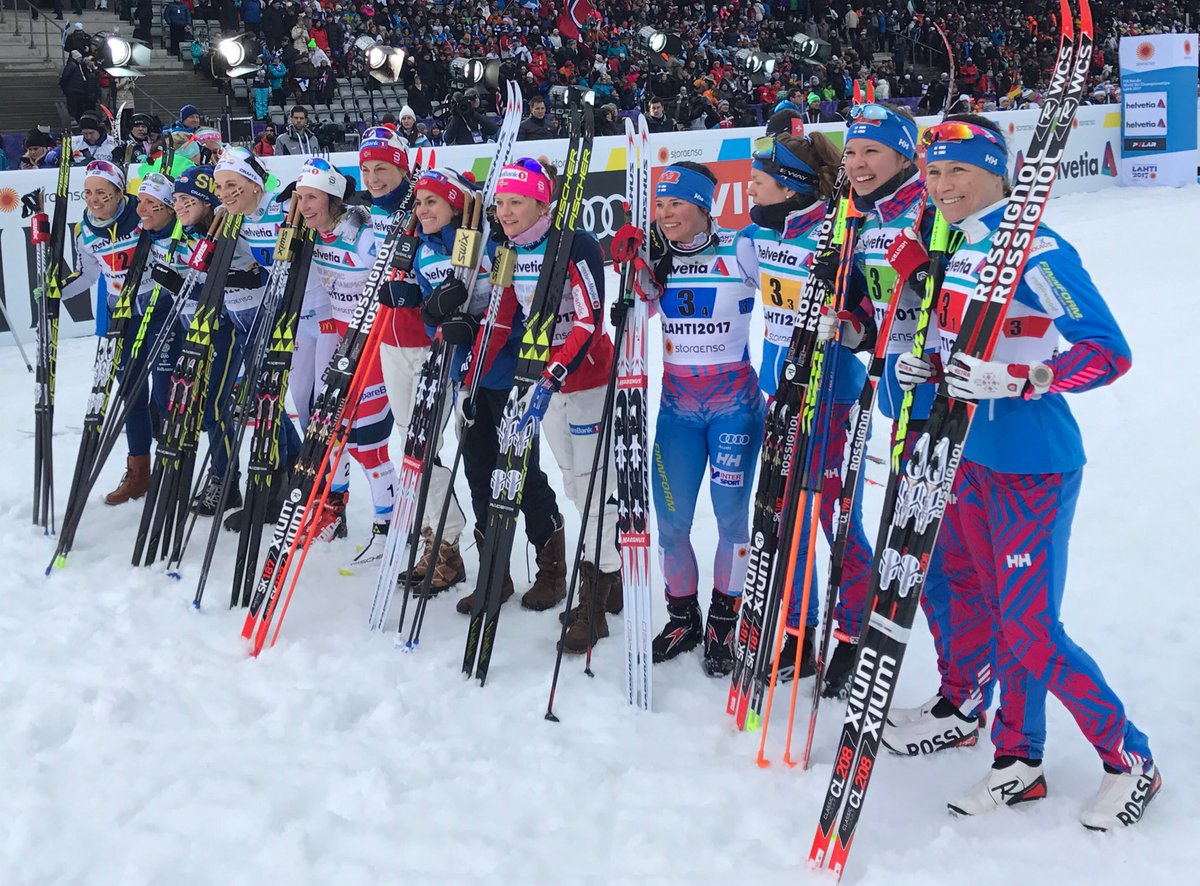
    -Harald Zimmer and Alex Kochon contributed

    Results

  • Domracheva, the ‘Comeback Girl’, Silver Behind Dahlmeier; Dunklee 22nd in Pursuit

    Domracheva, the ‘Comeback Girl’, Silver Behind Dahlmeier; Dunklee 22nd in Pursuit

    Laura Dahlmeier of Germany (far right) was in control of the women’s pursuit for almost the whole race. With just one penalty, she used her position to calmly secure a gold medal. (Photo: Glen Crawford)

    HOCHFILZEN, Austria—For Germany’s Laura Dahlmeier in the 10 k pursuit today, it was another gold medal. One to match the mixed relay from this World Championships, a follow-up to her silver in the sprint, and a repeat of the pursuit gold from last year’s edition.

    “I’m very happy about the three medals — it’s really like a dream, two gold medals and one silver,” Dahlmeier said in a press conference. “The next races I will try to give my best, especially with the team. We are really strong, and we have the possibility to be on the [relay] podium or to win the gold medal. I will fight.”

    For Gabriela Koukalova, it was simply another medal. After winning the sprint, the Czech overcame some ammunition problems and three penalties to fight back for bronze in the pursuit.

    “I was a little bit nervous, and I had some problems with ammunition,” she said. “It didn’t shoot, three times. So in this moment I said, goodbye, my medal.”

    Not so fast: she earned the medal after all.

    Darya Domracheva of Belarus setting up to clean another five targets en route to a silver medal. (Photo: Glen Crawford)

    But perhaps the most joy on the pursuit podium came from the silver medalist, Darya Domracheva of Belarus.

    Domracheva has won a fat handful of World Championships medals before, as well as three Olympic golds.

    But success at this Championships was not guaranteed. Domracheva took the 2015-2016 season completely off, then some more time off to have her first child. She didn’t return to the World Cup until January of this year, and her best individual result since then was 13th place in the sprint in Ruhpolding.

    Furthermore, Domracheva had finished 27th in the sprint here in Hochfilzen. That put her 1:25.6 behind Koukalova starting the pursuit.

    Yet Domracheva wasn’t content to shoot for the teens or twenties. She cleaned target after target, quickly moving up in the standings. By the time she left the final standing shooting stage, she had hit all 20 targets and moved all the way into second place.

    “I can say that some time ago, my name from journalists was ‘the comeback girl’,” she said in a press conference. “Today I think I earned this name again. It’s a really good day for me.”

    Leaving the final shooting, Dahlmeier had an 8.6-second lead on Domracheva, who had another 4.9 seconds on Koukalova.

    Laura Dahlmeier all alone coming to the finish of the 10 k pursuit. (Photo: Glen Crawford)

    Dahlmeier tried to just hold her lead, despite not feeling “so strong on the tracks”. Domracheva and Koukalova set out to catch her. But it wasn’t easy.

    “I tried to go maximum what I can — of course I tried also to catch Laura, but she was strong on the last loop,” Domracheva said. She ended up losing three more seconds to the German on the final 2.5 k.

    But her second goal was to stay ahead of Koukalova, and that one she accomplished.

    “I didn’t know what happened behind me,” said Koukalova, who was only sure she had secured a medal 500 meters from the finish line. “I saw only Darya. It was only three seconds [up to her], but in the moment, very far away. I didn’t have energy to catch her.”

    And so Domracheva completed a comeback in impressive style, moving from 27th up to second place (+11.6) over the course of just ten kilometers. Koukalova was left with bronze (+16.6).

    “I think the most difficult element was to combine all the elements of biathlon together,” she said of returning to top-level competition. “On some races for me it was good [skiing], on some races it was good shooting, and today I could say that I combined them together. The silver was the result from that.”

    There was a tough fight for fourth place, with Irina Starykh of Russia – who returned this season from a three-year ban for blood doping – crossing the line first, +35.9.

    After her it was Justine Braisaz of France in fifth (+36.1), teammate Marie Dorin Habert sixth (+36.3), and Finland’s Kaisa Makarainen seventh (+37.2).

    Good But Not Perfect for American Trio

    Susan Dunklee of the United States started two bibs and a few seconds behind Domracheva, and had begun her own ascent early in the race. Despite a penalty in the first prone, she moved from 29th up to 26th. Then with a clean second prone and a single miss in the first first standing, she was into the top 15.

    The U.S. women’s team of Clare Egan, Susan Dunklee, and Joanne Reid at the finish. The fourth team member, Maddie Phaneuf, will get back to racing in the individual after missing the top-60 cutoff for the pursuit: “I am also really excited for Maddie, because she is a really strong shooter and she has been struggling this week — she is a little frustrated, so really excited to see what she does,” Reid said. (Photo: Glen Crawford)

    “My start position today was not as high up as I wanted it to be, but it’s a great opportunity and the time [gap to better places] was not that big,” Dunklee said. “So if I shot well, I would just move up a few positions with each shooting, and just have a good race and keep moving… The first loop was a blast, tucking in behind Justine [Braisaz] and Darya [Domracheva], just trying to relax.”

    In the last standing stage, though, things came apart, with two more misses. That knocked Dunklee back out of the top twenty. She tried to battle back on her skis, but by the finish was tiring. Dunklee landed 22nd, +1:44.7 after being so close to the top ten.

    “Of course the race wasn’t like that,” she said of her initial plan.

    She’s still looking for her best performance at the Championships, and has another chance in the 15 k individual and then, depending on how that goes, likely in the mass start.

    “I came into these championships really nervous, and not dealing with that pressure as well as I wanted to,” Dunklee admitted. “And I think that affects me in a way. It’s hard to perform well when you are overly nervous, I think it’s good to have some nerves. But now I am finally feeling a bit more relaxed and more normal, more like my normal self, which is a good thing.“

    On course, she passed teammate Clare Egan, who had started with bib 20. Egan shot better than Dunklee – just three misses – but wasn’t feeling the best on her skis.

    Clare Egan (USA) and Rosanna Crawford (Canada) on course. (Photo: Glen Crawford)

    “I think I’m just a little bit tired from doing the mixed relay and the sprint,” Egan said. “It’s just one of those days… I was starting 20th place. This was a much higher starting position than I’m used to, so the people around me are going faster and it’s just tough competition. I have a feeling with the altitude here, that the [15 k] individual could be a better pacing distance for me. I felt like the first lap for me [today] was like a 5 k pace, not a 10 k pace for me. I think I’ll be better in the 15 k.”

    Egan landed 41st (+3:01.3), and still had things to be pleased about. Her three penalties matched her best shooting ever in a four-stage race.

    “I shot 1-0-2-0 and I’m really especially happy about cleaning my last stage,” she said. “So my shooting, I’m happy with that. I hoped that I would not have moved back 21 places with solid shooting, but I think there must’ve been a lot of good shooting today. Mostly the issue was my skiing today. I didn’t have what it takes to move up. I would have needed to shoot perfectly to maintain my [top-20] spot.”

    Egan was right: 16 women shot either clean or a single penalty. And that meant a lot of people moved up: Starykh from 24th to fourth, Braisaz from 28th to fifth, Italy’s Alexia Runggaldier from 43rd to 15th, Norway’s Marte Olsbu from 54th to 16th. The list went on. With three or four penalties, it was hard for the likes of Egan or Dunklee to do so well.

    Joanne Reid (center) on the range in Hochfilzen. (Photo: Glen Crawford)

    While Dunklee shot quickly – she tied for the third-fastest shooting time of the day – Egan and the third American starter, Joanne Reid, took the opposite approach.

    “I was trying to clean prone, because when you are behind in prone you have a really hard time skiing and catching up with the group,” Reid explained. “So I was trying to take my time in prone. Maybe today I took a little bit too much time in prone, but I hit them, so nobody can complain too much about it.”

    Egan, too, was steady and purposeful.

    “I have a really active mind that’s easily distracted, so I have to be really deliberate about focusing on only my position and my trigger work,” she said. “And I did that on my last stage, so I’m happy with that.”

    For Reid, the slow shooting paid off. She had only one penalty in the competition – a miss in the last stage.

    “It’s been a little tricky for me, just because I am still learning wind,” said Reid, who finished 38th in just the second World Championships race of her career.
    “And this range is really susceptible to wind. A little woosh and the wind flags… it’s just a lot of clicks. And I don’t even remember to always look at the wind flags. That’s something I’m working on. But I love it here, I love this course. It’s fun.”

    For Canada, Rosanna Crawford finished 43rd with three penalties (+3:04.3).

    A year ago, she didn’t have a single result worse than 29th in the whole World Championships. She has had a difficult 2017 season, like much of the Canadian team.

    “I’m just so frustrated,” Crawford said at the finish. “The sprint felt like almost getting closer back to normal. Then today again, I just couldn’t move. I couldn’t stay with anyone around me. It’s hard. You want to know what you did wrong so you don’t do it again.”

    -Harald Zimmer and Alex Kochon contributed

    Results

  • Koukalová Nabs First World Title; Egan 20th in World Champs Sprint

    Koukalová Nabs First World Title; Egan 20th in World Champs Sprint

    Gabriela Koukalová of the Czech Republic celebrating her first individual victory at a World Championships (or Olympics) on Friday after winning the women’s 7.5 k sprint at 2017 IBU World Championships in Hochfilzen, Austria. (Photo: Glen Crawford)

    It was a day of redemption. Both for a biathlon superstar and for the best North American in the women’s 7.5-kilometer sprint at the 2017 International Biathlon Union (IBU) World Championships in Hochfilzen, Austria.

    A year ago, Czech Republic’s Gabriela Koukalová (back then starting under her maiden name Soukalová) was disappointed when she failed to win any medal at the Oslo World Championships, twice placing fourth, once fifth, and twice sixth with her team. She won the overall World Cup that season, but not being on the podium at the highlight event of the year still stung.

    Gabriela Koukalová (Czech Republic) racing to her first individual World Championships gold on Friday in the women’s 7.5 k sprint at 2017 IBU World Championships in Hochfilzen, Austria. (Photo: Glen Crawford)

    “I had a lot of expectations,” Koukalová recalled in a post-race press conference on Friday. “And I was only fourth all the time. A lot of ‘potato medals’ as we say in the Czech Republic.”

    Now after a sprint race that had been suspenseful from the first to the very last starters, she stood on the top of the podium at the flower ceremony in Hochfilzen, smiling but with tears welling up in her eyes after winning her first individual title at IBU World Championships (or Olympic Games) in a time of 19:12.6 minutes with no penalties.

    “I am not able to describe my feelings,” Koukalová told the IBU in an interview afterwards. “I had a lot of thoughts about this position in the last months. It’s amazing. I did not believe that I am able to win a World Championship.”

    A day ago, US Biathlon’s Clare Egan was also disappointed when she ran out of spare rounds and shot a penalty in the mixed relay, causing her team to fall back.

    “It is a horrible, horrible feeling to take your team from podium contention to 17th place at world championships,” Egan stated in a US Biathlon press release on Thursday.

    She vowed to focus on the sprint race, and she sure did.

    “I know that a positive outlook is a prerequisite for a good race,” Egan wrote in an email to FasterSkier after Friday’s sprint. “My performance in yesterday’s mixed relay was one of the more brutal failures of my biathlon career, and I certainly struggled to rebound and lost some sleep over it. One decisive factor in my mental turnaround was a message I got this morning from my cousin Liz Egan. She reminded me of my very own words from my recent blog post: ‘How you do one day has absolutely no bearing on how you might do the next.’ It’s so true and I needed the reminder!”

    Clare Egan (US Biathlon) racing to 20th place in the women’s 7.5 k sprint at the 2017 IBU World Championships in Hochfilzen, Austria (Photo: USBA/NordicFocus)

    Taking her time on the range (with the 92nd-ranked shooting time among 101 starters in the sprint) became beneficial when Egan shot clean in both stages to avoid any penalty laps on Friday.

    “I had a good plan for my shooting execution today and I stuck to it for 10 shots and it worked,“ Egan wrote. “That doesn’t always happen so I’m grateful it worked today. I had to take 4 clicks in prone (about the distance from the center of the target to the edge), which is fairly significant but clearly the right choice. In standing I focused on getting the set up perfect, which took a while but paid off.“

    Egan skied the 31st-ranked course time overall, and was able to pick up the pace on the last loop when she knew she was fighting for a top position (22nd loop time).

    “I started my last loop as [Biathlon Canada’s] Megan Tandy was starting her first. Knowing I had someone right behind me pushed me.“

    She crossed the line in a time of 20:25.0 in 20th place, 1:12.4 back from Koukalová.

    For Egan it was her second-best result in an individual World Cup race, only behind a 16th place in Östersund, Sweden, at the beginning of the 2015/2016 season. And it was her best result (excluding relays) in her third World Championship, improving 20 positions on a 40th place (also in the sprint) from 2015 in Kontiolahti, Finland.

    Throughout the race, the athletes at the top changed repeatedly as some of the favorites including France’s Marie Dorin Habert in bib 1 and Finland’s Kaisa Mäkäräinen in bib 4 had picked the first start group, while others such as Germany’s Laura Dahlmeier chose positions in the middle, and Koukalová in bib 96 or Norway’s defending world champion Tiril Eckhoff starting in bib 101 had opted for a start at the very end of the field.

    On a clear and sunny day with mild wind, it seemed unclear which starting positions would be the most advantageous. Several of the favorites starting early incurred penalties, and it took a while until the first starter remained clean in both stages.

    That was Russia’s Irina Uslugina, replacing her teammate Ekaterina Glazyrina at the last moment after Glazyrina had been provisionally suspended by the IBU and taken out of the start list about an hour before the race began, creating additional unrest. Uslugina emerged as Russia’s top finisher on Friday, but was ultimately a bit too slow on the course to contend for the medals and ended up 15th (+1:03.6).

    After missing just one target and skiing fast, Dorin Habert initially held the lead in the finish narrowly ahead of Slovakia’s Anastasiya Kuzmina, before she was bumped out of first by her teammate Anaïs Chevalier. Then, two Italians secured preliminary positions on the podium, but it was not Italy’s star Dorothea Wierer (who went on to finish one position behind Egan in 21st), but Wierer’s teammates Lisa Vittozzi and Federica Sanfilippo.

    Starting with bib 64, Germany’s Dahlmeier began the race at a controlled pace for her ability level, and also took her time on the range (with the 43rd-ranked shooting time) in order to stay clean in both stages. Then on the last loop, Dahlmeier skied the fastest time of the day, and in the finish she had improved on Chevalier’s time by 21.1 seconds.

    But the last word in this race had not yet been spoken, as Koukalová had only just started. She set the best time after her prone stage, narrowly ahead of Kuzmina, and kept pushing hard on the next loop coming into the standing stage with a lead on the field. Shooting clean again, Koukalová left the range with a 10.5-second lead on Dahlmeier.

    With her coaches shouting split times from the side of the track, Koukalová did everything to carry her lead into the finish, but after initially expanding it to 12 seconds, it began to shrink up the last climbs.

    Pushing out of a tunnel and up the inclined finishing stretch in Hochfilzen with her long earrings dangling side to side, Koukalová rescued a 4-second lead to Dahlmeier into the finish, which also knocked Chevalier down to third place (+25.1) and Vittozzi off the podium by a mere 0.2 seconds (+25.3).

    Despite the ungrateful place, it was Vittozzi’s best career result in an individual race, and also the second-best career and best World Championship result for Sanfilippo in fifth place (+31.9).

    “I am a little bit disappointed, because yes of course I dreamed about the medal,” Sanfilippo told the IBU in an interview. “But today with my fifth place I have to be happy. And in any case, we will see what happens in the next days.”

    All of the top six, including Dahlmeier’s teammate Vanessa Hinz (+37.9), shot clean in both stages.

    “I think it was a very clever decision by our coaches,” Koukalová told the IBU when asked about her late start group. “I think it helped me a lot, because I was feeling that my skis [were] faster and faster every loop … And I heard a lot of information about Laura, that she was just 10 seconds behind me [in the split times]. I did not believe it [would be] enough because I know her very well, and I realized she was very fast mainly on the last part of the track.”

    Gabriela Koukalová of the Czech Republic catches her breath on the ground after winning the women’s 7.5 k sprint at 2017 IBU World Championships in Hochfilzen, Austria. (Photo: Glen Crawford)

    “When I saw four seconds [lead] in the finish I thought that I am sleeping, but I hope it is real,” Koukalová said at the press conference. “Is it real?”

    Yes it is. And it is the fifth gold medal for the Czech Republic at IBU World Championships. The women’s relay team won the first title in 1993, then Kateřina Holubcová won a title in the women’s 15 k individual race in 2003, Roman Dostal in the men’s 20 k individual in 2005, and Koukalová herself won the mixed relay title in 2015 in Kontiolahti with Veronika Vitková, Michal Šlesingr and Ondrej Moravec.

    Dahlmeier, the current overall World Cup leader ahead of Koukalová, was pleased with her result, following up her gold medal in the mixed relay a day before with another silver on Friday.

    “This was the perfect race for me,” Dahlmeier told German TV broadcaster ZDF. “I shot clean, I felt great on the shooting range, and I was able to execute on the course what I had set out to do. This was my best race and I gave it everything I had. Today, Gabby was just stronger, that’s how you have to look at it… The second medal is a dream.”

    “In the last part of the track, she is amazing and she is able to run fast like a horse,” a smiling Koukalová said at the press conference, drawing a big laugh from the attending media as well as Dahlmeier.

    The women’s 7.5 k sprint podium at 2017 IBU World Championships on Friday in Hochfilzen, Austria, with the Czech Republic’s Gabriela Koukalová (c) in first, Germany’s Laura Dahlmeier (l) in second, and France’s Anaïs Chevalier (r) in third. (Photo: Glen Crawford)

    At last year’s World Championships in Oslo, Dahlmeier finished third in the sprint before winning the following pursuit race.

    “I will enjoy today’s success, and then I am already excited like crazy for the pursuit,” Dahlmeier told ZDF. “I think that is just my type of race. Four shooting stages, 10 kilometer, and then I will attack the very top again.”

    For Chevalier, it was her first individual medal at IBU World Championships and her third medal overall. Similar to Dahlmeier, she instantly followed up on her silver medal with the French mixed relay from the previous day, and previously earned silver with the women’s relay in Oslo a year ago.

    “I am really happy because I did not expect to have an individual medal,” Chevalier stated in the press conference, also echoing Dahlmeier’s comments. “I did a perfect race today, and two of the girls were better than me. So I have no regrets.”

    Chevalier is going to celebrate her 24th birthday on Sunday, the day of the pursuit race.

    Four North Americans Qualify for Pursuit

    The second-best North American starter on Friday was Biathlon Canada’s Rosanna Crawford in 26th place with one penalty (+1:23.2).

    Rosanna Crawford (Biathlon Canada) racing to 26th in the women’s 7.5 k sprint on Friday at 2017 IBU World Championships in Hochfilzen, Austria. (Photo: Glen Crawford)

    Despite some tricky wind conditions, Crawford shot fast (with the 10th-ranked shooting time overall) and stayed clean in her prone stage, before incurring a penalty in standing.

    “I struggled in zero [pre-race target practice] today, so am really happy to have cleaned my prone,” Crawford wrote in an email. “It was quite windy during zero and I had to make a big correction, but once the race started it was a much more manageable wind.”

    Initially posting one of the best times after starting early in bib 12, she was pushed down in the standings as more and more athletes finished the race ahead of her, partly due to her middle-of-the-pack, 45th-ranked overall course time.

    “This is one of my better ski ranks of the year,” Crawford commented. “I felt more normal out there today, we had good skis and the course held up well. I had a few people to chase down on my last loop, but for the most part skied the race alone. I skied better than the mixed relay.”

    It was Crawford’s second-best result in a sprint this season, following her 21st place last month in Oberhof, Germany.

    Susan Dunklee (US Biathlon) racing to 29th in the women’s 7.5 k sprint on Friday at 2017 IBU World Championships in Hochfilzen, Austria. (Photo: Glen Crawford)

    Three positions behind her, US Biathlon’s Susan Dunklee finished 29th (+1:27.4) with three penalties.

    Dunklee started very early in bib 3, getting some time on the TV broadcast. Just like the other early starters, the American had to deal with a bit more challenging wind conditions, though according to her they were consistent with the zeroing target practice and the course remained fair throughout the race.

    “Every team had a different idea about when the track would be fastest,” Dunklee wrote in an email. “I have no complaints about my start position. I think the spectators enjoyed having the favorites spread out.”

    On the range Dunklee took the opposite approach to Egan, shooting very fast (tied for the eighth-ranked shooting and fifth-ranked range time), yet unlike her teammate she missed one shot in her prone shooting stage and two more in standing, having to ski 450 extra meters.

    Thanks to skiing the 11th-ranked course time overall and even faster on the last loop where she could ski behind Finland’s Mäkäräinen (who had the second-best course time of the day), Dunklee improved by 18 positions on the last loop to finish 29th.

    “Kaisa was a great ride for my last loop and I enjoyed the opportunity to ski together with her and Julia [Ransom of Canada, who started a loop later],” Dunklee wrote. “It helped me dig into a deeper gear for my finishing push.”

    “I was psyched to see Clare and Rosanna throw down strong performances when it counts the most,” Dunklee commented regarding the performances of Egan and Crawford. “Biathlon is one of the most mentally challenging sports out there because of the extreme ups and downs, and they have proved their resilience this season.”
    In her first start at IBU World Championships, Joanne Reid finished 49th (+1:57.6) with a penalty in each of her shooting stages (1+1). With this result, Reid qualified for the pursuit with the third-best individual World Cup result of her career, the best being a 29th place from a 15 k individual race in Östersund, Sweden, earlier this season. The former standout cross-country skier switched to biathlon a little over a year ago.

    “I absolutely love this course and had a great time,” Reid commented on her race, according to US Biathlon. “I can’t wait for the pursuit.”
    For Canada, Megan Tandy finished 64th with one penalty (1+0), 2:20 minutes behind the winner.

    “What can I say?” Tandy posted on her Facebook page. “I am satisfied with 9/10 shooting. I did my job today and while I am sad and frustrated with 64th place, I am also at peace knowing I did everything possible: every detail of training, sleeping, eating, activation, warmup, etc. but my body was just not able to deliver. I fought my hardest but felt empty. Whatever is going on with me, I am not in the shape I expected [this] season and my best is simply not enough. Tough.”
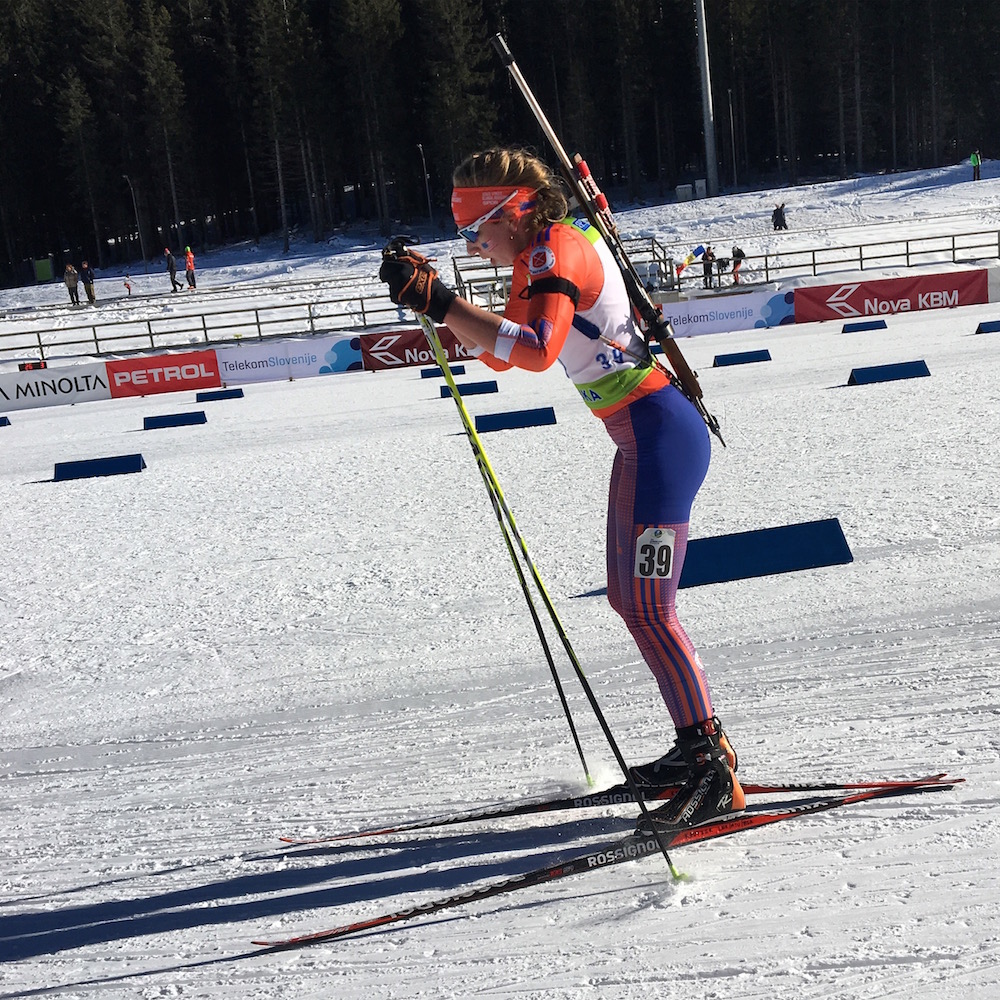
    Julia Ransom (Biathlon Canada) racing to 65th in the women’s 7.5 k sprint on Friday at 2017 IBU World Championships in Hochfilzen, Austria. (Photo: Glen Crawford)

    Her teammate Julia Ransom was one position behind in 65th with two penalties in her standing stage (+2:24.7, 0+2).

    “Unfortunately the race today didn’t play out as I’d hoped, but I skied my heart out, soaked up some sunshine, and enjoyed those incredible fans!” Ransom wrote after on Instagram.

    Starting late in the field in her first start at senior World Championships, US Biathlon’s 21-year-old Maddie Phaneuf shot clean in her prone stage, then missed two targets in standing to finish in 78th place (+2:56.6, 0+2).

    “Well…frustrated with today’s results,” Phaneuf commented on her Facebook page after the race. “I was happy with my skiing on the first two loops and my prone shooting but not psyched on my standing shooting… hoping for better days here at World Champs. On the other hand, this is my second best result on the World Cup (out of the 5 individual races I’ve done). So happy to see my teammates doing well, all three placing in the top 50…Clare with clean shooting and getting her second best result ever in 20th!”

    Emma Lunder (Biathlon Canada) racing to 84th in her first IBU World Championships race on Friday, the women’s 7.5 k sprint in Hochfilzen, Austria. (Photo: Glen Crawford)

    Also competing in her first senior World Championships race, like Reid and Phaneuf, Canada’s fourth woman Emma Lunder missed qualifying for the pursuit in 84th, after incurring three penalties in her prone shooting stage before shooting clean in standing (+3:10.1, 3+0).

    The IBU World Championships continue on Saturday with the men’s 10-kilometer sprint, followed by pursuits for both the women and men on Sunday.

    The races can be streamed live for free on Eurovisionsports.tv.

    Results