From the FasterSkier archive — posts syndicated from athletes’ and coaches’ own blogs between 2004 and 2012, kept online as published. Current coverage is at fasterskier.com.
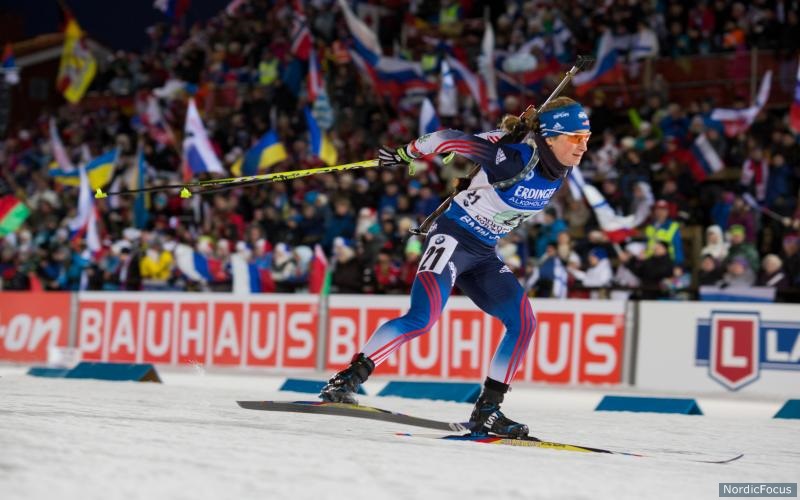
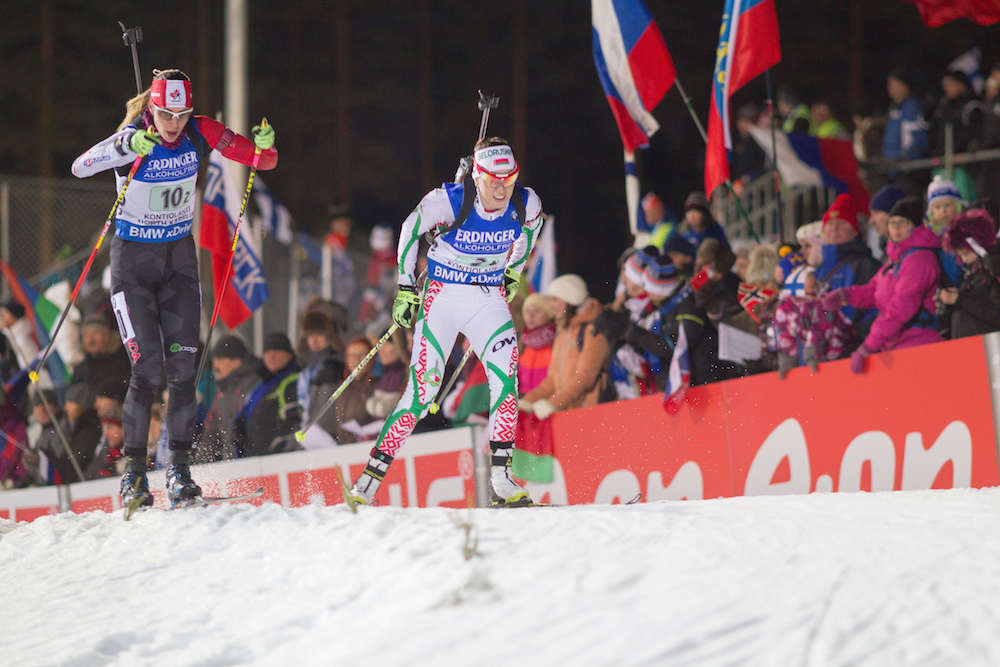
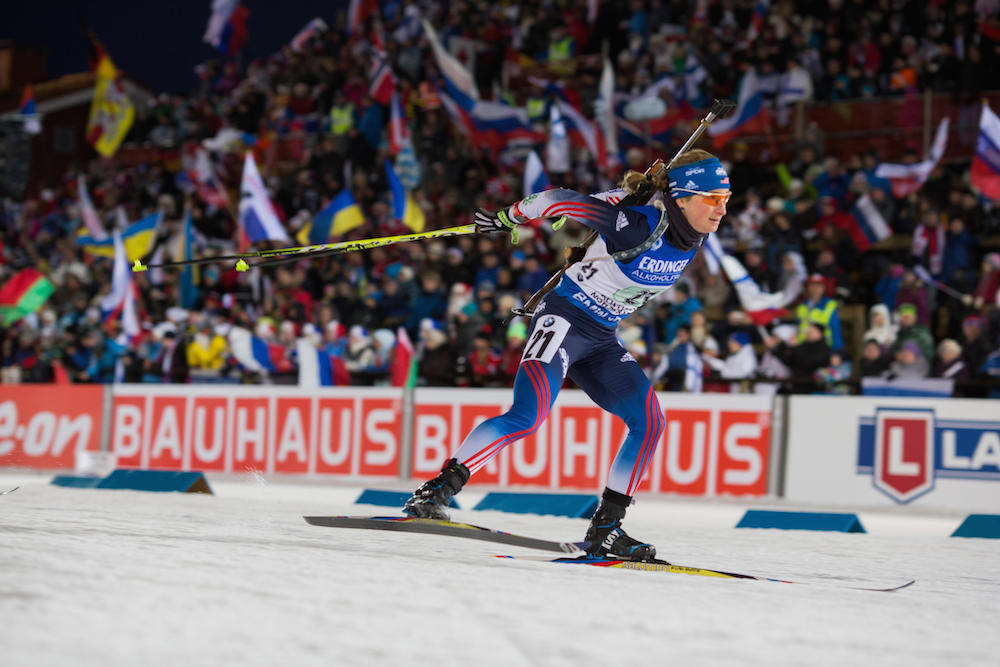
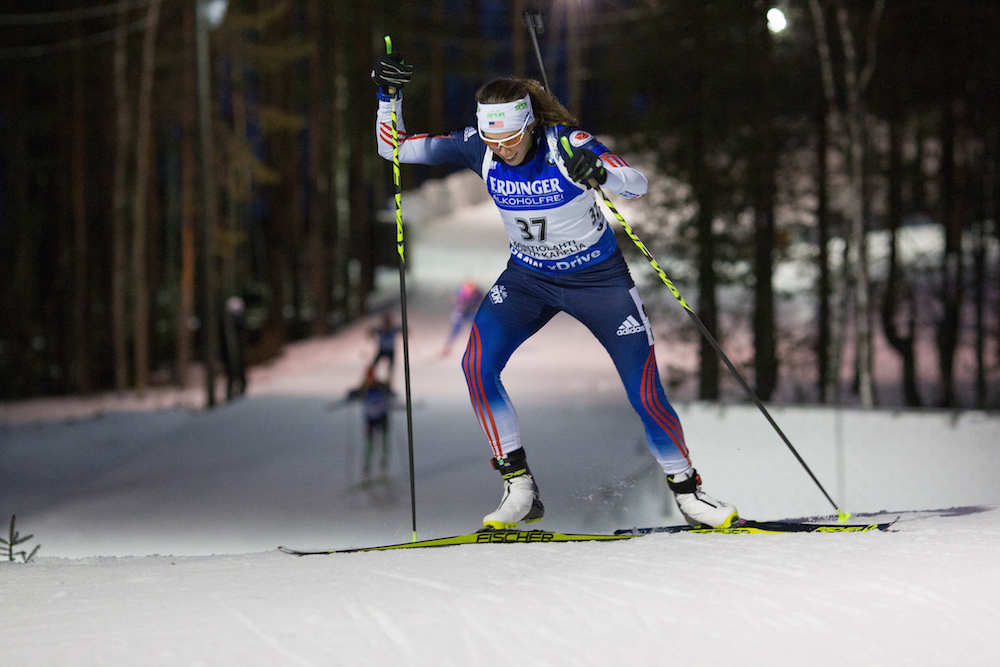
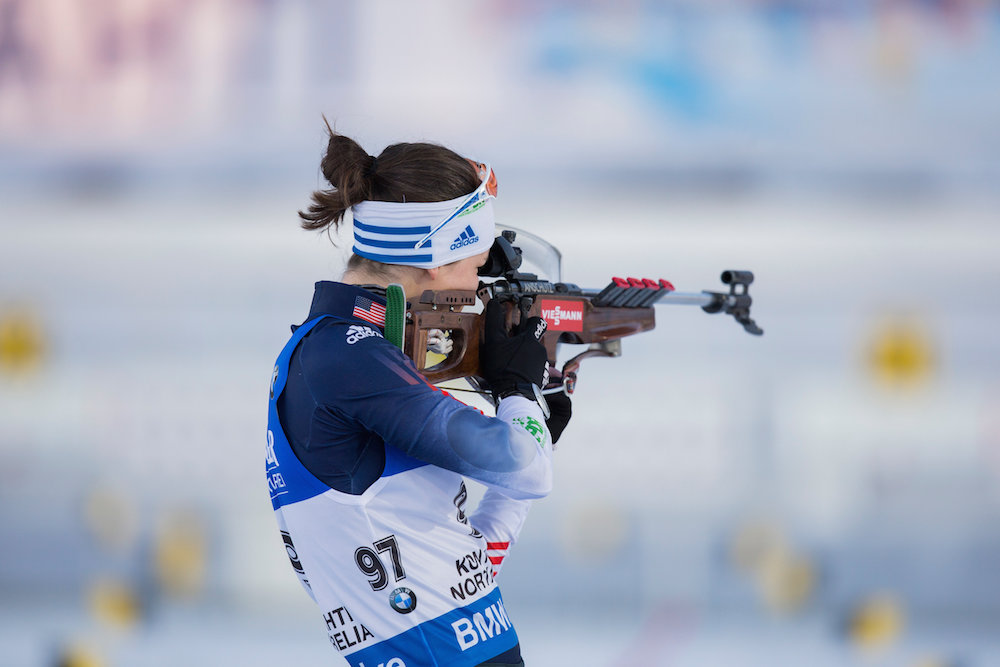
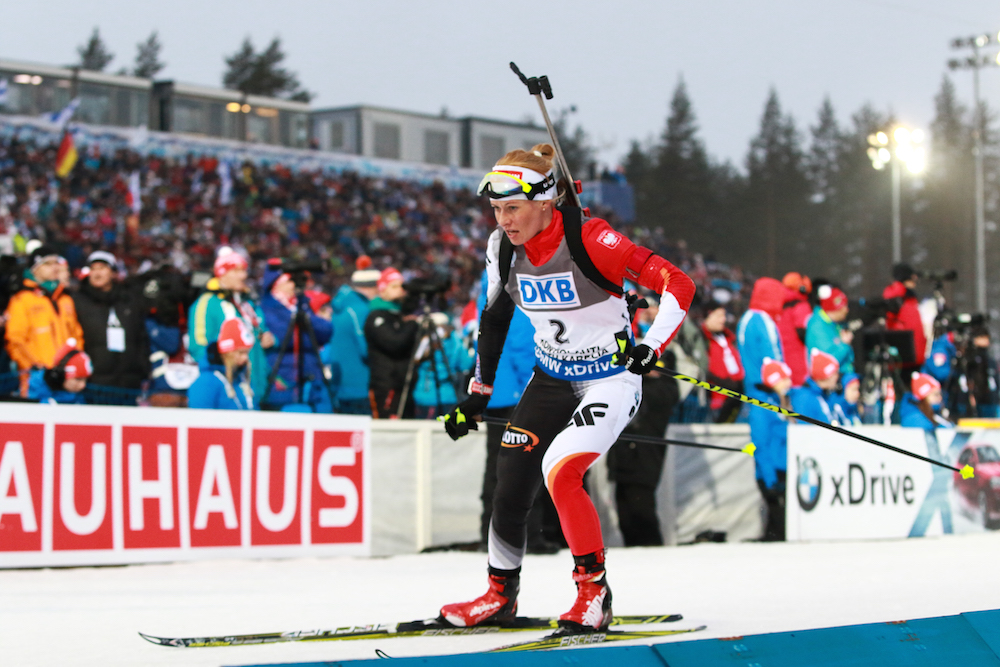
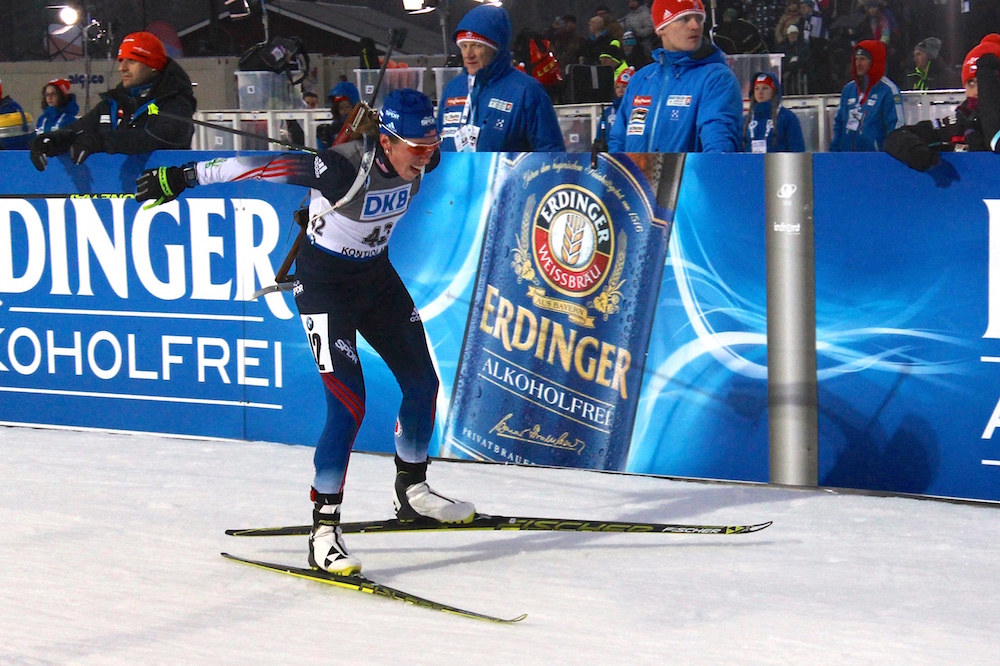
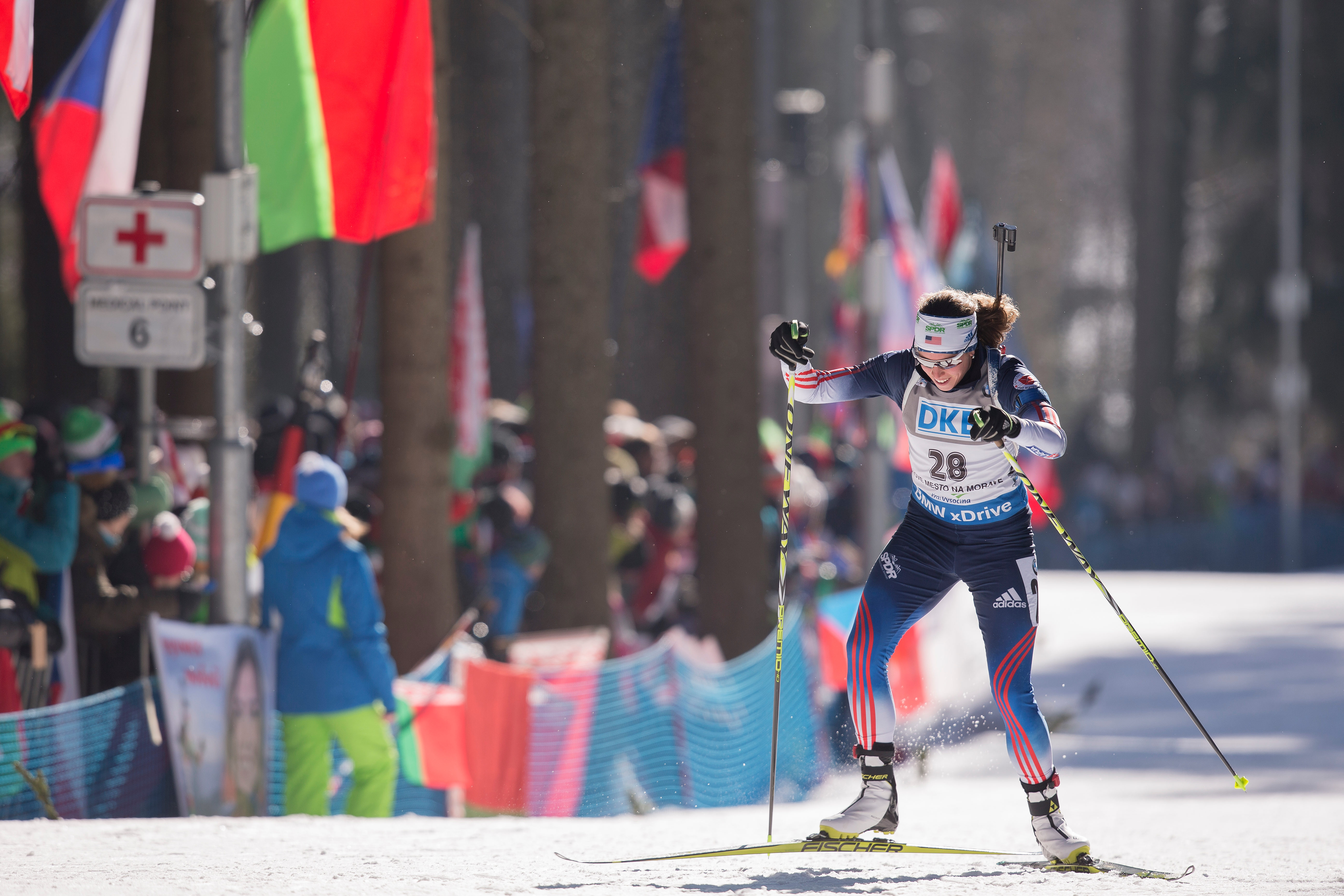
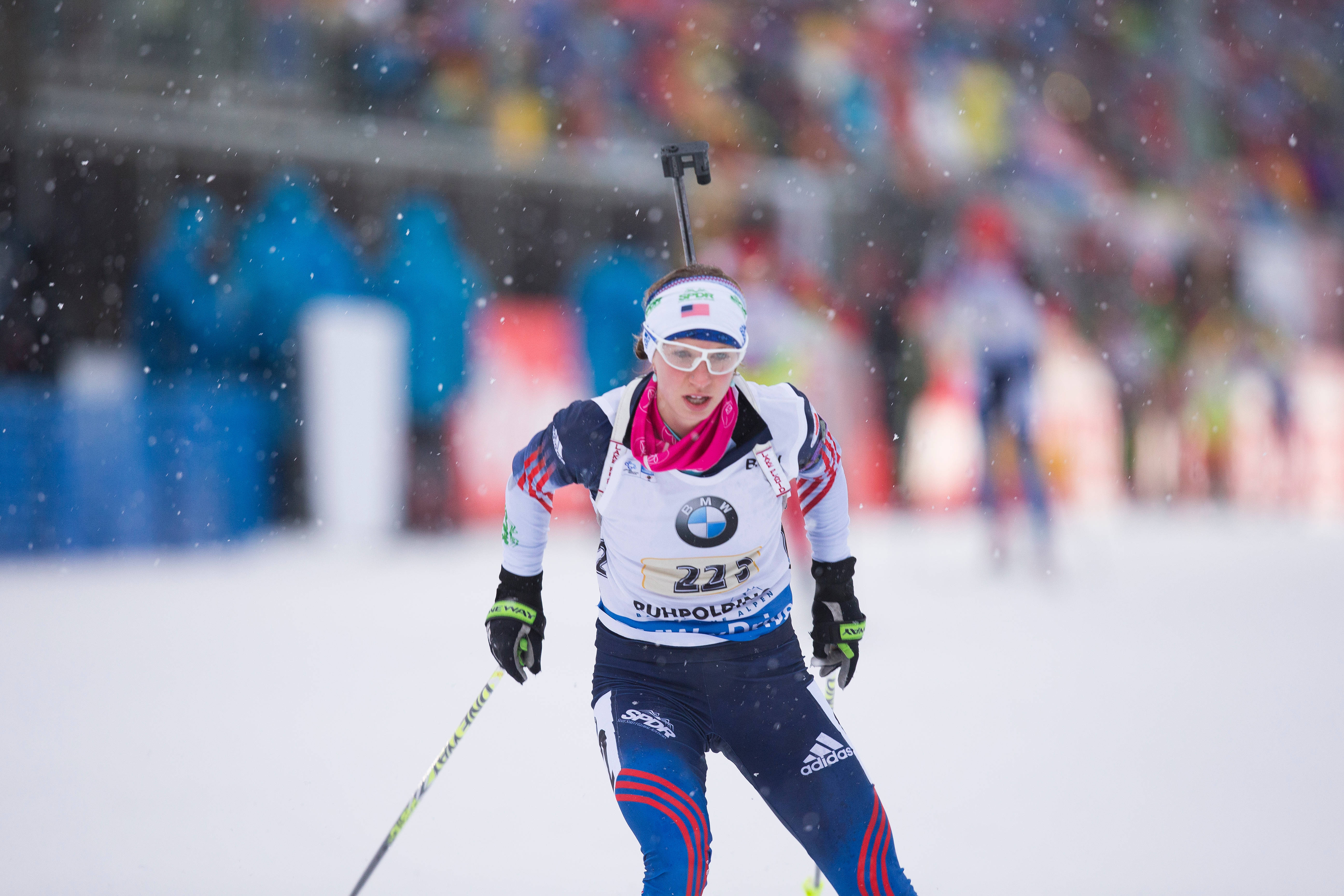
Hannah Dreissigacker (US Biathlon) achieved a career-best 14th in the last sprint of the season in Khanty-Mansiysk, Russia. She is pictured at IBU World Championships on March 13 in the women’s relay. (Photo: USBA/NordicFocus)
When Hannah Dreissigacker looks back at this season, she’ll probably remember Russia over Finland — that is, the last IBU World Cup races of the season in Khanty-Mansiysk over World Championships in Kontiolahti.
Or at least that’s where one of her fondest memories will stem from. After more than a week of headaches and insomnia at World Championships in Finland, the 28-year-old US Biathlon A-teamer rebounded to place 14th in Friday’s 7.5-kilometer sprint in Khanty-Mansiysk.
It was the best result of her career, topping her previous best of 16th in the World Cup sprint last month in Oslo, Norway.
“I have to admit I was very pleasantly surprised by today’s race in lots of ways,” Dreissigacker wrote in an email on Friday. “I had a pretty frustrating World Champs in Kontiolahti, with lots of bad shooting and then I was having trouble with insomnia and headaches by the end of my time there, and it had me feeling pretty down.”
At World Championships, Dreissigacker placed 61st in the sprint, narrowly missing the top-60 cutoff required for the pursuit, and finished 67th in the 15 k individual.
“Here in Khanty Mansiysk I’ve been sleeping better and pleasantly surprised by the weather (it’s not freezing cold), the food (there are good vegetables!), and the place in general (it’s a weird place, but weird is also interesting),” she explained. “I’ve still been having headaches, but I’ve been trying to reset my approach to just be confident and enjoy the last races of the season.”
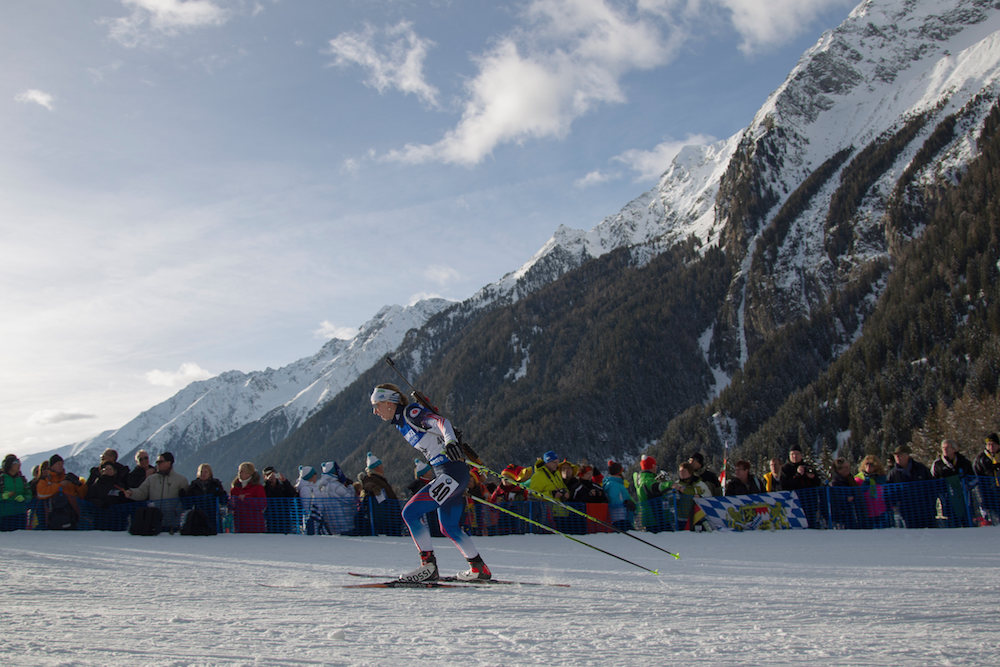
She started 40th on an unusually warm, 40-degree Celsius evening with what an IBU press release described as a “stiff breeze” in the range.
With one miss in her first shooting, Dreissigacker left prone in 43rd overall, 47.6 seconds behind the German race leader at the time, Laura Dahlmeier, who started just ahead of her in bib 39.
One loop later, the American jumped into 14th with a perfect standing stage.
“I felt OK skiing but not really great, and prone was OK, but I’m definitely most happy about my standing shooting,” Dreissigacker wrote. “I had a little bit of wind and had to take a few extra breaths and really fight for those targets, and that made it feel extra good to hit them!”
She headed out on her last loop feeling energized and excited by her shooting, but not quite expecting 14th place.
“I definitely wasn’t expecting it to be a new personal best…but I guess that the whole field struggled with shooting today so it worked out well!” she wrote.
Dreissigacker finished 1:26.4 behind winner Kaisa Mäkäräinen of Finland, who started 36th and made up more than 12 seconds on her final loop to win by 14.2 seconds in 19:49.1. Mäkäräinen cleaned prone and missed one standing — just like Dahlmeier — and Dahlmeier lost her lead after the second shooting, trailing Mäkäräinen by 1.7 seconds with 2.5 k to go.
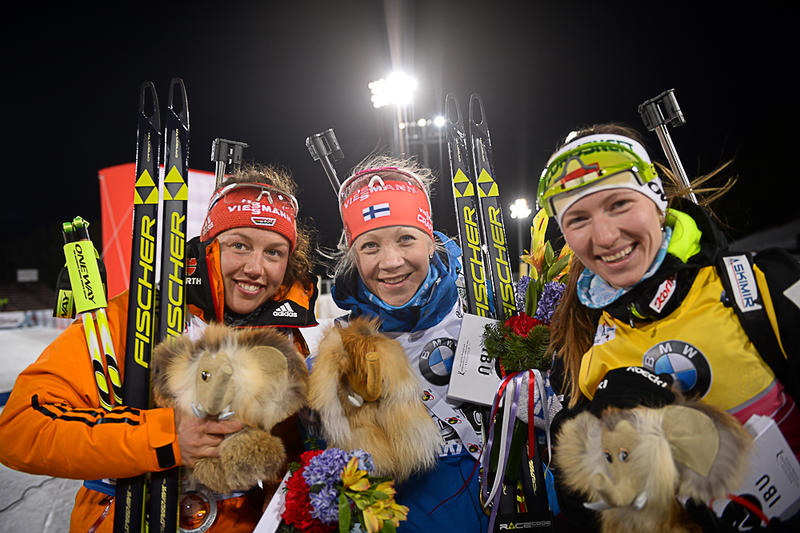
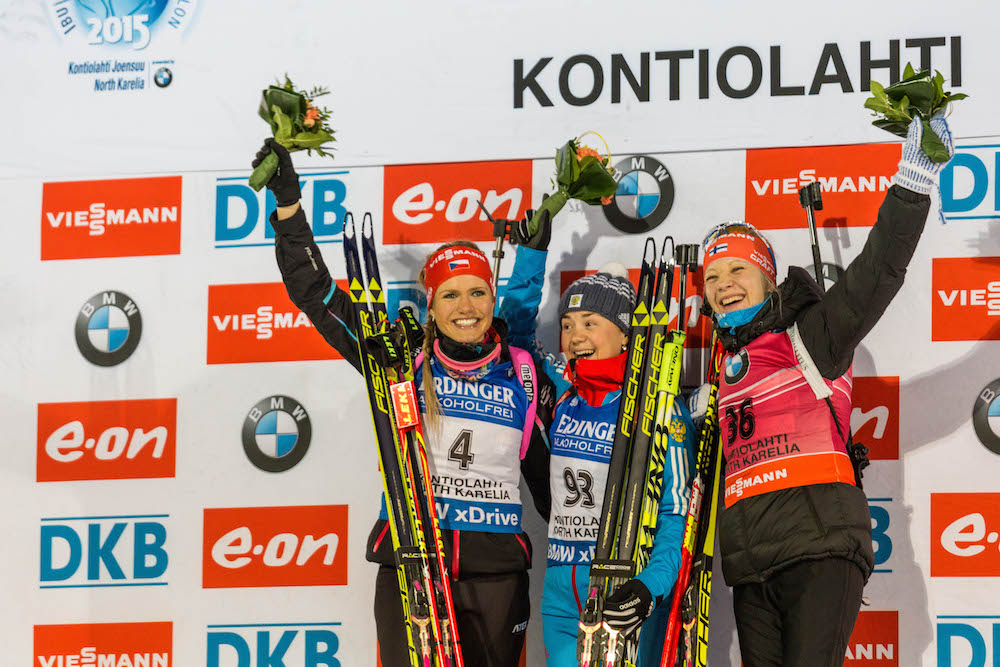
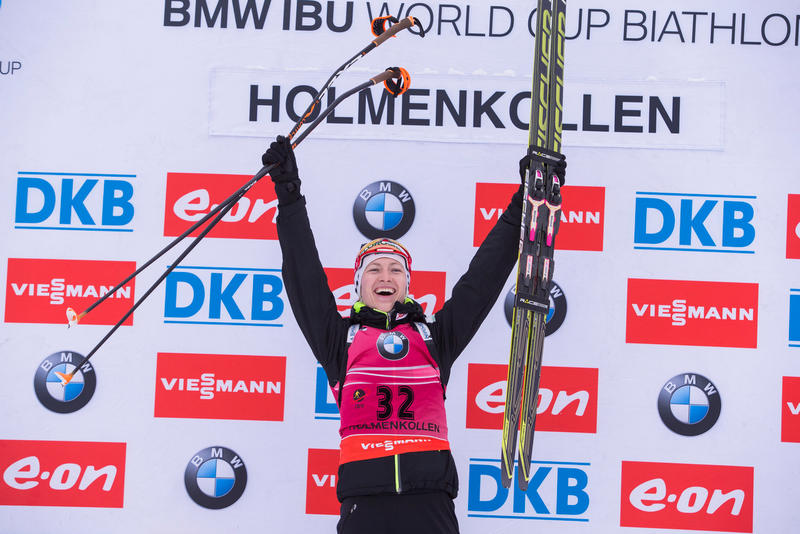
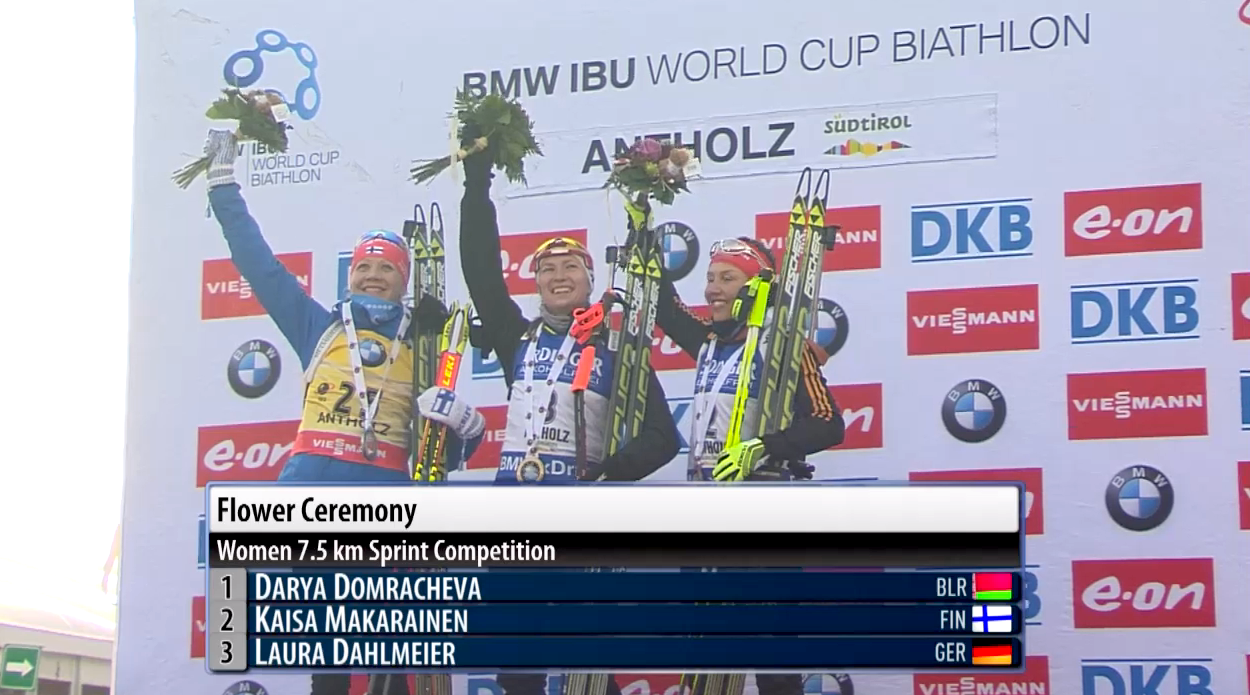
The women’s 7.5 k sprint podium at the final IBU World Cup of the 2014/2015 season in Khanty-Mansiysk, Russia. From left to right: Runner-up Laura Dahlmeier of Germany, winner Kaisa Mäkäräinen of Finland, and Darya Domracheva of Belarus in third. (Photo: IBU/Evgeny Tumashov)
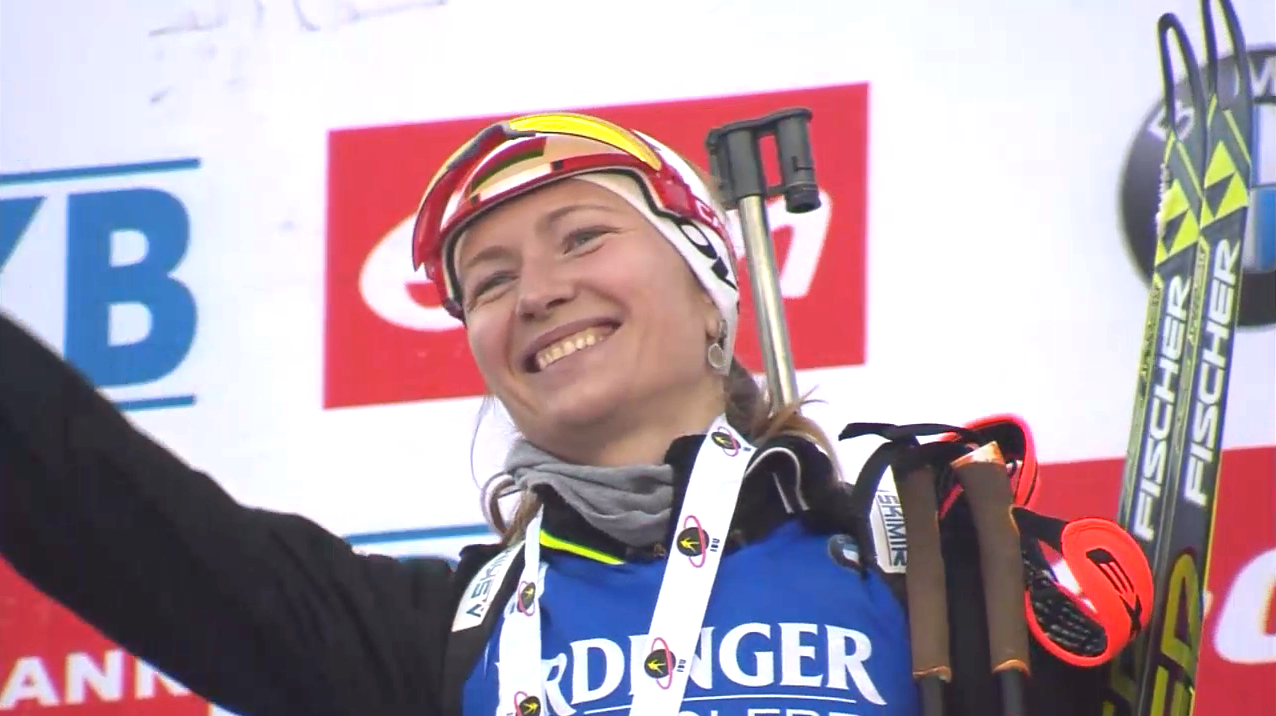
The German finished second, 1.3 seconds ahead of Darya Domracheva of Belarus, who overcame two penalties (one in each stage) to place third (+15.5). The overall World Cup leader who is now just nine points ahead of Mäkäräinen, Domracheva skied the second-fastest course time overall, after Mäkäräinen.
“I am happy to be back on the podium and to be back in Khanty-Mansiysk,” Domracheva told the IBU. “Like everyone, the holidays are coming and that is something nice to look forward to.”
Mäkäräinen explained that she experienced more wind in prone than standing, but felt a shakiness in her legs for the second time this season during her second stage.
“Still, I am happy to be back on the podium,” Mäkäräinen told the IBU. “My legs were really gone after the World Championships … the physiotherapist did a lot of work on them this week. Last night I finally felt like I could go today.”
For Dahlmeier, 21, it was her sixth podium of the year.
“My results are better than I expected earlier in the season; I had hoped for one or two podiums this year,” she said. “All of these last races have been really almost perfect … I hope to have more good races for the next two days.”
In Saturday’s 10 k pursuit, Mäkäräinen will head out first, 14 seconds ahead of Dahlmeier. Domracheva will start 16 seconds back in third, and Dreissigacker will follow 1:26 back in 14th.
“I’m just going to try to keep my confident approach to shooting, and have fun out there!” Dreissigacker wrote.
U.S. Women Secure Nation Cup Top 15
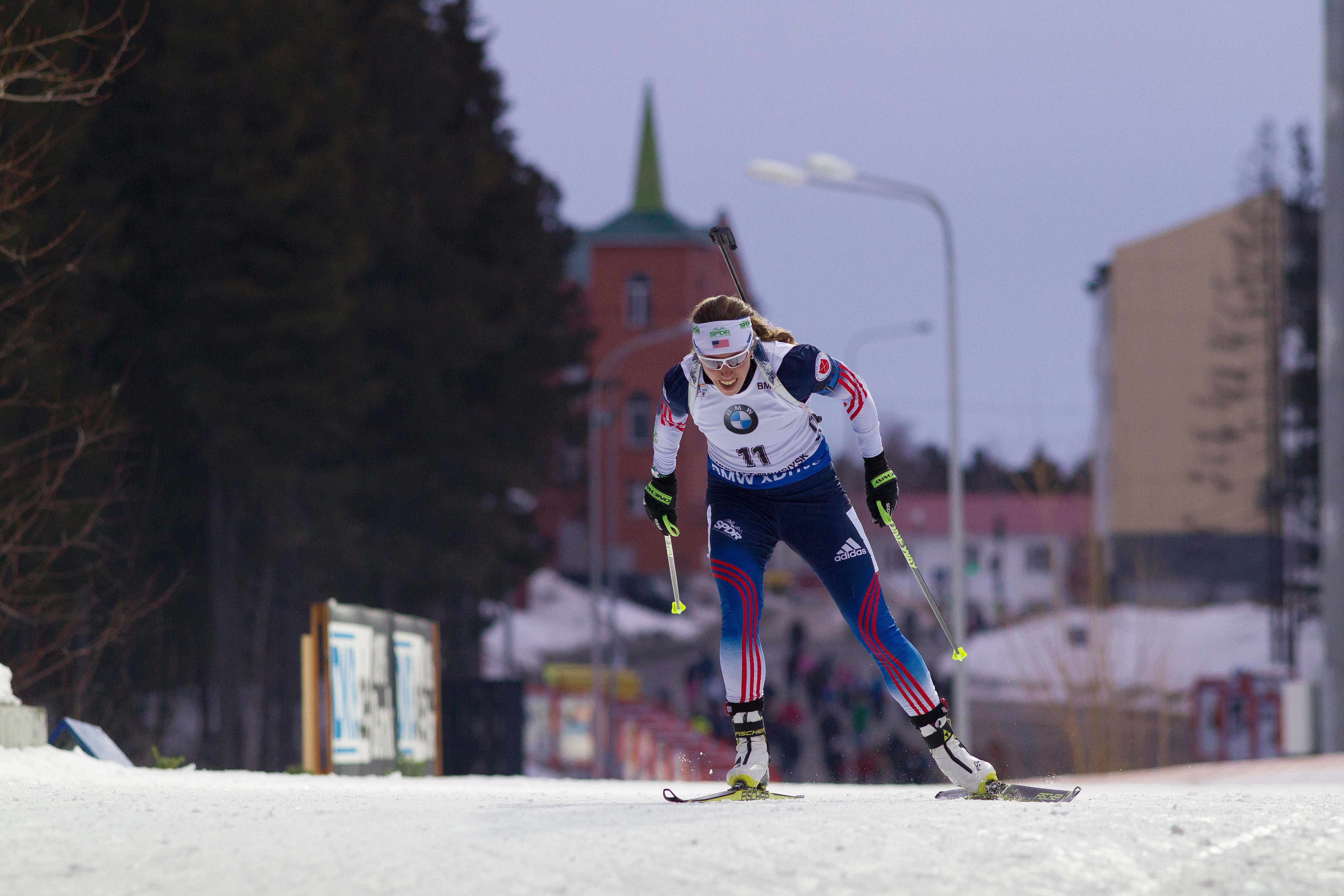
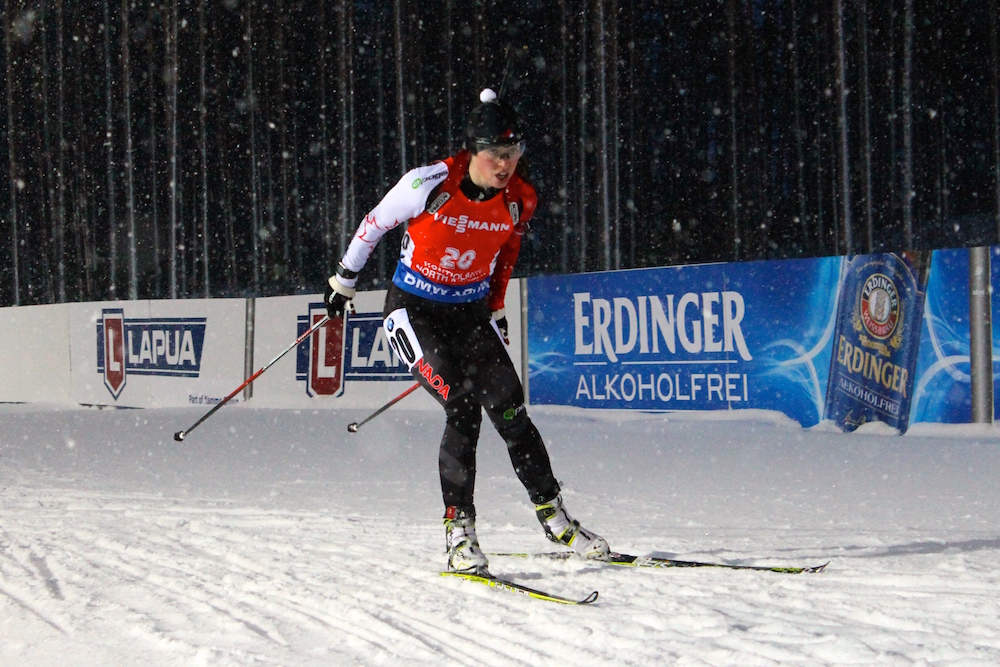
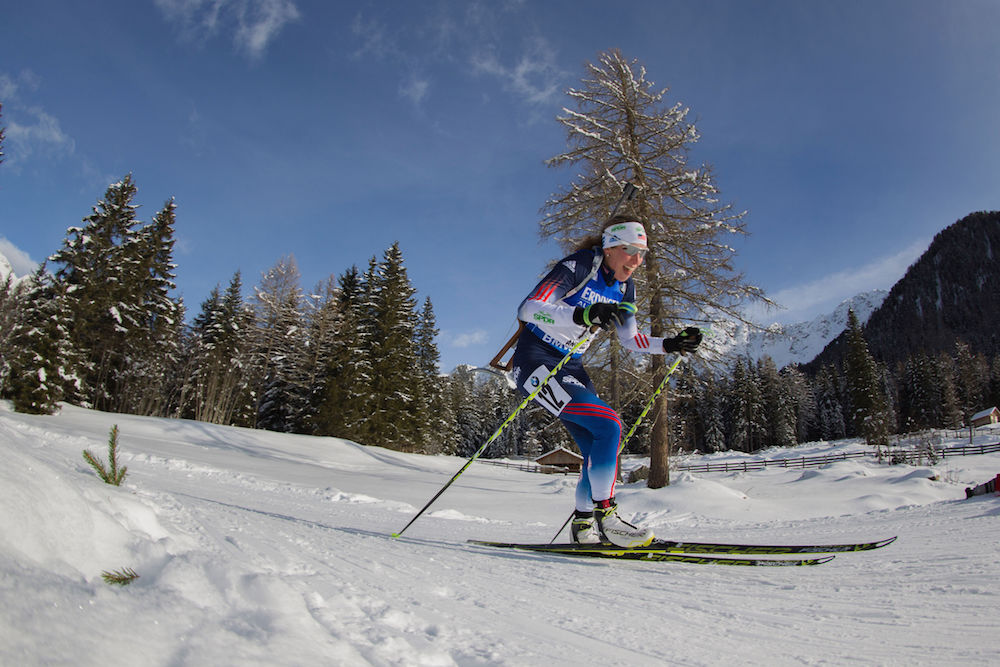
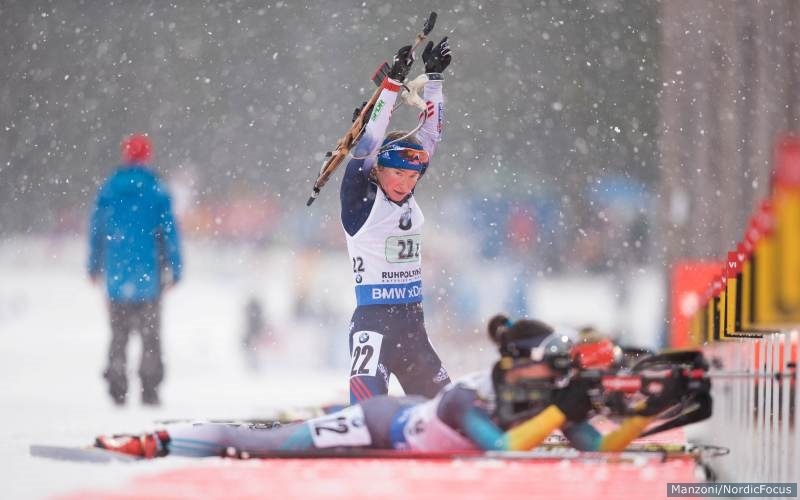
Susan Dunklee (US Biathlon) racing to 26th in the IBU World Cup 7.5 k sprint on Friday in Khanty-Mansiysk, Russia. (Photo: USBA/NordicFocus)
Of the two American women competing in Khanty-Mansiysk, both she and Susan Dunklee qualified for the pursuit. Dunklee placed 26th on Friday, 1:49.4 after Mäkäräinen, with four penalties: one prone and three standing. The 11th starter, Dunklee made up four places on her final loop and clocked the fifth-fastest course time overall.
“I probably sound like a broken record after last week — my ski shape feels phenomenal right now and would put me in a very high position if I were to shoot well,” Dunklee said in a US Biathlon press release. “Unfortunately, the standing got the best of me this time.”
With a top-15 finish in the Nation Cup, the U.S. women earned four quota spots for next year’s IBU World Championships, according to the release.
“Today’s sprint was our last opportunity to score team Nation Cup points and we had a close battle going for the top 15,” Dunklee explained. “We fought for every place. I am so proud of Hannah putting together her career-best result today and we sealed 15th.”
Dunklee will start Saturday’s pursuit 1:49 back with Russia’s Daria Virolaynen, who finished 0.5 seconds ahead of her in 25th.
Canada’s lone starter, Rosanna Crawford placed 28th (+1:54.7) with three penalties: one prone and two standing. She started 21st and rose four places from 32nd to 28th overall during her last loop. Crawford’s range time ranked seventh.
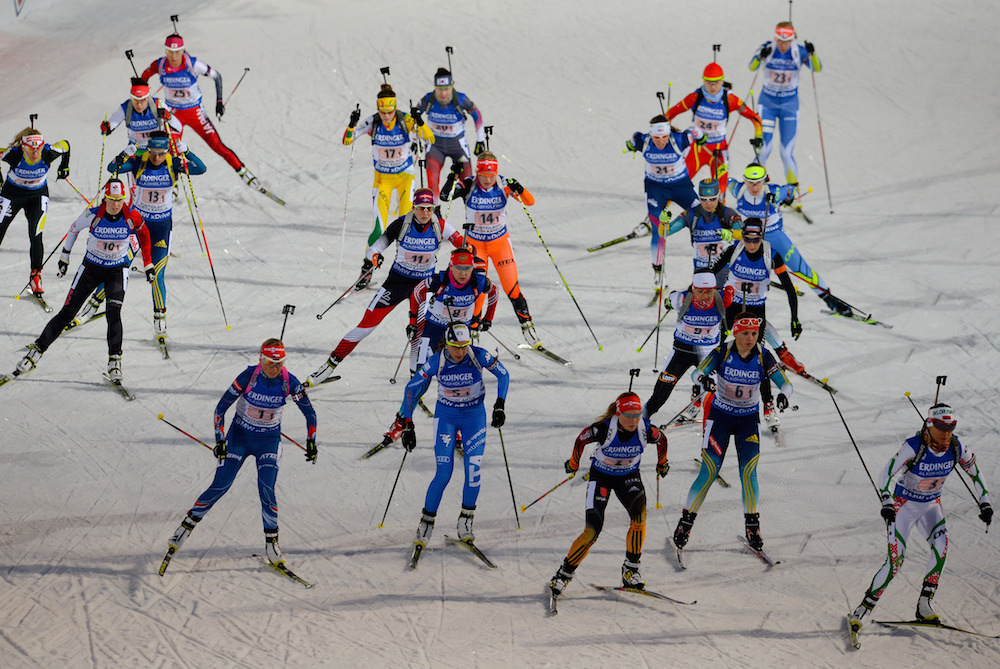
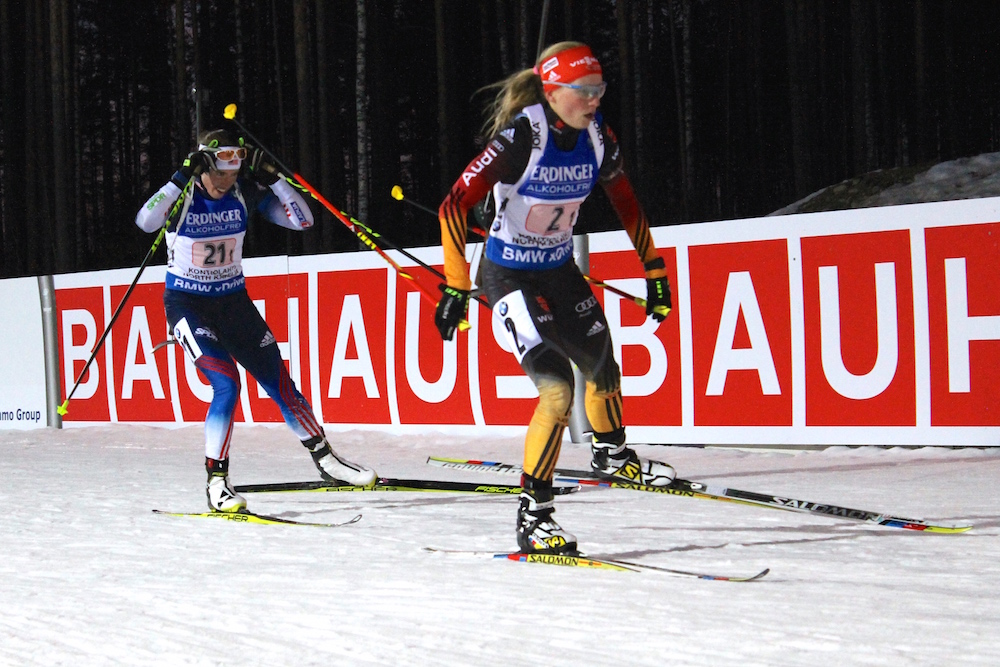
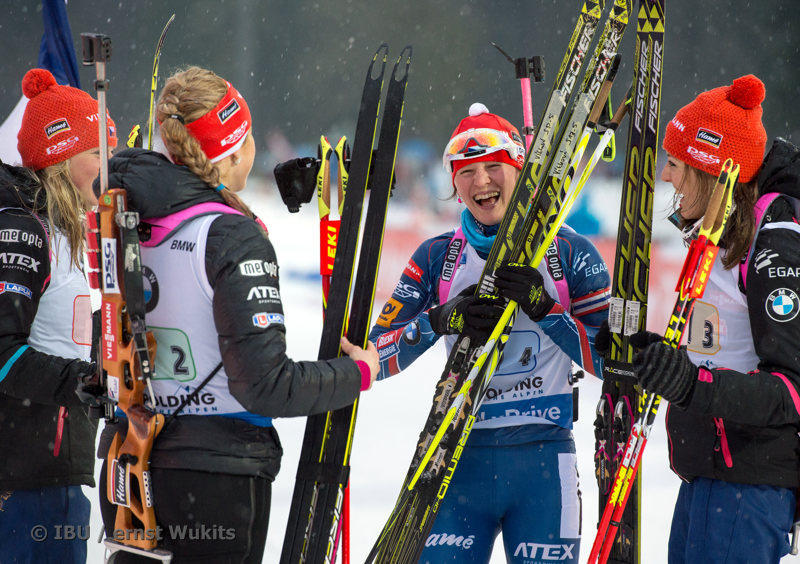
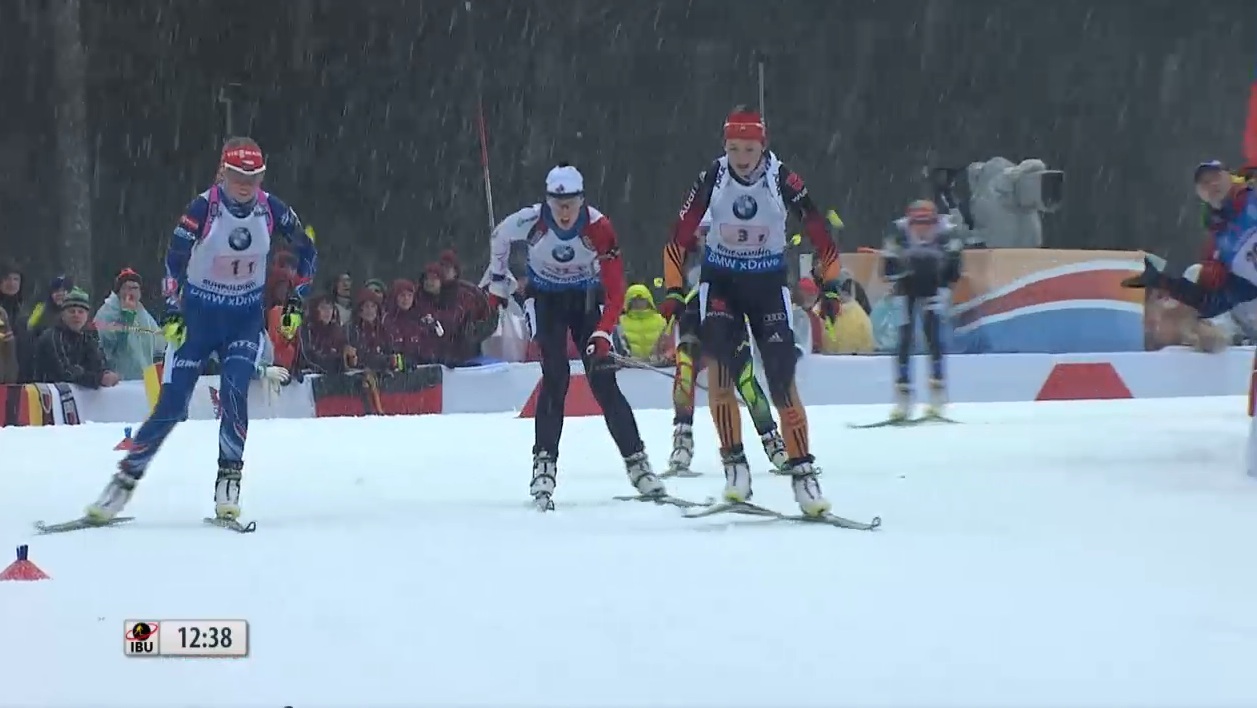
The start of the women’s 4 x 6 k relay at 2015 IBU World Championships on Friday in Kontiolahti, Finland, with Germany’s Franziska Hildebrand (4) near the front with Belarusian Nadezhda Skardino (3), Canada’s Megan Heinicke (10) at left, and American Susan Dunklee (21) near the back right. (Photo: USBA/NordicFocus)
KONTIOLAHTI, Finland — Not long after finishing the women’s 4 x 6-kilometer relay at 2015 IBU World Championships, Laura Dahlmeier sprinted past reporters to jump into the arms of one of her teammates, her rifle still attached to her back.
A German sports broadcaster employee quickly ushered the 21-year-old Dahlmeier and her three teammates to the Sportschau platform overlooking the stadium where they had just destroyed the 25-team field.
In the minutes before, Dahlmeier built on a 30-second lead her teammate Vanessa Hinz established on the third leg to anchor Germany to a 1:00.3-minute win. Hinz had used just one spare in prone to clean both her stages and skied the second-fastest third leg to leap from third into first — and considerably ahead of anyone else.
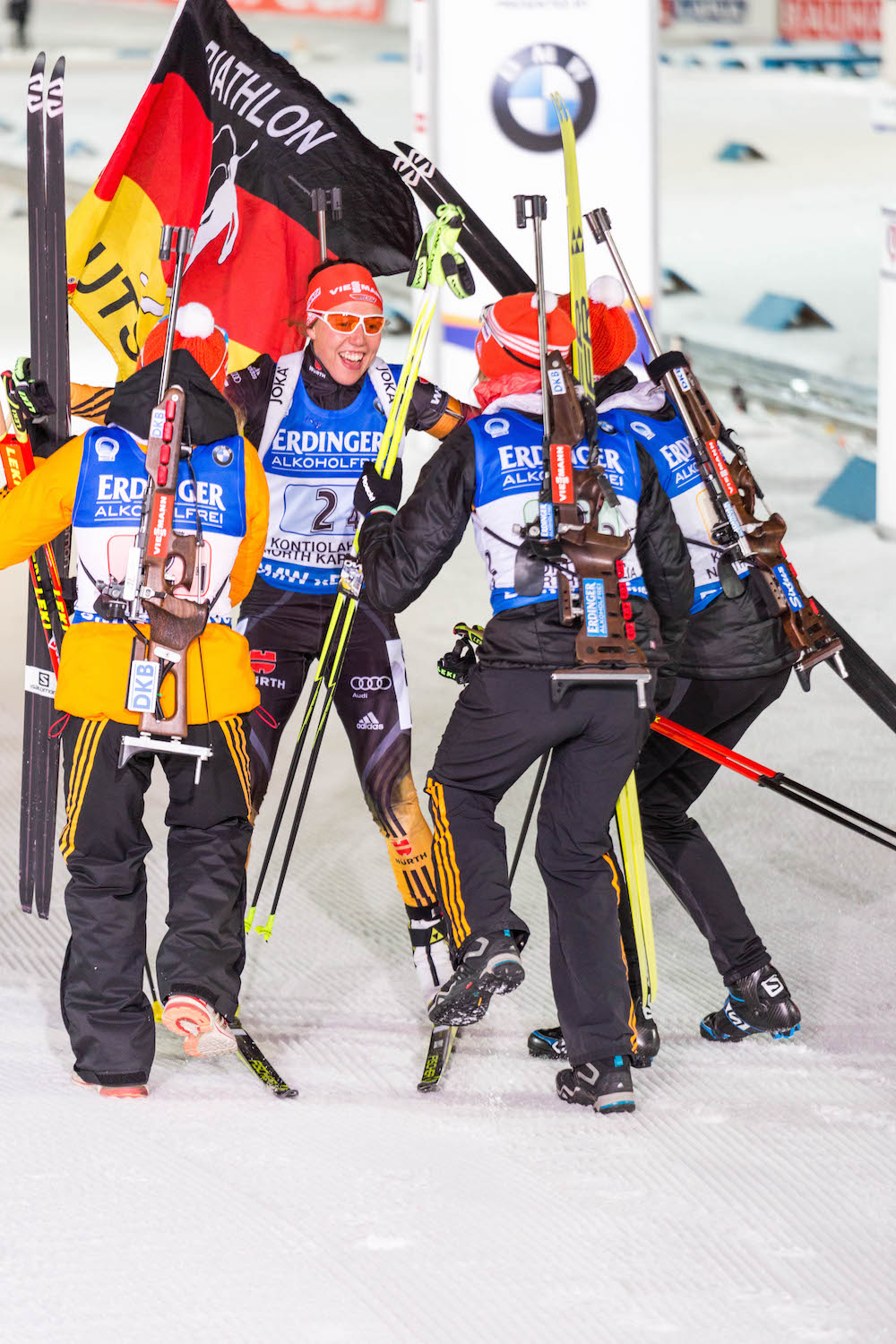
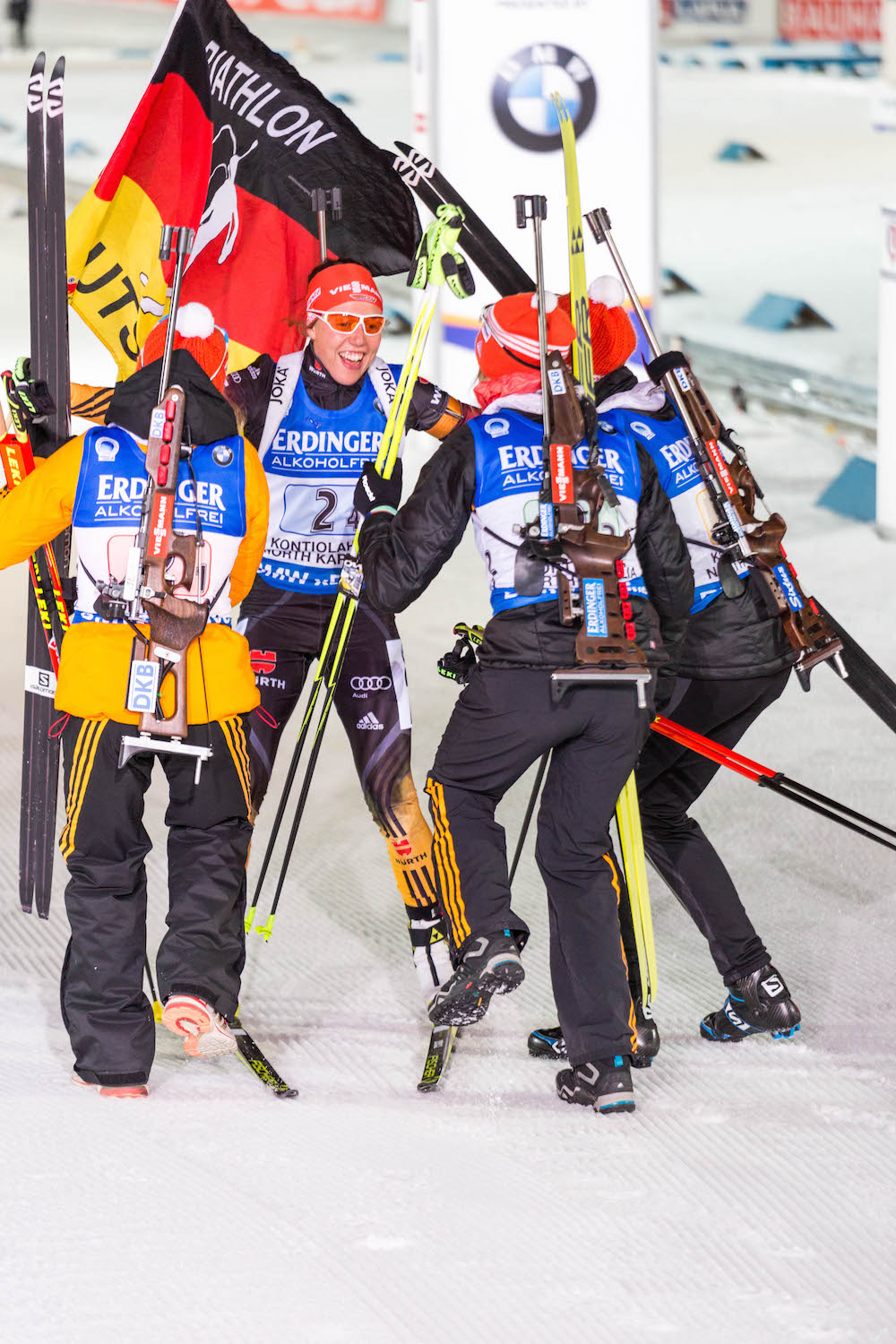
The German women’s relay rushes the finish line to greet anchor Laura Dahlmeier, who secured their win by more than a minute over France in the 4 x 6 k relay at 2015 IBU World Championships in Kontiolahti, Finland. The German team included Franziska Hildebrand, Franziska Preuss and Vanessa Hinz. (Photo: Kontiolahden Urheilijat/Kari Kuninkaanniemi)
With Franziska Hildebrand and Franziska Preuss skiing first and second, respectively, the Germans combined to secure gold ahead of France in second and Italy another 5.8 seconds back in third.
“I think it was a dream of all of ours to be world champion and now the dream is true,” Dahlmeier said in a press conference after her team used six total spares and avoided any penalties for the win in 1:11.54.6.
France, with Anais Bescond, Enora Latuilliere, Justine Braisaz, and Marie Dorin Habert (the latter of which had already won two golds at these world championships), had nine spares and one penalty from Braisaz on the third leg. Habert lifted them from fourth and 1:18.8 behind Germany to silver — her fourth medal in as many races in Kontiolahti, including silver in the mixed relay — using two spares in prone and none to clean standing.
The Italians, with Lisa Vittozzi, Karin Oberhofer, Nicole Gontier, and Dorothea Wierer, led through the second exchange after Oberhofer elevated them from fourth to first with four total spares and the fastest course time of the second leg. Gontier started out 2.5 seconds ahead of Czech Republic, but slipped to third after using two spares on each of her stages.
“I’m not so in shape now and I have to thank my teammates, they are so strong,” Gontier said in the press conference.
She tagged Wierer in third, behind Germany and Russia, respectively. Habert and Wierer both overtook Russia’s anchor Ekaterina Shumilova in the final stage, where Shumilova used two spares, Habert cleaned, and Wierer used one. Wierer left the range in third, 0.6 seconds behind Habert and about 10 seconds ahead of Shumilova in fourth.
“I was so worried about the Russian girl and I thought, ‘I don’t want fourth position,’ ” Wierer said. “I really give all for the team, but I was really, really nervous.”
The team that didn’t lack confidence was Germany, with three women under the age of 23 (Hildebrand is the oldest at 27).
“We are a young team and a strong team and it’s a perfect day for us,” Dahlmeier said after cleaning both her stages to tally her second World Championships medal (following her individual silver in last weekend’s pursuit).
“We are the best team,” she told Sportschau.
Russia, with Ekaterina Glazyrina, Daria Virolaynen, 15 k individual gold medalist Ekaterina Yurlova, and Shumilova, finished 10.7 seconds off the podium in fourth. Norway placed sixth, Ukraine was sixth, Belarus took seventh, and the season-long relay favorites, the Czech Republic (which won the mixed relay) finished eighth, 3:11.7 behind the winners.
The Czechs came through the first exchange in 12th after Eva Puskarcikova’s first leg, 26.4 seconds out of first, and Gabriela Soukalova lifted them to second, 2.5 seconds back. They fell to eighth during Jitka Landova’s third leg, in which she had a standing penalty and six spares. Anchor Veronika Vitkova used three spares and had two penalty laps in prone, then went on to clean standing before finishing eighth.
Canada 10th, U.S. 12th
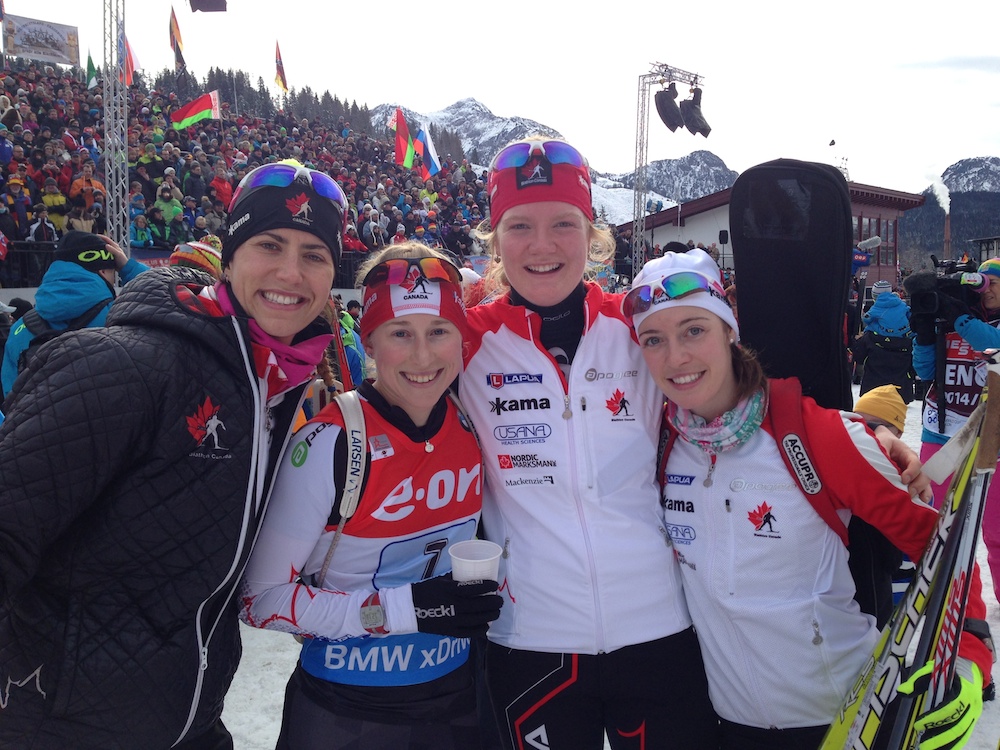
While the Germans drew a significant amount of attention with their win, two North American squads stood together near the finish, cheering their teammates on with each passing lap before waiting to congratulate their anchors as well.
Rosanna Crawford (Biathlon Canada) racing the second leg in the women’s 4 x 6 k relay at 2015 IBU World Championships in Kontiolahti, Finland. Despite a penalty, she brought her team from 14th to 11th, and the Canadians finished 10th. (Photo: Biathlon Canada/NordicFocus)
Canada’s second leg, Rosanna Crawford was one of them, standing near the finish and looking for her teammate Julia Ransom, who had anchored their team to 10th.
Audrey Vaillancourt had tagged Ransom in 10th, improving one place after Crawford put her in 11th at the second exchange. Ransom, a 22-year-old World Championships rookie, used two spares on each of her stages to help the team meet its personal goal: a top 10.
She held off Austria’s Katharina Innerhofer by 0.5 seconds to finish 10th, 3:39.5 behind Germany. In total, the Canadians used 10 spares and had one penalty (which came on Crawford’s standing stage).
“Megan [Heinicke] tagged me off into a great spot, [and I] came in prone … with the group,” Crawford explained.
She had entered her first stage around 12th after Heinicke tagged her in 14th, 33.8 seconds out of the lead. (The team’s first leg, Heinicke used a single prone spare and cleaned standing.) Crawford cleaned prone, then went on to use three spares in standing while trying avoid the penalty loop, which she ultimately had to ski around once.
“Standing, I came in and missed my middle shot and loaded my first spare quickly and missed,” Crawford explained. “As I loaded my last spare, I took my rifle down and shook my legs out and missed.”
Not only did the penalty loop cost her, but the three spares, which she estimated takes her six to 10 seconds to load apiece, set her back as well. Regardless, Crawford skied the sixth-fastest second leg to tag Vaillancourt in 11th, 1:08.6 behind the leader.
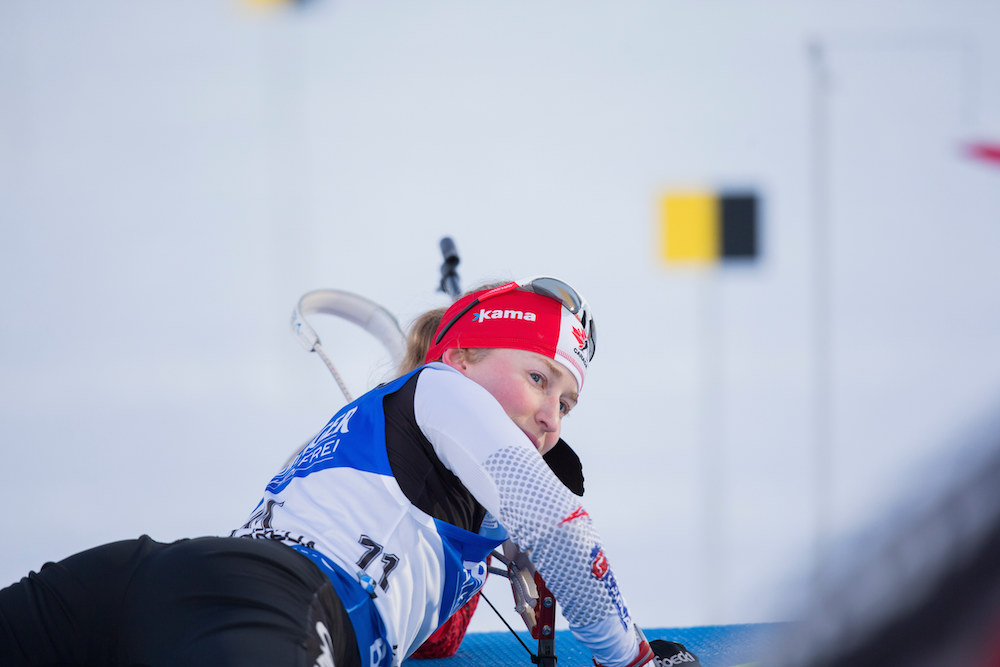
Audrey Vaillancourt (Biathlon Canada) during prone shooting earlier this week at 2015 IBU World Championships in Kontiolahti, Finland. She was the third leg of the Canadian women’s relay that finished 10th on Friday. (Photo: Biathlon Canada/NordicFocus)
Vaillancourt, 23, went on to use two prone spares and cleaned standing outright to bring the team to 10th, 1:45.3 out of first.
“I didn’t really know what place I was in at any time, it was just good to always have a pack of people [around me],” Vaillancourt said. “I passed people in the standing so that felt awesome. It’s always such a good feeling, like, ‘Yeah!’ … I was a little tired on the last lap, but I’m happy.”
Ransom used two spares in prone, rising to ninth, and then two more in standing to drop one spot to 10th.
“I saw eight and ninth ahead of me on the climbs,” she recalled. “You’re just gunning for those and didn’t look back.”
In her first World Championships relay, Ransom said she was “terrified” to anchor, “mainly because I saw the start list and saw a lot of medalists hanging out in the fourth [leg] with me.
“In zero I was pretty nervous, but you quickly fall back into race mode,” she added. “Even though you start with [Belarusian Darya] Domracheva, you put it aside. Once I was on the track and I could feel like I could ski like myself it was fun and I loved it.”
Rosanna Crawford (Biathlon Canada) trails Nadzeya Pisareva of Belarus during the second leg of the women’s 4 x 6 k relay at 2015 IBU World Championships in Kontiolahti, Finland. The Canadians went on to place 10th. (Photo: Biathlon Canada/NordicFocus)
Overall, the Canadians were pleased with their performance, with two relative newcomers on the team. While it’s Vaillancourt’s second World Championships, this season was her first full time on the World Cup.
“[Last night], we talked about that if we all bring our A-game, a top 10 is realistic and a top eight would be the perfect race,” Crawford said.
“I don’t think that we can say that we had a perfect performance as a team today, so I think that makes it even more awesome that we made our goal,” Heinicke said. “We have been mixing up our relays a ton this year. This is only the second time us four have raced together and we have never had this order. Lots of experiment; it’s been good.”
Dunklee Fastest First Leg
The Americans tied their season best in 12th, with Susan Dunklee, Hannah Dreissigacker, Annelies Cook, and Clare Egan. Despite starting in the seventh of nine rows at the start, Dunklee skied the fastest course time of all the first legs to put her team in third, 3.7 seconds behind Poland, which led through the first exchange.
“I almost prefer starting in one of the back rows,” Dunklee explained in an email after the race. “I love the rush of having to maneuver through the pack and chase people down. It just feels like a really fun game. It helps a lot that my fitness is in peak form right now, and the course suits my strengths with that big wall climb.”
Susan Dunklee (US Biathlon) follows Germany’s Franziska Hildebrand (r) into range for the first shooting in the women’s 4 x 6 k relay at 2015 IBU World Championships in Kontiolahti, Finland. Germany went on to win, and the Americans placed 12th to match their season best.
By the 1.3 k checkpoint, Dunklee had skied up to second behind Hildebrand.
“I don’t know how Susan just careened to the front of the pack like that,” Heinicke observed. “It was pretty impressive. I was in the second half and it was the most aggressive mass start I have ever been in, so much bumping and ski stepping and poles. It was a little bit chaotic and also exciting.”
Dunklee held her position in second entering the range for the first time, where she used two spares and had some trouble unhooking her sling from her arm. Dunklee left the range in 21st, 26.5 seconds behind Hildebrand, who cleaned without any spares.
The American spent the next lap skiing up to 12th before cleaning her standing stage to improve to seventh. Poland’s Monika Hojnisz cleaned her second-straight stage without any spares to take the lead, 2.4 seconds ahead of Russia.
Meanwhile, Dunklee left the range 14 seconds back in seventh. Over the next lap, she skied back up to third, tagging Dreissigacker 3.7 seconds out of the lead.
“I’m getting used to that; I expect Susan to hand off to me in the top five at least,” Dreissigacker said. “I should be getting better at it, and I still seem to be struggling with get being put in that position. I think I’ve always liked being one of the chasers not one of the chased.”
Coming into the range for the first time, Dreissigacker was fourth behind Poland, Italy and Russia, respectively. There, she had to use three spares to hit all of her targets.
“I kind of pulled off two shots accidentally, just way too fast with the trigger,” Dreissigacker explained. “I think I was a little excited, my fingers had gone a little bit number for some reason. … Using the third spare is always really bittersweet. You’re bummed that you had to use three, but you’re always so happy you hit that last one and didn’t do a penalty loop.”
Hannah Dreissigacker (US Biathlon) skied the second leg for the U.S. in the women’s 4 x 6 k relay at 2015 IBU World Championships in Kontiolahti, Finland. After receiving the tag from teammate Susan Dunklee in third, she came through the second exchange in 10th. The Americans finished 12th. (Photo: USBA/NordicFocus)
She left the range in 11th, 37 seconds behind Russia up front. In standing, Dreissigacker used two spares to head out for her final lap in 10th.
“Hoping that one of these days I can use not quite so many spares,” she said.
Dreissigacker tagged Cook in 10th, 1:06 out of the lead. Cook used two spares in each stage to hand off to Egan in 11th, 2:05.4 back.
“That is not like awesome shooting, but I think we all had a little bit of the nightmare of the last relay, where we had six penalty loops, in the back of our head,” Cook said, referring to the last World Cup relay in Oslo, Norway, where the Americans were in 18th before being lapped. “So we were all kind of like, ‘OK! I’m really happy that didn’t happen again!’ I felt really good skiing and it was fun. I felt like I was in the mix, which is exciting.”
In terms of team goals, she said they didn’t target a specific place.
“We didn’t do that many relays this year [and] we’ve got some new faces,” Cook said. “I think for us, it is just about getting experience … We have had a pretty steady relay team the last few years so now we are kind of rebuilding that up. Today we just wanted to have fun and to feel like after the race, we would all be in good moods and happy.”
In her first World Championships, Egan anchored the U.S. to 12th, 3:44.8 behind Germany and 0.8 seconds out of 11th. The 27-year-old US Biathlon development skier cleaned her first stage to move into eighth after prone, then used three standing spares, which put her back in 13th.
“I wish I had just used two [spares] because we would have been 10th instead of 12th,” Egan said, estimating it takes her about 20 seconds to load each spare. “That is my only regret. I got really close … I passed one person and I finished within a second [of 11th].
“This is my first relay that I have not had two penalty laps in standing. So big improvement for me,” she added. “I just tried to ski my own race and remember that I am always trying to gain experience.”
At the end of the day, Dunklee pointed out that 12th matched their best result of the season.
“It certainly wasn’t a perfect performance and there were several teams within reach ahead of us. I think it is good to be hungry for a higher place and know the possibility is there, but this was also result we can finish the season feeling proud of,” she wrote.
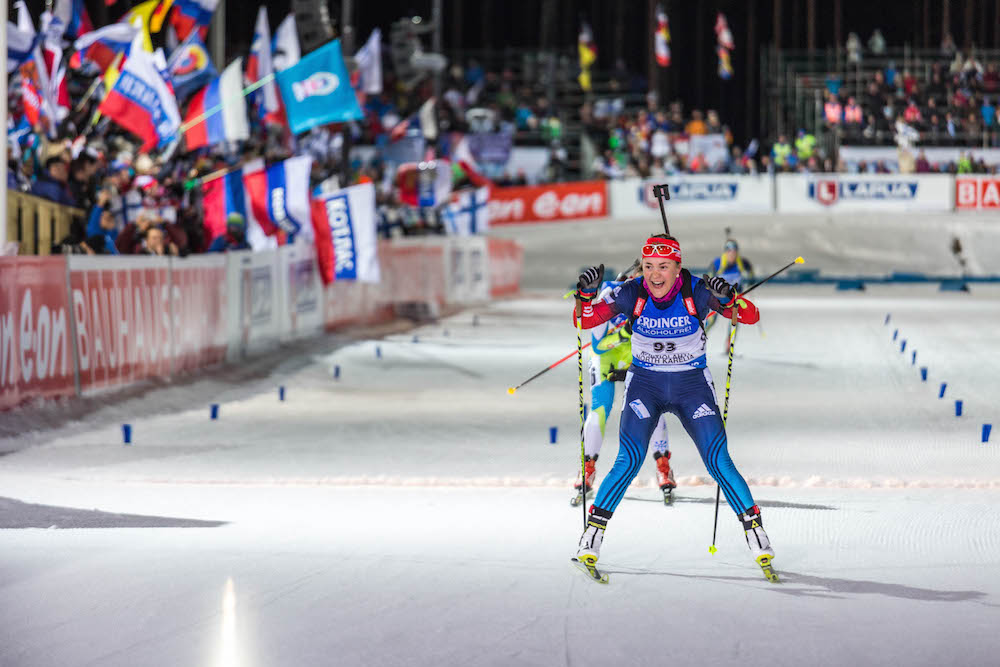
Russia’s Ekaterina Yurlova reacts after sealing her first career victory and podium on the World Cup level at IBU World Championships on Wednesday in the women’s 15 k individual in Kontiolahti, Finland. (Photo: Kontiolahden Urheilijat/Kari Kuninkaanniemi)
KONTIOLAHTI, Finland — When Ekaterina Yurlova earned two bronze medals at the IBU Open European Championships in Otepää, Estonia, her dad told her: “OK, now your next step is World Championship,” she recalled.
That was just over a month ago. On Wednesday, the 30-year-old Russian pulled out a surprise win to answer her father’s prophecy: a gold at 2015 IBU World Championships in the 15-kilometer individual. She had started 93rd of 105 women in the race and ended up as the only one with perfect 20-for-20 shooting.
“I said to him, ‘You’re crazy,’ ” Yurlova explained in a post-race press conference. “But now I think he’s not crazy.”
Yurlova herself looked stunned at the finish, holding her head and closing her eyes as it all set in at once. She had a great run throughout the evening race in front of 10,800 spectators — rising to third with a clean first shooting and the third-fastest course time on the first lap. After hitting all of her targets on her second stage, the Russian sat in fourth behind Italy’s Karin Oberhofer in first and the Czech Republic’s Gabriela Soukalova and Veronika Vitkova in second and third, respectively.
Fourteen seconds out of the lead after that first standing, she rose to second with a clean third stage. Soukalova, who started fourth and remained as a top contender from start to finish, cleaned those three initial stages as well, and leaving the range for her second-to-last lap, she was 15 seconds ahead of Yurlova.
The time gap went out the window when Soukalova came into the range for the last time and missed one for a one-minute penalty. While it took some time for Yurlova to tick off the laps 89 starters later, she ended up cleaning her fourth-straight stage to take the lead, 32.8 seconds ahead of Soukalova.
Ever since she finished, Soukalova had the time to beat in 41:55.4, holding off Finland’s local favorite Kaisa Mäkäräinen by 1.2 seconds. That time held up until Yurlova crossed the line 23.2 seconds faster in 41:32.2.
For the third time in her career, Yurlova cleaned an four-stage individual race. It was also her first podium and victory at the World Cup level. Her previous World Cup best was fifth in a mass start two seasons ago in Pokljuka, Slovenia.
“This is my first race of this World Championship and I wanted to be in podium,” she said. “It was my dream, but I never know that I can win.”
The women’s 15 k individual podium at 2015 IBU World Championships, with Russian winner Ekaterina Yurlova (c), silver medalist Gabriela Soukalova (l) of the Czech Republic, and Finland’s bronze medalist Kaisa Mäkäräinen (r). (Photo: Kontiolahden Urheilijat/Kari Kuninkaanniemi)
While Soukalova’s longtime lead at the finish didn’t stand, she said at the press conference that she was happy with silver. She and her team won gold earlier at these Championships in the mixed relay.
“It’s awesome and it was a really difficult season,” Soukalova said. “I didn’t think that I’m able to get a medal from this championship, but that’s nice.”
She wasn’t crushed when she was bounced from the lead by such a late starter. In fact, she didn’t realize she was in the hunt for gold until her last lap.
“I thought it’s gonna be really nice to [finish] in top five,” she said.
While Soukalova posted the fifth-fastest course time and Yurlova’s time ranked 19th (although her range time was notably quick in fifth), Mäkäräinen, who started 36th, was the fastest on course in the the five-lap race.
Hailing from the nearby city of Joensuu, where most of the World Championships accommodations are located fewer than 20 kilometers south of Kontiolahti, Mäkäräinen earned her first medal of the championships — bronze — 24.4 seconds off the win.
She cleaned prone but missed one on her first standing and another on her second prone before cleaning her final standing. The two misses put her two minutes back, and while she slipped into 11th after the third stage, she was back up to fifth leaving the range for the last time.
A fast last lap put her in contention with Soukalova for what looked to be the win at the time (well before Yurlova).
“In the first standing I had a lot of difficulties,” Mäkäräinen said in the press conference. “My legs were shaking right before I started to shoot. I missed the first target and I thought, ‘This is not going to work now,’ but I fight with every shot and I hit the last four. I was really lucky also there. And in the prone, I don’t really know what happened, maybe I was waiting too long, and the last shooting I don’t remember anything.”
She did remember hearing how far she was behind Soukalova going into the last lap. It was 27.2 seconds, to be exact.
“I never thought that I could be so close [at] the finish line,” Mäkäräinen said. “I knew that I did a good jump in a last loop so I wasn’t too sad about that.”
While she acknowledged she was slightly relieved with the medal (which she took by 0.4 seconds ahead of Italy’s fourth-place finisher Dorothea Wierer), Mäkäräinen added that wasn’t how she preferred to view her bronze.
“It was a new day today, new race, I did my job pretty OK,” she said. “I’m happy that I had a good day in the World Championships.”
Darya Domracheva of Belarus missed three on her first standing to slide into the 50’s overall after the second stage. By the third stage, she had recovered to 27th with another clean prone, but she had one more penalty on the last standing to finish 16th, ultimately 2:54.6 behind Yurlova.
Dunklee 12th for U.S.; Canada’s Heinicke Tallies Third-Straight Top 30
Susan Dunklee (US Biathlon) racing to 12th in the women’s 15 k individual on Wednesday at 2015 IBU World Championships in Kontiolahti, Finland. It was her best individual result of the championships so far. (Photo: USBA/NordicFocus)
American Susan Dunklee started 30 seconds after Mäkäräinen in bib 37. While she missed two standing to fall back into the 30’s, Dunklee cleaned her next two stages and missed one on the last standing to end up 12th (+2:43.0). She had the sixth-fastest course time (4.5 seconds behind Soukalova, who was fifth fastest on course).
While Dunklee called the early misses, “not an auspicious way to start,” she explained that they took the pressure off. She thought, “It’s not gonna be a perfect race, but I can just focus on doing my normal thing,” she explained in a post-race interview.
After her first prone, she caught a glimpse of the board her coaches showed her out on course, which indicted where her shots landed outside the target. For the next prone, she made a couple corrections.
During one lap, Dunklee skied with Germany’s Laura Dahlmeier (in bib 21) and Ukraine’s Valj Semerenko (in bib 20), which she said helped her push her tempo.
“There were times when I wanted to back off a bit, but Laura was pulling and gapping me a bit and I was like, ‘I can’t let her get a gap because I’ll lose the draft,’ ” Dunklee explained.
Dahlmeier went on to place sixth (+40.5) behind Russia’s Daria Virolaynen in fifth (+37.9). Semerenko finished 15th.
With her best shooting of the week so far and best individual result at these World Championships, Dunklee was pleased to be feeling back on track.
“My biggest problem the last couple days has been just getting my head back on straight and finding the fun again and the normal race feeling,” she said. Last weekend, she placed 42nd in the sprint and 34th in the following pursuit.
“The sun came out late afternoon today, and while we were warming up there was a soft, golden light and it made me really relaxed and happy,” Dunklee added. “I felt excited about the start of the race.”
Regardless of whether Wednesday’s result is enough to qualify Dunklee for the 30-person mass start on Sunday, she said she was happy. “I’m glad to have had a good one,” she said.
“While we were warming up there was a soft, golden light and it made me really relaxed and happy. I felt excited about the start of the race.” — Susan Dunklee, 12th
Canada’s Megan Heinicke tallied her third-consecutive top 30 of the week, placing 21st (+3:23.3) for her World Championships career best. She hit 19 straight shots before missing her final target.
Megan Heinicke (Biathlon Canada) racing to 23rd in the 7.5 k sprint at 2015 IBU World Championships on March 7 in Kontiolahti, Finland. In Wednesday’s 15 k individual, Heinicke placed 21st for a career best at World Championships (and at the Olympic level).
“I’ve hit 20-for-20 twice already this year so I feel like there was 15 thoughts going through my head, like, slow motion during the last shot,” she reflected. “I’m so, so happy with 19, but I’m pretty sure I missed the last shot because I was thinking, ‘Oh, I’m going to hit 20!’ ”
During the race, Heinicke wasn’t sure it was going so well. On her first lap, she heard her team’s staff tell her she needed to ski faster.
“I was like, ‘Oh gosh, this is going to be a disaster,’ and then actually, I kind of felt better lap by lap,” she said less than a week after recovering from a monthlong illness.
“I was prepared for way worse,” Heinicke said of World Championships overall so far. “I fought hard out there. I really delivered what I was able to. There’s always the ‘if’ thought: if I was in better shape and skiing four-percent faster, but I mean, I’m happy with it.”
Dunklee’s U.S. teammate, Annelies Cook was on track for a breakthrough performance after cleaning her first three stages. The third starter, she found herself in second after the third shooting behind Soukalova and at the end of the day, her time leaving the range for the second-to-last lap ranked sixth.
US Biathlon’s Annelie Cook (second from l) on the range with Slovakia’s Jana Gerekova (l), among others during one of her two standing stages in the 15 k individual on Wednesday at IBU World Championships in Kontiolahti, Finland. (Photo: USBA/NordicFocus)
However, in the final standing, Cook missed four shots — the first, second, fourth, and fifth — to fall toward the back of the pack. She ended up 47th (+5:26.8) with four penalties.
“My heart is a little broken,” Cook said afterward. “I blew it. I just wanted it so bad and I tried too hard. Classic case of wanting it too much. Everything else felt easy and relaxed. I tried to stay relaxed the whole race, not come into the range too gassed, and I think the conditions were really good today so that made it a lot easier …
“Sometimes biathlon is really mysterious,” she added. “You don’t know what makes one [race] good from the next, but the last stage was just bad. I was too tense and I was just trying to hard.”
World Cup rookie Clare Egan, also of the U.S., notched her second-best result of her career in 51st (+5:45.7) after back-to-back clean stages for her first prone and first standing. She went on to miss two in the third stage and two more in the final standing.
Clare Egan (US Biathlon) during one of two shooting stages in the women’s 15 k individual at IBU World Championships on Wednesday in Kontiolahti, Finland. She placed 51st for her second-best result of World Championships and her career. (Photo: USBA/NordicFocus)
“’I’m still learning, especially with the standing, so any time I can even just miss one in standing is great,” Egan said. “My best World Cup place coming into world champs was 73rd, and I’ve done way better than that so far so I’m really psyched.”
In placing 40th in the sprint last Saturday, she qualified for last the pursuit, where she placed 52nd. While Wednesday marked another top result for the 27-year-old Egan, she said it was her brother’s presence that made her day.
“My brother Graham flew in today from New York so he was out there on the course with an American flag,” Egan said. “That was my favorite part of the race.”
Also for the U.S., Hannah Dreissigacker placed 67th (+6:49.7) with five penalties (2+1+1+1).
“Ones are OK, twos are bad,” Dreissigacker said of the number of misses per stage. “That’s sort of where my standard is for myself. If I had [missed one each time], I would be, like, not a good day, but not bad. But five, I mean, that’s too many.”
She described feeling flat during the race and attributed it to possibly hunger.
“I don’t think I ate enough because it’s such a late-in-the-day race,” she said of the 6:15 p.m. start. “I was getting kind of hungry before the race and I felt like I kind of ran out of energy. I’m not sure I timed that quite right. I should have known better…
“For some reason, I’m just sort of struggling a little bit here in general,” Dreissigacker added. “Today was tough because I actually felt OK for the most part. The last three stages I missed the last shot every time, which is sort of a classic biathlon mistake. I think I guess I must not have followed through enough.”
Two Canadians had five penalties as well: Audrey Vaillancourt (2+0+1+2) and Julia Ransom (2+1+1+1). While Vaillancourt placed 79th (+8:05.3), Ransom in her first World Championships was 84th (+8:23.9).
“It’s just a bad week on the range,” Vaillancourt said. “It’s hard to start with two misses, and you’re like, ‘Nice, now I have three more bouts to go.’ ”
Typically a strong shooter, she added that sometimes that’s the way biathlon goes.
“Some weeks you just don’t get that feeling of, it’s easy,” she said.
And Vaillancourt didn’t think her off week had anything to do with the stakes at World Championships.
“I’ve been fighting all year to get my place here. It’s not like I’ve been thinking of only World Champs all year,” the 23 year old said. “To me, it doesn’t really make a difference if I do super well on the World Cup or super well at World Champs because it’s not like I’m really close to a top eight.”
After the pursuit three days earlier, in which she placed 57th, Ransom explained she focused on getting into a “better headspace” for the 15 k.
“I was so overwhelmed and I was excited, but also really distracted [during the pursuit] so I kind of brought it together and I really wanted to focus on pacing,” she said. “We don’t do a lot of individuals; this is definitely the hardest one I’ve ever done, and I think I found a happy medium with the pacing. Maybe a little too easy, but I’m learning.”
Like several North Americans, she struggled with her first prone and had two early penalties.
“The wind had changed on me, which I wasn’t expecting,” Ransom said of her first shooting. “I [made] a big correction for prone … I’ve been struggling with standing the last couple weeks, so I’m glad I kind of brought it back to a half-decent level. It’s a work in progress. These World Champs have been an interesting experience.”
Perhaps the most disappointed North American of the day was Rosanna Crawford, a medal hopeful, who finished 87th (+9:05.1) with eight penalties (2+2+2+2).
“It was really bad,” she said.
Before World Championships, she and her boyfriend Brendan Green, also on the Biathlon Canada national team, discussed the worst that could happen in Kontiolahti, Crawford explained.
“The worst that could happen is a really bad race,” she continued. “It’s not that bad in the scheme of life, but this is something I’ve dedicated my whole life to and to not achieve my goals is disappointing. I feel like I’m letting down everyone who’s helped me get here, and I know I’m capable of so much more.”
On Tuesday, Crawford watched a Finnish TV interview with U.S. cross-country skier Kikkan Randall.
“Kikkan was talking about how disappointed she was with the Olympics, and yeah, you set these big goals, but then you also need to set the goals of being able to leave a championship happy,” Crawford said. “I don’t think I did that. I didn’t set those goals and even if I had, I didn’t achieve them. I didn’t do what I know I’m capable of today, and I really wanted another chance in the mass start and now that’s not gonna happen.”
The final race of World Championships, the 12.5 k women’s (and 15 k men’s) mass start includes the top-15 ranked competitors on the World Cup circuit with 15 others who do exceptionally well at worlds. The sprint and pursuit carry a hefty weight (with the sprint factoring into the start of the pursuit), and the individual races are the last ones to count toward the mass start.
Based on a provisional start list, Heinicke and Dunklee have qualified for Sunday’s mass start in 26th and 30th, respectively.
France’s Marie Dorin Habert celebrates her second win in two-straight races at 2015 IBU World Championships after taking gold in Sunday’s 10 k pursuit in Kontiolahti, Finland. She finished 15.3 seconds ahead of Germany’s silver medalist, Laura Dahlmeier. (Photo: Kontiolahden Urheilijat/Jarno Artika)
KONTIOLAHTI, Finland — Ask anyone who follows biathlon who the favorites were going into the 2015 IBU World Championships, and they would have been sure to mention Finland’s Kaisa Mäkäräinen and Darya Domracheva of Belarus. Of course there were others, but Marie Dorin Habert — the French skier who gave birth to her first child in September?
She couldn’t believe it, either.
“I don’t have words,” Habert, 28, said in a press conference following her third medal in as many races at World Championships and her second-straight gold. “It’s just crazy for me, and everything is right with me in these World Championships.”
After winning Saturday’s 7.5-kilometer sprint and starting with a 10-second lead in the women’s 10 k pursuit on Sunday, Habert kept herself in contention for another victory by hitting all of her targets in her first two stages.
The competitor who started closest to her, Weronika Nowakowska-Ziemniak of Poland, held her own in second for the first two stages as well, despite missing one on her second prone. She came out of the penalty loop 43.8 seconds after Habert, yet remained in second until the third shooting.
There, Habert came into standing first and missed two targets. Her clean streak had ended and some 12,800 spectators in the stands wondered what would become of Habert.
Germany’s Laura Dahlmeier racing to silver in the women’s 10 k pursuit on Sunday at 2015 IBU World Championships in Kontiolahti, Finland. (Photo: Kontiolahden Urheilijat/Kari Kuninkaanniemi)
Meanwhile, Germany’s Laura Dahlmeier, who started fourth, 29 seconds after Habert, had moved into third by the first stage despite an early prone miss. Dahlmeier cleaned the second prone as well as the first standing to leave the range 20 seconds behind Habert, who had just completed her two penalty loops.
“When I missed two, I said, ‘Ooh! It’s bad for me. I have to be fast,’ ” Habert recalled.
She went on to ski the second-fastest course time on her third lap and remained ahead of Dahlmeier. Both missed one in the second-and-final standing, and Habert headed out on her third lap with a 27.3-second lead.
Meanwhile, Nowakowska-Ziemniak had two additional penalties on her third stage to slip to third, 43.8 seconds behind Habert. While she cleaned her final stage, she left the range in fourth, five seconds behind Russia’s Ekaterina Shumilova, the only woman to hit all 20 of her targets.
The final clean stage lifted Shumilova, who started sixth, from fourth to third — until Nowakowska-Ziemniak tracked her down on the final lap.
“I asked myself, ‘Weronika, do you fight, or do you get just a fourth place and it’s still OK?’ ” Nowakowska-Ziemniak reflected in the press conference. “After one second, I answer to myself, ‘Of course, I am fighting.’ I was trying to catch [Ekaterina] as fast as possible and I did it quite fast … On the uphill, my coach told me she’s twenty meters behind me, so I realize that, yes she fall down, and then I push even harder to not let her catch me.”
“I asked myself, ‘Weronika, do you fight, or do you get just a fourth place and it’s still OK?’ After one second, I answer to myself, ‘Of course, I am fighting.’” — Poland’s Weronika Nowakowska-Ziemniak, pursuit bronze medalist
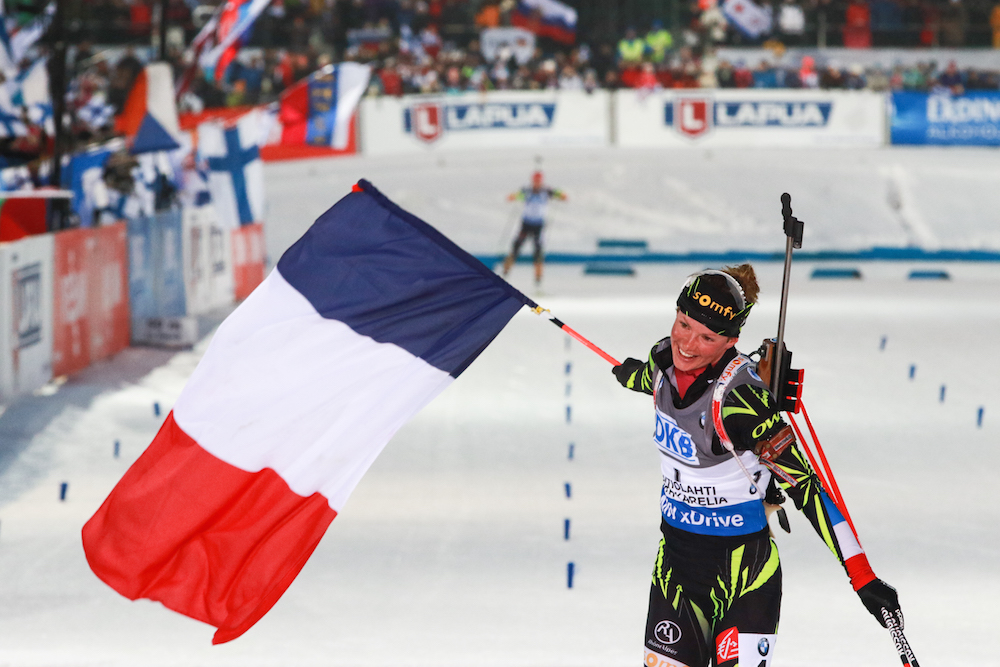
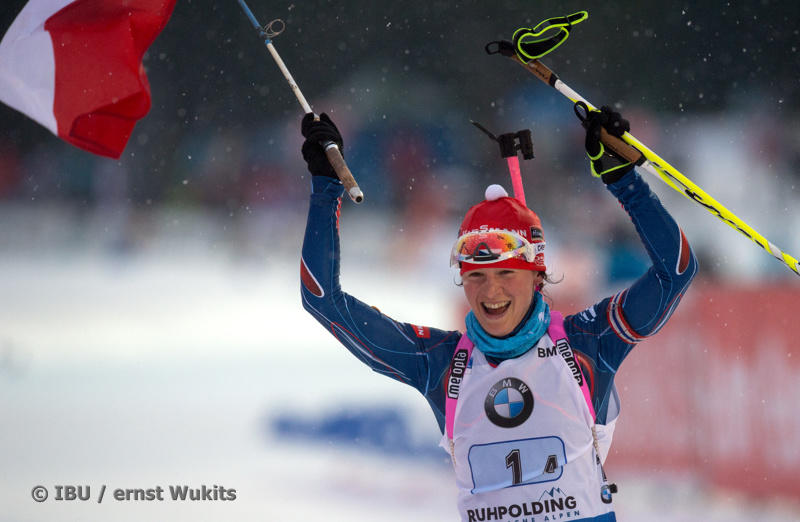
While Nowakowska-Ziemniak left the Russian behind in the race for bronze, Habert continued to forge ahead up front, entering the finishing straight alone and grabbing a large French flag from the sidelines. She waved it proudly and completed her trifecta of medals (silver in the mixed relay, gold in the sprint, and now gold the pursuit), crossing the line first in 30:07.7. Dahlmeier finished 15.3 seconds later for silver, her first World Championships medal.
Poland’s Weronika Nowakowska-Ziemniak en route to bronze in the women’s 10 k pursuit at 2015 IBU World Championships in Kontiolahti, Finland. (Photo: Kontiolahden Urheilija/Jarno Artika)
“I’m totally happy. It was a big dream since I was a little child,” the German said in the conference. “Now I have this silver medal and it’s a perfect day for me, and also, I’m really happy for Marie. It’s perfect.”
Nowakowska-Ziemniak finished 31.6 seconds after Habert and 17.1 seconds ahead of Shumilova for bronze, her second medal in as many races after notching her first World Cup-level podium on Saturday.
“It’s crazy because I was waiting so many years to be on the podium and yesterday I get the first medal and today the second,” Nowakowska-Ziemniak said. “I was feeling much better on the track, but the shooting range I wasn’t perfect, but it’s still a medal so I’m really happy.
“You can’t imagine how happy people in Poland were with the medals because in the winter sport, this winter wasn’t so good for the Polish teams, for ski jumpers and cross-country skiers,” she added. “So the medal in biathlon, it was something really, really important for the association and for my teammates.”
Marie Dorin Habert of France racing to gold in the women’s 10 k pursuit at 2015 IBU World Championships on Sunday in Kontiolahti, Finland. It was her third medal in as many races at these World Championships and second-straight gold.
Habert simply stated: “I’m more happy than yesterday.”
Saturday’s sprint bronze medalist, Valj Semerenko started 20 seconds after Habert and ended up 19th (+2:23.8) after missing three on her first prone. She had another penalty on her second stage, then cleaned her first standing before missing two more for a total of six penalties.
Mäkäräinen could lay claim to the most impressive ski of the day, racing up from 35th to 12th with the fastest overall course time. She finished 1:28 behind Habert with two prone penalties and a standing miss.
Domracheva had the second-fastest course time, 33 seconds slower than Mäkäräinen, yet rose from 25th to finish seventh with two total penalties — one on the second prone and another on the second standing.
Gabriela Soukalova of the Czech Republic improved from 18th to fifth (+58.0) with a single miss on the first stage, and Germany’s Franziska Hildebrand went from 10th to sixth (+1:00) with two penalties.
Despite temperatures around 40 degrees Fahrenheit with misting precipitation, conditions were firmer and even icy for the women’s race — which followed the men’s pursuit earlier in the afternoon.
Crawford, Heinicke in the Top 30
Rosanna Crawford (Biathlon Canada) on her way to 25th in the women’s 10 k pursuit at 2015 IBU World Championships in Kontiolahti, Finland. She started 32nd.
Among the North American women, Rosanna Crawford of Canada knocked off seven places to finish 25th (+2:51.5) after starting 32nd, 2:13 after Habert.
While she missed two early prone shots, Crawford cleaned her second stage to move back into the top 30. One more miss on her first standing put her in 27th leaving the range, and she proceeded to clean her final stage.
“On my first prone, I shanked one to the left, one to the right and one to the center,” Crawford explained. “Usually when I see that on the board I say, ‘Oh you idiot, just hit the frickin’ targets,’ and I did.”
All things considered, with the sixth-fastest range time and 24th-ranked course time, she said she was happy.
“To be 32nd [yesterday] and two-thirds back was very surprising so I was happy to make some points and still know I’m in it for the rest of the championships,” she said. “Two less misses on that first one would have been glorious.”
In doing so, Crawford would have matched her boyfriend Brendan Green’s 95-percent shooting in the men’s pursuit. “I’ll let him have it this time,” she said.
Also for Biathlon Canada, Megan Heinicke finished in the top 30 for the second-straight race after starting 23rd. She ended up 28th (+3:19.4) with 90-percent shooting, missing one early prone and another target on her last standing.
Megan Heinicke (Biathlon Canada) en route to 28th in the women’s 10 k pursuit at 2015 IBU World Championships in Kontiolahti, Finland. She started 23rd.
“I’m … relieved,” Heinicke said. “Two times in the top 30, I’m really glad with that and considering my fitness coming in, I basically feel like I put pretty close to my best out there. Tried to ski tactically, skied behind people when I could.”
Sick for much of the last month, she explained her expectations for her skiing form were low coming into World Championships.
“I need to count on the shooting and I’m really glad I brought it together,” she said. “I’m kind of sad about the prone miss because that one was really on me, and I was like, ‘Oh dang it, you just did that,’ but the standing miss, I don’t actually know what happened so I’m not gonna beat myself up about it either way.”
On most of Heinicke’s best days, there’s a common theme: her strength in shooting. While she excelled in shooting as a junior, she said she struggled with it in the last few seasons. However, this season, she felt more at ease.
“I’ve had some big changes in my life recently and I’m feeling a lot more relaxed and a lot more balanced,” Heinicke said. “I’m under a lot less pressure, internal and external, and I’m just enjoying it. Instead of standing there, like, ‘Please hit this, let it be OK,’ or really worrying about results, I’m way more task-oriented and I’m like, ‘Oh yeah, I worked on this, and I’m confident.’ ”
Dunklee Third-Fastest Skier
American Susan Dunklee had the third-fastest ski time after Mäkäräinen and Domracheva, and improved from starting 42nd to finishing 34th (+3:58.1) despite six penalties.
Susan Dunklee (US Biathlon) started 42nd and skied up to finish 34th in the women’s 10 k pursuit at 2015 IBU World Championships in Kontiolahti, Finland.
“The prone shots that I missed were really bad shots,” Dunklee said after missing two in each of her first two stages. She went on to miss two apiece in both standing stages.
“Skiing felt better today. The shooting was more normal speed, and I’m really happy after yesterday,” she added. “You start getting this little seed of doubt in your mind about your shooting ability when you pull a stunt like that, so I was glad to have normal-feeling shooting even if it wasn’t a great percentage.”
While 42nd wasn’t where she had hoped to end up in the sprint, which has implications for next Saturday’s mass start (as does the pursuit), Dunklee made sure to push to the end.
“Partway around the last loop yesterday, I reminded myself, ‘You are a fighter. I don’t care how you’re doing, that’s part of who you are and you’ve got to live up to that today,’ ” she recalled. “So that’s what I did.”
The second U.S. woman in her first-ever pursuit, Clare Egan started 40th and finished 52nd (+6:29.2) with seven penalties (1+1+3+2).
Canada’s World Championships rookie, Julia Ransom placed 57th (+8:02.8) after starting 52nd. She also missed seven (1+2+2+2).
“My legs were basically cooked from yesterday,” Ransom said. “To have consistent misses, that was hard and I feel like it was something that I had to get out of my system. It was my first pursuit on the World Cup and I had to pay my dues.
“I really enjoyed racing,” she added. “There are some parts where you miss and you’re near the back and you want to cry, the bottom lip starts to quiver a bit, but at the end of the day I’m proud that I made it here.”
With two days off until the next race in Kontiolahti (the women’s 15 k individual), most of the racers were excited for a break.
“I’m going to start with a massage and go from there,” Ransom said.
Hannah Dreissigacker (US Biathlon) racing to 33rd in the IBU World Cup 15 k individual on Thursday in Oslo, Norway. Two days later, she shot a perfect 10-for-10 to place a career-best 16th in the 7.5 k sprint. (Photo: USBA/NordicFocus)
Spectacular doesn’t need to special, at least that’s how Hannah Dreissigacker felt about Saturday’s 7.5-kilometer sprint at Holmenkollen in Oslo, Norway.
If she simply approached the second race of the three-day IBU World Cup weekend like it was any other, the 28-year-old US Biathlon member figured she had as good a shot at ever at a good day.
What she didn’t realize was coming was a career best.
“It’s a good feeling to hit all the targets,” Dreissigacker said on the phone following her 16th-place finish on Saturday. The result topped her previous best of 17th in the sprint in Pokljuka, Slovenia, in mid-December, when she also shot a perfect 10-for-10.
On Saturday, Dreissigacker had a couple of special people to celebrate with; her parents and boyfriend Nils Koons arrived in time to watch her race at Holmenkollen.
“I’m really happy right now … I think happiness always helps being in a good mental place racing,” she said.
The 39th starter out of 96, Dreissigacker experienced what she considered “more consistent” conditions than Thursday’s individual and “slightly foggy, but we couldn’t see the targets in practice yesterday,” she said. “I was just happy to be able to see the targets.”
Just like every other race, she tried to make each of her trips to the range during the sprint feel like she was on autopilot. She went through her checklist: checking the wind flags, thinking about breathing, removing her poles, and getting into position quickly.
“I’ve been trying lately to just be confident shooting and shoot pretty fast, not shoot as fast as I can, but just not take much time,” Dreissigacker said. “I shoot better when I’m fast. I kind of always come back to that as something to focus on — you want to stay in a good rhythm.”
Her range and shooting times ended up being the eighth and ninth fastest overall, respectively, and she was one of nine women in the top 20 to hit all 10 targets. Two days ago, Dreissigacker finished 33rd in the 15 k individual with flawless shooting except for one stage — her second, where she missed three.
That frustrated her somewhat, yet she knew she wasn’t far off from a perfect race.
“I knew that the clean stages were possible so I just decided to just act normal out there,” she said. “It’s funny how it can feel easy when you’re doing it because you feel like you’re doing what you always do and it works … Some days it just comes together.”
After cleaning her second-straight stage, Dreissigacker heard her coaches tel her she was in 10th, about five seconds out of sixth.
“That’s a pretty exciting split to get,” she reflected. She finished 12th and ultimately placed 16th, 1:00.1 behind winner Darya Domracheva of Belarus.
Less than 10 seconds separated her from sixth, and four others were within two seconds of Dreissigacker in 17th through 20th.
“I knew the race was really tight and in the end, I know there was like 10 places in 10 seconds right around me,” she said. “It just makes you realize those extra seconds on the skis are really important.”
Overall, her course time ranked 41st, and she explained her ski speed had improved since the beginning of the season. “I think that it can keep getting faster, hopefully for World Championships [from March 3-15], I think it will,” she said.
Crawford 1.6 Seconds Out of 10th
Canada’s Rosanna Crawford racing to fourth on Dec. 18 in the IBU World Cup 7.5 k sprint in Pokljuka, Slovenia. In Saturday’s sprint in Oslo, Norway, she placed 13th. (Photo: Christian Manzoni/NordicFocus)
Canada’s Rosanna Crawford raced to 13th on Saturday with a single standing miss and the 18th-fastest course time overall. With a clean prone, she stood 15th overall after the first stage, then improved to 14th with the 13th-fastest course time on her second lap and one penalty on the second stage.
“My legs were feeling a bit heavy today, but I knew that I wanted to start hard,” Crawford wrote in an email. “I felt like I really made up time on the downhills and flats in the Thursday’s race, so I made sure to really push over the top of hills and push really hard on the rolling flats. … None of the hills on the 2.5km loop are too long, so you really can keep a good tempo going.
“I missed my first shot standing, just think I wasn’t quite ready for it, should have taken one more breath, but happy to hit the next 4,” she added.
The 20th starter, Crawford crossed the finish line in sixth, but was pushed back 13th, 54.9 seconds behind Domracheva and 1.6 seconds out of 10th (which Ukraine’s Valj Semerenko, Russia’s Daria Virolaynen, and Slovakia’s Jana Gerekova tied for). She was 1.8 seconds from ninth.
“It’s great to add another top 15 to my resume!” Crawford wrote.”I feel like things are starting to make the turn again, which is good for the confidence … I know a biathlete shouldn’t complain about 90%, but the number of times I’ve hit 9/10 is starting to get a bit annoying! Hopefully I hit that magic 100% in World Champs.”
Darya Domracheva of Belarus celebrates her her eighth IBU World Cup win of the season in Saturday’s 7.5 k sprint in Oslo, Norway, which put her on top of the overall IBU World Cup standings. (Photo: IBU/Christian Manzoni)
Domracheva stole the show for the eighth time this season with clean shooting and the third-fastest course time. After starting 32nd, she was one of more than 30 women to clean prone, and after that first stage, Norway’s Tiril Eckhoff led by 1.6 seconds over Poland’s Weronika Nowakowska-Ziemnia. Domracheva remained three seconds back in fourth (after Russia’s Olga Podchufarova in third).
Another perfect stage moved Domracheva to first, 16.2 seconds ahead of Germany’s Laura Dahlmeier in second, and their order remained in tact through the finish with Domracheva sealing the win in 20:35.7.
Dahlmeier in bib 50 took second, 14.3 seconds back, for her fourth podium in the last six races, and France’s Marie Dorin Habert in bib 11 tallied her first podium since having a child this summer in third (+29.9) with one standing penalty.
For the fifth-straight race, Dorin Habert’s ski time ranked fourth after the Czech Republic’s Veronika Vitkova (who finished 21st with three penalties), Finland’s Kaisa Mäkäräinen (who placed 24th with three misses) and Domracheva, respectively. Her French teammate, Anais Bescond finished fourth (+32.6) for her fifth top-five the season with clean shooting, according to RealBiathlon.
“I am a happy lady right now,” Domracheva told the IBU after the race, which moved her to first in the overall World Cup standings, 10 points ahead of Mäkäräinen. “I was not thinking so much about the competition, just focused on my own race and wish to hit all of the prone targets which I did today … This is a really good place for me … a really good day.”
On Thursday, Domracheva placed second in the individual, 1:18.3 behind Mäkäräinen.
Marie Dorin Habert of France racing to third with the fourth-fastest course time on Saturday in the women’s 7.5 k sprint in Oslo, Norway. (Photo: IBU/Christian Manzoni)
A year ago, Dorin Habert announced her pregnancy at Holmenkollen. “Last year, I did not expect that I would be at this level so quickly,” she told the IBU on Saturday. “I have worked hard and everything is possible now.”
Canada’s Audrey Vaillancourt cleaned her second-straight race to place 36th (+1:30) for her second-best result after a career-high 30th on Thursday.
While the confidence she built on Thursday helped, she explained in an email that a sprint is inherently different than the 15 k individual, so her strategy had to change — but some things remained the same.
“Once again I wanted to take the race step by step, and give my best for each one,” Vaillancourt wrote. “So basically not be thinking about my next shooting bout while skiing and vice-versa. Also focus on each shot separately again.”
She ended up clocking the third-fastest overall shooting time and sixth-fastest range time.
“I was feeling extremely confident, and that showed on my shooting speed,” she wrote. “I think I made up a lot of time there. When I left the range I thought : okaaaay next step GIVE IT ALL.”
On her last lap, she heard her wax technicians tell her she was in 30th. Despite finishing 36th, she said she wasn’t surprised. “There was probably 5 girls within a second around me,” she wrote. “I am very satisfied with my placing, I gave all I could and everything went as planned today.”
Canada’s third woman, Megan Heinicke placed 68th (+2:30.7) with three penalties (1+2), and Sarah Beaudry was 80th (+3:11.5) with one miss in each stage.
Annelies Cook was the second American in 65th (+2:28.8) with three misses (2+1). A day after her 29th birthday, Susan Dunklee finished 69th (+2:32.5) with four misses (3+1), and Clare Egan was 91st (+4:40.9) with six penalties (2+4).
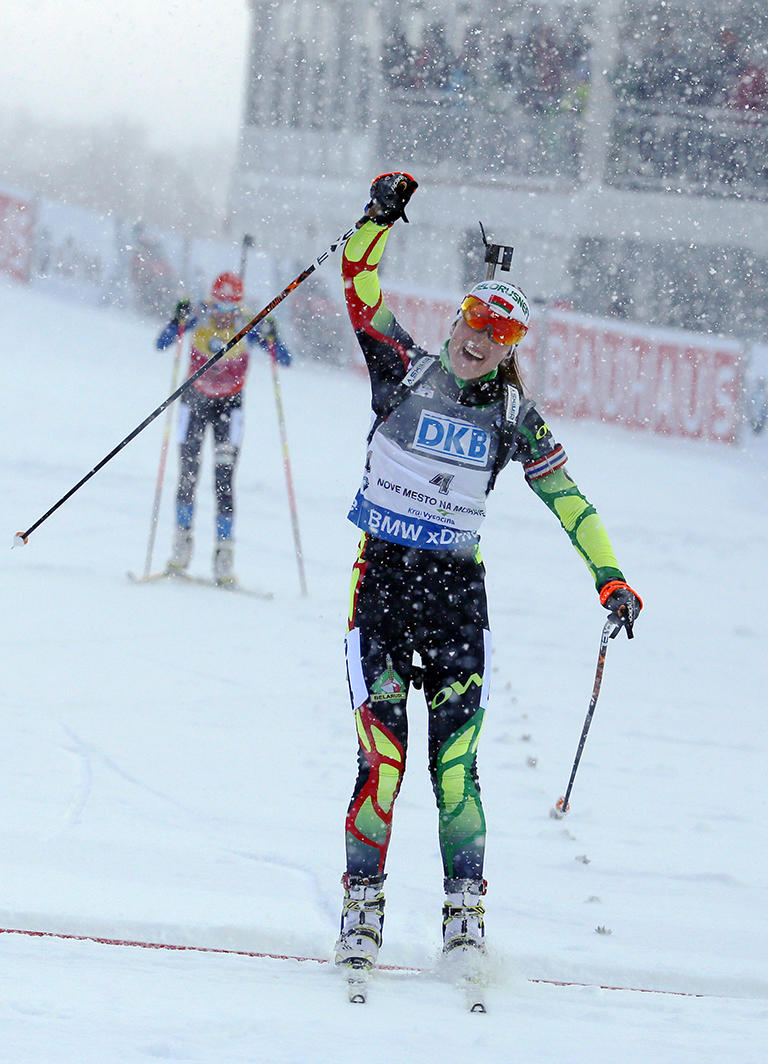
Darya Domracheva (Belarus) celebrates her 6.8-second pursuit win over Finland’s Kaisa Makarainen on Sunday at the IBU World Cup in Nove Mesto, Czech Republic. (Photo: IBU/ Květoslav Frgal)
No amount of snow, wind or penalties was going to hold Darya Domracheva back on Sunday, at least that’s the way the Belarusian attacked the women’s 10-kilometer pursuit at the IBU World Cup in Nove Mesto, Czech Republic.
Second in the overall World Cup to Finland’s Kaisa Mäkäräinen, Domracheva started fourth in the pursuit, 23 seconds after Germany’s Laura Dahlmeier, who won Saturday’s sprint to start first. Another German, Franziska Hildebrand went out second, one second back, and Veronika Vitkova of the Czech Republic started third, 14 seconds behind.
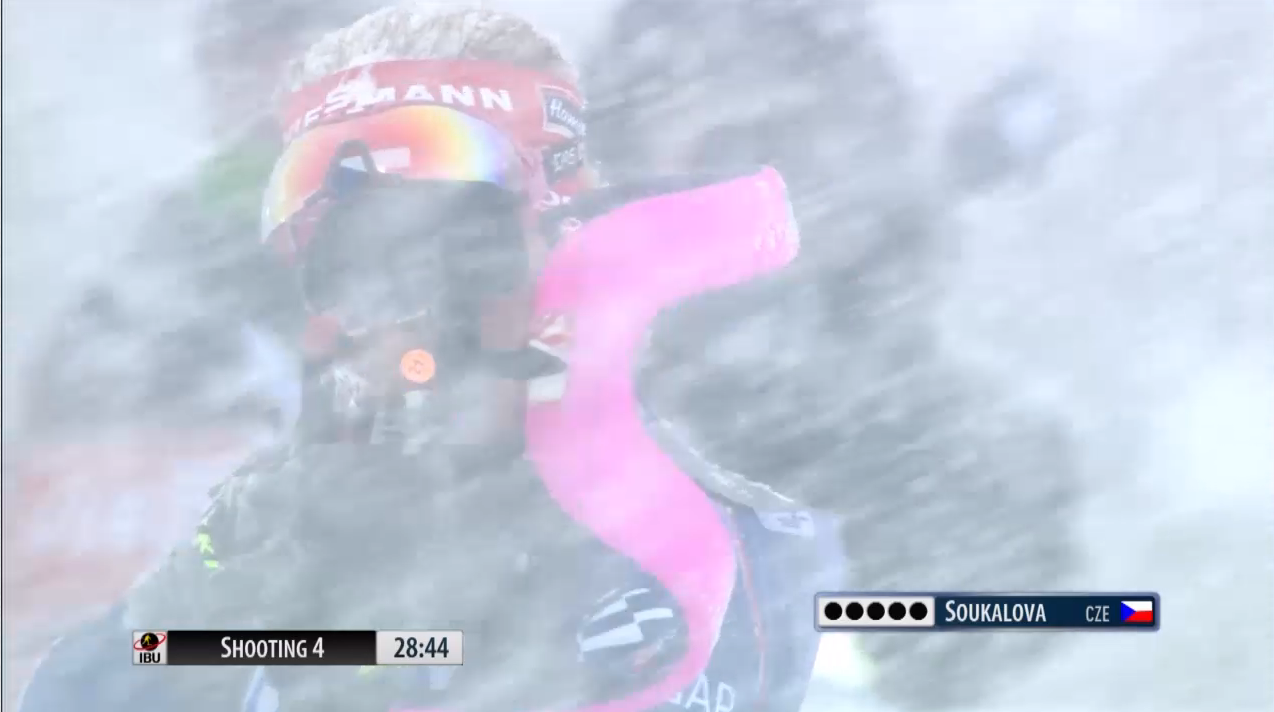
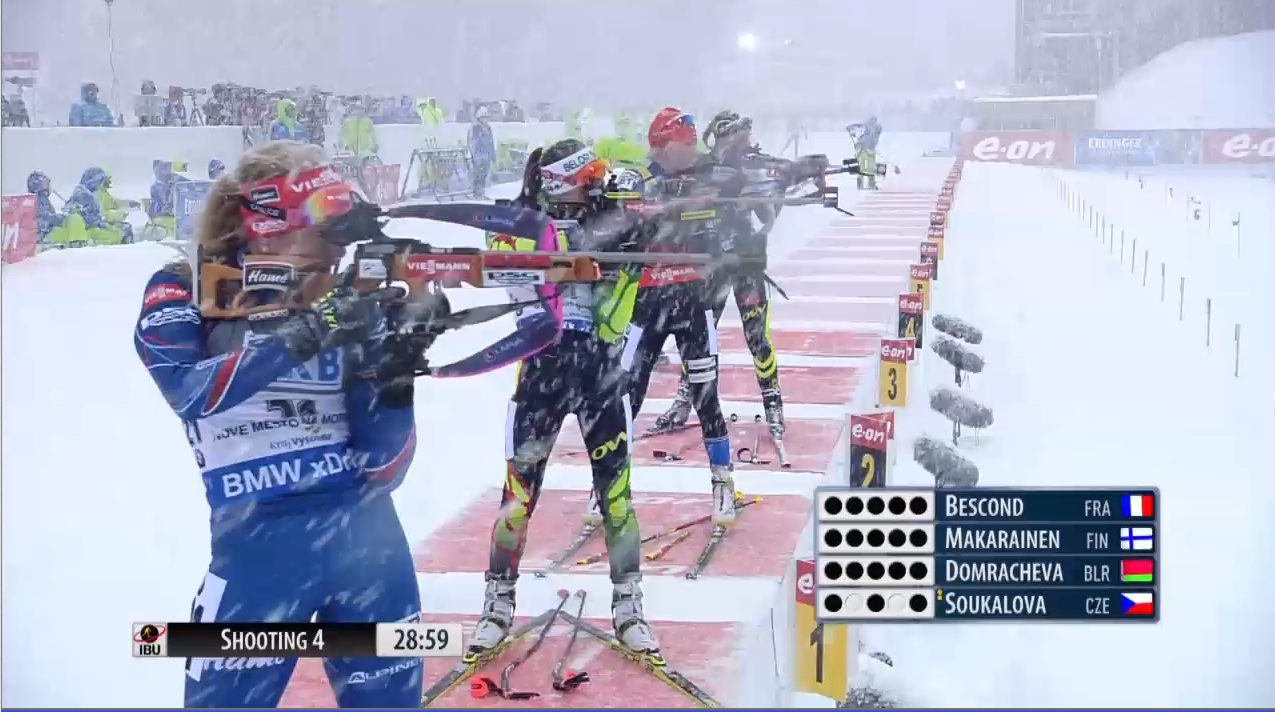
The beginning of the race was relatively mild weather-wise, with sun at the start, but by the third of four shooting stages, competitors found themselves at the epicenter of a blizzard.
“It was a crazy day out there!” US Biathlon’s Hannah Dreissigacker wrote in an email. “We slid off the icy road in our van on the way to the start, luckily only half a k away so we walked from there. Then it was a total blizzard during zero. Then it got sunny for the start of the race, but then back to blizzard. … I’ve never really seen anything quite like it.”
With snow increasingly blowing into athletes’ eyes as well as their rifles, the pursuit became more about who could keep it together rather than who could execute the perfect race. None of the 51 female finishers hit every target.
Gabriela Soukalova (Czech Republic) cleaned three-straight stages before missing two on the last standing to slip from first to third, then fifth at the finish of Sunday’s 10 k pursuit in Nove Mesto, Czech Republic.
That meant Domracheva couldn’t rely on shooting, and she didn’t need to. Even with two early prone misses that set her back to 12th, she rebounded to sixth with a clean second stage.
Entering the range for the first standing in the top four, she missed one, but moved into third. Domracheva left the stadium 19.3 seconds behind the Czech Republic’s Gabriela Soukalova, who cleaned her third-straight stage to take the lead from Hildebrand, who led from the first shooting.
France’s Anais Bescond also cleaned the first three stages to leave the range in second, 3.6 seconds after Soukalova. While the Czech extended her lead on Bescond over the next lap, Domracheva began to close on them both, coming into the final stage in second, less than 14 seconds behind.
Gabriela Soukalova (l) of the Czech Republic and Darya Domracheva (second from l) of Belarus go head-to-head in the final shooting stage of the women’s 10 k pursuit at the IBU World Cup in Nove Mesto, Czech Republic.
There, Soukalova missed two, and that cost her.
With the snow still falling so heavily it caused Hildebrand to crossfire and hit Vitkova’s targets (which led to a six-minute penalty for Hildebrand and Vitkova earning 52 seconds back at the finish), Domracheva missed one for her fourth penalty of the day.
She rounded the penalty loop quickly and headed out on the last lap first, 15.7 seconds ahead of Mäkäräinen, who also missed one for her fourth-total penalty.
Soukalova chased them both in third, 18.6 seconds back, along with Dahlmeier, who cleaned the last stage to leave the range two seconds later.
Over the next kilometer, Mäkäräinen closed the deficit to 14.2 seconds, and then 9.1 seconds with half a kilometer remaining. Domracheva continued to power ahead up front, skiing directly into a headwind along the course’s long climb, and ended up finishing first, 6.8 seconds ahead of Mäkäräinen, in 35:22.3.
“On the last loops it was so soft that on the last uphills and the poles fell down through the snow and you got no push or no glide with your skis,” Domracheva told the IBU. “It was a little bit hard race … [but] you have to fight to the end; you still have a chance.”
Mäkäräinen posted the fastest-course time overall, 17 seconds faster than Domracheva in second.
“If I would have cleaned that [last] stage, I would have been first, but I missed,” Mäkäräinen told the IBU.
Dahlmeier overtook Soukalova by the 9 k mark for third, 14.9 seconds after Domracheva, finishing with three penalties. Her German teammate Vanessa Hinz missed just two on the third stage to place fourth (+24.0), and Soukalova finished fifth (+33.2).
“The early loops are not so important,” said Dahlmeier, who stayed in the top three through the first two stages. “It is most important to have a good race in the last loop.”
Dunklee 18th for U.S.
American Susan Dunklee (r) during the first of five laps in the women’s 10 k pursuit on Sunday at the IBU World Cup in Nove Mesto, Czech Republic. She started ninth and finished 18th.
American Susan Dunklee skied the third-fastest course time on the last lap to place 18th. Back in 27th after two early prone misses, she improved to 19th by the last stage, then finished 1:54.9 behind Domracheva.
Dunklee started ninth, 46 seconds after Dahlmeier, but slipped to a minute and 35 seconds back after the first prone stage. She went on to clean her second prone to improve to 20th, then missed one in the first standing and two more on the last stage.
“It was a tough day and I had to keep reminding myself that everybody else out there was having a far from perfect day too,” Dunklee, who ranks 15th in the overall World Cup, wrote in an email. “The new snow made for slow tracks and it was difficult to pass because only one lane had been skied in.”
She discovered her first prone misses both hit the same edge of the target and was able to adapt to clean her second prone.
“I couldn’t make up as many places on the ski course as usual because I got stuck behind long trains of people,” Dunklee explained. “For the second time this week, I caught a great ride with [Switzerland’s] Elisa Gasparin for the last loops and she was very aggressive about moving around packs.”
Annelies Cook started 28th and finished 38th (+4:58.1) with eighth penalties (2+3+2+1), and Dreissigacker started 39th and finished 41st (+5:04.6) with eight misses as well (1+2+3+2).
While Dreissigacker’s shooting was off, she skied the 19th-fastest course time overall.
“I had great skis and felt good skiing,” Dreissigacker wrote in an email. “I’m psyched with my 19th ski time!! That is a new best for me. The shooting was another story though…it was a combination of bad luck and just bad shooting.”
In the first stage, she realized her rifle sight was completely clogged with ice and snow and spent about 30 seconds trying to blow it out.
“In the next stage I had a lot of wind and I took a lot of clicks and still missed two and so then I ‘shaded’ as well — when you just aim a little off of center to adjust for the wind,” she explained. “In standing I again got a lot of wind, and I didn’t deal with it well and took too long to shoot. And then my last stage was just bad shooting on my part. So not a good shooting day at all, but I just have to remember the positive takeaway — skiing was great!”
After finally getting her targets reset so that she could shoot, Vitkova ended up 11th with four misses (1+1+2+1). Hildebrand fell to 50th with a six-minute penalty after she failed to ski all of her penalty loops.
“She missed two targets in the cross firing so she skied two loops but since it was cross firing she gets 5 penalties and should have skied five laps,” Nove Mesto technical delegate and US Biathlon CEO Max Cobb explained in an email. “The penalty for missing a penalty loop is 2 min for each loop not skied thus 6 min.”
American Susan Dunklee on her way to ninth place, for her third-straight individual top 10, in the women’s IBU World Cup 7.5 k sprint in Nove Mesto, Czech Republic. (Photo Credit: USBA/Nordic Focus)
Laura Dahlmeier of Germany had just enough speed on the final loop to beat teammate Franziska Hildebrand, winning Saturday’s 7.5-kilometer biathlon sprint in Nove Mesto, Czech Republic, to earn her first-ever World Cup victory.
She finished in an overall time of 21:33.4 and topped Hildebrand by 1.0 second.
Hildebrand had the fastest cumulative time by 15.8 seconds heading into the third of three loops, but Dahlmeier was 16.8 seconds faster on the third loop. Neither skier missed a shot.
“Since I was a little child, I always said that I wanted to come to the World Cup, and that I wanted to win,” Dahlmeier told the IBU’s Jerry Kokesh. “Today it is so, I’m in the first position and it’s amazing for me.”
It was an impressive result for a young German team: Dahlmeier is just 21 years old, and Hildebrand, at 27, is one of the most senior members of the team. It was also a career-best for Hildebrand, who was thrilled to go 1-2 with her younger teammate.
“It is amazing,” Hildebrand said in the press conference. “I felt a little tired from the relay, so I said I would just see what would happen today … The last loop was hard. I am happy to reach the podium.”
The result satisfied the win-hungry German fans, who have high expectations every year. Dahlmeier made it clear that it was satisfying to prove wrong those who had questioned the ability of the young women’s team.
“You can see that our concept works,” she told German broadcaster ZDF. “It was right to go with not so high expectations for the season. But we have shown that we can do it, and that people like [Darya] Domracheva or [Kaisa] Mäkäräinen are beatable.”
American Hannah Dreissigacker took 39th in the IBU World Cup 7.5 k sprint in Nove Mesto, Czech Republic. (Photo: USBA/Nordic Focus)
Veronika Vitkova of the Czech Republic was third (+13.9), having missed one shot in the prone stage. The 32,000 fans in Nove Mesto were undeniably rooting for a home team victory; the noise when Vitkova and her teammates were on course and on the range was substantial. But the Czech women couldn’t come through. Gabriela Soukalova tied for 20th with one penalty.
Darya Domracheva of Belarus missed one shot in each shooting stage and was fourth (+23.0), while Marie Dorin Habert of France ended up fifth (+26.9) after finishing the first loop in third and missing two shots in the standing stage.
The top North American racer was American Susan Dunklee, who placed ninth (+46.3). She was 17th following the second loop after missing a shot in the standing stage, but pushed herself into the top ten by skiing the eighth-fastest final loop of the day. It marked her third-straight top-10 finish this season.
Dunklee explained in an email that the 2.5 k course in one of her favorites on the World Cup circuit.
“There are a lot of steep climbs, and my strongest technique is V1,” the 28-year-old wrote. “The climbs are hard, but it is crucial to also push hard on the flats and gradual downs after the uphills – that is where I tried to make up time today.”
On the range, Dunklee explained that she chose to shoot on point 30 during the standing stage because it is more protected from the wind. While she did have one late miss, she was happy about how she executed her shooting.
This result comes after a warm-up that she explained felt tense. She wrote that the team was involved in a significant traffic jam on the way to the race and barely made it on time, due to the “32,000-plus” fans driving to Nove Mesto. However, she was able to relax after skiing around for a bit before the race.
Her teammate Annelies Cook also had an impressive performance, placing 28th (+1:19.8) and earning her her third-best sprint result ever on the World Cup, and her best result so far this season.
“I am feeling really happy and also relieved,” she wrote in an email. “It has been a long time since I was able to put together a good race in both skiing and shooting, long enough to start to wonder if it was still possible.”
American Anneiles Cook took 28th in the IBU World Cup 7.5 k sprint, earning her third-best World Cup sprint result ever and her best result this season. (Photo: USBA/Nordic Focus)
The 30-year-old Cook explained that she tried to channel the positive energy from the large crowd on hand, and then take advantage of the long approach to the range in order to relax.
“I try not to think about what is possible until the last loop because so much can change in a second and it is better to just be in the moment,” she explained.
She added that it was a great feeling to be able to ski hard on the last loop and “feel like you are actually being competitive on skis.”
The other American woman who qualified for Sunday’s pursuit was Hannah Dreissigacker, who finished 38th (+3:09.7)
“I just tried to really ski my own pace on the first lap and keep it in control so that I’d have more left for the end. I focused on being relaxed and having good technique,” she wrote in an email.
She wrote that during shooting she was focusing on the basics of “breathing and trigger” – as she explained it is easy to lose that focus – and it worked today, as she only missed one shot in the standing stage.
“In standing I think I may have come in a bit too hard, and I got shaky legs,” she wrote.
She wrote that she tried to ski as hard as she could on the last lap, though was passed by Domracheva and knew she should not try and stay with her too early. However, she kept her in her sights on her way to the 30th-fastest final loop of the day.
U.S. Women’s Head Coach Jonne Kähkönen explained in an email that it was a great day overall for the women’s team.
He wrote that he knew the American women could have a solid result as a team as well as individuals, based on both training over the last few weeks and the progression over the course of the season so far.
“I know that we have trained well and have used the opportunity in-between the World Cup races to always aim for even better, so based on that I was feeling confident for the day,” Kähkönen wrote.
He added that Dunklee has been consistently performing well and that it was encouraging to see Cook and Dreissegacker also “stepping it up.”
“I know that they have the potential to ski like this consistently,” he wrote.
Neither Canada’s Audrey Vaillancourt nor American Clare Egan qualified for the pursuit, as Valliancourt placed 66th (+3:09.7) and Egan took 73rd (+3:43.4). In her first World Cup individual race, Egan cleaned prone but missed four standing shots.
In an email, Egan explained that while she executed her plan on her first shooting stage, she didn’t do a good job controlling her rifle in standing.
“But of course no matter what happens in biathlon, you have to keep pushing hard,” she wrote. “I did not think about my misses after I left the mat, I just skied as fast as I could to the finish line. Although I am disappointed about the standing, overall I am pleased with my performance because there were a lot of good things about it, and I know I can improve on the bad ones. I can’t wait to race three times next week in Oslo!”
“For Clare, it was good to see the start and the prone stage,” Kähkönen wote. “She did a great job executing the game plan there. As for making it to the next level, there are really no short cuts – just hard work.”
Canada’s Rosanna Crawford did not finish after missing her first shot in the prone stage, then hitting the next four – in the wrong lane.
“I usually choose my lane as soon as I can see the targets and repeat it a couple times to myself. I didn’t do that today because I was analyzing the wind flags really hard,” Crawford wrote in an email.
After skiing her penalty loop, her coach told Crawford that she had cross-fired and was facing eight minutes of penalties, so she decided to stop.
“I’ve never cross fired before in a race and from what everyone tells me I’ll probably never do it again!” she wrote. “Lots of things to learn from this race but stewing and being angry won’t help me for next week.”
The seventh weekend of the IBU World Cup finishes tomorrow in Nove Mesto with the women’s 10 k pursuit and the men’s 12.5 k pursuit.
— Alex Kochon and Chelsea Little contributed reporting
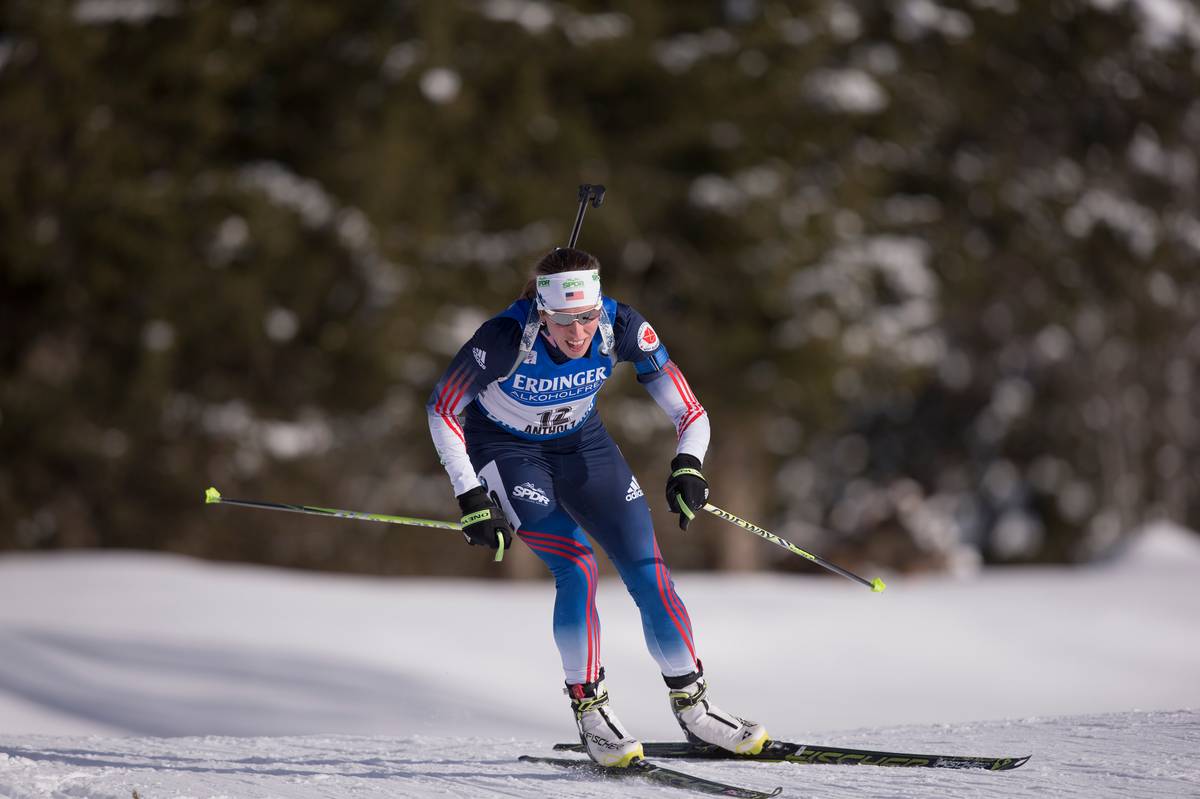
Susan Dunklee (US Biathlon) racing to a season-best eighth in Friday’s 7.5 k sprint at the IBU World Cup in Antholz, Italy. (Photo: Fischer/NordicFocus)
There’s something in the air, or a lack thereof, in Antholz, Italy. Maybe it’s the fact that the biathlon venue is nearly 2,000 meters, about 6,500 feet, above sea level. The combination of a lack of oxygen and its proximity to the sun and mountains seems to work wonders for some athletes.
On Friday, Susan Dunklee was one of 95 women in the IBU World Cup 7.5-kilometer sprint that found her way into the top 10 in Antholz.
The American’s eighth-place result — her season best — came a year after she placed fourth in the Antholz sprint for what was then her career best.
“Antholz has always been a wonderful place for me and a good place to recover from a mentally tough start to the year,” Dunklee explained in an email after Friday’s race, in which she finished 1:10.3 back from Belarusian winner Darya Domracheva, who posted the fastest time in 19:57.8. “I thrive with Italian sunshine, mountains, food, and snow.”
Susan Dunklee races to an eighth-place finish in the women’s sprint at the IBU World Cup in Antholz, Italy. (Photo: USBA/NordicFocus)
Before the start, Dunklee recalled what worked for her there last year, “Skiing BIG with a stretched-out efficient V2 alternate, holding back in key places on the loop to feel okay for the range, and taking several extra breaths before shooting,” she wrote. “The high elevation here is an added stress and it helps to have a plan for how to deal with it.”
The 12th starter on a bluebird afternoon, Dunklee cleaned her first shooting to leave the range in fourth, 6.2 seconds behind Domracheva, the race leader at the time. Dunklee went on to miss one shot in the middle of her standing stage, which she explained landed high.
“The follow-though looked a little off,” she reflected. “Usually the field makes extra shooting mistakes here because of the elevation, so I suspected I could have a great race with one miss.”
She was right. Dunklee headed out of the penalty loop and into her last lap still in fourth, 52 seconds behind Domracheva, who cleaned both stages. While the American held fourth position through the finish, she was later bumped four spots by Italy’s Karin Oberhofer (who placed fifth), Finnish runner-up Kaisa Mäkäräinen, Nadezhda Skardino of Belarus (who ended up seventh), Germany’s Franziska Hildebrand (who placed sixth), respectively.
With the 10th-fastest course time, Dunklee ranked 73rd on the range in terms of time spent there, which was all part of her plan. In order to shoot well, she had to hold back on both the race course and take her time shooting, she explained.
In doing so, she finished 19.9 seconds off the podium and 0.7 seconds ahead of ninth, which Germany’s Franziska Preuss and Poland’s Weronika Nowakowsak-Ziemniak tied for. Dunklee will start Saturday’s 10 k pursuit with Skardino, 1:10 behind Domracheva and 1 second ahead of Preuss and Nowakowsak-Ziemniak.
“Historically I find my stride for the season in Antholz, so I’m hopeful I can build on this like in past years,” Dunklee said of her season best. “But I know that I must continue to find the fun in each race experience if I want to sustain myself at this level.”
Domracheva Fast-and-Flawless for First
Darya Domracheva (Belarus) atop the IBU World Cup podium for the 21st time in her career after winning Friday’s 7.5 k sprint in Antholz, Italy.
An even earlier starter, Domracheva in bib 3 pushed herself to the brink with the fastest-course time and yet managed to be one of four women in the top 10 who cleaned both stages (along with Germany’s Laura Dahlmeier in third, Slovakia’s Jana Gerekova in fourth, and Skardino in seventh).
Her time wasn’t always the fastest. Later in the race, three women topped her through the first stage with clean shooting as well. Mäkäräinen was on track to give Domracheva a run, besting her time after the first shooting by 7.6 seconds. Ukraine’s Valj Semerenko ranked second after prone, 4.3 seconds behind Mäkäräinen, and Oberhofer cleaned to clock through in third, 6.6 seconds back.
Mäkäräinen remained in control heading into the stadium for the second-and-final stage, with a 6.4-second lead over Domracheva. However, she missed her first standing shot and the penalty lap cost her as she left the range in second, 20 seconds behind Domracheva.
“I missed my first in standing,” Mäkäräinen later told Domracheva as they chatted before the flower ceremony. “After that it was like fighting. It’s always bad when you miss your first.”
Domracheva nodded her head. Sometimes you missed; sometimes you didn’t. Fortunately for her, she fell into the latter category with her 21st World Cup win on Friday.
“Shooting clean this week and last week in the sprint is very good. I have not done anything different, but it is working,” Domracheva told the IBU. “I think the sun and good conditions help. It was an amazing feeling when I realized I was winning. But I did not want to celebrate too early.”
Upon finishing,sShe collapsed to her knees and awaited her fate. Mäkäräinen came within 26.9 seconds of her — the closest anyone would rival Domracheva all day. The overall IBU World Cup leader by 52 points over Domracheva, Mäkäräinen placed second, and Dahlmeier, the second starter, held on for third (+50.4) with clean shooting.
The women’s sprint podium in Antholz, Italy, with winner Darya Domracheva (c), runner-up Kaisa Mäkäräinen (l) and Laura Dahlmeier in third.
Gerekova started fifth and also nailed all 10 shots to put herself in fourth (+55.2). Oberhofer missed one standing but had the third-fastest course time (after Domracheva and Mäkäräinen, respectively) to place fifth (+57.5).
Mäkäräinen told the IBU after the race that she was “very happy” with her result after having a difficult time in three previous sprints.
“Every competition is different and maybe it is a miss by only 1 millimeter, but sometimes, the small things matter,” she said.
Leading three Germans in the top nine, Dahlmeier was especially excited for her first-career podium, jumping up and down before and during the flower ceremony.
“Today was a big surprise, but it was a perfect race,” she said. “I felt good on the tracks … Our team is very young and doing well right now; we have a very good team atmosphere.”
Domracheva will start Saturday’s pursuit with a 27-second head start on Mäkäräinen. Dahlmeier will go out third, 50 seconds back, followed by Gerekova (+55.0), Oberhofer (+58.0) and Hildebrand (+1:01) before Skardino and Dunklee.
Crawford 29th in First Race Back Since Oberhof
Four North Americans (two Americans and two Canadians) made the top 60 to qualify for the pursuit. In her first race back in 12 days, Crawford placed 29th with a single prone miss, finishing 1:48.1 behind Domracheva.
Canada’s Rosanna Crawford en route to fourth on Dec. 18 in the IBU World Cup 7.5 k sprint in Pokljuka, Slovenia. (Photo: Christian Manzoni/NordicFocus)
After a cold caused her to miss the entire last World Cup stop in Ruhpolding, Germany, and kept her from training for seven days (and shooting/skiing for eight), Crawford hoped for a top 40 and perfect shooting, like her boyfriend Brendan Green had done in four-straight races. On Thursday, with a 50-for-50 shooting streak, he posted a career-best fifth.
“My goal was a top 40 to keep on making points and still looking for that illusive 100% shooting in a non-relay race!” Crawford wrote in an email. “I’ll have to get a few pointers from Brendan!
“We started things off really slow not wanting to relapse back into the cold, but the sunshine and good Italian food helped get me back to normal,” she explained. “I still have a cough that I’m sure will hang around for a while.”
“It was so exciting watching Brendan’s race yesterday! I’ve know he’s had the potential to be up at the front and to see him get his first flower ceremony was really exciting! We’ve had some great results this year from a number of athletes and it’s been great to build off one another! It’s now a battle between Brendan and I of who’s going to get the first podium!!”
The 41st starter, Crawford’s time ranked 30th before the first stage. There, she missed her first shot to drop to 61st.
“I’ve struggled with prone shooting here in the past and knew that I needed to be slow and precise to hit the target,” she wrote. “Even though we live at 1400m in Canmore it’s hard to shoot at 1600m! I missed my first shot and then took two breaths between the next four to make sure I would hit them. It was by far the slowest I’ve ever shot prone but I am happy to only had one miss!”
Crawford knocked down her remaining targets to recover to 31st after the second stage and finish 29th. Her course time ranked 34th and she her range time was 66th.
During her last lap, Crawford heard she was in 20th, about four seconds from 16th.
“The finishing stretch is pretty tough here, long and flat and I was happy to be able to have a good push to the line,” she wrote.
On Saturday, she’ll start 1:48 back with Ukraine’s Juliya Dzhyma.
“I think this will be my first pursuit here, so I’m really looking forward to it,” Crawford wrote. “With some good shooting I hope to stay in the top 30 and then I’ll have a week of training before the next world cups to hopefully get back to where I was before Christmas!”
Annelies Cook during the women’s 7.5 k sprint in Antholz, Italy. She placed 67th. (Photo: USBA/NordicFocus)
Her teammate, Megan Heinicke placed 40th in the sprint, 2:07 back from Domracheva, with one miss in prone and another in standing. Heinicke’s shooting was faster — with the 19th-fastest range time — and she posted the 36th-fastest course time.
For the U.S., Hannah Dreissigacker made the pursuit by one-tenth of a second 60th (+2:44.3), with three penalties, one prone and two standing. She had the 16th-fastest range time and was 48th fastest on course.
Also for the U.S., Annelies Cook placed 67th (+3:01.5) with two standing penalties, and Maddie Phaneuf of the Maine Winter Sports Center was 93rd (+4:13) with three misses (1+2) in her first World Cup sprint.
Canada’s Julia Ransom placed 76th (+3:19.2) with three penalties (2+1), Audrey Vaillancourt was 83rd (+3:38.3) with a single standing miss.
The Czech Republic women’s 4 x 6 k team celebrates its second-straight relay win on Thursday at the IBU World Cup in Ruhpolding, Germany. (Photo: IBU/Ernst Wukits)
All it took the Canadian women to have one of the greatest starts of their relay careers was a pep talk from a two-time Norwegian Olympic gold medalist, Halvard Hanevold, who notched 40 IBU World Cup podiums in his career.
According to Megan Heinicke, the team’s first skier in Wednesday’s 4 x 6-kilometer relay at the IBU World Cup in Ruhpolding, Germany, the Canadians had a team meeting with Hanevold on Tuesday night. She said it was “fantastic” and helped them going into the relay with “a really supportive team attitude,” she wrote in an email.
Whatever it was, it worked — and especially well for Heinicke — who shot out of the mass start with the leaders and put herself in fourth heading into the first shooting stage within two seconds of the Czech Republic, Finland and Norway, respectively.
Germany’s Franziska Preuss (r) and Eva Puskarcikova of the Czech Republic (l) lead Canada’s Megan Heinicke (c) and Belarus’s Nadezhda Skardino (behind Preuss and Heincke) during the first leg of the IBU World Cup women’s 4 x 6 k relay on Thursday in Ruhpolding, Germany.
There, Heinicke shot fast and flawlessly to find herself in second coming out of the range, 1.3 seconds behind Eva Puskarcikova of the Czech Republic and just 0.1 seconds ahead of Germany’s Franziska Preuss in third.
“I was thinking ‘holy cow I’m up here again!’ ” Heinicke recalled. “I was excited and motivated. I also tried to think tactically and stay in our little group of 3 and not let myself do too much work.”
The Czech Republic, with Puskarcikova, Gabriela Soukalova, Jitka Landova, and Veronika Vitkova, was coming off a relay victory a week earlier in Oberhof, Germany. The German women had placed 10th in that race, but with a new lineup of Franziska Preuss, Franziska Hildebrand, Vanessa Hinz, and Laura Dahlmeier, respectively, they knew they could be in contention.
“We changed the team [with Hildebrand and Dahlmeier in place of Luise Kummer and Karolin Horchler],” Hildebrand told the IBU after the race. “That is all, but we were confident that we could be on the podium…”
So were the Canadians, but they were among the teams flying lowest on the radar after being lapped in the Oberhof relay.
The Canadian women’s relay team after placing 11th earlier this season in Hochfilzen, Austria. (From left to right) Rosanna Crawford, Audrey Vaillancourt, Sarah Beaudry, and Megan Heinicke. (Photo: Rosanna Crawford)
Yet Heinicke, and the rest of her teammates — Julia Ransom, Audrey Vaillancourt and Zina Kocher — knew they had the potential. Hanevold reminded them of that. With Rosanna Crawford out with a cold, Heinicke explained they tried new relay combination, which was an important step before IBU World Championships in March.
Coming into the second shooting within a second of Preuss and Puskarcikova, Heinicke used one spare to leave the range in second, 17.6 seconds behind Puskarcikova, who cleaned.
“It was hard to shoot clean with the snow falling, but it was easier than in Oberhof,” Puskarcikova told the IBU. “I am not exactly sure how I shot 10 for the second week in a row.”
A rainstorm began before zero, 1 1/2 hours before the race on Thursday, and didn’t let up, coating competitors and spectators in a wet, slushy mixture between rain and snow. That made both skiing and shooting tough, but Heinicke didn’t notice.
“I was so focused on the race in the moment that the conditions didn’t effect me too much,” she wrote. “I think the pressure and excitement of being near the front of the race helps me have a sharper focus in a weird ‘heightened senses’ kind of way.”
Heinicke focused on her technique and held her position through the exchange, tagging Ransom in second, 25.2 seconds behind the Czechs and 2.5 seconds ahead of Poland in third.
“Sprinting is really not my strength and I was really giving my all so I was just mentally coaching myself along!” Heinicke wrote.
Gabriela Soukalova (l) tagging Czech teammate Jitka Landova in first in the women’s 4 x 6 k relay at the Ruhpolding IBU World Cup on Thursday in Germany. (Photo: IBU/Ernst Wukits)
Meanwhile, Ransom, in her first World Cup season at age 21, tried to control her excitement.
“Megan has tagged off to me in excellent positions twice now!” Ransom wrote in an email. “All I could think was that opportunity was there ready to be seized.”
She maintained second through the first shooting, which she cleaned, and up until her standing stage, where she entered the range 59 seconds behind Soukalova in first and 10 seconds behind Hildebrand in second.
“I would be lying if I said the conditions were easy, but I secretly love it when it’s miserable out there,” Ransom wrote. “Canadians are tough! And if you can be tougher than the others, a little bit of rain, sleet, wind, or cold will feel like nothing.”
In that second stage, she missed three but avoided penalty loops with three spares.
“I think my standing shooting was affected by my excitement. I know I can hit targets, but when I am not 100% ‘there’, that’s when things can get squirrelly!” she wrote. “I buckled down for the spares and got out as quick as I could. When there were three spares for three targets, I remember thinking, ‘I’m going to give my parents a heart attack.’ They watch the live stream back in Canada.”
Meanwhile, Soukalova and Hildebrand used two spares, and Belarus’s second leg, Iryna Kryuko, cleaned her second-straight stage to move into third behind the Czech Republic and Germany, respectively.
By now, Soukalova had built up a minute lead over Hildebrand, and Kryuko was 1:13 back, followed by Ukraine’s Natalya Burdyga in fourth (+1:18) and Norway’s Fanny Welle-Strand Horn in fifth (+1:22). Ransom left the range just another second behind in sixth, and tagged Vaillancourt in the same position, 1:53.1 behind the Czechs.
“Being the youngest on the team, I sometimes feel an internal pressure to prove myself and I believe I did today,” Ransom wrote.
Vaillancourt explained in an email that she was excited to start in a pack.
“I thought it was possible for us to finish in the top 6 if Zina and I both had a great race,” Vaillancourt wrote.
With Landova, the Czechs began to extend their lead on Germany. Entering their first prone, Landova was up to 1:15 ahead of Hinz. Ukraine’s Olga Abramova was 1:41 back, just 0.6 seconds ahead of Norway’s Elise Ringen and 2.4 seconds ahead of Nadzeya Pisareva of Belarus. Vaillancourt followed in sixth, 2:13 behind Landova.
In her first stage, Landova missed two shots and had to use a third spare to avoid her team’s first penalty loop of the day. She delivered and left the range still well ahead of Hinz, who cleaned to cut the deficit to 29.7 seconds.
Abramova cleaned as well to hold onto third, 52 seconds behind Landova. Pisareva and Ringen used one spare each and left in fourth and fifth, 1:02 and 1:05 back. Vaillancourt used one spare as well to stay in sixth, another 33 seconds behind.
One the next lap, Poland’s Weronika Nowakowska-Ziemniak passed Vaillancourt early on, and Canada slipped one spot to seventh.
Vaillancourt cleaned her standing stage and left the range still in seventh, but lost one more place by the final exchange.
“I was mostly losing time on the uphills,” she recalled. “I have been very sick in the past two weeks and hardly have been able to train, so I knew this was going to be a tough one on the skis. I am glad the ice is broken though.”
Landova held steady up front, missing her second-standing shot and using a spare, but leaving the range 29 seconds ahead of Hinz, who also used one spare to stay in second. Belarus jumped to third, 1:12 behind, with clean shooting from Pisareva, and Norway was another 6 seconds back in fourth despite Ringen using two more spares.
Abramova used three spares to fall to fifth for Ukraine, and Russia improved to sixth with 10-for-10 shooting from Ekaterina Shumilova.
By the last exchange, the Czech Republic had a 30-second cushion to Germany in second, and was a whopping 1:14 ahead of Belarus in third. Norway and Ukraine skied together in fourth and fifth, more than a minute and a half back, Poland moved into sixth (+2:10), and Russia tagged off in seventh (+2:12.5).
U.S. second-leg skier Hannah Dreissigacker after her prone shooting stage, where she used three spares and went on to keep her team in 10th in the women’s relay in Ruhpolding, Germany. (Photo: USBA/NordicFocus)
Canada was 2:37.1 back in eighth with one 6-kilometer leg to go, and the U.S. women, in their first relay of the season, started the last leg in 16th (+5:28.4).
Ninth heading into prone, Kocher used three spares and had to ski Canada’s first penalty loop to drop to 12th, 4:18 behind Vitkova, who used one spare to keep the Czechs in control.
Germany’s Dalhmeier and Domracheva of Belarus both cleaned after her, but were well out of sight by the time they left the range in second and third, one minute and 1:24 later, respectively.
“Shooting was basically catastrophic considering it wasn’t like last week in Oberhof,” Kocher wrote of Thursday. “Prone, I evaluated the wind flags wrong. Wind really picked up when I got into prone. I made a correction before I started shooting. But it was not enough for the change in direction. I corrected more once I was on spares and hit 3 shots with the 3 spares but then it was too late, I already had 4 misses.”
She skied up to 11th with the fourth-fastest course time on her second lap, but missed four again for another penalty loop, which put Canada 5:36 behind and still in 11th. Kocher posted the second-fastest last loop of the anchor legs to finish 5:33.8 behind the winner — Vitkova of the Czech Republic.
Vitkova had used a single spare on each stage to stay more than a minute ahead in first. Belarus moved to second with Domracheva skiing the fastest anchor leg and using a single spare throughout her two stages.
While Vitkova had enough time to take her poles off and grab a Czech flag from a spectator before casually skiing across the line, Domracheva entered the stadium uncontested as well and looked back before celebrating second, 1:13.3 behind the Czechs, who won in 1:23:57.7.
Veronika Vitkova anchoring the Czech Republic to its second-straight women’s relay win on Thursday the IBU World Cup in Ruhpolding, Germany. (Photo: IBU/Ernst Wukits)
“It was easier for me today because the other girls gave me such a big lead,” Vitkova told the IBU.
Germany hung on to the podium in third, 1:39.3 back from the winners, and a minute ahead of Norway (anchored by Tiril Eckhoff, who cleaned her first stage and used three spares on the second) in fourth.
Ukraine placed fifth (+2:49.7) with a clean final stage and one early spare from Valj Semerenko. France was sixth (+3:55.3) with 17 total spares, Poland placed seventh (+4:14.4) with two penalties and 10 spares, Russia was eighth (+4:36.5) with two penalties and 13 spares, Italy ninth (+4:44.6) with two penalties and 13 spares as well, and Austria took 10th (+4:51.2) with two penalties and eight spares.
Canada crossed the line 42.6 seconds later with two penalties and 11 total spares.
“Can’t say I feel great about my performance today. I skied strong but that doesn’t make up for the 2 laps,” Kocher wrote. “It’s great to see that there are younger athletes coming up showing such strong performances. It’s always motivating for the entire team.”
While Heinicke explained the race could have been better, she added that it also could have been worse. “We gave it our all,” she wrote.
“Our relay shows so much potential and I know that our day to shine will come,” Ransom wrote.
“It think we showed that if everyone has a good day, we can definitely be one of the top nations!” Vaillancourt added.
U.S. Women in 16th Before Being Lapped
The Americans stayed in the race until the final leg, when Maddy Phaneuf in her World Cup debut completed two stages and was lapped before coming into the finish. She had one penalty and three spares in prone, and used one spare in standing to bring the team’s grand total to three penalties and 19 spares.
The team’s opening skier, Susan Dunklee used two spares in each of her shooting stages to go from 15th to 12th, and finally up to 10th (+1:03.5) with the fourth-fastest, first-leg course time.
And she started in the back.
“I had the last row of the starting lanes all to myself,” Dunklee explained in an email. “I followed Mari [Laukkanen] from Finland (also seeded near the back) because she is a strong skier who knows how to maneuver in a crowd. That whole first loop was about being patient in the pack, moving when spaces opened up, but not wasting energy. The weather worked to my advantage today because I am a strong V1 skier and the entire course felt like one long uphill because of the resistance.”
Dunklee explained that the heavy rain caught the racers off guard.
“I think everyone assumed the crappy weather was behind us after Oberhof,” she wrote. “The snow behaved like sandpaper and we had to V2 many of the downhills. I used every change of dry clothes that I brought and still struggled to stay warm. It was especially difficult to keep enough feeling in our hands to shoot.”
U.S. third leg Annelies Cook during the women’s relay on Thursday in Ruhpolding, Germany. (Photo: USBA/NordicFocus)
Dunklee came through the exchange in 10th, and Dreissigacker held the position throughout the second leg, despite using three spares in both her prone and standing stages. She tagged Annelies Cook in 10th, 2:31.7 behind the leaders.
Cook dropped to 16th after her first shooting, with two penalties and three spares. She used two spares on the second stage and tagged Phaneuf in 16th (+5:28.4).
According to Dunklee, the team always aims for a top result each time they toe the line, but they were also simply excited to have enough women to field a relay for the first time this year.
“Maddie has never been on the World Cup before, but what an epic way to start!” she wrote. “She got the full experience with thousands of crazy fans and unpredictable weather. She is very young with lots of racing ahead of her, and I think she did a great job today taking it all in and staying level headed.”
The Schalke soccer arena ready for biathlon action on Saturday. Photo: Karsten Rabas / Schalke World Team Challenge 13.
When the FIS Tour de Ski kicked off in Oberhof, Germany, on Saturday, it didn’t seem like much of a party. It was raining. There was so little snow that some athletes had been training on rollerskis. On a ribbon of white, skiers passed by green grass but also a lot of brown mud. The race course had little terrain, and was almost completely flat. Barely any spectators showed up.
That might be because they were all 3 1/2 hours away in Gelsenkirchen, with a roof over their heads. For the 12th year, the town of just over 250,000 people – which only has snow for about 15 days every year – hosted the biathlon World Team Challenge, where two-person teams of the best biathletes from the World Cup circuit compete in a relay race to the delight of tens of thousands of spectators.
How does the former coal-mining city, hit with some of the worst unemployment in Germany in recent decades, pull this off? The secret is an open mind and an innovative soccer stadium. Organizers truck in snow – 2,500 cubic meters, 10 truckloads of which were reportedly later taken to Oberhof – to the Veltins Arena, home of the city’s FC Schalke 04 soccer club, which reached the Champions League semifinals in 2011 (it’s also home to U.S. player Jermaine Jones). They build a few bridges so that the trail can loop over itself, and pop a shooting range in one corner, leaving that section of the stadium empty of spectators. Voila. Exciting biathlon racing, no weather required.
Podium after the final pursuit race: Dahlmeier and Graf (GER, center); Pidhrushna and Deryzemlya (UKR, left); Gregorin and Fak (SLO). Photo: Karsten Rabas / Schalke World Team Challenge 13.
(Well, almost: in 2010, there was actually too much snow and the biathlon competition had to be canceled when the stadium’s roof collapsed.)
This year, 40,000 fans packed the stadium and roared in approval as Laura Dahlmeier and Florian Graf won the competition. It was the first time an all-German pair had won the World Team Challenge since Martina Beck and Michael Greis in 2002; back in 2009, Germany’s Kati Wilhelm paired up with Christoph Sumann of Austria for the win.
“That was amazing!” Dahlmeier, who had not competed at the event before, told the press after the races. “This is something I’ve never experienced.”
The day is a full schedule to biathlon, with junior races early in the day and senior races later. There’s also multiple competitions: a shoot-out, then a mass start and finally a pursuit, which determines the top honors. In both races, the women had four shooting bouts and the men five. The loop in between is approximately 1200 meters.
In the mass start, Graf had an exciting sprint finish against Emil Hegle Svendsen of Norway, a multiple-time World Champion who teamed up with countrymate Fanny Welle-Strand Horn.
In the pursuit, the Germans initially fell behind. Svendsen and Horn looked to be safe on their way to victory, with the Slovenian team of Teja Gregorin and Jakov Fak next in line. But Dahlmeier and Graf climbed their way back, as did Olena Pidhrushna and Andriy Deryzemlya of Ukraine. It came down to the last shooting stage, where Graf made up the 5-second gap to Ukraine. There was little room to pass on the narrow course, but Graf swooped in at the last minute, taking a stronger line than Deryzemlya through the last U-turn and sprinting past him to the finish. Deryzemlya took Ukraine to second place and Slovenia finished third.
It was an interesting victory for Germany, as the more veteran team of Andrea Henkel and Andreas Birnbacher finished further down the standings. Dahlmeier, last year’s World Junior Champion, has had a strong last year for the team, and is not the anchor of their women’s relay team, a role she has relished ad excelled in.
Graf, meanwhile, is still trying to get a top-15 on the World Cup this season to qualify him for the Olympics.
There was no American team in the competition this year, for the first time in several years. Last season, Tim Burke and Susan Dunklee placed 10th. Jay Hakkinen and the Barnes sisters have also competed at Schalke in the past.
Maxim Tchoudov (RUS) leads Andreas Birnbacher (GER) and Dominik Landertinger (AUT). Photo: Karsten Rabas / Schalke World Team Challenge 13.
The Canadian women jumping for joy after notching Biathlon Canada’s best-ever finish in a relay. (Photo: Biathlon Canada/Matthias Ahrens)
Note: The following has been updated to include quotes from Megan Heinicke.
About halfway through the IBU World Cup women’s 4 x 6-kilometre relay on Thursday in Annency, France, it was pretty evident Germany had the race in the bag.
Anything can certainly happen, but Andrea Henkel had opened a 10.5-second lead for the Germans by the end of the second leg, and after teammate Franziska Hildebrand’s third leg, they were up by 35 seconds on Norway. Laura Dahlmeier essentially had to go through the paces, shoot as clean as possible and ski strong to hold off Norway and Ukraine, both contending for the podium with somewhat of a surprise charging from behind – the Canadians.
It wasn’t a surprise for Canada. Chris Lindsay, high-performance director for Biathlon Canada, has known for some time what his quartet of Rosanna Crawford, Megan Imrie, Megan Heinicke, and Zina Kocher were capable of. And on Thursday it was Canada’s best-ever relay result – in a female, male or mixed event. The nation’s previous best was sixth in a mixed relay in 2011 in Hochfilzen, Austria.
The top teams in the 4 x 6 k women’s relay gather around the podium Thursday at the IBU World Cup in Annency, France. Germany won, Ukraine was second, Norway placed third, and Canada notched a historic fourth. France placed fifth, Russia was sixth, Italy finished seventh, and the U.S. tied last week’s eighth place. (Photo: Biathlon Canada/Matthias Ahrens)
The Canadian women placed fourth on Thursday behind Germany, Ukraine and Norway, respectively, with Germans Franziska Preuss, Henkel, Hildebrand, and Dahlmeier winning in 1:06:27.8, and using just three spare rounds in the process.
Ukraine’s Juliya Dzhyma, Vita Semerenko, Valj Semerenko, and Olena Pidhrushna, placed second 23.3 seconds back with four spare rounds, edging Norway in third by 0.5 seconds with Tinril Eckhoff, Fanny Welle-Strand Horn, Synnøve Solemdal, and Tora Berger, who used a total of 10 spare rounds.
The Canadians were 1:35.8 back in fourth after using nine spares.
“Certainly holding the shooting together with the great skiing was the difference,” Lindsay wrote in an email. “Having a big result that is completely owned by the women helps to build an even stronger foundation upon which podiums will follow.”
Heading out first with 22 other teams, Crawford cleaned her prone and used one spare on her standing to bring the team to fourth by the exchange.
“I’ve learned from the past couple relays that being aggressive off the start and getting with the lead group will save you a lot of energy and make sure you don’t get tripped up most of the time!” Crawford wrote in an email. “I’ve got a strong double pole so I can usually be right behind the person in front of me and then it’s just a matter of [maneuvering] my way to the front group.”
A fan of the range at Le Grand Bornand, Crawford explained she took advantage of the calm conditions and focused on one shot at a time. She left her first stage in second behind Switzerland’s Selina Gasparin, who cleaned both stages to tag off in first – but Gasparin wasn’t always in front (and her sisters Elisa and Aita, and teammate Patricia Josh ultimately dropped the lead on the second, fourth and third legs, respectively, so that Switzerland finished 13th).
Italy’s scramble skier, Dorothea Wierer cleaned her prone and used one spare on her standing to put the team in third behind Germany’s Preuss, who used one spare on each stage to tag off in second.
“Selina Gaspirin really didn’t want to lead, so we were able to catch up to her and then I passed her right before the range,” Crawford explained. “Standing was good, my hands were pretty cold so I had some trouble with my spares, dropping two, before I got one in and hit the target.”
For the last loop, Crawford stuck with Preuss and Norway’s Eckhoff just behind the leaders, tagging off in fourth, 11.6 seconds after Gasparin in first and 3.2 behind Preuss in second. Italy tagged in third, Belarus was fifth, and Eckhoff came through in sixth for Norway, 15 seconds behind Gasparin and 3.4 behind Canada.
With Susan Dunklee scrambling for the second-straight relay, the Americans started the second leg in eighth, 33.3 seconds behind Germany.
From there, Imrie brought the Canadians to third with a clean prone and one spare in standing. Henkel took the lead for Germany with 10-for-10 shooting, and Imrie tagged just Heinicke 17.3 seconds behind Germany and 6.8 seconds behind Norway.
Heinicke used three spare rounds – one in prone and two in standing – for the eighth-fastest third leg, but she managed to hold tight in fourth, a minute behind Germany, but just 10 seconds behind Ukraine.
“I was disappointed about the prone miss because it really shouldn’t have happened, but in the moment I was just focused on doing my job which was loading that spare bullet calmly and efficiently,” Heinicke explained.
In the second bout, she didn’t realize that her first spare didn’t hit and was partly out of position. “That was too bad, but I didn’t let it get in my head, didn’t hesitate and my second spare hit,” she wrote.
As for her last lap: “I was feeling exhausted skiing and was just thinking to fight as hard as possible and not to give anything away,” Heinicke wrote. “I was already thinking about Zina and thinking that I just needed to keep that Ukranian within striking distance for her.”
When Kocher received the final handoff, she tried to relax, focusing on her key words for shooting and most importantly, breathing.
“I knew it was up to me to complete the task of the day and I felt that pressure,” Kocher wrote in an email. “I’ve been struggling with that a lot before today but I’ve been working all week on my shooting and staying with the process, not on the result and not on anyone else around me.”
After using three spares in prone, Kocher found her team’s chance at a historic best slipping. France’s Marie-Laure Brunet cleaned both rounds, shooting especially fast on the standing and putting Kocher under pressure.
“I was over cautious,” Kocher wrote of her first time in the range.
Fighting for every shot the second time around, Kocher ended up using one spare round in standing and raced away on her final lap to catch Brunet from 20 seconds behind. Kocher passed her and finished 8 seconds ahead in fourth.
Dahlmeier shot clean to hold off both Ukraine’s Pidhrushna, who also cleaned, and Berger, who used two spares on her standing but closed hard on the last lap to finish third, just a half second behind Pidhrushna.
Knowing she’s a strong closer, Kocher explained she gave everything she had, but wasn’t sure it would be enough.
“I did not know if I had enough to hold off the Russian or catch the French,” she wrote. “I just put my head down and focused on gliding.”
While “a podium would have been incredible,” Kocher explained the team was thrilled to break through in fourth.
“We are absolutely ecstatic and proud of each other that we all pulled it together what we knew was always possible,” she wrote. “I don’t think this is the last of us. Now we have this confidence and belief in ourselves and each other for the future.”
Two years ago in Hochfilzen, Imrie, Kocher, Le Guellec, and Green combined for Canada’s previous best of sixth in a mixed relay, according to Lindsay.
“We’ve known for a long time that we are capable of a top 6 in a relay,” Crawford wrote.
“The numbers have shown that we can be up playing with the best – but staying in the game is a skill in itself,” Lindsay explained. “Developing comfort at being in the ‘game’ takes some time.
“Last weekend the women were mix for most of the race,” he added. “This week they were in it the entire race. There might be weaker races in the future but I have no doubt that we will continue to rack up time in the game and this will lead to medals.”
U.S. Repeats Feat
The U.S. women placed eighth in the Hochfilzen relay with Lanny Barnes subbing for one of their core national-team members, Annelies Cook. For all four skiers, it was a career best.
On Thursday, they repeated the result with Dunklee, Sara Studebaker, Hannah Dreissigacker, and Cook, respectively. They placed eighth with six spare rounds, finishing 2:44.1 behind Germany.
“Last week when we finished 8th, we were jumping up and down at the finish,” wrote Dunklee, who used just one spare on the second stage. “This week was also very exciting but more contained. We know we can dream bigger now. It was inspiring to see the Canadians do so well – if they can do that, we can do it.”
In her first year on US Biathlon’s A-team, Dreissigacker was the highlight, cleaning both her stages in the third leg to bring the team from 12th to 10th.
Dunklee got them off to a strong start, jetting out toward the front early to avoid getting stuck behind the pack on the course with several corners and short, steep hills.
“In the past being so high up may have scared me, but today I felt relaxed and could still transition to the range with a calm focus,” she explained. “My last loop wasn’t great, no gas left in the tank, but I will be smarter pacing for the sprint.”
Tagged in eighth, Studebaker started alone, nearly 10 seconds ahead of Ukraine in ninth but 22 seconds behind France in seventh. She used one spare in prone, then three in standing.
“It was tough to ski that first loop mostly alone, and it definitely helped in the second loop to have people to ski with,” Studebaker wrote. “I had a little trouble in standing, missing one from the clip and then taking all three extras to get it. It was certainly nerve-wracking!”
Dreissigacker could see Sweden’s Asa Lif about 10 seconds ahead of her when she was tagged in 12th . She caught her and picked off one more place, bringing the team to 10th with fast-and-flawless shooting.
“Fast shooting is a strength of mine, and when you don’t have to load spare bullets that also makes it a lot easier to pass people there!” Dreissigacker wrote. “I’m hoping that I can continue to shoot well in non-relay races too … and that it’s just that my last two races have gone well and they’ve happened to be relays. … I think that I do well when I’m relaxed and having fun, and relays are good for that. And I like to shoot well for my teammates!”
Just two seconds behind Finland in ninth, Cook wasn’t sure where her team stood when Dreissigacker tagged her. After a close-call in the exchange, Cook was relieved to make it out unscathed, and didn’t see their place until she entered the range for the first time.
She cleaned the prone and used one spare standing, putting her in prime position for the final lap.
“I thought that maybe I could catch [Italy’s Karin Oberhofer] and bring us into 7th, but she skied well in her last lap and I couldn’t get her,” Cook wrote. “I didn’t do anything special, I just tried to ski well and be relaxed when I got into the range – and luckily I hit my targets and the girls around me struggled.”
Sensing Slovakia’s Anastasiya Kuzmina coming up from behind on that last lap, Cook focused on holding onto eighth.
“Once I got to the last uphill, I knew I would be fine,” she wrote.
“Sunday was our best relay in a while and we always try to beat our bib number,” Cook added, referring to their eighth seed. “It was fun to see Susan leading everyone and it’s really cool that Hannah cleaned. Sara also kept us right in the game and fought super hard. Everyone gave it. I was really glad that I could be part of a good result – because I only got to cheer last week!”
“My lower legs have been feeling better,” she wrote of her bothersome shins, which kept her from last weekend’s competition. “But they usually don’t bother me until I go hard so I was definitely a bit nervous about how they would feel and they were the best they have been so far.”
“We’re really in a good place right now and I think after two top-8s we’re getting hungry for more!” Studebaker explained. “It’s definitely an exciting place to be in this Olympic season.”
Andrea Henkel en route to a podium finish earlier this season in Ostersund; today she turned in a strong relay performance.. Photo: Fischer/NordicFocus.
When Germany talked about having a “new” women’s relay team this season, it was assumed that they were talking about one thing: replacing Magdalena Neuner, their World Cup winner and many-time World Champion.
But by the time the women made it to Sochi for the second-to-last World Cup of the season, the relay team had become even fresher. It included one newcomer who was still a junior, and had never expected to compete on the circuit this season – and another in her first year of biathlon, period.
Joining veteran Andrea Henkel and teammate Miriam Gössner were newly crowned World Junior Champion Laura Dahlmeier and former cross country skier Evi Sachenbacher-Stehle. That might seem like a risk, but Germany skated through Sunday’s relay with one strong performance after another and ended up with an eleven-second victory.
“I never imagined such a season,” Dahlmeier marveled in the post-race press conference. “I focused on the World Junior Championships, and I hoped to be good there. After that I heard that I could go to the World Championships in Nove Mesto and I started in the relay, and it was really great for me. Then I heard that I could go to the World Cups in Russia. But I never imagined that it would be possible to be a winner in the relay.”
None of the newcomers were cut any slack, and neither were the veterans. Henkel started things off with one of her strongest efforts of the season. On the podium in Ostersund, Sweden, earlier this season, Henkel had told reporters that her coach had said she was too old to be strong all season. That seems to be an underestimation of the eight-time World Champion, who picked up silver in Nove Mesto and was still plenty quick today.
Henkel used a single spare round and skied the fastest time among all the scramble legs to hand off in first place.
Evi Sachenbacher-Stehle battling Charlotte Kalla of Sweden as she skied to a gold medal in the team sprint at the Vancouver Olympics.
“It’s always fun when you win, but we always put effort into our relay and our races,” she said in the press conference. “So it’s nice that it worked out today. Of course it’s hard work to win, but when it has this prize at the end, we are fine now.”
Next up was Sachenbacher-Stehle, probably the biggest question mark in the lineup. The day before, she had stunned by shooting clean and placing sixth in the sprint. An Olympic gold medalist in skiing, it is her first year of biathlon. Could she repeat the performance?
Not quite – Sachenbacher-Stehle used two spare rounds in standing. But her years of skiing on the World Cup circuit no doubt came in handy as she handled the pressure with aplomb and still tagged off in third.
The deficit was not small; 46 seconds separated the team from the Czech Republic. Germany was right on the tails of Ukraine as they embarked on the third leg.
But Czech racer Jitka Landova, after cleaning prone, had a disastrous standing stage and fell out of the picture completely. Instead, Valj Semerenko of Ukraine took the lead. Gössner hadn’t shot so well herself, skiing a penalty loop after standing, but managed to drag herself within five seconds of Semerenko by the time she tagged off.
And from there, it was a race. Dahlmeier, the rookie, was anchoring for Germany, but the woman she was chasing wasn’t so experienced herself. Mariya Panfilova, like Dahlmeier, has only joined the World Cup circuit in the last few weeks. She placed 13th in the individual race in Sochi, but said that anchoring this relay team – which has done so well in the past – was a serious obstacle.
“For me the biggest challenge in Sochi was not the tracks or the weather but the fourth lap today,” she said. “It was a very high burden for me, and not as successful as it could have been.”
But you wouldn’t have guessed these women’s relative inexperience if you hadn’t been told. Both cleaned the first stage, with Dahlmeier trailing Panfilova out of the range by eight seconds. They battled around the loop; their ski times were separated by less than a second. Despite using a spare round, Panfilova left the range with a scant five second lead.
But Dahlmeier soon charged past her, and went on to claim the win. The other thing that the young Ukrainian might have to worry about was a threat from further back: World Cup leader Tora Berger of Norway had moved into third place.
As it turns out, Panfilova’s coaches made sure she didn’t worry about that.
“To tell the truth I wasn’t aware of the fact that Tora was following me,” Panfilova said in the press conference. “I just knew that when I left she was thirty seconds behind me, and with thirty seconds I was sure to beat her.”
At that point, teammate Olena Pidhrushna leaned over and whispered something in her ear. Panfilova laughed and kept talking.
“Actually, it was twenty seconds!” she said. “I was told thirty seconds, so I felt quite confident.”
Regardless, her lead was safe, and Ukraine took silver while Norway was stuck with bronze.
It was better than they might have hoped for: after Hilde Fenne and Tiril Eckhoff had raced the first two legs, Norway sat in sixth, over a minute and 15 seconds back. Veteran Ann Kristin Flatland cut that deficit to 33 seconds before Berger took over.
“I think it’s very important that every does a good race,” Flatland said. “If everyone has good races, then we can be on the podium. But I’m very glad that Tora is on our team, because she is really strong, especially on the last shooting and the last loop.”
Dahlmeier, though, was almost as strong, skiing only eight seconds slower than Berger on her six-kilometer leg.
“These were good races for me and I hope to be so strong in Khanty-Mansiysk also,” she said.
Sachenbacher-Stehle, too, wondered at her success this weekend. Both hope that next year they can be a part of the Olympic team on these very trails.
“Now I feel for the first time more like a biathlete than a cross country skier,” Sachenbacher-Stehle said. “I’m really happy to be part of the World Cup team now for the last races. I hope that I will be part of the World Cup team for next year too. I will work hard for that, and it will be my goal.”
When that time comes around, Henkel admitted, “maybe we are one of the favorites now.”