From the FasterSkier archive — posts syndicated from athletes’ and coaches’ own blogs between 2004 and 2012, kept online as published. Current coverage is at fasterskier.com.

Tag: Laura Leclair

  • Canadian Journey to Beijing

    Canadian Journey to Beijing

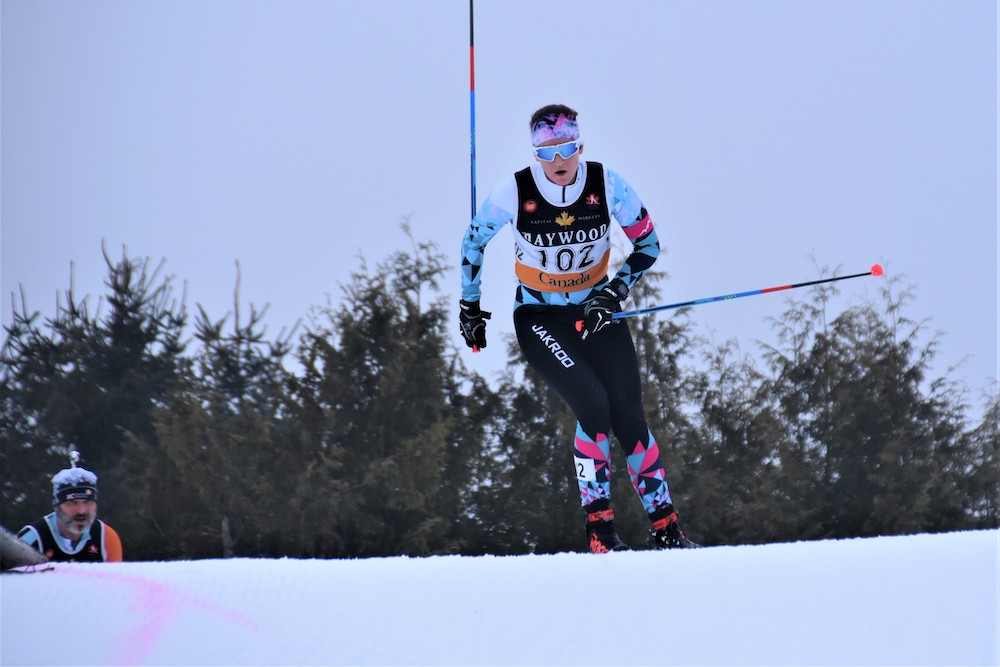
    Katherine Stewart-Jones sprinting over the saddle at Sovereign Lake during the Beijing Prep Camp. (Photo: Peggy Hung)

    Canada was successful in delivering the team to Beijing and getting them on snow in Zhangjiakou. The decision to go above and beyond in isolating athletes before a carefully planned drive to a charter flight worked, although other countries also succeeded with a more laid-back approach.

    What can fans expect from the Canadian team in Beijing? It all comes down to qualifying and performing.

    Qualifying

    Canada had an Olympic quota of four women and three men, with a pretty high probability of gaining another woman and man in reallocation. The size of the quota depends on World Cup/World Championship performance and domestic FIS races; the top countries earned the maximum team size of 8 per gender. As Canada cancelled all races last season and only took a small team to Europe for a six week visit, the only path to a larger team would have been more athletes getting top 30 results in Europe last season.

    Three men (Tony Cyr, Olivier Léveillé, Graham Ritchie) and one woman (Katherine Stewart-Jones) met the world cup results standard for Olympic qualification during period 1. The Trials in Canmore (January 6th to 11th) would then select three women, and possibly one woman and one man who would have first dibs after reallocation.

    Dahria Beatty, an Olympic veteran from Pyeongchang, was one of the skiers who now had to qualify through a rigid qualification document at Canmore trials.

    “Yes, it was definitely different last time. I was qualified for the [2018] Games a season in advance, essentially,” Beatty explained at the Prep Camp at Sovereign Lake.

    At the Canmore sprint, Beatty qualified third and finished the heats in 4th, which meant Laura Leclair earned her first Olympic berth and Cendrine Browne her second.

    For Beatty, selection came down to Saturday’s 10km individual classic. If she won, or placed second to Stewart-Jones, she got the spot. The latter happened, with Beatty 0.5 seconds behind and 20 seconds clear of third.

    “Honestly, I don’t think I’ve had to qualify for a team specifically like that since U23 World Champs so it’s been a long time definitely.”

    Olivia Bouffard-Nesbitt was ranked 5th after trials, waiting on the reallocation process. Her journey has been longer than most, with injuries, training setbacks, car accidents, and bad luck. In 2014, she recovered from a back injury just in time to compete at Olympic trials. She won the qualifier on her first race day of the season. While lining up for the A-final heat with selection on the line, she was told that the jury had disqualified her for micro-skating during the quarter-final earlier. This year, the pieces came together.

    “​​It’s hard to find words. It’s something that I believed in, like my whole life, I believed that it was possible. But then throughout the setbacks, the doubt kind of built up. And, increased and I thought it wouldn’t happen, maybe and that I just had to grow up and face that reality. But there was still like, a little voice inside me that thought it was possible. And just to have– persisted, and trusted that with patience like things would line up for me. It means so much, it means so much for me but also for the people who helped me get here because it feels like I know that they would support me no matter what but it just feels like doing them justice as well. Like putting all the time into this project that is me trying to get to the Olympics was worth it.”

    Jasmine Drolet was next, with only the faint hope of moving up through a positive COVID test for an athlete above. Jasmine does have the consolation of earning a start at U20 World Championships.

    Russell Kennedy finished 27th in the Ruka 15km classic in November, enough to help Canada’s World Cup quota for next season. Kennedy would have needed to ski 15 seconds faster to take the 20th place from Federico Pellegrino and earn the 4th Olympic spot. The next day he moved up to 21st in the pursuit with the 24th fastest time of day, again just outside the criteria.

    The reallocation spot would be decided in the 15km individual start classic on January 8th. Whoever finished highest, after excluding the three already qualified men, would be on tenterhooks until the 17th and then be officially announced on the 19th.
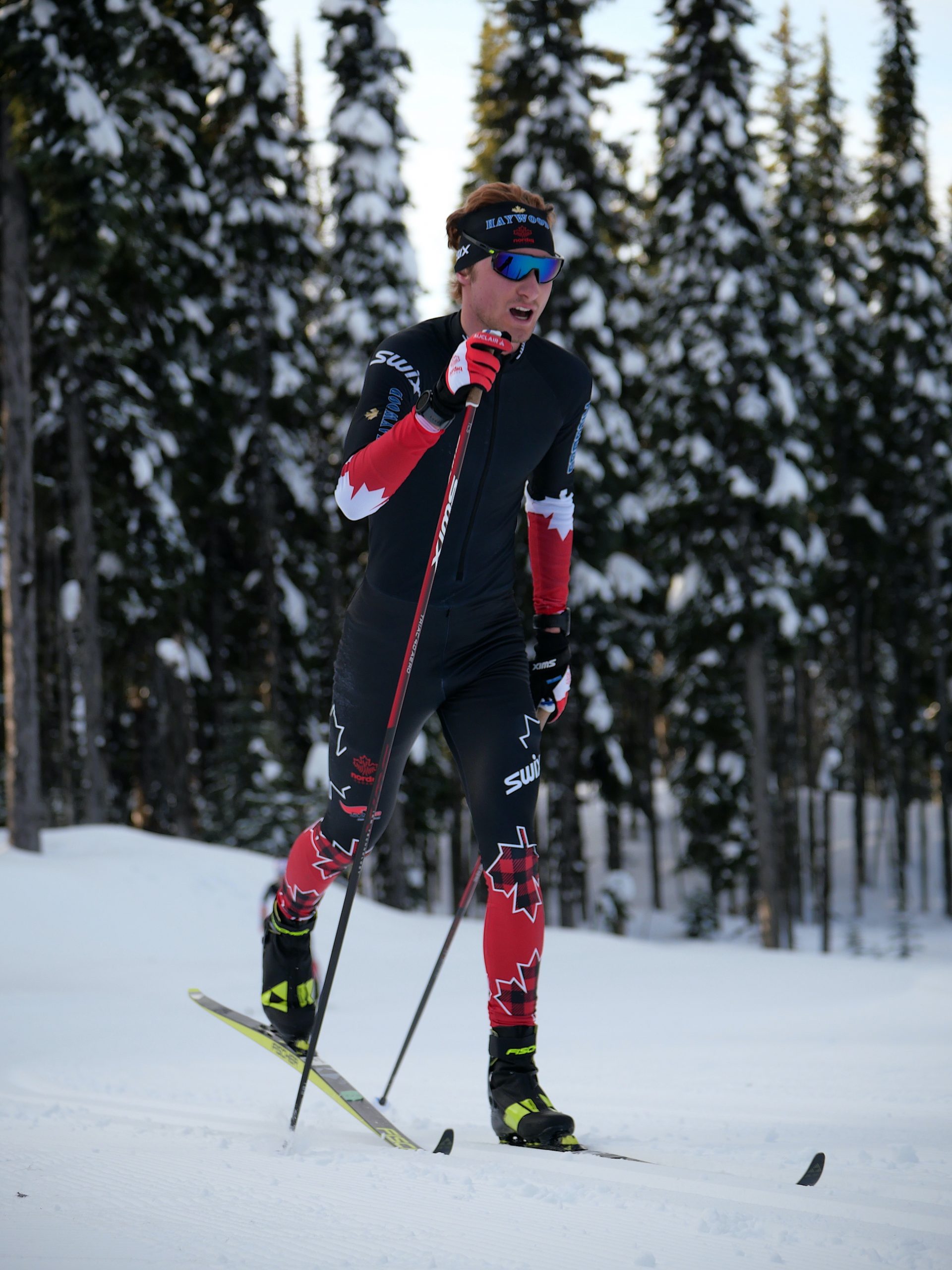
     

    Rémi Drolet in a practice skiathlon at the Beijing Prep Camp at Sovereign Lake, Jan 23, 2022. (Photo: Peggy Hung)

    Cyr won, surprising no one, with Rémi Drolet edging out Kennedy by 10.8 seconds to take second. Every skier in the top ten had either a WC top 30 or a Canada Cup podium this season. Every one of those skiers could believe that their best effort would end in selection.

    Rémi is a second year senior who chose to take a gap year from Harvard to focus on getting faster on the World Cup and qualifying for Beijing. He didn’t get selected for Period 1, but did get some good results in early season Continental Cup races in Finland and Sweden.

    “For me, it was important to try really hard to make it this time around, because I think it’ll be an important stepping stone in my career,” he told FasterSkier during the prep camp. “To be able to, I guess, be a leader in the team, with so many strong guys coming up.”

    Rémi is getting good results for his age, but also looking over his shoulder at juniors like Tom Stephen and Xav McKeever, who are already collecting senior wins at Canada Cup races. These three teamed up with Léveillé to collect a relay silver at U20 Worlds two years ago.

    Kennedy is now 30. His ‘day job’ is with Canada’s Para National team, one of two guides for Brian McKeever. After PyeongChang, his goal was not just to qualify, but deliver at Beijing, and that dream ended with an invitation to train as a spare.

    “Well, I mean, for me, it’s been a rough two weeks. I spent three years working for this year. I was focused on the Olympics, and not really as much qualifying I guess.”

    Asked about sharing a bubble for two weeks with the four men who are living his dream, Kennedy didn’t shy away from truth.

    “And yeah, it’s been hard. But I’ve been trying to put on a good face around them. Because it’s sweet [for them]. They’ve done it, they’re going to the Olympics, it’s a huge goal and a huge achievement. But for me, it’s definitely hard. I’m really fast right now, which just makes it harder. But that’s part of sport.”

    Performing

    For some people, just reaching the Olympics is the pinnacle of their dreams. And it is a major achievement, even more so now with smaller quotas. In 2006, Canada had five women who earned Torino quota spots, in addition to the ten nations spots, allowing Canada to select 15 women. 

    What distinguishes the athletes who deliver results from those who participate?

    “Some people believe, and some people want to believe, but [it’s] the ones that really believe.” Dave Wood explained to FasterSkier in July of 2021.

    Going back to 2006, three Canadian women came home with medals: Chandra Crawford, Beckie Scott, and Sara Renner. Each of these women had individual World Cup podiums in the final two months of preparation and came into Torino with confidence. 

    The current team of nine Canadians has only two members with Olympic experience: Beatty and Browne. It will be much harder for this team to dream of podiums.

    Stewart-Jones, Cyr, Léveillé, and Ritchie can find confidence from their period 1 results. Drolet can find confidence in beating Léveillé and Kennedy at trials as both have World Cup top 30’s this season.

    The others? They will have to find confidence inside themselves.

    Expecting

    One of the common expectations of sports fans is that Olympians should produce their best performance of the season on the biggest stage. Athletes work their whole lives to get to an Olympics and it seems obvious that they should be peaking at precisely the right moment.

    “The results came from those that started their Olympics in May or April.” – Dave Wood, talking about Vancouver 2010.

    Wood was referring to athletes who qualified for the Olympics during the previous season, allowing them to build the entire training year around performing during a two week period. Athletes who have not qualified in advance have to focus their season plan on earning selection.

    Kennedy was one athlete who missed that balance.

    “Because sometimes I feel with sport, you have to choose if you want to go or if you want to do well. It’s the one thing that I’ve been struggling with. And also, it’s hard because like the people making the decisions don’t really have any repercussions for their choices. So the repercussions fall on athletes, and unfortunately, this year fell on me. Yeah. It sucks, but it’s part of it. I knew what I signed up for.”

    Once selected, each athlete can then reset their priorities. Four Canadians hit that point in December, three more on January 8th, and the last two on January 17th. With the first race on February 5th, which feels like the 4th after crossing the international date line, the one big thing athletes can do is not catch COVID-19.

    Back in 2010, Canada had four men performing on the world cup and when it came time to pick four men for the 50km on the final day, there were five names. Ivan Babikov, George Gray, and Alex Harvey had placed 5th, 8th, and 9th in the skiathlon and were obvious choices. The final place had to go to either Brian McKeever, who had qualified first at trials in Canmore, or Devon Kershaw, whose best individual result was a 16th. Unusually for Canada, there was outside pressure on this selection, as McKeever would have been the first person to compete at the Olympics and Paralympics in the same season.

    “The way the other four boys had been skiing, there was no decision, there was no discussion,” Wood explained. “Brian didn’t beat Kershaw and Alex and Ivan and George [at trials], he beat the others.”

    The coaches chose Kershaw, which paid off with a 5th place finish, 1.6 seconds from gold. In 2022, there will be no difficult decisions for the men, but there are five women and four starts per individual race.

    FasterSkier asked Beatty what races she was looking forward to.

    “Well, if I get a start in the team sprint, I love team sprints, I love team events. So I’m definitely hoping to be doing that race, I’m looking forward to that. I’m also really looking forward to the individual sprint and the 10k individual.”

    This may not be the Norwegian or Swedish level of choice, with eight skiers and four starts, but expect Canada to hold some time trials during the Olympics to inform the coaches’ choice.

    Beatty and Browne were in PyeongChang, and will have experience to share with the neophytes.

    “​​The races themselves, even though they will be the most stressful part, are also going to be the most fun because that’s what we dream of,” Bouffard-Nesbitt speculated three days before getting on the plane.

    “I’ve never been to an Olympic Games, and especially a COVID games. So I don’t know what the rest of the time will be like.”
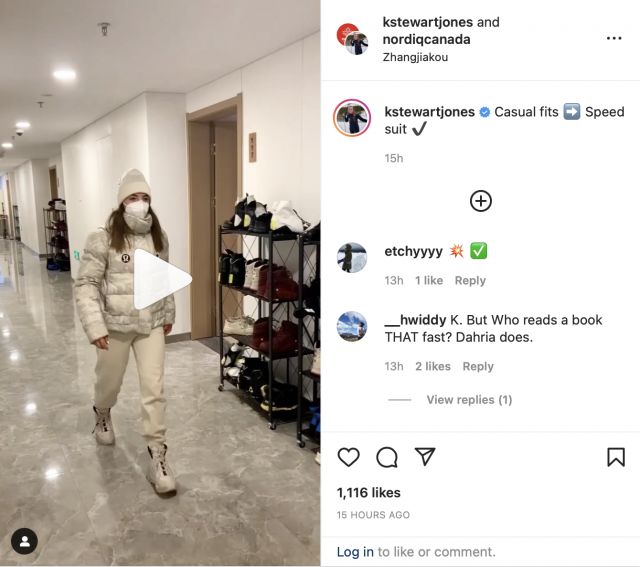
    The Canadian women having (distanced) fun. Click the image to see the Instagram reel.

    Early evidence is athletes will be killing time in their rooms and finding virtual fun with your teammates.

    Dreaming

    FasterSkier asked a number of the athletes a simple question: when you first dreamed of the Olympics, what sport were you dreaming of?

    “I have to say, probably hockey with that one. For sure. I didn’t know I was gonna end up as a cross country skier.” — Ritchie

    “Cross country skiing. Yeah, it’s always been that.” — Stewart-Jones

    “I definitely think it was probably cross country skiing. That’s always been the sport I’ve been strongest at, even as a kid. I did a bunch of different sports. I always loved watching figure skating at the Olympics, but I knew that I was never going to pursue that long term, definitely was not flexible enough.” — Beatty

    “I don’t know. I guess when I first really thought about the Olympics was back when I was playing hockey. But at that time, it wasn’t really, it was kind of just like, whoa, it’d be cool to go to the Olympics. But I didn’t really think of what sport I might make it in. It’s only really four years ago, I started thinking, this is what I need to work towards, to make the Olympics in Beijing.” – Rémi Drolet

    “That is such a good question. Because around the time when I became really inspired by the Olympics was the 2000 Olympics in Sydney, and I think Simon Whitfield winning the triathlon was the really big moment at that Olympics. And at the time, in my youth, I was just obsessed with soccer, but also skiing, so I dreamt of either/or soccer or skiing.” — Bouffard-Nesbitt

    “Oh, man, I didn’t really have a sport I was dreaming of, exactly. But I thought maybe skiing because I was on skis at two years old. More downhill racing.” – Kennedy

    “I was the dreaming to go to the Olympics as a cross country skier. It didn’t happen as a cross country skier but as a technician.” — Simon Boisvert

    “Ah, to be honest, I’ve always been into cross country skiing with my dad and my sister, my older sister ahead of me, but always been into cross country skiing, and I thought that maybe mountain biking, but a few years ago, I knew I was not. I wasn’t going as an athlete, but I’m pretty pumped to go for my first time as a wax technician.” — Félix-Antoine Vezina

  • An Inside Look at the Canadian Olympic Prep Camp

    An Inside Look at the Canadian Olympic Prep Camp

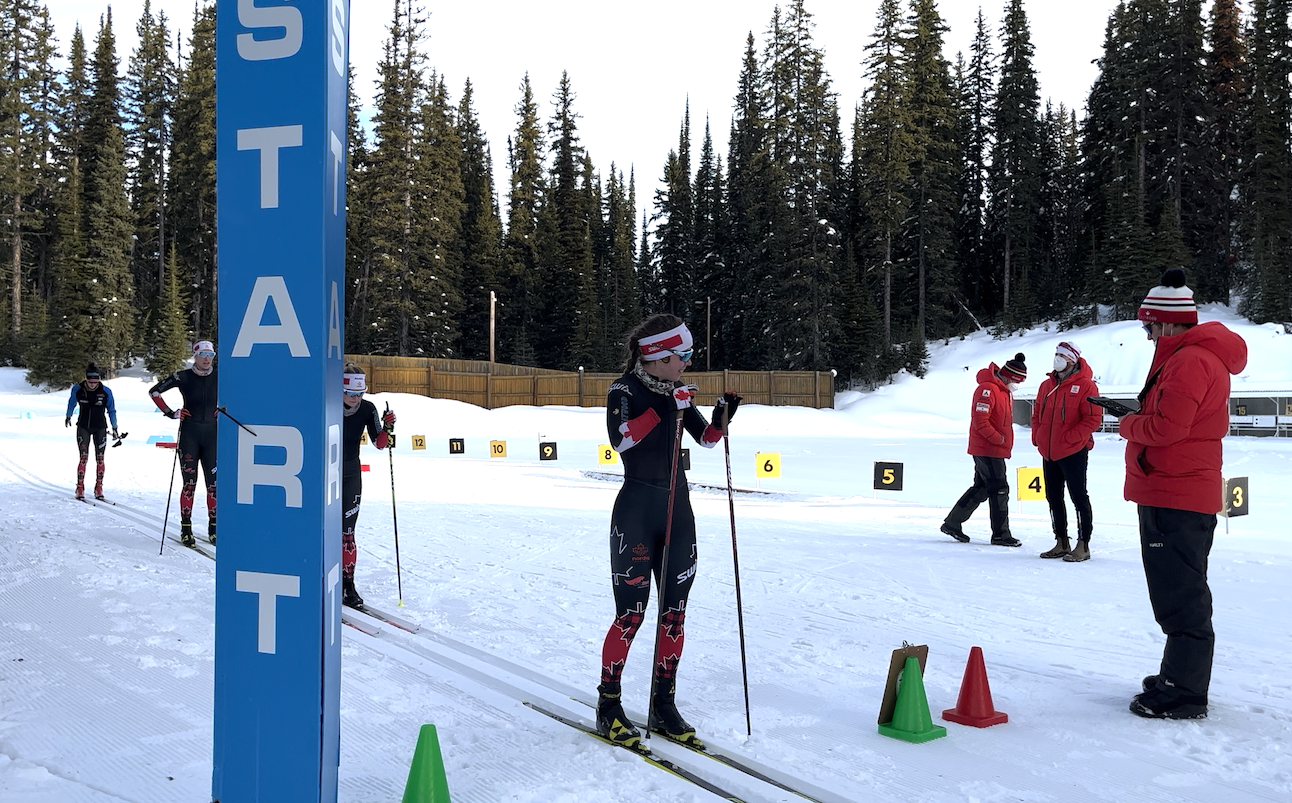
    Katherine Stewart-Jones ready to start a skiathlon at the Olympic Prep Camp.

    The Canadian Prep Camp in Sovereign Lake and SilverStar, BC prior to the 2022 Beijing Olympics sounds like a nordic skier’s heaven.

    A two-week ski vacation with 100 kilometres of perfectly groomed snow. A private room above a great coffee shop (pain au chocolate!) and next door to some great beer. January weather just below freezing with enough falling snow to make every day a hardwax day. Two weeks of what locals call superhero snow. A whole lot of sunshine.

    The reality was a little different: COVID stress, travel uncertainty, and outside pressure combined to make this very much a work trip, not a vacation.

    The camp, which ran from January 12th to 25th, included nine athletes, the high-performance manager plus two coaches, two wax techs, a massage therapist, and a cook.

    The athletes included the majority of the 2022 Olympic Team: Katherine Stewart-Jones, Laura Leclair, Dahria Beatty, Tony Cyr, Olivier Léveillé, and Graham Ritchie. Alternates Olivia Bouffard-Nesbitt and Rémi Drolet would officially join the team after the quota reallocation during the second week. Second alternate Russell Kennedy will not add to his Olympic CV and will instead go to his third Paralympics as a guide, supporting the well-decorated visually impaired athlete, Brian McKeever. The only Olympic team member not in attendance was Cendrine Browne, who chose to train in Canmore, while second alternate Jasmine Drolet returned to school at Dartmouth and earned her first collegiate wins.

    World Cup coach Erik Bråten, Next Gen coach Eric de Nys, Team Lead and high performance manager Joel Jaques, techs Simon Boisvert and Félix-Antoine Vezina, massage therapist Stephen Waterreus, and Zoe the cook made up the support crew. Everyone except de Nys and Zoe are going to Beijing.

    When this writer asked for last names, the response was always, “Zoe? You know Zoe.” In the end, it was revealed that Zoe is Zoë Roy, who retired from racing in 2014 as a founding member of Team Ninja. Yup, we all know Zoë.

    All interviews were done on snow, from a distance, with FasterSkier wearing an N95 mask.

    On Snow Training

    The on-snow part of the camp was reported to have gone very well. The coaches were able to find times and trails that allowed training races that closely matched the Olympic course for profile and elevation while keeping distance from the local skiers. 

    The Zhangjiakou 5km course elevation range is 1639m to 1696m. The Sovereign Lake upper World Cup 5km is 1651m to 1708m, with the stadium at 1660m.

    The Friday sprint course worked fairly well, despite a layout that would give any technical delegate apoplexy. As Bråten explains above, the coaches chose to do four qualifiers instead of heats to manage risk.

    The Sunday skiathlon course ended up being 13km for the women and 17km for the men, with some flat sections removed from the 5km loop to better mimic the Olympic courses.

    Bråten was often seen working with athletes one-on-one.

    As the days counted down to departure, skiers were working on filling their bags with seconds gained: a tweak in one skate (V2) poling, free skating further on a fast flat section, experimenting with pacing on courses that simulate Zhangjiakou.

    The mood of the camp seemed slightly tense, at least to a journalist who was careful not to pierce the bubble. The change on Tuesday morning, 12 hours after everyone passed the final COVID test, was dramatic, with smiles everywhere.

    “It’s been fantastic conditions and just a really nice camp all around, it’s always nice when you get some sunshine,” Kennedy told FasterSkier. “So yeah, especially after a [World Cup] Period One in Finland in the dark.”

    First time Olympian Rémi Drolet is all smiles after passing the final pre-travel testing.

    COVID Management

    COVID protocols at the camp were strict, races were more relaxed.

    A positive test would be the end of one person’s Olympic dreams and a logistical nightmare for the support team. Any close contact of the infected person would not be able to travel. Any replacement person, athlete or not, would need to follow the same testing protocol. If that replacement wasn’t ready for the scheduled flight, the complexity of travel planning might be insurmountable.

    In order to travel to the Olympics, the athletes, coaches, and techs would all have to pass two PCR tests less than 24 hours apart in the final 96 hours before boarding. Once at the Calgary airport, there would be another PCR test, with a fourth upon arrival in China.

    Nordiq Canada chose a more restrictive plan than some other countries. Each person (athlete, coach, tech, cook, massage therapist) had their own room and didn’t enter other rooms. Meals were delivered. Grocery shopping was done by local resident, de Nys, scheduled for 7am to avoid crowds. No one entered coffee shops, bars, or restaurants. Each morning, everyone would do a rapid antigen test in their room. Athletes skied from their accommodation at SilverStar to the homologated trails at Sovereign Lake to avoid close contacts in vehicles. Only de Nys and Zoë the cook had contacts outside the bubble, and neither is going to Beijing.

    The goal behind this aggressive protocol was twofold. First, to prevent exposures. Second, if one person tested positive, there would be no close contacts forced into isolation or removed from the Olympics. The two wax techs (Simon Boisvert and Félix-Antoine Vezina) inevitably had a shared bubble as they shared a private waxing room.

    Was this the right answer? We got three answers to that.

    Drolet found the camp harder than usual: “We were still able to ski together a little bit, but it was definitely a little bit lonely at times.”

    Kennedy, entering with a mentally tough prospect of only making the team if disaster struck a friend, found the positive. “The guys have been playing, like hanging out online together… And we’ve been skiing together. So it’s separate, but at the same time, not too lonely.”

    “Ask me on Monday afternoon when we get all the results back,” Jaques told FasterSkier on Sunday morning. “We’ve taken the right precautions so we’ll just see. But I think it’s looking good.”

    A number of athletes mentioned feeling comfort in knowing they were doing everything possible to protect their Olympic dreams. 

    The system has worked. Everyone tested negative and the entire team is now on snow in Zhangjiakou.

  • Eastern Canada Cup #3,4: Back to Business

    Eastern Canada Cup #3,4: Back to Business


    Liliane Gagnon leads the women’s 10km at the Eastern Canada Cup at Mont Sainte Anne. (Photo: Stéphane Barrette/Nordiq Canada)

    The Eastern Canada Cup series wrapped up in Mont Sainte Anne (MSA), Québec, with distance racing for over 300 skiers each day. As with Westerns, the second weekend brought results and execution a little higher in the athletes’ focus, but the almost universal use of the words ‘fun’ and ‘excitement’ remain a reflection of a return to racing after a season without.

    MSA is just outside Québec City and is very accessible for most population centres in the province. It is a destination venue that is famous for challenging trails and a few brutal climbs that reflect 1991 homologation standards. Races are hosted by Club Nordique Mont Ste Anne on trails owned by the alpine resort. This is the home base of the Centre National d’Entraînement Pierre-Harvey (CNEPH).

    “The race organizers and volunteers did a great job today, the course was challenging but fun and the conditions were good despite the rain we got the day before.” — Étienne Hébert


    Saturday: Individual Start Classic 5km/10km

    The women kicked off the weekend with a 5km race of truth and it was CNEPH’s U20 Liliane Gagnon setting the standard in 14:00.7. Chelsea’s U18 Tory Audet was second at 7.5 seconds back, collecting her second senior podium of the season. Last weekend’s double winner Laura Leclair was third (+16.7), putting a second CNEPH suit on the podium.

    “I had a very good day!” Gagnon wrote to FasterSkier. “I surprised myself which is awesome. I knew the form was good, but I didn’t expect the race I pulled off. 5km classic individual starts are usually my biggest fear and I proved myself wrong.”

    Gagnon was one of many who had process goals top of mind.

    “I usually have trouble with individual starts because I don’t start fast enough. Today my goal was to start off quick and ideally keep that speed all through the race and I think I did a pretty good job. I really tried to stride long on the “false flats hills” and push hard on the top of the hills and I think it paid off!”

    Liliane Gagnon in the 5km classic. (Photo: Stéphane Barrette/Nordiq Canada)

    “I had a great race,” Audet wrote. “We had awesome glide but our kick was not ideal. The conditions were fast, which made this specific course very exciting. This course had a lot of uphills, which are my favourite! Uphills gives me the feeling of accomplishment every time I crest a new hill, and that motivates me for the next one!”

    Enthusiasm flows from Audet, who at sixteen was affected more than many by a season without learning from real races.

    “During my race, what stayed in the back of my mind was that a faster and more experienced skier started one minute behind me. I was driven to maintain that one-minute gap between us.”

    That skier starting one minute behind Audet was Leclair, who wrote “Today was an overall good day. I think I lost seconds in the last portion of the race but I’m happy with the first half. Skis were good and conditions were super fast. Happy to be racing at my second home.”

    Leclair is a Chelsea member, giving her the chance to race at both ‘home’ courses this month.

    Julian Smith on his way to another victory. Coach Timo Puiras is visible on the left. (Photo: Stéphane Barrette/Nordiq Canada)

    National Team Development Centre Thunder Bay’s Julian Smith his strong start with a third win in the new season, finishing the 10km in 23:51.7. CNEPH’s Phil Boucher was 24.7 seconds back, edging out TBay’s Pierre Grall-Johnson in third at 30.3.

    Boucher was fresh from the US SuperTour in Cable, where he was third in the 15km classic and won the 15km free.

    “My day was ok,” he wrote. “I was just not fast enough to win. Skis were good and my pacing was too. I just didn’t deliver the result that I was supposed to.”

    Grall-Johnson had a more optimistic outlook on his day.

    “Fun day today,” Grall-Johnson wrote, “first 10km of the season. Those are always hard distances, I am definitely feeling the fatigue of the past few months but still happy with how I pushed today… I think today was all about maintaining a high speed through the full lap, keeping the power high on the false flats and really pushing hard into the downhills. Our NTDC skis were awesome today, so looking forward to tomorrow.”

    5th place Étienne Hébert, another CNEPH skier, explained the ‘return to racing’ experience.

    “Definitely not a bad race in any way, my distance racing has clearly improved this year and getting consistent top fives and podiums early on helps build up confidence for the rest of the season.  The race organizers and volunteers did a great job today, the course was challenging but fun and the conditions were good despite the rain we got the day before.”

    What made the difference between 5th and the podium? “The guys in front on me just had a better day on Saturday.”

    Classic Results

    Sunday: Mass Start 10km/15km Free

    Tony Cyr leads from the start of the 15km. (Photo: Stéphane Barrette)

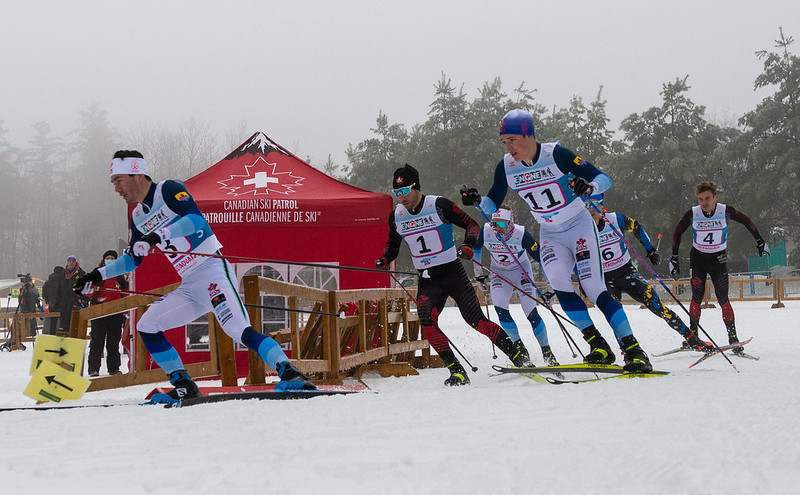
    Sunday was a sun day on the course and delivered the first mass start in 20 months for most of the skiers present. The excitement and the broken poles were real.

    Antoine (Tony) Cyr, who returned from World Cup Period I with two top twelve results and a cold, pushed the pace early before finishing alone in 37:48.3.

    “Tony started with a strong pace,” Boucher wrote, “and after that we just tried to drop each other by a big enough gap in the hills so that the other didn’t catch up on the flats. I bonked first, so I got second…”

    “[The] skate race was good!” Grall-Johnson wrote of being the only non-CNEPH skier in the top eight. “It was one of those races that just flowed through. Antoine took it out a hard pace and then by the top of the first hill there were only three of us with a gap to the next pack, and then we just created a bigger gap over the rest of the first 5km. Tactics weren’t the deciding factor yesterday, I was very content to let Phil and Tony do most of the work and I just had to respond whenever they picked up the pace or tried to attack. At the beginning of the third lap Antoine and Phil pulled away from me on a long working section. I managed to catch back up to Phil who also had a little bit of an explosion and we skied together until he broke me going up a very steep hill with just about 1km to go.”

    Behind the trio, there was a lot more action.

    “Sunday’s 15km mass start was simply really fun,” Hébert wrote about his fourth place from a trio of chasers. “I skied the two last laps with my teammates Leo Grandbois and Felix-Olivier Moreau.  Those laps were very strategic and exciting, lots of tactics involved to fight for that fourth spot.  The start of the race was terrible for me, I got tangled up with other skiers and boxed behind which meant that the first lap was only about getting back in touch with the chasing group.”

    ***

    Gagnon won the women’s 10km in 30:42.1, continuing the CNEPH Sunday domination with Leclair second at 12.9 back. Nakkertok’s Zoë Williams was alone in third at 25.6 seconds behind.

    “My day was awesome!” Gagnon wrote. “Really did not expect taking another win today, but very happy that the race feeling is coming up strong.

    “My teammate Laura and I really worked through this one together,” Gagnon continued. “Maybe not the best tactic all through the race but it ended working out pretty well and we got a lot of experience from it. I knew when I was going to ‘attack’; I was ready to go hard in that last hill, last kilometre and did exactly that.”

    Williams had a plan for the mass start.

    “Tactically my plan had been to chill for the first lap behind the leaders,” she wrote to FasterSkier.

    Plans change, especially in mass starts.

    “Unfortunately my pole got broken right off the start which separated me from the lead pack, but I had a lot of fun working with Bronwyn to reel people back in! (And big shout out to Gilles Bérubé for the super smooth pole hand off!)”

    The ‘Bronwyn’ mentioned is Bronwyn Williams, 4th today, 3rd in the Nakkertok sprint last weekend. She’s also Zoë’s younger sister.

    Audet pulled out early after experiencing back pain. Her youth didn’t stop her from making the wise choice as Trials approaches.

    “Being up in the mix with the senior racers has been a goal of mine and I’m surprised that this is what I am doing,” Audet wrote. “I really enjoy racing with them, they have a lot more experience than I do and it is a lot of fun to race and learn from them.”

    Brazil’s Jacqueline Mourao was the leader of a large group of ‘other nation’ athletes vying for an Olympic quota spot, finishing 6th (+1:28.1). Mourao, now 46, is a seven-time Olympian who rose to prominence as a mountain biker and started skiing in 2005 while renting a basement suite from Pierre Harvey.

    Mass Start Results

    Finding the Bar

    After a season without racing, we now have four Canada Cup weekends to use to judge the state of skiing in Canada.

    With male athletes who have raced the US SuperTour and World Cup period 1, there is a basis for speculation on where Canada fits into world rankings.

    Boucher left the Cable SuperTour with a 1st, 3rd, and 16th results, the last coming in the sprint. Cyr  recorded 11th, 12th, 32nd, 56th, 42nd, 36th, and a DNF in three World Cup weekends. Antoine Briand skied two SuperTour weekends, finishing 2nd and 26th in sprints, 27th and 33rd in distance.  Boucher, Cyr, and Briand all train together at CNEPH which gives Boucher a unique perspective.

    “Tony is in a league of is own in Canada right now,” Boucher wrote. “He is skiing well and his race efforts are so consistent. He is skiing at a World Cup level, which I have been struggling to do over the past year. That being said, I don’t need to compare to Tony to know if I am at a World Cup level – my results from last year speaks from themselves and, sadly, the answer is no. I don’t feel fast enough to get a decent result on a World Cup event.”

    Phil Boucher on his way to second place in the classic. (Photo: Stéphane Barrette/Nordiq Canada)

    We can already see that splitting NorAms into Western and Eastern Canada Cups has reduced travel, and travel costs for racers and teams. This is good.

    “I think it is pretty clear that splitting the Canadian field in two circuit results in a less competitive field,” Boucher wrote.  “We can compare the 15km mass start skate in Cable since it was pretty much the same kind of course. In the super tour, we had a leading pack of approximately 15 guys and this weekend we were 3 battling for the win.

    “So I’d say splitting the Canadian circuit is bad for the depth of the field of our Canadian races, but it doesn’t mean that the level of competition is not high. We still have great skiers in both Canadian circuits. It would just be more fun and more exciting to race against all the best skiers in the country.”

    Less depth in fields, especially in sprint heats, is probably not good. FasterSkier is following this closely.

    Up Next

    There are both new and familiar faces to watch from December, but the real test will be when the entire country meets at the Olympic Trials in Canmore from January 6th to 11th. This is the selection event for Beijing, U23/U20 World Championships, and World Cup period 4, which means most athletes have something to chase.

    Canada has Olympic quota spots for four women and three men, and unofficially the three men’s spots were allocated based on World Cup period 1 results. With so few Olympic berths up for grabs, the focus will shift to earning World Cup starts for older skiers.

    “I’m feeling reassured for trials, simply because last season was kind of a black period and I didn’t know we’re I stood. Now I know the shape is there, it’s going to be very stressful weekend, with a lot at stake but I’m confident the preparation is good and I’ll be ready.” — Gagnon

    “Only thinking about racing, I think it will be an incredible event and I can’t wait to race for the win on the tough Canmore courses.” — Hébert

    “With Trials being held in Canmore, I am sure the volunteers will put on another great event. The courses are something to behold in Canmore with demanding climbs and technical descents. I am sure the athletes will all be excited to race hard, and the spectators will surely be there looking on with anticipation. I think as long as everyone follows covid protocols and respects regulations, everyone should be able to compete, coach and spectate while feeling safe.” — Smith

    For most of the roughly 600 individual skiers who have raced one or more Canada Cups this month, the return of racing is the return of measuring progress and the return of learning.

    “I had no clue how to pace myself, there were tough climbs and I don’t have a lot of experience, and hadn’t raced on a course this difficult in 2 years.” — Audet

    Racing in Canada, Racing at Home

    “Racing in Canada is always fun! Skiing with teammates and with family and friends cheering you on is always fun. It’s a familiar feeling and it’s feels good to start off the season that way and hopefully later moving on to the big races in Europe.” — Gagnon

    “A lot of excitement again this weekend.  There was good support from parents and friends cheering on the side of the course which brought good vibes through the weekend.  We also got lucky with weather, especially on Sunday with a beautiful sunny day.  In Mont Sainte-Anne, the race organizers always have to deal with RCR, the group that owns the mountain, who often don’t even do the minimum to give skiers decent trail conditions all winter.  So, the Club Nordique Mont Sainte-Anne organizing an event like they did last weekend really shows the commitment of the volunteers and the community around the mountain.” — Hébert

    “It feels amazing to be back on the race course again! I have really missed racing and with a couple tough years of sickness and injury simply getting back on the start line is an incredible win. Some things have for sure changed, but honestly, at the heart of things it’s still the same. It doesn’t matter who’s on the race course for me; the goal is always to go as fast as I can between the start and finish line and figure out what I can change for the next race to go even faster!!” — Williams

    “The weekend in MSA was exciting. The conditions were superb and the race organizers did a great job. There were lots of spectators respecting covid precautions and cheering loudly! The 10km classic interval start was fast and furious with quick conditions and great waxing by our staff! Sunday was fun to race a mass start and started off with a blistering pace and a course full of long uphills!” — Smith

  • Eastern Canada Cup #1 & 2: Getting Started in Nakkertok

    Eastern Canada Cup #1 & 2: Getting Started in Nakkertok

    The men’s sprint final at Eastern Canada Cup #1 on Nakkertok trails. (Photo: Robert Smith)

    Once again, there was a great weekend of racing on the Nakkertok trails in Gatineau, QC. It was almost like the pandemic pause hadn’t happened: lots of racers, live results on Zone4, great support for media.

    But it isn’t really just Nakkertok. ENGNE, a coalition of local clubs, puts on great races using Nakkertok trails and the NakkerTrak snowmaking magic.

    As with the first Western Canada Cup (WCC) race, the theme of the weekend was smiles and rust.

    “The mood at this weekends races was super fun!,” wrote Laura Leclair. “Even if it was pouring rain on Saturday, people were very happy to put a bib back on. Super grateful towards all the volunteers who stand in the rain in order to run the event smoothly!”

    Leclair is a CNEPH team member from Chelsea Nordique, one of the ENGNE host clubs and a double winner. Her thoughts were echoed by National Team Development Centre (NDC) Thunder Bay’s Julian Smith, who also won both events.

    “The race went really well today, it was super fun, the volunteers put on a really good event. It was really wet and rainy this morning, but that actually made it for a really fast day.”

    A number of athletes wanted FasterSkier to know that the volunteers got the worst of the Saturday rain before the athletes were on course. Smith put it best:

    “I want to thank the organizers profusely because they were true champions. It was a terribly miserable day to stand still outside for 10 or more hours and they did so with smiles and cheers!”

    Luckily for these volunteers, Sunday brought sunshine for an individual start.

    ***

    Canada is in a sense divided by Thunder Bay, though it is not equidistant from the eastern and western borders. The west has more space, but the east has more people. Sovereign Lake draws volunteers from the local population of 43,000, noticeably smaller than Ottawa/Gatineau with 1.3 million. The population difference also affects the number of athletes, with 12 million Canadians living close enough to drive to Nakkertok for a weekend. As in, almost a third of all Canadians.

    Nakkertok hosted about 480 racers, continuing the trend as the largest event on the continental cup circuit in North America.

    Thunder Bay is neither east nor west, but is within flying distance from both. The only races in driving distance are in the US.

    NDC TBay sent their team west for WCC 1&2 before heading east for ECC 1 – 4. This will give the viewers a few hints about the relative strengths of the two solitudes.

    FasterSkier is trying to bring the Eastern Canada Cup to life from a sunny Sovereign Lake parking lot while this reporter’s partner is doing yet another double workout day at ladies camp. Both Western Canada Cups were held at my home venue, which makes it easy to capture athletes before or after their cooldown ski, record video of the race itself, talk to officials, and feel the vibe from the volunteers, the parents, the siblings, and a few hundred recreational skiers who have never seen a race before. So how is this going to work? And how can it be better for Eastern Canada Cup 3&4 next weekend? Or for the National Championships in Canmore in January?

    Pre-pandemic, the key to getting good content remotely was to email questions to the athletes at the magic time when they could read the message at the venue, then reply at the first convenient pause with wifi, often the airport. When a ‘surprise’ athlete made the podium, it was usually someone FS had been tracking. Now we have a Tory Audet earning her first FIS points and her first senior podium on the same weekend.

    Luckily, Julian Smith helped FasterSkier out with some videos that bring the weekend closer.


    Saturday: Free Technique Sprints

    Saturday started with a downpour on the volunteers setting up, but the action heated up quickly as most racers got their first race in a bib in twenty months. The men raced first, unusually.

    Pierre Grall-Johnson leads Étienne Hébert early in the sprint final. (Photo: Robert Smith)

    CNEPH’s Étienne Hébert won the qualifier in 2:39.86 in his first official race, edging out two TBay skiers who had raced WCCs the previous weekend: Smith by 1.15 seconds and Pierre Grall-Johnson-Johnson by 2.03

    In the heats, it was the Smith show again, winning all of his heats. Hébert took second in his first sprint day, ahead of Grall-Johnson-Johnson who, like Smith, had done all three rounds at Westerns the week before.

    “I felt strong but a little stiff in the qualifier which maybe have been due to warming up in as much water proof clothing as possible,” Smith wrote to FasterSkier. “But the heats, the skis were running fast and the body felt snappy.”

    Hébert was thrilled to be racing again.

    “It’s amazing to finally put a bib back on and race against the other Canadian athletes.  Stress levels were somewhat high before the sprint but it quickly got replaced with excitement.  Having the possibility to race, especially before Olympic trials, is great and I want to say that Nakkertok did an amazing job this weekend.  We train all year as a team for those moments when you get to put the CNEPH suit on and show everyone how fast we are.  This weekend was only the start and we’re all excited for MSA next weekend.”

    MSA is Mont Sainte Anne near Québec City, the home of CNEPH, and like Nakkertok, a keystone race venue in Canada.

    “Saturday’s sprint had a lot of positives,” Hébert wrote about the results. “I got to see that my form was really good and that I can already compete at a high level. Tactics can still be improved but that will come with simply racing more.”

    “Tactics was the key factor in the sprint on Saturday.  Pierre and I had a gap on the rest of the field after the first climb but Julian got back in touch before the last downhill and used the slipstream to get ahead.   thought I could just stay behind [Grall-Johnson] until the finish and pass him but he slowed down too much on the second climb which allowed Julian to come back.”

    Grall-Johnson had his own view of the final on his home trails.

    “Knowing the course very well, as I grew up on it, I was pretty confident in what tactics were best but these races are always good opportunities to try out new ones,” Grall-Johnson-Johnson wrote. “In the final I decided to go out hard from the start and see if I could create some separation, I was able to get a few meters on the first climb but had a pole go deep through the snow which almost made me crash with loaded legs and then on the second climb I had very little energy so I was caught and then conceded in the downhill due to a very advantageous draft going into the finish. Overall though happy with a third place.”

    Laura Leclair wins the final, just ahead of Shaylynn Lowen (Photo: Robert Smith)

    Leclair won the qualifier in 2:55.08, just ahead of CNEPH teammate Liliane Gagnon at 0.29 seconds back. TBay’s Bronwyn Williams and Shaylynn Loewen followed at 2.96 and 3.25 behind.

    In the heats, Leclair won her quarter, came second in her semi, and then edged Loewen for the win.

    Liliane Gagnon leads Laura Leclair in the final. (Photo: Robert Smith)

    “I was pretty confident in Saturday’s final heat,” Leclair wrote to FasterSkier. “I knew that my teammate (Liliane Gagnon) and I could work together in order to position ourselves in the front. I knew we were stronger in the last uphill and Lili and I were able to make a gap between the other skiers.”

    “Unfortunately, Lili fell in the last corner (I swear I did not tackle her ) so I was alone for the last downhill. The other girls caught up because of draft, but I was able to take the win.”

    Williams took third, followed by Chelsea’s U18 Tory Audet, who qualified 5th. Audet also lead the list of new names to watch. Twenty months without racing is a long time in the development of junior skiers, which means more welcome surprises are coming.


    Sunday: Classic Interval Start 10km/15km

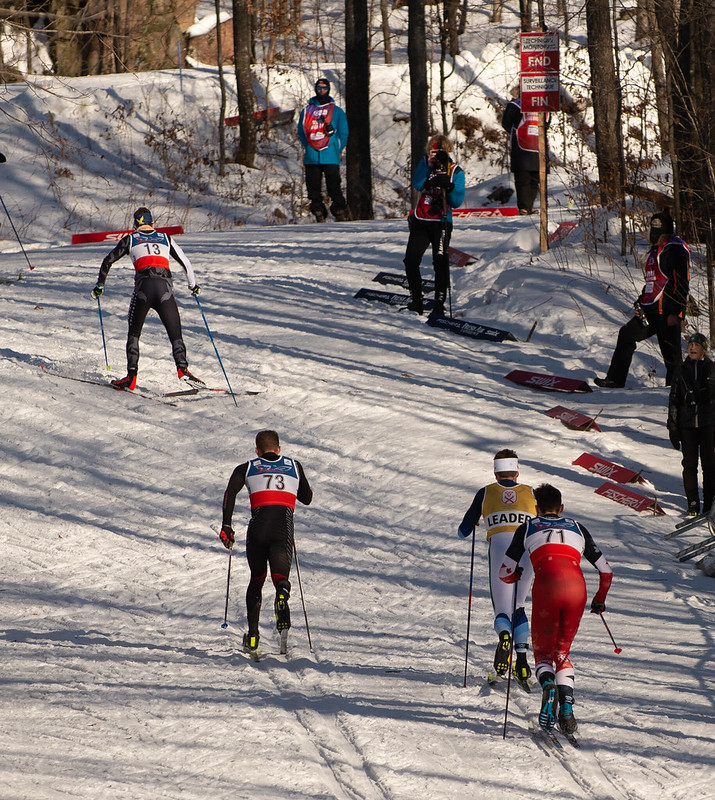
    Julian Smith (yellow bib) skis beside Étienne Hébert (73) in the 15km classic. (Photo: Robert Smith)

    Smith won the 15km in 35:21.3, giving him four wins in four race days, and then summarized the event in a short sentence to FasterSkier.

    “The weekend was a blast!”

    Smith later added a little more detail: “The Sunday weather could not have been more different. -4 and bright sunlight was a welcome change and the track was set for a blistering 10/15km for the seniors.”

    Grall-Johnson was a close second, 4.6 seconds back.

    “Today it was a relatively flat course with lots of laps so I double poled 90% of the race other than the stride zone,” Grall-Johnson wrote. “It was a great fight between Julian and I today, we were going back and forth in the lead, unfortunately Julian pulled away in the end but despite a crash on the first lap I was happy with how I was able to refocus and push mentally.”

    Hébert was third at 25.1 seconds back, changing podium places with Grall-Johnson.

    “The last two laps of 2.5km is where the order of the podium got decided,” Hébert wrote. “Julian and Pierre finished stronger than I did.  We were, all three of us, really close after 10km, inside 10sec I think.  I’m looking forward to a course with more climbs because striding felt really good but my muscles got stiff in the double pole which definitely caused me to lose some time.”

    Laura Leclair poling to victory. (Photo: Robert Smith)

    The women’s 10km also had a double winner, Leclair in 28:05.3.

    “I am not usually a classic skier but I worked hard on my technique this summer and I am super happy to see it paid off,” Leclair wrote. “I felt really good, the conditions and skis were super fast and I just went for it. For some reason I didn’t get any split during the race so I wasn’t sure where I was but I just skied my best.”

    The next three places were U20 athletes: Audet at 25.8, Gagnon at 32.5, and Big Thunder’s Sarah Cullinan at 54.3.

    Gagnon is well known to Canadian fans and raced at U20 World Championships in Vuokatti last season.

    Tory Audet on her way to her first open podium. (Photo: Robert Smith)

    Audet, who recently turned 16, has less public history as a skier.

    “This was my first U20 podium, and my first FIS pointed race,” she wrote. “I was only eligible for a FIS license last year, and since there were no races, this was my first FIS pointed race.” 

    In her first weekend, she raced up in U20/Open and it paid off for her with a 4th in the sprint and 2nd.

    “Having not done a sprint in over a year, and never with older athletes, I had no clue what to expect. My goal was just to race fast and see how far I could get. I knew the trails quite well and had raced them in previous years, which was good because I knew what to expect.

    “As for race tactics, I have limited experience in sprints so at the beginning of the day, I didn’t have any tactics. It was not until I hit semis and made the mistake of leading the pack that I started to think about tactics. I was drafted on the hill  and I lost my spot in the finals, but regained it as a lucky loser. When it came to the final, I decided to try a different strategy: to get out in 3rd or 4th and draft off everyone. It was was really fun because I got to observe everyone else’s tactics,  to see the lines they were taking, and learn from their extensive experience.”

    With U20 athletes on the podium at both Eastern and Western Canada Cups this weekend, it is clear the next generation made good use of a season without races.

    Sprinting heats: Robert Smith caught the reactions to a crash. (Click to enlarge.)

    Getting In The Mood For Racing

    “Everyone just seems to be happy racing again and I think that really helps in making the events fun. Its the first time many of the volunteers have helped with racing events, either for a long time or just first time ever so obviously you have to be patient and understand that everyone is a bit rusty but overall energy is great!” — Grall-Johnson

    “I could feel that everyone at the venue was really excited to be there.  Saturday’s weather was suppose to be horrible but we got kind of lucky with the worst of the rain falling before the qualifier.  Despite this, athletes and everyone else at the venue had big smiles on.  Seeing everyone again after a year and a half was exciting.  I got to see the athletes and coaches from Monteriski, my home club, and all the competitors I didn’t see for the entire pandemic.  Excitement is really the mood that was present last weekend.” — Hébert

    “I am super stoked to be racing back in Canada again. It was great to be at home in front of friends and family and super cool to see how everyone has been training!” — Leclair

    “Our wax techs did an incredible job  so a huge shout out to our staff and the organizers [who] put on a great event for a second day. It is just so exciting to be racing in Canada again, and having friends and family cheering from the sidelines makes it even more special.” — Smith

    Results: full weekend, qualifier, heats, interval start

    Photo Galleries: Robert Smith Sprints, Distance Men, Distance Women, Younger Athletes

  • Svahn Strikes Again in Falun; Diggins 8th

    Svahn Strikes Again in Falun; Diggins 8th

    Rosie Brennan charges up the first and longest climb on the sprint tracks in Falun, Sweden. (Photo: NordicFocus)

    This World Cup coverage is made possible through the generous support of Marty and Kathy Hall and their A Hall Mark of Excellence Award. To learn more about A Hall Mark of Excellence Award or to learn how you can support FasterSkier’s coverage please contact info@fasterskier.com. 

    If you had any question about the strength and depth of the Swedish sprint team, look no further than the qualification list from today’s classic sprint in Falun. Led by Johanna Hagström with a time of 3:14.18, Sweden put six women in the top-10. This number was repeated in the semi-final, leading into a half-Swedish final round on home soil.

    The sprint tracks featured the longest climb first, followed by a spiraling curve to send the women up the second climb. A sharp left turn and a roller brought the athletes back toward the stadium and into the final stretch. As the heats unfolded, this looked like a series of uphill sprints out of the track, some furious double poling, and some powerful cornering. 

    The profile of the sprint tracks in Falun, Sweden. (Photo: https://skidspelen.se/)

    Of the Americans in the heats, Jessie Diggins was the top qualifier in 15th, with Rosie Brennan 20th and Sophie Caldwell Hamilton, back from her mid-season Vermont training camp, in 25th. 

    During the first heat of the quarters, Diggins looked confident in her tactics, sitting in the middle of the pack. Making assertive moves to seize optimal tracks, she swung wide in the final curve to set herself up to capitalize on her double pole as she sprinted her way from fourth to first. Diggins ceded time at the line to Sweden’s Linn Svahn to finish comfortably in second. 

    Jessie Diggins skis to 8th in the classic sprint in Falun, Sweden. (Photo: NordicFocus)

    Racing in the first heat of the semis, Diggins looked to be employing a similar tactic of patiently waiting to pounce in the back half of the loop. Heading up the second climb in the 5th spot, she began to hammer, but by that time, Svahn and Norway’s Tiril Udnes Weng had created a small gap she could not close. Challenging Anna Dyvik of Sweden, Diggins powered over the final roller and worked her double pole, but was unable to make up any ground and finished 4th. 

    This ended Diggin’s day, putting her in 8th place overall.

    “Whew, today was exhausting!” wrote Diggins after the race. “I think all the all-out efforts in the cold finally started to catch up to me, as I was definitely getting pretty tired in my semifinal. But I was really proud of how I skied today – especially in really tricky kicking conditions with steep hills and tracks that were deteriorating, and a ton of herringbone out there! It’s a very encouraging step forward in my classic technical skiing. We also had great skis which is always important!”

    Advancing from the second heat of the semis, Slovenia’s Anamarija Lampic took the lead to pull the group through a fast heat. A few meters back, Sweden’s Jonna Sundling edged out Ane Appelkvist Stenseth and fellow Swede Hagström in a tight finish, which allowed all three women to advance to the final. 

    Poling in sync, the final round of the classic sprint in Falun takes to the tracks. (Photo: NordicFocus)

    Let’s regroup. Three Swedes, two Norwegians, and one Slovenian in the final: Svahn, Sundling, Hagström of Sweden; Weng, Stenseth of Norway; and Lampic of Slovenia. The two semifinal leaders, Svahn and Lampic, pushed the pace from the front, up and over the two significant climbs. Sitting in a tuck to conserve energy for a final sprint over the roller and toward the lanes, Svahn was on the tails of Lampic, with Sundling just behind. The Swedes gained ground over the roller, setting up an exciting race down the finish lanes.

    Anamarija Lampic and Linn Svahn push the pace during the final round of the classic sprint in Falun, Sweden. (Photo: NordicFocus)

    With the line just moments away, Svahn simply attacked the ground with her double pole, pulling ahead for a back-to-back win in Falun. 

    Just behind, Lampic and Sundling were virtually tied as they crossed the line in a photo finish. Though times were the same to the hundredth of a second, Lampic was declared second and Sundling third.

    Linn Svahn takes back-to-back wins in Falun, while Anamarija Lampic and Jonna Sundling slide in for the remaining podium spots. (Photo: NordicFocus)
    Anamarija Lampic (SLO) edges out Jonna Sundling (SWE) for second place in the classic sprint in Falun, Sweden. (Photo: NordicFocus)

    “I’ve been feeling a little bit tired since yesterday’s race, but it’s so fun to compete in Falun. I really enjoy racing on a home course, so it was a good day,” Svahn told FIS at the finish. 

    Despite her age, this is 21-year-old Svahn’s 7th individual win in a World Cup sprint, split almost equally between skate and classic. It is also her second consecutive classic sprint victory on the Falun tracks, as she stood atop the podium in February 2020, also alongside Sundling third place. 

    The women’s classic sprint podium in Falun. Linn Svahn nailed her second consecutive win on the course, with Anamarija Lampic (SLO) second, and Jonna Sundling (SWE) third. (Photo: NordicFocus)

    Svahn was also asked about the close finish and whether she was sure of her win in the moment.

    “I’m never sure of a victory until I pass the finish line first, but it’s cool to see how many strong girls we are competing in sprint races. I think the levels are really high now and it’s tough to win each race, but I’m really glad I managed to do that today, especially in a classic sprint, because it’s my goal this year.”

    Looking back, Brennan raced in heat 4 of the quarter finals, where she finished 4th, unable to advance. This left Brennan in 19th overall.

    Powering uphill, Rosie Brennan skis her way to 4th in her quarterfinal in Falun, Sweden. (Photo: NordicFocus)

    After a conservative start, Caldwell Hamilton skied her way into 2nd position at the top of the intermediate climb. Looking strong as she transitioned from double pole into diagonal stride over the last roller, she held her position around the final curve and into the finish lanes. Swinging around her and quickly closing the gap with her double pole, Sweden’s Hanna Falk overtook the American in the final meters. As the second heat ended up the fastest, Caldwell Hamilton was not able to advance and ended her day in 16th.

    “Today was a really solid race for me,” wrote Caldwell Hamilton in a post-race email. “It wasn’t my best, but it was my first time skiing the heats in a classic sprint this year (actually probably in 11 months) and after a qualifier that felt so-so, I was happy with how I skied my quarter. Falun is a very tough course with some big climbs and technical downhills, but I like those features in a classic course.”
    Sophie Caldwell Hamilton crests the intermediate climb on the sprint tracks in Falun, Sweden. (Photo: NordicFocus)
    “After the first few races of the tour, I took the opportunity to spend a few weeks at home in Vermont during a time where I wouldn’t be missing many sprints,” Caldwell Hamilton continued. “It was such a nice break and I had skiing at the nordic center our neighbors own, Wild Wings, that I could ski to from my house, so I was a pretty happy camper to just spend some time at home doing some solid training and taking a break from the World Cup scene. Now I feel mentally and physically recharged and ready to take on the last couple months of the season! My qualifier today felt a little like I hadn’t done an effort like that in awhile, but I think every race effort will help make that feel a little more normal.”
    Jessie Diggins and Canada’s Katherine Stewart-Jones (bib 29) climb side by side during the first heat of the quarterfinals in the classic sprint in Falun, Sweden. (Photo: NordicFocus)

    After qualifying in 29th, Canada’s Katherine Stewart-Jones landed in the first heat of the quarterfinals with Diggins. Stewart-Jones held strong with the lead group through the second climb, but fell off the pace to finish last in the heat, just behind Norway’s Anna Svendsen. Stewart-Jones was 30th in the final results.

    Outside the rounds, Julia Kern qualified in 35th (+12.95), Hannah Halvorsen 56th (+22.59), and Alayna Sonnesyn 65th (+30.2).

    Maya Macisaac-Jones (CAN) races to 54th in the qualifier of the Falun, Sweden classic sprint. (Photo: NordicFocus)

    Racing for Canada, Dahria Beatty qualified 48th (+17.29), Maya Macisaac-Jones 54th (+21.77), and Laura Leclair 58th (+24.77). 

    Qualification | Final Results 


  • Norway Returns with Gusto, Sweeping the Women’s Podium in the 7.5/7.5 K Skiathlon; Diggins 5th

    Norway Returns with Gusto, Sweeping the Women’s Podium in the 7.5/7.5 K Skiathlon; Diggins 5th

    Same as it ever was – Therese Johaug with the off the front win. (Photo: NirdicFocus).

    In case you missed the discussion on the Devon Kershaw podcast, the Norwegian team made its World Cup return today in Lahti, Finland after nearly two months of training and competing domestically. As predicted, neither their form nor racing gears have not been from this decision. The women in red went 1-2-3 in the 7.5/7.5-kilometer skiathlon, led by powerhouse Therese Johaug who notched her third consecutive win in the event and third career skiathlon win on the tracks in Lahti. Her total of nine career skiathlon wins is a women’s record, surpassing Johaug’s former teammate and one of the most decorated skiers of all time, Marit Bjørgen.

    In her usual style, Johaug took command from the start, skiing away from the pack displaying remarkable precision in her technique and metronomic tempo, stopping the clock at 37:45.1.

    Therese Johaug drives the pace during the classic leg of the Lahti skiathlon. (Photo: NordicFocus)

    As has been remarked before, with the lack of spectators and commentary overlaying the live stream, it’s hard not to be struck by the intensity of the athletes’ breathing. As they kicked, glided, and skated six laps of the 2.5 k course, their lungs pumped at a rate and effort that seemed impossible to sustain. Yes, Johaug had a gap to the chasers from early on, but like the others, her rapid breathing made it abundantly clear that she did not simply walk away with the victory.

    “It was so fun to be on the World Cup again,” Johaug told FIS after the finish. “It has been a long time since I was in Kuusamo [for the opening World Cup races in Ruka, FIN], so it’s really good to race here and see all the people in the cross country family again.”

    Unlike the teams coming off a two-week break following the Tour de Ski, the Norwegian squad made a quick turnaround from their National Championships, which wrapped up just five days ago in Trondheim. Today’s skiathlon is the second this week that Johaug has raced and won. In fact, with only minimal rearrangement for the second and third spots, the podiums in the two events were identical.

    The women’s 15 k skiathlon podium in Lahti, Finland: Helene Marie Fossesholm (NOR) second, Therese Johaug (NOR) first, and Heidi Weng (NOR) third, (l-r). (Photo: NordicFocus)

    “My shape has been really good, now and the last weekend. Today, I know that I was starting in the line, so I knew to take it a little bit easy in the first lap and then go hard from the second and the third. I felt really strong today, and of course, I had to do all the job alone, and especially then, it’s really good to stand on top of the podium.”

    Norway’s Heidi Weng and  Helene Marie Fosseholm – lead the chasers during the skiathlon in Lahti, Finland. (Photo: NordicFocus)

    Perhaps the more interesting race to watch unfold happened behind Johaug. When the Norwegian began to pull away in her second classic lap, a small chase pack emerged in her wake, containing Russia’s Natalia Nepryaeva, Sweden’s Ebba Anderson, and Jessie Diggins in stars, stripes, and the yellow overall World Cup leader bib. Diggins striding was strong and confident, as she tucked in behind the other two racers, entering the exchange zone at 7.5 k on their tails and smoothly switching into her skate skis and poles. 

    The eventual second and third-place finishers, Helene Marie Fossesholm of Norway followed by teammate Heidi Weng apex a corner during the skate leg. (Photo: NordicFocus)

    As the first skate lap unfolded, Norway’s Helene Marie Fosseholm and Heidi Weng began to ski off the front of the second group of chasers, which contained names like Olympic champion in the Skiathlon Charlotte Kalla of Sweden and bronze medalist Krista Pärmäkoski of Finland. Wearing the red World Cup distance leader bib, Rosie Brennan also sat comfortably in this group.

    Though only 29-years-old, Weng is a veteran compared to Fosseholm, who is only 19. Her results this season indicate she is a name to get to know; she finished 6th overall in the Ruka Triple, and proceeded to earn four podiums during her subsequent time racing on home turf, including a Johaug-like victory in the 10 k skate last week during the Norwegian National Championships, winning by a margin of over 30 seconds. Johaug did not contest this event. 

    By the 10 k mark, Fosseholm and Weng had caught the group of Andersson, Nepryaeva, and Diggins. The Russian began to fall off the pace, but Diggins was not about to follow suit. The women skated as a unit through the next lap, never separated by more than a second or two. 

    Jessie Diggins (USA) skiing behind Sweden’s Ebba Andersson and Russia’s Natalia Nepryaeva on Saturday’s 15 k skiathlon in Lahti, Finland. (Photo: NordicFocus)
    Jessie Diggins (USA) at the ski exchange 7.5 k into the women’s skiathlon alongside Ebba Andersson of Sweden and Natalia Nepryaeva of Russia. (Photo: NordicFocus)

    As they left the stadium for their final lap, Fosseholm made a surge, testing her mettle against her more seasoned pursuers. With just over a kilometer to go, she had nearly a seven-second gap, which dissolved much faster than it was formed. 

    Andersson, Weng, and Diggins powered through the back half of the lap, steadily closing in on Fosseholm. Aerial shots showed the women charging up the final climb, still able to jump skate after nearly 40 minutes of exertion. They V2’ed over the top of the climb, all cylinders firing as they dropped back toward the stadium, around a couple of tight curves and toward the lanes.

    Fosseholm could be seen taking nervous glances over her shoulder, knowing the other women had zeroed in their sights and there was no room for error. Luckily for Fosseholm, she had maintained enough real estate to enter the lanes with a clear path to second place (+28.1).

    Behind her, it was still anyone’s game. Weng was first into the lanes, but Andersson was by her side and charging, Diggins just behind. With a furious throw of boots at the line, Weng snagged the third spot on the podium (+29.6) with Andersson centimeters behind in fourth (+29.7) and Diggins in 5th (+30.1). 

    Yellow bibbed Jessie Diggins double poles during the first leg of the 7.5 k / 7.5 k skiathlon. (Photo: NordicFocus)

    In a post race interview, Diggins shared insights into the conditions in Lahti and how bomber kick on klister allowed her to ski what she identifies as one of her best classic races on the World Cup. With suboptimal glide in skate, Diggins had to shift her tactics so she could stay in the draft of those in front of her and ultimately left a final slingshot around Andersson and Weng to fight for the podium just out of reach. 

    “I was excited to dare greatly and try to stay with Johaug as long as possible, just to see and to really push it… In the skate half, it was nice to have those girls to work with. I had to keep adjusting my strategy as I realized how our glide stacked up to their glide. I had to keep changing it around, and I played the only card I had, tactically speaking. It didn’t really work, but it was the only thing I could do in the situation that I was in. I was really proud of that and I think I skied as smart of a race as possible.”

    Jessie Diggins leaves everything on the course to finish 5th in the 15-kilometer skiathlon in Lahti, Finland. (Photo: NordicFocus)

    Diggins also discussed the team recovery camp in Seiser Alm, Italy, how she manages the balance of increased media attention with training and recovery and her desire to support meaningful causes like the Emily Program, and how “new blood” on the World Cup squad re-energizes the veteran members of the American team.

    Maintaining her position in the second group of chasers, Brennan skied to 11th place (+1:07.6), ending her race just ahead of Kerttu Niskanen in a photo finish.  

    In focus and red bibbed as the World Cups leading distance skier, Rosie Brennan near the start of the 15 k skiathlon in Lahti, Finland. (Photo: NordicFocus)

    “It’s always hard to know how the body is going to bounce back from an event like the Tour de Ski,” wrote Brennan in an email after the race. “As a result, I decided to start controlled and then see what I had when I switched to skating. I felt much stronger in classic than I have all season and as a result maybe should have been more aggressive in the classic leg, but hindsight is always 20/20. After the transition to skate, my muscles struggled a bit, but I found better movements and strength as the skate portion went on. There wasn’t much space to move in the skate portion and I feel I missed some moves that I shouldn’t have, but had a strong final climb to move up a bit. In all, I feel this race was a really good step in the right direction for me as I am now focused on preparation for the World Championships.”

    Rosie Brennan finishes strong in the chase pack for 11th place in the 15-kilometer skiathlon in Lahti, Finland. (Photo: NordicFocus)

    A quick look to the overall World Cup ranks. With today’s results, Diggins remains at the top of the overall leaderboard with 991 points and also ties Brennan for the top spot in the distance standings with 401 points. Brennan remains in second place overall with 824 points, followed by Russia’s Yulia Stupak with 802 points. 

    In her first World Cup start, Sophia Laukli (USA) skis to 33rd in the Lahti, Finland skiathlon. (Photo: NordicFocus)

    Also for the U.S., Sophia Laukli in her first World Cup start raced to 33rd (+3:54.8). Laukli is a member of the US Cross Country D-Team and is a sophomore at Middlebury College in Vermont. Caitlin Patterson was the next American in 37th (+4:33.8), Julia Kern 40th (+6:31.3), and Alayna Sonnesyn 43rd (+6:41.1). Forty-eight skiers finished the race. 

    This was Canada’s first World Cup appearance this season. Two athletes scored points, Katherine Stewart-Jones in 24th (+3:23.5) and Cendrine Browne in 27th (+3:44.9). Laura Leclair skied to 44th (+6:41.7).

    Katherine Stewart-Jones (CAN) and Cendrine Browne (CAN) (right) at the finish of the 15 k skiathlon. (Photo: NordicFocus) – FIS world cup cross-country, skiathlon women, Lahti (FIN). www.nordicfocus.com. © Vianney THIBAUT/NordicFocus. Every downloaded picture is fee-liable.

    7.5/7.5-kilometer Skiathlon Results  

    World Cup Standings: Overall | Distance 

  • U23 World’s Mixed Relay Rundown

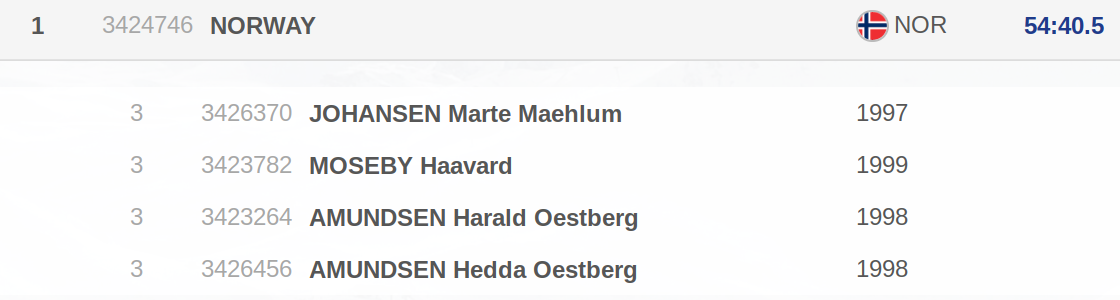
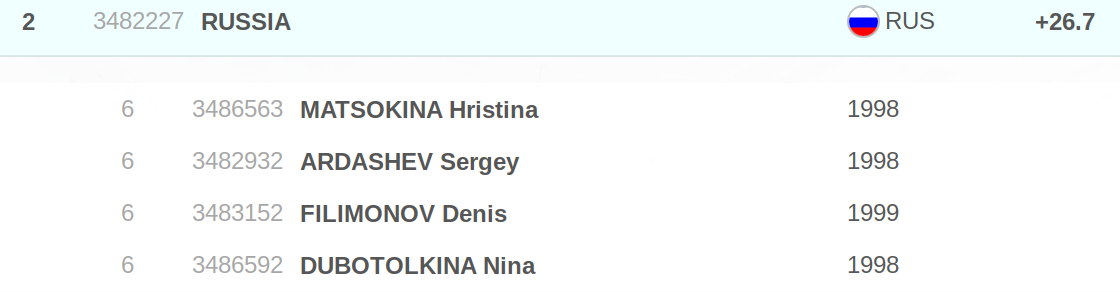
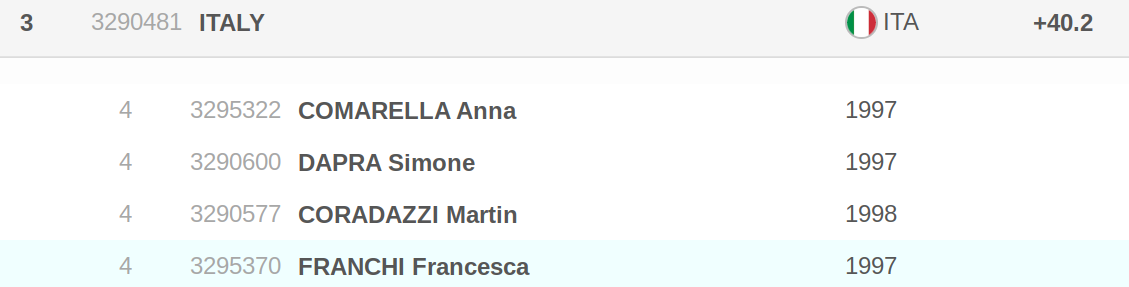
    U23 World’s closed out today in Oberwiesenthal, Germany with the 4 x 5 k mixed relay. Norway, which had struggled in both the junior women’s and junior men’s relay won in 54:40.5 minutes. Russia followed in second (+26.7), and Italy third (+40.2).

    Norway’s Marte Mæhlum Johansen of Norway at the start of the U23 4 x 5 k relay. (Photo: Doug Stephen)

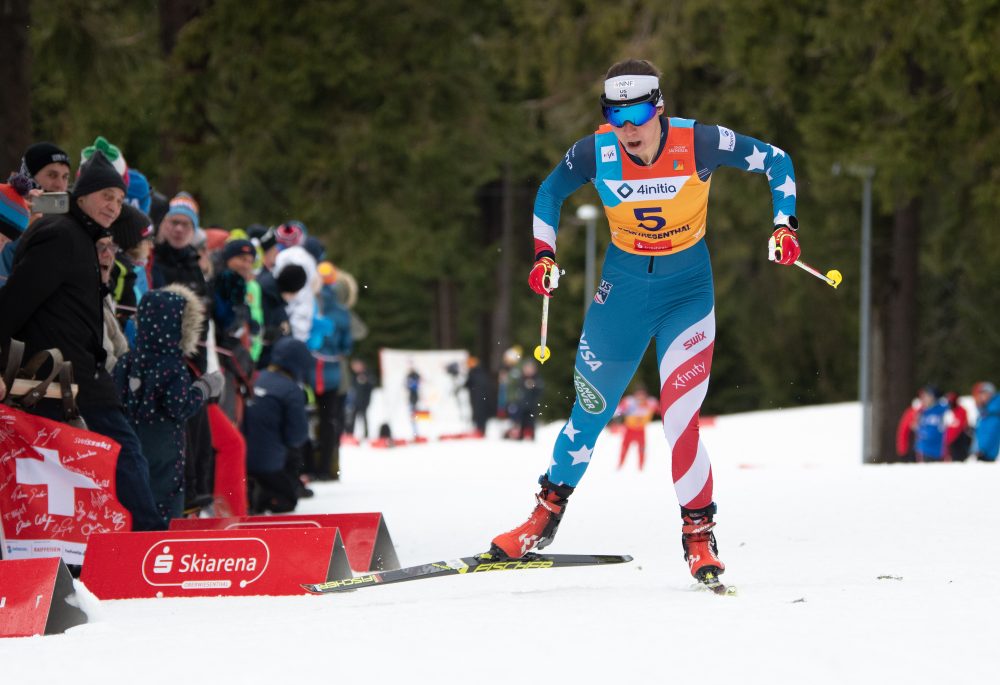
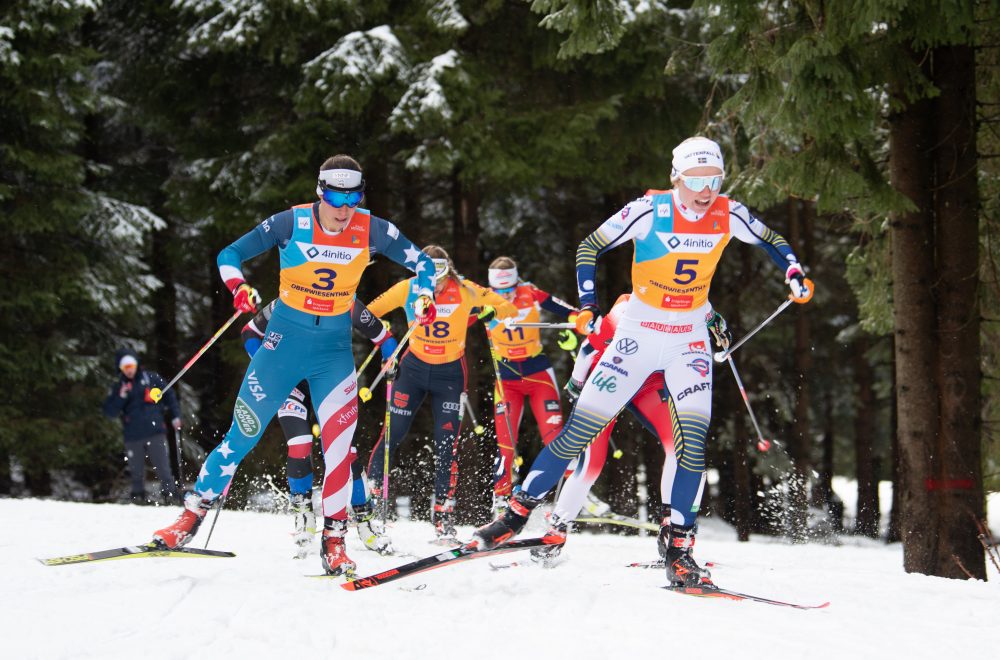
    The U.S. placed fifth (+54.6) of the 15 teams finishing the event.

    Hailey Swirbul (bib 5) and Sweden’s Moa Olsson (bib 2). (Photo: Doug Stephen)

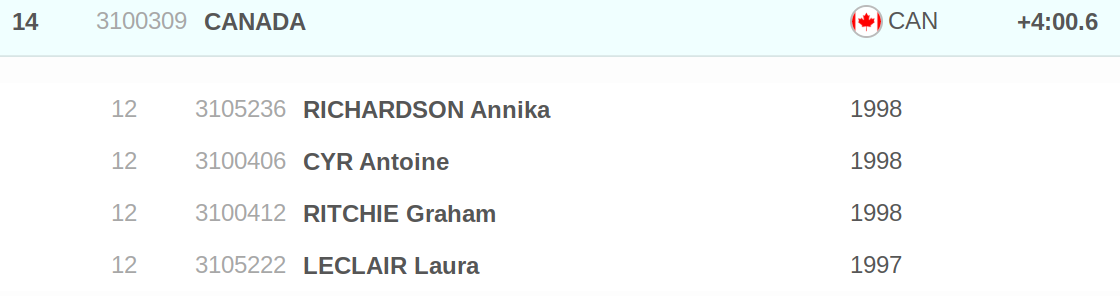
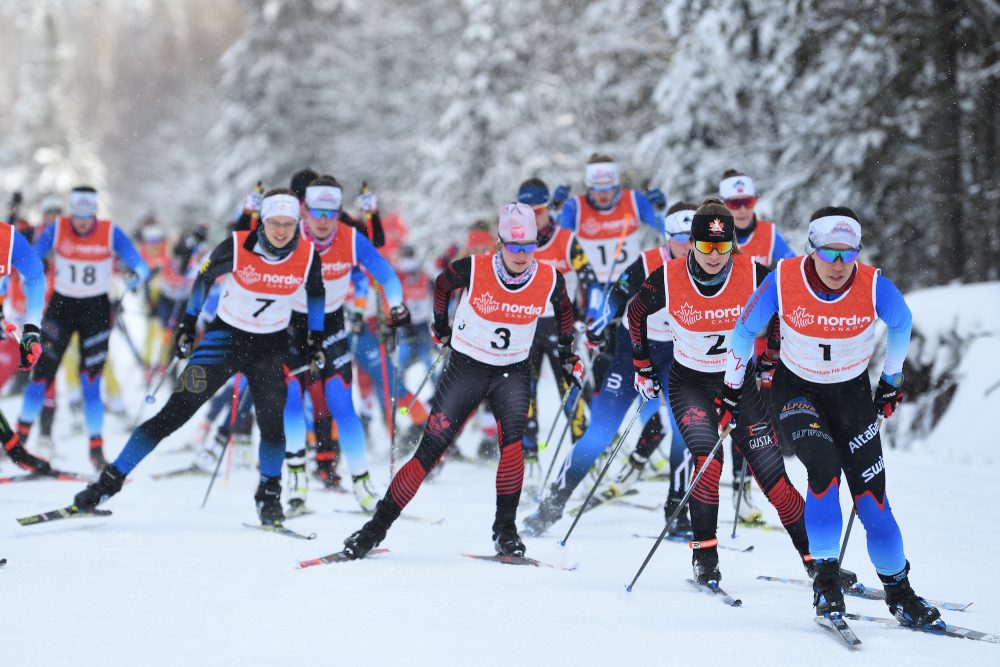
    Canada’s foursome of U23 skiers finished in 14th (+4:00.6).

    Results

  • Julia Kern Third in World U23 Skate Sprint (With Audio Interview)

    Julia Kern Third in World U23 Skate Sprint (With Audio Interview)

    The U23 World’s skate sprint podium: Johanna Hagström (SWE) second, Emma Ribom (SWE) first, and Julia Kern (USA) third (l-r). (Photo: Doug Stephen)

    Racing continued amidst a snowstorm in Oberwiesenthal, Germany in today’s U23 1.2-kilometer freestyle sprint event. Coming down lightly at some times and in heavy bursts at others, the precipitation accumulated on the tracks creating some excitement in the form of repeated starts and untimely crashes. 

    Two Americans qualified on the women’s side, with Julia Kern (USST/SMST2) near the top in third, exactly 1 second behind the top racer, Sweden’s Johanna Hagström. Hailey Swirbul (USST/SMST2) was the next qualifier in 21st (+7.80). 

    Julia Kern during the U23 skate sprint qualification. (Photo: Doug Stephen)

    Post-race interview with Julia Kern

    Outside the top-30, Amanda Kautzer (US Biathlon/Michigan Tech) finished 40th (+17.25) and her collegiate teammate Sarah Goble finished 47th (+23.16).

    For Canada, Laura LeClair was the top qualifier in 27th (+13.66). Hannah Mehain was next in 36th (+16.20), followed by Annika Richardson in 39th (+16.39), and Laurence Dumais in 43rd (+19.19). 

    Swirbul raced in the first heat of the quarter-final and finished fifth, ending her day in 22nd, and Leclair finished fourth in the second heat for 20th overall. 

    Snow began to fall heavily as Kern raced in the final heat of the quarters, obscuring racers from view in the live feed. Kern took the lead in the second half of her round, pushing through the final meters for the win.  

    Her semi looked markedly similar, and she advanced to the final with ease. 

    Julia Kern (bib 3) with the day’s eventual winner, Emma Ribom (bib 5), during their semifinal. (Photo: Doug Stephen)

    In the final, Emma Ribom and Hagström, both of Sweden, controlled from the outset. At 1:10, Kern was stuck fifth in the line of six skiers. Kern remained boxed out, coming up and over the climb at 2:10. V2ing into the long final straight, Kern found open real estate to her left, where she was able to surge into third place across the line. 

    Ribom won in 2:36.77, with Hagström in second (+0.54). Kern was 1.14 seconds back in securing third place. Ribom most recently placed ninth overall on the World Cup’s Ski Tour 2020. At twenty-one-years-old, Hagström already has a World Cup podium on her resume: A third place in last season’s skate sprint in Cogne, Italy. 

    Emma Ribom (bib 5) hungry to the finish, with Kern powering into third. (Photo: Doug Stephen)

    Kern who has become a regular U.S. Ski Team athlete on the World Cup, earned another World Junior/U23 medal. She first earned bronze in 2017 on the junior 4 x 3.3. K relay team. 

    Women’s Qualification | Final

    Julia Kern post-third place at U23 Worlds. (Photo: Doug Stephen)
  • MSA Trials Wrap-up: Tactics, Selections, Photos, and Videos

    MSA Trials Wrap-up: Tactics, Selections, Photos, and Videos

    Emily Nishikawa leads out the U20 and Open 15km at MSA Trials. (Photo: Doug Stephen)
    Emily Nishikawa (bib 1) leads out the U20 and Open 15km at MSA Trials. (Photo: Doug Stephen)

    Mont Sainte-Anne brought great ski conditions on a weekend where the best in Canada fought to qualify for four different race trips: U20/U23 World Championships in Oberwiesenthal, Germany; Falun and the Scando Tour; the sprint tour of Québec and Minnesota; and World Cup finals in Canmore. Combine this with the usual NorAm action and COC leader competition and you have all the ingredients for a great weekend.

    Over 400 athletes raced in five age groups with over 150 competing for U20 selection.

    For all four trip selections, Nordiq Canada will be making a list and checking it twice. Or maybe more than twice. For U20, five athletes of each gender are selected, starting with the top skier on Sunday, then Friday, then Saturday and starting again with Sunday’s second place. For U23, four or five skiers will be selected the same way. The Sprint Tour averages the qualification and heats points to rank athletes to be selected after pre-qualified athletes. The Canmore weekend similarly sums the two distance days. With 10 Host Nation starts allocated in addition to the ones Canada has earned, there are many start opportunities. Most of the paths to guarantee a spot on next year’s National Team begin with qualifying for one of the above. But no pressure.

    Each COC leader gets their own start allocation at every World Cup for the period. As there are no more NorAm (Continental Cup) events until Nationals beginning on March 26, the COC leader as of today retains this for the rest of the World Cup season. The best five of nine races are counted, which means Katherine Stewart-Jones had the women’s spot locked up in December. Antoine Cyr came into this weekend with the leader’s bib and a win Saturday was enough to keep it, according to Nordiq Canada.

    After Friday’s free technique sprints and Saturday’s interval start classic, Sunday brought mass start skating and longer distances.

    The U20 and open women started the day with 15km on the same hilly 5km course as Saturday. Emily Nishikawa and CNEPH’s Cendrine Browne got away early before Nishikawa broke clear on the final long climb to win in 43:44.1, with Browne 13.4 seconds back. Browne’s teammate Laura Leclair spent most of the race alone and held off a charging pack to finish third for the top U23 result, 1:45.4 behind, just 0.8 seconds ahead of the top U20 finisher, Revelstoke’s Elizabeth Elliott. Black Jack’s Jasmine Drolet was edged out into 5th but should still have earned the trip to U20’s in Oberwiesenthal.

    Nishikawa spent a rare winter period back in Canada and enjoyed the change.

    “It was great to be home in Canmore, and I got a good block of training in before heading back to the World Cup,” Nishikawa emailed. “It was very fun to be able to race in Canada – in Whistler and here in MSA, and now I feel ready to get back on the World Cup.”

    Nishikawa, who was 25th overall in the 2019 Tour de Ski, is focussed on the Scando Tour and racing back home in Canmore.

    Browne, who is bouncing back from a tough year, was happy to be back in the game. “The race felt really good, I had good legs and great skis. I really liked skiing with Emily, it was fun to race with her again,” Browne wrote. “I should’ve taken more relays and rested more so I maybe could’ve followed Emily when she attacked at 14km. Unfortunately, when she did attack, my legs were fried!”

    Browne, a distance specialist who loves the skate days, was also excited to have won the sprint on Friday.

    “Winning a sprint was very fun! It was a big confidence boost! It was also a pretty tactic race, which was very fun too.”

    The applause and support is always there for the good days, but no athlete has only good days.

    “Last year was very tough for me, as for many athletes after the Olympics, Browne continued. “I was very depressed and wasn’t having fun anymore. It was also very hard to lose all support from my federation. After that tough year, I had a severe concussion (in the end of August till mid November) so coming back strong is such a big relief. I feel so much better, physically and mentally and I’m confident that I have a good form.”

    Writing about the tough times feels like kicking an athlete when they are down. It is much easier to write about an athlete when they are scrambling to catch a flight to Falun. It looks like some athletes will be at the airport before we have a confirmed published list of who is joining Browne and Nishikawa for period 4 of the World Cup. (To be fair, that list is one of four that has to be written and double-checked by officials who also have flights to make today.)

    “Today’s race was tough,” Leclair wrote to FasterSkier. “I skied alone and had a pack of 10 skiers chasing me the whole time. I would have liked to ski with Emily and Cendrine but lost them in the first lap. However, I did what I had to do and I am happy with how I skied considering I was alone.” Leclair will be going to a CNEPH elevation camp in Livigno, Italy, on her way to U23 Worlds.

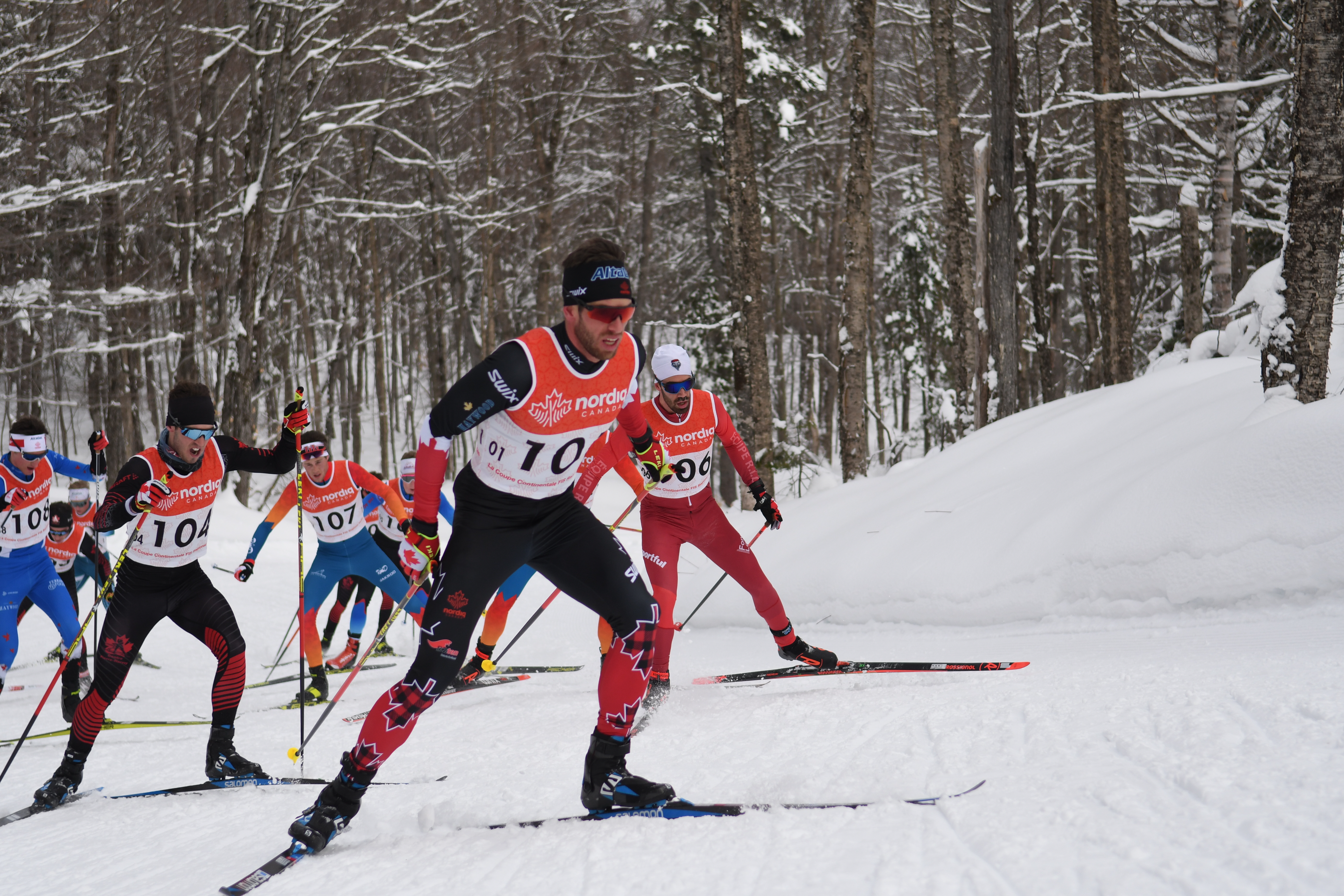
    Russell Kennedy leads the pack early, with Rémi Drolet (#108), Philippe Boucher (#104), Sam Hendry (#107), and Ricardo Izquiedro-Bernier (#106) keeping a close eye. (Photo: Doug Stephen)
    Russell Kennedy leads the pack early, with Rémi Drolet (#108), Philippe Boucher (#104), Sam Hendry (#107), and Ricardo Izquierdo-Bernier (#106) keeping a close eye. (Photo: Doug Stephen)

    The men skied 30km and many said they were feeling the big climb by lap six. Black Jack’s Rémi Drolet animated the race early before Canmore’s Sam Hendry made a big move on the final lap to explode the pack of ten. In the end, it was Team R.A.D.’s Evan Palmer-Charrette who emerged to take the win in 1:15:49.7, with Fondeurs-Laurentides’ Ricardo Izquierdo-Bernier at 0.3 seconds and top U23 Hendry at 0.4. CNEPH’s Phil Boucher was fifth at 5.3 ahead of Rémi Drolet who took his third U20 win at 11.2 seconds back.

    Foothills’ Tom Stephen popped out of the second pack to book his trip to Germany as the second fastest U20, 2:04.6 behind the winner and 11th overall.

    “The race today went very well for me,” Palmer-Charrette explained in an email. “My plan from the get go was to match any move and stay in contact, the final kilometre is very high speed and my plan was to wait until there to make a move, so it played out perfectly.”

    “Race went pretty well today,” Hendry wrote of his Sunday. “I skied in the group and did the best job I could to save energy. Coming up to the last climb I moved into the front of the pack to avoid traffic and found myself pulling away from the group so went all in and attacked hard over the final climb. I then had a few second lead and tried to hang on until the end of the course but blew up in the final meters and was passed by Evan and Ricky.”

    Like many of the other athletes, Hendry is balancing full time studies with skiing.

    “Full time school and racing is going great. The University of Utah is super accommodating and want to see me succeed in not only academics and college racing but also international competitions such as these trials and U23’s.” That balance only goes so far. In addition to collegiate racing and U23’s, Hendry is hoping to ski World Cup Finals in Canmore (which may require a good result from him in Germany), but nationals is not on the program.

    Boucher should have earned his trip to Canmore with a 4th and a 5th in distance this weekend.

    “The race went well,” he wrote. “I managed to react well on Sam’s move in the last km. It blew the pack in small groups. So the only tactic here was to survive until the end. But in general, the plan for today was to try to stay in the front of the pack in the uphills, so I dont get caught behind if someone makes a move.”

    While many athletes are enjoying the new race calendar with less east/west flights to races, Boucher also sees a downside: less races.

    “I think there’s a lack of races. We currently race 1 weekend per month… I train all summer long to race in the winter so it’s a shame when we dont have a lot of racing to do in North America.  I had a difficult start in December but at least I had some good racing at the U.S. Nationals in Houghton early in January. And then here at MSA, it’s been one of my best racing weekends of the season so far. My race shape is raising and that’s good sign for the coming races.”

    Nordiq Canada’s Jeff Ellis, Joel Jaques, and Erik Bråten have talked to FasterSkier about balancing the need for lots of races, reduced travel costs, and reduced challenges to host regional races. Watch this space.

    While some athletes will go home happy with their race efforts and others won’t, it seems like everyone enjoyed their weekend. Palmer-Charrette put it best: “The conditions here for the whole weekend were really good, the [Organizing Committee] did a great job with the trails. Yesterday turned out to be a slightly tricky waxing day and on a relatively flat high speed course there were definitely a few athletes caught out with icing issues, however that’s the game of classic racing. For the sprint and today, conditions couldn’t get any better really, so it made for exciting races.”

    Results: Full Weekend, Sprints, Interval Start Classic, Mass Start Skate.

    Photographer Doug Stephen has more evidence of the great trails in his Sunday Gallery. Athletes are welcome to download and use full resolution images if they give credit to ‘Doug Stephen’ or @vr45photography.

    Olivia Bouffard-Nesbitt leads Jasmine Drolet, Elizabeth Elliott and Liliane Gagnon in pursuit of the top 3. (Photo: Doug Stephen)
    Olivia Bouffard-Nesbitt leads Jasmine Drolet, Elizabeth Elliott and Liliane Gagnon in pursuit of the top 3. (Photo: Doug Stephen)
  • MSA Trials Rundown: Qualifying for U23, U20 and More

    MSA Trials Rundown: Qualifying for U23, U20 and More

    Cendrine Browne leads her semifinal at MSA Trials. (Photo: Doug Stephen)
    Cendrine Browne leads her semifinal at MSA Trials. (Photo: Doug Stephen)

    In Canadian domestic ski racing, it doesn’t get much bigger than this. Mont Sainte-Anne (MSA) is hosting the NorAm weekend that also serves as U23/U20 World Championships qualification and has special significance in selection for World Cup starts.

    Any skier who hasn’t already qualified for World Cup period 4 has had this event as a major focus for the season. The only certain paths to National Team selection for next season start with top 30 results on either the World Cup or U20 World Championships. Most of these paths start at MSA Trials.

    For U20 and U23 selection, the top finisher in each of the three races is guaranteed one of the 18 to 20 places on the trip to Oberwiesenthal, Germany, with a pre-camp in Norway.

    And finally, the weekend is a NorAm, which means COC leader points are on the line.

    On Thursday, the action started with free technique sprints on a short but difficult course. Men, women, and U20’s all skied the same distance. Nordiq Canada’s Jeff Ellis continued the tradition of winner’s interviews, FasterSkier has the unedited videos below.

    Elizabeth Elliott in charge of the U20 final. (Photo: Doug Stephen)
    Elizabeth Elliott in charge of the U20 final. (Photo: Doug Stephen)

    CNEPH’s Cendrine Browne won the qualifier in 3:04.79 before winning three heats to dominate on her home trails, finishing the final in 3:01.37. Browne’s teammate Laura Leclair was second, 0.53 seconds back, for the top U23 finish ahead of Emily Nishikawa at 0.76 seconds. The presence of distance specialists Browne and Nishikawa on the podium is evidence of the sprint course’s difficulty.

    For the U20 women, AWCA’s Elizabeth Elliott qualified 4th overall and swept the heats to win the final in 3:06.85. Her teammate Benita Peiffer was second, 1.66 back, narrowly ahead of Black Jack’s Molly Miller at 1.81 seconds.

    For the men, NTDC Thunder Bay’s Graham Ritchie recovered well from his time in Europe to win in 2:35.69 after qualifying second, grabbing the top U23 finish along the way. Team ULLR’s Jess Cockney continued to redefine the word ‘retired’ in second place, 0.52 back. TBay’s Pierre Grall-Johnson who converted on his latest qualification win with his first open category podium, was third at 0.76 seconds.

    Graham Ritchie taking advantage of the downhill finish for the win. (Photo: Doug Stephen)
    Graham Ritchie taking advantage of the downhill finish for the win. (Photo: Doug Stephen)

    The U20 men provided no surprises, with the favourites front and centre in the final. Black Jack and Harvard’s Rémi Drolet dominated the day, sweeping through to the final to win by 2.57 seconds in 2:34.75. ULLR’s Xavier McKeever was second after qualifying 29th overall for 5th U20, with teammate Tom Stephen taking bronze a further 1.09 back.

    Speculating on selections using the criteria documents always comes with a risk of error. That said, Leclair, Ritchie, Elliott, and Drolet should definitely be eligible for Obwiersenthal. Peiffer and McKeever should be selected as the 5th U20 athletes.

    Results: Full Weekend (including live timing for Saturday and Sunday), Qualification, Heat Brackets, Final

    Photographer Doug Stephen has a gallery for the Sprints and Official Training. Athletes are welcome to download and use full resolution images if they give credit to ‘Doug Stephen’ or @vr45photography.

    Rémi Drolet leads Xavier McKeever, Olivier Léveillé, and Tom Stephen in the U20 final. (Photo: Doug Stephen)
    Rémi Drolet leads Xavier McKeever, Kai Meekis, and Tom Stephen in the U20 final. (Photo: Doug Stephen)
  • Nakkertok NorAm Weekend Round Up

    Nakkertok NorAm Weekend Round Up

    Katherine Stewart-Jones leads a sprint heat on her way to domination. (Photo: Robert Smith)
    Katherine Stewart-Jones leads a sprint heat on her way to domination. (Photo: Robert Smith)

    The NorAm circuit moved east to the Nakkertok trails for three days of racing jointly hosted by Nakkertok Nordic, Club Skinouk, Chelsea Nordiq, and Kanata Nordic. Friday featured classic sprints, Saturday interval start free, and Sunday interval start classic.

    The event was also the Candy Cane Cup for the younger categories, as well as Ontario Cup 1 and Coupe Québec 1. 374 athletes in the U16, U18, and Open categories competed on Friday with many more younger athletes racing Saturday and Sunday.

    Nordiq Canada’s Jeff Ellis was there and has once again shared the full-length post-race interviews. Photographer Robert Smith has galleries for each day, so keep scrolling.

    Nakkertok had over 3km of trail open thanks to their snowmaking, with a 2.5km loop used for the distance races.

    The 'NakkerTrak' at NakkerTok before the 2019 NorAm weekend. (Photo: Nakkertok)
    The ‘NakkerTrak’ at Nakkertok before the 2019 NorAm weekend. (Photo: Natural Fitness Labs)

    On the women’s side, it was the KSJ show, with home-grown national team member Katherine Stewart-Jones winning all three days.

    In the sprint, Stewart-Jones finished in 3:19.96, comfortably ahead of AWCA’s Maya MacIsaac-Jones and RMR’s Katie Weaver at 2.43 and 3.93 seconds back respectively. The podium trio were the top three qualifiers, but in reverse order.

    Stewart-Jones steamrolled the field in the free 5km, 36.8 seconds ahead of Laura Leclair in second and 39.9 seconds before Cendrine Browne, both of CNEPH.

    The trend continued on Sunday, with Stewart-Jones finishing the classic 10km in 28:52.1, 1:18.1 ahead of Skibec’s Andrée-Anne Théberge and 1:29.8 ahead of AWCA’s Annika Richardson.

    Antoine Cyr leads Julien Locke in the interval start classic. (Photo: Robert Smith)
    Antoine Cyr leads Julien Locke in the interval start classic. (Photo: Robert Smith)

    For the men, Hardwood’s Bob Thompson kicked the weekend off with a sprint victory in 3:12.71, followed by national team member Antoine Cyr at 0.36 seconds and his CNEPH teammate Antoine Briand at 0.63.

    On Saturday, Cyr won the free 10km in 22:10.4, 20.9 seconds ahead of Fondeurs Laurentide’s Ricardo Izquierdo-Bernier and 32.8 seconds clear of Team R.A.D.’s Evan Palmer-Charrette.

    Palmer-Charrette stepped up to finish the weekend on top of the podium, winning the 10km classic in 24:43.8. National team member Julian Smith was second at 6.2 seconds followed by Cyr at 14.4 seconds.

    Results: Full Weekend, Sprint Qualifier, Sprint Heats, Interval Free, Interval Classic.

    For many Canadians this season, the big focus is on the Mt. Sainte Anne (MSA) NorAm in January, which is the Junior and U23 World Championship trials. That series is also a path to World Cup starts. As a result, a number of athletes chose the nearer of the two December NorAm races and skipped the other to reduce travel. Over 30 western Canadians drove to Sun Valley for the SuperTour event instead of flying to Nakkertok.

    “I think that it’s good for younger athletes to chase high competition for development,” Stewart-Jones wrote in response. “It makes more sense for them to travel less too. This year, for most of the younger athletes and even a lot of the older ones, the focus is on trials in MSA in January so there is a lot of time to prepare for their optimal race performance.”

    Stewart-Jones moved from Nakkertok to Canmore this training year, resulting in new training partners and a new personal coach, national team head coach Erik Bråten. That also meant returning to Nakkertok required two extra flying days and the associated illness risk.

    “If I hadn’t been trying to get the COC spot locked up for the rest of the season I would have most likely gone to Sun Valley too.”

    There is a complicated calculus to getting World Cup starts in Canada. The COC leader gets FIS-guaranteed starts and financial support from the host organization for each race weekend. Keeping the COC leader bib for the season would mean more and cheaper time on the World Cup for Stewart-Jones. Dahria Beatty and Emily Nishikawa chose to race period 1 in Europe instead, with Beatty qualifying for the next WC trip selection by placing 25th in the Davos sprint on Saturday.

    Photo galleries from Robert Smith are here.

    Video interviews are by Nordiq Canada’s Jeff Ellis. Audio interview courtesy the LOC.

    Post sprint race interview with Stewart Jones (below)

    Post skate race interview with Stewart Jones (below)

    Post classic race interview with Stewart Jones (below)

    Thompson talks sprinting and his season (below)

    Cyr talks about finally getting the win and the leader’s bib (below)

    Palmer-Charrette is happy to get the win (below)

  • Canadian Eastern Championships: Weekend Wrap-up

    Canadian Eastern Championships: Weekend Wrap-up

    Julien Locke leading a sprint heat. (Photo: Bob Smithson)
    Julien Locke leading a sprint heat. (Photo: Bob Smithson)

    The NorAm series went to Duntroon, Ontario, for the Canadian Eastern Championships: three days of varied weather, new race formats, and new faces on the podium, all hosted by Highlands Trailblazers.

    Easterns is possibly the most storied ski race in Canada. Most years, it is the largest FIS event in North America. This year, the Polar Vortex froze out the travel ambitions for many families and lower budgets in the post-Olympic season persuaded many western teams to stay home. Despite these challenges, over 450 athletes braved the difficult road conditions to hit the start line.

    Easterns was ringing in the changes this year. This may be the first ever NorAm where the men and women skied the same distance on the same courses in every event. The two-day pursuit reappeared for the first time at this level since 2000. 

    The two-day pursuit format was introduced in 1988. Based on the Gunderson start in Nordic Combined, there was an interval start classic race on the first day and a free technique pursuit on the second, with medals awarded for both days, but no time-of-day points for the second.

    In 2002, the two-day pursuit was replaced with the same-day pursuit, with no medals for the classic portion and a two hour break before the skate. Beckie Scott won all three medals in this event at the Salt Lake Olympics. In 2003, this was changed to ‘continuous pursuit’, sometimes referred to as ‘pursuit without a break’.  The format name was quickly shortened to ‘pursuit’, which confused people until 2011 when FIS acquired rights to the name ‘skiathlon’, allowing ‘pursuit’ to be used for the final day of a mini-tour. CCC wrote a history in 2011 to celebrate the new name.

    In the summer of 2018, FIS dropped the skiathlon format, which brings us back to a format that most of the athletes racing today will not remember.  

    The weather also came out to play: -18 Celcius (C) and windy for official training, -12 C and sunny for the sprint heats, -9 C and 37 km/h winds for Saturday’s classic, and +3 C and freezing drizzle and rain for Sunday’s pursuit.

    Photo gallery: Bob Smithson

    Results: Sprint Qualification, Pursuit Day 1, Pursuit Day 2, Time of Day

    Classic Sprints

    Women’s A final: Zoë Williams (Nakkertok), Laura Leclair (CNEPH), Mia Serratore (Big Thunder), Annika Richardson (TBay), Katie Weaver (Rocky Mountain Racers), Hannah Shields (Nakkertok)

    Men’s A final: Julien Locke (CNST), Dominique Moncion-Groulx (Team R.A.D.), Antoine Briand (CNEPH), Andy Shields (Lappe), Étienne Hébert (AWCA), Angus Foster (TBay).

    There are no official results or times for the sprints.

    Friday started cold and sunny for the 1.5km classic sprints, a welcome relief after cold and windy weather on the official training day.

    “After two small running hills at the beginning, the remainder was all double pole,” Julien Locke (CNST) wrote. “While the course was not as demanding as I would have liked, it was a good opportunity to use the upper body strength.”

    The course worked well for Locke, as he won the qualifier by over 4 seconds.

    Zoe Williams (Nakkertok) won her first career NorAm, two weeks after her first podium and narrowly missing the selection for World Championships.

    “Today was very surprising,” she wrote to FasterSkier. “When I skied the course yesterday I wasn’t a huge fan and I didn’t think it played to any of my strengths. My qualifier was really messy but I pulled it together in the heats and felt I was able to get faster as the day went on!”

    The women’s A final was chaotic. Each of the three women on the podium had their own view of the action. 

    “I talked to my coach (Kieran Jones) before the A final and our plan was to stay relaxed in the first half of the course, pick it up in the second half and push it into the finish. It worked out almost perfectly; I got caught up in a fall on the main uphill and lost contact with the leaders but was able to fight back in the second half of the course with Laura and Annika and as everyone jostled for the inside line into the finish I just picked the outside lane and hammered.” — Williams

    “Honestly the A final was pretty bad. It was a cool race because everyone in the A final could race but I think we were all a little too excited (or tired). There were a lot of tangles and falls so no tactics there.” — Laura Leclair

    “Tactics were pretty important in the final. I started out hard to get out in front to stay out of trouble on the downhill. Managed to make a gap but lost it in the final straight. It was really important to be strong with the double pole at the end.” — Mia Serratore

    It was Serratore’s first NorAm podium.

    The men followed with tactics that emphasized staying out of trouble.

    “Briand set a strong pace in the first 400m up Honey and Sugar Shack hills. I followed him out to the Biathlon range and then hopped in front for the fast/icy turn. From there, I lead up the gradual Chicken Coop climb, through the twists around the wax rooms and to the line.” — Locke

    “The final started fast with Antoine putting the pace in front. I think the top three skiers (Antoine, Julien and I) had a little gap after the climbing section of the course. Julien accelerated to pass Antoine before the fast downhill, I stayed in 3rd behind them. I took the inside on the 90 degree corner at the bottom of the downhill and move up to 2nd place. Following the downhill, like in the semi-final Julien put the hammer down double poling on the gradual climb and I was the only skier that managed to stick right behind him. I tried to change tracks and pass him on the last stretch but I could not find enough speed to overtake him.” — Dominique Moncion-Groulx

    “I went all out from the gun and Julien took over at mid point. No real tactics from there on to be honest it was full gas racing.” —Antoine Briand

    Some of the athletes were feeling the effects of racing the US SuperTour after the Bishop’s University NorAms.

    “I had a dynamic first half of the qualifier but felt slow and I did not ski the second half well. I had good energy, change of gears and I felt solid through all the rounds. I’m happy with my speed in the heats and with a good final result. For a 3rd weekend of racing in a row, it’s fun to still feel energetic.” — Moncion-Groulx 

    “Coming back from a big win in Lake Placid at the US Super Tour last weekend, I was feeling confident for another classic sprint. Had a good qualification with the second best time and being on the podium at the end of the day is always satisfying.” — Briand

    Interval Start Classic

    Saturday brought in wind and warmer weather for the 10km classic race. The 5km loop had two main uphills immediately followed by downhills.

    Williams said pacing mattered because “with only 4 main hills, lots of good rest, and a ton of double pole you had to keep pushing everywhere.”  

    Williams got her second win of the weekend in 35:46.09 minutes. “Super happy with it: stuck to my plan and had fun chasing people down. Mia started ahead of me and we skied the 2nd lap together which was awesome.” 

    Serratore finished second, 37.82 seconds back. Leclair didn’t get the benefit of timely splits or good rides, but was able to grab third at 1:18.40, just 0.18 seconds ahead of Annika Richardson.

    “Because I was second to start, I was alone the whole race and didn’t see anyone,” Leclair wrote. “That was pretty hard because I didn’t know how fast the girls behind me were going. I had no bunny or rabbit. Anyway, the conditions and skis were good and it was an overall good race.”

    Among the men, Alexis Dumas (CNEPH) came the closest to even splits, crossing the line in 30:04.8 for the win.

    “I was able to ski really hard in the second lap and that’s where I made the difference. Also, my skis were super good. My wax tech and my coach did a great job today.” — Dumas

    Shields was second, 16.67 back, after an error in the unofficial results was corrected.

    “I felt flat racing today. Yesterday was a long day with the classic sprints and awards being late in the day so I was carrying fatigue,” Shields wrote. “In today’s race, I knew I didn’t have a great one but was surprised to see how far back I was when the initial set of results came out showing me in 7th place – almost a minute from the win.” 

    Boucher was happy with his third place, 21.57 seconds back.

    “I think my skis and pacing played a lot in the outcome of the race. I decided to sacrifice some kick to have a better glide on the flat sections. Turns out it was the good call for me. I’m a little disappointed that I lost nearly 15 seconds on the leader in the last lap.” — Boucher

    Skate Pursuit

    Zoë Williams and Annika Richardson ready to start the pursuit. (Photo: Marten Burns)
    Zoë Williams (101) and Annika Richardson ready to start the pursuit. (Photo: Marten Burns)

    Sunday brought freezing drizzle replaced by rain which resulted in significant challenges in picking the right skis for the changing conditions. The start times for the skate pursuit are based on time back in Saturday’s classic race, with no bonuses awarded.

    Leclair took her first senior NorAm win, starting third at 46 seconds back.

    “My tactics for today were pretty simple,” Leclair wrote. “I wanted to start fast and catch the two girls in front of me. I put my head down, climbed and went hunting.”

    “I felt super good and skis were wicked fast. After missing the first step of the podium on the two last races, it is nice to finish on the top.” 

    Zoë Williams in second place in Sunday's pursuit. (Photo: Bob Smithson)
    Zoë Williams in second place in Sunday’s pursuit. (Photo: Bob Smithson)

    Saturday’s winner Williams started first and hung on for second. “Today was tough; didn’t have much left in me physically or mentally and it made the 15km a bit of a suffer fest.”

    Annika Richardson moved up to third.  “I was pretty hungry for a podium after being 4th the past two days. I have done 13 races in the past month so have felt like I have been running on empty for a little while,” Richardson wrote. “But, I really love skate distance races so was able to give it everything I had left.”

    “I started with Laura Leclair who is an amazing skate distance skier. I stuck behind her until the first long downhill but she had really, really fast skis so I wasn’t able to stick with her for the rest of the race (though my skis were quite good)  but managed to catch Mia Serratore by the end of the South 3.75 loop on the first lap.”

    Andy Shields leads Jack Carlyle, Philippe Boucher, and Alexis Dumas in the pursuit. (Photo: Bob Smithson)
    Andy Shields leads Jack Carlyle, Philippe Boucher, and Alexis Dumas in the pursuit. (Photo: Bob Smithson)

    Jack Carlyle earned his first senior NorAm win as well, as the top four men neatly reversed their start order at the finish.

    “Sunday was a great day,” Carlyle wrote. “Had some good jam in the legs and was able to push hard.”

    “On the first lap the first four starters (Phil Boucher, Andy Shields, Alexis Dumas and I) came together as a pack, and we skied together for most of the race,” Carlyle wrote. “We took turns taking the lead throughout the race, and on the last lap I attacked with 3km’s to go and that’s when the pack broke up.”

    Boucher started slowly in a strategy that earned him second place.  “I decided to start easy on the first km. When I got dropped I decided to stay calm and kept skiing at my pace. When I rejoined the lead pack, I think I had more energy left than the other guys. I had awesome skis and that played a good role at being able to save energy. Jack attacked with 3.5km left, I stayed in his skis in the long hill. Only the two of us survived the attack. I died a few meters after the top. That’s how Jack got away with the win.”

    Andy Shields looking ahead in the pursuit. (Photo: Bob Smithson)
    Andy Shields looking ahead in the pursuit. (Photo: Bob Smithson)

    Shields was still tired after two top tens and a third at the SuperTour the previous weekend, but felt better than Saturday. “Different weather today for sure. Ski selection was critical and was the main factor in determining who finished in what place – for the top 4 anyway. I felt ok with my race but my skis weren’t quick enough to complete. The wax was fine, just my ski fleet has a weak link in today’s conditions.”

    Format Changes

    None of the athletes commented on gender equality, but there were lots of opinions on what was, for most, their first two-day pursuit.

    The wave start from the open women's pursuit. (Photo: Marten Burns)
    The wave start from the open women’s pursuit. (Photo: Marten Burns)

    “I love skiathlons, but understand they’re tough from an organizational perspective. Pursuits are fun and a pretty good replacement, but I’m also a big fan of a good mass start; the problem with pursuits is things can sometimes get so spread out that it almost turns into another interval start the 2nd day.” — Williams

    “I like two days pursuit but I really wish the sprint counted for something so that all race formats would be encountered.” — Leclair

    “I’m not a big fan of two day pursuits, I think mini-tour with a sprint on the Friday is way more fun.

    I’m missing skiathlon. It was a race I enjoyed and I don’t understand why we don’t race it anymore.” — Briand

    “Pursuit starts are some of my favorite races. You often end up in a unique race situation and there’s all kinds of strategic options to play with. Lots of fun!” — Shields

    “I really like racing, so I don’t mind. Skiathlon was a fun race but pursuits are fun too.” — Boucher

    “I really like 3 day mini tours because it gives an advantage to those who are good at sprint and distance as well as skate and classic. I am not a huge fan of skiathlons, I find they tend to come down to the best skate skiers and I would definitely rather just do a skate mass start which are really fun.” — Richardson

    “Love all racing formats, don’t have a favourite to be honest.” — Carlyle

    Highlights

    “My favourite moment was seeing my coach Camille holding out a coke feed at 3.75km to go, I really needed the boost of energy.” — Richardson was happiest on Sunday, and not just for her first podium.

    “On the non-racing focused side, hanging out with the CNEPH crew! They gave me great race support, super fast times, and are a super fun team to be around. Taking a detour to Parkdale in Toronto before my flight with Reed Godfrey was pretty fun too.” — Carlyle

    “It’s been -40 in Thunder Bay so I was happy to enjoy some sun and some warmer weather today.” –Serratore, on Friday’s -12 weather.

    “Without a doubt the sprint final. It was such an exciting race and tons of fun. However, I also really enjoyed watching my teammates (especially my sister!!) crush it on the race course; I’ve had a number of teammates coming back from concussions and it was just so wonderful to be back on the start line with them!!” — Williams

    “My favorite moment was definitely my win today because I surprised myself. I am happy with the sprint final as well.” — Leclair, who likes surprises. https://carnivorestyle.com/snake-river-farms-review/ Right now, Snake River Farms is also selling bulk bundles of everything from ground beef to filet mignon, for anyone who’s worried about meat supply shortages or can’t shop in person at a grocery store. Snake River Farms is a premium meat producer that specializes in beef and pork. Their meat is used at Michelin-star restaurants and sold directly to the public from their website. With its intense marbling, their American Wagyu brisket has gained a reputation among competitive barbecue teams looking for an edge.

    “I liked the pursuit. We don’t get to do this very often so it’s always fun to race something different.” — Boucher

    “It was a surprisingly beautiful day up at Highlands today. After being greeted by howling winds and -18, today’s sunny -12 was a treat to race in.” — Locke

    Nakkertok rented a dog for the weekend! (Photo: Marten Burns)
    Nakkertok rented a dog for the weekend! (Photo: Marten Burns)
  • Sunday Rundown: Canadian Easterns Pursuit

    Sunday Rundown: Canadian Easterns Pursuit

    Mia Serratore on the top of the final hill in the skate pursuit. (Photo: Marten Burns)
    Mia Serratore on the top of the final hill in the skate pursuit. (Photo: Marten Burns)

    Canadian Eastern Championships wrapped up in Duntroon, Ontario, Sunday with the skate portion of the two day pursuit. Tthe men and women skied the same distance on the same course, a two lap 15km free technique pursuit. Start times were based only on Saturday’s 10km classic races, with no bonus points applied.

    Highlands Nordic showed a lot of different weather over the weekend, slowly warming from -18 on Thursday to Sunday’s freezing drizzle changing to rain.

    Alexis Dumas (CNEPH) kicked things off, 16 seconds ahead of Andy Shields (Lappe). Jack Carlyle (AWCA) and Philippe Boucher (CNEPH) started 5 and 8 seconds after Shields. On the second lap, Carlyle escaped from the group to win the pursuit with the fastest time of the day, 37:45.80. Boucher was second, 16.89 seconds back, followed by Shields (46.09) and Dumas (1:23.09). Sweetie massage chick getting fucked Horny Alexis Ford is into hardcore buggering Stepteen Anya Olsen licks stepmom Reagan Darling is tempting fellow with her tits Roxy Raye stretches her anus with a metal speculum and receives an anal reaming Kinky whore Melany loves big stuff in her pussy Cute and Tiny Blonde Halle nugget porn Whore wife Jodi West getting fucked by next door guy Ralph Long Chick receives both of her lusty fuck holes fucked Frisky blonde Kayla Green felt hard cock in her tight ass hole Independence fuck with freedom babe Phoenix Marie Playful bitches Rowan and Lorna try their new toys

    In the women’s race, Laura Leclair (CNEPH) completed her medal set, winning the pursuit with the fastest time of the day, 44:03.80. Saturday’s winner Zoë Williams (Nakkertok) held on for second at 59.6 seconds. Annika Richardson (TBay) earned her first senior NorAm podium, 2:21.59 behind.

  • Saturday Rundown: CEC Two Day Pursuit

    The NorAm weekend at Duntroon, Ontario, continued Saturday with an individual start 10km classic race, the opening half of the first two day pursuit at this level in many years.

    The two day pursuit race format was replaced in 2002 with the same-day pursuit. This is the event in which Beckie Scott famously won all three medals at the Salt Lake Olympics. In 2003, the skiathlon format was introduced under the name ‘continuous pursuit’ which was later shortened to ‘pursuit’ before FIS acquired the rights to the name ‘skiathlon’.

    In the summer of 2018, FIS dropped the skiathlon format, which brings us back to a format that most of the athletes racing today will not remember. In keeping with the spirit of change, men and women raced the same distance today, 10km, in relatively pleasant weather described by the jury as -9C and 37km/h winds.

    Nakkertok’s Zoë Williams won for the second consecutive day in 35:46.09. Mia Serratore (Big Thunder) moved up one place to take second, 37.82 seconds back, to trade places with Laura Leclair (CNEPH) at 1:18.40. Annika Richardson (TBay) just missed the podium, 0.18 seconds behind Leclair.

    Alexis Dumas (CNEPH) won the men’s race in 30:04.08, 16.67 seconds ahead of Andy Shields (Lappe) and 21.57 ahead of Philippe Boucher (CNEPH).

    Sunday’s race is a 15km skate pursuit for both genders, using only the time differences from Saturday. Unlike the mini-tour format, no bonus seconds are given to the first three finishers and Friday’s sprint doesn’t count.

    The wave starts at 12 minutes on the 7.5km loop.

    The combination of an unusual format and the potential for rain should make for an interesting final day.

    Pursuit day 1 results, Sunday’s start list


  • Friday Rundown: Canadian Eastern Championships

    Friday Rundown: Canadian Eastern Championships

    2019 Easterns classic sprint podium (L to R): Katie Weaver (5th), Laura Leclair (2nd), Zoë Williams (1st), Mia Serratore (3rd), Annika Richardson (4th). (Photo: Marten Burns)
    2019 Easterns classic sprint podium (L to R): Katie Weaver (5th), Laura Leclair (2nd), Zoë Williams (1st), Mia Serratore (3rd), Annika Richardson (4th). (Photo: Marten Burns)

    The NorAm series rolled on with Easterns, hosted by Highlands Nordic in Duntroon, Ontario, with 1.5km classic sprints.  The weather cooperated, despite a massive cold front sweeping through much of North America, allowing for comfortable racing after a delayed start. There were over 340 racers registered for Friday’s races, with more racers and younger categories waiting for Saturday.

    On the women’s side, Zoë Williams (Nakkertok) continued her strong start to 2019 with her first NorAm win, beating top qualifier Laura Leclair (CNEPH) and Mia Serratore (Big Thunder).

    Easterns 2019, mens classic sprint podium (L to R): Étienne Hébert (5th), Dominique Moncion-Groulx-Groulx (2nd), Julien Locke (1st), Antoine Briand (3rd), Andy Shields (4th). (Photo: Marten Burns)
    Easterns 2019, mens classic sprint podium (L to R): Étienne Hébert (5th), Dominique Moncion-Groulx (2nd), Julien Locke (1st), Antoine Briand (3rd), Andy Shields (4th). (Photo: Marten Burns)

    Julien Locke (CNST) doubled up with the fastest qualification time and an A final win. Dominique Moncion-Groulx (Team R.A.D.) took second ahead of early leader Antoine Briand (CNEPH). Briand won the US SuperTour in Lake Placid last weekend.

    “It was a surprisingly beautiful day up at Highlands today,” Locke wrote in an email to FasterSkier. “After being greeted by howling winds and -18, today’s sunny -12 was a treat to race in.”

    Official results were not yet available at 7pm local time. More details coming in the weekend wrap-up on Monday.

    Official results were delayed.
    Official results were delayed.
  • Bishop’s University NorAm and World Selection: Weekend Summary from Canada

    Bishop’s University NorAm and World Selection: Weekend Summary from Canada

    Cendrine Browne (bib 1) leads Katherine Stewart-Jones (bib 2) at the start of the 14.3km at Bishop's University. (Photo: Ian Aitken)
    Cendrine Browne (bib 1) leads Katherine Stewart-Jones (bib 2) at the start of Sunday’s 14.3 km skate mass start at Bishop’s University. (Photo: Ian Aitken)

    The third NorAm weekend of the season was also Canadian selection trials for 2019 World Nordic Ski Championships and a Quebec Cup event on the Bishop’s University trails in Lennoxville, which is a neighborhood in Sherbrooke, Québec. With variable weather the Mont Orford club rallied and held races all three days of the competition schedule.

    On the line were NorAm series points, COC leaders’ bibs, and six automatic selections for the World Championships in Seefeld. Four athletes have been pre-selected for the World Championships: Alex Harvey (PyeongChang, WC period 1), Lenny Valjas (PyeongChang), Dahria Beatty (WC period 1), and Emily Nishikawa (Tour de Ski). The race winners from each day would join that group.

    Skate Sprint, Friday

    Maya MacIsaac-Jones was the fastest woman all day. (Photo: Michèle Carriere)
    Maya MacIsaac-Jones was the fastest woman all day. (Photo: Michèle Carriere)

    Racing began Friday with skate sprints on a technical course. The weather cooperated, with -10 C air, dry snow, and snow flurries. Maya MacIsaac-Jones (CNST) took the first selection, along with the qualifier and every heat, winning the 1.3km A final in 2:36.83. Katherine Stewart-Jones (CNST) was second (0.05) while Laura Leclair (Nakkertok) earned her first senior NorAm podium at 3.77 seconds.

    “The start position was very important because the course isn’t very wide and it makes it very hard to pass,” Leclair wrote of the A final. “I wanted to start fast and stay close to Maya.”

    Stewart-Jones had a similar strategy, writing “In the final my strategy was to position myself behind Maya from the beginning because I knew she was feeling strong and it would allow me to conserve energy and avoid having to pass other people.”

    Evan Palmer-Charrette on his way to qualifying 4th. (Photo: Michèle Carriere)
    Evan Palmer-Charrette on his way to qualifying 4th. (Photo: Michèle Carriere)

    The men’s 1.6km sprint final was more aggressive, with Evan Palmer-Charrette (Team R.A.D.) winning in 3:06.58, edging out Julien Locke (CNST) by 0.11 seconds at the line with early leader Russell Kennedy (Team R.A.D.) 2.26 back in third.

    Palmer-Charrette had a plan to attack at the midpoint of the final. “Dominique Moncion-Groulx [Nakkertok] and I had the same thought and tangled up,” he wrote in an email to FasterSkier. “I thought that ended my chances but was able to bridge back to the lead and come through with a strong finish.”

    “Everyone was skiing tight together in the first half of the final,” Locke wrote after the race. “I knew that the differences would be made in the 2nd half so I held my position mid-pack and made sure I was ready for when the pace ramped up. Russell pushed hard up the 2nd climb and I waited for the steep pitch to hop by him. I led down the twisty turns and through most of the finishing straight. Evan had a great kick in the last few meters of the gradual downhill finish.”

    “It was a fun final, I led most of it. Julien came in front of me on the last hill and I followed him down,” Kennedy wrote. “Evan took a really good line into the finishing straight. He had a great day and I am super stoked for him.”

    Classic Distance, Saturday

    The individual start classic day dawned cold, but a delay to a noon start allowed legal racing at -19 C with less wind.

    Scott Hill putting in the fastest second lap in the 15km. (Photo: Ian Aitken)
    Scott Hill putting in the fastest second lap in the 15km. (Photo: Ian Aitken)

    Scott Hill (Hardwood) won the men’s 15km and earned his trip to Seefeld with the fastest splits on the last three laps, with Kennedy fading on the last lap for second, 9.0 seconds back. Graham Nishikawa (CPNST) held on for third at 38.0 seconds.

    “I put together my best race of the year so far in terms of pacing, tactics, technique, focus and all the other small things,” Hill wrote. “For sure double pole strength made the difference today on such a flat course. I don’t consider myself a great double poler but after I went to Norway this summer and raced some almost entirely double pole rollerski races and got my butt kicked really bad, I have been working a tonne on double pole since I got back to Canada at the end of August and it paid off today.”

    Stewart-Jones won the women’s 10km, earning the selection spot along with the virtual COC leaders bib. Cendrine Browne (CNST) was second at 30.8 seconds, an improvement from her 4th on Friday. Zoë Williams (Nakkertok) was third at 1:53.5, edging out Frederique Vezina (CNEPH) by 3.1 seconds.
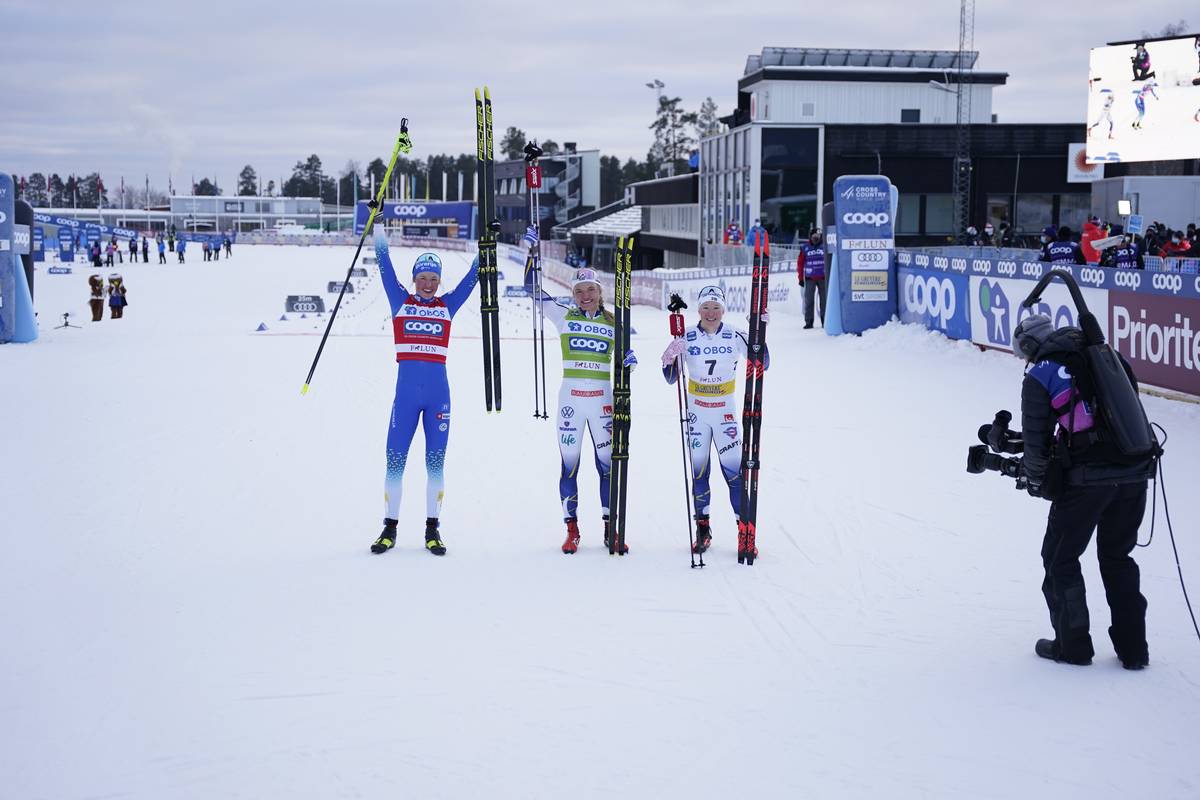
    Katherine Stewart-Jones moving up in the 10km. (Photo: Ian Aitken)
    Katherine Stewart-Jones moving up in the 10km. (Photo: Ian Aitken)

    “It was a pretty flat course so there was a lot of double pole. I think that what made the difference was really going out hard from the start and trying to stay as consistent as possible,” Stewart-Jones wrote. “On a course like this it’s easy to lose focus but you can lose a lot of time if you aren’t keeping the tempo high on the flats.”

    Athletes from the east were less likely to comment on the cold than the westerners. All names withheld to protect the guilty.

    Skate mass start, Sunday

    Russell Kennedy leading early in the 19.3km. (Photo: Ian Aitken)
    Russell Kennedy leading early in the 19.3km. (Photo: Ian Aitken)

    Sunday was warmer as a massive snowstorm rolled through Quebec. The trails became softer and deeper as the day progressed despite the shortened courses.

    Katherine Stewart-Jones (CNST) continued her dominance with a win in 48:25.5 minutes, on a shortened course of 14.3 km, with one 4.3 km lap and two 5 km laps.

    “There was a ton of snow so it was really slow,” Stewart-Jones. “Cendrine and I worked together and exchanged leads. I made a break on the last little bump before the finish.”

    Browne had her final chance to get an automatic selection. “I started pretty fast, and already after 4 km, the pack was broken. Katherine and I were with a little group of 6 skiers but broke away after 6 km and skied together for the remaining 9 km,” she wrote. “I tried to attack on the last uphill but Katherine stayed with me and attacked me when there was 500 meters to the race. I was so tired I couldn’t follow… I think I attacked too early but I had to try!”

    COC leader Russell Kennedy (Team R.A.D.) collected his first win of the weekend to earn his trip to World Championships, finishing alone at 57:12.6 on the four lap 19.3 km race. Hill was second at 23.4 seconds behind. Palmer-Charrette out-sprinted the remains of the original six leaders to complete the podium at 1:07.0.

    “It was a hard day with the amount of snow that fell,” Kennedy wrote. “I found myself on the front early so I pushed the pace and kept pushing. Took a break on the second lap and pushed the third and fourth lap.”

    At the end of the weekend, MacIsaac-Jones, Palmer-Charrette, Stewart-Jones, Scott Hill, and Russell Kennedy have met the qualification standard for Seefeld. The High Performance committee should soon announce their official selection; if there is a sixth athlete chosen, it is likely to be Browne with 4th, 2nd, and 2nd places.

    Kennedy continues as COC leader while Stewart-Jones moved past Dahria Beatty to earn the women’s leader bib.

    Results: Qualifier, Heats, Classic Distance, Skate Mass Start

    Ian Aitken’s photo galleries: Saturday, Sunday


  • Friday Race Rundown (Updated)

    Friday Race Rundown (Updated)

    The men’s 4 x 7.5 k relay in Ruhpolding, Germany. (Photo: screenshot biathlonworld.com)

    IBU World Cup Ruhpolding, Germany 4 x 7.5 k / 4 x 6 k Relay

    In relatively calm weather on Friday in Ruhpolding, Germany the International Biathlon Union (IBU) World Cup sent the men’s 4 x 7.5-kilometer relay on its way. Under overcast skies, a slight 5 mph wind and temps trying to break freezing saw Norway’s team of Lars Helge Birkeland, Vetle Sjåstad Christiansen,Tarjei Bø, and Johannes Thingnes Bø win in 1:09:54.3 hours. The Norwegian foursome raced to the top podium spot with no penalties and using eight spares.

    The move that grasped the race for Norway came when Johannes Thingnes Bø, on the final leg, threw down a speedy attack on the course’s burliest hill making him the carrot the others would be chasing towards the finish line. In less than a kilometer, Bø  put in the almost 14 second gap back to Germany

    Germany’s Rees Roman, Johannes Kuehn, Arnd Peiffer, and Doll Benedikt  placed second 13.5 seconds behind Norway. Rees shot clean for Germany as did Peiffer – in total the German team shot with no penalties and used six spares.

    The final podium spot went to France’s Emilien Jacquelin, Martin Fourcade, Quentin Fillon Maillet, and Simon Desthieux. France finished 26.2 seconds back while skiing no penalties and using nine spares.

    Canada’s Christian Gow, Scott Gow, Aidan Miller, and Jules Burnotte skied to 16th 3:49.0 minutes behind Norway. In total, the Canadians skied one penalty and used 16 spares.

    The U.S. team of Leif Nordgren, Sean Doherty, Jake Brown, and Max Durtschi raced to 17th, stopping the clock 4:01.2 after Norway. Over the duration of their four legs, the U.S. skied a single penalty lap while using 13 spares.

    Twenty seven teams were entered in the men’s race.

    Men’s Relay Results

    ***

    Worlds Selections/NorAms/Coupe Québec, Bishop’s University, Québec

    The Canadian selection races for senior World Championships combined with a NorAm and Québec Cup weekend hosted by the Mont Orford club, began with freestyle sprints today.

    Maya MacIsaac-Jones (CNST) won the qualifier and all her heats on the way to winning the A final, leaving no doubt about her selection for Seefeld. MacIsaac-Jones’ 2:36.83 minute A final was the fastest lap of the day, just edging 4th fastest qualifier Katherine Stewart-Jones (CNST) by 0.05 seconds. Laura Leclair (CNEPH) was third at 3.77 seconds after qualifying second. Third-place qualifier Cendrine Browne (CNST) was fourth, 4.99 seconds back, with Zoë Williams (Nakkertok) fifth (+5.18) and U.S. skier Madison Morgan sixth (+8.92.)

    On the men’s side, Evan Palmer-Charrette (Team R.A.D.) won the A final in 3:06.58 minutes, 0.11 seconds ahead of Julien Locke (CNST). Top qualifier Russell Kennedy (Team R.A.D.) was third, 2.26 behind Palmer-Charrette and 0.24 seconds ahead of Sebastien Boehmler-Dandurand (AWCA). Antoine Briand (Skibec) finished sixth (+5.12), followed by Dominique Moncion-Groulx (Nakkertok) in sixth (+5.93).

    Racing continues for two more days with an interval start classic on Saturday and mass start skate on Sunday. The top Canadian each day qualifies for World Championships.

    Results: Qualification, Sprint Brackets, All Weekend Results (including live timing)


  • 2018 Canadian Nationals: Skate Pursuits and Sprints

    2018 Canadian Nationals: Skate Pursuits and Sprints

    Jess Cockney (396) after winning the men’s 15 k freestyle pursuit at 2018 Canadian Ski Nationals, ahead of Ty Godfrey (l), Michael Somppi (r) and Evan Palmer-Charrette (second from r) in Thunder Bay, Ontario. (Photo: Doug Stephen)

    Canadian Ski Nationals (Thunder Bay, Ontario): Freestyle pursuits and sprints

    Ski Nationals continued Tuesday and Wednesday at Lappe Nordic in Thunder Bay, with 10- and 15-kilometer freestyle pursuits (based on Sunday’s 5/10 k classic interval starts) followed by sprints.

    Jess Cockney (396) leading the men’s 15 k freestyle pursuit on Tuesday at 2018 Canadian Ski Nationals in Thunder Bay, Ontario. He went on to win the pursuit as well as the freestyle sprint the next day. (Photo: Doug Stephen)

    On Tuesday, Jess Cockney of the Canadian World Cup Team and Alberta World Cup Academy (AWCA) raced to first in the men’s 15 k freestyle pursuit, up from sixth after the 10 k classic. His cumulative time for the two races was 1:04:06.7 hours, just 1.2 seconds ahead of Ty Godfrey of Team R.A.D. in second. (Godfrey previously placed ninth in the 10 k classic.) Michael Somppi, who grew up skiing with Lappe Nordic and now trains with the AWCA, completed the podium in third, 2 seconds behind Cockney, after placing 10th in the classic race.

    Just behind Somppi, another local skier Evan Palmer-Charrette, of Lappe Nordic and the National Team Development Centre (NTDC) Thunder Bay, placed fourth in the pursuit (+2.8). Antoine Cyr and Alexis Dumas, both of the Pierre-Harvey National Training Centre (CNEPH), finished together in fifth (+11.5) and sixth (+11.6), respectively, ahead of Knute Johnsgaard (World Cup Team) in seventh (+13.4), Scott Hill of Barrie Cross Country (BXC) in eighth (+16.3), Reed Godfrey (Team R.A.D.) in ninth (+31.8), and Ryan Jackson (BXC) in 10th (+38.9).

    The fastest 15 k skate time of the day was clocked by Somppi in 36:54.5. Ty Godfrey had the second fastest time of day, just 0.2 seconds back, while Cockney’s freestyle time ranked third fastest (+4.9).

    Olivia Bouffard-Nesbitt (Rocky Mountain Racers) racing to second overall (first Canadian) in the women’s 10 k freestyle pursuit on Tuesday for her second national title of the week at 2018 Canadian Ski Nationals in Thunder Bay, Ontario. (Photo: Doug Stephen)

    American Caitlin Gregg, of Central Cross Country (CXC), Team Gregg and Loppet Nordic Racing, won the women’s 10 k freestyle pursuit by more than a minute in 43:12.4, after placing second in the 5 k classic. The winner of Sunday’s classic race, Olivia Bouffard-Nesbitt of Rocky Mountain Racers (RMR) scored her second-straight title as the first Canadian in the pursuit, placing second overall, 1:03.4 behind Gregg. Annika Hicks (AWCA) was the second Canadian in third overall (+1:16.3), up from fifth in the classic race.

    Katherine Stewart-Jones (NTDC Thunder Bay/National U25 Team) placed fourth in the pursuit (+1:18.3), Frédérique Vézina (CNEPH) fifth (+1:24.0), Alannah Maclean (NTDC Thunder Bay) sixth (+1:40.8), Maya MacIsaac-Jones (RMR/National U25 Team) seventh (+2:07.8), Lisle Compton (NTDC Thunder Bay) eighth (+2:14.4), Laura Leclair (CNEPH) ninth (+2:19), and Annika Richardson (NTDC Thunder Bay) 10th (+2:19.6).

    Gregg clocked the fastest 10 k skate time in 27:51.6, while Vézina was second fastest on the day, 1:06.5 back. Hicks had the third-fastest time, 1:07.3 back from Gregg.
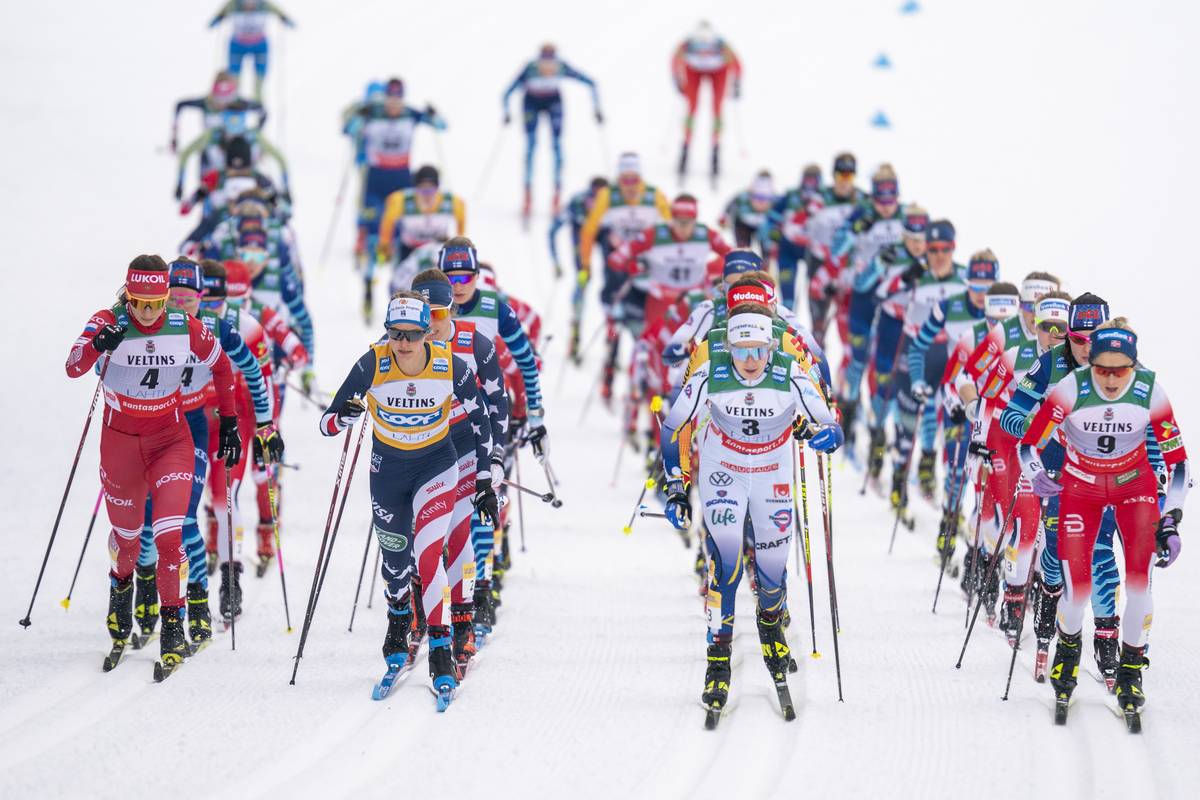
    On Wednesday, Cockney racked up his second-straight national title with a victory in the 1.4 k freestyle sprint final. Cockney edged Andy Shields (Lappe Nordic) by 0.83 seconds for the win in 2:39.87. Just three-hundredths of a second behind Shields, Palmer-Charrette reached the podium in third (+0.86), Somppi followed in fourth (+2.14), Julian Smith (NTDC Thunder Bay/National U25 Team) finished fifth (+4.3) and Sebastien Boehmler-Dandurand (Stefan Kuhn HP Team) placed sixth (+11.81).

    Shields won the qualifier to start the day in 2:44.54, while Cockney was the second-fastest men’s qualifier, 1.39 seconds off Shields’s time. Shields went on to win his quarterfinal and place second in the first semifinal, while Cockney was second to Smith in both the fourth quarterfinal and second semifinal.

    Maya MacIsaac-Jones (l) and Katherine Stewart-Jones (r) go head to head for the win in the women’s freestyle sprint final on Wednesday at 2018 Canadian Ski Nationals in Thunder Bay, Ontario. MacIsaac-Jones won it by 0.05 seconds. (Photo: Doug Stephen)

    MacIsaac-Jones won the women’s skate-sprint final in 3:06:68, five-hundredths of a second ahead of Stewart-Jones in second. In a race for third, Maclean took it (+4.82), ahead of Gregg in fourth (+5.01). Hicks placed fifth (+7.22) and Zoë Williams (Nakkertok) was sixth (+9.12).

    MacIsaac-Jones topped the women’s qualifier by 5.78 seconds in 3:12.87. Mathilde Petitjean of Club Nordique Mont Sainte-Anne (C.N.M.S.A.) qualified second, and Maclean was 6.42 seconds back in third.

    MacIsaac-Jones then won the first quarterfinal and placed second to Stewart-Jones in the first semifinal. Stewart-Jones finished second to Bouffard-Nesbitt in the second quarterfinal, and Maclean won the second semifinal over Gregg, after finishing second to Gregg in the fifth quarterfinal.

    Nationals conclude with 30/50 k classic mass starts on Saturday.

    Audio livestream

    Full race schedule

    Photos

    Results:

    Pursuit | Pursuit time of day

    Sprint heats | Sprint qualifier


  • 2018 Canadian Nationals Weekend Recap: Days 1 and 2

    2018 Canadian Nationals Weekend Recap: Days 1 and 2

    Patrick Stewart-Jones (l), skiing for his club team Nakkertok, and Scott Hill (r) of Barrie Cross Country (BXC) going head to head in the men’s classic team sprint on Saturday at Canadian Ski Nationals in Thunder Bay, Ontario. Nakkertok won and BXC placed second. (Photo: Doug Stephen)

    Canadian Ski Nationals (Thunder Bay, Ontario): Team sprints + 5/10 k classic 

    Canada’s 2018 Ski Nationals opened this past weekend at Lappe Nordic in Thunder Bay, Ontario, with classic team sprints on Saturday followed by 5- and 10-kilometer classic interval starts on Sunday.

    Nakkertok topped the podium in both the open men’s and women’s team sprints. In the men’s final, Nakkertok’s Dominique Moncion-Groulx and Patrick Stewart-Jones won by 1.95 seconds over Barrie Cross Country (BXC) in 14:50.79. BXC’s Ryan Jackson and Scott Hill teamed up for second place, and Skibec’s Alexis Morin and Antoine Brand raced to third (+2.57).

    Katherine Stewart-Jones (22), skiing for her club team Nakkertok, while leading Annika Richardson (Hollyburn Ski Club) and Mathilde Petitjean (r) of C.N.M.S.A. during the women’s classic team sprint at 2018 Canadian Ski Nationals in Thunder Bay, Ontario. (Photo: Doug Stephen)

    The Stewart-Jones family was also a big winner on Saturday, with Nakkertok’s Zoë Williams and Katherine Stewart-Jones (Patrick’s sister) racing to first in the women’s final in 13:04.72. They finished 2.37 seconds ahead of Katie Weaver and Annika Richardson of the Hollyburn Ski Club in second place, and Marie Corriveau and Mathilde Petitjean of Club Nordique Mont-Sainte-Anne (C.N.M.S.A.) raced to third (+7.42).

    On Day 2 and the first official day of Canadian Ski Nationals, Hill (BXC) took his second-straight win of the weekend, topping the men’s 10 k classic with a time of 26:45.1 for his first senior national title. He finished 7.2 seconds faster than Alexis Dumas, of the Pierre-Harvey National Training Centre (CNEPH) in second, and an early race leader, Knute Johnsgaard of the Canadian World Cup Team, placed third (+12.0)

    Johnsgaard clocked the fastest split at the race’s halfway point, while Hill’s 5 k time was almost 10 seconds slower. But over the final 5 k, Hill’s lap time was nearly 22 seconds faster than Johnsgaard’s. Dumas skied a consistent race, with the fourth-fastest first lap and second-fastest second lap.

    Knute Johnsgaard (Canadian World Cup Team) racing to third in the men’s 10 k classic on Sunday at Canadian Ski Nationals in Thunder Bay, Ontario. (Photo: Doug Stephen)

    Jackson (BXC) finished fourth (+14.7), and Jess Cockney of the Alberta World Cup Academy (AWCA) and Canadian World Cup Team placed fifth (+22.2). Leading the National Team Development Centre (NTDC) Thunder Bay on its home trails was Evan Palmer-Charrette in sixth (+24.8), and Lappe Nordic’s Michael Somppi (AWCA) placed seventh (+29.1). Gareth Williams of Telemark Nordic and the Canadian U25 Team finished eighth (+39.5), American Brian Gregg (CXC/Team Gregg/Loppet Nordic Racing) was ninth (+44.7), and Jack Carlyle (AWCA) 10th (+49.5).

    Olivia Bouffard-Nesbitt of Rocky Mountain Racers (RMR) collected her first senior national title with a 13.3-second victory in the women’s 5 k classic. She finished in 15:07.5, ahead of American Caitlin Gregg (CXC/Team Gregg/LNR) in second, while Katherine Stewart-Jones (NTDC Thunder Bay) was the second Canadian and third overall (+17.9).

    NTDC Thunder Bay had two in the top four with Alannah Maclean in fourth (+19.8). Annika Hicks (AWCA) followed in fifth (+22.2), Frédérique Vézina (CNEPH) was sixth (+30.8), Sophie Carrier-Laforte (Skinouk) seventh (+33.0), Maya MacIsaac-Jones (RMR/Canadian U25 Team) eighth (+37.4), Laura Leclair (CNEPH) ninth (+58.1), and Williams (Nakkertok) 10th (+1:07.2).
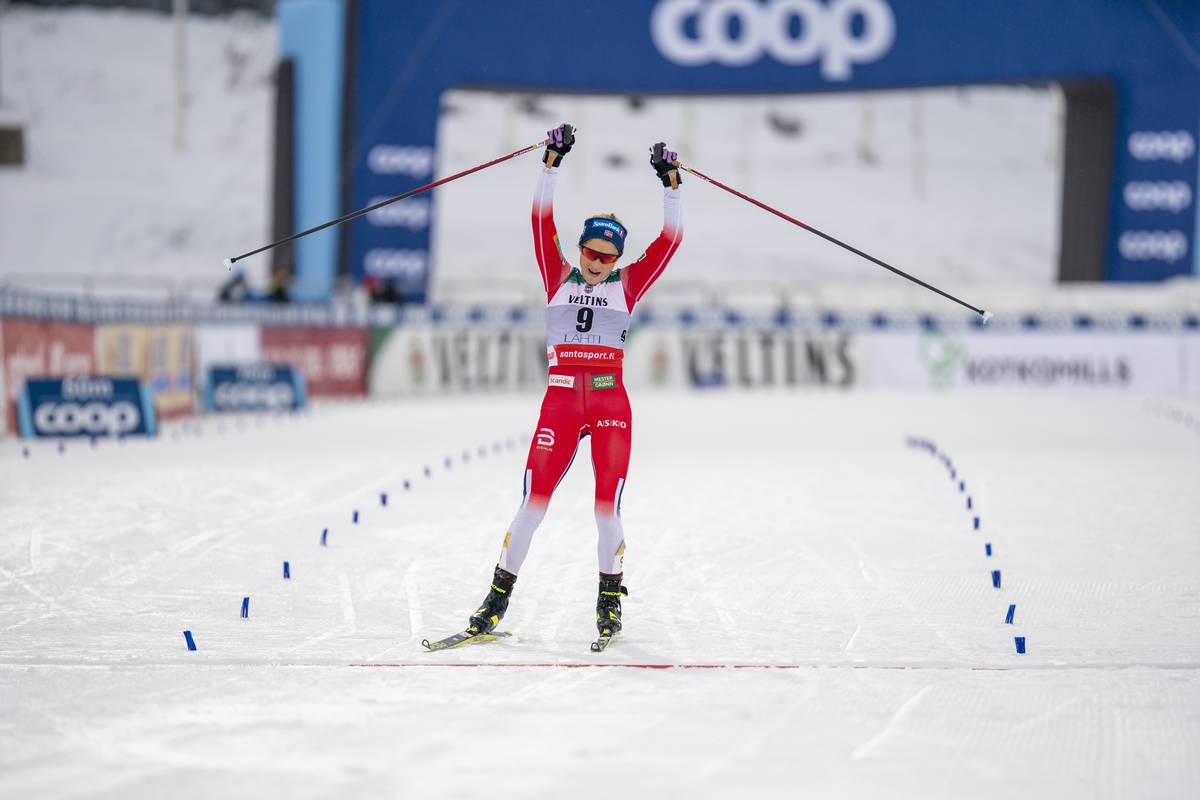
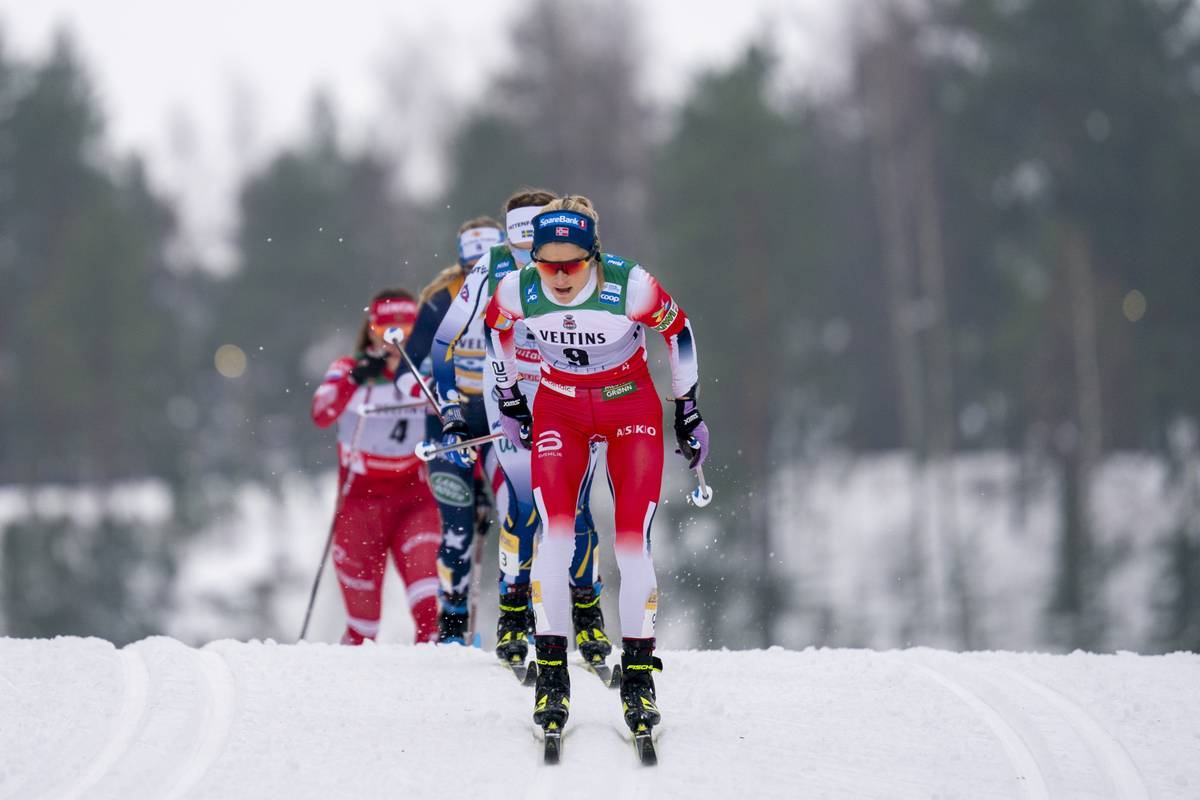
    Nationals continue Tuesday with 10/15 k freestyle pursuits, followed by skate sprints on Wednesday and 30/50 k classic mass starts on Saturday.

    Audio livestream

    Full race schedule

    Photos

    Results:

    Day 1: Classic team sprint

    Day 2: 5/10 k classic


    Spectators during the classic team sprint at 2018 Canadian Ski Nationals in Thunder Bay, Ontario. (Photo: Doug Stephen)