From the FasterSkier archive — posts syndicated from athletes’ and coaches’ own blogs between 2004 and 2012, kept online as published. Current coverage is at fasterskier.com.
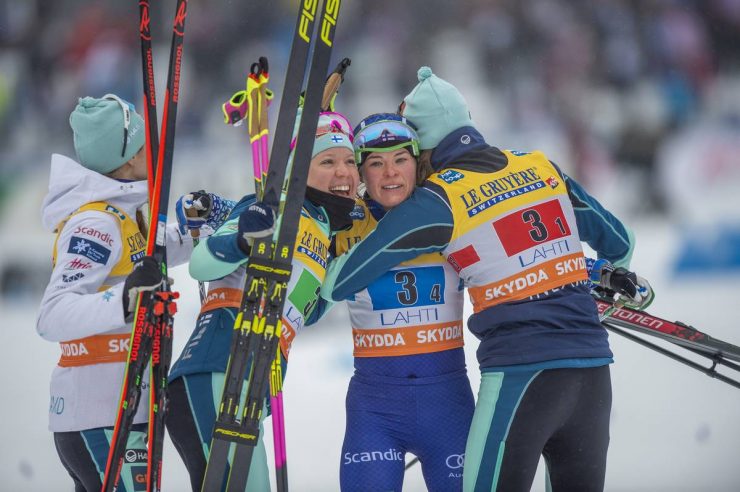
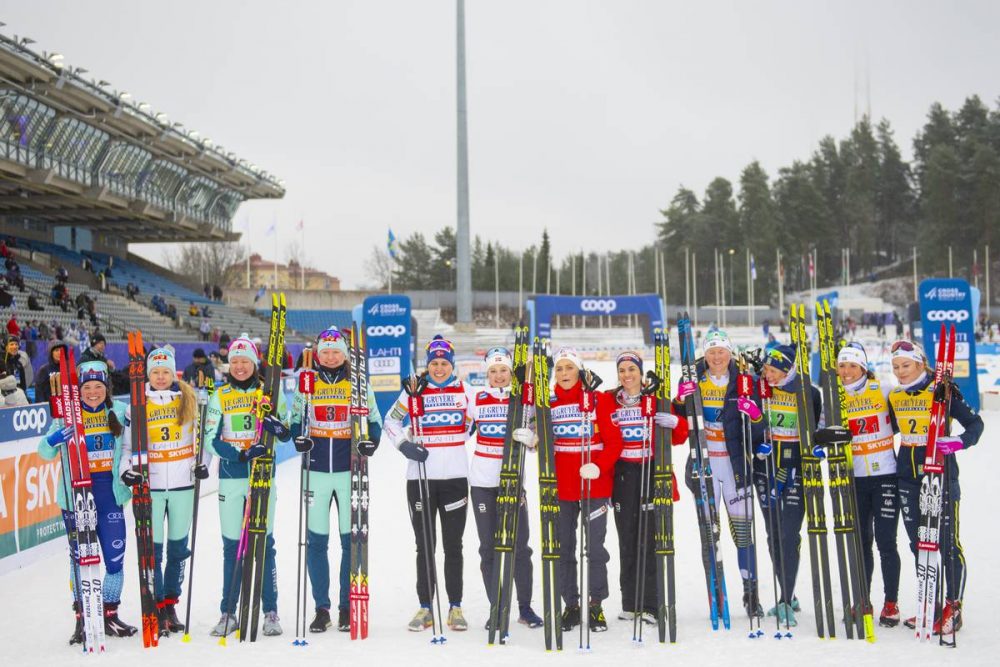
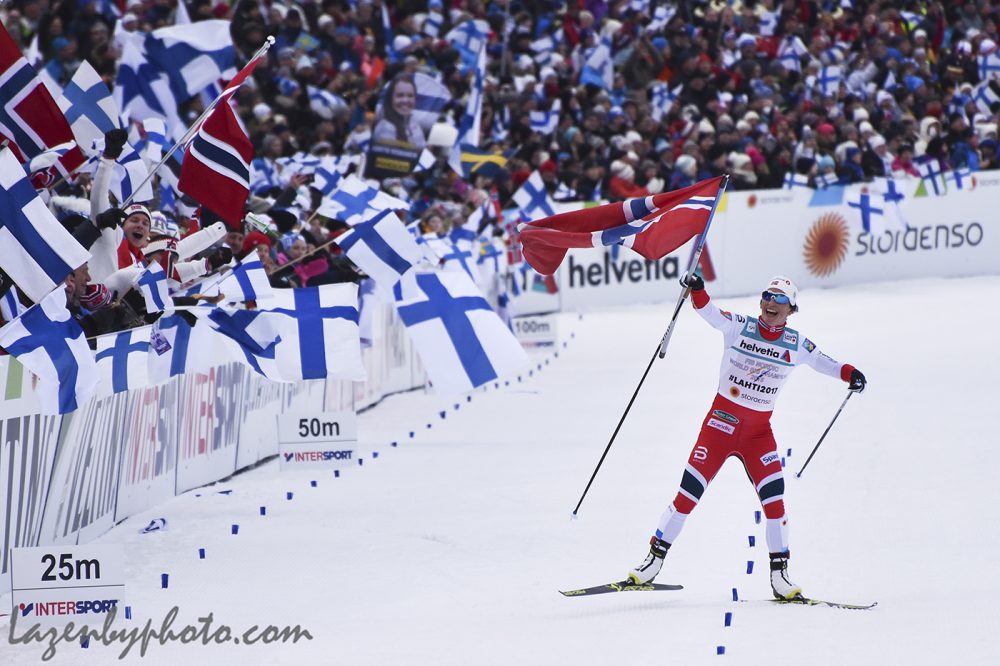
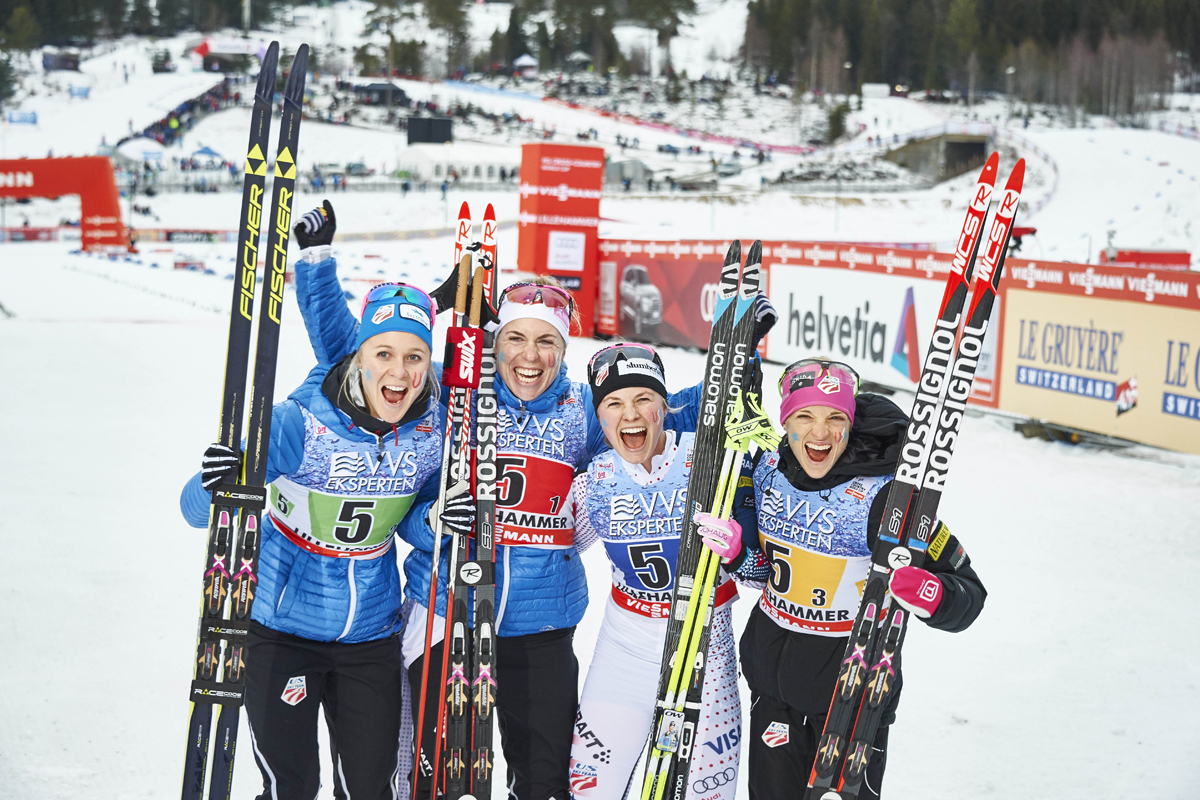
Finland celebrates its first relay podium on home soil. (Photo: NordicFocus)
Sports fans talk a lot about home field advantage. Which team will play at home at Game 7 of the World Series? Or in the playoffs before the Stanley Cup? Home turf and the swells of a crowd whose numbers are skewed toward the home team has an undeniable effect.
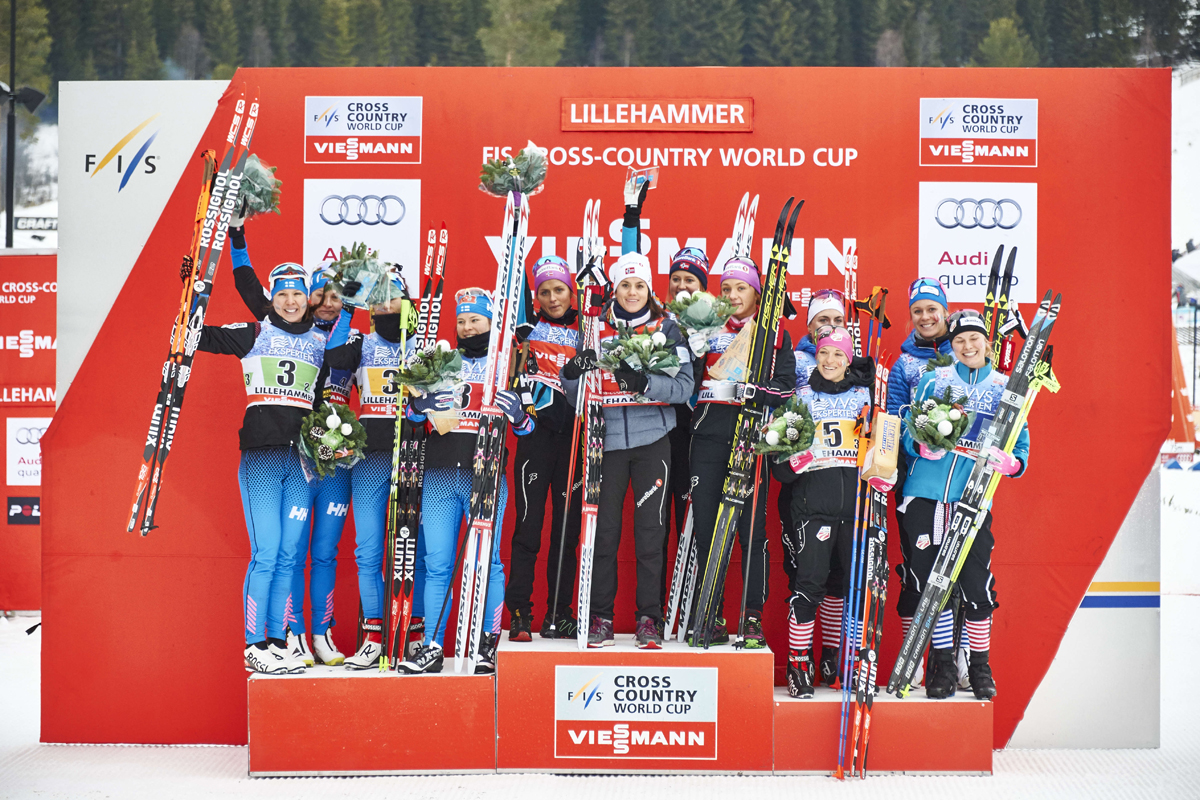
Yes, the Norwegian team of Tiril Udnes Weng, Ingvild Flugstad Østberg, Therese Johaug, and Heidi Weng won yet another 4×5-kilometer relay with a time of 50:04.8. As this makes 16 straight wins on the World Cup, perhaps the result no longer grabs our attention or piques our interest.
But what should spark you to continue reading is the news that the Finnish team of Johanna Matintalo, Kerttu Niskanen, Laura Mononen, and Krista Pärmäkoski earned the first ever World Cup relay podium for their country on home soil, finishing 30.3 seconds behind Norway.
For the first two classic legs of the race, not only were the Finns vying for the podium, there were making a go at the win.
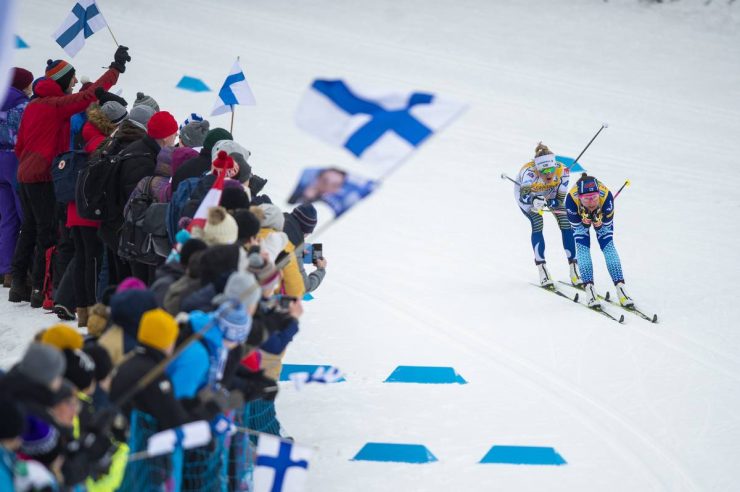
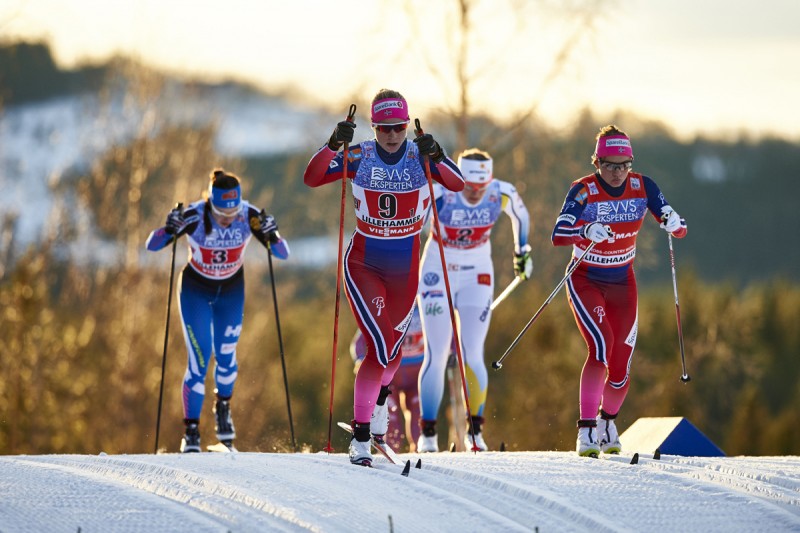
Kerttu Niskanen (FIN) is tailed by Frida Karlsson (SWE) during the second leg of the 4×5-kilometer relay in Lahti. (Photo: NordicFocus)
At the end of the first leg, Matintalo had a small gap to the Norwegian, Swedish, and Russian teams. Niskanen continued to hold this lead at the end of the second, but Sweden was only a second behind. Norway exchanged a few seconds later, and Russia appeared to have fallen off the pace.
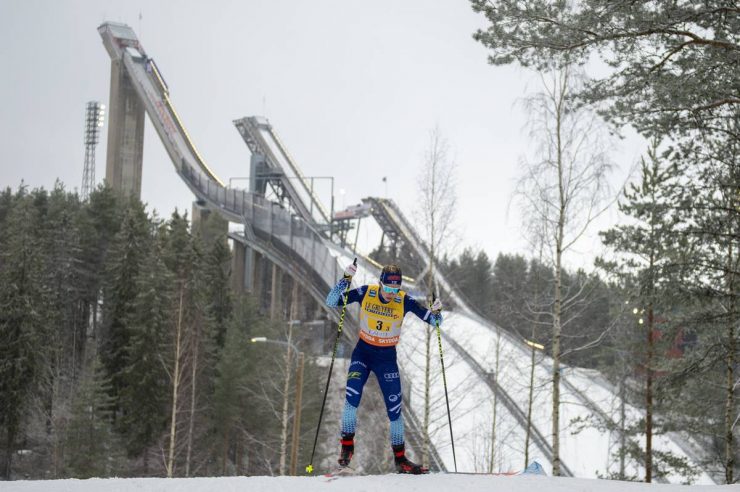
Then Johaug skated away with the reins . A few seconds was nothing for the powerhouse, and she was in the front within the first kilometer. But Mononen was not willing to let her go. She matched Johaug in the first climb as the spectators lining the course shouted her name.
Mononen began to fade, but her decision to hang onto Johaug’s ride as long as possible kept her well ahead of the other teams.
Laura Mononen chases Therese Johaug during the third leg of the 4×5-kilometer relay in Lahti. (Photo: NordicFocus)
In the fight for the third spot, Russia’s Ekaterina Smirnova closed a gap of nearly 30 seconds to Rebecca Ӧhrn of Sweden, moving into third position by the end of the lap. The German team had also made contact, making it a three nation race for the final podium spot.
Mononen tagged Pärmäkoski with roughly a 29 second deficit to the Norway’s anchor, who did not treat her leg like a victory lap. Heidi Weng hammered each of the five K’s, but she could not put additional time on Pärmäkoski.
Krista Pärmäkoski anchors the Finnish relay team in Lahti. (Photo: NordicFocus)
The Finn, who clearly came back on form this weekend, kept the margin constant as she made her way up and down the hilly wooded terrain, past waving fans chanting “Kris-ta! Kris-ta! Kris-ta!” in time with her steps.
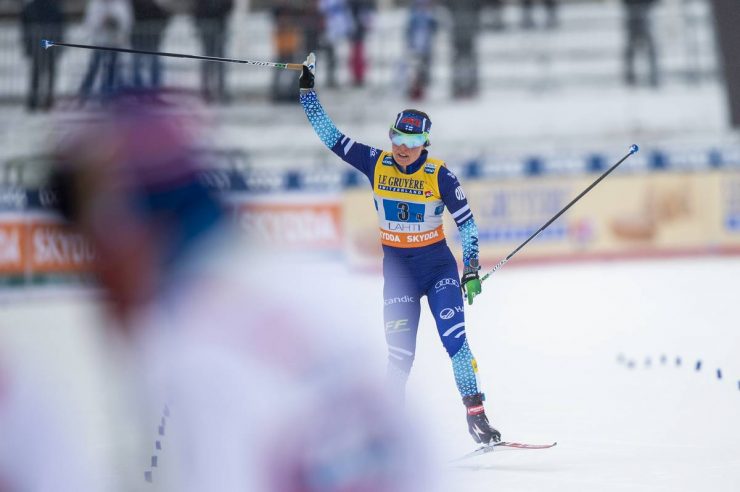
As she made her way down the final stretch, Pärmäkoski saluted her fans in the stadium who were applauding a job well done.
Waving to the home crowd, Krista Pärmäkoski seals the deal on second place in the 4×5-kilometer relay in Lahti. (Photo: NordicFocus)
In the final battle for third, the threesome of Yana Kirpichenko (RUS), Maja Dahlqvist (SWE), and Sophie Krehl (GER) soared together through the first 2.5 k loop. The German fell off the pace in the second lap, but neither the Russian nor the Swede could break away.
Kirpichenko flew down the final descent in a tuck and curved into the straightaway in the lead, but the Swedish sprinter was right on her tails. Firing her afterburner, Dahlqvist moved alongside the Russian in the final stretch, clearly demonstrating superiority in sprinting. As the line drew near, the women threw their boots in unison, but the surging Swede was there first, if only by 0.1 seconds.
An emotional Yana Kirpichenko is consoled by her teammates after the Russians finished 4th in the 4×5-kilometer relay. (Photo: NordicFocus)
“Of course, Norway, we are a really strong team and have done a lot of good relays,” Østberg told FIS at the finish. “Tiril did a really good job in her first time on Norway I. For me, it was a hard day at work, but I fought all I could and Therese, of course, really strong and Heidi also did a really good leg. So a fantastic team and it was fun to win.”
During the race, lightly falling snow turned into misty rain, posing a challenge for the waxers. Therese Johaug fielded the FIS interviewer’s question of how this impacted their team.
“I had really good skis,” she stated. “Of course, it’s difficult conditions when the snow comes. Maybe Ingvild did not have so good grip out there, but she fought all the way. I’m so impressed with both Tiril, Ingvild, and Heidi today, and it is so fun to race a relay with the team you’re training so much with.”
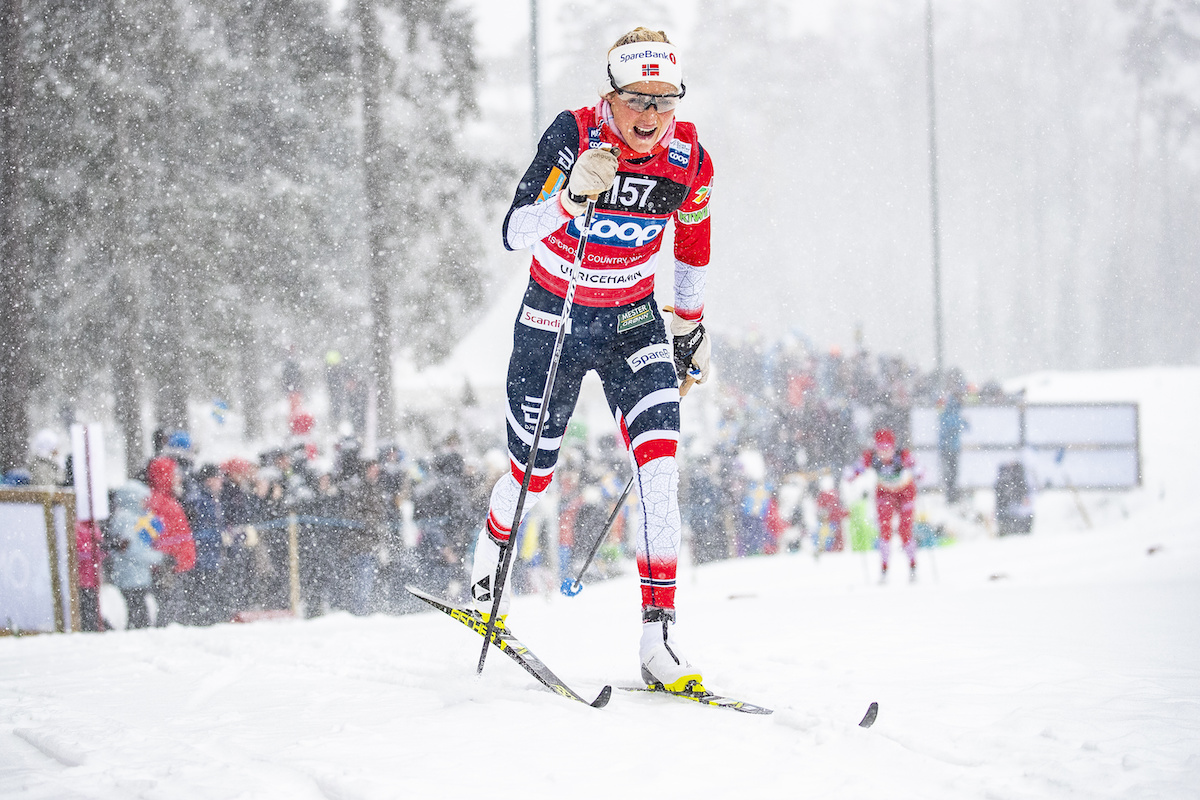
Eyes locked on the win, Heidi Weng skis the final meters of the 4×5-kilometer relay in Lahti. (Photo: NordicFocus)
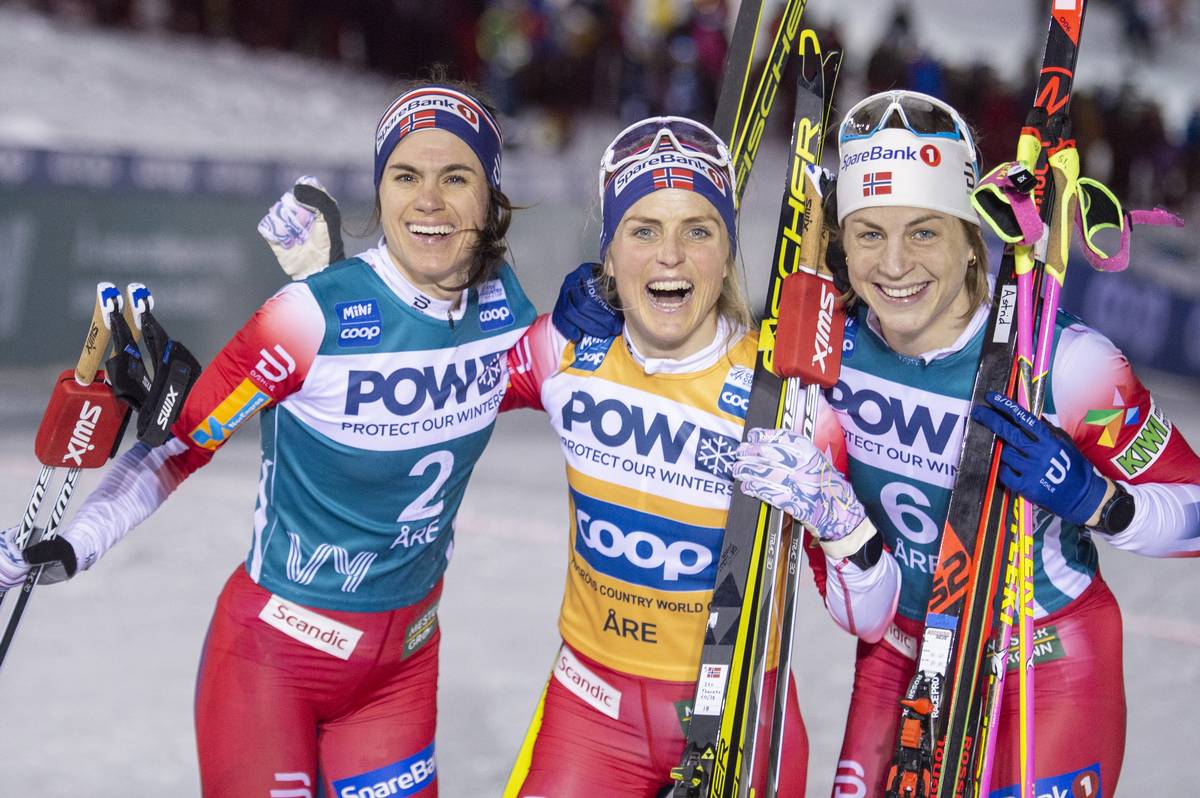
The Norway I team of Tiril Udnes Weng, Ingvild Flugstad Østberg, Therese Johaug, and Heidi Weng celebrate their win in Lahti. (Photo: NordicFocus)
No North American teams competed in today’s event.
Racing continues Wednesday with an individual sprint on the streets of Drammen, Norway next weekend, followed by the famed Holmenkollen 30 and 50-kilometer races in Oslo on Saturday and Sunday.
When Therese Johaug wins a sprint qualifier by 4.5 seconds and Sophie Caldwell qualifies in 23rd, you know it is not your average course. Held at the Swedish national alpine ski area in Åre, today’s event seemed to blend the infamous climb up the Alpe Cermis in the final stage of the Tour de Ski with skier cross on perhaps the shortest but toughest sprint on the World Cup.
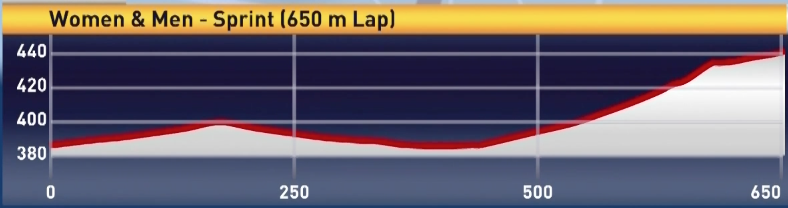
A gradual uphill start led skiers to a fast downhill into a swooping banked turn to the left. The course then ascends a pitch as steep as 28% up the base of the alpine hill, climbing nearly 60 meters within the final 200 meters of the course. Athletes would then need to walk back down to the start area.
The Åre sprint hill climb in profile. (Photo: Screenshot FIS Broadcast)
Though less than 700 meters in total length, nearly half the usual distance, the course took the women roughly two and a half minutes, on par with a usual sprint time.
The event drew a roaring crowd, with fans lining the course, their yells and gaps echoing as athlete’s skied by. After the race, Matt Whitcomb recognized the event organizers for putting together a unique stage and drawing so many energetic spectators.
Post-race comments from Matt Whitcomb.
With Johaug at the top of the qualification list were Heidi Weng (NOR), Greta Laurent (ITA), Linn Svahn (SWE), and Laura Mononen (FIN), the most diversity in nations among the top five in the tour so far. This result also added mystery and excitement as it could be anyone’s game. Weng is a top distance skier, Laurent and Svahn are most recognized for their sprint performances, and Mononen normally hovers on the border of the top-30 FIS point scorers list, a relative unknown.
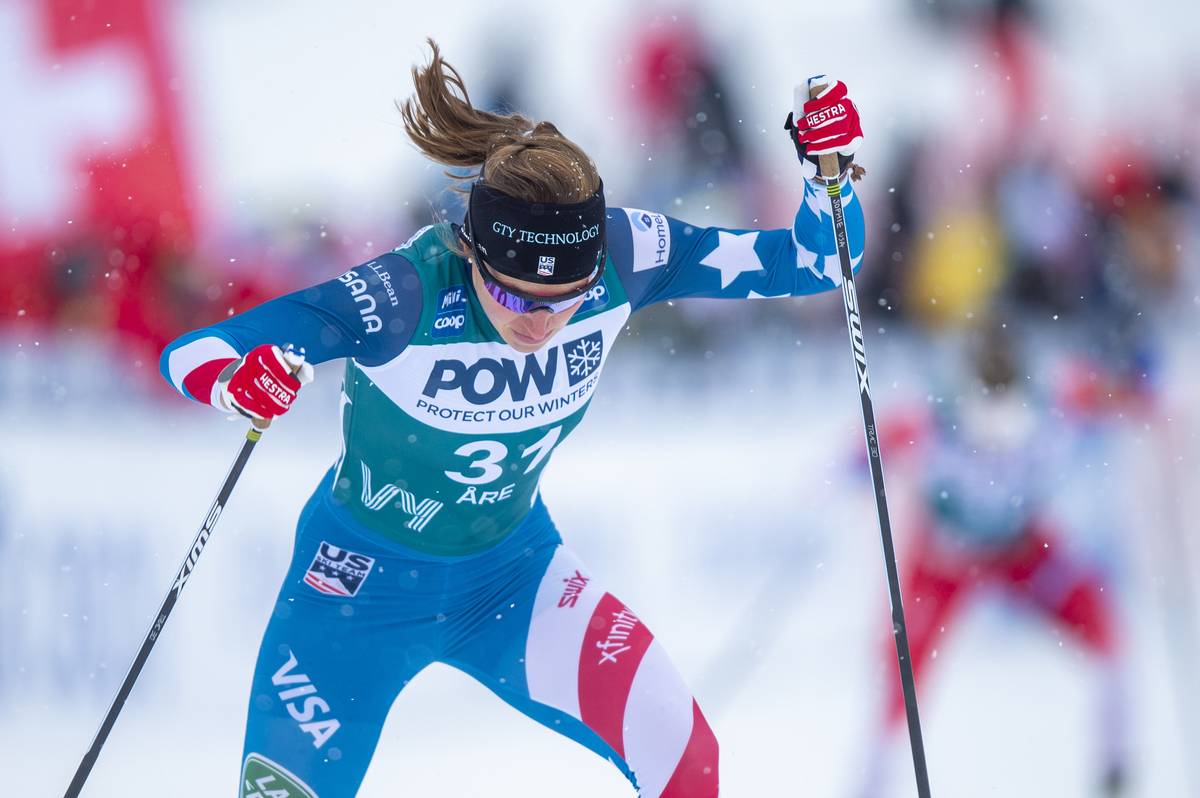
Rosie Brennan climbs to the top American result in qualification during the Stage 3 “sprint”. (Photo: NordicFocus)
Rosie Brennan was the top American qualifier in 14th, followed by Jessie Diggins in 17th, Julia Kern in 18th, Sadie Maubet Bjornsen in 21st, and Caldwell in 23rd.
Racing in the second wave of the quarterfinal, Diggins and Brennan took the pace out hot, trying to create a gap over the two top qualifiers, Johaug and Weng. Diggins led the way over the gradual climb and into the downhill, fearlessly flying into the banked turn with high speed. Riding up the berm to the outer lip of the curve, Diggins stayed in control, though only just.
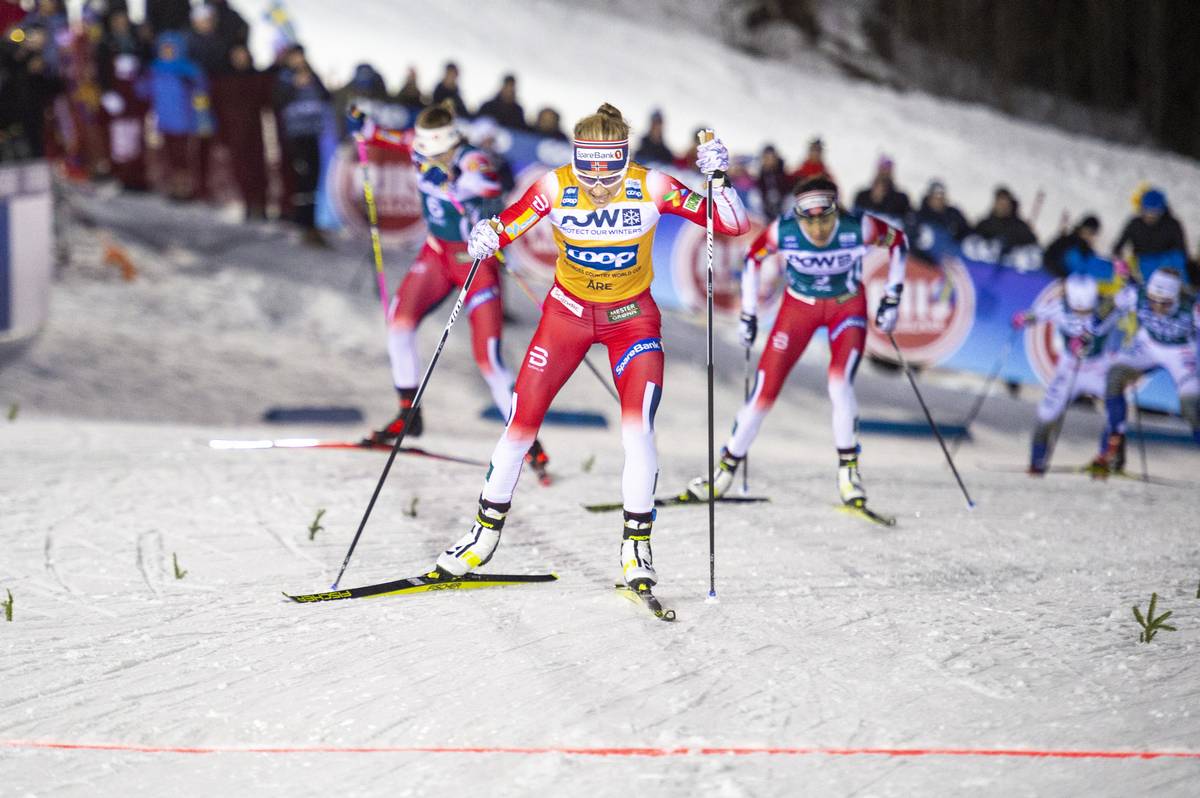
Brennan and Diggins were still in the lead beginning the hill climb, but the two high-tempo Norwegians were gaining quickly. Weng and Johaug overtook the Americans midway up the climb, but Diggins did not let them get away. Maintaining contact, she crossed the line within 1.5 seconds of the Norwegians and advanced as lucky loser, her early effort to push the pace making it the fastest of the five heats.
Diggins attacks the hill climb during the Stage 4 sprint in Åre, Sweden. (Photo: NordicFocus)
Brennan fell back to fifth in the heat and did not advance. She ended her day in 22nd.
Maubet Bjornsen and Kern raced in the fourth heat, finishing fourth and sixth, respectively. Maubet Bjornsen’s final rank was 20th.
At the start of the last quarterfinal round, Caldwell skied off the front, navigating the banked turn with ease and picking up momentum as she approached the base of the hill in V2. Caldwell stayed near the front through the climb, her technique smooth and controlled. As the course curved and leveled to the finish, it was Mononen and Caldwell at the front. They crossed the line together, immediately folding with hands on their knees in anguish.
If this is what the finish of the quarters looks like, what will happen as the deep burn of cumulative fatigue starts to sink in?
In the semis, Diggins faced off again with Johaug and Weng. Rather than flying off the front, Diggins sat in the middle of the pack over the first climb, hooking 180 degrees left and dropping into a tuck heading into the banked downhill.
Johaug was last into this turn and last to the base of the climb, but she was far from out of the race. Jump skating up the left side of the course, Johaug rocketed from the back of the pack to the lead, edging out Weng to win the round.
Diggins fell off the pack at the base of the climb and finished last in the heat, and 11th for the day.
Relaxed, smooth, collected, per usual, Caldwell rounded the banked turn in second and was in the mix at the base of the climb. Then it was over.
At the front, Svahn, Astrid Urenholdt Jacobsen (NOR), Laurent, and Mononen stepped powerfully up the climb. In the final meters, Svahn was at the front with Laurent close on her tails looking like a lock for second, until a last second surge by Jacobsen snuck her just ahead of the Italian at the line. As the heat was slower than the first, only Svahn and Jacobsen advanced.
After falling off the pack, Caldwell took last in the heat and ended the day in 12th.
Breaking down the lineup in the final, you’ve got two pure distance skiers with a history of outstanding results in the TdS hill climb, Johaug and Weng, alongside their teammate, Jacobsen, an all-arounder skewed toward distance. These three women paired with three sprinters, Svahn, Jonna Sundling (SWE), and Nadine Faehndrich (CHE). A World Cup cocktail.
The Swedes took the lead at the start of the final, shooting around the banked curve and into the climb. Johaug, again, the last to the base of the hill.
As the grade increased, Weng and Jacobsen accelerated up the right side of the course, while Johaug repeated her uphill attack as she weaved through the other women to the front. The Norwegians skied three abreast as they passed under the Audi e-tron arch toward the steepest pitch, shortly before the finish.
Therese Johaug leads Heidi Weng and Astrid Urenholdt Jacobsen through the final meters of the sprint hill climb. (Photo: NordicFocus)
Increasing her tempo and beginning to jump skate, Johaug rounded the final bend in the lead with the win locked up. Her teammates, Weng then Jacobsen, crossing behind her in second and third, respectively.
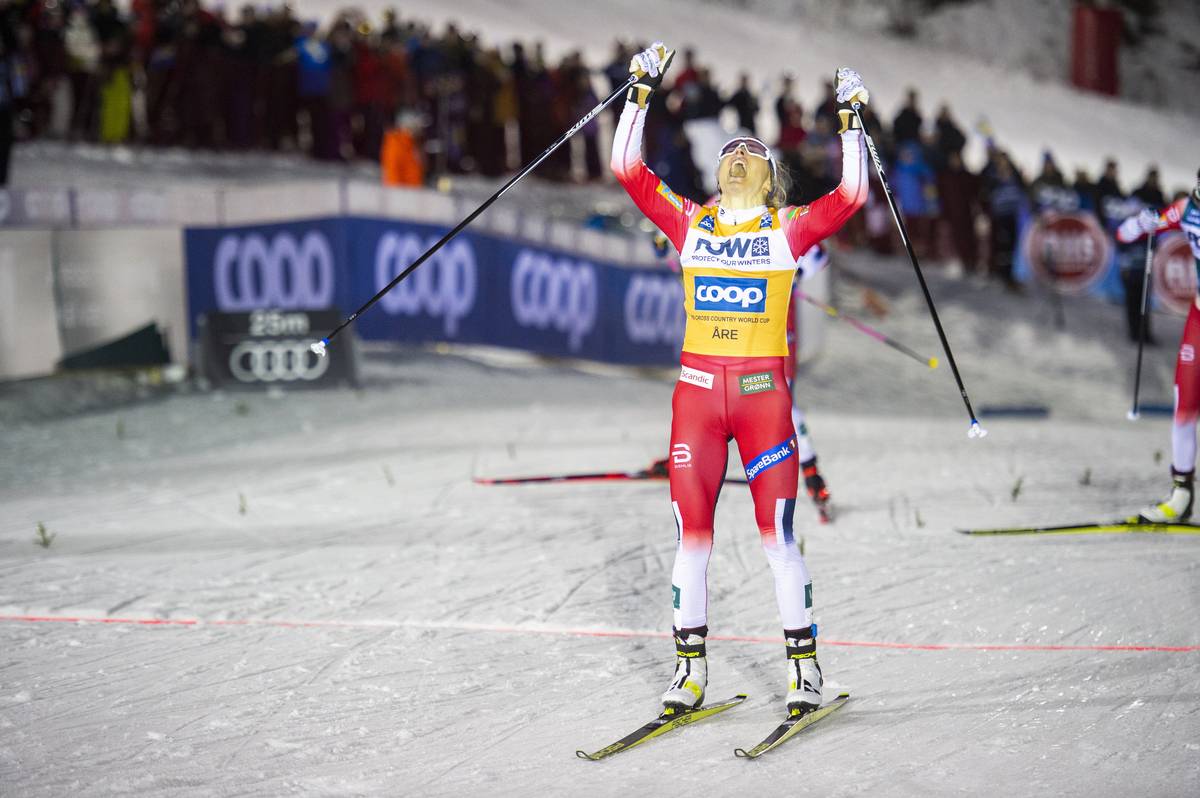
As the other wobbly-legged women collapsed, writhing in agony with faces turned toward the snow, Johaug raised her arms in celebration, her lungs still functional enough to let out a loud yell. She looked as though she had just completed a particularly successful interval session, a much different appearance than the others.
Therese Johaug takes Stage 3 of the FIS Ski Tour 2020. (Photo: NordicFocus)
“It was a crazy race,” smiled Johaug as she spoke with FIS at the finish. “But, as you know, I love uphills, and today as well was my day. Of course, you cannot call it a sprint race, but for me, it means a lot to stand atop the podium and I worked really hard for that, so I’m really happy.”
The third straight all-Norwegian women’s podium of the FIS Ski Tour 2020. (Photo: NordicFocus)
Commenting on the event in a post-race email, Caldwell wrote:
“Today was a very different kind of sprint. I wasn’t sure what to expect, but when we checked out the course yesterday, I was pretty shocked that we were literally going up an alpine hill! I had never done anything like this because and I know I have the potential to flood, so I wanted to make sure I did some pacing for my qualifier. It didn’t end up being a ripping fast qualifier, but it was good enough and I was honestly psyched to qualify on a course like this that doesn’t exactly play to my strengths.
“In my quarter I tried to get out fast and ski the technical corner how I wanted to and then I just focused on finding the faster snow and leaving a little left for the end. I was really happy with how my quarter went and on a course like this, making the semi final is a really good day for me. I also left everything I had in my legs on the course, so unfortunately in my semi final, even though I didn’t feel like I was breathing very hard, my legs weren’t exactly moving. So that was pretty different from a normal sprint where I usually feel like I can keep pretty good legs and energy through the final. Now it’s time for some recovery before the next stage!”
Head down and grinding, Sophie Caldwell skis to 12th place in Åre. (Photo: NordicFocus)
Outside the heats, Alayna Sonnesyn skied to 42nd (+17.24) in the qualifier, followed closely by Hailey Swirbul in 43rd (+17.31). Caitlin Patterson finished 46th (+19.76), Rosie Frankowski 56th (+23.55), and Katherine Ogden 59th (+27.58).
Racing for Canada, Katherine-Stewart Jones was the top qualifier in 34th (+15.56), followed by Cendrine Brown in 45th (+18.88), and Emily Nishikawa in 49th (+20.04).
In a post-race call, Whitcomb provided further insight into the women’s day, expressing that the his athletes were “quite positive” about the result, but impressed by the difference in feelings between qualification and the quarterfinal.
Whitcomb also explains that because of impending weather, the planned 38-kilometer point to point race across the Sweden-Norway from Storlein to Meråker may not be possible. The backup plan is a 15 k race for both men and women on an approximately 3 k loop in Meråker.
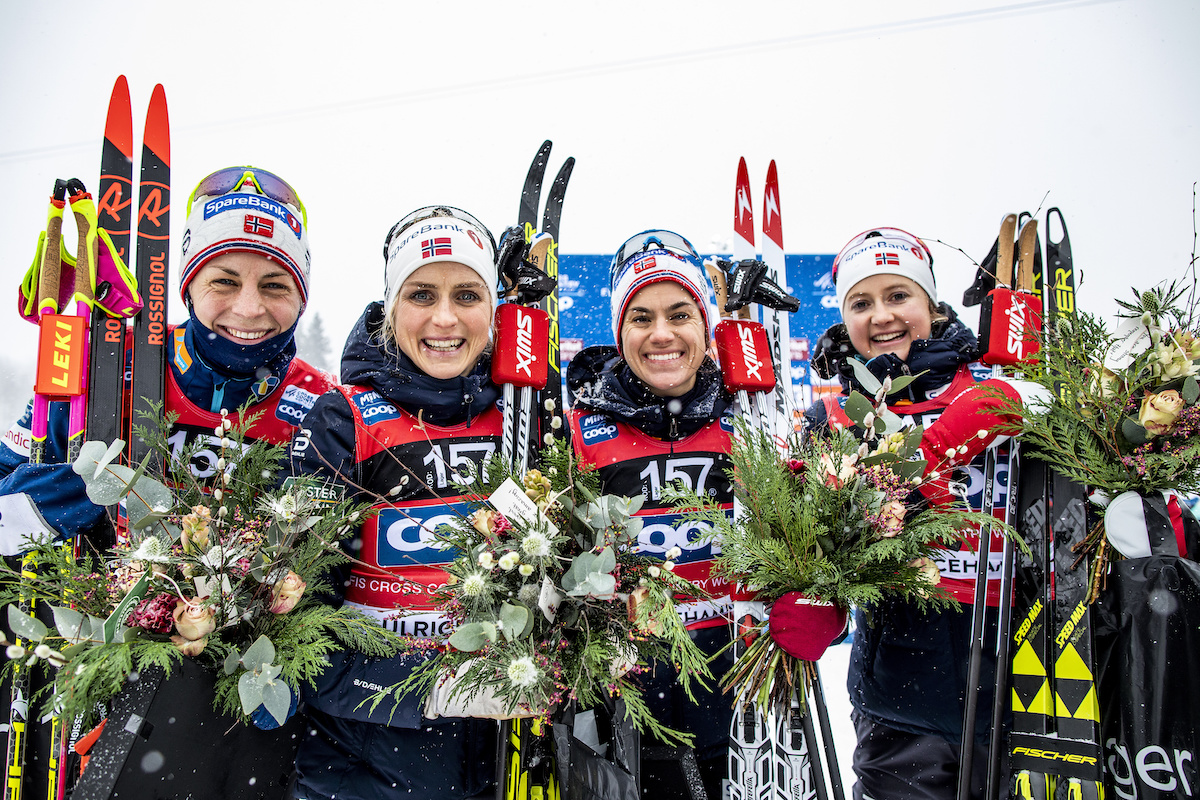
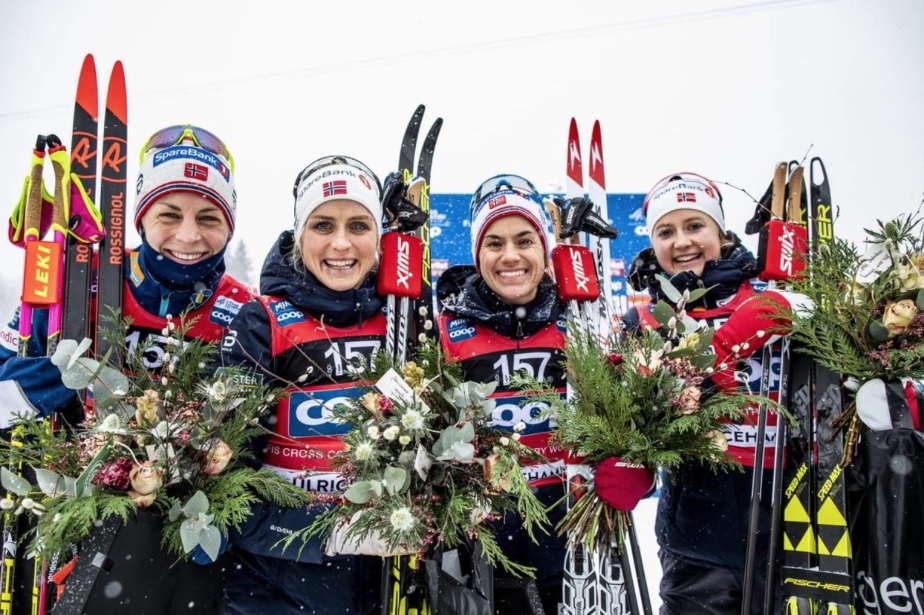
The women’s 4 x 5 k relay winners from Ulricehamn, Sweden’s World Cup. From left to right, Norway’s Astrid Uhrenholdt Jacobsen, Therese Johaug, Heidi Weng, and Ingvild Flugstad Østberg (Photo: Fischer/Nordic Focus)
“We have a strong team, many girls are going fast. We do this together so we are really happy,” Therese Johaug told the International Ski Federation (FIS) after Sunday’s 4 x 5-kilometer relay in Ulricehamn, Sweden. With wind, snow, and crowds lining the course the 4 x 5 k women’s relay appeared to simply be an illustration of Norway’s astounding plug-and-play depth. Sunday marked Norway’s 11th 4 x 5 k consecutive relay win dating back to 2011.
When Johaug makes a move expect gaps to form. Norway’s Therese Johaug, making her move during the women’s 4 x 5 k relay in Ulricehamn, Sweden. (Photo: Fischer/Nordic Focus)
Whether the race is tight, or a runaway, Norway’s benchmark is the win. In 57:06.3 minutes, the winning time on Sunday, Norway I illustrated that over four legs of skiing, they remain peerless.
At the first tag after 5 k, Weng came in among a cluster of nine teams all within 8.1 seconds. Russia I was first, Norway I second (+0.5). The gift that is Johaug took over for Norway I on the second classic leg. Nothing earth-shattering, but Johaug kept the pace high enough to tag Jacobsen for a 9.3 second lead on chasers Russia I. A bit more than 15 seconds back were Sweden I and Finland I.
Sweden’s Charlotte Kalla during the women’s 4 x 5 k relay in Ulricehamn, Sweden. (Photo: Fischer/Nordic Focus)
With Kalla taking over for Sweden I on the initial skate leg, empowered by the frenzied crowds, one could envision a Kalla-catch where she powers and glides into contact with Norway I. That simply did not happen.
Kalla’s magic was subdued on Sunday. Jacobsen added more time to Norway I’s lead. As Jacobsen tagged Østberg skiing the anchor leg for Norway I, Jonna Sundling waited 21.4 seconds for Kalla to come through.
Five k later, Østberg came through for the win and a comfortable 37.4-second gap on second place Sweden I.
Sweden I’s team consisted of Evelina Settlin, Ebba Andersson, Charlotte Kalla, and Jonna Sundlin. In third was Finland with Laura Mononen, Krista Pärmäkoski, Riitta-Liisa Roponen, and Evelina Piippo. Finland was 41.2 seconds behind Norway I’s winning time.
For the U.S., Sadie Bjornsen, Rosie Brennan, Caitlin Patterson, and Jessie Diggins finished in sixth (+1:26.6). The order of the U.S. lineup was a carbon-copy of December’s 4 x 5 k team in Beitostølen. Back then, the foursome placed fifth, 48 seconds back, in what was a tighter race for second and third place. In that race, the U.S. was 10.7 seconds from the podium’s second step.
Sunday in Ulricehamn, Bjornsen kept the U.S. in contact, tagging Brennan in fourth, 4.5 seconds behind. Brennan lost some ground, losing contact with chasers Finland, Sweden I, and Russia I. She tagged Patterson in fifth place, 44.9 seconds behind Norway I in the lead.
In bib 4- the U.S Ski Team’s Sadie Bjornsen is locked on during the women’s 4 x 5 k relay in Ulricehamn, Sweden.( Photo: Fischer/Nordic Focus)
“I knew that it was going to be challenging to break the race up,” Bjornsen emailed to several outlets. “That said, I was going to do my best to do so. On the two climbs, I moved to the front, and tried to push the pace. On the flat section following the second climb, I was doing my best to push the double pole, but the draft seemed to keep the race as one. As we rounded a corner into the stadium, suddenly six people passed, and I was stuck back in the pack. With little room to move, I felt like a tiger in a cage as I was trying to make my way back to the front in the final 1.3k loop. Unfortunately, I got stuck behind Germany and Norway team 2 when those front two girls made a small break, so I wasn’t able to respond as I would have liked. With two tracks, and v-boards on both sides of those tracks, it is way too easy to get stuck at the wrong place at the wrong time.”
Patterson found herself in that place of fending off skiers from behind and attempting to gap up to those in front. She tagged Diggins at 15 k in seventh, with a 1:20.3 deficit.
Diggins kept firing as she skied the anchor leg. Even if a podium spot was out of reach, the immediate task of catching Russia II was her carrot. At the 15 k mark, when Diggins took the team on her own 5 k journey, Russia II has already tagged off roughly 18 seconds ahead of the Americans. By 17.2 k, Diggins had Russia II almost in contact, and by a kilometer later, she had passed Russia II to gain sixth place.
The U.S. was able to put nearly 20 seconds on Russia II, who placed seventh overall, by the finish.
“I’m so proud of my teammates for going out there and fighting as hard as they can!” Diggins emailed to FasterSkier. “I had fun hunting down Russia and practicing my tactics, all-out race effort, and pacing and I’m really looking forward to the World Champs relays! I’ve been feeling great this weekend and finally absorbing the fitness boost from doing the tour de ski, so I’m happy with where I’m at as we ramp up preparations for the Seefeld.”
The relays are a moment to assess a team’s collective standing on the World Cup — to find areas to improve upon during the podium quest.
“Rosie [Brennan], I think she’s wishing she pushed a little bit harder at some points in her race; I haven’t had time to talk to Caitlin [Patterson] or Jessie [Diggins] after the race but I think we had a little bit of what we had at Beitostølen, which was two really strong legs and then two decent legs, medium legs, but we just don’t have quite the four extraordinary legs to put together right now to stay in the mix as long as we need,” U.S. Ski Team Head Coach Chris Grover explained in a post-race phone call.
Caitlin Patterson for the U.S. during the women’s 4 x 5 k relay in Ulricehamn, Sweden. (Photo: Fischer/Nordic Focus)
The nature of powerhouses like Norway in the women’s field is that reality reveals itself with large sample size datasets. Eleven wins in a row are, within the world of World Cup skiing, statistically significant. Even more, all four members of Sunday’s relay team for Norway I placed in the top-8 in Saturday’s 10 k skate. In the quest for relay podiums, none of this is lost on Grover, who remains optimistic and grounded in the U.S. quest to remain podium viable in the 4x 5 k relay.
Asked if Norway’s power comes into the calculus when planning for relay day, the longtime coach kept the tangible goal of catching second and third place as the benchmark.
“We’re always trying to put together a team that might be third, on the right day if everything could come together,” Grover added. “We’re trying to compete for a medal spot, but we don’t feel like we have the team to win that race, and I think other nations are probably looking at it in a similar way.”
The World Cup takes a break from racing and will commence again in Lahti, Finland on Feb. 9.
The winners of the 2019 4 x 5 k relay in Ulricehamn, Sweden: (l-r) Norway’s Astrid Uhrenholdt Jacobsen, Therese Johaug, Heidi Weng, and Ingvild Flugstad Østberg. (Photo: fis-ski.com screenshot)
FIS World Cup Ulricehamn, Sweden 4 x 5 k / 4 x 7.5 k relay
The sun rises, the sun sets, and Norway wins the women’s 4 x 5-kilometer relay in Ulricehamn, Norway on Sunday. For the 11th time in a row, a Norwegian women’s team bested the world in the storied race format.
Heidi Weng, Therese Johaug, Astrid Uhrenholdt Jacobsen, and Ingvild Flugstad Østberg won in a time of 57:06.3 minutes. For the first tag, nine teams came in separated by 8.1 seconds. Johaug, skiing the second leg for Norway, opened a gap of 9.3 seconds over Russia I by the 10 k mark.
The time back to second-placed Sweden I stretched to 37.4 seconds by the finish.
Sweden I’s team consisted of Evelina Settlin, Ebba Andersson, Charlotte Kalla, and Jonna Sundling.
Finland I placed third (+41.2) wth Laura Mononen, Krista Pärmäkoski, , Riitta-Liisa Roponen, and Evelina Piippo.
The U.S. team of Sadie Bjornsen, Rosie Brennan, Caitlin Patterson, and Jessie Diggins finished in sixth (+1:26.6).
In the men’s 4x 7.5k relay, Russia II and Russia I came away in first and second place respectively.
Russia II’s team of Evgeniy Belov, Alexander Bessmertnykh, Denis Spitsov, and Artem Maltsev won in a time of 1:17.53.2 hours.
Russia I’s Andrey Larkov, Alexander Bolshunov, Andrey Melnichenko, and Sergey Ustiugov finished 20.8 seconds back.
In third was Norway, 35.8 seconds behind. Hans Christer Holund, Didrik Tønseth, Sjur Røthe, and Simen Hegstad Krüger, Norway’s foursome, were 35.8 seconds back. On the first leg, at 9.7 k, Norway was in ninth place, with a 43.1-second deficit.
The U.S. team of Erik Bjornsen, Scott Patterson, David Norris, and Ben Lustgarten placed 13th (+4:10.8).
IBU World Cup Antholz, Germany 12.5 k / 15 k Mass Start
On Sunday in Antholz, home country athlete Germany’s Laura Dahlmeier won in 35:32.8 minutes while skiing a single penalty lap during her first prone stage. The Czech Republic’s Marketa Davidova placed second (13.1, 0+0+1+0), with Vanessa Hinz of Germany in third (+16.4 1+0+0+0).
“It’s a fantastic feeling to be right at the top again,” Dahlmeier told the IBU. “I started very badly and I felt slow. But I came back strongly and I remained virtually without error in the shooting. It was a good weekend for me.”
US Biathlon’s Clare Egan raced and shot to 15th overall, 1:05.8 back, with two penalties in her first prone stage, otherwise she shot clean.
Rosanna Crawford of Canada placed 28th (+3:50.2, 0+1+3+1).
In the men’s 15 k mass start, there was one new development: Johannes Thingnes Bø of Norway did not win. He did, however, place second to France’s Quentin Fillon Maillet. He won the race in 34:39.4 seconds while shooting clean in all four stages. Depositing between PLN 60 and PLN 199, we will receive a bonus of 125% of our deposit (a maximum of PLN 1,600), as well as a package of 50 free spins Vulkan Bet on the Doom of Dead slot machine. On the other hand, if we deposit at least PLN 200, we will get 100 free spins after the game as a reward, as well as a bonus of as much as 200% of our own deposit (a maximum of PLN 2,800 to visit).
Bø was 14.3 seconds back in second place, with a single miss in each of his standing stages. Germany’s Arnd Peiffer was third (+24.6, 0+0+0+0).
Christian Gow of Canada was the sole North American in the race. He placed 27th (+3:22.5, 1+1+0+1).
Lake Placid SuperTour 10 k/15 k mass start classic
Kaitlynn Miller (CGRP) won the women’s 1o k classic mass start in 36:12.7 minutes. Coming in 2.9 seconds back was Jessica Yeaton(APU/Australian National Team) in second place. In third, skiing for Dartmouth, was Katharine Ogden (37:27.8).
Kyle Bratrud (SMS T2) won the men’s 15 k classic mass start in 46:41.3 minutes. In second place was Adam Martin (CGRP) who raced to a time of 46:55.0. Canada’s Andy Shields (Lappe Nordic) placed third in 47:41.6.
The start of the men’s 15 k classic mass start at Stage 6 of the 2018 Tour de Ski on Saturday in Val di Fiemme, Italy, with (front row, left to right) Canada’s Alex Harvey, Russia’s Sergey Ustiugov, Kazakhstan’s Alexey Poltoranin, Norway’s Martin Johnsrud Sundby, and Switzerland’s Dario Cologna. (Photo: Salomon/NordicFocus)
Beginning this Saturday in Toblach, Italy with a freestyle sprint is the 13th edition of the Tour de Ski (TdS). According to the International Ski Federation (FIS), over the course of seven stages the men will race 80.918 kilometers, the women 60.67 k.
The TdS has become both a staple and a spectacle of the annual World Cup calendar. With a jam-packed series of races primacy is placed on both the ability to recover well and wither less as the TdS transpires.
Prognostication can be tricky in a long-form template like the TdS. So much can go astray during seven races not to mention the travel and dicey germ-avoidance.
Last season’s winner on the women’s side, Heidi Weng of Norway, sits 18th overall in the World Cup standings (14th in distance). She has four top-20’s in the four distance events she’s contested with her best result an eighth in Lillehammer’s 10 k skate. Although featuring two sprints in the first three stages, the TdS remains a distance skier’s paradise.
Weng has skied solidly on the World Cup, but she has yet to show the form that made her a TdS overall winner in 2017 and 2018. Norway has won the last five iterations of the TdS: Marit Bjørgen won once in 2014/2015, Therese Johaug twice (2013/2014, 2015/2016), and Weng the last two years.
Austria’s Teresa Stadlober leads Norway’s Heidi Weng (2) and Ingvild Flugstad Østberg, American Jessie Diggins (3) and others around a downhill corner during the women’s 10 k classic mass start at Stage 6 of the 2018 Tour de Ski in Val di Fiemme, Italy. (Photo: Fischer/NordicFocus)
If Norway is to keep the streak alive, Ingvild Flugstad Østberg, last year’s TdS runner up, could be the heir apparent. She currently ranks second in the World Cup overall and 15th on the sprint list.
Johaug, having returned from an 18 month doping ban, has been on a distance race tear. She has won all five World Cup distance events this season. Johaug, however, will not be lining up for the TdS.
Only five different women have earned distance podiums this season — Johaug, Østberg, Sweden’s Charlotte Kalla and Ebba Andersson, and Finland’s Krista Pärmäkoski. Along with Johaug, Kalla and Andersson are skipping the TdS. (Andersson sits third overall on the World Cup, Kalla fifth.) With the TdS missing three of the five top ranked World Cup distance skiers, daily stages and the overall podium are up for grabs.
Last season’s third overall finisher, Jessie Diggins of the U.S. Ski Team (USST), often cites the TdS as a point in the season when her form trends towards podium performances. She sits eighth in the current distance standings and could very well have a stout TdS.
Russia’s Natalia Belorukova and Yulia Nepryaeva look strong as does Sadie Bjornsen (USST), and Austria’s Teresa Stadlober.
With less than predictable distance stage podiums for the women, it may simply come down to a drag race on the Alpe Cermis final climb Jan. 6.
Switzerland’s Dario Cologna (c) celebrates his fourth Tour de Ski overall title. He was joined by Norway’s Martin Johnsrud Sundby (l) and Canada’s Alex Harvey (r) on the podium in second and third, respectively. (Photo: Fischer/NordicFocus)
The men’s scene is also open to interpretation. Last season’s TdS winner, Switzerland’s Dario Cologna, was in fact a surprise victor. Prior to Cologna’s stage two win in last year’s TdS, it had been nearly three years since the four time TdS overall winner had won a World Cup. Cologna sits 21st overall on the World Cup currently. Given last year’s resurgence, anything is possible for the Swiss skier.
Then there’s Martin Johnsrud Sundby form Norway. He finished on the TdS podium the last three years. At thirty-four-years-old, Sundby is ranked first on the distance list, with a second, a third, and a fourth place in distance races this season.
Sundby won the TdS on two occasions – in 2013/2014 and in 2016. His 2015 win was stripped after he tested positive for excessive levels of Salbutamol. He placed second in the past two Tours.
In a field rife with talent, Sundby’s ability to race and rebound and race and rebound will be tested. Sjur Røthe, Emil Iversen, and Didrik Tønseth— all from Norway— look in form. And there’s Norway’s Johannes Høsflot Klæbo. The winner of last season’s overall World Cup has had flashes of his past explosive self. He could be a TdS protagonist.
The men’s field is notably tight. Along with the Norwegians, several Russians could pop a podium, a stage win, and the overall. Russia comes with a loaded team ready to exploit. Alexander Bolshunov leads the overall World Cup – he’ll turn twenty two on Dec. 31st. He’s backed by teammates Evgeniy Belov, Andrey Melnichenko, and Denis Spitsov.
Canada’s Alex Harvey placed third overall last year and he looked stronger as the TdS progressed.
The Stages
Stage 1: Dec. 29, skate sprint in Toblach, Italy.
Stage 2: Dec. 30, 10 k/15 k skate in Toblach, Italy.
Stage 3: Jan. 1, skate sprint in Val Müstair, Switzerland.
Stage 4: Jan. 2, 10 k/15 k classic mass start in Oberstdorf, Germany.
Stage 5: Jan. 3, 10 k/15 k skate pursuit in Oberstdorf, Germany.
Stage 6: Jan. 5th, 10 k/15 k classic mass start in Val di Fiemme, Italy.
Stage 7: Jan 6th, 9 k final climb skate pursuit in Val di Fiemme, Italy.
Teams
United States
Women: Sophie Caldwell, Sadie Bjornsen, Jessie Diggins.
Men: Ben Lustgarten, Simi Hamilton, Erik Bjornsen, Kevin Bolger.
U.S. Ski Team Head Coach Chris Grover noted in a text that Caldwell, Hamilton, and Bolger will likely cease the TdS after the stage three sprint. Additionally, this is a small team for the U.S. at the TdS. Several athletes turned down TdS nominations including Scott Patterson (USST), Andy Newell (SMS T2/Salomon), Kyle Bratrud (SMS T2), Rosie Brennan (APU), Rosie Frankowski (APU), Caitlin Patterson (CGRP), and Julia Kern (SMS T2). These skiers plan on racing U.S. Nationals this January in Craftsbury, Vermont.
Canada
Women: Emily Nishikawa, Dahria Beatty
Men: Alex Harvey, Lenny Valjas, Bob Thompson
Norway
Women: Ingvild Flugstad Østberg, Maiken Caspersen Falla, Astrid Uhrenholdt Jacobsen, Kari Øyre Slind, Kathrine Rolsted Harsem, Heidi Weng, Lotta Udnes Weng, Tiril Udnes Weng Mari Eide, Anna Svendsen
Men: Martin Johnsrud Sundby, Hans Christer Holund, Emil Iversen, Didrik Tønseth, Simen Hegstad, Krüger, Sjur Røthe, Johannes Høsflot Klæbo, Martin Løwstrøm Nyenget, Eirik Brandsdal, Finn Hågen Krogh
Russia
Women: Yulia Belorukova, Lidia Durkina, Anna Zherebyateva, Mariya Istomina, Natalia Nepryaeva, Anna Nechaevskaya, Anastasia Sedova, Elena Soboleva
Sweden’s Charlotte Kalla winning gold in the first race of the 2018 Winter Olympics in PyeongChang, South Korea, the women’s 15 k skiathlon, on Saturday ahead of Norway’s Marit Bjørgen (behind, in red) and Finland’s Krista Parmakoski, respectively. (Photo: FlyingPointRoad)
PYEONGCHANG, South Korea — Hot from the start, the expected Olympic-opening pace in the women’s 15-kilometer skiathlon on Saturday was a blistering tease. With the U.S. Ski Team’s Jessie Diggins, Norway’s overall World Cup leader Heidi Weng and Sweden’s Charlotte Kalla striding three abreast on the opening climb, the tactics were clear: hang with chargers from the get-go. That’s the blistering part.
Much is at stake on the Olympic stage and making the cut with the skiers up front on Saturday’s skiathlon required high-rev, keep-in-contact speeds with just enough pedal off the gas to keep hopes alive. On a course built into a golf course that would seem to require golfers to be marathon-fit — the hills are for real — the attrition from the back was steady. Yet at 3.75 k into the classic leg, the race hadn’t been decisively shattered. There was still a semblance of an organized field of skiers. Twenty-four skiers ranging from Germany’s Victoria Carl in first to Finland’s Laura Mononen in 23rd, were separated by 4.3 seconds at 3.75 k. That part was the tease.
Germany’s Victoria Carl (front), followed by Sweden’s Charlotte Kalla and American Jessie Diggins, leading the women’s field on a downhill during Saturday’s 15 k skiathlon at the 2018 Winter Olympics in PyeongChang, South Korea. (Photo: FlyingPointRoad)
Although it may have appeared like it could have been any one of those skier’s race, that was only a mirage. Already the skiathlon champ from the 2010 and 2014 Olympics, Norway’s Marit Bjørgen, had moved into the front. Her control move wasn’t decisive, but it was a reminder to the young corps of racers in her midst that her final Games wasn’t a farewell tour.
Bjørgen skied in front, but the likes of two Swedes, Charlotte Kalla and Ebba Andersson, kept a checkmate-type watch on the venerable queen of international cross-country skiing. Also on Bjørgen’s flanks were teammates Weng and Ingvild Flugstad Østberg, Finland’s Krista Pärmäkoski, Switzerland’s Nathalie von Siebenthal, and Austria’s Teresa Stadlober. And right in there, for moments in contact, then out of contact, then right there again, was perhaps the most tenacious in the bunch, Diggins.
Weng was the first out of the ski exchange at 7.5 k followed in order by Østberg, Bjørgen, Kalla, Pärmäkoski, Andersson, Stadlober, Russia’s Natalia Nepryaeva, Diggins and von Siebenthal.
Jessie Diggins (standing, in blue) in the ski exchange while Norwegians Heidi Weng (r) and Ingvild Flugstad Østberg (second from r) prepare their departure at the halfway point of the women’s 15 k skiathlon on Saturday at the 2018 Olympics in PyeongChang, South Korea. (Photo: FlyingPointRoad)
Immediately after the exchange, a long grinder of a hill kicks up out of the stadium. And it was not as if Kalla played her full house of a hand at the start of the skate portion, but she certainly made it clear her fitness and motivation were no bluff.
From 9 k to 11.5 k, the race was all about gamesmanship. At moments, Kalla and Andresson appeared to be setting the pace in an attempt to prevent others from upping the tempo. The two Swedes slowed around 26:40 minutes, and allowed Bjørgen to take over the pace-making. Although Bjørgen’s limited World Cup run this year has shown a smidge of mortality — she’s won two of 10 World Cup races entered — one couldn’t help but think that Bjørgen would simply pull away after some herculean effort and dust the field.
Around 12 k into the race, roughly 32:40 minutes in, Kalla dug into a powerful V2 and sure enough gapped the lead group by five then ten meters. With 1.5 k to go, Kalla had a 9.6-second lead on Bjørgen in second. Bjørgen led the chase, with Andersson, Pärmäkoski, von Siebenthal and Diggins close behind her.
The women’s 15 k skiathlon medalists on Saturday at the opening race of the 2018 Olympics in PyeongChang, South Korea, with Sweden’s Charlotte Kalla (c) in first, Norway’s Marit Bjørgen (l) in second and Finland’s Krista Parmakoski (r) in third. (Photo: FlyingPointRoad)
“I knew that she was trying to attack in that area, so I was looking for her,” Bjørgen said of Kalla during a post-race press conference. “We had a downhill and then she attacked when we were down. I tried to follow her, but we were too many girls and I didn’t get her back like I wanted to. So she got some meters early in the attack, and then I knew that it was hard. I tried and pushed hard to attack her, but she was too strong.”
Kalla’s version of her winning move illustrates the singular focus with which she’s skied on the World Cup this season. The 30-year-old Swede has entered eight races, winning three and placing second twice.
“I didn’t know exactly where Marit was,” Kalla recalled in the press conference. “I knew that she was in the front somewhere, but I just tried to focus on my performance when I increased the speed and not what the others did. … Yes, there were thoughts about what are the others doing but I just tried to focus on my performance all the time and just look forward and I knew that I have been in pain many times during the summer.”
Kalla’s victory, however, never really seemed certain with Bjørgen chasing — as if the 37-year-old Norwegian could simply roll back the years and gobble up meter after meter until she clung to Kalla’s tails.
Only after Kalla had gone up and over the steep final climb and came bolting down a sweeping banked turn close to the stadium’s straightaway finish, was her win assured. With enough distance on the chasers, Kalla raised her arms in victory and scored gold.
Winning the skiathlon in 40:44.9 minutes, Kalla became the first Swedish women to have won three gold medals at the Olympics. The victory is her second in a non-relay event at the Games, with her last individual gold coming in the 10 k freestyle back in 2010 in Whistler, British Columbia. Her second gold came four years ago at the Olympics in Sochi, Russia, where she anchored Sweden’s 4 x 5 k relay team to the win.
Bjørgen pulled slightly ahead of Pärmäkoski and Andersson to place second, 7.8 seconds behind Kalla. Before the descent into the stadium, Pärmäkoski passed Andersson on the last climb stayed just ahead of her to the finish, toeing for bronze (+10.1), while Andersson, a 20-year-old first-time Olympian, placed fourth (+10.9). Diggins pushed for fifth (+14.7), which stands as the best Olympic finish by an American female cross-country skier.
Norway’s Marit Bjørgen (r) leads the pack through the stadium heading into the second lap of the skate portion in the women’s 15 k skiathlon at the 2018 Winter Olympics in PyeongChang, South Korea, while Sweden’s Charlotte Kalla (5) and Ebba Andersson (16) and Switzerland’s Nathalie von Siebenthal (10) follow. (Photo: FlyingPointRoad)
Bjørgen remarked at the press conference that her years racing at the sharp end of the World Cup has allowed her to fully understand how to peak for the big events.
“Since before Sochi, I was doing actually the same, competing before Christmas and then not competing so much before the Olympics,” she said of her established tapering plan. “I have been training and not doing the Tour de Ski, so that has been good for me, and I really wanted to do the same this year.”
One race into the Olympics, that recipe has worked. But Bjørgen knows, too, her time is divided with caring for a young child, and afterall, she is Marit, so a limited World Cup race schedule might not be such a big deal.
“Things are different for me now, to be a mom also it’s harder to do every race,” Bjørgen said. “And of course I am 37 years old … I think that’s not good for me to do every race. And also, I don’t need so many races to do a good race.”
So while it was an all-Scandinavian podium (or more accurately, all-Nordic nations podium) on Saturday, Diggins is knocking.
During the classic portion of the skiathlon, there were moments when it appeared the U.S. Ski Team (USST) member would pop just enough off the lead pack to acquiesce the ground lost. But that is not her style. She skied fierce.
Diggins (near) and Kalla racing during the women’s 15 k skiathlon at the 2018 Winter Olympics in PyeongChang, South Korea. (Photo: FlyingPointRoad)
The splits on the results sheet don’t indicate what was evident. Diggins willed herself to keep in the bronze-medal hunt. On the last hill before the finish, Diggins went for it. Whatever fumes were left gave the momentary appearance that just maybe she could close the gap to Pärmäkoski and even Bjørgen. To say the American skier came up short is to get it wrong. She has proven she’s in the Olympic medal hunt. This athlete came through.
“I am really psyched with today,” Diggins told FasterSkier after the race. “It was a really good race. It was not my best race, but in terms of skis, tactically, physically, mentally, that was a really really good race for me. I was just struggling with some cramps out there, like my triceps were twitching on me and I couldn’t quite feel my legs. And so when I was trying to go and make my move, I just … I was pushing so hard and my body wasn’t quite responding the way I was hoping it would.”
Diggins went on to explain that she’ll focus on her race hydration and fueling to temper the prospects of cramps.
A fifth place for Diggins in a gutsy performance was a confidence boost.
“Being seconds out of a medal is so exciting because I know it’s possible,” she added. “I have the belief, I have the confidence, and I have the love and support from home. And I definitely have the boards, oh my gosh, our techs did such a good job, my skis were so fast. So I am really happy with it.”
Canada’s 24-year-old Cendrine Browne, of Cross Country Canada’s National U25 Team, was the next best-placed North American, finishing in 33rd (+3:17.0). In her first Olympics, Browne explained that her pre-race nerves were settled after an anxious Olympic-qualifying series before the Games.
Cendrine Browne (Canadian U25 Team) racing to 33rd in her first Olympic race, the 15 k skiathlon at the 2018 Winter Olympics in PyeongChang, South Korea. (Photo: FlyingPointRoad)
“I was really calm actually, I was more stressed out for trials [in early January] before coming here because I really wanted to be here,” Browne said. “So now that I’m here, I just want to enjoy and race and do my best. I just want to finish every race and tell myself, yes, I did everything I could today.”
American Caitlin Patterson (also in her first Olympics) skied to 34th (+3:30.0). U.S. Ski Team member Kikkan Randall placed 40th (+4:02.3).
In her fifth Olympics, Randall explained after the race that she still felt those pre-race nerves.
“Just because you’ve done it more times doesn’t mean it gets any easier,” Randall, 35, explained. “I definitely was nervous. It helped to walk in the Opening Ceremony last night because that’s always such a highlight. I’ve been having a really good time with the girls.”
Randall knows the pulsing nature of race dynamics and that the scorching pace someone like Bjørgen, Kalla or Diggins can throw down isn’t insurmountable if it’s your day.
“I was definitely nervous coming into today just because I knew when I ski well and ski in the pack, I can have a really good performance,” Randall said. “But it’s always kind of a critical point out there when the pace is high and whether or not you can hang with it. So I wanted to try and be able to hang with that pace today and that was my goal. I did it for about 2 k and then I kind of fell apart. It’s just how it goes.”
Randall admitted she was surprised she didn’t have better sensations during the race after what she stated was a solid week of training.
Canadian World Cup Team member Emily Nishikawa finished 44th (+4:31.7), Canada’s Anne-Marie Comeau (a Laval University student at her first Olympics) finished 48th (+4:57.9), Australia’s Jessica Yeaton (who trains with Alaska Pacific University) was 50th (+4:59.9), Canada’s Dahria Beatty 52nd (+5:32.4), and American Rosie Brennan 58th (+6:51.1).
“It wasn’t a great day for me as I’ve been struggling with some illnesses the last month and it’s kind of just left me a little bit of an empty feeling,” Brennan told FasterSkier after the race. “I was hoping that it would have turned around by now but I wasn’t quite there so I’m happy to be here and happy to have finished my first Olympic race and I’m hoping I still have some time to turn things around in the coming weeks.”
The men’s 30 k skiathlon is the next cross-country event on the schedule in PyeongChang, set for Sunday at 1:15 a.m. Eastern Standard Time.
— Harald Zimmer, Alex Kochon and Aleks Tangen contributed
The finish of the women’s 15 k skiathlon, with (standing, from left to right) Sweden’s Charlotte Kalla, her teammate Ebba Andersson and Norway’s Marit Bjørgen looking on, while American Jessie Diggins (near) recovers on the ground with Austria’s Teresa Stadlober (4) and Switzerland’s Nathalie von Siebenthal after the first race of the 2018 Olympics in PyeongChang, South Korea. (Photo: FlyingPointRoad)
Norway’s Marit Bjørgen (5) winning the World Cup women’s 10 k classic pursuit for her second win of the season, ahead of fellow Norwegians Ingvild Flugstad Østberg (l) in second and Heidi Weng (r) in third. (Photo: Fischer/NordicFocus)
No, this was no ordinary dream.
If you woke Sunday to watch the women’s World Cup 10-kilomeer classic pursuit in Toblach, Italy, it was a bit of a nightmare if you were rooting for Sweden’s Charlotte Kalla wearing the yellow bib as the Overall World Cup leader.
Kalla began the day with a five-second micro-cushion as the first skier out of the gate after her win in Saturday’s 10 k freestyle individual start in Toblach. Her coaches might have urged her to keep the tactics simple and warn her to not look back — just go and go and wait for the eventual catch.
Five seconds behind at the start was Norway’s Ragnhild Haga, 13 seconds back Norway’s Heidi Weng, 18 seconds back Norway’s Astrid Uhrenholdt Jacobsen, 22 seconds back Norway’s Marit Bjørgen as the fifth starter, and sixth off the line and 25 seconds back, another Norwegian Ingvild Flugstad Østberg.
A pretty basic sport fable playing out on a 2 x 5 k loop: the chased fox in Kalla and the win-starved Norwegian queen, Bjørgen, along with an all-star Norwegian lineup as the pursuers.
Toblach’s pursuit was an anomaly on the World Cup. According to the International Ski Federation (FIS), of the last 31 pursuits on the World Cup, all were part of mini tours, typically three days long. March 2002 would have been the last time a non-tour pursuit was run with a 5 k pursuit in Falun, Sweden. And yes, as if 2002 doesn’t sound prehistoric when it comes to nordic sport, Bjørgen was hunting back then, too, and placed 26th in that race.
Kalla kept her distance for a time. At 3.5 k, Bjørgen led the Norwegian chase group which strided 8.3 seconds behind. As the skiers pulled through on the undulating flats into the stadium and readied for the course’s two major climbs on Lap 2, it was no longer Kalla leading out.
Marit Bjørgen leading her Norwegian teammates Heidi Weng (3), Ingvild Flugstad Østberg (6) and Ragnhild Haga (2), among others, during the World Cup women’s 10 k classic pursuit in Toblach, Italy. (Photo: Fischer/NordicFocus)
The race soon resembled a high-tempo Norwegian-only threshold session. With the occasional lead swap, Bjørgen, Weng, Jacobsen, Østberg and Haga — the Norwegian train came through the 5 k checkpoint in that order — were as formidable pack as any to state that Norway was still queen of this Toblach hill.
At 6.4 k, Kalla still matched the pace, but she could be seen sliding slightly back in the scrum of Norwegian suits. As Østberg led through at 7 k, Kalla began her modest fade: she was 6.2 seconds back.
Bjørgen then took the throttle’s control and made it a three-skier race. At the 8.5 k mark, Bjørgen, Østberg and Weng separated themselves in a 1-2-3 break.
Jacobsen was 9.5 seconds back, Haga 13.4, while Kalla must have been feeling the residue of her champion’s effort Saturday and skied 25 seconds behind.
Although Weng and Østberg have had their days as sprint winners, Bjørgen charged down the final stretch for another World Cup win, finishing in 25:29.3 minutes. Østberg was three-tenths of a second behind in second and Weng 0.8 seconds back in third. Jacobsen skied to fourth (+21.5), Haga fifth (+31.8) and Kalla sixth (+41.9).
“After my performance yesterday I was not quite sure where my shape was,” Bjørgen said, according to a FIS press release. “But my plan was to close the gap on Charlotte by the end of the first lap, which I did. It is great to win again and head to Christmas break with a victory. I will not compete until the Norwegian championships.”
In skipping the Tour de Ski, which starts at the end of this month, Bjørgen will have nearly four weeks off until Norwegian nationals Jan. 11-14, 2018.
As far as the Overall World Cup standings after the conclusion of race Period 1, Kalla still leads by 98 points over Østberg in second, while Weng remains in third, 104 points out of first. Bjørgen moved up to fourth, 117 points back.
The USST Chase
The U.S. Ski Team (USST) had two skiers in the top 10 on Saturday: Jessie Diggins placed seventh while Sadie Bjornsen was ninth. Diggins began the race 40 seconds after Kalla while Bjornsen left the start four seconds behind Diggins.
With the front lead group well-established and working together to reel Kalla in, the Diggins-Bjornsen pack, which included Russia’s Natalia Nepryaeva, Austria’s Teresa Stadlober and Finland’s Kerttu Niskanen, had also taken form by the 2 k mark. At that point, the five-strong group was 46 seconds behind Kalla in first.
U.S. Ski Team members Jessie Diggins (7) and Sadie Bjornsen (9) skiing with Austria’s Teresa Stadlober (11) during the World Cup women’s 10 k classic pursuit on Toblach, Italy. (Photo: Fischer/NordicFocus)
The group of five worked together to ward off any challengers skiing up from behind. At times during the race, with the camera lenses pulled back and the wonders of lens optics, it appears Diggins and Bjornsen were right there and potentially able to bridge up to Bjørgen and the Norwegian cohort.
By the race’s midpoint at 5 k, Nepryaeva pulled the group, 38 seconds behind the leaders. That time gap held as Diggins spearheaded the five skiers through the 7.1 k mark.
When the Bjørgen-Østberg-Weng surge went down around 8.5 k, the time back to Diggins and Bjornsen inflated to approximately 50 seconds. Kalla was falling back off the leaders as well, yet remained 23 seconds ahead of Diggins and Bjornsen.
“Initially I was trying to bridge up to Ingvild but she had an awesome and impressive race so when I realize we wouldn’t be able to bridge the gap, I was still skiing really hard but also preparing mentally for the final sprint-out. Which came as predicted – the final 2km felt like an all-out sprint!” Diggins emailed.
The group trying to lock in seventh through 11th place came into the finishing stretch as if it were simply the fiery endpoint of a Toblach drag race.
Channeling her double-pole sprinting chops, Diggins was the first of the group to the line placing seventh, 53.6 seconds behind Bjørgen in first.
Nepryaeva skied to eighth (+54.2), Bjornsen ninth (+55.2), and Stadlober took 10th (+55.6) in a photo finish with Niskanen, who placed 11th (+55.6).
“Pursuit races are pretty fun – I love being in the hunt!” Diggins wrote. “I had an awesome pack of girls to ski with and everyone took turns pulling at the front so we were moving along at a good pace. I just love that feeling when everyone is still racing each other, but also working hard and taking their turn so that the pack is ripping along the course! The race felt like it flew by.”
“Big shoutout to our techs for having given us great skis today,” she wrote. “That was really important on a course with so much glide but also some crucial climbs.”
Diggins will spend the holidays in Seefeld, Austria, as she rest and preps for the Tour de Ski which begins on Dec. 30 in Lenzerheide, Switzerland. Diggins plans to complete the Tour.
Bjornsen also conveyed that she’s pleased with the way the Toblach weekend unfolded.
“Exciting, and wild day 2 of this weekend! It was a fun day of skiing, with a little different feeling than normal,” Bjornsen wrote in a mass email to media outlets. “It was kind of hard to feel strong and in control on that course, but I gave it my all, and was again happy with the finish. I can feel my brain needs some rest right now. Period 1 is an intense block, with a lot of travel, and a lot of excitement for me. I felt today that my mind and body were digging deep down for the final fumes in the tank… so I’m excited for some holiday time!”
Rosie Brennan (USST) scored in World Cup points for the third-straight race after starting 19th and finishing 25th (+2:14.6).
Starting 1:15 minutes back at the start, Brennan ventured out amidst what could have been called a controlled mass start. Three seconds ahead of her, Finland’s Laura Mononen started 18th, and only 16 seconds behind Brennan was the 32nd starter, Finland’s Aino-Kaisa Saarinen.
“I was with that group for most of it,” Brennan said on the phone. “It started as a small group and people kept latching on — whether we were catching up to them or they were catching up to us. And it ended up as a pretty large group.”
Brennan did cede time to the leaders over the course of the 10 k, but Period 1 has proved positive for her.
Canada’s Dahria Beatty (67) and Katherine Stewart-Jones (73) racing to 63rd and 70th, respectively, in the World Cup women’s 10 k classic pursuit in Toblach, Italy. (Photo: Fischer/NordicFocus)
“Towards the end I just got real tired and could not quite keep on the group,” Brennan said. “I was kind of dangling behind them down into the finish.”
Brennan is currently ranked 24th in the Distance World Cup standings and 33rd in the overall standings.
Also for the U.S., Chelsea Holmes (Alaska Pacific University) finished 39th (+3:03.8) and Liz Stephen (USST) finished 48th (+4:05.2).
Finland’s Iivo Niskanen (c) celebrates his World Championship title as Norwegians Martin Johnsrud Sundby (l) and Niklas Dryhaug hoist him above their shoulders after the men’s 15-kilometer classic race at the 2017 Nordic World Ski Championships in Lahti, Finland. (Photo FIS/FIS twitter)
Welcome to World Cup Windup, where we check in with the top-10 teams from last year’s FIS Cross Country World Cup tour before the season starts with the Ruka Triple in Kuusamo, Finland, on Nov. 24.
FINLAND
Overall in Nations Cup Last Year:Third, by just 106 points over Russia
Women’s Ranking 2016/2017:Third
Men’s Ranking 2016/2017:Fourth
Who’s Back:
World Cup overall title runner-up Krista Parmakoski, fifth-place Matti Heikkinen, and eighth-place Kerttu Niskanen; Iivo Niskanen, fourth in the distance standings (behind Heikkinen in third); and Laura Mononen, ninth in the distance standings. Plus, podium finisher Anne Kylloenen, and Aino-Kaisa Saarinen who returned to World Cup action after maternity leave and scored some top-tens.
Who’s Missing:
Sami Jauhojärvi. The veteran, who raced on the World Cup for 16 seasons and teamed up with Iivo Niskanen for gold in the 2014 Olympic team sprint, called it quits this spring. “I’m not tired of skiing, but at some point it just happens that competitive instincts begin to fade,” Jauhojärvi told InsideTheGames. “By training I could be pushing my limits for a few more years, but my competition mind is done. … I do not think any more about fighting for gold medals at future Olympics.”
Pre-Season Results:
Finland’s Krista Parmakoski skis to silver, her first World Championships medal, in the women’s 15 k skiathlon at 2017 Nordic World Championships in Lahti, Finland. (Photo: John Lazenby/Lazenbyphoto.com)
Only a few of the team’s distance skiers competed so far. KristaParmakoski won a 5 k classic in Muonio, Finland, while Anne Kylloenen won a 10 k skate where Laura Monenen was third and Aino-Kaisa Saarinen fourth, and Iivo Niskanen finished second to Russia’s Alexey Chervotkin in a 15 k skate the same day. Ristomatti Hakola won the sprint in Muonio.
Recent Drama:
According to the Finnish press, this will be the last Olympics for Matti Heikkinen, who will be 34 years old. He is targeting all the long-distance races and possibly the team sprint. Iivo Niskanen, meanwhile, will not to contest the skate races at the Olympics and focus on classic.
Kerttu Niskanen changed trainers this year, and her new choice is controversial. She is working with Pekka Vähäsöyrinki, one of the coaches involved in the 2001 blood-doping scandal which resulted in suspension of the Finnish ski association. The coach was found to have lied in court; there are allegations that when he was the national team director, he gave EPO and growth hormones to the head coach to use for the athletes.
Finland’s Kerttu Niskanen racing in the women’s classic team sprint at 2017 World Championships in Lahti, Finland, where her team (with Aino-Kaisa Saarinen, not shown) ultimately placed fifth.
“For several seasons I have remained at about the same level,” Niskanen told the news agency YLE. “So I want to try something new. “For me [the allegations] are just that. History… People may think what they want. It does not matter to me.”
Meanwhile, Krista Parmakoski is helping to organizing a youth ski racing series in her home district, called the “Krista Cup”. It will be a series of six races open to 7- to 16-year-olds and she will help organize the prizes. “It is important to encourage and inspire young skiers in every way, especially in the Häme district,” she told the local newspaper. “I still remember how much fun we young people had running around, seeing skiers and enjoying the atmosphere. With the Cup, young people can experience fun cross-country races throughout the winter.”
Best Social Media Presence:
On the women’s team, both Krista Parmakoski (Instagram) and Kerttu Niskanen (Instagram) provide consistent posts of training and daily life, as does Laura Mononen (Instagram).
Sprinter Lari Lehtonen has an active Facebook page, posting almost daily, and often includes training videos. Iivo Niskanen is also a consistent Twitter and Instagram poster, where you can see his hobby of horse racing as well.
Racers navigate a steep climb and descent on the race loop at Bruksvallarna on Saturday. (Photo: Jocke Lagercrantz/Bruksvallsloppet.se)
The World Cup season draws ever-closer as season-opening races continued this weekend in Sweden, Finland, and Switzerland.
In Muonio, Finland, a long weekend of racing wrapped up with 10 and 15 k skate races. Finland’s Anne Kylloenen took the win in the women’s 10 k, besting Emilie Kristoffersen of Norway by 8.2 seconds. Kylloenen’s national-team teammates Laura Mononen and Aino-Kaisa Saarinen took third (+14.0) and fourth (+17.1), respectively. Merete Myrseth, a Norwegian skier who competed for the University of Utah on the NCAA circuit last season, finished 17th, +57.1.
In the men’s 15 k, Alexey Chervotkin of Russia took a 13.8-second win over Iivo Niskanen of Finland. Denis Spitzov of Russia was third, +17.5, and University of Utah alum Snorri Einarsson fourth, +21.2. Einarsson is competing for Iceland. Graham Nishikawa of Canada finished 19th, +1:14.4, and Brian McKeever 40th, + 2:05.3.
Finishing sixth (+37.0) was Maxim Vylegzhanin of Russia, who made his second flower ceremony of the weekend. The International Olympic Committee (IOC) decided on Thursdayto strip the Russian skier of three silver medals from the 2014 Olympics for doping violations and ban him from all future Olympic Games. However, the International Ski Federation (FIS) has not yet taken any action since he and five other skiers were banned from the IOC, meaning that all six athletes are currently free to take part in non-Olympic ski competitions. FIS has not yet responded to a request for comment about Vylegzhanin’s continued competition.
https://www.instagram.com/p/BbZO7VFFYpg/
In Bruksvallarna, Sweden, Sunday meant skate sprinting, and Norwegians took both the men’s and women’s wins. In the men’s race, Paal Troean Aune bested countryman Even Northug in the final, with Anton Persson the only Swede on the podium in third. None of the top sprinters from either country competed. Jack Carlyle of Canada finished 60th, 19.4 seconds behind Aune’s qualifying time.
In the women’s sprint, Wenche Aune Snildalsli took the win over four Swedes: Emma Thalin, Moa Olsson, Jackline Lockner, and Wilma Joensson were next across the line, and Latvia’s Patricija Eiduka finished sixth.
A large contingent of international racers has also been training in Davos, Switzerland, where organizers have a lengthy saved-snow loop covering some of the same terrain which will host the World Cup in mid-December. On Friday and Saturday, the Swiss competed with the German and Italian teams in sprint and distance races, with a few individual athletes from other countries attending as well.
In Friday’s sprints, Laurien Van Der Graaf came out on top for the home team, besting Germany’s Laura Gimmler and Steffi Boehler in the ‘A’ final after Gimmler had won beat her by 1.59 seconds in the qualifier. Fourth place went to Sandra Ringwald, also of Germany, and fifth to Ilaria Debertolis of Italy. In the men’s sprint Thomas Bing claimed the win for Germany, skiing away Switzerland’s Erwan Kaeser by more than two seconds. Giacomo Gabrielli and Stefan Zelger of Italy were third and fourth, and Janosch Brugger of Germany rounded out the ‘A’ final in fifth.
https://www.instagram.com/p/BbUYGpgl2V_/
In Saturday’s distance races, Katerina Smutna – racing for the Czech Republic after taking a break for several years to focus on a long-distance marathon career – won the three-lap, 10.5 k competition by just three seconds over Katharina Hennig of Germany, with Boehler another 12.2 seconds back in third. Van Der Graaf finished fourth, + 27.1, and Debertolis fifth, +39.6.
In the men’s four-lap race, covering 14 k, Swiss Olympic gold medalist Dario Cologna took a commanding 26.6-second win over Russia’s Ilia Chernousov. Jonas Dobler of Germany claimed third, +33.8, with Giandomenico Salvadori of Italy fourth (+59.2), narrowly beating out Livio Bieler of Switzerland (+1:00.9).
Chernousov could soon become an Olympic champion like Cologna. Vylegzhanin’s disqualification from the 2014 Olympics, along with that of Alexander Legkov, leaves Chernousov to inherit a gold medal in the 50 k freestyle, where he initially finished third. He has not been named in any of the doping investigations by the World Anti-Doping Agency or the International Olympic Committee. In fact, a Russian ski coach recently claimed that Chernousov had turned whistleblower and informed against his Russian teammate, but Chernousov has denied that allegation.
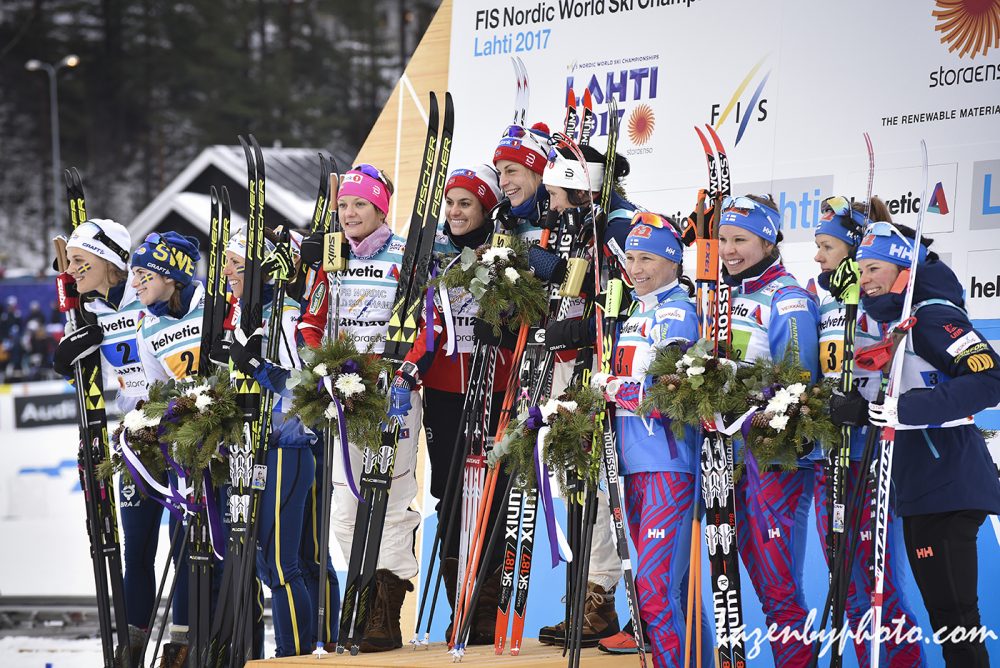
The women’s 4 x 5 k relay podium at 2017 Nordic World Ski Championships in Lahti, Finland, with Norway (c) in first, Sweden (l) in second and Finland (r) third. (Photo: John Lazenby/Lazenbyphoto.com)
LAHTI, Finland—The Norwegian lineup for the women’s 4 x 5-kilometer team at the 2017 Nordic World Championships on Thursday was daunting: Maiken Caspersen Falla, Heidi Weng, Astrid Uhrenholdt Jacobsen, Marit Bjørgen. On paper and on snow, a rundown of names and accomplishments.
On Thursday the Norwegian women made the country’s historic championship gold medal count a tidy 100 by winning the 4 x 5 k relay in 52:21.5 minutes. In a sprint for the remaining two podium spots, Sweden’s anchor skier Stina Nilsson outsprinted Finland’s Krista Pärmäkoski for second.
The Swedish team of Anna Haag, Charlotte Kalla, Ebba Andersson, and Nilsson scored silver (+1:01.6) while Finland’s home team of Aino-Kaisa Saarinen, Kerttu Niskanen, Laura Mononen, and Pärmäkoski was third (+1:02.1).
The U.S., represented by Kikkan Randall, Sadie Bjornsen, Liz Stephen, and Jessie Diggins, placed fourth (+1:33.8).
Two Legs of Parity, Then Norwegian Dominance
Rabid fans of the sport know Norway is winner of the last three consecutive championship relays. And lovers of tactics also know the Norwegians like to push the pace from the gun and break the pack early.
Halfway through the first leg, Poland’s Justyna Kowalczyk, a classic specialist, led Finland, Norway, Sweden, and the U.S. through the 2.5 k mark.
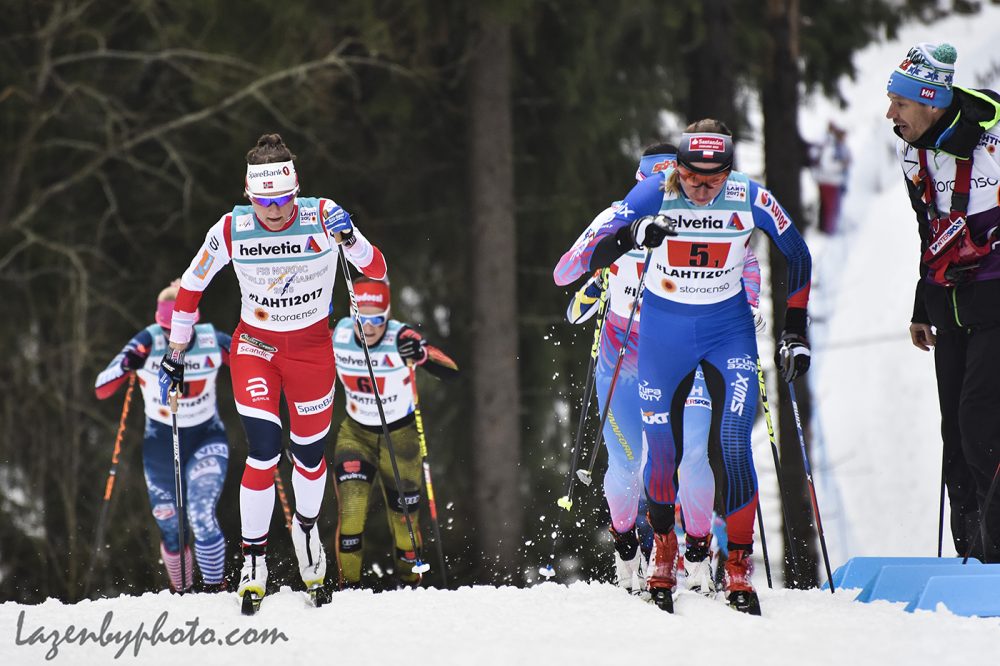
Norway’s Maiken Caspersen Falla (l) leads one row of skiers, Poland’s Justyna Kowalczyk lead’s another, during the scramble leg of the 2017 Nordic World Championships 4 x 5 k relay in Lahti, Finland. (Photo: John Lazenby/lazenbyphoto.com)
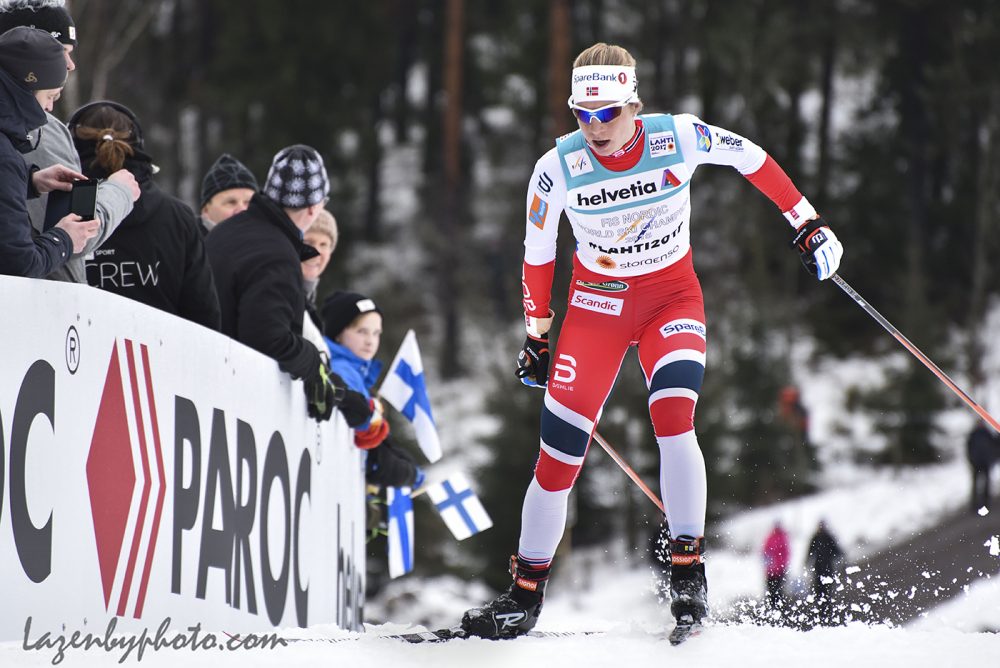
For Falla, Norway’s scramble leg, it was her debut in a championship 4 x 5 k relay. Despite her prior medals, her pre-relay nerves were unsettled.
“I was really excited today and I was just hoping that the time could pass fast so I can race,” Falla said after the race. “It was a lot of waiting time, but I get good advice … and that helped me today. So I get my nerves under control.”
According to Falla, here’s the advice: “That I should stay behind the first lap and be strong in the climbs in the last lap,” she explained. “I did that, just as they said.”
In the last kilometer, Falla made a small break, tagging off to Weng with a near eight-second advantage on the chasers.
Weng leads the World Cup overall standings, but racing in the Finnish ski-den, she was unable to fend off the surging Finns. Five kilometers later, Niskanen had absorbed Norway’s punch. Finland and Norway tagged off to their respective third-leg skiers simultaneously. Sweden trailed twelve seconds back.
Up the first hill, the mother of all climbs on the skating course, Jacobsen and Mononen pulsed. Carrying Sweden’s hopes was Andersson — a 19-year-old junior fresh off a win in the 5 k skate at last month’s Junior World Championships at Soldier Hollow in Utah.
The Finn-Norwegian duo pulled away, leaving Andersson with a 22.6-second deficit 1.3 k into the third leg.
Astrid Uhrenholdt Jacobsen, Norway’s third-leg skier, made a decisive move to put major time into second-place Sweden and third-place Finland during the 2017 Nordic World Championships 4 x 5 k relay in Lahti, Finland. (Photo: John Lazenby/Lazenbyphoto.com)
A resurgent Jacobsen kept pushing; her moves to drop Andersson early on weren’t only a tactic to make it a two-team race, but a sustained display of overdrive that ultimately broke the Finns, too.
The third leg was the tipping point for Finland and Sweden. They were on the side of bleeding time to Norway; Norway on the side of looming victory. By 13.8 k, Norway was up 30.4 seconds on Finland and 45.8 seconds on Sweden.
Andersson managed the damage. She and Mononen skied into the stadium amidst a raucous Finnish crowd. By then, Jacobsen handed Bjørgen nearly a minute cushion.
That kind of margin and Bjørgen hustling from the line: Boom!
You know how this ends, with the queen waving an oversized Norwegian flag.
After the race, Jacobsen spoke of the pressure of skiing on Norway’s storied relay teams.
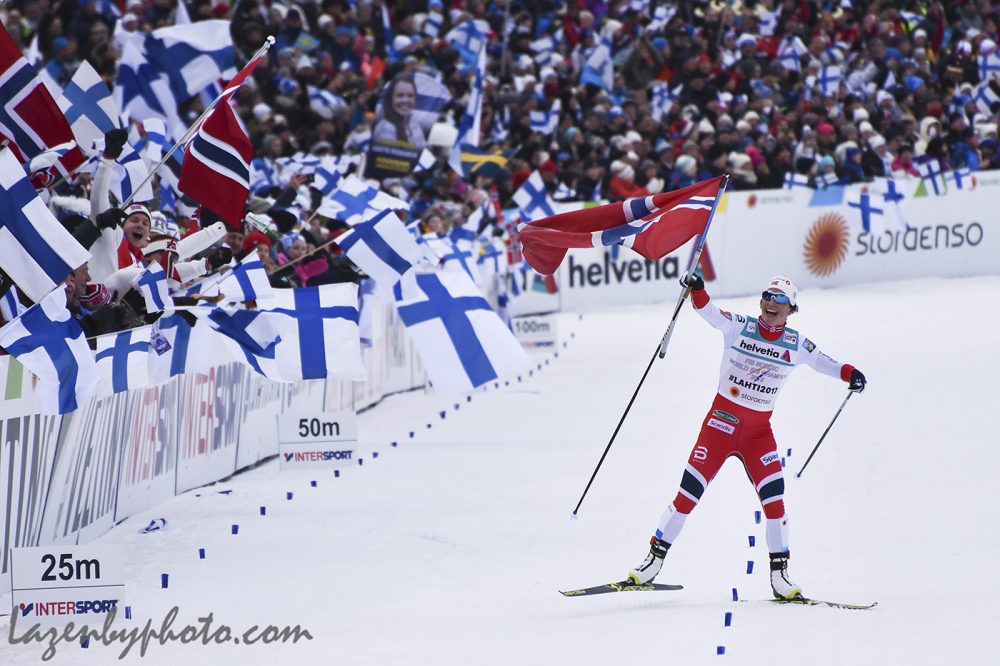
Marit Bjørgen carrying the Norwegian flag as she crosses the line first for Norway’s 100th World Championship win during the women’s 4 x 5 k relay at the 2017 Nordic World Championships in Lahti, Finland. (Photo: John Lazenby/Lazenbyphoto.com)
“I think actually the biggest pressure is the one we put on ourselves and probably because it’s so hard for us to qualify for the team,” Jacobsen said. “We are skiing for the girls who didn’t make it this year but will probably make it next year. So we ski of course for our people and our nation. But I think the biggest nerves come from the desire to perform well and do strong legs.”
One hundred championship gold medals later, Jacobsen acknowledged it’s a full treasure chest.
“The Norwegian people are getting spoiled in gold medals, but it not so easy like it looks,” Jacobsen said.
Glide for glide, pole for pole, Sweden and Finland were mirror images the last leg. Known as a closer, Nilsson strategized that coming into the final corner she wanted to follow Parmakoski.
Sweden’s second-leg skier Kalla explained that Nilsson’s tactic was one of waiting until the end.
“If Stina should go with some team in the end, she should wait to the stadium and just focus on her strength and she made it just like the plan,” Kalla said.
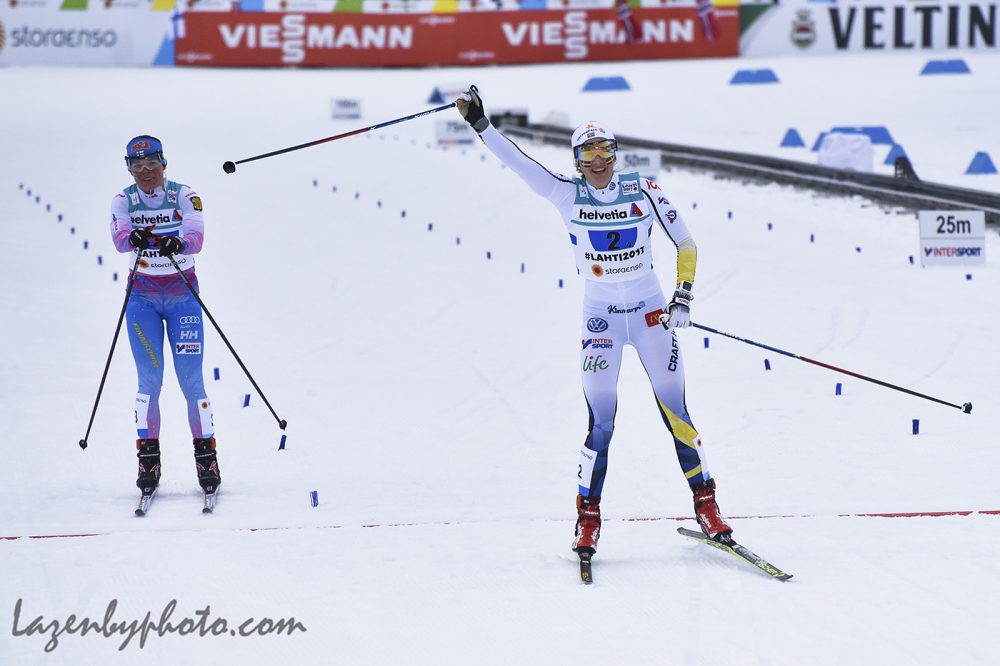
Days earlier in the team sprint, Nilsson lost out on bronze to Diggins in a sprint to the line.
“In the team sprint I was first in the final curve,” Nilsson reflected. “And I felt that Diggins had an advantage of it, so I didn’t want to be first today.”
The press conference’s moderator interjected and tried to correct Nilsson, saying she was first again in the closing moments, not shadowing the Finn.
“No, not in the curve, but after the curve,” Nilsson said with a laugh.
The silver and bronze fight came down to Nilsson’s final kick and this time she made it stick for silver.
(Story continues below)
Sweden’s Stina Nilsson celebrates silver after outsprinting Finland’s Krista Parmakoski (l) in the final meters of the women’s 4 x 5 k relay at the 2017 Nordic World Championships in Lahti, Finland. (Photo: John Lazenby/Lazenbyphoto.com)
Same Place, But Progress: U.S. Places Fourth, Canada 10th
With three world champs medals already in the hands of American skiers prior to Thursday’s team relay, the public hope for a podium was high. Perhaps too high.
As U.S. Ski Team (USST) Head Coach Chris Grover explained, medaling in the team relay was certainly on the radar coming into the world champs week, but not where the team’s greatest expectations were held.
The U.S. women’s relay team, (from left to right) Sadie Bjornsen, Liz Stephen, Jessie Diggins, and Kikkan Randall, after placing fourth on Thursday at 2017 World Championships in Lahti, Finland. (Photo: John Lazenby/Lazenbyphoto.com)
“The relay we knew was a shot, the team sprint we knew was an outside shot,” Grover said after Thursday’s race. “Probably our greatest medal opportunity was the individual sprint.”
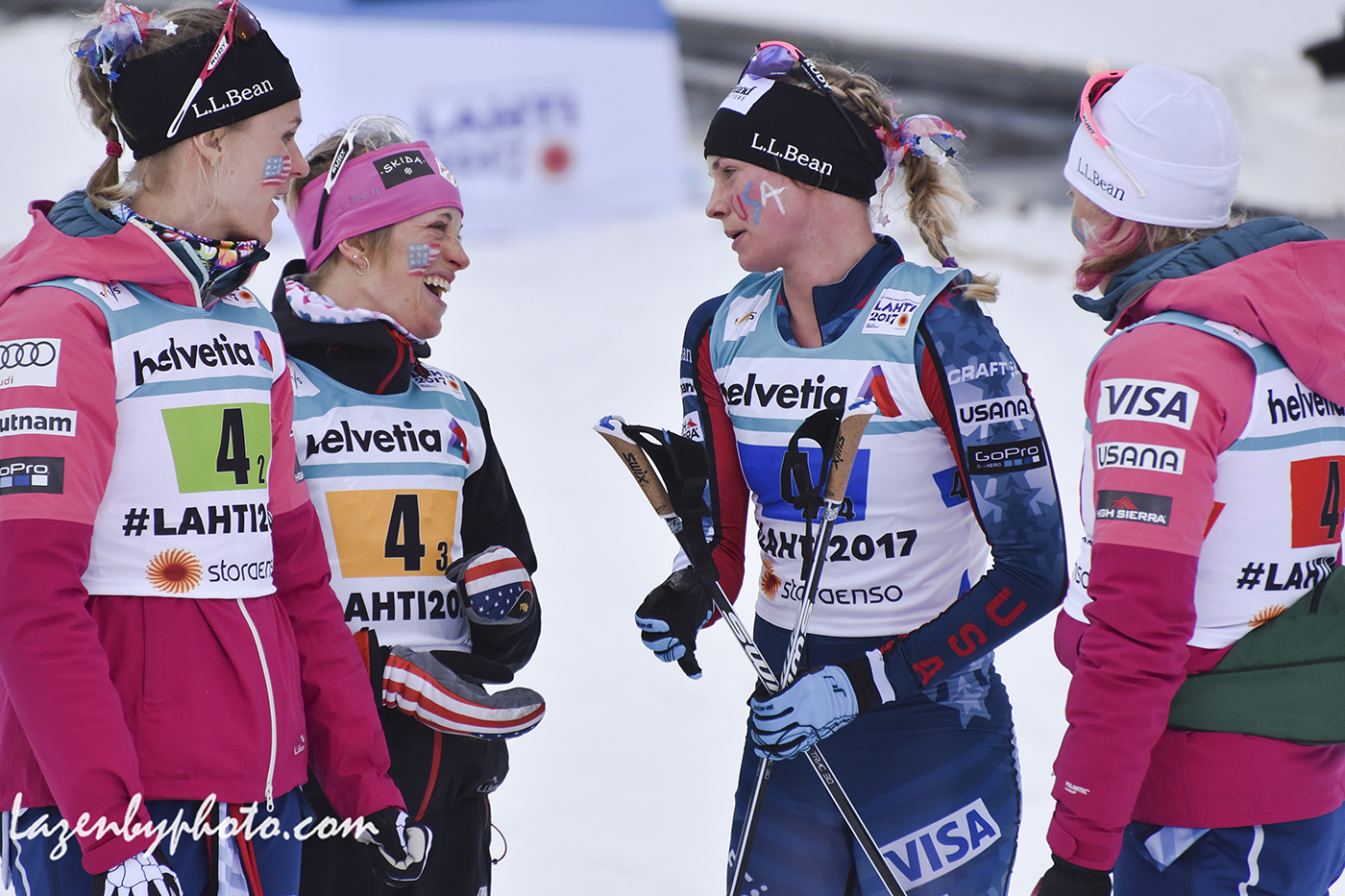
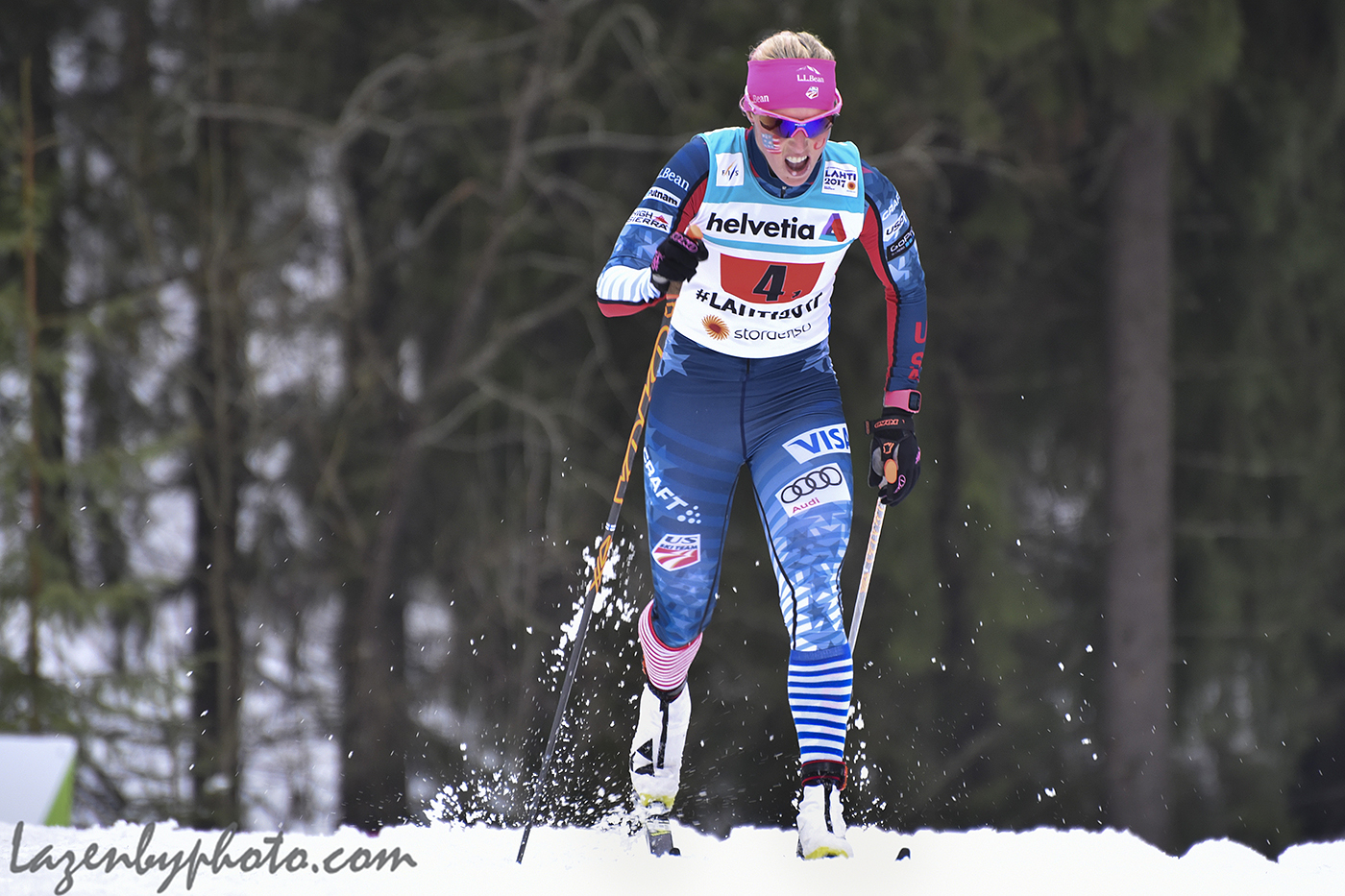
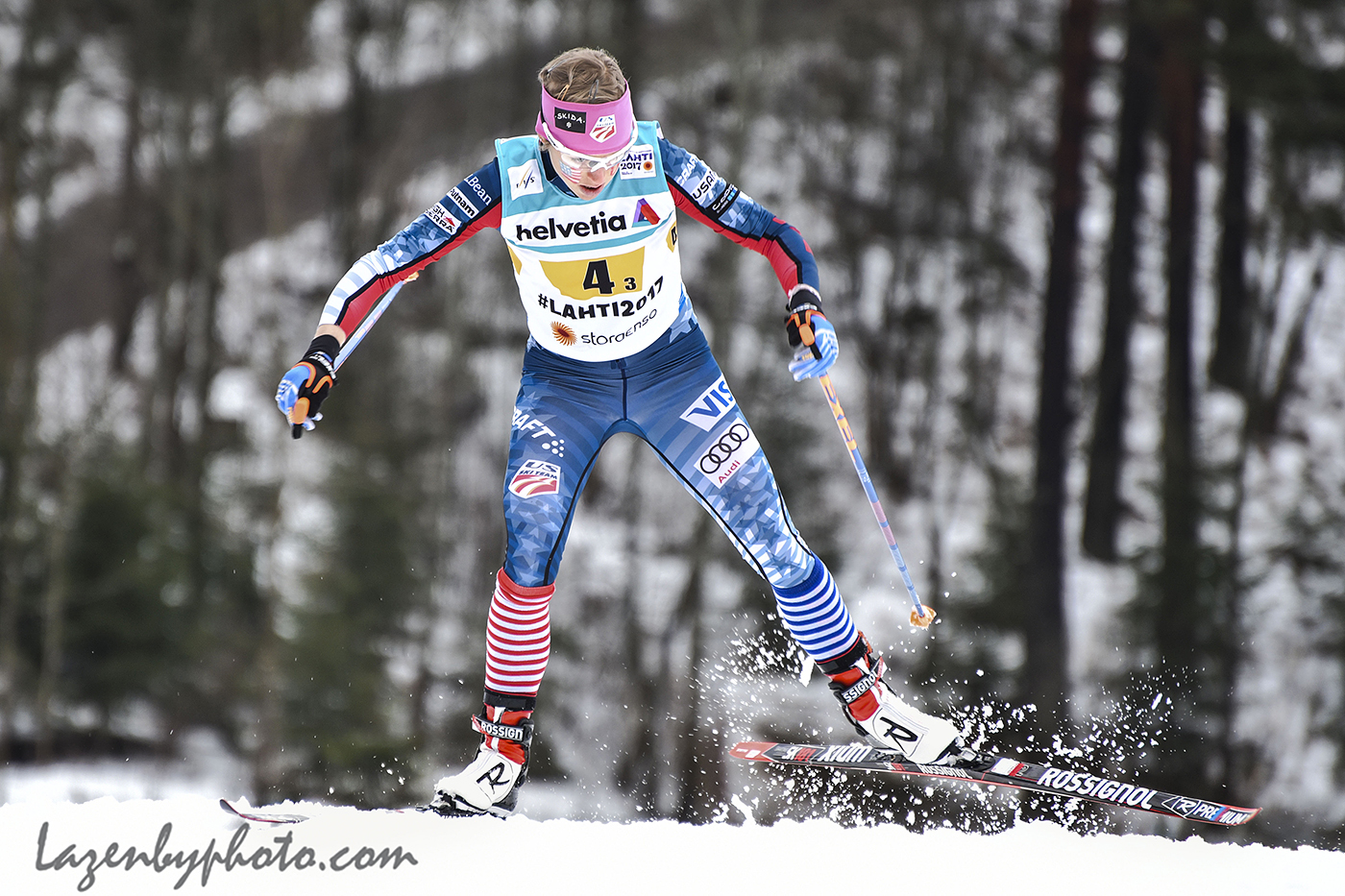
As a gritty group of women, the Americans exude the attitude of a top team. Adorned in red, white and blue socks and face paint sporting the U.S.A.’s emblematic stars and stripes, it’s easy to see the enthusiasm the U.S. women show for team events.
But where does the blur between team-relay hype end and the reality of results begin?
Disappointment in anything less than a podium only comes when the expectation of one exists. Taken over the past few world champs years, the relay event might be one where the U.S. women can, and have, improved the most.
Eight years ago, at the 2009 world champs in Liberec, Czech Republic, the U.S. finished 13th, a little over three minutesout of third place. The following World Championships year, 2011 in Oslo, Norway, they were almost two minutes off the podium, crossing in ninth overall.
This year? The U.S. once again finished fourth — the third time in a row that the team has finished one place outside the podium at a World Championships event.
Yet, Thursday’s performance was the second closest the team has come to bronze, with the Americans crossing 31.7 seconds after third (their 2013 result in Val di Fiemme, Italy, was closer: 26.6 seconds behind third). Given room for systematic error, the statistical trend for the U.S. women in the team relay over the past five world champs: positive.
American Kikkan Randall during the first leg of the women’s 4 x 5 k relay at the 2017 Nordic World Championships in Lahti, Finland. (Photo: John Lazenby/Lazenbyphoto.com)
“Even though this is the third time in a row that we’ve been fourth place at a world championships, there’s progress, there’s real progress,” Grover said. “The athletes could see the competition ahead of them the whole time. … To be getting closer and closer to that top standard, that’s very gratifying.”
When looking at the longer-distance performances from the week in tandem with Thursday’s start list, Grover further explained that the U.S. team’s incoming rank was similar to their outcoming result.
“I guess I’d say that when you look at the start list and you look at the results from the 10 k and the skiathlon, on paper we’re fourth,” Grover said. “Sweden, Finland, Norway they’re definitely ahead of us in terms of the distance results that we’ve seen here all week. So we knew we were sort of an outside chance to be fighting for the bronze and we knew that when we’re successful on the World Cup, it’s because one of those teams has a weak leg.”
A weak leg from Finland, Norway or Sweden — the three teams that finished ahead of the Americans — at least in Thursday’s race, was nowhere to be found for the U.S.
From the start, Kowalczyk, pushed the pace with Falla, Haag and Saarinen in close quarters, while the USST’s Randall worked hard to hold on.
“Unfortunately, we lost some important time there in the beginning,” Randall said. “I know that’s something I’ve got to work on for next year, but it was exciting to know that we were still in the race the whole time and made Sweden and Finland really fight for those medals.”
Randall handed off to Bjornsen in fifth, approximately 16 seconds back from the second, third, and fourth spots. From there, the Americans raced alone, working hard to reel in the racers ahead.
“It’s always hard to have a carrot right in front of you and not go too hard at the beginning,” Bjornsen said. “I think all of us had a hard time with that today, not going too hard to try to catch them right away.”
By the end of her leg, Bjornsen needed another eight seconds from Randall’s time back to catch the third place position. She handed off to Stephen, who would have to make up 23.5 seconds on Sweden’s third leg, Andersson, to contend for the podium.
The young Andersson, however, was putting on a show. And Stephen wasn’t surprised. During the early stages of her ski career, Stephen attended a weeklong camp in Sweden. While there, she’d learn invaluable lessons from countless coaches, one just happening to be Andersson’s father.
Liz Stephen racing the third leg for the U.S. women’s team in the 4 x 5 k relay at the 2017 Nordic World Championships in Lahti, Finland. (Photo: John Lazenby/ Lazenbyphoto.com)
“As I was lining up with her today I was just like ‘this is just full circle,’ “Stephen said after. “She’s a damn-good skier.”
That of course didn’t stop Stephen from putting her best foot forward. The American emphasised the areas she knew were her strength, working the hills.
“Part of me wanted to go out and blow [it] out of the water off the bat, but I also knew that these conditions are also a little bit more energy-expending than normal, hard-packed conditions,” Stephen explained.
Halfway through the first lap, Stephen had gained close to seven seconds on Andersson. By the end of the second lap, however, Andersson had regained the ground that she had lost.
“Unfortunately I couldn’t get her,” Stephen said. “But I did what I could out there … and I am very inspired to be on this team again. To watch my teammates give it all out there, it just makes you want to do the same.”
When Stephen handed off to Diggins, the anchor legs for Sweden and Finland were skiing together. Diggins explained that she had hoped Nilsson and Pärmäkoski’s race tactics would provide an opportunity for her to gain on them.
“I saw where we were coming in and I said, my only strategy is to go out as hard as I can and hope that they are playing cat and mouse in the front,” Diggins said. “[I thought] if they’re trying to be all strategic for the final sprint-out, then maybe I can catch them.”
Ultimately the gap proved too large, with Diggins crossing in fourth.
“I wasn’t able to close the gap but I never stopped fighting and neither did my teammates, and I’m really proud of that,” Diggins said.
Canada’s team of Katherine Stewart-Jones, Emily Nishikawa, Cendrine Browne, and Dahria Beatty finished 10th (+4:16.2) for the fourth-best world champs result of a Canadian women’s relay team. According to a Cross Country Canada press release, this was just the fourth time in the last decade that Canada has fielded a World Championships women’s relay (excluding the Olympics).
At the 2001 World Championships, Beckie Scott, Milane Thériault, Jaime Fortier, and Sara Renner raced to sixth for Canada. Before that, the program’s previous best was eighth at 1989 world champs, also in Lahti.
(Left to right) Canada’s Emily Nishikawa, Cendrine Browne, Dahria Beatty, and Katherine Stewart-Jones after placing 10th in the women’s 4 x 5 k relay at the 2017 Nordic World Championships in Lahti, Finland. (Photo: John Lazenby/Lazenbyphoto.com)
“I think today we surprised ourselves,” Canadian World Cup coach Ivan Babikov said on Thursday.
“[Katherine Stewart-Jones] skied incredibly that first leg, with everything she could,” he added. “She was ahead of Germany, ahead of Russia, so many really good countries, and after that it was a matter of holding on and it was great.”
Stewart-Jones finished her leg in eighth, just seven-tenths of second behind Germany’s Katharina Hennig in seventh. Though Switzerland and Italy eventually caught the Canadians, the women expressed excitement about the finish and results yet to come.
“This is the first time we’ve fielded a world champs relay in a long time so that’s a huge accomplishment [in itself],” Nishikawa said during an in-person interview. “And then to come 10th … it’s really the beginning of something that’s pretty special.”
“I’m really proud of us,” Browne added. “I think we all skied really strongly today, and very positive for the future.”
— Harald Zimmer, Gerry Furseth, and Alex Kochon contributed
The women’s 4 x 5 k relay podium at 2017 Nordic World Championships on Thursday in Lahti, Finland, with Norway (c) in first, Sweden (l) in second, and Finland (r) in third. (Photo: FIS Cross-Country/Twitter)
FIS Nordic World Championships (Lahti, Finland): Women’s 4 x 5 k relay
The Norwegian women’s team got a much-needed lift from Astrid Uhrenholdt Jacobsen, the third leg of its 4 x 5-kilometer relay, on Thursday, who tagged her teammate Marit Bjørgen nearly a minute ahead of anyone else. From there, Bjørgen anchored the Norwegians to a 1:01.6-minute victory for her third gold of 2017 Nordic World Championships in Lahti, Finland.
Meanwhile, Sweden and Finland battled for silver, with Sweden’s anchor Stina Nilsson overtaking Finland’s Krista Parmakoski coming out of the final downhill into the stadium then leading her down the finishing stretch. Nilsson finished half a second ahead of Parmakoski for second place, while Finland claimed bronze (+1:02.1).
The U.S. was next across the line, after Jessie Diggins worked to close a 21.5-second gap to third place at the final exchange. While Diggins came within roughly 16 seconds of Nilsson and Parmakoski, that was as close as she could get and she finished fourth (+1:33.8), 31.7 seconds out of the medals.
The Canadian women’s 4 x 5 k World Championships relay team, (from left to right) Emily Nishikawa, Dahria Beatty, Katherine Stewart-Jones, and Cendrine Browne, after tallying the third-best relay result for the Canadian women at a World Championships on Thursday in Lahti, Finland. (Photo: CCC/Twitter)
Canada placed 10th (+4:16.2) out of 16 teams in the women’s relay, for the best result for the Canadian women’s program since a sixth place in the 4 x 5 k relay at the 2001 World Championships (and third-best result ever), according to Cross Country Canada.
Norway took control during the first 5 k leg, where Maiken Caspersen Falla stuck with Poland’s Justyna Kowalczyk, who set a fast pace out of the start. Only three were able to remain with Kowalczyk: Falla, Finland’s Aino-Kaisa Saarinen and Sweden’s Anna Haag, while Kikkan Randall of the U.S. fell off the pace and skied alone in fifth. Randall came through the first exchange 24.5 seconds behind Falla in first and 16.4 seconds behind Haag in fourth.
On the second classic leg, Sweden’s Charlotte Kalla set a blistering tempo out of the start to catch Norway’s Heidi Weng 8 seconds ahead. Finland’s Kerttu Niskanen went with Kalla as the two bridged the gap to Norway. Later in that leg, Kalla began to fade while Niskanen took control and entered the exchange in first, just 0.4 seconds ahead of Weng. Kalla came through another 12.3 seconds later in third. American Sadie Bjornsen had worked hard to close the gap to third but tagged 23.5 seconds out of third in fourth (+36.2).
On the third leg, Jacobsen opened the race up for Norway, building a 56.7-second gap to second place during her skate leg, while Sweden’s 19-year-old Ebba Andersson pushed hard in the final kilometers to put her team in second. Finland’s Laura Mononen struggled with Jacobsen’s pace and dropped to third (+58.3). Meanwhile, Liz Stephen of the U.S. held onto fourth and tagged Diggins 21.5 seconds out of third at the final exchange.
From there, the Sweden/Finland fight for second place began. A minute ahead of them, Bjørgen skied comfortably in first, and behind them, Diggins skied alone in fourth.
Russia’s anchor Anastasia Sedova was tagged 45.5 seconds behind the U.S. in eighth (behind Germany, Poland and Switzerland), but passed those three teams to end up fifth (+2:28.6), 54.8 seconds behind the U.S.
Germany finished sixth, Switzerland seventh, Poland eighth, Italy ninth, and Canada 10th, with Katherine Stewart-Jones, Emily Nishikawa, Cendrine Browne, and Dahria Beatty racing for Canada. Stewart-Jones put them in eighth at the first exchange, Nishikawa slipped one spot to ninth, then Browne lost another spot for 10th, which Beatty held to the finish.
IBU World Cup (PyeongChang, South Korea): Women’s 7.5 k sprint
[UPDATED] The International Biathlon Union (IBU) World Cup circuit resumed on Thursday after nearly a two-week break coming off IBU World Championships, drawing competitors to PyeongChang, South Korea, the site of the upcoming 2018 Winter Olympics.
The women’s 7.5 k sprint podium at the IBU World Cup in PyeongChang, South Korea, with Germany’s Laura Dahlmeier (c) in first, Norway’s Tiril Eckhoff (l) in second and France’s Anaïs Chevalier (r) in third. (Photo: IBU)
Coming off five gold medals (in six races) at World Championships, Germany’s overall World Cup leader Laura Dahlmeier picked up where she left off, winning the women’s 7.5-kilometer sprint by 8.4 seconds with perfect shooting and a finishing time of 20:43.7 minutes.
Norway’s Tiril Eckhoff came closest to her in second, after also shooting clean, and France’s Anaïs Chevalier put herself in the mix with clean shooting as well to end up third (+41.6).
One second behind Finland’s Kaisa Mäkäräinen, who finished fourth (+58.7) despite two standing misses (0+2), was American Susan Dunklee in fifth (+59.7). The 35th starter, Dunklee initially finished third (before being bumped off the podium by Chevalier, then one more spot by Mäkäräinen).
Dunklee missed one shot during the standing stage (0+1) and posted the eighth-fastest course time for her fifth top five of the season (including her second place in the mass start at World Championships).
“I tried to be patient,” Dunklee wrote in an email after Thursday’s race. “I focused on pushing the last half km of the loop where I thought other people would be tired. And our techs made great skis for these challenging conditions.”
She passed two competitors on her last loop, one of which had passed her earlier in the final 2.5 k. Dunklee described the conditions as “a patchwork of glazed, icy and slow patches. A large number of volunteers were working on it with hand tools right before the start and I think that helped substantially,” she wrote. “I think the course is good for me: big climbs with technical descents.”
Rosanna Crawford led the Canadians in 30th (+1:54.9) with one prone miss (1+0), and Megan Tandy placed 39th (+2:14.8) with one standing penalty (0+1), just ahead of Julia Ransom in 41st (+2:19.5), who had one standing miss as well (0+1). All four Canadian women qualified for Saturday’s pursuit, with Emma Lunder placing 51st (+2:38.2) after one penalty (0+1).
For the U.S., Clare Egan and Joanne Reid finished 33rd (+1:59.5) and 35th (+2:07.6), respectively, both with one standing penalty (0+1). Maddie Phaneuf missed the top 60 to qualify for the pursuit in 68th (+3:07.7) with one miss (0+1).
After being in contention for a podium, France’s Marie Dorin Habert did not finish, reportedly because she felt nauseous.
Norway’s Marit Bjørgen celebrates her 105th individual World Cup win on Sunday after finishing first, ahead of teammate Ingvild Flugstad Østberg, in the women’s 15-kilometer classic mass start in Falun, Sweden. (Photo: Fischer/NordicFocus)
*Note: this article has been updated to include comments from U.S. women’s head coach Matt Whitcomb as of Monday, Jan. 30.
After sealing her 105th individual World Cup victory on Sunday, and her second distance win in a row, Marit Bjørgen is shutting out any doubt. The 36-year-old Norwegian was the first across the line in the women’s 15-kilometer classic mass start in Falun, Sweden, besting her teammate Ingvild Flugstad Østberg by half of a second, as well as the current overall World Cup leader, Heidi Weng, also of Norway.
“It’s great to be able to win World Cups still,” Bjørgen said according to an International Ski Federation (FIS) press release. “The young girls are strong, so it feels good to be able to come out with a win.
Starting in bib 5, Bjørgen wasted no time putting her teammates and the field to work. By 1.5 k she was in the lead, pulling Østberg and Weng, as well as Sweden’s Stina Nilsson — yesterday’s sprint winner — and Finland’s Krista Pärmäkoski.
Norway’s Marit Bjørgen (5) leads her teammates Ingvild Flugstad Østberg (3) and Heidi Weng during the World Cup women’s 15 k classic mass start on Sunday in Falun, Sweden. (Photo: Fischer/NordicFocus)
Also within firing range was American Jessie Diggins, skiing in seventh, along with Norway’s Astrid Uhrenholdt Jacobsen and Maiken Caspersen Falla, and Sweden’s Charlotte Kalla.
However, within another four kilometers, the Norwegians had broken away, a close to seven-second gap forming from them to Nilsson and Pärmäkoski.
While Bjørgen led for the first third of the race, Østberg took over by 10 k and Weng continued to follow in third.
With 1.8 k to go, Bjørgen was back to the front, Nilsson the closest challenger to the Norwegians just over 30 seconds behind.
“I thought Stina might catch me, so I am very happy to make the podium today,” Weng said, according to a FIS press release.
As the three headed into the second-to-last major climb, Østberg pushed to the front, Bjørgen trailing back. But coming into the final climb, Bjørgen moved back into first as she herringboned to the far outside right of Østberg, almost departing the marked course.
“I didn’t ski the final climb well … Marit got a gap and I wasn’t able to close it,” Østberg said according to FIS. “I wasn’t satisfied with yesterday’s sprint result, so it’s good to be back on the podium today.”
Left to right: Norway’s Ingvild Flugstad Østberg, Marit Bjørgen and Heidi Weng celebrate an all-Norwegian podium in the women’s 15-kilometer classic mass start on Sunday at the World Cup in Falun, Sweden. (Photo: Fischer/NordicFocus)
In a double-pole sprint to the finish, Bjørgen held off Østberg for the win in a time of 41:28.8. Østberg finished half a second later for second place, followed by Weng in third (+8.1).
The first American across the line was Diggins in 10th (+1:37.5) wearing bib 4. While the Afton, Minn., native explained that Sunday’s sugary conditions are some of her least favorite, the opportunity to put her classic striding to the test was something she welcomed.
After losing the leaders, the 25-year-old Diggins skied with a mix of Finnish skiers, including Laura Mononen, Anne Kyllönen, and Kerttu Niskanen, as well as Norway’s Falla.
“Early on I tried to go with the leaders but then settled into a great pack of girls to ski with and it came down to an exciting sprint out,” Diggins wrote in an email. “I’m really looking forward to some rest and then a quality training camp with some family time in Valadalen [Sweden] for the next few weeks! My boyfriend is here cheering me on and coming to camp with me, and then my parents come next week so I have so many great things to look forward to!”
The second U.S. woman across the line was Sadie Bjornsen in 21st (+2:43.6). A known lover of all-things-classic, Bjornsen was disappointed when she found herself tired during Sunday’s race. The 27 year old, however, was happy that she made it through the mental and physical challenge.
“Today I literally gave everything I had, and while I am not stoked on the number or result, I am really proud that I kept fighting through that wall in front of my face,” Bjornsen wrote. “It was really challenging classic skiing out there, which I love, so I am sad to have missed an opportunity to fight in those tricky conditions. Big shoutout to our team for giving me good skis! I am looking forward to some rest and recovery to rebuild for a big and important block of racing to come!”
American Caitlin Patterson (33) and Canadian Cendrine Browne (45) racing the women’s 15-kilometer classic mass start on Sunday in Falun, Sweden, along with Germany’s Elisabeth Schicho (38) and Italy’s Giulia Stuerz (25). (Photo: Fischer/NordicFocus)
Two other American women also scored World Cup points, including Rosie Brennan in 24th (+2:57.0) and Liz Stephen in 29th (+3:24.5).
Despite the sugary conditions and deteriorated tracks due to the men’s race, Brennan explained that Sunday’s snow was what she was looking for coming into the 15 k.
“I actually really enjoy skiing in this kind of condition so I was optimistic about today’s race,” the 28-year-old Brennan wrote in an email. “I felt that I was fighting a bit of fatigue out there and only really had one speed, luckily it was a decent speed and I was able to hold consistent throughout the race.”
Also competing for the U.S. finishing just outside the points was Caitlin Patterson in 32nd (+3:47.6) and Ida Sargent in 34th (+4:02.8).
“Today was a solid day for the team,” U.S. women’s head coach, Matt Whitcomb wrote in an email. “We fought hard, and nearly accomplished what I will consider to be a huge achievement for the women, and that will be when we regularly can score our full national quota (6) in the points. Today we had 4, with a close 32nd and 34th. That’s close to where I know we can be.”
Canada’s lone competitor in the women’s race, Cendrine Browne crossed in 46th (+5:41.4) and American Liz Guiney finished 49th (+6:22.6).
Norway won the women’s World Cup 4 x 4 k relay on Sunday in La Clusaz, France, with (from right to left) Ingvild Flugstad Østberg, Marit Bjoergen, Ragnhild Haga, and Heidi Weng. (Photo: Fischer/Nordic Focus)
Sunday’s 4 x 4-kilometer relay in La Clusaz, France, was a 39:23.3 minute macro-statement by the Norwegian women’s team of Ingvild Flugstad Østberg, Marit Bjørgen, Ragnhild Haga, and Heidi Weng.
That statement was dominance. Norway won the relay in time-trial-like fashion: each Norwegian leg a solo affair. Finland’s team of Aino-Kaisa Saarinen, Anne Kyllönen, Riita-Liisa Roponen, and Laura Mononen placed second (+50.2). Sweden’s team of Emma Wiken, Stina Nilsson, Maria Rydqvist, and Anna Dyvik was third (+1:08.9).
As with lopsided races, the 10,000 foot view on the first classic leg showed Østberg stretching a fatigued rubber band back to the pack. At 2 k, 11.5 seconds was Østberg’s initial gap.
Then snap. The band broke. At 4 k when Østberg handed off to Bjørgen, it was a 28-second cushion on Russia, 33.3 to Switzerland, 34.9 to Finland.
Why belabor the point in words when the numbers tell the micro-story which lead to the dominance?
Østberg fastest leg at 10:04.
Bjørgen fastest leg at 10:11.8.
Haga seventh-fastest leg at 9:43.2.
Weng fastest leg at 9:27.9.
Some problems are good to have. That’s the case with Norway and Haga. Here’s the context. Although she skied the seventh-fastest leg split, it was a tight leg and she kept Norway’s lead comfortable.
For example, the U.S. Ski Team’s Liz Stephen skied the 10th-fastest third leg, only 13.4 seconds off the fastest time skied by Sweden’s Rydqvist. Compare that to the fourth leg, the 10th fastest time was skied by Kazakhstan’s Irina Bykova — she was 57.2 seconds off Weng’s pace.
There’s the number crunching and analysis, but it can be rendered down to this: Weng had plenty of time to high-five the crowd before crossing the line.
“It wasn’t that scary when the girls performed so well,” Weng told Norwegian broadcaster NRK after the race about her anchor role. “I didn’t have to sprint at the end. The last time I had a final leg I was too afraid to do anything. Now I was high-fiving the spectators and had some fun.”
Østberg told NRK in the same article that she was experiencing pre-race butterflies. “I was extremely nervous before the start, but it went well,” Østberg said. “I didn’t want to disappoint the other. You’re competing for a team in a relay and not yourself. I didn’t want to let the others down … I had to go fast today so Marit could go home to her son Marius. She’s missed him all week.”
Relay Socks and Rebounding from Illness
Here’s the straight talk. The two powerhouses of the deep U.S. women’s team, Jessie Diggins and Sadie Bjornsen, were scratched from the roster due to illness. But the relay socks made a feisty appearance.
The U.S. lineup that finished seventh overall (+2:26.0) consisted of Sophie Caldwell, Rosie Brennan, Liz Stephen, and Kikkan Randall.
“You know clearly we were not at full strength today and it showed I think,” U.S. head coach Chris Grover told FasterSkier on the phone. “My guess is that Sophie might be fighting a little bit of something, we have seen that before where an athlete maybe is on the edge of getting sick and goes out and skis fine for a while and then kind of blows up and it turns out maybe they are coming down with something.”
Caldwell is primarily known as a sprinter on the World Cup. Sunday’s relay legs were 4 k, a relative no-women’s land when it comes to sprint or distance race length. One kilometer into the race and Caldwell was third (+1.0). By the first tag to a resurgent Brennan, Caldwell had lost over a minute to Norway.
“I haven’t really seen any times yet, there is no internet up here today, so it seemed like a pretty solid leg out of Rosie,” Grover posited.
In fact, Brennan skied the fourth-fastest split of any second-leg skier (+38.2) — Bjørgen set the benchmark.
“The legs were incredibly short, especially for people like Liz and I who like a little longer,” Brennan said of the 4 k distance, as opposed to 5 k, on the phone. “I think it was a solid effort and especially considering the illness that has destroyed our team the last week.”
Brennan began the season out of the points and took last weekend’s races in Davos off.
“I definitely had a less-than-stellar start to the season, I don’t really know why,” Brennan said. “I guess in my past it hasn’t been uncommon for me to start a little slow, but I was trying, I was actually focusing on doing the opposite just knowing it is so important to come over here and have some good races and build some confidence right away, that obviously that didn’t work out quite as planned.”
Brennan will remain in France for the holiday break and begin resting and preparing for the Tour de Ski beginning on Dec. 31. She’ll begin the Tour with a boost of confidence. “It was great to turn that around yesterday and I am feeling much better to hear that I had the fourth-fastest leg, or time on my leg, it is really encouraging especially for such short race,” Brennan said. “I wasn’t quite sure about my speed just yet, that is definitely a step in the right direction for me.”
Like Brennan, Stephen came into the day heartened by a solid effort and result on Saturday. But 4 k is a k short of 5 k.
“Even a 5 k is like a sprint for me. Rosie and I were actually talking about that in our cooldown,” Stephen said after the race. “When I go out, it’s like a sprint, because when I’m done with a sprint, I’m like ‘it’s already over?’ and it’s kind of like that in a relay. Don’t blow up, but it’s pretty hard for me to completely blow up in such a short race. I attacked from the beginning knowing that this is a nine-minute race today, and I do intervals longer than that often times.”
Grover reiterated that point. “It was a 4 k course for the relay and you know Liz just needed more real estate out there. It was almost like, some of our athletes, it takes them one or two k to get into the race and you are already half way through the race at that point.”
Stephen kept the margin to Norway just under two minutes and showed improving form before her favorite stretch of racing in the Tour. “I’m always looking forward to [the Tour]. But also I feel like this last weekend that I’ve been able to feel like I want to. Physiologically I feel like racing has really helped get me into the shape I want to be in. I have some work to do over the break, but I feel like I’m in a good place to do what I’m normally able to do at the Tour.”
Team and relay vet Kikkan Randall skied the anchor leg. Her’s was the seventh-fastest anchor leg (+27.1).
“I got the tag from Liz a ways back from Germany ahead and a gap to Italy behind,” Randall wrote in an email to several media outlets. “I focused on holding a good rhythm on the first lap but Italy was able to almost close the gap. I was getting ready for a good battle on the last two climbs but I guess the Italian anchor crashed behind me. So I skied the rest of my lap alone.”
Randall secured seventh place for the U.S. (+2:26).
Grover didn’t spend any time lamenting what could have been. “I really expect by the time we do our next relay in Sweden that we are going to be very competitive for the podium,” he said. “Norway, of course, on paper was far gone, but in terms for the hunt, the usual hunt for Seed 3, we will be back there.”
Last season’s U.S. women’s 4 x 5 k relay team after placing third in the first relay of the 2015/2016 season in Lillehammer, Norway: (from l to r) Sadie Bjornsen, Rosie Brennan, Jessie Diggins, and Liz Stephen. They matched a team best in third in December 2015, and went on to place second in January 2016 (with Sophie Caldwell in place of Brennan) in Nove Mesto, Czech Republic. (Photo: USSA Nordic/Twitter)
Expectations are what they are for the U.S. women’s relay team: high.
Grover explained that the relay is a target event for a podium at both 2017 World Championships and the 2018 Olympics. “We also have a women’s team right now that is the strongest women’s team we’ve had in the history of U.S. skiing. So the time to win is now, and we’ve got the athletes to do it,” Grover added.
In mainstream professional sports, cybermetrics is understandbly the rage. Essentially it’s data-based decision making when it comes to sports. Coaches like Grover and U.S. women’s coach Matt Whitcomb play their version of ski-cybermetrics when picking a relay team.
“It’s a matter of putting together on a certain day the right athletes, with the right fitness in the right technique, in the right legs, and also taking into account the course profiles in terms of strengths of the athletes, and what are the attributes of the course,” Grover said of picking the most viable relay squad. “Is the course long for 5 k, it it short for 5 k? Is it flat for classic? Is it hilly for classic? Is it technical or is it more of just a grinding course?”
The U.S. team’s strategy is to have at least three skiers in each discipline, skate or classic, to choose from on relay day.
“If we can do that, then we can put the women who are the fittest at the time and for whom the technical elements of the course suit their strength the most, and we can put together a super competitive team, so that is kind of the puzzle that we are always putting together with relays,” Grover said.
The next opportunities to contest the relay will be the 4 x 5 k in Ulricehamn, Sweden, on Jan. 22, and March 2 at World Championships in Lahti, Finland.
Canada’s team of Emily Nishikawa, Cendrine Browne, Dahria Beatty, and Sophie Carrier-Laforte finished 12th (+4:07.9). But the biggest victory of the day for the team was fielding a women’s relay.
“We were so happy to have a women’s relay team today,” Nishikawa wrote in an email. “I didn’t feel great today, but my teammates all skied really well and I’m very proud of them. It makes having a tough day so much better when you can be pumped to see amazing races from the rest of your team! The atmosphere in La Clusaz is just amazing! So many fans out cheering and the organizers did an incredible job of getting the course ready. It was a lot of fun racing here.”
Beatty was also excited about Canada fielding a legitimate women’s World Cup relay team.
“It is wonderful for us to be able to start a relay,” Beatty wrote in an email. “Having a group of women on the world cup this first period has been really great for all of us. Today’s race was a great building point for our team and I am really proud to be able to races with this group and grow together.”
The Canadian appears to be coming into good form; Beatty skied the second-fastest third leg (+2.8).
“I was really happy with how my leg went,” Beatty added. “I was able to build off my good feeling from yesterday and ski a really strong race. I was just focusing on trying to catch as many people as possible. When I found out that I had skied the 2nd fastest leg time I was a bit shocked and really excited. It feels great to have a great feeling race correlate to a strong result.”
Jessie Diggins (U.S. Ski Team) won the second individual World Cup of her career on Saturday in the women’s 5 k freestyle in Lillehammer, Norway, beating four Norwegians by 4.8 seconds or more. (Photo: USSA Nordic/Twitter)
Welcome to The Rundown, your quick primer of need-to-know information about the day’s racing. We’ll be updating this digest as the day goes on with additional results, photos and quotes. The Rundown is NOT a race report; stay tuned for complete race reports later today with interviews from the day’s top racers.
***
U.S. SuperTour opener in West Yellowstone: Freestyle sprints
[UPDATE] The U.S. domestic season opened in West Yellowstone, Mont., with 1.3-kilometer freestyles on Saturday, and Matt Gelso and Jennie Bender emerged as the day’s winners.
Gelso, of the Sun Valley Ski Education Foundation (SVSEF) Gold Team, won the men’s final, and two Alaska Pacific University (APU) skiers, Tyler Kornfield and Reese Hanneman, joined him on the podium in second and third, respectively.
In the women’s final, Bender, of the Bridger Ski Foundation (BSF), held off Stratton Mountain School (SMS) T2 teammates Erika Flowers and Anne Hart, who placed second and third, respectively.
[UPDATE] Americans Lowell Bailey and Susan Dunklee led their teams in 13th and 27th, respectively, and five North American men and four women finished in the top 60 of Saturday’s sprint to qualify for Sunday’s pursuits in Östersund, Sweden. Oh, and France’s Martin Fourcade won his third-straight race (in as many races this season) and his second individual race for his 51st career victory. France made it a double with Marie Dorin Habert winning the women’s sprint.
There aren’t many 5-kilometer skate races on the World Cup schedule. But when they do come around, Jessie Diggins makes sure to capitalize.
The 25-year-old U.S. Ski Team member and Minnesota native rocketed to the second victory of her World Cup career on Saturday, winning the women’s 5 k freestyle in Lillehammer, Norway, in 12:40.3 minutes and by nearly 5 seconds ahead of anyone else.
After winning her first individual World Cup last season in a 5 k freestyle in Toblach, Italy (then reaching the podium three more times in individual races through March 2016), Diggins achieved her first podium of the season in the fourth race of 2016/2017.
She started 34th of 76 finishers, with top-dog Norwegians like Heidi Weng (who won Friday’s classic sprint) and Marit Bjørgen behind her. Diggins trailed slightly at the first 0.8 k checkpoint, but she drew the race’s attention at 2.2 k, where she overtook Norwegian Astrid Uhrenholdt Jacobsen’s time by 2.1 seconds. At the finish, Diggins bumped Jacobsen out of the leader’s chair by 16.4 seconds, and the American would sit in that seat for the rest of the day.
Except she didn’t sit much. Diggins chatted with teammates and team staff, smiled and waved at cameras, and bustled about the finishing area. After her closest challenging, Weng in bib 60, finished 4.8 seconds off her time in second place, Diggins knew she had done it. Bjørgen had already finished and was third (+15.8), Jacobsen fourth (+16.4), and yet another Norwegian, Ingvild Flugstad Østberg fifth (+17.2).
She hugged Weng and told her she had a great race at the finish.
“Before I started, I knew it!” Weng said to her of Diggins’s win.
Diggins smiled, and later stood on the podium between Weng and Bjørgen.
“I’m so happy with my day today. I’m so lucky to have the most amazing team,” Diggins said in a televised interview with FIS. “When you get to train with such cool people, that belief, that confidence, it opens up opportunities. And I had such a great opportunity.
“My coaches and staff work so hard. so when they gave me this opportunity I really had to take it,” she continued. “… It means a lot that when everything goes right you can ski with the best in the world. Hopefully this will mean a lot back home because I’m not special or different in any way. If I can do it, all the little kids back home, they can do it, too!”
While Norway occupied four of the top five, the team had six in the top 10, with Ragnhild Haga in eighth (+31.2) and Kari Øyre Slind in ninth (+32.0). Finland’s Krista Parmakoski placed sixth (+26.9) and Laura Mononen was 10th (+36.1), and Russia’s Yulia Tchekaleva placed seventh (+27.7).
The second U.S. woman in the top 15, Sadie Bjornsen broke through her pattern of 17th in the last three races and place 14th (+41.8). Liz Stephen (USST) scored points in 26th (+51.2) in her first “distance” race of the season.
Caitlin Patterson placed 38th for the U.S., Rosie Brennan (USST) was 48th, and Sophie Caldwell (USST) 59th, and Ida Sargent (USST) 67th.
Canada’s Cendrine Browne (NST U25 Team) 50th, Emily Nishikawa (World Cup B-team) 52nd, and Dahria Beatty (NST U25 Team) 62nd.
Diggins is now third in the mini-tour standings through two days of racing (21.6 seconds behind Weng in first and 0.9 seconds behind Østberg in second), with just Sunday’s 10 k classic pursuit to go, and Bjornsen improved to 12th.
Calle Halfvarsson (c) gets the win for the second day in a row, while teammate Marcus Hellner (l) is pleased to be on the podium for the first time this year. Russia’s Sergey Ustiugov third in the 10 k skate in Lillehammer. (Photo: FIS Cross Country/Twitter)
In the men’s 10 k classic to start the day, Calle Halfvarsson of Sweden made it two in a row, winning the first distance race of the mini tour by 0.8 seconds over teammate Marcus Hellner. The competition is the second day of the World Cup mini-tour, which will conclude on Sunday with a classic pursuit. Halfvarsson also won the classic sprint on the first day of racing. For Hellner, it’s a strong result for the former World Champion after two straight seasons where he only stood on the podium once a apiece.
Russia’s Sergey Ustiugov slotted into third with a hard closing kilometer, moving from fifth place and nearly nine seconds back at 8.3 k to the podium and only 6.7 seconds behind Halfvarsson at the finish.
That left Norway off the podium, but the home team swept the next three places with Finn Hagen Krogh (+7.4), Simen Hegsted Kruger (+13.2), and Martin Johnsrud Sundby (+13.5).
Alex Harvey was the top Canadian in 10th place (+23.5). Devon Kershaw and Lenny Valjas finished 40th (+1:16.7) and 42nd (+1:19.1), respectively, with Graeme Killick 64th (+1:46.6) and Knute Johnsgaard 73rd (+2:22.0). Bob Thompson and Andy Shields rounded out the Canadian roster in 88th and 89th.
Noah Hoffman led the way for the U.S. men, just outside the points in 33rd (+1:08.6). Erik Bjornsen was 45th (+1:22.2), followed by Simi Hamilton 69th (+1:55.8) and Eric Packer 78th (+2:28.7).
Visma Ski Classics: La Sgambeda 30 k Classic in Livigno
Tord Asle Gjerdalen (Team Santander) crosses the finish line first in Sgambeda in Livigno, Italy, on Dec. 3, 2016. (Photo: Visma Ski Classics)
The Visma Ski Classics series began last weekend in Pontresina, Switzerland, with 8 k time trials. Racing continued this weekend just down the road in Livigno, Italy, where racers competed in the second race in the series, La Sgambeda. Skiers encountered superb conditions and firm tracks following cold temperatures the night before.
In the women’s race, a mass start over five laps of a 6 k course, Britta Johansson Norgren of Team Lager 157 took the narrow victory over Katerina Smutná of Team Santander, reversing their finishing positions from Pontresina a week before. Norgren finished 1.3 seconds ahead of Smutná after the two of them broke away from the main pack on the course’s final hill. Sara Lindborg of Team Serneke secured third, 17.4 back of Norgren.
The men raced on the same five-lap, 30 k course as the women. The men’s race also came down to a breakaway on the final climb. Tord Asle Gjerdalen of Team Santander took the narrow victory, rebounding from his sixth-place finish in the Pontresina prologue. Ilya Chernousov of Team Pioneer Investments was 1.3 seconds back. Team Leaseplan’s Petter Eliassen was third (+2.7) after leading most of the race.
Norgren and Gjerdalen are now leading the individual standings, with Gjerdalen’s Team Santander the top team, as the Ski Classics series approaches a month-long holiday break. Racing resumes in early 2017.
Norway’s Therese Johaug racing to her most definitive win yet, by 3 minutes and 46 seconds in the women’s 30 k classic at Holmenkollen on Sunday in Oslo, Norway. It was her first classic victory at Holmenkollen. (Photo: Fischer/NordicFocus)
Maybe it was the signature Johaug gloves dazzled for the television camera at the start. Maybe it’s the training hours, or the grit, or the lucky combination of DNA and athletic potential realized.
On Sunday, at the famed Holmenkollen tracks, Norway’s Therese Johaug dominated. She won the 30-kilometer classic mass start, her first Holmenkollen classic victory, in 1:24:55. Ingvild Flugstad Østberg, also from Norway, took second, 3:46.5 behind. Finland’s Anne Kyllönen broke up the Norwegian podium sweep by skiing to third place (+4:16). Johaug’s margin of victory was the largest ever for a women’s cross-country World Cup, according to a FIS press release.
Norway took four of the top-eight spots, while Finland placed four in the top eleven.
Norway’s Heidi Weng placed fourth (+4:16), Finland’s Laura Mononen fifth (+4:43), and Swedish star Charlotte Kalla sixth (+4:45.9). Notable others in the top 10, Masako Ishida of Japan placed ninth (+4:55.2) and Poland’s Justyna Kowalczyk finished 10th (+5:06).
The domination
Norway’s Therese Johaug dropped the field out of the start in the women’s 30 k classic mass start on Sunday at Holmenkollen in Oslo, Norway. By 3 k, she was about 20 seconds ahead. That gap grew to 3 minutes and 46 seconds at the finish for her first Holmenkollen classic win. (Photo: Fischer/NordicFocus)
The time back on the results sheet were not in error. The Johaug spectacle was that one-sided. From the first intermediate checkpoint at 1.8 k, Johaug’s race-journey was a solitary one. Her furious pace immediately distanced all other competitors. Johaug was solo through every intermediate checkpoint. And solo as she crossed the finish line.
The mythical Holmenkollen venue was draped in a dense fog. With humidity at 99 percent, Johaug was literally skiing through the clouds: Her striding form barely visible to trailside spectators or those watching on a screen. If the poor visibility prevented a full understanding of the race’s dynamics, the live timing splits, tell the story.
At the first time check, at 1.8 k, Johaug had an 8.6-second gap on Kalla in second, and 9.2 seconds on Norwegian teammate Astrid Uhrenholdt Jacobsen in third. Jacobsen ultimately DNF, pulling out of the race around 11 k.
At five kilometers, Johaug’s pace was unmatchable. She was already 44.8 seconds up on Finland’s Krista Parmakoski, skiing in second at that point, with the critical mass of potential podium placers grouped close together — only 12.6 seconds separated second place from 30th.
During the women’s 30 k, racers were allowed a single ski exchange. A chance perhaps to improve their kick or maximize their glide. But that single ski exchange would only be advantageous in the race for second. 13.3 kilometers in, Johaug changed skis with a comfortable margin of 2:07 over German Stefanie Böhler, while eventual second-place finisher on the day, Østberg, came into the exchange in sixth (+2:25.6).
Norway’s Therese Johaug celebrates across the line as she wins the 2016 Holmenkollen 30 k classic mass start.
With no mishaps, her pace never waning, Johaug was on cruise control, albeit at near red-line speed. That’s how she took it across the line, waving to a thunderous, yet nearly invisible fog-enshrouded crowd, for the win. Her’s was a 3:46.5 margin of victory won in the spirit of a legend in the making.
Absent Marit Bjørgen, and with no real contenders challenging, this was a defining race for Johaug in a cross-country venue where a single win can define a skier’s career.
Sunday’s race was only the 22nd time a women’s World Cup 30 k has been held in Holmenkollen in its 114-year history. According to FIS, Johaug’s first 30 k there was a 2008 freestyle event in which she placed fourth. Since 2010, when she finished the Holmenkollen 30 k freestyle in third, Johaug has landed on the podium in all six Holmenkollen 30 k events. That includes her 2011 victory at the Olso, World Championships 30 k freestyle, and a win in the 2013 edition of the Holmenkollen 30 k. That, too, was a freestyle race. Her teammate, Bjørgen, was absent from that race.
There’s more for the record books. Sunday, with Bjørgen also out due to the recent birth of her new baby, Johaug became a three-time Holmenkollen 30 k winner — yet this was her first 30 k classic victory there. Johaug’s win was also her seventh Holmenkollen 30 k podium, a record, placing her one ahead of Bjørgen, who has six podiums at the famed venue.
“It was a raw run today.I felt everything worked out in the first hill and I heard I got some distance, but I do not think it went so fast.I just had to go my own race,” Johaug told Norwegian news outlet NRK, according to a translation.
In a post-race interview with FIS, an elated Johaug spoke or her season’s goals, which included a Holmenkollen win.
“My goal today was to ski good, to have good technique. I worked on it this week,” Johaug said. “I had three goals this season. It was a win in Ruka, and the Tour de Ski, and the 30 k here in Holmenkollen. Because I never win here in the classic. It was a big goal for me this season. Today, my body was good, the skis were good, and the technique. I had to focus the whole time, I have lots of power and lots of energy. I am not tired. So I’m in good shape. I was a little bit nervous before the start because of I was sick for the Norwegian Championships in Tromsoe. For me, maybe some days in the bed was good. I have a lot of energy and it was amazing to ski here.”
The Race for Second + World Cup Overall
At 24.6 kilometers, the race for second was winnowed to four skiers, Østberg, Kyllönen, Weng, and Mononen, all coming through the checkpoint in that order and only 2.4 seconds separating them.
Østberg, although a proven sprinter and capable of taking a sprint at the line, did not leave her day’s results up to final meters. She made a decisive move and surged ahead. Her effort broke apart the small train behind her, after which, the remaining contenders would all be skiing alone.
Finland’s Anne Kyllönen celebrates her podium in the Holmenkollen 30 k classic, after placing third on Sunday in Oslo, Norway. (Photo: Fischer/NordicFocus)
6.6 seconds at 26.6 kilometers. 14.5 seconds to Kyllönen at 27.5 k. If the rubber band to ultimate third-place finisher Kyllönen was stretching then, it broke by the finish.
Østberg skied to second, a full 29.5 seconds ahead of Kyllönen. It was Kyllönen’s best ever result at the Holmenkollen 30 k.
“I could not respond to the Østberg up and running, but it was cool when I was able for once to enjoy the situation and examine the winds properly in the home stretch,” she said, according to a translation.
“Such success requires that all aspects fall into place. I have felt after many of my competition, I would have been able to ski even better rate. I do not know if this was not yet a 110-percent success,” Kyllönen said. “Johaug was once again really hard in the attack. She got to ski Holmenkollen and certainly knows the tracks accurately. No one even think to try to hang on to her momentum.”
Østberg is another sign that Norway’s pipeline of skiers is not tapped out.
This was Østberg’s best Holmenkollen 30 k result. In 2010 she placed 32nd in the 30 k free, in 2012, 42nd in the 30 k classic, in 2014, 15th in the 30 k classic, and in 2015’s 30 k free, 21st.
“I did not in my wildest imagination thought I would get on the podium here. Although I am miles behind ‘Miss Joy’ [Johaug], this is like a victory for me,” Østberg told NRK.
The 2016 Holmenkollen 30 k classic podium: with Norway’s Therese Johaug (c) in first, teammate Ingvild Flugstad Østberg (l) in second, and Finland’s Anne Kyllönen (r) in third. (Photo: Fischer/NordicFocus)
Johaug’s win on Sunday gives her a small buffer for the Overall World Cup. With 1644 points, Johaug leads Østberg, who remains in second overall, by 172 points. That margin could dwindle by Thursday of next week. Johaug will not race in the Stockholm, Sweden, sprints, while Østberg remains a favorite.
“I think not so much on the points you make. But I’m not going to give up the World Cup,” Østberg explained to NRK. Sunday’s result solidifies Østberg’s evolution from sprint star to potential podium placer in the longest distance events. Her eyes now fixed on the overall globe once thought to be a gimme for Johaug.
Østberg’s goals may have broadened. Yet those aspirations are grounded with the knowledge that Johaug has proven she remains on form and virtually untouchable. “I’ve never been on the [overall] podium either. If I can do it, it’s a great achievement for me. But I do not give up until we’re done in Canada. But you see how insane superb Therese is,” NRK reported Østberg as saying.
Notes: Sadie Bjornsen was the top North American, skiing to 22nd (+7:44.5). Liz Stephen placed 23rd in a photo finish (+7:45.4), Jessie Diggins, 25th (+7:46.1), Rosie Brennan, 33rd (+11:43.7), Caitlin Patterson, 36th (+12:03.2), Canadian Emily Nishikawa, 39th (+12:41.1). A sixth American, Ida Sargent did not start.
World Cup racing continues on Thursday with sprints in Stockholm, Sweden.
The U.S. women celebrate third place in Sunday’s 4 x 5 k relay at the World Cup in Lillehammer, Norway. (From l to r) Sadie Bjornsen, Rosie Brennan, Jessie Diggins, and Liz Stephen. (Photo: Fischer/NordicFocus)
Note: This article has been updated to include the U.S. women’s third-place finish at the Lillehammer World Cup in Dec. 2013.
Amidst stunning conditions of bright sun and a dangerously icy track at the Birkebeiner Stadium in Lillehammer, Norway, the Norwegian women’s all-star first relay team of Maiken Caspersen Falla, Ingvild Flugstad Østberg, Therese Johaug, and Heidi Weng, notched another seemingly effortless victory in the women’s 4 x 5-kilometer World Cup relay on Sunday.
Taking the win by almost two minutes over second place Finland’s Krista Parmakoski, Kerttu Niskanen, Laura Mononen, and Anne Kyllönen, the Norwegians may have won the race, but the Americans stole the show.
As Norway’s first team reveled in victory, they had to stop their celebratory hugs to turn and witness the crowd roar in both surprise, and applause, as the U.S. Ski Team’s Jessie Diggins flew past Ragnhild Haga of Norway’s second team, careened down the final hill, into the finishing stretch, snatching the final podium spot from Haga by 1.4 seconds.
Approaching the top of the last short climb before the stadium, Diggins saw a tall figure jumping up and down, swinging their poles in circles around their head, “like a cowboy,” she recalled in a post-race group phone interview with her teammates: Rosie Brennan, Sadie Bjornsen and Liz Stephen.
It was U.S. Ski Team (USST) Women’s Coach Matt Whitcomb, and he was giving her the go-ahead to go for it in the final meters. “I was like, ‘Yes, this is what I live for!’ … and I just hammered,” she said.
On a day where the downhills appeared to equal a life or death decisions on bulletproof ice and uphills hurt just as bad as the day before, Team USA’s women showed the world once again they can ski with the best. Knowing this drive and the precarious track conditions, USST Head Coach Chris Grover explained the prerace strategy as the following:
“In this case, we knew that is was going to be an absolute battle and that anything was possible, so one strategy was just to keep our head in the game and know that at times we might be up and that at other times we might be down, but to just keep our heads in the game and to keep fighting back and fighting back,” he said.
After the first leg, the U.S. team already had its work cut out for them.
Brennan skied smooth through the first large climb at 1.2 k, moving through the time check on the heels of Norway’s Falla and Sweden’s Ida Ingemarsdotter. From there, she lost the pace on the downhills.
On the phone, Brennan explained that they, “woke up to some extremely icy snow conditions,” and she “was quite terrified to be honest.” However, her uphill pace was not far from the leaders’ and she was able to hand off “close enough for these girls [her teammates] to have somebody in sight to go chase.”
From left to right: Finland’s Krista Parmakoski, Norway II’s Astrid Uhrenholdt Jacobsen, Sweden’s Ida Ingemarsdotter, Norway I’s Maiken Caspersen Falla during the first leg of the 4 x 5 k relay in Lillehammer, Norway. (Photo: Fischer/NordicFocus)
At the first exchange Norway’s second-team skier, Astrid Uhrenholdt Jacobsen, led Falla of Norway I by 6.1 seconds, closely followed by Ingemarsdotter of Sweden and Parmakoski of Finland. Brennan tagged Bjornsen for the second classic leg in seventh, 49 seconds back from Jacobsen.
From there the race for first appeared over. Norway’s Østberg dropped the hammer, skiing away from Finland and Norway II, putting them 21.5 and 36.6 seconds down at the second exchange.
For Team USA and Bjornsen, the second leg meant hanging tough and staying upright. Bjornsen said she “got a little over excited at the beginning and tried to close the gap to Germany and Russia in the first k.” She spent the “next 2.5 k trying to hold on for dear life,” recover, and more importantly, make it safely down the icy hills with “completely flooded legs.”
When asked how she managed to hang on despite the excitedly fast start, Bjornsen painted a target on the back of the Norwegians and Swedes.
“Anytime you see a red [Norway] or white [Sweden] suit, man, you just find another gear because those are the two people you’re gunning for normally,” she said.
Before handing off to Stephen, the first skate leg, Bjornsen skied the fifth-fastest second leg, and tagged off 1:29.9 behind the Norwegian leaders, in a pack with Russia’s second team (+1:21.3), Germany (+1:21.7), Sweden (+1:23.5).
Halfway through the first skate leg, Norway II, skiing in third place, looked vulnerable. Falling from only 36.6 seconds back at the exchange to 1:16.0 at the 2.5 k mark; Stephen was also closing the gap, now only down 31.5 seconds to third place.
“I was focused on the uphills. This course couldn’t be much better for someone like me who likes to climb,” Stephen said. “My goal was to just drop them on the first uphill [Germany and Russia].”
Stephen explained her strategy going into her leg. Skiing the third-fastest third leg, she mimicked Bjornsen’s motivation, “You see the white suit and you go for that, and when you look up and see a red suit, you really go!” Closing out her 5 k, the red suit of Norway’s second team hovered a tantalizing 21 seconds away.
At the front, Johaug showed her form from the previous day, skiing the fastest third leg and extending Norway’s lead to 1:04 over Finland at the final exchange.
Second-place Finland continued to ski in no-man’s land, maintaining its distance ahead third — 45.5 seconds at the third exchange — but unable to gain ground on Johaug, dropping to over a minute back at 1:04.
In the battle for third, Stephen handed off to Diggins in fifth, 3.6 seconds behind defending Olympic and World Championship gold medalist Charlotte Kalla.
Diggins quickly passed Kalla up the long climb on the first of two laps, and focused on Haga for the second lap.
Just over 3 k into her race, Diggins caught Haga and the two skied neck and neck.
Diggins dropped her on the last big uphill. “I didn’t look back so I had no idea if she was there or not,” she said.
Coming in toward the stadium, Diggins described the atmosphere as “a total adrenaline rush. The people on that last hill were so loud because I was coming in with a Norwegian. You’re in so much pain, but you just can’t feel anything…”
Diggins closed out the fourth leg with the second-fastest skate leg of the day and fastest final lap of any team.
The U.S. women ended up third, their best result in a four-person relay since Kikkan Randall, Bjornsen, Stephen, and Diggins placed third in the 2013 Lillehammer World Cup relay two seasons ago. Before that, Holly Brooks, Randall, Stephen, and Diggins broke through with the first U.S. relay podium at the November 2012 World Cup relay in Gallivare, Sweden.
The women’s 4 x 5 k relay World Cup podium in Lillehammer, Norway, on Sunday, with Norway I in first (c), Finland in second (l) and the U.S. in third (r). (Photo: Fischer/NordicFocus)
“It speaks volumes to do it here,” Bjornsen said. “We have this belief that it can be any number of the four people on this relay team and it’s totally possible.”
“We’re definitely a team that’s known for our skating on the women’s side — we saw that yesterday in the skiathlon,” Grover said. The U.S. had four women in the top 30. “We know that if we can be close in classic then we can really have a chance in the last couple legs of skating to get to the podium.”
He added that the service team nailed the wax. “We had incredible skis, incredible kick, fantastic glide, for sure, some of the best skis in the field today, both for the women and for the men,” Grover said. “It was really a big effort not only from the group of women and the guys, but also from the entire staff. I’m super proud of everybody performed today.”
What was perhaps most important to the four women was the fact that they recognized not all of them had perfect days.
“Maybe it wasn’t perfect; it was just solid,” Stephen said, adding that both Norway and Finland are “catch-able” — not out of reach.
“Today was really special. I’m so proud of these girls,” Stephen added. “I can really relate to Rosie’s fear of downhills; I think we’re both struggling on it … and I’m really proud of her for that. … When you put relay socks on Jessie Diggins, it’s like a different person. It’s a really fun thing for me to touch her butt and watch her go. Sadie… she kicks ass and is just so solid.
“It’s a really fun team; it’s changed. There’s been a few members changing over the years, but being back on the podium, it’s a real thing to stand on that block and to get a brick of cheese that weighs more than half your team together.”
— Alex Kochon and Katie Madden contributed reporting
Norway’s Heidi Weng en route to the win in the Lysebotn Opp rollerski hill climb on Thursday. (Photo: Blinkfestivalen.no/Instagram)
Last year Heidi Weng felt that she didn’t quite pace it right on the Lysebotn Opp, a grueling seven kilometer rollerski race that rises 2,000 feet in southwestern Norway.
With a nine percent grade lasting the entire race, going out too hard can result in a lot of pain – even more than nailing the pacing, which is a world of hurt in its own right.
So this year, Weng started a bit more conservatively in the first competition of the Blink Festival, an annual nordic sports extravaganza. That allowed the Norwegian cross-country ski star to pick up the pace partway through and float away from her nearest competition, Finnish biathlete Kaisa Mäkäräinen, who finished 30 seconds back.
“I opened a little better this year,” Weng told Norwegian news service Dagbladet. “I didn’t have the ‘Duracell bunny’ [Therese] Johaug here. She tends to go fast from start to finish. The rest of us have to start a little more sensibly to get ourselves into the race.”
Stephen poses for a photo with Heidi Weng after the 2013 Blink festival. (Courtesy photo.)
Indeed, her teammate Johaug, routinely the best climber in the final ascent of the Tour de Ski, was sitting out with a broken hand. Also absent was last year’s winner, Liz Stephen of the U.S. Ski Team, who recently returned from a training camp in New Zealand and chose not to venture a few more time zones in the opposite direction after arriving home.
Weng’s time was a minute and 20 seconds slower than Stephen’s winning pace from last year, but it was almost a minute faster than Weng’s own fifth-place performance from 2014.
That made her happy.
“The body functioned clearly better this year than last year, so the question is whether it is a good sign for me,” she told Aftenbladet. “I hope that all the training I’ve put so far should give good results when the ski season begins.”
Weng finished third in the overall World Cup last season behind teammates Marit Bjørgen and Johaug. With Bjørgen taking the upcoming season off to have a baby, Weng is looking to improve on her 13 podiums from 2015, and maybe to take her first World Cup win.
Mäkäräinen, who won the Lysebotn Opp in 2013 and finished third last year, was on the podium yet again. The biathlete, who finished second in the overal World Cup rankings last season, led a group of Finnish skiers across the line: Laura Mononen finished third, Kerttu Niskanen fourth, and Aino Kaisa Saarinen fifth.
Sprint specialist Ingvild Flugstad Østberg was the next Norwegian, finishing sixth.
Kaisa Makarainen leading Heidi Weng partway through the race. (Photo: Matthias Ahrens)
A trio of North Americans also competed: Canadian biathletes Rosanna Crawford and Megan Heinicke, and American Susan Dunklee. All three have been in Norway for the last week for a shooting camp of international athletes, including Makarainen, organized by Canadian coach Matthias Ahrens and Norwegian shooting specialist Joar Himle.
Dunklee finished 21st in the hill climb last year.
“This year I was familiar with the course layout, including landmarks like the kilometer-long tunnel and the switchbacks in the last 500 meters,” she wrote in an email Thursday evening. “It still felt like a pain cave, but a controlled pain cave. I tried to think about keeping my weight on my toes, switching a lot between V1 and V2 and only looking ahead to one switchback at a time.”
This year Dunklee finished 15th in 38:49, outsprinting Finnish skier Anne Kylloenen at the line.
The Canadians had not previously made the trip to the Blink festival.
“The biggest shock was the 1km long tunnel, that took about 9 minutes I think, dark and slippery and hard to pass people,” Crawford explained in an email.
This type of event wouldn’t usually be her forté – “hill climbing has never been my strong front” – but Crawford enjoyed testing her fitness against the rest of the world’s best.
Crawford and Heinicke finished 30th and 33rd in 41:44 and 42:16, respectively.
“Makes me happy we don’t have 40 minute straight uphill biathlon races!” she wrote. It’s a lot harder than our Norquay races, which is about 5k and average 7-8% I think. Much longer than any hill climb we could find around Canmore. I’m always working on my climbing so I looked at it as a great opportunity to keep getting fitter!”
Racing continues Friday and Saturday, and the North Americans plan to race through the festival.
Not so for Weng.
“I’m going to a wedding on Saturday and then I simply can’t do several races this weekend,” she told Aftenposten. “It’s a little silly, because I like it so much here at these competitions in Lysebotn and Sandnes. But sometimes different worlds collide.”
But even at Blink, ostensibly a race festival, social time collides with sport.
“I especially enjoyed the boat ride [back across the fjord] today, it was a great opportunity to socialize,” Dunklee wrote. “In general all the athletes are very relaxed compared to the winter and happy to chat.”