From the FasterSkier archive — posts syndicated from athletes’ and coaches’ own blogs between 2004 and 2012, kept online as published. Current coverage is at fasterskier.com.
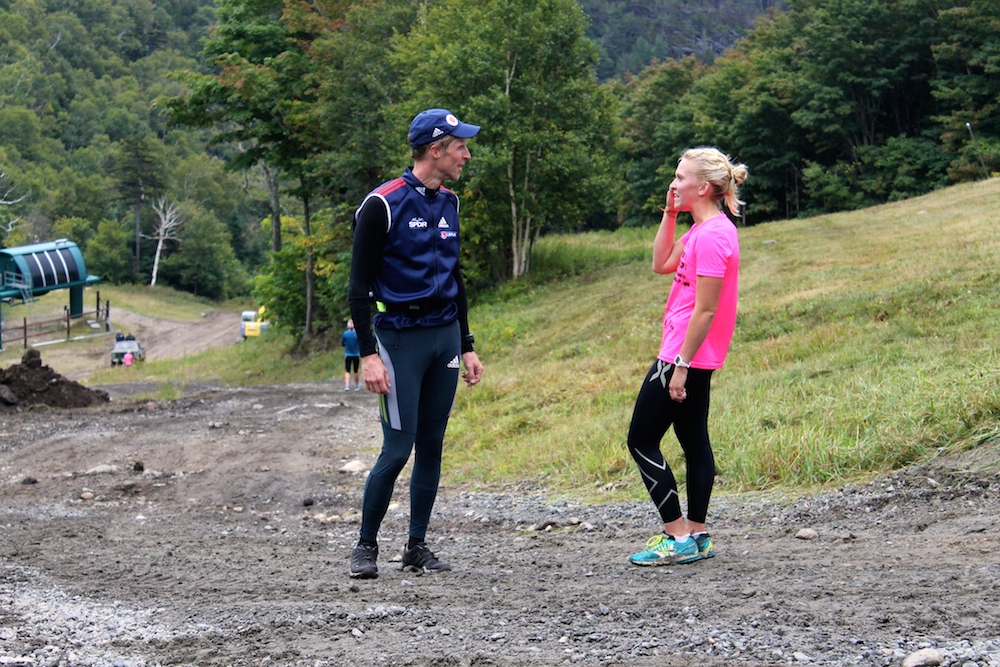
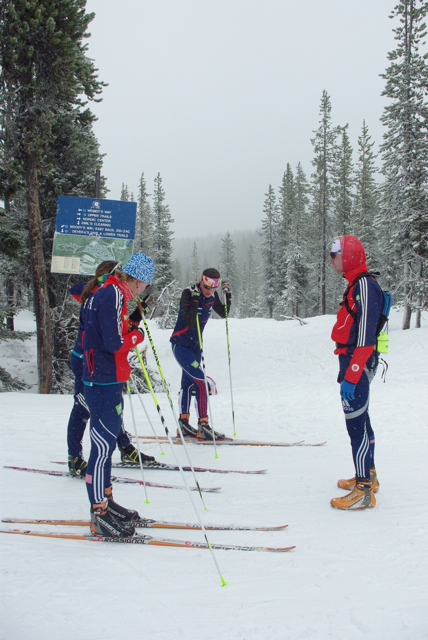
U.S. Biathlon Association women’s coach Jonne Kähkönen checks in with Kelsey Dickinson after an uphill running time trial in 2014.
When Jonne Kähkönen was hired to be the women’s national team coach by the US Biathlon Association (USBA) in 2010, there wasn’t much of a playbook to follow.
The Finn couldn’t mimic the footsteps of his predecessor, because there wasn’t one.
For the first time, the women’s team was going to have a coach of their own.
“The men’s program was on a really high level going into Vancouver [2010 Olympics],” USBA Chief of Sport Bernd Eisenbichler – then the high-performance director – said on the phone this weekend. “It was a deep program and the men’s relay was having pretty good potential. And we saw the women coming up having the same potential to go up to the top as well.
“We knew that if we wanted to build up a strong women’s program, we needed to have a dedicated coach for them,” he explained. “Really just focused on their development, and putting the group together to make it a really good environment.”
Enter Kähkönen, who had spent the previous four years as the head coach of the Finnish biathlon team.
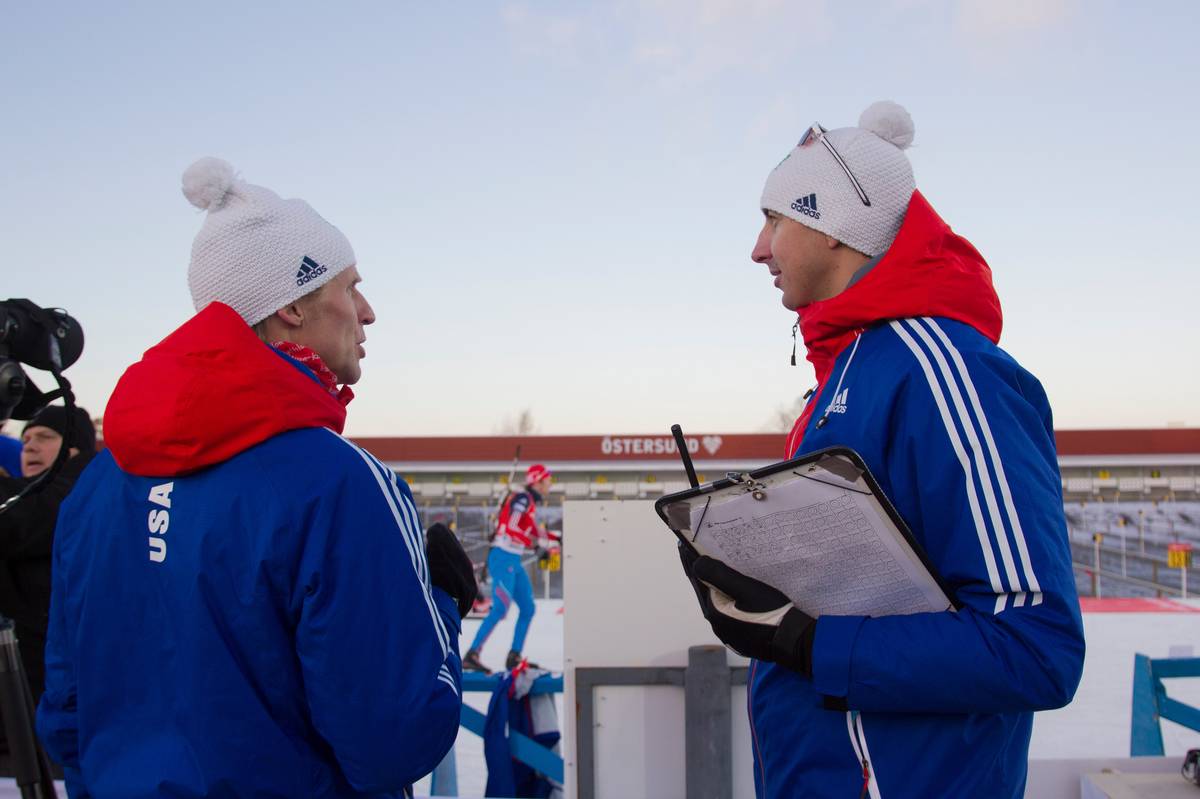
US women’s coach Jonne Kähkönen, left, and men’s coach Jonas Johansson on the range in Sweden in 2014. (Photo: USBA/NordicFocus.com)
“Obviously the first quad [four-year Olympic cycle] felt like it went by really quick, because everything was new,” Kähkönen said in a phone interview last week. “I think looking back, we made really good decisions overall with the philosophy of the team for both the men and the women. Especially for the women, in the early years, to get them up to speed, to be competitive. And it was successful already after the first couple years.”
In 2009, the U.S. women were ranked 20th in the World Cup’s Nations Cup standings. Eight years later, they have had numerous top-20 performances from multiple athletes, World Youth and Junior Championships flower ceremonies, and World Cup podiums and a World Championships silver medal by Susan Dunklee.
“When we started, we didn’t think we were capable of that,” Eisenbichler said. “We saw the potential, but to win a silver medal with Susan, to have these multiple top 20’s by six or seven different athletes, I think we can be really happy with what the women’s program has looked like the last eight years and where we are right now.”
And after leading that charge for eight years, Kähkönen is leaving the team to take back his role as the head coach for Finland – a program that has also risen in that period, with Kaisa Mäkäräinen winning three overall World Cup titles, Mari Laukkanen scoring two World Cup victories, and the mixed relay team finishing sixth at the 2018 Olympics.
“It has been a process,” Kähkönen said of the transition. “I definitely have been thinking of each quad [cycle] as a project. At the end of the project it is always good to evaluate and think about the next steps and what’s good for me professionally, but then I want what’s best for the team and the athletes also. And I feel like now with the few retirements, it’s probably good in a way to make the changes now.”
“I think that the women need a new stimulus,” Eisenbichler said. “Not that the old stimulus wasn’t good or wasn’t working anymore, but after eight years it’s normal. And Jonne and I see that the same way. I could not be more thankful and grateful to Jonne. And now it’s time for him to have a new era with the Finnish biathlon association.”
The Fun-Loving Finn
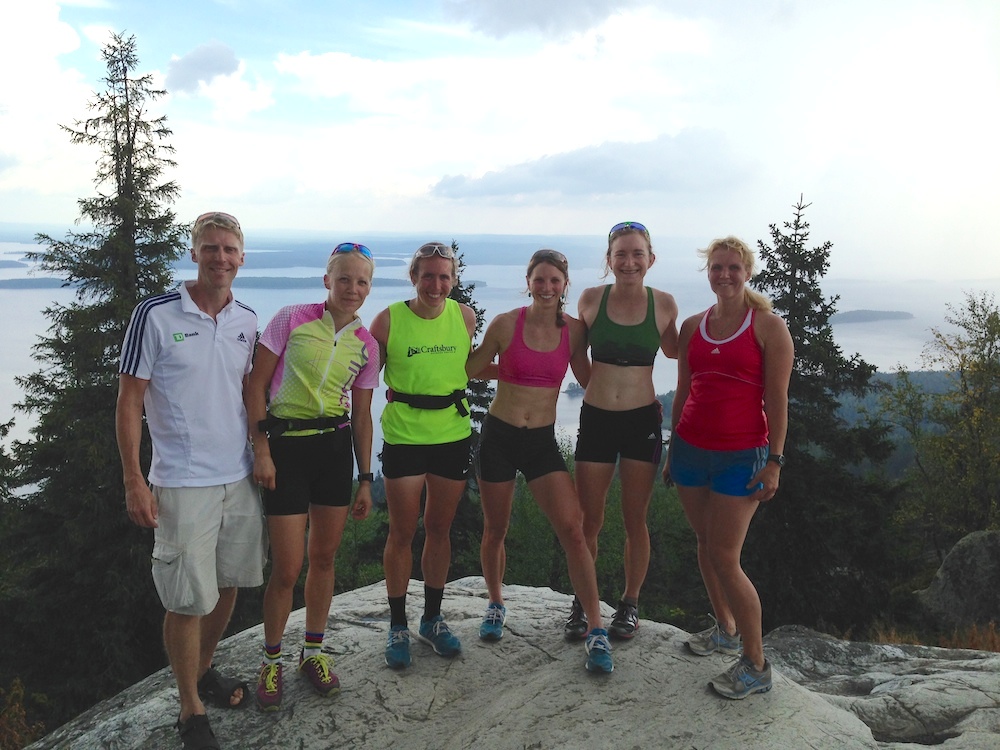
The US Biathlon women’s team after an uphill interval session up Koli, the highest point in southern Finland, with coach Jonne Kähkönen (l) and his wife (r), who also rollerskied up, and Finnish World Cup champion Kaisa Mäkäräinen (second from l). (Photo: Jonne Kähkönen)
“I think that having a women’s coach changed something in the heart of the women’s team, because it felt like a validation that we were improving and deserved someone that was there specifically for us,” 2014 Olympian and five-time World Championships competitor Annelies Cook, who retired in 2016, wrote in an email last week.
“Personally, I am really grateful that I had Jonne as a coach,” she continued. “Jonne was there in my life through many big changes and I could always talk to him and I always felt supported by him. He was always positive for us, and that is something you really need in a sport that can really get you down sometimes. Biathlon is different from cross-country skiing in where the differences in performances from day to day don’t change that drastically. Biathlon can change instantly from good to bad, and that can be really emotional sometimes.”
Kähkönen said that he learned a lot in his years of coaching in the U.S., not least from the athletes and the team’s international staff, who hail from Sweden, Italy, the Czech Republic, and Germany.
“It makes me think what works and what doesn’t work, and also to take that into account working with the athletes,” he said.
But what he learned the most was to have fun.
“I know that having fun seems dangerous to say [in a serious environment],” he said. “It’s not only about having fun, but enjoying your work and enjoying what you’re doing — I think that’s more descriptive. But, at times, having fun as well!”
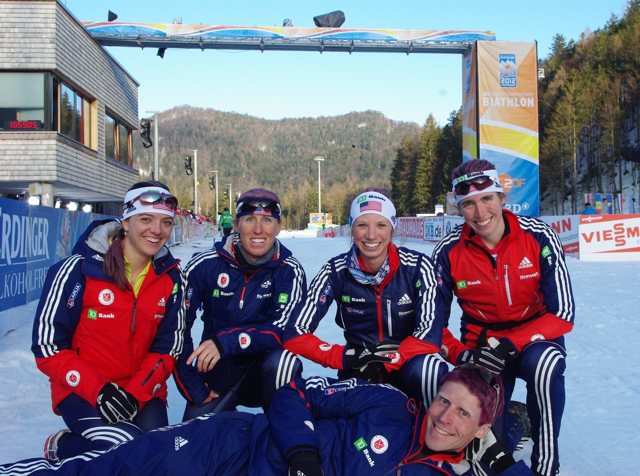
Sara Studebaker, Lanny Barnes, Annelies Cook, and Susan Dunklee, with coach Jonne Kahkonen, model their new hairstyles at 2012 World Championships.
Case in point: in 2012 at World Championships, Kähkönen dyed his hair purple. He had told the team that if any of the women finished in the top 10, he’d do it. Susan Dunklee placed fifth in the 15 k individual. So purple it was.
“I think those types of things are important, whatever it is, just to try to lighten it up a little,” he said. “Me being Finnish, people say that I’m not a typical Finn. I’m more open or more lively or whatever.”
Quite apart from the hair, Dunklee’s fifth-place finish in Ruhpolding was one of Kähkönen’s favorite moments from his tenure with the team. At the time, he was midway through his second winter leading the women’s squad, and Dunklee had competed in just two weekends of World Cup racing.
“Probably one of the most exciting moments was Susan’s first breakthrough at Ruhpolding World Champs in that individual,” Kähkönen reminisced. “She had the lead for a good while, and her being really surprised by it. That was definitely, maybe not the start of it all, but one of the very good results that we had early on.”
The previous year, Sara Studebaker and Laura Spector had broken into the top 20 on the World Cup, and Haley Johnson had been close in 21st. One year later, Cook made her own jump into the land of top-20’s. And later still, Hannah Dreissigacker and then Clare Egan would hit the top 20, along with Dunklee’s four World Cup podiums and her World Championships silver medal.
“Obviously after all the hard work, all the medals, Tim [Burke] in Nove Mesto and then Susan and Lowell [Bailey] in Hochfilzen last year, those are on top of the list,” Kähkönen said.
Back to Finland
Kähkönen hesitated to say that he was headed for home.
“It may be a cliché to say that home is where your heart is, but Lake Placid has been my home,” he said. “I’ve said this to a couple of people, but it hasn’t hit me yet because I’m still here. It has been great. The community is so supportive. There are great people there and we made good friends. So it will be tough to leave when that day comes.”
The family will move this summer, after his oldest son graduates from high school in June.
U.S. women’s coach Jonne Kahkonen talks to his team between intervals at a training camp in Bend, Oregon, in 2012.
But it is an interesting assignment for Kähkönen to retake the reins of a program that has changed a lot since he last worked there.
“With Kaisa [Mäkäräinen] being the star, it is exciting to go back and work with her, if she decides to continue [racing], which remains to be seen,” he said of an athlete who had five podiums the last time he worked with the team, but now owns 23 international wins and 54 more podiums. “We worked together in the past, so it will be fun to be reunited.”
But the other pieces of Finland’s biathlon puzzle are no less compelling.
“At the same time, I think as big a part of it is seeing the rise of the next generation,” Kähkönen said. “They won a couple medals at the junior level. It’s not just the juniors and youth who won the medals, but even behind them, there are just more people doing biathlon now, which is good to see. And just seeing the good results that the men’s team is starting to post on the World Cup now. That’s inspiring to me.”
And in the end, the fun is one thing that he hopes to bring back to Finland.
“I just read in one of the Finnish papers today, Aino-Kaisa Saarinen, who is part of the cross-country team — she has trained a bunch with Kikkan Randall and the U.S. women — she made a comment that what she was missing a little bit in the last couple of years was having this sort of North American type of relaxed and having fun atmosphere while doing the work that everyone is committed to.”
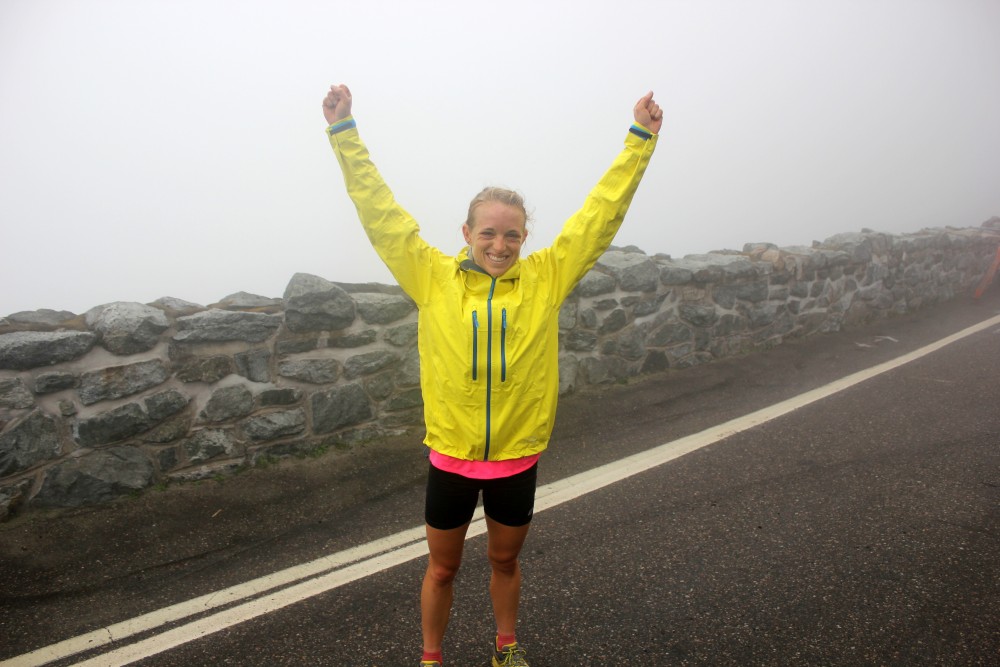
Liz Stephen celebrating her win and new course record at the 2014 Climb to the Castle. Stephen has the most women’s wins in 10 years of the Climb, winning five of those races, and also holds the women’s course record.
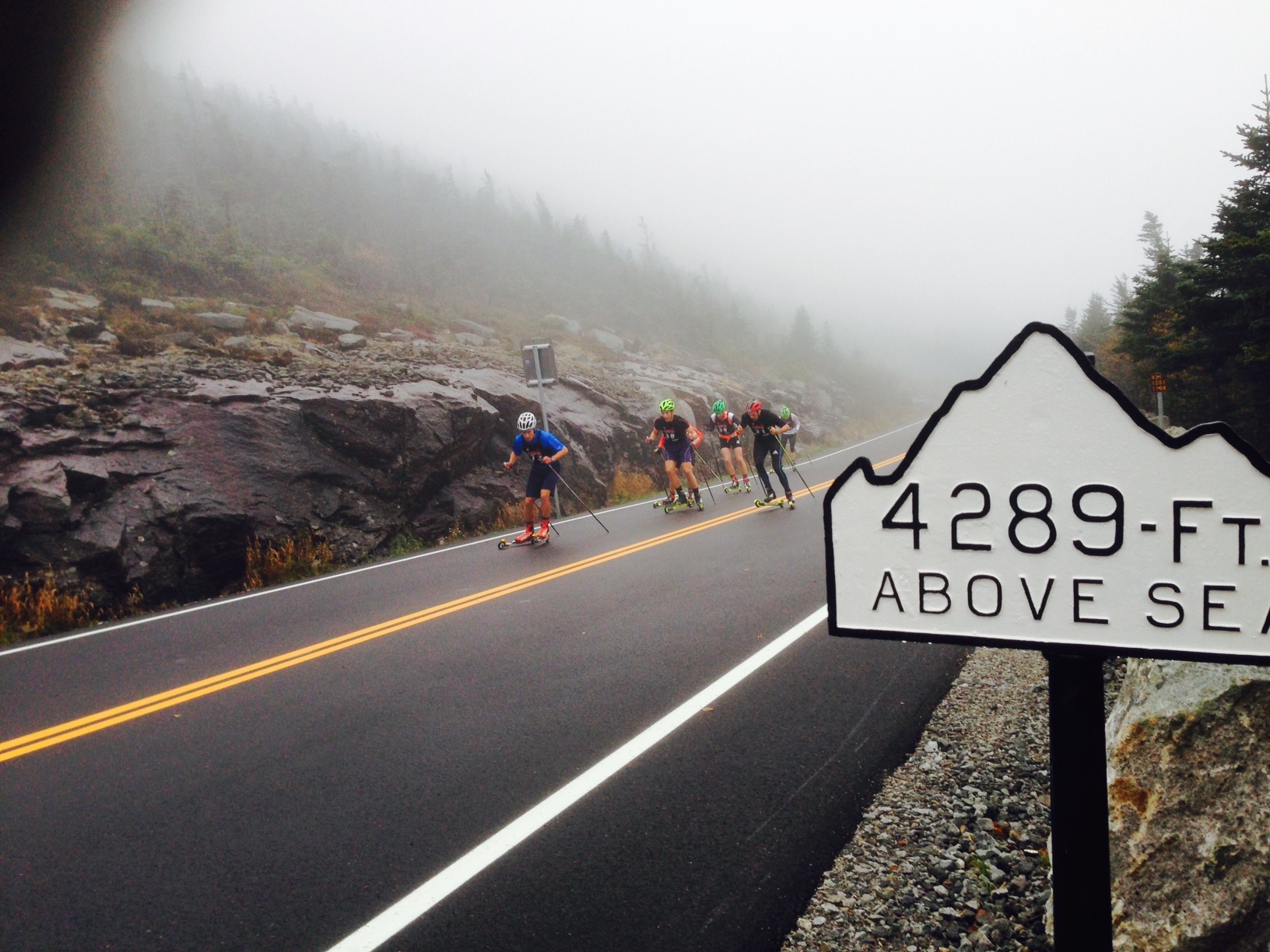
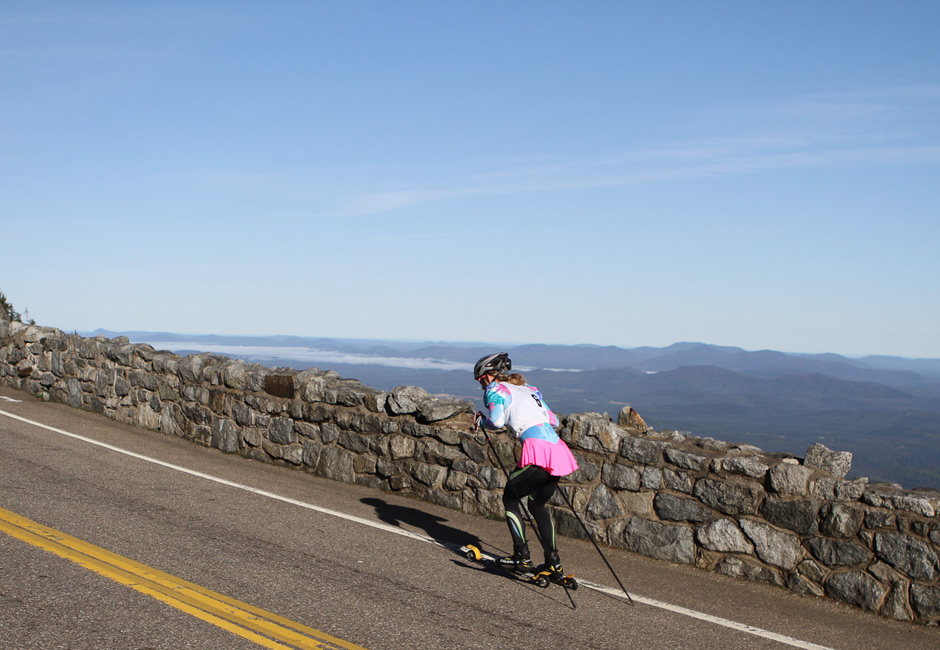
For the last decade, the Climb to the Castle has been a fall staple in northeastern New York. It’s been a circled on the calendars of the U.S. Ski Team and US Biathlon national team almost every year since its inception and attracts 75 to 100 no-joke skiers to Wilmington (near Lake Placid, N.Y.) each year.
Following the 10th annual rollerski race up Whiteface Mountain’s toll road, a five-mile grind with an average 8 percent grade, we thought it would be worth looking at course records and some of the climb’s legendary winners.
***
Most wins: Liz Stephen (5), Duncan Douglas (3)
Course records: Duncan Douglas (34:56.6) 2007, Liz Stephen (41:50) 2014
***
Paddy Caldwell (black shirt, yellow helmet) of the U.S. Ski Team D-team and SMST2 Team chases Rogan Brown (l) around mile four at the 2015 Climb to the Castle. Caldwell won the race, followed by biathletes Russell Currier and Tim Burke in second and third, respectively. Brown (SVSEF) placed fourth and Kyle Bratrud (CXC) was fifth. (Photo: Tim Cowan)
The seventh- and eighth-grade girls’ race crosses a field at the Strafford Nordic Center during the 2012 Silver Fox Trot. Photo: Dave Kynor.
STRAFFORD, Vt. – As Jeremiah Linehan turned his huge Ford truck up the driveway of the Strafford Nordic Center, I looked around, but there was no sign for skiing – just one pointing the way to Rockbottom Farm. Linehan reported that he’d taken the ski center’s sign down for the summer, “just so we don’t have to deal with it.”
As his two sons and a 9 year old from down the road chatted in the back seat, we drove along the tree-lined dirt road up towards the dairy farm. Linehan pointed out trails that, come winter, would be filled with skiers. Over there, a trail skirts a small field. Here, it crosses the road and heads downhill to the next property. At the bottom of one large, steeply rolling field sat the biathlon range. Another trail – more of a dirt track, really – was cut into the sidehill so that skiers could traverse the slope. I could picture how beautiful the scene would be on a sparkling winter day.
We pulled into Rockbottom Farm, a rambling house surrounded by a collection of barns,, with dogs and chickens wandering about. A guy in a Polaris Ranger, headphones on and Pepsi can in hand, drove towards us and stopped. Linehan rolled the window down and the two chatted about pouring a foundation for a new barn.
We drove on, past a shed filled with boxes of glass bottles, past the creamery itself, past a barn that houses more than 50 Guernsey cows, past a pile of manure. The boys shrieked that it was smelly. The truck slipped and slid along muddy farm roads – at one point I wondered if we would careen right into a parked tractor – and out towards the pastures, where we came to a stop.
“All right, boys,” Linehan said. “Let’s go! Do you remember how to get to Zig Zag?”
And with that, we hit the trails.
* * *
The view from Picnic Rock down towards Rockbottom Farm in the summer.
There are a lot of things about the Strafford Nordic Center that seem unusual. The Trapp Family Lodge this is not.
“It’s a farm,” Linehan said later. “Cows are there. Tractors are running across the parking lot. But it has also got some of the best terrain for skiing.”
Perhaps the most astounding thing is that Linehan and his two co-owners started the touring center for the 2012 season – which, in New England, was something of a doomed year for skiing and snow. On the National Climatic Data Center’s 1-to-118 scale of precipitation, the winter ranked a five, or “much below normal.”
But the weather didn’t slow down the operation in Strafford. Before the center even opened, Linehan and his crew had sold dozens of season passes, a tally which rose to ninety by January. Then they sold about 1,000 day passes. The group’s facebook page is thick with endorsements: “Some of the best cross country skiing I’ve had,” wrote one visitor. “This place is fantastic and run by wonderful people,” gushed another. “Let it snow, let it snow, let it snow,” wrote a third.
What? Let it snow? This was 2012, right?
In fact, the Strafford had a better run of things than most places in New England. With almost 1,000 feet of elevation on the Oak Hill trails 20 miles away in Hanover, New Hampshire, they had consistent skiing when the Dartmouth College venue did not. Linehan had planned on grooming 20 k of trails in their initial season but due to higher-than-predicted demand, he bumped that number up to 30 k.
“As much as it was a really tough winter here, I think in some ways it worked in their favor because they were one of the few places that had enough snow for skiing,” said Cami Thompson, the Dartmouth women’s coach, in a phone interview last week. “I think that helped draw people out there.”
Thompson’s team made a few visits to the center, although the coach said that with limited daylight in the heart of winter it was sometimes hard to make things work with 2 o’clock practice and the 40-minute drive. Still, Thompson said, the availability trails with snow was “certainly wonderful.” Other years, the team has made trips to Stowe during the week for training if it’s the only option.
And the Dartmouth team wasn’t the only group to use Strafford as a backup. The Ford Sayre Ski Club hosts its annual Silver Fox Trot at Oak Hill, which was a no-go with 2012’s snow situation. The club moved its high school and senior Eastern Cup races to the Craftsbury Outdoor Center, two hours away, but opted to keep the kids’ event more local.
Strafford is “a beautiful, traditional Vermont setting, and the site has been fortunate to be at a higher elevation to retain very good snow cover,” organizers wrote on their website.
Working with Ford Sayre’s volunteers, Linehan knew he had to do everything he could to make things run smoothly. The farm owner ploughed a field to make an entirely new parking lot; the co-owners agreed to groom whenever, and whatever, Ford Sayre wanted. This was their chance to gain some publicity with a captive audience of over 150 racers and their families.
It worked. After driving through brown, snowless valleys, skiers ascended the hill towards the nordic center and were greeted by good racing, gorgeous views and plenty of white stuff; Thompson said that her own daughter enjoyed the setting. Even if other venues have snow next year, it seems unlikely that the BKL families will forget their experience in Strafford.
* * *
Another unlikely detail about Strafford’s success is that until the nordic center actually started, Linehan was the only one of the three co-owners who skied.
Linehan, here on the Tamarack Hill trails: “I skied more in 2012 than I did in the last ten years combined.” Photo: Dave Kynor.
Growing up mostly here in the Upper Valley, except for a brief stint to Anchorage, Alaska, Linehan took to skiing early. He went straight from high school into the world of high-level nordic combined racing, competing all over the country and in parts of Europe. Then, he transitioned to special jumping, started a couple of World Cups, and retired in his mid-20’s.
Even when he was competing, Linehan had an idea that the Upper Valley was a great place to train.
“I thought about how cool it would be to have a ski area of my own, or at least trails,” said Linehan, who dreams of one day helping to host an elite-level team in the area.
After leaving the nordic world, Linehan got a degree at Vermont Technical College and went into construction. When a spot opened up in Hanover, he became a firefighter. The job is tough, he says, but he also has plenty of days off. That’s partly what has allowed him to build his own 10 k trail network above his house, which is just a hop, skip, and a jump away from the Strafford Nordic Center.
“I began cutting my own trails,” Linehan said. “They made tracks for ATV’s, and that’s pretty much what made it affordable so I could do it. I learned that way. For six years, we’ve been grooming a 10 k up by my house, with my neighbors, and it’s open to the public for free. Anybody was welcome.”
Two years ago, the Upper Valley had a fantastic snow year and the hills of Strafford were blanketed by nearly four feet of fluff. That made Linehan think that maybe there could be more than just the trails he had built in his backyard. So he went to two of his best friends, Earl Ransom and Rett Emerson, who owned adjoining farms.
“I went to Rett and said, ‘what do you do with your farm in the winter?’” Linehan explained. “And he said, nothing, that he needed to find something. Then I went to Amy [Huyffer, Ransom’s wife] and Earl and asked what they thought about me grooming some trails down there, and they said they’d love to… Everyone was on board, but those guys didn’t know what it meant to do a ski area.”
The three men have turned out to be good partners. Although Emerson and Ransom weren’t skiers, they were businessmen, and provided caution and realism against Linehan’s big dreams. The three balance each other out, Linehan says, and because they were already close friends, they respect one another even when their views differ.
The co-owners used all of their own resources at the beginning. The nordic center has only five employees; besides the three men, Huyffer does the books and Linehan’s wife Hilary organizes the programs. The team didn’t have to buy much of anything, although when Linehan’s insurance company declared his sailboat totaled after Hurricane Irene, he did purchase a groomer. And there are things that they have simply decided not to invest in – for instance, your standard trail markers. Instead, they nail handmade ones to trees.
Another cost-saver was the fact that they didn’t build any new trails. Vermont’s Act 250 regulates land use and development, and the owners wanted to avoid the permitting process and associated costs. They were in luck: with a lot of large, open fields, they could groom whatever they wanted to. Ransom’s farm in particular offered miles of old logging roads to wind through the woods. An apartment above Ransom and Huyffer’s house serves as the lodge. With a little mowing and lopping, the team created a trail network without doing any construction.
“Vermont Act 250 affects anything commercial over ten acres, so we couldn’t build stuff,” Linehan said. “And we didn’t – we actually didn’t make new trails. We used existing trails and just connected stuff up. So we weren’t lying when we said it.”
Besides Act 250, there is are current use and forestry plans to deal with; the nordic center is far from the main business taking place on the land, but the team doesn’t feel limited. And they are already benefitting from their low startup costs. The trio didn’t expect to make money on the project for at least three years, but after their remarkable 2012 season, they were able to pay Huyffer and Hilary Linehan, which was an unexpected bonus.
“We’re out of debt,” Linehan said, clearly still struggling to believe it. “It’s our first year and we’re out of debt. We’re very happy about that… It exceeded our financial dreams last year.”
* * *
With Act 250 and the other plans dictating how the nordic center grows, it’s likely to remain very much a winter occupant of the farms.
“I’m very conscious of the fact that this is their work, their livelihood, and I’m a guest,” Linehan said.
The Strafford Nordic Center shares land with Rockbottom Farm’s cows.
That’s also partly because the two farms are plenty successful the other eight months of the year. For instance, although Ransom was thrilled to have something to do with his farm in the winter, Rockbottom’s Strafford Organic Creamery sells its milk and cream throughout Vermont and New Hampshire, and its ice cream is highly acclaimed (full disclosure: okay, it’s been the author’s favorite ice cream for the last ten years). The farm was featured in Michael Abelman’s book Fields of Plenty, which highlighted small, sustainable farms across America.
A few kilometers away, the balance of fields and forest shifts and you find yourself at Tamarack Hill Farm, another thriving business and one that feels more like a typical Vermont ski resort. This is Emerson’s domain.
In the summer, Tamarack Hill’s lawns and fields are mowed by machines, not cows. Instead of Guernseys in the barns, there are horses – nice horses. Rett Emerson’s father, Denny, is an equestrian legend, but despite a long career that has included wins at almost every one of three-day eventing’s biggest competitions, including a team gold at World Championships, the elder Emerson doesn’t rest on his laurels. Instead, he teaches, and thousands of riders have come to train or compete at his impeccable farm.
Rather than logging roads, skiers find themselves on a few trails which were designed with cross-country horsemanship in mind. Depending on snow levels, solid wooden jumps may peek out in the fields – or they may be buried to form a sort of nordic terrain park.
The elder Emerson is firmly behind the idea of the nordic center and had even considered putting in ski trails himself in the 1990’s. He doesn’t stay in Vermont in the winters; while the eventing barn moves to Southern Pines, North Carolina, Rett Emerson stays in Vermont and manages the Strafford side.
When the nordic center began, Emerson dove straight in. He now does much of the grooming, which he learned from Linehan, and picked up skiing as well.
“Rett went from never skiing to skiing every day,” Linehan says. “That’s what he does in the winters now – he hated winters, and now he loves it. It’s this total turnaround for him.”
The co-owners had considered siting the lodge at Tamarack Hill, since there was a free building there as well. But they decided against it. After one winter of operation, Linehan believes that although driving into the horse farm would have provided skiers with a more typical first impression, Rockbottom is the right location for the lodge. People love the farm, he says; they love the fields, and they love the cows. It’s different than any other touring center, but the atmosphere has been well-received.
Even Thompson, a former World Cup skier who grew up in Stowe and has skied pretty much everywhere, didn’t mind.
“I slid off the parking lot the first day we went out there,” Thompson laughed in a phone interview last week. “You know, the bus is up on the hill and the tires aren’t that great. Luckily they have lots of tractors there, so they just pulled it out while we went skiing. They were great.”
That can-do attitude, exemplified by Linehan’s boundless enthusiasm, shows up over and over again. From the beginning he wanted to include biathlon in his nordic center, so he set up some targets in a large field. When Laura Spector showed up – she was then a member of the national team – he moved them around and eventually had her scout a better location to relocate the range.
“Jere had contacted me with general questions about biathlon last year, so I knew the range was going up and I asked him about training there when I was in the area,” Spector wrote in an e-mail. “There wasn’t access to the actual range because there wasn’t snow enough to cover the connecting trail, but he moved a target into the upper field for me to use alongside the regular trails. In the spring I helped them clear trails and the site of a newer range.”
* * *
Linehan walking the trails this summer.
The success or failure of the Strafford Nordic Center, of course, will come down to its trails.
As we walked up Zig Zag with Linehan’s boys, I tried to envision what the old road, now overgrown with tall grass, goldenrod, and raspberry branches, would look in the winter (as the thorns tore across my legs, Linehan mused on whether it was time to mow yet). It’s a tough trail, climbing up and up to the top of the nordic center, but it’s a fun one – lots of changes in the grade, twists and turns in new directions. Linehan said that almost every skier they had this winter made it up to the top of the hill.
And as we entered a high pasture, I could see why. It was hazy the day I visited, but I could still see across several towns and the Connecticut River into New Hampshire. On a better day, Linehan couldn’t help bragging, there were views of the Presidential Range. Even the foreground, a patchwork of woods and farm fields, was beautiful. Maybe it’s not so surprising that Emerson suddenly developed an interest in skiing.
“The trails are fun to ski on – it’s a little bit old-time, and they’re groomed with a small machine, but they have some great little loops,” Thompson said of the Strafford experience. “I think it’s a really great place to train because it requires some agility. There’s quick little downhills and corners and turns and things like that. The guys did intervals one day in particular and it was really good for that.”
Spector agreed, calling the trails “extensive and fun.” Before she retired this summer, Spector had spent several years at Dartmouth, training for biathlon while simultaneously studying. When she wanted to ski and shoot together, she had to drive over an hour and a half to a national guard base in Jericho, Vermont; Dartmouth has ski trails and a somewhat deteriorating range, but they aren’t in the same place. Strafford, she thought, would be a big improvement.
“It will be great for biathletes who move to the Upper Valley, providing them with a place close by to train in the winter as well as the summer,” Spector wrote. “Considering the distance I was driving to get to Jericho, of course Strafford is a more convenient location. It’s going to make continuing biathlon through college less of a challenge and more of a possibility for younger biathletes.”
Linehan hopes to host the center’s first self-organized race this winter, and down the road to perhaps have bigger events; he has a 5 k loop picked out that he thinks will become the race course, and he will probably investigate homologation down the road.
But he’s not interested in catering just to skiing’s elite, or its racers. Even in the center’s first year of existence, it saw pretty much everyone: tourists, college teams, kids. Plenty of children came to ski over the course of the winter, but one of Linehan’s big goals is to get more kids skiing, whether it’s through after-school programs, phys ed classes, or actual ski teams.
And Thompson believed that recreational skiers might benefit the most from the new trail network.
“I would think for the general population it would be great,” she said. “It’s really nice to have another place to go. Just skiing day in and day out, five days a week at Oak Hill, it’s boring. I think people want variety, they want to be able to try different places. And it’s totally different to go to a place like that.”
The owners’ fingers are crossed that their enterprise will continue to grow. After all, they benefitted from 2012’s lack of snow, but they certainly aren’t hoping for another terrible drought.
“It has become this group of three families now that are learning and growing, and finding out that it’s possible,” Linehan said. “We have to see if it works next year with everybody else having snow. We could be flop, you know? Last year we were the only game in town.”
A group of skiers take a break on the trails this winter. Photo: Dave Kynor.
Laura Spector warming up for a race in 2009. Photo courtesy of U.S. Biathlon Association.
HANOVER, NEW HAMPSHIRE – When Laura Spector left the East and drove to Bozeman, Montana, this spring, she knew she was headed for school, but she wasn’t sure what was going to happen after that.
The 2010 Olympian and national team biathlete had finished up her first full year of training and racing since graduating from Dartmouth College, and it wasn’t what she had been hoping for. After starting the early-season World Cups she struggled, ending up overtrained and trying to rest up while simultaneously competing on the second-tier IBU Cup.
At the time, Spector told FasterSkier that she would “plan to not ever in the future be just solely an athlete,” but remaining in her sport was still a very real possibility. Despite moving to Bozeman to do an intensive summer course of organic chemistry at Montana State University, Spector brought all of her training gear with her and thought she might rejoin the team in some capacity in the fall.
After a few more months, her plans have solidified, and biathlon isn’t in them. Spector has a job working in a biology lab here in Hanover.
“I’m not planning to compete this year,” Spector told FasterSkier. “I’m not going to have time because I’ll be working full-time for a whole year, so biathlon is not in the plan for this winter. Except maybe for fun if there’s something local.”
Instead of skating her way around Europe and knocking down targets with a .22-caliber rifle, Spector will be working for Dr. Sharon Bickel, a Dartmouth College professor, looking at DNA replication and meiosis in fruitflies.
“I am really excited,” Spector said. “It should be a lot of fun. I finally get to do something with my degree, and it’s something I’m really interested in. It will keep me busy most of the time. So I’m very excited to have it.”
Just Getting Started
Laura Spector racing to 19th place in the World Cup sprint in Oberhof, Germany, in 2011. Photo: nordicfocus.com courtesy of USBA.
For U.S. Biathlon, Spector’s decision leaves the women’s team down a veteran competitor.
“As a team, for sure it’s a big loss,” U.S. women’s coach Jonne Kahkonen said in an interview. “Two years ago she made a couple of mass starts already and was on her way up. And I can definitely see that there’s more there. But that’s just the way life goes – not everybody can do this forever, or even until the next Olympics. So that’s just part of this game.”
Spector, who will turn 25 this fall, grew up in Lennox, Massachusetts, and skied the state’s high school circuit as well as NENSA’s Eastern Cups for several years before moving to the Green Mountain Valley School in Waitsfield, Vermont. Under the tutelage of Jon Arne Enevoldsen, she made her first trip to biathlon’s World Junior Championships in 2005.
The following year, she enrolled at Dartmouth, where she competed in a few college races and finished third at the Williams College carnival. But she also kept going in biathlon, making another trip to World Junior Championships and finishing ninth in the sprint. After that season, Spector turned to biathlon fully, making two more trips to the junior races and qualifying for senior World Championships in 2008. The next year, she spent about half the season on the World Cup.
Although she made the Vancouver Olympic team, her performances there didn’t knock anyone’s socks off – it wasn’t until the next season that she had her big breakthrough, scoring a World Cup top-20 in Oberhof, Germany, and competing in several of the prestigious 30-woman mass starts, which an American had last done six years before.
That 2010-2011 season was Kahkonen’s first on the U.S. staff, and he remembers Spector’s performances as having allowed the U.S. women to build towards higher and higher levels of success.
“That was just the ball rolling in the right direction, and a lot of times that’s something that the team needs,” Kahkonen said. “The work is there, the potential is there, but you need someone who can actually get the results, or at least a little taste of the results, and then the others realize that it’s possible, that it’s out there. And for sure Laura was a big part of that.”
And that’s what Spector is leaving behind: despite a subpar string of results in 2012, everyone at the U.S. Biathlon Association (USBA) was certain that the team’s young veteran could return to the sport’s biggest stage, and be shooting alongside the world’s best in Europe.
“We will miss her on the team, but we wish her well,” USBA President Max Cobb wrote in an e-mail. “We were of course sorry to hear the that she would not continue to train and compete, but these are the hard choices every athlete has to make.”
For Spector, it wasn’t as hard of a choice as she might have imagined.
“I’m sure I’ll miss the race season a little bit,” she admitted. “It will be weird to know that my teammates are competing and I’m not. But I’m also really excited about the choice I’ve made and I’m very happy, so I don’t have any regrets about it.”
Back to School
Spector’s insistence on finishing up at Dartmouth rather than focusing on biathlon full-time was sometimes a frustration for her coaches on the national team. And Spector, the consummate multi-tasker, needed something else to occupy her mind after she graduated. In her only year as a full-time resident at Lake Placid’s Olympic Training Center, she wanted more – and coaches could tell.
Laura Spector in a sprint in Atholz, Italy, in 2011. Photo: nordicfocus.com courtesy of USBA.
“It’s kind of a surprise, but not really,” Kahkonen said of Spector’s decision. “Just talking to Laura, she was not quite there, exactly – not to say that she was not motivated, or not fit, but I could tell last winter that something was a little off, so maybe it was in the back of her head that she wanted to go on and take some more school and pursue that. So by then I could tell that she wanted to figure some other things out in her life.”
In meetings this spring, the two tried to work through their plans for Spector’s career.
“I said that to me, as a coach, I want results, and I want from the athletes 100 percent commitment,” Kahkonen said. “If you’re not sure about it, then you should take some time off and figure out whether this is what you really want to do. So that was the discussion at the meetings in the spring. I didn’t know if I should say it.”
Spector took that idea and ran all the way to Bozeman with it. In part because of her busy schedule as a biathlete when she was at Dartmouth, she had skipped a few classes that are traditionally required before graduate school, and she wanted to fill out her coursework so that she could get another degree in the future. She also wanted to test out going back to school.
“It was very fast-paced because it was two terms of organic chemistry in twelve weeks, but I did really well and I enjoyed being able to study again and keeping my mind busy,” Spector said. “And I was also working part-time in a fly lab, studying fruitflies, and that was my first lab experience – and I really liked it. So I was hoping that would work out and it would be a step towards taking a job in a lab for a full year.”
Now certain that school and biology are the right route, Spector knows that she needed to gain more experience in the lab. She plans to apply to graduate school at the end of the fall and begin next September. Until then, she’ll be working with fruitflies.
The door is still open, however, if Spector changes her mind – or finishes school.
“In a way, I think it’s good, because if she decides that she wants to come back and start competing again, when that’s all done, she can have a full focus on biathlon,” Kahkonen said.
And Spector, a notoriously hard worker, isn’t exactly slacking. If she decides to return to the sport, she’ll definitely be fit.
“I’m still biking and running every day,” she said. “I’m still really active, especially in Bozeman because it’s a really great place to do all that, and I still plan to be working out every single day.”
What she’ll miss most about her sport, she said, is her team.
“I’m planning to go watch the rollerski nationals [in Jericho, Vermont], and I’m really excited to see everybody and say hello,” Spector said. “We’re all practically a family and I really want to see them and talk to them face to face, and really let them know what I’m doing. It will be good, because I’ll be out East for a while when they are, so maybe we’ll cross paths a little bit more.”
And as for her coach? There seem to be no hard feelings.
“She’s going to be in Jericho, and I said that if she brought her rifle, I’d zero her,” Kahkonen laughed.
Laura Spector all by herself toward the top of Whiteface Mountain en route to winning the Climb to the Castle rollerski race in 2010.
Lowell Bailey competing in 2012 IBU World Championsips, his seventh. Bailey left biathlon completely for two years during his time as a ski racer at the University of Vermont.
Note: this is the beginning of a three-part series following several groups of biathletes as they negotiate the college question. .
In the summer of 2002, Lowell Bailey was a national “A” team biathlete living in a trailer at Camp Ethan Allen, a national guard training site in Jericho, Vermont.
Lowell Bailey Hometown: Lake Placid, NY Age: 30 Results Before College: Three top-20 World Junior Championships races, along with three top-10’s at European Championships; started a World Cup. Alma Mater: University of Vermont Notable Senior Results: Five World Cup top-10’s, numerous top-20’s, scramble leg for U.S. relay team. What’s Up Now: Bailey had his major breakthrough in the 2011-12 season, where he finished 14th in the Total Score, the top-ranked American. He’s planning to continue at least until the Sochi Olympics. Quote: “I really think that if I didn’t go to UVM, if I didn’t have college and the things that college has to offer, I don’t think I would have gone back to biathlon. I think I needed that mental break from the sport at that moment in my life.”
In some ways, his career as a biathlete was looking up: although he had missed the previous winter’s Olympics by two spots, a few veterans had retired, leaving Bailey near the top of the heap on the U.S. team. And after years on the junior national team and the previous season on the senior team, he was beginning to accumulate the kind of training that can make skiers fast.
There was just one problem, and the trailer and military base had something to do with it.
“I was at a point in my biathlon career where I was kind of burnt out, believe it or not, at age 21,” Bailey told FasterSkier in an interview last fall. “I was thinking, ‘man, what am I doing?’ The funding for biathlon was pretty much nothing. I had a lot of pressure from my family and my grandparents, and a lot of people that were wondering what I was doing with my life.”
Ten years later, Bailey is a two-time Olympian and has ascended to the top of the international field. He netted four individual top-ten World Cup results in 2012 and landed 14th in the Total Score. How he got there, however, was by taking the road less traveled – not only by U.S. nordic athletes, but by the other biathletes he is now battling in Europe.
Bailey spent three years at the University of Vermont, training with the college ski team and racing on the EISA circuit and at NCAA Championships. While he was quick to say that college isn’t for every athlete, Bailey was clear that in his case, it was a career-saver.
“I really think that if I didn’t go to UVM, if I didn’t have college and the things that college has to offer, I don’t think I would have gone back to biathlon,” he said. “I think I needed that mental break from the sport at that moment in my life.”
The Changing Face of USBA Development
Typically, national team coaches in the U.S. don’t support the college model; just this spring, both Matt Whitcomb and Chris Grover told FasterSkier that education was not compatible with athletic commitment to the U.S. Ski Team program. Biathlon coaches agree.
“It’s for sure nothing that we recommend, going to college, if we see potential for an athlete,” U.S. Biathlon Association (USBA) Head Coach Per Nilsson wrote in an e-mail to FasterSkier. “We prefer to keep them more under our guidance.”
That was even more true a decade ago, when USBA had a well-funded and successful junior national team program. In 2002, Lanny Barnes, Tracy Barnes, and Carolyn Treacy (now Bramante) teamed up for silver in the World Junior Championships relay, putting the U.S. on the podium for the first time since Jay Hakkinen’s 1997 sprint title, and other athletes were frequently finishing in the top 20.
At that point, Bramante seriously considered heading off to a university like other high school seniors, and applied to Dartmouth College. But after being accepted she decided to defer, taking summer classes at Colorado College instead.
Carolyn Bramante Hometown: Duluth, MN Age: 30 Results Before College: Silver medalist in World Junior Championships relay in 2002, and three other individual top-20’s. Alma Mater: Dartmouth College Notable Senior Results: Represented the U.S. at 2006 Olympics in Torino, as well as 2007 and 2009 World Championships. What’s Up Now: Just finished medical school at University of Minnesota, headed to Johns Hopkins University for residency in Internal Medicine and Pediatrics; also gave birth to a son, Leo, who has child-sized scrubs. Quote: “My choice to go to Dartmouth was definitely what I thought was best for my biathlon career. Skiing wasn’t always a huge strength of mine, so I [wanted] to work on skiing for a year or more, and I knew I would have great training and racing at Dartmouth.”
“On the ‘A’ junior team nobody was really going to school except for me, and not on the senior national team either,” Bramante told FasterSkier. “Biathlon has only been an Olympic sport for women since 1992, so when I was looking at the women who had gone to the Olympics, none… went to school while they were training. There were very few examples to look at of how to do school and training.”
The U.S. coaching staff couldn’t give her the answers she wanted, either.
“When I was a junior I really liked our coaches, but they were very discouraging of going to school,” she said.
And why wouldn’t they be? The team provided coaching, racing opportunities in Europe, and fast, hardworking teammates; it seemed like a no-brainer for dedicated athletes to stick with biathlon full-time to until finishing their junior careers at age 20. Tim Burke, Walt Shepard, and Anders Osthus were among those who trained with development coach James Upham out of Burlington, Vermont.
But after the 2002 Olympics, much of that funding disappeared, leaving both juniors and first- and second-year senior racers in the lurch. The development program was routed through the then-still-nascent Maine Winter Sports Center, and although that organization provided support, the timing was ripe for biathletes who wanted to go to college to assert themselves.
“There was pretty much zero support from U.S. Biathlon at that point, and that was a huge influence on my decision,” Bailey said.
The reasons to consider college were numerous and highly individual; Bailey and Bramante, who enrolled at Dartmouth a year later, were followed by Annelies Cook heading to the University of Utah, Shepard to Bowdoin College, and Laura Spector to Dartmouth. For Bramante, Spector, and Shepard, finances were less of the equation, since Ivy League and Division III schools cannot offer scholarships.
But Cook and Bramante, for example, considered themselves strong shooters who wanted to improve their ski speed, and chose college teams accordingly. Shepard wanted to move back to southern Maine, where he had grown up, and to work with former Canadian and U.S. national team coach Marty Hall, who headed the Bowdoin program at the time.
Bramante racing at the ’09 World Championships (Courtesy Photo)
And then there was the consideration of life after biathlon.
“The trend at that point, and to some degree today, is that you do your ski career and then you pick up on real life after that,” Bailey said. “The trouble with that is – I mean, right now I just turned 30, and I’m looking at Sochi very seriously, so at the end of that season I’ll be 32 or 33, and there’s still the possibility of continuing on. If I do choose to retire, I’m a 32-year-old and I have to start from where a 21-year-old college graduate is starting. To me, that’s a pretty scary prospect.”
Shepard, who retired after the 2010 season, echoed that sentiment in an interview, pointing out that he is now almost 30 and in his first full year in the work force. Cook hopes to go into nursing, which will require additional education, while Spector is planning on a graduate degree and Bramante recently earned her M.D. Not all athletes have such ambitious career goals, but for those who do, the thought of starting undergraduate classes at age 30 is understandably daunting.
“I didn’t want to push medical school off forever, because medical training is a really long road,” Bramante said. “I was really excited to start learning.”
The All-American Route: Bailey at UVM
While Bramante knew exactly what she wanted, Bailey was in more of a general funk – and didn’t have much of an inkling that he would blaze a new path and inspire other biathletes to broaden their horizons. A single interaction with assistant coach Al Serrano, however, changed the course of his athletic career.
“Al one day mentioned during training that he was the head coach at UVM,” Bailey told FasterSkier. “He mentioned for the first time the possibility of me skiing for UVM, and the fact that scholarship money was available.”
Bailey now wonders if the comment was made in jest, since he was on track to be a career biathlete. But the idea quickly grew in his mind, and it took only one night before he went back to Serrano and asked how they could make it work. At first, Serrano was careful not to steal Bailey away from the biathlon team, and Bailey wanted to keep racing for the national team that had given him so much support. In 2003, he attempted to compete as both a collegiate skier and an international biathlete.
“It was probably the busiest year of my life,” he said. “I went and raced the December and early January race circuit in Europe. Then I came back and raced the college circuit and I remember perfectly – we had NCAA’s at Dartmouth that year and I finished the final race, went back and packed my bags, and was on a plane to Russia the next morning. I competed at World Championships for biathlon and I think I was racing five or six days later.”
Annelies Cook Hometown: Saranac Lake, NY Age: 27 Results Before College: Four top-20’s at World Junior Championships, several more in European Cup races. Alma Mater: University of Utah Notable Senior Results: Competed at 2011 and 2012 World Championships; two World Cup top-40’s What’s Up Now: Recently promoted to national team “A” status after the best year of international racing of her career. Quote: “You know, I didn’t make the Olympic team [in 2010] and it was heartbreaking, but if you asked me whether I would trade my years at Utah for two weeks at the Olympics, I don’t know that I would do that.”
Bailey did fine that year – he finished 45th, 50th, and 59th at World Championships, placed second in the 10 k skate at NCAA Championships, and helped UVM to the runner-up trophy – but he realized that it wasn’t sustainable (four years later, Spector would make the same discovery). Believing that he had to pick a single focus, he chose Vermont and said goodbye to biathlon.
“At that point, as much as I was really grateful to U.S. Biathlon for the opportunities that I’d had racing and the lifestyle and all of that, I thought that I was transitioning into a different phase of my life,” Bailey explained. “I wanted to focus on nordic skiing and school, and enjoy my time at UVM. I really liked the team atmosphere.
“I mean, there’s nothing like a college ski team.”
Bailey excelled as a skier: he was an All-American every season at UVM, and in 2004 he replicated his second-place NCAA finish. In 2005, he finished fifth in the U.S. Nationals 10 k classic. Of the four men who beat him, three – Ivan Babikov, Justin Freeman, and James Southam – went on to compete in the Olympics in skiing, and two (Babikov and John Stene of Norway) were foreigners, so Bailey ended up with bronze.
As graduation drew near, Bailey began thinking about what to do with his degree. Once again, he was approached by a coach. This time it was Upham, the USBA development team coach who had moved to the Maine Winter Sports Center. Upham saw Bailey in Burlington – “I played guitar with him, actually” – and urged him to at least try out his program. After all, the upcoming Olympic trials would be in northern Maine.
Cook at 2012 World Championships.
“I even said he could stay at my house,” Upham told FasterSkier.
Bailey was undeniably in great shape, so despite uncertainty about how quickly his shooting would come back, he figured he might as well “give myself a year to see what I can do in biathlon.” Since then, he has not looked back, except to say thank you – both to USBA for its support early and late in his career, and to college, without which he doesn’t believe he would have made it to the 2006 Olympics.
“Competing at the college level relieves the pressure of the long term development goals, and we got to focus on the moment and let the rest fall where they may,” Serrano said of Bailey’s years at UVM. “I think this helped him reinvent himself for the next stage of his international career – which he has had do a few other times since. His ability to do this is extraordinary, and I am in awe of what he has accomplished.”
Bramante and Spector: Olympic-Bound Students
When Cook headed for Utah, she more or less copied Bailey’s plan, only competing as a biathlete at U.S. Nationals every spring. Shepard, too, mostly eschewed biathlon while he was at Bowdoin, and raced on the EISA circuit until 2010, when he took the year off to train for Vancouver. But athletes also have another option for their college years: remaining a full-time biathlete. Bramante blazed that path in the runup to the Torino Olympics, and since then Spector has done the same thing.
While coaches feared that athletes leaving biathlon for college skiing would train less, stop shooting, and never return to the sport at a high level, Bramante’s approach carried different worries. In the past several years, only one school – UVM – has had any sort of collegiate biathlon program, meaning that students who want to continue as biathletes have no training or race support and must spend a significant chunk of time and energy on logistics, travel, and planning.
At Dartmouth, Spector and Bramante had to tackle a lot on their own. Bramante started fixing up the old shooting range at Dartmouth and re-started the Biathlon Club, which had been a division of the school’s Outdoor Programs Office; Spector often traveled an hour and a half to Jericho, Vermont when she needed a better range.
Laura Spector Hometown: Lenox, MA Age: 24 Results Before College: Member of tenth- and seventh-place relay teams at World Junior Championships; placed 11th in a European Cup race. Alma Mater: Dartmouth College Notable Senior Results: The 2010 Olympian finished 19th in a World Cup in 2010-11, and also had four more top-30 results.
What’s Up Now: Member of the national team “B” squad, taking the summer off from full-time training to study organic chemistry at the University of Montana. Quote: “I plan to not ever in the future be just solely an athlete. Because that just doesn’t work for me. I want to be able to love the sport that I’m doing, and when I have nothing else to balance my time I stop loving it.”
Despite those challenges, Bramante made the senior national team in 2004-2005, then qualified for the Olympics the next season. In her eyes, she had proven herself. But she still felt pushback from USBA.
“I think the coaches were definitely impressed that I had been able to do it while being in school, but… they wouldn’t endorse [that approach],” Bramante said. “Bernd [Eisenbichler] was the new High Performance Director and coming from a German background it was understandable that he wouldn’t support me going to school. I don’t want to sound too negative against USBA, because I don’t blame them for not wanting us to go to school.”
By the time Spector arrived at Dartmouth the next fall, she didn’t get the same feeling. But she also hadn’t received as much support from USBA as a junior, which she said meant that the team was less invested in her sticking to its program.
She was immediately hit by the challenges of her situation.
“She was trying to go up to Jericho to train and do the shooting, and then she’s come down and try to train with us , and she’d try to go to the carnivals, and she’d try to go to World Juniors,” Dartmouth women’s coach Cami Thompson told FasterSkier. “It was way too much. She just wasn’t focused enough, and she got tired and run down and it impacted her results. She skied okay, but she could have skied better and she probably could have done biathlon better.”
The next year, Spector focused entirely on biathlon and qualified for her first senior World Championships. Then in 2010, she became an Olympian, finishing 65th in the sprint and 77th in the individual in Vancouver. Her best season came in 2011, when – still a student – she qualified for two 30-woman mass starts and had her first World Cup top-20.
Five years after Bailey’s first Olympic appearance changed the game, Spector’s results had a similar effect. At the time, they were landmarks for the U.S. women’s team; the last American to appear in a World Cup mass start had been Rachel Steer six years earlier.
“Laura is really structured in her personality and can get in the right amount of training,” Nilsson, the current head coach, said. “The compromise for her is shooting and combination training – it gets a little more complicated to find time for shooting when you have studies plus 20 hours of physical training, and then try to squeeze in a drive to go and do combo training. But obviously it’s possible to progress, as she showed last year! She did a good job.”
You Can’t Always Win, But There’s Accident Forgiveness
In fact, both women found that they struggled once they left school. Bramante finished Dartmouth in the fall of 2006, had her best season in 2007, then started medical school at the University of Minnesota, which was a “hard decision” to make while thinking about the 2010 Olympics. She ultimately decided to take time off – in Bramante’s world that means getting a masters degree in public health – to prepare for Vancouver.
That year’s trials were a disaster. Bramante struggled with rifle problems, and also felt that her strategy to spend more time on biathlon had backfired.
“There was not quite as much academically, and that allowed me to go to training camps,” she said. “I didn’t get any slower in speed, but I didn’t get faster, and I think I almost trained too much that year because I had so much time and I was going to all the camps and whatnot. For some people that amount of training just doesn’t work. There’s a beauty to just doing one thing and getting really into it, but for me that never felt right, and it just wasn’t as successful as when I also had school going on.”
Spector faced similar challenges. Her last term at Dartmouth came in the summer of 2011, after which she moved to Lake Placid for her first fall training full-time with the national team. But instead of continuing her rise towards the top of the biathlon standings, Spector began backsliding. She failed to make the top 70 in the first period of World Cups, and raced on the Continental Cup for the rest of the season. Spector said in an interview last week that she believed the transition away from school had negatively affected her performance.
Except for Bailey, who seemed to skate effortlessly from one success to the next, there have been hiccups and disappointments along the way for each athlete who tried the college route.
Cook, for example, was hoping to replicate Bailey’s route all the way to the 2010 Olympics, but it didn’t work out. After leaving Utah she was immediately invited to the national team, where she initially floundered.
Laura Spector in a sprint in Atholz, Italy, last year. Photo: NordicFocus.com courtesy of USBA.
“It was such a big change from the way that I had been training as a nordic skier and college athlete that I had a really terrible year, actually,” Cook told FasterSkier last fall. “I was really burnt out and I didn’t get to build into it at all. Unfortunately that was an Olympic year, so I didn’t make the Olympics and that was kind of a bummer, and then I didn’t get re-named to the team because they restructured everything.”
Shepard, too, missed the 2010 Olympics; he made it to the last series of trials races in Altenberg, Germany, where six men were competing for the final two spots on the Olympic team. It was disappointing – he had dreamed of racing at the Olympics since he was a kid, and had been preparing for Vancouver ever since missing the Torino team – but Shepard didn’t blame the failure on his training or his decision to attend Bowdoin. Instead, he humbly explained that he just wasn’t good enough.
“I mean, if Tim [Burke] and Lowell and Jeremy [Teela] weren’t such good friends I would have a lot of cause to write them out of my will for my career coinciding with the glory day of men’s biathlon,” Shepard joked in an interview.
While Spector has been on the national team for the past several years, Cook, Bramante, and Shepard all spent time off the roster and still either made or came close to making the international racing squads. And that’s one place where USBA policy diverges from that of, say, the U.S. Ski Team.
For each international tour – such as World Cups, World Championships, and Olympic Games – there are explicit trials procedures. The trials themselves change from year to year, but never more than a handful of national team athletes are prequalified for any competitions; if one of USBA’s own athletes is beat out by someone else, so be it. Discretion seldom comes into play.
“It was just based purely on the math and the times and the percent back,” Shepard, one of the team’s Athlete Representatives, said of his first trials before Torino. “It was the polar opposite of the way they were choosing the nordic team, which was heavily based on discretion. We had gone the other way because on the nordic side there was a lot of controversy, a lot of people upset about the process, and it created a lot of headaches for USSA.”
The downside, he said, was that there was no room to accommodate athletes who might be the best pick but had raced poorly for one reason or another. But the upside, for athletes like him, seems obvious: there’s no nepotism, and athletes can’t be penalized for working outside the national team system. If biathletes show up and race well, they’re in.
For example, Cook trained largely on her own in 2011 – “I had a lot of help from people” – and not only started her first World Cup that season, but also made World Championships. After that she was re-named to the national team, and has since been one of its core members.
A Matter of Perspective
The resiliency shown by Cook and others likely isn’t entirely unrelated to their career paths. For instance, several of them talked about how college freed them from getting hung up on biathlon-related disappointments and minutiae.
“It’s really easy for any biathlete or nordic skier to get wrapped around all the little training elements,” Shepard said. “You wake up in the morning and your heart rate is a couple beats out of whack, and you’re generally being a geek about your life, that to me can be a really negative process, where if you get up and everything isn’t totally in its place then you’re going to have a bad day.”
Walt Shepard Hometown: Yarmouth, ME Age: 29 Results Before College: Two top-20’s at 2002 World Junior Championships, several European Cup top-20’s. Alma Mater: Bowdoin College Notable Senior Results: Competed in 2005 World Championships; domestically, was a five-time national champion and a three-time North American champion. What’s Up Now: Works at a consulting firm in Portland, Maine, and is getting married next week. Quote: “Adding the school element put the whole process in perspective for me. It’s really easy for any biathlete or nordic skier to get wrapped around all the little minutia that make up the training elements… it was raising the bar in terms of what I thought I was capable of.”
Shepard had taken time off after high school to race full-time, but still didn’t feel that he was mature enough as an athlete when he tried out for the 2006 Olympics.
“There was a lot of pressure, a lot of travel, and not necessarily the kind of perspective that I really needed to be successful,” he said. “That was a big part of the decision-making process for me in deciding to go back to school, was that I just really needed to be a more well-rounded person if I was going to have a shot to make the 2010 Games… When I was in the last year of my career, I was a completely different person.”
All five biathletes said that the traditional reasons to attend school – scholarship money, the promise of a job after biathlon, new training partners, being surrounded by people one’s own age – were joined by another, and that was balance.
“If you look at an athlete as a human being who has facets other than just being a good athlete, if you actually look at them as a whole person, then something like college can actually be a good thing,” Bailey said. “It can be a positive for their sports career because it gives you a different perspective, and I think you’re just mentally fresher and more able to put your heart and soul into the training sessions. You’re not faced with the monotony day in and day out.”
Conversely, having taken time off to compete in biathlon full-time before entering college also improved their educational opportunities.
“When I went into college, I told myself, I really want to go back into biathlon when I’m done here,” Cook said. “I had four years of training experience under my wing, so I didn’t go to school as an 18-year-old who might have been more prone to wanting to party. I had a good time, but I definitely treated myself as an athlete and a student first.”
Sheppard sporting Maine Winter Sports Center colors at his last U.S. Nationals.
Shepard, too, said that he did better at college than he probably might have had he gone directly to Middlebury, where he was accepted after high school. Instead, he lived in Burlington for several years and trained with Burke, Bailey, and company. That made all the difference when he made it to Bowdoin, where he maintained his progression of increasing training hours every year.
“To go back to school five years later, I had a lot more life experience and perspective, and I think I got a ton more out of my academic experience,” Shepard said. “And it really made me so much more of a calm person when it came to 2010, because when all I was doing was biathlon, that felt pretty easy to me all of a sudden.”
Does College Slow You Down?
When Bailey initially left biathlon to attend UVM, his excitement for learning and joining a college team did nothing to answer the questions of whether leaving the national team would cause the kind of athletic decline that many predicted. He and Bramante were the guinea pigs.
What did they learn? Bailey, for one, was the first to admit that on paper, school isn’t the smartest route for elite athletes, and the reasoning is based firmly in truth.
“I’m not going to say that it’s the ideal training environment,” he said of college. “If your main focus is having the most ideal training environment, I would definitely say that a college campus isn’t it.”
Ideal or no, the proof of whether athletes can compromise is in the proverbial pudding: a comparison of the development of athletes who took the college detour and those who didn’t.
When Bramante was reunited with the Barnes sisters at the 2006 Olympics in Torino, all three were about to turn 24 – on the young side, as most medalists were in their late 20’s or even mid 30’s. Bramante she finished 80th in the sprint, while Tracy Barnes placed 71st in the sprint and Lanny Barnes 64th in the individual. Bramante wasn’t quite even with her peers who had stayed in the national team program, but she was close. (By the time Vancouver rolled around and they reached the age where athletes are more likely to win medals, only Lanny made the Olympics, where she finished 23rd in the individual.)
Bailey had joined them in Torino and fared better, placing 27th in the individual and in the mid-40s in the sprint and pursuit. That was about as well as Burke had finished, and the men – who had each placed 11th at World Junior Championships in the early 2000’s – still seemed to be back on par.
Bailey racing at 2012 World Championships. Photo: Nordic Focus.com courtesy of USBA.
In 2012, that’s still the case. Although Burke had his major breakthrough first, wearing the overall yellow World Cup leader’s bib in 2009, both finished 2012 ranked in the top 20 in the World Cup Total Score; Burke’s top finishes were fourth and sixth, while Bailey placed fifth twice.
“Lowell was the first person to go to college and take a three year break from biathlon, fulltime, which went against everything that every biathlon coach would ever tell you in this country: that if you stop doing biathlon, there’s no chance for you to have success afterwards,” Shepard said. “And Lowell totally disproved that.”
Meanwhile, Cook and Spector’s teammates from their World Junior Championships days are no longer competing. While they certainly left the sport for a myriad of different reasons, from other interests to burnout, allowing athletes the chance to pursue education likely wouldn’t worsen the dropout rate – and in some cases, like Bailey’s, it might even make them more likely to continue in the sport.
“It was a very much needed break,” Cook, who had previously spent three very productive years at the Maine Winter Sports Center, said of her time at the University of Utah. “You can imagine living in northern Maine and not going to college. I did miss out on the whole college scene, and that was at times difficult, I would say. All my friends were doing different things, and I was a full-time athlete.”
The national team, due to low participation numbers in the sport, admits that it must accept that some athletes will want to go to college; if top biathletes aim to get an education, the team has little choice but to demur. But thanks to this group’s success, taking a break from the sport doesn’t necessarily seem like such a bad option.
“After your studies, when you have some more experience in life, maybe you still feel that you want to be a really good biathlete,” Nilsson said. “Then you can get back to it with high motivation again. This was the case for Lowell.”
It takes a highly organized and dedicated athlete to maintain an elite-level training load through college. Nevertheless, there’s been a softening of the biathlon community’s attitude. Instead of saying no, some are asking: why not?
“You look at a guy like Lowell Bailey, who was able to do really robust training as a junior with us, and then go on and have a really successful career at the UVM, stand on the podium at NCAA’s, and then come back to biathlon and make the Olympic team in 2006 fresh out of college, and continue to be a strong member of the team – I think that’s a good example for us,” Cobb concluded.
What advice do these athletes have for others currently navigating the college question? Stay tuned for part three of the series, when we’ll check back in with Bailey, Bramante, Shepard, Spector, and Cook, as well as the current crop of juniors. Part two, focusing on USBA’s 2007 and 2008 development teams, will run next Monday.
Laura Spector racing in a World Cup mass start in Antholz, Italy last season. Photo: nordicfocus.com / USBA.
Note: This piece is a preview to our upcoming series on how American biathletes navigate the question of college. Check back next Monday for the first installment, which will address in more depth many of the issues brought up here.
After the 2011 IBU World Cup season, American biathlete Laura Spector was riding high. That January, she had collected her first top-20 result and become the first U.S. woman in six years to qualify for one of the circuit’s prestigious 30-woman mass starts. She had a total of five top-30 races that season, and seemed like a solid leader on the rapidly rising women’s team.
A year later, things looked different. In the first period of World Cup racing, the 2010 Olympian failed to crack the top 70. She stepped down to the IBU Cup level and didn’t return.
“I’m definitely not happy with how the season went,” Spector told FasterSkier in an interview last week as she prepared to move to Bozeman, Montana. “It was below par and below what I was expecting.”
Spector said that she knew as early as October that things weren’t quite right; by the time the team was having their fall camps, she was already tired.
“I think I went into the season already pretty worn down from all the training in the summer and the fall,” she explained. “I talked to my coaches about it just a little while ago, and they pretty much agreed that that was probably what had happened. Trying to push through four months of racing without being able to take breaks didn’t really help things.”
Spector attributed the change to her first autumn of training full-time with the national team. Prior to 2012, she had been a student at Dartmouth College, taking the winters off from school to race but attending classes in the spring, summer, and sometimes fall. She had never trained day in and day out with the national team or its coaches.
“When I was at Dartmouth the previous fall, which was right before I had some of my best results, I was able to be a lot more responsive to what I was feeling because I didn’t have a coach watching me every day,” she said. “I think that part of doing more training than I was able to handle was being with my coach every single day, and therefore having to do the exact workout whether I felt like I could do it or not.”
The women’s national team coach, Jonne Kahkonen, agreed that Spector had come into the season at less than full speed, but saw a different cause, and believed that she had been tired as early as the end of the summer.
“After school was done – typically when you finish something you might get sick, or you get more tired actually after you finish that work load,” he said in an interview from Lake Placid. “I think that had a big role in that for sure, even more than Laura really realized, and that probably carried a little further out than any of us could really think of.”
According to Kahkonen, part of the reason that it took a whole season to realize what was happening was due to the fact that he had never worked closely with Spector before, at least not in comparison to the other national team members who were in residence at the Olympic Training Center. Without a good understanding of her baseline and how she showed stress, it was more difficult for him to pick up on the problem.
“If I’m being really honest, for me, as a coach, that is for sure not an ideal situation,” Kahkonen said. “Even last year she wasn’t training fully with the team because she finished school at the end of August, so there was not that much time after school was done and before the season started…Even getting to know Laura a little better, it wasn’t the same as when you see an athlete every day.
“I think all these motivated athletes, especially like Laura, she is really motivated and when the plan is there, she will do it by the book, by the second,” he continued. “It’s tough to get that really honest answer of whether you really feel tired right now, or if you feel good then maybe you could do even more of some other kind of training.”
By the middle of the season, Spector was able to finish 10th in an IBU Cup race in Canmore, Alberta. She also had several top-30 finishes in IBU Cup races in Europe and at Open European Championships in Brezno, Slovakia.
It wasn’t much consolation, though.
“It’s hard to go through an entire season and watch yourself racing at a level that you should not be racing at,” Spector said. “The whole time I knew that I was not racing as well as I could, but I couldn’t really race any better because I didn’t have any time to recover. It’s definitely hard.”
And so Spector is trying to get back on track by returning to what has worked in the past: school. A biological sciences major at Dartmouth, she hopes to attend graduate school in the future. This summer she’s taking an intensive organic chemistry course at Montana State University.
What does that mean for biathlon?
“We’ll see,” she said. “I’m going to go to school this summer and I’m taking everything out with me. They have a biathlon range at Bohart, and I’ll be running and biking and staying active. I don’t have time to fly back East to go to camps or anything… then when the fall comes around, we’ll see what happens. Really I’m just playing it by ear.”
Based on her IBU Cup results, Spector was named to USBA’s “B” team, a step down from the “A” funding level she has been at for several seasons. That didn’t faze her, but she also said that she didn’t plan on integrating fully into the national team system any time soon.
“I plan to not ever in the future be just solely an athlete,” she said. “Because that just doesn’t work for me.”
For Kahkonen – who said that he “didn’t have any finalized plans yet” for Spector, and that they still needed to have another conversation about her season – it wasn’t the most welcome news.
“To be honest I’m kind of worried that that’s something that might happen,” he said of the possibility that Spector wouldn’t return to Lake Placid. “Obviously from my point of view I’d love to have Laura here, just to get to work with her more individually, because that’s how I feel about coaching, and that’s how I want to be coaching. I haven’t really had that chance with Laura yet, and obviously when you look at her results there’s huge potential there.”
Nevertheless, he said he’d do what he could to give Spector the best shot at success.
“If school and taking classes is something that she really wants to do right now, it is obviously her decision,” he said. “What I always say is that if you want the top result, then you need to do biathlon 100%, but at the same time biathlon is only a part of life, and you have to be happy doing biathlon. It’s sometimes a tricky combination. I want to give all the information and all the support that I can give, and then the final decision is up to the athlete.”
Spector was grateful for that support, and said that she felt like USBA staff understood her choices.
“They’ve seen that I’m able to handle it pretty well, and still perform well,” she said. “Since I’ve talked to them they are definitely supportive, because they know that their athletes have to have a healthy mind as well as a healthy body. Whatever it takes, they are willing to support you as long as you turn in good results.”
With her return to school, she hopes that she can give them – and herself – just that.
Leif Nordgren (l/back) follows Bjorn Ferry of Sweden in the World Championships individual race last week.
U.S. Biathlon Nationals might not actually feature all the best biathletes in the country, but so far it has proved one thing: the team selected to compete in Europe is really, really fast.
Saturday didn’t seem auspicious for anyone, with rain blanketing the West Yellowstone course and every biathlete winding up soggy. But for the second time in as many races, the two World Championship team members who decided to compete at U.S. Nationals took big wins, this time in 10 and 12.5 k pursuits.
In the men’s race, Leif Nordgren skied to a minute and a half victory over Mark Johnson; Nordgren had four penalties to Johnson’s six.
“It’s certainly fun to have Leif here to race against,” Johnson wrote in an e-mail. “He’s a great teammate and someone I hope to learn from this week.”
Even though Nordgren had won the sprint by a minute, the two did have a chance to go head-to-head thanks to a decision to modify the pursuit format. While racers did start in the order that they finished the sprint, as usual, the time gaps were replaced by five-second start intervals.
“I actually wasn’t alone for too much,” Nordgren told FasterSkier. “They started the only junior, Casey Smith, right in front of our group. I skied the first loop with him, then I missed two and he cleaned and moved ahead a little bit, as well as Mark Johnson. I had to play a little catchup on the next two loops, then in the standing stages I started to get a gap on those two and it only grew until the end.”
In fact, Nordgren was never alone – and neither was anyone else. With all of the different age divisions starting back to back, there were dozens and dozens of racers on course at all times, racing different distances and intermixing on the range.
Johnson was happy to finish second just as he had in the sprint, but said that he’d been expecting better performances, and maybe to be closer to Nordgren, who had a mixed bag of results at World Championships and anchored the U.S. relay team to tenth place.
“While I’ve managed two second placed finishes thus far, the performances have left me hoping for more,” Johnson wrote. “I haven’t been able ski at the speeds I’ve come to expect this season. I do need to remember, however, that it is late in the season now. For tomorrow’s mass start competition, I’m hoping to continue to shoot well and find a new rhythm skiing.”
Johnson didn’t seem to be too bothered by his inability to find his highest gear, however, and said he was enjoying Nationals to the fullest. He’d been helping out with a junior development camp and done some spring skiing before the weather turned rainy. Overall, he was impressed with the event.
“Despite the consistent heavy rain over the last few days, the organizing committee has done a great job preparing and maintaining the course for these competitions,” he wrote. “While I’m currently having a tough time staying dry, I can certainly attest that West Yellowstone can deliver some perfect spring skiing conditions.”
Michael Gibson of Vermont Collegiate Biathlon finished third, 2:21 behind Nordgren.
Can Nordgren go for the three-peat in tomorrow’s mass start? He hopes so, but the rain has him doing just that – hoping.
“I wasn’t feeling super great today,” he admitted. “I think skiing in the rain for the last four days is getting to me, with a little sore throat and chest congestion. But whatever – looking forward to the pursuit tomorrow, then out of the rain!”
* * *
Cook leaving the range for the U.S in the women's World Championships relay.
In the women’s 10 k, Annelies Cook was even more dominant, picking up an almost four-minute win over fellow national team members Laura Spector and Corrine Malcolm.
In an interesting twist, exactly how much she won by was not clear until after the race, when Spector and Malcolm saw their times adjusted.
“The range was sort of a mess,” Malcolm explained. “There are only 20 lanes here instead of 30, and at any given time there were 75 of us out on course. With four shooting stages overlapping, you get the picture! There was some yelling. Some frantic activities. In biathlon, hunting for a point to shoot at isn’t part of our normal race procedure, but you just have to roll with it.”
Spector and Malcolm had been going back and forth for much of the race – unlike Cook, who was out on her own – and in the end, Spector was awarded a 19-second credit and Malcolm five seconds after national team coach Patrick Coffey, who had been using a stopwatch on the range, tallied up how much time each had spent looking for a place to shoot. Although the results placed them less than a second apart, with Spector in second +3:53 and Malcolm in third +3:54, Malcolm had finished first, and there had been no sprint to the line.
“I didn’t know how much time they would give either one of us,” she told FasterSkier. “And with one more penalty, faster skiing just didn’t cut it in the end. I think it’s kind of silly that it came down to 0.3 seconds without getting to actually duke it out.”
Still, Malcolm didn’t begrudge Spector her time adjustment. After sitting out part of the training season with injuries and then much of the winter with illness, she was just happy to be racing.
“Truthfully, I’m happy to share the podium with Annelies and Laura,” she said. “These gals are more or less veterans on the team with years of World Cup, World Championships, and Olympic experience. If anything, getting to rub shoulders with them is fine with me.”
Ahead of them, Cook was in a league of her own, not only skiing fast but accruing a single penalty over four stages compared to seven for Spector and eight for Malcolm. It was some of her best shooting of the entire season.
“I wish I could have done that in all of those pursuits I got lapped in on the World Cup,” Cook lamented.
Her secret? Cook said that she sung “Row, Row, Row Your Boat” in her head to avoid thinking about shooting.
Because she started first, she was never sure whether her teammates were about to catch her, and so didn’t let up even though she actually had a large lead.
“It is definitely exciting to start as number one and knowing that everyone is chasing you,” she told FasterSkier. “I had no idea where the other girls were the whole race, so I just kept thinking if I clean, then I will be okay. I think I am skiing pretty well right now and that is a good confirmation of the whole winter for me!”
Cook is at the stage in her career where she is clearly strong enough compared to the American field to race in Europe, but it’s not always easy to place in the fifties and sixties week after week on the World Cup. She said that races like U.S. Nationals were hugely valuable.
“It is always fun to win a race, especially when you don’t get that all winter and your goals have to be very personalized,” she explained. “I didn’t have any pressure and on top of that, it is a very low key atmosphere here. I always like to come to U.S. Nationals. I think it is really important for as many people to come as possible because the sport is so small here in the U.S., and it is good to be around everyone you don’t see all winter and who support you from here.”
And what of coming straight from Ruhpolding, where biathlon is anything but small? First, she had to deal with the time change, which she said also lowered her expectations. But aside from that, “a race is a race.”
“It’s like comparing New York City to Saranac Lake, New York,” Cook said, invoking her hometown. “But in the end…. you go as hard as you can.”
Leif Nordgren racing in a World Cup race in Hochfilzen, Austria earlier this season. Photo: NordicFocus/USBA.
After a successful but unspectacular start to the Under-26 Open European Championships in Osrblie, Slovakia, the American team kicked things up a notch in their second outing. In Sunday’s pursuit, not a single one of the six U.S. starters lost a place from their sprint ranking, and one – Leif Nordgren – rocketed up 24 places over 12.5 kilometers and four shooting stages.
“It was nice to finally have a good race,” said Nordgren, the youngest member of the men’s national team.
The Minnesotan’s career took an upward swing last year when he scored World Cup points for the first time and was then the top performer at senior World Championships, placing 17th in the mass start, collecting two more top-30 finishes and anchoring the U.S. relay team to sixth place.
This year, he has been unable to recapture that success. One reason, he told FasterSkier, was that he’s gotten sick over and over.
“I’ve struggled a lot with sickness this season,” he wrote in an e-mail. “This [weekend] I almost decided not to start because I was sick… and since I’ve only done one or two races in the last three weeks because of sickness I wasn’t really sure what to expect on the skis.”
Saturday’s sprint race brought another frustrating result. Nordgren placed 45th and said he was “hurting pretty bad.”
But on Sunday, things picked up on the trails. Nordgren notched the 20th-fastest ski time in a race that included World Cup regulars and even a few podium finishers.
“I’m still nowhere near where I expect myself to be, but hopefully I can stay healthy from here on out and my form will keep going up,” Nordgren said.
Between his faster skiing and his strong shooting – in a race where only Jan Olav Gjermundshaug of Norway and Tomas Hasilla of Slovakia cleaned, Norgren’s two penalties were a good showing – the American gradually climbed out of Saturday’s hole.
After the first prone stage, he’d made it to 36th. After the second, 29th. Then 23rd. By the finish, he sat in 21st place, having lost only 35 additional seconds on Alexey Volkov of Russia, who won both the sprint and the pursuit and skied one less penalty lap than Nordgren to boot.
The American wasn’t surprised that his pursuit performance was better than the opening race of the series.
“The pursuit is one of my favorite races,” Nordgren explained. “For some reason I do a lot better in the head-to-head races. I just focused on my own shooting today, and it worked out. I had a lot of confidence coming into this race which helped a lot.”
As for the move from 70 % shooting on Saturday to 90 % shooting on Sunday, however, he was flummoxed.
“This is a pretty easy range to shoot on – don’t ask me what happened on Saturday,” Nordgren wrote.
Norgren leapfrogged his two teammates on his way through the field. Mark Johnson, in his second international race of the season, started just one place ahead of Nordgren and also missed two shots. But slower skiing kept Johnson bouncing around in the 40’s and he finished 44th, exactly where he had started.
Russell Currier had seemed like the Americans’ best chance for a top-20 finish, since he started 27th and has consistently shown top ski speed this season.
On Sunday, the skiing wasn’t the problem – Currier raced to the fifth-fastest split of the field.
What held him back was shooting. Currier failed to clean a single stage and ended up with five penalties. Incredibly, he was still able to gain three places and finished 24th.
“I haven’t moved up in a pursuit in a long time, so only moving up a few spots is a step in the right direction,” he told FasterSkier. “It was a decent race. I would have liked to have hit an extra target or two. 75 % is far from great, but it’s not that bad either, more just mediocre.”
He said that he felt better on his skis than he had in the sprint, which could mean that he’ll find more success as the week goes on. And he was sure to thank the U.S. wax team, too.
“We are currently limited on wax supplies, so I think the wax techs did an exceptional job,” Currier said.
* * *
In the women’s 10 k pursuit, two Americans started just outside the top 30, but only one was able to cross to the other side. Starting 32nd, Laura Spector missed five shots, including two in each of the last two stages, but was still able to climb up to 28th.
“It’s frustrating to miss so many shots in standing, but I felt like I skied the course well today,” Spector said. “It’s a much higher stress situation skiing in a pursuit and there’s less time to mentally prepare when entering the range.”
Teammate Hannah Dreissigacker started a second behind Spector in 33rd, but made a tactical blunder when she failed to “take clicks” on her rifle sight to adjust for wind in the first shooting stage. As a result, she missed four shots and immediately dropped to 41st.
“I’ve had practice this year in not getting discouraged after bad shooting,” said Dreissgacker in reference to several domestic races this season, including a NorAm that she won despite missing eleven targets. “I definitely wish that I could redo that first shooting, but it was a good learning experience.”
The two women had opposite experiences on the trails: Spector told FasterSkier that she spent all but the first two laps skiing alone, and eventually finished with a 20-second gap in either direction.
Thanks to the missed shots, Dreissigacker, a strong skier, dropped back to a slower portion of the field.
“It meant that I got to do a lot of passing during the skiing for the rest of the race,” she said. “That kept me motivated and skiing pretty hard.”
Dreissigacker cleaned her second stage before missing three more shots for seven total penalties, and was able to work her way back up to 33rd, her starting position.
Canada’s lone starter in either race was Megan Heinicke, who improved from 18th to 15th.
Russell Currier racing in last week's World Cup competitions in Antholz, Italy. Photo: NordicFocus/USBA.
The U.S. biathlon team could be forgiven for having high expectations going into this year’s Under-26/Open European Championships in Osrblie, Slovakia.
Last year, Leif Nordgren entered just one race at the event, and didn’t even finish. But a few weeks later, he notched three top-thirty finishes at senior World Championships.
In that same U26 series in Ridnaun, Italy, Russell Currier repeatedly finished in the 20s and 30s. But just two weeks ago, he bettered those results on a higher stage when he sprinted to sixth place in a World Cup in Nove Mesto, Czech Republic.
Both athletes have taken major steps since their last appearance at the U26 races, as has Laura Spector, whose top finish in 2010 was 34th, but who spent the entirety of last season on the World Cup.
So this year, the team had every right to hope for better finishes. And while it didn’t happen on Saturday – Currier was the only American to crack the top 30 – coach Patrick Coffey didn’t consider the pair of sprint races to be a wash.
“Today’s races were a quiet success I would say,” he told FasterSkier in an e-mail.
Currier and Nordgren, who missed three shots to finish 45th in the 10 k sprint, were disappointed nonetheless.
“Tough race this morning in Slovakia,” Nordgren tweeted after the race. “Tomorrow is another day though and I’m looking forward to it!”
Currier, who said the race was “decent, but not up to expectations,” was undone mainly by his shooting. Not only did he miss three shots, but he lost over thirty seconds to his fastest competitors during the two shooting stages alone. There were bright spots, however: Currier’s seventh-fastest ski time of the day mitigated some of his other problems, and he finished 27th.
“I actually didn’t feel that great on skis,” Currier told FasterSkier. “My transitions were a little sloppy in some parts. I was surprised to have the seventh fastest loop time.”
Of his shooting, he said that he was also surprised to have missed two shots in standing.
“I’m still kicking myself for that,” he said. “I really thought I could clean standing today.”
His time placed him 1:45 behind Alexey Volkov of Russia, a World Cup regular who anchored the winning mixed relay in Hochfilzen, Austria this season and whose victory today surprised nobody.
In fact, the presence of athletes like Volkov is one thing that makes this year’s U26 races unusual – and more competitive than in past editions. In 2010, the event was held directly after the Vancouver Olympics, and only a handful of athletes, generally from smaller countries, competed in both. In 2011, the Ridnaun races followed the World Cups held in Fort Kent, Maine, leading to a similar situation.
But this year, the U26 Championships are being held during a World Cup off-week between Antholz, Italy and Oslo, Norway, making travel and jetlag less of an issue for athletes wanting to work the event into their World Cup schedule. Today’s field was almost 20 % bigger than last year’s.
“It was a little more competitive than I thought it would be,” Currier said.
While the results were disappointing and the races themselves less than exciting for the pair of men who had competed in Antholz – Currier said that the crowd “could not hold a candle to your average World Cup” – it was part of a cautious return by the third American man, Mark Johnson.
A five-time World Junior Championships competitor, Johnson recently graduated from Williams College and hasn’t appeared in an major biathlon race in three years.
“For me, this was a fun introduction back into international racing,” Johnson wrote in an e-mail. “After spending my last season focusing on collegiate cross-country racing, my confidence on the ski tracks has improved. That showed today. My skiing was on pace with much of the field.”
Johnson missed two shots and finished 44th, just over a second in front of Nordgren, and said that he was “very satisfied with the result.”
While he hasn’t made any international squads until now, Johnson had offered up a series of fairly dominating performances in domestic competition this season. He may have been happy with his result, but it didn’t mean that he wasn’t expecting more in the coming races, just like his teammates.
“Overall, I think we performed solidly,” Johnson wrote. “There is room for improvement on the result list, and the hope is to realize that in the coming races.”
The U.S. trio seemed enthusiastic for Sunday’s pursuit, which should feature large packs thanks to the many tight finishes in today’s sprint. Currier, for example, sits about 20 seconds out of the top 20, or one penalty loop; Nordgren will start in a pack of six skiers within ten seconds.
“I’ll be starting with a large group, and right alongside my teammate Leif, which will definitely make for a thrilling environment to race in,” Johnson said.
“And as a team, I believe we can make up some major ground on our competitors.”
* * *
In the women’s 7.5 k sprint, Spector and teammate Hannah Dreissigacker narrowly missed the top 30, placing 32nd and 33rd. Neither, however, seemed too disappointed.
“In skiing I felt all right, nothing exceptional,” said Spector, who started this season on the World Cup circuit before being moved to the second-tier IBU Cup tour. Spector has so far been unable to find the form she showed last season, but said that her ski speed was coming back little by little; she had the 31st-fastest ski split today.
“This is the first ‘World Cup’ course I’ve competed on since mid-December, which means that it’s more challenging than most courses used for IBU Cups,” Spector said of the skiing. “There are two really long, steep hills in the first half of the course, followed by a lot of downhill that still requires efficient skiing, where I lost the most time.”
Spector missed two shots, both in the standing stage. Her prone shooting, however, was exceptional: not only did she clean, but she did it with the second-fastest time in the field.
“I was surprised to see how fast my prone time was because the shots felt scattered,” she explained. “I jammed a shell in standing so it took a little time to clear that out, otherwise I would expect standing to be faster.
“I have not been working on shooting speed this year, although I have noticed an improvement,” she continued. “I think it’s simply come from having a good number of years of shooting training behind me now, being able to calculate a good range approach, and being comfortable with shooting faster; it’s really been a natural process.”
The same could not be said for Dreissigacker, who hasn’t contested an international biathlon race in two years and has only competed in two U.S. events this season. A successful skier for the Craftsbury Green Racing Project who made the top 20 in every race at 2012 U.S. Nationals in Rumford, Maine. Dreissigacker was surprised to be nominated to the team, and wasn’t sure what to expect.
Once the racing began though, she was no longer as apprehensive.
“I felt like I actually was a real biathlete,” Dreissigacker, who accrued three penalties, told FasterSkier. “I successfully accomplished my goals of going through all the equipment checks, shooting at the right targets, skiing the right number of penalty laps, skiing hard, and having fun!”
Like Spector, Dreissigacker noted the difficulty of the course’s long climbs, and said she was looking forward to shorter loops with less vertical in Sunday’s pursuit. But despite the challenges, she said that the venue actually suited her well.
“There’s about 1.5 k of flat rolling [terrain after the hills], which makes for an easy approach to the range,” she said. “That’s good for me – it means that I can ski pretty normally and then just back off a little bit on the gradual downhill into the range.”
Coffey, the team’s coach for this trip, was impressed with both Dreissigacker and Johnson given their lack of recent big-race experience.
“Both have been taking it all in stride,” he said. “There is an adjustment that needs to be made when jumping into the European racing circuit, but both looked relaxed today and will feel even more at home tomorrow in the pursuit race.”
Canada’s Megan Heinicke finished 18th in the women’s sprint; she could not be reached for comment.
Laura Spector (USA) in the 7.5 k sprint World Cup in Ostersund, Sweden on Saturday. Photo: Sam Merrens.
Today in Ostersund, Sweden, two women returned to the spots they’re used to occupying on the World Cup biathlon results sheet.
For Germany’s Magdalena Neuner, that spot was at the top. The 24-year-old won her 25th World Cup after placing third in a wind-dominated individual race earlier this week. For any other champion, an occasional bad day is standard. But Neuner is so good that seeing her finish over a minute and a half behind Darya Domracheva of Belarus was, well, strange.
In Saturday’s 7.5 k sprint, Neuner eked out a 0.2-second victory over Tora Berger of Norway. The pair both missed a single shot in the standing stage and were battling for the whole race; Neuner had the advantage of being later in the start order, so she knew exactly what she had to do in the last loop to win.
Neuner actually had a larger lead coming into her last shoot, but the wind – which has foiled racers all week – slowed her down.
“I had to wait quite a long time,” Neuner said in a press conference. “I had no choice, but then I had only one penalty so that was the right thing to do.”
Neuner and Berger are hands-down two of the best skiers on the circuit, and although Berger has only twelve wins to her name, they are frequent adversaries. In the press conference, they bickered about who would lead the way in Sunday’s pursuit.
“I will follow Magdalena,” Berger said, which is technically correct at least to start since she will have that 0.2-second deficit.
“We will see,” Neuner replied.
A bit farther down the results sheet, Zina Kocher also returned to the spot she’s used to. The Canadian has a World Cup podium and a handful of top-10 finishes to her name, but in 2011 she had only a single top-20 finish, placing 17th in a sprint in Slovenia. More often, she placed in the 50s or 60s – or even the 80s.
But only two races into the 2012 season, she’s already topped her best finish from the year before. Kocher placed 15th in the sprint despite three penalties.
“Every single race felt like a struggle last year, but I’ve just felt incredibly calm racing this week,” Kocher said in a Biathlon Canada press release. “I knew after the trials that my shape was much better than last year and that was a big relief. I’m just having a ton of fun.”
How did she get back on track? After losing her “A” team nomination, Kocher left the national team program and joined the new Biathlon Alberta training center with her very first coach, Richard Boruta. Kocher believes that the change was what she needed and explains a lot about her return to form.
“I needed a different environment that I positively felt confident in, to start with,” she wrote in an e-mail to FasterSkier.
But besides just feeling happy to rejoin Boruta, Kocher has been training differently this year.
“Definitely we upped the anti with high intensity volume, and this was key for me,” she said. “I seem to respond better to harder training and less long low intensity volume. Plus we worked more on technique with a focus on getting my poles forward, hips more forward, and gliding more.”
Whatever she’s done, it has worked. Kocher had the fifth-fastest ski time of the day and was the highest-placing racer with three penalties. She was actually 0.2 seconds faster on her skis than Berger, who jumped in the opening cross country World Cup earlier this year and finished fourth.
Kocher is that speedy, too.
“My body just wants to go and I feel great on the skis right now,” she said in the Biathlon Canada press release.
Kocher’s teammate Megan Imrie had a strong race of her own, finishing 33rd with two penalties. It was just the fifth time in her career that she has collected World Cup points – and in Thursday’s individual, she was 41st, just one spot outside the cutoff. To say that Imrie is off to a good start would be an understatement.
Rosanna Crawford, the third Canadian, placed 56th, meaning that all three team members will start tomorrow’s pursuit.
Dunklee. Photo: Sam Merrens.
For the Americans, there was an unfamiliar face leading the way: Susan Dunklee.
While Dunklee has been a member of the national team for several years, this weekend was the first time she actually received World Cup starts. She’s made the most of it, finishing 45th on Thursday and then 28th today.
She may be new to the big show, but talking to her about the race, she acts like she’s already a veteran.
“[It was] blustery and it unexpectedly started blizzarding a few minutes before the start,” Dunklee wrote in an e-mail. Her solution? “I tried to shoot on a far right point in prone, where I would be protected from wind.”
Racing is racing is racing, and Dunklee has approached her first World Cups as if they are just any other competition. She’s learned from her brief experience, too. On Thursday, she started out with the third-fastest opening lap; today, her pace was more measured.
“I thought it might be good to try to pace my laps a little better this time,” she said. “Soon out of the start gate I fell in with a German coming out of the range, [Tina] Bachmann I think. I decided to ski with her for my first lap, as long as she was passing people.”
Dunklee did have a steadier effort, combining the 35th-fastest ski time of the day with a very respectable two penalties.
It’s one of the best debuts by a U.S. biathlete in years, and it says almost as much about U.S. biathlon as it does about Dunklee herself. Sara Studebaker, Lanny Barnes, and Laura Spector – who finished 46th, 65th, and 73rd today – all received World Cup starts early in their careers, in part because there were a smaller number of fast women in the country.
As soon as the women rose to the top of the American field, they were shipped off to Europe, where they placed 70th, 77th, and 62nd in their first races at the senior level.
Studebaker. Photo: Sam Merrens.
Despite the rough early results, the strategy hasn’t been a bad one; all three have top-20 World Cup finishes under their belts. But the very fact that Dunklee didn’t make her World Cup debut until she was ready to excel shows that the U.S. team is getting deeper. Dunklee had to out-compete racers like Olympian Tracy Barnes and 2011 World Championship team member Annelies Cook to receive her spot on this year’s World Cup team.
“We as coaches want to keep the bar high and send the athletes out to the competitions when they are ready, either the IBU cup or the World Cup,” U.S. women’s coach Jonne Kahkonen told FasterSkier. “And Susan did exactly this path; more IBU cup races and European Champs last year, and this year she is ready to take the racing into the next level.”
Kahkonen was happy to see a new face leading the team after Spector and Studebaker were the driving forces behind last year’s results.
“It is good to see that there are others that are ready to take the next step,” he said. “This takes hopefully some pressure off of Sara and Laura.”
While none of the three older athletes had their best races today, the coach was confident that they would find their form. He mentioned that some of the team had been sick the previous week, and that while the women had managed to avoid falling ill, their immune systems may have been fighting something off.
Studebaker will start in tomorrow’s pursuit, with the goal of simply moving up as many places as possible.
“Just out of the points in today’s sprint,” she tweeted after the race. “Chance for redemption in tomorrow’s pursuit!”
For Dunklee, there’s no need for redemption. She’ll simply be out there having fun and continuing to chart new territory.
“I think half the battle happens before the start of the race,” she wrote. “I just want to feel relaxed and confident and let the training take care of the rest.”
Lanny Barnes (USA) racing to 48th place. Photo: Sam Merrens.
Perhaps never before have the world’s best biathletes’ dreams of perfection been dashed so quickly at the beginning of a season.
Over the last two days in Ostersund, Sweden, each one of the world’s top shooters has missed at least one shot. Usually, there’s just a few races like this in a season. This year, both the men’s and women’s World Cup openers have featured incredibly gusty, unpredictable winds.
Even without shooting clean, a few athletes have been able to turn the weather into pure gold.
“Wind and difficult conditions provide greater opportunities,” explained Canada’s Zina Kocher.
The opportunity was greatest for Darya Domracheva, who picked up the win in Thursday’s 15 k individual by over a minute. While her margin wasn’t quite as large as Frenchman Martin Fourcade’s nearly two-minute victory yesterday, it was still unusual on the World Cup.
“I was very lucky on the shooting range with good conditions,” Domracheva said in a press conference. “It was a very strong wind, and not the same wind for all of the athletes.”
Many of the women could be seen adjusting their sights based on instructions from coaches as the raced onto the shooting range, and even then the wind could shift direction in the blink of an eye, leaving plenty of bullets lodged in the white background of the target rather than the black center where they belonged.
The athletes were left with two options in the ever-changing conditions: try to shoot through the gusts and hope for the best, or wait for the wind to calm down. Neither seemed to be a great strategy.
“I missed my fourth shot in prone because of a big gust and then took a few extra breaths to wait for the wind to die before shooting my last shot,” Kocher said. “Unfortunately, in standing I was not as successful, and maybe should have just been more aggressive and wasted less time. But it’s hard to say.”
Domracheva’s win – the fourth of her career – came despite two missed shots, which in the individual format means two minutes of added time. Domracheva, one of the fastest skiers on the circuit, outskied second-place Anna Maria Nilsson of Sweden, who had only a single penalty. It was Nilsson’s first World Cup podium and came thanks to her strong shooting; she had only the 22nd-fastest ski time of the day.
Magdalena Neuner of Germany finished third with three penalties, and Kaisa Makarainen of Finland placed fourth with four missed shots. Makarainen, who is last year’s overall World Cup champion, was the only woman to ski faster than Domracheva.
While the wind was definitely the race’s defining factor, many of the women said that they also had to get their race-jitters out of the way and that the first race is always a shock in terms of difficulty.
“After the second loop, I was thinking how hard it was today,” Neuner admitted in a press conference.
Domracheva said that she was glad she had raced the IBU Cup last weekend, because she had missed six shots in the less prestigious race and gotten over her nerves.
“I was very focused today,” she said.
North Americans Solid But Uninspired
After last year’s breakout performances by Americans Laura Spector and Sara Studebaker’s and yesterday’s ninth-place finish by Lowell Bailey, it wasn’t unreasonable to guess that the U.S. women might shine in the first race of the season.
But almost immediately, it was clear that it was not to be. Spector – the second racer to hit the course – was caught on her first lap by Norway’s Synnøve Solemdal, who had started thirty seconds back.
Solemdal ended up owning the third-fastest ski time on the day, so it wasn’t exactly a disaster. But then Spector proceeded to miss two shots in her first prone stage, adding two minutes to her time only three kilometers into a 15 k race.
Luckily, her tough luck didn’t extend to the rest of her team. While Studebaker, who led the Americans in 44th place, wasn’t thrilled with her performance, she wasn’t too upset, either.
Studebaker was "ambivalent" about her skiing. Photo: Sam Merrens.
“Overall, I’m ambivalent about my race,” she wrote in an e-mail. “I had some high points in my shooting and skiing, and some low points. It feels good to get the first race out of the way.”
The North Americans were led instead by Zina Kocher of Canada, who appeared to be returning to form after a disappointing 2011 season. After losing her national “A” team nomination, Kocher left the squad to join a new training center in Alberta, and the move appears to be paying off. Despite seven penalties, she finished 35th.
“It is very abnormal to make World Cup points with seven misses in an individual so I am very grateful for this unexpected occurrence!” she told FasterSkier. “You should always give everything you have skiing regardless of the shooting result, because anything really can happen in biathlon.”
The thing that happened was that Kocher skied fast – really fast. She had the ninth best course time of the day.
“I’m definitely excited for the weekend, and for the rest of the month knowing that my physical form is exactly where I want it to be,” she said. “Today felt very smooth and strong… I was gliding around that course really well today.
“It feels great to be back in Europe, back with the team and back to World Cup racing!”
Kocher’s teammate Megan Imrie finished just a few places behind her in 41st. Imrie missed five shots, but encountered some other challenges along the way.
“My rifle harness came off mid race and I had to stop two different times to fix it,” she wrote in an e-mail. “Total rookie move. I will be triple checking that bolt forever now.”
Despite the technical difficulties, the result was one of the best of her career, and she was just 13 seconds away from collecting World Cup points. She described the Canadians’ skis as “insane” and thanked the technicians for their wizardry.
“I feel like I’ve come a long way in training, and am very stoked to have a great season,” she said.
Although her result wasn’t as good as what she had hoped for, Studebaker wasn’t worried about her performance; her five misses were fairly standard given the conditions and didn’t necessarily reflect any major shooting errors on her part.
“You could see that a lot of people struggled on the range and with this being the first race, I think the results definitely reflect a tough early-season effort,” she said.
Studebaker also noted that she doesn’t usually excel at the beginning of December.
“I’m not usually at my strongest early in the season, and definitely need a few race efforts to get going and find my stride,” she explained. “It was nice to shake the dust off, so to speak. I know my shooting is there and that the skiing will come. I’m looking forward to Saturday and the sprint race.”
Studebaker’s expectations for the day were a reminder of how far the U.S. women’s program has come in just a year. At this time in 2011, Studebaker had only one top-40 finish to her name, and it had come at the Olympics. But over the course of the 2011 season she finished in the points on fifteen separate occasions. Now, finishing out of the top forty feels like the exception rather than the norm.
Studebaker might have been the top American, but it wasn’t by much. In her first-ever World Cup start, Susan Dunklee finished 45th, just over a second behind Studebaker.
She got off to a good start: the rookie had the third-fastest time over the first three kilometers, and then cleaned her first World Cup shooting stage. The move put her in podium position, and she didn’t even know it.
Dunklee on course. Photo: Sam Merrens.
“Wow- good thing nobody told me that during the race,” Dunklee wrote in an e-mail when asked about her first loop.
She swore that her fast start wasn’t completely due to adrenaline from the occasion; it’s just how she skis. Dunklee did her own thing – she was skiing with Neuner for a while, she said, but didn’t realize which German she was following.
“[Women’s coach] Jonne [Kahkonen] had suggested that I treat this race like training, and that took a lot of pressure off,” she explained. “The crowd didn’t bother me, and neither did the lights or cameras. I felt surprisingly relaxed.
“I was very calm and happy on the starting line- there was no place in the world that I wanted to be more than in that stadium tonight.”
Dunklee missed seven shots, like Kocher, and had the 25th-fastest ski time.
“I was hoping for a good launching off point to improve on during the rest of the season,” she said. “This result gives me confidence that I can be competitive in this field on a good day.
“It was a blast!”
Lanny Barnes was close behind in 48th, followed by Rosanna Crawford (CAN) in 70th and Spector in 73rd.
The United States Biathlon Association has named six men and six women to attend a pre-World Cup training camp in Sweden in November. The camp will be used to divide the team further into a World Cup team and a group traveling to the IBU Cup, a coordinated international race circuit are one level below the World Cup.
The national A-team athletes, including Tim Burke, Jay Hakkinen, Leif Nordgren, Lowell Bailey, Sara Studebaker, and Laura Spector, were prequalified for the training camp. Other athletes were chosen based on the results of the North American Rollerski Biathlon Championships in Jericho, Vermont this summer and from time trials held at Soldier Hollow, Utah last week.
Three-time Olympian Jeremy Teela headlined the additions to the team, and was joined by fellow national team member Bill Bowler to round out the squad of six men. All but Bowler have experience at either the Olympic Games or World Championships, and the four A-team men worked together to notch a remarkable sixth-place finish at 2011 World Championships. Both Burke and Teela have stood on the World Cup podium before, while Hakkinen and Bailey have top-ten finishes to their names.
On the women’s side, Studebaker and Spector each notched top-twenty World Cup finishes last season. They will be joined by Tracy and Lanny Barnes of Durango, Colorado, who were the top qualifiers based off of time trial results. The twin sisters are not members of the national team although they have each competed in at least one Olympics, with Lanny Barnes posting the best U.S women’s result in a decade at the 2010 Games in Vancouver. National team members Susan Dunklee, who achieved top-ten results on the IBU circuit last year and Annelies Cook, who competed in the 2011 World Championships in Khanty-Mansiysk, Russia, round out the team.
Both the men and women will receive four starting spots on the World Cup circuit this season, so at least two men and two women will be sent to the IBU Cup following the training camp in November.
Ida Sargent (USST), who finished second in the 2011 Climb to the Castle, makes her way to the summit.
On a brilliant sunny day in Lake Placid, New York, Liz Stephen (USST) extended her Climb to the Castle podium streak to five in a row, earning her first victory in the challenging five-mile hill climb since the inaugural event in 2007.
Stephen and US Ski Team (USST) teammate Ida Sargent overcame an early deficit to Tara Geraghty-Moats (CNSC), turning the 45 minute test into a two-woman race by the end of the first mile.
Stephen, Sargent and Moats.
Stephen, an excellent climber, worked with Sargent for another mile before dropping the hammer and skiing away to a convincing one minute and twenty-four second victory.
“We were working together for a while,” Stephen, who was third behind Spector and Morgan Arritola last year, said. “I don’t sprint so well, so I knew I needed to go hard early and make a break if I was going to get away.”
Stephen described her body as “feeling good” today, and executed her pre-race plan well. Warming up on classic skis to limit the stress on skate specific muscles, Stephen used the event to refine her pre-race routine.
“Sometimes I have trouble knowing what to do, and when I write it down the night before I can just do that and I don’t have to think about it in the morning,” Stephen said of her warm-up.
It clearly worked as she topped her personal best in the race by over two-and-a-half minutes, not including the modified course year of 2008. The ideal conditions– no wind or rain certainly helped, but Stephen looked strong and controlled throughout.
Sargent, who has had her best results on the sprint course, was pleased with her performance as well.
“She [Stephen] started picking up the pace about halfway, and I was not really sure if I could hold on,” Sargent told FasterSkier after the race. “I just wanted to ski my own race and not die later on. I think I ended up pacing it pretty well.”
Even after Stephen broke away, the pace never seemed to drop. USST Head Coach Chris Grover was impressed with the speed from gun.
Stephen (#1) and Sargent, chase Geraghty-Moats early in the race.
Grover felt that Geraghty-Moats’ early lead “may have pushed the pace a little bit early on.”
“And when Liz and Ida took over I don’t think they sandbagged it for a moment out there. It looked like they were charging the whole time,” Grover said.
Geraghty-Moats, who ripped out of the start on Duncan Douglas-esque skis, held on for third, ahead of Hannah Dreissigacker (CGRP) and defending champion Laura Spector (USBA).
Spector appeared to be struggling from the start, giving up a gap to Stephen and Sargent early, and looking over her shoulder at the chasers at mile one.
“Today I felt like it would have been a struggle to stay with them the entire way,” Spector said of Stephen and Sargent. “I thought maybe if I was little conservative in the beginning I might be able to make up some time, but it just wasn’t the case. I was pretty exhausted this morning.”
Spector attributed the fatigue to a hard week of training, and turned her focus to smart pacing and technique.
She battled hard, but continued to lose ground, ultimately getting passed by Dreissigacker, who started conservatively and skied an even race.
Spector on course.
With the weather cooperating, most skiers set personal bests on the course and knocked minutes off from 2010.
But in a sure sign that the 2010 Olympian was not in top form, Spector was actually slower— a full 3:17 slower in fact.
“Last year it was October. It all has to do with the training that you are doing around this time,” Spector explained, seemingly unconcerned by the change in performance. “We’ve just started our intensity training, so it’s been a lot for the body to handle all of a sudden.”
Dreissigacker, skiing in an eye-catching ensemble, replete with pink and blue tutu, looked in control early, and gradually skied Spector in and ultimately opened a significant gap.
Geraghty-Moats, a strong junior skier, opted for fast skis, and had the experience of leading out three Olympians.
If you are thinking that it is a little early for the Climb to the Castle rollerski race you would be right. The annual five-mile grind to the top of Whiteface Mountain in Lake Placid, New York, hosted by the New York Ski Education Foundation (NYSEF) has historically been held in October.
The race is timed to coincide with the US Ski Team’s (USST) fall training camp and that two week block was shifted to early September this year. And so 90-odd hearty skiers will toe the line at 8:00 AM on Saturday morning, marking the last weekend of the USST camp, and providing an opportunity for some of the country’s top skiers to get an early-season test of fitness.
Kris Freeman (USST) on his way to victory in the 2010 Climb to the Castle.
With a course that climbs steadily up to an elevation of 4,867 feet, challenging weather has become a staple of the mid-autumn event. The earlier start date has not made much difference here. With overnight lows forecasted at 24F, conditions will be good preparation for the winter season – though cold is certainly preferable to the brutal winds that buffeted skiers in last year’s edition, the head-on gale bringing some athletes to a virtual stop on the homestretch.
“There’s usually some sort of environmental challenge,” USST Head Coach Chris Grover told FasterSkier. “But that’s all right— it’s part of the allure.”
Grover sees value in the event on several different levels. It is obviously a good hard effort on a challenging course, and also builds camaraderie— according to Grover athletes spend the week leading up to the race teasing each other and making low-key side bets.
The challenge is relevant beyond the five miles of blacktop, however. With hill climbs now a staple on the elite race scene, the Climb is an excellent practice run. There is also value from the technique perspective. Grover points out that extended V1 practice on rollerskis is rare, as athletes usually have to ski down what they ski up.
“We get a lot of V1 footage and the athletes can really play around with their V1 efficiency as well as steep uphill V2 efficiency,” Grover said. “They can ski behind somebody that is potentially skiing a little bit faster than them, they can match their tempo, match their energy output, and figure out where that athlete is getting an advantage on them.”
2010 champions, Kris Freeman (USST) and Laura Spector (USBA) will both be present to defend their titles. Freeman will again be challenged by 2010 runner-up Noah Hoffman (USST) as well as Tad Elliott (USST), while Spector will be up against Liz Stephen (USST) and Ida Sargent (USST).
The past two years, the US Noridc Combined Team presented a challenge for the cross-country stars, but the schedule change made the showdown impossible this time around. But the NoCo skiers have been replaced by their biathlon National Team brethren.
Have you ever wondered who would win a head-to-head matchup between Freeman and Tim Burke? On Saturday we will know. In addition to Burke, who is certainly a contender for the top spot, Olympian Lowell Bailey and USBA teammates Wynn Roberts and Russell Currier will also be competing in the men’s event and Susan Dunklee joins Spector representing the women, among others.
The biathletes and cross-country skiers have already collaborated on two intensity workouts— uphill level four skating intervals and a hill bounding session on Whiteface.
Grover describes teaming up with the biathlon squad as similar to joint training camps with the Canadian National XC Team, saying that “it just raises the standard of these camps,” and provides a good measuring stick for gauging fitness.
In addition to the cross-country and biathlon teams, there are a number of other top skiers. The Craftsbury Green Racing Project is led by Tim Reynolds and Clare Egan, and Sylvan Ellefson of Team Homegrown will be gunning for the top-5.
Laura Spector all by herself toward the top of Whiteface Mountain in 2010.
On the collegiate side Middlebury is well represented in both the men’s and women’s race, while Dartmouth starts four strong women in Annie Hart, Isabel and Sophie Caldwell, and Megan Killigrew.
Nakkertok Nordic brings a large group from north of the border adding an international flavor, and Skibec’s Stephanie and Caroline Drolet represent Quebec.
The Peru Nordic Masters once again make an appearance, boasting a robust over-40 squad, and will certainly be in contention for most enthusiastic.
The race marks the last hard effort in the USST’s two-week intensity camp. After a session in the weight room on Saturday afternoon, and an over distance rollerski on Sunday morning, the team will disperse until next month’s camp in Park City.
Lowell Bailey racing in Saturday. Photo: Elizabeth Garaghty.
The United States Biathlon Association (USBA) held their biggest summer event in Jericho, Vermont this weekend: the North American Rollerski Biathlon Championships, which crowned men’s and women’s champions in four different age categories as well as the masters men’s division.
“Things went wonderfully,” said John Madigan, president of the Ethan Allen Biathlon Club, which hosted the races. “It is such a close and fabulous community in biathlon and it is always special when we can have all the top U.S. biathletes racing here in Vermont.”
Despite the event’s name, no Canadian teams were in attendance, making the races an all-American affair. The U.S. national team was at the end of a week-long camp in Jericho, and comprised most of the senior field. In the junior races, athletes traveled from as far away as Alaska to attend the races.
“I think the Canadians missed a great opportunity to race at the highest level at one of the best rollerski venues in the country, but they had not put it into their training plan at the beginning of the year,” Madigan said.
On Saturday, the biathletes faced a scorcher of a sprint. The races were short – 7.5 k for women and 10 k for men, with just two shooting stages. With 80-degree weather, bright sun, and 80-percent humidity, many athletes struggled to adapt.
Tracy Colliander. Photo: Judy Geer.
“Heat has always been a challenge for me and it was definitely pretty intense for the Saturday race,” national team member Lowell Bailey wrote in an e-mail. “Even with extra attention to hydration, I was still pretty dizzy by the end. I think almost everyone had the same experience.”
2006 Olympian Tracy Colliander said that the women had just as much trouble with the hot temperatures.
“The heat was a big factor in these race,” she told FasterSkier. “The biggest thing was to try to avoid overheating as long as possible. It was inevitable that you were going to overheat, but if you could delay it, you were better off.”
Bailey managed to triumph over his heat troubles in the sprint. He and Bill Bowler had the best shooting for the men – only a single penalty each – but Bailey was the faster skier, and picked up the win by 56 seconds. Jeremy Teela was another 38 seconds behind after missing three shots, and gave the national team a sweep of the podium.
Tim Burke, who is recovering from compartment syndrome surgery, finished sixth after missing eight shots.
“I was trying some new sites on my rifle but unfortunately I only received them the day before so I did not really have a chance to test them,” Burke said. “I decided the race would be the perfect situation to test them. I learned right away that they don’t work for me!”
Burke’s skiing was solid, and he was confident that he would be back in top race shape by December despite missing a large amount of ski-specific training this spring.
In the women’s race, Sara Studebaker picked up the win. Studebaker and Tracy Colliander had one penalty each; Colliander finished 15 seconds back, with her twin sister Lanny Barnes in third with two penalties.
Sara Studebaker. Photo: Judy Geer.
“Yesterday was good for me,” Studebaker wrote in an e-mail. “I was really happy with my shooting, and managed to keep things together with the skiing for most of the race despite the heat. It was super humid both days and it definitely took a toll on people.”
While she was happy to win, Studebaker didn’t want to read too much into her victory. As a member of USBA’s “A” team she is prequalified for the first period of World Cup racing and is taking the long view.
“For me, it’s certainly nice to see some good results right now, but that’s never been to goal,” she said. “I’m really focusing on December, and not having to qualify for the World Cup gives me good opportunity to treat these races like training and just get some more races under my belt without the stress. In all, training has been going really well for me. I’ve been trying some new things with my shooting and working a lot on ski technique.”
Sunday brought a simulated pursuit – although the athletes started in the order they finished on Saturday, they were separated by thirty seconds instead of the time gaps from the previous race. For Studebaker, the 15-second advantage would have been nice to hold onto.
“I think today [the heat] just caught up to me,” she wrote. “My prone shooting was solid, but by the time I got to standing I was pretty tired and just couldn’t keep things going. It was a tough one for sure.”
Pursuits feature four shooting stages – two prone and two standing. For the women, these stages are spread over 10 k. Studebaker missed seven shots and finished in sixth place.
Mark Johnson, 5th place in the sprint. Photo: Elizabeth Geraghty.
With the previous day’s winner faltering, Barnes stepped up and took the win by a solid minute over her sister. Of all the women, Barnes shot the best: she had only a single penalty to Colliander’s four. The best shooting in the men’s field was four penalties as well. The twins, who do not have national team support, have been the best American shooters for several years – and have turned heads when they appear on the World Cup circuit as well.
“We are where we want to be leading up to the next set of trials in Utah,” Colliander told FasterSkier. “It’s still early in the summer though and there is a lot of work to be done still before the season. We don’t want to be rocket fast right now, we want to be fast in the winter. You can’t look to seriously at results in the summer like this, but you can gauge how you feel and what you still need to work on before the snow flies.”
National team member Laura Spector, who is finishing up her last term at nearby Dartmouth College this summer, finished third with seven penalties.
“I’ve been training in Hanover during the week and go to Jericho for combo training on the weekend,” Spector said of her summer schedule. “It’s been pretty standard, and I just try to fit the training sessions in between classes and homework.”
In the men’s race, Bailey stuck to his winning ways, this time beating teammate Leif Nordgren by 17 seconds over 12.5 k of skiing despite having five penalties to Nordgren’s four.
“The races went pretty well,” Bailey said in a characteristically humble e-mail. “I have changed around my training a bit over the last month and I was happy to see that I was still able to perform well given those changes.”
But like Studebaker, he was careful not to take his victories to seriously.
Annelies Cook, 5th place in the sprint and 4th in the pursuit. Photo: Elizabeth Geraghty.
“As far as these races are concerned, I think it’s hard to look at summer results and make assumptions or predictions about the upcoming winter,” Bailey said. “I’m happy with the way this weekend went, and it is a good affirmation of the work I’ve been doing. However, it’s important to keep things in perspective: my focus is on the December World Cups and eventually World Champs in Ruhpolding later this winter.”
Norgren, who is the youngest member of the national team, was pleased with his second-place finish.
“The skiing was pretty fast,” he said. “I’ve made a lot of improvements this summer in both technique and strength so I was happy with how the skiing went. As to where I was last summer, I’d say I’m way ahead of there now!”
Bowler edged out Teela for the final spot on the podium, giving the national team another sweep.
What’s next for the biathletes? The “A” team will be traveling to Europe for a training camp, while the rest of the squad will stay in the U.S.
The next races at Jericho will be the International Biathlon Union’s North American Summer Biathlon Championships, which pair running with shooting. It’s unlikely that any winter biathletes will be competing.
Lanny Barnes in the start. Photo: Elizabeth Garaghty.Lowell Bailey leading Mark Johnson in the sprint. Photo: Elizabeth Geraghty.Susan Dunklee (l) and Annelies Cook on the range in the sprint. Photo: Elizabeth Geraghty.
Jonne Kahkonen instructs Sara Studebaker during a workout at Soldier Hollow last fall. Photo: Marike Rogers.
(Note: This is the second in a series of interviews with U.S. Biathlon Association coaches and staff. The first was with USBA Head Coach Per Nilsson.)
Last summer, the U.S. Biathlon Association made a big change by hiring Jonne Kahkonen as a dedicated head coach for the women’s team. Up until that point, the women hadn’t had their own program.
“There were enough of us to really warrant having a women’s coach, and having a coach geared toward us in Lake Placid,” Haley Johnson told FasterSkier in an interview earlier this month. “I think it brought a lot of specificity, and also respect and attention to the women’s team.
“Having Jonne Kahkonen be our head coach was just fantastic and that was really cool to be a part of, because you really felt like you were on a women’s team, like you were a big part of U.S. biathlon.”
And while Kahkonen, who was previously the head coach of the Finnish national team, humbly sidesteps the issue of how much credit he deserves for the team’s recent success, under his guidance the women have certainly flourished. The 2010-2011 season was one of their best ever.
Sara Studebaker ended the season ranked 34th on the World Cup circuit, after having collected two top-twenty finishes and scoring points (which are reserved for the top forty finishers) in fourteen separate races.
Laura Spector, who in Oberhof, Germany in January became the first American woman in six years to qualify for a World Cup mass start, ended ranked 53rd.
And Johnson finished ranked 58th despite being on the circuit for only half the season. In the last weekend of racing in Oslo, Norway, she and Studebaker both qualified for the mass start, a first for the team.
On top of that, the U.S. climbed up to a 15th-place Nations Cup ranking, increasing their start quota from three to four.
It was a good season, and team was quick to thank Kahkonen.
Sara Studebaker racing in Oslo. Photo: Viktoria Franke/USBA.
“Working with Jonne has been great,” Studebaker told FasterSkier in an e-mail. “Having a coach of his caliber around all the time has been very positive, especially for the women’s team. Right away I could tell how much Jonne cared about his athletes and it only became more apparent how our successes were really exciting for him as well.
“It’s great having coaches that believe in you so much and are both super excited when you do well, but also able to comfort you and help you see the bright spots when things don’t go as well.”
FasterSkier interviewed Kahkonen via Skype on Monday, when he was starting the first training camp of the year in Lake Placid.
FasterSkier: So first of all, congratulations, it seems like the women had a really strong season.
Jonne Kahkonen: Yeah, thanks, it was really a big step forward for the whole team.
FS: And for you as a coach, too; it seems like this was maybe one of your best seasons?
JK: Yeah, just looking at the improvements it was for sure one of the best ones. The whole women’s [group] just took that big step forward, and reaching out towards the top results, that was amazing.
FS: When you came to the U.S. a year ago, what goals did you set out for the women’s team, and did they meet them or surpass them? Were you surprised at how well they did?
JK: I saw the potential and I knew that this kind of results was possible, and it’s still possible to reach forward, but to gain so much in a year, that was for sure a surprise for me. The goals, we surpassed them. Basically we set the goals to have one or two women not even consistently on the points, but to get some [World Cup] points, because in the past few years we weren’t accustomed to having women on the points [list] on the U.S. team.
FS: Well, you definitely got that one…
JK: Yeah. Like always, when you get that positive feeling and that ball rolling in the right direction then it builds up, and it was just amazing to see how it caught up to each and every one of the women.
FS: So do you think that mentally things were better for the women this year, in addition to just doing good training?
JK: That’s what I always say. In biathlon, because it’s an endurance sport, despite the fact that you still have to be a good shooter and have some other elements as well but the endurance shape for skiing is still the base and it takes several years – it’s not like I did something magic over the last few months. It’s the hard work and the training that the girls have put in in the previous years.
And then the other part of that is that since there’s the shooting involved it’s not only about the endurance and who can ski fast, it’s about the skiing and the shooting, the combination. And then it’s about the mentality, the psychology, and how you can put things together.
And this is where I think the girls themselves did a really good job. They were really motivated and they were supportive to each other, and it tells about the team’s spirits as well.
Haley Johnson in Oslo. Photo: Viktoria Franke/USBA.
FS: On that note, there will be some changes in the team this year, with Haley Johnson retiring and neither of the Barnes sisters on the national team, and then there will be some new people. How do you think that’s going to affect how the team works, and the dynamic?
JK: Well, I’m going to start with Haley. For our team, it’s a big loss, for sure. She was an important part of the relay team, for example. And replacing her, it’s going to take some big boots to fill in! But at the same time, I think this is normal. It’s like when Michael Jordan quit, the Bulls needed a new leader and it took some time but they got it, and it’s just the same. It’s a loss but it’s a big big opportunity for the others to step up and I think, seeing last year how the women trained, I can’t say one particular name right now but I’m sure there will be an athlete who can fill in those boots.
FS: When you were hired, Max Cobb told us that he hoped you could take some women into the top ten at Sochi, and into the top 20 on the World Cup this year. You definitely did that this year; how are you feeling about the next few years?
JK: We’re definitely en route to getting those top ten results, whether it’s going to be this year or in Sochi, I can’t really say right now. The pressure gets harder each year and each step you take towards the top. But the last pursuit race, Sara was in the top ten already, so for sure it’s doable. It’ll take more training so whether it’s this year or the next one or in Sochi I don’t know. I hope it’s going to be in Sochi, at least!
FS: I’ve heard a lot about the coaching team at USBA – how much of what the women are doing is your system, and how much of it is Per’s? How do you work together on that?
JK: The core, the basic training is what Per has developed over the course of the years, and I didn’t want to change that last year when I came in so late in the season. Now seeing the first full season I think it’s a system which works in America. I think that’s essential for us. It has to be the combination, maybe it’s not the Swedish system and it’s not the Finnish system but it has to be a combination of things that works in America. And I think that’s accomplished a lot already, between the men and women.
It’s only small things that I’ve changed. An easy example is just that the hours are a little less for the women. It doesn’t have to necessarily be that way, but right now, that’s just where the women are and maybe they can catch up to the guys over the next couple years. We’ll see about that.
FS: So what are the differences between a Finnish system and a Swedish system, for example?
JK: Well actually, I think that the Swedish and the Finnish training systems are pretty much the same. That’s what made the work so easy for me to jump in in the middle of the training season, is that I knew Per from the last year, the last couple of years, and I knew almost exactly what he was thinking. Making all the plans and transferring the plans from Per to me was simple.
If you look at all the training methods maybe the biggest differences would be between, I’d say, the Scandinavian way of training compared to the German or the Russian way of training.
FS: You mentioned that you were starting a training camp this week. What’s on tap?
JK: We actually started just this morning, so this is the first time that the new team is together and we’re here in Lake Placid. And basically, I warned the girls that it’s going to be boring because it’s the basic stuff we’re going to do both for shooting and for skiing, so they have to be mentally prepared that it’s going to be the same thing again. At the end of the workout or halfway through I’m just going to tell them to do it again.
FS: I have to ask: Kaisa Makarainen, one of your former athletes, went from never having won a World Cup to winning the overall this year. Have you talked to her about it?
JK: Oh yeah. I saw her at the World Cups and obviously congratulated her for a job well done already halfway through the season, and then at the end of the season. I’d just say that it was amazing to watch from this side of the pond, about her races and the results. For me, it was just confirmation that the work I’d done before was really paying off. It didn’t happen while I was coaching the team but it’s nice to see that she finally made the results now.
FS: What do you think made the difference for her this year?
JK: The way I see it, obviously I don’t know all the details, but the way I’ve seen her shoot and ski, there’s not big changes, so it’s just small things that are a little bit easier. Maybe there was not so much pressure since it was not the Olympic year. Because in Finland, she was pretty much the only athlete who could achieve those results that she did last season, even two seasons ago, before the Olympics. So for sure there was a lot of pressure on her to get on the podium, and get the results.
FS: Do you think that’s something the U.S. women are going to have to deal with more, now that they’ve had a really good year?
JK: For sure. It’s like a roller coaster. If things go well, then the pressure will add up, and basically what it comes down to is how you can handle the pressure. And typically most of the pressure comes from you, from yourself, not from the outside. For sure there might be a little bit more interviews or more people that are aware of good results, but in the end it’s just a matter of where you set the bar for yourself and how you deal with the pressure from yourself.
FS: Do you work with any of the athletes on psychological stuff like that, or are you just a ski coach?
JK: I try to. I call them mind games and I always add some elements to the training just because in biathlon, a lot of things might happen on a normal day of racing. So basically we’re practicing on this every time we go out and do some combo training. The women are used to that already. It’s not the same as having something bad happen in the race, in the World Cup or in the World Championships, but at least we’ve practiced on that. It’s just the mentality of being prepared for anything and being able to focus on your own performance while something might happen.
We do have Ross Flowers from the USOC who has been working with the team and with the athletes for several years now. I think he’s doing a wonderful job and for sure we get the benefit of that.
FS: You lead the training group in Lake Placid, for both the men and women. What’s a typical day for you?
JK: I’d say a typical day is that I get to the training center early in the morning, have my morning coffee and breakfast here with the athletes, then we go for the main workout session for the day, which is typically combos. After that is done I get back to the training center, finish with some computer stuff, like posting the results from the shooting or time trials, something like that. I have lunch, chat with the athletes, and then they have a little bit of a break, so I can have another coffee. And then the afternoon we try to give a little more free choice for the athletes, so it’s not too much coaching. The coaching is available all the time but it could be a longer, easier session that they do by themselves, or it could be more individual shooting technique or skiing technique.
FS: So you’re pretty busy. How is your family adjusting to life in Lake Placid with you going all over the place?
JK: Well, it’s not that bad. Like I say, I do get that break in between the sessions, so most of the time, for the afternoon coffee I go back home to see my wife and play with the kids for a little while. I might even take a nap, if there’s time for that. And then I’m refreshed and ready to go for the second session. So compared to the system in Finland where I had the camps and I was always traveling even in Finland, it’s actually better here.
FS: In the winter, you still go to the World Cup races, right?
JK: Yes, but again, the system that we have now, with several coaches, it works ideally because it’s a coaching staff that can rotate, so not everybody has to be on the road all the time.
FS: It’s pretty cool that you’ve worked out a system where a lot of you can be with your families a lot of the times. It seems like a unique and better system than a lot of other teams can arrange.
JK: Yeah. I think this system is close to what the Norwegians have except that they have probably double or triple the amount of people rotating. But for us, it can always be better, but I think this is a good system. It’s a working system already. And I think it’s important also that the coaches need some recovery because then we can be more fresh and bring more ideas to the athletes as well.
Laura Spector leads Jenny Jonsson (SWE) in the sprint in Atholz, Italy. Photo: nordicfocus.com courtesy of USBA.
Lowell Bailey (USA/USBA) Bailey was one of several bright spots in a somewhat rocky year for the US men’s biathlon team. Coming off a run of several seasons where expectations continued to rise for the program, what with Tim Burke leading the overall World Cup for a time in 2010, Jeremy Teela reaching the World Cup podium in 2009, and a number of strong relay results, there were many reasons to be positive.
But with Burke struggling with undisclosed compartment syndrome and Teela unable to regain the form he showed the last few seasons, it was Bailey who stepped up in 2011 to lead the team.
Four of his top six career results came during the 2011 campaign, including a best ever ninth on home snow in Fort Kent. He also had three other top-16 results on the World Cup, and ended the season ranked 41st in the world, also a career-best.
Bailey scrambled for the World Championship relay that finished an impressive sixth, just ten seconds out of the medals – a race that was easily the highlight of the season for the men’s team.
Outside of the relay, Bailey did not have his best races at World Champs, but his top results throughout the season earn him the award.
Lowell Bailey racing at the World Cup in Maine.
Honorable Mention:
Leif Nordgren (USA/USBA) The 21-year-old Nordgren made the leap from potential to legitimate World Cup biathlete this year with a series of standout performances at the World Championships in Khanty-Mansiysk, Russia.
Nordgren turned in results of 17, 21, and 26 in the three individual races he started, and anchored the US relay team to sixth.
Brendan Green (CAN) Green posted five of his top seven best World Cup results during the 2011 season, including a top mark of 14th in Oberhof, Germany.
All told he had five top-30 results and ended the season ranked 53rd.
[poll id=”62″]
Biathlete of the Year (women):
Sara Studebaker (USA/USBA) Studebaker took a major step forward in 2011, leading the US women’s team, and consistently turning in strong performances.
All 12 of her top World Cup results came this past season. Her top finish, a 14th, came in the sprint on US soil in Presque Isle, Maine.
She had a total of 11 top-30 races and four top-20s. She also led the US at World Championships with a 17th in the 15km individual.
Studebaker also provided great excitement in the pursuit on the last weekend of World Cup racing, in Oslo, Norway. She sat eighth place after three stops in the range, and was within striking distance of the top five. While she struggled on the final shooting, missing three targets, she still finished a more than respectable 20th and gave a glimpse of a possible future at the top of the results sheet.
She finished the season ranked 34th in the world, the first time a US woman has cracked the top-60 since Rachel Steer placed 36th in 2005.
Along with teammates Laura Spector and Haley Johnson, Studebaker has helped elevate US women’s biathlon to a truly elite level. The men’s team has received most of the attention in recent years – rightly so given their results. But that has changed, and Studebaker is one of the driving forces behind the shift.
Sara Studebaker (USA) en route to tagging off in eighth place after the first leg of the World Championship relay. Photo: nordicfocus.com courtesy of USBA.
Honorable Mention:
Laura Spector (USA/USBA) In any other season over the past six years, Spector would have easily been the top US female biathlete. She placed in the top-30 five times, with a best finish of 19th.
Her World Cup rank of 53rd was second only to Studebaker among North American women.
Sara Studebaker could not have picked a better day for it all to come together.
Thanks to clean shooting and a strong day on her skis, the 26-year-old American raced to a career-best 14th place in front of a home crowd in northern Maine, for what U.S. Biathlon staff called the top women’s World Cup result for an American in at least five years, if not a decade.
In the 7.5 k sprint in Presque Isle on Friday, Studebaker ended up exactly one minute down to Helena Ekholm, who won the race with clean shooting in front of Norway’s Tora Berger and Ukraine’s Valj Semerenko.
Studebaker had shot clean in two other races this year, but took her skiing up a notch on Friday to best her previous top finish by seven places.
“I knew I was capable of it,” she said of her performance in the range. “It’s just nice to do it on a home field…I feel like there’s still a few weeks until World Championships, and I still have a little bit more to gain there, but it’s great—I feel like it’s coming on.”
Studebaker led a five-strong contingent of North Americans in the sprint, with Haley Johnson (USA) in 42nd, Rosanna Crawford (CAN) in 46th, Laura Spector (USA) in 52nd, and Claude Godbout in 54th.
Both Studebaker and Spector were enthusiastic about the opportunity to race in the U.S. front of a home crowd, which included hundreds of schoolchildren with flags and signs.
Norway's Tora Berger (right) on her way to second place overall.
“All these little kids out here screaming our names, and screaming for USA—it’s awesome,” Studebaker said. “It’s a little bit distracting when you come into the shooting range—you definitely have to focus and take a breath and block it all out—but I think I did a really good job of that today, and I’m really happy with the performance.”
Crawford, however, wasn’t as excited—she said it took longer for her to get to northern Maine than it would have to get to Europe, thanks to a six-hour delay trying to fly out of Alberta.
The Europeans, meanwhile, simply took what they were given. While the Presque Isle venue is not as “crazy with the spectators,” Ekholm said that it’s nice to experience both frenetic and lower-key venues. And in the end, it’s still racing.
“Shooting range feels like the same, and tracks are almost the same,” she said.
Berger, in her typical blunt fashion, put it a little differently.
“Everything is really fine here, but it feels like a Norwegian championships,” she said.
With the victory, Ekholm moved past Finland’s Kaisa Makarainen in the overall World Cup standings, with two months to go before the end of the season. Like the men, women will compete next on Saturday, in a mixed relay that features two athletes from each sex on a team for each country.
Then, individual racing continues with a pursuit on Sunday, when Studebaker will have a chance to continue her run—she starts one minute behind Ekholm, based on results from Friday.
“It’s really exciting for the pursuit, because it’s tight…she can move up,” said Per Nilsson, one of the American coaches.
He noted that Studebaker’s performance was especially impressive given that almost all of the top female biathletes on the World Cup circuit were present—not like on the men’s side, “where you have some of the strongest resting and preparing.”
“Today, you had…all the best women here,” he said.
Tora Berger (NOR) racing at the Vancouver Olympics. Berger has won the last four World Cup races.
On Friday morning at 9:30 a.m., the United States will hold its first World Cup race since 2004.
The IBU World Cup circuit will be making stops in Presque Isle, Maine, this weekend, and then in nearby Fort Kent next weekend. While it might take almost as long to get to “The County” from the U.S. as from anywhere else, the races should be spectacular. If you can’t make it to Maine, the event will be broadcast live by Eurovision and the International Biathlon Union, and can be watched online on the IBU website (click the “BiathlonWorld TV” link).
Either way, there’s no reason not to skip off work a little early on Friday afternoon and watch the best biathletes in the world race around in our own time zone. Here’s a brief guide to what to watch.
Emil Svendsen (NOR) on the range in Vancouver.
1. World Cup Overall Leaders – and Contenders
One of the biggest questions of the next two weekend is whether the current overall World Cup leaders can hang onto their yellow bibs. 22-year-old Tarjei Boe of Norway leads his teammate Emil Hegle Svendsen by just six points going into this batch of races. Boe has worn the yellow bib since mid-December, but hasn’t won a World Cup since the first weekend in January. To keep his lead in the standings, he will have to beat Svendsen consistently – no small feat, considering that Svendsen has three victories to his name already this season, bringing his career total to 19, and was recently added to the Norwegian team to cross-country World Championships. He’s fast.
On the women’s side, Kaisa Makarainen of Finland has worn the yellow bib since the very first weekend of World Cup competition in Oestersund, Sweden. But the only two victories of her career came that weekend, and since then she’s been less impressive. Her lead over Helena Ekholm of Sweden has dwindled to just 14 points, and Germany’s Andrea Henkel is making a charge at the title as well. Ekholm, the 2008/2009 overall World Cup winner, has two victories so far this season. Henkel has none, but she’s been on the podium more consistently than almost any other woman, and could finally win a race at any point.
Jeremy Teela (USA) and Ole Einar Bjorndalen (NOR) in Vancouver.
2. The Norwegian Men
It’s impressive enough that Norway has both of the top contenders for the overall World Cup on their team. But Boe and Svendsen certainly aren’t the only Norwegian men who could win in Presque Isle and Fort Kent. No less than four of the team’s biathletes have collected victories on the World Cup circuit this year: Boe, Svendsen, Lars Berger, and of course, 37-year-old living legend, 92-time World Cup winner, and six-time Olympic gold medalist Ole Einar Bjorndalen. The team didn’t appear to be in top form at the last few World Cups in the Alps, but people, including Swedish Olympic gold medalist Bjorn Ferry, hypothesized that they were suffering from the effects of altitude. Back close to sea level, any one of the four could win again.
3. Tora Berger
While the Norwegian men had lackluster results in the Alps, their teammate Tora Berger (Lars’ sister) did not. She won two races in Ruhpolding, Germany, and then another two in Antholz, Italy, and appears poised to make a late-season run through the rankings. Berger’s ski speed is so fast that it sometimes straight-up demoralizes the competition. FasterSkier hopes that there isn’t a third Berger sibling, who would undoubtedly suffer from incredibly low self-esteem.
4. The Russians
In the first period of World Cup racing, the Russians were completely uninspiring. But then, gradually, they reappeared in the spotlight. In Antholz, the women raced to a dominating victory in the relay. After that effort anchor leg Olga Zaitseva, who has won one World Cup on her own this season, told IBU News that “We are back.” Anton Shipulin was also on the podium twice in Antholz, and seems to be rounding into form. It would be surprising for the Russians not to be skiing fast, considering that they are hosting World Championships in a few short weeks and will without a doubt be at their best in front of the home crowds.
Bjorn Ferry (SWE) en route to a gold medal performance at the Vancouver Olympics.
5. Bjorn Ferry
Ferry is one of the most boisterous media personalities in the biathlon world: he has a great sense of humor and strong opinions. At one point, the 6′ 4″ Swede suggested that dopers should get the death penalty. He also has a wife who is a seven-time world champion arm wrestler, a cookbook entitled “Ferry Food,” and a website called “Ferry Tales.” But as entertaining as all of these quirks are (FasterSkier enjoyed interviewing him in Muonio, Finland earlier this season), it’s Ferry’s skiing and shooting that gets him the most attention. He picked up his first Olympic gold medal in Vancouver and has two wins so far this season. He will probably anchor the mixed relay in Preque Isle; Sweden won the mixed relay at 2007 World Championships with a potentially identical team, and are always dangerous in that event.
6. Martin Fourcade
With three second-place finishes in Ruhpolding, Germany, and then a thrilling, dominating, flag-waving mass start victory in Antholz a week later, Fourcade is on the rise. There aren’t many people who scare Ferry, but earlier this season he said that the French would be the team to watch. Lately, it looks like he might be right. This season, Fourcade, who sits fourth in the overall World Cup rankings, is eclipsing Olympic champion Vincent Jay. It’s no small task, but if Fourcade is still as fired-up as he was in Italy, he’ll be outshadowing everyone else on the circuit as well.
Magdalena Neuner (GER) races to Olympic gold in Vancouver.
7. Magdalena Neuner
At just 23 years of age, Magdalena Neuner of Germany already has twenty World Cup victories. So far this season, she only has one – but she’s also contributed to a victorious German relay team that is on the rebound after the retirement of three stars: Martina Beck, Simone Hauswald, and Kati Wilhelm. Neuner has more up her sleeve and will undoubtedly have a few good races before the season is over.
8. Lowell Bailey and the U.S. Men: the Veterans and the Skinny Fast Young Kid
Lowell Bailey has been on a tear recently, notching a career-best 12th-place finish in Antholz and tagging off after the first leg of the relay in an astonishing second place. While last year it was the Tim Burke show, this year is turning out to be all about Bailey. But behind him are a veteran squad including Burke, three-time Olympian Jeremy Teela, and four-time Olympian Jay Hakkinen. And then there’s Leif Nordgren, the only young blood on the team. Nordgren shot clean to finish in the top 40 of the first World Cup race of the season, and has contributed several excellent relay legs, including one in Antholz which left the team in fifth place after two skiers. While Bailey is turning the team into a bit of a one-man show, it’s also good to see a diverse group of athletes able to contribute; the Antholz relay was the best U.S. result in two years.
Laura Spector racing to 19th place in the World Cup sprint in Oberhof. Photo: nordicfocus.com courtesy of USBA.
9. Laura Spector and the U.S. Women
Expectations haven’t exactly been high for the U.S. women lately, and neither has funding: while the men’s team spent weeks in Europe this summer, training just as the European teams do, the women were stuck in Lake Placid. They have a smaller World Cup quota because of a lack of success in recent years and haven’t always been able to even field a full relay team. But out of all of this have come some exceptional performances. Laura Spector has led the way with top-30 and even a top-20 result, as well as qualifying for two mass start races; the last time a U.S. woman skied in a mass start, which only allows for 30 athletes, was six years ago. Sara Studebaker has finished in the top 30 as well, and Haley Johnson, the latest addition to the World Cup team, is keeping up with the others just fine.
10. Brendan Green and the Canadians
If Tim Burke was the hero of American biathlon last year, then Jean-Phillipe Leguellec was the Canadian equivalent. He finished sixth, 11th, and 13th in races at the Vancouver Olympics, prompting him to tattoo the Olympic rings on his leg. But this year, Brendan Green is stealing his spotlight. The pair have each had excellent finishes, and made history when both competed in a mass start earlier this season; it was the first time that Canada had put two athletes in a mass start. Canada will be fielding a full team, so look for them in the somewhat-unconventional red suits.
While the once-dominant Norwegian men are in a slump right now, their teammate Tora Berger is just getting started.
With an exhilarating mass start win in Antholz, Italy on Sunday – which came down to the final hundred meters but at the same time was a foregone conclusion at least a kilometer earlier – Berger collected her fourth victory in as many individual races, after winning Friday’s sprint by almost 30 seconds as well as the sprint and pursuit in Ruhpolding, Germany last weekend.
“I just tried to fight the hardest that I could, and I guess I was strong enough today,” Berger said in a press conference.
She missed a shot in the second (prone) shooting stage, leaving the range in 14th place. No matter: after the fastest third loop in the field, Berger was back near the front. But she missed a shot in the final standing stage as well, and by the time she hit the trail again she was in fourth place behind Darya Domracheva of Belarus and France’s Marie Laure Brunet, as well as Anastasiya Kuzmina of Slovakia.
All four skiers won individual medals at the Vancouver Olympics, so it was bound to be a good race. Domracheva took off, putting distance on Brunet in the first kilometer of the loop. Then she tired. Brunet caught up, led for a bit, and appeared to be headed for the win.
But behind the two leaders, Berger, who is undeniably one of the fastest skiers on the biathlon circuit, was charging furiously. After passing Kuzmina, she gradually made up the 15 seconds on Domracheva and Brunet. By the time she and Brunet took the final corner into the stadium, she was slingshotting around the outside and sprinting furiously for the line. Although Brunet put in a token effort at sprinting, she appeared exhausted and resigned to the fact that Berger was much faster, and gave up before reaching the finish line.
“I was just trying to get to third place,” Berger said in a press conference. “I was fighting with [Kuzmina] in the start of the loop, and then I was going so fast and saw the other two people in front of me… [I wasn’t sure that I would catch Brunet], but I just fought with all I had.”
Still, today’s victory wasn’t the one that would have meant the most to Berger this weekend. She still felt guilty about her performance in Saturday’s relay, which she anchored. Berger received the tag in fourth place, and was expected to ski the team onto the podium. Instead, in an uncharacteristically error-filled effort, she used all of her spare rounds in both shooting stages and still hit the penalty loop five times. Despite her best efforts on the tracks, the team finished sixth.
“I wish I could have swapped this victory with the relay along with the other girls,” she told the Bergen Journal, a Norwegian newspaper. “But I can’t do anything about it now.”
While Brunet’s defeat must have been dispiriting – she had one penalty to Berger’s two – Domracheva, who shot clean, was still thrilled to be on the podium. She blamed her slow last loop on bad skis.
“I was very happy with my shooting today, after five penalties in the sprint,” she said in a press conference. “But I was disappointed in my skiing. I did not have the best skis, as fast as some of the others.”
Spector. Photo: Viktoria Franke / USBA.
No Canadians raced in Antholz, and Laura Spector was the lone American to qualify for the mass start, who had the last bib in the field. It was a tough race for Spector, who after the sprint had told FasterSkier that she was tired from three weeks of World Cup racing. She missed five shots and was the last woman across the line.
However, she received a gift of sorts from World Cup leader Kaisa Makarainen of Finland, who was disqualified for “avoiding start or finish inspections”; U.S. Biathlon Association President Max Cobb said that this usually means that the athlete failed to get to the start in time to have their skis or rifle marked, although there was no additional information about Makarainen’s specific offense.
Because of Makarainen’s disqualification, Spector finished 29th rather than 30th and grabbed a few more World Cup points. She now sits 39th in the overall standings.
Despite failing to score any points in today’s race, Makarainen is still the overall World Cup leader. However, she only leads Sweden’s Helena Ekholm by 14 points. Berger moved up to seventh in the standings with her victory on Sunday.