From the FasterSkier archive — posts syndicated from athletes’ and coaches’ own blogs between 2004 and 2012, kept online as published. Current coverage is at fasterskier.com.
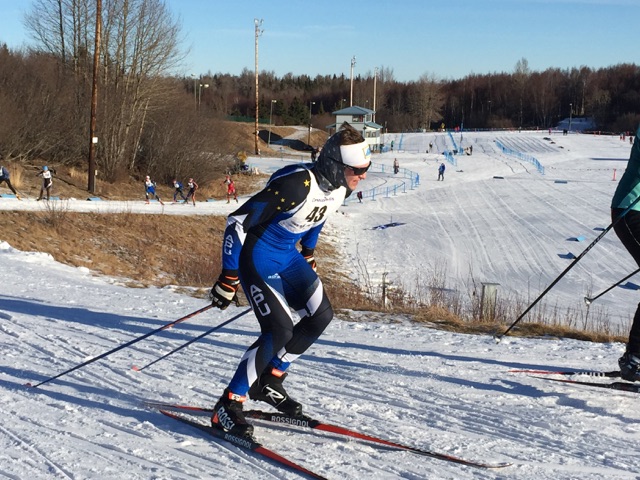
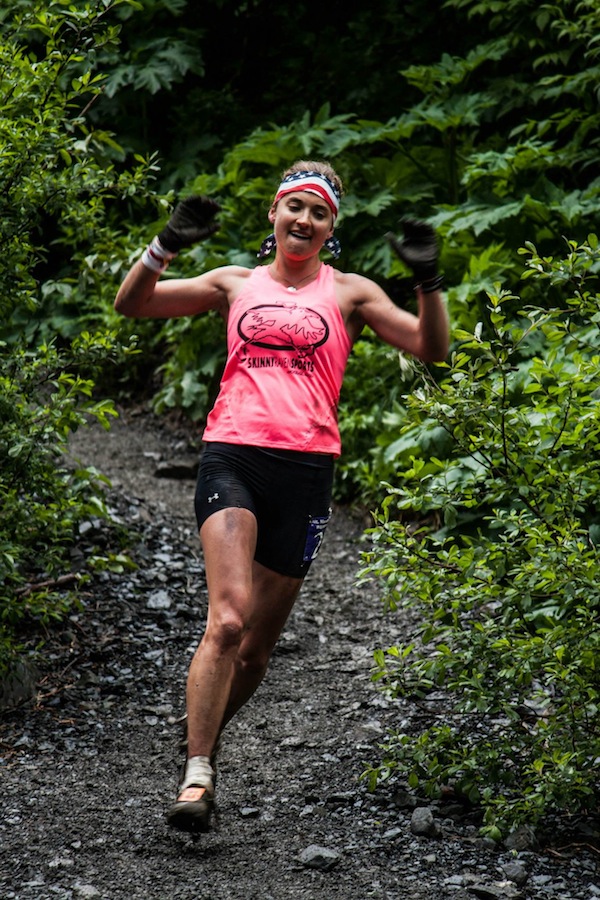
Kikkan Randall leading the 2017 Alaska Run for Women with a smile on June 10. (Photo: Scott Broadwell)A little U.S.-based news to get your Tuesday going:
— Watch out, World Cup, Kikkan Randall is feeling good. The longtime U.S. Ski Team (USST) and Alaska Pacific University (APU) skier took first place in the 25th annual Alaska Run for Women road race, held over Anchorage streets and bike trails this past Saturday. Randall led the field of several thousand women to the finish in 28:41, a pace of 5:44 per mile for the 5-mile, largely flat-road course.
Mid-5:40s for five miles (in June) is nothing to sneeze at on its own, but let’s let the 34-year-old Randall put it in context: “I’m in the best shape of my life now,” she told the Alaska Dispatch News. This is so even though Randall was a few seconds per mile off her previous best on this course, a 28:18 that she clocked while winning this race in 2012. That winter, she went on to win her second of three consecutive Sprint Crystal Globes.
“I’m in the best shape of my life now.” — Kikkan Randall in a recent interview with the Alaska Dispatch News
Finishing just over a minute back for second place on Saturday was recent local high-school graduate and multi-time state track champ Briahna Gerlach, who will race Division I track and cross-country running this fall in the Lower 48. “I didn’t even know it was Kikkan Randall,” Gerlach told the Dispatch News of her competition over the first mile before Randall pulled away. “When I found out I said, ‘OK, she can go.’ She’s crazy. She didn’t even look tired.”
Other skiers in the top 10 included Mandy Vincent-Lang (formerly University of New Hampshire) in third, Becca Rorabaugh (APU) in fourth, and Lauren Fritz (APU) in 10th.
https://www.instagram.com/p/BVLNwkqDp3i/
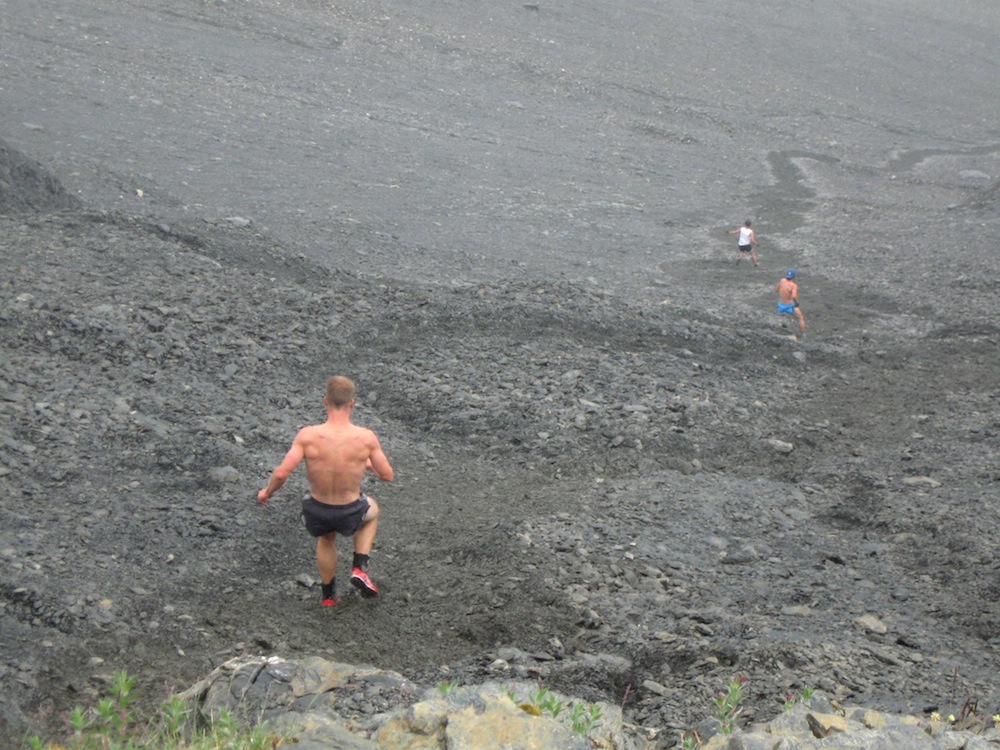
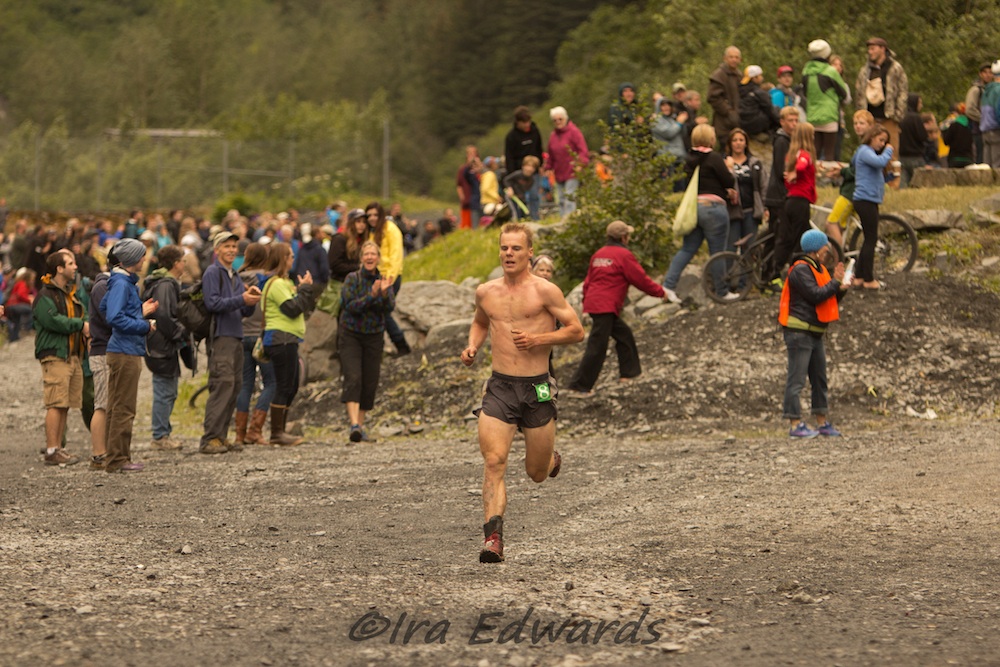
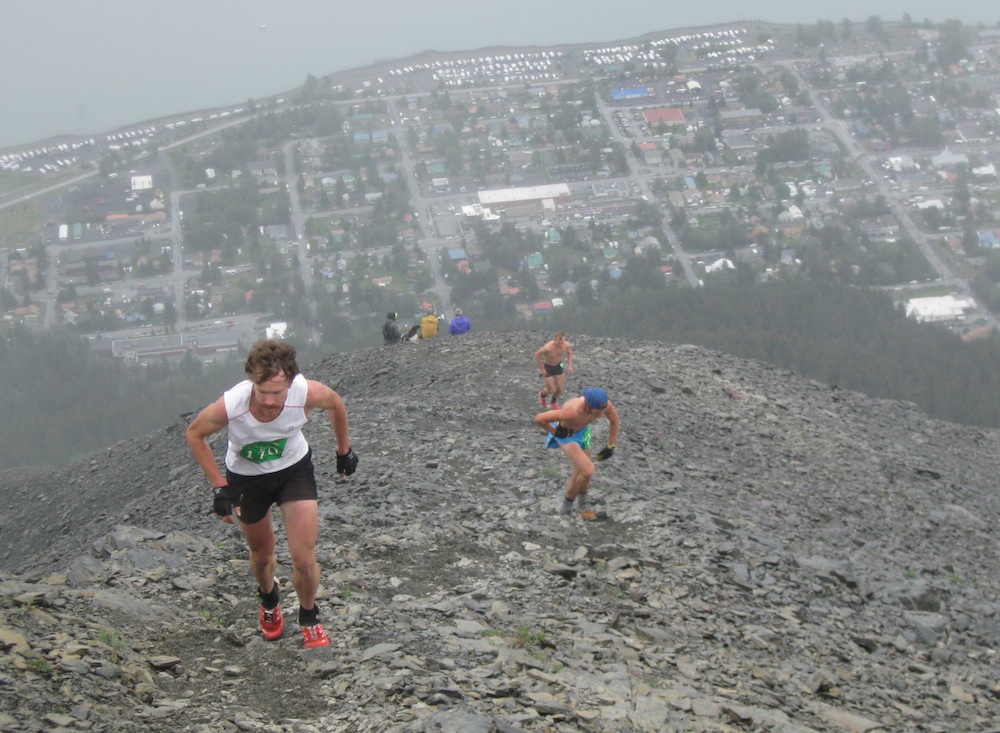
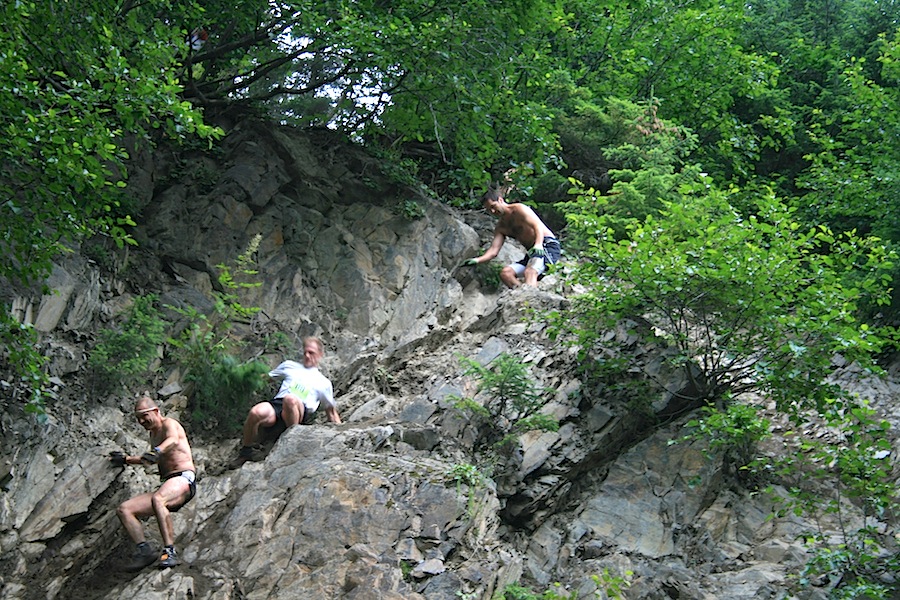
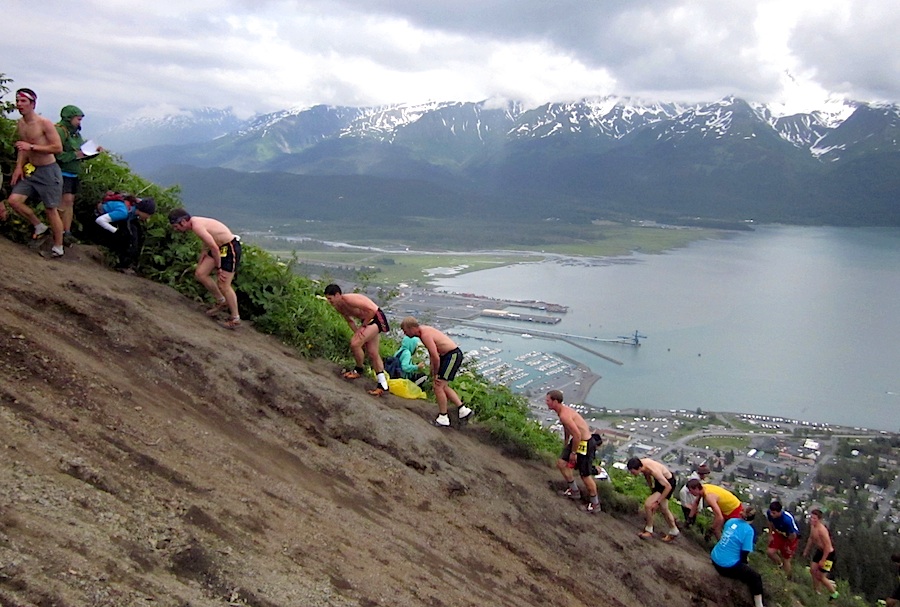
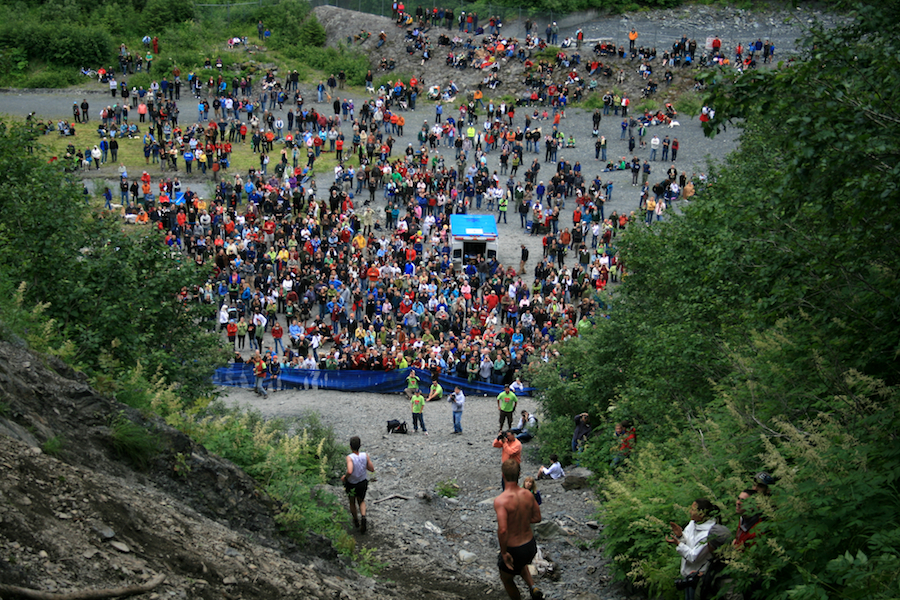
— If it’s summer, the rest of the APU Elite Team must be running up mountains. APU skiers took nearly every race in the seven-stage Alaska Mountain Runners Grand Prix last summer, highlighted by David Norrissetting the course record at Mt. Marathon, the insanely steep climb and descent outside the harbor town of Seward, Alaska, that was first run as an organized race in 1915 and is believed to be the oldest mountain race in the country. (Norris took the record back from Kilian Jornet, a man widely acclaimed as the world’s best mountain runner.)
This summer, they’re at it again. On the evening of Thursday, May 25, Norris took first place in Kal’s Knoya Ridge Run, ascending an uphill-only course in the Chugach foothills on the eastern edge of Anchorage. (Runners had to descend under their own power, but the clock stopped when they crossed the finish line.) Norris weathered an early-summer snowstorm to cover 8.5 kilometers, and 4,500 vertical feet of elevation gain, in 58:08 for a substantial margin of victory. First place among the women went to Jessica Yeaton (APU/Australian National Team).
In a shorter version of the race (5.6 k and 2,900′ of climbing), APU skier Forrest Mahlen was the first across the line. Marine Dusser (formerly University of Alaska Anchorage (UAA), currently affianced to USST skier Erik Bjornsen) was the first woman, less than 90 seconds behind him. Other top-10 skiers included APU junior Maggie Meeds in third, APU junior Aubrey LeClair in fourth, and Jaime Bronga (formerly UAA) in seventh. In the long race, Kate Fitzgerald (formerly APU) was fourth among the women, while Kenny Brewer (formerly University of Alaska Fairbanks) was third and Mark Iverson (formerly APU) was sixth.
— Nine days later, on the morning of Saturday, June 3, it was newly minted U.S. Ski Team memberScott Patterson edging out his APU teammate Erik Bjornsen (also of the USST) by the slimmest of margins, 0.3 seconds, after slightly more than 42 minutes of racing up 3 miles and 3,500′ of elevation gain in the uphill-only Government Peak Hill Climb outside of Palmer, Alaska. “I led the whole thing till maybe a minute to go, then we duked it out as I tried to come up with a little bit of a sprint,” Patterson told the Alaska Dispatch News after the race. “With three feet to go, Erik would have won. Even with two feet to go. He seemed to stumble a little when it was down to one step and I got him.”
APU junior Hamish Wolfe was 8th.
Dusser once again took the victory in the women’s division, in a time that would have placed her 12th among the 105 men in the field.
— So who’s still skiing? More people than you might think, thanks to an epic winter in the western U.S. that brought dozens of feet of snow to the High Sierra and has the Squaw Valley alpine area making noises about running at least one chairlift all summer long. For example, here’s fresh grooming (!) on the Auburn Ski Club trails on June 6 (!!):
https://www.instagram.com/p/BVBZo3GAt-A/
Here’s Paul Kovacs (Australian National Team) on the ASC trails on the morning of June 7:
Here’s FasterSkier contributor Jon Schafer with a Steamboat Springs Winter Sports Club junior camp, driving up to the nordic trails at Mt. Bachelor in Bend, Ore., in a June 10 snowstorm:
https://www.instagram.com/p/BVKdwcMhDYL/
Finally, farther north, the APU Elite Team arrived at Eagle Glacier earlier this week for their first Glacier Camp of the summer:
https://www.instagram.com/p/BVQYFY1lGOo/
– And earlier this month in Albuquerque, N.M., the University of New Mexico (UNM) announced that athletic director Paul Krebs will retire on June 30. The university’s press release did not indicate a reason for his departure, but the news came two days after the state auditor informed UNM Interim President Chaouki Abdallah that its athletic department would be the focus of a special audit, according to Deadspin.com. The Office of the State Auditor reportedly “received information raising concerns related to athletic fundraising activities and expenses of the University of New Mexico.” Krebs, who was UNM’s athletic director for 11 years, was criticized for spending nearly $65,000 dollars in taxpayer money on a 2015 golf trip to Scotland and was at the heart of the heated proposed discontinuation of the UNM ski team.
* * *
This article has been updated to reflect the correct historical status of the Mt. Marathon Race as believed to be the oldest mountain race in the country, not as “the second-oldest footrace in the country behind the Boston Marathon.”
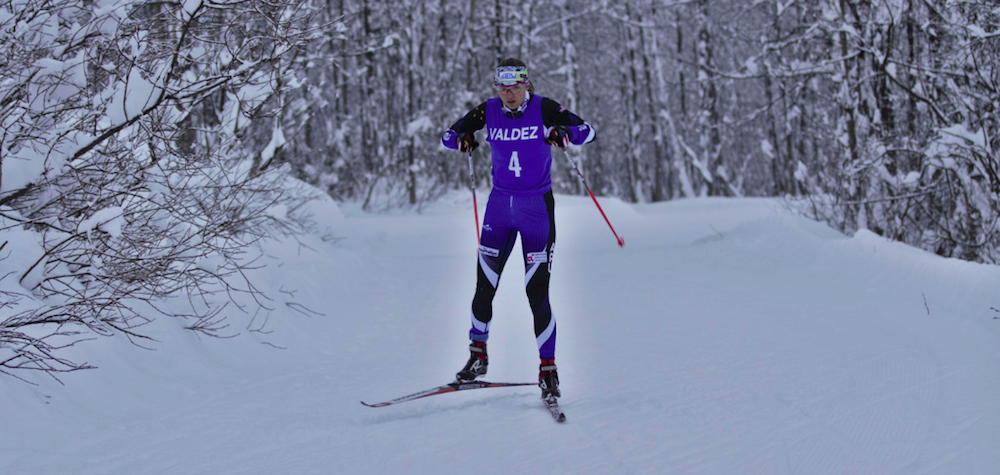
Women’s winner Lauren Fritz (APU) races in the 15 k freestyle in the Qaniq Challenge in Valdez, Alaska, Jan. 14, 2017. (Photo: Calvin J. Fifarek)
VALDEZ, Alaska — Official Winter Storm Warnings for the state of Alaska are graded on a curve. In Fairbanks, which has a relatively dry winter climate and low snowfall totals, a forecast eight inches of snow in 24 hours are required before the National Weather Service (NWS) will issue a warning. In moister maritime Anchorage, that figure becomes 12 inches in 12 hours. But in Valdez, world-famous for its deep snowfalls and epic backcountry skiing in the Chugach Mountains, the standard is a full 24 inches in 12 hours before a warning will issue. It’s forecast to snow 18 inches before noon? Three feet by the end of the day? NWS doesn’t want to hear about it.
All of which is to say that it was snowy in Valdez over the weekend for the third-annual Qaniq Challenge, but not historically so. Like, it only snowed roughly eight inches during the day on Friday, 14 inches Friday night, a few more inches Saturday, six or eight more inches on Saturday night into Sunday, and another foot or so on Sunday through Monday.
Paul (PK) Kovacs of the Australian National Team and Lauren Fritz of Alaska Pacific University (APU) romped through the fresh snowfall to pick up victories in the third-annual Qaniq Challenge, a two-day, roughly 35-kilometer total classic and freestyle race series. Notably, first place earned each of them $2,000 dollars, the second-richest prize in domestic cross-country skiing, behind the American Birkebeiner. The Qaniq’s total purse, $10,000, also trails only the American Birkie.
The Qaniq, whose name comes from the Alutiiq word for “falling snow,” has been held in a variety of formats during its three years of existence. This year’s race saw a 15.7 k freestyle individual start on Saturday, followed by an 18.6 k classic pursuit on Sunday. First racer to cross the finish line on Sunday wins.
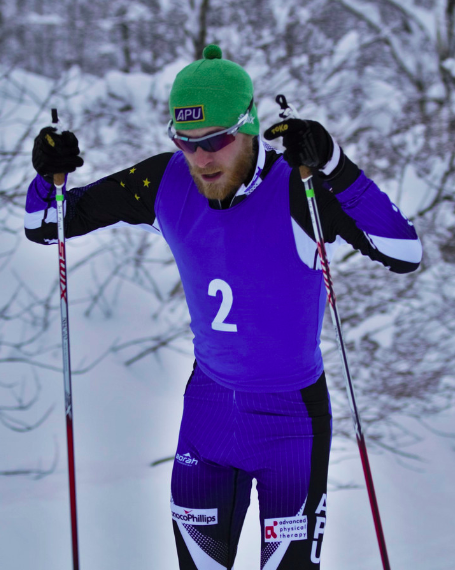
Men’s second-place skier Jack Novak (APU) races in the 15 k freestyle in the Qaniq Challenge in Valdez, Alaska, Jan. 14, 2017. (Photo: Calvin J. Fifarek)
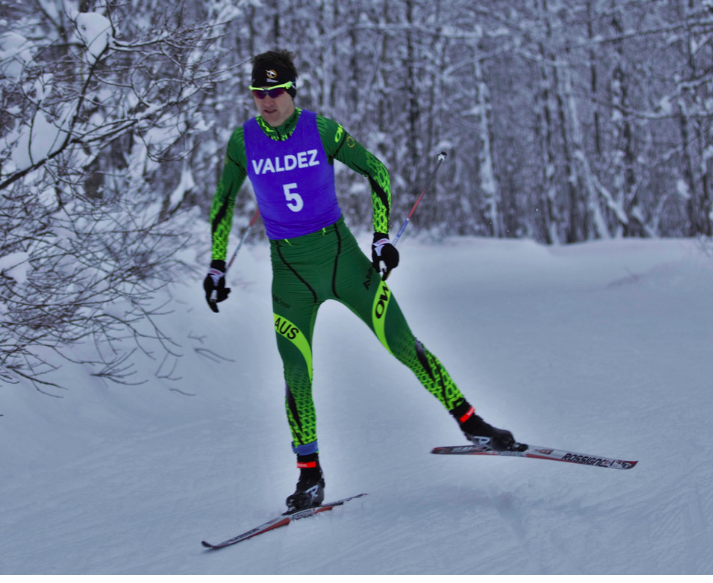
On Saturday, that racer was Kovacs. The Australian national, who lives and trains in Anchorage but is a member of the Australian National Team, started in bib 5, 90 seconds behind APU skier Jack Novak and a minute behind APU skier Andre Lovett. But roughly 16 kilometers later, it was Kovacs who was the first to return to the starting area plowed out of the 14 inches of fresh snow near the Coast Guard Housing on the western edge of a residential Valdez neighborhood.
Kovacs’s time for 15.7 k was a laborious 46:51.7. Novak (+2:11.7) and Lovett (+5:04.2) followed.
In the women’s division, Fritz (APU) skied to victory in 55:51.7. Kate Backstrum (citizen racer, formerly of Montana State University) in second (+5:49.5) and Krista Heeringa (citizen racer, formerly of University of Alaska Anchorage) in third (+7:57.3) made up the rest of the Day 1 podium. Fritz started somewhat ahead of them in bib 4, then skied by herself for nearly the entire course.
Saturday’s race was not easy for anyone, as a snow/rain/sleet mix falling on top of nearly two feet of recently groomed fresh snow, and temperatures around 34 degrees Fahrenheit with close to 100-percent humidity, made for slow going no matter how many fluoros were applied. Kovacs’s winning time on Saturday, for a 15.7 k skate race including 9 k of pancake-flat trail, was nearly 47 minutes. The previous month, at a Besh Cup race in Anchorage, he covered a much hillier, International Ski Federation (FIS)-certified 15 k course in 37:15. Last year he skied a World Cup 15 k in 39:10. Novak, in second, clocked a 35:40 for the Besh Cup skate, and a 49:03 in Valdez. Saturday was slow for everyone.
Sunday brought somewhat less fresh snow, down to eight inches or so (plus more falling during the race), but more of the same on the results sheet, as both Kovacs and Fritz maintained their lead in the classic race to win the overall title.
Novak had the fastest time on day on Sunday, pushing through the fresh snow in the classic pursuit start to finish in 56:52.0, 16 seconds faster than Kovacs. Lovett (+2:32.1) was again third. Those margins were not enough to change the overall podium based on combined times for both races: first Kovacs, then Novak (combined +1:55), then Lovett (combined +7:20).
Sunday was once more all Fritz in the women’s race. The APU skier fought through jetlag and energy issues to ski the classic race in 1:06:12.4. Backstrum (+5:31.9) and Heeringa (+11:24.7) again followed. The final podium was the same: Fritz, Backstrum and Heeringa.
If it’s Saturday, this must be Valdez
Despite Fritz’s large lead throughout the weekend, she never felt that her victory was guaranteed. Fritz had raced in China from Jan. 1-9, completing six races in nine days. Then she played tourist in Beijing for a few days. Then she made the not-short trip back to Alaska, arriving at the Anchorage airport at 4 p.m. on Thursday. Then she woke up on Friday and drove more than 300 miles to Valdez.
“I literally hadn’t skied in almost a week,” Fritz told FasterSkier of Saturday’s race.
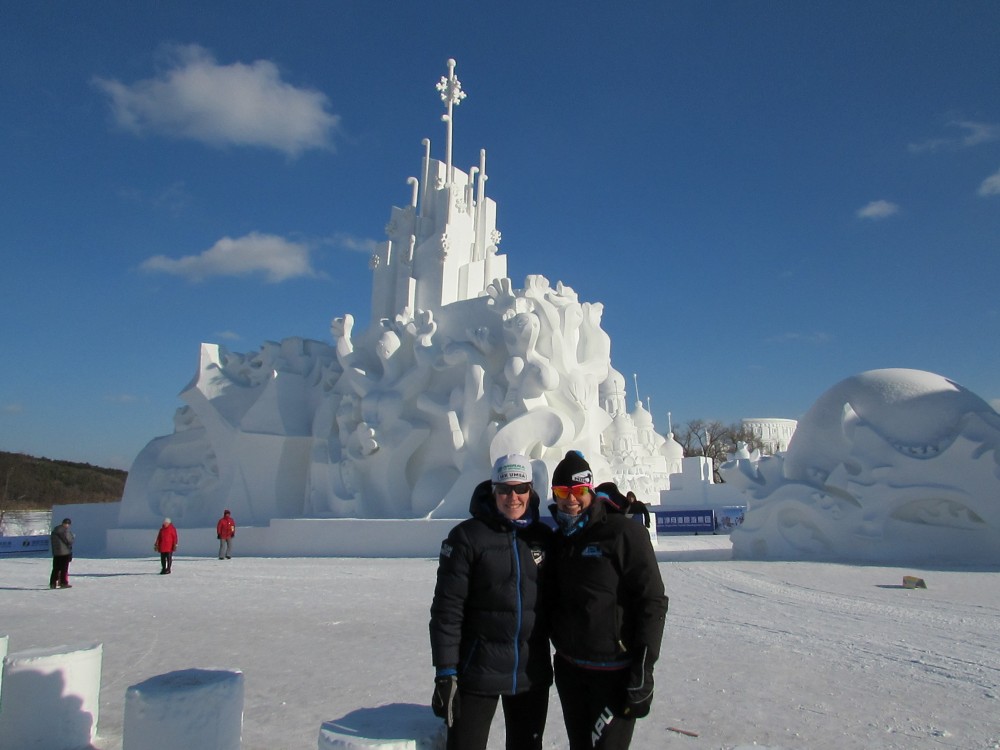
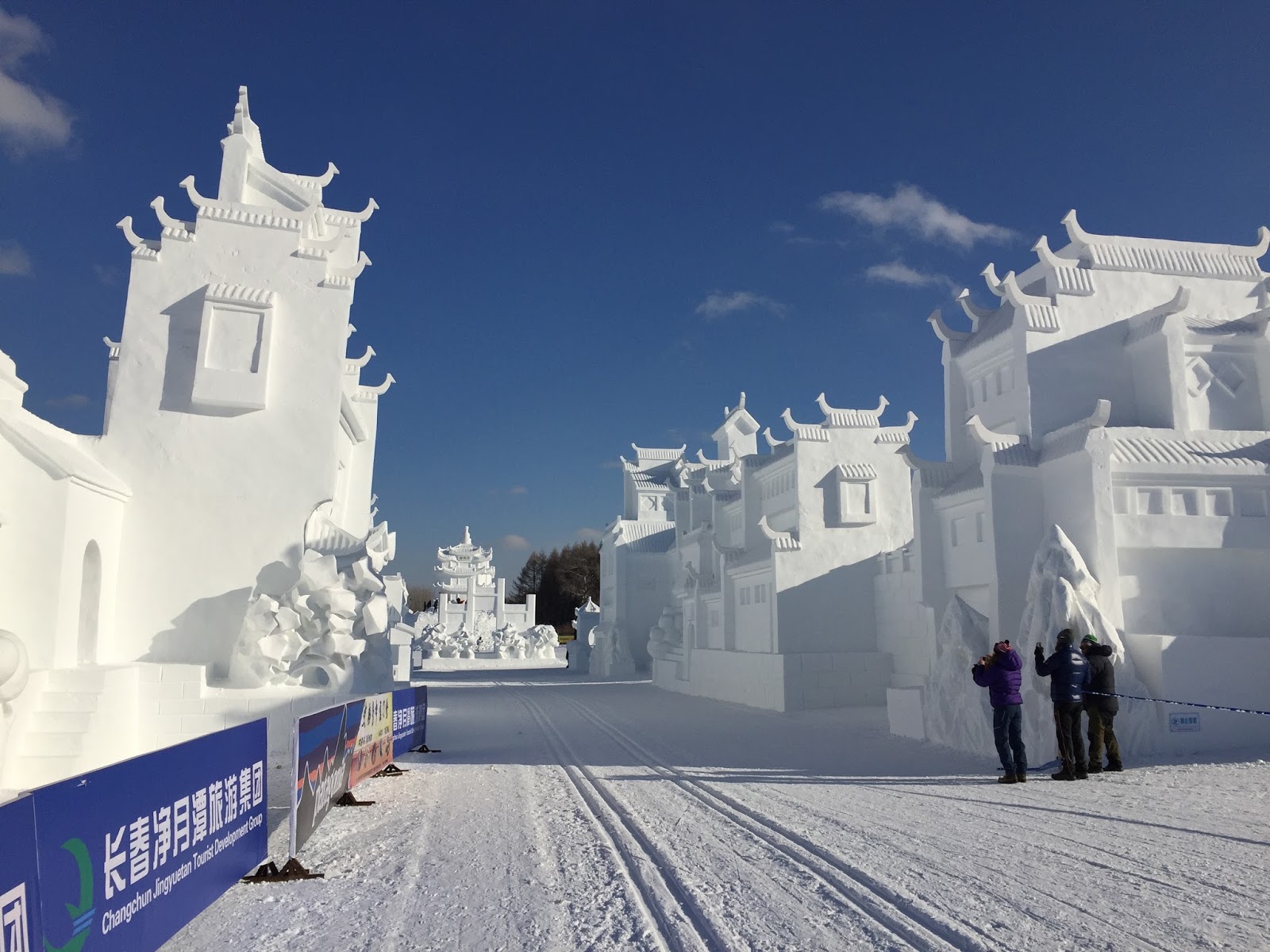
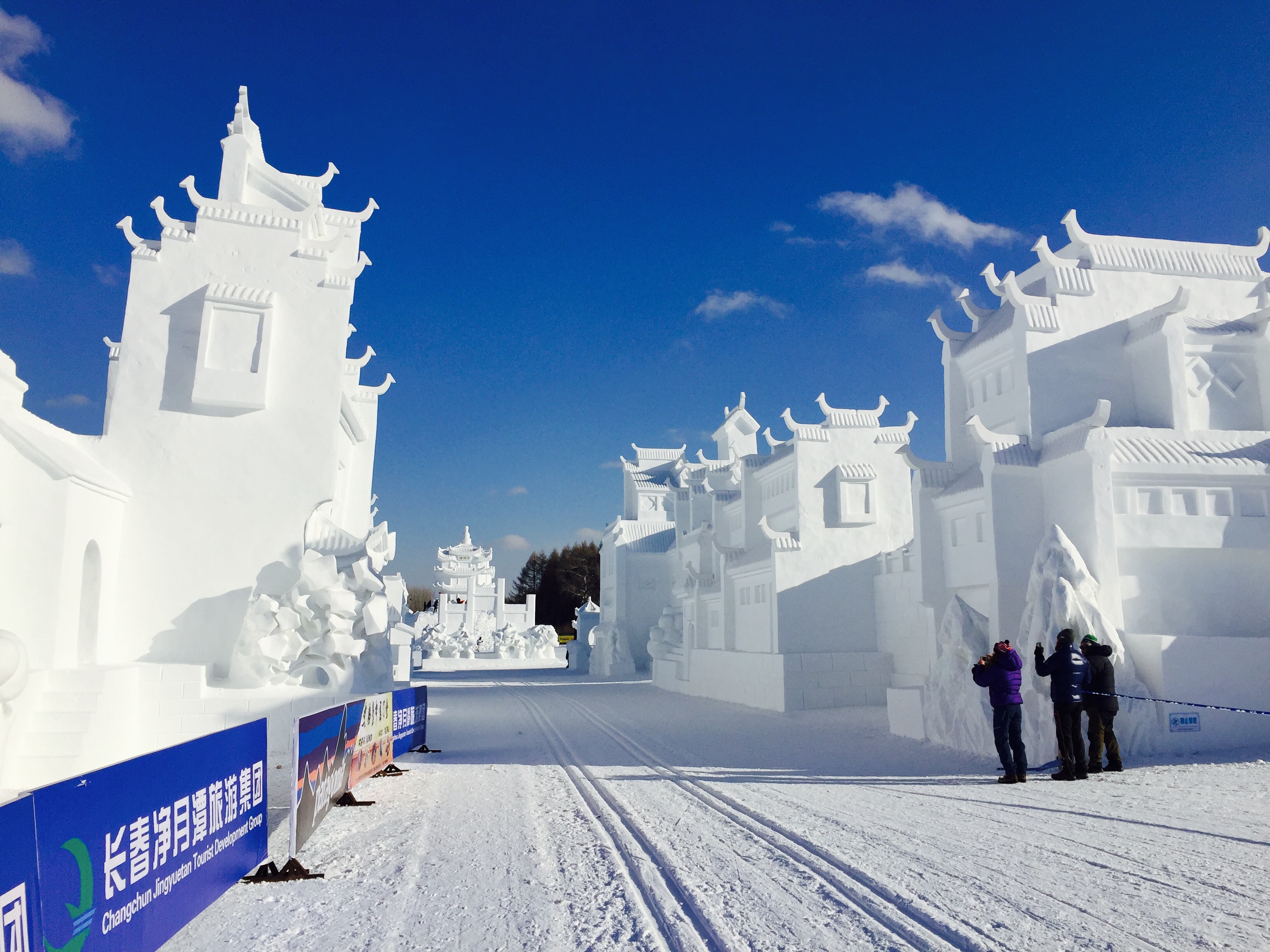
Swedish skier and former University of Vermont athlete, Linda Danvind-Malm (l) and American Lauren Fritz (APU) stand in front of one of the many snow castles that line the lap lane to the 50 k classic Vasaloppet marathon during the 2016 China Tour de Ski in Changchun. (Photo: Lauren Fritz)
“I think my last race in China was like the 9th, which would have been the 8th here, and then after the race I spent a few days in Beijing, touring around, being a tourist, and didn’t run, didn’t ski. Didn’t have time when I got home. So literally [Saturday] testing skis, warming up was the first time I had been on skis or worked out in a week. And then with the delayed start, that kind of sucked, because I got kind of cold again. And I started, and I felt like I flooded on the first hill that was 500 meters out of the start, so I thought it was going to be a really, really rough race. But I think just having really good base fitness helps you keep it together.”
Base and experience and a six-minute lead notwithstanding, Fritz was taking nothing for granted on Sunday. Not in some Bill Belichick coach-speak sense of anodyne platitudes about taking all competitions seriously and not celebrating too early, but rather in the very real sense that her international travel schedule and recent nutrition issues left her honestly concerned about her ability to complete a flat 18 k double pole course.
“Don’t pass out on the side of the trail,” a relieved-but-tired Fritz said after Sunday’s victory. “That was pretty much my only strategy, because I was actually legitimately worried about something like that. Because I’ve been super low energy, because I lost a lot of weight in China, because it was like hard to eat a lot of stuff. So my energy stores are probably very much in a negative balance. So it was a legitimate concern, running out of energy, just falling over. But that didn’t happen.”
Fritz was able to complete Sunday’s race despite a second day of challenging conditions – with two minutes between her and the preceding racer in the pursuit start, enough snow would fall in those two minutes to make it difficult to discern which track the leading skiers had taken – and the effects of international travel.
“I definitely go through periods during the day where I get really, really tired and kind of, almost like dizzy and spacey, just really out of it,” Fritz said. “And then there will be like times in the middle of the night where I wake up wide awake for a like a couple of hours. So, this is definitely some pretty severe jetlag, I think.”
While the jetlag was pronounced, Fritz was unphased by Friday’s 300-mile drive to get to the race start.
“The, like, 5 1/2 hour drive from Anchorage to Valdez was – well, we did two five-hour drives, a 16-hour drive, and a 10-hour drive in China,” Fritz recounted of her recent travels for the China Tour de Ski. So “this was like pretty easy. It went by fast.”
(Men’s second-place finisher Novak went from China to Anchorage to Valdez on the same schedule. Novak’s father drove him from Anchorage on Friday, while Novak fils slept the whole way.)
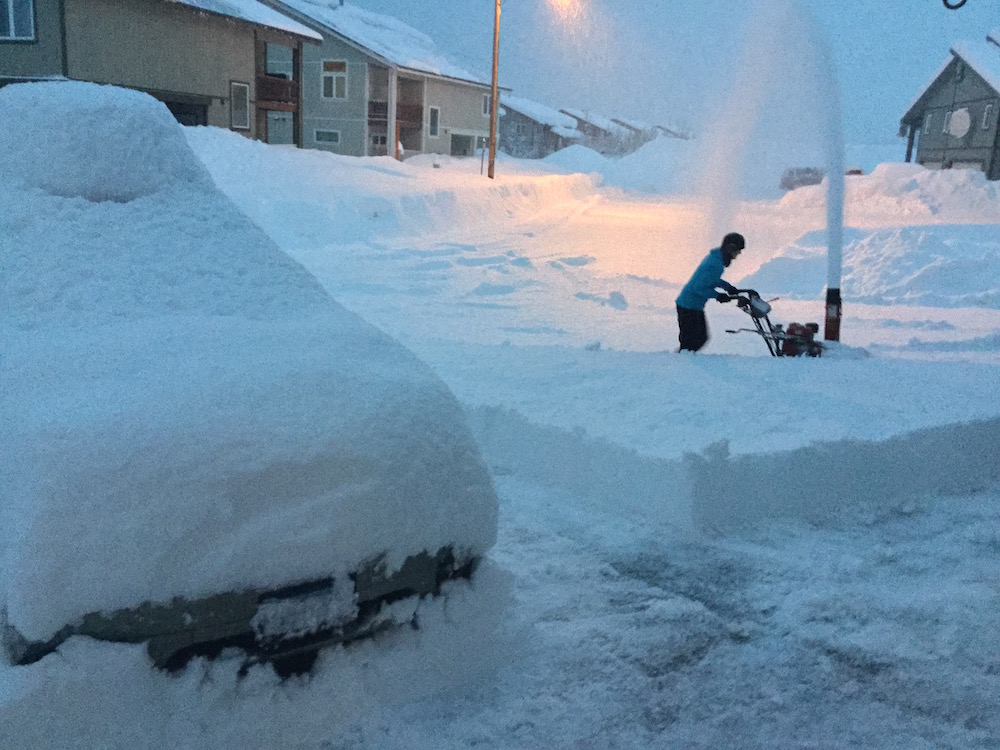
This used to be a rocket box: digging out on Saturday morning after 14 inches of snow fell overnight in Valdez, Alaska, in January 2017. (Photo: Gavin Kentch)
Fritz is the only skier to make the podium in all three years of the Qaniq Challenge, logging a cumulative first, second, and third since 2015. That’s $4,000 combined lifetime winnings from this race, including $2,000 this year.
So what does it mean for an American skier to win $2,000 in a ski race?
“It’s pretty big money,” Fritz said. “It’s more than a national championship. So that’s sweet. I mean, it’s such a cool race; I really hope that it can grow over the years.”
For Backstrum, meanwhile, a thousand dollars for second was apparently going to aid her with more quotidian concerns. “It feels like I have a good amount of beer money now,” Backstrum joked. “No,” she continued, “I didn’t get my PFD this year, so it will be a nice replacement.”
(The reference is to the Permanent Fund Dividend check, the payout given to all eligible Alaskans representing their share of the state’s sovereign wealth fund.)
Backstrum had graduated from Montana State in 2014, and had trained sporadically since then. “This was a good inspiration to start training again” for ski racing, she said.
For Kovacs, who also earned $2,000 for his victory in the men’s race, the cash prize was “huge.” It marked “the biggest paycheque I’ve ever received in any ski race,” Kovacs said. “It’s really helpful. I mean, that’s like four months’ rent back in Anchorage, or that will pay for all my flights to Europe and all my other flights in Europe for the season this year, which is just massive. So it’s a big help.”
Kovacs surveyed other races in which he had won money, and concluded that he had not quite won $2,000 in all other races in his career combined. “Maybe,” he said. “Probably just under. So this has probably, like, doubled my entire career earnings.”
The payout came in a race that Kovacs nearly did not enter. He had done some of the races at last week’s U.S. nationals, leaving Utah on Wednesday and returning to Anchorage only at 5 a.m. Thursday.
Men’s winner Paul (PK) Kovacs (Australian National Team) races in the 15 k freestyle in the Qaniq Challenge in Valdez, Alaska, Jan. 14, 2017. (Photo: Calvin J. Fifarek)
“I then picked up Lauren [that afternoon],” Kovacs said, “And she said, ‘Hey, I’m going to go to Valdez,’ and I said, ‘OK, well I guess I’ll come.’ Because up until that point I wasn’t even coming. I had originally planned to just have a few days at home before I fly to Europe. … It was a very last-minute decision, and we kind of just got up the next day, after doing a bunch of washing the night before, and just packed gear and went.”
Kovacs and Fritz have been an item for some time; on this trip, Kovacs was the more functional of the two. “I’ve been holding it together pretty well,” he said. “I’ve managed to get a lot more sleep than Lauren has. I know that Lauren’s been up at like midnight, and a few hours in the middle of the night the last few nights. But I definitely took a couple naps, for sure. We’ve been holding it together all right, but it’s definitely like, once we’ve finished today and tonight I think we’re going to take it easy for the next few days.”
“This has probably, like, doubled my entire career earnings.” — Paul (PK) Kovacs on his 2017 Qaniq Challenge victory
But not for too long – Kovacs flew to Europe today, for two weeks of training in Falun. He had World Cup starts lined up after that across Europe and Asia (Falun, Pyeongchang, and Otepää) before planning to race World Championships in Lahti.
Back in Alaska, Kovacs found conditions for Saturday’s race “really challenging. I mean, we’d had a lot of fresh snow, almost two feet of fresh snow. And they’d done a fantastic job to pack it and groom it, but it still was pretty aerated pack, so it was pretty spongy. And then we’d had almost torrential rain on top. And so it was just kind of that mashed potato sludge.”
Despite the trying conditions, Kovacs said, “I was fortunate, I had some really solid skis, and maybe coming from altitude … I was able to really attack it a lot harder, I think, than the other two guys. Who also had I think pretty bad skis.”
In a gracious gesture, following Saturday’s race Kovacs formed “a gentleman’s agreement” with the two APU skiers immediately behind him, “and they all came over and waxed the same wax at my house, which was good.”
Kovacs didn’t want to claim too much credit for nailing the wax on Saturday, saying, “Honestly, it wasn’t like I was a mastermind and figured it out.” (He then explained that he and Fritz had, in their jetlagged state, packed “just one or two” warm waxes, making their options easy to work through.)
Rather, Kovacs credited his grind, a Caldwell VDF, which he called “exceptionally good – that’s a chevron grind, and it was able to, I think, flush out the liquid in the snow much easier.”
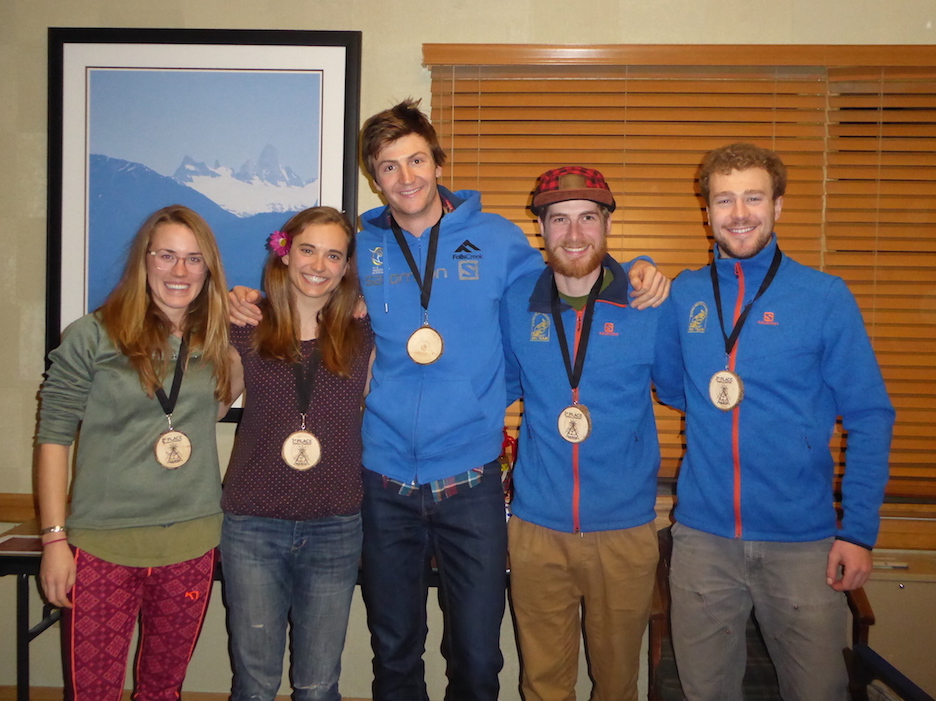
The overall podium for the Qaniq Challenge in Valdez, Alaska, in January 2017: left to right, Kate Backstrum (former Montana State University), Lauren Fritz (APU), PK Kovacs (Australian National Team), Jack Novak (APU), Andre Lovett (APU). (Photo: Gavin Kentch)
Kovacs’s approach for Sunday, when he had a two-minute lead in the pursuit, was simple: “Basically the strategy was to go out as hard as I could. … With double poling you don’t quite blow up, or I find I don’t blow up, aerobically so much as my arms just blow up. And so I just wanted to see how hard I could go.”
Being the first starter was disadvantageous in the fresh snowfall, but Kovacs benefited from a snowmachine that passed through moments before the race began, creating a firmer and less snowed-in platform than in either of the two set classic tracks. “My strategy was just to try and find fast snow,” Kovacs said, “And luckily a snowmobile had driven out some volunteers, and so I just skied on that.”
Kovacs appreciated the chance to see Fritz during one of the loops of the course.
“In a race like this, I definitely think about how Lauren is doing. I definitely was curious to see what was going on, and even just the fun things like racing against the master skier, and seeing how they’re going, because you know they knew each other, and how that was going duking it out, that’s fun. In other races I normally wouldn’t consider it; I do really try to just focus on my own race. But I guess in this race, because it just has more of a relaxed atmosphere, I let myself just think about other things a little bit more. So yeah, I was definitely curious to see how she was going. I mean, being so far out there, if you break a pole or lose a basket it’s a complete game-changer compared to a normal FIS race, where there’s a lot more people on the course that are able to give you equipment. So there’s more variables I guess here.”
Looking to the future
The Qaniq is universally beloved by those skiers who have made the trip to Valdez to race, reflecting quality organization and overwhelming community embrace of the event. But not that many skiers have made it: 31 in 2015, 37 in 2016, 33 this year.
So will there be a fourth year? Maybe. Hopefully. Not certain. Race organizer Darryl Verfaille is nothing if not optimistic.
The status of next year’s race is “truly undecided,” Verfaille told FasterSkier at the Sunday awards banquet, “but I’m going to do everything I can, even if I have to morph the format a bit. And we’re going to reach out – I’m going to do everything I can, including maybe seeking some external sponsors, maybe fundraisers. Some may change again with the political winds of Valdez, come next election, but I think we’ve got the city itself – the executive staff of the city of Valdez is in favor of this, because they recognize the true value, which is just exposing folks to Valdez in the winter. So I can’t say for sure we’re going to have it, but I’m going to do everything I can to make it happen for the fourth year.”
Both Fritz and Kovacs addressed the room at the awards banquet in brief unscheduled remarks, praising the race organization and experience and hoping for its continued success.
They also expressed similar sentiments in their comments to FasterSkier. “I think it’s a great race, and I hope they can keep it going,” Fritz said.
“It’s an extremely fun event,” Kovacs echoed. “And I heard next year with U.S. nationals being in Anchorage that a lot more people will make the choice to come down here and really give this race kind of what it deserves. Because the volunteers put in a phenomenal effort, and it’s probably one of the best atmospheres of any race I do anywhere in the world. It just is really fun, and people should get involved.”
The trip home
Back in Valdez in January 2017, the APU skiers and Kovacs spent Monday morning after the race conducting a free clinic for the Valdez High ski team. The remainder of the field began their journey home on the only road out of town, where they were treated to an official NWS Blizzard Warning for their drive home through Keystone Canyon and Thompson Pass, including another 12 to 18 inches of snow and winds to 40 miles per hour. In a bit of meteorological ecumenicalism, the criteria for a blizzard warning (snow reducing visibility to less than a quarter-mile and winds gusting to 35 mph for four hours or more) are the same throughout the entire country.
Snow sculptures in the stadium in Changchun at the 2016 China Tour de Ski. (Photo: Holly Brooks)
Note: Alaska Pacific University skier Skyler Kenna, 21, will also be racing the 2017 China Tour de Ski. FasterSkier learned of Kenna’s participation after publication.
****
Be a ski racer, see the world. That’s the approach of a pair of Alaska Pacific University (APU) skiers Jack Novak and Lauren Fritz, who leave for Asia later this week to race in the China Tour de Ski, set to begin in Changbaishan on Sunday, Jan. 1.
Novak has never been to Asia before, and has yet to ride a camel on any continent. Fritz competed in the race series for the first time last year, and has skied on five continents. Both athletes are at a point in their ski career where they are seeking experiences more than SuperTour points or championship team selection. Some prize money wouldn’t hurt, either.
The China Tour de Ski marks its 10th anniversary this year, which makes it only one year younger than the “other” Tour de Ski that begins in Val Müstair, Switzerland, this Saturday, Dec. 31. Prior versions of the Chinese Tour have featured a sprint on trucked-in snow inside the Bird’s Nest stadium built for the 2008 Summer Olympics, stage races across China and inner Mongolia, long bus rides, and a lot of photogenic camels.
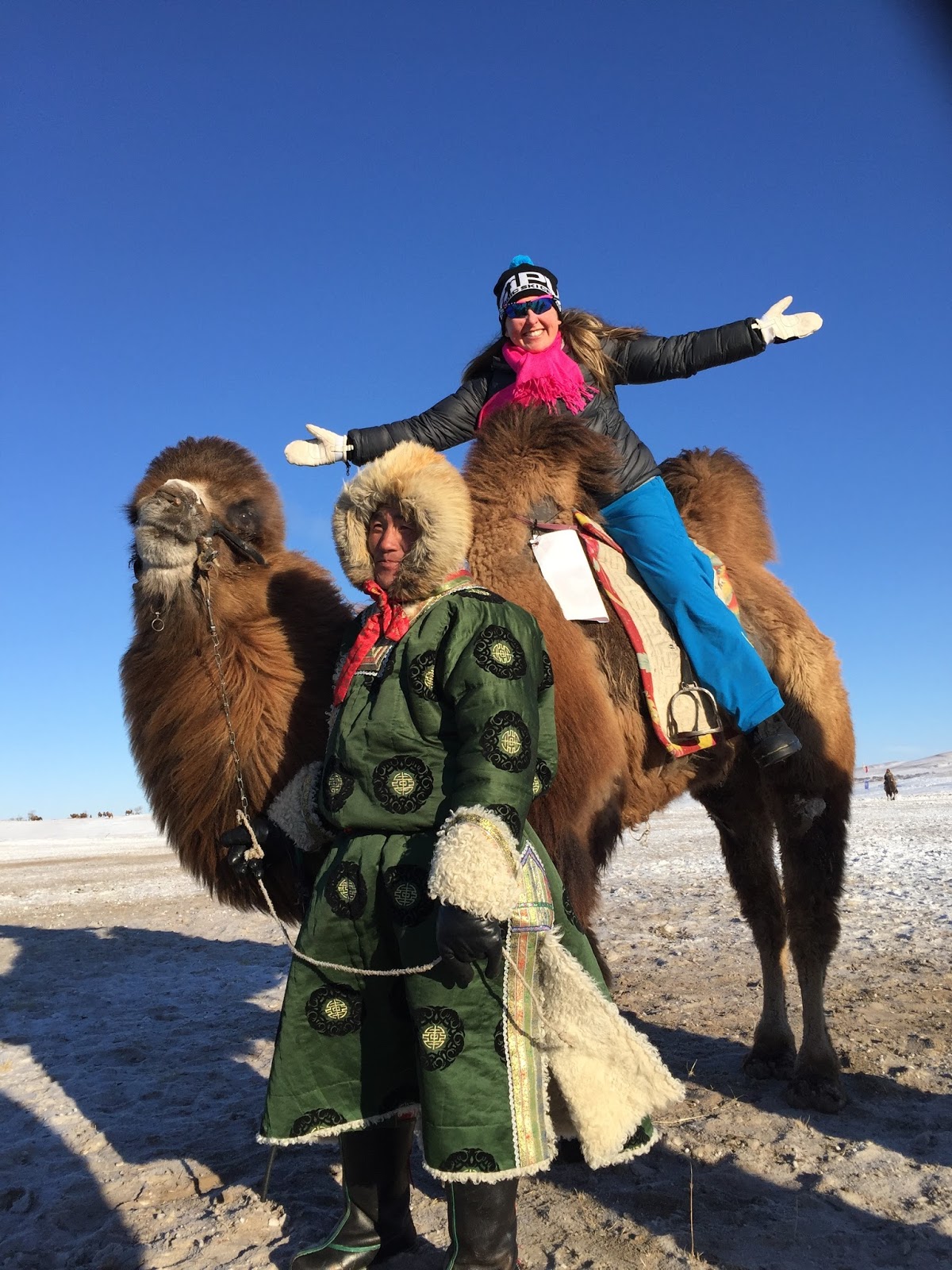
Holly Brooks (retired, APU/U.S. Ski Team) rides a camel during the 2016 China Tour de Ski. (Photo: courtesy Holly Brooks)
American skiers who have previously participated include Fritz, Peter Kling and Holly Brooks, all currently or formerly of APU; Ryan Scott, formerly of Ski & Snowboard Club Vail/Team HomeGrown; and former U.S. Ski Team member Torin Koos. They have consistently reported genuinely warm welcomes and intriguing cultural experiences.
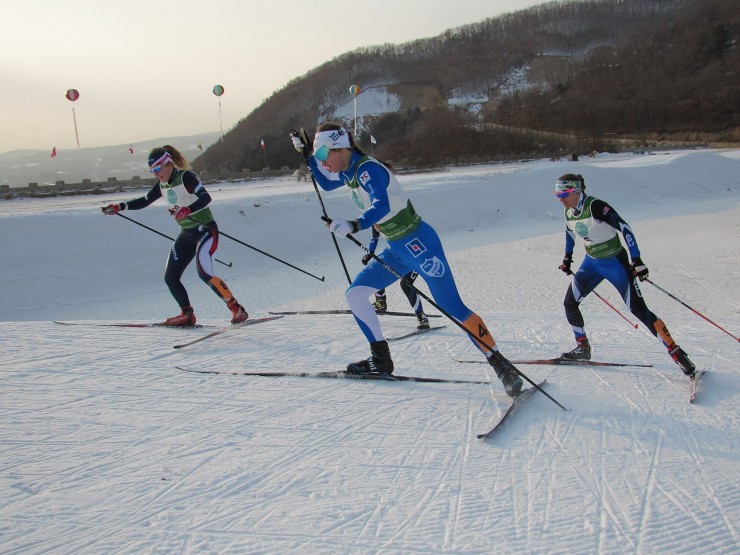
This year’s Tour takes racers through six stages over nine days across a wide swath of the country. (Changbaishan to Beijing is a 13-hour drive.) It’s heavy on the skate sprints: a full four out of six stages (Stages 1, 2, 5, and 6) are freestyle sprints. In the middle, Stage 4 is a prologue to short distance skate mass start race, 3.8 kilometers for the women and 5.7 k for the men.
And Stage 3 is the Chinese Vasaloppet, a classic marathon now in its 15th year. Last year, the Tour de Ski racers covered the whole 50 k distance, with Brooks and Fritz on course for 2:44 and 2:51, respectively. This year’s Tour racers will participate in “a modified course and a shorter total distance,” though precisely how much shorter is not immediately apparent. The 2017 full-distance Chinese Vasaloppet also marks the third event of the 2016/2017 Visma Ski Classics series.
While many multi-stage tours – the Tour de France, the Giro d’Italia, the original Tour de Ski – operate on a principle of lowest combined time wins, perhaps augmented by time bonuses for top positions, the China Tour de Ski instead applies World Cup scoring based on finishing position. Among other things, this avoids making the person who performs best in the Chinese Vasaloppet (which is much longer than all the other races combined) the de facto champion based on combined time.
Last year’s overall winners were a pair of Swedes, Emil Johansson and Lisa Svensson. Johansson has a World Cup top-30 sprint finish to his name and won the 2013 SuperTour skate sprint in West Yellowstone, Mont., while studying at the University of Colorado-Boulder during the 2013/2014 season. Svensson, who will be competing in her fifth consecutive China Tour de Ski, has never had a podium finish in an International Ski Federation (FIS) race on European soil… but has 17 of them in China.
One American has cracked the overall podium in the first nine years of the China Tour de Ski: Kling was second in 2015. Chinese skiers make up a minority of historic podium finishers in the event, likely reflecting both the nascency of Chinese cross-country skiing (the Chinese National Team was established in 2006) and race organizers’ willingness to attract non-Chinese skiers to their event.
The gravel pit-turned-skate sprint course in Yanji during the 2016 China Tour de Ski. (Photo: Holly Brooks)
When it comes to convincing European skiers to fly across Asia, or Alaskan skiers to fly across the Pacific Ocean, money talks.
To start with, virtually all of the racers’ expenses, including transportation, are covered by the race organizers. As Scott wrote to FasterSkier during the 2015 Tour, the race paid for all of his travel, lodging, and food. “My only expense is $500 Euros to the organizers and paying for bags,” Scott wrote.
On top of that, there’s real money to be made. In this year’s Tour, first through fourth in four of the stages is good for 2,000 to 10,000 renminbi (yuan) per race. (At current exchange rates, 10,000 yuan is equal to approximately $1,400 – or more than the $1,200 prize for first place in any race at next month’s U.S. nationals.) For the Stage 2 sprint, it’s up to 20,000 yuan for the men ($2,800), 15,000 yuan ($2,200) for the women. For the Chinese Vasaloppet, Stage 3, first place takes home 5,000 euros, or $5,200. Plus there are additional prizes for top four in the overall Tour standings, starting with 20,000 yuan for first. (With the exception of Stage 2, all other stages and overall standings feature the same prize amounts between the genders.)
The total prize purse for Stages 1-2 and 4-6, not counting the Chinese Vasaloppet, is 251,000 yuan, or over $36,000. That’s slightly less than the $39,000 purse for the American Birkebeiner, but it’s in the ballpark. Within the world of cross-country ski racing, this is a princely sum. It is roughly to skiing as Russia’s $1.5 million for Diana Taurasi is to women’s basketball, or China’s 60 to 70 million euros for Oscar is to international soccer – eye-opening sums of money paid to entice athletes to a part of the world they might not otherwise consider visiting.
In related news, the Qaniq Challenge will once again pay out a total purse of $10,000 in Valdez, Alaska, next month. Fritz earned $500 for her third-place finish in last year’s race, behind fellow China veteran Brooks in second.
The athletes
Fritz: Rekindling her love of skiing
But for Fritz, it’s not all about the money. The native of Chugiak, Alaska, and longtime APU skier has been a competitive racer for many years, with career highlights that include SuperTour podiums, top-10 national championship finishes, and World Cup starts in Canada in 2012. But in 2015, she wrote, she suffered through “a rough season prior, a summer of illness, injury and just general low-quality training,” and was getting ready to call it a career.
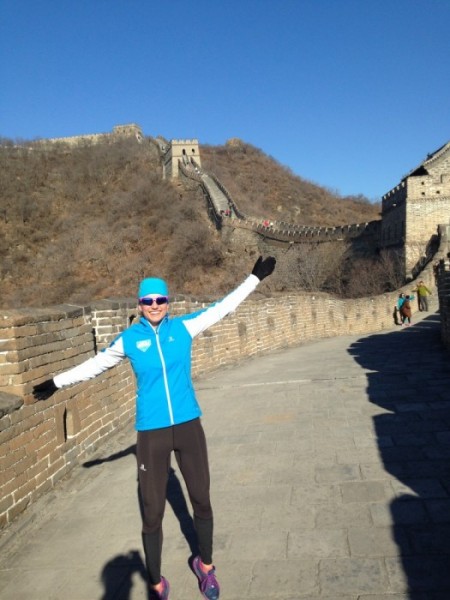
Lauren Fritz (APU) poses for a moment during a run along the Great Wall of China during the 2016 China Tour de Ski. (Courtesy photo)
“I decided I was going to move away from SuperTour racing and do some ski marathons and probably retire [following the 2015/2016 season],” Fritz, 28, wrote to FasterSkier earlier this week during a break from packing. “I was fed up with racing SuperTour, racing poorly and not getting anywhere (figuratively, with my ski career). And I wasn’t having fun anymore. I was so used to being around skiers who are very focused on high level goals and incredibly (unspokenly) competitive that you can lose sight of why you do what you do beyond just a number on a result sheet, especially if you aren’t achieving those results (and I most certainly wasn’t).”
Her inaugural trip to China changed all that.
“Being with the group in China, it was just all about how we got this amazing opportunity and it was simply because we skied,” she wrote. “It reminded me that skiing has taken me so many places and connected me with so many people, and I get to be outside so much, and that was why I love it so much. I came home with a fresh attitude and it really helped boost me mentally and physically.”
Fritz’s enthusiasm is immediately apparent in her answer to a reporter’s question about why she is going back to China.
“Last year’s Tour de Ski China was one of the most fun, unique, and craziest ski trips I’ve ever been on,” she wrote. “So it’s more a question of ‘Why not?’ than ‘Why?’ am I going back, which probably makes it obvious why I’m going again. It was low-stress, low-pressure, with high energy, excitement and general enjoyment.”
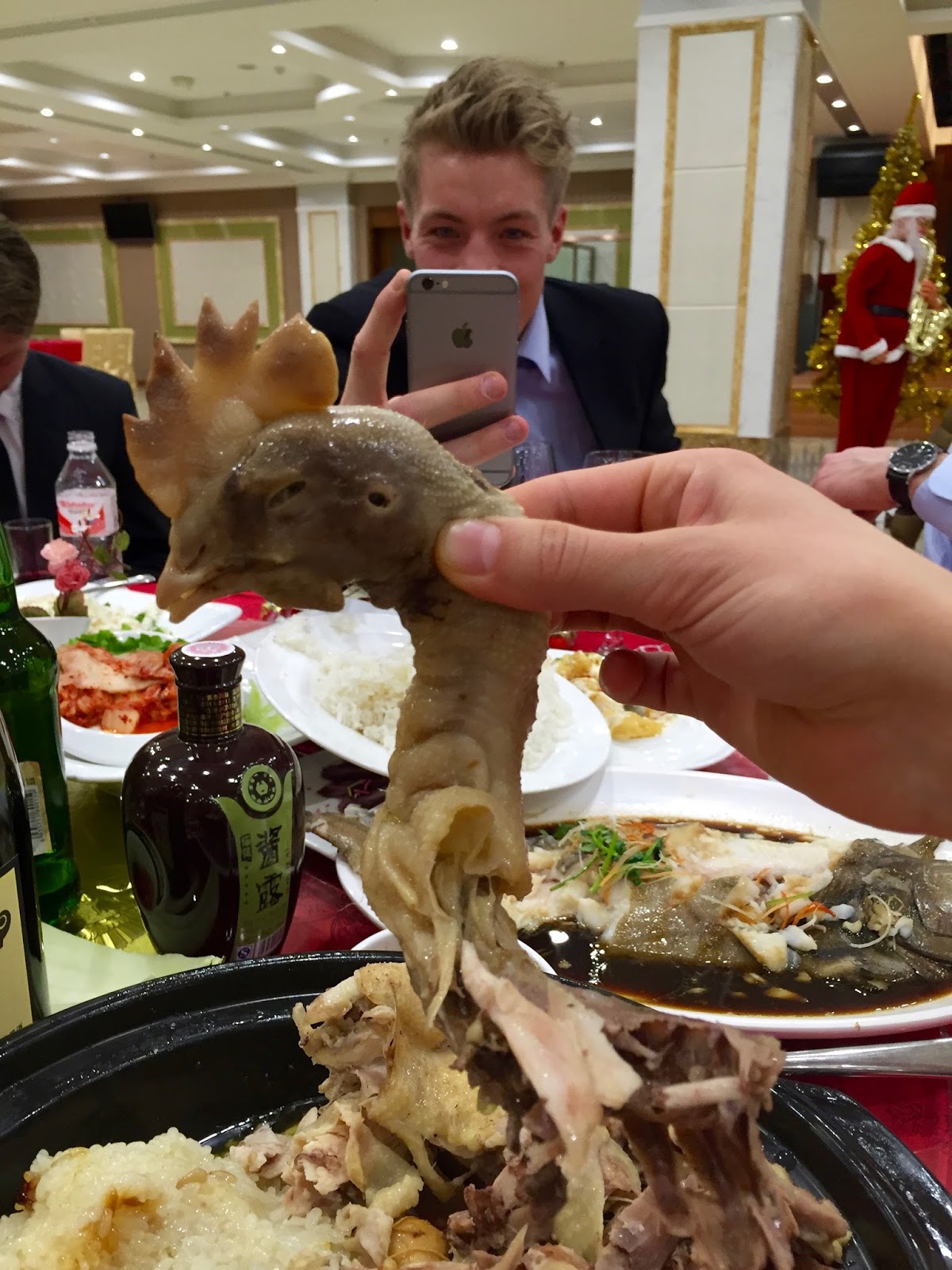
A chicken head featured prominently on the menu during the 2016 China Tour de Ski. (Photo: Holly Brooks)
“Everyone on the trip was there primarily for the experience of being in China and seeing cool new places with the added bonus that we got to do some ski races,” Fritz enthused. “I mean, how many ski races have you been to where you have to squat over a board over an open pit in a communal poop shack, and get handed a can of random Chinese ‘RedBull’ and a personal size bottle of Chinese spirits, cross a finish after skiing through a literal snow castle city, and be treated afterwards to a show and a table full of food you don’t recognize but eat anyways… Oh, and get to go for a hike on a Great Wonder of the World [the Great Wall of China] after the last race?”
Fritz continued, “Everyone’s attitude was more geared towards having a great time and experiencing what China had to offer than doing well in the races, and that gave it a more relaxed feeling. Not that people didn’t take the races seriously, they/we certainly did because there was money on the line! But once the bib came off, it was about having fun. The group we had was amazing, everyone was fun to hang out with and easy to get along with, and we had a great time. Not often is two straight weeks of living and traveling with a big group like that so easy and enjoyable.”
“Last year’s Tour de Ski China was one of the most fun, unique, and craziest ski trips I’ve ever been on. … It was low-stress, low-pressure, with high energy, excitement and general enjoyment.” — Lauren Fritz, APU skier
While she is largely going back for the experience, Fritz is not above hoping that, in a virtuous cycle, the improved training she was inspired to do following her trip to China last year will translate to better results this year.
“This year I definitely want to get some podiums,” Fritz wrote. “I had two 4th places last year, so I’d like to improve on that! I think it’s possible to be on the podium a few times if I ski the way I know I can right now with my fitness level. (Read: Fitness level waaaay better than last year, ha!)”
“Pretty much, the TDS China is my season,” she concluded. “As I said, I was going to retire after last year, but I kind of felt rejuvenated and wanted to keep training pretty much just so I could go back to China this year! I will still do some races later in the season, but China is definitely top of the priority list.”
Novak: Looking for adventure and an inaugural camel ride
Jack Novak (APU) during a SuperTour race in West Yellowstone, Mont., this month. (Photo: Forrest Mahlen)
Novak, 23, from Anchorage and also a longtime APU racer, finds himself in much the same boat as Fritz – underwhelmed by his recent performances, and looking for a low-stress adventure to mix things up.
“I decided to go on the Tour de Ski China because I was looking for a change of pace after the past couple of years of injuries,” Novak wrote to FasterSkier. “I am not in a place where I am racing for a World Champs start spot, so for me racing at nationals didn’t have a huge draw this year. I heard about this race from my teammates over the years and thought this is a good year to race this series. It should be quite an adventure and that is what I am looking for right now, having fun racing and doing what I love.
“I also have never ridden a camel but I hope this trip affords me the opportunity,” he added.
In less Bactrian goals, Novak wrote, “My goals for this series are to really see how I stack up. I would love to be in the mix hopefully fighting for the win every once in a while. Also I already am going to get to travel to China and Inner Mongolia seeing part of the world I have never seen which is a goal achieved as soon as I leave. Being able to travel around the world to ski race is a real pleasure and an opportunity that not many get to experience so I feel very lucky.”
Back in this country, Novak wrote that the China trip meshes well with the rest of his season goals, as he plans to enter some local races in Alaska in January before heading to the Midwest in February for SuperTour races and the Birkie.
“Finally,” Novak wrote, “we will finish up the season in Fairbanks [for Spring Series] which should be a hoot and a half. We race so infrequently in Alaska on a national stage that it is fun to race at ‘home’ or at least the same state.”
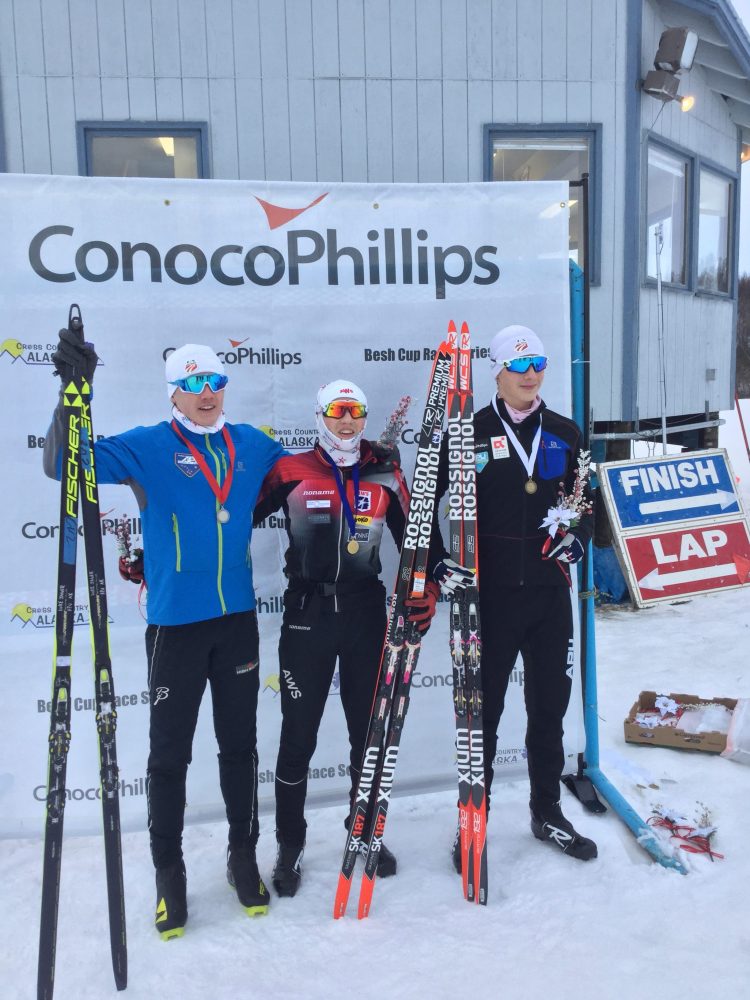
Gus Schumacher of Alaska Winter Stars (c) with APU skiers Canyon Tobin (r) and Luke Jager (l) on the podium for the men’s U18 15 k skate at the Besh Cup race on Sunday, Dec. 18, in Anchorage, Alaska. (Photo: Gavin Kentch)
Note: FasterSkier is accepting submissions for regional race reports. If you would like to see a particular race circuit covered and have the writer with the will to do it, please have them email info@fasterskier.com. Be sure to include link to results, and preferably a few original race photos with proper credits.
***
ANCHORAGE, Alaska — Becca Rorabaugh, Jessica Yeaton, and Reese Hanneman each claimed a pair of podium finishes on the weekend, while Alaska Pacific University (APU) senior skiers took 11 out of 12 total podium spots in the season’s first two Junior National qualifying races at Kincaid Park in Anchorage, Alaska. But the single most noteworthy result may have come from U18 skier Gus Schumacher (Alaska Winter Stars), who was third overall in the distance skate.
The Besh Cup series, named for former Alaskan skier and ski coach Tom Besh, is Alaska’s six-race selection series to determine the athletes who will race for Team Alaska at U.S. Junior National Championships. There are three race weekends throughout the state, one each in December, January, and February. The December races are traditionally held in the Anchorage area and attract a stacked field, including APU skiers tuning up for nationals and locals who ski collegiately but are home for Christmas.
(The December races are International Ski Federation (FIS) certified. The men’s winner in the distance skate earned a respectable 41.22 FIS points for the victory, which is not quite comparable to a SuperTour race but is getting pretty close.)
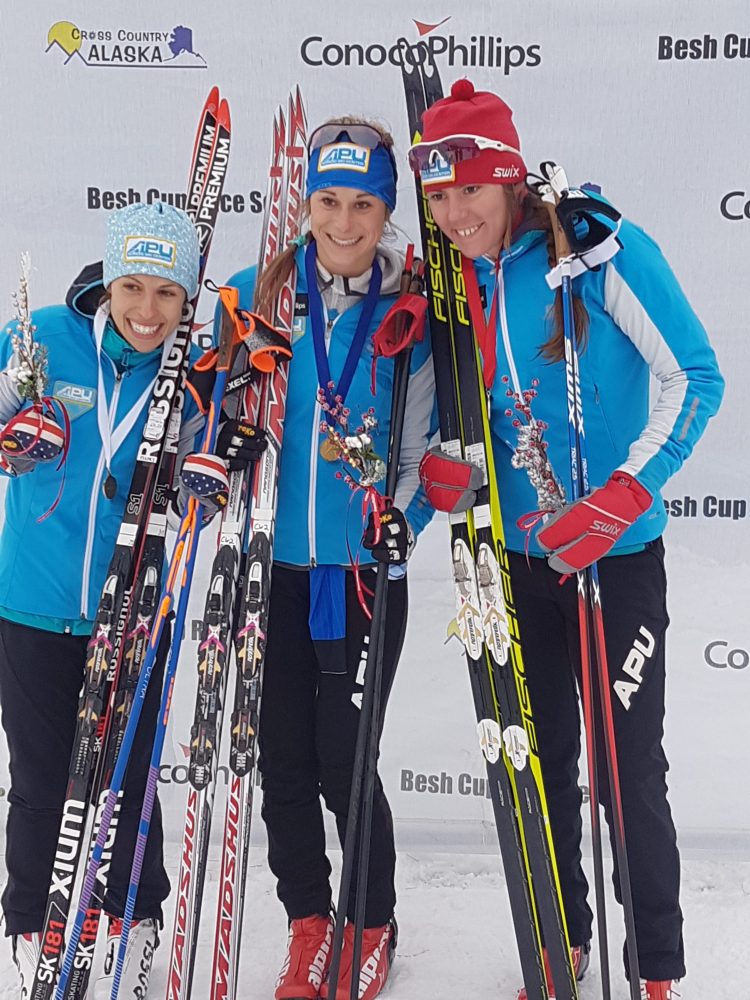
APU swept the podium with Jessica Yeaton (c), Becca Rorabaugh (r), and Rosie Frankowski (l) in the women’s 10 k skate at the Besh Cup race on Sunday, Dec. 18, in Anchorage, Alaska. (Photo: Lauri Bassett)
The podium for Saturday’s 1.4-kilometer classic sprint would not have been out of place at a SuperTour or national championship: Rorabaugh (APU), Yeaton (APU and Australian National Team), and Lauren Fritz (APU) in the women’s race. Likewise for the men: Reese Hanneman, Logan Hanneman, and Tyler Kornfield (all APU), all of whom have won a SuperTour or National Championship sprint. Reese Hanneman controlled the day, winning the qualifier by 6.23 seconds over younger brother Logan, several hours before winning the final in the mid-afternoon twilight.
The parade of APU blue continued on Sunday, as the women raced a 10 k freestyle mass start around two laps of a 5 k course while the men raced three laps for a 15 k skate mass start. Yeaton (26:29.9) and Rorabaugh (+0.3) traded places this time, with Yeaton nosing out Rorabaugh in a sprint to the line. Rosie Frankowski (APU), who led for much of the race in an attempt to keep the pace honest on the rolling hills, was third, 4.8 seconds back.
On the men’s side, Scott Patterson (APU) destroyed the field, skiing away from the 78-skier pack at the gun to cross the finish line unchallenged in 33:49.5. Reese Hanneman was second, 1:37.5 back. Schumacher was 0.3 seconds behind him. (Logan Hanneman, in fourth, came within 9 ½ seconds of making it a second fraternal podium.)
Behind the senior skiers dominating the podium, a number of age-group skiers put up impressive results in their quest to be named to Team Alaska.
In Saturday’s 1.1 k classic sprint, girls winners were Kaya Ratzlaff, Annie Gonzales and Kendall Kramer in the U16 division, and Quincy Donley, Marit Flora and Hjelle Personius in U14. For the boys, it was Zanden McMullen, George Cvancara and Eli Hermanson for U16, and Rudy Schumacher, Rowan Morse and Aaron Maves for U14.
On Sunday, both genders and age groups raced a 5 k skate (one lap of the course). Top U16 girls were Helen Wilson, Kramer and Ratzlaff. Top U14 girls were Donley (first overall in the combined U16/U14 race), Personius, and Alison Ulrich.
On the boys side, McMullen, Hermanson and George Cvancara paced the U16 division. Rudy Schumacher (Gus’s younger brother), Konrad Renner and Rowan Morse were tops among U14 boys.
At the front of the field, meanwhile, the U18 and senior racers were using the Besh Cup weekend as a springboard to bigger things. “I felt good today and am hoping to build on that heading into U.S. Nationals in Utah next month,” Sunday’s 10 k skate champion Yeaton wrote in an email to FasterSkier.
“It’s always fun coming home to race the Besh Cups,” Yeaton added. “Rosie made today’s race tough from the start by pushing the pace, and it was awesome having a sprint battle with Becca at the finish.”
Patterson, who won the men’s 15 k skate by over 90 seconds, is similarly looking toward the future. As the race began, he recalled in an in-person interview, “It was cold in the start, so I figured I’d go out real fast, and basically sprinted the first lap, and was able to pull away with that.” But “going into Nationals,” he continued, “I tried to push it the next two laps, and built a pretty good lead.”
Patterson must be comfortable with his own thoughts by now; he has made a habit of time-trialing the approximately 24-mile Crow Pass Crossing backcountry marathon completely on his own, running by himself for most of a three-hour race. “I do pretty well, honestly,” Patterson told the Alaska Dispatch News after winning last summer’s race by more than four minutes for his fourth victory in five years. “I can handle it.”
On Sunday, he was asked what he thinks about when he’s time-trialing a ski race. “A lot of it, once I’m out there on my own, it’s about building fitness, getting ready for more important races,” he explained to FasterSkier. “So it’s really still trying to make those surges, trying to push all the way in. I mean, I gave it a sprint finish, all on my own.”
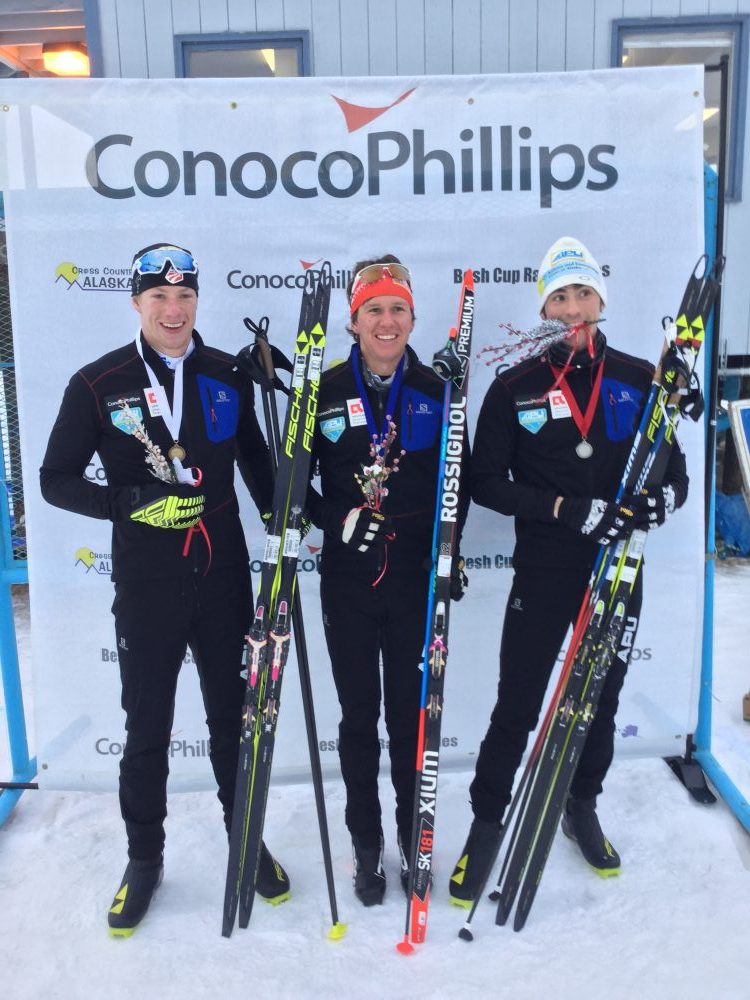
APU swept the podium with Scott Patterson (c), Reese Hanneman (r) and Logan Hanneman (l) in the U18+ men’s 15 k skate at the Besh Cup on Sunday, Dec. 18, in Anchorage. (Photo: Gavin Kentch)
Patterson clarified that he won the sprint.
Patterson tends to win 15 k races, or at least to do very well in them: In his last eight domestic 15 k races, dating back to West Yellowstone in November 2015, he has eight podium finishes, including five wins. But he is quick with an answer when asked about the last 15 k skate he did not win: “This spring,” Patterson instantly replied. “At Craftsbury Spring Series. I lost to Noah Hoffman by point six seconds. I was quite disappointed with that one.”
He hopes to avoid future disappointment with his goals for next month’s U.S. Nationals: “Win. Two races. 15 k and 30 k.”
If Patterson, in first, is part of the present of American men’s distance skiing, then Gus Schumacher, in third, may portend the future. Schumacher, 16, who was first profiled in FasterSkier as a 13-year-old racing at Spring Series in Anchorage in 2013, was 0.3 seconds behind Reese Hanneman in the race for second, but well ahead of the chase pack of seven racers that finished within the next twenty seconds.
The race was “really fun,” Schumacher said in an in-person interview. “Lots of familiar skiers out on the course. Not too hectic at the start, good starting spot. It was fun to be able to relax and ski with some really technically good skiers.”
Schumacher confirmed that Patterson had simply skied away from the field off the start with relative ease.
“The last time I saw Scott was probably 0.2 k in,” Schumacher said. “He was gone.”
A large chase pack formed behind Patterson, including the Hanneman brothers. “And then Reese and Logan crashed on one of the icy corners on Rollercoaster, and fell back to the second pack.” The reconstituted chase pack “cruised for pretty much most of two laps,” Schumacher recalled, “and then it started to break up with some attacks.” Reese Hanneman put a move on the field with about 4 k to go on the final lap, “and really started to spread things out.”
While Schumacher has narrowly won both of the first two races on the competitive Anchorage high school circuit, like Patterson he shared more national- and international-level goals for the rest of the season: “I want to make Junior Worlds in SoHo [at U.S. Nationals], and then be able to race hard and competitively at SoHo again in February. And then keep my fitness up, and try to have some good results at Distance Nationals” in Fairbanks.
Besh Cup racing continues with skate sprint and classic interval start races at Soldotna’s Tsalteshi Trails in January.
APU teammates Lauren Fritz (l) and Holly Brooks racing for the win at the 2016 Anchorage Tour in Kincaid Park on March 6. Brooks won and Fritz placed second. (Photo: Rob Whitney)
ANCHORAGE, ALASKA – A first-time racer and a former champion returning after a long absence skied to convincing victories in the Anchorage Tour Festival 30-kilometer race, née Tour of Anchorage 50 k, at Kincaid Park on Sunday. David Norris, last seen coming out of a group sprint to win the American Birkebeiner two weeks ago, and Holly Brooks, previously seen in two Olympic games but not at this race since 2009, each won by roughly three minutes on a sunny morning at Kincaid.
The Tour of Anchorage is traditionally a 50-kilometer, point-to-point race, ranging from the Chugach foothills on the east side of town to Kincaid Park at the west edge of the Anchorage metropolitan area. In between, racers traverse ski trails, city greenbelts, and bike trails until they reach the Coastal Trail multiuse trail, at which point they cover 15 k along the shores of the Pacific Ocean before ascending a hill to finish at Kincaid. It is truly a tour through the heart of Anchorage.
This year’s race, like every other race held under the auspices of the Nordic Ski Association of Anchorage (NSAA) in this snow-sparse winter, occurred exclusively on the snowmaking loop centered on the Kincaid Stadium. This year’s Tour presented 10 laps around a 3 k course, making for a 30 k freestyle race. It was more a Tour of the Snowmaking Loop than a Tour of Anchorage. Conditions on the course were very good at the outset, with recent fresh snow mixed into a solid base of manmade snow, though the steepest uphills and downhills broke down into sugar snow over glare ice by midway through the race.
David Norris (APU) racing to his first Anchorage Tour win at Kincaid Park on March 6. (Photo: Rob Whitney)
Norris, who skis for Alaska Pacific University (APU) and who won the men’s race by nearly three minutes in 1:14:51.0, seemed undeterred in his first time racing the Tour of Anchorage. In an email, he wrote, “This would have been my first year to do the actual Tour. … Due to the low snow year I was glad to have the Tour Festival 30km race on the manmade loop. I am glad the NSAA hosted the event even though we couldn’t do the formal course.”
The men’s podium was all APU blue. Jack Novak was second in 1:17:32.9. Andre Lovett followed roughly a minute later in 1:18:27.9.
Norris skied most of the race by himself, after breaking away from Novak late in the first lap. Norris wrote of his race strategy, “I went out hard from the start to practice that kind of effort. Jack stayed with me for almost the entire first lap before settling in.”
Norris had no other immediate competitors for the remaining nine laps and 27 k.
But with a field of 148 skiers on a 3 k loop (60 racers for the 30 kilometer race and 88 for the contemporaneously held 15 kilometer race), Norris had plenty of company out there. As Norris graciously wrote, “I thought I skied steady and was able to re-accelerate through corners or after congestion due to all the different levels of racers on a short 3km loop. I really apologize if I ever startled anyone while making a pass. I tried to be really careful not to be a jerk while making passes today.”
“I tried to be really careful not to be a jerk while making passes today.” — David Norris, after winning 2016 Anchorage Tour 30 k
While Sunday was the first time in this race for Norris, a Fairbanks native, the 2016 Tour marked a homecoming of sorts for Anchorage’s Holly Brooks. Brooks won the flagship 50 k Tour in both 2008 and 2009, at a time in her ski career when she was an APU coach first and a competitive skier second. Better results, a spot on the U.S. Ski Team, and nomination to the 2010 and 2014 U.S. Olympic teams famously followed. Brooks then spent last winter traveling the world, competing in the FIS Marathon Cup/Worldloppet series on three continents. She is now pursuing a degree, buying a house, and likely training somewhat less. But she is still winning ski races.
Brooks, who remains affiliated with APU, finished first among the women in 1:24:46.1. Her main competition came from fellow APU skier Lauren Fritz, who finished slightly less than three minutes back in 1:27:39.0. Citizen racer Sally Hokanson was third in 1:40:21.4.
While Norris went out hard from the start and gapped Novak early, Brooks and Fritz skied together for a majority of the morning. Brooks started to pull away about three quarters of the way through the race, she recounted in an in-person interview.
“It might have been on lap 7 of 10. It was on [the downhill on] the backside [of the course], because my skis were running pretty well,” she said. “I noticed I had a little bit of a gap. I just put a few extra strides in and a good tuck and a big push, and opened up a little bit of a gap.”
Holly Brooks (l) and Lauren Fritz, both APU, after placing first and second, respectively, at the Anchorage Tour in Kincaid Park on March 6. (Photo: Rob Whitney)
Brooks kept her lead to the finish, aided by her own observations and splits from others.
“There’s a little out and back, where you can kind of get an idea if someone’s there or not, so I saw her there the first time after I’d made the move,” Brooks said. “And then I got a couple of back splits after that that I had a little bit of a gap.”
Brooks appreciated the chance to be back racing on home soil, after many winters spent skiing anywhere but in Alaska.
“It’s nice to be home,” she said. “I had my husband out here giving me feeds, so that’s always fun, and a lot of local people out there on the course too. There was a lot of traffic out there today, the 30 k and the 15 k on the same loop, and some of the downhills were a little sketchy with the traffic, but it was manageable.”
A Kincaid lap race may not be particularly exciting, but it was certainly a change of pace from Brooks’ schedule last spring. When asked where she had been one year ago this month, the peripatetic Brooks had to think for a while before answering.
“Last year I wasn’t home for another five weeks,” she finally said. “Let’s see… I was at the Engadin this weekend last year I think. And then after that I think there was the Norwegian Birkie. And then, I can’t remember if there was something between that and going to Siberia. So, a much different year.”
While Norris was racing the Tour for the first time, the rest of the day’s podium finishers were no strangers to this race. Among the men, second-place finisher Novak won the race in 2015 (when it held as a criterium with a 50-minute time limit), and was third in 2014. On the women’s side, second-place Fritz was also second in 2014. And third-place Hokanson was second in the 2015 criterium, and (as Sally Johnson) won the 25 k classic race in 2008.
So what are the winners’ plans for the rest of the season?
“I will be training in Fairbanks until I leave for Spring Series in Vermont, which will conclude my season,” Norris wrote. “My season has progressed and I think I have made a good step forward. My goal at the beginning of the season was to earn a spot on the Canadian Tour World Cups, but with just average races in December and November I wasn’t able to secure a position.”
Meanwhile, Brooks had upcoming spring marathon racing goals, including either the Kachemak Bay Nordic Ski Marathon in Homer or the Sonot Kkaazoot in Fairbanks. But as of early Sunday afternoon, standing in the Kincaid parking lot, the March sun finally taking the chill off what had been a brisk morning, she had more immediate plans. “Oh, and I’m anxious for that sauna to get nice and hot,” she observed, gesturing toward a portable sauna that had been towed into the parking lot next to the beer garden. “And the barrel hot tub.”
An all-APU men’s podium at the 2016 Anchorage Tour Festival 30 k freestyle on Sunday, March 6, in Anchorage, Alaska, with David Norris (c) in first, Jack Novak (l) in second, Andre Lovett in third. (Photo: Holly Brooks)
Women’s podium, with APU’s Holly Brooks (c) in first and Lauren Fritz (l) in second, and citizen racer Sally Hokanson (r) in third at the 2016 Anchorage Tour Festival 30 k freestyle on Sunday in Anchorage, Alaska
(Photo: Tamra Kornfield)
A panorama view of the classic course at the second-annual Qaniq Challenge Jan. 16-17 in Valdez, Alaska. (All photos: Gavin Kentch)
By Gavin Kentch
VALDEZ, Alaska — Sometimes it’s easy to lose sight of the “cross-country” part of cross-country skiing. Particularly in this winter of discontent, when a lot of your training time ends up being spent doing 2.9-kilometer laps around a snowmaking loop.
Sometimes it’s important to travel for five days so that you can spend less than two hours racing, but do so on a course that goes from a mountain overlook to the shores of the Pacific Ocean.
Sometimes, surreally, the country’s second-richest ski race is held in Valdez, Alaska, in the middle of January, and gives away a purse of $10,000 dollars to a field of 36 racers. Sometimes it’s just time to take a road trip with your mom. This is the story of all of those events.
Dramatis personae
Holly Brooks finished her racing obligations in China a few days before this race, returned from China to Washington to visit family, flew back to Alaska on Thursday, then drove to Valdez on Friday before racing the Qaniq Challenge on Saturday. I assume this is basically a normal week for her. Other local athletes carpooled with each other for the over 300-mile drive from Anchorage to Valdez.
Personally, I traveled with my mom, because I am just that cool. (Also, I needed her to chauffeur me across southcentral Alaska: My car is a 1989 Toyota Camry, named Teakettle, which at 27 years old is more venerable than at least half the modern-day World Cup field, not to mention the advent of FIS points. I suspect that Teakettle would literally be unable to drive over Thompson Pass, and so to leave Valdez by road when the weekend was over. And the next ferry back to Whittier wasn’t until a week later.) Her husband, Jim Bouchard, got the other front seat.
Of the three of us, my mother is a good sports mom, who spent my childhood waking up very early on very many occasions to drive me to a variety of endurance sporting events. She once drove six hours one way, in the evening after work, to pick up my little brother after he had been struck by lightning on a solo bike trip outside of Tok, Alaska. My stepfather spent decades living by himself in a log cabin he built off the road system, about 30 miles south of Denali. He was a national age group champion at the 1992 Masters World Cup held in Anchorage. And as for me? Well, not to pull rank, but I have previously been described on this website as “a nothing-special recreational skier.”
‘Getting here is half the challenge’
Valdez is slightly over 300 road miles from Anchorage, a drive of approximately six hours, depending upon winter driving conditions. (This assumes that spectacularly massive avalanches do not close the only road into town for over two weeks.) I decided we should take the ferry there, saving hours’ worth of driving – the ferry leaves from Whittier, a little over an hour’s drive south of Anchorage.
A waterside view of the old apartment building in Whittier, a “city” in the Valdez–Cordova census area of Alaska. As of 2014, the population estimate was 217, according to Wikipedia. The city is also a port for the Alaska Marine Highway and known as the Gateway to Prince William Sound.I may or may not have also harbored fantasies in which an avalanche closed the Richardson Highway the day before race weekend, harming no one, but nonetheless preventing all the real skiers from getting there in time for the race, and then I won the first prize of $3,000 dollars. This did not happen.
My mom and Jim arrived at my house in the predawn darkness on Jan. 14. With some difficulty, we added my skis and ski accoutrements to the car, then carved out space for me in the backseat.
We left my driveway shortly after 9 a.m. It was not exactly light out, but by this point in the year at least sunrise was within an hour. We headed toward the Seward Highway. We had a combined 11 pairs of skis, six pairs of poles, and five pairs of ski boots. Plus snacks. The car was packed. The gas tank was full. Nothing could go wrong.
It was shortly discovered that certain parties had forgotten to pack their wallet, containing, crucially, the state-issued identification necessary to board the ferry. Words were exchanged. A backtrack was undertaken. Houses were returned to. A wallet was obtained, and with it a legitimate form of ID. We set off once more in stony silence, now calamitously late, making plans to do the long drive the next day and ruing the not-small amount of money now wasted on ferry tickets. We decided to try to drive to Whittier anyway, and to hope that the ferry was somehow running late.
We drove down Turnagain Arm under low fog and amber skies, the water in the fjord smooth as glass. Last month, this stretch of road was closed due to 91 mph winds. Also, a semitruck had been blown over on its side and completely off the road. Also, the tunnel that we intended to drive to, in order to reach Whittier, in order to get on the ferry, had been closed.
That did not happen today. We could not see more than 100 feet above the ground as we drove along the Arm, but all the roads were passable. We arrived at the designated snow-plowed field, in seemingly the middle of nowhere, to queue for the 11:30 a.m. opening of the tunnel to Whittier, having long since missed our intended 10:30 a.m. opening, and still assuming that we were about to miss the ferry altogether. At least we could have lunch in Whittier before returning.
(N.B.: I have not fact-checked this final statement. It may literally not be possible to buy a restaurant meal in Whittier on a Thursday in winter. I’ll figure this out next trip.)
We were met by a wonderful sight: a handful of cars sat in the field ahead of us, still waiting for the 10:30 tunnel opening. An Alaska Department of Transportation message board slowly scrolled the reason for the delay: “Please stand by. Tunnel will reopen when smoke is purged.”
I have never been so grateful to drive through an icy, slippery, claustrophobic five-mile long tunnel cut into the mountains that apparently had had rogue smoke in it just a few minutes before.
We emerged, blinking, into the light, and into the town of Whittier, Alaska.
Whittier is a special place. For one, it is the rare settlement that was literally founded where it is because the weather there is always bad. For another, there are virtually no private houses in Whittier; all of the town’s residents live inside the same large apartment building.
For the first few decades of Whittier’s existence, everyone in Whittier lived inside the Buckner Building, a seven-story concrete apartment building erected by the U.S. Army shortly after World War II (see photo above). Later, that building was abandoned.
The new apartment building in Whittier, Alaska.Now everyone lives in the much more colorful Begich Towers, a few hundred yards away from its predecessor. (The concrete hulk of the Buckner Building lives on, standing sentinel over the Valdez waterfront. It gained passing fame a few years ago when two bros descended its asbestos-choked stairwells on downhill skis.) We marveled at the Ghosts of Whittier Past and Present, and drove the car onto the M/V Aurora.
The ferry ride took six hours. It was amazing. The sun was out. Prince William Sound was, atypically, placid and still. Snow-covered peaks shimmered over hillsides of spruce trees cascading down to the water.
At one point, I literally said, “Oh look, yet more dolphins are playing around the bow of the boat. How nice.” I felt like an athlete going over to London for the 1912 Olympics, although there was no track set up on the deck for us to exercise on. And I guess they had fewer glaciers. And more alcohol. Seriously, though, it was probably the most sublime day I have ever spent on a boat in my life.
The M/V Aurora, an Alaska Marine Highway System ferry.Valdez
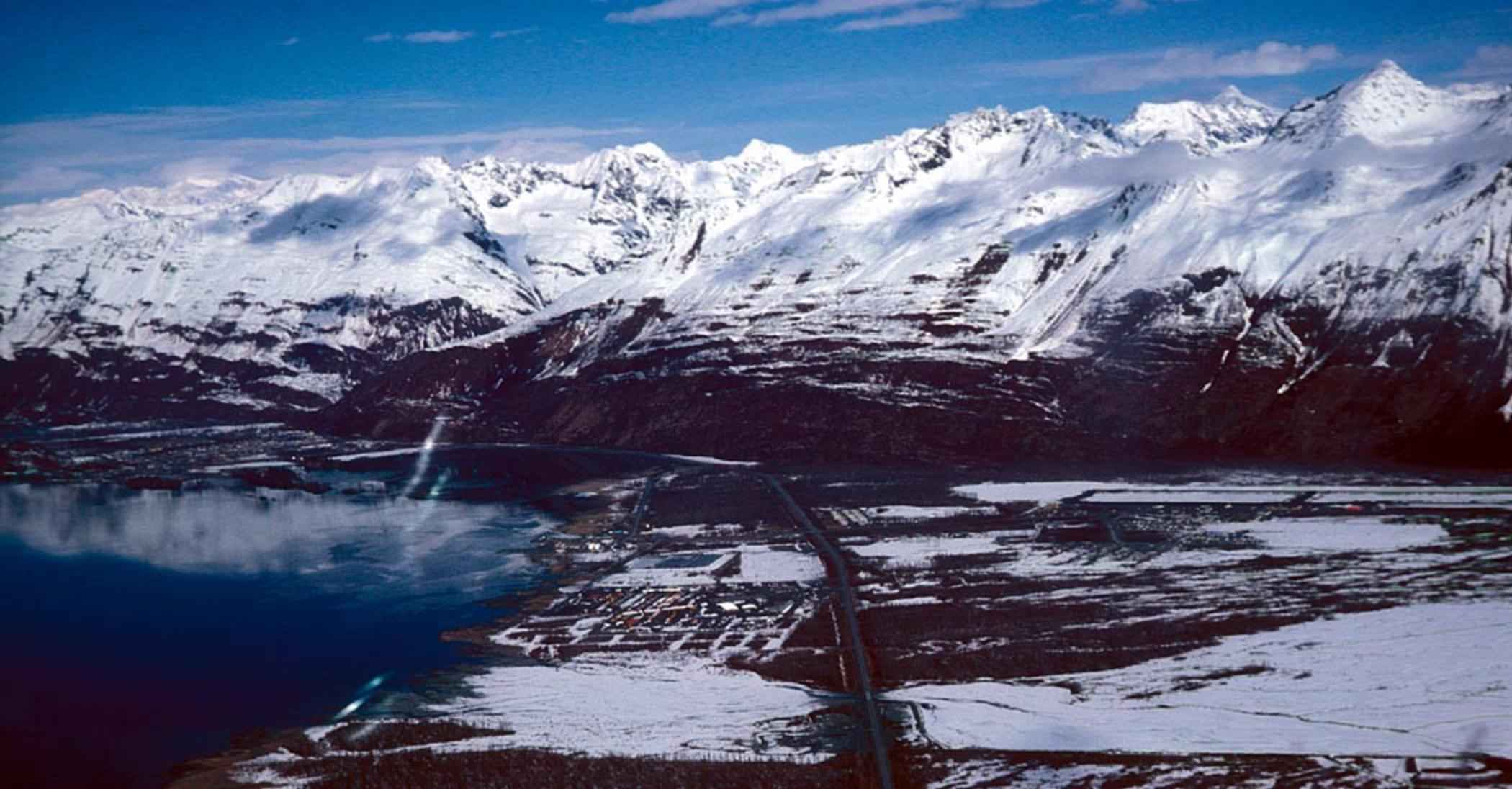
Valdez is also a special place, though for different reasons than Whittier. It has an average annual snowfall of 300 inches, for one, and two to three times that just up the road in Thompson Pass.
It is also home to the southern terminus of the Trans-Alaska Pipeline System, which undergirds what remains of the state’s suddenly fragile economy. Valdez’s taxes on the pipeline itself make it shockingly wealthy, a lucrative petro-state enclave even within resource-dependent Alaska. (This also explains why Valdez was able to essentially move $10,000 dollars of oil tax money from its own coffers to the pockets of young elite cross-country skiers, which actually feels to me like a pretty positive development.)
A street view in Valdez, Alaska, last month.Standards of what is normal change when you live in such an environment. When I spoke with Qaniq Challenge race director Darryl Verfaillie about ten days before the race, his talk of contingency plans and water drainage made me assume that snow coverage for the race courses was marginal at best.
After inspecting the trails in person after we got to town, I learned that their coverage ranged from a low of one foot of base to a high of at least three feet. As Anchorage suffers through its second low-snow year in a row, Valdez was looking like a pretty good place to be a cross-country skier.
Valdez has also had a relatively snow-sparse winter, at least for Valdez. Therefore, the piles of cleared snow filling spare lots around town were only one to two stories high. These towers stood guard over a neat gridlock of residential streets (Valdez was essentially rebuilt from scratch following the 1964 Good Friday earthquake), where virtually every house was flanked by multiple snowblowers and snowmachines.
Valdez is also the type of place where there are still pay phones. Or maybe not pay phones per se, just telephones in public spaces that permit one to make free calls to anyone else in town. (I don’t know if this institution is common in the states. It persists in Alaska.) It was very pleasant. There was admittedly not too much going on on a Thursday evening in January.
Valdez is also the type of place where there are still pay phones. Or maybe not pay phones per se, just telephones in public spaces that permit one to make free calls to anyone else in town. (I don’t know if this institution is common in the states. It persists in Alaska.)
A royal welcome
I don’t want to be obsequious, but race organizers were beyond accommodating of the skiers. Late on Thursday night, recently arrived in town, I politely emailed the race director, making a tentative inquiry about whether I might be able to find any waxing facilities during the day on Friday. He wrote back at 6:30 a.m. Friday morning, putting me in touch with the local cross-country ski coach (go Valdez Buccaneers!). We were ensconced in the ski team wax room by midmorning.
On multiple occasions, during the middle of the school day, a very clearly not-high-school-age skier walked through the halls of Valdez High School, carrying a large ski bag over his shoulder and bags of waxing supplies in both hands. There were irons, vials, strange powders, an extension cord or two sticking out, and of course the large ski bag. In different contexts, it could be described as suspicious. No one batted an eye.
The royal treatment continued at the Friday-evening racers’ meeting.
“Will there be indoor waxing available tomorrow morning?” someone (me) asked.
“I don’t know, do you want it?” said the race director.
“Uh, yeah,” I said, “if that’s possible, thanks.”
“Okay,” said the RD. “We’ll have someone open the Teen Center for you by 8 a.m.”
And so Jim and I waxed our skis for the classic race inside, warm and dry, with numerous outlets and a bathroom and music. For a ski race on the road, it was paradisiacal.
It was that sort of weekend; everyone could not have been more accommodating. Or maybe I just have really extravagant demands when it comes to ski waxing.
Actual racing: Day 1 (classic)
I previously wrote a real article about the real skiers here. I saw some of these real skiers, if briefly, on race day. Lex Treinen came past me at one point, an unsurprising occurrence in the classic interval start. He was going very, very fast, and even said hi to me by name as he nimbly stepped around me and re-entered the tracks, all while going approximately Mach 9. I had scarcely registered his presence before he was past me. I was impressed.
Trailside view from the classic race course on Day 1 of the Qaniq Challenge.I was also impressed by the army of volunteers and support staff that the race had mustered. I think there were literally as many volunteers and support staff on course as there were racers. Road crossing? They had four people there, including one to hold up traffic on each side, and real, groomed snow across the road.
There was a section where all racers had to do two loops around a 3 k lap, and to help count the number of laps, they had two people at that intersection. One, with a clipboard, counted laps for each racer; the other, with large flags, would direct each racer to head around for another lap or to go back down the course when they approached this junction, as if they were directing an airplane taxiing up to the jetway. If memory serves, I passed six on-course checkpoints during the approximately 15 k race. It was impossible to take a wrong turn.
It was not, however, impossible to fall down. In an impressive display of consistency, I did so twice, once on each lap, in the same place each time. (That place was a six- or seven-foot wide section of trail, presenting the first of two extremely tight corkscrewed turns, with substantial exposure on either side. Alaska is an exciting place to be a ski racer.)
I learned while doing interviews after the race that Tyler Kornfield, an inestimably more talented skier than me, had also fallen twice, in the same place I had. And unlike me, he was wearing skate boots. That made me feel better.
The Pacific Ocean from classic course.After around 50 minutes of skiing, and going from a scenic mountain overlook down to the shores of the Pacific Ocean and back, I approached the finish. I crossed the finish line, immediately began feeling the effects of the longest all-double-pole race in my life, and teetered over to the edge of the finish area to collapse in the snow. I lay on the ground. After a few minutes, I tried to pick my head up, but I was still dizzy, and things were still spinning, so I lay back down. I was not unhappy.
A woman, a local resident who was volunteering with the race, came over. She was wearing a knee-length fur parka that probably cost roughly as much as the entire purse for the weekend’s race. It was one of the most beautiful things I have seen in my life.
She looked down on me not unkindly. “Are you still breathing, hon?” she asked me. I looked up at her. I attempted to form the words, “Thanks, I’m fine.” I met with some success.
It is sort of uncomfortable to sprawl on the ground with one’s skis still on. (Shoutout to my APU Masters coach Galen Johnston, who took my skis off for me unasked while I convulsed on the ground following a recent Besh Cup.)
“Do you think you could help take off my skis?” I said. “Just pull up on the bindings.” She knelt down and began, with great enthusiasm, to pull on my entire foot. “That’s okay,” I said, “don’t worry about it. Maybe you could just help me get up.” This fur-clad vision graciously reached down, gave me a hand, and helped me stand upright again. I was suddenly very conscious of having just finished racing. I tried very, very hard not to get snot, spittle, extruded Apple-Cinnamon Hammer Gel, or any other form of race-induced effluvia on her beautiful jacket.
“Sorry about your boots,” she said. “I’m really more of a hockey mom.”
Eventually, I found my bag, put on every piece of spare clothing I had brought (temps were in the 20s above, but humid maritime cold is cold-cold), and set out for an attempt at a cooldown. I skied part of the way with Holly. At one point, I confessed to her, “I’ve actually never raced on consecutive days before. What do I do in the 23 hours before the next race?” She graciously told me what I should do. Her advice (get warm, dry, and food immediately; active cooldown; warm shower; stretching and jog later that day) was not rocket science, but was much appreciated.
Actual racing: Day 2 (skate)
The start/finish area of skate course at the Qaniq Challenge.Day 2 was a skate race. They took everyone’s first day results, re-seeded the field based on classic time, then had a chevron start for the mass start skate race. There were little numbered placards alongside the tracks in the start area to help everyone line up correctly. It was adorable.
The chevron start, which I may never encounter again in my life, made me feel like a real ski racer. Lining up behind Dylan Watts and Holly did not change this sensation.
The gun went off, and I very quickly felt like less of a ski racer. I guess I’m not very good at starting races fast. Apparently I’m more of an interval-start specialist (says the Masters racer who has done precisely two interval-start races in his life, counting the previous day’s classic race).
Two to three minutes into the race, places #1-4 (the top four guys) were quickly pulling off the front in the lead pack. Places #5-8 (Holly, overall winner Rosie Frankowski, and two male citizen racers) were coming together into a chase pack. I moved up into ninth overall, and took aim at shortening the gap of ten feet that had opened up between me and eighth. In a sudden moment of prescience, I saw the next 45 minutes unfolding before me. I told myself, “You’d better catch this train, or you’re going to spend the entire rest of the race skiing by yourself.”
I did not catch the group. I did ski the entire rest of the race myself. I caught glimpses of the chase pack ahead of me, at greater and greater distances, until as late as 8 k into the race. They were moving very fast, taking turns trading off the lead on a pancake-flat, all-V2 course. They looked like they were having fun. They looked like they were happy. I hoped they were happy.
I was not unhappy; I was skiing, and skiing is fun. But it is more fun when you can see. I think it was colder than I realized; soon my eyes were watering profusely, and I was having a hard time making out the trail, the time on my watch, or anything else.
I had previously been telling myself things like “get forward” and “weight on the balls of the feet,” giving myself technique cues like Jessie Diggins lite (very lite), and at least trying to stay focused while I skied along entirely on my own.
But soon my thoughts became slightly less focused. Like, “my eyes are really cold right now. I really can’t see. I wonder if I’m doing them permanent harm? Like that musher who just got airlifted out of the Kusko 300 sled dog race because she frostbit her eyeball. Is that what’s happening to me right now? Man, I hope I’m okay?” These were understandably valid concerns. They were not particularly effective as technique cues.
(My eyes were ultimately fine. They hurt more when I finished, and again when I shut them to go to sleep that night, and they were bloodshot as hell for a few days later, but that was all.)
I eventually emerged from my solitary ski through the woods and back to the finish line. I did not appreciate it at the time, but apparently they had sent out a PistenBulley during the race to re-groom the start/finish area and take out the set tracks from the chevron start. It was that sort of race weekend.
I crossed the finish line, returned my race bib to Woman in Beautiful Parka, and once more put on every piece of clothing I had brought. This time, it wasn’t enough. I shivered through a ten-minute cooldown, then went inside the old trap range building that had a roaring fire going and served as race headquarters. I stood immediately behind the massive stove, slowly picked the ice out of my thawing beard, and regaled a very patient Dylan Watts with stories of my race while learning what had happened up front. It sure beat getting into Teakettle and turning on the heater that no longer actually produces any appreciable heat whatsoever.
After the race
I headed home for food and a shower. Around the time I was deciding between a nap and writing up my race article, Holly, only furthering her role as worldwide ambassador for cross-country skiing, was back on skis, leading a free clinic for local high school kids. I’m sure this is just what her fellow two-time Olympian Kobe Bryant does for his post-game recovery regimen. (My Holly Brooks hero worship notwithstanding, I should emphasize that she was joined by the rest of the APU Elite Team and associated skiers that were in town, including Frankowski, Lauren Fritz, Paul Kovacs, Dylan Watts, Treinen, and Kornfield. Pretty good day to be a novice skier in Valdez.)
That night, the awards banquet was held in a local bar, The Fat Mermaid. Ten thousand dollars was redistributed from oil money to impoverished elite skiers. Lex and Rosie posed with oversized $3,000 checks.
Awards went five deep per gender. There were also prizes for the fastest locals, and for the fastest skier over 50 (shoutout to my stepfather). That’s 13 awards among 36 racers, or over a third of the field. Also, we all got good pizza, and one free drink ticket each. Also, they had applause not only for the sponsors and volunteers, but also for the press (me). It was a good awards banquet.
Heading the home
The next morning, it was time to go home. It was tough to leave, but we were wrapping up a five-day trip so that I could ski for a combined 101 minutes, so it was probably time. About half the field went backcountry skiing in Thompson Pass on the way home. We headed straight back to Anchorage, so that I could get back to my exceptionally patient wife and our two young girls.
Before we left, we had breakfast at the Totem Inn; poor Jim was yearning for meat after three mornings of oatmeal.
The Totem Inn was very… Alaskan. Of the twenty people in the restaurant on this Monday morning, nineteen of them were men. My mother stood out, because she was the only woman. I stood out, because my race T-shirt, pretty pink sports watch, and choice of tea over coffee clearly marked me as Not An Oilpatch Worker. (My stepfather did not stand out; people who have lived in the woods for three decades also look like they could work at the pipeline terminal.)
The inn’s motto, I have since learned, is, “Where everything about us says, ‘Alaska!’” I applaud their honest marketing.
We hit the road soon after. It was a different experience than the ferry – think six hours of trying to avoid the stench of unwashed ski gear and citrus solvent emanating from the ski bags wedged against my perch in the backseat – but Interior Alaska in midwinter is starkly beautiful, and an amazing contrast to the Sound.
By 4 p.m. I was back home in Anchorage, with its two inches of snow in my front yard, a world away from Valdez and its towering snow piles. By that evening my 3 ½ year old, having heard stories of my race weekend, was playing “cross the finish line and fall down.”
Skiing is also, in many ways, an intensely democratic sport. (Let’s elide for a moment the fact that Norway has like a billion World Cup wax techs to the U.S.’s handful – and that’s not counting another dozen or so under the aegis of Great Britain – and that some countries may be more equal than others.)
Sometimes you buy your first-ever race suit secondhand from Holly Brooks, then the next winter find yourself lining up immediately behind her in a mass start race. Sometimes you find yourself double-poling through a gorgeous valley as fast as you can, with the only other skier visible in front or behind you the quickly disappearing form of Lex Treinen. And sometimes, the local high-school kids race against regional high schools one weekend in the Valdez Invite, then against the APU Elite Team the next weekend in the Qaniq Challenge, all on their home course. Skiing is special like that.
(Photo: Gavin Kentch)
(Photo: Gavin Kentch)
(Photo: Gavin Kentch)
(Photo: Gavin Kentch)
(Photo: Gavin Kentch)
(Photo: Gavin Kentch)
(Photo: Gavin Kentch)
***
About the Author: Gavin Kentch lives in Anchorage. He skis with the Alaska Pacific University Masters team, plays with his two adorable daughters, and occasionally works as a solo attorney. He was probably on snow this year before you were.
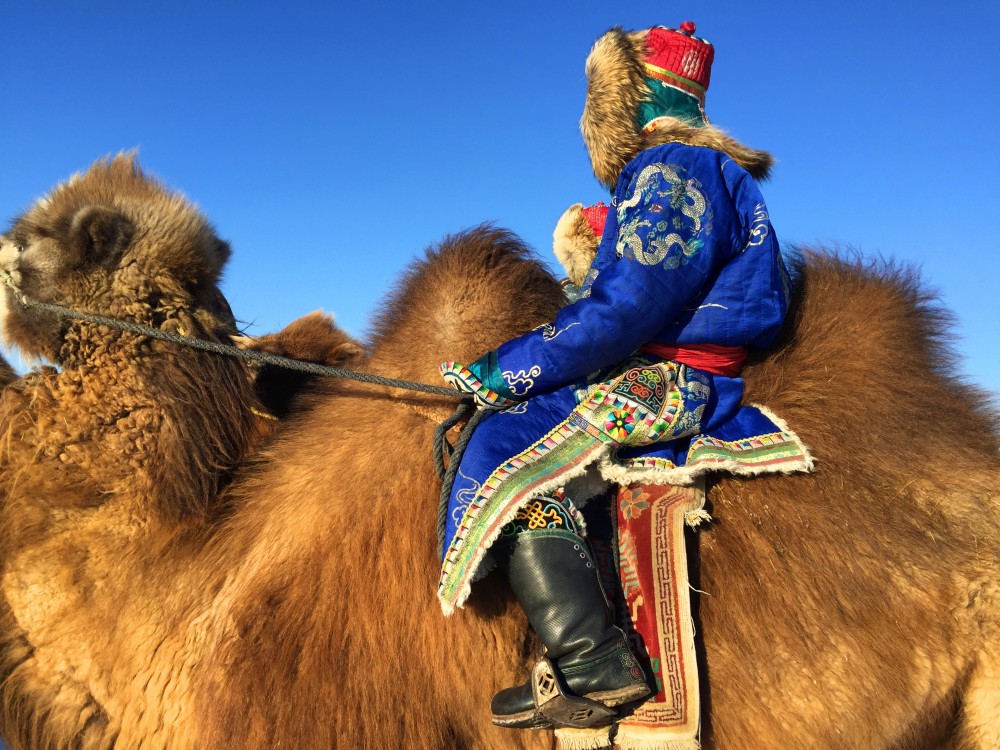
Competitors at this year’s China Tour de Ski spent their post-race recovery watching and riding camels in Xiwuqi, Inner Mongolia. (Photo: Torin Koos)
Does riding a camel count as a post-race cool down? For nordic competitors in the 2016 China Tour de Ski, it definitely did.
“The last day [of the China Tour de Ski], we had a sprint race in a place called Xiwuqi. Then in the afternoon we got to go and ride camels and see a camel race. I mean who does that?” exclaimed Holly Brooks, an Alaska Pacific University (APU) elite team member, two-time Olympian and most recently, a China Tour de Ski competitor, in a phone interview.
Torin Koos, who also raced at this year’s eighth edition of the China Tour de Ski (TdS), shared in Brooks’ surreality of a post-race jaunt on an unusual four-legged friend.
“There was a camel race going on and the athletes got wind of it and wanted to go. So the [event] organizers arranged a bus for us to go out there after the final races,” Koos, a four-time Olympian and currently an investigative news producer for KSL TV, the NBC station in Salt Lake City, said on the phone. “When else are you going to do your post-race recovery at a camel race in Mongolia?”
On top of camels, this year’s China TdS involved five stages of racing: a 1.2-kilometer freestyle sprint for Stage 1, another 1.2 k freestyle sprint for Stage 2, 50 k classic mass start “Vasaloppet” for Stage 3, 3.8 and 5.7 k mass starts for Stage 4, and finally a third 1.2 k freestyle sprint for Stage 5.
“Each stage was unique in and of itself. I mean, we had five races in three different venues,” Brooks said of the race schedule, which spanned from Jan. 1-7.
Another American racer, Lauren Fritz of APU explained on the phone, “They don’t block off a lot of time for travel. [Koos, Brooks and I] flew into China and got in at midnight” on Dec. 30.
“We had all of the next day to chill … then we raced the first stage [on Jan. 1]. The next day we took a 6 a.m. bus to a train station, took a two-hour train ride to the city, then another bus to our hotel. We raced two more days and then we got on a bus for 17 hours to Inner Mongolia for the last two stages of racing.”
The Stage 1 women’s sprint, (from right to left) with Qu Ling (China) leading Mimmi Bjørn (Sweden), Lauren Fritz (U.S.) and Linda Danvind-Malm (Sweden) on Jan. 1 at the China Tour de Ski in Yanji. Fritz placed fourth overall, Brooks (not shown) missed the final in fifth place. (Photo: Holly Brooks)
While a 17-hour bus ride the day before a race does not appear in most skiers’ training logs, neither does a 3.8/5.7 k freestyle mass start race in Inner Mongolia.
“A 3.8 k prologue mass start is a pretty crazy race,” Fritz recalled. “It was a 1.9 k loop and the girls did it twice.”
Racers in the fourth stage launched into a steady 500-meter incline out of the start, especially unforgiving after 1,500-kilometers of bus travel the previous day.
“You could V2 the whole hill if you had good skis, so it was a hammer-fest out of the start,” Fritz said. “It was pretty cold out, I didn’t really warmup that well and because we had a 17-hour bus ride the day before, I was pretty tired. Definitely got to the top of the hill after V2ing the whole thing and was just toasted.”
The 27-year-old went on to finish 10th overall, 43.31 seconds back from the women’s prologue winner, Terese Andersson of Sweden, who topped the 3.8 k freestyle mass start in 10:10.76.
Just 1.22 seconds behind Andersson in third place, Brooks felt that with more closing speed the prologue title could have been hers.
“It was kind of fast and furious,” Brooks said. “They had a really good course and I was up there to start, but without the training I just didn’t have the finishing speed for the last 200-meters.”
Brooks spent much her fall unable to train, due to a rollerskiing accident that left her needing reconstructive surgery in her thumb’s ulnar collateral ligament.
“I rollerskied into a pile of sand and I got up and my thumb was bent backwards … so I had surgery in late September and was in a cast for two months,” she explained.
This year, Brooks has also been working to complete her masters degree in counseling psychology, which she said has taken priority over ski training.
China Tour de Ski Race Schedule: Stage 1: (Jan. 1) 1.2 k freestyle sprint Yanji, Jilin Stage 2: (Jan. 3) 1.2 k freestyle sprint Changchun, Jilin Stage 3: (Jan. 4) 50 k classic Changchun, Jilin Stage 4: (Jan. 6) 3.8/5.7 k freestyle mass start Xiwuqi, Inner Mongolia Stage 5: (Jan. 7) 1.2 k freestyle sprint Xiwuqi, Inner Mongolia
“Last year I chased the marathon scene and really kind of raced myself into submission,” she said. “I did 11 marathons and traveled by myself for four months in Europe … and at the end of the season I was just exhausted. So I ended up taking a lot of time off this summer. Then this fall, I was working full time on an internship and in grad school.”
The other American to finish third in Stage 4 was Koos, who crossed the line just 1 second after Swedish skier Lukas Johansson, who won the men’s 5.7 k freestyle mass start in 13.56.5.
“I definitely felt like I could have won it. I kind of got taken out on the next-to-last climb so I was battling back up [to the front] for a bit,” Koos explained.
However, both Brooks and Koos felt that as the Tour progressed, so did their ski racing.
“I was starting to feel better and better as the Tour went on. I think I was also getting further away from having the flu,” said Brooks, who spent much of the final week in December battling illness.
“That last qualifier somehow I was able to win it by eight seconds which I was super pumped about, but then once again, I just didn’t have the final finishing speed,” the 33-year-old Washington state native added. Brooks placed second in the Stage 5 freestyle sprint.
“Definitely the highlight was going to Inner Mongolia,” Koos said. “I’ve never seen so many cameras out on a race course. There were hundreds of people out there taking pictures. It had this big-time feel, but in the middle of nowhere.”
(From left to right) The Stage 4 men’s 5.7 k freestyle mass start podium, with second-place finisher Daniel Máka (Czech Republic), race winner Lukas Johansson (Sweden), American Torin Koos in third., and Torben Svensson (Sweden) in fourth sharing the top spot of the podium with prize money in hand on Jan. 6 at the China Tour de Ski in Xiwuqi, Inner Mongolia. (Photo: Holly Brooks)
“I also raced the best in Mongolia and it didn’t hurt getting on the podium [in the mass start],” he added. “I won the the sprint [qualifier] there, but couldn’t quite get it done in the rounds.”
On Jan. 7, the final day of racing, Koos advanced to the quarterfinal in the freestyle sprint. However, since only the top four advanced to the final in all of the China Tour de Ski sprint events, Koos missed moving past the semifinal and finished in fifth overall.
“All in all, it’s a little bit different when you’re working full-time and your priorities have changed a little bit,” 35-year-old Koos said of his training coming into the China TdS. “But I think as the Tour went on, I was getting stronger and I think I left there at a pretty high level.”
Based off their sprint race results from Stage 1 and Stage 2, Koos and Brooks were accurate in deeming themselves improved by the Tour’s finale.
In the first freestyle sprint, Koos qualified for the quarterfinal, but did not move on to the semifinal, ending the day in 11th.
Canadian Graham Nishikawa, the lone Canadian competitor at the China Tour de Ski, raced to sixth that day.
“I always wanted to compete in the Tour de China and this year it worked out. It was a great event! The organization was stellar and the racing was really fun,” Nishikawa wrote in an email. “We got to see so much of China and travel to places that I would have never otherwise seen. The racing was good for me. I had some bad luck with breaking poles, but raced fairly consistently everyday.”
Nishikawa, 32, is a member of the Para Nordic World Cup Team as a guide for Brian McKeever.
For Brooks, Stage 1 left her in fifth, just outside of the women’s final after qualifying for the quarter and semi. Fritz broke the bubble, moving all the way to the final, where she placed fourth.
“The sprints were my focus because I’ve had the most success in sprinting before,” Fritz said. “And they went pretty well, I had a few tactical errors and a little bad luck. Didn’t quite achieve what I wanted, but I was still pretty happy.”
Stage 2 brought the racers to Changchun, where they raced the second freestyle sprint. Here, Koos bested his previous result, finishing fifth overall, just outside of the final. Nishikawa moved into 13th.
Fritz once again advanced all the way to the final in the second freestyle sprint. Coming into the finishing stretch, she found herself in second, closing in on first place. However, with 150-meters to go, Fritz said someone stepped on her pole and she crashed, ultimately finishing the final in fourth.
Brooks qualified for the quarterfinal and semifinal that day, but didn’t advance to the final and finished the day in seventh overall.
“I’ve never seen so many cameras out on a race course. There were hundreds of people out there taking pictures. It had this big-time feel, but in the middle of nowhere.” — Torin Koos on the racing atmosphere in Inner Mongolia
The 50 k Classic Vasaloppet and More
Snow castles and carvings that might even put Italy’s Roman Pantheon to shame — if not for the risk of melting — marked the lap lane to the China TdS 50 k Vasaloppet.
“Some things about China you just can’t believe. People think that we do things bigger than anybody in the U.S., but in some regards, it’s definitely not true,” Koos said. “Like, at the Chinese Vasaloppet, they had these sculptures that we were skiing by and it was something that you could maybe envision Las Vegas doing.”
This year’s China Vasaloppet promised athletes 50 k of skiing through the Jingyuetan National Forest Park, located in the northeast Jilian Province of China.
Sculptures surround the lap lane for the 50 k classic Vasaloppet marathon on Jan. 4. at the China Tour de Ski in the Changchun Jingyuetan Park. (Photo: Holly Brooks)
“Racing through snow sculptures that are five stories tall, I mean it was magnificent,” Brooks described. “You’re doing a lap lane through pavilions, doves, and castles. I’ve been in a lot of stadiums in my life, and I’ve been in a lot of marathons all over the world and this was incredible.”
A total of 258 racers showed up for the two-lap marathon and while not everyone finished, most soaked up the sunny skies and spectacular snow artwork that surrounded them during the race.
In the women’s event, Brooks led the Americans in sixth overall in 2:43:33.9, about 9 1/2 minutes behind the race winner Qinghua Ma of China, who completed the 50 k course in 2:34:08.1. Fritz finished 11th (+16:23).
“I’ve been in a lot of stadiums in my life, and I’ve been in a lot of marathons all over the world and this was incredible.” — Holly Brooks on racing the Chinese Vasaloppet 50 k classic
The men’s field saw Czech skier Petr Novak take the overall 50 k win in a time of 2:19:26.3. Koos finished 12th, 8:05.5 minutes behind Novak. Nishikawa finished about a second after Koos in 13th.
Along with a marathon through snow mansions, the China TdS boasted festival banquets almost every night.
“On this trip, every other day we were having a banquet or a celebration,” Brooks said. “Just the atmosphere and the ambience, I actually turned to someone and said, ‘I see why the Chinese don’t come to the World Cups very often, they seriously do it up in their own country.’ ”
Brooks was not alone in thinking that the tone of the Tour made for an enjoyable racing experience.
“The whole attitude at the tour was so different and it was really refreshing,” Fritz said. “If you were in the top few you were gunning for some good prize money… but once the skis came off it was way more fun than a normal SuperTour race trip, because there’s no pressure and everyone’s there to have a good time.”
A couple Americans did pocket prize money, though for Koos, it did not stay there long.
“I won a few hundred bucks or something. It was enough to buy me a sweet custom made grey suit in Beijing, so I’m looking pretty dapper these days. When in China, you just got to live it up to the fullest,” he said.
“If I had skied just a little bit faster I could have made some real money,” he added. “Maybe that’s motivation for 2017.”
Brooks also came away from the week with monetary winnings. However, the all-expense paid trip remained more important.
“There’s a company called Nordic Ways, a Swedish Tour Company, and they do everything,” she explained. “The bought my [plane] ticket. You show up at the airport and there’s someone holding up a sign with your name on it. All the transportation, three meals a day, everything is covered.”
Overall, Brooks finished the Tour in fourth, Koos placed sixth in the Tour, Fritz was the seventh overall woman, and Nishikawa the 10th overall male.
“There are so many ways to be a cross-country ski racer and I’m just really enjoying having new experiences, having new adventures, and reinventing myself every season,” Brooks said. “I feel like I really accomplished that by going to China.”
Holly Brooks (r) atop a camel after the final stage of the China Tour de Ski in Xiwuqi, Inner Mongolia. (Photo: Holly Brooks)
American Torin Koos during the qualifier of the men’s 1.2 k freestyle sprint on Friday, Jan. 1 at the China Tour de Ski in Yanji. (Photo: Torin Koos)
Sculptures surround the lap lane for the 50 k classic Vasaloppet marathon on Monday, Jan. 4. at the China Tour de Ski in the Changchun Jingyuetan Park. (Photo: Holly Brooks)
American Torin Koos (r) tests the Kung Fu crouching tiger maneuver on former Norwegian club teammate and friend, Erik Bakkejørd (NOR) during off time in the Forbidden City at this year’s China Tour de Ski. (Photo: Torin Koos)
One of many snow mansions that surrounded skiers during the 50 k classic Vasaloppet marathon lane, Monday, Jan. 4. at the China Tour de Ski in the Changchun Jingyuetan Park. (Photo: Holly Brooks)
Holly Brooks (APU) (l) and Lauren Fritz (APU) stand in front of one of the many ski yurts located in Inner Mongolia during this year’s China Tour de Ski. (Photo: Holly Brooks)
Racers competing in this year’s China Tour de Ski sit down to a banquet featuring a video projection of drone footage from the 50 k classic Vasaloppet marathon, which took place on Monday, Jan. 4., in Changchun’s Jingyuetan Park. Brooks noted that the dove snow sculpture shown in the background is close to six stories tall. (Photo: Holly Brooks)
U.S. Olympians Torin Koos (l) and Holly Brooks stand with their winnings from the 3.8/5.7 k mass start race on Wednesday, Jan. 6 in Xiwuqi, Inner Mongolia. Both Brooks and Koos place third in their respective events. (Photo: Torin Koos)
Lauren Fritz (APU) poses for a moment during a run along the Great Wall of China during the 2016 China Tour de Ski. (Courtesy photo)
A row of peking duck greets Brooks during off time in Changchun, where both Stage 2 and Stage 3 of this year’s China Tour de Ski were held. (Photo: Holly Brooks)
American Holly Brooks (r) gets some air while practicing dung fu moves with Finnish skier Anita Kirvesniemi in the Forbidden City, during off time at this year’s China Tour de Ski. (Photo: Holly Brooks)
Right to left: American Lauren Fritz (APU), along with Mimmi Bjørn (SWE), American Holly Brooks (APU) and Cecilia Mårtensson (SWE) during the women’s semi-final Stage 1 on Friday, Jan. 1 at the China Tour de Ski in Yanji. (Photo: Lauren Fritz)
A plume of smoke rises from a nearby coal plant while looking to the southeast of the 1.2 k freestyle sprint course on Friday, Jan. 1 at the China Tour de Ski in Yanji. (Photo: Lauren Fritz)
Holly Brooks (APU) (l) and Lauren Fritz preview the Stage 1 sprint course–a 2×800-meter loop around a “gravel pit”–for the women’s 1.2 k freestyle sprint in Yanji. (Photo: Lauren Fritz)
Lauren Fritz poses for a picture with local spectators in Xiwuqi, Inner Mongolia during this year’s China Tour de Ski. (Photo: Lauren Fritz)
Swedish skier and former University of Vermont athlete, Linda Danvind-Malm (l) and American Lauren Fritz (APU) stand in front of one of the many snow castles that line the lap lane to the 50 k classic Vasaloppet marathon during the 2016 China Tour de Ski in Changchun. (Photo: Lauren Fritz)
A standard meal for competitors at this year’s China Tour de Ski. (Photo: Lauren Fritz)
American Lauren Fritz (APU) leads Swedish skier Mimi Bjørn in the Stage 2 semi-final of the women’s 1.2 k freestyle sprint race on Sunday, Jan. 3, at the China Tour de Ski in Changchun. Fritz advanced to the final, where she was gaining on first place until her pole was stepped on and she crashed close to 150-meters from the finish. She ultimately finished the day in fourth overall. (Photo: Lauren Fritz)
American Lauren Fritz (APU) at the finish line for the 50 k classic Vasaloppet marathon on Monday, Jan. 4 at the China Tour de Ski in Changchun. (Photo: Lauren Fritz)
The country’s second-richest cross-country ski race will take place in the remote community of Valdez, Alaska, this weekend, and there might still be time for you to get there. That’s the optimistic report from Qaniq Challenge Race Director Darryl Verfaillie, director of parks and recreation and cultural services for the city of Valdez, as race day approaches.
The Qaniq Challenge, named after the Alutiiq word for “falling snow,” is set for this Saturday and Sunday, Jan. 16-17 in Valdez. The two-day, 35-kilometer race weekend requires participants to do a 17.5 k classic race on Saturday and a 17.5 k skate race on Sunday. Each technique is held on a different course. A random drawing the night before the race will determine the order in which skiers complete the courses. The lowest combined time for both races wins.
Prince William Sound in early winter (January 2009): Valdez is just to the right of the frame. (Photo: Flickr/Frank Kovalchek)
2016 marks the second year of the Qaniq Challenge. The inaugural year saw some challenges stemming from snow conditions, but racing occurred on both days (albeit on the same course twice).
In a small field – 31 racers total – with an elite top end, Alaska Pacific University (APU) skier Becca Rorabaugh paced the women while teammate Lauren Fritz (APU) finished second, and Shalane Frost of Fairbanks placed third. In the men’s race, APU swept the podium with Lex Treinen claiming the first-ever win, Scott Patterson following in second and Peter Kling in third.
Verfaillie was more than pleased with the first year of the event.
“It went uncharacteristically well for a first race. I think it went flawlessly,” he said in a recent phone interview.
Verfaillie cited the positive reviews that he got from participants, and proudly noted – perhaps accurately, in light of southcentral Alaska’s snow-challenged winter in 2014/2015 – “For those two days, we had the best ski trails anywhere in Alaska.”
Kling, a recently retired competitive skier who has raced across the U.S. and world, including at the 2015 China Tour de Ski, echoed Verfaillie’s analysis of the success of the inaugural event.
“The entire community of Valdez (Valdez Nordic Ski Club, Parks and Recreation, Valdez Snowmachine Club, Search and Rescue and many community volunteers) came together last year to pull off a great event with difficult conditions,” Kling wrote in an email. ” You would have never known it was their first year hosting the race.”
Treinen, the reigning men’s champion, had similar thoughts.
“Going to the Qaniq last year was definitely a unique experience. On one hand there was not a very high turnout – likely because of the low snowfall – but the prize money made it a very serious competition,” Treinen wrote. “Scott Patterson, who finished second, and I, made a little gentlemen’s agreement not to blow out too much money on pure fluoro waxes, but other than that there were no holds barred. We both opted to double pole on the classic day, which I think was the right decision for us both, and then in the skate day it was a huge tactical battle because the trail was so fast and narrow. Luckily, nothing too dirty happened and it was a really fair race.
“Aside from the competition, what stood out to me was how motivated the organizers were,” he added. “It is very rare to have race organizers who can conceive something becoming so much bigger than what it is now, and these guys definitely have that vision. They knew what they were doing from experience and looking into how big races are held, but didn’t hesitate to ask racers for input. I can definitely see it becoming something big in the next few years.”
“It is very rare to have race organizers who can conceive something becoming so much bigger than what it is now, and these guys definitely have that vision.” — Lex Treinen, defending Qaniq Challenge champion
Compared to last year’s atypically snow-sparse race, things on the ground in Valdez are looking better this year. Verfaillie cited preventative measures taken from last year’s race, including grooming all winter with an eye to repairing future meltdowns and building dams and water bars to divert water from the trails during rain events.
Verfaillie reports that, as of a week ago, the trails were “all snow,” and the plan was to run the full, 17.5 k distance over both courses. Verfaillie is particularly pleased to let skiers race over the in-town course, unavailable last year, which takes skiers from the Chugach Mountains right up to the edge of Prince William Sound.
The long-range forecast for Valdez currently shows wintry temperatures, with highs on Saturday and Sunday in the mid-20s, and the possibility of snow on Sunday.
Verfaillie describes the race trails as “easy to moderate,” with the in-town trails more challenging than the out-of-town trails. He is particularly pleased to let skiers experience the out-of-town trails, which are typically multi-use trails open to snowmachine traffic and don’t get that much skier use. (All trails will be closed to snowmachine use during the races.)
There are some unique factors about the Qaniq Challenge – for example, the order in which each skier skis each course is chosen by random drawing, so hypothetically, some top skiers could be skating on hardpack on Saturday while others have to wade through 18 inches of moist snow on Sunday – but Verfaillie’s race preparations and concerns ultimately sound a lot like those of any other race director getting ready for a ski race. It’s the prize money that really sets this race apart.
(Story continues below)
Lex Treinen shows his appreciation to race director Darryl Verfaillie after receiving his first-prize award of $3,000 in the 2015 Qaniq Challenge in Valdez, Alaska. Women’s winner Becca Rorabaugh (l) looks on.
Lex Treinen shows his appreciation to race director Darryl Verfaillie after receiving his first-prize award of $3,000 in the 2015 Qaniq Challenge in Valdez, Alaska.
The total prize purse for the Qaniq Challenge is $10,000 dollars. For each gender, first place (based on combined times for both days) gets $3,000, second place gets $1,500, and third place gets $500. First place at Valdez is rewarded with as much as third place at the American Birkebeiner (the only ski race in the country with a richer purse). Second place in Valdez nets more than the $1,200 awarded for winning a national championship – Patterson won more in Valdez last year for finishing second than he did in Houghton last week for winning the 15 k classic. Any way you slice it, it’s a lot of money for a ski race.
That’s by design, says Verfaillie. And he’s well aware that those numbers will raise eyebrows within the ski community. He chose the cash amounts he did based in part on the input of Fritz and longtime APU skier and Olympian Holly Brooks, who were in Valdez a few summers ago for a community outreach event. He asked them then how much money they were competing for elsewhere, and how much it would take to get skiers to come to Valdez. When he mentioned a $10,000 purse, Verfaillie says, “that really got Lauren’s attention.”
Money talks. When asked by email whether he was planning on defending his title in this year’s race, Treinen responded, “I am definitely falling for the sin of avarice and going back this year.”
Verfaillie has lofty ambitions for the event. When asked about having the country’s second-largest prize purse for a cross-country ski race, Verfaillie responded, “I would love to have the largest.” If that were to happen, “that’d be years from now,” he continued. “But if I were to give away 50 or 60 thousand dollars total, I would love that.”
Verfaillie acknowledges that it’s not easy to get to Valdez in winter, so “we want to make it worth people’s while.” As for the ample amounts of prize money, Verfaillie says, “I know I don’t have to [give out that much] – but if we can, why not.”
The race itself is funded by the city of Valdez, which guaranteed funding, including prize money, at current levels for three years beginning in 2015. Verfaillie noted that the Qaniq Challenge is one of the few items in the city budget that rolls over from year to year.
“The [Valdez City] Council was kind enough to say, We believe in the potential for this race,” Verfaillie explained. “All the money [brought in this year] rolls over into next year’s race.”
Verfaillie obviously hopes to see participation numbers increase from 2015 through 2017; if numbers don’t go up, he acknowledges that the structure of prize money may need to be changed, and the race’s bottom line will suffer. But he remains committed to his race, and to the goal of showing that Valdez can be a viable winter destination for cross-country skiers. “This ski race belongs to the skiers,” he notes. “If folks want to have a ski race, they need to come do this.”
Verfaillie estimates that it costs the City of Valdez $25,000 to put on the race, including prize money but excluding the use of city time and resources. He acknowledges that Valdez, which gets much of its revenue from taxes on the Trans-Alaska Pipeline, whose southern terminus is in Valdez, is in an enviable fiscal position. For example, he notes that Valdez, with a population of around 4,100 people, has an annual city budget of $65 million (this comes out to close to $16,000 per person. Anchorage, by contrast, with a population of approximately 300,000, has an annual budget of $481 million – around $1,600 per person.) The city also has its own sovereign wealth fund, a muncipal-level version of the statewide Alaska Permanent Fund.
For the time being, though, the Qaniq Challenge may still be working through the growing pains of an event in its infancy. There were 31 finishers in the race’s first year. As of Thursday, 29 skiers had registered for this year’s event, including likely podium contenders Brooks, Fritz, and Rorabaugh. (Also, full disclosure, this reporter.)
“I anticipate several more from Anchorage will register this week,” Verfaillie wrote in an email two days before the race weekend.
The buoyant Verfaillie, described in a 2015 Alaska Dispatch News article as “an energetic retired U.S. Coast Guard captain,” sounds completely unconcerned about the turnout. “We are guaranteed to run the race,” he promises.
In response to the low numbers, he notes that “the odds couldn’t be any better for those folks” who are entered. Verfaillie also observes that over half of last year’s racers registered in the week before the event, and that he has “far more commitments than I do registrations” right now.
Valdez is slightly over 300 miles from Anchorage, a drive of approximately six to eight hours depending on winter road conditions. The state ferry system also runs between Whittier and Valdez. Race spots and hotel rooms remain available; late registration is currently $125. Budget around $300 more to take the short flight from Anchorage to Valdez, or find a car or carpool for the all-day drive.
Stay tuned for this author’s firsthand report of the racing experience at the second-annual Qaniq Challenge.
The entire field of the 2015 Qaniq Challenge at the awards banquet in Valdez, Alaska. (Photo: Seth Adams)
The Mount Marathon Race is one of the oldest continuously run races in North America and is known as the Super Bowl of Alaska. Though only five kilometers long, the course climbs a grueling and treacherous seaside mountain for 3,022-feet, before turning around and plunging back down to the start line in town. After professional mountain runner Rickey Gates told his friend and teammate Kilian Jornet that he couldn’t beat the locals on their home turf, Jornet, who holds countless speed records throughout the world, showed up to turn up the heat.
Though Mount Marathon is famous in Alaska, its home in Seward is far from my home in Fairbanks, and I had never been to watch. This year I promised my friend Nick Elson that if he got in, I would go to support him. I knew it would be fun. It was.
15 year-old Luke Jager handily won the junior race, which turns around mid-mountain, in 27:39. Here he descends The Cliffs, the final portion of the descent before the road race to the finish line.
Certain of his victory at the bottom of the descent, Boy Wonder hams it up for the crowd.
Riana Boonstra, a former classmate of Allie Ostrander at Kenai Central High School in the nearby town of Kenai, ran away with the girls title in 32:38.
Mount Marathon is renown for attracting enormous crowds of spectators that line the race course.
Local superstar Allie Ostrander works her way down the hill in second place. It was 18 year-old Ostrander’s first year in the senior category after claiming the overall win in the junior category in 2014.
Winner Emelie Forsberg’s descent is already the stuff of modern legend, having descended in 11:32, only 2 seconds slower than 2nd place men’s finisher Rickey Gates that same day and blowing away the old women’s record. She came by so fast, in fact, that I was standing there with my hands in my pockets and my camera not ready. Though I can’t prove it, I can confirm the shocking speed of her descent, and can also confirm the rumors that she smiled all the way past. Pictured here is Allie Ostrander.
5th-place finisher Denali Foldager-Strabel dashes past. Foldager-Strabel married defending men’s champion and APU ski coach Eric Strabel only the week before.
Former US Ski Team member Aubrey Smith runs to a 6th place finish.
Aubrey Smith.
APU Skiing Elite Team member Lauren Fritz runs into 22nd place.
In spite of the presence of international superstars, the hometown crowd remained loyal to its own. Here a fan shows her support for Anchorage favorite Jim Shine.
Midway up the 1,000-meter climb, the men’s field climbs past, with Salomon’s Rickey Gates in the lead, followed by Spanish superstar Kilian Jornet, while Jim Shine represents for Alaska.
I could hardly claim to be an impartial observer of the race, as my good friend Nick Elson chased the front runners in a close fourth. Nick is from Squamish, BC, and entered largely at my suggestion. He keeps a low profile and was almost entirely unknown to the crowd except for the few that follow the esoteric sport of Skimo racing, at which Nick excels. I enjoyed overhearing other spectators saying “wait, who is that guy??”
Favored to win, Kilian Jornet delivered a remarkable performance, turning it on on the downhill to dust the rest of the competition.
Rickey Gates chased close behind, finishing second.
Jim Shine stormed by in third.
Jim Shine.
The newly-married Eric Strabel, the previous record holder, is legendary as a ferocious descender. The staggering speed of the ascent was too much for him to make up, however, and he finished in fourth.
Nick Elson was back and forth with Strabel, including briefly passing him in a fiery descent off the very top of the mountain. His legs quickly turned to “jello,” however, and he had to dial it back for the remainder of the descent. Nick held on for 5th, however, the 2nd-ranked rookie, behind Jornet.
Racers descend a steep section of scree low in the course, known as The Gut.
9th place finisher, and last year’s runner up, Matias Saari literally runs to the awards banquet while eating potato chips.
Allie Ostrander, left, receives her first award in the senior division. To the right are Christy Marvin, Najeeby Quinn, and Denali Foldager-Strabel.
Ostrander receives a standing ovation from the crowd for her record-breaking performance.
Ever gracious, the Alaskan crowd stayed on its feet for the new queen of the mountain, Emelie Forsberg, who broke the 25 year-old record set by Nancy Pease by nearly three minutes.
The men’s podium, left to right – Kilian Jornet, Rickey Gates, Jim Shine, Eric Strabel, and Nick Elson. I apologize for the quality of these photos – sometimes I forget to keep an eye on what my camera is up to.
Winning the hearts of Alaskans on the Fourth of July, Kilian Jornet does a keg stand while his girlfriend, Emelie Forsberg, operates the tap. I can confirm that Jornet is fun in addition to being fast.
Apparently there is a Catalan (the region in Spain that Jornet comes from) tradition that if one passes you a drink and you receive it with your right hand, you have to chug it. I’ll leave this person, who was not such a hapless victim, unnamed, but he has been profiled in FasterSkier. Also, he’s drinking out of the victor’s chalice – another tradition, though this one more local. As the increasingly-rowdy party moved to the bar, there was a well-attended streak to a another house about a block away. I opted to be a gentleman and not take any pictures, a regret that I will take to my grave.
Patrick Stinson, Nick Elson and Rickey Gates on the summit of Bear Mountain during the traditional “hangover hike” the following morning. Some earned this title more than others.
The African Attachment, the Team Salomon camera crew, came along as well. Here they set up some shots.
Nick Elson, Christie Haupert and Brian Harder jog back down to Seward.
NANANordic has been covered extensively by FasterSkier in the past, most recently in May 2014. Now in its fourth year, NANANordic sends elite cross-country ski racers to Alaskan villages to teach skiing to school children, with the goal that skiing become a lifestyle activity in rural Alaska.
Seth Adams, a FasterSkier contributor who lives in Fairbanks, Alaska, joined the ranks of the volunteers this spring. Some of his photos from NANANordic in Noorvik appeared on this site in April. All opinions expressed here are his own.
I don’t remember what I said.
“Well, no. Not exactly,” Lars Flora responded, sounding pained. “That’s a common misconception among city Alaskans about the villages.”
I was interviewing Lars for an article I wrote last year about NANANordic, a program that Lars began in 2012 to teach skiing to kids in remote Alaskan villages.
As I write these words, a year after that interview with Lars, whatever I was wrong about wasn’t important enough to me to remember. But the take-home point was important to me. Although Lars was trying to be nice, the message was loud and clear — I thought I knew something, but I didn’t know anything. And I was part of the problem.
I’m from Fairbanks, Alaska, the state’s second-largest city. Although Alaska’s cities contain most of the state’s population, there are far more villages than there are cities. And Alaska’s cities are majority white population (like me), while the villages are almost-exclusively Alaska Native.
I’d never really been to any of the villages. And among white, city Alaskans, that is not at all uncommon. Most of the villages aren’t accessible by road — the only way in or out is by snowmobile, airplane or boat. And without a specific reason to go to one of the villages, most people don’t. City Alaskans often view them as grim places — devoid of economy or diversion, where alcoholism and domestic violence are more the rule than the exception.
But in spite of our lack of firsthand experience with village life and our negative opinion of what we think we know, city Alaskans tend to not be indifferent to the villages. We see these places as an integral part of our state identity and their existence as a part of the Alaskan experience.
We see these places as an integral part of our state identity and their existence as a part of the Alaskan experience.
And so when I was told that some of my preconceived ideas were wrong, it cut deep. What else didn’t I know? I decided it was time to see for myself. Besides, volunteering with NANANordic sounded fun.
Noorvik
After a hectic schedule of personal travel, I had a cold. I met my fellow coaches in the Anchorage airport at a truly uncivilized hour on the morning of April 5 to catch our flight to Kotzebue. There were a gaggle of NANANordic volunteers swarming the check-in line, all headed to different villages in the Northwest Arctic region.
I would be headed to Noorvik with four other coaches — three veterans of NANANordic: Alaska Pacific University’s Lauren Fritz, Lauren’s boyfriend and Australian National Team member Paul Kovacs, and U.S. Paralympics Nordic Development Coach Robert Rosser. And one other newbie — 15 year-old Anchorage high school skiing standout Luke Jager.
We boarded an Alaska Airlines 737-combi (half of the passenger compartment is converted to cargo space) for the hour-and-a-half flight to Kotzebue. After some shuffling and waiting for winds to calm, we settled into an eight-seater Bering Air single-engine prop plane for the 30-minute flight from Kotzebue to Noorvik. After a remarkably smooth landing amidst the whipping wind in Noorvik, we loaded our bags into a van driven by the school principal.
“The skiers are here!” the kids exclaimed as we carried our bags into the school. The school would be our home for the rest of the week. We looked around approvingly.
In the afternoon we went out to ski around and get oriented. Luke stood with his skis braced against the wind. He straightened his skis and began accelerating across the icy school yard as the wind pushed him backwards.
At some point during the school day, each teacher brought every kid in the school to the gym to ski. I don’t know whether or not they were forced to ski with us — but it didn’t matter seem to matter, because almost to a student, including the surly high schoolers, they wanted to.
NANANordic 2015 (Photo: Seth Adams)
NANANordic 2015 (Photo: Seth Adams)
NANANordic 2015 (Photo: Seth Adams)
NANANordic 2015 (Photo: Seth Adams)
NANANordic 2015 (Photo: Seth Adams)
NANANordic 2015 (Photo: Seth Adams)
NANANordic 2015 (Photo: Seth Adams)
NANANordic 2015 (Photo: Seth Adams)
NANANordic 2015 (Photo: Seth Adams)
NANANordic 2015 (Photo: Seth Adams)
NANANordic 2015 (Photo: Seth Adams)
NANANordic 2015 (Photo: Seth Adams)
NANANordic 2015 (Photo: Seth Adams)
NANANordic 2015 (Photo: Seth Adams)
NANANordic 2015 (Photo: Seth Adams)
NANANordic 2015 (Photo: Seth Adams)
NANANordic 2015 (Photo: Seth Adams)
NANANordic 2015 (Photo: Seth Adams)
NANANordic 2015 (Photo: Seth Adams)
NANANordic 2015 (Photo: Seth Adams)
NANANordic 2015 (Photo: Seth Adams)
NANANordic 2015 (Photo: Seth Adams)
NANANordic 2015 (Photo: Seth Adams)
NANANordic 2015 (Photo: Seth Adams)
NANANordic 2015 (Photo: Seth Adams)
NANANordic 2015 (Photo: Seth Adams)
NANANordic 2015 (Photo: Seth Adams)
NANANordic 2015 (Photo: Seth Adams)
NANANordic 2015 (Photo: Seth Adams)
NANANordic 2015 (Photo: Seth Adams)
NANANordic 2015 (Photo: Seth Adams)
NANANordic 2015 (Photo: Seth Adams)
NANANordic 2015 (Photo: Seth Adams)
NANANordic 2015 (Photo: Seth Adams)
NANANordic 2015 (Photo: Seth Adams)
NANANordic 2015 (Photo: Seth Adams)
NANANordic 2015 (Photo: Seth Adams)
NANANordic 2015 (Photo: Seth Adams)
NANANordic 2015 (Photo: Seth Adams)
NANANordic 2015 (Photo: Seth Adams)
NANANordic 2015 (Photo: Seth Adams)
NANANordic 2015 (Photo: Seth Adams)
NANANordic 2015 (Photo: Seth Adams)
NANANordic 2015 (Photo: Seth Adams)
Personally, the naturally athletic kids that easily picked up skiing weren’t the most rewarding to work with; it was the strugglers that were the most interesting.
Take a first-grader, we’ll call him Casey, as a case study. During his first time on skis, Paul and I stayed back with him, and at the end of the session we both agreed that our backs were sore from repeatedly helping him onto his feet. He could stand for only seconds at a time and asking him to untangle himself once on the ground and get back on his feet on his own seemed a bit like asking him to fly the space shuttle. There were tears and there was whimpering.
But after school, when returning to ski was their own prerogative, Casey was back. As were many other kids that we did not expect to see. Out of the 190 kids in the school, over 60 were neatly lined-up outside the gymnasium door to ski again — fully one third of the school was back to ski for a second time that day. You would definitely not see this in Fairbanks or Anchorage.
… One third of the school was back to ski for a second time that day. You would definitely not see this in Fairbanks or Anchorage.
Casey constantly asked for help with everything. Like many of the kids, he was naturally quiet and rarely used words, expressing many of his emergencies in pantomime. But there seemed to be no minimum to how ridiculous his emergencies might be. One time, he frantically gestured at me that his sock had come off and stayed in his boot after he took the boot off.
“So pull it out and put it back on,” I said.
He held up his gloved hand in alarm, to show he could not possibly remove the sock from the boot by himself, since he was hamstrung by the glove.
Casey tows another kid on our last day in the village.
“Take the glove off, Casey,” I said with a laugh. He shrugged in disappointment, and did it. He was perfectly capable of everything everyone else was, but somehow being helped filled a need for him.
Casey probably isn’t going to become a heroic story of having won the race or landed a 360. But he kept skiing all week, and although he never outwardly seemed to love it, at the end of each session he unfailingly asked when he could ski again. As did many of the others. The bottled-up enthusiasm for skiing and for being outdoors was something that we all found remarkable.
At the end of each day we were exhausted. We skied for at least nine hours a day, usually no-pole and in a rush to tend to one “emergency” or another. Then it was at the end of each day that we had the biggest group. We often led the whole group fairly far away from the school, with the smallest kids desperate to keep up with the biggest. At the end of the session, getting everyone back was a huge chore.
Occasionally the frayed ends of Paul’s nerves would show, which resulted in me calling him “the cranky Australian.” But I could understand why was frazzled. We’d taken the kids out to the Kobuk River on the far side of town, and they were scattered as far as we could see. It was getting late, but Luke, who is a high schooler himself, was hitting a jump with a group of older kids on the far side of the river. Paul’s jaw was repeatedly clenching and unclenching.
Right then a woman and two kids pulled up on a snowmobile and told one of the kids to get on. Another kid grabbed onto the back of the sled and got towed, face dragging through the snow as he held tight to the snowmachine, until the woman realized he was back there and scolded him off. He stood up grinning a mischievous grin.
I didn’t know who the woman was, didn’t remember the name of the kid she’d scooped, and was unsure if we’d get the skis and boots back. I looked at Paul and shrugged — we were visitors in a strange land, and our job was to teach skiing.
It’s difficult to overstate the tightness of the social fabric Noorvik. Nearly everyone is related in some way, and there is no need to be accountable for where the kids are, since everyone watches out for everyone. But this was hard for us to remember; the idea that small kids can run loose through a town and be perfectly safe is not a part of our cultural experience. We reminded ourselves that we were the only ones that were overwhelmed; for everyone else this was daily life. Except that usually they don’t have skis.
“The little kids won’t head back to the school until you guys stop hitting that jump and head back yourselves,” I told the high schoolers, trying not to beg. “Do you mind just heading back? Because otherwise we’ll be out here all night getting the small kids back.”
The count of skis and boots at the end of the day was exactly right. No equipment was missing. The woman must have returned her child’s skis and boots.
The week was a bit of a blur of chasing kids, clicking boots into skis, offering encouragement, and answering endless questions about when the next chance to ski would be. But being in Noorvik I was reminded of the conversation I’d had with Lars. I looked around, waiting to have one of my preconceived notions shattered in lightning bolt epiphany.
Noorvik wasn’t overly different from what I’d expected. Life there isn’t easy, but it wasn’t as tough as I’d imagined. Perhaps it was just seeing it that mattered and seeing how tight the social bonds are, witnessing how the older siblings watch out for the younger ones with no trace of resentment, and that all the adults in town are essentially guardians for all the kids.
Noorvik wasn’t overly different from what I’d expected. Life there isn’t easy, but it wasn’t as tough as I’d imagined.
“I like what you’re doing with our kids,” one man told me as he walked past.
A couple of hours later when he walked back by, I invited him to join us.
“No,” he replied, then, apologetically, “I’m drinking now.” The kids continued to ski in excited circles all around us.
Noorvik is a dry village, which means any possession of alcohol is prohibited. He excused himself, and I invited him back another day, but he never came. The kids, however, were all hooked on skiing. And they kept coming back.
FasterSkier contributor and NANANordic 2015 volunteer Seth Adams during his weeklong visit to Northwest Alaska.
At the end of the week, all five coaches skied 55-kilometers from Noorvik to the village of Selawik. Read about it and see pictures on Seth’s personal blog.
The 2014 Valdez Qaniq Challenge will take place January 17 and 18 in Valdez, Alaska. (Photo: City of Valdez/Facebook)
The Valdez Qaniq Challenge in Alaska may be in its inaugural year, but race organizers have big plans for its unveiling in January, including $10,000 dollars in total prize money.
The Qaniq Challenge is a 50-kilometer classic and freestyle ski race set to take place Jan. 17-18, 2015, in the coastal town of Valdez. The city’s Department of Parks, Recreation and Cultural Services began planning the event earlier this year in an attempt to showcase the city’s trail systems in addition to promoting tourism in the Alaskan town.
You may be asking yourself the meaning of “qaniq.” In a nativeAlutiiq dialect, it means “falling snow,” which race organizer Darryl Verfaillie thought was a fitting name for the competition and respective of the local Alutiiq population.
The race has an unusual format. In order to accommodate 400 participants on the local trails, Verfaillie said that there would be two separate courses used over the two days of racing.
On the first day of the Challenge, one group of racers will ski a classic course on the “in-town” trails of Valdez, while the remaining participants will ski on a freestyle course on the “out-of-town” trails. The next day, Sunday, the two groups switch courses. Race organizers will then combine the times from both days to rank skiers.
A lottery will be held the night before the race to choose who will start on what course.
The Valdez Qaniq Challenge will distribute $10,000 dollars in total prize winnings with $3,000 going to both the top male and top female. Second place for each gender will receive $1,500 and third place will earn $500. The total prize purse will make the race one of the highest-paying ski competitions in the country.
According to Verfaillie, a race committee will have its first meeting in the coming weeks and start to solidify the details of the Challenge. Verfeillie said that a race website would be created this fall and that registration would be open no later than mid-October.
Once registration opens, it’s a first-come first-serve process to register for one of the 400 starting spots.
Verfaillie says that while the race will inherently attract more Alaskans, he hopes to see skiers from across the country participate.
“I’d love to see as many [racers] from the lower 48 come up as possible. Travel is hard, but we’re not targeting any one group,” he said on the phone. “We want to be a true community.”
“I’d love to see as many [racers] from the lower 48 come up as possible. … We want to be a true community.” — Valdez Qaniq Challenge Race Director Darryl Verfaillie
There are also plans to invite international skiers to the competition, but according to Verfaillie, those are in the initial phases.
Race organizers have also marketed the Qaniq Challenge as an opportunity to ski alongside elite American skiers. While Verfaillie had yet to confirm any specific elite racers, he said that he had been talking with Alaska Pacific University (APU) skier Lauren Fritz to get several elite-team members in the race.
While Verfaillie acknowledges that the Challenge is a new race trying to fit into an already busy national schedule, he hopes that with the right planning, the event will grow in the coming years.
“We want to make it successful. We’re hoping it builds from year to year and it’s an annual event,” he said.
Eric Strabel chasing down Wylie Mangelsdorf, a college senior, and Rickey Gates (front) at the 2013 Mount Marathon Race on July 4 in Seward, Alaska. (Photo: Dave Blanchet)
Note: This race recap has been updated to include comments from Ann Spencer, the third woman and Alaska Winter Stars skier.
Mount Marathon isn’t one of those races you can wake up the morning before and decide you’re going to do. People spend years trying to get into the fabled Fourth of July hill climb, a 3,022-foot ascent up and terrifying trek back down to the town of Seward, Alaska.
In 86 years, the grueling 3.5-mile race has grown to selectively award 350 senior entries to senior men and women, and another 250 juniors, evenly divided by gender. If you finish 10 Mount Marathons, you’re considered a veteran, which is one way to get in. Junior races don’t count toward that. Win it the year before or make the top 10 in your age group, you’re also in. Try your luck with a lottery some people have spent more than a decade trying to get registered through, or pay at least a grand for one of 10 auctioned entries.
Eric Strabel, who coaches the APU university and junior nordic teams and assists with the elite team, coming off the mountain to win the 2013 Mount Marathon on July 4 in Seward, Alaska. It was his second victory in three years and he broke a 32-year-old course record by 26 seconds. (Photo: Ira Edwards/roosterskier.com)
Two years ago, Alaska Pacific University (APU) nordic coach Eric Strabel won Mount Marathon. It was a goal he had more or less been working toward since he was 11, and in 2011, he achieved it.
Last year, he finished eighth – not what he was hoping for. APU’s university coach and elite-team assistant, Strabel decided to recommit to the race he grew up doing and spent the next 12 months getting ready for his 20th consecutive Mount Marathon.
“For the first time, I was ready to commit to 12 months of specific training for the extreme demands of the race,” Strabel, 31, wrote in an email.
He reasoned climbing was his problem and increased his uphill training while decreasing the distance covered in each workout.
“I have a higher disposition of fast twitch muscle fiber than what is ideal for mountain running so I needed to build up a monstrous aerobic engine before I started to do anything close to race pace for longer than 30 seconds,” he explained. “Looking back, one of the biggest keys of the training was having more than twenty 1 hour sustained low to mid level 3 efforts on steep grades before ever letting myself push my heart rate over 90% of max. … Sustained assertive steep hiking and running really works wonders for building hip and leg strength and endurance for skiing!”
Sounds pretty technical for a guy who placed third in this year’s 50-kilometer Tour of Anchorage ski marathon without doing much ski training beyond coaching, or someone trying to break the Mount Marathon course record without a watch.
“Wearing a watch distracts me. And it should be unnecessary,” Strabel explained. “I should already know by race day what I need to be doing and how I should be moving to have my best speed. Nevertheless, I did ask a couple people how the time was looking at landmarks to know what was possible.”
Strabel’s speed came from within on July 4 in the 86th annual Mount Marathon Race – and with the help of a commentator’s words before the start. The announcer said the morning rain and lack of snow (for traction) would make for slower conditions, ultimately eliminating a shot at the 32-year-old course record (43 minutes, 21 seconds) set by Olympic nordic skier Bill Spencer.
“[That] gave me kind of a chip on my shoulder and added more fuel to the fire,” Strabel wrote. “The record has been such a legend, that even the thought of breaking it has been presumptuous, but with the growing level of competition and preparation, a handful of us were starting to believe it was possible over the last couple of years.”
Rickey Gates leads the men’s race up Mount Marathon on July 4 high above Seward, Alaska, while Wylie Mangelsdorf (r) and Eric Strabel keep him in sight. (Photo: Dave Blanchet)
Last Thursday, amid drier conditions than the previous women’s race, Strabel did it, pushing himself to win it 42:55. Nine seconds later, runner-up Rickey Gates, a multiple-time member of the U.S. Mountain Running Team, crossed the line in record time as well.
Both saw their times on the big clock, but neither wore a watch to confirm nor thought it was possible.
“When I got to the finish line and saw the 42 minutes and change, I thought what Eric Strabel thought, that something went wrong with the timing,” Gates, 32, said on the phone Saturday after flying home to San Francisco.
“For a few minutes after the race it felt like after a serious accident, everyone’s kind of quiet and a little bit confused, and you’re kind of piecing together information but you’re not quite sure what to believe,” he said. “It felt like that, but when we finally got information that the clock was right, then it finally settled in. Eric gave me a huge hug; he’s really a gentleman and a gracious competitor and said it wouldn’t have happened without the two of us battling it out like that.
“I certainly wouldn’t have run that fast without him either,” Gates continued. “It’s one of those second-place finishes that I can imagine going any better.”
This is coming from a man, albeit a Mount Marathon newcomer, who’s won trail races around the world, including one in Antarctica and the Canadian Death Race, and is headed to Europe for the 65 k Ice Trail race in Val d’Isère, France, on Sunday. After that, Gates will compete in back-to-back 32 k races in Italy and Switzerland, then return to his home state of Colorado in late September for the Ultra Race of Champions (UROC) 100 k in Vail.
Six weeks ago, Gates rode his 2002 BMW F650 Dakar motorcycle from San Francisco to Alaska, flying to Colorado for a wedding before settling back in around Seward (he’s getting a friend to drive his bike back). There, Gates trained with local high-school runners on the slopes of Mount Marathon, getting to know the terrain and how locals tackle it.
Racers navigate the cliffs along Mount Marathon, a 3,022-foot peak, during the 2010 edition of the race in Seward, Alaska. (Photo: Lauren Fritz)
“It was cool to see a high school cross-country team out there on the course actually dialing in little five-five foot drops and maneuvering cliffs,” Gates said. “Of course they’re high schoolers and they don’t think anything of it.”
Less than a week before the race, Gates did a time trial up the agonizing climb. He clocked in around 51 minutes. “Muscles hurt on me that have never hurt before,” he told the Anchorage Daily News. He later told FasterSkier it’s one of the shortest yet hardest races he’s ever done.
On Thursday, Gates didn’t worry about time, just about winning – or coming as close to doing so as possible. His mother, Trish Gates (formerly Schultz), finished second in the 1969 Mount Marathon, but was quick to point out there were only two women in the race. She had been working at a fish-packing plant at the time, had a week off and decided to give it a go.
“It’s the only race that she’s ever run, she never run one before then and she’s never done one since then,” Gates said of his mom, who flew to Alaska to watch him last week. “Being a traveling hippy, they were offering free meals to whoever did the race. The salmon weren’t running yet so she had a week.”
Racers ascent the 3,022-foot Mount Marathon above Seward, Alaska, at the 2011 edition of the hill climb. (Photo: Lauren Fritz)
Knowing she did the race was cool, but when he heard how technical and gut-wrenching it was, Gates started to respect her even more. He spent the last five years dreaming of racing Mount Marathon, and tweaked his schedule to make it happen this year.
Jetting toward the top of the three-thousand-foot peak, Gates was the first to the turnaround point just over 1 ½ miles in. The third man to the halfway mark (behind Wylie Mangelsdorf, a Principia College senior, in second), Strabel passed both Mangelsdorf and Gates on the descent.
“I’m not the strongest downhiller,” Gates said. “I ran 11 minutes down that thing, which isn’t bad, but I knew I wasn’t going to run 10 minutes down it which Eric did.”
At the base of the mountain before a half-mile stretch along a road to the finish, Gates in second place looked up to see where Strabel was. Then, he crashed, dislocating his shoulder and spending several seconds on the ground.
2013 Mount Marathon runner-up Rickey Gates shortly after a crash dislocated his shoulder at the mountain base a half mile before the finish on July 4 in Seward, Alaska. (Photo: Ira Edwards/roosterskier.com)
“I just caught my foot on something or nothing at all and just went down really hard in front of 10,000 people,” Gates said. He stood up, popped it back in, and proceeded to cut an estimated 20-second deficit to finish 9 seconds behind Strabel.
“There’s a lot to be said about adrenaline,” Gates said. “If I’d had not fallen I still don’t think I would’ve gotten him.”
According to Strabel, catching Gates, which he did about two-thirds of the way down, wasn’t easy. He strategically attacked the final cliff section before the road, thinking Gates would be less familiar with it and thus not as fast.
“As it turned out, a lot of the cushion that I built by the base of the mountain was due to Rickey stumbling, catching himself and dislocating a problem shoulder, and quickly resetting it himself,” Strabel explained. “I did look back twice early on the road to know that he was making up serious ground so I had to gather a sprint over the last 90 seconds whether my body was capable of it or not.
“I was incredibly relieved at the finish,” he continued. “The only other thought I had over the final seconds of the race was of the large display clock that came into focus. I had completely set aside thoughts of a record for most of the race. I recall seeing it ticking through the 42:30’s and remember struggling to think if a time in the 42’s was faster than 43:21. That was how far down Rickey had pushed my brain function.”
That night, Strabel, Gates and other finishers celebrated with a night out on the town, where Gates lost his rental-car keys. All in all, the trip went as well as Gates could’ve imagined, he said, except for a couple blips.
“I’d appreciate it if my shoulder didn’t really hurt really bad right now and if I didn’t lose my rental-car keys at 4 o’clock in the morning,” Gates said.
Other Top Skiers
Longtime APU skier Brent Knight, 29, placed fifth in the men’s race – four years after he led the 2009 Mount Marathon then collapsed near the finish from dehydration. He was hospitalized in Seward, where he received five liters of IV fluid.
Brent Knight, 29, en route to a fourth-place finish at the 2013 Mount Marathon Race on July 4 in Seward, Alaska. (Photo: Ira Edwards/roosterskier.com)
Knight returned to the race in 2010 and took fourth, was second to Strabel in 2011, and placed sixth behind winner Matt Novakovich in 2012.
“It’s hard to describe the feeling you get when you are surrounded by 30,000 people in what could be the gnarliest sub hour race out there,” Knight wrote in an email.
The first time he watched the race as a kid, the air was hazy from nearby fires. Knight watched as the men’s leader turned the corner at the top of a long hill before the finish.
“The sun combined with smoky haze created a dull orange backdrop to a lean mountain runner covered in blood and mud,” he wrote. “Eye of the Tiger was playing over the loud speakers and I think that memory of the whole scene was etched in as one of the most awesome events I’ve ever witnessed. Now years later and multiple Mt. Marathon finishes later, I still get this overwhelming feeling like I’ve just saved the world from devastation or something. The roar of the spectators makes you feel like you’re a gladiator in the ancient [Coliseum].”
That’s why he calls the race “addicting.” This year, Knight lost some ground at the leaders along the ascent, and by the top, he realized how fast they were going.
“I didn’t think it was record fast, but I thought it might be close,” he wrote. “Matias [Saari, who placed third] closed in and passed me a 1/4 way down the mountain and I decided to put comfort aside (if there was any) to hang on him.”
Knight lost about 15 seconds to Saari after the “gut,” which he described as an extremely technical creek bed with multiple cliffs before the bottom of the mountain, but made up about 10 seconds on the road.
“It’s hard to cover ground that fast when it feels like you’ve been run through a meat grinder,” Knight wrote. “Had I run a minute faster, I would have been competing for 3rd in a time that would have easily been a winning time any of the past 32 years. This race, this year, was the toughest field I’ve ever competed against.
“I’m a skier that loves to be a mountain runner,” he added. “I’ll find my way to the front … Perhaps next year or the year after that or the next. Strabel set a new mark to fight for this year.”
Alaska Winter Stars skier Ann Spencer, 18, racing to third place in her first year as a senior at the 2013 Mount Marathon on July 4 in Seward, Alaska. (Photo: Ira Edwards/roosterskier.com)
In the women’s race, Christy Marvin, a 32-year-old mother of three, won in 53:20. A race newcomer but well-known local runner, she was the first rookie to win since Toby Schwoerer took the men’s title in 2004.
Allison Barnwell placed second just under two minutes later, and 18-year-old Ann Spencer of the Alaska Winter Stars placed third (56:15) in her first year as a senior.
In an email, she explained it was her fourth Mount Marathon (after three junior races), but first time racing the whole mountain.
“I was definitely not expecting to do so well,” Spencer wrote. “I was aiming for a top 20 finish with a time under 1:05. Hill climbs are definitely my strength.”
Accepted at the University of Vermont, Spencer planned to defer a year to continue skiing and training in Anchorage to better prepare herself for college racing.
Fresh off a training camp on Eagle Glacier, APU Elite Team skier Lauren Fritz, 25, placed fourth (57:57) among the senior women. Last year, she was second in Mount Marathon to teammate and 2010 Olympian Holly Books.
“There was a lot of pressure going into this year’s race … which is tough because there isn’t a lot of room for improvement and a lot of room for disappointment,” Fritz wrote in an email. “I really wanted to win, of course, and I had as good of a shot as any, with Holly and Kikkan [Randall] both skipping this year’s race. There are always top contenders though, and this year was no different.”
Lauren Fritz racing back down to Seward, Alaska, for fourth place in the 2013 Mount Marathon Race on July 4. (Photo: Cole Deal)
Meanwhile, Fritz has dealt with chronic tightness in her calf muscle for the last couple years. Skating in slush on Eagle Glacier last week didn’t help.
“I knew going into the race that it would probably bother me, but there wasn’t much I could do about it,” she explained. “I tried to warm up well but it still flared up during the race. It was raining throughout the morning, including during the race a little bit, so it was a lot muddier than I’ve ever raced it, so there was a lot of slipping and grabbing for tree branches or plant roots or whatever you could hold onto to keep from sliding backwards. Really not ideal conditions for fast times, plus the slipping put more stress on my lower legs.”
Just before tree line about halfway up, her calves got the best of her and she lost contact with Barnwell, Spencer and Sheryl Loan, who ended up seventh. Marvin led from the start, but was not too far in front of the chase pack at the top, according to Fritz.
“I rounded the turn-around rock, I thought ‘OK, here we go, I’ll be done in less than 15 minutes,’” she wrote. “Just let the legs go on autopilot. It’s impossible to describe how your legs feel as you start the descent and it’s really just best not to think about how they feel and just go.
“It is actually crazy, and unless you’ve put yourself through the torture you don’t realize how incredibly fun and satisfying it is to be able to accomplish something like this mountain,” she continued. “Still, it is an inherently dangerous race … I usually have one of the top descent times in the women’s race, but this year I did try to not let myself get too out of control on the downhill that would lead to me getting hurt. I LOVE this race, and always plan to come back, but there is a lot at stake this ski season and I recognized that. I wanted to win and I gave it my best effort, but this race isn’t the focus of my racing career right now.”
In her seventh Mount Marathon, Fritz nabbed her fifth-consecutive top 10 and posted the sixth-fastest downhill time.
“I’m still pretty happy,” she wrote. “Mt. Marathon is definitely the Olympics of Alaska and I’ll definitely be back to hunt down the coveted winner’s cup.”
Patrick Johnson (SVSEF) en route to winning the 10 k classic at the Aspen, Colo., SuperTour on Saturday.
ASPEN, Colo. — As Nemo shook the East with buckets of snow, the winter gods smiled upon the Rockies, too, with inches of heavy flakes on Saturday morning as the Aspen SuperTour got underway. The powder was a blessing for a state that’s had a mediocre winter, but for the handful of nordic skiers that braved the storm in spandex and a race bib it was a daunting environment in which to line up for one classic race, let alone the two in one day.
Rosie Brennan (APU) skiing to a sprint prologue win in dense snowfall.
“This morning was rough,” said Alaska Pacific University’s Rosie Brennan. “You couldn’t see anything. The tracks were washed out and my skis weren’t kicking very well, so it was sort of a struggle.”
It was a sparse field that braved the conditions for the classic sprint qualifier, which preceded the individual distance event, but the adaptable skiers prevailed. Brennan won the 1 k prologue in 4:26, 13 seconds ahead of teammate Lauren Fritz (APU). Erika Flowers (SMS T2) finished third (+0:20) and five elite women finished the race in total as inches of snow piled up in the tracks.
The men’s race was equally vicious. “It was very slow,” said Mike Sinnott (Sun Valley Ski Education Foundation). “I think I came to a stop a couple times. It was a brutal, painful sprint, and I don’t think anyone felt like the were sprinting.”
Sinnott took the prologue win in 3:40, seven seconds ahead of Sylvan Ellefson (Ski & Snowboard Club Vail Team HomeGrown). Peter Kling (APU) took third (+0:14).
After toughing it trough a kilometer of powder at 8,000 feet skiers had two hours to gear up for round two, a 5/10 k individual start classic. A Pisten Bully smoothed out the course in between events, and right on cue the skies ceased cleared as starters began to line up again.
Thanks to high elevation, a hilly course and slightly soft tracks, the second event of the day belonged to the mentally tough. Patrick Johnson (SVSEF), still in his first season out of college, landed his first career SuperTour podium and gold medal all at once, taking the men’s 10 k by six seconds over Ellefson.
Johnson laps through the field.
“I think today it was slow conditions and you just had to ski smoothly, and I’m not really much of a sprinter so it was more of a distance skier’s course,” Johnson said. “I think that’s what helped make it a good day for me.”
The Middlebury College alum has been generally happy with his racing this season — he was fifth in the 15 k at US Nationals — but has skied just shy of breaking through to top of the results.
“It’s always been just sort of waiting to get that few extra seconds that can move you up on the list,” Johnson said. “It came through today.”
He had never raced in Aspen before Saturday, but now that he’s collected his first win at the nordic center Johnson feels pretty good about the venue.
“I really like it, obviously,” he said.
While Johnson was having the race of his life, Ellefson salvaged a painful race to finish just six seconds out of first. The Vail native had raced a 10 k and the prologue in the 24 hours preceding the classic event and started to pay the price.
Sylvan Ellefson (SSCV) climbing.
“I was pretty tired from the sprint,” he said. “Just because all of the snow we got, the sprint felt like I was going 10 k pace, so it was a little bit confusing out there.”
Ellefson knew he wasn’t skiing spectacularly as he moved around the hilly course, but minimized the damage by reminding himself he was in good shape.
“I had an internal battle with myself at the 5 k mark,” he said. “I was like, ‘Man, I’m locking up everywhere, I’m not feeling super great, but I know my fitness is good right now so I just have to work with what I have.’”
Over the remaining 5 k Ellefson brought himself back to a “good mental state” and closed a 15-second deficit on Johnson to finish just six seconds behind him. At relatively relaxed race where teams help each other with wax support, Ellefson was impressed with the victor’s effort.
“I’m really excited for Patrick Johnson,” Ellefson said, nodding in his direction. “It’s his first podium and first SuperTour win.”
Brent Knight (APU) continued a strong run of recent SuperTours to finish third, 41 seconds off Johnson’s mark. In a season he characterizes as consistent, he was pleased to put together a strong classic result the day after a punishing 10 k skate in Vail on Friday.
“I’m super happy with the result,” Knight said. “I raced about as smart as I could. I’ve been in and out of altitude all season and…I think it’s really made a difference, learning how to ski more consistently and learning how to race smart up here.”
Brent Knight.
Though there have been many SuperTours at elevation this season, Knight considers 8,000 feet to be a world away from a place like Sun Valley, Idaho, which is a few thousand feet lower.
“In Aspen and Vail it’s a whole other beast,” he said. “When you’re racing up here if you cross the red line, you’re toast. So up here it’s more just playing with that fine line. The guy who can sit right under that red line the whole time is the guy that’s going to win, generally.”
***
In the women’s 5 k Brennan followed up her prologue victory with a seven-second victory over Nicole DeYong (SVSEF), and Flowers repeated as the bronze-medalist (+1:01).
Brennan taking her second SuperTour win in two hours.
For those who are counting, Brennan has now racked up five wins this season. Though the Park City, Utah, native spent the past week at home she noted how difficult racing is at Aspen’s elevation.
“Even though I grew up at altitude I’ve found that 8,000 feet is the tipping point where I no longer have the comfort that I do a 6,000 feet,” she said. “So I was definitely hurting a lot out there… Doing three races in a row [here] takes it all out of you and I’m just focused on recovery and making sure it doesn’t crush me for later on.”
Though the field was only 29 women strong — “Am I racing right now?” Brennan recalled thinking — it was fairly strong at the top end. On what was a slow 5 k course, DeYoung came within striking distance of the win.
“I actually like this course and I’ve raced it quite a few times,” DeYoung said. “I’ve learned from racing here before to pace yourself and just to ski smooth and relaxed and I felt like I was able to maintain it the whole way and finish strong. That’s what I was hoping for.”
DeYong no longer considers herself a racer as most of her time is spent coaching the Sun Valley competition team, but she stays active enough to enjoy herself and do well at a race most of the field considers daunting. Her last race appearance was at the season opener in West Yellowstone, Mont.
Nicole DeYong, 2nd.
“Someone asked me if I was coming back into racing and I was like, the problem with that is if I do that I have expectations, mostly on myself, and then it seems to go downhill,” DeYong said. “So I’m just here for fun, just because I enjoy skiing.”
Flowers, who took third having never before raced in Colorado, was on board with DeYong’s thoughts on Aspen.
“I liked it, except that it’s really hard,” Flowers said. “You’re breathing hard from your first kick…but it’s fun, it’s so nice here. When we were skiing the [Owl Creek] course easy the other day it was so sunny.”
The 21 k Owl Creek Chase, the weekend’s main event, starts on Sunday at 11:00 a.m. MT.
5/10 k classic results not yet posted; check back here.
Mike Sinnott (SVSEF) winning the sprint prologue.
Formerly of the Bridger Ski Foundation and U.S. Ski Team, Leif Zimmermann finishes fourth for a season-best SuperTour result in the 10 k classic in Aspen, Colo., in early February.
Erika Flowers (SMS T2).
Hailey Swirbul (Aspen), a J2, taking fourth overall in the women’s 5 k.
The men’s 10 k podium: 1. Johnson 2. Ellefson 3. Knight.
The men’s sprint podium: 1. Sinnott 2. Ellefson 3. Kling
The women’s 5 k podium: 1. Brennan 2. DeYoung 3. Flowers.
The women’s sprint podium: 1. Brennan 2. Fritz 3. Flowers.
Sylvan Ellefson (SSCV Team HomeGrown) outsprinted a dozen Boulder Mountain Tour competitors to take the win in the 32 k event in Sun Valley, Idaho, on Saturday. Photo: Sun Valley Nordic Festival.
There are some races that are just fun to be a part of no matter the outcome, and the annual Boulder Mountain Tour in Sun Valley, Idaho, is one of them. Against a picturesque backdrop, blue skies and on a downhill 32 k course, it’s hard not to be happy to be racing the BMT.
It certainly helps to win, too, particularly in the dramatic way the final hundred meters unfolded for both the men’s and women’s elite races on Saturday. Sylvan Ellefson (Ski & Snowboard Club Vail Team HomeGrown) and Lauren Fritz (Alaska Pacific University) each outkicked a charging field to take home the overall titles; Ellefson for a repeat of his 2011 victory and Fritz in her first appearance at the Tour.
“Today is just such a fun race,” Ellefson said. “I think everyone enters it and goes in with this good feeling, especially with the sun up this morning. Everyone on the front line, we’re good buds, so it’s fun to be out there skiing against people who are fast and are also your friends.”
A friendly field didn’t stop the race from coming down to a vicious finish, however. On a mostly downhill course that narrows in the last few kilometers, passing is near impossible if a pack still exists late in the race. This year a dozen or so men were still tightly packed when the course narrowed — Sun Valley’s Matt Gelso attempted a breakaway but was reeled back in — and everyone prepared themselves for a sprint to the line.
“I was actually really surprised that we had as many on our group as we did at the finish,” Ellefson said. “But I think that just speaks to the depth of the field out here.”
Ellefson sat patiently in the group through the final sprint preem about 7.5 k from the finish, and still through 4 k to go when Gelso broke away.
“He gapped the group and for a bit I was starting to get nervous, because no one was really chasing him that hard,” Ellefson said of Gelso’s breakaway.
On a late climb the Vail native took matters into his own hands and put on a surge to catch up to Gelso, spurred by good skis and an affinity for altitude skiing.
“I pushed hard over the hill, got in a low tuck, got to the front of the pack, because I’d been sitting in fifth, and just tried to chase him down as much as possible,” Ellefson said.
He caught and passed Gelso with 3 k to go and skied from the front for the rest of the race — a risky move on a fast course.
“It was completely nerve racking, because you look back and see all these great sprinters behind you and you’re just like, “Ho man, here we go,’” Ellefson said. “Everyone was stepping on each other’s poles jockeying for position and your adrenaline is just rushing. It was exciting coming into the final 100 m. It doesn’t open up until the last bit so all of a sudden it’s just a horse race ‘til the finish.”
Ellefson crossed the finish line 0.5 seconds ahead of Mark Iverson (Alaska Pacific University); Peter Kling (APU) took third 0.3 behind his teammate. The top twelve men were packed within the same six seconds at the finish.
Since Ellefson hadn’t seen many of the top domestic racers since nationals, he wasn’t entirely sure what to expect from the Tour. It’s a course that suits him — a net loss in elevation, and he thinks of himself as a heavier skier — but he knew it would be a tough field.
“Since I wasn’t in the Midwest for those SuperTours, seeing all those results you’re like, ‘All right, this guy’s skiing good and this guy’s skiing good,’ and pretty much all those guys except for [Torin] Koos were here so I knew all those guys are on good form right now. So I had no idea what to expect today,” Ellefson said.
Though the Boulder Mountain Tour is a hugely popular marathon (668 men and women finished) and he was happy to be on top of the results against a talented field, Ellefson is most encouraged by the way the sprint finish turned out. Plagued by fatigue on the World Cup and at U.S. Nationals in the early season, he’s glad to see he can outsprint the best on the domestic circuit again.
“It’s hard to judge on a course like this, because it’s all down or flat, so it’s hard to say where my fitness is,” Ellefson said. “I guess what you could take out of it is that coming into the final 100 meters it was just a full blown sprint, so my finishing speed is good. Which I’m happy with.”
Lauren Fritz (Alaska Pacific Universyt) won the women’s Boulder Mountain Tour by a tenth of a second over Corrine Malcolm. Photo: Sun Valley Nordic Festival.
Fritz Puts on Strong Finishing Kick to Win Debut Tour
The women’s 32 k was as much of a nail-biter as the men’s, not with the same number of contenders but still with a dramatic final sprint. As in the men’s race, a lead pack eventually separated and did not break apart by the time the trail opened up at the end. Lauren Fritz (Alaska Pacific University), in her first year racing the event, outkicked Corrine Malcolm (U.S. Biathlon) by a breathtaking 0.1 seconds to finish in 1:18:57. Brooke Hovey (Ketchum, ID) took third only 0.4 seconds behind Malcolm and Alexa Turzian (Sun Valley Ski Education Foundation) finished fourth in the photo finish (+1.1).
“I’m definitely happy with it, especially considering I fell twice during the race,” Fritz said.
Despite the falls, the BMT course was relatively forgiving — after each incident Fritz lost contact with the leaders but the downhill course and some efficient skiing enabled her pull back within reach without burying herself.
“I took myself out after the first preem a little around halfway, I think, and that kinda sucked,” Fritz said. “I thought I was done for, but managed to catch back up to the pack and luckily they didn’t take off right when I caught back on, so I caught my breath a little bit.”
When the lead group was still four women strong on a narrow, windy section of the course in the last 5 k, Fritz knew it would be a battle. As a sprint-specialist she was fairly certain she could outkick the other three women.
“I was pretty confident,” Fritz said. “I’ve had a lot of successes in sprinting and tend to have a good kick at the end of races, so I knew I could beat most if not all of them if it came down to a sprint finish. Which is why I was glad I could tag back onto the pack after I fell, because I knew once I was back in there it was like, ‘OK, now I know I can have a good finish.’”
When the four of them came out of the woods Fritz picked a good lane, put her head down and lunged to take the win by a hair.
Though assured of her sprint ability, Fritz entered the race unsure of what the course would even look like. It was her first time at the BMT and she hadn’t previewed the entire trail system before lining up for the start on Saturday.
“I basically didn’t know what to expect because I only got to preview a couple of sections of the trails this week, so I didn’t have any idea of where the trail went other than the couple place I looked at,” she said. “Alexa and Brooke had done it before, so I was just going to follow them when they went and do what they did and hope it turned out well.”
The women’s field was a tad less deep at the top end than the men’s and Fritz said the pace was pretty manageable. When she considered how her BMT result stacks up against her other distance races, she took this into account along with downhill nature of the course.
“I mean I definitely felt pretty good; the snow is really fast and the pace is pretty fast,” she said. “But the effort wasn’t — I wasn’t hanging on for dear life. You weren’t really pushing the pace that hard it seems, because it didn’t seem like anyone would be able to drop anyone by going harder, just because it was so fast.”
After her debut at Nordic Town USA’s premier ski race, Fritz was enthusiastic about the Tour and the festival.
The men’s classic sprint podium from stage three of the Tour de Twin Cities. 1. Mike Sinnott (SVSEF) 2. Torin Koos (BSF/Rossignol) 3. Reese Hanneman (APU). Photo: Brent Knight.
After a cold-induced delay in competition the Tour de Twin Cities continued on Friday in Minneapolis, Minnesota, with a classic sprint at Wirth Park. In conditions more amenable to racing, Mike Sinnott (Sun Valley Ski Education Foundation) and Jennie Bender (Central Cross Country) took home the titles in stage three.
Sinnott edged out Torin Koos (Bridger Ski Foundation/Rossignol) and Reese Hanneman (Alaska Pacific University) in second and third, respectively, for the stage win.
Friday marks Sinnott’s first SuperTour win of the season. Most of the men’s field, when confronted with sugary snow and a course whose hills were either flat enough to double pole or too steep to stride, made the decision to use skate skis in the qualifier. Sinnott was second to Dakota Blackhorse-von Jess (Bend Enduracne Academy) in the prelim, and for the heats made the unique decision to remain on skate equipment while everyone else switched to striding.
“I was the only one to do it in the rounds and it paid off,” Sinnott said. “It gave me more speed at the finish line.”
The win, which comes just two days after Sinnott’s 29th birthday, gave him plenty to be happy about. Bad luck in the mass start last weekend tripped him up in the final stretch, so he was pleased to put the negative experience behind him.
“It was kind of nice, I’m happy with the way the race went,” he said. “I was a little bummed after the last stage where I tripped over myself in the last 100 m and lost out on the podium, so it’s nice to rebound and get some momentum.”
Koos, in second place, said he wavered on the edge of choosing skate skis but ended up going with, at the very least to avoid accidentally gliding in a herringbone.
“This turned the hills into deep sugar,” Koos said. “There was no way to ski through it — you just had to herringbone. I would have much preferred to stride. This negated any advantage a skier who used wax had today. So why use kick wax, you say? Well, it’s pretty hard to not get that extra little skate when you’re herringboning without wax, so I played it safe and went with wax.”
Though it ended up being the wrong call for the win, Koos was fairly satisfied with second place — “It probably wasn’t the best decision to win today, but second isn’t too bad a result, no?”
In third, Hanneman was happy with a podium. On the narrow Wirth Park course he said it was crucial to move around people before the bottlenecks in the trail, as it wasn’t possible to herringbone double wide up some of the hills.
“There were two short steep climbs that were pretty dang steep, but I had been able to run them in the distance race,” Hanneman said. “I thought that we would be running them today, but the tracks just got super blown out and it was total sugar, so we all had to herringbone… I had to get behind Mikey on the last climb because there wasn’t room to try and pass, so then that kind of set me up as just in third for the finish.”
Though he’d been gunning for the top of the podium, he was satisfied with third.
“My goal was to be on the podium, and I knew that I was capable of winning, so I was just hoping to play it right and be able to use my strengths,” Hanneman said. “I did that for the most part, so it was a fun day.
“I also want to say thanks to the volunteers for working out there all day and for giving us a chance to race heats.”
Pat O’Brien (Craftsbury Green Racing Project) finished fourth behind Hanneman, Karl Nygren (Central Cross Country) was fifth and Dakota Blackhorse-von Jess (BEA) took sixth.
The women’s classic sprint podium from stage three of the Tour de Twin Cities. 1. Jennie Bender (CXC) 2. Kate Fitzgerald (APU) 3. Lauren Fritz (APU). Photo: Brent Knight.
In the women’s race, Jennie Bender (Central Cross Country) kept on rolling with a win in an A-fanal filled with APU skiers. Kate Fitzgerald (APU) took second and Lauren Fritz (APU) was third.
The women’s field was too small to take on a full 30 athletes to the heats, so they contested only a semifinal and final round. Bender said this made for one of the most relaxed sprint days she’s ever been a part of.
“There were like 19 or 20 girls total,” she said (a close guess — there were 18). “From how crazy it was last weekend, it was just a shock to come in Friday and be like, ‘Wow, no one’s here.’ All the SuperTour athletes just hung out in a tent.”
Bender had been hoping to win the first classic sprint on the schedule since her U.S. Nationals victory earlier this month, but knew competition from the likes of Rosie Brennan and the rest of APU would be tough.
“It’s really anyone’s race, you never know what’s going to happen or how you’re going to feel,” Bender said. “I definitely was hoping to be on the podium today.”
For someone who has been gradually regaining fitness from an illness-plagued summer, another win was further confirmation that she’s headed back to full fitness.
“I still feel kind of out of shape, but I feel a heck of a lot healthier,” Bender said. “I can’t really say I’m not back at this point. I think I have a better mentality after this summer, that’s been helping me for sure. I don’t know what my body is doing; I’m hoping I can race myself into shape a bit more and that this continues.”
Bender won by skiing “way out in front,” in Fitzgerald’s words, so the race came down to a fight for second between a slew of APU women.
“The course had a lot of turns and transitions so it was easy to either sneak around people or get totally boxed out, and I ended up on the good side of that today,” Fitzerald said. “I feel very happy with today’s result. The conditions were a little tricky and icy and it was easy to get into panic mode and ski franticly so my goal for the day was to ski strong and relaxed.”
The race for third was also close. Fritz sat in fifth for most of the A-final behind Brennan, Caitlin Gregg and Fitzgerald and thought she wouldn’t have a shot at the podium, but managed to come by all but two skiers and out-lunge Brennan for third in the final meters.
“I thought I didn’t have a chance because I was getting blocked everywhere,” Fritz said. “But since Fitzgerald, Rosie, Caitlin and I were all still in a clump I managed to grab an empty lane on the far side and get by everyone except Fitz, and Rosie and I lunged for third.”
Though the sugary conditions made for difficult skiing for everybody, most athletes were grateful for the chance to race sprint heats at all.
“The [organizers] made a good call delaying the race until today because the beginning of the week was nasty cold, and today was in the upper-teens, although there was a brisk headwind in the stadium,” Fritz said. “Kudos to the race volunteers who were willing to help out today and the OC for letting us do full heats instead of just a qualifier.”
Rosie Brennan took fourth in the A-final, Caitlin Gregg (CXC) took fifth and Clare Egan (CGRP) finished sixth.
The Bates College cheering section on Saturday during the Quebec World Cup 1.6 k men’s and women’s skate sprints.
QUEBEC CITY – There were a lot of North Americans milling around the downtown World Cup sprint venue this weekend, but the ones inside of the fence were doing the most work.
That’s not to say cheering doesn’t take energy, too. It just taxes different muscles.
Either way, many racers found the support of thousands of spectators invaluable during the 1.6-kilometer individual sprint on Saturday – even if they didn’t make the top 30 to qualify.
“It was a tunnel of noise,” said Patrick O’Brien of Vermont’s Craftsbury Green Racing Project (CGRP) after placing 53rd in the prelim. “The closest thing I can think of for me was Dartmouth Carnival at home times one hundred. Everywhere out there people were screaming your name and that was just awesome to have everyone come out. It is good for nordic skiing in general. I think everyone would say that this event was a huge success.”
That positive feeling was echoed by most competitors regardless of their results.
“I can’t get over how awesome the crowd is,” said Sylvan Ellefson (Ski & Snowboard Club Vail/Team HomeGrown), after placing 57th. “The Bates [College] crew being out here again, my alma mater, that was just so loud so powerful going through there. We are in Canada, I’m from the United States, but it still feels like we are on home territory.”
Eighteen-year-old Corey Stock of the Cambridge Sports Union, who placed 47th in her first World Cup, had a feeling a lot of people would come out for the event, but she had no idea what it would be like.
“I just feel so lucky to have this be my first World Cup, a city sprint in Quebec with all these Americans cheering,” Stock said. “It was just really cool. My parents are here, my brother is here and the whole Dartmouth Ski Team is here so it is so awesome hearing them cheer on the side of the course. … I couldn’t have asked for a more exciting atmosphere.”
As for the snow conditions, many North Americans used words like “sugary,” “soft,” and “mushy” to describe them – at least for the qualifier (organizers firmed it up for the heats).
Jesse Cockney (AWCA) en route to placing 32nd in the Quebec World Cup individual sprint qualifier, 0.25 seconds outside the top 30.
“Your tips were just cutting through mounds of sugar on all the turns so you tried to keep [them] up on top,” said Reese Hanneman of Alaska Pacific University (APU), who was 61st. “You were trying to hammer, but you’re also doing preventative damage control.”
“I’m a bigger guy, but I’m a really bigger guy,” said Skyler Davis of the Stratton Mountain School T2 Team (SMS) and U.S. Ski Team (USST) after ranking 69th. “A big guy is like 180, and 25 pounds more … With this stuff, any little movement your legs die a little bit, it was just so squirrelly.”
Any experience on similar conditions mattered. Thomsen D’Hont of the Yellowknife Ski Club placed 65th in his first World Cup because of that.
“I train in these conditions all the time in Whistler [British Columbia] so like the harder the conditions are, the better I am,” he said. “It was hard, but for sure, pretty fun … You can’t just focus on going hard, you have to focus on skiing well.”
“I definitely went harder than I ever have before,” said APU skier Lauren Fritz, who was 55th in the qualifier. “My feet and shins were pretty tense, which I don’t think helped. … But the energy, oh my God, it’s so exciting. It’s easy to go harder.”
“It was really tough; I just tried to ski as smooth as possible,” Canadian National Team member Perianne Jones said after placing 38th in her first race since tying her personal-best of 12th in a World Cup sprint in Kuusamo, Finland.
“I know the course really well, but it’s never been as mushy as this,” she said.
In his first individual World Cup, Russell Kennedy of the Alberta World Cup Academy (AWCA) placed 45th.
“I like harder conditions,” he said. “I’m a bit bigger of a guy and the soft isn’t usually good for me, but I thought I skied it good all things considered. I don’t know, it was super fun.”
Ryan Scott (SSCV/Team HomeGrown) wasn’t so comfortable on the course.
“Just because we’ve been rollerskiing so much I haven’t had a lot of on-snow time, especially soft snow, not my thing so I’ll definitely be looking for a harder track in Canmore,” Scott said.
Several skiers would remember the highlights of their weekend, which ranged.
“I was really excited to race the team sprint,” said Andrea Dupont (Rocky Mountain Racers), who ranked 48th in the individual race after placing 20th in the team sprint with Kate Brennan (AWCA).
“I hadn’t had an opportunity to do that before on a World Cup so that was really a positive experience,” Dupont added. “The weekend before we got to race with some of the Swiss girls in Canmore and they were actually the team right in front of us and we got to play cat-and-mouse with them which was a lot of fun.”
While the two hail from different teams, Dupont and Brennan were really looking forward to the Canmore World Cup at home later this week.
“There’s a lot of tactics on it and I am itching,” Dupont said. “I really, really want to make the top 30 there. This is super fun though. This is an amazing atmosphere and I hope it does something good for North American and Canadian skiing.”
“I learned a lot just skiing in the different conditions,” said Brennan, who was 54th on Saturday. “Canmore’s been rock-solid this year so we haven’t had a chance to work in slush like this or just the deep pellets. It was cool, Quebec City put on quite a show.”
“There’s a lot to take away from it,” said Jesse Cockney (AWCA), who just missed qualifying in 32nd. “I mean, just being ready for everything and just being able to go with the flow. The events are so big that things go wrong with them and you’ve got to just roll with the punches and just be relaxed, that’s the big thing.”
He’s noticed how Canada’s top national-team racers Devon Kershaw and Alex Harvey usually adjust and tried to mimic them.
“They’re pros at adjusting to jet lag, traveling long days, eating weird food, sleeping in weird rooms,” Cockney said. “I’m getting to the at point but I’m not quite a professional yet. Training with them in the summer helped a lot to see how they live every day. Training is above and beyond everything else for them.”
That raises the question: what does it take to get to the next level? Holly Brooks (APU/USST), who was 36th said she didn’t have it.
“It was hard to push it so I was really hoping to come in with a better qualification than that,” Brooks said.
Ida Sargent (CGRP/USST) charges ahead in bib 1 to start things off in the 1.6 k Quebec World Cup individual freestyle sprints on Saturday. She was 44th in the qualifier. (Photo: FlyingPointRoad.com)
Ida Sargent (CGRP/USST) placed 44th after being the first starter out on the course and wasn’t satisfied, either.
“I just was, like, frantic, never found any flow out there and was just really rushed,” Sargent said. “It was tricky conditions. I couldn’t really go hard and get it going. I was struggling out there and I think skiing first I couldn’t focus. I felt like I was just being chased down.”
Simi Hamilton (Sun Valley Ski Education Foundation) was another USST member who finished short of his expectations in failing to make the rounds. He placed 33rd.
“I didn’t feel very good, but I just tried to stay light on my feet and just tried to stay upright,” he said after the qualifier. “It’s still early in the season and I never historically skied that fast early on. I was able to qualify in Kuusamo last weekend which is a good sign and hopefully I’ll just keep climbing throughout the whole season.”
Phil Widmer (AWCA), who was 55th, said he felt like he skied the qualifier “reasonably well,” yet he had to reflect back and figure out where he lost time.
“I’m not sure if my body was a little bit off or I didn’t technically execute,” Widmer said. “I might have been missing a little snap, but I need to be able to ski through those sorts of efforts. You train all year for it.”
Dakota Blackhorse-von Jess (Bend Endurance Academy), who ranked 38th, felt much differently with positive feelings throughout the day.
“This is the first time I felt good this season,” he said. “I’m a big up-and-down guy. When I’m high, I’m really jacked up. [Saturday] morning I wanted to race so everything was perfect. If I was the best in the world, that’s how I think I would feel. It just wasn’t enough today, I guess.”
Caitlin Gregg of Central Cross Country (CXC), who was 49th, reflected on her race and tried to pick up tips from others.
“It was tough to decide whether or not it was a high-tempo or a high-power day,” Gregg said. “I think somehow giving good powerful strokes, but obviously not bogging down, it’s a finessing of the ski. I could definitely tell some girls were pretty good at that.”
One of her highlights was watching Kikkan Randall, whom she placed sixth with in a team sprint at the 2010 Olympics, win the team sprint in Quebec City.
“That team is destined for big things,” she said. “That was sweet to watch.”
Personally, she said the experience was great and an affirmation that her training was working.
“This is why we do it weekend after weekend in the states to earn our berths over here,” she said. “Every time I come to these I’m reenergized for the next training or the next race cycle or whatnot. This is what you think back to when you’re training in the summer time and in the nasty fall weather. This is the best.”
“Oh my God, it’s like a dream,” said APU skier Kate Fitzgerald, who was 52nd. “Especially to watch Jessie and Kikkan win. I was like, ‘I just watched history and I got to be here in person, too.’ ”
“I went to bed last night and I was like, ‘Wow this is incredible what I’m getting to do,’ ” Kennedy said. “Especially downtown Quebec with all the spectators and stuff, it’s the first time I’ve been to a nordic race and felt like it’s a real sporting event, almost like a football game or something. It’s an unbelievable experience.”
The Quebec City sprint course is practically designed to make competitors feel like rock stars this Friday and Saturday during the much-anticipated World Cups. Photo: Ryan Scott.
A rare opportunity presented itself this season for a higher than usual number of American athletes to compete in the two World Cups in Canada this December. For many of the best domestic-level athletes in the country, it was the chance to break into the next level and compete for the U.S. on the biggest stage there is in cross-country skiing. Earning one of those start rights became the focal point of the season for SuperTour athletes who thought they had a shot at making it.
For American athletes in Quebec City about to compete in their first World Cup, that dream became a reality last week in Bozeman, Mont. Two hard-fought sprints later and just like that: they’re here. Hello, World Cup.
“It was certainly stressful having such important races right off the bat this season,” said Alaska Pacific University’s Kate Fitzgerald “Had a few restless nights wondering how things were going to turn out.”
Athletes learned they had made it in fittingly dramatic fashion: while lining up for the final race in Bozeman last weekend. U.S. Ski Team Head Coach Chris Grover emailed successful qualifiers the morning after the classic sprint, but at the remote, service-less Bohart Ranch the day of the mass start event, some athletes didn’t see it before departing for the venue.
“When I heard…I was absolutely floored,” said Crafsbury Green Racing Project’s Pat O’Brien. “I got the news from some of the other athletes that had made the team right before the distance race. Needless to say it was a huge relief going into the last race in Bozeman!”
The APU contingent found out from a teammate at about the same time.
“Brent Knight came running up to us ten minutes before the 10 k classic and told us the list,” said APU’s Becca Rorabaugh. “It was a great boost to hear about it before we started; it certainly took the pressure off!”
“I started yelling and whooping and giving all the girls high fives,” Fitzgerald said. “I was so excited! I knew it was going to be close so it was all the more exciting when I found out that I made it.”
The cold, hard math of the selection criteria made the last few available spots heart-breakingly close. A single SuperTour point separated the last female who qualified from the first one that didn’t. Two points made that difference in the men’s field.
“I was ecstatic upon hearing that I had officially made the World Cup team,” said Ryan Scott (SSCV Team HomeGrown). “I had such a disappointing classic sprint race in Bozeman that I thought for sure that I had lost my only opportunity to qualify with that one poor performance.”
Now that they’ve made it, however, the real work begins. Simply wearing a World Cup bib is not enough; these athletes want to compete. In the words of Reid Pletcher, “TIME TO THROW DOWN!”
Presenting the Americans who fought tooth-and-nail to make their first Eurosport appearance this Friday and Saturday — their hopes, dreams and aspirations. (For the full list of Americans competing in Quebec this weekend, look over here.)
Get your cowbells ready.
__________
Erik Bjornsen (APU)
The Methow Valley native has been on the U.S. Ski Team development squad for over a year, but this will be his first World Cup appearance. With a second and third-place showing in the Bozeman sprints, he was pretty clearly going to be on the Quebec roster. Still, Bjornsen said it was satisfying to officially meeting the season-long goal.
“I was so excited to be named,” Bjornsen said. “It has been my goal since the beginning of the summer.”
The 21-year-old turned down World Cup start spots last season because he didn’t think he was quite ready. “Now I think I should have a pretty good shot of mixing it up with some guys and I hope that in a couple years I will be a full time World Cup athlete,” he said.
Bjornsen is approaching the Quebec races like he would any other.
“I’m doing my usual training leading up to the races,” he said. “I’m sure I will start getting more nervous tomorrow but for now I’m just really excited to be here experiencing it. Quebec City seems really cool and it’s nice to be back with some of the USST crew.”
__________
Reid Pletcher (Sun Valley Ski Education Foundation)
This is his first year out of college, but the Hailey, Idaho, native has already skied twice on the World Cup before: first in Canmore in 2008 at the age of 19 and again in Whistler in 2009. Quebec won’t be his first rodeo, but Pletcher is just as excited about the prospect of racing there as anybody else.
“I would say I am most excited for the crowds and cheering,” he said. “There is nothing like hitting the last 100 meters and you can’t even focus because the noise is so overwhelming.”
Pletcher was 35th and 37th, respectively, in Canmore and Whistler. He skied to his best SuperTour sprint result in Bozeman last weekend, and coming off the confidence of the win he wants to see action in the rounds in both Quebec and Canmore these next two weekends.
“My goals for the next two weeks are to qualify for the heats and be in the mix of things,” he said. “My goals this season were to prove to myself and my competition that I have what it takes to be very competitive in professional skiing. Last week I had my best SuperTour result ever, and the World Cup makes it even more amazing.”
__________
Reese Hanneman (APU)
With his classic sprint victory on Saturday, Hanneman all but guaranteed himself a ticket to Canada. It won’t be his first time on the World Cup stage, having competed in Canmore in 2010, but that didn’t make the moment he realized he was going any less meaningful.
“When I actually saw my name on the list, it was a mix of excitement and calm,” Hanneman said. “It’s something that I had as a goal for such a long time, and I have spent so much time and energy trying to actually do it, and so to complete that objective gives you a sense of completion.”
Like Bjornsen and Pletcher, Hanneman has moved past the initial excitement and says he’s ready for World Cup action — “Now I’m just so amped up!”
In Canmore in 2010, where he was 70th, Hanneman was “inevitably nervous and star-struck,” he said. “Now I feel like I will be in a much better place mentally, having a lot more international racing experience and just more high level racing. My goal is to be able to just keep myself calm and go about business like its just another race, albeit an important one.”
__________
Skyler Davis (SMS T2/USST)
Davis’ World Cup debut in 2011 didn’t go as planned thanks to mono, but it’s a different year and different season now: with a new coach and new team, Davis is feeling good about where he’s at.
A slight cold held him back in Bozeman, but now Davis says he’s back to feeling 100% headed into the big show, and has a top-30 in his sights.
“My biggest goal is to make it into the rounds,” Davis said. “I believe I’m capable, just have to put it together.”
__________
Pat O’Brien (CGRP)
Craftsbury went to more training camps this summer in order to push its intensity with people from around the country, and for Pat O’Brien, the work paid off.
“Obviously being my first World Cup, I am simply excited for the experience,” he said. Other than a few FIS races in Europe this will also O’Brien’s first significantly international race.
“So much of ski racing is seeing that higher level and figuring out how to get there. The US girls have shown this year that there is no reason the American skiers can’t succeed on the big stage. It’s just a matter of hard work and believing in it.”
He has performance goals, but believes the World Cup exposure will be more valuable than anything. The atmosphere will probably be pretty cool, too.
“You know that everyone will be showing up and cheering like mad, especially for Alex Harvey. If he had a helicopter following him at Canadian nationals, imagine how nuts it’s going to be for a World Cup city sprint! I think this is great for the sport, to show Europeans that yes, skiing may not be the biggest sport here in the US or Canada, but it is a sport on the rise and something people care hugely about.”
__________
Ryan Scott (SSCV Team HomeGrown)
The Boulder, Colorado, native spent a lot of time working on his skate sprinting this summer specifically for the purpose of competing in Quebec. “My emphasis all fall was to develop true speed for flat terrain,” he said.
A few man-made bumps represent the only climbing on the city street course, which suits Scott just fine. “I do think this course…suits my skiing skyle and so I know that I will be prepared for a good performance. The first SuperTour races of the season were a great warm-up for these races.”
Like his countrymen, Scott has high expectations — merely qualifying is not enough, he’s looking for a top-20.
“Racing at such a large venue as in Quebec will be unparalleled to anything I have experienced in the U.S.,” he added. “The crowds provide great motivation so that will be something that I look forward to most. The team sprint will be an excellent chance to test my fitness and stay competitive with the rest of the field.”
Blackhorse-von Jess found out a little bit after everyone else that he would be going to Canada, as a new spot became available when Torin Koos declined the trip. He and coach Ben Husaby thought for a moment whether they’d be able to make it work, but realized “there aren’t any drawbacks to going and this is living the dream the way we all envision it,” Blackhorse-von Jess said.
The Bend native has been to the big show before. In the Whistler World Cup in 2009, he was 34th in the classic sprint. As the last name on the qualifying list this year he has just the individual race to turn in the performance he wants: a top-30. In 2009 he says he let the whole production get to him; this time he knows what to expect.
“I’m here to compete. You don’t get a lot of opportunities (they are few and far between with a lot of talented athletes competing for them) so when you get a chance like this, you have to do everything with it you can,” Blackhorse-von Jess said.
“From watching Simi [Hamilton]’s career as a World Cup skier, it’s pretty clear that being off even a little can end a day early, but also that there is a completely reasonable expectation for success, even with little or no World Cup experience. So the plan is to go out there and qualify as fast as I can. It’s time to quit being a little conservative during qualifying and push deeper. Find that extra bit I’d normally save and push it as far as I can. This field isn’t looking like the normal weakened North American field of the last few years, so every hundredth could make the difference.”
__________
Sophie Caldwell (SMS T2)
With numerous Junior World Championship trips under her belt, Caldwell is no stranger to high-profile international skiing. But this is the big-leagues, and as it will be the first World Cup of her career, she was thrilled when she heard she’d made her biggest early-season goal.
Now that she’s here Caldwell is not sure where she’ll stack up, but is looking forward to turning in the best race she can.
“I’m really looking forward to racing in the city,” she said. “Sadie [Bjornsen] told me the city sprint is the most I’ll ever feel like a celebrity in my life! I have a lot of family and friends coming up so it will be fun to see everyone and hopefully I’ll have some good races.”
__________
Lauren Fritz (APU)
Fritz has seen Alpen Cup and OPA Cup-level skiing before, but this will be her first World Cup experience.
“I’m pretty psyched to be here,” she said. “It took a while to process that I actually made the cut, but it was exciting to get the news with my teammates who also made it. There were a lot of high fives.”
Once she takes to the snow in front of the Parliament building, Fritz says she’s going to go out and ski the best race she can.
“Hopefully the results will be good. I have a tendency to do pretty well when I have no real expectations because I’m just psyched to be skiing and I’m more relaxed,” she said.
“I think Quebec is going to be awesome because there are going to be a lot of fans here cheering for the Americans — family, friends from the East coast driving up, etc — and i’ve never done a race that is packed with fans the entire way.”
__________
Corey Stock (Dartmouth/Cambridge Sports Union)
The 18-year-old from Massachusettes has done it again, and skied much faster than where her experience level would have predicted. It must be time to get used to it.
The Dartmouth freshman focused her training this summer, spending time with APU on Eagle Glacier to give herself competitive training partners and quality on-snow time. Based on her third-place finish in the Bozeman classic sprint, which was thisclose to being a place or two higher, Stock clearly knew what she was doing. Now she’s in Quebec for her first World Cup races.
Stock is a fierce competitor, but once the bib comes off after a race she’s all happy excitement, and makes a point of soaking in every part of her experience. It’s just a hunch, but we’ve a feeling the World Cup scene will be a commonplace one for her down the road.
__________
Becca Rorabaugh (APU)
The Alaskan competed in the Canmore World Cup in 2009, where she was 59th in the classic sprint. Though she says she’s been a bit more tired than usual this fall, she’s worked more recovery into her preparation to be ready for Quebec. Rorabaugh certainly has a handful of international races under her belt, so she knows what she’s in for.
“I was really relieved to hear that I was going. I knew I must have been close,” she said. “I really hope to improve on my last sprint place in Canmore, and I am so excited to be around a city sprint atmosphere!”
__________
Kate Fitzgerald (APU)
It’s always thrilling to watch Ftizgerald race because every time she puts on a bib, she pushes herself just a bit further over the edge than those around her. Her reaction to finding out she’d made the Quebec team demonstrates why: it means that much.
Now that she’s in Canada for her World Cup debut, Fitzgerald is taking in every part of the event.
“The whole experience is so new to me so I do not really have many expectations,” she said. “My plan is to enjoy this incredible experience, soak it all in and see what it is like to be a World Cup skier! And on race day I plan to approach it like I do any other race- work hard and try my best. Only in these races I get the unique opportunity to see where I stack up with the best skiers in the world!”
__________
Caitlin Gregg (CXC)
Unlike the rest of the Quebec qualifiers from the SuperTour, Gregg has seen her fair share of World Cup, World Championship, and Olympic-caliber racing. She was on her way to making the switch to post-skiing life this summer when she realized, after taking four months off of training to go to school, that she missed the sport too much to leave it quite yet.
“With such a short amount of time to prepare I feel very fortunate to have skied as well as I did in Montana and to be heading to the World Cup,” she said.
Her goals now are simple: to ski the best she can.
“The US women are so strong right now on the World Cup and that excitement and enthusiasm is contagious,” she said. “I fell like I am racing in the company of celebrities and they are from the USA! The atmosphere of the City will bring an amazing amount of energy to the races.”
Sadie Bjornsen (APU/USST) sneaking her foot over the line just ahead of teammate Lauren Fritz (left) and Corey Stock at the conclusion of the classic sprint at Bohart Ranch.
BOZEMAN, Mont. — There are days when multiple teams can share the glory of a race well done, and days where a lone set of athletes shines above all others. In the case of the women’s classic sprint at Bohart Ranch on Saturday, the latter scenario played out like it has many times before. Led by Sadie Bjornsen’s consistently strong skiing, Alaska Pacific University pretty much cleaned up.
Bjornsen won a three-way photo finish with teammate Lauren Fritz and Dartmouth’s Corey Stock, who wound up second and third, respectively. The fourth, fifth and sixth place finishers — Rosie Brennan, Kate Fitzgerald and Becca Rorabaugh —were all in APU’s blue and black. For those five women, the final was basically a team workout.
The final lineup: APU, plus Stock.
“It was fun to start on the line with all my teammates; it was just like training,” Bjornsen said. “When you’re with teammates you’re not as timid and you can really get after it.”
“The finals were just: ‘Hey, intervals!’” Fitzgerald added.
The final, as finals usually are, was a harder fought battle than any of the other rounds. Finishers in the quarters and semis were spread out by the time they came through the line, but the desperate lunges from Bjornsen, Fritz and Stock at the end was the product of a very competitive sprint between athletes familiar with each others’ style of skiing.
“It was definitely the scrappiest round out of all of them,” Fritz said, whose second-place was a SuperTour career best for a true sprint.
“We were just hitting each other with poles; Sadie and I almost took each other out a couple times. It was just — not dirty, but being teammates, we’re friends but not afraid to push each other.”
Bjornsen appeared to be the clear favorite when lined up against her teammates. She had skied in control for the rounds, winning her quarter and breezing through in second to Stock in the semis. A near-stumble in the stadium put her off the front for the beginning of the final, however, and she was forced to ski a different kind of race: from the back and aggressively, as there were only 1.3 k of track to make up the time.
On the backside of the hill she tried to make moves around the first corner, but choppy snow made gaining ground difficult. Around the final corner before the finish, Bjornsen finally made progress.
“I took the outside lane and just double poled by and we were all just going for it from there. I’m glad we did so much double-pole work this summer.” she said.
Bjornsen’s pass then spurred on Fritz, who was leading with Brennan, and increased her tempo to keep up.
“It definitely made me take it up a notch,” Fritz said.
Bjornsen won the final lunge, but noted afterwards that Fritz’s strength came as a surprise.
“I didn’t train with [my teammates] as much this summer so I didn’t realize how strong she was; I was really impressed,” Bjornsen said.
Fritz said she was “pretty psyched” with the result given that she hasn’t had the results she’s wanted so far this winter. She placed tenth in the freestyle sprint two days ago and 42nd in the West Yellowstone 9 k.
“It’s pretty cool to be in there with all your teammates,” she said. “Hopefully this’ll bump me up for the World Cup [qualifying] rankings.”
Stock in the qualifier.
The U.S. Ski Team will announce its Quebec and Canmore World Cup teams by December 3.
Equally as impressive as APU’s 1-2 punch was Stock’s navigation of a stacked final to third place. The Dartmouth freshman trained with APU over the summer and did not appear intimidated as she lined up for the final.
“It was a great day,” Stock said. “We were basically all together switching positions throughout, then all six of us came down the last double pole field before the finish… It was so fun to be able to race with them.”
While Bjornsen and Fritz enjoyed racing against their teammates, the back half of the pack found the scenario challenging.
“I have a hard time racing my teammates because I want us all to do well,” Brennan said, who placed fourth after skiing in the lead earlier in the race. Her plan was to get out front and stay out of trouble, which worked until the course started going up.
“Then everyone passed me. I guess I didn’t have as much left as I thought I did,” Brennan said. “[Bozeman] is the first time I’ve gone through the rounds this year. It’s tough to get back into that mode of skiing between each heat, so it was good practice.”
Of note:
The most vulnerable part of the course on Saturday was the first climb out of the stadium. Mud started to show through as more skiers moved over it.
— The fact that athletes had the chance to practice heats at all in Bozeman was significant. Rain soaked the course on Friday, forcing the venue to be moved to higher ground. Volunteer shoveling efforts managed to adequately cover the trail, though as the day progressed snow got sloppier. Overall, athletes said the conditions exceeded their expectations and the races were fairly run.
“I was very surprised this morning; I was expecting far more mud,” Brennan said. The first climb got steadily muddier as more people traveled over it, but “it was the first one so if you didn’t have your best shot up that hill, you still had time and the rest was fine,” she concluded.
— Though the top athletes agreed the racing was clean, there were some complications to the overall race production. University of Utah athletes Rose Kemp and Parker Tyler, who qualified in 20th and 17th, respectively, were originally left out of the top 30 due to an accidentally tripped starter’s wand that went unreported. The resulting confusion, compounded by circumstances of the modified venue, required timers to reissue bibs and delay the start of the heats.
“You just have to go with it,” Bjornsen said of the delay. “Everyone’s in the same boat, everyone’s standing in the cold with you as well so it’s no big deal… You just have to learn to be patient so it wasn’t so bad.”
— Once again, APU’s successful day began before dawn with strong World Cup performances from Kikkan Randall and Holly Brooks in Kuusamo, Finland. APU head coach Erik Flora’s day began, again, with a lot of cheering. With the rest of his team’s results in Bozeman, it ended with more cheering.
“Five lades in the A final is something to be really happy about,” he said. “It was a very strong day, and everybody skied well.”
Jennie Bender (CXC) takes a sharp turn at the Rossland NorAm earlier this year. Her win at Wednesday night's skate sprint puts her in the lead of the Tour de Twin Cities. Photo: Dan Roycroft/AWCA.
With her second win out of three races in the Tour de Twin Cities on Wednesday, Jennie Bender (CXC) now leads the five-stage event. The 1.4 k freestyle sprint prologue was held under the lights at Wirth Park in Minneapolis, Minn., and was the final race of the Mayor’s Challenge phase of the Tour. Lauren Fritz (APU) was the runner-up and Bender’s teammate Caitlin Gregg (CXC) was third.
“I really wanted to get today,” said Bender in an email.
The last time she contested a freestyle sprint was at U.S. Nationals, where Bender fell in the finishing lanes just before the line during the A-final. It cost her at least one place and she wound up in third.
Wednesday’s sprint started and finished with the qualifying round. In the solo race against the clock, Bender was the first women’s starter and was almost literally racing blind.
“The darkness with scattered lights made it seem like you were flying, which is always a good sensation,” she said. “The course was fairly well lit, although there were a few spots with only the cast of distant light posts, so other than whipping away the water from my eyes on the downhill, I may have not blinked the whole time.”
The qualifier-only format also forced Bender to adjust her usual approach to sprinting.
“I usually turn on in the heats, so I knew I had to make some changes for just a qualifier. I experimented with a longer and harder warm-up, on top of my usual intervals. Some people race fight, others race flight. I usually fight in the heats, but because I was starting first today, I had to change my mentality to ‘RUN AWAY,’” said Bender.
Fritz, who started several positions behind Bender, had a bit more information to go off of.
“At the top of the second big climb someone said I was even with Jennie, with really motivated me since I figured she was leading,” said Fritz.
“It was still kind of weird going in and out of the light, but I’m kind of used to it from skiing a lot at night on lit trails in Anchorage.”
The course was a good one for a sprint race, said Fritz, featuring plenty of opportunity gather speed, a technical downhill corner, and a few climbs.
“It was definitely a working course,” said Fritz.
Bender agreed, adding that the manmade snow on the course held up well.
“They have been making snow for that loop consistently, so it was even fairly clean, considering the numbers who ski it,” she said.
A night sprint is unusual for the SuperTour, and though the fields were slimmer in the absence of most college skiers, a race under the lights created a unique race experience for the athletes.
Apart from not knowing exactly what to do with the rest of her day, Fritz said an evening race made for a fun night.
“The night sprint aspect was pretty exciting and a fun change,” she said.
On Saturday and Sunday, the Tour moves to nearby St. Paul for a mass start classic and freestyle pursuit at Green Acres. Bender now leads the Tour’s points list, and she’s focused only on the upcoming weekend.
“It’s not over till it’s over,” she said. “I’ll be excited Sunday afternoon.”