Coaches: Andy Newell (Nordic Pro Team), Hannah Cole (Post Grad Team)
Current roster: Finn O’Connell, Graham Houtsma, Hannah Rudd, Lauren Jortberg, Leah Lange, Logan Diekmann, Mariah Bredal, Reid Goble, Simon Zink, Erika Flowers
Who’s still on this team, or otherwise involved in American skiing, from when we did this in 2012: No one; Torin Koos and Leif Zimmermann haven’t raced in years, though the third athlete on that team, Sawyer Kesselheim, was the guide for Paralympian Jake Adicoff in Adicoff’s silver-medal performance in the B3 classification 10-kilometer classic in PyeongChang
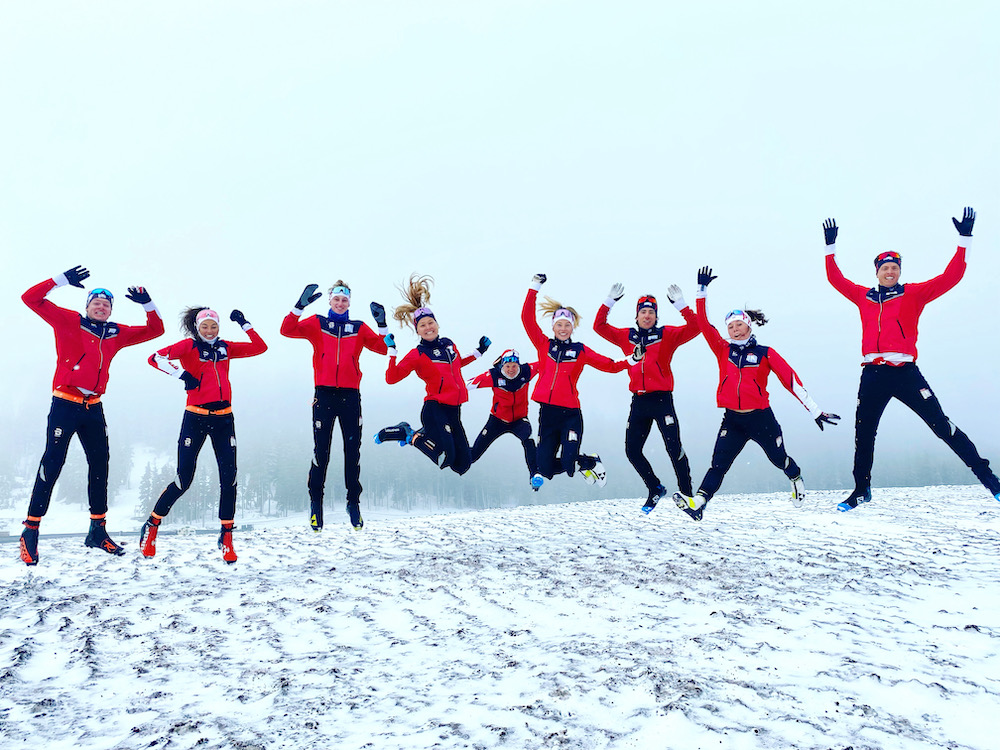
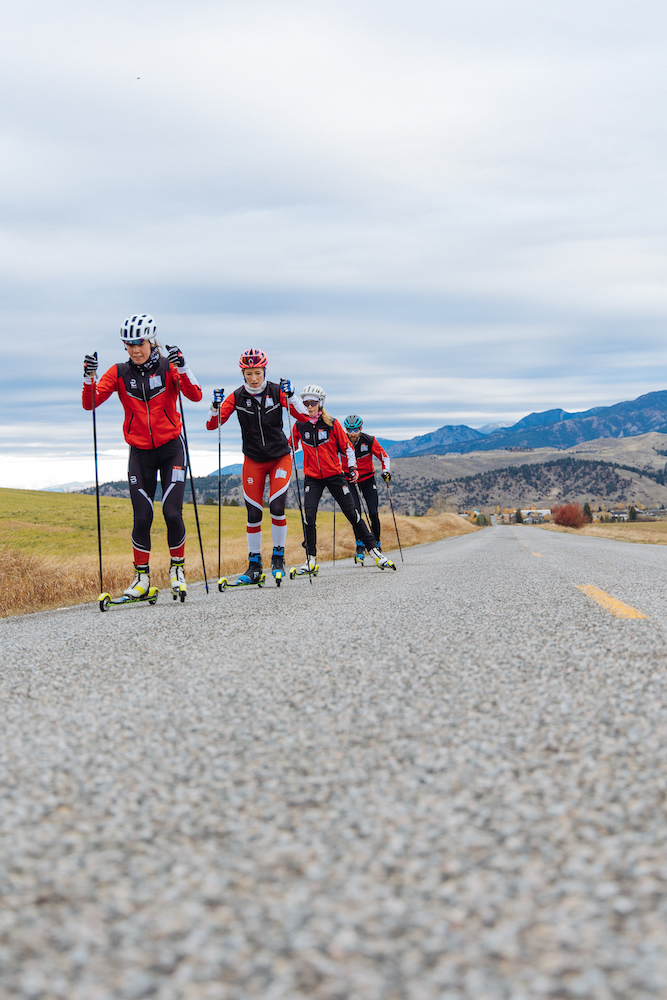
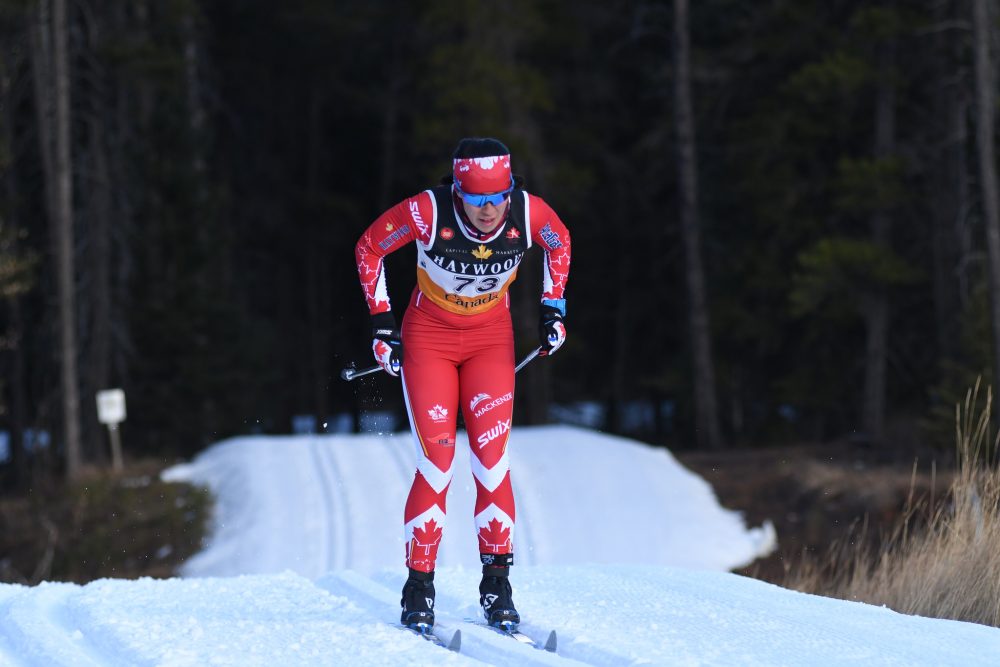
Bridger Ski Foundation athletes, 2021. (photo: courtesy BSF)
Top results last season: While the SuperTour obviously didn’t happen, BSF sent a strong team to the American Birkebeiner, the closest anyone came to a nationwide domestic field last year. BSF athletes came away with a combined four top-10 finishes in the skate race, including O’Connell in 4th, Flowers in 5th, Jortberg in 7th, and Rudd in 9th. Graham was 12th in this race, and Diekmann 23rd. In the classic race, O’Connell was 11th and Diekmann 15th. O’Connell had a pair of podium finishes in Sun Valley in March 2021, against a loaded regional field with multiple RMISA athletes, and was third in a RMISA race in January. Diekmann tied for first in a RMISA sprint qual in January, while Jortberg was second among the women. Flowers was 6th in a separate January RMISA race. Finally, going back to the ill-fated spring of 2020, Diekmann was scheduled to make his World Cup debut in the Québec City sprints before the races were cancelled, while Flowers was among the starters for the women.
Andy Newell, Bridger Ski Foundation coach, 2021. (photo: courtesy BSF)
Coach’s comments: Andy Newell wrote:
“Off-season training for us has been super fun and productive. I’m really proud of the way the team has come tougher over the past year and a half. It’s always a risk when you create a new team from scratch, you never know what kind of team dynamic will play out. But this group does an amazing job working together, pushing one another, while also showing authentic support. We have a lot of fun.
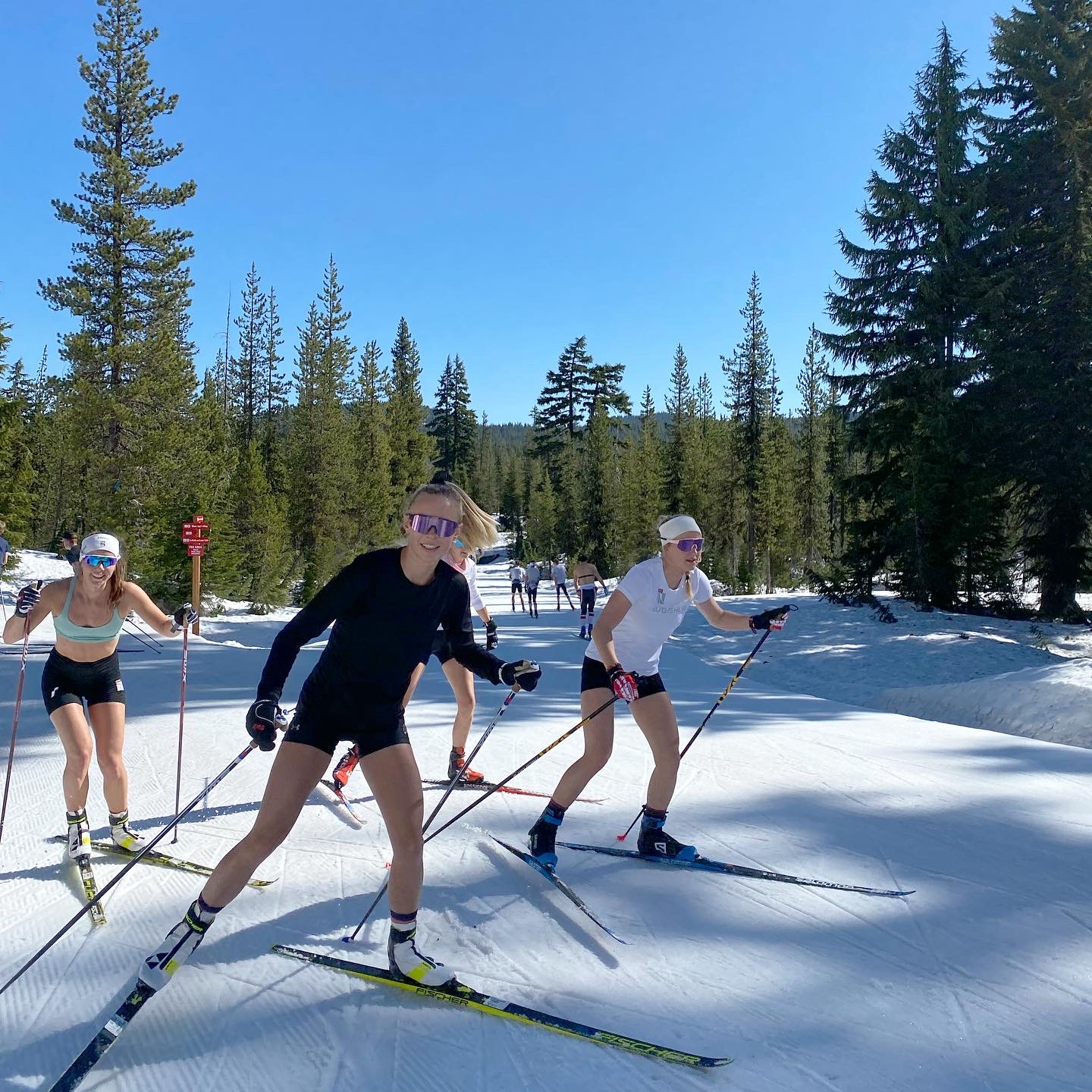
BSF athletes on snow in Bend, May 2021. (photo: courtesy BSF)
“Our summer preparation started in May with our first ever team Bend camp with the US Ski Team. During the months of June and July we try to focus on solid, steady team training here in Bozeman alongside the BSF collegiate group and comp teams. This is an important time for the Pro Team to connect with the community and the younger members of the BSF club. Since then we have tried to prioritize high quality training camps each month. In August we had a great low altitude training camp in Cable, Wisconsin, an intensity camp with rollerski TT’s in Lake Placid in September, and our annual October training camp with the US Ski Team. I think because last season was so isolating we’ve tried to collaborate with the other elite teams as much as possible and have had a fun time working with Sun Valley, SMS, Team Birkie and others.
“The Pro Team is itching to get on snow and get the season started. We will travel to Canmore in mid-November for more on-snow training and TT’s, then focus on our final preparations for the first SuperTours in the Midwest. The athletes have big goals this year so everyone is excited to return to a legit race calendar. Although we need to prioritize SuperTour racing our ultimate goal with this team is to get everyone racing in Europe whether that’s in World Cup starts, U23s, or other championship races.
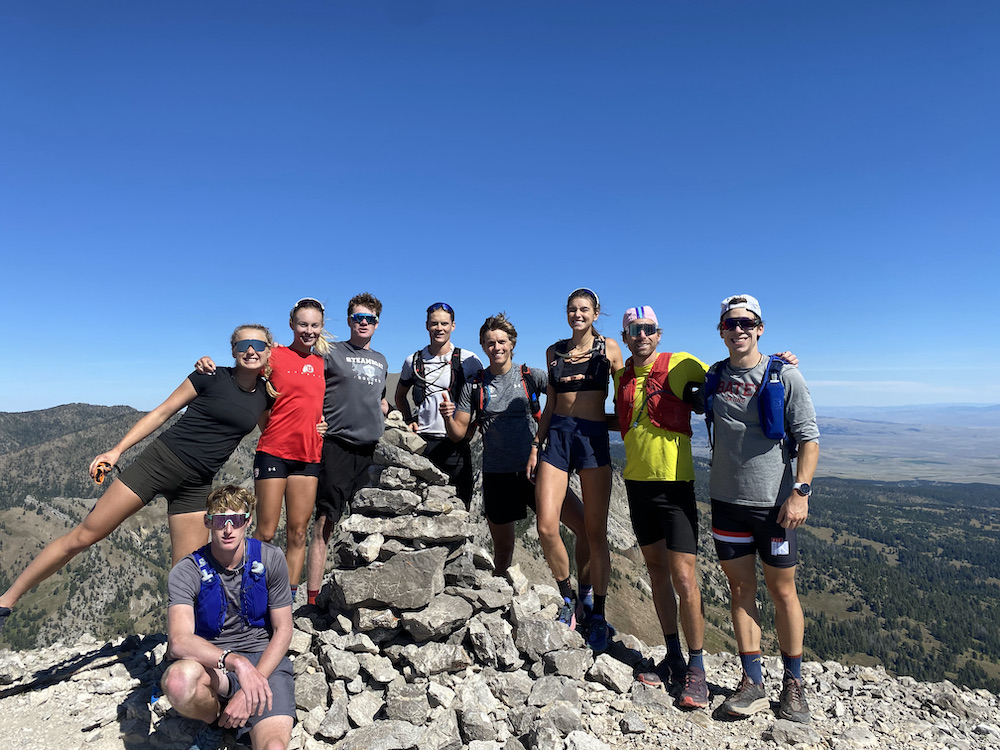
Bridger Ski Foundation athletes, 2021. (photo: courtesy BSF)
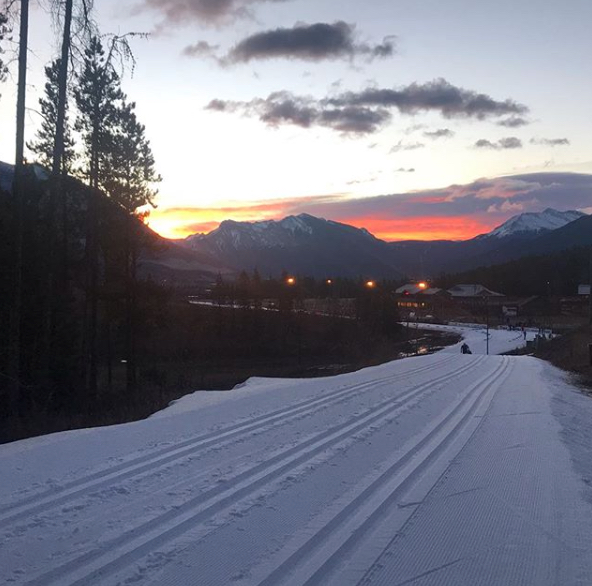
Sunrise in Canmore courtesy of Mother Nature. Today was distance day for the men and women. The women contested a 7.5 k individual start freestyle race, the men huffed and puffed for 10 k. (Photo: Linden Mills-Connery)
On Tuesday, Frozen Thunder at the Canmore Nordic Centre in Canmore, Alberta hosted women’s and men’s individual start freestyle races. The women raced 7.5 kilometers, the men 10 k.
Canada’s Emily Nishikawa (AIAWCA/CNST) won the women’s 7.5 k skate race in a time of 21:05.9 minutes. Nishikawa’s pacing was peerless as she skied the fastest splits at every checkpoint. Dahria Beatty (AIAWCA/CNST) placed second, stopping the clock 24.0 seconds slower than Nishikawa for a time of 21:29.9 minutes. Third place went to U.S. skier Catherine Feldman (SVSEF Gold Team) who skied the course in 21:42.2 minutes.
Another U.S. skier, Dartmouth’s Lauren Jortberg, skied to fifth (+59.2), while Canadian Biathlon National team member Emma Lunder placed sixth (+1:22.5). Cate Brams (SVSEF Gold Team), also from the U.S., was sixth overall (+1:37.9).
U.S. skier, Adam Luban (SVSEF Gold Team) placed second (+32.6), with Canada’s Graham Nishikawa (CPNST) in third (+34.4). Nishikawa races as a guide for Canada’s Para Nordic Team. Len Valjas (CNST) was 39.8 seconds in back of Kennedy to place fourth overall.
(Feldman, Brams, and Luban of the SVSEF Gold Team are also 2018 Middlebury College graduates.)
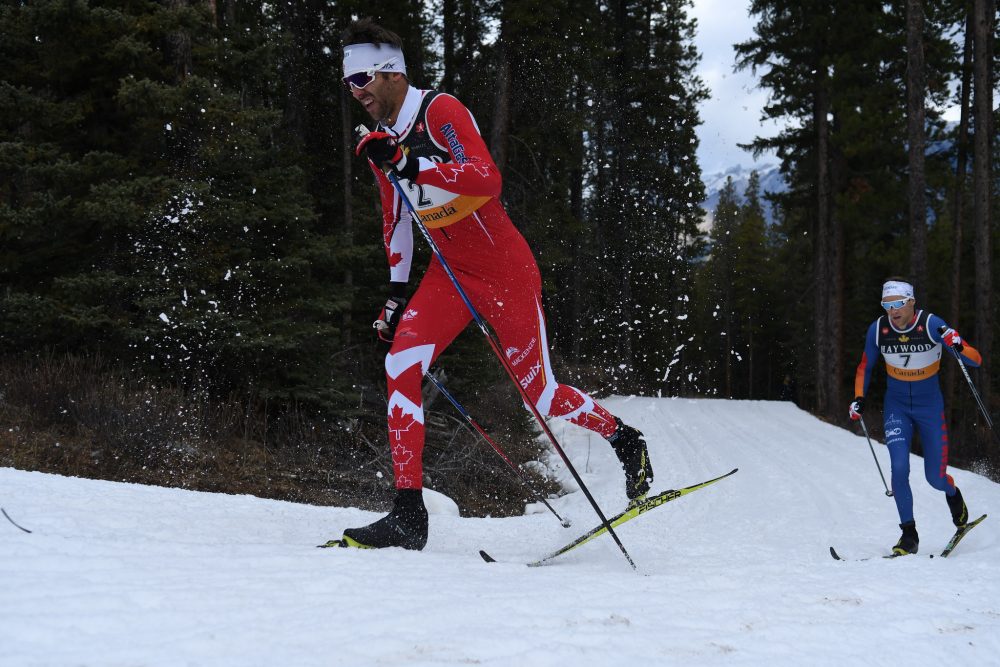
Len Valjas (CNST) overall winner of the Frozen Thunder classic sprint in bib 2 leads Reed Godfrey (bib 7) in round 2 of the Frozen Thunder classic sprint. (Photo: Doug Stephen)
The North American season kicked off today with classic sprints at Frozen Thunder in Canmore, Alberta. Most of the top athletes were treating this as a chance to do some race intensity and were more focused on training and process goals than on actual results.
Chief of Competition Thomas Holland had expected a smaller turnout this year, partly from fewer people traveling to Frozen Thunder in a non-Olympic year and partly because the event is not used for trip selection this year. In years past, Frozen Thunder races have been used to fill Canada’s remaining World Cup period 1 starts. While there were less elite athletes present, the overall entries rose to 159, with a large increase in juniors.
“There’s a lot of happy athletes putting in a lot of time here, and it’s great to see the energy,” Holland said in a phone interview while waiting for doping control to finish. “The numbers are up, there’s more women this year.”
Dahria Beatty during the 2018 Frozen Thunder classic sprint qualifier. (Photo: Doug Stephen)
The King’s court heat format has been a good fit for the early season racing. It ensures every skier gets to ski three heats against people of similar speed.
“You get guys skiing against girls, disabled skiing against able-bodied, there’s a lot of magic there,” Holland said.
This year’s course is new, adding a hill and switching to a single lap of about 1.5km.
Below are quotes from athletes to provide insight into North America’s first day of head-to-head racing.
Athletes on Tactics and Race Goals
“I was happy with my race today. I executed my technical goals well and was able to maintain my speed around the entire course without slowing down much which has been something I’ve been working on this summer.” — Dahria Beatty (CNST, Q 1st, H 1st)
“Once I got the ‘king heat’ I felt for sure like the underdog being a first-year senior man. So, my goal was just to stay in there as much as possible and hopefully beat at least one guy to stay in the king heat for the A final. It was a super fast group of guys today so I was pretty excited to be racing in the final.” — Reed Godfrey (Team R.A.D., Q 6th, H 4th)
“My plan for the heats was to press hard from the gun in every round. My focus today was on doing a good effort at full race pace. At this time of year, I’d prefer to get the hard racing in my legs rather than racing tactically for the win.” — Julien Locke (CNST, Q 2, H 5)
“Unfortunately, my klister caught 2/3 of the way through the semifinal and I face planted into the snow while the other guys skied around me. I pushed hard in the B-Final, leading from start to finish. The snow softened and made for a far more challenging loop. I was happy to have good power through the last round and also to see my fellow BC NST teammate Gareth [Williams] skiing well and holding on to a good pace.” — Locke
“I was really happy with the whole day. I found I executed my plan like I wanted too and that I skied the course well both in the qualifier and during the heats. I will have to work on my pacing for qualifiers, I went a bit to slow up the first climb at the start. I wish I could have stayed in front of Lenny in the last 100m, but I did not have enough gas. Never count this guy out ;)” — Dominique Moncion-Groulx (Team R.A.D., Q 3rd, H 2nd)
Athletes on Feeling Fit. Or Not.
“My shape was surprising considering I only started full-time training less than a month ago. Double pole felt stronger than I remember and the legs felt good on the climbs. I’ll attribute my podium performance to the SkiGo klister I was using.” — Andy Shields (Lappe, Q 9th, H 3rd) Shields is the Canadian rep for SkiGo waxes.
“I didn’t have high expectations today coming off an altitude block in Mammoth, but I ended up being super happy with how the day went. It’s obvious that the race shape isn’t there yet, but it was really fun battling it out with with some very solid skiers today!” — Reed Godfrey
“Today’s races were pretty smooth, didn’t expect much since I just returned from the NST camp in Mammoth, California. I felt alright in the qualifier and managed to move up to 6th on the day.” — Gareth Williams (CNST, Q 8th, H 6th)
“I was super happy to have a good qualifier [which] shows good fitness but I tried double poling and haven’t done enough on snow yet to hold my fitness through the heats.” — Russell Kennedy (Team R.A.D., Q 1st, H 7th)
“The race today was tough, I just got on snow and coming off a volume camp in Mammoth lakes the body wasn’t too happy trying to push to the max. It was solid intensity, but hopefully not where the race shape will be. “ — Evan Palmer-Charrette (Team R.A.D., Q 11th, H 8th)
Athletes on the King’s Court Format
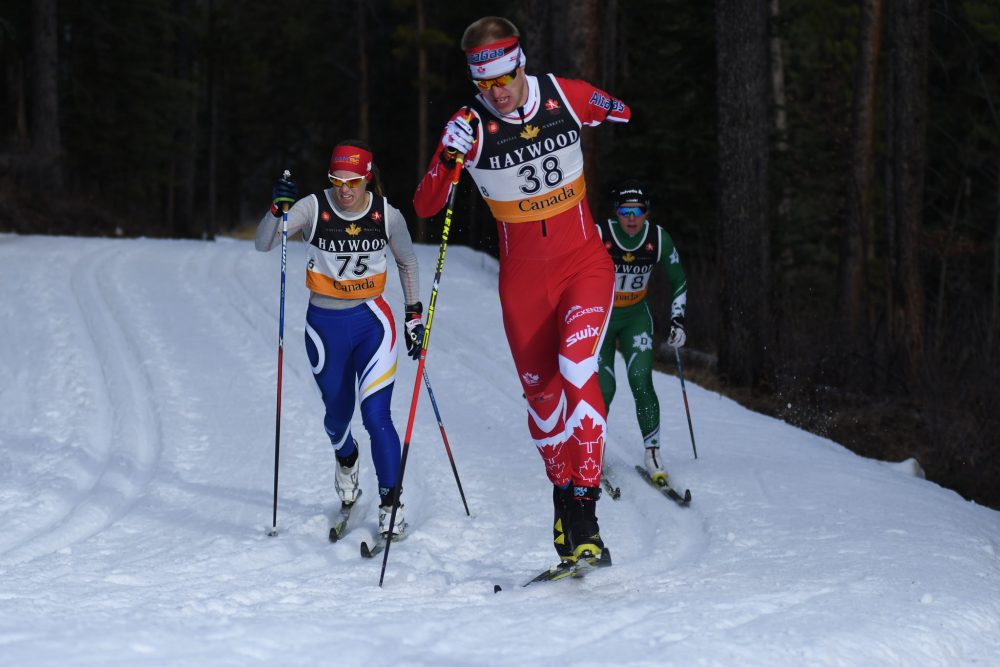
Mark Arendz (CPNST) in bib 38, leading Hannah Mehain (Bib 75) and Dartmouth’s Lauren Jortberg (bib 118) in round 1 of Frozen Thunder’s King’s Court sprint format. (Photo: Doug Stephen)
“The King’s court format was changed slightly this year with only the winners of the heats moving up. The 2nd and 3rd skiers stayed where they were and 4th place dropped down. With the new format it meant you couldn’t cruse into 2nd place and advance like you use to – you had to get after those ‘Ws’ which was a great improvement on the part of the organizers. It made for a lot more high-stakes lunges at the line.” — Shields
“Kings court format is a great training tool because it puts you against people who were a similar speed to you in qualifying allowing people to be in the mix for most of the heat versus the big spread you see in a normal quarter-final. I think it’s perfect for early season prep races like Frozen Thunder and as a development tool, giving everyone the opportunity to race four times.” — Beatty
“King’s courts is nice because it allows everyone to race a full set of heats, which is a really good training benefit this time of year. It’s also nice to have everyone fighting to move up and up in the heats throughout the day.” — Reed Godfrey
“Kings court is a great format to help people improve their race fitness in the early season and work on tactics in a low pressure situation.” — Palmer-Charette
“The King’s Court format allows everyone in the ski community the opportunity to race multiple times. The format allows for you to race skiers of similar speed, as well as challenging yourself as you progress through the rounds. For me, I have an opportunity to race the Senior Women, [as] our ski speeds are very similar. That close head-to-head competition is always good to develop skills and tactics for future races.” — MarkArendz (CPNST)
Athletes on Early season racing
Emily Nishikawa (CNST) during the 2018 Frozen Thunder classic sprint qualifier. Nishikawa qualified in second place and skipped the heats. (Photo: Doug Stephen)
“It has been really great to get back on snow for training and racing this past week. Having on snow races early season is super valuable and is a great way to figure out what needs to be fine tuned before the season starts.” — Beatty
“It’s important to break that barrier of racing now early in the season to learn what you need to work on moving forward to when it really starts to really count. The quicker we can make that pavement to snow transition definitely helps going into the the races in late November and December.” — Reed Godfrey
“I leave for the World Cup in 10 days and it’s time to start ramping up the on-snow speed. No better way to do that than a good race! Frozen Thunder is such an asset for us here in Canmore. It’s a huge benefit to be back on snow before the season and it gives us an edge in our preparation for the season.” — Locke
“I think getting on snow in the early season can be really important for people looking to race fast in period one. For everyone going overseas to the World Cup I feel like it’s essential and for those of us racing domestically it elevates the level of competition for everyone.” — Palmer-Charrette
“You can’t replace hard races with intensity. If you want to go fast at some point in the season, you need to get enough race starts throughout the year.” — Arendz
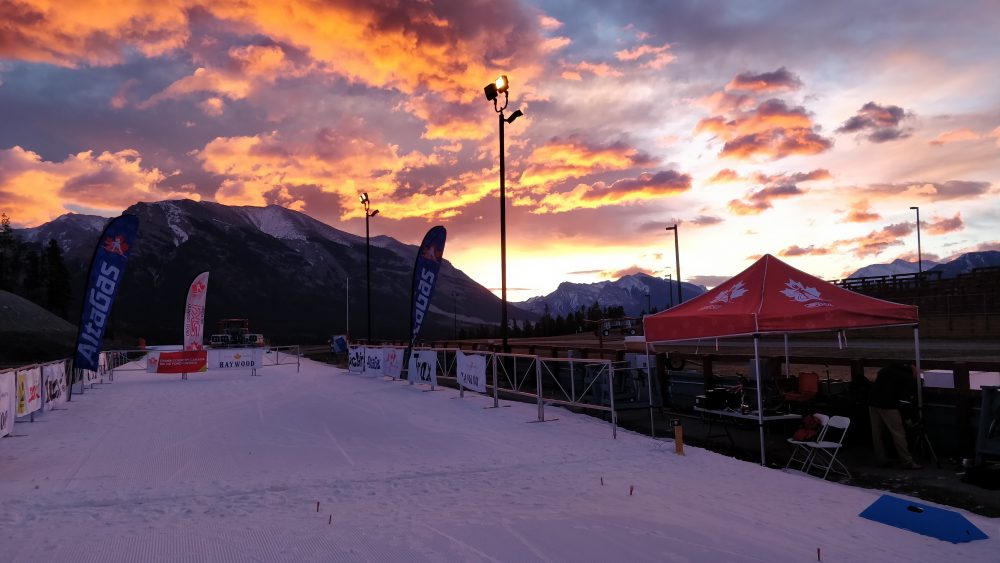
The dawn of a new 2018 Frozen Thunder Classic Sprint Day. Racing began today with the classic sprint. Ivan Babikov was up early and on site at the Canmore Nordic Centre in Canmore, Alberta. (Photo: Ivan Babikov)
Day 1 Frozen Thunder (Canmore, Canada) Classic Sprint
In the senior men’s category, Russell Kennedy (Team R.A.D.) was the fastest qualifier finishing in a time of 3:36.70 minutes. Julien Locke (Black Jack/CNST) qualified in second (+1.26), with Dominique Moncion-Groulx (Nakkertok Nordique/Team R.A.D) in third (+2.47). Longtime Canadian National Ski Team member Len Valjas skied the fourth fastest qualifying time, 3.78 seconds behind Kennedy.
Peter Holmes (SVSEF), who qualified in seventh (+4.55), was the fastest U.S. men’s qualifier.
On the senior women’s side, Dahria Beatty (AIAWCA/CNST) stopped the clock in 4:09:16 with the fastest qualifying time. Teammate Emily Nishikawa was second (+11.5), while Katie Weaver (RMR) was third (+14.99). Maya MacIsaac-Jones (RMR/CNST) qualified fourth (+15.36).
Lauren Jortberg was the fastest female qualifier from the U.S., skiing to sixth (+16.85).
Under this format, men and women have the possibility of competing against one another in the heats.
Amongst the senior men in the King’s Court heats, Valjas placed first, Moncion-Groulx second, with Andy Shields (Lappe Nordic) third. Shields placed ninth in the qualifier (+6.08). Reed Godfrey (Team R.A.D.)placed fourth. Godfrey was the sixth fastest men’s qualifier, 4.15 seconds behind top qualifier, Kennedy.
For the senior women, Beatty took first, Hannah Mehain second, with Weaver in third. Macisaac-Jones finished in fourth.
Look for a full race report later today on FasterSkier.
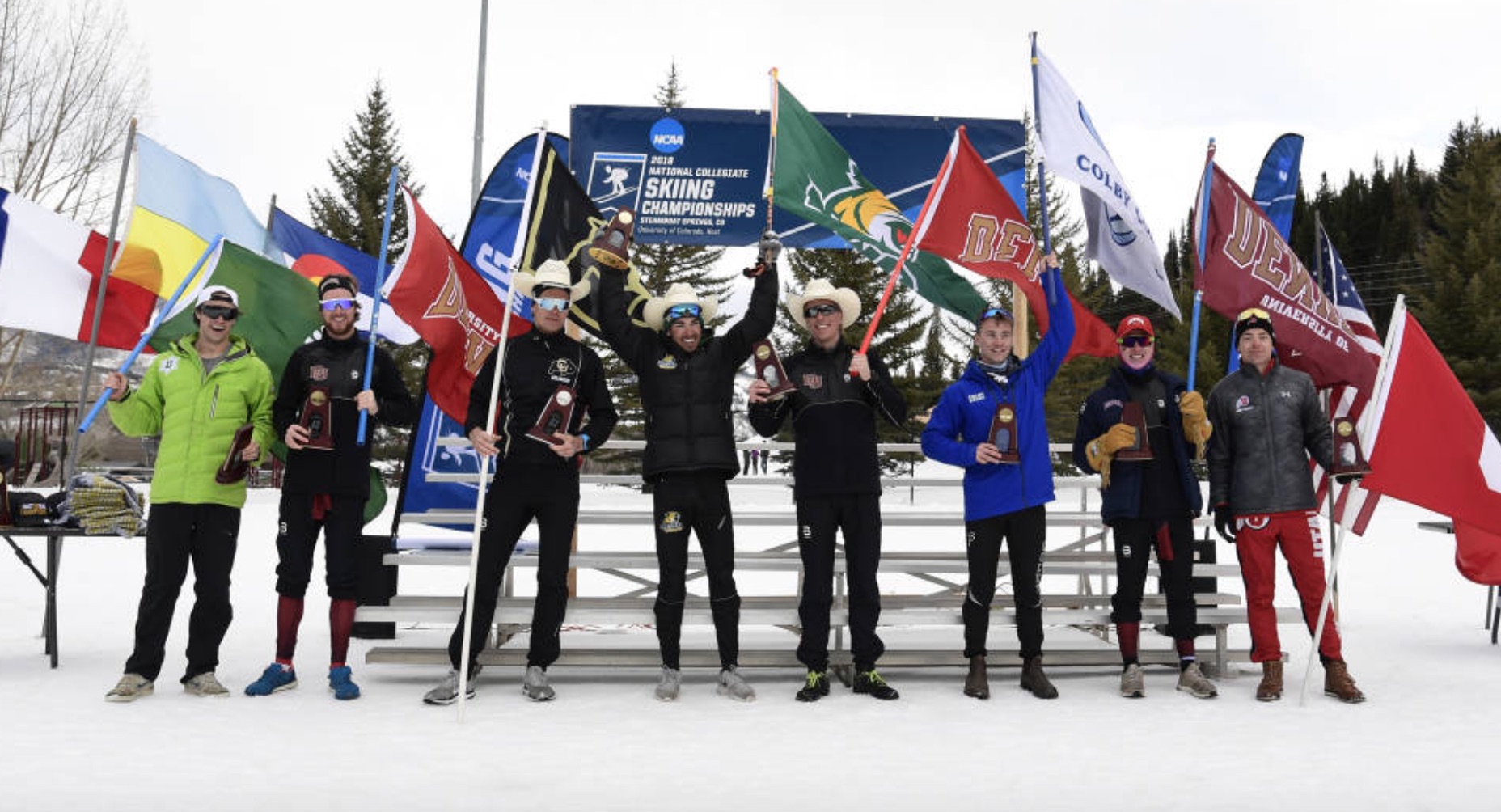
The top finishers in the men’s 20 k freestyle mass start at 2018 NCAA Skiing Championships in Steamboat Springs, Colorado, with Northern Michigan University’s Ian Torchia (c) in first. (Photo: Dartmouth Sports/Clarkson Creative)
NCAA Skiing Championships (Steamboat Springs, Colorado): 15/20 k freestyle mass starts
On the fourth and final day of NCAA Skiing Championships at Howelsen Hill in Steamboat Springs, Katharine Ogden skied to her second-straight national title, Ian Torchia became an NCAA champion and the University of Denver (DU) won its 24th NCAA National Championship.
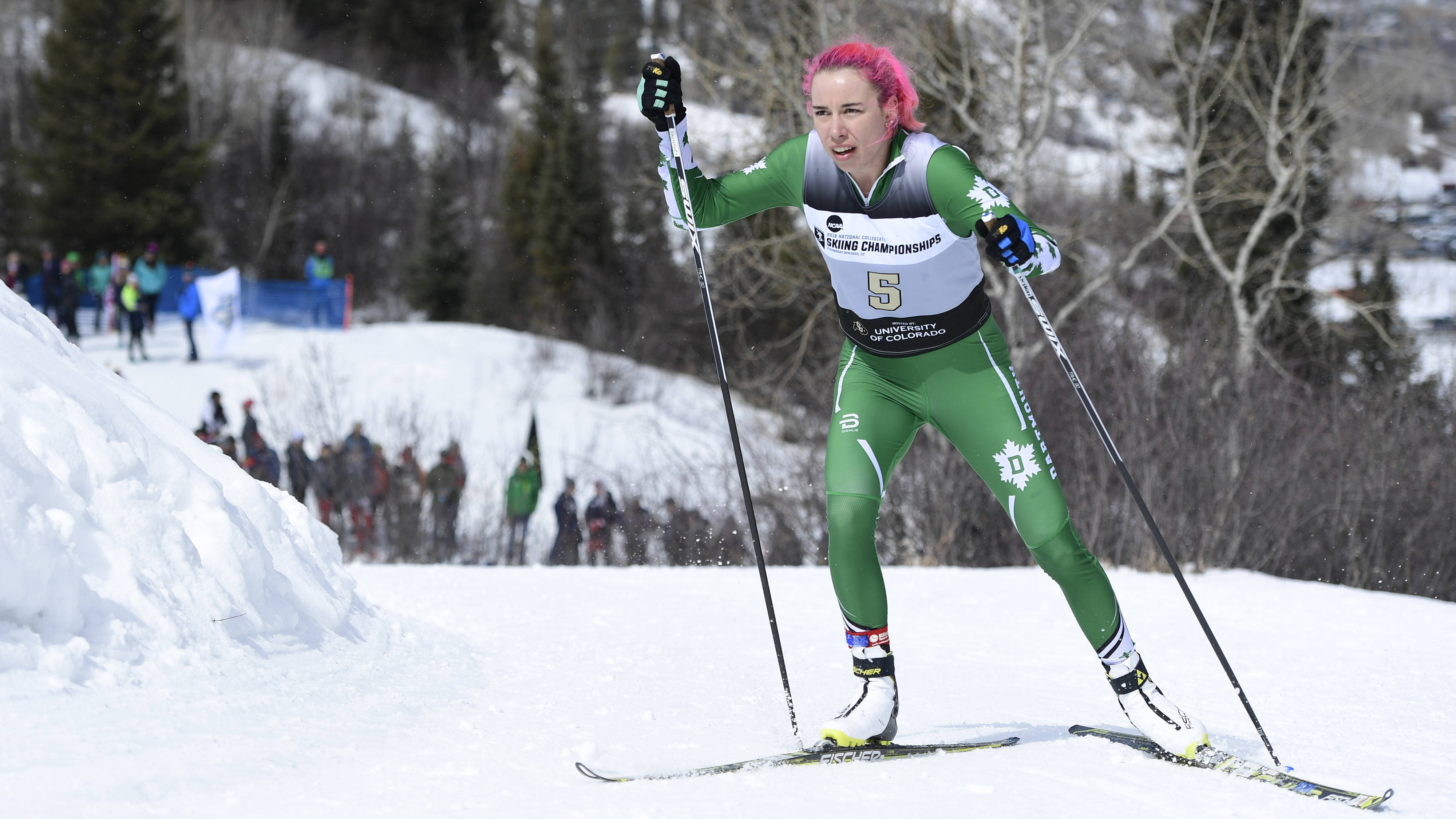
Dartmouth freshman Katharine Ogden racing to her second-straight victory of the 2018 NCAA Skiing Championships in Steamboat Springs, Colorado. She won Saturday’s 15 k freestyle mass start by more than 38 seconds. (Photo: Dartmouth Sports/Clarkson Creative)
Ogden, a Dartmouth College freshman, raced to a 38.4-second victory in the women’s 15-kilometer mass start, finishing in 43:22.0 minutes for her second win in as many races at 2018 NCAA Championships. She won the 5 k classic on Thursday and with her win on Saturday, she became the first Dartmouth skier in 56 years to win two national titles in the same year, according to a Dartmouth press release.
On the second of three laps, Ogden broke away early with close to 10 k to go. According to the press release, she had a “quick fall” near the end of the second lap, but that didn’t derail her as she had time to grab sunglasses from Dartmouth men’s coach Brayton Osgood and a Dartmouth Lone Pine flag before the finish.
At this year’s championships, Ogden’s two titles are accompanied by victories from Dartmouth men’s alpine skiers Brian McLaughlin (who won the giant slalom) and Tanguy Nef (who won the slalom). This marked only the second time that Dartmouth’s Big Green won four individual titles in a single NCAA Championships; that also occurred 61 years ago.
“Katharine absolutely wanted this one, and she really likes to win,” Dartmouth Director of Skiing and Women’s Nordic Head Coach Cami Thompson Graves said in the press release. “She wasn’t about to let a fall slow her down, she has such a great competitive fire. But she also showed her playful side grabbing Brayton’s glasses and smiling all the way to the finish line!”
Hailey Swirbul of the University of Alaska Anchorage placed second and Linn Eriksen (DU) reached the podium in third (+46.3). Denver had three in the top 10 with Jasmi Joensuu in ninth and Taeler McCrerey in 10th. Also landing in the top 10 for All-American honors were Guro Jordheim of the University of Utah in fourth, Emma Tarbath (Montana State University) in fifth, Petra Hyncicova of the University of Colorado Boulder (CU) in sixth, Christina Rolandsen (CU) in seventh, and Lauren Jortberg (Dartmouth) in eighth.
Torchia, an Northern Michigan University (NMU) junior and U.S. Ski Team Development Team member, became the seventh NCAA champion in NMU Wildcats nordic skiing history, according to an NMU press release. Fredrick Schwenke was the Wildcats’ last nordic champion; he won the 2015 NCAA Championships 20 k classic.
Torchia drew bib 1 for Saturday’s 20 k freestyle mass start and crossed the finish line first in 54:21.0, just 2 seconds ahead of CU’s Alvar Alev. Eivind Kvaale (DU) finished just four seconds back in third, and Denver had three in the top seven with Dag Frode Trollebø in fourth and Lars Hannah in seventh. Darmouth’s Cal Deline placed fifth, Zane Fields of Colby College finished sixth, and the 20 k freestyle’s 2017 NCAA champion Martin Bergström (Utah), who also won Thursday’s 10 k classic, placed eighth. CU’s Petter Reistad and Sondre Bollum finished ninth and 10th, respectively.
In the team standings, Denver beat Colorado by 41 points for the overall win with a total of 604 points between the nordic and alpine events at this year’s championships. Dartmouth placed third, 114.5 points behind Colorado, and Utah was another 63 points back in fourth.
According to a DU press release, Denver has won at least one national championship in each of the last five athletic seasons (skiing: 2013/14, 2015/16, 2017/18; hockey: 2016-17; men’s lacrosse 2014/15), joining only Stanford on the list of schools that have done so in the last five seasons. (Oregon, West Virginia, Penn State, Oklahoma, Ohio State and Florida could potentially join that list later this year.)
“It feels incredible,” said DU head coach Andy LeRoy said in the press release. “I am so happy for all of our athletes, they’ve been training all week and all season and to do it in Steamboat in front of our crowd is special.”
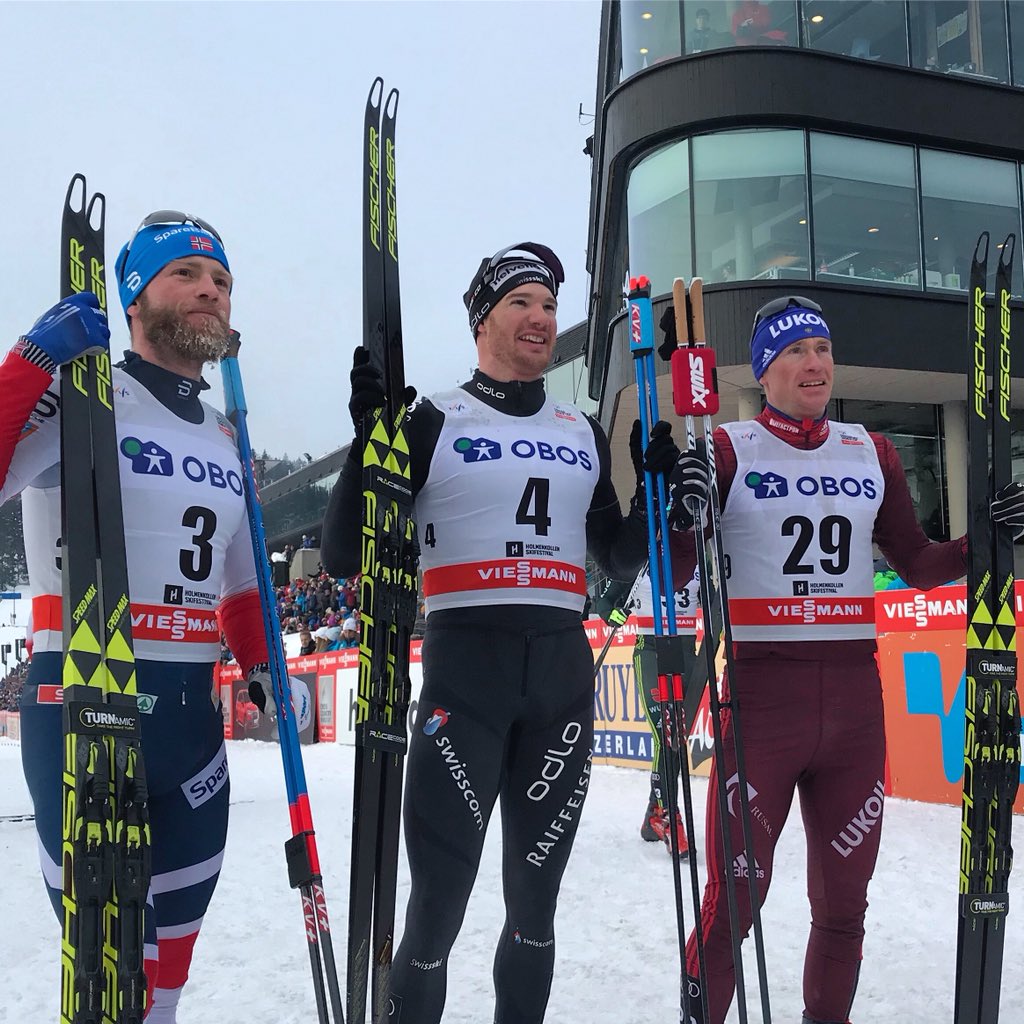
The Holmenkollen men’s 50 k freestyle mass start podium on Saturday at the World Cup in Oslo, Norway, with Switzerland’s Dario Cologna (c) in first, Norway’s Martin Johnsrud Sundby (l) in second, and Russia’s Maxim Vylegzhanin (r) in third. (Photo: FIS Cross Country/Twitter)
FIS Cross Country World Cup (Oslo, Norway): Men’s 50 k freestyle mass start
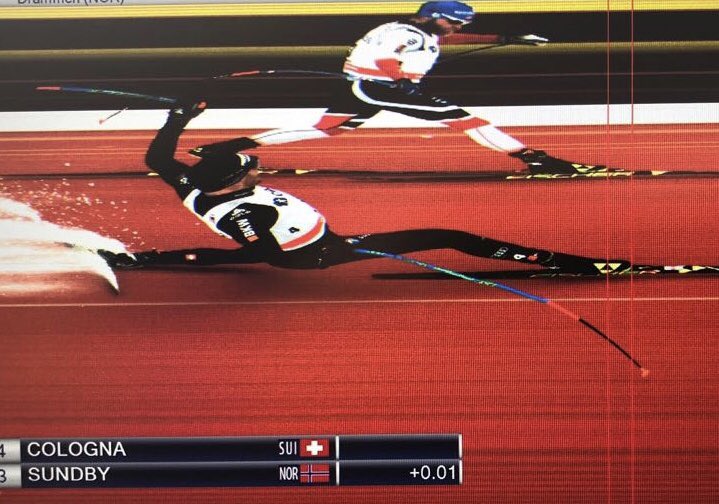
A four-time Olympic champion, Dario Cologna of Switzerland won his first 50-kilometer World Cup race on Saturday, topping the podium in the famous Holmenkollen 50 k freestyle mass start after outlunging Norway’s Martin Johnsrud Sundby (who won the event last year) for the win in 2:01:48.1. Sundby finished one-hundredth of a second behind for second place, ahead of Russia’s Maxim Vylegzhanin, who was 1.1 seconds back in third in his first World Cup race since November of last year.
The photo finish for first between Switzerland’s Dario Cologna (near) and Norway’s Martin Johnsrud Sundby at the Holmenkollen 50 k freestyle mass start on Saturday in Oslo, Norway. Cologna got it by 0.01 seconds. (Photo: FIS Cross Country/Twitter)
Norway’s Sjur Røthe came out on top in a race for fourth (+4.2), ahead of Russia’s Denis Spitsov in fifth (+4.4) and his Norwegian teammate Hans Christer Holund in sixth (+4.5). Great Britain’s Andrew Musgrave followed in seventh (+15.1), Germany’s Florian Notz placed eighth (+25.9) and Canada’s Alex Harvey finished ninth (+32.4), ahead of France’s Robin Duvillard in 10th (+33.5).
Scott Patterson led the U.S. in 16th (+56.3) coming off an 11th place in the 50 k classic mass start at last month’s Olympics, and Canada’s Devon Kershaw finished in the points in 28th (+3:43.6). Just outside the top 30, Canada’s Graeme Killick finished 34th (+4:55.1).
Also for the U.S, David Norris placed 38th (+6:19.7), Paddy Caldwell was 46th (+8:12.3), Noah Hoffman 49th (+10:27.9), Kevin Bolger 52nd (+12:44.2), and Simi Hamilton did not finish.
Canada’s fourth man in the race, Andy Shields finished 47th (+8:13.6).
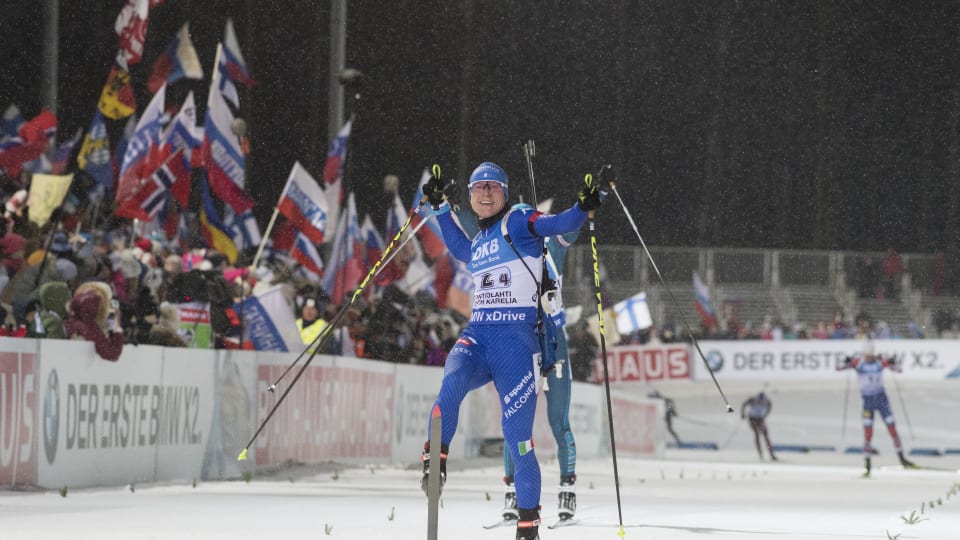
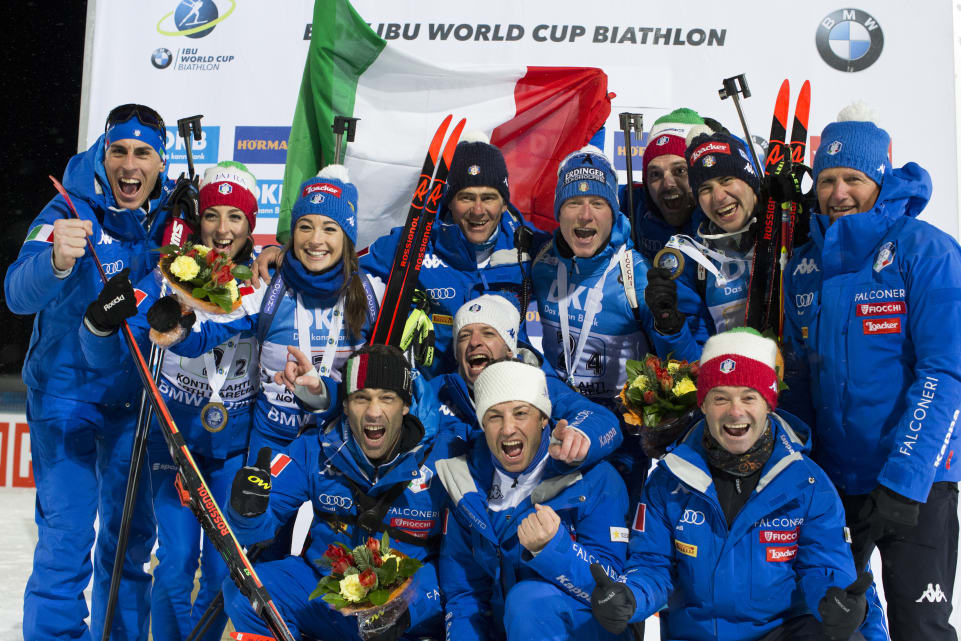
Italy’s Lukas Hofer celebrates his team’s win in Saturday’s mixed relay at the IBU World Cup in Kontiolahti, Finland. (Photo: IBU/Biathlonworld)
IBU World Cup (Kontiolahti, Finland): Single mixed relay & mixed relay
(Note: This rundown has been updated to include comments from Christian Gow and Sean Doherty.)
In the last single mixed relay and mixed relay of the International Biathlon Union (IBU) World Cup season, France and Italy came out on top, with France winning the two-person single mixed relay and Italy taking first in the coed mixed relay.
France’s Anaïs Chevalier and Antonin Guigonnat after winning Saturday’s single mixed relay at the IBU World Cup in Kontiolahti, Finland. (Photo: IBU/Biathlonworld)
France’s Anaïs Chevalier and Antonin Guigonnat combined for zero penalties and six spares to finish first in the single mixed relay in 33:29.1 minutes. Guigonnat as the team’s anchor secured the win by just 2.4 seconds over Austria’s Julian Eberhard while Norway’s Johannes Thingnes Bø finished 4.4 seconds back for third.
Chevalier put France in fifth after the first leg, 15.5 seconds behind Ukraine’s Iryna Varvynets in first. Guigonnat used just one spare on his first leg to move them into fourth, 9.2 seconds back while Norway led at the second exchange. On Chevalier’s second leg, she shot clean in both stages to lead through the final exchange, with Ukraine skiing just 6.2 seconds back in second.
On the final leg, Guigonnat used two spares and stayed out of the penalty lap, keeping the team in first through the finish. Eberhard skied the second-fastest course time on that leg to elevate Austria (with Lisa Theresa Hauser) from fourth at the tag to second place at the finish, and Bø skied all the way up from eighth to third place for Norway (with Marte Olsbu) with the fastest course time.
Ukraine’s Artem Tyschenko used just one spare but slipped to fourth with the 11th-ranked course time on that leg, as he finished 10.8 seconds behind Norway.
Behind Russia in fifth and Italy in sixth, Canada placed seventh (+23.8) with Rosanna Crawford and Christian Gow. The duo combined for zero penalties and six spares, and put themselves in third place early in the race. Crawford skied them into third on the first leg, using just two spares and tagging Gow 7.4 seconds out of first.
Gow went on to take the lead after cleaning prone without any spares, and he cleaned standing as well but slipped back to third while Bø took the lead. Gow tagged Crawford in third, 8.9 seconds behind Norway in first.
“I didn’t think too much about being tagged in third,” Gow recalled in an email to FasterSkier. “It was exciting for sure, but I let it fade to the background so that I could focus on my job both on the track and in the range. It was great to leave prone in first place! It was also surprising, but it was a good place to be in.
“My skiing was ok today,” he continued. “It is a really challenging and demanding race format that we don’t get a lot of practice with. I was sick after the Olympic Games and only finally coming around the past couple days. The Sprint race was horrendous for me, so today was much better than that. In the range I just focussed on myself and trusted my shooting. I tried my best not to get caught up in the race going on around me and it worked to my benefit.”
Crawford then slipped to seventh and 21 seconds back with three prone spares, but avoided the penalty lap, and Gow held onto seventh through the finish, using just one spare and skiing the eighth-fastest course time on that leg.
“We are both happy with this result,” Gow wrote. “I think that we are both looking at the 23 second gap to first and thinking that if things had worked out just a bit better we could be there. It can be both exciting and frustrating to be that close to the podium. We know we can do it, it’s just a matter of putting it together on the right day. We are happy with 7th, but hungry for more.”
Susan Dunklee and Lowell Bailey finished 14th for the U.S., 1:13.0 out of first with one penalty and 14 spares. The penalty came on Dunklee’s first leg during her standing stage, after she had cleaned prone without any spares. She tagged Bailey in 14th and he brought them up to 11th, using three spares on that leg, then Dunklee came through the final exchange in 13th after using four spares to clean. Bailey lost one place on the final leg, using four spares but staying out of the penalty lap.
Twenty-six teams competed in the single mixed relay, compared to 23 in the mixed relay that followed.
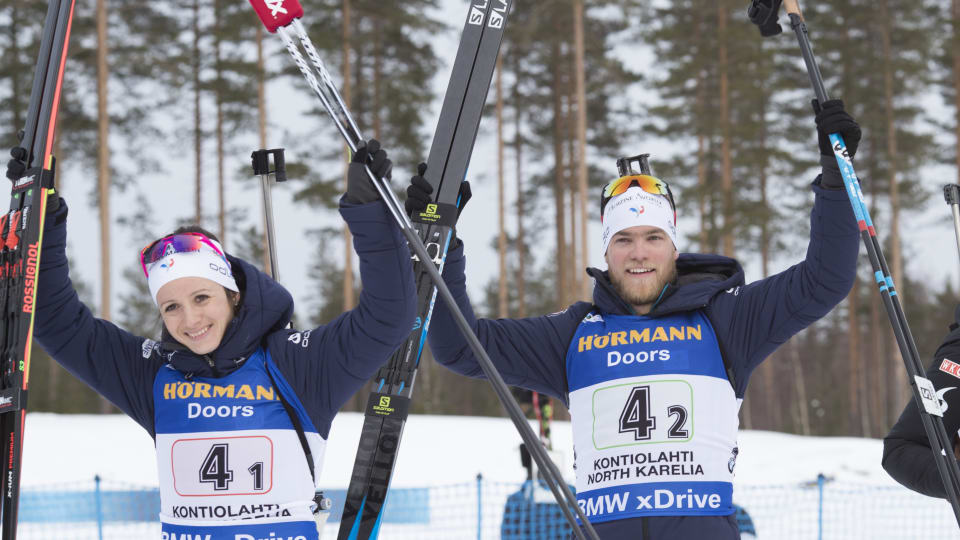
Team Italia celebrates its win in the IBU World Cup mixed relay on Saturday in Kontiolahti, Finland, with its relay members Dorothea Wierer, Lisa Vittozzi, Dominik Windisch, and Lukas Hofer. (Photo: IBU/Biathlonworld)
In Saturday’s 2 x 6 + 2 x 7.5 k mixed relay, Italy nabbed a 1.5-second victory over Ukraine in 1:15:08.3. Dorothea Wierer, Lisa Vittozzi, Dominik Windisch, and Lukas Hofer — the same Italian team that took bronze in the mixed relay at last month’s Olympics, although in a different order — combined for the win with one penalty and 13 spares.
Ukraine, with Anastasiya Merkushyna, Vita Semerenko, Artem Pryma, and Dmytro Pidruchnyi, had zero penalties and just three spares throughout the whole race. For the second-straight relay on Saturday, Norway placed third (+9.1) with Synnøve Solemdal, Tiril Eckhoff,Henrik L’Abée-Lund, and Tarjei Bø totaling zero penalties and nine spares.
Italy’s lone penalty came in Vittozzi’s second leg, but it didn’t derail the team as it improved from sixth to fifth with Vittozzi, who skied the third-fastest course time on that leg. She tagged Windisch 6.8 seconds out of first, and Windisch, who had anchored the team in the Olympics, took the lead by the final exchange after using two spares to clean. Hofer left the exchange just 3.3 seconds ahead of Norway’s Bø but used just one spare and skied the second-fastest anchor leg to finish first, beating his rivals up Kontiolahti’s infamous climb known as “The Wall”. Ukraine’s Pidruchnyi also shot clean with a single spare and clocked the fastest anchor leg to move his team from fourth to second place. Bø lost one place and finished third after using one spare as well and skiing the third-fastest anchor leg.
Russia followed in fourth, France fifth, Sweden sixth, Germany seventh, Austria eighth, and the U.S. ninth (+2:48.4). The U.S. team, with Clare Egan, Joanne Reid, Tim Burke, and Sean Doherty, had one penalty and 11 spares. Egan cleaned her first prone but had to ski a penalty lap after her standing stage, tagging Reid in 17th, 58.7 seconds out of first.
Reid used three spares on the second leg and moved up to 13th by the second exchange, and Burke used three spares as well to pick off one more place and tag Doherty in 12th. Doherty skied the eighth-fastest anchor leg and used two spares to clean to put the team in ninth at the finish.
“I don’t consider two spares to be anything special, but today it was enough to make up some ground,” Doherty wrote in an email to FasterSkier.”I felt strong skiing, more like myself which is fun even if it’s a little late in the season. We had very good skis which always helps. I have done quite a few laps on this course over the years so the lines and transitions are pretty refined, so that is where I made time on the course.
“I am happy with my leg. I enjoyed my little battle for 9th,” he continued. “I can’t speak too much for the other members of the relay tonight but I think 9th is a solid effort.”
Canada finished 17th (+4:34.9) with Emma Lunder, Julia Ransom, Scott Gow, and Brendan Green combining for one penalty and 13 spares. Lunder put them in 12th at the first exchange and Ransom skied up to 10th, but Scott Gow had a penalty on his standing stage to drop to 16th. Green lost one more place on the last leg despite only requiring two spares.
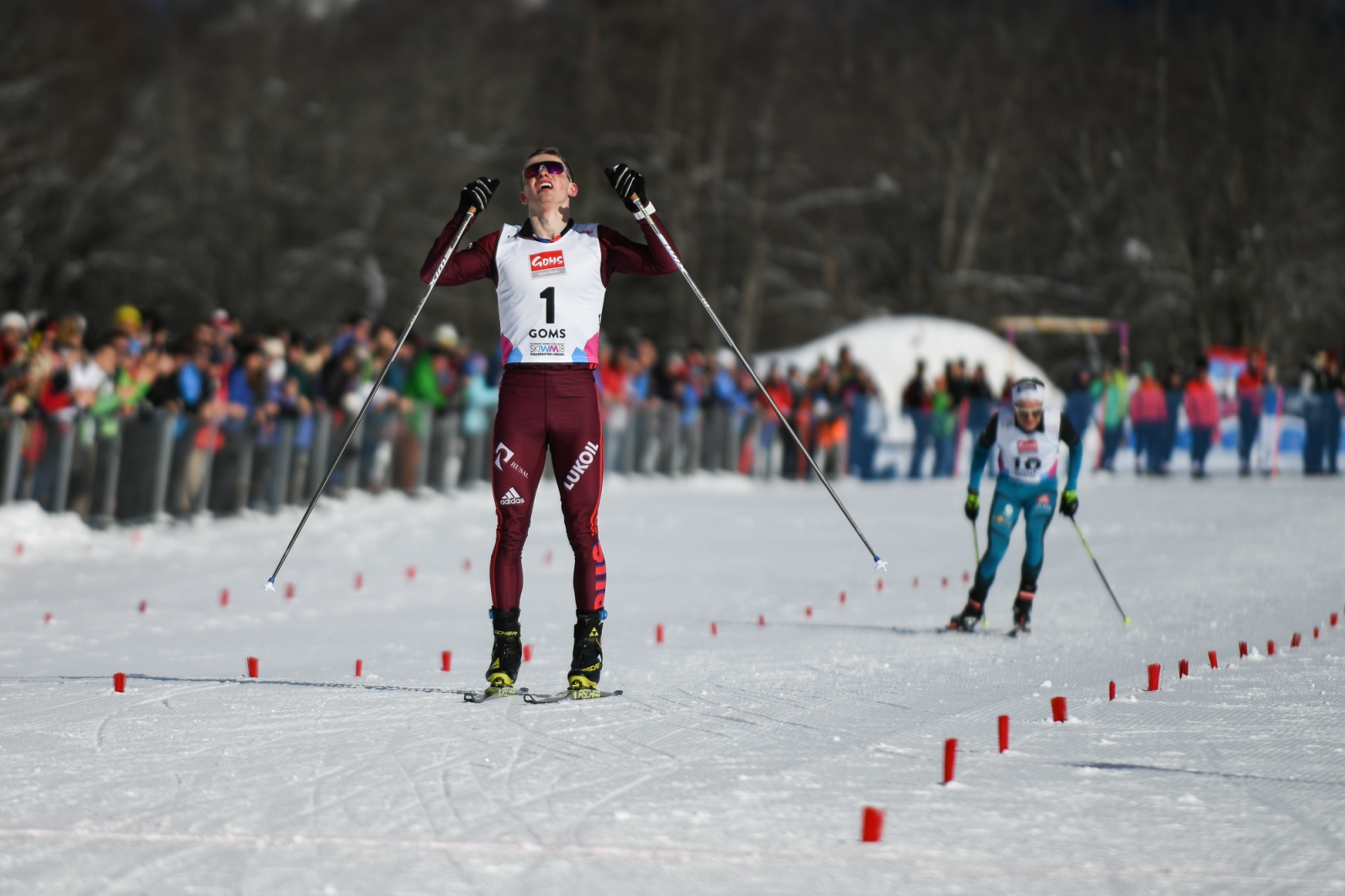
Russia’s Denis Spitsov celebrates his first U23 World Championships gold on Friday ahead of France’s Jules Lapierre in the men’s 30 k skiathlon in Goms, Switzerland. (Photo: JWSC2018.ch)
(Note: This article has been updated to include comments from Americans Lauren Jortberg and Ian Torchia.)
U23 World Championships (Goms, Switzerland): 15/30 k skiathlons
On the final day of U23 World Championships racing in Goms, Russia stole the show in the women’s and men’s skiathlons.
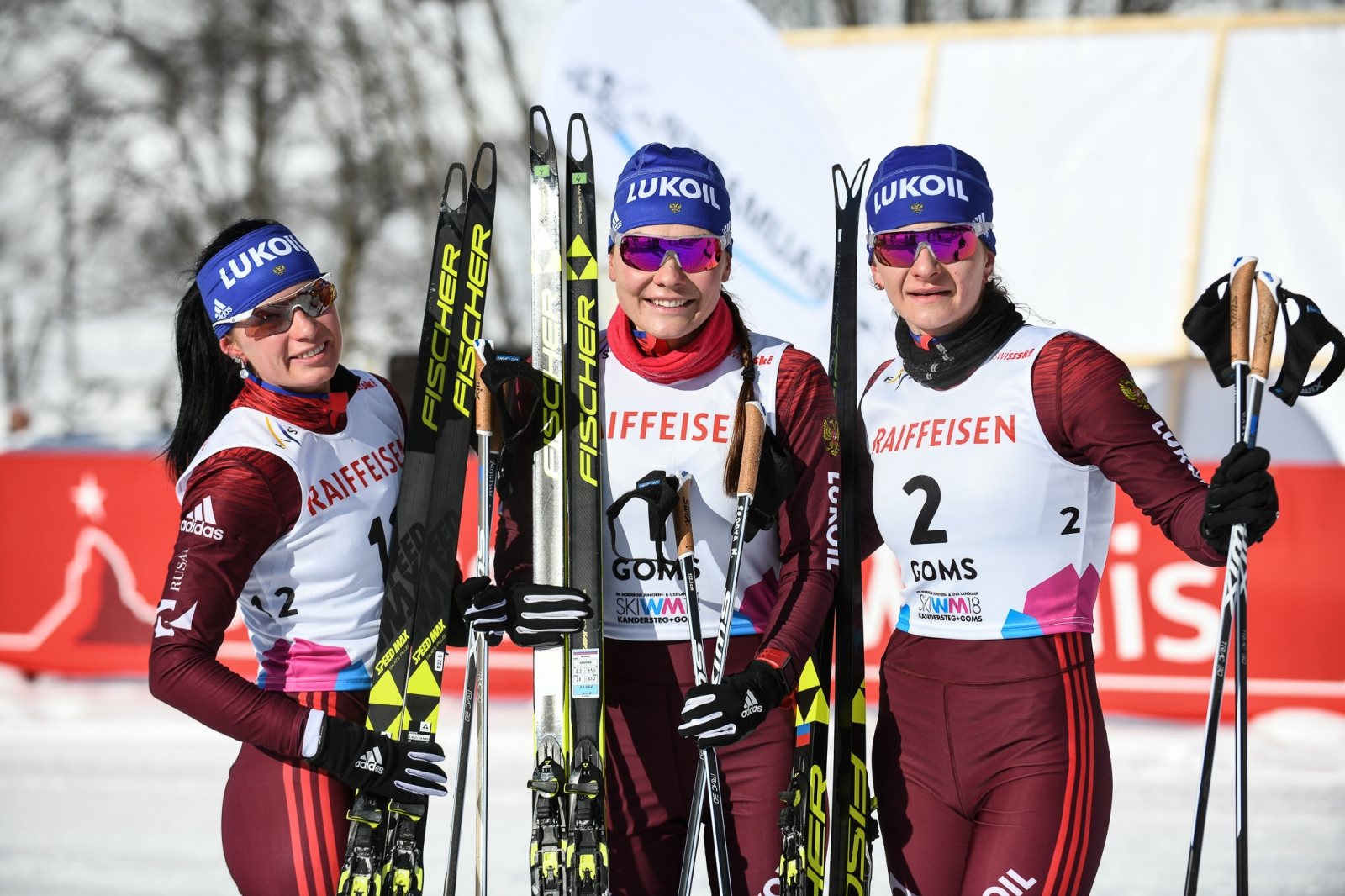
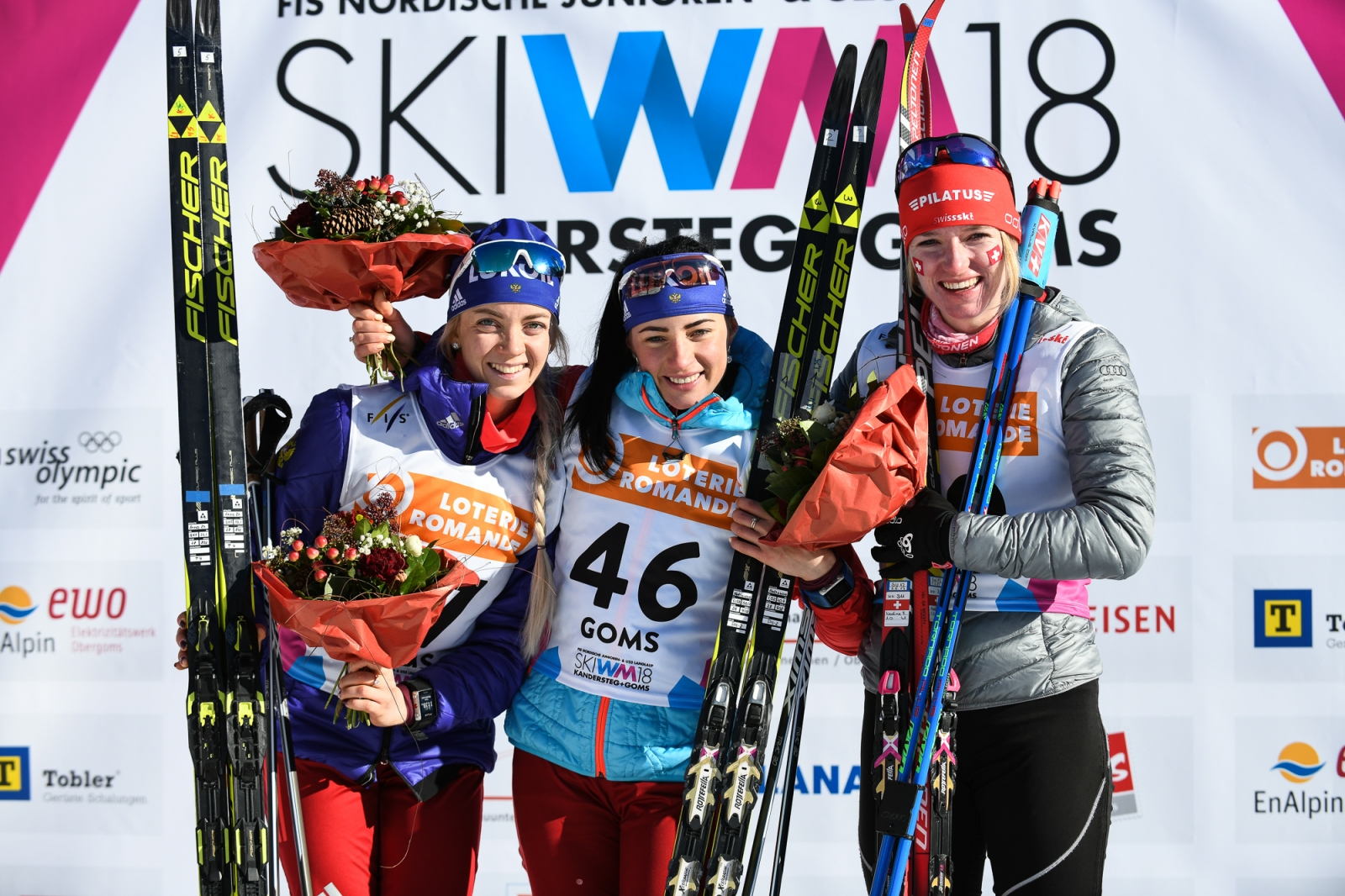
The all-Russian women’s 15 k skiathlon podium at U23 World Championships on Friday in Goms, Switzerland, with Anastasia Sedova (c) in first, Natalia Nepryaeva (l) in second and Yulia Belorukova (r) in third. (Photo: JWSC2018.ch)
Anastasia Sedova led them in the first race of the day on Friday, the women’s 15-kilometer skiathlon, which she won in 44:03.6 minutes. Russia swept the podium and had four in the top five with Natalia Nepryaeva in second (+10.7) and Yana Kirpichenko in third (+37.2), and Yulia Belorukova in fourth (+1:58.0). Germany’s Pia Fink placed fourth (+1:33.5).
The race was the first of the week for the 22-year-old Sedova, a World Cup regular, and it was her second individual gold medal at her second U23 World Championships (she won the 10 k classic in 2016).
“Good preparation for the Olympic Games,” Sedova said during an in-arena interview after the race. “I am very lucky today. Good atmosphere, good weather today.”
Kirpichenko won the 10 k classic earlier this week and Nepryaeva placed third in the freestyle sprint in Goms.
“It’s hard to say how to describe the race, but Anastasia is a really good skier,” Nepryaeva said after. “She was really good today. So for me it was hard to support her during the race. Today she was much better than me.”
American Lauren Jortberg (Dartmouth Ski Team) led the North Americans in 29th (+5:29.9) for her best distance result at the Junior/U23 World Championships level.
“Early in the race I was right over 30th place, and I was trying to maintain contact with the big group ahead of me,” Jortberg, a Dartmouth sophomore from Boulder, Colorado, wrote in an email. “The pace of the classic leg was really fast. A couple of the girls in the race are heading to the Olympics in a few days so it was a really hot start!”
She came through the transition at the race’s halfway point in 31st, about 3:47 behind the leaders.
“I am a much better skater so I felt like I really put the hammer down on the skate leg and moved up a lot,” Jortberg wrote. “The skate course was much easier than the classic course, but I feel like I skied the massive climbs better than the girls around me. I focused on having a really high tempo over the hills and skiing the downhills technically well because there was no rest on the course.
“I’m pleased with my performance today, and I’m excited about my results this week as a whole,” she added. “I’m definitely leaving here hungry for more because I don’t think it was my best week, but I think it was really solid. This is the most competitive field I’ve ever raced against so it feels really good to know that I’m not too far off their level!”
Also for the U.S., Lydia Blanchet placed 38th (+7:11.1) and Nicole Schneider was 40th (+8:04.3). Julia Kern did not finish.
Canada’s Katherine Stewart-Jones (Canadian National U25 Team/NTDC Thunder Bay) placed 31st (+5:39.0) and Maya MacIsaac-Jones was 42nd (+8:08.8), while Laura Leclair and Sophie Carrier-Laforte were lapped.
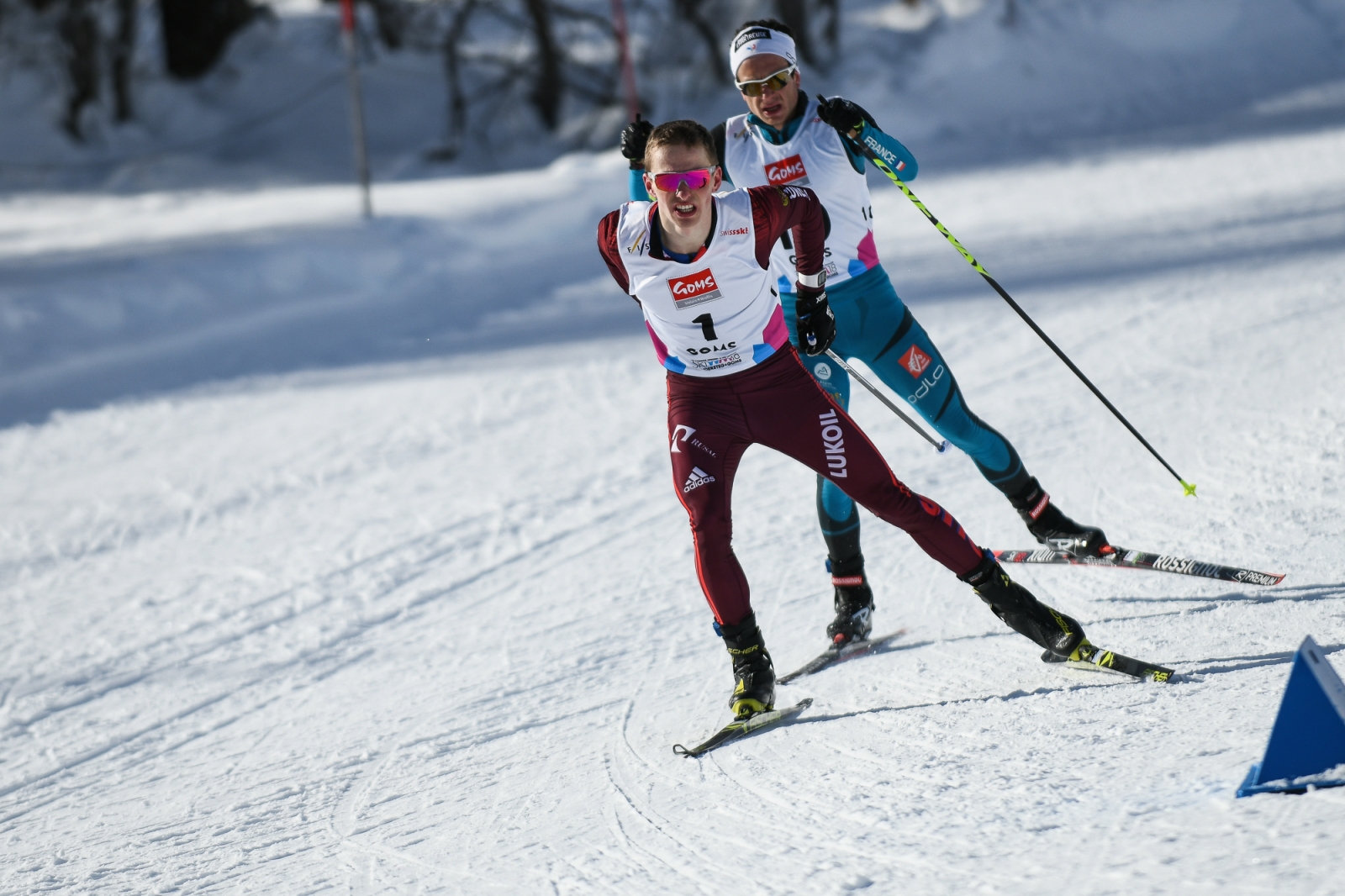
Russia’s Denis Spitsov leads France’s Jules Lapierre during the men’s 30 k skiathlon on Friday at 2018 U23 World Championships in Goms, Switzerland. Spitsov went on to win by 2.9 seconds over Lapierre. (Photo: JWSC2018.ch)
In the men’s 30 k, Russia’s Denis Spitsov took the win in 1:18:14.9 hours, just 2.9 seconds ahead of France’s Jules Lapierre. Norway’s Ole Jørgen Bruvoll placed third (+21.5), ahead of Russia’s Ivan Yakimushkin in fourth (+23.2), and Andorra’s Irineu Esteve Altimiras in fifth (+36.4).
The gold was the first for Spitsov, 21, who previously placed second in the 15 k classic earlier this week. He has two individual bronze medals from last year’s U23 Worlds (in the 30 k skiathlon and 15 k freestyle).
American Ian Torchia (U.S. Ski Team/Northern Michigan University) placed 27th on Friday (+6:05.7). Only 33 men finished, and he was the only North American that didn’t get lapped.
“Between the 3700 feet of climbing, a 2.5km loop, and the top dogs having World Cup podiums…half the field got lapped,” Torchia wrote in an email. “Definitely added some motivation in the final 2 laps to see Spitsov and Lapierre slowly catching up.
“I felt I skied technically better in skate and struggled on the classic leg,” Torchia explained. “Took a hard tumble halfway through the classic leg and had to take half a lap to recover from that. Found a hole in my suit close to my groin afterward which was a little unnerving!”
At the end of the week, he noted that he felt “more fired up than coming in. Funny how being 6 minutes back can do that,” he wrote. “It was an eye-opening experience to get back on the international stage after 2 years and I will take these lessons of racing to the rest of the season in the Ishpemimg Super Tour, Steamboat NCAA’s, and Craftsbury Spring Series. Also already thinking of ideas on how to change and optimize my training to make the jump to the top level.”
Americans Andrew Egger, Zak Ketterson and Thomas O’Harra also competed, as did Canada’s Alexis Dumas, Gareth Williams, Philippe Boucher, and Ricardo Izquierdo-Bernier.
Stratton’s Ben Saxton (l) edging Julien Locke (r) by eight-hundredths of a second for the win in the men’s 1.4 k classic sprint A-final on Friday at Eastern Canadian Championships in Gatineau, Quebec. (Photo: Becca Rorabaugh (APU) on her way to winning the women’s 1.3 k classic sprint qualifier on Friday at 2018 Eastern Canadian Championships in Gatineau, Quebec. (Photo: Rob Smith/CCC)
NorAm Eastern Canadian Championships (Gatineau, Quebec): Classic sprints
Eastern Canadian Championships opened in Gatineau on Friday with classic sprinting, and Americans Becca Rorabaugh and Ben Saxton ended the day with wins in the women’s and men’s A-finals, respectively.
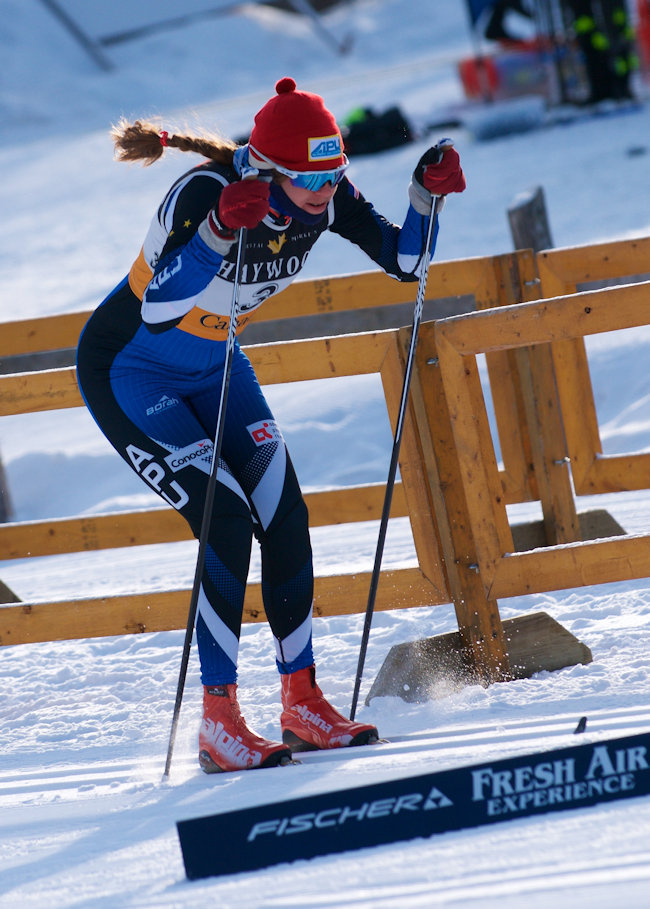
Becca Rorabaugh (APU) on her way to winning the women’s 1.3 k classic sprint qualifier on Friday at 2018 Eastern Canadian Championships in Gatineau, Quebec. (Photo: Rob Smith/CCC)
For Rorabaugh, the win is her second straight after the Alaska Pacific University (APU) skier won the women’s 5-kilometer freestyle at last weekend’s SuperTour in Craftsbury, Vermont. She edged last weekend’s classic-sprint winner, Kaitlynn Miller, of the Craftsbury Green Racing Project (CGRP), by 0.41 seconds for the win in 3:23.15 minutes in Friday’s 1.3 k classic sprint final. It was an all-American podium (and all-American final) with Erika Flowers, of the Stratton Mountain School (SMS) T2 Team, just another three-hundredths of a second back in third (+0.44). Liz Guiney (CGRP) followed in fourth (+2.51), Rosie Frankowski (APU) was fifth (+3.88), and Corey Stock (Bridger Ski Foundation) placed sixth (+6.1).
Rorabaugh had started the day by qualifying first in 3:26.95, then won both her quarterfinal and semifinal. Miller qualified third and won her quarterfinal and semifinal as well.
In the men’s 1.4 k classic sprint, Saxton (SMST2) nipped Julien Locke (Canadian U25 Team/Black Jack) at the line by 0.08 seconds for the win in 3:04.54. Patrick Stewart-Jones (Alberta World Cup Academy) placed third (+5.53), Kris Freeman (Caldwell Sport) was fourth (+5.94), Kevin Bolger (Sun Valley Ski Education Foundation) fifth (+7.42), and Julian Smith (NTDC Thunder Bay) sixth (+11.63).
Locke initially won the qualifier in 3:08.37, then won the first quarterfinal and first semifinal as well. Saxton qualified sixth, then advanced in second in his quarterfinal about a second behind Smith, and Saxton won the second semifinal.
Easterns continue Saturday with 10/15 k freestyle races and conclude Sunday with 10/15 k classic pursuits.
The women’s 10 k classic podium at 2018 U23 World Championships, with Russia’s Yana Kirpichenko (c) in first and Anna Zherebyateva (l) in second, and Switzerland’s Nadine Fähndrich (r) in third. (Photo: JWSC2018.ch)
(Note: This article has been updated to include comments from Americans Lydia Blanchet and Ian Torchia.)
U23 World Championships (Goms, Switzerland): 10/15 k classic
Russia put two in the top three in both the women’s and men’s races on Wednesday at U23 World Championships in Goms, and for the second-straight race, Canada’s Katherine Stewart-Jones landed in the top 30.
In the women’s 10-kilometer classic, Russia’s Yana Kirpichenko pulled out a 13.9-second victory over fellow Russian Anna Zherebyateva, finishing with the winning time of 27:46.1 minutes. Switzerland’s Nadine Fähndrich returned to the podium for the second race in a row (after placing second in Monday’s skate sprint), finishing third, 29.6 seconds behind Kirpichenko.
In Monday’s sprint, Kirpichenko qualified fourth and ended up fifth in the final. She is a bronze medalist in the 15 k skiathlon at last year’s U23 Worlds.
Stewart-Jones, of the Canadian National U25 Team and National Team Development Centre (NTDC) Thunder Bay, started relatively early on Wednesday in bib 19 and ultimately placed 29th, 3:07.3 out of first. She sped up as the race progressed, from 40th at 2.4 k to 32nd at 5 k and up to 30th at 7.4 k.
So far in all five races she’s competed in over the last two years at U23 Worlds, Stewart-Jones has finished in the top 30. Her best result is 21st in last year’s 15 k skiathlon, and at the Junior Worlds level, she had a best individual result of 14th in the 10 k skiathlon in 2015.
American Lydia Blanchet (Dartmouth Ski Team) started fifth on Wednesday and ended up 30th (+3:10.4) after skiing in the top 30 throughout the race. Her Dartmouth teammate Lauren Jortberg followed in 34th (+3:28.9) and Nicole Schneider was 49th (+5:23.8). Julia Kern did not start.
For Blanchet, a Dartmouth junior, this week marked her first time racing at the Junior/U23 World Championships level. So far, she has placed 32nd in the freestyle sprint and now 30th in the classic distance race.
“This is my first time racing internationally, and I tried to go into the races with no expectations,” Blanchet explained in an email. “I was excited to get as close as I did to qualifying for the sprint, but it was definitely bittersweet—missing heats by 0.3 seconds left me regretting some of the smaller details of my race. Still, it is really exciting to know that I can compete on the world stage!”
After the sprint, she made a goal of finishing in the top 30.
“I really like hilly, rolling courses—especially ones with very technical downhills—and this course definitely fit that bill,” she wrote of the classic distance course. “I am really happy with my race, all things considered. I didn’t feel great while I was racing – my legs flooded pretty hard a few km’s in – but I think I did a good job of holding myself together and staying strong mentally. I know I have the ability to do even better, which is motivating and exciting. I am looking forward to get to ski head-on against the whole field in the skiathlon, and I’m excited to try and pick my way forward from my bib number. I’m also really excited to go home and race carnivals with the Dartmouth team.”
Canada’s Laura Leclair finished 40th (+4:20.9), Sophie Carrier-Laforte was 43rd (+4:19.2) and Maya MacIsaac-Jones 47th (+4:47.3) out of 53 finishers.
Nicole Bathe of the Midwest-based Central Cross Country (CXC) Team, who races for Great Britain, placed 37th (+3:43.8), for her second top 40 of the week after placing 39th in the skate sprint.
Norway’s Mattis Stenshagen racing to the win in the men’s 15 k classic at 2018 U23 World Championships in Goms, Switzerland. It was his first gold medal and podium at U23 Worlds (he earned silver two years ago in the 15 k freestyle at Junior Worlds and also gold in the relay that year). (Photo: JWSC2018.ch)
In the men’s 15 k classic that followed, Norway’s Mattis Stenshagen edged Russia’s Denis Spitsov by 4.8 seconds for the win in 36:28.3. Also for Russia, Ivan Yakimushkin placed third, 35.2 seconds back.
Canada’s Alexis Dumas, of the Pierre-Harvey National Training Centre (CNEPH) was the top North American in 31st, 2:51.7 out of first. He worked his way up from 40th at 5 k to 35th by 10 k, and finally just 0.2 seconds outside of 30th at the finish.
American Ian Torchia (U.S. Ski Team D-team/Northern Michigan University) followed in 32nd (+2:55.9) and Bill Harmeyer (University of Vermont) finished 39th (+3:43.3). Also for the U.S., Thomas O’Harra placed 43rd (+4:17.3) and Zak Ketterson was 57th (+5:37.6).
Torchia, an NMU junior, has been to two Junior Worlds in 2015 and 2016, but this marked his first U23’s.
“The jump from juniors to U23s is quite a leap. I missed the first year of being a U23 last year due to mono so getting back into international racing was a shock to the system,” he explained in an email.
As for his goals for the 10 k, he was hoping for a top 15 or 20, but moreover “wanted to race smart and feel good out on the course technically and physically,” Torchia wrote. “This was the hardest course I have ever raced with 600m of climbing throughout the 15k and I was excited to showcase my striding ability out there…
“However, from the first km I was in the pain cave (even though I didn’t open that fast!) and it was a fight the entire way,” he continued. “I need to work on staying technically strong when hurting and I did not do a good job of executing that today. The eventual second place Russian started as I was looping around for my 2nd lap so I was able to see and feel what a podium performance looks like. Going to have that image in my head throughout the next year!”
For Friday’s 30 k skiathlon, Torchia wrote that he would be “throwing all place goals out the window and focusing on skiing technically well and racing smart. Looking forward to channeling my last skiathlon in Kazakhstan which went really well [he placed 11th in the 20 k at 2015 Junior Worlds] and moving up from my starting position.”
Canada’s Gareth Williams finished 41st (+4:00.2) on Wednesday, Philippe Boucher was 45th (+4:22.7) and Ricardo Izquierdo-Bernier 47th (+4:24.3) out of 63 finishers.
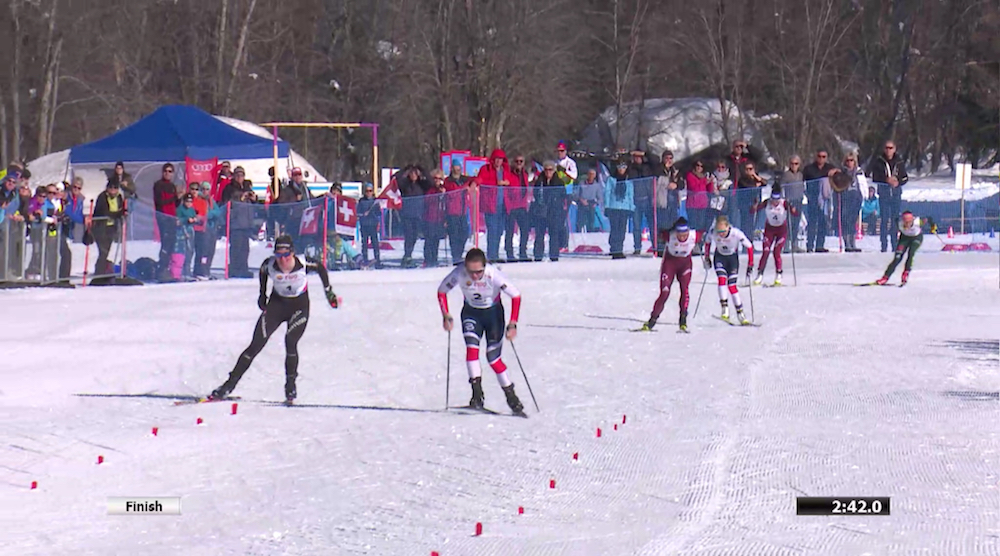
Norway’s Tiril Udnes Weng (second from l) and Switzerland’s Nadine Fähndrich (l) battle for first down the finishing stretch of the women’s final for the gold medal in the U23 World Championships skate sprint in Goms, Switzerland. Weng won it by eight-hundredths of a second. (Screenshot: Swiss Ski livestream)
(This article has been updated to include comments from Canada’s Laura Leclair, Katherine Stewart-Jones and Maya MacIsaac-Jones, as well as American Julia Kern.)
U23 World Championships (Goms, Switzerland): Freestyle sprints
On the first day of U23 World Championships racing in Goms, Switzerland, Norway’s Tiril Udnes Weng tallied her first individual world title in the women’s 1.2-kilometer freestyle sprint, winning the A-final in 2:50.24 minutes, just 0.08 seconds ahead of Swiss World Cup regular Nadine Fähndrich in second. Another World Cup skier, Natalia Nepryaeva of Russia finished third, 4.78 seconds out of first.
Weng, 21, is no stranger to World Cups, either. Just two days ago, she qualified 11th in the World Cup skate sprint in Seefeld, Austria, and went on to place 17th overall.
On Monday, she qualified second, 0.2 seconds off Fähndrich’s top qualifying time of 3:03.51. Weng then placed second to Nepryaeva in the fourth quarterfinal, a heat that included Canadians Maya MacIsaac-Jones and Katherine Stewart-Jones, both of the Canadian National U25 Team. While Sweden’s Moa Olsson finished third in that quarterfinal and advanced as a lucky loser based on time, the two Canadians did not. MacIsaac-Jones had previously qualified in 19th and Stewart-Jones in 22nd. Overall, MacIsaac-Jones placed 18th and Stewart-Jones was 23rd on the day.
In an email, MacIsaac-Jones explained her goal had been to make the semifinals.
“My strategy was to stick behind the top two girls, and hang on as best I could,” she wrote of her quarterfinal. “As Canadians we tend to be pretty good at downhilling, so I tried to use that to my advantage. I wasn’t quite able to stick with the top girls over the crest of the big hill, but I was happy to be fairly competitive in the heat overall!”
Still, the top 20 was her best result in her fourth trip to Junior/U23 Worlds.
“I’m disappointed of course to have missed out on making the semi-final, but I feel I did the best I could with what my body had on the day so I’m happy with that,” she continued. “It was of course exciting to get my first top-20 , but also disappointing because I felt like my body wasn’t moving as well as it was at trials a few weeks ago (I got sick right after arriving in Europe which probably didn’t help with that).”
For Stewart-Jones, this marks her fifth Junior/U23 World Championships.
“Over the years I have learned that it’s just another race, and that I don’t need to treat it any differently,” she wrote in an email on Tuesday. “Coming into te race I knew that I was in the best shape I’ve been all year, but I also had only done one skate sprint qualifier and no heats) this year so I wasn’t sure what to expect.”
Her goal had been to reach the semifinals and finish in the top 12.
“I am happy with how I skied the qualifier. The quarterfinal was tough,” Stewart-Jones wrote. “My teammate Maya and I ended up being in a really fast heat. I felt like I skied well technically but I don’t think I skied it how I needed to to have a chance of moving on. I tried holding on to the top 2 girls over the top of the first hill and ended up losing time on the second… I think it would have made more sense to lay back a bit over the top of the first to save some gas for the end.”
Stewart-Jones as well as MacIsaac-Jones came incredibly close to making Canada’s 2018 Olympic team based on their results at NorAm trials earlier this month.
“Overall, I am happy with how the body feels but disappointed with how I skied tactically,” Stewart-Jones wrote. “Not making the Olympic team was definitely more frustrating than it was disappointing. The whole ordeal was a bit exhausting, with first missing out on the 4th spot by less than a second and then being 12th on the list of [11] quota spots, it was really as close as it gets. I’m doing my best to fuel that frustration into positive energy so that I can perform at my best here. I am really looking forward to the next 2 races!!”
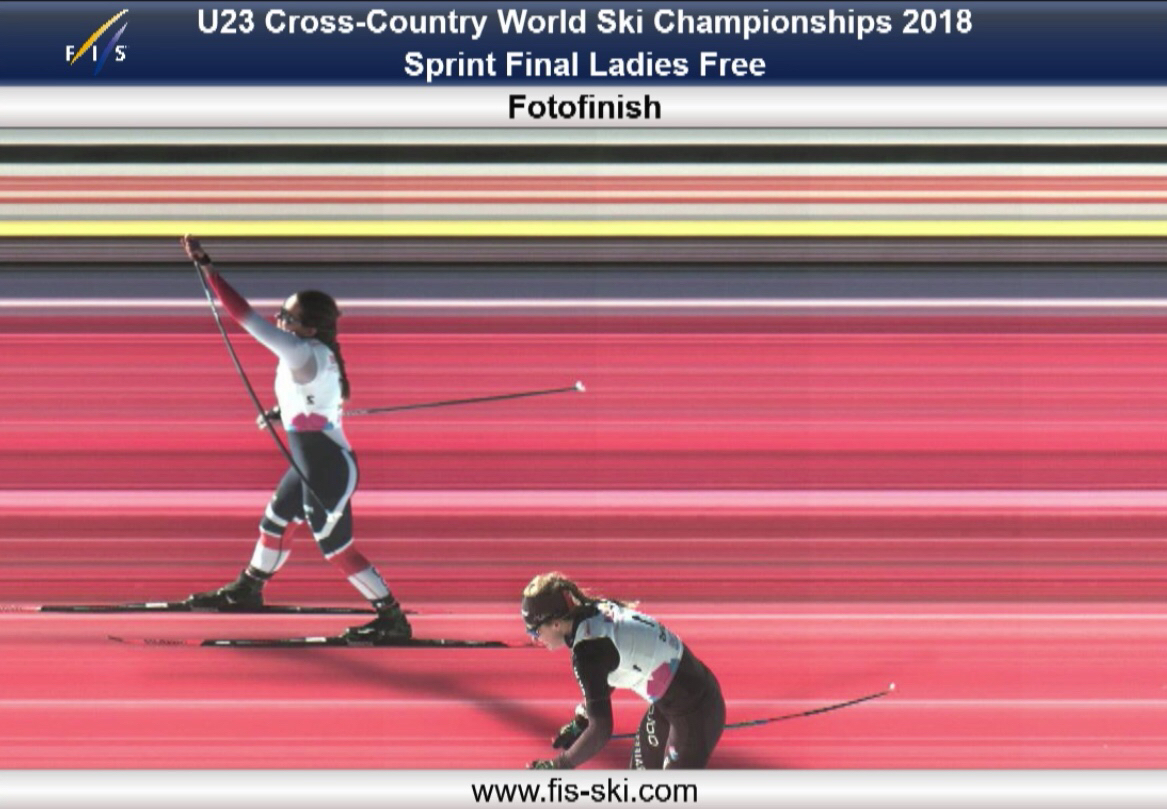
Norway’s Tiril Udnes Weng (l) and Switzerland’s Nadine Fähndrich in a photo finish for first in the women’s freestyle sprint final at U23 World Championships on Monday in Goms, Switzerland. Weng won it by eight-hundredths of a second. (Screenshot: Swiss Ski livestream)
Fähndrich won both her quarterfinal and semifinal leading up to the final, and Weng won the second semifinal by 0.59 seconds over Nepryaeva. In the final, Weng had the edge.
“I dream about winning, that’s the goal of my season,” Weng said during a post-race interview in the arena. “So it felt good to win.”
Three Canadians made the heats, with Laura Leclair of the Pierre-Harvey National Training Centre (CNEPH) qualifying in 26th then placing third in her quarterfinal, 2.75 seconds behind German winner Nadine Herrmann. That put Leclair 15th overall on the day in her first U23 World Championships race.
“As it is my first time at Worlds and my first year in a big category (U23) I was coming here for experience,” Leclair wrote in an email on Tuesday. “Experience to ski internationally, in Europe and against the best. Of course, I was hoping to perform but I never anticipated a top 15.
“Since I was seeded 30th, I was a little skeptical of making it through the qualifier,” she continued. “Qualifying 26th was a very exciting moment.”
In her quarterfinal, she said the pace didn’t pick up until about halfway up a long uphill out of the start, a climb that lasted for about a minute and a half.
“I was in a strong position (4th) but it was hard to make my way to the top,” Leclair wrote. “At the top of the big hill, a girl broke a pole and I was able to pass her and push over the hill into the downhill in order to come closer to the two girls in front. The last uphill felt like it was just give or take. Obviously, I chose the give option and gave it all I had into the finish. My heat wasn’t one of the fastest so I wasn’t a lucky loser but I am very happy of how I skied that course.
“This season has been full [of] surprise,” she concluded. “Just qualifying for Worlds in Canada was one! I am very happy that all my efforts and my dedication to the sport are paying off. For the rest of the week, I want to have some strong races, especially in the skiathlon and maybe surprise myself again.”
Two Americans qualified in the top 30 as well, with Lauren Jortberg (Dartmouth Ski Team) in 14th and Julia Kern (U.S. Ski Team/Dartmouth/Stratton Mountain School T2 Team) in 21st. Jortberg went on to finish fifth in her quarterfinal, 7.28 seconds behind German winner Pia Fink, and Kern finished sixth in Fähndrich’s quarterfinal, 22.28 seconds out of first. Overall, Jortberg placed 22nd and Kern was 27th.
In an email, Jortberg, who competed at U23 World Championships last year at Soldier Hollow in Midway, Utah, explained her goal was to qualify for the heats.
“I honestly had no idea what to expect in Goms this year because Soldier Hollow felt just like US Nationals and the Super Junior National Qualifiers I’d been going to for the past ten years,” Jortberg, a Dartmouth College sophomore, wrote on Monday. “Obviously the competitors from all over the world was different, but was easy to visualize what is going to be like. The venues are similar in many ways because there are very few trees making it very open and a great spectators course.
“A big difference between Goms and Soldier Hollow is the little towns everywhere,” she continued. “The first ski we did here, we skied through the roads and through a town. There are ski trails everywhere here, we could even ski from the venue to the hotel (which is pretty far)! For the ski courses, I think Goms is one of the most challenging ski courses I’ve ever raced on. There are huge climbs are incredibly technical downhills! Its a one of the most exciting places I’ve ever raced, I love it so much.”
As for her racing on Monday, she wrote that she was “really psyched because I felt really strong and smooth in the qualifier! I was a bit bummed because I had to scrub a fair amount of speed skiing behind a girl I caught on the really technical downhill. The heats were really fun!! I had a great starting position and skied really smooth up the big climb. Then I took a very gutsy move on the downhill to sling shot into first place on the inside corner around the downhill turn. Unfortunately right after that I got caught up in a tangle on the last climb, and then I lost contact with the lead group. I was bummed to get caught up in a tangle, but it was really cool to be able to ski with these girls!”
Overall, Jortberg described the day as “pretty incredible.”
“My motto has always been that sprints are funny because ‘anything can happen’ for the good and bad!” she added. “I’m pretty excited for the rest of the week of racing even though this race was my main target. These courses play really strongly to my strengths so it should be fun to see what I can do!”
Kern explained in an email that she’s been sick for the past month so her main goal was to start Monday’s race. But for a long time leading up to this race, she had envisioned a top 10.
“Regardless of how I was feeling, one of my goals was to ski with good technique because that is something you can always control,” Kern wrote. “I was pretty content with my qualifier, given being sick. Skiing out there today, I had no idea if I would surprise myself and my illness wouldn’t impact my skiing or if I was just going to feel absolutely terrible. I was happy with how I placed given how I felt.”
In the heats, she wanted to stay in contact with leaders up the course’s big climb, then try to “drop the hammer on the downhill and last uphill.”
“However, my quarterfinal did not play out that way,” she wrote. “The pace was hot from the start, with bib #1 [Fähndrich] gunning from the start. I stuck with the heat until part way up the first climb, where I started to lose the leaders. I did not feel good and I had no energy so I was not able to hold the pace of the other competitors. I had considered not doing the heats because I felt pretty wiped after the qualifier, but the competitor inside me couldn’t just walk away from my favorite thing—sprint heats.
“Given my current health state, I feel okay about my day, but I am obviously bummed because this was the race I was looking forward to most this season,” Kern added. “I am looking forward to getting healthy in time to race the 10k classic, or at the very least the skiathlon!”
Also for the U.S., Lydia Blanchet missed qualifying by 0.32 seconds in 32nd, as did Canada’s Sophie Carrier-Laforte, who was 3.68 seconds out of the top 30 in 34th. American Nicole Schneider finished 44th.
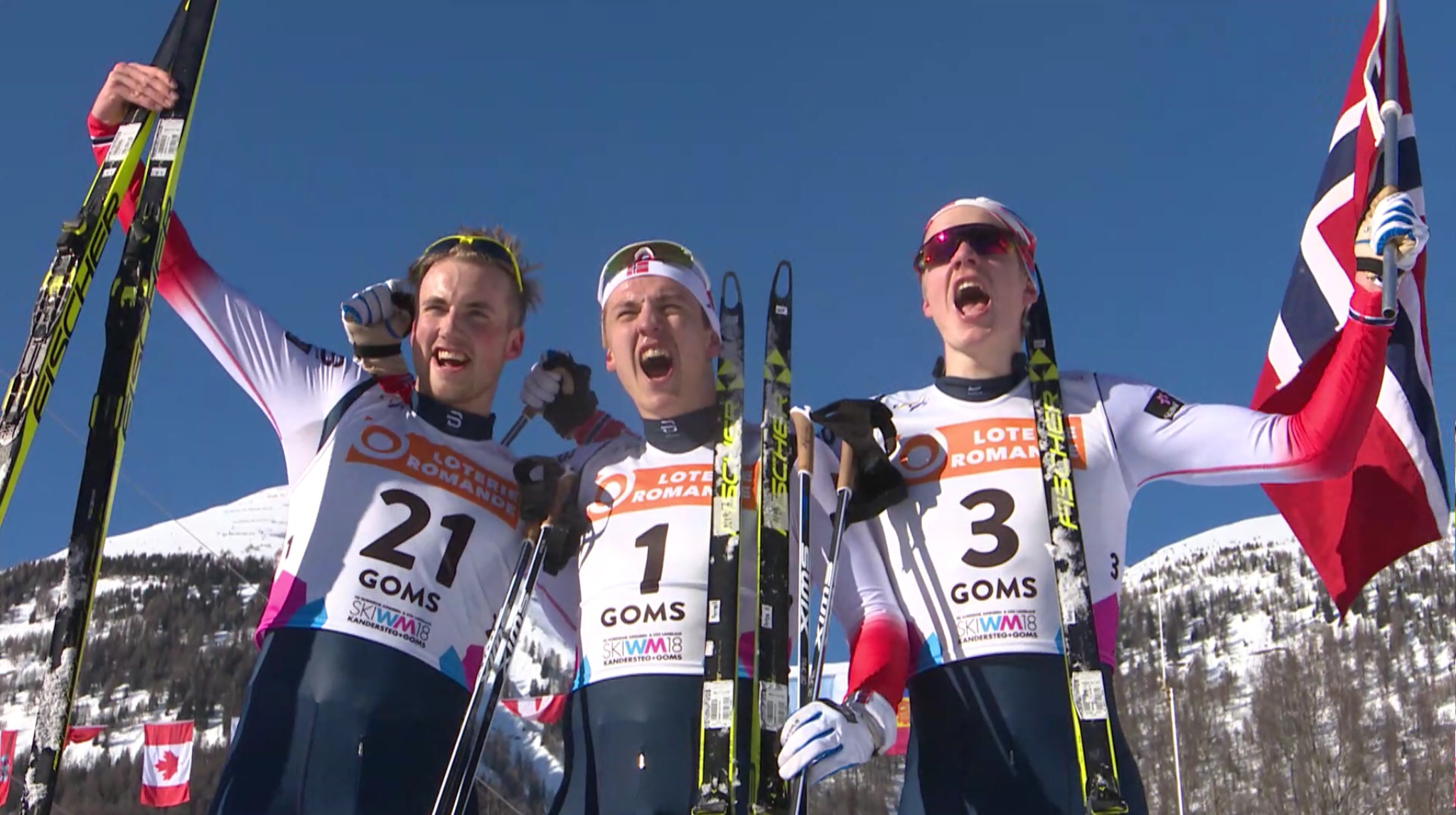
The all-Norwegian men’s freestyle sprint podium on Monday at U23 World Championships in Goms, Switzerland, with Erik Valnes (c) in first, Jan Thomas Jenssen (l) in second and Even Northug (r) in third. (Screenshot: Swiss Ski livestream)
In the men’s 1.5 k skate sprint on Monday, Norway swept the men’s podium, with Erik Valnes winning his first World Championships medal in 2:56.38, Jan Thomas Jenssen finishing 0.24 seconds back in second, and Even Northug placing third (+6.34).
For the 21-year-old Valnes, this marked his first U23 World Championships (or Junior Worlds for that matter). He’s competed in two World Cup sprints this season, placing 22nd in the skate sprint earlier this month in Dresden, Germany, and 27th in a classic sprint in December in Lillehammer, Norway.
Valnes started Monday by winning the qualifying round in 3:00.18, by 0.77 seconds over Sweden’s Anton Persson, then won his quarterfinal and semifinal, both by nearly half a second, before besting his fellow Norwegians in the final.
“Fun to take the gold medal at the end,” Valnes said during a televised in-arena interview after the final. “It was my biggest goal this year, so it means a lot, of course. A gold medal is always good to have.”
No North American men qualified for the heats. Canada’s Ricardo Izquierdo-Bernier placed 40th, Antoine Briand was 41st, Philippe Boucher 42nd, and Olivier Hamel 60th.
For the U.S., Bill Harmeyer finished 46th, Andrew Egger was 47th, Thomas O’Harra 64th, and Zak Ketterson 65th.
The women’s 10 k classic podium on Wednesday at the NorAm trials in Mont Sainte-Anne, Quebec, with Cendrine Browne (1) in first, Katherine Stewart-Jones (2) in second, and Anne-Marie Comeau (3) in third. Dahria Beatty (l) placed fourth. Comeau and Stewart-Jones are both on the U23 World Championships roster, although it’s likely that one or both of them will end up focusing on the Olympics instead. (Photo: Cross Country Canada/Instagram)
The U.S. and Canada have named their squads for FIS Cross Country World Junior and U23 Championships, set to begin later this month in Goms, Switzerland.
Both countries’ selections include athletes who excelled against the senior fields at recent domestic races (U.S. National Championships and NorAms) which served as selection races for Olympic teams.
In fact, Canada’s U23 women did so well against their senior compatriots that it’s unclear who will represent Canada at the Championships and who will do so at the Games. Anne-Marie Comeau (Université Laval), Maya MacIsaac-Jones (Rocky Mountain Racers), and Katherine Stewart-Jones (NTDC Thunder Bay/Nakkertok) were all on the podium in different competitions at Mont Sainte Anne, Quebec, last week at Canadian Olympic Selection Races.
Comeau was second in the 15 k skiathlon and third in the 10 k classic, earning herself a probable Olympic berth when each country’s Olympic quota size is finalized. However, she does not currently have the five sub-100 FIS point races on her resumé which are required to compete in the Olympics.
Then-21-year-old Ricardo Izquierdo-Bernier CNEPH racing his first World Cup during the men’s freestyle sprint qualifier at World Cup Finals in March. He won the senior men’s 15 k classic at the NorAm selection series this week. (Photo: John Lazenby/Lazenbyphoto.com)
“Anne-Marie is looking at different options now to find those races in North America,” Cross Country Canada High Performance Director Thomas Holland explained in an email.
Meanwhile, Stewart-Jones is next on the distance ranking list, and could get an Olympic call if Comeau is unable to get those points, or if an additional quota spot opens up after better-ranked countries finalize their rosters. Despite fighting off illness through the race weekend, Stewart-Jones finished second in the 10 k classic at the end of the selection series.
“I know that I have qualified for U23 World Champs,” Stewart-Jones told FasterSkier. “That trip leaves on [January] 15th. I’m keeping my fingers crossed for Olympic selection but I will probably not know until the 21st.”
Meanwhile, MacIsaac-Jones was second in the classic sprint final after qualifying fourth in the final, missing taking the open women’s sprint spot for PyeongChang by just one place. That spot went to Cendrine Browne instead, taking her out of the distance rankings and opening the way for Comeau and/or Stewart-Jones.
Some of the men who ended up on Canada’s U23 squad also competed well against the seniors. Ricardo Izquierdo-Bernier (CNEPH/Fondeurs-Laurentides) won the men’s classic distance race at the NorAm week, and both he and Olivier Hamel (CNEPH/Skibec) were in the final of the skate sprint. Gareth Williams (Telemark) was on the podium in the 30 k skiathlon, where Philippe Boucher (CNEPH/Skibec) finished fifth.
The U.S. women’s relay after taking a historic third in the 4 x 3.3 k relay at 2017 Junior World Championships on Sunday at Soldier Hollow in Midway Utah, with (from left to right) Hannah Halvorsen (holding her baby sister), Julia Kern, Katharine Ogden, and Hailey Swirbul. (Photo: U.S. Ski Team/Tom Kelly)
The U.S squad, meanwhile, is headlined by Hannah Halvorsen (Alaska Pacific University/U.S. Ski Team), Julia Kern (Stratton Mountain School T2/Dartmouth College/U.S. Ski Team), and Hailey Swirbul (University of Alaska Anchorage), who return from last year’s World Juniors medal-winning relay team.
Kern is now a U23, and is competing at the World Cup sprints in Dresden, Germany, this weekend. Back in the U.S., Swirbul finished eighth in the women’s 10 k skate at U.S. Nationals, while Halvorsen was fifth in the skate sprint after qualifying fourth.
Joining Swirbul and Halvorsen on the junior team will be two men who turned heads in the senior races at U.S. Nationals. Gus Schumacher (Alaska Winter Stars) finished sixth overall in the men’s 15 k skate and eighth in the skate sprint. Ben Ogden (Stratton Mountain School) was ninth in the 15 k skate and then qualified fourth in the classic sprint, before finishing the day in 12th overall.
The U.S. U23 team includes Zak Ketterson (Northern Michigan University), who finished just off the podium in fourth in the skate sprint at U.S. Nationals and followed it up with sixth in the classic sprint; Alayna Sonnesyn (University of Vermont), who was eighth in the skate sprint and sixth in the 20 k classic mass start; Lydia Blanchet (Dartmouth College), sixth in the classic sprint; Andrew Egger (Colby College) and Thomas O’Harra (Alaska Pacific University), tenth in the skate and classic sprints, respectively; Bill Harmeyer (University of Vermont), 11th in the skate sprint; Ian Torchia (Northern Michigan University/U.S. Ski Team), 12th in the 30 k classic; and Lauren Jortberg (Dartmouth College), who never finished out of the top 15 in the three senior races she entered at U.S. Nationals.
Rosters
Junior Men
USA:
Luke Jager, Alaska Pacific Nordic Ski Center
Ben Ogden, Stratton Mountain School
Karl Schulz, Univ. of Vermont
Gus Schumacher, Alaska Winter Stars
Canyon Tobin, Alaska Pacific Nordic Ski Center
Hunter Wonders, Alaska Pacific Nordic Ski Center
Canada:
Antoine Cyr, Centre National d’Entraînement Pierre-Harvey / Skinouk
Félix Longpré, Club Nordique Mont Sainte Anne
Etienne Hébert, Alberta World Cup Academy / Montériski
Graham Ritchie, National Team Development Center Thunder Bay / Big Thunder
Reed Godfrey, Canmore Nordic
Junior Women
U.S.:
Margaret Gellert, Alaska Winter Stars
Hannah Halvorsen, Alaska Pacific Nordic Ski Center / U.S. Ski Team
Kathleen O’Connell, Montana State University
Hannah Rudd, Univ. of Alaska-Anchorage
Sofia Shomento, Dartmouth College
Hailey Swirbul, Univ. of Alaska-Anchorage
Canada:
Natalie Hynes, Whitehorse
Annika Richardson, National Team Development Center Thunder Bay / Hollyburn
Hannah Mehain, Sovereign Lake Nordic
Catherine Reed-Metayer, Skibec
India McIsaac, Rocky Mountain Racers
U23 Men
US:
Andrew Egger, Colby College
Bill Harmeyer, Univ. of Vermont
Zak Ketterson, Northern Michigan University
Thomas O’Harra, Alaska Pacific Nordic Ski Center
Ian Torchia, Northern Michigan University / U.S. Ski Team
Canada:
Gareth Williams, Telemark / Canadian National Ski Team
Olivier Hamel, Centre National d’Entraînement Pierre-Harvey / Skibec
Ricardo Izquierdo-Bernier, Centre National d’Entraînement Pierre-Harvey / Fondeurs-Laurentides
Alexis Dumas, Centre National d’Entraînement Pierre-Harvey / Skibec
Philippe Boucher, Centre National d’Entraînement Pierre-Harvey / Skibec
Antoine Briand, Centre National d’Entraînement Pierre-Harvey / Skibec
U23 Women
U.S.:
Lydia Blanchet, Dartmouth Ski Team
Lauren Jortberg, Dartmouth Ski Team
Julia Kern, Stratton Mountain School / Dartmouth College / U.S. Ski Team
Nicole Schneider, Northern Michigan University
Canada:
Anne-Marie Comeau, Université Laval
Maya MacIsaac-Jones, Alberta World Cup Academy / Rocky Mountain Racers
Katherine Stewart-Jones, National Team Development Center Thunder Bay / Nakkertok
Laura Leclair, Centre National d’Entraînement Pierre-Harvey / Chelsea Nordiq
The men’s 10 k classic podium and award winners at 2017 NCAA Skiing Championships on Thursday at the Jackson Ski Touring Center in Jackson, N.H., including Martin Bergström (Utah) in first, Dag Frode Trollebø (DU) in second, and Martin Mikkelsen (Utah) in third. (Photo: FlyingPointRoad.com)
NCAA Skiing Championships (Jackson, N.H.): 5/10 k classic
The universities of Utah, Colorado and Denver occupied five of six of the podium spots between the men’s and women’s races on the first day of nordic racing at the 2017 National Collegiate Athletic Association (NCAA) Skiing Championships on Thursday in Jackson, N.H. University of Utah freshmanMartin Bergström won the men’s 10-kilometer classic individual start and Petra Hyncicova, a junior at the University of Colorado-Boulder (CU), took the title in the women’s 5 k classic.
Originally from Sweden, Bergström captured his first NCAA title in 25:33.1 minutes, 26.8 seconds ahead of Dag Frode Trollebø, a University of Denver (DU) junior from Norway, in second. Utah had two on the men’s podium with Martin Mikkelsen, a Norwegian freshman, in third (+52.6).
The women’s 5 k classic podium and award winners at 2017 NCAA Skiing Championships on Thursday at the Jackson Ski Touring Center in Jackson, N.H., including Petra Hyncicova (CU) in first, Merete Myrseth (Utah) in second, and Alayna Sonnesyn (UVM) in third. (Photo: FlyingPointRoad.com)
In the women’s 5 k, Hyncicova, of the Czech Republic, notched her first NCAA victory (after placing second last year) in 14:55.5, 18.7 seconds ahead of Utah freshman Merete Myrseth, of Norway, in second place. University of Vermont (UVM) freshman Alayna Sonnesyn placed third (+19.8) and was the top skier outside of the Rocky Mountain Intercollegiate Ski Association (RMISA) on the first of two days of nordic racing at NCAA Championships.
In terms of All-Americans (top 10), CU have five on Thursday (Hyncicova 1st, Christina Rolandsen 4th, Petter Reistad 4th, Jesse Knori 8th, Mads Ek Strøm 8th) Utah had four (Bergström 1st, Myrseth 2nd, Mikkelsen 3rd, Guro Jordheim 5th), Denver three (Trollebø 2nd, Moritz Madlener 5th, Lars Hannah 10th), Northern Michigan University three (Vivian Hett 6th, Fredrik Schwencke 6th, Adam Martin 7th), UVM two (Sonnesyn 3rd, Ian Moore 9th), the University of New Mexico one (Krista Niiranen 7th), UNH one (Lizzie Gill 9th), and Dartmouth one (Lauren Jortberg 10th).
After Day 2 of the NCAA Championships (with the first day of alpine races taking place on Wednesday), Utah leads the team standings with 301.5 points, followed by Denver in second (265) and Colorado in third (240). Montana State dropped from first to fourth with 177 points and Dartmouth ranks fifth (170).
In the fifth and final part of “The Road to Jackson” series on Eastern Intercollegiate Ski Association (EISA) teams competing at NCAA Skiing Championships, we hear from five out of the six Dartmouth College skiers (Abigail Drach, Lydia Blanchet, Lauren Jortberg, Fabián Štoček, Luke Brown, and Cal DeLine) that qualified for the season-ending championships in Jackson, N.H.
“I’m really happy with my individual results, but it’s just so much better when your whole team is also sharing the same happiness.”
American Lauren Jortberg (Dartmouth Ski Team) racing to 37th in the women’s 10 k skiathlon on Feb. 3 at 2017 Junior World Championships at Soldier Hollow in Midway, Utah. (Photo: FlyingPointRoad.com)
In an effort to showcase the North Americans competing at this past week’s International Ski Federation (FIS) 2017 USANA Nordic Junior World Championships and U23 Cross Country World Championships at Soldier Hollow in Midway, Utah, we asked those qualifying athletes several questions about themselves — actually, we had them fill in the blanks. Here we have 19-year-old Lauren Jortberg, of Dartmouth College, representing the U.S. at her first Junior Worlds.
“My full name is Lauren Jortberg, but you can call me Lo. I was born and raised in Boulder, Colo., and one thing you should know about my hometown is roller skiing is illegal and Crocs were created there.
I started cross-country skiing when I could walk thanks to my parents. I currently train in Hanover, N.H., with the Dartmouth Ski Team.
If I’m not skiing, you might find me running in the mountains. If I had to pick a favorite book, it would be ‘Harry Potter and the Goblet of Fire‘.
Lauren Jortberg (Dartmouth Ski Team) en route to 20th in the women’s classic sprint on Jan. 30 at 2017 Junior World Championships at Soldier Hollow in Midway, Utah. (Photo: FlyingPointRoad.com)
One of the things I’m most excited about for Junior Worlds at Soldier Hollow is racing on home soil! The atmosphere should be really exciting. One race I’m especially targeting there is the classic sprint.
The best advice anyone ever gave me about skiing or racing was from Zeke Zdechlik. He always told me that I’ll ski faster if I relax and have fun out there.
One of the best race memories I have is my first every skiathlon when I was 6 years old. I had to change my boots as well as my skis, and I cried because everyone passed me. I’m hoping my second one goes a little better, thankfully now I have pursuit boots.
If I could meet one World Cup skier, it would be Stina Nilsson.
If I don’t end up being a professional skier, I’ll probably be a vet or a ski bum.
I’m missing 11 days of school to be here, and my teachers are probably thinking, ‘I don’t know if I believe the wifi is that bad.’
Katharine Ogden (SMS/USST) finishing third for bronze in the women’s 10 k skiathlon on Friday at 2017 Junior World Championships at Soldier Hollow in Midway, Utah. She is the first American to reach the podium in a Junior World Championships. (Photo: FlyingPointRoad.com)
FIS Nordic Junior World Championships (Midway, Utah): 10/20 k skiathlon
A Junior World Championships medal has been on Katharine Ogden’s mind for some time — two years, to be exact.
“Every day in training, it’s kind of something that I think about. It’s the little thing that helps me push myself,” Ogden, a 19-year-old member of the Stratton Mountain School and U.S. Ski Team D-team, said in a post-race interview with the U.S. Ski Team on Friday. “Even in the middle of June, I’ll be like, ‘You know what I want to be? On the podium at World Juniors.’ ”
She did just that on Friday, racing to third in the women’s 10-kilometer skiathlon at 2017 Junior World Championships at Soldier Hollow in Midway, Utah. In doing so, she became the most successful American at World Juniors, surpassing Lindsey Williams’s previous best of fourth place in 2003.
Ogden finished 10.4 seconds behind the winner, Norway’s Marte Mæhlum Johansen, who finished first in 27:17.3 minutes. Sweden’s Ebba Andersson took second, 6.6 seconds back. Behind Ogden, Italy’s Anna Comarella placed fourth (+51.6) ahead of Finland’s Eveliina Piippo in fifth (+58.7).
Hailey Swirbul (University of Alaska Anchorage) was the second U.S. woman in 24th (+2:21.0), while Natalie Hynes (Whitehorse) led Canada in 28th (+3:11.3).
Also for Canada, India McIsaac (Rocky Mountain Racers) finished 30th (+3:13.8), Lisle Compton (NTDC Thunder Bay) was 33rd (+3:45.5) and Annika Richardson (NTDC Thunder Bay) 41st (+4:49.3).
Also for the U.S., Lauren Jortberg (Dartmouth) finished 37th (+4:04.5) and Taeler McCrerey (University of Denver) 38th (+4:07.5).
[UPDATED] In the men’s 20 k skiathlon that followed, Russia’s Vladislav Vechkanov notched his second gold of the week in 49:40.5, outlasting Norway’s Thomas Helland Larsen by 1.9 seconds. Norway had two on the podium with Harald Østberg Amundsen in third (+2.2).
Canada’s Gareth Williams (Telemark Race Team) was the top North American in 11th (+1:24.0) for his best result at his first Junior Worlds.
American Wyatt Gebhardt (Steamboat Springs WSC) followed in 12th (+1:42.7) for his second-straight top 20 and Hunter Wonders (Alaska Pacific University) also finished in the top 20 for the second-straight race in 18th (+1:57.9).
Canada’s Philippe Boucher (CNEPH) was 22nd (+3:15.7), Ryan Jackson (Team Hardwood) 31st (+3:52.5), and Remi Drolet (Black Jack) 49th (+6:57.3).
Also for the U.S., Kam Husain (SMS) placed 50th (+6:59), and Logan Diekmann (University of Utah) was 53rd (+7:47.3).
NorAm Eastern Canadian Championships (Cantley, Quebec): Classic sprint
The NorAm series resumed at the Nakkertok Nordic Centre on Friday with Eastern Canadian Championships with classic technique sprints.
Alberta World Cup Academy’s Maya MacIsaac-Jones returned from U23s in time to win the 1.3 k A-final in 3:42.06, after qualifying sixth. Top qualifier Sophie Carrier-Laforte was second for CNEPH at her home event, 0.66 seconds behind. SMS Elite’s Anne Hart rounded out the podium at 3.40 seconds back.
On the men’s side, AWCA’s Dominique Moncion-Groulx qualified first before winning every heat on his way to victory in 3:14.84 on a slightly longer 1.4 k course. NTDC Thunder Bay’s Angus Foster was a close second, 0.09 seconds behind. Team R.A.D.’s Russell Kennedy was a comfortable third, 2.75 seconds back, on a day marked by some surprising eliminations.
The elite field is slightly smaller than usual with some athletes away in Soldier Hollow and PyeongChang. As many younger racers were stuck in school for the day, there are only about 500 starters for what is usually the largest FIS event in Canada.
FIS Cross-Country World Cup (PyeongChang, South Korea): Classic sprint
The women’s 1.4 k classic sprint podium on Friday at the pre-Olympic PyeongChang World Cup in South Korea, with Slovenia’s Anamarija Lampič (c) in first, Norway’s Silje Øyre Slind (l) in second, and American Ida Sargent (r) in third. It was the first time on the World Cup podium for all three athletes. (Photo: FIS Cross-Country/Twitter)
In the last month, we’ve seen two U.S. Ski Team members — Jessie Diggins and Sadie Bjornsen — on the World Cup podium. Add Ida Sargent to that list.
On Friday, the Vermont native raced to third in the women’s 1.4-kilometer classic sprint at the first-ever World Cup in PyeongChang, South Korea. It was the first of three days of racing in PyeongChang, which will host the 2018 Winter Olympics next season.
Sargent qualified fifth (4.76 seconds behind her teammate Sophie Caldwell, who won the qualifier in 3:40.89 minutes) and went on to win her quarterfinal in a photo finish, then placed second her semifinal (also in a photo finish), edging Russia’s Alisa Zhambalova in third by less than 0.01 seconds.
Both advanced to the final, where Sargent ultimately finished third, 1.79 seconds behind Slovenia’s Anamarija Lampič, who won in 3:41.97. Norway’s Silje Øyre Slind took second (+1.6), just 0.19 seconds ahead of Sargent. For all three women, it was their first time on a World Cup podium.
Sargent beat out Poland’s Justyna Kowalczyk for third by 0.56 seconds. Zhambalova finished fifth and Slovenia’s Katja Visnar was sixth (+17.1).
“I’m really excited about the podium and it hasn’t really set in yet,” Sargent wrote in an email on Friday. “It has been a goal of mine for a long time to be on the podium so it was a very special day! I’ve been inspired by so many fast teammates so happy to follow in their footsteps!”
All five U.S. women racing on Friday finished in the top 30 to qualify for the heats. Caldwell won the qualifier by 1.84 seconds over Kowalczyk, Caitlin Patterson qualified 22nd, Liz Guiney 25th and Liz Stephen 29th (Stephen’s first time making the heats in three years).
Jessica Yeaton, who races for Australia but trains with Alaska Pacific University, took the last qualifying spot in 30th (+26.29).
Canada’s Annika Hicks and Sadie White missed qualifying in 32nd (+32.96) and 34th (+38.96), respectively, out of 36 women.
Caldwell won her quarterfinal but finished fourth in her semifinal (behind Slind, Kowalczyk, and Sweden’s Maria Nordström, respectively) to miss advancing to the final. She placed eighth overall.
Guiney placed 24th overall after finishing fifth in her quarterfinal, Stephen was 25th after taking fifth in the same quarterfinal as Sargent (where Yeaton finished sixth for 30th overall), and Patterson was 27th after finishing sixth in her quarterfinal.
***
Both Canada’s Len Valjas and American Andy Newell reached the final in the men’s 1.5 k classic sprint on Friday, where they raced to fourth and sixth, respectively.
Valjas started the day by qualifying in second, 1.97 seconds behind Russia’s Alexander Panzhinskiy, who topped the qualifier in 3:26.78. The Canadian went on to advance in second from his quarterfinal and fourth as a lucky loser from the first semifinal. In the final, he missed out on the podium in a photo finish with Russia’s Andrey Parfenov, who took third, 0.01 seconds ahead of him.
Meanwhile, Newell qualified seventh (+5.18) and took second in both his quarterfinal and semifinal (finishing the second semifinal 0.34 seconds behind Panzhinskiy in first).
In the final, Russia’s 25-year-old Gleb Retivykh pulled off his first World Cup victory and podium with a 0.3-second win over Norway’s Sondre Turvoll Fossli in 3:30.79. Retivykh qualified sixth (+4.53) then won his quarterfinal and placed third in the same semifinal as Valjas, advancing as the other lucky loser.
“I had wait six years for my first victory and it is great,” Retivykh said, according to an International Ski Federation (FIS) press release.
Russia had two on the podium with Parfenov in third (+0.73), just ahead of Valjas. The third Russian in the final, Panzhinsky ended up fifth (+1.49), ahead of Newell in sixth (+17.19)
Three Canadian men qualified for the heats, with Jess Cockney in 16th (+10.24) and Simon Lapointe in 25th (+14.15). Bob Thompson missed 30th by one-hundredth of a second in 31st (+16.95), and Julien Locke was 36th (+17.9).
Three Americans qualified as well, with Simi Hamilton in 12th (+8.26) and Matt Gelso in 29th (+16.66). Distance skiers Scott Patterson and Noah Hoffman finished 44th (+24.21) and 48th (+25.28) out of 55.
Cockney reached the semifinals after winning his quarterfinal. In the second semifinal with Newell, he placed fifth, 5.44 seconds behind Panzhinskiy, for 10th overall.
In Cockney’s quarterfinal, Hamilton crashed and finished fourth (+41.9) for 17th overall.
Canada’s 23-year-old Lapointe finished sixth in his quarterfinal to place 27th, besting his previous World Cup best by 43 places. Gelso took 29th for his first-ever World Cup points after placing sixth in his quarterfinal.
American Julia Kern (second from r) chasing Russia’s Polina Nekrasova (r) in the first semifinal of the women’s classic sprint on Monday at 2017 Junior World Championships at Soldier Hollow in Midway, Utah. While the Russian won the semifinal (and ultimately the final), Kern finished fifth after a crash for ninth overall. (Photo: FlyingPointRoad.com)
Germany, Germany, Germany. That was the way the women’s 1.3-kilometer classic sprint started on Monday at the first day of Junior World Championships at Soldier Hollow in Midway, Utah, with Antonia Fräbel putting down the fastest qualifying time in 3:40.83, a full 6.15 and 8.03 seconds faster than her German teammates Coletta Rydzek and Julia Richter, who qualified in second and third, respectively.
The 10th woman to qualify (out of 30), Russia’s Polina Nekrasova, was nearly 13 seconds slower than Fräbel around Soldier Hollow’s new sprint course at the 2002 Olympic venue.
But the qualifier is the qualifier; the heats are what ultimately matter.
There, in the quarterfinals, the 18-year-old Nekrasova won the first quarterfinal in 3:38.13, a time that bested Fräbel’s qualifier by more than two seconds, while American Julia Kern crossed the line 0.19 seconds later in second. Fräbel was in that quarterfinal, too, and finished third (+0.91).
Kern, in her third Junior World Championships, explained that her strategy for that heat had been to stick to Fräbel like glue.
“I knew I didn’t want to lead on the downhills since the draft set up really well today and I knew I would be strong coming into the finish,” the 19-year-old Kern, a member of U.S. Ski Team development team (D-team) and Stratton Mountain School (SMS) Elite Team, wrote in an email.
Fortunately for her, the plan worked. Kern followed Fräbel up the first two climbs before Fräbel and Nekrasova gapped her slightly on the final uphill.
“I pushed really hard off the top and my skis were rockets (thanks to our awesome techs!) so I skied right up to them by the turn,” Kern wrote. “I held my ground and took the inside on the 180 turn, pushing the German to the outside and then all three of us double poled hard into the finish head to head.”
The fourth-place finisher in that heat, Italy’s Veronika Broll, finished nearly 14 seconds later. The top three advanced to the semifinals, which Nekrasova and Fräbel both went on to win. A crash caused Kern to finish fifth in the first semifinal, 28.05 seconds behind Nekrasova in first.
American Julia Kern (Stratton Mountain School Elite Team/U.S. Ski Team D-team) during her semifinal of the women’s classic sprint on Monday at 2017 Junior World Championships at Soldier Hollow in Midway, Utah. (Photo: FlyingPointRoad.com)
“I didn’t have a great start in the semi final but that didn’t worry me,” Kern reflected. “I knew my skis were fast and that the second part of the course played to my strength.”
She followed the pack up the first hill, pushing hard over the top and put herself in a position to start passing people on the final climb.
“There was definitely some pushing and shoving by other girls as we crested the top,” Kern wrote.
The California native (who grew up outside Boston) began the final descent toward the stadium in fourth, “right where I wanted to be to hang in the draft,” she wrote.
Coming out of it, the three women ahead of Kern lined up in the second lane while Norway’s Marte Maehlum Johanson moved to the third lane.
“My skis were feeling awesome and I was gliding into the other girls quickly so I made a move to the fourth track to set up wide for the 180 turn,” Kern wrote. “Unfortunately, as [Johanson] switched to the 3rd lane, she placed both skis in one track and started to fall. I hopped into the fourth lane but as she fell, I think her pole flung out into my track and my ski went over it, stopping the ski and sending my momentum forward and onto one ski. I almost saved it with a funky one-leg balance drill but my momentum was flying so fast forward that I went for the straight penguin dive for 10 feet across the snow.
“I quickly hopped back on my feet in hopes that I could make a miracle come back but I soon realized I was at a complete stop at the highest speed part of the downhill and the pack was already rounding the corner,” Kern continued. “I still wanted to get top 10 (my goal for the day), so I quickly started to ski until I rounded the corner and realized the Norwegian was still lying on the ground. I decided then to ski it in easy and soak up the amazing atmosphere of my family and friends cheering me on, on home soil with the sun shining and beautiful hard track classic skiing.”
While Kern didn’t advance to the final, she ended up ninth on the day for her first individual top 10 at Junior Worlds.
“It is pretty bittersweet,” Kern wrote of her result. “It is easy to get caught up on the ‘what if’s’, especially since I was exactly positioned how I wanted to in the last downhill and I was in the mix to fight for the A-final spot I have always dreamed of. However, today I skied exactly how I wanted to and I didn’t leave anything out there and that is all that matters; an unlucky crash out of my control is just part of sprint racing and I don’t think that should put a damper on what is still my best ever sprint result at World Juniors!”
Russia’s Polina Nekrasova looks back after decisively gapping two Germans for the win in the women’s classic sprint on Monday at 2017 Junior World Championships at Soldier Hollow in Midway, Utah. Germany’s Antonia Fräbel placed second (+3.56) and Coletta Rydzek was third (+4.58). (Photo: FlyingPointRoad.com)
Meanwhile, Nekrasova and Fräbel met in the final, along with Rydzek, Finland’s Anita Korva, Norway’s Mathilde Myhrvold, and Sweden’s Emma Ribom. There, Nekrasova outlasted the two Germans for the win in 3:34.6, crossing the line 3.56 seconds clear of Fräbel in second and 4.58 seconds ahead of Rydzek, the younger sister of German nordic-combined standout Johannes Rydzek, in third.
“I trained and prepared for this only this; all year I prepared for this start,” said Nekrasova, a two-time Junior Worlds competitor, in a post-race interview with the U.S. Ski Team media. “So that is why I’m here.”
The Russian had been on the podium before, taking bronze in the junior women’s relay at 2016 Junior Worlds in Rasnov, Romania. But this was her first individual podium (after placing 18th in last year’s freestyle sprint) and first gold medal.
Fräbel in second was ecstatic about silver.
The women’s classic sprint podium on Day 1 of Junior World Championships at Soldier Hollow, with Russia’s Polina Nekrasova (c) in first, Germany’s Antonia Fräbel (l) in second and Germany’s Coletta Rydzek (r) in third. (Photo: FlyingPointRoad.com)
“I haven’t got any words, I’m unbelievably happy and so happy that my friend Coletta is with me on the podium,” she told the U.S. Ski Team media. “I can’t say any more, my feeling is so strong.”
Asked specifically about the course, Fräbel said it was “so hard.”
“The height is 1800 meters, so hard for us Germans,” she said of Soldier Hollow’s elevation, nearly 5,900 meters above sea level.
For someone like Hannah Halvorsen, who hails from Truckee, Calif, and trains with the Sugar Bowl Academy 7,000 feet above sea level on Donner Summit, the air in SoHo was thicker than at home. Halvorsen, also a U.S. Ski Team D-team member, raced to 13th in Monday’s qualifier, 13.32 seconds behind Fräbel, and went on to win her quarterfinal.
“Being that we got to ski this course at senior nationals a couple weeks ago I felt confident I could ski it well and was hoping for a top five in the prelim,” wrote the 18-year-old Halvorsen, who finished 11th in the senior freestyle sprint at U.S. nationals earlier this month.
While she competed at 2016 Youth Olympic Games, this marked her first Junior Worlds.
“My strategy [for the quarterfinal] was to ski smart and come into the final downhill in second. Our skis were running really fast so this pulled me into first for the final straightaway,” she explained.
In the fifth quarterfinal, Halvorsen led two Russians across the finish, with Olga Kucheruk in second (+0.75) and Mariya Istomina in third (+1.25). The third-fastest qualifier, Germany’s Richter finished 2.21 seconds back in fourth and did not advance to the semifinals.
American Hannah Halvorsen (Sugar Bowl Academy/U.S. Ski Team D-team) racing to 13th in the women’s classic sprint qualifier on Monday at 2017 Junior World Championships at Soldier Hollow in Midway, Utah. She finished sixth in her semifinal for 11th overall. (Photo: FlyingPointRoad.com)
With the win, Halvorsen guaranteed herself a spot in that next round and she raced in the second semifinal with Fräbel, Rydzek, Ribom, and Myhrvold, and Kucheruk, the first four of which would continue on to the final (Kucheruk in fifth did not). Halvorsen finished sixth in that heat, 8.14 seconds behind Fräbel, for 11th overall.
“I felt confident that I skied tactically well in the quarter and that if I did the same and still felt strong I could move on from the semi. Unfortunately the pace was just too fast for me,” Halvorsen wrote. “I am really happy with my first world junior race. I have been looking forward to this race for a long time and I dreamed of a podium. However I skied my best and I wasn’t fast enough today.”
Three U.S. women reached the heats, with Lauren Jortberg (Dartmouth College) qualifying in 27th (+20.12) then finishing fourth in the second quarterfinal, 4.4 seconds behind Norway’s Kristine Stavås Skistad in first. That put Jortberg 20th on the day at her first Junior Worlds. The fourth U.S. woman racing on Monday, Taeler McCrerey (University of Denver) finished 40th, also in her Junior Worlds debut.
Canada entered four women as well, with Claire Grall-Johnson (Nakkertok) leading them in 39th, followed by Natalie Hynes (Whitehorse) in 42nd, Annika Richardson (NTDC Thunder Bay) in 44th, and Lisle Compton (NTDC Thunder Bay) in 45th.
Photos from Monday, Day 1 of the 2017 USANA Nordic Junior World Championships at Soldier Hollow in Midway, Utah, which kicked off with the junior women’s and men’s classic sprints. All photos: FlyingPointRoad.com. Click images to enlarge.
American Bill Harmeyer doing a tele turn on his way back to the stadium after a broken pole took him out of contention in the first men’s semifinal on Monday at 2017 Junior World Championships at Soldier Hollow in Midway, Utah. He finished sixth in the semifinal. (Photo: FlyingPointRoad.com)
FIS Nordic Junior World Championships (Midway, Utah): Classic sprint
[UPDATED] On the first day of Junior World Championships at Soldier Hollow in Midway, Utah, three U.S. women, four U.S. men and two Canadian men finished in the top 30 to qualify for the heats in the women’s and men’s classic sprints.
Of those nine North Americans, three reached the semifinals: Julia Kern, Hannah Halvorsen and Bill Harmeyer, all representing the U.S.
Germany’s Janosch Brugger beat out four Norwegians and a Finn in the men’s final, finishing in 3:43.00 minutes, just 0.04 seconds ahead of Petter Stakston of Norway. Norway had two on the podium with Herman Martens Meyer in third (+3.83).
Harmeyer reached the semifinal after qualifying in 11th and placing fourth in his quarterfinal. He advanced with a fast-enough time after finishing 1.13 seconds behind Staktson, who won that first men’s quarterfinal. In the first semifinal, Harmeyer stumbled on the course’s biggest climb, broke a pole and ended up sixth, 23.23 seconds behind Stakson, who also won that heat.
Also for the U.S., Kam Husain qualified 27th and finished sixth in the second quarterfinal, 1.5 seconds behind Norway’s Jo Svinsås, who won the heat.
In the third men’s quarterfinal, Canada’s Reed Godfrey finished fifth, 7.59 seconds behind Russia’s Vladislav Vechkanov in first, after Godfrey qualified in 25th.
American Lance McKenney qualified in 29th and went on to finish fourth in the fourth quarterfinal, 2.02 seconds behind Russia’s Egor Kazarinov, who won that heat.
Two North American men raced in the fifth quarterfinal, with Canada’s Étienne Hébert finishing fourth (+1.43) and American Logan Diekmann finishing sixth (+3.98) behind Norway’s Thomas Helland Larsen in first. Hébert qualified in 13th and Diekmann 23rd to start the day.
In the women’s final, Russia’s Polina Nekrasova won decisively, beating out two Germans, Antonia Fräbel in second (+3.56) and Coletta Rydzek in third (+4.58).
Kern, of the U.S., qualified in 11th then placed second in the first quarterfinal, just 0.19 seconds behind Nekrasova, to automatically advance to the semifinals. In the first semifinal, Kern fell and ended up fifth, 28.05 seconds behind Nekrasova, who won that heat as well.
Halvorsen qualified 13th then won the fifth quarterfinal by 0.75 seconds. She went on to place sixth in the second semifinal, 8.14 seconds behind Fräbel in first.
American Lauren Jortberg qualified 27th and placed fourth in the second quarterfinal, 4.4 seconds behind Norway’s Kristine Stavås Skistad, who won that heat.
World University Games (Almaty, Kazakhstan): 5/10 k classic
Dmitriy Rostovtsev and Valeriy Gontar of Russia (l, c) and Alexandre Pouye of France on the podium for the men’s 10 k classic at 2017 World University Games in Almaty, Kazakhstan. (Photo: Almaty2017.com)
Russia took four of the six available podium spots in the opening day of nordic racing at the World University Games in Almaty, Kazakhstan.
In the 10 k classic, Valeriy Gontar took an 8.9-second win over Russian teammate Dmitriy Rostovstev. It was an upgrade for Gontar, a student at Penza State University, who was third in this event at the 2015 Universiade. Rostovtsev is a former podium finisher at U23 World Championships. Alexandre Pouye of France was third, +21.8.
Vincent Mason of the University of Wyoming had the best U.S. finish, clocking in at 44th (+2:54.0). Teammate Will Timmons finished 73rd and Sam Wiswell 80th, Mitchell Hollman (Air Force Academy) 82nd, Kevin Geisen (Western State)84th, and Cameron Moore (Western State)85th.
For Canada Jordan Cascagnette (Team Hardwood) finished 49th, +3:12.3. Conor Thompson (Université Laval) finished 53rd, Carrington Pomeroy (Nakkertok) 57th, William Dumas (Skinouk) 58th, Gavin Shields (Lappe Nordic) 59th, and Alexis Morin (Université Laval) 77th.
In the women’s 5 k classic, Lilia Vasilieva earned a 13.3-second victory over Russian teammate AnnaNechaevskaya, a podium finisher at last year’s Russian National Championships.Anna Schevchenko of Kazakhstan – who started the season on the World Cup and finished 32nd in the La Clusaz 10 k – was third, +15.2.
Elise Sulser led the United States in 23rd place; the University of Wyoming skier was 1:58.4 off the pace. Teammate Meghan Kent was 48th and Yara Thomas 49th. Emma Malmqvist (Colorado Mesa University) placed 50th, Sierra Jech (State University of New York) 60th, and Sierra Foster (Oregon State University) 61st.
For Canada, Christel Pichard-Joliceur (Université Laval)was one spot behind Sulser in 24th (+2:02.5). Emma Camicioli (Rocky Mountain Racers)placed 40th, Shelby Dickey (Highlands Trailblazers) 43rd, and Kyla Vanderzwet (Nakkertok) 47th.