
From the FasterSkier archive — posts syndicated from athletes’ and coaches’ own blogs between 2004 and 2012, kept online as published. Current coverage is at fasterskier.com.

Tag: Lauri Vuorinen

  • Klaebo Thrills Hometown Crowd with World Sprint Title

    Klaebo Thrills Hometown Crowd with World Sprint Title

    FasterSkier’s coverage of this week’s FIS World Championships stands as a proud tribute to American Skiing Icon Marty Hall, who (with his wife, Kathy Hall, and their A Hall Mark of Excellence Award) has generously supported our coverage of international cross-country ski events. To learn more about A Hall Mark of Excellence Award, please contact info@fasterskier.com. We’ll miss you, Marty. 

    Johannes Hoesflot Klaebo (NOR) won bronze in the Individual Sprint way back in 2017 in Lahti, Finland (where he also placed fourth in the Team Sprint). In each of the three FIS World Championships since then (2019, 2021, 2023), he’s won gold in both Sprint events as well as gold in the Team Relay (for a total of nine gold medals at World Championships). Combined with his silver and bronze medals at various championships, Klaebo enters Trondheim tied with Petter Northug (NOR) for most gold medals by a male skier in World Championship history and tied with the immortal Bjorn Daehlie NOR) for most total medals (12). With a win in the Sprint, Klaebo would distance himself from every other skier in history . . . but this isn’t even the medal Klaebo’s eventual immortality demands.

    Johannes Hoesflot Klaebo (NOR) racing on his home snow, on his home trails in front of the home crowd in Trondheim, Norway for the opening race of the 2025 FIS Cross-Country Ski World Championhips. (Photo: NordicFocus)

    Imagine this sort of pressure: you’ve won Sprint, Team Sprint, and Relay for the last few World Championships and Olympics, so naturally you’re expected to win those again. Three more gold medals—the sort of haul that grants Nordic skiing immortality to any who could achieve it—yet that’s not nearly enough to satisfy your fans and countrymen. Klaebo is constantly reminded that he’s never won an individual Distance medal at World Championship or Olympic events (though he came breathtakingly close when he crossed the finish line first in the 2021 World Championships 50 k Mass Start, only to be disqualified for interfering with Alexander Bolshunov (RUS) in the final meters). Klaebo has won plenty of individual World Cup races—interval starts, skiathlons, mass starts, pursuits—but he’s never been able to deliver an individual distance win on the very biggest stages. Trondheim is his hometown; he’s determined to do better here, even to the point that an Individual Distance medal may be even more important to him than the Sprint, the Team Sprint, or the Relay. But, to be honest, failing to win any of those would be a bitter disappointment and would certainly supply the gold-hungry Norwegian media with ammunition to lob at him from yet another angle. The only way for Klaebo to win, is to win.

    Federico Pellegrino (ITA), and Johannes Hoesflot Klaebo (NOR), (l-r) enter the homestretch during the finals of the freestyle sprint. (Photo: NordicFocus)

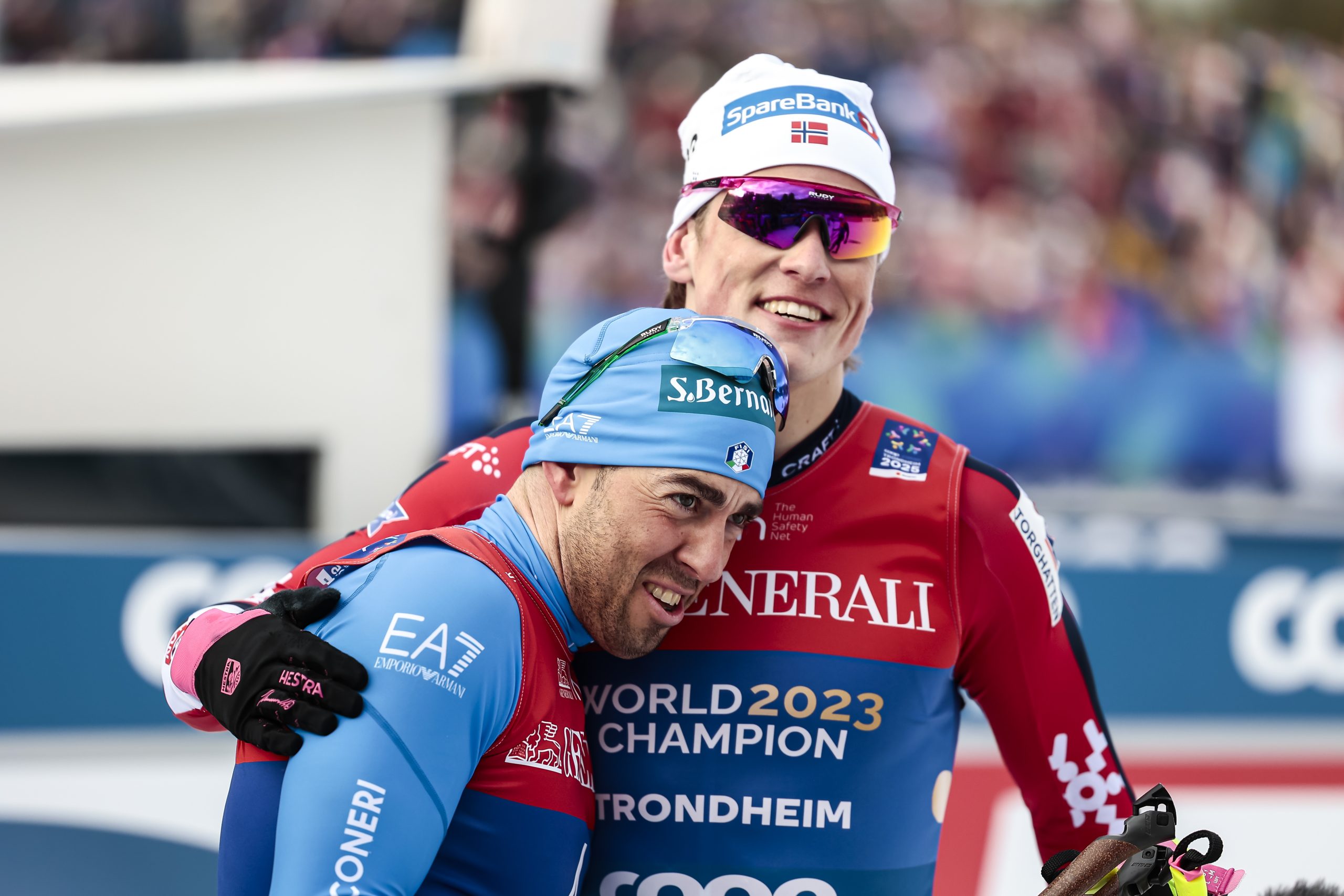
    And win he did—showing the easiest speed, the greatest endurance, the most clever tactics, and the fastest skis. Klaebo drove up the final hill, rocketed down the other side, negotiated the final slush-filled turn, and cruised up the finishing straightaway ahead of an ecstatic Federico Pellegrino (ITA) and Lauri Vuorinen (FIN).

    “It was a lot of nerves, that’s for sure,” Klaebo said. “I’m just glad we’re done with it now, to be honest. So, I’m really satisfied. Tussen Takk, Trondheim!”

    All four Americans—Ben Ogden, Gus Schumacher, JC Schoonmaker, Jack Young—qualified for quarterfinal heats amid Trondheim’s deafening atmosphere that Ogden, described as crazy. “Norway knows how to throw a ski race, I’ll tell you that.” Ogden grinned. “I was nervous for this one, so I’m happy to be getting going. I’m gonna try and ski smart, ski hard, leave it all out there.”

    Ben Ogden (USA, during the quarterfinals) drove the pace during his semifinal heat with the hope of setting a fast enough time that four athletes would qualify from the second heat to advance to the final. Thanks to Ogden, that is just what happened, but unfortunately, he ran out of gas with mere meters to go, ultimately crossing the line in sixth place in his heat and 12th place overall. (Photo: NordicFocus)

    Ogden and Schumacher raced a tactical quarterfinal (won by Northug), with Ogden managing to win the boot throw at the line for the final qualifying spot. Schumacher never managed to develop the speed necessary to contend in the heat. He’d finish 27th on the day.

    JC Schoonmaker and Jack Young finished fourth and fifth in their quarterfinal. They’d finish the day in 15th and 18th, respectively.

    Among Canadians, Pierre Grall-Johnson was 36th, Graham Ritchie 48th, Xavier McKeever 51st, and Sasha Masson 54th.

    JC Schoonmaker (USA) put it out there to finish the individual sprint in 15th place at the World Championships in Trondheim (NOR).
    (Photo: NordicFocus)
    Men’s Sprint

    FasterSkier’s Devon Kershaw considered the Trondheim Sprint course in pre-race interviews, describing Klaebo’s chances of mastering it. “An athlete like Klaebo, for example, has every tool in the toolbox,” Kershaw said. “I don’t think it really matters; there’s no real crucial point. But, of course, this big right-hander into the finishing stretch is incredibly crucial. You have to carry a lot of speed and stay on your feet. It’s going to be an exciting competition.”

    Joining Klaebo on the Norwegian Sprint team were Matz William-Jenssen, Even Northug, Haavard Solaas Taugboel, and Ansgar Evensen. Erik Valnes (NOR) finished second in the most recent World Cup Sprint and stands second in the season-long World Cup Sprint standings, but withdrew with a back injury prior to the start of competition in Trondheim. Everybody else was here, all the hungriest World Cup contenders—the French, the Swedes, the Germans, the Italians, the Finns, the Austrians, the Americans—but it definitely looked to be Norway’s finishing order to sort out. There were six spots available in the Sprint Final, five Norwegians entered, and only three medals to hand out. Something had to give.

    Johannes Hoesflot Klaebo (NOR) charging up the climb in front of the home fans. (Photo: NordicFocus)

    As it turned out, what gave—at least a little bit—was Norway. Valnes’s withdrawal put Jenssen in the lineup, but Jenssen got tangled in his quarterfinal and was eliminated. Taugboel skied a lackluster quarterfinal without ever being a factor. Northug was able to advance through the quarterfinal, but only by making a Kamikaze dive into the final right-hand turn before the finishing straight.

    Predictably, Klaebo cruised brilliantly through his quarterfinal heat, showing the savvy tactics and fast skis that have always epitomized his Sprint performances. Pellegrino had a difficult time weaving his way through his quarterfinal but showed his blazing speed in the finishing straightaway to win the heat and advance to the semifinals. Edvin Anger (SWE) entered the World Championships ranked third in World Cup Sprint standings, but he raced carelessly in the quarterfinals and only advanced to the semifinal as a lucky loser.

    Federico Pellegrino (ITA), pulling away from Even Northug (NOR) and Richard Jouve (FRA) on the home stretch of their semifinal, found the fitness of years past today in Trondheim. (Photo: NordicFocus)
    Semifinal

    Semifinal 1 featured Pellegrino facing Klaebo, Northug, and Anger (who had only narrowly avoided elimination in the quarterfinals). Klaebo skied flawlessly, conserving energy as he cruised to a semifinal win ahead of Pellegrino. Jules Chappaz (FRA) claimed a lucky loser spot. Northug struggled to fifth while Anger—who never looked sharp—ended his day sixth in the semifinal.

    Ogden moved toward the lead of Semifinal 2, where he was joined by Lucas Chanavat (FRA). Ogden opened up the pace on the significant uphill section, only to find his skis overtaken on the final downhill by Lauri Vuorinen (FIN) and Chanavat. An errant pole plant in the final straight dropped Ogden to sixth while Vuorinen and Chanavat advanced.

    Ben Ogden (USA) struggled to keep his balance down the final hundred meters after pushing the pace so hard earlier in the semifinal. Ultimately Ogden would finish in 12th place overall. (Photo: NordicFocus)
    Men’s Sprint Final

    It must have felt a bit strange to Klaebo, being the only Norwegian in the Sprint Final. If it bothered him at all, he didn’t show it. Choosing the far-left start position all day, Klaebo moved quickly to the front in order to control the early pace. Pellegrino matched his speed, with Chanavat following. The fatigue of the day seemed to take its toll on the racers, as what appeared to be a moderate pace still managed to stretch out the field. Klaebo coasted to the front on every downhill, followed by a stubbornly determined Pellegrino. They crested the final uphill in that order, using the subsequent downhill to repeatedly check the positioning of their pursuers. Klaebo crossed the finish, punching the air to celebrate his first gold of these championships. But it appeared that the greatest elation at the finish line belonged to Pellegrino, who seemed almost overcome by his silver medal effort. Vuorinen outsprinted Chappaz for third.

    Federico Pellegrino (ITA) may have been the happiest person in Trondheim, Norway after finishing the individual sprint in second place. (Photo: NordicFocus)

    The ovation of the Norwegian crowd lasted long after the skiers had crossed the line . . . and there are still plenty of races yet to run.

    “I’m out of words,” Klaebo said. “I mean, look at the spectators . . . it’s way different from what we are used to. This is how we do it in Trondheim . . . It’s amazing.”

    Projecting toward the upcoming Skiathlon—and the possibility of ending his own World Championship distance-racing drought—Klaebo said, “Come back on Saturday. It’s gonna be fun.”

    FIS World Championships Men’s Freestyle Sprint RESULTS

    Men’s Sprint QUALIFYING

    Federico Pellegrino (ITA), Johannes Hoesflot Klaebo (NOR) and Lauri Vuorinen (FIN) (l-r) take the Freestyle Sprint podium at the 2025 FIS Cross-Country Ski World Championships in Trondheim (NOR). (Photo: NordicFocus)

    – – – – – – – – – – – – – – – – – – – – – – – – – – – – – – – – – – – – – – – – – –

    Our ski boots on the ground coverage was provided by Nat Herz, Stuart Harden, and Aidan O’Connell.

    This reporting costs money. Please support this coverage with a voluntary subscription (below) so FasterSkier can provide this level of access to the sport we all love year-round.

    – – – – – – – – – – – – – – – – – – – – – – – – – – – – – – – – – – – – – – – – – – –

  • 2018/2019 Tour de Ski Preview (Updated)

    2018/2019 Tour de Ski Preview (Updated)

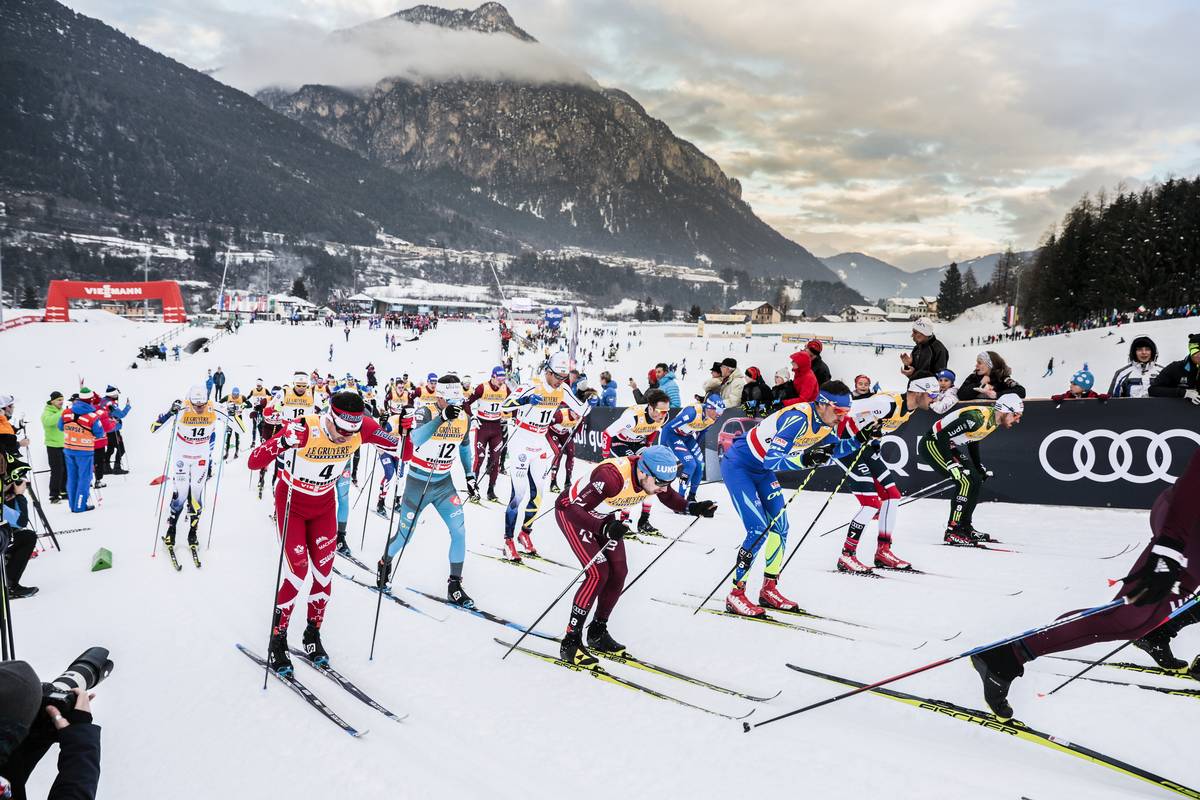
    The start of the men’s 15 k classic mass start at Stage 6 of the 2018 Tour de Ski on Saturday in Val di Fiemme, Italy, with (front row, left to right) Canada’s Alex Harvey, Russia’s Sergey Ustiugov, Kazakhstan’s Alexey Poltoranin, Norway’s Martin Johnsrud Sundby, and Switzerland’s Dario Cologna. (Photo: Salomon/NordicFocus)

    Beginning this Saturday in Toblach, Italy with a freestyle sprint is the 13th edition of the Tour de Ski (TdS). According to the International Ski Federation (FIS), over the course of seven stages the men will race 80.918 kilometers, the women 60.67 k. 

    The TdS has become both a staple and a spectacle of the annual World Cup calendar. With a jam-packed series of races primacy is placed on both the ability to recover well and wither less as the TdS transpires.

    Prognostication can be tricky in a long-form template like the TdS. So much can go astray during seven races not to mention the travel and dicey germ-avoidance. 

    Last season’s winner on the women’s side, Heidi Weng of Norway, sits 18th overall in the World Cup standings (14th in distance). She has four top-20’s in the four distance events she’s contested with her best result an eighth in Lillehammer’s 10 k skate. Although featuring two sprints in the first three stages, the TdS remains a distance skier’s paradise.

    Weng has skied solidly on the World Cup, but she has yet to show the form that made her a TdS overall winner in 2017 and 2018. Norway has won the last five iterations of the TdS: Marit Bjørgen won once in 2014/2015, Therese Johaug twice (2013/2014, 2015/2016), and Weng the last two years.

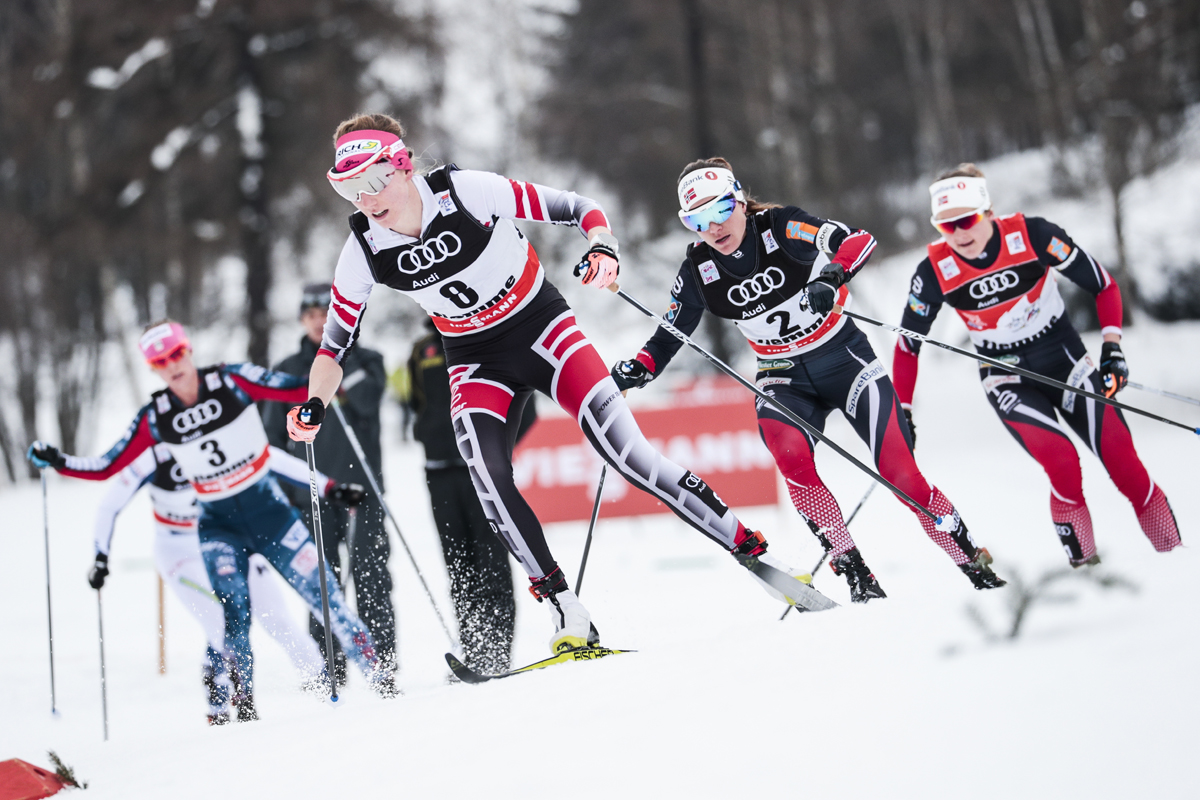
    Austria’s Teresa Stadlober leads Norway’s Heidi Weng (2) and Ingvild Flugstad Østberg, American Jessie Diggins (3) and others around a downhill corner during the women’s 10 k classic mass start at Stage 6 of the 2018 Tour de Ski in Val di Fiemme, Italy. (Photo: Fischer/NordicFocus)


    If Norway is to keep the streak alive, Ingvild Flugstad Østberg, last year’s TdS runner up, could be the heir apparent. She currently ranks second in the World Cup overall and 15th on the sprint list.

    Johaug, having returned from an 18 month doping ban, has been on a distance race tear. She has won all five World Cup distance events this season. Johaug, however, will not be lining up for the TdS.

    Only five different women have earned distance podiums this season — Johaug, Østberg, Sweden’s Charlotte Kalla and Ebba Andersson, and Finland’s Krista Pärmäkoski. Along with Johaug, Kalla and Andersson are skipping the TdS. (Andersson sits third overall on the World Cup, Kalla fifth.) With the TdS missing three of the five top ranked World Cup distance skiers, daily stages and the overall podium are up for grabs.   

    Last season’s third overall finisher, Jessie Diggins of the U.S. Ski Team (USST), often cites the TdS as a point in the season when her form trends towards podium performances. She sits eighth in the current distance standings and could very well have a stout TdS. 

    Russia’s Natalia Belorukova and Yulia Nepryaeva look strong as does Sadie Bjornsen (USST), and Austria’s Teresa Stadlober.

    With less than predictable distance stage podiums for the women, it may simply come down to a drag race on the Alpe Cermis final climb Jan. 6.

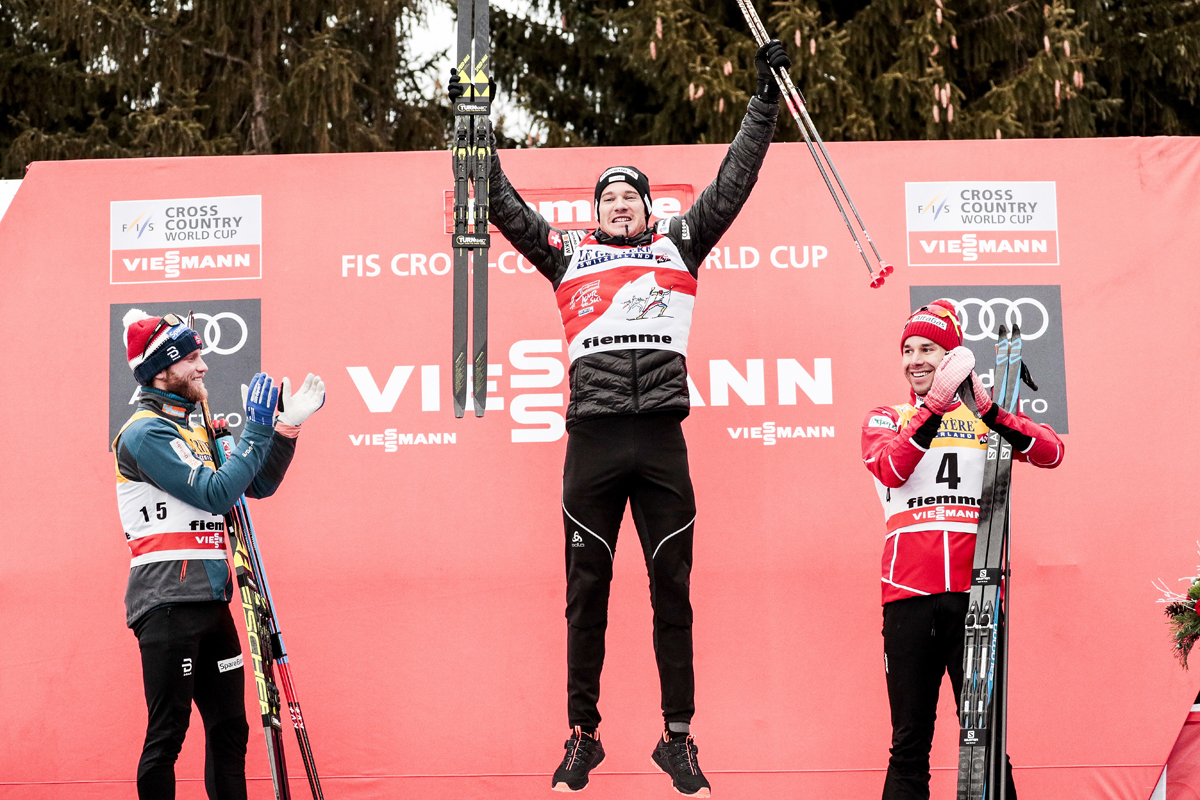
    Switzerland’s Dario Cologna (c) celebrates his fourth Tour de Ski overall title. He was joined by Norway’s Martin Johnsrud Sundby (l) and Canada’s Alex Harvey (r) on the podium in second and third, respectively. (Photo: Fischer/NordicFocus)


    The men’s scene is also open to interpretation. Last season’s TdS winner, Switzerland’s Dario Cologna, was in fact a surprise victor. Prior to Cologna’s stage two win in last year’s TdS, it had been nearly three years since the four time TdS overall winner had won a World Cup. Cologna sits 21st overall on the World Cup currently. Given last year’s resurgence, anything is possible for the Swiss skier.

    Then there’s Martin Johnsrud Sundby form Norway. He finished on the TdS podium the last three years. At thirty-four-years-old, Sundby is ranked first on the distance list, with a second, a third, and a fourth place in distance races this season.

    Sundby won the TdS on two occasions – in 2013/2014 and in 2016. His 2015 win was stripped after he tested positive for excessive levels of Salbutamol. He placed second in the past two Tours.

    In a field rife with talent, Sundby’s ability to race and rebound and race and rebound will be tested. Sjur Røthe, Emil Iversen, and Didrik Tønseth— all from Norway— look in form. And there’s Norway’s Johannes Høsflot Klæbo. The winner of last season’s overall World Cup has had flashes of his past explosive self. He could be a TdS protagonist.

    The men’s field is notably tight. Along with the Norwegians, several Russians could pop a podium, a stage win, and the overall. Russia comes with a loaded team ready to exploit. Alexander Bolshunov leads the overall World Cup – he’ll turn twenty two on Dec. 31st. He’s backed by teammates Evgeniy Belov, Andrey Melnichenko, and Denis Spitsov. 

    Canada’s Alex Harvey placed third overall last year and he looked stronger as the TdS progressed.

    The Stages

    Stage 1:  Dec. 29, skate sprint in Toblach, Italy.

    Stage 2: Dec. 30, 10 k/15 k skate in Toblach, Italy.

    Stage 3: Jan. 1, skate sprint in Val Müstair, Switzerland.

    Stage 4: Jan. 2, 10 k/15 k classic mass start in Oberstdorf, Germany.

    Stage 5: Jan. 3, 10 k/15 k skate pursuit in Oberstdorf, Germany.

    Stage 6: Jan. 5th, 10 k/15 k classic mass start in Val di Fiemme, Italy.

    Stage 7: Jan 6th, 9 k final climb skate pursuit in Val di Fiemme, Italy.

    Teams

    United States

    Women: Sophie Caldwell, Sadie Bjornsen, Jessie Diggins.

    Men: Ben Lustgarten, Simi Hamilton, Erik Bjornsen, Kevin Bolger.

    U.S. Ski Team Head Coach Chris Grover noted in a text that Caldwell, Hamilton, and Bolger will likely cease the TdS after the stage three sprint. Additionally, this is a small team for the U.S. at the TdS. Several athletes turned down TdS nominations including Scott Patterson (USST), Andy Newell (SMS T2/Salomon), Kyle Bratrud (SMS T2), Rosie Brennan (APU), Rosie Frankowski (APU), Caitlin Patterson (CGRP), and Julia Kern (SMS T2). These skiers plan on racing U.S. Nationals this January in Craftsbury, Vermont.

    Canada

    Women: Emily Nishikawa, Dahria Beatty

    Men: Alex Harvey, Lenny Valjas, Bob Thompson

    Norway

    Women: Ingvild Flugstad Østberg, Maiken Caspersen Falla, Astrid Uhrenholdt Jacobsen, Kari Øyre Slind, Kathrine Rolsted Harsem, Heidi Weng, Lotta Udnes Weng, Tiril Udnes Weng Mari Eide, Anna Svendsen

    Men: Martin Johnsrud Sundby, Hans Christer Holund, Emil Iversen, Didrik Tønseth, Simen Hegstad, Krüger, Sjur Røthe, Johannes Høsflot Klæbo, Martin Løwstrøm Nyenget, Eirik Brandsdal, Finn Hågen Krogh

    Russia

    Women: Yulia Belorukova, Lidia Durkina, Anna Zherebyateva, Mariya Istomina, Natalia Nepryaeva, Anna Nechaevskaya, Anastasia Sedova, Elena Soboleva

    Men: Evgeniy Belov, Alexander Bolshunov, Maxim Vylegzhanin, Andrey Larkov, Andrey Melnichenko,  Gleb Retivykh, Andrey Sobakarev, Denis Spitsov, Sergey Ustiugov

    Sweden

    Women: Mia Eriksson, Ida Ingemarsdotter, Moa Molander Kristiansen, Stina Nilsson, Maria Nordström, Linn Sömskar, Lisa Vinsa

    Men: Calle Halfvarsson, Simon Lageson, Teodor Peterson, Daniel Rickardsson, Oskar Svensson, Viktor Thorn, Karl Johan Westberg

    Finland

    Women: Mari Eder, Anne Kyllönen, Laura Mononen, Krista Pärmäkoski, Susanna Saapunki

    Men: Ristomatti Hakola, Matti Heikkinen, Lauri Vuorinen

    Italy

    Women: Elisa Brocard, Anna Comarella, Ilaria Debertolis, Caterina Ganz, Greta Laurent, Sara Pellegrini, Lucia Scardoni

    Men: Francesco de Fabiani, Stefano Gardener, Enrico Nizzo, Dietmar Noeckler, Federico Pellegrino, Maicol Rastelli, Giandomenico Salvadori

    Switzerland

    Women: Nathalie von Siebenthal, Laurien van der Graaff, Nadine Fähndrich

    Men: Dario Cologna, and Jovian Hediger, Jonas Baumann, Livio Bieler, Roman Furger, Käser Erwanm, Beda Klee, Toni Livers, Jason Rüesch, Schaad Roman

    Austria

    Women: Therese Stadlober

    Germany

    Women: Julia Belger, Victoria Carl, Pia Fink, Laura Gimmler, Katharina Hennig, Sandra Ringwald, Elisabeth Schicho, Anne Winkler

    Men: Thomas Bing, Lucas Bögl, Janosch Brugger, Jonas Dobler, Sebastian Eisenlauer, Andreas Katz, Valentin Mättig, Florian Notz, Max Olex, Thomas Wick

    France

    Women: Anouk Faivre Picon, Delphine Claudel, Laura Chamiot-Maitral

    Men: Maurice Manificat, Lucas Chanavat, Adrien Backscheider, Jean-Marc Gaillard, Baptiste Gros, Renaud Jay, Richard Jouve, Jules Lapierre, Clement Parisse

    FasterSkier will update team start lists as we gather more information.

    antibiotics

  • World Cup Preview #4: Finland

    World Cup Preview #4: Finland

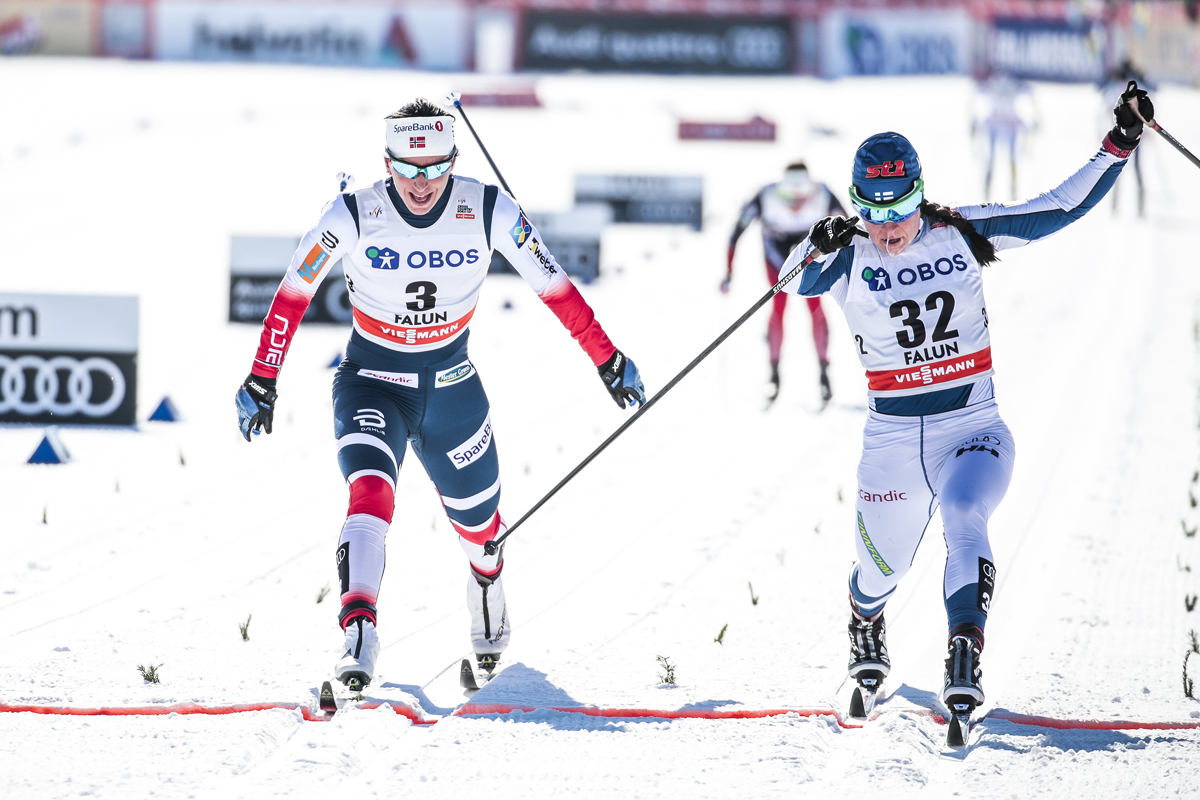
    Finland’s Krista Pärmäkoski (32) edges Norway’s Marit Bjørgen for the win in the women’s 10 k classic mass start at 2018 World Cup Finals in Falun, Sweden. (Photo: Fischer/NordicFocus)


    Welcome to FasterSkier’s World Cup Preview, where we check in with the top-10 teams from last year’s FIS Cross Country World Cup tour before the season starts with the Ruka weekend in Kuusamo, Finland, on Nov. 24 with a classic sprint.

    ***

    Finland

    Overall in Nations Cup Last Year:4th

    Women’s Ranking 2017/2018: 4th

    Men’s Ranking 2017/2018: 7th

    Finnish Skiers to Watch:

    If there are two names Finland’s cross-country ski fans loves to cheer–and will be looking to chant again this season–it’s Krista Pärmäkoski and Iivo Niskanen. And with good reason.

    Pärmäkoski opened Period II of last season with a win, cruising to first in the 10-kilometer classic race in Planica, Slovenia. Pärmäkoski racked up two more 10 k victories after Planica, winning both the Lahti 10 k and the Falun 10 k. Altogether, Pärmäkoski landed on the World Cup podium seven times last season, capping off the FIS 2017/2018 season ranked fourth, just ahead of Norway’s Marit Bjørgen in fifth.

    Outside of the World Cup, Pärmäkoski also came away from the 2018 Pyeongchang Winter Olympic Games with three individual medals, one silver and two bronze.

    Complimenting Pärmäkoski on the men’s side, Niskanen, earned two World Cup podiums last season, placing third in the Ruka 15 k and third in the Lahti 15 k. He landed in the top-20 twelve times during last year’s World Cup season, and finished 15th in the FIS overall.

    buy celebrex online

    buy celebrex online

    Like Pärmäkoski, he also departed the Winter Games with hardware, a gold medal from the men’s 50 k mass start.

    Pärmäkoski and Niskanen aren’t the only Finns capable of pushing into the top tiers of World Cup skiers. With the retirement of Aino-Kaisa Saarinen this past spring, the women’s side will look to Kerttu Niskanen (Iivo’s sister), Riitta-Liisa Roponen, Anne Kyllönen and Laura Mononen–all of whom scored World Cup points more than once last season– to keep the women’s team’s forward momentum.  

    Following Niskanen, Matti Heikkinen and Ristomatti Hakola are two veteran Finnish names who are not about to let up as the 2018/2019 season prepares to get underway.  


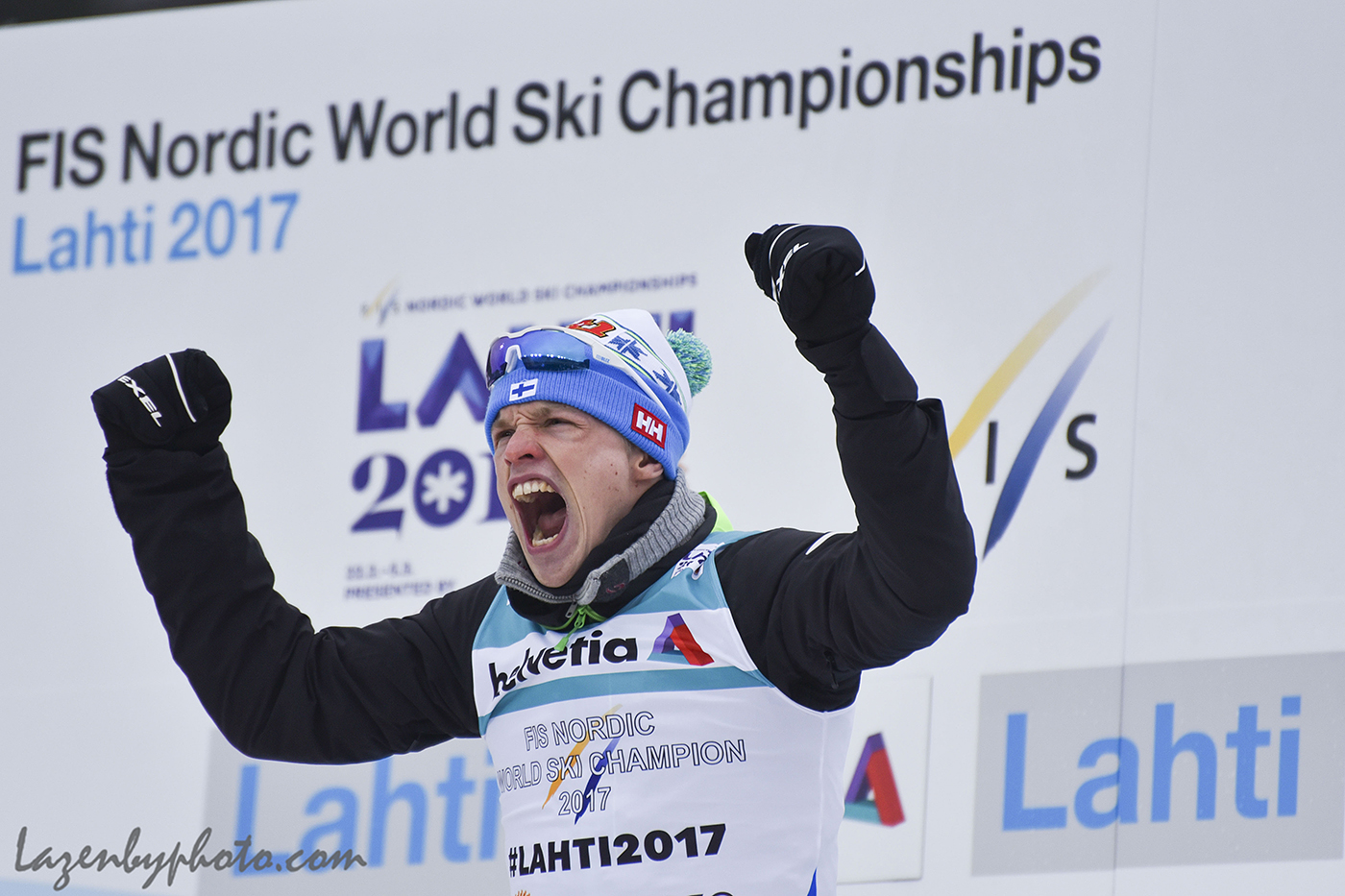
    Finland’s Iivo Niskanen celebrating his first World Championships gold in the men’s 15 k classic on March 1, 2017, in Lahti, Finland. (Photo: John Lazenby)
  • Klæbo Commands Kuusamo Classic Sprint; Harvey 21st, Bjornsen 24th

    Klæbo Commands Kuusamo Classic Sprint; Harvey 21st, Bjornsen 24th

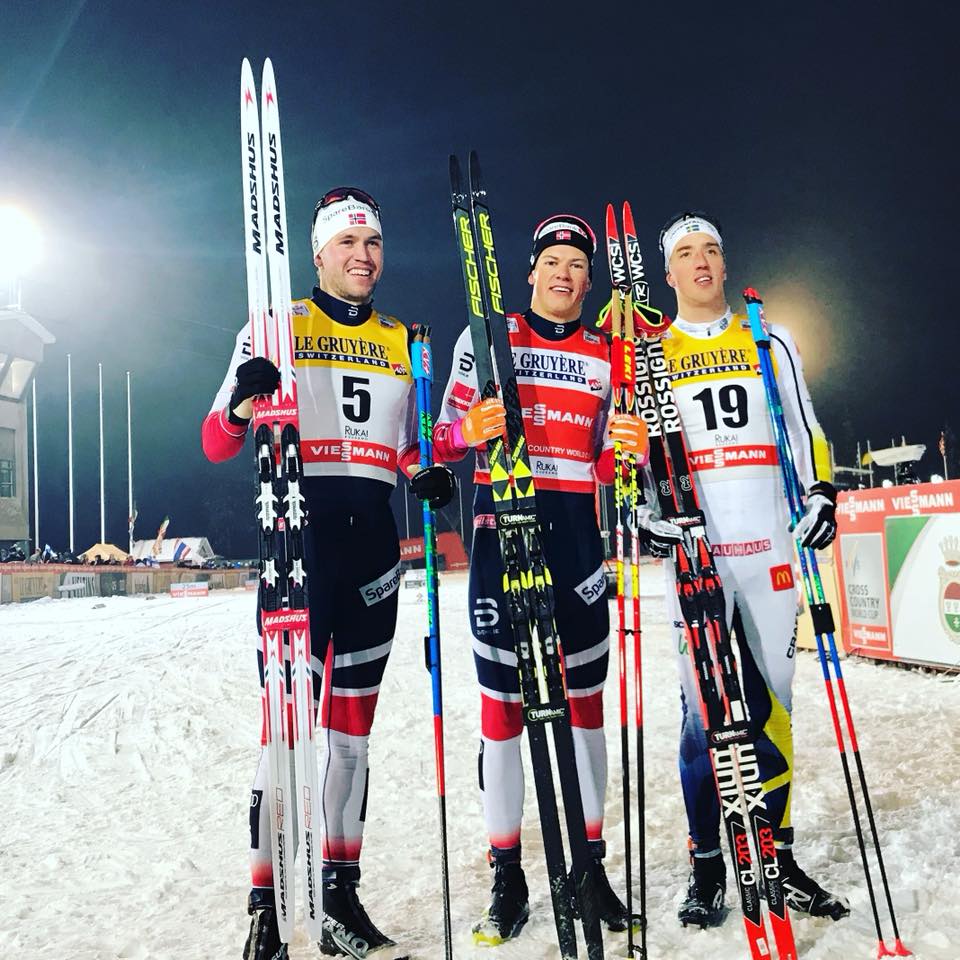
    Left to right: Norwegians Pål Golberg and Johannes Høsflot Klæbo and Sweden’s Calle Halfvarsson after placing third, first and second, respectively, in the men’s 1.4-kilometer classic sprint on Friday in Kuusamo, Finland. (Photo: FIS Cross Country/Facebook)

    There was no mistaking Norway’s Johannes Høsflot Klæbo in Friday’s 1.4-kilometer classic sprint, even with no natural light illuminating the course in Kuusamo, Finland, by the time the men’s final left the start line. The 21 year old’s distinct runner-like, high-tempo stride could be seen leading the five other men’s finalists on every climb, distinguishing him from the light fog and densely packed trees lining the course’s firmly packed tracks.

    Making his World Cup debut in the spring of 2016, Klæbo has since racked up four-regular season World Cup individual sprint podiums — of the eight World Cup sprints that he has entered — and ended last season as the men’s U23 World Cup champion as well as the overall Sprint World Cup winner, all at the age of 20.

    Last weekend at Norway’s first International Ski Federation (FIS) races of the season in Beitostølen,  Klæbo not only won the classic-sprint final, but he also topped the men’s qualifier, his quarterfinal and his semifinal.

    Klæbo repeated the feat this weekend in Kuusamo, starting first with the qualifier, clocking the fastest by 2.26 seconds over Finland’s Anssi Pentsinen in a time of 2:46.53 minutes. He then won his quarterfinal by 0.6 seconds over fellow Norwegian national-team member Pål Golberg. In his semifinal, Klæbo bested Sweden’s Calle Halfvarsson by 0.29 seconds and then, with a convincing gap on the rest of the field, crossed the finish line first in the final in 2:48.19, kick starting his 2017/2018 World Cup season with a win.

    “It was not my plan to ski away so early but before the final hill I was told I had a five-minute lead so I went for it all the way to the finish,” Klæbo sai,d according to a FIS press release.

    Even before the course’s last climb, Klæbo had already set himself apart from the rest of the racers in the men’s final: Finland’s Ristomatti Hakola, Italy’s Federico Pellegrino, Sweden’s Calle Halfvarsson, and Norway’s Golberg and Sondre Turvoll Fossli. By the bottom of the first major climb he had double poled his way to a three-meter gap. 

    Klæbo already in his descent, Hakola, Golberg, Pellegrino, Fossli, and Halfvarsson crested the top of the climb in a pack and settled in for the chase. But Klæbo continued to hold them off into the second major climb, extending his gap by another two meters. As the others reached the second major climb, the race became one for second place between Halfvarsson and Goldberg. Hakola, Pellegrino and Fossli had all fallen back.

    Finishing with no one close enough to challenge him, Klæbo took the win in in 2:48.19. Goldberg crossed 1.35 seconds later for second place, while third went to Halfvarsson, 4.03 seconds after Klæbo.

    “I’m happy about the third place, but I was quite behind Klaebo,” Halfvarsson said according to a FIS press release. “I will try to catch up for the [Olympic] Games. He was impressive today.”

    Rounding out the top 10 was Finland’s Lauri Vuorinen in seventh, Russia’s Alexander Bolshunov in eighth, Switzerland’s Jovian Hediger in ninth, and Finland’s Martti Jylhä in 10th.

    Canada’s Alex Harvey advanced to the quarterfinals after qualifying in 13th (+6.13), the fastest North American in the preliminary round.

    “The goal was to execute a solid day of racing since it’s the first time I put a bib on this year!” Harvey, of the Canadian World Cup Team, wrote in an email to FasterSkier. “I was pretty happy with my qualifier, it’s a short sprint here so 13th for me was a great start.”

    In his quarterfinal, Harvey went up against Finnish skiers Vuorinen, Iivo Niskanen, and Toni Ketelä as well as Estonia’s Marko Kilp, and Japan’s Hiroyuki Miyazawa. However, a loss in positioning before the major climb cost him a few seconds, and he finished his quarterfinal in fifth, 2.16 seconds behind Vuorinen, who won the heat in 2:47.40.

    “In the 1/4 final I did 1 or 2 mistakes that just cost me in term of positioning before the big hill,” Harvey wrote. “I felt great technically and actually pretty good physically too especially for the time of the year.”

    “Like normal the steep terrain is a bit of a weakness for me so again in the final wall I don’t think I was moving fast enough there,” Harvey continued. “The rest of the course I think I skied well.”

    The only other North American to qualify on Friday was Erik Bjornsen of the U.S. Ski Team (USST) in 26th (+8.71).  Racing in the same quarterfinal as Klæbo, Golberg, Finland’s Juho Mikkonen and Matias Strandvall, and Russia’s Gleb Retivykh, Bjornsen ultimately crossed in fifth, 5.12 seconds behind Klæbo.

    “We are really proud of [Erik] to qualify as strong as he did, in Scandinavia, in a classic sprint,” USST coach Matt Whitcomb said on the phone. “This is one of the hardest races of the year to do this, and it bodes really well.”

    “Talked to him between the qualification and the quarterfinals, and he was just exuding confidence and commented on how strong his double pole is feeling,” Whitcomb continued. “We saw him fire that jet in the finish stretch today. He had a really fast heat and it stressed him out a little bit, don’t know exactly what happened, but he was in the mix today and we are psyched.”

    Another USST member, Andy Newell missed qualifying by 0.38 seconds in 34th. He was 9.38 seconds off Klæbo’s top qualifying time.

    “It was frustrating to be so close and just on the outside of the qualification bubble,” Newell wrote in an email. “Just a few tenths of a second out of the top 25. I felt like I struggled today to get the right amount of glide vs kick… which is just as much on me as the tech. Grateful to be feeling healthy and looking forward to big races to come.”

    Julien Locke of Canada’s National U25 Team was the next-fastest Canadian, placing 59th (+12.07) in the qualifier. Locke finished 0.04 seconds ahead of the American Simi Hamilton (USST) in 60th (+12.13).

    “A little bit of an off day for Simi and Andy,” Whitcomb said. “For Andy on a course that is particularly good for him and he is in really good shape right now, I think he struggled with some glide.”

    Canadian World Cup Team member Len Valjas finished 63rd (+12.58). Before departing Gällivare, Sweden — where he and most of his teammate had been training and raced the opening FIS competitions — Valjas suffered a shoulder subluxation and was not “back to full health” by the time Friday’s sprint rolled around, he explained in an email.

    “I took the week really easy on the shoulder to let it recover, and gave it a try in today’s race,” Valjas wrote. “I didn’t have my normal strength in the double pole sections of today’s race. I just felt weak and couldn’t hold any speed on the flats.

    “I was happy that I was able to compete today, but I am definitely not skiing at 100%,” Valjas continued. “The shoulder is pretty sore and stiff from the qually this morning. Huge thanks to Pete Dickinson (USA physio) for taking care of me this week and helping me speed up my recovery.”

    Also competing for Canada was Knute Johnsgaard in 73rd (+12.58), Devon Kershaw in 74th (+14.01) Graeme Killick in 85th (+14.01), Jess Cockney in 95th (+18.83).

    Three additional Americans raced in the qualifier, with Scott Patterson (USST) finishing 84th (+16.14), Patrick Caldwell (USST) finishing 103rd (+21.43) and Noah Hoffman finishing in 105th (+21.85).

    Canada’s Continental Cup leader, Russell Kennedy (Team R.A.D.), who earned Period 1 World Cup start rights after ending winning last season’s overall NorAm title, did not start Friday’s sprint race.

    Results: Qualifier | Final | Ruka Triple standings (Day 1)

  • Friday Rundown: Sadie Bjornsen Opens with Career-Best Second in Ruka

    Friday Rundown: Sadie Bjornsen Opens with Career-Best Second in Ruka

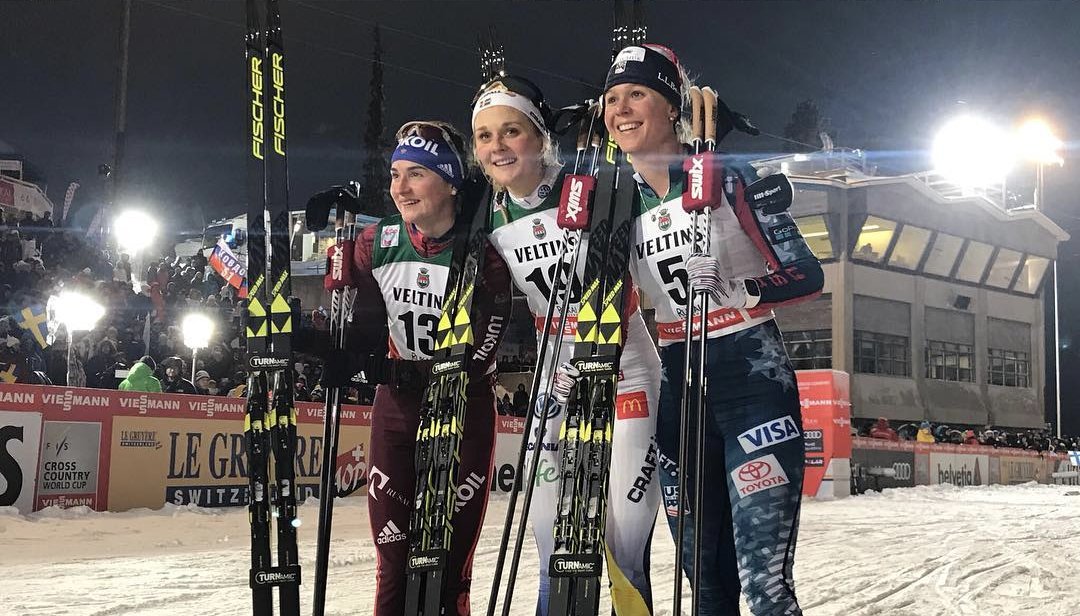
    The women’s podium for the first race of the 2017/2018 World Cup season, the Ruka classic sprint in Kuusamo, Finland, with (from right to left) American Sadie Bjornsen in second, Sweden’s Stina Nilsson in first, and Russia’s Yulia Belorukova in third. (Photo: U.S. Ski Team/Twitter)

    FIS Cross Country World Cup (Kuusamo, Finland): Classic sprints

    Women’s race report

    Men’s race report

    In the first race of the 2017/2018 cross-country World Cup season, U.S. Ski Team (USST) member Sadie Bjornsen, who turned 28 on Tuesday, raced to the best result of her career, placing second to Sweden’s Stina Nilsson in Friday’s classic sprint in Kuusamo, Finland.

    Last season, Bjornsen notched her first World Cup podium in third place in the 5-kilometer freestyle in Toblach, Italy, and teamed up with USST teammate Jessie Diggins to take third in the 2017World Championships classic team sprint. Friday’s 1.4-kilometer classic sprint — the first race of the Ruka Triple mini tour to kick of the 2017/2018 World Cup season — was Bjornsen’s first race of the season. She did not participate in any preseason International Ski Federation (FIS) races.

    Bjornsen started out the day by clocking the fifth-fastest time in the qualifier, 1.98 seconds behind Sweden’s Ida Ingemarsdotter, who won the qualifier in 3:11.69 minutes. Bjornsen’s USST teammate Sophie Caldwell qualified third (+0.59) after another Swede, Hanna Falk in second (+0.19), and a total of four American women finished in the top 30 to qualify for the heats. Ida Sargent finished 22nd (+8.70) and Rosie Brennan was 26th (+9.51) to reach the quarterfinals.

    There, Bjornsen won her quarterfinal by 0.39 seconds over Russia’s Yulia Belorukova. Caldwell also advanced to the semifinals by placing second in her quarterfinal, 0.7 seconds behind Sweden’s Charlotte Kalla in first.

    Sargent finished third in her quarterfinal, 0.65 seconds behind the winner of that heat,  Sweden’s Anna Haag. Brennan placed sixth in her quarterfinal, 4.3 seconds behind Sweden’s Nilsson in first. Neither Sargent nor Brennan advanced to the semifinals.

    In the semifinals, Bjornsen again raced to first, and once again held off Belorukova — this time by just one-hundredth of a second. Caldwell followed in fourth in that semifinal, 0.5 seconds behind Bjornsen in first and 0.11 seconds behind Russia’s Evgenia Shapovalova in third (+0.39). Neither Caldwell nor Shapovalova advanced to the final.

    In the final, Nilsson took the overall win in 3:17.62 and Bjornsen captured a career best in second place, 0.24 seconds out of first. Belorukova rounded out the podium in third (+0.91), while Ingemarsdotter placed fourth (+2.72), Norway’s Kathrine Rolsted Harsem was fifth (+3.54), and Finland’s Krista Parmakoski sixth (+18.62).

    Overall, Caldwell placed eighth, Sargent 15th and Brennan 29th for the U.S. Diggins and Kikkan Randall missed out on qualifying in 34th and 36th, respectively. Julia Kern placed 57th, Liz Stephen 70th, and Chelsea Holmes 86th.

    None of the Canadian women qualified, with Dahria Beatty in 64th, Emily Nishikawa in 74th and Cendrine Browne in 87th.

    (Continues below)

    In the men’s 1.4 k classic sprint, Norway’s Johannes Høsflot Klæbo won out the day after winning the qualifier, quarterfinal and semifinal en route to another dominant performance in the final.

    Klæbo started off by winning the qualifying round by 2.26 seconds in 2:46.53. Finland’s Anssi Pentsinen qualified second and another Finn, Ristomatti Hakola, qualified third (+2.35), ahead of Italy’s Federico Pellegrino in fourth (+2.66).

    Cross Country Canada’s Alex Harvey was the top North American man in the qualifier, finishing 13th (+6.13), while Erik Bjornsen of the USST qualified in 26th (+8.71).

    Both Harvey and Bjornsen finished fifth in their quarterfinals and did not reach the semifinals. Harvey ended up 21st on the day, after finishing 2.16 behind the winner of his heat, Finland’s Lauri Vuorinen. Bjornsen was 24th overall after finishing 5.12 seconds behind Klæbo, who won the first men’s quarterfinal.

    Klæbo used the extra recovery time he had from racing an early quarterfinal to prime himself for another win in the semifinals, where he beat Sweden’s Calle Halfvarsson by 0.29 seconds. Another Norwegian, Pål Golberg, followed in third (+0.49), and Hakola placed fourth in that semi (+1.72). Both Golberg and Hakola had fast enough times to advance to the final, where they met Pellegrino — the winner of the second semifinal — and Norway’s Sondre Turvoll Fossli, who was second in the second semifinal (+0.1).

    In the final, Klæbo once again won convincingly, this time by 1.35 seconds with a finishing time of 2:48.19. Golberg took second place and Halfvarsson reached the podium in third (+4.03), while Hakola placed fourth (+5.65), Pellegrino fifth (+8.87), and Fossli sixth (+17.31).

    For the U.S., Andy Newell missed qualifying by 0.38 seconds in 34th and Simi Hamilton finished 60th. Scott Patterson was 84th, Paddy Caldwell was 103rd, and Noah Hoffman was 105th.

    For Canada, Julien Locke, of the national U25 Team, finished 59th, Len Valjas was 63rd, Knute Johnsgaard 73rd, Devon Kershaw 74th, Graeme Killick 85th, and Jesse Cockney 95th. Last year’s NorAm winner Russell Kennedy did not start.

    Results: 

    Women’s qualifier | Women’s final

    Men’s qualifier | Men’s final

  • O’Harra 14th in Classic Sprint for Junior Worlds Best; Stewart-Jones Leads Three Canadian Women in Heats

    O’Harra 14th in Classic Sprint for Junior Worlds Best; Stewart-Jones Leads Three Canadian Women in Heats

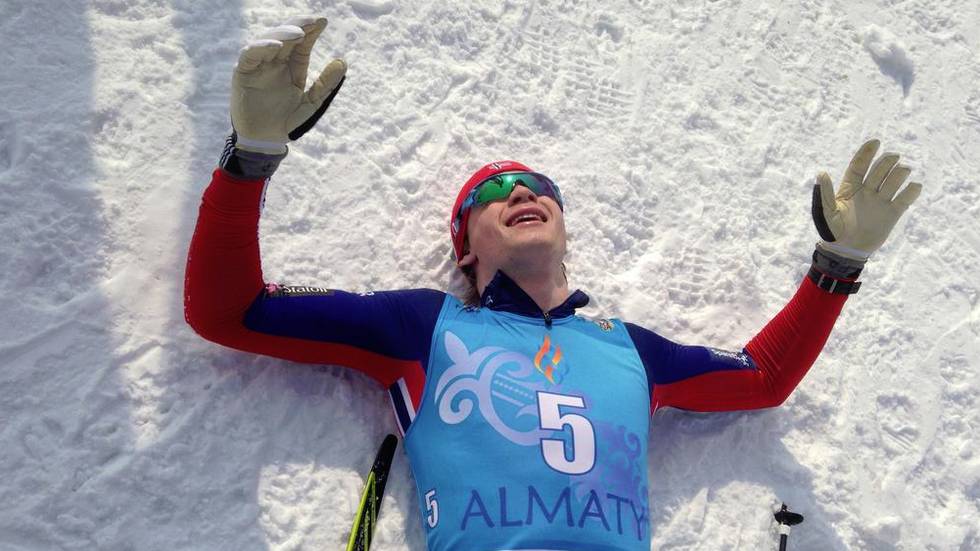
    An exhausted-and-ecstatic Fredrik Riseth of Norway after winning his first Junior World Championships title on Tuesday in the 1.3 k classic sprint. (Photo: FIS)
    An exhausted-and-ecstatic Fredrik Riseth of Norway after winning his first Junior World Championships title on Tuesday in the 1.3 k classic sprint. (Photo: FIS)

    Last year in his FIS Junior World Ski Championships debut, Thomas O’Harra placed 54th in the freestyle sprint in Val di Fiemme, Italy. Another year older and with another season of training under his belt, the 18-year-old Alaska Pacific University (APU) skier placed 14th on Tuesday in the opening race of 2015 Junior Worlds in Almaty, Kazakhstan: the 1.3-kilometer classic sprint.

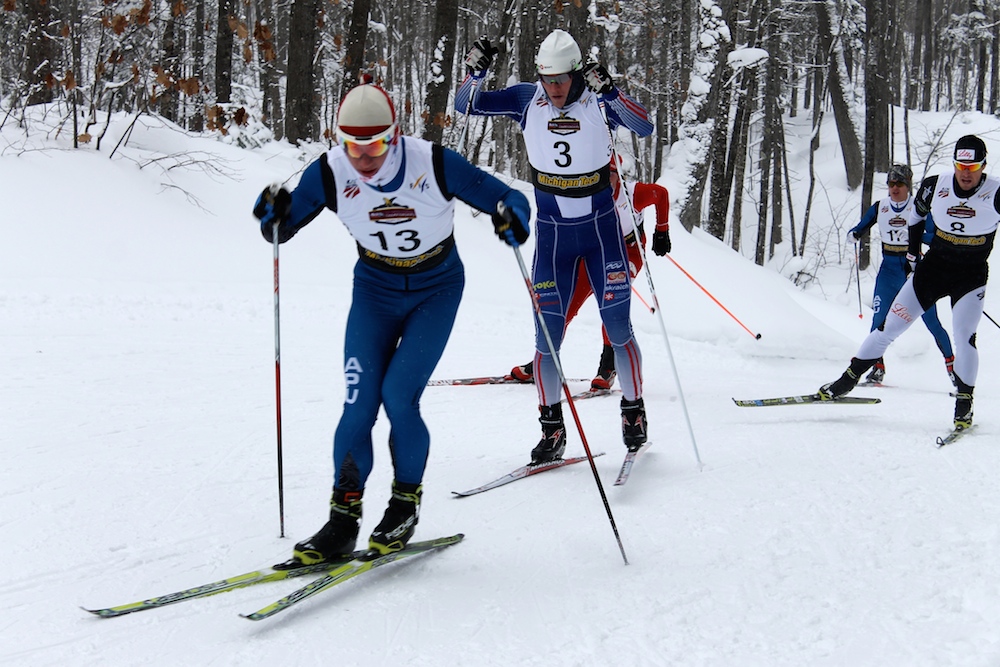
    Thomas O'Harra (APU) leading his freestyle-sprint quarterfinal with Sun Valley's Miles Havlick (3) and Kris Freeman last month at 2015 U.S. nationals in Houghton, Mich.
    APU’s Thomas O’Harra (13) leading his freestyle-sprint quarterfinal with Sun Valley’s Miles Havlick (3) and Kris Freeman (8) last month at 2015 U.S. senior nationals in Houghton, Mich. He went on to place 18th overall.

    O’Harra qualified 18th and went on to place third in his quarterfinal, 2.92 seconds behind the winner of his heat, Ludek Seller of the Czech Republic, and 0.35 seconds behind Russia’s Alexander Bakanov, who also automatically advanced in second.

    O’Harra’s quarterfinal was the slowest of the five, which prevented him from moving on to the semifinals as a lucky loser. But at the end of the day, 14th was still way better than 54th.

    “I don’t know if I can say I was expecting it, but I definitely knew that if I had a good race, I could get into the top 30,” O’Harra wrote in an email on Tuesday. “Coming into the sprint, my goal was to qualify. Ultimately though, my goal was to get into the top 10. Once I had qualified, I focused more on trying to advance out of my quarterfinal.”

    He reflected that his quarterfinal was “pretty hard right off the bat … everyone was jostling for position.” Knowing that he needed a top-two in his heat to guarantee a spot in the semifinal, O’Harra followed Bakanov in his track to the finish and lunged between the Russian’s legs as Bakanov let up near the line. And while it wasn’t quite enough, O’Harra was pleased to finish well within the top 30.

    “Today was a much better experience than last year’s sprint!” he wrote. “Last year I tripped myself going up the first hill and ended up 54th — not exactly super-duper. I think that a year’s more experience helped a lot. I was definitely a lot more collected and calm this year, both going into the race and during the race.”

    He was also optimistic about another top 30 in Wednesday’s 10 k freestyle.

    “I think that I’m in a really good place right now, but I didn’t actually try to peak specifically for these races, mainly because there is still a lot of racing left this season,” he wrote.

    “Last year I tripped myself going up the first hill and ended up 54th — not exactly super-duper. I think that a year’s more experience helped a lot.” — Thomas O’Harra, 14th in 2015 Junior World Championships 1.3 k classic sprint

    O’Harra led the North Americans in the junior men’s sprint, which Norway’s Fredrik Riseth won outright in 3:01.25. The Norwegian qualified fifth behind Finland’s Lauri Vuorinen (the top men’s qualifier in 3:01.88), and Riseth went on to win his quarterfinal and his semifinal before beating Bakanov by 4.85 seconds in the final.

    Norway’s Johannes Høsflot Klæbo made the podium as well in third, 8 seconds behind Riseth. Germany’s Marius Cebulla was fourth (+10.04), Sweden’s Oskar Svensson finished fifth (+10.11), and Vuorinen was sixth (+21.67).

    Riseth’s father, Svein Riseth, told Langrenn that he was impressed with his son’s result. While he knew Fredrik was in great shape, Svein wasn’t sure he had enough left after dominating his quarterfinal and semifinal. The contender he was most concerned about was Fredrik’s Byåsen IL teammate, Høsflot Klæbo.

    “Johannes is not only a good skier, but he is mentally and tactically strong,” Svein said, according to a translation. “It is outrageously fun two Byåsen runners entered the podium. Not just for the team but for [Trondheim] skiing.”

    While no other North American men qualified in the top 30, Canada’s Julian Smith (Georgian Bay) placed 39th, 3.82 seconds from 30th. Americans Evan Weinman (Middlebury) and Peter Holmes (University of New Hampshire) were 46th and 48th, respectively, Canada’s Alexis Dumas (CNEPH/NST-Junior) ranked 53rd, Ricardo Izquierdo-Bernier (CNEPH/NST-Junior) was 56th, American Gavin Hess (UNH) 58th, and Canadian Philippe Boucher (CNEPH/NST-Junior) 59th.

    Stewart-Jones Leads Three Canadian Women in the Heats

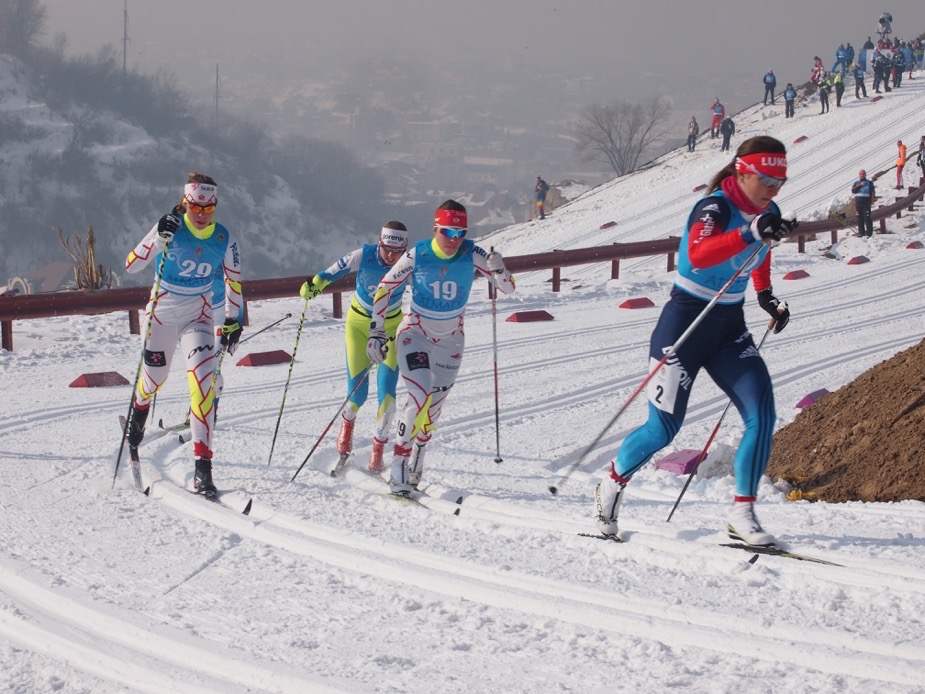
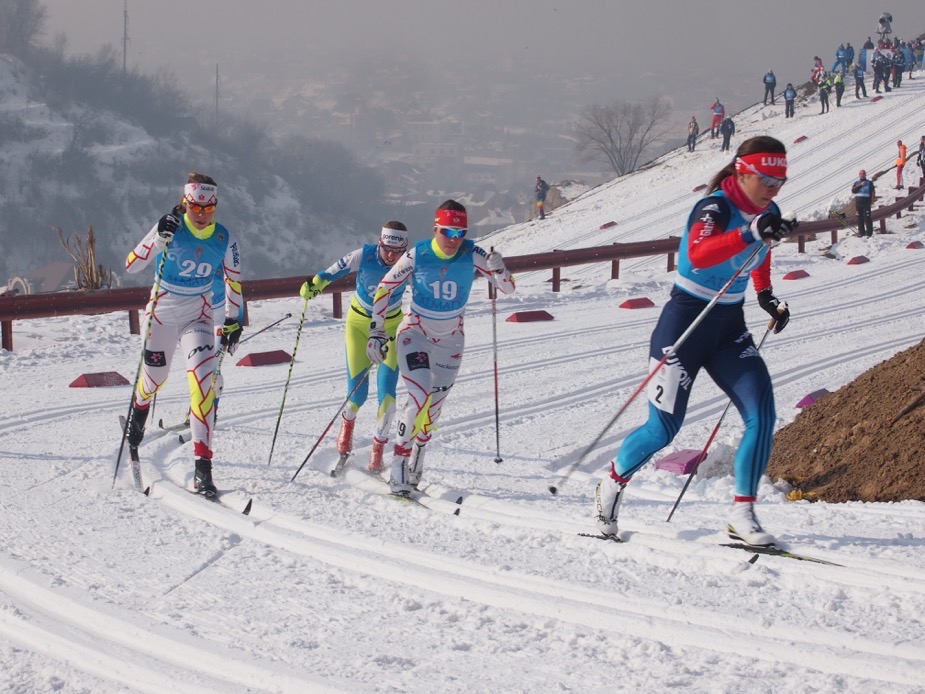
    Canadian National Junior Team members Katherine Stewart-Jones (19) and Maya MacIsaac-Jones (29) chase Russia's Natalia Nepryaeva (2) in the quarterfinal of the 1.3 k classic sprint on the opening day of 2015 Junior World Championships in Almaty, Kazakhstan. (Photo: Lisa Patterson/CCC)
    Canadian National Junior Team members Katherine Stewart-Jones (19) and Maya MacIsaac-Jones (29) chase Russia’s Natalia Nepryaeva (2) in the quarterfinal of the 1.3 k classic sprint on the opening day of 2015 Junior World Championships in Almaty, Kazakhstan. (Photo: Lisa Patterson/CCC)

    In the women’s 1.3 k classic sprint, Katherine Stewart-Jones knew what was coming, or at least what to expect, in her third time qualifying for the Junior Worlds heats.

    The 19-year-old Canadian National Junior Team member qualified in 19th, 13.61 seconds behind Russia’s Yulia Belorukova, the top qualifier in 3:29.24. Stewart-Jones then finished fourth in her quarterfinal, 9.77 seconds after another Russian, Natalia Nepryaeva, who won the heat. Their quarterfinal was the second slowest and Stewart-Jones did not advance, putting her in 19th overall.

    “I am satisfied with my result,” Stewart-Jones, the top North American female junior of the day, wrote in an email. “I definitely had the goal to make it past the quarter-finals because last year I was extremely close. I can’t really be disappointed with how it turned out because I gave everything I had.”

    “I definitely had the goal to make it past the quarter-finals because last year I was extremely close. I can’t really be disappointed with how it turned out because I gave everything I had.” — Katherine Stewart-Jones, 19th in 2015 Junior World Championships 1.3 k classic sprint

    Last year at Junior World Championships, she placed 15th in the freestyle sprint, and the year before, she was 25th at the 2013 Junior Worlds in Liberec, Czech Republic.

    But for the first time on Tuesday, she raced against one of her fellow national-junior team members in the heats: Maya MacIsaac-Jones of Rocky Mountain Racers (RMR).

    “We both had a really good start so it was fun to ski at the front together for the first part of the race,” Stewart-Jones explained. “After the long downhill I was in third place but then I made a bit of a tactical mistake. At the start of the long uphill I went right behind a Russian but she slowed down. When I went to make the pass and change lanes I lost my momentum.”

    MacIsaac-Jones, 19, made the top-30 qualifying cutoff in 29th and ended up fifth in her first time racing the heats at that level, 12.05 seconds behind the winner.

    “Katherine and I have raced together for a long time, and since there are so many things at World Juniors that are different from racing in Canada, it was nice to have a familiar face beside me,” MacIsaac-Jones wrote in an email. “My ‘realistic’ goal for today was to qualify, and my ‘dream’ goal was to get a top-15 result. I am very happy to have qualified for the heats, especially to have qualified with two of my teammates, but I am disappointed that I wasn’t able to move on past the quarter final.”

    Her previous best in her last Junior Worlds in 2013 was 36th in the classic sprint. On Tuesday, she placed 25th overall. The third Canadian woman to make the rounds, Sophie Carrier-Laforte (Skinouk/NST-Junior) qualified in 23rd and placed 22nd overall after finishing fifth in her quarterfinal, 12.21 seconds behind Austria’s Lisa Unterweger, who won the heat.

    “It was a lot of fun to be racing with so many other Canadian girls in the heats today,” MacIsaac-Jones wrote. “We have all been training really hard for these championships, so it feels great to show the world what Canadian girls can do!

    “This experience is definitely different from my experience in Liberec 2013,” she explained “I feel like I am in a lot better distance racing shape than I was in Liberec, and I should have a chance to race most or all of the distance races, which will be a lot of fun. This being my second Championships, I feel like I have a bit of a better idea of what to expect and how to prepare for racing on the international scene.”

    Stewart-Jones was also looking forward to the distance races after placing 31st in the skiathlon in Val di Fiemme last year.

    “I would like to make a top 15 in a distance race and I believe that I can,” she wrote.

    Nakkertok Head Coach Kieran Jones wrote in an email that Stewart-Jones’ performance on Tuesday wasn’t a surprise.

    “We have been targeting top 30’s at World Juniors since the start of the year. While I was pretty excited for the classic sprint, I would say that it’s definitely not her strongest event,” he noted. “It’s more of a good indicator that the fitness and speed is where we want it to be. Katherine is rock solid — once she gets rolling, she’s great at managing her energy, enthusiasm, and focus.”

    He explained that she’s shooting for top-30 results in both Wednesday’s 5 k freestyle and Friday’s 10 k skiathlon.

    “Personally, I think she has a shot at a top 10 in the 5 km if everything goes to plan,” Jones wrote. “She is also really looking forward to the relay — this year the Canadian women’s team is one of the strongest it has been in a long time, and she wants to help them have a strong finish.”

    Germany's Victoria Carl after notching her second Junior World Championships title and third podium in the first race of 2015 Junior Worlds in Almaty, Kazakhstan. (Photo: FIS)
    Germany’s Victoria Carl after notching her second Junior World Championships title and third podium in the first race of 2015 Junior Worlds in Almaty, Kazakhstan. (Photo: FIS)

    Just 0.26 seconds from qualifying in the top 30, Julia Kern of the Cambridge Sports Union led the U.S. junior women in 31st. Vivian Hett (Northern Michigan University) placed 36th, 3.89 seconds from 30th, and Hailey Swirbul (Aspen Valley Ski & Snowboard Club) was 40th.

    Canada’s Annah Hanthorn (Whitehorse) finished 45th, and American Kristen Bourne (NMU) placed 46th.

    Germany’s Victoria Carl racked up her second Junior Worlds title since she last raced at the championships in 2013 (where she won the 5 k freestyle and placed second in the classic sprint). Carl, 19, qualified fourth and won her quarterfinal and semifinal before topping the final as well in 3:29.01, 1.64 seconds ahead of Belorukova in second.

    Another one of the women in the Stewart-Jones/MacIsaac-Jones quarterfinal, Nepryaeva placed third in the final, 2.18 seconds back from the win. The Russian edged Norway’s Lotta Udnes Weng by 0.2 seconds for the podium, and Weng’s sister Tiril Udnes Weng placed fifth, 6.42 seconds after Carl. Germany’s Jenny Mann finished sixth in the final (+30.43).

    First Impressions

    The junior classic sprint was originally scheduled for Monday, then pushed back a day to allow more time to extend the 800-meter loop to 1.3 k. In addition to concerns about dirt and rocks on the trail, the air quality in Almaty continues to pose one of the biggest problems for athletes, with several U.S. athletes bringing ventilation masks to the championships.

    “The air quality is certainly an issue, but we all share this challenge,” U.S. Ski Team Development Coach Bryan Fish wrote in an email. “Many of our athletes purchased filtering masks before arriving. The same ones used [at the Summer Games] in Beijing.

    “They don’t wear them all the time — primarily when skiing,” he added. “The trails are uphill, so it depends how high the inversion is. Unfortunately there is no way to escape it in the city.  All the teams are staying in the city except Russia is an hour away in the mountains.”

    According to O’Harra, “Skiing here is… thin. When we arrived, there was only about 2.5k of trail, and that was full of rocks. The volunteers and organizers have done an amazing job, though! They have been blowing snow around the clock, and their hard work definitely shows,” he wrote. “The smog varies. It pretty much always sits down in the bottom of the valley, and most days it creeps up to where the trails are as we ski. It was definitely hazy today, but there have been worse days. I don’t think that it hindered my performance, but I still don’t like having it around.”

    MacIsaac-Jones wrote that the skiing over the last week had not been ideal; the postponement of the first race “altered everyone’s race preparations, and we have been dealing with heavy smog all week.”

    She added that there was adequate snow on the sprint course, “and there should be enough for the skate race tomorrow. The snow here is artificial, cold and hard-packed right now, which is great for me because it is similar to the snow I am used to training on in Canmore, Alberta,” she wrote.

    “The skiing here is nothing like I have seen before,” Stewart-Jones explained. “The race site is built at the top of a huge sand hill in the middle of the city. All the trails weave around the hill and the snow is all man made. … The smog is definitely an issue; I have been coughing a lot more than usual.”

    Through email exchanges, her coach Jones has been keeping tabs on the conditions.

    “That stuff is out of our control,” he wrote. “That’s always been the message — control what you can, and don’t worry about anything else. … Kath is great at that, so I wasn’t worried.”

    — Chelsea Little contributed reporting

    Results: Men | Women