From the FasterSkier archive — posts syndicated from athletes’ and coaches’ own blogs between 2004 and 2012, kept online as published. Current coverage is at fasterskier.com.
Each year at the conclusion of the race season, there are always a few athletes who hang up their skis and step away from professional racing. The end of the four year Olympic cycle inevitably means a higher concentration of such announcements. Whether it was a fourth or a first appearance at the Games, or a near miss, the Olympics are always a target and their completion provides a good moment to move on. While the retirement announcements will likely continue into the spring, here is a roundup and recognition of the international athletes who have shared the news that they will be ending their ski careers.
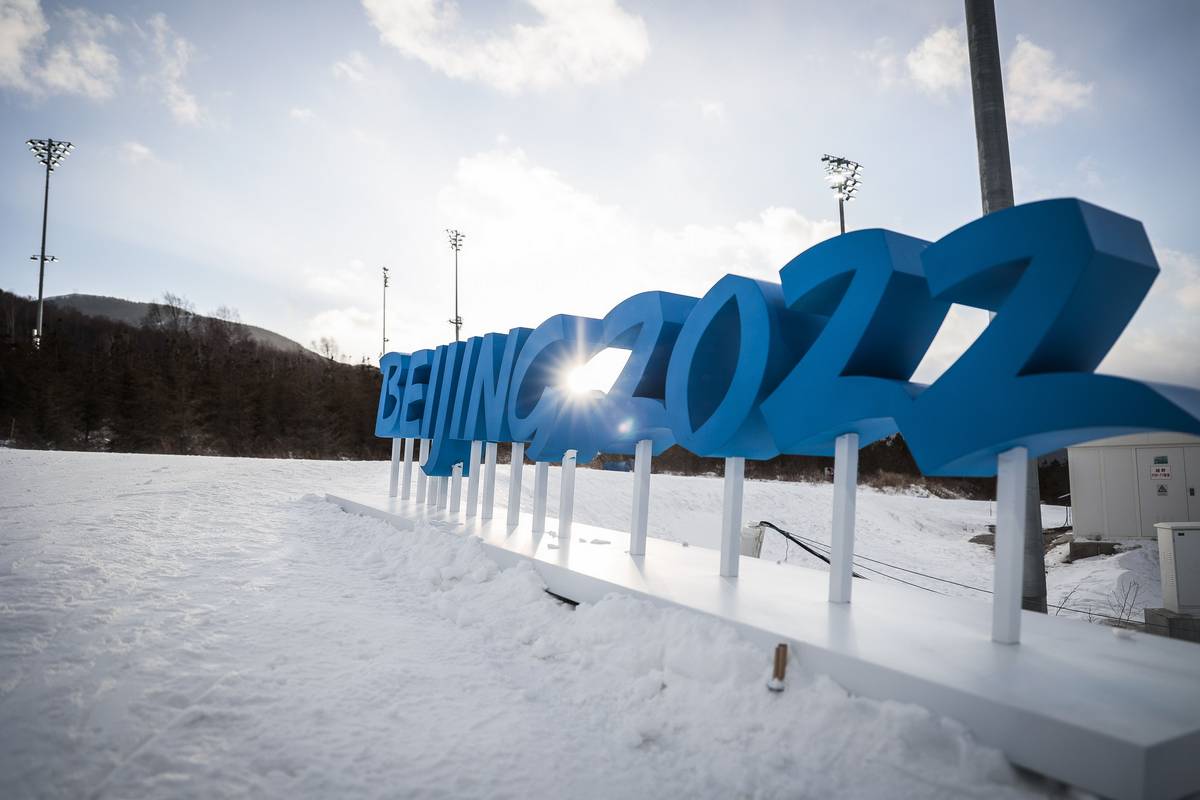
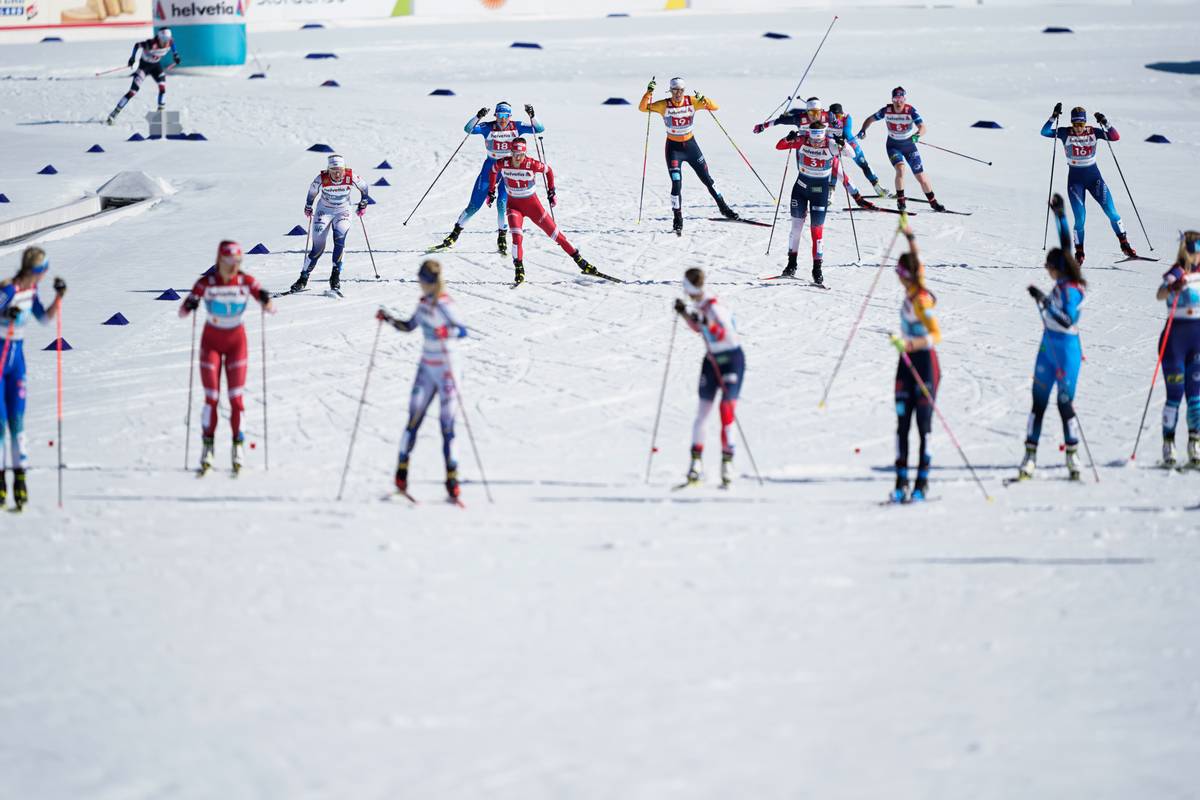
A scene from the cross country venue in Zhangjiakou, China, host to the 2022 Olympic Winter Games. (Photo: NordicFocus)
Four athletes from the Swiss team have announced that they will be moving on, chief among them – the king of the 15 k, Dario Cologna. At the age of 36, Cologna released his decision before the 2021/22 season even began, saying, “the decision came within the last months and after the Olympics, it will be the perfect timing for me. I have achieved everything I ever dreamed of in the sport.”
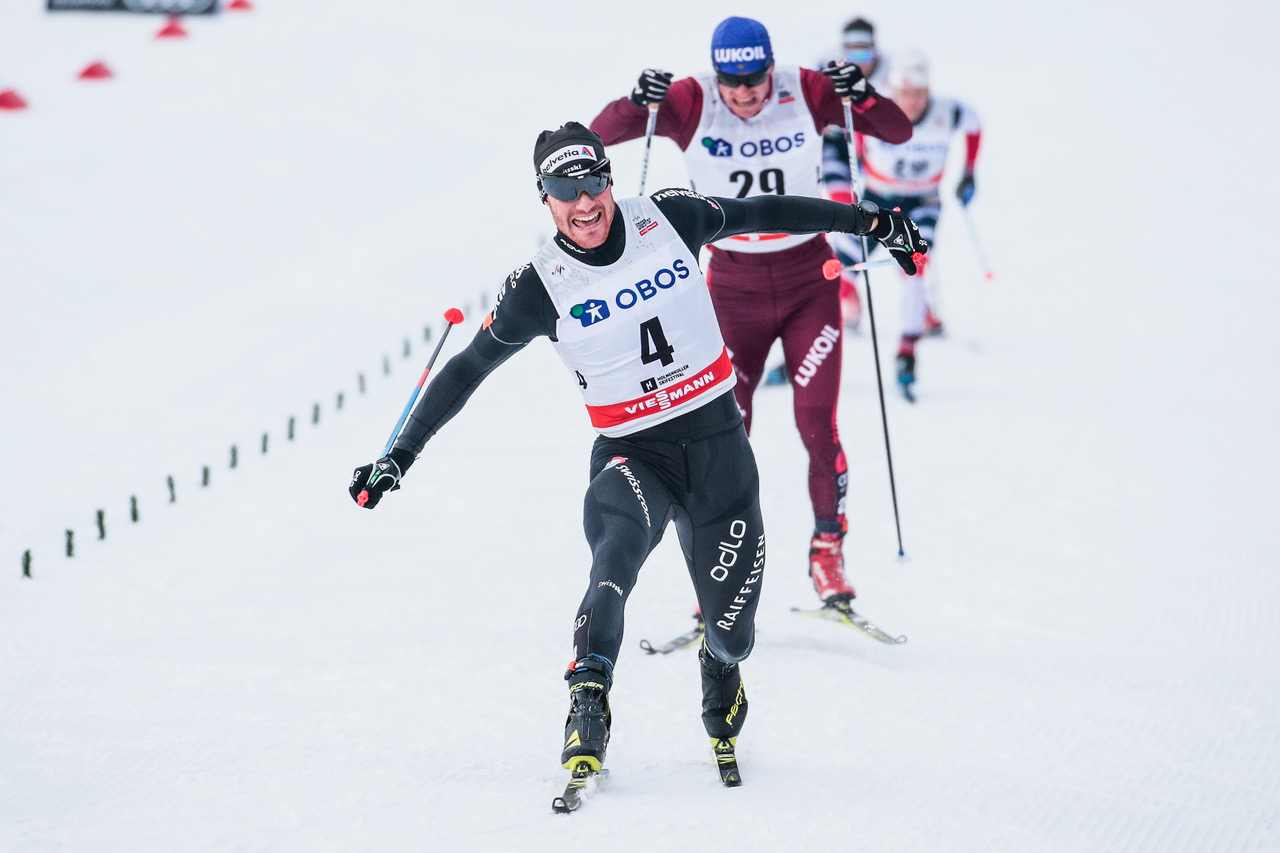
Switzerland’s Dario Cologna lunges to the line at the 2018 Holmenkollen 50-kilometer freestyle race in Olslo, Norway. (Photo: NordicFocus)
Cologna had his World Cup debut in 2006 and his first Olympic start came in 2010 in the 15 k skate event, where he finished first. This victory crowned him as the first Swiss cross-country skier to earn an Olympic gold medal. He went on to win three additional golds, in the 2014 Sochi Games he won both the skiathlon and the the 15 k classic, and in 2018 in PyeongChang added a gold in the 15 k skate. All told, Colgona had eighteen Olympic starts at four different games.
In between Olympic years, he was equally successful. He won the Overall World Cup globe four times, first in the 2007/08 season, again in 2010/11 and 2011/12 and a few years later in 2014/15. In the 2007/08 season he also earned his first Tour de Ski victory, in spite of the fact that he never took a stage win that year. He won the grueling event three more times, in 2010/11, 2011/12 and again in 2017/18.
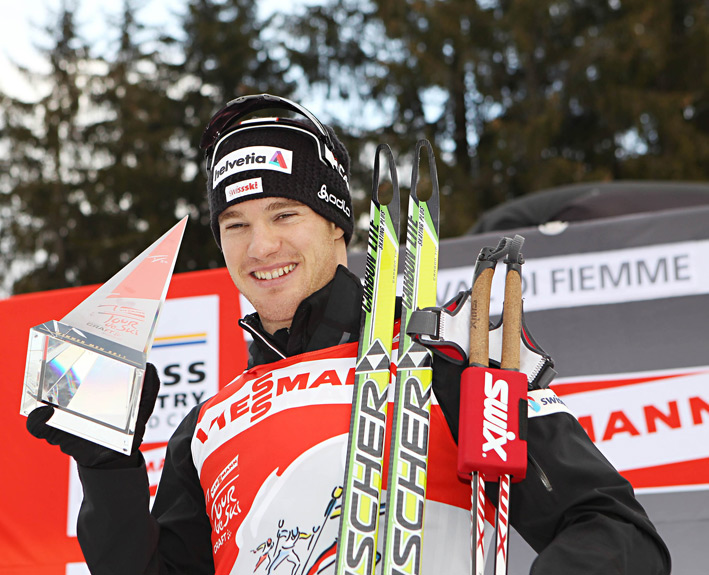
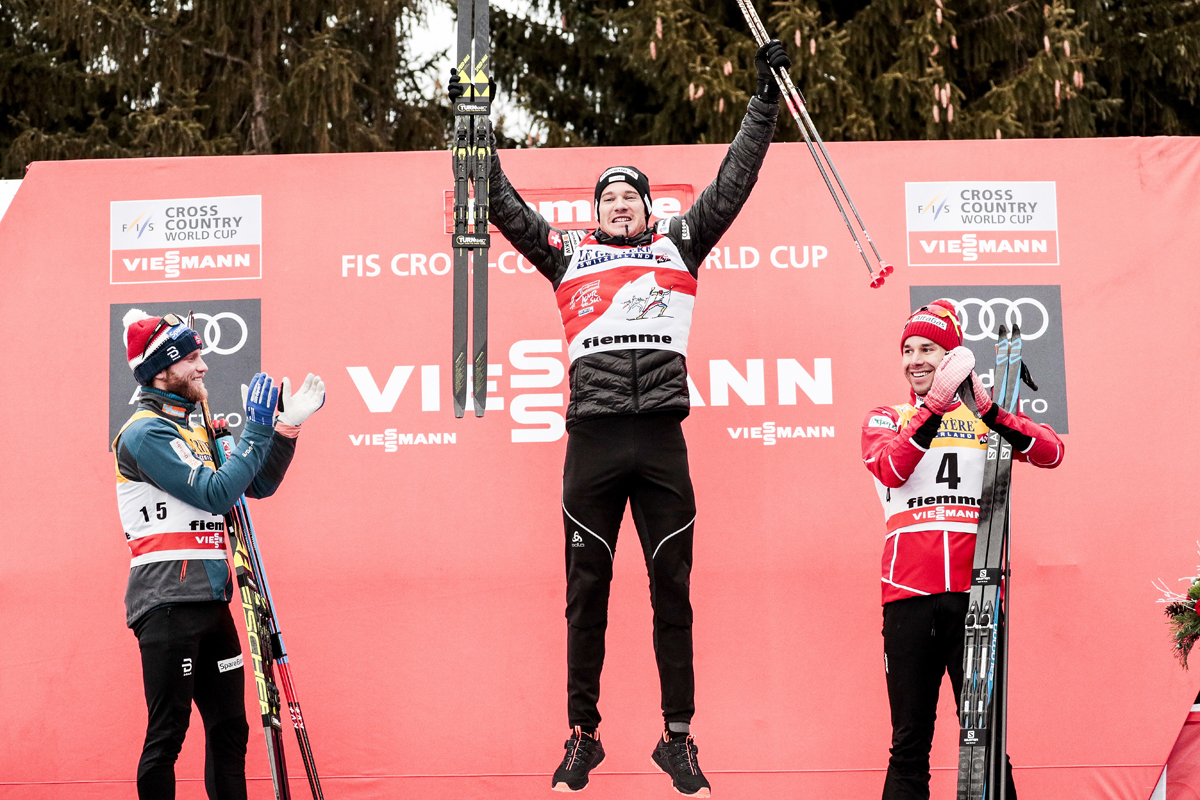
Dario Cologna (SUI) with his trophy after winning the Tour de Ski in 2011 (Photo: Fiemme2013)
After his final outing in the legendary Holmenkollen 50 k, Cologna wrote on Instagram, “I look back on a beautiful and successful career. 15 years ago I never dared to dream that one day I would be a four-time Olympic champion, World Champion, multiple Tour de Ski- and overall World Cup winner. In addition, I was privileged to travel to places I would never have seen and met great people, who became good friends.”
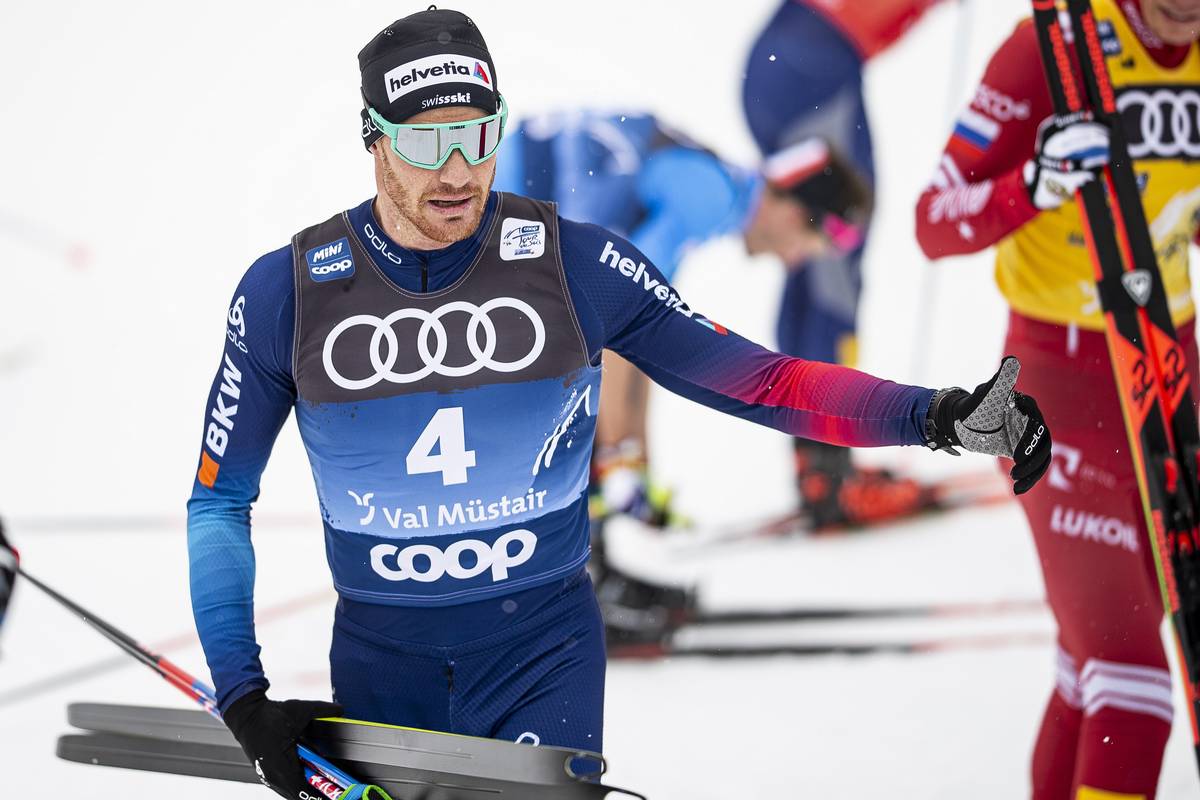
Dario Cologna (SUI) after a 6th place finish in Val Mustair during the 2021 Tour de Ski. Photo: Nordic Focus
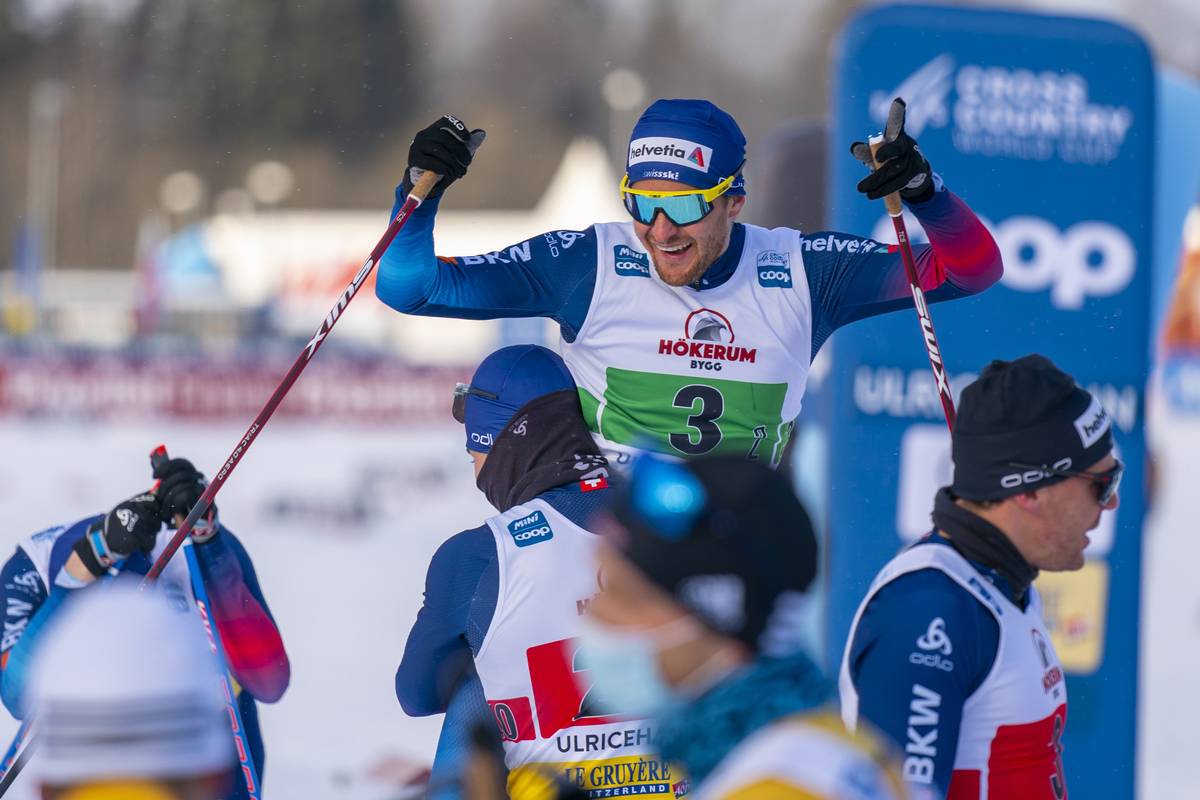
Cologna’s teammate, Jovian Hediger, also announced his retirement prior to the start of this season. Hediger was known as a sprint specialist and has 107 World Cup starts to his name, having made his debut in 2009. His first and only podium appearance came in 2021 during the team sprint event in Ulricehamn, Sweden, where he and Roman Furger finished second. Hediger represented Switzerland at three Olympic games, beginning with Sochi in 2014 and ending most recently in Beijing (2022).
Jovian Hediger (SUI) gets a boost from some happy teammates at the finish line in Ulricehamn Sweden. (Photo: Nordic Focus)
Ueli Schnider of Switzerland is also stepping away from elite competition. Schnider has 62 World Cup starts and made two Olympic appearances, both in 2018 in PyeongChang where he finished 37th in the classic sprint and 41st in the 50 k classic mass start.
On the women’s side, Laurien Van Der Graaff of Switzerland is moving on. Van Der Graaff has long been a staple in women’s sprinting, beginning in 2011 with her first World Cup podium in Duesseldorf, Germany. In doing so, Van Der Graaff became the second Swiss female athlete ever to reach the podium and over the years she continued to pave the way for young Swiss female athletes. Her first victory came in 2017 in a skate sprint Tour de Ski stage race on home ground in Lenzerheide, Switzerland.
The women’s sprint podium in Rybinsk Russia, 2015 (from l-r): Natalia Matveeva (RUS) second, Jennie Öberg (SWE) first, and Laurien Van Der Graaff (SUI) third.
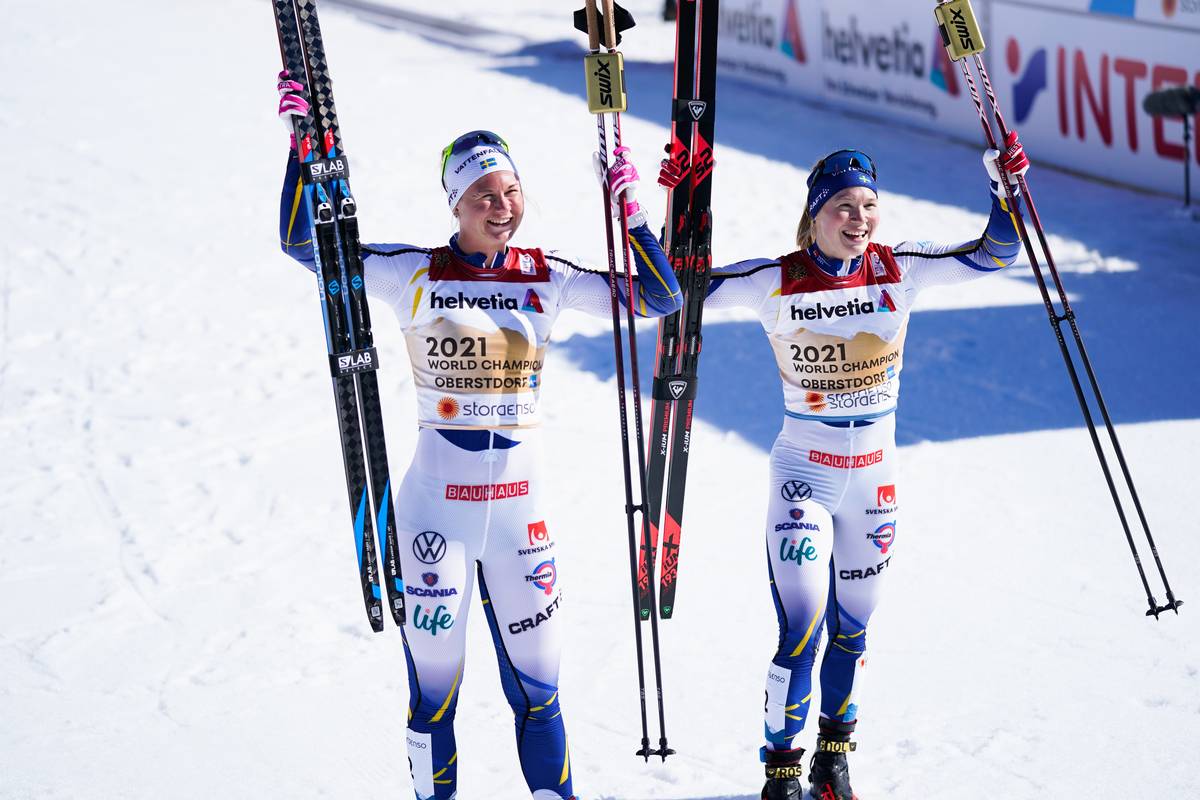
Van Der Graaff partnered up many times with Nadine Fähndrich in team sprint events, resulting in four World Cup podium finishes. At the World Championships in Oberstdorf, Germany (2021), Van Der Graaff and Fähndrich teammed up again, earning a silver medal when they finished just hundreths of a second behind team Sweden.
Van Der Graaff shared with FIS, “for some time I was convinced that I would not continue skiing until Beijing 2022, but I made it and I am very proud of what I have achieved. However, now my time has come and I am excited for everything that is coming my way in this new chapter.”
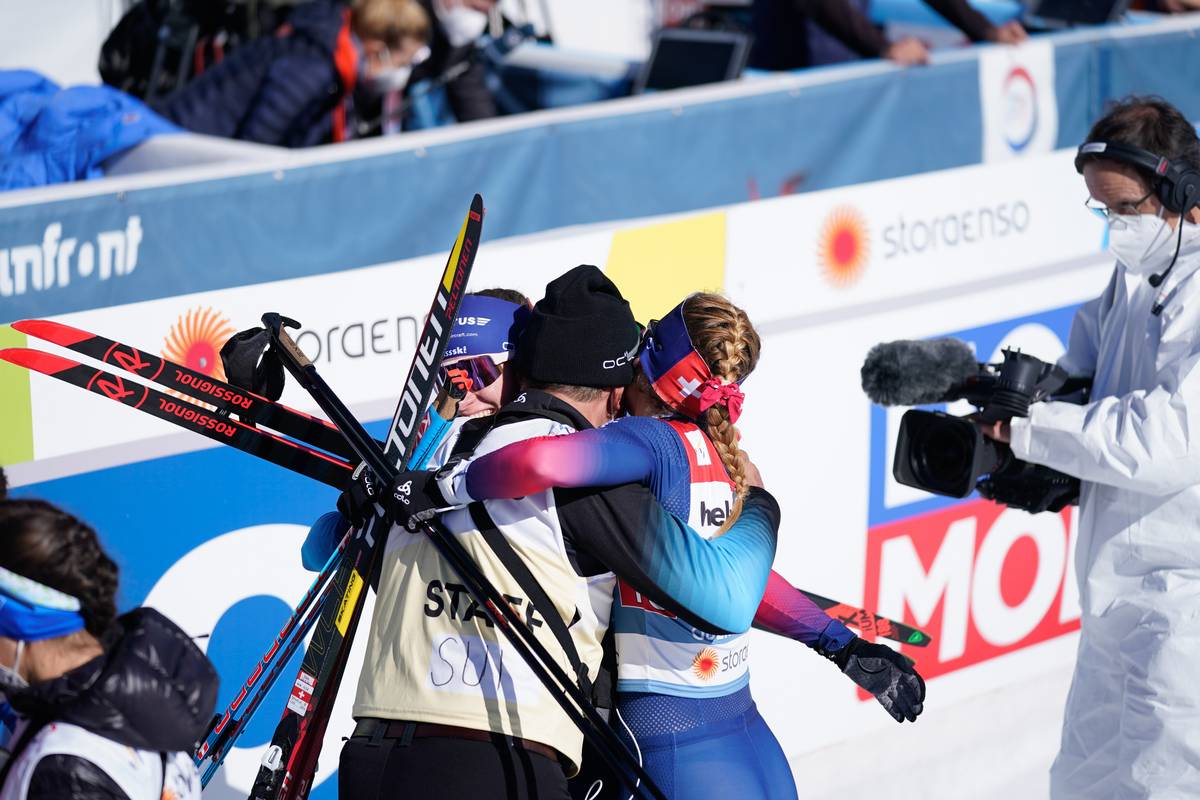
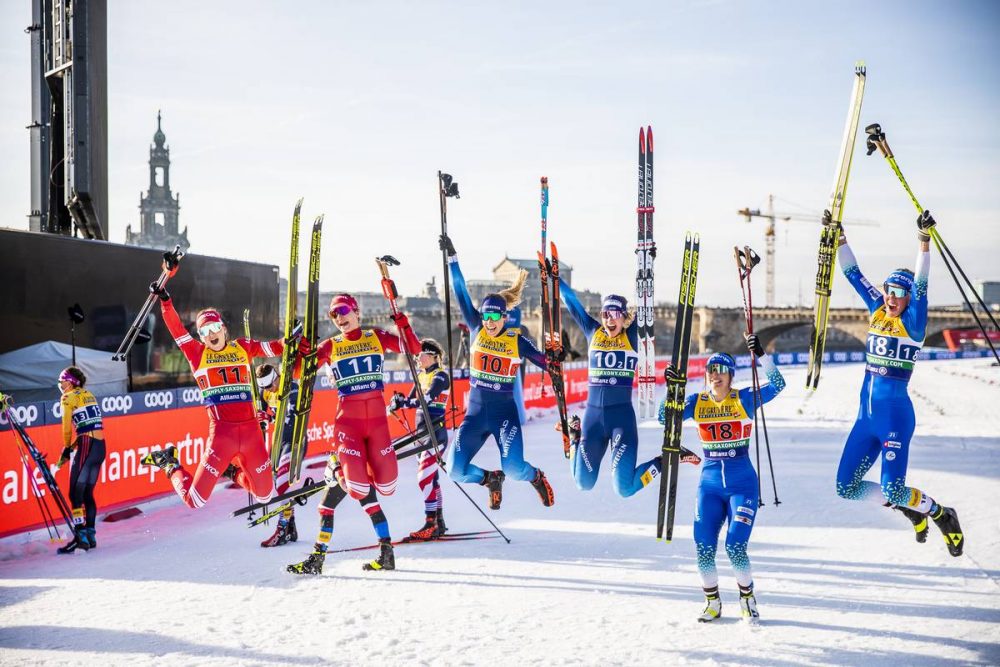
The Swiss program celebrates the retirement of Laurien Van Der Graaff at the finish of the 4 x 5 k mixed relay in Falun. (Photo: NordicFocus)
While some athletes knew from the outset of the season that this would be their last, others only recently came to the decision. Such was the case for Swedish star, Charlotte Kalla, who just announced her intentions within the last month. The 34-year said, “the curiosity about life outside of elite sports weighs heavier than what a continued investment would entail.”
Kalla burst onto the World Cup scene at the age of eighteen. She earned her first victory in the next season, taking a stage win in Nove Mesto (2007) in the 10 k skate pursuit. In her first individual World Championships appearances, coming in Sapporo, Japan in 2007, Kalla finished 7th and 5th. To give you a sense of her consistency from then on, of the 34 World Championship events Kalla completed spanning 2007-2021, she finished in the top ten in 30 of those appearances with the exceptions being three 11th place finishes and one 18th.
Charlotte Kalla of Sweden on her way to Olympic gold in Vancouver 2010 (Photo: FS archives)
Kalla represented Sweden at four different Olympic Games, Vancouver 2010, Sochi 2014, PyeongChang 2018, and Beijing 2022. She came away from these events with five individual podiums, including two gold medals and three team medals including her jaw-dropping relay performance in the relay in 2014 when she made up a 25 second deficit to bring the Swedish women their first Olympic relay gold since 1960.
Since then, the Swedish women’s team has come to dominate the World Cup circuit and Kalla has taken on a mentorship role within the team. “It’s an inspiring team to be a part of and many girls who have the right mindset to do their very best every day,” said Kalla in 2020. On March 22, 2022, Kalla announced on Instagram that the Swedish national competitions would be her last as an elite athlete. She wrote, “here I took my first [steps] as a seven-year old and it feels nice to end my career here.”
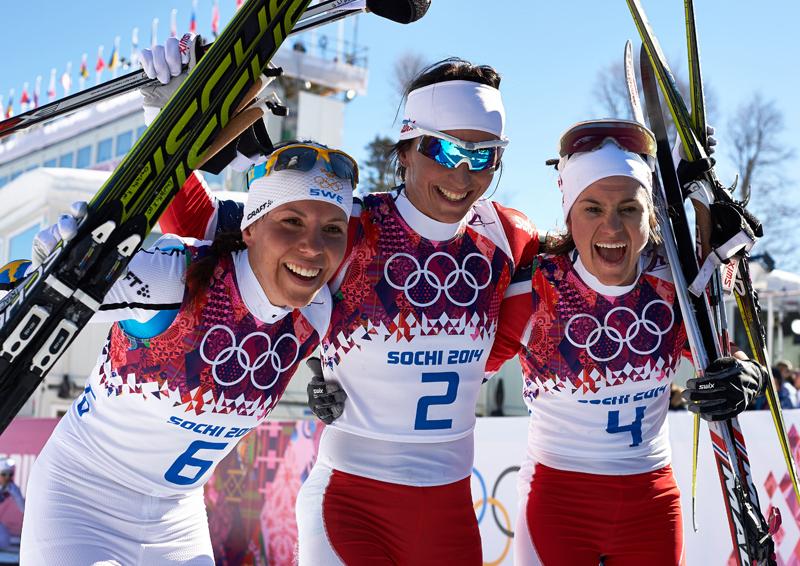
Charlotte Kalla (SWE), Marit Bjoergen (NOR) and Heidi Weng (NOR) claim the podium in the women’s Olympic skiathlon, Sochi 2014. (Photo: Fischer / Nordic Focus.)
Elisa Brocard of Italy is ending her ski-racing career at the age of 37. Brocard had her first World Cup start in 2006 and went on to contest 162 World Cup events. She represented Italy in three Olympic Games, beginning in Vancouver 2010, through PyeongChang in 2018. Her best season came in 2018 when she finished in the top-30 distance World Cup rankings and 38th overall.
Nadine Herrmann of Germany is leaving elite competition as well. She is the younger sister of Denise Herrmann who raced the cross-country World Cup circuit until she transitioned to biathlon in 2017 where she went on to win gold in the individual event at the 2022 Beijing Olympics. Nadine Herrmann finished in the top-thirty in her maiden World Cup appearance in 2018 in the Dresden city sprints. She went on to earn a number of top-thirty finishes, including a personal best individual finish of 18th in Dresden in 2020. At the age of 26, Herrmann has decided to move on, she wrote “My active sporting career is coming to an end. The last 14 years of performance sports have shaped me into the person who today can say in the best of my conscience, I gave it my all.”
Adrien Backsheider of France has also announced his retirement. Backsheider began racing on the World Cup circuit in 2013. He earned six World Championships starts and helped propel team France to a bronze medal in the men’s 4 x 10 relay in Falun in 2015 and again in Seefeld in 2019. Backsheider also has four Olympic starts, as he represented France in Sochi 2014, PyeongChang 2018, and Beijing 2022. He was a member of the bronze medal relay team in PyeongChang when the French again earned a podium spot in the 4 x 10 relay. Backsheider’s personal best individual World Cup finish came in Östersund, Sweden in 2020 when he finished 7th in the 15 k skate stage race during the Tour de Scandinavia.
The men’s 4 x 10 k relay at 2015 World Championships in Falun, Sweden, Norway with gold, Sweden with silver, and France with bronze . (Photo: Fischer/NordicFocus)
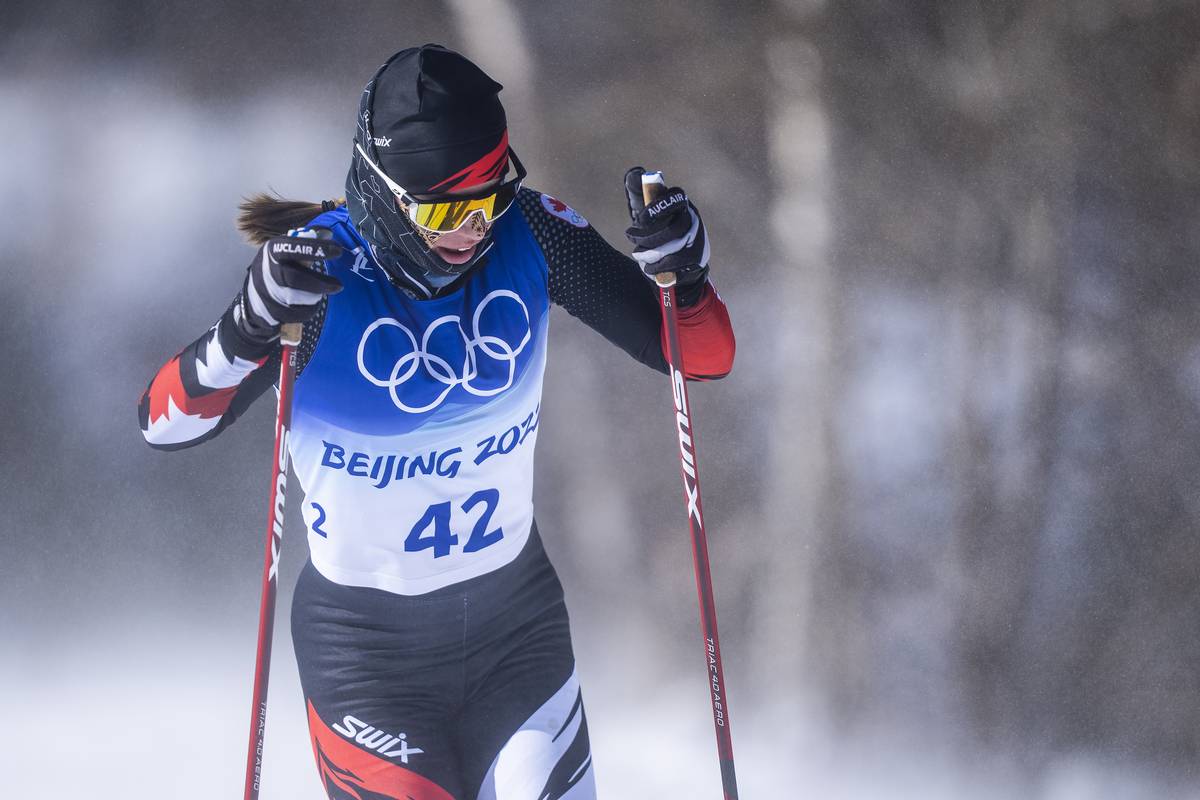
Cendrine Browne of Canada is saying goodbye to professional ski racing as well, having concluded her career with a national title in the 45 k skate in Whistler, Canada. Browne made her World Cup debut in 2012 and went on to start 76 World Cup races. She made the Canadian Olympic team in 2018 and 2022 and also posted thirteen World Championships starts. Browne finished 16th in the 30 k skate mass start in Beijing, a personal best individual finish for her. In a statement to Nordiq Canada after the 45 k race, Browne said, “thank you to everyone in the ski community who has believed in me and cheered for me over the last ten years.”
Cendrine Browne reached a new personal best with her 16th place finish in the 30 k skate mass start in Beijing 2022 (Photo: NordicFocus)
The notable retirement of the extremely successful, Therese Johaug of Norway has not been missed but will be receiving its own feature from FasterSkier in the coming weeks. Additionally, US Ski Team members Katharine Ogden, Hannah Halvorsen, and Caitlin Patterson have all shared news of their retirement, in addition to top SuperTour athletes Ian Torchia and Adam Martin. (Read Torchia’s retirement story here.)
Stay tuned for more in-depth reporting on those athletes from FasterSkier.
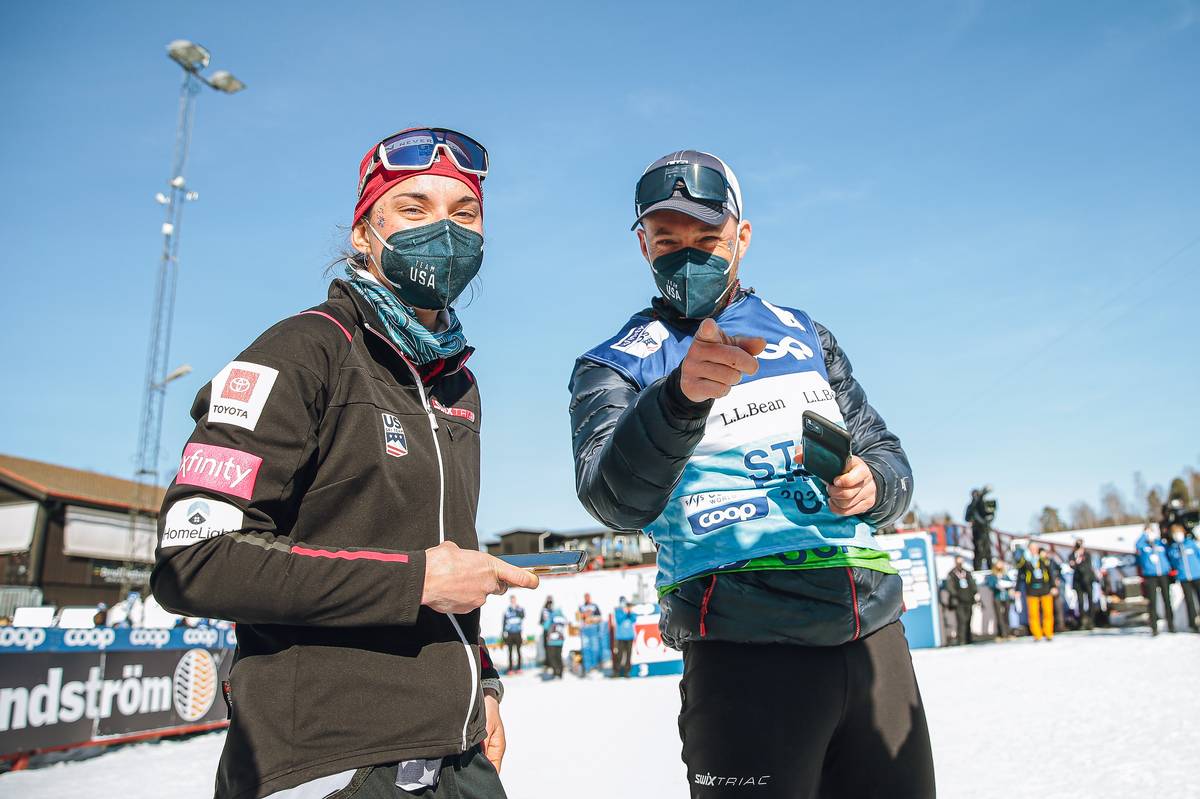
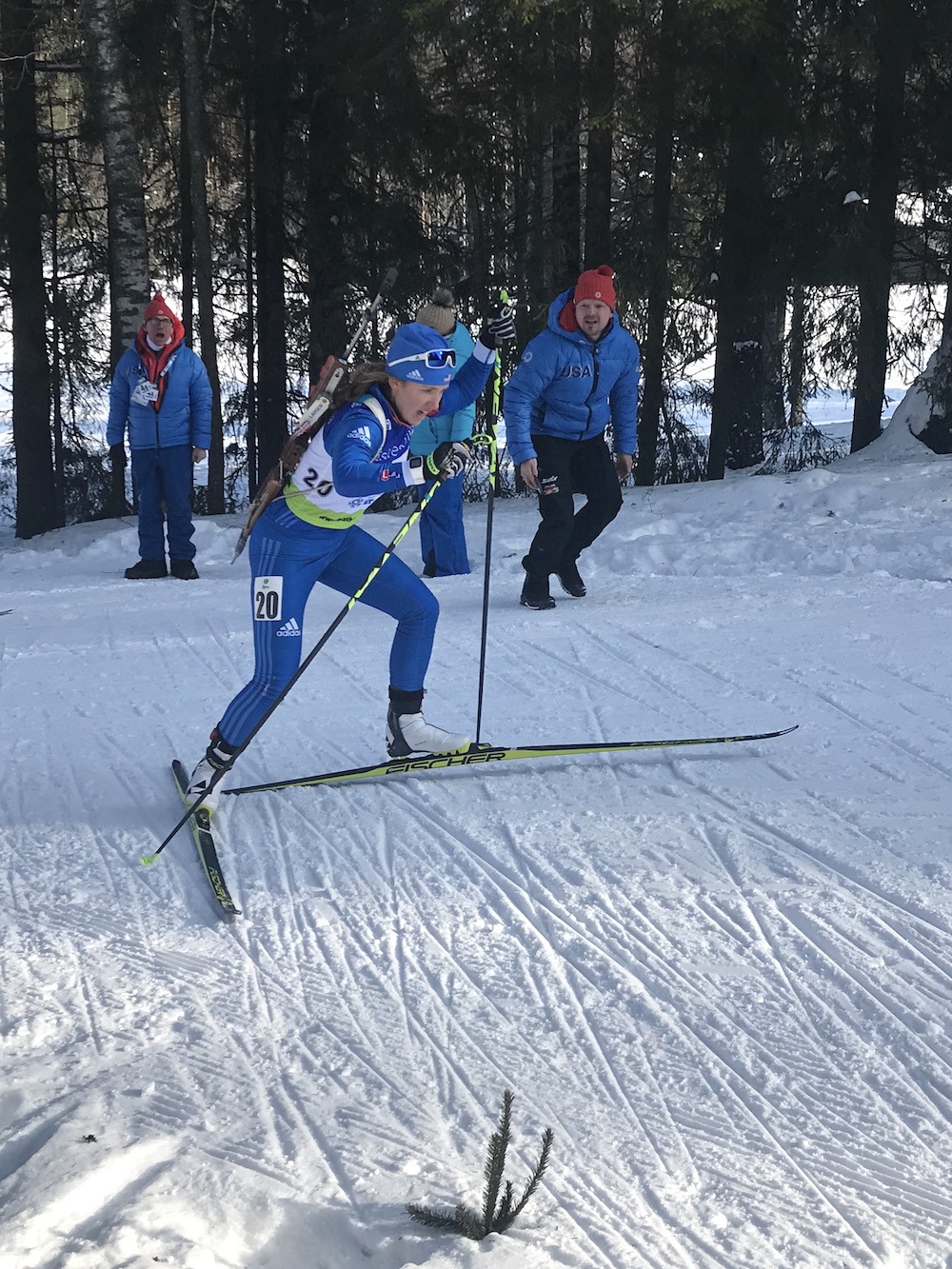
Julia Kern and US Ski Team head coach Matt Whitcomb watch the 4 x 5 k relay from the stadium. (Photo: NordicFocus)
This World Cup coverage is made possible through the generous support of Marty and Kathy Hall and the A Hall Mark of Excellence Award. To learn more about A Hall Mark of Excellence Award or to learn how you can support FasterSkier’s coverage pleasecontact info@fasterskier.com.
While it was perhaps not the final event originally planned for the season, today’s 4 x 5-kilometer freestyle mixed relay in Falun, Sweden shaped up to be quite a way to go out. Particularly for Team USA, who broke away in the final lap to take the win in 42:01.8.
With Rosie Brennan scrambling to tag Zak Ketterson for the second leg, Scott Patterson skating third, and Jessie Diggins anchor, it was a team composed of four skiers who had all raced into the top-15 in yesterday’s 10/15 k skate, three within the top-eight. Perhaps the only team more loaded was Norway 1, which featured Heidi Weng, Hans Christer Holund, Didrik Tønseth, and Therese Johaug, all of whom placed in the top-five yesterday, including both of the day’s winners in the final two relay spots. Also a force, Finland I consisted of three Olympic medalists, one of whom is the 2022 men’s World Cup distance champion with the lineup: Kerttu Niskanen, Perttu Hyvarinen, Iivo Niskanen, and Krista Pärmäkoski.
Each nation was allowed two teams, allowing the US to start a second lineup of Julia Kern, Logan Hanneman, Adam Martin, and Caitlin Patterson. Canada raced one team, which included Katherine Stewart-Jones, Antoine Cyr, Philippe Boucher, and Jasmine Drolet, racing in that order.
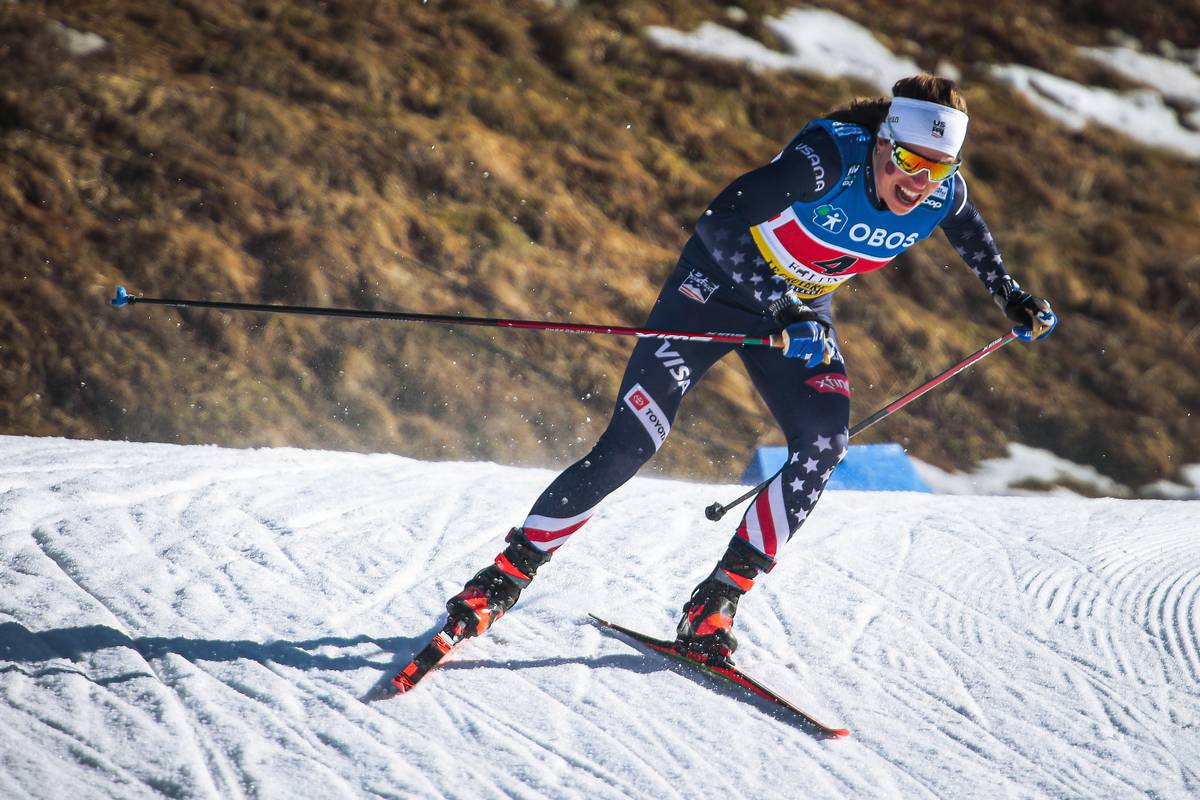
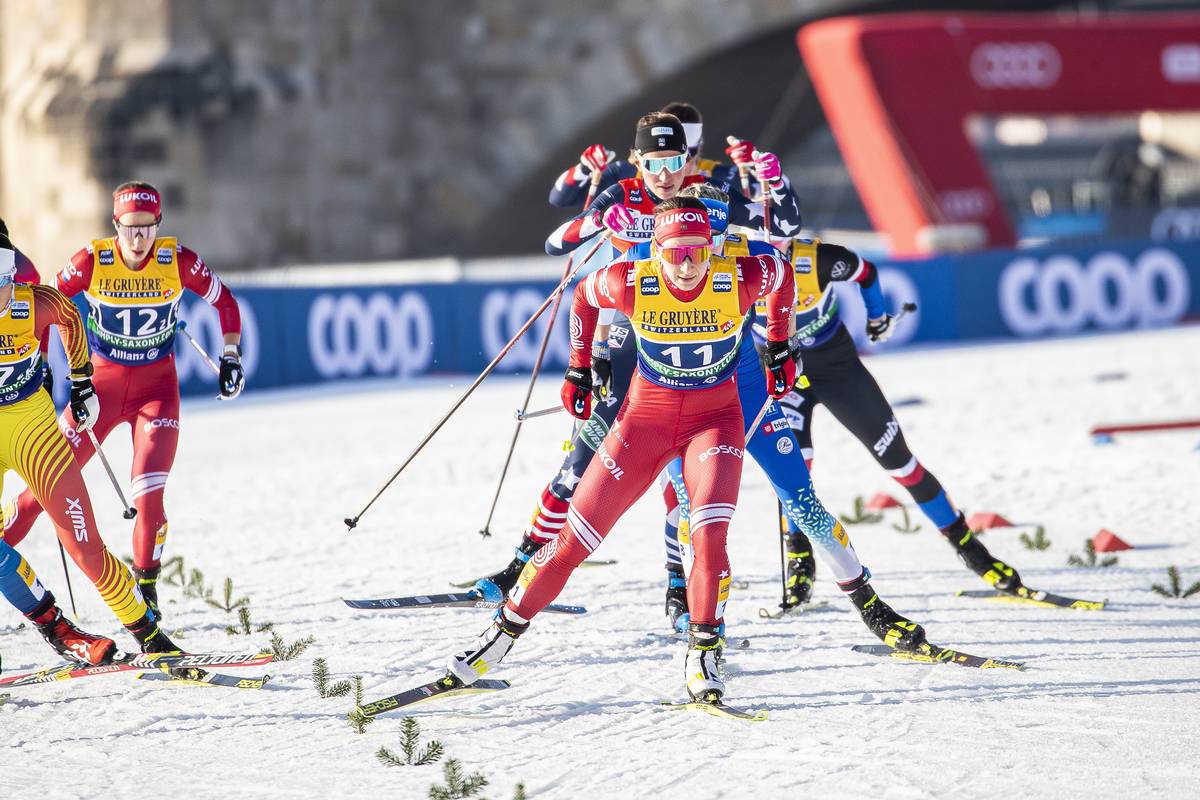
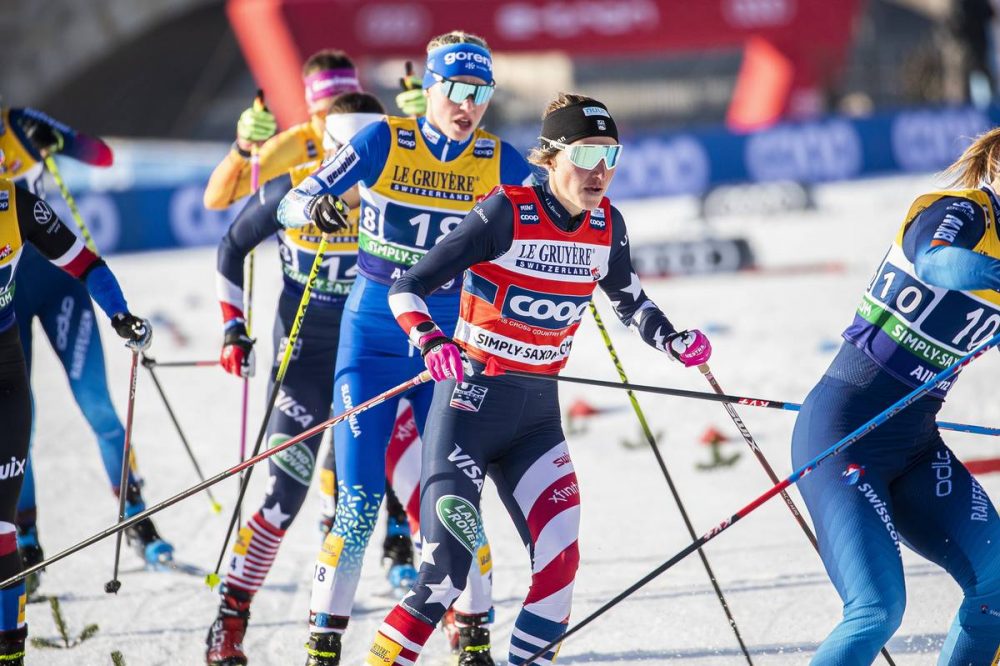
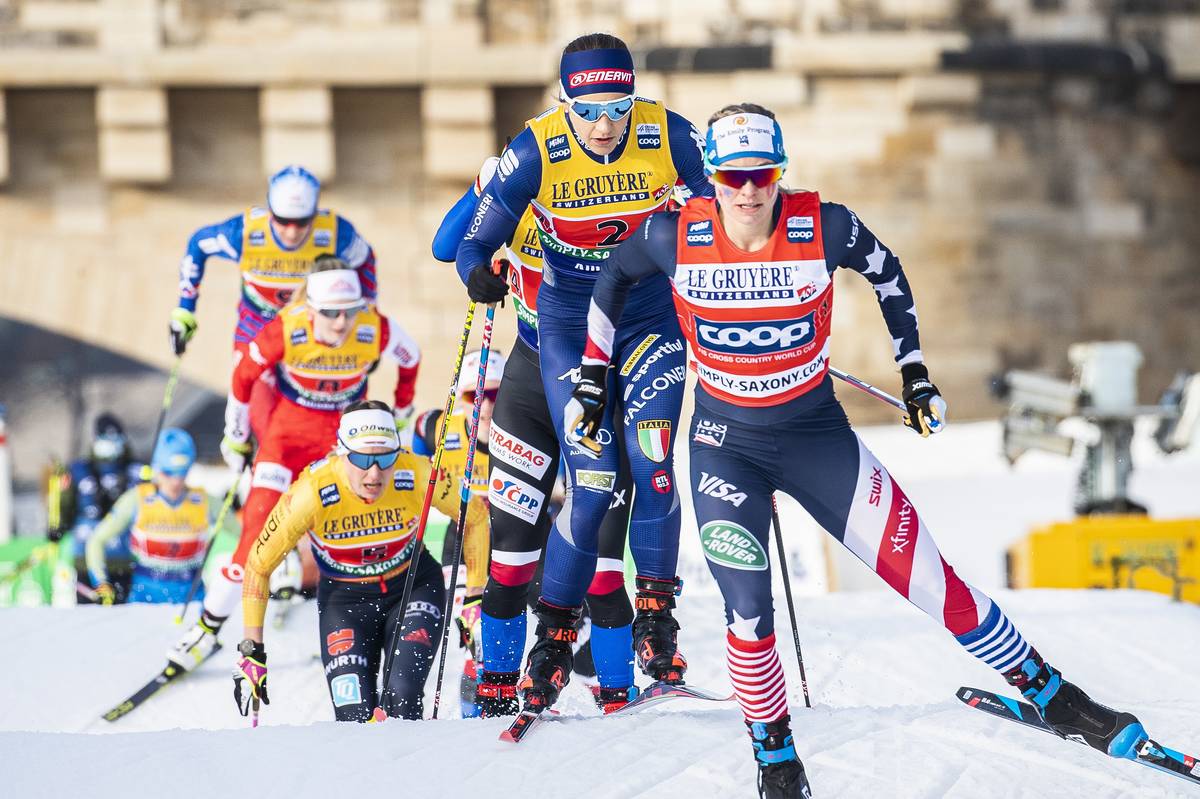
Stars and stripes at the front, as Julia Kern scrambles for USA II in Falun’s mixed relay. (Photo: NordicFocus)
New to the World Cup, the mixed relay is modeled after the biathlon competition format, which debuted in 2005. It had originally been slotted onto the calendar for the Canmore World Cup events in March 2020, which were canceled as COVID-19 began to spread around the globe. It had been tested on the tracks in Falun during the 2021 Swedish senior national championships, with local club leader Johan Eriksson saying afterward, “Team cohesion was strengthened when ladies and gentlemen fought against the same goal line. At the same time, the entertainment was great with reversals in the result lists and tactical moves in team line-ups.”
The entertainment value was certainly high today, particularly for American ski fans. Racing a distance now only seen in relays, it would be a painful blend of sprinting and distance. And the Americans would be lucky to have a woman anchoring the team who has previously been described as the “Queen of the 5 k skate”.
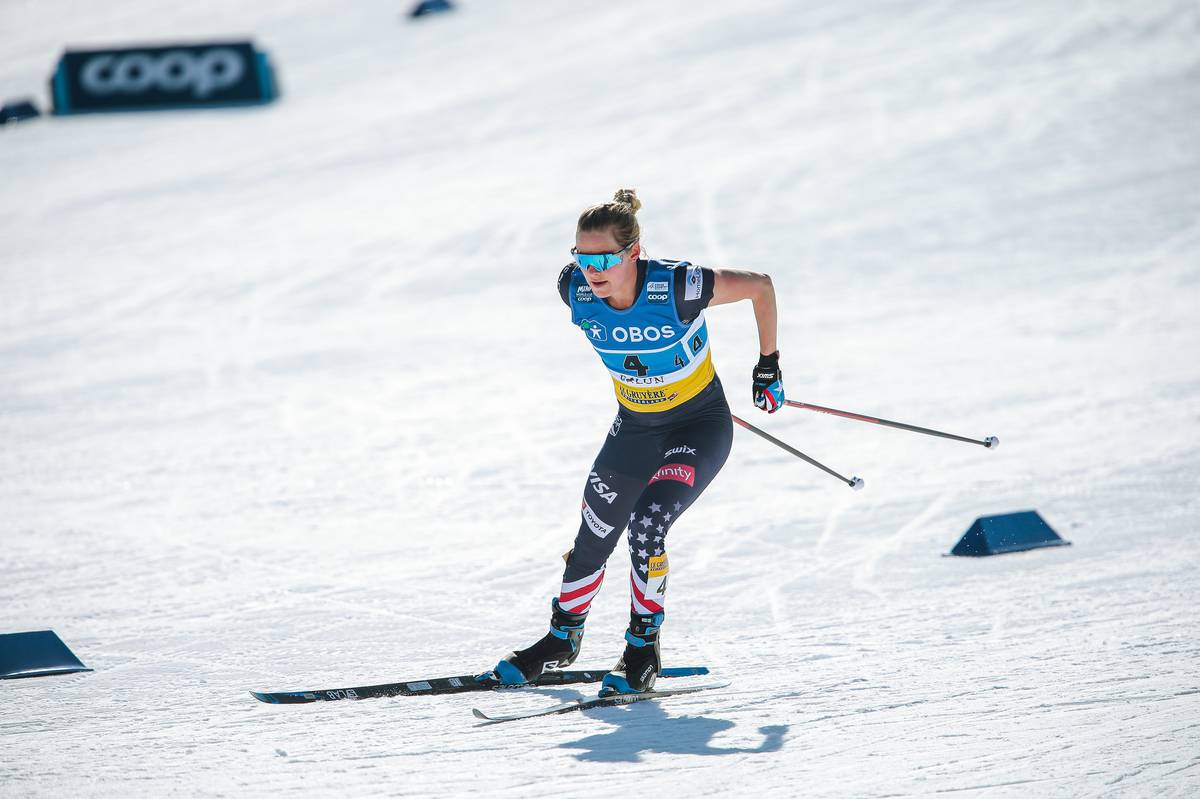
Rosie Brennan scrambles for USA I during the inaugural World Cup 4 x 5 k mixed relay in Falun. (Photo: NordicFocus)
As expected, the pace was high from the start, as the Star Wars theme blared through the stadium loud-speakers. Up for the task at hand, Brennan went toe-to-toe with the other women at the front through two 2.5 k laps. Later describing the event as “fast and furious”, Brennan kept USA I within the lead group, Kern duking it out on USA II alongside through the first lap.
“I think our goal today was to stay out of trouble and stay in the pack, and then let Diggy do her thing that she does best,” Rosie told FIS post-race with a laugh. “And that worked out really well.”
Brennan handed off to Ketterson at the first exchange, in line with Germany I, Norway I, and Sweden I, Finland I just behind.
Though new to the World Cup this season, Team Birkie’s Ketterson has consistently shown his range. Domestically, he won three SuperTour sprints, and stood on the podium in four distance races, one of which was also a win. He chiseled away at the World Cup puzzle, finishing just outside the top-30 during the Tour de Ski, and returning following the Olympic break to place 41st in Lahti’s distance classic race and at the 50 k classic at Holmenkollen. Smashing a 15th place finish in yesterday’s 15 k free, Falun has been a breakthrough weekend.
Though 5 k is not a distance men traditionally race on the World Cup, Ketterson emailed post-race that the event felt familiar and reminiscent of his early days in the sport.
“I am a huge fan of the 5 k race distance as I spent four years in Minnesota high school races doing that distance multiple times a week in the winter. Today brought me back to those days! It was super chaotic pack skiing but I felt really strong the whole time and did my best to keep up with the leaders. Honestly, when Jessie is your anchor, you don’t really have to worry too much about the rest!”
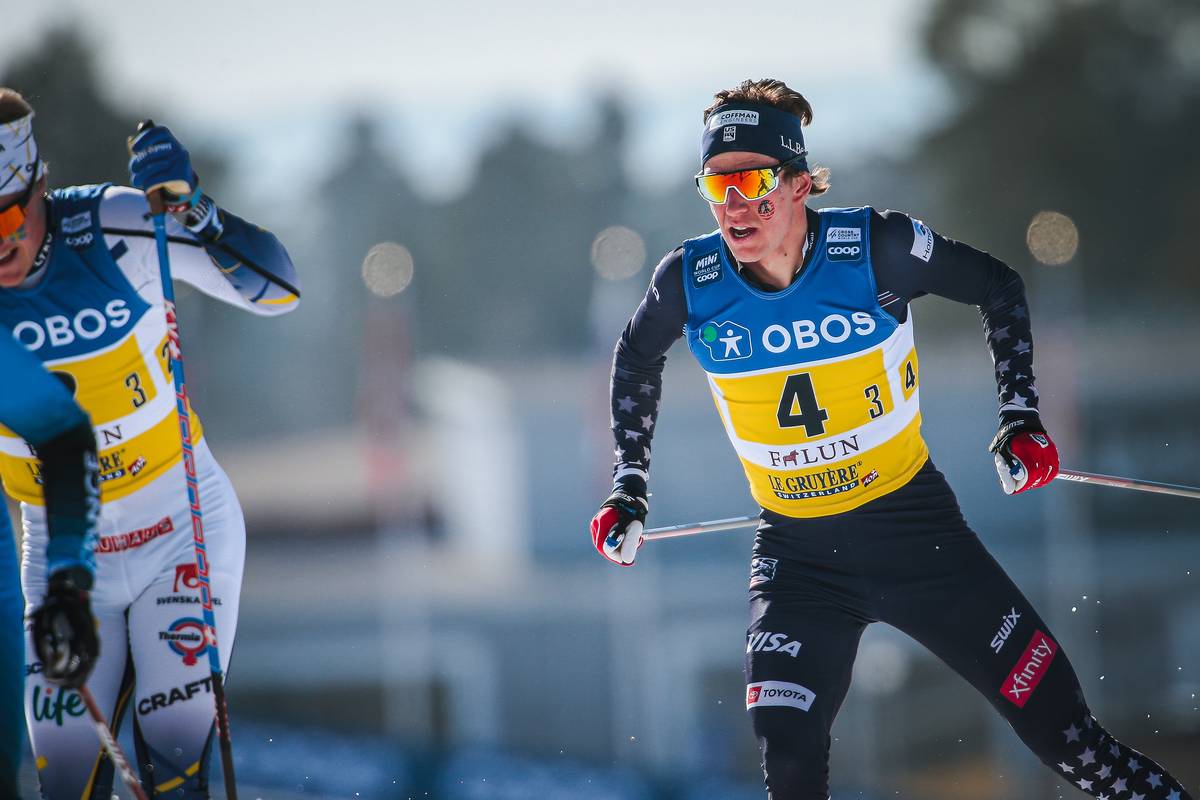
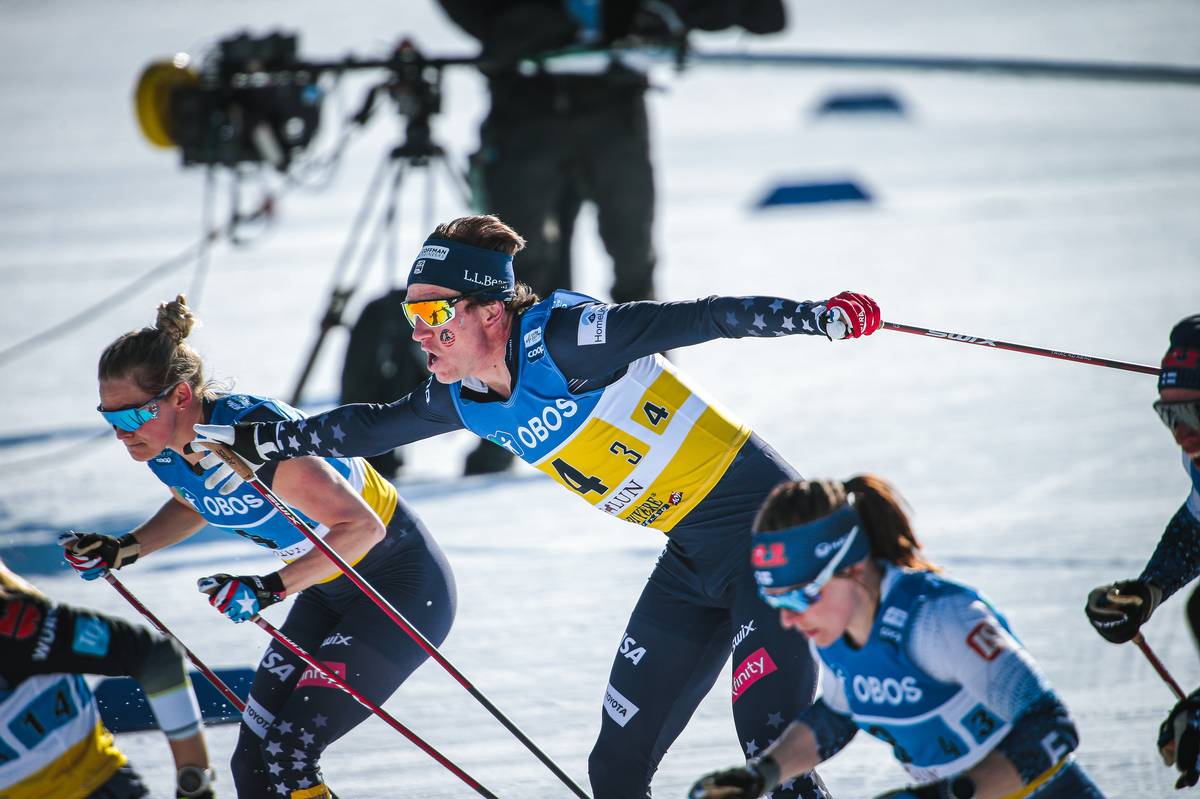
Zak Ketterson tags Scott Patterson during the 4 x 5 k mixed relay in Falun. (Photo: NordicFocus)
On lightning fast tracks with matching skis, Ketterson skied smoothly within the large lead group, keeping USA I within contact of the leaders, while Sjur Røthe tried to crack open pack for Norway II. Tagging Patterson roughly four seconds back, USA I sat in 10th, alongside Canada, at the second exchange. USA II tagged in 14th, +34 seconds back.
Still a large and dense group of front runners, Patterson worked at the back of the lead group to minimize further time losses, keeping his team within reach of the podium. With both Norwegian teams at the front in the second lap, Patterson whittled down the American’s time back, tagging Diggins 2.2 seconds behind the leaders to “do her thing” over two 2.5 k laps. Canada had lost contact with the front group, sitting in 11th (+17.9), while USA II tagged following a gap in 15th (+1:14.5).
“My goal was to hang on with the pack early and get in the groove, then try to match accelerations later,” Patterson wrote after the race. “I knew I wasn’t going to be the one with super accelerations but could sprint the whole way. During the race I was thinking ‘Just hold on’, so Jessie could work her magic relay anchoring skills. There were a few moments where some gaps formed but I barely managed to cling on.”
Scott Patterson races the third leg for USA I in Falun. (Photo: NordicFocus)Scott Patterson makes the final tag to Jessie Diggins during the 4 x 5 k mixed relay in Falun. (Photo: NordicFocus)
Diggins quickly got to work. Halfway through the first lap, it was Diggins marking Johaug at the front, with Krista Pärmäkoski for Finland I and Victoria Carl for Germany I tucked into their wake. Recall that Carl had anchored the German relay team for an Olympic silver medal in Zhangjiakou just a few weeks ago.
Skis ripping on the downhill, Diggins moved to the front to lap through the stadium 1.4 seconds ahead of Finland I and Norway I, Frida Karlsson for Sweden I challenging Germany’s Carl just behind.
Jessie Diggins brings USA 1 through the stadium in the lead after her first lap. (Photo: NordicFocus)
Diggins worked patiently up the climb, once more tucking behind the rapid fire tempo of Johaug on the uphill, and tucking calmly into the draft of the Norwegian and Finn heading into the descent. Diggins hit the second climb hard as the three women hop-skated up and over. Among the best descenders on the World Cup, Diggins skis were only fueling the fire, allowing her to maintain her lead in the rolling last kilometer and into the stadium which erupted with noise from the packed sidelines.
Rounding the final bend with a clear shot to victory, Diggins took a few tuck skate pushes before powering in V2 across the line with a fist pump and loud cheer, and maybe an expletive, before collapsing onto all fours surrounded by her ecstatic teammates.
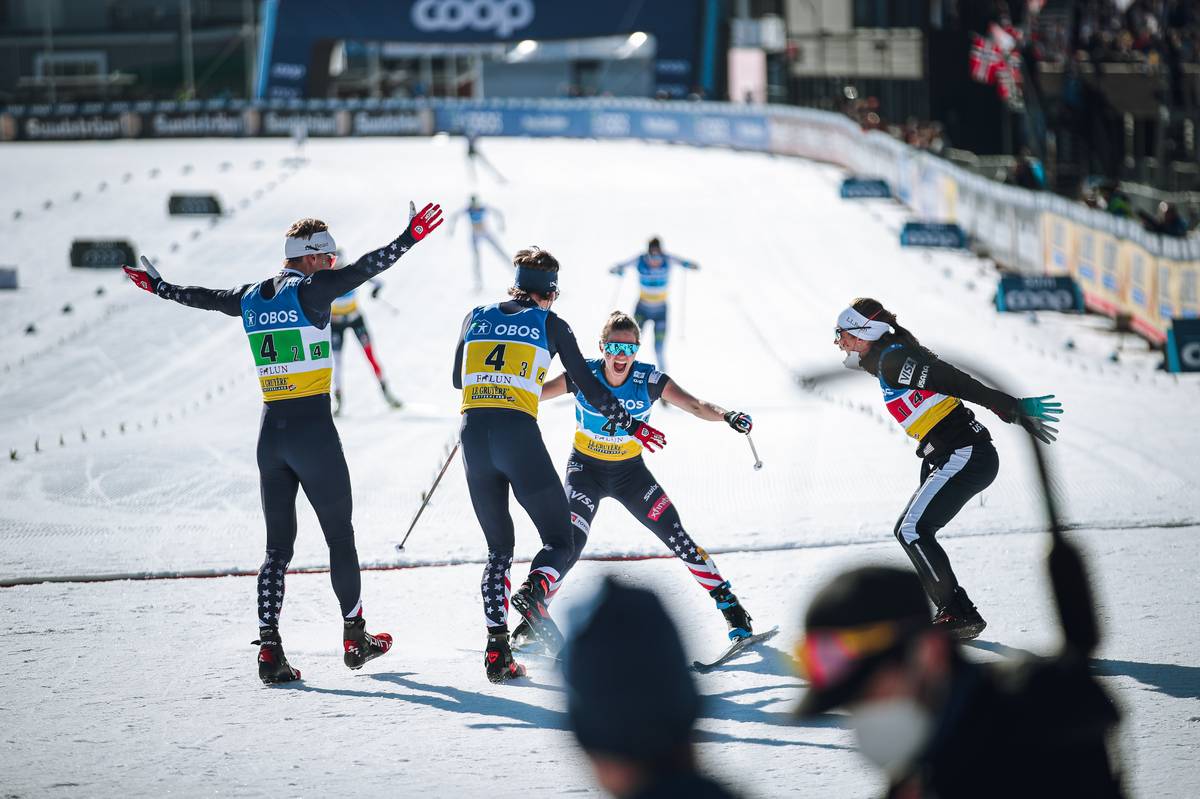
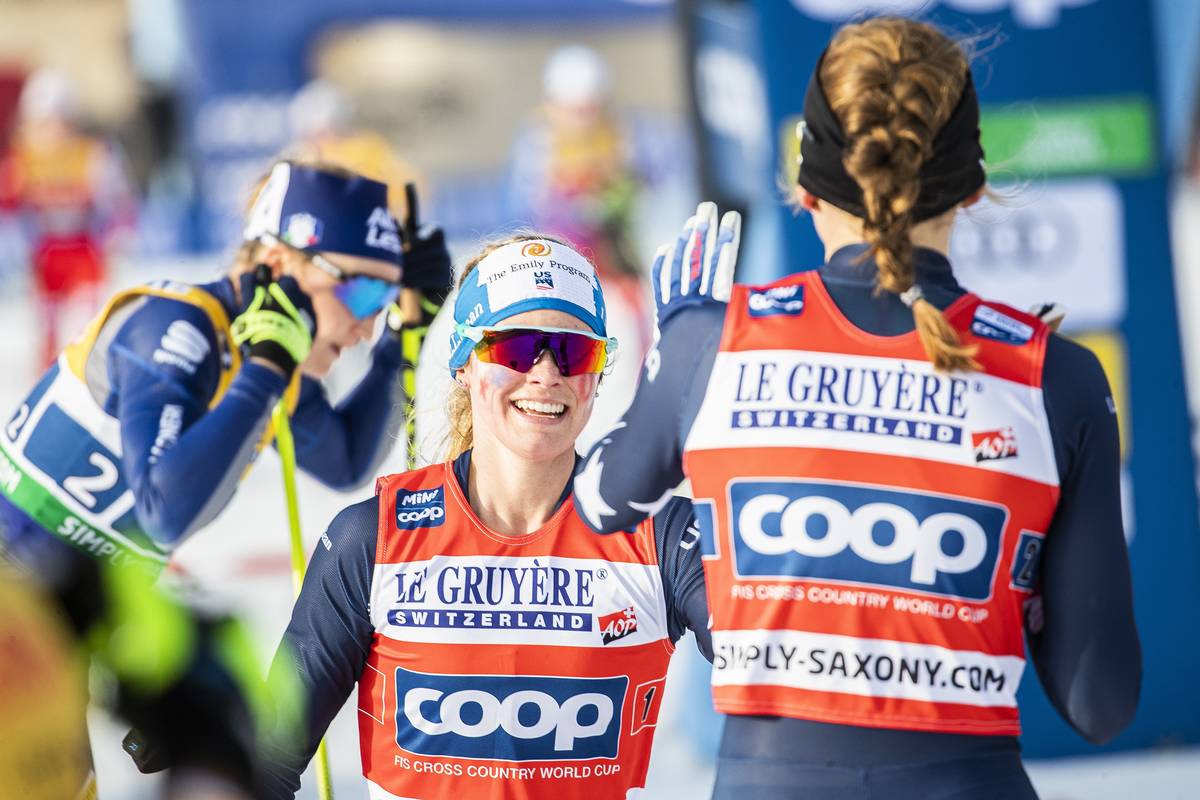
Nerves run high as the American team waits for Jessie Diggins at the finish of the 4 x 5 k mixed relay in Falun. (Photo: NordicFocus)USA I celebrates victory as Jessie Diggins crosses the finish of the 4 x 5 k mixed relay. (Photo: NordicFocus)
Outsprinting the World Cup distance champion, Pärmäkoski edged out Johaug to bring Finland I to the line in second (+3.8), leaving Norway I just 0.5 seconds behind in third. Having strung out over the last lap, Sweden I took fourth (+9.1), with Germany I fifth following another gap (+16.2).
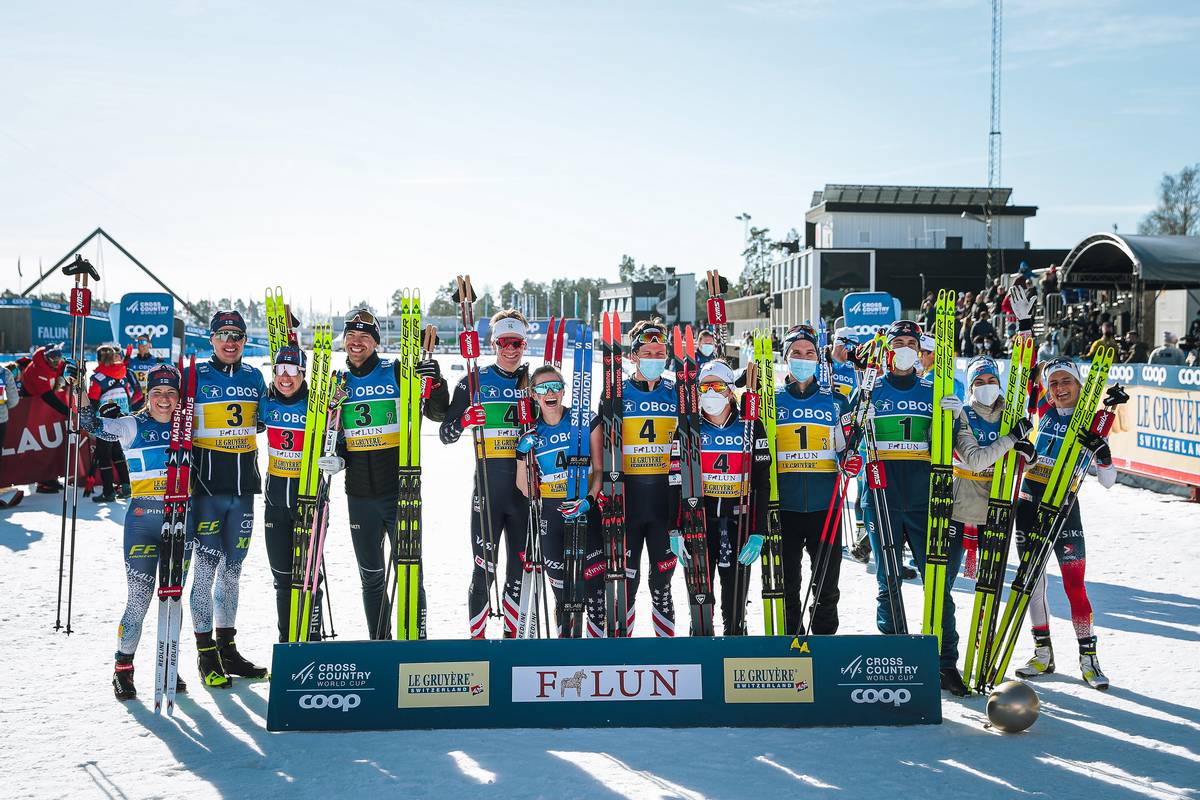
A packed podium for the 4 x 5 k mixed relay in Falun. USA I took the win ahead of Finland I and Norway I. (Photo: NordicFocus)
Describing the experience of winning the mixed relay on the final day of World Cup racing, Diggins told FIS with a laugh, “[It] feels like champagne getting sprayed on you.”
Surrounded by her teammates, she continued, “That was so, so fun. We really pulled together as a team. We live together as a team for four months on the road, so it’s pretty cool to get to end the season racing for each other. I’m so proud of these guys, so I was feeling pretty inspired.”
Jessie Diggins helps USA I to the mixed relay win in Falun. (Photo: NordicFocus)
Later sharing her strategy in a post-race audio clip as the remainder of the team packed their bags to begin travel home tomorrow, Diggins discussed her strategy as anchor, adding how the rockets under her feet allowed the race to unfold somewhat differently than she anticipated.
“I knew that those downhill working corners were one of my strengths, so I knew that if I got to the top of that big sprint climb first, then I could ski all the other downhills how I want and have a good shot at setting up a finishing sprint. As it turned out, we had such great skis that I didn’t need that finishing sprint, but it was so fun to go ski that as hard as I could. Again, I’m just so proud of the team. It was so special and fun to share that with everyone, and I can’t think of a more perfect way to end a really awesome year.”
Full post-race audio clip from Jessie Diggins:
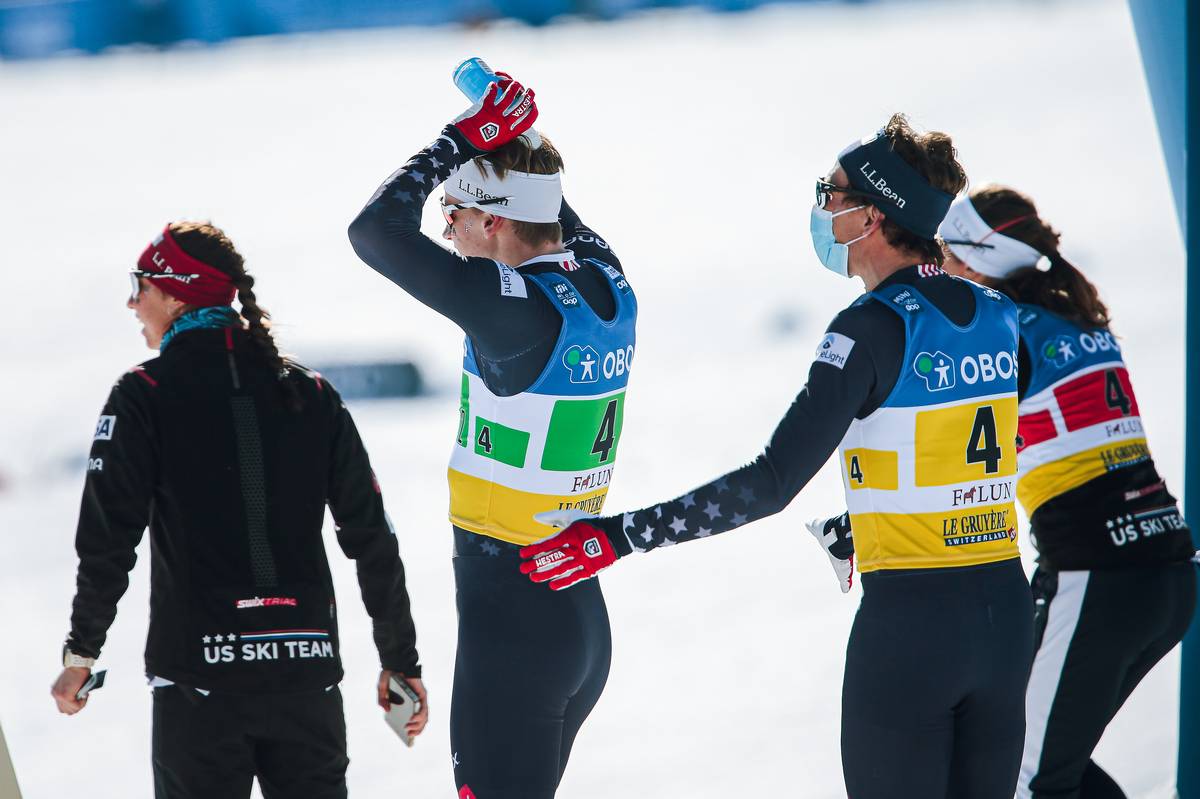
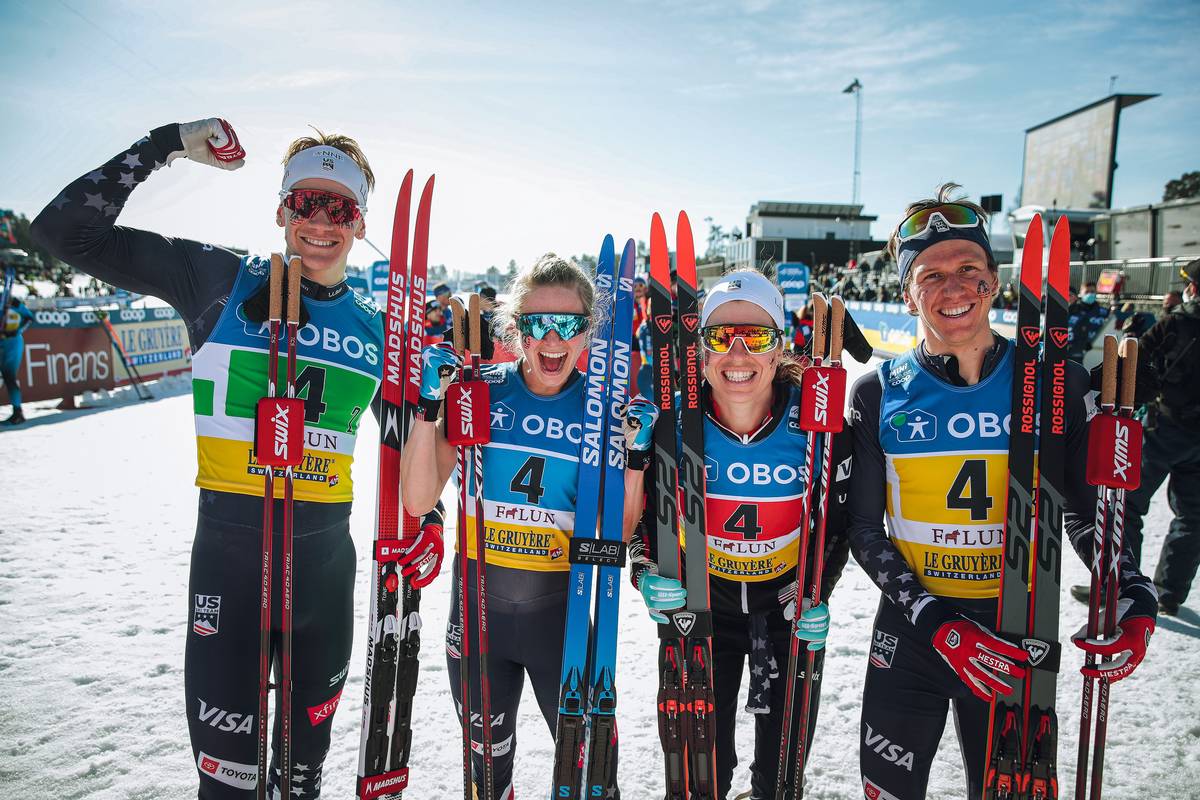
USA I ends the season on top in the 4 x 5 k relay. From left to right, Zak Ketterson, Jessie Diggins, Rosie Brennan, and Scott Patterson. (Photo: NordicFocus)
“What a way to close out the World Cup season!!!!!” Brennan emphasized in an email. “After Scott and Zak had great days yesterday, I felt that we definitely had a chance, but I was not expecting a victory like that! It was fast and tactical racing out there and in the scramble leg, I wanted to stay near the front of the pack and stay out of trouble. I found myself further back in the pack than I wanted on the 2nd lap, but also knew a fall or broken pole would cost us so I tried to be patient, calm and tag off in the pack. Zak, Scott and I had the same strategy and Scott made a great move to get ahead of a split in the pack to tag Jessie in a great place. Jessie skied an insane leg and I feel lucky to have her as a teammate!”
Echoing her sentiments to conclude his post-race email from the road, Patterson added, “It’s really cool to win the last World Cup and especially awesome to be part of the team. The mixed gender event was extra special as the guys were finally able to tap into the relay energy the women have cultivated over many years.”
Canada’s anchor Jasmine Drolet receives a tag from Philippe Boucher during Falun’s mixed relay. (Photo: NordicFocus)Adam Martin tags his Craftsbury teammate Caitlin Patterson, who raced the anchor leg for USA II. (Photo: NordicFocus)
Losing contact over the third and fourth legs, consequently racing alone, Canada ended the day in 12th (+1:45.2), while USA II pushed alongside Finland II through its final lap. Edged out in the final sprint, Katri Lylynpera (FIN) snuck her boot over the line ahead of Caitlin Patterson’s, leaving USA II in 14th (+2:10.9).
Celebrations fed by cheering crowds, energy was high throughout the stadium. Regardless of finish order, acts of camaraderie and sportsmanship could be seen and heard as cameras meandered through the groups of athletes waiting for their relay teammates. We could hear a Frenchman congratulate Norway’s Tønseth on ending his season with an individual win, Ketterson and Kern anxiously trying to predict what might happen in the American’s final legs, along with a host of supportive cheers as teammates and coaches egged on the racers.
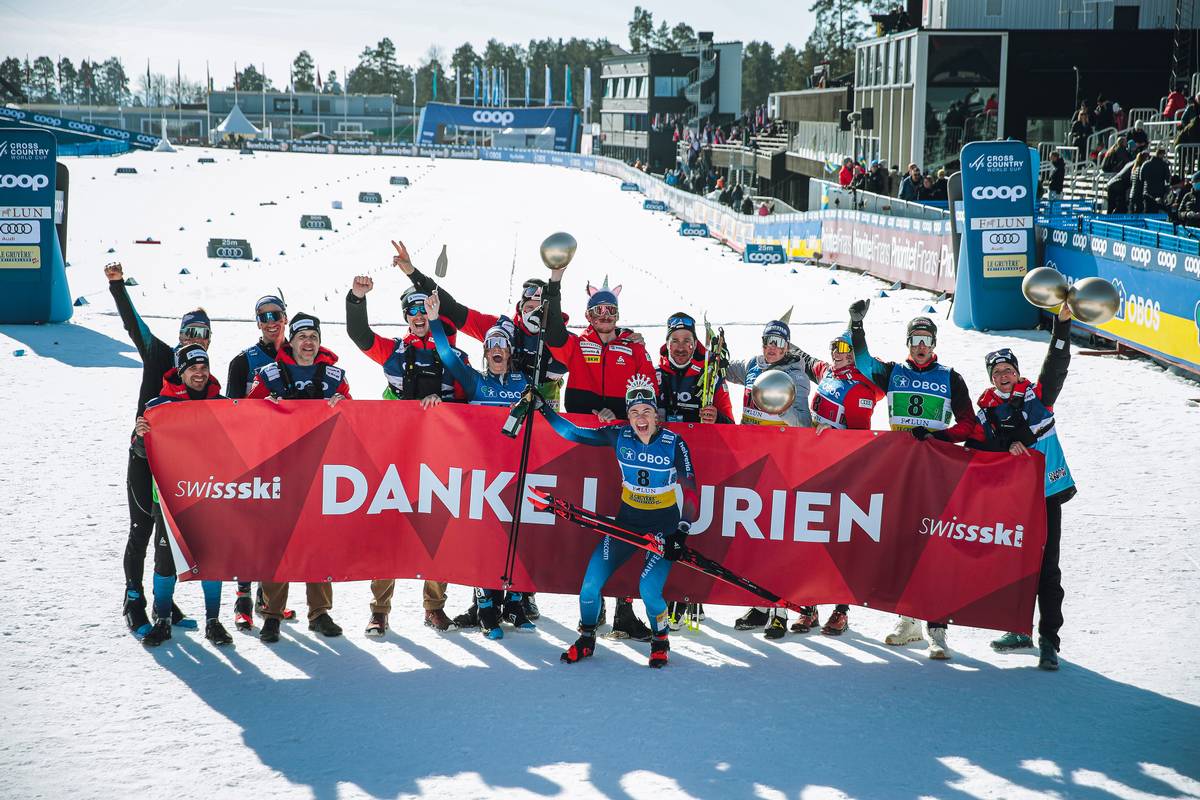
Awaiting the Swiss anchor Laurien Van der Graaff was a princess tiara, teammates in golden unicorn horns, and a large banner that read “Danke Laurien”, in celebration of her retirement. The 34-year-old has long been a presence on the World Cup, collecting a slew of podiums and a World Championship team sprint silver medal along the way.
The Swiss program celebrates the retirement of Laurien Van der Graaff at the finish of the 4 x 5 k mixed relay in Falun. (Photo: NordicFocus)
With revelry and thrill in the air, only the mixed team sprint remained on deck as the 2021/22 World Cup season drew to a close in Falun. The American program did not enter the team sprint competition, and will next compete as a team at the Whistler Olympic Park in British Columbia March 20th – 27th. The event will serve as both the Canadian National Championship and SuperTour Finals.
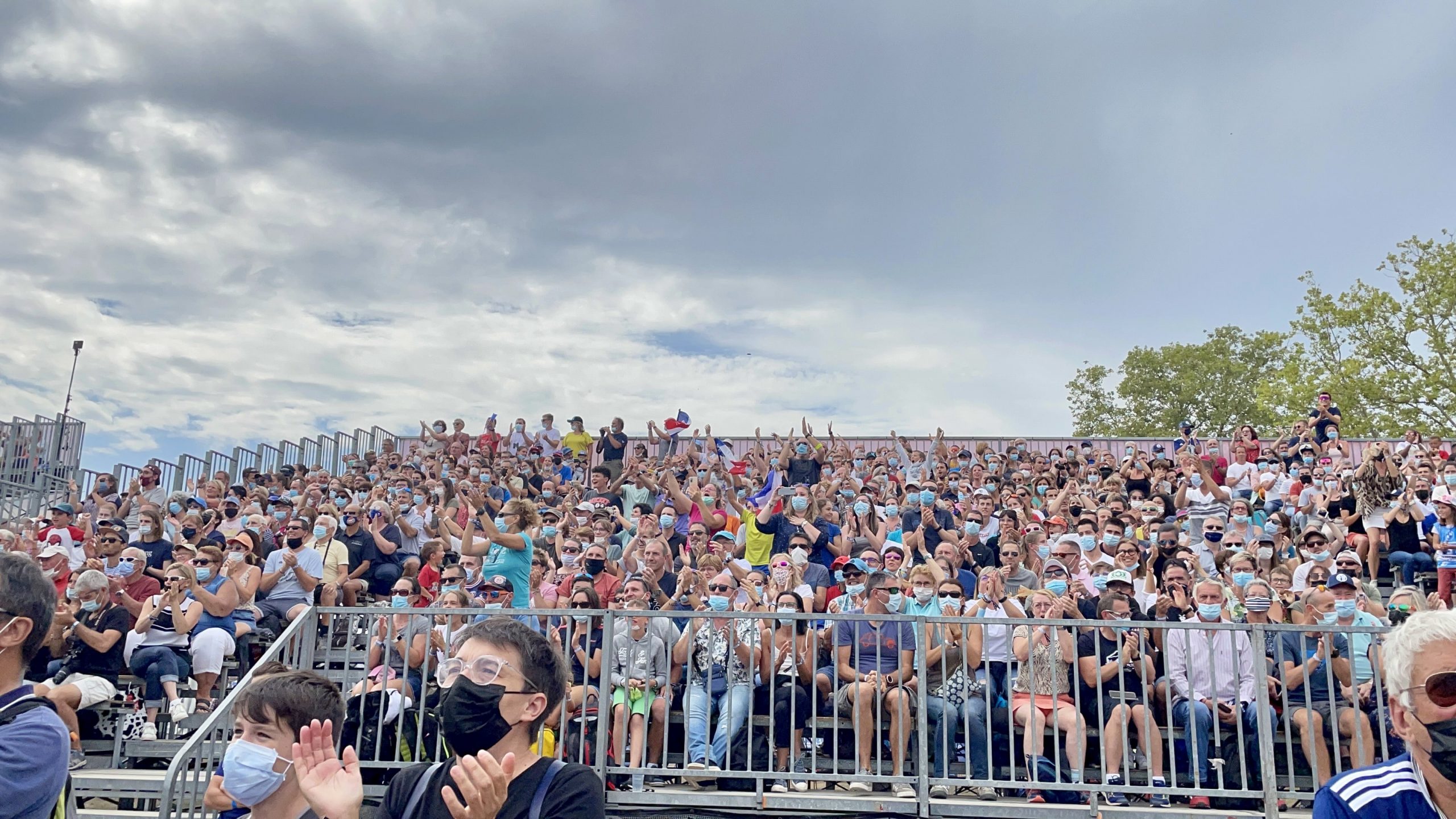
Enthusiastic fans fill the stands for the Martin Fourcade Nordic Festival.
Nordic festival are two words most North American ski fans can only dream about. Skinny skiers here are unlikely to experience the reality of such an event for themselves unless they make a trip across the Atlantic. For residents of France, the opportunity to participate in the second edition of the Martin Fourcade Nordic Festival presented itself this weekend and there were many eager attendees. This lucky expat was among the masses.
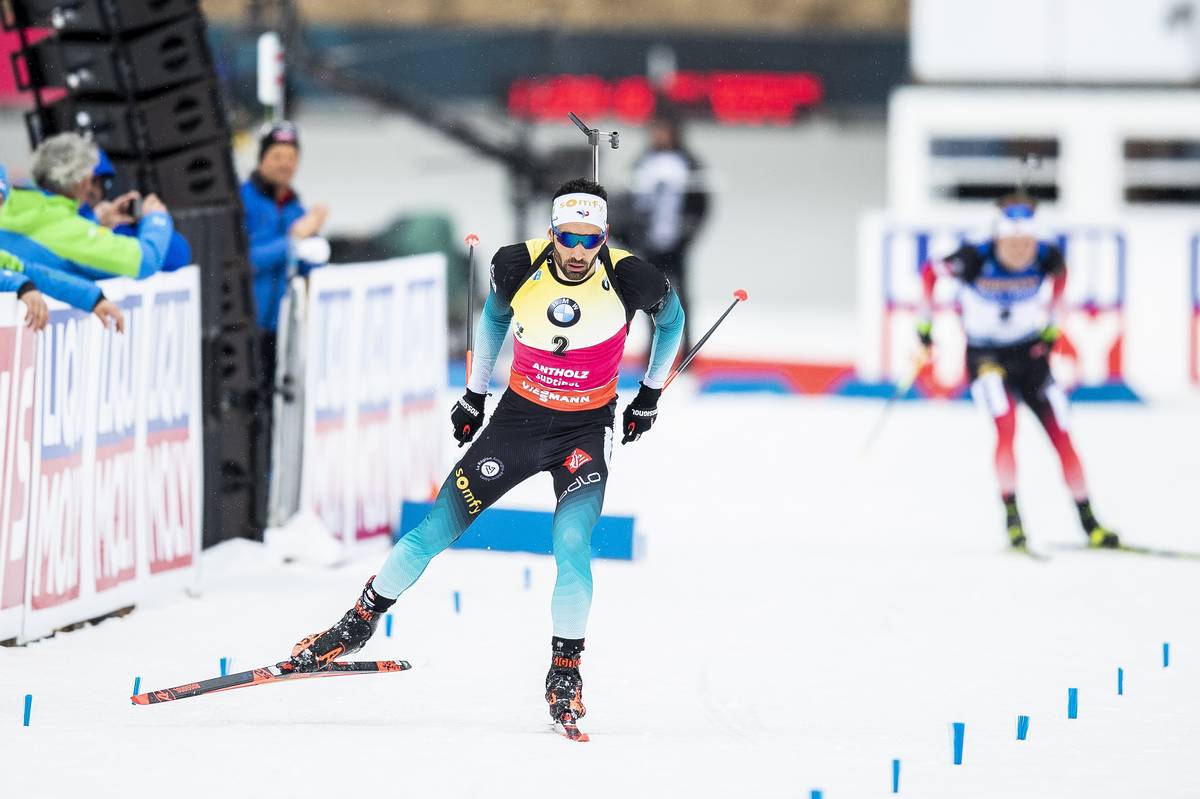
Martin Fourcade (FRA) IBU world championships biathlon (Photo: NordicFocus)
For those unfamiliar with the name, Fourcade retired from biathlon competition in March 2020 after a very successful career, including five Olympic gold medals and thirteen World Championships titles. He is the most successful French Olympian of all time and is celebrated as a beloved hero in his home country. Anywhere he went this weekend, he was accompanied by cheers and a train of fans hoping for autographs, handshakes, or photos.
The festival stretched over three days, beginning Friday, September 3rd and wrapping up on Sunday the 5th. Located in Annecy, in the Haut-Savoie department of France, the stadium sat facing the electric blue water of Lac d’Annecy, rimmed by limestone bluffs.
It’s difficult to imagine a better setting for drawing crowds than the park Le Pâquier, which is right downtown and runs along the popular bike path that circumnavigates the lake. Indeed, the place was bustling with spectators all weekend long, both paying customers and those stopping by, drawn along the fence by all the commotion.
Tickets cost €33 (about $40), and were sold out before the event began. As evidence, several posts were made in the days leading up to the festival on the French nordic Craiglist-esque site, searching for available tickets.
In addition to tickets, to enter the venue one needed to present their pass sanitaire, essentially a health passport in the form of a QR code which proves either you’ve been vaccinated, had a negative COVID test in the last 72hrs or, recovered from COVID in the last 11 days to 6 months. Furthermore, masks were required, even though the event was taking place outdoors where typically masks are not required in France.
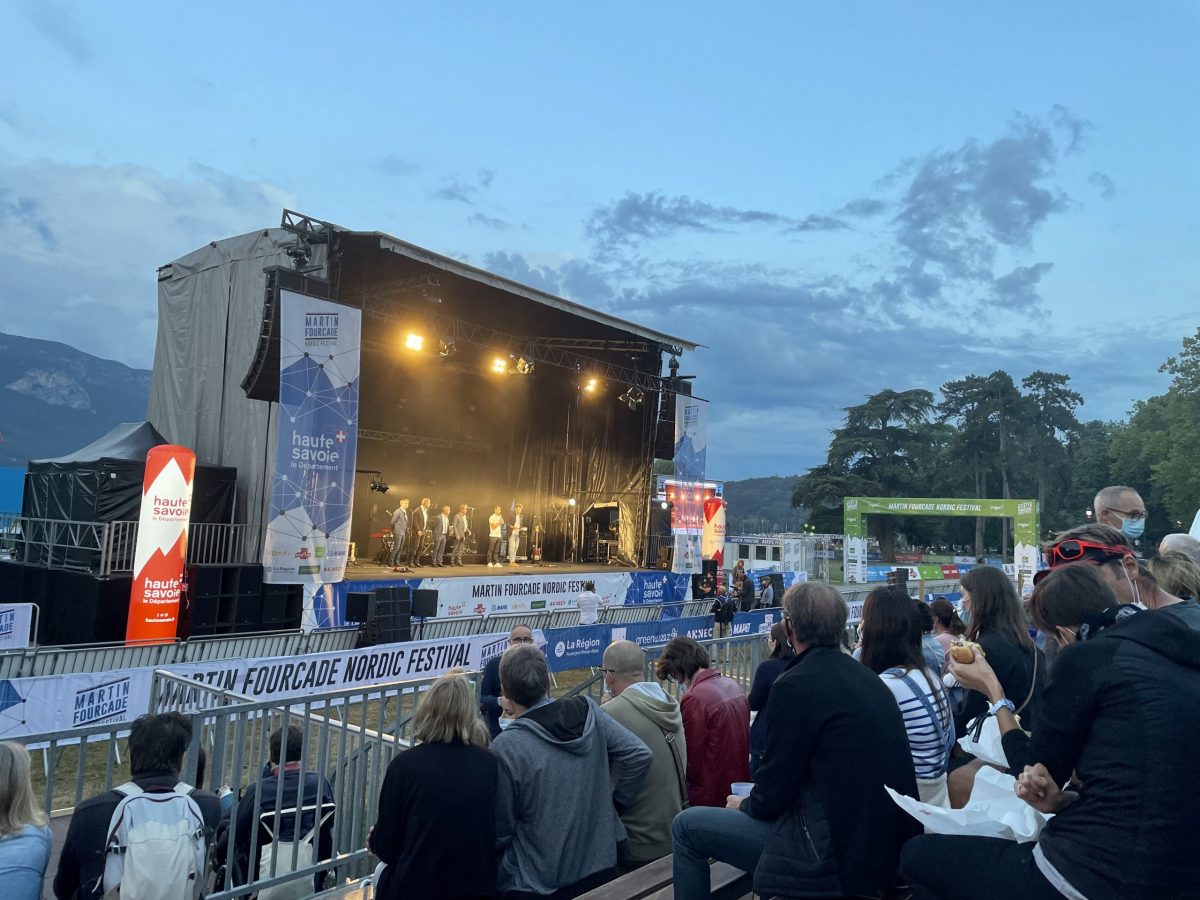
Kicking off the weekend with the presentation of the athletes on Friday evening.
The festivities kicked off in earnest Friday night, beginning with a presentation of the athletes on stage. While 30 international athletes had been recruited to the event, not all were able to make the journey. Many French national team members were present, both biathletes and cross-country racers, including: Richard Jouve, Renaud Jay, Delphine Claudel, Julia Simon, Anais Chevalier-Bouchet, Antonin Guigonnat, and Quentin Fillon-Maillet.
As for the international contingent, some notable names in attendance were: Tiril Eckoff (NOR), Johannes Dale (NOR), Sturla Laegrid (NOR), Oskar Svensson (SWE), Jovian Hediger (SUI), Nadine Faendrich (SUI), Laurien van der Graaff (SUI), and Emma Ribom (SWE).
Following the presentation of athletes, a concert featuring Gaëtan Roussel, a well-known French musician drew quite a crowd and provided the festival with quite a lively start, setting the tune for the rest of the weekend.
Gaëtan Roussel in concert, Friday evening.
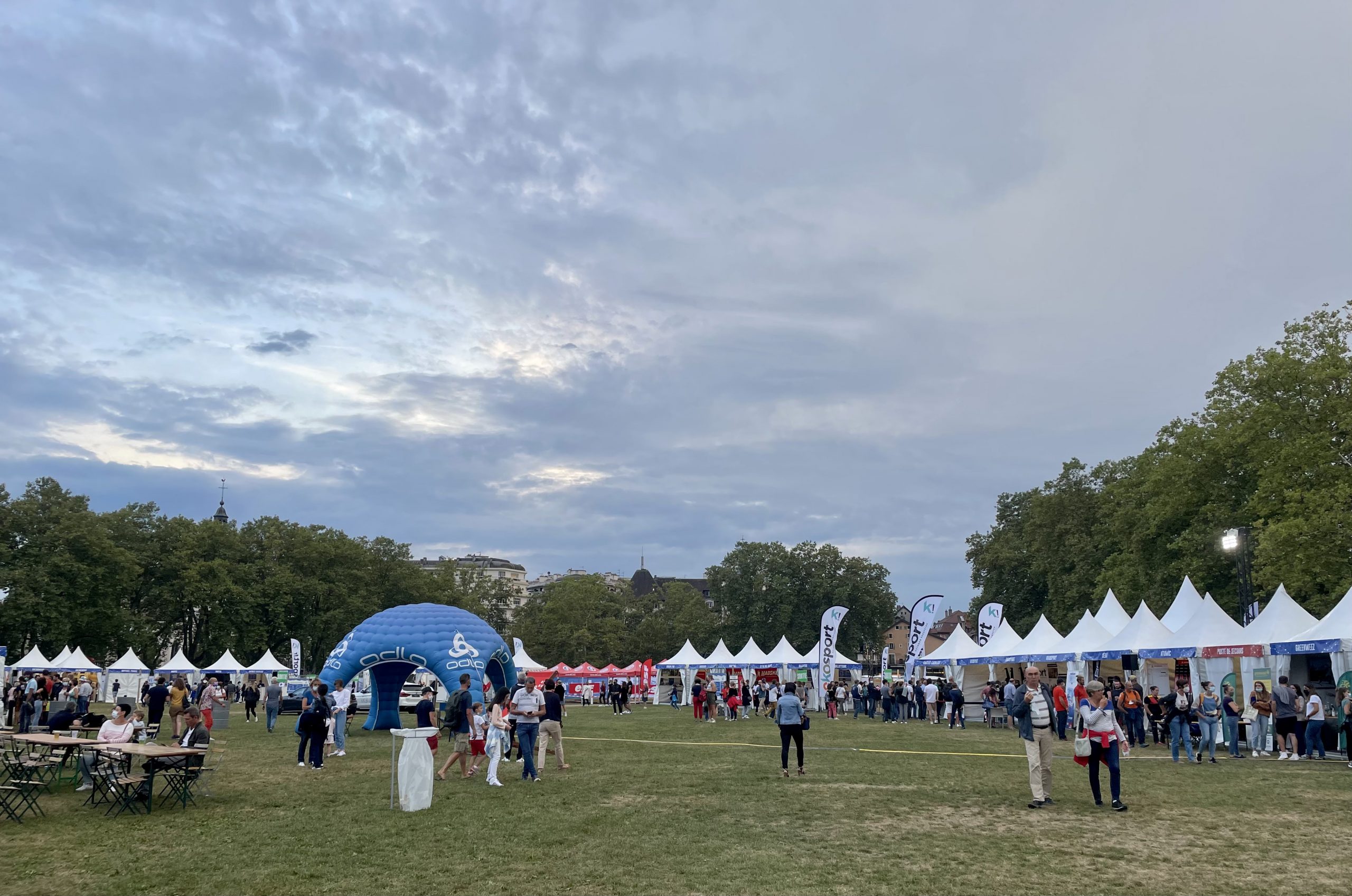
Saturday started with the exposition village opening, a circle of vendor tents featuring nearly 60 brands, food and drink options, and shops. Attractions included, virtual biathlon, ski-erg competitions, and athlete appearances.
Lines at both the Fischer and Salomon tents stretched for quite a distance as athletes patiently sat for hours, signing autographs and taking photos with fans. Not only were famous nordic athletes present, but recent competitors in the Ultra Trail du Mont-Blanc mountain running series, such as Camille Bruyas who took second place in the storied 170 km full tour around Mont-Blanc, and Thiabuat Beronian who finished 3rd in the 100 km “CCC”. These events both end in Chamonix.
The exposition area, filled with vendors (pictured here Friday evening).
Gradually, the crowd began to shift focus towards the stadium, as athletes started warming up for the afternoon show races. Over 3,000 attendees filed into the stands, giving Martin Fourcade a cheer that lasted for minutes as he gave an introduction.
Explaining his motivation for organizing this event, Fourcade said, “When I think of a Nordic festival, I want an event that grows the sport, that shares the sport, and that promotes the sport.” He thanked the crowds for their support and provided a schedule for the afternoon events, starting with women’s biathlon.
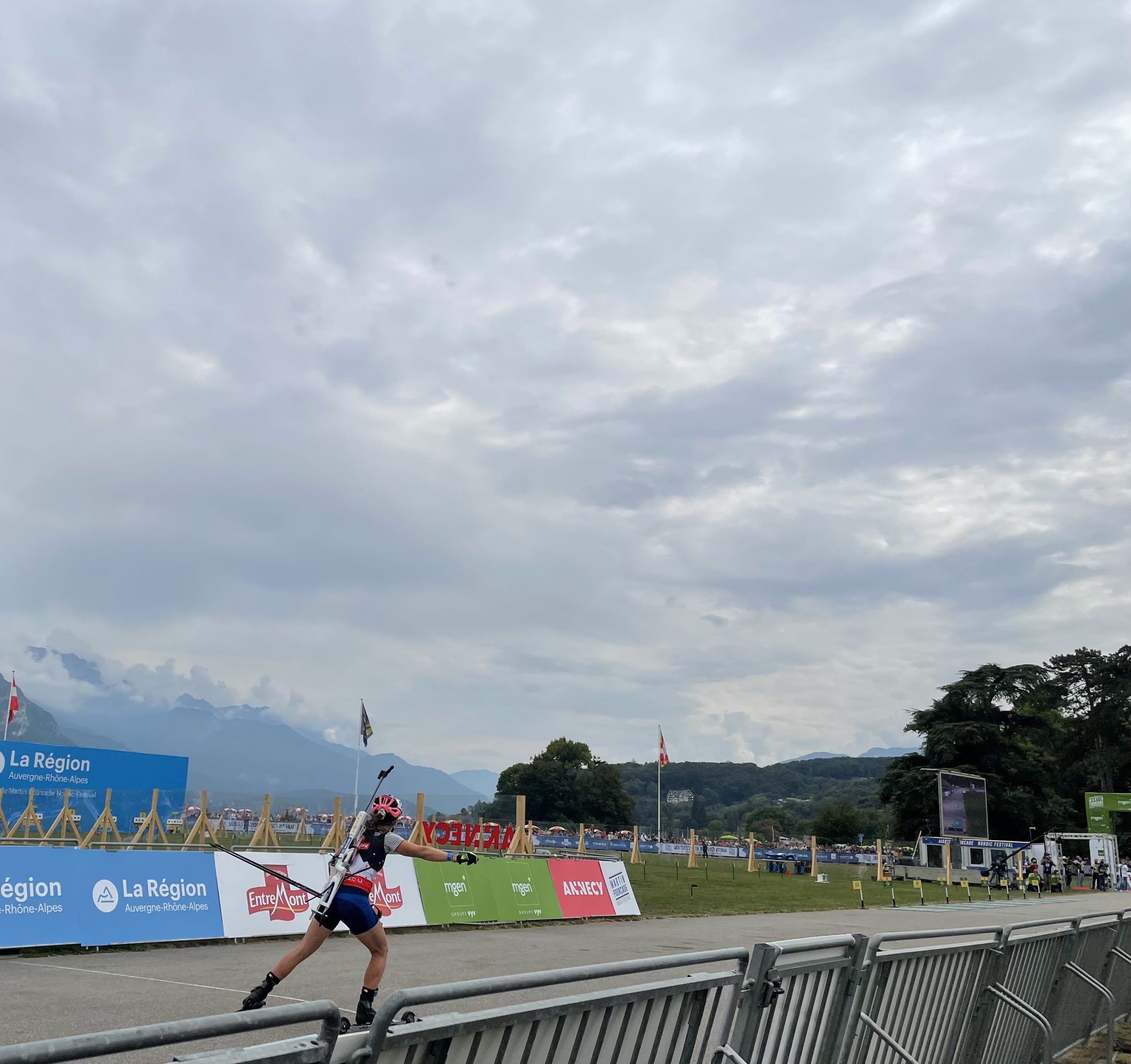
Eight elite biathlete women toed the start line, headed by Eckoff of Norway. They completed four laps of the flat course, with two prone and two standing rounds of shooting. Eckoff lead to start, followed by Chevalier-Bouchet (FRA) who cleaned the standing shoot quickly and gained the lead for the penultimate lap, to the joy of the crowd.
She maintained her lead and entered the final shooting round with a bit of a lead to Eckoff (NOR), cleaning again in rapid time. Franziska Preuss of Germany was second out of the range, followed by Eckoff.
Out on the course, which at times was flanked directly by the lake where boaters had pulled close to cheer, Eckoff passed Preuss (GER) to find second place. Chevalier-Bouchet (FRA) finished first, Eckoff second (+14) and Preuss third (+29.2).
The spectators were thrilled to begin the competitions with a French victory and showed their appreciation in the form of overwhelming applause.
“Yeah it’s amazing,” said Chevalier-Bouchet after her victory, “Thanks everyone. I can’t hear anything because of the noise!”
Anais Chevalier-Bouchet (FRA) pumps up the crowd as she heads towards the finish line.
Tiril Eckoff similarly enjoyed the support of the crowd and said, “It was very fun to be in such a good atmosphere again. It’s the first time in two and a half years to be in front of crowds so it’s really fun.”
Tiril Eckoff (NOR) finished second.
Up next was the men’s biathlon. Guigonnat (FRA) was the first to clean and left the first round of shooting in the lead, while Fillon-Maillet (FRA), a fan favorite, struggled and exited well behind the pack. Through the second time, Doll of Germany was first to clean with Fak (SLO) right behind. Into the standing round, Laegrid (NOR) was the first to clean, Fak in second but with a penalty and Khalili (RUS) in third.
Sturla Laegried (NOR) leads the pack along the lakeside. (Photo: NordicFocus)
For the final time, Laegrid entered without anyone else in sight, shot 5/6 and left the range still in the lead. Khalili (RUS) was next out with Fak in third, followed closely by Fillon-Maillet who had made up ground and had a fast final round of shooting.
Laegrid skied the last lap with a healthy gap and high-fived fans as he headed for the finish with a big lead, ending in 25:02.4. The Russian, Khalili held on for second place and Doll (GER) took third having passed Fillon-Maillet (FRA) and Fak (SLO).
“I’m a very lucky man today so thank you Annecy!” said Laegrid after the race, “It was really fun and it was so nice to say hi to all my fans. Merci beaucoup!”
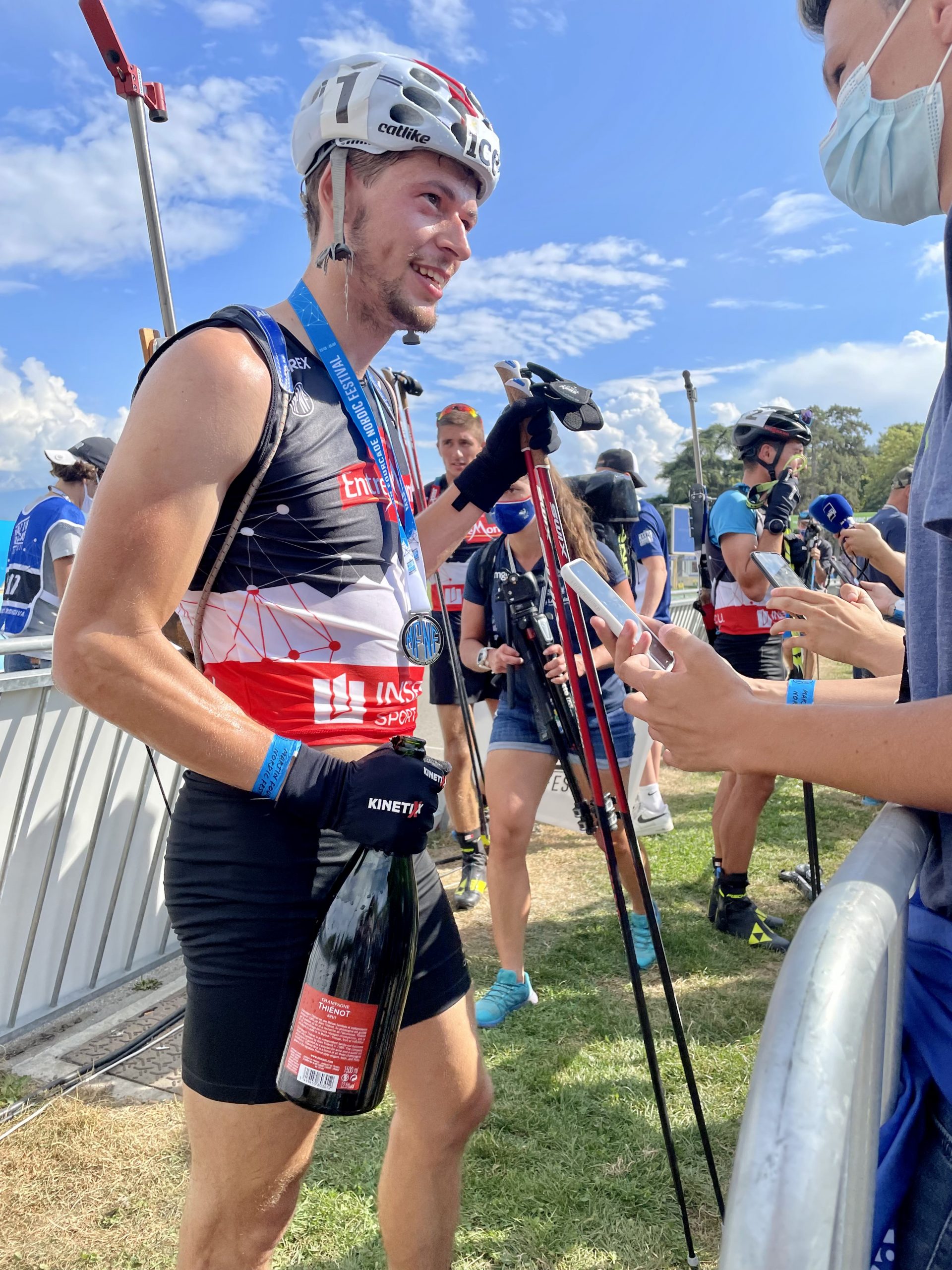
Sturla Laegrid (NOR) holds a bottle of victory champagne after his win.
With the biathlon races concluded, the crowd lost some it’s density before the cross-country rounds, biathlon being more popular. Nevertheless, there were still plenty of spectators who stuck around as the women lined up for their event. Not a true sprint event, the cross-country skiers completed six laps in succession with the final skier across the lap line being eliminated each round.
The pack stayed tight for the first five laps, gradually losing skiers off the back. With a tight course, passing was quite difficult so the leaders did not change much. French skier Flora Dolci had the lead into the final lap, with the top seven athletes all within 1.4 seconds.
Faendrich (SUI) dropped off as they passed along the lake, and then there were six. Ribom (SWE) made a pass to the front, shadowed by Van der Graaff (SUI). Rounding the final corner Van der Graaff launched an attack but Ribom held her off, keeping the advantage heading into the finish.
Emma Ribom (SWE) guns for the finish line, followed by Laurien van der Graaff (SUI).
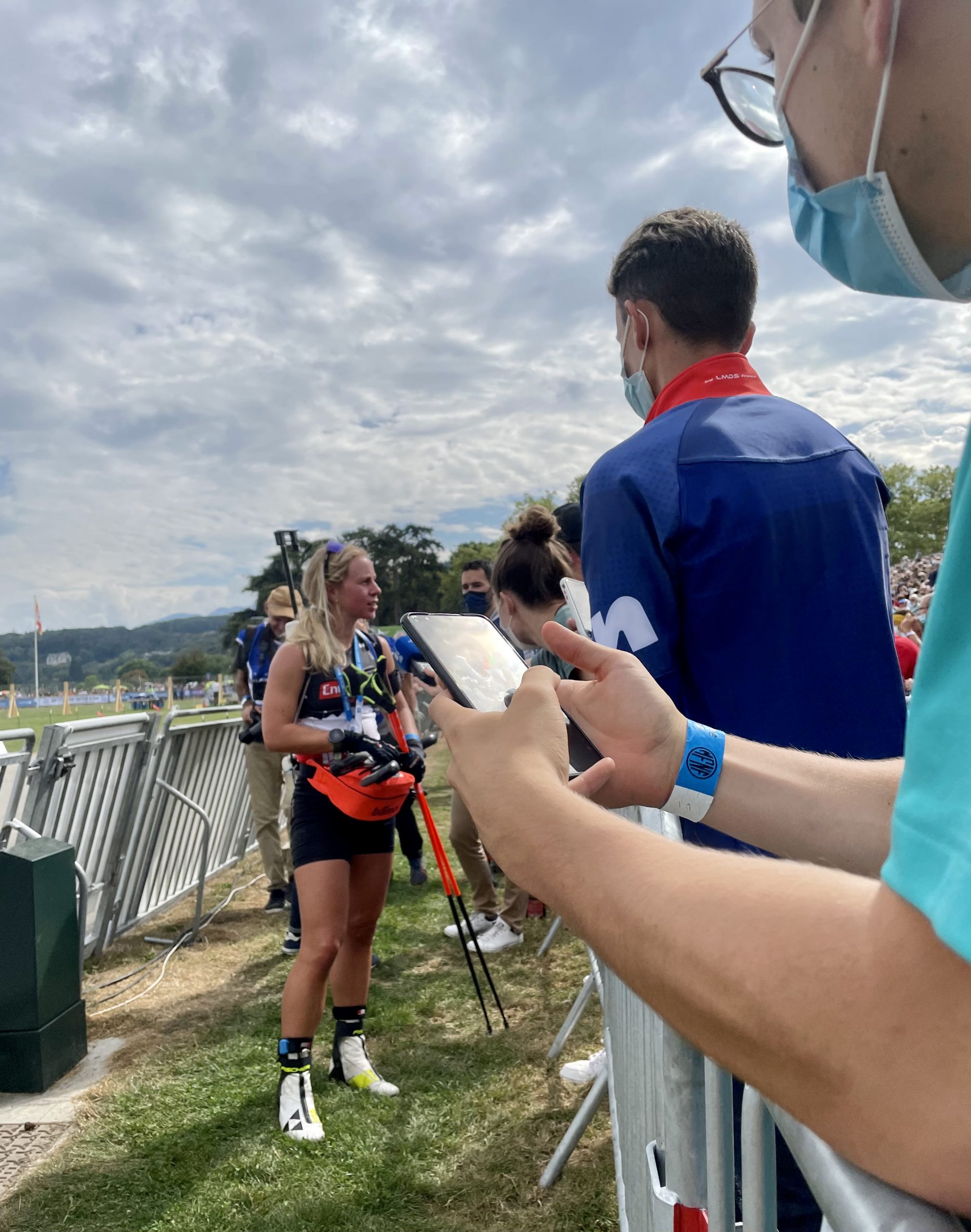
Behind them, Dolci (FRA) outsprinted Claudel (FRA) to take third place, +4.5 back. “I felt really strong out there so it was a fun race,” said Ribom, “My plan was to have a good position the whole race so I tried to stay in the front and keep on pushing to the finish line.”
Post race interview with Emma Ribom:
Van der Graaff, who speaks a bit of French, said, “I am very happy with the competition but not to do an interview in French! I tried really hard to get a second win here, but Emma was really strong.”
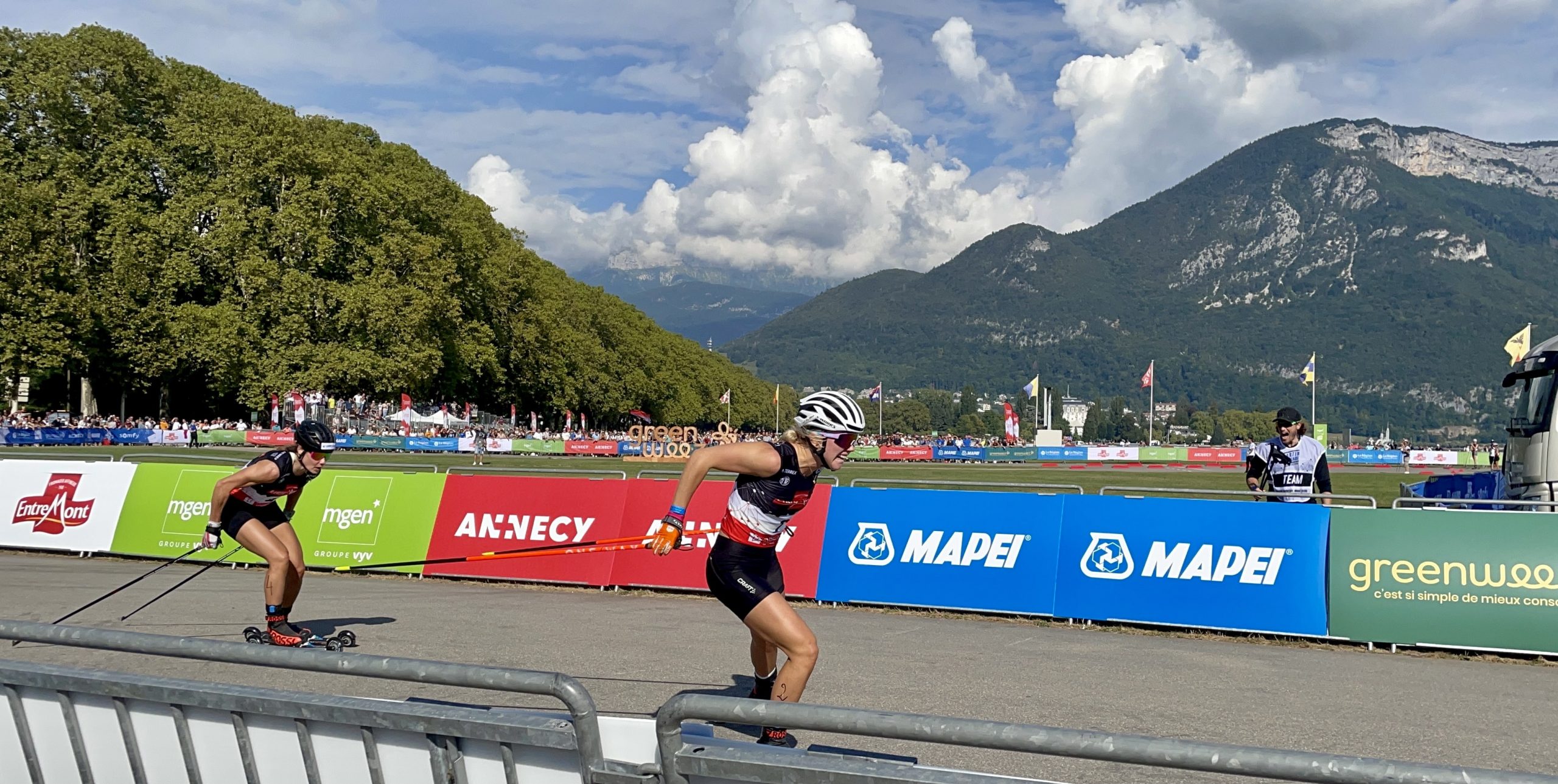
The final race of the day was the men’s cross-country. With such tight pack racing there was sure to be some broken equipment out there and sure enough, nearly every lap saw someone with a broken pole. Hugo Lapalus (FRA) was the first to be eliminated, Hediger (SUI) broke a pole near the end of the second lap and was next to stop.
Svensson (SWE) dropped off the pace during the third lap and was stopped, followed by Valentine Chauvin (FRA) on the next lap. Jouve (FRA), a race favorite, broke a pole in lap three but managed to hang with the group, only to be eliminated with two laps to go. Heading into the final lap, Adrien Backscheider (FRA) had the lead, with Marcus Grate (SWE) the last to be eliminated.
As they neared the finish, Jay (FRA) and Pål Aune (NOR) were duking it out, ultimately the win going to Jay. Arnaud Chautemps of France finished third.
“I’m really happy,” said Jay, “I wasn’t able to be here two years ago so this is really nice.”
Renaud Jay (FRA) and Pål Aune (NOR) speed towards the finish (Photo: NordicFocus)
After the professionals raced on Saturday, it was the public’s turn to compete on Sunday. The “Biathlon Running” was open to all, involving teams of 4-6 in a relay style event. First up to compete were the kids, racing a 1km course with obstacles and shooting in between laps, followed by the adult teams.
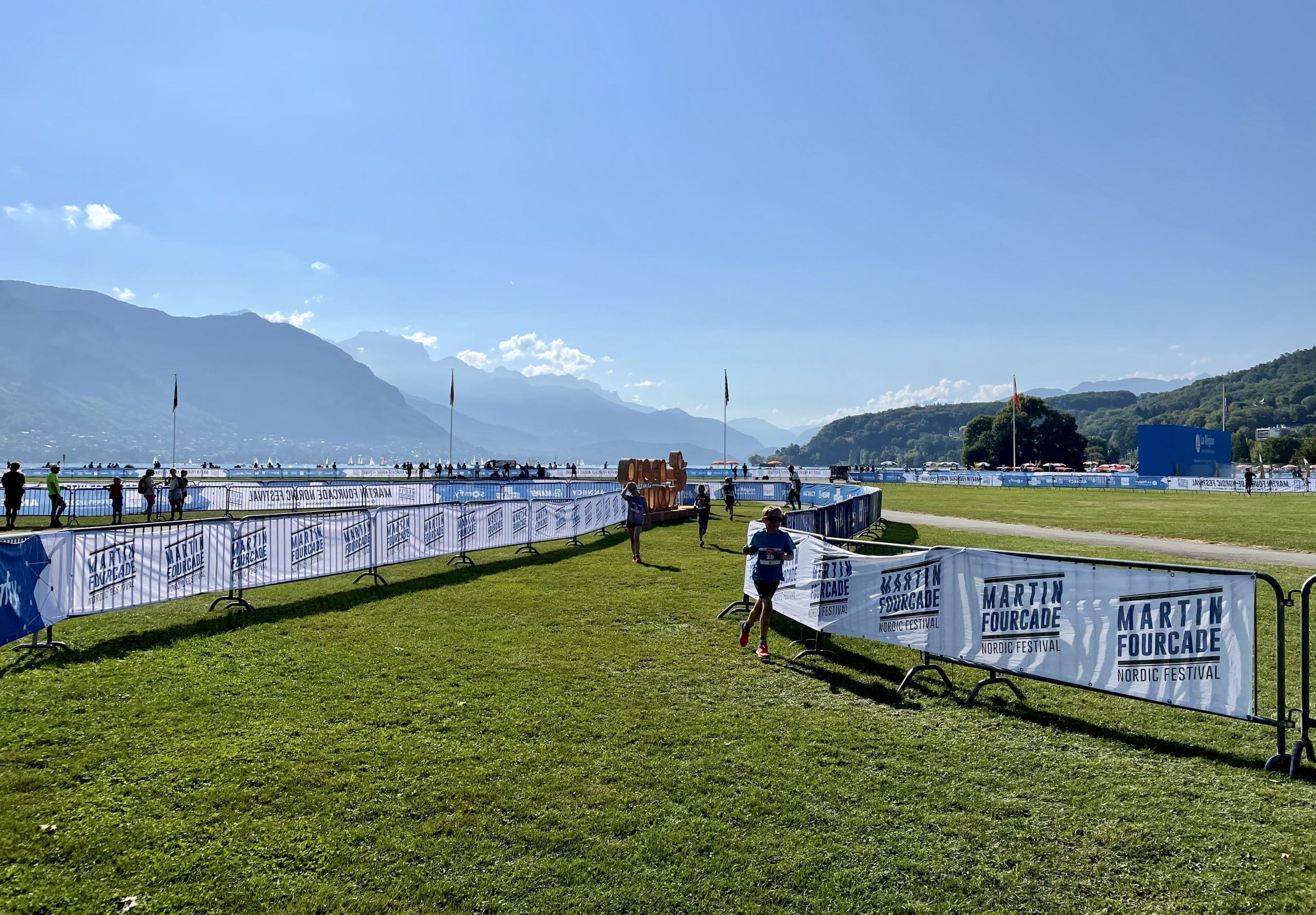
Kids navigate the “toile de l’araignée” (spider web) in Sunday’s obstacle course.
There were three categories to sign up under (Mixed, female, and male) and the price was €200/team. The competitors were enthusiastic and lots of smiles were seen out on course, a fun way to wrap up a fun weekend.
Scenic backdrop of Sunday’s biathlon running event.
The scene from an exchange during the World Championship team sprint in Oberstdorf, Germany. (Photo: NordicFocus)
This World Championship coverage is made possible through the generous support of Marty and Kathy Hall and their A Hall Mark of Excellence Award. To learn more about A Hall Mark of Excellence Award or to learn how you can support FasterSkier’s coverage please contact info@fasterskier.com.
And now for something completely different. The skate team sprint.
Three roughly 1-kilometer loops each for 7.2 k total, relatively flat with just two brief upticks per lap, winding back and forth along the valley floor in Oberstdorf, Germany. Would the terrain be enough for one team to pull away from others or would it be an empty-the-tank last two laps, fighting for every centimeter?
From semifinal A, advanced the Swedish team of Maja Dahlqvist and Jonna Sundling, who won their heat by nearly two seconds ahead of the Russian Ski Federation (RSF), represented by Yulia Stupak and Natalia Nepryaeva, Norway, and Finland. Three teams finished within a second in Semifinal B, with Slovenia’s Eva Urevc and Anamarija Lampic edging out Rosie Brennan and Sadie Maubet Bjornsen for the U.S., and the Swiss Women, Laurien van der Graaff and Nadine Fähndrich. Germany and the Czech Republic also advanced from the second wave of semis.
Note that four teams advanced from each heat of the semifinals with the next two fastest times, a change from the usual top two teams plus six fastest times. This change was made based on the weather and conditions on the course.
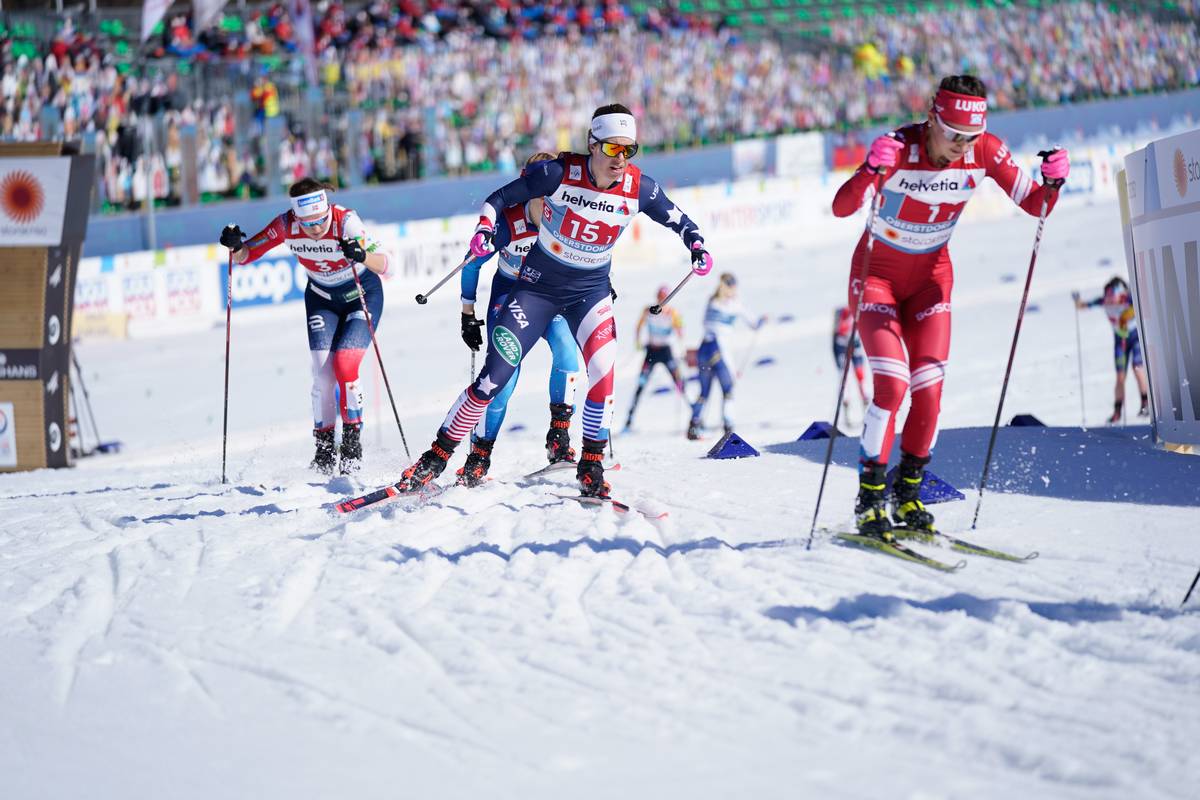
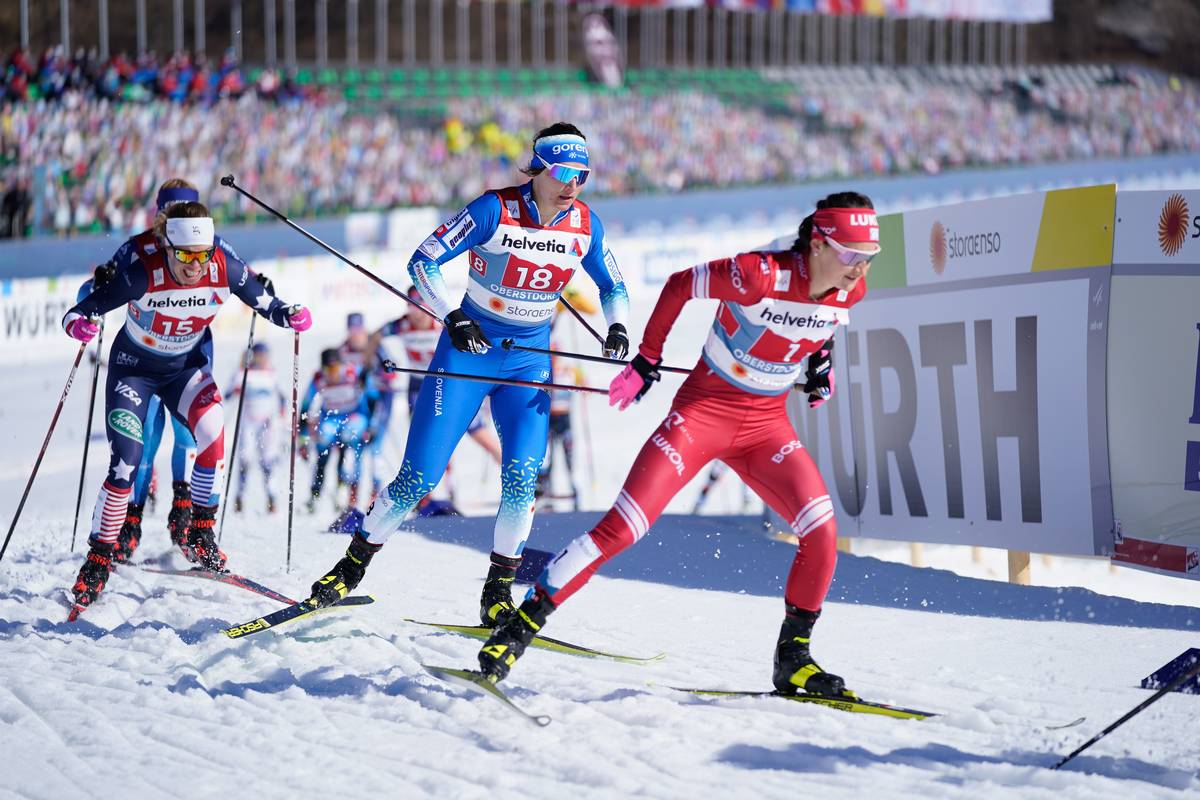
Rosie Brennan marks Russia’s Yulia Stupak during the World Championship team sprint in Oberstdorf. (Photo: NordicFocus)
So far in this World Championship, Brennan had only raced the classic sprint qualifier and Maubet Bjornsen not at all, perhaps leaving them fresh for this competition. American voices could be heard shouting words of encouragement as the women toiled around the course as a large group through the first four exchanges. At the third exchange at 3.6 k, the US was sitting in fifth, 2.3 seconds behind Sweden in the lead and in contact.
Slowly, Sweden began to turn up the dial, building intensity. However, as the final laps took off, any ground Dahlqvist gained on her competitors was closed as they descended off the first roller and headed into the primary climb of the course. It was here that RSF’s Stupak began to challenge, duking it out with Dahlqvist but unable to pull away.
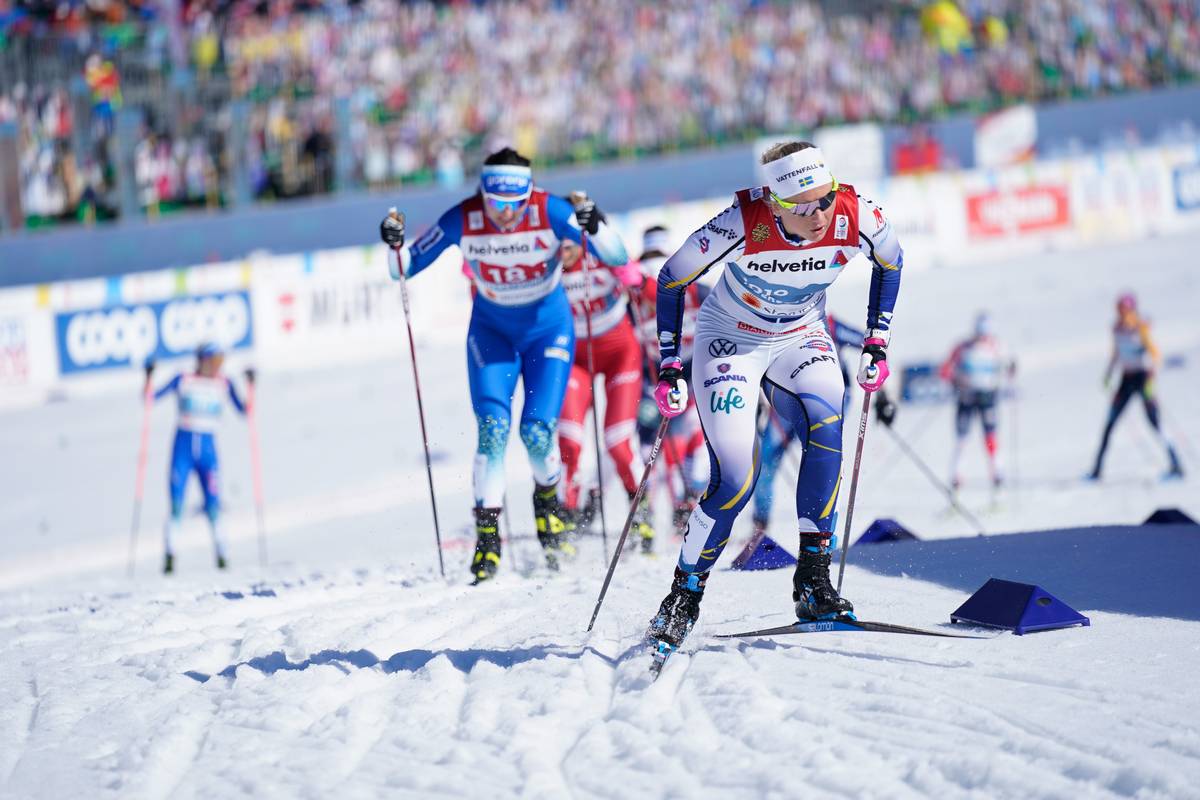
Sweden’s Dahlqvist leads the way in the World Championship team sprint in Oberstdorf, Germany. (Photo: NordicFocus)
After the final change, it was Sweden and RSF at the front, with a small gap to Norway, the U.S., and Switzerland with Slovenia a few meters back.
In the final lap, the tempo accelerated, poles whipped through the air, and any predictions of what might happen were laid wayside.
As Sundling tried to pull away, Fähndrich quickly closed the gap to the front, skiing at the Swede’s hip. Nepryaeva began to fall off the pace, and was being caught by Maubet Bjornsen and Lampic. Though Sundling and Fähndrich held ground at the front, the podium was within reach for each nation.
Rosie Brennan (USA) tails Eva Urevc (SLO) and Yulia Stupak (RSF) during the World Championship team sprint in Oberstdorf, Germany. (Photo: NordicFocus)
At the top of the intermediate climb and on the outside of the left-hand curve, Maubet Bjornsen ski was caught in a tangle, dropping her to her knee and stalling her momentum at an inopportune moment. The American rebounded quickly but was no longer able to fight for the top spots.
Making their way for the last time up the primary climb, Sweden and Switzerland, alone up-front, created a small gap to Nepryaeva. Meanwhile, Lampic of Slovenia was closing in and looking strong.
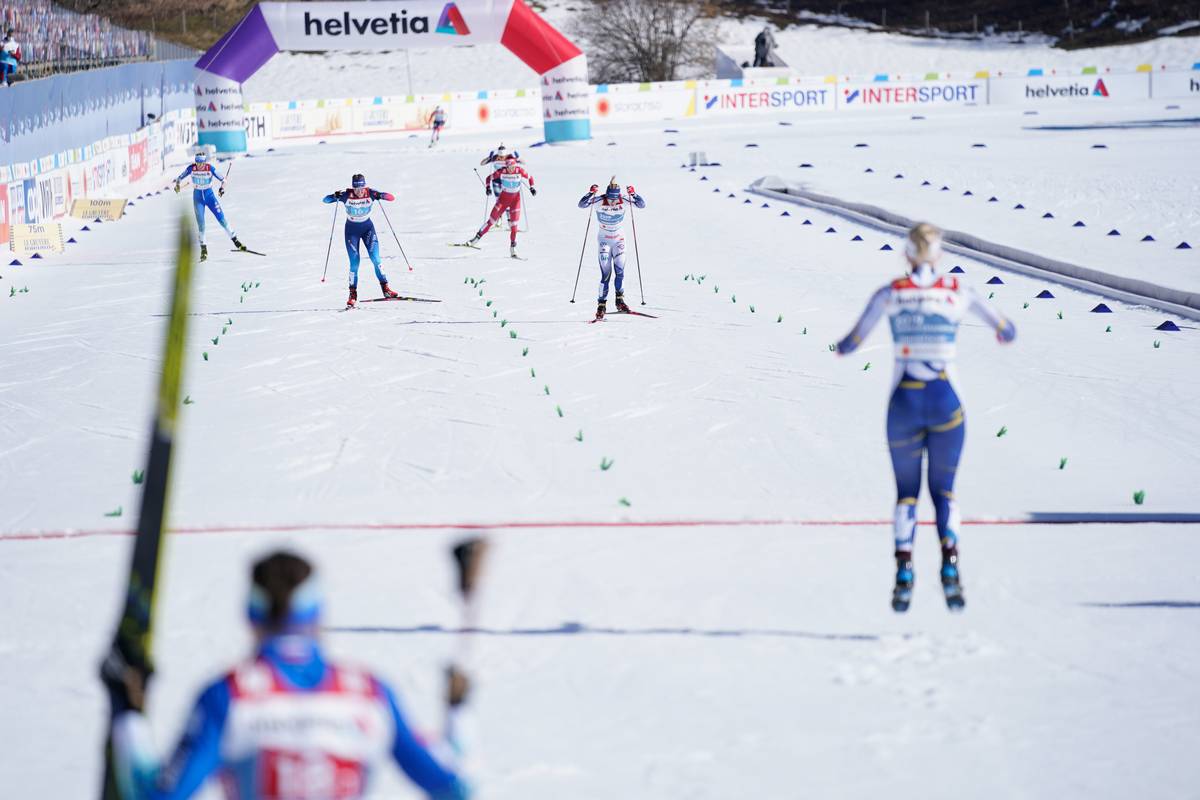
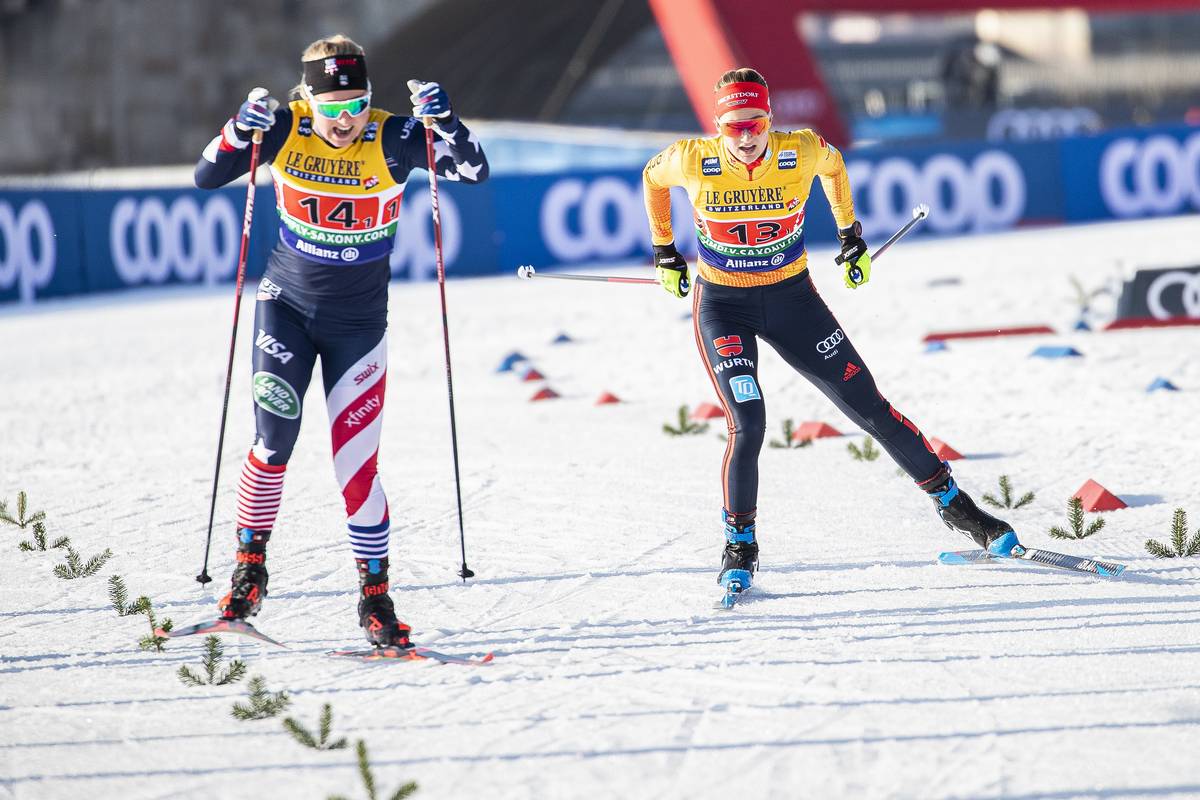
The final moments of the World Championship team sprint in Oberstdorf, Germany. (Photo: NordicFocus)
Sundling was first into the final lanes, with Fähndrich a ski length behind, matching but not able to overtake the Swede. The women soared to the finish with Sweden holding its ground for the win, Switzerland finishing just under a second behind for the silver medal.
Sweden’s Jonna Sundling and Maja Dahlqvist take home World Championship gold in the team sprint. (Photo: NordicFocus)
“It was so fun to race today,” Dahlqvist told FIS after the race. “But it was hard too, the conditions were a little warm. It was easier in the qualification.”
Sundling was asked whether she knew how close behind Fähndrich was in the final meters.
“I heard there was someone behind me, but I just had my focus on the finish line and to cross it first.”
Fighting for bronze, Lampic out-sprinted Nepyraeva to bring home a medal for Slovenia (+3.46), leaving RSF in fourth (+3.95).
The women’s podium at the World Championship team sprint in Oberstdorf. Sweden took the win ahead of Switzerland and Slovenia. (Photo: NordicFocus)
The women of Sweden have made their sprint prowess well known this season and were favored to win their third World Championship medal in this event, piggybacking on the 2019 World Championships in Seefeld, Austria. Dahlqvist led the team there too, with Stina Nilsson as the anchor. Both members of today’s Swedish team were coming off of strong results in the opening classic sprint, where Sundling collected a gold medal.
The winners, Sweden’s Maja Dahlqvist and Jonna Sundling, take in their team sprint victory in Oberstdorf. (Photo: NordicFocus)
However, a medal for Switzerland and Slovenia, while not unexpected, is perhaps a more novel result. The duo of Van der Graaff and Fähndrich won the team sprint in Dresden, Germany earlier this season, but this is the historic first Swiss medal in the event and the first women’s medal for Switzerland since 1987, a bronze earned by Evi Kratzer in the 5k classic.
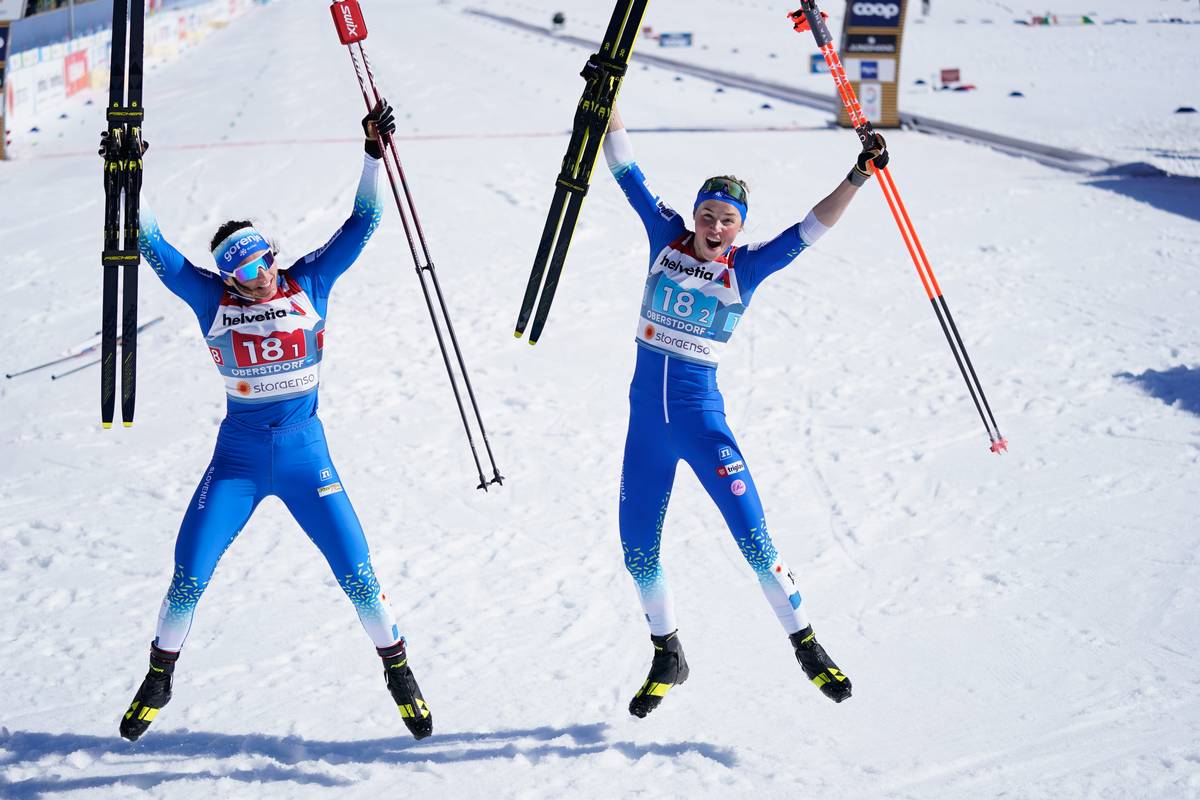
Laurien Van Der Graaf (SUI) watches her teammate, Nadine Fähndrich, bring home a silver medal for their team. (Photo: NordicFocus)Laurien van der Graaff and Nadine Fähndrich take silver for Switzerland. (Photo: NordicFocus)
“We always said we want that medal,” Van der Graaff told the Swiss news outlet SRF. And now it’s there! No idea, the emotions are there. It’s incredible.”
Commenting on when they knew they could celebrate, Fähndrich replied, “I was only really sure when I crossed the line. She had tagged off to me in a great position, with only a little bit of a gap to [positions] one and two. Then I felt that those athletes around me tried a little to play tactical games, but I just thought no, I had to risk it because I felt good. I just knew ‘all out now’!”
Laurien van der Graaff and Nadine Fähndrich celebrate with their tech after earning a World Championship silver medal in the team sprint. (Photo: NordicFocus)
Despite the size of their team and country, the Slovenian team of Urevc and Lampic took 3rd in Dresden and won the most recent World Cup team sprint in Ulricehamn, Sweden. Slovenia also took silver in the 2019 Championships in Seefeld. Taking home her second medal of this Championship, 25-year-old Lampic also leads the overall World Cup sprint standings.
Eva Urevc and Anamarija Lampic of Slovenia bring home a World Championship bronze medal in the team sprint in Oberstdorf, Germany. (Photo: NordicFocus)Sadie Maubet Bjornsen helps the Americans to a 5th place finish at the World Championship team sprint. (Photo: NordicFocus)
Finishing alone, Maubet Bjornsen brought the American women home in fifth (+5.83), matching the team’s result in this event at the 2019 World Championships.
When asked if they were left wanting, Brennan gave an optimistic and grateful response:
“I’m actually really happy with it,” she said. “It’s been, quite literally, a career-long dream to do a team sprint with Sadie. She’s been a best friend and training partner for the entirety of my professional career, so I was just so happy and excited to even get this opportunity. I know that we are capable of more on any given day, but that’s ski racing — you go out there and you give it your all. Some days you win, some you don’t. But it was honestly a pretty special day for me.”
Rosie Brennan marks Russia’s Yulia Stupak during the World Championship team sprint in Oberstdorf. (Photo: NordicFocus)
Perhaps envisioning the hang-up in the last lap, Maubet Bjornsen discussed the degradation of the course between the semifinal and final. She explained that the tracks were fast, firm, and tactical in the final, becoming more dangerous as the transformed snow began to break down and accumulate on the surface. In these deeper conditions, Maubet Bjornsen explained that a skier must be aware of their equipment at all times to stay upright and powerful.
However, reflecting on their performance, she too focused on the positive, commenting on the years and hours the two have spent training and racing together throughout their careers, beginning as juniors.
Rosie Brennan and Sadie Maubet Bjornsen prepare for the World Championship team sprint in Oberstdorf, Germany. (Photo: Tom Horrocks/USST)
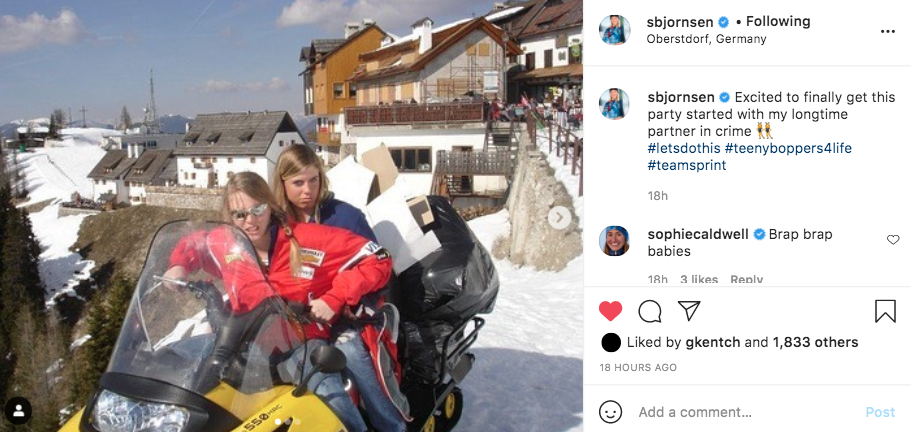
“I feel like we skied an awesome race,” Maubet Bjornsen said. “Unfortunately, I got stepped on the first uphill which took me out of the draft and I couldn’t quite find the gear to come back to [the group]. Which is a bummer because my skis were incredible and I feel like if I would have been with those girls over the top of the second climb it could have been a medal day, but like Rosie said, you can never count on that, but I think it’s pretty cool that my number one training buddy and me were in a fight for a medal. That’s pretty neat. If you would have asked us that at 14-years-old, beating on each other, we would have laughed at you. So I think if we brought our 14-year-old selves here, we’d be pretty darn proud.”
A trip down memory lane. (Photo: Instagram @sbjornsen)
Jessie Diggins leads the pack during the team sprint in Dresden, Germany. (Photo: NordicFocus)
This World Cup coverage is made possible through the generous support of Marty and Kathy Hall and their A Hall Mark of Excellence Award. To learn more about A Hall Mark of Excellence Award or to learn how you can support FasterSkier’s coverage please contact info@fasterskier.com.
Another lovely spring-like day in Dresden, Germany with vibrant green grass contrasting the ribbon of man-made snow along the Elbe River bank. On course in the women’s team sprint final, a ten-team affair became a relative runaway as it concluded.
For the uninitiated and new to the team sprint concept, two-athletes form a team, and they tag off to one another six times each. In other words, each athlete races a .65 k lap (one time around the Dresden course) and tags off to their partner. Each partner races six 0.65 k laps for a total of 7.8 k for the team. It is dizzying. And yes, it can seem like a blur of Lycra and skis and poles. Roller derby meets cross-country ski refinement is one way to describe it.
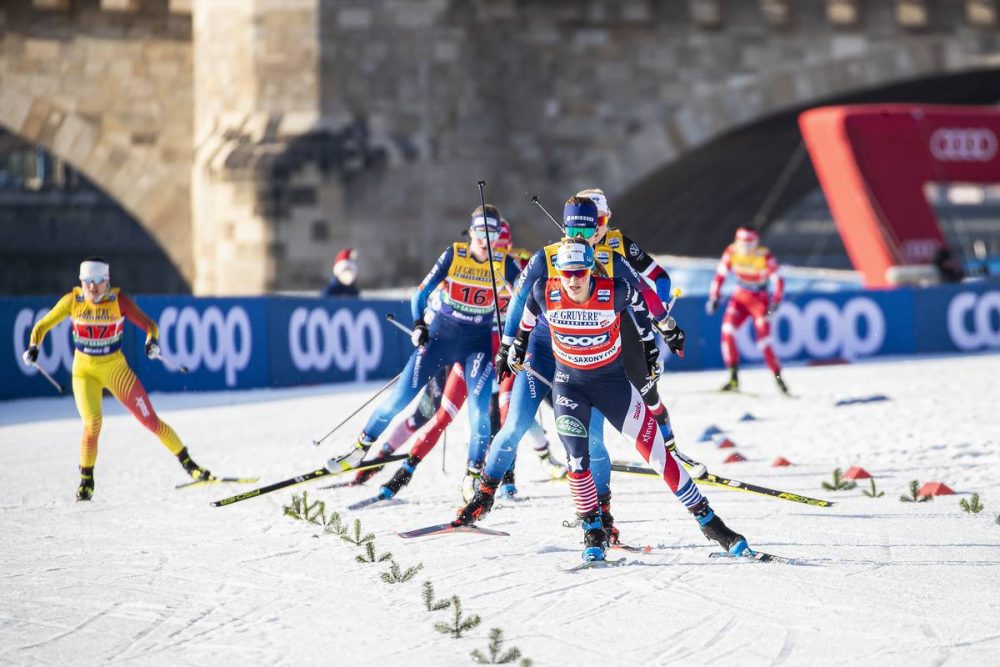
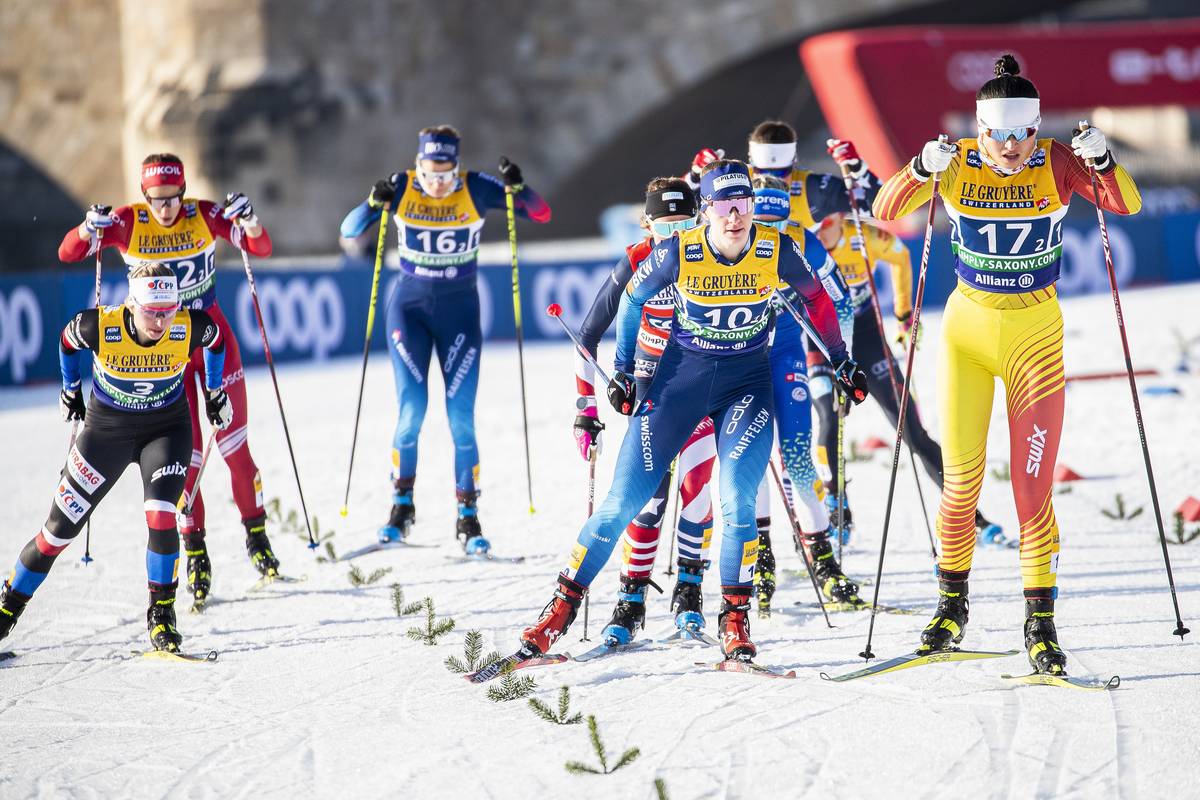
At the race’s midpoint, the racing blur was led by an upstart team from China, pulling the pack along in their yellow and red highlighted suits. Switzerland I, U.S. I, Slovenia, Russia I, and Germany I were separated by 2.8 seconds. Just enough time back for those in the rear to keep hope alive, and for viewers to see that no real breakaway and podium locks had been determined. We’ll call it semi-scrum in its organization.
Dinigeer Yilamujiang of China leads the women’s pack halfway through the team sprint in Dresden, Germany. (Photo: NordicFocus)
5.2 k into the race, at the eighth exchange, Russia I played their hand as they burned fuel upfront. The race became a four-team affair with Russia I setting the pace, and Switzerland I, Slovenia, and the U.S. racing in the slipstream. This trend continued with the U.S. falling off slightly at 6.5 k, 1.4 seconds back. Not much time, but in a team sprint event, when drafting and maintaining a lock on those in front are key, it can appear to be a mighty gap.
Russia I continued it’s work up front and the pattern was set on the final tag. With 0.7 k to go, the Russians were up 2.3 seconds on the Swiss, 2.5 seconds on Slovenia, and 2.6 seconds on the U.S.
Natalie Nepryaeva of Russia takes charge in the second half during the team sprint in Dresden, Germany. Caldwell Hamilton tucks in just behind. (Photo: NordicFocus)
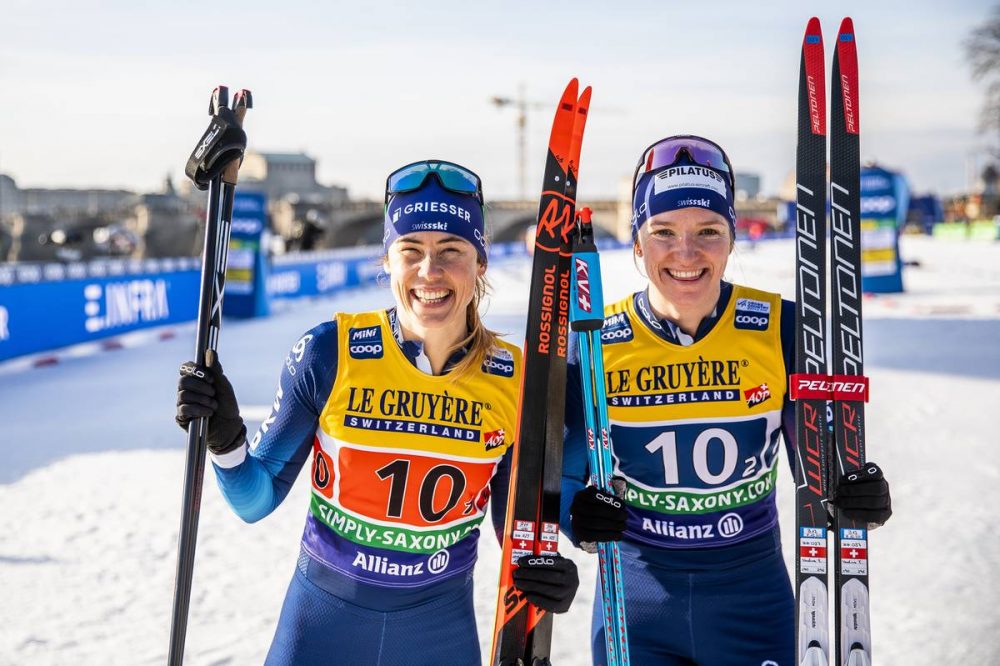
In that final lap, Fähndrich for the Swiss, reeled in Russia’s Nepryaeva, who at the onset seemed uncatchable, seized control of the front and took the win in 16:38.34 minutes. Nepryaeva crossed 0.32 seconds back to secure second for Russia I. Lampic crossed 1.12 seconds back for Slovenia’s third place. Caldwell Hamilton, slightly off the pace, finished in fourth (+3.01) for U.S. I.
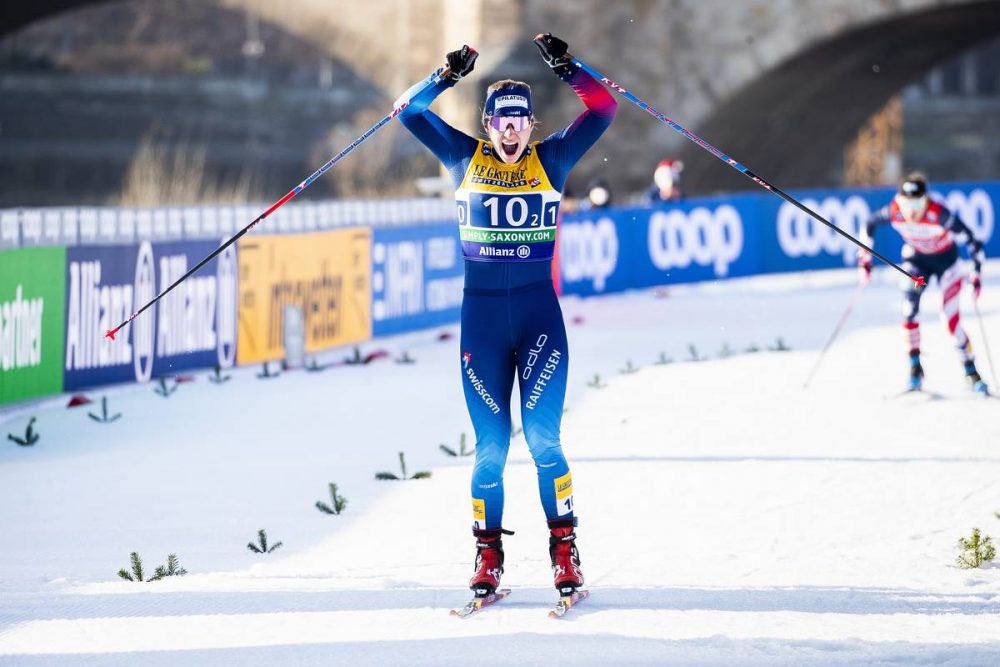
Switzerland’s Nadine Fähndrich celebrates bringing home a team sprint victory with partner Laurien Van Der Graaff. (Photo: NordicFocus)
“I felt very good and saw that Natalia [Nepryaeva] was already a bit tired and I could catch up a lot from behind. So I had a very good feeling, and was hoping and fighting to make it happen today,” said Fähndrich to Swiss broadcaster SRF about her team’s last loop.
Laurien Van Der Graaff and partner Nadine Fähndrich take the win for Switzerland in the team sprint in Dresden, Germany. (Photo: NordicFocus)
Van der Graaff, Fähndrich’s teammate, added, “I knew I had to send off Nadine in a good position. So I fought and suffered on my last leg, and talked to myself the whole time ‘come on, just a little bit more until I can tag off to her’. We already saw yesterday that she’s in great shape, she’s the strongest athlete at the moment. And I knew in the end she’d make it.”
The women’s podium of the team sprint in Dresden Germany. Switzerland’s Laurie Van Der Graaf and Nadine Fähndrich took the win with Russia’s Yulia Stupak and Natalia Nepryaeva in second, and Eva Urevc and Anamarija Lampic of Slovenia in third. (Photo: NordicFocus)
Sophie Caldwell Hamilton marks the leader around the bend during the team sprint in Dresden, Germany. (Photo: NordicFocus)
“We fought hard out there, and I am so proud of all our teams for giving it out best effort!” wrote Diggins in a post-race email. “Personally I struggled a bit with positioning on such a short and tactical loop, but I was proud of how I held my own in city sprinting on a course that challenged me in different ways! I thought we had great skis and it’s nice to feel that we’re working our way into better and better racing form.”
Both Caldwell Hamilton and Diggins were coming off of strong performances on the course in yesterday’s individual sprint event, finishing 2nd and 4th, respectively. Both seemed well matched for the flat and spicy course, with tight corners where the manmade snow crumbles to a dicey sugar.
Jessie Diggins in control over the rollers during the team sprint in Dresden, Germany. (Photo: NordicFocus)
“It was fast and furious out there today, as Dresden always is,” emailed Caldwell Hamilton. “I think Jessie and I both wanted to fight for a podium today and knew we were capable of it, but this race is a wild card and I think overall we skied quite well. For me personally, I always look back at these Dresden team sprints and wish I had skied more aggressively, but with so much carnage out there, you’re riding a fine line between aggressive and risky, so that sweet spot can be tricky to find. In hindsight, we can always find a small thing or two we would have done differently, but it’s still an effort I’m proud of and any time I get to team up with Jessie is an honor. Dresden hosted an exciting weekend as usual and now I’m looking forward to a little Christmas break in Seefeld!”
Jessie Diggins and Sophie Caldwell Hamilton celebrate a 4th place finish in the team sprint in Dresden, Germany. (Photo: NordicFocus)
Hannah Halvorsen and Julia Kern placed eighth in the final, 12.35 seconds off the winning time. The duop advanced to the final after placing fifth in the first semi-final. The top five teams from each semi advance to the finals.
Hannah Halvorsen faces off with Germany’s Laura Gimmler during the team sprint in Dresden, Germany. (Photo: NordicFocus)
A quick look to the overall standings as Period 1 draws to a close: Despite sitting out the city sprints in Dresden, Rosie Brennan is still in charge of the yellow bib with 377 points. Missing this World Cup stop was part of Brennan’s season plan. Russia’s Tatiana Sorina trails by 41 points in second (334 pts), followed by Norway’s Therese Johaug in third (301 pts).
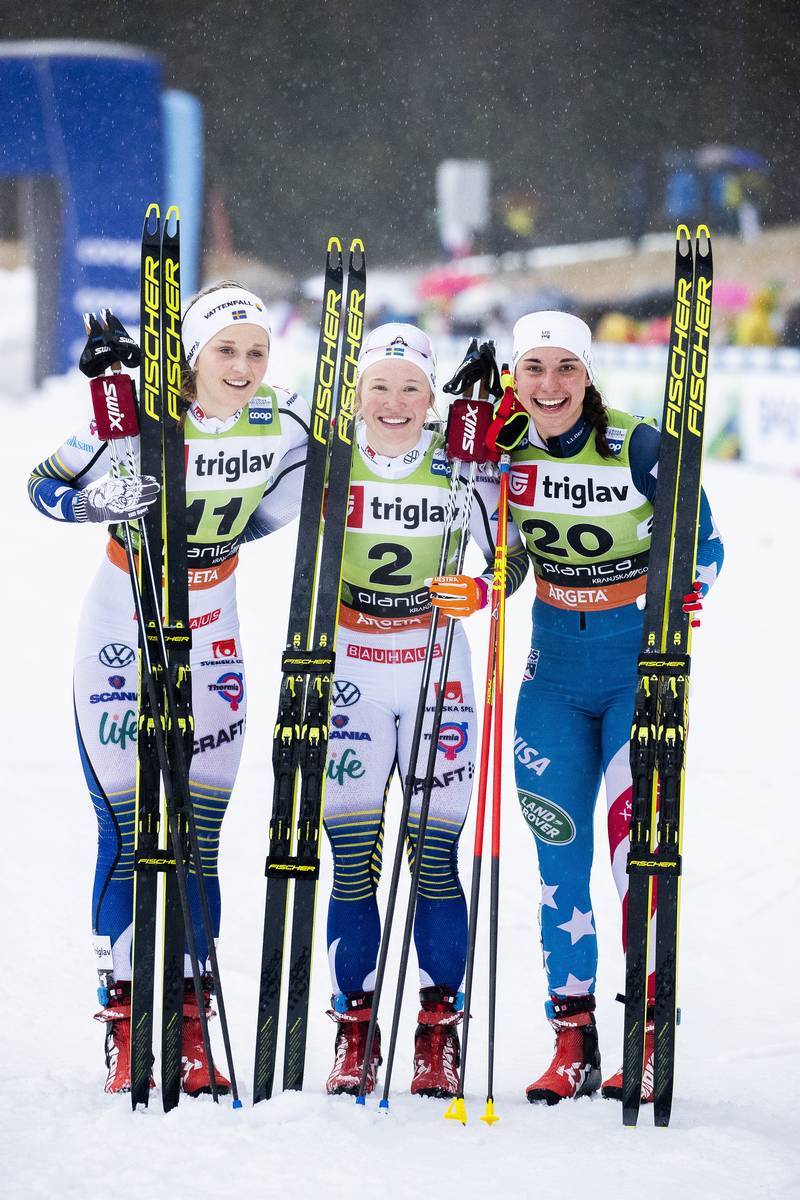
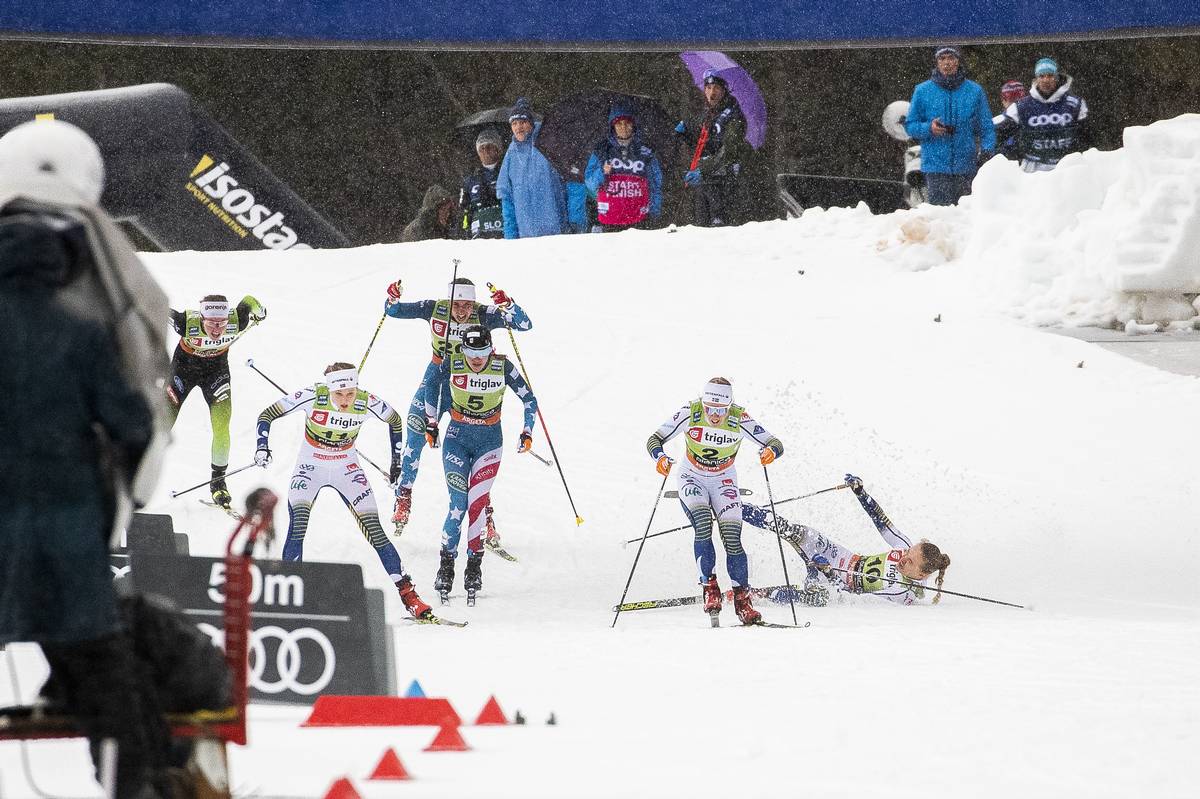
A rainy women’s podium after the 1.2-kilometer skate sprint in Planica, Slovenia. Sweden’s Jonna Sundling took the win followed by her teammate Stina Nilsson. Julia Kern (USA) took third. (Photo: NordicFocus)
Temperatures over 40 degrees Fahrenheit, steady rain that peppered camera lenses, sparse broods of fans huddled under umbrellas, and a ribbon of white farmed snow. After a wintery start to the season in snowy Ruka, Lillehammer, and Davos, athlete’s found their spring-like gear racing the 1.2-kilometer freestyle sprint in Planica, Slovenia. With many “all-arounders” choosing to sit out the sprint focused weekend to rest for the upcoming Tour de Ski, the intimate subset of athletes contained many of the World Cup’s top short track athletes.
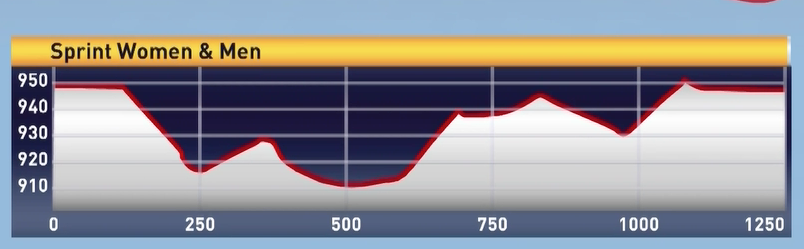
The profile of the 1.2-kilometer sprint course in Planica, Slovenia. (Photo: Screeshot FIS)
Last week’s podium finisher Sophie Caldwell was the fifth fastest qualifier, 0.56 seconds behind top finisher Laurien van der Graaff of Switzerland. Caldwell faced off with Jonna Sundling of Sweden in the first heat of the quarter-finals, leading their peers through a smooth heat and crossing the line 0.03 seconds apart with Sweden in front.
All focus, Sophie Caldwell flies to a fifth place result in qualification during the 1.2-kilometer freestyle sprint in Planica, Slovenia. (Photo: NordicFocus)
Julia Kern crests a hill on her way to a 20th place result in qualification. (Photo: NordicFocus)
Continuing to make a statement that she belongs with the sharp end of the field, Julia Kern qualified in 20th and raced in the fifth heat of the quarter-finals where six unique countries were represented.
After a conservative start, Kern was tucked at the back of the pack at the halfway mark of her quarterfinal, out of trouble when Czech athlete Theresa Beranova lost control on a fast corner and slid off the track. With a high-tempo fury, she surged around the left side at the start of the climb at the 500 meter mark to take control for the second half of the race with Maja Dahlqvist of Sweden.
Attacking on the climb with 200 meters to go, Kern surged again. Her tempo was matched by the Swede’s until Dahlqvist suddenly caught an edge and fell to the ground. Peerless, Kern flew to the finish line, her braid whipping back and forth with each powerful V2 push.
In the semi’s, Caldwell faced a pack of three Swedes, Sundling, last week’s surprise champion Linn Svahn, and 2019 sprint crystal globe winner Stina Nilsson. Also in the first heat was Norway’s top sprinter Maiken Caspersen Falla and Ane Appelkvist Stenseth. Rounding a fast turn, Falla stepped on the tip of Stenseth’s ski and the two tangled to the ground, now out of contention. Caldwell skied to third in the heat, crossing the line in a close finish with Sundling and Svahn. Her time was fast enough to secure a lucky loser spot in the final.
In her semifinal, Kern tucked into the middle of the pack, matching Anamarija Lampic of Slovenia and Johanna Hagstrӧm of Sweden. Repeating the power move that worked in the quarter, Kern seized her opportunity to surge to the front on the climb, maintaining her position over the crest of the hill and down the straight away to the finish solidifying her first spot in a World Cup final. Lampic finished second in the heat (+0.57).
Three Swedes, two Americans, and one Slovenian in the final.
Julia Kern locks eyes on the finish as wins her semi-final heat of the 1.2-kilometer freestyle sprint in Planica, Slovenia. (Photo: NordicFocus)
Racing in front of her home crowd, Lampic took an early lead in the final, tailed closely by her competitors. Just before halfway, Nilsson and Sundling took control on the climb with the Americans following closely.
Anamarija Lampic (SLO) celebrates finishing 5th place in front of a home crowd in Planica. (Photo: NordicFocus)
Coming into the straightaway, Svahn and Nilsson caught ski tips. Svahn lost her balance falling backward just in front of Caldwell, who managed to smoothly dodge the crash, accelerating to the finish.
In a dual with between teammates, Sundling slid her boot across the line for the win, stopping the clock at 2:32.6, Nilsson 0.22 seconds behind.
In a finish line interview, FIS called Sundling’s performance an “adventurous victory” given the weather.
“It was crazy,” agreed Sundling. “It was thunder and rain and now snow.”
Sweden’s Jonna Sundling celebrates her victory after the 1.2-kilometer freestyle sprint in Planica, Slovenia. (Photo: NordicFocus)
Stina Nilsson catches her breath after her second place finish at the 1.2-kilometer skate sprint in Planica, Slovenia. (Photo: NordicFocus)
Powering in their wake, Caldwell and Kern locked eyes on the finish. In the final meters, Kern outmatched Caldwell’s speed, throwing her boot over the line just ahead of her veteran teammate. She finished 0.79 behind Sundling, and Caldwell took 4th (+0.91). Lampic finished 5th (+1.49), followed by Svahn (+48.51) who skied slowly to the line looking furious.
Sophie Caldwell (black headband) congratulates Julia Kern on her first World Cup podium (3rd). (Photo: NordicFocus)
Julia Kern. 22-years-old. First World Cup final, first podium.
The Americans embraced, their backs rising and falling rapidly as they simultaneously laughed and caught their breath.
Kern carried momentum from last weekend’s strong performances in Davos; Kern was 15th in the freestyle sprint and 19th in the 10 k. In her post-race interview, she discusses her mindset as she entered uncharted territory in the final and why she was excited for the suboptimal rainy conditions in Planica. She also shares what’s next for her this season.
Post-race interview with Julia Kern.
An ecstatic Julia Kern celebrates her first podium performance with her coaches after the 1.2-kilometer freestyle sprint in Planica, Slovenia. (Photo: NordicFocus)
Matt Whitcomb provided further insight into Kern’s attitude heading into the race, the tactics the team discussed, and her performance in the heats.
Post-race interview with Matt Whitcomb on Julia Kern’s first podium
Sophie Caldwell gathers herself after racing the 1.2-kilometer skate sprint in Planica, Slovenia. (Photo: NordicFocus)
Post-race interview with Sophie Caldwell
Though her vision of herself has changed over the years, Caldwell identifies short fast courses like Planica as a place she can excel. She shares insight into the course and her tactics, as well as her plans for Christmas and the following weeks.
Sophie Caldwell dodges a crash with less than 200 meters to go in the 1.2-kilometer skate sprint in Planica, Slovenia. (Photo: NordicFocus)
Post-race, Whitcomb analyzed Caldwell’s journey through the heats and her feelings on finishing just off the podium.
Post-race interview with Matt Whitcomb on Sophie Caldwell’s performance.
Canada’s only entrant Dahria Beatty qualified in 29th. She took third in the first heat of the quarter-finals, just over half a second behind Caldwell and Sundling. As her time was not fast enough to earn a lucky loser spot, she did not move onto the semi’s and ended the day in 16th.
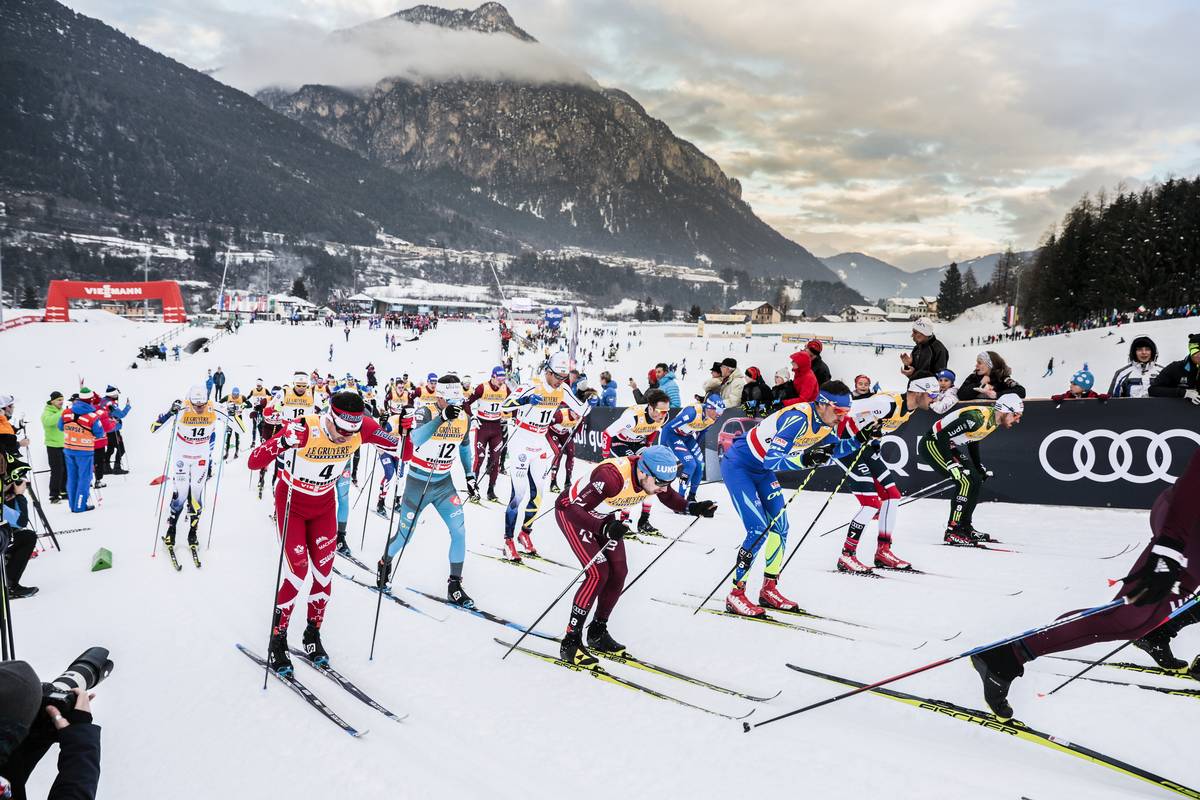
The start of the men’s 15 k classic mass start at Stage 6 of the 2018 Tour de Ski on Saturday in Val di Fiemme, Italy, with (front row, left to right) Canada’s Alex Harvey, Russia’s Sergey Ustiugov, Kazakhstan’s Alexey Poltoranin, Norway’s Martin Johnsrud Sundby, and Switzerland’s Dario Cologna. (Photo: Salomon/NordicFocus)
Beginning this Saturday in Toblach, Italy with a freestyle sprint is the 13th edition of the Tour de Ski (TdS). According to the International Ski Federation (FIS), over the course of seven stages the men will race 80.918 kilometers, the women 60.67 k.
The TdS has become both a staple and a spectacle of the annual World Cup calendar. With a jam-packed series of races primacy is placed on both the ability to recover well and wither less as the TdS transpires.
Prognostication can be tricky in a long-form template like the TdS. So much can go astray during seven races not to mention the travel and dicey germ-avoidance.
Last season’s winner on the women’s side, Heidi Weng of Norway, sits 18th overall in the World Cup standings (14th in distance). She has four top-20’s in the four distance events she’s contested with her best result an eighth in Lillehammer’s 10 k skate. Although featuring two sprints in the first three stages, the TdS remains a distance skier’s paradise.
Weng has skied solidly on the World Cup, but she has yet to show the form that made her a TdS overall winner in 2017 and 2018. Norway has won the last five iterations of the TdS: Marit Bjørgen won once in 2014/2015, Therese Johaug twice (2013/2014, 2015/2016), and Weng the last two years.
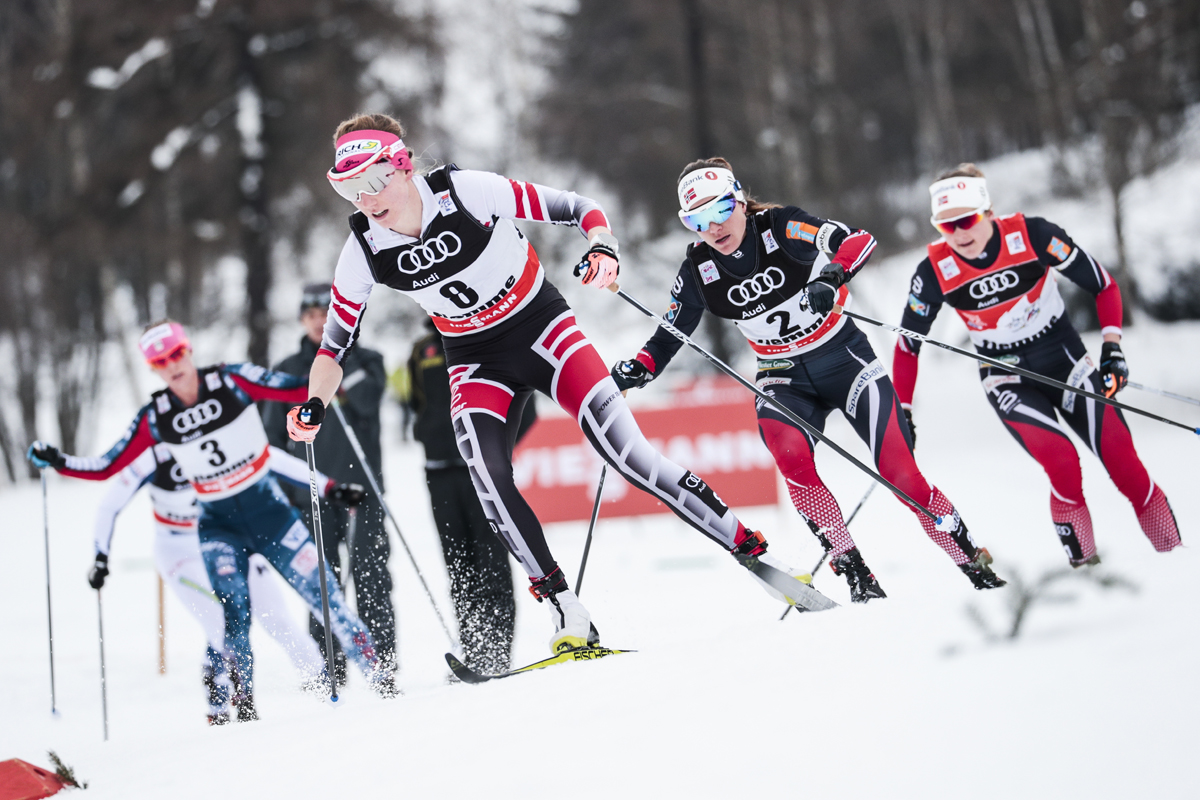
Austria’s Teresa Stadlober leads Norway’s Heidi Weng (2) and Ingvild Flugstad Østberg, American Jessie Diggins (3) and others around a downhill corner during the women’s 10 k classic mass start at Stage 6 of the 2018 Tour de Ski in Val di Fiemme, Italy. (Photo: Fischer/NordicFocus)
If Norway is to keep the streak alive, Ingvild Flugstad Østberg, last year’s TdS runner up, could be the heir apparent. She currently ranks second in the World Cup overall and 15th on the sprint list.
Johaug, having returned from an 18 month doping ban, has been on a distance race tear. She has won all five World Cup distance events this season. Johaug, however, will not be lining up for the TdS.
Only five different women have earned distance podiums this season — Johaug, Østberg, Sweden’s Charlotte Kalla and Ebba Andersson, and Finland’s Krista Pärmäkoski. Along with Johaug, Kalla and Andersson are skipping the TdS. (Andersson sits third overall on the World Cup, Kalla fifth.) With the TdS missing three of the five top ranked World Cup distance skiers, daily stages and the overall podium are up for grabs.
Last season’s third overall finisher, Jessie Diggins of the U.S. Ski Team (USST), often cites the TdS as a point in the season when her form trends towards podium performances. She sits eighth in the current distance standings and could very well have a stout TdS.
Russia’s Natalia Belorukova and Yulia Nepryaeva look strong as does Sadie Bjornsen (USST), and Austria’s Teresa Stadlober.
With less than predictable distance stage podiums for the women, it may simply come down to a drag race on the Alpe Cermis final climb Jan. 6.
Switzerland’s Dario Cologna (c) celebrates his fourth Tour de Ski overall title. He was joined by Norway’s Martin Johnsrud Sundby (l) and Canada’s Alex Harvey (r) on the podium in second and third, respectively. (Photo: Fischer/NordicFocus)
The men’s scene is also open to interpretation. Last season’s TdS winner, Switzerland’s Dario Cologna, was in fact a surprise victor. Prior to Cologna’s stage two win in last year’s TdS, it had been nearly three years since the four time TdS overall winner had won a World Cup. Cologna sits 21st overall on the World Cup currently. Given last year’s resurgence, anything is possible for the Swiss skier.
Then there’s Martin Johnsrud Sundby form Norway. He finished on the TdS podium the last three years. At thirty-four-years-old, Sundby is ranked first on the distance list, with a second, a third, and a fourth place in distance races this season.
Sundby won the TdS on two occasions – in 2013/2014 and in 2016. His 2015 win was stripped after he tested positive for excessive levels of Salbutamol. He placed second in the past two Tours.
In a field rife with talent, Sundby’s ability to race and rebound and race and rebound will be tested. Sjur Røthe, Emil Iversen, and Didrik Tønseth— all from Norway— look in form. And there’s Norway’s Johannes Høsflot Klæbo. The winner of last season’s overall World Cup has had flashes of his past explosive self. He could be a TdS protagonist.
The men’s field is notably tight. Along with the Norwegians, several Russians could pop a podium, a stage win, and the overall. Russia comes with a loaded team ready to exploit. Alexander Bolshunov leads the overall World Cup – he’ll turn twenty two on Dec. 31st. He’s backed by teammates Evgeniy Belov, Andrey Melnichenko, and Denis Spitsov.
Canada’s Alex Harvey placed third overall last year and he looked stronger as the TdS progressed.
The Stages
Stage 1: Dec. 29, skate sprint in Toblach, Italy.
Stage 2: Dec. 30, 10 k/15 k skate in Toblach, Italy.
Stage 3: Jan. 1, skate sprint in Val Müstair, Switzerland.
Stage 4: Jan. 2, 10 k/15 k classic mass start in Oberstdorf, Germany.
Stage 5: Jan. 3, 10 k/15 k skate pursuit in Oberstdorf, Germany.
Stage 6: Jan. 5th, 10 k/15 k classic mass start in Val di Fiemme, Italy.
Stage 7: Jan 6th, 9 k final climb skate pursuit in Val di Fiemme, Italy.
Teams
United States
Women: Sophie Caldwell, Sadie Bjornsen, Jessie Diggins.
Men: Ben Lustgarten, Simi Hamilton, Erik Bjornsen, Kevin Bolger.
U.S. Ski Team Head Coach Chris Grover noted in a text that Caldwell, Hamilton, and Bolger will likely cease the TdS after the stage three sprint. Additionally, this is a small team for the U.S. at the TdS. Several athletes turned down TdS nominations including Scott Patterson (USST), Andy Newell (SMS T2/Salomon), Kyle Bratrud (SMS T2), Rosie Brennan (APU), Rosie Frankowski (APU), Caitlin Patterson (CGRP), and Julia Kern (SMS T2). These skiers plan on racing U.S. Nationals this January in Craftsbury, Vermont.
Canada
Women: Emily Nishikawa, Dahria Beatty
Men: Alex Harvey, Lenny Valjas, Bob Thompson
Norway
Women: Ingvild Flugstad Østberg, Maiken Caspersen Falla, Astrid Uhrenholdt Jacobsen, Kari Øyre Slind, Kathrine Rolsted Harsem, Heidi Weng, Lotta Udnes Weng, Tiril Udnes Weng Mari Eide, Anna Svendsen
Men: Martin Johnsrud Sundby, Hans Christer Holund, Emil Iversen, Didrik Tønseth, Simen Hegstad, Krüger, Sjur Røthe, Johannes Høsflot Klæbo, Martin Løwstrøm Nyenget, Eirik Brandsdal, Finn Hågen Krogh
Russia
Women: Yulia Belorukova, Lidia Durkina, Anna Zherebyateva, Mariya Istomina, Natalia Nepryaeva, Anna Nechaevskaya, Anastasia Sedova, Elena Soboleva
The photo finish for first between Switzerland’s Dario Cologna (near) and Norway’s Martin Johnsrud Sundby at the 2018 Holmenkollen 50 k freestyle mass start in Oslo, Norway. Cologna got it by 0.01 seconds. (Photo: FIS Cross Country/Twitter)
Welcome to FasterSkier’s World Cup Preview, where we check in with the top-10 teams from last year’s FIS Cross Country World Cup tour before the season starts with the Ruka weekend in Kuusamo, Finland, on Nov. 24 with a classic sprint.
***
Switzerland
Overall in Nations Cup Last Year: 6th
Women’s Ranking 2017/2018: 7th
Men’s Ranking 2017/2018: 4th
However lopsided Switzerland World Cup profile appears – think Dario Cologna prime time all the time – the team is more than a set of shoulders to carry its star. Certainly, Cologna can steal the show, as his return to form last season proved, but the Swiss collective of athletes proved their World Cup mettle in 2017/2018.
Twenty-five-year-old Nathalie Von Siebenthal arrived on the World Cup in-form. In Ruka, the start of last year’s World Cup, she placed sixth in the 10-kilometer freestyle pursuit. Between Ruka and the Olympics, Siebenthal raced to numerous top-10’s in distance events while placing eighth overall in the Tour de Ski (TdS).
Switzerland’s Nathalie von Siebenthal racing the second-fastest third leg of the women’s 4 x 5 k relay at 2017 World Championships on March 2 in Lahti, Finland. Her team finished seventh.
In PyeongChang, Siebenthal was able to bring the Swiss team near the front of the women’s distance race pack. In the 15 k skiathlon, Siebenthal placed sixth overall, 2.9 seconds behind fifth place Jessie Diggins (USST) who was dialed for a stellar Games. In the individual start 10 k skate, Siebenthal again was sixth.
Nadine Fähndrich, at twenty three years old, should help the Swiss women’s team build upon last year’s solid performance. By season’s end, Fähndrich was ranked 21st on the sprint list and 31st on the distance list. She finished 27th overall on the World Cup.
The Swiss women’s team gets deeper. There’s veteran skier Laurien van der Graaf who had several top-10’s on the World Cup and Olympics. She won the Lenzerheide, Switzerland and Seefeld, Austria skate sprints, was the fifth ranked sprinter in the world last season, and 21st overall.
Cologna is back: Second in the final overall standings, first in distance. Let’s just say he’ll round out an already well-rounded Swiss team.
Jovian Hediger, at twenty-seven, will take some of the pressure off Cologna when it comes to the Swiss men’s expectations. He finished the season ranked 19th in the sprint cup.
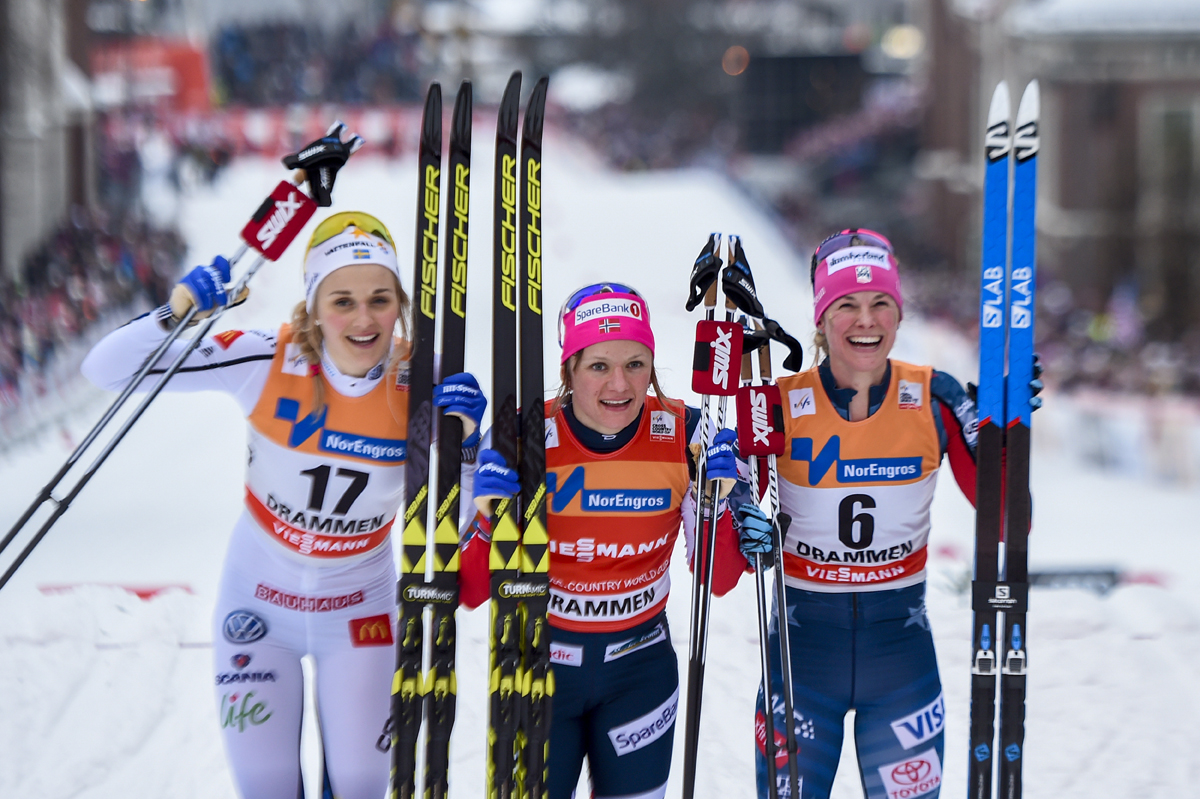
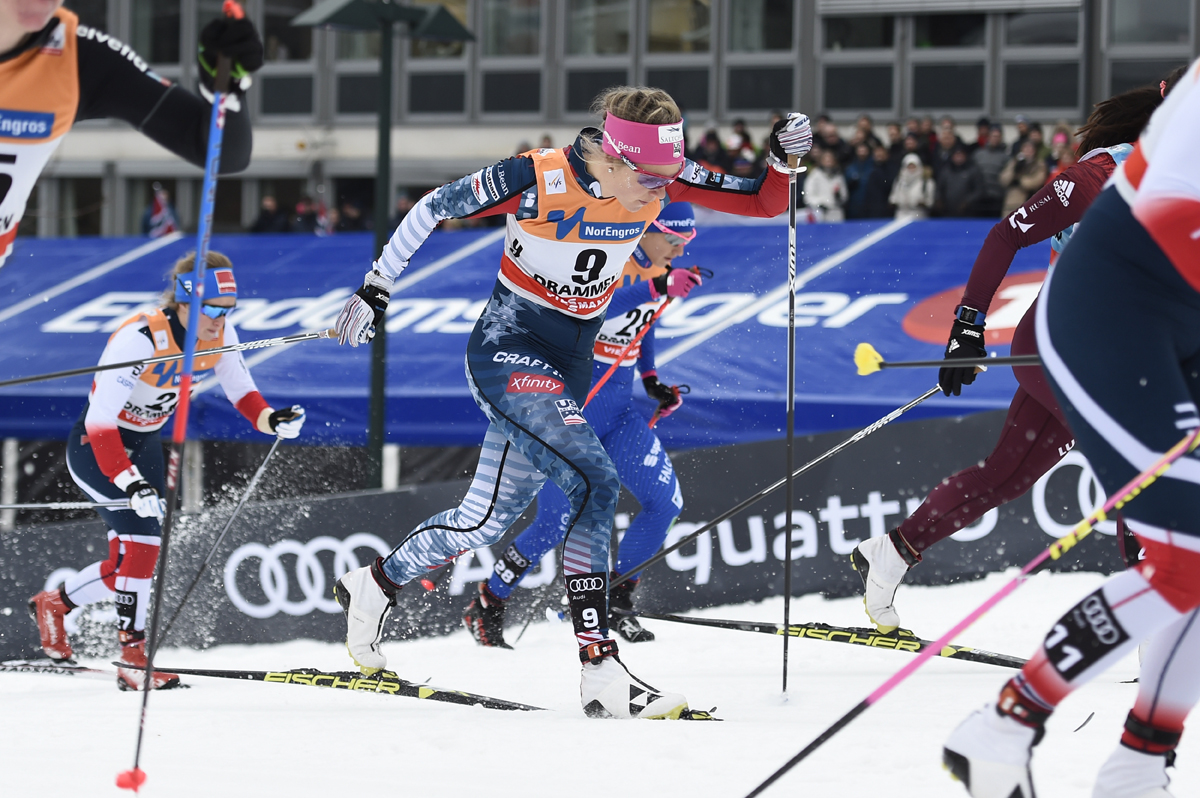
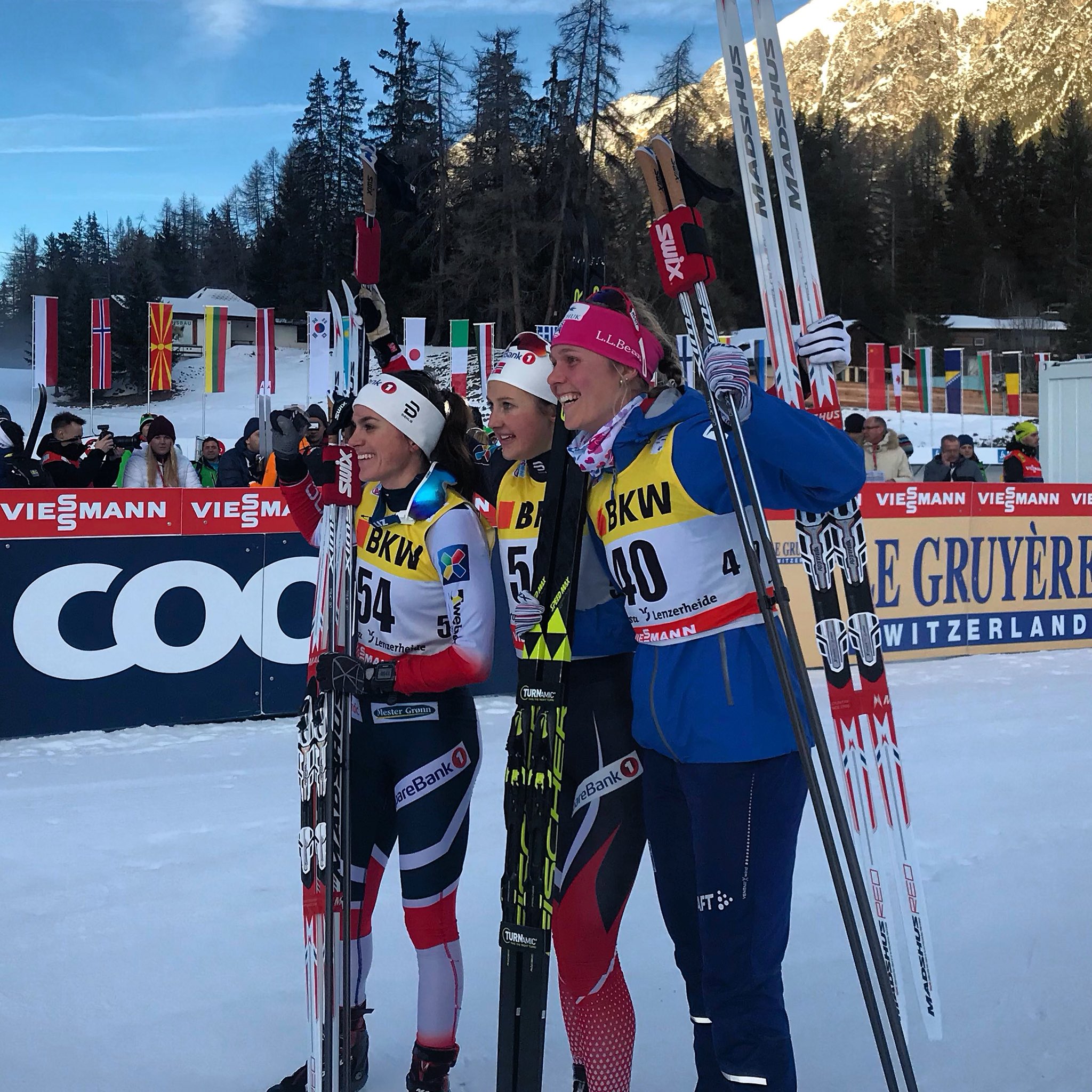
The women’s classic sprint podium at the World Cup in Drammen, Norway, with Norway’s Maiken Caspersen Falla (c) in first, Sweden’s Stina Nilsson (l) in second, and American Jessie Diggins (r) in third. (Photo: Fischer/NordicFocus)
DRAMMEN, Norway — Barring the spectators cheering from their apartment balconies, the most marked aspect of Wednesday’s 1.2-kilometer classic sprint course was the finish line. It crosscut the top of a 15-meter climb.
Throughout the day, no skier closed out Drammen’s uphill finish better than Norway’s Maiken Caspersen Falla. After winning the day’s qualifier in a time of 3:19.44 minutes, Falla won her quarterfinal in photo-finish fashion and outlunged Sweden’s Stina Nilsson to place first their semifinal.
In the final, Falla once again proved her form in the uphill. She strode past Russia’s Natalia Nepryaeva and Nilsson to take the win in a time of 3:10.18. The closest any competitor came to the Norwegian was Nilsson, 1.39 seconds back.
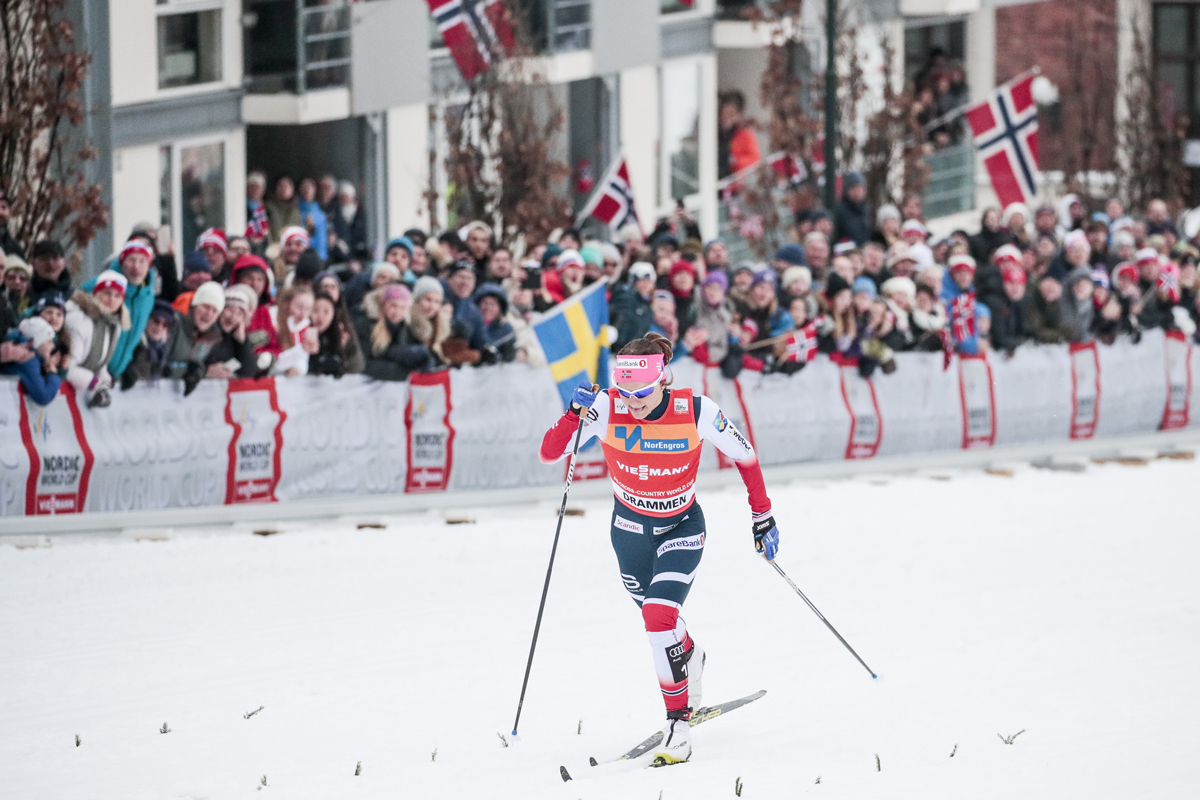
Norway’s Maiken Caspersen Falla en route to her second-straight World Cup victory in Wednesday’s classic sprint in downtown Drammen, Norway. (Photo: Fischer/NordicFocus)
The first-place success in Drammen is Falla’s standard. From 2014 to 2016, she won three World Cup sprint races held in the city, all of them classic. (Falla missed qualifying by one place in 31st in last year’s Drammen classic sprint.)
“It’s my fourth win here and I am so happy with the way I am feeling,” Falla said, according to an International Ski Federation (FIS) press release. “I think my battery is finally fully charged. I was a bit tired after the Olympics and I haven’t trained very much. But I can feel that my body is back and it’s great to get another win here and almost secure my third Crystal Globe.”
Falla now leads the Sprint World Cup with 543 points, while Nilsson trails in second by 48 points. Only one sprint race remains this season, a freestyle competition that is featured in next weekend’s World Cup Finals in Falun, Sweden. With her second-place finish on Wednesday, Nilsson could still snag the Sprint Crystal Globe from Falla, as 50 points remain for a win in that race.
“I didn’t qualify so well so I was a bit worried about how today would go,” said Nilsson, who qualified in 17th, according to a FIS press release. “Maiken was just too strong for me today but I am happy that I felt better and better as the rounds happened today … and in the end I can say that I am satisfied.”
In a dramatic closeout, U.S. skier Jessie Diggins came from behind to claim third (+1.88), despite appearing out of podium contention with 150-meters to go. The American’s advancement to the final itself was up in the air until the jury ruled a technical violation for Switzerland’s Nadine Fähndrich.
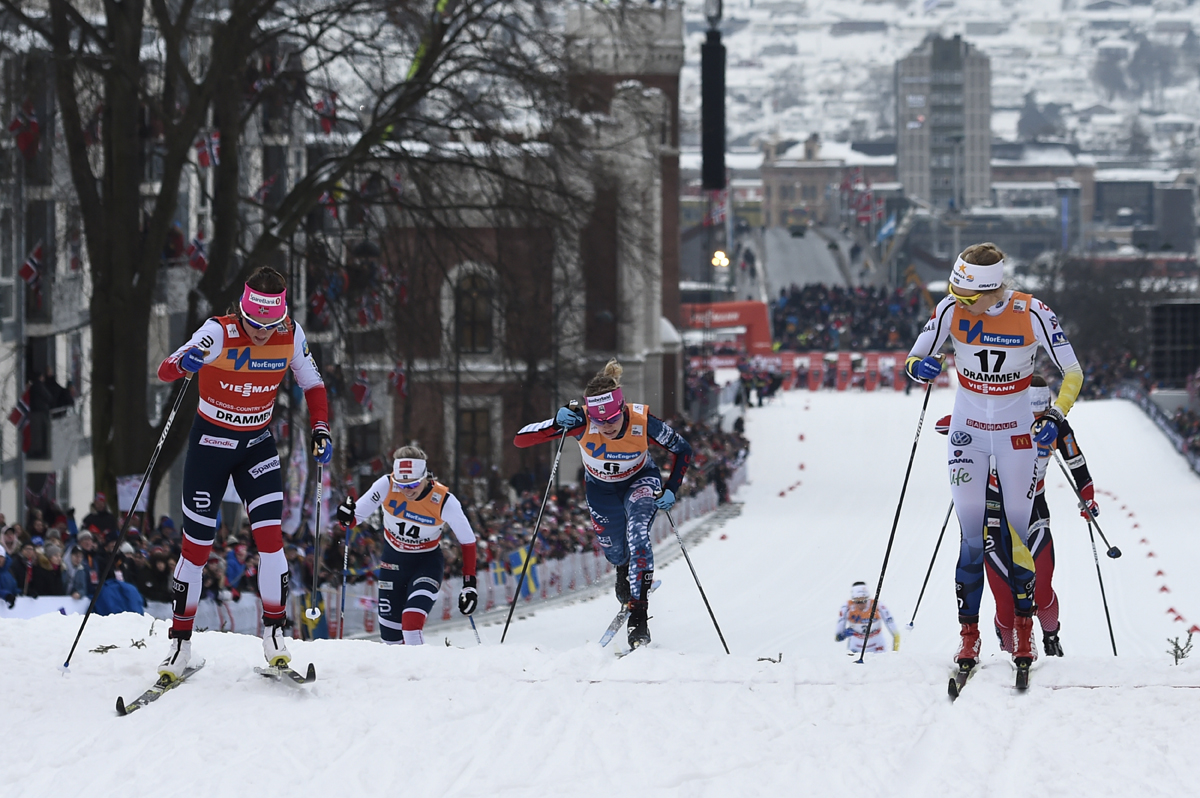
Norway’s Maiken Caspersen Falla (l) winning the first semifinal of the Drammen World Cup classic sprint in Norway on Wednesday, ahead of Sweden’s Stina Nilsson (r) in second and American Jessie Diggins (c) in third. Norway’s Ingvild Flugstad Østberg (behind Nilsson) finished fourth and Thea Krokan Murud (14) was fifth in that heat. (Photo: Fischer/NordicFocus)
After racing in semifinal 1, Diggins finished in third behind Falla and Nilsson. Semifinal 2 was the faster of the two semis, and produced the day’s two Lucky Losers before Fähndrich’s yelllow card. The Swiss skier lost her automatic qualification spot, giving Diggins a shot as the final lucky loser in the final.
At the start of the women’s final, the American was positioned in sixth, trailing Slovenia’s Katja Visnar in fifth, Finland’s Krista Pärmäkoski in fourth, Nilsson in third, Nepryaeva in second, and Falla in first. While she had burned off the front in the start of her quarterfinal, Diggins played a safer start in the final.
“Last year [in Drammen] I got swallowed up in the draft and then broke my pole,” Diggins told FasterSkier during an in-person interview after. “So this year I was trying to be really smart, be aware of where other bodies were and keep myself out of any tangles; just ski a smart, clean race.”
“In the final I started out in the back thinking ‘OK, just ski relaxed, stay in contact,’ ” she continued. “Then I was really able to go for it and put the hammer on in the last 50 meters.”
Taking the opposite tactic of Diggins, Falla forced a fast pace in the front. By the top of the first climb the Norwegian had a one-meter gap over Nilsson and Nepryaeva, who were positioned in second and third, respectively. Another half meter behind the Russian and Swede were Diggins and Pärmäkoski.
Heading into the descent, Falla held her capacious lead. About a meter behind the Norwegian, Nepryaeva slid ahead of Nilsson. Diggins, who had surged around Pärmäkoski on the hill’s crest, took a few double poles midway through the descent’s two twists in an attempt to close the gap separating her from the top three.
By the bottom of the hill, Nepryaeva had closed in on Falla. The Russian and Norwegian went head-to-head as they approached the course’s final hairpin turn. Chasing the backs of their ski tails was Nilsson. Fighting to hold onto Nilsson was Diggins.
Coming out of the hairpin, Russia had the lead, followed closely by Norway and Sweden. The American clung tenaciously, though now two ski lengths behind the finals top three leaders with less than 150-meters to go.
“Admittedly I have to say that while I will never count Jessie out, it certainly looked like she was on her way to fourth,” U.S. Ski Team Women’s Coach Matt Whitcomb told FasterSkier during an in-person interview. “I think she surprised just about everyone out there today.”
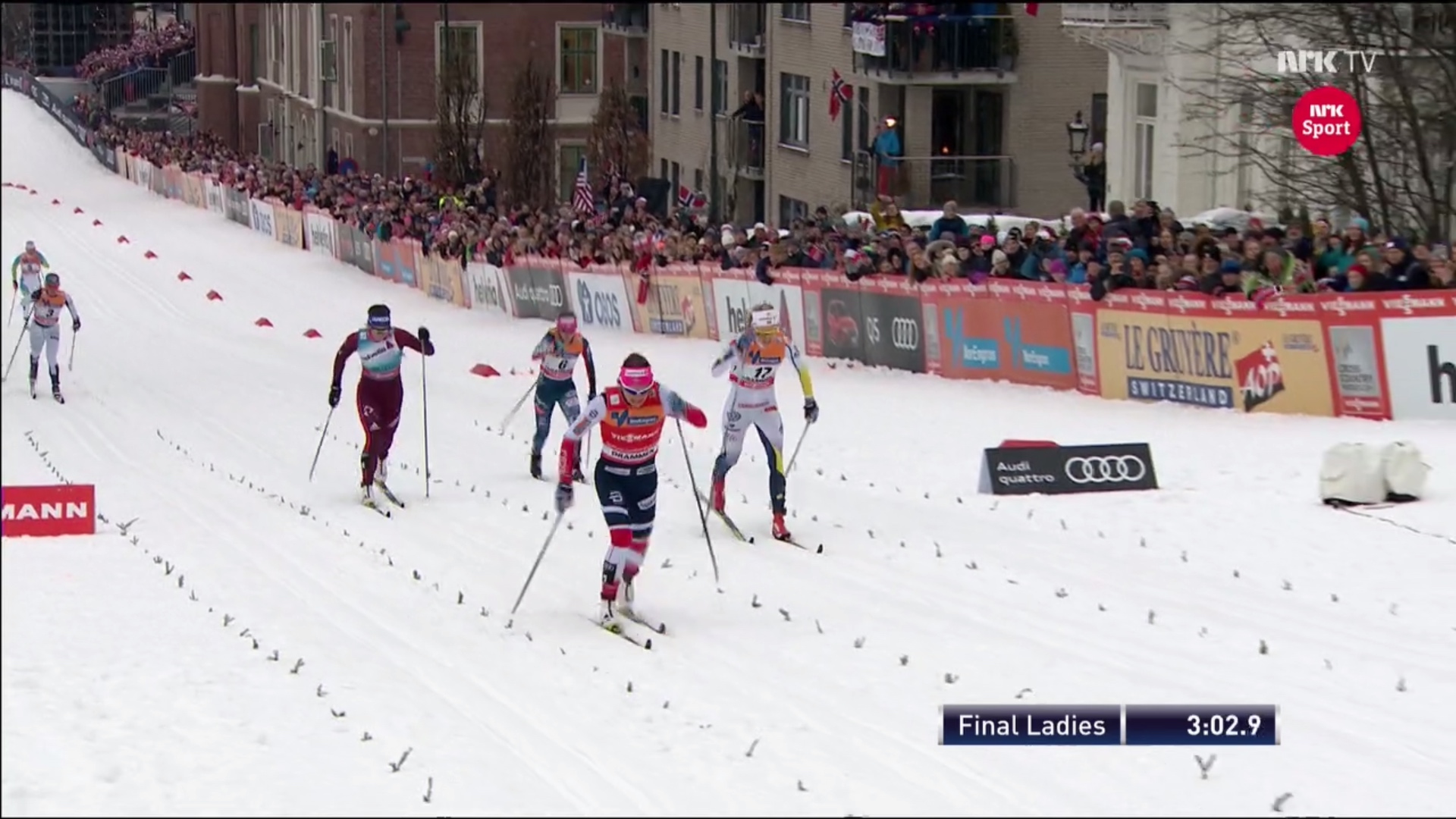
Norway’s Maiken Caspersen Falla leads Sweden’s Stina Nilsson (r) ahead of Russia’s Natalia Nepryaeva (third from left) and American Jessie Diggins (third from right) during the women’s 1.2 k classic sprint final on Wednesday at the World Cup in Drammen, Norway. (Screenshot: NRK broadcast)
In the final climb, Falla was the first to pass Nepryaeva on the left. Nilsson followed suit, and then Diggins. By a mere 0.44 seconds, Diggins edged Nepryaeva, earning her first World Cup classic sprint podium.
“It was so cool because classic sprinting — especially on a course like this, in deep sugary snow that is falling apart — is arguably my all-time weakest event; to be able to finally get a podium, that’s something I’ve been after for many years,” Diggins said.
Wednesday’s classic sprint was Diggins’s first race back since last month’s Olympics in PyeongChang, South Korea. Following the Games, she and her teammate Kikkan Randall returned to the U.S. for what Whitcomb referred to as essentially a “media tour” thanks to the duo’s Olympic gold medal in the team sprint. Both returned to Europe last weekend, though neither raced the World Cup races that took place in Lahti, Finland on Saturday and Sunday.
“Not for a minute, when we saw them after we arrived from Lahti, did we think that was a mistake,” Whitcomb said of the decision for Diggins and Randall to return to the U.S. “At the end of the day, had it been a mistake, we didn’t care. We wanted that story told.”
“I think it was really important that I had that rest. I clearly needed it and I was able to come back feeling snappy,” Diggins added.
Diggins is now ranked third in the Overall World Cup standings, 375 points behind Norway’s Heidi Weng in first and 179 points behind Norway’s Ingvild Flugstad Østberg in second. She is 35 points ahead of Pärmäkoski in fourth.
Following Diggins on Wednesday, Nepryaeva crossed in fourth (+2.32), Pärmäkoski fifth (+8.85) and Visnar sixth (+20.70).
Rounding out the top 10 was Sweden’s Hanna Falk in seventh, Østberg in eighth, Norway’s Tiril Udnes Weng in ninth, and Norway’s Thea Krokan Murud in 10th.
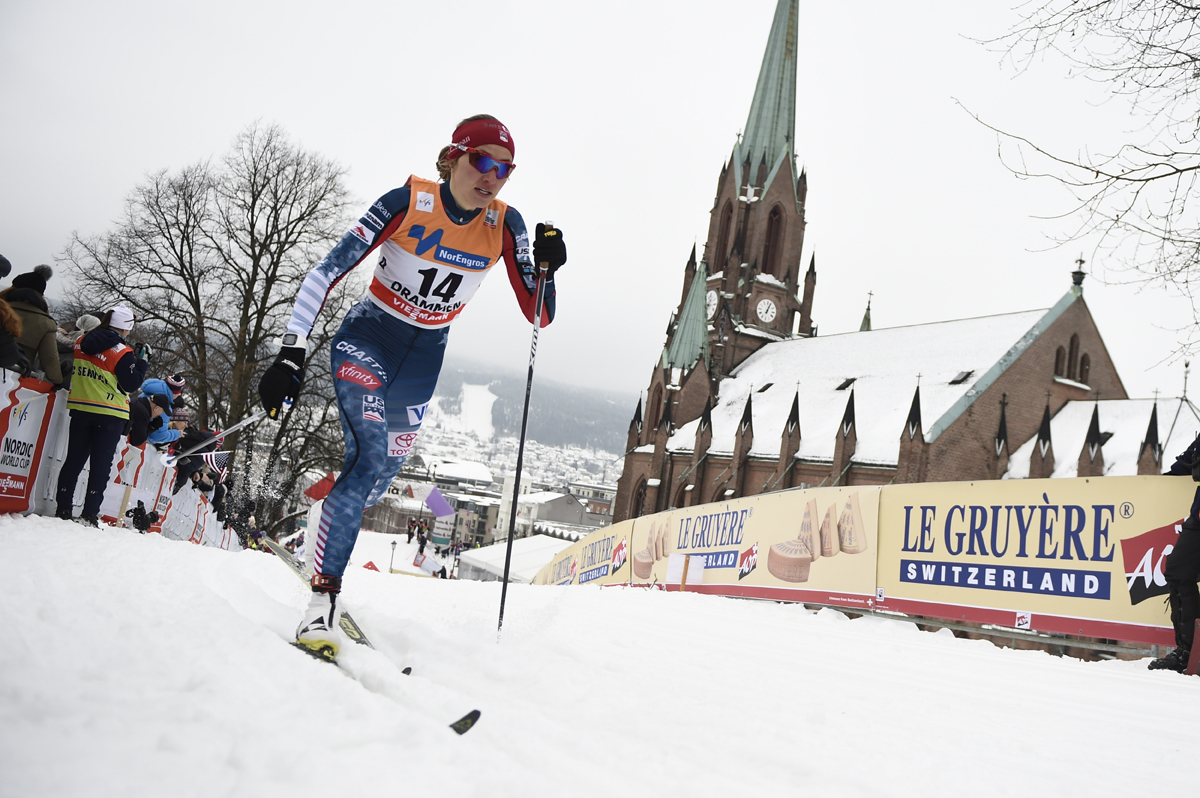
Sadie Bjornsen (9) racing to fifth in her quarterfinal for 21st overall in the women’s classic sprint at the World Cup in Drammen, Norway. (Photo: Fischer/Nordic Focus)
Two more Americans qualified for Wednesday’s classic sprints, with Sadie Bjornsen placing 21st after finishing fifth in her quarterfinal, 9.24 seconds behind Fähndrich in first. Sophie Caldwell raced in the first quarterfinal with Falla, where she finished sixth, 10.6 seconds back, for 27th overall.
U.S. skier Ida Sargent finished 47th in the qualifier, followed by Rosie Brennan in 48th, Randall in 50th, and Kaitlynn Miller in 53rd.
Canada’s Emily Nishikawa placed 52nd and Dahria Beatty 55th.
— Chelsea Little, Harald Zimmer and Alex Kochon contributed
Sophie Caldwell racing to 20th in the qualifier of the women’s classic sprint at the World Cup in Drammen, Norway. She went on to place 27th overall after finishing sixth in her quarterfinal. (Photo: Fischer/NordicFocus)
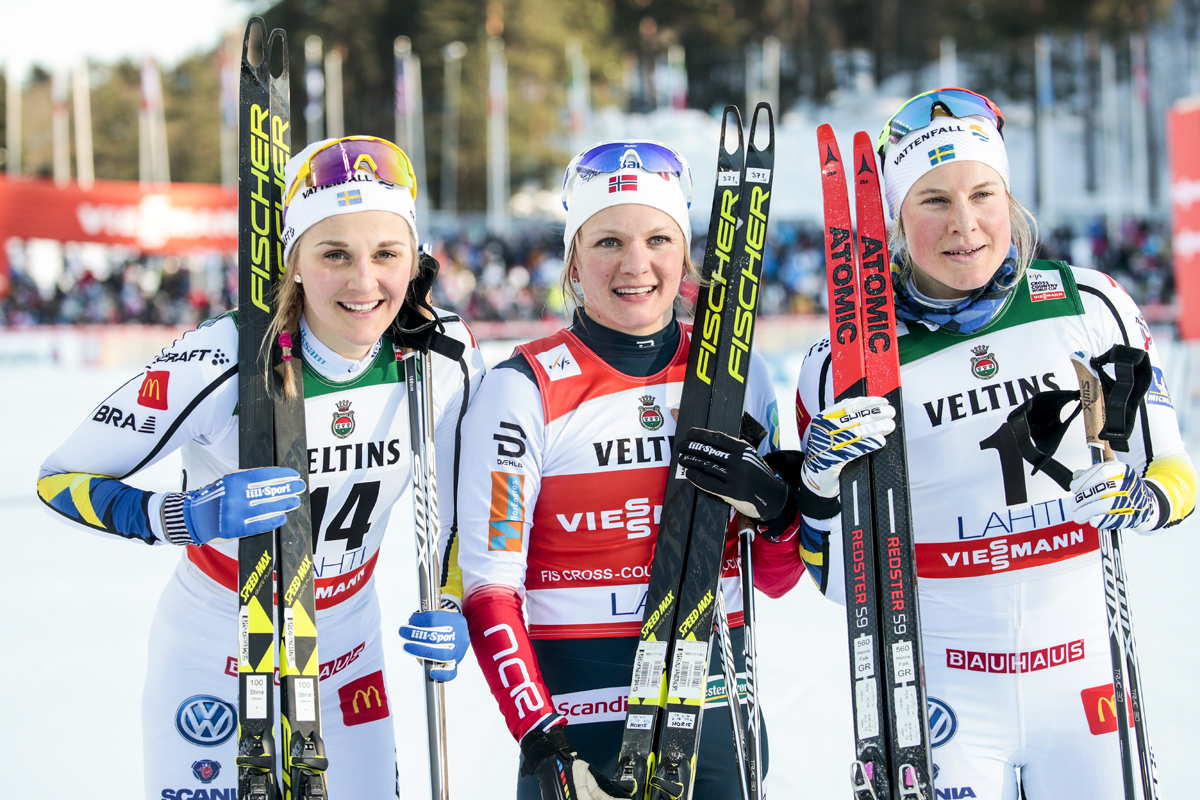
The women’s 1.4 k freestyle sprint podium at Saturday’s World Cup in Lahti, Finland, with Norway’s Maiken Caspersen Falla (c) in first, and Sweden’s Stina Nilsson (l) and Hanna Falk (r) in second and third, respectively. (Photo: Fischer/NordicFocus)
Eight points. That’s the number that separated Norway’s Maiken Caspersen Falla and Sweden’s Stina Nilsson in the Sprint World Cup standings before Saturday’s freestyle sprint in Lahti, Finland.
Three sprints. That’s the number of World Cup sprint races that remained in the 2017/2018 calendar, one of which took place on Saturday.
With one down and a classic sprint and skate sprint to go, Falla’s lead has grown to 28 points. It’s not much, with 150 sprint points remaining in the two remaining races (100 for winning the Drammen classic sprint and 50 for winning the skate sprint at World Cup Finals in Falun), but she’s getting there. Let’s just say neither of these two women can afford to skip a sprint.
Coming off her last race of the Olympics, the team sprint (where Norway took bronze behind the U.S. and Sweden), Falla had 10 days to recover before Lahti. Nilsson had six days after notably racing to third in the 30-kilometer classic mass start on the last day of the 2018 Winter Games in PyeongChang, South Korea.
Six time zones away from Korea in Finland, Falla and Nilsson faced off once again, but instead of racing for gold (which Nilsson had claimed in the Olympic classic sprint), they’re in a race for the Sprint Crystal Globe (of which Falla is the two-time defending champion).
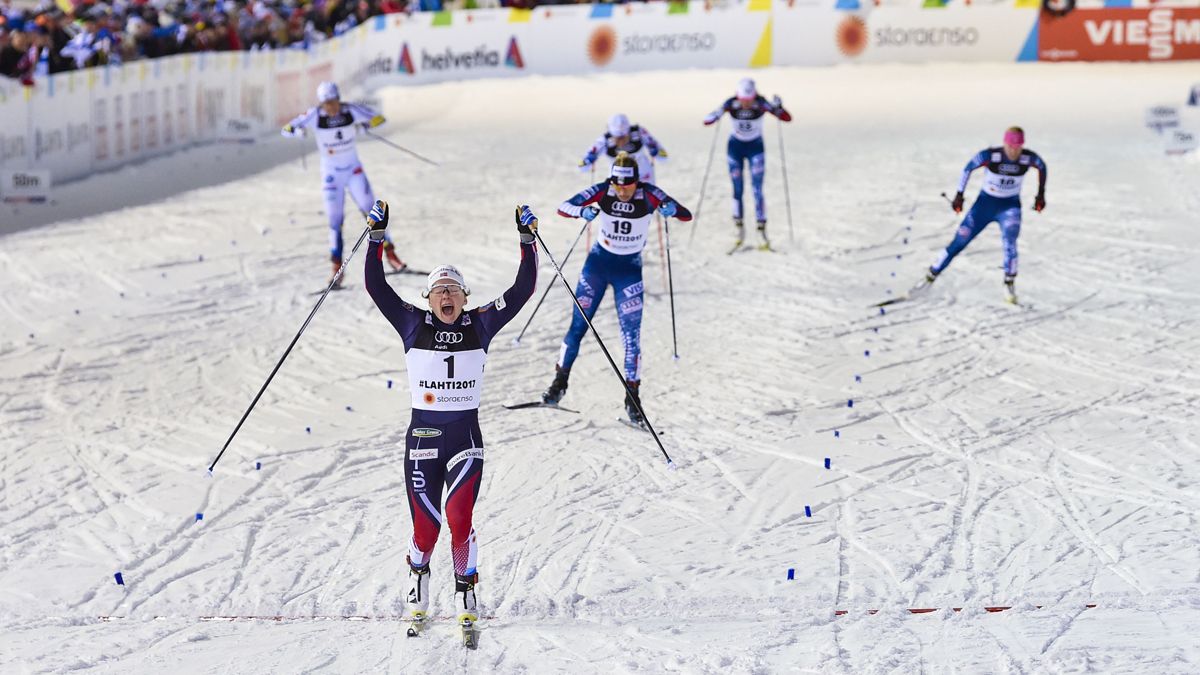
Norway’s Maiken Caspersen Falla celebrates her gold medal in the 2017 World Championships freestyle sprint in Lahti, Finland, ahead of Americans Jessie Diggins (19) and Kikkan Randall (r), who placed second and third, respectively. The third U.S. woman in the final, Sophie Caldwell (second from r) finished sixth. (Photo: Fischer/NordicFocus)
As alluded to, Falla had the edge on Saturday, winning the women’s 1.4 k skate sprint by 0.36 seconds over Nilsson in 2:54.83 minutes. She did it by leading from start to finish — a tactic she hadn’t necessarily planned nor desired —on the same course that she won on at World Championships last year. In that skate sprint, Falla bested Americans Jessie Diggins and Kikkan Randall for gold. Diggins and Randall placed second and third in that race, respectively, but the two did not contest Saturday’s sprint in Lahti. Instead, they were coming off a New York City media tour that involved several appearances with major TV networks.
But back to Falla. The 27-year-old left her competition chasing on Saturday, advancing to the final after placing second in her quarterfinal (0.71 seconds behind Nilsson) and first in the first semifinal (just 0.04 seconds ahead of Nilsson in second place).
She had qualified for the heats in 12th, 7.96 seconds off of the top time of 2:54.72 set by Sweden’s Hanna Falk.
“I was really stressed in the prologue,” Falla said afterward, according to an International Ski Federation (FIS) press release. “In the heats I had a better feeling.”
She had to fend off three Swedish heavy hitters in the final: Nilsson, Falk and Ida Ingemarsdotter.
But Falla never let any of them get ahead of her — an impressive feat on Lahti’s sprint course with two major climbs. The lone Norwegian in the final, Falla jetted out of the gate and into the lead, with Falk quick to challenge her before the first uphill. But Falla stayed ahead.
“I didn’t want the first position, but I just got it in the start,” Falla told FIS in a televised post-race interview. “So I just had to lie in front and do the best I could.”
While Falla continued to drive the pace, Sweden’s Falk took a breather near the back while Ingemarsdotter and Nilsson slotted into second and third. Germany’s Sandra Ringwald, in her first World Cup sprint final since the Tour de Ski in late December, skied in fourth, ahead of Falk and Switzerland’s Laurien van der Graaff.
Norway’s Maiken Caspersen Falla celebrates her win in the women’s 1.4 k freestyle sprint on Saturday at the World Cup in Lahti, Finland. (Photo: Fischer/NordicFocus)
Falla led the downhill then into last long, multi-tiered climb, while the three Swedes assembled hungrily behind her. Nilsson began her attack when they hit the steepest section near the top, but Falla was at least a step or two ahead as they rounded the 180-degree turn and began to descend down the other side.
Tucking into the stadium, Falla got low and used her fast skis to gain a few more meters on Nilsson. She then took a couple of strides to keep her momentum and finally launched her final V2 push toward the finish.
No one could match her; not Nilsson skiing closest to her, nor Falk or Ringwald just behind. She didn’t even have to lunge to secure the victory over Nilsson, but Falk and Ringwald did as they placed third (+0.78) and fourth (+0.88), respectively. For Ringwald, fourth place marked her best individual World Cup result in a little over a year (after she placed fourth in a 2017 skate sprint in Toblach, Italy).
For Falla, it was her second individual World Cup win of the season and first victory since Dec. 2 in Lillehammer, Norway, where she won the classic sprint. Falla was the 2014 Olympic champion in the individual skate sprint. And let’s not forget, she won the World Championships sprint in Lahti last year as well as the 2016 Lahti World Cup skate sprint.
“Last year here and also two years ago I was in front down the last downhill, and I succeeded there for the last three years so I knew it is very possible to lie in front as well,” Falla told FIS. “In the final I had Stina and Hanna behind me and I knew both of them are really fast. I have a big respect for them and I am very happy I could win today.”
Nilsson, who bested Falla for the classic-sprint gold medal in PyeongChang, had qualified for Saturday’s heats in 14th, 8.26 seconds out of first.
“I felt pretty good in the prologue, but in the end I was missing some seconds, which I probably lost after the start,” she told FIS. “In the heats I found my pace and I could keep all the way through to the final. In the final, I was not so fast after the start but I am happy to be on the podium again. It is very good for the sport that the battle for the Sprint Crystal Globe is still going.”
Falk also said she was satisfied with her end result, after winning her quarterfinal and advancing as a lucky loser in third in the semifinal with Falla and Nilsson.
“I had a very good qualification,” Falk told FIS. “I tried to fight in every heat. The final was hard but I am happy to be third today. I had a good speed before the last corner but it was always tight there. It was a tough fight between me and Sandra [Ringwald]. I’m happy to be third.”
Sadie Bjornsen (U.S. Ski Team) qualified fifth in the women’s 1.4 k skate sprint at the World Cup in Lahti, Finland, and went on to finish 17th overall. (Photo: Fischer/NordicFocus)
Four Americans in Top 30
Leading the Americans in the qualifying round was Sadie Bjornsen in fifth, 3.88 seconds off Falk’s fastest time. Sophie Caldwell qualified in 17th, Ida Sargent advanced in 21st and Rosie Brennan followed in 29th.
For Brennan, it was her first time back in the heats in about two months after she qualified in 21st in the Tour de Ski classic sprint on Oberstdorf, Germany. While the heats were canceled that day due to a storm, Brennan went on to finish the Tour in 24th overall. Since then, however, the U.S. Ski Team (USST) member has finished outside the top 40 in four World Cup races and one Olympic event (the 15 k skiathlon).
Despite finishing sixth in her quarterfinal on Saturday, 4.91 seconds behind Ingemarsdotter in first, Brennan’s overall result of 29th indicated she was back on track.
“I have been struggling with health and recovery since the tour,” Brennan wrote in an email to FasterSkier. “I’ve just been taking things day by day and trying to work through whatever issue I am facing. The Olympics was a huge disappointment for me. I did what I thought was best to prepare for the games, but have struggled with my health and my body and as a result was far from where I wanted to be at that time.”
In PyeongChang, she raced one event — the skiathlon — and placed 58th. She stayed with the team for the duration of the Games, hoping to have the opportunity to race the 30 k. But that wasn’t in the cards.
“It’s very challenging to be at the games and not be participating in the events that you have trained for over so many years,” Brennan reflected. “I have had some good races this year and have made some improvements so I am doing my best to remember that and try to see each day as a new opportunity. My goals moving forward are more about my feelings, my body, and my health than any results. I am very happy to have made a step forward today and am hoping my distance skiing will see the same results. I wasn’t able to ski my quarterfinal as well as I would have liked, but it’s been awhile since I’ve raced now so to just get another stab at it was a great step forward.”
Sophie Caldwell (U.S. Ski Team) racing to 17th in the Lahti skate sprint qualifier. She went on to reach the semifinals and place eighth overall. (Photo: Fischer/NordicFocus)
Out of the four Americans in the quarterfinals, Caldwell was the lone U.S. woman in the semifinals. She had raced to second in her quarterfinal, finishing 0.25 seconds behind Ringwald, who won that heat. But her road there wasn’t an easy one, as Caldwell skied up from near the back of the pack into second coming out of the final downhill. There, she scooted ahead of Norway’s Heidi Weng, who had been second at the time, while Weng dropped to last in the heat.
“… I had the ambition to do well, and it’s incredibly annoying when something like that happens,” Weng said, according to a loose translation.
She added that she didn’t discuss it with Caldwell after.
“I can’t do anything about it now,” Weng said. “Things like that happen in a sprint…”
Caldwell reflected that it might’ve been worth conserving less energy and using more to get in a better position before that last downhill.
“I found myself in the back there with no room to pass or respond to a move,” Caldwell wrote in an email to FasterSkier. “… There is a big draft on the final downhill and if you’re leading, you need to send it and have a good bullet tuck, and if you’re within contact of the leader, you can try to work the draft and in my quarter I was able to do that. I don’t remember there being contact with Heidi, but we both definitely bobbled a bit on the final corner.”
Caldwell’s first World Cup podium came in Lahti four years ago. Last year at World Championships, she reached the skate-sprint final and placed sixth overall.
On Saturday, she made it to the semifinals and finished fourth in the second semi, 1.46 seconds behind Ringwald in first.
“I have had some success in Lahti before and I’ve also had some disappointing results, and I think today was somewhere in between,” Caldwell wrote. “I enjoy how tactical this course can be with all the corners and transitions. I was feeling quite good today, but I struggled to find that extra punch and didn’t ski with the confidence or control I know I’m capable of, so even though the result is by no means a bad one, I was just disappointed in how I skied mentally in the semi final.”
She was pleased with her recovery after the Olympics, where she placed eighth in the classic sprint and fifth with the women’s 4 x 5 k relay.
“The Olympics can be physically and emotionally exhausting, so I made sure I took some time to take it easy and get my feet under me again,” Caldwell wrote. “I was really looking forward to getting back in the World Cup routine in Europe. We had a very long travel day, so we were feeling a little rugged the first day here, but some good sleep, food, and training had me feeling quite good a couple days later. I did some light intervals on Thursday that felt quite good and was psyched for today.”
Bjornsen described having some trouble transitioning from the Olympics back to the World Cup. She raced four events in PyeongChang, with a top individual result of 14th in the classic sprint.
“It was an interesting step back to the World Cup today,” Bjornsen wrote in an email to several media outlets. “It has been a real ‘homesick’ week here coming back from the Olympics, and sometimes hard to feel how your actual muscles are feeling instead of your head. Fortunately, my muscles felt surprisingly good in the qualifier and I felt really excited to see what I could do today!”
In her quarterfinal, she recalled getting “tangled” and losing her positioning on the first turn, leaving her chasing the rest of the group.
“I finally caught them on the very top of the course, but just narrowly missed getting into their draft down the hill, and missed moving with those top three,” Bjornsen wrote. “Sprinting has been everywhere from amazing to frustrating this year, and what I have learned is that you can never think too hard about it. Often for me, the difference between a fantastic day, and a frustrating day is some super move that I either find, or I miss.”
She ended up fourth in her quarterfinal, 2.84 seconds behind Falk in first, which put Bjornsen 17th overall.
“I am just looking forward to heading into tomorrow with a head that is back excited again, and some muscles feeling good!” Bjornsen wrote of Sunday’s 10 k classic. “I put a lot of focus into my form at the Olympics without much thought about afterwards. Fortunately, the majority of the World Cup field is in the same state, so now we are all just racing with what sort of energy and excitement we have left. I always kind of like that. It is raw and fun.”
Sargent finished the day in 27th overall after placing sixth in her quarterfinal, 1.07 seconds behind Sweden’s Anna Dyvik in first. After skiing in fourth in the middle of the race, Sargent moved up to second on the final downhill toward the finish. But on the tight lefthand corner before the finishing straight, she lost her position and momentum and slipped to sixth.
“Today wasn’t great but it was a huge step forward for me,” Sargent wrote to FasterSkier. “I haven’t raced much recently and was struggling with injury so I’m just super happy to be racing again and very excited to have a bunch more racing in the next few weeks.”
“I’m excited to feel like my fitness is still there after so much travel and not much racing,” Sargent wrote.
Canada’s Dahria Beatty just missed making the rounds in 34th place on Saturday in the Lahti World Cup skate sprint. (Photo: Fischer/NordicFocus)
Beatty 34th for Canada; Phinney 36th in First World Cup
Canada’s Dahria Beatty missed qualifying for the heats in 34th, 0.9 seconds out of 30th place. While she was the lone Canadian woman competing on Saturday, three other American women started, with Kelsey Phinney of the Sun Valley Ski Education Foundation (SVSEF) racing to 36th, 1.25 seconds out of qualifying, in her World Cup debut.
“I was pretty happy with my effort, definitely a little bummed to miss out on the heats, but cool to know that I’m pretty close to that level!” Phinney wrote in an email to FasterSkier. “I’m psyched to be here and getting a World Cup start was one of my main goals of the season. Being a second out of qualifying will for sure help stoke the fire for next year and I learnt a lot today from things that went right and things that didn’t.
“This was my first World Cup start and everyone has been so welcoming,” she continued. “I’ve been having a lot of fun and just trying to take it all in. … It’s hard to put the feeling of being at the start line of a World Cup into words, it’s something I’m hoping to get to experience a lot more of!”
(Her Sun Valley teammate Kevin Bolger, also in his first World Cup, placed 11th overall after reaching the semifinals in the men’s 1.6 k sprint. “I am so proud of Kevin, it was so special to get to watch him holding his own with the best in the world in the heats today! Really cool to see your teammate crush it in his first World Cup.”)
Phinney explained that Saturday was a one-time opportunity since she’ll be joining the OPA Cup trip on Monday before flying back to the U.S. for SuperTour Finals in Craftsbury, Vermont, later this month. She’s spent the better part of the last month racing in Norway, placing sixth in a FIS skate sprint in Åsen and 13th in a Scando Cup skate sprint last weekend in Trondheim.
“She had a really impressive Scando Cup Sprint last weekend, and has shown she can skate sprint with the best of them,” SVSEF Head Coach Chris Mallory wrote in an email to FasterSkier. “I thought she might squeak into the top 30 with a good day. She skied the first half of the sprint today very fast, so the pacing was just a touch off. But still, very solid effort for her first WC. She’s shown the speed is there, so she’ll be back.”
Kaitlynn Miller (Craftsbury Green Racing Project) on her way to 61st in the World Cup skate sprint qualifier in Lahti, Finland. (Photo: Fischer/NordicFocus)
Also for the U.S., two Craftsbury Green Racing Project (CGRP) skiers, Caitlin Patterson and Kaitlynn Miller, placed 56th (+20.12) and 61st (+21.70), respectively.
***
Notes: In the first women’s quarterfinal, Germany’s Victoria Carl skied up on the ski tails of Finland’s Krista Pärmäkoski, which caused both women to crash out of contention on the final downhill. Pärmäkoski had been skiing in second at the time, behind Nilsson in first. She finished fifth in that heat (+12.11) and Carl, who appeared to hit her head, took a long time to stand back up and crossed the line in sixth (+49.5). Carl was relegated to last (30th place) for obstruction.
German coach Janko Neuber told reporters after that, “She crashed, fell on the head and bruised the back of her neck. As a precaution she is being taken to the hospital for evaluations, but we are optimistic that it isn’t anything serious.”
Pärmäkoski, who finished the day in 21st overall, wrote in Instagram: “This was a bit tough but today, with the fall, shorts [sprints] were short. Fortunately tomorrow is another chance.”
The men’s 1.6 k freestyle sprint podium at Saturday’s World Cup in Lahti, Finland, with Italy’s Federico Pellegrino (c) in first, Russia’s Gleb Retivykh (l) in second and Norway’s Johannes Høsflot Klæbo (r) in third. (Photo: FIS Cross Country/Twitter)
FIS Cross Country World Cup (Lahti, Finland): Men’s & women’s freestyle sprints
The defending world championships from the 2017 freestyle sprint prevailed again in Lahti on Saturday, with Norway’s Maiken Caspersen Falla winning the women’s 1.4-kilometer freestyle sprint final and Italy’s Federico Pellegrino coming out on top in the men’s 1.6 k final at last year’s World Championships venue.
Falla’s rise to the final started with her qualifying in 12th, 7.96 seconds off the fastest qualifying time set by Sweden’s Hanna Falk in 2:54.72. Russia’s Natalia Nepryaeva qualified second (+0.63) and Finland’s Krista Pärmäkoski third (+3.62), just ahead of Germany’s Victoria Carl in fourth (+3.88) and American Sadie Bjornsen in fourth (+3.88). Four American women qualified for the heats, with Sophie Caldwell in 17th, Ida Sargent in 21st and Rosie Brennan in 29th.
The women’s 1.4 k freestyle sprint podium at Saturday’s World Cup in Lahti, Finland, with Norway’s Maiken Caspersen Falla (c) in first, and Sweden’s Stina Nilsson (l) and Hanna Falk (r) in second and third, respectively. (Photo: FIS Cross Country/Twitter)
Falla went on to place second in the first quarterfinal, 0.71 seconds behind Sweden’s Stina Nilsson in first. According to the race jury’s ruling, Carl obstructed Pärmäkoski coming out of the last downhill before they entered the finishing straight and both crashed out of contention, with Pärmäkoski finishing fifth in the heat (+12.11) and Carl sixth (+49.5). Carl was relegated to last (30th place) for the obstruction.
Falla then won the first semifinal by just 0.04 seconds over Nilsson in second. The two other Swedes in that heat, Falk and Ida Ingemarsdotter, advanced to the final as well as lucky losers with fast-enough times.
In the final, Falla found herself at the front of the pack early then held her position to the finish, crossing the line in 2:54.83 and beating Nilsson by 0.36 seconds. Sweden had two on the podium with Falk in third (+0.78), Germany’s Sandra Ringwald placed fourth (+0.88), Ingemarsdotter was fifth (+1.83), and Switzerland’s Laurien van der Graaff placed sixth (+3.02).
Caldwell was the lone American woman to make it past the quarterfinals, as she placed second in her quarterfinal, 0.25 seconds behind Ringwald in first, then fourth in the second semifinal, 1.46 seconds behind Ringwald, who also won that heat. Overall, Caldwell finished the day in eighth.
Bjornsen placed 17th overall after finishing fourth in her quarterfinal, 2.84 seconds behind Falk in first. Sargent had been second in her quarterfinal until the final tight lefthand corner into the finishing straight, where she slipped to sixth and ultimately finished sixth, 1.07 seconds behind Sweden’s Anna Dyvik in first. Overall, Sargent finished the day in 27th, and Brennan placed 29th overall after finishing sixth in her quarterfinal, 4.91 seconds behind Ingemarsdotter in first.
Two American men advanced to the heats as well, with Kevin Bolger of the Sun Valley Ski Education Foundation (SVSEF) qualifying in 16th in his World Cup debut, 6.38 seconds behind Norway’s Johannes Høsflot Klæbo, who topped the qualifier in 2:59.06. Erik Bjornsen of the U.S. Ski Team qualified 29th, 8.29 seconds back.
Meanwhile, Pellegrino qualified for the heats in third (+1.9) behind France’s Baptiste Gros in second (+1.23).
There, Pellegrino won the first quarterfinal by 0.19 seconds over Klæbo, with the Norwegian visibly backing off before the finish — comfortable enough to automatically advance to the semifinals in second place. But Klæbo showed Pellegrino what he’s made of in the first semifinal and beat the Italian by nine-hundredths of a second.
Bolger also raced in that first semifinal after placing fourth in his quarterfinal, 0.73 seconds behind Russia’s Gleb Retivykh in first. Bolger’s time was good enough for one of two lucky loser spots in the semifinals, where he went on to finish sixth, 1.86 seconds after Klæbo. Overall Bolger finished the day in 11th.
Erik Bjornsen placed 20th on the day after finishing fourth in the first quarterfinal (with Pellegrino and Klæbo), 1.56 seconds out of first.
In the final, Klæbo set the tone, slowing the pace to almost a stop at one point, while he and Pellegrino stood side by side at the top of the course. On the way down, they accelerated, but Norway’s Sindre Bjørnestad Skar was the one who truly attacked. It might’ve been a bit too early, as Pellegrino caught him by the top of the final climb and took the lead on the following downhill into the stadium. Pellegrino held off his challengers, including Retivykh who came on strong out of the downhill, to take the win in 3:16.73, 0.77 seconds ahead of Retivykh in second and 0.9 seconds ahead of Klæbo in third. Skar settled for fourth (+1.3), Finland’s Ristomatti Hakola placed fifth (+1.44) and France’s Lucas Chanavat finished sixth (+7.55).
In the qualifier, Canada’s Dahria Beatty finished 34th, +13.39 and just 0.9 seconds from making the quarterfinals. She was the only Canadian woman competing.
American Kelsey Phinney (SVSEF) was also close to making the cut. In her first European World Cup, she placed 36th in the qualifier, +13.74. Caitlin Patterson and Kaitlynn Miller, both of the Craftsbury Green Racing Project, placed 56th (+20.12) and 61st (+21.70).
Mathilde Petitjean of Togo, a primarily Quebec-based skier, finished in 59th (+20.80).
In the men’s qualifier, Logan Hanneman (APU) placed 49th (+11.45). Paddy Caldwell (U.S. Ski Team/SMS T2) finished 59th (+13.55), and APU’s Reese Hanneman and David Norris placed 61st (+14.33) and 67th (+19.27).
Julien Locke led Canada in 42nd place (+9.78), and Andy Shields finished 60th (+14.29).
American Chloe Levins racing to seventh in the junior women’s 7.5 k sprint on Saturday at IBU Junior World Championships in Otepää, Estonia. (Photo: Terri Dickson)
Poland’s Kamila Zuk won her second race in a row, taking gold in the junior women’s 7.5 k sprint after also winning the individual at World Junior Championships. Zuk had one penalty to two by second-place Marketa Davidova of the Czech Republic, who finished 26.0 seconds back. Bronze went to Myrtille Begue of France, who shot clean to finish 52 seconds back.
The sole U.S. starter, Chloe Levins followed up her sixth-place finish in the individual with seventh place in the sprint. Levins had a single penalty and finished +1:31.7.
For Canada, Megan Bankes was close behind Levins in ninth, with two penalties and +1:49.5. Teammate Nadia Moser was 21st, also with two penalties, +2:46.2. Emily Dickson finished 36th, +3:50.5 with two penalties, and Zoe Pekos just missed the pursuit cutoff in 66th (+6:22.4) with four missed shots.
In the junior men’s 10 k sprint, Vasilii Tomshin of Russia took the gold with perfect shooting. France’s Martin Perillat Bottonet was second, less than a penalty-loop’s worth of time back at 20.5 seconds – and he did have one penalty. Norway’s Sverre Dahlen Aspenes took bronze (+29.4) with two missed shots.
Trevor Kiers led Canada in 16th, a breakthrough result; his previous World Juniors best was 39th in the pursuit last season. Kiers missed two shots, both in prone, and finished 1:34.9 behind the time set by Tomshin.
Adam Runnalls placed 26th for Canada (+2:08.3) with three missed shots. Teo Sanchez also qualified for the pursuit by placing 53rd (+3:19.2) with one penalty, and Angus Tweedie was left on the outside looking in with 69th place (+4:41.3) with three missed shots.
Cody Johnson led the Americans in 37th, with clean shooting, 2:31.1 back from Tomshin’s time. Tim Cunningham was the next finisher in 71st (+5:13.5) with seven missed shots, followed by Jacob Pearson in 79th (+6:24.2) with two penalties and Cam Christiansen in 86th (+7:52.5) with three penalties.
American Sophie Caldwell (c) and Switzerland’s Laurien van der Graaff high-five after tying for first in the women’s 1.3 k freestyle sprint on Saturday at the World Cup in Seefeld, Austria. Norway’s Maiken Caspersen Falla was next across the finish line for third place. (Photo: Garrott Kuzzy / LumiExperiences.com)
SEEFELD, Austria — By the time the women’s finalists toed the start line, fans lucky enough to find a spot directly against the fence lining the World Cup 1.3-kilometer freestyle sprint course on Saturday showed signs of sunburn on their cheeks. The Seefeld sun was high and bright, but not the only one radiating on the Tirol ski trails.
U.S. skier Sophie Caldwell found Seefeld treating her well. And she herself was on the strike.
She started the day by qualifying for the heats in fourth, 1.84 seconds behind top women’s qualifying time of 2:21.44 posted by Norwegian Maiken Caspersen Falla. Heat selection came next. Caldwell opted for Heat 1, knowing that she had a fair chance of running up against Falla in that quarterfinal.
The move was gutsy. Falla has 14 World Cup sprint victories. She was last year’s world champion in Lahti, Finland. Falla also has an Olympic gold medal from the 2014 Olympic Winter Games in Sochi, Russia. Both those events were in freestyle; Saturday’s discipline as well.
But Caldwell wanted to be in the fast heat, even if it had the potential of knocking her out.
“She kind of guessed when she selected quarterfinal 1 that Maiken would also go in quarterfinal one .. that was part of the strategy,” U.S. Ski Team Head Coach Chris Grover told FasterSkier in person after.
“Maiken and I chose the first quarterfinal,” Caldwell told FasterSkier. “I knew we were going to have fast times throughout the day and I had a good chance of being lucky loser.”
American Sophie Caldwell (l) and Norway’s Maiken Caspersen Falla (r) contested for the win in both their quarterfinal and semifinal. Falla won the quarterfinal while Caldwell won the semi. Ultimately, Caldwell placed first in the final, tying Switzerland’s Laurien van der Graaff (not shown) while Falla placed third overall. (Photo: Garrott Kuzzy / LumiExperiences.com)
From the start of their quarterfinal, the first of five, the American not only hung with Falla, she pressured her. Caldwell skied in second just behind the Norwegian as they approached the finish, where Falla outlunged Caldwell by 0.8 seconds to win the heat.
Both automatically advanced to the semifinal, and faced off once again in the first semi. This time through, the 27-year-old U.S. Ski Team member was even more ready.
After skiing in second behind Falla, also 27, into the final 100-meter stretch, Caldwell made her move around the Norwegian with 50 meters to go. The two once again lunged for the line. Caldwell emerged victorious, crossing the semifinal first in a time of 2:18.88, this time 0.16 seconds ahead of Falla.
“She’s an amazing skier and an amazing skier to follow,” Caldwell said of Falla. “My goal was to follow her all day long.”
The two were headed for the final together. Their fast semifinal also produced two lucky losers, Switzerland’s Laurien van der Graaff and Sweden’s Linn Sömskar.
From the second semifinal, another American had qualified for the final, Sadie Bjornsen, along with Norway’s Kathrine Rolsted Harsem. Until Saturday, Bjornsen had never qualified for a freestyle sprint. That hadn’t stopped the American from skiing aggressively to the win in her quarterfinal and then place second in her semifinal.
American Sadie Bjornsen racing toward the finish of her semifinal with 100 meters to go. She ended up second, 0.4 seconds behind Norway’s Kathrine Rolsted Harsem in first. Both advanced to the final, where Harsem placed fourth and Bjornsen sixth overall. (Photo: Garrott Kuzzy / LumiExperiences.com)
“My coach Erik Flora is here … we had a talk and basically he said, ‘Sadie, it never works when you try to do tactics, so just go as hard as you can and attack where you can and don’t try to play anything out there; just go,’ ” Bjornsen reflected. “So, that’s kinda what I was going with today.”
Two Norwegians, two Americans, one Swiss skier and one Swede then lined up for the women’s final on Saturday. At the sound of the gun, Falla surged to the front. Caldwell shadowed her in second, which was part of the plan.
“For the ladies, the course was so short that you wanted to stay in the front,” Grover said. “If you ended up towards back…you had to do a lot of work to get back up to the front.”
Just behind Caldwell and Falla was van der Graaff skiing just a bit to the outside. Harsem, Bjornsen and Sömskar were next in line through the course’s first uphill and corner back toward the stadium.
Tuck-skating the final section of the first downhill and powering into the next uphill, Falla seemed to see the spot as an opportunity to distance herself from the field. But Harsem and van der Graaff were now poling hard to her left. Caldwell was glued to the back of Falla’s skis, with Bjornsen and Sömskar right behind.
At the top of the final climb, however, Falla had once again put herself in the lead. Cornering into the final descent, it was Falla, Caldwell, van der Graaff, Harsem, Bjornsen, and Sömskar.
In the final 100 meters, Falla stayed in the center, Caldwell moved to her right and van der Graaff skate skied to the left. As the three sped toward the finish, Falla was just slightly ahead.
The three-way battle for first, with (from left to right) American Sophie Caldwell, Norway’s Maiken Caspersen Falla and Switzerland’s Laurien van der Graaff in the women’s 1.3 k freestyle sprint final at Saturday’s World Cup in Seefeld, Austria. Caldwell and van der Graaff ended up tying for the win. (Photo: Garrott Kuzzy / LumiExperiences.com)
The taste of a non-Norwegian victory, however, was too sweet to let go. Neither van der Graaff nor Caldwell slowed their pace to settle for anything but first place. The Swiss skier and the American crossed together in a photo finish, which was eventually ruled a tie for the win. Their time was 2:18.65. Falla crossed 0.21 seconds later for third place.
“It’s so great to win again,” said van der Graaff, 30, who earned her first World Cup win earlier this season at the opening stage of the Tour de Ski. “I have told myself to believe that it was possible and now I have two wins this season. I didn’t realize Sophie was so close at the finish. It’s kind of fun to share the podium with her. I have never heard of that happening before.
The camera at the finish focused on van der Graaff, who initially thought she won outright over Caldwell and Falla. She was televised as the day’s singular winner, and even Caldwell was unaware of her win until she was told ten minutes after the finish by Jeff Ellis, the FIS Cross Country Media Coordinator and Kikkan Randall’s husband.
“I thought he was messing with me at first,” Caldwell wrote in an email, explaining when she first heard the news.
After she learned the result was real, Caldwell described he response as “very surprised, but pleasantly so” at learning she and van der Graaf had identical lunge times to the line.
“I honestly don’t even remember lunging, but I’m glad I did,” she wrote. “It was really fun sharing the podium with Laurien. She’s a great competitor and it’s kind of cool that a tie for first place is possible!”
American Sophie Caldwell (c) shares the top step of the World Cup podium with Switzerland’s Laurien van der Graaff (l) on Saturday after they tied for first in the women’s 1.3 k freestyle sprint in Seefeld, Austria. Norway’s Maiken Caspersen Falla (r) placed third. (Photo: Garrott Kuzzy / LumiExperiences.com)
The win is the first one for the U.S. Ski Team this season. It is Caldwell’s third individual sprint podium this season, eighth-career World Cup podium and second individual win. Her first came in the 2016 classic sprint stage of the Tour de Ski in Oberstdorf, Germany.
While the sprint was the last until a classic sprint is contested at the 2018 Olympics next month, Seefeld is the site of next year’s World Championships.
Finishing out the women’s final were Harsem in fourth (+1.34), Sömskar in fifth (+1.83) and Bjornsen in sixth (+2.26).
“I felt really awesome in the quarters,” Bjornsen said. “In the semis, I definitely could feel some fatigue and by the finals. I tried to do what I could, but for sure could feel I was a bit tired, as is everybody, but I was missing that final push that I really needed on that last hill.
“I was out there learning,” Bjornsen continued. “It’s fun to see it the year before world champs and kind of what to expect.”
Slovenia had three in the top 10 with Vesna Fabjan in seventh, Katja Visnar in eighth and 22-year-old Anamarija Lampič in 10th. Italy’s Greta Laurent started the day by qualifying second, 1.43 seconds behind Falla, and ended up ninth overall.
American Kikkan Randall (second from l) racing with (from left to right) Germany’s Sandra Ringwald, Slovenia’s Anamarija Lampic and France’s Aurore Jean during their quarterfinal of the women’s 1.3 k freestyle sprint at the World Cup in Seefeld, Austria. (Photo: Garrott Kuzzy / LumiExperiences.com)
U.S. skier Kikkan Randall also qualified for Saturday’s heats with the 18th-ranked time, then finished third in her quarterfinal (1.33 seconds behind Sömskar in first) to finish the day in 14th.
“Good for Kikkan, descent qualification,” Grover said. “In the heats she kind of felt like she just didn’t ski it tactically super well and kind of got boxed out a bit. Little bit disappointing for her not to go through.”
After qualifying in 30th (+7.68), Canada’s Dahria Beatty advanced to the fifth quarterfinal, where she finished fourth (1.65 seconds behind Laurent in first). That put her 20th overall, which stood as a season best.
“I was feeling good today, and I really like this course,” Beatty, of the Canadian World Cup Team, said after. “It’s a good power course. … The heat was a bit frustrating. I felt like I was skiing well, but I just couldn’t make the right move to get around the girls in front of me. I got pushed into that wall, so that really allowed the gap to open up, which was unfortunate because I felt like I was skiing really well today and I could have — if I could have, tactically, been able to move up better and get into that final sprint.
“But I am happy with today,” she continued. “It’s a good feeling, and I am excited for tomorrow.”
Sunday features 10/15 k freestyle mass starts in Seefeld. While Diggins did not participate in Saturday’s sprint, she is slated to start Sunday’s 10 k freestyle mass start. After feeling a little fatigued from last weekend’s races in Planica, Slovenia, Diggins decided to take off one of Seefeld’s race days.
“She wanted to pick one race this weekend to focus on,” Grover explained. “She was feeling a little bit of fatigue from last weekend and chose to go in the 10 k simply because we have a 10 k at the Games and no skate sprint. So she would have been outstanding in there today.”
While three American women qualified for the heats on Saturday, Ida Sargent was 0.52 seconds outside the top in 37th. The U.S. Ski Team member fell just before the qualifier and sustained an injury, which Grover believed was to her thumb. Following the race, she was taken to the hospital in Innsbruck, located approximately 30 minutes from the venue, for further examination.
“It was a hard day for Ida. She had a crash right before the qualification and sounds like there is some injury to her thumb. So were still trying to figure that out,” Grover said.
Rosie Brennan (U.S. Ski Team) finished the qualifier in 42nd, Emily Nishikawa (Canadian World Cup Team) was 51st, Caitlin Patterson (Craftsbury Green Racing Project) 52nd and Cendrine Browne (Canadian U25 Team) 54th.
The Canadian women opted out of the past two weekends of World Cup racing and have been training in Livigno, Italy, for the week leading up to Seefeld.
“We did a training camp in altitude to prepare ourselves for the [Olympic] Games,” Browne explained. “We did the same formula last year for World Champs and it’s something that worked really well for me, so I am confident with my preparation and I am looking forward to tomorrow.”
The podium for Day 2 of the Seefeld Triple Nordic Combined World Cup, with Japan’s Akito Watabe in first (c), Germany’s Vinzenz Geiger (l) in second and Norway’s Jarl Magnus Riiber (r) in third. (Photo: FIS Nordic Combined/Twitter)
FIS Nordic Combined World Cup (Seefeld, Austria): Normal hill/10 k
Two of the same men from Friday repeated on the podium on Day 2 of the Seefeld Triple Nordic Combined World Cup, with Japan’s Akito Watabe notching his second-straight win on Saturday.
Norway’s Jarl Magnus Riiber, who finished second on Friday, placed third in Saturday’s individual normal hill/10 k Gundersen, while Germany’s Vinzenz Geiger placed second, more than a minute behind Watabe.
Watabe jumped to first and started the 10 k with a 25-second head start on Riiber in second. Geiger started seventh, 1:45 minutes back, and rose to second at the finish, 1:05.5 behind Watabe (who won in 23:28.5) and 3.4 seconds ahead of Riiber in third (+1:08.9).
For the second day in a row, Norway’s Jan Schmid narrowly missed the podium in fourth (+1:14.1), up from fifth after the jump.
Taylor Fletcher was the lone American competing on Day 2, and he ended up 31st, up 10 places after jumping to 41st. Fletcher started the 10 k race 4:44 out of first then finished 3:52.9 behind Watabe.
The Seefeld Triple concludes Sunday with the individual normal hill/15 k Gundersen.
American Sophie Caldwell (l) and Switzerland’s Laurien van der Graaff (r) tied for first on Saturday in the women’s 1.1 k freestyle sprint final at the World Cup in Seefeld, Austria, while Norway’s Maiken Caspersen Falla placed third. (Screenshot: ARD broadcast)
FIS Cross Country World Cup (Seefeld, Austria): Freestyle sprints
It doesn’t get any closer than that. On Saturday, American Sophie Caldwell and Switzerland’s Laurien van der Graaff tied for first in the women’s 1.1-kilometer freestyle sprint final at the World Cup in Seefeld, Austria. They both finished within one-hundredth of a second of each other to take the victory — the last sprint before the Olympics — in 2:18.65 minutes.
Norway’s Maiken Caspersen Falla finished 0.21 seconds later for third place.
The women’s freestyle sprint podium at Saturday’s World Cup in Seefeld, Austria, with American Sophie Caldwell (l) and Switzerland’s Laurien van der Graaff (c) tying for first and Norway’s Maiken Caspersen Falla (r) placing third. (Photo: FIS Cross Country/Twitter)
“I broke my pole in the semifinal, then I got really tired,” van der Graaff said in a post-race interview with the International Ski Federation (FIS). “But I still believed I can be with Maiken and Sophie, and that I could catch them in the final was just great.”
Norway and the U.S. both had two in the final, with Kathrine Rolsted Harsem of Norway placing fourth (+1.34), Sweden’s Linn Sömskar finishing fifth (+1.83) and American Sadie Bjornsen taking sixth (+2.26).
Falla had raced to first in the qualifying round with a time of 2:21.44, Italy’s Greta Laurent qualified second (+1.43), van der Graaff third (+1.66), Caldwell fourth (+1.84), and Bjornsen fifth (+2.01).
Van der Graaff then won her quarterfinal and placed third in the first semifinal, 0.77 second behind Caldwell, who won it. Falla was second in that semifinal (+0.16) and van der Graaff advanced as a lucky loser.
Caldwell and Falla went head to head in every heat, with Falla winning their first quarterfinal by 0.08 seconds over Caldwell in second.
Bjornsen won her quarterfinal and finished second to Harsem in the second semifinal.
A third American, Kikkan Randall also qualified for the heats, placing 18th in the qualifier then finishing third in her quarterfinal (1.33 seconds behind Sömskar in first) to end up 14th overall.
Canada’s Dahria Beatty placed 30th in the qualifier to nab the last spot in the rounds, then finished fourth in her quarterfinal (1.65 seconds behind Laurent in first) for 20th overall.
For the U.S., Ida Sargent missed qualifying by about half a second in 37th (+8.20), Rosie Brennan finished 42nd (+9.86) and Caitlin Patterson was 52nd (+13.0).
Also for Canada, Emily Nishikawa finished 51st (+12.68) and Cendrine Browne was 54th (+13.34).
The men’s 1.4 k freestyle sprint podium at the World Cup in Seefeld, Austria, with Norway’s Johannes Høsflot Klæbo (c) in first, France’s Lucas Chanavat (l) in second and Sweden’s Calle Halfvarsson (r) in third. (Photo: FIS Cross Country/ Twitter)
The men raced 1.4 k, with Norway’s Johannes Høsflot Klæbo qualifying first in 2:46.89 then winning his quarterfinal and semifinal before putting the hammer down for one last time in the final, finishing first in 3:02.66.
France’s Lucas Chanavat placed second in the final, 0.48 seconds back, after qualifying sixth, winning his quarterfinal and placing second in the first semifinal (0.33 seconds behind Klæbo). Sweden’s Calle Halfvarsson took the third spot on the podium after finishing 0.97 seconds after Klæbo. Halfvarsson had previously qualified seventh, taken second in his quarterfinal and advanced as a lucky loser in third in the first semifinal (0.52 seconds behind Klæbo).
Italy’s Federico Pellegrino missed the podium in fourth (+1.06), Russia’s Gleb Retivykh placed fifth (+1.17), and Norway’s Emil Iversen was sixth (+5.57).
Canada’s Alex Harvey and American Simi Hamilton both made it to the semifinals, where they finished fourth and fifth, respectively, and did not advance to the finals. Harvey had qualified for the rounds in 22nd and won his quarterfinal, then raced in the second semifinal, where he finished fourth, 0.47 seconds behind Iversen in first. That put Harvey eighth overall on the day.
Hamilton clocked the fifth-fastest qualifying time, 6.46 seconds back from Klæbo’s top time. The U.S. Ski Team member then placed second to Pellegrino in his quarterfinal and was fifth in the first semifinal, 2.61 seconds behind Klæbo. Overall, Hamilton placed ninth.
Also for the U.S., Erik Bjornsen finished 37th in the qualifier, 0.89 seconds out of the top 30 and 11.99 second out of first, Logan Hanneman was 39th (+12.52), Andy Newell 42nd (+12.90), Reese Hanneman 65th (+17.91), and Ben Lustgarten 76th (+21.88).
Canada’s Len Valjas placed 40th (+12.72), Julien Locke 43rd (+13.31), Knute Johnsgaard 51st (+14.74), Bob Thompson 58th (+16.55), Graeme Killick 61st (+17.28), and Devon Kershaw 70th (+19.53).
France’s 22-year-old Chloé Chevalier racing to her second win and third podium of the week in as many individual races at 2018 IBU Open European Championships on Saturday in Ridnaun, Italy. (Photo: IBU/Biathlonworld)
IBU Open European Championships (Ridnaun-Val Ridanna, Italy): Men’s and women’s pursuits
France’s Chloé Chevalier picked up her second win and third podium of the week at the International Biathlon Union (IBU) Open European Championships on Saturday in Ridnaun, Italy, winning the women’s 10 k pursuit, while Russia’s Alexander Loginov rose to the top step of the podium in the men’s 12.5 k pursuit on Saturday.
Chevalier started the women’s pursuit in second, 13 seconds behind Ukraine’s Iryna Varvynets (who won Friday’s sprint and thus started first), and shot clean to take the lead after the third stage — where Varvynets missed one. Chevalier went on to clean the final stage for perfect 20-for-20 shooting and crossed the line first in 29:25.4. Varvynets finished second, 11.0 seconds back after missing a single target in the first standing (0+0+1+0), and France had two on the podium with Julia Simon in third (+43.2). Simon also shot 19-for-20, with her miss coming in the second prone stage (0+1+0+0).
“Three medals in three races is definitely more than I had expected,” Chevalier, 22, told the event’s organizers on Saturday. “Today I saw that Iryna shoots faster than I, and so I really gave my all in the track. Even if it might not look like it, after the many races in the last few days I am noticing that I am getting more and more tired.”
American Chloe Levins rose from 59th at the start to 42nd at the finish (+4:11.8), with three clean stages and two misses in the first standing (0+0+2+0). She had the 28th-fastest overall range time and 30th-ranked shooting time.
In the men’s pursuit, Loginov started first as Friday’s sprint winner Latvia’s Andrejs Rastorgujevs did not start. Loginov held the lead throughout the race despite two misses — one in the first stage and another in the last stage (1+0+0+1) — and secured the win in 32:22.1. Bulgaria’s Krasimir Anev started second, 19 seconds after Loginov, and held his place as well, shooting clean and finishing second, 27.6 second back.
“I am really happy here in Ridanna and the results reflect that,” Loginov, 25, told organizers. “Not to start in the individual event on Wednesday was the right decision because the last few days had been very demanding with six races in eight days. I am cross with my two errors in the shooting range, but very happy with my performance in the track.”
Russia had two on the podium with Evgeniy Garanichev in third (+1:10.7) after Garanichev started in bib 19 and overcame three penalties (1+0+2+0) with the fastest overall course time.
Canada’s Macx Davies started 27th and finished 35th (+4:33.9) with five misses (3+0+2+0), while American Alex Howe rose from 53rd at the start to 43rd (+5:53.5) with five penalties (2+2+1+0).
The 2018 Open European Championships conclude with the single mixed relay and mixed relay on Sunday. American Susan Dunklee and Lowell Bailey are on the start list for the single mixed relay, Canada’s Carsen Campbell and Sarah Beaudry. For the mixed relay, the U.S. has entered Levins, Maddie Phaneuf, Paul Schommer, and Alex Howe.
The women’s freestyle sprint podium on Saturday at the World Cup in Dresden, Germany, with Sweden’s Hanna Falk (c) and Maja Dahlqvist (l) in first and second, and American Sophie Caldwell (r) in third. (Photo: FIS Cross Country/Twitter)
FIS Cross Country World Cup (Dresden, Germany): Freestyle sprints
For her second-straight World Cup sprint, Sophie Caldwell of the U.S. Ski Team reached the podium in the women’s 1.2-kilometer freestyle sprint on Saturday in Dresden, Germany.
Caldwell placed third in the final behind Sweden’s Hanna Falk, who won it in 2:11.02 minutes, and Maja Dahlqvist, also of Sweden, who placed second (+0.23). Caldwell and Dahlqvist both lunged in a photo finish for second, which Dahlqvist took by 0.07 seconds.
Also in the final, which included four Swedes, Switzerland’s Laurien van der Graaff finished fourth (+0.58), and Sweden’s Anna Dyvik followed in fifth (+0.68) and Stina Nilsson sixth (+7.56) after tripping.
Falk started the day by winning the women’s qualifier in 2:06.34, by just 0.02 seconds over Nilsson in second. Caldwell qualified 11th (+2.02). and another American Ida Sargent made it into the heats in 14th (+2.44). Kikkan Randall missed the top 30 by 0.6 seconds in 34th (+6.57), Julia Kern placed 38th (+7.78), and Caitlin Patterson, of the Craftsbury Green Racing Project (CGRP), was 40th (+8.56) out of 49 women in the qualifying round.
Sargent finished fourth in her quarterfinal, 043 seconds behind Sweden’s Ida Ingemarsdotter in first, to finish the day in 17th overall.
For Caldwell, who went on to advance in second in her quarterfinal and third in her semifinal, the podium came after she finished second in the last World Cup skate sprint (the first stage of the Tour de Ski) on Dec. 31 in Lenzerheide, Switzerland.
Her boyfriend and fellow U.S. Ski Team member Simi Hamilton came close to reaching the men’s 1.2 k sprint final on Saturday after qualifying in 15th then placing second in his quarterfinal and fifth in the second semifinal, 0.38 seconds behind Sweden’s Emil Jönsson in first.
France’s Lucas Chanavat won the qualifier in 1:50.42, 0.15 seconds ahead of Norway’s Johannes Høsflot Klæbo in second. Hamilton was 4.32 seconds back in the qualifier, and his U.S. teammate Andy Newell also qualified in 18th (+4.91). Erik Bjornsen missed qualifying by 0.23 seconds in 32nd (+6.15) and Ben Lustgarten (CGRP) finished 49th (+8.64) out of 67 men.
The women’s freestyle sprint podium on Saturday at the World Cup in Dresden, Germany, with Italy’s Federico Pellegrino (c) in first, Norway’s Johannes Høsflot Klæbo (l) in second, and France’s Lucas Chanavat (r) in third. (Photo: FIS Cross Country/Twitter)
While Hamilton’s day ended in the semifinals, putting him 10th overall (and Newell finished sixth in his quarterfinal to place 27th overall), Italy’s Federico Pellegrino timed his attack perfectly in the final, challenging Klæbo for the win down the finishing stretch. The Italian took it by 0.18 seconds in 1:52.77, Klæbo placed second and Chanavat third (+0.98).
France and Norway had two men in the final, with France’s Richard Jouve placing fourth (+1.23), Sweden’s Jönsson taking fifth (+2.36) for his best individual World Cup result since December 2016. Norway’s Even Northug finished sixth (+12.04) after breaking his pole out of the start.
Canada’s Julien Locke of the National U25 Team and Black Jack Ski Club had a career-best day, finishing 15th overall. He qualified 16th (+4.61) then placed third in his quarterfinal, crossing the line just 1 second behind Norway’s Fredrik Riseth, who won that heat. Hamilton was second in that quarterfinal, 0.67 seconds back.
Also for Canada, Bob Thompson (NTDC Thunder Bay) finished 50th in the qualifier (+8.67), Dominique Moncion-Groulx (Alberta World Cup Academy) was 59th (+9.99) and Antoine Briand (Pierre-Harvey National Training Centre) 60th (+10.12).
Germany’s Laura Dahlmeier, Franziska Preuss, Denise Herrmann and Franziska Hildebrand (left to right) celebrating their win in the women’s 4×6-kilometer relay at the 2018 IBU World Cup in Ruhpolding, Germany. (Photo: IBU/Biathlonworld)
IBU World Cup (Ruhpolding, Germany): Women’s relay
The teams from Germany and Italy dueled for the top position all race in Saturday’s 4 x 6-kilometer women’s relay at the IBU World Cup in Ruhpolding, Germany. Cheered on by some 20,000 home-crowd fans, Germany’s anchor Laura Dahlmeier stayed on the ski tails of Italy’s Federica Sanfilippo after the last shooting stage, then passed her before the last major climb and held a narrow lead around the rest of the course to cross the finish line first in a time of 1:08:47.0 hours, with Italy 2.9 seconds behind. German had a team total of zero penalties and nine spares.
“It’s incredibly fun to win in front of this audience here today,” Dahlmeier told German broadcaster ZDF in an interview right after the race, according to a translation. “I think this will boost our whole team morale. We showed today that we are a team to be reckoned with in relays. It was just a nice race.”
Germany with Franziska Preuss, Denise Herrmann, Franziska Hildebrand, and Dahlmeier was never more than 30 seconds behind the pace, even though Hildebrand temporarily fell back from leading the field to tagging off to Dahlmeier in fourth position.
“My race held all kinds of surprises today,” Hildebrand told ZDF with a laugh. “It started with a fall on an icy patch 100 meters after it began… Then I dropped my pole, also had to exchange the replacement one, and then three spares [in prone] to avoid the penalty. Today everything conspired in my race.”
Italy with Lisa Vittozzi, Dorothea Wierer (coming off a victory in the individual race on Thursday), Nicole Gontier and Sanfilippo had the best shooting performance of the day, with no penalty and just three spares.
“That last loop with Laura was really tough,” Sanfilippo said in the press conference. “I gave my best, I tried all for my team. I knew that I can be strong on the last loop. I tried to attack, but Laura was a little bit stronger. But I am also really happy that we finished in second place, I think that was really important for our team.”
Sweden with Linn Persson, Mona Brorsson, Anna Magnusson and anchor Jenny Öberg was third, 17.2 seconds back, with no penalty and five spares. Brorsson and Öberg managed to move the team up to the podium positions, for the second one in a row following a third place from Oberhof, Germany, a week ago. Before that, the Swedish women’s team had been on a six-year hiatus from those lofty positions.
“It’s cool to be on the podium again,” Persson said in the press conference.
“This is like our second home and there were a lot of Swedes here, so we had big support during the race on the tracks,” Brorsson added.” That was an advantage for us.”
Just a few seconds off the podium, Norway with Synnøve Solemdal, Tiril Eckhoff, Ingrid Landmark Tandrevold and Marte Olsbu was fourth (+23.1, with no penalty and nine spares), with Olsbu outsprinting Poland’s anchor Weronika Nowakowska on the finish stretch (+24.5, with no penalty and five spares). For both teams it was their best relay result of the season so far.
Switzerland with the three sisters Elisa, Selina and Aita Gasparin reinforced by Lena Häcki surprisingly led the race at the third exchange after Selina had moved them in front, but her youngest sister Aita could not hold that position, falling back with a penalty lap in the last standing stage to finish eighth (+1:37.1, with one penalty and 11 spares).
Biathlon Canada’s team of Emma Lunder, Julia Ransom, Sarah Beaudry, and Rosanna Crawford started the race with a setback after Lunder incurred a penalty in her prone stage, leaving the range in 23rd position at the end of the field and already almost a minute behind the leader. She managed to limit the gap with a clean standing stage to exchange still in 23rd position and 1:47 back.
Taking over Ransom then remained clean in both stages to move the team up to 17th, tagging off 2:14 behind. Beaudry only required one spare in her prone stage (0+1, 0+0) to improve to the 12th position even making up 3 seconds to the leaders.
Then Crawford, fresh off her first career podium in the individual race on Thursday, managed to also shoot clean in both stages and overtook the teams from Slovakia and Ukraine while further decreasing the gap to finish the race in 10th position, 1:56.7 back, with one penalty and just four spares.
“Things were a bit softer and slushy today compared to the individual, but nothing too bad,” Crawford commented on the conditions in an email to FasterSkier. “There was quite a bit of wind on the range, which I think was tricking people, the wind flags weren’t showing much but I had to make 6 left correction during zero [target practice].”
“Today was a solid showing from our team,” she added regarding their result. “Everyone cleaned standing, I think we can be really happy of this race, and take some real confidence going into the Olympic relay.”
Previously this season Canada had finished the relay in Oberhof, also Germany, in 14th position, and the first one in Hochfilzen, Austria, in ninth.
For US Biathlon with Susan Dunklee, Clare Egan, Emily Dreissigacker, and Joanne Reid, it was the first women’s relay of the year after missing out on the first two races of the season in this discipline.
Thus starting at the very end of the field, veteran Dunklee moved up through the pack and got through the prone stage with one spare. But then she had to fight against a penalty lap in her standing stage requiring all three spare rounds, leaving the range in 12th position. With the fastest course time on the opening leg, she managed to slightly decrease the gap to 21.6 seconds and made up three positions to exchange in ninth place.
Egan missed the first two shots in her prone stage, but hit the targets with her spares leaving the range over a minute back. She followed that up by cleaning her standing stage and left the range 1:29.5 back, then only lost five more seconds on the last loop to exchange in 14th.
Dreissigacker also needed just one spare in her prone shooting, but then incurred two penalties in her standing stage, doubling the gap and falling back to 19th position at the exchange and 3:51 back.
Anchor Reid needed three spares on her leg (0+2, 0+1) and managed to still overtake the teams from China and Finland to finish 17th, 4:57.7 behind Germany, with two penalties and 13 spares overall.
“Finally we had a full team and raced a relay!” Dunklee wrote on Instagram. “Competing on a foreign continent has its challenges.”
Ski Classics (Seefeld, Austria): 60 k Kaiser Maximilian Lauf
The men’s podium at the Kaiser Maximilian Lauf 60 k Ski Classics marathon in Seefeld, Austria, with Norway’s Tord Asle Gjerdalen (c) in first, Sweden’s Andreas Holmberg (l) second, and Russia’s Ilya Chernousov (r) third. (Photo: Visma Ski Classics)
At the third Ski Classics event of the 2017/2018 season, the 60-kilometer Kaiser Maximilian Lauf on Saturday in Seefeld, Sweden’s Britta Johansson Norgren (Lager 157 Ski Team) and Norway’s Tord Asle Gjerdalen (Team Santander) took the women’s and men’s victories, respectively.
Johansson Norgren and Japan’s Masako Ishida (Team Koteng) broke away shortly after the start. The two went back and forth for a while until Johannson Norgren gapped Ishida in the Leutasch valley. While Ishida was caught by a chase pack with Sara Lindborg (Team Serneke), Kari Vikhagen Gjeitnes (Santander) and Lina Korsgren (Åre Ski Team), she reined Johansson Norgren back in on the long climbs after the valley. Ultimately, Johansson Norgren took the win in 2:49:16.0 hours, while Lindborg claimed second, 37.5 seconds back. Ishida finished third (+58.9), Gjeitnes placed fourth (+1:40.7) after injuring her ankle about 2 k before the finish, and Korsgren fifth (+2:05.1).
The women’s podium at the Kaiser Maximilian Lauf 60 k Ski Classics marathon in Seefeld, Austria, with Sweden’s Britta Johansson Norgren (c) in first, Sweden’s Sara Lindborg (l) second, and Japan’s Masako Ishida (r) third. (Photo: Visma Ski Classics)
“It was my plan to go full speed from the beginning,” Johansson Norgren said, according to a Ski Classics press release. “I knew Ishida will go fast in the climbs, but I felt strong from the beginning. It was really hard skiing alone in the valley, and when Ishida caught me up, I wasn’t sure if I could win the race. But the last part of the course was perfect for me and I had no problems securing the victory today.”
The Leutasch valley was the turning point of the men’s race as well, where Vinjar Skogsholm (Team Parkettpartner) and Andreas Holmberg (Team Serneke) broke away from the pack and had built a 90-second gap on the chase group as they left the valley. There on the first climb out of the valley, Holmberg pushed the pace and dropped Skogsholm, while Gjerdalen and Ilya Chernousov (Bauer Ski Team) worked to catch Holmberg up front. They caught him 3 k before the finish and Gjerdalen was first across the finish line in 2:27:49 hours, 14.8 seconds ahead of Holmberg in second.
Chernousov finished third (+32.0), Ermil Vokuev (Russian Marathon Team) was fourth (+1:07.6), and Anton Karlsson (Lager 157) fifth (+1:08.2).
“I didn’t like the fact that we gave too much leeway for Holmberg and Skogsholm,” Gjerdalen said, according to the press release. “I’m happy that Ilya helped me in our attempt to catch up with Holmberg, but I wasn’t really sure if we were going to make it. You never know how the other person is feeling in the front, what kind of skis he has and what goes on in his mind. But I managed to win today and it feels great to be back on the top.”
In the overall “Champion” standings, Nordgren leads with 450 points, 110 ahead of Lindborg in second. Gjerdalen is first in the men’s champion standings with 330 points, 50 points ahead of Morten Eide Pedersen in second.
The Ski Classics tour moves to Zuoz, Switzerland, next weekend for the 65 k La Diagonela.
The women’s 10 k classic podium at Stage 2 of the 2018 Tour de Ski, with Norway’s Ingvild Flugstad Østberg (c) in first and Heidi Weng (l) in second, and American Sadie Bjornsen (r) in third in Lenzerheide, Switzerland. (Photo: FIS Cross Country/Twitter)
By the time Sadie Bjornsen sat down in the fur-lined leader’s chair on Sunday, the sunlight that had been shining brightly over sections of the women’s 10-kilometer classic course — blocked by trees and creating shade and temperature drops in some spots — was fading. Just an hour remained before sunset in Lenzerheide, Switzerland, and as she unclipped her bindings and walked out of the finishing pen, the current leader seat belonged to her.
With racers starting in 30-second interval increments and the final starter, Anastasia Kirillova of Belarus, having pushed past the start wand as Bjornsen strode past the halfway point, the 28-year-old American’s time of 27:41.6 would have to withstand 25 skiers — 23 to stay on the podium — if she were to retain her chilly, yet coveted chair.
That would mean staving off the likes of Norwegian powerhouses, Heidi Weng and Ingvild Flugstad Østberg, Finland’s Krista Pärmäkoski, as well as Saturday’s skate-sprint winner, Laurien van der Graaff of Switzerland, all of whom started behind Bjornsen.
The U.S. Ski Team (USST) seven-year veteran had already held off Finland’s Kerttu Niskanen and Laura Mononen, Norwegians Astrid Uhrenholdt Jacobsen and Kathrine Rolsted Harsem, Sweden’s Anna Haag, well as her own USST teammate, Jessie Diggins, who sat in fifth at the time off Bjornsen’s finish.
“I had no doubt that Sadie would crush it – she’s such a classic skiing machine and I couldn’t be prouder of her! She’s on fire!” Diggins, who started six bibs ahead of Bjornsen, wrote in an email.
As each racer finished, Bjornsen remained in the lead, the fog of her breath a reminder of the days falling temps and approaching hours of solar siesta.
Sadie Bjornsen sitting in the leader’s chair while waiting for the women’s 10 k classic Stage 2 of the 2018 Tour de Ski to finish. Bjornsen went on to finish third behind Norway’s Ingvild Flugstad Østberg in first and Heidi Weng in second (Screenshot: ZDF broadcast)
Live footage of skiers still on course, broadcasted on the large screen at the stadium’s epicenter kept her on guard. Two in particular were posing a challenge. Weng, who had started 14 bibs behind Bjornsen, was pacing on par with the American by the 3.5 k mark. Østberg, who departed the starting gate two bibs behind Weng, had put 14.7 seconds into Bjornsen by the time she was one-fifth of the way through the race.
By the halfway point, Weng had upped her tempo, and created a 13-second gap on Bjornsen’s time; at the same mark, Østberg had close to 22 seconds on the American.
When Bjornsen finished, Weng’s lead was still cushioned by close to eight seconds.
“I did not feel I was skiing fast but when I got the split times I heard I was gaining time on the other girls,” Weng said, according to an International Ski Federation (FIS) press release.
By the time Weng finished she had a 16.5-second lead over Bjornsen, moving the American into second place. However, Weng’s time in the chair was no more insular than Bjornsen’s. With two-thirds of the race complete, Østberg had 23 seconds on Weng and almost 40 seconds on Bjornsen.
With that kind of a lead, the final 2 k were Østberg’s to win and it appeared only a self-induced mistake would prevent her from taking it all. Perfection ruled the Norwegian’s skis. Østberg covered the final fifth of the race with precise certitude; as if she and the Lenzerheide course were confiding old friends (In fact, they were. In 2016 she won her first non-sprint distance World Cup in Lenzerheide during that season’s Tour de Ski (TdS)).
By the time Østberg finished, she had 25.7 seconds on Weng and 42.2 seconds on Bjornsen, claiming the win in a time of 26:59.4. Her first-place finish in Sunday’s 10 k, combined with her ninth place in Saturday’s sprint, puts her first in the overall TdS standings as racers head into Monday’s Stage 3 freestyle pursuit.
“I knew it was going to be a tough race in these conditions. My goal this season has been to get better each weekend. My shape is very good right now,” Østberg said, according to FIS. “Tomorrow I will be chased and it is going to be a tough race.”
American Sadie Bjornsen finishing the 2018 Tour de Ski Stage 2 women’s 10 k classic in first in Lenzerheide, Switzerland. She ultimately placed third behind two Norwegians, Ingvild Flugstad Østberg and Heidi Weng. (Screenshot: ZDF broadcast)
“Wow. What a dream day.” Bjornsen wrote in an email to media outlets. “A distance classic podium has been a dream of mine since I first started racing World Cup, so it was so fun to achieve that dream goal of mine today.”
“I had an awesome talk with my wax tech, JP, right before the start of the race, where he told me the most important thing that day was to trust what I do well, and never give up.. so I went with it,” Bjornsen continued. “I thought I was having a really tough race, and then I got my first split at 7.5k when Matt told me I was in second place and could win the race today. Suddenly, I had a fire lit under my butt, and I just gave every last bit for the last 2.5k. It was kinda fun not knowing what was happening, because it felt like a true surprise!”
Bjornsen finished yesterday’s sprint in 14th and with Sunday’s finish is now ranked fourth in the overall, just one place behind her teammate Diggins, who finished Sunday’s 10 k classic in seventh place (+1:04.4).
American Jessie Diggins during the women’s 10 k classic Stage 2 of the 2018 Tour de Ski in Lenzerheide, Switzerland. (Screenshot: ZDF broadcast)
“For me, I was really proud of how I held it together out there,” Diggins wrote in an email. “This is not my kind of condition and it was really hard to find kick out there – I felt like I was running, herringboning and bounding up the hills! But just a few years ago a day like today would have wrecked my overall tour time and now I’m able to hold my technique together and keep it flexible as conditions change, so I’m really happy about that!”
“Looking forward to tomorrow skate distance!” she added. “I’m starting in a little bit of no-mans land…but I love the chase and I’ll just put my head down and hammer!”
Rounding out the top 10 on Sunday was Niskanen in fourth (+48.9), Haag in fifth (+52.6), Germany’s Nicole Fessel in sixth (+58.2), Switzerland’s Nathalie von Siebenthal in eighth (+1:08.3), Germany’s Stefanie Böhler in ninth (+1:08.8) and Slovenia’s Anamarija Lampic in 10th (+1:10.9).
Also scoring in the points for the U.S. on Sunday was Sophie Caldwell in 21st (+1:40.6), Liz Stephen in 28th (+2:04.8) and Ida Sargent in 30th (+2:06.7).
Caldwell placed third in Saturday’s sprint and is now ranked seventh in the overall tour standings heading into Monday’s pursuit.
“My body felt surprisingly good after yesterday! When I woke up I was definitely a little tired, but my body felt good racing.” Caldwell wrote in an email. “The conditions were extremely tricky today, and our service team did an awesome job of making us the best skis possible.”
Though many sections on course were glazed over and the downhills iced over, Caldwell indicated the challenge was one she embraced.
“I enjoy tricky conditions like this where you really have to work to make the kick work because I think making skis kick is one of my strengths,” Caldwell wrote. “The downhills were icy and sketchy, so wax would inevitably wear off some, but I tried to really pace the first lap and be in control so I felt like I still had something to give on the second lap. I was really excited to see I ended up in the points! And of course seeing Sadie on the podium again put a huge smile on my face.
“Being in seventh in the tour right now is beyond any expectations I had,” she added. “10 km skates are generally the toughest discipline for me, but I will do my best and be running for dear life from everyone chasing me!”
After two stages out of seven in the TdS, Sargent ranks 30th and Stephen 37th.
Despite battling illness prior to the tour and feeling it worsen during Saturday’s sprint, Sargent started Sunday’s 10 k and was pleasantly surprised to see that her finish was within the points.
“I actually wasn’t sure if I was even going to race today but warmed up and decided to go for it. It felt really hard and I felt like I was struggling a lot so I have to admit I was very happily surprised to hear I was 30th,” Sargent wrote in an email. “I think this is the first time I have scored distance points at altitude. I’m looking forward to another race here tomorrow and then a day off and I have my fingers crossed that my body continues to come back around.”
Another USST member, Rosie Brennan skied to 38th (+2:20.5) on Sunday, putting her in 33rd overall.
The seventh USST member, Kikkan Randall did not start and withdrew from the Tour after experiencing pain in her left foot following the races in Davos three weeks ago,
“[I] have been trying to rehab the foot since with alternative training. Yesterday showed me I am making some progress with my foot and I didn’t want to set myself back with a classic race today. Classic seems to aggravate the injury more.,” Randall wrote in an email. “It was a tough decision but the Olympics are my big goal and I still have time to get my foot healthy if I am smart over the next couple weeks. I am looking forward to sharpening for the sprints in Dresden in two weeks.”
“Awesome to see the team take another podium today!” Randall added. “I’m so proud of our girls!”
In both Stage 1 and Stage 2, the U.S. has had five women in the top 30 and one on the podium. Four of the U.S.’s six starters for Monday’s skate pursuit will start in the top 30.
“It’s really motivating to have had two really strong days as a team,” Caldwell wrote. “I think the fact that we have a handful of people who could be on the podium or in the top ten on any given day says a lot about how strong our team is right now. I think we do a really good job of lifting each other up and pushing each other and it’s cool that there are so many people leading the team in so many ways.”
The women’s podium after the Stage 1 freestyle sprint of the 2018 Tour de Ski, with (from left to right) American Sophie Caldwell in second, Switzerland’s Laurien van der Graaff in first, and Norway’s Maiken Caspersen Falla in third. (Photo: Fischer/Nordic Focus)
The 12th edition of the multi-stage Tour de Ski (TdS) opened Saturday with 1.5-kilometer freestyle sprints in Lenzerheide, Switzerland. On a spectator-friendly, 750-meter loop featuring a punchy and sustained climb each lap, the hustle and bustle of a gritty and soft-snowed World Cup sprint were on full display.
We’ll leave the suspense out: it was the first home-snow World Cup victory for a Swiss skier since 2007. It was also the first career World Cup win for 30-year-old Swiss skier Laurien Van der Graaff.
Van der Graaff took those honors after qualifying in fourth behind fastest qualifier, Ingvild Flugstad Østberg, and winning the women’s final in 3:25.80.
“It was a really good day,” Van der Graaff told Swiss broadcaster SRF, according to a translation. “I already felt good at the start, never really tired. I knew if I was still in the mix on the finish stretch I could win it all. Last year I always couldn’t put it together mentally; a little bit was always missing. I am just really happy that I now finally was able to put it all together. … I really worked on this all summer, that I want to win, that I want to be in front, that has always been a little ambiguous for me. That in the end I didn’t really have the will to win, or maybe also the strength to really withstand. And today I thought to myself, ‘Now I’ll take it,’ and it worked.”
Sophie Caldwell (U.S. Ski Team) racing to third in the qualifier of the women’s 1.5 k freestyle sprint on Saturday at Stage 1 of the Tour de Ski in Lenzerheide, Switzerland. She went on to finish second overall for her first individual podium in two years. (Photo: Fischer/NordicFocus)
The bigger news for North American fans was that Sophie Caldwell was back on the podium. Caldwell wore Bib 3 as the third-fastest qualifier. She finished the qualifier 2.33 seconds in back of Østberg, the day’s fastest qualifier in 3:29:91.
Caldwell ultimately raced a savvy, gutsy and full-steam series of races to land second overall, toeing the line in the final 1.42 seconds behind race winner Van der Graaff. Caldwell last scored an individual World Cup podium two years ago when she won a classic sprint stage of the 2016 Tour de Ski.In doing so, she became the third woman in U.S. history to win a World Cup.
In the time since, the U.S. women’s team has racked up several other individual podiums. Jessie Diggins won three individual World Cup races (and earned two medals at 2017 World Championships), Sadie Bjornsen has notched three individual podiums (and 2017 World Championships team-sprint silver with Diggins) in the last year, and Kikkan Randall raced to bronze in the 2017 World Championships skate sprint and third place this season at the Davos World Cup.
Third place in Saturday’s final was locked up by Norway’s Maiken Caspersen Falla (+1.86), who also won the first semifinal. Falla now leads the World Cup overall sprint standings. Sweden’s Stina Nilsson, who is not contesting the TdS, remains in second.
Russian Natalia Nepryaeva took fourth (+3.17), and Jessie Diggins finished fifth (+4.33) after breaking her second pole of the day (she previously broke a pole in the quarterfinal). German skier Sandra Ringwald fell and finished sixth (+31.68).
Caldwell and Diggins
Before getting to the day’s American stories, here are the U.S. team’s results for the day: five out of the seven U.S. women entered in the Tour qualified in the top 30 to advance to the heats, with Bjornsen clocking the 13th fastest time (+5.20), Rosie Brennan 15th (+5.27), and Ida Sargent 30th (+8.69). Randall finished 44th and Liz Stephen 66th out of 71 in the women’s qualifier.
Sadie Bjornsen (U.S. Ski Team) racing to 13th in the women’s skate-sprint qualifier at Stage 1 of the Tour de Ski in Lenzerheide, Switzerland. She went on to finish the day in 14th. (Photo: Fischer/NordicFocus)
Bjornsen finished her day 14th overall after placing third in her quarterfinal. Brennan placed 15th after also finishing third in her quarter. Sargent ended the day in 20th.
On Saturday, Caldwell crushed and skied cool. She won her quarterfinal by 0.22 seconds over Germany’s Victoria Carl.
“I was pretty confident in my finishing kick especially because my heat had a lot of more distance-oriented skiers,” Caldwell said on the phone. “I figured my strength would probably be like something like the finishing stretch or having to put in a surge, so I just tried to be patient and pick a good line and put in a good punch on the finishing strength and that seemed to work well.”
Caldwell’s semi was more stacked. She confidently skied into a three-way photo finish in her semifinal with Falla and Diggins. Falla won, Caldwell placed second (+0.06), while Diggins was third (+0.07).
“I was really proud, watching her ski the way she did,” U.S. Women’s Coach Matt Whitcomb said on the phone. “She’s really making the transition from someone who skis carefully and tactfully and really maximizes her finish speed and strategy to somebody who’s starting to control some heats. And when I saw her in this incredibly aggressively paced semifinal hanging the way she does on the second lap, on the big climb, at altitude, we knew she had a good shot to win this race. So, it’s perhaps, I think, the fastest Sophie’s ever skied in a skate sprint. I think she has never looked this good, particularly at altitude, and I’m really excited to see what’s ahead for her.”
On a good day, all the little thing must align. Not simply the ski speed and sensations, but the ability to adapt and make opportunities.
“My strength is usually gliding and skiing fast and relaxed, and sometimes my weakness is that short-hop V1 because I can glide really easily,” Caldwell said of her willingness to keep in contact with the front. “But my tech and I chose some really good skis for climbing today, even if they weren’t the absolute fastest on that long downhill, they felt really awesome climbing and I think for me today that was what was important, was to make sure my legs felt good on that section and coming across the flat in the start and in the middle. I knew Miken is a really strong V1-er and would probably be making her move there, and so I tried to position myself coming through the second time where I could be either behind her, or have a clear trail in front of me and just match her tempo because she has a really impressive V1 and pushes it over the top of hills. That worked quite well both in the semi and the final and my V1 felt surprisingly good today, of course, my legs still hurt but it wasn’t this instant flood that sometimes I get when I try to get when I V1 up the short steep little things.”
Caldwell’s season so far includes two eighth-place finishes, a ninth and Saturday’s podium. Her up-tempo start to the season has Caldwell embracing both skate and classic techniques.
Sophie Caldwell leading her U.S. teammate Rosie Brennan (c) and Norway’s Astrid Uhrenholdt Jacobsen in the quarterfinal of the women’s freestyle sprint at Stage 1 of the 2018 Tour de Ski in Lenzerheide, Switzerland. (Photo: Fischer/NordicFocus)
“Well it’s funny because I actually always considered myself a skate sprinter until I won in Oberstdorf,” Caldwell reflected on her win two years ago. “But I was like hands down a better skate sprinter and I preferred skate sprinting and classic distance. Then over the last few years, I feel like they have become equal. I honestly don’t know which one I prefer which is a good feeling to have because I think I am more confident in both of them. I would say maybe at this point classic is a little more consistent, but skate is easier for me to either pop a good one or feel really bad on a day. But I am definitely psyched with the consistency of the beginning of the season. It’s funny because it is by far the best I ever started out a season, especially with Ruka and Lillehammer results. But after a few weekends getting eighth or ninth or whatever I was those first few weekends, you are definitely left wanting more. I had to just keep reminding myself that I tend to ski into the season.”
In the fourth World Cup sprint of the season, Saturday was podium-time for Caldwell. As for Diggins, we’d like to coin a verb: to “Diggins”. Definition: hard-charging, never capitulate, no excuses. In Lenzerheide on Saturday, Diggins totally “Digginsed”.
She qualified in second, 1.41 behind Østberg, in a hard effort that may have been Diggins’s easiest part of the day.
“It’s a classic Jessie story where she overcomes a major obstacle and still advances as if nothing happens,” Whitcomb said of Diggins’s broken-pole recovery in her quarterfinal and the final.
“So when something like that happens, unfortunately, nobody really remembers what she had to overcome,” he continued. “She broke her pole at the top of a big climb on the first lap [in her quarterfinal], and one of our techs, Eli Brown, saw it and just was not quite positioned perfectly for that incident. He was where he was supposed to be, but the skiers were moving so fast. But it’s a pretty good spot to break a pole because she just had to hop in the draft and ski down the downhill, and we were able to get her a pole about 100 yards after the downhill.”
Diggins kept in control. She was able to keep her losses in check while maintaining contact with the leaders. Broken pole or not, Diggins was in it to win it.
“In the quarterfinal, I was coming around the corner and someone kicked the tip of my pole just as I’d planted all my weight on my poles to turn the corner, so it shattered,” she wrote in an email. “Eli came running with a really amazing javelin throw of a spare pole, (I mean, you should go watch, it was epic) but I was already too far down the track and I knew I needed to stay closer to the pack if I was going to have a chance. I stayed calm, knowing that I felt amazing and I still had a chance to make it out of the heat if I could get another pole quickly. After rounding the corner and skiing another 50 meters one-poled Matt came running with a tall spare pole and I was able to just put the hammer down and get back into it.”
Diggins finished second (+0.54) in that quarterfinal, 0.54 seconds behind Van der Graaff, who won that heat. Behind her, Falla finished third (+0.87).
Diggins went on to reach the final as a lucky loser after placing third in her semifinal’s three-way photo finish for first with Falla and Caldwell. And then once again in the final, Diggins snapped a pole.
“In the final, the pole break came at a really bad place to try and come back from, unfortunately,” Diggins wrote. “I was cornering with good speed but Van der Graaff moved over slightly right and kicked my pole just as I’d put all my weight on it — same way that the first pole broke. … Unfortunately, to get another pole I had to ski way out of the way and by the time I got the spare that was inches taller than my other pole, I had lost contact with the group and only had about 700 meters to catch up. … It was a tough battle but I’m starting to get really good at one-pole skiing ;)”
Heading into Stage 2, Caldwell is ranked second and Diggins fourth overall in the tour based on adjustments for qualification time and time bonuses.
“I was really proud of how I skied today,” Diggins noted. “I raced with guts and never, never, never gave up, and my fitness is definitely there and ready for a good tour. It feels good to feel strong, and not tired! Wow!”
The TdS continues Sunday with a 10 k classic individual start for the women (15 k classic for the men).
The women’s top-three finishers (below) after Stage 1 of the 2018 Tour de Ski, with (from left to right) American Sophie Caldwell in second, Switzerland’s Laurien van der Graaff in first, and Norway’s Maiken Caspersen Falla in third. Above, van der Graaff acknowledges her home crowd after winning her first World Cup in Lenzerheide, Switzerland. (Photo: FIS Cross-Country/Twitter)
FIS Cross-Country Tour de Ski (Lenzerheide, Switzerland): Stage 1 freestyle sprint
Sophie Caldwell is back on the podium. It’s been two years since the 27-year-old U.S. Ski Team sprinter won an individual World Cup race and became only the third woman in U.S. history to to do so. That was also in the Tour de Ski — but in a classic sprint.
In the time since, the U.S. women’s team has racked up several more podium accolades. Jessie Diggins has recorded three individual World Cup wins (and two World Championships medals), Sadie Bjornsen has notched three individual podiums (and a World Championships team sprint silver with Diggins) in the last year, and Kikkan Randall raced to bronze in the 2017 World Championships skate sprint.
But Saturday, the first day of the 2018 Tour de Ski, was Caldwell’s moment to stand on the second step of the podium. She started the morning by qualifying third in the women’s 1.5-kilometer freestyle sprint in Lenzerheide, Switzerland, 2.33 seconds behind Norway’s Ingvild Flugstad Østberg, who won the qualifier in 3:29.19 minutes. Diggins qualified second, 1.41 seconds off Østberg’s time.
Five out of the seven U.S. women entered in the Tour qualified in the top 30 to advance to the heats, with Bjornsen clocking the 13th fastest time (+5.20), Rosie Brennan 15th (+5.27), and Ida Sargent 30th (+8.69). Randall finished 44th and Liz Stephen 66th out of 71 in the women’s qualifier.
A three-way photo finish for first in the first women’s semifinal, with Americans Jessie Diggins (far side) and Sophie Caldwell (near) lunging at the line with Norway’s Maiken Caspersen Falla (pink headband). Falla won that heat, Caldwell was second and Diggins third, while all three plus Switzerland’s Laurien van der Graaff in fourth (in black) advanced to the final. (Screenshot: ARD broadcast)
Caldwell went on to win the first quarterfinal and place second in the semifinal by just six-hundredths of a second (behind Norway’s Maiken Caspersen Falla, who won the first semifinal).
Diggins advanced in second in her quarterfinal, 0.54 seconds behind Østberg who won that heat, then raced to third in the first semifinal, just another hundredth of a second behind Diggins. The final featured the two Americans as well as local favorite, Laurien van der Graaff of Switzerland, Falla, Russia’s Natalia Nepryaeva, and Germany’s Sandra Ringwald.
In front of friends and family, Van der Graaff went on to take the win — her first and Switzerland’s first on home soil since Toni Livers won in Davos in 2007.
She won the final in 3:25.8, 1.42 seconds ahead of Caldwell in second. Falla placed third (+1.86), Nepryaeva took fourth (+3.17), and Diggins finished fifth after breaking her second pole of the day (she previously broke a pole and skied a while without one in the quarterfinal). Ringwald fell and finished sixth (+31.68).
Van der Graaff had previously qualified fourth then won her quarterfinal and advanced as a lucky loser from the first semifinal, where she placed fourth behind Falla, Caldwell and Diggins.
“It’s incredible. I mean, to win on this course, home, is just crazy,” van Der Graaff said in a post-race interview with the International Ski Federation (FIS).
Bjornsen and Brennan finished the day in 14th and 15th, respectively, after placing third in their quarterfinals. The U.S. had five in the top 20 with Sargent in 20th, after she placed fourth in her quarterfinal.
The men’s podium after the Stage 1 freestyle sprint of the 2018 Tour de Ski, with Russia’s Sergey Ustiugov (c) in first, Italy’s Federico Pellegrino (l) in second, and France’s Lucas Chanavat (r) in third. (Photo: FIS Cross Country/Twitter)
In the men’s 1.5 k freestyle sprint, the defending Tour de Ski champion, Sergey Ustiugov of Russia, won his first World Cup race of the season by 1 second over Italy’s Federico Pellegrino.
Ustiugov started off by winning the qualifier in 2:58.46, and Pellegrino qualified second, 1.08 seconds off the Russian’s time. Ustiugov then raced to second in the first quarterfinal, just 0.07 seconds behind Norway’s Finn Hågen Krogh in first. In the second quarterfinal that followed, Pellegrino took the win over Finland’s Ristomatti Hakola in second (+0.35).
The first semifinal featured a three-way photo finish for first, with Ustiugov edging Pellegrino by 0.04 seconds and Krogh by 0.06 seconds. Hakola finished fourth (+1.11) in that heat to advance to the final as well.
There, the 25-year-old Ustiugov was first across the finish line in 2:57.28. Pellegrino claimed second (+1.0), and France’s Lucas Chanavat — whom had qualified third and won both his quarterfinal and semifinal — reached the podium in third (+2.76). Hakola was fourth (+5.91), Krogh fifth (+14.39), and the second French skier in the final, Richard Jouve sixth (+21.01).
Canada’s Alex Harvey missed reaching the final by one-hundredth of a second, placing third in Chanavat’s semifinal after a photo finish for second place. While Chanavat won that heat by 0.34 seconds over his French teammate Jouve, Harvey was another 0.01 seconds back in third. Ultimately, Harvey placed seventh overall (he started the day by qualifying in 18th).
Three out of four American men qualified for the heats, with Simi Hamilton in 15th, Andy Newell in 20th and Erik Bjornsen in 27th. Hamilton finished the day in 15th as well after placing third in his quarterfinal, Newell ended up 19th after finishing fourth in his quarterfinal, and Bjornsen was 25th after taking fifth in his quarter.
Paddy Caldwell finished 74th in the qualifier for the U.S. Canada’s second man in the Tour, Devon Kershaw finished 86th out of 94.
Tim Burke (US Biathlon) racing to 10th in the men’s 10 k sprint at the IBU World Cup on Friday in Annecy, France. (Photo: US Biathlon/NordicFocus)
IBU World Cup (Annecy, France): Men’s 10 k sprint
(Note: This rundown has been updated to include quotes from US Biathlon’s Tim Burke and Sean Doherty.)
Norway’s Johannes Thingnes Bø racked up his third-straight individual win of the International Biathlon Union (IBU) World Cup season on Friday (and fourth non-relay win of 2017/2018), topping the men’s 10-kilometer sprint in Annecy, France. And he did so in head-turning fashion, beating French superstar Martin Fourcade, the race’s runner-up, by 21.1 seconds on Fourcade’s home turf.
Norway’s Johannes Thingnes Bø racing to his third-straight win of the season on Friday in the IBU World Cup men’s sprint in Annecy, France. (Photo: IBU/biathlonworld)
On a pristine day in Annecy, Bø started 24th and consistently clocked the fastest times throughout the race. He cleaned prone, then standing, and finished 41.8 seconds faster than Germany’s Simon Schempp, the race leader until that point who also shot clean (0+0).
Fourcade started 31st and shot a flawless 10-for-10 as well, yet trailed Bø from start to finish. After prone, Fourcade was 8.3 seconds back in second. After standing, he was 14.7 seconds out of first with one loop to go. Bø skied the fastest course time on every loop to remain out of reach, and also shot faster than Fourcade, who clocked the second-fastest overall course time.
Ultimately, the 24-year-old Bø crossed the finish line with the fastest time of 22:16.9 minutes, Fourcade was second and France’s 26-year-old Antonin Guigonnat achieved his first World Cup podium in third (+34.7) with clean shooting. In fact, the top-four finishers all shot clean, with Schempp in fourth and the third Frenchman in the top five, Simon Desthieux in fifth (+45.7).
Guigonnat’s previous best World Cup result was 24th in a 20 k individual in 2015 in Oslo, Norway.
France’s Antonin Guigonnat placed third in Friday’s IBU World Cup men’s 10 k sprint for his first podium and first top 20 of his World Cup career. (Photo: Glen Crawford)
“It seems unreal to be here besides two monsters like these guys,” Guigonnat told the IBU, according to a press release. “After standing I was informed I had 7 seconds on Schempp and at that moment I trusted myself to hold that gap. I always trust in myself to be able to do something great like today.”
Fourcade, who has either placed second or third behind Bø in three consecutive races, was not excited about second place.
“Never cool, because I expected to win,” Fourcade said in an English interview with German broadcaster ZDF. “… But when you find someone better you just have to congratulate him and wait for the next chance. For now, with zero mistakes Johannes is not beatable. I will take the Christmas break to work on my shape, and expect to have a better shape in January to try and challenge him, because for now in the three last competitions I didn’t challenge him enough. I want to be faster, but he is good, he is really good.”
“That’s good words from the World Cup leader,” Bø replied to ZDF in English. “… Every victory I had this season Martin has been right behind me, so I just have to continue being at 100 percent. I always have to think about myself, and then afterwards we will see if I am in front or second, but it has been a good start.”
Only one man in the top 11 didn’t shoot clean: Russia’s Anton Shipulin in sixth (+54.9), who missed one in prone (1+0), but made up for it with the sixth-fastest overall course time and fifth-fastest overall shooting time.
US Biathlon’s Tim Burke achieved his first top 10 in two seasons, placing 10th, 1:08.2 behind Bø with clean shooting.
“I feel like I executed the perfect race for the shape I am in right now,” Burke wrote in an email to FasterSkier. “I know I am not in top form right now so this was about the best I could do considering that.
“I have worked a ton on my shooting in the past year and I know that I’ve reached a higher level in training than ever before. It was nice to be able to show some of those improvements today,” he continued. “It feels great to be back in the top ten. Last season I was only racing in about half of the races and I had a top finish of 11th. But I have to say that I am more pleased with how I executed the race today than the actual result.”
In a US Biathlon press release, Burke noted that “perfect shooting conditions and a fast track” made for a tight race, as he had expected. “This was a good confidence boost for me heading into the holiday break,” he said.
Sean Doherty (US Biathlon) racing to 17th for the second-straight individual IBU World Cup race on Friday in the men’s 10 k sprint in Annecy, France. (Photo: US Biathlon/NordicFocus)
“I feel I executed a great race plan today,” Doherty wrote in an email. “The sprint is all attack right from the start, and this aggressive racing demands that you are on every transition from the first 100 meters. I carried this mentality through the range and the last lap.”
After starting in bib 7 and cleaning the first shooting stage, Doherty took the race lead by 22 seconds.
“Prone was solid and I was happy to execute my plan on the range, had no idea I was leading, just keep the pedal down for another lap,” he wrote. “Being an early bib you can’t look too hard at the place number on the split times. … Coming into standing I just reminded myself of the same focus points I have been working on since May. Focusing on those fundamentals really helps block out any extraneous thoughts that might want to sneak into your mind.”
Scott Gow (Biathlon Canada) after placing 16th in the IBU World Cup men’s sprint on Friday in Annecy, France. (Photo: Glen Crawford)
Biathlon Canada’s Scott Gow notched his second top 16 of the season to put himself at the top of the list for Olympic team selection, based on Biathlon Canada’s “Priority 2” criteria. Gow started near the back of the field in bib 99 and ended up 16th (+1:13.5) with clean shooting.
“I’m very happy with another top 16,” Gow wrote in an email. “This result has solidified my priority 2 Olympic criteria which is a big relief. I’m also happy with my performances so far this early in the season. I’m normally a slow starter so it’s a good sign that I’m hitting good results before Christmas. I just hope I can make it last…”
“Conditions were rock solid today,” Gow explained. “The fresh snow we got overnight mixed with the wet snow and created a very hard glaze. It was hard to hold a solid edge and the downhills were squirrelly. There was zero wind all day today, so range conditions were perfect.”
His younger brother Christian Gow tallied Canada’s second-result in 30th (+1:44.2), also with clean shooting. He was one of 19 men (out of 103 finishers) that hit every target on Friday.
A total of four Americans qualified for Saturday’s pursuit, with Lowell Bailey placing 35th (+1:49.5) with a prone penalty (1+0), and Leif Nordgren finishing 56th (+2:18.1) with one prone miss as well (1+0). Paul Schommer placed 85th (+3:19.3) to miss the top 60 required for the pursuit.
“… It was a strong Nations Cup points day for the team as a whole,” Doherty noted.
Canada’s Brendan Green and Nathan Smith did not qualify for the pursuit, after Green finished 86th (+3:21.0) with five penalties (3+2) and Smith was 91st (+3:36.4) with two misses (0+2).
The women’s and men’s pursuits will be held Saturday in Annecy, with the women’s 10 k race starting at 5:45 a.m. Eastern Standard Time (EST) and the men’s 12.5 k at 8:45 a.m. EST.
“It’s always chaotic with a lot of action during pursuits and I’ll try to filter all of that out,” Scott Gow wrote. “As for skiing, there’s a lot of transition areas where I think a lot of time can be made.”
The women’s 1.2 k freestyle sprint podium at Friday’s Alpen Cup in St. Ulrich, Austria, with two U.S. Ski Team members in the top three: Sophie Caldwell (c) in first, Ida Sargent (r) in third, and Russia’s Natalia Matveeva (l) in second. (Photo: Sophie Caldwell/Instagram)
With this weekend’s World Cup races in Toblach, Italy, being solely distance events, five U.S. Ski Team (USST) sprinters ventured to St. Ulrich, Austria, to compete in the Alpen Cup (also known as OPA Cup) skate sprints on Friday.
Longtime couple Sophie Caldwell and Simi Hamilton came away with wins, with Caldwell winning the women’s 1.2 k freestyle sprint final ahead of Russia’s Natalia Matveeva in second and Caldwell’s USST teammate Ida Sargent in third. Another World Cup regular, Switzerland’s Laurien van der Graaff placed fourth, while Germany’s U23 World Championships classic sprint silver medalist Antonia Fräbel finished fifth. Italy’s Greta Laurent was sixth, Germany’s Hanna Kolb seventh, Austria’s Lisa Unterweger eighth, and Julia Kern (USST) ninth.
In the men’s 1.4 k, Hamilton took the win in a photo finish, just ahead of USST teammate Andy Newell in second and Switzerland’s Gianluca Cologna in third. France’s Jean Tiberghien placed fourth and Russia’s Gleb Retivykh finished fifth.
“#OPA men’s sprint was a nail-biter,” U.S. Ski Team Women’s Coach Matt Whitcomb wrote on Instagram with a finish-line photo on Friday. “Super close race for @simihamilton, @andynewellskier and @gianlucacologna. Well-run race by the OC in St Ulrich…
Earlier in the day, Caldwell won the qualifier by 2.82 seconds over Matveeva with a top time of 2:27.85. Sargent qualified sixth, 4.6 seconds behind Caldwell, and Kern qualified ninth (+5.54). Canadian-born Swiss skier Heidi Widmer qualified 11th (+6.66) and went on to place 14th overall.
In the men’s qualifier, Newell clocked the fastest time in 2:47.93. Retivykh was 2.01 seconds back in second, and Hamilton qualified third (+3.26).
Two more days of OPA Cup racing remain in St. Ulrich, with the 5/15 k classic individual starts on Saturday and 10/15 k freestyle pursuits on Sunday, according to the International Ski Federation (FIS) events calendar.
NorAm Mini Tour (Rossland, B.C.): Classic Interval Start)
The NorAm men’s 10 k classic podium on Friday in Rossland, B.C., with Brian Gregg (Team Gregg/Loppet Nordic Racing) in first, Scott Hill (r) of BXC in second and Bob Thompson (l) of NTDC Thunder Bay in third. (Photo: Kai Symington-Kruss)
The NorAm series continued this weekend with the Black Jack Ski Club hosting the first Canadian mini-tour of the season.
Racing started Friday with classic interval start races, with 10 kilometres and two laps for the men, and 5 k and one lap for the women.
Brian Gregg, representing Loppet Nordic Racing (LNR) and Team Gregg, dominated in 29:34.0 minutes, for his second win of the season after topping the 15 k classic mass start in West Yellowstone. Team BXC’s Scott Hill followed 28.2 seconds back in second. Last weekend’s sprint winnerBob Thompson, of the National Team Development Centre (NTDC) Thunder Bay, notched his second podium of the season in third (+39.4).
Fresh off the World Cup, Canadian national team sprinters Jess Cockney (World Cup Team) and Julien Locke (U25 Team) finished seventh and 13th, respectively.
Caitlin Gregg (Team Gregg/Loppet Nordic Racing) on her way to a win in the NorAm women’s 5 k classic on Friday in Rossland, B.C. (Photo: Mark Richards)
It was a big day for Team Gregg with Brian’s wife Caitlin Gregg winning the women’s 5 k in 16:08.0. Annika Hicks, of the Alberta World Cup Academy (AWCA), finished 46.8 seconds back in second, while Sophie Carrier-Laforte of the Centre National d’Excellence Pierre Harvey/Pierre-Harvey National Training Centre (CNEPH) narrowly edged out a group of women to take third (+1:16.1).
The Rossland NorAm continues with freestyle sprints on Saturday, followed by 10/15 k freestyle pursuits on Sunday.
Sophie Carrier-Laforte charging the downhill on her way to third place in the NorAm women’s 5 k classic on Friday in Rossland, B.C. (Photo: Mark Richards)
In the men’s classic sprint on Day 1 of the three-day 2017 Toppidrettsveka mini tour, Norway’s Aune Pål Trøan (1) crosses the line ahead of his countrymen Johannes Høsflot Klæbo (7) and Eirik Brandsdal (10) while Sweden’s Calle Halfvarsson (r) placed fourth. Halfvarsson went on to win the tour, ahead of Klaebo in second. (Screenshot: NRK broadcast)
This past weekend was once again the time of the year for the Toppidrettsveka ski festival, a three-day rollerski mini tour held annually since 2005 in the region of Trondheim, Norway. In addition to the individual stages, points for the top-30 finishers were awarded to compile an overall ranking similar to the Tour de Ski.
The elite field of athletes was mostly comprised of Norwegian and other Scandinavian skiers active on the International Ski Federation (FIS) World Cup and European Continental Cup level, as well as a handful of international starters, including two Americans: U.S. Ski Team member Andy Newell, who raced at last month’s Blink Ski Festival in Norway, and Kevin Bolger, who is coming off his senior season at the University of Utah.
Day 1: Aure Sprint
American Andy Newell (U.S. Ski Team) at the start of the men’s sprint in Aure, Norway, on Day 1 of the 2017 Toppidrettsveka rollerski mini tour. (Screenshot: NRK broadcast)
The festival started last Thursday with a classic sprint in the small town of Aure, on a fairly long course with a steep downhill and a roundabout at the bottom, after which the athletes had to ski up the same hill toward the finish.
In the men’s race, Norway’s Aune Pål Trøan took the win in the final with a time of 2:46.46, narrowly edging Norwegian World Cup skiers Johannes Høsflot Klæbo by 0.41 seconds and Eirik Brandsdal by 0.43 seconds. Just another tenth of a second back, Sweden’s Calle Halfvarsson placed fourth (+0.44).
Newell’s run ended in the quarterfinals, where he finished sixth in his heat, just half a second from advancing. His heat was a tight race that featured the eventual winner Trøan, who along with World Cup regular Emil Iversen, advanced as a lucky loser behind Brandsdal and his teammate Aleksander Ek. Bolger did not reach the quarterfinals.
In the women’s final, Sweden’s Linn Sömskar prevailed with a time of 3:03.94, edging out five Norwegians, including Kathrine Rolsted Harsem in second and 2016 Toppidrettsveka title-defender Heidi Weng in third. Earlier in the day, Sömskar also won her quarterfinal and semifinal heats decisively.
Two weeks ago, Sömskar won three races at the 2017 rollerski world championships in Solleftea, Sweden — the 18-kilometer freestyle, 16 k classic, and team sprint with Maja Dahlqvist.
Day 2: Brekka Mass Start and Trondheim Sprint
On Friday, athletes competed in two events: a mass start followed by a sprint later in the evening.
Switzerland’s Dario Cologna topped the men’s 24 k mass start, a point-to-point race from Aure to Brekka, finishing in 59:11.3 after breaking away on the long final climb. Halfvarsson claimed second (+10.8), followed by Finland’s Iivo Niskanen in third (+17.2) ahead of Norway’s Niklas Dyrhaug in fourth (+27.4).
“Great to win here,” Cologna told Norwegian broadcaster NRK in an interview in the finish. “Many good skiers, the best in the world, so it’s a good feeling. Good to see that everything is working well [in preparation] for this important season.”
Bolger finished 51st (+4:48.6) and Newell crossed 15 seconds later in 54th (+5:03.9) in the large field of 124 finishers.
In the women’s mass start over the same 24 k course, the race was even closer and came down to a finishing sprint. Weng took the win in 1:07.30.3, just 3.5 seconds ahead of her teammate Astrid Uhrenholdt Jacobsen, while Sweden’s Anna Haag finished 7.8 seconds back in third. Another Swede, Ebba Anderson placed fourth (+22.0), while the rest of the field crossed the line more than four minutes later. Haag and Anderson are just coming off a training camp in Sweden, where they were joined by U.S. Ski Team members Liz Stephen and Kikkan Randall.
For Stage 3 on the same day, athletes raced a 1 k sprint in the center of Trondheim, Norway’s third-largest city. There, Klæbo won the men’s final after a decisive attack on the finishing stretch in a time of 2:19.56 minutes, ahead of fellow Norwegian Ragnar-Kristoffer Braqvin Andresen in second (+0.23) and Even Northug in third (+2.85), the younger brother of 2016 Toppidrettsveka winner Petter Northug Jr. Halfvarsson finished fourth (+2.94), thereby taking the lead in the intermediate tour standings on Day 2, ahead of Klæbo, Cologna and Trøan.
Both Newell and Bolger missed qualifying for the sprint heats and did not score additional points.
In a true photo finish (left to right) Norway’s Barbro Kvaale won the women’s sprint on Day 2 of the 2017 Toppidrettsveka rollerski mini tour in Trondheim, Norway, ahead of Sweden’s Linn Sömskar in second, Norway’s Heidi Weng in third, Norway’s Kathrine Rolsted Harsem in fourth, and Switzerland’s Laurien Van Der Graaff in fifth. (Screenshot: NRK broadcast)
The women’s sprint final went to Norway’s Barbro Kvåle in a time of 2:46.04, who placed sixth in the final the day before. She edged Sömskar by just 0.08 seconds and Weng was another hundredth of a second back in third (+0.09). Harsem placed fourth (+0.25), and Switzerland’s Laurien Van Der Graaff, who led until the final meters of the race, finished fifth (+0.37). In the overall standings, Weng spent the night in the lead, ahead of Sömskar, Jacobsen and Harsem.
Day 3: Trondheim Pursuit/Mass Start
The mini tour concluded Saturday with classic races in Trondheim. However, with a smaller field of 37 athletes for the last women’s race, the points collected in the prior three events were not converted into time gaps before the final stage. Instead, athletes started together for a 12-kilometer mass start and the overall results and time back from the winner were computed after the race.
In rainy weather (with many of the spectators sporting ponchos), the short-sleeved athletes persistently circled their laps around the city course. The top group got smaller and smaller, and after 7.5 k, only 10 women remained within three seconds of the lead. That group dwindled to six by the finishing stretch, where Haag outlunged Jacobsen by 0.2 seconds for the win and Sömskar crossed another 0.4 seconds back in third (+0.6). Three Norwegians followed, with Harsem in fourth (+1.2), Weng in fifth (+1.5) and Lovise Hemdal in sixth (+2.0). Fifteen seconds later, Kvåle in seventh (+16.7) led the next four finishers across the line.
After computing the overall Toppidrettsveka standings, Weng was deemed the winner for the second-straight year. Sömskar placed second, 34.1 seconds back (she only had one weaker stage in the long mass start where she finished 11th, almost six minutes behind Weng), and Jacobsen was just another 1.6 seconds back in third (+35.7). Harsem finished the tour in fourth (+46.7), and Haag placed fifth (+59.5).
“I was impressed with myself actually,” Weng told NRK in a finish-line interview, according to a translation. “That I managed to keep up so well despite some very stiff arms … I don’t know if I am on a better way than last year, but yes, I feel really quite good.”
On the conditions, which Jacobsen called “dangerous“, Weng was pleased everyone played it safe.
“We took it very easy, and it was good that we all kept it a bit safe, there were some very slippery spots, but it went well,” Weng said.
With more in the men’s field, the men raced a 15 k pursuit, with Halfvarsson starting first, 12 seconds ahead of Klæbo in second, and 50 seconds ahead of Cologna in third. Trøan left the gate 1 minute back and Brandsdal started 2 seconds later.
Despite the heavy rain, which had worsened since the women’s race, Halfvarsson increased his lead on Klæbo. By 5.1 k, the Swede was more than 40 seconds clear of Klæbo, and Cologna came through the checkpoint 1:13 back. Having to ski through puddles of standing water at times, Halfvarsson extended his lead on Klæbo to over a minute by 11.2 k. Another 30 seconds behind Klæbo, Northug led a large chase group of about 20 racers after the pack had caught Cologna.
Halfvarsson held his comfortable lead through the finish, completing the final stage in a time of 34:08.4 for the overall victory. Klæbo had to fight a lot harder to hold onto second place, crossing the line 1:14.7 back and only a few meters ahead of the chase group. Northug outlasted the pack in a finishing sprint for third place (+1:18.5), while Bransdal missed the podium by half a second in fourth (+1:19.0), as did Niskanen in fifth (+1:19.0) and Trøan in sixth (+1:20.0).
“Today, it was pretty easy,” Halfvarsson told NRK, according to a translation. “I had the goal to go out hard, and knew I was going to get it when Johannes had problems to follow.”
“[My] days are over, there is a new kid in town,” 13-time world champion Northug said in English in a finish-line interview with NRK, referencing Klæbo standing next to him.
“He is the one who is absolutely the fastest of all of us,” Halfvarsson agreed in his interview with NRK when asked about the upcoming season. “Petter will be strong if he can find the shape for the winter, but it’s Johannes who I fear the most.”
“He is just saying that,” Klæbo told NRK. “I think there are many Norwegians that are going to go fast this winter.”
The best time of the final stage was posted by Great Britain’s Andrew Musgrave in 33:33.8, while Halfvarsson’s time ranked 25th. Musgrave finished eighth overall (+1:20.4).
For the stage, Newell placed 53rd and Bolger 64th. Overall, Newell finished the tour in 56th (+2:28.7) and Bolger placed 67th (+3:01.2).
The Tour de Ski Stage 2 women’s podium on Sunday with (from left to right) Norway’s runner-up Heidi Weng and winner Ingvild Flugstad Østberg, and Finland’s third-place finisher Krista Pärmäkoski in the 5-kilometer classic mass start in Val Müstair, Switzerland. (Photo: Fischer/NordicFocus)
Maybe it was because she wanted redress. Maybe it was because there was less pressure to perform. Or maybe it was because the yellow Tour de Ski (TDS) leader’s bib was with Sweden, calling her Norwegian name.
Whatever it was, when Ingvild Flugstad Østberg lined up for the women’s 5-kilometer classic mass start on Sunday in Val Müstair, Switzerland, she was ready to race for the win.
After being eliminated in the semifinal of Saturday’s freestyle sprint, the 26-year-old turned the lost chance at a podium into an opportunity to prove her place as a top contender.
“I was irritated with myself after yesterday,” Østberg told NRK.
“Such a result sometimes makes you give your best,” she added, according to a International Ski Federation (FIS) press release.
American Jessie Diggins (6) chases down Norway’s Maiken Caspersen Falla (2) at the start of the the women’s 5-kilometer classic mass start on Sunday in Val Müstair, Switzerland. (Photo: Fischer/NordicFocus)
Wearing bib 5, Østberg had her Norwegian teammates, Maiken Caspersen Falla in bib 2, Heidi Weng in bib 3, and Kathrine Rolsted Harsem in bib 4, as well as the Stage 1 TDS leader, Stina Nilsson to chase down.
That didn’t stop Østberg from rallying to the front off the gun, leading the mass of skiers through the first lap, with Weng just behind. As the women started their second lap of the 2.5 k course, a gap began forming between the Norwegians and a second front group, Nilsson and Finland’s Krista Pärmäkoski.
Moving up through the pack into the top 10 by lap one was Finland’s Anne Kyllönen, who started in bib 29, as well as her Finnish teammate Laura Mononen, who started in bib 19.
Switzerland’s Nadine Fähndrich, who started in bib 15, had also joined the front chase group, along with her Swiss teammate Laurien van der Graaff (bib 7). Just behind the Swiss duo was American Jessie Diggins (bib 6) positioned in eighth. Diggins’s U.S. Ski Team (USST) teammate Sadie Bjornsen, who had started in bib 21, had burned her way up to ninth.
Bjornsen’s hot start, however, didn’t last. The American began to fade, falling back into the low 20’s and eventually just outside of the points in 35th, where she ended the day.
“I was behind Nadine [Fähndrich] and Laurien [van der Graaff] and picked the innermost track, so in principle the best lane, and exactly on that lane Bjornsen bonked, totally, she couldn’t move anymore,” Switzerland’s Natalie von Siebenthal said during a television interview. “And I couldn’t get past left or right. Then the other athletes started to go by on my left.”
USST Women’s Coach Matt Whitcomb explained that hard start was part of Bjornsen’s plan. The way her body reacted was not.
“She took it out aggressively, which we told her to do and is always encouraged to do and just didn’t feel good today,” Whitcomb said on the phone after Sunday’s race.
Bjornsen explained that while the result was not what she hoped for, she is ready to move forward with no weight on her shoulders.
“Today was a day to forget and refocus,” Bjornsen wrote in an email. “I had a strong start, and felt great, but felt like I was working extra hard with some potentially slow skis. As soon as I crossed the red line, I wasn’t able to recover as I was hoping, and suffered a pretty bad explosion … Now I am focused on the next two events in Germany, and will hopefully find the good shape I know I am capable of!”
Maintaining position was the name of game for the remainder of the race for those still in the top 10, with Diggins sticking to her spot in eighth and Østberg holding off any attack attempts from Weng.
“I’ve been struggling a bit with the high altitude here,” Weng said according to a FIS press release. “Before the race I was afraid about the downhills but I’m happy I did not fall.”
While Weng was able to avoid any crashes, American Kikkan Randall was not so lucky. Though she had been skiing around 15th for most of the first lap, after starting in bib 17, she fell and had to make her way back into the top 20.
American Kikkan Randall after a crash just over halfway through the women’s 5-kilometer classic mass start on Sunday in Val Müstair, Switzerland. (Photo: Fischer/NordicFocus)
“My shape feels a lot better and sharper than it did in period one of World Cup,” Randall wrote in an email to several media outlets. “Really pumped to feel my race gears coming around and loving the chance to race, race, race!”
“It was so cool to watch an athlete have a breakthrough like that,” Whitcomb said of Randall’s performance. “To start off the Tour with two good races in the points, we all feel really good about that and the team is really proud of her.”
Eventually, with a close to 20-meter gap, Østberg finished first for the win in 13:21.2 minutes. Weng claimed second place, seven seconds back, while third went to Pärmäkoski who finished 11.4 seconds after Østberg.
Diggins crossed 32.6 seconds after Østberg for eighth.
“It was tricky to pace and if I could do it again I would have paced it slightly differently, but I was happy with my skis and I’m chipping away at that striding technique!” Diggins wrote in an email. “Overall I think I’m in a solid place for the tour and I’m really looking forward to the next set of races!”
Randall was the second American after Diggins in 15th (+42.4) followed by Bjornsen, who placed 35th (+1:02.6) in a photo finish with Slovenia’s Petra Novakova. Also racing for the U.S., Sophie Caldwell placed 38th (+1:09.4), Rosie Brennan 39th (+1:10.5), and Liz Stephen 44th (+1:21.2).
“There’s not a whole lot of movement that’s possible in a 5 k classic mass start … when you’re starting out of the top 20,” Whitcomb said. “Rosie and Liz were fighting from the back. … For their position in the start, I thought they skied phenomenally.”
As the USST makes its way to Oberstdorf, Germany, for the third and fourth stages of the Tour — a 10 k skiathlon and 10 k freestyle pursuit — Whitcomb remains positive of where the U.S. women are currently positioned. Diggins currently sits in sixth in the overall Tour standings, 1:01 minutes behind Østberg, Randall 15th (+1:45.9) and Bjornsen 25th (+2:05.4). Caldwell, who is ranked 22nd overall (+2:03.3), planned to withdraw from the Tour after Sunday. Brennan in is 41st (+2:33.1) and Stephen 46th (+2:49.9).
“We don’t put any specific goals or demands for any athlete on any one particular race,” Whitcomb explained. “What we try and do is link together as many quality races in a row as we can. If you can string together a bunch of decent days, and then pop one great one, it can move you way up in the tour.”
Østberg now leads the Tour followed by Weng 10.3 seconds back in second and Nilsson in third (+23.8).