From the FasterSkier archive — posts syndicated from athletes’ and coaches’ own blogs between 2004 and 2012, kept online as published. Current coverage is at fasterskier.com.
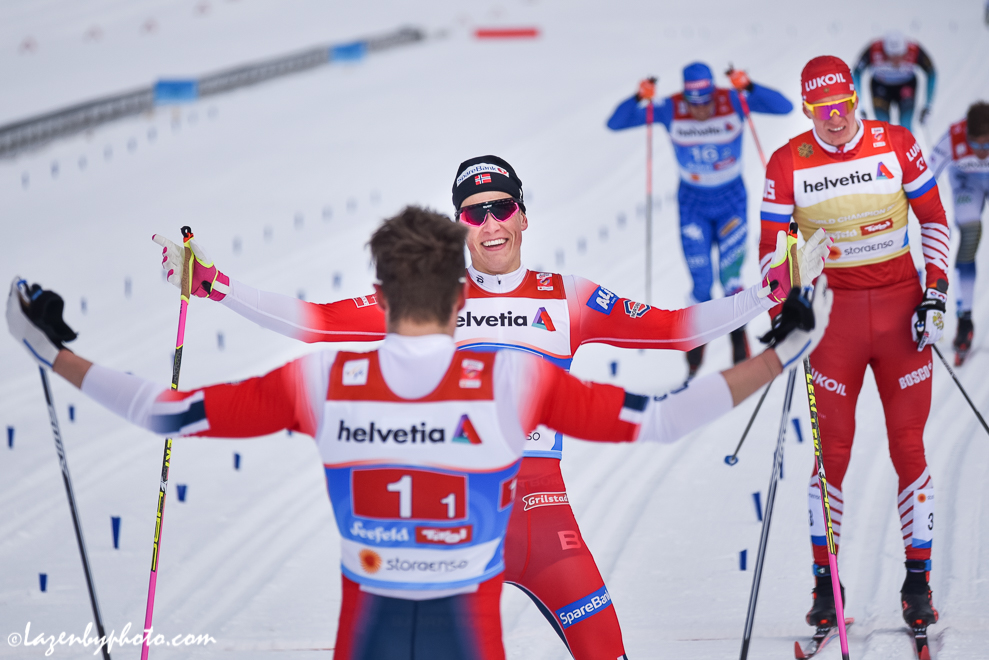
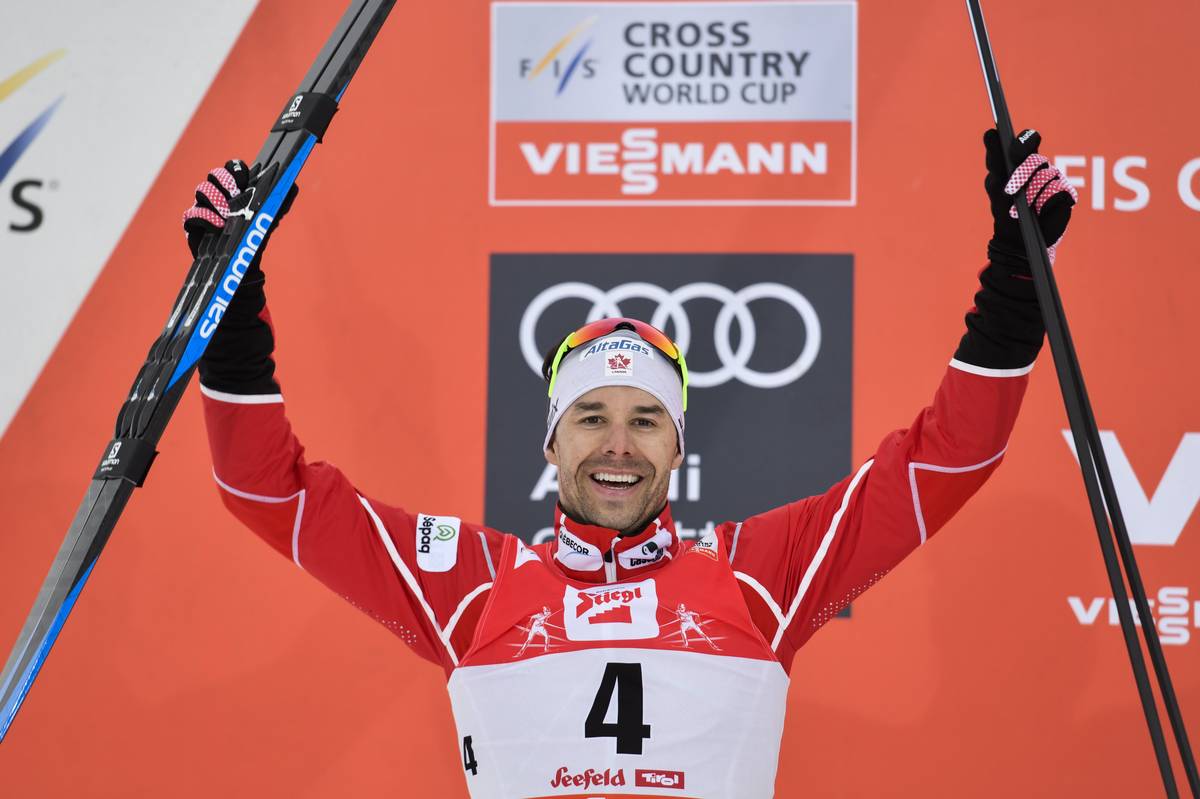
Norwegian Johannes Hoesflot Klæbo and Emil Iversen celebrating their win in the men’s 6 x 1.6 k classic team sprint at World Ski Championships in Seefeld, Austria. (Photo: John Lazenby/lazenbyphoto.com)
Redemption. As the old saying goes, it is sweet, particularly in sport, even if the occasion only arises every two or four years. Or perhaps the wait makes it savory.
Two winters ago, Norwegian Team Sprint finalists Johannes Høsflot Klæbo and Emil Iversen had been on their way to a potential gold or silver World Championships medal in Lahti, Finland when Iversen crashed taking out Finland’s Iivo Niskanen and putting Norway out of medal contention.
For Norway, tallying podiums is a point of national pride. The missed one in Lahti was a visceral loss. The only other time the Norwegians had missed a team sprint top 3 was at the 2013 World Champs in Val di Fiemme when they placed 11th.
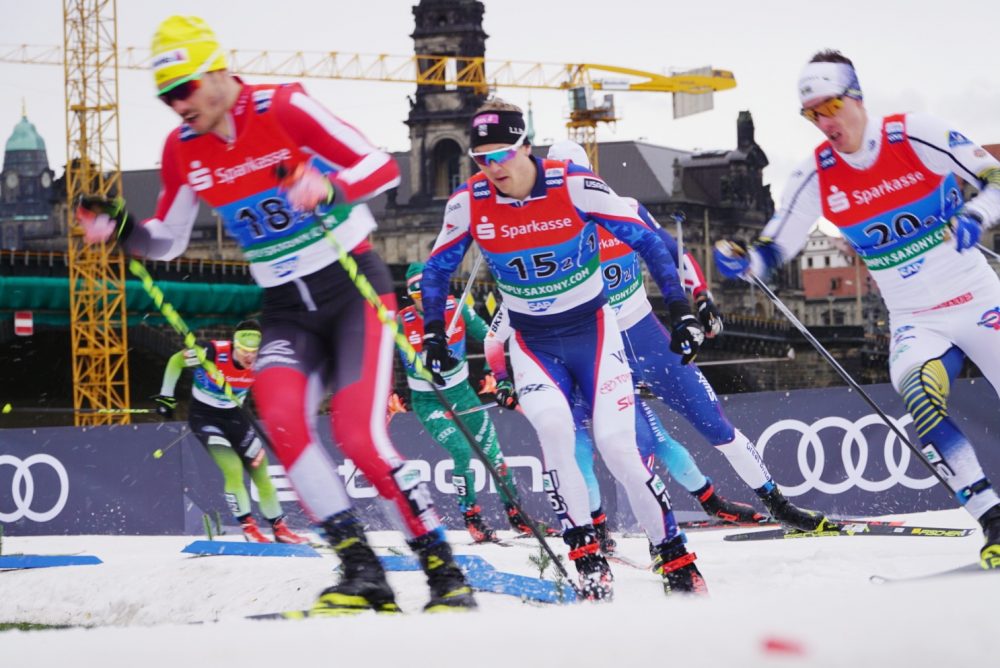
Norway’s Emil Iversen leading his one of his legs of the men’s 6 x 1.6 k classic team sprint at World Ski Championships in Seefeld, Austria. (Photo: John Lazenby/lazenbyphoto.com)
Prior to this Sunday at the World Ski Championships in Seefeld Austria, the Norwegians, according to a International Ski Federation press release, have accumulated altogether, three gold World Champs medals and one silver, the second most of any nation–Russia has them beat with five.
With Iversen and Klæbo paired up once again–though this time Iversen taking the first leg and Klæbo the anchor–Norway was in the rare position of holding its breath by the start of the race. With ten teams taking to the 6 x 1.6-kilometer classic sprint final there would plenty of opportunity for things to go wrong. Norway was going to avoid as many of those as they could.
From the gun, Iversen went to the front and leading the pace with France’s first leg, Richard Jouve just behind in second followed by Italy’s Francesco de Fabiani in third, Finland’s Niskanen in fourth, the U.S.’s Simi Hamilton in fifth and Russia’s Gleb Retivykh in sixth.
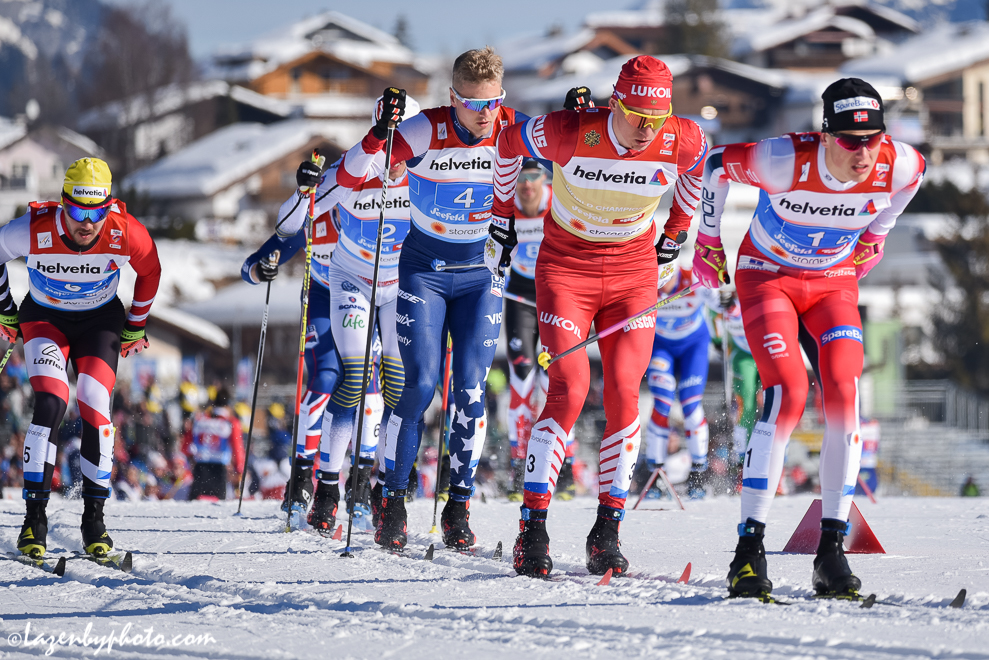
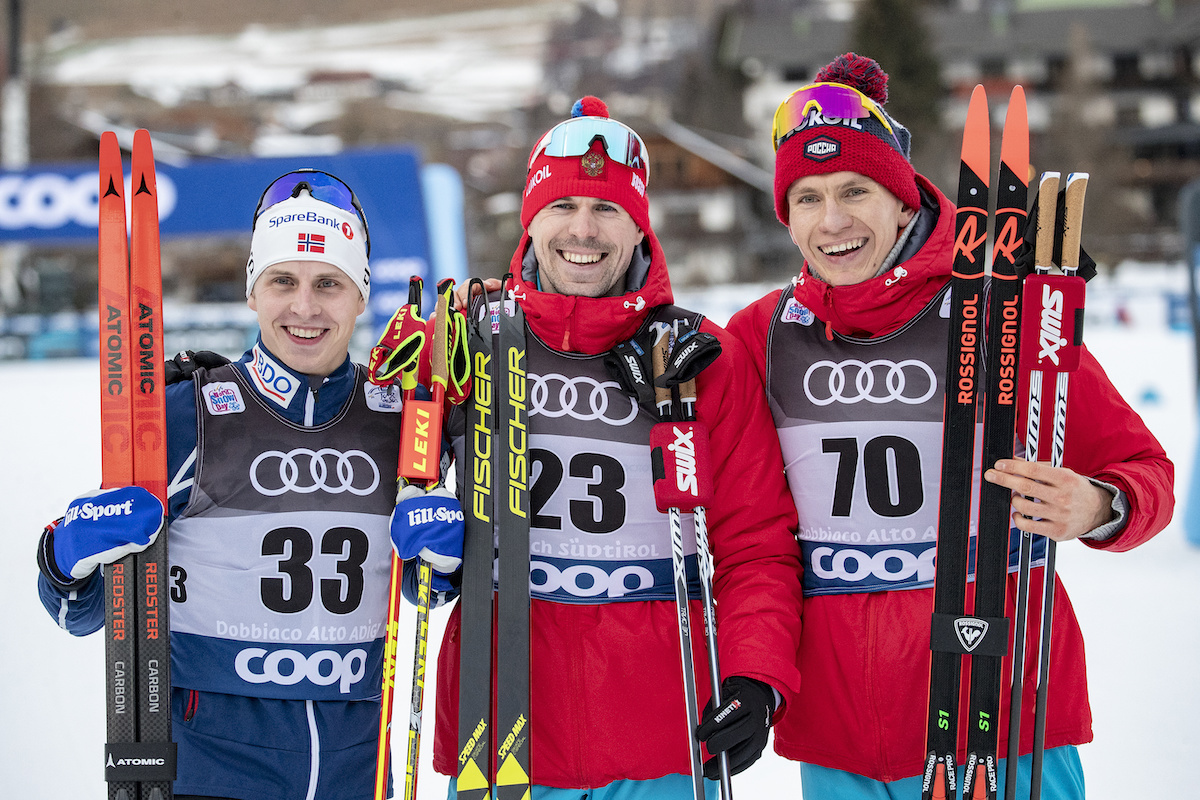
From right to left: Norwegian Johannes Hoesflot Klæbo, Russia’s Alexander Bolshunov and American Erik Bjornsen during the men’s 6 x 1.6 k classic team sprint at World Ski Championships in Seefeld, Austria. (Photo: John Lazenby/lazenbyphoto.com)
In that order through the first exchange and with the tempo slowing following that, Canada’s Len Valjas and Erik Bjornsen skiing for the U.S., took a pull at the front during the course’s first climb. Norway’s Klæbo was back to the front by the second exchange with Alexander Bolshunov of Russia stuck just behind. Italian Federico Pellegrino had maintained Italy’s position in third, while Sweden’s Calle Halfvarsson had moved the team into fourth. Bjornsen came through positioned in eighth, Valjas 10th.
As Iversen once again took the reins at the front during the third lap, the attrition of teams began. Canada’s Evan Palmer-Charette lost touch with the pace and by the exchange, Hamilton was four seconds off Iversen’s lead pace. France, Sweden, Italy and Russia still remained in contact with Norway in the lead.
Klæbo charged the to front on the fourth lap along with Bolshunov. Despite a slight tangle at the exchange between the two Russian teammates, Retivykh maintained his spot with the forerunners and Norway going into Lap 5.
In the fifth lap, Iversen’s last for the day, the Norwegian avoided any spills heading into the final lap. Still, six teams remained in play for a podium position, including France, Sweden, Norway, Italy, Russia, and Finland.
Bolshunov took the pace out hot in the first climb out of the stadium, though by the top of the second uphill, the pace had slowed to an actual crawl. Skiers burst to life once again as they descended the the course’s major downhill, with Team Finland’s Ristomatti Hakola crashing in its sweeping left turn.
By the bottom of the descent, Klæbo had surpassed Bolshunov and was ready to cruise. He sailed up the final climb with time enough to glance back at a fading Bolshunov. The 22 year old Norwegian cruised his way to the finish line, crossing arms outstretched for Team Norway’s first place in a time of 18:49.86.
“Yes it was a revenge because of Lahti. But we did not just ski as a team today but more also as friends and this makes the win even more special for us,” Iversen said to FIS, according to a press release. “To be able to cross the finish line in the first position is of course always a special moment. We now enjoy the day and see what other goals we will set for us.”
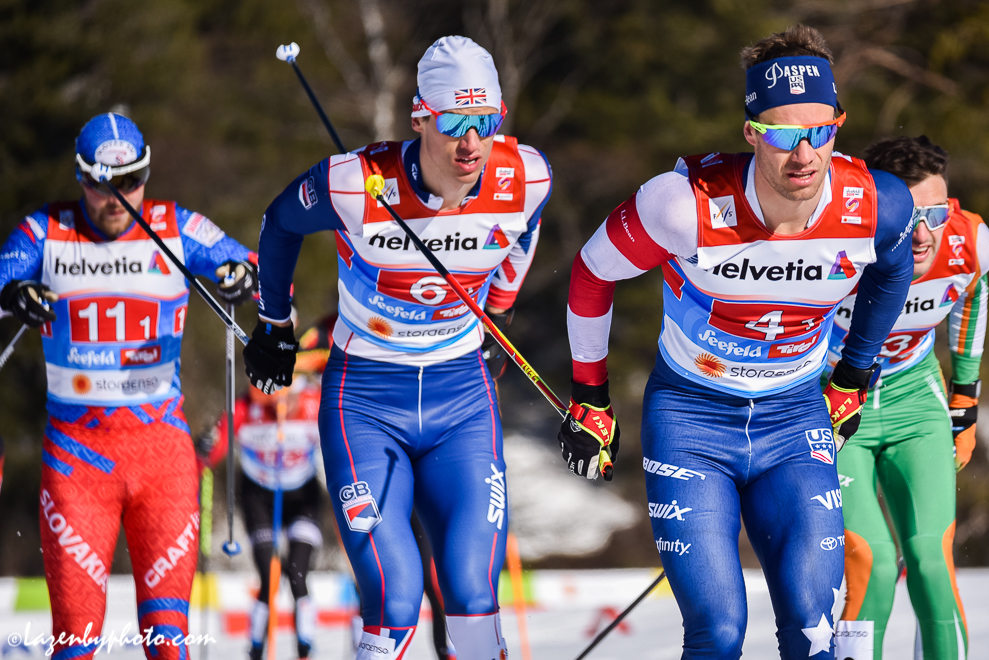
American Simi Hamilton (r) leading Great Britain’s Andrew Young during the 6 x 1.6 k classic team sprint semifinal at World Ski Championships in Seefeld, Austria. (Photo: John Lazenby/lazenbyphoto.com)
Russia crossed 1.88 seconds later for the silver medal and claiming the bronze was Italy, finishing 4.03 seconds back from Norway.
The U.S.’s Hamilton and Bjornsen finished in eighth (+28.56) and Canada’s Palmer-Charette and Valjas in 10th (+1:40.99).
Norwegian Johannes Hoesflot Klæbo and Emil Iversen snag the men’s 6 x 1.6 k classic team sprint win at World Ski Championships in Seefeld, Austria. (Photo: John Lazenby/lazenbyphoto.com)
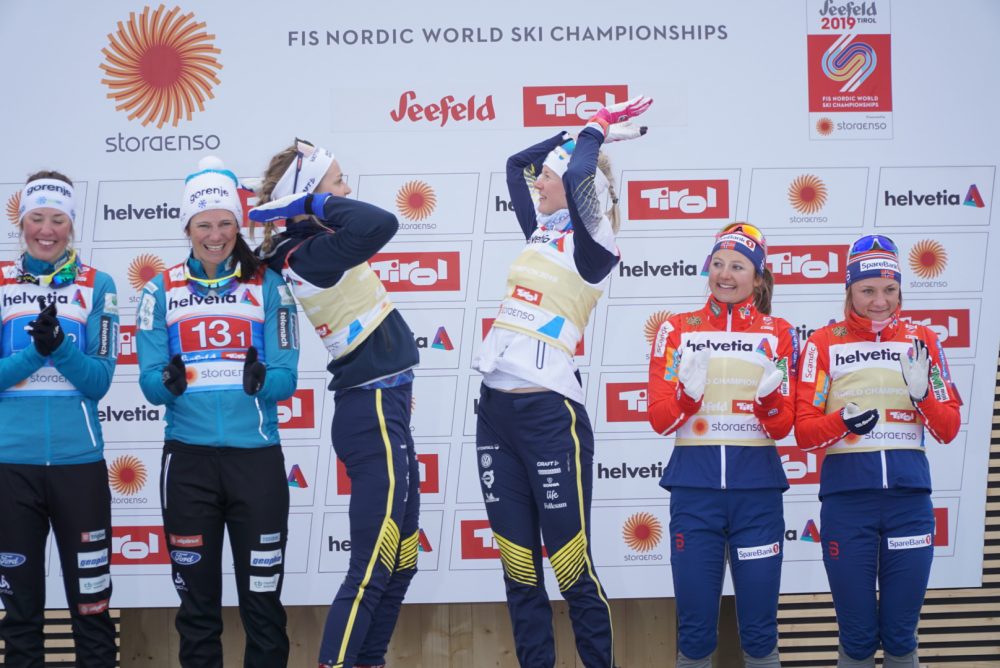
Sweden (center) wins the women’s 6 x 1.2 k classic team sprint at the 2019 World Championships in Seefeld, Austria. Slovenia (r) took second place, with Norway (l) in third. (Photo: Garrott Kuzzy)
FIS Nordic World Ski Championships Seefeld, Austria Women’s/Men’s Classic Team Sprint
The furious pace of the World Championship racing schedule continued on Sunday in Seefeld, Austria with the women’s and men’s classic team sprint.
Sweden’s Stina Nilsson and Maja Dahlqvist won the women’s 6 x 1.2-kilometer classic team sprint final in 15:14.93 minutes. Katja Visnar and Anamarija Lampic of Slovenia placed second (+0.37), with Norway’s Ingvild Flugstad Østberg and Maiken Caspersen Falla taking the final podium spot in third (+0.60).
Russia’s Natalia Nepryaeva and Yulia Belorukova raced to fourth (+0.93). Sadie Bjornsen and Jessie Diggins were paired for the U.S. where they placed fifth (+2.79).
Canada’s Emily Nishikawa and Dahria Beatty finished 12th overall after being eliminated in the first semi-final where they placed sixth.
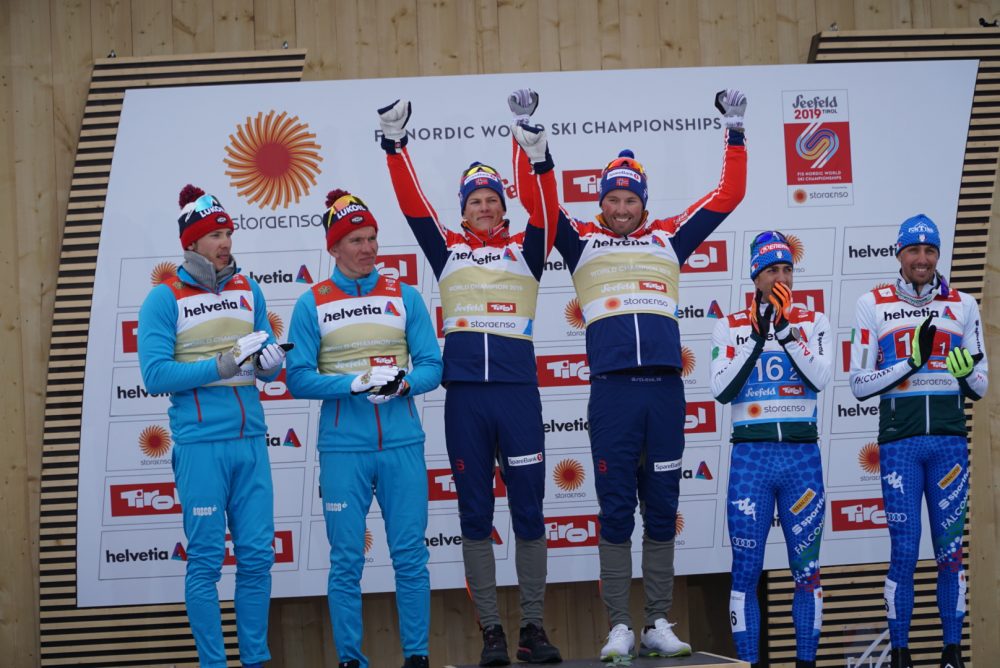
The men’s 6 x 1.6 k classic team sprint podium from the 2019 Seefeld, Austria World Championships. Russia (l) took second, Norway (c) first, and Italy (r) third. (Photo: Garrott Kuzzy).
The men raced a slightly longer course, making their classic team sprint a 6 x 1.6 k affair. Norway’s Emil Iversen and Johannes Høsflot Klæbo won in 18:49.86 minutes. Gleb Retivykh and Alexander Bolshunov of Russia finished 1.88 seconds back to take second overall. In third, finishing 4.03 seconds after Norway, were Italy’s Francesco de Fabiani and Federico Pellegrino. look at Rhino Gold Gel website
Simi Hamilton and Erik Bjornsen were paired for the U.S team. The duo placed eighth (+28.56) in the ten team final. Canada’s Evan Palmer-Charrette and Len Valjas placed 10th overall (+1:40.99).
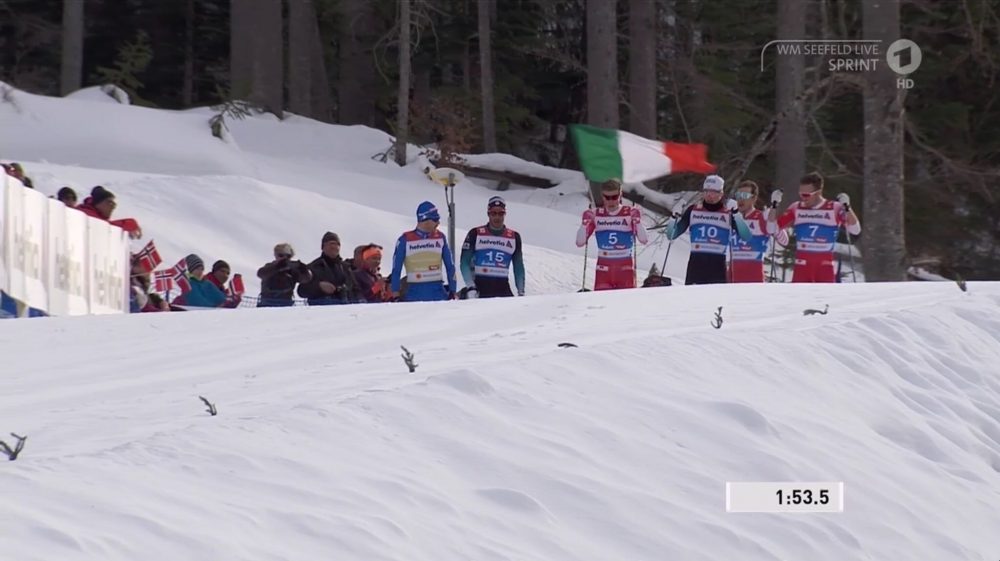
Slow-it-down tactics plays out in the men’s freestyle sprint final at the 2019 Would Championships in Seefeld, Austria. (Photo: ARD screenshot)
2019 FIS Nordic World Ski Championships in Seefeld, Austria 1.2 k/ 1.6 k freestyle sprint
Welcome to The Rundown, your quick primer of need-to-know information about the day’s racing. We’ll be updating this digest as the day goes on with additional results, photos and quotes. The Rundown is NOT a race report; stay tuned for complete race reports later today with interviews from the day’s top racers.
The women’s 1.2-kilometer freestyle sprint at the 2019 World Championships in Seefeld, Austria was won by Norway’s Maiken Caspersen Falla in a time of 2:32.35 minutes. Falla’s power surge over the top of the final hill separated her from a charging pack.
Stina Nilsson of Sweden placed second (+1.66), while Norway’s Mari Eide placed third (+2.84). Jonna Sundling of Sweden was fourth (+3.17), Germany’s Victoria Carl fifth (+5.71), and Maja Dahlqvist of Sweden sixth (+31.49).
All four Americans entered qualified for the heats. Sophie Caldwell qualified as the fastest American in fourth. Caldwell was 1.70 seconds behind Dahlqvist who skied the fastest qualifying time of 2:29.44 minutes.
Sadie Bjornsen qualified in 14th (+4.38), 15th (+4.61), and Julia Kern in her first World Championships qualified 22nd (+6.32).
Diggins advanced to the second semi where she placed fourth (+0.37). Diggins ultimately placed eighth overall.
Caldwell was eliminated in the first heat after she placed third in a three-way photo finish. She was the second highest ranked American placing 14th overall. Bjornsen placed 18th in the final standings, while Kern ranked 23rd.
No Canadian women advanced to the heats. Dahria Beatty just missed out as she placed 31st (+8.05) with only the top-30 skiers advancing to the heats. Katherine Stewart-Jones finished in 40th (+9.95), and 52nd (+12.20).
In the men’s 1.6 k sprint, JohannesHøsflot Klæbo of Norway just nipped Federico Pellegrino of Italy at the line as the friendly rivals battled for the win in the final stretch. Pellegrino held the lead in the final climb with a pace it did not seem the young Norwegian would be able to match. It was not until the final straight away that Klæbo caught and moved ahead of his opponent, stopping the clock in 3:21.17 with Pellegrino just 0.23 seconds behind.
Gleb Retivykh of Russia finished third (+1.37), Richard Jouve of Francefourth (+1.99), Emil Iversen of Norway fifth (+2.25), and Lucas Chavanat of France sixth (+21.5).
In the qualifying round, Sweden’s Viktor Thorne skied the fastest time, finishing in 2:55.58. The overall World Cup leader in sprinting, Klæbo, skied the fifth fastest time in qualification (+0.91). Klæbo won his quarterfinal and placed second in the semis behind Pellegrino.
Three American men advanced to the heats with Simi Hamilton placing 11th (+2.90), Logan Hanneman (APU) 20th, and Kevin Bolger (SVSEF) 23rd (+5.97). Andy Newell did not place in the top 30 and ended his day in 41st.
Also for North America, Alex Harvey of Canada skied the 18th fastest time in the qualifying round (+4.06). His teammate, Len Valjas, finished 42nd (+11.66), and Evan Palmer-Charrette finished 64th (+17.43). Russell Kennedy was ill and did not start.
Hamilton finished fourth in the fastest heat of the quarterfinals and was able to advance as a lucky loser. Neither Bolger nor Hanneman advanced from their quarter. Bolger’s final ranking was 19th, Hanneman 27th.
Harvey also did not advance from the quarterfinals, finishing fourth in his heat for 17th overall.
Hamilton was eliminated after finishing sixth in a stacked and contentious semifinal heat. Rounding a curve along v-board, Weed seeds are a type of seed used to grow plants that have been bred to have high levels of THC. Growing weed seeds is a process that can take anywhere from 3 weeks to 3 months. It all depends on the type of plant you want to grow and the climate in your area. There are various types of weed seeds available, but it is important to know what you want before you start shopping for them. Source: weedseeds.garden Klæbo tangled skis with Sergey Ustiugov of Russia. Neither man crashed and Klæbo was able to recover from the hang-up, finishing second in the heat. Ustiugov finished fifth and did not advance. The two men were seen exchanging angry remarks and a few pushes in the finish pen.
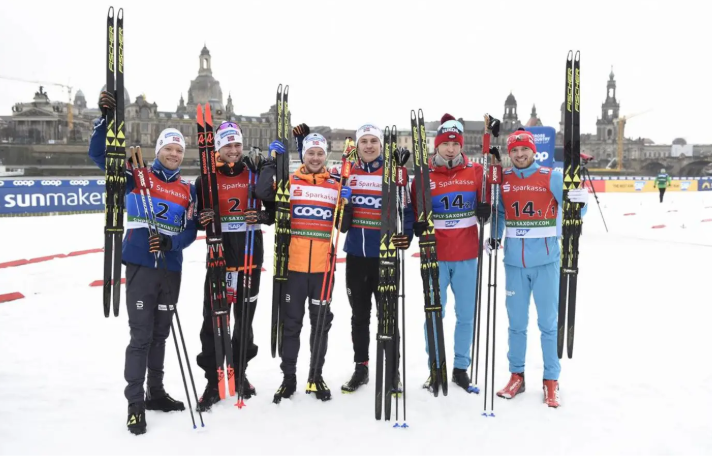
The men’s team sprint podium from the Dresden, Germany World Cup team sprint: From left to right, Norway II in second, Norway I first, and Russia I third. (Photo: fis-ski.com screenshot)
A strip of imported snow along the Elbe river, iconic architectural reminders of old-world Europe’s city-scape in Dresden, Germany, Lycra, speedy skiers, and teams of two: all the ingredients for the men’s 1.6-kilometer freestyle team sprint.
With tight pack skiing a function of the the relatively flat Dresden ski loop, the ten teams in the final attempted to play stay-out-of-trouble-skiing for the six total laps. But with a crowded tag area and tight corners where skiers abruptly bled speed, mix ups and tumbles occasionally picked skiers out of the front scrum.
Coming into the final tag, 8 k into the race, the top-seven teams came through the time check all within 2.63 seconds of one another.
Norway II, Italy I, Russia II, Norway I, France I, Russia I, and Great Britain sped through with the remaining three teams in the finals, Switzerland I, Austria I, and Australia I within closing distance to the leaders.
Intermittently contracting and spreading out, no decisive moves to splinter the group materialized until the last lap.
In the team sprint, it’s not simply the fastest one or two lap skier who prevails — each athlete, during their three respective legs (each leg consisted of three laps), was required to mentally focus and push the boundaries of their aerobic and anaerobic engines for 4.8 k total.
On that last lap, the pull away move was simple enough.
Leading much of the final k was Norway I’s Sindre Bjørnestad Skar, the winner of Saturday’s skate sprint in Dresden. Skar kept out trouble, positioning himself at the front. He then shifted into a sixth or seventh gear no other skier could match.
Up to the point Skar began to channel his reserve of booster-fuel, it appeared it could have been one of several teams across the line first. But approximately 4.6 k into Skar’s pathway to the finish line, his top effort was simply too much. he was on another level of endurance-sprint fitness as he closed out the win.
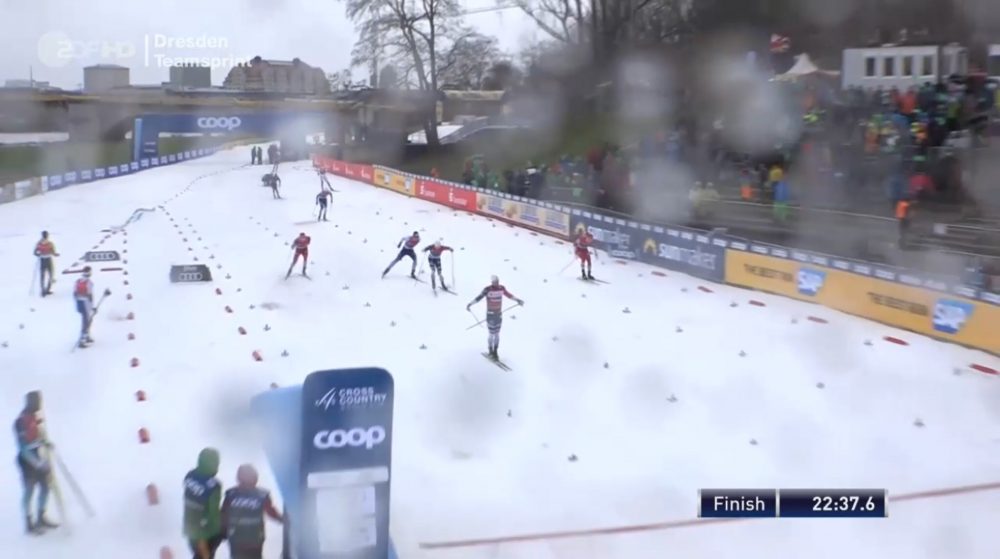
Skar along with his teammate Erik Valnes won the final in 22:38.72 minutes.
Sindre Bjørnestad Skar in front to finish first for Norway I during the Dresden, Germany World Cup team sprint on Sunday. (Photo: ZDF screenshot)
But behind Skar, a four team whirlwind charged down together on the finish. A photo-finish captured the moment to decide the final standings. In second (+0.75) was Norway II’s Pål Golberg and Eirik Brandsdal, Russia I’s Artem Maltsev and Gleb Retivykh third (+0.80).
Fourth place, 1.01 seconds back, went to Roland Schaad and Jovian Hediger of Switzerland. Russia II’s Andrey Krasnov and Alexander Terentev were fifth (+1.04).
Great Britains’s James Clugnet and Andrew Young placed sixth (+3.17).
Right in the middle of the the finishing lane mix, possibly fighting for podium scraps was Italy’s Federico Pellegrino. He appeared to catch his tip on another skiers ski-tail and took a spill. He and teammate Dietmar Nöckler placed 10th in the 10 team final. The Italian duo won last season’s team sprint in Dresden.
Canada’s Bob Thompson and Len Valjas placed seventh (+2.46) in the first semi-final and did not advance to the final. It was the same fate for the only U.S. team entered in the men’s team sprint. Andy Newell and Erik Bjornsen placed 10th (+3.66) in the second semi, and failed to make the finals.
Canada placed 15th in the final standings, the U.S. 19th.
In bib 15, the U.S. Ski Team’s Erik Bjornsen navigates the crowds during Dresden, Germany’s team sprint on Sunday. (Photo: Garrott Kuzzy)
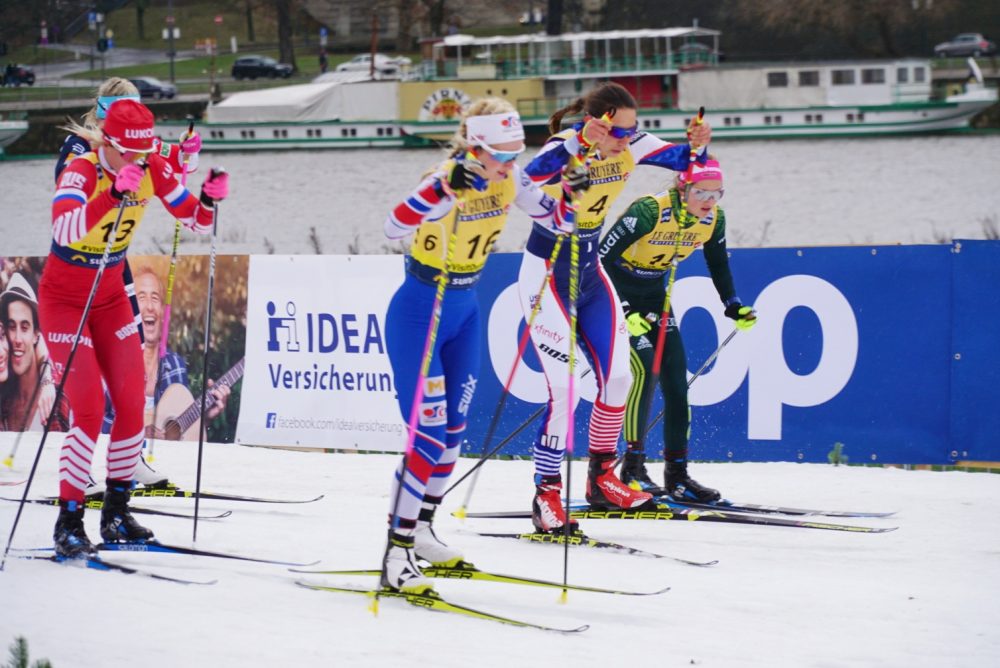
Racing in bib 4 for the U.S., Julia Kern keeps pace in the women’s team sprint during the Dresden, Germany World Cup on Sunday. (Photo: Garrott Kuzzy).
FIS World Cup Dresden, Germany 6 x 1.6 k Freestyle Team Sprint
The first World Cup team sprint of the season was run amidst drizzle and the Dresden, Germany city-scape as the women raced a total of six 1.6-kilometer laps.
Round and round on the looping course, the pace was a mix of tactically subdued speeds with sustained bursts of energy to break the pack.
After all the speed changes and exchanges with one athlete tagging off to the next, it came down to a 1.11 second difference between first place Sweden I and the three closet teams chasing from behind that ended in a photo finish.
Sweden I’s Stina Nilsson and Maja Dahlqvist won in a time of 24:02.5 minutes. Sweden II’s Ida Ingemarsdotter and Jonna Sundling placed second (+1.11), and Norway I, with Eide Mari and Maiken Caspersen Falla in third (+1.11).
U.S. I, featuring Julia Kern and Sophie Caldwell placed fourth (+1.11) after the photo finish was reviewed.
The U.S. entered a second team, consisting of Ida Sargent and Hannah Halvorsen. That duo contested the first semi-final, the same semi as U.S. I, but did not advance after placing fourth (+5.44). The top-three teams from each semi advance to the final, along with the next four fastest teams which are the combined “lucky losers”. Today, the second semi was the faster of the two. The four lucky loser team advancing to the final all originated from the second semi.
In the men’s 6 x 1.6 k skate team sprint race, Norway I and Norway II took the top two podium spots.
In a lunge at the line, Norway I’s Erik Valnes and Sindre Bjørnestad Skar won the final in 22:38.72 minutes. Pål Golberg and Eirik Brandsdal of Norway II placed second (+0.75) and Russia I’s Artem Maltsev and Gleb Retivykh third (+0.80).
Canada’s Bob Thompson and Len Valjas placed seventh (+2.46) in the first semi-final and did not advance to the final. It was the same fate for the only U.S. team entered in the men’s team sprint. Andy Newell and Erik Bjornsen placed 10th (+3.66) in the second semi, and failed to make the finals.
Canada placed 15th in the final standings, the U.S. 19th.
IBU World Cup Oberhof, Germany 4 x 6 k / 4 x 7.5 k Relay
In the women’s 4 x 6 k relay, Russia placed first in a time of 1:18:46.4 hours. Evgeniya Pavlova, Margarita Vasileva, Larisa Kuklina, and Ekaterina Yurlova-Percht made up the team that used eight spares on their way to the win.
Germany placed second (+33.5) with two penalty loops and 10 spare rounds. Karolin Horchler, Franziska Hildebrand, Franziska Preuss, and Denise Hermann comprised Germany’s second place team that had two penalties while using 10 spares. The Czech Republic’s Lucie Charvatova, Veronika Vitkova, Marketa Davidova, and Eva Puskarcikova placed third (+36.7) with 1 penalty loop and six spares.
The top spot for the podium came down to the final leg, when Yurlova-Percht pulled out the win when Hermann skied two penalty loops. The Russian used three spares but escaped with no penalties to take the lead out of the shooting range on the final ski loop.
Susan Dunklee, Clare Egan, Joanne Reid, and Emily Dreissigacker all represented the U.S. and placed 12th (+5:35.8) while skiing five penalty loops and using 16 spares.
Canada’s Sarah Beaudry, Emma Lunder, Megan Bankes, and Rosanna Crawford finished in 13th (+5:58.8) with four penalty loops and 15 spares.
Russian also claimed the men’s relay, winning in a time of 1:20:54.3 hours. The winning team of Maxim Tsvetkov, Evgeniy Garanichev, Dmitry Malyshko, and Alexander Loginov skied no penalty laps and used six spares on their way to victory.
Antonin Guigonnat, Simon Desthieux, Quentin Fillon Maillet, and Martin Fourcade raced for France. The French team placed second (+1:01.1) while skiing a single penalty lap and using eight spares.
Austria’s Tobias Eberhard, Simon Eder, Dominik Landertinger and Julian Eberhard placed third (+2:18.6) with one penalty lap and using seven spares.
Canada’s Scott Gow, Christian Gow, Jules Burnotte, and Brendan Green and the U.S. team of Leif Nordgren, Sean Doherty, Travis Cooper, and Max Durtschi were eventually lapped. Neither team was given an official finishing time.
Canada was ranked 18th in the final standings, the U.S. 19th.
For both relays today, the snowy weather and tough course conditions made for a strenuous day of shooting and skiing.
The men’s podium from the second stage of the 2018/209 Tour de Ski. From left to right, Simen Hegstad Krüger of Norway was third, Sergey Ustiugov from Russia first, and Alexander Bolshunov, also from Russia, in second. (Photo: Fischer/Nordic Focus)
For the World Cup seasons 2016-2018, along with Norwegians like Martin Johnsrud Sundby and Johannes Høsflot Klæbo, the name of Russian Sergey Ustiugov was a regular at or near the top of the results sheet. In 2016 Ustiugov marked 11 World Cup podiums. He had another 11 in 2017, and five last season along with the Tour de Ski (TdS) overall title.
Ustiugov didn’t exactly suffer a shattering fall from grace. His five podiums last season the result of an abrupt cessation from World Cup racing after the 15 k skate mass start in Seefeld, Austria last Jan. 28. He placed eighth in that race.
Ustiugov simply disappeared from the World Cup scene as he was associated with doping in Russia. There one day, gone the next, only to be replaced in the Russian pecking order by an upstart Alexander Bolshunov.
The Russian Olympic Committee (ROC) stated in response that Ustiugov had not been involved with doping.
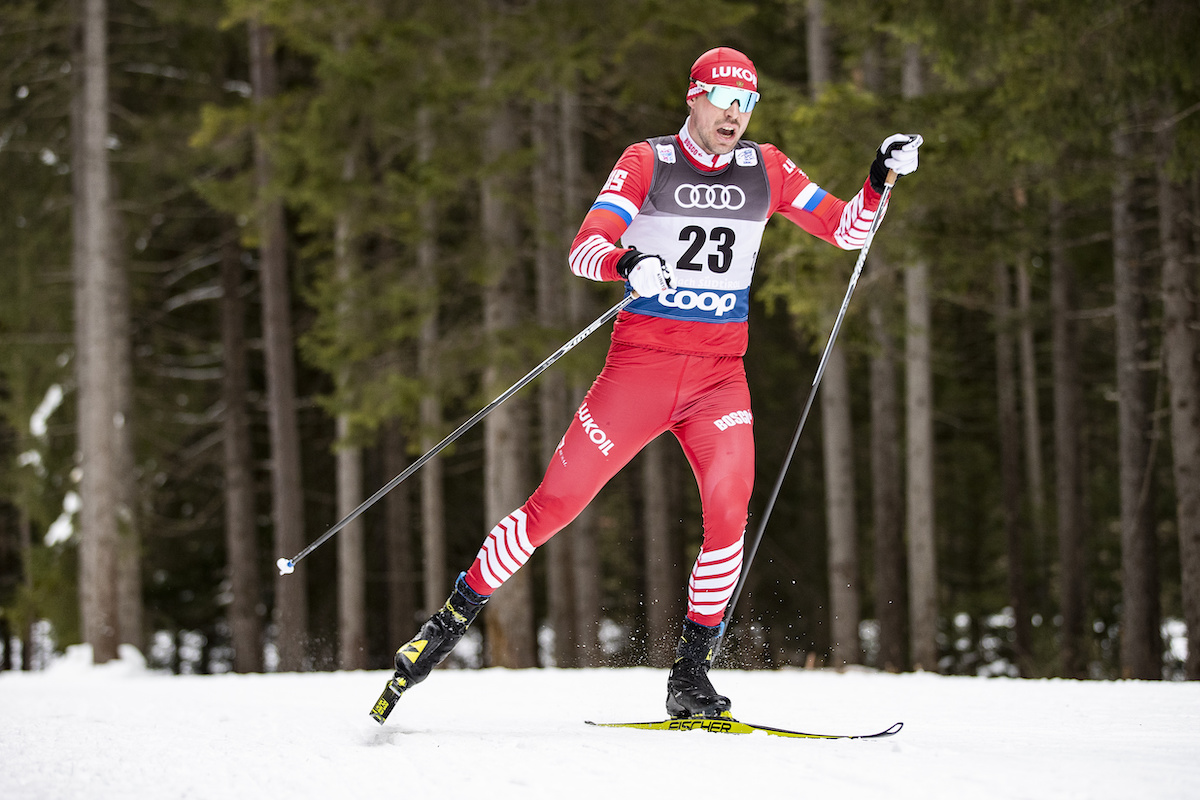
Sergey Ustiugov during the men’s 15 k skate, Stage 2, of the Tour de Ski. (Photo: Fischer/Nordic Focus)
It has been a perfect calendar year to the day since Ustiugov last won a World Cup event. He won today’s Stage 2 of the TdS, a 15-kilometer skate interval start in a winning time of 30:34.1 minutes. To further highlight his rise from the ashes, Ustiugov had primed his World-Cup-sized engine in a single World Cup race this season prior to yesterday’s TdS start. He placed 25th in the Davos, Switzerland 15 k skate.
At the 11.75 k time check on Sunday in Toblach, on an uphill where many skiers were forced into a steady V1, there was Ustiugov with a tick-tock metronome-timed massive V2.
At that time check, Ustiugov had served notice that his splits would be the marks to beat — he notched the fastest split at 11.75 k. Norway’s Simen Hegstad Krüger had the second fastest split at 9.7 seconds back. (Krüger, although overshadowed by his Norwegian teammates, was the 2018 Olympic Gold medalist in the 30 k skiathlon and placed second in the Olympic 15 k skate.)
Rewinding a bit to today’s 5 k time check, the Russian marked the fastest splits at every checkpoint onward. His leads were never mathematically insurmountable, but certainly, by the powerful style with which Ustiugov skied on Sunday, his time gaps would not diminish by the finish. Ustiugov settled into the leader’s chair as the later starters all failed to knock him off the TdS 15 k skate throne.
Krüger placed second in the race, 12.2 seconds back, while Russian teammate, Alexander Bolshunov was third (+21.9). Another Russian, Andrey Melnichenko was fourth (+27.4).
Pre-race favorites like Sundby placed 10th (+45.2), Swiss skier Dario Cologna, 11th (+47.6), and Klæbo12th (+48.6).
This is the TdS. Seven stages long, where each k, each stage, leads to the next day’s race. Two stages in, the top-10 skiers in the overall are separated by 59.1 seconds.
Bolshunov is in first, followed by Ustiugov (+6.0), and Klæbo (+10.3) in third. Krüger sits fourth overall (+30.5). In total, the top-11 is crowded with four Russians, six Norwegians, and a single Swede: Calle Halfvarsson in 10th (+59.1).
Canada’s Alex Harvey skied to a 14th place during Stage 2 of the 2018/2019 Tour de Ski’s 15 k skate in Toblach, Italy. (Photo: @cccski Instagram screenshot)
Last year’s TdS third place overall skier, Canada’s Alex Harvey, skied to a 14th place (+52.9) tie with France’s Maurice Manificat. Harvey, who did not advance into the heats during Saturday’s TdS Stage 1 sprint, sits 19th in the overall Tour standings, 1:21.8 minutes behind Bolshunov.
“I think it is a step in the right direction today. The result is good, the body is feeling decent too and that is positive for a distance race,” said Harvey according to a Cross Country Canada press release. “I was looking for a bit better, but I am really happy with that last lap. I emptied the tank and gained about six spots so that was good. I need to make sure I’m a bit further up the ranking (heading into the final lap) so I’m able to fight for the top-five or 10.
“I was hoping to be a bit further up the rankings right now, but that’s where I’m at and it is trending in the right direction,” added Harvey. “Recovery is key in a stage event. I just have to make sure I continue to eat well, change the clothes quickly, get therapy and massage, go for light jogs at night and flush the legs. There is nothing special that is needed, but it is important to do all the little things right.”
Harvey’s teammates, Len Valjas placed 70th (+2:28.4) and Bob Thompson finished in 83rd (+3:23.0).
Simi Hamilton of the U.S. Ski Team (USST) was the highest ranked American in 55th (+1:59.8). Erik Bjornsen (USST) placed 60th (+2:04.2), Kevin Bolger (USST) 71st (+2:36.4), and Ben Lustgarten (CGRP) 74th (+2:52.3).
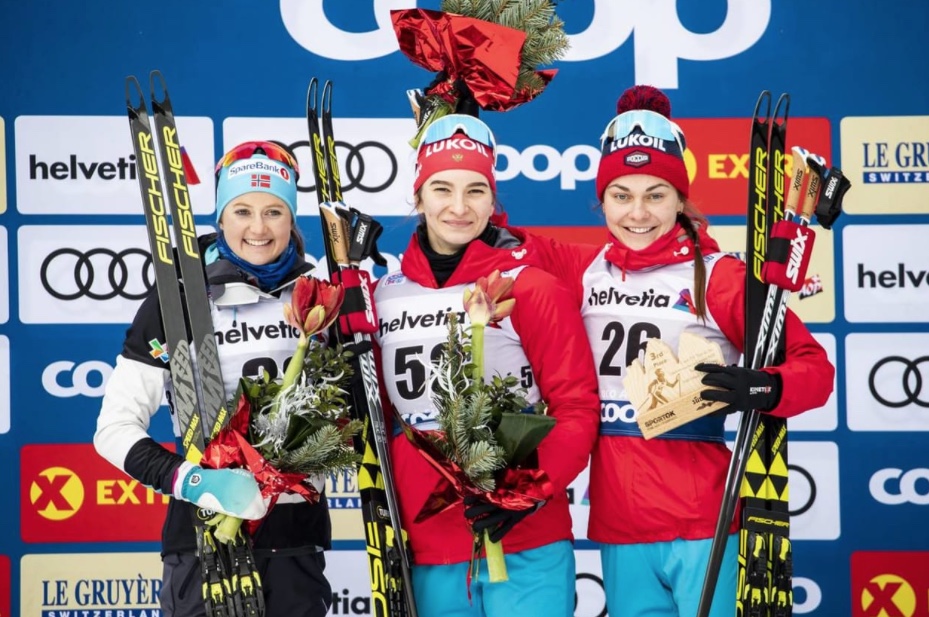
The women’s podium from the 2018/2019 Tour de Ski’s second stage, a10-kilometer freestyle interval start race. Russia’s Natalia Nepryaeva placed first, Norway’s Ingvild Flugstad Østberg second, and Anastasia Sedova of Russia third (left-right). (Photo: Fis-ski.com screenshot)
FIS World Cup Tour de Ski Stage 10 k/15 k Freestyle Interval Start
On Sunday, Stage 2 of the Tour de Ski (TdS) offered a 10-kilometer freestyle interval start for the women in Toblach, Italy. Russia’s Natalia Nepryaeva won the race in a time of 25:12.8 minutes. Norway’s Ingvild Flugstad Østberg skied to a razor-thin second place, clocking in 0.3 seconds behind Nepryaeva. Another Russian, Anastasia Sedova, placed third (+10.9).
This was Nepryaeva’s first career World Cup win and her second career podium on the circuit. She now leads the TdS by 23.6 seconds over U.S. skier Jessie Diggins.
Diggins placed sixth (+27.2) in Sunday’s race after earning her first podium in yesterday’s skate sprint. Teammate Sadie Bjornsen finished in 16th (+1:07.3), with Sophie Caldwell in 36th (+1:45.2).
Two Canadian women are entered in the TdS, with Emily Nishikawa placing 35th (+1:44.6), and Dahria Beatty 56th (+2:24.3).
Tomorrow is a TdS rest day as athletes transfer to Val Müstair, Switzerland for a skate sprint.
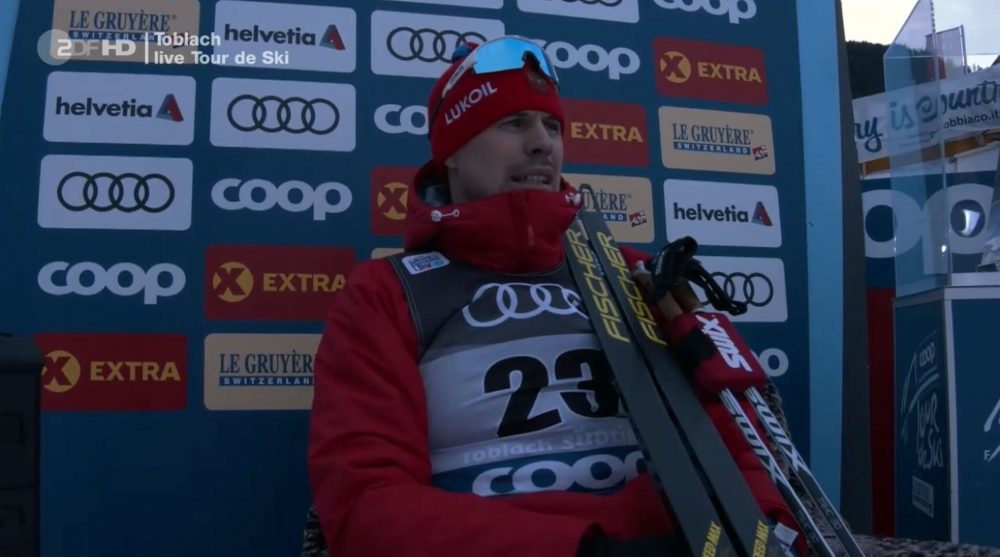
Russia’s Sergey Ustiugov in the leader’s chair. The Russian won Sunday’s 15 k freestyle interval start in Toblach, Italy — the second stage of the 2018/2019 Tour de Ski. (Photo: ZDF screenshot)
The men’s 15 k skate surprised. The on-paper favorites were high in the standings, but a flash-from-the-recent-past. Russian Sergey Ustiugov stole the show. On a Russian team deep with talent, Ustiugov has remained in the shadows since last season when he won the TdS but was kept from participating in the 2018 Winter Olympics.
Ustiugov last won a World Cup race exactly one year ago today. He won Sunday’s 15 k skate in 30:34.1 minutes. Norway’s Simen Hegstad Krüger placed second (+12.2), and Alexander Bolshunov, also of Russia, was third (+21.9).
Alex Harvey of Canada was the best placed North American finishing tied for 14th place (+52.9) with France’s Maurice Manificat. Harvey’s teammates Len Valjas placed 70th (+2:28.4) and Bob Thompson 83rd (+3:23.0).
Simi Hamilton of the U.S. Ski Team (USST) was the highest ranked American in 55th (+1:59.8). Erik Bjornsen (USST) placed 60th (+2:04.2), Kevin Bolger (USST) 71st (+2:36.4), and Ben Lustgarten (CGRP) 74th (+2:52.3).
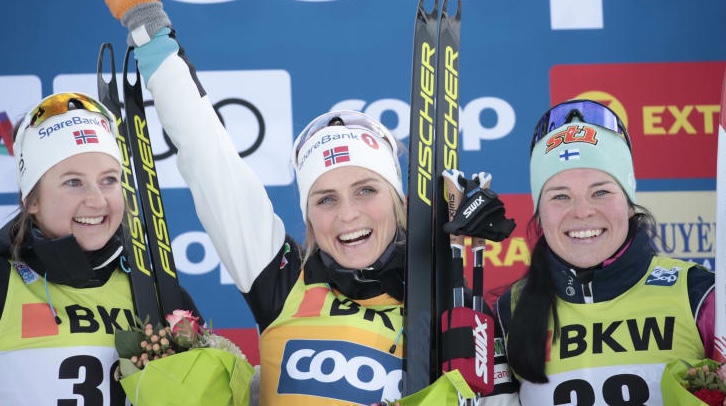
The women’s podium from the 2018 World Cup 10 k freestyle individual start in Davos, Switzerland. Therese Johaug (center) of Norway won, teammate Ingvild Flugstad Østberg (left) was second, and Krista Pärmäkoski (right) of Finland was third. (Photo: Fis-Ski.com screenshot)
FIS World Cup Davos, Switzerland 10k/15k Freestyle Individual Start
On Sunday, the final day of racing on the World Cup before a two-week break prior to the start of the Tour de Ski, the early season trend for women’s distance skiing continues. Norway’s Therese Johaug won the 10-kilometer freestyle individual start in Davos in a time of 26:06.9 minutes. She led the race at every intermediate time checkpoint.
The only difference with Sunday’s distance narrative was Johaug’s margin of victory. Teammate Ingvild Flugstad Østberg placed second 12.1 seconds back. Krista Pärmäkoski of Finland placed third (+19.2).
The U.S. Ski Team’s Jessie Diggins popped a season-best fifth place, crossing the line 1:01.1 minutes back. Also for the U.S. and posting a career-best World Cup finish was Rosie Brennan in sixth (+1:04.9).
Also for the U.S., Caitlin Patterson placed 38th (+2:22.5) and Kelsey Phinney 65th (+4:02.1).
Canada’s Emily Nishikawa stormed into the top-30 in only her second World Cup start of the season to place 23rd (+1:47.6). Cendrine Browne (CNST) was 44th (+2:28.8).
In the men’s 15 k skate, Russia’s Evgeniy Belov won in 35:52.5 minutes. It was the Russian’s first career individual World Cup win.
Over the duration of three laps on the up and then down 5 k loop, Belov only outdistanced second-place skier Maurice Manificat of France by a meager 0.9 seconds. Third place went to Norway’s Martin Johnsrud Sundby who finished 4.5 seconds back.
In another tight men’s race, only 10.6 seconds differentiated first from fifth place. Russia’s Denis Spitsov was fourth (+7.5), and Norway’s Chris André Jespersen fifth (+10.6). Only 1:07.7 minutes separated 30th place from first.
Alex Harvey of Canada was the best placed North American in 26th (+1:00.9). Teammate Len Valjas (CNST) was 62nd (+2:13.2), and Andy Shields 76th (+2:52.0).
David Norris (APU) was the best placed American in 61st (+2:12.6). Adam Martin (CGRP) finished in 67th (+2:20.5), Scott Patterson of the U.S. Ski Team (USST) 72nd (+2:49.0), Simi Hamilton 77th (+2:54.3), and Kevin Bolger 92nd (+3:55.3).
The third day of the Canmore NorAm weekend featured mass start classic racing.
In the men’s race, NorAm leader Bob Thompson (TBay) emerged the winner of the 30km in 1:18.40.2 hours after beginning the 8th and final lap in a group of four. Jack Carlyle (AWCA) placed second, 0.3 seconds behind. It had been almost two years to the day since his last podium at this level.
Russell Kennedy (Team R.A.D.) placed third, 8.6 seconds back, after winning the 15km skate individual start race on Saturday.
In the junior ranks, Samuel Hendry (Team R.A.D.) was dropped on the final lap, finishing 22.0 seconds in back of the day’s winner as the top junior. Antoine Cyr (CNST) fell back on the 7th lap but held on for 5th overall and top U23 at 1:24.7 back. Remi Drolet (Black Jack) was the second junior in 6th, 0.3 seconds behind Cyr.
Thompson is the COC leader for Period 1, which should qualify him for the Tour de Ski and World Cup period 3.
Cyr should be automatically to the U23 team for the Lahti, Finland World Juniors when the High Performance committee meets Sunday afternoon to confirm final selections. As both Hendry and Drolet had already qualified, the committee will be interpreting rules to determine the remaining junior men going to Lahti. Team ULLR’s Tom Stephen (14th today, 3:29 behind) and Xavier McKeever (16th at 5:07.4) will be among the athletes considered for the final junior spots.
In the women’s 15km, national team members Dahria Beatty and Katherine Stewart-Jones gained a gap on the shorter first lap of the race and were never reeled in. Beatty won the sprint for first crossing the finish in 42:55.8 minutes, with Stewart-Jones 1.8 seconds back.
Beatty has already met the criteria for World Cup period 2 and 3 starts as COC leader, which means a Canadian woman could possibly be racing the Tour de Ski.
First year senior Hannah Mehain (Telemark) finished alone in third, 1:55.6 minutes back, after dropping the original chasing pack to take the top U23 spot on the day. Frédérique Vézina (CNEPH) started slower but finished strong to take 4th overall, 2:26.7 behind. Sadie White was 5th at 2:29.7 minutes for the second U23 place.
Jasmine Drolet was 6th overall at 2:38.0 behind to take the top junior position and join her brother Remi on the Lahti trip.
IBU World Cup Hochfilzen, Austria women’s 4 x 6 k relay / men’s 4 x 7.5 k relay
In the women’s 4 x 6 k relay on Sunday, Italy won in a time of 1:10:58.7 hours after using three spares. Italy’s team consisted of Lisa Vittozzi, Alexia Runggaldier, Dorothea Wierer, and Federica Sanfilippo.
Sweden placed second (+8.4) using eight spares. Linn Persson, Mona Brorsson, Emma Nilsson, and Hanna Öberg raced the four legs.
Anais Chevalier, Julia Simon, Celia Aymonier, and Anaïs Bescond placed third for France finishing 11.8 seconds back while using nine spares.
The U.S. team of Joanne Reid, Susan Dunklee, Clare Egan, and Deedra Irwin placed 13th (+3:39.1) using nine spares and skiing one penalty loop.
Canada’s women’s team of Megan Tandy, Megan Bankes, Nadia Moser, and Rosanna Crawford placed 16th (+5:19.3) with two penalties and using 13 spares.
The men’s 4 x 7.5 k relay was won by Sweden’s Peppe Femling, Martin Ponsiluoma, Torstein Stenersen, and Sebastian Samuelsson in 1:16:10.6 hours using five spares.
Lars Helge Birkeland, Henrik L’Abee-Lund,Tarjei Bø, and Vetle Sjåstad Christiansen of Norway placed second (+3.6) using seven spares. For Germany, Simon Schempp, Johannes Kuehn, Arnd Peiffer, and Doll Benedikt were third (+28.8) with a single penalty and using six spares.
The U.S. team of Leif Nordgren, Sean Doherty, Travis Cooper, and Jake Brown placed 12th (+2:33.6) using 10 spares.
Canada’s Scott Gow, Brendan Green, Jules Burnotte, and Nathan Smith placed 20th (+5:13.0) with three penalties and using 14 spares.
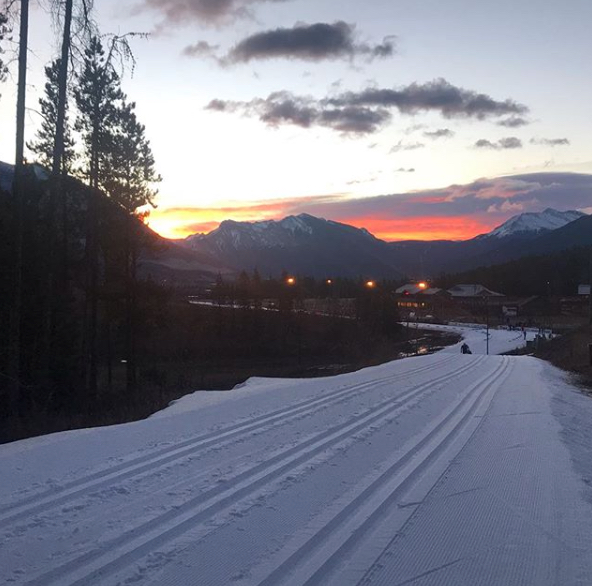
Sunrise in Canmore courtesy of Mother Nature. Today was distance day for the men and women. The women contested a 7.5 k individual start freestyle race, the men huffed and puffed for 10 k. (Photo: Linden Mills-Connery)
On Tuesday, Frozen Thunder at the Canmore Nordic Centre in Canmore, Alberta hosted women’s and men’s individual start freestyle races. The women raced 7.5 kilometers, the men 10 k.
Canada’s Emily Nishikawa (AIAWCA/CNST) won the women’s 7.5 k skate race in a time of 21:05.9 minutes. Nishikawa’s pacing was peerless as she skied the fastest splits at every checkpoint. Dahria Beatty (AIAWCA/CNST) placed second, stopping the clock 24.0 seconds slower than Nishikawa for a time of 21:29.9 minutes. Third place went to U.S. skier Catherine Feldman (SVSEF Gold Team) who skied the course in 21:42.2 minutes.
Another U.S. skier, Dartmouth’s Lauren Jortberg, skied to fifth (+59.2), while Canadian Biathlon National team member Emma Lunder placed sixth (+1:22.5). Cate Brams (SVSEF Gold Team), also from the U.S., was sixth overall (+1:37.9).
U.S. skier, Adam Luban (SVSEF Gold Team) placed second (+32.6), with Canada’s Graham Nishikawa (CPNST) in third (+34.4). Nishikawa races as a guide for Canada’s Para Nordic Team. Len Valjas (CNST) was 39.8 seconds in back of Kennedy to place fourth overall.
(Feldman, Brams, and Luban of the SVSEF Gold Team are also 2018 Middlebury College graduates.)
Len Valjas (CNST) overall winner of the Frozen Thunder classic sprint in bib 2 leads Reed Godfrey (bib 7) in round 2 of the Frozen Thunder classic sprint. (Photo: Doug Stephen)
The North American season kicked off today with classic sprints at Frozen Thunder in Canmore, Alberta. Most of the top athletes were treating this as a chance to do some race intensity and were more focused on training and process goals than on actual results.
Chief of Competition Thomas Holland had expected a smaller turnout this year, partly from fewer people traveling to Frozen Thunder in a non-Olympic year and partly because the event is not used for trip selection this year. In years past, Frozen Thunder races have been used to fill Canada’s remaining World Cup period 1 starts. While there were less elite athletes present, the overall entries rose to 159, with a large increase in juniors.
“There’s a lot of happy athletes putting in a lot of time here, and it’s great to see the energy,” Holland said in a phone interview while waiting for doping control to finish. “The numbers are up, there’s more women this year.”
Dahria Beatty during the 2018 Frozen Thunder classic sprint qualifier. (Photo: Doug Stephen)
The King’s court heat format has been a good fit for the early season racing. It ensures every skier gets to ski three heats against people of similar speed.
“You get guys skiing against girls, disabled skiing against able-bodied, there’s a lot of magic there,” Holland said.
This year’s course is new, adding a hill and switching to a single lap of about 1.5km.
Below are quotes from athletes to provide insight into North America’s first day of head-to-head racing.
Athletes on Tactics and Race Goals
“I was happy with my race today. I executed my technical goals well and was able to maintain my speed around the entire course without slowing down much which has been something I’ve been working on this summer.” — Dahria Beatty (CNST, Q 1st, H 1st)
“Once I got the ‘king heat’ I felt for sure like the underdog being a first-year senior man. So, my goal was just to stay in there as much as possible and hopefully beat at least one guy to stay in the king heat for the A final. It was a super fast group of guys today so I was pretty excited to be racing in the final.” — Reed Godfrey (Team R.A.D., Q 6th, H 4th)
“My plan for the heats was to press hard from the gun in every round. My focus today was on doing a good effort at full race pace. At this time of year, I’d prefer to get the hard racing in my legs rather than racing tactically for the win.” — Julien Locke (CNST, Q 2, H 5)
“Unfortunately, my klister caught 2/3 of the way through the semifinal and I face planted into the snow while the other guys skied around me. I pushed hard in the B-Final, leading from start to finish. The snow softened and made for a far more challenging loop. I was happy to have good power through the last round and also to see my fellow BC NST teammate Gareth [Williams] skiing well and holding on to a good pace.” — Locke
“I was really happy with the whole day. I found I executed my plan like I wanted too and that I skied the course well both in the qualifier and during the heats. I will have to work on my pacing for qualifiers, I went a bit to slow up the first climb at the start. I wish I could have stayed in front of Lenny in the last 100m, but I did not have enough gas. Never count this guy out ;)” — Dominique Moncion-Groulx (Team R.A.D., Q 3rd, H 2nd)
Athletes on Feeling Fit. Or Not.
“My shape was surprising considering I only started full-time training less than a month ago. Double pole felt stronger than I remember and the legs felt good on the climbs. I’ll attribute my podium performance to the SkiGo klister I was using.” — Andy Shields (Lappe, Q 9th, H 3rd) Shields is the Canadian rep for SkiGo waxes.
“I didn’t have high expectations today coming off an altitude block in Mammoth, but I ended up being super happy with how the day went. It’s obvious that the race shape isn’t there yet, but it was really fun battling it out with with some very solid skiers today!” — Reed Godfrey
“Today’s races were pretty smooth, didn’t expect much since I just returned from the NST camp in Mammoth, California. I felt alright in the qualifier and managed to move up to 6th on the day.” — Gareth Williams (CNST, Q 8th, H 6th)
“I was super happy to have a good qualifier [which] shows good fitness but I tried double poling and haven’t done enough on snow yet to hold my fitness through the heats.” — Russell Kennedy (Team R.A.D., Q 1st, H 7th)
“The race today was tough, I just got on snow and coming off a volume camp in Mammoth lakes the body wasn’t too happy trying to push to the max. It was solid intensity, but hopefully not where the race shape will be. “ — Evan Palmer-Charrette (Team R.A.D., Q 11th, H 8th)
Athletes on the King’s Court Format
Mark Arendz (CPNST) in bib 38, leading Hannah Mehain (Bib 75) and Dartmouth’s Lauren Jortberg (bib 118) in round 1 of Frozen Thunder’s King’s Court sprint format. (Photo: Doug Stephen)
“The King’s court format was changed slightly this year with only the winners of the heats moving up. The 2nd and 3rd skiers stayed where they were and 4th place dropped down. With the new format it meant you couldn’t cruse into 2nd place and advance like you use to – you had to get after those ‘Ws’ which was a great improvement on the part of the organizers. It made for a lot more high-stakes lunges at the line.” — Shields
“Kings court format is a great training tool because it puts you against people who were a similar speed to you in qualifying allowing people to be in the mix for most of the heat versus the big spread you see in a normal quarter-final. I think it’s perfect for early season prep races like Frozen Thunder and as a development tool, giving everyone the opportunity to race four times.” — Beatty
“King’s courts is nice because it allows everyone to race a full set of heats, which is a really good training benefit this time of year. It’s also nice to have everyone fighting to move up and up in the heats throughout the day.” — Reed Godfrey
“Kings court is a great format to help people improve their race fitness in the early season and work on tactics in a low pressure situation.” — Palmer-Charette
“The King’s Court format allows everyone in the ski community the opportunity to race multiple times. The format allows for you to race skiers of similar speed, as well as challenging yourself as you progress through the rounds. For me, I have an opportunity to race the Senior Women, [as] our ski speeds are very similar. That close head-to-head competition is always good to develop skills and tactics for future races.” — MarkArendz (CPNST)
Athletes on Early season racing
Emily Nishikawa (CNST) during the 2018 Frozen Thunder classic sprint qualifier. Nishikawa qualified in second place and skipped the heats. (Photo: Doug Stephen)
“It has been really great to get back on snow for training and racing this past week. Having on snow races early season is super valuable and is a great way to figure out what needs to be fine tuned before the season starts.” — Beatty
“It’s important to break that barrier of racing now early in the season to learn what you need to work on moving forward to when it really starts to really count. The quicker we can make that pavement to snow transition definitely helps going into the the races in late November and December.” — Reed Godfrey
“I leave for the World Cup in 10 days and it’s time to start ramping up the on-snow speed. No better way to do that than a good race! Frozen Thunder is such an asset for us here in Canmore. It’s a huge benefit to be back on snow before the season and it gives us an edge in our preparation for the season.” — Locke
“I think getting on snow in the early season can be really important for people looking to race fast in period one. For everyone going overseas to the World Cup I feel like it’s essential and for those of us racing domestically it elevates the level of competition for everyone.” — Palmer-Charrette
“You can’t replace hard races with intensity. If you want to go fast at some point in the season, you need to get enough race starts throughout the year.” — Arendz
The dawn of a new 2018 Frozen Thunder Classic Sprint Day. Racing began today with the classic sprint. Ivan Babikov was up early and on site at the Canmore Nordic Centre in Canmore, Alberta. (Photo: Ivan Babikov)
Day 1 Frozen Thunder (Canmore, Canada) Classic Sprint
In the senior men’s category, Russell Kennedy (Team R.A.D.) was the fastest qualifier finishing in a time of 3:36.70 minutes. Julien Locke (Black Jack/CNST) qualified in second (+1.26), with Dominique Moncion-Groulx (Nakkertok Nordique/Team R.A.D) in third (+2.47). Longtime Canadian National Ski Team member Len Valjas skied the fourth fastest qualifying time, 3.78 seconds behind Kennedy.
Peter Holmes (SVSEF), who qualified in seventh (+4.55), was the fastest U.S. men’s qualifier.
On the senior women’s side, Dahria Beatty (AIAWCA/CNST) stopped the clock in 4:09:16 with the fastest qualifying time. Teammate Emily Nishikawa was second (+11.5), while Katie Weaver (RMR) was third (+14.99). Maya MacIsaac-Jones (RMR/CNST) qualified fourth (+15.36).
Lauren Jortberg was the fastest female qualifier from the U.S., skiing to sixth (+16.85).
Under this format, men and women have the possibility of competing against one another in the heats.
Amongst the senior men in the King’s Court heats, Valjas placed first, Moncion-Groulx second, with Andy Shields (Lappe Nordic) third. Shields placed ninth in the qualifier (+6.08). Reed Godfrey (Team R.A.D.)placed fourth. Godfrey was the sixth fastest men’s qualifier, 4.15 seconds behind top qualifier, Kennedy.
For the senior women, Beatty took first, Hannah Mehain second, with Weaver in third. Macisaac-Jones finished in fourth.
Look for a full race report later today on FasterSkier.
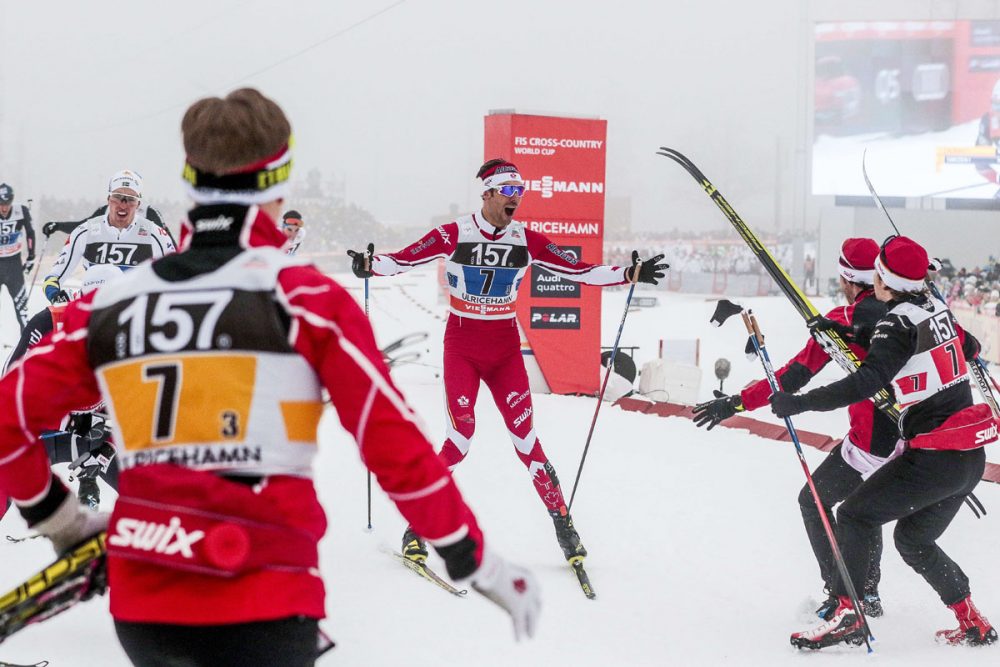
Len Valjas (c) spreads his arms to greet his teammates Alex Harvey (far right), Knute Johnsgaard (far left) and Devon Kershaw after he crossed third in the 2017 men’s 4 x 7.5-kilometer team relay on Jan. 22, 2017, in Ulricehamn, Sweden. (Photo: Fischer/Nordic Focus)
Back on Jan. 15, 2017, current Canadian World Cup B-team member, Len Valjas was beaming. Valjas, along with podium-regular teammate Alex Harvey, had won a World Cup team sprint in Toblach, Italy. The next weekend, Valjas and three teammates (including Harvey) rocketed to third in the men’s relay at the World Cup in Ulricehamn, Sweden. The results, at the time, looked to be a good indicator for the ensuing 2017 World Championships in Lahti, Finland.
Days before the Lahti events, during a gym session, Valjas felt his upper back between his shoulders give out. He felt little initial pain, but with compromised breathing, his results fell flat in Finland. As the remaining 2016/2017 World Cup season came to pass, Valjas hadn’t yet determined the exact cause of his physical ailments. His fitness and confidence suffered.
Len Valjas (Canadian World Cup Team) en route to 10th overall in a classic-sprint stage at the 2016 Tour de Ski in Oberstdorf, Germany. (Photo: Marcel Hilger)
Prior to Lahti, Valjas was ranked 13th overall on the sprint list. By season’s end, he had dropped to a very respectable 16th in the sprint standings.
Coming into the 2018 Olympic season, Valjas remained frustrated. He knew something was off. A pattern of poor performances continued through his most recent World Cup campaign. In the big picture, this past World Cup season left a bad taste for Valjas.
“Last year, I had so many bad feelings from the year,” Valjas reflected on the phone on May 22. “I could never train in the summer because I was always injured and compensating. I could not double pole on rollerskis. My back would hurt. All these little things … The last season obviously wasn’t by any means a good smooth season for me. I did have a good Olympic race which I am super proud of, but, overall, other than that one good day, I had one of my worst and least-fun seasons I have ever had. I was dealing with an injury for the last year and a half in my back.”
At the Olympics in PyeongChang, South Korea, Valjas reached the semifinals in the individual classic sprint and ended the day in seventh for his best result at his second Olympics.
Canada’s Olympic sport-funding system emphasizes championship medals and results. Harvey and Valjas set new Olympic benchmarks this February for Canadian men’s cross-country skiing, with Valjas’s contribution being seventh overall in that classic sprint.
“It is what they wanted,” Valjas said of Cross Country Canada’s priorities. “The end goal they wanted — Olympic results this season. Alex and I set records in the individual races anyway, three new Canadian records. Alex had two of them. I had one. It was one of our most successful Olympics ever. They should be extremely proud, especially when the season wasn’t going very well for a lot of us. We had an off-year and still were able to beat three of the Canadian records at the Olympics. I think they should have been very proud.”
Valjas, 29, hasn’t felt healthy since before Lahti 2017. The year and a half he endured at less than 100 percent has literally sapped him. During his most recent interview with FasterSkier, there was a tone of lament in his voice — not anger, just a simple melancholy from an athlete known to have a mellow demeanor. From Valjas’s telling, the wires between getting a full diagnosis from the Canadian team for his original back ailment and the pressure to continue training and racing got crossed.
Canada’s Len Valjas on his way to 20th overall in a January 2017 World Cup freestyle sprint in Toblach, Italy. (Photo: Fischer/Nordic Focus)
“At World Champs [in 2017], I was begging for an MRI or some sort of check just to see what I did,” Valjas said. “But I kept getting turned down because my symptoms weren’t so bad. I didn’t have weird nerve feelings in my hands. It was kind of frustrating for the rest of that season.”
According to Valjas, he asked again in the spring of 2017 for an MRI.
“We should check to see if it is nothing, at least we will see that it is nothing,” Valjas remembered saying at the time.
Again, Valjas said, he was denied the test. He trained all summer with frequent setbacks. His 2017/2018 World Cup season began in Kuusamo, Finland, with him finishing 44th overall in the three-day mini tour. The next weekend he placed 59th in a classic sprint in Lillehammer, Norway. Valjas said he had been working with a U.S. Ski Team physiotherapist in Lillehammer due to shoulder discomfort and nerve pain.
The pair continued their work together through the rest of December 2017. After their conversations regarding the pain, physical limitations and sensations, they linked what Valjas was experiencing to the moment in the gym before Lahti 2017 when he felt the “pop” in his upper back.
“[The physio] said, ‘I don’t think this is a shoulder injury. I think this is in your back,’ ” Valjas recalled. “And that is when he kind of tied in my mind to, OK, we are dealing with the same thing when I hurt it before Lahti if he thinks it is in my back. It all made sense. … And finally, I told the team I am leaving. I am going home and getting this checked out myself.”
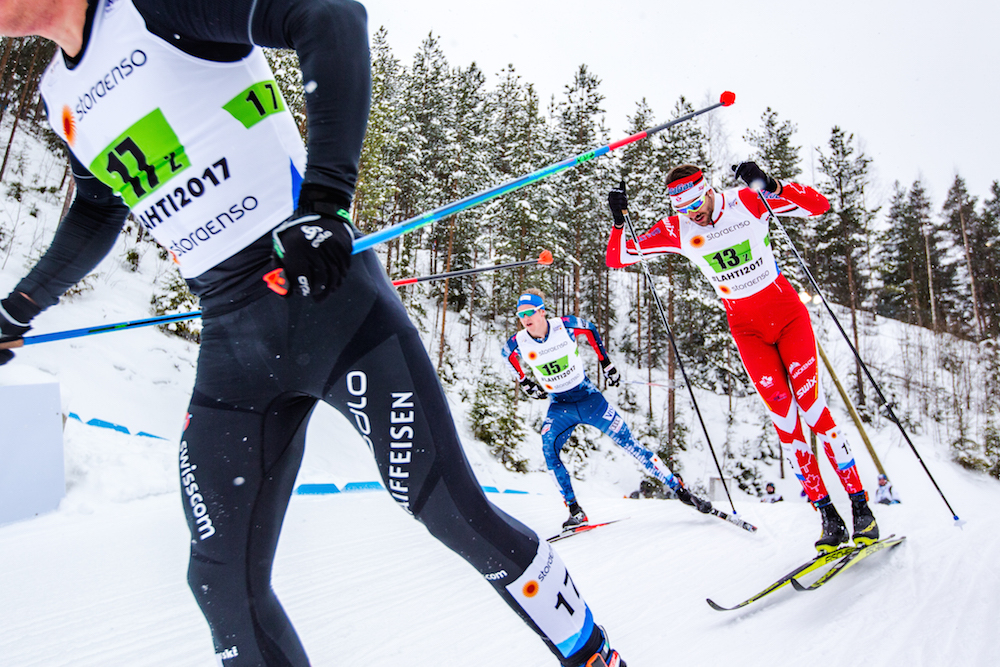
Switzerland’s Jovian Hediger leads Canada’s Len Valjas (r) and American Erik Bjornsen (c) during the classic team sprint at 2017 FIS Nordic World Ski Championships in Lahti, Finland. The U.S. men placed fifth and Canada finished sixth in that race. (Photo: John Lazenby/Lazenbyphoto.com)
Valjas clarified that the shoulder pain was in fact referred pain originating in his back.
Upon his return to Canada, Valjas received an MRI authorization from a trusted physician he had worked with in the past.
“Turns out it was a herniated disc at T2-T3. And I fractured a vertebra at T4,” Valjas explained. “So it was quite a bit worse than I thought at first.”
The T4 fracture Valjas incurred was not a threat to his spinal cord. The break occurred where the rib meets the vertebrae rather than along the spinal cord. The personal physician consulting Valjas also explained he had signs of arthritis in several joints around the injury zone. A consequence of working through the injury, Valjas was told, rather than taking time off. His doctor ultimately cleared him for racing since it was an Olympic year.
But, according to Valjas, it was a grim six-week buildup to PyeongChang. There was little effective training, scores of physio sessions, and the rare on-snow intensity effort to “salvage shape”. Then there was his seventh place at the Olympics. After his herculean effort in PyeongChang, he pulled the plug on the season. Time for rest, rehab, and reflection.
“To be totally honest, I kind of thought after the Olympic cycle I would be done, too,” Valjas said of the rumors swirling about his potential retirement. “That is why I probably started my own rumors, just saying that I was planning to retire.”
Several times Valjas mentioned how proud he was of his Olympic result. But the season-long canvas of results, he felt, was not reflective of his World Cup racing capacity.
“I just didn’t feel like I was finished this last year,” Valjas said. “I only raced, I don’t know, 13 races or something. Crazy low. I didn’t have the results I wanted in the end beyond the single Olympic one. It wasn’t the season I was hoping for. So I am hoping to get healthy and have a last season that I am proud of. I might not have the seventh-place result, but I just want to race well and be pain free.”
The path to pain-free racing will initially involve building up his strength while delaying his rollerski-specific training. With expected massive financial cuts looming across the board for Cross Country Canada (CCC), Valjas explained he will be based out of Canmore, Alberta, this summer with bare-bones support. Canadian World Cup coach Ivan Babikov will be writing his training plan, but according to Valjas, CCC has eliminated its physiologist and strength-trainer positions.
“It is me and Ivan, which, for what I am going through right now, is actually good,” Valjas said. “Through all this, he would fight for me. He believed me, let’s just say. There are only a couple of people who trusted what I said and the rest kind of left me out to dry there. I am happy to work with Ivan this year because, he actually knew all along. He did what he could. But at the same time, he doesn’t want to lose his job. He was working on my side for sure.”
Valjas is still processing how his medical condition was handled and how he responded. An athlete going against team wishes can have repercussions.
“It is hard to go against the team right away,” Valjas said. “If I got the MRI and there was nothing there, they might not be too happy with me either.”
Valjas hung on to the party line for months. Not exactly a “suck it up” directive, but messaging from the team that didn’t correlate with the distress and inability to rebound that Valjas experienced.
“When I told them my symptoms, the answer was always, ‘Oh, you have anxiety, your back is healthy. You have anxiety,’ ” Valjas said.
He also mentioned that he endured numerous back manipulations under the recommendation of team health care providers. Procedures, he said, that he’s now been banned from at the risk of inflaming his injury.
“It is just unprofessional how they just assume that it is anxiety and they get me manipulated probably 30 times in that year,” Valjas commented. “It could have been way worse. I feel lucky that … my spinal cord is totally fine.
“I am more worried about the future. If you break your leg, it is pretty obvious you broke your leg. It is more straightforward. If someone has a nagging spine injury, I hope that they learn from this,” he continued. “But so far I don’t feel like they have. I hope they learn you need to take these very seriously. Because you can have your athlete back in half the time if you don’t jeopardize their whole career over it. If I knew right away that it was herniated and broken, I probably could have taken a few months and gotten stronger. But the way I did it, it was a year and a few months of constant atrophy in my back and spine. I can feel it. I am weaker in the upper body than I have ever been.”
Canada’s Alex Harvey (l) and Len Valjas celebrate their 2017 World Cup freestyle team sprint win in Toblach, Italy. It was the first team-sprint victory for Canada since 2011 World Championships. (Photo: Salomon/NordicFocus)
Valjas remains focused. His new competition singularity is the upcoming freestyle team sprint at the 2018 World Championships in Seefeld, Austria. The plan is to contest the race with Harvey. A healthy Valjas could allow the tandem to revisit the emotions of their former World Cup team sprint win.
“I am doing it really just as much for me as I am for [Alex],” Valjas said of continuing in the sport and supporting his longtime friend and teammate. “It for sure helps to have a race to look forward to, even if it is a team race. It is going to help me in the rehab and the training to have something to train after, an end goal.”
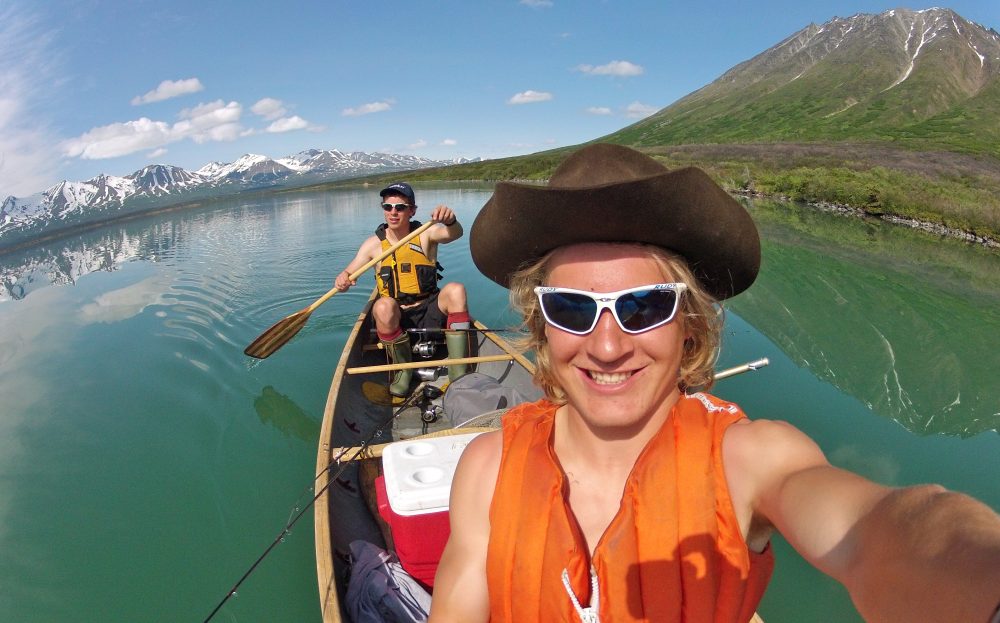
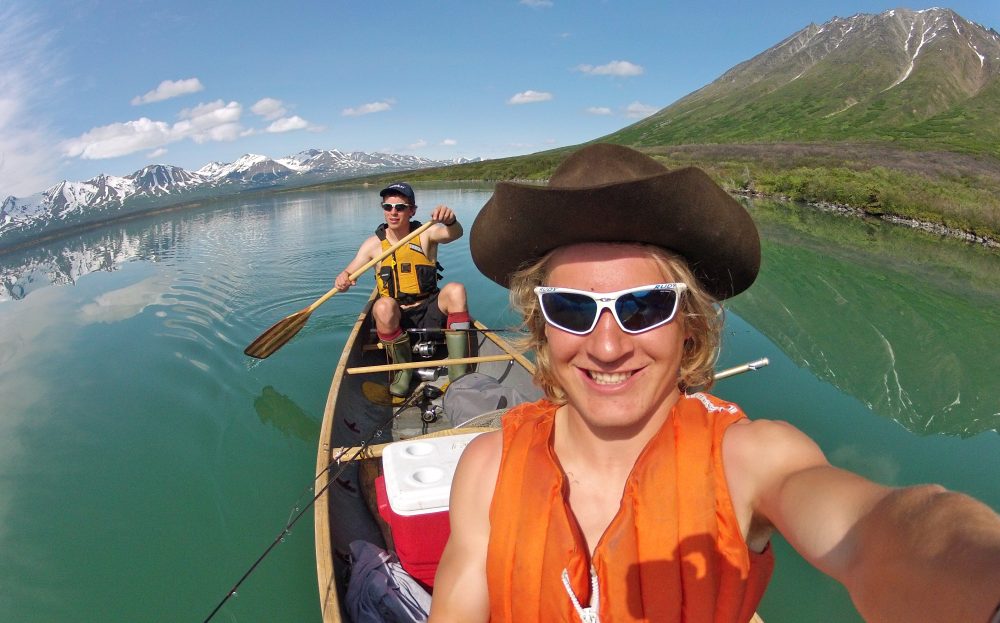
Former Canadian World Cup skier Knute Johnsgaard snaps a photo during a canoe trip. (Courtesy photo)
One hundred and fifty kilometers from the city of Whitehorse, if you are adventurous enough to hike through the troves of white spruce and over the two mountain passes to get there, you may come across Knute Johnsgaard’s family trapline. Traverse the 100 square kilometers of land where his family holds the rights to trap, and you may even catch a glimpse of Johnsgaard himself.
Johnsgaard, a native of the Yukon Territory’s Mount Lorne community, plans to spend most of next winter hunting on his family’s remote patch of land in northwest Canada. He will set traps for lynx, wolverines, foxes, and wolves. He will drop a few fishing lines into the land’s frozen lakes. He will sport cross-country skis as he travels from trap to trap.
He will not, however, train as he once did. That kind of work is a thing of the past (he will, incidentally, get in a few nordic over-distance workouts, as he plans to ski the 60-kilometer stretch of snow-covered land from snare to snare).
At 25, Johnsgaard has been a member of Cross Country Canada’s senior national team for the past three seasons (first on the U23+ Development Team, then on the U25 Team, and finally on the World Cup A-team last season). He represented Canada at this year’s Winter Olympics in PyeongChang, South Korea. And as of this spring, he is officially retiring from professional skiing.
***
Looking at the 2018 Olympic and Paralympic team rosters for Canada and the U.S., the pattern of athletes with the same last name is tough to miss. The Bjornsen siblings. The Patterson siblings. The Nishikawa brother-sister duo.
Knute Johnsgaard racing a 2016 World Cup in Lillehammer, Norway. (Photo: Fischer/Nordic Focus)
Johnsgaard is not one of those. He does not come from a family of athletes. Most of his relatives, he explained, had never followed his skiing or cross-country in general until the two weeks he competed at the PyeongChang Winter Games. What Johnsgaard did have growing up was a family who encouraged him to be outdoors and access to it. A lot of it.
The Yukon Territory spans an area of nearly 500,000 square kilometers, and includes Canada’s tallest mountain, Mount Logan. The region is, as Johnsgaard puts it, “one of the world’s last true wilderness areas.” It was within this last wilderness area that the Canadian began his cross-country journey.
He first started skiing on the ski trails of Mount Lorne. In between skiing adventures, he would join his father for trips to the family trapline. At the age of 13, Johnsgaard’s father suffered an accident that left him paralyzed, which halted their trips together.
Around that time, Johnsgaard and his mother moved to Whitehorse, the Yukon’s capital and only city, where Johnsgaard joined the Whitehorse Cross Country Ski Club. Johnsgaard remained active with the club through his high-school years. Following graduation, he moved to Quebec to train with the Pierre-Harvey National Training Centre, where he spent two years.
“I enjoyed my time in Quebec, but I really missed the Yukon,” Johnsgaard explained. “I felt it was kind of silly, I guess, to be training on the other side of the country when we had better snow conditions and so much available to us right here at home [in Whitehorse].”
***
Scroll through the photos Johnsgaard has posted on his blog and a few anomalies crop up. The first being that many of the shots feature Johnsgaard, proudly smiling, while kneeling over the hulking form of a freshly fallen carcass (the seamless transition between shots of Johnsgaard sporting camouflage then spandex also seems slightly unorthodox for the average cross-country skier).
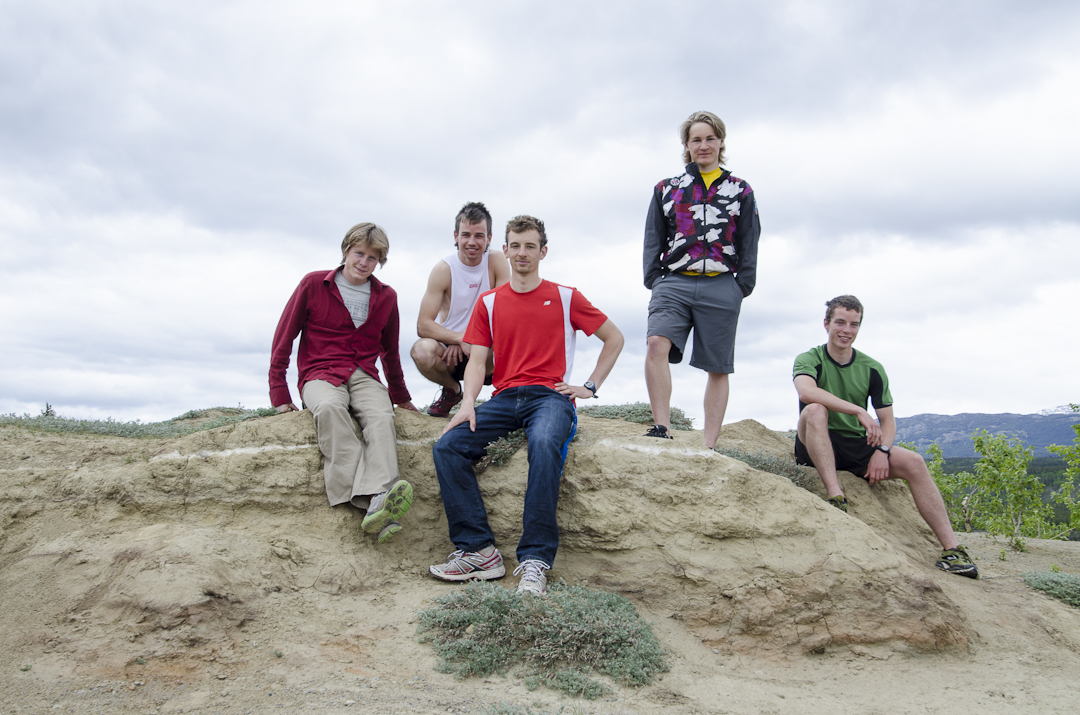
Knute Johnsgaard (standing) with the Yukon Elite Squad during a cliff-climbing trip. (Courtesy photo)
Yet to those who are familiar with Johnsgaard, there is a reason hunting appears in tandem with his athletic pursuits. Hunting was more than a hobby outside of ski training. For Johnsgaard, hunting was also how he trained.
“The type of hunting he was doing, it’s not like weekend-hunter-type skier, it was a lifestyle,” said former Canadian national-team head coach Justin Wadsworth, who coached Johnsgaard during his first season on the team, during a recent phone interview.
“I think he drew a lot of his confidence from that kind of upbringing and those kinds of experiences,” Wadsworth said.
Following his two years in Quebec, Johnsgaard returned to the Yukon. He and four other Yukon skiers started a training group called the Yukon Elite Squad (YES). The five men had no formative coach, which permitted them to train when and how they wanted. For Johnsgaard, it also meant a hunting trip could count as training, if he wanted.
“There was nobody to tell us we couldn’t skip training to leave and go moose hunting for a week,” Johnsgaard said.
According to Johnsgaard, the squad met about four times a week and tried to coordinate one training camp a year with Alaska Pacific University (APU), an American elite ski team located about 1,000 kilometers west in Anchorage, Alaska. YES also competed at Canadian nationals, “throwing cash” to any team’s wax technicians who were willing to help out.
“We were in a unique situation where we recognized that the Yukon was a great place to ski train and we all wanted to pursue skiing,” Johnsgaard said. “We made the best of it, and that’s how I made it onto the national team, training in the Yukon with just a few other teammates. I was pretty proud of that.”
After two years with YES, at age 22, Johnsgaard was nominated to the senior national team in 2015. In his rookie season as a member of Canada’s under-23 development team, Johnsgaard scored his first World Cup points in 30th place in the freestyle sprint in Gatineau, Quebec.
The following spring, he was renominated to the team, which changed its name to the U25 (under-25) Team. He started that winter of 2016/2017 on the World Cup circuit in Europe, competing in Finland, Norway, Switzerland, and France. During that World Cup Period 1, his top finish was 51st in a classic sprint.
Then came Period 2. While his World Cup teammates Len Valjas, Alex Harvey and Devon Kershaw were overseas competing at World Cups, Johnsgaard was at home in the Yukon training. He was also looking at the World Cup calendar, with one race in late January in particular focus: the 4 x 7.5 k relay in Ulricehamn, Sweden.
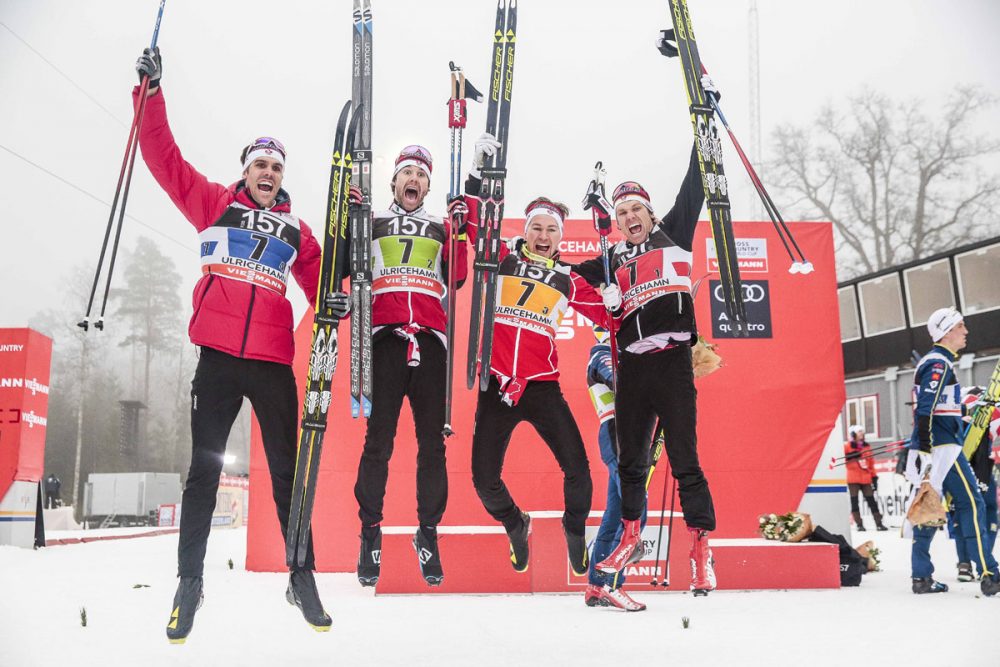
Left to right: Canada’s Len Valjas, Alex Harvey, Knute Johnsgaard, and Alex Harvey after their historic third place finish in the men’s 4 x 7.5-kilometer team relay on Jan. 22, 2017 in Ulricehamn, Sweden. (Photo: Fischer/Nordic Focus)
“They actually weren’t going to start a relay team because they didn’t have a fourth guy,” Johnsgaard said. “I had a meeting with our high-performance director [Thomas Holland] and begged him to send me over there to race that race.”
Holland consented and Johnsgaard flew to Ulricehamn to start in the relay. He arrived a few days before the race and was told he’d ski the third leg (first skate portion) of the relay.
On the day of the relay, Kershaw led off the first classic leg, putting the Canadians in third and just 0.7 seconds out of third at the first exchange. Harvey skied the second classic leg, holding onto the front pack of skiers before tagging to Johnsgaard in fifth, 3.5 seconds back. Despite being a little jet-lagged, Johnsgaard explained having a “weird confidence” that day on the trails.
He maintained his team’s position in the pack through his leg, handing off to Valjas in seventh, just 5 seconds out of first. After a smooth handoff, Valjas stayed streamlined in the group to the finishing stretch, sprinting to the line for third place. The result was historic for Canada. It also secured Johnsgaard’s spot on the 2018 Olympic team the following year.
“That was probably the highlight of my sporting career, that weekend in Sweden, qualifying for the Games there, and making World Cup team history for Canada at the same time,” Johnsgaard said.
The fact that the race pre-qualified him for the Olympics was a surprise to Johnsgaard.
“I always imagined getting a phone call after a stressful weekend at trials or something like that, but instead it was just one of my wax techs telling me over beer that evening, going, ‘Hey, I think you made the Olympic criteria,’ ” Johnsgaard said. “It was a pretty funny way to find out.”
Just over a year later in PyeongChang, Johnsgaard competed in the 15 k freestyle, 30 k skiathlon and 4 x 10 k relay. His best individual result was 69th in the 15 k skate, and he skied the anchor leg of the relay, which placed ninth as Canada’s second-best Olympic relay.
He started 12 individual World Cup races last season, with a top finish of 51st in a skate sprint in Seefeld, Austria.
“Since I started skiing at a young age, the Olympics were the ultimate goal,” Johnsgaard said. “To have finally accomplished that, I guess I feel fulfilled and I don’t really see incentive to keep going. I met my goal that’s all I ever wanted and now I’m moving on to new goals.”
“There has never been a ‘DNF’ next to my name,” he wrote. “I’ve never backed down, never not finished a race without laying it all out on the line. … Exploring my limits has always been something I loved doing. Results are inconsistent and out of your control, giving 100% effort, however, is attainable every time you’re on course.
“The world of sport is cruel in that I was always left wanting more,” he continued. “When you believe anything is possible, then everything less than perfect is not good enough. I always found myself striving for the next step that I could only hope would bring satisfaction. Instead, it brought only desire for greater success, which only got exponentially harder to achieve as I climbed the ladder. The final step was hard for me, and near the end of my career I began to struggle with anxiety and depression. It took so much energy that I didn’t have anything left over for ski races anymore, and I wasn’t happy.
“Now that I’m retired, I’m finally satisfied,” Johnsgaard added. “I’m able to step back and see for the first time this giant mural that I’ve painted, rather than focusing on the many imperfect brush strokes. I feel a cool breeze of fresh air bringing relief with each breath. I’m calm and content.”
***
All of the animals Johnsgaard traps are, in his words, “put to good use” for clothing, etc. In order to spend his winters living off the grid on his family’s trapline, Johnsgaard plans to work for a construction company through the summer and fall. Construction work is nothing new for Johnsgaard. It is also how he funded his skiing career.
“I did have to work a lot to afford to ski race before I was carded,” Johnsgaard explained in an email. “Even with working, I never could have pursued skiing without Cathy Wood of RyanWood Exploration. Cathy anonymously donated enough money for me to go to a training centre after high school and then supported me again in just my last two seasons on the World Cup.”
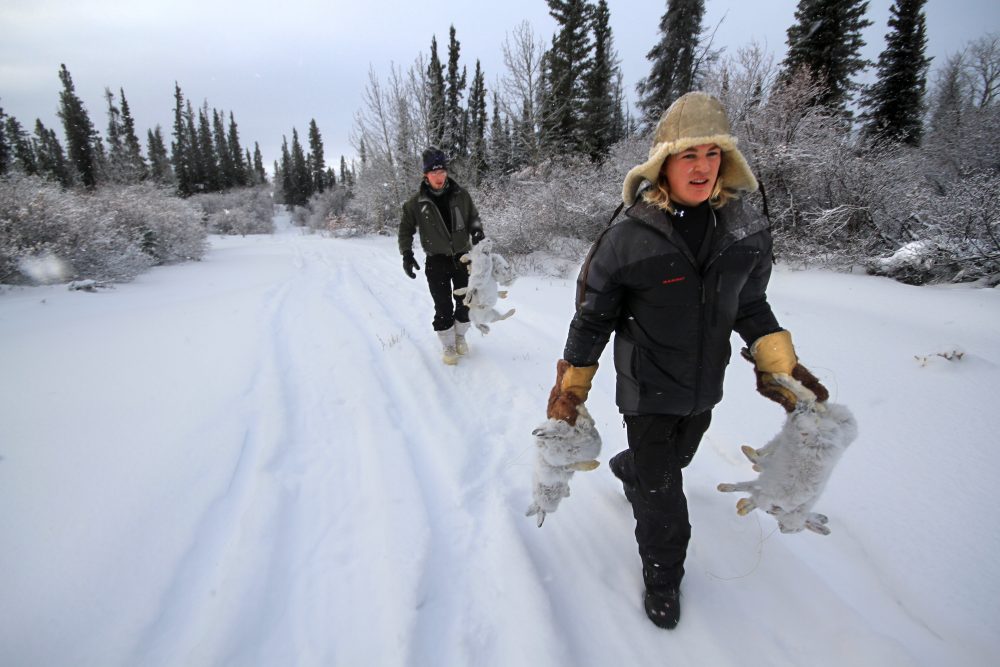
Knute Johnsgaard (front) after checking on rabbit snares on his family’s trapline. (Courtesy photo)
He will continue to organize and run the Father Mouchet Loppet in Old Crow, which he and friend/former YES teammate Colin Abbott helped create. Johnsgaard also hopes to do some coaching with the Whitehorse Cross Country Ski Club. Other than that, his connection to skiing will remain a lifestyle choice, and no longer a career one.
“I’ve always had quite a number of other hobbies and interests, so I’m not at all worried or stressed about what I might do,” Johnsgaard said of his retirement. “I’m just excited for new things, whatever they may be. It’s kind of exciting to be free.”
Johnsgaard is particularly excited about being able to do what he wants, when he wants.
“I hope people understand my decision and I hope that it’s not a question mark of why Knute is retiring at age 25 and he might not even be at his peak yet or this and that,” Johnsgaard continued. “It’s just that I’m satisfied with how far I’ve taken it and I feel fulfilled and I’m excited to do new things.”
Some do wonder whether he might have taken it further. Wadsworth described Johnsgaard as a “physiological talent”, his non-traditional ascent to the World Cup level an attestment in itself.
“He had a lot of natural strength and physical ability, and I think my guess is he would have had a much longer career had he had that upbringing of the traditional cross-country ski training,” Wadsworth said. “But Knute did it his way and for me to say, ‘Oh, he could have been better, had he taken the traditional method,’ that’s not for me to say. That’s purely a speculation on just what I’ve seen.”
For now, the reality is Johnsgaard’s skiing will stay in the Yukon — where he hopes to acquire land and build a home — which is exactly how he wants it.
“I would describe it like getting a wild mustang,” Wadsworth said of working with Johnsgaard. “Wild mustangs are used to running around out in the field and not being told what to do.”
(Note: This article has been updated to reflect that Len Valjas was nominated to the B-team, rather than the A-team as previously stated.)
On Thursday, Cross Country Canada (CCC) announced its national-team nominations for the 2018/2019 season via a press release.
Canada’s Alex Harvey celebrating on the podium after placing second in the World Cup men’s 15 k freestyle mass start in Seefeld, Austria, last season. (Photo: Salomon/NordicFocus)
Notably, the World Cup A-team is made up of one man — Alex Harvey — after three athletes from last year’s World Cup A-team retired (Devon Kershaw, Jess Cockney and Knute Johnsgaard). Graeme Killick, of last season’s World Cup B-team, also retired. Len Valjas was nominated to the B-team, a demotion, he said, that was a result of him ending his season immediately after the PyeongChang Olympics.
“The reasoning is that I … didn’t show up to [the World Cup in] Drammen, is that I didn’t follow what the team said,” Valjas told FasterSkier on May 22. He explained he had a broken spine, which required rest and rehabilitation.
On the women’s side, Dahria Beatty was renominated to the World Cup B-team, while Emily Nishikawa and Olivia Bouffard-Nesbitt were not.
All five of last year’s U25 Team were renominated to the national team, with Cendrine Browne and Julien Locke making the jump to the World Cup B-team, while Katherine Stewart-Jones, Maya MacIsaac-Jones and Gareth Williams were renominated to the U25 Team. Also on the U25 development squad, Antoine Cyr was promoted from the junior national team, and Graham Ritchie earned his first national-team nomination.
The World Cup team will once again be led by co-coaches Ivan Babikov and Louis Bouchard.
On the Para-Nordic side, the World Cup Team grew by one despite the retirement of Chris Klebl. Six athletes and two guides were nominated to the Para-Nordic World Cup Team, while two were renamed to the Development & Prospects Team. Four other athletes round out the team as part of the Prospects Team.
Norway’s Johannes Høsflot Klæbo celebrates his team-sprint win with Martin Johnsrud Sundby (not shown), while Alexander Bolshunov of the Olympic Athletes from Russia (l) pushes for silver on Wednesday at the 2018 Olympics in PyeongChang, South Korea. It was his third-straight gold of the week. (Photo: FlyingPointRoad)
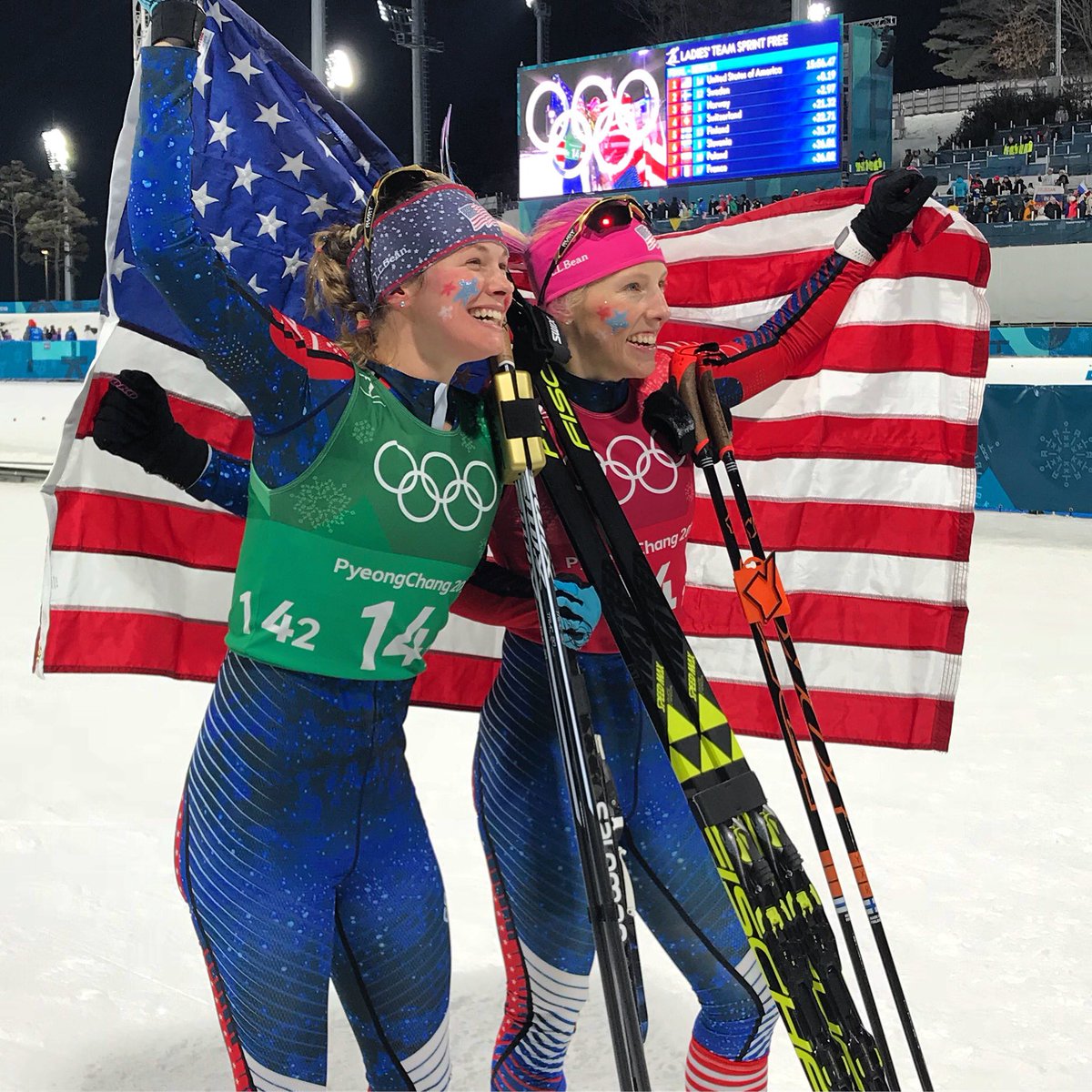
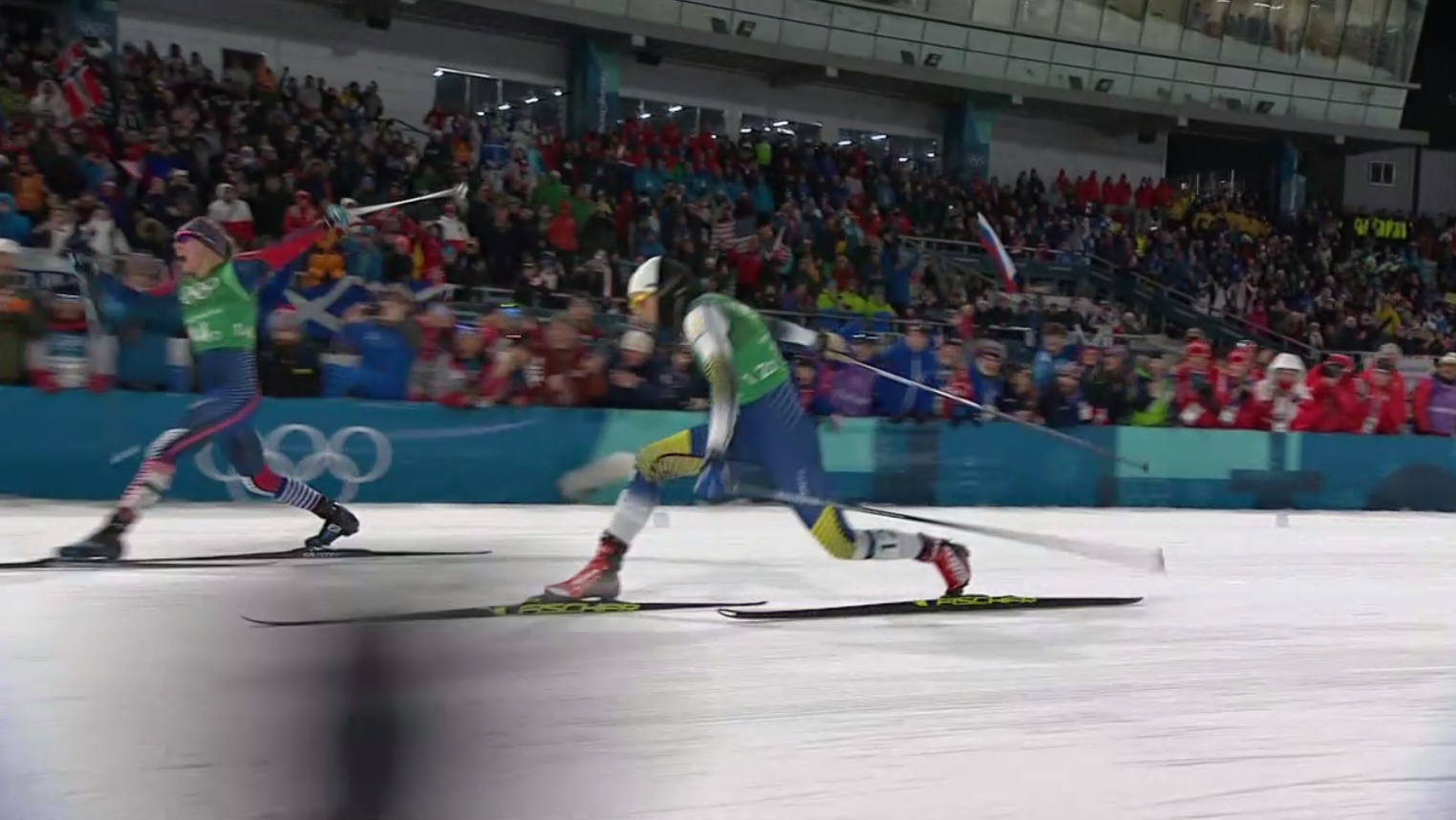
With a gold medal for their team already in the bag on Wednesday, Erik Bjornsen and Simi Hamilton put their heads down for the start of their own race at the 2018 Olympics. The men’s 6 x 1.4-kilometer freestyle team sprint final was scheduled to start just minutes after the women’s team sprint final ended, a race which saw Americans Kikkan Randall and Jessie Diggins capture the first Olympic gold for the U.S. in cross-country skiing.
It was motivating and inspiring, even confidence-boosting, Bjornsen reflected after his race in an in-person interview with FasterSkier. But he and Hamilton had their own medal hopes to tend to.
Like most of the men’s finalists, they weren’t able to watch the women’s race beforehand and came out onto the course shortly before the start of their final.
“I was warming up and kind of focusing on my own race, but I saw that they took the win when I was running to the start,” Bjornsen explained. “ … We were ready to match them.”
“I did not even see a second and I’m really bummed out that I didn’t,” Canada’s first-leg skier Len Valjas told FasterSkier after. “But so happy for the U.S., that’s amazing, like it actually gave us some positive energy before the race hearing who won. Our techs and coaches ran into our room, like, ‘Did you hear about the girls’ race?’ So it’s a win for North America. It just makes today even sweeter.”
American Erik Bjornsen (6) skiing with Canada’s Len Valjas (7) during the men’s 6 x 1.4 k freestyle team sprint at the 2018 Olympics in PyeongChang, South Korea. (Photo: FlyingPointRoad)
Both the American and Canadian men’s teams qualified for the 10-team final on Wednesday evening in PyeongChang, South Korea. Bjornsen and Hamilton had advanced with a fast-enough time after placing third in the second semifinal, while Valjas and his teammate Alex Harvey moved on as well (also as “lucky losers”) after finishing fifth in that semifinal.
The U.S. had some confidence going into the final after a semifinal performance that saw Bjornsen take the lead on the second-to-last lap, ahead of Norway. Hamilton held onto first for most of the the final lap until Norway’s Johannes Høsflot Klæbo passed him shortly before the finish, and France’s Richard Jouve passed Hamilton in the finishing straight as well, putting the Americans in third.
For the final, it was all about the medal hunt for Bjornsen and Hamilton, who placed fifth in last year’s World Championships classic team sprint in Lahti, Finland, just ahead of Canada in sixth, for the best U.S. men’s result in a team event.
Russia had won that 2017 world-champs team sprint with two athletes who were banned from competing at these Olympics, Nikita Kriukov and Sergey Ustiugov, and Italy placed second with Dietmar Nöckler and Federico Pellegrino. After an infamous tangle coming out of the final downhill, Finland ended up third with Sami Jauhojärvi (who retired after last season) and Iivo Niskanen, and Norway finished fourth with Klæbo and Emil Iversen. Norway opted for Klæbo and Sundby for its Olympic team-sprint squad on Wednesday, and Sundby later proved that he was worthy of the pick.
Ever since World Championships, it’s safe to say this is the race that had been primarily on Bjornsen’s and Hamilton’s minds for the better part of the last year.
They came out with a mission on Wednesday, putting themselves in the mix early in the final, alongside Canada.
Sweden’s first-leg skier Marcus Hellner leading during the men’s freestyle team sprint at the 2018 Olympics in PyeongChang, South Korea. (Photo: FlyingPointRoad)
Sweden set the pace for the first two laps, with Marcus Hellner starting them off and Calle Halfvarsson holding their lead on the second leg. They tagged off in first through the first two exchanges, just ahead of Norway and the Olympic Athletes from Russia after the first lap, then ahead of France, Norway and Russia after Lap 2. By the end of Hellner’s second lap, Sweden was still in first, tagging off in front of Norway, France and Russia, all within 1.3 seconds of first. Germany followed in fourth, 2.9 seconds back, and Bjornsen tagged the U.S. in fifth (+3.2).
The Americans had been hanging in fifth and sixth throughout the first half of the race, even after Bjornsen crashed at the beginning of his second leg. Heading into the first uphill after the exchange, Bjornsen skated over the tails of Nöckler’s skis ahead of him. He fell down and by the time he got back up, was in 10th — last place — starting back up the hill. Bjornsen recovered to put the U.S. in sixth, 3.2 seconds out of first, with three laps to go.
“It was super disappointing when I went down, but I mean, it was only halfway through the race and I just got up, and that’s for sure not going to be the end of it for us today,” Bjornsen said. “Unfortunately, I kind felt like I let the team down there a bit. I think that was one mistake that may have made a huge impact on our race today, but you know, that’s ski racing, that’s the way it goes sometimes. Unfortunately it’s at the Olympics.”
Hamilton was quick to respond to his teammate’s comments.
“In absolutely no way did Erik let any of us down, especially me,” Hamilton said. “I watched that on the big screen, I have been at a lot of team sprints on the World Cup, World Champs, Olympics, that always happens to someone, and 99 percent of the time, that person, especially if it’s in the finals, just gives up, whether it’s the first leg, second leg, third leg, they just give up. And Erik, he never does that, no matter what happens to him, what happens to us, he just fights ’til the absolute very end.
“It’s cliché to say that, but that’s what he does,” he continued. “That’s the only way he knows how to operate. … I am incredibly proud to be always be racing with Erik, to be training with him, to be rooming with him.”
The two Americans, who are rooming together in the Olympic Village, went on to lose a few more seconds and two places during Hamilton’s second leg, after which he tagged Bjornsen in eighth, 8.3 seconds out of first.
At the front of the pack, Klæbo had made a game-changing attack on the final climb of that leg, following Russia’s Alexander Bolshunov up it then making a few swift strides to get around him several meters from the top. As Klæbo jump-skated up and over and away from them, Bolshunov, Halfvarsson and France’s Jouve almost looked as if they were standing still, leaving them several seconds behind as they chased him toward the exchange.
Klæbo tagged Sundby 1.7 seconds ahead of Russia in second, 2.2 seconds clear of Sweden in third, 3 seconds ahead of Italy in fourth, and 3.3 seconds ahead of France in fifth. A couple more seconds back, Germany followed in sixth (+5.7), Finland in seventh (+6.0), the U.S. in eighth (+8.3), and Canada in ninth (+11.0), ahead of the Czech Republic in 10th (+12.8).
Sundby dug deep for his final 1.4 k lap to extend Norway’s lead to 5.1 seconds at the last exchange. For the first time all race, Klæbo took his hat off and prepared for his last time around the PyeongChang sprint course with Sweden, France and Russia about six seconds behind him.
Simi Hamilton (6) racing with Italy’s Federico Pellegrino (3) and others out of the exchange of the men’s 6 x 1.4 k freestyle team sprint semifinal at the 2018 Olympics in PyeongChang, South Korea. (Photo: FlyingPointRoad)
Bjornsen had skied the Americans back into sixth, 11.7 seconds back at the last exchange. Valjas tagged Harvey in eighth, 26.6 seconds out of first.
While Hamilton chased Pellegrino, who started 0.3 seconds ahead of him out of the exchange, over the next lap, the two kept Halfvarsson, Jouve and Bolshunov in their sights. Ultimately, however, they were unable to close the gap to fight for the medals.
The three-man chase group, led by Bolshunov, didn’t let off as they pursued Klæbo, who appeared untouchable as he rounded the course. As they sped down the final descent toward the finish, Klæbo pushed over the last little rise, looked back and appeared to exhale as he relaxed his shoulders. But it wasn’t over. Bolshunov was charging hard and Klæbo couldn’t let off just yet. The 21-year-old Norwegian took another breath then about a dozen or so more V2 pushes in the finishing straight. A full four seconds before the line, he let off and secured his third gold of his first Olympics in 15:56.26 minutes, 1.71 seconds ahead of Bolshunov (and Denis Spitsov of the Olympic Athletes of Russia) in second. Jouve outsprinted Halfvarsson to give France (with teammate Maurice Manificat) its second-straight bronze (+2.02), after France placed third in the men’s 4 x 10 k relay, and Sweden finished the race in fourth (+3.07).
About 15 1/2 seconds later, Pellegrino crossed the line in fifth (+18.55) for Italy, 2.17 seconds ahead of Hamilton in sixth (+20.72). The Czech Republic came through in seventh (+28.57) with Martin Jaks and Ales Razym, Harvey anchored Canada to eighth (+35.6), Finland finished ninth (+36.04) with Martti Jylhä and Ristomatti Hakola, and Germany placed 10th (+45.94) with Sebastian Eisenlauer and Thomas Bing.
“For our race tonight, we’re proud of what we accomplished,” Hamilton reflected. “Obviously, it’s always our goal to be on that podium. I think we both know that we can be up there and maybe someday we will. … If we are going to do that someday, there’s no way were going to do it without trying, so tonight was another one of those attempts, and it was a super-fun race, did everything we could, came up short, but we fought hard.”
“I guess we will have keep skiing and fight for it,” Bjornsen said, later adding, “We’re coming back for a gold.”
Canada’s Alex Harvey jets out of the exchange during the men’s 6 x 1.4 k team sprint semifinal at the 2018 Olympics in PyeongChang, South Korea. The Canadians went on to finish eighth. (Photo: FlyingPointRoad)
For Valjas, who had slipped to 10th on his second leg but brought his team back to eighth after Harvey put them in ninth with two laps to go, a top 10 at the Olympics on any day was a good one. He previously raced on Canada’s 4 x 10 k relay that finished ninth.
“I actually got a chest cold two days ago so it was kind of a game-time decision,” Valjas said after of Canada’s decision to start him with Harvey. “The team really wanted me to start this even if I’m not 100 percent, and honestly it felt pretty good. I think it was my legs that gave out before my lungs so I’m glad I did start because I felt horrible coming on the bus here. I was like, ‘How am I gonna race against these guys? Like, even healthy I’m gonna suffer.’
He explained that the course didn’t exactly suit his strengths with its long climbs.
“The first work section is a minute with no break,” Valjas said. “I was just trying to use the flats and the downhills like what I’m good at and the rest I was just surviving…
“Honestly for me on this course, at the World Cup last year, I had a terrible team sprint,” he added, reflecting on his 13th-place result last year with teammate Jess Cockney at the pre-Olympic World Cup in PyeongChang. “And I was good shape then. Jess raced great, I was just getting dropped. For me, another top 10 in the Olympics and I’m thrilled how it went and so happy that Alex had some punch in the end there. The 50 k [on Saturday], I’ll be out here cheering. It’s looking great for [Alex] and I’m glad I could help him in his race prep.”
Norway’s Johannes Høsflot Klæbo and Martin Johnsrud Sundby (1) embrace after Klæbo anchored the two-man team to first in the 6 x 1.4 k freestyle team sprint at the 2018 Olympics in PyeongChang, South Korea. (Photo: FlyingPointRoad)
For Norway, the gold medal was its fourth in five men’s races so far at these Olympics. Klæbo has won three of them (individual classic sprint, relay and team sprint) and Sundby two (relay and team sprint).
In a post-race press conference, Sundby, 33, had nothing but praise for his young teammate.
“I think the whole cross-country world at this point is looking on what Johannes does, how he does it, and why he is so fast,” Sundby said. “… We are close and are able to learn so much from this guy. He’s 21 years old. Today we were both extremely nervous for the competition. … Anything can happen, and these tracks are so tough, this sprint track. It’s a lot of uphill and a really tough downhill, and you don’t get any rest at any point, so we were not looking forward to it, but its really good to finish it.”
While Russia’s Spitsov said they had been going for gold, he explained through a translator that they were “not very lucky.”
“We had a small tactical mistake and we lost a few seconds through that when he was basically being blocked, lagging behind the French guy,” he said at the press conference. “We tried to catch up but we couldn’t. Johannes was stronger and faster.”
France’s Maurice Manificat (r) with teammate Richard Jouve after they earned bronze in the men’s freestyle team sprint final at the 2018 Olympics in PyeongChang, South Korea. (Photo: FlyingPointRoad)
For France, the bronze medal was a big deal. It was the first for the 23-year-old Jouve in his first Olympics. Manificat previously raced in France’s bronze-medal relay.
“Second medal and also with Richard, it’s unbelievable,” Manificat said at the press conference. “Three days ago a medal in distance with my teammates on the distance team, and it was a hard choice the last day with our sprinter Lucas Chanavat; he was really sad to not be part of this relay, but I think with this medal, it was for all for the team … and we are so happy together as you could see in the [finish] and to share it with Richard. [He was] unbelievable in the final [lap], it was so crazy, so thanks to him and thanks to all team’s waxers, we had such good skis, so it was perfect.”
— Jason Albert, Gabby Naranja, Ian Tovell, and Harald Zimmer contributed
The men’s 6 x 1.4 k freestyle team sprint podium at the 2018 PyeongChang Olympics, with Norway’s Martin Johnsrud Sundby and Johannes Høsflot Klæbo (c) in first, the Olympic Athletes of Russia’s Denis Spitsov (l) and Alexander Bolshunov (second from l) in second, and France’s Maurice Manificat (second from r) and Richard Jouve (r) in third. (Photo: FlyingPointRoad)
Team USA after Kikkan Randall and Jessie Diggins (c) won gold in the women’s freestyle team sprint on Wednesday at the 2018 Olympics in PyeongChang, South Korea. (Photo: FlyingPointRoad)
(Note: This rundown has been updated to include comments from Canadians Emily Nishikawa and Dahria Beatty.)
The medal hunt is over. In the final team event of the 2018 Winter Olympics, the U.S. women got the job done on Wednesday in PyeongChang, winning not just a medal, but the first Olympic gold in the history of U.S. cross-country skiing.
Jessie Diggins (l) and Kikkan Randall soak up their win in the women’s freestyle team sprint on Wednesday at the 2018 Olympics in PyeongChang, South Korea. (Photo: FIS Cross Country/Twitter)
Kikkan Randall and Jessie Diggins teamed up in the 6 x 1.25-kilometer event, with Randall tagging Diggins in third at the final exchange, just 0.7 seconds behind Norway’s Marit Bjørgen in first and 0.5 seconds behind Sweden’s Charlotte Kalla in second. With 1.25 k to go, Diggins charged ahead on the first climb, with Norway’s Maiken Caspersen Falla and Sweden’s Stina Nilsson chasing her in second and third, respectively. They were about 10 seconds clear of Switzerland in fourth at the final exchange.
Falla moved into first at the bottom of the final grueling climb. Halfway up, Diggins and Nilsson jostled to position themselves in second, and over the top, Diggins slotted into third.
Riding fast skis on the downhill toward the stadium, Diggins stayed out of trouble while Nilsson nearly rode up onto Falla’s skis. While Nilsson used the draft to get into first coming out of that downhill, Diggins eyed a specific line, saw the opening between the two and took it to move into second. As Nilsson entered the finishing straight, Diggins was right there with her, even pulling into first as they came within 50 meters of the line. The gold became a reality, as Diggins outlunged Nilsson by 0.2 seconds at the finish with a time of 15:56.4 minutes, and Falla crossed 3 seconds back in third.
Jessie Diggins (l) lunging for gold in the women’s freestyle team sprint, 0.2 seconds ahead of Sweden’s Stina Nilsson at the 2018 Olympics in PyeongChang, South Korea. (Screenshot: NBC broadcast)
Gold for the U.S., silver for Sweden, bronze for Norway. With her 14th Olympic medal, Bjørgen became the most decorated Winter Olympian of all time, while Randall and Diggins earned their country’s first Olympic gold.
In the men’s 6 x 1.4 k team sprint final that followed, Johannes Høsflot Klæbo once again anchored another Norwegian victory, teaming up with Martin Johnsrud Sundby for Klæbo’s third medal of his first Olympics. With a strong second leg from Klæbo, the Norwegians gapped the field, and Sundby extended that gap to 5 seconds over Sweden by the final exchange. Klæbo rounded the final lap alone, still charging for the win and only letting up a few meters before the line to celebrate as he crossed in first with a time of 15:56.26.
Kikkan Randall (14) and Jessie Diggins embrace as they celebrate their freestyle team sprint gold on Wednesday at the 2018 Winter Olympics in PyeongChang, South Korea. It is the first U.S. cross-country skiing gold medal in Olympic history, besting Bill Koch’s individual silver medal in the 30 k at the 1976 Winter Olympics. (Screenshot: ARD broadcast)
Alexander Bolshunov of the Olympic Athletes from Russia pushed to catch Klæbo on the last lap and motored for silver, finishing 1.71 seconds back. He teamed up with Denis Spitsov fortheir second-straight silver medal of the Games (after placing second in the 4 x 10 k relay) and Spitsov’s third medal (after placing third in the 15 k freestyle).
France (Maurice Manificat and Richard Jouve) placed third (+2.02) with Jouve edging Sweden’s Calle Halfvarsson by about a second for bronze, while Sweden placed fourth (+3.07) with Marcus Hellner and Halfvarsson. It was the French men’s second-straight bronze medal after placing third in the relay.
Italy (Dietmar Nöckler and Federico Pellegrino) was next across the line in fifth place, 18.55 seconds out of first, while the U.S. men (Erik Bjornsen and Simi Hamilton) followed in sixth (+20.72). Bjornsen crashed shortly after the start of the third leg (his second leg) after skiing onto the tails of Nöckler’s skis up the first climb out of the stadium. That put the American in last place near the bottom of the hill, but Bjornsen rebounded to tag off in sixth, just 3.2 seconds out of first. Hamilton slipped to eighth and 8.3 seconds back on the next leg, and by the last lap, it was Hamilton chasing Pellegrino for fifth place, which Italy ultimately took about 2 seconds ahead of him at the finish.
Canada’s Len Valjas and Alex Harvey finished eighth (+35.6), with Harvey holding off Finland in ninth by half a second at the line, after slipping as far back as 10th on Valjas’s second leg.
Semifinals
Earlier in the day, the Norwegian men and women, Russian men, and American women each won their semifinal heats as the field was narrowed to ten teams for each final.
In the first women’s semifinal, Bjørgen and Falla posted an easy win by 6.6 seconds. Switzerland’s Nadine Fähndrich and Laurien van der Graaff bested Slovenia’s Alenka Cebasek and Anamarija Lampic for second place.
In the second semifinal, Randall and Diggins claimed the win, with Kalla and Nilsson finishing second, just 0.7 seconds back; Diggins and Nilsson didn’t sprint for bragging rights, seemingly saving energy for the final. Russia’s Natalia Nepryaeva and Yulia Belorukova finished third (+2.1).
Only the top two finishers from each semifinal automatically advance to the final, but Slovenia and Russia qualified as “lucky losers” based on their time. Also qualifying for the final were Finland (MariLaukkanen and Krista Parmakoski), Poland (Justyna Kowalczyk and Sylvia Jasckowiec), France (Aurore Jean and Coraline Hugue), and Germany (Nicole Fessel and Sandra Ringwald).
The Canadian women’s team of Emily Nishikawa and Dahria Beatty finished seventh in the second semifinal, and were two spots out of making the final (the Czech Republic had a faster time than the Canadians but also did not advance).
“The first four legs we were right in there with the group,” Nishikawa told FasterSkier after their semifinal. “I think our second heat was quite a strong heat, it stayed together until the fifth leg. That’s where I blew up a little bit, but I did everything I could. … Dahria skied amazingly well, she was able to still catch Italy again on the sixth leg.”
“We knew that the first three, four teams would be quite strong: USA, Sweden, Russia and Finland,” Beatty said. “So we knew everyone else, we could ski with them in the group, so we were trying to stay with that kind of middle group ’cause we knew five or six would probably be qualifying from our heat. … I think we did a really good job of skiing a race where we were right in there. … I think we came something like 11 seconds short of what we needed…
“Even though we didn’t qualify it was nice to be able to go catch one team on the last lap there and finish strong,” Beatty added. “Our coaches were cheering amazing out there, and had some cheering from the American coaches, too. So there was a lot of motivation on the course to really fight to the line.”
In the men’s semifinals, Russia’s Spitsov and Bolshunov and Sweden’s Hellner and Halfvarsson at some points appeared to be running away with the first heat, but by the finish Germany (Sebastian Eisenlauer and Thomas Bing) and Finland (Martti Jylhä and Ristomatti Hakola) were within three seconds in third and fourth.
For the U.S., Bjornsen took charge of the second semifinal on the fifth lap, and Hamilton kept the lead into the final downhill. Klæbo passed him late in the game and claimed the win along with teammate Sundby, and Hamilton appeared unconcerned as Jouve passed him in the finishing straight as well to put France (with Manificat) in second; based on time, the U.S. advanced as a lucky loser.
Also in the men’s final were Italy (Nöckler and Pellegrino), Canada (Valjas and Alex Harvey) — who finished fifth in the second semifinal — and the Czech Republic (Martin Jaks and Ales Razym).
Canada’s Len Valjas (l) and American Andy Newell scrambling during the first leg of the men’s 4 x 10-kilometer relay on Sunday at the 2018 Olympics in PyeongChang, South Korea. (Photo: FlyingPointRoad)
PYEONGCHANG, South Korea — Zooming in on the leaders of Sunday’s nordic race, the Olympic broadcast stream focused on a red Norwegian suit set against the backdrop of Russian maroon. The televised showdown presented for the men’s 4 x 10-kilometer relay final leg was shaping up to be between the Olympic Athletes from Russia and Norway: Denis Spitsov verses Johannes Høsflot Klæbo. As the two skiers struck out for Lap 2 of 3 of the final 10 k leg, both spectators and screen apprehensively followed.
Had the camera panned 250 meters ahead, it might have caught the flurrying ski tails of American Noah Hoffman, dashing the top of the 3.3 k lap’s initial climb. Around 45 seconds earlier, Hoffman had been tagged into the race as the anchor leg for the U.S. men. His hot start was not just for show or a final push to the front. If he wanted to prevent the U.S. team from an eliminatory pull, he would need to stay ahead of Spitsov and Klæbo.
A cat-and-mouse game between the leaders certainly could buy the U.S. skier a little more time to pad the time gap. But until then, he sifted a reductionist race: Stay in the game. Don’t get caught by Klæbo.
American Noah Hoffman anchoring the U.S team during the men’s 4 x 10-kilometer relay on Sunday at the 2018 Olympics in PyeongChang, South Korea. (Photo: FlyingPointRoad)
“The highlight for me was watching these guys stick with their guys,” Canada’s Len Valjas said of his relay teammates in a post-race interview with FasterSkier. “And another one was watching Noah stay away from Klæbo. We were all yelling, cheering for him. That was amazing.”
The relay had more than one race in the works. Hoffman staying in front of Klæbo was one. Canada’s Graeme Killick catching Sweden was another.
After Valjas scrambled the first classic leg, he came through the exchange in 10th, handing off to Killick for the second classic leg. As Killick headed out for his first lap, Sweden was four places and 38.3 seconds ahead.
The 28-year-old Canadian, in his second Olympics, was by no means deterred. Working kilometer by kilometer, Killick strode past the Czech Republic’s Martin Jaks, Germany’s Thomas Bing and eventually Sweden’s Daniel Rickardsson.
After moving up three places, Killick went through the second exchange in seventh with the seventh-fastest time, passing off the race to Russell Kennedy. Going into Leg 3, 2.6 seconds separated the Canadians from the tag between Sweden’s Rickardsson and Marcus Hellner. All said and done, Killick had made up 40.9 seconds to catch and pass Sweden.
“Everyone, I think, skied to a higher level today,” Killick told FasterSkier after. “We were all able to dig deep for our teammates and make sure we pass off in good position.”
“Anything can happen in a relay and that’s one of the reasons it’s always exciting to get on the start line and do your best,” Killick continued. “When I tagged off Russell, he was with Hellner … It was cool to see everyone dig so deep and just fight for the team.”
Racing Canada’s third relay leg, Kennedy, a 26-year-old Olympic rookie, held tight to Hellner through the first lap. And again through the second. And through the first half of the third. It was not until around the final major climb, that Hellner broke away from Kennedy’s red maple-leaf suit.
Canada’s Graeme Killick racing the second leg of the men’s 4 x 10-kilometer relay on Sunday at the 2018 Olympics in PyeongChang, South Korea. He brought the team from 10th to seventh with the seventh-fastest second-leg time. (Photo: FlyingPointRoad)
“I was psyched when I saw GKill killed it, and gave me an amazing position,” Kennedy said after. “But I was also a bit nervous because … I was walking to the line with Hellner and I was like, he’s an Olympic champ. I got to stick with him and hold on, and that’s what I did. I just locked on, the wax techs gave me amazing skis today, and I held on as hard as I could. He threw in a sprint at the top of the hill, blew me up, but I was psyched to have made it almost three laps with him.”
Hellner has two relay gold medals from the Olympics, one from 2014 and another from 2010, as well as two 30 k skiathlon golds from the 2010 and 2014 Games. The 32-year-old Swede is also a multiple-time World Championships medalist with several top-10 World Cup 15 k freestyle results. While Kennedy considers himself more of a sprinter, Sunday’s performance may perhaps change his perspective.
“I was just thinking, don’t blow. Do it for the team,” Kennedy said. “I knew that if I could hand off to Knute in a good position, were were in a really good position for us. Can’t ask for much more than that. I gave it everything for sure. I was just happy we caught the Slovakian guy so Knute had someone to ski with. But yeah, amazing day for me, for sure. I felt really good.”
Canada’s Knute Johnsgaard (12) racing the final leg of the the men’s 4 x 10-kilometer relay on Sunday at the 2018 Olympics in PyeongChang, South Korea. He anchored the team to ninth for its second-best Olympic relay result. (Photo: FlyingPointRoad)
After skiing the seventh-fastest third leg, Kennedy came through the exchange in eighth and handed off to teammate Knute Johnsgaard, also in his first Olympics, for the final freestyle leg. Johnsgaard kept the Canadians ahead of the Czech Republic, staving off Kazakhstan until the final kilometer and a half.
“It was pretty tough for me, especially the sprint hill,” Johnsgaard, 25, said. “We knew it was going to be hard. We did the best we could.”
Canada finished in ninth, 3:41 seconds off first, which was taken by Norway’s lineup of Didrik Tønseth, Martin Johnsrud Sundby, Simen Hegstad Krüger, and Klæbo in a time of 1:33:04.9. The ninth place ties the country’s second-best Olympic relay result, which was set at the Calgary Games in 1988. Canada’s best relay finish was in 2010 when the team placed seventh with Devon Kershaw, Alex Harvey, Ivan Babikov, and George Grey.
Harvey opted not to race Sunday’s relay, and Johnsgaard started in his place.
In last year’s World Championships team relay in Lahti, Finland, with Harvey on the team, the Canadians were lapped out of the race.
“We’ve had some terrible luck with relays. I think we did great today,” said Valjas, a 29-year-old two-time Olympian. “It’s not our A-team; we knew that coming in. I think we performed amazing and I’m super happy with how it went. Especially all these guys staying with some serious big names in cross-country skiing. I’m impressed, these guys were fighting hard and I’m proud of all of them.”
Alongside the Canadian’s solid team performance, the U.S. had several personal highlights. Scrambling in the first leg was American Andy Newell in his second race of the week (after placing 37th in the individual classic sprint) and potentially, the 32 year old’s last Olympic race.
“The sprint day was really disappointing, because I knew I had a lot more to give in the qualification. To be just out was frustrating, I know I had a much better result than that in me, and my body is feeling better than that result,” Newell told FasterSkier on Sunday. “To be able to come back and get another start, it was great.”
Having scrambled in Olympic relay races before, Newell explained that allowing the pace to burn off the front was part of his plan. Through the first lap he was 2.3 seconds off the lead pace. Around 5 k, he was racing with Canada, Estonia, Austria, the Czech Republic, Switzerland, and Germany around 6 seconds back. With around one lap to go, Kazakstan’s Alexey Poltoranin bulldozed to the front and began pushing pace. Newell stuck to his racing plan.
“It’s a high-pressure event. Somebody who has raced first legs for their country before, talk about being nervous the night before, when you know you’re going to go off and the rest of the team’s counting on you,” Newell said. “Relays … there’s so much national pride, no matter what team you come from. Whether it is a Norway/Sweden rivalry or and Canada/U.S. rivalry, they all go back and have their history.”
“I probably haven’t raced a 10 k in probably over a month, talk about nerve racking,” Newell continued. “To step to the line with Poltoranin, some of these guys, when you know they are much better 10 k classic skiers than I am.”
Poltoranin has reached the World Cup podium numerous times in distance classic races. On Sunday, Newell came through the exchange in 12th, 1:28.8 minutes behind Poltoranin in first.
“I just have to go and be like, ‘A minute twenty back, it feels like a bad race, but these guys are the best in the world. … It sounds bad, but we have to do what we call damage control a little bit, try to ski with the guys we can ski with, and put our team in the best position we can,” Newell explained.
American Resse Hanneman racing the second leg of the men’s 4 x 10-kilometer relay on Sunday at the 2018 Olympics in PyeongChang, South Korea. In his first Olympic race, after being tagged in 12th, he came through the second exchange in 14th. (Photo: FlyingPointRoad)
He passed off to American Reese Hanneman for the second classic leg. The event was Hanneman’s debut Olympic race. The 28-year-old Alaska native was called on to the team as the first alternate.
“Skiing with the top 13 classic skiers in the world … for me, it became apparent that I was going to have to really focus and make it hurt to minimize the time I was going to lose to them,” Hanneman said. “I could barely see or stand up by the end of it. I’m not happy with how I performed, but I’m happy with how deep I was able to dig.”
Hanneman tagged off to Scott Patterson in 14th, who then took the American’s first freestyle leg. Creeping up on Patterson were the race leaders. He geared up through all three of his laps, holding off both Norway’s Simen Hegstad Krüger and Russia’s Alexey Chervotkin.
“All the coaches were out there going, ‘You’ve got two minutes. You’ve got 1:39,’ just the whole way,” Patterson said, referring to his time back to the leaders. “It’s not the direction you want to be getting splits, but that’s where we were.”
“Also, we knew with Erik [Bjornsen] sitting out, with Simi [Hamilton] sitting out, with Paddy [Caldwell] sick, we knew were in a little bit of a tough shape for today, so not getting lapped was a bit of goal going in,” Patterson added.
With Hoffman anchoring the final three laps, the Americans achieved their goal. Don’t get caught by Klæbo became ‘Klæbo can’t catch me.’
“They weren’t charging their second lap — my first lap — but I knew they would be charging on the last lap and I knew I needed every second I possibly could, so I went out hard,” Hoffman said. “I was just viewing it as a 6.6 k race. Like the last lap doesn’t matter at that point, just got to get there. I did everything I could and it was close but I am pretty psyched that we as a team made it.”
The Americans finished the relay in 14th (+9:24.2) out of 14 teams.
“You never know how its going to go down,” Hoffman said of relays. “Unless you are scrambling you don’t know what the start is going to be like, where you’re going to be, if you’re going to be alone, if you’re going to be with people, you got to be adaptable, you got to be able to make your own plan out there.
“This was my first time ever anchoring a relay so that’s pretty cool experience,” Hoffman added. “I had a lot of support finishing. … Even though we were a long ways back the crowd seemed to stick around for me, which was pretty fun.”
Johannes Høsflot Klæbo anchoring the Norwegian men’s 4 x 10 relay to gold on Sunday at the 2018 Olympics in PyeongChang, South Korea, while Denis Spitsov (background) celebrates silver for the Olympic Athletes for Russia. (Photo: FlyingPointRoad)
For a while in the men’s 4 x 10-kilometer relay on Sunday, it looked like the Russians might run away with the win. But that was just two classic legs and 20 k into the race, with a lot more racing to come.
While Kazakhstan’s Alexey Poltoranin had handed off in first at the first exchange, just ahead of Andrey Larkov of the Olympic Athletes from Russia, Italy, France and Norway skied together behind them, with Norway’s Didrik Tønseth trailing off the back, 18 seconds behind.
On the next classic leg, Russia’s Alexander Bolshunov put a hurt on the field. Within the first 3.3 k lap, he was 25 seconds ahead of Kazakhstan’s Yevgeniy Velichko in second, who was followed closely by Italy, Norway and France in third through fifth. Sweden’s Daniel Rickardsson had fallen farther behind to more than a minute back in sixth place, after his teammate Jens Burman lost contact with the lead group on the first leg.
By the second exchange, Russia was 24.5 seconds clear of second place, while Italy’s Francesco de Fabiani tagged Giandomenico Salvadori in second, France’s Maurice Manificat tagged Clement Parisse in third (+28.0), and Norway’s Martin Johnsrud Sundby tagged Simen Hegstad Krüger in fourth (+32.1). Kazakhstan’s Velichko had fallen off the pace and was another 19 seconds back in fifth.
Over the next 10 k, the first skate leg, Krüger and Parisse reeled in Russia’s Alexey Chervotkin, catching him before the end of their second lap. One lap later, Krüger came through the final exchange in first, tagging Johannes Høsflot Klæbo 0.4 seconds ahead of France in second. Chervotkin tagged Russia’s anchor Denis Spitsov in third, 16.2 seconds back, while Finland’s Matti Heikkinen passed Italy’s Salvadori on the last climb to put Finland in fourth (+58.6).
Team France celebrates its bronze-medal finish in the men’s 4 x 10 k relay at the 2018 Olympics on Sunday in PyeongChang, South Korea. (Photo: FIS Cross Country/Twitter)
Early in the final leg, France’s Adrien Backscheider took the lead ahead of Klæbo. The two held Spitsov off until the end of the second lap, where Spitsov came through the stadium first to start the final loop. Spitsov and Klæbo soon upped the pace, dropping Backscheider, and shortly after the 8.27 k checkpoint, Klæbo truly put the jets on to accelerate away from Spitsov. He dropped the Russian on a climb just before the final uphill, where it was clear that the gold was Norway’s.
As he sped down into the stadium, Klæbo relaxed his arms, skied to the sideline and took a flag from the stands. He looked back for a moment and then crossed the finish line first in 1:33:04.9 hours, while Spitsov followed 9.4 seconds later for silver for Russia. Backscheider held on for bronze (+36.9) as his team exuberantly celebrated with him at the finish.
Finland placed fourth (+1:40.5), Sweden fifth (+2:05.6), Germany sixth (+2:08.2), Italy seventh (+2:35.2), and Kazakhstan eighth (+3:31.4). Canada was ninth (+3:41.0) for its second-best Olympic relay result (with Len Valjas, Graeme Killick, Russell Kennedy, and Knute Johnsgaard), and the U.S. finished 14th (+9:24.2), out of 14 teams, with Andy Newell, Reese Hanneman, Scott Patterson, and Noah Hoffman.
France’s Martin Fourcade lunging for his second gold of the 2018 Olympics in PyeongChang, South Korea, winning the men’s 15 k mass start on Sunday. (Photo: FlyingPointRoad)
Martin Fourcade is the champion once again. Six days after he won the 12.5-kilometer pursuit for his first gold in PyeongChang, the 29-year-old Frenchman did it again in the men’s 15 k mass start on Sunday, winning in a photo finish at the line.
He took charge on the first loop, leading the field into the range for the first prone shooting. There, Fourcade shot a penalty and slipped to 19th, but it wasn’t over.
Clean shooting on the second prone brought him up to eighth, 9.4 seconds out of first. Germany’s Benedikt Doll took that lead at that point after his second stage without a miss. Meanwhile Norway’s Johannes Thingnes Bø shot three misses on that second stage and dropped out of contention.
One loop later, Fourcade moved into first with a clean standing. He left the range about 1 second ahead of Germany’s Simon Schempp and 2 seconds ahead of Germany’s Erik Lesser, after both made it through the first three stages without a miss. Doll missed one to slip to seventh, almost 30 seconds behind.
After Fourcade and Schempp exchanged leads over the next loop, Lesser moved into first just before the final shooing, Going head to head, Fourcade and Schempp both missed one while Lesser missed two. Fourcade and Schempp still left the range in first and second, respectively, separated by 0.4 seconds, while Lesser slipped to fifth, 22.5 seconds back.
Doll left the range in third (+19.2) after cleaning and Norway’s Emil Hegle Svendsen moved into fourth (+21.9) with a clean standing stage as well.
In the end, Fourcade outlunged Schempp for the win in 35:47.3 minutes, with Schempp finishing less than a tenth of a second behind for silver, and Svendsen beat out Lesser in the finishing stretch by 0.4 seconds to claim bronze, 11.2 seconds behind, while Lesser settled for fourth (+11.6). Doll followed them in fifth (+18.8), Austria’s Julian Eberhard placed sixth (+30.7) with three penalties, Norway’s Erlend Bjøntegaard seventh (+32.1) with two misses, Norway’s Tarjei Bø eighth (+34.6) with three penalties, Sweden’s Jesper Nelin ninth (+34.6) with two misses, and Slovenia’s Jakov Fak 10th (+36.1), just ahead of the Czech Republic’s Ondřej Moravec in 11th (+36.3), with one miss each.
A generation ago, North American cross-country skiing was a results-sheet afterthought with the exception of the one-off banner day.
Now, with Canada’s Alex Harvey and the U.S. Ski Team earning World Cup wins, podiums, and coveted points, expectations are high. Is it medal or go home?
Not quite. Breathe. Exhale.
On Tuesday night at the Alpensia cross-country venue, North American skiers put on a show. With Jessie Diggins making the finals and Canada’s Len Valjas skiing like he could reel in the ephemeral white whale, spectators and writers alike could also breathe and exhale, knowing good things come around eventually.
Asked in the mixed zone after the race if medals were still in the mix, Diggins turned to the media scrum before walking away and said, “I wouldn’t be racing here if they weren’t.”
In Tuesday’s qualifier, Diggins spearheaded a four-skier women’s U.S. Olympic team that skied one-by-one out of the start in tricky winds and pending precipitation.
Posting the fastest qualifying time was Sweden’s Stina Nilsson, covering the 1.2 k sprint course in 3:08.74 minutes (She would eventually move on to win the event’s gold-medal. Diggins was the leading U.S. skier in qualification, slotting into seventh place, 7.02 seconds off Nilsson’s time. Sadie Bjornsen placed ninth (+7.38) and Sophie Caldwell 12th (+8.32) in a qualifier featuring a 15.28-second spread from Nilsson to 30th-place Aino-Kaisa Saarinen of Finland.
The fourth U.S. starter, Ida Sargent, just missed the quarterfinals in 33rd. She finished 17.06 seconds behind Nilsson’s time.
Three American Women in the Quarterfinals
American Jessie Diggins (7) lunges for second in a photo finish in the women’s classic sprint semifinal on Tuesday at the 2018 Olympics in PyeongChang, South Korea (Photo: FlyingPointRoad)
Diggins selected Heat 3 along with Sweden’s Hanna Falk, an eventual finalist. With her up-tempo double pole, Diggins set the standard immediately.
Into the first climb, which really served as an appetizer for the more significant and steeper climbing meal of the course’s second climb, Diggins took control. There was no doubt watching the speed-frenzy of Falk and Diggins that the sprinting duet would take it to the line, the rest of their heat left behind. It was Diggins-Falk down the final stretch then Falk-Diggins at the line. Falk placed first in 3:11.08, Diggins a camera-click behind in second (+0.16).
Post-qualifier, Caldwell chose the second heat, featuring Norway’s Maiken Caspersen Falla, the day’s second fastest qualifier, and Sweden’s Ida Ingemarsdotter, who placed eighth in qualification.
“During heat selection I have tended to choose some of the first couple heats because it gives me more recovery and they tend to be faster, so I have a better chance of being a lucky loser,” Caldwell explained after the race. “Today I was toying back and forth whether to choose the fifth heat or the second because the fifth didn’t have as many people. But I really like following Maiken. She always sets down a fast heat so I just decided to go with what was working.”
Caldwell, who won the final World Cup sprint — a skate sprint — prior to the Olympics, didn’t need to fix what wasn’t broken. The U.S. Ski Team skier shadowed Falla.
“My strategy was to hop in behind [Falla] and stick with her,” Caldwell added. “And she definitely opened up a bit of gap over the top of the final hill, but I think I skied the downhill well.”
It’s a scorching downhill with a banked sweeping righthand corner that slingshots skiers into the tracks ahead. Down came Falla with a 10-meter gap on Caldwell. But Caldwell’s quick-stepping and gravity defying apex propelled her closer to Falla.
“I started to close in on her and then hopped in her draft on the finishing stretch and was able to finish right behind her,” Caldwell said of closing out her quarterfinal. “That sort of played out perfectly.”
Falla won the heat in 3:11.98, Caldwell was a close second, finishing 0.16 seconds behind.
Bjornsen chose the fourth heat along with Russian Yulia Belorukova and Norway’s Heidi Weng.
One aspect of U.S. women’s skiing that the U.S. Ski Team’s (USST) women’s coach Matt Whitcomb has preached over the years is to go out and take risks; to feel comfortable in the fact that coaches support skiers taking those chances. For the USST women, positive outcome chances have manifested in more confidence and a higher probability of podiums.
Bjornsen went out strong and carried the pacing of the chasing skiers. Her long smooth strides looked settled. In her post-race interview, Bjornsen said she believed the up and down nature of the women’s sprint course required a capacity for endurance.
American Sadie Bjornsen (9) leads into a climb in the women’s classic sprint quarterfinal on Tuesday at the 2018 Olympics in PyeongChang, South Korea. (Photo: FlyingPointRoad)
“I think it’s more distance-type of sprinting,” Bjornsen said.
Bjornsen looked semifinal-bound as she hustled up the decisive climb and Belorokuva made her move over the last portion of the headwall.
But Norway’s Heidi Weng, who had looked uninspired on moving into the climb’s initial ramp, appeared to have learned a lesson from her male teammate, Johannes Høsflot Klæbo. She ran up the outside of the main five-skier group. Belorokuva and Weng punched over the top of the hill in first and second, respectively.
“I probably should have paced it a little bit,” Bjornsen said after the race. “But I was really excited and I just wanted to see what I could do. Man, I was hurting the last 3/4’s of the hill for sure. I was trying to find that next skier and push it hard over the top but yeah probably the best skiing today is to save some energy for the top of that, because that is going to make the difference and your going to see the medals won right there.”
As a third-place finisher in her heat — behind the winner Belorukova and second-place Weng — Bjornsen could have moved on to the semifinals as a ‘lucky loser’ based on time. But her time was not fast enough.
Sadie Bjornsen (second from l) out of the tracks and ready to roll after the start of her quarterfinal heat, alongside Norway’s Heidi Weng (r) in the women’s 1.25 k classic sprint at the 2018 Olympics in PyeongChang, South Korea. (Photo: FlyingPointRoad)
“You know, it didn’t go as I dreamed, but the best races I have are when I just go out there and have no fear and send it from the front,” Bjornsen explained. “That was kind of my goal today. I’m not tactically the best skier in the world, but when I have a lot of guts things go well.
“Unfortunately it didn’t work as planned today,” Bjornsen continued. “I hit a bit of a slow patch on that final downhill and lost a position which I really needed but, I am really happy that I tried skiing like that and I definitely have a good feeling and I think there is a lot more to come.”
Bjornsen finished 14th overall.
Caldwell Sends It in the Semis
Norway’s Maiken Caspersen Falla (r) and Sweden’s Stina Nilsson dual (l) battle for first in the women’s semifinal. Behind them, Sweden’s Hanna Falk (4) duels with U.S. skier Sophie Caldwell for third in the 1.25 k classic sprint on Tuesday at the 2018 Olympics in PyeongChang, South Korea. (Photo: FlyingPointRoad)
Despite the semifinal spotlight shining brightest on Nilsson and Falla, in her quarterfinal, Caldwell had proven she could match Falla’s speed burst as the Norwegian closed out the heat. In her semifinal, with Nilsson now playing alpha-sprinter, Caldwell would need to keep in contact up and over the final climb if she hoped of making a finals appearance.
“I think the pace felt a little harder,” Caldwell said of her semifinal. “I haven’t seen times — it could have just been it was one heat later so you are a little more tired. Maiken and Stina really put in a push over the top of that hill, and I feel like that’s where they opened a solid gap. I was hoping I would be able to reel them in on the downhill a little again, but it was just a big enough gap.”
Caldwell nearly caught the Nilsson-Falla train. With the Swede and Norwegian slightly ahead down the final straight, Falk and Caldwell hammered for fast times, hoping for a lucky loser finals berth.
Nilsson won the semi with Falla (+0.03), Falk (+0.62), and Caldwell (+0.80) crossing the line in blur. Falk was the second of two lucky losers to advance. Caldwell was eliminated, missing the lucky loser spot by 0.18 seconds once the times from the other semifinal had been tallied.
Sophie Caldwell (U.S. Ski Team) after one of the rounds in the women’s classic sprint on Tuesday at the 2018 Olympics in PyeongChang, South Korea. (Photo: FlyingPointRoad)
“Hanna out-doubled-poled me in the final stretch,” Caldwell said. “It definitely was frustrating being so close to lucky loser, but I was happy with the effort I put in and to be that close was good. I felt good out there, I was a little nervous about how I would feel because I don’t think I slept for a minute last night, I got so nervous.
“I wasn’t even nervous yesterday,” she continued. “As soon I laid down, my mind started racing and I was awake a lot of the night. But I think that’s good, that meant I was excited. I was happy with my feelings out there. I think any day you make it into the semifinal is a good day, and of course you always want more especially at the Olympics. But I think it’s important to take a step back and recognize that that was a really good day and especially for classic sprinting this year it might be my best result of the season, so I am happy.”
Diggins has made the Olympics her own stage. She nearly pulled out a medal in the 15 k skiathlon last Saturday. Her World Cup season has been peppered with sprint and distance highlights. So a Diggins-charge through the heats, even in a classic sprint, isn’t the story.
The story is that Diggins has set the bar so high that she expects herself to be in these moments; moments of tension where the high-stakes world of sport are cut and dry. Clearly Diggins belongs and it’s an environment in which she has thrived.
In her semifinal, it was a tight 1-2-3 with Russia’s Yulia Belorukova winning in 3:10.12 and Diggins stretched across the line for a photo finish with another Russian, Natalia Nepryaeva. Both skiers finished 0.60 seconds behind Belorukova, however, Diggins placed second, Nepryaeva third. While Diggins automatically qualified for the final, Nepryaeva advanced as well as the first lucky loser.
In the final, Nilsson stole the show with a statement win. She won her first career Olympic gold with an exclamation point. Falla placed second (+3.03), Belorukova third (+3.37), Nepryaeva fourth (+9.14), Falk fifth (+11.16), and Diggins sixth (+11.23).
“For me, just making the final has been a huge step forward,” a self-deprecating Diggins said after the race. “If you told me at the start of the year that I would make the Olympic classic sprint final, I would have been like, ‘Ha, that’s funny, good joke.’ So for me, just having my technique really click this year and having the confidence and the form to make it, has been a really big step forward, and I am really happy and proud of that.”
Having adjusted to the bright light and bump up in media attention on this Olympic stage, Diggins explained it was in fact an extremely taxing series of race efforts as she advanced through the evening.
“For my race today, yeah, I definitely didn’t recover quite enough coming from the second semifinal to the final,” she said. “I don’t know if I would have recovered enough even from the first semi. I had to dig pretty deep just to make it, but I am really happy with where my shape is overall and where my form is.
For sure, I was crumbling a little bit on that last monster climb and working hard to keep it upright and keep it together. But I went at it with everything I had,” she continued. “I really dug deep and I pushed myself hard and I am really really proud of this race today, I think it was a good one and I think it shows some good things to come.”
Women’s cross-country racing continues here in PyeongChang on Thursday with the 10 k freestyle — another Diggins canvas awaiting her brushmarks.
Canada’s Len Valjas after earning the first lucky loser spot for the semifinals in the men’s 1.4-kilometer classic sprint at the 2018 Olympics in PyeongChang, South Korea. (Photo: FlyingPointRoad)
PYEONGCHANG, South Korea — Flashback to pre-Pyeongchang.
In the weeks leading up to the 2017 World Championships in Lahti, Finland, Canadian Len Valjas sustained an injury to his back during a gym workout in Davos. He traveled to Finland, unsure if the incident would prevent him from racing at world champs. Eventually, he started both the men’s individual and team sprint for Canada.
But his back, and subsequently his breathing, never quite fully recovered for the event.
The Canadian continued to work at rehabilitating his back through the spring and summer. In the fall, however, he experienced relapse. For the most part, leading up to that point had been able to work through any discomfort. A tweak in November left him turning to various medical tests and MRIs to see what went wrong. Eventually, the issue boiled down to his thoracic spine.
“It just feels like there is a rubber band around my chest,” Valjas added after the Seefeld sprint. “When it’s flared up and tight it just takes longer to take a deep breath. I honestly can’t go any higher than [Zone] 3 and my body can’t go on any slower breathing.”
Canada’s Len Valjas (26) racing during the second semifinal of the men’s 1.4-kilometer classic sprint at the 2018 Olympics in PyeongChang, South Korea. (Photo: FlyingPointRoad)
In the Seefeld sprint, Valjas ended the day in 40th. After a cooldown, he returned to the team’s hotel and began his two-week training countdown for the Pyeongchang individual classic sprint, one of his main targets at the 2018 Olympic Winter Games.
When the morning of the men’s 1.4-kilometer classic sprint arrived on Tuesday, Valjas was still experiencing pain in his back.
“I woke up and I was having trouble breathing, the rib wasn’t moving well,” Valjas told FasterSkier in PyeongChang on Tuesday.
“The last month leading up to this, I’d train a little bit, push it too far, then have a little setback,” he added.
Then something popped. Literally. After a morning run on Tuesday prior to the qualification rounds, the Canadian took a moment to lay on a foam roller.
“I don’t know what moved, popped, but I just lay there for five minutes, kind of arching my back and I stood up and I could breathe,” Valjas explained. “I try to not lie on my back like that because I could really piss it off — any time you’re lying on something kind of sharp with a broken back, it might not totally help — but it’s the only reason I was able to ski today.”
While his Canadian teammate Alex Harvey did not advance past the qualifying round (finishing the day in 32nd, 0.26 seconds away from qualifying and 9.41 off of the fastest qualification time, which was set by Finland’s Ristomatti Hakola in 3:08.54), Valjas advanced to the heats in 26th (+8.57).
Slotted in the fourth quarterfinal, the pressure was on for the 29-year-old Valjas if he wished to advance to the semifinal, either automatically or as a lucky loser. Italy’s Federico Pellegrino had set a fast pace in Quarterfinal 2 and incidentally, the second heat still held the lucky loser time as Valjas’s quarterfinal lined up at the start.
Already qualified for the semis were the likes of Norway’s Johannes Høsflot Klæbo, Sweden’s Teodor Peterson, Norway’s Pål Golberg, Finland’s Hakola and Russia’s Alexander Bolshunov.
Names to take note of at the start of Valjas’s heat included Norway’s Emil Iversen, Sweden’s Oskar Svensson and Russia’s Alexander Panzhinskiy.
Off the gun, and out of the start tracks, Valjas was squeezed to the inside. Each V-board brought a cringe from the crowd; it appeared as if he nearly nicked each one as the six quarterfinalists made their way into the first climb. As they crested over the top, the looming 6-foot-5 figure of Valjas was last.
Heading into the second climb, the order remained pretty close to the same: Iversen led, while Svensson chased milliseconds behind. Panzhinskiy, Germany’s Sebastien Eisenlauer and Slovakia’s Peter Mlynár comprised the middle. The last suit to crest the quarterfinal’s final climb, Canada.
“On the hill, I wasn’t fastest to the top by any means, I was gapped, but I just made sure to push over the top,” Valjas said. “I knew the techs gave me the fastest skis out there … and I just let the skis roll.”
As the skiers rounded into the descent back toward the stadium, Valjas began to move up. He slungshot around Eisenlauer and Mlynár and with 150-meters to go he was positioned in fourth. As Oskar and Svensson battled for first and second, Valjas and Panzhinskiy fought for third and fourth. The clock was ticking. Current lucky loser time posted at 3:11.95.
In the final lunge to the line, Valjas bested Panzhinskiy by 0.28 seconds to take third in Quarterfinal 4 in a time of 3:10.87. One more heat to go to see if he would retain his coveted lucky loser position.
Hamilton’s Quarterfinal
In the fifth and final heat, it was Finland’s Martti Jylhä, Lauri Vuorinen, Germany’s Thomas Bing, France’s Baptiste Gros, Russia’s Alexey Vitsenko, and American Simi Hamilton.
Hamilton had qualified in 19th (+7.59), and in the fifth quarterfinal, he held a good position heading into the first climb, sitting in fourth. Tag-teaming the front was Jylhä and Gros. As the group descended to corner into the second climb, however, Vuorinen’s skis clipped the back of Hamilton’s. Both the American and the Finn went down, taking out the Russian’s pole in the process.
“Coming out of that corner everyone wants to go left, because that gives you the best line for getting up and over that second climb. So we were all kind of aiming for that lefthand track,” Hamilton said. “I figured that I could at least stay left of the track going into that corner. Then maybe run past people out of the track.
American Simi Hamilton (19) racing in the fifth quarterfinal of the men’s 1.4-kilometer classic sprint at the 2018 Olympics in PyeongChang, South Korea. (Photo: FlyingPointRoad)
“But it just squeezed way, way, way too tight on the left; we all came together at the wrong time,” he continued. “And I think my skis, my tips got skied over. My skis just kind of stopped dead and my body kept going.”
By the time Hamilton and Vuorinen were able to stand back up again, Gros and Jylhä were cresting the top of the course’s brutal climb. Vitsenko just received a new pole. Jylhä and Gros ultimately finished the quarterfinal in first and second, respectively. Hamilton was the fourth across the line in his heat, ending the day in 20th.
“I’m bummed for sure,” Hamilton said. “But, you know, you got to look forward to the team sprint. I’m psyched about ski racing and psyched about this team. I know we have a lot of momentum, and so just look forward to the next race.”
Onto the Semis
With all five quarterfinals complete, Valjas earned the first lucky loser spot and advanced to Semifinal 2. Similar to his quarter, the Canadian skied toward the back of the pack through the first climb. As they swept through the first descent toward the second course climb, Valjas positioned himself into fourth. Cresting to the final down, Canada was in the mix.
When the group returned to view for the final descent, however, Hakola had taken the lead. Sweden’s Svensson was close behind followed by a small gap and then Valjas. The Canadian pulled hard, but Hakola and Svensson finished 1-2 respectively and claimed the automatic advance spots. The high speed of the first semifinal, which Klæbo won, produced the final’s two lucky losers. Valjas was out, but not without giving spectators in the stands and at home a maple-leaf show. He ended the day in seventh for Canada’s best result in two Olympic cycles.
“Really proud to be chosen to represent Team Canada at my second Olympics!” Valjas posted on Instagram prior to the start of the 2018 Winter Games. “Thank you to my family, friends and supporters. I am so grateful to all the people that have helped me reach this point.”
Bjornsen in the Mix
The third and final North American man to qualify besides Valjas and Hamilton was American Erik Bjornsen, who snagged the last spot in 30th (+9.15). Bjornsen entered Quarterfinal 1, which featured Peterson, France’s Richard Jouve, Kazakhstan’s Alexey Poltoranin, Italy’s Maicol Rastelli and Tuesday’s eventual gold medal winner, Klæbo.
Erik Bjornsen (U.S. Ski Team) racing to 42nd in the men’s 30 k skiathlon on Sunday at the 2018 Olympics in PyeongChang, South Korea. He went on to place 25th in the classic sprint on Tuesday.(Photo: FlyingPointRoad)
“Whether it was Klaebo or someone else … I am just thinking how I can get to the front,” Bjornsen said.
Bjornsen cornered into the final uphill to the far left, taking the inside track through the climb. As he strode the course’s last grueling up, he indicated his energy “felt great.” However, the opportunity to move to the front as he had hoped eluded him.
“I was feeling pretty comfortable up this first hill and was hoping that I could find a hole out there somewhere, never really came, so had to lay it down the last 100 meters,” Bjornsen said.
The final stretch saw Bjornsen pegged up against Jouve and Poltoranin. In the end, the three-way sprint finish for third — behind Klæbo in first and Peterson in second (+1.14) — went to Jouve (+1.31), followed Poltoranin in fourth (+1.51) and Bjornsen in fifth (+1.63). That put Bjornsen 25th on the day.
“I just don’t have the top speed for that,” Bjornsen said. “I am more of a distance guy, but I mean I am happy to be feeling good and I think that is a good sign for the races to come.”
Two other Americans raced Tuesday’s classic sprint, with Andy Newell finishing outside the top 30 in 37th and Logan Hanneman 42nd. Following Valjas and Harvey’s performances, Jess Cockney finished in 35th, just 0.85 seconds outside of qualification.
“I felt really good, I executed a really good plan,” Cockney said. “Just came up short.”
Also competing in the sprint was Canada’s Russell Kennedy, who finished in 54th. Following the able-bodied Winter Games, Kennedy will attend the Paralympic Winter Games taking place this March in Pyeongchang as a guide for Canada’s legendary Paralympian, Brian McKeever.
“It’s a strategy course,” Kennedy explained on Tuesday of the 1.4 k sprint track. “If you go too hard, you can lose a lot in the second half and for me that is what happened today.”
Men’s cross-country returns on Friday for the Olympic 15 k freestyle event.