From the FasterSkier archive — posts syndicated from athletes’ and coaches’ own blogs between 2004 and 2012, kept online as published. Current coverage is at fasterskier.com.
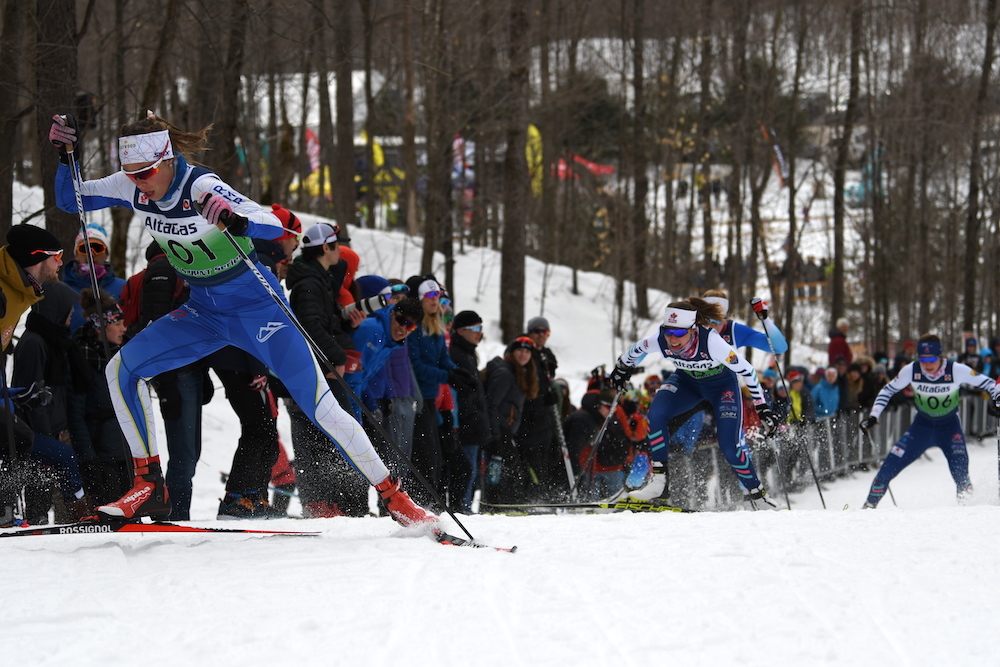
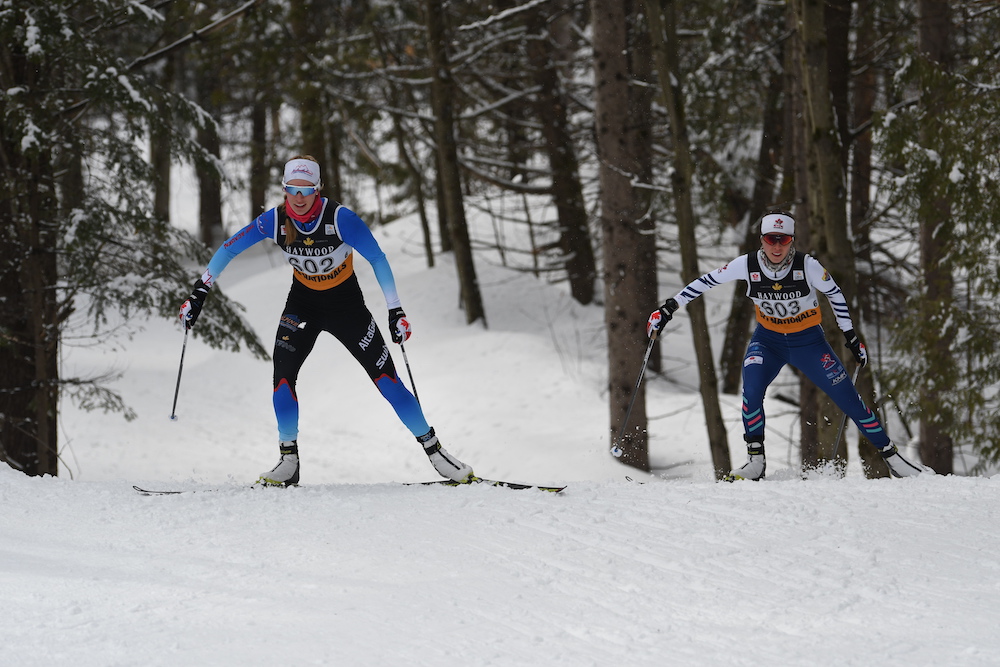
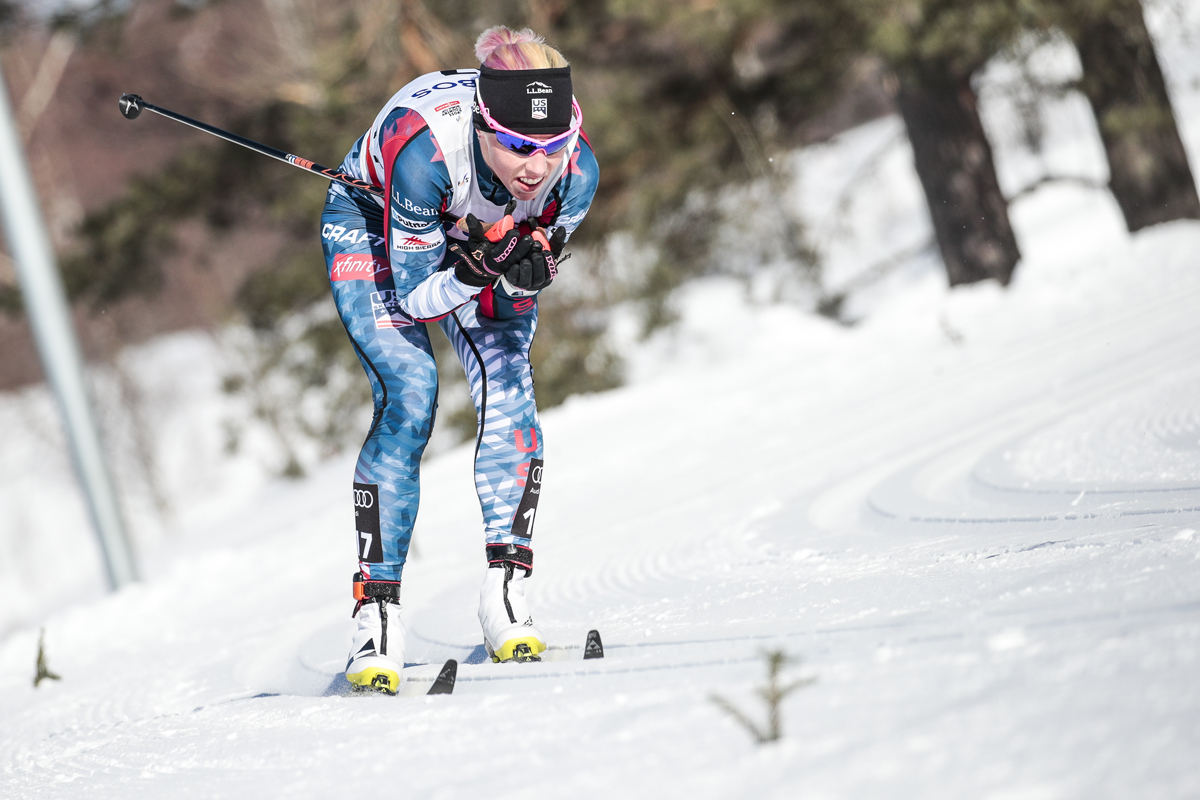
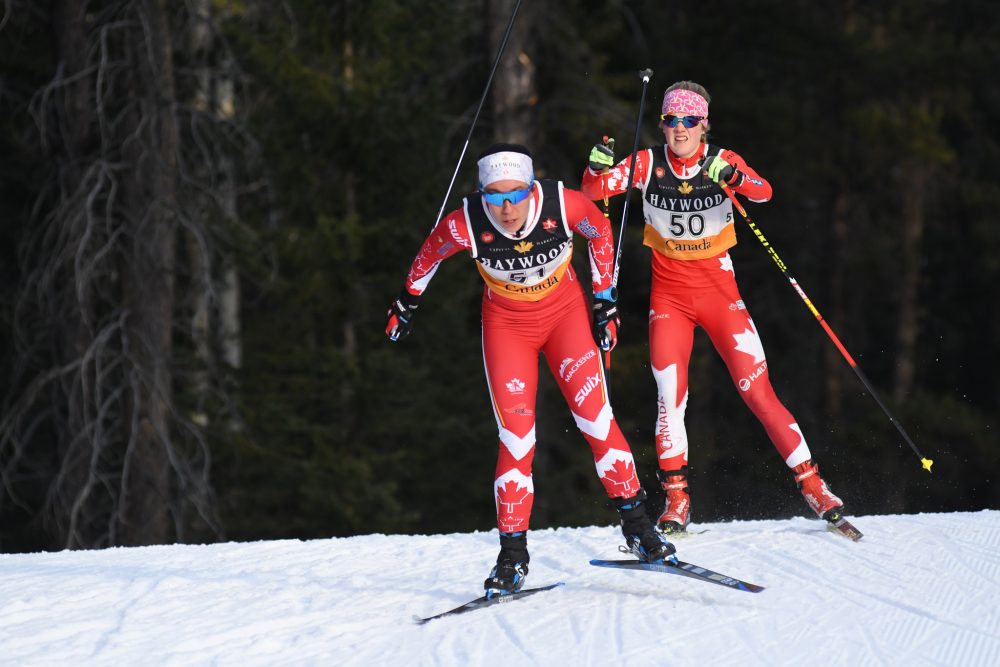
Maya MacIsaac-Jones attacked on the final hill to win. Behind, Katherine Stewart-Jones leads Dahria Beatty and Annika Richardson. (Photo: Doug Stephen)
This article has been updated with final WCF selections and a video of the sprint A finals.
Nationals rolled on at Nakkertok trails with free technique sprints on Saturday. The women raced a 1.3km course while the men added one more hill for 1.4km. The jury described the conditions as ‘soft icy’, which seems to mean ‘fast spring skiing’ with a soft layer over a firm base.
Maya MacIsaac-Jones (CNST) took her second consecutive national sprint title by jumping clear on the final climb to earn a solo victory in 2:46.62. Dahria Beatty (CNST) led the pack into the finish 2.87 seconds later with Katherine Stewart-Jones (CNST) at 3.27 seconds and Cendrine Browne (CNST) at 3.47.
Germany’s Julia Richter took fifth for the University of Utah at 4.82 followed by Annika Richardson (NTDC TBay) at 5.31.
“Going into the final,” MacIsaac-Jones wrote, “I knew that my offset was strong so I made the decision to attack on the final climb, which worked out as planned!”
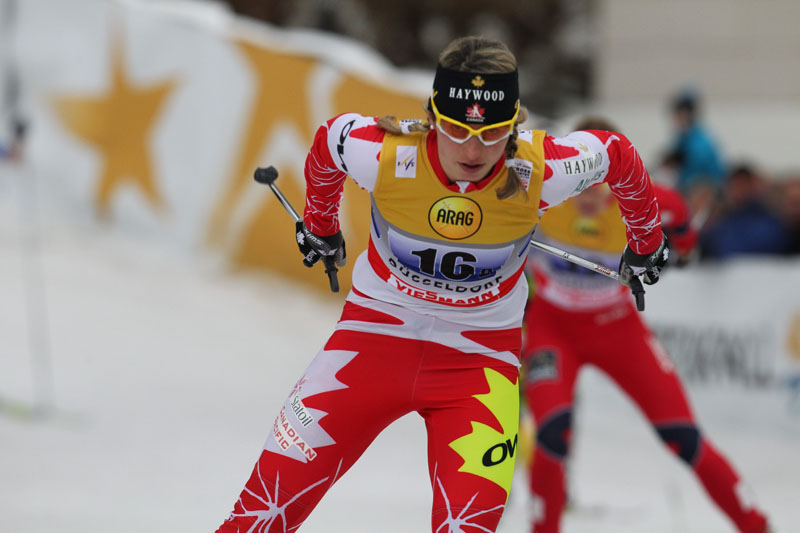
Maya MacIsaac-Jones leading the A final. From left to right, Julia Richter (104, red), Cendrine Browne (113), Dahria Beatty, and Katherine Stewart-Jones pursue. (Photo: Doug Stephen)
MacIsaac-Jones is ending her nationals on a high, as she makes a planned shift to focus on World Cup finals next Friday. “I’m so happy with my race today, this is the best I’ve felt all year. It’s been a rocky season, and this is really motivating for me going into next year.”
The conditions made for fast racing, but the A final was different.
“It went out pretty slow,” Stewart-Jones wrote, “because no one wanted to lead on the first climb because there was significant draft on the next downhill.”
Browne, who is usually described as a distance specialist, now has 4th in every event at nationals.
“My qualifier was not so great, so I didn’t know what to expect in the heats,” Browne told the LOC. “Fortunately, I felt really good in the heats and I managed to squeeze myself up to fourth place today. Really happy with that, usually not a sprinter, so yeah, good day for me.”
***
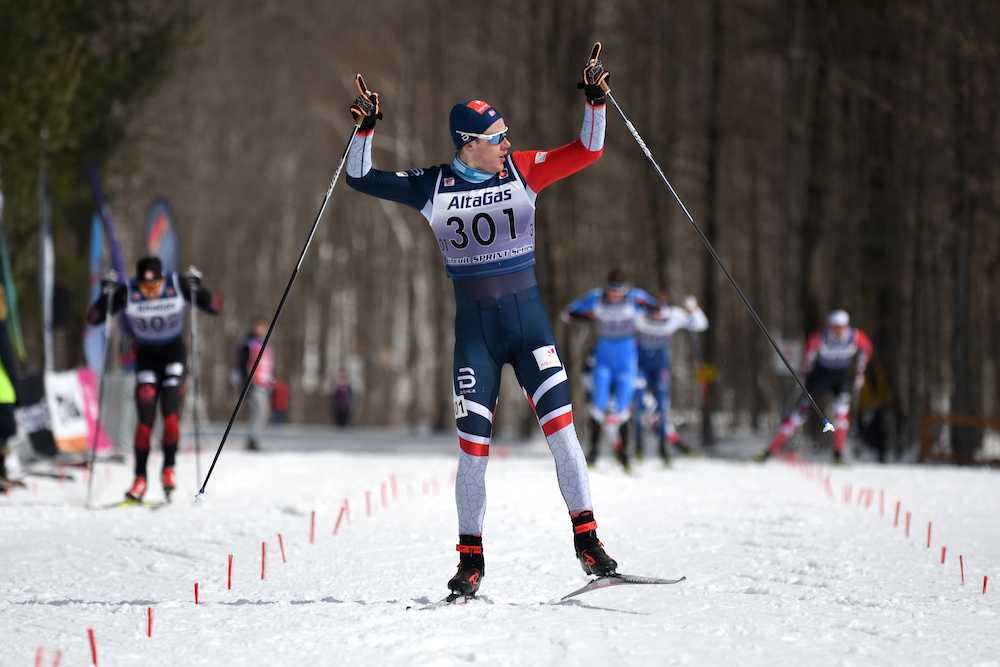
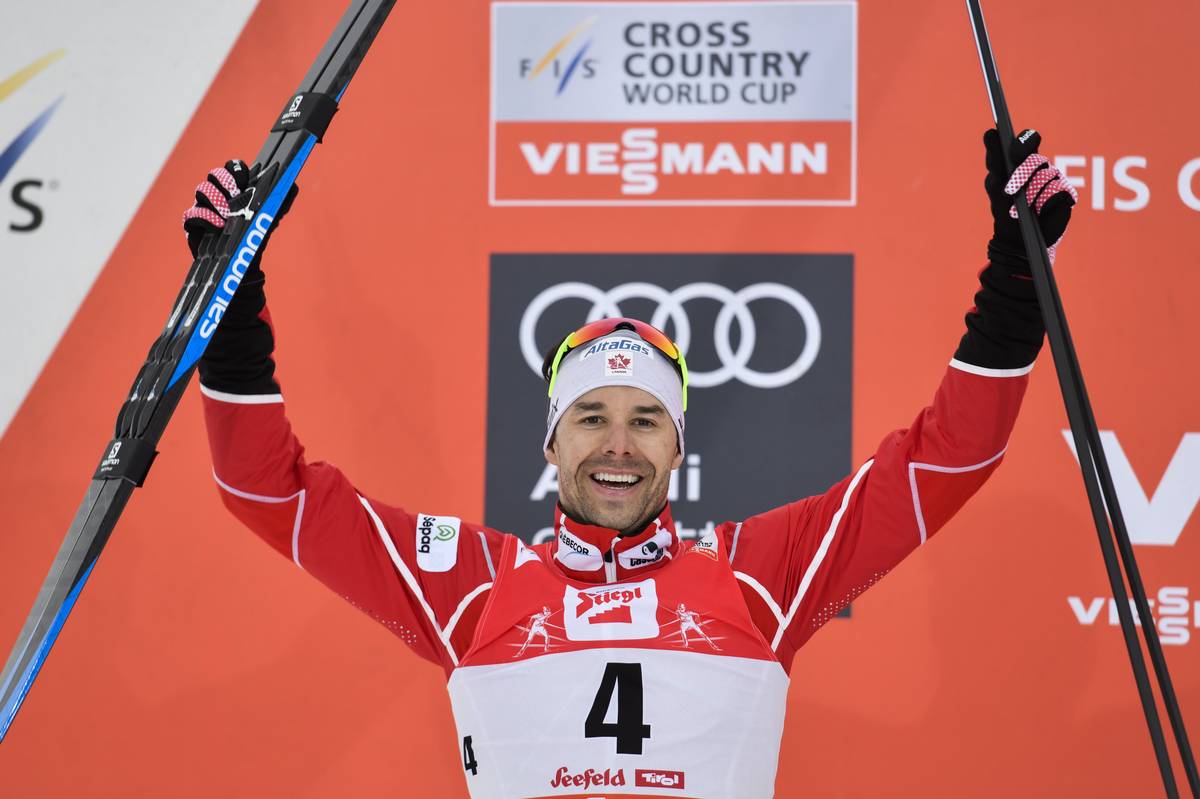
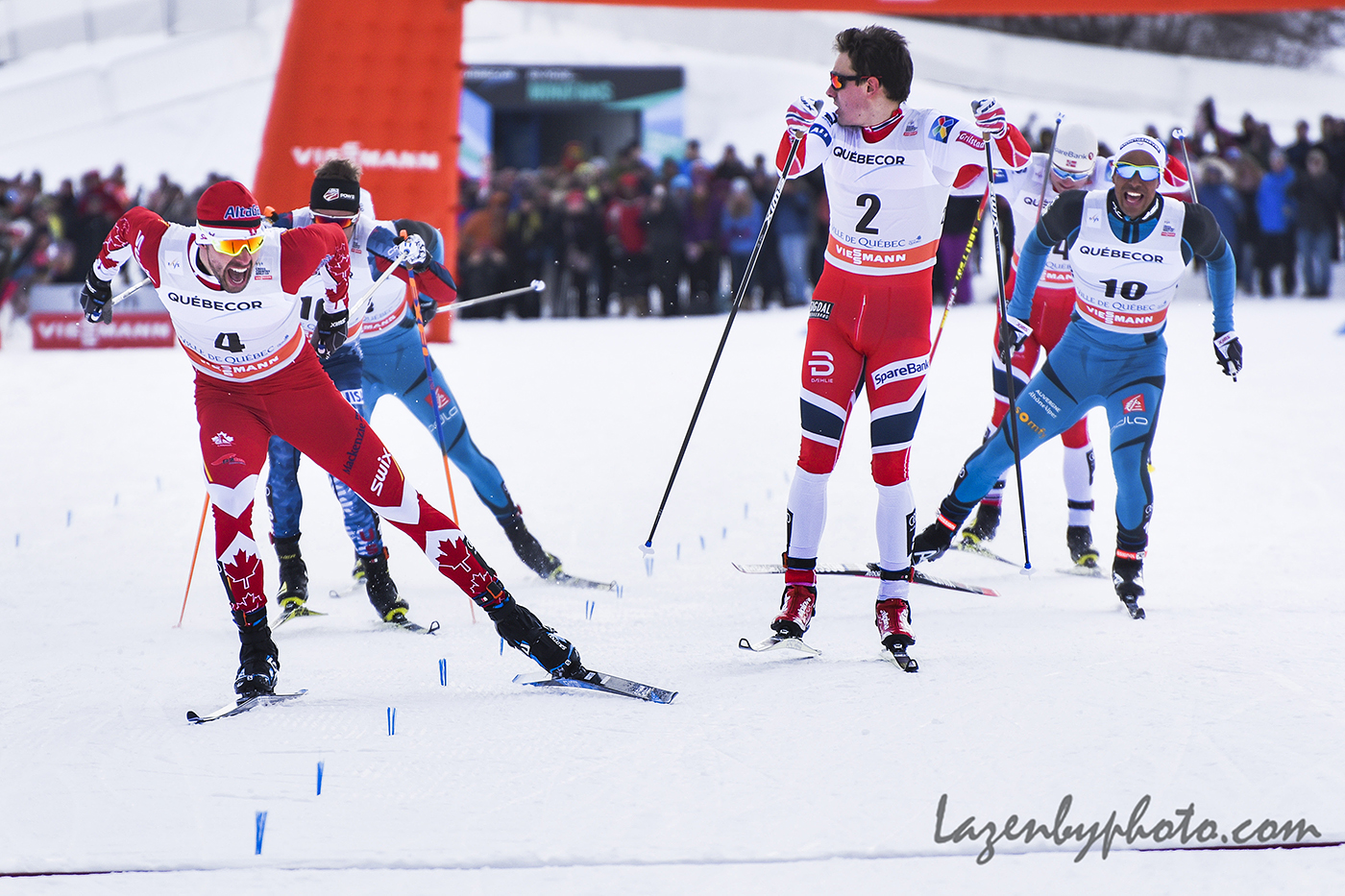
Norwegian junior Haakon Skaanes wins the sprint ahead of Antoine Briand. (Photo: Doug Stephen)
In the men’s A final, the Norwegian theme from today’s World Cup sprint in Falun flowed into Canada. Norwegian national team junior Håkon Skaanes (Strindheim IL) won the qualification and all his heats to take the A final in 2:45.69.
Antoine Briand (CNEPH) finished alone in second, 2.54 back, to become the Canadian champion. Julien Locke (CNST) out-sprinted the rest to take third and the silver medal at 5.60 seconds. Julian Smith (NTDC TBay) completed the Canadian podium at 5.73. Lenny Valjas (CNST) was fifth at 6.08 ahead of Norwegian junior Albert Sunde Oehlschlaegal (Sjåstad v Lier IL) at 6.26.
Briand, who qualified second 1.05 behind Skaanes, was happy with his first Canadian title.
“Today’s race, I’ve been thinking about it for the past eight, nine months,” he told the LOC. “I was really strong today, from the start of the day, qualification this morning and every heat I was feeling good.”
Briand didn’t wait for others to set the stage.
“In the final, I went really hard in the first uphill,” Briand wrote. “My coach shouted on me that the gap had opened. So me and the Norwegian guy who won kept going hard until the end. I couldn’t follow him the second time we went up but I managed to stay 2nd.”
Julien Locke (317) takes third, ahead of Julian Smith (305), Lenny Valjas (308) and Albert Sunde Oehlschlaegal (behind Locke). (Photo: Doug Stephen)
“For me,” Smith wrote in an email, “I was really confident in my skis so I was trying to settle into 3rd place going into the first downhill, and then move into second during the second climb. This allowed for drafting on the final descent. … I did let one too many people between me and the finish line on the last climb and then was not quite able to close the gap in the end.”
This nationals is not just the largest in recent memory, but also one of the most competitive. Unusually, there are only two Canadians on the World Cup circuit in Falun, with everyone else here in Nakkertok. The addition of the Norwegian juniors and NCAA athletes added speed to the mix.
“I have never been to a Canadian National Ski Championships where the field is so deep, with National Team members, competitive domestic racers and so many international racers,” Smith wrote.
Racing continues Sunday with sprints for the younger age groups and an invitational for even younger athletes. Sunday has 507 racers on the start list compared to 194 finishers and 12 DNS on Saturday.
World Cup Final Qualification
Twelve athletes have already qualified, leaving seventeen spots to be decided at nationals: 8 men and 9 women.
The criteria was summarized after the pursuit race. The races that count are the sprint, the individual start classic, the pursuit, and pursuit time-of-day.
Twelve athletes were already named to the World Cup Final team:
Alex Harvey, Lenny Valjas, Emily Nishikawa, Dahria Beatty based on World Cup or Olympic results.
Katherine Stewart-Jones and Jack Carlyle (AWCA) as COC leaders.
Cendrine Browne, Maya MacIsaac-Jones, Russell Kennedy (Team R.A.D.), Scott Hill (Hardwood), and Evan Palmer-Charrette (Team R.A.D.) by qualifying for World Championships.
Rémi Drolet (Black Jack) with a top ten at World Juniors.
What follows is an interpretation of the criteria. CCC will announce the definitive list Sunday night at La Soirée, along with the new CCC branding.
Update: At the Sunday evening event, Nordiq Canada (the organization formerly known as CCC) announced the final selections.
For the women, it is Annika Richardson, Anne-Marie Petitclerc, Sadie White, Marie Corriveau, Zoë Williams, Hannah Mehain, Frédérique Vézina, Alannah Maclean, and Laura Leclair.
For the men, it is Antoine Briand, Philippe Boucher, Julien Locke, Julian Smith, Bob Thompson, Alexis Dumas, Antoine Cyr, and Graham Ritchie. Apart from morning sickness, a pregnant woman has to deal with heartburn, fatigue, sore muscles and much more. It is also difficult to get good rest at night as their tummy gets bigger. Towards this end, pillow manufacturers aimed to address the need and develop the kind of pillows that will facilitate a pregnant woman’s sleep and relaxation. Our review will focus on the best pregnancy pillows which can cater for your needs whilst taking into consideration different factors like material, size, shape, price and brand. Shop best pregnancy pillows online at Pregily.com – read reviews and shop now!
Dahria Beatty (left) and Katherine Stewart-Jones chasing hard in the pursuit. (Photo: Doug Stephen)
This article has been updated to correct an interpretation of the selection criteria.
Day two of nationals was day two of the pursuit at Nakkertok trails in Gatineau, Québec. The two-day pursuit format (classic interval start on day one, free technique pursuit start day two) was held for the second time at nationals. With both national titles and starts at World Cup Finals in Québec City up for grabs, it was always going to be an exciting day.
Lenny Valjas (CNST) justified his decision to come back to race in Canada with a second national title, out-sprinting the pack to finish the 10km+15km pursuit in 1:08.18.6. Philippe Boucher (CNEPH) turned in the fastest time of the day to take second, 0.7 seconds behind, and 0.3 seconds ahead of teammate Alexis Dumas.
Lenny Valjas wins the pursuit, ahead of Phillipe Boucher, Alexis Dumas, and Rémi Drolet. (Photo: Doug Stephen)
Rémi Drolet (Black Jack) was top junior in 4th place, 4.4 seconds back.
“On the last little bit of the 7.5k loop, on the flats, I decided to attack early before the final sprint hill,” Valjas told the LOC after the race, “because some of those young guys are so quick. I couldn’t trust myself on just the last hill, so I made them hurt with a couple km to go. It worked out, we all had a fun sprint up the last sprint hill into the finish.”
“No tactics for me today,” Boucher wrote. “I pushed hard from the start to the finish. I was targeting the best time of the day so I would qualify for World cups finals and become the national champion.”
The early group of eight shrank as Boucher pushed the pace and Valjas struggled to cling on. Dumas described it best: “They was not a lot of tactic today, Philippe Boucher was just too strong. The only thing I could do was following him and hope for the best in the sprint finish at the end.”
Skiing with the final four until the very end, Drolet battled cramps on the second lap.
“On the final hill, I had a lot of trouble moving, but I still managed to stay pretty close to the front and finished in 4th,” Drolet said after the race. “I was really happy about how I fought, considering everything else.”
Neither Boucher nor Dumas were fans of the pursuit format when it was brought back earlier in the season. As both have been on the podium at both editions, maybe they will grow to like it more.
“After the results I’ve got in the pursuit this year, I can only enjoy them,” Boucher wrote when asked if he still prefers mini-tours to pursuits.
Wednesday’s race featured two 5km classic loops in great conditions. Valjas was happy to get his win with nearly even lap times.
“Today was great,” Valjas told the LOC after the race. “I’m excited to be out here, and seeing all the kids. It’s a little bit of inspiration for me to be leading into the last World Cup in my career.”
Asked about edging out the 18 year old Drolet in the interval start, Valjas said “You’ve got to be on your A game to beat him, and I’m happy I got him, but he’s the future. I’m happy to see the young guys nipping at my heels.”
Drolet was happy with his classic race, finishing 9.9 seconds behind Valjas despite skiing his second lap 21 seconds slower than the first.
“Perhaps if I had paced the race better, I could have had a slightly better performance,” Drolet wrote in an email. “The course profile, however, does allow you to go really hard a lot of the time since there are usually long downhills after the climbs.”
Bob Thompson was third in the classic, which qualified him for World Cup Finals.
“I feel I am in a good place to have some great results this week,” Thompson wrote. “This was my first medal as a senior man so I’m really happy to finally be in top form again to finish the year. Very excited about World Cup finals!”
***
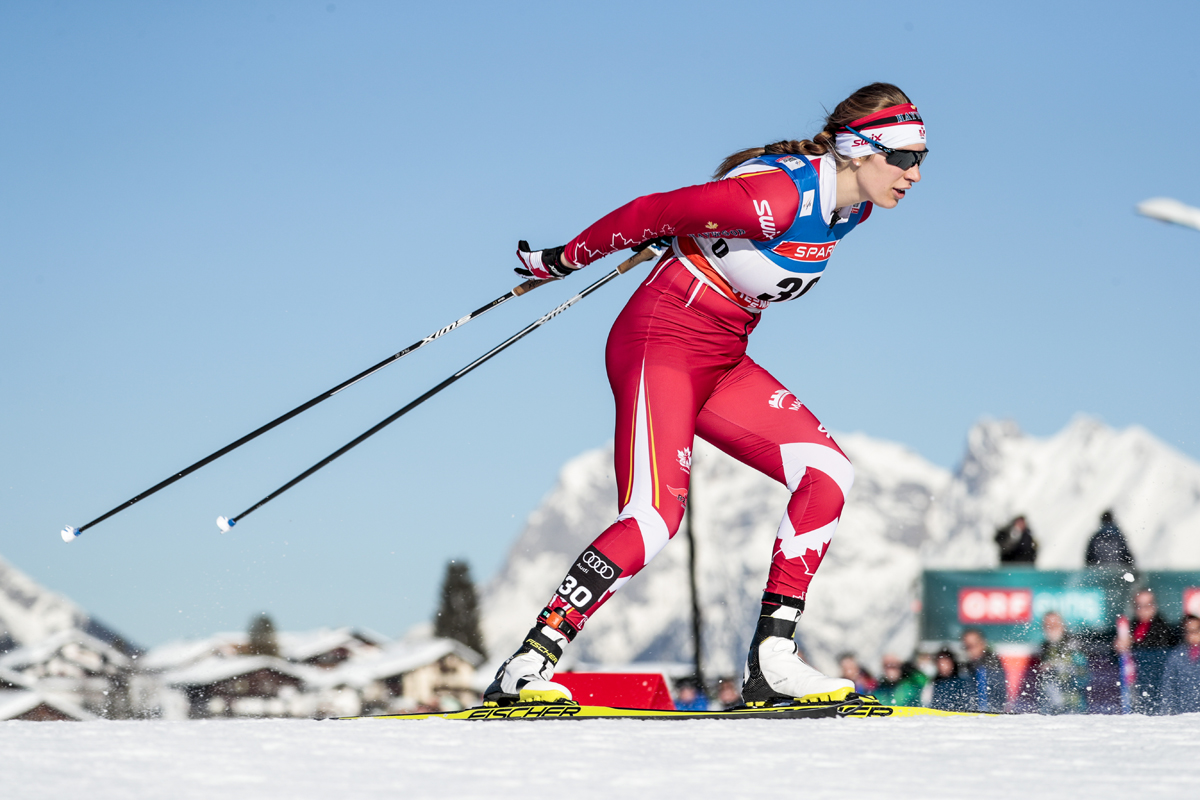
Dahria Beatty leads Emily Nishikawa towards the finish. (Photo: Doug Stephen)
Dahria Beatty (CNST) put in the fastest time of the day to win the women’s 5km+10km pursuit in 40:50.8, completing Thursday’s two 5km skate laps in 26:45.8. Beatty and Katherine Stewart-Jones (CNST) worked together to catch Emily Nishikawa (CNST) just before the finish, with Beatty pulling clear for the win ahead of Nishikawa (7.3 seconds) and Stewart-Jones (9.8 seconds).
“Emily skied a really strong race and we were trailing her by between 7 and 15 seconds almost the entire race,” Beatty wrote in an email to FasterSkier. “Working together gave Katherine and I a slight advantage and I was able to finally close the gap on the second last downhill. After that we were on the sprint course and my mind went into sprint mode and I was able to open up a small gap.”
Beatty shared her tactical plan after her second place in the pursuit’s day one classic race. “Tomorrow the goal will be to try to catch those 8 seconds off the start and race with Emily.”
Stewart-Jones had a similar tactical plan, but executed it better. “I wanted to catch Dahria as fast as possible because I knew it would be much easier if we worked together. I was able to do that and we skied together most of the race,” Stewart-Jones wrote. “Dahria broke away with one hill to go and I caught Emily but she had me at the finish line!”
Emily Nishikawa winning the 5km classic at nationals. (Photo: Doug Stephen)
CNST’s Cendrine Browne was unable to close the gap and had a lonely ski in 4th, finishing 1:17.7 back. Sadie White (NTDC TBay) delivered the 5th fastest time of the day to move from 12th to 5th at 2:45.6 back.
Nishikawa earned her lead by winning the classic race Wednesday.
“I am really happy with my race today,” she wrote about her win. “It is always an honour to win a national title. Racing here at Nakkertok is so awesome and seeing so many young skiers out is really inspiring.”
Stewart-Jones was happy with her 3rd in the classic race on her home trails, but not as happy with her pacing.
“I started off hard because I knew it would be a quick race,” she wrote, “but I think that I probably could have paced it better.”
There were a lot of athletes enjoying the atmosphere at Nakkertok. There were 215 junior boys and juvenile boys, 185 junior girls and juvenile girls, 107 junior men and senior men, 76 junior women and senior women who finished the pursuit.
Qualifying for World Cup Finals
Twelve athletes have already qualified, leaving seventeen spots to be decided at nationals: 8 men and 9 women.
The criteria says that the top Canadian in each of the freestyle sprint, then individual start classic, then pursuit, then time-of-day from the pursuit will be selected in that order. As there are more spots, the sequence will be repeated for 2nd place, 3rd place, until all spots are allocated. Athletes who have already qualified are skipped over. Clear and simple? Not exactly, but it became clearer with results from three of the four events.
On the women’s side, the first four places were filled by pre-qualified athletes in all three events. The selection order becomes the first five women in Saturday’s A final, then not Anne-Marie Petitclerc (5th in classic and top junior, but not eligible according to CCC), then White (5th in pursuit), the sixth placed sprinter, then Hannah Mehain (6th in classic). These respective athletes have earned their WCF start, assuming CCC’s interpretation is the same.
If anyone in the top six on Saturday has already qualified, the seventh place sprinter is selected, followed by Annika Richardson (8th in time-of-day counts as 7th because Germany’s Julie Richter isn’t eligible). Having fun yet? CCC will announce the final selection on Sunday.
For the men, we have seven pre-selected and eight spots to go. The first five sprinters on Saturday, along with Philippe Boucher (1st in time-of-day), Alexis Dumas (3rd in pursuit), and Bob Thompson (3rd in classic) are locked in. The sixth place sprinter and Ricardo Izquierdo-Bernier (6th in time-of-day) are waiting on someone higher in the list making the A final.
Rémi Drolet (bib 13, left) caught Angus Foster at the line to finish second. (Photo: Rob Smith)
Canadian Ski Championships, better known as ‘nationals’, kicked off today at the Nakkertok trails in Québec with individual start classic racing.
342 men started the 10km and 293 women started the 5km, both using the same 5km loop on an overcast day at -8C. The field is more stacked than usual, with only two athletes (Alex Harvey and Jack Carlyle) in Europe right now.
Lenny Valjas (CNST) won the 10km in 25:09.3, 9.9 seconds ahead of Rémi Drolet (Black Jack) and 15.7 seconds ahead of Bob Thompson (NTDC TBay). As Drolet is a junior, host club skier Antoine Cyr (Skinouk) took third place on the senior podium at 16.8 seconds back.
In the second half of the two-day pursuit on Thursday, Thompson will lead a group of seven chasing down the two leaders.
Nishikawa winning the individual start and another national title. (Photo: Rob Smith)
In the women’s 5km, Emily Nishikawa (CNST) continued her strong season with another national title, finishing in 13:58.0. Dahria Beatty (CNST) took seconds at 7.7 back, followed by Nakkertok local Katherine Stewart-Jones (CNST) at 12.4. Cendrine Browne (CNST) left herself some work to do on Thursday at 41.2 seconds in fourth.
Four results from nationals are being used to select 17 athletes for the World Cup Finals in Québec City on March 22nd to 24th. The top finishers in Saturday’s free technique sprint, today’s interval start, Thursday’s pursuit, and the pursuit time of day will be selected in rotation to fill the roster. This selection process will be explained in more detail tomorrow, when most of the possible permutations will be eliminated by actual results.
Twelve athletes have already been named to the World Cup Final team:
Alex Harvey, Lenny Valjas, Emily Nishikawa, Dahria Beatty based on World Cup or Olympic results.
Katherine Stewart-Jones and Jack Carlyle (AWCA) as COC leaders.
Cendrine Browne, Maya MacIsaac-Jones (CNST), Russell Kennedy (Team R.A.D.), Scott Hill (Hardwood), and Evan Palmer-Charrette (Team R.A.D.) by qualifying for World Championships.
Rémi Drolet with a top ten at World Juniors.
There are 8 places for men and 9 for women to be earned at Nationals.
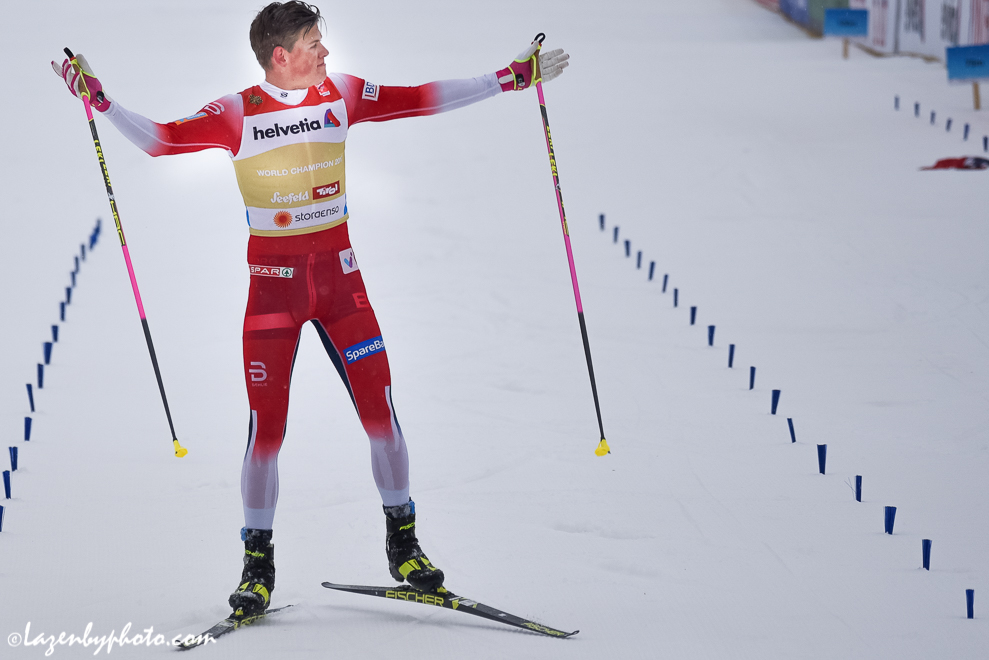
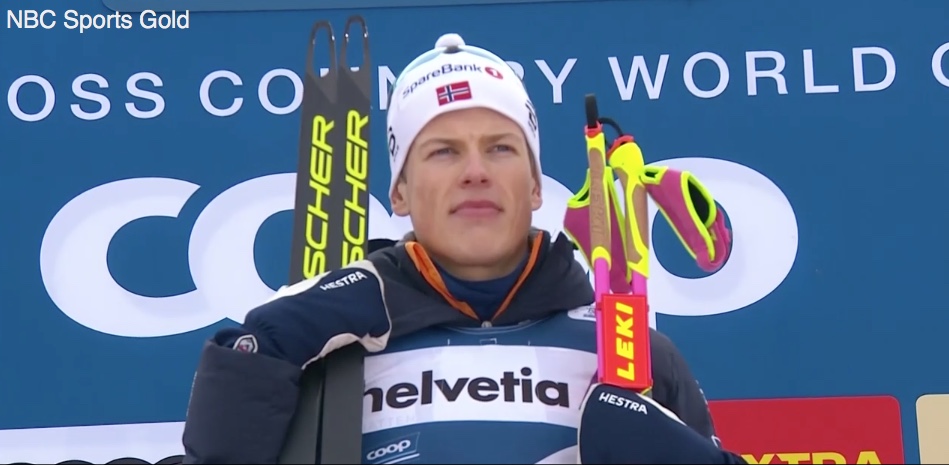
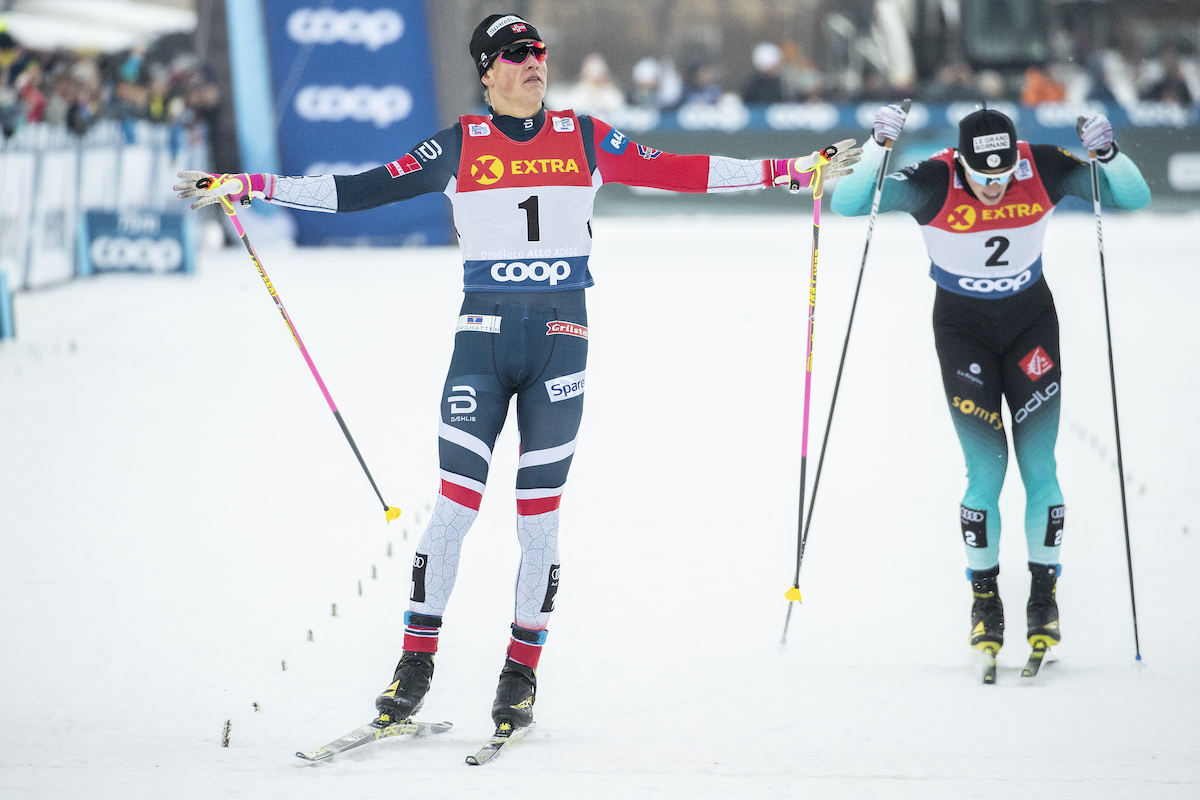
Johannes Høsflot Klæbo of Norway displaying what has become his iconic gesture when crossing the line as a winner. Once again it was an opportunity for the arms being outstretched as Klæbo anchored Norway to the 4 x 10 k relay win at the 2019 World Championships. (Photo: John Lazenby/lazenbyphoto.com)
The 4 x 10-kilometer men’s relay was a two-team tango as Russia’s Sergey Ustiugov and Norway’s Johannes Høsflot Klæbo were tagged for their respective anchor legs on Friday. The two teams stuck together until Klæbo moved ahead with less than five k to go and gapped Russia by 22 seconds.
It was enough final leg surge for Norway’s Emil Iversen,Martin Johnsrud Sundby, Sjur Røthe, andKlæbo to win in 1:42:32.1 hours. Russia’s Andrey Larkov, Alexander Bessmertnykh, Alexander Bolshunov, and Ustiugov placed second (+38.8).
The final podium spot came down to a final sprint won by France’s Richard Jouve over Finland’s Perttu Hyvarinen.
Adrien Backscheider, Maurice Manificat, Clement Parisse, and Jouve were 1:01.0 back in their third place statement.
Finland’s Ristomatti Hakola, Iivo Niskanen, Matti Heikkinen, and Hyvarinen were fourth (+1:02.8).
The U.S. team of Erik Bjornsen, Scott Patterson, David Norris, and Kyle Bratrud skied to ninth (+4:06.4).
Canada’s Alex Harvey, Scott James Hill, Evan Palmer-Charrette, and Lenny Valjas placed 12th (+7:05.5).
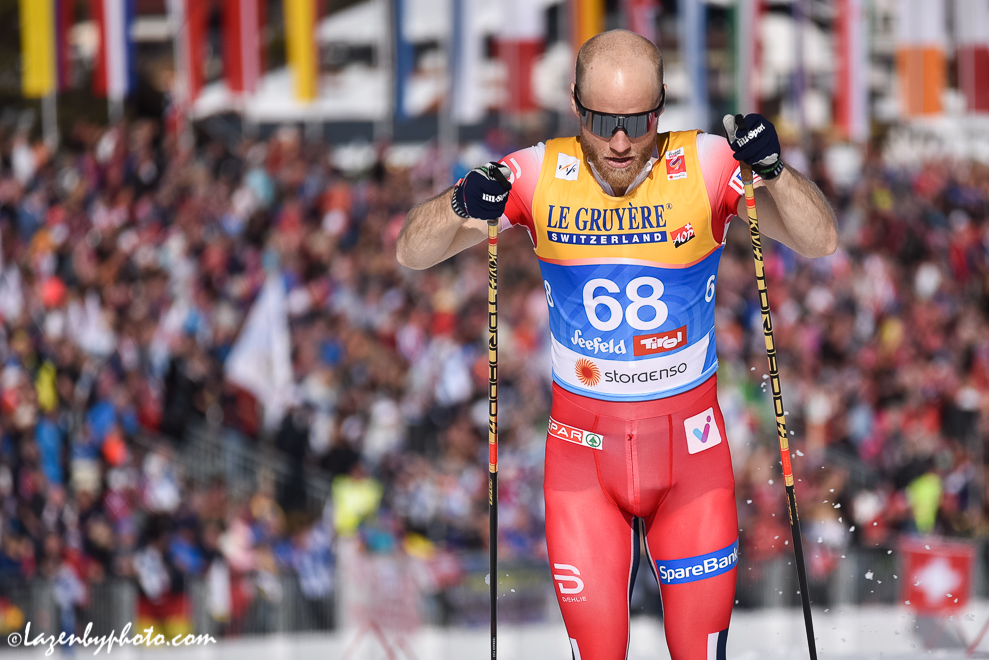
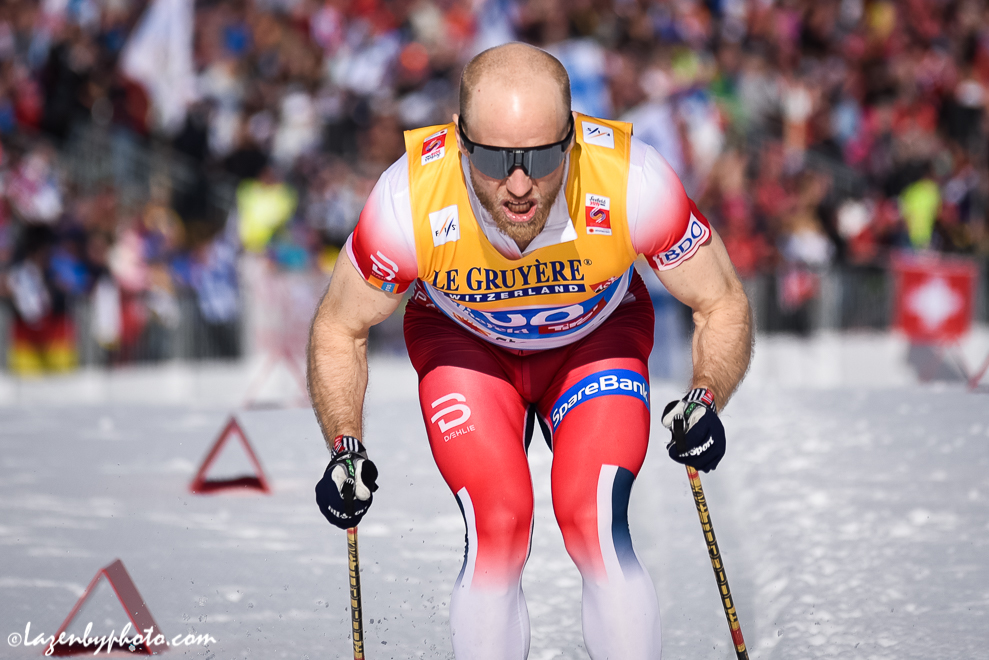
Norway’s Martin Johnsrud Sunday on his way to winning the men’s 15 k classic at the 2019 World Championships in Seefeld, Austria. (Photo: John Lazenby/lazenbyphoto.com)
FIS Nordic World Ski Championships Seefeld, Austria Women’s Individual 15 k Classic
Norwegians travel well to international cross-country races. That was evidenced by the roar of the crowd in Seefeld, Austria during Wednesday’s 15 k classic as Martin Johnsrud Sundby crested the final climb and descended into the home stretch. Nothing was for certain until +2.9 seconds popped up next to Russian Alexander Bessmertnykh’s name as Sundby crossed the finish.
Sundby won the race in 38:22.6 minutes. Bessmertnykh placed second 2.9 seconds back. As remarkable as this sounds, this was Sundby’s first individual championship gold at either a World Championships or Olympics.
Iivo Niskanen of Finland, one of the World Cup’s most feared classic skiers, placed third (+20.4).
Erik Bjornsen led the way for the U.S. with a 17th place finish (+1:50.3). Scott Patterson raced to 30th (+2:34.7), Kyle Bratrud 31st (+2:43.8), and Ben Lustgarten 45th (+3:49.6).
Scott James Hill topped the results for Canada with a 34th place (+3:01.3). Evan Palmer-Charrette skied to 46th (+3:52.7) , Lenny Valjas 47th (+3:52.9), and Russell Kennedy 67th (+5:50.8).
Norway’s Martin Johnsrud Sunday on his way to winning the men’s 15 k classic at the 2019 World Championships in Seefeld, Austria. (Photo: John Lazenby/lazenbyphoto.com)
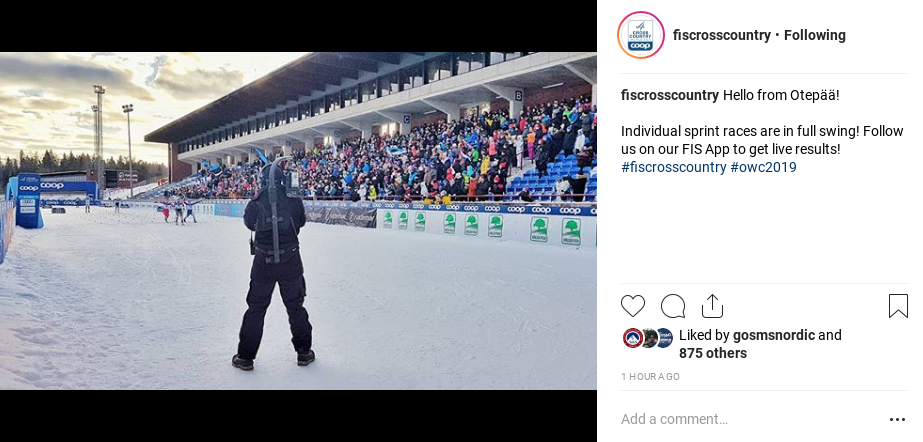
It’s on and it’s over — the World Cup classic sprints in Otepää, Estonia. (Photo: @fiscrosscountry Instagram screenshot)
FIS World Cup Otepää, Estonia 1.3 k / 1.6 Classic Sprint
Starting the day’s performance benchmarks off was Stina Nilsson of Sweden with the fastest qualifier in the women’s 1.3-kilometer classic sprint in Otepää on Saturday. She stopped the clock in 3:07.62 minutes.
The U.S. Ski Team’s (USST) Jessie Diggins was the top-qualifying North American in 18th (+5.37). Sadie Bjornsen (USST) qualified 20th (+5.71), and Ida Sargent 27th (+8.38).
On a course rewarding patience and technical skiing know how, Norway’s Maiken Caspersen Falla won the overall in 3:05:16 minutes. Russia’s Natalia Nepryaeva placed second (+1.40), and Maja Dahlqvist of Sweden third (+5.78). Also from Sweden, Jonna Sundling, who fell at around the 1:30 mark in the final, placed fourth (+8.12), with Slovenia’s Katja Visnar fifth (+23.22).
Nilsson placed second to Falla in the first semi-final, but did not start the final. Nilsson had won the last four World Cup sprints, all in skate, coming into Otepää.
Bjornsen looked strong in the fifth heat, yet stepping around the right hand turn before the final straight she fell taking out several other skiers. Bjornsen was given a yellow card for obstruction. She ended up 22nd overall.
Diggins placed second to Falla in the second heat to advance to the first semi. She was eliminated after finishing in sixth (+3.68). Diggins placed 12th overall.
Sargent finished third in the third heat, to place 15th overall.
U.S. athlete Rosie Brennan (APU) finished 45th (+15.81).
Dahria Beatty (CNST) was the only Canadian entered. She placed 44th overall (+15.79)
Norway’s Johannes Høsflot Klæbo was the fastest qualifier for the men in the 1.6 k classic sprint with a time of 3:21.99 minutes.
The young Norwegian seems on form as he swept his heat, semi, and final on his way to the win. Klæbo won the final in 3:20.05 minutes. Alexander Bolshunov of Russia, the only non-Norwegian in the final, was second (+1.51), and Pål Golberg third (+2.53). Rounding out the final three spots in the final were Eirik Brandsdal in fourth (+2.57), Mattis Stenshagen in fifth (+7.69), and Erik Valnes in sixth (+11.99).
For the U.S., Erik Bjornsen (USST) was the fastest qualifying North American in 23rd (+8.2), Andy Newell (SMS T2) 26th (+8.75).
Bjornsen was knocked out of the rounds after placing fifth in the second heat. He placed 24th overall. Newell ended up third in the first heat, 2.99 seconds in back of Klæbo. Newell, in his second World Cup sprint of the season, placed 15th in the final standings.
Kevin Bolger (USST) finished in 41st (13.13), Ben Saxton (SMS T2) 44th (+14.16), and Ben Lustgarten (CGRP)63rd (+23.04).
For Canada, Lenny Valjas (CNST) was 43rd (+13.61), and Bob Thompson 51st (+15.96).
Day two of the NorAm weekend was interval start classic, with very cold conditions delaying the start and simplifying the ski preparations.
Katherine Stewart-Jones (CNST) topped her Friday 2nd place with a clear win in the 10km, finishing in 28:51.6 with the fastest time on all three laps. Cendrine Browne (CNST) was second at 30.8 behind. Zoë Williams (Nakkertok) was third at 1:53.5, just pulling clear of Frédérique Vézina (CNEPH) by 3.1 seconds with a fast final lap.
In the men’s 15km, Scott Hill (Hardwood) bounced back from a slow start to the season with a well-timed victory to join Stewart-Jones on the World Championships team. Hill was fastest on the last three of four 3.75km laps to win in 36:59.7, 9.0 seconds ahead of a fading Russell Kennedy (Team R.A.D.). Graham Nishikawa (CPNST), here training for his role as Brian McKeever‘s guide, held onto third at 38.0 seconds, just 3.2 seconds ahead of a fast finishing Dominique Moncion-Groulx (Nakkertok).
There are two more automatic selections for World Championship available on Sunday in the mass start skate races (20km for women, 30km for men). With cold temperatures and heavy overnight snow predicted, it should be an exciting end to the weekend.
The teams from France, Norway and Germany claimed the positions at the top of the podium on Saturday in the women’s 4 x 6-kilometer relay in Ruhpolding, Germany, cheered on by over avid 25,000 fans lining the course.
France with Julia Simon, Anaïs Bescond, Justine Braisaz and Anaïs Chevalier stayed in the top group all race mainly due to the best shooting performance of the day, at times with a lead of over half a minute. On the anchor leg, Chevalier defended her narrow lead through three loops and two shooting stages to the finish line in a time of 1:09:27.7 hours, with no penalty and just four spares. According to an IBU press release, it was their first win since 1994 at this venue with a long tradition on the biathlon competition calendar, which has undergone a slight redesign for this season to add stands and make a downhill section less tricky.
Behind the French women, Norway with a team comprised of the reactivated veteran Synnøve Solemdal, Ingrid Landmark Tandrevold, Tiril Eckhoff and anchor Marte Olsbu Røiseland was second, with Røiseland narrowing the gap to Chevalier on the final loop from 21 to seconds but not quite catching up to finish 11.5 seconds back (with no penalty and seven spare rounds). The home team from Germany with Vanessa Hinz, Laura Dahlmeier, Franziska Preuss and Denise Herrmann was third, after the fast Herrmann was unable to catch the leaders when she needed all three spares in the final shooting to clear her targets (+23.4, with no penalty and nine spares).
Over a minute behind the podium finishers, the fourth team crossing the line were the 2018 PyeongChang Olympic relay silver medalists from Sweden around anchor Hanna Öberg (+1:29, with no penalty and nine spares).
For the North American teams it was a race with many ups and downs.
Canada began the race with Sarah Beaudry, who moved the team as high as sixth thanks to a clean shooting performance in her standing shooting stage after she had required two spares in prone. She then lost time to the top teams on the track to exchange in 13th position (+54.5 sec). Emma Lunder then managed to bring the team back up to sixth position but she also needed two spares in prone and followed that up with a clean standing stage, tagging off in seventh place right behind Sweden (individually her leg was the fifth-fastest). Megan Bankes kept up with the teams around her on the course and slightly improved to fifth position less than a minute back, but then missed two targets in her standing stage and could not clean with her spares. She skied a single penalty lap (0+1, 1+3). She tagged anchor Rosanna Crawford in 10th position (+2:14), who then herself added a penalty in her prone stage.
At the site of her podium finish a year ago and coming off a 27th place in the sprint earlier this week, the Canadian team leader then needed two spares in the standing stage and ultimately came to the finish in 12th position (+3:01.6), with two penalties and 13 spare shots for the team.
For US Biathlon, Clare Egan began the race and recorded a clean prone stage to move the team up all the way to third position coming into the standing shooting stage despite a broken pole. She then missed three targets and ran out of spares and skied two penalty laps.
That set the team back quite far, exchanging in 19th position (+1:26.6). Susan Dunklee needed four spares in her shooting stages but avoided another penalty (0+1, 0+3) to exchange in 12th position (+1:47.3).
Rounding out the team after being called back up to the World Cup from the second-tier IBU Cup following solid performances in Duszniki Zdroj, Poland, Joanne Reid only needed one spare in each of her shooting stages (0+1, 0+1) to tag off in 15th position. In her second time anchoring a relay this season, Deedra Irwin – who had recorded her first clean shooting performance in a race in Poland a week ago – then required all her spares to clear her targets in the prone shooting before achieving another clean standing shooting stage. She crossed the line in 16th position, 4:06.0 back, with two penalties and 12 spare shots for the team.
Races in Ruhpolding conclude on Sunday with mass starts for the women and men. US Biathlon’s Sean Doherty is scheduled to be lone North American starter for the elite men’s field (though Canada’s Christian Gow would be the next one up from a reserve list in case of an illness), while Egan and Dunklee are qualified for the women.
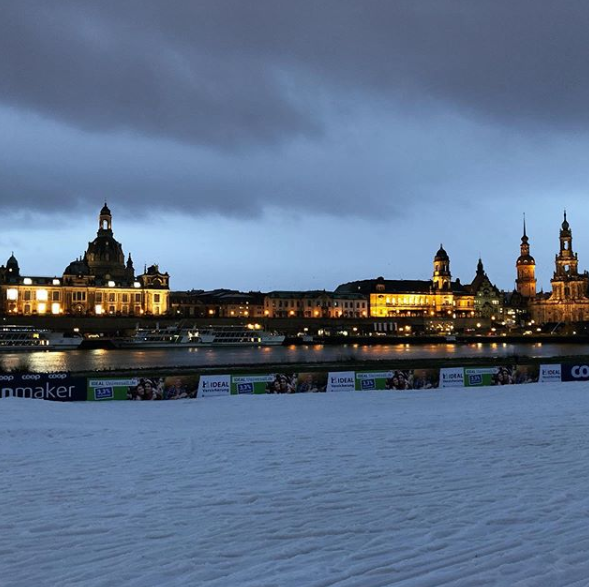
Dresden, Germany looking good for the city sprints. (Photo: @skiweltcupdresden Instagram screenshot)
FIS World Cup Dresden, Germany 1.6 k Freestyle Sprint
The city of Dresden resting alongside the River Elbe hosted a 1.6-kilometer freestyle sprint for the second year running.
Hannah Falk of Sweden, last year’s sprint winner in Dresden, won the qualifier in a time of 3:41.85 minutes. The U.S. Ski Team’s (USST) Sophie Caldwell was the second fastest qualifier (+0.49), with Falk’s teammate, Stina Nilsson, qualifying in third (+0.80).
Canada’s Dahria Beatty placed 20th (+8.72) in qualification, while Julia Kern (USST D-Team) in her first European based World Cup qualified in 23rd (+10.84).
Both Beatty and Kern were eliminated in the first heat which was won by Nilsson in 3:43.87. Beatty placed third (+1.18), Kern fourth (+1.25).
Beatty ended the day in 16th place overall, Kern 19th.
Caldwell advanced to the finals where she finished in fifth place, 2.61 seconds behind the day’s sprint winner Nilsson. Nilsson won the final in 3:48.49 minutes. It was an all Sweden podium as Maja Dahlqvist placed second (+0.24) and Jonna Sundling third (+0.54).
No other North American women advanced to the heats.
Hannah Halvorsen (USST D-Team) racing in her first World Cup placed 35th overall. Ida Sargent (USST) placed 38th, first time World Cup participant Hailey Swirbul (USST D-Team) 41st.
For the men, Italy’s Federico Pellegrino qualified first in 3:21.12 minutes. Britain’s Andrew Young was second fastest (+0.47), and Gleb Retivykh third (+1.27).
In his return to World Cup skiing after racing the domestic circuit, American Andy Newell was the highest ranked North American in qualification, placing 19th (+5.58). Kevin Bolger (USST) qualified in 28th (+6.76).
Newell and Bolger both raced the third heat where they were eliminated from the rounds. Newell placed fifth (+1.31), Bolger sixth (+1.45) in the third heat, which was won by Richard Jouve of France in 3:28:24.
In the final standings, Newell ranked 25th, Bolger 29th overall.
The race was won by Norway’s Sindre Bjørnestad Skar in 3:25.95 minutes. Retivykh placed second (+0.11), and Erik Valnes of Norway third (+2.83).
Erik Bjornsen (USST) finished in 33rd (+7.43), Simi Hamilton (USST) did not start due to illness.
For Canada, Bob Thompson placed 32nd overall, Lenny Valjas 47th (+9.55).
IBU World Cup Oberhof, Germany 10 k / 12.5 k Pursuit
In the women’s pursuit Lisa Vittozzi of Italy, who was the first skier off today as she won Thursday’s sprint, also won the 10 k pursuit in a time of 32:32.9 minutes. Vittozzi had two penalties (0+1+1+0) on her way to the win.
Anastasiya Kuzmina of Slovakia was second with four penalties (2+1+1+0), 14.5 seconds back. Kuzmina was the seventh starter, and began the race 30 seconds behind Vittozzi. Anaïs Chevalier of France place third (+27.9, 2+1+2+0). Chevalier was the second starter, beginning with a five second deficit.
Susan Dunklee of the US Biathlon Team had a season best result, placing seventh overall (+1:01.2). Dunklee was the 10th starter, setting off 41 seconds back. Dunklee had five penalties (2+1+1+1) on her way to seventh place.
Also for the U.S., Clare Egan, who place 13th in the sprint, fell back to 33rd in the pursuit after skiing seven penalty laps.
For Canada, Emma Lunders placed 39th (+3:31.4) with six penalties on her day. Rosanna Crawford placed 52nd (+5:23.4) also with six penalties.
In the men’s pursuit, Norway’s Johannes Thingnes Bø claimed the win in a time of 34:29.8 after three missed shots (0+1+1+1).
Arnd Peiffer of Germany place second on Saturday, finishing 15.1 seconds back from Bø after one penalty (1+0+0+0). Italy’s Lucas Hofer snagged the third and final podium, finishing 15.8 seconds behind the winner after shooting clean.
Two North Americans competed on Saturday, with American Sean Doherty finishing in 18th (+2:29.9) after skiing two penalties (2+0+0+0). Canadian Christian Gow also skied into the top 30, finishing in 27th (+2:57.4). Gow had two misses (1+0+0+1).
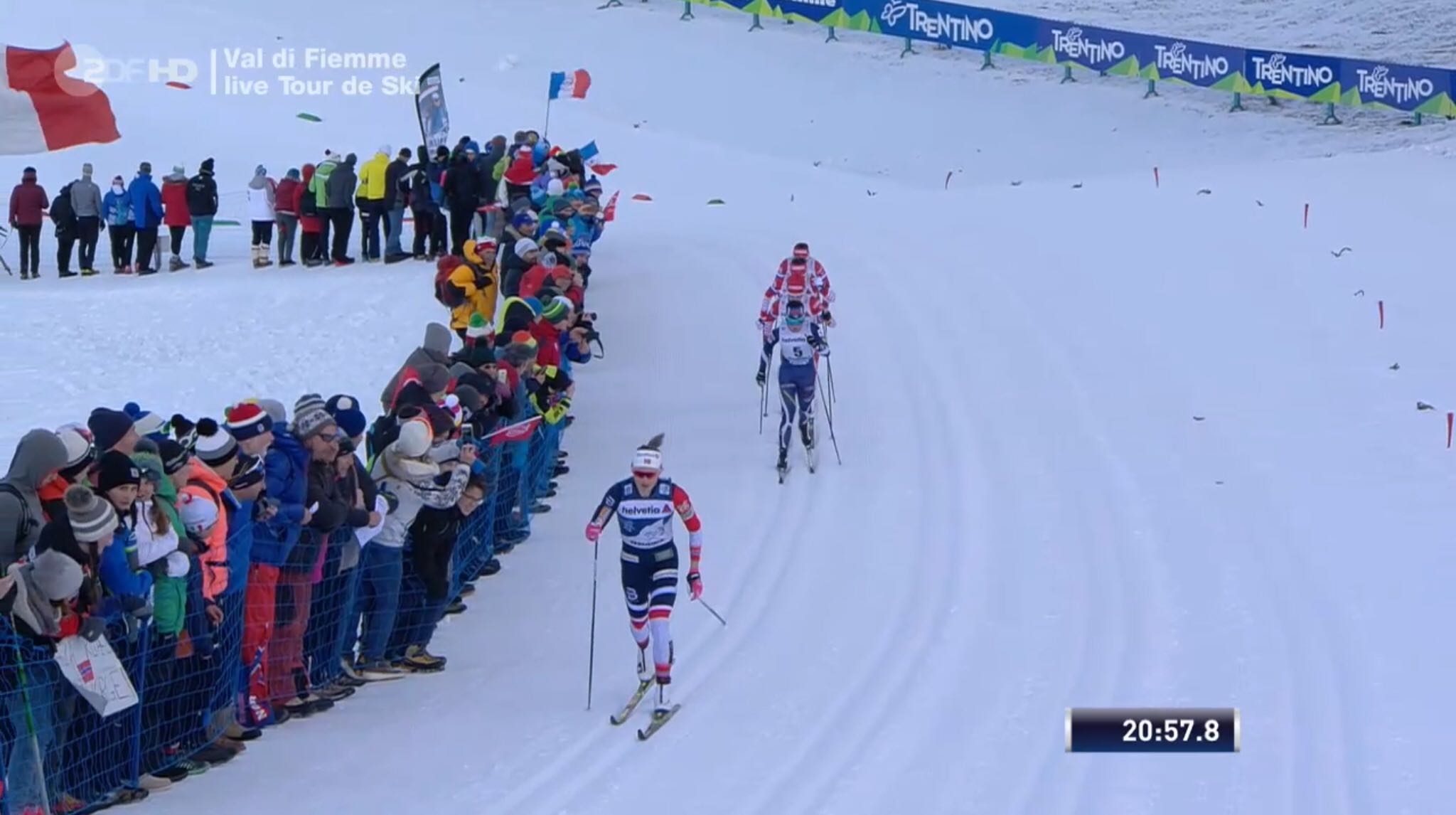
Norway’s Ingvild Flugstad Østberg leading a four-deep chase group on her way to winning Stage 6 of the Tour de Ski — a 10 k classic mass start. (Photo: ZDF screenshot)
FIS World Cup Stage 5 Tour de Ski 10 k/15 k Mass Start Classic Val di Fiemme, Italy
The clear outcome from the women’s 10-kilometer classic mass start was Norway’s Ingvild FlugstadØstberg’sfitness. The TdS leader began the day with a 35.4 second lead on second overall skier Natalia Nepryaeva of Russia. The time back to Nepryaeva at the end of Stage 6 only grew.
Østberg’s form became evident around the 6.2 k mark when she inexorably pulled away from a group that included Russians Nepryaeva, Yulia Belorukova, Anastasia Sedova, and Finland’s Krista Pärmäkoski.
Østberg went on to a solo win in a time of 29:24.4 minutes. Nepryaeva placed second (+10.0), Sedova third (+10.8), and Pärmäkoski fourth (+12.5).
Belorukova ended up in fifth (+39.7), followed by Norway’s Heidi Weng in sixth (+1:10.0), and U.S. skier Jessie Diggins seventh (+1:19.3).
Diggins began the day third overall in the Tour, 1:22.6 minutes behind Østberg.
Canada’s Emily Nishikawa, who began the day in bib 28, placed 25th (+2:47.3).
After factoring in time bonuses, Østberg now leads the TdS by 53.4 seconds over second overall skier Nepryaeva. Pärmäkoski jumped to third (+2:13.1), with Diggins dropping to sixth in the overall, 3:07.9 back.
Thirty-two women began Stage 6 of the Tour de Ski (TdS) in Val di Fiemme, Italy.
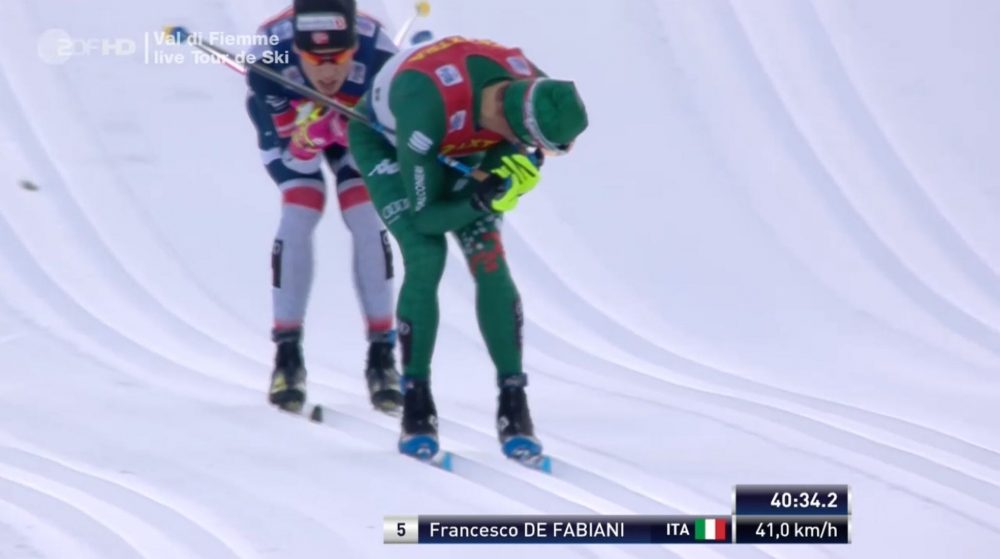
Italy’s Francesco de Fabiani leads Norway’s Johannes Høsflot Klæbo during Stage 6 of the Tour de Ski — a 15 k classic mass start in Val di Fiemme, Italy. (Photo: ZDF screenshot.)
In the men’s 15 k classic mass start, the race was a big opportunity for a results shakedown. Johannes Høsflot Klæbo of Norway came into the race as the overall leader, with a slight 5.4 second lead on Russia’s Sergey Ustiugov who began Stage 6 second overall in the TdS.
Klæbo will retain the overall lead after a tactical Stage 6 where he won the race in 40:52.6 minutes. Francesco de Fabiani of Italy placed second (+0.6), and Russia’s Alexander Bolshunov third (+2.6). Bolshunov had been third overall, prior to today’s stage, 1:18.2 behind Klæbo.
Ustiugov placed 16th (+42) in today’s stage after skiing through the 10 k time check in 20th place, 5.3 seconds back. By 11.4 k, Ustiugov was 20.4 seconds behind the front group of skiers that included Bolshunov and Klæbo.
After Stage 6, with only the Alpe Cermis climb to go, Klæbo sits in first overall, 1:20.4 minutes up on second overall skier Ustiugov. Bolshunov is third overall (+1:43.8), and de Fabiani fourth (+2:40.5).
No Canadian men started the race as Alex Harvey, Lenny Valjas, and Bob Thompson all left the Tour after Stage 5.
Ben Lustgarten (CGRP) for the U.S., is the only remaining North American male. He placed 44th (+5:31.7).
The men’s podium from Stage 5 of the Tour de Ski (Photo: (l-r) Russia’s Sergey Ustiugov in second, Norway’s Johannes Høsflot Klæbo in first, and Alexander Bolshunov of Russia in third. Fischer/Nordic Focus)
The crux of today’s Tour de Ski (TdS) Stage 5 15-kilometer freestyle pursuit came down to a simple yet taxing pulse of energy. That move occurred well into a race as the day’s main narrative was established by the two charging off-the-front.
Norway’s Johannes Høsflot Klæbo began the pursuit in the blue bib as the Tour’s overall leader. Under overcast skies, free from the snowstorm that pummeled Stage 4, Klæbo started 15 seconds ahead of the Tour’s second overall skier, Russia’s Sergey Ustiugov. With fewer than 2 k clicked off, the Klæbo-Ustiugov link up had occurred. Rather than get bogged down in a slowed down cat and mouse tactic, the two worked together, most often with Ustiugov pulling Klæbo along, to gain time on the chasing field.
The closest any skier came to the two leaders was Russia’s Alexander Bolshunov — he started in bib 3, 46 seconds back. The twenty-two-year-old Bolshunov skied alone for the race, never making ground on the two skiers ahead and keeping an approximate 30-second buffer from those trying to suck up from behind.
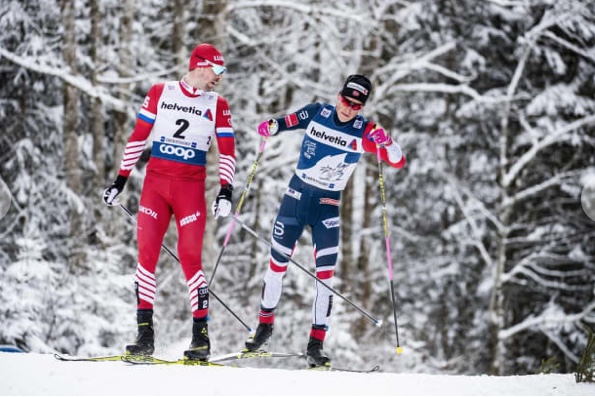
Over six laps of the 2.5 k course, Klæbo and Ustiugov kept the pacing just high enough to ensure Bolshunov could not gap-up and just “cat and mouse” enough as to test one other here and there with bursts of speed and slow tempo dances of pacing.
Russia’s Sergey Ustiugov (bib 2) and Norway’s Johannes Høsflot Klæbo play “speed up” tactics during the Tour de Ski’s Stage 5. (Photo: Fischer/Nordic Focus)
Nothing shook out for either skier until Klæbo shifted into a higher gear over the top of the final hill. The move was a burst, but didn’t initially look like anything decisive; just a classic work over the hilltop effort every junior skier has burned into their synapses by a vocal coach.
Over the top, Klæbo simply looked like he would carry slightly more speed into the descent then Ustiugov. The gap was five meters, sometimes slightly more, but nothing insurmountable for the Russian as the finish line approached.
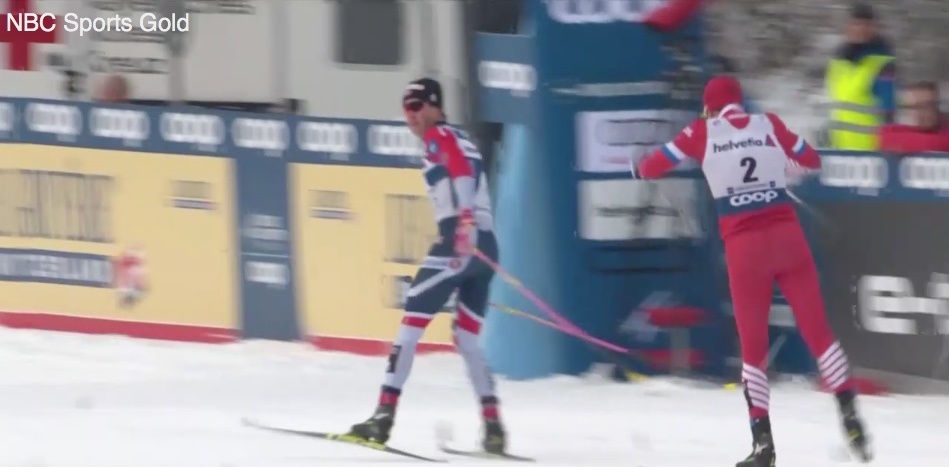
Klæbo put in an effort in the final 100 meters – Ustiugov V2’d in an attempt to close down on the Norwegian while Klæbo free-skated. There was time for Klæbo to turn around and give Ustiugov a stare before sliding across the line, taking the win in 35:07.5 minutes.
Russia’s Sergey Ustiugov and Norway’s Johannes Høsflot Klæbo play “slow down” tactics during the Tour de Ski’s Stage 5. (Photo: fis-ski.com screenshot)
“It was really tough,” Klæbo told the International Ski Federation (FIS) after the race. “Sergey is in very good shape and I think we were going very fast all the way. And in the third lap, I was really tired, but I think he was too. I am very proud to be able to win 15 k in skate, it is my first victory there so I am very happy. Both of us were so stiff in our legs, it was really hard. So we tried, and we stopped again, and we tried some more. It was really tough on the last uphill there. A really cool race and a nice fight between me and Sergey.”
According to FIS, the 15 k skate has been a non-podium event for Klæbo. On the World Cup, his best 15 k skate placing was a 10th place during the 2017 season in Toblach, Italy. That 15 k skate was an interval start format. (Klæbo also placed 12th in this season’s TdS Stage 2 15 k skate individual start race.)
Norway’s Johannes Høsflot Klæbo takes the Stage 5 win over Russia’s Sergey Ustiugov in the final straight. (Photo: Fischer/Nordic Focus)
In his first career TdS, Klæbo will be heading into Saturday’s Stage 6 15 k classic mass start with a 5.4 second lead over Ustiugov, who sits second in the TdS overall standings. The final stage of the TdS will be Sunday’s traditional Alpe Cermis climb in Val di Fiemme, Italy.
Bolshunov remains third in the overall, yet he moves farther back in time to Klæbo after today’s stage – 1:18.2 minutes now separate him from the Norwegian.
Canada’s Alex Harvey began the day in bib 14, 2:27 minutes behind Klæbo. At the race mid-point, Harvey skied in a group containing Swiss star Dario Cologna, Norway’s Sjur Røthe, Martin Johnsrud Sundby, and Russian Denis Spitsov.
By 11.9 k, Harvey had lost contact with the Cologna/Sundby group. Harvey ended his pursuit in 22nd, 3:11.6 minutes back.
Also for Canada, Lenny Valjas (CNST) was 53rd (+8:10.6) and Bob Thompson 55th (+9:41.0).
Ben Lustgarten (CGRP) for the U.S., the only remaining U.S. male in the TdS, placed 54th (+8:38.2).
Today’s Tour de Ski (TdS) Stage 5 15-kilometer freestyle pursuit in Oberstdorf, Germany began and ended simply enough: Norway’s Johannes Høsflot Klæbo wearing the Tour’s blue leader’s bib started first with a 15 second lead over second overall skier Russia’s Sergey Ustiugov.
By 2 k into the race, the pair had linked up and ceded no time to the 63 chasers. Klæbo put in a burst of speed over the last hill and carried a several meter gap into the finish straight to win the pursuit in 35:07.5 minutes. Ustiugov placed second (+0.4), with his teammate Alexander Bolshunov third (+1:08.4).
Norway’s Johannes Høsflot Klæbo turns before the finish to stare down Russia’s Sergey Ustiugov in today’s TdS Stage 5 15 k skate pursuit in Oberstdorf, Germany. (Photo: NBC Gold screenshot)
Canada’s Alex Harvey, the best placed North American, was 22nd (+3:11.6). Lenny Valjas (CNST) placed 53rd (+8:10.6) and Bob Thompson 55th (+9:41.0).
Ben Lustgarten (CGRP) for the U.S., the only remaining U.S. male in the TdS, placed 54th (+8:38.2).
The women’s podium from Stage 5 of the 2018/2019 Tour de Ski’s 10 k skate pursuit. From left to right, Russia’s Natalia Nepryaeva was second, Norway’s Ingvild Flugstad Østberg first, and Jessie Diggins of the U.S.third. (Photo: fis-ski.com screenshot)
As the leader of the women’s TdS Norway’s Ingvild Flugstad Østberg never looked stressed in today’s 10 k skate pursuit. Østberg left the start with a 24 second lead over Russia’s Natalia Nepryaeva and beat her by 30.4 seconds for the win. Østberg won in a time of 26:21.2 minutes, Nepryaeva placed second, and the U.S. Ski Team’s (USST) Jessie Diggins was third (+1:12.6).
Diggins out-lunged Russia’s Yulia Belorukova across the finish line for a photo finish. Belorukova was 0.1 seconds behind Diggins as she placed fourth.
Diggins raced the fastest time of day on course, skiing the 10 k in 26:07 minutes.
Østberg retains the TdS leader bib, with a 35.4 second lead on second overall Nepryaeva, and a 1:22.6 minute lead on third overall Diggins.
Sadie Bjornsen (USST) placed 11th in today’s pursuit (+4:07.8). Bjornsen is also 11th overall in the TdS standings but will exit after today’s stage to focus on upcoming World Cups.
U.S. Cross-Country Ski Championships Craftsbury, Vermont 10 k/15 k Classic Interval Start
Today was the first day of racing at the U.S. Cross-Country Ski Championships in Craftsbury, Vermont. The women began with a 10-kilometer classic interval start race.
Caitlin Patterson (CGRP) won in a time of 30:44.7 minutes, while Jessica Yeaton (APU/Australian National Team) placed second in 31:05.5, and Kaitlynn Miller (CGRP) was third in 31:22.1.
Julia Kern (SMS-T2) was fourth overall and the third American in 31:33.9 minutes.
In the men’s 15 k classic race, Kyle Bratrud (SMS T2) won his third career national title. He stopped the clock in 41:41.8 minutes. Adam Martin (CGRP) placed second in a time of 42:12.8. Kris Freeman (Caldwell Sport), took third in 42:27.6. Freeman “retired” last season, but still remains in form and podium worthy.
U.S. Paralympics Nordic Nationals Craftsbury, Vermont
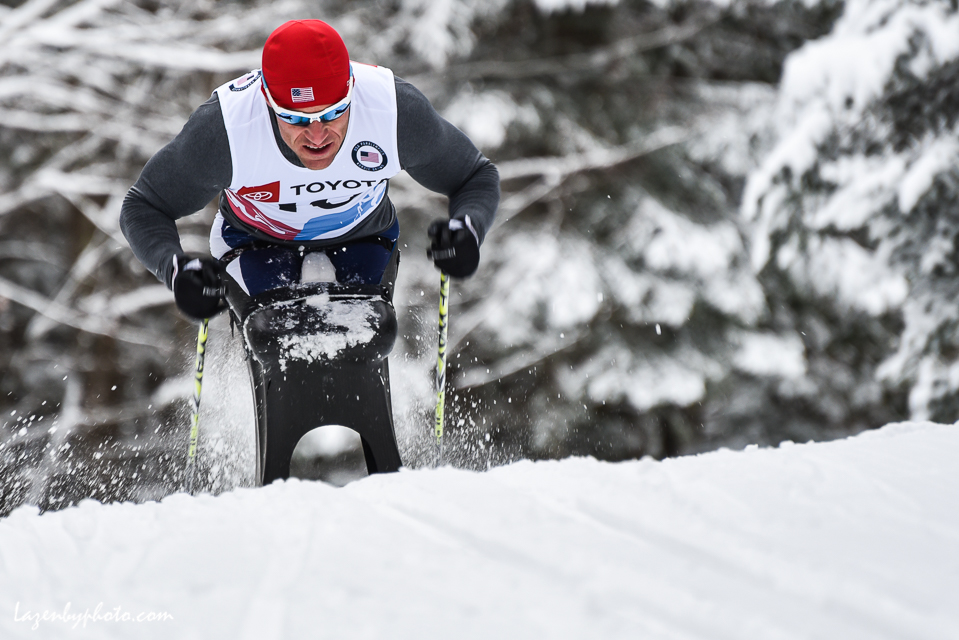
Dan Cnossen on his way to winning the men’s middle distance national title at the Paralympic Nordic Nationals at Craftsbury, Vermont. (Photo: John Lazenby)
Also at the Craftsbury Outdoor Center on Thursday, the middle distance race was held for the first event at the Paralympic Nordic Nationals. Dan Cnossen won the race in 25:09.9 minutes. Cnossen is based outside of Boston but trains frequently in Craftsbury both as a sit-skier and biathlete.
“It was good, a really good course I thought,” Cnossen told FasterSkier in Craftsbury. “The grooming was good, but the conditions were a bit tough due to the snowfall. I love racing at Craftsbury, I’ve done the majority of my training in the last few years here. I think they undoubtedly put on the best venue. It is nice for me to come here. I am also a New England athlete.”
Asked about his tactics, Cnossen said the overnight snowfall changed his perception of the course.
“The course speed Yesterday during course inspection the conditions were a really fast and I was a little nervous about how it would go today but then with this snowfall it changed things a lot and I am a bit more of a climber and focus on that. Sometimes as sit skiers our poles sink a little deep in the softer snow so I was trying to pole in a light way, but not want to lose the power.”
Aaron Pike placed second, and Canada’s Yves Bourque was third.
Oksana Masters won the women’s 5 k event at the Paralympics Nordic Nationals in Craftsbury, Vermont. (Photo: John Lazenby)
In the women’s event, Oksana Masters won the 5 k race in 19:38.9 minutes.
“This was a fun course. …. Yesterday was a lot icier and then today it was definitely a lot softer but it was cool because there was still a lot of technical components which often doesn’t happen in para-sport or para-courses sometimes for nationals,” Masters said. “So that was cool. It had a lot of climbs, a lot of fun downhills.”
Kendall Gretsch was second, and Lyne Marie Bilodeau was third.
Sophie Caldwell (right) and Jessie Diggins (left) about to cross the finish line in a photo finish during Tuesday’s Stage 3 Tour de Ski skate sprint in Val Müstair, Switzerland. Caldwell placed second, Diggins third. (Photo: NBC Gold screenshot)
FIS World Cup Tour de Ski Stage 3 1.4 k Freestyle Sprint Val Müstair, Switzerland
In the third stage of the Tour de Ski (TdS), there was no doubt who was in control after the qualifier. Sweden’s Stina Nilsson, who skied the fastest qualification time in 3:30.52, won the 1.4 k freestyle sprint in Val Müstair, Switzerland on Tuesday.
Nilsson made a clean sweep of her quarterfinal, semi-final, and the final on her way to the win. In a photo finish for second and third, the U.S. Ski Team’s (USST) Sophie Caldwell placed second (+2.27) while teammate Jessie Diggins placed third (+2.27).
Both Caldwell and Diggins advanced from the first semi-final, won by Nilsson. Caldwell placed second in the semi, Diggins third, as she advanced as a lucky loser.
Caldwell was the fourth fastest qualifier (+2.15). Diggins qualified in 15th (+6.73).
Diggins now leads the TdS by 1.1 seconds over Norway’s Ingvild Flugstad Østberg. Østberg placed fourth in Tuesday’s sprint.
Teammate Sadie Bjornsen qualified in sixth (+3.40), but ran out of real estate down the stretch in the second quarterfinal where she ended up third and did not advance. Bjornsen placed 13th overall.
For Canada, Dahria Beattyplaced 39th and Emily Nishikawa 48th.
A familiar look: Johannes Høsflot Klæbo of Norway crosses the line in first during the Tour de Ski’s Stage 3 skate sprint in Val Müstair, Switzerland. (Photo: NBC Gold screenshot)
For the men, it was another opportunity for Norway’s Johannes Høsflot Klæbo to raise his arms and grandstand across the line in the men’s final. Klæbo won the final in 3:03.78 minutes with a 2.35-second margin over second place skier Federico Pellegrino from Italy. Sergey Ustiugov of Russia finished third on the day (+3.07).
Klæbo now leads the TdS overall by 12.0 seconds over second place Ustiugov. Alexander Bolshunov from Russia sits in third overall after finishing seventh in the Stage 3 sprint.
Simi Hamilton (USST) qualified in sixth (+4.30) and ended up 13th overall in the sprint. Teammate Kevin Bolger (USST) placed 34th, as he missed qualifying for the heats by less than one second. Ben Lustgarten (CGRP)placed 77th. Erik Bjornsen (USST) did not start today’s stage.
For Canada, Alex Harvey was 37th overall, Bob Thompson 62nd, and Lenny Valjas 72nd.
People looking for a discreet, adult conversation after a long day often turn to quality phone sex because it offers private talk, clear pricing, and experienced partners without awkward sign-ups.
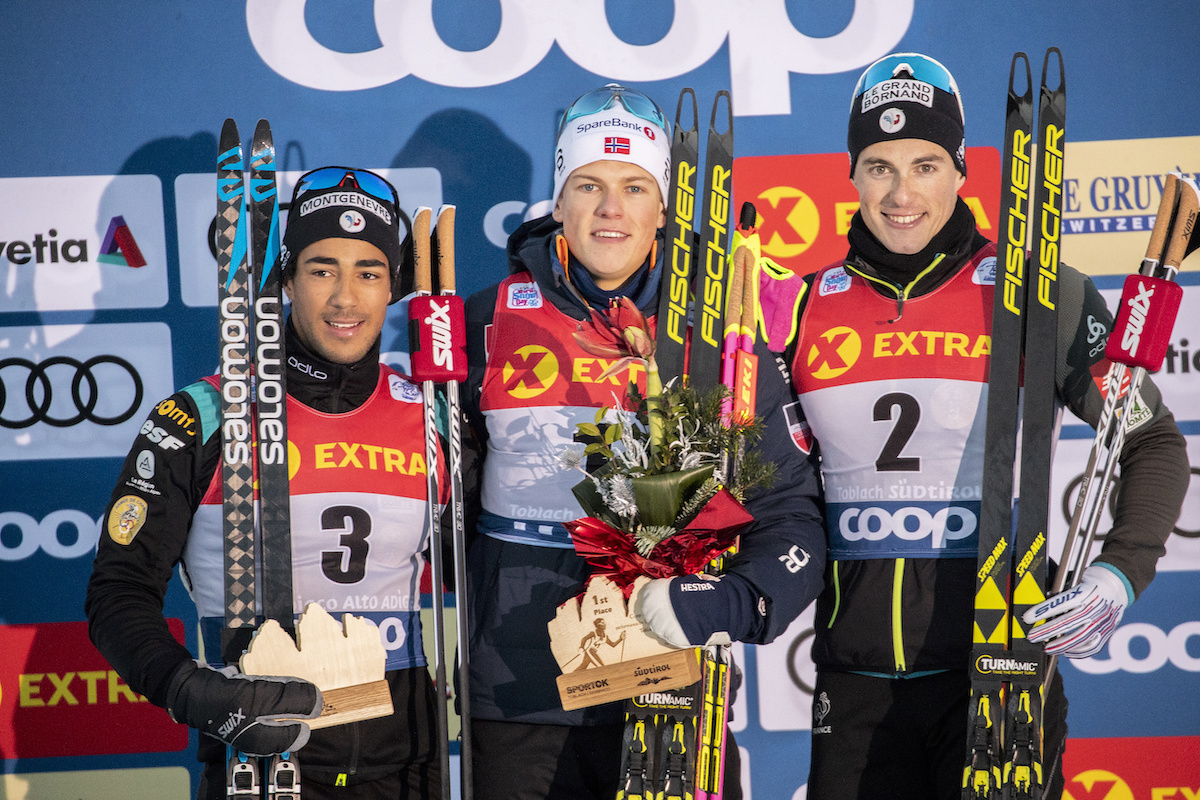
The men’s podium from Toblach, Italy’s first stage of the 2018/2019 Tour de Ski — a 1.3 k skate sprint. Richard Jouve (left) from France placed second, Johannes Hoesflot Klaebo (center) of Norway was first, and Lucas Chanavat of France (right) was third. (Photo: Fischer/Nordic Focus)
*Note: This article has been updated to include comments from U.S. Ski Team B-Tean member, Kevin Bolger
Without the visual of the grey and white U23 marker next to his name on an FIS results sheet, it’s easy to forget Norwegian Johannes Høsflot Klæbo is still under 23 years of age. As the Tour de Ski (TdS) celebrates its 13th edition this year, the twenty-two-year-old Klæbo (he celebrated his 22nd birthday this October) is only in his first TdS. He did not start last season’s 2017/2018 Tour. Nor did he start the 2016/2017 TdS. His debut World Cup race came in the spring of 2016.
Even so, by the opening race of this season’s TdS, a 1.3-kilometer freestyle sprint in Toblach, Italy, Klæbo maintained the composure of a seasoned Tour veteran. A skier used to winning and ready to do it again.
He started by posting the day’s fastest qualification time, placing first in a time of 2:16.86 minutes.
Klæbo then advanced to Quarterfinal 1, exchanging the lead with Russia’s Sergey Ustiugov for the first half of the sprint loop, before taking command and eventually duking it out with France’s Lucas Chanavat and Norwegian Sindre Bjørnestad Skar in the finishing stretch.
Johannes Høsflot Klæbo (bib 1) from Norway winning the men’s final in Toblach, Italy. Klæbo looked in form during the first stage of the 2018/2019 Tour de Ski.(Photo: Fischer/Nordic Focus)
Klæbo eventually won that quarterfinal, crossing first in a time of 2:19.71 minutes, just ahead of Chanavat. Both he and the Frenchman advanced to semi-final 1. Skar squeaked into the second semi as a Lucky Loser thanks to the heat’s fast times.
In the first semi-final, Klæbo once again took the lead from the start. He was shadowed closely by Chanavat and Italy’s Federico Pellegrino until the course’s second climb. There, the Italian made a push to the front, but by the bottom of the following hill, Chanavat had maneuvered his way around Pellegrino to take the lead. As the first semi-final skiers cornered into the finishing stretch, it was a four-skier battle between Chanavat, Pellegrino, Klæbo and Norwegian Eirik Brandsdal.
Chanavat took the semi final win. Crossing behind Chanavat, Klæbo (+0.07) bested Pellegrino (+0.10) by 0.03 hundredths of a second to advance to the final. Pellegrino did not move on.
By the time the men’s final rolled around, the line up included three Norwegians, two Frenchman, and a Russian. Norway’s Emil Iversen and Skar had advanced to the final as the two Lucky Losers from the second semi, which was won by France’s Richard Jouve followed by Russia’s Alexander Bolshunov.
From the start of the gun, it was Klæbo in front in the final. Clinging to his skis were Jouve and Bolshunov as the group headed toward the first climb. Klæbo maintained the leader’s pull just until the top of the climb, where Bolshunov positioned himself in first for the descent. Rolling into the second short climb, Bolshunov and Klæbo went head-to-head. Lurking just behind them was the French duo.
As they headed into the third climb, Chanavat moved to the outside right of the group. Jouve followed. By the time the final field crested the last climb on course, Klæbo was positioned in first, Jouve in second and Chanavat in third.
A final sling around the curve to the finish revealed Klæbo flurrying to hold off the attacks of Chanavat and Jouve. His efforts paid off and the Norwegian finished the sprint, his first TdS race, in first in a time of 2:17.99 minutes. Chanavat crossed 0. 34 seconds behind Klæbo for second.
Crossing a mere 0.05 hundreths of a second behind Chanavat was Jouve in third (+0.39). The podium is Jouve’s sixth in the top three (fifth individual) all of which, like his compatriot, were in the freestyle sprint discipline.
Rounding out the top 10 was Pellegrino in seventh, Brandsdal, in eighth, Sweden’s Oskar Svensson in ninth and Norway’s Finn Hågen Krogh in 10th.
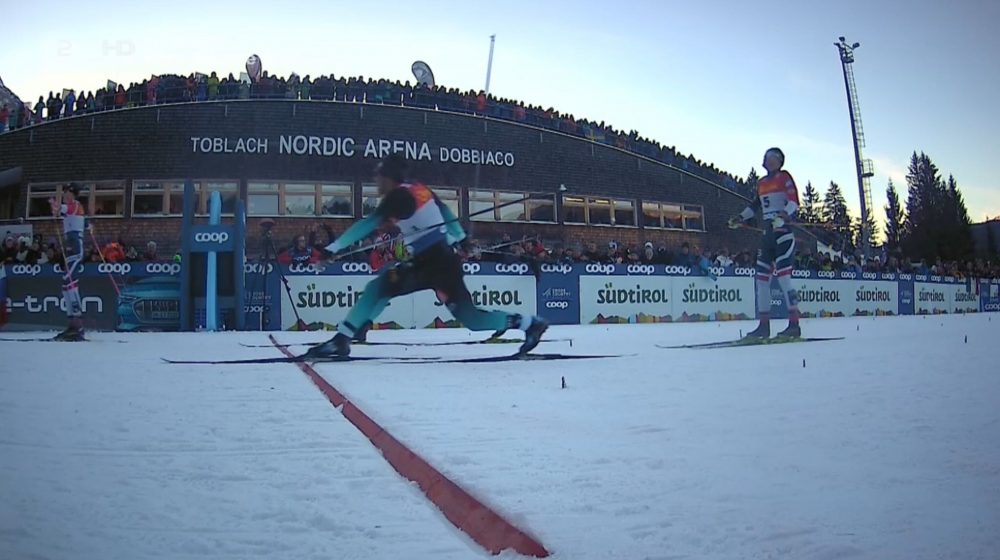
Johannes Høsflot Klæbo of Norway crossing the line in first as France’s Richard Jouve placed second and his teammate, Lucas Chavanat, was third. (Photo: ZDF Screenshot)
Two Americans qualified for the heats, with Simi Hamilton qualifying in eighth (+3.00) and Kevin Bolger of the U.S. qualifying in 13th (+3.98).
Hamilton, who advanced to the second quarterfinal, looked strong for the first two-thirds of the course. However, in the last climb of the sprint loop, while moving from fifth to third, Hamilton fell. The crash cost him advancing to the semis and he crossed his heat in sixth, ending the day’s sprint in 26th.
“I think he unfortunately just took himself out,” U.S. World Cup head coach, Matt Whitcomb said during a phone conversation. “From the side angle, it looked like he just started getting a little bit too far forward. He thought he might have hit something…But it was a bummer because he had a really speedy qualification and was just positioned perfectly to move on and was feeling great.
“It’s one of those instances where you can be disappointed but not discouraged because he’s where you want him to be,” Whitcomb continued. “He’s in a place where he’s good enough to be on the podium, can certainly ski with the best, but unfortunately that didn’t unfold today.”
The U.S. Ski Team’s Kevin Bolger during the first stage of the 2018/2019 Tour de Ski — a 1.3k skate sprint. Bolger placed 21st overall. (Photo: Fischer/Nordic Focus)
Bolger, who advanced to the fifth quarterfinal remained in contact with Swedish skiers Karl-Johan Westberg and Viktor Thorn and Russian Alexander Bolshunov, who lead through the first and second climbs. Bolshunov picked up the pace on the second hill, pulling the rest of the field with him.
“I kind of assumed Bolshunov would want to take command of the heat, and he did from the start, and then he put in that surge just over the top of the second climb, I felt like I was ready but not in the best position to react, and was able to get back in contact with the group over the last climb, but making a move from there was tough,” Bolger wrote in an email to FasterSkier on Saturday. “We had one of the fastest heats of the day, if I was in any other heat I think I would have qualified.”
The Russian crossed the quarterfinal first with Poland’s Maciej Starega holding onto him to cross in second. Bolger eventually crossed in fifth for 21st on the day.
“Really exciting to see Kevin qualify,” Whitcomb said. “Watching his qualification rounds, he must have skied one of the fastest first climbs. His V1s were absolutely lightning fast. We’re really impressed with his trajectory throughout Period 1 getting gradually faster and faster and almost being there in Davos and he’s clearly there now.”
Two weekends ago, Bolger finished the Davos, Switzerland sprint in 31st, just one place outside of qualifying. These were the first heats of the season in which he qualified.
“I was excited, but also relaxed,” Bogler wrote of how he was feeling. “I don’t feel like a newbie in the world cup heats anymore, I’ve had experience. So I wanted to ski aggressive and attack and be in the mix from the start.”
“I will be dropping out of the tour after the 3rd stage, along with Simi, and Sophie,” Bolger continued. “But tomorrow’s 15 k skate will be a hard effort, but a fun fast course I’m looking forward to having a good race, but I’ll be putting a little more focus into the next skate sprint in Val Müstair!”
Canadians Alex Harvey finished in 50th (+7.16), Len Valjas in 55th (+7.46), and Bob Thompson 62nd (+8.10).
“My skis were great today!” Harvey wrote in an email after the sprint. “I was actually feeling quite good in the warm up and in the race. I just think that a 2:16 sprint is a bit too short for me. The conditions made for a quick and fairly easy prologue, I think 2 years ago in was more around 2:45 so to shave 30 sec of a sprint course is pretty impressive.”
“I would have liked to get in the heats and maybe put some time on some of the contenders for the overall but I guess I’ll have to wait for tomorrow to do that!” he added.
Another duo of North Americans started the qualifier, with Erik Bjornsen (USST) and Ben Lustgarten (CGRP) of the U.S. placing 76th (+10.38) and 105th (+15.23), respectively.
2018 Davos, Switzerland women’s sprint podium. Sweden’s Stina Nilsson (center) placed first, Sophie Caldwell (left) of the U.S. was second, and Maja Dahlqvist (right) also of Sweden was third. (Photo: screenshot @matt.d.whitcomb)
FIS World Cup Davos, Switzerland 1.5 k Freestyle Sprint
On a lovely Davos, Switzerland day, Sophie Caldwell of the U.S. Ski Team (USST) was the day’s fastest qualifier for the women, stopping the clock in 2:46.28 minutes. Caldwell looked cool and in-form on her way to place second overall on the day for her first podium of the season.
The win went to Sweden’s Stina Nilsson after placing third (+2.03) in qualification. Third place went to another Swede, Maja Dahlqvist. It was the twenty-four-year-old Dahlqvist’s second podium of the year after she placed second in the Ruka, Finland classic sprint. Dahlqvist was the day’s second-fastest qualifier, finishing 0.62 seconds behind Caldwell.
Four other Amercian’s advanced to the heats. Sadie Bjornsen qualified in 10th (+4.28). She looked strong in her heat, leading the first lap and skiing in second place down the final stretch. She was passed by a surging Natalia Nepryaeva from Russia. After placing third, Bjornsen did not advance. Bjornsen ended up 14th on the day.
Ida Sargent (USST) qualified in 14th (+5.41) but did not advance out to the heats after placing fifth in the first quarterfinal. Sargent was 21st overall.
Jessie Diggins (USST) was 15th (+5.50) in qualification. In the fourth quarterfinal, Diggins tripped over Russian skier’s Natalia Matveeva’s pole and fell to her knees in the heat’s opening moments. She was unable to regain the lost ground and placed sixth in a photo finish with Matveeva. Diggins placed 26th overall.
No Canadians were entered in the women’s race.
Rosie Brennan (APU)qualified in 28th (+8.83) and was eventually eliminated in the third quarterfinal where she placed sixth. Brennan was 29th on the day. Also for the U.S., Kelsey Phinney (SMS T2) placed 38th, after placing 38th (+12.10) in the qualifier.
For the men, although still young twenty-two-years-old, Johannes Høsflot Klæbo looked like the old Klæbo on his way to his first World Cup win of the season. The Norwegian was the World Cup’s overall winner last season and first in the sprint cup.
Klæbo placed first in the qualifier with a time of 2:22.39 minutes. He advanced to the finals by winning the first heat and the first semi. Klæbo won the final in 2:20.44 minutes. Italy’s Federico Pellegrino was second overall, finishing 0.39 seconds back. Baptiste Gros of France was third (+1.40) to take the last podium step.
Simi Hamilton (USST) was the best placed North American male. Hamilton qualified in 17th (+4.76) and placed 12th overall. He placed second in the fifth heat a fraction behind Finland’s Joni Maeki. In the second semi-final, won by Norway’s Eirik Brandsdal, Hamilton placed sixth (+6.90).
Kevin Bolger (USST) just missed the heats after qualifying in 31st (+6.63). After not advancing, Bolger was 31st overall. No other Americans were entered.
Alex Harvey was the best placed Canadian, placing 37th overall. Lenny Valjas in his first World Cup of the season was 53rd. Andy Shields finished in 60th. No other Canadians were entered.
IBU World Cup Hochfilzen, Austria 10 k/12.5 k pursuit
On Saturday in Hochfilzen, Austria the women’s 10-kilometer pursuit was won by Finland’s Kaisa Mäkäräinen in a time of 30:53.8 minutes. It was Mäkäräinen’s third win of the season. The Finn had a tough time on the shooting range, despite surging for the win in the final meters, she suffered three penalties on the shooting range (1+0+1+1).
Kaisa Mäkäräinen of Finland down the final stretch in Hochfilzen, Austria during the IBU World Cup 10k pursuit. Paulina Fialkova of Slovenia was second, Italy’s Dorothea Wierer was third. (Photo: biathlonworld.com)
Paulina Fialkova of Slovenia was second (+1.5, 0+0+1+1) after skiing two penalty loops. Italy’s Dorothea Wierer was third in a close fight for all three podium spots finishing 2.8 seconds behind Mäkäräinen. Wierer had three penalties during the race (2+0+1+1).
Susan Dunklee of the U.S. was the best placed North American, improving on her 34th start spot to place 28th (+2:06.1, 0+1+1+0). Teammate Joanne Reid was 31st (+2:17.1, 0+0+0+1) after missing only a single target. Clare Egan did not qualify for the pursuit.
Rosanna Crawford was the lone Canadian to qualify for Saturday’s pursuit. She placed 44th (+3:24.8, 1+1+0+1).
Martin Fourcade of France, in a return to shooting and skiing form, took the win in the men’s 12.5 k pursuit. Fourcade won in a time of 32:22.3 minutes while shooting clean through his four shooting rounds.
Germany’s Arnd Peiffer was second (+13.7, 1+0+0+0), skiing a single penalty lap. Norway’s Vetle Sjåstad Christiansen was third (+16.1) after shooting clean for the race.
First place starter after winning yesterday’s sprint, Norwegian Johannes Thingnes Bø, fell back in the standings after missing six targets. He placed ninth (+1:00.0, 0+3+1+2) overall.
Sean Doherty for the U.S. was 31st (+2:37.3, 0+1+0+1). U.S. teammate Leif Nordgren was 42nd (+3:21.5, 1+0+1+3).
Scott Gow was the only Canadian to qualify for the pursuit. He finished in 51st (+4:36.3, 1+0+0+3).
NorAm and U23/JW World Championships Qualification, Canmore, Alberta
Day two of the Noram and U23/JW trials in Canmore, Alberta, featured freestyle individual interval races; the men raced 15km followed by the women’s 10km
Russell Kennedy (Team R.A.D.), fresh back from Europe led the way with a 30:18.5 minute clocking for the 15km. His teammate Evan Palmer-Charrette was second, 30.7 seconds behind. Alexis Dumas (CNEPH) snatched third, 1.6 seconds behind Palmer-Charrette and 0.9 seconds ahead of Jack Carlyle (AWCA). Seb Boehmler-Dandurand (AWCA) was 4.3 seconds back from Carlyle and 48.5 seconds behind the winner.
Gareth Williams (CNST) was sixth and the top U23 athlete at 1:02.9 back, with CNEPH U23 teammates Philippe Boucher and Antoine Cyr taking 7th and 8th, 8.2 and 8.8 seconds behind Williams.
Samuel Hendry (Team R.A.D.) won the junior men’s 10km in 23:09.7 to earn a spot on the U23 team in Lahti next month, with his second NorAm interval start win in two tries. Remi Drolet (Black Jack) followed up two sprint NorAm sprint wins with a second place, 33.6 seconds behind. Tom Stephen (Team ULLR) was third at 45.8 seconds.
In the open women’s 10km free, Dahria Beatty (CNST) continued her hot streak with another win, finishing in 26:05.1. Last weekend’s winner, Katherine Stewart-Jones (CNST) was second at 35.0 seconds. Frédérique Vézina (CNEPH) took third, 1:01.9 behind.
Sadie White (TBay) was top U23 in 4th, 1:10 behind the winner.
All results, including live timing for the rest of the weekend.
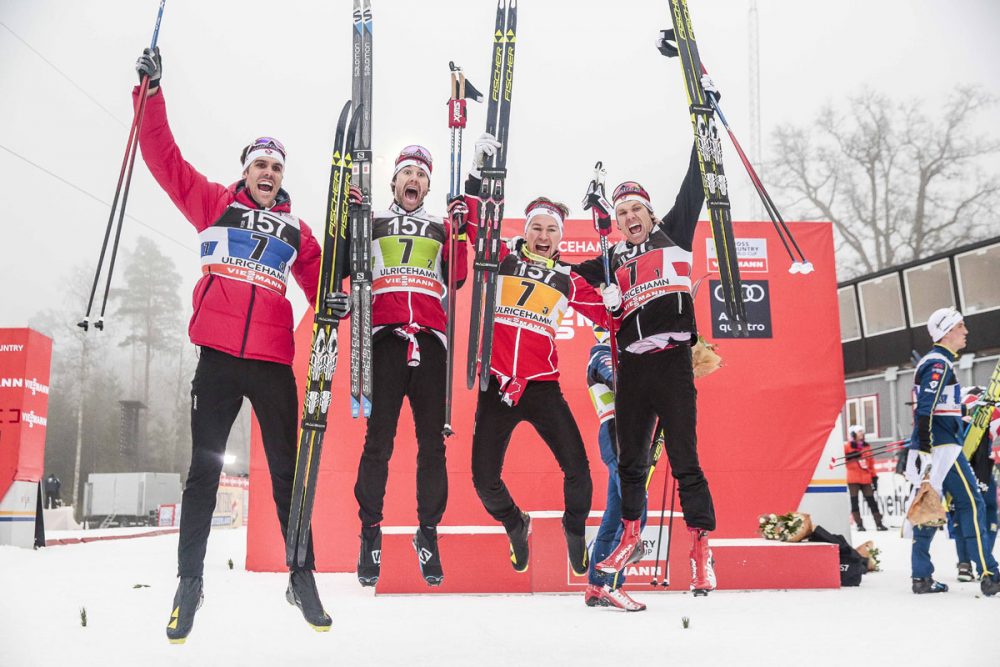
Left to right: Canada’s Len Valjas, Alex Harvey, Knute Johnsgaard, and Devon Kershaw after their historic third place finish in the 2017 men’s 4 x 7.5-kilometer team relay in Ulricehamn, Sweden. (Photo: Fischer/Nordic Focus)
This is the second part of FasterSkier’s report on the state of high performance cross-country skiing and athlete development in Canada. You can read part one here.
Cross Country Canada (CCC), as the national governing body for cross-country skiing in Canada has the difficult task of steering a rather large ship. The idea in steering the ship is to maintain a path requiring little quick and nimble maneuvering. Survey the landscape, mine the data, set a course, and sail. Along the way, there’s the ability to make slight adjustments for efficiencies, accommodate unforeseen changes.
Nic Lemyre (Photo: Norges Idrettshøgskole/Norwegian Sports Academy/)
“We’re thinking our starting point is to build a really strong relay team, on both the women’s and the men’s side,” Lemyre told FasterSkier. “We want to have five athletes, so that we can rotate with the fifth athlete and we’re never in a situation where we can’t field a strong team because one athlete’s injured or sick.”
According to Lemyre, the composite team must be derived of skiers who can hit specific individual benchmarks “[When] we have athletes that can start scoring points in every race they enter on the world cup, that’s a medium term goal,” Lemyre said. “From there, we start aiming for the top-15 for all athletes that are identified in that group.“
Part of the reasoning behind the relay vision is that for a skier to get a permanent spot on the World Cup, the athlete not only has to reach a high level, but also help raise four other Canadians up to that level. Lemyre believes this should foster cooperation and team spirit.
“It helps us meet goals of performance,” Lemyre added. “But also it helps us meet goals that are related to how to build a strong performance culture, where the athletes need to support each other, to learn from each other. They need to push each other. They need to push each other beyond limits they may have experienced before.”
How do we get there?
After PyeongChang, CCC appeared to have both the political will to start the painful process of another re-invention. However, that will came with a reduced budget with which CCC could support its future options.
The simplified model of corporate restructuring begins with terminating certain roles and concludes with creating new roles filled by new individuals near the top of the organizational pyramid. Often, in a medium or large corporation, most people will be shuffled around and only a few near the top will lose their jobs. The final step is to find a quick win to help the newly reshaped organization gain morale and unify.
In a small organization like CCC, everyone is near the top. While the process works well for the survival of the organization, it can be hard on individuals.
The change at CCC began with long-time High Performance (HP) director Tom Holland’s planned retirement. Lemyre was hired as a consultant to oversee the restructuring of the HP group. Shortly before Lemyre’s hiring, CCC eliminated some positions.
As Joel Quenneville’s recent firing demonstrates, proven ability and past success is not enough to provide job security during a reboot. (Quenneville was the NHL’s Chicago, Blackhawk’s head coach since 2008. During his tenure Quenneville lead the team to three Stanley Cups.)
On November 1st, CCC hired Erik Bråten as a new national team coach and modified Louis Bouchard’s title. Bouchard remains head of the National Training Centre in Mont Ste-Anne, Québec, with the added title and responsibilities of World Cup Head Coach.
Bråten, a recent Norwegian School of Sports Science graduate with a specialization in cross-country skiing, won the 2018 coach of the year award from the Norwegian ski federation. This hiring didn’t happen as quickly as some had hoped, but is considered the first win for CCC’s new structure.
“Erik has a strong sports science background applied to cross-country skiing,” Lemyre said on the phone. “His profile is unique in our environment. The fact that he’s young is really positive for us, because he’s open to this new experience. He comes with a solid base, and his excitement and his motivation, I think, will be great assets in applying that knowledge in the right culture in Canada. At an individual level, Erik is unique in working one on one with athletes. I think our athletes are going to really appreciate that.”
Along with bringing in new personel, Lemyre aims to improve sharing of training information in Canada. In Norway’s organizational structure, athletes and coaches are able to log hours and training plans on an interface organized by the Norwegian National Ski Federation. It’s a model and template Lemyre is intimate with.
“The fact is that we have a large country, and we can’t be with athletes every day of the year following them on site,” Lemyre said. “Now the technology is there to pool [training data] in a way that our coaching staff and the local coaches can communicate really well, But also as we’re building up our science team, we also have interaction with our different people involved in helping the athletes develop.”
Dahria Beatty racing the 2018 Holmenkollen 30 k freestyle mass start in Oslo, Norway. (Photo: Fischer/NordicFocus)
Another planned shift is to interchange athletes between Europe and Canada more often. For example, Dahria Beatty will start the season in Canada — a change encouraged by her coach Chris Jeffries and supported by Lemyre.
“This summer my coach Chris and I came up with a plan that allowed me to stay in Canada to start the season to build into the race season and then head over the Europe and race on the World Cup circuit leading up to World Championships in Seefeld,” Beatty said. “With this being the first year of the new quadrennial, it is the perfect time to fine tune some of those race details domestically before leaving for Europe mid-December. I am looking forward to racing part of the Tour de Ski then period 3 and hopefully finding my peak for World Championships and World Cup finals in Quebec.”
Lemyre’s concept is to allow athletes like Beatty to build into the early part of the season domestically and arrive in Europe at a higher level of race fitness.
“The way we scheduled the trips this year, giving some athletes the chance to prepare very well before they race on the World Cup,” Lemyre added. “I think some of them will be stronger when they show up on the World Cup, and also they’ll be able to sustain that level of performance over the time period they are on the World Cup. We will try to be a little more selective and well prepared when we show up, and then post really good results when the athletes are racing the World Cup.”
Jeffries stated that the stress of living abroad, a dynamic known all to well by North American World Cup skiers, can be counterproductive to a developing athlete.
“The last few years, our top athletes spent the majority of their time in Europe,” Jeffries said. “I think it stalled our development a little bit, because we’re always living out of a suitcase, and we’re always having to ski races where we’re trying to perform.”
Dave Wood spent 18 years as a national team coach. His time leading the team included the post-Nagano rebuild and managing athletes at the Olympics in Vancouver. His vision includes giving skiers more time to develop and less emphasis on being fast all season.
“Sara [Renner] had far less World Cup starts before she was top-15 at the Olympics than the people of today,” Wood said. “I think that this big argument about experience is valuable when you are looking for seconds. When you are looking for minutes, [World Cup experience] makes no difference.”
Will it Work?
The U.S. has been able to develop a strong women’s team built off Kikkan Randall’s determination to drag U.S. skiing to the top. Randall took inspiration and knowledge from Canada’s post-1998 rebuild where Scott, Renner, Milaine Thériault, Jamie Fortier and Amanda Fortier decided it was time to lead the charge.
American Kikkan Randall tucking during the women’s 10 k classic mass start at 2018 World Cup Finals in Falun, Sweden. (Photo: Fischer/NordicFocus)
In both cases, the athletes didn’t succeed alone. The “fantastic five” got the support of Holland, Wood, and many others. Randall also collected a large supporting cast, well documented by Peggy Shinn’s book ‘World Class’.
Laura McCabe, now a Methow Valley coach and two-time Olympian, spent most of her free time in Nagano with the Canadian women’s team because it felt like a group that had a vision and a willingness to support one another to collective success.
“It just shoots you up the ladder when you come back and you feel like you have a very safe place, you’re working on this goal together, you’re all in it together, and you’re there for each other all the time,” McCabe told FasterSkier. “I felt like the Canadian women were doing that. And now I feel like Matt Whitcomb has led that charge for the American women.”
While crediting Randall for starting the process, McCabe feels that the team’s work to be a team is the critical factor.
“They have goals, team goals and they have personal goals,” McCabe said. “They are always there for each other. One of their biggest goals is to basically keep their relationships positive and keep everybody moving forward. I think that is one of the number one reasons that team is doing well.”
In a conversation last May with FasterSkier, Yukon coaching icon Alain Masson spoke of the complexities of achieving success on the international stage. Simply possessing physical gifts, the aerobic capacity, the predisposition to tolerate and absorb high training loads, is no guarantee of success.
There’s the behind the scenes unglamourous work of nurturing athletes, remaining true to organizational core values, and feeding the system with money, intellect, and vision.
“Definitely, there’s a minimum set of physical characteristics that you need to perform at that level,” Masson explained to FasterSkier. “But you also need many characteristics, personality characteristics, that are vital. What Alex showed, and Sara Renner, and Chandra [Crawford] and Beckie [Scott]. I think athletes that combine both the physical and the mental characteristic at a time when the program works together, and everything lines up with the funding, good leadership, and everybody working together. That’s the difficulty, this is the issue, trying to get all of that together. As the women in the U.S. have demonstrated, when you have all of that lining up, it’s amazing what you can do.”
Canada’s Alex Harvey celebrating on the podium after placing second in the men’s 15 k freestyle mass start in Seefeld, Austria, for his best result of the 2018 World Cup season. (Photo: Salomon/NordicFocus)
Cross Country Canada (CCC) has begun a reboot process as the new Olympic cycle starts. Corporations call this a reset, a rebranding, a new direction, restructuring, and various other names that try to disguise the challenges and issues that come with enacting real change.
The reboot process traditionally starts with an acknowledgement that the current level of success, and that of the foreseeable future, doesn’t align with the goals or the potential of the organization.
Canada left PyeongChang with no medals at three consecutive Olympics, only one skier in the World Cup red group, and a perception that there was no obvious successor to Alex Harvey.
There are many people who, with the benefit of hindsight, believe that CCC allowed itself to be trapped by a combination of success and the Own The Podium (OTP) funding model.
The process of assigning blame for the past, called “blamestorming”in the corporate world, is one of the most effective ways to waste time and destroy morale without doing anything to improve the future. The “best practices” approach to a reboot starts with four apparently simple questions: How did we get here? Where are we now? Where do we want to be in five years? How can we get there?
While CCC does many things as a national sport body, this article will focus on high performance and the development system.
How did we get here?
After a disastrous 1998 Olympics in Nagano, CCC shrank to a full-time staff of five and endured a forced re-invention. Four years later, in 2002 at Salt Lake, Beckie Scott won all three medals in the skiathlon after the initial silver and gold medalists were caught doping. Sara Renner missed the B final in the sprint for 9th place.
Canadian Chandra Crawford in the 2011 team sprint in Dusseldorf, Germany. (Photo: Fischer/NordicFocus)
In 2006 in Torino, Chandra Crawford earned a surprise gold in the sprint while Scott finished fourth. Scott had earlier teamed up with Renner for a team sprint silver medal.
In 2010, there were no Canadian cross-country medals. However, there were signs of promise. Renner skied to her fourth Olympic top-10 finish. All four Canadians competing in the men’s skiathlon finished in the top-15. Devon Kershaw lost out in final kilometer of the 50 k to finish fifth, 1.6 seconds away from gold.
That post-Vancouver glow was possibly the point where CCC temporarily slid off the rails.
A number of Canadian sports fell victim to OTP incentives. A sport qualifies for OTP funding by having good prospects for a medal in the next Olympics. The money comes with strings attached, to ensure that resources are spent on improving the probability that specific individuals will podium. For smaller sports where the OTP money is a significant proportion of the sport’s annual budget, it is hard to make choices that put that money at risk. Choices like balancing the emerging athletes in the pipeline, while simultaneously supporting those athletes already at the top-end of the sport.
As a result, many sports have lost their OTP eligibility by losing the focus on development and the vision that qualified the sport for OTP in the first place. Some people put cross-country skiing in the list of sports that fell into this trap.
After 2010, the future looked bright. Harvey and Kershaw were World Champions in the 2011 team sprint. Kershaw was second overall in the 2011/2012 World cup. (A feat only equaled in North America by Scott and Jessie Diggins).
Harvey arrived at Sochi in 2014 as a medal favorite. He was fresh off a World Cup podium in Toblach the weekend before the 2014 Games began. Sochi ended poorly when Canada, along with Norway, couldn’t solve the difficult waxing conditions.
The results in PyeongChang were similar to 2002 numerically: Harvey was close to a medal in multiple races and Lenny Valjas collected 7th in the classic sprint. A medal would have changed the mood, but not overall situation.
Where are we now?
Post-PyeongChang, CCC believes Canada is not achieving the international results a country with plentiful snow and 37 million people is capable of.
The development system in Canada consists of the National Team, the official training centers (Centre National d’Entrainment Pierre Harvey (CNEPH), Thunder Bay National Team Development Centre (TBay), and the Alberta World Cup Academy (AWCA)), and the clubs. The ten provinces and three territories have teams, but don’t have a formal place in the development system as each of the thirteen regions approaches development support differently. In the last few years, the number of clubs actively recruiting and developing athletes while supporting a high performance team has increased. For our purposes, as no official name has been affixed to these clubs, the term ‘elite club’ will be used here.
In the past, all national team members were required to belong to a training center while developing athletes were encouraged to join.
“I can speak for many of the athletes, they thought that if they didn’t go to a training centre, then they might as well quit skiing,” Telemark’s coach Adam Elliot said. “It was that broad of a choice, they felt they had to choose between skiing and school immediately.”
The landscape is more diverse now, with more options. The examples that follow skew to Western Canada, largely because the coaches quoted brought teams to Sovereign Lake snow camps in May and November and were available for in-person interviews. Eastern Canada remains equally diverse in terms of its club offerings.
A common theme among the coaches and athletes is that each athlete’s needs are different, and he or she needs to find an environment that fills those needs. FasterSkier asked AWCA’s head coach Chris Jeffries how an athlete should choose his or her path to success.
“It’s such an individual, case by case thing,” he said. “I don’t have an answer.”
In 2017, a shift to allow more development paths resulted in new senior National Team member Gareth Williams staying at his home club, Telemark, in Kelowna, BC. Elliot described how it came about.
“Tom Holland approached us, for Gareth, and said we like what you’re doing in the Okanagan, and we want to keep Gareth there. We’re going to support you and your program to be able to support Gareth.”
Also in 2017, Julien Locke returned to his home club Black Jack while Russell Kennedy shifted to the new Team R.A.D., part of the Canmore Nordic Club.
To further illustrate the spectrum of options and pathways, FasterSkier contacted three Canadian athletes, each with a history of NorAm podiums and some international success, to discuss their ski-training choices. Dahria Beatty started at AWCA and has remained there, Evan Palmer-Charette started at TBay then recently moved to Team R.A.D., and Andy Shields has gone rogue.
Dahria Beatty en route to 20th overall in the Seefeld World Cup freestyle sprint for her season-best result in 2017/2018. (Photo: Fischer/NordicFocus)
“For me, I’ve been working with Chris [Jeffries] for six years,” Beatty told FasterSkier in November. “It works really well for me, and I have a good group of training partners where I am, that can push me everyday in training.”
AWCA is also the home training group for National Team skier Emily Nishikawa and two junior national team skiers. AWCA also benefits from its close proximity to a number of other training groups.
“For me, Canmore’s a location where I want to be training, where I want to be based out of,” Beatty said. “All the pieces fit well together for [me], it’s somewhere I think I can keep improving.”
Palmer-Charrette made a summer-time decision to change things up by finding a fresh environment in Team R.A.D.
“I think the best part of being on a training centre is the entire program is based around a small group of athletes of similar age which makes for a great training and racing environment,” Palmer-Charrette wrote. “I feel training centres, as they are, are best-suited for junior/u23 athletes and especially great for athletes who are a bit late to the game like I was at the end of high school and will really benefit from learning from other athletes on the day to day training life.”
Shields is no longer affiliated with an official team. He funds his skiing by painting houses in the summer and representing ski wax companies in the winter. Although he refers to ski racing as a hobby, he did end the last season as COC leader and will race period 1 of the World Cup.
“I don’t think I could have done this straight out of junior,” Shields wrote. “My time on Tbay is still having a huge positive effect on my ski career. Being on a team through my early years as a senior made it much easier to get a decent training base and set a couple good habits in place which are paying dividends.”
Shields did reflect and offer an alternative to how he might have changed his path to elite level skiing.
“If I could go back in time I would have gone the NCAA route straight out of junior,” Shields added. “College skiing in the States is a much better deal than a training center for people in their early twenties. You can go down to the States, get a degree, not pay a dime, and come out the other side with plenty of time to have a full-time ski racing career. I would have joined a training centre upon finishing with NCAA.”
The Canadian university system differs from the U.S. model, offering little money for sports. Heading south to the U.S. as a student-athlete remains an option for some Canadian skiers. Most athletes remain in the Canadian system to develop. With that in mind, FasterSkier asked why some athletes had chosen some of the Western based training centres.
Jeffries, who leads the AWCA, also noted how his program has evolved. There appears to be room at the AWCA for those with concurrent goals. The AWCA has partnered with the University of Calgary to allow AWCA athletes to work towards degrees.
“We’re always evolving our programming, and what it entails, and how we package it,” Jeffries said. “That’s why we have this new university program this year, because you just look at the popular decision making of graduated high school athletes.”
Elliott, based in the Okanagan, said his program offers athletes a well rounded experience too.
“You’ve got the trifecta,” Elliot said. “You’ve got access to education opportunities for post-secondary. We’ve got the university, UBC Okanagan, and the college. Most of the people who’ve moved here have gone to school. Secondly, it’s the Okanagan. Which is probably the best place to ski in North America, with skiing up and down the valley –with Nickel Plate, Telemark, [Kelowna] Nordic, Sovereign, and Larch Hills. The third is that you’re moving into a community of skiers: family, volunteers, everybody trying to make a go of keeping people in sport.”
Clearly the times have changed from a programming perspective and the past’s financial windfall for Canadian cross-country skiing.
“Probably the quad between 2010 and 2014, CCC had more money almost than it knew what to do with, ” Dave Wood, former National Team head coach, told FasterSkier in May as he finished up a long ski day. “Now, I think the budget’s still three and a half million. While it’s maybe low compared to what it has been, it’s a hell of a lot higher than it was in ‘99, by about four times.”
Former CCC High Performance Director Tom Holland spoke of those larger commitment from clubs during the Frozen Thunder races in October.
“There’s a lot more resources,” Holland said, referencing the increased numbers of coaches attending Frozen Thunder with their athletes. “One of the reasons clubs are more important now is that there are paid coaches at the clubs. That’s why training centres started in the 90’s, because you’ve got to have a coach, full-time.”
Thee deep question remains: what next for Cross Country Canada as it ponders a post-Alex Harvey scene? Better and more diverse options for Canadian skiers, like those modernizing their offerings to connect with the student-athlete, is a step forward. But fans of the sport, and of course Cross Country Canada, have short-term and long-term goals. No one wants to see another Olympic quadrennial transpire without the glimmer of medal potential at the international championship level.
“I think when Alex Harvey retires, mostly likely after next year with Lenny Valjas, it will be the end of an era having athletes being able to finish on the podium at World Cups, World Championships, said Alain Masson, Whitehorse head coach. “So definitely, the program is going to go into a real rebuilding phase with lots of young athletes, but no guarantee of success in the near future.”
Canada’s Alex Harvey (l) coming on strong in the finishing stretch to outlast Norway’s Finn Hågen Krogh (2) by 0.31 seconds for the win in the World Cup Finals freestyle sprint on Friday in Quebec City, while France’s Richard Jouve (10) races to third, just ahead of American Simi Hamilton (behind Harvey) in fourth. (Photo: John Lazenby/Lazenbyphoto.com)
Welcome to FasterSkier’s World Cup Preview, where we check in with the top-10 teams from last year’s FIS Cross Country World Cup tour before the season starts. The World Cup begins with a classic sprint in Ruka, Finland on Nov. 24th.
***
Canada
Overall in Nations Cup Last Year: 10th
Women’s Ranking 2017/2018: 18th
Men’s Ranking 2017/2018: 8th
Canadians to Watch:
Canada has shape-shifted it’s world cup team as part of a larger restructuring of its high performance program. With fewer resources and a funding system tied to championship medals, contraction has been a major theme for Cross Country Canada (CCC).
Let’s begin with Quebec’s bread and butter: Alex Harvey. At thirty-years-old, Harvey remains podium-elite. He scored five podiums last season, including a win in Falun, Sweden’s 15-kilometer pursuit. Omni-present in the front of the pack, Harvey positioned himself for sustained success in 2017/2018. Like last year, Harvey plans on racing the full World Cup in 2018/2019. After placing third in the Tour de Ski and fourth overall in the World Cup final standings, CCC and fans alike have high expectations for Harvey.
Emily Nishikawa and Cendrine Browne earned period 1 starts as the top ranked distance skiers. Expect them at period 1 stops in Beitostolen, Norway and Davos, Switzerland.
The COC leaders for period 1, Andy Shields and Olivia Bouffard-Nesbitt, have guaranteed start rights through FIS rules.
Dahria Beatty, Maya MacIsaac-Jones, and Katherine Stewart-Jones will begin the season racing in North America.
Who’s Missing:
Devon Kershaw, Jess Cockney, Knute Johnsgaard, and Graeme Killick all retired at the end of the Olympic cycle.
Pre-season Results:
Many top-ranked Canadians turned up at the Frozen Thunder races. As the races were not used for selection, nearly all of the top athletes treated them as race intensity.
In the Frozen Thunder king’s court sprints and free technique distance races, Valjas was 3rd and 4th, Shields was 2nd and 11th, Locke was 5th and DNS, Beatty was 1st and 2nd. Nishikawa completed the sprint qualifier, placing 2nd, before withdrawing . She won Frozen Thunder’s distance competition.
News of Note:
Harvey claims he is excited as the season approaches.
“I’m feeling great right now,” Harvey wrote in an email. “I was able to execute the plan pretty much to the dot this year, no injury or illness slowed me down and I have a fun time the whole Summer and Fall! As per usual, I’m a slow-ish starter so the first goal of the season for me will be the Tour de Ski.
“The big goal for me this season is the World Championship in Seefeld. I’m focusing on the skiathlon and the 50k where I’m going to defend my world title to the best of my abilities! Right behind Worlds are World Cup Finals in Québec City, so that’s a huge motivating factor for me to wrap up the season at home once again just like we did in 2017.”
Valjas also plans on a gradual build up to his form after his rough season last year. “This summer was a tough one,” Valjas wrote after the Frozen Thunder sprints. “My back was in need of some serious rest and recovery, so I took 2.5 months almost completely off. I ran and biked a bit, but no roller skiing. I am expecting the start of my season to be a little slow, but I plan to race myself into top shape once again come World Champs.”
For the athletes who aren’t consistent podium threats on the World Cup, the season outlook is less clear.
CCC CEO Shane Pearsall was feeling optimistic about the season when he spoke to FasterSkier on November 8th.
“I’m thrilled,” he said of a week in which CCC hired a new national team coach, finalized the World Cup head coach role, and finally published a long awaited selection criteria. “I think it’s one of those things where you need fresh blood,” Pearsall said, while acknowledging the short term delays and difficulties inherent in that choice.
Canada’s Russell Kennedy on his way to victory in the 10 k freestyle race at Frozen Thunder in Canmore. (Photo: Doug Stephen)
Frozen Thunder racing continued in Canmore, Alberta, on Tuesday with a 7.5 kilometer freestyle individual start for the women and 10 k for the men.
Once again, the athletes were more focused on training goals than finish order, which is summarized in the rundown.
Team R.A.D.’s Ty Godfrey, the faster of the siblings today, expressed a common theme with his description of his race today.
“The conditions were really challenging because the snow was so soft,” Godfrey wrote in an email to FasterSkier. “I feel like these conditions were perfect for a pre-season race because you’re not only testing your early season fitness, but also your ability to physically and mentally adapt during your race.”
With 133 racers registered, warm-ups were done on the rollerski track which meant the racers got their first feel for the snow conditions at the start line.
Canadian National Ski Team member Emily Nishikawa on her way to winning the 7.5 k skate race on day two of Frozen Thunder in Canmore. Canadian National Team biathlete Emma Lunder (50) is in the draft. (Photo: Doug Stephen)
Emily Nishikawa (CNST) won the 7.5km in 21:05.9 minutes, leading at all ten splits of the five lap course.
“I was happy with my race today,” Nishikawa wrote. “It was a good hard effort and I got to practice some of the technical things I have been working on this summer. I will continue to work on small details as I get ready for the race season.”
Nishikawa’s Whitehorse club-mate and fellow national team member Dahria Beatty was second, 24.0 seconds back.
“Today’s race felt a lot harder after yesterday’s sprint effort, I was definitely feeling the effects of classic sprinting yesterday as I am sure most of the field was,” Beatty wrote. “The back climb was quite soft so it was a good opportunity to work on staying light and it was a good reminder that I need to continue to work on my steep offset and transitions at distance pace.”
Canadian Biathlon National Team member Emma Lunder was 5th, 1:22.5 minutes behind Nishikawa. Lunder has important races next week races. Today’s race gave her a chance to test the race gears.
“The goal is to be ready for our [biathlon] World Cup trials races next week, so getting a hard effort in against some fast girls was a great opportunity leading into that. Unfortunately I just don’t feel efficient on snow yet, and had a really hard time in the conditions. However, I know these efforts are exactly what I need to be fast in the winter months!”
Men’s winner Russell Kennedy (Team R.A.D.) finished the six lap 10 in 22:18.5 minutes. Kennedy, who also placed first in yesterday’s classic sprint qualifier, was pleased with his distance effort.
“It was a fun day today!,” Kennedy emailed. “Always hurts a little the first race of the season but I am happy I was able to hold a good consistent pace the whole race!”
National team perennial Lenny Valjas was 4th today, 39.8 seconds behind. Valjas was the first racer to mention finish order.
“For the distance race, I paced it too well,” Valjas wrote to FasterSkier. “I lost a lot of time on the first two laps and finally smartened up and skied faster for the last 2/3. The guys were ripping out there today, I would have liked to be on the podium, but I am happy with being close time-wise.”
Although Frozen Thunder has enjoyed a reliable track of snow derived from last winter’s stored snow, many parts of North America are still waiting for snow and won’t start the transition from rollerskis until late in November or even December.
The Skinouk club held a rollerski race on October 27, in Gatineau, Quebec. It was the largest FIS-sanctioned rollerski race ever held in Canada with 122 athletes racing.
Doug Stephen has published photo galleries of the sprint and distance races.
On Monday, Cross Country Canada announced its 2018 Olympic cross-country ski team for the upcoming Winter Games in PyeongChang, South Korea. The team includes 11 athletes: seven men and four women.
According to the press release, “each of the 11 athletes met the standard for nomination to the Canadian Olympic Committee under Cross Country Canada’s Internal Nomination Procedures for the 2018 Olympic Games, and in the process form a talented squad replete with veteran leadership and podium potential.”
“This is a team that has evolved from a group of talented athletes excited to be on the start line into a group of determined high-performers focused, and confident, in their ability to achieve international podium results,” Cross Country Canada (CCC) High Performance Director Tom Holland said in the press release. “Led by our men’s team of Devon, Alex and Lenny over the last two quadrennials, we are in the podium hunt, and will continue to push towards getting Canada back on the Olympic podium at the Nordic venue.”
As the press release points out, Canada has three Olympic medals in cross-country skiing, starting when Beckie Scott earned the gold medal at the 2002 Salt Lake City Games. She added a silver Olympic medal to her collection in 2006, placing second in the team sprint with Sara Renner. Also in 2006, Chandra Crawford won gold in the Olympic skate sprint in Turin, Italy.
FasterSkier’s Performances of the Year (clockwise, from upper right): Jessie Diggins and Sadie Bjornsen placing third in the FIS World Championships team sprint (Photo: John Lazenby/Lazenbyphoto.com), Canadian men’s relay placing third in Ulricehamn World Cup (Salomon/NordicFocus), Ben Loomis placing ninth at Junior World Championships (U.S. Ski Team/Tom Kelly), Susan Dunklee placing second at IBU World Championships (USBA/NordicFocus), and Lowell Bailey becoming the first American to win gold at IBU World Championships (Glen Crawford).
This is it — the final award in our 2016/2017 awards series. Votes stemmed from the FS staff, scattered across the U.S., Canada, and Europe, and while not scientific, they’re intended to reflect a broader sense of the season in review. This honor goes to outstanding North American performances of the year across various nordic sports.
What made his performance legendary wasn’t just that Bailey became the first American biathlete to ever earn the title of world champion. It was the way he did it: perfect 20-for-20 shooting, digging deep on his skis, rising to the meet the pressure of a nailbiter of a competition, and sealing the win with aggressive skiing on the final downhill into the stadium.
Lowell Bailey (US Biathlon) racing to gold in the men’s 20 k individual at 2017 IBU World Championships on Feb. 16 in Hochfilzen, Germany. (Photo: USBA/NordicFocus)
“In my mind, that was where the race began, the second I left the mat,” Bailey said of cleaning his 20th target.
Watching from the finish line was the Czech Republic’s Ondřej Moravec, who had started with an earlier bib, also cleaned all 20 targets, and held a 6.4-second lead as Bailey left the range. It also would have been the first world title for Moravec, who had a gold relay medal but never an individual of his very own. The Czech — a veteran journeyman just like Bailey — shook his head and laughed as he watched his fate hang in the balance on the big screen.
The 20 k individual is often nobody’s favorite race. It’s hard to keep track of what’s happening, with each athlete going through four shooting bouts and a seemingly interminable amount of skiing. The individual-start affair takes nearly two hours from first start to last finish. There are only a few on the World Cup schedule each year and persistent rumors that the format will be eliminated.
But Bailey, Moravec, and their competitors proved that the individual can be as exciting as anything in the sports world.
With just about a kilometer to go, Bailey had a tenth of a second on Moravec’s time. The stadium announcer asked the fans to cheer him around the last bit of the race course and they responded with a deafening roar.
“Every hundred meters it was a sprint,” Bailey said. “Every hundred meters was ‘go as hard as you can for this hundred meters, and then when you get to the end of that hundred meters, go as hard as you can and just keep doing that.’ I thought the finish line was never going to come. I was just like, I don’t know how much longer I can do this, because the finish line is just not showing up.”
It did, and Bailey had done it. The first American world champion let out a scream. He was mobbed by the press afterwards and his performance became one of the defining moments of the World Championships.
“I know how important it really is for biathlon,” World Cup overall champion Martin Fourcade said of Bailey’s gold medal. “To see some people outside of Europe winning. I think that is the most we can do to make our sport bigger. I cannot be more satisfied about the guy winning today.”
Susan Dunklee (US Biathlon): Mass-start silver at IBU World Championships
A few days later, Bailey’s teammate Susan Dunklee matched his 20-for-20 shooting and left the shooting range in the 12.5 k mass start with the race lead.
American Susan Dunklee leaving the range first after the final shooting stage of the women’s 12.5 k mass start at IBU World Championships in Hochfilzen, Austria. She went on to place second for her first World Championships medal and the best result of a U.S. female biathlete at World Championships. (Photo: USBA/NordicFocus)
In the final kilometers, she was caught and passed by Germany’s Laura Dahlmeier, the most successful athlete of the Championships who took home five gold medals. But her fifth and last one did not come easily: the pair were among the only women to shoot perfectly, and Dahlmeier had to chase hard on the last loop. In the end, Dunklee crossed the line 4.6 seconds after the German and won a silver medal, the first individual medal ever by a U.S. woman at a World Championships.
“I had a feeling that [Dahlmeier] would catch me, because it is a lot easier when you are hunting than being hunted,” Dunklee said of not being able to follow the German and thus missing out on gold. “Unfortunately I didn’t quite have that today, but I am pretty happy with the race and it gives me something to aim for in the future.”
While Dahlmeier was faster on her skis, Dunklee was the fastest on the shooting range, and it wasn’t even close. From the first bout of the race, she knocked down her targets in blazing fashion. That allowed her to leave the range first time after time, and set out around the course at her own pace. By the time she came to the last shooting stage, it seemed almost impossible that she could miss; a totally electric performance.
“You have to get to the point where you trust that speed is better than shooting slow,” she said of her shooting training. “That takes a long time… today it worked.”
Jessie Diggins and Sadie Bjornsen (U.S. Ski Team): Classic team sprint bronze at FIS World Championships
Jessie Diggins and Sadie Bjornsen gave us all a glimpse of what was to come when they finished first and third, respectively, in the women’s 5 k freestyle during the Tour de Ski in Toblach, Italy. That was Bjornsen’s first individual podium and Diggins’s third. Less than two months later, they returned to the podium together, this time in a team event at World Championships nonetheless. Bjornsen started first for the two-woman squad in the 6 x 1.3 k classic team sprint in Lahti, Finland, and Diggins anchored, skiing from fifth to third on the final lap and overtaking Sweden’s Stina Nilsson in the finishing stretch.
Sadie Bjornsen (r) greets her U.S. teammate Jessie Diggins after Diggins outlunged Sweden’s Stina Nilsson (not shown) for the bronze medal in the women’s 6 x 1.3-kilometer classic team sprint at 2017 Nordic World Championships in Lahti, Finland. (Photo: John Lazenby/Lazenbyphoto.com)
Diggins edged Nilsson by 0.19 seconds for the final spot on the podium. Following Diggins’s freestyle team sprint gold, which she won with Kikkan Randall at 2013 World Championships, bronze is the U.S. team’s next-best result. The medal was Diggins’s fourth at a World Championships (and second of the week in Lahti, Finland) and Bjornsen’s first.
“I have been dreaming to be on a team sprint at World Championships or Olympics for a while now and it’s so cool to finally be here,” Bjornsen said afterward. “I think it’s finally sinking in, because I feel like I just wanna cry.”
Out of all of the first-leg skiers in the final, Bjornsen posted the fastest splits on her first and second laps.
“For me, this is one of the most exciting ones because, as Sadie said, it’s in classic,” Diggins said.
In all, the U.S. team took home four medals from 2017 World Championships: two in the skate sprint (where Diggins placed second and Randall finished third), and technically two from the classic team sprint (one each for Diggins and Bjornsen).
“This was an event that, in April, we talked about as an outside medal shot,” U.S. Ski Team Women’s Coach Matt Whitcomb said. “With that in mind, the team started brainstorming of a way of ‘coming from some sort of surprising attack’ when the time came in Lahti.”
He explained that they didn’t select the team-sprint duo until about 12 hours before the race.
“We had [Bjornsen] specifically skip the skiathlon because we thought with a little extra rest, she could be that much sharper,” Whitcomb said. Diggins ended up dropping out of the skiathlon to rest up for the team sprint the next day.
“But we had four other women that were up for serious consideration for this spot and we didn’t make the call until yesterday afternoon at 2:25 p.m.,” he added. “[Bjornsen and Diggins] felt the pressure of being selected for this team and … they’ve awarded everybody that could have been on it.”
Canadian men’s relay: Bronze at Ulricehamn World Cup
Len Valjas (c) is greeted by his teammates Alex Harvey (far right), Knute Johnsgaard (far left) and Devon Kershaw after he anchored their team to third in the men’s 4 x 7.5-kilometer team relay for a team best in Ulricehamn, Sweden. (Photo: Fischer/NordicFocus)
“We barely assembled one team, but that team made a miracle today, so we only needed one,” Canadian World Cup coach Ivan Babikov said after the Ulricehamn relay medal. Babikov competed on Canada’s 2012 relay team, retiring just last spring and transitioning to coaching.
“I’ll never forget this day,” he added. “We’ve had individual podiums and individual medals, but the relay is special because it’s a show of strength for the whole team and the whole staff behind this team.”
The four-man squad included veteran World Cup skiers Devon Kershaw and Harvey, as well as U25 national team member Knute Johnsgaard, who flew to Sweden just a few days before the event. By the first exchange, Kershaw put the Canadians in third, just 0.7 seconds out of first. Harvey went on to tag Johnsgaard 3.5 seconds back in fifth, and Johnsgaard as the third leg kept the team within striking distance in seventh, 5 seconds out of first.
Over the final 7.5 k, Valjas raced his team into not just podium contention, but a threat for second place as well.
“On the last lap, I was totally blocked on the hill, so I couldn’t actually empty the tank, which was probably a good thing for me,” Valjas recalled. “And then just after the hill I built up some speed, and passed five or six guys just double poling.”
With about 300 meters to go, Valjas was up to second place behind Sweden’s Calle Halfvarsson in first. Norway’s Finn Hågen Krogh slipped past both of them on the final corner, leaving Valjas and Halfvarsson to duke it out for silver. The Swede took it and Valjas claimed third, 1.3 seconds ahead of Switzerland’s Curdin Perl in fourth, and the Canadian team was ecstatic.
“I’ve never been the anchor in a relay,” Valjas explained. “I’ve been the second leg in some team sprints, but today was special, the best feeling I’ve ever had skiing, seeing my three teammates sprinting towards me at the finish line. I don’t think anything will ever top that, the first relay [podium] for Canada.”
Harvey as the the team’s lone fully funded athlete explained that the relay medal could give the rest of his team a significant financial boost.
“Because the results over the last couple of years internationally have been not stellar as a team, a lot of funding was cut for us,” Harvey explained after the race. “I think this result will really help those guys to be fully funded again.”
Ben Loomis (U.S. Nordic Combined Team): Ninth at Junior World Championships
American Ben Loomis (10) leading Slovenia’s Vid Vrhovnik (11) during the individual normal hill/5 k competition on Feb. 4 at Nordic Combined Junior World Championships at Soldier Hollow in Midway, Utah. Loomis finished ninth for a career best in his third Junior Worlds. (Photo: U.S. Ski Team/Tom Kelly)
Together, the teammates raced to seventh in the 4 x 5 k relay, along with Elijah Vargas and Grant Andrews. Loomis moved the team from ninth to seventh on the third leg, and Schumann anchored them to seventh, 2:10 minutes behind Austria in first.
Two days later, Loomis posted his first top 10 in his third Junior World Championships, finishing ninth in the individual normal-hill/5 k. He started the day by jumping to 10th out of nearly 50 competitors then picked off one place in the shorter-format race before the finish.
“I was able to stay relaxed, focused and have my best competition jump of the week,” Loomis wrote in an email afterward. “The home hill advantage made a huge difference in my jumping. Prior to this week, I had little jumps on the hill this winter. Luckily, I know the hill well and was able to get in rhythm with the jump very quickly.”
Loomis hails from Eau Claire, Wis., a town that actually does have ski-jumping facilities, he explained in an “Under 23 Questions” interview before the championships. He is currently based in Park City, where he trains with his older brother Adam.
In the final competition of 2017 Junior Worlds, he was one of two U.S. men in the top 15. Schumann followed in 15th, racing up from his 20th-ranked jump.
“Overall, I am very happy with my 9th place result,” Loomis wrote. “I was hoping for a little more, but to be 9th in the world is very special. I am already looking forward to next year’s competitions and approaching them with even more experience.”
Heidi Weng and Maiken Caspersen Fall of Norway (center) bested Yulia Belorukova and Natalia Matveeva of Russia (left) for gold in the women’s team sprint at 2017 World Championships, with Sadie Bjornsen and Jessie Diggins of the U.S. (right) outsprinting Sweden for bronze. (Photo: FIS Cross Country/Twitter)
FIS Nordic World Championships (Lahti, Finland): Classic team sprints
Defending champions Norway repeated gold in the women’s team sprint, with Heidi Weng and Maiken Caspersen Falla crossing the finish line first in Lahti, Finland. On the second-to-last loop, it looked like Russia could have something to say about that. Yulia Belorukova put in a furious sprint up the course’s biggest climb, and then beat Weng to the exchange. But her teammate Natalia Matveeva could not match the pace when Falla put on her own sprint on the last uphill. Russia finished second for silver, +5.56.
The competition for bronze was closer, with Germany, Finland, Sweden, and the United States going out of the stadium for the last loop together in chase of the Norwegian and Russian leaders. The last climb was defining in the race for bronze, with Jessie Diggins of the United States staying closest to Sweden’s Stina Nilsson. Diggins caught Nilsson on the downhill and was able to stay just ahead of the Swede to the finish, claiming bronze (+18.38) along with teammate Sadie Bjornsen. It was a return to the team sprint podium for Diggins: after winning the team sprint at 2013 World Championships with Kikkan Randall, she teamed up with Sophie Caldwell in 2015 but the pair finished eighth.
Nilsson and Ida Ingemarsdotter settled for fourth (+18.57), and the Finnish team of Aino-Kaisa Saarinen and Kerttu Niskanen finished fifth (+23.02).
The Canadian team of Cendrine Browne and Dahria Beatty was seventh in their semifinal and landed 13th overall.
In the men’s team sprint, Norway set a high pace from the beginning, with phenom Johannes Høsflot Klæbo attacking on the steep uphill every time he skied. On his second and third loops, he tagged off to Emil Iversen with gaps of just over five seconds to the rest of the field. But Iversen had a hard time holding the lead, in part because of Russia’s Sergey Ustiugov, who had won the 30 k skiathlon the day before and put in a huge effort to catch Iversen on the fourth loop of the team sprint.
On the final loop, Finland’s Iivo Niskanen bridged the gap up to Iversen, mostly on the steep uphill and then also with ski speed on the downhill. But the time the pair entered the stadium, Niskanen had caught the Norwegian and was moving with higher speed. He decided to switch tracks to overtake Iversen, but Iversen decided to switch tracks just a second later, without checking one last time to make sure the track was clear. He fell, taking out Niskanen with him.
That allowed Ustiugov and Italy’s Federico Pellegrino to go sailing by to claim gold and silver (+2.14) with their teammates Nikita Kriukov and Dietmar Noeckler. It was the second gold for Russia in the event in three World Championships; Kriukov and Alexey Petukhov won in 2013, and also took silver in 2015.
Niskanen got up and claimed bronze (+8.64 with Sami Jauhojärvi), swearing as he crossed the finish line; with a broken pole, Iversen limped across the line in fourth (+18.42). He was called to a jury meeting but ultimately no teams were disqualified because of the crash.
Erik Bjornsen of the United States won a sprint finish for fifth (+23.58) with teammate Simi Hamilton), besting Lenny Valjas (+27.02 with teammate Alex Harvey) of Canada.
FIS Nordic World Championships (Lahti, Finland): Nordic combined 4 x 5 k team event
Germany (Björn Kircheisen, Eric Frenzel, Fabian Rießle, and Johannes Rydzek) took gold in the nordic combined 4 x 5 k team event on Sunday at Nordic World Championships in Lahti, Finland, while Norway placed second and Austria third. (Photo: FIS Nordic Combined/Twitter)
[UPDATED] After sweeping the first individual nordic-combined competition of 2017 Nordic World Championships on Friday, Germany achieved gold as a team, with Björn Kircheisen, Eric Frenzel, Fabian Rießle, and Johannes Rydzek winning the 4 x 5-kilometer team event in 47:57.3.
The Germans combined for the best jumping score of 11 teams and started the relay in first, 44 seconds ahead of Japan in second. Norway started 1:07 minutes back in fifth but rose to second place (+41.7), with Magnus Moan, Mikko Kokslein, Magnus Krog, and Jørgen Graabak. Moan raced them into third at the first exchange, then Kokslein secured second, which they held onto for the remaining two legs.
“It was our goal to ski a controlled race,” Germany’s Frenzel told ZDF. “Not really look at how the gap was developing, but just make our own race. And put up a little more pressure towards the end of each leg. That worked well, that was a wickedly cool team performance today. And I am just happy that we could put a little golden crown on the whole event today.”
“I think today you could see again that we all worked together and enjoyed the competition,” Rydzek added. “We were all happy about each other’s performance, and just rewarded ourselves for hard hard work.”
Austria started fourth, 1:05 behind Norway, and clinched bronze (+1:03.7) with Bernhard Gruber, Mario Seidl, Philipp Orter, and Paul Gerstgraser. Gruber initially raced them into second at the first exchange, but they relinquished one spot and hung on for third, ahead of Japan in fourth (+1:06).
Japan (Hideaki Nagai, Takehiro Watanabe, Yoshito Watabe, and Akito Watabe) jumped to second, but found themselves in fourth at every exchange.
Finland took fifth, Italy sixth, France seventh, and the U.S. eighth (+3:27.2) with Bryan Fletcher, Taylor Fletcher, Ben Berend, and Ben Loomis. The Americans started the race in seventh and were in sixth after the first two exchanges, but slipped to eighth on the third leg.
IBU Youth/Junior World Championships (Osrblie, Slovakia): Youth & junior pursuits
Four seems to be Chloe Levins’s lucky number. After a career breakthrough of fourth place in the pursuit at last year’s Youth Olympic Games (YOG) in Lillehammer, Norway, the 18-year-old Vermonter raced to fourth in the youth women’s 7.5-kilometer pursuit on Sunday at the International Biathlon Union (IBU) Youth/Junior World Championships in Osrblie, Slovakia.
Italy’s Irene Lardschneider winning the youth women’s 7.5 k pursuit on Sunday for her second-straight gold at 2017 IBU Youth World Championships in Osrblie, Slovakia. (Photo: IBU)
Levins started the race in 11th and worked her way up to fourth with clean shooting in three stages. She missed two in the first prone but rebounded and held off Ukraine’s Khrystyna Dmytrenko by seven seconds for fourth place. Levins finished 1:55.5 minutes behind the winner, Italy’s Irene Lardschneider, who started the race first and held on for her second-straight gold medal despite four penalties (0+0+2+2), finishing in 26:57.1. France’s Lou Jeanmonnot-Laurent rose from fourth to second place with 19-for-20 shooting (0+0+1+0), and Italy’s Samuela Comola took bronze (+1:08.5) for the second-straight race with two misses (1+0+1+0).
Three U.S. women qualified for the pursuit, with Amanda Kautzer finishing 42nd (+6:16.2) after starting 59th and shooting 80 percent (1+0+2+1), and Grace Gilliland finishing 55th (+8:32.1) with six penalties (2+3+1+0).
Canada’s Shilo Rousseau followed in 54th (+9:02.1) with eight misses (3+1+2+2).
In the junior women’s 10 k pursuit, Canada’s Megan Bankes raced to 16th for the best finish for a North American in that race. The gold medalist in last week’s 12.5 k individual, Bankes finished 13th in Saturday’s sprint and thus started in that position, 1:25 out of first. She ended up 16th with four penalties (0+1+2+1) and finished 2:15.8 behind the winner, Russia’s Valeriia Vasnetcova, who started 24th and worked her way all the way up to first with clean shooting.
Vasnetcova was the only one to clean the four-stage pursuit on Sunday, and in doing so, she achieved her first gold of the championships and second of her career at Youth/Junior Worlds after her team won last year’s youth relay in Romania.
Coming off a sprint win, Italy’s Michela Carrara started first and took second at the finish, 10 seconds behind Vasnetcova with three misses (1+1+1+0). Norway’s Ingrid Tandrevold scored her second-straight medal as well, after starting second and finishing third (+10.8), with two penalties (0+0+1+1).
Canada’s Nadia Moser had her best result of the championships in 30th (+3:43.5), moving up one place after starting 31st, with three penalties (0+1+0+2). Emily Dickson finished 47th for the second-straight day (+6:29.9) with four penalties (1+0+1+2).
Siena Ellingson was the lone American to start after placing 18th in Saturday’s sprint. She finished 41st (+5:24.7) with seven misses (1+2+1+3).
In the junior men’s 12.5 k pursuit, Canada’s Pearce Hanna rocketed to 23rd after starting 47th, shooting 17-for-20 after cleaning the first two stages (0+0+1+2) for his first top 30 of the championships. Hanna finished 3:12 behind the winner, Russia’s Igor Malinovskii who picked up his second-straight gold.
Malinovskii started first and finished in 32:39.8, 13 seconds ahead of second place, with four penalties (0+1+2+1). Norway’s Sindre Pettersen took the silver medal after starting in eighth and posting the fastest course time to overcome five misses (2+1+1+1). Belarus’s Anton Smolski moved up from fourth at the start to reach the podium in third (+27.4) with five misses as well (0+0+3+2).
All four Canadian junior men qualified for the pursuit. Trevor Kiers led them in 39th (+5:13.3), after starting 48th, for his best result of the championships. Jules Burnotte placed 43rd (+5:35.3), up from 55th, for his best result as well, and Zachari Bolduc finished 57th (+8:18.3). Kiers missed five targets (2+0+1+2), Burnotte had seven misses (3+1+1+2), and Bolduc missed eight (2+3+2+1).
For the U.S., Cody Johnson finished 55th (+7:19.5) with nine penalties (2+1+2+4) and Travis Cooper 59th (+8:46.2) with eight misses (5+0+1+2).
In the youth men’s 10 k pursuit, the first race of the day on Sunday, two Canadians finished in the top 30, with Leo Grandbois in 22nd and Adam Runnalls in 27th.
For Grandbois, it was his first time outside the top 15 of the championships after he had won the youth men’s 12.5 k individual last Wednesday and finished 14th in Friday’s 7.5 k sprint. He had to ski six penalty loops on Sunday (0+2+2+2), dropping outside the top 20 after the third shooting. Grandbois finished 3:21.8 behind the winner, France’s Emilien Claude, who won the sprint as well to start the pursuit first.
Claude, who had four penalties (1+1+0+2) and finished in 29:22.4, held off Italy’s hard-charging Cedric Christille by 16 seconds after Christille shot just two penalties (0+0+1+1) to move up from fourth to second for his first medal in his first Youth World Championships. Germany’s Danilo Riethmüller rose from sixth to third place (+30.7) despite four misses (1+0+1+2). For the German, it was his second bronze of these championships after placing third in the 12.5 k individual.
Canada’s Runnalls moved up from 32nd at the start to 27th at the finish (+3:47.5) for his first top 30 of the championships. He had five penalties (1+3+1+0), but cleaned the last stage to move into the top 30.
Vasek Cervenka was the lone American to qualify in the youth men’s pursuit, and he moved up from 49th at the start to 30th (+3:52) with five penalties (1+1+1+2).