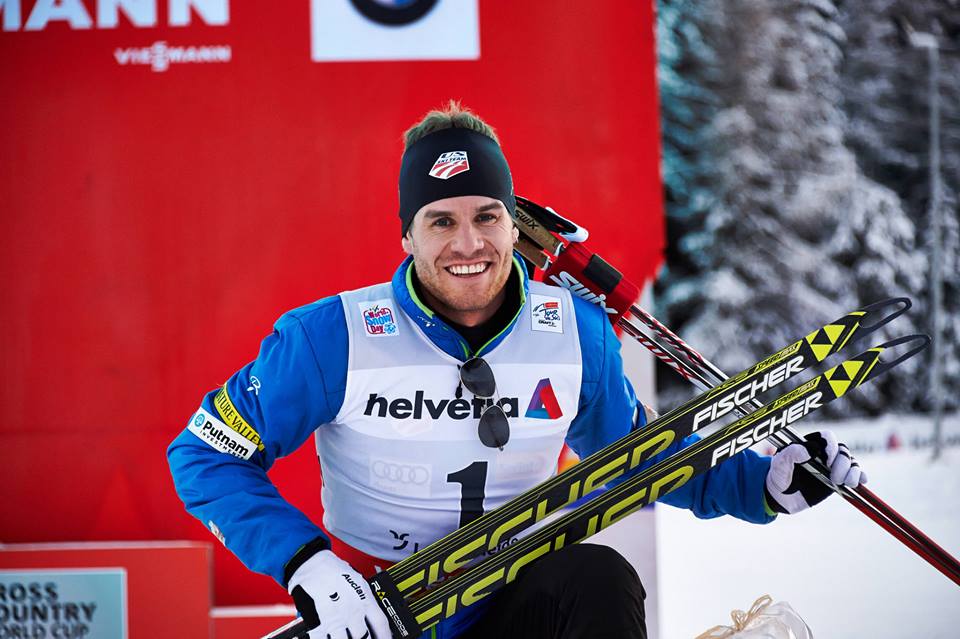
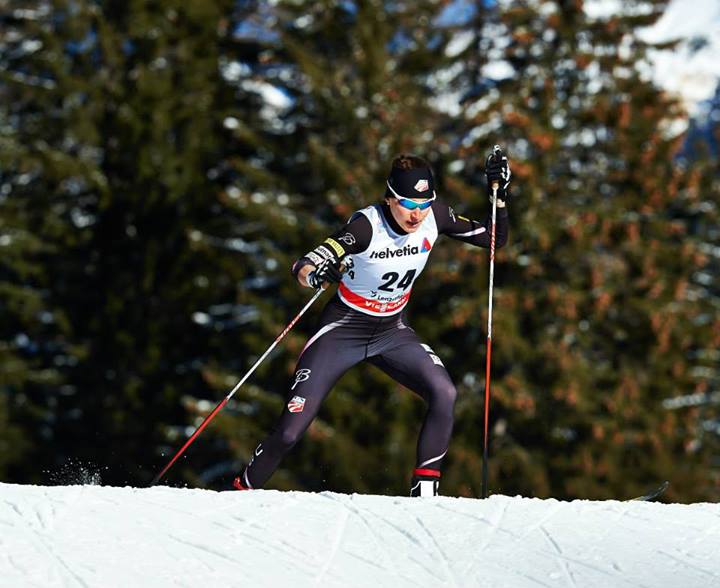
With lickety-split snow and a two-lap course lined with fans, Stage 2 of the Tour de Ski (TdS) in Lenzerheide, Switzerland, a 1.5-kilometer skate sprint, sent a few ripples through the field, but solidified Norway’s Johannes Høsflot Klæbo as the TdS front runner.
Yesterday, Klæbo, in second place, ceded little time to two of his main rivals for the overall, Russians Sergey Ustiugov, who won Saturday’s mass start skate, and Alexander Bolshunov, who placed third.
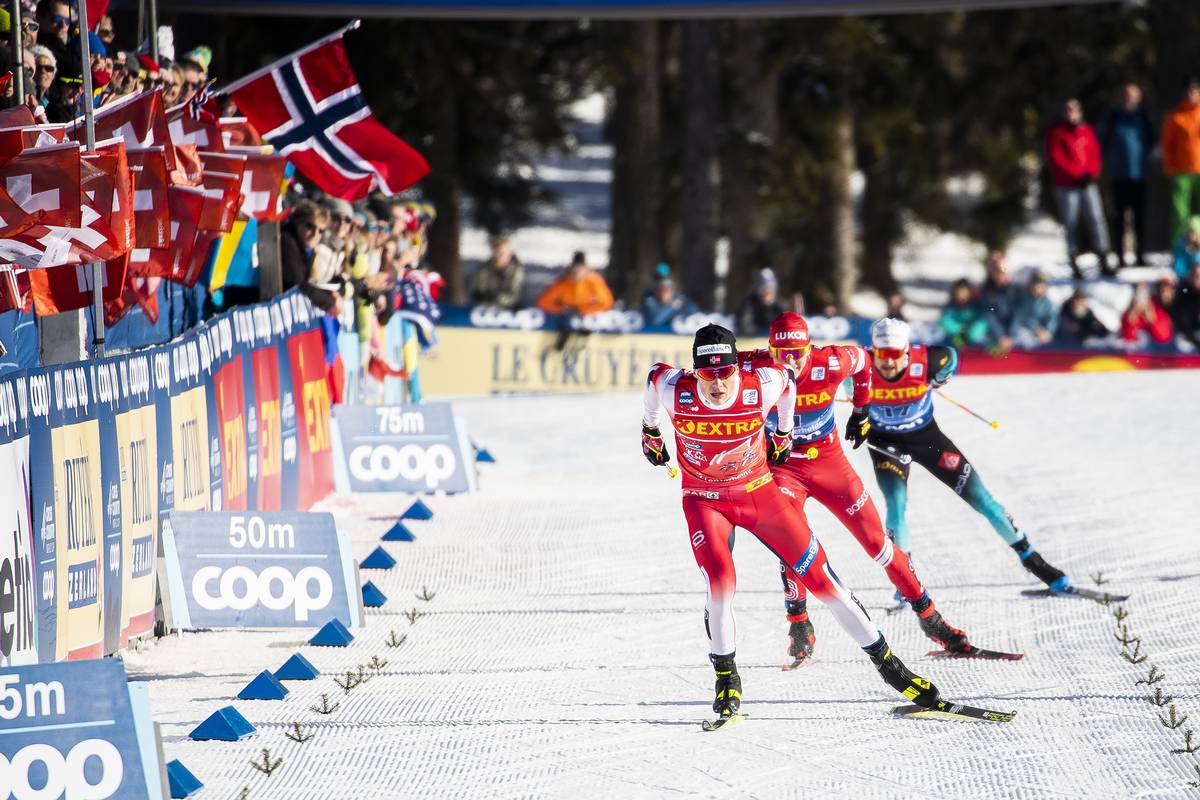
Sprint courses are the real canvas for Klæbo. With half of Sunday’s course splashed in sunshine while the other sunken in deep shadows, Klæbo was able to use his tactical smarts and his explosive finish to conserve energy, pounce when it mattered, and take the win. Which, it so happens, came with a plentiful stash of time in a 60-second time bonus.
Johannes Høsflot Klæbo sprinting to the Stage 2 TdS win. (Photo: NordicFocus)
Klæbo began the day qualifying in first with a time of 2:44.64. Nearly matching his pace was Italy’s prayer for skate sprint salvation, Federico Pellegrino, who punched the clock in 2:45.84.
The duo went 1-2, Klæbo then Pellegrino, in the first quarterfinal which allowed the pair ample time to rest prior to the semis. In the first semi, it again was Klæbo-Pellegrino, 1-2 to advance.
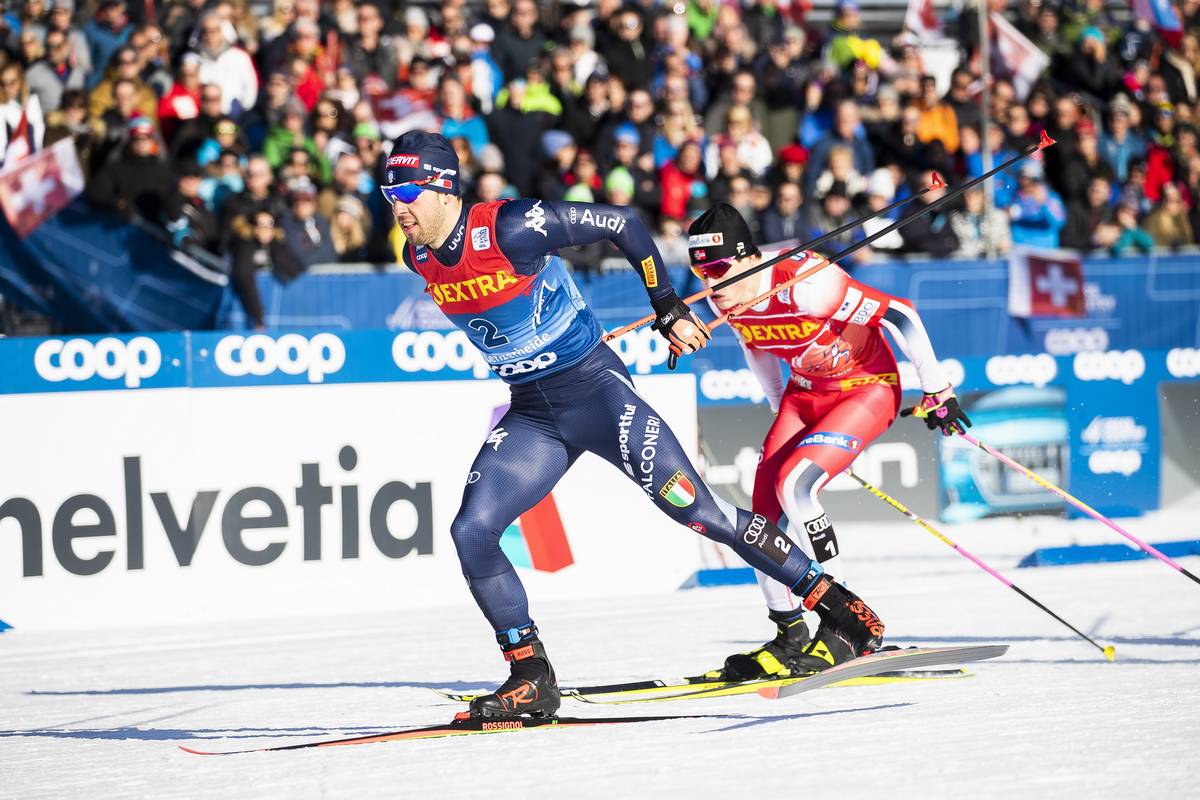
The skate sprint powerhouses: Federico Pellegrino (ITA) and Norway’s Johannes Høsflot Klæbo (NOR) during Stage 2 of the 2019-2020 TdS. (Photo: NordicFocus)
The men’s final featured Klaebo, Pellegrino, Richard Jouve of France, Pål Golberg of Norway, Russia’s Gleb Retivykh, and Johan Haeggstroem of Sweden. Jouve, who qualified in 13th, and advanced after placing second and first respectively in his quarterfinal and semi, went out in the final with a statement as he tried to secure his first career World Cup win.
Jouve went to the front immediately after leaving the start gates. The pace nothing too tepid, more of a control move to keep a potential podium in sight amidst the attacking prowess of Klæbo and Pellegrino.
A minute into the final, Jouve pushed along the shaded back straight to produce a line of six skiers – Klæbo in third, Pellegrino in fourth. With the sweeping left-hand turn which returned skiers to sunshine and the main stadium, the pace took on a this-is-for-real tempo. Jouve maintained his position upfront as they climbed out of the stadium. Klæbo sat back, several feet to the right of Jouve, safely out of traffic.
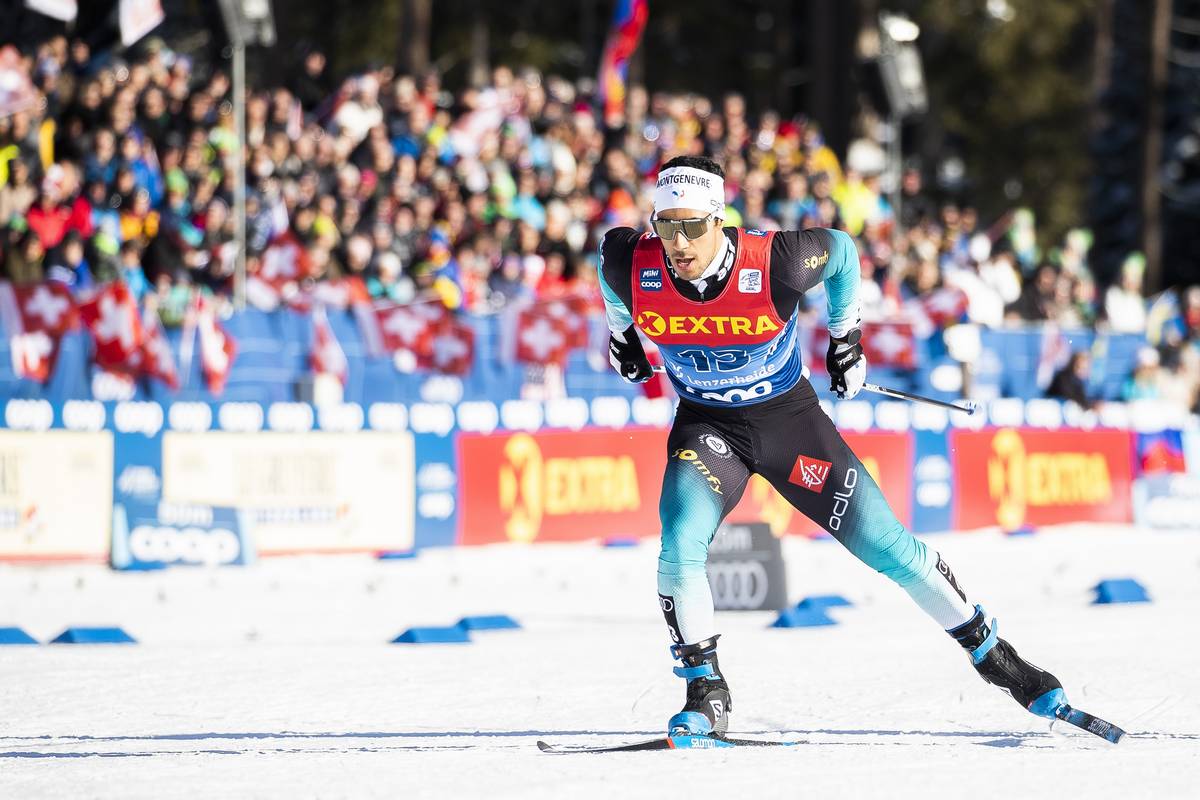
Richard Jouve of France placed third in Stage 2 of the TdS in Lenzerheide, Switzerland. (Photo: NordicFocus)
On the long descending straight on the backside of the course, just before their second time through the sweeping left back into sunshine, Pellegrino lets his skis glide him into a position behind Jouve. Klæbo kept wide and outside as they rounded the corner into the final straight.
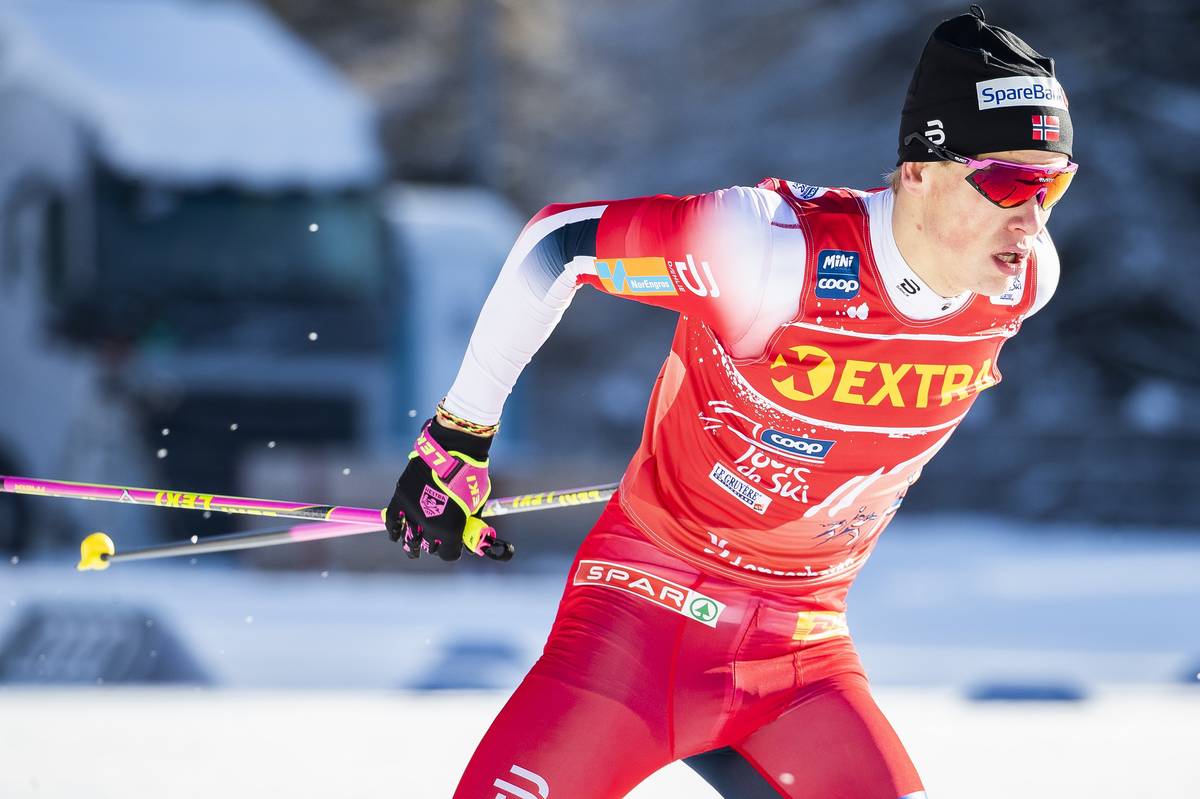
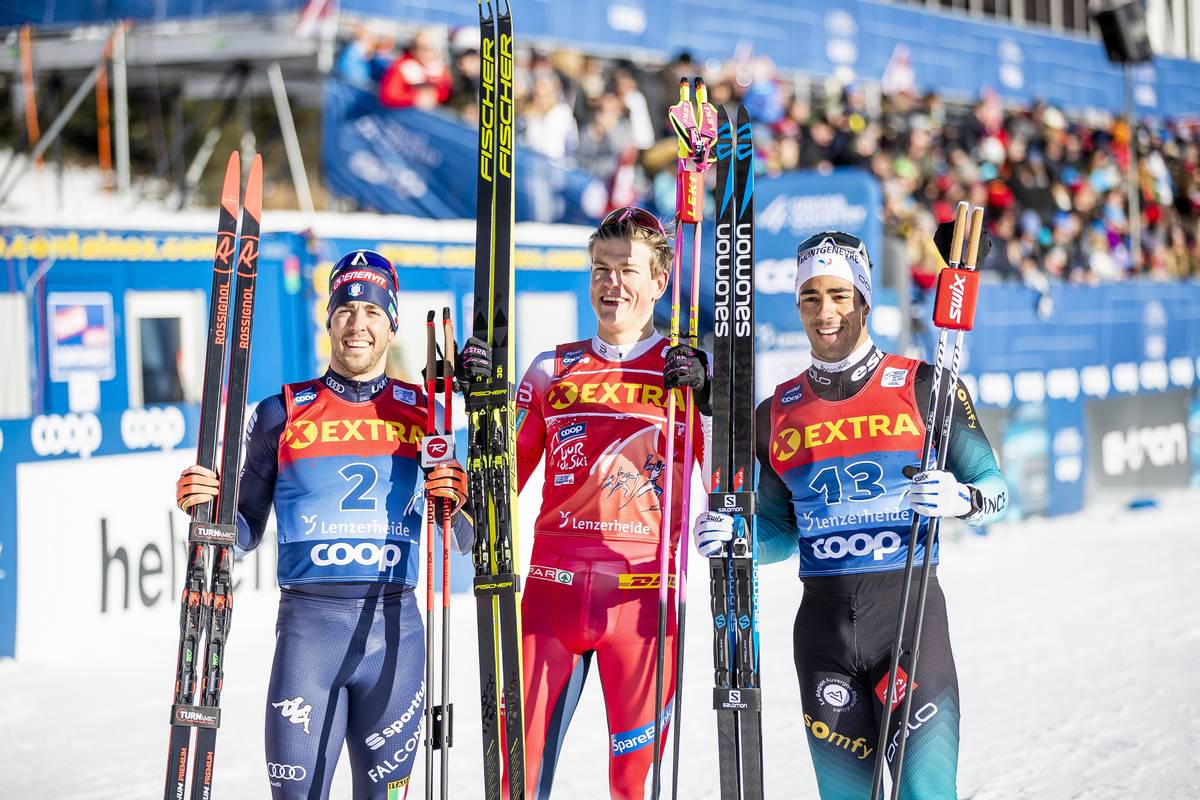
Midway through the turn, Klæbo was textbook sprint wunderkind: he boosted ahead with a quick-turnover but equally powerful V2 to seal it. He won in 2:55.33. Pellegrino, who stuck in Klæbo’s draft down the straight, pulled past Jouve to take second (+0.35). Jouve was third (+0.57).
Hunting the finish line – Norway’s Johannes Høsflot Klæbo during Stage 2 of the 2019-2020 TdS. (Photo: NordicFocus)
With the Stage 2 win, Klæbo earned that aforementioned 60-second time bonus, and the TdS overall lead. His total time after two stages rests at 35:07. He sits 32 seconds ahead of Russia’s Bolshunov, who is second in the overall after placing eighth in the sprint, earning him a 30 second time bonus. Ustiugov, placed 11th in the sprint (24 second time bonus) and is positioned fifth overall at 34 seconds back.
Both Bolshunov and Ustiugov stayed at the front of their semi for the first lap. That semi also featured Klæbo and Pellegrino. Bolshunov faded to fourth as the second lap ensued, while Ustiugov maintained his spot at the sharp end. Down the home stretch, they were swallowed into the Klæbo-Pellegrino maw.
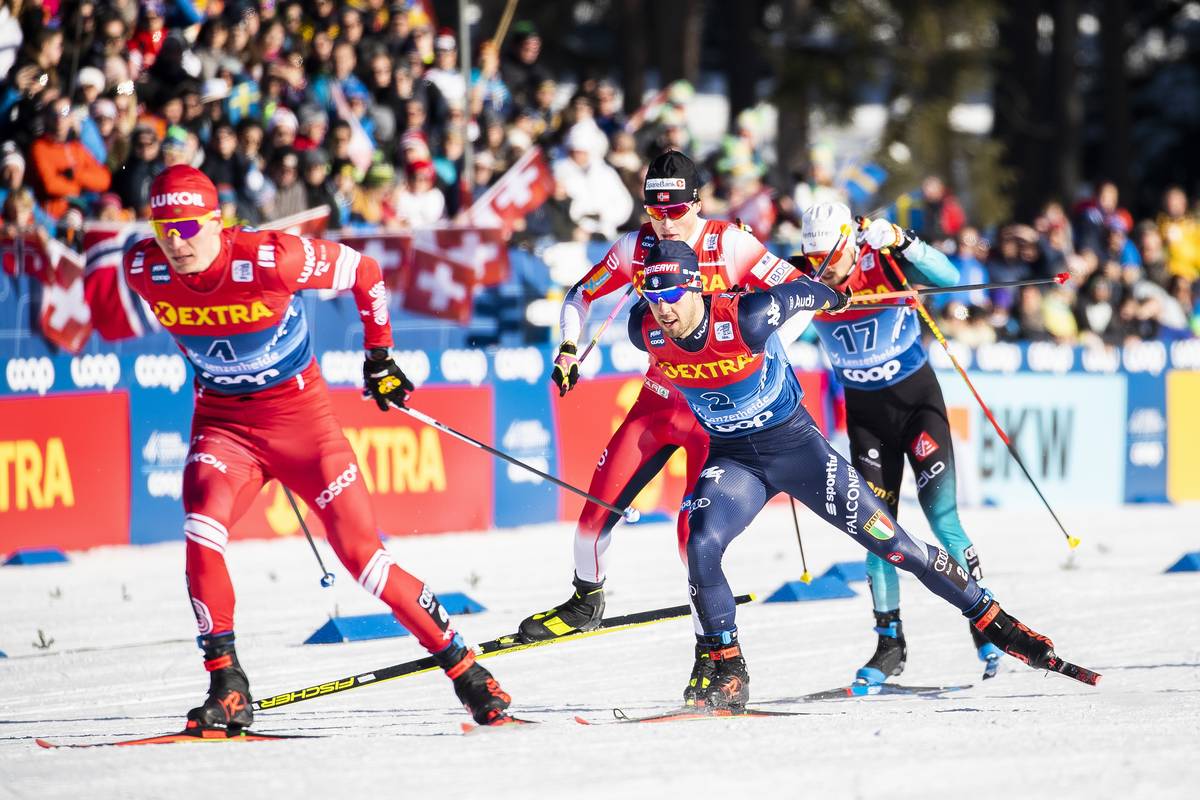
Alexander Bolshunov (RUS) pushing the pace while chased by Federico Pellegrino (ITA), Norway’s Johannes Høsflot Klæbo (NOR), and France’s Renaud Jay during the men’s TdS Stage 2 skate sprint in Lenzerheide, Switzerland. (Photo: NordicFocus)
For the U.S. men, two standout qualifiers marked a successful day. Logan Hanneman qualified in 10th (+4.56) and Kevin Bolger in 12th (+4.72).
Hanneman finished 21st for a career-best World Cup result. He placed fifth in the fourth quarterfinal after getting hung up in a crash as Slovenia’s Miha Simenc and Norway’s Jan Thomas Jenssen tangled a meter ahead.
“I am quite happy with the day, even though it ended with a crash,” Hanneman emailed. “The qualifier was definitely the highlight. I honestly didn’t feel that great, so I was a little bit worried when I hit the hill on the first lap. But then I just tried to ski really big when I lapped through, abs apparently I was going faster than I thought I was.
“In the heat, everything was going well, and I was set up for a good position into the final downhill, however on the corner just after the short steep climb, the Norwegian and Slovenian came in from the outside, and collided with one another. I was directly to the inside of them and a little behind, so I had nowhere to go but to crash into them.
So it goes I suppose, but I was getting excited for the final push into the finish.
“My plan for the next few days is really to race as hard as I can in the distance races. They are not my strong suit, and I would really like to make it to the end of the Tour, so keeping within the time-back requirement would be awesome. So we will just take one at a time and see how they unfold!”
Bolger placed fifth in the third quarterfinal to place 22nd overall in the sprint.
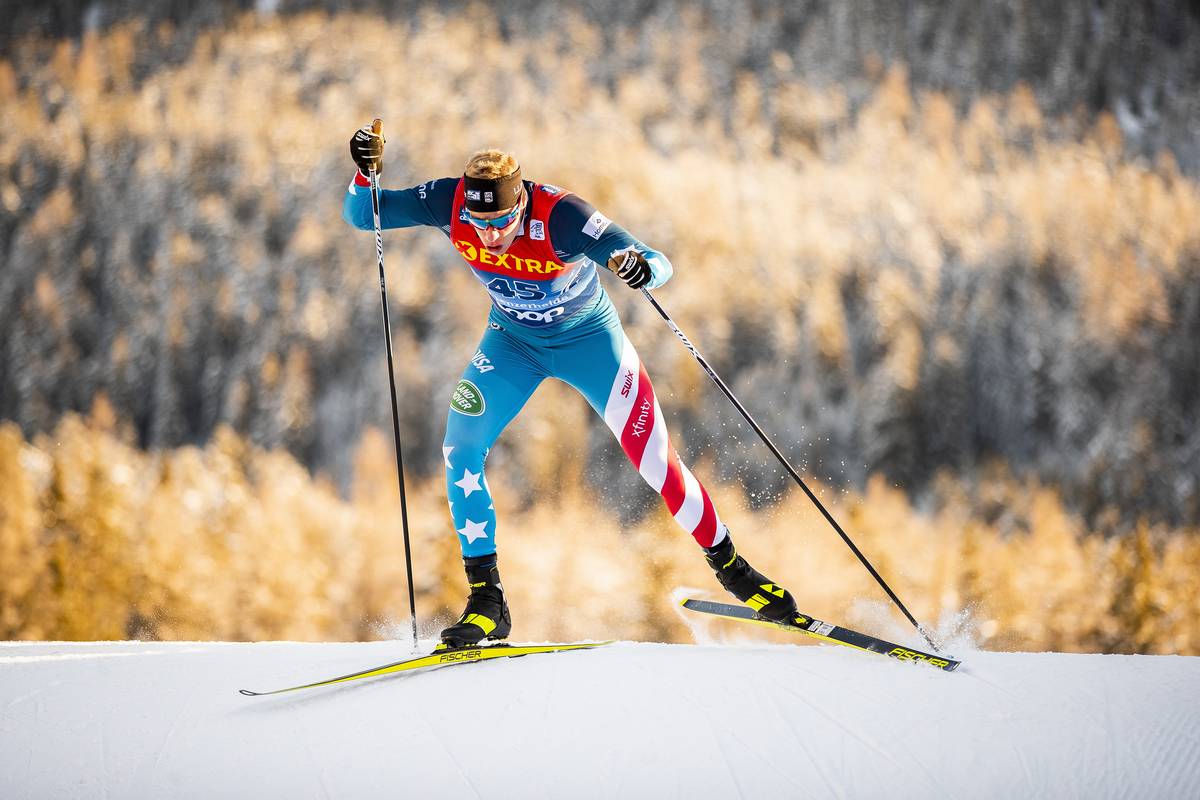
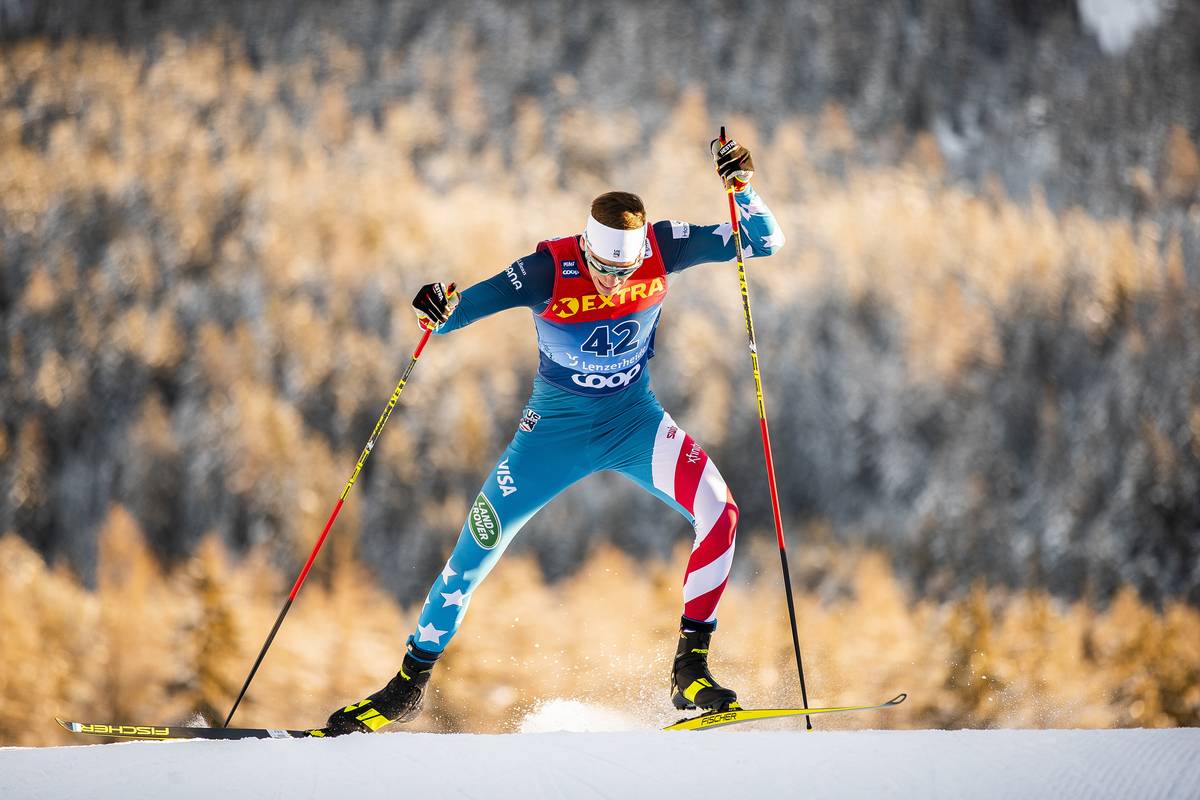
Logan Hanneman placed 21st during the Stage 2 TdS skate sprint for a career best World Cup result. (Photo: NordicFocus)
Kevin Bolger placed 22nd overall in the TdS Stage 2 skate sprint in Lenzerheide, Switzerland. (Photo: Nordic Focus)
Racing continues for the men on Tuesday with an 15 k interval start skate in Tobalch, Italy. Monday is a rest day.
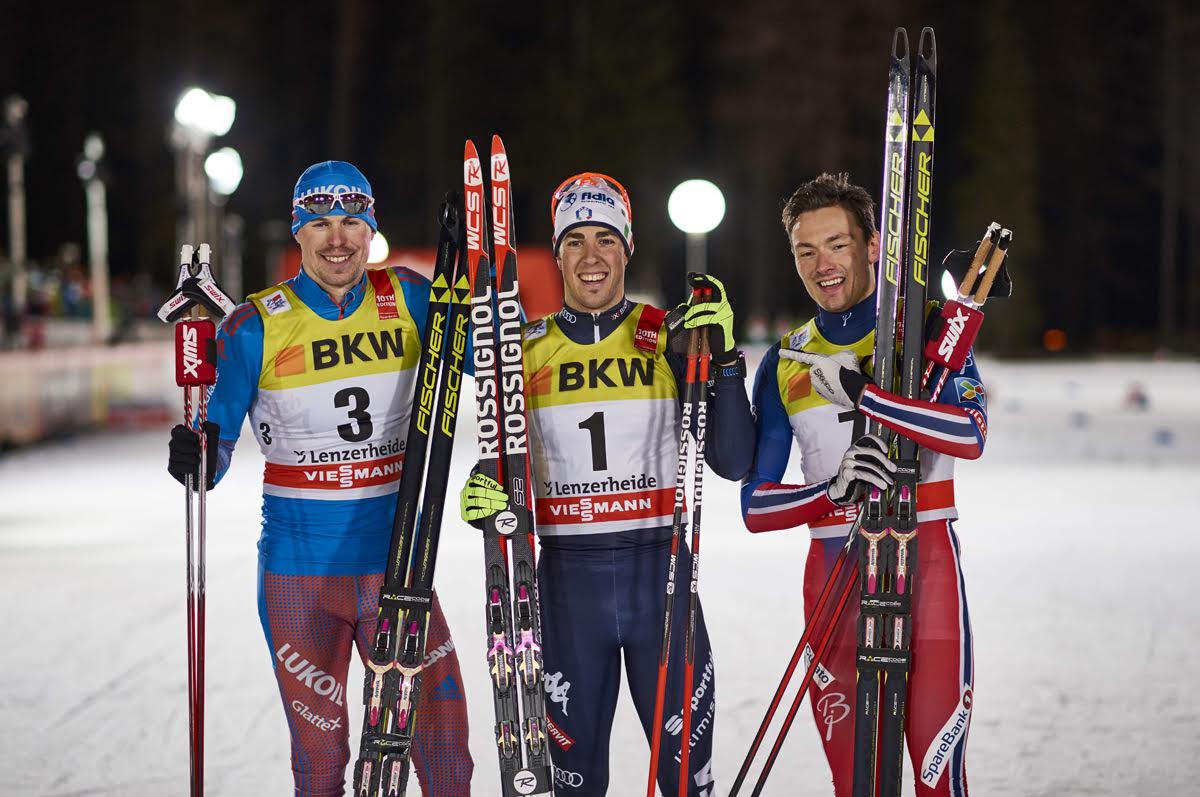
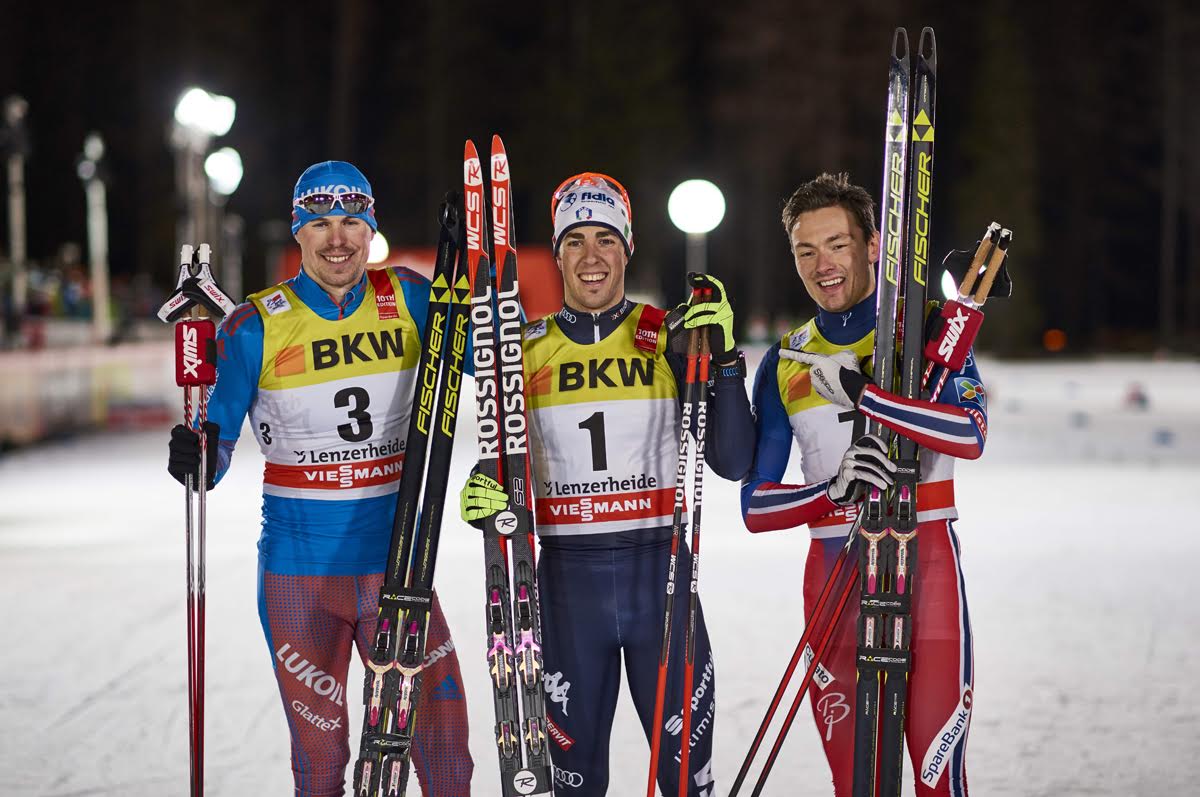
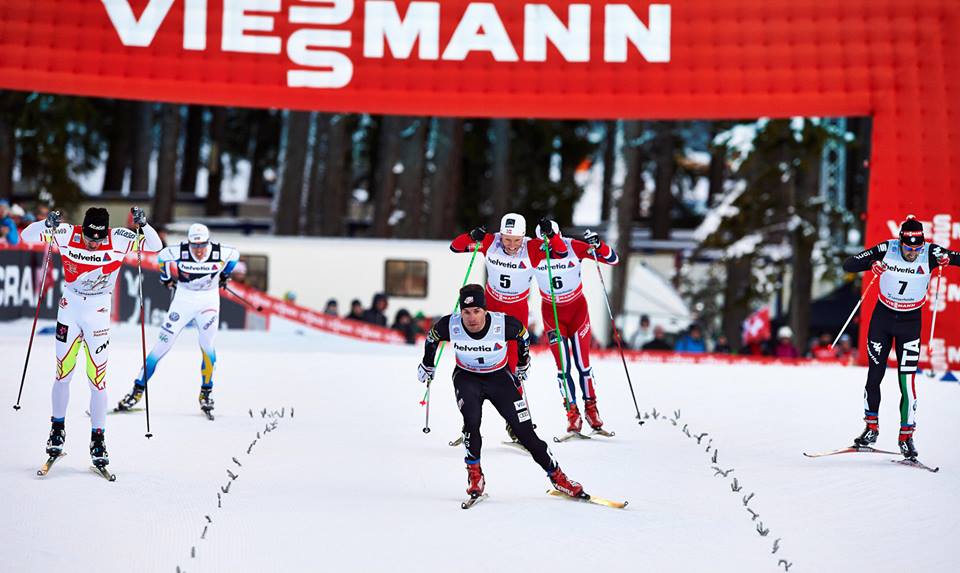
With his third-consecutive World Cup win, Federico Pellegrino (c) became Italy’s most successful sprinter of all time on Friday. He won the 1.5 k freestyle sprint, the first stage of the 2016 Tour de Ski, ahead of Russian runner-up Sergey Ustiugov (l) and Norway’s Finn Hågen Krogh (r) in Lenzerheide, Switzerland. (Photo: Fischer/NordicFocus)
It’s a new year, yet some things remain the same. Jan. 1 marked the opening stage of the 2016 Tour de Ski, a 1.5-kilometer freestyle sprint in Lenzerheide, Switzerland. It also marked the third World Cup sprint victory in a row for Italy’s Federico Pellegrino.
The 25-year-old Pellegrino dominated the day. He qualified first with a time of 2:45.92. Across the official results sheet, a pattern of 1’s next to Pellegrino’s name tells the story; the only aberration on his way to the win, a second place in his semifinal by a margin of 0.11 seconds.
Under a nighttime sky illuminated by what looked like modernist street lamps, Pellegrino won the final in 2:43.14. He out sprinted Russian Sergey Ustiugov who placed second (+0.40). Norway’s Finn Hågen Krogh skied to third (+1.25).
Not considered a sprint specialist, but certainly considered the favorite for this year’s 10th edition of the Tour de Ski, Norwegian Martin Johnsrud Sundby placed fourth (+10.09). In fifth was Sweden’s Emil Jönsson (+12.270, followed by Swiss veteran and three-time Tour de Ski champion, Dario Cologna in sixth (+59.01).
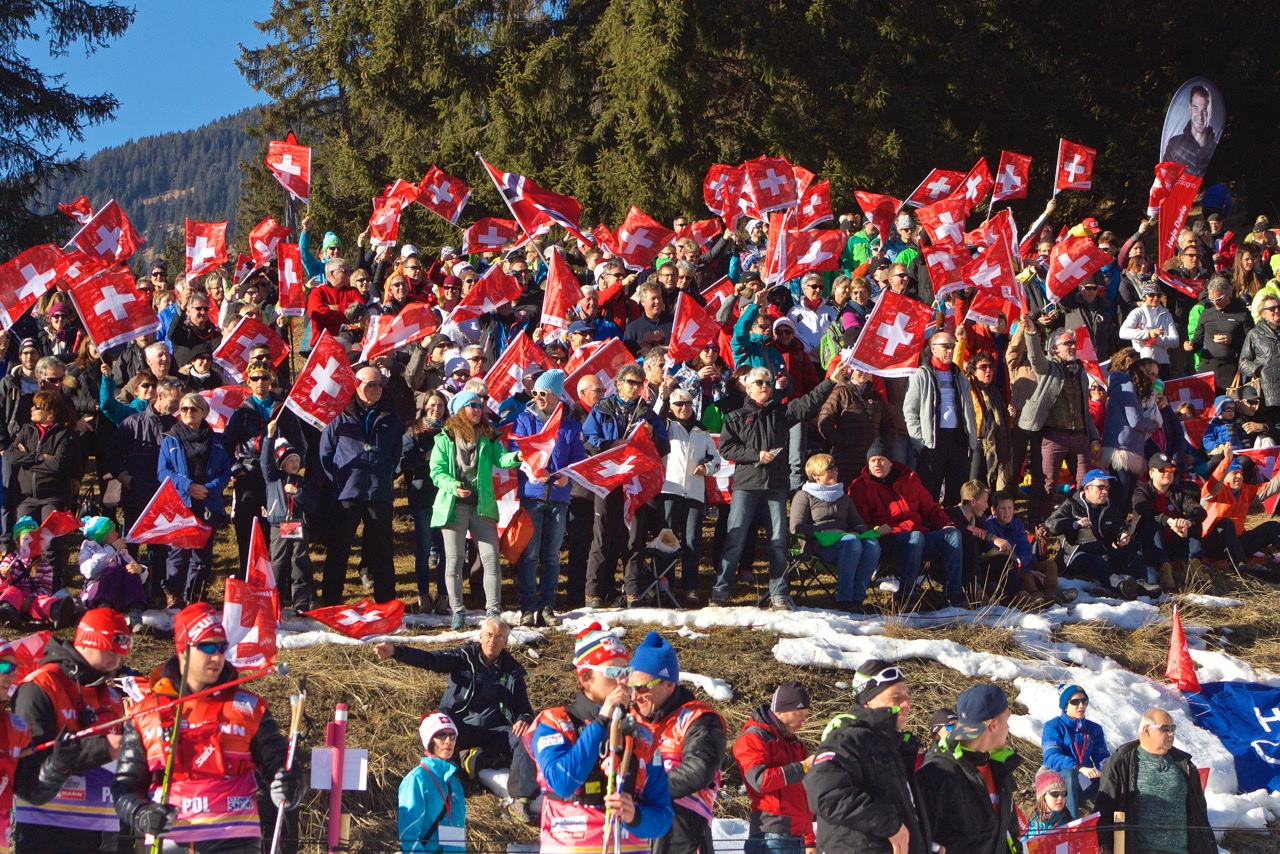
Swiss fans were out in force in Lenzerheide, Switzerland, cheering raucously for their homegrown athletes, especially three-time Tour de Ski champion Dario Cologna, who made the final and placed sixth after falling. (Photo: JoJo Baldus)
Cologna is a good place to start this sprint final’s tale. It was a partisan crowd. And when Cologna’s name was announced as he stepped forward in his lane, the crowd became electric — it was a sea of waving red and white Swiss flags.
From the gun, Ustiugov led out with a scrum of V2ing skiers trailing close behind. After a series of short roll-overs, Cologna slotted into second and eventually dropped into third.
Just over a minute into the race, when it was clear Ustiugov was making a powerful move on the flats, Cologna became tangled with himself, and fell. That left only five skiers, with a clear separation of Ustiugov, Krogh and Pellegrino developing with Sundby dangling off the back.
Then, just over two minutes in, it was a three-person race with Pellegrino taking the lead, accelerating around a turn with what appeared to be the slickest skis in the field. He crossed the line with a cursory foot outstretched, as if the results were in question.
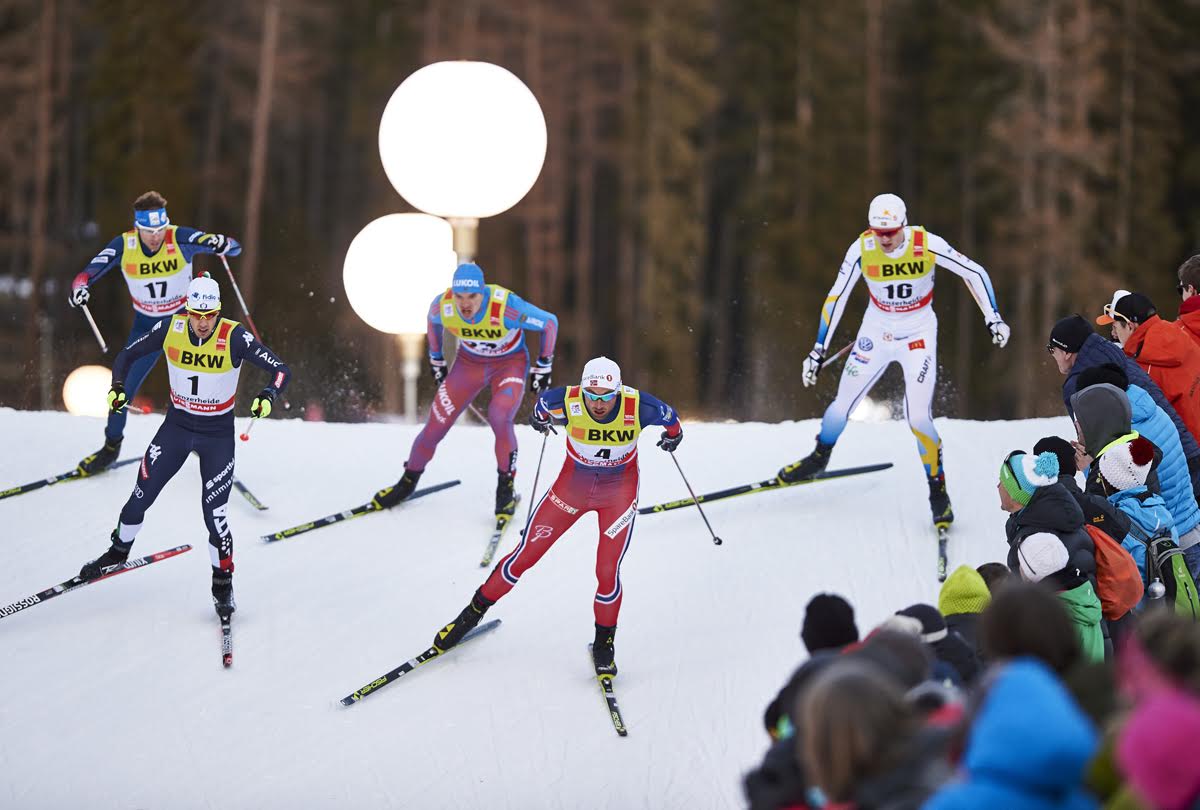
The second men’s quarterfinal, with Italy’s Federico Pellegrino (1) and Norway’s Petter Northug (4) leading, followed by American Andy Newell (17), Russia’s Andrey Larkov (c) and Sweden’s Oskar Svensson (r) at the Tour de Ski freestyle sprint in Lenzerheide, Switzerland. (Photo: Fischer/NordicFocus)
The only blip in Pellegrino’s day — second place in his semifinal — proved a valuable learning opportunity. In the post-race press conference, he admitted his tactics would need to change after his semifinal.
“I learned how to play in the final, so I didn’t make the same mistake,” he said. “I knew that if I arrived in the final 100 meters in the front of the race, I should win. It’s what I made, and so I happy for having do it.”
As a sprint aficionado, and now the winningest Italian World Cup sprinter, with six wins total, (Italian Cristian Zorzi won five World Cup sprints), Pellegrino is still undecided about finishing out the Tour.
“Tomorrow, we have a 30 k. I just have to pay attention to not make a big bonk, and save some energies for [the classic sprint in] Oberstdorf, but I want to be good,” he said. “Maybe in the last five kilometers, I will push as hard as I can, but before, I have to be patient, and quiet and wait. Then we are 10 k in skate, I want to have good sensations in this distance. Then in Oberstdorf, we will have a classic race. We have, I think, two very hard uphills, and in classic, this is my bread. I want to be good there, too.”
Italy’s Federico Pellegrino racing to first in the freestyle sprint qualifier at the first stage of the 2016 Tour de Ski in Lenzerheide, Switzerland. He went on to win the final for his third consecutive World Cup sprint victory.
He’s now shooting for an unprecedented four-consecutive World Cup freestyle sprint victories. With another World Cup win, he’ll become Italy’s winning-most World Cup skier.
“I don’t know if I will finish the Tour de Ski, because then we have [the World Cup weekend in] Planica [Slovenia], and I want to make history and win the fourth sprint skate in a row. I am undecided on my goals,” he said.
Ustiugov avenged his lack of prime results this season with his first podium of the year. Through a translator at the press conference, he showed respect for Pellegrino.
“I tried everything in the final, but Frederico was actually faster than me in the end. Next time, I will try again,” Ustiugov said.
Krogh in third seemed content after the race, nodding to the first- and second-place finishers as simply better on this day.
“The two guys who are one-two today are faster than me, nothing to do about that, so I am very happy with third place,” Krogh said.
As for the Swiss favorite, Cologna, even he surpassed his sprinting expectations — his goal was to make the semis. “Of course I would have liked to get on the podium, but I’m more than satisfied,” Cologna told Swiss TV broadcaster SRF 2. “The semifinal was the goal in order to get a few bonus seconds. Now I could show a good race in the final, prove that I’m in shape. That was a good start to the Tour.”
As a potent threat to Sundby’s overall Tour aspirations, Cologna has set himself up well for Saturday’s 30 k classic mass start, but he has no illusions about overturning the Distance World Cup hierarchy, which Sundby reigns.
“I think it will be a very hard race. The loop has a lot of vertical meters, eight times,” Cologna said. “Sundby will create a lot of pressure early on, and I don’t think it will end with a mass sprint. So you have to save strength whenever possible on the loop, always run a smart race, and hopefully stay in contact with the top until the final.”
The overall Tour standings reveal a tight grouping after the first stage — Pellegrino in first, Ustiugov in second (+6.6), and Krogh in third (+11.6).
But heading into the first distance race, some notable names fared well after a day of freestyle sprints. Sundby is placed fourth, 15.3 seconds out of first, followed by Jönsson, (+20.5), while just over a second back lurks Cologna, with Norway’s Petter Northug Jr., in seventh, 23.1 seconds out. (Note: Saturday’s race is a mass start, but overall time back is cumulative throughout the Tour.)
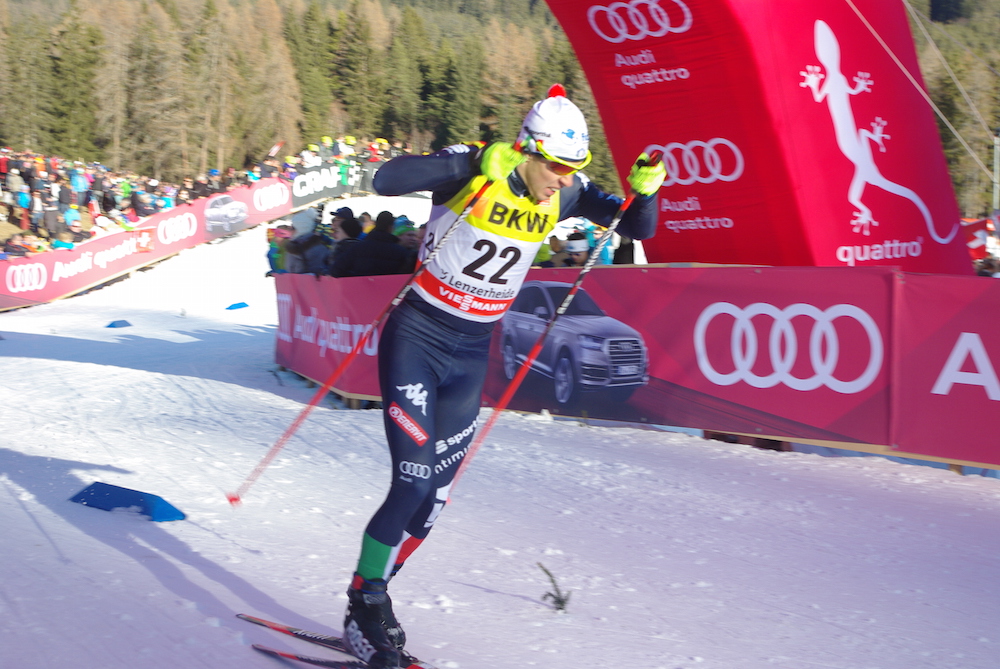
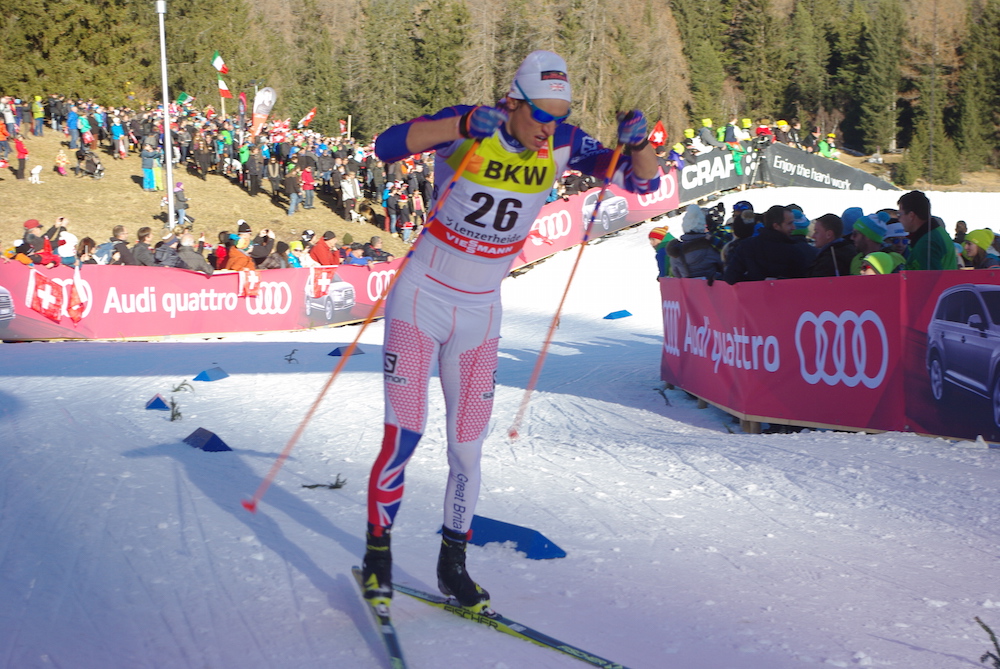
Andrew Young of Great Britain qualified second in the first stage of the 2016 Tour de Ski on Friday in Lenzerheide, Switzerland. He went on to place 30th overall after colliding with an inflatable archway in his quarterfinal.
For the British, a potential storyline piggy backing on Andrew Young’s third-place sprint podium in Toblach, was derailed in the fifth quarterfinal. Young began race day with a qualifier to be proud of: he qualified second overall, two seconds behind the day’s winner, Pellegrino.
Skiing close to the front, and with no sign of fatigue, approximately 38 seconds into the fifth quarterfinal and moments after skiing under an inflated Audi archway, Young fell to ground — he had been skiing inches from the barrier when he tumbled.
After the race, Young and his coach/father, Roy Young, reviewed the heat’s video with the race jury. Afterwards, the jury ruled in Young’s favor that a course obstacle did impede the skier.
In an email, Roy Young said the TV review showed “a rope dangling from Audi arch caught his arm. This spun him under the advert at side of track where he got stuck. Effectively out of the race bye time he was freed & with bruised arm he decided to stop & tell officials what had happened. For stopping I think they have ranked him 30th rather than last in his quarter. (About to check the rules, but it all seems unfair. ) But we go on and get ready for tomorrow – better go and win then. :)”
The Tour de Ski continues Saturday with 15/30 k classic mass starts.
Simi Hamilton (c) races toward the finish of the 1.5 k freestyle sprint final at the Tour de Ski Stage 3 in Lenzerheide, Switzerland. Hamilton held off Canada’s Alex Harvey (l) and Norway’s Martin Sundby (5) as well as Italy’s Federico Pellegrino (r) for the win. (Photo: Fischer/Nordic Focus)
Gus Kaeding literally had one foot out the door and his vehicle running Tuesday morning, but he couldn’t draw himself away from what was unfolding some 3,700 miles away in Lenzerheide, Switzerland.
The Stratton Mountain School (SMS) T2 Team head coach almost missed his flight from Vermont to Utah because of the success four of his athletes — all on the U.S. Ski Team — were having in Stage 3 of the Tour de Ski. He didn’t, but said on the phone from his connection in Detroit that it would’ve been fine if he did.
Sophie Caldwell (U.S. Ski Team) winning her 1.5 k freestyle sprint semifinal on Tuesday at Stage 3 of the Tour de Ski in Lenzerheide, Switzerland. (Photo: Fischer/Nordic Focus)
To start the 1.5-kilometer freestyle sprints, Sophie Caldwell and Jessie Diggins qualified in ninth and 16th, respectively, 5.24 seconds and 6.93 seconds behind Norwegian qualifier winner Ingvlid Flugstad Østberg.
Their male counterparts from SMST2 in southern Vermont, Simi Hamilton and Andy Newell did the unthinkable and qualified first and second, with Hamilton putting down the fastest 1.5 k time of 2:35.01 and Newell ranking second, 0.31 seconds back.
Hamilton went on to win his quarterfinal then advance in third out of the semifinals to make his first final in his three years on the U.S. Ski Team (USST). Newell placed second in his quarterfinal and fourth in his semifinal to end up eighth overall, a season best for the USST veteran.
Diggins placed fifth in her quarterfinal, 1.74 seconds behind Germany’s Denise Herrmann, who won the heat in 2:58.47 and went on to place third overall. Diggins ultimately took 21st to put her 15th in the overall Tour standings.
“My body felt OK, and then as soon as I started trying to go hard, I couldn’t find that extra gear,” Diggins said on the phone. “In my quarters, I kind of let myself get screwed over in the first 100 meters, tried to get behind Denise Herrmann, but I started to get squeezed out.”
Stuck behind a skier who tripped, Diggins said she spent the rest of the two-lap race fighting her way back toward the lead pack.
“I didn’t have the energy to go really wide and pass and I just couldn’t find an open window,” she said. “The heat was not spectacular for sure and I wish I could have done the opening bit again and just tried to get a better start, but the Tour is a long thing and I just have to focus on recovery get ready for tomorrow and the day after that and the day after that.”
Caldwell placed second in her quarterfinal then relied on fast skis and finishing kick to carry her to her first win, which she took 0.25 seconds ahead of Herrmann in 3:01.93.
“I felt awesome in my semifinal, I don’t know what got into me there!” Caldwell wrote in an email. “I had talked a bunch of strategy with the coaches, especially about positioning with that final corner. I thought that I might be able to pick up a place or two by pushing not only over the top of the hill, but a little ways down the hill. I believe I was in 2nd over the top, and I pushed hard and my plan worked! I came into the corner first, so I was able to guard the inside and pick my lane into the finish.”
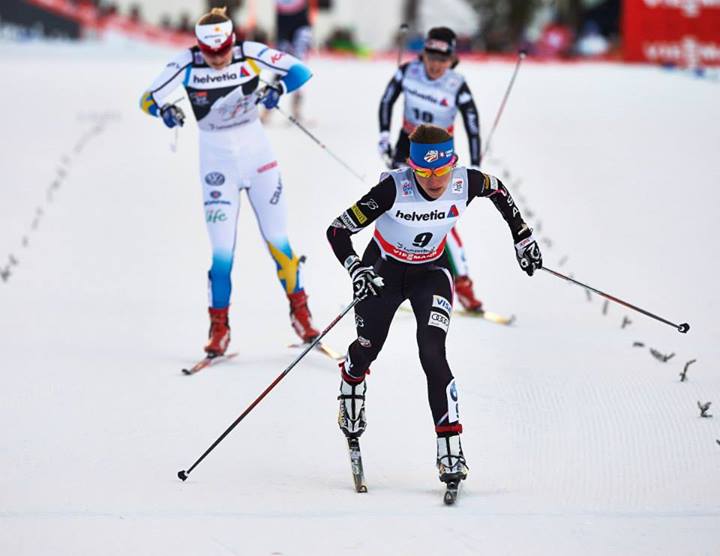
In her first year on the USST, Caldwell, 23, also advanced to her first final, where she finished sixth for a career best, 6.81 seconds behind Østberg, who won it in 2:58.00.
“I simply just got tired,” Caldwell wrote. “I actually had one pretty decent move that put me into a good position coming around the lap, but then it was downhill (figuratively) and uphill (literally) after that.”
The finish put her sixth overall in the Tour standings, which will put her up front for the start of Wednesday’s 10 k classic mass start. She’ll leave the Tour after that, resting up and spending some time with family in Europe before gearing back up for the World Cup that resumes in Jan. 11 and 12 in Nove Mesto, Czech Republic.
Simi Hamilton (U.S. Ski Team) after becoming the first American man to win a Tour de Ski stage at the third of seven races in the 2013/2014 Tour. Hamilton won the 1.5 k skate sprint in Lenzerheide, Switzerland. (Photo: Fischer/Nordic Focus)
As if watching all this unfold wasn’t enough, Kaeding remained glued to his live stream as Hamilton hung in the mix for the early part of the men’s final. Up the long climb, he rose from fourth to third, then third to first as he slingshot around the last corner.
“I literally had my bags all packed … and I was just standing there,” Kaeding recalled. “As soon as I saw Simi, I was like, ‘Come on Simi, come on Simi.’ ”
Hamilton flew past Italy’s Federico Pellegrino and held off Canadian Alex Harvey and Norway’s Martin Johnsrud Sundby, who also caught the downhill draft, for the victory in 2:37.02, three-tenths of a second faster than Harvey in second and 0.74 seconds ahead of Sundby in third.
For Hamilton, it bested his previous top result of seventh in a sprint, and although not technically a World Cup (Tour stages are worth half the World Cup points), Hamilton became the first man to win a Tour de Ski stage.
“I definitely had a smile on my face all day,” Kaeding said. “I’ve literally been traveling every moment since, but I sent everyone quick emails.”
For Stratton, having four skiers in the heats, three of them make the semifinals and two continue to the final, was huge for the Vermont ski academy. Caldwell’s father, Sverre, overseas the nordic program there, and two years ago he started Stratton’s first elite team with the title sponsorship of the T2 Foundation, a non-profit that financially supports American skiers.
On Tuesday, Eurosport commentators talked about Stratton, but as Kaeding pointed out, ironically failed to mention Newell as a part of the group — and he’s been a local staple for the last two decades.
“I thought it was pretty cool … We always joke about those announcers not even knowing the names of the Americans in the friggen heats,” Kaeding said. “But it’s good to get the school and a little [publicity] … It’s good to know all those athletes are from the same club, but they’re really part of Team USA and that’s the important thing.”
Sophie Caldwell (U.S. Ski Team) on her way to qualifying in ninth in Tuesday’s 1.5 k freestyle sprint at Stage 3 of the Tour de Ski in Lenzerheide, Switzerland. (Photo: Fischer/Nordic Focus)
Regardless of where they come from (Hamilton from Colorado, Diggins from Minnesota and both Caldwell and Newell from Vermont), the mental and physical training is what got them where they ended up Tuesday and in various other races this season.
Kaeding said they don’t do anything special at Stratton, but it’s the mental capacity and natural talent of athletes like Hamilton that he was happy to see pay off. Two days earlier at Stage 2 in Oberhof, Germany, Hamilton as a late starter saw his qualifying time squashed by a snow squall and he missed the heats in 35th.
“Simi’s been on the verge of doing really well here for a couple days and has been really close to pushing something over the top,” Kaeding said. “To his credit, he kept pushing on. … We work on things like that.”
In terms of strategy, Kaeding said Newell and Hamilton are especially good tacticians out on course, and with teammates Skyler Davis and Eric Packer (also sprinters), they learn from one another each day in training throughout the summer.
“Andy, really a veteran, has been in the heats forever; Simi’s just a really a beautiful skier, can ski between cracks that nobody can get through … and those guys all really compliment each other really well,” Kaeding said. “When they train together every day, it’s basically like a World Cup sprint heat. I think it sets them up really well.”
In the last four (of five) sprints she’s raced this season, Caldwell has consecutively made the rounds in each. On Sunday, she qualified in a career-best fifth to finish 22nd and two weeks earlier in Davos, Switzerland, qualified in ninth and went on to place ninth in the freestyle sprint.
Kaeding said he chats with her remotely after races, and in the last two sprints, they discussed her strong finishing speed, but need to to get out front sooner and “see what happens, dictate the pace even if she lacks a little pop at the end,” Kaeding said. “So she tried that two days ago in Oberhof. She said it went pretty well, but maybe that would’ve been a better day to follow.”
Caldwell told him she’d check out Lenzerheide’s sprint course and base her strategy off that. With a boilerplate track, both agreed that sitting in and conserving might be best.
“She kind of hit it perfect and exploded into winning the heat, much like Simi did,” Kaeding said.
“She skied great all day, skied technically well [and] made smart moves out there,” USST Head Coach Chris Grover said on the phone. “She just ran out of gas in the final, and that’s just because she’s a little bit younger and still developing, but she’s going to be a big name for the future.”
Heading into the fourth of seven stages, the U.S. has two skiers in sixth (Caldwell and Newell) overall in the Tour, Hamilton ranks 11th and Diggins 15th, and Hamilton and Newell are currently seventh and eighth in the sprint standings, respectively, Caldwell 10th and Diggins 24th.
“The start of the Tour really favors sprinters … so their Tour standing is reflecting that,” Grover said. “But they’re able to get in there and stay healthy and execute.”
Caldwell, Newell, Hamilton and Holly Brooks (37th on Tuesday) plan to end their Tour after Lenzerheide, but Diggins, Liz Stephen (44th, 37th overall), and Noah Hoffmann (83rd, 89th overall) plan to complete all seven stages with the final races Friday through Sunday in Italy.
“I am so excited for Simi! He was incredible today,” Hoffman wrote in an email. “The course and conditions were perfect today. Racing in the Swiss Alps on a bluebird day is pretty fun, even if it is a sprint race. I felt good. I didn’t have many expectations for results today. I’m certainly looking forward to distance racing.
“[Wednesday] will be challenging starting in the back,” he added. “I’m going to be patient. It’s a good course for me, and I’m looking forward to moving up. … The energy on the team is very high. I’m sorry we’re splitting up tomorrow. It’ll be a very small group for the final three days of the Tour.”
— Lander Karath, Seth Adams and Pasha Kahn contributed reporting