
|

|
|
From the FasterSkier archive — posts syndicated from athletes’ and coaches’ own blogs between 2004 and 2012, kept online as published. Current coverage is at fasterskier.com.
|
|
|

Welcome back to the Devon Kershaw Show. This week we have an under-the-weather Rachel Perkins, filling in for Nat Herz, to breakdown the first two stages of the Tour de Ski in Lenzerheide, Switzerland. From winter storm conditions for the 10/15k classic that contrasted a clear and fast opening freestyle sprint, there was plenty to note in these first two stages. We discuss translating top results in qualification into advancing into the semifinals and finals, Diggins and Kern’s power that earned the Americans 1st and 4th in the sprint, and Finnish mastery of rub skis leading to Niskanen sibling dominance in Stage 2.
Have a question you want answered? Send them to Devon at devon@fasterskier.com and to Nat at nat@fasterskier.com.
We’ll be back in a few days after the next two stages of the Tour de Ski, a 10/15k mass start skate and classic sprint, in Oberstdorf, Germany. Thanks for listening.

 This World Cup coverage is made possible through the generous support of Marty and Kathy Hall and the A Hall Mark of Excellence Award. To learn more about A Hall Mark of Excellence Award or to learn how you can support FasterSkier’s coverage please contact info@fasterskier.com.
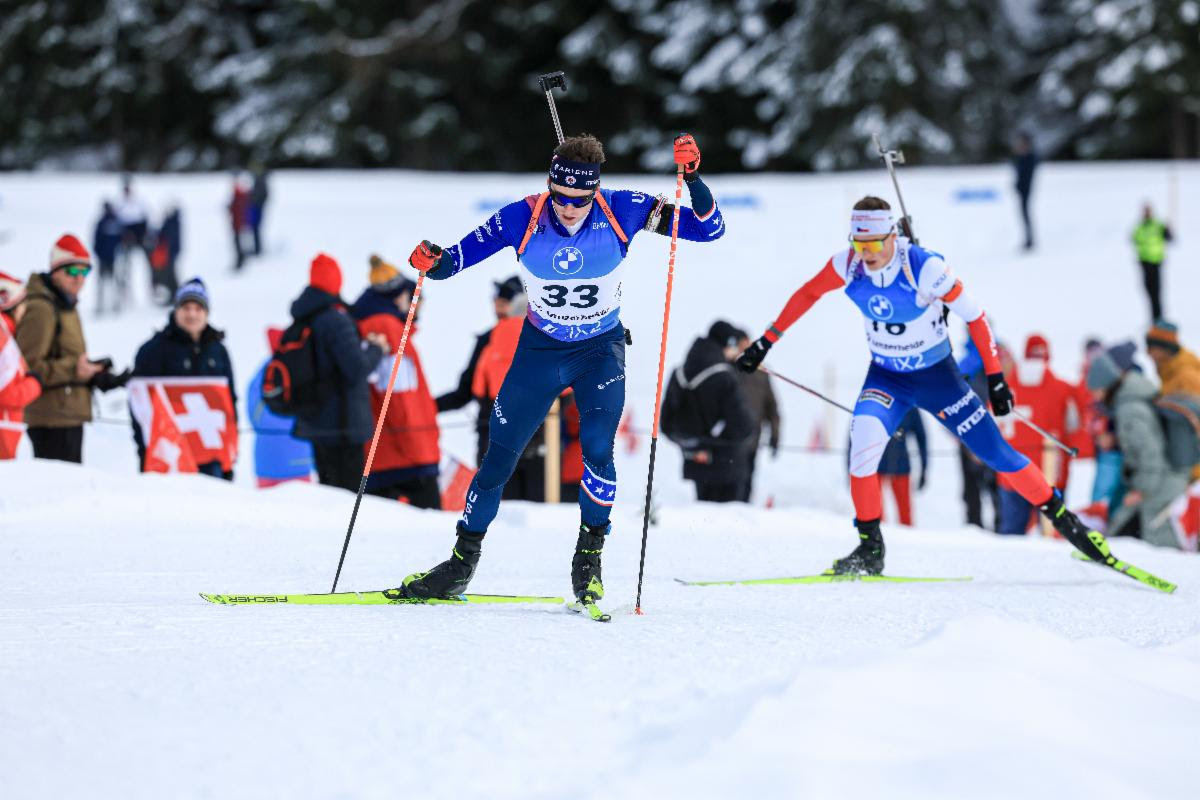
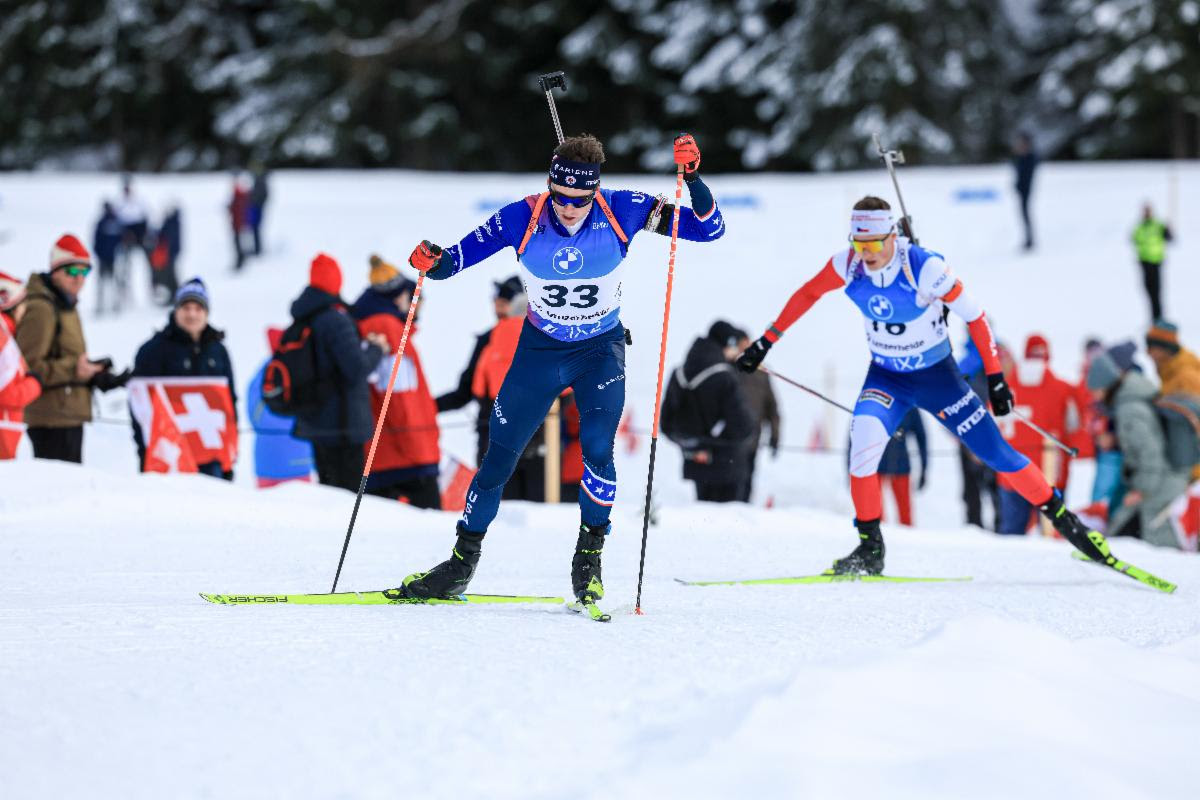
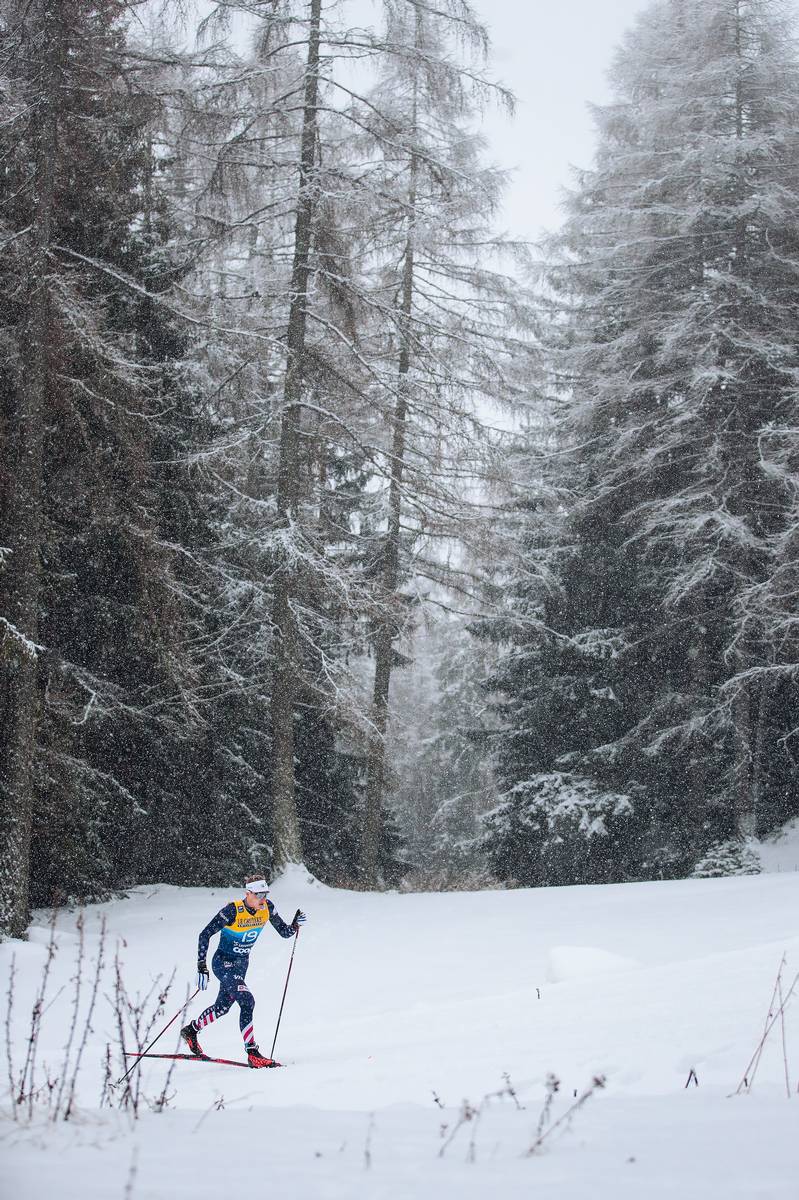
Lenzerheide, Switzerland was tucked into a snow globe today, as snow fell steadily in fat flakes throughout the races. The wax technicians had their work cut out for them as they prepared skis for the second stage of the 2021/22 Tour de Ski, a 15-kilometer interval start classic.
With the seeded group of podium favorites starting in bibs 30-50, there was time for athletes to learn how the course was skiing. Among these favorites, Johannes Høsflot Klæbo (bib 42) was looking to maintain good standing in the Tour, building on his top finish in yesterday’s freestyle sprint. In the 2019-2020 Tour de Ski, his last appearance after sitting out last year’s Tour for COVID-19 concerns, Klæbo finished in 10th in the 15k classic stage.
Winner of the last two iterations of the Tour de Ski and back-to-back World Cup overall champion, Russian Alexander Bolshunov has had an unprecedented start to the season, with results well below what were anticipated, possibly due to health challenges he’s faced this year. Bolshunov was knocked out in the quarterfinal of yesterday’s sprint, finishing 17th, and has not been on the podium in an individual event since the opening World Cup weekend in Ruka.
The Americans were looking to build upon solid results yesterday, where they put three men in the Top-30 overall. Kevin Bolger was the top finisher in the sprint, placing 16th overall, after qualifying 9th. Ben Ogden finished in 21st overall, after qualifying 5th, and Logan Hanneman ended his day in 25th overall.
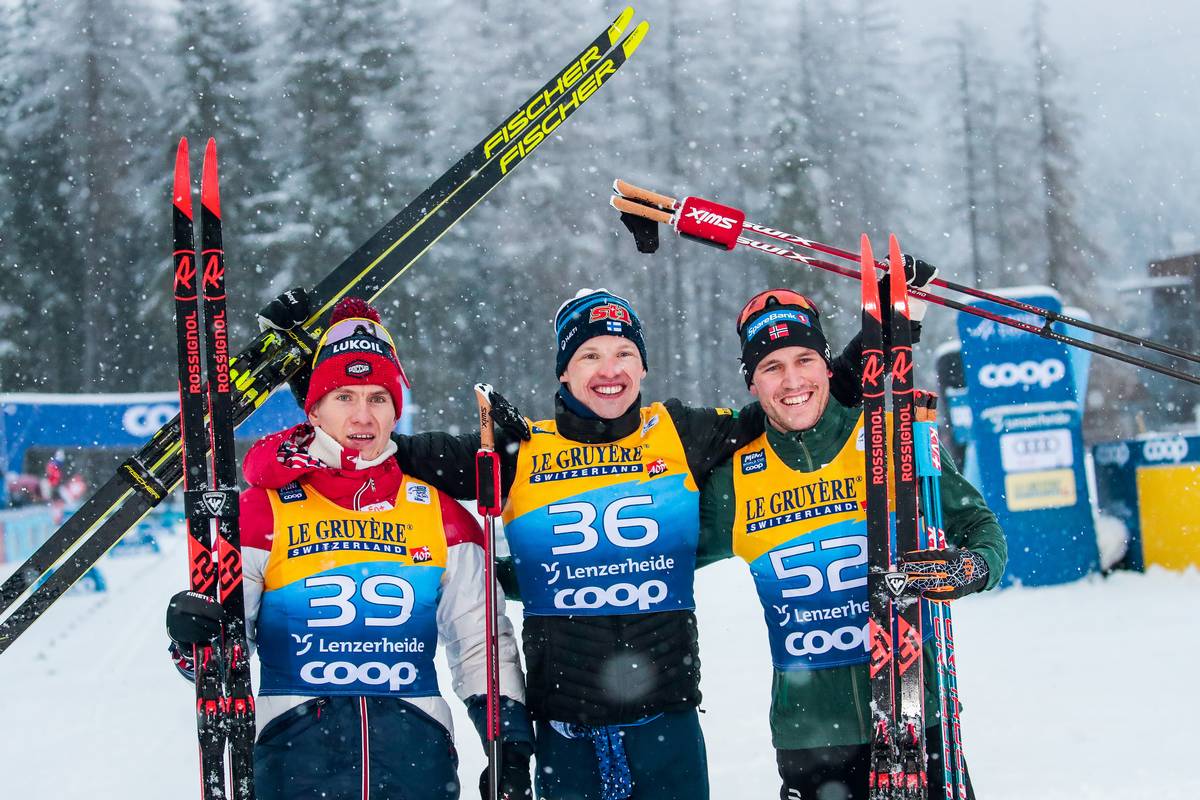
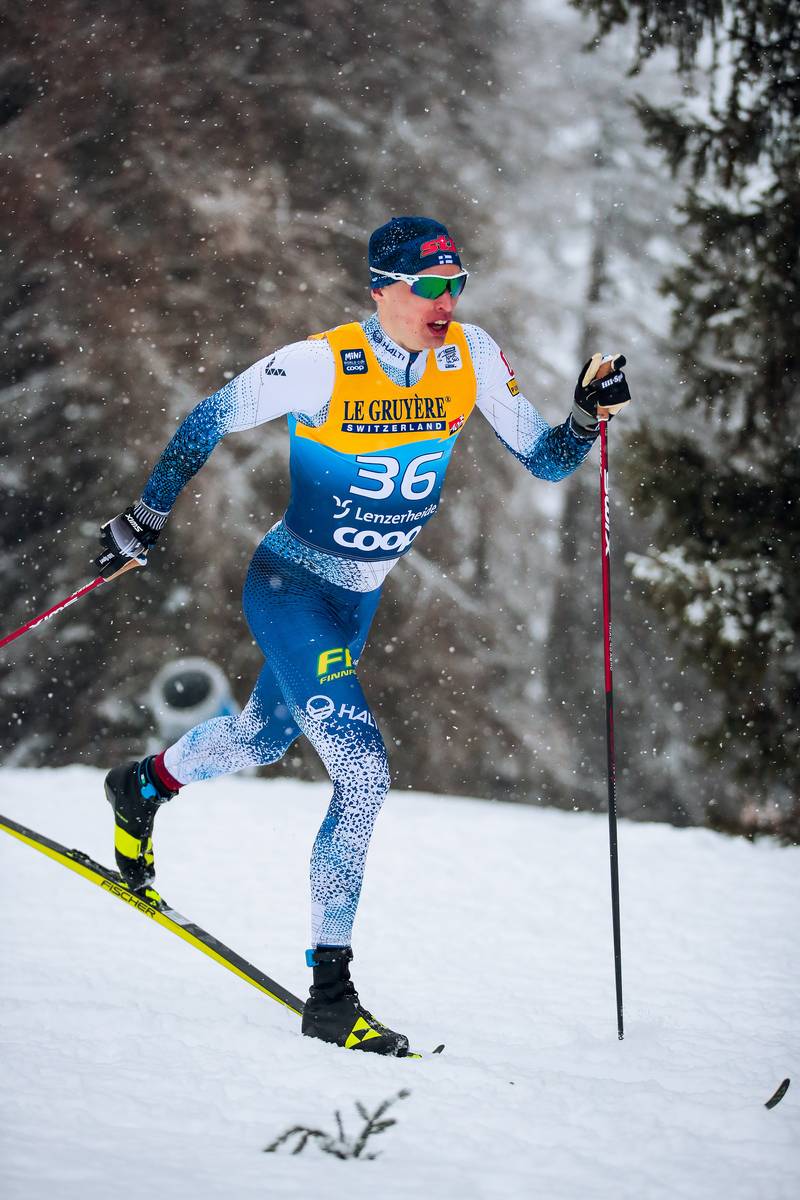
As the seeded group time trialed through the snow, it was Iivo Niskanen in bib 36 who set the bar at the 5.8k mark, leading a group of Norwegians and Russians. Bolshunov (+11.1) came through in 2nd (+11.1) with five Norwegians in tow, namely, Erik Valnes (+16.7), Pål Golberg(+18.6), Simen Hegstad Krüger (+20.9), Klæbo (+22.1), and Martin Løwstrøm Nyenget (+22.8).
Gus Schumacher was the top American in 37th (+59.2) at the 5k, with Ogden not far behind in 41st (+1:03.9).
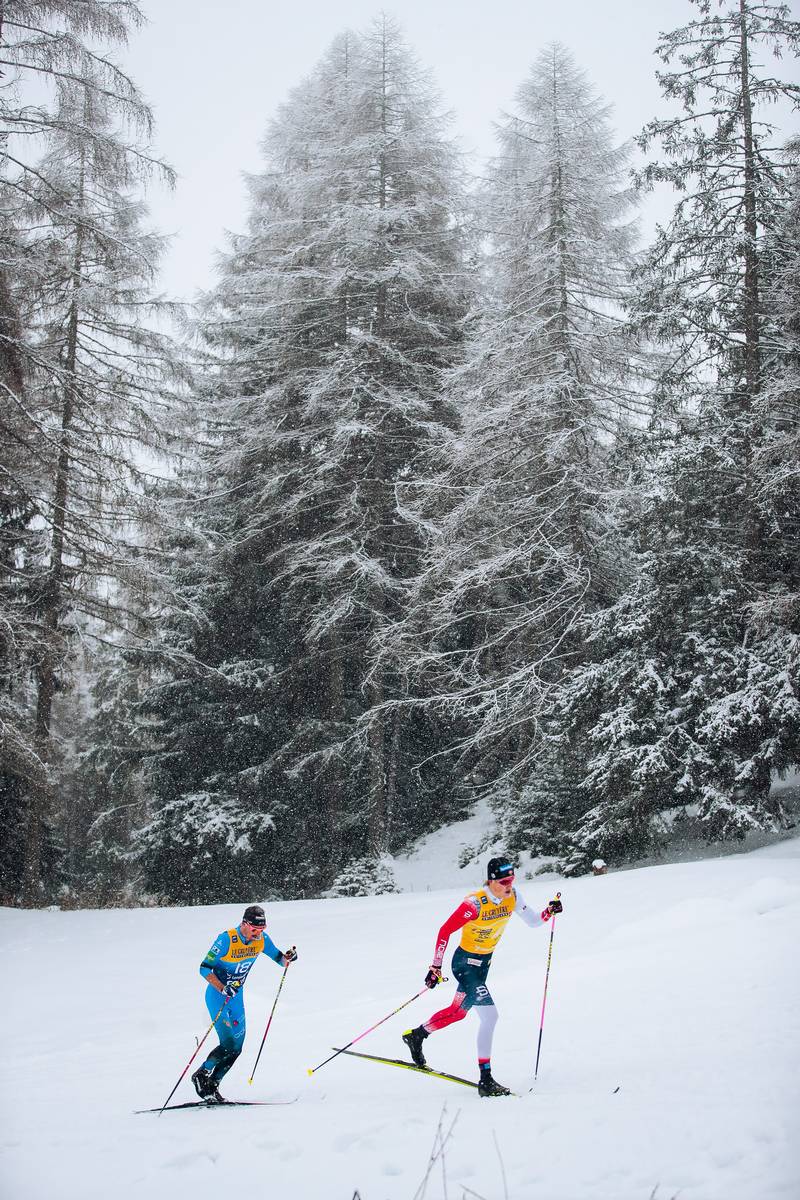
With snow continuing to fall and tracks beginning to disappear, some athletes began to favor double pole to striding. Conditions didn’t seem to slow down Niskanen as at the 10k mark he was able to grow his lead over the pack. Bolshunov was still in second (+15.7), looking back on form and in contention for the podium. Goldberg was in 3rd (+28.4), with Klæbo sitting just off the podium in 4th (+33.3).
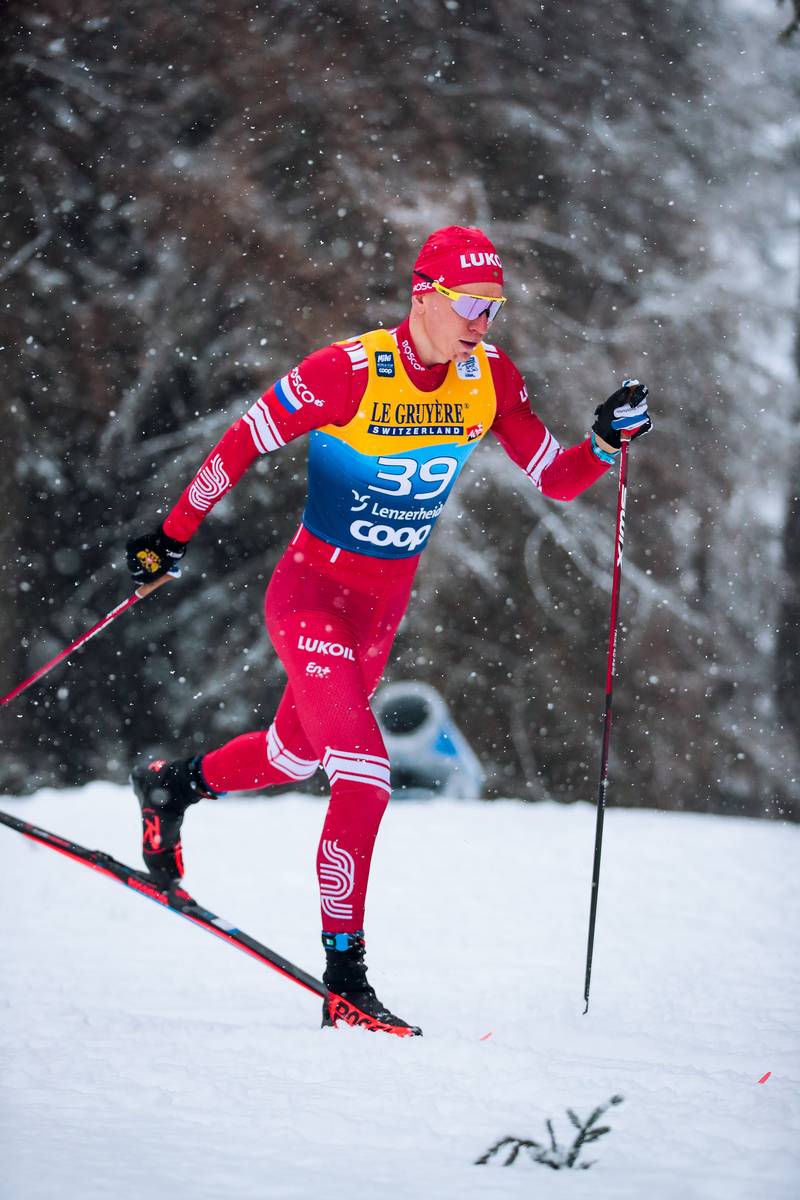
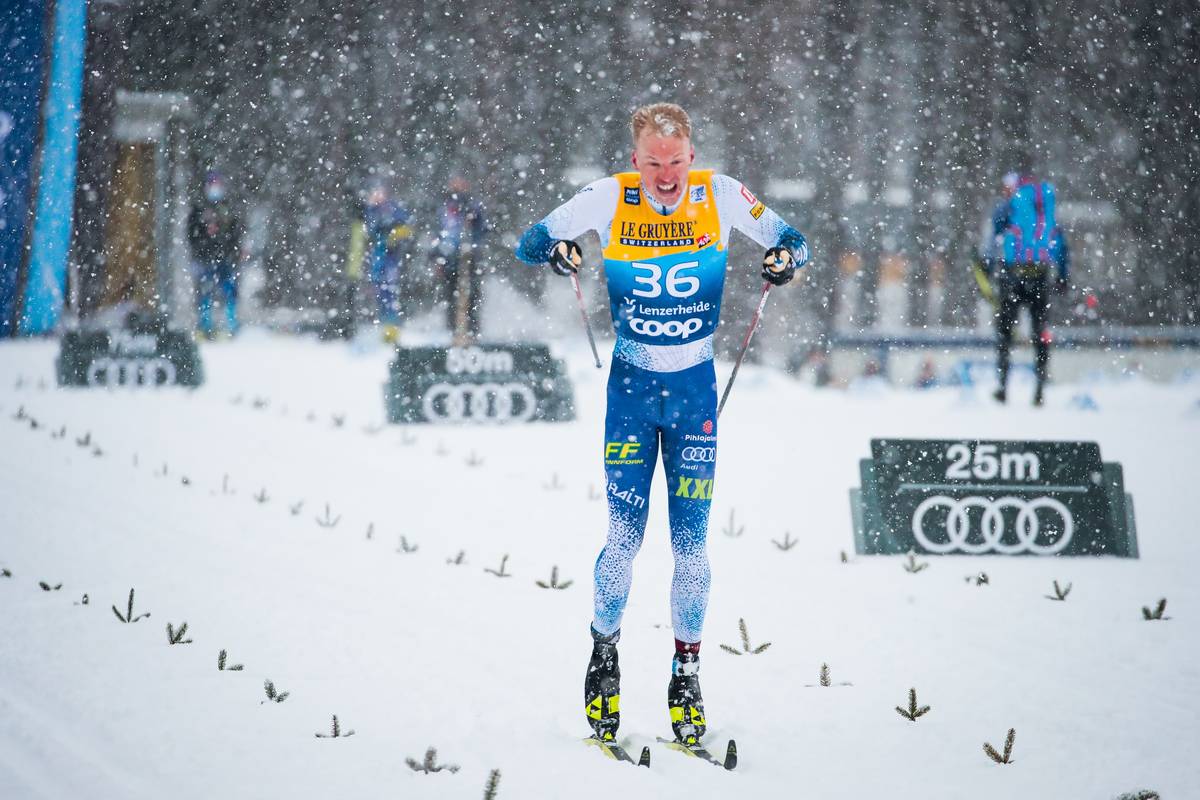
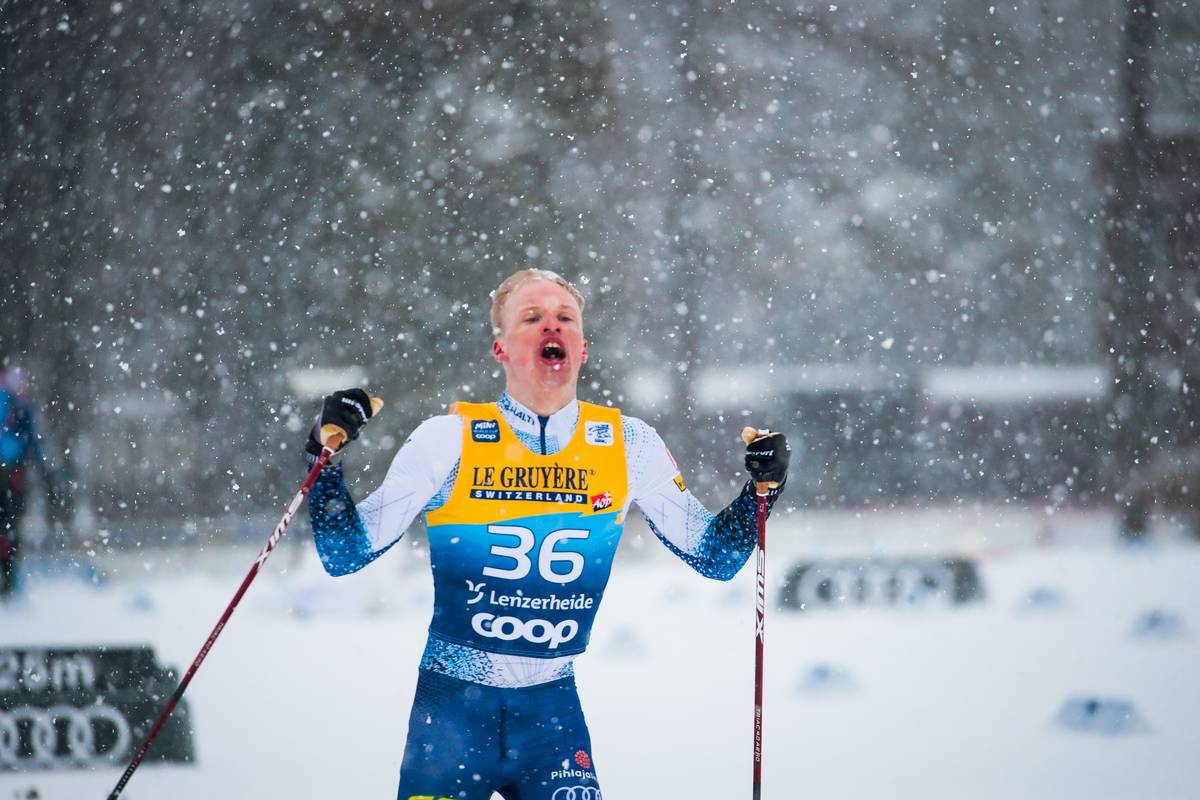
Thriving in his signature event, Niskanen continued to set the bar at each checkpoint to take the win in 32:51.7, making it a family sweep with his sister, Kerttu, winning the women’s race. This is Niskanen’s seventh World Cup victory, each of which has been in the 15k classic. He’ll be one to watch in the event at the upcoming 2022 Olympics, where he’ll be looking to add a third gold medal to his collection. Niskanen won the 50k classic in 2018 and was a member of the winning classic team sprint duo in 2014.
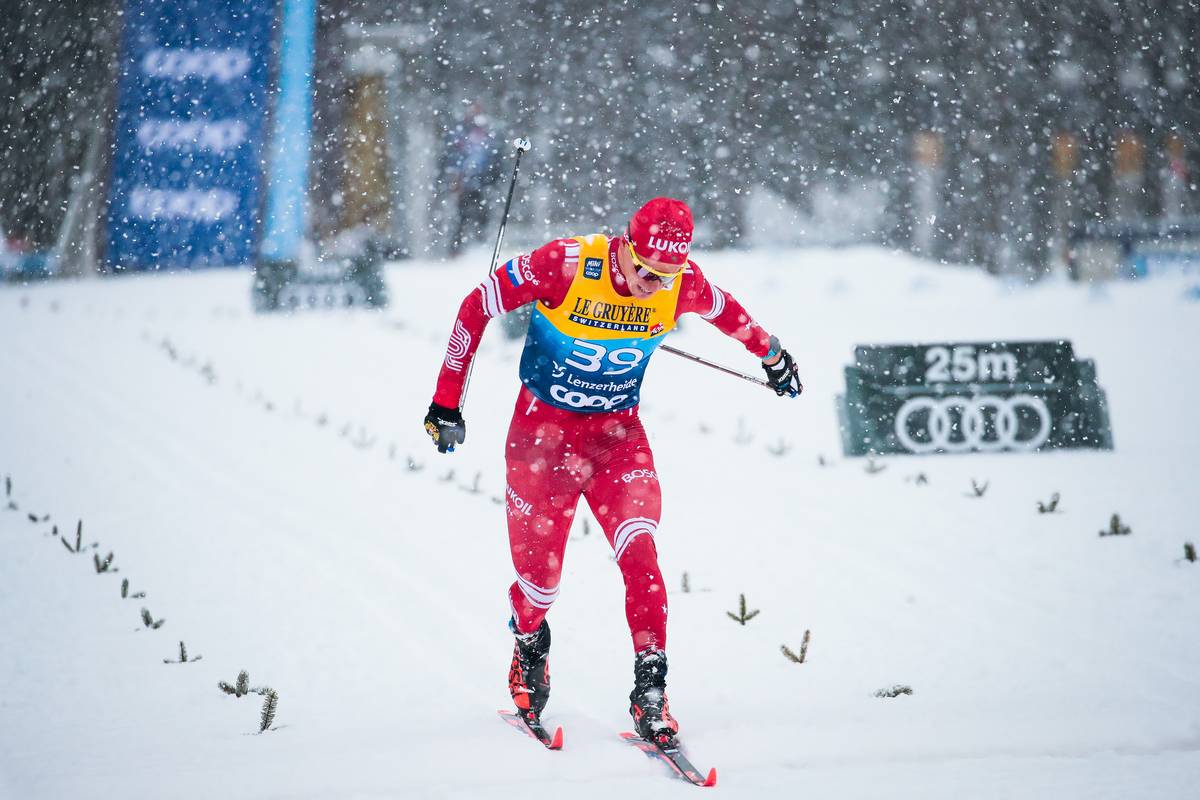
Perhaps a breakthrough after setbacks, Bolshunov held on for second (+19.3), finally earning another individual podium after weeks away. Goldberg was able to hold off his fellow teammate, Klæbo, to finish 3rd (+25.2) and 4th (+34.3) respectively. Yakimushkin (+34.6) couldn’t close the gap on Klæbo in the final meters, finishing just off the Norwegians mark in fifth (+34.6).
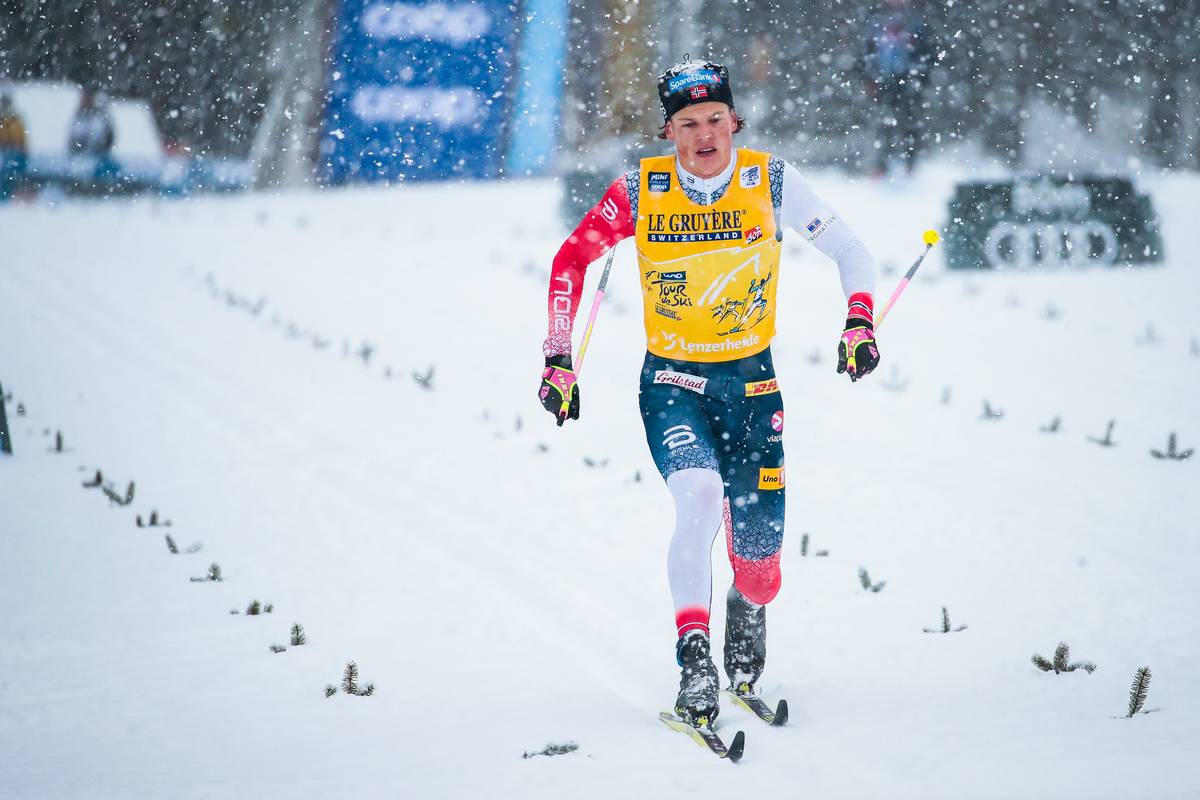
After the race, Niskanen told FIS, “I felt quite good… I tried to keep the race slow and steady [at the] start. I actually started too fast. I am happy, it was good also at the end.”
Niskanen also explained how he felt before the race after seeing his sister winning the women’s race, “I got a little nervous before the race because I saw she won. We had really good skis today, and it was an unbelievable day for our family.”

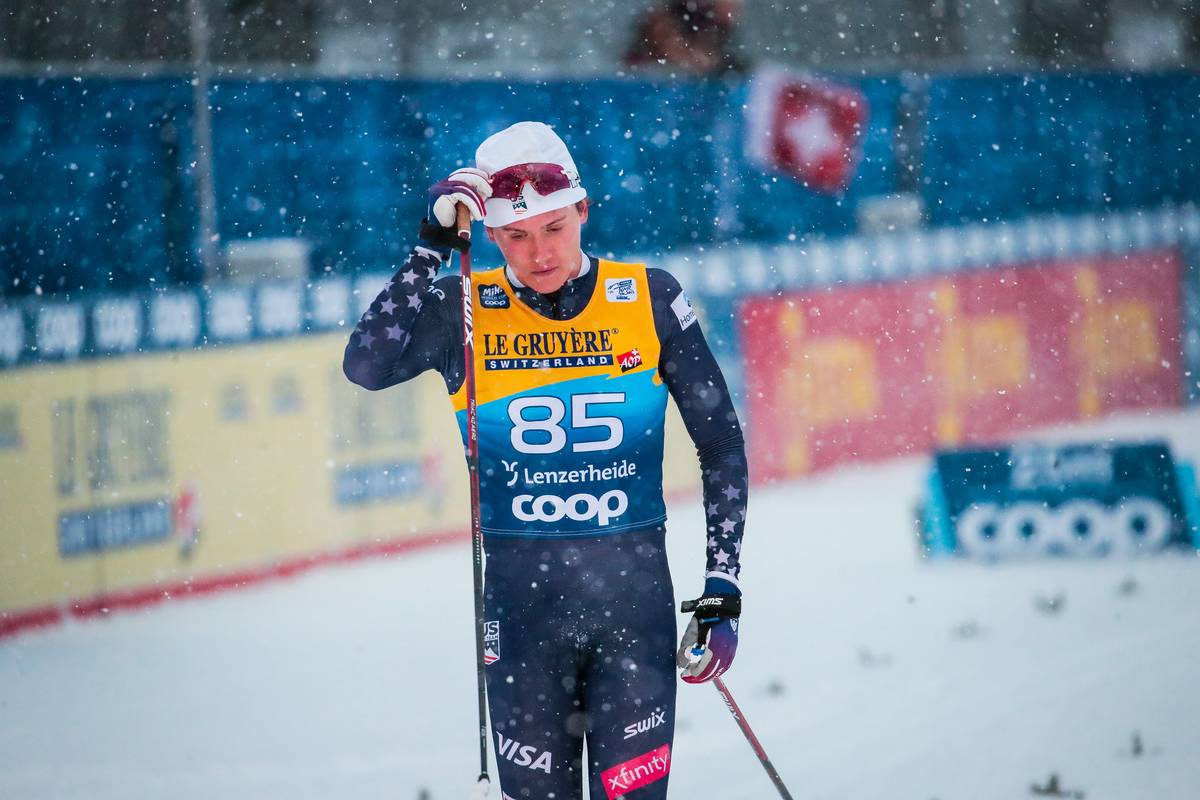
Racing through tough conditions, each of the Americans finished outside the Top-30. Schumacher was the top finisher, placing 38th (+2:13.4), roughly 9 seconds off 30th place. Ogden was not far behind placing 44th (+2:22.4). Bolger placed 65th (+3:25.3), with Hanneman finishing 70th (+3:44.8). Luke Jager finished just in front of Zak Ketterson, placing 84th (+4:36.4) and 85th (+4:43.2), respectively.
Post-race interview with Matt Whitcomb, from U.S. Ski & Snowboard cross country communications manager Tom Horrocks, discussing the men’s and women’s day in Lenzerheide.
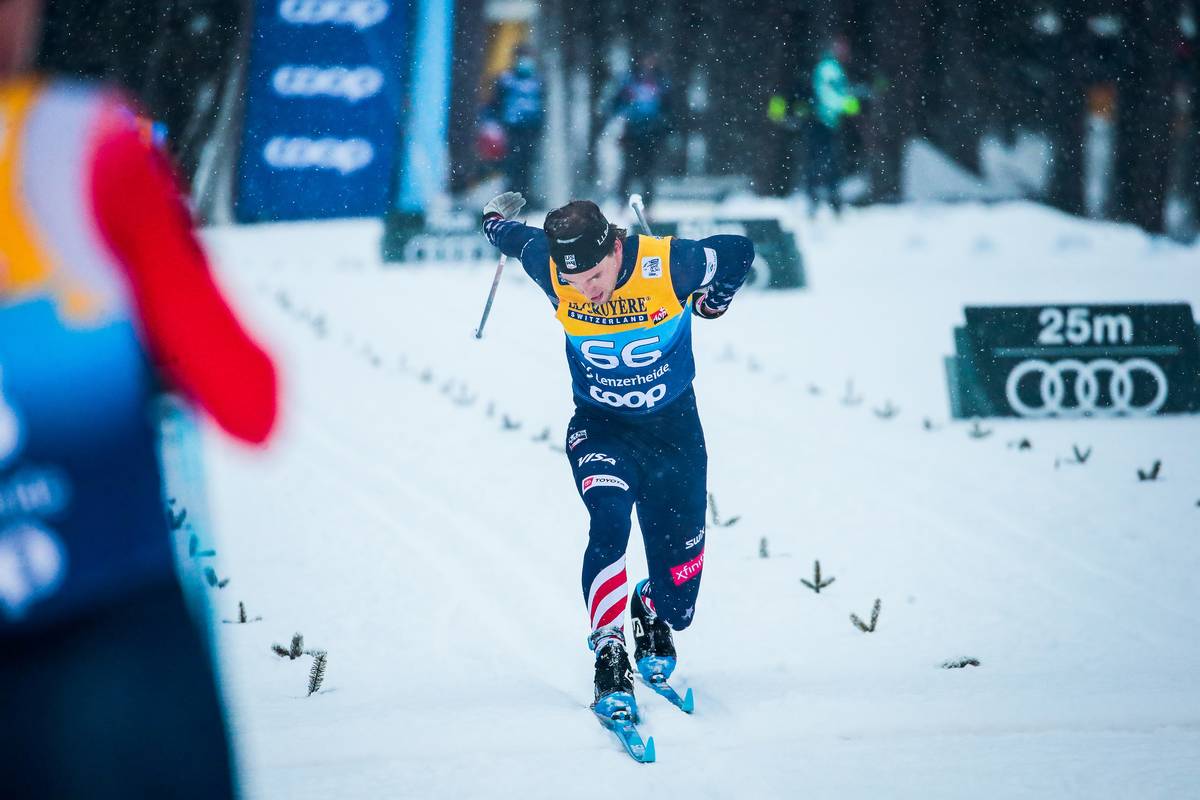
There are two sets of standings in the Tour, points and cumulative time. Bonus points were up for grabs at the 2.4k mark, providing an opportunity for sprinters to stay in the mix through the distance-heavy Tour. While sprinters did not look to fight for these points today, Niskanen surged ahead of the field to earn the maximum 15 point-bonus. Bolshunov was second at this checkpoint, claiming 12 points, with Valnes in 3rd for 10 points. Klæbo was 5th at 2.4k, earning 5 bonus points.
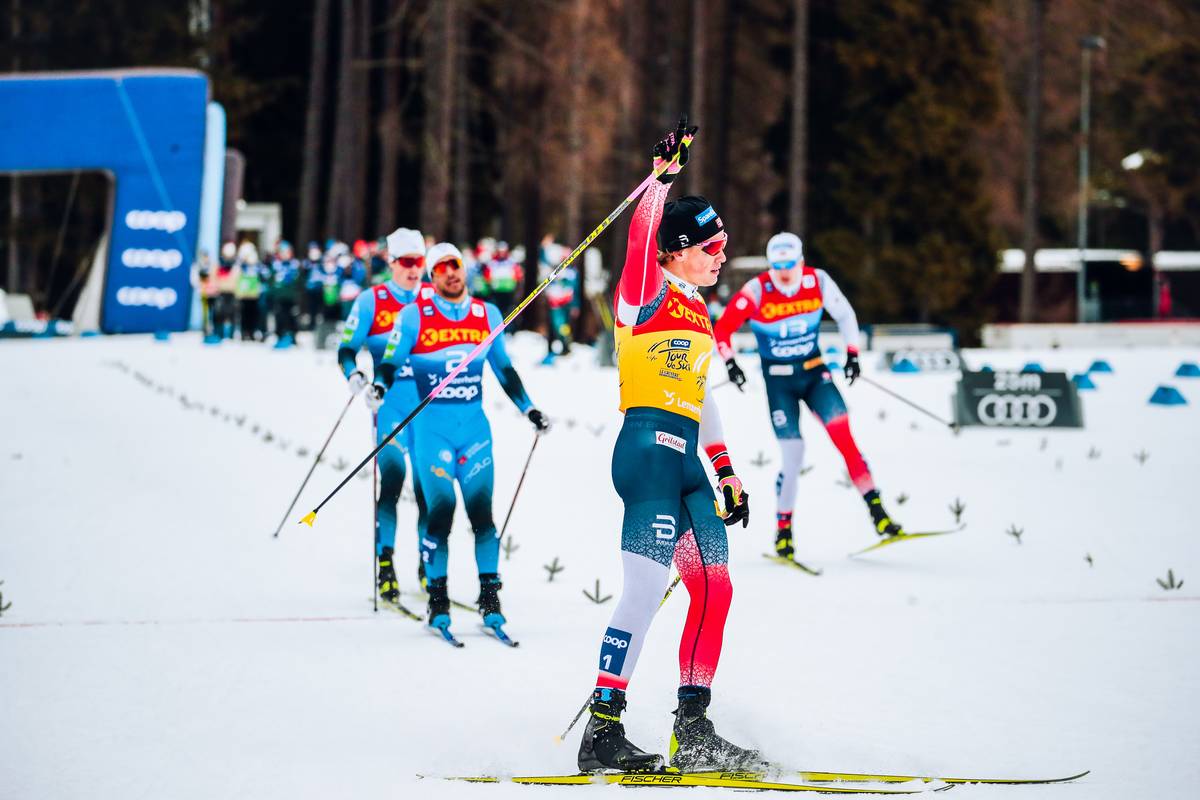
As results from the day became finalized, Klæbo was able to hold on to the overall lead in the Tour, having a 14 second lead over his teammate, Goldberg. With today’s win, Niskanen moved up the rankings, now sitting in third place.
After a day off for rest and travel, racing will continue on Friday with a 15k freestyle in Oberstdorf, Germany.
Final Results | Overall Standings
This World Cup coverage is made possible through the generous support of Marty and Kathy Hall and the A Hall Mark of Excellence Award. To learn more about A Hall Mark of Excellence Award or to learn how you can support FasterSkier’s coverage please contact info@fasterskier.com.
To set the scene for the Tour de Ski, briefly turn to an episode from the event that inspired it. Cue “the Badger,” Bernard Hinault, who at the start of the 1985 Tour de France reduced the three week race down to one question: “Look at the results last year – Laurent Fignon first, me second and Greg Lemond third. Now Fignon won’t be there. What answer do you get?”
The answer: Lemond and Hinault would battle as teammates in the greatest editions of the Tour de France ever in ‘85 and ‘86. In the end, Lemond “slayed the Badger,” besting Hinault to win the Tour in ‘86 and establish the Americans as winners at the Tour.
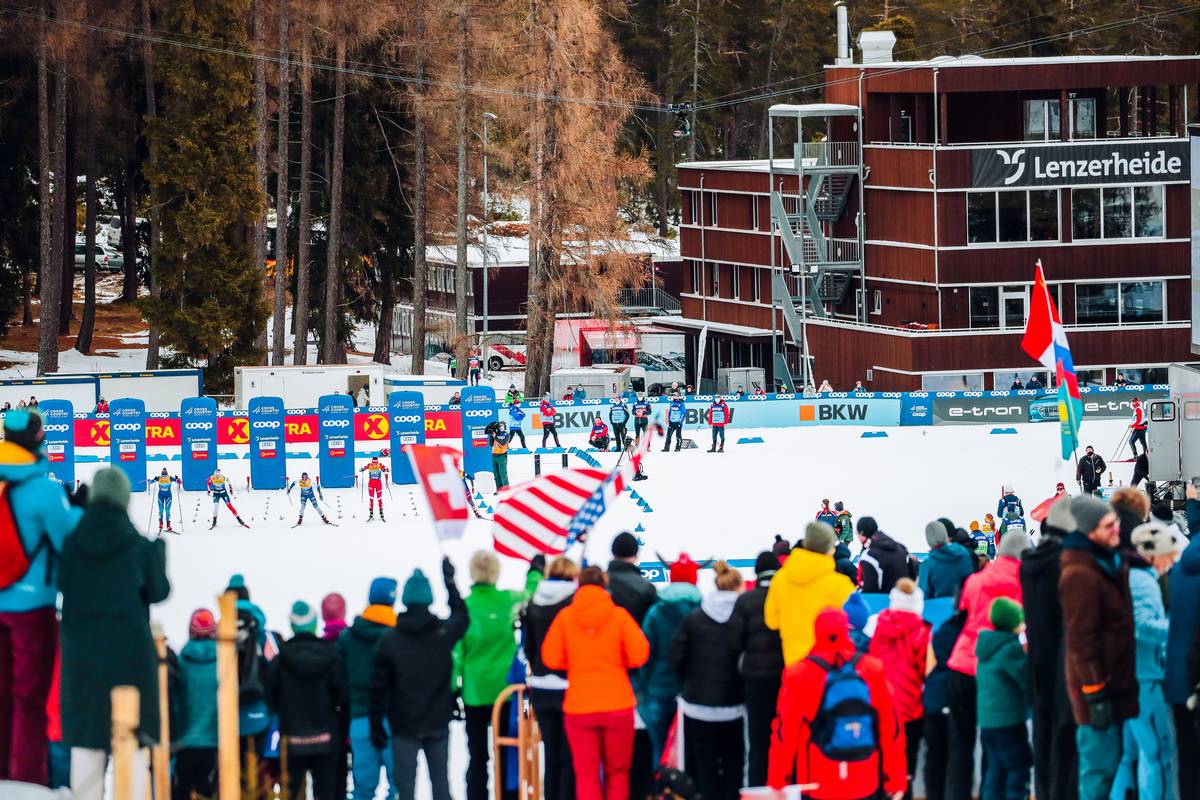
Switch seasons, sports, and circumstance and we can reduce this year’s Men’s Tour de Ski (TDS) to one question too: Look at the results last year – Alexander Bolshunov (RUS) first, Maurice Manificat (FRA) second, Denis Spitsov (RUS) third. Johannes Høesflot Klæbo (NOR) was not there. Now he is back. What answer do you get?
The answer: Klæbo.
In the first stage of this year’s Tour de Ski at Lenzerheide, the Overall and Sprint leader of the World Cup came into the freestyle sprint, and looked in control each time he headed out on the 1.5-kilometer course, winning the qualifier (2:36.66) before cruising through the quarterfinals and semi-finals to keep his yellow World Cup Sprint leader’s bib as he exited the final.
But back-up, and you see another parallel to Lemond at cycling’s Tour, with today’s stage marking the ascendancy of the Americans. They put three in the top 30, with Ben Ogden finishing qualifying in 5th place (+5.81sec), Kevin Bolger in 9th place (+6.62), and Logan Hanneman in 30th (+9.78).

In the quarterfinals the first three heats were marked by somewhat conservative tactical posturing, with a field figuring out how to race the course at Lenzerheide after a two year absence. There was a good reason too. The two 750m laps are marked by a steep initial climb that after a turn gives way to a long downhill whose end is a sharp left into the stadium. That sharp left proved time and again to eliminate the gaps that attacking skiers tried to create on the first climb. It also led to opportunities to find a good position for the final sprint and pick up places in the field.
That was how Klæbo looked to race the first quarterfinal of the day, following Lucas Chanavat (FRA) into the second downhill before launching to the outside to capture the heat in the final stretch. Logan Hanneman seemed to mirror Klæbo’s moves through the heat, tucking in behind him on the downhill the 2nd time but finding that he hadn’t pushed with the same energy, as he said in comments to Fasterskier: “Klaebo and Chanavat pushed harder than I did over the top of the climb on the second lap and all of the sudden then had some meters on me. It’s easy to think that others had faster skis than myself today since I got passed on the long downhill the second lap, but that probably only because I didn’t see what they were doing behind me. I am sure they skated harder than I did and built up more energy to come by me.” Hanneman finished the heat in 5th place.
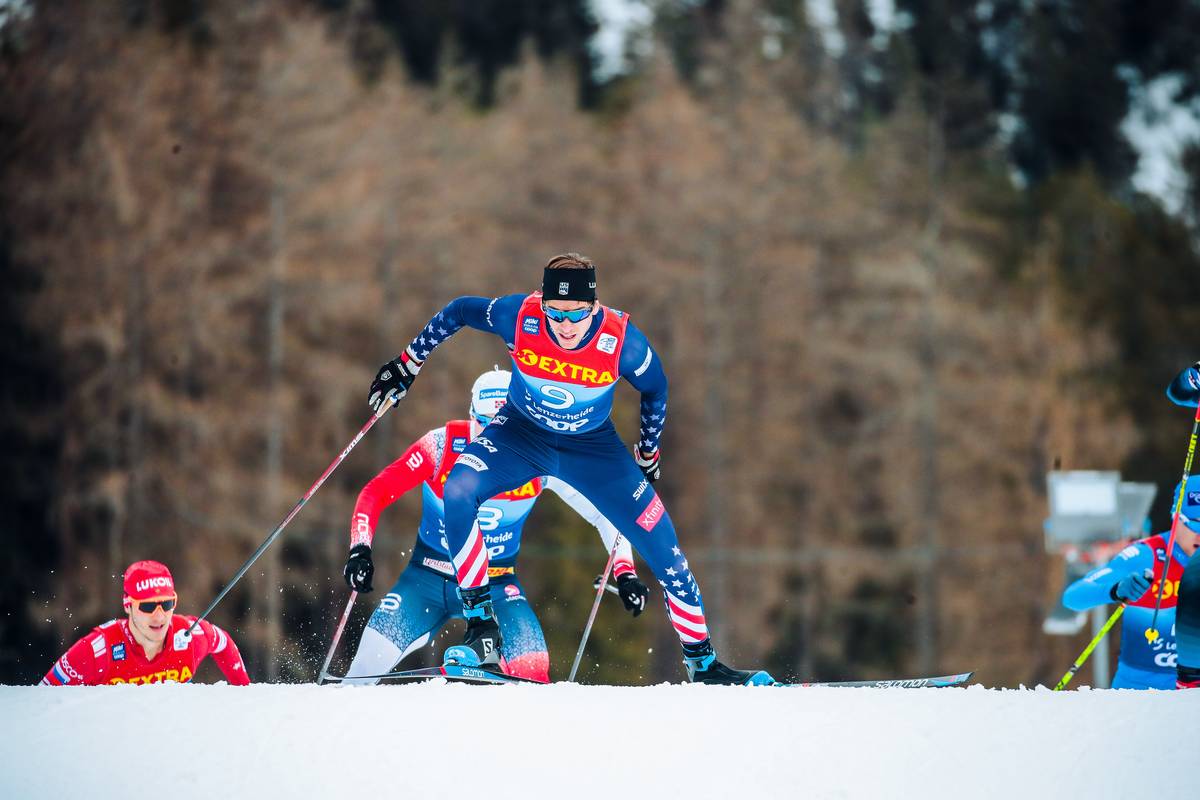
Bolger and Ogden opted to race out of the 4th and 5th quarterfinal, respectively, being the top qualifier in each. In contrast to Hanneman’s approach, the two both went with the strategy of leading out the field and trying for the gap on the first downhill. Both Ogden and Bolger’s attacks had the effect of animating their heats, which led to full bore racing for the entirety of the 1.5k course and eventually faster times across the field.
Their aggressive racing was foiled by the sharp left turn into the finishing straight, with the fields coming together and both Ogden and Bolger losing their position at the front of the field.
Bolger came across the line of his heat in 4th place, but his move early on to set a fast pace for the heat paid off, temporarily earning him a lucky loser spot. After the 5th heat though, where Ogden finished in 5th, Bolger was knocked out of the final lucky loser spot by Alexander Terentev (RUS) by less than 0.8 seconds.
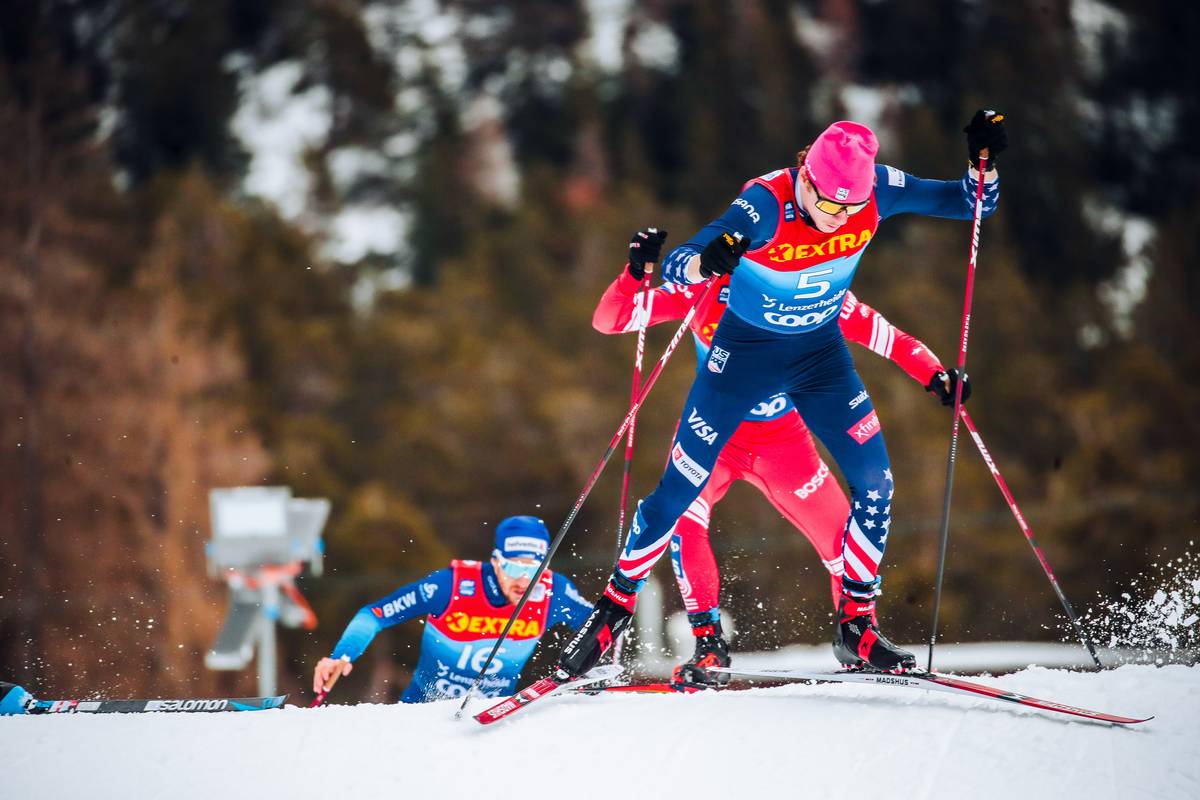
Still, the Americans’ quarterfinal performances left them in a strong position to challenge for the points classification, which will now turn to intermediate sprint primes at various checkpoints within the next two stages’ distance races.
It also left a semi-final field filled with familiar races from Tour de Ski’s past. Richard Jouve (FRA), Lucas Chanavat (FRA), and last year’s champion in the TDS Sprint Freestyle stage Fredrico Pellegrino (ITA). The younger sprinters who have featured on sprint podiums this season, Alexander Terentev (RUS) and Erik Valnes (NOR), were there too. Notably, last year’s Tour de Ski overall and points champion Alexander Bolshunov (RUS) was not, after being finishing 3rd place in his quarterfinal.
And, of course, there was Klæbo.
In the first-semi final, as the Frenchmen Jouve and Chanavat moved to the front of the pack at the beginning of the heat, Klæbo tucked in right behind them. As they came out of the first lap, Klæbo followed Pellegrino’s attack on the climb, but didn’t really look to make his move until the last downhill. Here he demonstrated an approach to the climb that was absent elsewhere in the men’s field the rest of the day, sprinting in a tuck skate to hit the apex of the final turn in a way that shut the door on the rest of the field.
Did he have the purest burst of speed on the finishing stretch? Probably. But it was already over before he hit that stretch, and he crossed comfortably in first place.

Chanavat and Jouve’s attacks early in the race had a similar effect on the semi-final as the Americans did in the quarterfinal. The first semi-final proved to be the faster field, and so Jouve (2nd), Chanavat (3rd), and Pellegrino (4th) all progressed to the final.
There they were joined by two more Norwegians, Pål Golberg and Erik Valnes, who followed their countrymen’s lead in the second semi-final heat to out-sprint Renaud Jay (FRA).
The final followed the pattern established in the previous round. Chanavat and Jouve seemed mindful that their chance to beat Klæbo most likely lied in a long-burn attack that saw him, Valnes and Golberg left out of the pack going into the second lap. Unfortunately, again, that attack met the long downhill sharp left turn.
Klæbo seemed content to simply keep up with Pellegrino as he made a move on the final climb of the day, before sweeping to the outside and attacking the final downhill to leave the rest behind before that pesky left turn could shake-up the field again. He crossed in first place, with Jouve in 2nd (+.99) and Chanavat in 3rd (+1.26).

With the win, he established himself on an early, but clear path, to retake the Tour’s Overall and Point classifications after missing last year. His win today also helped him move up the ranks in the Tour’s history, passing Dario Cologna and Martin Johnsrud Sundby’s 7 stage wins to move him into 3rd all-time with 8 – behind Sergey Ustiugov (9), and Petter Northug (13). He also extended his all-time individual sprint stage lead in TDS history to 5.
So while we came into today’s stage with one question, we head towards tomorrow’s 15km with many. Just how much more history can Klæbo make? Will Bolshunov re-establish himself as a contender? And where do the American men go from here in this year’s Tour de Ski?
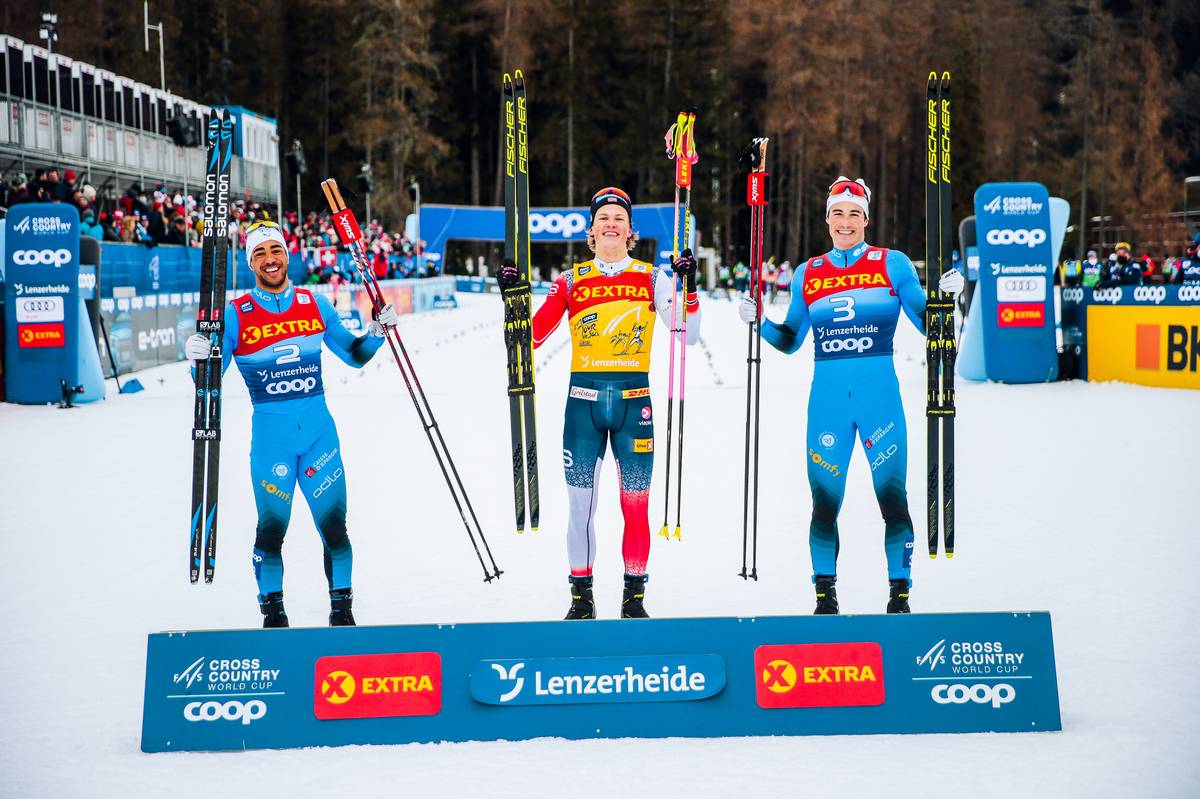
For now, the Yellow bib (“le bavoir juane” anyone?) remains on Klæbo’s shoulders, and our eyes on Lenzerheide tomorrow.
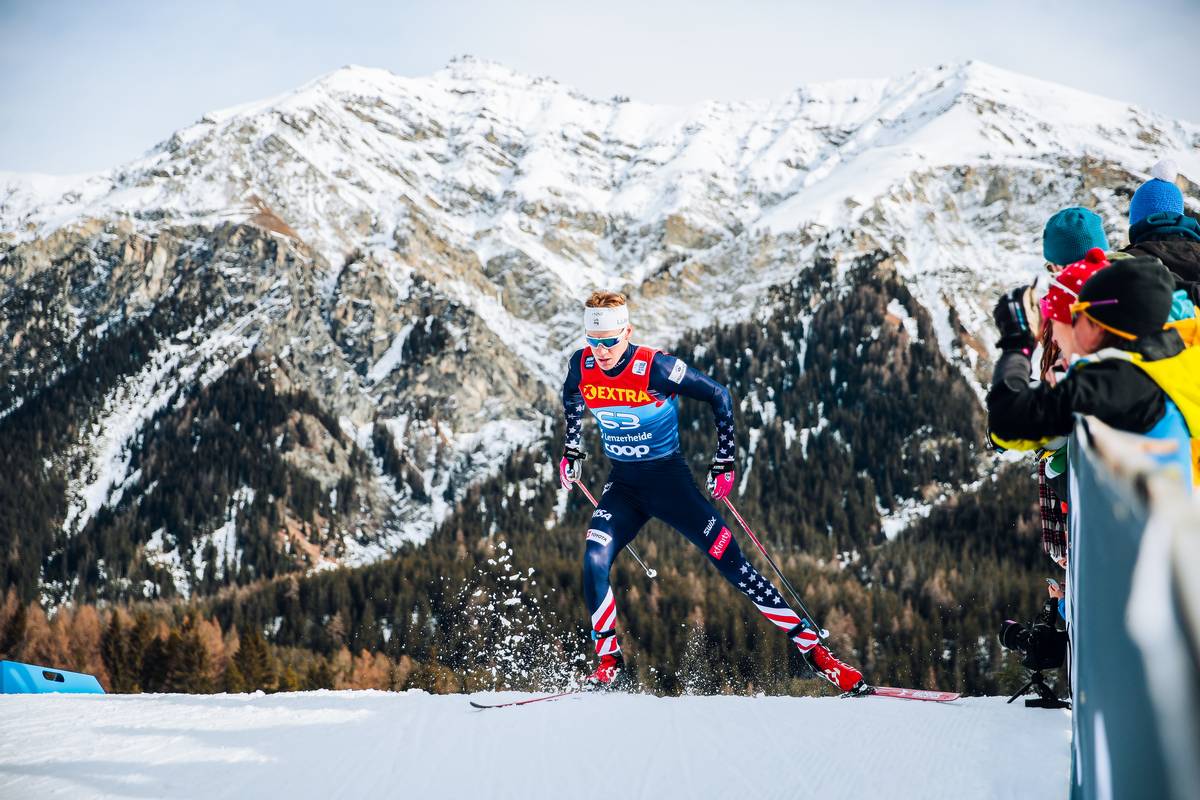
After the semi and final rounds were decided, Bolger ended his day in 16th (+1.75), with Ogden in 21st (+1.94), and Hanneman in 25th (+5.70).
The rest of the American men also showed strong results in the qualifier today. Luke Jager finished in 45th (+12.57), with Gus Schumacher in 55th (+13.95). Minnesota’s very own Zak Ketterson also made his World Cup debut, finishing in 72nd (+16.37) after qualifying for the Tour de Ski as the men’s SuperTour leader after racing Period 1 back in the States.
On his race into the quarterfinals today, Logan Hanneman said “I’m feeling pretty good after today, but still longing for more. It has been a very slow and disappointing start to the season for me, for reasons I can’t explain. I am happy to be seeing progress in the right direction the last two sprints that I have done, but there is still a lot of work left to be done to reach my goals. I am looking forward to trying my hand at some distance races starting tomorrow!”
Post-race interview with Matt Whitcomb on the course in Lenzerheide, which has suited Americans well over the years, along with additional comments on the men’s and women’s races.
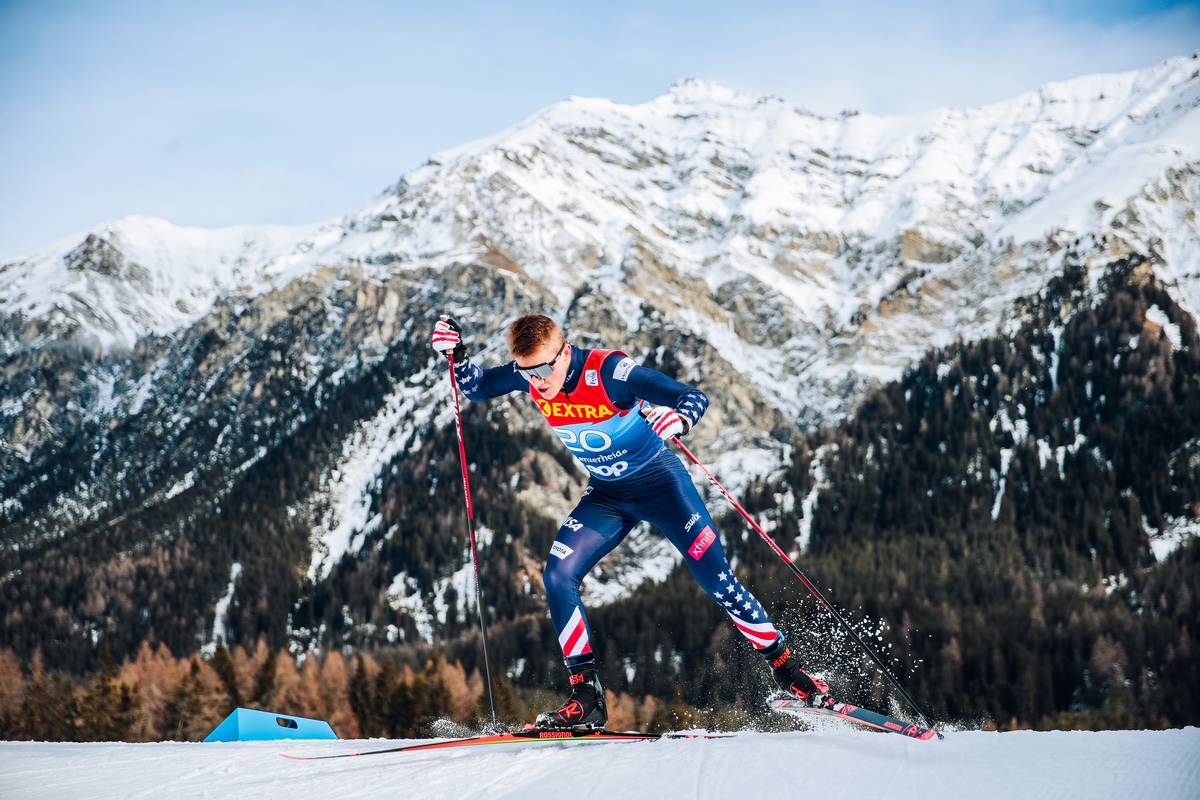
Results from Stage 1:
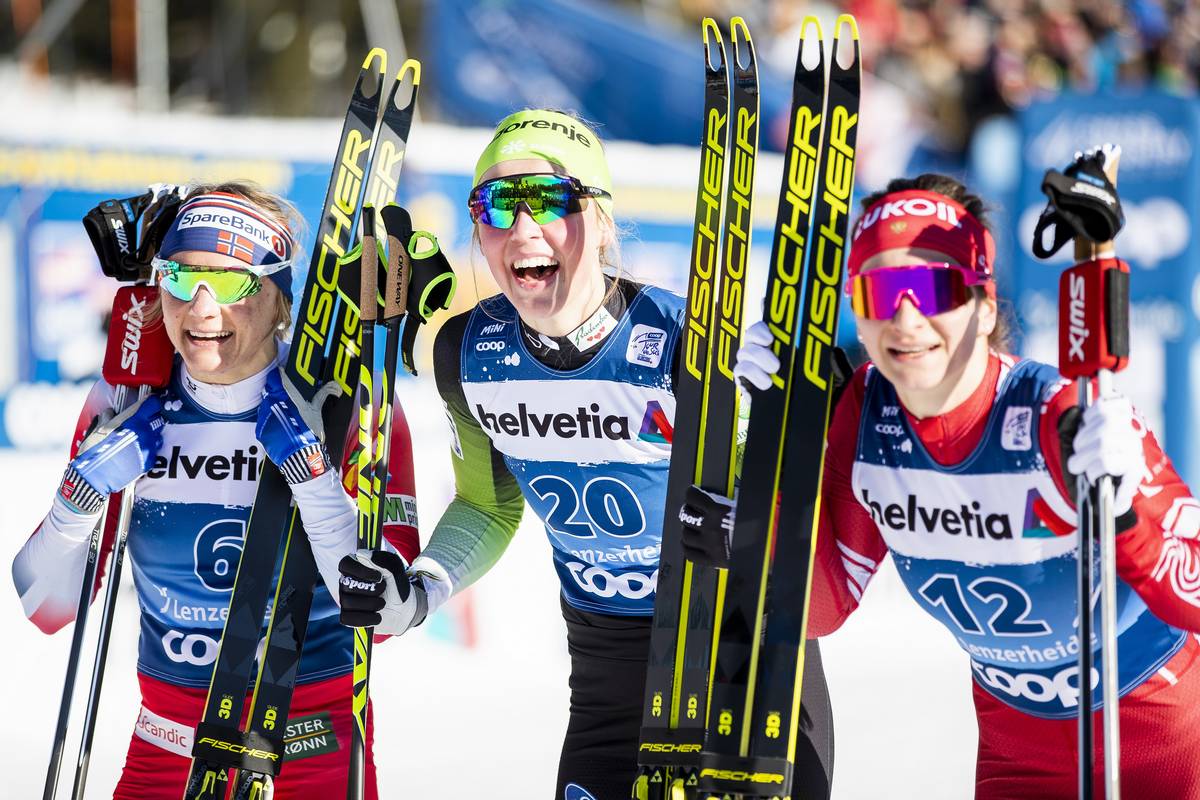
Day two of the Tour de Ski offered the American women the Sisyphean task of earning back time after a miss on ski and wax selection in Stage 1 prevented them from performing to their capability. This was particularly so for Jessie Diggins, a favorite for the overall tour podium who finished the first stage in 29th 1:20 behind Norway’s pace-setting Theresa Johaug. Her teammate Sadie Maubet Bjornsen, also a top all-arounder, was in the same position. Maubet Bjornsen ended Stage 1 in 30th.
The initial run of the TdS in Lenzerheide, Switzerland is about not digging yourself into a time-deficit hole. A podium is nice, a win even better. But the primary objective is to not lose too much time to the leaders. At the start of Stage 2, Diggins and Bjornsen were in that hole.
Backs against the wall and a significant boulder to push ahead of them, the two would need to make it into the final of the 1.5-kilometer freestyle sprint to make significant headway on the tour leaders. A podium finish would be ideal. Since time differentials in sprint racing are small, it would be imperative to earn bonus seconds based on their final standings: 60 seconds for a win sliding down to 42 seconds for sixth.
As Johaug, the overall leader heading into the second stage, was not a podium threat in the sprint event, it was almost-certain that she would lose time on her chasers, increasing the opportunity for the Americans and other overall podium hopefuls.
Knowing the task at hand, Diggins bravely faced the new day with resolve.
“Now I get to focus on doing what I love best: fighting my way back,” she wrote on Instagram.
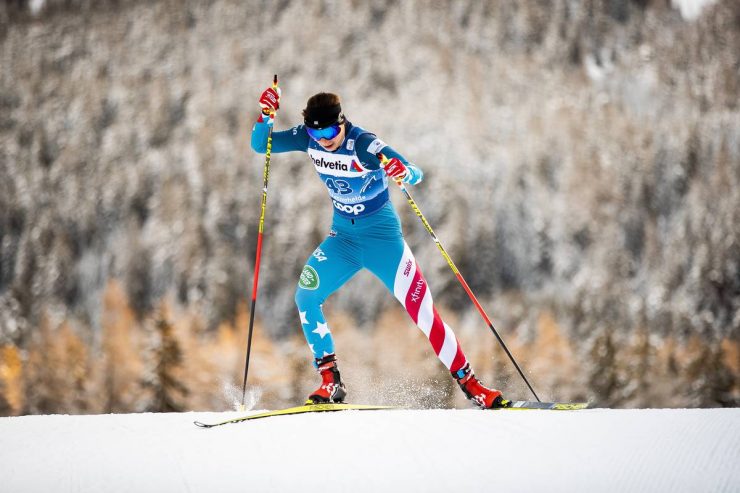
Surely enough, four Americans landed in the top ten in qualification: Sophie Caldwell in 1st, Diggins 3rd, Maubet Bjornsen 4th, and Julia Kern 5th. Rosie Brennan also qualified for the heats in 28th. The final member of the American squad, Katharine Ogden, finished 60th in qualification.
And on to the quarters five Americans went. With the momentum and energy of the team, the boulder budged.
Racing in the lightning-fast first heat of the rounds, Diggins fought at the front with leaders Maiken Caspersen Falla (NOR), Anamarija Lampic (SLO), and Anne Kjersti Kalvå (NOR). Last year, Falla was the ranked second overall in the World Cup sprint standings and Lampic was ranked 6th.
Diggins was unafraid to push the pace and spend time at the front. She showed her balance on her feet as she took on the fast descents and icy corners of the course, holding her position. In the final straightaway, Falla and Lampic took off from the front, leaving Kalvå and Diggins fighting for lucky loser positions. With the fate of a fast heat and their stick-to-the front pacing — their times would have won any other round — Kalvå and Diggins easily advanced to the next round.

The Americans continued to shine in the rounds. In the second heat, Brennan mixed it up with the leaders but lost contact with the pack, finishing fifth in her heat. In the slowest third heat, Caldwell patiently followed the pedestrian pace, then showed her top gears in the final sprint to win the round. Maubet Bjornsen took second in the fourth heat to advance, and Julia Kern took third in a three-way photo finish for the top spot in the final heat.
Three Americans advance to the semis.
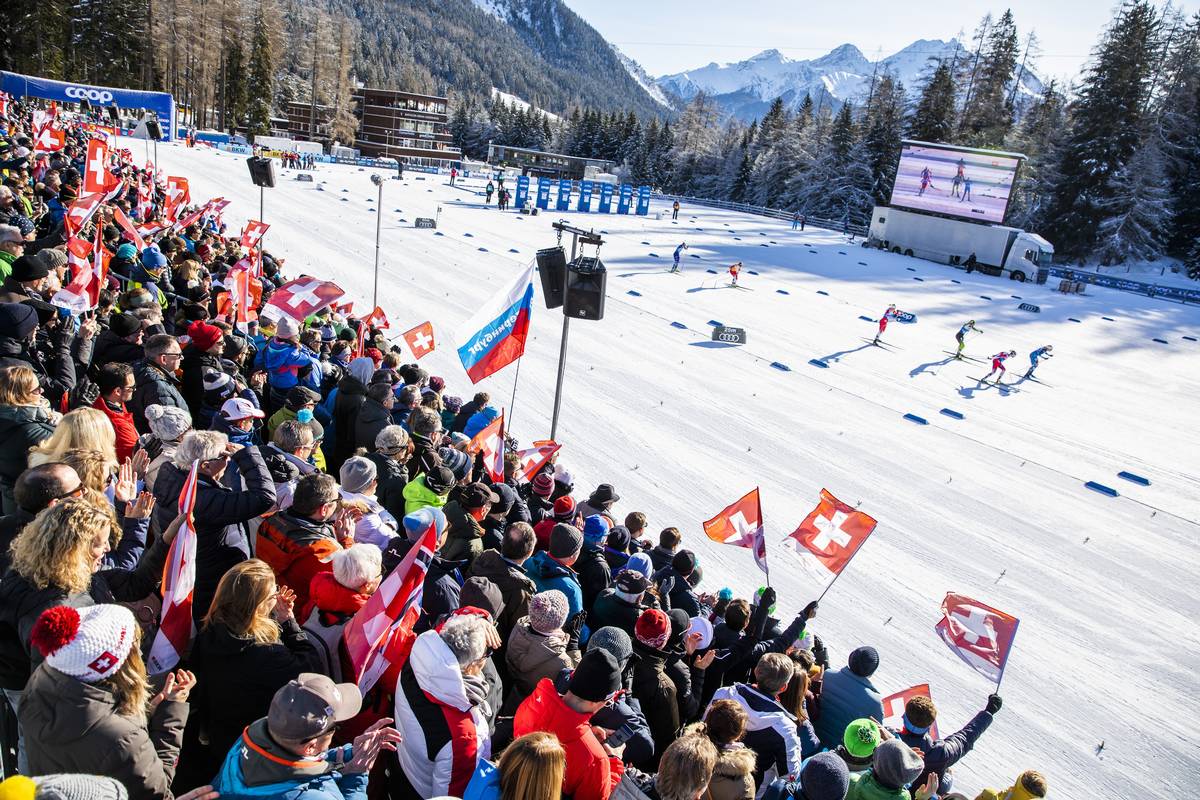
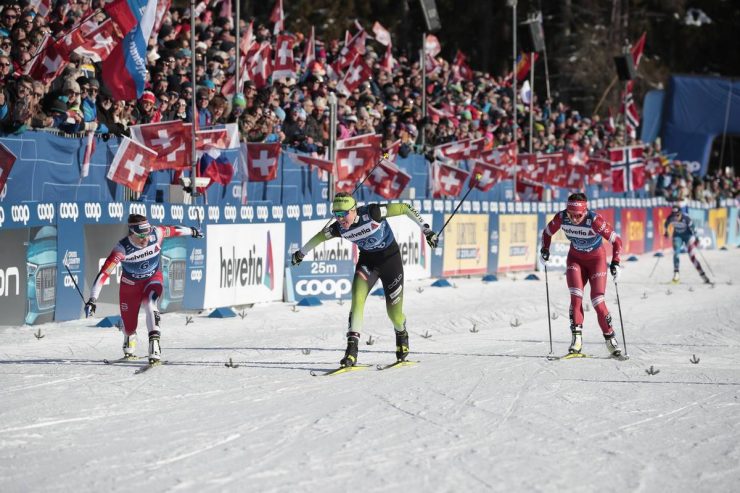
Again, the first round of the semis was stacked with Falla, Lampic, Diggins, and Caldwell battling with Natalia Nepryaeva of Russia and Jonna Sundling of Sweden. Showing her grit, Diggins won the heat for an automatic spot in the finals, while Caldwell finished fifth. The spread of finishers in the heat was less than one second. Maubet Bjornsen finished second in heat 2, also advancing to the final.
Two Americans in the final. The pieces were coming together.


Diggins kept herself in contention for a podium spot throughout the final, matching each of her opponents moves, never losing contact and often controlling the pace from the lead. Maubet Bjornsen held strong in the middle of the pack.
Leaving nothing on the course, Diggins jump skated each of the rollers, powering in a no pole skate into a tuck on the descent. She raced with grit over every meter.
Rounding the final curve into the straightaway, she sat in fourth behind Lampic, Falla, and Nepryaeva who had begun to accelerate off the front. Matching their tempo but unable to close the gap, Diggins crossed the line in fourth, doubling over as she gasped for air.
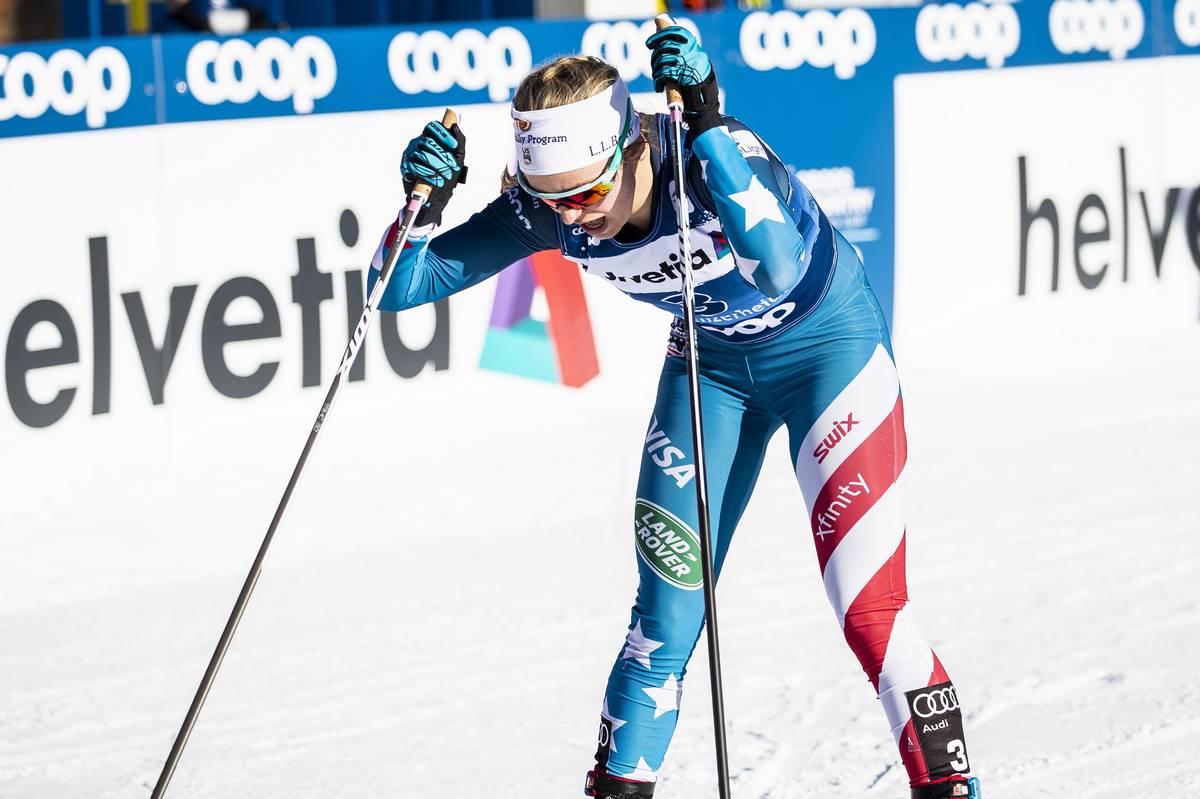
In a close finish with Falla, Lampic took the win in 3:06.2 with the Norwegian 0.03 seconds behind her. Nepryaeva finished third (+0.47), with a half second gap to Diggins. After falling off the lead pack, Maubet Bjornsen finished 5th (+4.78), and Tiril Udnes Weng sixth (+5.29).
Because they were quickly on the road to the next venue, the American women were unavailable for phone calls and instead chose to send comments on their performance via email.
“Today was a great day,” wrote Diggins. “I was so proud of the entire team for staying positive, rebounding from yesterday and for keeping it super professional; nobody was mad, everyone just learned the lessons from the skis that day and then moved onwards. For me, it was important to just focus on what I can control and have confidence in my fitness that I knew was there.”
In response to a query on handling the pressure of offsetting her deficit in the overall standings, Diggins offered a process-oriented response.
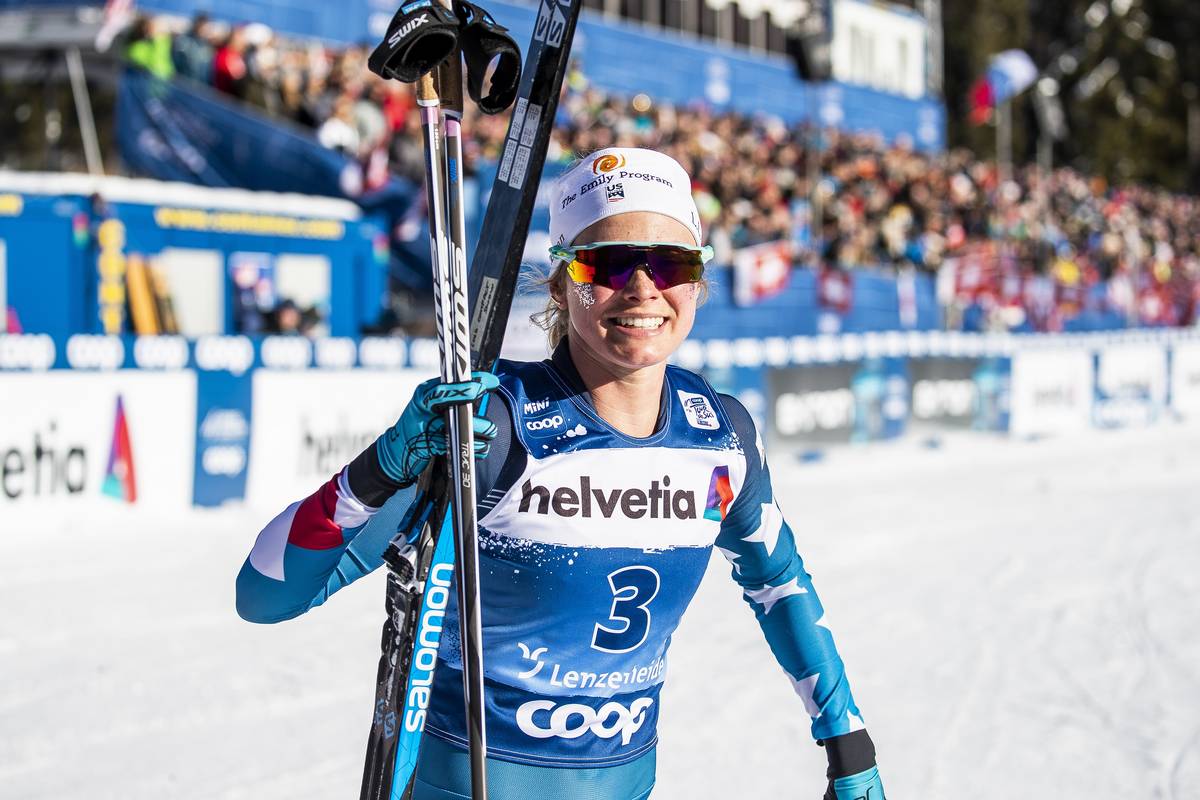
Maubet Bjornsen also remarked on the positive energy taking vengeance on the first stage provided. She explained that with “impossibly slow skis”, it felt like a success to lose only 1:20 to the leaders. Maubet Bjornsen added that it was not just the athletes looking for a do-over in Stage 2.
Like Diggins, she too is eager for a second go in the next round of racing in Stage 3 and hopes to continue whittling down her gap to the overall tour leaders.
“I look forward to the next stop in Toblach for another attempt at a 10 k skate, hopefully with an equal revenge as today. I have some precious seconds to try to win back still. One day at a time.”
She finished by saying that they are driving away from Lenzerheide “with some tired legs, but rejuvenated souls!”
Overall Tour Standings
Noteworthy for the overall standings, tour leader after Stage 1 Therese Johaug qualified in 21st and raced in the speedy first heat with the eventual winner. She finished in fifth, just behind Diggins. Had she raced in any other round, the distance phenom, who is not known for her sprinting, would have advanced as well. Her result put her in 23rd for the day, earning six bonus seconds.
Though she slid back to third in the overall rankings, this result maintained her threat for the overall tour victory. Johaug is only five seconds out of first place heading into three distance stages where she will have the opportunity to create a gap over the field before the Stage 6 sprint. In the fifth stage, a mass start classic in Val di Fiemme, Italy, she will also have the opportunity to earn bonus seconds at various checkpoints, giving her further insurance on the following sprint day.
Now wearing the leader’s bib, Nepryeava’s sprint podium moved her into the lead with a cumulative time of 31:18. She finished sixth in the first stage. Demonstrating her potential in the competition, Nepryaeva dueled with Norway’s Ingvild Flugstad Østberg throughout the 2018/2019 tour to finish second overall. The Russian won the first distance stage and took second in the final four stages.
Lampic, who finished 50 seconds behind Johaug for 20th on Saturday’s distance race, moved into third overall, one second behind Nepyraeva. Last year, she finished 22nd in the tour.
Posting consistent results in the first two stages, Tiril Udnes Weng’s 7th in Stage 1 and 6th in the sprint put her in fifth overall, followed by her cousin Heidi Weng who was second in the first stage but 32nd in qualification leaving her out of the rounds.
Cutting their time back in half, Diggins sits in 11th place, 39 seconds behind Nepryaeva, followed by Maubet Bjornsen in 12th (+41). The overall podium continues to be up for grabs.
Racing continues Tuesday December 31st in Toblach, Italy with 10 k freestyle, followed by a 10 k pursuit start classic on Wednesday.
Final Results | Qualification | Overall Tour Standings After Stage 2

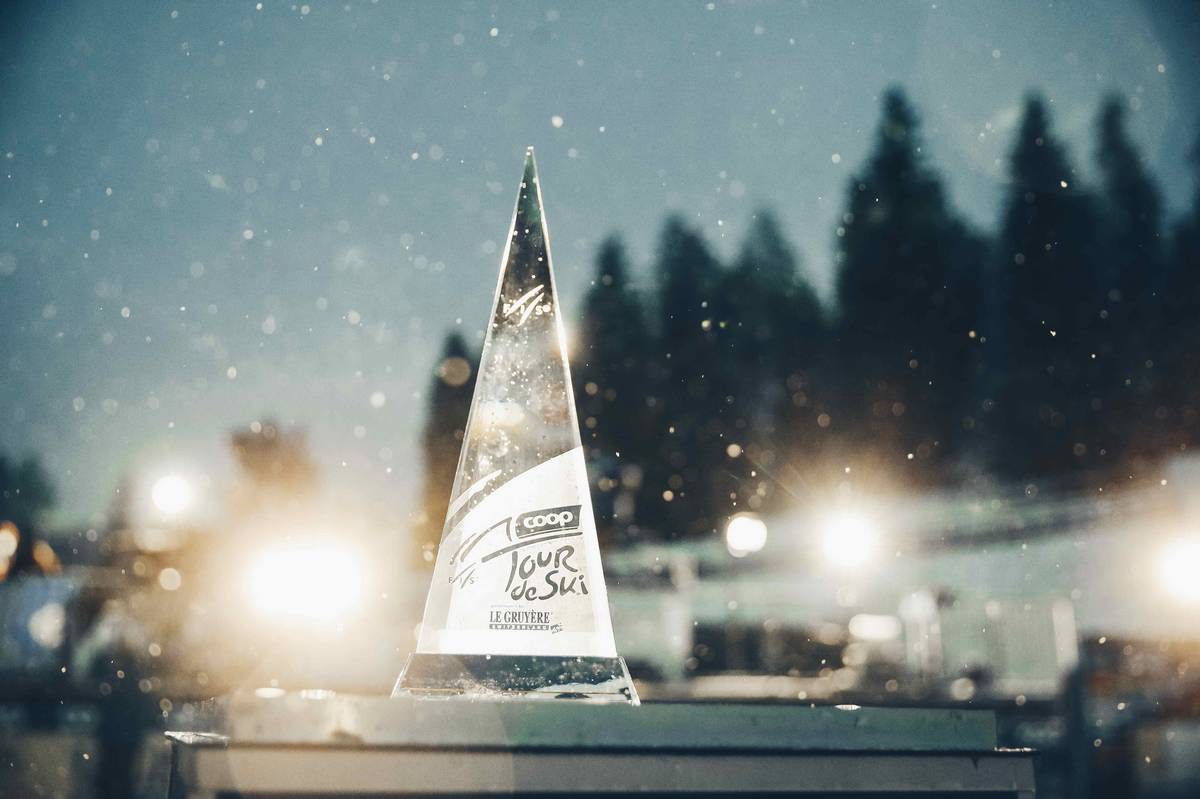
Stage 1 of the 2019-2020 Tour de Ski is final. With two distinct shows in the Lenzerheide, Switzerland men’s and women’s mass start races, the seven-stage TdS narrative has the intro chapter written. Therese Johaug for Norway looks prepped for the distance race sweep, whereas the men’s side has several skiers playing for keeps. On second thought, maybe it’s not that simple after all. They’ve got six stages to go.
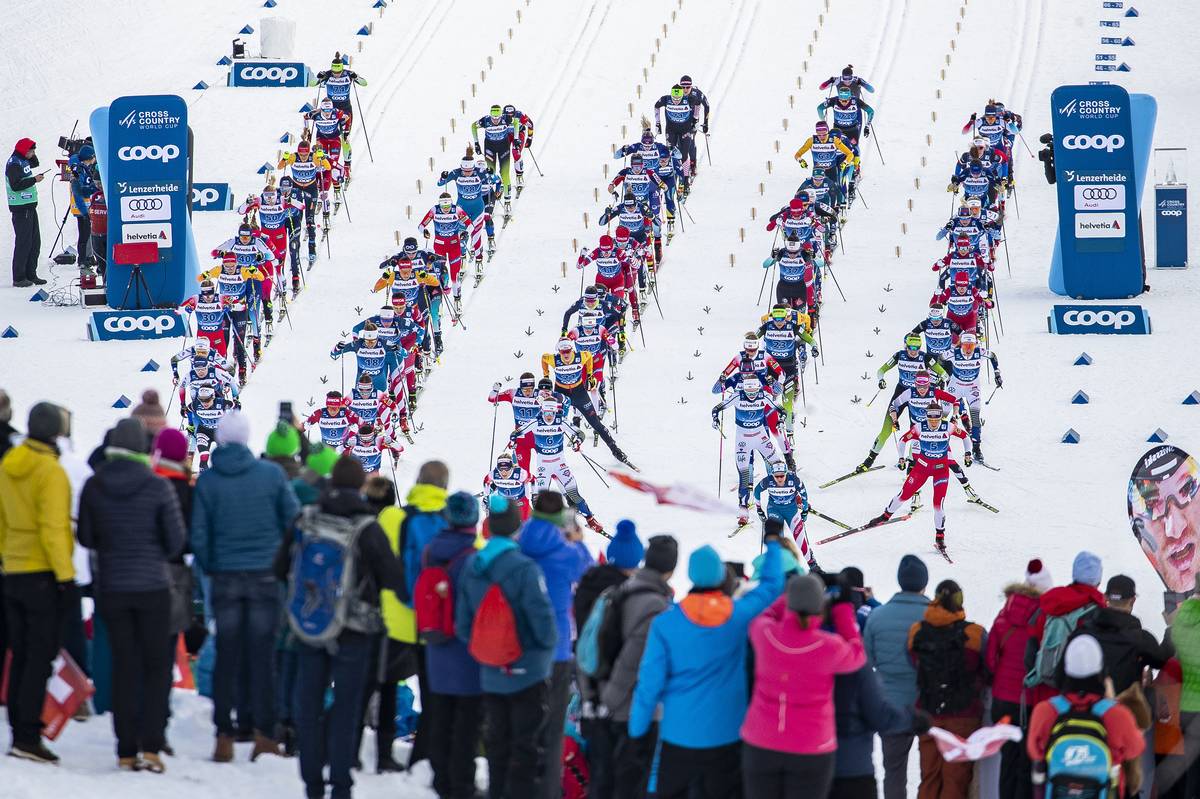
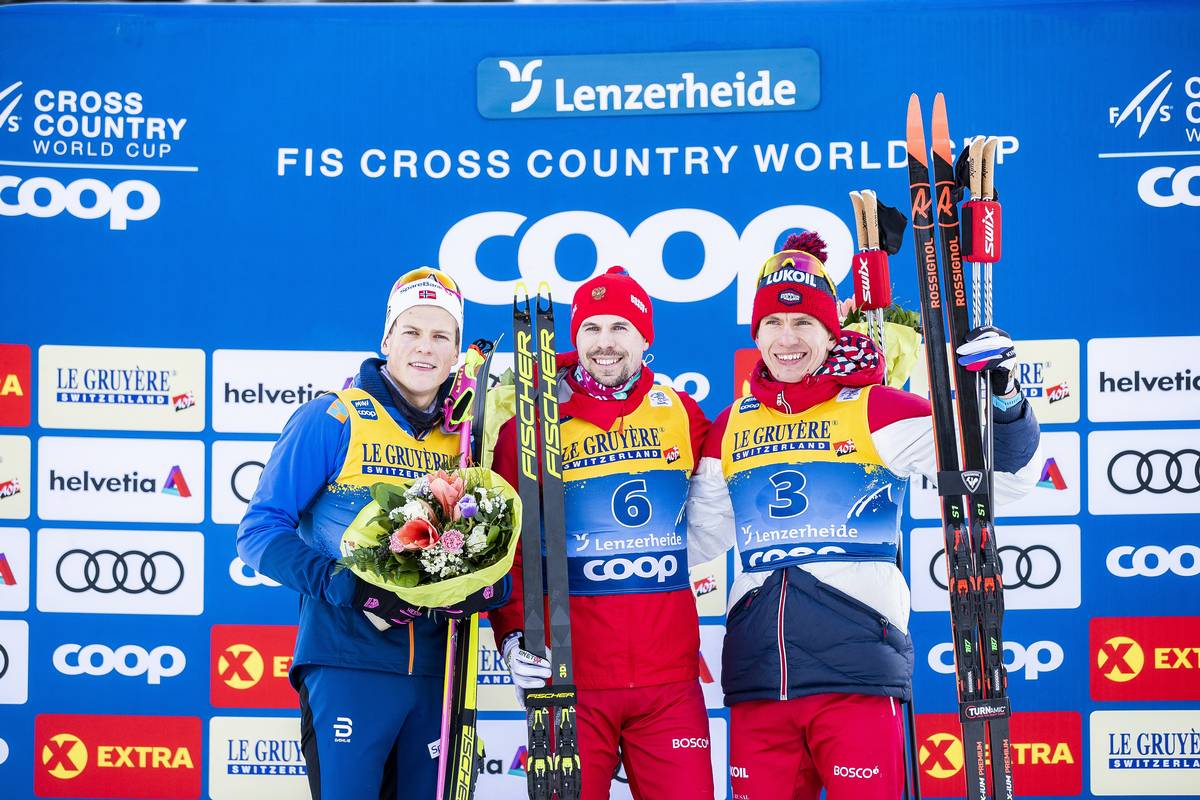
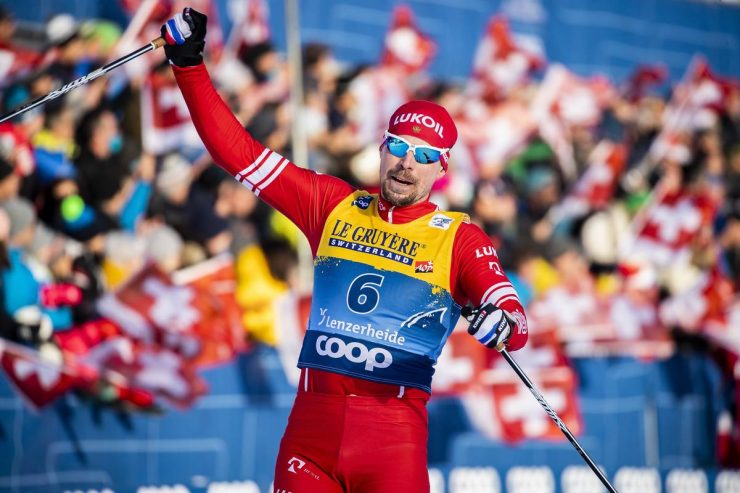
The starting corral was blocked by a wall of red before the start of the 15-kilometer mass start freestyle in Lenzerheide, Switzerland. Of the top ten ranked athletes, eight hailed from either Norway or Russia, interrupted only by Iivo Niskanen of Finland and Lucas Chanavat of France.
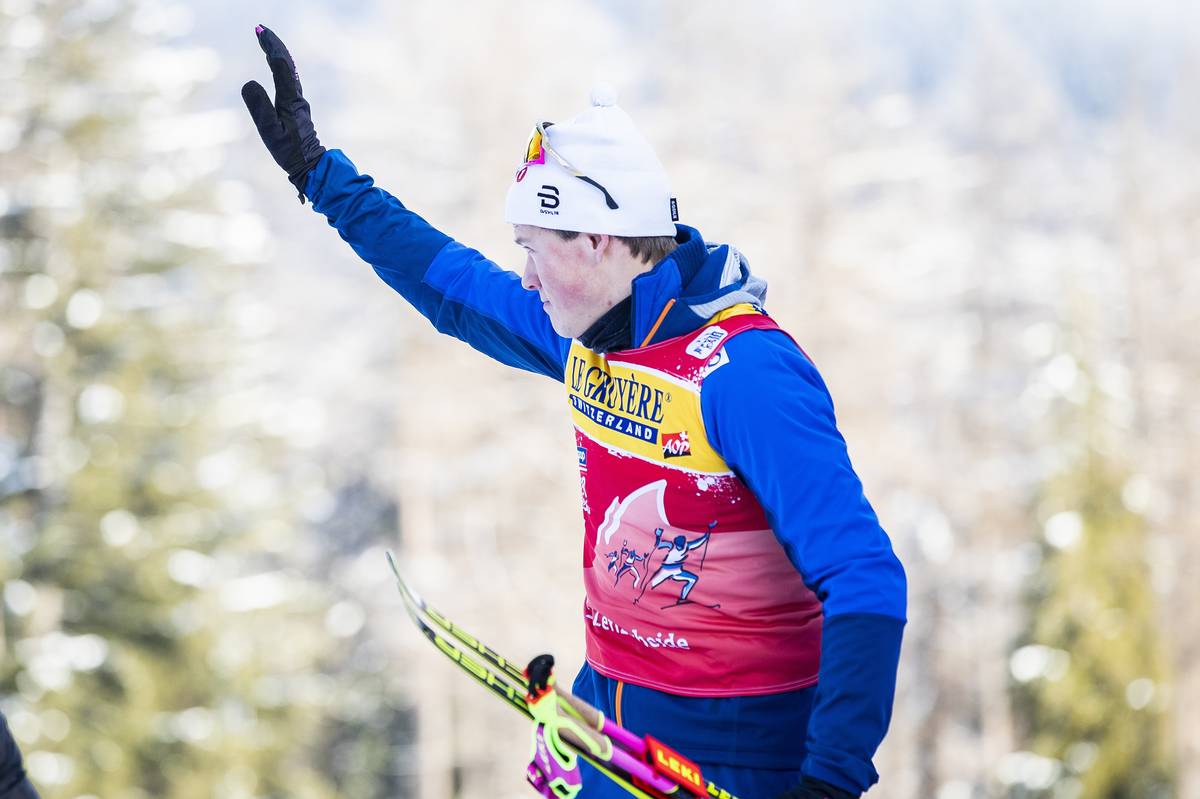
Front and center was last year’s victor Johannes Høsflot Klæbo. He became the youngest Tour de Ski Champion at 22 years of age after holding off Russia’s Sergey Ustiugov who was gaining on the Norwegian throughout the final climb up the Alpe Cermis. It was clear in the final meters that there was no showmanship or gamesmanship in this performance; the young star was fully spent as he collapsed over the line.
Now an aged and wizened 23-year-old working on his tactics and gears in distance racing, Klæbo aspires to become the second man in history to win consecutive tours. Swiss athlete Dario Cologna did this in 2011 and 2012.
Klæbo is not a lock for this achievement — today’s opening stage made that abundantly clear. He will need to hold off the likes of Sergey Ustiugov and Alexander Bolchunov (RUS), Niskanen, Emil Iversen (NOR) and an otherwise deep field all vying for the same goal.
“I will try my best and I will count [my time] after the last day,” Klæbo told FIS during a pre-race press conference.
With the starting pistol marking the start of the nascent tour, the men began soaring around the course, through snow laden pine forest in front of high mountains emerging from their wreath of snow.
For the first 10 k, the field held strong in a long train. The top men, who stemmed from the first row of the start line, regularly exchanged the lead and the top 40 were separated by 10 seconds. Though the pace began to accelerate, the top ten were only spread by three seconds with 1.5 k to go.
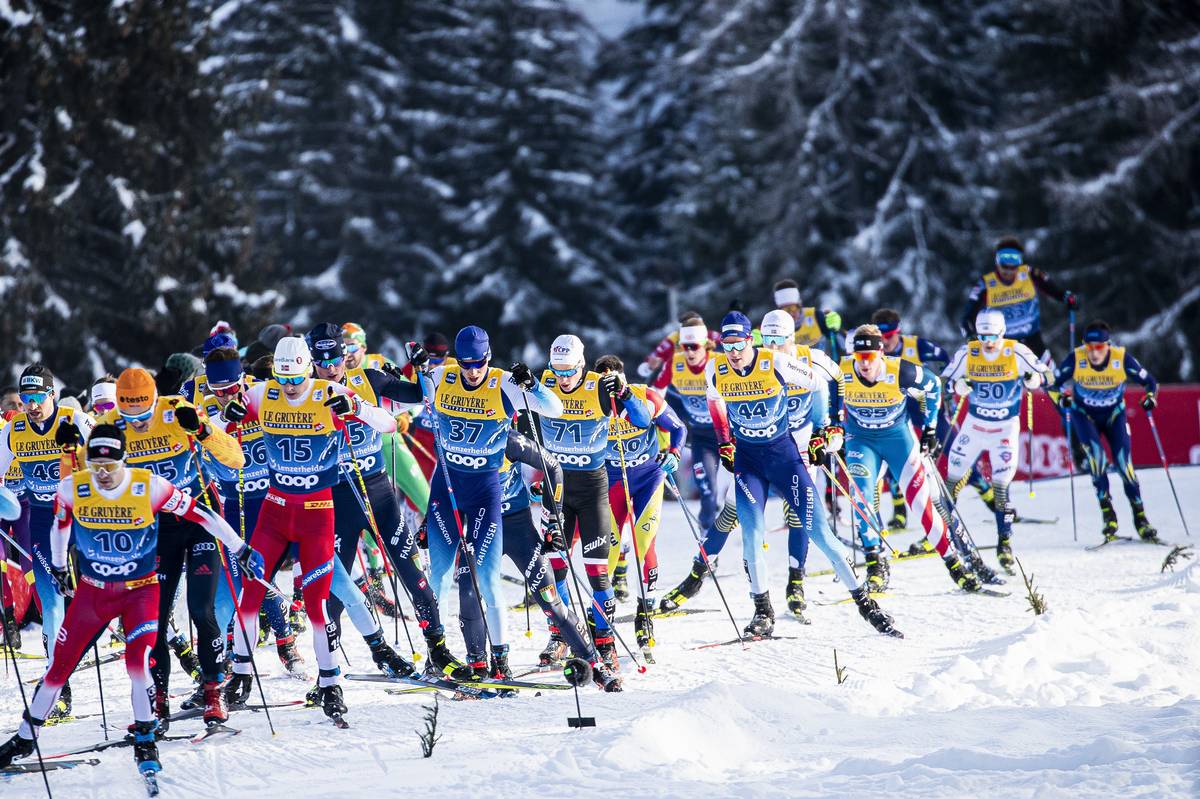
Moves and countermoves. With 1 k to go, Ustiugov took charge. He rocketed off the front to create a gap to the lead pack. His teammate Bolshunov was three seconds back, along with Cologne, Iversen, Klæbo, and their Norwegian teammates Simen Hegstad Krüger and Sjur Røthe.
Ustiugov managed to maintain his gap and flew through the final straightaway in a confident V2. In the screen behind him was a pack of men whose final standings were far less certain. Klæbo and Bolshunov were dueling tête-à-tête in a sprint to the finish, sliding their boots over the line in sync for a photo finish. It was decided that Klæbo edged out his competitor for second, though he and Bolshunov will both enter the second stage of the tour four seconds behind Ustiugov.
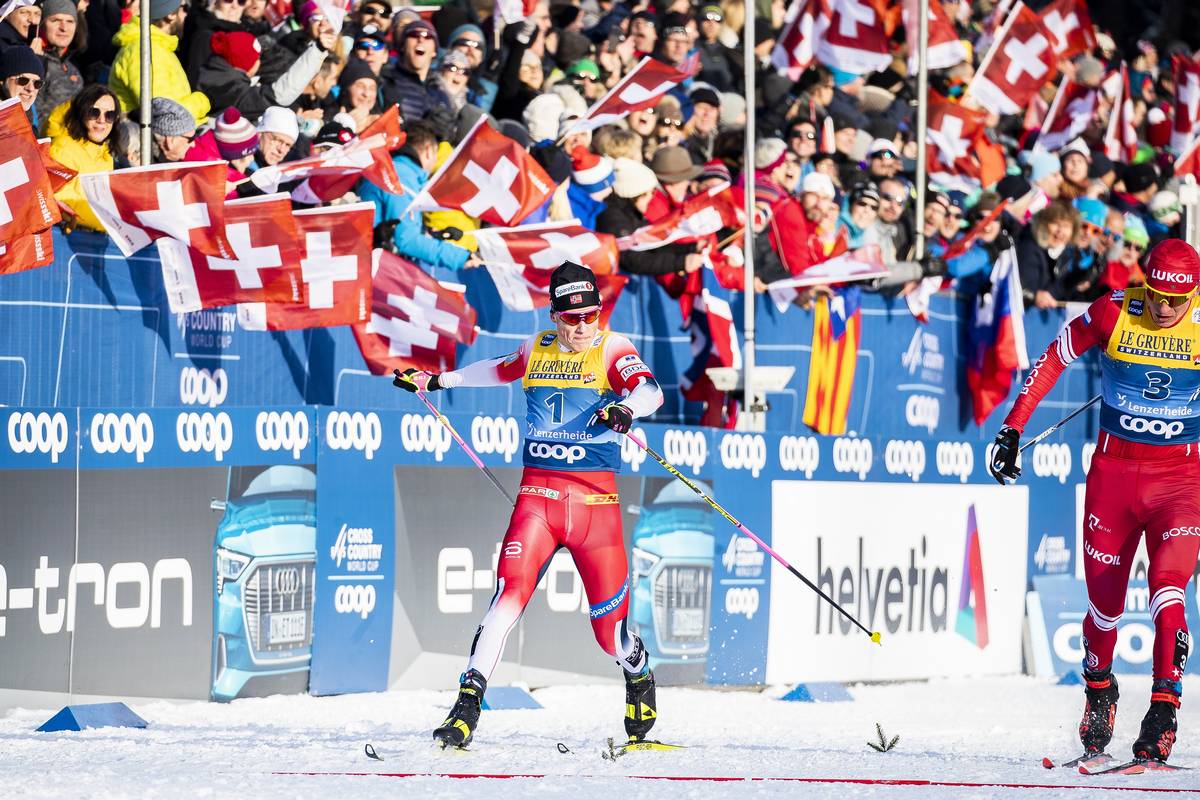
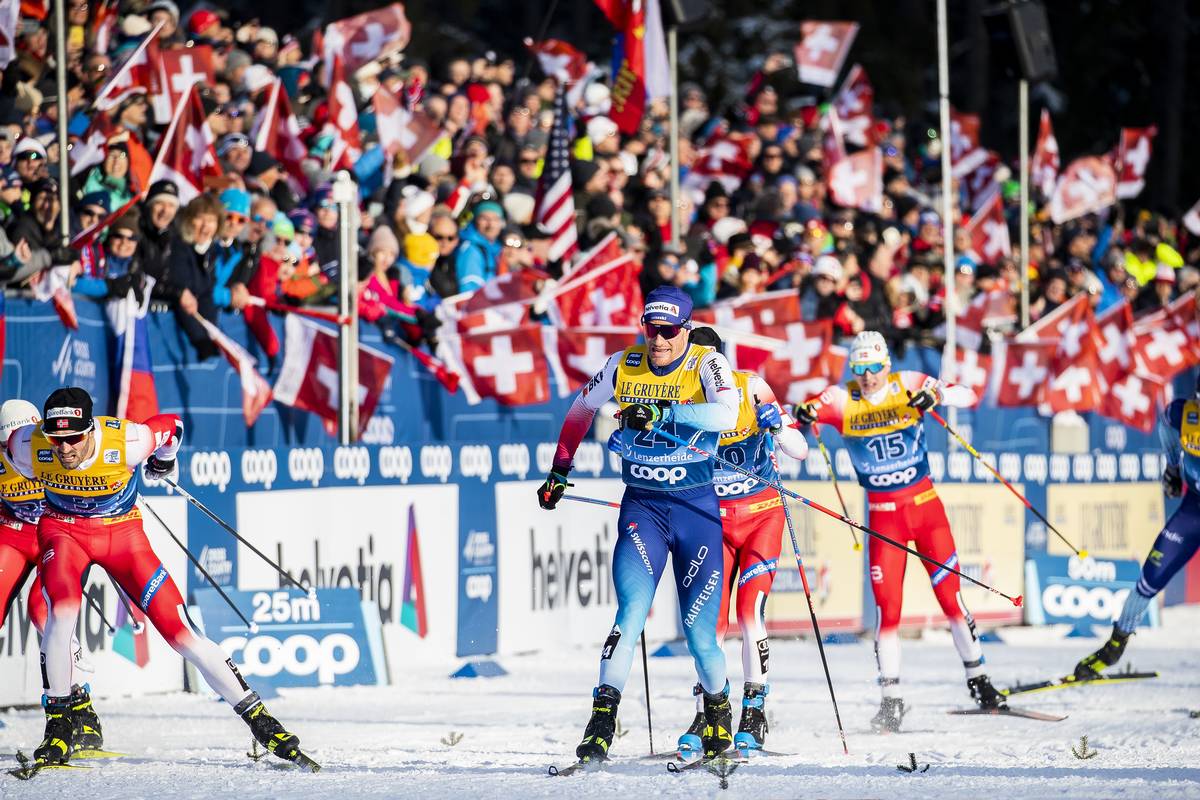
Iversen surged for 4th (+7.2) ahead of his countryman Martin Løwstrøm Nyenget (+8.6) who bested Tour de Ski veteran Cologna, Hans Christer Holund, Jan Thomas Jenssen, and Sjur Røthe in a five-way photo finish. Finishing in the order listed, the five men were separated by a margin of 0.4 seconds. Krüger rounded out the top ten one second later (+10.0).
“It was a really good performance and the shape was okay,” Ustiugov told FIS through a translator at the finish. “It was for sure a pleasure to win the first stage and I wish to show the same results on the next stages. Big thanks to Russian fans because it’s a really big pleasure to hear Russian people [cheering] here in Switzerland. It’s great.”
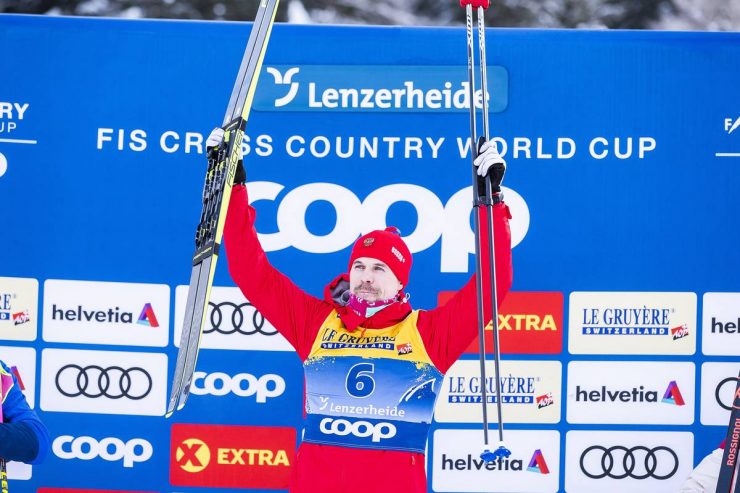
Today’s victory marks the Russian’s eighth win in a TdS stage, advancing him to the second most behind Petter Northug who has 13 wins. The winner of the 2016/2017 TdS, Ustiugov has reached the overall podium in three of his last four rounds, only missing the final TdS podium in the 2017/2018 tour where he withdrew after the 5th stage. The Russian also won the first distance stage of last year’s TdS.
Three Americans started in Lenzerheide. David Norris finished as the top ranked American in 58th (+1:11.2). Kevin Bolger finished 64th (+1:35.0), followed by fellow Logan Hanneman in 69th (+1:42.1). Simi Hamilton was slated to start, but withdrew from the TdS due to a pulled muscle in his groin.
For the first nine kilometers, Norris hovered on the cusp of the top-30. After the race, Matt Whitcomb explained the energy-expenditure challenges of racing in this position, along with the strategy of sprint specialists Bolger and Hanneman.
Post-race interview with Matt Whitcomb on men’s performance.
“This was a fun mass start – fast and flowing,” wrote Norris explained an email after the race. “For the first 12km or so I felt really comfortable in the group. I tried to ski relaxed and avoid any of the chaotic crashes and tangles that seemed to occur each lap. With about 2 km to the finish I felt great and my skis were running well, but all of the sudden I bonked incredibly hard – got tunnel vision and struggled to avoid tripping on myself. It was a tough way to finish the race, but I’m optimistic I have better days ahead in this tour.”


 The Tour de Ski (TdS) is well into its teenage years. This year’s edition, the 14th, features three locales and the following races with a few minor new twists to excite this seasonal highlight of cross-country World Cup racing.
Lenzerheide, Switzerland (stages 1-2) Dec. 28, 29
Toblach, Italy (Stages 3-4) Dec. 31, Jan. 1
Val di Fiemme, Italy (Stages 5-7) Jan. 3, 4, 5
The TdS is relatively basic when it comes to determining the winner: it’s the skier with the shortest elapsed time over seven stages. In TdS edition’s past, traditionally that was the first athlete across the finish line atop the Cermis, as that has traditionally been a pursuit start format. This year, with a mass start on the final climb, it’s possible for the stage winner and the overall TdS champion to be different skiers.
If you are drilling down on an athlete’s overall time and their corresponding overall TdS rank, here’s how time bonuses come into play. “Bonus” seconds are on offer during the sprint and mass start stages (excluding the final climb). Bonus seconds are subtracted from an athlete’s race day time, and then the overall time — a cumulative time for stages raced — is calculated.
Sprints offer time bonuses for 1-30th place.
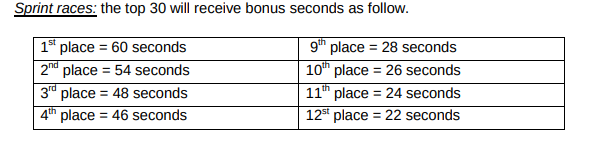

For mass starts, bonus seconds are up for grabs at intermediate points. Only the top-10 skiers through an intermediate point receive a time bonus. They receive 15, 12, 10, 8, 6, 5, 4, 3, 2 and 1 seconds, respectively.
Within the TdS, there is also a points competition. Less prestigious than the overall? Yes. But the points incentivize spicier racing as the top-three in the overall points standings receive a money prize. Below is a table detailing how and when points are acquired.
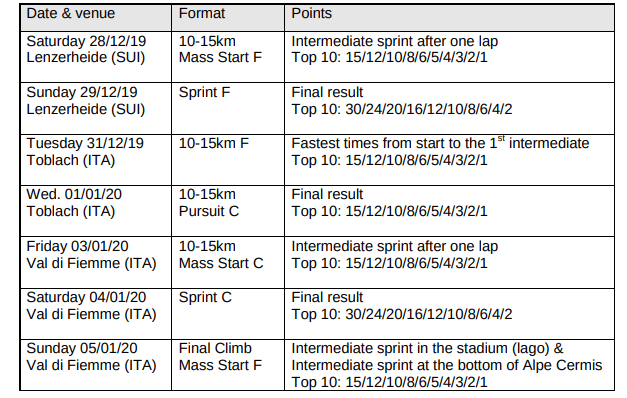
Just to be clear, these TdS points are different than World Cup points. World Cup points will be awarded after each stage and after the overall standings are finalized. World Cup points are used to determine the sprint, distance, and overall World Cup rankings.

The Tour de Ski (TdS) theater was treated to a solo-skier drama during the Stage 3 men’s 15-kilometer freestyle pursuit on Monday in Lenzerheide, Switzerland.
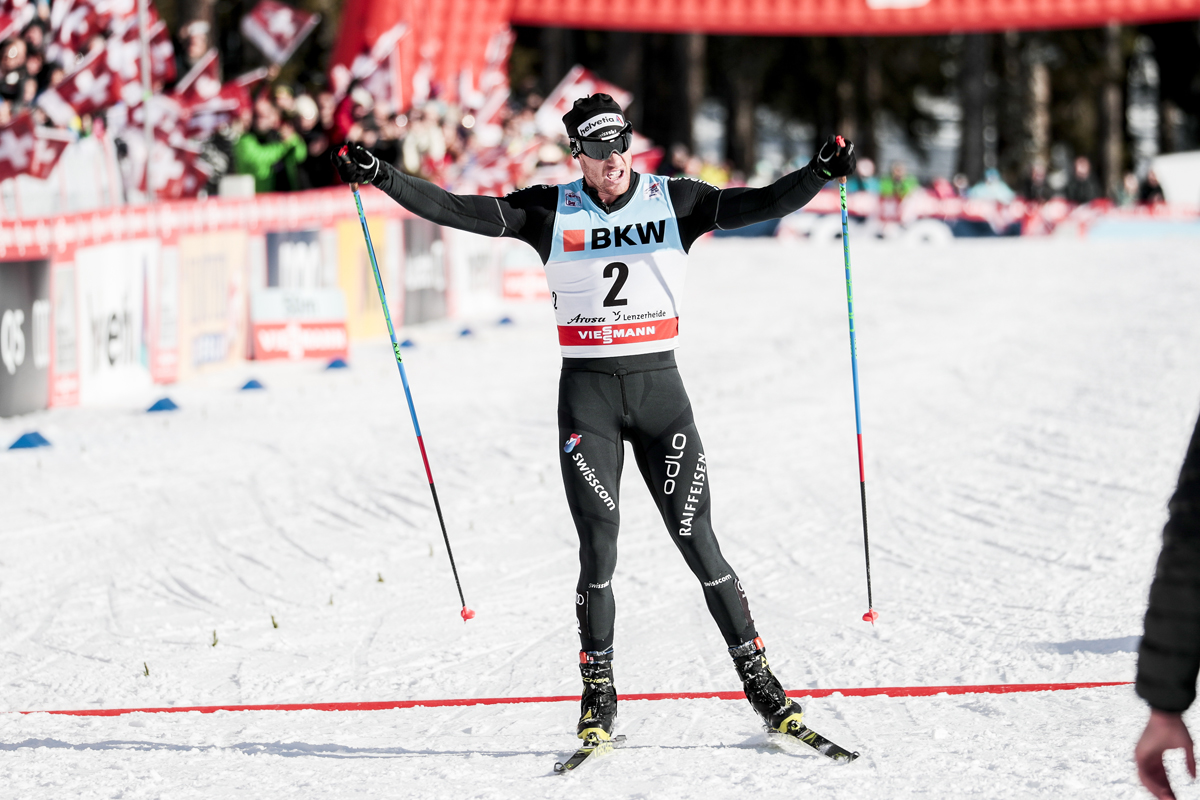
On New Year’s Day, it was a homegrown skier, Switzerland’s Dario Cologna, who stole the show winning the race in 34:56.6 minutes. Cologna is a three-time Tour de Ski winner, who until Saturday’s 15 k classic stage win, hadn’t won a World Cup race in three years.
“It was an amazing day already yesterday,” Cologna told the International Ski Federation (FIS) in a post-race interview. “Today I didn’t plan to already go away [from Ustiugov] on the second loop, but I felt very good. It was amazing with the crowd again here, with a home crowd it gives you so much energy. The last loop was very tough, Sergey came back strong, but I was just pushing and really wanted this win. It was one of these amazing days.”
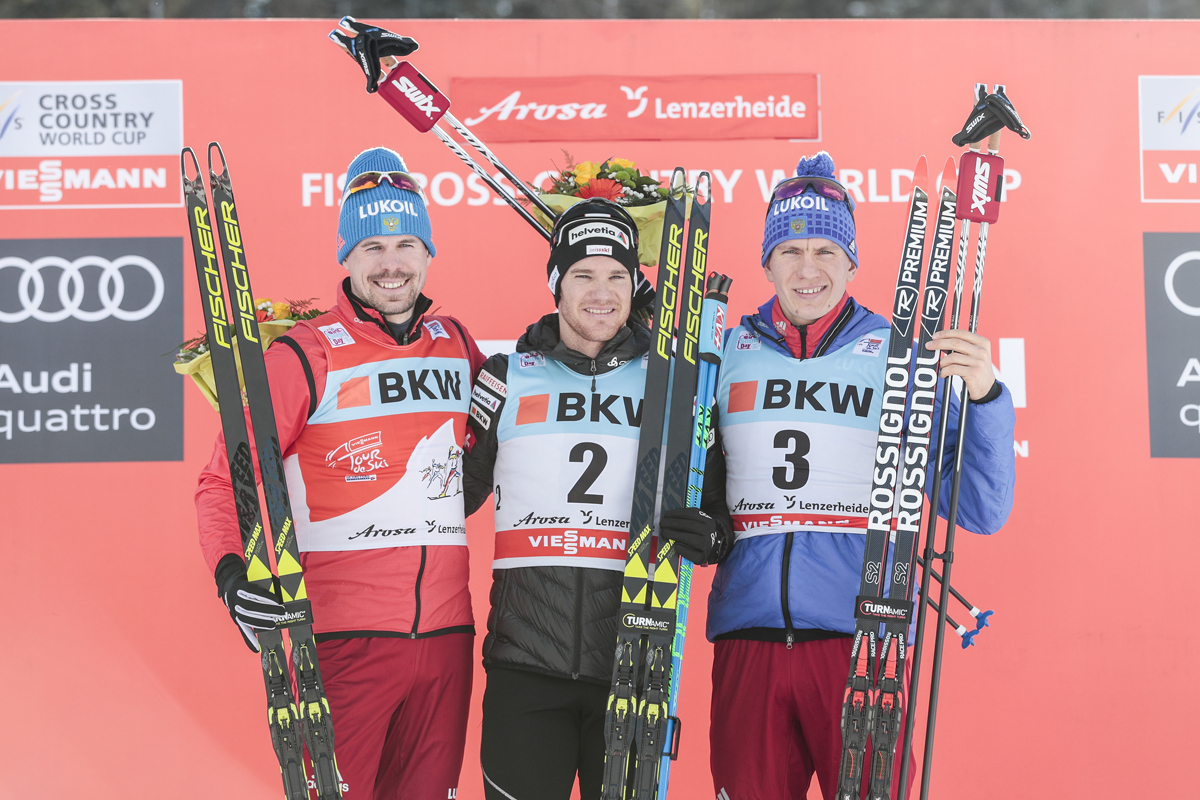
Russia took the remaining podium spots with Sergey Ustiugov in second, 17.6 seconds behind Cologna, and U23 skier Alexander Bolshunov in third (+45.5). The lone Canadian in the race, Alex Harvey, outsprinted a six-man group to finish in fourth (+46.8). Kazakhstan’s Alexey Poltoranin was fifth (+47.1), Norwegians Martin Johnsrud Sundby sixth (+48.1) and Hans Christer Holund seventh (+48.2), Russia’s Alexey Chervotkin eighth (+49.9), Finland’s Iivo Niskanen ninth (+51.5), and Sweden’s Marcus Hellner 10th (+1:21.7).
For the last day in 2017 and the first in 2018, Cologna is ringing in the new year with a vigorous resurgence. On paper before the race, Cologna’s potential top spot on the podium seemed possible, but based on recent stats, uncertain. Yes, Stage 2’s win was a statement, but a horde of would-be winners and chasers weren’t far back from Cologna at the start.
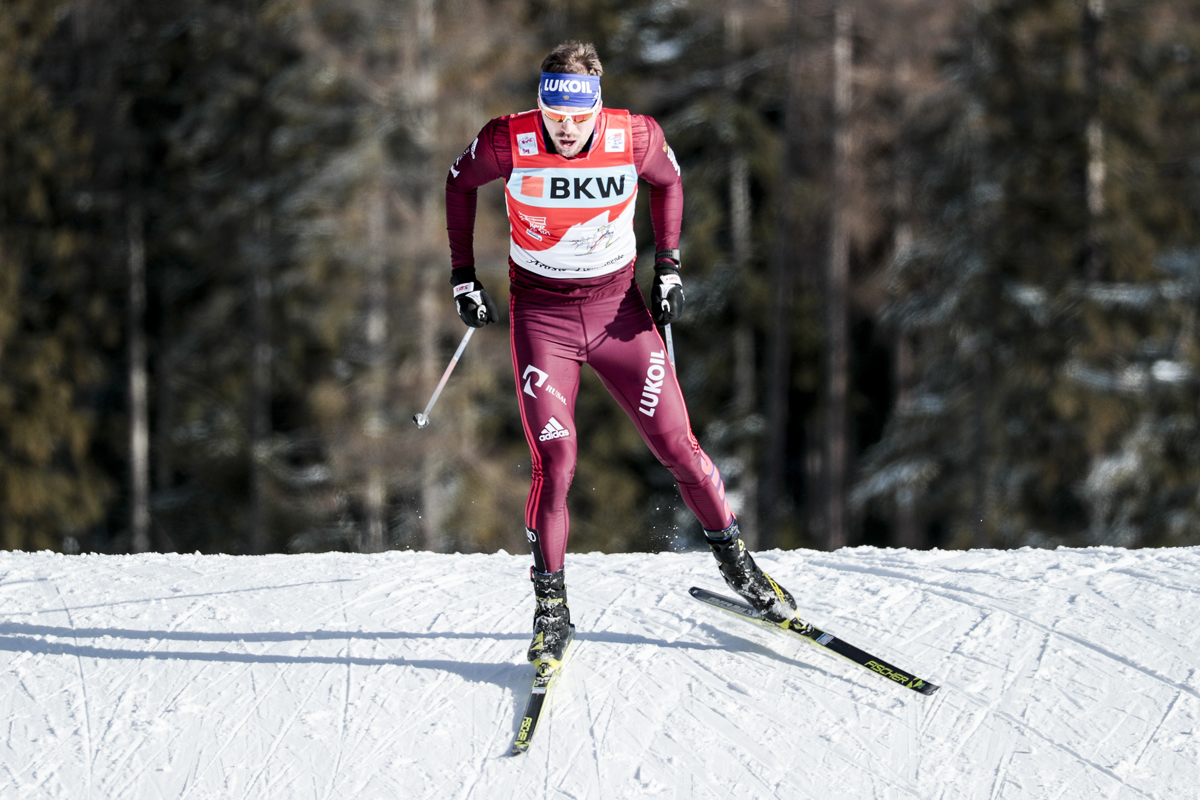
As the red-bibbed Tour leader, Ustiugov started first with only a 0.01-second wisp of time before second skier, Cologna, skied away. One-two, they were gone, with Bolshunov 12 seconds back, and the likes of Sundby and Harvey 39 seconds and 53 seconds behind, respectively.
In a quote to media after his Saturday win, Cologna noted he was hoping to pace together with Ustiugov from the start to keep the chasers at bay. The duel-with-Ustiugov tactics looked like they might play out for the duration — Ustiugov is known as a near-impossible skier to break.
At 2.7 k, it was a Cologna-Ustiugov tandem; they were separated by 0.4 seconds. But the impressions of the physical strain on 25-year-old Ustiugov were apparent — the strained facial expressions, the suddenly faltering technique. Cologna, on the other hand, looked like he had turned back the clock to his old dominating ways — the 31 year old’s skiing was big, smooth, and powerful.
At 4.7 k, Ustiugov was 7.3 seconds back. In the next k, Cologna pulled ahead. By 5.8 k, the time gap to Ustiugov had ballooned to 19.3 seconds. And with no apparent flaws evident in Cologna’s skiing, it was game over — Cologna eventually skied across the line on a blue-sky Swiss day waving to the home crowd.
“I was surprised myself. It really was my tactic to ski together exchanging in the lead, and initially that worked very well,” Cologna told Swiss broadcaster SRF, according to a translation. We regularly exchanged, and then he suddenly couldn’t quite keep up. I had thought that he started extremely fast, I barely could hang on at the beginning, but then he paid a little for that. I was surprised myself. But later he was able to recuperate and kept the gap constant. For me, it worked out great.”
The Tour takes a rest day on Tuesday and will ramp up again for a Stage 4 classic sprint in Oberstdorf, Germany, on Wednesday. After that, the distance races reign until the Tour concludes with the Stage 7 final climb in Val di Fiemme, Italy.
“It’s looking good right now,” Cologna told SRF. “Classic sprint is surely my weakest discipline in this tour. Ustiugov will try to win again and then he might be ahead. But then we have three distance races again, and I have shown that I can hold up. The starting position is better than ever. And now I’ll try to pull through.”
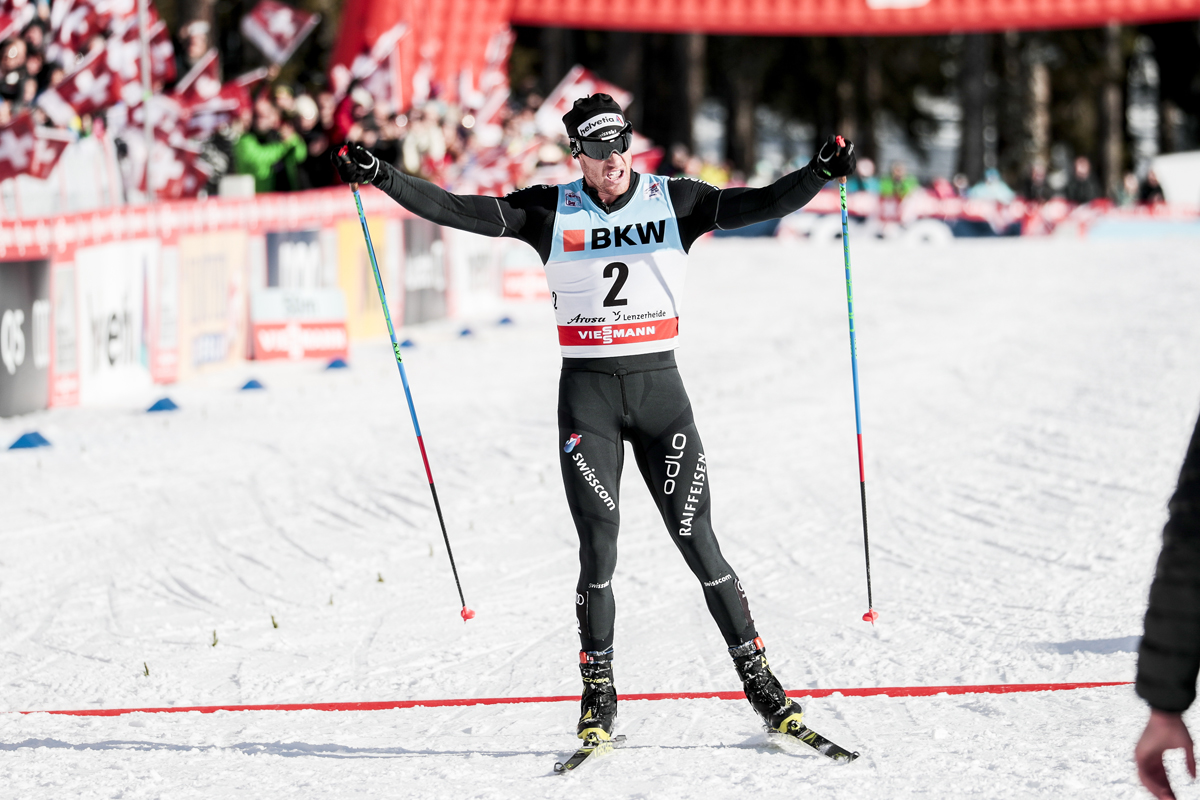
For now, Cologna asserts with understated confidence that he can crack last year’s TdS winner Ustiugov.
“I think when you are in this position that has to be the goal. It won’t be easy, the day after tomorrow you can win another minute [in bonus seconds] and that rather will go to Ustiugov than to me. So it’s still very wide open. One also knows that he can rest up very quickly. And the others are also not out of the picture yet, there are some very strong athletes behind who will try everything they have, but I will also give it my best.”
Harvey 4th, Bjornsen 22nd
As the ninth starter in a sea of podium-shot skiers, Harvey had to ski strategically from the go. Sundby, starting sixth and 14 seconds in front, was a world-class rabbit to chase. Soon after, by 2.1 k, Harvey had locked onto Sundby.
“I talked with Holund just before the race and since I was starting just ahead of him, like a second, we agreed that I would just start fast and try to reel in Chervotkin first and then do the first 2 k in the front,” Harvey explained on the phone about his race plan. “Then [Holund] said he was going to help if he felt good, so he was able to help to close the last I don’t know 6 seconds to Sundby. … I was expecting Sundby go a bit hard. I don’t know if he was playing it conservative knowing that the course bites you in the ass on the last lap with the slow snow condition, or if he felt a little tougher today, but it was a bit unexpected to be coming back on him. At like 3 k we were back on him — it was fairly fast to close 15 seconds on him.”
At 6 k, Harvey was part of a strong group of seven skiers, all of whom except Finland’s Ristomatti Hakola, were glued together until the final straight. Beyond Harvey and Hakola, the group included Holund, Poltoranin, Sundby, Niskanen, and Chervotkin.
“The group was working well, but it was kind of such slow snow on the climb that no one was feeling good enough to do really good pulls,” Harvey said. “We would do a pull, and then your legs would get so tired and people would move over but it was the same for everybody. … It was really hard actually. The snow on the climbs especially was cold and dry, and then the downhills were a bit faster, but it was really hard, especially muscularly on the legs.”
In last year’s Lahti World Championship men’s 50 k freestyle mass start, Harvey showed he’s a master of gamesmanship and crushing sprint efforts after a distance effort. Sometimes leading, sometimes drafting in the pack on Monday, Harvey in part, let his brains dictate the strategy.
“I was trying to help a bit on the sections I am the best, and I had really good skis,” Harvey said. “I was trying to, on the flatter sections where it’s more high speed, take some lead, and on some downhills push some baskets if I am following. I know on the steep terrain, the long grindy hill is maybe not my strength compared to Sundby — they were doing a lot of the work there — I was trying to push it on the flat and the more high-speed sections. … when you are in a pack with Sundby, it is kind of up to him to try to break us. I think everyone knew he was the strong man of the group, he is not the World Cup overall leader now, but he still is still one of the favorites, he is top-three overall.”
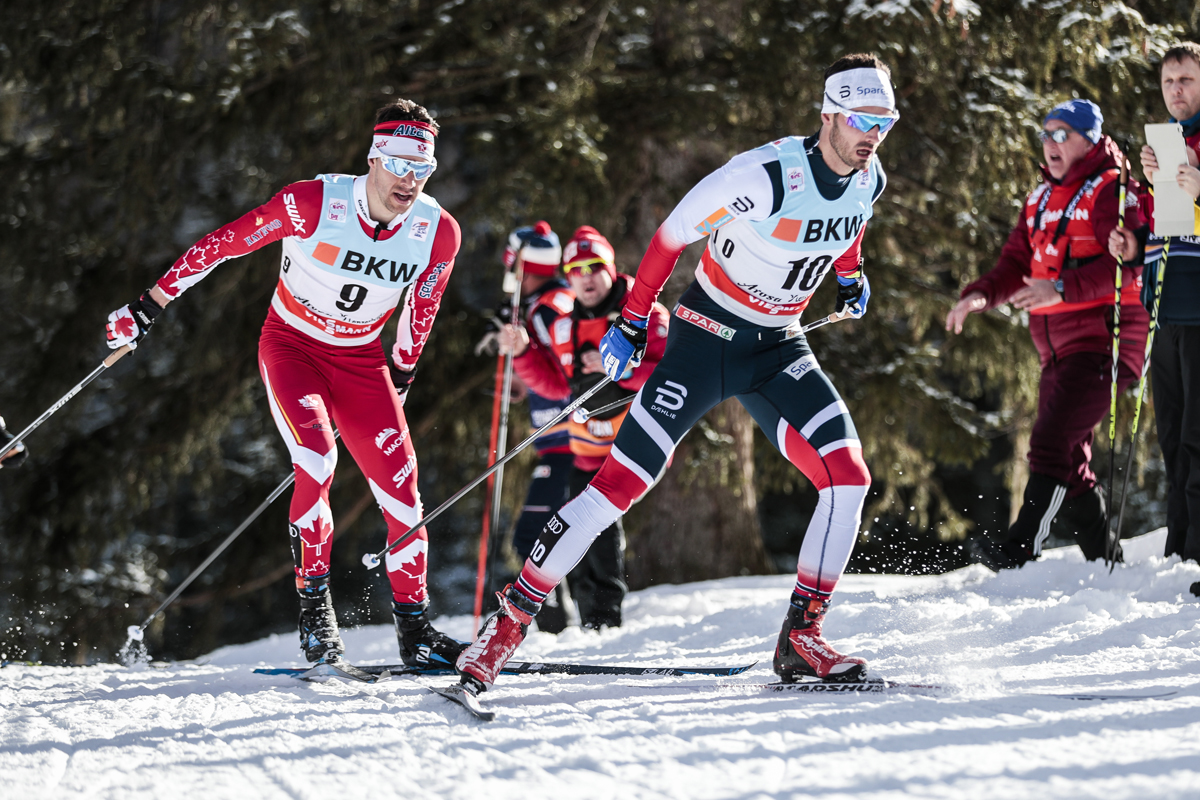
In the closing kilometer, Bolshunov’s gap on the Harvey pack was closeable. Perhaps with a few more meters and coupled with Bolshunov’s fade starting around 13 kilometers, Harvey could have snagged the last podium spot. Harvey showed he’s still a standout finisher by outsprinting his cohort and nearly catching Bolshunov as he captured fourth place — 1.3 seconds behind Bolshunov.
“I knew with the good skis, I could have a good kick at the end if I was feeling OK,” Harvey said. “So my card was more to be in good position for the last two k instead of trying to break the group.”
Harvey plans on finishing the Tour. The Quebec native explained he’s being treated well after the other Canadian who started the Tour, Devon Kershaw came down with an illness and withdrew after Stage 1.
“We still have five wax technicians; I still have seven total staff working just for me,” Harvey said. “It’s actually pretty sweet. With the small group it is really quick to turn around, we drove out of the hotel 15 minutes ago and we saw the French guys pulling in, so they hadn’t showered yet, they hadn’t packed their bags so we are probably 30 minutes in front of them. It makes it good for the recovery and more seamless for all the transitions. I am really lucky.”
With time bonuses factored in, Cologna leads the Tour standings with 1:12:46.6 hours of cumulative time. Ustiugov is in second, 22.6 seconds back, Bolshunov third (+55.5), and Harvey fourth (+1:01.8).
Harvey is joined by several skiers closely separated from fifth to ninth. Poltoranin is fifth overall (+1:02.1), Sundby sixth (+1:03.1), Holund seventh (+1:03.2), Chervotkin eighth (+1:04.9), and Niskanen ninth (+1:06.5). Hellner sits in 10th (+1:36.7).
For the U.S., Erik Bjornsen’s distance skiing remains a highlight. He kept his personal streak of skiing into the top 30 in every distance race he’s entered this season alive. Bjornsen notched a 27th in Saturday’s classic pursuit, a result that set him up for success on Sunday. He started one spot and 11 seconds behind World Cup overall distance leader, France’s Maurice Manificat.
Right away, Manificat set a too-hot pace. By 2 k, the Frenchmen had moved up to 19th place (+1:37.0), while Bjornsen bumped to 26th (+1:57.7). Manificat, in fact, skied the fastest time of day, covering the 15 k in 34:41.8 minutes.
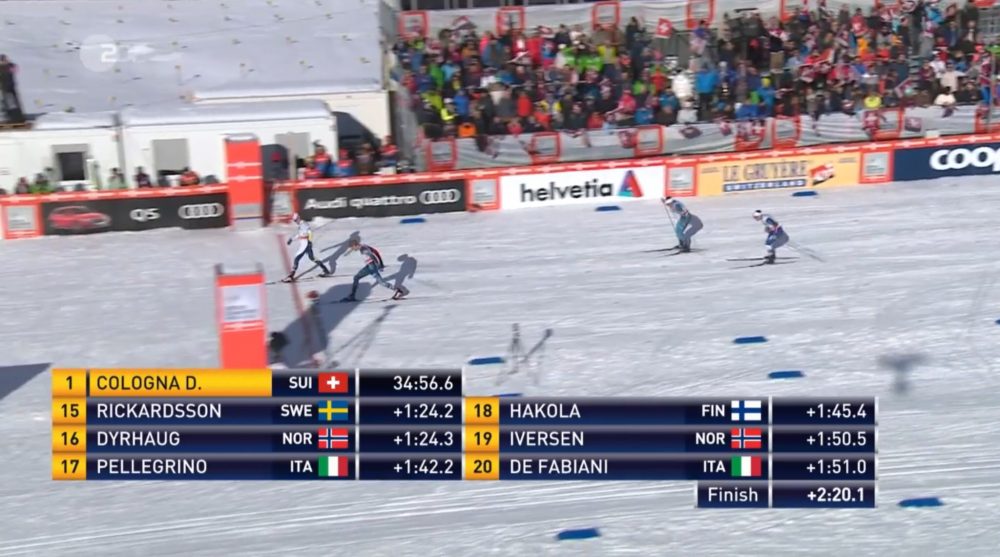
Bjornsen soon found his groove and his mates for the remaining kilometers.
At 10 k, Bjornsen skied in 28th place in a dense ski train of approximately 11 skiers. The group accounted for places 32nd through 23rd.
For another 2 k, Bjornsen seemed married to his 28th spot. But, seeking an opportunity, Bjornsen, along with Sweden’s Calle Halfvarsson and Britain’s Andrew Musgrave, moved to the front and pushed the pace of what would be a line of close-in-contact chasers.
In the final kilometers, the Bjornsen group closed nearly ten seconds on Cologna. With his constant up-tempo pressure and smart skiing, Bjornsen finished in 22nd place (+2:20.7) with the 26th-fastest time of day.
Bjornsen goes into the rest day now placed 22nd in the Tour and 2:35.7 minutes behind Tour leader Cologna.
“He’s really consistent,” U.S. Ski Team Head Coach Chris Grover said on the phone from the U.S. “He is really strong every event whether in a distance race, sprint, classic, skate. I think he wanted a little bit more out of the classic a day ago, I know it was a tough waxing day for all of those guys.”
Monday’s 22nd place was Bjornsen’s second-best result of the season — he placed 20th in the World Cup 30 k skiathlon last month in Lillehammer, Norway.
Bjornsen is now faced with deciding if he stays or goes as it relates to the Tour. Grover stated Bjornsen will contest the Stage 4 sprint in Oberstdorf, but will then determine his race plan.
“He can have some great races in Oberstdorf,” Grover noted. “He will be one that is actually trying to make the decision, that at what point coming out of Oberstdorf where it makes sense to complete the entire Tour or whether it makes sense for him to stop and race in Dresden.”
The Dresden World Cup weekend runs Jan. 13-14 and features a freestyle team sprint. That team sprint in Dresden is the only opportunity to contest that event before the Olympics. (The team sprint is also an Olympic event and Bjornsen is targeting the team sprint at the Games.)
“He is the one that is keeping his eye on that possibility,” Grover explained. “He’ll make his own determination after the next two days of racing which path he wants to go on. Both of them are great ways to go. It just depends whether he wants to really try to move up in the last few of the TdS standings or if he feels like it is more valuable for him to be in a tactical sprint experience of the team sprint.”
Also for the U.S. Ski Team on Monday, Simi Hamilton placed 48th (+4:13.9), Paddy Caldwell 68th (+6:04.4) and Andy Newell 74th (+8:15.6).
After Sunday’s racing, Caldwell, who had intended to finish the whole Tour, sits 51st in the Distance World Cup standings. For the 23-year-old Caldwell to meet the objective criteria for an Olympic spot, he’ll need to be in the top 50.
“He knew the deal going in,” Grover said of Caldwell’s decision to race the Tour. “He knew that he would have to qualify using World Cup or he would have to qualify using U.S. National Championships and racing SuperTour in the fall. For him, he felt like it was more valuable to race World Cup to gain the experience and have a lot of starts during this period. He has weighed the options and he fully realizes that he may not qualify for the Olympics if he chooses what could be the more difficult path. He really felt like the World Cup was the more valuable experience for him because he wants to be a World Cup skier in the future and he wants to be someone who is having good results on the World Cup in the future.”
Grover also recognized Caldwell’s presence at the Tour as beneficial in the long run.
“As the youngest guy on the team, he’s skiing all of these races, in all of these venues for the very first time,” Grover said. “For him, it is about building experience for the future. If you can just go and learn these venues and learn these course, learn how to manage his energy in a Tour de Ski, in a seven-stage, nine-day event, that is really critical. That will be the kind of preparation he needs for the future.”
Tuesday is a rest day for Tour skiers. Racing resumes on Wednesday in Oberstdorf with a classic sprint.
Results: Stage 3 pursuit | Time of Day | TdS standings (through Stage 3)

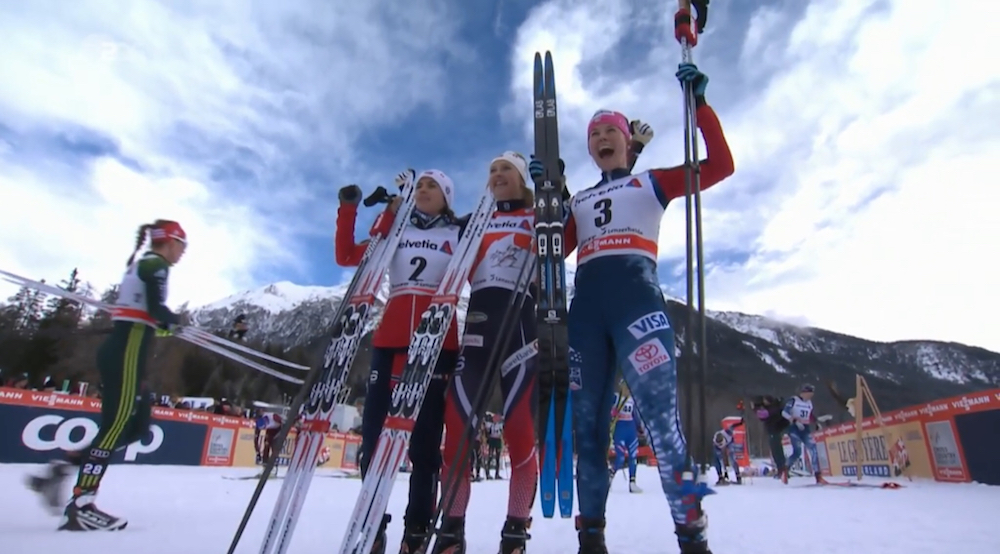
Tour de Ski Stage 3 (Lenzerheide, Switzerland): 10/15 freestyle pursuits
In the first three stages of the Tour de Ski (TdS), three different American women have reached the podium. Jessie Diggins became the latest in Monday’s New Year’s Day 10-kilometer freestyle pursuit in Lenzerheide, Switzerland.
Heading into Stage 3, the last one in Switzerland before the Tour moves to Oberstdorf, Germany, Diggins ranked third overall in the TdS. She started the pursuit in that place, 1:05 minutes after Tour leader Ingvild Flugstad Østberg of Norway. More than 30 seconds ahead of her, another Norwegian Heidi Weng headed out of the start in second place, 33 seconds after Østberg. And 10 seconds behind Diggins, her U.S. teammate Sadie Bjornsen started fourth, 1:15 out of first and just two seconds ahead of Russia’s Natalia Nepryaeva in fifth.
The women’s race then became a demonstration of strength and grit as Østberg kept herself out of reach, leading by a comfortable margin at every checkpoint and securing her second-straight win in 26:48.1 minutes. Weng could see her, and Diggins could see Weng, but neither linked up, as Weng finished second, 27.8 seconds after Østberg, and Diggins held onto third (+1:16.9) for her first podium of the season.
Behind Diggins, Finland’s Krista Pärmäkoski rose from eighth and 1:35 back at the start (starting behind her Finnish teammate Kerttu Niskanen in sixth and American Sophie Caldwell in eighth), to fourth at the finish, 1:45.9 out of first. Pärmäkoski outlasted Bjornsen by 0.3 seconds and Niskanen by 0.7 seconds at the finish to put herself in fourth overall in the Tour standings with four stages remaining, while Bjornsen placed fifth (+1:46.2) and Niskanen sixth (+1:46.6).
Norway’s Astrid Uhrenholdt Jacobsen moved up from 15th at the start to seventh at the finish (+1:59.9) with the fifth-fastest time of day. Austria’s Teresa Stadlober won the time of day, covering the course in 26:20.6 and improving from 22nd to 11th.
The U.S. had three finish in the top 20 with Caldwell placing 18th (+2:59.2) after skiing with a group of nine, led by Jacobsen and Switzerland’s Nathalie von Siebenthal, until the last of three laps. Caldwell fell off the pace around 7.5 k and skied the remainder of the lap alone to put herself 18th overall in the tour.
Liz Stephen started 37th and moved up to 31st (+4:07.7) with the 26th-fastest time of day (1:27.2 behind Stadlober). Rosie Brennan started 33rd and finished in that position (+4:17.9), and Ida Sargent finished 55th (+6:09.2) after starting 31st. Sixty-one women remain in the tour with four stages to go.
Cologna Takes Control
[UPDATED]
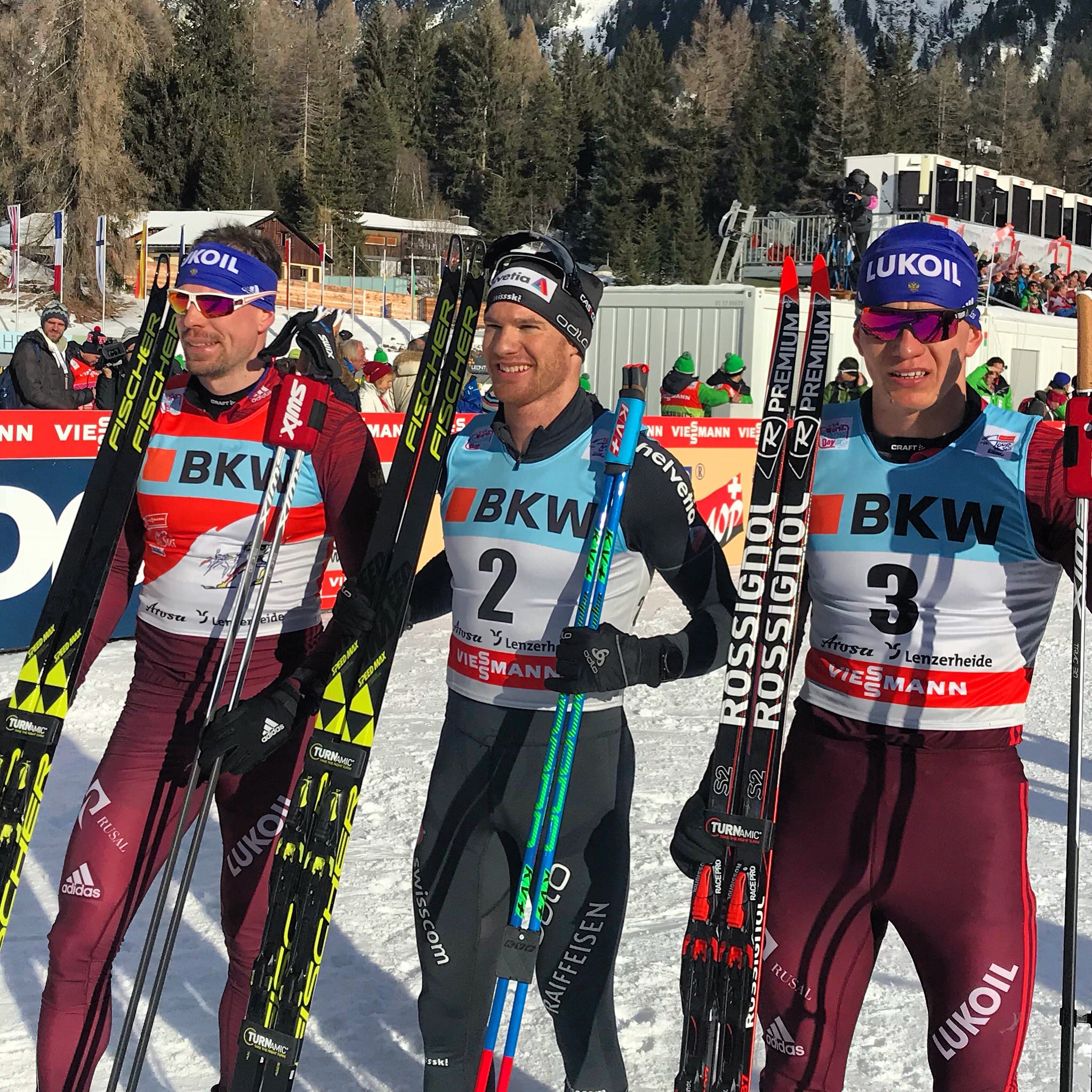
One second wasn’t enough for Russia’s Sergey Ustiugov to keep Dario Cologna at bay on the Swiss skier’s home turf, as the two started the men’s 15 k freestyle pursuit in first and second, respectively, with just 1 second between them on Monday in Lenzerheide.
Cologna took the lead after the first lap, around 3.7 k, and never relinquished as he scored his second-straight stage victory in Stage 3 of the Tour de Ski. Cologna previously won Sunday’s 15 k classic, but was second based on time back in the overall Tour standings to Ustiugov.
Between 3.7 and 4.7 k, Cologna put about six seconds into the Russian and was more than 19 seconds ahead of him by the 5.8 k checkpoint. Ustiugov skied around 22 seconds back at 10 k, still 15 seconds clear of another Russian Alexander Bolshunov in third and 43 seconds ahead of another one of his teammates Alexey Chervotkin in fourth.
Meanwhile, Canada’s Alex Harvey skied in fifth place with the six-man chase group Chervotkin was leading. Norway’s Martin Johnsrud Sundby took charge of that group by 13.3 k, while Harvey remained in fifth.
At the finish, Cologna took the win by 17.6 seconds over Ustiugov, crossing the line in 34:56.6. Ustiugov placed second and Bolshunov third (+45.5), while Harvey charged hard for the podium and placed fourth (+46.8). The Canadian beat Kazakhstan’s Alexey Poltoranin by 0.3 seconds for fourth, while Poltoranin settled for fifth (+47.1), Sundby sixth (+48.1), Norway’s Hans Christer Holund seventh (+48.2), Chervotkin eighth (+49.9), Finland’s Iivo Niskanen ninth (+51.5), and Sweden’s Marcus Hellner 10th (+1:21.7).
Cologna leads the Tour by 22.6 seconds over Ustiugov, Bolshunov is 55.5 seconds back in third, and Harvey 1:01.8 minutes back in fourth, just ahead of Poltoranin in fifth (+1:02.1), Sundby in sixth (+1:03.1) and Holund in seventh (+1:03.2).
Erik Bjornsen is up to 22nd in the Tour standings with four stages to go, 2:35.7 out of first, after placing 22nd on Monday and finishing 2:20.7 behind Cologna. The U.S. Ski Team’s leading man started 25th and skied the 26th-fastest time of day.
Can you guess who won the men’s time of day? France’s Maurice Manificat, who has a tendency to win these FIS points races, with a course time of 34:41.8. Manificat started 24th and skied up to 14th at the finish. Harvey’s time ranked fourth, 7.8 seconds slower than Manificat’s, while Holund was fifth fastest (+8.5) and Cologna sixth fastest (+13.2).
Four American men raced the third stage of the Tour, with Simi Hamilton finishing 48th (up from 54th at the start), Paddy Caldwell finishing 68th (up from 74th), and Andy Newell finishing 74th (after starting 69th). Overall, Hamilton, a sprint-focused skier who hadn’t planned on racing the whole Tour, according to U.S. head coach Chris Grover, is 48th in the Tour, 4:28.9 out of first. Caldwell is 68th (+6:19.4), and another sprinter, Newell 74th (+8:30.6) out of 77 men remaining in the TdS.
Racing resumes Wednesday in Oberstdorf with Stage 4 classic sprints.
Results:
Women’s Stage 3 pursuit | Women’s Time of Day | Women’s TdS standings (through Stage 3)
Men’s Stage 3 pursuit | Men’s Time of Day | Men’s TdS standings (through Stage 3)

Tour de Ski Stage 2 (Lenzerheide, Switzerland): 10/15 classic
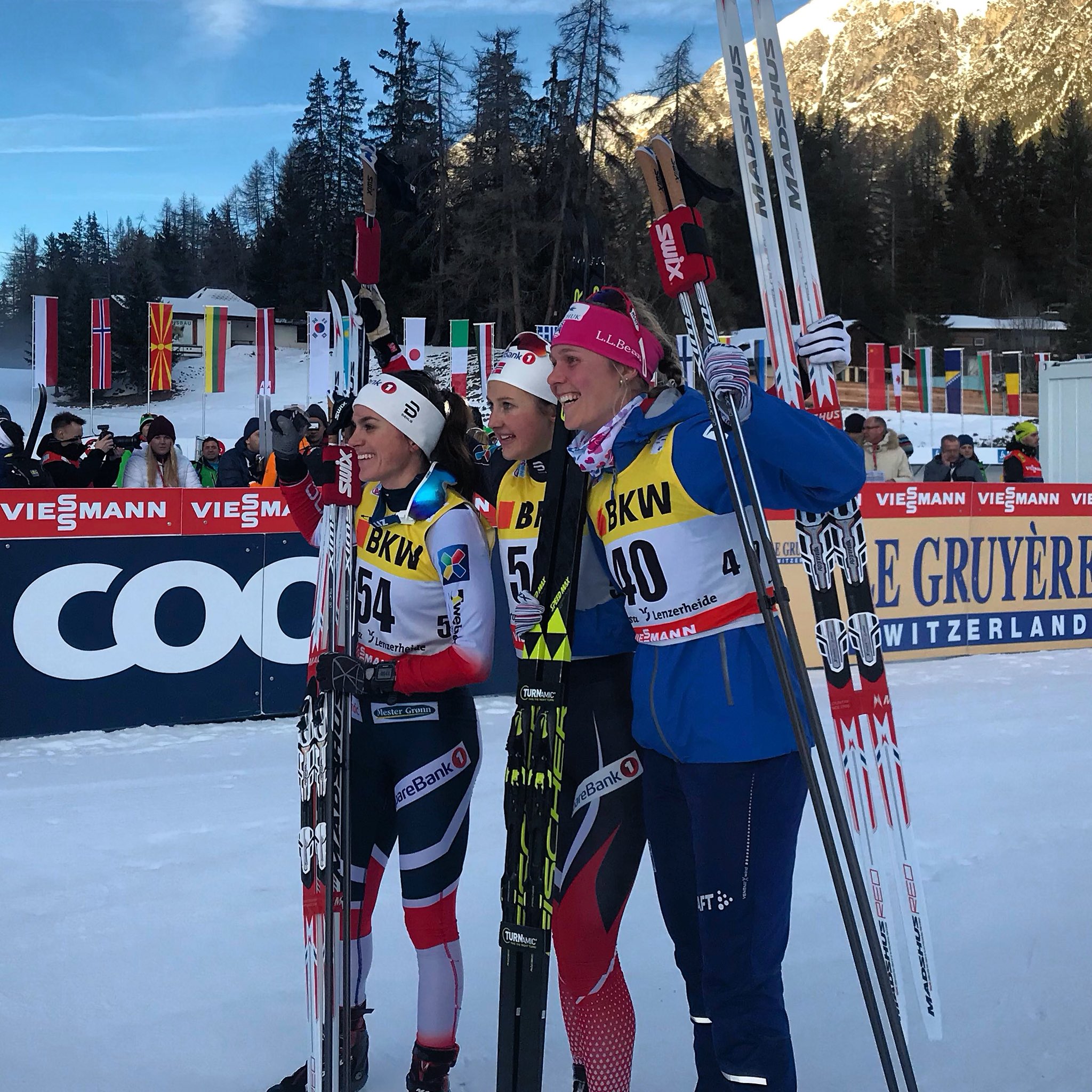
For the second-straight day of the Tour de Ski, an American landed on the podium, with Sadie Bjornsen placing third in the women’s 10-kilometer classic individual start on Sunday in Lenzerheide.
For Bjornsen, it was her third individual podium of the season and first in a race longer than 5 k. She finished behind two Norwegians, Ingvild Flugstad Østberg, who took the win in 26:59.4 minutes, and Heidi Weng, who was 25.7 seconds back in second.
Bjornsen was 42.2 seconds out of first and 6.7 seconds clear of Finland’s Kerttu Niskanen in fourth (+48.9). Sweden’s Anna Haag placed fifth (+52.6), Germany’s Nicole Fessel finished sixth (+58.2), and the second American in the top 10, Jessie Diggins in seventh (+1:04.4).
Switzerland’s Nathalie von Siebenthal placed eighth (+1:08.3) on home soil, just ahead of Germany’s Stefanie Böhler in ninth (+1:08.8), and Slovenian U23 skier Anamarija Lampič placed 10th (+1:08.9).
For Østberg, the win came two seasons after she won her very first distance World Cup race in Lenzerheide. With the win she leads the Tour standings by 32.8 seconds over Weng in second. Diggins is up to third overall (+1:04.9) and will start Monday’s 10 k freestyle pursuit accordingly, 1:05 seconds after Østberg, who will head out of the gate first.
Bjornsen is fourth overall (+1:15.4), just ahead of Russia’s Natalia Nepryaeva in fifth (+1:17.3) while Niskanen is another 15 seconds back in sixth (+1:32.0), and will start the pursuit with American Sophie Caldwell, who was second in Saturday’s Stage 1 skate sprint and ranks seventh overall (+1:32.0). Caldwell placed 21st on Sunday, 1:40.6 behind Østberg.
“It’s has been a huge goal of mine to be on the distance podium,” Bjornsen said, according to a FIS press release. “It felt really crazy out there today. At the 6.0 km I got the information I was in 2nd place. I had to ski a lot out of the track. I had to give everything I had in the last 2.5 km. I was little bit disappointed yesterday, I was hoping for more so today feels really great.”
The U.S. had five in the top 30 with Liz Stephen in 28th (+2:04.8) and Ida Sargent in 30th (+2:06.7). For Stephen, it was her first time in the points (top 30) this season. Rosie Brennan placed 38th (+2:20.5). Kikkan Randall did not start and thus withdrew from the Tour.
Dario Cologna rose to the challenge on Sunday, winning the second stage of the 2018 Tour de Ski for his first World Cup victory in three years.
The 31-year-old Swiss skier completed the men’s 15-kilometer classic individual start in 35:29.5 minutes, besting the time of Kazakhstan’s Alexey Poltoranin by 0.6 seconds to win in front of a home crowd in Lenzerheide, Switzerland.
Cologna started 62nd and sped up as the race progressed, clocking the fastest times from 6 k on. Russia’s Alexander Bolshunov started behind him in bib 68 and topped Cologna’s time at every checkpoint, skiing 7.4 seconds faster than him at 10 k. But over the final 5 k loop, Cologna prevailed and Bolshunov faded, with the Russian U23 skier finishing fourth, 14 seconds off Cologna’s winning time.
“It’s amazing, the first victory in Switzerland,” Cologna told Swiss broadcaster SRF. “I think it’s my 22nd [World Cup win], but the first one at home, which is very beautiful. And after a two-year break it really is a great satisfaction.”
Poltoranin started 27th and claimed his second podium of the season and first one of the tour, while Norway’s Martin Johnsrud Sundby scored his first podium since early December. Sundby placed third, 13.1 seconds out of first. Russia had two in the top five with another U23 skier, Alexey Chervotkin in fifth (+16.2). Norway’s Hans Christer Holund was sixth (+21.2), Finland’s Iivo Niskanen seventh (+22.9), Italy’s Francesco De Fabiani eighth (+27.2), Norway’s Didrik Tønseth ninth (+37.1), and Russia’s Sergey Ustiugov 10th (+37.1).
Canada’s Alex Harvey placed 20th (+57.9) and slipped two places in the overall standings to ninth. Russia’s Sergey Ustiugov, who won yesterday’s Stage 1 skate sprint, still leads the standings while Cologna is up to second, just 1.6 seconds back heading into Monday’s freestyle pursuit in Lenzerheide. Bolshunov is third, 12.7 seconds back, Poltoranin fourth (+22.0), Finland’s Ristomatti Hakola fifth (+27.7), Sundby sixth (+39.1), Niskanen seventh (+46.4), Chervotkin eighth (+49.8), Harvey ninth (+53.8), and Holund 19th (+54.5).
In Saturday’s 15 k classic, Erik Bjornsen led the U.S. men in 27th (+1:22.4), Simi Hamilton finished 58th (+2:41.8), Andy Newell was 71st (+3:11.5), and Paddy Caldwell 75th (+3:36.2).
Eighty-five men finished the second stage of the Tour de Ski; Canada’s second man, Devon Kershaw, did not race on Sunday and withdrew from the tour due to illness.
Results:
Women’s 10 k classic | Women’s Tour standings (through Stage 2)
Men’s 15 k classic | Tour standings (through Stage 2)
Monday start lists:
Women’s 10 k freestyle pursuit | Men’s 15 k freestyle pursuit

FIS Cross-Country Tour de Ski (Lenzerheide, Switzerland): Stage 1 freestyle sprint
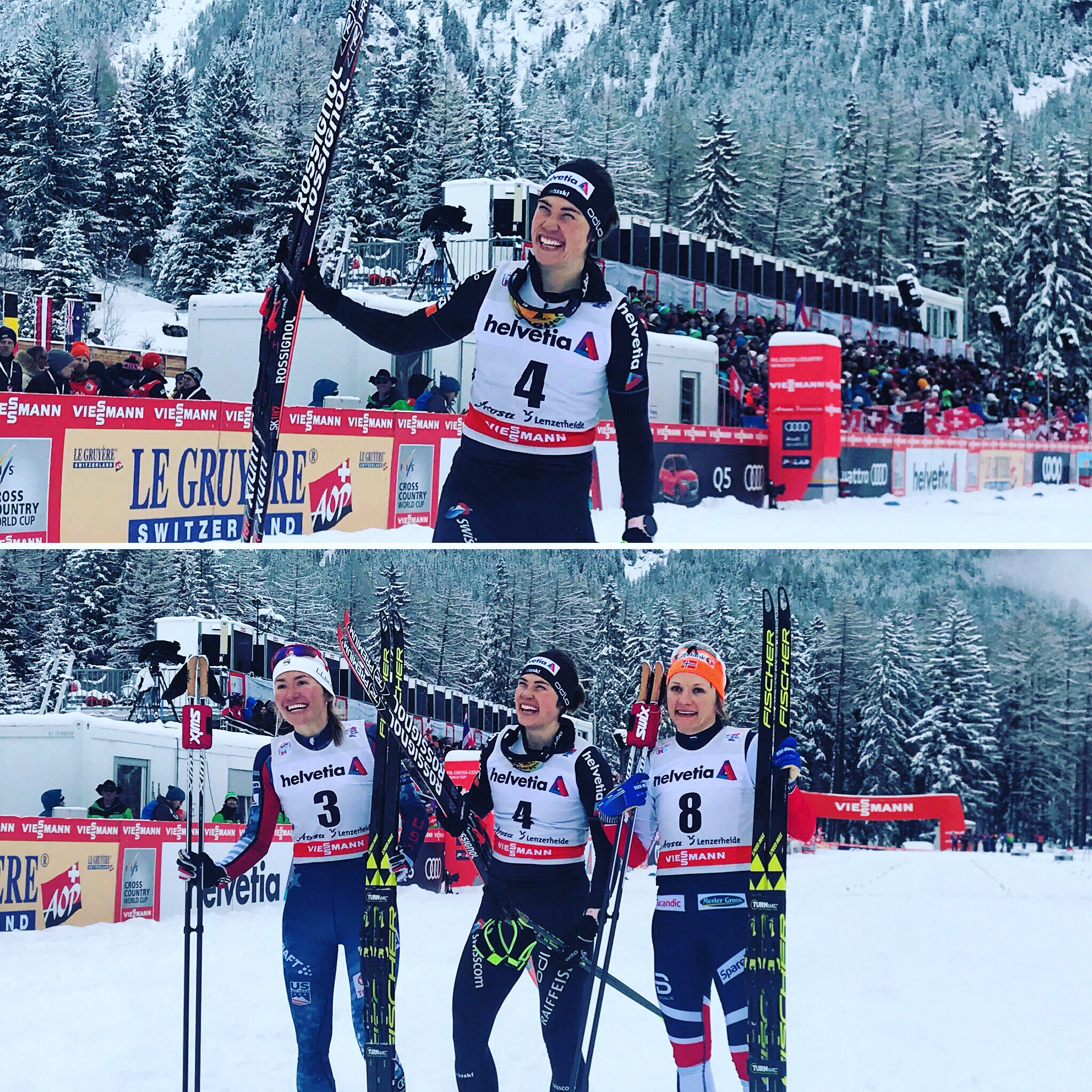
Sophie Caldwell is back on the podium. It’s been two years since the 27-year-old U.S. Ski Team sprinter won an individual World Cup race and became only the third woman in U.S. history to to do so. That was also in the Tour de Ski — but in a classic sprint.
In the time since, the U.S. women’s team has racked up several more podium accolades. Jessie Diggins has recorded three individual World Cup wins (and two World Championships medals), Sadie Bjornsen has notched three individual podiums (and a World Championships team sprint silver with Diggins) in the last year, and Kikkan Randall raced to bronze in the 2017 World Championships skate sprint.
But Saturday, the first day of the 2018 Tour de Ski, was Caldwell’s moment to stand on the second step of the podium. She started the morning by qualifying third in the women’s 1.5-kilometer freestyle sprint in Lenzerheide, Switzerland, 2.33 seconds behind Norway’s Ingvild Flugstad Østberg, who won the qualifier in 3:29.19 minutes. Diggins qualified second, 1.41 seconds off Østberg’s time.
Five out of the seven U.S. women entered in the Tour qualified in the top 30 to advance to the heats, with Bjornsen clocking the 13th fastest time (+5.20), Rosie Brennan 15th (+5.27), and Ida Sargent 30th (+8.69). Randall finished 44th and Liz Stephen 66th out of 71 in the women’s qualifier.
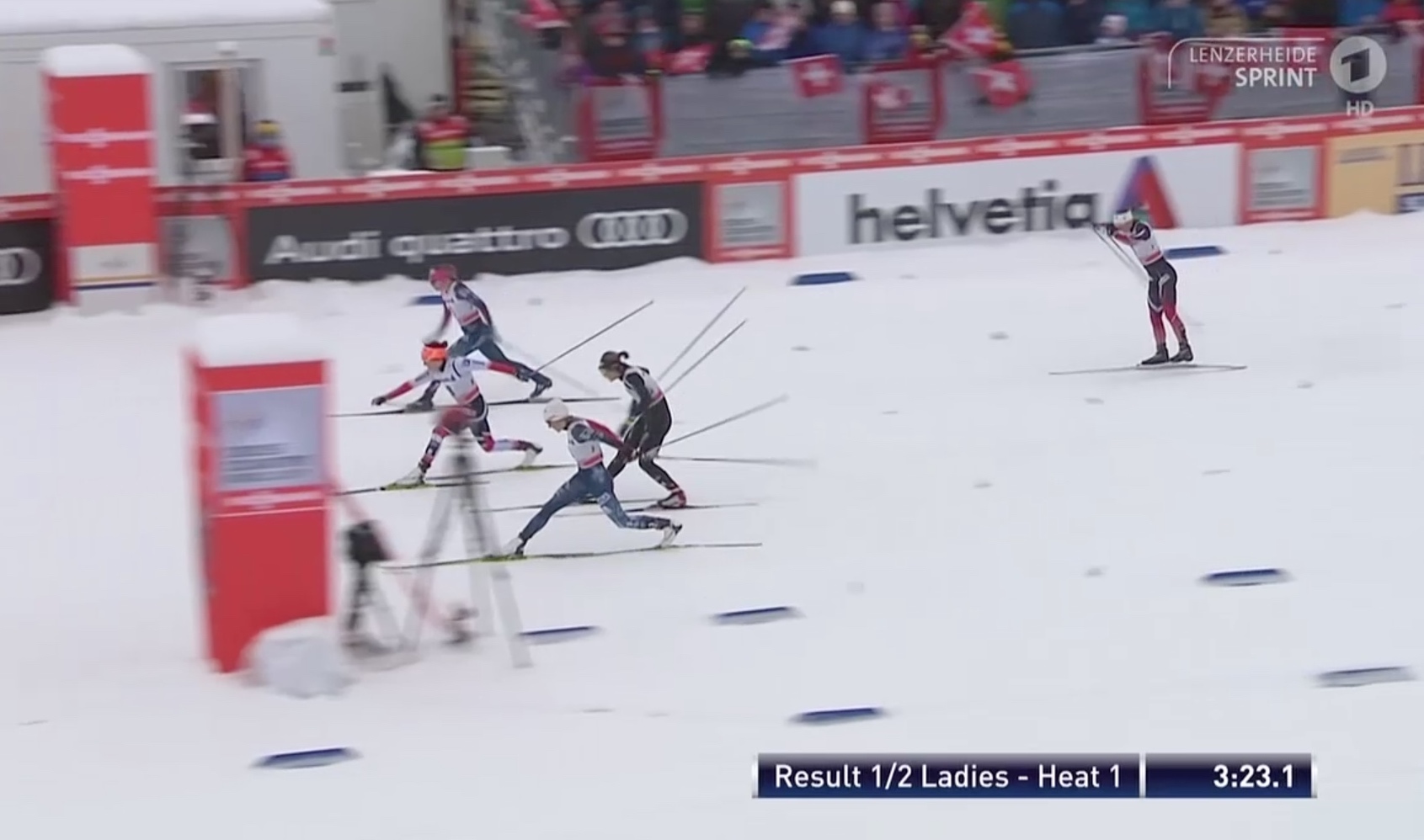
Caldwell went on to win the first quarterfinal and place second in the semifinal by just six-hundredths of a second (behind Norway’s Maiken Caspersen Falla, who won the first semifinal).
Diggins advanced in second in her quarterfinal, 0.54 seconds behind Østberg who won that heat, then raced to third in the first semifinal, just another hundredth of a second behind Diggins. The final featured the two Americans as well as local favorite, Laurien van der Graaff of Switzerland, Falla, Russia’s Natalia Nepryaeva, and Germany’s Sandra Ringwald.
In front of friends and family, Van der Graaff went on to take the win — her first and Switzerland’s first on home soil since Toni Livers won in Davos in 2007.
She won the final in 3:25.8, 1.42 seconds ahead of Caldwell in second. Falla placed third (+1.86), Nepryaeva took fourth (+3.17), and Diggins finished fifth after breaking her second pole of the day (she previously broke a pole and skied a while without one in the quarterfinal). Ringwald fell and finished sixth (+31.68).
Van der Graaff had previously qualified fourth then won her quarterfinal and advanced as a lucky loser from the first semifinal, where she placed fourth behind Falla, Caldwell and Diggins.
“It’s incredible. I mean, to win on this course, home, is just crazy,” van Der Graaff said in a post-race interview with the International Ski Federation (FIS).
Bjornsen and Brennan finished the day in 14th and 15th, respectively, after placing third in their quarterfinals. The U.S. had five in the top 20 with Sargent in 20th, after she placed fourth in her quarterfinal.
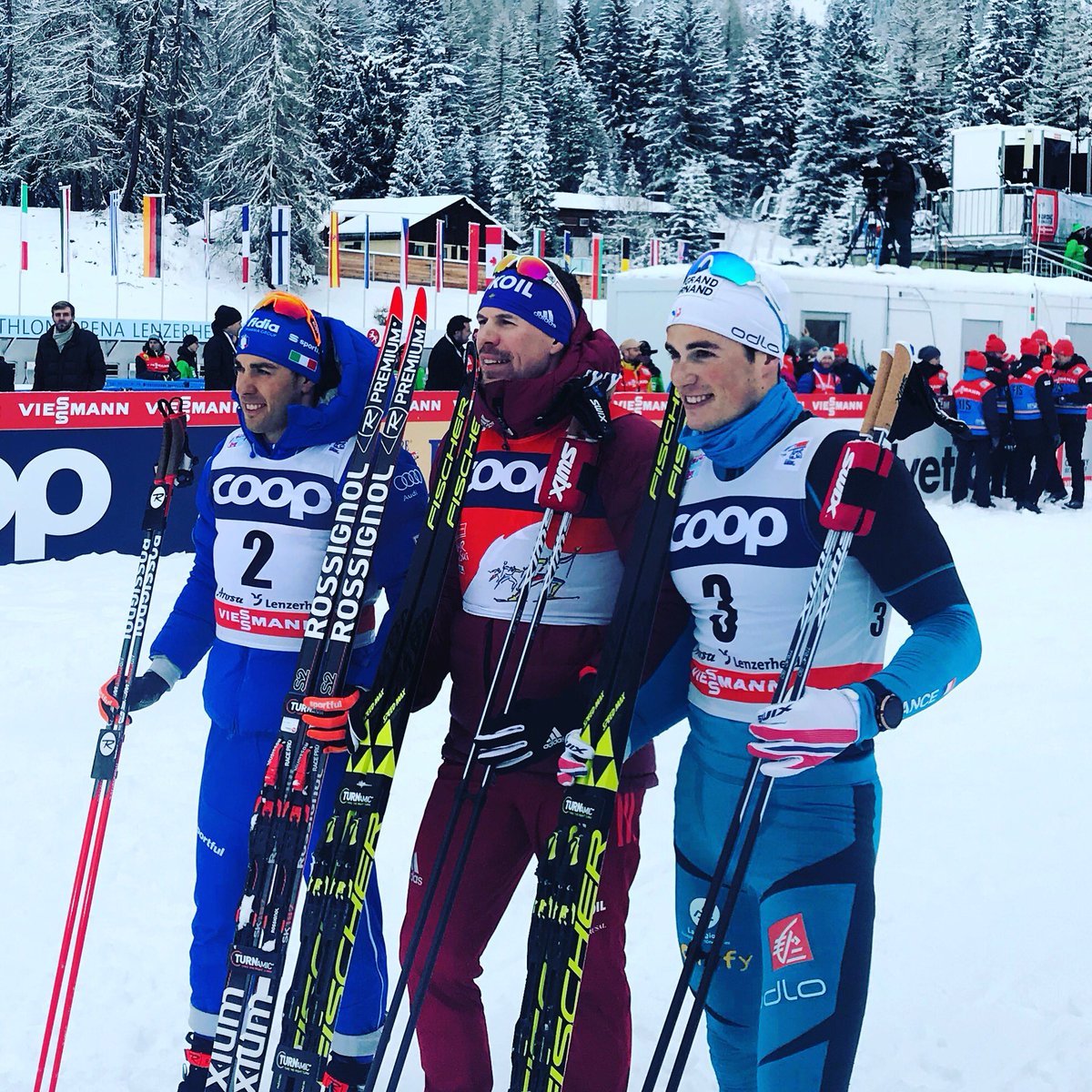
In the men’s 1.5 k freestyle sprint, the defending Tour de Ski champion, Sergey Ustiugov of Russia, won his first World Cup race of the season by 1 second over Italy’s Federico Pellegrino.
Ustiugov started off by winning the qualifier in 2:58.46, and Pellegrino qualified second, 1.08 seconds off the Russian’s time. Ustiugov then raced to second in the first quarterfinal, just 0.07 seconds behind Norway’s Finn Hågen Krogh in first. In the second quarterfinal that followed, Pellegrino took the win over Finland’s Ristomatti Hakola in second (+0.35).
The first semifinal featured a three-way photo finish for first, with Ustiugov edging Pellegrino by 0.04 seconds and Krogh by 0.06 seconds. Hakola finished fourth (+1.11) in that heat to advance to the final as well.
There, the 25-year-old Ustiugov was first across the finish line in 2:57.28. Pellegrino claimed second (+1.0), and France’s Lucas Chanavat — whom had qualified third and won both his quarterfinal and semifinal — reached the podium in third (+2.76). Hakola was fourth (+5.91), Krogh fifth (+14.39), and the second French skier in the final, Richard Jouve sixth (+21.01).
Canada’s Alex Harvey missed reaching the final by one-hundredth of a second, placing third in Chanavat’s semifinal after a photo finish for second place. While Chanavat won that heat by 0.34 seconds over his French teammate Jouve, Harvey was another 0.01 seconds back in third. Ultimately, Harvey placed seventh overall (he started the day by qualifying in 18th).
Three out of four American men qualified for the heats, with Simi Hamilton in 15th, Andy Newell in 20th and Erik Bjornsen in 27th. Hamilton finished the day in 15th as well after placing third in his quarterfinal, Newell ended up 19th after finishing fourth in his quarterfinal, and Bjornsen was 25th after taking fifth in his quarter.
Paddy Caldwell finished 74th in the qualifier for the U.S. Canada’s second man in the Tour, Devon Kershaw finished 86th out of 94.
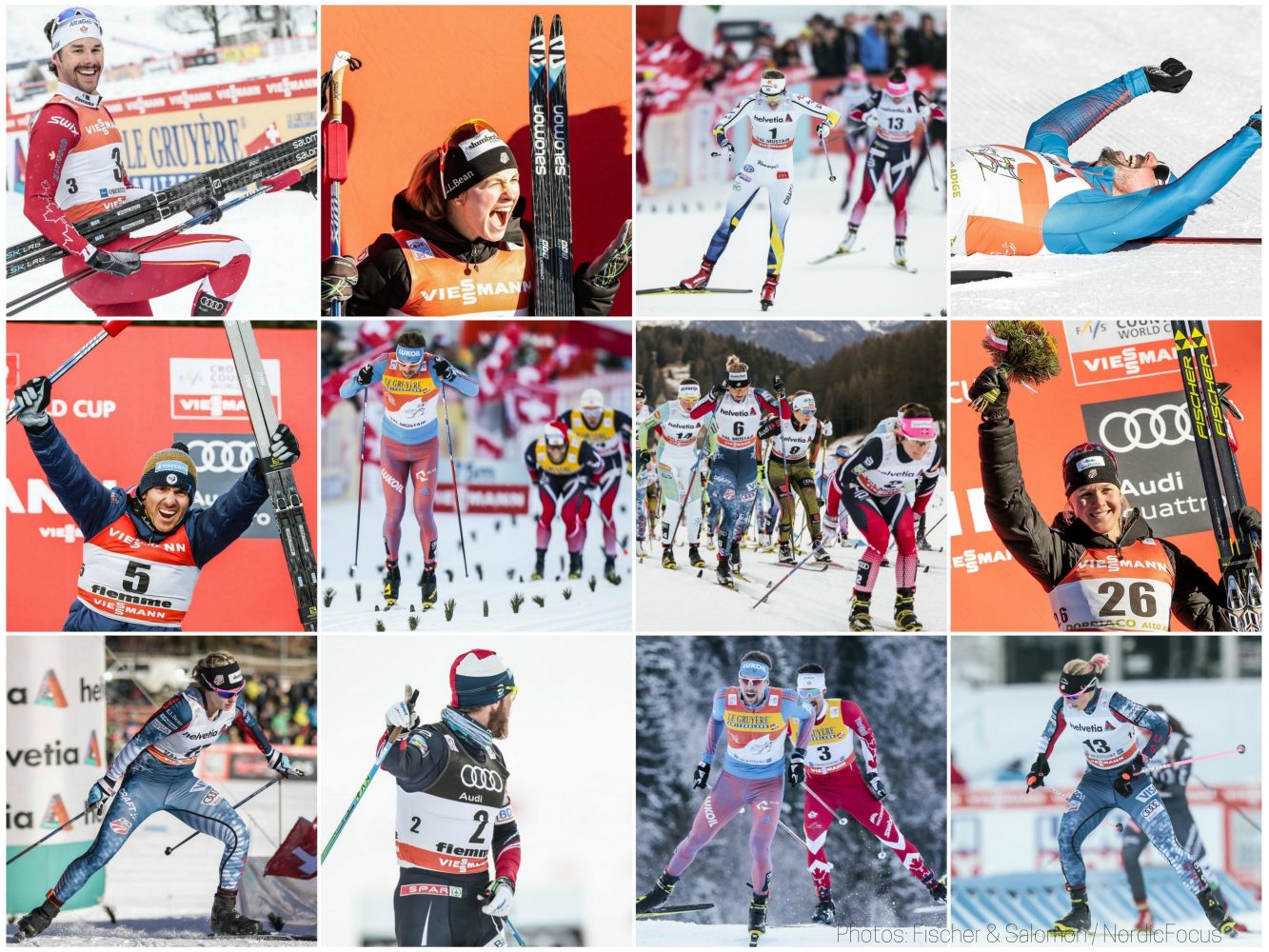
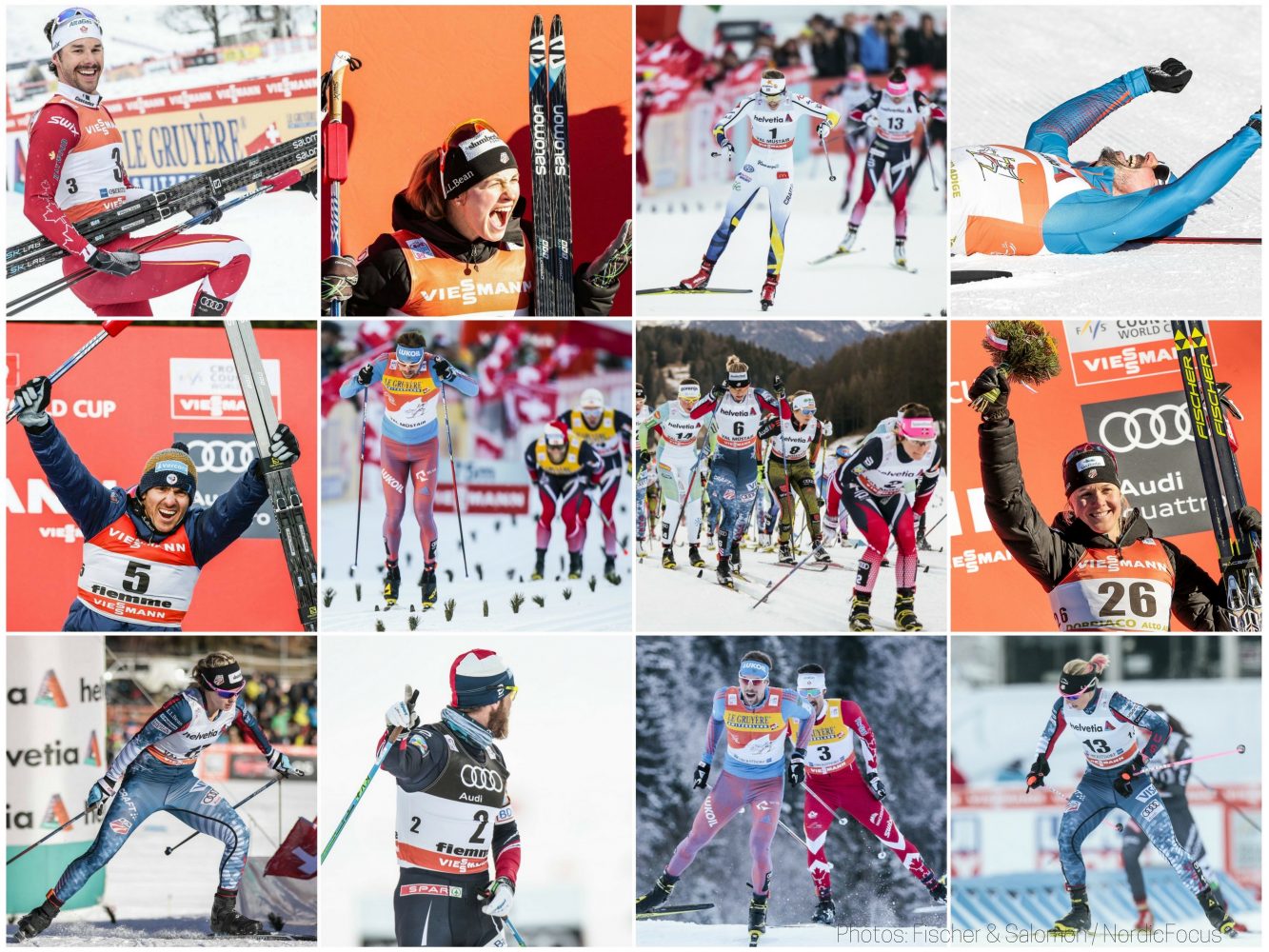
With the 2018 edition of the multi-stage Tour de Ski beginning on Saturday, Dec. 30, and lasting through Sunday, Jan. 7, here’s a glance at the race schedule and several nations’ lineups. If you’re in the U.S. and have access to the Olympic Channel, all of the events are going to be streamed live online, according to a U.S. Ski & Snowboard press release.
Stay tuned for FasterSkier’s full coverage of the event, with quick rundowns, full reports and live tweeting of the races.
2018 TOUR DE SKI SCHEDULE (all times EST)
(Note: All events will be available online. “Streaming only” denotes that an event will not broadcast on TV.)
LENZERHEIDE, Switzerland
Saturday, December 30
Sunday, December 31
Monday, January 1
OBERSTDORF, Germany
Wednesday, January 3
Thursday, January 4
VAL DI FIEMME, Italy
Saturday, January 6
Sunday, January 7
ROSTERS (from FIS and FS reporting)
Stage 1 start lists: Women | Men
Austria
Women
Men
Finland
Women
Men
Canada
Men
France
Men
Women
Italy
Men
Women
Norway
Women
Men
Russia
Men
Women
Sweden
Women
Men
Switzerland
Men
Women
USA
Women
Men

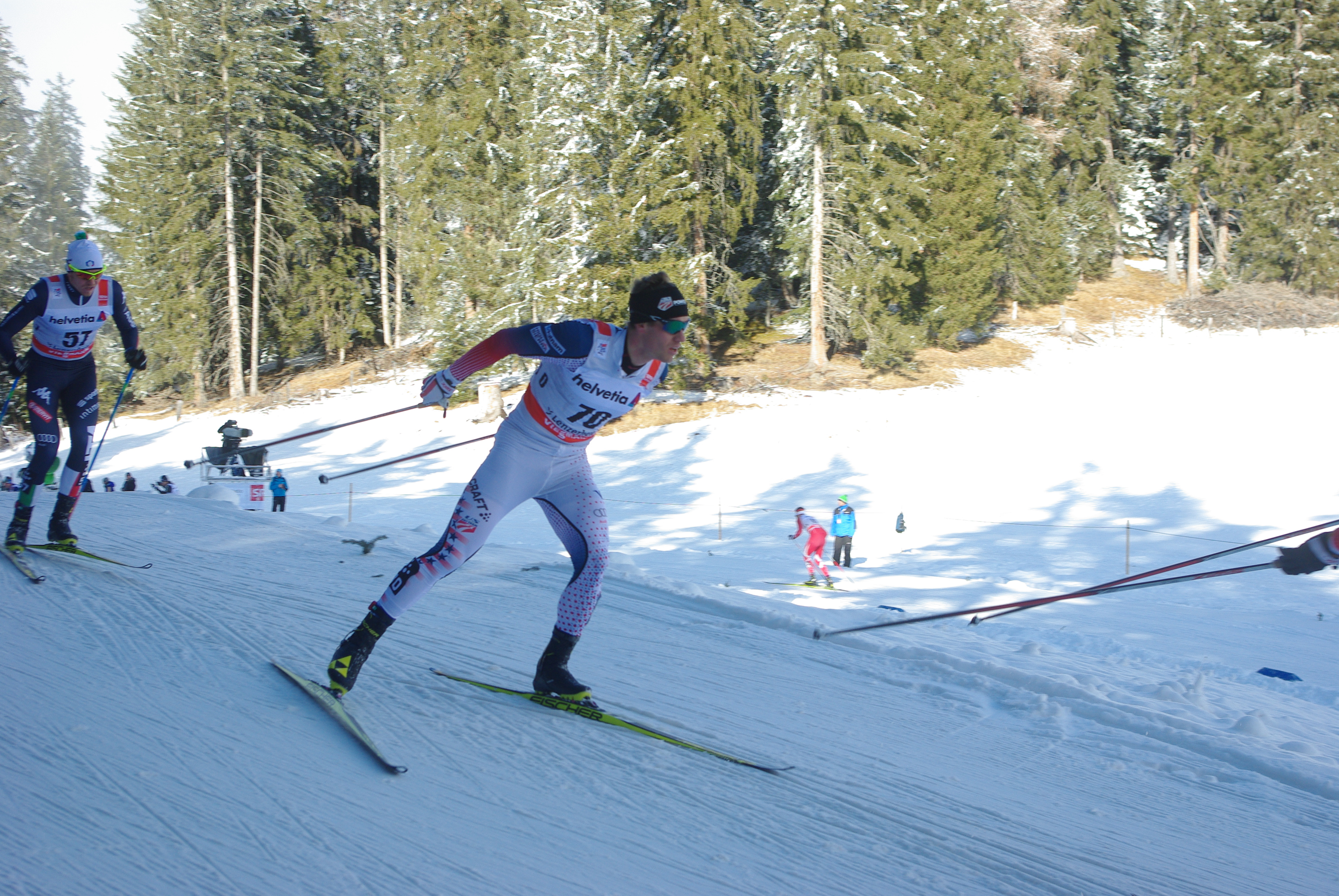
LENZERHEIDE, Switzerland—With two tough distance races out of the way, the U.S. sprint team is looking forward to a competition they haven’t seen since the very first race of the World Cup season: a classic sprint.
The sprinters did not go into the Tour de Ski planning to finish it, but skipping a stage means dropping out of the Tour altogether. So to get to Tuesday’s sprint in Oberstdorf, Germany, they had to compete in the 15/30 k classic mass starts here on Saturday, then the 5/10 k skate pursuits on Sunday.
Not that they saw it as too much of a problem to do some distance racing.
“I love racing right now,” Ida Sargent said after the pursuit. “The great thing about the Tour de Ski is that it’s racing every day. If you have a day that’s not so good, you get to do it again the next day – not waiting a week or more, like normal. After the 15 k yesterday I went to bed excited to race again.”
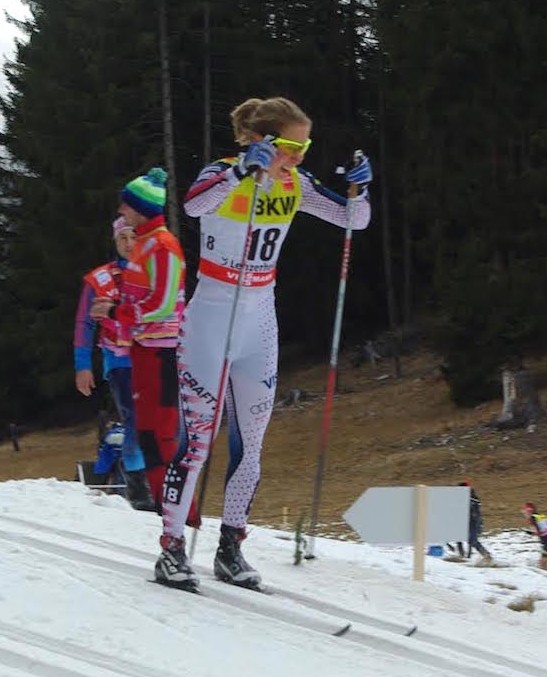
Sophie Caldwell had the best result in the opening sprint of the Tour de Ski, a skate competition where she finished fourth. Teammates Sargent, Andy Newell, and Simi Hamilton also qualified for the quarterfinals, while Sadie Bjornsen and Jessie Diggins went to the semifinals.
Newell, who finished 19th in the skate sprint, has already been visualizing Oberstdorf, where he has made three sprint semifinals in the past, including a fourth-place World Cup finish in 2006.
“I’ve been looking forward to that race for a while,” Newell said on Sunday. “I really like that course and I know if I am feeling at the top of my game, I can be on the podium in Oberstdorf. I’m just happy to have had made it to that race, you know? I made it through today and my body actually felt better today than yesterday, so I’m happy with that. I’m tired but not blown out at all.”
Hamilton agreed that he was looking forward to the competition, saying that Oberstdorf is “a short course which definitely suits me well.”
With a number of sprinters already dropping out of the Tour de Ski after the first stage, there’s also some opportunity for a top finish.
“Everyone’s going to be tired and that’s kind of funny on sprint day, because you now try to feel so quick and explosive and fast,” Newell laughed.
But at the same time, some distance skiers sprint better and better as Tours go on, so a field full of tired sprinters doesn’t make the win any easier.
“I definitely think there will be some tired people there, but people look at it as more opportunity to score some bonus [seconds],” Hamilton said. “You have to be 100% engaged and you can’t really go into the heats and take for granted that all the sprinters are a little tired. You still have to treat it like every other sprint World Cup where you have to lay down as fast as you can in the qualifier and then ski smart in the heats. Should be fun.”
Despite fatigue, the team will be training “like usual” on Monday in preparation for the Oberstdorf competition.
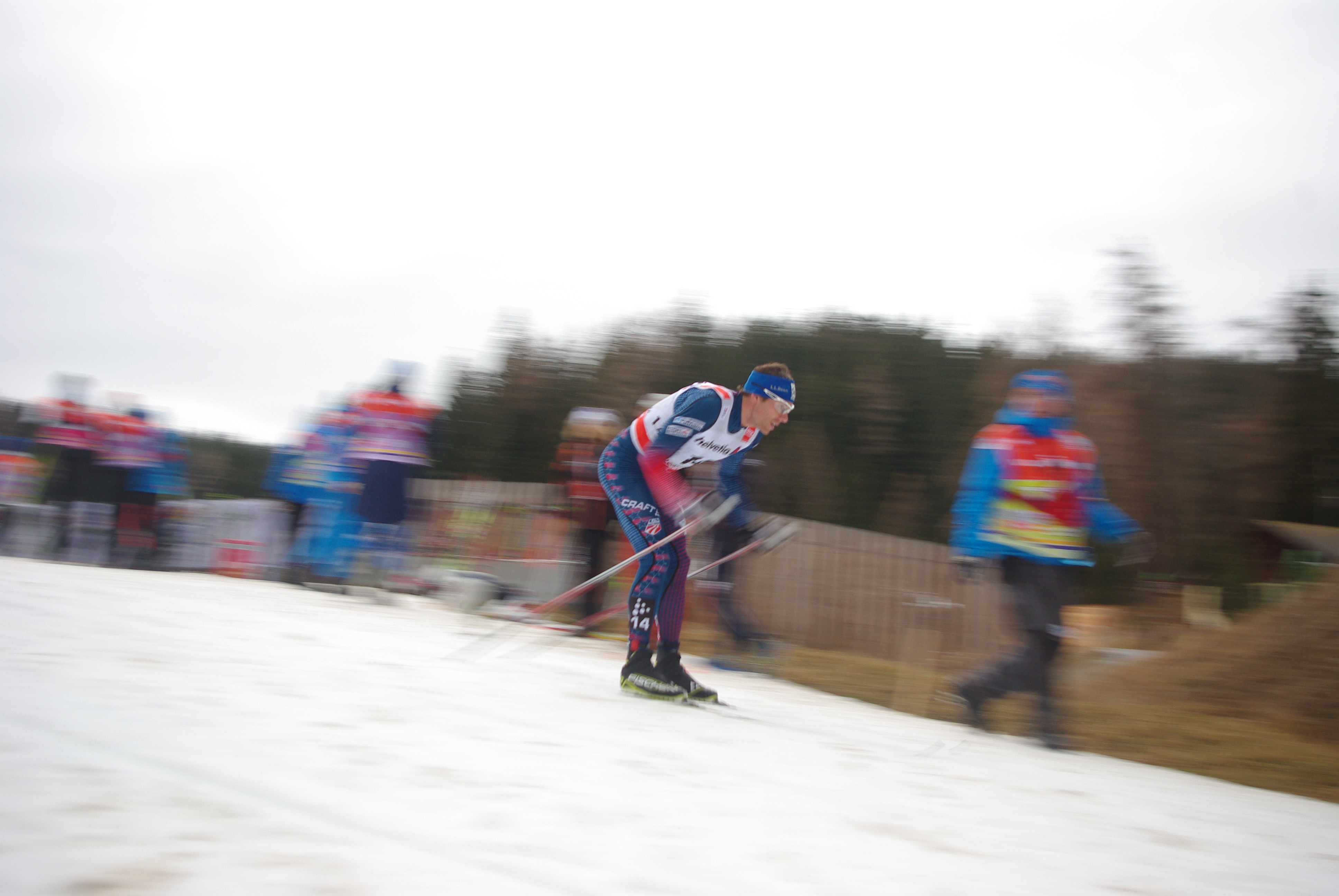
“We’ll be out there doing some speeds and testing skis and stuff,” Newell said. “We won’t take the day off.”
And at the moment, Newell is planning to do one more distance race after the sprint – the 15 k classic, also in Oberstdorf. Then he’s planning to end his Tour, although how his body feels after the sprint could change the balance in either direction.
After all, the U.S. men’s team is looking for one more man besides Noah Hoffman and Erik Bjornsen to score World Cup points (for a top-30 finish) in a distance race so that they can increase their start quota from three to four.
Could that one guy be Newell or Hamilton?
“I hope so!” Hamilton said. “Last year I scored some distance points in the prologue, so generally the short skate races present the best opportunity for me. I may race in Toblach on Friday, so we’ll see it will depend on how I’m feeling. We’ll look at the schedule this year and hopefully be able to jump in some more distance races, especially some shorter skate races. I know that I’m fit and strong and healthy, but obviously the sprinting comes first.”
-Jason Albert contributed reporting.
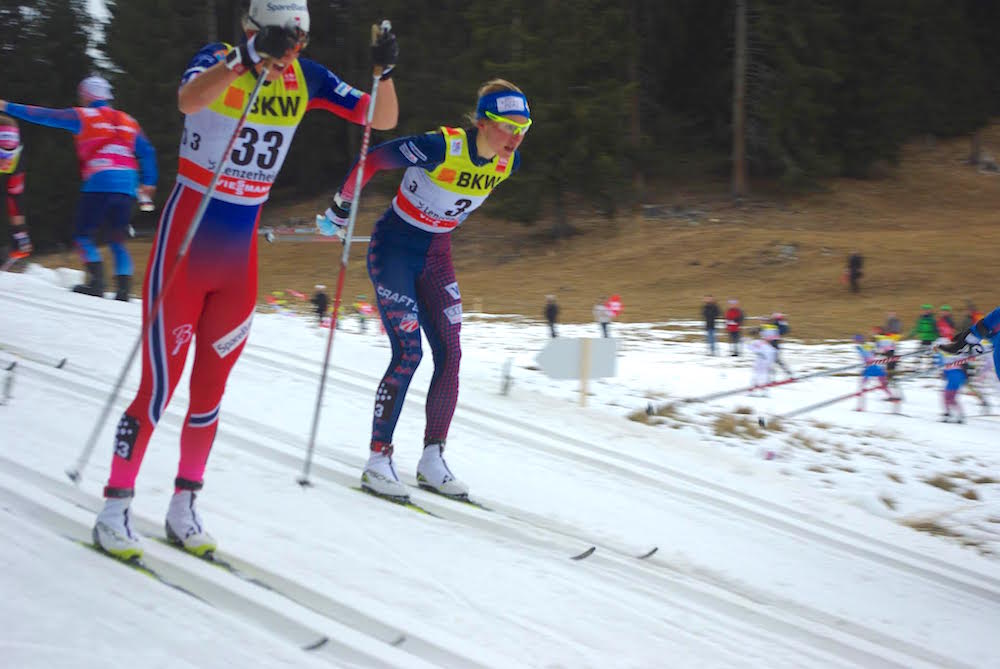
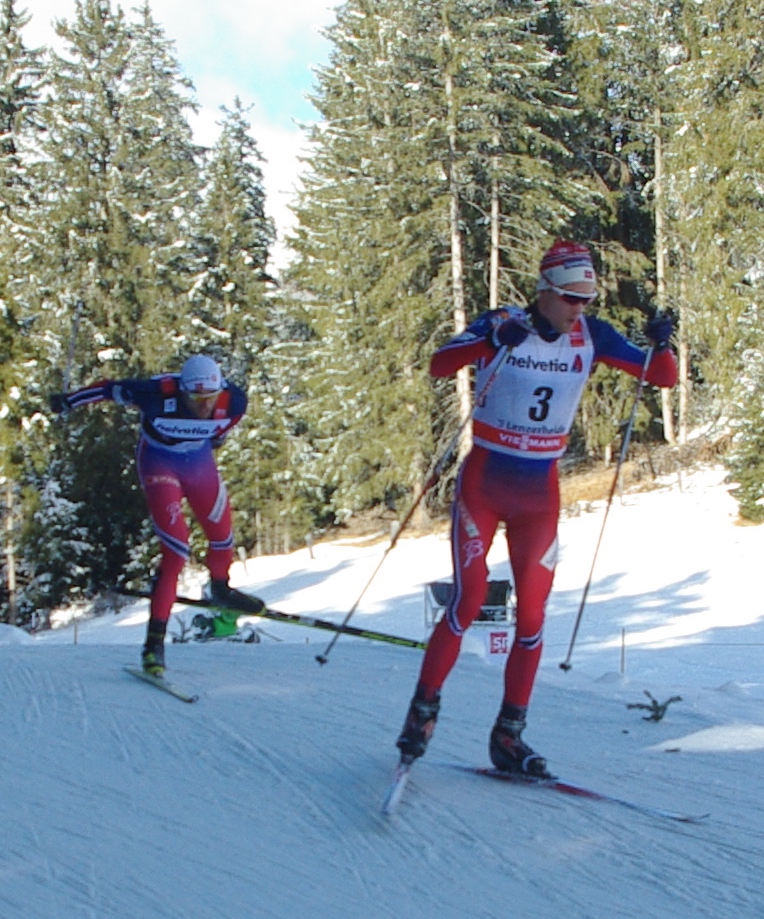
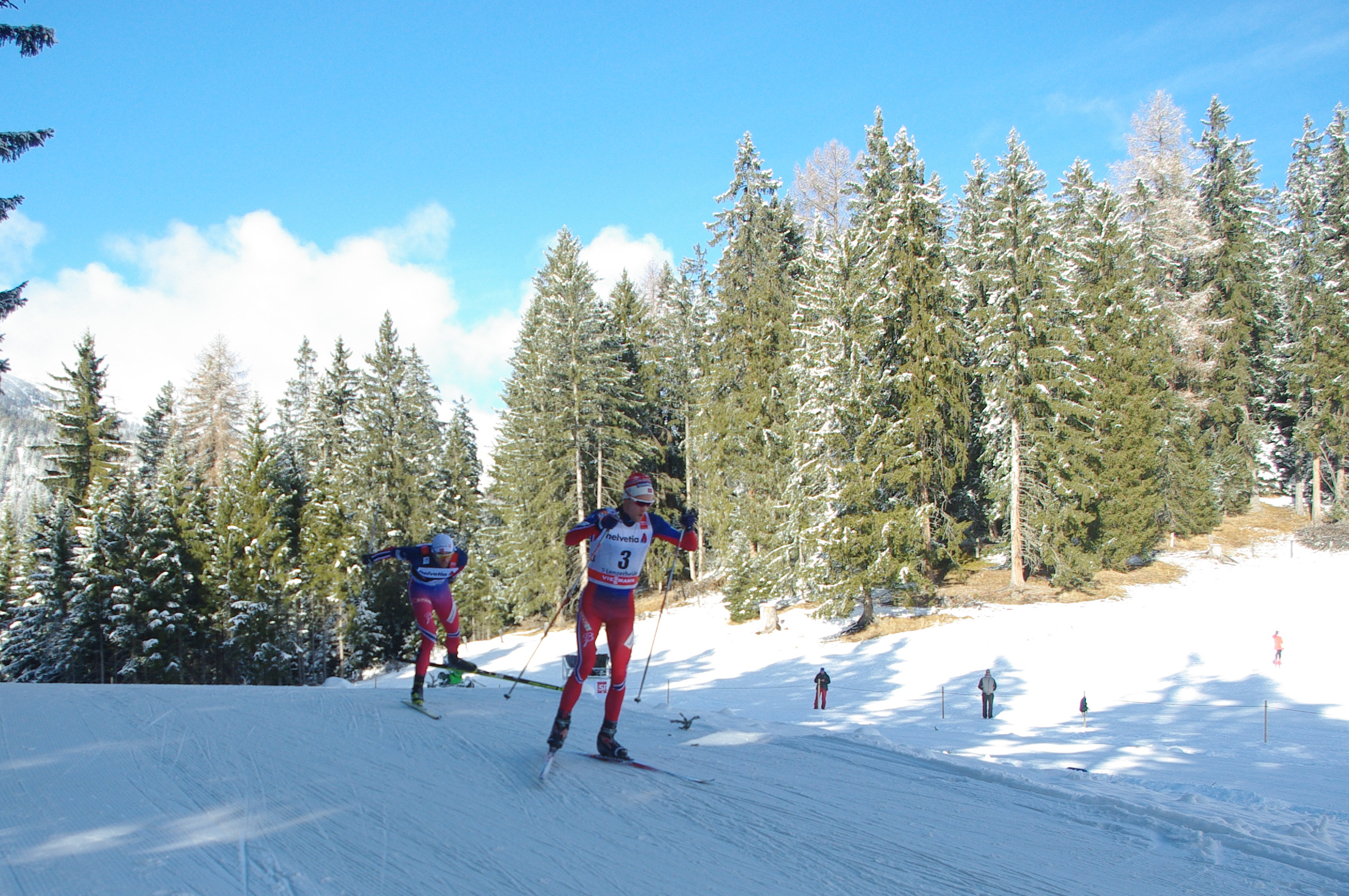
LENZERHEIDE, Switzerland—Didrik Tønseth went into Sunday’s stage of the Tour de Ski ranked third, right where he wanted to be.
So did ambition get the better of him? By the finish of the 10 k skate pursuit, the 24-year-old Norwegian was on the ground, exhausted, having gained one place and then lost four in a blow-up of epic proportions.
Tønseth had closed a 13-second gap to superstar teammate Petter Northug in the opening lap of the 10 k skate pursuit, but when Northug attacked hard later, Tønseth couldn’t go with him. He ended up being caught and passed by several other skiers as he struggled though the final kilometers.
“After the race I have another opinion, but before the race I believed I could open hard and that the pace was good,” Tønseth admitted to FasterSkier after the finish. “But maybe it was too hard in the opening.”
The two had not compared notes over breakfast (as they had joked they would in the previous days press conference), and Northug was surprised to find Tønseth on his tails so early in the race.
“I was shocked when he caught up with me so early in the race,” Northug told Norwegian daily Dagbladet on Saturday. “Just then, I felt like a bad skier.”
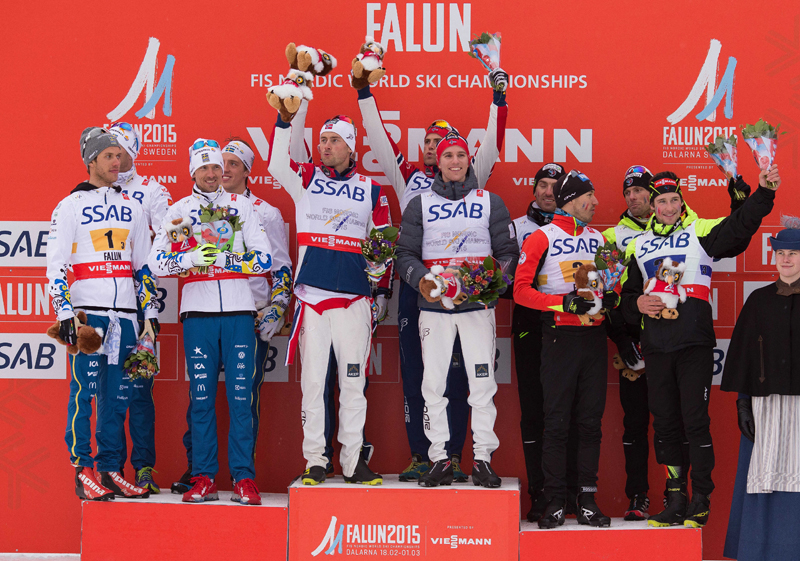
Fans have seen Northug many times wait until the final hundred meters before putting on a furious finishing sprint to dust his competitors – Norwegian newspaper VG even compiled a list of the most famous incidents.
So when Tønseth told FasterSkier that he hoped for some more help from Northug in the middle section of the race, it was hard to find the precedent.
But at the same time, in many previous races Northug waited even longer before attacking – sometimes until just 300 or 100 meters from the finish. Tønseth was caught by surprise when Northug went for it with two kilometers to go, putting 20 seconds on the younger racer almost immediately.
That’s the move of a champion.
“It didn’t matter if you were a Norwegian or Swede or anything,” Tønseth told FasterSkier. “When he is in beast mode there isn’t any difference.”
Tønseth set a podium finish in the Tour de Ski as a goal before the event began. He had a good start, making the semifinals in the skate sprint – his first World Cup semifinal ever, and only the second time he has made it out of qualifying.
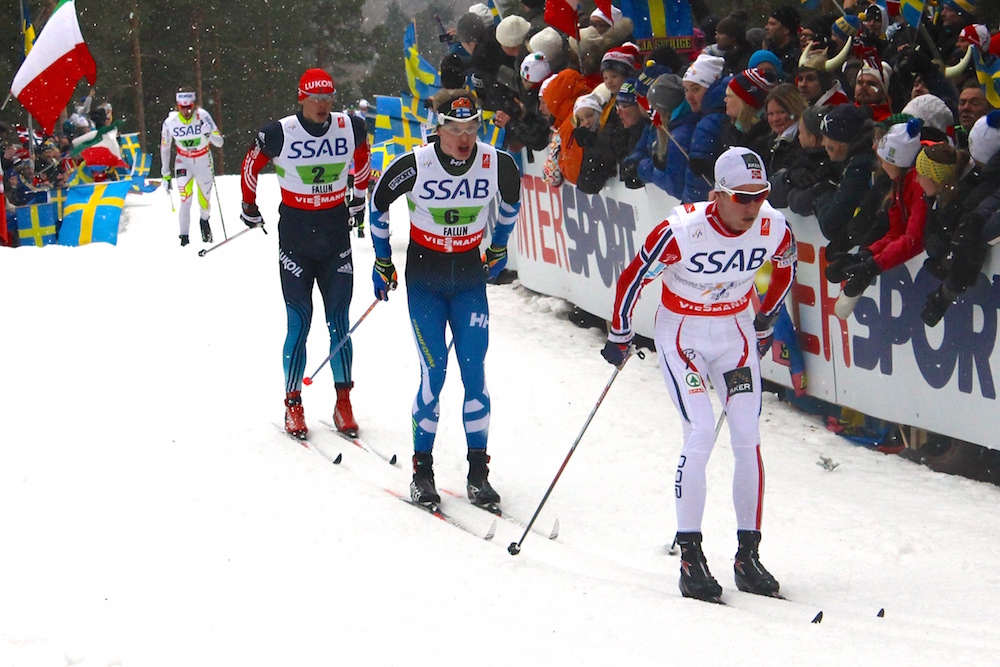
His next test is a classic sprint. It will be another challenge for the distance specialist; in the opening World Cup classic sprint in Kuusamo, Finland, this season, he finished 35th in qualifying.
“I’m not sure about the classic, we’ll see,” he said. “Hopefully I’ll have some luck.”
With bonus seconds from the sprint on the line, it could very well turn out to be essential in determining the Tour de Ski podium.
“There are a couple of good sprinters up there [in the rankings], with Finn [Hagen Krogh] and [Sergei] Ustiugov,” Tønseth said. “So sprint is really important.”
But once he’s through that, things should look up for Tønseth. If it’s any consolation, he has a relatively solid hold on sixth for the moment, with a 38-second gap to seventh-place Alexey Poltoranin of Kazakhstan.
And the last time he finished the Tour de Ski, in 2014, he was ninth – and made up 38 seconds on Northug in the final climb up the Alpe Cermis in Italy.
So can he regain his podium position soon?
“I hope for the best!”
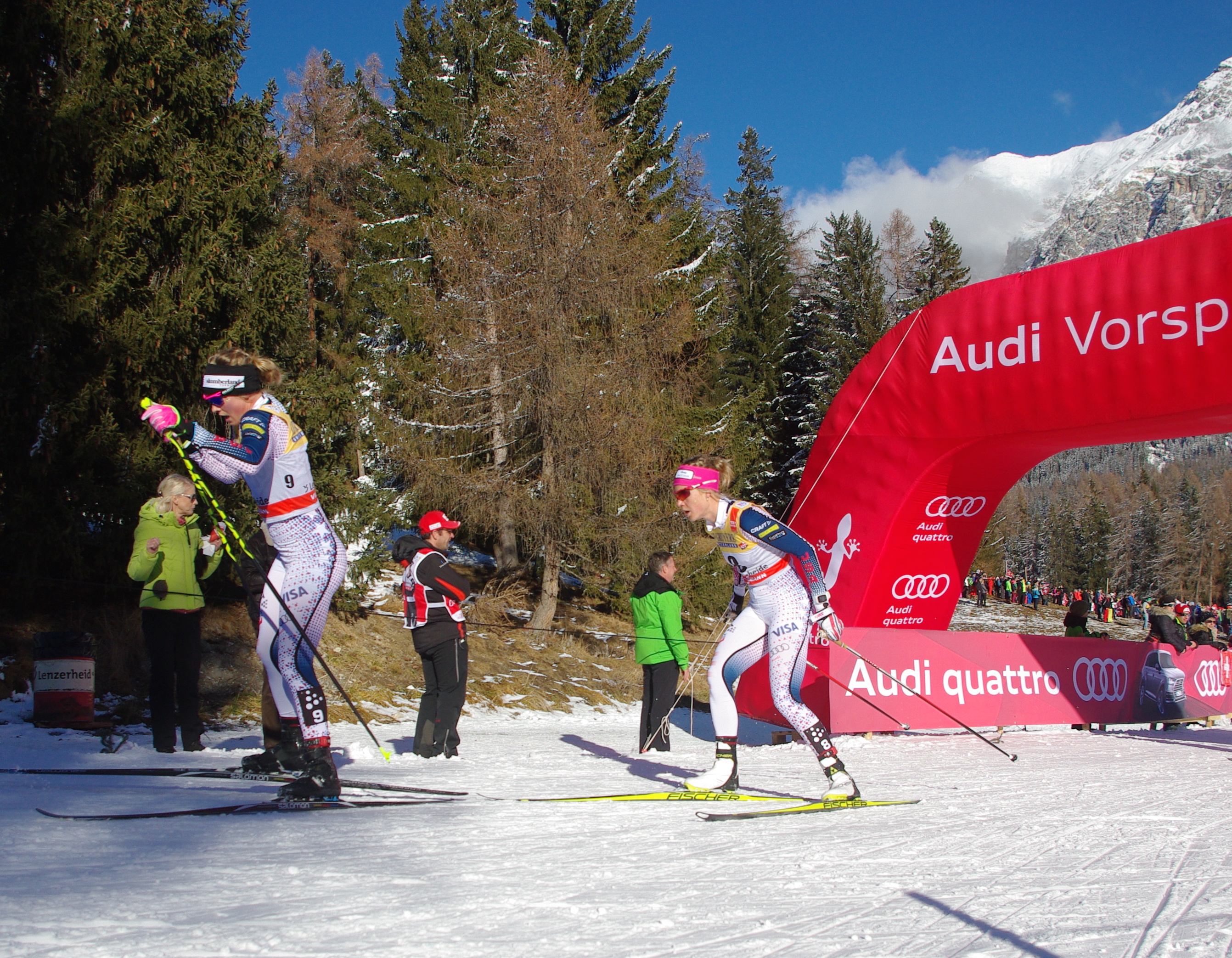
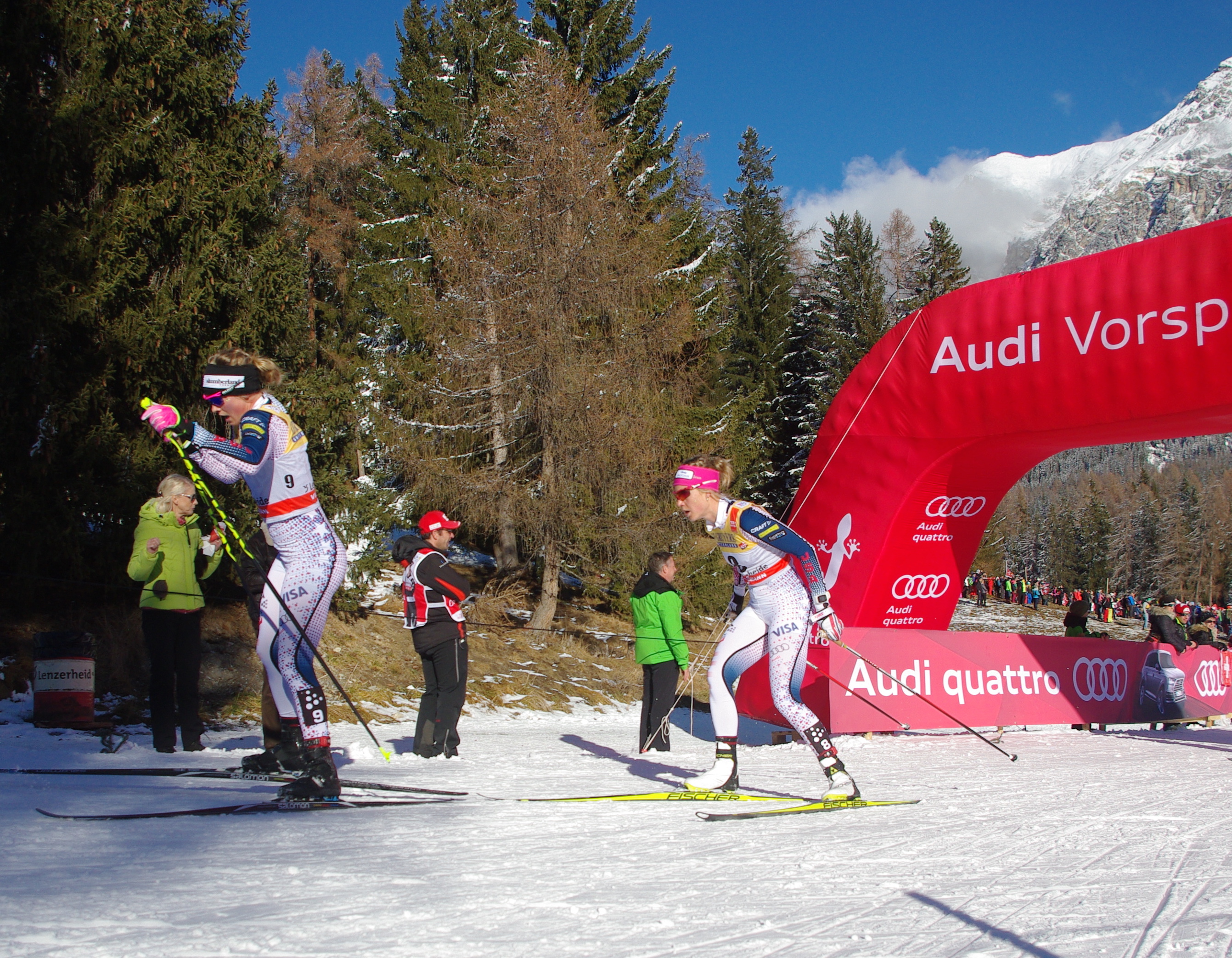
LENZERHEIDE, Switzerland — Based on their starting positions, the top two U.S. women in the Tour de Ski knew that their game plan for the 5-kilometer freestyle pursuit was to pack up and ski hard.
Sadie Bjornsen started in bib 8 just seconds ahead of teammate Jessie Diggins in bib 9.
“My strategy today was to hang onto Jessie for dear life, because she’s one of the best skiers in a pursuit or relay style race,” Bjornsen said. “She caught me pretty quickly and I just stuck on her like glue.”
And Diggins? She had her own strategy, involving Finland’s Krista Parmakoski, who started another four seconds back.
“I knew she’d be trying to catch us and I thought, you know, if I could just get on her and stay on her, she’s having a great year, so if I can keep up with her we can hopefully work and reel in some people,” Diggins said. “Krista and I would take turns leading. I’d lead the flat, she’d lead the hills.”
The trio worked together for the whole race, solidifying their positions in the top 10 of the Tour de Ski.
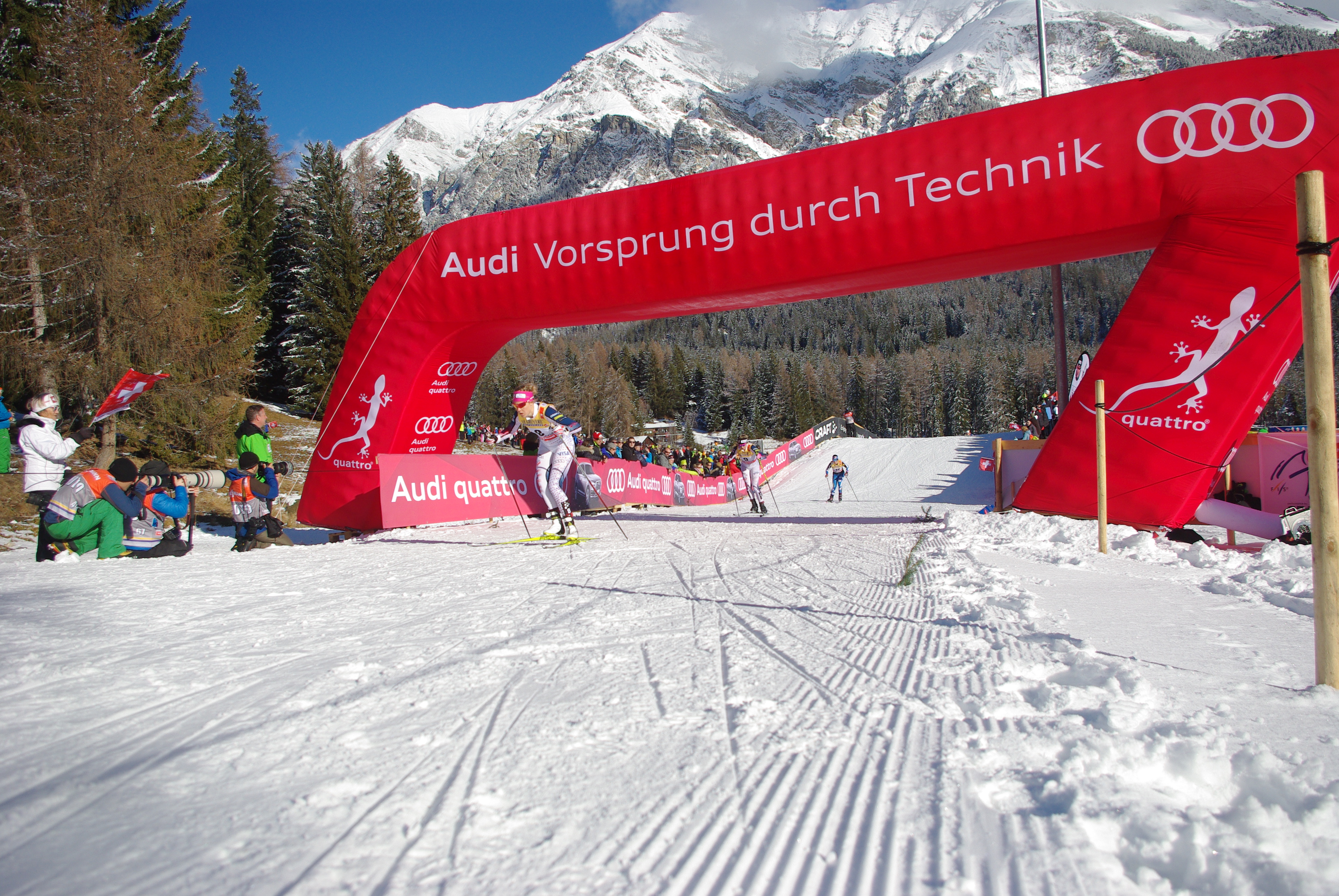
“Those two were switching leads, which was good because I think they were the ones pushing the pace, and I was just trying to stay with,” said Bjornsen, who finished third out of the group and in ninth overall. “I’m stoked. Things are going well so far, and today was a test to see if I can be strong in the head in skating. It was good.”
Diggins thought she could get Parmakoski at the finish, but ran into slight trouble on one of the last corners.
“The very last one, I slingshotted her and I came into the corner like, ‘I’ve got this,’ ” Diggins said. “But I hit this ice patch. I knew the ice patch was there, and I just didn’t set it up right. I drifted wide and gave up the line.”
Parmakoski took seventh and Diggins ended up eighth. She and Bjornsen are now 3:42.9 and 3:43.6 minutes back in the overall Tour de Ski standings behind Norwegian leader Ingvild Flugstad Østberg.
While she wanted to beat Parmakoski, Diggins had her eyes on the prize – that is, the final Tour standings. She didn’t get too hung up on the details, as either way the pair would have ended up with nearly identical times in the overall Tour.
“In terms of the Tour, it doesn’t matter at all,” Diggins said. “I didn’t have the amazing body feelings that I was hoping to have, but if you can have a lot of B+ days in a row, that becomes really, really good. If you can keep it consistent, even if you’re not having an amazing day, you can hold your line, hold your place, and that’s what you need to do.”
Looking forward, both Diggins and Bjornsen plan on resting up on Monday before the classic sprint and distance race on Tuesday and Wednesday in Oberstdorf, Germany.
“We have classic sprint, I mean we haven’t done that since Kuusamo, and I’ve forgotten how to do it,” Bjornsen laughed, referring to the very first weekend of World Cup racing. “Like I said yesterday to you guys, I think that the cool thing is just I love any race right now.”
Diggins also loves racing and wants to string together more solid days, but found herself wishing that there were more skate competitions left in the Tour. Of the remaining five races, just two are skate.
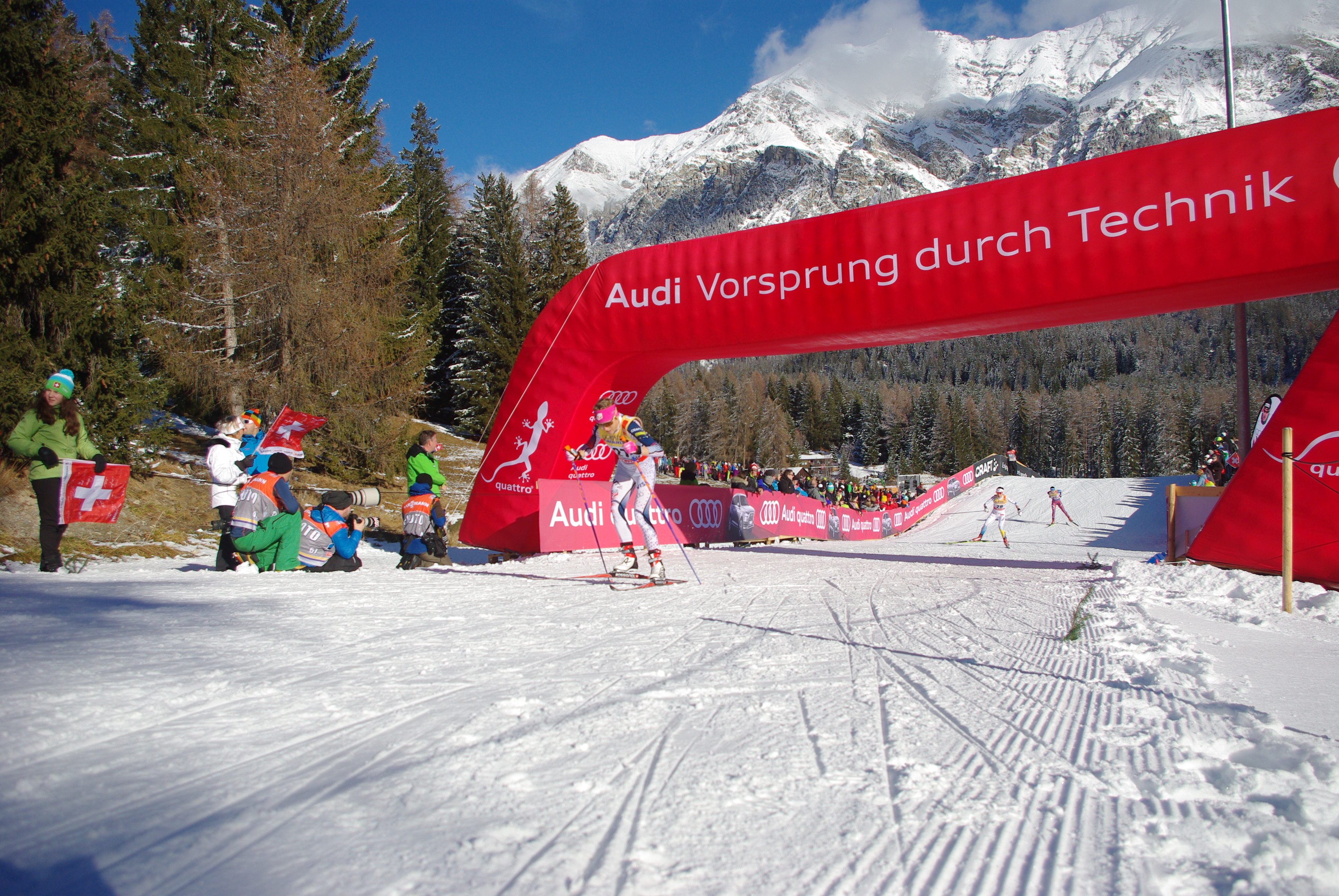
“I’m starting embracing my love of classic skiing,” she said. “But deep down, I feel that it is inherently unfair. Of course, the world is not fair, but I think it is a shame that it couldn’t be balanced because if you’re going to put four times the World Cup points at the end of the Tour, it should be fair … even if it was all skate, I would be think it’s not fair, it shouldn’t be that way.”
Stephen Makes Up Ground
Their teammate Liz Stephen started the pursuit in bib 27 and now sits in 22nd in the Tour de Ski standings, thanks to the 14th-fastest split time of the day in the pursuit.
“It was really short, but you know that doesn’t necessarily mean that it’s easier, it just means that it’s not as much time that you can make up,” Stephen said. “It was really fun. The group I was skiing really left out of the gate hot, so I was struggling to keep up and wasn’t able to, until kind of basically like 2 k to go, and then I was able to pass most of them and end up in the front of that group. I was happy with the finish.”
Fifth in last year’s Tour de Ski, Stephen still has ground to make up. She’s currently a minute and 22 seconds behind her two teammates, and just over five minutes behind Østberg.
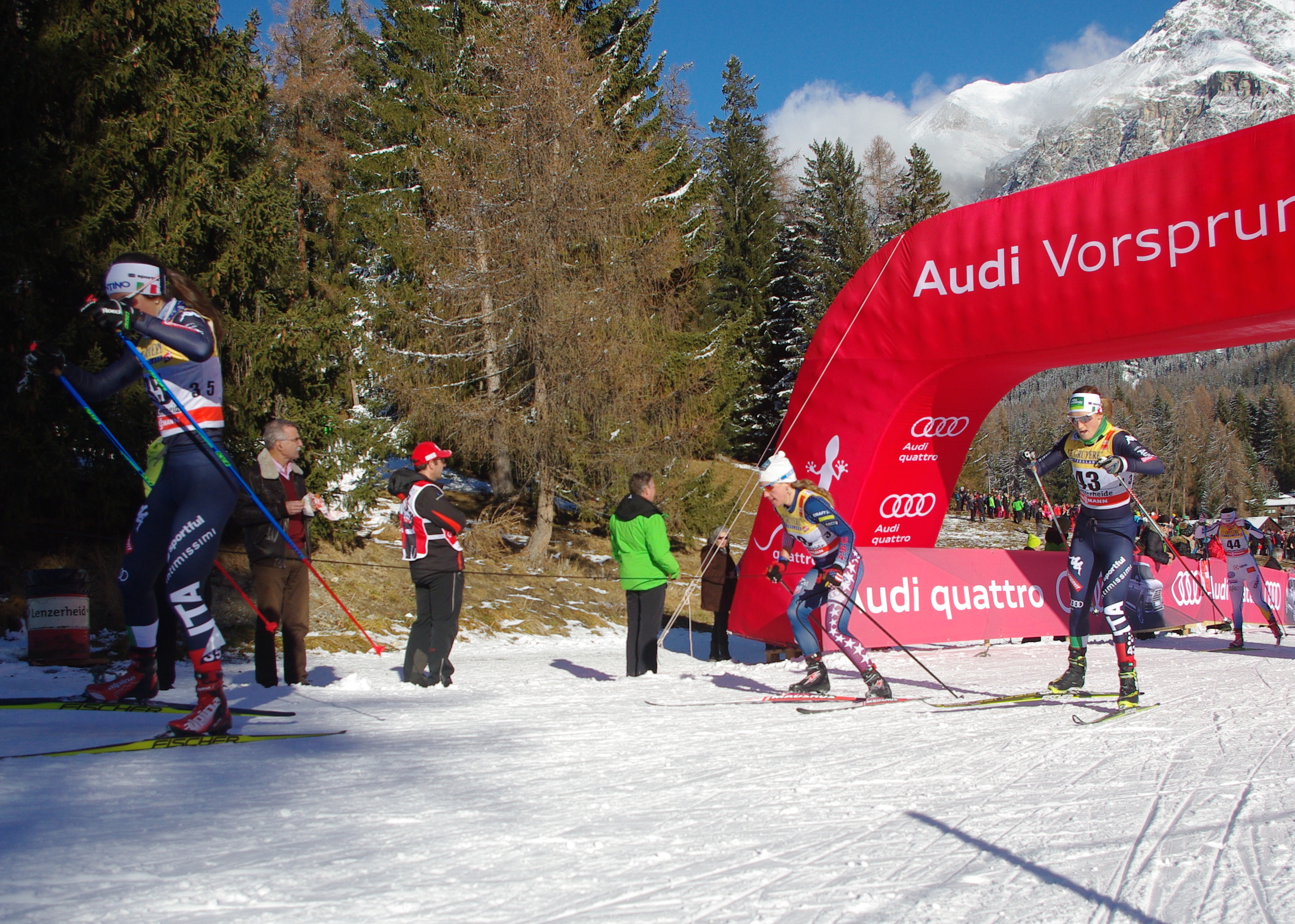
But saying that the Tour de Ski “picks up every day,” Stephen, a distance specialist who relishes the Tour’s final climb up the Alpe Cermis in Italy, is confident that she can keep moving up.
“I have to get through one more sprint,” she said. “Hopefully, the course in Oberstdorf will have some hills, although I know the big hill’s not in it. If not, I still have Val di Fiemme and Toblach to look forward to, mostly Val di Fiemme, and of course Cermis. The Tour de Ski is not over until you cross that Cermis line. And a lot can happen between now and then. The key for me is keeping my head up, and not really dwelling on like a bad day or a good day, and just kind of keeping going.”
Americans in the Mix
Meanwhile, Sophie Caldwell was happy to find herself in the top 30 of the Tour standings. Since she plans to stop after the Oberstdorf stages, she hadn’t made a goal of where she would rank in the overall standings. But after two solid distance races, she sits in 27th.
“My biggest expectations were for the skate sprint, or both sprints, I guess,” she said. “I knew I was feeling good and rested, so I wanted to have some solid distance races too, and I feel like they’ve taken a big step in the right direction since the distance racing I’ve done before.”
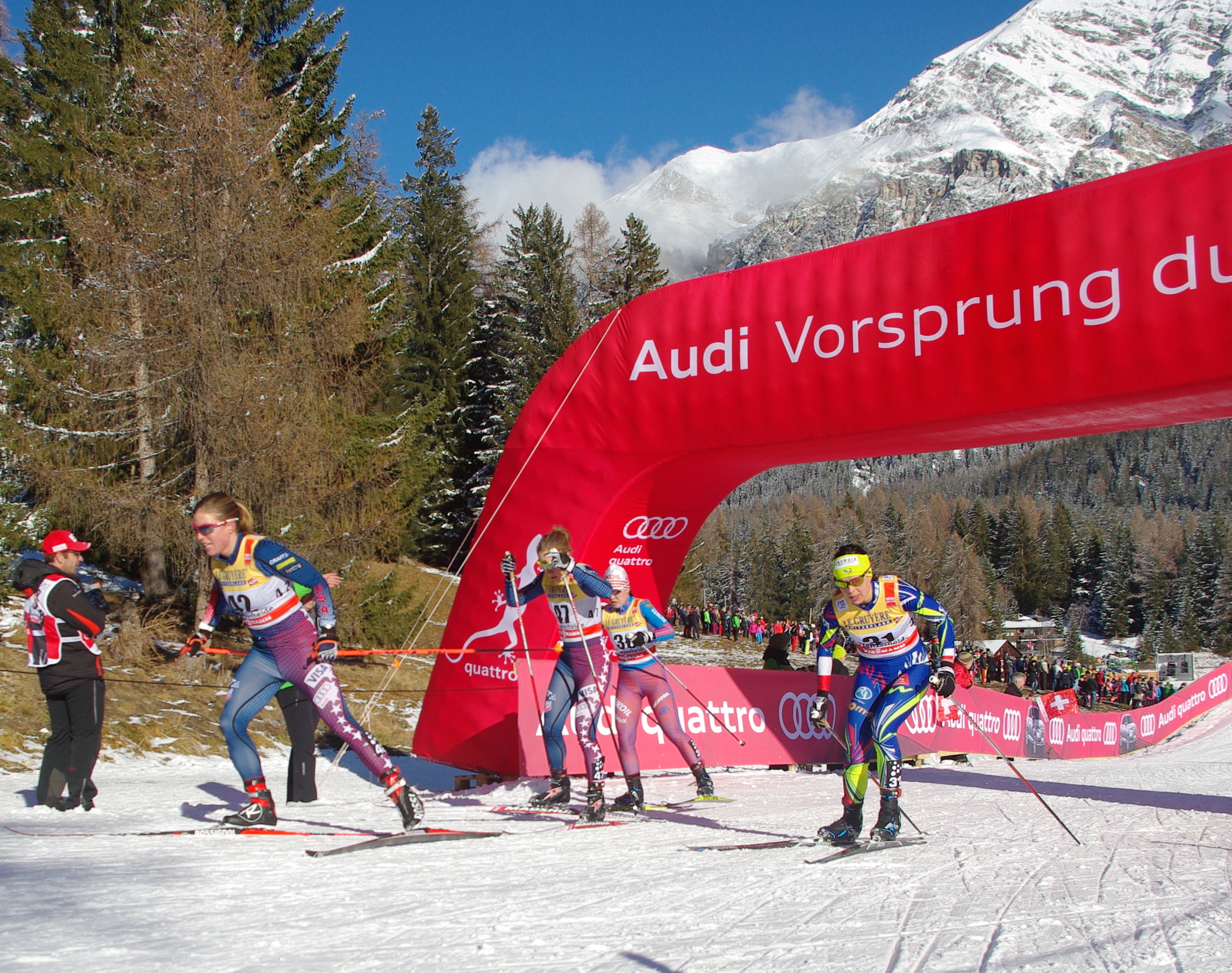
Caldwell finished 34th in the 15 k classic mass start on Saturday, despite breaking a pole. She thought that if she hadn’t, she might have been in the World Cup points.
“I mean, it’s easy to say what if, but I was happy with how I felt,” she said.
And she considered crossing the line in 27th in the 5 k pursuit to be one of her best distance races ever.
“My goal was to hang on for as long as possible,” she said. “I did that and imploded big time going up the hill the last time, but I hung on… I’ve been working hard on improving my distance racing, because not only do I want to become a better distance racer, but I think it will help as I move through the [sprint] heats as well.”
Ten places behind her in 37th, Caitlin Gregg was also happy with her race. Gregg had a tough go in the 15 k, falling in the beginning and skiing in nearly last place around the first lap. But she eventually made her way through the pack to a solid 39th-place finish, and now has a goal of continuing to improve in races.
“My second half of the 15 k was really great,” Gregg said. “I felt better and better and better. Hopefully it’s a good metaphor for me in the Tour. In the end we race a lot of kilometers, and that’s more like my forté. It’s a game of attrition for me – I feel like each day I’m going to get better and better. It has been the case. I keep moving up in numbers. I’m having fun.”
Gregg, Rosie Brennan and Ida Sargent were all in the wave starts at five and five-and-a-half minutes behind the leader, which gave them a different race experience than their other teammates.
Brennan finished 42nd and Sargent 51st.
“It’s like a mass start 5 k,” Gregg said. “I feel like a J4 or something.”
“It was really fun being in the wave,” Sargent said. “Just skiing with people. If I’d look up and still see Caitlin, I’d think, huh, I’m having a good race! She’s still in sight!”
The pair also talked about sharing skis; each have tested and raced the other’s skis now that Sargent has switched to Madshus.
“We’re competitors, but we want to make sure that everyone has the best race possible on the team,” Gregg said. “I’m rooting for Ida to kick ass whether she’s on my skis or not. It brings the level up.”
Results: Pursuit standings | Time-of-the-day results | Tour standings (though Stage 3)
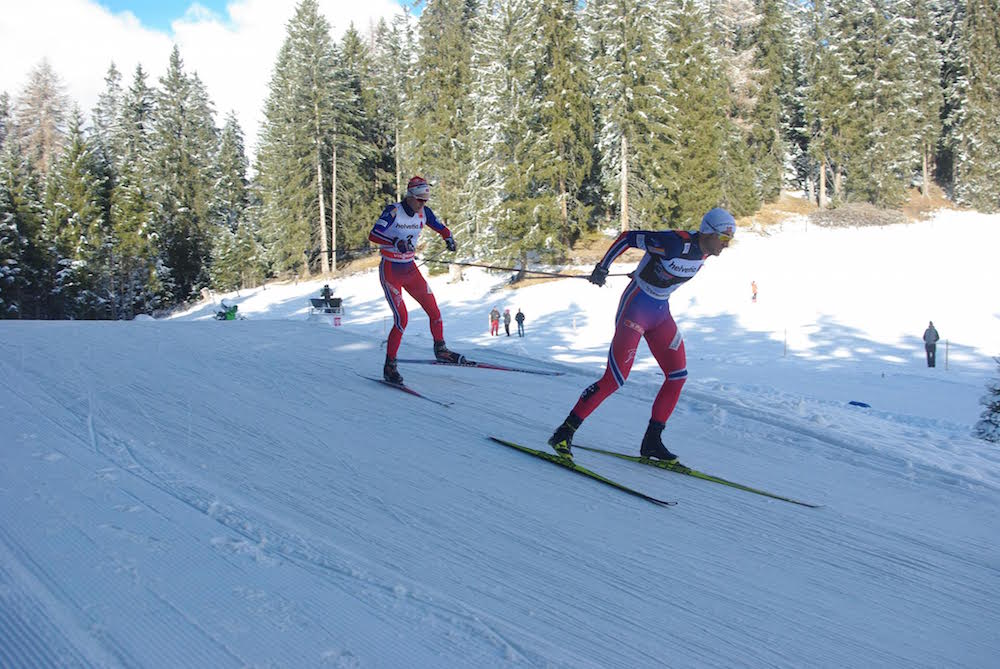
For the Norwegian men, racing with comrades in red essentially means nothing — except for maybe a pat on the back or a head nod at the finish. Ask Martin Johnsrud Sundby, Petter Northug or Didrik Tønseth, all of which started within a minute and 31 seconds of one another as the first three starters of Sunday’s 10-kilometer freestyle pursuit.
It was enough of a task to catch Sundby, the Tour de Ski’s leader after two stages. The 31-year-old overall World Cup leader started the Stage 3 pursuit in Lenzerheide, Switzerland, 1:18 ahead of Northug. Thirteen seconds after Northug, 24-year-old Tønseth set out on the three-lap course.
Clearly on a mission, Tønseth caught Northug by 1.2 k. The two skied together, 28 seconds ahead of Russia’s Sergey Ustiugov, after Ustiugov started 1:53 back in fourth. They remained 1:27 behind Sundby, and stuck together for all but the final minutes of the 10 k race.
That was Northug’s choosing. Still 1:36 behind Sundby at 7 k, the 29-year-old, oft-controversial Norwegian accelerated around 20 minutes into the race and dropped Tønseth before 8.7 k. There, Tønseth fell 20 seconds behind Northug and was just eight seconds ahead of the chase group behind him, with Norway’s Finn Hågen Krogh leading Ustiugov and Norway’s Sjur Røthe.
“It is as if they were from two different nations!” NRK commentator Fredrik Aukland exclaimed as he watched Northug leave Tønseth for the taking.
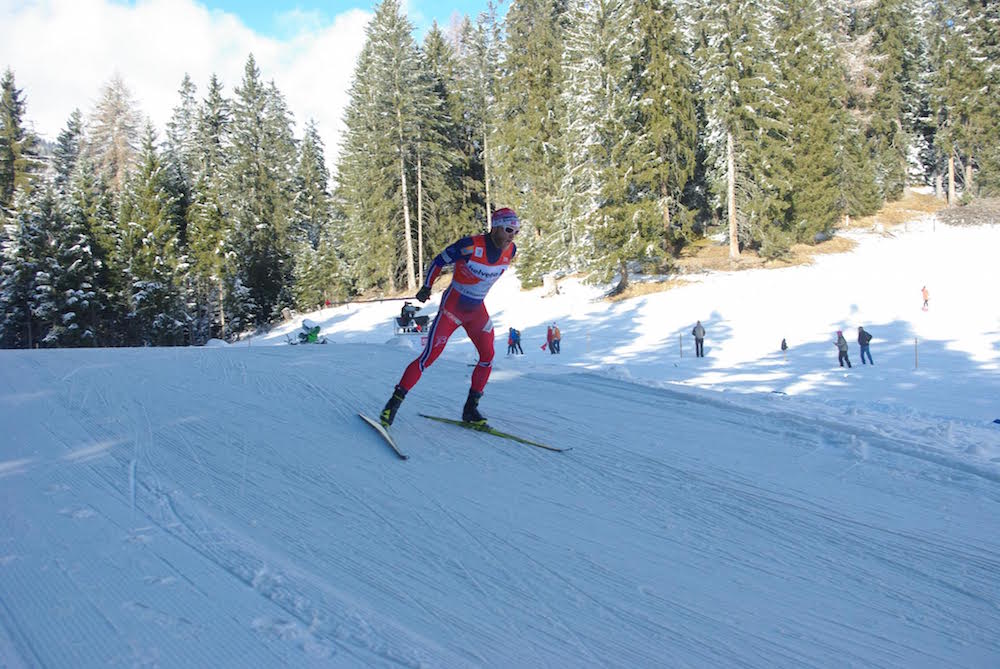
Northug ended up closing the deficit to Sundby to 1:25.2 at the finish. Sundby secured his second-straight stage victory in 21:44.7 and Tønseth finished at the back of the Krogh-Ustiugov-Røthe train in sixth (+1:54.7).
After he did most of the pulling throughout the race, leading Northug at every checkpoint through 7 k, Tønseth told NRK that he and Northug “rarely work well together, and we did not today, either,” according to a translation.
“I had hoped for more help,” Tønseth added. “The partnership does not work particularly well for me, but it did for him.”
That said, he wasn’t surprised by Northug’s see-ya-later move. Tønseth explained they are from rival clubs: Byåsen and Strindheim.
“Our clubs are archenemies; we saw that today,” he said.
He also wasn’t in a position to respond. “I saw stars when he jerked,” Tønseth said. “I stopped completely.”
Still second in the Tour after three stages, Northug said he was feeling the effects of his second-place effort in Saturday’s 30 k classic mass start.
“It was a hard 30 km yesterday and I could still feel it today,” Northug told FIS. “I tried to speed in the last lap to gain some seconds back.”
Asked about how others reacted to his move on Tønseth, Northug responded, “99.9 percent of all skiers are sour on me because of that.”
And is he OK with that?
“Yes, I take it with me to the grave.”
But enough about Northug — let’s get back to Sundby, who currently leads the Tour by 1:30.2 over Northug and 2:00.2 over Krogh, who skied the fastest time of the day to rise to third overall.
“I am ready for a rest day,” Sundby told FIS. “I knew I was being chased. I am happy I could gain some more seconds.”
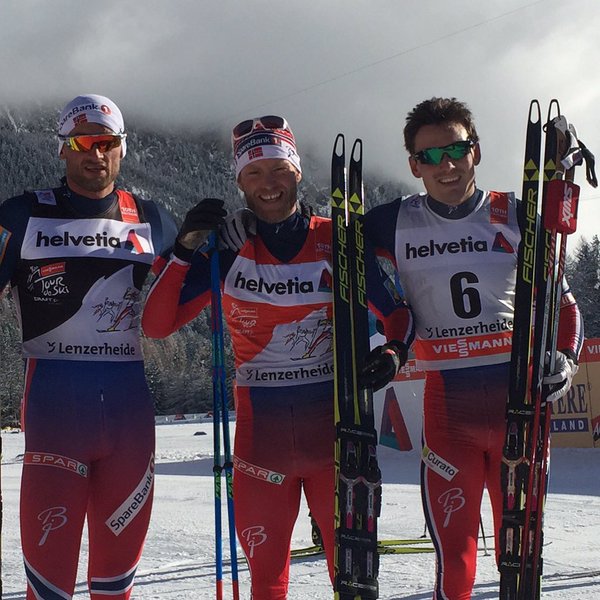
In another spicy storyline, Krogh started sixth and caught his teammate Røthe within the first kilometer. Those two played nice and worked together throughout the race, reining Tønseth in and entering the stadium together for a final push for third.
Krogh upped the chase pack’s tempo around 8.7 k to catch Tønseth, then the four-man group contended for the podium in the finishing stretch. Krogh continued to lead the group in, and outlasted Ustiugov in a photo finish for third, 1:50.2 behind Sundby.
A day after shouting an assortment of curse words at the finish (he had lost contact with the lead group when he crashed during the 30 k), Krogh said he was happier with Sunday’s result.
“I had a lot of pent-up pressure from yesterday, which I needed to release,” he told NRK. “I’m actually wondering if maybe my crash was a bonus in the overall picture. I really wanted to reverse the damage, and I feel like I succeeded in that.”
He ended up with the fastest race time in 21:20, 25 seconds faster than Sundby. While Krogh said he doesn’t have any specific goals for the Tour, he’ll continue to strive for top results.
“He, he. I am a competitive person, no doubt,” Krogh said. “Those who know me well know that it does not take much, no matter what form of competition it is, before I get pissed. But I will most pissed when I manage to [ruin] it for myself as I did yesterday.”
Ustiugov held his position in fourth in the Tour and is now 2:05.2 behind Sundby. Røthe finished fifth and Tønseth sixth and are 2:07.9 and 2:09.7 back overall, respectively.
Some 38 seconds behind Tønseth on Sunday, Kazakhstan’s Alexey Poltoranin and Switzerland’s Dario Cologna raced to the line for seventh, and Poltoranin took it by 0.6 seconds (+1:54.7). Poltoranin bested another four-man chase group, with Harvey finishing ninth (+2:35) and Belov 10th (+2:35.1). Norway’s Niklas Dyrhaug was nearly a minute father behind in 11th (+3:26.4).
Pursuit results | Time-of-day results | Tour standings (after Stage 3)
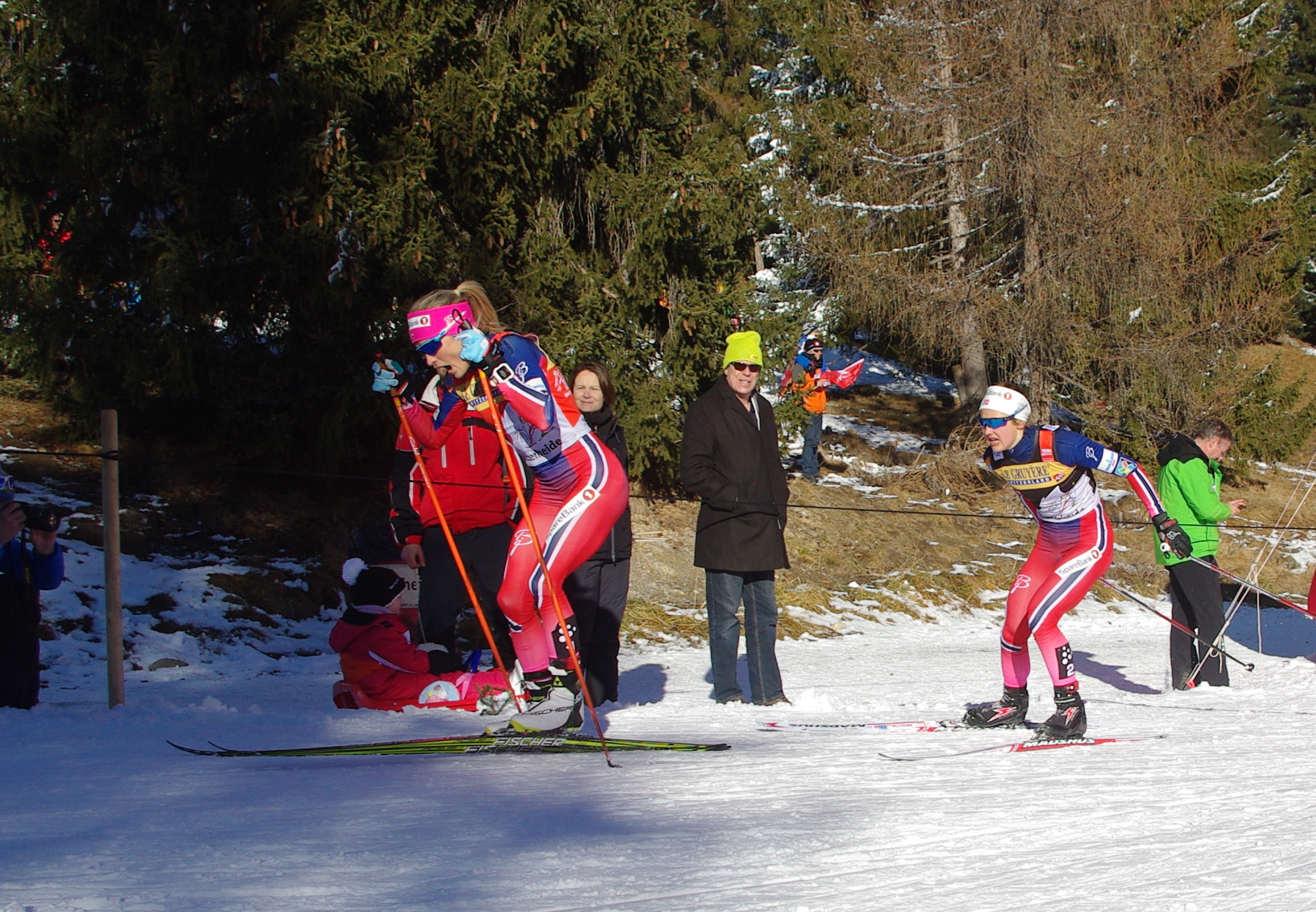
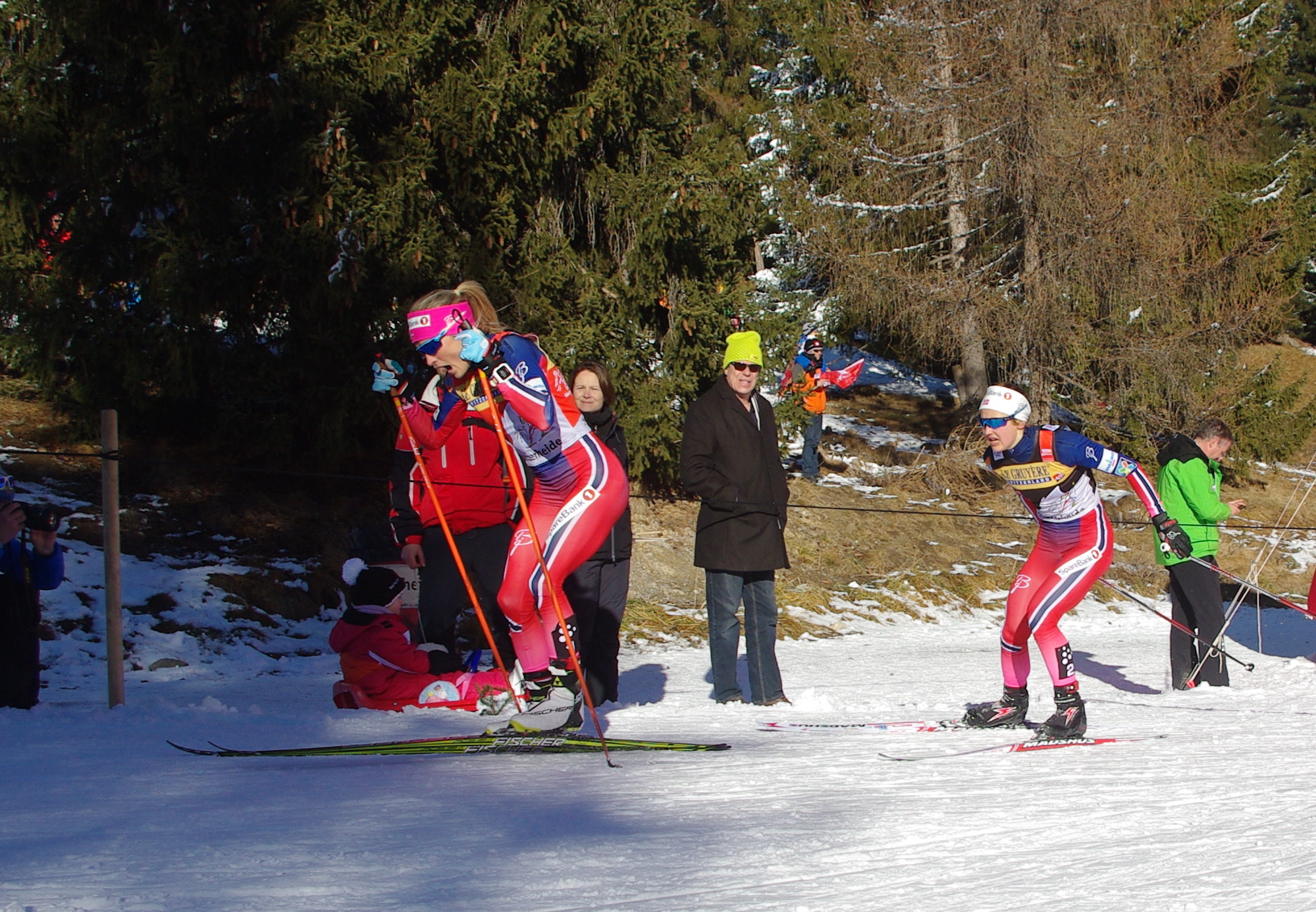
LENZERHEIDE, Switzerland — Who knew that some of the most compelling racing on the women’s World Cup circuit this season would come in a distance race, at the Tour de Ski?
Norway’s Therese Johaug has been a favorite in the event for months — and is indeed a favorite to win stages, if not the whole Tour, almost every year. Through Saturday, she was unbeaten in distance racing this season.
So when 25-year-old teammate Ingvild Flugstad Østberg started five seconds behind Johaug, 27, in Sunday’s 5-kilometer freestyle pursuit, the younger skier’s effort to close the gap right off the line seemed like a big risk that could end in a blow-up.
Østberg claimed to be as surprised as anyone that she not only caught Johaug, but then dropped her on the final uphill and skied to a 9.3-second win in 13:02.3 – her first World Cup win in a distance race ever, and on what a stage.

“I haven’t realized it yet,” Østberg told Norwegian broadcaster NRK. “It was a great victory for me, in many ways … I tried to follow my own plan. But I saw that for once it looked as if Therese began to be a little stiff. Then I saw the opportunity to [ski away], although I felt a little stiff myself.”
There had been clues about Østberg’s ascent as an all-around skier. She has been in the top five of distances races this season, and achieved her first distance podiums this season in Kuusamo, Davos and Toblach.
And in Saturday’s 15 k classic mass start, Østberg skied away from teammate Heidi Weng, who was among the top skiers in the world last season, including in the Tour de Ski.
But skiing away from Weng is one thing, and skiing away from Johaug something else altogether. Johaug’s quick skating uphill has won her many a race, including the Tour de Ski final climb in the past.
On Sunday, though, the World Cup leader’s legs wouldn’t cooperate.
“I did the best I could,” Johaug said, according to a translation. “But the acid came to my legs and took me. I had no chance.”
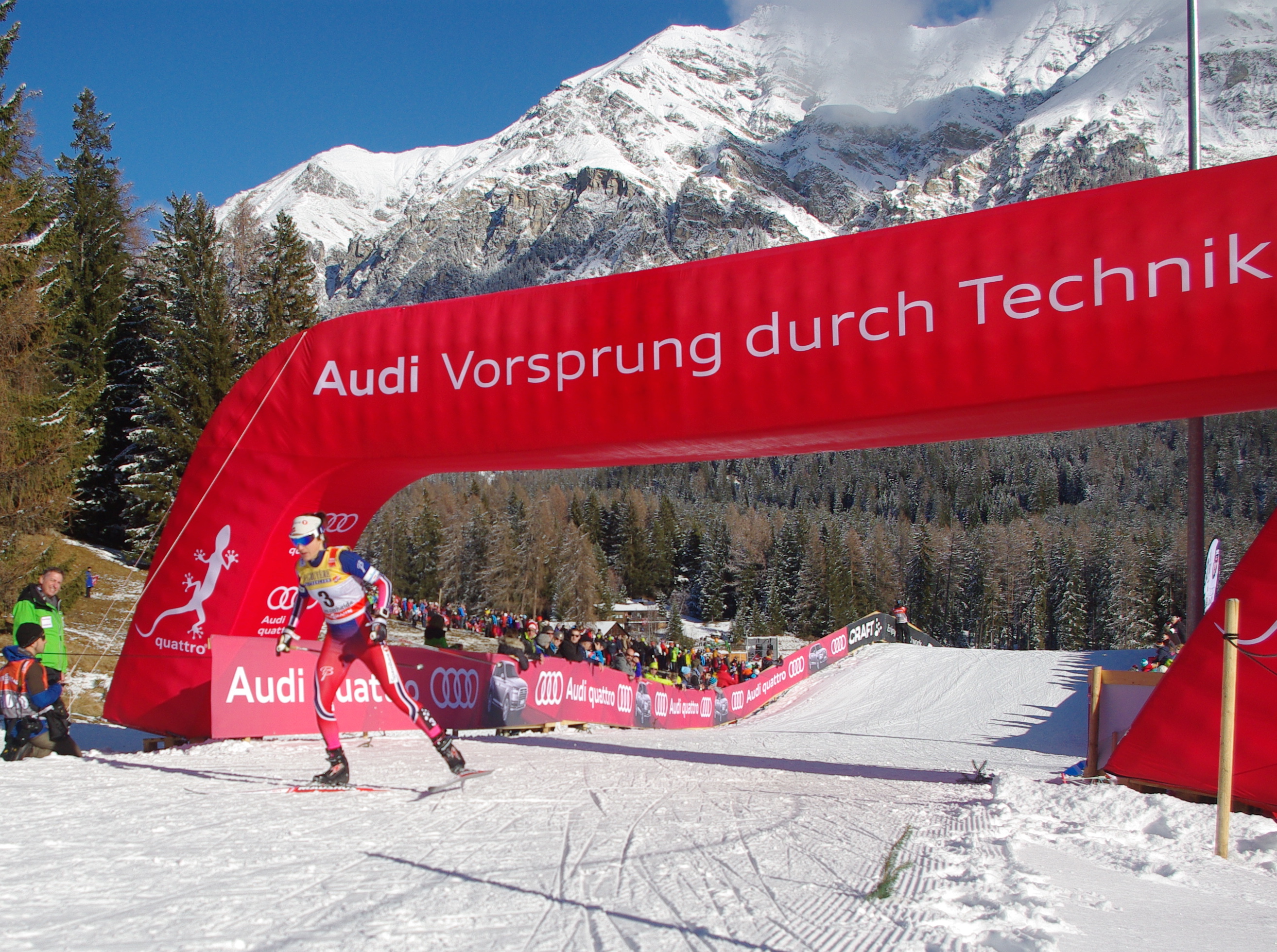
And so she was left to watch Østberg drift farther and farther in front of her, then scream in victory as she crossed the finish line – a move that Johaug has made her own so many times.
Østberg told FIS that she had planned to catch Johaug from the start, and then just do her best. She was far from certain that her best would mean crossing the finish line first. Just a day before, Johaug had appeared completely unbeatable.
And now Østberg, who has had her biggest successes in sprinting before this season, has a 14.3-second lead on Johaug in the Tour de Ski and a whopping two minutes and 13 seconds on third-place Heidi Weng, also of Norway.
She wasn’t expecting to become a favorite for a Tour de Ski podium.
“I never thought it would go so well,” Østberg told NRK. “I am shocked and pleased with myself. … Others have said [I could be there], but I have never had that goal.”
Johaug, though, wasn’t so surprised that she found herself out of the Tour de Ski lead.
“I have tried to tell everyone all along that this is no easy march,” she told Norwegian daily VG. “The Tour de Ski is not a Championships, and it’s not like normal World Cups. You have with you sprinters and bonus seconds, and you go shorter and longer distances. And you must be uniformly good throughout. Such a competition fits Ingvild’s shape very well.”
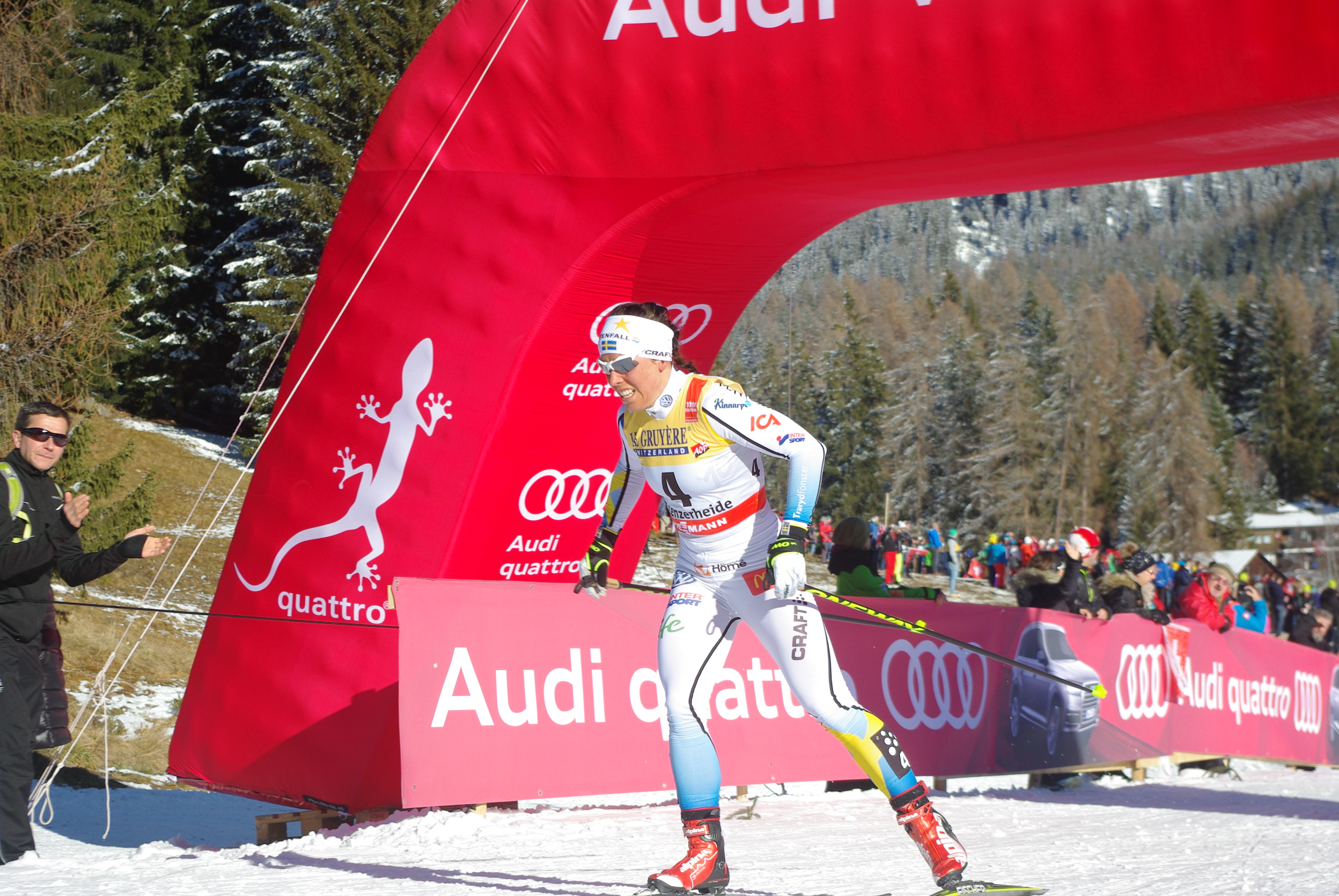
Johaug, who won the Tour two seasons ago in 2014, also knows that being behind after three of eight stages isn’t the end of the world.
“I’m not worried yet,” she said. “There are still many ski races to go. … It’s a little silly to be worried after day three.”
Indeed, Johaug can make up a lot of time if distance races go her way. The final climb is her hallmark event; last year her time up the Alpe Cermis was a full minute faster than Weng, who had the next best effort.
But before that climb, there are four more races, including a classic sprint in Oberstdorf, Germany, on Tuesday.
Both rivals are looking forward to recuperating first.
“It was really hard today,” Østberg told FIS. “My legs were really tired at the end. I am looking forward to the rest day.”
Weng skied a steady race to keep third position locked up; she now has a 32-second lead on Charlotte Kalla of Sweden going into the Tour de Ski’s fourth stage.
Finns Anne Kyllönen and Kerttu Niskanen skied most of the race together to hold on to fifth and sixth place, while their teammate Krista Parmakoski caught the American duo of Sadie Bjornsen and Jessie Diggins and then beat them at the finish to land in seventh place.
“Fortunately, I regained some of my skiing shape,” Kylloenen told the Finnish press. “I felt surprisingly good, because I thought this would be for me the most difficult race the Tour.”
Diggins sits in eighth and Bjornsen in ninth. Stay tuned for more reporting on the U.S. women’s races.
Ragnhild Haga of Norway and Laura Mononen of Finland had the third- and fourth-fastest pursuit times behind Østberg and Johaug. Starting with bibs 11 and 12, they move up and now sit tenth and eleventh.
Results: Pursuit standings | Time-of-the-day results | Tour de Ski standings
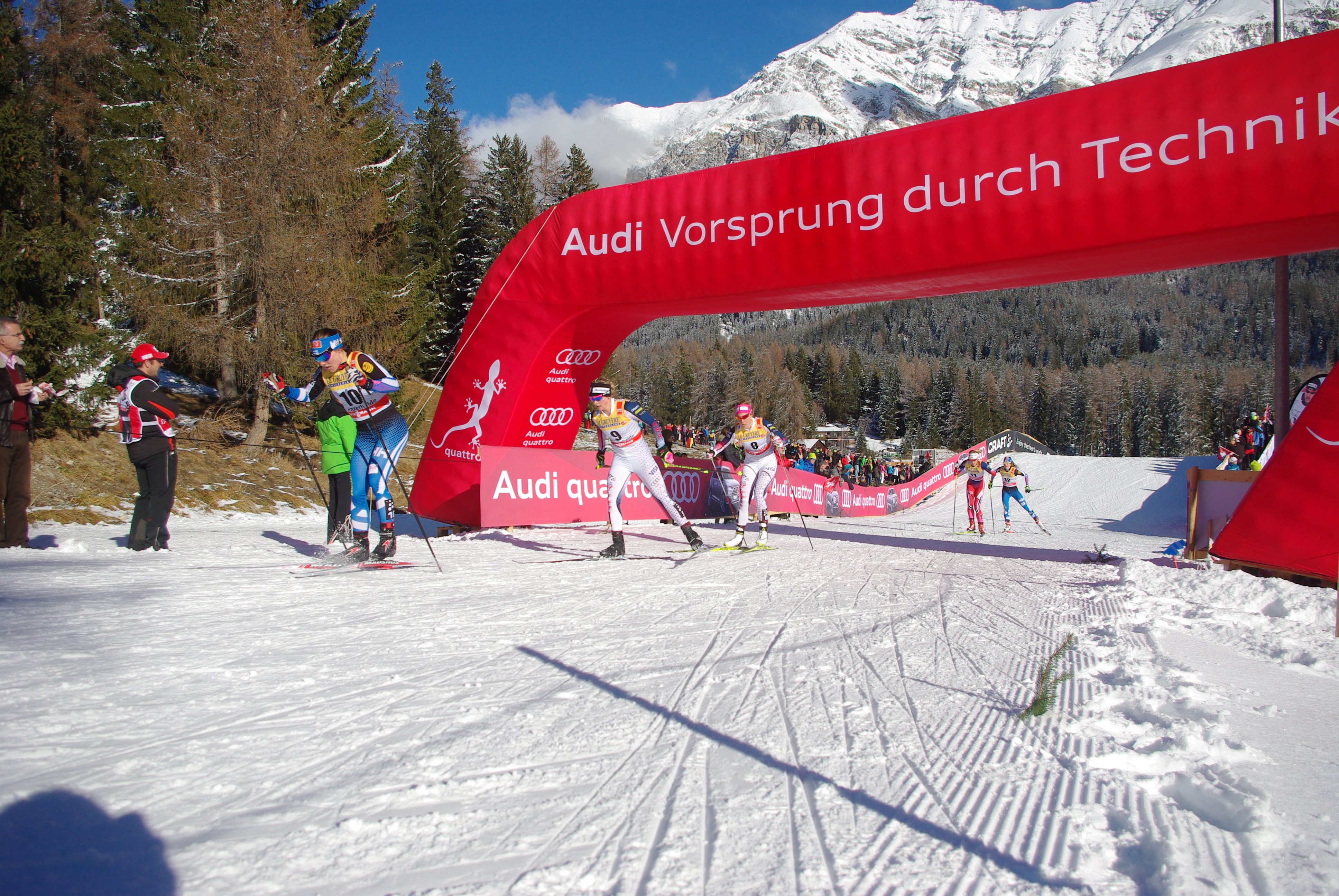
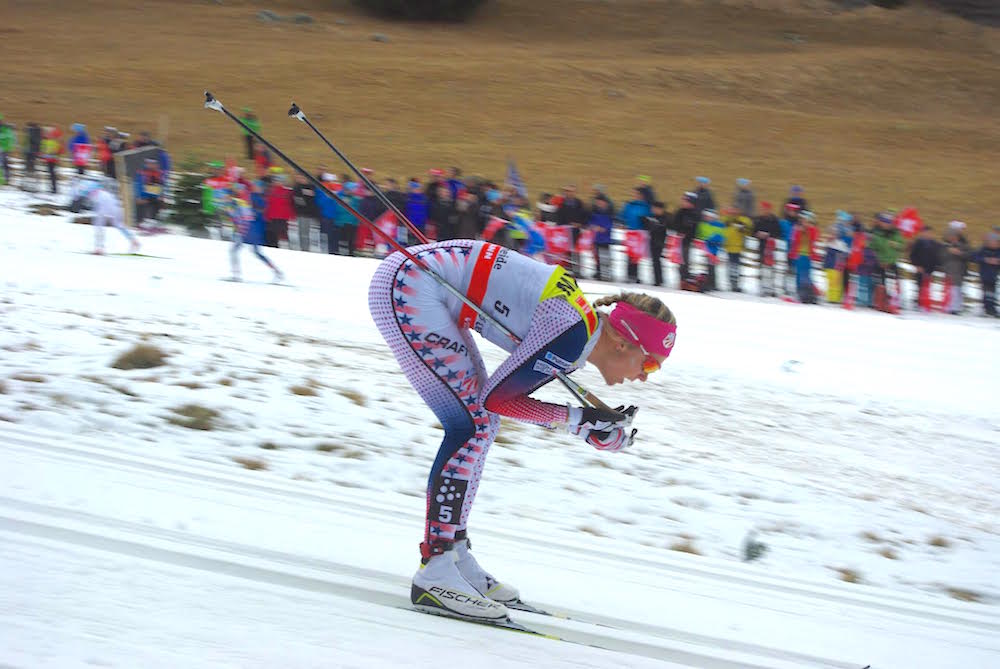
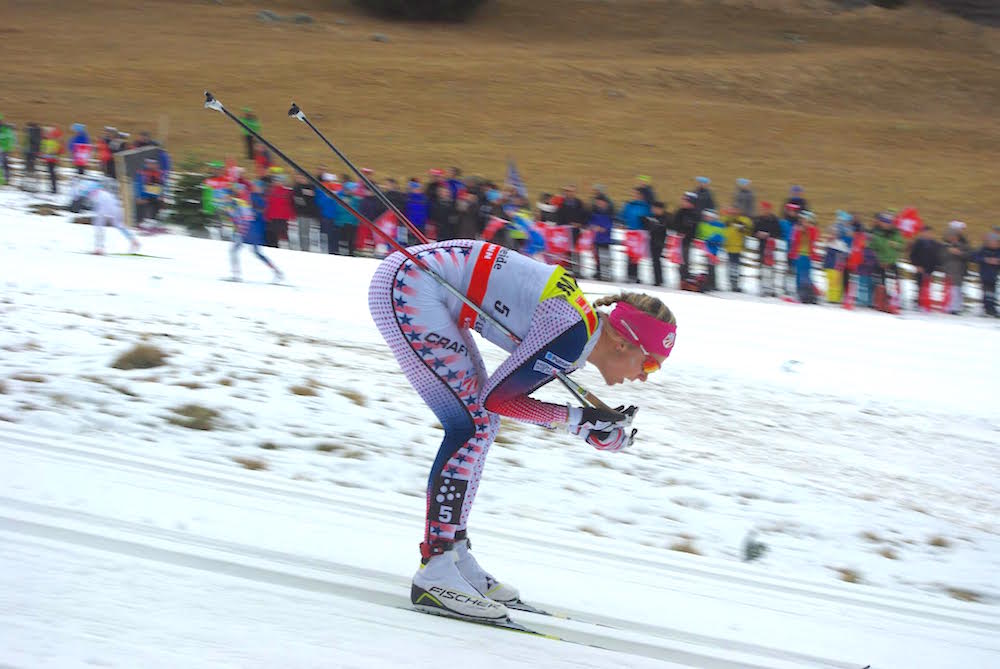
If there’s one word that sums up the recent performances of several members of the U.S. women’s cross-country team, it’s consistency. In Stage 2 of the Tour de Ski, the women’s 15-kilometer classic mass start, Jessie Diggins and Sadie Bjornsen proved particularly consistent in their pacing, consistent in their technique, and consistent in their results on Saturday in Lenzerheide, Switzerland.
On a day when Norway swept the podium, with Therese Johaug taking the win in 41:26.4, Diggins placed 12th, 2.44.7 minutes back, and Sadie Bjornsen finished in 13th less than a second later (+2:45.3). Liz Stephen, who started in bib 62, climbed with a vengeance up the leaderboard, finishing 20th (+3:15.2). Also for the U.S. team, Sophie Caldwell placed 34th (+4:17.8), Caitlin Gregg was 39th (+4:49.3), and Rosie Brennan finished in 41st (+5:03.6).
The buzzword, consistency, is a baseline many athletes aspire to. The ability to obtain solid results again and again, not to tax the psyche and the body with roller coaster performances can seem ethereal.
“That’s been my goal the last couple years, to be a consistent racer, and of course it’s really fun when you have your huge breakthrough races,” Bjornsen said in a post-race phone interview. “Sometimes I get frustrated that I didn’t have those like top-10’s or top-5’s, although, I’ve been having couple top 10’s this year. So that’s actually been my goal since working with [Alaska Pacific University coach] Erik Flora, is to be a consistent racer.”
Saturday’s 15 k classic was a grind-it-out race. The kind of race where one’s consistency could manifest with a solid result.
From the starting gun, Diggins and Bjornsen kept with the high pace. At the 5.6 k checkpoint, the duo clocked through in 11th and 12th, respectively. At 10 k, Diggins, in 13th, led out a group that included Bjornsen a few seconds back in 17th.
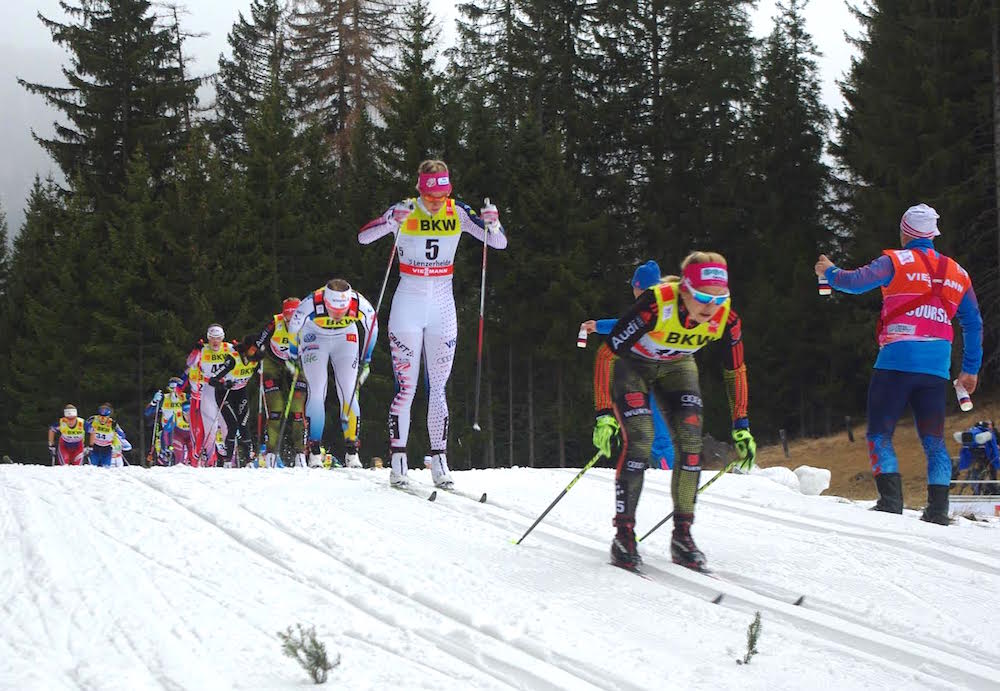
“I knew that they were doing a parade lap and there is that corner down there — I knew had to really had to gun it like the first 2 k or else I’d get shuttled to the back and then never be able to get around,” Diggins said. “So I just decided my goal was to out as hard as I could the first bit and then try to settle into this kind of L4 pace, that’s just under my race pace because I know at altitude, if I blow up I’m dead.”
Diggins did keep it balanced between heavy on the throttle and subtly dialing it back.
“I know that if I’m able to really be good and relaxed and comfortable, then I can really power-stride,” Diggins added. “This is a really good course for me so I was literally thinking, ‘Right, left, right,’ kind of like glide it out and stay relaxed.”
Keeping Diggins in her sights was motivation for Bjornsen.
“That made it extra fun because when she was quite a ways in front of me and sometimes I was catching her so we were just kind yo-yoing,” Bjornsen said. “Seeing your suit is a helpful thing. … You kind of have an extra motivation because your teammates are real humans. So you know you can race at the same level and be with them.
“When you look up and you see a Norwegian suit, sometimes I get turned off a little bit because they are just amazing,” she added. “So when it’s your teammate, with me, it’s an encouraging little voice in my head.”
Yo-yoing or not, Bjornsen held on. She finished just behind pace-setter Diggins, which put her eighth in the Tour standings after two stages. Diggins is currently ninth.
For Diggins, after placing eighth in Friday’s skate sprint, staying with the front pack was a goal from the outset. Like Bjornsen, who found motivation seeing a stars-and-stripes suit ahead of her, Diggins found motivation having a teammate along for the ride.
“It was really sweet. I knew that Sadie was with me so that was awesome because it was like, ‘All right’ and the two of us we were going around passing people together,” Diggins said. “Pretty cool.”
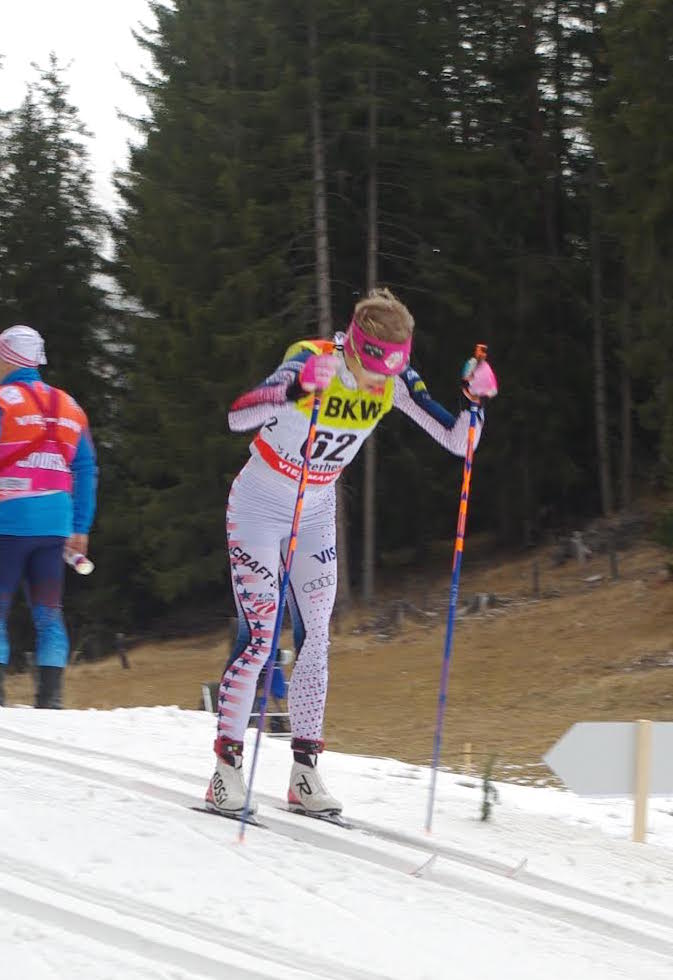
For Stephen, the harder the course, the steeper the hills, the more she likes it. She described Saturday’s course as “kind of a course that eats at you each lap,” she said in a post-race in-person interview. “So if you are patient, people just keep coming back to you.”
Not known for her sprinting, Stephen started the day in bib 62. In order to rise to 20th in the 15 k, Stephen reeled in skier after skier.
“I didn’t want to ski my bib again. It’s been 62 two days in a row now. So I think I’m done with that,” she said.
As the Tour transpires, she’s aiming for better bib numbers with each race.
“I was certainly getting tired by the end , but I think that’s the right pacing strategy … here, you don’t want to be saving a whole ton,” Stephen said. “No need to really conserve any energy, in my opinion, any day of the Tour.
“As the tour builds it’s in my favor,” she added. “If I’m just patient and don’t look too much at each day’s results, but rather what the goal is at the end of the Tour, I think I will stay positive and I’m in a really good place to be able to move up.”
For Bjornsen, who has never completed a full Tour de Ski, she’s entering new territory. But her consistency thus far this season, has her looking forward to the pain to come.
“At that point like everybody is just in a pain train,” Bjornsen said. “I think that the most fun part about it is anytime you are feeling exhausted or tired — like today when I went out to warm up, my legs just felt awful — you literally can just tell yourself everybody is feeling the same way.
“It’s not only the sprinters doing the sprint race and just the distance skiers doing the distances, everybody is having to do everything,” she added. “It’s just a matter of who wants to hurt enough. I don’t know, I love the idea of it.”
The idea of the multi-stage tour as a test of strategy, fitness and suffering can pivot and become a misery. At the end of the day, consistency may not always win the day, but it does win the Tour.
Racing continues Sunday with the women’s 5 k and men’s 10 k freestyle pursuits.
Johaug, the Tour leader, will begin first. Bjornsen, now eighth in the Tour, will start 3:03 behind in bib 8. Diggins will start in bib 9, two seconds later.
Friday’s fourth-place sprint finisher, Caldwell will wear bib 23, starting 4:25 behind the leader. For Stephen, it’s no longer bib 62, she’ll start 27th (+4:27). Gregg will start 38th, 5:55 back, Brennan will go out 42nd (+6:09), and Ida Sargent will start 47th (+6:31).
Results | Overall standings (through Stage 2) | Sunday’s 5 k start list
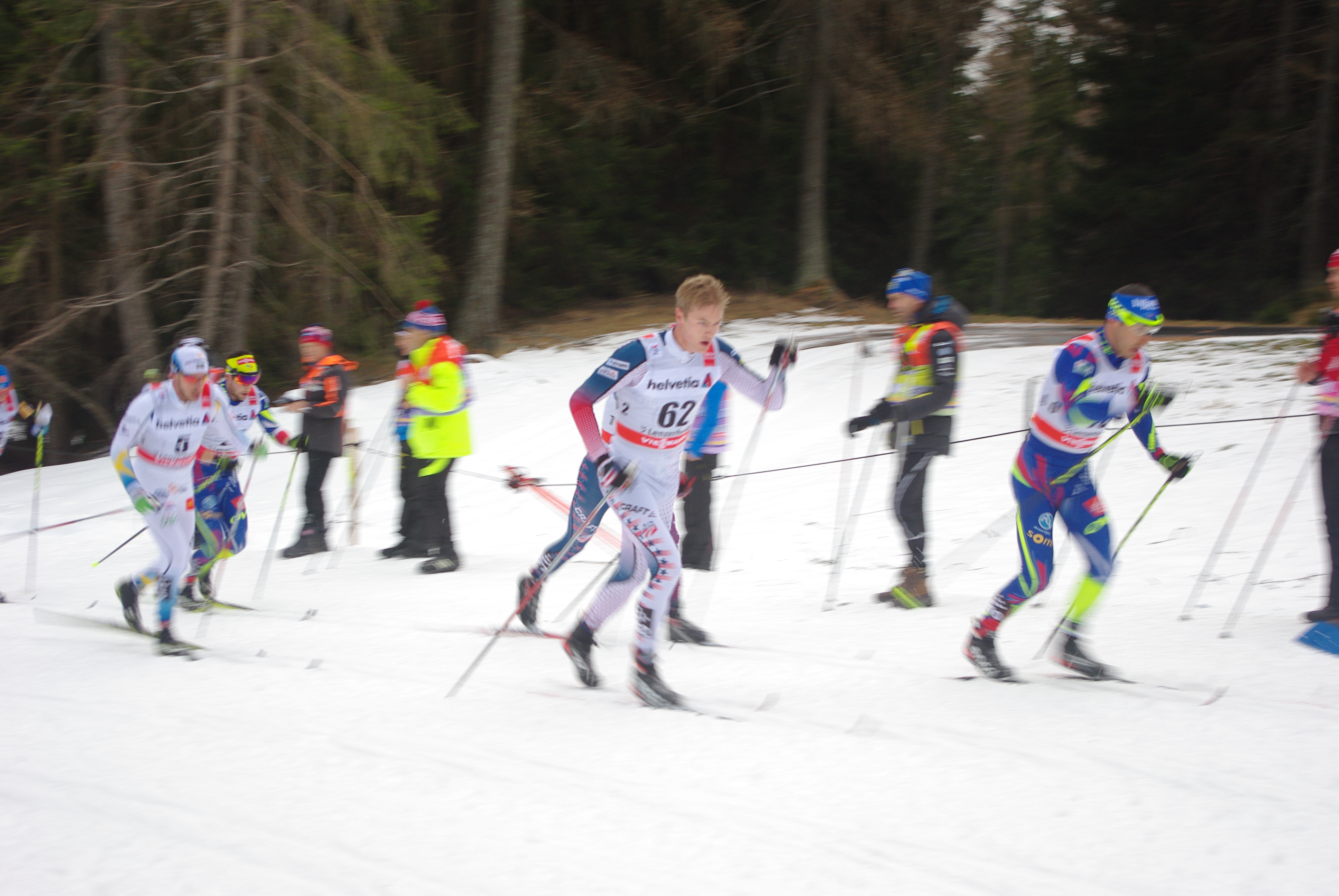
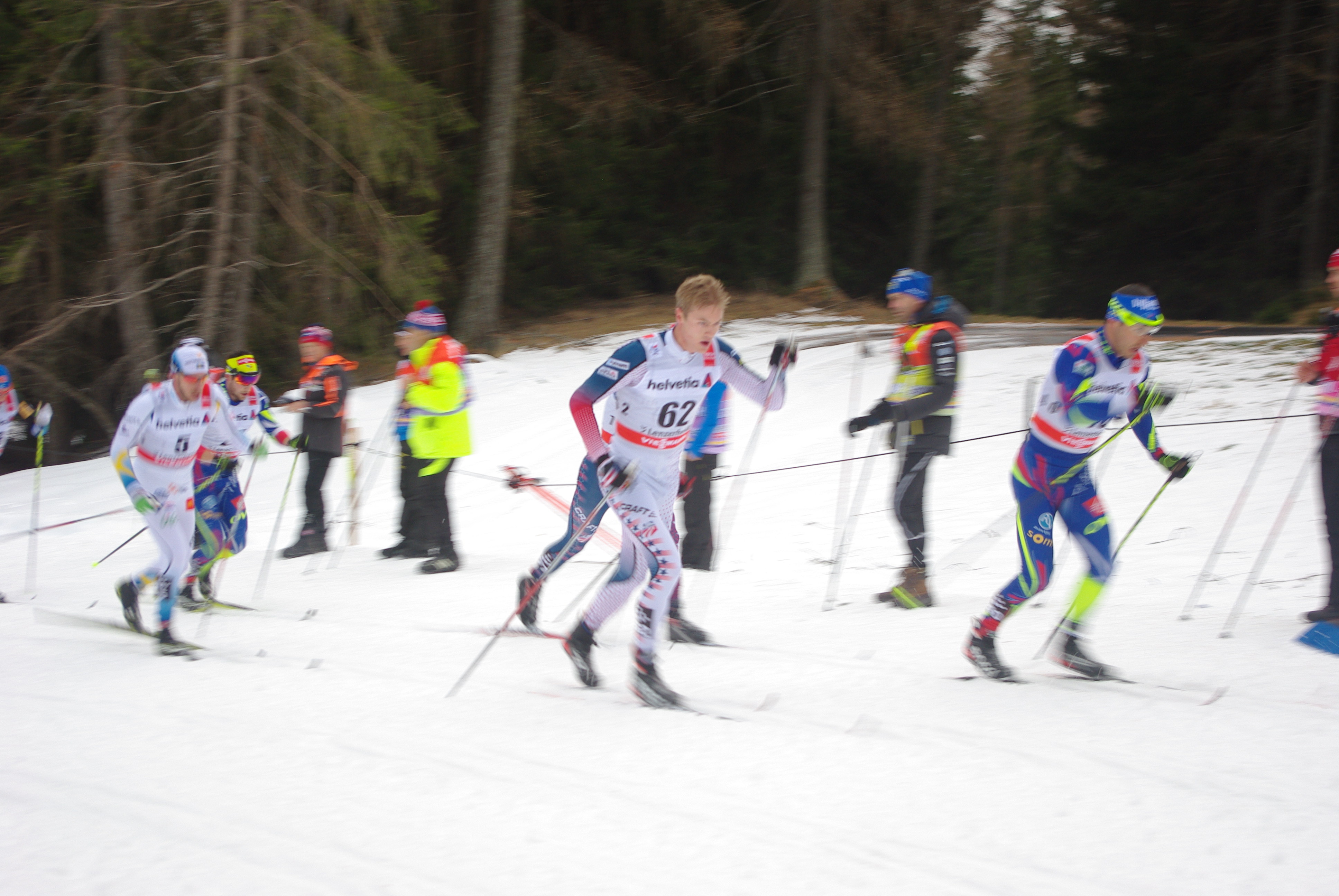
LENZERHEIDE, Switzerland — After a sprint qualifier which Erik Bjornsen called “really bad” and Noah Hoffman wrote off almost completely as something to “get ready” for the rest of the Tour de Ski, the U.S. Ski Team pair was thrilled to each notch top-30 finishes in the 30-kilometer classic mass start on Saturday.
“As far as this goes, it’s a good race for me, a step in the right direction for the season, and there’s six more stages to go in this Tour and I’m psyched,” Hoffman said after finishing 23rd, 2:22.4 behind winner Martin Johnsrud Sundby of Norway. “You know, we’re both going to move up and finish this thing in the top 30.”
It was Hoffman’s best result of the season; he had finished 25th in the World Cup 30 k skiathlon in Lillehammer, Norway, in December. After starting the mass start near the back in bib 77, Hoffman worked his way through the field and was into the top 30 by the halfway point.
“I just need to go out and not be frantic, and not try to make up all the positions in the first few kilometers,” he explained. “I think I did a good job of that.”
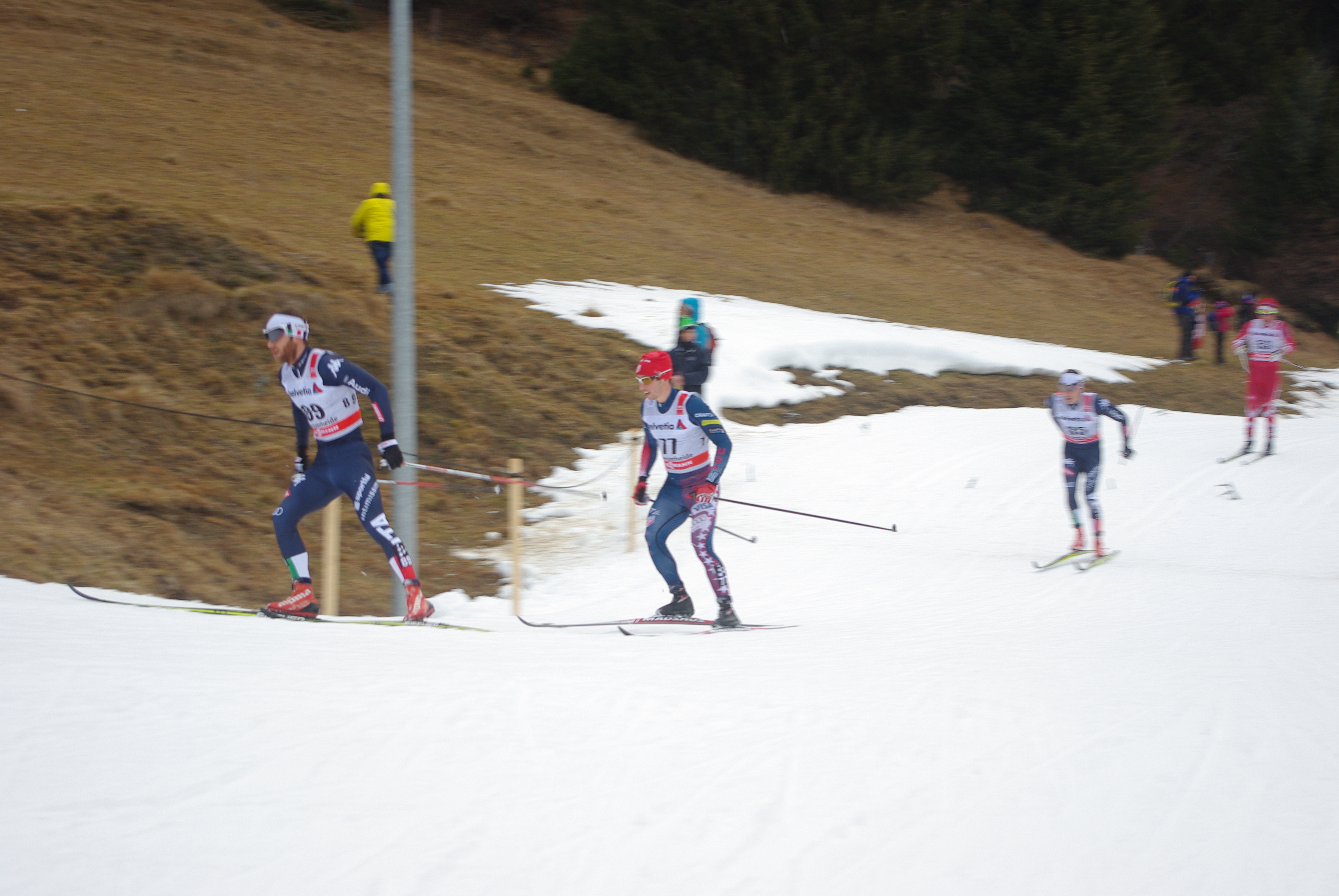
Even more than having strong races, the duo was proud to come one step closer to earning another quota spot for World Cup distance races next season. At the moment, the U.S. team only can start three men, plus the Continental Cup leader.
With Bjornsen finishing in 30th place and getting his first World Cup points of the season, the U.S. now only needs one more man to score a point in a distance race to get up to four starting spots.
“I’m super psyched for Bjornsen,” Hoffman said. “We need one more person to score points for next year, and I’m confident that we can do it.[Alaska Pacific University’s] Scott Patterson’s coming over, or [Andy] Newell or Simi [Hamilton] is gonna get it done.”
In this 30 k, Hamilton finished 69th (+7:47.5) and Newell 76th (+9:10.8).
But not every distance race is as grueling as a 30 k classic in the mixed rain and snow.
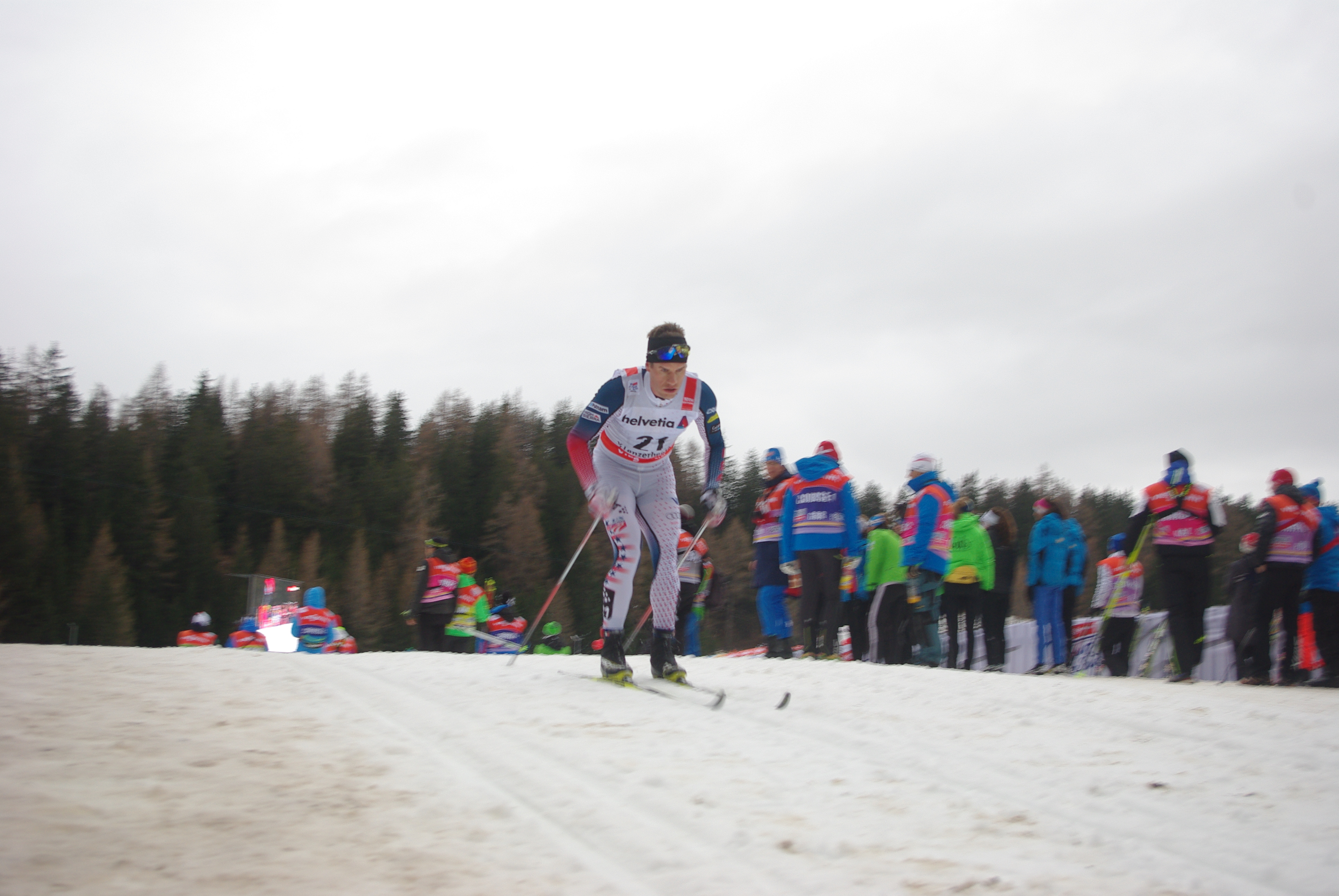
The bad weather, which left some athletes slipping, sticking and falling, didn’t hinder Bjornsen and Hoffman, however.
“I think there was just some variable conditions out there, so some spots I had some of the better skis out of the group I was skiing with, and other spots, you had to work it,” he explained. “We definitely had skis in the mix today, so it was good.”
And once he began getting splits that he could move into the top 30, Bjornsen found the extra gears needed to pick up his pace.
“That top 30 means a lot to all of us, so I started going for it,” Bjornsen said. “I was able to get it in the last half kilometer.”
Hoffman is now ranked 25th in the Tour de Ski and will start Sunday’s 10 k freestyle pursuit 4:33.5 behind Sundby, while Bjornsen is ranked 33rd and will start 5:31.4 back.
Results | Tour standings (through Stage 2)
— Gerry Furseth contributed reporting.