
This article was made possible through the generous support of our voluntary subscribers. If you would like to see more articles like this one, please support FasterSkier with a voluntary subscription.

“Starting out, it is difficult to train at L1–2. The unfit blows right through just shuffling on the flats. Any insight on how the rank novice can gain enough fitness to begin varying the level of effort?”
Submitted by a FasterSkier reader, this is the million-dollar question for both young junior athletes and adults new to structured training. It’s a common challenge coaches have wrestled with for years. I have tried multiple solutions to this issue many times in the last decades. There isn’t one simple answer, because the barriers to controlled low-intensity training come from multiple physiological and mechanical factors.
In general, there are three elements to address:
- Metabolic capacity — the aerobic system’s ability to deliver oxygen to the mitochondria for energy production.
- Strength — the ability of the muscles to generate enough force without excessive, relative, cost.
- Technique and movement patterns — the efficiency of applying force in the specific sport.
Metabolic Development
The aerobic system takes time and consistency to develop. Capillary density, mitochondrial content, and aerobic enzyme activity all increase gradually with repeated exposure to low-intensity work. However, low intensity work alone will not lead to improvement as the force output will almost always be too low to improve the ability in increase the rate of force production.
For the novice, this often means going slower than feels natural, sometimes slower than 65% of max heart rate, and certainly below the first ventilatory threshold (where breathing begins to noticeably change). If intensity drifts higher, glycolytic energy pathways engauge to meet demand. While glycolysis doesn’t “shut down” aerobic metabolism, it does shift the balance toward faster but less sustainable energy, and away from the steady-state aerobic development we’re targeting.
The only real solution here is patience, go easy, keep intensity low, and gradually extend the duration of workouts. Over time, this steady stimulus expands aerobic capacity and makes it easier to stay in the right zone.
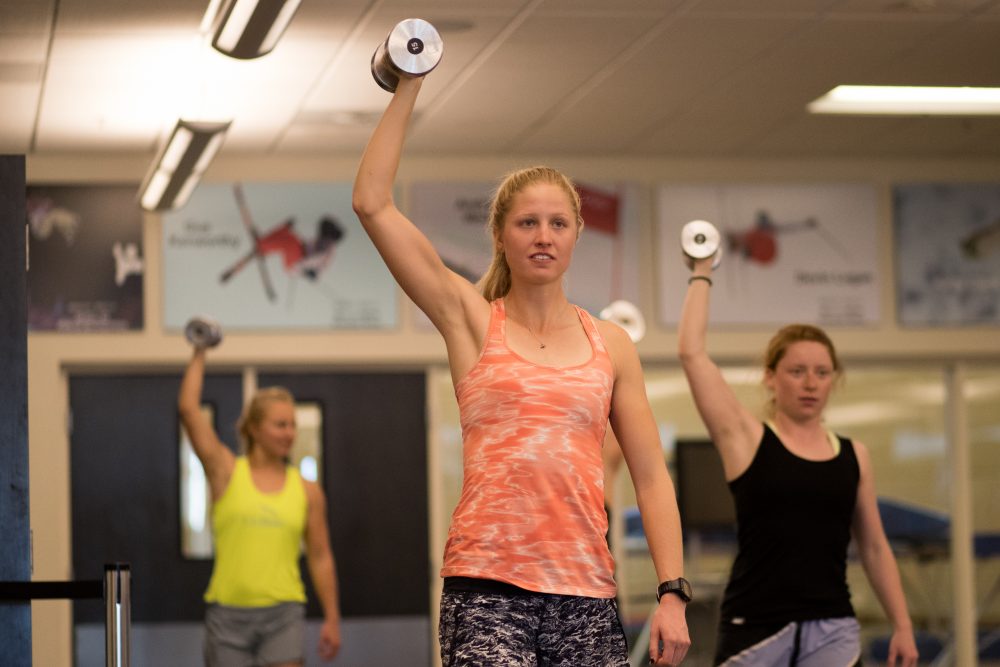
Strength and Endurance Strength
For many novices, the difficulty isn’t just metabolic, it’s mechanical. Moving the body forward at a given pace requires a baseline of strength. If the muscles aren’t strong enough, the relative cost of each stride or push-off is high, driving up heart rate and perceived exertion even at slow speeds.
Improving strength lowers the cardiovascular cost of submaximal work. This includes:
- General strength: foundational resistance training, general strength, and targeted exercises to build capacity for force development.
- Endurance strength: strengthening the specific movement patterns of skiing, running, or cycling so that more motor units and muscle fibers share the load. This reduces the energy cost of each movement, improves economy, and makes it possible to train at low intensity.
Practical examples:
- Uphill hiking or ski walking with poles, 1–2 times per week, sometimes a weighted pack might be incorporated.
- Short repeats (60–90 sec) at low intensity with BFR bands, which accelerate local endurance strength gains.
- Cycling with low cadence and high resistance, keeping effort aerobic.
These methods are more effective in the dryland (summer and fall) phase, since on snow it’s difficult to create enough resistance or muscle recruitment without moving into higher intensities.
Initial strength gains happen quickly, often within days, thanks to neuromuscular improvements and better motor unit recruitment. But sustaining and consolidating those gains requires consistent work over weeks to months.
As an example: I recently added two steep uphill hikes (1.6 miles, 1,300 feet gain) spaced three to four days apart, with normal aerobic training in between. After just those two sessions, I noticed running pace on the same trails improved by about a minute per mile at the same intensity. These early changes are real, but largely neural. True structural adaptation still requires ongoing work.
Technique and Neuromuscular Efficiency
Strength and aerobic capacity provide the foundation, but technique determines how efficiently those capacities are applied. Stronger athletes generally show better motor unit recruitment, more coordinated firing, and smoother movement patterns. This reduces wasted motion, improves economy, and allows sustaining higher speeds at lower energy cost.

Putting It Together
Progress for novices follows a clear order:
- Build the aerobic system with consistent, very easy training.
- Add strength and endurance strength to lower the cost of movement.
- Refine technique and efficiency so that force is applied effectively.
- Layer in speed and intervals once you can sustain true low-intensity for the full duration of a workout.
Strength alone doesn’t increase VO₂max in the way that high-volume aerobic training or intervals do. But it provides the support system that makes VO₂max training possible and more effective. Think of the relationship this way:
- Force production: Stronger muscles generate the same force at a lower relative energy cost.
- Economy: At a given submaximal speed, oxygen cost drops, allowing longer training sessions without accumulating fatigue.
- Capacity for VO₂max training: Once strength and economy are in place, athletes can tolerate the intensities (>90% VO₂max) required for central cardiovascular adaptations without fatiguing prematurely in the muscles.
Final Word
For the rank novice, the “can’t go easy” problem isn’t solved overnight. It requires building the aerobic base, raising strength to lower the cost of movement, and refining techniques for efficiency. Initially, these three elements of training should be done with equal focus in order to bring the athlete along most effectively. Done consistently, these steps create the conditions for true low-intensity training, and, eventually, the fitness to vary effort levels across the full range from L1 to VO₂max.


