From the FasterSkier archive — posts syndicated from athletes’ and coaches’ own blogs between 2004 and 2012, kept online as published. Current coverage is at fasterskier.com.

Tag: Level 3 intervals

  • Wednesday Workout: Craftsbury Running Intervals

    Wednesday Workout: Craftsbury Running Intervals

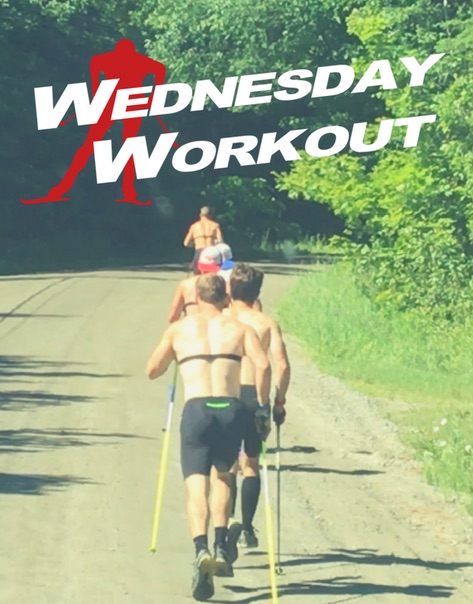
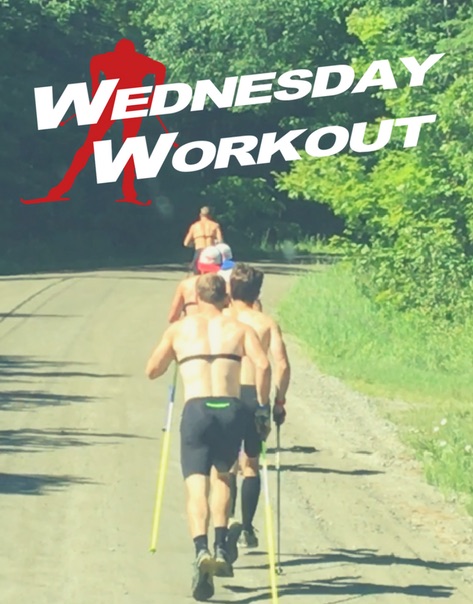
    Craftsbury Green Racing Project nordic skiers and biathletes doing uphill running intervals on a dirt road in Craftsbury, Vermont. (Photo: Pepa Miloucheva)

    For a mid-summer Wednesday Workout, we reached out to Craftsbury Green Racing Project head coach Pepa Miloucheva. In addition to sharing a running workout, Miloucheva told us what and who is new to the team based out of Craftsbury, Vermont.

    “All is good here in Craftsbury,  everyone is healthy and training is going well,” she wrote in an email in early July. The nordic team joined last month’s U.S. Ski Team (USST) training camp in Lake Placid, N.Y., and also plans to attend the USST’s on-snow New Zealand camp in late August.
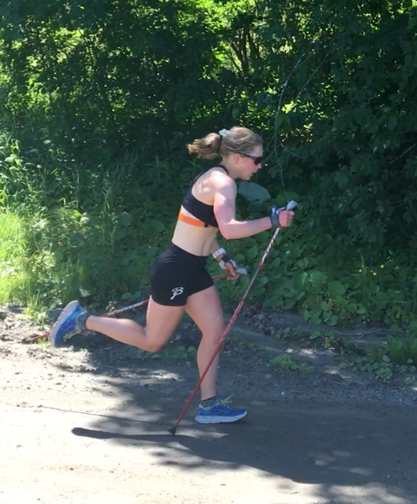
    Ida Sargent, of the Craftsbury Green Racing Project and U.S. Ski Team, during dirt-road running intervals in Craftsbury, Vt. (Photo: Pepa Miloucheva)

    Craftsbury’s roster additions include Corey Stock and Akeo Maifeld-Carucci. Returning to the nordic squad are Ida Sargent (U.S. Ski Team), Caitlin Patterson, Kaitlynn Miller, Liz Guiney, Adam Martin, and Ben Lustgarten.

    The workout itself, one Miloucheva explained the team does this time of year, is 6-8 x 10-minute running intervals with poles. They do so on a gradual, mile-plus-long hill on a dirt road in Craftsbury. To replicate, find a climb that takes at least 10 minutes to run up, and repeat six to eight times.

    “This is a lactate threshold workout, important for improving our sustainable speed,” Miloucheva wrote. “Threshold workout improves both lactate production/recruiting more fast twitch units and lactate removal, ability to minimize the negative effects of lactate while having the benefits.”

    “Athletes run with poles up and I drive them down as quickly as possible to shorten the time between the interval,” she explained. “Goal is to maintain speed for all intervals and keep lactate between 3-5mmol/l, depending on the athlete.”

    Male and female athletes all start at once, just at different starting points so they finish in the same place. Miloucheva recommends focusing on controlling speed during this workout to ensure a productive 50-plus-minute workout at Level 3.

    clomid buy, order revia naltrexone, ventolin

    Upon repeating the workout later in the training season, athletes are instructed to push the pace at the end of the interval to Level 4.

    The workout: 6-8 x 10-minute running intervals with poles

    Need: A hill that takes at least 10 minutes to run up, poles.

    Warmup: 30 minutes easy running, with a few accelerations and functional movements

    Then: Run uphill for 10 minutes at Level 3, return to starting point, repeat 6 to 8 times. Pace at end of interval can be increased to Level 4 later in the season.

    Cool down

  • Throwback Workout: Reese Hanneman’s On-The-Road Intervals

    Throwback Workout: Reese Hanneman’s On-The-Road Intervals

    Reese Hanneman (APU) rollerskiing in Homer, Alaska, in the spring of 2013. (Photo: Woodski)

    With ski season winding down, you may be one of the lucky ones hitting the road for some quality family/friend/significant-other time. Here’s a one-hour workout you can squeeze in on-the-go, which we received from Alaska Pacific University (APU) skier Reese Hanneman back in 2013. Hanneman, now 28, and his brother Logan, 24, raced at their first Olympics this past winter in PyeongChang, South Korea. Read the original workout here.

    ***

    [circa June 2013]

    It’s summer time, or close to it, which means vacation season is here. Whether you have a family reunion on a beach or a trip to the mountains planned, it can be tricky to carve out time for training while you’re on the road.

    Alaska Pacific University’s Reese Hanneman has a solution to this dilemma: a compact, efficient interval workout that fits into a single hour. It can be done on rollerskis, in running shoes, on a bike — with whatever equipment you have available away from home.

    “If I’m on vacation with people…and I’m only going to get one workout in a day, I want to do more than go ski or run or bike for an hour at distance pace, because that’s not that hard,” Hanneman explains.

    He frequently returns to this threshold workout when he’s pressed for time. It’s short on warm up and cool down time, but the meat of the workout is challenging and efficiently improves overall fitness. In the past, Hanneman has repeated this session as many as three to five days in a row when he’s traveling. And it clearly works for him: he racked up early-season World Cup starts in Canada and had a series of career-first podiums on the SuperTour last winter. The traditionally strong sprinter improved his distance chops, too, and finished last season with a sixth place at U.S. 50 k Championship in April.

    The workout:

    Warm up: 10-15 minutes Level 1 (L1)

    3×10 minutes L3, with 2 minutes of recovery in between. For added intensity, “if you really want to push yourself,” ramp up the pace to L4 or race pace for the last 3 minutes of each interval.

    Cool down: 10 minutes L1

    Total workout time: about 60 minutes

    By the end of the session, Hanneman is usually pushing the pace.

    “If [I] do that hard enough, without it being a sprint workout, I feel like it’s improving my fitness and improving my skiing,” he said. “If I was on a vacation for weeks on end and I did that every other day, I would still come away from that travel feeling like I improved as an athlete.

    “For me, obviously you could just do a straight hour of threshold, but by breaking it up then [I’m] able to push it pretty hard in L4,” he added. “So you get that feeling at the end where you feel like you were moving really fast.”

    In a perfect world — say, at a training camp — Hanneman would do such a workout after a 45 minute warm up beforehand with some pickups and have time for a longer cool down. But when he has to fit a session in a small window — within a road trip lunch stop, for example — he returns to this stripped-down version.

    “On a family vacation, where you’re someplace not suited well to a training block, you don’t want to be that weird person always out training during your family vacation,” Hanneman reasons.

    The quicker threshold intervals also work well outside the summer vacation context, when work and life encroach on workout time.

    “I think you could reach a pretty high-level doing workouts just like that,” Hanneman said. “People are always under this illusion that you have to do so many hours.”

    That’s not just the sprinter in Hanneman talking, either. He’s always considered himself to be a hybrid, but with a jump up in his distance racing last season he’s approaching training this summer with more distance focus.

    “I’m trying the Kikkan approach,” he laughed. “It worked for Erik [Bjornsen]. Certainly I have been more consistent as a sprinter, but some of that was mental, too. I’m trying to help myself expand my horizons.”

  • Wednesday Workout: Matching Attacks with Astrid Jacobsen

    Astrid Uhrenholdt Jacobsen (far right) in the lead pack of the women’s 30-kilometer freestyle mass start at 2017 World Championships in Lahti, Finland, along with (from left to right) fellow Norwegians Marit Bjørgen and Heidi Weng, and Sweden’s Charlotte Kalla. (Photo: John Lazenby/Lazenbyphoto.com)

    On July 28, we released our podcast interview with Norwegian national team skier Astrid Uhrenholdt Jacobsen. Not simply satisfied with the quotidian — Jacobsen is a multitasker, she’s studying to become a physician along with her World Cup training.

    In this Wednesday Workout, we’ll focus on the non-academic side of Jacobsen’s calculus: her quest for endurance and her stick-with-attacks speed.

    Jacobsen shares an idea for athletes training for this upcoming winter’s Masters World Cup in Minneapolis or other hallmark races like Sun Valley’s Boulder Mountain Tour. In fact, if any mass-start race where there’s a pulse of pace when the leaders try to gap the field is on your calendar, this workout could keep you in the hunt. It works for Jacobsen, it might just work for you.  

    Sweden’s Charlotte Kalla leads Norway’s Therese Johaug and Astrid Uhrenholdt Jacobsen in the final kilometers of the 15 k skiathlon at the 2015 FIS Nordic World Ski Championships in Falun, Sweden. (Photo: Flyingpointroad.com)

    “The sessions I feel develops me the most at the time are level 3 intervals with short sprints in the middle or to finish the interval,” Jacobsen wrote in an email. “It helps me work on my ability to follow attacks in sprint — or mass start competitions … To make this interval with good quality you need to be sure to not race faster than level 3, with is similar to the speed you keep in a 30km. Then you are able to hit your max speed for the sprints. If you start out too hard the sprints will be slower and the whole session more like a level 4. Takes discipline to make this training with high quality, But it has made me a better mass start skier.”

    The Workout

    Jacobsen explained that her usual session when completing this workout involves 6 x 8 minutes on a rollerski track or rollerski treadmill.

    “To make this interval with good quality you need to be sure to not race faster than level 3, with is similar to the speed you keep in a 30km,” Jacobsen explained. “Then you are able to hit your max speed for the sprints. If you start out too hard, the sprints will be slower and the whole session more like a level 4. It takes discipline to make this training with high quality, But it has made me a better mass-start skier.”

    About midway through the interval, Jacobsen puts in a burst of sprint-worthy speed.

    “After 4 minutes, I will do a 10-second sprint, then go back to level 3 speed for almost 4 minutes and finish the interval with a new sprint,” Jacobsen wrote. “I break until my heart rate is below 100, 1-2 min.”