From the FasterSkier archive — posts syndicated from athletes’ and coaches’ own blogs between 2004 and 2012, kept online as published. Current coverage is at fasterskier.com.

Tag: Level 3

  • Wednesday Workout: Matching Attacks with Astrid Jacobsen

    Astrid Uhrenholdt Jacobsen (far right) in the lead pack of the women’s 30-kilometer freestyle mass start at 2017 World Championships in Lahti, Finland, along with (from left to right) fellow Norwegians Marit Bjørgen and Heidi Weng, and Sweden’s Charlotte Kalla. (Photo: John Lazenby/Lazenbyphoto.com)

    On July 28, we released our podcast interview with Norwegian national team skier Astrid Uhrenholdt Jacobsen. Not simply satisfied with the quotidian — Jacobsen is a multitasker, she’s studying to become a physician along with her World Cup training.

    In this Wednesday Workout, we’ll focus on the non-academic side of Jacobsen’s calculus: her quest for endurance and her stick-with-attacks speed.

    Jacobsen shares an idea for athletes training for this upcoming winter’s Masters World Cup in Minneapolis or other hallmark races like Sun Valley’s Boulder Mountain Tour. In fact, if any mass-start race where there’s a pulse of pace when the leaders try to gap the field is on your calendar, this workout could keep you in the hunt. It works for Jacobsen, it might just work for you.  

    Sweden’s Charlotte Kalla leads Norway’s Therese Johaug and Astrid Uhrenholdt Jacobsen in the final kilometers of the 15 k skiathlon at the 2015 FIS Nordic World Ski Championships in Falun, Sweden. (Photo: Flyingpointroad.com)

    “The sessions I feel develops me the most at the time are level 3 intervals with short sprints in the middle or to finish the interval,” Jacobsen wrote in an email. “It helps me work on my ability to follow attacks in sprint — or mass start competitions … To make this interval with good quality you need to be sure to not race faster than level 3, with is similar to the speed you keep in a 30km. Then you are able to hit your max speed for the sprints. If you start out too hard the sprints will be slower and the whole session more like a level 4. Takes discipline to make this training with high quality, But it has made me a better mass start skier.”

    The Workout

    Jacobsen explained that her usual session when completing this workout involves 6 x 8 minutes on a rollerski track or rollerski treadmill.

    “To make this interval with good quality you need to be sure to not race faster than level 3, with is similar to the speed you keep in a 30km,” Jacobsen explained. “Then you are able to hit your max speed for the sprints. If you start out too hard, the sprints will be slower and the whole session more like a level 4. It takes discipline to make this training with high quality, But it has made me a better mass-start skier.”

    About midway through the interval, Jacobsen puts in a burst of sprint-worthy speed.

    “After 4 minutes, I will do a 10-second sprint, then go back to level 3 speed for almost 4 minutes and finish the interval with a new sprint,” Jacobsen wrote. “I break until my heart rate is below 100, 1-2 min.”

  • Wednesday Workout: Quality Level 3 and 4 for the Working Class

    Wednesday Workout: Quality Level 3 and 4 for the Working Class

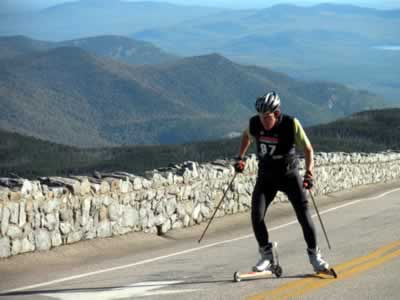
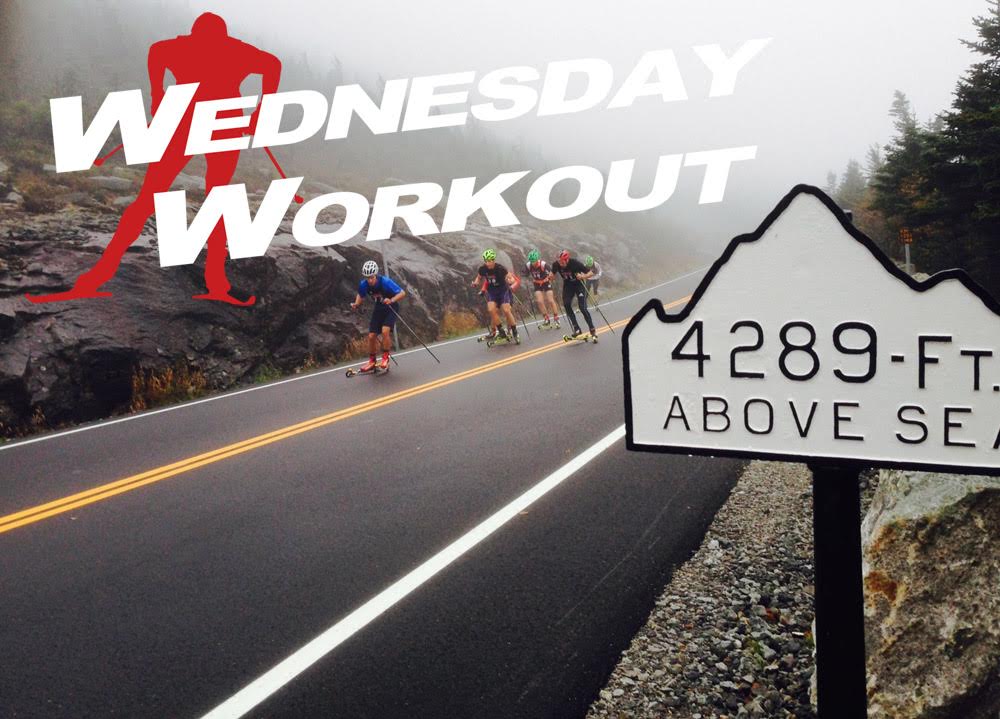
    The leaders in this year's 2015 Climb to the Castle rollerski race up Whiteface Memorial Highway in Wilmington, N.Y. Rogan Brown of the Sun Valley Ski Education Foundation (SVSEF) leads around mile four of five. (Photo: Tim Cowan)
    The leaders in this year’s 2015 Climb to the Castle rollerski race up Whiteface Memorial Highway in Wilmington, N.Y. Rogan Brown of the Sun Valley Ski Education Foundation (SVSEF) leads the top men around mile four of five. (Photo: Tim Cowan)

    On the day after my 58th birthday, I raced the Climb to the Castle. Again. It’s an incredible thrill to be on the same starting line as the best skiers in the U.S., even if I finish towards the back. This year, I finished within 6 seconds of my best time. And for the first time, instead of being totally gassed for the final half mile, I had good energy all the way to the finish.

    Peter Minde nears the finish of the Climb to the Castle in 2011.
    Author Peter Minde nears the finish of the Climb to the Castle in 2011.

    During the dryland season, my goal is to do one Level 4 and one Level 3 workout each week. I hate to admit it, but now there are now some days when my body revolts and says, “Enough! You’re not finishing this interval session.” To that end, I try to make sure I’m really rested.

    I take into account my work and my family commitments as well as the stuff in the training log. I hate conceding workouts, but nowadays, I’d rather do one really good interval workout rather than two mediocre sessions.

    Although I have good terrain for dryland training, I don’t have super long hills. For a Level 4 workout, either running or rollerskiing, I’m going up a hill, back down and repeat. The recovery time is always a little longer than the actual work period. Not best practice, but possibly beneficial at my age.

    “I hate conceding workouts, but nowadays, I’d rather do one really good interval workout rather than two mediocre sessions.” — Peter Minde, FS contributor and annual Climb to Castle competitor

    Workout 1: 5 x 5 Minutes Level 4, Uphill Running

    My bread-and-butter Level 4 workout is five repeats, five minutes, going uphill.

    I do this either running or rollerskiing. It’s OK if the pitch varies, but the final few hundred meters should be the steepest. Generally, I run in the woods, and I use trails that aren’t excessively technical.

    Warm up with dynamic stretching, then run 15 minutes at Level 1 in rolling terrain.

    Then go 5 minutes up your hill at Level 2. Return downhill, and repeat with 5 minutes in Level 3. Finish that, go down, and you’re ready for the main event.

    In the Level 4 section of the workout, I focus on starting in the lower end of my heart-rate range and increase the intensity over each interval. At the base of the hill, I moose hoof the first 30 meters before settling in to a run. During each repeat, I focus on positive self talk.

    Workout 2: 5 x 5 Minutes Level 4, Rollerskiing

    As with the running intervals, look for a long hill. It’s OK if there are rolling or short downhill sections; however, the final section of the hill should be steep enough that you have to check speed – snowplow, traverse, whatever – to return downhill safely.

    Warm up as above. Fifteen minutes in Level 1, followed by 5 minutes of Level 2 and five minutes of Level 3.

    As with running, my goal is to start conservatively and make the last interval the hardest. In addition to positive self talk, I focus on skiing transitions smoothly. If I’m classic rollerskiing, I’ll double pole a flat section and the base of the climb before changing to striding. If I’m skating, I try to V2 as much of the uphill as I can, or V1 the steep bits and switch to V2 where the grade is easier.  Don’t forget the warmdown and stretching.

    Workout 3: 3 x 15 Minutes, Running

    While I do this on rollerskis, I prefer to run, because I’m able to keep recovery times to 3-5 minutes between hard work periods. Find a loop in the woods that takes approximately 14-16 minutes to run.  It should be rolling with some long uphills.

    Warmup: Similar to the Level 4 workouts above. Begin with dynamic stretching, followed by 15 minutes of easy running.

    Ramp up your heart rate to Level 2 for five minutes, then head onto your loop and crank it up to a controlled pace.  In downhills, I pick up the pace to keep my heart rate in the zone.  At the end of 15 minutes, a short connector gives me around five minutes of recovery before the next repeat.

    Then I run easy back to the car, for 15-20 minutes warming down.

  • Wednesday Workout: Fast, Uphill V2

    Wednesday Workout: Fast, Uphill V2

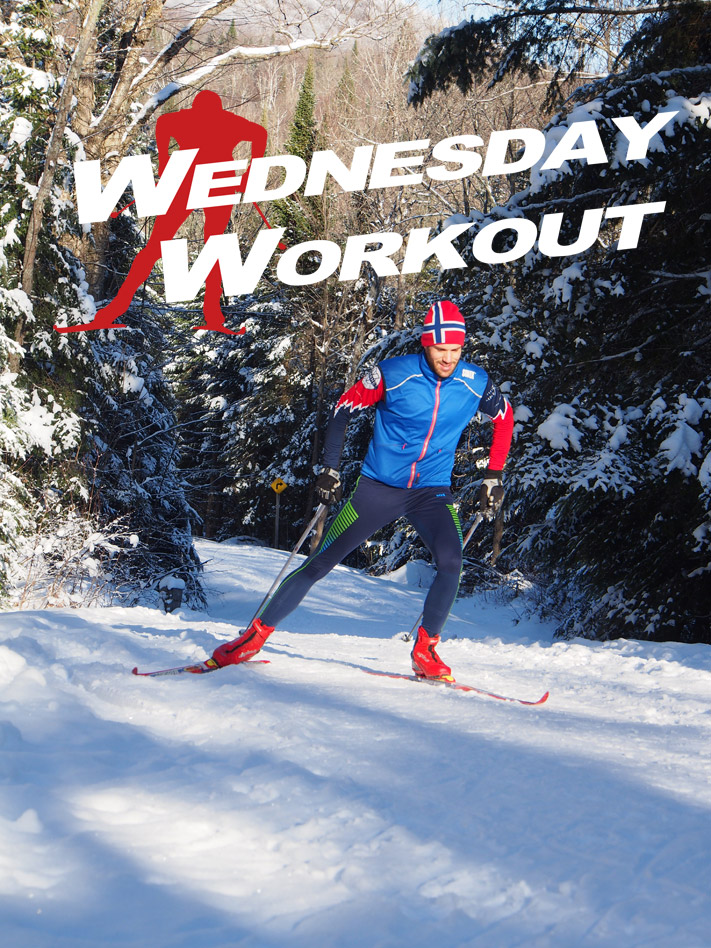
    Author François Léger Dionne concentrates on short, fast V2 strides at L3 intensity.
    Author François Léger Dionne concentrates on short, fast V2 strides at L3 intensity at the Far Hills Ski Center in Val-David, Quebec.

    This week, our focus shifts to a common theme amongst racers and trainers: uphill V2. Just like double poling is the go-to technique for most skiers in World Cup classic races  — watch those motionless legs during classic sprints and even throughout the 90 kilometres of Sweden’s legendary Vasaloppet! — V2 technique has really become their freestyle mainstay. And while we generally switch to V2 on flats and slight uphills, there are many benefits of using it on steeper climbs.

    For V2 to be effective on uphills, it is crucial to shorten the stride and increase the tempo. Forget long, smooth gliding on each ski. Don’t worry about full-arm extension when poling. Take the load off the triceps and focus instead on stabilizing the shoulders with the lats muscles. This will enable faster arm movements and a quicker reset between each push-off. The arms and upper body should dictate the pace of the V2 strides. Legs and hips should in turn follow and be the true power source of the technique.

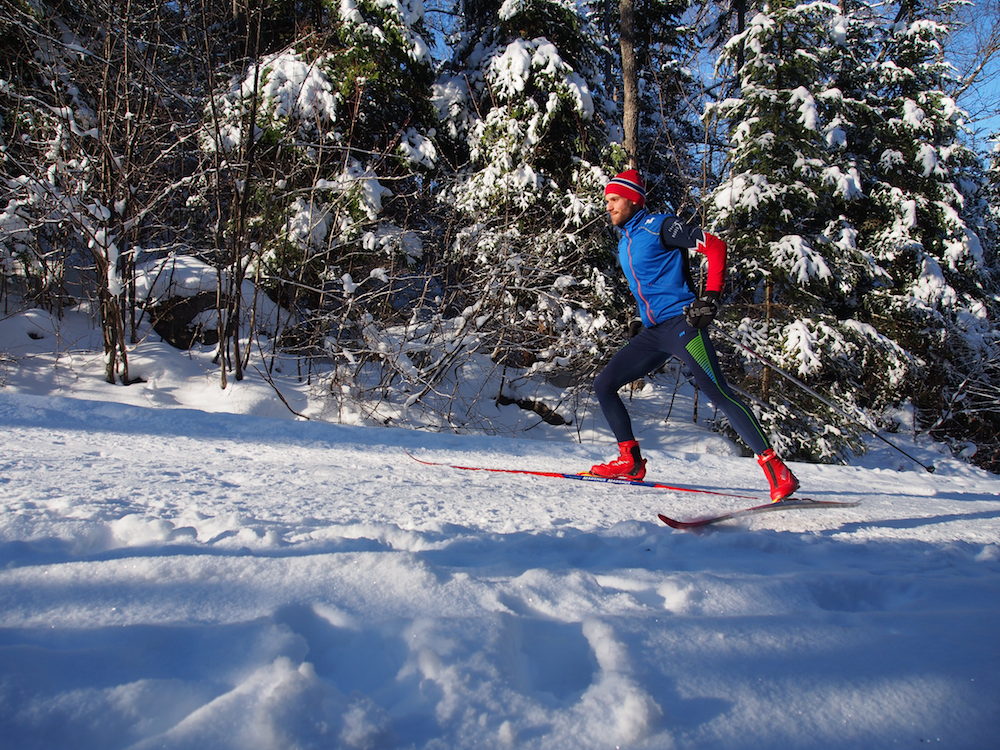
    Let the power come primarily from the legs and hips; the arms should dictate the pace. Author François Léger Dionne concentrates on short, fast V2 strides at L3 intensity at the Far Hills Ski Center in Val-David, Quebec.
    Let the power come primarily from the legs and hips; the arms should dictate the pace. Author François Léger Dionne concentrates on short, fast V2 strides at L3 intensity at the Far Hills Ski Center in Val-David, Quebec.

    When doing V2 at low intensity, I noticed many skiers (often youngsters) tend to rely mostly on their upper body. Poor push-off from each leg usually isn’t a consequence of muscle weakness. It can simply be the result of a lack of muscle memory training.    One effective way to engage those leg and hip muscles (mainly: quads, glutes, tensor fascia latae, psoas, iliacus) is skiing without poles. Twenty to 30 minutes, broken down in sets depending on your level, will do the trick.

    When skating without poles, concentrate on keeping your balance and push off with the entire leg (from hip flexion to big toe propulsion). As much as possible, don’t use your upper body for momentum. Avoid over-rotation of the hips and keep your spine long and vertical.

    After a proper warmup, followed by a no-pole ski session, you’re ready for short uphill V2 bursts. The idea is to initiate proper leg and hip movements through no-pole skating at a comfortable pace, and using this muscle activation and awareness for V2 climbs.

    The basic workout:

    20 minutes warmup: low intensity V2 (with poles)

    20-30 minutes of no-pole skating (Level 1-2 intensity), broke down in sets of five minutes or more depending on your level

    15-20 X 30 seconds repeats of uphill V2 (L3 or threshold intensity) with 1 minute recovery between each rep.

    30 minutes cool-down

    Improving your ability to power through uphills using only V2 will not only make you a overall stronger freestyle skier, it will help your body tone with the fast pace of sprints. You may also increase your V2 speed at the foot of real steep climbs (before switching to offset) and at the top of them when forward momentum is at it’s lowest.

    Notes:

    • To make the no-pole session more challenging, you can extend your arms on each side (holding the middle part of your poles). This will help prevent hip over-rotation.
    • For the uphill V2 repeats, find a hill you would tend to climb in offset, yet is attackable using V2 only.
  • Catching Up with the SMST2 Team (Video)

    Catching Up with the SMST2 Team (Video)

    STRATTON, Vt. — FasterSkier ventured to Vermont this week when we got word that the entire Stratton Mountain School T2 Team had arrived for their first week of training together this summer. Half of the eight-person roster had to fulfill U.S. Ski Team (USST) obligations out West before making their way to New England.

    Stratton’s elite team debuted last year with six skiers (Andy Newell, Skyler Davis, Eric Packer, Jessie Diggins, Sophie Caldwell, and Erika Flowers) and has grown by two in its second season.

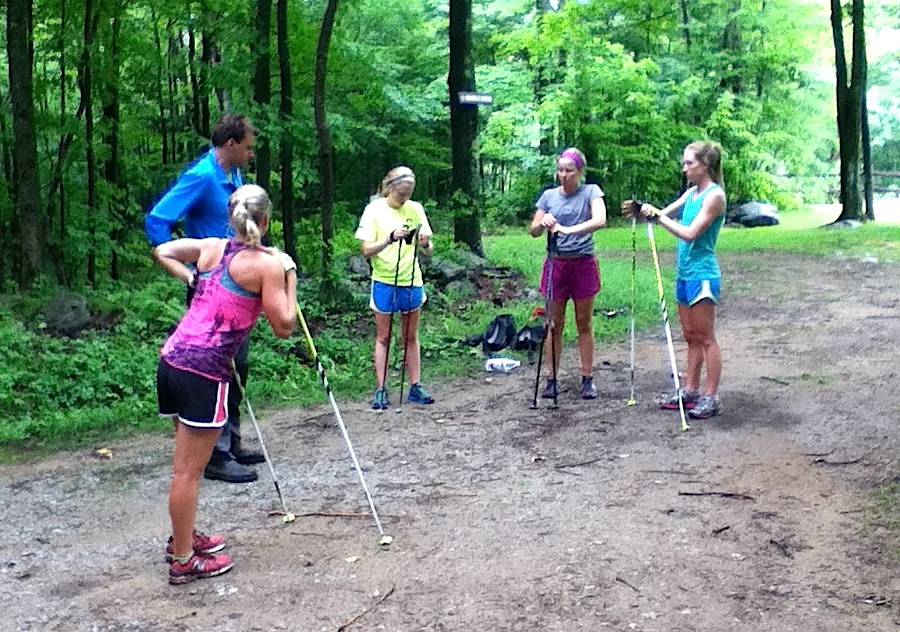
    Several women with the Stratton Mountain School T2 Team check in with head coach Gus Kaeding during a bounding-interval session on Tuesday in Stratton, Vt.
    Several women with the Stratton Mountain School T2 Team check in with head coach Gus Kaeding during a bounding intervals on Tuesday in Stratton, Vt.

    USST veteran Simi Hamilton, 26, is back in the state where he spent his college years at Middlebury. Born in Aspen, Colo., Hamilton was previously affiliated with the Sun Valley Ski Education Foundation in Idaho.

    Originally from Spokane, Wash., Annie Pokorny, 20, excelled during her first two seasons at Middlebury, but elected to leave school early to pursue skiing full time. Ben Saxton of Lakeville, Minn., and Mollie Hoopes, of Hanover, N.H., are spending a post-graduate year with the group.

    Head coach Gus Kaeding had a rollerski time trial planned for Tuesday morning, but had to adjust with rain showers in the forecast. Instead, the athletes grabbed their shorter bounding poles and jogged to the nordic trails at the Sun Bowl ski resort for continuous Level-3 bounding intervals.

    They did three to four laps of a 12- to 15-minute loop (with two minutes recovery after each lap), running the flats and downhills and bounding the climbs while maintaining an elevated-but-sustainable heart rate.

    The goal, Kaeding explained, was to not become exhausted by one particular hill or section of trail, but by the accumulated “on time.” Hamilton and Davis added to the challenge by combining their second and third of four intervals. In mid-afternoon, the team met in the SMS weight room for a strength session.

  • USST Elite Camp: Wrapping up with Natural Intervals, Final Thoughts

    USST Elite Camp: Wrapping up with Natural Intervals, Final Thoughts

    The Lake Placid USST Elite Camp concluded Friday with morning ski running/bounding natural intervals at Mt. Van Hoevenberg (shown above) and a distance double-pole session in the afternoon.

    LAKE PLACID, N.Y. – Friday morning’s U.S. Ski Team workout at the Mt. Van Hoevenberg nordic trails wasn’t designed to be too hard. According to men’s coach Jason Cork, the idea was to run with poles and ski bound for 45 minutes at Level 3 – a sort of tempo pace.

    Once a couple dozen athletes between the U.S. Ski Team (USST) and National Elite Group (NEG) got going around the designated loop, most realized what they were in for. Two weeks of dryland training at the USST Elite Camp in Lake Placid had taken its toll on their bodies, and on the last day of camp, they had to tackle Russian Hill – three to four times.

    Cork said he’d noticed the group’s fatigue levels increase throughout the last few days, especially during warmups.

    “You can see people are getting a little sloppy; you can tell they’re getting pretty fatigued,” he said. “But that’s kind of the whole point of having a training camp, you get the best guys together and have them kind of push each other a little bit and have an easy week afterward.”

    Friday afternoon, several athletes took part in the camp’s final workout – a 1-½ hour double pole – which USST head coach Chris Grover said was more of a recovery.

    According to Grover, the morning session was considered threshold-intensity, natural intervals. He went on to explain in an email how those intervals work.

    “The terrain dictated when the athletes were working harder (uphills) and going easier (downhills and flats),” Grover wrote. “They were probably above threshold at the tops of the hills and well below threshold at the bottoms of downhills.  A workout of this duration (45 min.) probably has about 25 minutes of real threshold work-time. But it closely mimics the demands of ski racing, which is important at this time of year.”

    Ryan Scott (Team HomeGrown/SSCV) leading the pack up Russian Hill at Mt. Van Hoevenberg during Friday’s threshold workout at the USST Elite Camp in Lake Placid, N.Y.

    The loop was marked by two big climbs, one of which was Russian Hill. It took the front group, with Ryan Scott (Team HomeGrown) leading about seven men and Liz Stephen (USST), about 11 minutes to complete. Others rounded the loop in about 15 minutes, and kept the effort going for 45 minutes or more.

    Asked what was next for many of his athletes, Grover said off days.

    “Some athletes will take just one day off after the camp, others will take two, and some will focus on active recovery for a few days,” he wrote. “It just depends on how each individual handled the load of the camp.”

    Looking back, Grover was satisfied with how things went throughout the last two weeks, with workouts ranging from intensity bounding intervals up Whiteface Mountain to the Climb to the Castle Rollerski Race up its access road. On Thursday, 40 skiers competed in a classic rollerski sprint time trial at the Olympic Jumping Complex.

    “I was impressed by the improvements of many of the athletes at the camp, USST athletes and club athletes alike,” Grover wrote. “Some of the most biggest gains in my mind include Liz’s overall fitness, Ida’s technique improvements in both skate and classic, Skyler’s performance in the sprint, and Ryan Scott’s performance in just about every workout. We had close to 50 of the country’s best athletes at the camp, across a spectrum of age groups, and it was really cool to see how hard everyone was working and how professional these athletes really are.”

    Next on the USST agenda is a final dryland camp in Park City, Utah, where the team will be from Oct. 8-18. Then, they’ll immediately fly north for an on-snow camp Oct. 18-27 at Frozen Thunder, where snow has been stockpiled in Canmore, Alberta.

    “The entire team will be in Park City and most of Team in Canmore, the exception being the Alaskans who will head home to find snow,” Grover wrote. “The main goal of the camp is exposure to altitude living (and an increase in Hb [hemoglobin] mass) prior to departing for Europe. Another goal is lab testing to follow up with tests completed on each athlete in the spring and summer; i.e. determining what sort of progress was made by athletes this summer and fall and what needs still must be met.  The goal of the Canmore period is to get on snow and to work on technique before heading to the World Cup, and to tune up for racing with some on-snow time trials.”

    ***

    More: USST Elite Camp: L3 Ski Running/Bounding | Photo gallery

  • Pro Workout: The Long Climb With Sylvan Ellefson

    Pro Workout: The Long Climb With Sylvan Ellefson

    It is mid July and do you know where your rollerskis are?  If you are Team Homegrown’s Sylvan Ellefson, they will likely be found heading up the valley from the town of Vail, Colorado to the top of Vail pass, cranking out some long level three intervals.

    Ellefson, a graduate of Bates College, native of Vail, and one of the founding member’s of the Ski and Snowboard Club of Vail Team Homegrown, likes to put the “long” in “long level three intervals” at this time of year.

    Generally going with the classic technique, Ellefson shoots for a solid hour of working time, choosing either three twenty-minute repetitions, or four fifteen-minute repeats.

    The goal is to build the threshold base that serves as the foundation for the intensity training and racing to come.

    Ellefson on the rollers…

    “I love to do it,” Ellefson said of the workout. “It is kind of a gradual climbing hill with some good steep sections where you have to ramp up the speed a little, and there are other parts where it is just good long striding.”

    The varied grade is ideal as it allows for all three techniques over the course of the workout – double pole, double pole kick and striding.

    Ellefson describes the pace as “level three, bouncing between race pace and threshold.”

    Toward the end of each interval, he will pick it up. “I always love to crank it up at the end. If you are training at threshold you have the ability to ramp it up because you haven’t been pushing your lactate levels that high,” Ellefson said.

    The attack in the last minute is fun, but also serves a purpose. Hailing from, and now training at the high altitude of Vail (the town is at 8,022 feet and the top of the pass at an oxygen-starved 10,617 feet), Ellefson is aware that he needs to focus on his speed.

    “We are not used to having those quick twitch muscles firing all the time,” Ellefson says of himself and his high-altitude compatriots. “I like to exaggerate a lot of the movements, making them just a little bit quicker – to see if I can raise the tempo, and increase my speed for when I race at lower altitudes.”

    Initially Ellefson struggled to control his heart rate with the tempo increase, but quickly learned to moderate power output to keep the pace similar and stay within the level three target zone.

    Each interval is followed by five to seven minutes of rest – enough to get the heart rate back down to level 1 for at least a minute – then it is right back at it. Ellefson does not feed during the intervals, but uses the rest period to stay hydrated, generally eschewing sports drinks for straight water, and occasionally popping an energy bar on an off day.

    While he tries to schedule harder level four intervals with training partners – wanting to simulate race situations, especially sprints, Ellefson prefers to make the climb up Vail Pass on his own.

    “I can really get into the mindset of staying in my zone and not worry about how fast other people are going,” he said.

    At this time of year he schedules such a workout as frequently as every week, and certainly no less than every other week.

    And why intervals as opposed to a long level three pace? Ellefson sees the advantages of the format – allowing him to push a bit harder in each individual repetition than he would in a sustained effort, building capacity and stamina above his current race level.

  • Level 3

    Justin Freeman is a US Olympian in cross-country skiing. He races for the Saab Salomon Factory Team – http://www.enjoywinter.com This article first appeared in Ski Post – http://www.skipost.com

    Level five, which I wrote about in my last article, is about improving race performance by working at a higher pace. Level three, which improves racing by working at a lower pace, is the natural complement to this training. Physiologically, the major goal of level three training is to improve lactate threshold.

    Your lactate threshold is the point at which lactic acid starts rapidly accumulating in your muscles. If you can do a treadmill test and plot speed versus lactate, your threshold is the point where the curve suddenly becomes steeper – the graph’s inflection point. Improvement in lactate threshold can take several forms. You can increase the speed at which lactic acid starts to build, or you can increase the heart rate at which lactic acid starts to build. These improvements could either increase or decrease the concentration of lactic acid in your blood at the inflection point.

    I explain the various effects training can have on our lactate curve to emphasize that a little knowledge can be a dangerous thing. Just assuming that your lactate threshold occurs at, say, 85% of max heart rate, or at a lactate concentration of 4 mmol/liter, can lead you to train too hard or too easy. This doesn’t mean that using heart rate monitors or lactate monitors is a bad idea, but it should remind you that information from external monitors is only so useful. Finding level three means combining this information with your own perceptions of how hard you are going.

    When describing level five I tried to avoid the word interval. With level three, talking about intervals is completely inappropriate. One of the most annoying and contradictory phrases people use to talk about training is “level three intervals.” Level three is a pace that you can maintain for 30 to 50 km; aiming for such a pace for only a minute or two at a time will inevitably lead you to go too hard, and in the event that you avoid this pitfall you likely won’t get much benefit. Level three is also not something to be done when coming off of a cold: you are either healthy enough to train hard, say 30 minutes level three or 4 by 5 minutes level four, or you should stick to easy distance with a few unstructured pick-ups.

    Level three efforts should be continuous and should range from at least 30 minutes to about an hour. The pace, as I wrote above, is somewhere between 30 km and 50 km race pace, and is also the fastest pace you can sustain without feeling lactic acid start to accumulate in your muscles. Personally, I find it to be the most psychologically challenging pace to maintain; it is fast enough that you want to slow down, but at any point you also have the ability to sustain a significantly faster pace.

    One way to ease yourself in to long level three sessions is to break them up. If it sounds like I am waffling about level three intervals, well, maybe I am. I find it useful, early in the season, to make only half of my level three sessions continuous efforts. The other days I use five or ten minute intervals with 20% (one or two minutes) recovery. The shorter blocks of going hard are much easier to manage psychologically, and the very short recovery prevents going too hard. I must emphasize that while I find this a very useful tool, I consider it as a crutch that helps an athlete transition to “real” level three training, which includes only longer unbroken efforts.

    I would like to say a word about training modality and technique. Level five training, since it is primarily neuromuscular and therefore motion specific, is only effective if it is done in a skiing motion (skiing, rollerskiing, possibly bounding). Level three training can include running, and perhaps even cycling or other activities. But level three provides another opportunity to work on efficiency. You are moving close enough to race pace to really work on race technique, and you have plenty of time to try out new variations. Perhaps your climbing V-2 is weak; a level three session is the best time to push a V-2 farther up every hill than you want before switching to V-1 (on a level one day you might go too hard this way; on a level four day you are focused on skiing fast, not just skiing right).

    Finally, as I suggested with level five training: go out there and do some level three. Level three efforts are a great way to satisfy that late spring urge to train fast. They also teach patience, practice the primary pace for master skiers who focus on marathons, and can help build efficient technique.

    Justin Freeman