
Tag: Level 4

  • Wednesday Workout: Quality Level 3 and 4 for the Working Class

    Wednesday Workout: Quality Level 3 and 4 for the Working Class

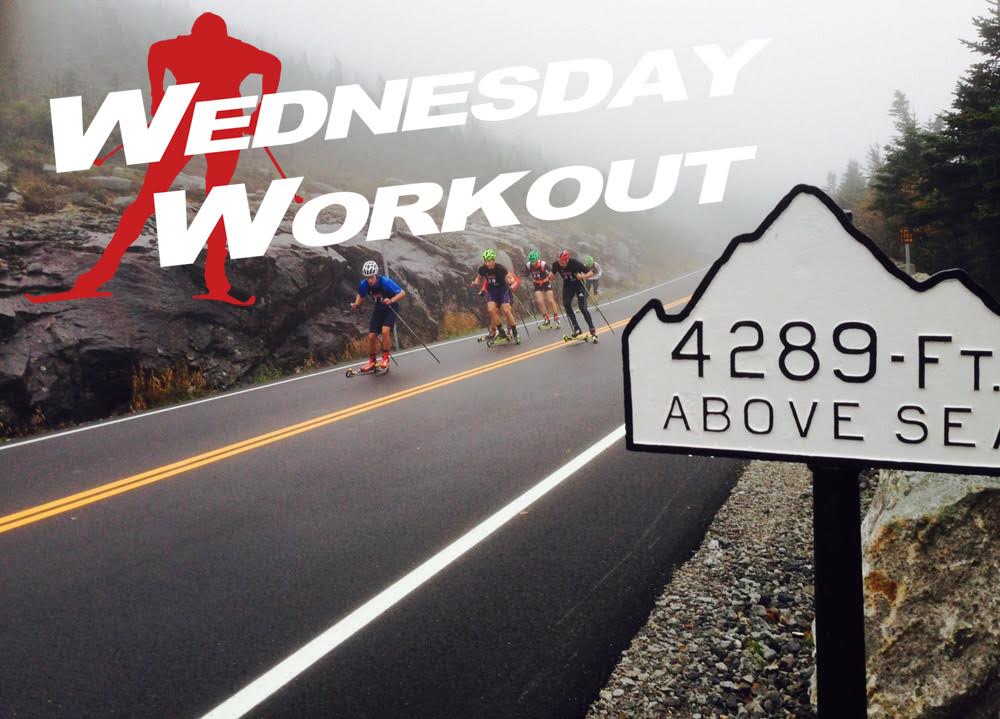
    The leaders in this year's 2015 Climb to the Castle rollerski race up Whiteface Memorial Highway in Wilmington, N.Y. Rogan Brown of the Sun Valley Ski Education Foundation (SVSEF) leads around mile four of five. (Photo: Tim Cowan)
    The leaders in this year’s 2015 Climb to the Castle rollerski race up Whiteface Memorial Highway in Wilmington, N.Y. Rogan Brown of the Sun Valley Ski Education Foundation (SVSEF) leads the top men around mile four of five. (Photo: Tim Cowan)

    On the day after my 58th birthday, I raced the Climb to the Castle. Again. It’s an incredible thrill to be on the same starting line as the best skiers in the U.S., even if I finish towards the back. This year, I finished within 6 seconds of my best time. And for the first time, instead of being totally gassed for the final half mile, I had good energy all the way to the finish.
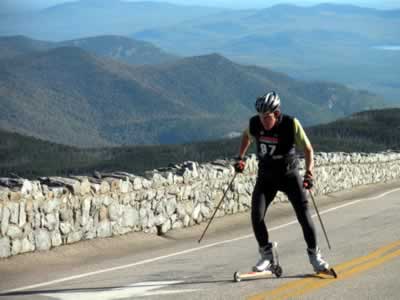
    Peter Minde nears the finish of the Climb to the Castle in 2011.
    Author Peter Minde nears the finish of the Climb to the Castle in 2011.

    During the dryland season, my goal is to do one Level 4 and one Level 3 workout each week. I hate to admit it, but now there are now some days when my body revolts and says, “Enough! You’re not finishing this interval session.” To that end, I try to make sure I’m really rested.

    I take into account my work and my family commitments as well as the stuff in the training log. I hate conceding workouts, but nowadays, I’d rather do one really good interval workout rather than two mediocre sessions.

    Although I have good terrain for dryland training, I don’t have super long hills. For a Level 4 workout, either running or rollerskiing, I’m going up a hill, back down and repeat. The recovery time is always a little longer than the actual work period. Not best practice, but possibly beneficial at my age.

    “I hate conceding workouts, but nowadays, I’d rather do one really good interval workout rather than two mediocre sessions.” — Peter Minde, FS contributor and annual Climb to Castle competitor

    Workout 1: 5 x 5 Minutes Level 4, Uphill Running

    My bread-and-butter Level 4 workout is five repeats, five minutes, going uphill.

    I do this either running or rollerskiing. It’s OK if the pitch varies, but the final few hundred meters should be the steepest. Generally, I run in the woods, and I use trails that aren’t excessively technical.

    Warm up with dynamic stretching, then run 15 minutes at Level 1 in rolling terrain.

    Then go 5 minutes up your hill at Level 2. Return downhill, and repeat with 5 minutes in Level 3. Finish that, go down, and you’re ready for the main event.

    In the Level 4 section of the workout, I focus on starting in the lower end of my heart-rate range and increase the intensity over each interval. At the base of the hill, I moose hoof the first 30 meters before settling in to a run. During each repeat, I focus on positive self talk.

    Workout 2: 5 x 5 Minutes Level 4, Rollerskiing

    As with the running intervals, look for a long hill. It’s OK if there are rolling or short downhill sections; however, the final section of the hill should be steep enough that you have to check speed – snowplow, traverse, whatever – to return downhill safely.

    Warm up as above. Fifteen minutes in Level 1, followed by 5 minutes of Level 2 and five minutes of Level 3.

    As with running, my goal is to start conservatively and make the last interval the hardest. In addition to positive self talk, I focus on skiing transitions smoothly. If I’m classic rollerskiing, I’ll double pole a flat section and the base of the climb before changing to striding. If I’m skating, I try to V2 as much of the uphill as I can, or V1 the steep bits and switch to V2 where the grade is easier.  Don’t forget the warmdown and stretching.

    Workout 3: 3 x 15 Minutes, Running

    While I do this on rollerskis, I prefer to run, because I’m able to keep recovery times to 3-5 minutes between hard work periods. Find a loop in the woods that takes approximately 14-16 minutes to run.  It should be rolling with some long uphills.

    Warmup: Similar to the Level 4 workouts above. Begin with dynamic stretching, followed by 15 minutes of easy running.

    Ramp up your heart rate to Level 2 for five minutes, then head onto your loop and crank it up to a controlled pace.  In downhills, I pick up the pace to keep my heart rate in the zone.  At the end of 15 minutes, a short connector gives me around five minutes of recovery before the next repeat.

    Then I run easy back to the car, for 15-20 minutes warming down.

  • Level Four Training

    Justin Freeman is a US Olympian in cross-country skiing. He races for the Saab Salomon Factory Team – http://www.enjoywinter.com This article first appeared in Ski Post – http://www.skipost.com

    Level four, roughly speaking, is race pace. And so for those of us who like to race, it is an easy level to train in. The goal of level four training is straightforward: by skiing at the same pace and effort you race at, you get better at racing. The downside to level four training is that racing and race-type efforts put serious stress on your body. This is one reason that training in levels three and five is so important. But when you are getting ready to go fast, nothing beats training at race pace.

    I should be a little clearer about my definition of level four. The definition I use when running is a pace that you can maintain for 12 minutes. Since skiing involves going both up and down hills, it might be more like a race pace for a 20 minute race; regardless, it is a touch faster than 10 km race pace. You should reach your maximum heart rate when doing level four training, and if you continue at this pace your blood lactate will steadily rise until you get too tired to continue.

    Since level four is the same as race pace, there some aspects of a level four day that should mirror a race day. First, a solid warm-up is necessary. This should include not only some easy training but also a couple pick-ups that get all your energy systems going (on a level three day this is not necessary, on a level five day the first to efforts serve this purpose). Then, as you start your intervals (or time trial) you should think about technique the same way you do in a race. Hopefully you have some technique reminders you play in your head when you race, but just as on race day, level four intervals are about going fast, not looking pretty. Finally, make sure you allow time to get in a reasonable cool down before getting warm and fed and rested – just going fast and not taking care of yourself afterwards robs you of many of the benefits of the training.

    The classic way to engage is level four training is to do intervals, that is, to go at level four pace for a fixed time (or distance) and then recover at a very easy pace for a shorter, fixed period. For instance, for many high school or master skiers the standard workout is four times four minutes with three minutes recovery. For a higher level athlete, a standard workout is something more like five times six minutes with four minutes recovery. Variations on this basic idea are fine; intervals should be from three to eight minutes, recovery time should be shorter than hard time, and total hard time should be fifteen to thirty minutes – beyond this basic framework, anything is fine.

    One variation on interval training is what some coaches call “split intervals.” In order to work at a slightly higher pace, an interval is broken into smaller pieces. For instance, each interval might consist of five 90 second mini-intervals with 30 seconds recovery; recovery between big intervals would be three minutes. When running, one of my favorite workouts is sets of (2 minutes hard, 1 minute easy, 1 minute hard, 30 seconds easy, 30 seconds hard, 30 seconds easy). The mix of shorter hard intervals and less total recovery adds up to a great workout.

    While intervals are the major way to train in level four, it isn’t the only way. No one gets into good race shape without practices racing itself, either by entering a smaller race or by racing a time trial all alone. In the summer, running time trials are a great fitness indicator. Find a hilly course or a mountain to run up, and go there about once a month. This provides both an excellent race-type effort and gives you excellent feedback about how your training is progressing. In the winter, I find that the best workout is to find a two lap course. Ski the first lap at a conservative race effort. Then, on the second lap, see how much faster you can ski. In an actual race, you almost always ski slower on the second lap; skiing negative splits in the time trial gets you close to true race effort on the second lap.

    I would like to close with a couple words about tolerance intervals. These are similar enough to level four intervals to reasonably include them here, but tolerance intervals are different from every type of training that I have discussed so far in that there is no limit to how hard you go. The goal of these intervals is to push yourself to your physical and psychological maximum. I like to find a hill six to eight minutes long and go up four or five times. The first couple are hard level four, the next to last is 100% max effort, and the last is a futile effort to go even faster; if the workout has been done right, though, this will be impossible. Another popular variation is to intervals (or one longer effort) with a lot of hard climbing at the start and more rolling terrain later on: attack the hill as if the interval ended at the top, and then do all you can to hold race pace for the rest of the time.

    I mention tolerance intervals partly for completeness but partly as a reminder that this is not what level four training is about; level four is about controlled race pace. Tolerance intervals are something many true competitors will long to engage in – who doesn’t want to explore the limits of their potential – but that should be limited to about two times a season, or they will quickly start to do more harm than good. Going 100% might sound (and even feel) good, but achieving your potential means holding something back all but a very few days of the year.

    Justin Freeman