
From the FasterSkier archive — posts syndicated from athletes’ and coaches’ own blogs between 2004 and 2012, kept online as published. Current coverage is at fasterskier.com.

Tag: Levels

  • Level 3

    Justin Freeman is a US Olympian in cross-country skiing. He races for the Saab Salomon Factory Team – http://www.enjoywinter.com This article first appeared in Ski Post – http://www.skipost.com

    Level five, which I wrote about in my last article, is about improving race performance by working at a higher pace. Level three, which improves racing by working at a lower pace, is the natural complement to this training. Physiologically, the major goal of level three training is to improve lactate threshold.

    Your lactate threshold is the point at which lactic acid starts rapidly accumulating in your muscles. If you can do a treadmill test and plot speed versus lactate, your threshold is the point where the curve suddenly becomes steeper – the graph’s inflection point. Improvement in lactate threshold can take several forms. You can increase the speed at which lactic acid starts to build, or you can increase the heart rate at which lactic acid starts to build. These improvements could either increase or decrease the concentration of lactic acid in your blood at the inflection point.

    I explain the various effects training can have on our lactate curve to emphasize that a little knowledge can be a dangerous thing. Just assuming that your lactate threshold occurs at, say, 85% of max heart rate, or at a lactate concentration of 4 mmol/liter, can lead you to train too hard or too easy. This doesn’t mean that using heart rate monitors or lactate monitors is a bad idea, but it should remind you that information from external monitors is only so useful. Finding level three means combining this information with your own perceptions of how hard you are going.

    When describing level five I tried to avoid the word interval. With level three, talking about intervals is completely inappropriate. One of the most annoying and contradictory phrases people use to talk about training is “level three intervals.” Level three is a pace that you can maintain for 30 to 50 km; aiming for such a pace for only a minute or two at a time will inevitably lead you to go too hard, and in the event that you avoid this pitfall you likely won’t get much benefit. Level three is also not something to be done when coming off of a cold: you are either healthy enough to train hard, say 30 minutes level three or 4 by 5 minutes level four, or you should stick to easy distance with a few unstructured pick-ups.

    Level three efforts should be continuous and should range from at least 30 minutes to about an hour. The pace, as I wrote above, is somewhere between 30 km and 50 km race pace, and is also the fastest pace you can sustain without feeling lactic acid start to accumulate in your muscles. Personally, I find it to be the most psychologically challenging pace to maintain; it is fast enough that you want to slow down, but at any point you also have the ability to sustain a significantly faster pace.

    One way to ease yourself in to long level three sessions is to break them up. If it sounds like I am waffling about level three intervals, well, maybe I am. I find it useful, early in the season, to make only half of my level three sessions continuous efforts. The other days I use five or ten minute intervals with 20% (one or two minutes) recovery. The shorter blocks of going hard are much easier to manage psychologically, and the very short recovery prevents going too hard. I must emphasize that while I find this a very useful tool, I consider it as a crutch that helps an athlete transition to “real” level three training, which includes only longer unbroken efforts.

    I would like to say a word about training modality and technique. Level five training, since it is primarily neuromuscular and therefore motion specific, is only effective if it is done in a skiing motion (skiing, rollerskiing, possibly bounding). Level three training can include running, and perhaps even cycling or other activities. But level three provides another opportunity to work on efficiency. You are moving close enough to race pace to really work on race technique, and you have plenty of time to try out new variations. Perhaps your climbing V-2 is weak; a level three session is the best time to push a V-2 farther up every hill than you want before switching to V-1 (on a level one day you might go too hard this way; on a level four day you are focused on skiing fast, not just skiing right).

    Finally, as I suggested with level five training: go out there and do some level three. Level three efforts are a great way to satisfy that late spring urge to train fast. They also teach patience, practice the primary pace for master skiers who focus on marathons, and can help build efficient technique.

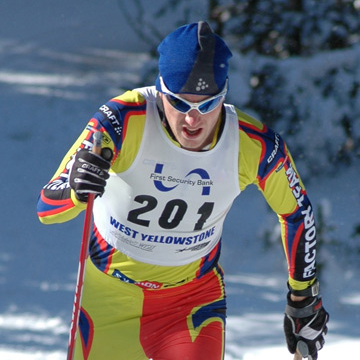
    Justin Freeman

  • Level 5

    Level 5

    Justin Freeman is a US Olympian in cross-country skiing. He races for the Saab Salomon Factory Team – http://www.enjoywinter.com This article first appeared in Ski Post – http://www.skipost.com

    Justin Freeman

    Last time I wrote about levels one and two, so you might expect I would move on to level three for my next article. But in fact I am presenting the levels in the order I recommend introducing them as you move through your training season (or year, if you are training for skiing year round).

    First, I need to clearly define what I mean by level five. This is probably the level that is defined in the largest number of ways. I do not mean to suggest that anyone else is wrong, but I think that defining level five as a pace you can maintain for five to six minutes is a good definition. This means that level five is not the pure sprint training Andy Newell wrote about in a recent Master Skier article (this scheme would define those as level 6 and 7 – but I will let someone who knows more about sprinting sort that out). It is not level four intervals that are made harder or longer; indeed it is not “go-till-you-puke” intervals of any length (these would be categorized as “tolerance intervals” and I will write a bit about them with level four).

    The goal of level five training defined this way is mostly neuromuscular. By training at a pace somewhat faster than race pace, but where you can still work for some time with consistent technique, you improve your efficiency at and above race pace. For runners, this mostly builds psychological and physiological comfort with a fast pace and thus increases comfort at race pace as well. For skiers, there is the added benefit that technical flaws tend to get magnified when you ski above race pace. This means that level five repetitions provide an excellent opportunity to take video – to watch either between efforts or after the session is over. In fact, much of the most helpful video analysis I have done has been when I have been doing very fast efforts.

    Since the goal of level five is to learn to ski more effectively at high speed, there should not be a lot of focus on acceleration (depending on your goals there may be a place to train acceleration – but not during the training I am describing). You should gradually accelerate into level five pace, perhaps using a slight downhill to help get you up to speed. Regardless, the acceleration phase should not be taxing; it should also not be thought of as part of the level five repetition (so don’t start your watch till you are near full speed).

    Repetitions of 30 seconds to two minutes work best. My experience is that a pace that feels good for 30 seconds, starts to hurt at 60 seconds, and that falls off just a tiny bit by two minutes is perfect. Recovery should be two to three times as long as the effort, and even longer at altitude. Total time of the efforts should be around 10-15 minutes, and only one or two efforts should be longer than 90 seconds.

    Or maybe the above paragraph doesn’t quite apply to you. Still, since it can be hard to judge how fast you are going relative to race pace when on skis (or rollerskis) some sort of guidance is critical. The danger with any really fast training is that it becomes not just about going fast but about going hard. These workouts should leave you tired – certainly aware that you have pushed yourself – but you should finish the last effort at the same pace as the first and feel like you could do a couple more. Maybe you should even that you want to do a couple more, since this is at a pace that makes you feel fast and strong. If you can monitor blood lactate, it should not rise too high during repetitions and should drop fairly low during recovery.

    You might notices that I haven’t used the word “interval.” This is because unlike level four training, where it is important to carefully control the amount of recovery, your focus here is on keeping consistent pace. If you need to increase the recovery to achieve that, go ahead. (If you have to massively extend the recovery though, you might want to accept that you are going too fast, call it a day, and try a slightly slower pace in a few days).

    Most importantly: get out then and go level five. You can work in this zone from the start of spring on. Indeed, if you can get on snow and on rollerskis in the same week doing back-to-back level five sessions can help your transition to dryland. Certainly you want to use some caution, and the further you are from competition season the more important it is to err of the side of going a little too easy. But structured time going fast, especially if it sometimes incorporates video for technique feedback, is one of the easiest, least risky, and most fun ways to improve your racing performance.

  • Understanding and Using Training Levels

    Understanding and Using Training Levels

    Justin Freeman is a US Olympian in cross-country skiing. He races for the Saab Salomon Factory Team – http://www.enjoywinter.com This article first appeared in Ski Post – http://www.skipost.com

    Levels One and Two

    Skiers talk a lot about training levels, usually numbering them one through five, but, if my experience over the past decade and a half is any indication, truly understanding when and how to use the various levels is rare. This is the first in a three-part article about proper use of the various training levels. It is based on my background both as a skier and as a runner, and includes some of my thoughts based on the writings of the running coach Jack Daniels, whose books make interesting reading, particularly for skiers looking for a fresh point of view about training.

    Level one is the place where most of us spend most of our training time. Despite this, it can be a little tricky to either stay in or to define. Basically, level one is an easy training pace where you can still talk as you run or ski (or bike or paddle, etc.). Level one is often defined as a heart rate between 60% and 70% of your maximum heart rate, or as some similar fraction of your heart rate reserve (the difference between your min and max heart rates). You might also define it as a pace where your blood lactate level is below your resting lactate level, because you are working hard enough to pump blood and clear lactate but not hard enough to build any lactic acid in your muscles.

    For some people, heart rates (or even blood lactates) are an effective way to define levels. But for many people, levels are found more intuitively. For them especially, it is important to remember a few things that level one is not. It is not (and I have been as guilty of this as anyone) standing around on skis talking to your friends. It is not going for a ski with your family (as noble and good a thing as this is to do) or with your old high school buddy who has put on 50 pounds and can barely struggle up a slight incline. It isn’t even going for a run where you walk up the hills just because your heart rate starts to climb a bit.

    Similarly, level one is not refusing to be passed by someone and so trying to appear nonchalant as you huff and puff a few strides ahead of her. It is not running at the pace that you could back when you were ten years younger and trained twice as much. And it is not flying down the other side of a mountain you just ran up because your heart rate monitor says your pulse is dropping.

    While the above reminders are important, most people do have a good intuitive grasp of level one. Level two, though, is tricky. Level two is harder than level one, with higher rate and lactate, but still well below the pace or effort of even a marathon. Both level one and level two are basically for building aerobic capacity and capillary density and also for practicing technique. Because level two, being faster than level one, makes you more tired, many skiers oppose the idea of level two in general, describing it with the phrase “level two happens” (after the bumper sticker “#$*% happens”).

    Interestingly, while skiers sometimes refer to level two as the “junk zone” runners have the opposite understanding, preferring level two and calling level one “junk miles.” I believe this is mostly because runners tend to train many fewer hours than skiers, so training a little faster all the time is not as detrimental. But there are many times skiers can use level two. First, when learning new technique, it is often hard to stay in level one; giving yourself permission to spend most of a workout in level two can help you master new motions more quickly. During phases of training where you do few or no intensity sessions, a day of level two can give you a little taste of speed. And master skiers who struggle with limited time can get extra training value out of an hour on snow by skiing a bit faster some days.

    Certainly level two can be overdone. I know plenty of runners who insist on training (and even warming up) at paces just a minute per mile slower than their 10k PRs, and then wonder why they tire quickly on interval days. This is far more damaging to a training program than going a bit too slow on easy days, and that is why most coaches discourage level two. But for the reasons outlined above, level two is sometimes the way to go, and athletes who have the knowledge and courage to vary their easy training can use level two to their advantage.