Tag: Lex Treinen

  • ‘Why not Ishpeming?’ Unpacking the 2016/2017 SuperTour Schedule

    ‘Why not Ishpeming?’ Unpacking the 2016/2017 SuperTour Schedule

    SuperTour skiers won’t be starting their season at the Rendezvous Ski Trails  in West Yellowstone, Mont., this November. For the first time in the Yellowstone Ski Festival’s history, SuperTour races are not on the schedule. Citing altitude and frigid temperatures, the series is starting north in Bozeman, Mont.FasterSkier previously shared a press release from the U.S. Ski & Snowboard Association (USSA) giving the where and when of the 2016/2017 SuperTour schedule for high-level domestic racing. This article provides the why – why are the season’s first races not in West Yellowstone? Why are some U.S. SuperTour races in Canada? Why are U.S. nationals returning to Soldier Hollow after just two years away? And so on. FasterSkier spoke with various members of the American cross-country ski community to help get some answers about why the country’s top skiers will be going where when this winter.

    Period One: Western Swing (but no West Yellowstone)

    The single most noteworthy change to this year’s schedule may be the move away from West Yellowstone for the season’s opening races. Skiers have flocked to West Yellowstone in search of early-season snow, and often raced there, for a very long time. For how long? And why the change now?

    As FasterSkier previously reported, elite skiers have made the Thanksgiving-week pilgrimage to West for nearly forty years: It was 1978 when the U.S. Ski Team held its first Fall Camp there, “with then-U.S. Ski Team coach Marty Hall and skiers like Bill Koch, Dan Simoneau and Tim Caldwell. Koch didn’t come too many years after because of exercise-induced asthma, which worsened with altitude.” People kept coming back. In 2004, Fall Camp, which had long since expanded to include a range of citizen skiers from around the country, was renamed the Yellowstone Ski Festival, with a full slate of clinics, demos, and a gear expo.

    So why the change? Well, here’s another number from our article on the history of early-season skiing in West Yellowstone: “6,663: Elevation of West Yellowstone. The Rendezvous Ski Trails are about 6,800 feet above sea level (2,000 meters), and the South Plateau just outside the park is about 1,000 feet higher.”

    That’s pretty high. That’s higher than the upper altitude limit for International Ski Federation (FIS)-legal races of 1,800 meters, or just over 5,900 feet. And West Yellowstone can be sort of cold, too. The combination can make for a brutal start to the season.

    The athletes have noticed. Bill Koch evidently noticed in the early 1980s. More recently, as Alaska Pacific University (APU) skier Reese Hanneman blogged in December 2015, “For as long as I have been racing, these first two weekends of elite racing have been held in the high mountain west, at illegally high altitude (according to FIS), which always makes them a little funky.”

    USSA and club coaches noticed, too. As Robert Lazzaroni, USSA’s nordic domestic program director, explained in a phone interview, the impetus to move away from opening the season in West Yellowstone “came from the club coaches when we met in Craftsbury” following last season’s SuperTour Finals in March.  The decision to move elsewhere was close to a consensus, Lazzaroni said: “It was very clear that the season starts too early. It’s too early – November 23rd – to start to chase points, when we want the athletes to peak at Nationals [in early January].”

    West Yellowstone, known as “West” for short, is also at altitude, Lazzaroni noted. And finally, Lazzaroni made the uncontroversial observation that “West can be very cold.”

    Putting all that together, he said, it just seemed like too much to ask of the athletes: “When you ask the athletes for the first race of the season to be at full speed, and to be fit, and in a cold place – it can be too much. And it puts their season in jeopardy. The risk was too big in their [the club coaches’] mind – too early, too high and the weather can be difficult. And that’s not good that early in the season.”

    Hence the move from West in late November to Bozeman in early December: later, lower, and hopefully a little warmer.

    So what will be left in West Yellowstone over Thanksgiving week, without elite athletes eyeing the competition, washing their hands, and chasing SuperTour points? Quite a bit, both USSA and West Yellowstone boosters agree.

    As Lazzaroni noted, it was a “bummer” to lose the SuperTour component of the Yellowstone Ski Festival, but the festival “will continue. They will still have the junior race, they will still have the Masters race. It will just not be a SuperTour. … We believe a lot of the clubs will be there, training.”

    Moira Dow seemed to agree. The program director of the Yellowstone Ski Festival, Dow said on the phone that she was “disappointed” to lose out on the opportunity to host the SuperTour races, but had no hard feelings toward USSA and appreciated the need to structure a race series to support athlete development.

    “We understand that the athletes have to look out for the best of their development on the national stage,” Dow said. “While we recognize that, we are disappointed. We think that having the SuperTour held in a small town of West Yellowstone is fun and exciting. So we’re disappointed, but we understand the need.”

    Dow admitted that the schedule change “was a surprise” to the organizers of the Yellowstone Ski Festival.

    “Going into the [USSA] Congress [in mid-May] I thought it was still up for debate,” she said.

    But given “the way it was presented at Congress,” Dow continued, “the athletes made their statement – I think the schedule was decided before Congress.”

    Despite the surprise, Dow underscored that she had no hard feelings, and certainly did not view the schedule change as a personal attack on her or the festival. And she emphasized that everything that citizen skiers have come to expect from West Yellowstone in Thanksgiving week – clinics, demos, etc. – will still be there, including the races: “We’ll be holding just as many races, they just won’t be designated SuperTour” races, she said.

    “SuperTours are not the most important part of our festival,” concluded an upbeat Dow.  “We hope to see you in West Yellowstone.”

    (So will the SuperTour return to West next year? The short answer is that likely nobody knows. In August 2015, quoting then-USSA nordic manager Joey Caterinichio, we reported, “West is the perennial host for Period I and could potentially rotate with Alaska, although, ‘there is no intention of changing West Yellowstone,’ according to Caterinichio.” That obviously didn’t last long. As Dow said when asked about her plans for November 2017, “we’re waiting to see – it changes from year to year.” She added, reflecting the development of this year’s schedule, “we find out in May what the athletes are looking to do to help put them on the national stage,” and then respond to that.)
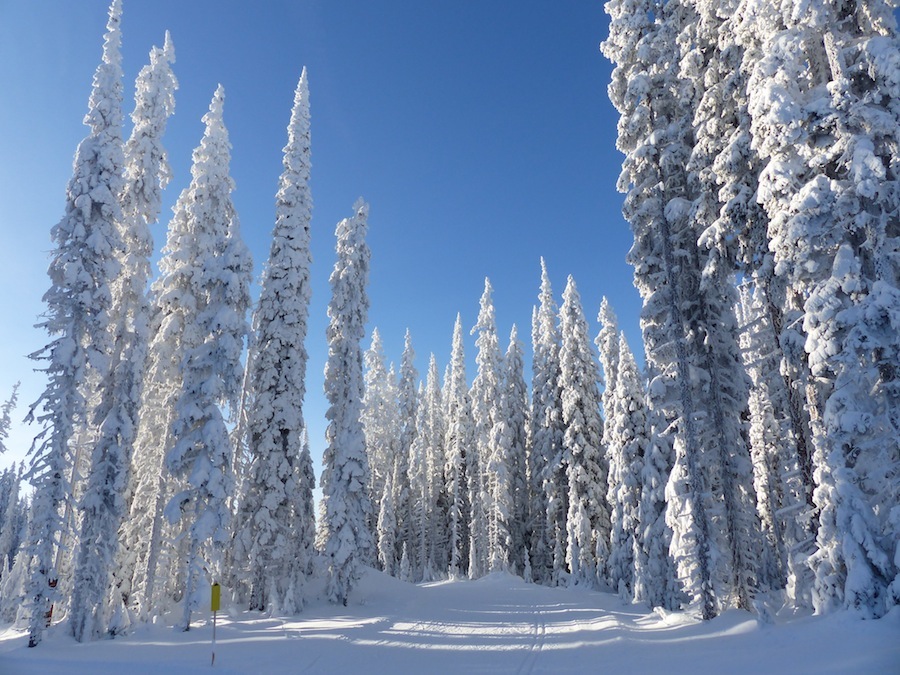
    Early morning at the Sovereign Lake Nordic Centre on Dec. 8, before the men's and women's NorAm classic sprints.
    An early December morning at the Sovereign Lake Nordic Centre in Vernon, B.C.

    So the opening SuperTour weekend will be in Bozeman, Mont., starting with a skate sprint on Saturday, Dec. 3. A 10/15 kilometer classic individual start follows on Dec. 4.  It will be a short week before athletes return to action with a classic sprint at Sovereign Lake in Vernon, British Columbia, on the evening of Friday, Dec. 9, with another short turnaround before 10/15 k skate interval starts the next day. (A relay that is not scored for SuperTour points will be held at the same venue on Sunday.)

    If the move away from West Yellowstone was the first thing that struck many skiers about this year’s schedule, the move across the border was probably the second thing of note. The races in Silver Star will be a joint SuperTour/NorAm weekend (that is, they will be held together with the Canadian high-level domestic race series), an arrangement that has occurred in the past but not for some time. Ski representatives from both countries – which are identified as “children of a common mother” in the inscription on the Peace Arch at the border crossing between Blaine, Wash., and Surrey, B.C. – agree that the cooperation is welcome.

    As Cross Country Canada (CCC) High Performance Director Tom Holland said on the phone earlier this summer, “We had a couple of phone meetings this year and there’s a willingness to work more together on a NorAm/SuperTour. Why not? To have more of these North-South relationships in the East and the West so people don’t have to travel so far. We’re sort of repeating history here. We’ve wanted to do this, but we did a lot of it in the ’90s, if you look at the results there were some great races back then. So it’s kind of a common-sense thing to have a North American race circuit where we compete against each other. We went down to West Yellowstone the last couple of years. It would be nice if there was more than that one weekend, but the U.S. has some other commitments in December. It would be nice if we had three or four weekends. The Euros ski more than us before Christmas, so the more we do the better.”

    Holland continued, “We have those races every year anyway. It’s more about getting a high level of competition so we’re competing against the best in each nation and get warmed up for the season. There’s lots of examples of it working in the past, but it sort of faded as the SuperTour got stronger at one point. Anyway, we’re totally committed, and the U.S. is making a commitment, and we’re happy about U23/World Juniors being down there. So we’re going to do our trials down there. There’s a lot of cross-border stuff going on this year. I hope that sets a good tone for the future.”

    Lazzaroni concurred, explaining that USSA wanted to hold consecutive race weekends relatively close together in order to make transportation somewhat easier.  He also said they were pleased to combine with Canada in order to create a larger and more competitive field.  Lazzaroni said that he hoped to have more joint SuperTour/NorAm weekends in the future.

    Period Two: SoHo and Truckee
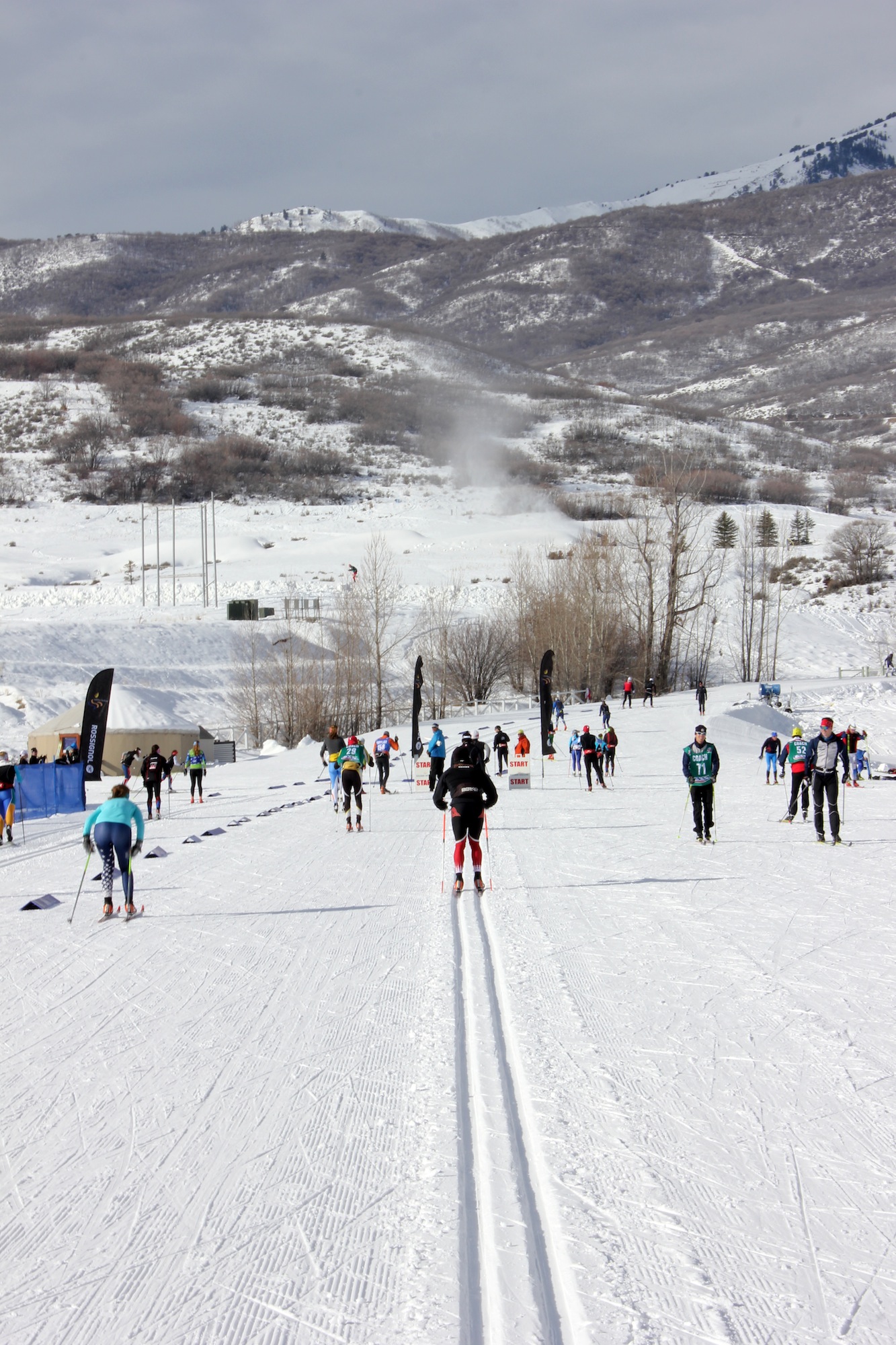
    Athletes testing skis and doing pickups in the stadium at Soldier Hollow in Midway, Utah, where the U.S. Cross Country Championships will kick off with tomorrow's 10 and 15 k individual classic races.
    Athletes and coaches test skis in the stadium at Soldier Hollow in Midway, Utah, at 2014 U.S. Cross Country Championships.

    Athletes will have nearly a month off before racing resumes with U.S. Cross Country Championships in January at Soldier Hollow in Midway, Utah. There is a 10/15 k skate individual start on Jan. 7, a full classic sprint the next day, and a 20/30 k classic mass start on Jan. 10. A qualification-only skate sprint event rounds out the week on Jan. 12.

    U.S. nationals visited Soldier Hollow fairly recently. The races were held there in 2013 and 2014, before moving to Michigan’s Upper Peninsula for 2015 and 2016.  The move back to Utah after only two years away is atypical.

    The “main reason” for the quick return to Soldier Hollow, Lazzaroni said, “is because of World Juniors.”

    The U23/Junior World Championships will be held at Soldier Hollow from Jan. 30 to Feb. 5, 2017, and will include roughly 750 athletes from dozens of nations. Some of those athletes will be junior and U23 skiers from the U.S., and Lazzaroni said that USSA wants to provide American skiers with a home-field advantage: “It was very important to us to bring the Championships back to the U.S., to show our commitment to FIS, and also to provide our athletes home-field advantage.” Lazzaroni explained that the best way to give American athletes this advantage was to give them an additional chance to race at Soldier Hollow in advance of the championships.

    Therefore, Lazzaroni explained, USSA did not look back to the last time when U.S. nationals were held at Soldier Hollow in setting this year’s schedule. Rather, they looked forward, asking how best to prepare American athletes for Junior Worlds. And the answer was to let them race at Soldier Hollow in January before – for some skiers – racing there again in February.

    But there will be something missing from this year’s edition of U.S. nationals: a national championship skate sprint. Instead, in the 2016/2017 season only, the national championship skate sprint will be held at the season-ending SuperTour Finals, as part of a race series colloquially known as Spring Series.

    This schedule change, Lazzaroni explained, is due to the overall load on the Soldier Hollow volunteers and local community. It is “asking a lot of the venue” to hold both U.S. nationals and Junior Worlds at Soldier Hollow within the same month, Lazzaroni said.  Among other inconveniences, he noted that there is an elementary school at Soldier Hollow, which also serves as the timing building and race headquarters, that has to be shut down when high-level races are held. Lazzaroni said that the local community was unable to commit to a full U.S. nationals schedule, including a full skate sprint day, on top of its other hosting obligations.

    A quarterfinal in the freestyle sprint at 2013 U.S. nationals at Soldier Hollow in Midway, Utah. There will be no heats at this year’s national skate sprint; a qualification-only skate sprint will be held instead.The initial solution was just to take away the sprint race, moving U.S. nationals week from four races down to three.  But, Lazzaroni said, this created a problem from the perspective of U.S. Ski Team Head Coach Chris Grover, who needs to oversee the selection of the U.S. team for the 2017 World Championships in Lahti, Finland, later this winter.

    The races in Lahti include an individual skate sprint and a team classic sprint. The first half of the SuperTour schedule includes two classic sprints, but only one skate sprint.

    The compromise, Lazzaroni explained, was a qualification-only skate sprint event at Soldier Hollow on Jan. 12.  This was acceptable to Soldier Hollow event organizers and volunteers.  And, Lazzaroni states, he feels that this “was a good compromise.”  This way, “Grover can still have a qualification to make sure he has the best skiers to go to Lahti, and we don’t burn out the skiers and volunteers at Soldier Hollow.” The result will be a qualification-only skate sprint day, with no rounds contested.  Results from the qualification will be used for purposes of qualifying for the U.S. World Championships team, but will not be scored for SuperTour points.

    Following the skate-sprint qualification event, athletes have nine days off before racing on the Auburn, Calif., trail system in late January. A classic sprint will be held on Jan. 21, and a 5/10 k skate individual start on Jan. 22.

    Period Three: Why not Ishpeming?

    Roughly a month later, the SuperTour resumes with two races in Ishpeming, Mich., about 15 miles outside of Marquette on the state’s Upper Peninsula. There will be a skate sprint on Friday, Feb. 17, and a 5/10 k classic individual start on Sunday.  (A 15/20 k mass start skate race, which will be a FIS-sanctioned collegiate race but will not be scored for SuperTour points, will be held on Saturday.) The race weekend will be held in conjunction with the NCAA Central Region Championships hosted by Northern Michigan University.

    Al Quaal Recreation Area (Photo: Travelmarquettemichigan.com)The trails at Ishpeming’s Al Quaal Recreation Area last hosted a FIS event in February 2016. Before that, the previous and only entry for Ishpeming in the FIS results database is for a race weekend in February 1993. Suffice to say that it’s been a while.

    So why Ishpeming? As Lazzaroni explained, repeating part of a reporter’s question, “You say, ‘Why Ishpeming?’ I would say, ‘Why not Ishpeming?’ ”

    He said USSA attempts to rotate the SuperTour sites within the regions each year, and that this year the mid-season races are coming to the Midwest. It also recognized that the American Birkebeiner is held in the Midwest in late February, so there is an incentive to keep the SuperTour in the area. And Theodore Wirth Park in Minneapolis is undergoing construction work at present, and so was unable to host SuperTour races this year.

    Lazzaroni explained that USSA was looking for a venue that could host SuperTour races for two weekends in a row, but was unable to find any venue that would take on this commitment. He said that they were pleased to get a taker for just one weekend in Ishpeming (population approximately 6,500), which has newly homologated trails and was eager to show them off. When the discussion was opened regarding bringing the SuperTour to the Midwest, Lazzaroni said, Ishpeming jumped on board.

    “They have a long tradition of nordic skiing,” Lazzaroni noted, adding that Ishpeming was hosting cross-country races as early as 1905. The National Ski Association of America, a group that would later become the modern-day USSA, was founded in Ishpeming that same year.

    Ishpeming is also home to the U.S. Ski & Snowboard Hall of Fame and Museum.

    The following weekend, the American Birkebeiner will take place between Cable and Hayward, Wis., on Feb. 25. The skate race, whose distance will return to an even 50 kilometers this year, will be scored for SuperTour points.

    Although last year’s Birkie was only scored for half SuperTour points, USSA has since revisited this assumption. At this year’s working group for the SuperTour schedule, Lazzaroni explained, they opened the question of whether the Birkie should count for full points or half points. Although some people had argued over the past few years that the Birkie should count for only half points, because it is often not a “normal” race distance, he clarified that the USSA Nordic Competition Guide makes “no mention that it should be half points.” Accordingly, USSA opted to follow the Comp Guide and restore the Birkie to full-points status.

    Something less than a full SuperTour field typically races the Birkie; there were 17 American skiers with FIS points in the men’s elite race last year, and nine in the women’s.

    Period Four: Spring Series in the Golden Heart City

    A month after the Birkie, racers will travel north to end the season at Spring Series in Fairbanks, Alaska. Races will be held every other day over a week-long period from March 27 to April 2. A skiathlon, a skate sprint, a mixed club relay, and a 30/50 k mass start skate race are on the calendar. With a full skate sprint not being held at U.S. nationals in January, all events save the skiathlon will be national championship races.

    Longtime Fairbanks race director John Estle is already excited. In an email to FasterSkier, Estle explained that the races will be held on a series of newly homologated and re-homologated courses at Fairbanks ski area Birch Hill. He noted that the new men’s sprint course will be “between 1500 and 1600m, which seems to be the preferred distance for sprint courses. Guys seem to like them to be about 3:30 in duration.” The women’s course will be “just a bit shorter than the men’s course.”

    A 2012 photo from the trails at Birch Hill in Fairbanks, Alaska. (Photo: Lauren Fritz)After explaining the combinations of homologated loops that will be used for the various races, particularly the 30 and 50 k races on the last day of the season, Estle concluded, “The courses for those races will be quite challenging.”

    Of the four races at Spring Series the skiathlon stands out, for its presence as well as its non-canonical distance. The suggestion on the official schedule that the distances will be 14 k for the women and 24 k for the men is apparently not quite accurate. Rather, Estle wrote, the distances will be 15 k and 22.5 k, respectively. “That is because we will have two homologated 3.75Km courses, one for the classic leg and one for the skating leg. Two laps of each course for women, three laps of each course for men” comes to 15 k and 22.5 k.

    Estle is well aware that, at the Olympic Games or World Ski Championships level, women typically race a 15 k skiathlon and men a 30 k. “But most of the feedback I got from coaches and athletes was that at the end of a long, long World Cup season 30Km would just be too much,” Estle wrote. “At the World Cup finals in Canmore last year they did a 30Km skiathlon on a 3.75Km course and a large chunk of the field was pulled from the race (and hence the tour) after getting lapped. That was on a really tough course on a really warm day, but still. Those were damned good skiers, and they were completely shot at the end of that race.” So 15 k and 22.5 k it is.

    A skiathlon, over any distance, is a rare event at the SuperTour level. Estle recalled hosting skiathlons in Fairbanks in both 2008 and 2009, but it is unclear whether they have occurred in this country at the highest levels of domestic competition since then.  (The races are often entered in the FIS database as “pursuit” rather than “skiathlon” when they are held in this country, making it difficult to search for them. They are held more broadly at the high school and citizen racer levels.)

    Skiathlons may be uncommon at this level of competition, but there seems to be widespread agreement that there should be more of them.

    As Estle wrote, speaking as a race director, “One of the reasons that we are doing a skiathlon is that nobody ever does them in the US. … A skier’s first experience in a format contested at the World Championships should not be at those championships: Junior WC or U23 WC. If we are thinking about developing skiers who can compete at the highest levels, and coaches who can support them, then we need to make sure that our domestic schedule (FIS or otherwise) provides the types of experiences that will prepare them for the next highest levels of competition. Our skiers need a broad spectrum of experiences, and right now, because there are very few, if any, skiathlons on the domestic schedule, we are not preparing those skiers as well as we could or should.”

    Lazzaroni sounded similar notes on behalf of USSA, saying that the skiathlon is contested at various international championships, and “why not prepare our athletes for that?” Echoing Estle, he noted that athletes reported back from the most recent World Junior Championships that they had never done a skiathlon before, “And that’s not right.”  Lazzaroni said that he wouldn’t expect to see “many, many more [skiathlons] in the future” – but he added, “my vision is that, yes, we should train our skiers to be better at skiathlon, to be better prepared to do skiathlon.”

    U.S. Ski Team Women’s Coach Matt Whitcomb was in complete accord, telling FasterSkier in a recent interview, “It’s often that at the junior and even U23 level when we go internationally, that we’re scrambling last-minute to find skiathlon boots, or to teach athletes how to load an exchange zone and what the rules are.  So we’ll consider this just a quick dose of education for our entire community, and I think it’s going to have a big effect.”

    The athletes seem to agree as well. Lex Treinen of APU, a top domestic athlete who has recorded SuperTour podiums but has not yet raced on the World Cup (which sees a handful of skiathlons each year), wrote in an email that he had done a skiathlon in Fairbanks some years ago – but that otherwise, “I have just done a couple at World Juniors and U23s.”

    As Treinen explained, “Skiathlons are great and there is a good reason that they don’t do them very often on the Supertour: they are a pain in the ass logistically … for coaches and athletes and as the APU SuperTour team operates right now, we would not have the resources to wax for a skiathlon very effectively most of the season. Fairbanks will surely be an exception, since #1 it is closer to home and #2 it is Nationals which means there is a little bit of extra tech support from our team. Either way I don’t have a doubt that the fittest person will win this March and I really think it is a positive thing to be able to race some new formats. I am very excited that the Fairbanks organizers have decided to do something novel.”

    Annie Pokorny, of the Sun Valley Ski Education Foundation (SVSEF) Gold Team, expressed similar sentiments. “The only skiathlons I’ve raced were at U23 World Champs, one in the Czech Republic and one in Italy,” Pokorny wrote in an email. “Despite my slim experience, however, I was incredibly excited to hear that USSA had integrated the skiathlon into domestic racing.”

    Pokorny wrote that, “While it will certainly take some adjustment, I am always excited to see a diversified schedule on the SuperTour circuit. The more events we have, the more opportunities there are for varied competition and exposure to certain skills that our World Cup brethren see on a regular basis. Personally, the skiathlon is one of the most fun and exciting races I’ve ever entered. Having a switch in technique changes the rules of the game so there are more chances for comebacks than in a traditional mass start.”

    When asked whether she was going to do anything special to prepare for this addition to the schedule, Pokorny wrote, “Few people know this, but in my first skiathlon I literally had the slowest transition time in the world, by many seconds. I don’t think I’ll need to change training much to be ready for the racing part, but it would be in my best interest to spend some time skiing while taking on and off my poles.”  (Pokorny, who finished 29th in that race, is correct that her transition time ranked 48th out of 48 skiers.)

    Looking to the future: Cross-country ski cross?

    While this year’s SuperTour aims at selecting the U.S. team for Lahti and assigning start rights for upcoming World Cup events, USSA is also looking toward the future. And to hear Lazzaroni tell it, the future may involve cross-country ski cross.

    Hannah Halvorsen (Far West/Sugar Bowl Academy) qualified 10th in the first-ever Cross-Country Cross event at the 2016 Youth Olympic Games in Lillehammer, Norway. (Photo: Far West/Facebook)“The cross-country cross has been a big success at the Youth Olympic Games in Lillehammer this winter,” he said. “It’s a format that the TV likes, the athletes like, that everybody likes. … I do hear from FIS that this is a format they want to push forward. We don’t know yet where it is going to go, but this is something we are keeping our eyes open [for], and I would not be surprised if you will see cross-country cross at some of the national events in the near future.”

    Lazzaroni clarified that, by “near future,” he does not mean right away – “Obviously not next winter.” He added that this could become an important event to prepare U.S. athletes for larger stages: “Again, if this is going to be an event at World Juniors down the road – in two, three, four, five years, I don’t know – at Olympics, down the road – we should prepare our kids. And we have this discussion at Congress with the club coaches at a younger age, and we did encourage them to put some cross-country cross events at the local races. And again, the kids love it, because it’s fun. It’s working on agility, and it’s working on balance, and they become better skiers. It’s not now on the calendar, but I wouldn’t be surprised if in the near future we see more and more of this type of events.”

  • What Elite Skiers Eat for Breakfast (Hint: More Than You Do)

    What Elite Skiers Eat for Breakfast (Hint: More Than You Do)

    “When you wake up in the morning, Pooh,” said Piglet at last, “what’s the first thing you say to yourself?”

    “What’s for breakfast?” said Pooh. “What do you say, Piglet?”

    “I say, I wonder what’s going to happen exciting today?” said Piglet.

    Pooh nodded thoughtfully.

    “It’s the same thing,” he said.

    — A.A. Milne, Winnie-the-Pooh

    Breakfast, as you learned in elementary school (or more recently from Ryan Gosling), is The Most Important Meal of the Day. That’s likely true for anyone. It is emphatically true for skiers.  Whether you’re training once a day or three times a day, 100 hours a year or 1,000, it all starts with breakfast. If training is the foundation for racing, and proper nutrition is the foundation for proper training, then it logically follows that breakfast is the foundation for, well, everything.

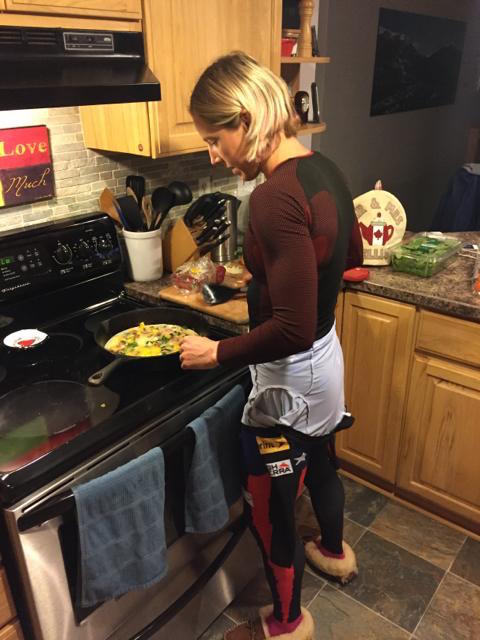
    Kikkan Randall in the kitchen "getting ready and fueled" in the fall of 2014. (Photo: Twitter)
    Kikkan Randall in the kitchen “getting ready and fueled” in the fall of 2014. (Photo: Twitter)

    Certain types of breakfast tend to get all the press. Pretty much everyone is a fan of second breakfast. J.R.R. Tolkien explains that hobbits eat second breakfast as the second of their six daily meals – after (first) breakfast and before elevenses. Thomas Mann, in The Magic Mountain, ups the ante, discussing not only second breakfast but also, remarkably, third breakfast. Robert McCloskey, in the seminal 1941 children’s book Make Way for Ducklings, underscores that second breakfast is best in the animal kingdom as well; his Mr. and Mrs. Mallard follow around the late-morning duck boat until they get “another breakfast, better than the first.”  Everyone, it seems, is a fan of second breakfast.

    There is no question that everyone is a fan of pancakes (and their close relative, the waffle).  Turning from early-20th-century literature to the modern institution of the 21st-century skier blog, it is clear that there could not be a skier blog – or maybe even skiers – without pancakes or waffles.

    Sophie Caldwell has a rest day and makes blueberry waffles. Jessie Diggins spends the summer making apple pancakes, and Christmas eating French toast. Annie Pokorny, waxing philosophical, brought us the remarkable (and compelling) “5 Reasons Waffles are a Philosophically Valid Way to Organize One’s Life.” And Noah Hoffman – well, Noah makes pancakes, including but not limited to blueberry pancakes, thick whole-grain pancakes, gluten-free pumpkin pancakes, Zach Caldwell’s putative-pancakes crepes recipe, pancakes à la Skratch Labs, pancakes in Bend, and pancakes in Anchorage.

    And a generation earlier, before the term blog had even been invented, Luke Bodensteiner, at the time a struggling Olympic hopeful, wrote in Endless Winter: An Olympian’s Journal of downing 18 (!) “steaming hot buttermilk pancakes” one morning in September 1993, then crushing a 50-kilometer rollerski followed by a 12-mile run. Plus ça change.

    This is not an article about second breakfast.  Nor is it even an article about pancakes.  This is an article about what athletes eat for real breakfast on real weekdays. Training day or rest day, at home or abroad, every elite athlete has a food that they’re comfortable with. And once they’ve found it, they tend to eat that food every. single. day. (Except for Lex Treinen, who wrote that he “never actually [has] the same breakfast every day,” but he’s an outlier among the athletes surveyed for this article.) If ski racing is, ultimately, about controlling the things you can control and trying to get a good outcome from the things you cannot, then breakfast becomes one more thing that can be effectively controlled.

    Starting with Alaska, we asked skiers with the Alaska Pacific University Nordic Ski Center elite team to share an honest picture of their average breakfast for a weekday training day and describe what they eat. Here’s what they told us:

  • The Qaniq Challenge: Travelogue Edition

    The Qaniq Challenge: Travelogue Edition

    A panorama view of the classic course at the second-annual Qaniq Challenge Jan. 16-17 in Valdez, Alaska. (All photos: Gavin Kentch)
    A panorama view of the classic course at the second-annual Qaniq Challenge Jan. 16-17 in Valdez, Alaska. (All photos: Gavin Kentch)

    By Gavin Kentch

    VALDEZ, Alaska — Sometimes it’s easy to lose sight of the “cross-country” part of cross-country skiing.  Particularly in this winter of discontent, when a lot of your training time ends up being spent doing 2.9-kilometer laps around a snowmaking loop.  

    Sometimes it’s important to travel for five days so that you can spend less than two hours racing, but do so on a course that goes from a mountain overlook to the shores of the Pacific Ocean.  

    Sometimes, surreally, the country’s second-richest ski race is held in Valdez, Alaska, in the middle of January, and gives away a purse of $10,000 dollars to a field of 36 racers.  Sometimes it’s just time to take a road trip with your mom.  This is the story of all of those events.

    Dramatis personae

    Holly Brooks finished her racing obligations in China a few days before this race, returned from China to Washington to visit family, flew back to Alaska on Thursday, then drove to Valdez on Friday before racing the Qaniq Challenge on Saturday.  I assume this is basically a normal week for her.  Other local athletes carpooled with each other for the over 300-mile drive from Anchorage to Valdez.

    Personally, I traveled with my mom, because I am just that cool.  (Also, I needed her to chauffeur me across southcentral Alaska: My car is a 1989 Toyota Camry, named Teakettle, which at 27 years old is more venerable than at least half the modern-day World Cup field, not to mention the advent of FIS points.  I suspect that Teakettle would literally be unable to drive over Thompson Pass, and so to leave Valdez by road when the weekend was over.  And the next ferry back to Whittier wasn’t until a week later.)  Her husband, Jim Bouchard, got the other front seat.

    Of the three of us, my mother is a good sports mom, who spent my childhood waking up very early on very many occasions to drive me to a variety of endurance sporting events.  She once drove six hours one way, in the evening after work, to pick up my little brother after he had been struck by lightning on a solo bike trip outside of Tok, Alaska.  My stepfather spent decades living by himself in a log cabin he built off the road system, about 30 miles south of Denali.  He was a national age group champion at the 1992 Masters World Cup held in Anchorage.  And as for me?  Well, not to pull rank, but I have previously been described on this website as “a nothing-special recreational skier.”

    ‘Getting here is half the challenge’

    Valdez is slightly over 300 road miles from Anchorage, a drive of approximately six hours, depending upon winter driving conditions.  (This assumes that spectacularly massive avalanches do not close the only road into town for over two weeks.)  I decided we should take the ferry there, saving hours’ worth of driving – the ferry leaves from Whittier, a little over an hour’s drive south of Anchorage.

    A waterside view of the old apartment building in Whittier, a “city” in the Valdez–Cordova census area of Alaska. As of 2014, the population estimate was 217, according to Wikipedia. The city is also a port for the Alaska Marine Highway and known as the Gateway to Prince William Sound.I may or may not have also harbored fantasies in which an avalanche closed the Richardson Highway the day before race weekend, harming no one, but nonetheless preventing all the real skiers from getting there in time for the race, and then I won the first prize of $3,000 dollars.  This did not happen.

    My mom and Jim arrived at my house in the predawn darkness on Jan. 14.  With some difficulty, we added my skis and ski accoutrements to the car, then carved out space for me in the backseat.

    We left my driveway shortly after 9 a.m.  It was not exactly light out, but by this point in the year at least sunrise was within an hour.  We headed toward the Seward Highway.  We had a combined 11 pairs of skis, six pairs of poles, and five pairs of ski boots.  Plus snacks.  The car was packed.  The gas tank was full.  Nothing could go wrong.

    It was shortly discovered that certain parties had forgotten to pack their wallet, containing, crucially, the state-issued identification necessary to board the ferry.  Words were exchanged.  A backtrack was undertaken.  Houses were returned to.  A wallet was obtained, and with it a legitimate form of ID.  We set off once more in stony silence, now calamitously late, making plans to do the long drive the next day and ruing the not-small amount of money now wasted on ferry tickets.  We decided to try to drive to Whittier anyway, and to hope that the ferry was somehow running late.

    We drove down Turnagain Arm under low fog and amber skies, the water in the fjord smooth as glass.  Last month, this stretch of road was closed due to 91 mph winds.  Also, a semitruck had been blown over on its side and completely off the road.  Also, the tunnel that we intended to drive to, in order to reach Whittier, in order to get on the ferry, had been closed.

    That did not happen today.  We could not see more than 100 feet above the ground as we drove along the Arm, but all the roads were passable.  We arrived at the designated snow-plowed field, in seemingly the middle of nowhere, to queue for the 11:30 a.m. opening of the tunnel to Whittier, having long since missed our intended 10:30 a.m. opening, and still assuming that we were about to miss the ferry altogether.  At least we could have lunch in Whittier before returning.

    (N.B.: I have not fact-checked this final statement.  It may literally not be possible to buy a restaurant meal in Whittier on a Thursday in winter.  I’ll figure this out next trip.)

    We were met by a wonderful sight: a handful of cars sat in the field ahead of us, still waiting for the 10:30 tunnel opening.  An Alaska Department of Transportation message board slowly scrolled the reason for the delay: “Please stand by.  Tunnel will reopen when smoke is purged.”

    I have never been so grateful to drive through an icy, slippery, claustrophobic five-mile long tunnel cut into the mountains that apparently had had rogue smoke in it just a few minutes before.

    We emerged, blinking, into the light, and into the town of Whittier, Alaska.

    Whittier is a special place.  For one, it is the rare settlement that was literally founded where it is because the weather there is always bad.  For another, there are virtually no private houses in Whittier; all of the town’s residents live inside the same large apartment building.  

    For the first few decades of Whittier’s existence, everyone in Whittier lived inside the Buckner Building, a seven-story concrete apartment building erected by the U.S. Army shortly after World War II (see photo above).  Later, that building was abandoned.  

    The new apartment building in Whittier, Alaska.Now everyone lives in the much more colorful Begich Towers, a few hundred yards away from its predecessor.  (The concrete hulk of the Buckner Building lives on, standing sentinel over the Valdez waterfront.  It gained passing fame a few years ago when two bros descended its asbestos-choked stairwells on downhill skis.)  We marveled at the Ghosts of Whittier Past and Present, and drove the car onto the M/V Aurora.

    The ferry ride took six hours.  It was amazing.  The sun was out.  Prince William Sound was, atypically, placid and still.  Snow-covered peaks shimmered over hillsides of spruce trees cascading down to the water.  

    At one point, I literally said, “Oh look, yet more dolphins are playing around the bow of the boat.  How nice.”  I felt like an athlete going over to London for the 1912 Olympics, although there was no track set up on the deck for us to exercise on.  And I guess they had fewer glaciers.  And more alcohol.  Seriously, though, it was probably the most sublime day I have ever spent on a boat in my life.

    The M/V Aurora, an Alaska Marine Highway System ferry.Valdez

    Valdez is also a special place, though for different reasons than Whittier.  It has an average annual snowfall of 300 inches, for one, and two to three times that just up the road in Thompson Pass.

    It is also home to the southern terminus of the Trans-Alaska Pipeline System, which undergirds what remains of the state’s suddenly fragile economy.  Valdez’s taxes on the pipeline itself make it shockingly wealthy, a lucrative petro-state enclave even within resource-dependent Alaska.  (This also explains why Valdez was able to essentially move $10,000 dollars of oil tax money from its own coffers to the pockets of young elite cross-country skiers, which actually feels to me like a pretty positive development.)

    A street view in Valdez, Alaska, last month.Standards of what is normal change when you live in such an environment.  When I spoke with Qaniq Challenge race director Darryl Verfaillie about ten days before the race, his talk of contingency plans and water drainage made me assume that snow coverage for the race courses was marginal at best.  

    After inspecting the trails in person after we got to town, I learned that their coverage ranged from a low of one foot of base to a high of at least three feet.  As Anchorage suffers through its second low-snow year in a row, Valdez was looking like a pretty good place to be a cross-country skier.

    Valdez has also had a relatively snow-sparse winter, at least for Valdez.  Therefore, the piles of cleared snow filling spare lots around town were only one to two stories high.  These towers stood guard over a neat gridlock of residential streets (Valdez was essentially rebuilt from scratch following the 1964 Good Friday earthquake), where virtually every house was flanked by multiple snowblowers and snowmachines.

    Valdez is also the type of place where there are still pay phones. Or maybe not pay phones per se, just telephones in public spaces that permit one to make free calls to anyone else in town. (I don’t know if this institution is common in the states.  It persists in Alaska.)  It was very pleasant.  There was admittedly not too much going on on a Thursday evening in January.

    Valdez is also the type of place where there are still pay phones. Or maybe not pay phones per se, just telephones in public spaces that permit one to make free calls to anyone else in town. (I don’t know if this institution is common in the states.  It persists in Alaska.)

    A royal welcome

    I don’t want to be obsequious, but race organizers were beyond accommodating of the skiers.  Late on Thursday night, recently arrived in town, I politely emailed the race director, making a tentative inquiry about whether I might be able to find any waxing facilities during the day on Friday.  He wrote back at 6:30 a.m. Friday morning, putting me in touch with the local cross-country ski coach (go Valdez Buccaneers!).  We were ensconced in the ski team wax room by midmorning.

    On multiple occasions, during the middle of the school day, a very clearly not-high-school-age skier walked through the halls of Valdez High School, carrying a large ski bag over his shoulder and bags of waxing supplies in both hands.  There were irons, vials, strange powders, an extension cord or two sticking out, and of course the large ski bag.  In different contexts, it could be described as suspicious.  No one batted an eye.

    The royal treatment continued at the Friday-evening racers’ meeting.  

    “Will there be indoor waxing available tomorrow morning?” someone (me) asked.

     “I don’t know, do you want it?” said the race director.  

    “Uh, yeah,” I said, “if that’s possible, thanks.”  

    “Okay,” said the RD.  “We’ll have someone open the Teen Center for you by 8 a.m.”

    And so Jim and I waxed our skis for the classic race inside, warm and dry, with numerous outlets and a bathroom and music.  For a ski race on the road, it was paradisiacal.

    It was that sort of weekend; everyone could not have been more accommodating.  Or maybe I just have really extravagant demands when it comes to ski waxing.

    Actual racing: Day 1 (classic)

    I previously wrote a real article about the real skiers here.  I saw some of these real skiers, if briefly, on race day.  Lex Treinen came past me at one point, an unsurprising occurrence in the classic interval start.  He was going very, very fast, and even said hi to me by name as he nimbly stepped around me and re-entered the tracks, all while going approximately Mach 9.  I had scarcely registered his presence before he was past me.  I was impressed.

    Trailside view from the classic race course on Day 1 of the Qaniq Challenge.I was also impressed by the army of volunteers and support staff that the race had mustered.  I think there were literally as many volunteers and support staff on course as there were racers.  Road crossing?  They had four people there, including one to hold up traffic on each side, and real, groomed snow across the road.  

    There was a section where all racers had to do two loops around a 3 k lap, and to help count the number of laps, they had two people at that intersection.  One, with a clipboard, counted laps for each racer; the other, with large flags, would direct each racer to head around for another lap or to go back down the course when they approached this junction, as if they were directing an airplane taxiing up to the jetway.  If memory serves, I passed six on-course checkpoints during the approximately 15 k race.  It was impossible to take a wrong turn.

    It was not, however, impossible to fall down.  In an impressive display of consistency, I did so twice, once on each lap, in the same place each time.  (That place was a six- or seven-foot wide section of trail, presenting the first of two extremely tight corkscrewed turns, with substantial exposure on either side.  Alaska is an exciting place to be a ski racer.)

    I learned while doing interviews after the race that Tyler Kornfield, an inestimably more talented skier than me, had also fallen twice, in the same place I had.  And unlike me, he was wearing skate boots.  That made me feel better.

    The Pacific Ocean from classic course.After around 50 minutes of skiing, and going from a scenic mountain overlook down to the shores of the Pacific Ocean and back, I approached the finish.  I crossed the finish line, immediately began feeling the effects of the longest all-double-pole race in my life, and teetered over to the edge of the finish area to collapse in the snow.  I lay on the ground.  After a few minutes, I tried to pick my head up, but I was still dizzy, and things were still spinning, so I lay back down.  I was not unhappy.

    A woman, a local resident who was volunteering with the race, came over.  She was wearing a knee-length fur parka that probably cost roughly as much as the entire purse for the weekend’s race.  It was one of the most beautiful things I have seen in my life.

    She looked down on me not unkindly.  “Are you still breathing, hon?” she asked me.  I looked up at her.  I attempted to form the words, “Thanks, I’m fine.”  I met with some success.

    It is sort of uncomfortable to sprawl on the ground with one’s skis still on.  (Shoutout to my APU Masters coach Galen Johnston, who took my skis off for me unasked while I convulsed on the ground following a recent Besh Cup.)  

    “Do you think you could help take off my skis?” I said.  “Just pull up on the bindings.”  She knelt down and began, with great enthusiasm, to pull on my entire foot.  “That’s okay,” I said, “don’t worry about it.  Maybe you could just help me get up.”  This fur-clad vision graciously reached down, gave me a hand, and helped me stand upright again.  I was suddenly very conscious of having just finished racing.  I tried very, very hard not to get snot, spittle, extruded Apple-Cinnamon Hammer Gel, or any other form of race-induced effluvia on her beautiful jacket.

    “Sorry about your boots,” she said.  “I’m really more of a hockey mom.”

    Eventually, I found my bag, put on every piece of spare clothing I had brought (temps were in the 20s above, but humid maritime cold is cold-cold), and set out for an attempt at a cooldown.  I skied part of the way with Holly.  At one point, I confessed to her, “I’ve actually never raced on consecutive days before.  What do I do in the 23 hours before the next race?”  She graciously told me what I should do.  Her advice (get warm, dry, and food immediately; active cooldown; warm shower; stretching and jog later that day) was not rocket science, but was much appreciated.

    Actual racing: Day 2 (skate)

    The start/finish area of skate course at the Qaniq Challenge.Day 2 was a skate race.  They took everyone’s first day results, re-seeded the field based on classic time, then had a chevron start for the mass start skate race.  There were little numbered placards alongside the tracks in the start area to help everyone line up correctly.  It was adorable.

    The chevron start, which I may never encounter again in my life, made me feel like a real ski racer.  Lining up behind Dylan Watts and Holly did not change this sensation.

    The gun went off, and I very quickly felt like less of a ski racer.  I guess I’m not very good at starting races fast.  Apparently I’m more of an interval-start specialist (says the Masters racer who has done precisely two interval-start races in his life, counting the previous day’s classic race).

    Two to three minutes into the race, places #1-4 (the top four guys) were quickly pulling off the front in the lead pack.  Places #5-8 (Holly, overall winner Rosie Frankowski, and two male citizen racers) were coming together into a chase pack.  I moved up into ninth overall, and took aim at shortening the gap of ten feet that had opened up between me and eighth.  In a sudden moment of prescience, I saw the next 45 minutes unfolding before me.  I told myself, “You’d better catch this train, or you’re going to spend the entire rest of the race skiing by yourself.”

    I did not catch the group.  I did ski the entire rest of the race myself.  I caught glimpses of the chase pack ahead of me, at greater and greater distances, until as late as 8 k into the race.  They were moving very fast, taking turns trading off the lead on a pancake-flat, all-V2 course.  They looked like they were having fun.  They looked like they were happy.  I hoped they were happy.

    I was not unhappy; I was skiing, and skiing is fun.  But it is more fun when you can see.  I think it was colder than I realized; soon my eyes were watering profusely, and I was having a hard time making out the trail, the time on my watch, or anything else.

    I had previously been telling myself things like “get forward” and “weight on the balls of the feet,” giving myself technique cues like Jessie Diggins lite (very lite), and at least trying to stay focused while I skied along entirely on my own.  

    But soon my thoughts became slightly less focused.  Like, “my eyes are really cold right now.  I really can’t see.  I wonder if I’m doing them permanent harm?  Like that musher who just got airlifted out of the Kusko 300 sled dog race because she frostbit her eyeball.  Is that what’s happening to me right now?  Man, I hope I’m okay?”  These were understandably valid concerns.  They were not particularly effective as technique cues.

    (My eyes were ultimately fine.  They hurt more when I finished, and again when I shut them to go to sleep that night, and they were bloodshot as hell for a few days later, but that was all.)

    I eventually emerged from my solitary ski through the woods and back to the finish line.  I did not appreciate it at the time, but apparently they had sent out a PistenBulley during the race to re-groom the start/finish area and take out the set tracks from the chevron start.  It was that sort of race weekend.

    I crossed the finish line, returned my race bib to Woman in Beautiful Parka, and once more put on every piece of clothing I had brought.  This time, it wasn’t enough.  I shivered through a ten-minute cooldown, then went inside the old trap range building that had a roaring fire going and served as race headquarters.  I stood immediately behind the massive stove, slowly picked the ice out of my thawing beard, and regaled a very patient Dylan Watts with stories of my race while learning what had happened up front.  It sure beat getting into Teakettle and turning on the heater that no longer actually produces any appreciable heat whatsoever.

    After the race

    I headed home for food and a shower.  Around the time I was deciding between a nap and writing up my race article, Holly, only furthering her role as worldwide ambassador for cross-country skiing, was back on skis, leading a free clinic for local high school kids.  I’m sure this is just what her fellow two-time Olympian Kobe Bryant does for his post-game recovery regimen.  (My Holly Brooks hero worship notwithstanding, I should emphasize that she was joined by the rest of the APU Elite Team and associated skiers that were in town, including Frankowski, Lauren Fritz, Paul Kovacs, Dylan Watts, Treinen, and Kornfield.  Pretty good day to be a novice skier in Valdez.)

    That night, the awards banquet was held in a local bar, The Fat Mermaid.  Ten thousand dollars was redistributed from oil money to impoverished elite skiers.  Lex and Rosie posed with oversized $3,000 checks.

    Awards went five deep per gender.  There were also prizes for the fastest locals, and for the fastest skier over 50 (shoutout to my stepfather).  That’s 13 awards among 36 racers, or over a third of the field.  Also, we all got good pizza, and one free drink ticket each.  Also, they had applause not only for the sponsors and volunteers, but also for the press (me).  It was a good awards banquet.

    Heading the home

    The next morning, it was time to go home.  It was tough to leave, but we were wrapping up a five-day trip so that I could ski for a combined 101 minutes, so it was probably time.  About half the field went backcountry skiing in Thompson Pass on the way home.  We headed straight back to Anchorage, so that I could get back to my exceptionally patient wife and our two young girls.

    Before we left, we had breakfast at the Totem Inn; poor Jim was yearning for meat after three mornings of oatmeal.

    The Totem Inn was very… Alaskan.  Of the twenty people in the restaurant on this Monday morning, nineteen of them were men.  My mother stood out, because she was the only woman.  I stood out, because my race T-shirt, pretty pink sports watch, and choice of tea over coffee clearly marked me as Not An Oilpatch Worker.  (My stepfather did not stand out; people who have lived in the woods for three decades also look like they could work at the pipeline terminal.)

    The inn’s motto, I have since learned, is, “Where everything about us says, ‘Alaska!’”  I applaud their honest marketing.

    We hit the road soon after.  It was a different experience than the ferry – think six hours of trying to avoid the stench of unwashed ski gear and citrus solvent emanating from the ski bags wedged against my perch in the backseat – but Interior Alaska in midwinter is starkly beautiful, and an amazing contrast to the Sound.

    By 4 p.m. I was back home in Anchorage, with its two inches of snow in my front yard, a world away from Valdez and its towering snow piles.  By that evening my 3 ½ year old, having heard stories of my race weekend, was playing “cross the finish line and fall down.”

    What it all means

    Cross-country ski racing is a beautiful, amazing, rewarding, and sometimes surreally random sport.  Sometimes your local Masters ski coach turns out to actually be really good at skiing, and goes on to compete in two Olympics.  Sometimes your local masters-degree candidate turns out to actually be really good at skiing and shooting, and is racing on the World Cup in her eighth biathlon race ever.  Sometimes your local elite skier almost cripples himself in a scary fall in the mountains, then wins a national title six months later.  Stuff happens.

    Skiing is also, in many ways, an intensely democratic sport.  (Let’s elide for a moment the fact that Norway has like a billion World Cup wax techs to the U.S.’s handful – and that’s not counting another dozen or so under the aegis of Great Britain – and that some countries may be more equal than others.)

    Sometimes you buy your first-ever race suit secondhand from Holly Brooks, then the next winter find yourself lining up immediately behind her in a mass start race.  Sometimes you find yourself double-poling through a gorgeous valley as fast as you can, with the only other skier visible in front or behind you the quickly disappearing form of Lex Treinen.  And sometimes, the local high-school kids race against regional high schools one weekend in the Valdez Invite, then against the APU Elite Team the next weekend in the Qaniq Challenge, all on their home course.  Skiing is special like that.

    ***

    About the Author: Gavin Kentch lives in Anchorage.  He skis with the Alaska Pacific University Masters team, plays with his two adorable daughters, and occasionally works as a solo attorney.  He was probably on snow this year before you were.

    Author Gavin Kentch (Photo: Krystal Moulton)

  • Julbo Kicks Off 2016 with Strong Nordic Presence

    Noah Hoffman

    Julbo, the French eyewear brand dedicated to Mountain Performance Eyewear has increased its Nordic skiing presence in the United States with strong results and a focused core of skiing athletes. “This is my second season on the Julbo Team, and it’s an honor to be a part of such a successful, adventurous and inspiring group,” explained Noah Hoffman.

    Hoffman leads a crew of Nordic athletes that include recent National Champion Scott Patterson, APU racer Lex Treinen, SMS/ T2 racers Ben Saxton and Annie Pokorny, U23 team member, Heather Mooney, and former Birkie Winner and national stalwart, Matt Liebsch.

    Catch up with Hoffman in Julbo’s What it Takes series at the Julbo website.

  • Second Qaniq Challenge, Set for Saturday and Sunday, Still Boasts Big-Time Payout

    Second Qaniq Challenge, Set for Saturday and Sunday, Still Boasts Big-Time Payout

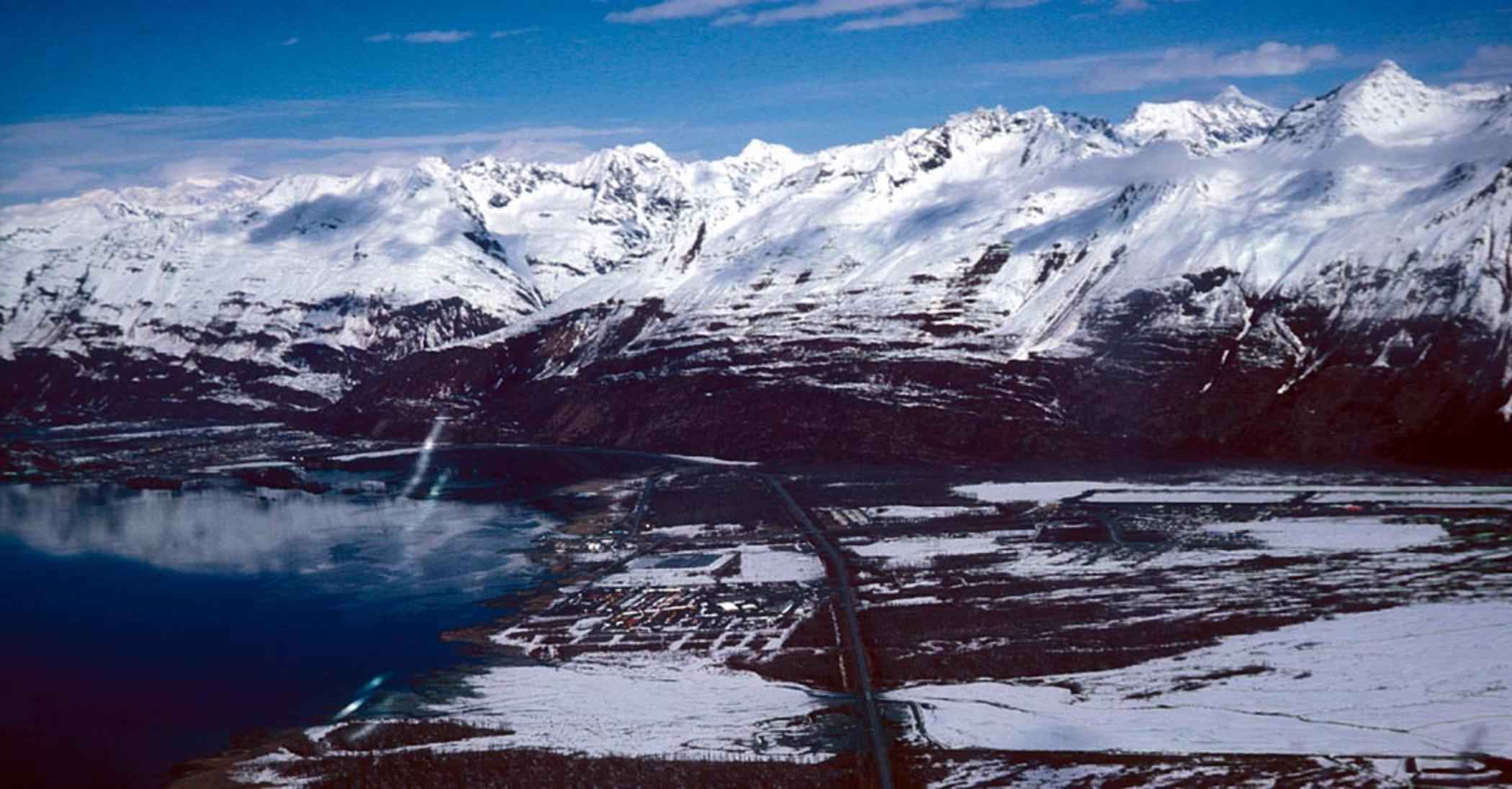
    Valdez from a distance in winter. (Photo: public-domain-image.com)
    Valdez from a distance in winter. (Photo: public-domain-image.com)

    The country’s second-richest cross-country ski race will take place in the remote community of Valdez, Alaska, this weekend, and there might still be time for you to get there. That’s the optimistic report from Qaniq Challenge Race Director Darryl Verfaillie, director of parks and recreation and cultural services for the city of Valdez, as race day approaches.

    The Qaniq Challenge, named after the Alutiiq word for “falling snow,” is set for this Saturday and Sunday, Jan. 16-17 in Valdez. The two-day, 35-kilometer race weekend requires participants to do a 17.5 k classic race on Saturday and a 17.5 k skate race on Sunday. Each technique is held on a different course. A random drawing the night before the race will determine the order in which skiers complete the courses. The lowest combined time for both races wins.

    Prince William Sound in early winter (January 2009): Valdez is just to the right of the frame. (Photo: Flickr/Frank Kovalchek)
    Prince William Sound in early winter (January 2009): Valdez is just to the right of the frame.
    (Photo: Flickr/Frank Kovalchek)

    2016 marks the second year of the Qaniq Challenge.  The inaugural year saw some challenges stemming from snow conditions, but racing occurred on both days (albeit on the same course twice).

    In a small field – 31 racers total – with an elite top end, Alaska Pacific University (APU) skier Becca Rorabaugh paced the women while teammate Lauren Fritz (APU) finished second, and Shalane Frost of Fairbanks placed third. In the men’s race, APU swept the podium with Lex Treinen claiming the first-ever win, Scott Patterson following in second and Peter Kling in third.

    Verfaillie was more than pleased with the first year of the event.  

    “It went uncharacteristically well for a first race. I think it went flawlessly,” he said in a recent phone interview.

    Verfaillie cited the positive reviews that he got from participants, and proudly noted – perhaps accurately, in light of southcentral Alaska’s snow-challenged winter in 2014/2015 – “For those two days, we had the best ski trails anywhere in Alaska.”

    Kling, a recently retired competitive skier who has raced across the U.S. and world, including at the 2015 China Tour de Ski, echoed Verfaillie’s analysis of the success of the inaugural event.

    “The entire community of Valdez (Valdez Nordic Ski Club, Parks and Recreation, Valdez Snowmachine Club, Search and Rescue and many community volunteers) came together last year to pull off a great event with difficult conditions,” Kling wrote in an email. ” You would have never known it was their first year hosting the race.”

    Treinen, the reigning men’s champion, had similar thoughts.

    “Going to the Qaniq last year was definitely a unique experience. On one hand there was not a very high turnout – likely because of the low snowfall – but the prize money made it a very serious competition,” Treinen wrote. “Scott Patterson, who finished second, and I, made a little gentlemen’s agreement not to blow out too much money on pure fluoro waxes, but other than that there were no holds barred.  We both opted to double pole on the classic day, which I think was the right decision for us both, and then in the skate day it was a huge tactical battle because the trail was so fast and narrow.  Luckily, nothing too dirty happened and it was a really fair race.

    “Aside from the competition, what stood out to me was how motivated the organizers were,” he added. “It is very rare to have race organizers who can conceive something becoming so much bigger than what it is now, and these guys definitely have that vision.  They knew what they were doing from experience and looking into how big races are held, but didn’t hesitate to ask racers for input.  I can definitely see it becoming something big in the next few years.”

    “It is very rare to have race organizers who can conceive something becoming so much bigger than what it is now, and these guys definitely have that vision.” — Lex Treinen, defending Qaniq Challenge champion

    Compared to last year’s atypically snow-sparse race, things on the ground in Valdez are looking better this year. Verfaillie cited preventative measures taken from last year’s race, including grooming all winter with an eye to repairing future meltdowns and building dams and water bars to divert water from the trails during rain events.  

    Verfaillie reports that, as of a week ago, the trails were  “all snow,” and the plan was to run the full, 17.5 k distance over both courses. Verfaillie is particularly pleased to let skiers race over the in-town course, unavailable last year, which takes skiers from the Chugach Mountains right up to the edge of Prince William Sound.

    The long-range forecast for Valdez currently shows wintry temperatures, with highs on Saturday and Sunday in the mid-20s, and the possibility of snow on Sunday.

    Verfaillie describes the race trails as “easy to moderate,” with the in-town trails more challenging than the out-of-town trails.  He is particularly pleased to let skiers experience the out-of-town trails, which are typically multi-use trails open to snowmachine traffic and don’t get that much skier use.  (All trails will be closed to snowmachine use during the races.)

    There are some unique factors about the Qaniq Challenge – for example, the order in which each skier skis each course is chosen by random drawing, so hypothetically, some top skiers could be skating on hardpack on Saturday while others have to wade through 18 inches of moist snow on Sunday – but Verfaillie’s race preparations and concerns ultimately sound a lot like those of any other race director getting ready for a ski race.  It’s the prize money that really sets this race apart.

    (Story continues below)

    The total prize purse for the Qaniq Challenge is $10,000 dollars.  For each gender, first place (based on combined times for both days) gets $3,000, second place gets $1,500, and third place gets $500.  First place at Valdez is rewarded with as much as third place at the American Birkebeiner (the only ski race in the country with a richer purse).  Second place in Valdez nets more than the $1,200 awarded for winning a national championship – Patterson won more in Valdez last year for finishing second than he did in Houghton last week for winning the 15 k classic.  Any way you slice it, it’s a lot of money for a ski race.

    That’s by design, says Verfaillie.  And he’s well aware that those numbers will raise eyebrows within the ski community.  He chose the cash amounts he did based in part on the input of Fritz and longtime APU skier and Olympian Holly Brooks, who were in Valdez a few summers ago for a community outreach event.  He asked them then how much money they were competing for elsewhere, and how much it would take to get skiers to come to Valdez.  When he mentioned a $10,000 purse, Verfaillie says, “that really got Lauren’s attention.”

    Money talks.  When asked by email whether he was planning on defending his title in this year’s race, Treinen responded, “I am definitely falling for the sin of avarice and going back this year.”

    Verfaillie has lofty ambitions for the event.  When asked about having the country’s second-largest prize purse for a cross-country ski race, Verfaillie responded, “I would love to have the largest.”  If that were to happen, “that’d be years from now,” he continued.  “But if I were to give away 50 or 60 thousand dollars total, I would love that.”  

    Verfaillie acknowledges that it’s not easy to get to Valdez in winter, so “we want to make it worth people’s while.”  As for the ample amounts of prize money, Verfaillie says, “I know I don’t have to [give out that much] – but if we can, why not.”

    The race itself is funded by the city of Valdez, which guaranteed funding, including prize money, at current levels for three years beginning in 2015.  Verfaillie noted that the Qaniq Challenge is one of the few items in the city budget that rolls over from year to year.  

    “The [Valdez City] Council was kind enough to say, We believe in the potential for this race,” Verfaillie explained. “All the money [brought in this year] rolls over into next year’s race.”

    Verfaillie obviously hopes to see participation numbers increase from 2015 through 2017; if numbers don’t go up, he acknowledges that the structure of prize money may need to be changed, and the race’s bottom line will suffer.  But he remains committed to his race, and to the goal of showing that Valdez can be a viable winter destination for cross-country skiers.  “This ski race belongs to the skiers,” he notes.  “If folks want to have a ski race, they need to come do this.”

    Verfaillie estimates that it costs the City of Valdez $25,000 to put on the race, including prize money but excluding the use of city time and resources.  He acknowledges that Valdez, which gets much of its revenue from taxes on the Trans-Alaska Pipeline, whose southern terminus is in Valdez, is in an enviable fiscal position.  For example, he notes that Valdez, with a population of around 4,100 people, has an annual city budget of $65 million (this comes out to close to $16,000 per person.  Anchorage, by contrast, with a population of approximately 300,000, has an annual budget of $481 million – around $1,600 per person.)  The city also has its own sovereign wealth fund, a muncipal-level version of the statewide Alaska Permanent Fund.

    For the time being, though, the Qaniq Challenge may still be working through the growing pains of an event in its infancy.  There were 31 finishers in the race’s first year. As of Thursday, 29 skiers had registered for this year’s event, including likely podium contenders Brooks, Fritz, and Rorabaugh.  (Also, full disclosure, this reporter.)

    “I anticipate several more from Anchorage will register this week,” Verfaillie wrote in an email two days before the race weekend. 

    The buoyant Verfaillie, described in a 2015 Alaska Dispatch News article as “an energetic retired U.S. Coast Guard captain,” sounds completely unconcerned about the turnout.  “We are guaranteed to run the race,” he promises.  

    In response to the low numbers, he notes that “the odds couldn’t be any better for those folks” who are entered.  Verfaillie also observes that over half of last year’s racers registered in the week before the event, and that he has “far more commitments than I do registrations” right now.

    Valdez is slightly over 300 miles from Anchorage, a drive of approximately six to eight hours depending on winter road conditions. The state ferry system also runs between Whittier and Valdez. Race spots and hotel rooms remain available; late registration is currently $125. Budget around $300 more to take the short flight from Anchorage to Valdez, or find a car or carpool for the all-day drive.

    Stay tuned for this author’s firsthand report of the racing experience at the second-annual Qaniq Challenge.

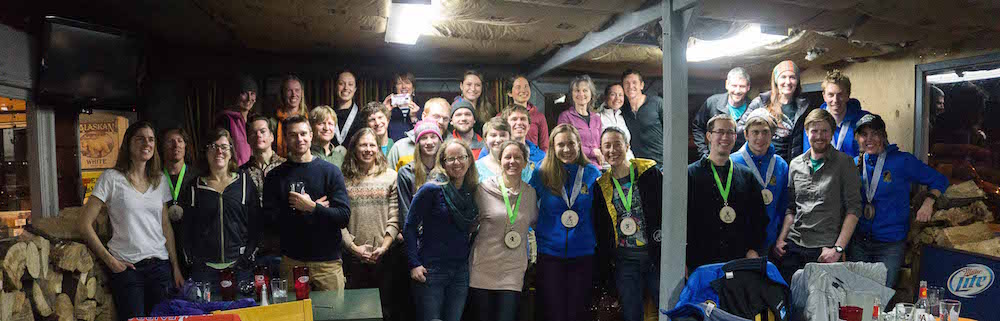
    The entire field of the 2015 Qaniq Challenge at the awards banquet in Valdez, Alaska. (Photo: Seth Adams)
    The entire field of the 2015 Qaniq Challenge at the awards banquet in Valdez, Alaska. (Photo: Seth Adams)
  • Patterson Drops Pack for Sun Valley 15 k Win; Strøm Outlasts Packer for 2nd

    Patterson Drops Pack for Sun Valley 15 k Win; Strøm Outlasts Packer for 2nd

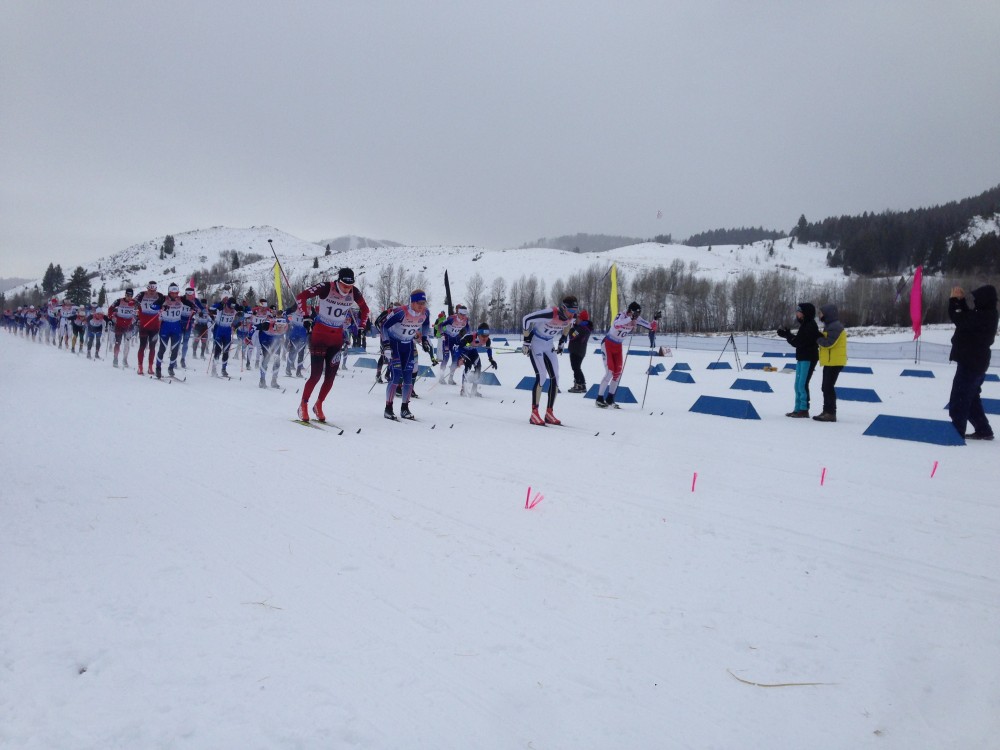
    Mads Strøm (center, in white) leads Niklas Persson (left), Matt Gelso (second from left, in blue), Paddy Caldwell (right), and the rest of the mens field out of the start in the 15 k classic at the Sun Valley Super Tour.
    Mads Strøm of the University of Colorado-Boulder (front, center, in white) leads Niklas Persson (left), Matt Gelso (second from left, in blue), Paddy Caldwell (far right), and the rest of the men’s field out of the start in the 15 k classic at the Sun Valley SuperTour on Sunday.

    SUN VALLEY, Idaho — Alaska Pacific University (APU) skiers Scott Patterson and Eric Packer know a thing or two about persevering through pain. Both have dealt with recent frightening incidents, Patterson with a pulmonary embolism last fall and Packer when he took a rocky tumble this past June. Despite their misfortune, neither let the mishaps hold them back. On Sunday, the duo proved how far they have come since, finishing first and third, respectively, in the Sun Valley SuperTour 15 kilometer classic mass start.

    The men started at 11 a.m. under cloudy skies and light snow flurries. From the beginning, it was clear that the APU athletes were looking to make a statement; the blue-and-black uniforms were ubiquitous in the lead pack. The Sun Valley spectators enjoyed their presence as well, rooting them on as they rounded the course.

    Eventual second-place finisher Mads Strøm, however, was excited to try to spoil the APU party. Early on in the six-lap race, he established himself as a threat, skiing comfortably towards the front of the pack. The University of Colorado-Boulder skier then used the strong APU presence around him as extra motivation to ski fast.

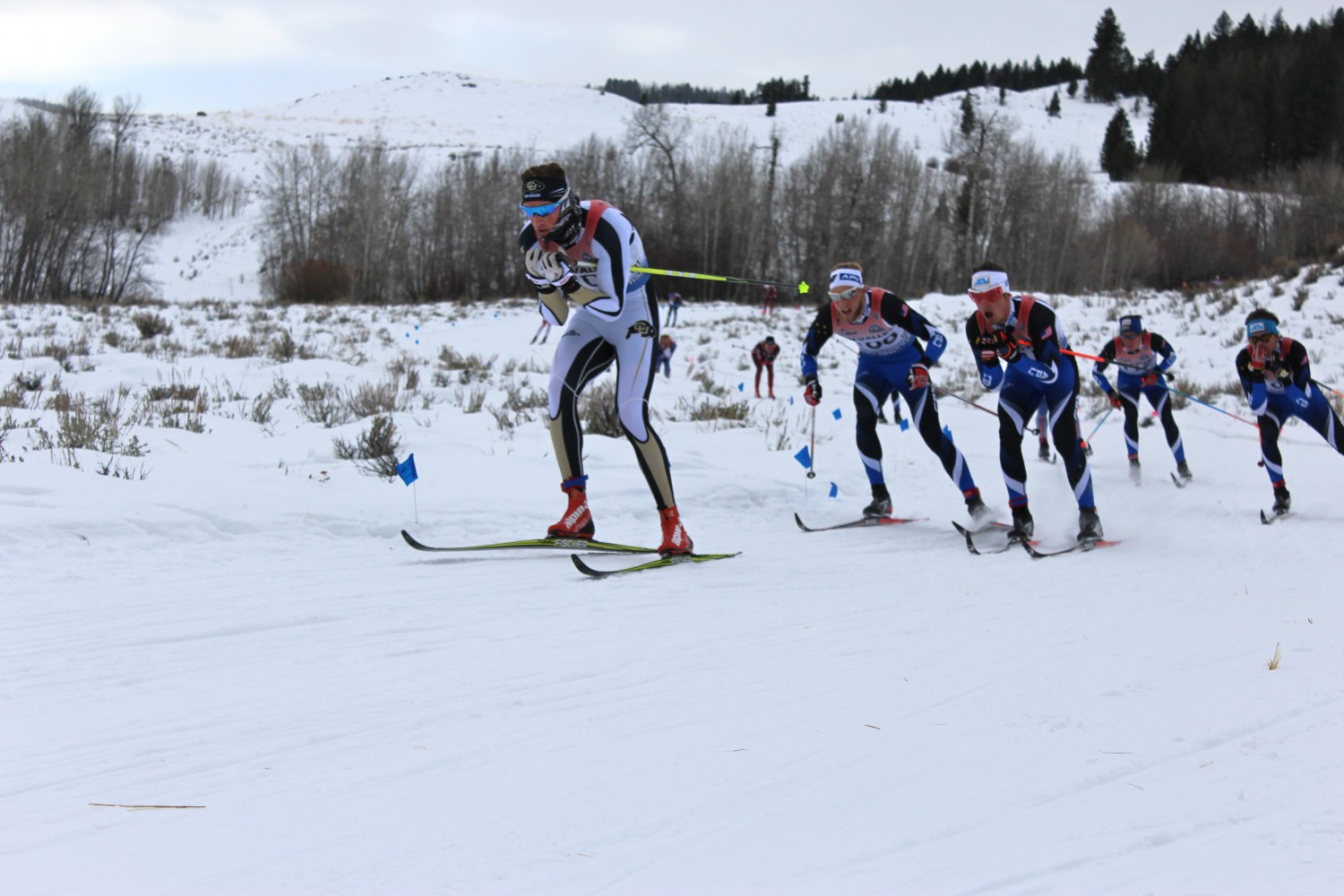
    Left to right: Mads Strøm (University of Colorado Boulder) is trailed closely by Eric Packer (APU), David Norris (APU), Scott Patterson (APU) and Lex Treinen (APU) during the men's SuperTour 15 k classic mass start on Sunday in Sun Valley, Idaho.
    Mads Strøm (University of Colorado-Boulder) leads APU skiers (from l to r) Eric Packer, David Norris, Scott Patterson, and Lex Treinen during the men’s SuperTour 15 k classic mass start on Sunday in Sun Valley, Idaho.

    “Going around [the course], everyone just cheering for APU. I was out there all alone,” Strøm said in a post-race interview. “I was like, I’ve got to beat some of these guys. I have to. For everybody else, I have to beat some of them at least.”

    After two laps where the leaders stuck together, only three seconds separated the top 17, the group broke apart. APU’s David Norris made an aggressive move up Coaches’ Climb on the third lap, and only a handful of racers were able to respond.

    “Norris made a bit of a surge up the biggest hill and I kind of got stuck behind a couple people and pushed over the top,” Patterson explained. “That kind of jump started me into gear.”

    Shortly thereafter on the third lap, the 23-year-old Anchorage native took the lead and didn’t relinquish it, keeping his distance ahead of any potential challengers all the way through the finish. Patterson crossed the line in 40:35.9, over 30 seconds ahead of the runner up.

    Though Norris made the early move to break the pack apart, he was unable to hold the pace, falling back on the fifth lap while a battle for second place developed between Strøm and Packer.

    In the last kilometer before the finish, the two were still neck and neck, battling for position on the final climb. Packer led Strøm over the top, but a mistake on the downhill caused him to lose some momentum and created an opportunity for Strøm.

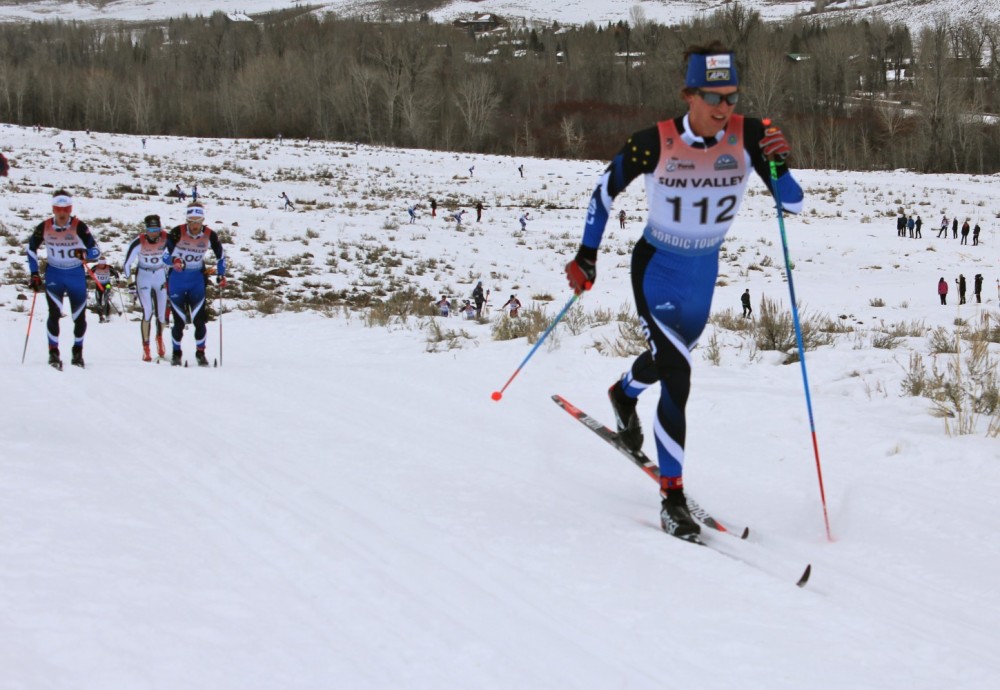
    Scott Patterson (APU) striding to a decisive lead during the the men's SuperTour 15 k classic mass start on Sunday in Sun Valley, Idaho.
    Scott Patterson (APU) striding to a decisive lead during the the men’s SuperTour 15 k classic mass start on Sunday in Sun Valley, Idaho.

    “It was the last kilometer of a race at altitude, so I knew we were both hurting and that’s a thing to keep in mind; everybody else is hurting as bad as you are,” Packer explained of the Lake Creek venue, some 6,000 feet above sea level. “So I tried to put in a big attack over the top and then almost crashed on the downhill, and when I bobbled Mads came by and he took me at the line.”

    Strøm also was feeling confident heading into the finish. Combining good skis, a desire to disrupt an APU one-two finish and some strong skiing, he was able to claim the second podium spot, 31.6 seconds behind Patterson and 2.3 seconds ahead of Packer.

    “I knew I had fast skis going down and I know I’m a fast finisher after 15 k, I was like, I can’t let them go one-two,” said Strøm, originally from Oslo, Norway. “I have to mix it up a bit at least. But it was fun. [Packer] really tried hard and I just got some confidence in the last hill that, yeah, I should get this.”

    While he was pleased with his race, Strøm said it’s just a step towards his larger focus for the season, NCAA championships, which the University of Colorado will host March 9-12 in Steamboat Springs, Colo.

    “Obviously I wanted to win. I haven’t gotten quite there yet because I have been training almost 100 hours every month since May,” Strøm explained. “I’ve planned that in one month from now I’m going to be in better shape and my plan is to win both races at NCAA’s.”

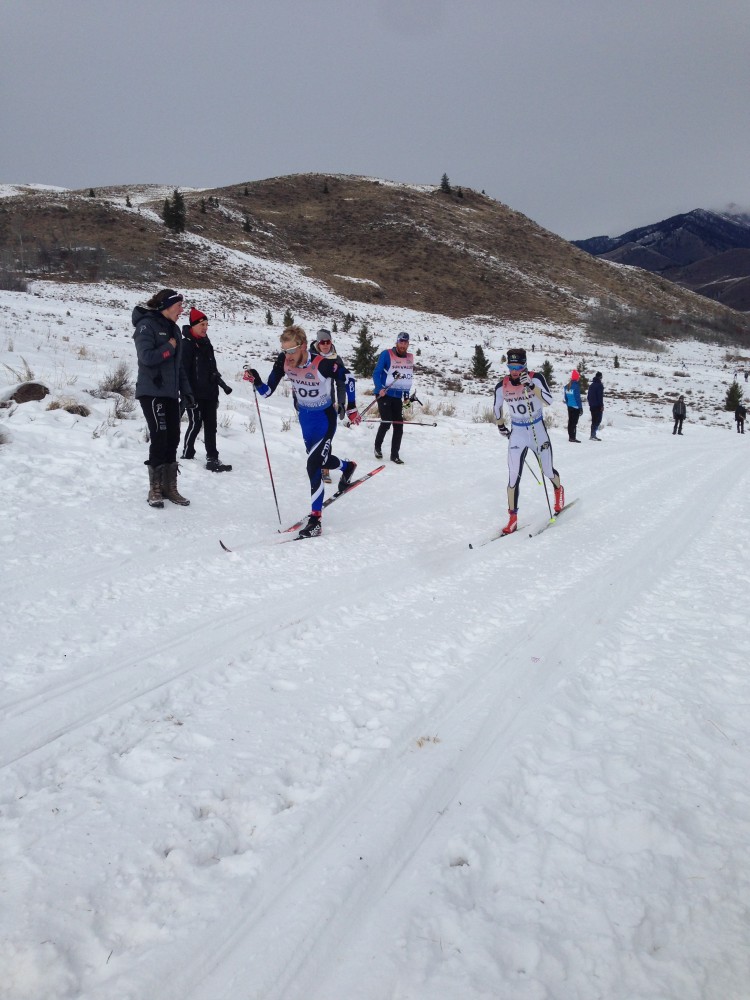
    Eric Packer (left) and Mads Strøm (right) fight for 2nd place on the last hill of their final lap.
    Eric Packer (left) and Mads Strøm (right) fight for second place on the last hill of their final lap.

    For Patterson and Packer, who also grew up in Anchorage, the APU skiers were excited with their races and happy to have given it their all in Sun Valley. Overcoming their misfortunes only made the moment more special.

    “Every day that we get to race is just an awesome opportunity to go out and have fun,” Packer reflected. “After having a really close call and having a big fall in the mountains, everything, you look at it with a new perspective. I just feel so lucky to be out here really.”

    “I mean, watching him fall in the mountains was definitely an eye opening thing,” Patterson recalled. “We were lucky there and it’s sweet to have Eric here [on the podium]. And then, this is my first year racing this first circuit so, I mean, I’m happy to be here too, happy to not have a ski sticking out of my leg.”

    One spot from the podium in fourth was another APU skier, Lex Treinen, who finished 26.8 seconds after third and 1:00.7 behind Patterson. About a second later, Kyle Bratrud of Central Cross Country (CXC) placed fifth (+1:01.9).

    After two weekends of racing, the SuperTour takes nearly a month break before resuming with U.S. Nationals on Jan. 3 in Houghton, Mich.

    Results | Results with splits

  • Bjornsen Siblings Dominate Classic Races at SuperTour Finals to Conquer Long-Time Goal

    Bjornsen Siblings Dominate Classic Races at SuperTour Finals to Conquer Long-Time Goal

    Sadie Bjornsen (USST/APU) skiing to win the 10 k classic at the 2015 SuperTour Finals in Sun Valley, Idaho.
    Sadie Bjornsen (USST/APU) skiing to win the 10 k classic at the 2015 SuperTour Finals in Sun Valley, Idaho.

    SUN VALLEY, Idaho – It was a family affair at the first competition of the 2015 SuperTour Finals on the trails of Galena Lodge, with siblings Sadie and Erik Bjornsen claiming victories in the 10- and 15-kilometer classic individual starts. The wins seemed like destiny, as the two were both the 23rd starters of their respective races with each winning by roughly a minute over their competition.

    The women’s 10 k featured a hard-packed course that made for fast times and often unforgiving downhills. Although organizers moved the start of the race back by an hour, the women still experienced what at times felt like pure ice.

    Starting in the middle of the A-seed, Bjornsen began her race with the fastest first lap and continued her dominance until the 10 k’s finish, where she crossed the line with a time of 27:53.7. She was followed by Alaska Pacific University teammate Chelsea Holmes, who trailed by 1:021. In third was U.S. Ski Team/Burke Mountain Academy’s Liz Stephen, who placed 1:26.8 behind Bjornsen.

    In fourth and fifth were University of Utah skier Veronika Mayerhofer (+1:43.1) and Stratton Mountain School’s Katherine Ogden (+2:07.9), who was also the top junior in Saturday’s race.

    Bjornsen’s strategy was to charge out of the gate and sustain top speed through the two-lap race while maintaining control of her energy. She explained that the top of the course, which features rolling terrain, was her strongest section and set her apart from the other women. “I really enjoy double-pole and I was just working that section so much harder than everyone else,” she said.

    Bjornsen hasn’t spent much time at altitude in the 2015 season with the exception of World Cup races and training camps in Davos, Switzerland. Although Saturday’s race was situated at 7,290 feet, the 25-year-old said she tried to forget about the high elevation.

    “It’s funny because I rarely race at altitude, mostly Davos, and I’ve never had success in Davos,” she explained. “Today I was trying to just tell myself that altitude is not a thing because everyone is coming here from sea level so I felt we were all on even ground.”

    Chelsea Holmes (APU) skis to second in Saturday's 10 k classic at the 2015 SuperTour Finals in Sun Valley, Idaho.
    Chelsea Holmes (APU) skis to second in Saturday’s 10 k classic at the 2015 SuperTour Finals in Sun Valley, Idaho.

    The APU skier said her experiences on the World Cup aided her quest for victory. She explained that throughout the 2015 season she has lost kick in the second half of every classic race, which taught her to find ways to make little to no kick work in a race like Saturday’s.

    “This year on the world Cup I believe I lost kick on the second half of every race. I’m trying to figure out if it’s a technique thing or a waxing thing, so today I was just trying so hard to find a way to make it work,” she said. “It was actually good training to figure out a way to make your kick work when it’s not ideal. In these icy conditions, there’s no way to keep kick for 10 or 15 k.”

    Bjornsen said that she was happy to return to the U.S. and compete in a fun end-of-season event. At the same time she said that domestic races like SuperTour Finals often make her more nervous than the World Cup.

    “A lot of the younger girls on my team asked me if I get nervous, and I have to say that I get way more nervous for racing in the U.S. than in the World Cup,” she said. “In the U.S. you come back to win. Granted I always try to win on the World Cup, but coming here you know that if you have a good race winning is an option.”

    In second place Holmes was pleased with her result, saying it gave her a boost of confidence as her season comes to an end. The APU skier explained that she normally preforms better on hilly courses but used her teammate as motivation to ski smooth and relaxed.

    “Gradual isn’t always my thing,” she said. “Honestly I tried to picture myself skiing behind Sadie because she’s a good classic skier. I wanted to ski relaxed and focused and not crush myself in the first kilometer.”

    Holmes said that the icy course was manageable but highlighted some of her tactical and technique weaknesses. “I definitely know what I have to work on in the summer,” she said with a laugh.

    Liz Stephen (USST/Burke Mountain Academy) strides to third in Saturday's 10 k classic at the 2015 SuperTour Finals in Sun Valley, Idaho.
    Liz Stephen (USST/Burke Mountain Academy) strides to third in Saturday’s 10 k classic at the 2015 SuperTour Finals in Sun Valley, Idaho.

    Like Holmes, Stephen is stronger on strenuous courses that require ample climbing. She entered Saturday’s race looking to ski at a pace well suited for the altitude.

    “The altitude is definitely a harsh reality right now but hopefully by the end of the week it will start to feel normal. It’s definitely a different pace. You have to remember that you’re at 7,200 feet and there’s less oxygen and you got to go a little slower,” she said.

    The 10th ranked woman in the 2015 World Cup said that she was pleased with her effort and happy to be racing on U.S. soil. She explained that SuperTour Finals are a way for her to return to the roots of the sport and not worry about the stresses of the season.

    “I definitely have a ‘spring series’ type mindset and I think it’s really healthy, for me anyway, to end the season how I got into the sport – just really enjoying it all and spending time with friends,” she said.

    “You spend the entire year taking care of your body and resting, and I’m over it,” she added with a smile. “I just like to come out see people, have fun, and enjoy the sun. That’s what I went out to do today. It feels good to race because you love to race.”

    Several women sat out Saturday’s 10 k, including APU’s Rosie Brennan and SMST’s Sophie Caldwell, both of whom are recovering from illness. Caitlin Gregg did not start the 10 k due to a concussion from a rogue feed that hit her head in the Holmenkollen 30 k earlier this year.

    Erik Bjornsen en route to his 58.5 second victory in the 15 k classic at the 2015 SuperTour Finals in Sun Valley, Idaho.
    Erik Bjornsen en route to his 58.5 second victory in the 15 k classic at the 2015 SuperTour Finals in Sun Valley, Idaho.

    Erik Bjornsen Achieves the Family Goal

    By the time the men’s 15 k began, the warming temperatures had changed the nature of the course. Instead of hard-packed ice, the 5 k loop developed into a wet track that sucked speed from competitors’ skis.

    Despite the deteriorating conditions Erik Bjornsen skied his way to a time of 40:32.6. In similar fashion to his sister, the APU skier bested field of 80 by an astounding 58.5 seconds. In second was teammate Lex Treinen, while University of Colorado’s Mads Ek Strøm crossed the line in third, 1:02.4 behind Bjornsen.

    In fourth and fifth were Sun Valley teammates Ben Lustgarten (+1:16.0) and Miles Havlick (+1:31.1). SMST2’s Ben Saxton (+1:44.1) finished sixth, while 2015 World Championships skiers Noah Hoffman (+1:55.8) and Kris Freeman (+2:01.0) finished seventh and eighth.

    Bjornsen entered Saturday’s race with extra motivation after witnessing his sister’s win. According to the 23-year-old it has been a mutual goal to win high-caliber domestic races on the same day. They have come close in the past – at the 2013 U.S. Cross Country Championships they finished in the top two positions of their respective races twice – but never reached the coveted double-win.

    “Both mine and Sadie’s goal for a while has been to win on the same day in a big race, a national caliber race,” Bjornsen said in a post-race interview. “I was nervous before the race, but as soon as she came in and grabbed the win the pressure was on for sure.”

    Before he could accomplish the feat, Bjornsen had to make a decision. Given the conditions and the course’s rolling terrain some competitors chose to use skate skis and double-pole the entire course. According to the APU skier, it was a decision he almost made but in the end he chose minimal kick.

    “I was really close to using skate skis but tried to go with the classic skis with very little wax and it was just enough to be able to work that long steady section and stay pretty relaxed and try not to push it too hard,” he said of his choice, adding that the minimal kick allowed him to gain a lot of time on the flat section at the top of the course.

    Bjornsen said that his win in the 15 k classic demonstrated a diverse approach to previous SuperTour Finals. He explained this was especially true in 2014 season, where he struggled to find motivation after a long World Cup season.

    “Last year after the World Cup season I got a little unmotivated so I decided I wanted to change that this year and try to finish these races strong. I’ve been trying to stay pretty focused the last week and come in here pretty hungry,” he said. “It seemed like it worked. I’m really happy with that result, there are a lot of strong guys out there.”

    Lex Treinen (APU) skis to second in Saturday's 15 k classic at the 2015 SuperTour Finals in Sun Valley, Idaho.
    Lex Treinen (APU) skis to second in Saturday’s 15 k classic at the 2015 SuperTour Finals in Sun Valley, Idaho.

    Almost a minute behind Bjornsen was Treinen who, unlike his APU teammate, decided to race on skate skis. “I double-poled the whole course and I think that was the right call for me today,” he said. “It was faster for me at least to double pole the whole uphill, and I think that was a huge key.”

    Treinen has seen a breakthrough year in which he placed second in the 30 k at U.S. Nationals, was the first American in the Birkebeiner, and completed a successful stint on the OPA Cup circuit in Europe. He explained that his recent experiences in Europe helped him decide to double-pole Saturday’s course.

    “I just got back from the OPA Finals trip and there are some real hills there, much steeper and more intense than these hills here. Those guys double-pole up that stuff and win their races so it was huge to get that experience there,” he said.

    According to the 24-year-old, his finish in Saturday’s race was possibly the best of the season – which not only gives Treinen confidence, but also removes an pressure for the remainder of the Finals.

    “This is maybe my best result I’ve ever had,” the Alaskan said. “I’ve had some decent results but to have a second place it takes a lot of pressure off but it makes it a lot more relaxed for me. Spring Series are always relaxed; it’s a fun time.”

    Mads Ek Strøm (University of Colorado) strides to third in Saturday's 15 k classic in Sun Valley, Idaho at the 2015 SuperTour Finals.
    Mads Ek Strøm (University of Colorado) strides to third in Saturday’s 15 k classic in Sun Valley, Idaho at the 2015 SuperTour Finals.

    Rounding out the podium, Strøm said that he struggled through much of his race due to the altitude and lack of training in the week prior to the Finals. Last Friday the Norwegian skied to second in the NCAA Championships 20 k classic and returned to Boulder, Colo. with a large amount of schoolwork and little time to complete it. Friday’s pre-race ski was his first since competing in Lake Placid.

    The Colorado sophomore started one bib ahead of Bjornsen and skied with the APU athlete for much of the first lap. After that, however, Strøm lost valuable time on the subsequent laps and lost an additional 30 seconds.

    “That was probably the toughest race I’ve ever done in like forever… at the 5 k I felt completely done, like ‘I can’t finish this race,’” Strøm said in a post-race interview. “When I heard I was fighting for podium I just tried to finish strong, as strong as I could.”

    With the focus of his season – NCAA Championships – behind him, Strøm said that the races in Sun Valley are a chance to see how he measures up against America’s best.

    “Skiing against Noah Hoffman, Kris Freeman, Erik Bjornsen, they’re all the best skiers in the U.S. It’s really cool because you can really see how good you are compared to those guys,” he said.

    Results

  • Brooks Wins Second Birkie; Bonaldi Takes Men’s Race in Dramatic Finish

    Brooks Wins Second Birkie; Bonaldi Takes Men’s Race in Dramatic Finish

    Segio Bonaldi celebrates after winning in a sprint finish at the 2015 American Berkebeiner. It is Bonaldi's second Birkie title. (Photo: American Birkebeiner Ski Foundation)
    Italy’s Segio Bonaldi celebrates after winning in a sprint finish at the 2015 American Berkebeiner in Hayward, Wis. It was Bonaldi’s second Birkie title. (Photo: American Birkebeiner Ski Foundation)

    The 2015 American Birkebeiner in Hayward, Wis., was spared the most frigid weather gripping the Eastern U.S., as temperatures hovered around 15 degrees Fahrenheit when Saturday’s 51-kilometer freestyle elite race began. And despite three to four inches of new snow, even the sun made an appearance during the race.

    In was in these conditions that American Holly Brooks, of Alaska Pacific University in Anchorage, Alaska, won her second Birkie, claiming victory in a time of 2:34:33.

    Holly Brooks racing to her second Birkie victory on Saturday in Hayward, Wis., which she won by nearly 30 seconds to reclaim the FIS Marathon Cup overall lead. (Photo: Darlene Prois/ABSF)
    Holly Brooks racing to her second Birkie victory on Saturday in Hayward, Wis., which she won by nearly 30 seconds to reclaim the FIS Marathon Cup overall lead. (Photo: Darlene Prois/ABSF)

    However, she first had to ward off Aurelie Dabudyk of France, who stuck with Brooks until she began her final push on the flats of Lake Hayward, a few kilometers from the finish.

    Brooks came into the race second overall in the FIS Marathon Cup, but reclaimed the lead after Saturday’s win.

    The 32 year old told FasterSkier that the top four women were together for most of the race. At “B*itch Hill” – a steep climb about 40 k into the race – she said she heard a second snow machine behind her.

    “I looked over my shoulder and there was the sea of men who had caught us,” she explained. “I knew it was a now-or-never moment.”

    As the leading men passed the first four women, Brooks decided to make her move. She tagged onto the group of men and managed to break from the group.

    However, she was surprised to find Dabudyk was able to hang behind her.

    “I did not want to leave it to the finish sprint and therefore pushed as hard as I could on Lake Hayward. I did not dare to look back before the finish line to be sure not to lose any seconds,” she explained to the press. “I didn’t want to be ‘that skier’ who looked back and lost the sprint because you miss a crucial pole plant or something.”

    As usual, she said Main Street in Hayward was incredibly loud and festive.

    “It would have been fun to grab a flag and celebrate a bit but ensuring the win and reclaiming the red bib was more important!” she said. “I am really happy that I could win the Birkie again today!”

    Holly Brooks celebrates after winning her second American Berkebeiner on Saturday in Hayward, Wis. The win put her back in the lead of the overall FIS Marathon Cup. (Photo: American Birkebeiner Ski Foundation)
    Holly Brooks celebrates after winning her second American Berkebeiner on Saturday in Hayward, Wis. The win put her back in the lead of the overall FIS Marathon Cup. (Photo: American Birkebeiner Ski Foundation)

    Dabudyk went on to finish second, 28.1 seconds behind Brooks. Tatiana Mannima of Estonia was nearly two minutes back in third (+1:59.9), barely holding off German Anja Gruber, who placed fourth (+2:02.1).

    Mannima has won the last two FIS Marathon Cup races, while Gruber is coming off three podium finishes earlier this month in SuperTour races in Craftsbury, Vt.

    Dabudyk said to the press that she wanted to stay with Brooks until the finish, though down the stretch Brooks had too much power for her.

    “But I am really happy with my second place,” she added.

    Mannima said that she pushed hard from the start to see which skiers could hold onto her speed. She was able to stay in the lead group until Brooks and Dabudyk finally took off with 10 k to go.

    “At Lake Hayward, I was trying to stay behind Gruber, as it was pretty windy on the lake. I hoped to pass her before the finish line, which I did,” she explained, adding that she is happy to just be on the podium.

    American Caitlin Patterson (Craftsbury Green Racing Project) ended up fifth (+9:31), after winning the SuperTour 20 k classic mass start in Craftsbury late last month.

    Bonaldi wins second Birkie in exciting fashion 

    Italy's Segio Bonaldi (r) outlasts three Frenchmen en route to his second American Birkebeiner victory on Saturday in the 42nd annual Birkie in Hayward, Wis. (Photo: Darlene Prois/ABSF)
    Italy’s Segio Bonaldi (r) outlasts three Frenchmen en route to his second American Birkebeiner victory on Saturday in the 42nd annual Birkie in Hayward, Wis. (Photo: Darlene Prois/ABSF)

    The men’s race offered a more dramatic finish, as Italian Segio Bonaldi outsprinted three Frenchmen to win by less than a second.

    Bonaldi, Birkie winner in 2013, finished in 2:12:21.1. He passed France’s Christopher Perrillat-Collomb in the final 100 meters to win by just 0.5 seconds. Benoit Chauvet and Mathias Wibault were also in the lead group, and Chauvet finished in third (+1.7) while Wibault faded to fourth (+5.0).

    Chauvet told the press that he tried to break out of the lead group of 20 at the first climb, but no one was willing to break with him. However, the racers slowly began to spread apart at about the 35 k point, and Chauvet was able to work with Perrillat-Collomb.

    “At this point all were thinking about winning the race,” he said.

    Chauvet explained that his tactics failed him, however, and that Bonaldi was smarter and stayed behind the others until the final stretch. Chauvet said he probably made his final sprint too early, as he tried to be first coming off the new bridge that drops the skiers into downtown Hayward and the final straightaway to the finish.

    “I did not feel so well until 15 k before the finish,” Bonaldi said. “My skis were also not very good so I tried to stay behind and to wait for the finish sprint. I kept energy for that.”

    The 36 year old added that he really wanted to win this year, especially after finishing third last year, but was not sure he would have a clear shot at victory until 100 meters before the finish line.

    “I am very happy!” he said.

    “I am little bit disappointed to be third as I wanted to win. I have to come back for the victory next year,” Chauvet said.

    The top American, Lex Treinen (APU), finished nearly 20 seconds after Wibault in fifth and was 24.5 seconds from the win. Last year, he placed 10th in the Birkie. American Brian Gregg (Team Gregg/Madshus) finished in eighth (+1:51.4).

    FIS Marathon Cup leader Petr Novak of the Czech Republic came through in 11th (+5:51.4).

    “I had the worst skis of my life. I lost so much on the downhills. It was a mental fight for me all the way through and right until the end!” Novak said in a statement to the press. Despite his rough day, he still retains the lead in the overall FIS Marathon Cup standings.

    American Matt Liebsch (XC United/Team Strong Heart), 2009 Birkie winner, finished 10th (+3:10.8), while 2012 Birkie winner Tad Elliott (Ski & Snowboard Club Vail Elite) took 16th (+10:29.5).

    Naryshkina, Mork take classic titles

    Men's 55 k classic Birkie winner Ole Christian Mork (c) is with second-place finisher Torin Koos (l) and Thomas Seidel (r), who placed third. (Photo: ABSF)
    Men’s 55 k classic Birkie winner Ole Christian Mork (c) is with second-place finisher Torin Koos (l) and Thomas Seidel (r), who placed third. (Photo: ABSF/Facebook)

    In the 55 k classic race, Natalia Naryshkina of Russia and the CXC Team took the women’s win in 3:19:20.2, while Norway’s Ole Christian Mork won the men’s race in 2:54:22.1.

    Naryshkina beat runner-up Josie Nelson of Medicine Lake, Minn., by 3:44.9, and Kelly Sillicorn of Winona, Minn., by 3:50.9. Isabel Caldwell, younger sister of U.S. Ski Team member Sophie Caldwell, placed fourth (+6:14.8).

    Mork, of Oslo, outlasted four-time U.S. Olympian Torin Koos by 8.8 seconds and Thomas Seidel, of Salt Lake City, in third by 14.7 seconds.

    Complete results

    51 k skate results: Men | Women

    55 k classic results: Women | Men

  • 2015 American Birkebeiner Preview: Bridges, Brooks and More

    2015 American Birkebeiner Preview: Bridges, Brooks and More

    Holly Brooks winning the 2012 American Birkebeiner, four-tenths of a second ahead of Caitlin Gregg (l), for her first Birkie title. (Photo: Darlene Prois/American Birkebeiner) http://fasterskier.com/article/brooks-outsprints-gregg-for-birkie-victory/
    Holly Brooks winning the 2012 American Birkebeiner, four-tenths of a second ahead of Caitlin Gregg (l), for her first Birkie title. (Photo: Darlene Prois/ABSF)

    Each year, leading up to the third week in February upward of 11,000 people get sick. It isn’t a sickness that would cause a widespread panic, but rather one thousands of Midwesterners actually looked forward to each year, and it’s called Birkie fever.

    The 42nd running of the American Birkebeiner takes place Saturday, starting in Cable, Wis., and ending some 30 miles (or 50-plus kilometers) south in Hayward, Wis. The race filled up in November, with all 10,500 allotted entries accounted for before the first of the year. In total, 10,517 skiers from 18 countries were registered for the three Saturday races, almost 7,000 of them are entered in the 51 k skate race. That’s a big change from 1973, the first time the Birkie was held. Back then, there were 34 men and one woman as race participants.

    The race course has gone through several changes since 1973, from the direction skiers raced to the length of the race. This year’s race has a few changes that will add a some interesting twists. For one, the race is longer. The classic race is now 55 k and the skate race now 51 k. The extra distance was due to a relocation of the final aid station and the extension of the finish line, pushing it farther down Main Street.

    The International Bridge was a fixture in the Birkie before. - Photo: American Birkebeiner Foundation
    The International Bridge was a fixture in the Birkie before. (Photo: ABSF)

    The biggest change that has garnered some of the most attention is the new bridge the American Birkebeiner Ski Foundation (ABSF) finished assembling on Wednesday over Highway 63, a kilometer from the finish.

    The International Bridge adds no length to the race, but it does add a 17-vertical-foot hill before the finish. Previously, once skiers were five kilometers from the finish, it was a flat ski to Main Street. The new manmade hill adds a 10-percent climb to legs that already have some 50 kilometers of climbs in them.

    This isn’t the first time the International Bridge has been a fixture on the Birke course. In the late ’70s and early ’80s when the race finished at the Telemark Resort in Cable, the bridge was the last hill skiers needed to climb before they finished. The temporary bridge is 100-feet long and spans 30 feet over the highway.

    The bridge was needed to eliminate the traffic congestion problems the race brought during the weekend. Funding for the ramp and other changes is a part of phase one of the ABSF’s multiple-year fundraising program.

    The new International Bridge before the finish of the American Birkebeiner in Hayward, Wis. (Photo: American Birkebeiner Ski Foundation Facebook)
    Testing the new International Bridge near the finish of the American Birkebeiner in Hayward, Wis. (Photo: American Birkebeiner Ski Foundation Facebook video)

    Birkie Draws FIS Marathon Cup Contenders 

    The past two years, the Birkie has been a part of the FIS Marathon Cup, a season-long international competition that crowns a winner with the highest points after a series of races of 42 k or farther. This means it attracts some of the world’s best long-distance racers and this year’s women’s field is a reflection of that. In the elite wave, the top four women in the FIS Marathon Cup are entered: Tatjana Mannima of Estonia, American Holly Brooks, Aurelie Dabudyk of France, and Antonella Confortola of Italy. Confortola finished second in last year’s Birkie.

    Brooks was leading the FIS Marathon Cup, but skipped last week’s stop at the Tartu Marathon in Estonia to head to Hayward to prepare for the Birkie.

    “I’m really excited for this year’s Birkie,” Brooks wrote in an online message this week. “It’s been a couple of years since I’ve been here and it’s great to be back — both at the Birkie and on ‘home soil!’

    “I’ve been bouncing from country to country racing marathons and I decided last fall that I would spend two weeks here in Hayward,” she explained. “I have great friends that I’m staying with and it feels fabulous to be in a house [rather than a hotel].”

    The new podium awaits for the winner of this years race - Photo: American Birkebeiner Foundation
    The new podium awaits for the winner of this year’s race. (Photo: ABSF)

    Coming into the race, Brooks ranks second in the overall FIS Marathon Cup standings, just seven points behind Mannima. Brooks won the Birkie in 2012 and knows the course well.

    “I‘ve seen the whole thing start to finish… both at distance pace and race pace. That’s more than I can say for some of the courses I’ve raced this winter!” Brooks wrote. “Not sure how much of a true advantage it gives me but it puts my mind at ease a bit. I know where people including myself have made moves.”

    Two year ago at the Birkie, Mannima lost a photo finish and placed second to three-time Birkie champion Caitlin Gregg, who is currently in Sweden representing the U.S. at the FIS Nordic World Ski Championships in Falun. American Caitlin Patterson (Craftsbury Green Racing Project) finished third in 2013 and seventh last year, and could prove to be a threat in this year’s elite race.

    In an email on Wednesday, Patterson wrote that she was looking forward to skiing part of the Birkie trail on Thursday, refreshing her memory “of some of its notable features, and seeing the new bridge and finish line if possible.

    “My preparations have been going well — mostly I’ve been focused on recovering after recent Craftsbury Supertours, building up my energy, and actually keeping my training skis pretty short and easy,” she explained. “At this point in the season I have to trust the endurance and fitness I’ve built up during the past year, and mostly just stay sharp and excited for the race, which I most certainly am!”

    In terms of her goals and expectations for Saturday’s race, Patterson felt anything was possible.

    “The past two years of racing the Birkie have taught me that it’s a race in which you have to test your limits but where you never quite know what will happen, where you must always be thinking quickly and ready to react throughout all 50+k,” she wrote. “I believe that I’m in very good shape, so my goals are to trust my fitness, ski with confidence and enjoyment of the sport… and to make it onto the podium!”

    “I’ve seen the whole thing start to finish … I know where people including myself have made moves.” — Holly Brooks on her Birkie advantage

    The men’s field is also competitive. Most of the FIS Marathon leaders didn’t race last weekend’s Tartu Marathon to fly to the U.S. to prepare for the Birkie. Overall FIS Marathon Cup leader Petr Novak of the Czech Republic is racing along with France’s Benoît Chauvet, who sits in second place, only 85 points behind Novak. Second-and-third place finishers from last year’s Birkie, Simone Paredi and Sergio Bonaldi of Italy, are also listed to start. Bonaldi won the Birkie in 2013.

    SSCV's Tad Elliott (119) and Craftsbury's Andrew Dougherty (131) Men's 30 k classic mass start at U.S. Cross Country Championships in Houghton, Mich. (Photo: Christopher Schmidt)
    Tad Elliott (119) racing in the men’s 30 k classic mass start at U.S. Cross Country Championships in January in Houghton, Mich. (Photo: Christopher Schmidt)

    For the U.S., Birkie winners Tad Elliott (Ski & Snowboard Club Vail Elite) and Matt Liebsch (XC United/Team Strong Heart) will be racing, along with 2014 U.S. Olympian Brian Gregg. Elliott won in 2012 and Liebsch took first in 2009.

    This trio has had a pretty intense history in the Birkie. When Elliott won in 2012, Liebsch placed second and Gregg took third. The difference between first and third was only 14.8 seconds.

    In a phone interview, Liebsch mentioned how team tactics played a part in previous Birkies, but that would not be the case this year.

    “In the past, you would have these teams come over with five or six guys and it would essentially be like a cycle race,” Liebsch said. “The fast sprinters would just sit in the back while his teammates did all the work up front setting the pace and sending guys off the front to disrupt the flow of the race. This year is a little different because there aren’t the multiple-person teams.”

    Liebsch added that the style of racing here is different than at European marathons.

    The 2011 American Birkebeiner men's podium (from left to right): with France's Benoit Chauvet in second, Norway's Tore Martin Gundersen in first and Russia's Andrey Tyuterev in third. (Photo: Andy Caniff/Swix Sport USA)
    The 2011 American Birkebeiner men’s podium (from left to right): with France’s Benoit Chauvet in second, Norway’s Tore Martin Gundersen in first and Russia’s Andrey Tyuterev in third. (Photo: Andy Caniff/Swix Sport USA)

    “In Europe, the pace is extremely fast due to the fact that teams have ten or eleven guys,” he said. “Here in the United States, the pace is slower and many of the Europeans don’t like that pace so they would send guys off the front if the pace got to slow.

    “Most of the European guys are here to get FIS points to improve their standings for the overall FIS Marathon Cup title,” he added.

    Chauvet is currently second in the overall FIS Marathon Cup and has the biggest team entered in the Birkie with four total teammates, while the overall leader, Novak will race solo.

    “The strategy for most of the European guys will be to stay up front, in the top eight, get points and then head back to Europe,” Liebsch said. “This could really help out the fast American guys like Tad, Brian, me and Lex [Treinen] because the pace won’t be crazy fast like most European races can be.”

    In an email, Treinen predicted that U.S. guys would have a good showing: “Matt looks like he’s in good shape and he and [Brian] Gregg would love to take home a Midwest victory here,” he wrote. ” … I have been training specifically for the Birkebeiner for at least two weeks and I even did some intervals recently, so I feel like I am in better shape than ever before.”

    Elliott has spent some time in the Midwest and won last month’s Seeley Classic race that was held on the Birkie course.

    “I am excited to race the Birkie,” Elliott wrote in an email. “It will be three years since I last raced here! I am looking forward to a great event. I have had some health issues again sneak in this last month, but I have a few tricks up my sleeve. My twin brother is also my wax tech coming with me from Colorado. Hoping [he] can keep me in the race this year!”

    The biggest factor going in the weekend is the weather. There was a concern of a lack of snow but over the last few weeks the area has gotten enough snow to make the course set up nicely for the race. The wind and cold temperatures are an immediate concern. On Tuesday, organizers canceled Thursday’s elite sprints because of the predicted well-below-zero temperatures at the scheduled start time. Early predictions show Saturday morning’s temperatures to be around 4-degrees Fahrenheit.

    The Birkie can been viewed live on Saturday, starting at 8 a.m. Central time, via the race organizer’s live stream (http://new.livestream.com/xcountrylive/birkie). Follow athletes via the Birkie’s live athlete tracker and check FasterSkier for a post-race recap.

    Elite start lists: Women | Men

  • Vision & Success: Julbo Cross Country Ski Athletes

    Julbo USA

    (Press release)

    WILLISTON, VT- Since entering the nordic ski market in the U.S. in early January of 2015, Julbo Eyewear and its network of athletes have wasted no time making their mark on competition at all levels. Former Birkie winner, Matt Liebsch kicked off the marathon season with wins in the Sisu Marathon in Ironwood, Michigan, a win at the City of the Lakes Loppett and an American Mora Vassaloppet victory (his 6th victory in the race). He will toe the line in the American Birkebeiner later this month.

    Lex Treinen continued a strong domestic campaign, after a silver medal at this year’s U.S. Cross Country Championships, with multiple top five finishes included a third place finish at the recent Craftsbury Super Tour 15K Classic event. Treinen will head to Europe to compete in Europa Cup events next week.

    Meanwhile in Europe, Julbo athletes, Ben Saxton and Annie Pokorny qualified and raced in the U23 World Championships held in Almaty, Kazakhstan. Saxton faired particularly well taking home a sixth place finish in the classic sprint and earning a discretionary spot on the U.S. World Championship team to compete next week in Falun, Sweden.

    “It has been a goal of  mine all year long to make the World Championship team, and there’s no way I would have been able to perform a the level to do so without my sponsors. My Julbo eyewear allow me to forget about any vision worries and race at a World Championship level, there is no other company I would want to work with,” Saxton explained.

    Saxton will join fellow U.S. Ski Team member and fellow Julbo Athlete, Noah Hoffman who has made a strong recovery after breaking his leg in the opening World Cup Weekend in Finland back in early December. Hoffman explained, “I feel incredibly lucky to be heading back to the World Cup and to the World Championships in Falun. After breaking my leg in the first race of the season,  my recovery has gone as quickly and smoothly as anyone could have hoped. I could not have done it without the help of a world class medical team. I am very excited and nervous to return to racing. I have some great opportunities to accomplish my goals and make progress towards my career goal of being the best cross country skier in the world. I am also excited to be joining a team of incredible athletes who are building momentum as the season progresses.”

    Julbo cross country athletes use a variety of Julbo styles, all with photochromic lenses, including the Sniper, the Venturi, and the Dust. For more information, log onto www.julbousa.com

  • Video: Freeman Makes it a Three-Peat, Rorabaugh Comes from Behind to Win Craftsbury Mass Starts

    Video: Freeman Makes it a Three-Peat, Rorabaugh Comes from Behind to Win Craftsbury Mass Starts

    Having trouble viewing the video? Watch here

    CRAFTSBURY, Vt. — Kris Freeman earned his third win of the weekend Sunday, with a 20.4-second lead in the men’s 15-kilometer classic mass start on the snowy trails of the Craftsbury Outdoor Center. With snow falling throughout the entirety of the three-lap course, Freeman overcame the elements to create a large gap over his competitors at the 10 k mark in the SuperTour and Eastern Cup race.

    He skied alone for the final 5 k of race, plowing through the fresh snow with ease and strength.With a time of 42:46.4 Freeman crossed the line with no one else in sight.  He raised his hands above his head, celebrating his many wins in Craftsbury. Freeman’s success comes before his eighth career World Championships which will take place in Falun, Sweden Feb. 18. Freeman travels to Europe Thursday to prepare for the event.

    In a battle for second, Gordon Vermeer of the Craftsbury Green Racing Project and Lex Treinen of Alaska Pacific University charged down the finishing stretch, lunging to see who would claim the second rung of the podium. In the end it was Vermeer who would come out on top, besting Treinen by 0.01 seconds. The two finished 20.4 and 20.5 seconds behind Freeman.

    In fourth and fifth were Eric Packer of APU and Justin Freeman skiing for Holderness. Packer finished 27.1 seconds back from the first Freeman. The victor’s brother, Justin Freeman, finished 28.6 seconds behind his training partner.

    Women’s 10 k Classic Mass Start:

    Having trouble viewing the video? Watch here.

    In the women’s 10 k classic mass start it was Becca Rorabaugh who rocketed to the top of the podium to earn her first SuperTour win. After skiing the seventh-fastest split at the 5 k mark, she accelerated to make contact with the lead pack of Anja Gruber of Far West Elite, Chelsea Holmes of APU, and Mary Rose of the Sun Valley Ski Education Foundation. With roughly a kilometer to go, Rorabaugh was sitting in with the lead pack but took command into the stadium after utilizing a strong double-pole. She crossed the the line with a time of 33:24.0.

    Close behind was Mary Rose who earned her second podium of the weekend after winning Saturday’s 10 k freestyle. She trailed Rorabaugh by 0.9 seconds. Third went to Gruber, who came across the line 4.1 seconds back from the leader.

    Rounding out the top-5 were Kaitlynn Miller and Caitlin Patterson, both of the Craftsbury Green Racing Project. The two

    In the junior women’s 5 k Mae Chalmers won with a time of 17:51.2. Her male counterpart, Adam Gluek of Ford Sayre, won the junior men’s 5 k. He crossed the line in 15:03.4.

    Sunday’s races concluded the three-day weekend of the Craftsbury SuperTour, Dartmouth Carnival, and Eastern Cup. SuperTour racing continues Feb. 21 in Haywood, Wisconsin at the American Birkebiener.

    Results: Women | Men | Girl’s 5 k | Boy’s 5 k 

    Junior 5 k Classic Mass Starts: 

    Having trouble viewing the video? Watch here.

  • Video: Freeman Goes 2-for-2; Rose Claims Victory in Craftsbury 10 k

    Video: Freeman Goes 2-for-2; Rose Claims Victory in Craftsbury 10 k

    The above video is of the men’s 10 k individual start.  Having trouble viewing the video? Watch here

    CRAFTSBURY, Vt. — Kris Freeman (Freebird) has been racing at high level for many years, and his veteran status showed on the trails of the Craftsbury Outdoor Center. As the 34-year-old prepares for his eighth World Championships – set to begin later this month in Falun, Sweden – he skied to his second win in as many days with a victory in Saturday’s 10 kilometer freestyle individual start.

    Saturday welcomed warmer temperatures than Friday’s freestyle sprints, with racers facing 15 degree weather and lightly falling snow throughout the day. Although an inch or two of snow fell overnight, the course was hard-packed and fast for the SuperTour, EISA College, and Eastern Cup races.

    Freeman skied a conservative first lap and trailed split-leader Rogan Brown of the University of Vermont at the 5 k mark. In the second lap of the race, Freeman powered through the challenging course to vastly overcome the deficit and finish with a time of 25:04.3. Brown was able to maintain a podium position and skied to second overall, 38.3 seconds behind Freeman. Brown was the top college skier and led a trio of Vermont skiers, including fifth and seventh place finishers Jørgen Grav and Jack Hegmen, to sweep the Dartmouth Carnival podium and win the day of college racing.

    “I had a hot lap,” Brown said of his first lap in a post-race interview. “After that I focused on skiing smooth. I’ve always loved this course.”

    In third was Alaska Pacific University’s Lex Trienen, who trailed Freeman by 1:04.0 as he crossed the finish line. He was followed by Grav (+1:05.4) in fourth and APU teammate David Norris (+1:13.9) in fifth.

    Women’s 10 k Freestyle Broadcast:

    Having trouble viewing the video? Watch here.

    In the women’s 10 k individual start Mary Rose employed similar tactics to Freeman. At her 5 k split Rose sat in third and trailed race-leaders Chelsea Homes of APU and Anja Gruber of Far West Elite by several seconds. With her finish time of 30:10.3, however, Rose outpaced the entire field by over 10 seconds.

    “I was really focused on not having a negative split.” Rose said in a post-race interview. She explained one of her main motivations in Saturday’s race was to catch the women in front of her an not be caught by any starters behind her. Her strategy was to ski hard from the start and maintain the her speed throughout the course.

    Behind Rose was a tie for second place between Stratton Mountain School T2’s Erika Flowers and University of New Hampshire’s Anika Taylor. With a time of 30:20.5, both Flowers and Taylor earned a rare equal placement and an even rarer podium tie. Taylor led the UNH Wildcats to earn the most points in the women’s nordic portion of the Dartmouth Carnival.

    In fourth and fifth were Gruber and APU’s Becca Rorabaugh, who trailed Rose by 17.0 and 17.9 seconds. Holmes (+18.8) finished her day in sixth.

    In the junior 5 k individual freestyle races, Russel Boswell of SMS won with a time of 14:11.1. He was followed by Adam Glueck (+4.1) of Ford Sayre and Walker Bean (+10.8) of Green Mountain Valley School (GMVS) in second and third.

    Olivia Cunio of GMVS won the junior women’s 5 k with a time of 16:22.3. In second and third were Mae Chalmers (+37.7) of SMS and Kristen Miller (+37.7).

    Although the Dartmouth Carnival concluded Saturday, SuperTour and Eastern Cup racing will continue Sunday with 5/10/15 k classic mass starts beginning at 9:30 a.m. EST. FasterSkier will be live streaming the races. Watch them here.

    Results: U16 Boys | U16 Girls | Men | Women

    U16 Boys 5k Races: 

    Having trouble viewing the video? Watch here.

    U16 Girls 5k Races: 

    Having trouble viewing the video? Watch here.

    Podium Ceremony and Athlete Interviews: 

    Having trouble viewing the video? Watch here.

  • Blackhorse-von Jess 2-For-2 in Nationals Sprints; Kornfield Back on Podium

    Blackhorse-von Jess 2-For-2 in Nationals Sprints; Kornfield Back on Podium

    Dakota Blackhorse-von Jess of the Bend Endurance Academy earned his second national title of the week with a win in the 2015 U.S. Cross Country Championships 1.5 k freestyle sprint in Houghton, Mich.
    Dakota Blackhorse-von Jess of the Bend Endurance Academy earned his second national title of the week on Saturday with a win in the 2015 U.S. Cross Country Championships 1.5 k freestyle sprint in Houghton, Mich.

    HOUGHTON, Mich. – In the final race of the 2015 U.S. Cross Country Championships, surprises were few and far between on Michigan Tech Trails. Tuesday’s classic sprint champion, Dakota Blackhorse-von Jess of the Bend Endurance Academy, qualified first with 3 1/2 seconds to spare in Saturday’s 1.5-kilometer freestyle sprint, demonstrating that he was well on his way to another national title.

    If the qualifier hinted at Blackhorse-von Jess’s dominance, the heats confirmed it, with the Bend skier easily earning wins in both his quarterfinal and semifinal. Once the final was underway, it was only a matter of time before the characteristic black, red and white suit emerged from the woods at the head of the pack and across the finish line in first.

    With a time of 3:31.02, Blackhorse-von Jess came out on top in the final, besting second-place finisher Tyler Kornfield of Alaska Pacific University (APU) by 1.16 seconds. Just behind Kornfield, a lunge for third resulted in a podium finish for APU’s Reese Hanneman (+2.57) and fourth for Kris Freeman (+2.62). Rounding out the final were APU’s Lex Treinen (+4.01) in fifth and Norwegian Michigan Tech exchange student Håkon Hjelstuen (+6.23) in sixth.

    Perhaps the biggest surprise of the day was the presence of the sun, which made its first appearance Saturday since a training day on Jan. 2. With the sun came the same cold temperatures that competitors had faced all week, thus resulting in relatively slow and difficult snow conditions for the sprint.

    “That race course in this snow is way more challenging than it looks,” Blackhorse-von Jess said in a post-race interview about the conditions he and his competitors faced. “It’s hard, especially as a fast-twitch guy, pushing against slow snow. You’re not going very fast and it hurts, it hurts a lot.”

    The men's final accelerates toward the finish in the 1.5 k freestyle sprint at the 2015 U.S. Cross Country Championships in Houghton, Mich.
    The men’s final accelerates toward the finish in the 1.5 k freestyle sprint at the 2015 U.S. Cross Country Championships in Houghton, Mich.

    According to Blackhorse-von Jess, the snow speed increased throughout the afternoon, and when the six men of the final lined up to start, they were ready to clock the fastest times of the day.

    When the gun went off at the start of the final, Blackhorse-von Jess and Hanneman double-poled to the front, hoping to avoid any entanglements within the action of the pack. Despite their best efforts, however, the four other men remained on their heels as they traversed the winding course.

    “I was feeling that I was strong enough to ski at the front the whole way, today, so I thought tactically that would be the best thing,” Hanneman said of his strategy in the final. “I just went from the gun and got in front and tried to keep it about half way through and then just turn the afterburners on and see if I could just drag race anybody that tried to come around me.”

    According to several competitors, as the group sped closer to the finish, the pack’s competitive nature began to flare, resulting in aggressive skiing and flying poles. At one point, Freeman explained he used “a few choice words” when a fellow skier repeatedly stepped on his poles.

    “But there was no intimidating him, though – that’s a good thing. It was a solid final,” Freeman said. 

    While the group jostled behind him, Hanneman’s stint in the front seemed to be working. However, once the skiers hit the final third of the course, Blackhorse-von Jess surged ahead. With Blackhorse-von Jess pulling away and Hanneman and the four trailing skiers unable to respond, the final was shaping into a race for second.

    Kornfield, who was sitting in fifth as the pack entered the last 150 meters, saw an opening on the outside and swung around Hanneman and Hjelstuen. Focusing on Blackhorse-von Jess, he powered his way behind the eventual winner to take a decisive second place.

    With Kornfield charging to second, another skier was threatening Hanneman’s run for the podium. Freeman, who had come from behind in the right lane was almost even with Hanneman as they approached the finish. With massive lunges from both skiers as they crossed the line, it was uncertain who had earned the last podium finish. Moments later, however, Hanneman was revealed to be the third-place finisher, just 0.05 seconds ahead of Freeman.

    After the race, Blackhorse-von Jess said his second national title of the week demonstrated he is at a high level of training and fitness.

    “It’s more a validation of where I’m at in my training and where I am as an athlete in my career,” he explained. “I’m at the place in my career where I’m ready for next level.”

    His goal for nationals was to win both sprints. In doing so, he hoped to make the case for a starting spot in Europe later this season, more specifically at the 2015 World Championships this February in Falun, Sweden. With the selection criteria period ending Jan. 18, the 29 year old said that he had done everything in his power to earn starting spots in Europe.

    “I’ve done what I can do. The plan is to be ready if we get the call and obviously with the SuperTour and those two World Cups, if I can guarantee those, I will go and I will be ready. And if the phone rings and they send us over earlier, I’ll be there,” he said, referencing the Period 4 World Cup starts granted to the SuperTour sprint leader in March.

    Championship selection aside, Blackhorse-von Jess said that this season has centered around returning to the true nature of the sport and the camaraderie that surrounds it. He explained that while many of the racers in his generation of skiing have moved on to other endeavors, they still have an impact on him to this day.

    “I get messages from them every day that are like, ‘Man I’m so excited for you. I love you so much.’ There was a great photo that [Zach] Caldwell took of Sylvan [Ellefson] and I after he won his 30 k championship [in 2014]. Looking at that photo, that’s what ski racing is. That’s what kept me in the sport for so long and that’s why I’m still here,” he said.

    Tyler Kornfield (APU) celebrates after winning his semifinal and advancing to the final Saturday's 1.5 k freestyle sprint. He ultimately finished 2nd.
    Tyler Kornfield (APU) celebrates after winning his semifinal and advancing to the final Saturday’s 1.5 k freestyle sprint. He ultimately finished 2nd.

    With a new generation making its way into the upper ranks of American skiing, Blackhorse-von Jess said he’s excited for them to take his place as he makes the next step in his skiing abilities – which he believes are on par with top-30 placement on the World Cup.

    One such skier from that generation is Saturday’s runner-up, Kornfield. While the 23 year old is relatively young, he has the hardware to prove his abilities. With a national title in the 2010 classic sprint at 18, he was the youngest skier to win at a U.S. Cross Country Championships. He earned another national title in the 2012 classic sprint. However, since then, Kornfield had yet to return to a national podium until Saturday.

    Kornfield explained that he felt heightened pressure before Saturday’s sprint as he needed a top-five result to earn a trip to the European continental cups this year. With his other 2015 nationals results outside the top 15, Kornfield’s season rested on the freestyle sprint.

    “I’ve had an OK week so far, but nothing that really shot me to where I wanted to go, so this is really exciting for me,” he said in a post-race interview.

    The APU skier also explained his return to the national podium after a three-year absence demonstrates his potential as a successful professional skier.

    “It definitely isn’t good feeling that you may have peaked young, so it’s good to finally get back up there,” he said.

    Taking the final podium spot, Kornfield’s teammate Hanneman said that his result was a mental and physical victory after a difficult Period 1 on the World Cup where he struggled to meet his own expectations.

    Reese Hanneman, Kris Freeman up front early in the mens final
    Reese Hanneman (APU) and Kris Freeman (Freebird) lead the men’s final in Saturday’s 1.5 k freestyle sprint at the 2015 U.S. Cross Country Championships in Houghton, Mich.

    He explained that due to possible overtraining, his usual form — which earned him a 2014 national title and the overall SuperTour leader position — has been absent in the 2015 season. This week has been a turning point for Hanneman as he continues to search for an improved mental and physical state.

    “This whole week I have been starting to feel better and better — more like myself.  It is a huge affirmation that I am coming out of the hole that I was in,” he said. I am starting to feel good, fit, and fast.”

    According to Hanneman, the key to improved skiing over the remainder of the season will be more rest so that his body can recover and begin to feel the benefits of the year’s training.

    Despite missing out on third to Hanneman in the lunge, Freeman said he was pleased with fourth, given that he failed to qualify for the heats in Tuesday’s classic sprint. According to the 34 year old, the classic sprint was the first time he failed to make the heats, let alone the final, of a nationals sprint.

    “Before this event I had never missed a finals at a nationals that I raced in,” he said. “Now I can say that I’ve never missed a finals that I’ve qualified for. I have more force at the sprints at nationals than I’d like to admit, but I did everything I could today.”

    Freeman leaves Houghton with a 30 k national title and a second-place finish in the 15 k freestyle. He plans to return home to New Hampshire and train until SuperTour racing begins Jan. 30 in Craftsbury, Vt.

    After the five Craftsbury races, Freeman said he will attend the 2015 World Championships in Falun, Sweden. He explained that while he hasn’t received confirmation from the U.S. Ski Team (USST) regarding his selection for this year’s biggest event, he believes his placement at nationals and USSA points rankings are indicators that he will be selected. As of Jan. 2, Freeman currently sits in second behind USST member Noah Hoffman in the USSA distance points list.

    “It would be a hard justification to not do it at this point,” he said of his possible selection.

    Saturday’s sprint marked the final race of the 2015 U.S. Cross Country Championships. The event will return to Houghton in January 2016.

    Notes:

    – Freeman said that the 2015 U.S. Cross Country Championships were the coldest ski races that he’s ever attended in his 15 years of professional ski racing. “I have never ever been in a place where it was this cold and it snowed so much for so long,” he said. “I’ve been pro 15 years and I’ve never woken up every morning and just been like, ‘Really?’ Even in Anchorage, in the years it was cold, it wasn’t snowing. I’m guessing next year’s will be 60 degrees and there’ll be shoveling.”

    – Ben Saxton (SMST2/USST), who placed second in Tuesday’s classic sprint, qualified 24th in the freestyle sprint on Saturday after crashing, but failed to advance past the quarterfinals, where he was third in his heat. Saxton, who finished 57th in the 15 k freestyle, called some of his races this week “disasters” and explained he wasn’t at the top of his game in Houghton. “The bottom line is I wasn’t sharp this week,” he said. “Not being sharp is hard. I think I let a few things get to me as far as expectations other people have of me, being on the U.S. Ski Team. That’s something I need to be better at.”

    – Welley Ramsey (Maine Winter Sports Club) scratched from Saturday’s sprint heats after qualifying 28th due to illness he’s been fighting all week.

    – Ten athletes were named to the U23 World Championships team after Saturday’s sprints:  Kyle Bratrud (Northern Michigan University), Logan Hanneman (University of Alaska Fairbanks), Ben Saxton (SMST2/USST), Patrick Caldwell (Dartmouth College/USST), Scott Patterson (APU), Joanne Reid, Annie Pokorny (SMST2), Anne Hart (SMST2), Paige Schember (Sun Valley Ski Education Foundation), Deedra Irwin (Michigan Techological University).

    – Alex Kochon contributed reporting

    Results 

  • Freeman Strikes Late in Men’s 30 k Mass Start, Holds On for National Title

    Freeman Strikes Late in Men’s 30 k Mass Start, Holds On for National Title

    Kris Freeman (Freebird) clinches his 17th national title in the men's 30 k classic mass start, ahead of APU's Lex Treinen (left, behind), NMU's Kyle Bratrud (behind Treinen) and APU's Eric Packer (behind Freeman at right), at U.S. Cross Country Championships on Thursday in Houghton, Mich. (Photo: Christopher Schmidt)
    Kris Freeman (Freebird) clinches his 17th national title in the men’s 30 k classic mass start on Thursday, ahead of APU’s Lex Treinen (left, behind), NMU’s Kyle Bratrud (behind Treinen) and APU’s Eric Packer (directly behind Freeman at right), at U.S. Cross Country Championships in Houghton, Mich. (Photo: Christopher Schmidt)

    HOUGHTON, Mich. — With 11 men together at the start of the last 10-kilometer lap in Thursday’s 30 k classic mass start at U.S. Cross Country Championships, Kris Freeman knew he had to make something happen.

    If he continued to ski in the pack and wait to see how the places shook out in the 100-meter finishing straight, the second-ranked U.S. distance skier (after U.S. Ski Team member Noah Hoffman) didn’t like his chances in a last-ditch sprint.

    “I knew that somewhere in the last five k I had to go, and I had to go hard,” said Freeman, 34, who skis independently as Freebird, after the third of four national races at the Michigan Tech Trails.

    The men directly around him with eight kilometers to go — including two Sun Valley Ski Education Foundation (SVSEF) Gold Team members (Matt Gelso and Miles Havlick), three Alaska Pacific University (APU) skiers (Lex Treinen, Scott Patterson and Eric Packer) and three Northern Michigan University (NMU) athletes (Fredrik Schwencke, Kyle Bratrud and Adam Martin), as well as Dartmouth’s Paddy Caldwell (also of the Stratton Mountain School T2 Team and U.S. Ski Team D-team) — generally anticipated Freeman’s move as well.

    But all of them realized that leading was significantly harder in the cold-and-slow conditions with temperatures around 3 degrees throughout the day. Freeman tried it out, pushing the pace a couple times early in the first lap “just to experiment and see if I could hurt the field,” he said. “I just couldn’t.”

    Kris Freeman (near) and Dartmouth's Paddy Caldwell (l) skiing near the front of the pack around 2 k into the men's 30 k classic mass start on Thursday at U.S. nationals in Houghton, Mich.
    Kris Freeman (near), Dartmouth’s Paddy Caldwell (l), and NMU’s Fredrik Schwencke (behind Freeman) near the front of the pack around 2 k into the men’s 30 k classic mass start on Thursday at U.S. nationals in Houghton, Mich.

    The four-time Olympian decided to hang back and attack somewhere on the second half of the last lap.

    “I think I went with two-and-a-half k to go,” Freeman said. “And I knew I had a really good attack for two k, then my last 500 meters was pathetic.”

    But it was enough for the win. On the second-to-last climb, Freeman successfully gapped Gelso, Patterson and the four others in the chase pack (Norris, Treinen, Packer and APU’s fifth man Reese Hanneman, respectively), and he frequently checked over his shoulder to make sure they weren’t reining him in.

    “I had to double pole one long downhill that’s usually recovery so that they wouldn’t get back on me,” Freeman said of the final descent before the last climb toward the finish.

    Treinen took advantage of an unfortunate misstep and crash from his teammate, Patterson, who  had been skiing with Gelso in second with a kilometer to go.

    “I was kind of moving tracks and stumbled a little bit,” Patterson said of the final downhill. “I was wobbly out on one ski, trying to correct, but it just wasn’t enough — spun around, totally my fault, didn’t hit anyone else, they all moved around me, and it was a quick little fall, but still not something you want right at the end.”

    Four of his teammates — Treinen, Norris, Packer and Hanneman — navigated around him, as did Bratrud. Gelso stayed out of trouble but lost steam up the final ascent.

    Kris Freeman pushing hard for first with 200 meters to go in the men's 30 k classic mass start at U.S. nationals in Houghton, Mich.
    Kris Freeman pushing hard for first with 200 meters to go in the men’s 30 k classic mass start at U.S. nationals in Houghton, Mich.

    While Freeman forged ahead up the gradual hill, again looking back to see who was closest to him, his pain emitted through his facial expressions as he strode toward the finish.

    Behind him, Treinen, on his 25th birthday, worked his way from fourth to third behind Bratrud and ahead of Gelso and Norris.

    “Kyle Bratrud came up from behind and he looked like he was charging pretty hard so I tried to stay behind him for as long as I could, and on the last uphill, just gave it everything,” Treinen said. “I tried to break him — it just barely worked.”

    Treinen edged the 21-year-old NMU senior, who won Sunday’s 15 k freestyle to start nationals, by 0.4 seconds to claim second for his first national podium. He finished 3.7 seconds behind Freeman, who won his 17th national title in 1:31:14.8.

    “They were yo-yoing [behind me] and I was totally loaded coming up into the finish,” Freeman recalled. “If someone had sprinted by me, there would’ve been no response. There was nothing I could do.”

    APU's Lex Treinen (111) celebrates his second-place finish and first national podium after the 30 k classic mass start at U.S. nationals in Houghton, Mich. (Photo: Christopher Schmidt)
    APU’s Lex Treinen (111) celebrates his second-place finish and first national podium after the 30 k classic mass start at U.S. nationals in Houghton, Mich. NMU’s Kyle Bratrud (109) placed third, and APU’s Eric Packer (r) secured fourth. (Photo: Christopher Schmidt)

    “Lex and I were gaining on [Freeman] at the end so who knows how it would’ve played out if there was another k to go,” Bratrud recalled.“I found myself leading a decent amount and then when Kris took off and kind of split the field up, I was able to at least pick up most of the pieces.”

    On Sunday, Freeman placed second to Bratrud in the individual skate race.

    “Even though the skate race didn’t go quite like I wanted, the sensations I had were great,” he reflected. “Today except for the last 500 meters, I felt like I was in total control and I just feel totally different then I did last year. This should absolutely cement my place on the World Championship team and that’s been my goal all year.

    “SuperTour points are nice, but I want to go prove I’m one of the best in the world at World Champs,” Freeman added.

    The U.S. World Championships team will be tentatively announced on Jan. 26, according to the team-selection criteria. The first criteria is based on World Cup results in the selection period (from Nov. 29, 2014 to Jan. 18, 2015); the second is coaches’ discretion, and the third, should it come down to it, is based on the best-ranked athletes in the 4th edition of the USSA Sprint and Distance Points List, which will be released Jan. 23.

    Heading into nationals, Freeman ranked second in the 3rd USSA distance points list (including races before Jan. 2), nearly six points ahead of Gelso in third.

    That made him one of Freeman’s biggest perceived threats on Thursday.

    “Gelso looked really comfortable on his skis; he was having good kick everywhere and he’s right behind me on the points list and he’s having a great season,” Freeman said. “Kyle also obviously just had a great race so those two I kept looking at.”

    Kyle Bratrud (NMU) and Scott Patterson (APU) leading the U.S. nationals men's 30 k mass start around 2 k on Thursday in Houghton, Mich.
    Kyle Bratrud (NMU) and Scott Patterson (APU) leading the U.S. nationals men’s 30 k mass start around 2 k on Thursday in Houghton, Mich.

    Bratrud explained he came into the race more relaxed than he had anticipated after winning his first national title (and with it, his first national top 20) earlier in the week.

    “All summer I had been targeting this 30 k and into the fall, I started realizing that maybe the 15 k would be a better shot for me,” he said. “Winning that I felt like I had a pretty successful week even if I was dead last in this race. I was just out there having fin. It’s fun to do well.”

    Freeman felt similarly. After digging himself into a self-described hole last season, Freeman was enjoying racing again.

    “I backed off my training a little bit; I’m more relaxed. I’m accepting that I’m 34, I can’t train a thousand hours anymore and expect to recover the same why I did,” he said. “And ski racing’s fun.”

    While Freeman was gunning for 2015 World Championships next month in Falun, Sweden, Bratrud put himself in prime position to be nominated to the U23 World Championships team his previous win at nationals. Another podium on Thursday prequalified him for NCAA Championships as well, as nationals double as a Central Collegiate Ski Association (CCSA) and NCAA Central Region qualifier for NCAA’s.

    “It was a weight off my shoulder to win the skate race and pretty much guarantee U23’s so now I can go home and train for a bit and head over to Kazakhstan,” Bratrud said. “I’m prequalified for NCAA’s so I can come back and get another little block in and then hopefully race some of those fast [University of Colorado] Boulder Norwegian guys.”

    NMU Claims College Cup

    Four NMU skiers landed in the top 13 with Bratrud in third, Schwencke in 11th (who skied near the front of the pack and led the long climb up after the race’s halfway point, then raced in the top 11 with eight kilometers to go), Martin in 12th and Erik Soderman in 13th.

    “The Northern Michigan guys put in some strong attacks on the second lap, and I think they widdled the field down [by the last lap],” Freeman said. “I tried working with Freddy [Schwencke] right before the end of the second lap, but we got caught and I just said, just tuck it in here until it’s time.”

    With the highest-collective  performance over three days at nationals, NMU won the 2015 College Cup.

    “All my success comes from training with those guys every day and Freddy’s a very good classic skier so I was confident skiing next to him,” said Bratrud, who led through the 10 and 20 k lap checkpoints. “When he put the hammer down pretty hard when we came through the second time, just to be able to ski confidently with your teammate and be at the front of the race is a pretty good feeling and that gave me a good feeling going forward.”

    APU Takes 5 of Top 8

    This past summer, APU’s seven-person men’s team (with U.S. Ski Team member Erik Bjornsen, Reese Hanneman, Tyler Kornfield, Norris, Packer, Patterson, and Treinen) initiated a “#five2falun” slogan.

    Sun Valley's Matt Gelso  (l) and Miles Havlick (r) lead the 11-man pack (with a fleet of APU and NMU skiers) around 22 k in the 30 k classic mass start at U.S. nationals in Houghton, Mich.
    Sun Valley’s Matt Gelso (102) and Miles Havlick (106) lead the 11-man pack (with a fleet of APU and NMU skiers) around 22 k in the 30 k classic mass start at U.S. nationals in Houghton, Mich.

    “It started as a joke; it’s all in good humor,” Hanneman explained at the time. “There was another elite team in the U.S. who, they last couple years, they had a campaign: six to Sochi. We thought, we can do our own little thing. Five because it starts with and ‘F’ because seven doesn’t really sound as good.

    “Now we’re kind of using it as motivation for ourselves,” he added. “If [we] did actually send five to Falun from one team that would be absolutely insane. The men have traditionally been so spread out in the U.S. that we’re kind of excited about having a group of us that changes the landscape.”

    On Thursday, after months of waiting for a breakout-team performance, the APU men got it.

    Treinen led them in second, Packer rose from seventh to fourth (+4.9) over the last kilometer, and Norris finished 11.2 seconds after Freeman in fifth, 1.9 seconds ahead of Hanneman in sixth. Hanneman came back from 13th and 18 seconds behind the leaders at 20 k, to eighth with 1 k to go.

    Gelso finished seventh (+14), and Patterson, who’s back after a pulmonary embolism kept him from racing from late October until mid-December, recovered from his fall on Thursday to edge Havlick and Caldwell by less than a second for eighth (+24.3). Havlick placed ninth (+25), and Caldwell was 10th (+25.1).

    “I had a pretty good sprint so if I hadn’t had that fall who knows what would’ve happened,” Patterson said. “I would’ve been right there challenging for it, maybe not Freeman but the next guys.”

    Treinen called his second-place finish “pretty special, especially because it’s my birthday. It was kind of in the back of my mind, not gonna lie — I was thinking about that.”

    His previous national best was fifth in the 50 k classic mass start at U.S. Distance Nationals last spring.

    “I feel like we were just waiting for him to have a good day and that was today,” APU Head Coach Erik Flora said. “He looked great, he looked energetic, he looked under good control and you could see so many times just like a smile on his face so it was really cool.”

    Flora added that he was proud of the entire team, with five men in the top eight.

    “To have all those boys in there fighting and challenging each other is just awesome,” he said. “I think that the training for those guys is working and their commitment to being skiers all that good stuff.”

    “I’m just happy to have my teammates do so well as well,” Treinen said. “It’s the best team I’ve ever been on and I think we’re just starting to show what we’re made of.”

    Packer rose from seventh to fourth with 200 meters to go, proving to himself that he was back on form after the flu took him out of commission the week before the 15 k.

    “I couldn’t be happier with feeling good today,” the first-year APU member and Anchorage native said. “… I grew up skiing with all of the guys. We all started training together actually in middle school. It’s kind of cool to have five of those same guys that you started with at 12 or 13, five in the top eight today.”

    Norris led at times during the race, including around 22 k with Gelso, and said he was disappointed to slip from fourth at the bottom of the last climb to fifth (when Packer passed him in the final stretch).

    “It’s hard when you get passed in the last hundred meters … but it was my teammate and he’s a good finisher,” Norris said. “And I’m feeling better every race we do throughout the season.”

    Moreover, he was excited for his team.

    “We had the feeling that we were going to have some great results as a team and we hadn’t really shown that yet this year,” he said. “We all had great skis. Everyone’s skiing stronger so it’s cool to see Lex have a good sprint finish when he’s notoriously a distance guy and Packer have a good 30 k when he’s been good at sprints. Everybody’s improving their weaknesses.”

    Notes: 

    Jørgen Grav (University of Vermont) was an early frontrunner in the men's 30 k classic mass start at U.S. nationals in Houghton, Mich. (Photo: Christopher Schmidt)
    Jørgen Grav (University of Vermont) was an early frontrunner in the men’s 30 k classic mass start at U.S. nationals in Houghton, Mich. (Photo: Christopher Schmidt)
    • Jørgen Grav (University of Vermont), who placed 24th, skied in the top five for much of the first lap, just ahead of Freeman, amid a large pack of about 30 separated by 15 seconds at 10 k.
    • Brian Gregg (Team Gregg/Madshus) finished 21st after skiing in the top 7 through 10 k, then slipping into the mid-20s on the second lap.
    • Tad Elliott (Ski & Snowboard Club Vail Elite Team) finished 36th in his first race at nationals after spending the earlier part of the week recovering from a flu/cold at home in Durango, Colo.
    • Ben Lustgarten (SVSEF) sat out the mass start as he’s been suffering from vertigo this week, which led him to miss Tuesday’s classic sprint as well.

    — Lander Karath contributed reporting

    Results

  • Julbo Enters Cross Country Ski Market, Adds Elite Athlete Partners

    Noah Hoffman (Photo: Julbo USA)

    (Press release)

    Julbo USA is excited to announce its entrance into the high end cross country ski market and the addition of elite U.S. Nordic skiers.With over 125 years in business, the eyewear brand based in France’s Jura Mountains has a profound history in the mountaineering and ski mountaineering worlds. From this history, Julbo eyewear has produced unrivaled technical products geared towards mountain and snow sports. “We’re a mountain brand with  followings from sports that require highly technical products,” explained Julbo USA CEO, Nick Yardley. “If you look at the Julbo culture, you see people in mountaineering, backcountry skiing, ultra and trail running and enduro mountain biking. Cross country skiing at the high end is an obvious pairing for us”

    Julbo USA  Cross Country athletes this year include U.S. Team members, Noah Hoffman and Ben Saxton, former Birkebeiner winner, Matt Liebsch and elite racers Annie Pokorny of the Stratton/T2 team and Lex Treinen of the APU program.

    Of the new partnership with Julbo, Noah Hoffman wrote on his blog:

    “When I started looking into who is on the Julbo team, I knew they must make great products. The headliner for the team is Frenchman Martin Fourcade, arguably the best biathlete in the world. Fourcade is a two-time Olympic champion (in Sochi), a five-time World Champion and three-time winner of the overall World Cup for biathlon. Also on the Julbo team are Glen Plake (U.S. big mountain skier who you may have seen in any number of ski films with his trademark blond Mohawk), Dylan Bowman (an ultra-marathoner living in Aspen who I admire through a mutual friend) and my teammate on the U.S. Ski Team for cross country Ben Saxton. I am proud to be on the Julbo team with these athletes,”

    Cross country athletes have their choice of models to select from Julbo’s performance lineup. The Julbo Sniper being the single product that all athletes selected.

    For more information on Julbo eyewear and Julbo products, see their US website: www.julbousa.com

    Ben Saxton (Photo: Julbo USA)

  • Lickety-Splits Camp Connects Anchorage Kids, Top Athletes

    Kids excited to ski at the start of the day at the fourth-annual Lickety-Splits Ski Camp for Kids on Dec. 22 in Kincaid Park in Anchorage, Alaska. (Courtesy photo)
    Kids excited to ski at the start of the day at the fourth-annual Lickety-Splits Ski Camp for Kids on Dec. 22 in Kincaid Park in Anchorage, Alaska. (Courtesy photo)

    Last Monday, 150 bright-eyed kids got a chance to ski with 23 top US athletes at the 4th Annual Lickety-Splits Ski Camp for Kids.  The camp offered the opportunity for kids to spend the afternoon playing games and learning to ski from some of the best skiers in the country.

    Tyler Kornfield, the founder of Lickety-Splits, noted “This year’s camp was the best yet. Since the beginning, we have had between 100 and 140 kids [per year] and this year, we had a record of over 150.”

    The Lickety-Splits camp is a way for elite Alaskan athletes to give back to the community and get kids excited about skiing, Kornfield explained.  “Among the coaches, eight ski professionally, 19 skied or are skiing in college, and they represent many of the ski clubs in Alaska.” Kornfield himself is a two-time US National Champion and professional athlete with the Alaska Pacific University Nordic Ski Center.

    Konfield noted “The priority of the camp was to get the kids outside and having fun while having solid role models to look up to.”  The camp was free to attend, and open kids ages 7-13.

    Lickety-Splits focuses on a younger age range than Fast and Female, and unlike Fast and Female, is open to both boys and girls.

    “When I was planning and starting Lickety-Splits, I based a lot of it off of Fast and Female because they do an amazing job. The priority of my camp was to get the kids outside and having fun while having solid role models to look up to.”

    Caitlin Patterson (Craftsbury GRP) pulls a train of happy skiers at the mushing station  at the fourth-annual Lickety-Splits Ski Camp for Kids on Dec. 22 in Anchorage, Alaska. (Photo: Lickety-Splits)
    Caitlin Patterson (Craftsbury GRP) pulls a train of happy skiers at the mushing station at the Lickety-Splits Ski Camp for Kids on Dec. 22 at Kincaid Park in Anchorage, Alaska. (Photo: Lickety-Splits)

    At the camp, the kids practiced technique, played games, and even participated in a mini race.  Lex Treinen, also an athlete with APUNSC, was the coach of the uphill/downhill station where kids learn basic climbing technique and practiced slalom turns on the descents.

    “My favorite part of doing this is meeting all the kids, seeing their excitement for skiing, and helping inspire the next generation of athletes”

    Kornfield’s goal, ultimately, it to get more kids interested in skiing early on.   “This is a crucial age group for getting them excited to ski before moving on to middle school and high school.”

    Kornfield himself followed that path, skiing with Alaska Winter Stars, UAF, and ultimately APU.  “We designed the camp to connect kids with more athletes like me who came up the same pipeline.”

    The camp is slated to be held again next year in mid-December.

    Eric Packer and a group of kids enjoy some recovery food at the end of the ski at Lickety-Splits Ski Camp for Kids on Dec. 22 in Anchorage, Alaska. (Courtesy photo)
    Eric Packer and a group of kids enjoy some recovery food at the end of the ski at Lickety-Splits Ski Camp for Kids on Dec. 22 in Anchorage, Alaska. (Courtesy photo)
  • U.S. Ski Team ‘Man Camp’ a Success on Eagle Glacier (Video and Photo Gallery)

    U.S. Ski Team ‘Man Camp’ a Success on Eagle Glacier (Video and Photo Gallery)

    Alaska's Eagle Glacier served as the location for second week of the 2014 'Man Camp.' The camp was a joint effort by the U.S. Ski Team and Alaska Pacific University to create a high volume, intense period of training both on-snow and off. (Photo: Andy Newell)
    Alaska’s Eagle Glacier served as the location for second week of the 2014 ‘Man Camp.’ The camp was a joint effort by the U.S. Ski Team and Alaska Pacific University to create a high volume, intense period of training both on-snow and off. (Photo: Andy Newell)

    Much has been said of the tight-knit dynamic of the U.S. Ski Team. Whether it’s the closeness of its members or the fun-filled atmosphere created by athletes and coaches, the Americans are often seen as the perfect example of a well functioning team.

    The full list of attendees at the joint U.S. Ski Team and APU 2014 'Man Camp' held in Alaska this July. (Photo: Noah Hoffman)
    The full list of attendees at the joint U.S. Ski Team and APU 2014 ‘Man Camp’ held in Alaska this July. (Photo: Noah Hoffman)

    However, this recognition is more-often-than-not attributed to the women’s side of the team. Maybe it’s due to the small number of males on the actual U.S. Ski Team or their contained demeanors, but the U.S. men do not have the same reputation as their female counterparts.

    The recent camp on Alaska’s Eagle Glacier underscores how wrong appearances can be.

    The joint U.S. Ski Team and Alaska Pacific University on-snow camp was held on the glacier from July 21 to July 26 and included the five U.S. Ski Team Athletes: Noah Hoffman, Andy Newell, Simi Hamilton, Erik Bjornsen, and Ben Saxton. APU skiers Reese Hanneman, David Norris, Lex Treinen, Tyler Kornfied, Eric Packer, and Scott Patterson were also in attendance along with APU training partners Tucker McCrerey, Kyle Bratrud and Brian Gregg.

    The group of fourteen skiers, who make up some of the best athletes in the U.S., used their talents to not only improve each other’s skiing but also to create a more cohesive environment for male cross country skiers in America.

    “It’s not too often that we can get all the best male skiers in the country together for two weeks of training sessions so it was pretty unique and we took advantage of it by skiing a log of big hours but also pushing each other,” wrote Newell in an email to FasterSkier.

    He continued, saying it’s hard not to grow close when you are living with 18 guys under one small roof.

    Hanneman agreed, writing, “This camp was pretty unique in that it put the best American male skiers all together on snow together during the heart of the training year. That never happens.”

    By all accounts the camp went very smoothly and athletes were able to get in roughly 25 to 27 hours of training in during the six days they spent on the glacier.

    The week on Eagle Glacier marked the second week of the joint USST/APU men’s camp in Alaska. Previously the men had been training in Anchorage while the women were on the glacier.

    According to U.S. Ski Team Head Coach Chris Grover, on-snow camp was intended to be one of the year’s biggest training weeks for many athletes in attendance. In addition to the large volume of training, Grover said there were two other goals to the camp from his perspective.

    The first was maintaining on-snow technique, which is often easy to lose during several months of rollerskiing.

    “This is a critical camp in terms of adjusting technique mid-summer,” Grover wrote in an email. “We won’t be back on snow for a few months now so this was an important camp for touching base with good skiing,”

    Hoffman felt the camp helped him do just that. The on-snow training allowed him to shift technique changes he made on rollerskis this spring and summer to his actual skiing.

    The second goal of the camp was to hold several workouts in which the men could push each other to their limits. One such workout was a sprint simulation on a course modeled after the 2015 World Championship course in Falun, Sweden.

    For Hamilton the soft, warm conditions helped him work on weaknesses he experienced in last year’s World Cup season. In addition, he felt the group training aided him in his tactical skiing, whether it was for sprinting or distance.

    “We did a lot of group workouts – both distance skis and interval sessions – and to re-familiarize yourself with skiing fast in big, tight packs is always a great thing to do in the summer,” Hamilton wrote. “Whether it’s a sprint heat or mass start distance race on the World Cup, being comfortable with skiing in a tight pack of guys is a really important thing.”

    Overall the camp was a huge success for both the U.S. Ski Team and APU skiers. However, there was a small mishap that ended the camp early for one APU athlete.

    During one of the group sprint workouts, Hanneman tripped and suffered a concussion after slamming his head into the snow. The 2014 classic sprint national champion left the camp to ensure there hadn’t been any further damage, and while he was cleared to return to training Hanneman opted to not return to the glacier.

    See Hanneman’s fall in his Instagram post documenting the accident (story continues below):

    http://instagram.com/p/rAAl-uFf80/?modal=true

    While the camp was an opportunity to increase fitness and improve technique, it also served as a time for few laughs.

    According to several of the camp’s attendees, the comedic highlight of the camp was finding a vintage VHS tape filmed primarily by Kikkan Randall at the 2001 World Junior Championships in Poland.

    Ben Saxton (l) and Andy Newell (r) pose on the Eagle Glacier. (Photo: Andy Newell)
    Ben Saxton (l) and Andy Newell (r) pose on the Eagle Glacier. (Photo: Andy Newell)

    “It was absolutely hilarious to witness what was regarded as ‘cool’ back then,” said Hamilton. “And of course seeing what people like Kikkan, Andy, Eric Strabel, and Colin Rodgers looked like 13 years ago gave us some pretty big laughs.”

    Apparently Randall also had a weakness for the Norwegian men’s team at the time.

    “We cracked up at Kikkan and her female teammates commenting on the looks of all the male athletes passing by in the race. Kikkan really liked the Norwegians,” Hofmann added.

    The camp is now over and its attendees have left feeling both tired and accomplished. Not only did they make several big steps forward to achieving their personal goals, they also demonstrated that the American men can be just as cohesive as the women; which can only mean good things for the future of the U.S. Ski Team.

    “Between my APU team-mates and the US Ski Team guys, I believe this is the group that, for the most part, is going to represent the US in international competition for the next few years,” said Hanneman.

    Check out video footage of the camp from Newell and a photo gallery of the camp from Newell and Hamilton below.


    Newell’s Eagle Glacier camp video, Alaska XC with Andy Newell:

  • NANANordic Grows Into New Name: Skiku Reaches More Than 3,000 Students

    NANANordic Grows Into New Name: Skiku Reaches More Than 3,000 Students

    Nick Treinen works to keep up with the kids in Shishmaref. (Photo: Brice Habeger, Piksik)
    Nick Treinen works to keep up with the kids in Shishmaref. (Photo: Brice Habeger, Piksik)

    “It’s not about skiing,” Shungnak School Principal Roger Franklin wrote in an email to FasterSkier. “It’s much more, and it’s saving lives daily.”

    Just don’t tell the kids that. The hundreds of them skiing and laughing and jumping and falling down might think you were crazy.

    The Shungnak School is 150 miles east of Kotzebue on the Kobuk River. Shungnak is one of 27 communities that received ski instruction through Skiku, known in the Northwest Arctic region as NANANordic. The program brings world-class ski racers, elite high-school racers, and community coaches to rural Alaskan schools each spring, along with ski equipment and enthusiasm for teaching the students to ski.

    NANANordic was covered by FasterSkier in 2012, the program’s first year, and in 2013 with the addition of biathlon to the program. FasterSkier also compiled links to videos made about the program in 2013 and 2014.

    “NANANordic has bought a positive trend to this region and our little village,” Franklin continued. “This program helped our kids find different ways to find a positive outlet than a negative one. It has given our students a chance to live a healthier life style and much more. It also has a component for family time spent skiing and understanding their kids’ struggles in life. It also has helped our students to stop thinking about suicides and other harmful things.”

    Kids in Kivalina.
    Kids in Kivalina. (Photo: Reese Hanneman/Skiku)

    The statistics on rural Alaska are heartbreaking: rates of alcoholism, sexual violence and teen suicide are many times the national averages. In many areas the rates are so high that it constitutes a public-health emergency. So when Franklin says that NANANordic/Skiku is “saving lives daily,” it’s not merely hyperbole.

    History

    The program was started in 2012 by Lars Flora (a former elite racer and brother of Alaska Pacific University Head Coach Erik Flora), with the help of Robin Kornfield (who works for NANA Development Corporation), and Scott Warren, an educator with the Northwest Arctic Borough School District.

    That first year, NANANordic visited four villages — Kiana, Noorvik, Selawik and Kotzebue — in the NANA region in northwest Alaska. The following year it expanded to all 11 villages in the Northwest Arctic plus Anaktuvuk Pass, located in the Brooks Range, Alaska’s northernmost mountain range.

    As NANANordic grew and expanded into other regions, with the door open to further expansion, they needed a name that would be inclusive of the entire state. The directors settled on Skiku, a play on the word “siku,” the Iñupiaq word for ice. Within the NANA region the program is still called NANANordic, but for the sake of clarity both will be referred to as Skiku in this article.

    As NANANordic grew and expanded into other regions, with the door open to further expansion, they needed a name that would be inclusive of the entire state. The directors settled on Skiku, a play on the word “siku,” the Iñupiaq word for ice.

    This year, Flora and a veritable army of volunteer coaches — 80 in all — helped to bring skiing to over 3,000 kids, spending a week in each village, with many students skiing during school and again afterwards. The program has also begun a push to bring biathlon to village schools — a logical sport for the students, given the strong tradition of hunting in rural Alaska. They founded AK Biathlon as a sister organization to Skiku, brought on Zach Hall as the coach, and were able to purchase four infrared rifles to use with the kids.

    Zach Hall teaches shooting skills at an indoor range in Kotzebue. "Biathlon is a huge component of the program that makes cold days manageable since we stay inside shooting biathlon infrared systems," says Flora.
    Zach Hall teaches shooting skills at an indoor range in Kotzebue. “Biathlon is a huge component of the program that makes cold days manageable since we stay inside shooting biathlon infrared systems,” Flora says. (Photo: Skiku)

    Future of the Program

    After the 2013 season, Flora became the full-time director of Skiku, allowing him to push the expansion of Skiku into more than twice as many communities in 2014. Such rapid expansion is complicated for a small nonprofit, and Flora plans to expand more in 2015, looking to Bethel, in the Yukon-Kuskokwim region in southwestern Alaska.

    “A lot of activity directors across the state are a little worried about our expanding to so many places,” Flora said. “What [they’re worried about] is that you put the focus on teaching kids how to ski, and then what happens is that your websites aren’t polished. We could easily pull back and keep it at 27 for next year and make sure we have everything perfect in the office, but among everyone involved we just want to keep going getting the program into more places.”

    When asked about his priorities for future funding, Flora said that, in addition to expanding into more areas, he’d like to find a way to keep coaches in the communities longer.

    “In the very rough draft we made up, we put [next year’s volunteers] at about 110,” Flora said. “But the time spent in villages is a key piece. You can’t just dump ski equipment at a school and think that the teachers or the admin will run a ski program for you. It’s been done before, and what we’ve learned is that a lot of those kids don’t really know how to ski. At the end of the day we want to make sure that they actually learn how to ski at the places we go.”

    Community Support

    Photographer Brendan Smith joined the program in 2012 and 2013 as part of Healthy Portraits, an initiative by the Alaska Native Tribal Health Consortium, a native-owned public health consortium. Healthy Portraits focuses on success stories stories in rural Alaska, celebrating those who are taking steps to improve themselves and their communities. Smith produced a video about his involvement with NANANordic.

    27 Villages Visited in 2014:
    Barrow, Kotzebue, Kiana, Ambler, Anaktuvuk Pass, Noorvik, Shungnak, Deering, Noatak, Atqasuk, Kaktovik, Nuiqsut, Kobuk, Kivalina, Selawik, Buckland, Aniak, Sleetmute, Stony River, Crooked Creek, Nome, Shishmaref, Koyuk, Gambell, White Mountain, Unalakleet, and Pathway Home in Anchorage  
    The observations of the volunteers support the idea that the kids are enthusiastic about picking up the sport.
    “I guess the part that has surprised me the most how quickly the kids have learned to ski,” Alaska Pacific University (APU) coach Charlie Renfro wrote in an email about his experiences. “I take a lot of video footage of the kids each year and this year was crazy. Kids are V2-ing and hitting jumps and just making it look easy. All with pretty minimal time on skis. They aren’t afraid to fall, they aren’t afraid to look silly, they aren’t really afraid of anything. I think that is such an awesome way to learn. As a result they are getting pretty proficient quickly and they all really seem to like it, which makes it super-fun for all of the coaches. The kids can feel themselves improving too, and, I think that is a big motivator.
    “The NANA/Kobuk River Region is so vast and beautiful,” Renfro continued. “That, combined with the incredible people and of course the awesome interactions with the kids, has kept me coming back year after year.”

    A student is thrown into the air as part of the traditional blanket toss - using a walrus hide - in the school gym in Gambell. (Photo: Skiku)
    A student is thrown into the air as part of the traditional blanket toss — using a walrus hide — in the school gym in Gambell. (Photo: Skiku)
    Renfro was not alone in his enthusiasm for the program. Husband and wife Brian and Caitlin Gregg of Team Gregg/Madshus participated this year for the first time.

    “The whole experience was amazing,” Caitlin Gregg wrote in an email. “I really liked learning about the strong cultural history that the villages retain and teach all the youth. I left the NANANordic trip with so much excitement. The energy of the kids was amazing and I can’t believe how excited the towns were for us to be there! I look forward to spending even more time with the program next spring!”

    APU Elite Team member Lex Treinen participated in NANANordic this year as an envoy of a club called club called K’enaanee Kkaazoot — a similar program started by former University of Alaska Fairbanks skier Heidi Rader in 2011.

    “She had been doing gardening workshops in the villages on behalf of UAF’s Cooperative Extension Service and Tanana Chiefs Conference (the Interior non-profit native organization) and had always brought her skis,” Treinen explained in an email. “She saw that the kids were always interested. So I got to be part of the first K’enaanee trip in spring of 2012 and we went to Fort Yukon, Venetie, and Arctic Village. The next year we did a three-day trip to Ruby.

    “This year Heidi decided to work through NANANordic,” Treinen continued. “Since they were expanding to regions outside of the NANA region, and got a grant that she could give to UAF students.”
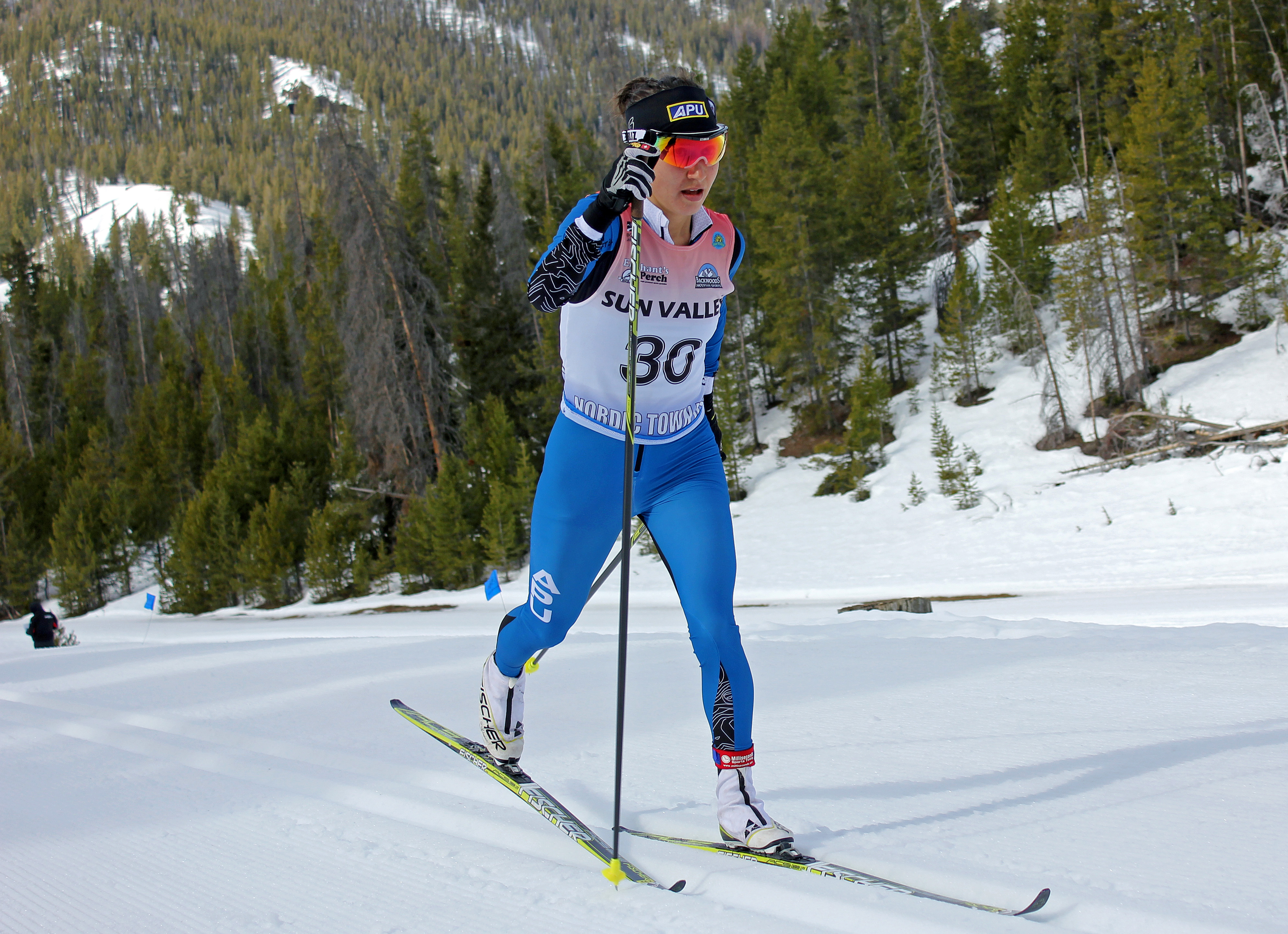
    Treinen went to the village of Nuiqsut, a village founded in 1974 in response to oil development on the North Slope. Treinen wrote about his experiences in UAF’s student newspaper, the SunStar.

    Kids brave a ground blizzard, caused by high winds, in Gambell. Gambell is on St. Lawrence Island, in the Bering Sea.
    Kids brave a ground blizzard, caused by high winds, in Gambell. Gambell is on St. Lawrence Island, in the Bering Sea. (Photo: Skiku)

    A Rewarding Experience

    All those interviewed for this story had positive things to say about the innate ability and enthusiasm of the students for skiing in a region typically dominated by basketball and snowmobiles. The volunteers couldn’t help but be caught up in the excitement, many getting so much more from the experience than just the typical rewards of coaching.

    Even Flora, who has been Nordic skiing nearly his whole life, feels the experience has changed him. In 2012 he had just finished a tough season of  racing and immediately began NANANordic’s debut season.

    “It was the perfect transition out of ski racing,” he wrote in an email. “It kept me involved with the ski world but opened my eyes to this amazing world that had nothing to do with ski racing. There was this deep rich Alaska Native culture that we got thrown into the first year and the NANA values started influencing our ski program in more ways than I can express.

    “Basically this whole program has brought me back to my childhood memories of chasing around my two older brothers on skis and going on family ski trips,” Flora remembers. “I was so fixated on performance the last few years of my career, my performance started influencing my choices and decisions in a negative way. … My perspective on sport has changed. As a ski community we can learn a tremendous amount from villages in Alaska that can help us grow as teams, communities, and individuals. Skiku is as much about teaching kids how to ski as it is about our volunteers learning about a new culture, which can impact our own goals and dreams in life. ”

    The Skiku Crew and a humpback whale in Barrow. Photo: Brice Habeger, Piksik.
    The Skiku Crew and a bowhead whale that was taken during the traditional spring whale hunt in Barrow. (Photo: Brice Habeger, Piksik)

    2014 Volunteers: Aimee Demientieff, Alice Knapp, Allison Phillips, Amanda Del Frate, Ana Jager, Andrew Kastning, Andrew Dougherty, Anna Rix, Annie Connelly, Bailey Arend, Bre Donovan, Brian Gregg, Caitlin Gregg, Caitlin Patterson, Carlin Rauch, Carly Craig, Catie Bursch, Celia Haering, Charles Renfro, Conner Truskowski, Dana Tower,Dave Stamp, David Apperson, Deland Anderson, Donny Donovan, Dylan Watts, Emily Decker, Eric Packer, Erik Bjornsen, Fischer Heimburger, Frances Pillifant, Galen Flint, Gigi Banas, Greg Jernstrom, Greta Anderson, Ian White, Jaime Bronga, Jan Spurkland, Janey Hoefler, Jarrid Huckfeldt, Jasmine Neeno, Jeffery Fox, Jim Oksotaruk, John Farr, Jonas Loeffler, Josh Smullin, Julie Truskowski, Kathleen Rehm, Keri Hull, Lars Flora, Laura Pillifant, Lauren Fritz, Lauren Hess, Lex Treinen, Libby Kugel, Marie Steringer, Marine Dusser, Megan Spurkland, Michael Sinnott, Molly Schouweiler, Nancy Hanneman, Nick Treinen, Odin Brudie, Paul Kovacs, Peter Madsen Kling, Rachelle Kanady, Reese Hanneman, Robert Rosser, Rosie Brennan, Ryan Terry, Sadie Fox, Samuel Dougherty, Sara Studebaker, Sikulik Johnson, Tamra Kornfield, Taryn Hunt Smith, Tully LaBelle-Hamer, Tyler Kornfield, Will Mans, Zach Hall

  • Wednesday Workout: Old School Biathlon with Lex Treinen

    Wednesday Workout: Old School Biathlon with Lex Treinen

    FS-WW-biathlon
    One of Lex Treinen’s September trail runs near Anchorage, Alaska, with Reese Hanneman. (Photo: Lex Treinen)

    This week’s workout comes from Alaska Pacific University (APU) skier Lex Treinen, who finished the season off with two fifth-place finishes at SuperTour Finals and U.S. Distance Nationals in Anchorage, Alaska, and a win in the Ski to Sea (run, bike, ski) race on March 30.

    After months structured training April is the time most skiers get to enjoy the unstructured exploring on skis and to remember the primal joys that skiing brings. While most of us aren’t lucky enough to scooch around on handmade spruce-wood skis waiting to lasso wild elk with horse-hair lariats like the Tuvan in Northern China (see National Geographic Dec. 2013), there are other ways to reconnect to nature through skiing.

    A few times this year I was lucky enough to combine hunting and fishing expeditions with legitimate ski training with my teammates, and April may be the best time of year for skiers to practice this type of training without the pressure of reaching time goals or heart rate zones.

    Lex Treinen with his catch of the day during one of his "old school biathlon" workouts near Anchorage, Alaska, in September 2013. (Photo: Reese Hanneman)
    Lex Treinen with his catch of the day during one of his “old school biathlon” workouts near Anchorage, Alaska, in September 2013. (Photo: Reese Hanneman)

    Planning: Near Anchorage there are dozens of nearby accessible areas for ptarmigan and grouse hunting or salmon fishing, but most take at least a few miles of running, hiking, skiing or even bicycle riding. The most important thing is to know the local fishing and hunting regulations and boundaries which you can find in booklets available at most large supermarkets and at Fish and Game offices.

    The best way to find routes is to ask experienced people. Equipment-wise I like to travel as light as possible to maximize the speed and thus the thrill of endurance harvesting. Usually, all you need is a pocket knife, a plastic bag and a gun or fishing pole packed in a light backpack or carried by hand. Of course if you are using a gun, NEVER have it loaded unless you are on sure footing and expecting to shoot. I don’t even take out a bullet until I am ready to shoot, though ptarmigan will usually stay in one place long enough for that extra time.

    Fishing poles are much easier if you know which bait or lure you will be using in advance. You can run with just a string, a small leatherman, a couple extra lures, and a pole.

    The workout: The actual workout will depend on route and technique. Usually for me, workouts like this involve a five-mile run or ski and then a pause to either start casting into the lake or river, or searching for game animals.

    Sprinting from boulder to boulder to hide from expecting animals gets my blood pumping and also of course is nice form of fartlek training [varied intervals]. For me the most enjoyable workouts are those when I can really get into the zone and reconnect with your caveman roots, when I stop thinking about anything but getting that warm fish or bird in your hands to eat for dinner, Gollum-style.

    You might notice that your senses are sharpened and you can feel minute changes in the wind direction or air temperature. This hyper-vigilance I think is transferrable to the act of ski racing, in which the single minded focus on the goal of finishing first paradoxically expands the perception of everything around you.

    “Sprinting from boulder to boulder to hide from expecting animals gets my blood pumping and also of course is nice form of fartlek training.” 
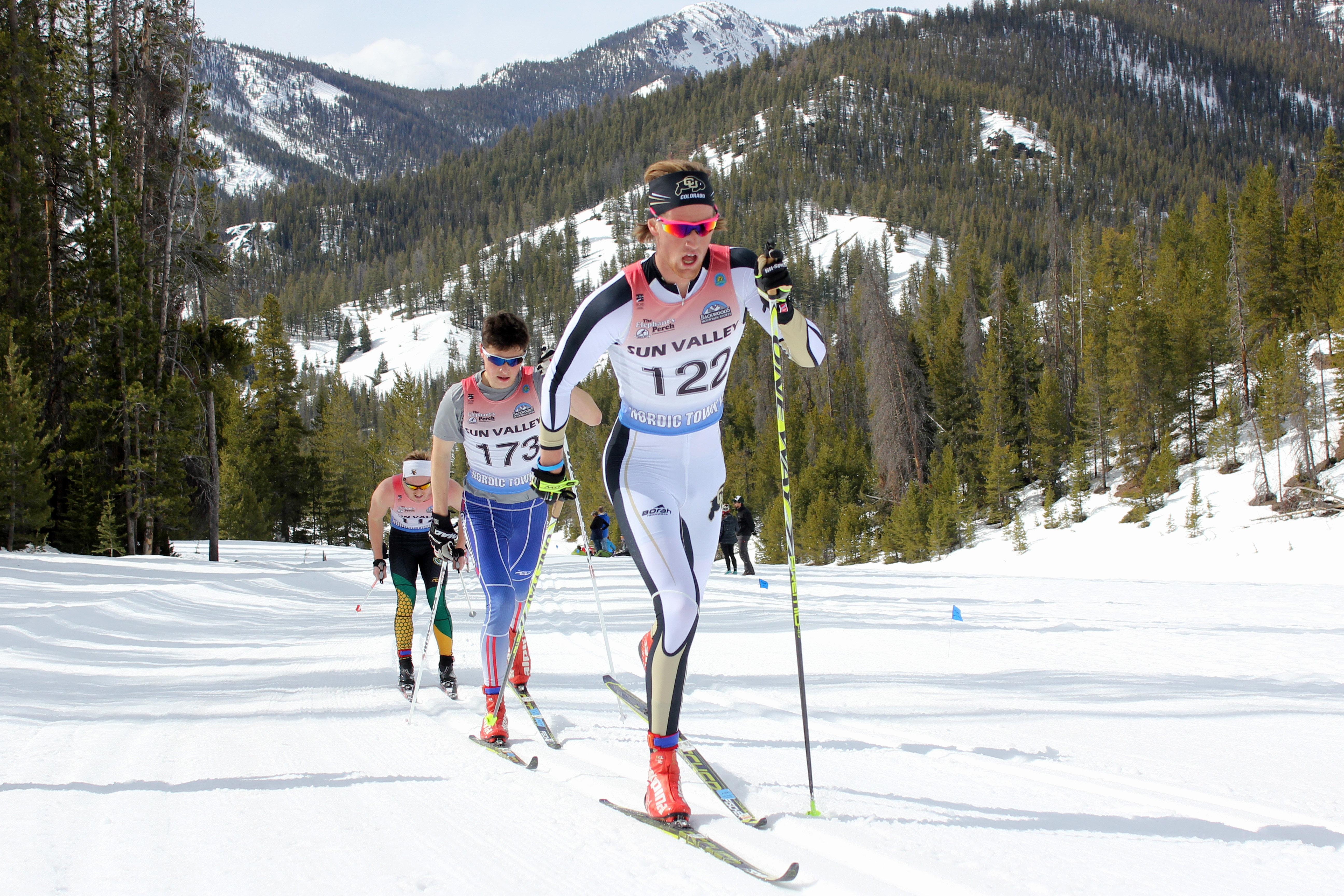
    In the end of course it doesn’t matter if you are successful — lord knows I usually am not — but the workout isn’t about success, it’s about using the endurance you have built up over the season to do things and go places that the average motorbike riding outdoorsman can’t. It’s also about feeling the outdoor roots of the sport and feeling the Tuvan nomad inside of you. Have fun and be SAFE!

    Lex Treinen (4) follows Craftsbury's Pat O'Brien (l) and Stratton's Andy Newell (r) in the mixed relay at U.S. Distance Nationals in Anchorage, Alaska. His team went on to place third. (Photo: Charlie Renfro)
    Lex Treinen (4) follows Craftsbury’s Pat O’Brien (l) and Stratton’s Andy Newell (r) in the mixed relay at U.S. Distance Nationals in Anchorage, Alaska. His team went on to place third. (Photo: Charlie Renfro)
  • Treinen Keeps Competition Season Rolling with Victory in Ski to Sea

    Treinen Keeps Competition Season Rolling with Victory in Ski to Sea

    Lex Treinen and his brother Nick after placing first and second, respectively, at the Ski to Sea on March 30 in Homer, Alaska. (Courtesy photo)
    Lex Treinen and his brother Nick after placing first and second, respectively, at the Ski to Sea on March 30 in Homer, Alaska. (Courtesy photo)

    Note: This article has been updated to reflect the corrected 2013/2014 SuperTour overall standings. Lex Treinen finished fourth behind Reese Hanneman, Erik Bjornsen and Brian Gregg, respectively.

    As if four races in seven days weren’t enough, Lex Treinen, of Alaska Pacific University (APU), signed up for the Ski to Ski in Homer, Alaska, two days after the last day of Spring Series — on a whim.

    He and his brother Nick decided to do so a few days before.

    “I had hardly heard of it, but felt like I needed a little vacation, if you can call it that,” Treinen, 24, explained in an email. “So we jumped in the car after dragging our hottub off the racecourse in the morning, spent a night in Girdwood and finished the drive in the morning.”
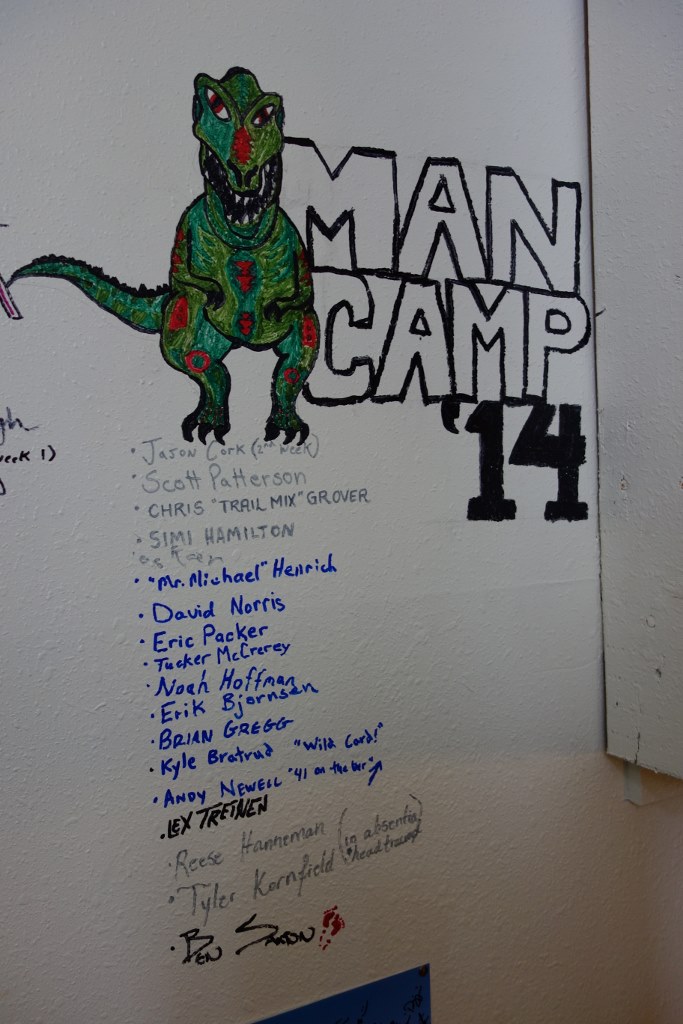
    The two left Anchorage last Saturday, a day after the 50-kilometer classic mass start at U.S. Distance Nationals, which for most, was the final race of the season. The drive itself was 220 miles south toward the mouth of the Cook Inlet. In Homer, competitors did a 5 k run, followed by a 7 k bike, and ending with a 5 k ski … to the sea.

    The start of the 2014 Ski to Sea on Homer Spit at the tip of the Kenai Peninsula in Homer, Alaska. (Photo: Lex Treinen)
    The start of the 2014 Ski to Sea on Homer Spit at the tip of the Kenai Peninsula in Homer, Alaska. (Photo: Lex Treinen)

    Treinen won it in 55:23. His brother Nick took second, 3:03 back, edging third-place finisher Chaz DiMarzid by just four seconds.

    “Nick and I came into the bike one and two, but we stupidly used studded bike tires and had to ride the seven kilometer uphill hearing the sound of grinding asphalt beneath us,” wrote Treinen, who placed fifth in the 50 k and fifth in the 15 k freestyle earlier that week at SuperTour Finals. He finished fourth in the overall 2013/2014 SuperTour, behind teammates Reese Hanneman and Erik Bjornsen, respectively, and Brian Gregg (Team Gregg/Madshus) in third.
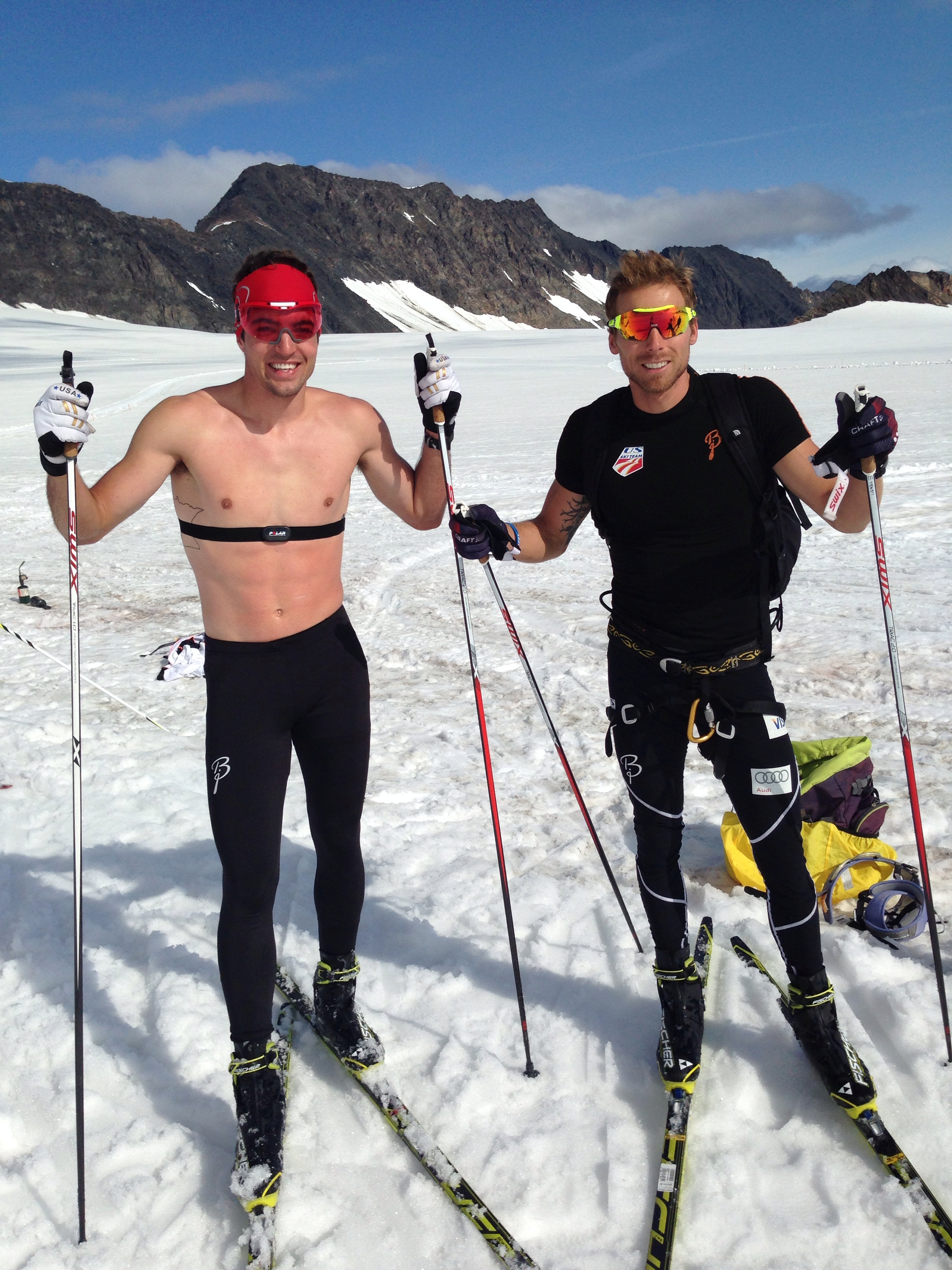
    On Sunday, Treinen started the ski a few seconds ahead of DiMarzid, who rode his way up to second.

    “Despite getting on skis and feeling like I forgot how to ski because my legs were so tired, I managed to hold him off,” Treinen wrote. “It felt good to be at a low key race like that after all of the pressure of the season. When we got into town there were signs everywhere since the race went through town, but at the bike drop off there was nobody watching out for bike-thieves, not out of laziness but just because Homer is cool like that.”

    Treinen and his brother received medals made of sand dollars. Local businesses donated prizes as well, and Treinen estimated half of the nearly 100 finishers won raffle prizes.

    Even after Sunday’s race, he thought he had some more skiing in him.

    “Usually at the end of the season I am super excited to go back-country and all that but I woke up the next morning after the race my legs felt like wood so I told my brother I was too tired,” he wrote. “The Sea to Ski was the last hurrah for the season, but I didn’t realize it at the time.”

    Pleased with his most successful season yet, including sixth place in the 30 k skate at U.S. nationals in January and top-10 finish in the American Birkebeiner in February, Treinen is looking to build for next winter.

    “After being [fourth] in the Supertour, I definitely feel I can move up with some better races early in the season and hopefully some wins,” he wrote. “I have never started a World Cup, so I for sure want to qualify for that. As for World Champs, I really would love to qualify but the way to do that is still unclear to me, so I will just do my best and focus on being sharp in the early season.”

    Results