From the FasterSkier archive — posts syndicated from athletes’ and coaches’ own blogs between 2004 and 2012, kept online as published. Current coverage is at fasterskier.com.
Oh Liberec, oh Liberec, before we say so long … here’s what didn’t quite fit into last weekend’s recaps of the World Cup classic sprints and team sprints in the Czech Republic. Disclaimer: It’s Canadian- and female-heavy.
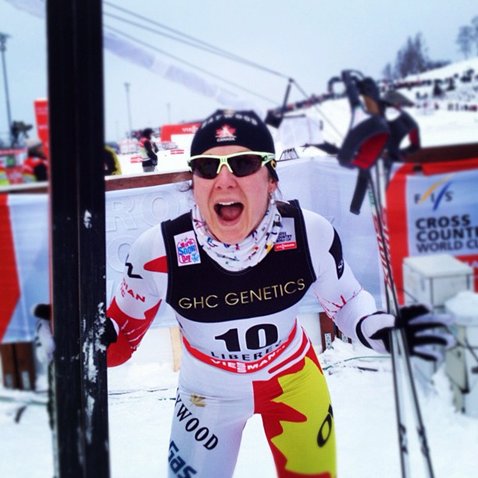
An excited Dasha Gaiazova at the women’s 0.85 k World Cup classic sprint in Liberec, Czech Republic. The Canadian was fourth for a career best and narrowly missed the podium in a photo finish. (Chandra Crawford photo)
On World Cup prep:
“We were in Oberwiesenthal [Germany] last week racing an OPA Cup just to get the cobwebs out and get rid of the jetlag, which I think really helped. We all felt pretty terrible last weekend so it was nice to come here and feel good and, having done the race last weekend, feel like we were ready to go on the World Cup. – Perianne Jones, Canadian National Ski Team (CNST), 9th in classic sprint for World Cup individual best
On tactics:
“[In my quarterfinal] I made sure I was kind of behind everyone on the big downhill and I made sure to get my own track coming up the last hill and was kind of made a bit of a move there to pass most people because it was kind of hairy. With just one lap, there’s a big corner at the bottom of the big hill and everyone would kind of get clumped together then you shoot right up into an uphill. It was interesting.” – Jones
On kicking off the New Year with a personal best:
“I think it’s a good start after Christmas. You’re always a little unsure, when none of us did the Tour, just coming here and racing, we’ve been away from it for a little while, but it’s good to have a good first race back and now we can really look forward to the rest of the season. There’s a bunch more classic sprints, World Championships is a classic sprint so I’m pretty pumped about that.” – Jones
On the big picture:
“The World Cup is so competitive that we have to be excited with improvement and stay focused on making small gains.” – Ida Sargent, U.S. Ski Team (USST), 7th in team sprint with Sadie Bjornsen
“I thought that I raced pretty strong and I was able to catch back every round a few spots and stay closer to the front. Unfortunately we missed advancing to the final by one-hundredth of a second.” – Dasha Gaiazova (CNST),11th in team sprint with Jones
“It was bad luck today, but a very good weekend for the team. We have good bodies and good speed so the girls will build a lot of confidence from the results here.” – CNST Women’s Coach Eric de Nys (as told to Cross Country Canada)
On team-sprint tempo:
“The pace was pushing the entire time. Because it was such a short course, people were going hard the entire way.The final leg was of course the hardest, and teams began to really hit top gear. – Sadie Bjornsen (USST), 7th with Sargent
On team momentum:
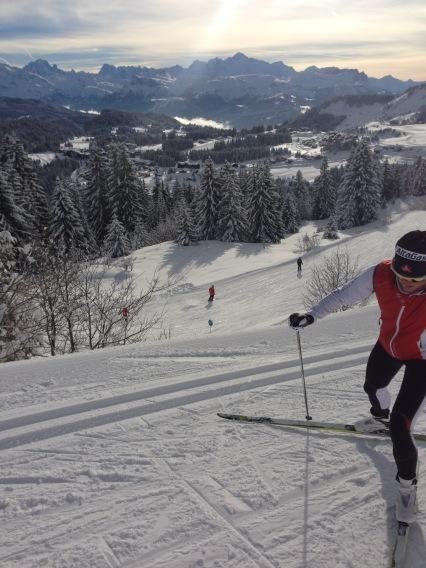
Alex Harvey tweeted a photo of the skiing in Praz de Lyz, France, on Saturday. (Twitter.com/alex_harvey)
“In general, we have just such good momentum for the whole team. Everybody’s working so well together, coaches are super invested in all the athletes; it’s just a fun group to be part of and we just are all feeding off each other’s positive energy and elevating each other. It’s always nice to see the boys do so well last week in the Tour de Ski and sort of feed off that success as well.” – Gaiazova (after career-best 4th in Saturday’s classic sprint)
On conditions:
“[Friday during training] it was so crappy and so windy, and the tracks were terrible. [Saturday], even though it maybe didn’t look great on TV, it was a huge step up. It was night and day. The tracks were way better and it wasn’t nearly as windy so we felt pretty lucky when we got out there.” – Jones
On taking a three-day vacation in Hurghada,Egypt:
“I don’t think I’ll ever go back. It was a little bit of a sketchy place but it made for a pretty interesting trip. It was fun.” – Lenny Valjas (CNST), 10th in classic sprint
On where the rest of the Canadians were:
“Alex [Harvey] just got to Praz de Lys [France]. He’s doing some training there and Devon [Kershaw] will be there shortly, too. Everyone’s slowly meeting in Praz de Lys. We’re all gonna be there on Monday; the whole team will be back together. Right now [Harvey, Kershaw and Ivan Babikov] decided to skip this and focus on training.” – Valjas (on Saturday)
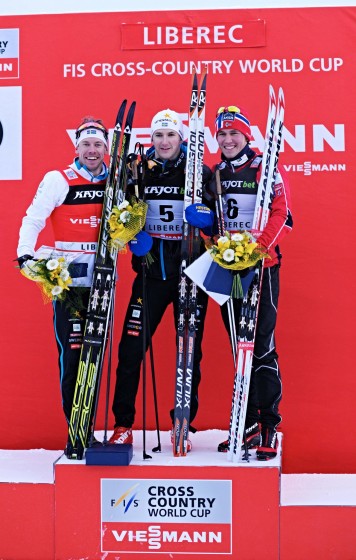
The men’s classic sprint podium in Liberec: 1. Teodor Peterson (SWE), 2. Emil Jonsson (SWE). 3. Pal Golberg (NOR). Photo: Nordic Focus/FIS Cross Country.
After the drama — and exhaustion — of the Tour de Ski, most of the seven-race series’ participants took some much-needed rest to try to get ready for World Championships and replenish their ATP supplies. Instead of the distance skiers, sprinters were in the spotlight at this weekend’s World Cup competitions in Liberec, Czech Republic. With only one real sprint in the Tour de Ski this year, and a long break over Christmas, they were itching to get back to racing.
In the men’s classic sprint Teodor Peterson of Sweden took the win, reprising his place on the circuit as the man to beat. Teammate Emil Jønsson was second; as has been true so often in the last two seasons, the two tall Swedes will likely be dueling for the overall Sprint Cup title. However, Sweden couldn’t follow up on that success in the team sprint, with the Russians instead taking the victory on Sunday. Andy Newell (USA) finished sixth and Lenny Valjas (CAN) tenth, particularly impressive because Valjas completed the entire Tour de Ski. He was the top finisher in the sprint to have done so.
In the women’s sprint Mona-Liisa Mahlvaleto of Finland got her first win of the season, while Justyna Kowalczyk of Poland continued to roll after her Tour victory and won a photo finish for second. The Canadians were impressive, with all three women qualifying for the heats and Dasha Gaiazova taking a career-best fourth place finish after losing the same photo finish with Kowalczyk and Maiken Caspersen Falla of Norway; Perianne Jones was ninth. In the next day Falla and Ingvild Flugstad Østberg won the team sprint, while two young Americans, Sadie Bjornsen and Ida Sargent, teamed up for seventh place.
Biathlon returned to the site of 2012 World Championships, and things in Ruhpolding looked very similar to last March. Martin Fourcade of France was on a roll, anchoring the winning men’s relay and winning both the pursuit and mass start. While Miriam Gossner of Germany, a newcomer to the winners’ circle this year, powered her way to a sprint win under difficult conditions, Tora Berger of Norway rose to the top in the mass start, just as she did at World Championships. Both Fourcade and Berger had the lead in their World Cup total scores coming into this weekend, and they still have it going out.
It was a good weekend for the North American teams, too, starting with the men’s relay where the U.S. was in second place after two legs, thanks to excellent performances by Lowell Bailey and Leif Nordgren; despite fading in the second half, it was a good effort by the team. In the sprints, Scott Perras of Canada led the way with the first top-ten finish of his career, while Annelies Cook (USA) and Scott Gow (Canada) also had career-bests in 26th and 29th.
In nordic combined action in Chaux-Neuve, France, Taylor Fletcher led the U.S. in tenth in the large hill competition before teaming up with brother Bryan to place seventh in the team event.
It feels like ages ago, but U.S. Cross Country Championships just finished this week, with Sadie Bjornsen and Dakota Blackhorse-von Jess winning the skate sprints to wrap up the week of racing. After that excitement, as well as Canadian junior/U23 trials, the domestic race circuits were off for the weekend.
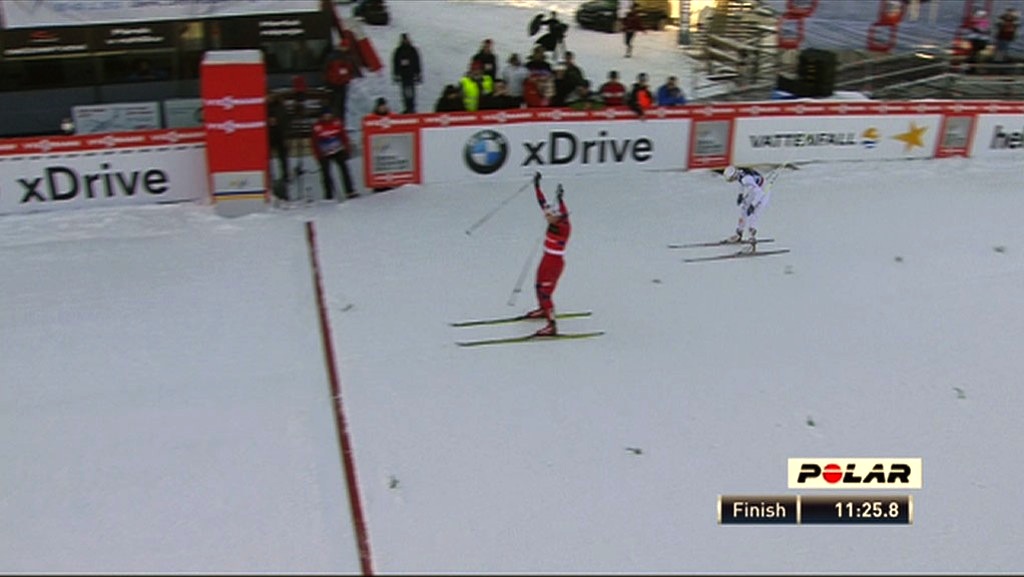
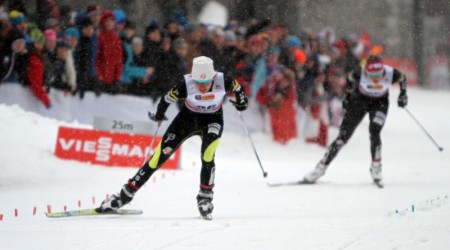
Norway’s Maiken Caspersen Falla (l) beats Sweden’s Ida Ingemarsdotter to the finish of Sunday’s World Cup freestyle team sprint in Liberec, Czech Republic.
With two teammates alternating between six laps on the women’s 850-meter course in the World Cup freestyle team sprint in Liberec, Czech Republic, there was hardly enough time to get the skis off and another pair back on. As for catching your breath, forget it.
Tactics were essentially pointless. If you wanted to win, better get in front and stay there, hanging tough for the duration. But in a team sprint, which starts with a round of semifinals followed by a final, there are six total exchanges. One can ski clean throughout and mess up there, and well, it could be over.
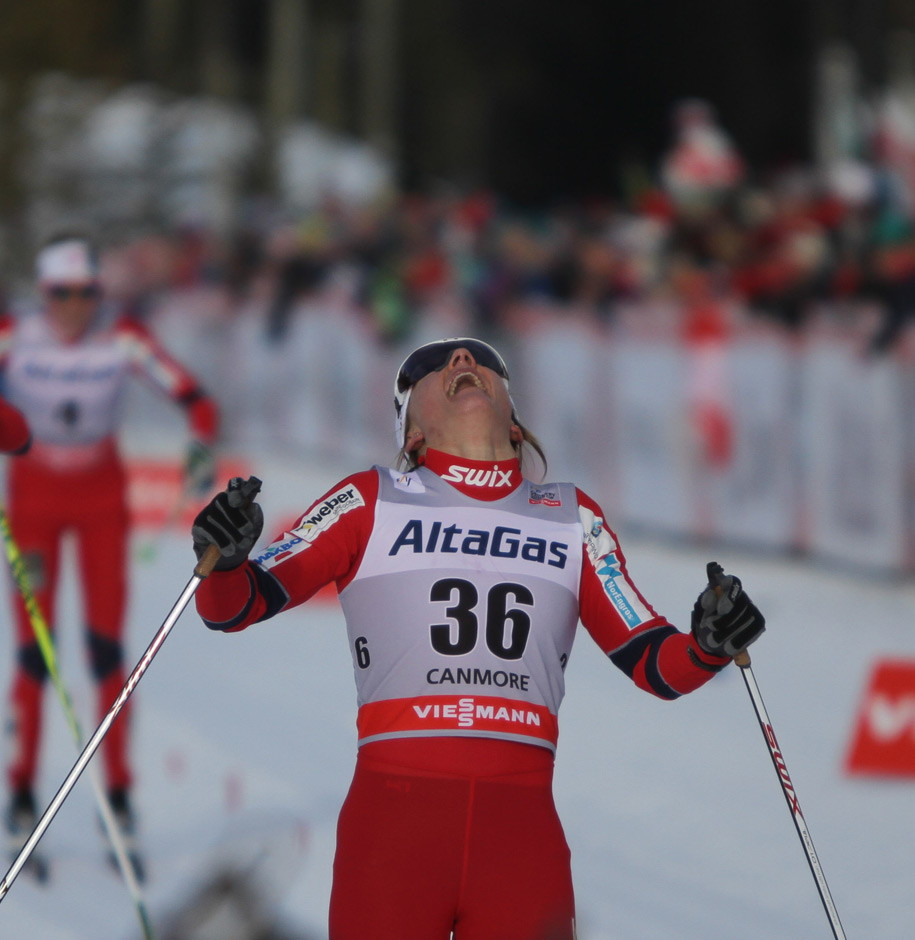
Falla celebrates placing third in the Canmore World Cup 10 k classic mass start on Dec. 13.
Norway and Sweden had the right idea Sunday, getting ahead early in both the semifinal and final to secure top finishes in each. Maiken Caspersen Falla led Norway’s A-team to a triumphant victory in the final, challenging Sweden’s Ida Ingemarsdotter in the final 200 meters and beating her by 0.5 seconds in 11:26.2. Falla teamed up with Ingvild Flugstad Østberg for the win, and Sweden’s A-team of Ingemarsdotter and Stina Nilsson settled for second.
Sweden’s second team (Linn Soemskar/Magdalena Pajala) was third (+5.7), ahead of Germany, Switzerland, Russia and the U.S., respectively.
In the second semifinal, it was Norway’s B-team (Kari Vikahgen Gjeitnes/Celine Brun-Lie) that advanced in first with a time of 11:34.9. Sweden I placed second, Norway I was third and the lone U.S. women’s squad, with Sadie Bjornsen and Ida Sargent, made it through in fourth (+7.3).
Behind Switzerland (Bettina Gruber/Laurien van der Graaff) in fifth (+9.2), Canada’s Dasha Gaiazova and Perianne Jones was sixth (+12.0) and missed qualifying by a mere hundredth of a second.
Germany’s Nicole Fessel and Hannah Kolb won the first semifinal in a considerably slower time of 11:43.2, with Slovenia and Sweden II taking second and third, respectively.
Ten teams advanced to the final, where Norway II’s Gjeitnes made a point to lead early. Nilsson and Østberg stayed close in second and third on the first lap, and by the end of the leg (one of three apiece), the Americans had moved to third.
The race stayed in essentially the same order throughout the second leg, with Norway’s A-team moving to first, Sweden hanging in second, the U.S. in third, and Norway II and Germany around fourth. By the end of the leg, Norway II was back up front again with Brun-Lie and it appeared the Norwegians were working together ahead of Sweden. The Americans sat tight in fourth, then third, with two laps to go.
At the last exchange, things fell apart a bit for the Americans while the Norwegians and Swedes continued to push toward the finish.
“My last leg we kind of botched the tag and almost missed the end of the tag zone,” Sargent wrote in an email. “Norway and Sweden had a little gap and I tried to sprint to catch them to get the draft on the downhill, but I think I went too hard and really flooded with lactic acid. I had nothing left in the last few hundred meters and was doing everything I could just to stay on my feet and not fall over.”
Earlier in the day, Sargent and Bjornsen had another tag-off snafu on the last exchange.
“The semifinal was really good until the last tag when Sadie’s ski hit my pole and broke it,” Sargent explained. “I had to ski part of the first hill with one pole until I got another pole from the Norwegians, which was better than nothing but way too big for me. So I lost contact with the two Norwegian teams and Sweden, but I was able to hold off the teams behind us. Luckily our semifinal was a lot faster so we got a lucky loser spot.”
After finishing the final in seventh, Sargent said she was excited about her personal best in a team sprint, especially after she and Bjornsen placed 14th in the event last season in Milan, Italy.
“A year ago we raced a team sprint together in Milan and didn’t make the final and were barely hanging to the back of our semifinal,” Sargent wrote. “So to be in the fight today was really fun.”
After finishing behind two Norwegian teams and the Swedes in the semi, the Americans had confidence going into the final.
“We knew we could ski with the group,” Bjornsen wrote in an email. “The pace is of course always higher in the finals, so we had the plan of simply going when we could.”
At the top of the first big hill, Bjornsen said someone stepped on her pole and nearly pulled her glove and handle off, but she gripped tight and managed to keep it together. By the end of the first lap, Bjornsen was in sixth, and Sargent kept picking off the places until she reached the leaders.
“The fact that we were able to ski in 3rd for 95% of the race is exciting!” Bjornsen wrote. “[In Saturday’s individual sprint] we weren’t quite as happy, so today was a great way to finish the weekend on a positive note. It was much closer to our own expectations!”
At the front of the pack, Ingemarsdotter and Falla skied away from the group on the last lap. Brun-Lie attempted to go with them, but crashed into the fence on the curving descent before the stadium and ended up 10th. Meanwhile, Ingemarsdotter led into the final stretch, but Falla found another gear and overtook her before the finish.
“I was really not confident, but I was focusing on myself and pushing hard on the last lap,” the 22-year-old Falla told FIS News. “I knew I had more power left in the last hundred meters.”
For her 22-year-old teammate, Østberg, it was her first World Cup victory.
“It is the first time I stand on top of the podium,” Østberg told NRK, according to a translation. “I tried to save energy for the final round, and luckily we managed to get a [win]. I’m very pleased.”
In a race that didn’t allow much pacing, Ingemarsdotter said she tried to save some for the final lap.
“The last leg I just had to ski and give all my power,” she told FIS. “I’m really satisfied.”
Overall, the Canadians placed 11th after Gaiazova posted the fastest times in her second and third semifinal legs. She and Jones just missed a lucky-loser spot, but Gaiazova said that’s part of racing. After both notched career bests on Saturday, they struggled more on Sunday.
“Somebody stepped on [Peri’s] pole and the whole pole came off her hand at the bottom of an uphill,” Gaiazova explained. “She only was able to get a new one at the top of the hill so we lost some precious time there, but I guess it was just bad luck and it could happen to anyone.”
After the race, Gaiazova said she and Jones talked about where they could’ve made up that 0.01 second.
“It was really close and we wished we skied a bit better, but overall I was happy with my skiing,” she said.
An excited Dasha Gaiazova at the women’s 0.85 k World Cup classic sprint in Liberec, Czech Republic. The Canadian was fourth for a career best, narrowly missing the podium in a photo finish. (Chandra Crawford photo)
The Canadian women went to Oberwiesenthal, Germany. Lenny Valjas went to Egypt. Wherever their respective travels took the Canadian World Cup Team, it worked, at least for the sprinters on Saturday.
Perianne Jones led the three-person women’s squad in the qualifier, posting the seventh-fastest time in the World Cup classic sprint in Liberec, Czech Republic. For Jones, it was by far a personal best.
“All my qualifiers before this year have been by the skin of my teeth,” Jones said with a laugh. “So I’m happy to be consistently in there and really in the mix instead of the last one or two.”
But it got better for the Canadians: Dasha Gaiazova qualified in 10th, Valjas advanced in 16th and Crawford made it through in 27th. All four of the Canadians that raced in Liberec – including Valjas, who finished his first Tour de Ski last Sunday – made the heats. Then Jones, Gaiazova and Valjas advanced to the semifinals to secured top-10 results.
From there, Gaiazova carried the most momentum, finishing neck-and-neck in the semifinal with eventual overall winner Mona-Liisa Malvalehto of Finland, who won the semi in a photo finish. Gaiazova joined her in the final, where she latched onto Malvalehto out of the start.
Running in second for the first half of the women’s 850-meter race, Gaiazova attempted to hold off Poland’s charging Justyna Kowalczyk, but lost some speed when Kowalczyk jumped ahead of her in the track before the last hill. With Malvalehto skiing away to the victory, Gaiazova, Kowalczyk and Norway’s Maiken Caspersen Falla battled for second, where Kowalczyk won the three-way photo finish. All three came in 1.7 seconds behind Malvalehto (who won in 2:03.8), with Falla edging Gaiazova for third.
So close to a podium, Gaiazova said on the phone she was simply glad to be in contention in her signature event.
“It was a short course and you had to go all out from the start,” Gaiazova said of the less-than-one-kilometer course, shortened from 1.7 k after the coaches voted Friday night.
“At the end, it’s just sort of like a drag-race double poling,” she said, adding that she didn’t think in the final moments, she just went for it. “I did the best I could and I’m definitely happy.”
Not far down the results list in ninth, Jones also notched a World Cup individual best. She was second in her quarterfinal to Germany’s Hanna Kolb and fifth in her semifinal – the same one Gaiazova and Malvalehto won.
Jones said she scrambled after bad starts in both the quarterfinal and semifinal. While she made up for it drafting and passing others on the big downhill in the first heat, she failed to pick off as many people in the semi.
“I tried to make my same move coming up the last hill like I did in the quarterfinal, but it wasn’t enough to move on to the final,” Jones said. “I was happy with it, but I know what I need to work on now and that is my starts.”
As for Gaiazova, who’s top-six secured a trip to the 2014 Winter Olympics, Jones said she was fun to watch.
“Dasha skied tactically super well the whole day and she’s in great shape,” Jones said. “It was really exciting to see her be so close to a podium. We were really cheering hard for her.”
Valjas ended up 10th in the men’s 1.6 k sprint after advancing out of his quarterfinal in fourth with one of the fastest times. The lone Canadian man racing, Valjas went on to place fifth in the semifinal.
“I felt the final hill,” he said. “I could feel the legs just didn’t have the same snap or speed … There’s nothing I can change. I can only go as fast as my body would let me. Today I was just out there having fun and seeing how fast I could go.”
Earlier in the week, Valjas took three days off completely at an all-inclusive resort in Hurghada, Egypt, where he traveled solo. There, he met up with the women’s alpine technical team and said he mostly “sat tanning [and] tried to recover” after placing 23rd in the Tour, an overall result he was pleased with.
“I really didn’t know what to expect for this race and I’m happy with making the semi and cracking the top ten just after the Tour,” he said.
In both his heats, Valjas struggled to find an open lane to test his finishing kick. He skied right behind Germany’s Tim Tscharnke into the last stretch of the semifinal, but Tscharnke moved ahead and Valjas dropped to fifth.
“We picked the same lane and I don’t know why, but I kept going to the left lane up the hill, which is the outside when you come into the finish,” Valjas said. “It’s just way further. Maybe I could’ve done something tactically better. … I couldn’t keep up with them on the last uphill anyways so it didn’t change too much.”
In an email, Crawford, who was 29th overall, wrote that she was inspired by her teammates’ performances despite feeling a little off in her first World Cup in nearly a month. She was sixth in her quarterfinal, 7.6 seconds behind Kolb as the heat’s winner.
“I feel sluggish like I usually do coming off a block without racing,” Crawford wrote. “It looks like it will take the usual race into shape plan. … Couldn’t quite dance around and make moves as I pleased – the main move I wanted to make being closing the gap to the group.”
In the scheme of things, this race – with several Tour competitors sitting it out – wasn’t the end-all of the season. Most of the Canadian women, for instance, had their sights on the classic sprint at World Championships Feb. 21 in Val di Fiemme, Italy.
“My teammates Peri and Dasha are classic sprinting like complete bosses so I’m looking forward to our prep together this next month,” Crawford wrote.
The three spent the last few weeks of December training at home in Canmore, Alberta, before flying to Oberwiesenthal in early January for Alpen Cup races (a classic sprint and 5 k freestyle). According to Canadian women’s coach Eric de Nys, the races were tune-ups before resuming the World Cup schedule.
Reacting to the results in their first race back, de Nys wasn’t surprised, but rather somewhat relieved given the nature of sprinting.
“I think sprinting is still so volatile, especially on today’s course,” he said. “We have three high-quality women that can go to the podium any day … all of our cards have to fall the right way.”
One shot around an 850-meter course made it even tighter, but de Nys advocated the shorter sprint. After previewing the 1,700-meter course Friday, he estimated it would take the women between upwards of four minutes to complete. In his opinion, anything over three minutes wasn’t a true sprint.
“If you want to talk about a sprint today, if you’re an 800-meter runner for a woman, it’s about 1:55, I think, and today we were 2:04,” de Nys said. “Now we’re starting to be in the right ballpark of time to really call it a sprint, if you want to call 800-meters a sprint.”
Like most of the Canadians, Jones welcomed the news of a shorter course. The women first skied in Liberec on Friday with a typical pre-race workout at Zone 3.
“It took us six minutes to do two laps,” Jones said with a laugh. “So we’re like, ‘OK this is gonna be a really long sprint.’ At the coaches’ meeting, they decided to shorten it, which was pretty awesome for everyone. Even the men’s race looked a little like a distance race on TV … I think it’s good to keep sprints sprints.”
Valjas felt similarly after the men’s 1.6 k course took about 3 ½ minutes.
“The sprint, I think, should be really a lot shorter,” he said. “The course yesterday that they had for the training was a lot longer so this morning they cut it … it would’ve been four minutes yesterday.”
On Sunday, Gaiazova and Jones will pair up in the team sprint and Valjas will enjoy the day off.
“It will be a really, really exciting race I think,” Jones said. “All the teams here are pretty close and anything can happen. Team sprints are just so crazy that way. … They’re my favorite.”
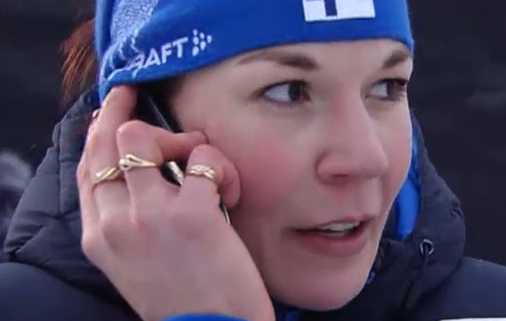
Mona-Liisa Malvalehto (FIN) makes a call to report the good news after winning Saturday’s classic sprint in Liberec for her first World Cup podium.
Sixty-six World Cup starts, 66, Canadian women’s coach Eric de Nys reiterated. That’s how long Finland’s Mona-Liisa Malvalehto went without a podium since her first World Cup start more than 12 years ago.
On Saturday, the 29-year-old mom achieved her first in the 0.85-kilometer World Cup classic sprint in Liberec, Czech Republic. She won the qualifier, dominated the heats and went on to ski away from her five competitors in the final – one of them being Poland’s Justyna Kowalczyk. By comparison, Kowalczyk has started some 170 individual World Cup races (not including stages), made the podium 54 times and won 24 of them.
But enough about Kowalczyk. Saturday belonged to Malvalehto, a multitalented individual with multiple national accordion titles.
That’s right. Two years ago, Malvalehto, who studied music in college, went on BBC’s Maestro celebrity reality show to test her skills at conducting. She won. “I do not remember when I last experienced such adrenaline,” Malvalehto said after leading an orchestra through Beethoven. “It is the most difficult thing.”
As for Saturday’s race, Malvalehto said it was simply “unbelievable.” Just as she did every time around Liberec’s one-lap sprint course, she started hard and let the others chase. In the final, Gaiazova was quickest to react, tucking behind her in second until losing some momentum before the final hill.
Kowalczyk had moved up and squeezed between them, and three women – Kowalczyk, Gaiazova and Maiken Caspersen Falla – were left fighting for second. Kowalczyk took it in a photo finish, 1.7 seconds behind Malvalehto’s winning time of 2:03.8. Falla was third, just ahead of Gaiazova, who notched a personal best of fourth.
“All I could think about was double poling as hard as I could,” Gaiazova said on the phone. “I thought, ‘I’m somewhere in the front and there’s a chance for the podium,’ but all I could do in that moment was double pole.
“I did the best I could, I’m definitely happy with my PB,” she added. “I think there is more good things to come.”
“[Malvalehto’s] had sixty-six races to get to where she is,” de Nys said on the phone. “That’s proof that you just can’t give up, and you gotta keep going out there day after day and it’s gonna come through.”
Two of his athletes, Gaiazova and Perianne Jones, were on a similar track, he added. Both tallied career highs on Saturday, with Gaiazova in fourth and Jones in ninth. What worked for the Canadians, and for Malvalehto, was that the course was shortened from 1,700 meters to 850 meters the night before.
“It would’ve been a 4:10, 4:20 sprint,” de Nys said of the 1.7 k course, which was changed at the coaches’ meeting on Friday. “FIS made it clear a few years ago that they want sprints to be around three minutes. It’s not a sprint if it’s over three minutes.”
For Malvalehto, the winner of Saturday’s qualifier and every heat thereafter, the speed session was a testament to her fitness.
“I knew that I had a good training period at home,” she told FIS News after the race. “When I heard that it was only one lap, I knew that this was my race. For me, not too long is a little bit better.”
The last time a Finnish woman won a World Cup was 2009 with Aino-Kaisa Saarinen’s 10 k home victory at the Kuusamo Ruka Triple. A month later in December, Matti Heikkinen won the 15 k in Davos, Switzerland.
“It was a very big day for me,” Malvalehto said. “I think I would not be the winner not having my two-year old kid.”
Her teammate, Saarinen qualified in fourth, 4.54 seconds behind Malvalehto’s winning time of 2:04.06, and went on to place 17th after being eliminated in the quarterfinals.
Kowalczyk as the second-fastest qualifier (+3.35) won her quarter and semi despite looking somewhat tense in the latter. She edged Falla by 0.1 seconds in the semi, with Norway’s Ingvild Flugstad Oestberg and Celine Brun-Lien finishing less than a second later to advance as lucky losers.
In the final, Oestberg went on to place sixth (+29.7) after breaking a pole and getting a replacement at the bottom of one of the last descents. Brun-Lie placed fifth (+4.5) behind Kowalczyk, Falla and Gaiazova, who all lunged at the finish.
For Kowalczyk, coming off her fourth-straight Tour de Ski title, the Liberec podium was pretty standard: she’s made it in every individual race she’s done in there.
“I was not sure about today, but I have always been on the podium in Liberec,” Kowalczyk said at a press conference. “I did not feel too tired after the Tour. … I am feeling very good but at the World Championships the sprint course will be tougher and longer.”
Falla said she didn’t mind the short distance.
“It was something new,” Falla said. “I am happy for the third place. It is a good sign for me before the World Championships [at the end of February].”
For Gaiazova, it also signaled good things to come.
“I’m happy that results are coming along,” Gaiazova said. “I love classic sprinting. Even though it’s so close to the podium and being third would’ve been sweet, I’m still super happy to be in the final and fight for the finish for the podium.”
Sophie Caldwell (SMS T2) at the Quebec City freestyle sprint. She finished 14th there and went on to place 23rd the next weekend in Canmore.
Based on their results from the recent World Cups in Quebec City and Canmore, U.S. Ski Team head coach Chris Grover has offered Sophie Caldwell (SMS T2) and Skyler Davis (SMS T2/USST) starting spots in the Liberec, Czech Republic, World Cups on January 12 and 13.
U.S. SuperTour leaders Sadie and Erik Bjornsen will also join the World Cup tour beginning on January 12 for Period Two per the usual start rights FIS awards to Continental Cup leaders after every competition period.
Skyler Davis (SMS T2/USST) qualifying for the Canmore sprint heats in 20th. He went on to place 24th overall.
Liberec could be an important weekend for athletes like Davis and Caldwell for several reasons. Consisting of an individual classic and team sprint, it immediately precedes U23 World Championships on the same courses a week later. Davis and Caldwell, provided they continue to race well at U.S. Nationals, are still young enough to compete in U23s.
“Along with COC leader Erik Bjornsen, both Sophie and Skyler…can use the experience they gain during the Liberec World Cup sprints to help them prepare for the sprint during the U23 World Championships a week later,” Grover said in an email.
The Liberec World Cup also falls just within selection period the U.S will use to pick its 2013 World Championships team. The published objective criteria are based first on World Cup ranking: up to eight American men and women could go to Val di Fiemme in February if they rank in the top 60 overall or top 50 in sprint or distance by January 14. Liberec is the only World Cup remaining within that period outside the Tour de Ski, so the opportunity presents Caldwell, Davis and the Bjornsens, none of whom are on the American Tour roster, with a final chance to meet that objective criteria.
On Wednesday Caldwell said she had accepted the invitation to compete in Liberec.
“I’m not sure which races I’ll be doing yet because one is a sprint race and one is a team sprint, but I think it will be a great opportunity for some more international experience,” Caldwell said.
As for her World Championships ambitions?
“Obviously World Champs is something I’d love to compete in,” she said. But Caldwell is primarily looking at Liberec as another top-level racing opportunity.
“I don’t know how many spots the US has or who they’re looking to take so I’m trying to enjoy each chance I get to race a World Cup in the meantime and not worry too much about World Champs yet,” Caldwell said.
Davis also accepted the Liberec invitation. “I’m very excited to keep racing on the World Cup,” he said in an email. “It is a huge consideration to have more World Cup starts in my goal to be racing in world champs!”
Though the U.S. can take up to eight men and eight women, that doesn’t mean the team will be sixteen-strong come February. Grover says the Val di Fiemme team could consist of anywhere from six to eight athletes of each gender.
“Our goal is not simply to fill start spots,” he said. “Rather, our goal is to be successful. We have our sights set on a medal in Val di Fiemme. [These] Championships will not be an experiential or development project for us, and the team that is named will reflect that fact.”
This article was updated Dec. 20 at 11:30 am EST to include confirmation of Davis’ acceptance.