From the FasterSkier archive — posts syndicated from athletes’ and coaches’ own blogs between 2004 and 2012, kept online as published. Current coverage is at fasterskier.com.
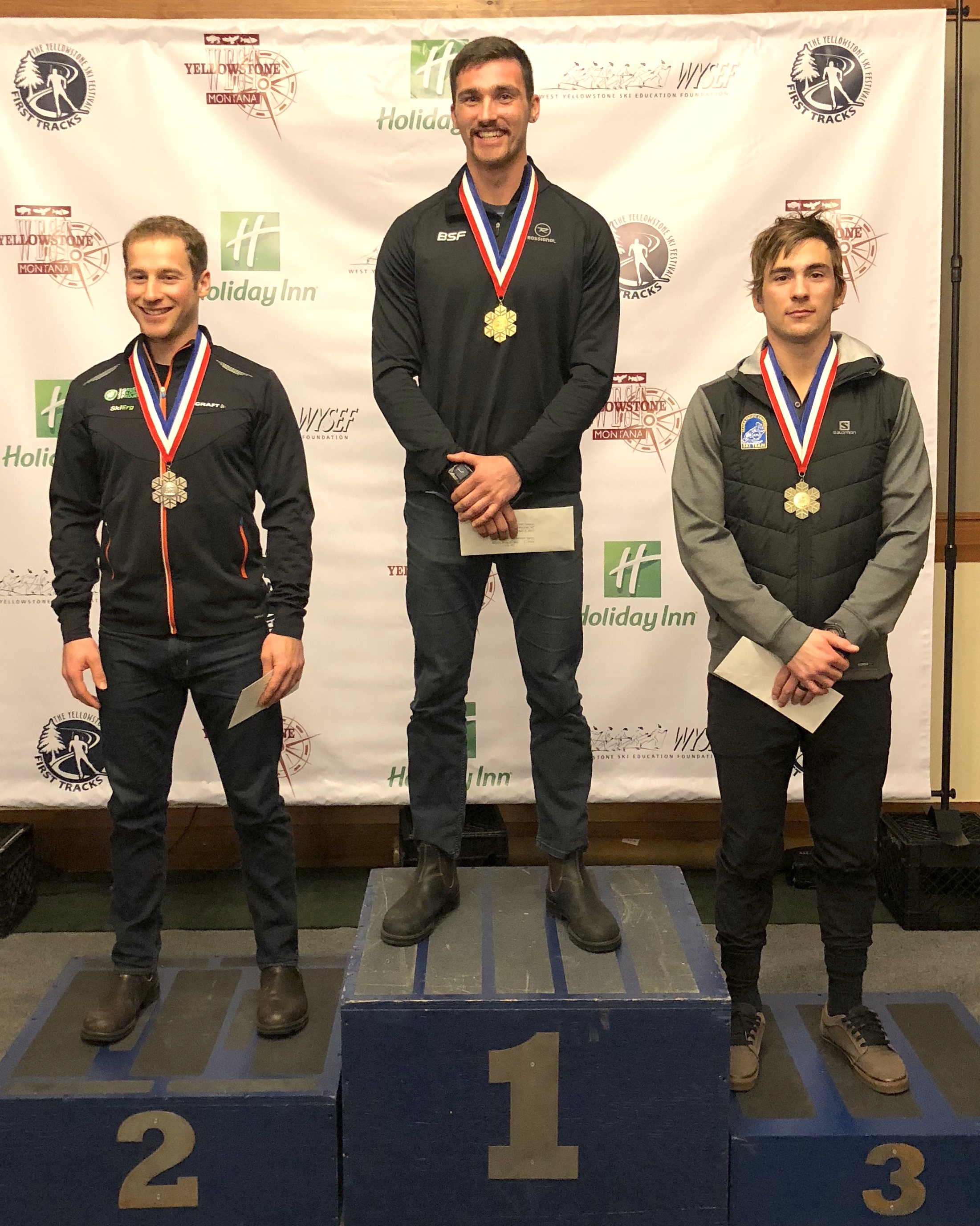
The men’s skate sprint podium at the first race of the 2017/2018 SuperTour season, with Nick Michaud (c) in first, Ben Lustgarten (l) in second, and Reese Hanneman in third. (Photo: FBD)
US SuperTour (West Yellowstone, Montana): Freestyle sprints
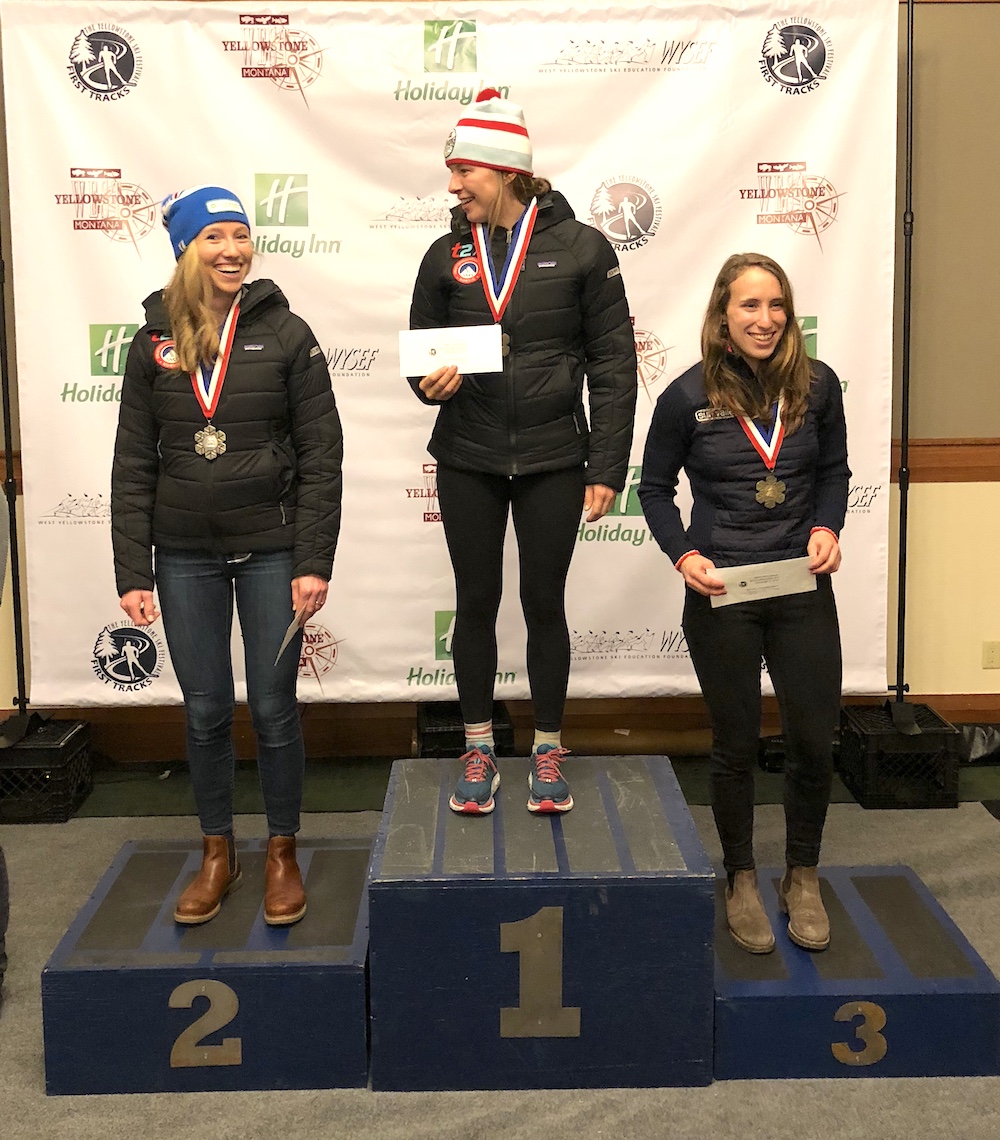
The women’s skate sprint podium at the first race of the 2017/2018 SuperTour season, with the SMS Elite Team’s Anne Hart (c) in first and Erika Flowers (l) in second, and Sun Valley’s Kelsey Phinney in third. (Photo: FBD)
Anne Hart and Nick Michaud were the big winners on opening day of the US SuperTour season at the Rendezvous Ski Trails on Saturday, taking individual victories in the women’s and men’s freestyle sprint finals, respectively.
Hart led into the finishing straight to take the win in 2:52.49 minutes, 0.88 seconds ahead of Erika Flowers, her teammate on the Stratton Mountain School (SMS) Elite Team, who placed second, and Kelsey Phinney, of theSun Valley Ski Education Foundation (SVSEF))in third (+0.92).
Hannah Halvorsen, of Alaska Pacific University (APU) and the U.S. Ski Team D-team, finished fourth (+2.16), Caitlin Gregg (Team Gregg) was fifth (+6.99), and Caitlin Patterson, of the Craftsbury Green Racing Project (CGRP), sixth (+7.22).
The win was Hart’s second on the circuit after winning a SuperTour 5 k skate two seasons ago. Last year in West Yellowstone, she placed third in the skate sprint (behind Jennie Bender, of the Bridger Ski Foundation, and Flowers, respectively).
Michaud, of the Bridger Ski Foundation (BSF), won the men’s final in 2:30.69 for his first SuperTour podium, just 0.17 seconds ahead ofBen Lustgarten (CGRP) in second and Reese Hanneman (APU) in third (+0.84). Rounding out the final, Kevin Bolger (SVSEF) finished fourth (+2.11), Ben Saxton (SMS Elite Team) fifth (+2.86), and Cole Morgan (SVSEF) sixth (+3.42).
FIS Cross Country World Cup (Lillehammer, Norway): Classic sprints
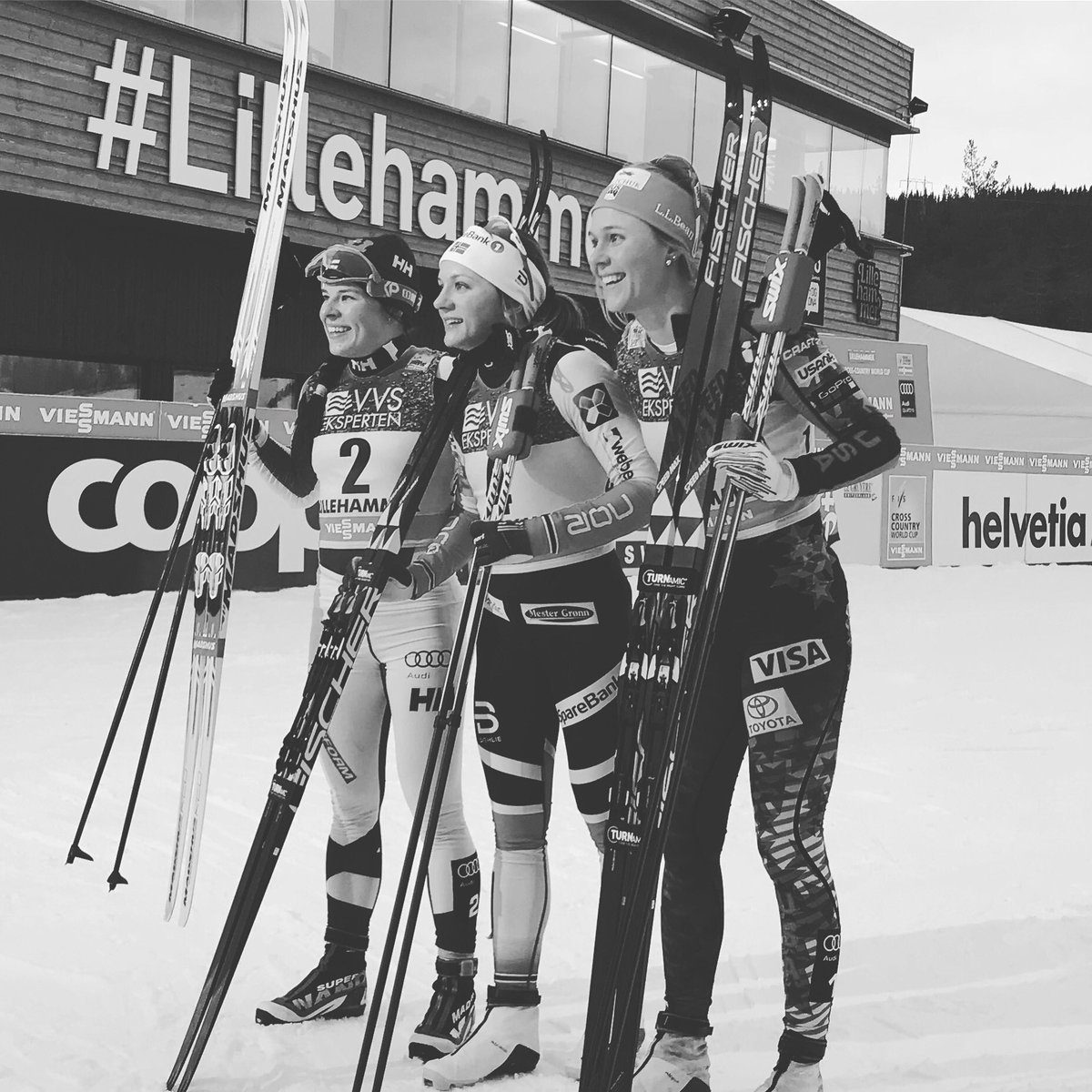
From right to left: American Sadie Bjornsen, Norway’s Maiken Caspersen Falla and Finland’s Krista Parmakoski after placing third, first and second, respectively, in the women’ 1.3 k classic sprint at Friday’s World Cup in Lillehammer, Norway. (Photo: FIS Cross Country/Twitter)
American Sadie Bjornsen returned to the World Cup podium for the second time in as many classic sprints this season on Saturday, placing third in the women’s 1.3-kilometer classic sprint behind Norway’s Maiken Caspersen Falla in first and Finland’s Krista Parmakoski in second.
Bjornsen started the day by winning the qualifying round by one-hundredth of a second over Parmakoski and Russia’s Natalia Nepryaeva, which were listed as qualifying in second and third, respectively (despite having the same time).
The U.S. Ski Team (USST) member who placed second in last week’s classic sprint in Kuusamo, Finland, Bjornsen won the qualifier in 3:22.45 minutes. She went on to advance in second out of her quarterfinal and then won her semifinal by 0.46 seconds over Sweden’s Stina Nilsson — who beat her in last week’s sprint.
While Falla won Saturday’s final in 3:19.98 (after qualifying in fourth, then winning her quarterfinal and semifinal as well), Parmakoski followed in second overall (+2.07) and Bjornsen achieved her second podium of the season in third (+5.01). Norway’s Ingvild Flugstad Østberg was just behind in fourth (+5.28), Nilsson finished fifth (+6.09), and the second American in the final, Jessie Diggins was sixth (+7.81).
Diggins previously qualified in seventh, finished second in her quarterfinal then advanced as a lucky loser in fourth place out of her semifinal (which Falla won).
Three American women raced in the heats, with Sophie Caldwell qualifying in ninth and ultimately placing ninth overall. She advanced in second out of her quarterfinal then finished fifth in the semifinal behind Diggins.
Also for the USST, Rosie Brennan finished 33rd in the qualifier, missing out on the top 30 needed to qualify by 0.26 seconds. Kikkan Randall finished 42nd, Ida Sargent was 44th, and Chelsea Holmes 64th.
Canada started four women, with Emily Nishikawa placing 58th, Dahria Beatty 59th, Cendrine Browne 63rd, and Katherine Stewart-Jones 65th.
Klæbo Still Undefeated, Ustiugov 2nd
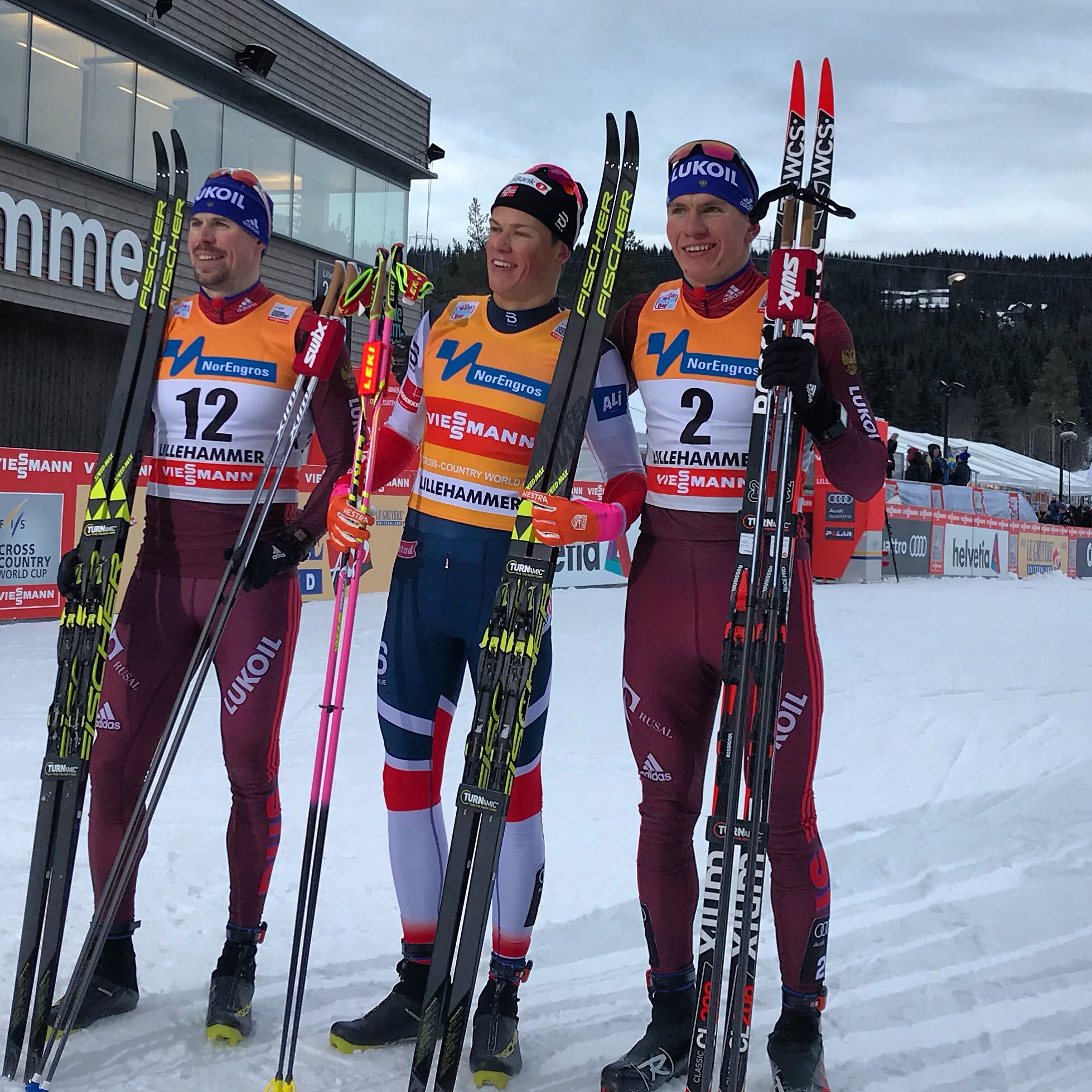
The men’s 1.5 k classic sprint podium with Norway’s Johannes Høsflot Klæbo (c) in first, Russia’s Sergey Ustiugov (l) in second and Russia’s Alexander Bolshunov (r) in third. (Photo: FIS Cross Country/Twitter)
In the men’s 1.5 k classic sprint, Norway’s Johannes Høsflot Klæbo continued his undefeated World Cup streak with his fourth win in as many races this season.
He started off by winning the qualifier in 3:40.79, then his quarterfinal by 0.17 seconds over Russia’s Sergey Ustiugov. Klæbo and Ustiugov met again in the semifinals, where Ustiugov beat the Norwegian by 0.25 seconds, but in the final, where it really mattered, Klæbo again had the edge, winning in 3:33.88. Ustiugov finished 0.83 seconds back for second place, and Russia had two on the podium with Alexander Bolshunov in third (+1.29). Sweden’s Calle Halfvarsson finished fourth (+1.64), and Norway had two more in the final with Emil Iversen in fifth (+8.2) and Sondre Turvoll Fossli in sixth (+17.3).
Canada’s Alex Harvey was the lone North American to qualify for the men’s heats after racing to 22nd in the qualifier, 11.89 seconds out of first. Harvey’s day ended in the quarterfinals, where he finished sixth, 3.06 seconds behind Norway’s Pål Trøan Aune in first. Norway’s Even Northug took second in that heat (+0.26), Finland’s Ristomatti Hakola was third (+0.36), Norway’s Håvard Solås Taugbøl fourth (+0.67) and France’s Maurice Manificat fifth (+1.72) in that heat. Overall, Harvey placed 28th on the day.
Erik Bjornsen was the top American man in 35th and missed qualifying by 1.06 seconds. Andy Newell finished 38th and Scott Patterson was 74th for the U.S. Ski Team.
Jess Cockney was the second Canadian man in 57th, Len Valjas followed in 59th, Julien Locke was 61st, Russell Kennedy 63rd, and Knute Johnsgaard 67th.
IBU World Cup (Östersund, Sweden): Men’s 10 k sprint
Norway’s 29-year-old Tarjei Bø wins his first World Cup race in four years and three Canadians land in the top 26, led by Scott Gow with a career-best 16th that puts him one step closer to securing his place on Biathlon Canada’s Olympic team. Of the nine men that cleaned the two-stage race, four of them were North Americans (Gow, American Lowell Bailey in 22nd, and Canada’s Nathan Smith in 24th and Christian Gow in 26th).
Sadie Bjornsen (U.S. Ski Team) racing to first in the classic sprint qualifier on Friday at the World Cup mini tour in Lillehammer, Norway. It was Bjornsen’s second-career qualifier win, and first time winning a classic-sprint qualifier. She went on to place 17th overall. (Photo: Fischer/Nordic Focus)
LILLEHAMMER, Norway — If anything’s consistent after two days of classic sprinting on the Cross-Country World Cup this year, it’s that nothing is a given — especially on the women’s side of World Cup sprinting.
No more Maiken Caspersen Falla dominating every World Cup sprint. However, Norway’s defending Sprint World Cup champion is no slouch, placing second in both classic sprints so far this season.
Take Sadie Bjornsen, for example. In her sixth time classic skiing in the last couple months (because of problematic heel spur), she clocked the fastest qualifying time in the women’s 1.3-kilometer classic sprint on Friday morning, 0.29 seconds faster than Falla, who qualified second.
“… I’m actually so happy I’m even here, and also that’s so crazy I was the fastest person in the world today,” Bjornsen reflected on the phone Friday evening. “That’s something you can’t forget.”
It wasn’t totally out of the blue. Bjornsen won a freestyle sprint qualifier last season in Quebec at the Ski Tour Canada (STC) World Cup stage.
“I hadn’t done that in classic so that was really fun,” Bjornsen, who turned 27 last week, said.
On Day 1 of Lillehammer’s three-day mini tour, the other big name in the women’s race was Norway’s Heidi Weng, who won her first-ever World Cup sprint after placing third in both races last weekend. (She also qualified third on Friday, 0.36 seconds behind Bjornsen). Weng’s teammate and the favorite in most races, Marit Bjørgen didn’t qualify for the final after finishing fourth in her semifinal, 0.71 seconds behind Weng, for eighth overall.
But let’s go back to Bjornsen for a moment. Her winning qualifying time was 3:19.62 minutes, which would have put her fifth in the final had she made it that far. Bjornsen was eliminated in the quarterfinals after placing fourth in her heat and ended up 17th for the third-straight race this season.
That was frustrating, but a phone call with her coach back in Alaska helped her regain perspective.
“I actually had an awesome chat with Erik [Flora] back to the U.S.,” she said. “He was like, ‘Who cares what happened? You were the fastest in the world.’ ”
Teammate Kikkan Randall, who wasn’t picked for this weekend’s mini tour, also gave her some words of advice at the finish.
“She handed me Breck for a little hug right after,” Bjornsen said of Randall’s seven-month-old infant. “He’s like the team cheer-up.”
Bjornsen raced in the same quarterfinal as teammate Jessie Diggins, who qualified in ninth (+1.75). Last week, Diggins qualified 13th. Last year, her best qualifying result in a classic sprint was seventh.
“Last year, going into the start of the season, I had never qualified in a classic sprint ever in the World Cup,” Diggins noted in a phone interview on Friday. “Now I feel like I have the fitness to make it into the semi. I’m in a different place than I was last year.”
Facing off against Russia’s Yulia Belorukova and Norway’s Kathrine Rolsted Harsem in the quarterfinal, along with Germany’s Sandra Ringwald and Finland’s Kerttu Niskanen, Diggins and Bjornsen stuck in the middle of the pack — both frustrated with their positioning.
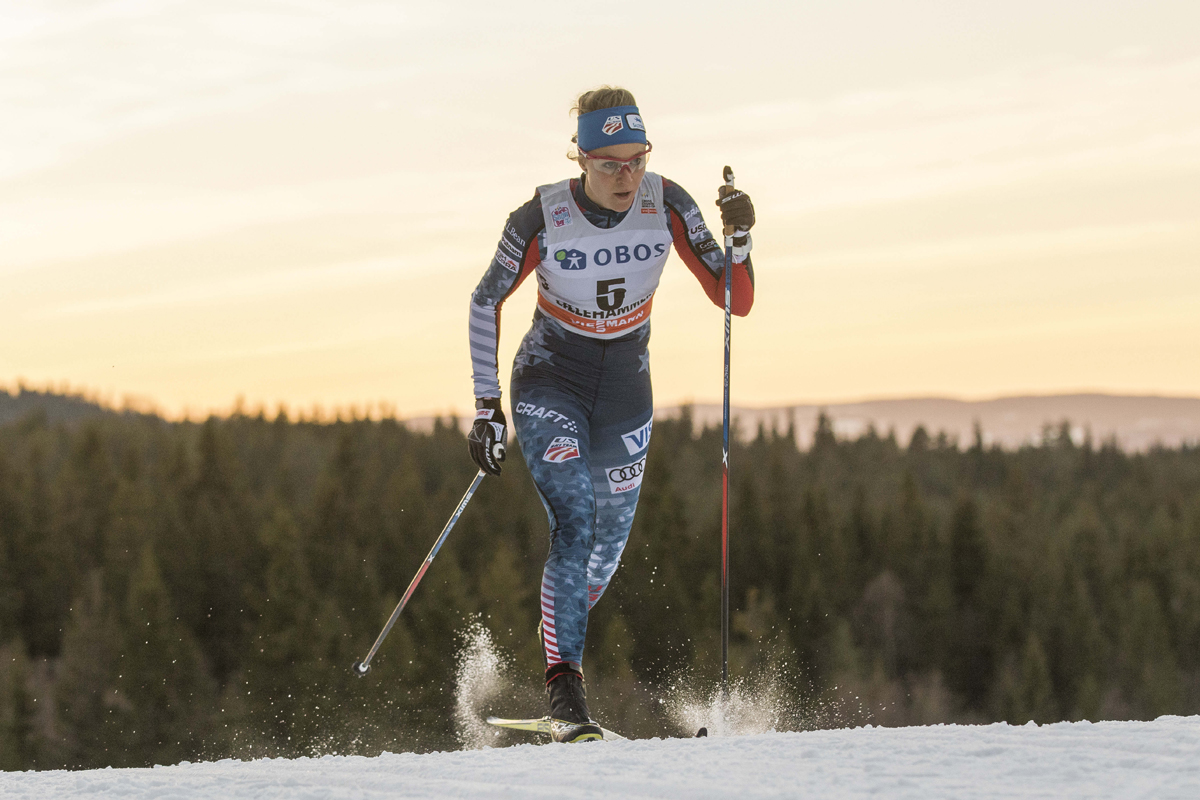
Jessie Diggins (U.S. Ski Team) striding to sixth overall in the 2016 Ski Tour Canada classic sprint last season in Canmore, Alberta.
For Diggins, who led Bjornsen for much of the race and ended up just ahead of her in third (for 14th overall), it was about finding her rhythm on the uphills. She was pleased with the way she skied her qualifier, but felt like she wasn’t skiing to her potential in the quarterfinal.
“It’s kind of funny because when I get in a heat setting, I get really nervous having all these people around me,” Diggins said.
She recalled leading Bjornsen until the first big climb, where Bjornsen made a move on the outside and Diggins stepped right to let her pass. She tucked behind her over the top, and sitting in fourth at the time, thought about how to get herself closer to the top two (Harsem, who set a fast pace early, and Belorukova).
Skis weren’t a problem, Diggins said, but the chewed-up tracks presented some difficulties.
“I remember thinking, ‘Oh my gosh, Sadie’s right behind me. I really gotta go!’ ” she said. “I think I got a little too stressed and I was not really going anywhere, which is too bad because I know the fitness is there. … When the tracks break down I feel like one of those cartoon characters where I’m spinning my wheels…
“It has nothing to do with the skis, the skis were great,” Diggins added. “… In the finish, I was psyched to feel good again. Double poling is my strength.”
Despite a big push for second, Diggins finished 0.08 seconds back from the runner-up in that heat, Harsem, and 0.22 seconds behind the winner, Belorukova. Bjornsen was another 0.6 seconds back in fourth.
“I probably wasn’t aggressive out of the start as I should have been,” Bjornsen reflected.
After feeling like she started too hard in her quarterfinal last Saturday in Finland, she decided to try to conserve a bit more early in this race.
“I just felt like I was fighting the whole time to try to go, but wasn’t really feeling like I could get in the right position,” Bjornsen said. “I just didn’t feel like I could get in quite the correct place. It didn’t go as I would’ve liked.”
But she had some good takeaways from Friday’s sprint, and was feeling positive heading into the next two days of racing in Lillehammer.
“I feel like every time I do a sprint race, it’s great practice for me,” Bjornsen said. “I’m not somebody who can naturally see gaps and jump on them so I have to practice that…”
Jessie Diggins (9) lunging at the line with Russia’s Yulia Belorukova (22) and Norway’s Kathrine Rolsted Harsem (12) in the women’s classic sprint quarterfinal. Diggins placed third in the heat and her U.S. teammate Sadie Bjornsen (second from l) finished fourth for 14th and 17th overall. (Photo: Aleks Tangen)
Two other Americans qualified for the heats: Sophie Caldwell in 10th (+2.01 behind Bjornsen) and Ida Sargent in 26th (+6.17). Caldwell went on to place 21st overall after finishing fifth in her quarterfinal, and Sargent was 28th after placing sixth in her quarterfinal.
“We kicked off the day feeling like we’re a different team from last weekend,” U.S. Women’s Coach Matt Whitcomb said on the phone. “We had three women qualify in the top 10, including Sadie’s career-qualifier win, which was always so exciting, to watch someone like Sadie suceed that way, and then Ida qualified — a little piece of trivia — for the first time in Norway.”
Caldwell explained in an email that she struggled out of the start of her quarterfinal.
“There was a lot of lane changing happening so I found myself at the back of the pack pretty quickly,” she wrote. “Once I was back there, I think I got a little frantic and frustrated and ended up losing some steam and staying towards the back of the pack.”
Coming out of the final hill, she remembered skiing in fifth or sixth.
“[I] caught a decent draft coming into the finish stretch, but I was a little out of steam and didn’t have a very strong double pole finish,” she added.
Caldwell crossed the line in fifth, 3 seconds behind Falla as the winner of that heat.
“I haven’t come into the season with a bang, but I usually don’t and I feel like I’m taking a step in the right direction with each race effort,” she wrote. “I was really happy with my qualifier today and pretty happy with my quarter final last weekend and to qualify in classic sprints, especially in period one, used to a pretty big stretch for me. So I feel like I’m making some progress and looking forward to a long season ahead!”
Sargent wrote in an email that she was pleased with her qualifier, considering how competitive the field was.
“I tried to go with slightly slick skis but it didn’t end up being a great approach for me, and I was very tense on the uphills,” she wrote of her qualifier. “.. But my energy felt really good. So I was happy to still qualify with not a great feeling out there.
“I wasn’t as happy with the quarterfinal,” Sargent continued, after finishing 8.24 seconds behind Finland’s Krista Parmakoski, who won the quarterfinal in 3:14.57, the fastest time of the day. “The lane that I was in ended before the big uphill so I had to jump in behind people from the start and felt like I was skiing from the back and wasn’t able to find an opening … I couldn’t get the same energy going in the heat and was just feeling kind of tired so I ran out of steam over the top of the last hill.”
She explained her skis were “awesome” in her quarterfinal, but speculated that she may have spent too much time and energy testing them.
“I know I can improve the way that I warmup and cooldown from the heats and dial in my ski testing so I’m still figuring out that routine and glad there is lots of racing yet to come this season,” Sargent concluded. “Overall it feels like a solid start for me this year but I know that I have a lot more in the tank so I’m excited for more racing!”
“We’re still struggling to find a stable platform,” Whitcomb said of the team in general. “We’re new to snow, things got a little bit mealy [with the course conditions], and while the energy certainly looked better for a one-off qualifier, and even at times for the quarters, I just don’t think we were ready yet to put together a full four rounds of sprinting.
“That said, Jessie was absolutely on fire near the end of her quarterfinal, and had she advanced, which she nearly did by half a meter, I think the day could have looked a lot differently,” he added. “There was no one in the women’s field who had a more impressive drag race in the last 100 meters, so I’m in no way disappointed. I feel like we skied representative of where we are right now.”
Weng for the Win
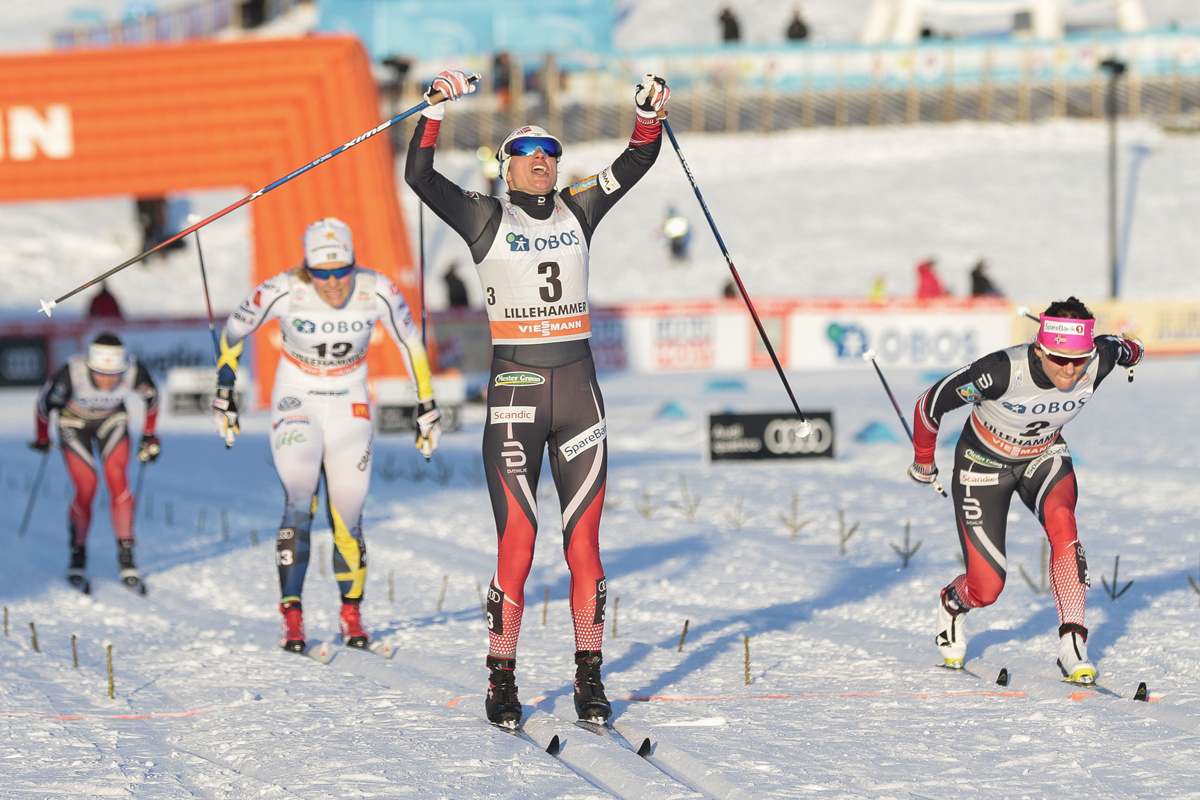
Norway’s Heidi Weng (3) celebrates her third World Cup victory and first sprint win on Friday in the women’s classic sprint in Lillehammer, Norway. She edged her teammate Maiken Caspersen Falla (r) by 0.48 seconds. (Photo: Fischer/Nordic Focus)
At the top of the results, Weng won her quarterfinal and semifinal before outlasting five others once again in the final. She bested her teammate Falla by 0.48 seconds with a winning time of 3:15.76, and Sweden’s Hanna Falk placed third (+1.06). Of the four Norwegian women in the final, Ingvild Flugstad Østberg placed fourth (+2.99) and Anna Svendsen was fifth (+6.27). Russia’s Belorukova finished sixth (+16.75).
Falla took an early lead and Østberg jumped in behind her to follow closely in second. While Sweden’s Falk strained to put herself in third, Weng sat back and eventually seized the opening — chasing Falla and Østberg as the three Norwegians took hold of the race.
Falla began to gap her teammates on the final climb, but Weng strided powerfully into second while Falk moved back into third. In the finishing stretch, Weng proved strongest as she double poled past Falla for her first sprint World Cup win (after 10 sprint podiums).
It was evident that the win meant a great deal to Weng as she raised her arms in the air and screamed as she crossed the line. Asked at a post-race press conference why she did that, Weng responded, “I was very happy!”
The women’s classic sprint podium on Friday in Lillehammer, Norway, with winner Heidi Weng (c) of Norway, runner-up Maiken Caspersen Falla (l) of Norway, and Hanna Falk (r) in third. (Photo: Fischer/Nordic Focus)
But immediately after the race, she wasn’t sure what to say.
“It’s incredible to go so fast in sprint and I’m…,” she said in a finish-line interview.
The interviewer asked, “You are speechless?” to which Weng lit up and firmly answered, “Yes!”
Weng spoke to a group of Norwegian journalists after, and when she was asked about her performance, she said, “This may be one of the greatest performances in my career. I figured before the final that I should just give it all that I have, and during the final climb I had to take a few detours, but it worked out in the end.”
For the 25-year-old Weng, one of the most consistent podium threats on the circuit, this was only her third World Cup victory. She said that she hadn’t really worked on improving her sprinting,“but I have been focusing on my techinique as usual during my workouts.”
Three other Americans and three Canadian women raced in the qualifier. Rosie Brennan of the U.S. Ski Team (USST) was closest to qualifying in 34th, about a second out of the top 30. Canadian World Cup B-team member Emily Nishikawa placed 62nd, followed by Canadian U25-Team teammates Dahria Beatty and Cendrine Browne in 66th and 67th, respectively. American Caitlin Patterson (Craftsbury Green Racing Project) placed 68th, and USST distance specialist Liz Stephen was 70th in her first race of the season.
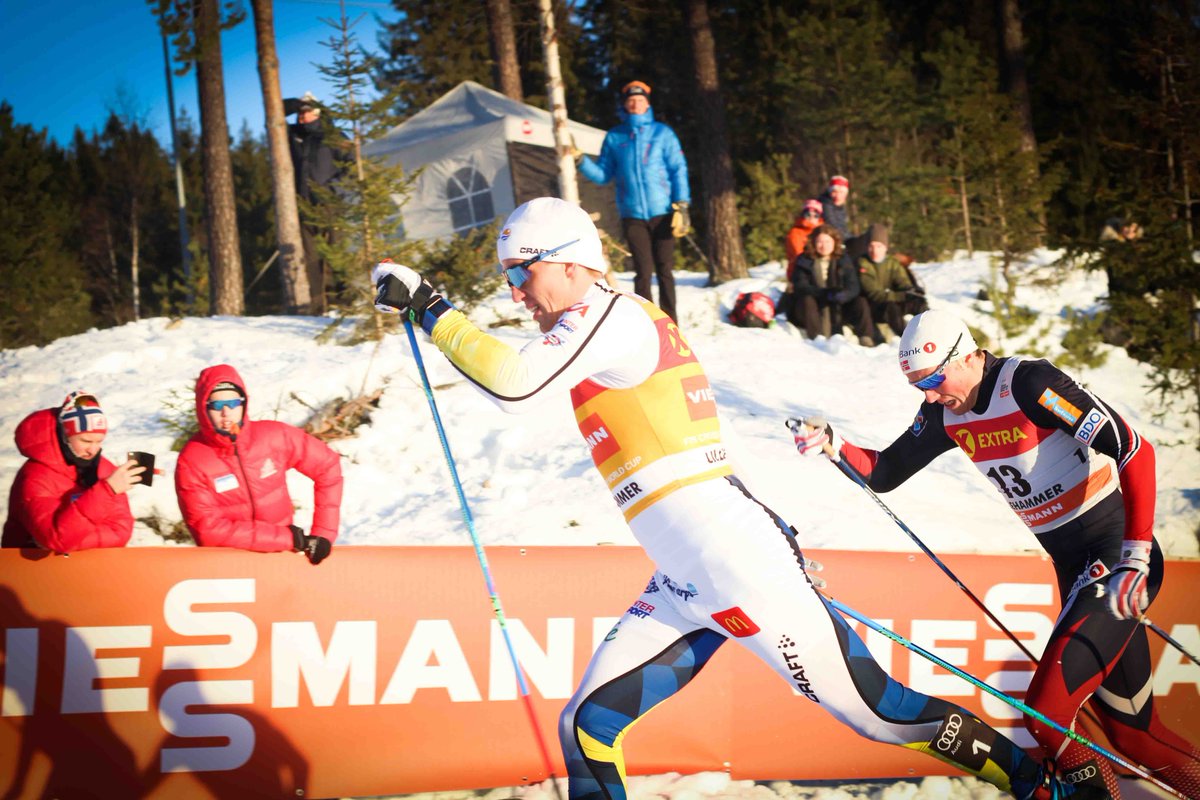
Sweden’s Calle Halfvarsson racing to his first World Cup win in three years, ahead of Norway’s Emil Iversen in Friday’s 1.6 k classic sprint in Lillehammer, Norway. (Photo: Nordic Lillehammer/Twitter)
Welcome to The Rundown, your quick primer of need-to-know information about the day’s racing. We’ll be updating this digest as the day goes on with additional results, photos and quotes. The Rundown is NOT a race report; stay tuned for complete race reports later today with interviews from the day’s top racers.
***
FIS Cross-Country World Cup in Lillehammer: Classic sprint
For the second time in her career, Sadie Bjornsen of the U.S. Ski Team (USST) won a World Cup sprint qualifier on Friday, Day 1 of the first mini tour of the season in Lillehammer, Norway.
After turning 27 last week and finishing 17th in both races at the Ruka World Cup in Finland, Bjornsen put down the fastest qualifying time in the women’s 1.3-kilometer classic sprint, by 0.29 seconds over Norway’s Maiken Caspersen Falla, who qualified in second.
Four U.S. women made the heats, with Jessie Diggins qualifying ninth (+1.75), Sophie Caldwell in 10th (+2.01), and Ida Sargent in 26th (+6.17).
In the men’s 1.6 k classic sprint, Calle Halfvarsson of Sweden topped the qualifier, clocking in 0.14 seconds faster than Norway’s Johannes Klæbo in second. Last weekend’s sprint winner, Pål Golberg qualified third (+2.07), and two Canadians, Len Valjas and Alex Harvey qualified for the heats in 19th (+10.24) and 23rd (+10.92), respectively. American Erik Bjornsen (USST) nabbed the final qualifying spot in 30th (+12.61).
In the heats, the women’s third-fastest qualifier (who was third in the first two races of the season), Heidi Weng of Norway won her quarterfinal and semifinal and finally, the final, by 0.48 seconds over her teammate, Falla. (It was Falla’s second runner-up finish in as many classic sprints this season.)
Sweden’s Hanna Falk placed third, 1.06 seconds after Weng, and Norway’s Ingvild Flugstad Østberg finished fourth (+2.99). The fourth Norwegian in the women’s final, Anna Svendsen placed fifth (+6.27), and an early leader in the race, Yulia Belorukova of Russia faded to sixth (+16.75).
Meanwhile, Diggins led the U.S. women in 14th overall after all four did not advance to the semifinals. Diggins finished third in her quarterfinal, just 0.22 seconds behind Belorukova and 0.14 behind runner-up Kathrine Rolsted Harsem of Norway, respectively.
Bjornsen finished in, you guessed it, 17th for the third-straight race after placing fourth in that same quarterfinal, 0.82 seconds behind Belorukova.
Caldwell was 21st on the day after placing fifth in her quarterfinal, 3 seconds behind Falla, who won that heat. Sargent finished 28th overall after placing sixth in the first quarterfinal, 8.24 seconds behind Finnish winner Krista Parmakoski.
In the men’s heats, Halfvarsson took it all the way to the final, winning his first World Cup race in three years (since a skate sprint win in Oberhof, Germany, in December 2013). There, he beat out Norway’s Emil Iversen by 0.12 seconds at the line, and Sweden had two on the podium with Teodor Peterson in third (+0.54). Finland’s Iivo Niskanen placed fourth (+4.01), Sweden’s Emil Jönsson finished 42 seconds back in fifth, and Golberg crossed the line nearly 2 minutes after Halfvarsson in sixth.
Harvey notched his first top 10 of the season in 10th overall, after placing fifth in his semifinal. (Notably, the same semifinal where Halfvarsson received a yellow card for obstruction, but was allowed to start the final. Norway’s Finn Hågen Krogh and Sondre Turvoll Fossli were relegated to 29th and 30th, respectively, for technique infractions in the heats.)
Then there was Valjas, who led his quarterfinal until late, where Norway’s Martin Johnsrud Sundby initially picked up the pace and Petter Northug came from behind to win the heat. Just 0.05 seconds back, Niskanen took second and Valjas just missed out on advancing to the semifinal in third (+0.19). Overall, Valjas placed 13th for his best World Cup result since the Canmore classic sprint last year at the Ski Tour Canada (STC), where he placed 11th.
Bjornsen finished 24th (his best World Cup result since finishing 20th in the Quebec skate sprint at the STC) after placing fifth in his quarterfinal, 3.69 seconds behind Klaebo, who won that heat.
Also for the U.S., Rosie Brennan narrowly missed the heats in 34th, last season’s U.S. SuperTour leader Caitlin Patterson (Craftsbury GRP) placed 68th, and USST distance skier Liz Stephen was 70th in her first World Cup of the season.
In the men’s race, Canada’s Devon Kershaw missed qualifying in 42nd, Knute Johnsgaard was 51st, Bob Thompson 52nd, Graeme Killick 71st, and Andy Shields 90th.
U.S. sprinters Andy Newell and Simi Hamilton finished 47th and 48th, respectively. Last season’s SuperTour leader Eric Packer (APU) placed 76th, and Noah Hoffman (USST) 89th.
Canada had three women in the distance race, with Emily Nishikawa finishing 62nd, Dahria Beatty 66th, and Cendrine Browne 67th