Tag: Lillehammer mini tour

  • Ogden and Schoonmaker Miss Skate Sprint Final by Narrowest of Margins as Klaebo Wins Again

    Ogden and Schoonmaker Miss Skate Sprint Final by Narrowest of Margins as Klaebo Wins Again

    This World Cup coverage is made possible through the generous support of Marty and Kathy Hall and A Hall Mark of Excellence Award.  To learn more about A Hall Mark of Excellence Award or to learn how you can support FasterSkier’s coverage please contact info@fasterskier.com.
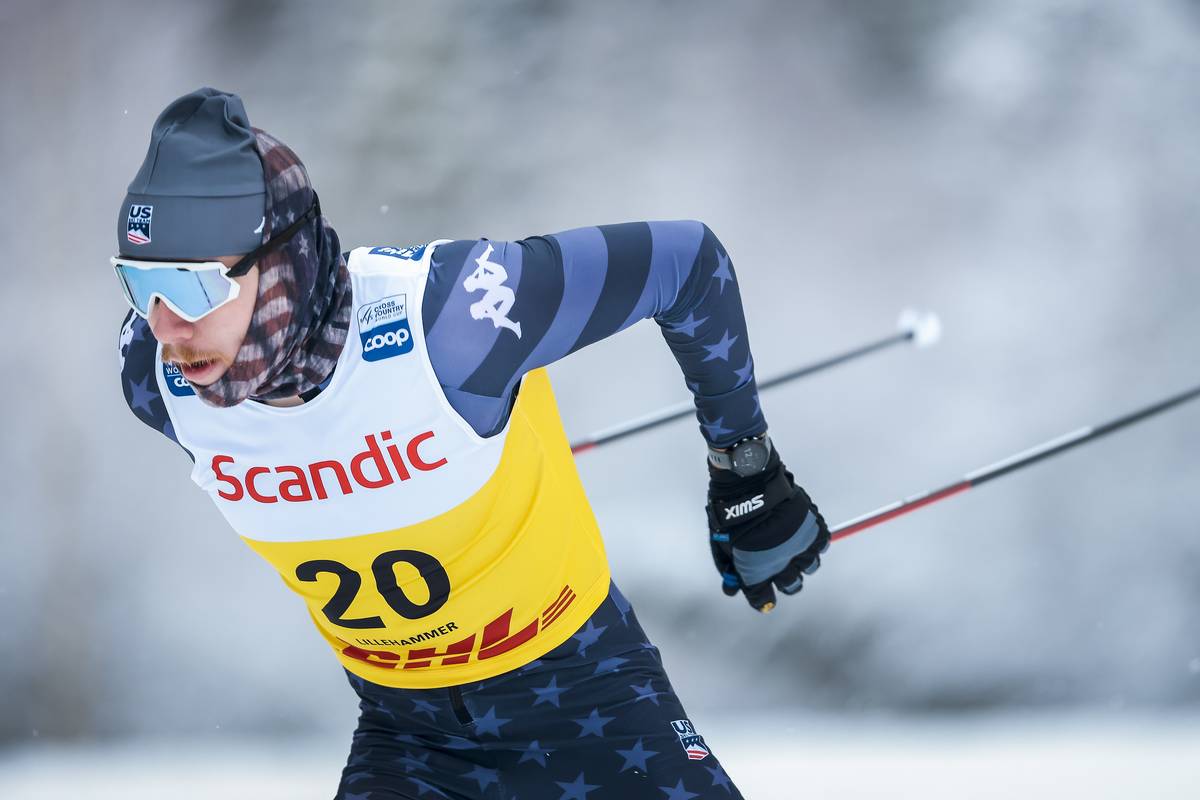
    Ben Ogden (USA) raced boldly on Saturday, finishing less than a boot’s-length away from the World Cup Sprint Final. (Photo: NordicFocus)

    Lillehammer, Norway—that most timeless of ski venues—provided viewers with a familiar scene on Saturday: Johannes Hoesflot Klaebo exiting the final turn in the lead, gliding away from the field en route to an easy win in an individual skate sprint. It was the 32nd win of his career in the event—exactly double the number of any other skier in history. The man behind him on that list—Federico Pellegrino (ITA)—was also 2nd behind him on the day. Even the name of the skier in 3rd place—Northug—fit the scene, though in this iteration the Northug was Even, not Petter. 

    So it was that the first skate sprint of the 2022-2023 season ended with a podium that could have been plucked from any skate sprint in the past half-decade. Partially because of that fact—and because Johannes Hoesflot Klaebo first staked his ground in the event before moving on to also dominating every other discipline of skiing—the skate sprint has become the archetypal stand-in for this current era of cross-country skiing.

    Johannes Hoesflot Klaebo (NOR) celebrates down the finishing stretch during Saturday’s World Cup Sprint Final. (Photo: NordicFocus)

    Anyone looking for winds of change in the sport would probably want to watch for little changes in the landscape of a World Cup skate sprint. On Saturday in Lillehammer, those little changes came clad in Stars and Stripes, as Americans Ben Ogden and JC Schoonmaker finished the day in 7th and 8th, respectively. Luke Jager also qualified for the heats, finishing in 27th. Three Americans in the heats, two contending in the semifinals; a year ago, that would’ve been cause for hopeful surprise, as the young potential of this current generation of young men began to peak through onto the sport’s highest level. At the beginning of this season, however, today’s qualifying crop marked more of a hopeful progression, as that group of American men looked to expand on a newfound comfort in World Cup sprinting that they’ve gained over the course of last season.

    That progression was on full display once the heats started rolling. Ogden would ski out of the fourth quarterfinal heat, taking the inside lane alongside seasoned veterans Erik Valnes (NOR) and James Clugnet (GBR). Ogden marked moves by Valnes and Clugnet as they charged the uphill. Around the sharp-left that marked the beginning of lap two into the downhill again, Ogden moved to the outside, swept around the corner into the hill, and this time led the charge rather than marking it. By the time the field hit the long flat of the Lillehammer stadium, Ogden was clear in front, allowing him to avoid a tangle-up involving Valnes and Clugnet. Clugnet broke a pole and lost the chance to advance to the semifinal.

    Ogden’s strategic success may be indicative of big things to come:  the skier who last spring in an interview with FasterSkier claimed that he “[is] not known for my detailed race plans” had out-witted and out-skied competitors who are fixtures in World Cup sprint fields. In an interview with FasterSkier  US Ski Team Head Coach, Matt Whitcomb, said that Ogden’s patience was a noticeable difference between this week’s sprint and last week in Ruka. “When Ben was leading in the heats today, he wasn’t spazzing like he was in Ruka, he was controlled. [That meant] that when he did go—he hit the gas pedal—the vehicle went a lot faster.”

    Those same patient-minded tactics were the hallmark of the American’s approach throughout the day. In the next quarterfinal heat after Ogden’s, Luke Jager followed JC Schoonmaker as the latter executed the same plan. Jager fell off the pace just at the end, but Schoonmaker held off all-comers, including Richard Jouve (FRA), to win the heat and advance to the semi-finals.
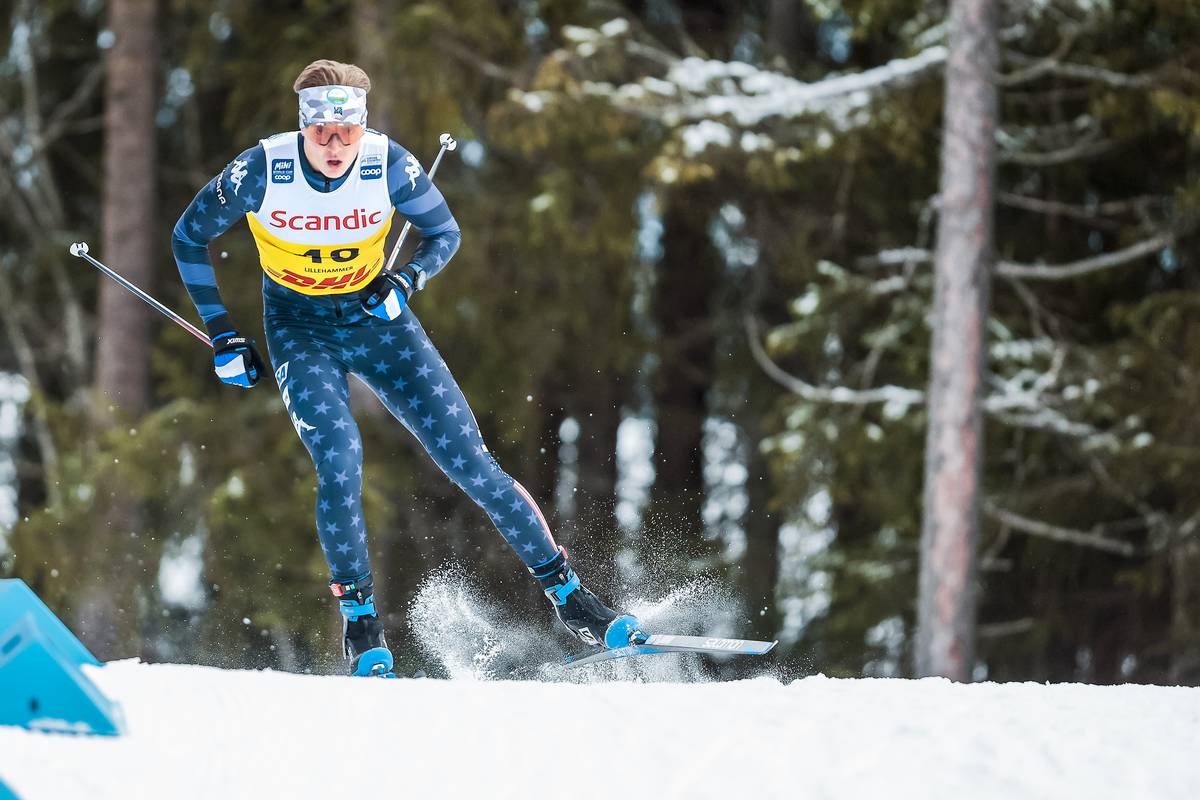
    Luke Jager (USA) during qualification on Saturday. He would advance to the quarterfinals, and finish the day in 27th. (Photo: NordicFocus)

    On this nuanced approach to the day’s heats, US Ski Team Head Coach Matt Whitcomb pointed to Schoonmaker, Ogden, and Jager’s experience gained over the past year. “When you struggle through a season and qualify once or twice, you don’t get very much sprint experience,” Whitcomb said. “Once you get to a point where you are getting through the quarterfinals, your experience starts to double each day. And that’s what we are seeing: a year of skiing into heats and skiing them aggressively.”

    Whitcomb also stressed that the key lesson learned for the talented American sprinters was patience. “For athletes that have that natural…[what I’d call] Tesla power, the key is to not use too many matches early in the heat,” Whitcomb said.

    The American pair of Ogden and Schoonmaker held steady on that patience while starting together in the second semi-final of the day. In that heat, they were outnumbered by a Norwegian contingent that included World Cup Overall leader Paal Golberg, Ansgar Evensen, and Erik Valnes. The Norwegians also appeared to approach the heat with a preference for patience. A furious pace from the gun quickly gave way to a kind of stalemate in which Ogden found himself at the front of the pack, leading the first climb alongside Evensen. Paal Golberg tucked comfortably behind Ogden (indicating that Norway and USA were attempting to utilize similar tactics) as they went into the second turn around the downhill. Ogden moved to the outside; Golberg, Jouve, Evensen and Schoonmaker followed; and the five came into the stadium together. That was the crystallizing moment for the Americans on the day. Ogden and Schoonmaker, in a semi-final, fending off the World Cup Overall leader and Richard Jouve, the only other skier in the world than Klaebo to have won a skate sprint this calendar year.
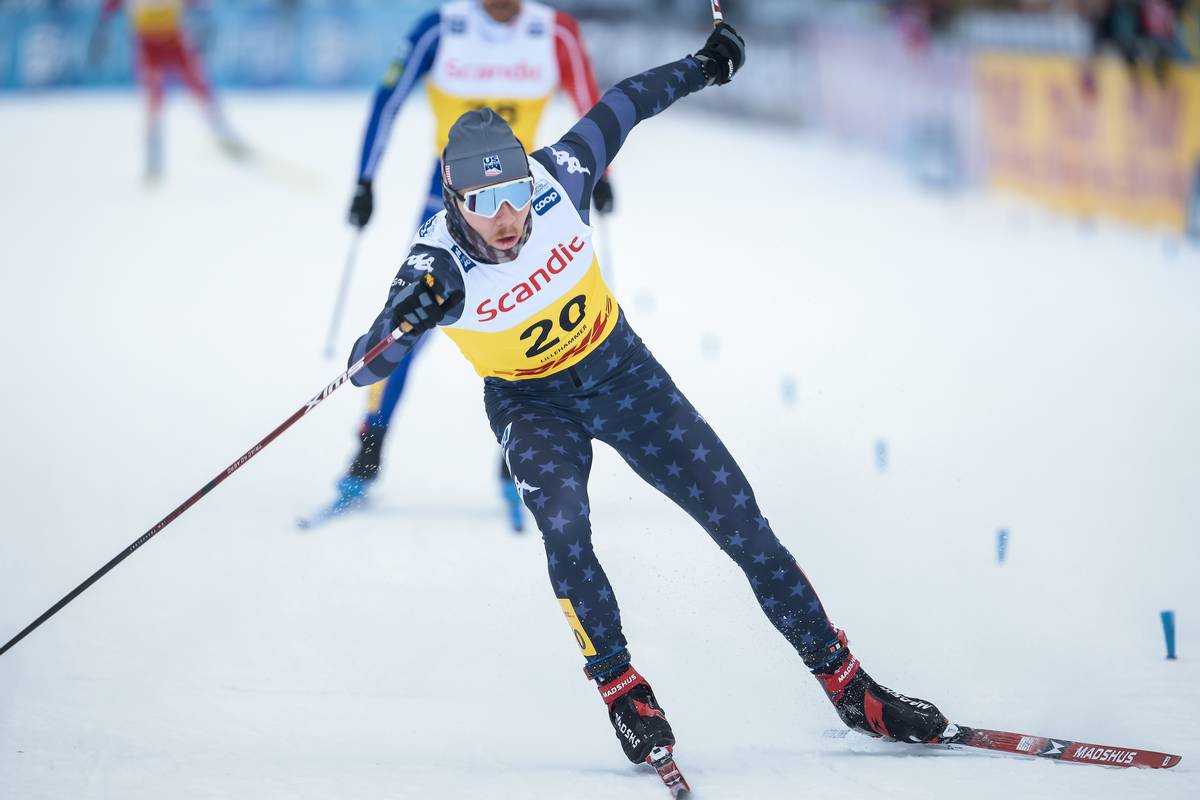
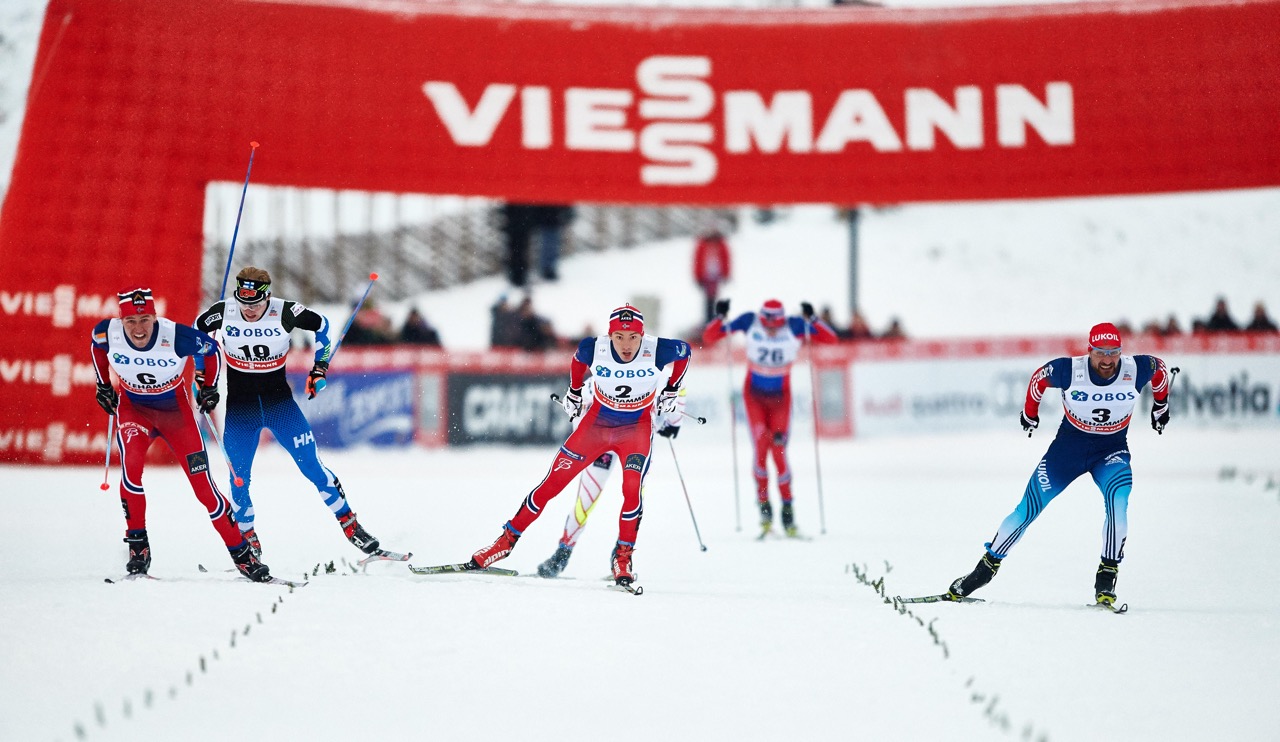
    Ben Ogden (USA) stretches for the line in his semifinal. Ogden finished 3rd in the heat, with JC Schoonmaker (USA) 4th. (Photo: NordicFocus)

    The Americans came up just short. Golberg won the heat, besting Evensen by a boot throw. The patience of Ogden and Schoonmaker in the beginning of this relatively slow heat likely cost them a shot at the lucky loser times, as they finished 3rd and 4th, respectively. Thus, the American’s maturity was met with some decidedly bitter irony. Still, it was mature racing, and will surely be marked by a mature analysis.

    In the opposite semi-final, four Norwegians matched up against Federico Pellegrino and a twenty year-old Swede named Edvin Anger making only his 3rd World Cup start. The Swede’s second start was last weekend in the Ruka Classic Sprint, where he showed a propensity for racing at full gas from the beginning of each and every heat. That crashed spectacularly in Ruka, as he was spit out the back of the pack in the semi-final, but it didn’t change his approach this week. 

    Anger went hard from the gun, the Norwegians filed in, Klaebo moved out from the back and moved to the front, and everyone else sprint for 2nd. This time though, Anger kept the pace. He advanced to his first sprint final, and in the process animated the pace to the degree that 3rd place Pellegrino and 4th place Even Northug advanced to the final with the lucky loser times.
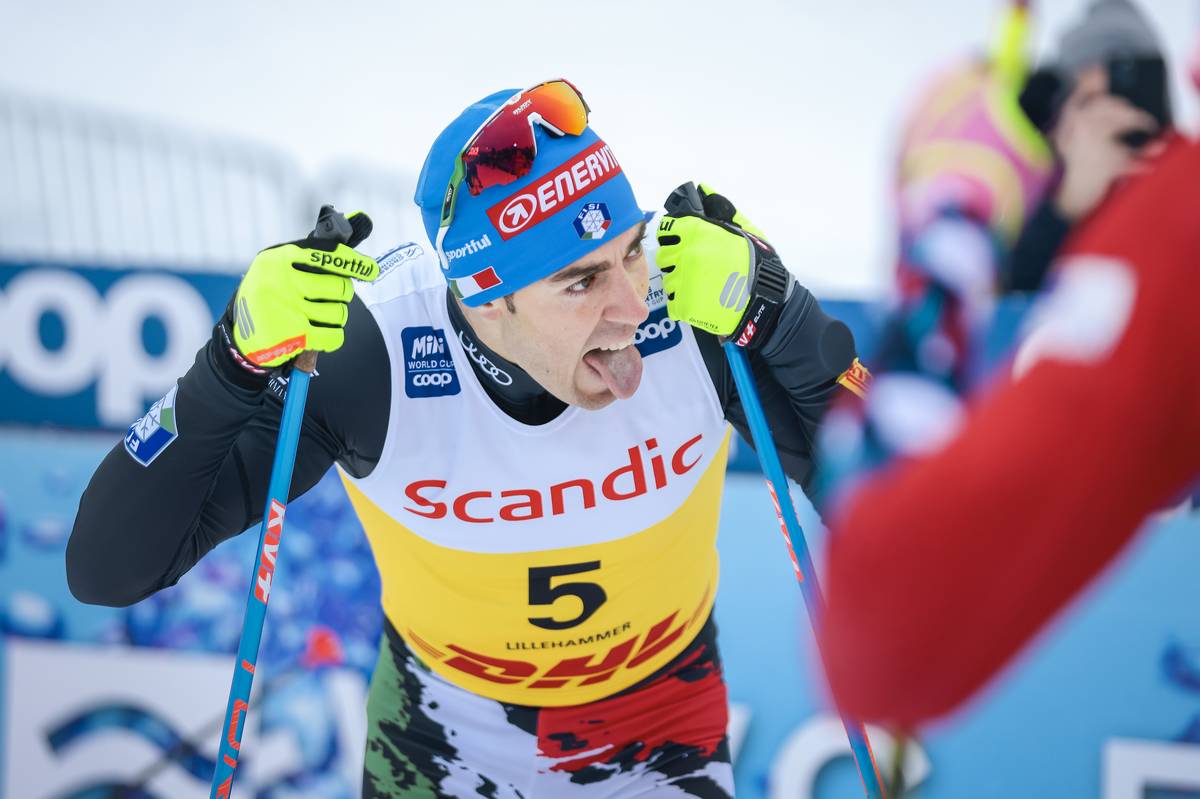
    Federico Pellegrino (ITA), who finished 2nd on the day after earning a lucky loser spot into the Final. (Photo: NordicFocus)

    The final began as a near-replay of this semi-final: Anger went out hard, the Norwegians filed in, Klaebo moved out from the back and moved to the front, and everyone else sprint for 2nd. There was a change to the script, though: the old veteran, Federico Pellegrino, had seen Anger’s move in the semi-final, and decided to follow him this time. Result: the old veteran passed up the new kid on the block, and solidified second place on the day. Klaebo 1st place, Pellegrino 2nd place, Northug 3rd place.

    The established champions still had their way, for now.

    On his day progressing to the cusp of the final, Ben Ogden said in an email to FasterSkier that:

    “today is a massive step for me in my [sprint progression from last year]. My goals this year are to feel more control and composure in the quarterfinal and advance regularly. Today was huge for that confidence and I’m really happy with how things turned out. Always hungry for more, but [today] was satisfying.”

    JC Schoonmaker also emphasized that experience was the most important quality to his sprint success, saying in an email with FasterSkier that:

    “It is tough to be so close to making it to the final, but with better tactics I know it is possible. A lot of heat skiing for me has been gaining experience and making sure that I’m learning from every race I compete in.”

    Schoonmaker added that the highlight of the day was lining up next to his teammate Luke Jager in the quarterfinal, “Racing that with Luke was more fun than anything really.”

    Tune in next Friday in Beitostolen to see where the boys sprint from here…


    Full Results
    Qualifying | Heats

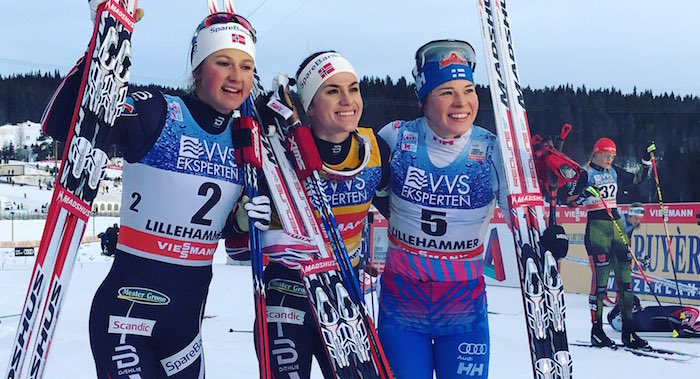
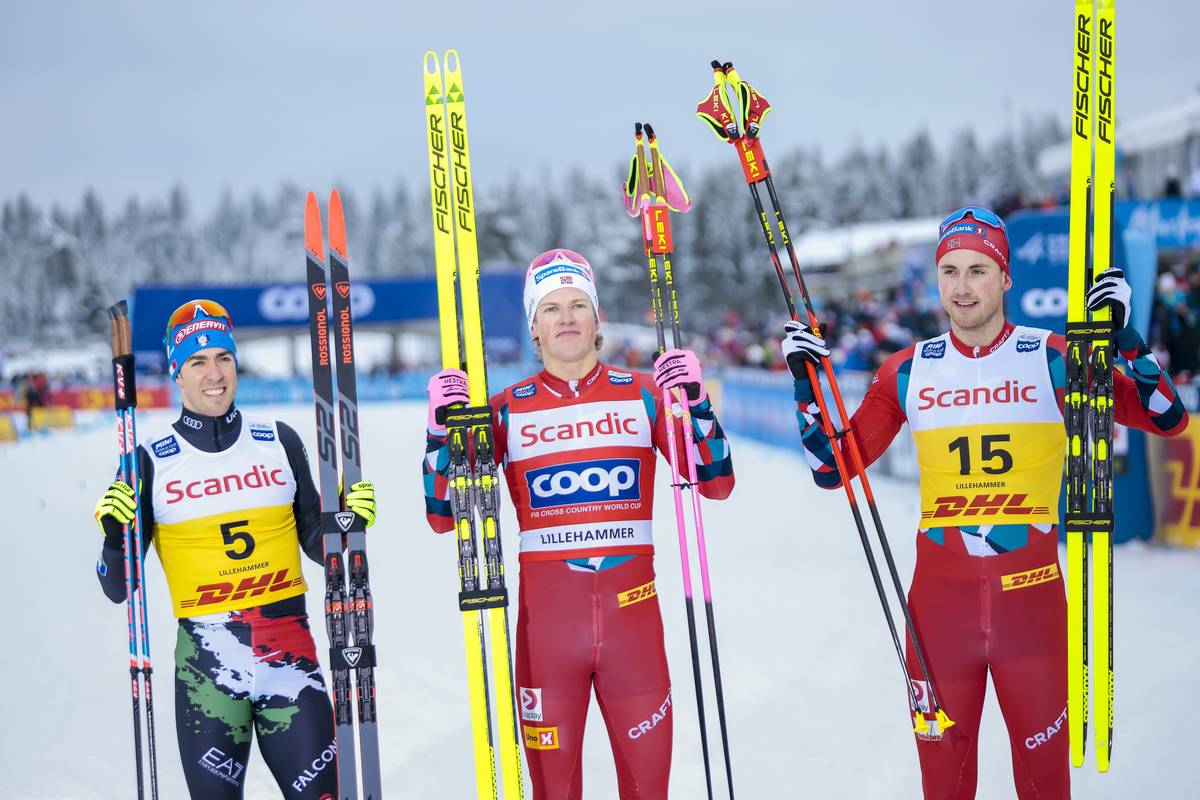
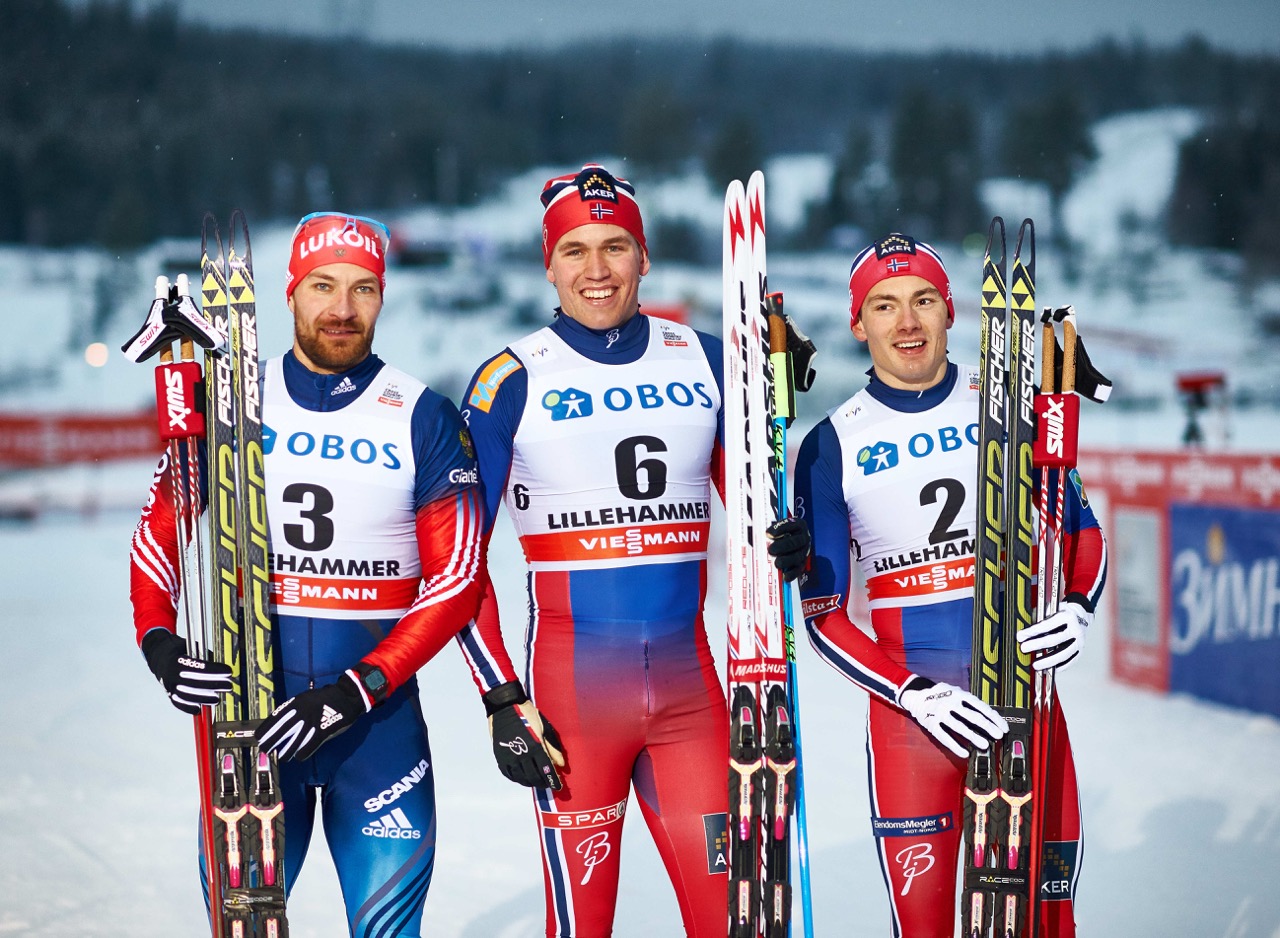
    Federico Pellegrino (ITA), Johannes Hoesflot Klaebo (NOR) and Even Northug (NOR), (l-r) take the freestyle sprint podium in Lillehammer, Norway.
    (Photo: NordicFocus)
  • Sunday Rundown: Lillehammer, Östersund & West Yellowstone (Updated x6)

    Sunday Rundown: Lillehammer, Östersund & West Yellowstone (Updated x6)

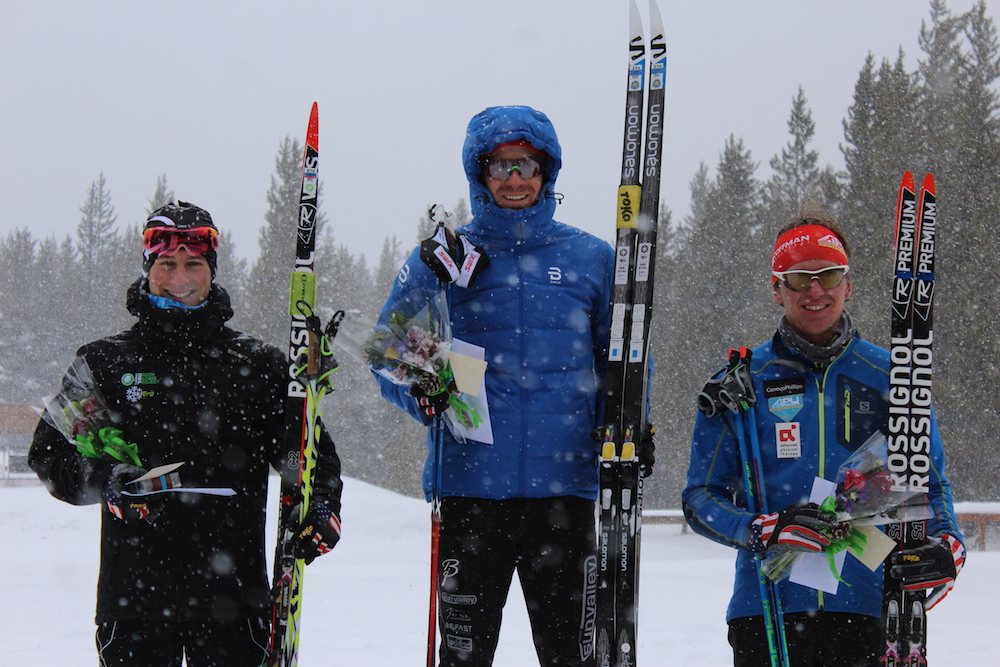
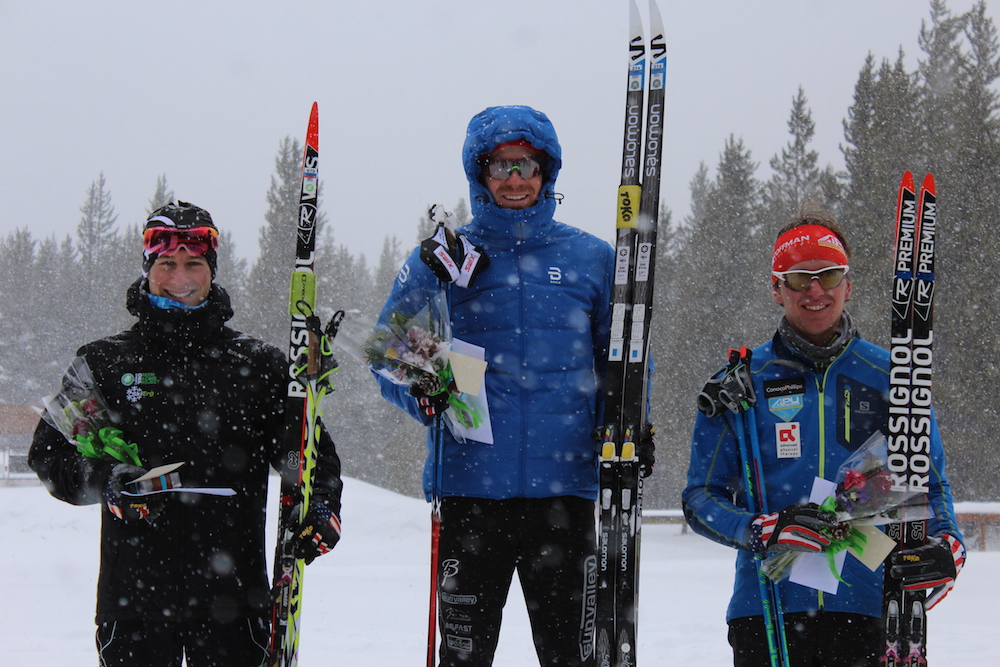
    Matt Gelso (SVSEF) topping the SuperTour podium for the second-straight day on Sunday in West Yellowstone, Mont. Joining him on Sunday's 15 k classic podium: CGRP's Ben Lustgarten (l) in second and APU's Scott Patterson (r) in third.
    Matt Gelso (SVSEF) topping the SuperTour podium for the second-straight day in West Yellowstone, Mont. Joining him on Sunday’s 15 k classic podium: CGRP’s Ben Lustgarten (l) in second and APU’s Scott Patterson (r) in third.

    Welcome to The Rundown, your quick primer of need-to-know information about the day’s racing. We’ll be updating this digest as the day goes on with additional results, photos and quotes. The Rundown is NOT a race report; stay tuned for complete race reports later today with interviews from the day’s top racers.

    (Note: This Rundown has been updated to include comments from U.S. Nordic Combined’s Bryan Fletcher, who placed ninth on Sunday at the World Cup in Lillehammer, Norway.)

    ***

    U.S. SuperTour opener in West Yellowstone: 10/15 k classic

    Matt Gelso made the case that he can win any discipline and format when it comes to cross-country skiing, topping the SuperTour podium for the second-straight day of the circuit’s opening weekend in West Yellowstone, Mont. Gelso, of the Sun Valley Ski Education Foundation (SVSEF) Gold Team, won the men’s 15-kilometer classic individual start in 42:57. He finished 32.2 seconds ahead of Ben Lustgarten of the Craftsbury Green Racing Project (CGRP) in second, and Scott Patterson, of Alaska Pacific University (APU), clocked in 1:16.8 back in third.

    In the women’s 10 k classic, Liz Guiney (CGRP) tallied the distance victory in 33:52.8. Katharine Ogden, of the Stratton Mountain School (SMS) and U.S. Ski Team D-team, finished 7.7 seconds back in second place, while Craftsbury put two on the podium with Kaitlynn Miller in third (+28.4).

    Results

    Nordic Combined World Cup in Lillehammer: Two individual comps and a relay

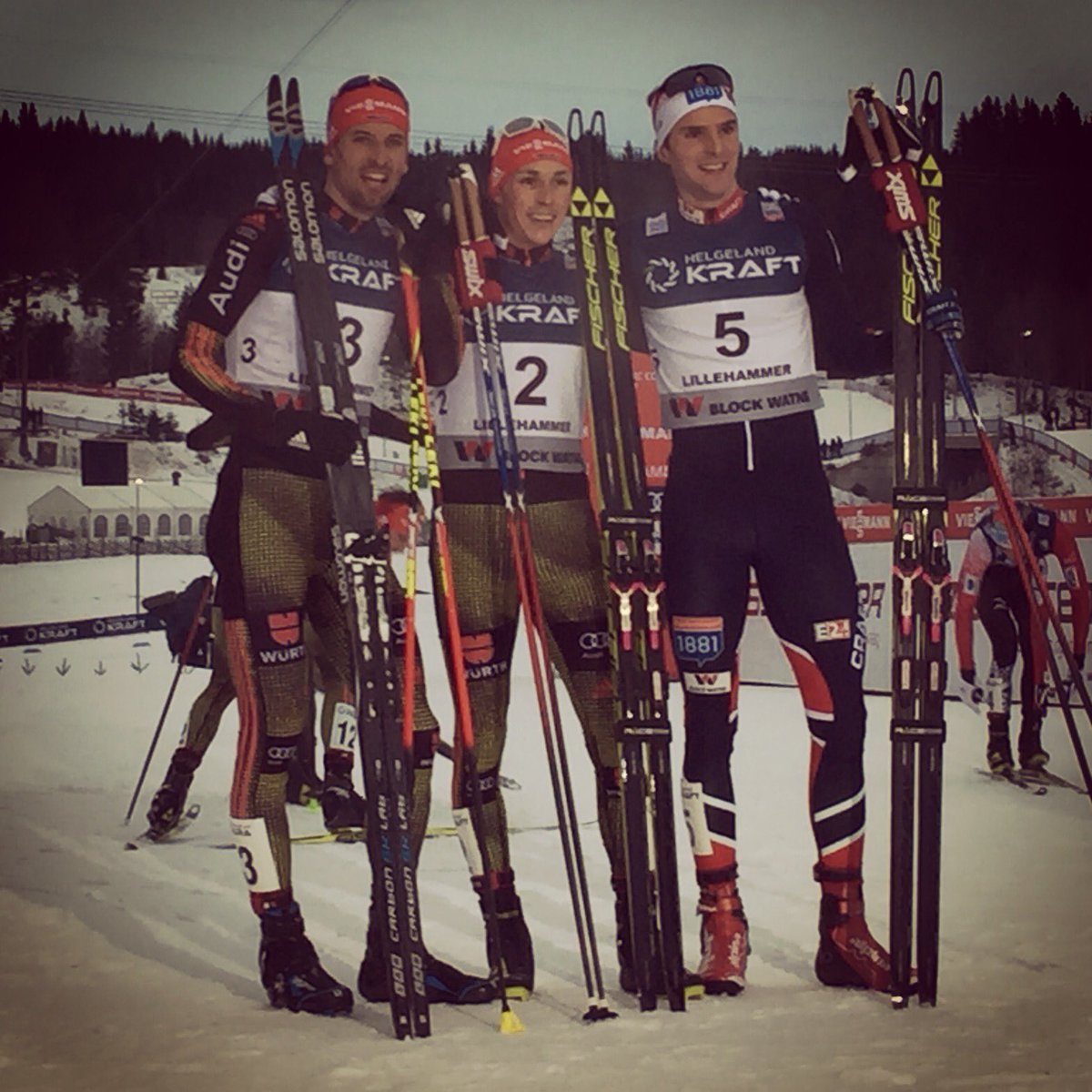
    German winner Eric Frenzel (c) with teammate Björn Kircheisen (l) in second and Norway's Jørgen Graabak (r) in third on Day 3 of the Nordic Combined World Cup in Lillehammer, Norway. (Photo: FIS Nordic Combined/Twitter)
    German winner Eric Frenzel (c) with teammate Björn Kircheisen (l) in second and Norway’s Jørgen Graabak (r) in third on Day 3 of the Nordic Combined World Cup in Lillehammer, Norway. (Photo: FIS Nordic Combined/Twitter)

    [UPDATE) Twenty-second in the jump. Ninth at the finish. That’s a bit more like it for U.S. Nordic Combined’s Bryan Fletcher. The American jumped to 22nd on Sunday on the large hill in Lillehammer, Norway, then raced to ninth in the 10 k Gundersen start cross-country race. He finished 1:22 minutes behind race winner Eric Frenzel, who notched his second-straight individual victory and third win (including Friday’s team event) of the Nordic Combined World Cup’s long weekend in 25:13.6.

    “Going into the race on Sunday I was confident that with a good race I could move up quite well,” Fletcher wrote in an email. “So I just set out to ski my own race and right from the start I was moving up. Top 10 was the goal and I was happy to accomplish that.”

    Germany went 1-2 with Björn Kircheisen in second (+10.8) and Jørgen Graabak of Norway finished third (+23.4) on Day 3 in Lillehammer. Fletcher’s younger brother Taylor Fletcher placed 26th (+2:21.1), moving way up from 48th in the jump (with the fastest overall course time). Also for the U.S., Ben Berend placed 49th (+4:30), and Ben Loomis was 52nd (+5:16).

    The Nordic Combined World Cup is turning out to be all about Germany (most) all of the time, with Frenzel and Johannes Rydzek at the forefront, after Rydzek won both opening World Cup competitions last weekend.

    On Friday, the German teammates started off the three-day series with a victory in the first 4 x 5 k team event of the season. They teamed up with Kircheisen and Fabian Riessle for first, beating Norway by 31.5 seconds with a winning time of 49:34.9.

    Norway’s squad, with Mikko Kokslien, Espen Andersen, Håvard Klemetsen, and Graabak, finished second without anyone else in sight. Austria took third (+1:23.7) with David Pommer, Mario Seidl, Wilhelm Denifl, and Phillipp Orter.

    Finland placed fourth, Japan was fifth, France sixth, the Czech Republic seventh, Italy eighth, and the U.S. ninth (+4:19.1), ahead of Russia in 10th.

    The order for the U.S. team was Bryan Fletcher, Berend, Loomis, and Taylor Fletcher. They rose as high as sixth during Bryan’s first leg, but dropped to eighth and finally ninth.

    On Saturday, in the individual normal hill/10 k competition, Frenzel overtook Rydzek for the win in 24:35. Rydzek started the day by winning the jump, and Frenzel ranked fourth heading into the 10 k Gundersen start. Frenzel overcame a 24-second deficit at the start to pass Rydzek and beat him by 15 seconds at the finish. Germany ended up sweeping the podium with Riessle in third (+25.8), after Riessle improved from 11th at the start with the second-fastest course time.

    Also on Saturday, Taylor Fletcher led the Americans in 26th (+1:51.2) after jumping to 44th and starting 2:02 minutes back from Rydzek. Fletcher skied the ninth-fastest course time.

    Bryan improved from 43rd at the start to 32nd (+2:32.9), Loomis ended up 43rd (+5:02.6) and Berend 44th (+5:33.4).

    “Going into this weekend I was feeling good and had some solid jumps in training so I knew that I was capable of a decent performance,” Bryan wrote on Sunday. “However, I struggle to put all the pieces together through the weekend. The team event was a good performance on my part and it was fun to ski with our young guys too. In Saturday’s event, I was close but had a rather unusual race in which I just couldn’t get going and fell off the pace quickly. Sunday however it all came together with a decent jump and race to finish 9th. This is more indicative of my true level at the moment so I was happy to finally fall into form.


    “This is definitely a result that I was hoping for in this period,” he continued. “I would like to finish in the top 10 consistently this year and it was a bit of a shaky start but I am starting to find the rhythm now. I hope to continue this momentum in Ramsau.”

    Results: Friday’s relaySaturday’s normal hill/10 k | Sunday’s large hill/10 k

    ***

    IBU World Cup in Östersund: 10/12.5 k pursuits

    Men’s report | Women’s report

    Lowell Bailey came oh-so-close to fourth place on Sunday. Just two fewer misses and he could’ve been in the hunt, but that’s how biathlon goes.

    US Biathlon’s top man so far this season, Bailey started 13th in the IBU World Cup 12.5 k pursuit on Sunday in Östersund, Sweden, and by the first prone stage, he was up to seventh with clean shooting. Two-and-a-half kilometers later, he was back in the range and shooting without a miss again. Bailey headed out on his third loop in fourth, and more or less held that position through the third shooting — cleaning yet again in standing.

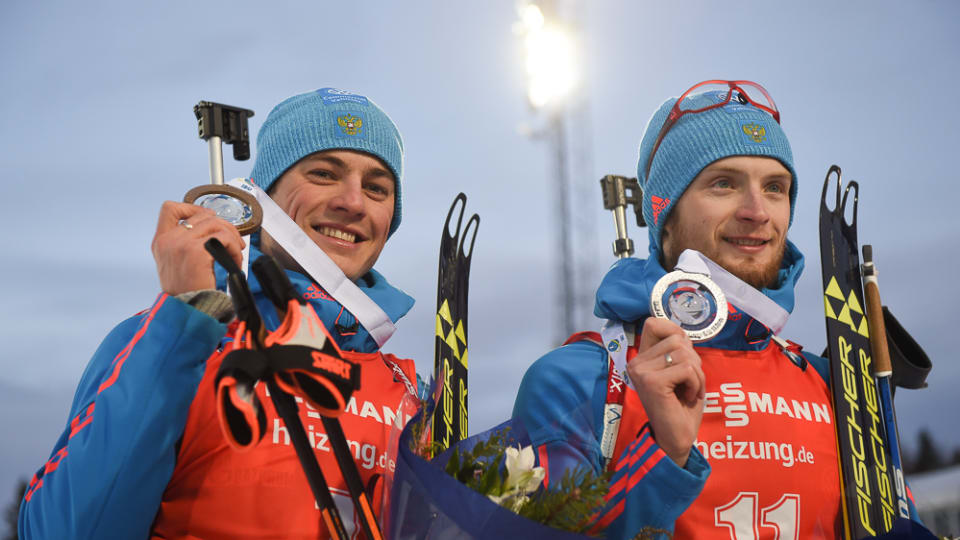
    Russia went 1-2 in the men's 15 k pursuit on Sunday at the IBU World Cup in Ostersund, Sweden, with Anton Babikov (l) winning his first World Cup and Maxim Tsvetkov (r) placing second. (Photo: IBU)
    Russia went 1-2 in the men’s 15 k pursuit on Sunday at the IBU World Cup in Ostersund, Sweden, with Anton Babikov (l) winning his first World Cup and Maxim Tsvetkov (r) placing second. (Photo: IBU)

    But two misses on the final standing dropped him to ninth, and on the final loop, Bailey slipped six spots to 15th at the finish. With two penalties (0+0+0+2), Bailey finished 1:21.8 behind the winner, Russia’s Anton Babikov, who hit 19-of-20 targets en route to his first World Cup victory and podium. Russia took second place as well with Maxim Tsvetkov shooting clean (0+0+0+0) and finishing 10.5 seconds behind his teammate, and France’s Martin Fourcade pushed through four penalties (2+0+0+2) to place third (+15.2).

    Fourcade started the day in first, after winning Saturday’s sprint, and lost the lead on the final stage, with two misses sending him to the penalty lap. On that last shooting, Babikov (the seventh starter) took control, and Tsvetkov (who started 11th) moved up from skiing in third for most of the race to second place.

    Also for the U.S., Tim Burke placed 35th (+2:39.2) after starting 29th, with four penalties (0+1+2+1).

    Canada’s Scott Gow finished 47th (+3:34.8) with three misses (0+0+2+1), Brendan Green was 50th (+3:45.5) wit five misses (1+3+0+1), and Macx Davies 51st (+3:54.6) with four penalties (0+0+2+2).

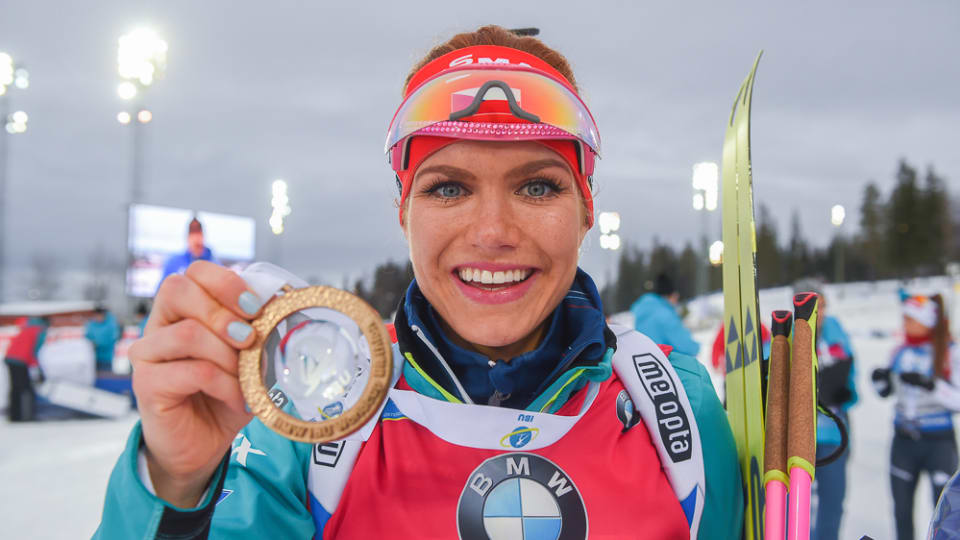
    Gabriela Koukalová of the Czech Republic with her first-place prize after winning Sunday's 10 k pursuit at the IBU World Cup in Ostersund, Sweden. (Photo: IBU)
    Gabriela Koukalová of the Czech Republic with her first-place prize after winning Sunday’s 10 k pursuit at the IBU World Cup in Ostersund, Sweden. (Photo: IBU)

    In the women’s race, Gabriela Koukalová (formerly Soukalova, you’ll get used to it, we promise), took her third-place finish in Saturday’s sprint and catapulted herself into first on Sunday in the 10 k pursuit. Koukalova shot 19-for-20, missing just one on the first standing (0+0+1+0) to cross the finish line first, 8.4 seconds ahead of Germany’s Laura Dahlmeier.

    While Koukalova, of the Czech Republic, took the win in 31:43.3, Dahlmeier placed second (after starting fourth) with two penalties (0+1+1+0). Italy’s Dorothea Wierer improved from 19th to third (+21.4) at the finish, with perfect shooting (0+0+0+0).

    Switzerland’s Lena Häcki also cleaned for fourth (+36.3), after starting 12th.

    The first out of the gate (the winner of Saturday’s sprint), France’s Marie Dorin Habert dropped to seventh, more than a minute and 15 seconds back, with six penalties (2+1+2+1).

    American Susan Dunklee moved up to 22nd (+2:55.7) after starting 27th, despite five penalties (2+2+0+1).

    Also for US Biathlon, Clare Egan improved to 30th (+3:35.4), up from 44th, with three misses (0+0+1+2).

    Joanne Reid (US Biathlon) finished 47th (+4:59.6) with four misses (1+1+1+1), and Canada’s Julia Ransom finished 58th (+6:36.8) with eight misses (2+0+4+2).

    Results: MenWomen 

    ***

    FIS Cross-Country World Cup in Lillehammer: 10/15 k classic pursuits

    Women’s report | Men’s report 

    Martin Johnsrud Sundby is the man to beat once again after winning the men’s 15-kilometer classic pursuit on Sunday in Lillehammer, Norway. The Norwegian started seventh and overcame a 50-second deficit to Sweden’s Calle Halfvarsson, the leader going into the final day of the mini tour. Halfvarsson dropped to fifth, while Sundby rose to first and brought another Norwegian Johannes Høsflot Klæbo to the top with him. Klæbo started sixth, 3 seconds ahead of Sundby, and placed second, 2.3 seconds behind him. Finland’s Matti Heikkinen took the final spot on the podium in third (+2.7), by 0.9 seconds over Norway’s Emil Iversen in fourth. Halfvarsson was 6.3 seconds back in fifth, his Swedish teammate Marcus Hellner sixth (+6.8), Norway’s Pål Golberg and Finn Hågen Krogh seventh (+9.9) and eighth (+15.0), respectively, and Canada’s Alex Harvey ninth (+16.2), ahead of Finland’s Iivo Niskanen in 10th (+52.0)

    Canada had two in the points with Devon Kershaw rising from 43rd to 27th (+2:08.5). Len Valjas placed 48th (+3.44), Graeme Killick was 53rd (+3:53.9), Knute Johnsgaard 72nd (+6:20.3), Bob Thompson 81st (+8:16.3), Andy Shields 83rd (+9:57.3).

    For the U.S., Noah Hoffman rose to 36th (+2:39.5) after starting 48th, Erik Bjornsen finished 57th (+4:33.3), and Eric Packer finished out his first overseas mini tour in 68th (+5:45.1).

    Heidi Weng (c) held onto her lead to win the Lillehammer mini-tour by 16.1 seconds over Norwegian teammate Ingvild Flugstad Østberg (l). Finland's Krista Parmakoski was third after losing a shot at second thanks to a crash. (Photo: FIS Cross Country/Twitter)
    Heidi Weng (c) held onto her lead to win the Lillehammer mini-tour by 16.1 seconds over Norwegian teammate Ingvild Flugstad Østberg (l). Finland’s Krista Parmakoski was third after losing a shot at second thanks to a crash. (Photo: FIS Cross Country/Twitter)

    Heidi Weng of Norway started the 10 k pursuit in first place, and that’s where she finished it, 16.1 seconds ahead of teammate Ingvild Flugstad Østberg. Finland’s Krista Parmakoski rounded out the podium in third, after skiing up from a fifth place starting position and passing Østberg near the end of the race but then crashing on a downhill and losing valuable seconds. Nevertheless her effort gave Parmakoski the fastest ski time of the day.

    Jessie Diggins, who started the race in third position after winning yesterday’s 5 k skate, made an early bid to ski with Østberg but ultimately lost ground, ending eighth, +1:39.4.

    Instead it was Marit Bjørgen who took fourth, +57.5. Stina Nilsson of Sweden was one of the biggest movers of the day, skiing from 27th at the start all the way up to fifth, +1:26.1.

    Following Diggins, Sadie Bjornsen finished 11th, +1:51.2. The American had started in a pack of skiers and stayed there for most of the race. Liz Stephen was 38th (+3:31.8), and Rosie Brennan and Caitlin Patterson 41st (+3:50.2) and 42nd (+3:56.8). Ida Sargent rounded out the U.S. results in 57th (+5:39.7).

    Emily Nishikawa led the Canadians in 46th (+4:08.5), with Cendrine Browne and Dahria Beatty 52nd (+4:41.5) and 59th (+6:08.2).

    Results: Women | Men

  • Weekly Roundup: Lillehammer Mini Tour, Östersund and Bozeman

    Weekly Roundup: Lillehammer Mini Tour, Östersund and Bozeman


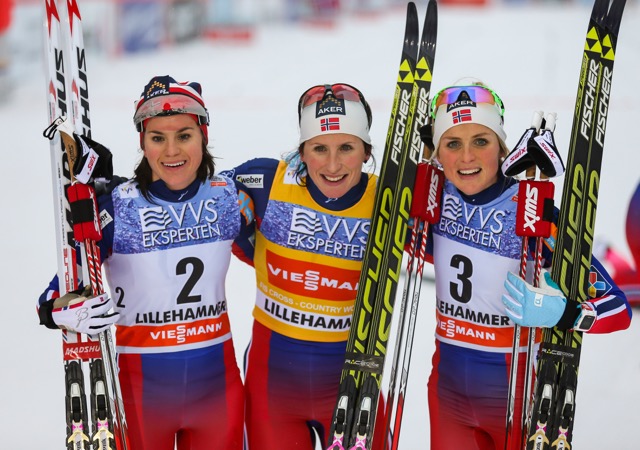
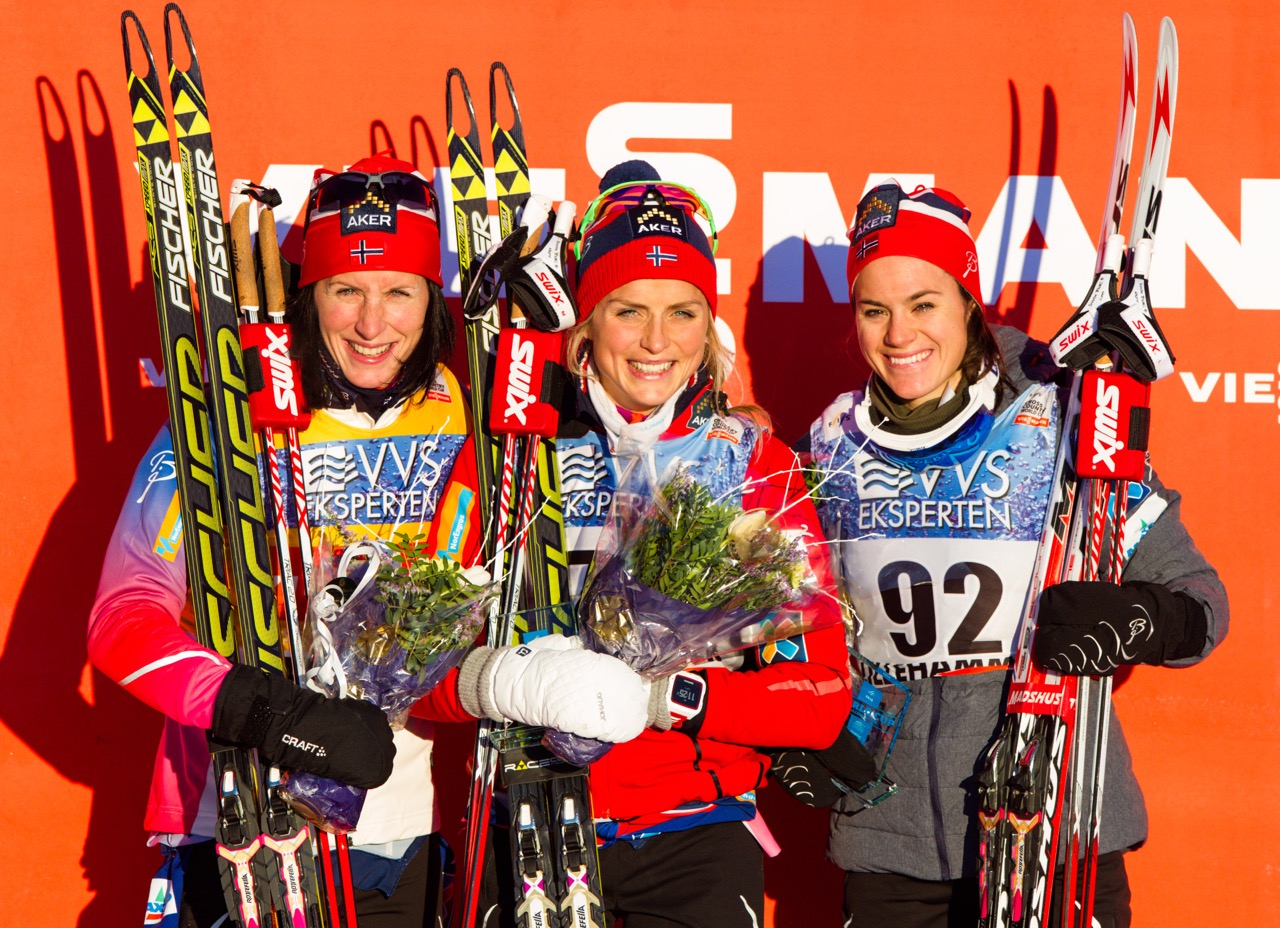
    Look familiar? We saw this all-Norwegian podium twice, except with Therese Johaug (r) as the winner and Marit Bjørgen (c) in second in the 5 k freestyle on Day 2 of the Lillehammer World Cup mini tour. On Day 3, Bjørgen won it outright over Johaug, and Heidi Weng (l) was once again third. (Photo: Fischer/NordicFocus)
    Look familiar? We saw this all-Norwegian podium twice, except with Therese Johaug (r) as the winner and Marit Bjørgen (c) in second in the 5 k freestyle on Day 2 of the Lillehammer World Cup mini tour. On Day 3, Bjørgen won it outright over Johaug, and Heidi Weng (l) was once again third. (Photo: Fischer/NordicFocus)
    As Chelsea Little pointed out in her story about France’s Martin Fourcade dusting the men’s field in the 10-kilometer sprint last Saturday in Östersund, Sweden, “when he’s on, he’s on.”

    And he wasn’t the only one repeatedly in the headlines of the IBU and FIS World Cup and U.S. SuperTour coverage this past weekend. We got used to Norwegian winners like Marit Bjørgen and Martin Johnsrud Sundby, and Alaska Pacific University’s Rosie Brennan — who’s won three out of four SuperTour races this season.

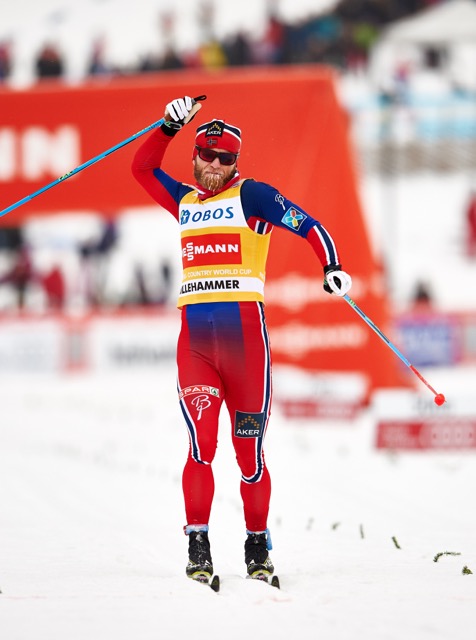
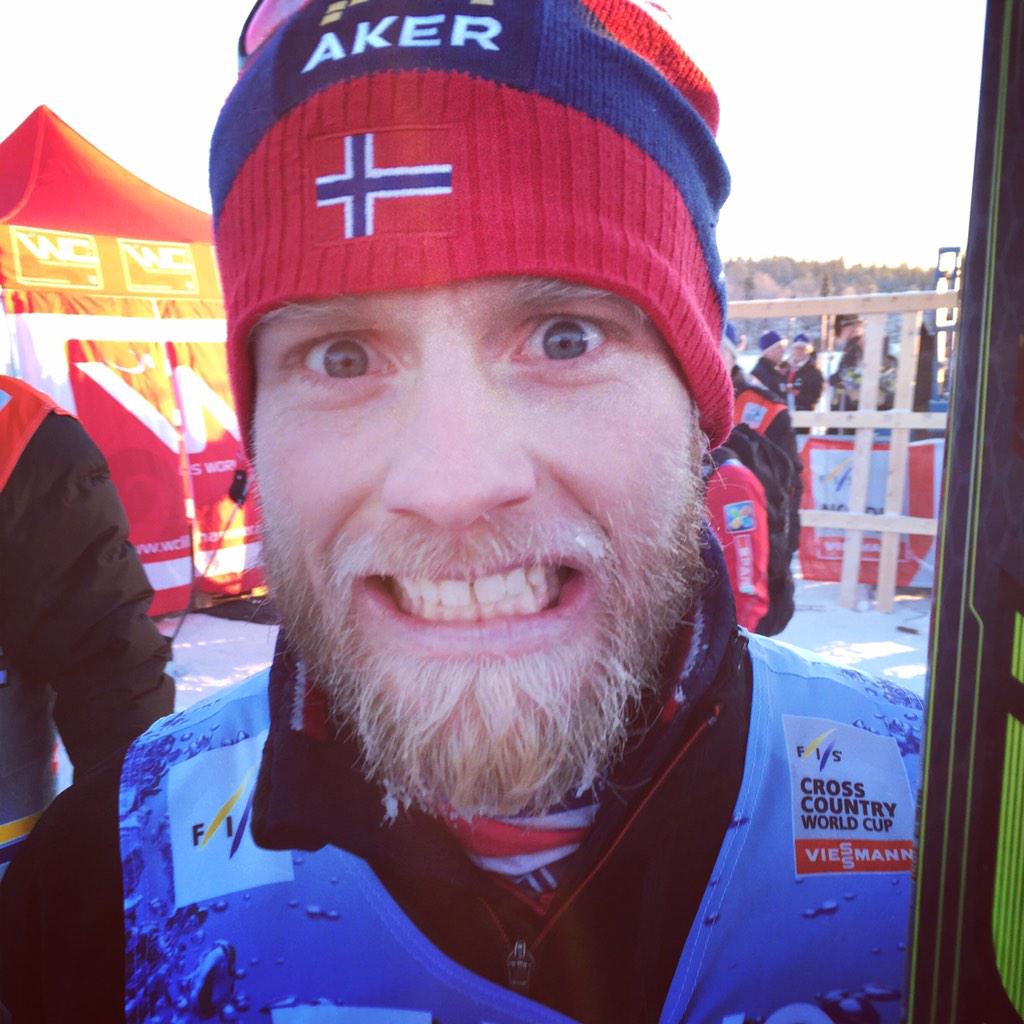
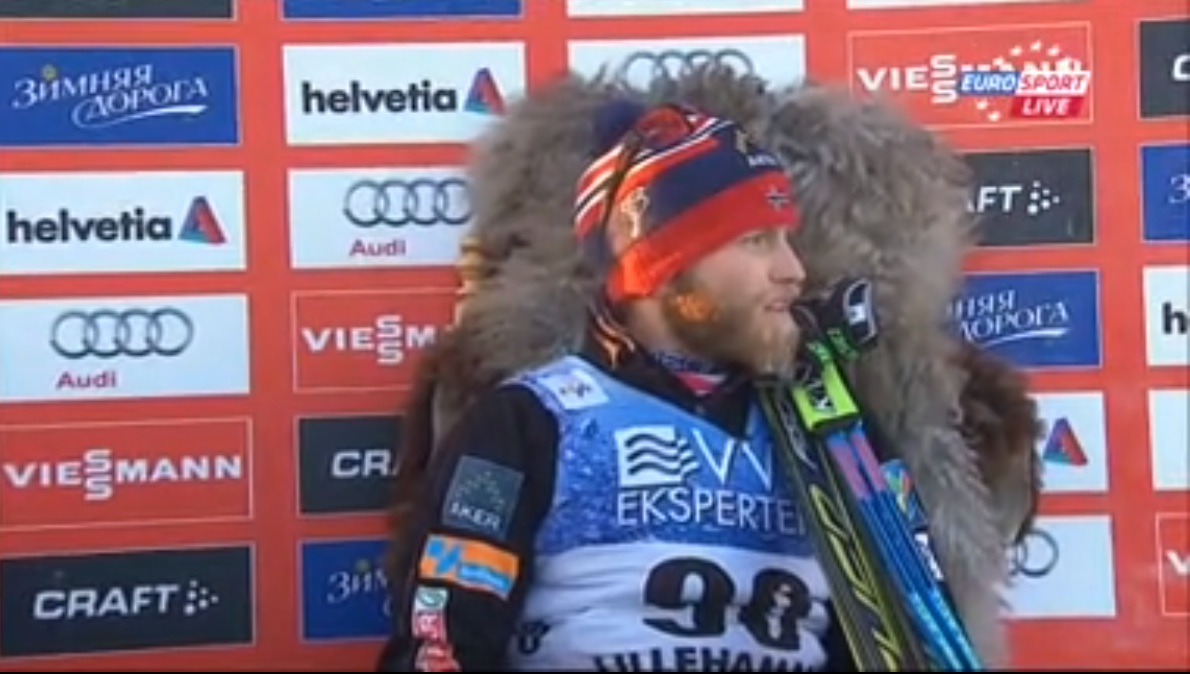
    A pumped Martin Johnsrud Sundby (Norway) after winning the men's 15 k classic pursuit for the overall Lillehammer mini-tour title on Sunday in Norway. (Photo: Fischer/NordicFocus)
    A pumped Martin Johnsrud Sundby (Norway) after winning the men’s 15 k classic pursuit for the overall Lillehammer mini-tour title on Sunday in Norway. (Photo: Fischer/NordicFocus)
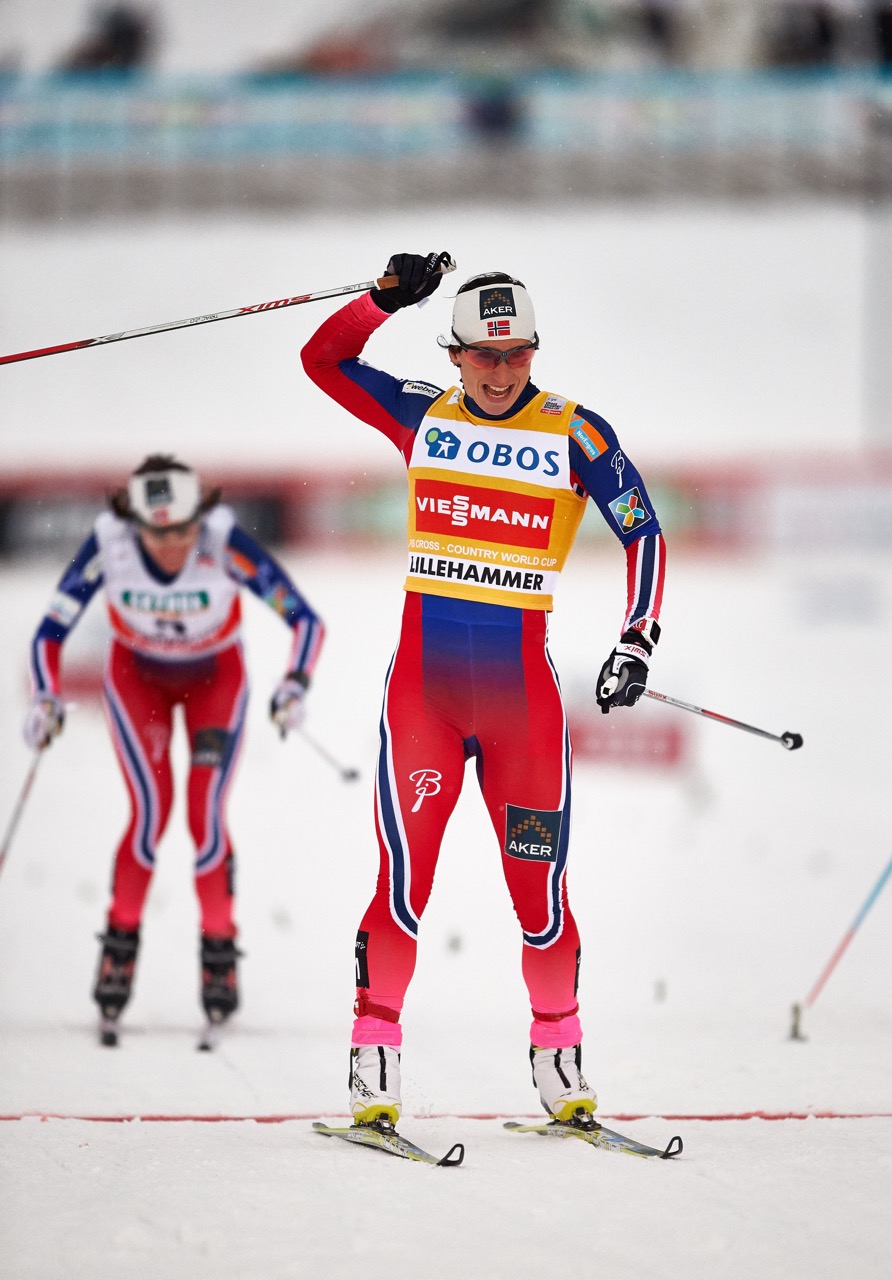
    Then there were consistent top performers in the Lillehammer World Cup mini tour: Alex Harvey of the Canadian World Cup Team placed fifth in last Friday’s skate sprint and ended up 10th overall in the three-stage series, and Sadie Bjornsen led the U.S. Ski Team in 18th overall.

    Also in Lillehammer, Bryan Fletcher of the U.S. Nordic Combined team rose from 36th to eighth on Sunday for a season best. His teammate, Adam Loomis notched a career-best 35th.

    At the five-race IBU World Cup in Östersund, Canada’s Megan Heinicke rose to a career-best 12th in the women’s 15 k individual last Thursday.

    “I have never started the season so relaxed and feeling so little pressure,” Heinicke explained after the race, in which she shot 19-for-20. “I wasn’t even sure if I should start this season and I think the low expectations (from myself and others) really helped me lose that nervous ‘I have to hit’ feeling.”

    After placing ninth and 12th, respectively, in Saturday’s sprints, Canadians Nathan Smith and Rosanna Crawford qualified for the Östersund pursuit, where Smith was on track for a possible top-four finish before missing his first three shots of the day in the final standing stage.

    C’est la vie — that’s biathlon. He ended up 16th and Crawford took 14th. Meanwhile, Americans Lowell Bailey and Susan Dunklee finished 17th and 19th, respectively. In the 20 k individual earlier in the week, Tim Burke placed 11th and Bailey was 20th, and Dunklee took 21st in the women’s 15 k. Burke went on to place 17th to lead the U.S. in the sprint.

    FasterSkier was on site for the second SuperTour the season in Bozeman, Mont., as racers weathered unseasonably warm temperatures on Saturday and Sunday — well above 40-degrees Fahrenheit.

    Rosie Brennan (APU) glides to a first-place finish during the women's SuperTour classic sprint at Bohart Ranch near Bozeman, Mont.
    Rosie Brennan (APU) double poling to the women’s SuperTour classic-sprint victory last Saturday at Bohart Ranch near Bozeman, Mont.

    But with freezing temperatures overnight, the 5 k distance course became fast and icy Sunday morning, and organizers postponed the classic mass starts an hour to let the snow thaw. Still, Brennan dreaded what awaited her in the women’s 10 k.

    She called the conditions her least favorite, in fact, “her worst nightmare,” she said. But the Anchorage, Alaska, resident used the race as an opportunity to conquer some fears. Brennan ultimately edged APU teammate Chelsea Holmes by five seconds for the win.

    “She just crushes me in double pole,” Holmes said, “Which is good — I see her go by and I go as hard as I can to keep up with her, and maybe one day I will be able to.”

    The next-closest finisher, 17-year-old Katharine Ogden finished 1:20 back in third. She called the conditions “an extra challenge,” but was glad to have kick that lasted throughout. “Our skis were really fast,” she said.

    In the men’s race, Matt Gelso of the Sun Valley Ski Education Foundation (SVSEF) Gold Team racked up his third SuperTour podium of the season so far, finishing third behind winner Mads Strøm (University of Colorado) and SVSEF teammate Miles Havlick, respectively.

    At Canada’s opening domestic biathlon races (and Youth-Junior World Championships Team, as well as IBU Cup Team trials) in Canmore, Alberta, Sarah Beaudry won back-to-back sprints to punch her ticket to the IBU World Cup this coming weekend in Hochfilzen, Austria.

    SuperTour #2, Bohart Ranch, Bozeman, Mont.

    FIS Cross Country World Cup #2, Lillehammer (Mini Tour), Norway

    IBU World Cup #1, Östersund, Sweden

    FIS Nordic Combined World Cup #2, Lillehammer, Norway

    Biathlon NorAm, Canmore, Alberta

  • Harvey Wraps Up Lillehammer Pursuit in 10th; Babikov Jumps 28 Spots

    Harvey Wraps Up Lillehammer Pursuit in 10th; Babikov Jumps 28 Spots

    Alex Harvey (r) of Canada leads (r-l) Russian Mixim Vylegzhanin, Dario Cologna of Switzerland, and Evgeniy Belov of Russia in Sunday's 15 k classic pursuit in Lillehammer, Norway. He finished in 10th position in the mini tour.
    Alex Harvey (r) of Canada leads (r-l) Russian Mixim Vylegzhanin, Dario Cologna of Switzerland, and Evgeniy Belov of Russia in Sunday’s 15 k classic pursuit in Lillehammer, Norway. He finished in 10th position in the mini tour. (Photo: Fischer/Nordic Focus)

    Alex Harvey skied like he had something to prove in Sunday’s final stage of the World Cup mini tour in Lillehammer, Norway.

    In Saturday’s 10 k freestyle interval start, Harvey finished 33rd after suffering from characteristic leg pains and walked away wanting more. Fortunately for the 2011 World Champion, his standing in the tour didn’t fall far after the race – 11th place – meaning he was in position to fight for a spot in the top-ten in Sunday’s 15 k classic pursuit.

    Starting 59.0 seconds back from tour leader Finn Krogh of Norway, Harvey quickly joined a large pack of skiers that included Swiss Olympic Champion Dario Cologna, Andrew Musgrave of Great Britain, and Norwegians Niklas Dyrhaug and Didrik Tønseth, among others.

    As they attempted to chase down the five leading men Harvey jostled between the middle and front of the pack, at times heading the charge.

    However, when it came to the final kilometers, Harvey could not hold the pace set by a surging Tønseth and crossed the line in tenth position, 52.5 seconds from tour winner Martin Sundby of Norway. Despite his improvement of one place, Harvey clocked the seventh fastest time of the day, trailing Tønseth by 20.5 seconds.

    After the 15 k Harvey said that he was happy with how his racing played out and said the previous day’s recovery played a large role in his ability to preform in the pursuit.

    “During these stage races, at some point your body dictates how you are going to feel. You have to focus on recovery so last night I just did all the proper things to allow my body to recover overnight and I felt really good and strong today,” he said in a press release.

    In regards to the weekend of racing, Harvey explained that he considered the mini tour a success even if he was disappointed in his 10 k freestyle.

    “Overall I had two out of three good races this weekend so I have to be happy,” he said. “I guess I’ll have to work a bit on my skate-skiing but overall I am pleased.”

    Starting roughly a minute behind Harvey was fellow Canadian Ivan Babikov in 56th position.

    Babikov, who advanced from 100th to 56th after Saturday’s freestyle race, made another large jump in the classic pursuit.

    With fast skis and a strong will to improve his standing, Babikov maneuvered the chaotic spread of skiers. Initially jumping in behind a group of Norwegians and then facing the last kilometers by himself, he advanced 28 spots to earn the 10th fastest time on the day.

    “I was surprised. I was feeling well and skiing well but I didn’t know I was that close,” Babikov said in a phone interview. “Coming from the 50s and 60s it’s tough. Everyone is trying to ski around everyone. I was super happy with the race. It’s one of my best classic races ever.”

    Devon Kershaw strides up a hill in Sunday's 15 k classic pursuit in Lillehammer Norway. The three-race series made up a World Cup mini tour. Kershaw ended the Tour in 41st position. (Photo: Fischer/Nordic Focus)
    Devon Kershaw strides up a hill in Sunday’s 15 k classic pursuit in Lillehammer Norway. The three-race series made up a World Cup mini tour. Kershaw ended the Tour in 41st position. (Photo: Fischer/Nordic Focus)

    The result is one of Babikov’s best finishes in a classic discipline in World Cup racing. The only races in which he earned better placement were in a 2013 Tour de Ski 15 k classic mass start in Val di Fiemme, Italy where he place 7th and in the 15 k classic mass start in Szklarska Poreba, Poland where he finished 9th in January of 2014.

    Babikov said his 28th place overall was affirmation of his fitness and abilities – especially after the opening World Cup weekend in Kuusamo, Finland and the first mini tour, where Babikov said he struggled to find speed.

    But with the pursuit under his belt, he said that Sunday’s race was “exactly what he needed” before progressing through the rest of the season.

    Shortly after completing the mini tour, Babikov left Lillehammer to begin the journey back to Canada. He will be sitting out the World Cup races in Davos in order to spend time with his family but plans to be back in Europe for the following World Cup races in La Clusaz, France Dec. 20-21.

    Demonstrating another strong effort from the Canadian men was Devon Kershaw who advanced 25 spots from 66th to 41st. Clocking the 29th fastest time, Kershaw wrote that he was motivated to have a strong start after “awful” races the previous days.

    After skiing an aggressive first half in which he caught Babikov, Kershaw began to struggle.  However, despite a near blow up he was able to salvage his race for his best result of the weekend.

    “The turning point in the race was halfway up the giant hill in the back on my second lap. That’s when the race went from very good to in danger of being another stinker. I got dropped by Babs (Babikov) and [Simen] Sveen there and then started to really, really hurt. I was deep in the pain cave there and the fact that I was able to bring it around at all is a small victory for me,” he wrote in an email.

    Other Canadians who competed in the 15 k pursuit were Jesse Cockney in 67th, Len Valjas in 71st, and Graeme Killick in 73rd.

    For the women, Canada’s only finisher was Emily Nishikawa who gained 22 places to finish in 46th. Perianne Jones did not start.

    The Canadians and the rest of the World Cup circuit will now travel to Davos, Switzerland where they will compete in a freestyle sprint and a classic 10/15 k. The distance races were originally scheduled to be 15/30 k distances but due to the lack of snow in Davos, FIS and local race organizers decided to cut the lengths.

    Results: Men’s 15 k pursuit | women’s 10 k pursuit  

  • Bjørgen Outsprints Johaug in Lillehammer Thriller Pursuit

    Bjørgen Outsprints Johaug in Lillehammer Thriller Pursuit

    Marit Bjørgen (Norway) won her fifth-consecutive World Cup mini tour on Sunday after outsprinting teammate Therese Johaug in the women's 10 k classic pursuit. (Photo: FIS Cross Country/Twitter)
    Marit Bjørgen (Norway) won her fifth-consecutive World Cup mini tour on Sunday after outsprinting teammate Therese Johaug in the women’s 10 k classic pursuit. (Photo: FIS Cross Country/Twitter)

    As so often on the World Cup lately, it’s not a question of who will fight for the victory, but how the competition between Marit Bjørgen and Therese Johaug will unfold.

    After that, it’s usually interesting to see who will take third behind the two Norwegian powerhouses. In the last two races of the Lillehammer World Cup mini tour in Norway, it’s been their teammate: Heidi Weng.

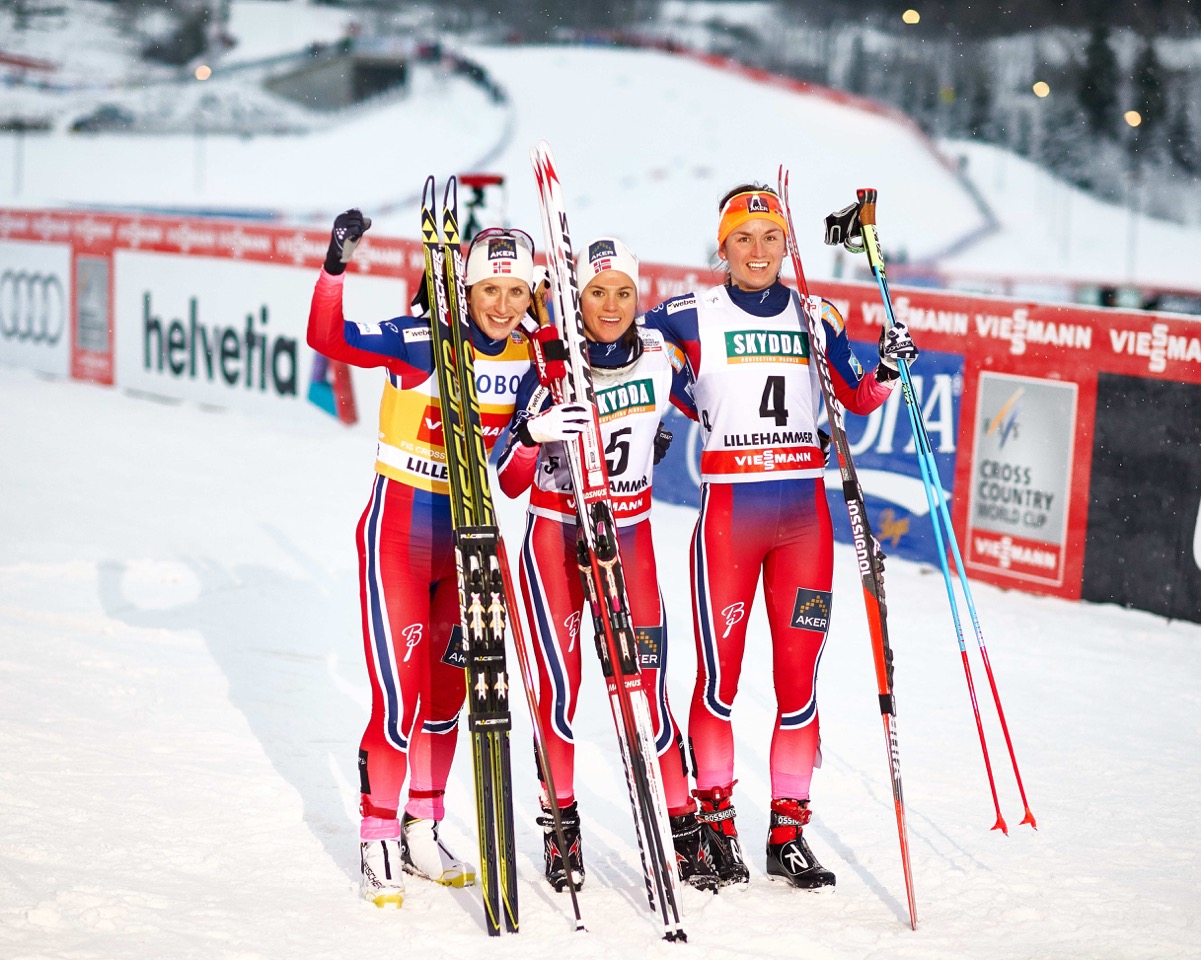
    Roles reversed: the all-Norwegian women's 5 k freestyle podium on Saturday, with winner Therese Johaug (c), Marit Bjørgen in second (l) and Heidi Weng in third. While the top two swapped places in Sunday's final pursuit, Weng held steady for the third-straight race in third. (Photo: Fischer/NordicFocus)
    Roles reversed: the all-Norwegian women’s 5 k freestyle podium at the Lillehammer World Cup on Saturday, with winner Therese Johaug (c), Marit Bjørgen in second (l) and Heidi Weng in third. While the top two swapped places in Sunday’s final pursuit, Weng held steady for the third-straight race in third. (Photo: Fischer/NordicFocus)
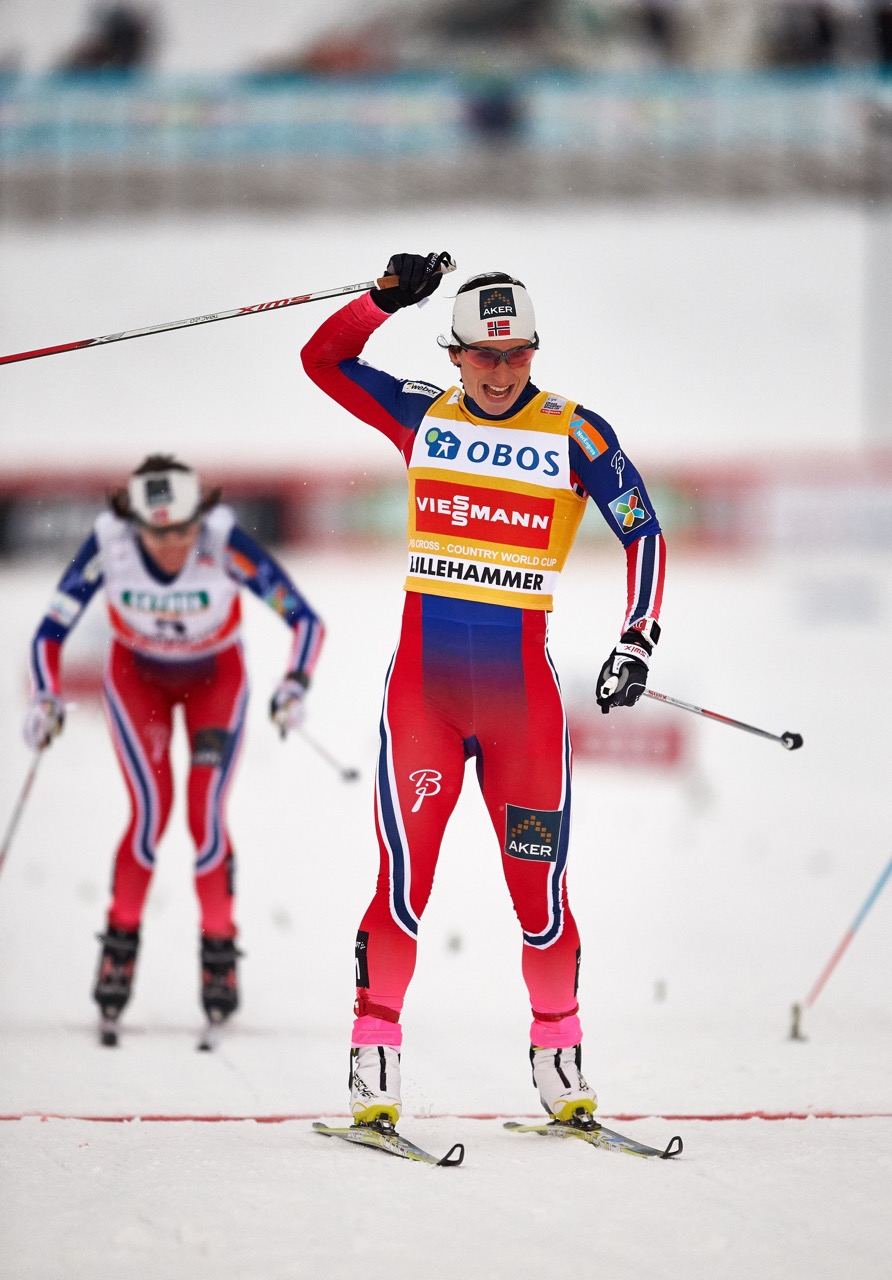
    The women’s 10-kilometer classic pursuit on Sunday was no different. Bjørgen as the mini-tour leader through two races, started 20 seconds ahead of Weng in second and 32 seconds ahead of Johaug in third. For Bjørgen, the classic pursuit — with implications for the Lillehammer triple victory — was all about keeping Johaug behind her.

    Not only is the 10 k classic a Johaug speciality so far this season (after she beat Bjørgen handily by 42 seconds in the event last weekend in Kuusamo, Finland), and on a comparably hilly course in Lillehammer, but Johaug also had the advantage of chasing.

    The women skied two laps on the same 5-k course they grew familiar with in Saturday’s 5 k freestyle (which Johaug won by 0.3 seconds over Bjørgen). On the first lap of Sunday’s pursuit, Bjørgen lost only about 10 seconds to Johaug. But on the second lap, Bjørgen hit the wall, and she hit it hard.

    “I was given splits along the way. It was 29 seconds ahead, 25 seconds, then 13 seconds,” Bjørgen said to reporters after the race. “When I heard 13 seconds, I was thinking, ‘Crap.’ ”

    With 1.8 k remaining, she was 12.1 seconds ahead of Johaug, who rocketed to second, half a second ahead of Weng by the 2.2 k mark. At the halfway point, Johaug was 19 seconds behind Bjørgen with Weng still hanging on 0.3 seconds behind her. Weng would stick with the eventual-runner up through the 7.2 k checkpoint and up until the final climb.

    With about 1 k to go, Johaug passed Bjørgen before the final climb back to the stadium. Bjørgen appeared to struggle to stay with her, but knew that if she did, she’d have an advantage on the downhill into the stadium.

    Coming into the stadium, Johaug remained in the lead until the final turn, where Bjørgen took the inside track to ride up alongside her about 100 meters from the finish.

    “When we were even, I was thinking, ‘No way I’m going to let her beat me. I should beat her in a sprint,’ ” Bjørgen said.

    But considering the way she looking less than a kilometer earlier when Johaug caught her, it was anyone’s guess how much Bjørgen had left for the finish. She wasn’t sure, either.

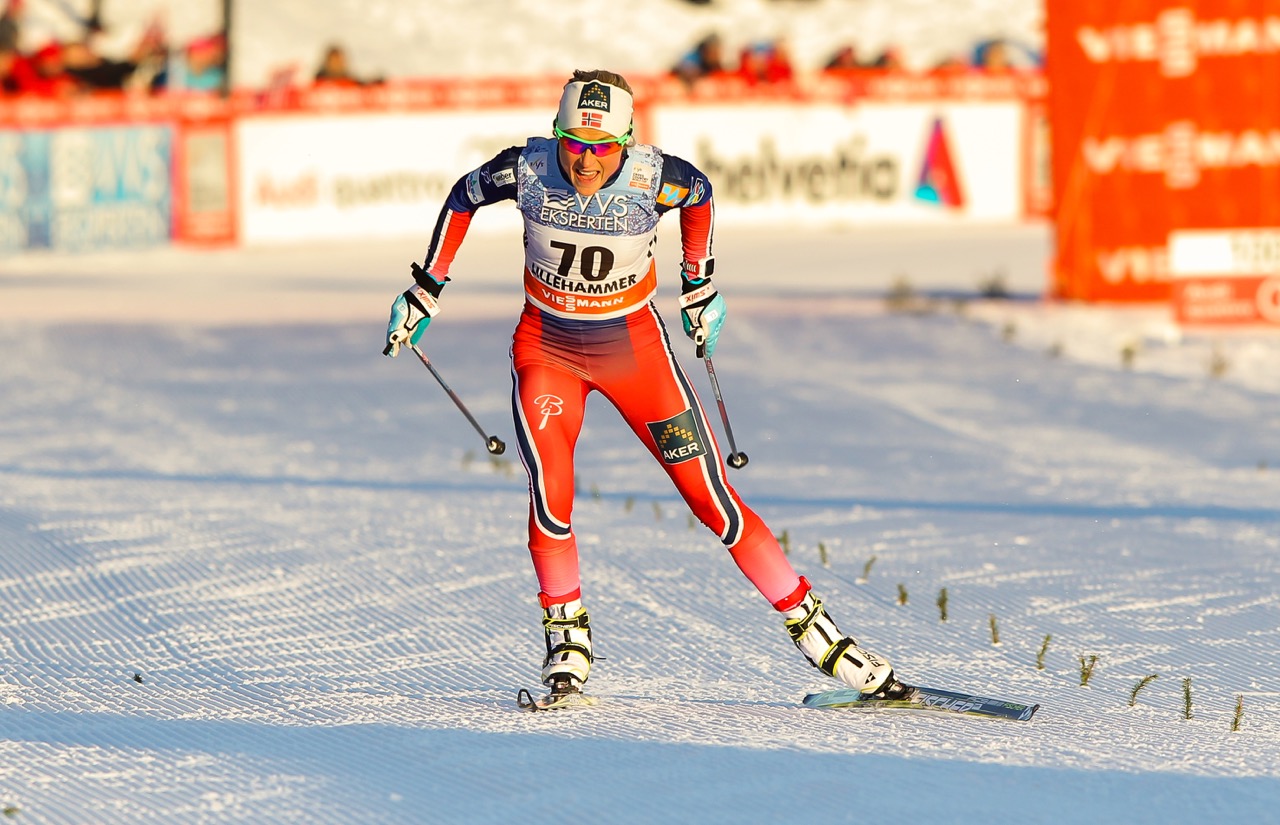
    Johaug on her way to the 5 k freestyle win in Saturday's individual stage, the second stage of the Lillehammer World Cup mini tour. (Photo: Fischer/NordicFocus)
    Therese Johaug on her way to the 5 k freestyle win in Saturday’s individual stage, the second stage of the Lillehammer World Cup mini tour, by 0.3 seconds over Marit Bjørgen. (Photo: Fischer/NordicFocus)

    “My body was not on my side today. I felt heavy and syrupy, and when you feel like that, the seconds are running away from you really fast,” Bjørgen explained.

    She conserved while tucking behind Johaug on the last descent into the stadium, then prepared for her final attack — which left Johaug 0.6 seconds behind at the finish line.

    “And with the effort Therese pulled off today, I felt bad beating her in the sprint,” Bjørgen said after winning the pursuit in 28:19.7, just ahead of Johaug and 12.3 seconds ahead of Weng in third. “But a race is a race.”

    Despite losing, Johaug was impressed with Bjørgen and pleased with her effort.

    “I lost the sprint finish, but I made up 30 seconds on Marit and I had the fastest time for the stage, so that’s my takeaway from the day,” Johaug said. “I did a solid classic race.”

    Johaug completed the course in 27:48.2, nearly 24 seconds faster than Weng as the second-fastest woman of the day. Bjørgen’s time ranked third.

    “My sprint finish was a lot better than it used to be, and [Marit] definitely didn’t park me today,” Johaug said.

    While she didn’t expect to beat Bjørgen in a sprint anytime soon, she explained that Bjørgen’s not unbeatable at that distance, either.

    “She’s a tough cookie and almost nobody in the whole world can beat her in a sprint. But I’m not giving up,” Johaug said.

    Weng secured third after skiing alone in no-man’s-land for the last kilometer or so.

    “Therese came very fast and caught me on the first hill,” she told FIS. “I tried to ski as fast as I could but I could not follow her on the last climb. I am happy about the third podium this season.”

    The fourth-place finisher, another Norwegian — Ingvild Flugstad Østberg — crossed the line 1 minute, 26 seconds after Weng. Østberg improved from fifth to fourth by overtaking teammate Ragnhild Haga early on (after starting with her, 14 seconds behind Johaug and 26 seconds behind Weng).

    Sweden’s Charlotte Kalla started 1 second behind them in sixth, and by the 2.2 k mark, was up to fifth 0.4 seconds behind Østberg. Haga trailed by another 1.3 seconds in sixth.

    At the halfway point, Kalla was up to fourth by 0.4 seconds over Østberg. She continued to lead the Norwegian by the same margin up until the last few hundred meters of the race. In the final stretch toward the finish, Østberg surged hard to drop Kalla, immediately putting at least 10 seconds between them. Østberg secured fourth, 12.6 seconds ahead of Kalla in fifth, and Haga was another 4.4 seconds back in sixth (+1:55.3).

    Norway not only swept the top four, but put six in the top seven in the women’s pursuit. Maiken Caspersen Falla, who started eighth, improved to seventh (+2:00.8). About 12 seconds behind her, Finland’s Krista Parmakoski placed eighth (up from 12th). Also for Finland, Kerttu Niskanen followed just 0.2 seconds back in ninth (up from 16th), and Poland’s Justyna Kowalczyk made it into the top 10 in 10th (up from 30th). Kowalczyk started 1:32 behind Bjørgen and finished 2:15.6 after her.

    Bjørgen’s second win out of three races in Lillehammer lifted her to her fifth-consecutive mini-tour win and gave her a hefty load of World Cup points with it. She is currently 131 points ahead of Johaug in the overall World Cup standings, and Weng overtook Østberg to put herself third, 84 points behind Johaug.

    Results

  • No ‘I’ in Team: Sundby Praises Teammates After Lillehammer 10 k Win, Norwegian Sweep

    No ‘I’ in Team: Sundby Praises Teammates After Lillehammer 10 k Win, Norwegian Sweep

    Martin Johnsrud Sundby (Norway) shows his happy face after winning the men's 10 k freestyle at the Lillehammer World Cup mini tour on Saturday in Norway. (Photo: FIS Cross Country/Twitter)
    Martin Johnsrud Sundby (Norway) shows his happy face after winning the men’s 10 k freestyle at the Lillehammer World Cup mini tour on Saturday in Norway. (Photo: FIS Cross Country/Twitter)

    If you’re trying to imagine how Norway’s Martin Johnsrud Sundby reacted to his win on Saturday, picture his female teammate Therese Johaug realizing she beat Marit Bjørgen by three-tenths of a second for the win. Better yet, watch the video.

    Sundby was basically the opposite of that. It’s not that the 30-year-old defending Overall World Cup champion is too cool to jump up and down and yell, he just had a different way of showing his emotions.

    And he was actually a little emotional on Saturday.

    Sundby led a Norwegian podium sweep, winning the men’s 10-kilometer freestyle individual start — the second stage of the Lillehammer World Cup mini tour — by 2.2 seconds over teammates Finn Hågen Krogh and Sjur Røthe, who was 6.4 seconds back in third.

    Norway's Martin Johnsrud Sundby quietly awaiting his fate while sitting in the leader's chair near the end of the men's Lillehammer World Cup 10 k freestyle on Saturday. He ended up holding off Sweden's Calle Halfvarsson, then teammate Finn Hågen Krogh, for the 2.2-second victory.
    Norway’s Martin Johnsrud Sundby quietly awaiting his fate while sitting in the leader’s chair near the end of the men’s Lillehammer World Cup 10 k freestyle on Saturday. He ended up holding off Sweden’s Calle Halfvarsson, then teammate Finn Hågen Krogh, for the 2.2-second victory.

    Sweden’s Calle Halfvarsson placed fourth, 1.5 seconds off the podium, and Norway took fifth and sixth with Niklas Dyrhaug and Chris Andre Jespersen, respectively.

    “I am happy for the win, but I am extremely happy for the team,” Sundby told FIS.

    With Friday’s sprint winner, Pål Golberg, in 12th and Didrik Tønseth in 17th, the Norwegians had  seven of 15 starters in the top 20. What might be more notable is neither Petter Northug (in 35th) nor Eirik Brandsdal (in 53rd), who led the Overall World Cup before Saturday’s race, were among them.

    “We have trained hard for so many months now, and … for me, kind of a captain for this team, I get a bit touched when the guys are so good,” Sundby said.

    After finishing 14th in the sprint (just like Johaug), Sundby ranked 15th in the mini tour, 27.4 seconds behind Golberg, after Friday’s race. He improved to second on Saturday behind Krogh, and will start 20 seconds after Krogh in Sunday’s 15 k classic pursuit. Golberg will head out 6 seconds later in third.

    Sundby’s win also put him in the yellow bib for in the second World Cup weekend of the 2014/2015 season.

    But even after standing up from the leader’s chair and flexing his right arm a little bit for doting Norwegian spectators, Sundby was quick to defer the attention back to his teammates.

    “It is an absolutely insane team effort,” he told NRK.

    Four different Norwegians took turns in the leader’s chair: first Jespersen (who topped Sweden’s Daniel Richardsson by 13 seconds. Before that, Richardsson ousted Switzerland’s Curdin Purl, who started eighth of 118 men).

    Jespersen’s initial splits weren’t anything outstanding: he ranked 22nd at 2.2 k, but sped up to ninth by the halfway point. With 1.8 k to go, the 31-year-old Jespersen posted the eighth-fastest time of all the finishers. During his race, it was the fastest.

    “I do not think it was so much fun to be peed on last weekend, so I had decided today [to go hard],” he told NRK, referring to the 15 k classic in Kuusamo, Finland, where he placed 45th.

    “The ending was abnormally good to me,” he said of his finish on Saturday.

    The 17th starter, Jespersen remained in the hot seat for some time until his teammate Dyrhaug topped him by 0.6 seconds. Dyrhaug turned it on even later in his race, going from fifth at 7.2 k to first by the finish.

    At the end of the day, Dyrhaug’s 8.3 k time ranked eighth and he ended up fifth.

    Røthe then took over the top position by 12.5 seconds. With Sundby just six starters behind him, he looked as if he knew he wouldn’t be in first for long. Røthe posted the fastest times through every checkpoint but the first one at 0.9 k (where Switzerland’s Roman Furger had the quickest start), until Sundby, Halfvarsson and Krogh came through.

    At 2.2 k, Halfvarsson took the lead, followed by Sundby 3.4 seconds back. The order stayed the same with Røthe in third until 5 k, where Røthe’s time ranked second-fastest by just 0.3 seconds over Sundby.

    Halfvarsson remained in first until 8.3 k, where Sundby, who started 1 minute ahead him, had the edge by 1.1 seconds. Later on, Krogh, the 114th starter, would post the third-fastest time at that marker, 2.7 seconds behind Sundby.

    That’s about when Sundby, in the leader’s chair after displacing Røthe by 6.4 seconds, started to pack up his belongings. Any way about it, even if Krogh had the race of his life and beat him, or Golberg as the last starter picked off six places in the last 2 k to reach the podium, Sundby knew he was headed to the flower ceremony.

    “I did an even race. I tried to push hard last 2 kilometers,” Sundby told FIS. “I tried to collect some seconds on the last uphill where a few skiers were struggling. Everybody must have had tired legs.”

    Finn Hågen Krogh after pushing himself well past the red zone to challenge Norwegian teammate Martin Johnsrud Sundby (not shown) for the win in Saturday's 10 k freestyle individual start at the Lillehammer World Cup. Krogh was 2.2 seconds off the mark for second.
    Finn Hågen Krogh after pushing himself well past the red zone to challenge Norwegian teammate Martin Johnsrud Sundby (not shown) for the win in Saturday’s 10 k freestyle individual start at the Lillehammer World Cup. Krogh was 2.2 seconds off the mark for second.

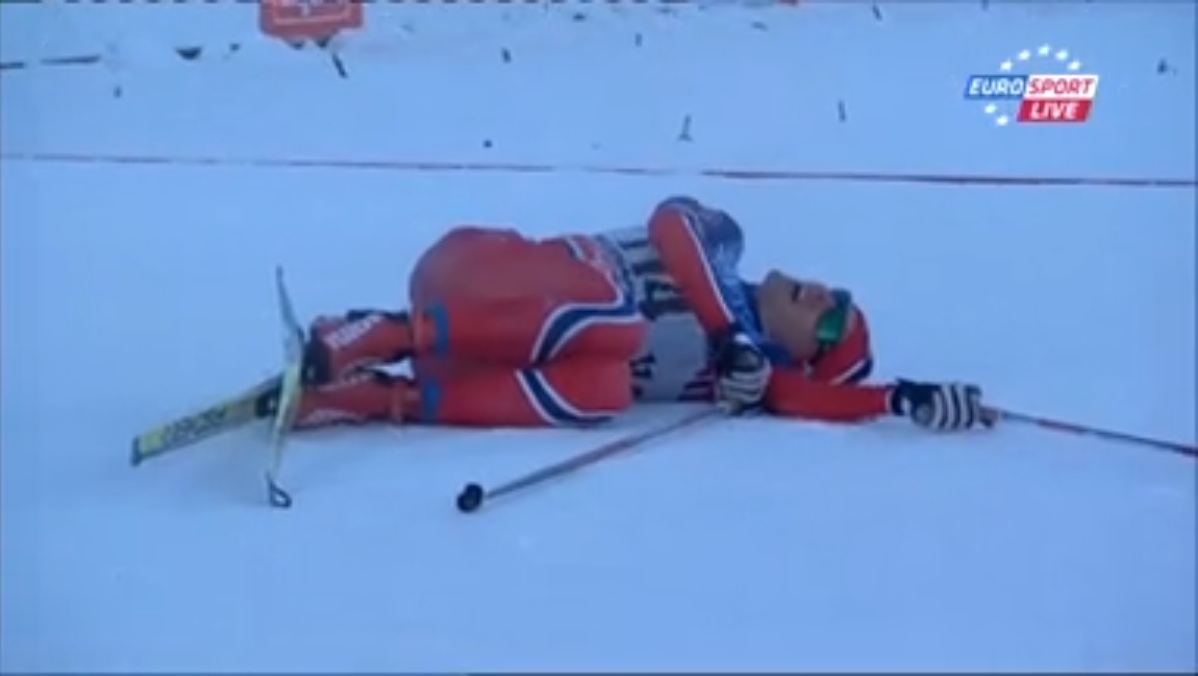
    Halfvarsson faded in the last two kilometers to put himself on the edge of a top-three, finishing 7.9 seconds behind Sundby. Krogh looked to be after the win more than a podium as he pushed himself to the brink into the stadium, collapsing and gasping for air at the finish. He ended up 2.2 seconds behind Sundby for second overall.

    “Since yesterday’s prologue I felt my shape has been very good,” Krogh said. “I was ready for today; it was maybe better than I expected. I found a good rhythm from the start. I had very good skis and I felt confident.”

    Røthe was third, another 4.2 seconds back, and Halfvarsson settled for fourth, 1.5 seconds later.

    “I’m really happy to be back on the podium,” Røthe said after his first individual World Cup podium since placing third in the 2012 skiathlon in Canmore, Alberta (and not counting his second-fastest time in last year’s Tour de Ski final climb in Val di Fiemme, Italy).

    “It is even better to be there with my good friends Finn and Martin,” he added.

    After not feeling quite in top form before Saturday, Sundby, who now leads the Overall World Cup by 9 points over Krogh and 20 points over Brandsdal in third, told reporters he was excited for Sunday’s pursuit.

    “Hopefully we get an exciting race tomorrow,” he told FIS. “I think both the race and the winner could be exciting.”

    ***

    Notes: Great Britain’s Andrew Musgrave, 24, had the best distance race of his career (not counting the eighth-fastest time in the 2014 Tour de Ski final climb) in 13th, which puts him 10th in the mini-tour standings before the pursuit.

    Canadian Alex Harvey dropped from sixth to 11th in the mini tour, after placing 33rd, 54.6 seconds behind Sundby. He cited his bothersome left leg, with a blood-flow issue that typically springs up and pains him on uphill skating courses, as the reason behind his result.

    “At the top of the course [around 3.5 k] before we go back down to the stadium, there’s a lot of offset, like steep climbing and my leg was starting to feel pretty bad already,” Harvey said on the phone. “So I was just fighting against it already and I couldn’t push after that. I couldn’t use my leg much, and the downhills were so icy that it was kind of hard to relax and recover so I was always contracting the legs. It was just a really bad day for my leg I guess.”

    He’ll start Sunday’s pursuit 59.3 seconds behind Krogh and 0.4 behind Musgrave, and is focused on picking off as many places as possible — possibly up to Dyrhaug, who’s starting 16 seconds ahead of him in sixth.

    Complete results | with Splits

  • Pendulum Shifts Again to Johaug, Beats Bjørgen in Lillehammer 5 k Skate 

    Pendulum Shifts Again to Johaug, Beats Bjørgen in Lillehammer 5 k Skate 

    Norway's Therese Johaug realizing she won Saturday's 5 k freestyle on the second day of the Lillehammer World Cup mini tour by 0.3 seconds over teammate Marit Bjørgen. (Aftenposten.no video)
    Norway’s Therese Johaug realizing she won Saturday’s 5 k freestyle on the second day of the Lillehammer World Cup mini tour by 0.3 seconds over teammate Marit Bjørgen. (Aftenposten.no video)

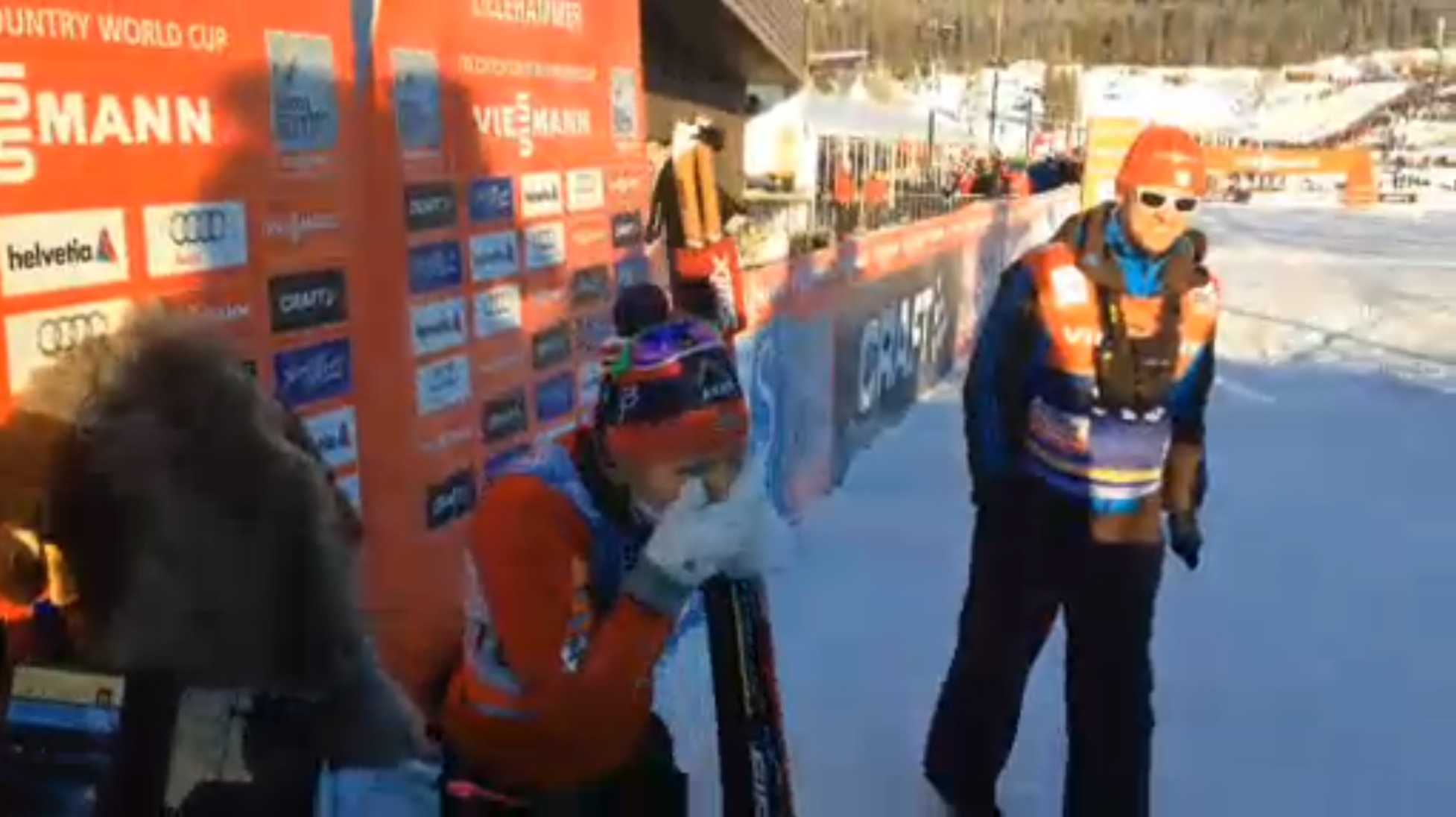
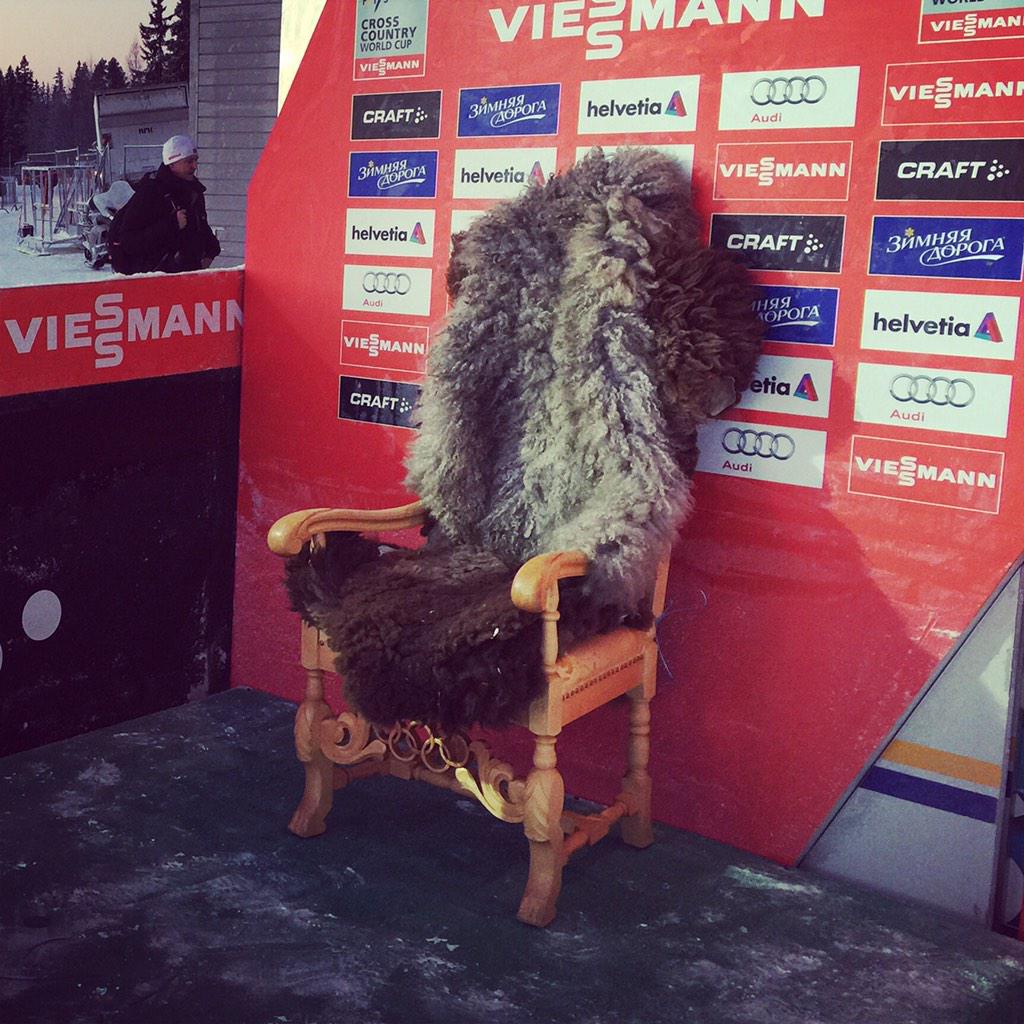
    Sitting in a fur-covered leader’s chair, which resembled a throne with its handcrafted touches and Olympic rings, Therese Johaug clasped one of its wooden arms through her white mitten, holding her skis and poles in the other hand.

    She bit her thumb and tapped her legs furiously in anticipation — waiting for it, waiting for it, until the exact moment when her Norwegian teammate Marit Bjørgen finished and Johaug realized she won Saturday’s 5-kilometer freestyle, the second stage of the Lillehammer World Cup.

    The leader's chair at the Lillehammer mini-tour 5 and 10 k freestyle individual starts on Saturday. (Photo: FIS Cross Country/Twitter)
    The leader’s chair at the Lillehammer mini-tour 5 and 10 k freestyle individual starts on Saturday. (Photo: FIS Cross Country/Twitter)

    Johaug held off Bjørgen by 0.3 seconds with the winning women’s time of 12:33.7. When she knew it was certain, she leapt out of the chair, screaming, then covering her mouth. Then she couldn’t contain it anymore, as she let out some more sounds of elation and smiled for the cameras all around her.

    “This girl was more than just a little bit nervous,” Johaug told the NRK TV station, referring to herself in the third person. “It was so close, and I was sitting there listening to the PA system the whole time. I was scared of celebrating too early, and after everything was over, I had to ask myself if it really was me who won.”

    Despite winning last weekend’s 10 k classic at the World Cup opener in Kuusamo, Finland, by 42 seconds over Bjørgen, Johaug wasn’t convinced she could top her teammate for the second-straight distance race of the season.

    “I was so nervous sitting in the leader’s chair. Last weekend I had one of my best performances in my career, but knew it would be difficult to repeat it,” she said.

    However, Johaug held nothing back once the victory was clear, true to her normal Johaug-self.

    The last starter, Bjørgen topped Johaug’s 2.2 k time by 4.2 seconds. Sweden’s Charlotte Kalla ranked third at the checkpoint, 3.2 seconds behind Johaug, and Norway’s Heidi Weng was fourth-fastest there, another 2.4 seconds back.

    Johaug started 70th of 96 women and 14th in the mini tour to start the day, trailing Bjørgen by 32.4 seconds. Weng started 92nd as the third-ranked woman heading into Day 2, 9.3 seconds behind Bjørgen.

    It didn’t take long for Johaug (who placed 14th in Friday’s sprint) to get up to speed, as she posted the fastest time at 3.3 k, where Bjørgen ended up trailing by 0.8 seconds in second. There, Kalla was up to third, 9 seconds behind Johaug, and Weng was fourth (+12.5).

    Johaug after winning the women's 5 k freestyle at the Lillehammer World Cup on Saturday in Norway. (Photo: FIS Cross Country/Twitter)
    Johaug after winning the women’s 5 k freestyle at the Lillehammer World Cup on Saturday in Norway. (Photo: FIS Cross Country/Twitter)

    Just over a kilometer and a half later, Johaug maintained her speed and bumped Kalla in bib 54 from the leader’s chair by 11.3 seconds. She’d stay there until bursting out of it when Bjørgen finished, just three-tenths of a second off her mark.

    “I was four seconds ahead and it’s a bit irritating to lose that along the course,” Bjørgen said to NRK.

    After winning Friday’s skate sprint, Bjørgen missed out on her claiming second win in as many days of the three-stage Lillehammer mini tour, but remains solidly in the lead in both the mini tour and Overall World Cup standings. However, she said she expects Sunday’s 10 k classic pursuit to be a fight to the end, as the 10 k classic is one of Johaug’s specialities.

    “I did not lose many seconds today,” Bjørgen said. “Therese was in good shape. I have a 32-second lead in the mini-tour on her.”

    Weng, who was third for the second-straight day, 10.9 seconds behind Johaug, improved to second in the Lillehammer standings and is currently 19.9 seconds out of first. She’ll start Sunday’s pursuit 20 seconds after Bjørgen in second, and Johaug will go out third, 12 seconds later.

    “I have to keep my pace tomorrow. It will be an exciting race,” Bjørgen said. “I have to find my rhythm and then I will see how fast I will be.”

    Norway swept the podium on Saturday and occupied six of the women’s top seven, with Ragnhild Haga in fifth behind Kalla, Martin Ek Hagen in sixth, and Ingvild Flugstad Østberg in seventh.

    Kalla managed to break up the red-white-and-blue in a fourth, just 0.4 seconds off the podium.

    Kalla skied well from the start and was in the lead for a while. However, once Johaug was on the course, she knew where things were headed.

    “I would have loved to podium today, but you can’t expect that,” Kalla said to the Swedish newspaper SportExpressen.se.

    “The Norwegians seem to be in shape these days,” she added. “Both Weng and Bjørgen were in the sprint final yesterday, and Therese skied really fast in Finland last weekend.”

    But she was hoping for a podium, and was not happy about missing third so narrowly.

    “Crap,” she said about the loss to Weng.

    Jessie Diggins was the top American, finishing in 15th place, 39.5 seconds behind Johaug. Sadie Bjornsen was 20th, 45 seconds behind. Liz Stephen was 22nd, 48.3 seconds behind. Caitlin Gregg was 62nd (+1:16.6) and Kikkan Randall was 63rd (+1:19.5).

    Bjørgen remains in Overall World Cup leader by 98 points over Johaug in second. Østberg ranks third, 19 points behind Johaug, and Weng is fourth heading into the final World Cup stage of the weekend.

    Complete results | with Splits

  • Golberg Trusts Skis for the Win, Harvey Fifth in Lillehammer Skate Sprint

    Golberg Trusts Skis for the Win, Harvey Fifth in Lillehammer Skate Sprint

    Canada's Alex Harvey (r) congratulates Norwegian winner Pål Golberg at the finish of Friday's 1.5 k freestyle sprint final. Harvey placed fifth for a season best. (Photo: Fischer/NordicFocus)
    Canada’s Alex Harvey (r) congratulates Norwegian winner Pål Golberg at the finish of Friday’s 1.5 k freestyle sprint final. Harvey placed fifth for a season best. (Photo: Fischer/NordicFocus)

    If you don’t count the Norwegians, most everyone’s skis in Friday’s 1.5-kilometer freestyle sprint were relatively even in terms of speed, according to men’s finalist Alex Harvey of Canada.

    But the reality is, Norway is a big part of essentially every World Cup race, let alone one in Lillehammer, Norway. Their often-superior skis can be pivotal to their success, but they’re not the only thing they rely on.

    Unless you ask Pål Golberg.

    The men's 1.5 k freestyle sprint podium on Friday at the World Cup mini tour in Lillehammer, Norway, with Norway's Pål Golberg (c) in first, Russia's Alexey Petukhov in second (l) and Norway's Finn Hågen Krogh in third. (Photo: Fischer/NordicFocus)
    The men’s 1.5 k freestyle sprint podium on Friday at the World Cup mini tour in Lillehammer, Norway, with Norway’s Pål Golberg (c) in first, Russia’s Alexey Petukhov in second (l) and Norway’s Finn Hågen Krogh in third. (Photo: Fischer/NordicFocus)

    After winning the men’s skate sprint — the first of three races in Lillehammer’s mini tour — by 0.24 seconds over Russia’s Alexey Petukhov, Golberg said in a press conference that his skis were so good, he simply had to believe he could win.

    While that was easier said than executed, the 24-year-old Norwegian’s thought process worked.

    “I have a past as a sprinter, so I should be doing well here,” Sundby told NRK. “But it’s fun to prove that I can do both [sprint and distance].”

    Golberg stood as the sixth-fastest qualifier behind Russia’s Sergey Ustiugov, who clocked the fastest time of 3:14.99. In the qualifier standings, he followed his teammate Finn Hågen Krogh in second, Petukhov in third, Norway’s Petter Northug in fourth, and Sweden’s Calle Halfvarsson in fifth. Ten Norwegians qualified in the top 30, including several distance specialists: Sjur Røthe (in ninth), Martin Johnsrud Sundby (13th) and Niklas Dyrhaug (20th).

    But Golberg, who’s notched seven World Cup podiums in sprints and won a 15 k classic in Lillehammer in 2013, went on to win his quarterfinal on Friday in a photo finish with Norwegian U23 Team member Emil Iversen. He beat out Sweden’s Emil Jönsson, Norway’s Ola Vigen Hattestad, Halfvarsson, and Great Britain’s Andrew Musgrave, in that order, with the second-fastest quarterfinal time of the day in 3:18.56.

    Far from done, Golberg squeezed out another victory in his semifinal, this time over Finland’s A-team sprinter Juho Mikkonen in second and Ustiugov in third in a three-way photo finish. (Northug was relegated from fourth behind Ustiugov to last after cutting off Ustiugov in the finishing straight. Jönsson received a warning for a similar action in the quarterfinal, after impeding Iversen.)

    Krogh won the other semifinal after dominating his quarterfinal as well — initially beating out France’s Jay Renaud by 0.22 seconds, Harvey (+0.36) and Mikkonen (+0.48), then winning his semifinal in 3:19.57, about 1.7 seconds faster than Golberg. He topped Petukhov (+0.11), Iversen (+0.37), Harvey (+0.59), Larkov (+0.66), and finally, Jay (+1.61) to do so.

    Despite finishing third and fourth, Iversen and Harvey advanced to the final as lucky losers with the next-fastest semifinal times. For Harvey, it was his second time advancing in that fashion after doing the same with Mikkonen in the quarterfinal.

    From there, teammates Golberg and Krogh would meet in the final, along with 23-year-old Iversen — and Petukhov, Mikkonen and Harvey.

    “I knew I had good glide,” Golberg recalled in a translated interview with NRK. “If I managed to keep my back to Finn, I knew I was the only one who stood between myself and the finish. My skis were so good they almost did the job on their own.”

    That kind of confidence allowed Golberg to sit patiently behind until the final climb, when he caught a ride out of the sharp lefthand-downhill corner and glided into the start of the long hill. Positioned around fourth with Petukhov and Iversen in tow, Golberg and Petukhov swallowed Harvey in third coming out of the bend. Golberg carried his momentum and attacked for second place by the top, trailing Krogh into the stadium. Petukhov went with him.

    Pål Golberg (l) takes on Krogh (2) and Petukhov (3) for the win in Friday's 1.5 k freestyle sprint at the Lillehammer World Cup. Golberg won it by 0.24 seconds. (Photo: Fischer/NordicFocus)
    Pål Golberg (l) takes on Krogh (2) and Petukhov (3) for the win in Friday’s 1.5 k freestyle sprint at the Lillehammer World Cup. Golberg won it by 0.24 seconds. (Photo: Fischer/NordicFocus)

    With a downhill into and around the final curve before the finish, Golberg and Petukhov put the pressure on Krogh — an early leader in the final. Golberg trusted his skis once more and powered past Krogh, winning in 3:20.51 while Krogh and Petukhov duked it out for second. Petukhov emerged on the better end of the photo finish, five-hundredths of a second faster than Krogh for second and 0.24 behind Golberg.

    After taking a gutsy leap to the front out of the start, Mikkonen held strong for fourth (+0.56) and Harvey ran out of gas but pushed for fifth (+1.13) ahead of Iversen in sixth (+4.15).

    “Right after the finish I was not so satisfied,” Krogh told FIS after cameras caught him shaking his head in disappointment. “I wanted to win, but now I am happy. My plan was to gain a gap before the final stretch, maybe if the gap was bigger I could have won.”

    Petukhov explained he knew he had to catch Krogh and Golberg if he wanted a shot at the win.

    “I think I could have skied better tactically today, but I am happy for the second place. Pål was very strong today,” he told FIS.

    Harvey had similar respect for Petukhov and Krogh.

    “I knew from the beginning that the last uphill was crucial,” he said in a phone interview with FasterSkier. “Finn Hågen has won skate sprints on big uphills and Petukhov is a beast on skate sprinting up big hills, so I knew what their move would be even before I skied with them, and I knew I had to make a move there, but for me it’s hard. I feel good coming into that last uphill, but I just can’t go, I just don’t have it yet. I knew I had to position myself first, second or third before the last downhill, but I just couldn’t do it because I didn’t have the jam in there.”

    Day 1 put Golberg in the mini-tour lead by 2 seconds over Petukhov. Krogh is 4.9 seconds back in third, Mikkonen 10.2 in fourth, Ustiugov 11.5 in fifth (thanks to bonus seconds from his qualifier win), and Harvey 11.8 seconds back in sixth.

    “It set me up good now I have to make sure I stay in the top five,” Harvey said. “After tomorrow, a couple of the guys ahead of me will slip after the 10 k [freestyle]. I think I’m in a good position, something like 15 seconds clear of Sundby and [6.6 seconds ahead] of Petter so I have to use that to my advantage tomorrow.”

    Sundby, who was third in his quarterfinal (behind Golberg and Iversen) for 14th overall on Friday, is currently 15th in the mini-tour standings, 27 seconds behind Golberg. Northug, who ended up 12th after being relegated to last in his semifinal, sits in 10th, 18 seconds back from the leader.

    “Martin has put himself in a good position [for the mini tour], but I have the best [position],” Golberg told VG with a smile.

    “Tomorrow what matters is not the position, it’s the time behind the leader or maybe be the leader,” Harvey said. “Just be able to start in a good group on Sunday. I couldn’t have asked for a much better position than I am now. Any time you make a final in a mini tour or a Tour de Ski, you get a lot of advantage [in that mini tour] compared to other distance skiers.”

    Seventh Last Weekend, Harvey Up to 5th

    The only North American man to qualify for the rounds in 22nd, 6.26 seconds off the top qualifying time, Harvey went on to experience the angst and joy of being a lucky loser twice.

    Third in his quarterfinal behind Krogh and Jay, he said he could tell their heat was a fast one based on the way it felt and information from his team’s wax technicians.

    “I knew we had a chance of lucky loser already because I knew the first three heats were pretty slow — the techs said they were just crawling up the hill,” Harvey said. “Then I had a good finish, but already I could tell that I was missing some push, some power on the last uphill. Like in offset [V1] on the steep stuff, I was feeling fresh entering that uphill, but I could never have enough speed as the sprinters, but I was lucky to have a fast-enough finish.”

    Krogh led their quarterfinal early on, and Poland’s Maciej Starega put himself in second early just ahead of Røthe. Harvey moved from fourth to third, eventually behind Krogh and Røthe, on the long descent before Jay attacked on the climb and Harvey slipped to fifth. The Canadian recovered, pushing into the stadium for third, 0.12 seconds ahead of Mikkonen, who came on late for the last lucky loser spot into the semis.

    In the semifinals, Harvey knew his heat had to be faster than the first if he wanted to make the final.

    “I knew that the first semi had gone really slow, so the plan was if I could take the lead, I would just go full blast and try to clock a decently fast time to give me a better chance at making the final,” he said. “With a mini tour like that, you get a lot of bonus seconds [for making the final].”

    And that was his overarching goal. More bonus seconds meant a more competitive position for the second day of racing.

    So, to the Eurosport announcers’ surprise, the usually calm-and-collected Harvey took control out of the start of his semifinal. From their estimations, he was “trying to conserve energy whilst leading” and did so all the way into the base of the big climb before the finish.

    However, Krogh and Petukhov shot passed him on the way up it, and Harvey entered the final straight in fourth behind Iversen.

    Regardless of his place, his tactic worked. Harvey heard a split after the first climb, around 40 seconds into their semifinal, that they were two seconds faster than the first heat. If they held up that pace, he knew he could finish outside the top two and still make the final.

    “I’m usually pretty slow at the start so sometimes that’s my plan, to go to the front and push the pace, but it’s not every day that it happens,” he said.

    In the final, Harvey said he looked back for the first time all day because he couldn’t hear anyone behind him — when he was in third behind Krogh and Mikkonen.

    “About two-thirds of the way, we had a little gap,” he said. “[I looked back and] I saw that Petukhov was like four or five meters behind. I thought maybe we had a chance to break away and we did.”

    Heading into the big hill, which he described as not as steep but longer than Kuusamo’s final 240-meter climb at around 315 meters, Harvey struggled to stay with the pace once again. It didn’t help him that fresh snow overnight made the track slower, and required V1 instead of the V2 he had been able to use to ski up it on Thursday.

    “I felt good; I didn’t feel like I was spent or anything,” he said of his last time up that hill. “[Golberg and Petukhov] were side by side with me when we hit the really steep stuff, and when I switched to offset, I was going as hard as I could and I was still in a good position. Had I been strong, I would’ve been able to crest over the top in second place.

    “It’s really my weakness in skating,” Harvey added. “I’m working on it, I improved a bit, but I’m still not the world’s best. To make a move like that when you’re in the final and you’re against two, three other dudes that are really good, you have to really be one of the best to make a difference there.”

    Regardless, it was Harvey’s best result of the season so far. “Last year, I had three wins, and they were all in skating. … I think my best performances over time are in skating,” the 2013 World Championships classic-sprint bronze medalist said.

  • Bjornsen a Lone Star for USST as Americans Struggle in Lillehammer Sprint

    Sadie Bjornsen leads Liz Stephen in 2014 U.S. Distance Nationals 30 k classic mass start at Hillside trails in Anchorage, Alaska
    Sadie Bjornsen leads Liz Stephen in the 2014 U.S. Distance Nationals 30 k classic last March in Anchorage, Alaska. Bjornsen was the top American finisher in Friday’s World Cup freestyle sprint in Lillehammer, Norway. (Photo: ADN)

    The U.S. Ski Team was predicting a slow start to the season this year, but in Friday’s World Cup freestyle sprint in Lillehammer, Norway – perhaps the team’s best event – they had one of their worst days in recent history.

    While there were a few bright spots, including Sadie Bjornsen’s 21st place, it was a far cry from last Saturday’s classic sprint where five athletes qualified for the finals, and Ida Sargent finished a career-best fifth overall.

    “Five people in the qualifier in Kuusamo – that’s our standard. Anything below that begins to be a compromise performance,” U.S. Ski team (USST) Women’s Coach Matt Whitcomb said on the phone after Friday’s race. “Today, with only qualifying Sadie, was way off the mark.”

    According to Whitcomb, there were several reasons their squad failed to meet expectations.

    First, the team, especially on the women’s side, faced several injuries and illness prior to the weekend.

    Sophie Caldwell, last season’s Olympic standout in the same event, returned to competition after breaking her elbow in October. Friday’s sprint was her first race since the injury and she placed 61st. In addition, both Caldwell and three-time Sprint World Cup champion Kikkan Randall suffered from illness in the week prior to racing in Lillehammer.

    Furthermore, several Americans cited dragging skis on a course where downhills played a major role in finish times on the first day of the three-stage mini tour.

    Whitcomb said that, despite the fact both coaches and skiers were disappointed with the day’s results, there is no reason to worry about the rest of the USST’s season.

    “I would encourage people to not be frustrated with the results of today or anything in this early season. What goes down in February, that’s what we’re really targeting,” he said.

    Bjornsen, the sole USST member to advance to the final, qualified in 16th, 8.67 seconds behind eventual race-winner Marit Bjørgen of Norway.

    Bjornsen explained that she started her 1.3-kilometer qualifier at a fast pace, and “went out too hard.” However, her pacing was good enough to put her well within the top 30.

    Before entering the quarterfinals, she and Whitcomb devised a plan for the demanding course. She decided to start conservatively and make a move on the first hill so that she would be in good position headed into the stadium. It was a strategy that many skiers, especially the Norwegians, used in the quarterfinals with much success.

    Unfortunately for Bjornsen, her start was too slow and she found herself far behind the others in her quarterfinal. In the first third of the the race, she was out of the mix with all five skiers in font of her, including eventual second-place finisher Celine Brun-Lie of Norway.

    “I was trying to be more conservative at the beginning. I don’t know if it was that I was too conservative, or that I just wasn’t fast enough at the beginning because I found myself in the very back,” Bjornsen said on the phone. “If I skied it again, I would try to be aggressive right off the start.”

    However, Bjornsen made up ground and kept contact with the group. Heading into the last few hundred meters of the race, Bjornsen inched into fourth position, but was unable to hold her speed around the corner into the stadium. Russia’s Anastasia Dotsenko passed her, and Bjornsen ended her heat in fifth for 21st overall.

    According to Whitcomb, the result, in combination with last week’s races, readies the 25-year-old Bjornsen for a strong season. He explained that her next step in sprinting will be to focus on her ability to advance past the quarterfinals.

    “With Sadie, we’re still working on getting through these quarterfinals. She can qualify often, but the quarterfinals have been challenging for her,” he said.

    Randall Misses Rounds 

    The next American on the results list was Randall, who finished 43rd  and 1.63 seconds outside 30th. The placement was an uncharacteristic finish for Randall, who is known as one of the fastest sprinters on the World Cup circuit.

    The last time Randall did not place in the top 30 in a freestyle sprint was in a World Cup in Lahti, Finland, in March 2009, where she was 47th. According to the FIS database, the last sprint she didn’t advance — freestyle or classic — was four years ago in a classic-sprint World Cup opener in Kuusamo, Finland.

    Going into the Lillehammer sprint, the second sprint of the season, Randall said she was optimistic. While she did not feel in top form during the previous day’s race preparation, she explained that she had outstanding performances in the past with similar pre-race feelings.

    Randall felt her effort in the qualifier would be enough to get her into the finals, but she was “very surprised” when she discovered that she was out of contention for a spot in the heats.

    “I knew it wasn’t going to be a light-the-world-on-fire kind of day, but I actually felt like it was a decent qualifier,” Randall said. “I kept the pedal down the whole way and I paced it quite well. I was aggressive up the first hill and saved some energy for the last climb and skied all the different sections the way I wanted to. I didn’t feel like I had full power out there, but I was very surprised to not qualify today,” she said.

    “I knew it wasn’t going to be a light-the-world-on-fire kind of day, but I actually felt like it was a decent qualifier. … I was very surprised to not qualify.” — Kikkan Randall, 43rd in Lillehammer World Cup 1.3 k freestyle sprint on Friday

    Randall said a combination of lacking race form, being sick earlier in the week, and having “tough” skis were all factors in her result.

    “You put all those things together in a World Cup field where everybody is on, and you don’t make the top 30,” she explained.

    However, Randall found a silver lining in Friday’s performance — because she’s not in top race form, she still has a lot of room to improve over the season.

    “I’m certainly not feeling like I’m in race form yet so that’s the good news,” she said. “The big goal this year is the World Championship in Falun so I’m just going to focus on that.”

    Newell Top U.S. Male in 36th

    In the men’s 1.5 k race, Andy Newell was the first American in 36th, 8.34 seconds back from qualifier winner Sergey Ustiugov of Russia and 0.78 seconds out of the top 30.

    Newell entered the sprint feeling strong and ready to race, but left the venue unsure of what happened.

    Much like Randall, he has a long history of qualification. On the phone Friday, he said the last time he didn’t advance to finals without a crash in his qualification round was in 2005 or 2006.

    “I’m not really sure what to think. It feels kind of weird not to qualify,” he said.

    According to Newell, the combination of several factors, such as racing form and slow skis, led to where he ended up. However, he said that in the past, he has always overcome such problems.

    “I think even with slow skis I should be able to get in there,” he said. “One of my strengths has always been to qualify.”

    Despite his disappointment in Friday’s result, Newell said his finish was a reminder that a spot in the top 30 is never guaranteed.

    “It’s good to have days like this to remind you how tough it is on the World Cup if your skis aren’t gliding or if you make a mistake,” he said.

    Newell will participate in the remaining two races of the mini tour, but said he will focus on performing well in next weekend’s classic sprint in Davos, Switzerland.

    “One of my strengths has always been to qualify. … It’s good to have days like this to remind you how tough it is on the World Cup,” — Andy Newell, 36th in Lillehammer World Cup 1.5 k freestyle sprint

    Other American finishers of the day were Sargent in 51st and Jessie Diggins in 55th.

    Sargent, who holds the top result for an American on the World Cup so far this season, was unable to break into the points on Friday.

    Diggins explained she was disappointed in her result and pointed to timid skiing on the downhills as to why she didn’t make the heats for the first time since 2011. One of the only U.S. racers to say her skis were fast, Diggins added that she wasn’t ready for their speed after switching from her slow warmup skis.

    Behind Sargent and Diggins was Caldwell in 61st, who explained she was happy to be racing again after finishing in 61st.

    As mentioned previously, the race was Caldwell’s first since her injury. While she’s expected to fully recover at the 12-week mark  (she’s currently at week nine), she said that there was no pain in her elbow in Friday’s race.

    The result was nothing noteworthy for Caldwell, who placed sixth in the Olympics skate sprint last year, but she explained that the fact she was racing again was a victory in itself.

    “I made it a goal to have zero expectations going into today and to just be grateful to be racing again,” she wrote in an email.

    Whitcomb was excited to see Caldwell wearing a bib again, especially ahead of schedule.

    “It was a good move to race … I’m really pleased with how the recovery from the broken elbow has gone,” he said. “We’re right on track if not a little bit ahead. We were discussing about Davos being her first race, so this is a bonus. We’re not going to push it but I’m encouraged by today’s result.”

    Rounding out the U.S. women were Liz Stephen in 71st and Cailtin Gregg in 78th.

    For the men, Erik Bjornsen and Simi Hamilton finished 58th and 59th, roughly half a second apart.

    The two men had very different experiences on the course, but both ended the day wanting more.

    Bjornsen said that he was very excited about the effort and that he gave what he thought to be a strong performance until he saw his results. Hamilton, on the other hand, wrote that he felt lethargic and fatigued during his race, and that the hilly course did not favor his strengths. Both were optimistic about future races and explained they were ready to prove themselves in future sprints.

    Reese Hanneman was the final American skier in 99th. Hanneman, who is in Europe as the 2013/2014 men’s SuperTour leader, wrote in an email that he paced the race as well as he could as he was feeling in better racing shape than a week ago.

    The Lillehammer mini tour continues tomorrow with 5/10 k freestyle individual starts.

    The highest-ranked American headed into Day 2, Bjornsen said that she was looking forward to the freestyle competition, as one of her focuses this summer was to improve her results in the discipline.

    “In the past I’ve been stronger in classic, but I really worked to change that this summer so I’m excited to see what I can do tomorrow and see if I can find a way to float in my skate skiing,” she said.

    Stephen’s ‘Scapular Impingement’

    Stephen, a strong skater who placed fifth in the 5 k freestyle at the 2013 World Championships, will also be looking to perform well in Saturday’s race.

    Stephen met up with the team just two days before last week’s Kuusamo World Cup races due to what Whitcomb called a scapular impingement.

    He said the injury’s source was unknown, but caused the 27-year-old Stephen to minimally use her upper body for two weeks before the start of the World Cup.

    “It felt like a muscle fairly deep in her shoulder that was pushing on her first rib. It really hurt her to breathe and it essentially felt like the rib was out of place,” Whitcomb explained. “It had been hurting her a couple days double poling and I made the mistake of pushing her too hard in an interval session and not really understanding the nature of the injury. It set her back.”

    However, Stephen wrote in an email that the injury had recovered 100 percent and that she was ready to see what she can do in the season’s first freestyle race. She explained that Friday’s sprint was a “big step forward” in how her body functioned in the race, even though she’s not at full racing shape yet.

    “Last weekend was a bit of a tough start for me, and my body and shape are not where I wanted them to be at this point, but the season is long and I have to be patient with these early races,” Stephen wrote. “I am focused on the next two races, making up some time on some people tomorrow and continuing my fight for spots in the 10k classic on Sunday. The courses are really challenging here, with long, hard climbs and fast downhills, so I am excited to see how it will go.”

    Full results: Men | women

  • Bjørgen, the ‘Machine,’ Opens Lillehammer Mini Tour with Sprint Win; Norway Sweeps Top 4

    Bjørgen, the ‘Machine,’ Opens Lillehammer Mini Tour with Sprint Win; Norway Sweeps Top 4

    Norway's Marit Bjørgen (yellow bib) leads teammates Maiken Caspersen Falla (l), Heidi Weng (behind) and Celine Brun-Lie (r) into the finish of the women's 1.3 k freestyle sprint final on Friday at the Lillehammer World Cup mini tour in Norway. Bjørgen dominated every heat from the qualifier on to win by 0.76 seconds. (Photo: Fischer/NordicFocus)
    Norway’s Marit Bjørgen (yellow bib) leads teammates Maiken Caspersen Falla (l), Heidi Weng (behind) and Celine Brun-Lie (r) into the finish of the women’s 1.3 k freestyle sprint final on Friday at the Lillehammer World Cup mini tour in Norway. Bjørgen dominated every heat from the qualifier on to win the final by 0.76 seconds. (Photo: Fischer/NordicFocus)

    Change happens. After four-consecutive seasons of the World Cup opening with the Ruka Triple in Kuusamo, Finland — all of which Marit Bjørgen won outright — Lillehammer, Norway, became the new host of the first mini tour of 2014/2015. And it opened with freestyle sprints on Friday.

    Luckily for Bjørgen, skiing on home snow wasn’t a problem. It actually worked out for her quite nicely in the women’s 1.3-kilometer skate sprint. The overall World Cup leader since last weekend, Bjørgen (who won the opening classic sprint in Kuusamo) steamrolled the competition for her second-straight World Cup sprint victory on Friday afternoon.

    Overall World Cup leader Marit Bjørgen (Norway) celebrates her second-straight sprint win in the first freestyle sprint of the season on Friday in Lillehammer, Norway. (Photo: Fischer/Nordic Focus)
    Overall World Cup leader Marit Bjørgen (Norway) celebrates her second-straight sprint win in the first freestyle sprint of the season on Friday in Lillehammer, Norway. (Photo: Fischer/Nordic Focus)

    “It is always fun to win. That’s what you train for,” she told NRK after the race. It’s a good thing it doesn’t get old.

    To say she was a favorite would be an understatement — but there are never sure-things in racing. Most would put American Kikkan Randall right up there with her, after Randall’s won seven of the last 13 World Cup skate sprints, but it became apparent early on that showdown wasn’t going to play out in Lillehammer, at least not today.

    Randall failed to qualify for the rounds after placing 43rd in the morning prelim. She was 12.48 seconds behind Bjørgen, the fastest woman’s qualifier, and 1.63 seconds outside the top 20.

    The last time Randall missed out on the heats in a World Cup sprint was four years ago in Kuusamo— and that was a classic sprint. In 2009 in Lahti, Finland, she placed 47th in a freestyle sprint.

    “My race shape is not quite 100% yet, and, in combination with battling a cold this week and possibly some tough skis for our team today, I missed advancing to the quarterfinals for the first time since spring of 2009,” Randall wrote in an email. “While this is not what we were all hoping for today, the good news is we get right back at it tomorrow with an individual start skate race. … I always love another chance to get out there and fight again!”

    With Randall out of the picture (and Poland’s Justyna Kowalczyk out of qualifying in 37th), the next question to be answered was which Norwegian would win the day and by how much. After the morning qualifier, Bjørgen appeared primed for the heats, yet eight of the top 10 women were her teammates, or at least skiing for Norway. In total, 13 of the top 30 qualifying spots went to Norwegian women.

    The quarterfinals started off with Bjørgen setting the early pace in the first heat, winning in 3:01.38. Of the five quarterfinal heats, her winning time was fourth-slowest. The fastest quarterfinal belonged to Norway’s Heidi Weng, who won the third heat in 2:59:55, 0.35 seconds ahead of Germany’s Denise Herrmann. In the fourth quarterfinal, Norway’s Therese Johaug pushed the pace up the final long climb back up to the stadium, but didn’t have quite the sprint kick in the finishing stretch and placed third, about half a second behind teammate Ingvild Flugstad Østberg in first (3:02.94) and 0.3 seconds back from Sweden’s Ida Ingemarsdotter in second.

    The first women’s semifinal was stacked with three strong Norwegians: Bjørgen, Weng and Celine Brun-Lie, who took second in the second quarterfinal to Norway’s Mari Eide.

    Bjørgen set a blistering pace in her semi, treating it more like a final than a qualifying round. She had skied similarly in the quarterfinal, controlling the pace and leading out of the start, but this time, she was out for a definitive win and the fastest time as well. She lead from start to finish and held off Weng by 0.14 seconds in 2:56.42.

    Brun-Lie finished third in that semifinal, but moved on a lucky loser with a fast-enough time, along with Slovenia’s Katja Visnar in fourth.

    The second heat showcased Norway’s Maiken Caspersen Falla, the winner of the fifth quarterfinal, and Herrmann. Falla beat out Herrmann in the photo finish in 3:01.51. Leading the race with Falla into the stadium, Østberg narrowly missed out on the final in third (+0.33). Ingemarsdotter dropped off the pace late to finish outside the top three, but nipped Norway’s Ragnhild Haga in a another photo finish for fourth (+2.12).

    Of the six women in the final, four were Norwegian: Bjørgen, Weng, Brun-Lie, and Falla. Visnar and Herrmann toed the start line with them.

    Now the question was how much energy Bjørgen had left after her rocket-fast semifinal. That was easily answered immediately after the start. She flew out of the gate and never looked back, as Weng led the initial chase, followed by Falla and Brun-Lie. Not far behind them on the first hill, Herrmann and Visnar appeared to conserve at the back.

    Halfway through the final, it became clear that the two non-Norwegians simply couldn’t catch the four-woman train ahead of them. Bjørgen continued to lead the charge, with Falla, Weng, and Brun-Lie in tow at the bottom of the last grueling hill. By the top, Bjørgen remained in front, letting the teammates behind her duke it out for the remaining podium spots.

    The all-Norwegian women's skate-sprint podium on Friday in Lillehammer, Norway: winner Marit Bjørgen (l), runner-up Celine Brun-Lie (r) and Heidi Weng (c) in third. (Photo: Fischer/NordicFocus)
    The all-Norwegian women’s skate-sprint podium on Friday in Lillehammer, Norway: winner Marit Bjørgen (l), runner-up Celine Brun-Lie (r) and Heidi Weng (c) in third. (Photo: Fischer/NordicFocus)

    Bjørgen won it in 2:55.71 by 0.76 seconds over Brun-Lie, who edged Weng in a photo finish for second. Four-hundredths of a second separated the two, and Falla completed Norway’s top-four sweep in fourth, 1.43 seconds behind Bjørgen. Visnar took fifth (+4.43) and Herrmann finished sixth (+7.57).

    Shortly after, FIS Media Coordinator Jeff Ellis was at a loss for words interviewing Bjørgen on camera. “We’ve done this many times. What would you like to answer today?” he said.

    “I am very happy today. I was good in the prologue and also in the heats,” she responded. “Thanks to our men in the waxing cabin, it’s amazing how our skis have been in the last week and also this weekend. The shape is very good and today I feel very fast also.”

    It was her 84th World Cup win (including stages), according to FIS, and Brun-Lie’s first World Cup podium since two seasons ago in Sochi, Russia.

    “It’s been a long time since my last podium,” Brun-Lie told FIS. “I am very grateful for the support I got from the people around me.”

    “I’ve had so many downs in recent years,” she told NRK while tearing up, according to a translation. “Now I am very happy.”

    Weng said she had fun in the final with Bjørgen and Brun-Lie, despite being a little irked by Bjørgen’s repeated success.

    “She’s a machine,” Weng told NRK. “That’s a bit irritating. I was thinking that if I could only hang on over the crest, I should be able to beat her. But she just puts a gap on you right away.

    “She’s a machine and difficult to beat. That’s a bit irritating. — Heidi Weng, third in Lillehammer skate sprint on Friday, to NRK

    “I tried to follow Marit so that she did not ski away too far, but she was very strong,” she told FIS. “I am very happy for the third place. I will try to have a good performance tomorrow and beat Marit.”

    Bjørgen is currently first in the Lillehammer “triple” standings with a time of 2:27.5, 6.3 seconds ahead of Brun-Lie and 9.3 second in front of Weng.

    Johaug, who didn’t advance past the quarterfinals, currently trails Bjørgen by 32.4 seconds. Sweden’s Charlotte Kalla is 36 seconds back and Kowalczyk 41 seconds behind.

    Results | Brackets