
Tag: Lillehammer relay

  • Russia Takes the Women’s Relay in Final Sprint; Americans Rebound to Fourth

    Russia Takes the Women’s Relay in Final Sprint; Americans Rebound to Fourth

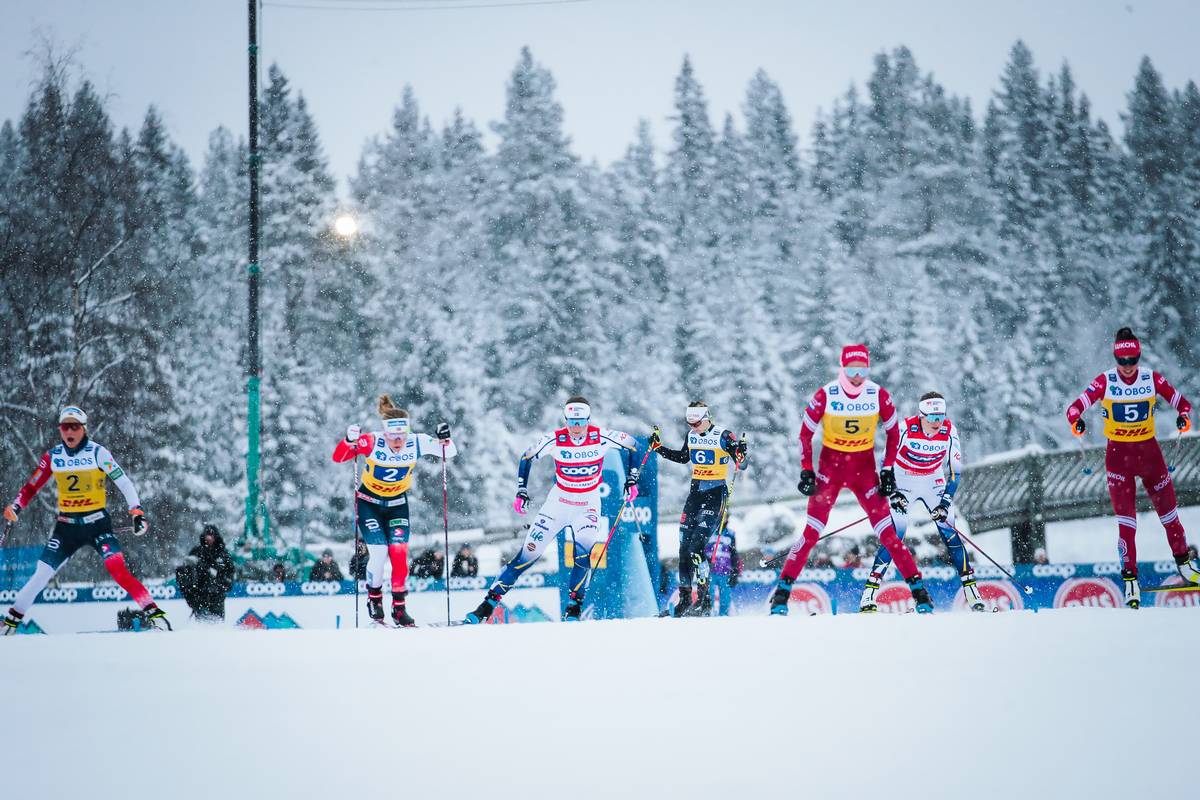
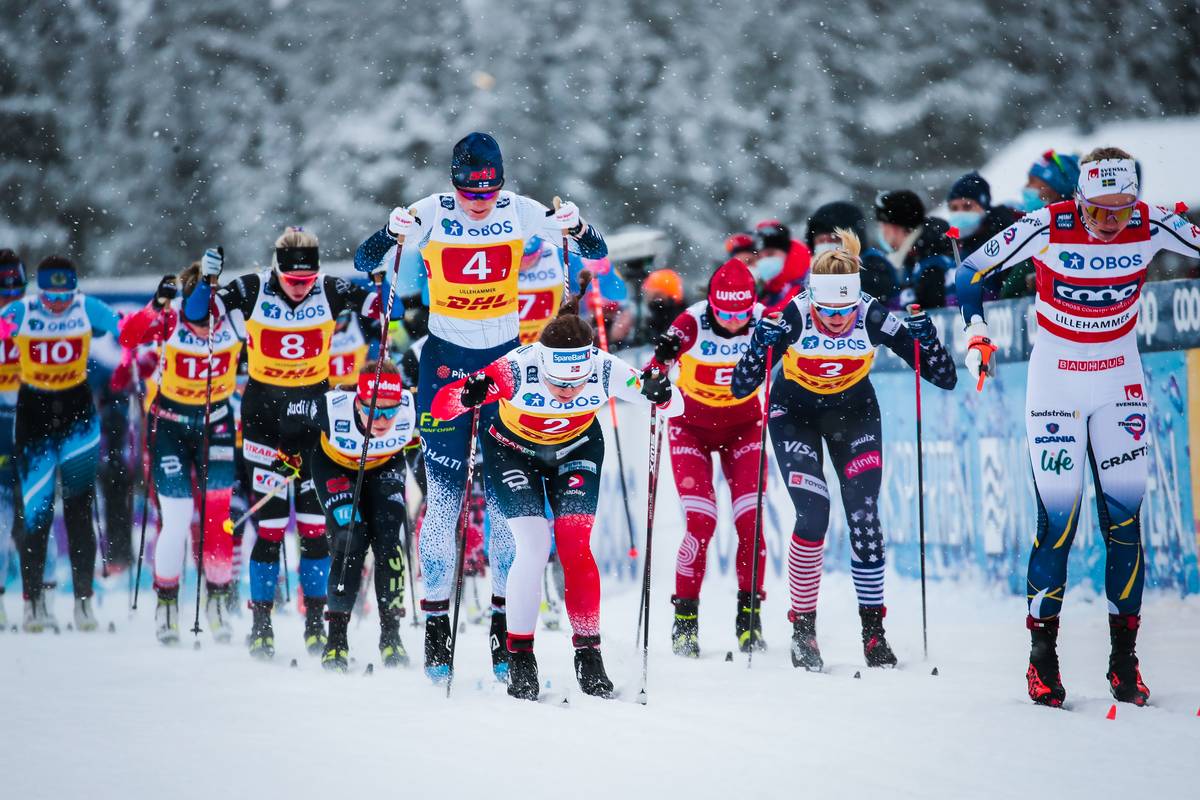
    And they’re off. The start of the women’s 4 x 5k relay in Lillehammer. (Photo: NordicFocus)

    This World Cup coverage is made possible through the generous support of Marty and Kathy Hall and the A Hall Mark of Excellence Award. To learn more about A Hall Mark of Excellence Award or to learn how you can support FasterSkier’s coverage please contact info@fasterskier.com.

    Bring out the high socks and glitter, it’s a relay day on the World Cup.

    Whereas the early legs of the men’s race skied like an accordion, the first four teams pulling the field apart before each exchange, then biding their time as the next few groups regained contact, the top three teams in the women’s race seemed evident from the onset of the second lap. 

    This statement should not imply that the race was in any way less suspenseful. Within this lead group were some of the top Swedish athletes, who have proven to be a force in both sprint and distance, racing against a deep Russia I team, whose members have not yet earned a World Cup podium this season. 

    On home turf with history pointing in their favor, Norway has won 17 of the last 18 World Cup relays, and took the gold medal in the event at last year’s World Championships in Oberstdorf, Germany with the same team that started today. As the top three teams pulled ahead, the Norway I team evidenced the determination to continue this streak. 

    At the first exchange, these three teams were joined by Germany, which was led by Katharina Hennig, and the Finland I team, led by Johanna Matintalo. 
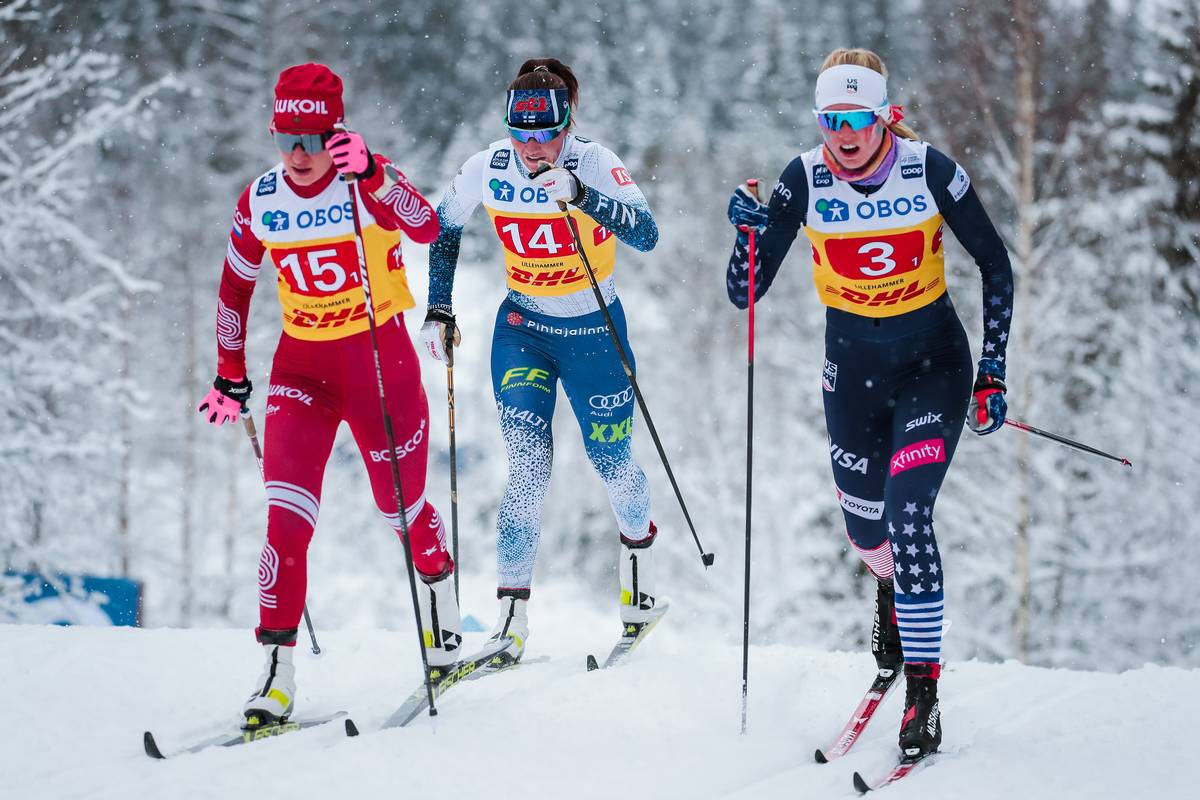
    Despite a broken pole basket, Hailey Swirbul skied a strong opening leg in the women’s 4 x 5k relay in Lillehammer. (Photo: NordicFocus)

    The United States I team, led by Hailey Swirbul, who tagged off to Rosie Brennan in 9th (+21.6). At 2k, U.S. I was only a few seconds back on the leaders. Unfortunately for the Americans, shortly thereafter Swirbul broke a pole basket. Racing in fresh snow, Swirbul slowly began to bleed time, fighting to keep the time lost to a minimum. 

    By the second exchange, Sweden I, Russia I, and Norway I, were within 1.2 seconds of one another, but nearly 20 seconds ahead of the chase group. In this lineup was yesterday’s 10k skate winner, Frida Karlsson (SWE) facing Heidi Weng (NOR) who took ninth, and Natalia Nepyaeva (RUS) who finished fifth.
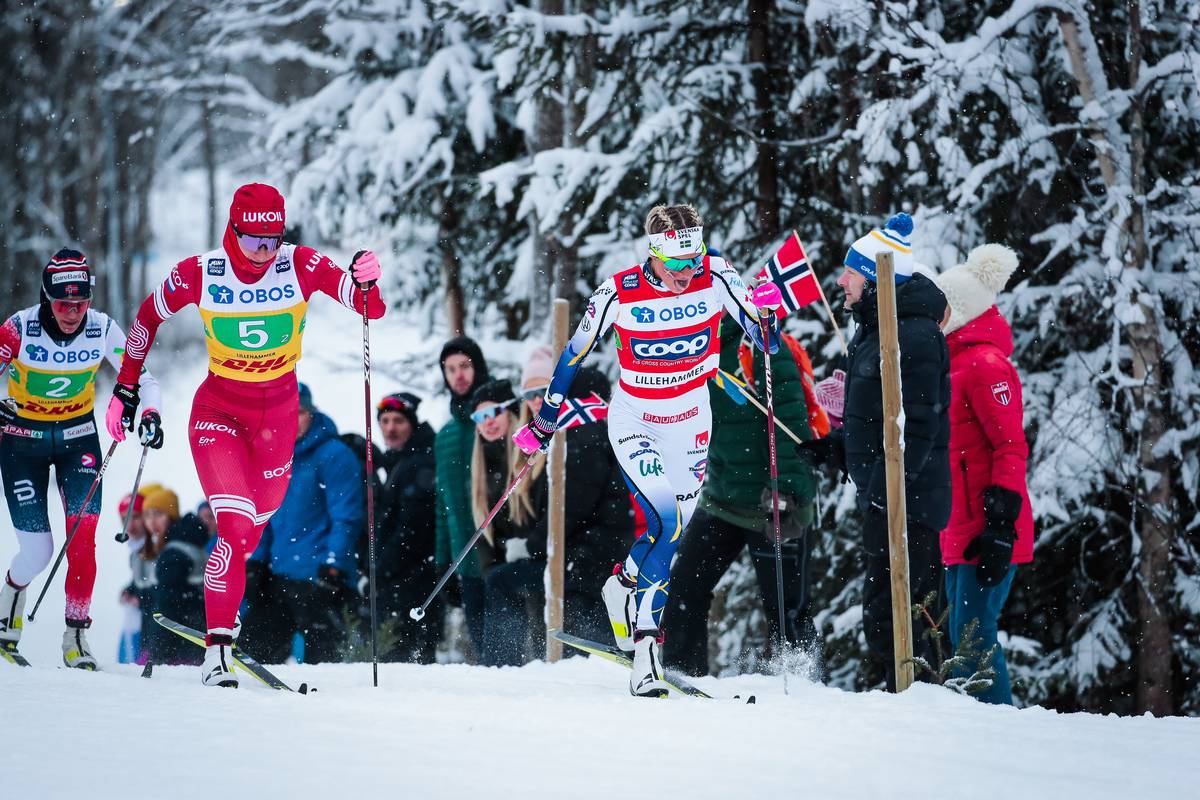
    Frida Karlsson (SWE) leads the charge in the second leg ahead of Natalia Nepryaeva (RUS) and Heidi Weng (NOR). (Photo: NordicFocus)
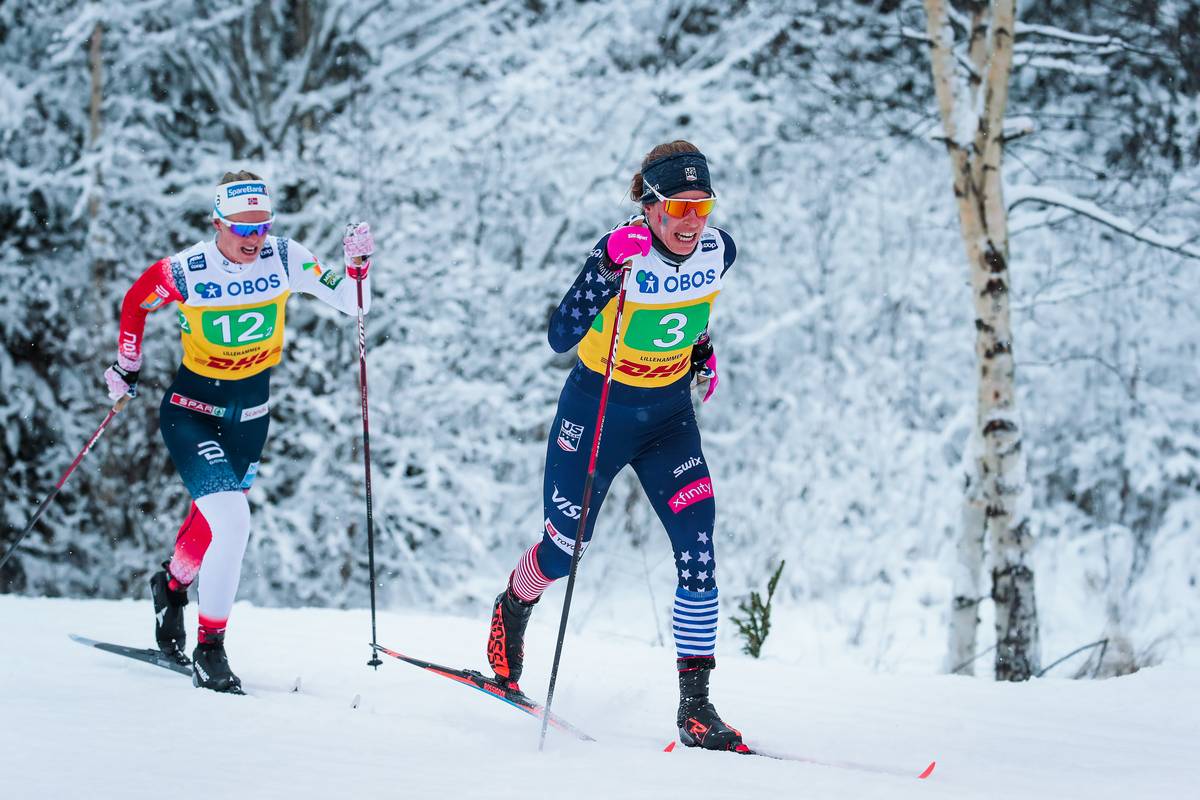
    Gaining ground for U.S. I, Rosie Brennan powers through the second leg of the women’s relay. (Photo: NordicFocus)

    Ceding a few seconds to the leaders, but advancing in position, Brennan pulled the U.S. I team into sixth, within reach of Finland I and Germany, who tagged off ten seconds ahead. 

    In the first skating leg, Norway’s distance champion Therese Johaug was matched against Ebba Andersson (SWE) and Tatiana Sorina (RUS). Andersson made an early push to set the tone as the final lap neared, but she was unable to break away. The women stayed together through the final exchange, where they tagged off within a second of one another. 
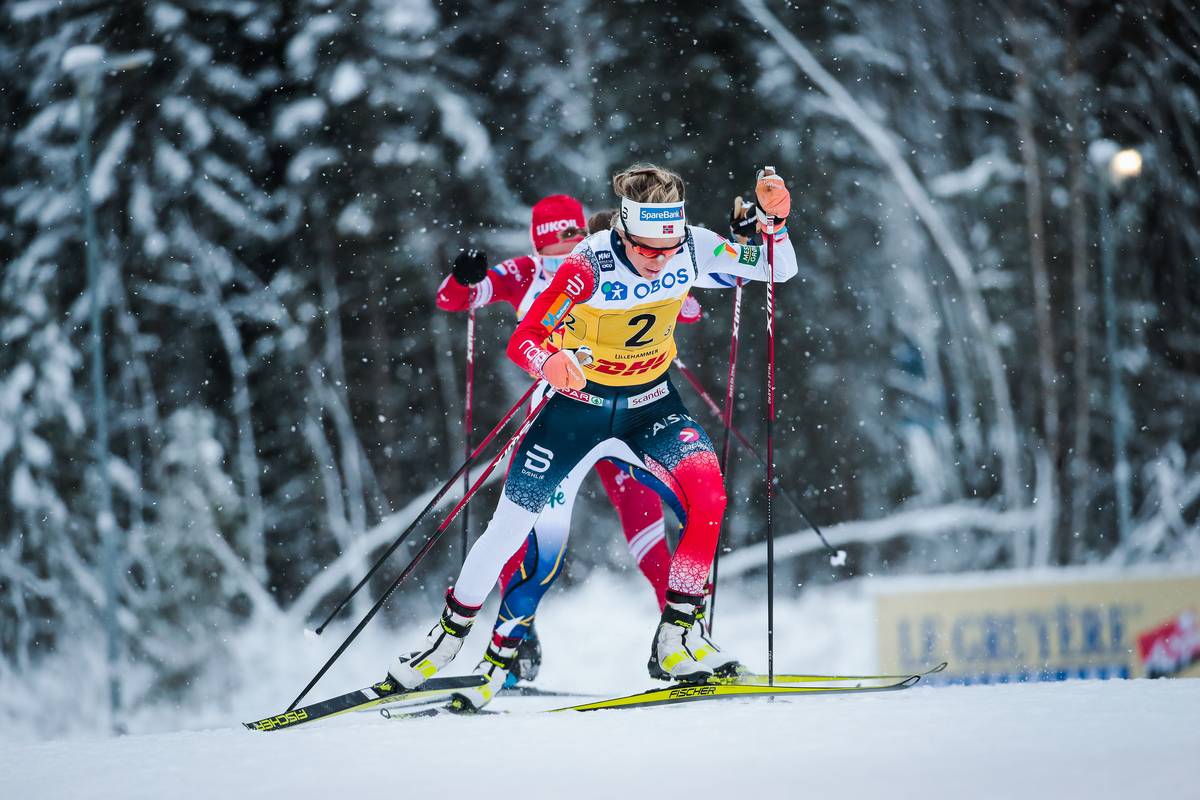
    Therese Johaug (NOR) pulls Ebba Andersson (SWE) and Tatiana Sorina (RUS) during the third leg of the women’s relay. (Photo: NordicFocus)

    Building upon Brennan’s momentum, Jessie Diggins skated the third leg for the Americans. Giving the energy we’ve come to expect from Diggins during relays, she hammered her leg of the course, gaining time on the leaders and advancing her team into fourth place at the final exchange. Still at a deficit of 26.4 seconds, a podium finish appeared unlikely in Lillehammer. 

    However, the effort highlighted the collective grit of her team, sending the message that a future podium is not out of reach. While there are no tests of relay mettle between now and the Olympic Games in February, the event will certainly be a focus as the American women build toward their peak this season. 

    After the race, Diggins commented on her experience racing in third, a new position for her, and explained how she worked together with Norway II’s Ragnhild Haga to advance both teams position in the field. 
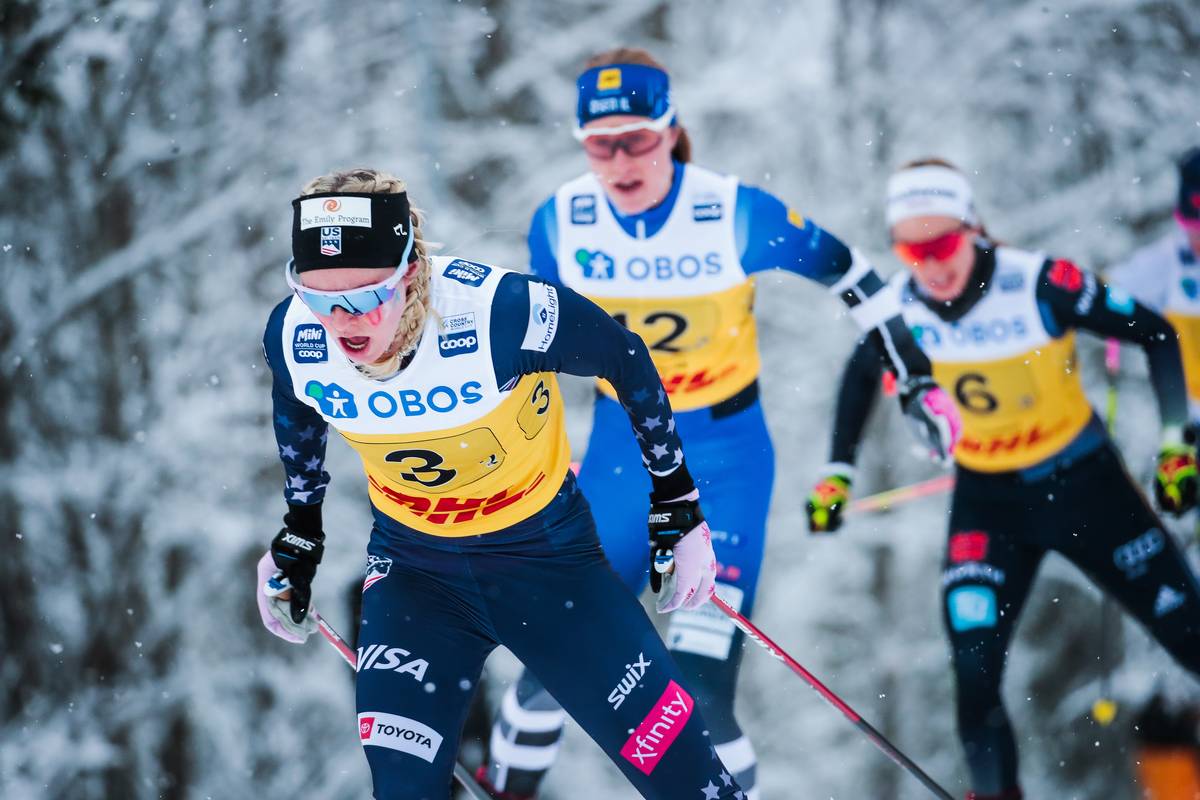
    Pulling the Americans into fourth, Jessie Diggins charges through the third leg of the women’s relay in Lillehammer. (Photo: NordicFocus)
    The final exchange: Norway I, Sweden I, and Russia I all evenly matched. (Photo: NordicFocus)

    At the halfway mark of her leg, the Norway I anchor, Helene Fossesholm, began to hit it hard. She created a three second gap with 1.6 k to go, but then it appeared that she had burnt a few too many matches to continue at that effort. Moa Olsson (SWE) and Veronika Stepanova (RUS) regained contact and the threesome headed through the final kilometer and into the stadium tightly grouped. 

    In the final push, Stepanova accelerated at the front to take the win for Russia I, while Olsson and Fossesholm slid in for a photo finish just behind. It was determined that the Swede’s boot was ahead of the Norwegian’s, locking in the podium with Russia I stopping the clock at 54:40.6, followed by Sweden I in second (+1.1) and Norway I in third (+1.2). 
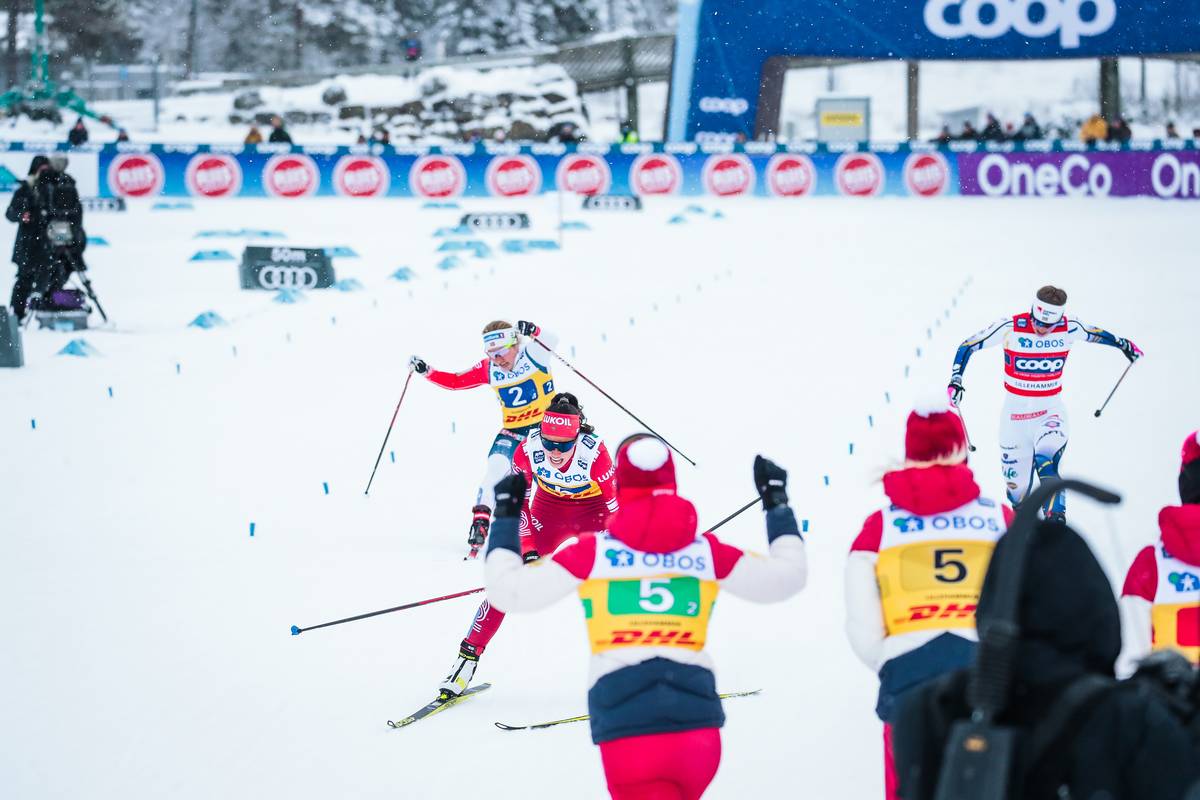
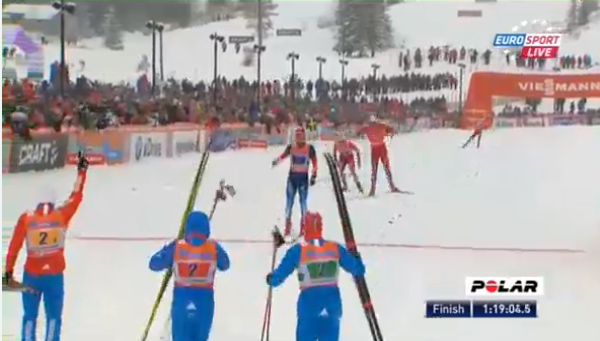
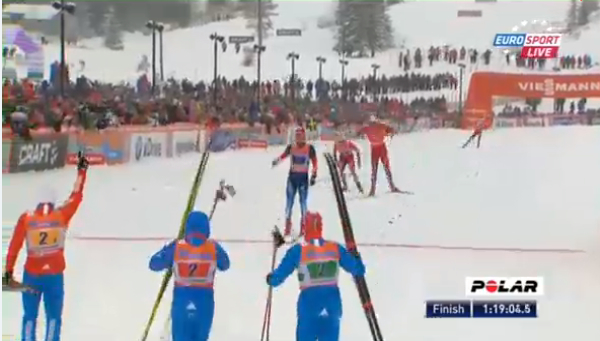
    Veronika Stepanova takes the win for Russia I as her teammates rush forward to celebrate. Meanwhile Helene Fossesholm and Moa Olsson slide for second and third. (Photo: NordicFocus)

    After the finish, an ecstatic Russian team provided the following comments to FIS. 

    “It was really nice,” leader Yulia Stupak said on behalf of her team. “We’re so happy today. Today was a good race. And we also have a small joker today, our new young star. She was really good.” 
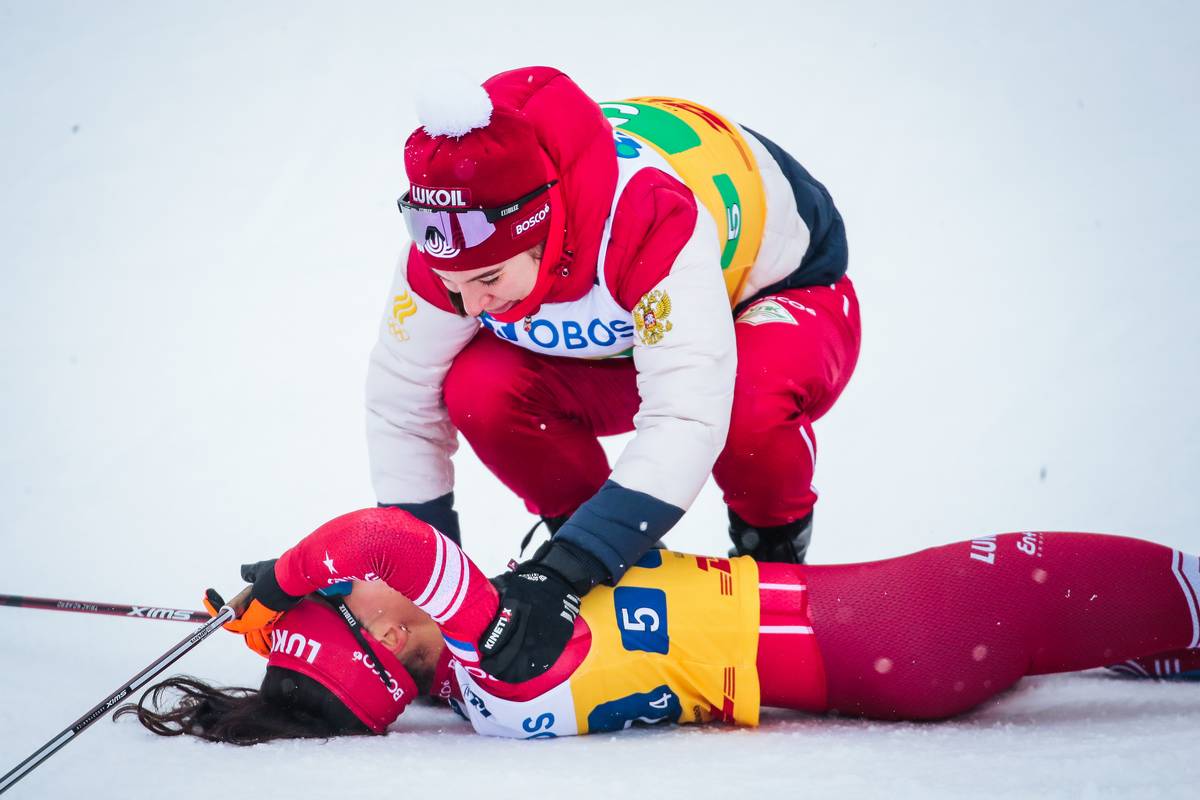
    Natalia Nepryaeva celebrates Russia’s relay victory with her breathless teammate Veronika Stepanova who highlighted the anchor leg. (Photo: NordicFocus)

    Stupak handed it over to Stepanova, who at 20-years-old is the youngest member of the team. Showing her range, Stepanova was the national champion in both the 15k freestyle and the freestyle sprint at last year’s Russian National Championships in Kirovo-Chepetsk, and also won the 5k free at the 2021 World Junior Championships in Voukatti, FIN. This weekend is only her second time racing at the World Cup level, and has been her first World Cup starts of the season.

    “This was a great one,” Stepanova laughed as she charismatically took the mic. “I have an amazing team – thank you, girls.”

    When asked about the focus on the Olympic relay and the team’s outlook, the women looked to one another optimistically.

    “This [will be] a good competition,” Stepanova said simply. 
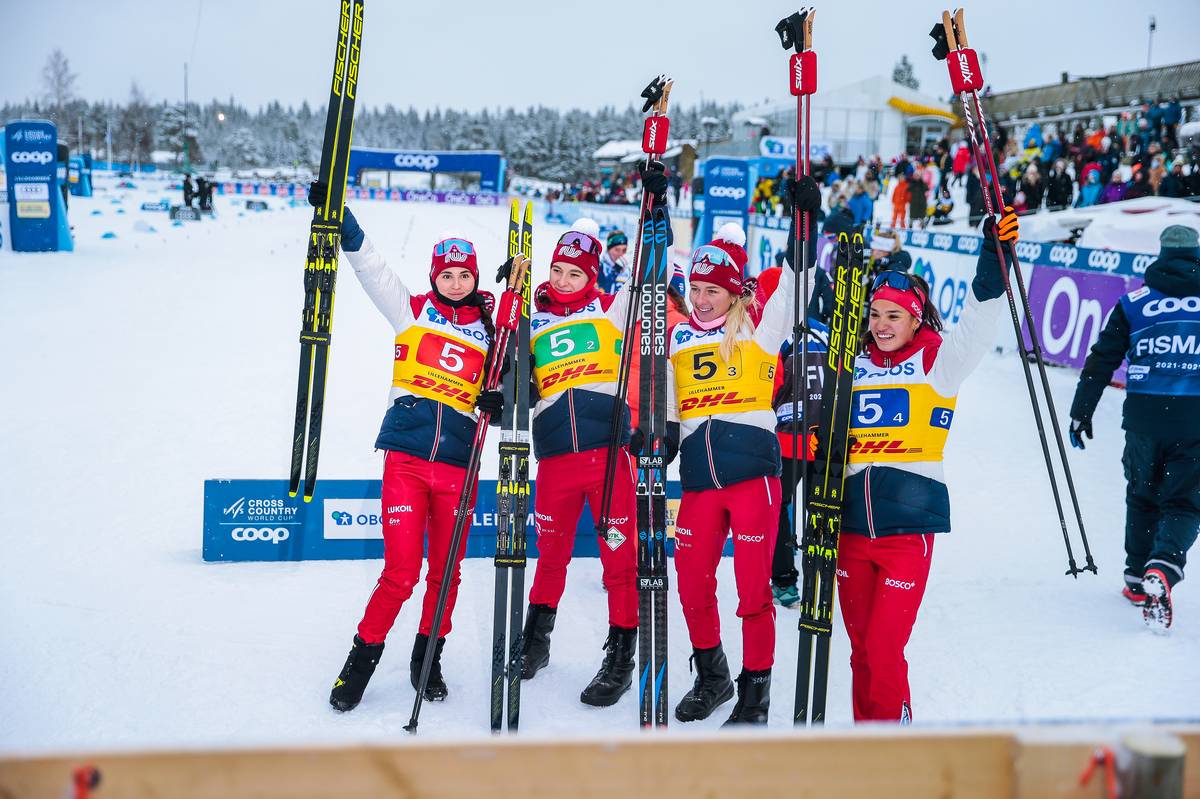
    Russia I upset the Norwegian favorites in todays 4 x 5k women’s relay in Lillehammer. (Photo: NordicFocus)
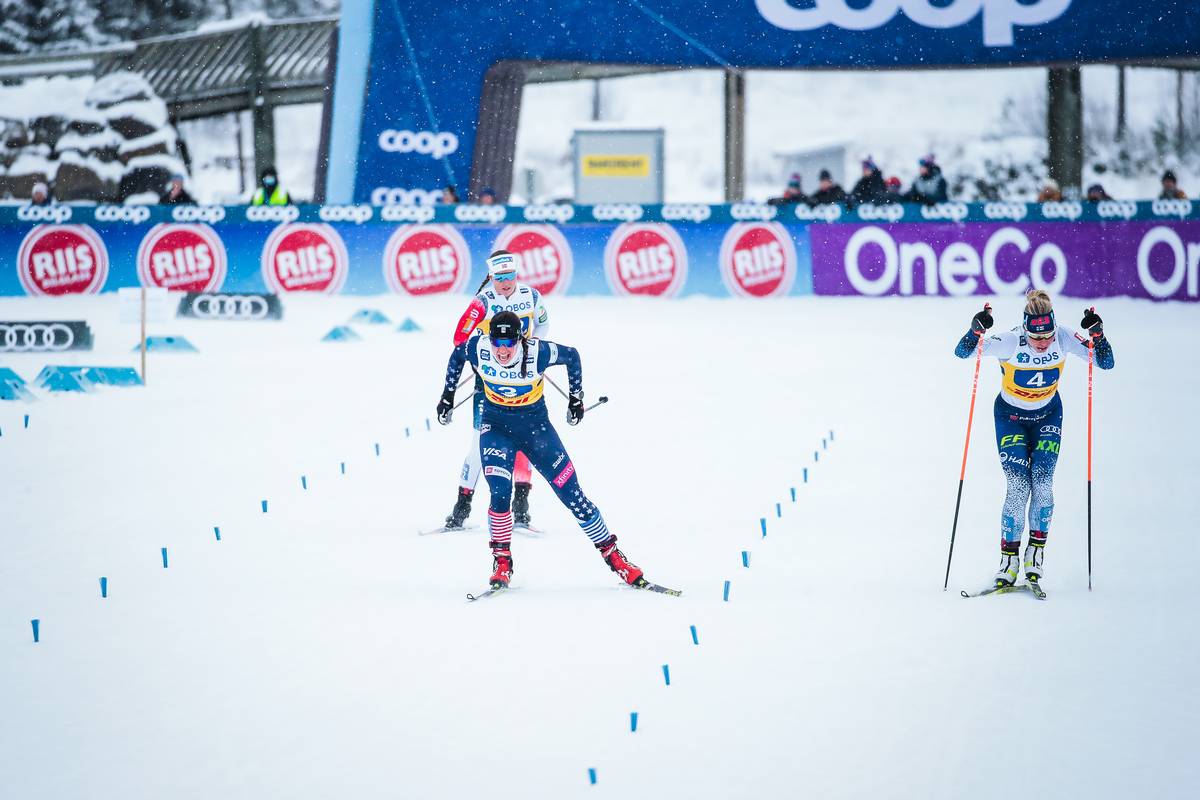
    Julia Kern powers down the home stretch alongside Finland’s Jasmi Joensuu. (Photo: NordicFocus)

    Anchoring the U.S. I team, Julia Kern tucked in with Germany’s Victoria Carl, utilizing the draft and conserving for a tactical final sprint, which she identified as a strength. Halfway through the leg, the chase group was just over ten seconds behind the leaders, before a crash put a wrench in the plans. 

    Recovering in time to put in a final surge, Kern powered around the curve into the stadium, neck in neck with Finland’s Jasmi Joensuu. The two women accelerated to the line evenly matched, throwing their boots over the line in a photo finish. Times were declared even to the tenth of a second, but Kern was determined to have a marginal advantage over Joensuu, putting the American women in fourth after a valiant team effort.

    After the race, Kern explained her tactical approach to the anchor leg, along with additional insight into what was missed by cameras, conditions on the course, and the American women’s outlook as they keep their eyes on the Olympic relay. 
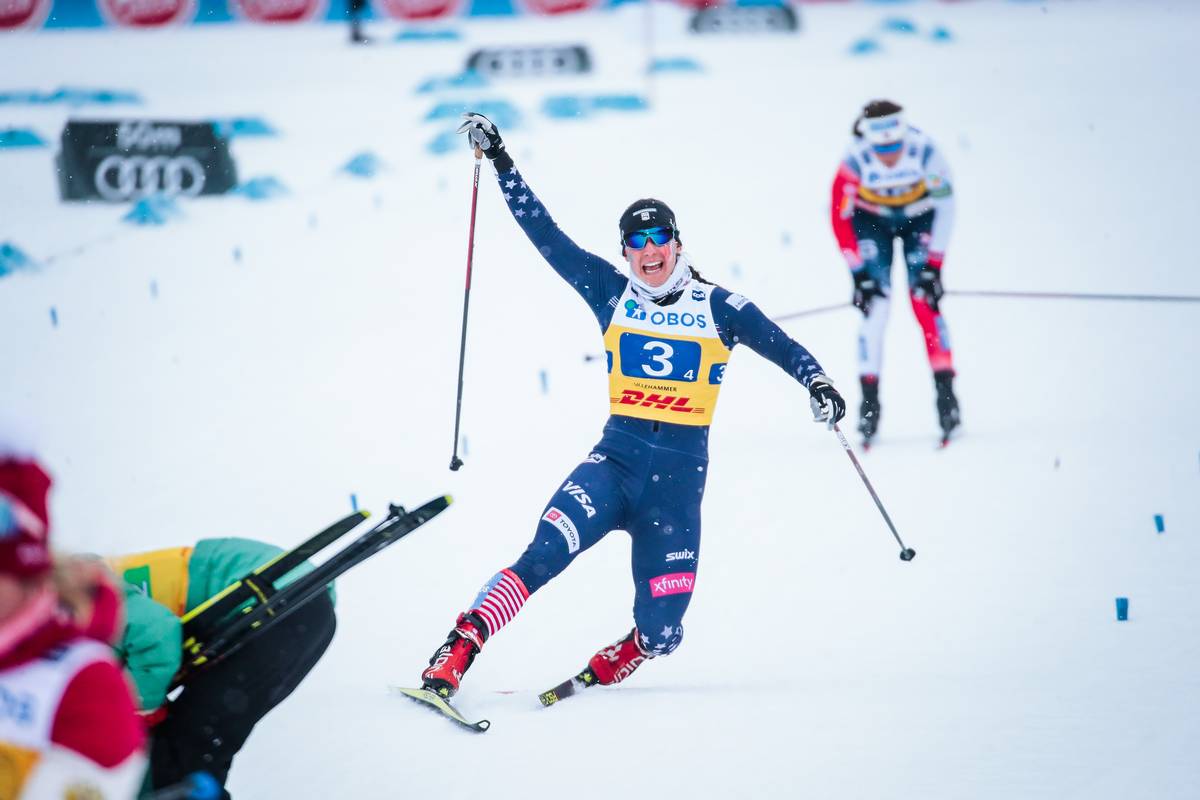
    Julia Kern slides in for fourth place in the women’s relay. (Photo: NordicFocus)
    The boot slide aftermath. (Photo: NordicFocus)

    A testament to the development of cross-country skiing in the U.S., a second American women’s team raced in Lillehammer today. Comprised mostly of U23 athletes, the team of Sydney Palmer-Leger, Katharine Ogden, Sophia Laukli, and Novie McCabe skied to 13th today (+4:30.9). The first American team could be seen waiting at the finish to welcome their teammates across the line.

    In a post-race interview, U.S. Ski Team Head Coach Matt Whitcomb provided insights into the women’s team selections, how new snow affected racing, and the team’s collective effort to thrive during back-to-back long weekends of racing this early in the season. (Note: This audio includes comments on both the men’s and women’s relays, with men spoken to first.)

    Katharine Ogden races the second leg for the U.S. II Team. (Photo: NordicFocus)
    Dahria Beatty (CAN) on course during the women’s 4 x 5k relay in Lillehammer. (Photo: NordicFocus)

    Also racing for North America, the Canadian women’s team of Dahria Beatty, Katherine Stewart-Jones, Cendrine Browne, and Maya MacIsaac-Jones finished 16th (+5:31.9).

    Racing continues next weekend in Davos, SUI with a freestyle sprint on Saturday December 11th followed by a 10/15k freestyle distance on Sunday the 12th.

    Final Results

  • Norway Takes the Relay Win at Home in a Close Match; United States I Team Races to 9th, Canada 10th

    Norway Takes the Relay Win at Home in a Close Match; United States I Team Races to 9th, Canada 10th

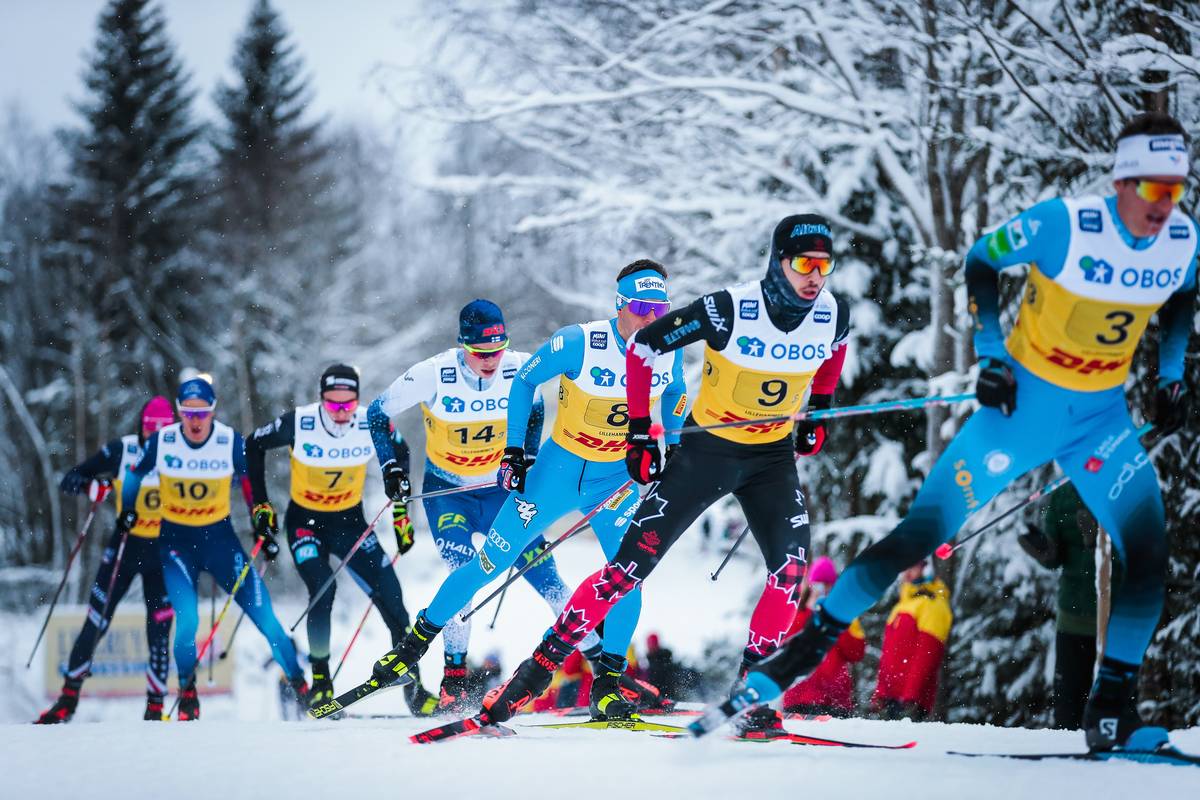
    It was Norway I, Russia II, and Norway II for the podium during the men’s 4 x 7.5k relay in Lillehammer. (Photo: NordicFocus)

    This World Cup coverage is made possible through the generous support of Marty and Kathy Hall and the A Hall Mark of Excellence Award. To learn more about A Hall Mark of Excellence Award or to learn how you can support FasterSkier’s coverage please contact info@fasterskier.com.

    Most-often the champions of the event, the Norwegian men’s program has been waiting for another crack at the 4 x 7.5-kilometer relay on home turf for the last two years. In 2019, Russia not only won the 4 x 7.5-kilometer relay in Lillehammer but the Russia II team took second as well. The World Cup in Lillehammer that was scheduled for 2020 was first postponed, then cancelled, to manage the nation’s COVID-19 cases. With the opportunity to take back their title at home in 2021, Norway was ready to throw down on the modified tracks in Lillehammer today. 

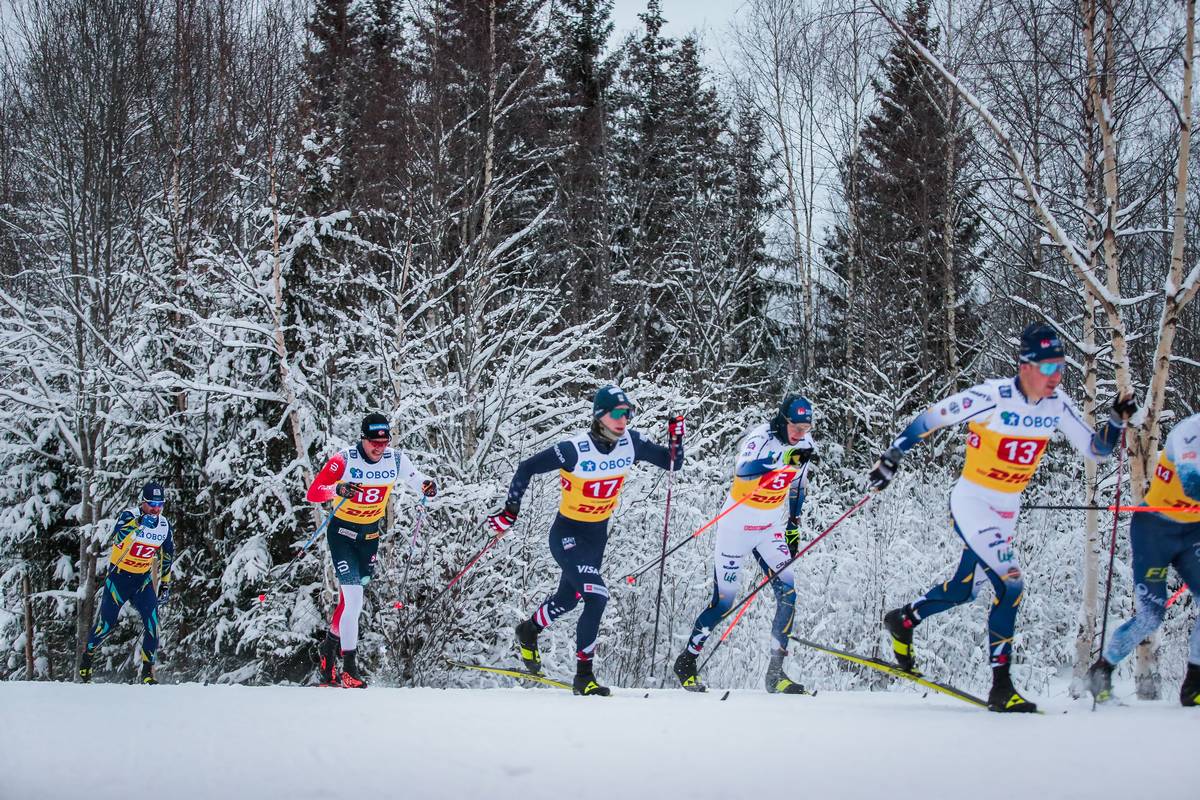
    Luke Jager leads the American men’s team during the 4 x 7.5k relay in Lillehammer. (Photo: NordicFocus)

    Hoping to be in the mix was the young American team made up of Luke Jager, Ben Ogden, Gus Schumacher, and Zanden McMullen. Each currently 21-years-old, Jager, Ogden, and Schumacher were part of the World Junior Championship back-to-back gold medal teams.  

    From the Canadian World Junior team who earned a silver medal during that relay in Oberwiesenthal, Germany, Olivier Leveille has moved onto the World Cup and raced today as a member of the Nordiq Canada relay team. Leveille would race as the third leg, following teammates Russell Kennedy and Antoine Cyr, who skied the classic legs. Graham Ritchie would ski the anchor leg for Canada. 

    A second U.S. team was also entered. This team included Hunter Wonders, David Norris, Kevin Bolger, and JC Schoonmaker, racing in that order.  

    Hunter Wonders skis the first leg for the United States II team. (Photo: NordicFocus)

    From the first leg, it was no surprise to see both teams from Russian and Norway leading the pack, separated by only 1.2 seconds. Team France (+9.7) was sitting in fourth place while  Jager (19:40.9) was able to keep the U.S. within striking distance in sixth at the first exchange (+10.2). 

    The United States II team sat in ninth (+25.8), with the Canadians close behind in 13th (+28.1).

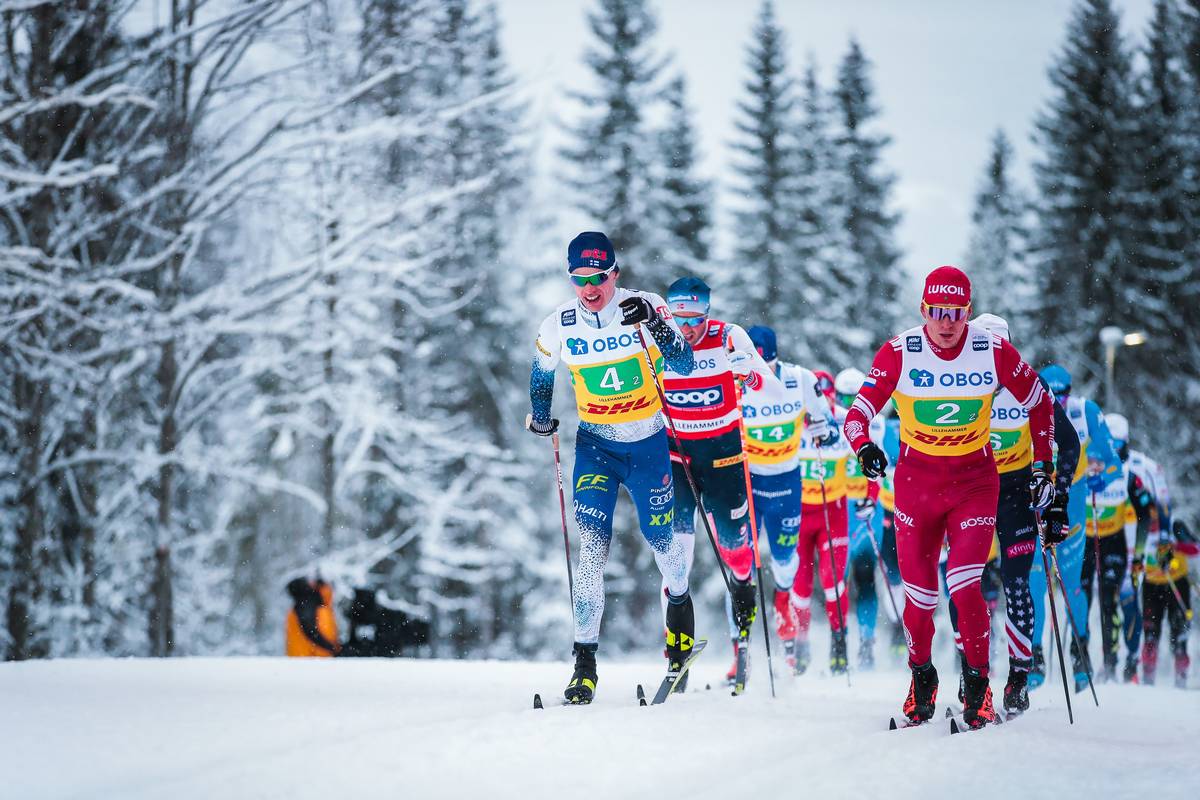
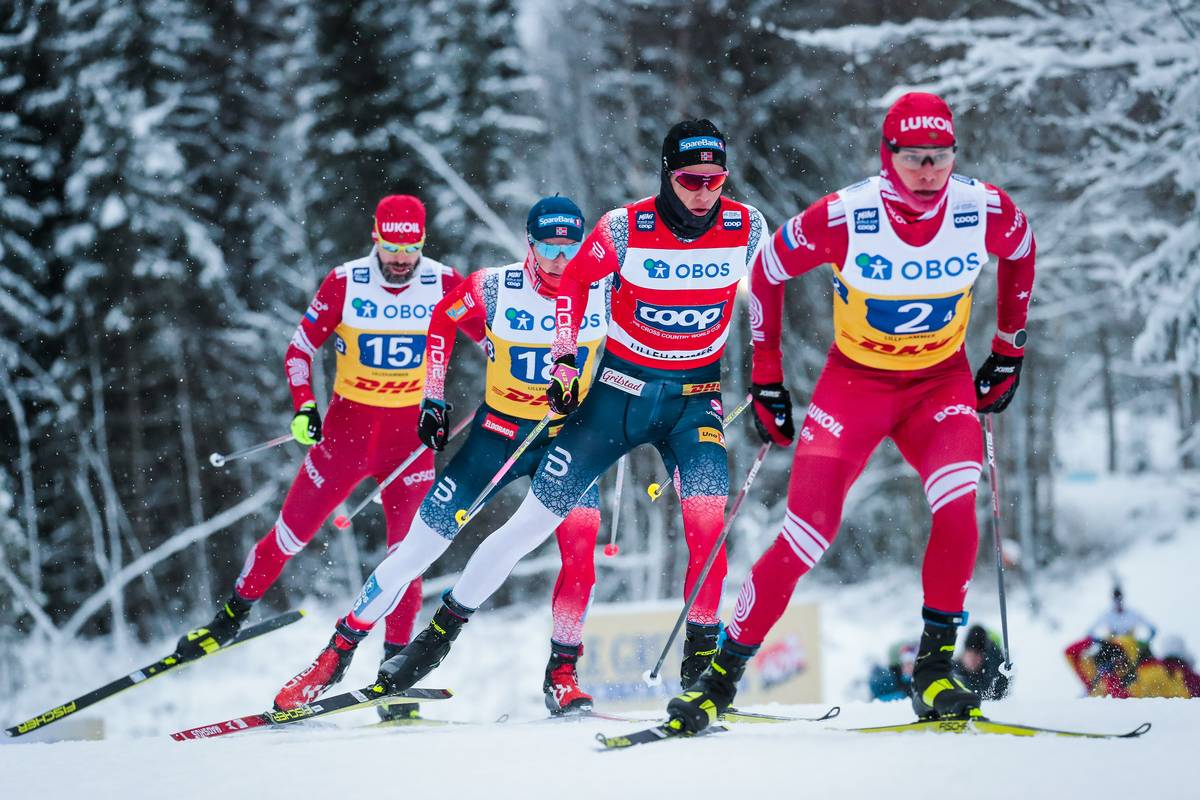
    Iivo Niskanen (FIN) and Alexander Bolshunov (RUS) lead the train during the second leg of the men’s 4.75k relay. (Photo: NordicFocus)

    During the second classic leg, the lead group compressed. Iivo Niskanen (FIN) closed a 17-second gap for Finland to take the lead at the second exchange. Niskanen won the 15k classic distance opener last weekend in Ruka. 

    Russia I (+0.4), Norway I (+11.9), Russia II (+12.4), and Norway II (+14.2) rounded out the top 5 as teams made the second tag to begin the final two skate legs of the race.

    U.S. I was sitting in 12th place (+27.9)  after a strong leg from Ogden, with Cyr passing off for Canada just ahead in 8th place (+22.5) .  

    Ben Ogden skis on the tails of leader Alexander Bolshunov during the second classic leg of the men’s relay in Lillehammer. (Photo: NordicFocus)
    Olivier Leveille (Bib 9) races the third leg of the men’s relay in Lillehammer. (Photo: NordicFocus(

    As teams entered the stadium after their first 7.5k skate leg, the Norwegians and Russians were back on top, separated by only 1.3 seconds.  Skiing the 6th fastest time for his leg, Schumacher was able to move up 5 spots to leave the U.S. I team in 7th (+29.0)  (18:11.9). This effort brought the Americans back into the mix at the front of the lead chase group. Canada dropped down to 11th place (+33.5) after the third leg.  

    As teams made the final exchange, Johannes Høsflot Klæbo (NOR I), Sergey Ustiugov (RUS II), Harald Østberg Amundsen (NOR II) and Ivan Yakimushkin (RUS I) took off in a group.

    The final exchange. Simen Hegstad Krüger tags Johannes Høsflot Klæbo for the final leg of the men’s 4 x 7.5k relay in Lillehammer. (Photo: NordicFocus)
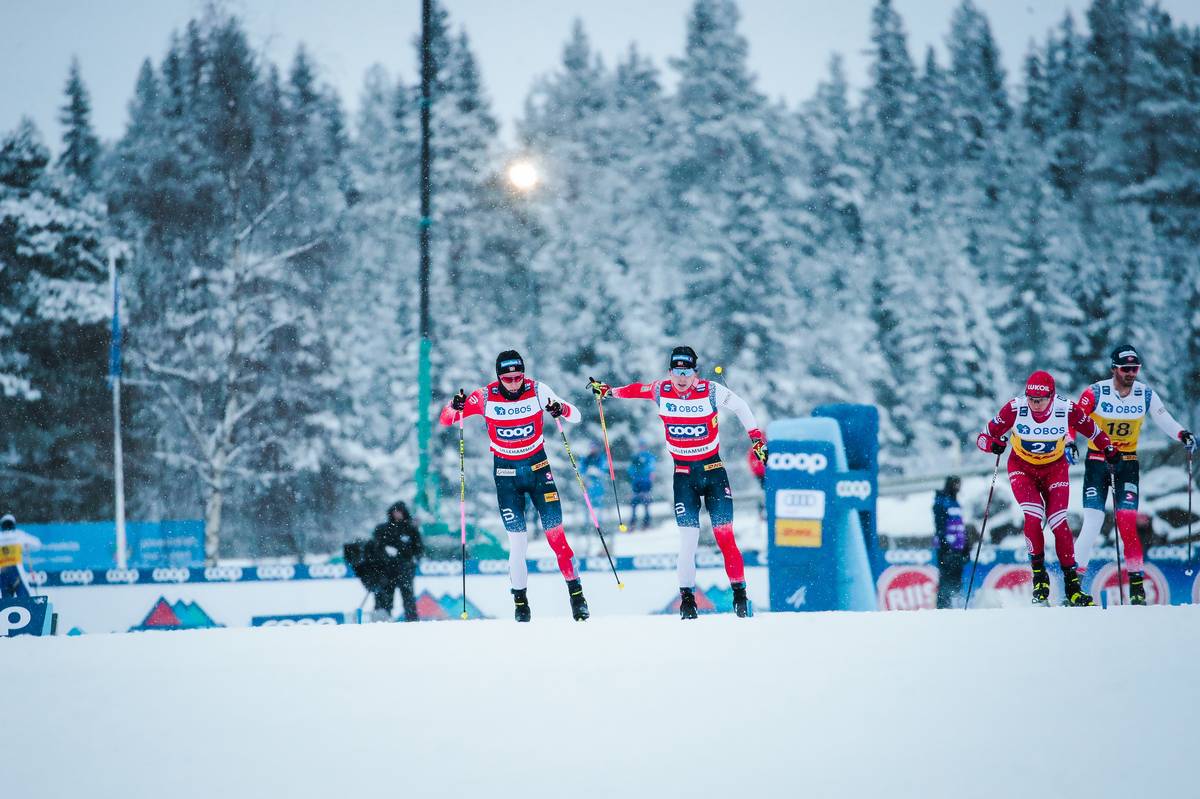
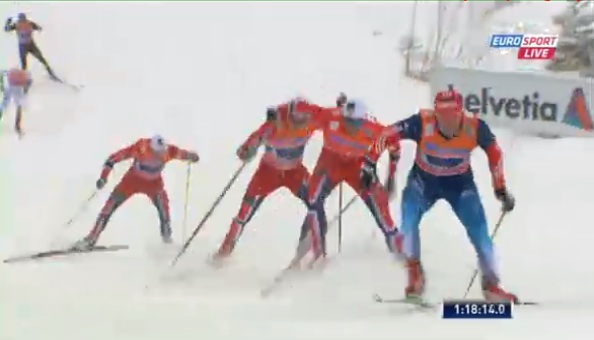
    Still tight at the front: two Russian teams and two Norwegian teams push the final leg of the men’s relay in Lillehammer. (Photo: NordicFocus)

    The two Norwegian and Russian teams stayed together as a pack over their last two laps, conserving their energy for a final sprint. This lead pack of four continuously grew their gap from the chase pack, building suspense for moves that might determine the podium. 

    With 1.5k to go, the lead pack began to accelerate. Moves were made by each team, but all moves were quickly answered. It remained anyone’s game. 

    Once the lead pack hit the stadium, Klæbo looked to take control, initiating his top gears in hopes of creating separation from the pack. Bringing it down to the wire, Ustiugov followed this attack as the group turned the corner for the last 100m. 

    Down the home stretch, Johannes Høsflot Klæbo turns on the sprint gears to bring the Norway I team home. (Photo: NordicFocus)

    In the head to head sprint into the finish, Klæbo showed an edge over Ustiugov, gaining ground and throwing his ski at the line for the win. Sealing the deal on a Norwegian victory, Klæbo stopped the clock at 1:14:58.7 to reclaim the relay at home. 

    Still in the hunt, Ustiugov brought Russia II home in second (+0.2), with Norway II just behind in third (+1.2). Also edged out at the line, the Russia I team finished fourth (+1.4).  

    Johannes Høsflot Klæbo brings home a win for Norway in the men’s relay in Lillehammer. (Photo: NordicFocus)
    Keeping the final leg tight, Sergey Ustiugov anchored Russia II team who took second in the men’s relay in Lillehammer. (Photo: NordicFocus)

    Looking excited and proud, Klæbo shared his thoughts on the day with FIS after the finish.

    “It was a really tough one,” Klæbo said. “It was a nice fight and it was for sure really fun to cross the finish line first and to win as a team.”

    Emil Iversen, who had raced the second leg, praised Klæbo for his sprinting ability, adding the value his prowess added to the relay team. 

    “We know we have the best man in the finish. It was a pretty exciting sprint today. It’s nice to have him in the last leg of the relay – he is the best sprinter in the world.” 

    Winners of the relay in Lillehammer, the Norway I team included Erik Valnes, Emil Iversen, Simen Hegstad Krüger, and Johannes Høsflot Klæbo. (Photo: NordicFocus)
    Take a bow. Zanden McMullen crosses the finish after racing the anchor leg of the men’s relay in Lillehammer. (Photo: NordicFocus)

    Closing for the Americans, McMullen skied a strong anchor leg for the U.S. I, finishing 9th overall (+1:02.5). McMullen raced a steady leg to hold the American position near the front of the first chase group, hovering in sixth or seventh position throughout the leg. In the final push, McMullen was overtaken by athletes from the German and first Swedish team.

    After the race, Matt Whitcomb provided insight into selection for each of the American teams, along with insights into their performances, conditions in Lillehammer, and the overall team dynamic after the second consecutive three-day race weekend.

    At the finish, Canada was just behind the U.S. I team in 10th (+1:15.5), while the United States II team crossed the line further back in 15th (+3:20.9).

    Russell Kennedy (Bib 9) skis the anchor leg for Nordiq Canada during the men’s 4 x 7.5k relay in Lillehammer. (Photo: NordicFocus)

    After a fantastic weekend of racing in Lillehammer, teams are headed to Davos, SUI for a weekend of freestyle racing. The program includes a freestyle sprint on Saturday, followed by a 15k distance race on Sunday. 

    Final Results

  • U.S. Men Rise to 5th, Finish 12th; Canada 13th in Lillehammer Relay

    U.S. Men Rise to 5th, Finish 12th; Canada 13th in Lillehammer Relay

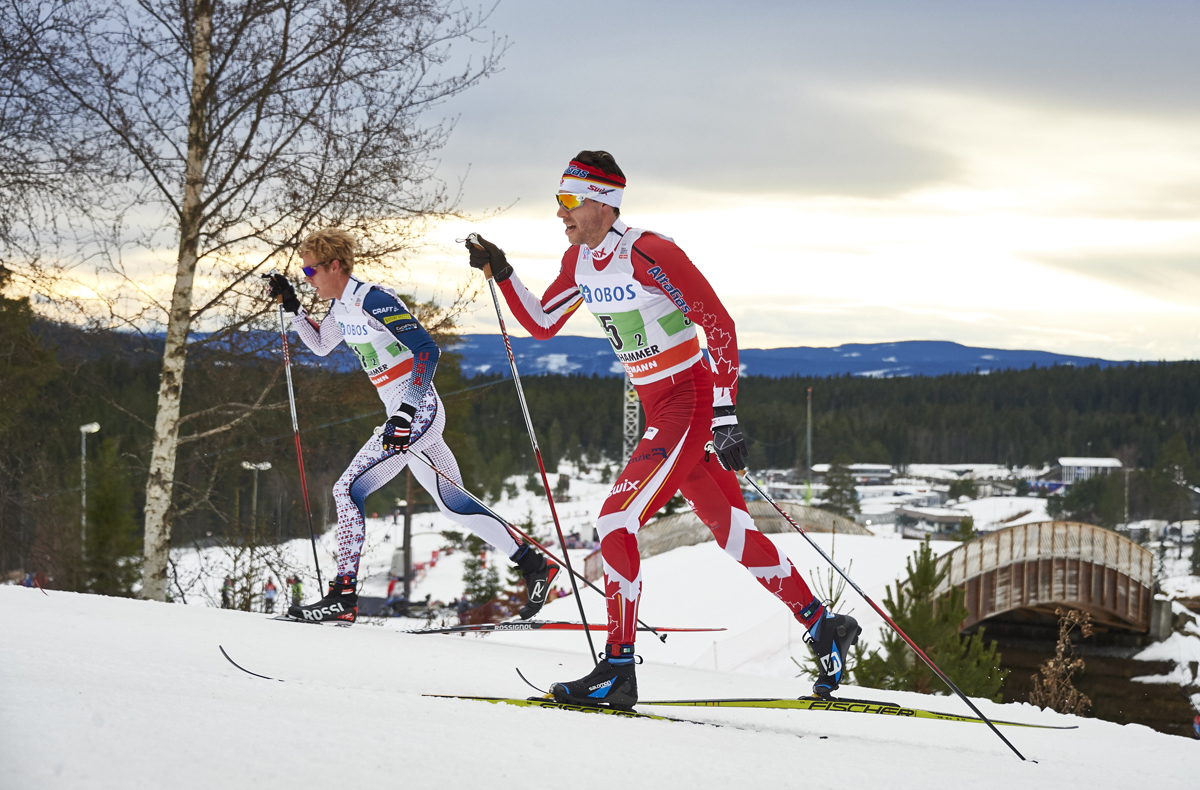
    American Erik Bjornsen (far) and Alex Harvey of Canada (near) ski together in the second classic leg of the 4 x 7.5 k relay at the World Cup in Lillehammer, Norway. (Photo: Fischer/NordicFocus)
    American Erik Bjornsen (far) and Alex Harvey of Canada (near) ski together in the second classic leg of the 4 x 7.5 k relay at the World Cup in Lillehammer, Norway. (Photo: Fischer/NordicFocus)

    On Sunday, Erik Bjornsen of the U.S. Ski Team showed the world there’s a lot more where that came from when it comes to his classic skiing. Same goes for the U.S. men’s relay team, which flirted with fifth for at least a third of the men’s 4 x 7.5-kilometer relay at the Lillehammer World Cup in Norway. The U.S. men slipped back in the final kilometers to finish 12th, ahead of Canada in 13th.

    Bjornsen, 24, clocked the fastest second-leg time of 18 teams on Sunday. He skied the second classic leg for the U.S. and completed the three-lap 7.5 k course in 19:07.9. Bjornsen was 5.7 seconds faster than Mathias Rundgreen of Norway’s third team, which ultimately placed second overall.

    After receiving the tag from Andy Newell in 15th, 35.9 seconds behind the leaders (Norway’s first team: Niklas Dyrhaug, Hans Christer Holund, Martin Johnsrud Sundby, and Petter Northug Jr., which went on to win), Bjornsen lifted the U.S. to fifth, 27.4 seconds back by the race’s halfway point.

    The World Cup relay returned to Lillehammer for the first time since 2013, when the U.S. women placed third to match a team best. On Sunday, the U.S. women’s team of Rosie Brennan, Sadie Bjornsen (Erik’s older sister), Liz Stephen, and Jessie Diggins repeated the feat — reaching the podium for the third time in three years in third place.

    The men’s race followed on a 2.5-kilometer course. Just like in the women’s race, Norway dominated the men’s relay, entering four teams in both races for a total of 32 athletes.

    Inspired by their female teammates (“That was pretty cool to see them back on the podium where they should be,” Noah Hoffman said), the U.S. men — with Newell, Bjornsen, Hoffman, and Simi Hamilton — charged hard from the start. Newell put them in third 1.2 k into the first classic leg. However, by 5 k, the Norwegians made it clear that it wasn’t a question as to whether Norway would win, but rather which Norwegian team would top the field.

    Alex Harvey (Canadian World Cup Team) on his way to 10th in the men's 30 k skiathlon on Saturday at the World Cup in Lillehammer, Norway. (Photo: Fischer/NordicFocus)
    Alex Harvey (Canadian World Cup Team) on his way to 10th in the men’s 30 k skiathlon on Saturday at the World Cup in Lillehammer, Norway. (Photo: Fischer/NordicFocus)

    By the end of the first leg at 7.5 k, Norway’s top-three teams shared the lead. Italy’s Federico Pellegrino had snuck into third, 2.8 seconds back, while Canada’s Devon Kershaw handed off to Alex Harvey in 13th and Newell tagged Bjornsen in 15th.

    “Whether you get tagged in fifth or fifteenth, it doesn’t change the way that you race,” Hoffman, the third leg, said on the phone. “You have to go out there and do the best that you can against the people that are around you and put together the best race that you can.”

    This is the exact the strategy that Bjornsen applied during his relay leg.  Skiing within the top 20 of the classic first half of Saturday’s skiathlon, Bjornsen explained in a phone interview on Sunday that he’s feeling good about his classic skiing.

    “Once I feel the classic coming together then I know that I’m in good fitness,” he said. “The kick feels snappy so that’s helping on those hills. There’s a lot of transitioning on the Lillehammer hill and when you’re feeling good, it’s a really fun hill to ski.”

    Bjornsen explained that the Lillehammer course, as tough as it is, worked in his favor..

    “The hill is long and hard, but there’s a few benches that you can go from your tight stride to more stretched out, and that’s when I usually feel pretty strong,” he noted. “If I can relax in those positions, I feel like that’s one of my strengths. Whenever I was next to someone, I was pretty relaxed and confident.”

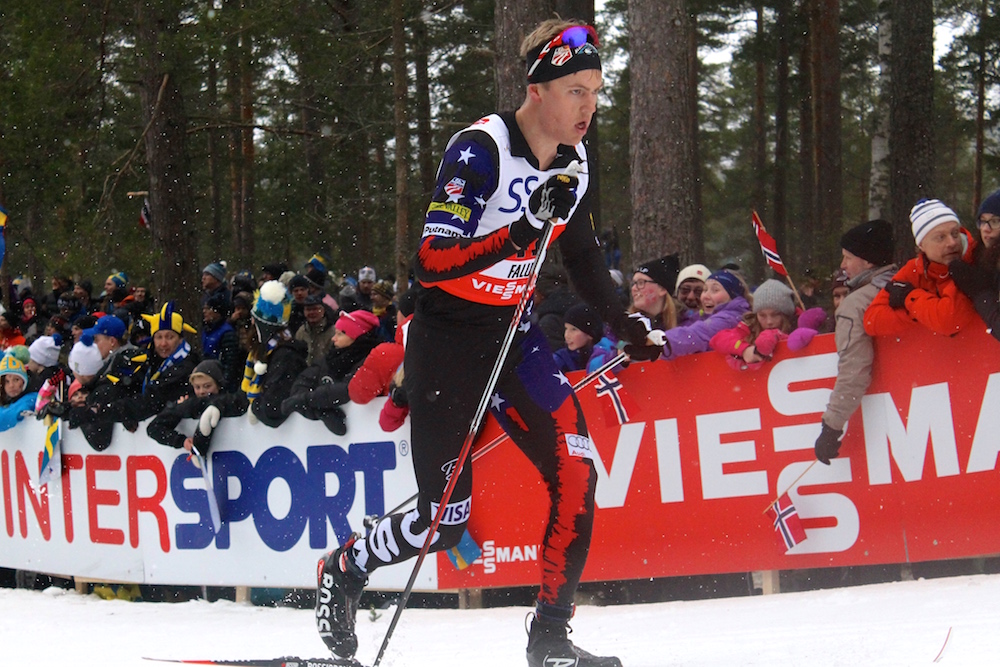
    Erik Bjornsen racing the scramble leg for the U.S. in the 2015 World Championships relay in Falun, Sweden. The men's relay went on to place 11th with Bjornsen, Hoffman, Kyle Bratrud, and Simi Hamilton. On Sunday at the World Cup in Lillehammer, Norway, the U.S. men placed 12th in the relay.
    Erik Bjornsen racing the scramble leg for the U.S. in the 2015 World Championships relay in Falun, Sweden. The men’s relay went on to place 11th with Bjornsen, Hoffman, Kyle Bratrud, and Simi Hamilton. On Sunday at the World Cup in Lillehammer, Norway, the U.S. men placed 12th in the relay.

    U.S Ski Team Head Coach Chris Grover reflected on the phone that “Erik in particular looked like he was having an incredible race,” he said. “He had a super-strong classic leg in the skiathlon yesterday so we knew he was in incredible shape and that classic skiing is feeling really good for him.

    “We knew that he would be able to pull it together, but I don’t think that we anticipated that it would be as good as it was,” Grover added, referring to Bjornsen’s relay performance.

    Bjornsen fought all the through his 7.5 k leg, and by the end of it, he had reeled his team into fifth place — 27 seconds behind Norway’s first team — with the fastest second leg. Bjornsen was pleased with his race, explaining he was  “pretty surprised but happy to see that I was the fastest of that leg with some of the fastest classic skiers in the world.”

    His skis helped. “We had some great performances out of all the [athletes], but really also from the service team,” Grover said. “Those guys really hit it out of the park … So it was really a big effort not only from the group of women and the guys but also from the entire staff.”

    Bjornsen explained that he’s been working hard with his wax technicians to do just this, especially on days like Sunday in Lillehammer with hard, icy conditions — where choosing the right grip wax can be as challenging as keeping it on.

    “Usually the women race before the men so we have limited time on the course,” Bjornsen explained. “So it’s important to come up with a strategy with your technician to make the best of your time … and try to dial in your kick and glide as best as you can. … That’s one thing that I’ve been trying to do better this year and it worked out this weekend.

    “I was very happy with my classic skis both today and yesterday,” he added. “It was tricky conditions today so I went for a stronger kick, which was tricky on the corners because it was grabbing a little bit. I think that I did a good job with my wax techs dialing in the kick and foreseeing the fact that a lot of guys were going to be losing kick on some of the fast corners.”

    Noah Hoffman (U.S. Ski Team) racing to 34th in the men's 15 k freestyle at 2015 World Championships in Falun, Sweden.
    Noah Hoffman (U.S. Ski Team) racing to 34th in the men’s 15 k freestyle at 2015 World Championships in Falun, Sweden.

    Bjornsen had a slight slipup on his second lap, falling to the ground when a Norwegian fell in front of him.

    “I was in a group of five or six guys, and it was just one of those hairy corners that was icy and I was trying to get around this guy and just went down right next to him,” he explained. “Luckily I didn’t lose too much time. I got up and used my anger to go a little harder.”

    Bjornsen handed off to Hoffman, and in a phone interview, Hoffman couldn’t say enough about how well Bjornsen set him up for his skate leg.

    “Today all comes down to Bjornsen and how incredibly he skied, bringing us from 15th to 5th and having the best time of the day,” Hoffman said. “He set us up in a great position and I had some great drafts to ski with thanks to him. It was really impressive.”

    “Today all comes down to Bjornsen and how incredibly he skied, bringing us from 15th to 5th and having the best time of the day.” — Noah Hoffman, on U.S. Ski Team teammate Erik Bjornsen

    The third leg, Hoffman also skied an impressive 7.5 k, holding the USA’s position in fifth with the fifth-fastest time among his leg. Starting 13 seconds behind Norway II in fourth and three seconds ahead of Sweden in sixth, he tried not to stress about those around him.

    “I was tagged less than 10 seconds ahead of [Russia I’s Alexander] Legkov and [Italy’s Roland] Clara, and those guys skied back into me very quickly,” Hoffman explained. “I didn’t go out and intend on staying ahead of them the whole time, but I knew they were going to be great rides.

    “The crux of my race wasn’t in being able to hold them off in them end, and being caught by them wasn’t a big part of my race,” he added.

    Legkov ended up moving into third for Russia at the final exchange, while Hoffman tagged Hamilton about 15 seconds out of fourth in fifth, 50 seconds back from the Norwegian leaders.

    “I ended up skiing with [Sweden’s Martin] Johansson and Legkov,” Hoffman said. “I felt pretty relaxed skiing with them for the first couple of laps, but I couldn’t quite hang onto them on the big hill on the course.”

    Simi Hamilton placed 11th overall in Saturday's World Cup classic sprint in Östersund, Sweden after falling during his semifinal heat and taking sixth. Here he is pictured en route to his first distance points ever in World Cup competition in Oberstdorf, Germany. (Photo: Marcel Hilger)
    Simi Hamilton of the U.S. racing to his first-ever distance points last season in Oberstdorf, Germany. (Photo: Marcel Hilger)

    On the final leg, Hamilton slipped to 11th between 4 and 5 k. According to Grover, it was more of a positioning factor that made it difficult for him to hold onto fifth.

    “It was a bit unfortunate for Simi to get tagged off in no-man’s land, and to have so many teams starting 10 seconds in front and behind him, as well as having so many great distance skaters,” Grover said, referring to Sweden, Germany, Norway IV, Italy, and Switzerland heading out 10-15 seconds after Hamilton.

    “He tried to hold them off, but those guys were charging hard and they were able to work together and to draft,” Grover said. “He was kind of out there by himself so he got a bit chewed up.”

    “It was a great ski by him, a great ski by Andy, and a great day of skating by Noah,” Grover summarized. “For our men to do 4 x 7.5 kilometers and to only be 1:30 back at the end is quite a performance from us.”

    The Americans finished 12th overall, 1:20.6 back from Norway I as the winners.

    Sundby pulled away from Norway III’s Simen Andreas Sveen in the middle of the third leg to give his team the lead. Sundby tagged Northug with a 14-second cushion to second place, and skiing uncontested throughout his 7.5 k, Northug sealed the victory in 1:13.25.7. The home nation swept podium with Norway III 2.8 seconds back in second and Norway II 14.8 seconds back from the win in third.

    Finishing 20.9 seconds behind the U.S., Canada placed 13th with Kershaw, Harvey, Ivan Babikov and Graeme Killick.

    “We had lots of opportunities today to move up, but we just failed to do that,” Canadian National Team Head Coach Justin Wadsworth said on the phone.

    He explained that the the team struggled with their classic skis on Sunday, and also noted that for Harvey, the focus of Sunday’s race was less on results than it was for future preparations.

    “With Alex, his skating has been feeling better than classic, which is why he felt like he wanted to do a classic leg today,” Wadsworth said.

    Harvey skied the sixth-fastest second leg, 12.5 seconds slower than Bjornsen. After receiving the tag from Kershaw in 13th (+34.4), Harvey brought the team to 12th (+38.4). Babikov stayed in 12th (+1:16.8), and Killick closed the race out in 13th (+1:41.5) for Canada.

    “Maybe it was’t the best strategic move for the relay to put [Harvey] in classic, but we’re also using these races to prepare for other races,” Wadsworth explained. “So it was an opportunity for him to get another classic effort in.

    “I think we’re headed in the right direction. The results on the men’s side [Saturday] were really positive and we’re always in the hunt for a podium since we’ve started racing,” Wadsworth added.

    In Saturday’s skiathlon, four Canadian men placed in the top 30.

    “For Killick, it’s more top 30s and I think Devon and Ivan can also build from [the skiathlon] and look forward to the Tour de Ski,” Wadsworth said of the multi-stage series at the end of the month. “That’s really where we start to have our better results. We don’t normally ski super fast before Christmas, but Harvey’s results this year are similar to what we saw the year that Devon was second overall [in the World Cup], so we’re just trying to build. I think things overall are positive”.

    Results

  • Johaug Takes Off ‘Like a Crazy Lady’ to Set Up Norway’s Relay Win; U.S. Hammers for Third

    Johaug Takes Off ‘Like a Crazy Lady’ to Set Up Norway’s Relay Win; U.S. Hammers for Third

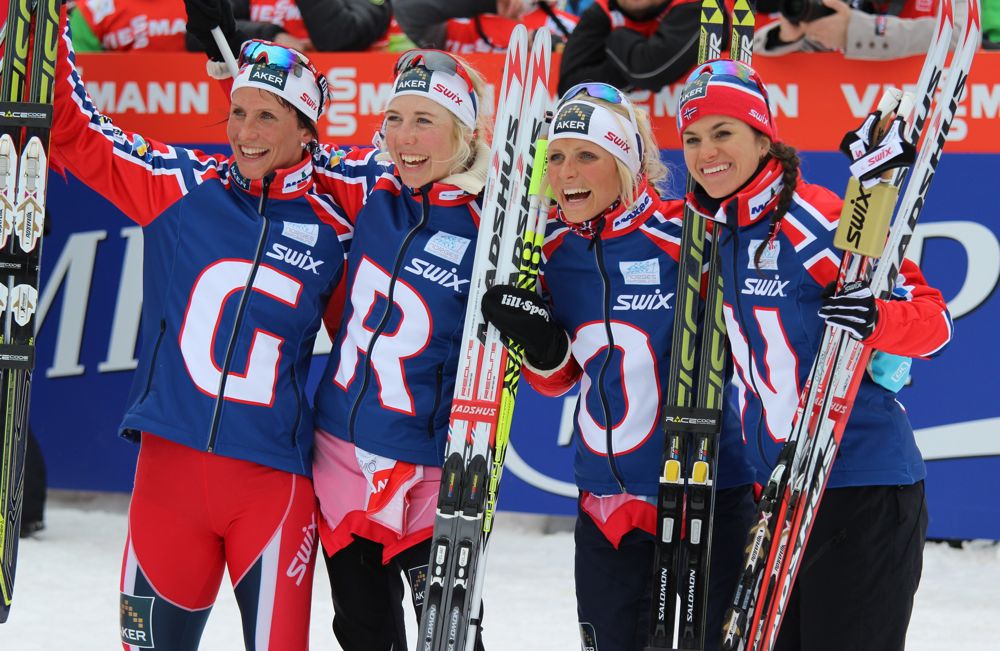
    Thursday's 4 x 5 k relay winners (from left to right), Marit Bjorgen, Kristin Stormer Steira, Therese Johaug and Heidi Weng celebrate their second-straight title at World Championships. The topped Sweden by 26.2 seconds for the victory in Val di Fiemme, Italy, but had a little difficulty spelling out a tribute to Norway at the finish.
    The reigning world champions in the 4 x 5 k relay winners (from left to right), Marit Bjørgen, Kristin Størmer Steira, Therese Johaug and Heidi Weng celebrate their second-straight title at 2013 World Championships in Val di Fiemme, Italy.

    At least the race for second was interesting. The women’s 4 x 5-kilometer relay at the Lillehammer World Cup in Norway on Sunday was, in some ways, a tale as old as time.

    The Norwegian’s top team (out of four Norwegian squads in the women’s race) might as well have lulled spectators to sleep with their predictable execution and essentially flawless victory. But the reality is they’re fun to watch.

    And ultimately, teams like the U.S. think they’re beatable – at least that’s what they’ve been told.

    “We got a really funny email from a 44-year-old guy in Norway that told us that Norway is definitely beatable, we just have to get close to Marit [Bjørgen] and get her stressed out on the last leg,” US Ski Team member Kikkan Randall said in a post-race phone interview with her relay team. “We’re close. I think our best form is still coming. You’ve got some people that are starting this year off super hot, some people that are building into it, so when it comes to Sochi we just gotta stay close, and I think if we put them under pressure, anything can happen.”

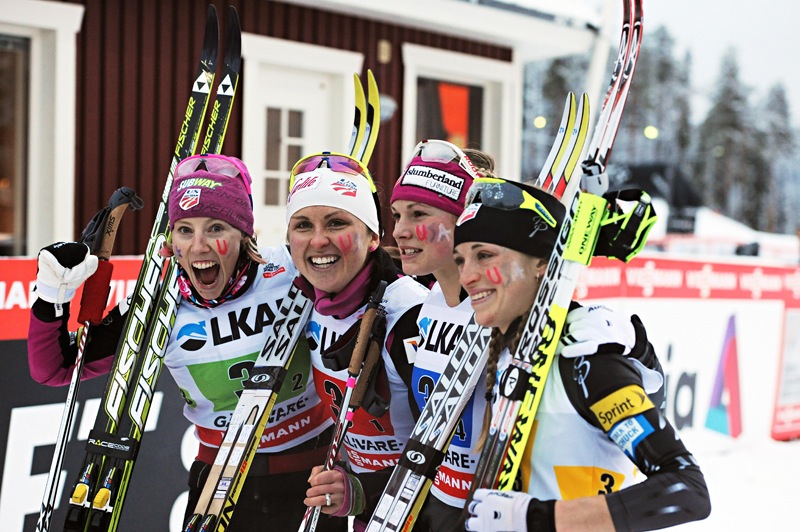
    The U.S. women after placing third in a World Cup relay, the first relay podium in the history of the program – Kikkan Randall, Holly Brooks, Jessie Diggins, and Liz Stephen. Photo: NordicFocus/Felgenhauer/Fischer.
    The U.S. women after placing third in a World Cup relay, the first relay podium in the history of the program – Kikkan Randall, Holly Brooks, Jessie Diggins, and Liz Stephen. (Photo: NordicFocus/Felgenhauer/Fischer)

    On Sunday, the U.S. women were close, tying their best-ever result of third in a World Cup relay, which they first achieved just over a year ago in Gällivare, Sweden.

    The U.S. women’s first team of Randall, Sadie Bjornsen, Liz Stephen and Jessie Diggins was 23.4 seconds shy of another historic first in second place, which went to Finland’s Aino-Kaisa Saarinen, Anne Kyllönen, Kerttu Niskanen, and Krista Lähteenmäki.

    However, the Finns finished a minute and 13.1 seconds behind the Norwegians, who skied themselves out of the ballpark (starting on the second leg) for yet another relay win in 58:38.9.

    “This was a good performance from the team, but annoying is when I was not able to [match] Johaug,” Finland’s Kyllönen told the Ilta-Sanomat.

    If it makes her feel any better, nobody could on Sunday.

    Heidi Weng opened with a solid classic leg to put Norway I in first, Therese Johaug vented some frustrations after her fourth-place finish on Saturday, and Kristin Størmer Steira held steady in the third leg to set Bjørgen up for two final cruiser laps.

    Bjørgen told NRK that the lead was so good, she simply needed to stay on her feet. After Steira tagged her in first with a 35-second lead, Bjørgen was one of the few skiers who appeared smooth from start to finish on a snowy and technically wrenching day. Johaug was the other, accelerating out of the stadium with a two-second lead, which quickly grew to 15 seconds just 800 meters into the second classic leg.

    But their race started with Weng, the youngest on the team at 22, who made a move just over halfway through the first classic leg.

    The U.S. scramble skier, Randall was one of the first out of the gate and led for most of the two-lap 5 k, until Weng attacked exactly where Randall expected her to on the second lap.

    As Weng surged up the steep section of the long climb, Randall latched on.

    “I just did everything I could to stay on her heels” Randall said. “I was able to all the way up [and over the hill], then just kind of followed her, figuring it would be good to tag off to Sadie [Bjornsen] in the pack knowing we were in touch at the front.”

    Weng handed off to Johaug in first, tied with Norway II’s Ingvild Flugstad Østberg. Randall was 2.1 seconds back in third, just ahead of Russia’s Julia Ivanova and Finland’s Saarinen in fourth and fifth, respectively.

    The scramble leg of the second U.S. team (the first time the Americans have been able to start two women’s relays in recent memory), Sophie Caldwell came through in sixth, just 5.5 seconds after Weng.

    With a two-second lead, Johaug didn’t waste anytime breaking away. Meanwhile, Bjornsen and Kyllönen took turns leading the chase, and realistically, battling for second. Strung out by the attack, the rest of the pack fell behind.

    “Johaug took off like a crazy lady from the start,” Bjornsen recalled. “It was challenging out there today with all that snow, and you start falling apart at one point and then you just have to collect your mind and know that it’s relay day and just have to keep going. So it was really awesome to have that Finnish girl just to chase down. That’s why I was so stoked to where Kikkan put me … thank God she didn’t stick us way in the front.”

    The two followed Johaug into the tag zone, with Kyllönen 38.5 seconds behind in second, Bjornsen 39.2 seconds back in third, and Russia’s Alija Iksanova another 20 seconds back in fourth. Johaug had put down the kind of race Norway needed, setting Steira up perfectly to put Bjørgen in a position to win.

    “I was much more active today,” Johaug told NRK, according to a translation. “It was a slightly different body … I was probably a bit annoyed after the race yesterday … and I managed to get the flick that I was missing.”

    With nearly 40 seconds separating Stephen from Steira at the start of the third leg, Stephen immediately sprang to try to chase her down.

    Two kilometers in, Stephen had made up about five seconds on Norway. Niskanen followed closely in an effort to do the same, and ended up passing Stephen on a climb with about 1 ½ k remaining.

    “If I had known how my body was going to feel today, I would have stuck behind Finland for a bit longer than I did,” Stephen said. “But you certainly always hope for the best, and I felt fairly good in warm up and just off the bat, I felt really psyched. Probably a lot of that was adrenaline. Maybe if I had it to do over and I knew exactly how it was going to go, but I was not as concerned with Norway as I was with Charlotte Kalla catching me.”

    Down by nearly 45 seconds heading into the third leg, Sweden rose from sixth to fourth with Kalla, just three seconds behind the Americans, by the final exchange.

    Trying to hang onto Niskanen while holding off Kalla, Stephen caught her ski tip in some powder on the edge of the course and nearly fell just meters before the exchange. She caught herself, and tagged Diggins in third, about 14 seconds behind Finland and 49 seconds back from Bjørgen.

    The U.S. women surround Jessie Diggins after she anchored them to third in the Lillehammer World Cup 4 x 5 k relay, tying their best-ever relay result on Sunday.
    The U.S. women surround Jessie Diggins after she anchored them to third in the Lillehammer World Cup 4 x 5 k relay, tying their best-ever relay result on Sunday.

    Careful not to blow up on the first hill out of the stadium, Diggins, the tried-and-tested U.S. anchor, reeled in Lähteenmäki by the 2 k mark. The two skied together to drop Sweden’s Britta Johansson Norgren and Maiken Caspersen Falla of Norway II, in fourth and fifth, respectively.

    “I knew we were in for a medal; it would either be silver or bronze,” Diggins recalled.

    She took the lead up the long climb of their second lap and over the top, Diggins dropped Lähteenmäki, and said she could feel her energy rising.

    “I was ready for a sprint, like, ‘OK, bring it, we can do this. We have this silver medal,’ ” Diggins said. “But then I caught my tip in the powder in the same spot that Liz [did], where suddenly you’re in the track and then [it] suddenly goes away and you’re in some powder.”

    Not expecting that, Diggins fell and broke a pole, forcing her to ski over the last bridge without one. On the descent, Norwegian coach Vidar Lofshus ran over to her with a replacement.

    “They didn’t have to do that; that’s not part of their job,” Diggins said of the gesture. “I was able to hold off the chasing Norway and Sweden and we were able to get a bronze, which was awesome. It’s still tying our best result ever and it’s cool because I know that, hey, it was a little bit of bad luck with the hard fall and all that, but we’re in good shape. We know how to put together a good day … we are right the hunt and that’s right where we want to be.”

    Trailing the U.S. in third by 10.8 seconds, Norway II placed fourth (+1:47.3), Russia I was fifth (+1:53.9), and Sweden placed sixth (+2:05.1) of 19 teams.

    USA II, with Ida Sargent, Holly Brooks and Rosie Brennan, went on to place 12th (+3:20.5).

    — Emily Schwing contributed reporting

    Results

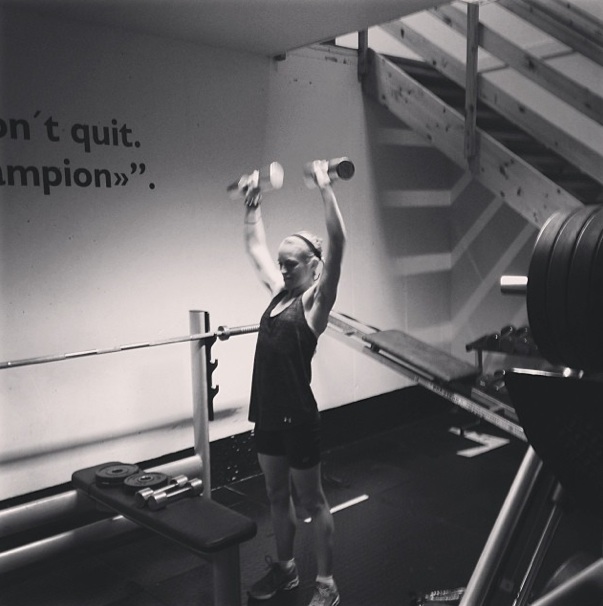
    Liz Stephen (USST) hits the weight room hours after racing to third with the U.S. women's team in Sunday's World Cup 4 x 5 k relay in Lillehammer, Norway. (Photo: Billy Demong/Twitter)
    Liz Stephen (USST) hits the weight room hours after racing to third with the U.S. women’s team in Sunday’s World Cup 4 x 5 k relay in Lillehammer, Norway. (Photo: Billy Demong/Twitter)
  • Vylegzhanin Bests Northug For Russian Relay Win

    Vylegzhanin Bests Northug For Russian Relay Win

    Maxim Vylegzhanin bringing it home for Russia in the Lillehammer World Cup 4 x 7.5 k relay, as his teammates prepare to congratulate him at the finish. Vylegzhanin outlasted Norwegians Finn Haagen Krogh and Petter Northug for the victory for Russia I on Sunday.
    Maxim Vylegzhanin bringing it home for Russia at the Lillehammer World Cup 4 x 7.5 k relay, as his teammates prepare to congratulate him at the finish. Vylegzhanin outlasted Norwegians Finn Haagen Krogh and Petter Northug for the victory for Russia I on Sunday. Krogh took second, and Northug was third.

    Under snowy skies and on Norwegian terrain, Maxim Vylegzhanin and the Russian relay team seized victory in the men’s 4 x 7.5-kilometer relay Sunday in Lillehammer, greatly raising their team’s expectations ahead of the Sochi Winter Games.

    As the lone relay ahead of the much-anticipated Olympic contest, the event was an important test of the teams’ relative strengths, and an opportunity to try out relay orders. If Lillehammer made anything clear, it’s that the men’s relay is now dominated by a new Norway/Russia rivalry.

    The race began at noon with heavily falling snow, the tracks set deep in the powder and the steeper hills rutted and choppy enough to force the athletes into a wide, loping herringbone.  Eldar Rønning, skiing for Norway’s second of four teams, took the lead early and set a fast pace aimed at breaking up the pack.  In the heavy snow it didn’t take long to break apart the field.

    Norway I nearly fell off the back early on when Pål Golberg became tangled with another skier on a descent, knocking him off balance and forcing him to ski on only his left foot for much of the way down the powdery slope. Somehow, though, he managed to stay on his feet.  This impressive bit of skiing allowed Golberg, Saturday’s 15 k classic winner, to chase his way back up to the lead group.

    Coming through the stadium on the first of two 3.75-k laps, Russia I, led by Dmitriy Japarov, took the lead from Norway II’s Rønning and continued to push the pace. By 4.9 k the lead group was made up of Japarov, Rønning, Daniel Richardsson of Sweden, Jean Marc Gaillard of France, Stanislav Volzhentsev of Russia II, Tim Tscharnke of Germany, and Norway I, III, and IV.

    At the end of the first leg, Rønning charged into the stadium to hand off first to Chris Andre Jespersen, who was closely followed by Russia I and II, with Alexander Bessmertynkh and Alexander Utkin respectively. With Jespersen leading, the Norwegian teams would prove their classic skiing chops and their first three teams moved to the top of the field, only Bessmertynkh could hold the collective pace of Jespersen, Tønseth (NOR I), and Simen Haakon Oestensen (NOR III).

    At the handoff of the third leg and transition into skating, Tønseth tagged Martin Sundby first for Norway I, Alexander Legkov took over for Russia I just 0.2 seconds back in second, and Jespersen came through in third to send Sjur Røthe off for Norway II.

    After hungrily looking at the stadium screen as he watched his teammate Bessmertnkh approaching, Legkov took the lead from Sundby up the first climb, and wasted no time in trying to put the rest of the field under pressure.

    Legkov finally began to slow at the end of the first lap, and he relinquished the lead to Sundby as they passed through the stadium. Legkov did not spend long resting behind him, however.  As soon as the skiers left the stadium and began to climb up Lillehammer’s long hills, the Russian retook the lead and dialed up the pace once more.  This time, only Sundby and Røthe could stay with him; the rest of the field began to lose time to the Russian’s aggressive skiing.

    Maxim Vylegzhanin leads Norway's Petter Northug (NOR I), Finn Haagen Krogh (NOR II) and Tord Asle Gjerdalen (NOR III) in the final leg of Sunday's Lillehammer World Cup 4 x 7.5 k relay. Vylegzhanin dropped the Norwegians to give Russia the victory.
    Maxim Vylegzhanin leads Norway’s Petter Northug (NOR I), Finn Haagen Krogh (NOR II) and Tord Asle Gjerdalen (NOR III) in the final leg of Sunday’s Lillehammer World Cup 4 x 7.5 k relay. Vylegzhanin dropped the Norwegians to give Russia the victory.

    On the final leg, Finn Haagen Krogh of Norway II, Vylegzhanin of Russia I, and the ever-confident Petter Northug of Norway I left the stadium together. By default, Krogh was left to lead the three. Vylegzhanin skied comfortably behind him in second and Northug stayed carefully behind the Russian.  For the first 6 k, Krogh’s lead was never challenged by either skier, and no one seemed to have any trouble keeping up with his steady tempo.

    The leader’s lack of swiftness was evident by a steadily encroaching field behind them, led by a hard-charging Tord Asle Gjerdalen of Norway III. Eighteen seconds behind Krogh at the start, Gjerdalen set off immediately on his leg to rejoin them, and in the last lap found himself back in the fold behind Northug.  Marcus Hellner also could be seen taking a hard turn for Sweden in a bid to catch up.  At 6 k, he was only 8 seconds behind Vylegzhanin, who had now taken over the lead.

    The Russian had plans for an early burst of speed and leading 1.5 k from the finish, Vylegzhanin took the leaders down a slope, already charging into the final hill before the long entrance into the stadium.  He quickly secured a sizeable gap on the Norwegians who appeared unprepared for Vylegzhanin’s early move. Northug, in particular, looked sluggish as he tried to respond to Vylegzhanin’s break.

    With Northug battling to catch up and Krogh hanging with him, Vylegzhanin’s sprint never wavered as he came barreling into the finish. Finally, at the end when Northug saw it was beyond him to win the day, he stood up, allowing Krogh’s lunging foot to take second for Norway II.

    Northug, who has been sick this fall, told NRK that today he “had no punch.”

    “In Russia we take them,” he added, according to a translation. “Clearly, it is one of the great dreams, to beat Russia at home. Then we rub it in.”

    Northug chose to downplay the importance of this race. “It is more important with the Olympic relay,” he said. “It is what the people will remember for years here, not how the Lillehammer relay went.”

    Norwegian National Team Coach Trond Nystad was more circumspect in his comments.  “Today we lost to a better team,” he told NRK. “With an optimal team settup  I think we should cope with Russia in the Olympics.”

    To Norwegian newspaper Dagbladet, Nystad conceded that his skiers had made some missteps in their strategy.

    “At the end we are a little inexperienced—we let him go on top there, and [were] unable to slide him [Northug] in at the end. We must take [that] with us.”

    The Russian team was quite excited with their victory. Legkov in particular looked very pleased, triumphantly pointing his finger up to indicate No. 1.

    “It is a great day and great victory for us,” Legkov told FIS. “This season is the most important and I am happy we showed such a great performance in the relay today. Maxim did a great move towards the end. I hope in Sochi we will perform in the same way.”

    The race demonstrated the strength of the Russian team, as well as the depth of the Norwegian team, which went second, third, fourth, and eighth on Sunday.

    Some Norwegian skiers were more philosophical about the relay.

    “The race showed that everything has to work out for the team to win and anything can happen, even with Petter Northug on the team,” Golberg said.

    “We had good fun to challenge Norway I!” Røthe added. “The Russian team was very strong and showed that they’ll be tough to beat on the home snow!”

    The Canadian and the U.S. men’s teams had a difficult day, finishing 14th and 17th respectively.  Canada finished 3:02 behind Russia and the U.S. was 3:48 out of first.

    Results

  • Canadian, U.S. Men Lose Contact Early, Place 14th and 17th in Lillehammer Relay

    One thing you can say about the U.S. and Canadian men on Sunday is that they were up for a challenge, going head to head with 19 teams from more than a dozen other nations in the 4 x 7.5-kilometer relay in Lillehammer, Norway.

    They had as good a chance as anybody – if all went well – and so much of their end results depended on how they started. It was the same for everybody, and with nonstop snow increasingly becoming heavier, it wasn’t easy out there.

    Lenny Valjas opened for the Canadians in his third race of the season, still recovering from knee surgery in July (in which he aimed to correct a knee problem that bothered him for years and impacted his strength training). The surgery went well, albeit slow, keeping him from cardio for eight weeks.

    “I knew before the race that my shape was not at its usual level, not even close,” Valjas wrote in an email.  “I really like the first leg of the relay, but for now I’m focussing on getting back into shape now that I can do intensity again.”

    He completed his two laps to tag off in 17th, 1:22.9 behind Eldar Rønning, who put Norway II in first heading into the second classic leg.

    “Len had a tough first leg and that put us out of the race,” Canadian Head Coach Justin Wadsworth explained. “The rest of the guys just skied as well as they could, kind of semi on-their-own. We did as well as we could with it.”

    The Canadians rose to 16th with Alex Harvey, who posted the 14th-fastest second leg, coming to the exchange 1:37.6 seconds behind Norway I in first. Ivan Babikov went on to ski the 10th-fastest third leg, lifting Canada to 14th. Anchor Devon Kershaw held their position, finishing 14th, 3:01.4 behind the Russian winners.

    While it wasn’t the result they were looking for (the Canadians are hoping for an Olympic medal in the event), Wadsworth said it didn’t have major implications, either.

    “We thought we’d go with this order given the course, and I think this is a potential order for the Olympic team, depending on how people feel at the Games,” he said. “We still have a little ways to go, but we’re definitely headed in the right direction.”

    Excited about the soft, powdery conditions, Andy Newell started for the Americans and quickly rose from around 11th to first, which U.S. coach Matt Whitcomb described as “his classic, sort of thread-the-needle move.”

    “I actually got stuck out of the track at about 1 k and knew I wasn’t going to get back in line so I hammered to the front and lead the pack up the big climb first lap,” Newell wrote in an email. “I was feeling fine, but ended up freezing myself like I did in Kuusamo [last weekend] completely numbing my hands and forearms by the second lap so that was really uncomfortable. I need to figure out what’s going on there.”

    Newell tagged off Kris Freeman in 16th, 1:13.7 behind the leader.

    “I got strung out in the last few k’s which was really disappointing,” Newell explained. “In general, it wasn’t a great day for the men, I think we all lost about 1 minute per leg which is definitely not where we want to be, but as the scrambler I take responsibility. … I know we can do much better next time.”

    For the start of the second leg, Freeman skied with Kazakhstan’s Alexey Poltoranin, who was second in Saturday’s 15 k classic, but Poltoranin accelerated ahead of him to tag off 46 seconds earlier in 15th. Freeman came through in 17th, and Noah Hoffman and Simi Hamilton kept the U.S. there, skiing alone for the final two legs.

    The U.S. finished 17th,  46.8 seconds behind Canada and 3:48.2 behind the winners.

    “Bird [Freeman] had a good ride with Poltoranin for a little while, but wasn’t able to stay with him,” Whitcomb explained.

    “Hoff skied by himself the whole time, looked pretty darn good, but when you’re not in someone else’s draft, those small attacks ahead of you move away quickly,” he added. “That was the same with Simi, who was fighting tooth and nail to catch Kazakhstan ahead of him. It was a great race for Simi but wasn’t able to get [Starostin] in the end.”

    Despite Hoffman’s 13th-fastest third leg and Hamilton skiing the 15th-fastest anchor, the U.S. finished 14.8 seconds behind the Kazakhs, who placed 16th.

    “I was pretty much in ‘no man’s land’ with very few other skiers close to me, so I focused on making up as much time as I could and skiing my own race,” Hamilton wrote in an email. “I cut down the time gap to Kazakhstan by a fair margin, but didn’t quite have the spark in the last 1.5 km to catch him.”

    “It is always challenging to race alone in any sort of a mass start event. Sometimes that’s how it works,” Hoffman explained. “I had a great workout. I believe we, as a team, will be much more competitive in the next opportunity, the Olympics.”

    After leading the U.S. men in 41st in Saturday’s 15 k classic individual start, Hoffman wrote that it was a “tough weekend” overall for the men’s team, but they were looking forward to moving on at next weekend’s World Cup in Davos, Switzerland.

    “It’s always a great time to race in Norway, and with the history of skiing in the Lillehammer area it feels extra special,” Hamilton wrote. “Our team’s energy was (and is) great after such a great performance by the women and although I think my relay teammates would probably say that no one had a totally stellar day, we were still out there fighting and the journey is a long one in which patience pays off.”

    — Pasha Kahn contributed reporting

    Results