From the FasterSkier archive — posts syndicated from athletes’ and coaches’ own blogs between 2004 and 2012, kept online as published. Current coverage is at fasterskier.com.
We had to take a break after our three-week Olympic sprint, but we’re back to catch up on a couple of weeks of World Cup racing.
Devon and Nat take a quick run-through of events in Sweden, Finland and Norway. We’ll be back after the marathons at Holmenkollen.
Reach us at devon[at]fasterskier.com and nat[at]fasterskier.com.
A reminder: This is a homegrown podcast done by two guys working long hours and late nights. We also paid real money to be in Italy for the Olympics. If you can, support the show and FasterSkier’s ongoing coverage with a voluntary membership.
Help Support Our Olympic Coverage!
FasterSkier had our own Nat Herz on the ground at the Olympics, which, to be honest, was a very big financial lift for us. If you value the thoughtful work and access FasterSkier provides at championships like this one, please consider becoming a Voluntary Subscriber. Your support directly fuels the work we do to cover the people, places, and moments that make our sport special.
By the time Sophia Laukli picks up the phone from Lillehammer, it’s raining again.
“There is, like, a small 1k loop up at Sjusjøen,” she says, “but it’s… yeah, it’s, like, raining every day, so it’s not really great conditions.”
On paper, Laukli is one of the most intriguing dual-sport athletes in endurance sport: a U.S. Ski Team member and Olympian who has also become a force in international trail running. In person—or over Zoom—she’s thoughtful, understated, and very clear on one thing: the way she trains now, in Norway, looks a lot more boring than the world might imagine.
You come to Norway expecting secrets, she says. What she found instead was simplicity.
“They’re so simplistic around ski training,” Laukli explains. “It’s not rocket science. You can do the same… You do essentially the same workouts every single week, all year round.”
That realization—combined with a crash-and-burn experiment as a full-time runner and a new coaching relationship with her boyfriend, longtime Norwegian pro skier Gjøran Tefre—has quietly reshaped her career.
As this Olympic season approaches, Laukli’s bet is clear: train like a skier, keep the training simple, stay within herself, and let the results show up in both sports.
Maine Roots, Late Commitment
For all the talk about Norway, Laukli’s story really starts in coastal New England.
“I was actually in the Boston area until I was, like, six or seven,” she says. Then came a year and a half in Norway, and finally Yarmouth, Maine—the place that still feels like home.
“From my memories and my ski memories, it’s all from Maine.”
Her father is Norwegian, so skis were always around. Winters meant skiing, family trips to Norway, and a life that looked, from the outside, like an early pipeline to the World Cup. From the inside, it didn’t feel that way at all.
“It was a very recreational thing,” she says. “I didn’t really enjoy it that much. It was just kind of like, obviously, we’re gonna ski because it’s winter. But I didn’t know anything else.”
In Maine, her parents weren’t just ski parents—they were essentially the ski people in the community.
“They were my coaches,” she says. “And very present in the ski world, which was hard for me… A part of me became pretty hesitant towards skiing.”
She gravitated toward soccer and tennis. Skiing felt obligatory.
“Up until midway through high school, skiing was kind of just something I did because my family did it,” she says.
The idea of becoming a professional athlete wasn’t just unrealistic—it was unimaginable.
“I was gonna just go to school and be a nerd or something,” she says. “Being a professional skier wasn’t even a consideration.”
Then came the pivot: joining the iconic Yarmouth High School ski team, coached by the legendary Bob Morse.
“It opened my eyes a lot,” she says. “It wasn’t super competitive, but it showed me the sport that felt forced on me was actually something I liked—and could be really good at if I tried.”
Looking back, she’s grateful it took so long.
“I’m super happy I went through that zero-pressure, uncommitted relationship to skiing,” she says. “Today I have so much motivation to be 100% committed… and I’m far from burnt out compared to many skiers who commit when they’re 12.”
Discovering Running (By Hating It First)
The other half of her dual-sport identity—trail running—comes from an even stranger origin story.
“Running was something that I actually hated,” she says, laughing. “I really, really, really did not like to run when I was young.”
Running in Maine didn’t help.
“It just wasn’t enjoyable to run there,” she says. “Unless you really liked running on roads and golf courses.”
She ran cross country her senior year only because the coach wanted her on the roster for states. She ran track for one year and found it “horrible.”
“It wasn’t until I started training out West in the summers, finding mountains… that I actually enjoyed running.”
Those Western US trails served as the practice grounds, preparing Laukli for some of the world’s biggest trail races. But first she had to figure out college—and how training would fit around it.
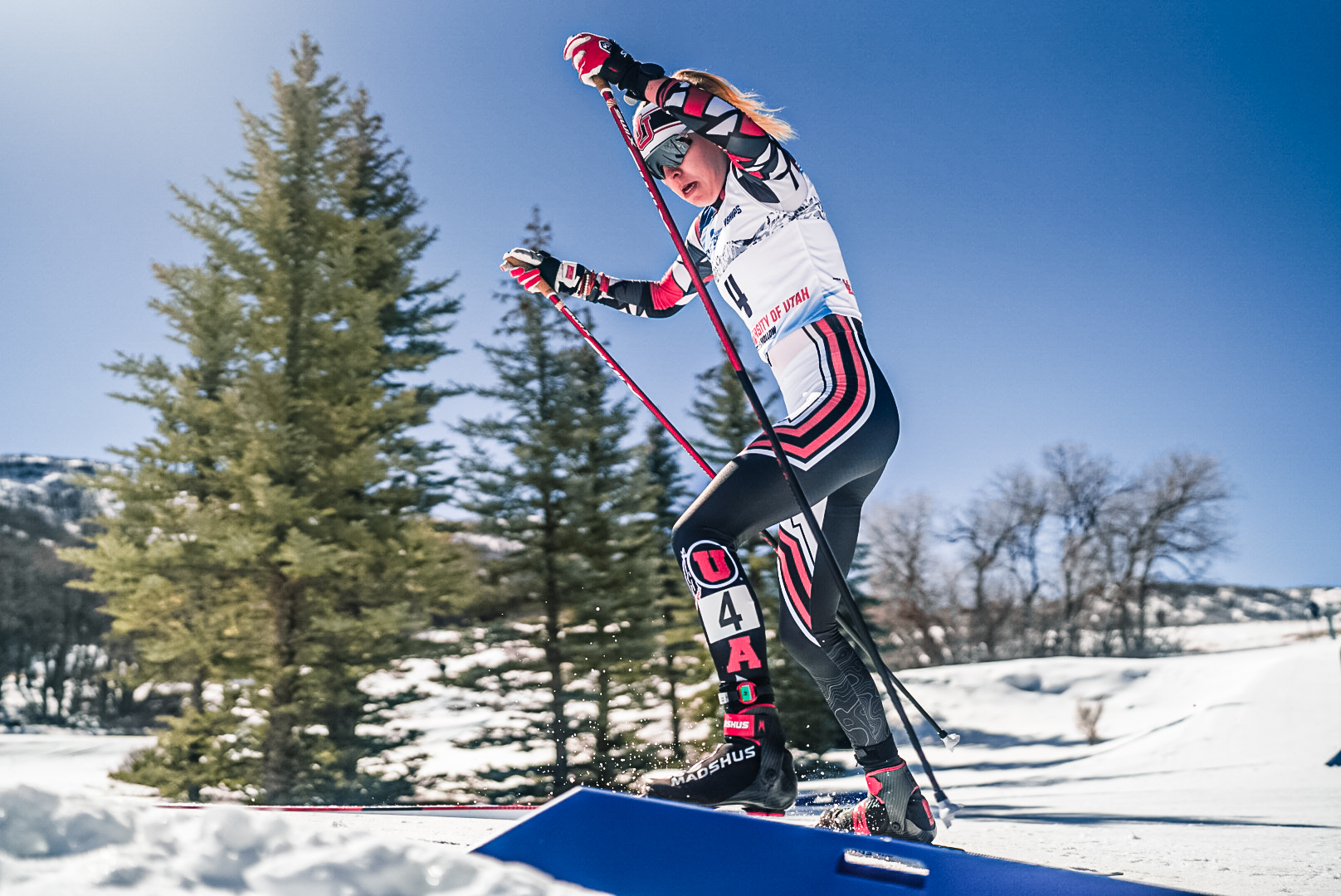
Sophia Laukli takes the collegiate national title in the 15 k skate in 2022. (Photo: Tobias Albrigtsen / @untraceableg)
Middlebury to Utah: Building a Life Around Skiing
Laukli chose Middlebury because, at the time, academics were the top priority.
“I knew I didn’t want to be done skiing,” she says, “but it wasn’t the priority.”
Covid changed everything. Remote classes allowed her to chase early World Cup opportunities without living on campus. Once Middlebury required students to return in person, the timing coincided with the rapid ascent of her ski career.
That led to a transfer to the University of Utah.
“Utah is built for athletes,” she says. Most classes were online and flexible. She chose economics not out of passion but practicality.
“I didn’t necessarily choose the thing I thought was interesting,” she says. “I chose what would best suit my ski career.”
Now, even as a full-time pro based in Norway, she’s studying again—an online Norwegian MBA.
“I’ve never been someone who can come home from training and sit on the couch until my next session,” she says. “I think I was missing having more than just training.”
Balancing skiing and school helps her prevent the sport from consuming everything.
Last year, after the World Championships, Laukli decided to lean all the way into running. It seemed logical—if she’s good at running without specifically training for it, imagine how good she’d be if she did.
“I always thought I’d be a much better runner if I had just run,” she says.
So she tried it. No roller skiing. No ski sessions. Just running—every day.
“I was running 10 to 12 hours a week,” she says. “And I was so tired each day. I was getting worse and worse at running. And obviously not good at skiing.”
The experiment collapsed at a race where she felt utterly depleted. She flew home, frustrated and confused. That’s when she sat down with her boyfriend, Gjøran Tefre.
“He said, ‘It’s fine. I’ll write a plan. Don’t freak out,’” she says. “‘We’ll get you a coach, but ski training is straightforward. We’re gonna baby you into ski training again.’”
Two weeks completely off. Then a return to “textbook” ski training.
Within a week of roller skiing, something wild happened: her running started feeling good again.
The pattern was clear. She ran better when she trained like a skier.
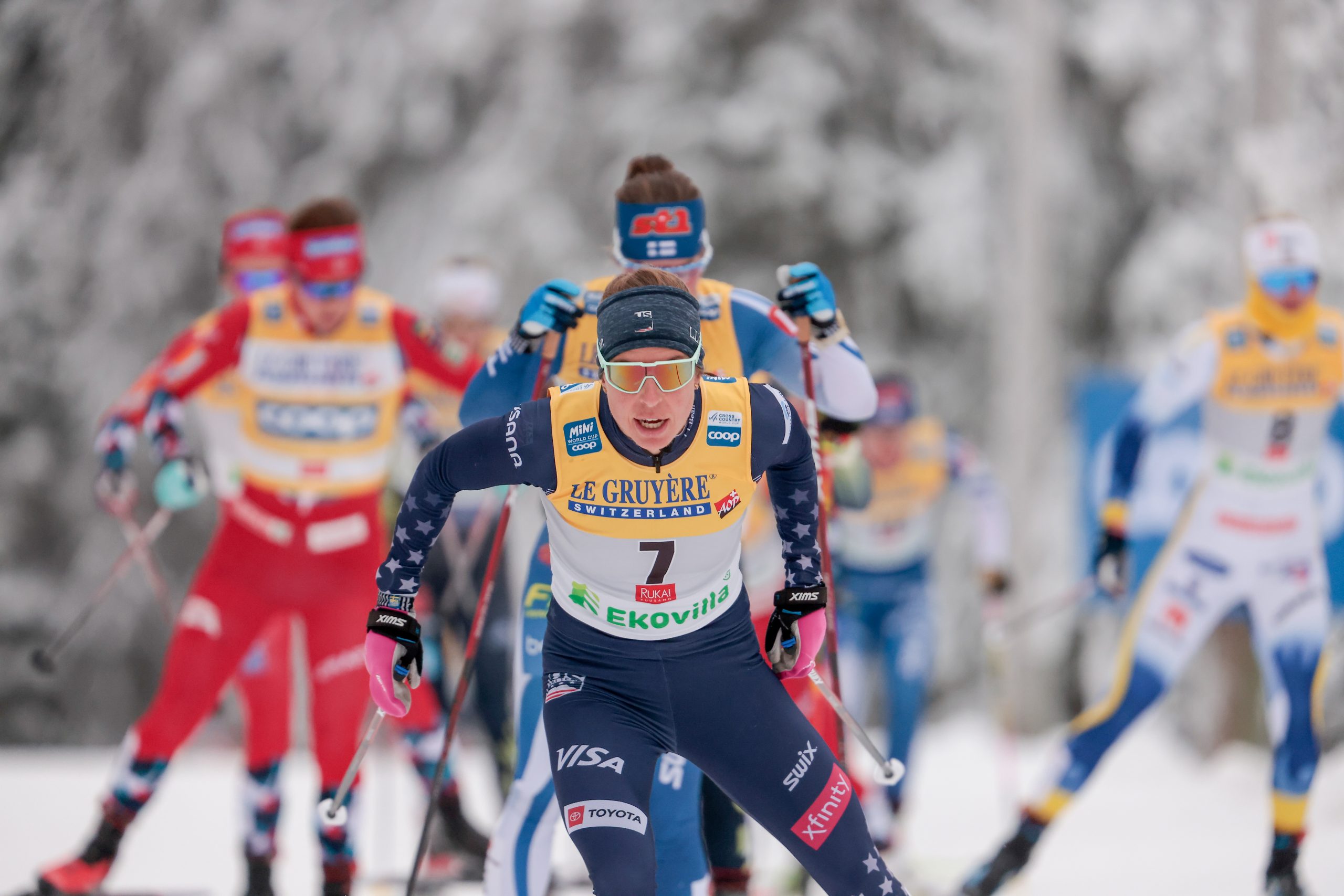
Sophia Laukli (USA) during the World Cup 20km in Engadin (SUI). (Photo: Authamayou/NordicFocus)
Kristen Bourne Saw The Same Thing
“Last season was definitely a struggle for her, both running and skiing,” says U.S. Ski Team assistant coach Kristen Bourne, who monitors Laukli’s training load. “And she’s just trying to figure out why.”
For Bourne, the shift wasn’t just physical—it was psychological.
“I’m a huge believer that what makes a difference from a good athlete to a great athlete is the athlete who is very invested in their own process,” Bourne says. “The ones who are thinking, advocating for what they need—not just deferring to a coach because the coach’s word is gospel.”
That ownership, she says, is new in Laukli.
“She’s definitely leaning into that more this year,” Bourne says. “Which is really cool.”
Sophia Laukli and Gjøran Tefre at the Cross Country Skiing World Championships. (Photo: Courtesy Photo)
The Gjøran Factor: Coach, Partner, Check on Reality
Mixing a relationship with coaching is a delicate thing. Laukli knows the risks—she’s heard them all.
“I’ve been told by many people this is not a good idea,” she says. “And other people are like, ‘Wow, I wish I could do that.’”
She also knows why it works.
For one, they communicate constantly. For another, his intentions are pure.
“One of the hardest parts of finding the right coach was that they either only cared about skiing or only cared about running,” she says. “He’s the only one who actually wants me to do well in both.”
Still, she doesn’t call him her “coach.”
“I want our personal life and work life to be separate,” she says. “We need other people in the room.”
That’s where Bourne plays a key role.
“At this level, athletes have so much experience—they do know what they need,” Bourne says. “So my goal isn’t to dictate everything. It’s to help Sophia articulate what she feels and translate it into training.”
The two systems—Tefre’s daily presence and Bourne’s structured oversight—meet in the middle.
One of the key themes that has emerged from all our recent interviews is the importance of making time for fun. Sophia Laukli and Gjøran Tefre embrace that notion entirely. (Photo: Courtesy Photo)
The Norwegian Experiment: Simple Workouts, Serious Control
When Laukli moved to Norway, she expected cutting-edge workouts—maybe some secrets behind the country’s dominance.
“It’s almost been the opposite,” she says. “They’re so simplistic around ski training.”
Five-by-ten-minute intervals around the Holmenkollen loop. The same long, easy days. Repeated blocks of threshold.
“You’re gonna become better if you do five-by-ten once a week for 12 weeks in a row,” she says. “You’re gonna become better.”
The key difference from the U.S.? Control.
Almost every Norwegian skier has a weekly treadmill “profile test,” which involves six-minute stages at a 10 percent incline, with lactate samples taken at each step andheart rate recorded.
“It’s to see if you’re in the right range,” Laukli says. “Not to get better each week.”
Bourne sees value in that simplicity.
“Sometimes a coach wants to prescribe the flashy intervals,” Bourne says. “But honestly, the athletes who can execute the basics really, really well—that’s where the gains are.”
She sees Laukli finally embracing that mindset.
“Athletes shouldn’t feel like training is something done to them,” Bourne says. “They should feel like they’re building something in collaboration with the coach. Sophia is starting to live that.”
Laukli agrees that American juniors often overtrain because they don’t know any better.
“If I go too hard too many times in a row, it’s a much worse year,” she says.
The hardest part? Slowing down when training with Norwegian women who can drop her on almost every roller-ski interval.
“Every interval I do here, I know I’m not gonna keep up,” she says. “At 17, that would’ve crushed me. Now I have evidence that I can beat them in the winter.”
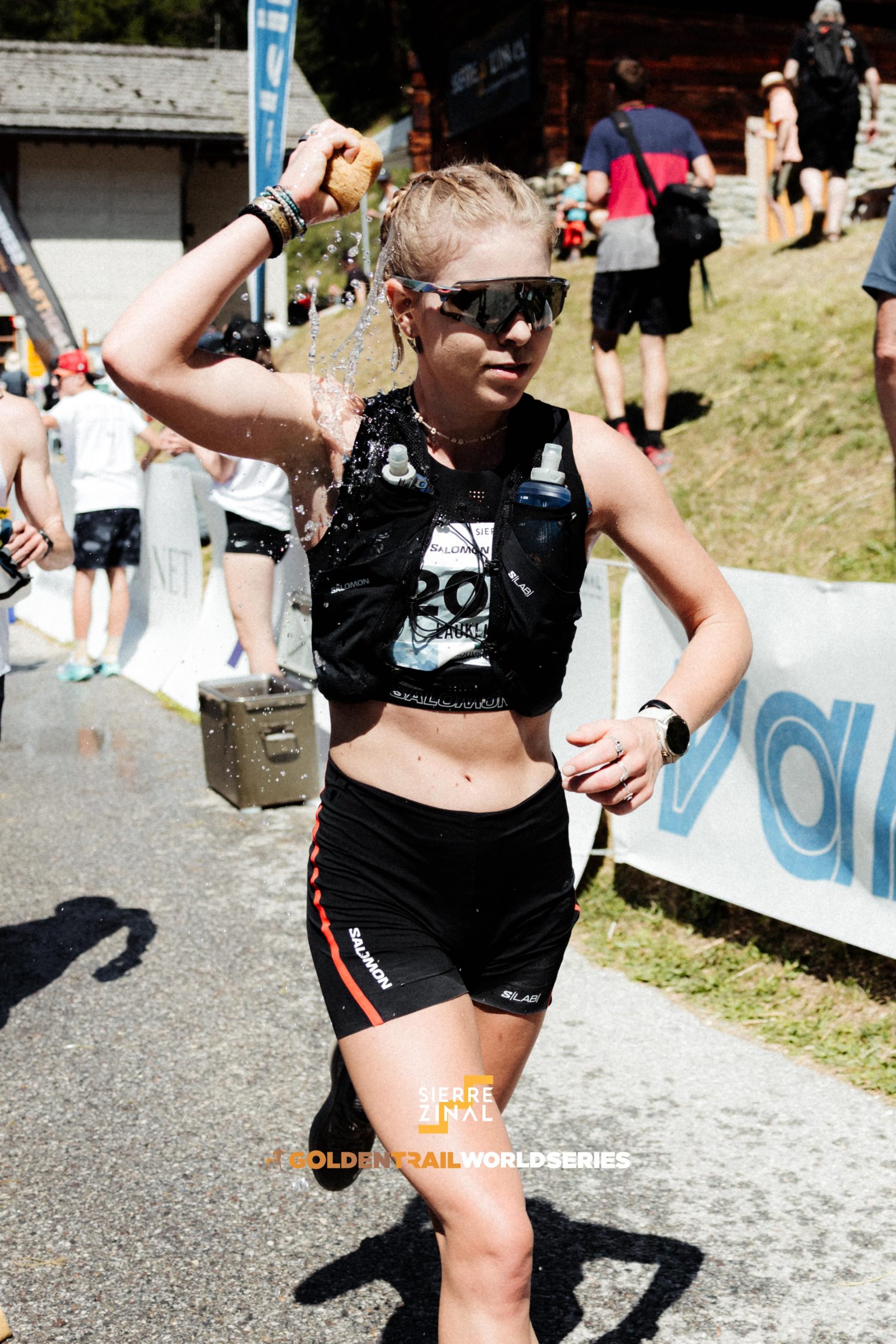
Laukli racing Sierre-Zinal in the Gold Trail World Series in 2024. (Photo: @rising.story_@colinolivero_GTWS_SierreZinal
Two Seasons, One Mindset
Running and skiing back-to-back seasons creates year-round excitement—and pressure.
“I have two competition periods,” she says. “It’s easier to motivate. But it also means I’m 100% consumed by performance all year.”
That obsession became a barrier last year. Now, Laukli is working with Bourne and Tefre to shift her mindset.
She has clear goals for skiing: the Olympic 10k, the Olympic relay, andthe final hill climb at the Tour de Ski.
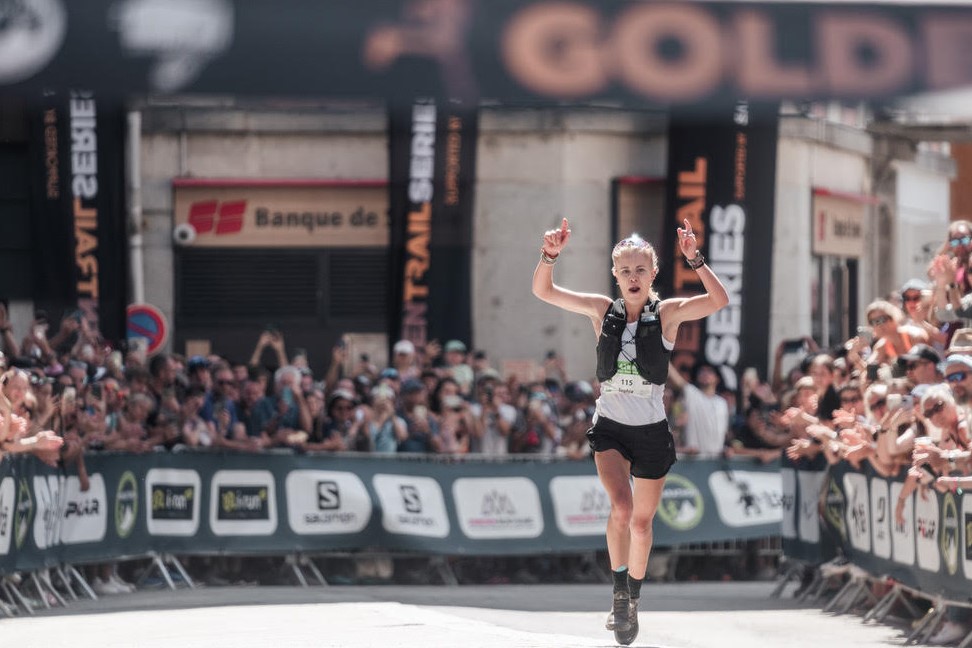
She has equally specific running goals: above all, returning to Sierre-Zinal, where she once ran 2:53 on the iconic 31 km route.
However, she’s no longer defining success solely by results.
“There’s so much I’m working on—technique, tactics, how I ski courses,” she says. “It’s easy to be on a start line and focus on whether those things show up.”
Bourne sees that evolution clearly.
“Sophia has the instincts of a really high-level athlete,” Bourne says. “But learning to trust those instincts—rather than obsessing about the result column—is where she’s growing most.”
Laukli nears the finish of the final climb of the 2024 Tour de Ski on Alpe Cermis, where she claimed the victory. (Photo: NordicFocus)
Why Salomon Fits: One Athlete, Two Worlds
For an athlete splitting her year between the World Cup and the Golden Trail Series, sponsorship could easily become complicated. Many runners work with running-only brands; many skiers work with ski-only brands. For Laukli, that would have been a logistical mess — and maybe even a dealbreaker.
Instead, she found the perfect home with Salomon.
“I’m super grateful that I get to have my sponsor, my main sponsor, support me in both,” she says. “Because then it’s a lot easier to focus on each season. I know that they’re supporting me in that.”
That unified support matters. It lets her shift from skis to singlets without the politics of competing brand calendars and conflicting performance expectations.
“I don’t really know if it would be possible for me to be a runner for another brand and a skier for a different brand,” she says. “Like, defending to them that I can’t run a normal running season because it’s the Olympics, or I need to drop World Cups so I can run better this year — that just wouldn’t work.”
With Salomon, the opposite is true. Everyone’s aligned.
“Having everyone be on the same team makes it manageable,” she says. “And a lot more motivating, because everyone has the same goal.”
She works directly with Salomon’s France-based team, and Laukli lights up when she talks about the group behind her.
“They’re all French,” she says, laughing — a nod to the company’s deep culture in both ski sport and trail running. It’s also a reminder that Laukli lives firmly in the middle of two endurance worlds that Salomon understands and embraces.
That harmony matters. Her identity isn’t split; it’s blended. And Salomon is built for that.
Sophia Laukli (USA) racing the World Cup Mass Start in Les Rousses (FRA). (Photo: Modica/NordicFocus)
Sunny Weekends and Simple Breakfasts
Some things have gotten simpler, like her pre-race breakfast.
“I used to do peanut butter and banana,” she says. “Now I just have cereal. Apparently, simple is better.”
World Cup life has also taught her the importance of flexibility.
“You learn how to adapt,” she says. “Something will always go wrong on a race weekend.”
When she’s asked for her favorite place on the circuit, she doesn’t hesitate.
“Davos,” she says. “It’s sunny. You can have bad races, and it doesn’t matter because it’s a really nice place to hang out.”
That small detail fits her evolving philosophy. Training is simpler. Goals are more balanced. And the sport—skiing and running—feels more sustainable.
Somewhere between Maine and Norway, between Middlebury and Utah, between World Cup stadiums and alpine trails, Sophia Laukli has built a training model that doesn’t look flashy. It’s repetitive. It’s measured. It’s rooted in trust, communication, and doing the basic things right, over and over again.
And if the Norwegians are right—and if Laukli’s instincts keep sharpening—those basics may be exactly what carry her to the front this season, in both sports.
Love Stories Like This? Help Keep Them Coming.
Feature interviews like this one take time, access, and care to produce. If you value thoughtful storytelling and independent ski journalism, please consider becoming a Voluntary Subscriber. Your support directly fuels the work we do to cover the people, places, and moments that make our sport special.
Norwegians are born with skis on their feet, blah blah blah, we know. They’re good at skiing and they won pretty much all the races on home snow this weekend…but they were still fun events to watch. Devon reports from Norway while Nat tunes in from melting Alaska; they don’t need any stinkin’ guests this week.
Got questions for us? New cross-country skiing meme accounts we should follow? nat@fasterskier.com and devon@fasterskier.com. We’ll be back soon.
This coverage is made possible through the generous support of Marty and Kathy Hall and A Hall Mark of Excellence Award. To learn more about A Hall Mark of Excellence Award, or to learn how you can support FasterSkier’s coverage, please contact info@fasterskier.com.
Martin Loewstroem Nyenget (NOR) crushed the field in Lillehammer’s World Cup 10 k Freestyle Interval Start. (Photo: NordicFocus)
There will be a Cross-Country World Championships in Trondheim, Norway later this winter—and it looks like the anticipation of those important race days on the International Ski Federation (FIS) calendar is causing this season to be viewed in a whole new way. In seasons past, the rewards of performing well in the year-long FIS World Cup standings would’ve inspired many skiers to enter every single available World Cup race, even when they were tired (rationalizing that everyone else would’ve been tired), maybe even when they were sick (can’t afford to take a day off in which some other skier could steal their points). Even the exhaustion-inducing, plague-generating Tour de Ski (and the massive number of points it offers) has generally been seen to be so important that skiers risked ruining their whole season by skipping it. Not anymore: FIS has already announced plans to investigate alternative scheduling—and reconfigured scoring values—of future Tour de Ski events so that racers will continue to consider it valuable. As for the tightly packed races of World Cup weekends, World Championship contenders are already selectively entering—and selectively skipping—those. And the season is only two weekends old.
With what’s certain to be the astronomical value of a Norwegian victories in World Championship races contested on native soil, Team Norway seems to be taking a different approach to those days on the FIS calendar. Last week in Ruka, Finland, Johannes Hoesflot Klaebo was said to have displayed mild cold symptoms—he did not start Sunday’s 20 k Freestyle Mass Start, a race he truly was likely to have won (healthy or not). This on a weekend when he had already earned his way into the FIS World Cup overall leaders bib (Klaebo’s absence from Sunday’s 20 k would deliver the bib to Norwegian teammate—and defending Crystal Globe winner—Harald Oestberg Amundsen).
Eight Norwegians raced into the top ten of Lillehammer’s 10 k Freestyle, including names that are fairly new to international audiences like Andreas Fjorden Ree (NOR) who would finish an impressive fifth. (Photo: NordicFocus)
In this weekend’s Lillehammer World Cup races, Team Norway is entitled to a whole host of starters—eight for being the nation of a World Cup overall winner (Amundsen), and another four as the host nation of the weekend’s racing in Lillehammer. Twelve Norwegian starters lined up for the Men’s 10 k Freestyle—Iver Tildheim Andersen, Mattis Stenshagen, Didrik Toenseth, Simen Hegstad Krueger, Paal Golberg, Martin Loewstroem Nyenget, Jan Thomas Jenssen, Andreas Fjorden Ree, Sander Haukvik-Jensen, Einar Hedegart, Ole Tafjord Suhrke, and Amundsen—but no Klaebo on the roster. Team physicians have suggested that his case of the Ruka-sniffles continues . . . so no racing for him on Friday. He’s likely to rise from his sick bed just in time to smack around the rest of the competition in Saturday’s Sprints. Then we’ll see what he has left for Sunday’s Skiathlon. What’s evident is that Klaebo (perhaps more than any other skier) is planning his season so that “what he has left” on race day will find him at his absolute best when the World Championships come to Trondheim.
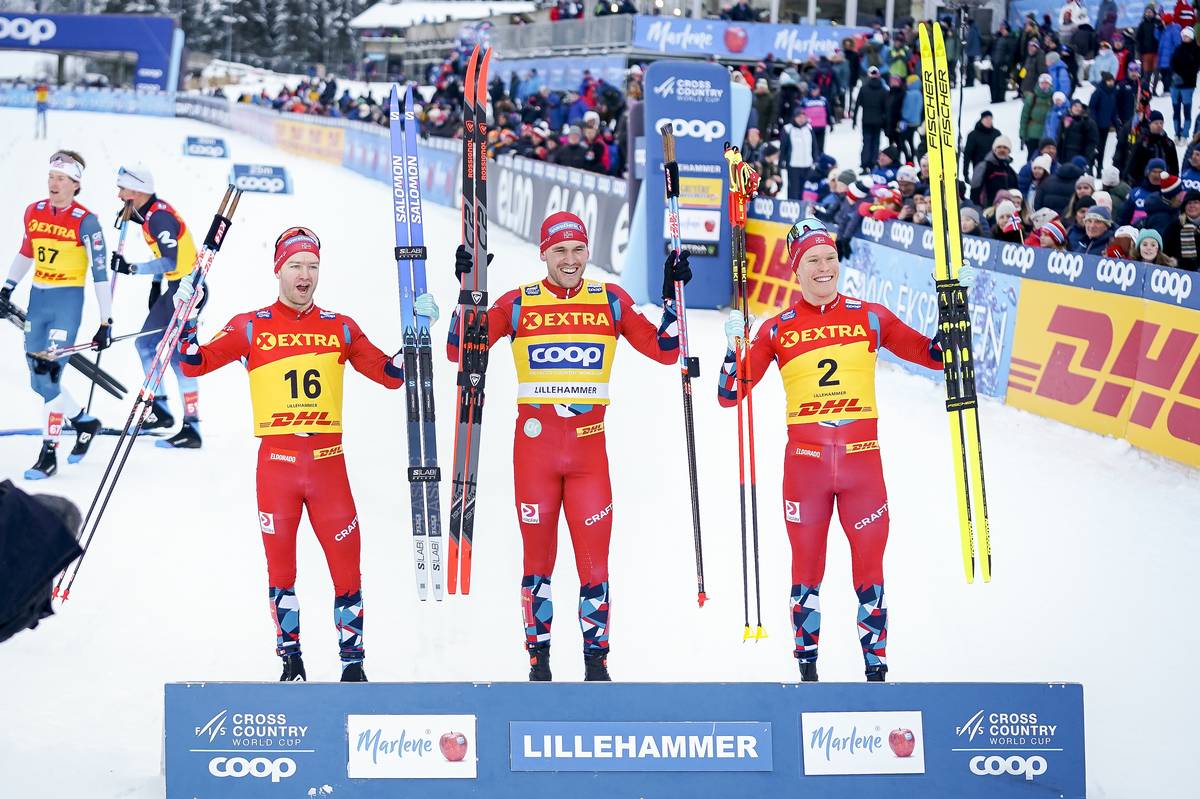
Other teams’ star athletes are already following suit: Team Sweden’s Frida Karlsson followed up her utterly dominant performance in Ruka’s 20 k Classic Individual Start by skipping the 20 k Freestlye Mass Start only two days later (a race in which she would’ve been certain to contend for the win). But the World Cup is filled with fine athletes, and so many of them DID race the event in Lillehammer. In the end, Norway continued its dominance with eight skiers in the top ten and a decisive a victory for Nyenget, followed by Krueger in second and Amundsen in third.
Among Americans, Gus Schumacher finished 25th, followed by Ben Ogden (31st), Zanden McMullen (32nd), John steel Hagenbuch (38th), Hunter Wonders (53rd), Michael Earnhart (64th), Zak Ketterson (72nd).
Canadian racers in Lillehammer included Antoine Cyr (35th), Max Hollmann (37th), Xavier McKeever (63rd), Olivier Leveille (66th), Sasha Masson (68th).
Gus Schumacher (USA) followed up his eighth place finish in Ruka’s 20 k Mass Start with a 25th place finish in the 10 k Freestyle in Lillehammer. (Photo: NordicFocus)
10 k Freestyle Interval Start
Fans of American skiing were eager to see if Ogden could make a mini-comeback after a less-than-stellar couple of races (and a DNS in the 20 k Mass Satrt) in Ruka a week ago. Though cameras were able to follow Ogden for the first meters of the start, he looked to begin very conservatively, very relaxed.
“I’m always trying to be as good as I can be in all the races,” said Ogden. “That being said I have an emphasis on sprinting this season as I want to target the individual and team sprint at world champs. Lots of work to be done on both.”
The more I race the better I get,” Ogden continued. “Always has been that way for early season, that’s how todays 10k fits into the master plan.”
Fans were also eager to see if McMullen and Schumacher could repeat their top ten finishes of a week ago in the Ruka 20 k Mass Start. Team USA’s season continues to be one in development.
“Definitely pretty had conditions,” said Schumacher. The hills, especially, were quite soft . . . kinda no matter what you did, it seemed like that last lap was really hard.”
Naoto Baba (JPN) was one of the leaders among early starters. He would finish an excellent 17th in Lillehammer. (Photo: NordicFocus)
Strong early splits by Joe Davies (GBR) and Naoto Baba (JPN) gave hope to the early starters, but once the wave of Norwegians took to the course, all earlier contenders turned back into pumpkins. Andersen displaced early-leader, Davies by a whopping 23 seconds at the 3.5 kilometer mark. Racing in a pair of distinctly un-Nordic mirror-backed shades, Andersen (winner of last year’s Lillehammer World Cup 10 k Freestyle) blitzed all earlier starters and appeared positioned to repeat his 2023 Lillehammer 10 k World Cup win. But Andersen would find himself replaced in the leader’s chair by Krueger, who would then be displaced by Nyenget’s stunning 22:58 finish.
“The condition today was really tough,” said, Nyenget. “I worked really hard with my motivation—this track and also this condition is not my favorite—but today I had a fantastic good day and good skis, so then it was a great experience.”
Harald Oestberg Amundsen (NOR) defended his hold on the World Cup yellow leader’s bib with his third place finish in the 10 k Freestyle in Lillehammer.(Photo: Modica/NordicFocus)
Late starter, Amundsen, skied brilliantly to claim third place on the podium, and in active defense of his World Cup Overall leader’s bib (ahead of Nyenget by 47 points). But the day was definitely Nyenget’s whose victory was made even more impressive when the finishing gaps are considered: more than a minute separated the top ten finishers.
“Last week in Ruka I was really happy,” Nyenget comented after the race. “But to take this win is something extra. Obviously one of my best races, I think.”
Naturally, all Norwegian team skiers are conscious of the bright media spotlight that illuminates their performances each week. Ironically, Nyenget’s career-day may be overlooked in the selection for World Championship starting positions since the 10 k Freestyle is not one of the events slated to be contested in Trondheim later this season. But it’s always a special occasion for any Norwegian skier to find himself atop a World Cup podium.
“It’s a special season with the championship in Trondheim,” said Nyenget. “So fantastic to have a great start for this season.”
Simen Hegstad Krueger (NOR), Martin Loewstroem Nyenget (NOR) and Harald Oestberg Amundsen (NOR), (l-r) lead Norway’s dominance in Lillehammer by sweaping the podium. (Photo: NordicFocus)
Crashes, breakout performances, a Klaebo fill-in called in mid-workout, an American victory and climate activists disrupting a race — the three-day Lillehammer weekend had it all. Olivia Orr and Hannah DeAngelis, two superfans in Maine, join us for the recap, with Devon bringing us firsthand intel from the Canadian wax cabin.
We’re at devon@fasterskier.com and nat@fasterskier.com if you’ve got questions or feedback. See you next week.
This World Cup coverage is made possible through the generous support of Marty and Kathy Hall and A Hall Mark of Excellence Award. To learn more about A Hall Mark of Excellence Award or to learn how you can support FasterSkier’s coverage please contact info@fasterskier.com.
Ben Ogden (foreground) and Zak Ketterson (background) during the Classic 20 k Sunday. (Photo: NordicFocus)
If Saturday’s individual sprint race was a return to the archetype for this era of World Cup skiing, then Sunday marked something completely new. Part by design, part by necessity, the men’s field raced a 20 k classic mass start for the first time on the World Cup since the 2012 Tour de Ski (when Eldar Roenning (NOR) won over 2nd place Alex Harvey (CAN) and 3rd place Dario Cologna (SUI).
The part by design: FIS has moved to the 20 k mass start as part of equal distance racing for men and women on the World Cup, replacing the 15 k that had become the standard classic distance event. The 20 k is an odd distance that has rarely been raced (by either men or women) on the international scene . . . though it does seem to represent a good compromise for both the women’s field, and the men’s.
The part by necessity: this race was originally slated to be a 30 k skiathlon, but operating on man-made snow all weekend in Lillehammer, the organizing committee had to scratch plans and lay a classic track on a 3.3 k snowmaking loop where the field would ski 6 laps. The course chosen was the Biathlon loop, which meant that homologation standards usually present on the World Cup were not present on the course today.
In an interview with FasterSkier after the race, US National Team member, Gus Schumacher, said that the course led to a clear expectation of how the race would play out. “We were kind of expecting a bunch sprint, because the course was missing those long, sustained climbing sections that most of our World Cups have. There were guys out there today who probably had higher aerobic capacities that weren’t necessarily able to flex it.”
Then there was the glaring fact that the best classic distance skiers at 15 k in the past year —all three Olympic medalists in the 15 k —weren’t on the start line. Iivo Niskanen (FIN) was absent, Johannes Hoesflot Klaebo (NOR) scratched after his sprint win yesterday, and Alexander Bolshunov (RUS) is not participating in FIS World Cup events due to Team Russia’s suspension. In their place was a group of contenders who raced as a sustainable pack, through six tightly wound laps.
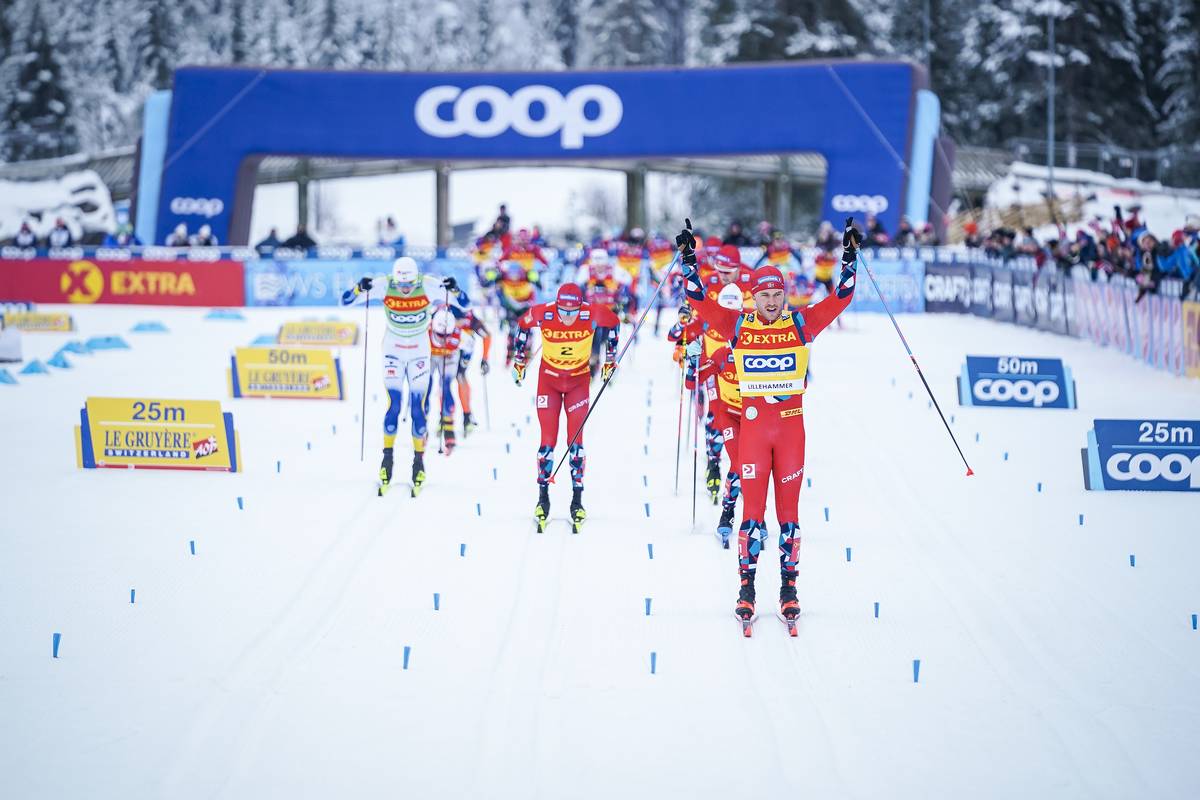
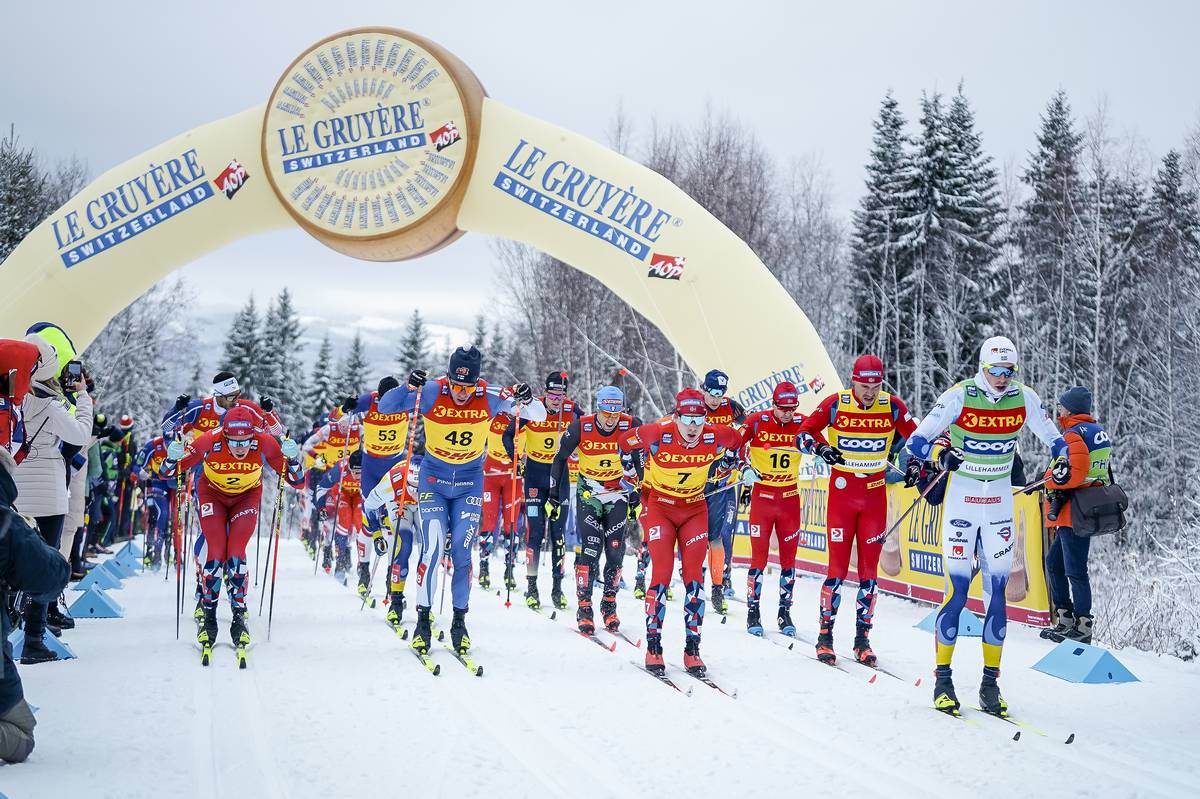
In the end, the only signifier that might have distinguished one of the competitors in that pack was the yellow FIS World Cup overall leaders bib, worn by Paal Golberg (NOR). A marked man throughout the day, Golberg nonetheless moved to the front of the pack as they entered the Birkebeiner stadium, applying extra force to his double-pole, and opening up a gap that saw him pull away to his first race victory of the season. A pack of his countrymen followed close in his wake with Norway taking the top four spots on the day: 1st) Paal Golberg, 2nd) Sjur Roethe, and 3rd) Martin Loewstroem Nyenget, 4th) Didrik Toenseth.
Paal Golberg (NOR) celebrates his first World Cup win of the season in Lillehammer’s 20 k Classic Mass Start. (Photo: NordicFocus)
The 20 k Classic Mass Start
Racing all the way to that Norwegian-heavy conclusion, however, was a tight-knit and colorful affair. The first kilometer of the day’s course featured its major climb, which from the gun saw Andrew Musgrave (GBR) move to the front in an unflinching double-pole. Musgrave didn’t relent as the rest of the field turned to striding, a pattern that would repeat through the early laps of the race. Musgrave would move off the front before each major climb, having discovered that the other skiers’ transitioning from double-poling to striding impeded the momentum he needed to double-pole the course. Best just to get off the front, then pay for it at the top of the climb.
Andrew Musgrave (r) double-poles ahead of the field early on in Sunday’s 20 k classic. (Photo: NordicFocus).
Musgrave animated the field through that early part of the race; with the rest of the pack able to keep pace on their classic skis, there was little reason for them to push the pace. Who got to the front of the field wasn’t a question of strength or fitness through most of the race, but rather how well skiers could find the little pockets of space or snow needed to move up through the pack. For the Americans, Scott Patterson and Ben Ogden were able to move up within the first 2 laps of the race. Gradually, though, more and more blue suits with stars came into picture—Zak Ketterson, then Gus Schumacher, and then Hunter Wonders, until the whole US contingent was present somewhere in the pack. In particular, Gus Schumacher stood out, adorned as he was in a pink cap that he said, “Was for my mom, she likes the pink hat.” Two Canadians—Antoine Cyr and Olivier Leveille—also weaved purposefully through the field.
Gus Schumacher (USA) skis behind Richard Jouve (FRA) in the pack during Sunday’s 20 k Classic. (Photo: NordicFocus)
On lap 3, the field began to settle into the contours of the course, and anxious competitors started to test where they might be able to break the race open. The first main animator was Martin Loewstroem Nyenget—champion of the 2022 50 k Holmenkollen—who moved to the front of the pack on the climb that covered the first kilometer of the lap. The field quickly bunched up over the top of the climb; through the halfway point, the race remained a stalemate.
Having not found the pressure point he wanted on the climb, Nyenget looked for it on the rolling terrain of the last two kilometers of the course. Again, the field picked up the pace; but again, no definitive gap developed as they hit the climb entering Lap 5. A similar move came from Finnish skier, Markus Vuorela, but the only effect was to stretch the lead group a bit, with skiers slowly fall off the pace.
Going into the final lap, all that had built was anticipation. Thirty skiers still jockeyed for position within the pack, with Americans Gus Schumacher and Hunter Wonders among its ranks.
It was the Swedish skiers who initiated a long attack. William Poromaa and Jens Burman ran to the front on the last big climb and continued to push the pace over the top. No doubt, the pair sensed that the new race format gave new life to the long-awaited hope that the Swedish men could re-establish themselves as elite distance skiers. That hope for a win now stretches back nearly a decade, since Daniel Rickardsson won the Holmenkollen 50 k in 2014. However, like most Swedish attacks in nearly every race since then, the ambitious pair were soon swarmed by a who’s-who of Norwegians. As the contenders entered the stadium, the sudden appearance of Golberg in the yellow leader’s bib was unanticipated, yet not at all surprising. Then came Roethe, Nyenget, and Toenseth, with Iversen and Krueger within striking distance too.
Even during the sprint the field remained tight, with the top 30 finishing within the span of 10 seconds. Gus Schumacher held his own in the sprinting pack, placing 17th—his highest finish in a classic distance race since the Tour de Ski in 2021 (where he was 8th). Hunter Wonders also finished in the charging pack, finishing 31st.
A pair of Canadian’s had also held strong in the pack: Antoine Cyr finished in 12th place, while Olivier Leveille came across the line in 27th.
The pack rolls into the Lillehammer stadium after lap 5 of 6, led by William Poromaa (SWE). (Photo: NordicFocus)
Gus Schumacher said that the fast field sprint reflected the general experience of being in the pack, “It was pretty chaotic throughout the race, jockeying for position without expending too much energy. I was definitely aware [the race] was getting more strung out and I was finding myself more up near the front as it went on, but there wasn’t a specific moment [where someone attacked].
In a new race format with a classic, old-school feel, the World Cup moved on through Lillehammer with a weekend full of homegrown success for the home country, and some promising glimpses for their rivals ancient (Sweden) and new (USA). For the latter, the momentum is building in a unique way. Gus Schumacher said to FasterSkier that the distinguishing feature of this season for the team so far is, “We’re getting good results in a wide variety of races. It’s sprints and distance races this year, and the wax team is doing really well too. It’s really fun as a team right now, we’re building good momentum.”
That momentum will certainly carry the US Ski Team, and the road show that is the Cross Country World Cup, to Beitostolen, Norway next week.
This World Cup coverage is made possible through the generous support of Marty and Kathy Hall and A Hall Mark of Excellence Award. To learn more about A Hall Mark of Excellence Award or to learn how you can support FasterSkier’s coverage please contactinfo@fasterskier.com.
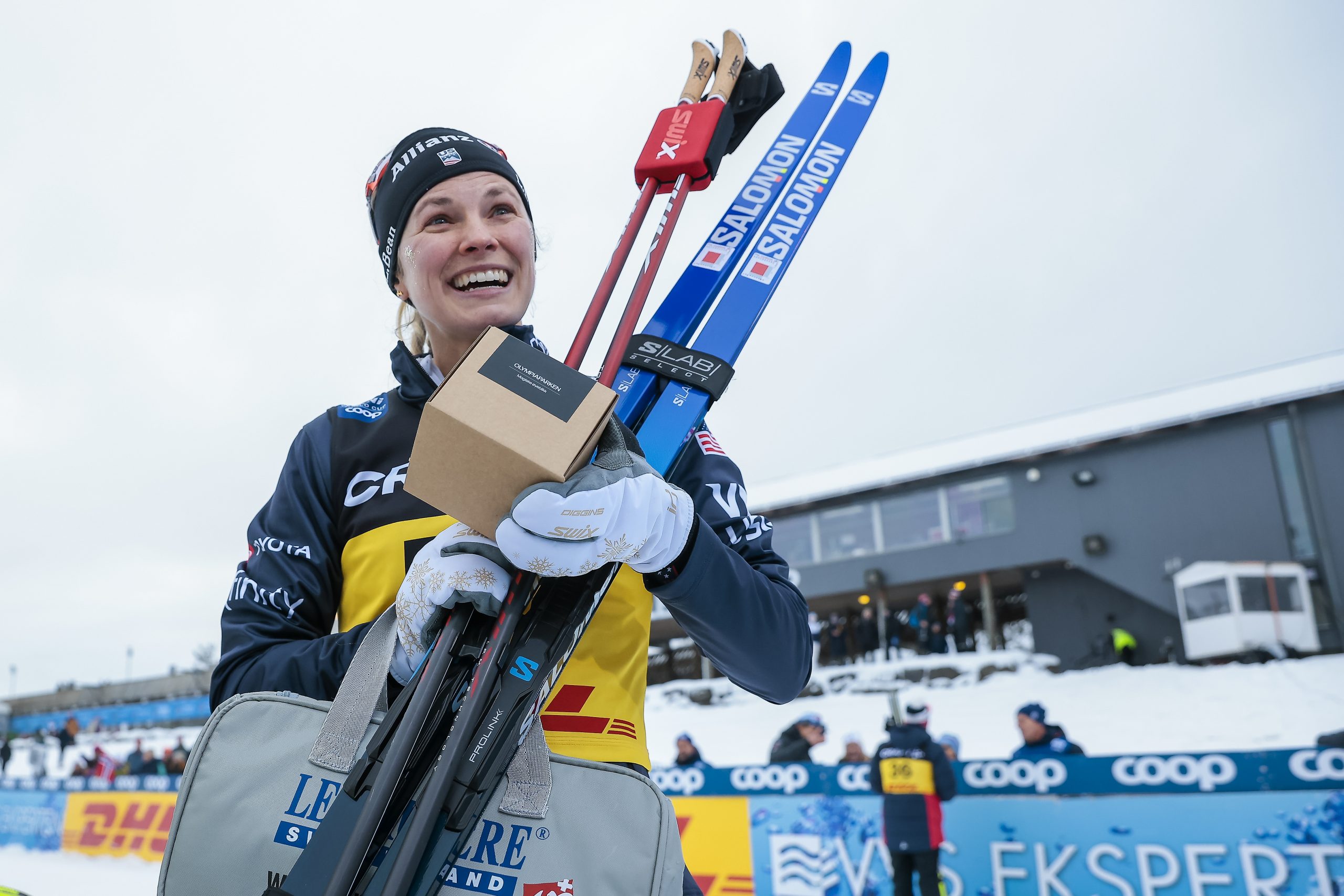
Jessie Diggins (USA) charges to the line for the narrow victory. (Photo: NordicFocus)
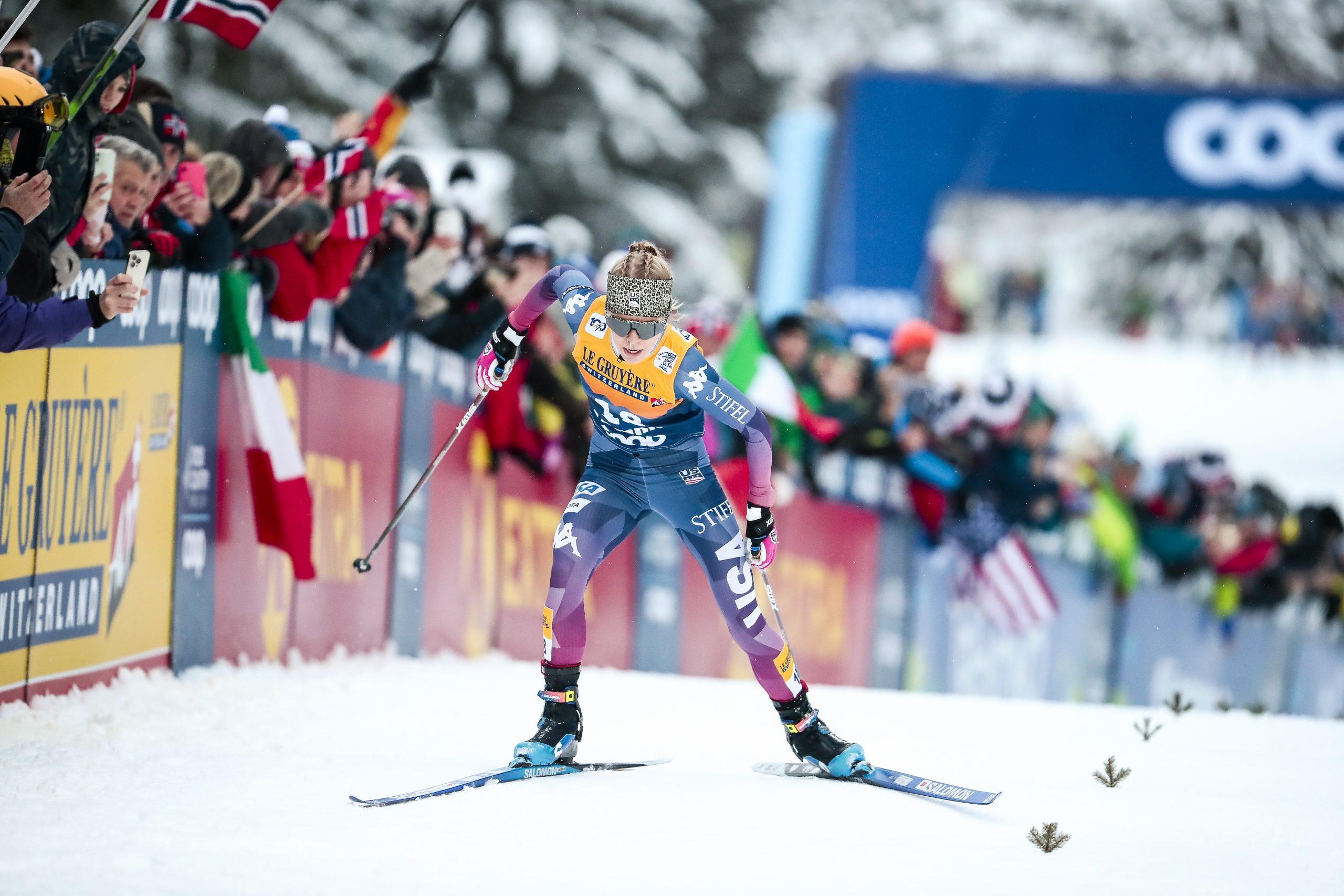
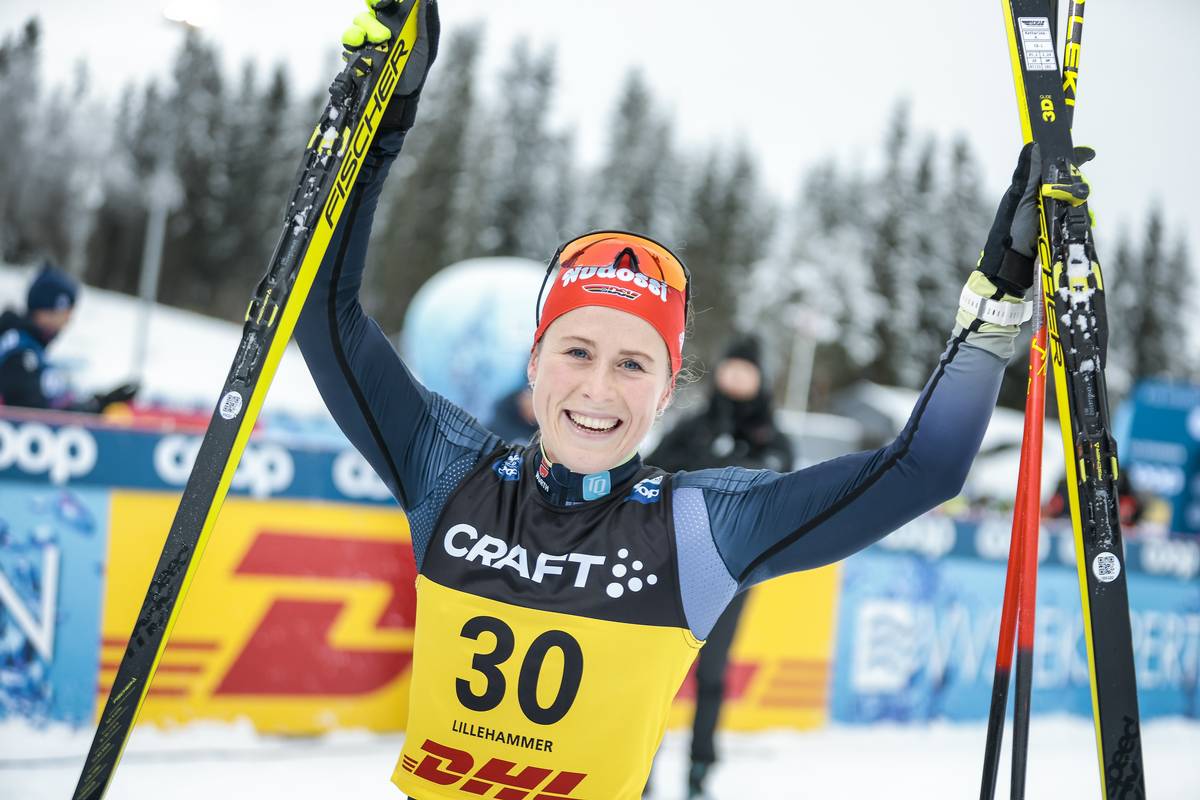
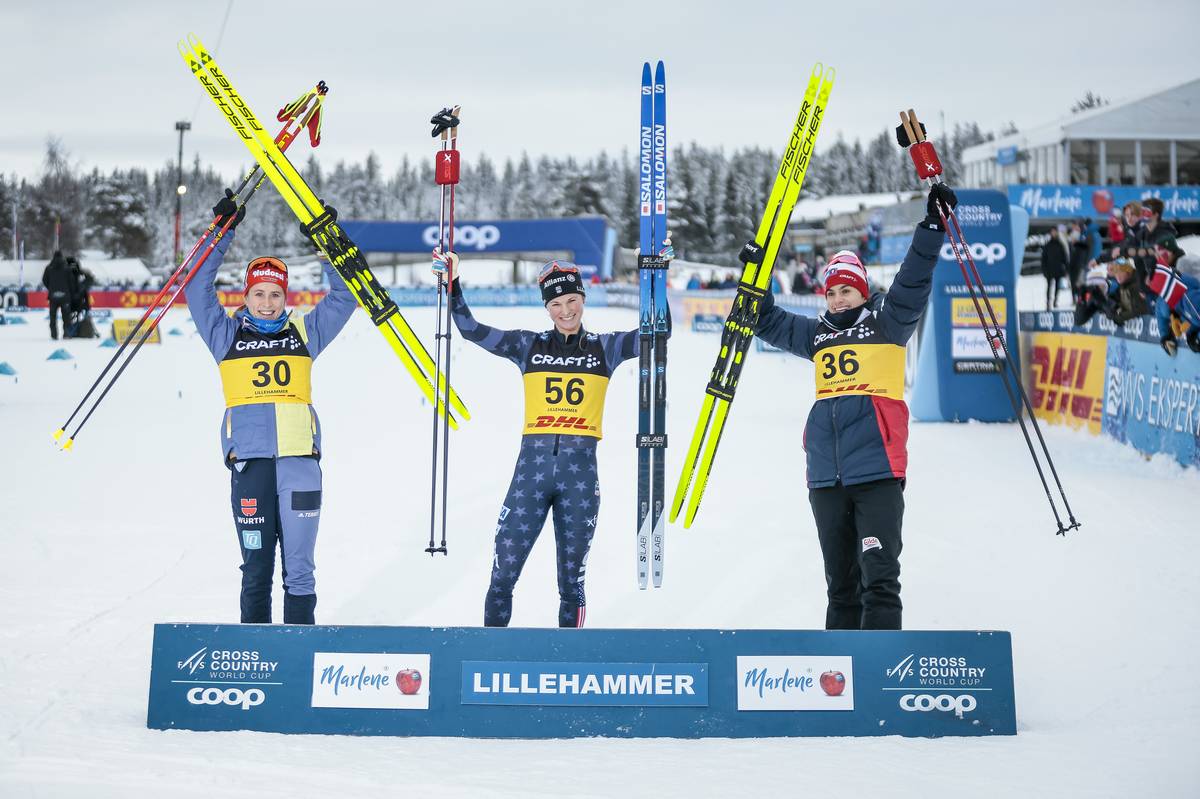
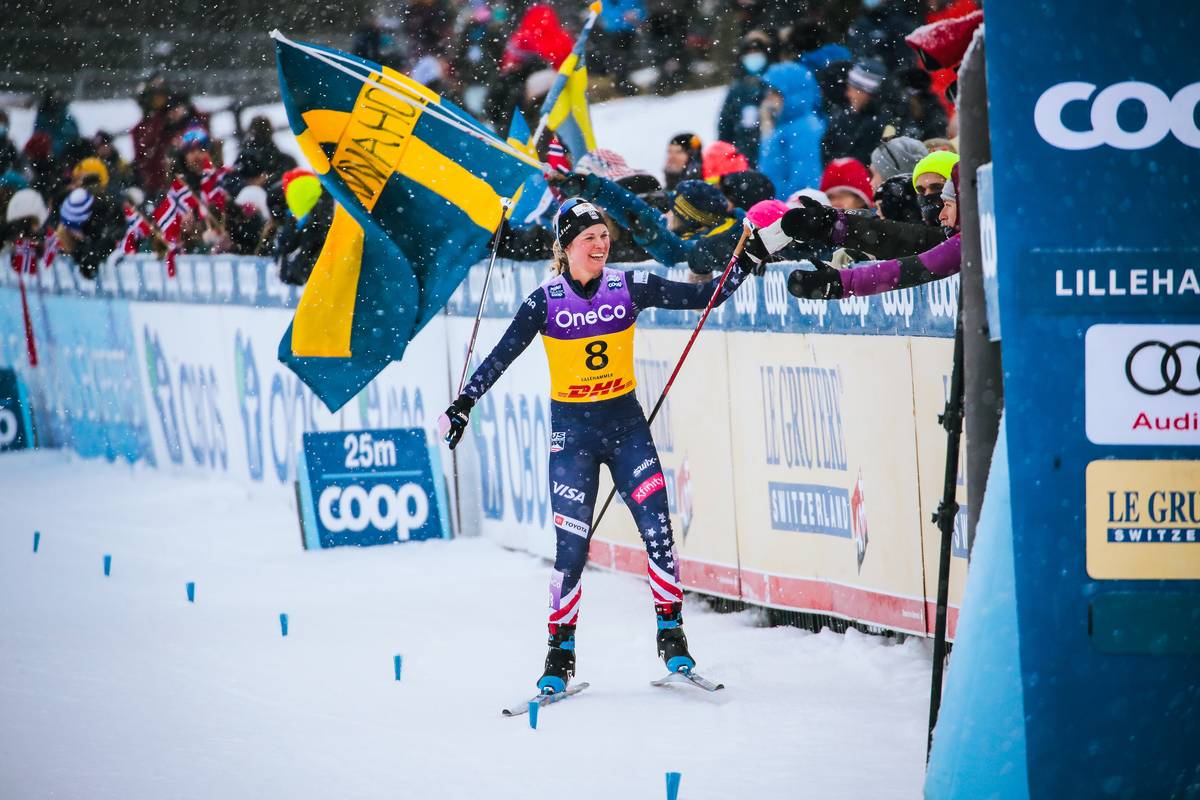
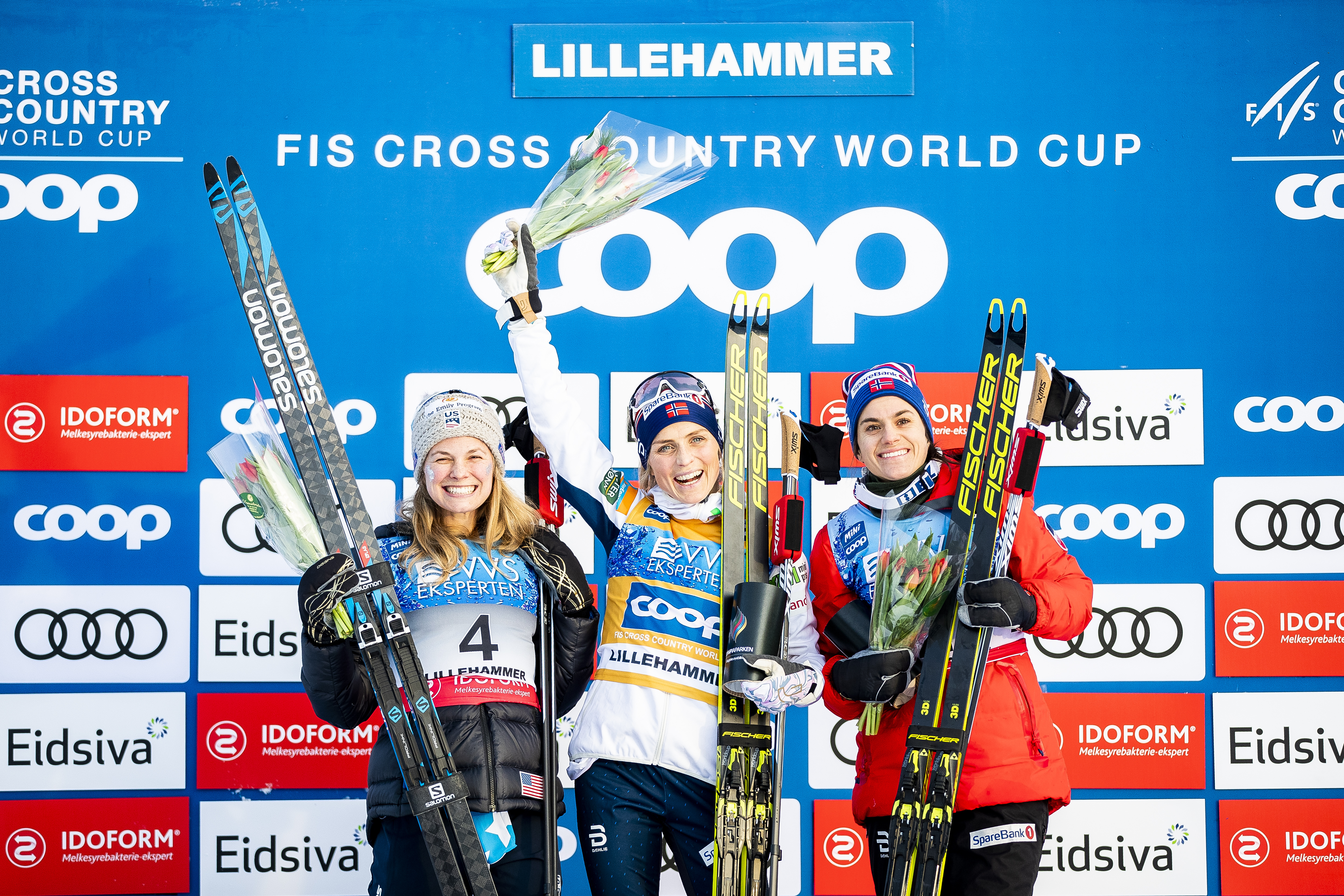
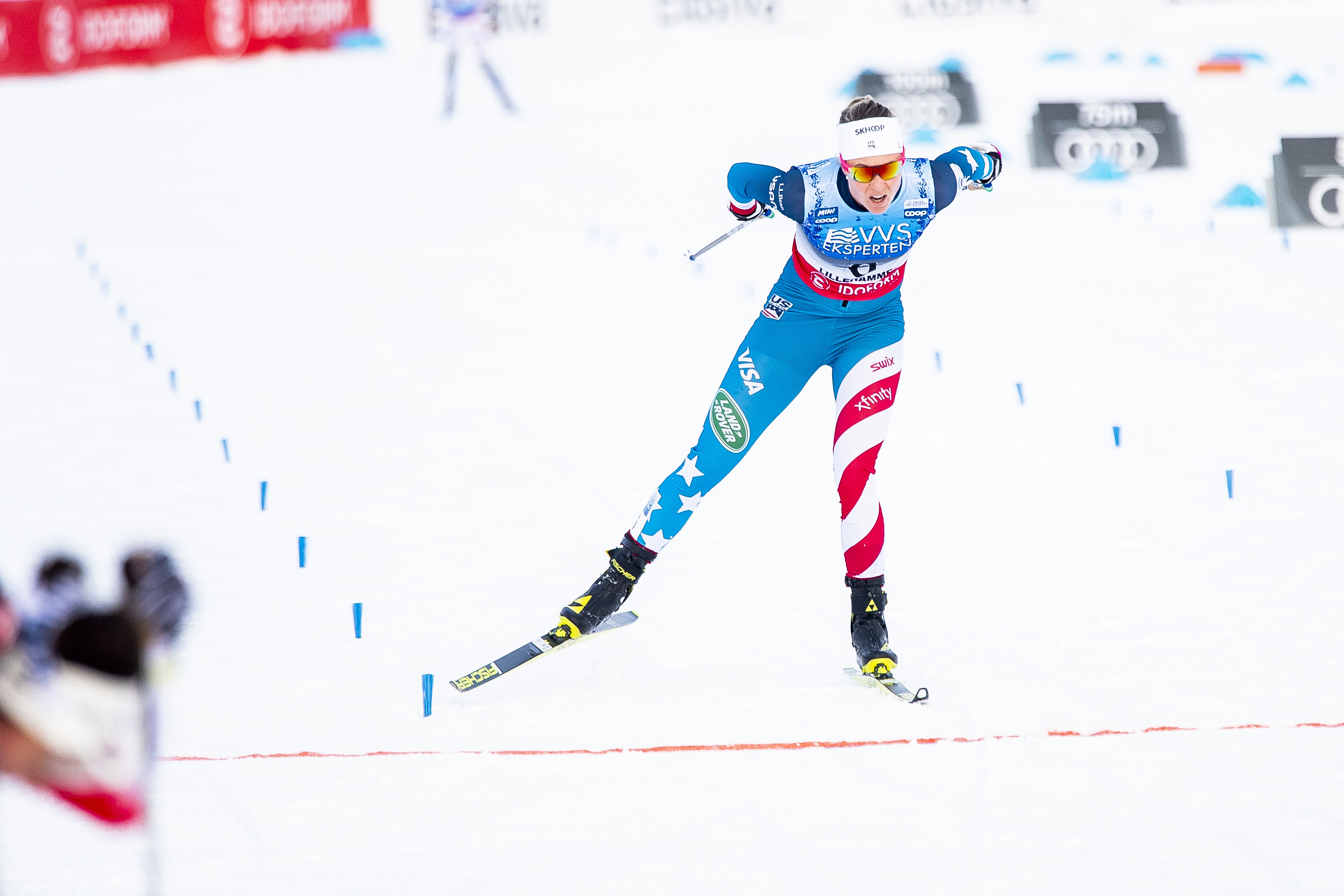
Today, the World Cup moved to one of the most picturesque locations in Nordic skiing—Lillehammer, Norway—where the women contested the 10-kilometer freestyle individual start event. The trees in the forests surrounding the race venue were covered with snow as racers were greeted by a beautiful morning in Lillehammer. It would be a home field advantage for the large Norwegian team, though the skier who drove herself to the finish line first was American, Jessie Diggins, who bested second place finisher, Katharina Hennig (GER) by 3.8 seconds. Heidi Weng (NOR) finished third.
Other American finishers were Julia Kern (25th), Sophia Laukli (29th), Alayna Sonnnesyn (34th), Lauren Jortberg (48th). Top Canadian was Katherine Stewart-Jones (26th).
Women’s 10 k Skate
Friday’s race consisted of three laps of a 3.3-kilometer course. Each lap employed several climbs which would help separate the field. Temperatures were comfortable, in the low 20s. Diggins started in an excellent strategic spot, beginning third from last; therefore, she would be able to know the split times of her competitors’ most of whom would be skiing in front of her. Diggins’ starting position—combined with her proficiency in the 10-kilometer skate—set the stage for high hopes for the American team.
Rosie Brennan (USA) last week in Ruka, Finland. (Photo: NordicFocus)
But as head coach Matt Whitcomb told Faster skier, Diggins late start spot wasn’t all an advantage. “The downside is that you don’t get to warm up on the course as long, so she is limited by about 20-25 minutes less than what she’s accustomed to.”
Illness in the Camp
Unfortunately, the American field was thinned when Rosie Brennan and Novie McCabe could not start. Whitcomb informed Fasterskier that a cold has been slowly creeping through the U.S. camp, one or two people per week.
The illness led to an opening for Lauren Jortberg who skis for SMS T2, who had originally been selected as a discretionary pick. But, due to the illnesses, she was able to race today.
As it turns out, according to Whitcomb, Diggins had also been affected by the same bug last week in Ruka, and was only getting her legs under her now. She bounced back quickly, in the way that she can.
When contacted by FasterSkier, Brennan expressed her profound disappointment about not racing: “I caught a cold on Thursday and made the difficult decision to not race today. As with many Olympic sports, we don’t have salaries so without sponsors, my income is solely made up of prize money and result bonuses from equipment sponsors. As such, missing a race you consider your biggest strength hits extra hard. I am heartbroken with the bad timing of this illness and hope it passes quickly. There were many stand out performances from our team today which I am doing my best to use to lift my spirits and confidence moving forward.”
The Race
Many of the pre-race favorites began in the middle of the start order, including Frida Karlsson (SWE), Heidi Weng (NOR), and Ebba Andersson (SWE), all of whom began within a few spots of each other.
Karlsson was the first of the pre-race favorites to reach the initial time check at 1.6-kilometers. She established the early standard, leading by 3.9 seconds. But at this point, none of the other main competitors had reached the first-time check. When Weng reached it, she was over nine seconds behind Karlsson. Seconds later, though, the lead changed as Andersson posted a 2.2 second advantage.
Katharina Hennig (GER) was excited with her second place finish. (Photo: NordicFocus)
By the time Diggins reached the 1.6-kilometer mark, most of her main competition was already halfway through the race. She came through the first time check in fourth, only 2.4 seconds out of the lead. Diggins looked strong and crisp as she powered through the initial timing mark. At this point, Andersson was still the skier to catch.
By the 5.6-kilometer mark, Karlsson had slowed significantly and was 13 seconds out of the lead, with her main rivals yet to reach that point of the race. Hennig crossed the time check, powering into the lead, while her teammate Victoria Carl (GER) stood in second. But Diggins had yet to reach the half-way point.
As the race went on, Karlsson continued to fade; by the 8.2-kilometer mark it was clear that she was not in her best form and would not be on the podium as she was over 16 seconds back.
Diggins again became the focus as she approached the 5.6-kilometer mark. When she crossed the timing point, she had narrowly taken the lead over Hennig by a scant 1.6 seconds. Diggins looked fantastic as she rounded the corner past the timing mark and tucked down the following hill.
Karlsson had tired near the finish, and sat 21.8 seconds behind the leader, Hennig, but many of the primary contenders were still out on course. Then, Heidi Weng finished and eclipsed Karlsson’s time putting Weng into second for the moment. Andersson finished one-tenth of a second behind Weng and was sitting third, but Diggins was still on course.
Things could not have been closer when Diggins crossed the 8.2-kilometer mark. As she used her V-2 to ferociously ski to the split, she fell to one second behind Hennig. With only 1.8-kilometers to go could Diggins surge past the German who had completed a very fast final split? The question was answered quickly when only seven-tenths of a kilometer later, Diggins had put 2.2 seconds into Hennig.
Hennig was sitting in the leader’s chair as Diggins began to approach the stadium. Diggins clearly had excellent form as she put the hammer down with the finish line in sight. She put her V-2 form into overdrive as Hennig nervously jumped out of the chair to see the finish. Diggins lunged across the line screaming as she knew that the race was hers. Diggins lay in the snow as Hennig approached to congratulate her. Diggins had won by 3.8 seconds, a display of grit and determination made all the more impressive by her having outpaced the Norwegians on their home turf.
Jessie Diggins (USA) hauling in the the winner’s hardware. (Photo Credit: NordicFocus)
Diggins’ and Whitcomb Post-Race Comments
After the race Diggins commented on how fantastic her skis were and how an American contingent from Stratton had given her encouragement standing along one of the hills. “There was a lot of extra love and energy out there. I just love skate races.” Diggins continued that she realized how close the race was at the end and “I was pretending like I was anchoring the relay, cause I felt like I needed a little extra oomph.” Diggins continued that she normally doesn’t like to hear timing splits, but started to listen to the splits after she realized the cheering from the sidelines meant she was having a great race.
Whitcomb added that it was a tricky day for skis. “There’s a lot of gliding at slow speeds. There’s a little bit of new snow mixed in with man made, which can provide a little bit of a gliding hazard. Our servicemen and women knocked it out of the park today.”
Whitcomb also noted that under the new protocols for course access, where there are two bibs reserved for women, that the U.S. is currently the only nation filling both bibs on the test track, “which has been a nice advantage for us.”
Diggins responded to Fasterskier that “It was such a cool atmosphere. Thanks to the wax team who worked really hard. My skis were so awesome and gave me a lot of confidence and I felt like I was flying on those downhills.” Diggins continued that ” I went into the race with the plan to ski smooth and pace evenly, really working the transitions and corners. I wanted to maximize every little half of second that I could.” Diggins again expressed her appreciation for the many Americans who had traveled to the race. “I felt in Ruka that my body wasn’t in a great place yet, but today when I asked my body to go deep in the pain cave, it responded accordingly . . . Happy to have had a good day out there!”
The Para World Championships wrapped up in Lillehammer, Norway on Sunday January 23rd, with a mixed open relay event bringing athletes from across genders and race categories together into one thrilling capstone event.
Rewinding to where our previous coverage left off, Saturday’s schedule featured the final individual races of the Championships, a classic spring for standing athletes, and a cross country sprint for sprint skiers. As in able-bodied fields, a sprint involves a qualification round, followed by a semifinal and grand finale to decide the medalists. The number of athletes who make the semifinal varies based on category.
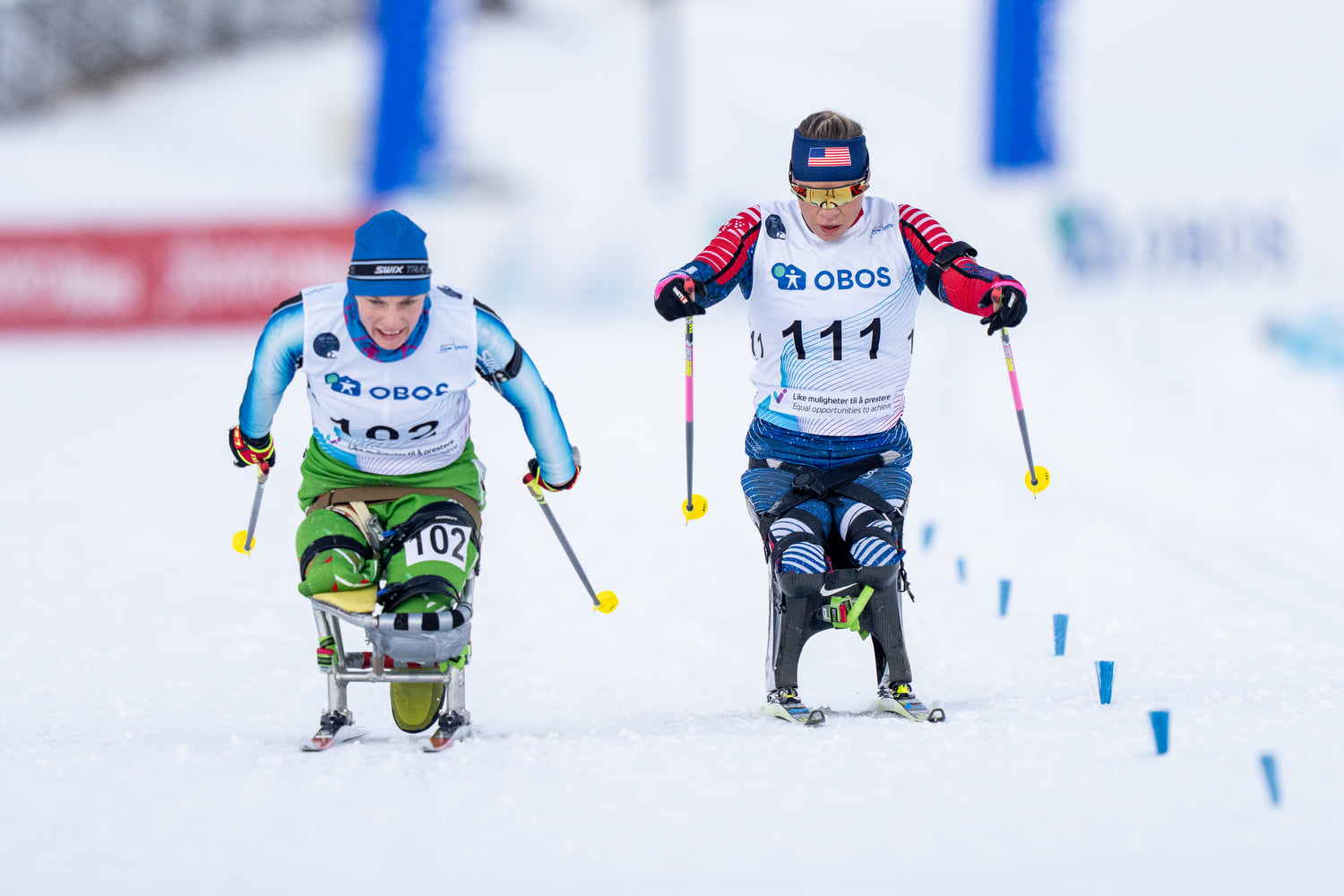
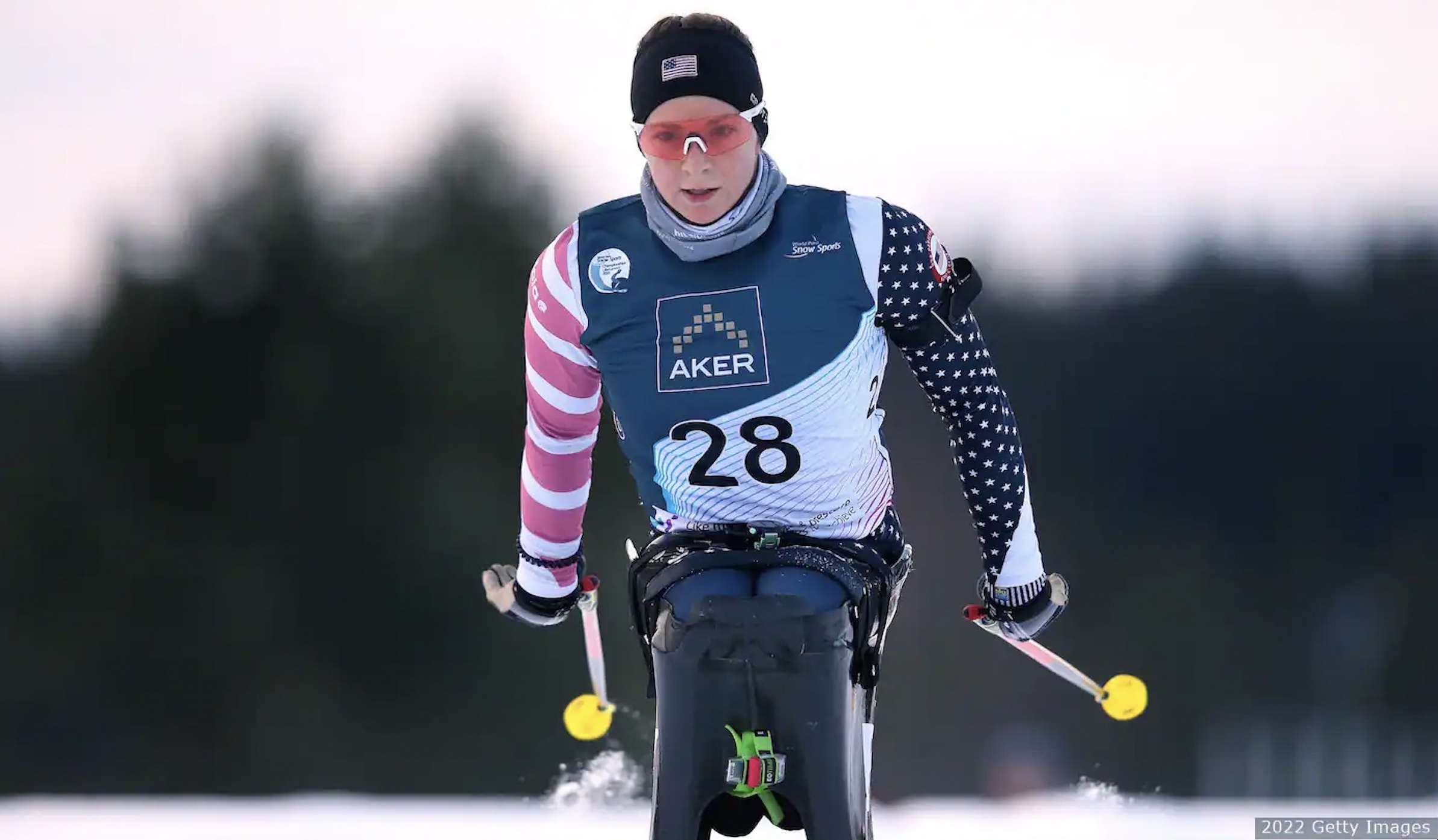
Highlighting the day, Oksana Masters took gold in the women’s sitting race, her sixth medal of the Championships (two of each color) and career 11th World Championship medal. This title was not certain until the final meters of the race, where Masters put in a final surge to overtake an athlete from Belarus just before the line.
Oksana Masters (right) sprints to the finish during the women’s sitting individual biathlon. (Photo: Alex Livesey/Getty Images)
“It feels incredible,” Masters said in the Team USA press release. “It doesn’t feel that long ago that I was barely making finals in sprint, or I couldn’t finish a sprint without falling or breaking a pole. To be able to have a third consecutive world championship title in this event is just incredible.”
Another medal favorite based on her performances through the week, Kendall Gretsch also raced in the sitting finale, however, a late crash put her out of reach of the podium and she ended the day in fifth.
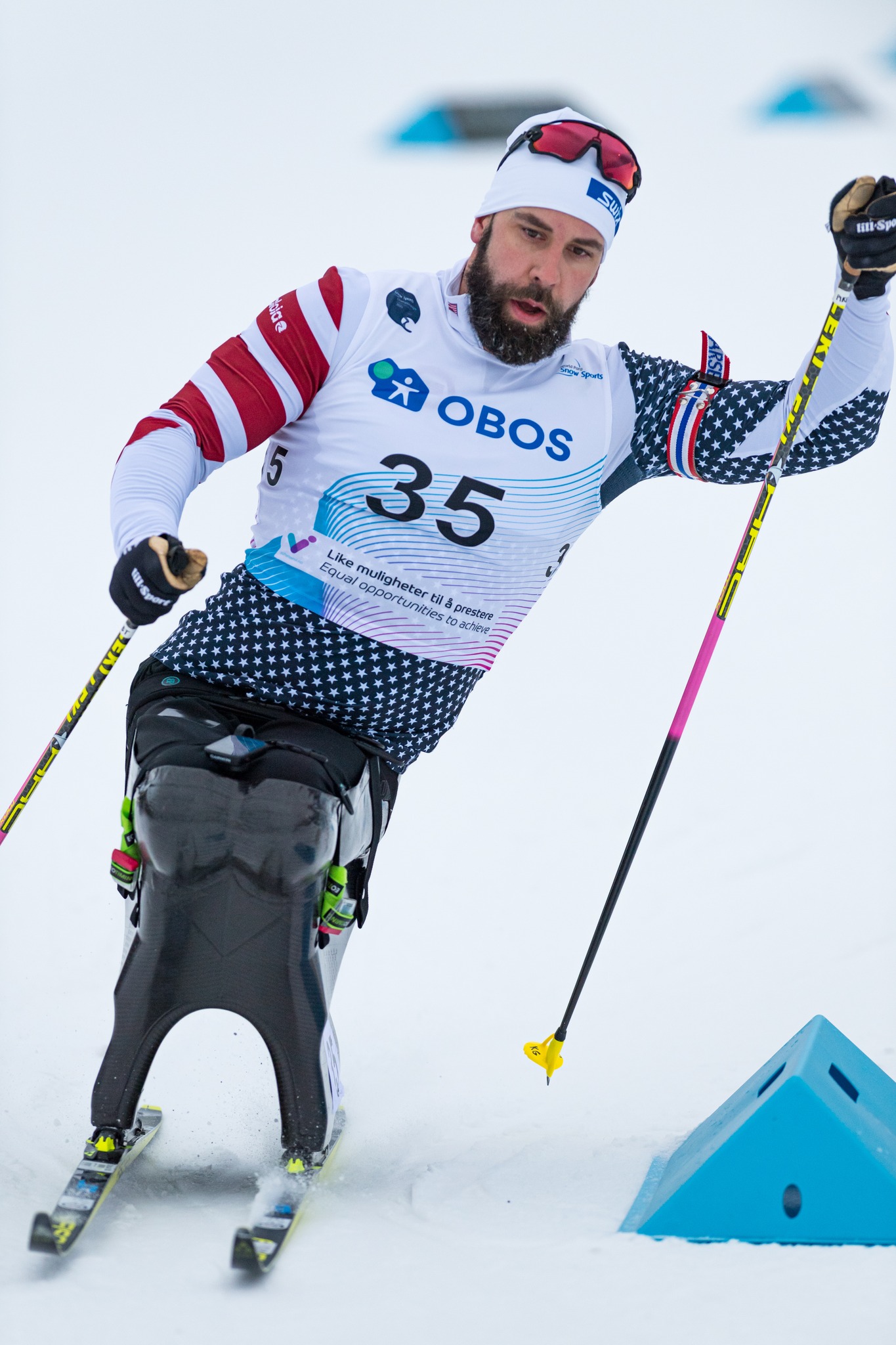
On the men’s side, Aaron Pike led the American men in the sitting sprint, placing well inside the top-12 to qualify for the semifinals. In his semi, Pike finished fifth and did not advance to the finale. Meanwhile, Dan Cnossen was 16th in qualification and did not advance to the rounds.
Dan Cnossen competes at the Para World Championships in Lillehammer. (Photo: Alex Livesey/Getty Images)
In the women’s standing races, newcomer to the team Sydney Peterson earned her second silver medal of the week, in addition to a third place medal. Perhaps still gaining experience, Peterson felt her first two rounds of racing were not smooth, though it came together in the final round.
“I had some mishaps the first two races this morning so I’m glad that things worked out for the finals,” said Peterson to Team USA. “I’m pretty excited that was a really fun race. It will be fun to continue racing.”
A second standing athlete, Dani Aravich, was just shy of the top-eight in qualification, meaning she was unable to advance to the semifinal for her class.
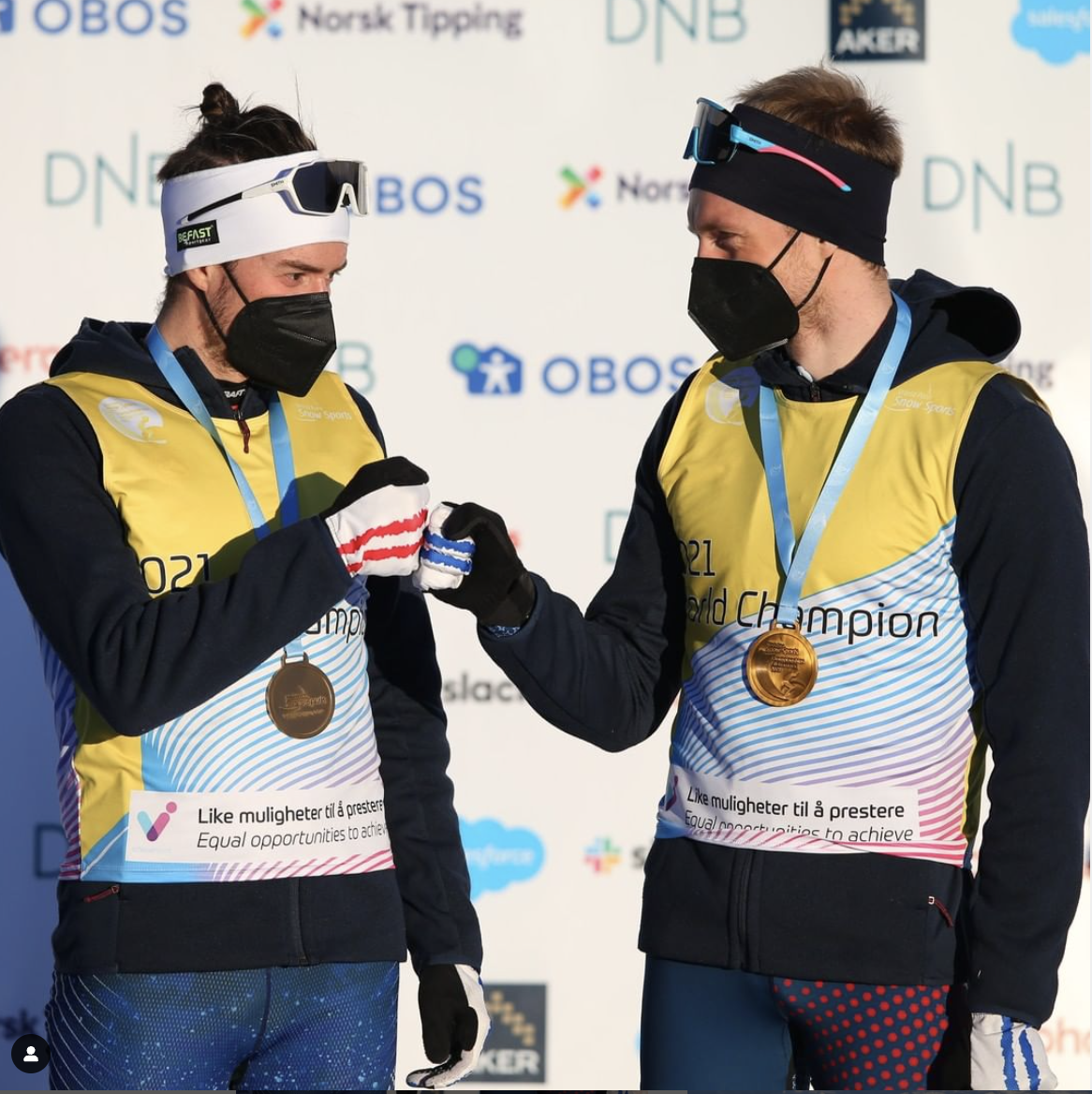
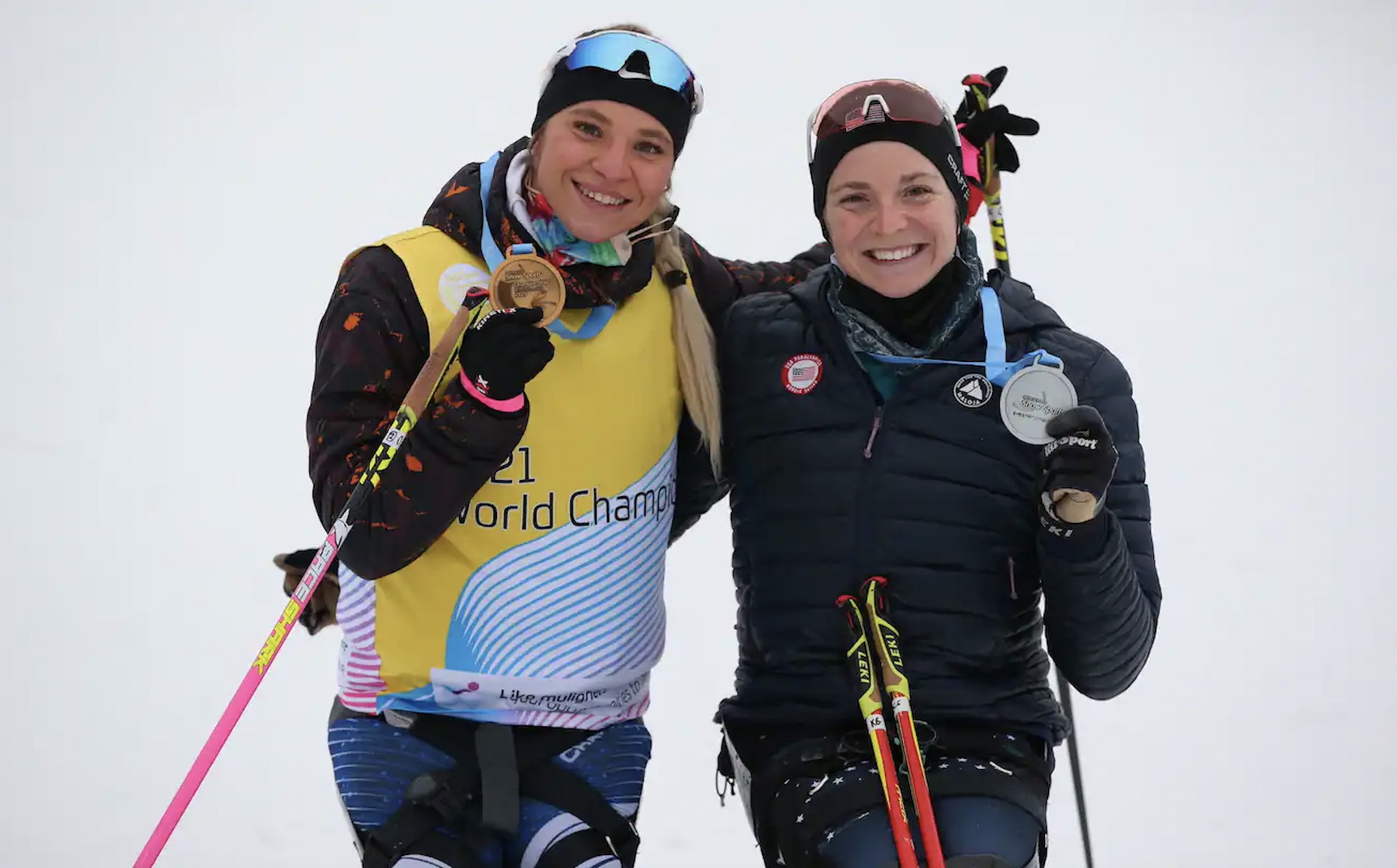
Friends, teammates, and more recently athlete-guide pair, Jake Adicoff and Sam Wood fist bump after earning a gold medal in the 10k classic at the Para World Championships in Lillehammer. (Photo: Alex Livesey/Getty Images)
“I’m feeling pretty good,” said Adicoff. “This is an improvement from the classic sprint in Canmore. We’re pretty happy with the result and it’s super fun racing out there. [We’re taking away] a little bit of confidence and then to be off that gold medal for two races now that’s what we’re looking for – gold in Beijing.”
On Sunday, the American squad fielded two relay teams in the mixed-gender, mixed-class 10-kilometer event. Given the variations in time based on sitting, standing, and subcategories within those groups, this makes for an interesting equation. Simultaneously, what better a way to highlight the diversity, talent, and teamwork seen across nations?
According to the daily Team USA press release, “relays were structured so that each athlete was assigned points based on their classification and gender, and the sum of each team’s total points could not exceed 335 for the mixed relay and 375 for the open relay. From there, it was head-to-head racing, and factored times did not come into play.”
Masters led an all-women’s team for the U.S., passing off to Peterson for the second leg, with Grestch racing third, and Aravich as anchor. Each of the women put together strong performances to keep their team within the top four, finishing in a cumulative time of 31:41.5.
The American women’s open relay team took fourth in the final race of the Para World Championships in Lillehammer. (Photo: Alex Livesey/Getty Images)
“We didn’t know until yesterday how we were going to do the relays, so when our coaches told us it was all women, we were really excited,” Aravich explained in the press release. “When we looked at the points and how it was stacked up, we probably shot ourselves in the foot a bit because we didn’t come close to maximizing the points we could have had in the race. We set our expectations to have fun and end this trip on a high note, which we did.”
On the men’s side, Adicoff and Wood raced both the second and final leg of the relay, with Pike leading the team for the first leg and Cnossen racing third. Following a strong opener from Pike, Adicoff and Wood brought the men into second place, though they slipped back in the results over the next two. They finished the race in fifth overall, however, they were issued a 30-second time penalty for one of their exchanges, which bumped them down to sixth.
Jake Adicoff and guide Sam Wood race the long-distance skate, bringing home a bronze medal. (Photo: Alex Livesey/Getty Images)
The next races on the Para World Cup calendar begin next weekend, running January 27th – February 1st in Östersund, Sweden. The 2022 Paralympic team will be named following these events on February 1st, leaving the team just over a month to prepare for the Games in Beijing, which kick off on March 4th.
Oksana Masters (left) and Kendall Gretstch (right) go 1-2 in the women’s 15k sitting long distance cross country race. (Photo: Alex Livesey/Getty Images)
It’s late January and we’re deep into the race season. As the Olympics and Paralympics draw nearer, we’ve simultaneously just wrapped up the Tour de Ski, the U.S. Cross Country Championships, and another wave of SuperTour races. Never a dull moment in the racing world, the Para World Championships are currently well underway, running January 13-23rd in Lillehammer, Norway.
Normally occurring on odd years, the World Championships were postponed from last February due to the pandemic. Nevertheless, the event was called the Lillehammer 2021 World Para Snow Sports Championships. It was a hallmark event, as it is the first time that all snow sports have competed together in one location over the same dates.
Led by well-decorated veterans like Oksana Masters, Kendall Gretsch, and Dan Cnossen, the U.S. Para Nordic Team has put together a string of outstanding results at World thus far. Events have ranged from biathlon springs to cross country distance races, with athletes competing – and cleaning up – across all disciplines and distances.
Kicking off the series of events, Sun Valley’s Jake Adicoff took home his career first World Championship medal by winning the men’s visually impaired 10-kilometer middle distance race.
“It feels great,” Adicoff said of his performance, according to the Team USA Press Release. “Lillehammer has been skiing really well so far, I’ve been having a lot of fun here. It feels great to go and get that first podium, and hopefully we can go out and get some more here.”
Jake Adicoff and his guide Sam Wood put together a gold medal performance on the opening day of racing at the Para World Championships in Lillehammer, NOR. (Photo: Alex Livesey/Getty Images)
Adicoff retired in 2018 after earning a silver medal in the 10k and taking 4th in the sprint, however, he is making his return with a bang in this 2021/22 season.
Building momentum throughout the first day, 19-year-old Sydney Peterson earned a silver medal in the women’s standing middle distance race, with Gretsch earning the second gold medal for team USA in the women’s sitting 7.5k middle distance event. That’s three medals, two gold and one silver, on the first day of racing, along with an additional two athletes, Cnossen and Dani Aravich, earning top-10 finishes.
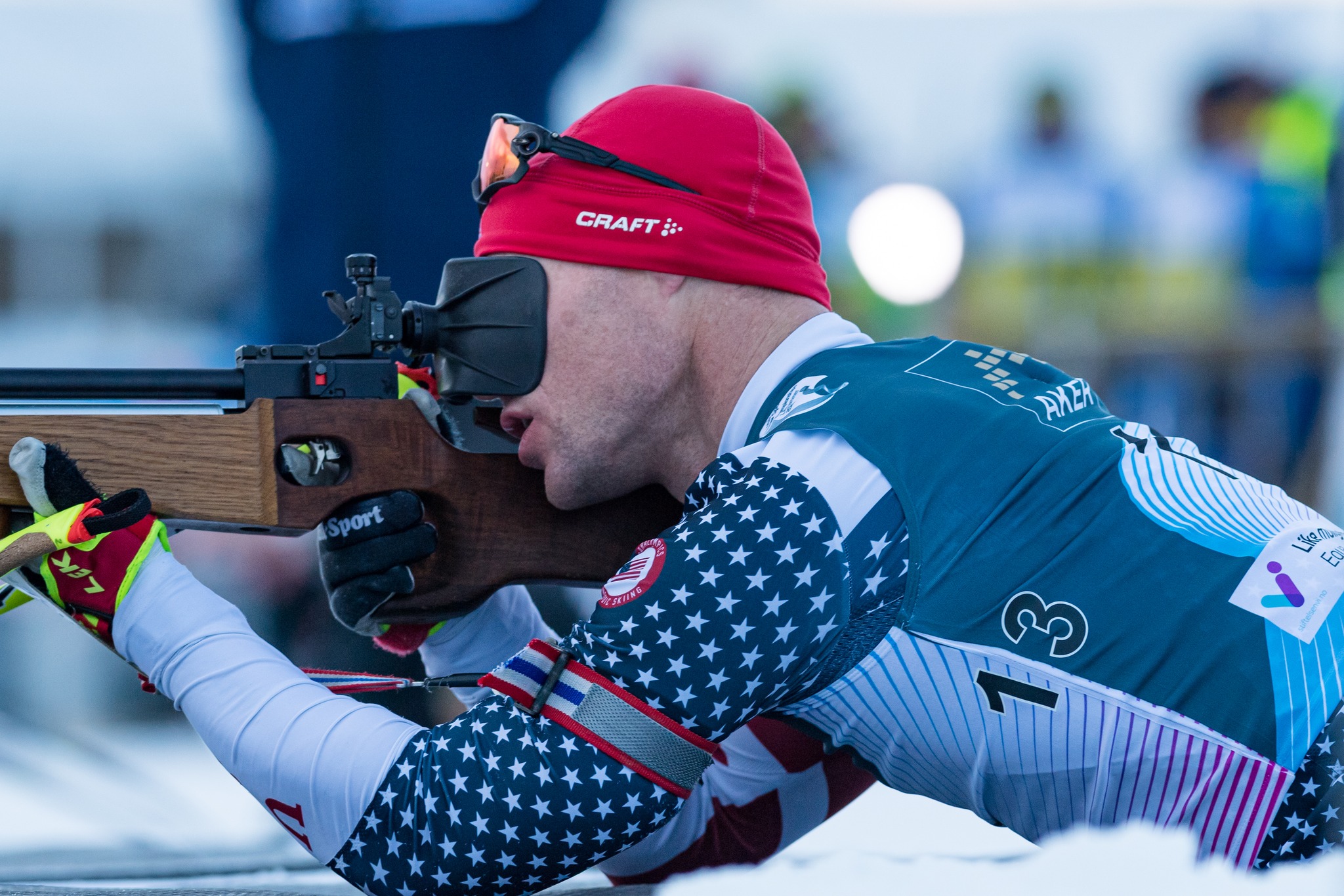
Dan Cnossen hits the range during the individual sitting biathlon event at the Para World Championships in Lillehammer, NOR. (Photo: Alex Livesey/Getty Images)
Joining the team in Lillehammer late after testing positive for COVID-19 on New Year’s Eve, Masters made a smooth return to competition, taking second place in her first race at Worlds, the sitting biathlon sprint on January 15th. The next day, the American women took first and third in the sitting biathlon middle distance race, with Gretsch earning her second gold medal of the week and Masters adding an 18th World Championship medal to her ever-expanding collection.
On point, a perfect shooting performance contributed to Gretsch’s gold, while Masters skied her way out of a significant deficit. Experiencing challenges on the range, Master’s racked up seven penalties, but made up her shooting with her skiing. In the men’s sitting race, Master’s partner, Aaron Pike, skied his way into the Top-10, a rank he has achieved in each of his World Cup races this season, leaving him primed for a medal.
Two days later on the 18th, Masters and Gretch again took the spotlight, going 1-2 in the women’s sitting 15k long distance cross-country race. Now reaching 19 total, this marked Masters’ 10th career World Championship gold medal.
“It’s absolutely incredible,” Masters said in the Team USA press release that day. “It feels like yesterday where I was that new athlete, never thinking that I would be a world championship athlete. So, to have 10 now … is incredible and it’s a testament to our team’s hard work. It’s not just me, it’s the whole team.”
Already an historic day for the U.S., Peterson and Adicoff continued the medal streak in the long-distance cross country races, with each athlete earning a bronze medal in the standing and visually impaired divisions, respectively. Four Americans competed that day, and four medals were won. How’s that for success?
Aaron Pike races the individual sitting middle distance biathlon event at the Para World Championships in Lillehammer, Norway. (Photo: Alex Livesey/Getty Images)
As the final days of World Championship racing kicked off, Pike’s consistency paid off with a silver medal in the men’s sitting individual biathlon event. Missing just one target, matching the best result of the event, Pike finished 24 seconds back on the winner, Pavlo Bal of the Ukraine. This result is both a World Championship and overall World Cup career best for Pike, who is an accomplished wheelchair racer during the summer season.
“It was a tough day to be shooting out there, everybody’s missing so I was happy to come away with just missing one shot,” said Pike in today’s recap. “This is probably the windiest race we’ve had in three years. Every chance you get to put a bib on and race in a biathlon race is experience.”
Racing in the women’s sitting individual biathlon, Gretsch and Masters continued to dominate the field, taking first and third, respectively, to keep their medal streak alive and well.
Again performing well on the range, Gretsch missed just one target in four rounds of shooting and skied the second fastest time on course for a finish time of 52:25.0. While Masters skied the fastest time of day, she again faced challenges in her shooting, incurring five penalties, leaving her 3:00.7 behind Gretsch in the final results. In the women’s standing class, Aravich earned another top-10 finish in eighth.
With excellent shooting records, Kendall Gretsch puts together back-to-back gold medal performances in biathlon events. (Photo: Alex Livesey/Getty Images)
After a day of rest, the Para athletes have two final days of racing in Lillehammer on the 22nd and 23rd, which feature a sprint for the standing and visually impaired categories on Saturday and a Mixed Relay on Sunday. Based on the week’s results, it’s clear that they are primed for another medal run in the upcoming 2022 Beijing Paralympic Games, which begin March 4th.
Livestreams of past and upcoming events, along with links to results can be found on the U.S. Paralympics Nordic Facebook page, or you can check out the remainder of snowsport events happening this week in Lillehammer by following along here.
It was another hot weekend of racing in Lillehammer, with another epic Johaug–Karlsson duel, some legit results from American racers, and some breakout performances from some new names. Today, Devon Kershaw and Nat Herz break it down, with the added bonus of Kershaw’s firsthand experience of waxing for the Canadian team on-scene.
Come for the race breakdowns, stay for the monologues about TV production and the cross-country ski boot supply chain.
Send your questions to Devon at devon@fasterskier.com and to Nat at nat@fasterskier.com. Catch you next week.
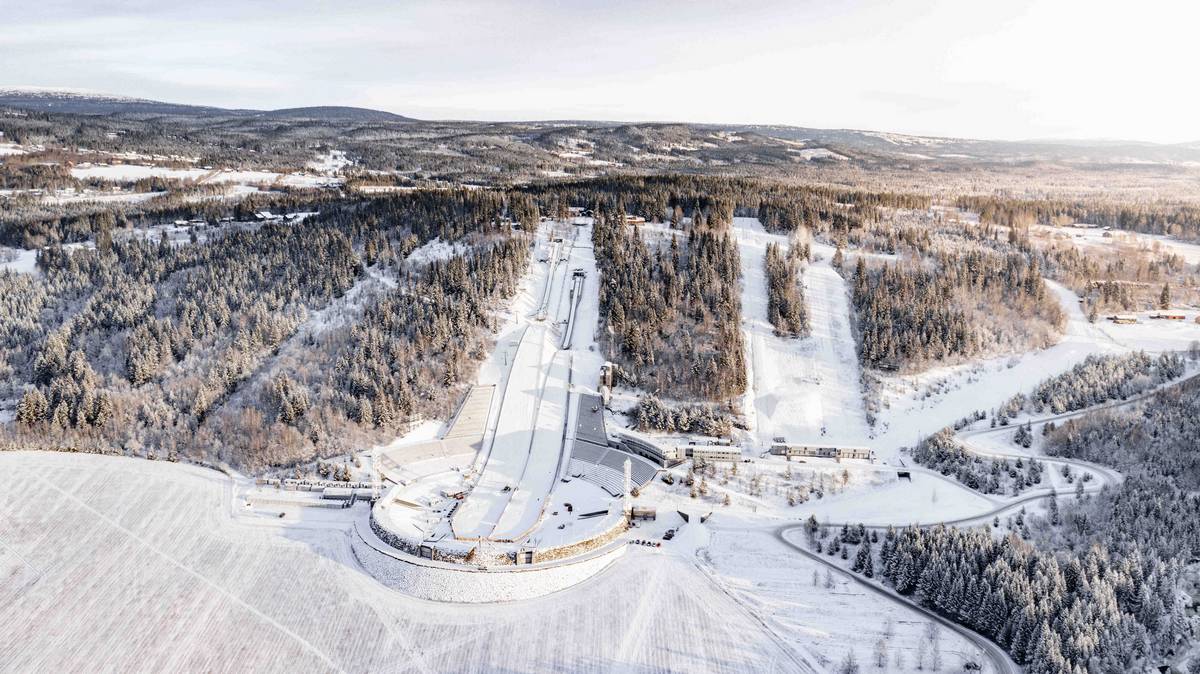
An aerial view of the Lillehammer venue with low-snow conditions covered by fresh flakes. (Photo: NordicFocus)
This World Cup coverage is made possible through the generous support of Marty and Kathy Hall and the A Hall Mark of Excellence Award. To learn more about A Hall Mark of Excellence Award or to learn how you can support FasterSkier’s coverage please contact info@fasterskier.com.
By: Ben Theyerl
It was “going to be a new adventure for sure.” That’s how Rosie Brennan framed the new 10- kilometer course that was laid out in Lillehammer for the race on Saturday morning in an interview before with FIS media. In retrospect, her positive comment, a simple positive affirmation that she was ready to take on the day, should have been taken as a promise for U.S. ski fans.
On Saturday morning, Brennan’s race was the adventure for American fans to follow – a smartly raced 10 kilometers where she finished on the podium, in third place, and with the first U.S. Ski Team distance podium of the season.
Rosie Brennan skis to 3rd place in Lillehammer’s 10k skate. (Photo: NordicFocus)
The new 10k at Lillehammer was a course that invited one to think about approach. Three laps on a 3.75k course where the A-climb came at the 0.5 k mark. It would have been easy to go into that first climb too hard, and many racers did. The first checkpoint at 0.9k was placed at the peak of the climb, and when Brennan came across it, she was in 4th place, +6.5sec from leader Frida Karlsson. Quickly though, others passed in front of that mark. Moa Olsson (SWE) took Brennan’s 4th place spot, then Victoria Carl (GER), then Natalia Nepryaeva (RUS), and then later Tatiana Sorina (RUS). It was an auspicious start for Brennan, and also reiterated how compact the field would be throughout the day.
Meanwhile, two skiers went through the first check-point locked in a battle for first and second. They were familiar to those who watched the distance races in Ruka last weekend, and for those who have watched skiing for years. Frida Karlsson (SWE) went through the 0.9k checkpoint at 2:27.5, and only Therese Johaug would come close to matching her – and it was close – just 0.1 seconds between them at the top of the first climb.
No longer the assumed winner, Therese Johaug (NOR) takes second in the 10k skate in Lillehammer. (Photo: NordicFocus)
Karlsson and Johaug would remain in lockstep on the clock all day. Karlsson, in bib 32, setting the mark at the 6.1k, and 8.3k checkpoints, only for Johaug, in bib 40, to come in with just tenths of a second to separate the two. At 6.1k, the gap was still 0.1 seconds in Karlsson’s favor. At 8.3k, it was up to 1.1 seconds for Karlsson. And then at the finish, Johaug had closed it down to just 0.3 seconds, and that was the final result. Karlsson first place at 26:58.4, Johaug second place (+0.3)).
The two skiers replicated last weekend’s results, which perpetuates an intriguing rivalry for the distance World Cup at the start of the season.
A focused Frida Karlsson on her way to victory in the 10k individual start freestyle in Lillehammer, NOR. (Photo: NordicFocus)On course and on her way to her first podium of the season, Rosie Brennan powers through the 10k skate in Lillehammer. (Photo: NordicFocus)
Brennan, wearing bib 42, was close behind Johaug all day. Her race, though, would be marked against the skiers that had slotted in front of her early on. At the 6.1k checkpoint, she had moved back up into fourth place. During the second lap she tucked in behind Tiril Udnes Weng (NOR), who was on her final lap and on the way to a sixth place finish.
As Brennan went into the final lap, she was on her own, attacking the final A-climb and then heading towards the finish line with the podium in reach.
When Brennan reached the stadium, she had not only maintained the 4th place position she had at the 6.1k mark, but had the real possibility to move up a spot. She would need to edge out Helene Marie Fossesholm (NOR), who despite not being given starts in Ruka last weekend found herself holding onto 3rd place.
In her first World Cup starts of the season, 20-year-old Helene Marie Fossesholm (NOR) skis to fourth place in the 10k skate in Lillehammer. (Photo: NordicFocus)
Seconds later, that possibility became a result, with Brennan finishing in third place. She had gained nearly five seconds on Fossesholm, to finish just +11.3 seconds off of Karlsson. As skiers who had earlier knocked her off her podium spot at earlier checkpoints crossed the finish line, Brennan remained in position, claiming her first podium of the 2021-22 season in the venue where she had, way back in 2015, claimed the first podium of her career (a 3rd place finish in the 4 x 5k relay).
The women’s podium of the 10-kilometer individual start freestyle in Lillehammer, Norway. Frida Karlsson (SWE) took the win ahead of local favorite Therese Johaug (NOR) and Rosie Brennan (USA). (Photo: NordicFocus)
Brennan credited a trust in herself for the late push that got her to third place, reflecting in an email to multiple news outlets:
“I was getting too many splits but I knew it was really tight so I really tried to let loose the last lap and trust my strength. I had great skis and was able to hold pace all the way to the finish while others faded.”
Brennan’s podium finish capped a day that showed the depth that the North American women have built for the present and the future on the World Cup. Off her 2nd place finish in the freestyle sprint yesterday, Jessie Diggins finished in 18th place today (+1:07.4). That result early in the season will help her stay near the top of the overall points list as she looks to defend her World Cup overall title from last year.
Jessie Diggins skis to 18th in the Lillehammer 10k skate. (Photo: NordicFocus)Just missing the top-30, Hailey Swirbul skis to 32nd in the individual start 10k freestyle in Lillehammer, NOR. (Photo: NordicFocus)
The young American women showed their continued development, with Hailey Swirbul finishing in 32nd (+1:38.2) and Julia Kern in 36th (+1:43.1). Swirbul was less than three seconds off the top-30 time needed to score World Cup points, and Kern was less than eight seconds back of 30th. With Norway receiving additional nation’s group starting slots for hosting in Lillehammer this weekend (Norwegian women took five of the top-10 spots and put ten athletes total in the points), cracking a top-30 was perhaps one notch harder than usual, and these women were as on-the-cusp as you can get.
After the race, Swirbul shared the following sentiments on her day via email.
“I thought I skied a strong race, but I definitely faded in the end. When my muscles started to hurt, I tried to remind myself that my legs are strong and that I know I can keep going! It takes a special day for everything to line up perfectly to pull off a great result, but results aside I am proud of the way I raced today.”
On whether she contextualizes a result just outside the Top-30 differently with additional Norwegians included, Swirbul seemed indifferent, focused on her own race and her team’s success.
“To be completely honest, I forgot to look at final results, so I don’t know where all the Norwegians ended up, but this is certainly a super competitive field. I am so impressed with Rosie and my other teammates today because they are SO tough!”
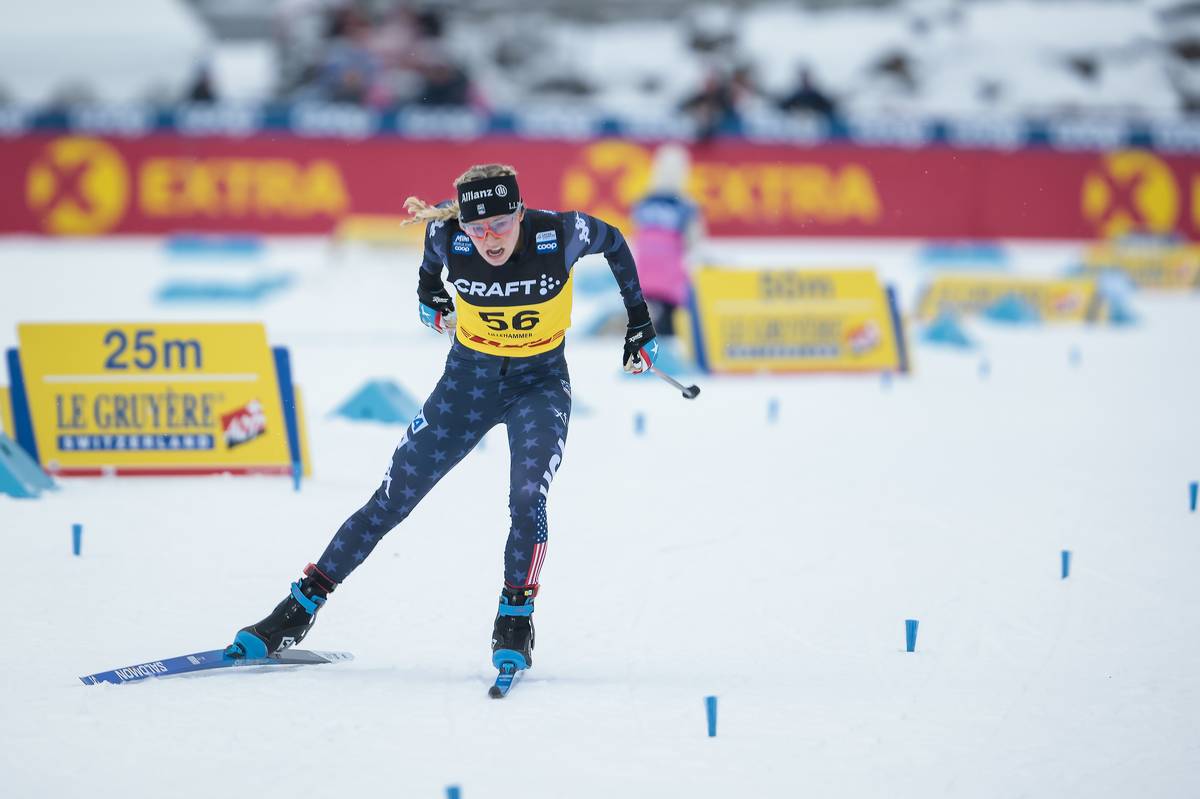
Sophia Laukli, at just 21 years old, finished in 46th (+2:00.0), with Novie McCabe in 52nd (+2:19.8), Caitlin Patterson in 53rd (+2:22.7), and Katharine Ogden in 56th (+2:37.6).
Sophia Laukli skis to 46th in the individual start 10k freestyle in Lillehammer, NOR. Laukli was just 25 seconds outside the top-30 on the day. (Photo: NordicFocus)
Tomorrow in Lillehammer, we shift to thinking in terms of countries rather than individuals, with the 4 x 5k relay. The results today build on Friday’s evidence for what may happen then. Again, it’s a Swede, a Norwegian, and an American on the podium in Lillehammer. Call that a preview, but also a testament to where American skiing has come so far in this still-new season, and yet another hopeful sign for where this the women of the U.S. Ski Team may go.
Katherine Stewart-Jones (CAN) skis to 54th in the 10k individual start freestyle in Lillehammer, NOR. (Photo: NordicFocus)
The Canadian woman also had a strong showing on Saturday. Cendrine Browne finished 45th (+1:58.1), with Katherine Stewart-Jones in 54th (+2:24.6), and Dahria Beatty in 63rd (+3:14.3).
This World Cup coverage is made possible through the generous support of Marty and Kathy Hall and the A Hall Mark of Excellence Award. To learn more about A Hall Mark of Excellence Award or to learn how you can support FasterSkier’s coverage please contact info@fasterskier.com.
By: Ben Theyerl
For ski fans whose parents were smart enough to record the 1994 Winter Olympics on VHS tapes, Lillehammer will forever be a World Cup venue carrying the shadow of thousands of fans waving Norwegian flags as Bjørn Dæhlie did his signature “spin move“ on the way to Olympic glory.
Fast-forward to 2021, where the course has been reworked and modernized, the lycra is decidedly less exciting, and the multitude of Norwegian flags flying were interjected by a whole lot of Swedish and American ones.
Today, in the Birkiebeiner stadium – that quintessential home of Norwegian skiing – chances of victory blowing in from Sweden were very high. Going in, they had won the last 5 straight World Cup freestyle sprints, and 14 of the last 20 overall. The Americans too, looked to continue their history of success in the freestyle sprint. Of the 16 wins that the Americans have had in sprint events, 15 of them have come in freestyle, with two of those previous winners, Jessie Diggins and Rosie Brennan, in the field on Friday morning.
In qualifying there were hints that as the field narrowed, it would be Sweden, Norway, and the United States whose skiers would fill the semifinal and final slots. Maja Dahlqvist continued her strong start to the season, winning the qualifier in a time of 3:11.59. She was joined by Tiril Udnes Weng (+1.38) and Nadine Faehndrich (+2.84) in the top 3 spots.
The U.S. team placed three inside the Top 10, with Julia Kern the top qualifier in seventh (+4.90), followed by Jessie Diggins in eighth (+5.08), and Rosie Brennan in tenth (+5.49). Hannah Halvorsen rounded out the qualifiers for the heats in 21st (+8.18).
Hannah Halvorsen (USA) sprints to 21st place in sprint qualifying in Lillehammer. (Photo: NordicFocus)
Three strong national contingents then went to the quarterfinals. Norway with seven skiers, Sweden with five, and the United States with four. There they would face each other on a new 1.6k Sprint course that left little to be deciphered about what would be the deciding feature on the day. On this course, there was an A-climb, and after doing it once, they would loop back around and do it again.
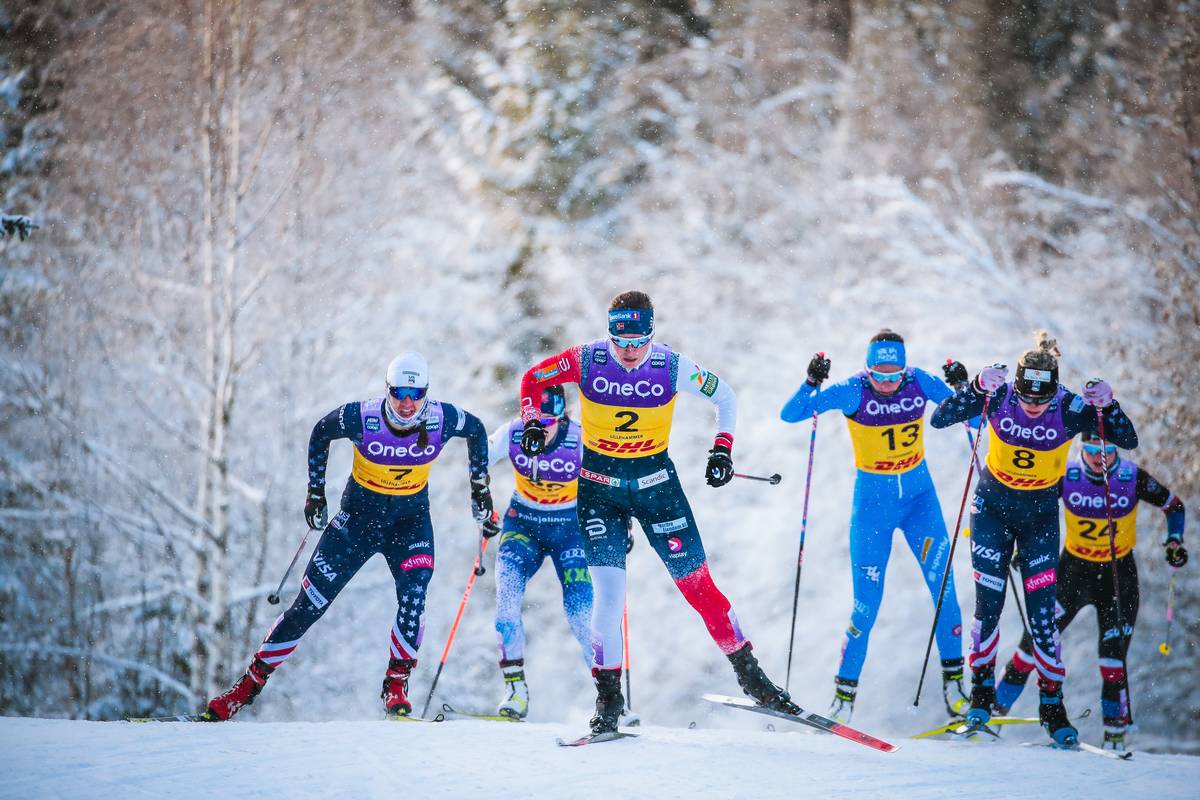
The Americans took a different approach to heat selection this week than they did in Ruka, where they raced late in the quarterfinal heats. Kern and Diggins lined up in the first heat together, joined by Tiril Udnes Weng. Kern led out the pack and raced consistently throughout, leading the first time up the climb with her teammate Diggins in tow.
A scene from the first heat of the quarterfinals, which included Julia Kern (Bib 7) and Jessie Diggins (Bib 8). (Photo: NordicFocus)
For Diggins, the quarterfinal established the pattern that she would look to repeat throughout the day on the tough course. At the foot of the climb in the second loop, Diggins moved through to the outside of the pack and then powered to the front. By the time she was in the stadium, only Weng was left behind her, and that’s how they finished. Kern, meanwhile, sprinted to 3rd place, and after all the quarterfinals were settled, was just a tenth of a second out of a lucky loser slot for the semi-finals (which went to the Finnish skier Jasmi Joensuu). Kern ended her day in 13th overall.
The other lucky loser slot was filled by Rosie Brennan in the second quarter-final. Brennan’s tactical approach to the course mirrored Diggins. In the second heat, Brennan matched up against Maiken Caspersen Falla and Nadine Faehndrich, and would finish just off the two to take third place in the heat, and first in the lucky loser slots.
In the semifinal, Diggins found herself alongside three Norwegians, matching up against T.U. Weng, L.U. Weng, and Caspersen Falla. The heat saw the best execution of her tactical approach to the course all day, as she followed the first move up the climb from Jasmi Joensuu, then shot around the outside to carry speed into the downhill, before moving in a perfect swoop off the apex of the turn to the outside that allowed her to power up the final climb joined by T.U. Weng and Falla. At the finish, Diggins crossed in first again, with T.U. Weng right behind.
The two would be joined by four skiers from the other semi-final. The Swedish pair of Dahlqvist and Ribom executed their tactical approach to the course to a tee, leading out the first part of the course and establishing a sprint that would be devoid of any posturing, then staying with any moves that occurred on the second-time through the climb – which came in this heat from Brennan – before finishing strong in the stadium sprint. Dahlqvist finished first, Ribom second, and Brennan came out the lucky loser for the second time on the day, advancing to the finals.
Rosie Brennan (USA) rounds the corner in front of Anamarija Lampic (SLO) during the final in Lillehammer. (Photo: NordicFocus)
The final field represented the Swedish and American fronts, who fully established themselves as the dominant force in Lillehammer. Two Swedes, two Americans, and just one Norwegian. Plus, Anamarija Lampic of Slovenia too.
The two leading countries’ different approaches to the course were most stark the first time up the climb, where Diggins and Brennan took the outside, and Ribom led the rest of the field on the inside track. At the top of that first ascent, the Americans took the animating action, Diggins shooting around the outside to lead the descent.
Brennan followed, reflecting her initiative to create an ideal position for the final climb: “I made a move early in the final to try to see what I had and unfortunately, was passed on the downhill into the last uphill” she said in an email to multiple news outlets.
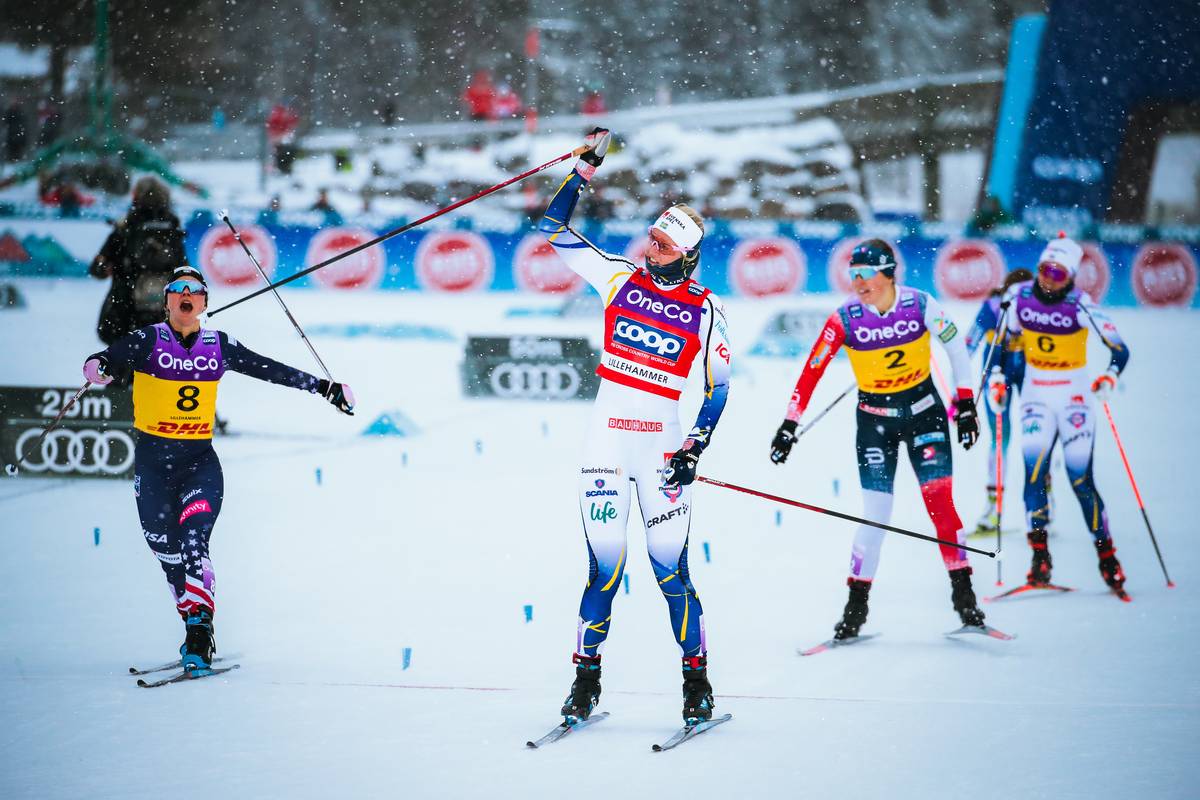
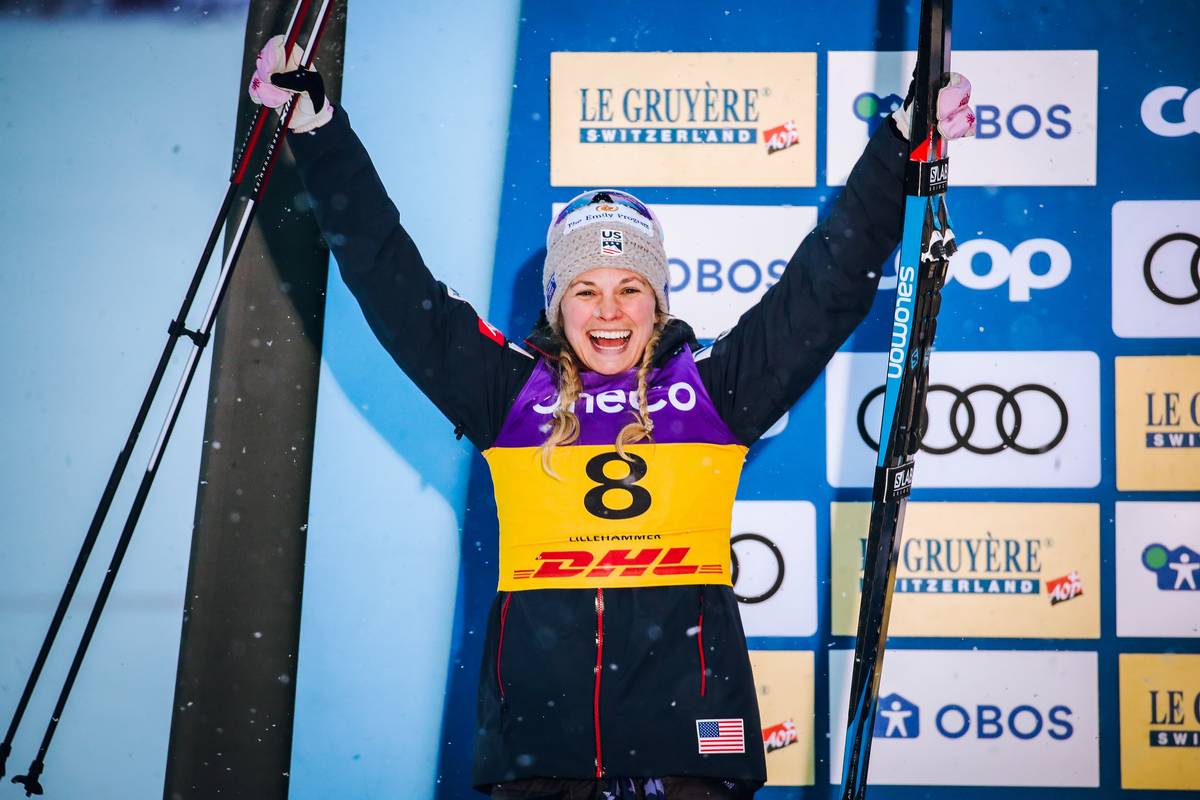
With Brennan back in the pack as they took to the second climb, what had been alluded to throughout the day gained clairvoyance – Dahlqvist and Diggins were the strongest in the field. As they crossed the finish line, what was clear became a result. Dahlqvist won her second sprint of the young World Cup season, as Diggins earned her first podium finish of the year. T.U. Weng rounded out the podium in 3rd, with Ribom finishing 4th and Brennan in 5th on the day.
Maja Dahlqvist (SWE) wins 3rd straight sprint, followed by Jessie Diggins (USA) and Tiril Udnes Weng (NOR). (Photo: NordicFocus)
If Ruka was an exciting first burst of energy for the World Cup season, then Lillehammer today was an indication that long-term trends do hold. Last year’s World Cup champion Jessie Diggins has her first podium of the season. Maja Dahlqvist is now on a three-win sprint streak going back to last season, and the most ascendant sprinter on the women’s circuit. And in the freestyle sprint, it’s the Swedish and American women who continue to rise to the top, with Norway, on their home turf, putting up an ever-valiant defense of their dominance on the world stage.
Oh, and Americans can start dreaming of Jessie Diggins doing her best Bjørn Dæhlie impression in Beijing come February, as her second-place finish today means one-half of the Gold Medal highlight from the last Winter Olympics in 2018 is officially qualified. Diggins is the second American to qualify for this season’s Olympic team, joining Brennan (top-8 in both today’s sprint and last weekend’s 10 k classic) as objective qualifiers.
Here’s Jessie’s post-race comments to FasterSkier:
Jessie Diggins on her first podium of the season after finishing 2nd in Lillehammer. (Photo: NordicFocus)
Stepping back into the quarterfinals, Hannah Halvorsen skied strong in the fourth heat of the quarterfinals, which included Dahlqvist and Lampic. Losing contact toward the finish, Halvorsen finished sixth in her heat, which put her in 28th place in the final standings.
“I felt good today on the course,” Halvorsen wrote in a post-race email. “It was fun to have things come together. It was awesome to see our team put so many people in the top 30 this early in the season! I can’t wait to see what the season will bring for the US with so much potential in the mix!”
Elsewhere in the results, North American women had a strong showing. Hailey Swirbul (USA) finished 42nd (+12.50), with Cendrine Browne (Canada) in 52nd (+14.63), Dahria Beatty (Canada) in 53rd (+14.73), and Katherine Stewart-Jones (Canada) in 55th (+15.34). Novie McCabe (USA) finished 56th (+15.34), Maya MacIsaac-Jones (Canada) finished 60th (+19.21), Katharine Ogden (USA) finished 61st (+19.89), and Sydney Palmer-Leger (USA) finished 62nd (+19.89).
In a post-race interview, U.S. Ski Team Head Coach Matt Whitcomb answered a variety of questions on the men’s and women’s races in Lillehammer, including comments on the new course and the approach to heat selection this weekend relative to Ruka. He also shared his perspectives on the rounds, and an explanation of why qualification is a skill that athletes must learn, in reference to comments made by Sadie Maubet Bjornsen and Devon Kershaw on the post-Ruka episode of The Devon Kershaw Show. Have a listen.
Want to know how to follow all the action this weekend, domestically and abroad? We’ve got you covered. Times for World Cup races are listed in local time and Eastern Standard Time, to help you calculate the time change.
(We will of course publish articles on the races after they finish; this is just to help you get your fix of live coverage.)
Broadcast links for the World Cup races are as follows. Both of these require a subscription, sorry.
Saturday, December 4: skate sprints. 9:30 a.m. local time (qualifiers), 12 p.m. (senior heats), 1:45 p.m. (U18/U20 heats), 3:20 p.m. (U16 heats). Duluth is in the Central Time Zone, so add one hour for the East Coast or subtract three hours for Alaska.
Sunday, December 5: 5/10 k skate. 10 a.m. local time, women and U16 boys; 12:30 p.m. local time, U18 and up men.
Streaming? Sounds like it. Race organizersstate, “Races will be live streamed by CXC and will have live announcements.” Try checking here or here over the weekend for broadcast options.
Last season’s Oslo 50 k classic. The last men’s race of the season was held without fans due to the pandemic. (Photo: NordicFocus)
The International Ski Federation (FIS) announced today that all remaining World Cups in Norway are canceled due to the ongoing pandemic.
“Due to new Covid-19 government restrictions announced today by the Norwegian government that the Norwegian Ski Association will be unable to host any further competitions through the end of the current World Cup season, due to the stricter travel and event-related restrictions,” stated the press release.
The mandate runs across the snowsport disciplines and includes cancellations for cross-country, nordic combined, and alpine skiing.
The announcement removes the storied Oslo races at Holmenkollen on March 12-14 and the Lillehammer World Cup Finals from march 19-21. Already, the Lillehammer races were postponed last year due to the government’s Covid-19 restrictions – they were originally scheduled for December 4-6.
The 2019 30 k skiathlon in Lillehammer, Norway. (Photo: NordicFocus)
The Norwegian Ski Federation held a tight grip on the cross-country national team this World Cup season. The federation pulled skiers from the World Cup after the opening weekend in Ruka, Finland. No Norwegians contested the Tour de Ski, and they returned to competition in Lahti, Finland on January 23 – a near two month hiatus from international racing. During that time, Norway’s biathlon team did travel and race on the IBU World Cup.
“To limit the risk of transmitting the significantly more contagious variant of the coronavirus, the Government is imposing far stricter rules on foreign nationals who seek entry to Norway,” states a government press release. “In general, only foreign nationals who reside in Norway will be permitted to enter.”
Last year on the World Cup, as the pandemic swept across the globe, the Norwegian federal government and the city of Oslo allowed the Holmenkollen events to go on without fans. The 2019-2020 World Cup finals calendered for Quebec-Minneapolis-Canmore were canceled.
According to FIS, they will announce if any replacement venues and dates are scheduled. For now, no cross-country World Cups are scheduled after the World Championships which begin on February 24. The last remaining World Cup still scheduled for this season is in Nové Město, Czech Republic on February 20-21.
Norway’s Pål Golberg (NOR) leading the pack during the scramble leg of the 4 x 7.5 k relay during the 2019 Lillehammer, Norway World Cup. (NordicFocus)
President of the Norwegian Ski Federation, Erik Røste, told FIS, “Based on the difficult time we are in, the uncertainty and the consequences associated with Covid-19, the Norwegian Ski Association believes that it is not right to arrange the World Cup in Lillehammer now. We would rather work on finding new dates in consultation with FIS and the local organizer later this winter, and at the same time look at the possibility of arranging more national competitions for top sports.”
The Lillehammer World Cups were scheduled for Dec. 4-6 and included cross-country, ski jumping, and nordic combined events. The World Cup schedule, as configured in light of the pandemic, has “reserve” weekends set aside for possible rescheduling. For now, however, the Lillehammer races have not been rescheduled. The World Cup begins in Finland on Nov. 27. The Ruka World Cup series includes three races; a classic sprint, 10k/15k classic, and final 10k/15k freestyle pursuit.
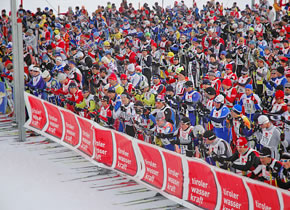
The start of the Dolomitenlauf
Worldloppet News
The Worldloppet organization has developed a virtual race format to engage cross-country skiers this winter. The virtual series was designed to motivate athletes during the pandemic and foster a sense of community. Many Worldloppet races are expected to be impacted by travel restrictions and cancellations.
Athletes who compete in seven virtual races from seven different countries becomes a “Virtual Racer”. According to a Worldloppet press release, the virtual races do not count towards a racer’s Worldloppet Passport. You can find more information about Worldloppet races and Worldloppet virtualized races here.
The rules are basic explains the Worldloppet. “The participants register for a certain distance and technique and then do the race wherever they are, alone or with friends. The session should be recorded by phone or sports watch, the file will be uploaded to the results list and the participant receives a diploma (and/or medal, t-shirt…).”
Nordiq Canada
This week, Canada’s four nordic sports, cross-country, biathlon, ski jumping, and nordic combined released a statement updating the community on the status of their joint nordic strategy. This past summer, the four governing bodies administering these sports signed a joint memorandum of understanding to cooperate and develop synergies.
According to the press release, several working groups have been formed and progress made in coordinating revenue generation, and membership/participation across the four sports.
This October, two more working groups were formed. One will explore sport performance the other is tasked with refining sport administration.
“These two groups will round out the evaluation of a combined strategy as it relates to athlete pathways and coaching frameworks, and collective operations respectively,” stated the press release.”
Team USA celebrates their hard fought second place finish at the 2019 4 x 5-kilometer relay in Lillehammer, Norway. (Photo: NordicFocus)
Athletes warmed up amidst fat falling snowflakes as a storm blanketed Lillehammer, Norway. The gun fired, and a flurry of this snow clouded the boots, poles, and relay socks as a wave of skiers strode their way up and out of the Birkebeiner Stadium for the first leg of the women’s 4 x 5-kilometer relay.
With outstanding performances in the first two World Cup race weekends, it is clear that the U.S. women are hot. They made their fitness and strength evident in back to back performances; three in the top 20 on day one in Ruka, three in the top 15 on day two, and three in the top ten in the final stage. Again in yesterday’s skiathlon, 2nd, 8th, 16th, Jessie Diggins, Sadie Maubet Bjornsen, and Rosie Brennan showed that they were ready to throw down in the relay and compete for a top-spot. With an 11th place finish in the classic sprint in Ruka and experience in the relay, Sophie Caldwell was selected for the fourth spot.
Despite this depth, the U.S. has struggled to land on the podium in the relay. Last year during the World Championships in Seefeld, a similar team (Julia Kern raced in Caldwell’s position) battled to rebound from eleventh a challenging first leg. Maubet Bjornsen and Brennan clawed up the ranks to hand off to Diggins in sixth, who could only pick off one additional team while struggling in the heat. The foursome finished fifth.
During the PyeongChang Olympics the year prior, Caldwell, Maubet Bjornsen, Kikkan Randall, and Diggins also raced to a gutsy fifth place finish, the best Olympic relay result for the United States. Here also the Americans struggled during the scramble leg. Caldwell started strong, knowing that on a good day she belonged with the leaders, but fell off the pace in the second half of her leg, tagging off over a minute behind in eleventh. Could the U.S. put together four strong legs in Lillehammer?
Norway’s Maiken Caspersen Falla leads the charge ahead of Emma Ribon (SWE) and Sophie Caldwell (USA) during the 4 x 5-kilometer relay in Lillehammer, Norway. (Photo: NordicFocus)
Norway’s sprint champion Maiken Caspersen Falla kicked off for the home team, asking her competitors to keep pace or be left behind. She explained to FIS after the race that her strategy was to stay out front to avoid accidents in the tough conditions.
After the first 2.5 k lap, there were six teams matching Falla’s effort, but skiers appeared unduly taxed by racing through the deep soft snow. Where yesterday they kicked up the tracks on the grueling hills for which the Lillehammer course is known, today, women spent more time running outside them in the loosely packed powder, burning matches left and right.
By the first exchange, only four remained with Norway: Finland, Sweden, Japan, and Russia I. Despite matching Falla stride for stride and keeping the U.S. in great position through 3.3 k, Caldwell succumbed to fatigue and fell off the lead along with the Russia II team. She tagged off to Maubet Bjornsen in seventh with a 26 second deficit.
Sophie Caldwell skis with the leaders during the scramble leg of the 4 x 5-kilometer relay in Lillehammer, Norway. (Photo: NordicFocus)
Sophie Caldwell skis with the leaders during the scramble leg of the 4 x 5-kilometer relay in Lillehammer, Norway. (Photo: NordicFocus)
Post race interview with Sophie Caldwell.
In the second classic leg, Finland’s Kerttu Niskanen challenged Astrid Jacobsen of Norway for the lead, with Sweden and Russia on their tails. Niskanen overtook the Norwegian after the first lap, Jacobsen unable to keep pace.
“I was struggling really hard, but it was a good fight,” Jabosen told FIS after the finish.
Maubet Bjornsen attacked the course, quickly overtaking the Russia II team and moving into fifth. As she climbed, head coach Matt Whitcomb could be heard shouting encouragement.
Sadie Maubet Bjornsen charges to advance USA’s position in the second leg of the 4 x 5-kilometer relay in Lillehammer, Norway. (Photo: NordicFocus)
Post-race interview with Sadie Maubet Bjornsen
“Come on buddy! You’ve got this, Sadie! Keep your eyes on ‘em, Sadie!” Whitcomb cheered as she closed the gap to Sweden.
By the second exchange, Niskanen had begun breaking apart the field, leaving Jacobsen and Natalia Nepraeva of Russia trailing seven seconds behind. After an equivalent gap, Sweden tagged their first skater, with the Maubet Bjornsen holding strong in fifth 13 seconds behind.
Norway has won the last eleven World Cup relays and was not ready to go down without a fight, particularly in their home country. They deployed their ace in the hole, Therese Johaug, who exploded off the front. She rapidly took back the lead and didn’t look back, creating a cushion of nearly 50 seconds within 5 k.
“I had a really good race today,” Johaug told FIS. “Especially these conditions are perfect for me and also these hard tracks are perfect. I feel I did a really good job today and the rest of the team also did really good work. We are really happy to be first place.”
Therese Johaug surges to create a comfortable lead for Norway during the third leg of the 4 x 5-kilometer relay in Lillehammer. (Photo: NordicFocus)
Therese Johaug surges to create a comfortable lead for Norway during the third leg of the 4 x 5-kilometer relay in Lillehammer. (Photo: NordicFocus)
Skating for the U.S.on the third leg, Rosie Brennan maintained Maubet Bjornsen’s progress through the field, quickly overtaking Russia 1 and gaining on Finland. She spent over a kilometer simply grinding on her own, leaving nothing behind to advance her team. She made contact with the Finns by the 3.3 k checkmark and accelerated to leave them behind.
“Relay’s are so fun and also stressful because you never know what’s going to happen until it’s over so it requires everyone to give their best no matter what place or what is happening around you,” Brennan wrote in an email to several news outlets. “Sadie tagged me off in a place where I could visually see teams in front which was exactly what I needed to get a solid chase going on. I love the grind of slow days so I just started to grind away and realized quickly that I was gaining time so I just kept the grind going.”
Brennan tagged off to the anchor, Diggins, in third place just nine seconds behind Sweden.
“I was working hard to catch Sweden and couldn’t quite get there but at least tagged off to Jessie with them in sight and she’s not someone you want to race against on relay day so I had full faith in her ability to reel them in,” Brennan explained. “The Lillehammer relay was my first podium back in 2015 so it felt good to not only be back, but to upgrade by one. I am super happy with my leg and really happy for all the girls work out there today. “
Post-race interview with Rosie Brennan
With Johaug’s sizable gap, Heidi Weng hammered through the course without looking back for pursuers. She stopped the clock at 1:02:22.4 for Norway’s 12th consecutive World Cup win. The team has not been beaten since February, 2011 when the Italians were victorious in Rybinsk, Russia.
With Sweden in her sights, Diggins accepted the challenge of working the U.S. into second. By the halfway mark, she closed the gap to the youngest member of the Swedish team, Moa Lundgren. Diggins launched a high tempo attack on each hill, pulling away from the fading Swede. The American charged relentlessly through her final lap, crossing the line with a 20 second gap over Sweden. U.S.A. finished 48.9 seconds behind Norway.
The scrambler and the anchor of the 4 x 5-kilometer relay in Lillehammer, Norway. USA finished second. (Photo: NordicFocus)
Post-race interview with Jessie Diggins
FasterSkier spoke with Matt Whitcomb following the race to discuss the selection process, the team’s performance, and the team’s early standout performances. For the U.S., the puzzle is not so complex that podiums are an impossibility. Whitcomb noted that placing athletes in high-stress situations in a scramble leg, despite the possibility of losing contact with the leaders, is simply a risk inherent to sport.
Post-race interview with Matt Whitcomb on the selection process.
The women’s podium of the 4 x 5-kilometer relay in Lillehammer, Norway. The home country took the win with the United States in second and Sweden in third. (Photo: NordicFocus)
Whitcomb explained the role that depth plays in an overall relay performance and the top three splits of the second through fourth American skiers.
Post-race interview with Matt Whitcomb on the overall relay performance.
Jessie Diggins leads the chase pack on her way to a second place finish in the 7.5/7.5-kilometer skiathlon in Lillehammer, Norway. (Photo: NordicFocus)
Whitcomb reflects on Diggins’ performances in Lillehammer, contrasting it to the previous year. He comments on the season training and performance plan, and the positive energy that the outstanding women’s performances has given the team.
Post-race interview with Matt Whitcomb on Post-race interview with Matt Whitcomb on Diggins’ skiathlon performance and the team’s early season success.
The women’s podium of the 2019 7.5k/7.5k skiathlon in Lillehammer, Norway. Therese Johaug (c) took first, Jessie Diggins second (l), and Heidi Weng third (r). (Photo: NordicFocus)
This week’s episode of the Therese Johaug show featured a clinic in her signature event, the 15-kilometer mass start skiathlon in Lillehammer, Norway. Before today, the two-time World Championship gold medalist had made the podium in 13 of her 14 World Cup skiathlon starts (six of those were wins), failing only in Oberstdorf, Germany during the 2011 Tour de Ski.
Her strategy was familiar. Johaug set the pace from the gun, attacking the first climb out of the famed Birkebeiner stadium. She pulled away from the field with her usual high tempo ferocity. She created a nearly 14 second gap by the 2.4 k checkpoint, which expanded to 30 seconds at the halfway mark.
Coming into the exchange zone, Johaug ripped open her pole straps with her teeth as she glided into her gate. She then stepped out of her classic skis into skate without pause. Celebrating as she skied through the stadium 7.5 k later, Johaug stopped the clock at 42.35.3. Her lead had grown to over a minute.
Therese Johaug celebrates her victory on home turf at the 15-kilometer skiathlon in Lillehammer, Norway. (Photo: NordicFocus)
Notching her seventh World Cup victory in the skiathlon and her 100th career World Cup individual distance podium, Johaug is closing on Marit Bjørgen’s record of eight skiathlon wins and 110 podiums. This was news to Johaug when she spoke to FIS at the finish.
“That was a big surprise to hear,” she said with raised eyebrows. “It was really good to celebrate with a first place today and also in my hometown, Lillehammer. It was a really good day today. My skis were perfect and my shape has been really good after [the Ruka Triple in] Kuusamo, so I could just go out there and enjoy it because I didn’t feel that I used so much energy. I am really happy.”
Based on Johaug’s trajectory, it does not seem to be a question of if, but when these records will be broken — the latter possible within the 2020 season. Just over half (51) of her World Cup podium finishes have been wins, and she has not failed to land on the podium in a distance race since before her doping suspension in 2016. She won every individual distance race during the 2018/2019 season. She was beaten only once and that occurred on the icy tracks of the Plains of Abraham during the World Cup finals in Québec City where Stina Nilsson, who began the pursuit start race with a lead of 1:45, held her off for 10 k. Johaug still skied the fastest time of that day.
Hot off a strong showing in Ruka, a duo of candy-cane striped left legs led the charge in the chase pack, namely Jessie Diggins and Sadie Maubet Bjornsen. The Americans stayed stride for stride at the front with Norway’s Heidi Weng and Russia’s Natalia Nepryaeva through the 3.5 k checkpoint, when Diggins took hold of the pace and surged to begin spreading out her peers. With Diggins went Weng and her Norwegian teammate Astrid Jacobsen, along with a string of Swedes: Moa Lundgren, Charlotte Kalla, and Emma Ribon.
Jessie Diggins charges from the exchange zone ahead of Norway’s Heidi Weng and Astrid Jacobsen during the 15-kilometer skiathlon in Lillehammer, Norway. (Photo: Aleks Tangen)
Diggins entered and left the exchange zone ahead of her competitors, closely followed by the Norwegians and Swedes. The American pressed her foot to the accelerator, again surging to spread the chase group. Weng matched Diggins’s tempo and energy on the climb away from the stadium and tucked into her draft on the descent into the woods.
From there, the lead exchanged hands a few times leading into the fourth and final time up the longest climb with two k’s to go. Devon Kershaw referenced this hill when he explained is one of the hardest courses on the World Cup, featuring crippling climbs where skiers “will fall apart”.
It was here that Diggins made here move. She stepped around the Norwegian, out matching her tempo as they climbed steeply and transitioning into a strong V2. Trusting her downhill strength, Diggins continued to hold off her pursuer through the descending 400 meter reprieve.
In a flash of V1, Diggins dropped Weng for good on the final steep climb with 500 meters to go. She flew down into the stadium and powered down the straightaway to a comfortable second place finish (+1:08.3), eleven seconds ahead of Weng.
After sliding across the line, Diggins collapsed in relief. Johaug, who by this time had caught her breath and donned her puffy jacket, gave the American an encouraging and celebratory pat on her back.
“I was trying to keep up with you and I was like, ‘Buh bye.’” Diggins laughed as she congratulated Johaug.
Jessie Diggins celebrates her second place finish at the 15-kilometer skiathlon in Lillehammer, Norway. (Photo: NordicFocus)
Jessie Diggins gasps for air after solidifying her second place finish at the 15-kilometer skiathlon in Lillehammer, Norway. (Photo: NordicFocus)
Post-race interview with Jessie Diggins.
After fading from the lead chase group, Maubet Bjornsen tucked in patiently with an international group that included Theresa Stadlober of Austria and Krista Pärmäkoski of Finland, hovering just outside of the top 10. After the exchange, Stadlober, Pärmäkoski, and Maubet Bjornsen began steadily moving up in the standings, catching Kalla and Jacobsen. By the finish, Pärmäkoski had worked her way into 4th place, Stadlober 7th, and Maubet Bjornsen 8th (+1:43.9).
“I generally prefer classic as opposed to skate, but I had new and fun feelings today,” Maubet Bjornsen wrote in an email to several news outlets. “Not only did I enjoy the skate portion more, but I felt really strong climbing. I am walking away from today with new confidence, and excitement. To finish the day within sight of the podium fight on a less than perfect day is a good sign.”
One final push across the line for Sadie Maubet Bjornsen at the 15-kilometer skiathlon in Lillehammer, Norway. Maubet Bjornsen finished 8th. (Photo: NordicFocus)
Post-race interview with Sadie Maubet Bjornsen.
Taking a similarly patient approach, Rosie Brennan steadily turned up the dial in her race, cautious of burning too many matches early in the grueling terrain. At 4.6 k, Brennan sat in 21st, moving up one spot before the exchange. She picked up another two spots by 11.3k, and another two by the finish. Brennan crossed the line in 16th (+3:10.0).
“Today was a solid race, not my best and certainly not my worst,” wrote Brennan to several outlets. “I was struggling in the classic, just not finding the relaxed good feelings you want. I couldn’t hang with the front group, which I was disappointed by, but after I switched to skate, I found better feelings and was able to pick some people off. Unfortunately, I let a little too big of a gap open up to the big group in front so there was only so many people pick off. This course is one of the hardest on the circuit and you really have to be on your A-game to pull of good things here. I wasn’t quite there, but I am satisfied with the result given my feelings out there.”
Rosie Brennan during the 15 k skiathlon in Lillehammer, Norway. (Photo: NordicFocus)
Post-race interview with Rosie Brennan.
Outside the top-30, Rosie Frankowski (APU) finished 33rd (+4:14.1) and Caitlin Patterson 46th (+5:36.0).
Tara Geraghty-Moats won the Nordic Combined Continental Cup in the previous season and is set to be a podium contender for the overall standings in this year’s cup as well. Now she finds herself in Lillehammer ready to jump in this weekend’s World Cup. FasterSkier met up with her to hear her thoughts on training, what it’s like to compete at her level and the future of nordic combined for women.
Today, a Monday, she opted for a 7×1 minute hill intervals up the first hill on Lillehammer’s course. This particular hill is the first challenge the skiers tackle as they race the 1994 Winter Olympics. Some 15-25 seconds after the gun goes off, the skiers will find themselves battling it out on the steep hill, which offers a slight break midway through. This break, however, does not offer much of a pause, as Geragthy-Moats’ heart rate will tell you. one hundred and ninety seven beats per minute during her intervals places her just over 96 % of her tested max of 205 and sent her lactate level relatively high above threshold levels. Anyone with knowledge of sports physiology knows what this means: your muscles will be sore.
“Fast when I need to”
Geraghty-Moats explains why she puts herself through a workout like this by saying “the idea is to install a super-boost in your legs”. This top gear, as she also calls it, is something she’s been working on this year. When asked about her workout of the day and why she did it, she explains: “so if I’m skiing in a pack I’ll be able to sprint away from the pack and make a clean break, something that’s really useful in mass-start racing and the nordic combined pursuit format.”
She goes on to say that she’s hopefully in good shape, with good endurance and good conditioning for a race and that “this is sort of the cherry on top of my conditioning for the year, where I’m trying to get my speed up so I have the ability to go fast when I need to.”
How do you feel like a workout such as this one prepares you for an upcoming race?
“Basically those one minute sprints are sort of warming up my engine and making sure that my legs can move quickly, I feel pretty in shape and I feel in good condition this season but that doesn’t necessarily mean you’re ready to race so this is sort of the last prep to race, also for me I have to balance between ski jumping and Nordic skiing, so I have to focus on quality over quantity.”
And how are you able to improve on both?
“For me, the most effective way is to take training blocks where I focus on jumping and different training blocks where I focus on skiing.”
Tara Geraghty-Moats flying off Lillehammer’s HS140 as she prepares for the new season of racing. (Photo: Aleks Tangen)
The training block for this week started with seven sprints in the morning and seven jumps off the big hill (HS140) in Lillehammer. When it comes to deciding what to do in training, Geraghty-Moats considers her competitions. She writes her own training plans and explains that she has an overall plan, which stretches for 2-3 months. As she gets closer to competition, she specializes her sessions. When asked about how she factors in yesterday and tomorrow when deciding what to do today she says: “I decided to do my longer intervals yesterday and shorter intervals in the morning and then have some rest and get ready for jumping. But really I look at when my competitions are and when I’m going to want to be feeling fast and good and then build sort of backwards from there.”
She explains that an important aspect to this process is knowing how long it takes to recover and how long it takes for the intervals to have an effect on overall skiing speed. On December 13-15, the Continental Cup comes to Park City, Utah and the effect she speaks of will show if things are going according to her plan or not.
Below is a lightly edited and condensed version of an interview with Geraghty-Moats.
Aleks Tangen: For your workout today what were you doing?
Geraghty-Moats: So today I was doing one minute sprint intervals something I’ve been working on a lot of this year is really just improving my Top Gear so if I’m skiing in a pack I’ll be able to sprint away from the pack to make a clean break something that you really useful in mass start racing and the nordic combined pursuit format
AT: The reason why you’re doing your workout like that at this time of year is because you want to be able to sprint past the other racers?
G-M: Hopefully with this year’s training I’m in pretty good shape, I have pretty good endurance, good conditioning for a race and this is sort of the cherry on top of my conditioning for the year where I’m trying to get my speed up so I have the ability to go fast when I need to. And I was doing it on the hill, obviously it’s a little bit harder there, where are you get a lot more lactic acid in your legs and preparing my body for that really helps when I’m in a race where I’m already going fairly hard and have to put on the gas and really sprint.
AT: How do you feel like a work out such as this one prepares you for an upcoming race?
G-M: Those one minute sprints are sort of warming up my engine and making sure that my legs can move quickly I feel pretty in shape and I feel in good condition this season but that doesn’t mean necessarily, that you are ready to race. So this is sort of the last prep to race, also for me. I have to balance between ski jumping and nordic skiing. So I have to focus on quality over quantity. Yesterday, I did an interval session, ideally I would do another hard session if I was simply a nordic skier. But today doing a shorter interval session, my body is already tired from yesterday, I don’t have to ski for so long, I don’t have to do so many laps. I still get the training affect, and I still have the hours where I have time to jump and I can feel fresh for the jumping I’m doing later.
AT: It’s a Monday, you’re competing this weekend, what factors playing into doing this particular kind of workout?
G-M: This week I’m actually just competing in ski jumping World Cup, so I’m trying to get a good number of intensity workouts done early in the week so by the time the weekend rolls around I am pretty fresh. I’ll probably do some weights and plyometric workouts on Wednesday and Thursday to get my legs fresh and activated for jumping. But at the same time I still need to stay in shape for cross-country skiing, which will be the weekend after next, in Park city Utah, so yeah it’s always a balance with nordic combined, because you really want to be the best at both sports so you have to stay on top of everything, but also not overextend yourself.
AT: For a workout like this one, how do you structure the warm up?
G-M: For me warm-ups are really important, especially with one minute intervals, because if you’re not warmed up properly first of all you can’t really go that fast and second of all it’s a really big shock to your system, you can get sick or the lactic acid floods your system so you can’t do as many sets. I usually ski between 20 and 30 minutes for warm-up. I start pretty slowly and then I do 3 x 3 min. level III, threshold intervals, before I start the sprint – all out work out – so that gets my system going.
Tara Geraghty-Moats training in Lillehammer, Norway. (Photo: Aleks Tangen)
AT: Considering you are sprinting up the hill, it’s kind of tough, how do you prepare yourself mentally for such a work out?
G-M: Actually, I really like these workouts because they’re pretty quick, and I just enjoy going fast on skis, it’s fun for me. I just look forward to it. It’s kind of easy on a day like this when the conditions are perfect. I have the whole stadium to myself. I mean I don’t really need much motivation, and physically it’s nicer when I’m fresh and not tired. But realistically that’s part of the job, some days my legs are just going to hurt a little bit.
AT: How do you feel the workout you did today, what part of your performance does that improve?
G-M: Anything that short is definitely anaerobic, it really helps you deal with anything lactate flooding your system, and just gets your body moving fast. You see a lot of the women especially in skiing have a lot of high tempo even in the longer races and if you’re not efficient at that anddon’t feel comfortable doing that you really have no chance.
AT: Strength training plays an important role in that if you’re strong then it’s easier to maintain high speed and high intensity.
G-M: For me actually it’s important to not do a lot of weight and strength session but make sure the ones that I do are really quality. I don’t necessarily do strength workouts after an interval workout or after a long day. I think that’s another thing most nordic skiers tend to do — they will slide in strength after an session or when they are already tired and it is really important to do strength when you are fresh. It gives you a chance to improve, and really focus on getting stronger, and not just maintaining.
AT: Being in the moment and not necessarily measuring quantity, but doing it as good as possible?
G-M: Right. And I think that’s nordic combine in a nutshell: quality over quantity. Because there’s no way I can train 800 hours like the cross-country girls on World Cup. It is not going to happen it’s not realistic so I have to have a paired down training plan for nordic.
AT: How many hours do you train every year?
G-M: This is actually my first full year of being a true nordic combiner, so I’ll probably do about 480-500 hours so it’s not nothing, but it is not sort of what you would expect of nordic skiers. I think it’s not really comparable, and you have jumping which is a completely different sport from long-distance nordic skiing. They can do somewhere between 700 and 800 or 900 but they don’t do as much explosive and plyometric work which requires a totally different recovery.
Also the time of the day I can do training sessions for jumping but I might not be that tired but I might’ve still been on the hill in training mode for five or six hours on that day because we usually warm up for about 45 minutes and then we are on the hill for an hour and a half and I can go for a ski in the evening and it means that I might be training close to seven hours that day.
Sweden’s Charlotte Kalla leads American Jessie Diggins and Norway’s Ragnhild Haga during the 2018 Holmenkollen women’s 30 k freestyle mass start at the World Cup in Oslo, Norway. (Photo: Fischer/NordicFocus)
At the close of the season, after some striding and skating on some heavy courses, FasterSkier sent out a query to get some athletes’ opinions on which course (distance and sprint) was the most difficult? We also asked which specific World Cup climb was the deepest-dig grind.
Here are the responses. We’ve included some course profiles for reference at the end of the piece.
In your opinion what World Cup distance course is the most difficult and why do you find this course to be difficult?
Andrew Young: Lillehammer. I think I’ve raced 4 different 5k race loops there. All of them are hard. It’s a combination of a few things. There is a very little flat. The few flat sections come after long uphills so you have no speed through them. The downhills are very steep and very fast – so they are over quickly making the uphill/work to downhill/rest ratio pretty tough. In classic, a lot of the climbs are on the edge of diagonal stride or herringbone. So either you burn a lot of energy and stay in the track or you go slower and herringbone.
Andy Newell: Lillehammer or Ruka. Lillehammer has some massive sustained climes on it, maybe the longest being in the 4+ minute range. The downhills are also extremely fast with big sweeping corners in them. This means less time for the legs to recover. Ruka is difficult because of the sheer steepness of the climbs. There isn’t a venue in the US that compares to the grades of the Ruka hills. It takes me by surprise every year I race there.
Sadie Bjornsen: Davos- Sometimes I think the “easier” the course, the harder the race. Davos is at altitude, and because it doesn’t have any “huge” hills, there are also no extended rests, so it is just constant “work”.
Rosie Brennan: Holmenkollen is the hardest course in my opinion. It has the most climbing and more importantly, the climbs are almost all that very challenging grade that you want to kick up but have to have very good kick and be very strong to do so. I find the grade of climbs to be a more challenging factor than the length or number of climbs in most courses.
Charlotte Kalla: Lillehammer, because they have long uphills and quick downhills. It demands a lot of your capacity when you don’t get a long resting time.
Jessie Diggins: First off, it’s a little tricky, because everyone has their opinion on what makes a “good” World Cup course or what makes it “hard”.
For example, Davos is one of the flatter World Cup courses out there, but it’s incredibly hard because there’s almost no rest and it’s at altitude. Falun is a really hard course, but it’s downhills provide more rest than Lillehammer, so does that make it easier overall? You’re probably going to get a lot of conflicting answers, but here are my thoughts on it!
I think the Holmenkollen is the hardest. Somehow, this course feels like you’re always climbing without any rest at all. The downhills are really fast compared to longer more sustained climbs on the uphill on the red loop (the longer loop) and on the shorter blue loop, the downhills are all curved so you can’t get any rest, and the uphills are steeper.
I think this course is also one of the fairest courses on the World Cup, because the course is wide enough to pass at pretty much any point out there. It’s hard enough that people can’t catch a free ride the entire way, and it really separates the best in terms of fitness and technique.
Noah Hoffman: “Most difficult” is super ambiguous. “Most difficult” for me or “most difficult” in the traditional sense of the term? For me, anything flat where I have to generate sustainable high speed is going to scare me much more than the hilliest courses. I crave and live for the hilly courses. Fast flat courses that I dread include Toblach (old course), Ulricehamn and Quebec. The courses that are “most difficult” in the traditional sense of the term are Holmenkollen, Val di Fiemme, Otepaa, Kuusamo and Sochi. Those are also my favorite courses on tour, the ones where I had the most success. Of course, you can also throw altitude into the mix, which also played to my strength. The highest venue is La Clusaz. If you want my single vote for the “most difficult” for me, I’d say Ullricehamn. And for the “most difficult” in the traditional sense, I’d say Val di Fiemme (World Champs Course).
Which specific World Cup (distance course) climb is the most difficult?
Andrew Young: Mörderbacken (Murder Hill), Falun is probably the longest, toughest individual climb. Excluding Alpe Cermis. Other climbs of note are “the long hill” in Lillehammer – a series of 3 shorter climbs with short “flat” sections in-between. The final climb in Sochi – two climbs linked together with a 100m flat in-between. All of these climbs are pushing 3 minutes, if not more, of almost pure climbing for me. As I am one of the biggest guys racing world cup any climb at that length is pure hell.
Andy Newell: Lillehammer’s 4+ minute climb: It’s a tough grade. IF you feel good you can V2, if you are bonked it’s a slow grind V1 which makes it even worse. Either way, you need to mix up a lot of technique changes. It’s sustained but you have to constantly be changing between V1 and V2.
Sadie Bjornsen: Holmenkollen: It literally just keeps going up. Who knew you could ski straight uphill for 10 minutes without stopping. And then the downhill goes by so fast that you seem to be only climbing.
Charlotte Kalla: Tour de Ski’s Alpe de Cermis. It happens only one time a year and you don’t need to use that technique for uphills anywhere else.
Jessie Diggins: I would say the long climb on the Lillehammer course that goes from the bottom to the top. It’s a really long climb (several minutes) but it varies greatly from steeper pitches to almost flat sections, and that’s what makes it so hard – you have to be constantly pushing incredibly hard or you’ll find yourself losing seconds with every transition in pitch.
Noah Hoffman: The “most difficult” for me to ski effectively are the punchy climbs that are <30sec in Quebec. The “most difficult” in the traditional sense is probably the climb on the far side of the ski jump landing hill in Otepää.
Quebec is full of <30 second climbs that guys who are really effective at generating power (guys like Sim) can ski fundamentally differently from the way I’m able to ski them. I try to ski them like I ski a 4-minute climb and it’s just not very fast. I can’t generate enough power and don’t have good enough technique to ski them how they can be skied.
The far climb in Otepaa is close to 3 and a half minutes and it’s steep. It essentially is bottom to top of a K120 landing hill. It’s awesome.
Which World Cup sprint course is the most difficult?
Andrew Young: Lillehammer – it’s a tough sprint course. There is a lot of climbing, and it’s a fairly long course. Pacing is an issue, it’s very easy to be over cautious of the length of the course and the final big climb. A lot of sprinters start to easy and never really get up to speed. On the flip side, if you start too hard you can haemorrhage time on the last climb. The climbs are also an awkward gradient where you never really knows which technique they should be using.
Val Mustair – The course in itself is quite normal. But this is the highest altitude we race at on the world cup circuit. Sprinting at 1700m is horrible. Whether you are acclimatised or not, it’s going to hurt.
Drammen – It used to be kick wax versus double poling that made it tricky. Now they’ve added diagonal zones. The finish is higher than the start giving it the unusual uphill finish straight. The awkward transitions on the first climb. The long left hand bend at the top of the climb. The ever-running battle of when to change from double pole to diagonal on the final climb. The whole thing is just awkward. Not to mention very limited time testing skis or skiing on the track before the race. Tower-building games bring a fresh feel to online gambling. The Tower Rush game keeps things simple — you build floors higher to grow your payout multiplier before a crash happens. It’s smart to test a Tower Rush demo first so you get used to the timing. Once you’re comfortable, jump int Tower Rush to place a real bet and see how far you can climb. Playing at a licensed casino keeps your deposits safe, and you can also use the Tower Rush app to play right on your phone.
Andy Newell: Sprints are funny. Flat sprints can sometimes be the hardest.. especially if the conditions are slow. Flat sprints mean you need to be working the whole time and it will be a leg burning lactate fest by the end. Even a short downhill in a sprint provides a little bit of needed rest to the legs. For sprinting it kind of depends on a combination of the length and terrain. Ruka has a monster climb but it’s one of the shortest sprints we do so nobody thinks it’s that difficult of a course. Courses like Sochi and Cogne are tough because they require a lot of grinding work and have technical quick downhills, and are both over 3.25 mins
Cogne this year was a tough one because of the altitude and any time there is a sustained climb right from the start in a sprint combined with a long running time it’s going to be tough.
Sadie Bjornsen: This year I think the Val Mustair course was the hardest. The climb was super steep, and the downhill was so technical, while also trying to work the bumps they had put into the course. The combination of constant work and altitude made it a long sprint course with absolutely no rest.
Charlotte Kalla: Kuusamo. It is a tough finish and you have to keep push hard in the finishing sprint after you have taken the challenging Kuusamo-hill.
Jessie Diggins: There are a lot of courses that are difficult simply because they’re impossible to pass on, so you have to get out in the front right away or you have a huge struggle ahead of you trying to get to the front (Seefeld, Cogne, Dresden, Val Mustair, Falun). But in terms of pure difficulty on a course that gives a fair chance to pass, I’d say Lillehammer or Ruka. Ruka, because it ends with that monster steep climb onto flat terrain where everyone is gassed but has to double pole that long finishing stretch. And Lillehammer, because there are two main climbs that really test your sprinting endurance.
Noah Hoffman: I don’t sprint (obviously) but I had to race my fair share of World Cup sprints in tours. I hated flat sprint courses. Toblach in particular.
Double click the images to enlarge.
Holmenkollen lap 2-4 course profile for women’s 30 k.
Holmenkollen lap 1 course profile for women’s 30 k.
Holmenkollen men’s 50 k profile.
Holmenkollen course profile for 50 k men, 30 k women (view 2).
Men’s and women’s Falun 5 k loop course profile.
Falun sprint loop.
Kuusamo/Ruka 5 k loop course profile.
Kuusamo/Ruka 5k course profile
Kuusamo/Ruka sprint loop course profile.
2018 Lillehammer 5 k and sprint loop and course profile.
Andy Newell of Nordic Team Solutions provides a video course preview of the Lillehammer Triple.
Starting Friday, the World Cup returns to Lillehammer, Norway. The racing begins with Friday’s freestyle sprint. The men’s and women’s courses are slightly different. The men sprint 1.6 kilometers, the women 1.3 k.
The Friday sprints are followed by a 10 k/15k individual skate. The women and men race on the same 5 k loop. Sunday features a 10 k/15 k classic pursuit on the same 5 k loop from Saturday. The first skier across the line Sunday is the overall Lillehammer Triple winner.