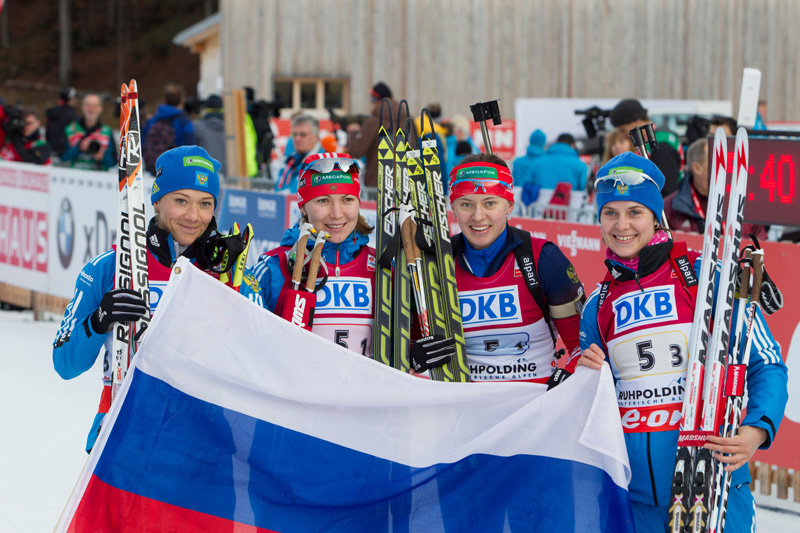
Olga Zaitseva, Ekaterina Glazyrina, Olga Vilukhina, and Irina Starykh celebrate their IBU World Cup biathlon relay victory in Ruhpolding, Germany in January 2014. (Photo: Fischer/Nordic Focus)
The Biathlon Integrity Unit (BIU) announced on Thursday that Russian biathletes Ekaterina Glazyrina and Timofey Lapshin were provisionally suspended. According to the BIU, Lapshin has been competing for Korea since 2017.
Both Lapshin and Glazyrina are accused of violating anti-doping rules (ADRV). The evidence used to hand down the provisional suspensions came from information included in the McLaren Report and data from the Moscow Lab’s data (LIMS) handed over to WADA in 2019.
The BIU states this is Lapshin’s first violation. The IBU website indicates Lapshin has earned six career IBU World Cup podiums: two wins, a single second place, and three third-place efforts.
Glazyrina served a two-year ban from competition beginning in February 2018. She was allowed to compete again in 2020. This competition ban resulted from using a banned substance.
Glazyrina has five IBU World Cup podiums: two second-place finishes, and three thirds.
Under the International Biathlon Union Integrity Code, both athletes have an opportunity to respond to the BIU’s sanction.
At issue is WADA’s access to the Moscow Lab’s Laboratory Information Management System (LIMS) data. Early reports by WADA had cited progress towards successfully meeting the Dec. 31 deadline. The Friday press release states Russia halted the data extraction due to an assertion that WADA’s equipment was not certified under Russian law.
WADA claims Russian authorities had not cited any issues with the equipment in question when the two parties met in Moscow to discuss lab and data access in late November. Full unhindered access to the lab, LIMS information, and any other underlying data are conditions for RUSADA to remain a compliant anti-doping entity.
Despite the lack of full access to the LIMS, WADA stated it will continue to honor the Dec. 31 deadline. With nine days remaining until Dec. 31, WADA representatives will proceed with writing and and submitting a report about its Moscow findings to WADA’s Compliance Review Committee (CRC) to be delivered in mid-January.
If the Dec. 31 conditions are left unmet, RUSADA is at risk of once again becoming a non-compliant anti-doping agency.
After the announcement that the World Anti-Doping Agency (WADA) Executive Committee, which WADA refers to in short at the ExCo, voted 9-2 in favor of reinstating the Russian Anti-Doping Agency (RUSADA) on Thursday, it released a statementdescribing what it considers a conditional reinstatement.
As mentioned in an previous FasterSkier article, Russia has not fulfilled two outstanding provisions laid out in WADA’s “roadmap” for reinstatement.
In its most recent public statement on the matter, also published on Thursday, Sept. 20, WADA detailed those remaining conditions:
“That the responsible authorities for anti-doping in Russia must publically accept the reported outcomes of the McLaren Investigation; and
That the Russian Government must provide access for appropriate entities to the stored samples and electronic data in the former Moscow Laboratory, which are sealed off due to a Federal investigation.”
In its attempt to move forward, WADA claimed the Sept. 20 reinstatement remains subject to what it calls two “post-reinstatement conditions”. (Absent from the latest statement is the demand that Russia admit its involvement in state-sponsored doping, as detailed in the McLaren Report.)
The Russians must release the former Moscow lab’s Laboratory Information Management System (LIMS) and related “underlying” data by Dec. 31, 2018. LIMS is a WADA-standardized method of cataloging and storing tests and corresponding analytical results. The data will serve as a means to pinpoint which athletes were in violation of the WADA code and need to be adjudicated.
According to a previous statement, WADA believes it is already in possession of the Moscow Lab’s LIMS data. Last November, WADA reported that it had received LIMS data from a whistleblower including all the testing data from January 2012 through August 2015.
Once the data is turned over and reviewed, WADA has the right to reanalyze any samples no later than June 30, 2019. The agreement also states RUSADA must be successfully audited within the next four months.
If the outlined conditions are not met, WADA asserts its Compliance Review Committee (CRC) will convene and advise the WADA ExCo on any potential RUSADA non-compliance.