Tag: Linn Sömskar

  • Sweden’s Svahn Strikes Again in Dresden; Caldwell 4th

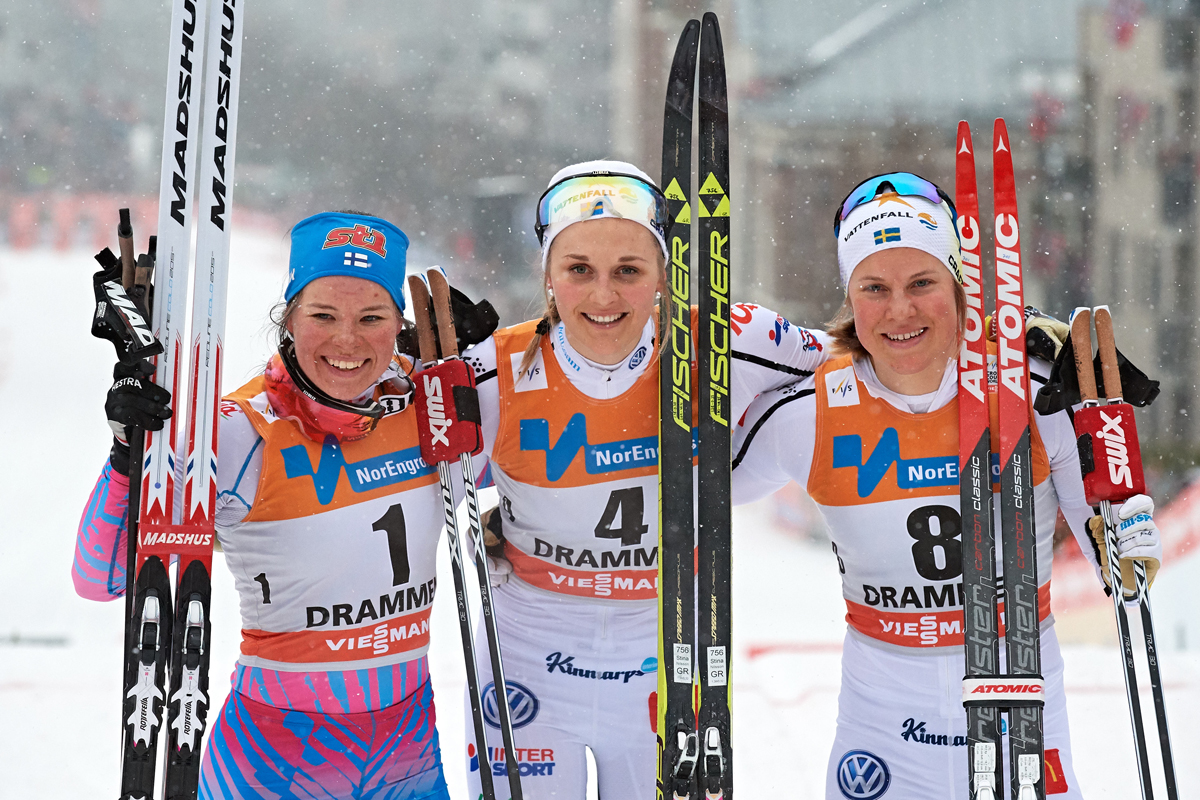
    Victory on the streets of Dresden. Linn Svahn (SWE) takes the win ahead of Anamarija Lampic (SLO) and Maja Dahlqvist (SWE). (Photo: NordicFocus)
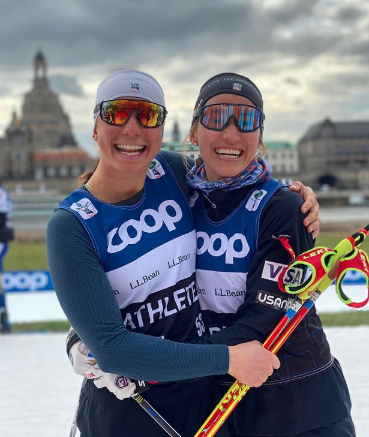
    “Dream team ready for Dresden.” (Photo: Screenshot Instagram @sophiecaldwell)

    With the Tour de Ski in the rearview mirror, athletes donned bibs for a city sprint weekend in Dresden, Germany. Like the other bookend in Planica the weekend before it began, athletes who focused on the Tour de Ski — mostly distance skiers and all-arounders — were not in attendance to focus on rest and recovery. This narrowed the field  in Dresden to a sprint-focused lineup.

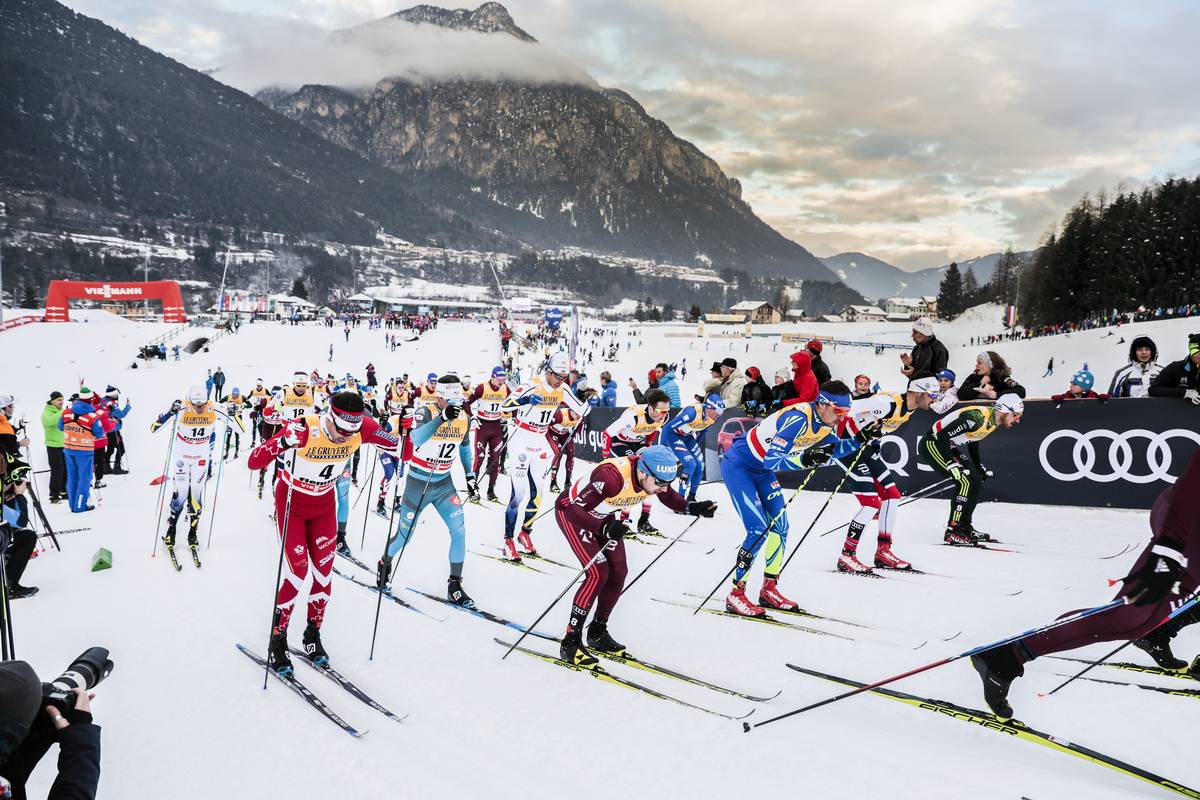
    Under grey skies, skiers drag-raced on an icy ribbon of snow around two lap course along the Elbe River, navigating hairpin turns at each end and a few roller hills along the way. Past the Frauenkirche cathedral and Semper Opera building they soared, while fans cheered from green grassy slopes and stone steps. 

    Despite making her way up the Alpe Cermis six days prior and taking the win in both sprint stages of the Tour de Ski, Anamarija Lampic of Slovenia lined up in Dresden and posted the fastest time in the qualifier, 2:30.38. Lampic finished 19th overall in the Tour standings. 

    Sophie Caldwell and Julia Kern were the sole American women in the field. Caldwell was the top qualifier for the U.S. in 4th, with Kern in 15th. After taking 9th in the sprint in Lenzerheide and landing inside the top-30 in distance races, Caldwell withdrew from the Tour after the fourth stage in Toblach. Battling a cold, Kern withdrew after the skate sprint second stage, where she finished 14th. 
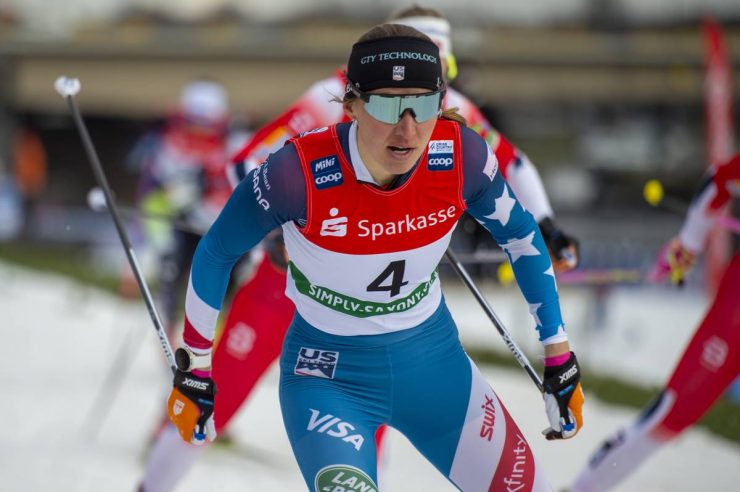
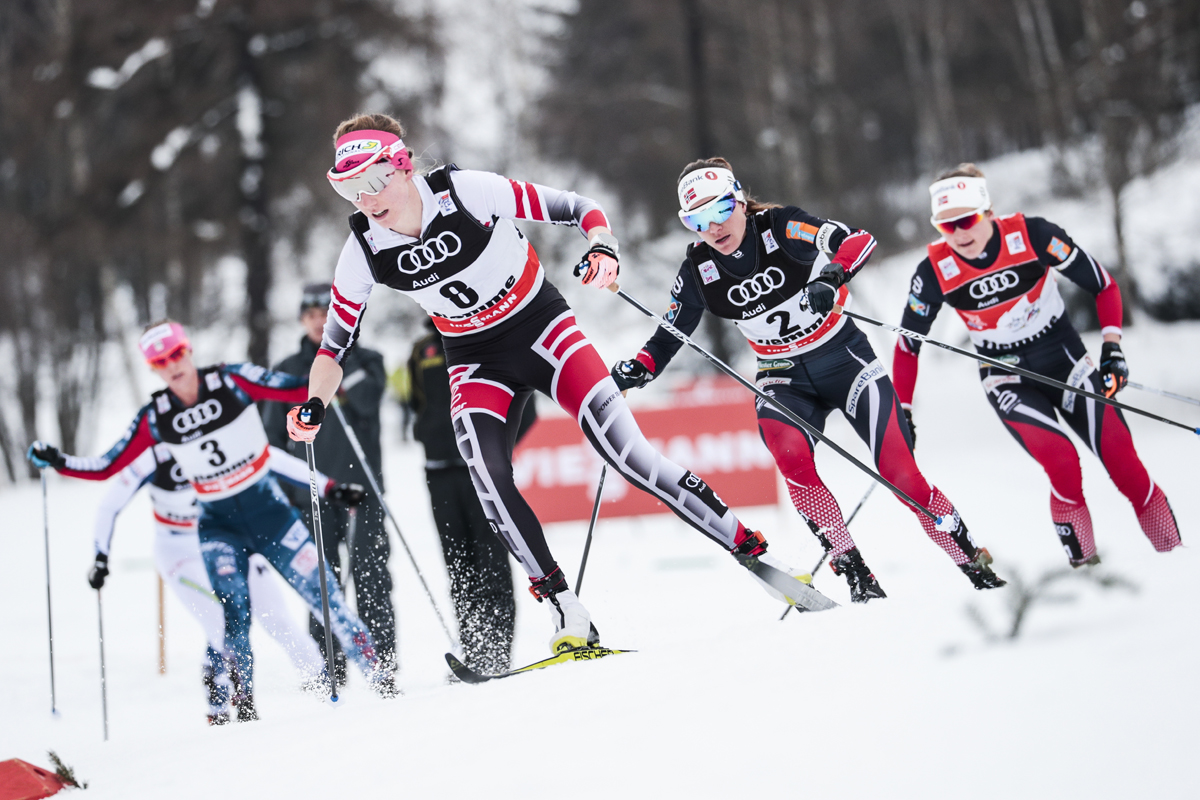
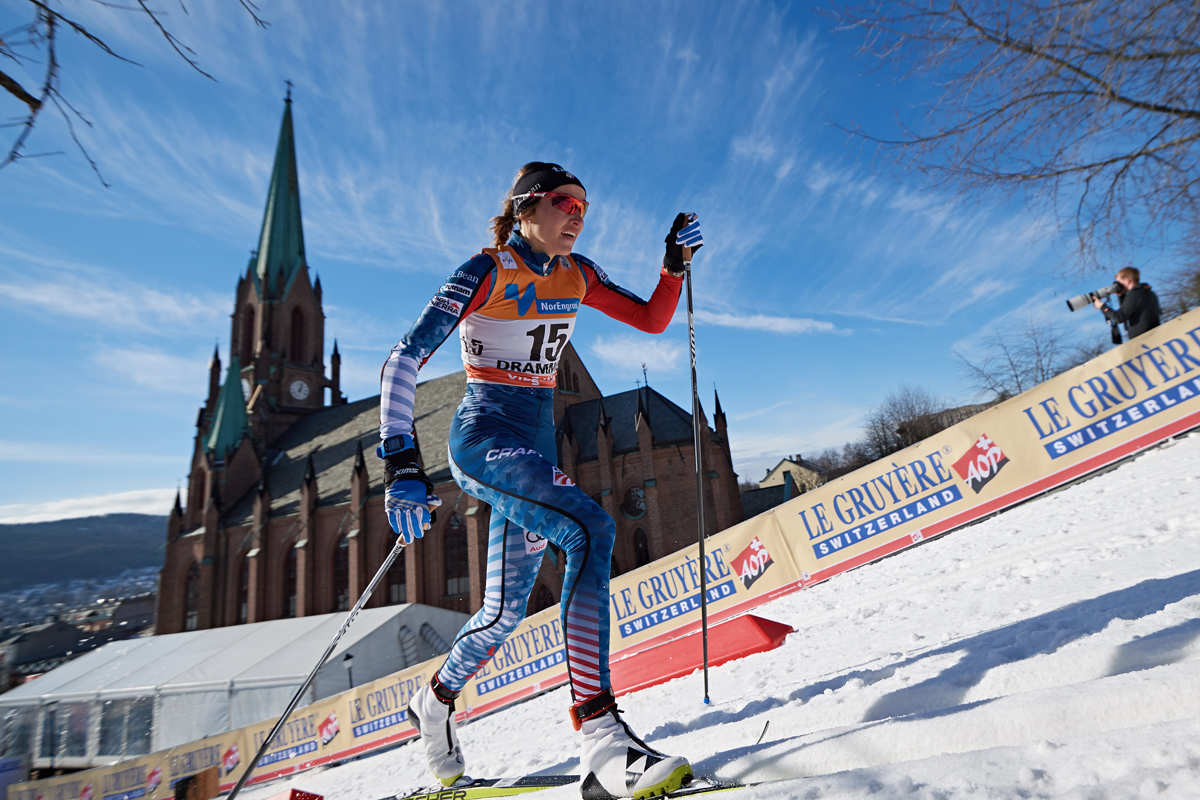
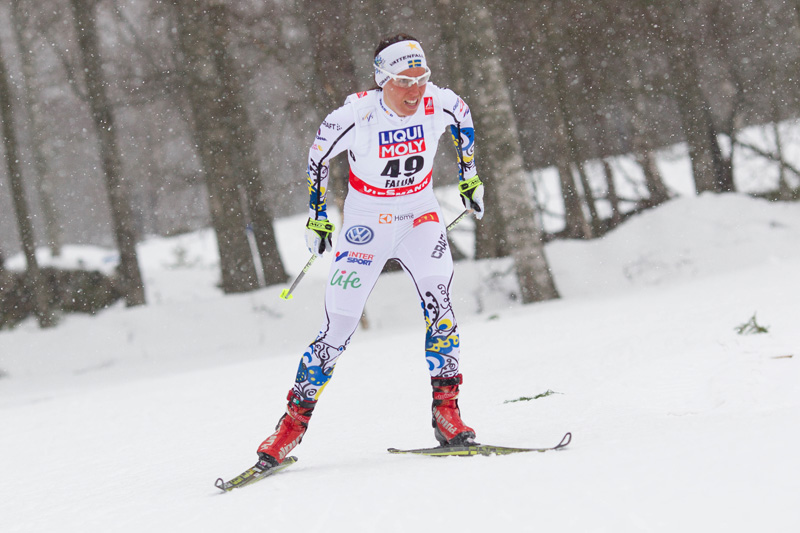
    Focus. Sophie Caldwell works her way through the rounds to a fourth place finish in Dresden. (Photo: NordicFocus)

    In the first heat of the quarterfinals, Caldwell looked typically calm, cool, and collected. She held a position at the front throughout the race, her technique perfectly smooth and oozing power. Caldwell’s position was secure enough that she could lay off the gas before sliding across the line with Nadine Faehndrich of Switzerland. 

    Kern was not so lucky. Though she rounded the first hairpin on her own in the lead, skiers became bunched heading into the subsequent high-speed corners. At the apex of the second curve, Kern was pushed wide as Nina Dubotolkina of Russia caught a v-board and fell to her knees in the middle of the group. On the final turn, Kristine Stavås Skistad lost her footing and shot off the edge. Kern finished 4th in her heat, which was slowed by the crashes, and did not advance. 
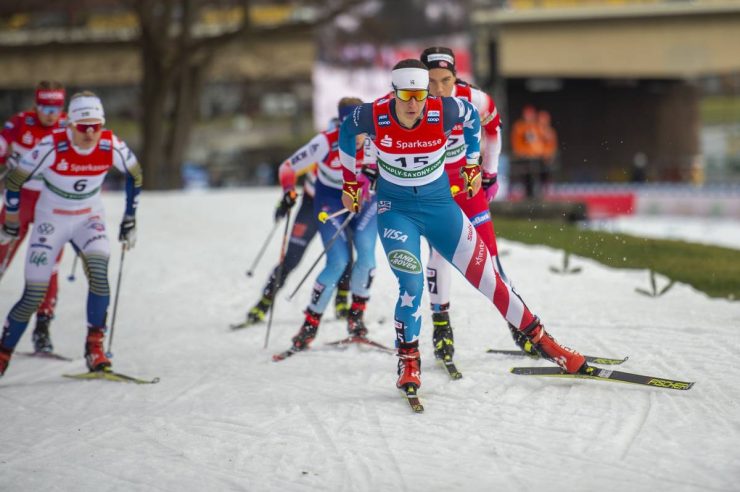
    Julia Kern leads the way in the first lap of her quarterfinal in Dresden. (Photo: NordicFocus)

    Racing for Canada, Dahria Beatty finished 29th overall and Maya Macisaac-Jones 37th. Beatty was also eliminated in the quarterfinals after finishing 6th in her heat. She has landed in the top-30 in each of the three freestyle sprints she has contested on the World Cup this year; she was 25th in Davos, and 16th in Planica.  
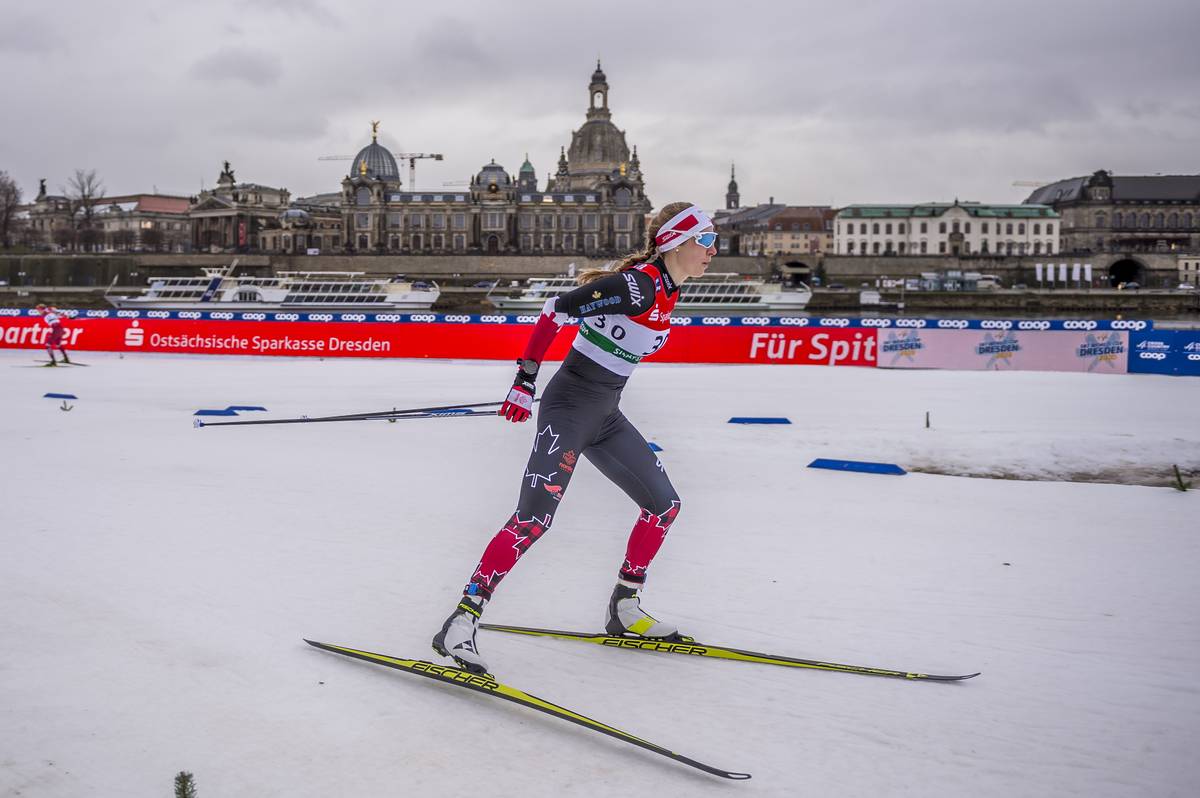
    Canada’s Dahria Beatty during the 2020 Dresden skate sprint qualifier. She placed 29th overall. (Photo: NordicFocus)

    In the semi, Caldwell tucked into the middle of the pack, marking leaders Laurien Van der Graff of Switzerland, Linn Svahn of Sweden, and Lampic. Rounding the final curve safely, they laid on the accelerator, all four women in a tight group down the final straight, a fifth on their tails. Svahn threw her boot for the win, Caldwell crossed just behind in a three-way photo finish with Van der Graff and Lampic. The American was deemed third; as the top time in the next round was three seconds slower than hers, she advanced to the final without a hitch.

    On the hunt in the final, Caldwell stayed wide on the turns, out of trouble in the event of a fall. Sweden’s Svahn and Maja Dahlqvist set the pace, but the group stayed tight. 

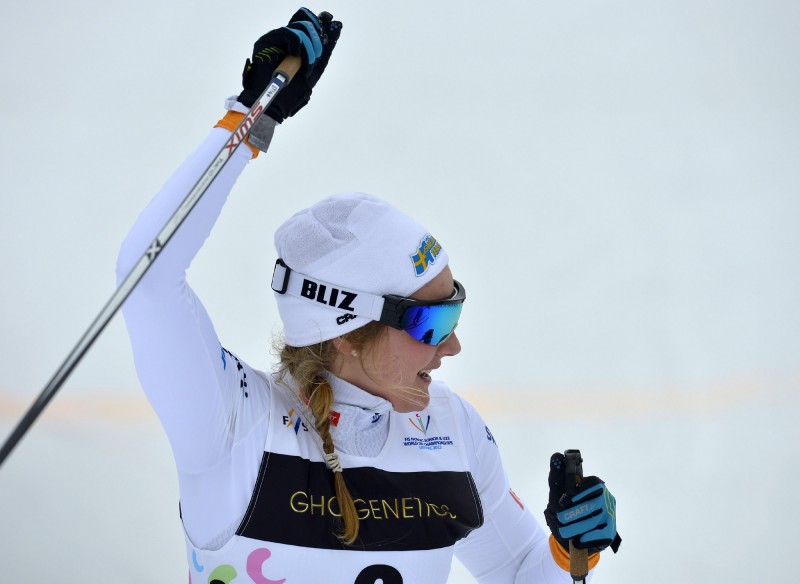
    The women charged down the final straight three abreast with Svahn at the front. In another photo finish, Lampic and Dahlqvist threw their boots for second and third, respectively, with Caldwell in the next lane for 4th. Linn Sömskar of Sweden took fifth as Van der Graff rounded out the final in sixth. 
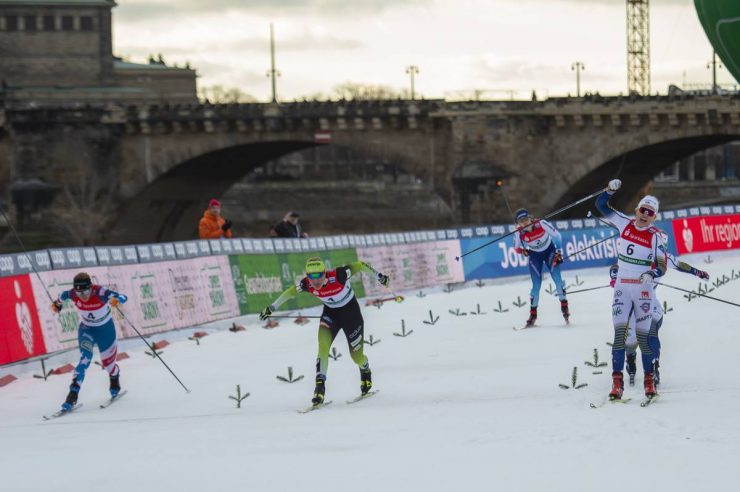
    Linn Svahn takes the win in Dresden with second through fourth in a photo finish behind her. (Photo: NordicFocus)

    “It is a difficult course, but I like it when it’s high speed and I like to do a strong finish, so I’m happy,” a smiling Svahn told FIS at the finish. 

    In response to questions about her tactics with her teammate Dahlqvist, Svahn responded that she was proud to share a spot in the top three. 

    “It’s so fun to have Maja beside me on the podium. She’s strong and had a really great season last season, then a little bit tougher this year, so I’m so happy to be beside her. Our plan was to just be in the lead the first lap, then I felt very strong, so I tried to push from the hill — if you can call it a hill.”

    A newcomer to the World cup, this is Svahn’s second win. With an unforgettable blurt of surprise, she seized her first win in Davos in December. 
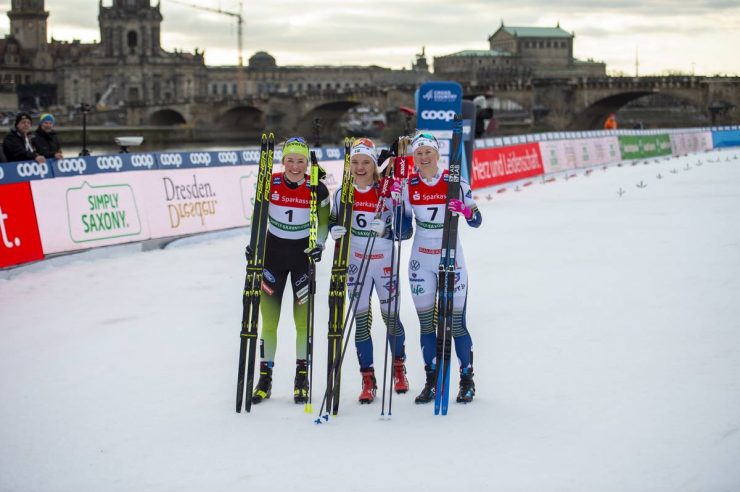
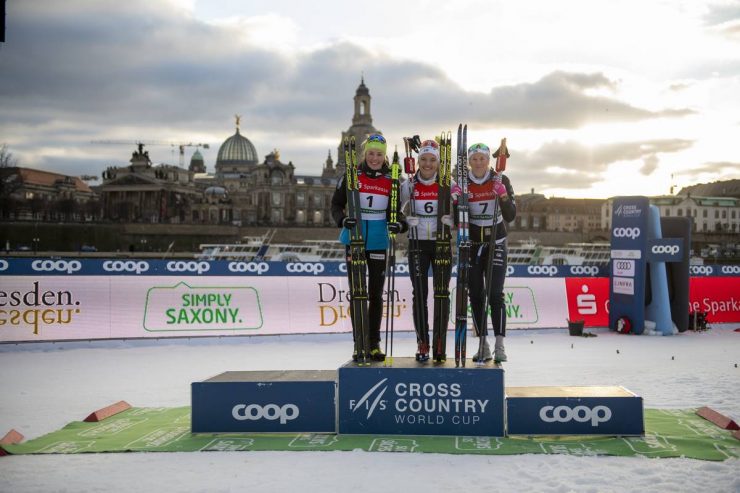
    The podium of the women’s 1.3-kilometer freestyle city sprint in Dresden, Germany. Linn Svahn (SWE) took the win ahead of Anamarija Lampic (SLO) and Maja Dahlqvist (SWE). (Photo: NordicFocus)

    Caldwell improves upon a 5th place result in last year’s individual sprint in Dresden. 

    In a post-race call, Caldwell discussed her tactic to stay unscathed through the tricky corners and crashes of the course. She also explains how the deteriorating manmade conditions was familiar to her, her advice for selecting skis in these conditions, and the excitement of competing in a stacked field of women.

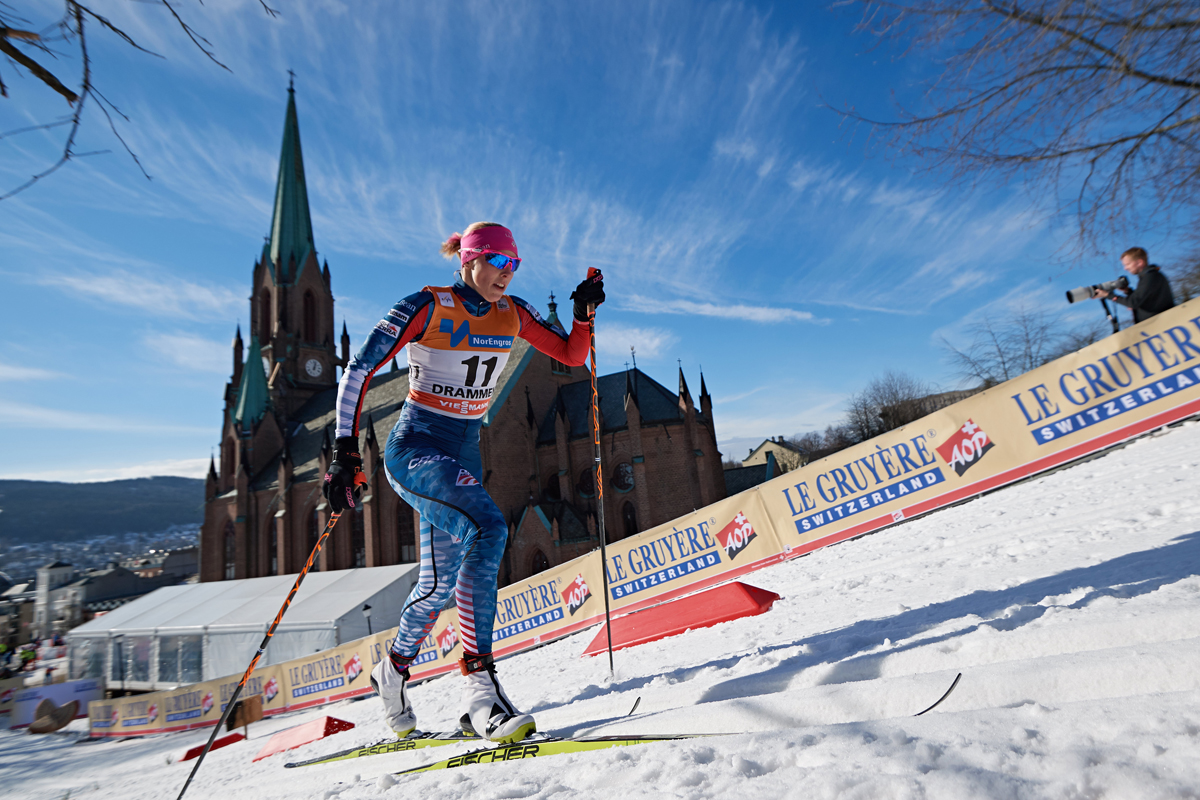
    Sophie Caldwell of the U.S. placed fourth in the Dresden skate sprint. She is currently ranked fifth in the sprint overall. (Photo: NordicFocus)


    Post-race interview with Sophie Caldwell.

    Qualification | Final Results


  • 2018/2019 Tour de Ski Preview (Updated)

    2018/2019 Tour de Ski Preview (Updated)

    The start of the men’s 15 k classic mass start at Stage 6 of the 2018 Tour de Ski on Saturday in Val di Fiemme, Italy, with (front row, left to right) Canada’s Alex Harvey, Russia’s Sergey Ustiugov, Kazakhstan’s Alexey Poltoranin, Norway’s Martin Johnsrud Sundby, and Switzerland’s Dario Cologna. (Photo: Salomon/NordicFocus)

    Beginning this Saturday in Toblach, Italy with a freestyle sprint is the 13th edition of the Tour de Ski (TdS). According to the International Ski Federation (FIS), over the course of seven stages the men will race 80.918 kilometers, the women 60.67 k. 

    The TdS has become both a staple and a spectacle of the annual World Cup calendar. With a jam-packed series of races primacy is placed on both the ability to recover well and wither less as the TdS transpires.

    Prognostication can be tricky in a long-form template like the TdS. So much can go astray during seven races not to mention the travel and dicey germ-avoidance. 

    Last season’s winner on the women’s side, Heidi Weng of Norway, sits 18th overall in the World Cup standings (14th in distance). She has four top-20’s in the four distance events she’s contested with her best result an eighth in Lillehammer’s 10 k skate. Although featuring two sprints in the first three stages, the TdS remains a distance skier’s paradise.

    Weng has skied solidly on the World Cup, but she has yet to show the form that made her a TdS overall winner in 2017 and 2018. Norway has won the last five iterations of the TdS: Marit Bjørgen won once in 2014/2015, Therese Johaug twice (2013/2014, 2015/2016), and Weng the last two years.

    Austria’s Teresa Stadlober leads Norway’s Heidi Weng (2) and Ingvild Flugstad Østberg, American Jessie Diggins (3) and others around a downhill corner during the women’s 10 k classic mass start at Stage 6 of the 2018 Tour de Ski in Val di Fiemme, Italy. (Photo: Fischer/NordicFocus)


    If Norway is to keep the streak alive, Ingvild Flugstad Østberg, last year’s TdS runner up, could be the heir apparent. She currently ranks second in the World Cup overall and 15th on the sprint list.

    Johaug, having returned from an 18 month doping ban, has been on a distance race tear. She has won all five World Cup distance events this season. Johaug, however, will not be lining up for the TdS.

    Only five different women have earned distance podiums this season — Johaug, Østberg, Sweden’s Charlotte Kalla and Ebba Andersson, and Finland’s Krista Pärmäkoski. Along with Johaug, Kalla and Andersson are skipping the TdS. (Andersson sits third overall on the World Cup, Kalla fifth.) With the TdS missing three of the five top ranked World Cup distance skiers, daily stages and the overall podium are up for grabs.   

    Last season’s third overall finisher, Jessie Diggins of the U.S. Ski Team (USST), often cites the TdS as a point in the season when her form trends towards podium performances. She sits eighth in the current distance standings and could very well have a stout TdS. 

    Russia’s Natalia Belorukova and Yulia Nepryaeva look strong as does Sadie Bjornsen (USST), and Austria’s Teresa Stadlober.

    With less than predictable distance stage podiums for the women, it may simply come down to a drag race on the Alpe Cermis final climb Jan. 6.

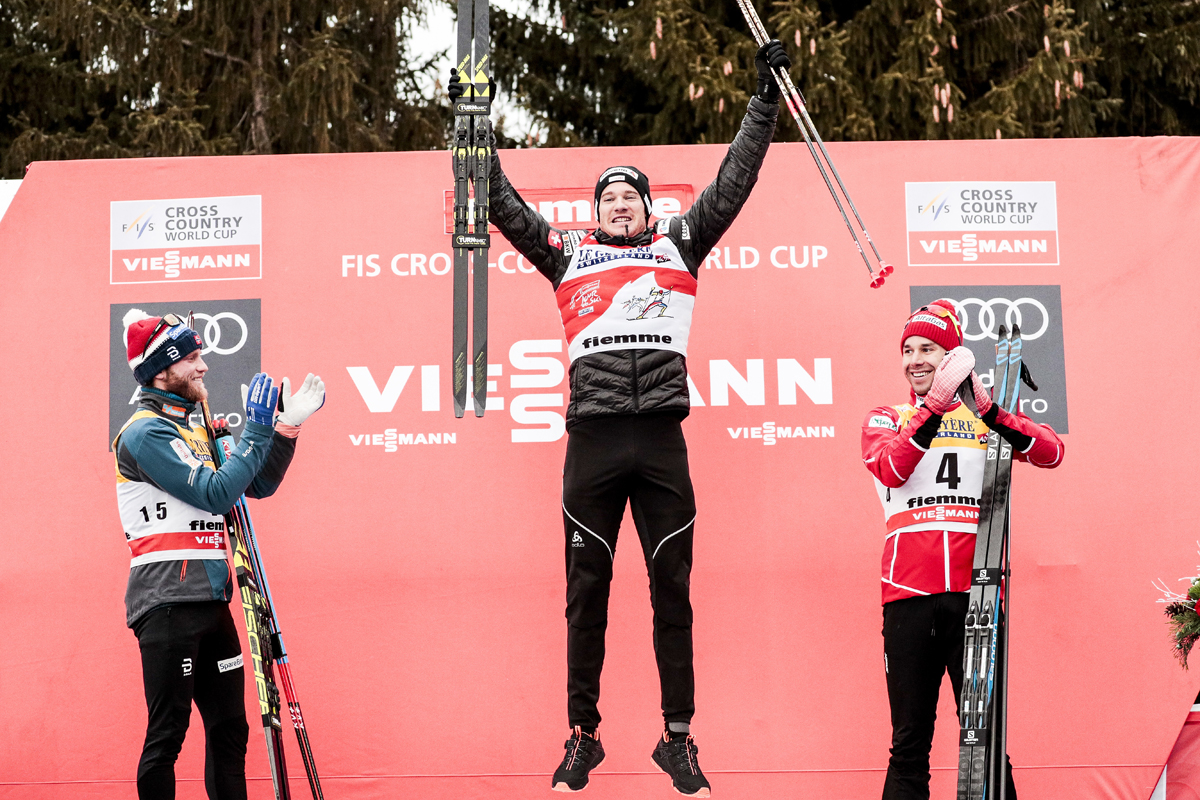
    Switzerland’s Dario Cologna (c) celebrates his fourth Tour de Ski overall title. He was joined by Norway’s Martin Johnsrud Sundby (l) and Canada’s Alex Harvey (r) on the podium in second and third, respectively. (Photo: Fischer/NordicFocus)


    The men’s scene is also open to interpretation. Last season’s TdS winner, Switzerland’s Dario Cologna, was in fact a surprise victor. Prior to Cologna’s stage two win in last year’s TdS, it had been nearly three years since the four time TdS overall winner had won a World Cup. Cologna sits 21st overall on the World Cup currently. Given last year’s resurgence, anything is possible for the Swiss skier.

    Then there’s Martin Johnsrud Sundby form Norway. He finished on the TdS podium the last three years. At thirty-four-years-old, Sundby is ranked first on the distance list, with a second, a third, and a fourth place in distance races this season.

    Sundby won the TdS on two occasions – in 2013/2014 and in 2016. His 2015 win was stripped after he tested positive for excessive levels of Salbutamol. He placed second in the past two Tours.

    In a field rife with talent, Sundby’s ability to race and rebound and race and rebound will be tested. Sjur Røthe, Emil Iversen, and Didrik Tønseth— all from Norway— look in form. And there’s Norway’s Johannes Høsflot Klæbo. The winner of last season’s overall World Cup has had flashes of his past explosive self. He could be a TdS protagonist.

    The men’s field is notably tight. Along with the Norwegians, several Russians could pop a podium, a stage win, and the overall. Russia comes with a loaded team ready to exploit. Alexander Bolshunov leads the overall World Cup – he’ll turn twenty two on Dec. 31st. He’s backed by teammates Evgeniy Belov, Andrey Melnichenko, and Denis Spitsov. 

    Canada’s Alex Harvey placed third overall last year and he looked stronger as the TdS progressed.

    The Stages

    Stage 1:  Dec. 29, skate sprint in Toblach, Italy.

    Stage 2: Dec. 30, 10 k/15 k skate in Toblach, Italy.

    Stage 3: Jan. 1, skate sprint in Val Müstair, Switzerland.

    Stage 4: Jan. 2, 10 k/15 k classic mass start in Oberstdorf, Germany.

    Stage 5: Jan. 3, 10 k/15 k skate pursuit in Oberstdorf, Germany.

    Stage 6: Jan. 5th, 10 k/15 k classic mass start in Val di Fiemme, Italy.

    Stage 7: Jan 6th, 9 k final climb skate pursuit in Val di Fiemme, Italy.

    Teams

    United States

    Women: Sophie Caldwell, Sadie Bjornsen, Jessie Diggins.

    Men: Ben Lustgarten, Simi Hamilton, Erik Bjornsen, Kevin Bolger.

    U.S. Ski Team Head Coach Chris Grover noted in a text that Caldwell, Hamilton, and Bolger will likely cease the TdS after the stage three sprint. Additionally, this is a small team for the U.S. at the TdS. Several athletes turned down TdS nominations including Scott Patterson (USST), Andy Newell (SMS T2/Salomon), Kyle Bratrud (SMS T2), Rosie Brennan (APU), Rosie Frankowski (APU), Caitlin Patterson (CGRP), and Julia Kern (SMS T2). These skiers plan on racing U.S. Nationals this January in Craftsbury, Vermont.

    Canada

    Women: Emily Nishikawa, Dahria Beatty

    Men: Alex Harvey, Lenny Valjas, Bob Thompson

    Norway

    Women: Ingvild Flugstad Østberg, Maiken Caspersen Falla, Astrid Uhrenholdt Jacobsen, Kari Øyre Slind, Kathrine Rolsted Harsem, Heidi Weng, Lotta Udnes Weng, Tiril Udnes Weng Mari Eide, Anna Svendsen

    Men: Martin Johnsrud Sundby, Hans Christer Holund, Emil Iversen, Didrik Tønseth, Simen Hegstad, Krüger, Sjur Røthe, Johannes Høsflot Klæbo, Martin Løwstrøm Nyenget, Eirik Brandsdal, Finn Hågen Krogh

    Russia

    Women: Yulia Belorukova, Lidia Durkina, Anna Zherebyateva, Mariya Istomina, Natalia Nepryaeva, Anna Nechaevskaya, Anastasia Sedova, Elena Soboleva

    Men: Evgeniy Belov, Alexander Bolshunov, Maxim Vylegzhanin, Andrey Larkov, Andrey Melnichenko,  Gleb Retivykh, Andrey Sobakarev, Denis Spitsov, Sergey Ustiugov

    Sweden

    Women: Mia Eriksson, Ida Ingemarsdotter, Moa Molander Kristiansen, Stina Nilsson, Maria Nordström, Linn Sömskar, Lisa Vinsa

    Men: Calle Halfvarsson, Simon Lageson, Teodor Peterson, Daniel Rickardsson, Oskar Svensson, Viktor Thorn, Karl Johan Westberg

    Finland

    Women: Mari Eder, Anne Kyllönen, Laura Mononen, Krista Pärmäkoski, Susanna Saapunki

    Men: Ristomatti Hakola, Matti Heikkinen, Lauri Vuorinen

    Italy

    Women: Elisa Brocard, Anna Comarella, Ilaria Debertolis, Caterina Ganz, Greta Laurent, Sara Pellegrini, Lucia Scardoni

    Men: Francesco de Fabiani, Stefano Gardener, Enrico Nizzo, Dietmar Noeckler, Federico Pellegrino, Maicol Rastelli, Giandomenico Salvadori

    Switzerland

    Women: Nathalie von Siebenthal, Laurien van der Graaff, Nadine Fähndrich

    Men: Dario Cologna, and Jovian Hediger, Jonas Baumann, Livio Bieler, Roman Furger, Käser Erwanm, Beda Klee, Toni Livers, Jason Rüesch, Schaad Roman

    Austria

    Women: Therese Stadlober

    Germany

    Women: Julia Belger, Victoria Carl, Pia Fink, Laura Gimmler, Katharina Hennig, Sandra Ringwald, Elisabeth Schicho, Anne Winkler

    Men: Thomas Bing, Lucas Bögl, Janosch Brugger, Jonas Dobler, Sebastian Eisenlauer, Andreas Katz, Valentin Mättig, Florian Notz, Max Olex, Thomas Wick

    France

    Women: Anouk Faivre Picon, Delphine Claudel, Laura Chamiot-Maitral

    Men: Maurice Manificat, Lucas Chanavat, Adrien Backscheider, Jean-Marc Gaillard, Baptiste Gros, Renaud Jay, Richard Jouve, Jules Lapierre, Clement Parisse

    FasterSkier will update team start lists as we gather more information.

    antibiotics

  • Saturday Rundown: Seefeld and Ridnaun

    Saturday Rundown: Seefeld and Ridnaun

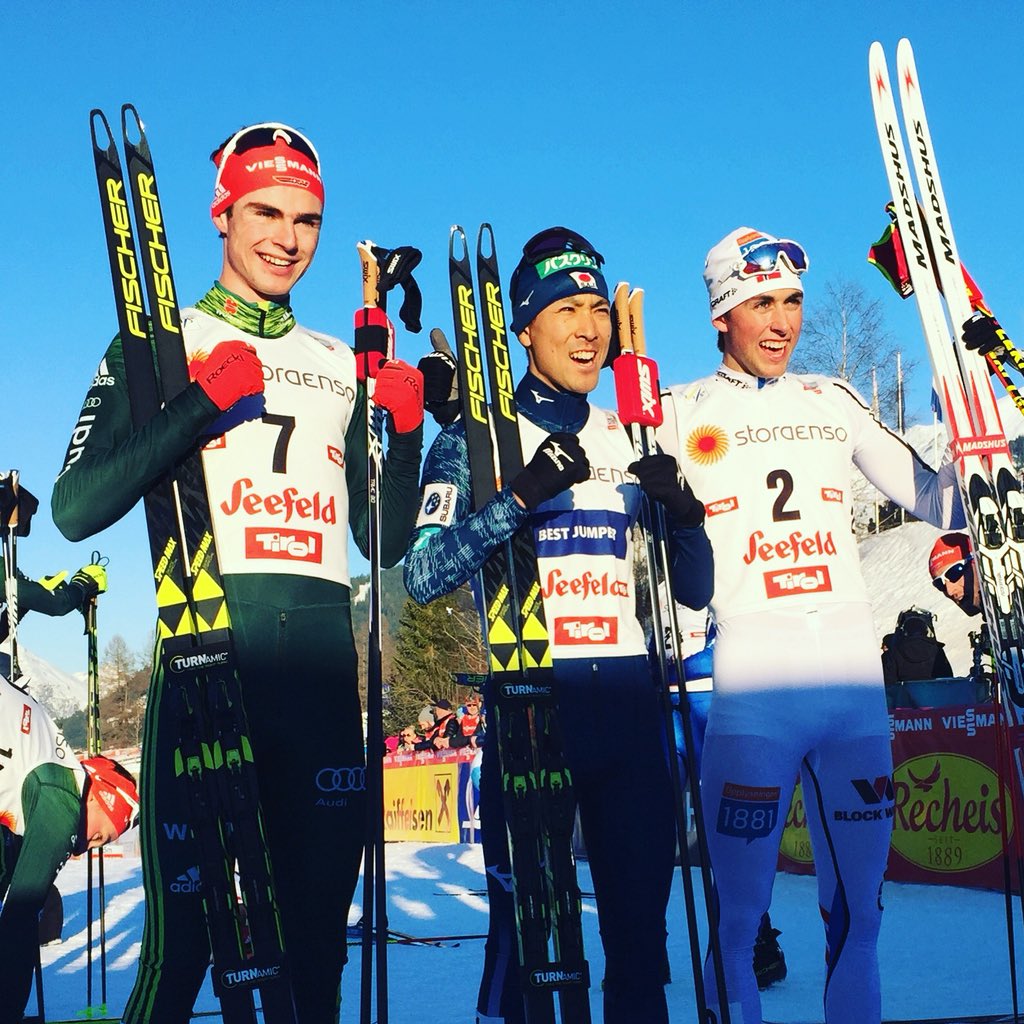
    The podium for Day 2 of the Seefeld Triple Nordic Combined World Cup, with Japan’s Akito Watabe in first (c), Germany’s Vinzenz Geiger (l) in second and Norway’s Jarl Magnus Riiber (r) in third. (Photo: FIS Nordic Combined/Twitter)

    FIS Nordic Combined World Cup (Seefeld, Austria): Normal hill/10 k

    Two of the same men from Friday repeated on the podium on Day 2 of the Seefeld Triple Nordic Combined World Cup, with Japan’s Akito Watabe notching his second-straight win on Saturday.

    Norway’s Jarl Magnus Riiber, who finished second on Friday, placed third in Saturday’s individual normal hill/10 k Gundersen, while Germany’s Vinzenz Geiger placed second, more than a minute behind Watabe.

    Watabe jumped to first and started the 10 k with a 25-second head start on Riiber in second. Geiger started seventh, 1:45 minutes back, and rose to second at the finish, 1:05.5 behind Watabe (who won in 23:28.5) and 3.4 seconds ahead of Riiber in third (+1:08.9).

    For the second day in a row, Norway’s Jan Schmid narrowly missed the podium in fourth (+1:14.1), up from fifth after the jump.

    Taylor Fletcher was the lone American competing on Day 2, and he ended up 31st, up 10 places after jumping to 41st. Fletcher started the 10 k race 4:44 out of first then finished 3:52.9 behind Watabe.

    The Seefeld Triple concludes Sunday with the individual normal hill/15 k Gundersen.

    Results: Jumping | Final

    ***

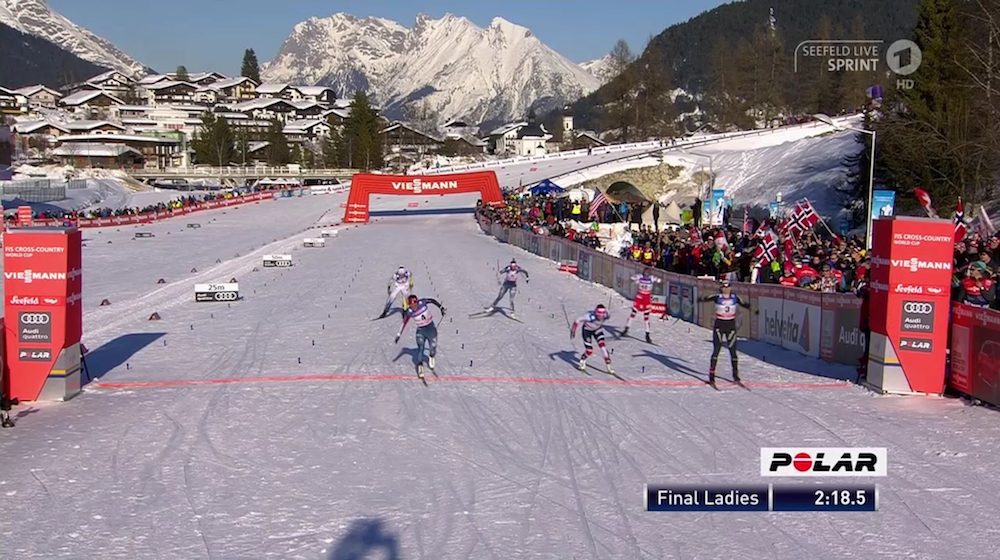
    American Sophie Caldwell (l) and Switzerland’s Laurien van der Graaff (r) tied for first on Saturday in the women’s 1.1 k freestyle sprint final at the World Cup in Seefeld, Austria, while Norway’s Maiken Caspersen Falla placed third. (Screenshot: ARD broadcast)

    FIS Cross Country World Cup (Seefeld, Austria): Freestyle sprints

    Women’s report

    Men’s report

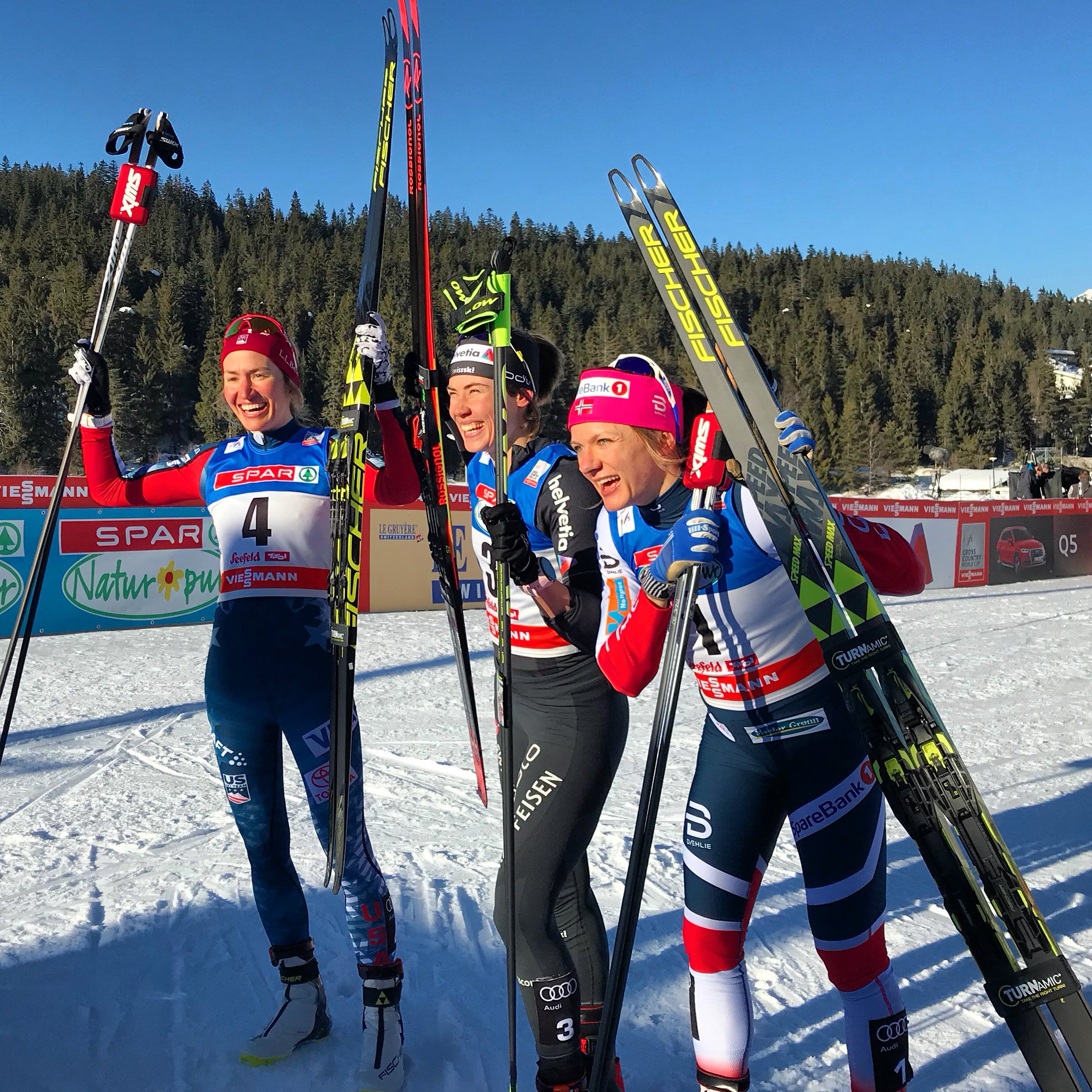
    It doesn’t get any closer than that. On Saturday, American Sophie Caldwell and Switzerland’s Laurien van der Graaff tied for first in the women’s 1.1-kilometer freestyle sprint final at the World Cup in Seefeld, Austria. They both finished within one-hundredth of a second of each other to take the victory — the last sprint before the Olympics — in 2:18.65 minutes.

    Norway’s Maiken Caspersen Falla finished 0.21 seconds later for third place.

    The women’s freestyle sprint podium at Saturday’s World Cup in Seefeld, Austria, with American Sophie Caldwell (l) and Switzerland’s Laurien van der Graaff (c) tying for first and Norway’s Maiken Caspersen Falla (r) placing third. (Photo: FIS Cross Country/Twitter)

    “I broke my pole in the semifinal, then I got really tired,” van der Graaff said in a post-race interview with the International Ski Federation (FIS). “But I still believed I can be with Maiken and Sophie, and that I could catch them in the final was just great.”

    Norway and the U.S. both had two in the final, with Kathrine Rolsted Harsem of Norway placing fourth (+1.34), Sweden’s Linn Sömskar finishing fifth (+1.83) and American Sadie Bjornsen taking sixth (+2.26).

    Falla had raced to first in the qualifying round with a time of 2:21.44, Italy’s Greta Laurent qualified second (+1.43), van der Graaff third (+1.66), Caldwell fourth (+1.84), and Bjornsen fifth (+2.01).

    Van der Graaff then won her quarterfinal and placed third in the first semifinal, 0.77 second behind Caldwell, who won it. Falla was second in that semifinal (+0.16) and van der Graaff advanced as a lucky loser.

    Caldwell and Falla went head to head in every heat, with Falla winning their first quarterfinal by 0.08 seconds over Caldwell in second.

    Bjornsen won her quarterfinal and finished second to Harsem in the second semifinal.

    A third American, Kikkan Randall also qualified for the heats, placing 18th in the qualifier then finishing third in her quarterfinal (1.33 seconds behind Sömskar in first) to end up 14th overall.

    Canada’s Dahria Beatty placed 30th in the qualifier to nab the last spot in the rounds, then finished fourth in her quarterfinal (1.65 seconds behind Laurent in first) for 20th overall.

    For the U.S., Ida Sargent missed qualifying by about half a second in 37th (+8.20), Rosie Brennan finished 42nd (+9.86) and Caitlin Patterson was 52nd (+13.0).

    Also for Canada, Emily Nishikawa finished 51st (+12.68) and Cendrine Browne was 54th (+13.34).

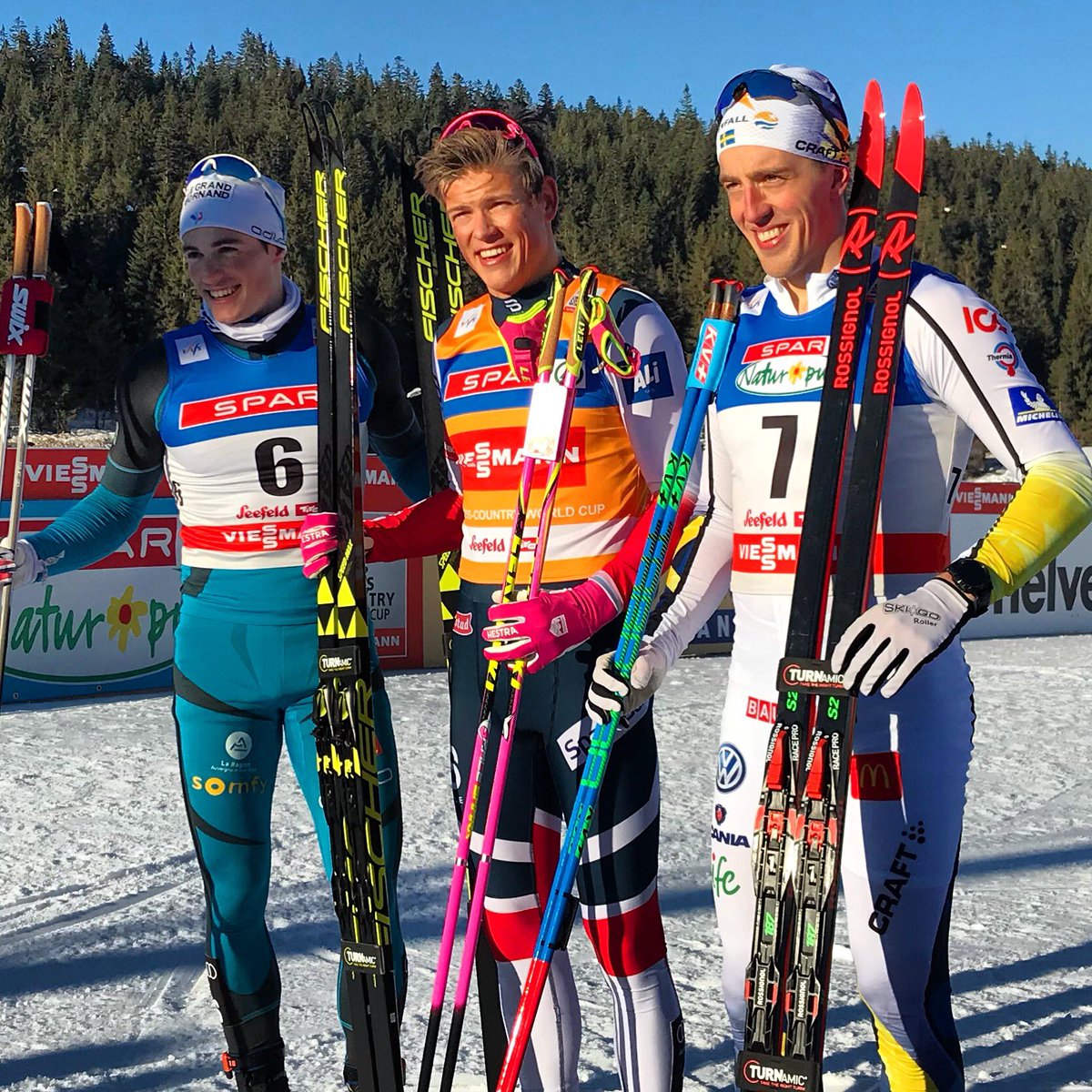
    The men’s 1.4 k freestyle sprint podium at the World Cup in Seefeld, Austria, with Norway’s Johannes Høsflot Klæbo (c) in first, France’s Lucas Chanavat (l) in second and Sweden’s Calle Halfvarsson (r) in third. (Photo: FIS Cross Country/ Twitter)

    The men raced 1.4 k, with Norway’s Johannes Høsflot Klæbo qualifying first in 2:46.89 then winning his quarterfinal and semifinal before putting the hammer down for one last time in the final, finishing first in 3:02.66.

    France’s Lucas Chanavat placed second in the final, 0.48 seconds back, after qualifying sixth, winning his quarterfinal and placing second in the first semifinal (0.33 seconds behind Klæbo). Sweden’s Calle Halfvarsson took the third spot on the podium after finishing 0.97 seconds after Klæbo. Halfvarsson had previously qualified seventh, taken second in his quarterfinal and advanced as a lucky loser in third in the first semifinal (0.52 seconds behind Klæbo).

    Italy’s Federico Pellegrino missed the podium in fourth (+1.06), Russia’s Gleb Retivykh placed fifth (+1.17), and Norway’s Emil Iversen was sixth (+5.57).

    Canada’s Alex Harvey and American Simi Hamilton both made it to the semifinals, where they finished fourth and fifth, respectively, and did not advance to the finals. Harvey had qualified for the rounds in 22nd and won his quarterfinal, then raced in the second semifinal, where he finished fourth, 0.47 seconds behind Iversen in first. That put Harvey eighth overall on the day.

    Hamilton clocked the fifth-fastest qualifying time, 6.46 seconds back from Klæbo’s top time. The U.S. Ski Team member then placed second to Pellegrino in his quarterfinal and was fifth in the first semifinal, 2.61 seconds behind Klæbo. Overall, Hamilton placed ninth.

    Also for the U.S., Erik Bjornsen finished 37th in the qualifier, 0.89 seconds out of the top 30 and 11.99 second out of first, Logan Hanneman was 39th (+12.52), Andy Newell 42nd (+12.90), Reese Hanneman 65th (+17.91), and Ben Lustgarten 76th (+21.88).

    Canada’s Len Valjas placed 40th (+12.72), Julien Locke 43rd (+13.31), Knute Johnsgaard 51st (+14.74), Bob Thompson 58th (+16.55), Graeme Killick 61st (+17.28), and Devon Kershaw 70th (+19.53).

    Results:

    Women’s qualifierWomen’s final 

    Men’s qualifier | Men’s final

    ***

    France’s 22-year-old Chloé Chevalier racing to her second win and third podium of the week in as many individual races at 2018 IBU Open European Championships on Saturday in Ridnaun, Italy. (Photo: IBU/Biathlonworld)

    IBU Open European Championships (Ridnaun-Val Ridanna, Italy): Men’s and women’s pursuits

    France’s Chloé Chevalier picked up her second win and third podium of the week at the International Biathlon Union (IBU) Open European Championships on Saturday in Ridnaun, Italy, winning the women’s 10 k pursuit, while Russia’s Alexander Loginov rose to the top step of the podium in the men’s 12.5 k pursuit on Saturday.

    Chevalier started the women’s pursuit in second, 13 seconds behind Ukraine’s Iryna Varvynets (who won Friday’s sprint and thus started first), and shot clean to take the lead after the third stage — where Varvynets missed one. Chevalier went on to clean the final stage for perfect 20-for-20 shooting and crossed the line first in 29:25.4. Varvynets finished second, 11.0 seconds back after missing a single target in the first standing (0+0+1+0), and France had two on the podium with Julia Simon in third (+43.2). Simon also shot 19-for-20, with her miss coming in the second prone stage (0+1+0+0).

    “Three medals in three races is definitely more than I had expected,” Chevalier, 22, told the event’s organizers on Saturday. “Today I saw that Iryna shoots faster than I, and so I really gave my all in the track. Even if it might not look like it, after the many races in the last few days I am noticing that I am getting more and more tired.”

    American Chloe Levins rose from 59th at the start to 42nd at the finish (+4:11.8), with three clean stages and two misses in the first standing (0+0+2+0). She had the 28th-fastest overall range time and 30th-ranked shooting time.

    In the men’s pursuit, Loginov started first as Friday’s sprint winner Latvia’s Andrejs Rastorgujevs did not start. Loginov held the lead throughout the race despite two misses — one in the first stage and another in the last stage (1+0+0+1) — and secured the win in 32:22.1. Bulgaria’s Krasimir Anev started second, 19 seconds after Loginov, and held his place as well, shooting clean and finishing second, 27.6 second back.

    “I am really happy here in Ridanna and the results reflect that,” Loginov, 25, told organizers. “Not to start in the individual event on Wednesday was the right decision because the last few days had been very demanding with six races in eight days. I am cross with my two errors in the shooting range, but very happy with my performance in the track.”

    Russia had two on the podium with Evgeniy Garanichev in third (+1:10.7) after Garanichev started in bib 19 and overcame three penalties (1+0+2+0) with the fastest overall course time.

    Canada’s Macx Davies started 27th and finished 35th (+4:33.9) with five misses (3+0+2+0), while American Alex Howe rose from 53rd at the start to 43rd (+5:53.5) with five penalties (2+2+1+0).

    The 2018 Open European Championships conclude with the single mixed relay and mixed relay on Sunday. American Susan Dunklee and Lowell Bailey are on the start list for the single mixed relay, Canada’s Carsen Campbell and Sarah Beaudry. For the mixed relay, the U.S. has entered Levins, Maddie Phaneuf, Paul Schommer, and Alex Howe.

    Results: WomenMen

    Start lists: Single mixed relay | Mixed relay

  • Halfvarsson, Weng Top Toppidrettsveka; Newell and Bolger Compete

    Halfvarsson, Weng Top Toppidrettsveka; Newell and Bolger Compete

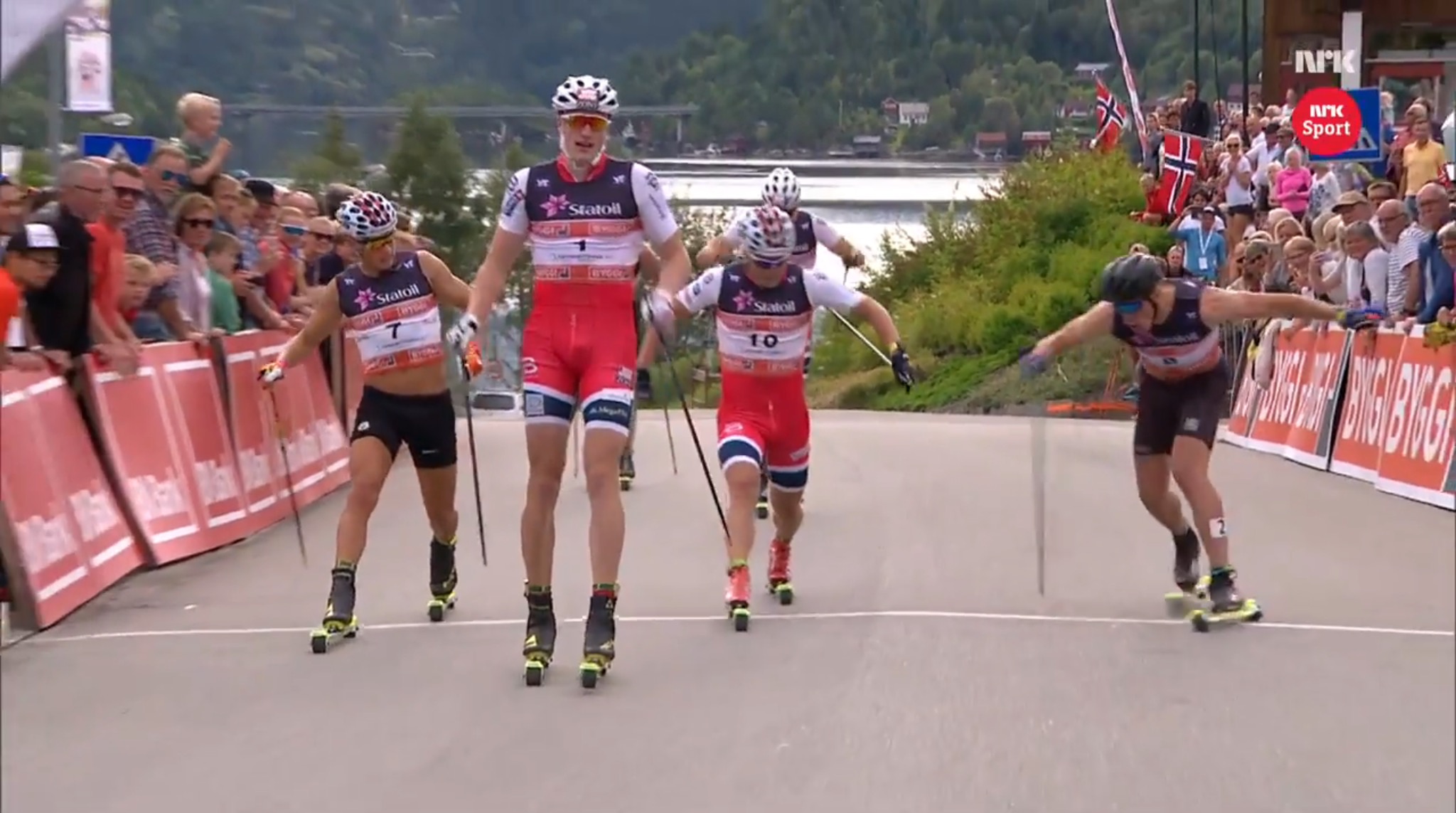
    In the men’s classic sprint on Day 1 of the three-day 2017 Toppidrettsveka mini tour, Norway’s Aune Pål Trøan (1) crosses the line ahead of his countrymen Johannes Høsflot Klæbo (7) and Eirik Brandsdal (10) while Sweden’s Calle Halfvarsson (r) placed fourth. Halfvarsson went on to win the tour, ahead of Klaebo in second. (Screenshot: NRK broadcast)

    This past weekend was once again the time of the year for the Toppidrettsveka ski festival, a three-day rollerski mini tour held annually since 2005 in the region of Trondheim, Norway. In addition to the individual stages, points for the top-30 finishers were awarded to compile an overall ranking similar to the Tour de Ski.

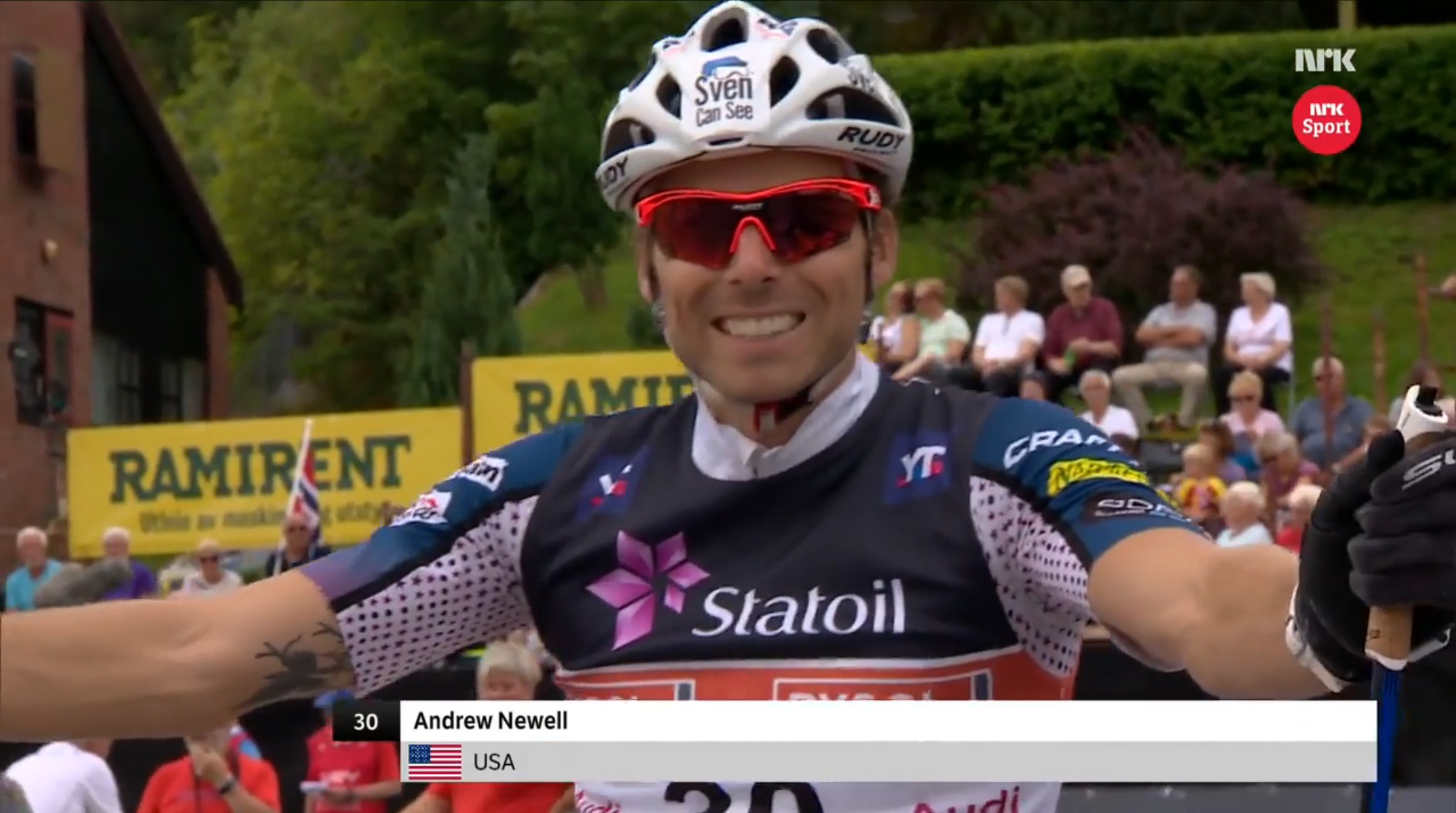
    The elite field of athletes was mostly comprised of Norwegian and other Scandinavian skiers active on the International Ski Federation (FIS) World Cup and European Continental Cup level, as well as a handful of international starters, including two Americans: U.S. Ski Team member Andy Newell, who raced at last month’s Blink Ski Festival in Norway, and Kevin Bolger, who is coming off his senior season at the University of Utah.

    Day 1: Aure Sprint

    American Andy Newell (U.S. Ski Team) at the start of the men’s sprint in Aure, Norway, on Day 1 of the 2017 Toppidrettsveka rollerski mini tour. (Screenshot: NRK broadcast)

    The festival started last Thursday with a classic sprint in the small town of Aure, on a fairly long course with a steep downhill and a roundabout at the bottom, after which the athletes had to ski up the same hill toward the finish.

    In the men’s race, Norway’s Aune Pål Trøan took the win in the final with a time of 2:46.46, narrowly edging Norwegian World Cup skiers Johannes Høsflot Klæbo by 0.41 seconds and Eirik Brandsdal by 0.43 seconds. Just another tenth of a second back, Sweden’s Calle Halfvarsson placed fourth (+0.44).

    Newell’s run ended in the quarterfinals, where he finished sixth in his heat, just half a second from advancing. His heat was a tight race that featured the eventual winner Trøan, who along with World Cup regular Emil Iversen, advanced as a lucky loser behind Brandsdal and his teammate Aleksander Ek. Bolger did not reach the quarterfinals.

    In the women’s final, Sweden’s Linn Sömskar prevailed with a time of 3:03.94, edging out five Norwegians, including Kathrine Rolsted Harsem in second and 2016 Toppidrettsveka title-defender Heidi Weng in third. Earlier in the day, Sömskar also won her quarterfinal and semifinal heats decisively.

    Two weeks ago, Sömskar won three races at the 2017 rollerski world championships in Solleftea, Sweden — the 18-kilometer freestyle, 16 k classic, and team sprint with Maja Dahlqvist.

    Day 2: Brekka Mass Start and Trondheim Sprint

    On Friday, athletes competed in two events: a mass start followed by a sprint later in the evening.

    Switzerland’s Dario Cologna topped the men’s 24 k mass start, a point-to-point race from Aure to Brekka, finishing in 59:11.3 after breaking away on the long final climb. Halfvarsson claimed second (+10.8), followed by Finland’s Iivo Niskanen in third (+17.2) ahead of Norway’s Niklas Dyrhaug in fourth (+27.4).

    “Great to win here,” Cologna told Norwegian broadcaster NRK in an interview in the finish. “Many good skiers, the best in the world, so it’s a good feeling. Good to see that everything is working well [in preparation] for this important season.”

    Bolger finished 51st (+4:48.6) and Newell crossed 15 seconds later in 54th (+5:03.9) in the large field of 124 finishers.

    In the women’s mass start over the same 24 k course, the race was even closer and came down to a finishing sprint. Weng took the win in 1:07.30.3, just 3.5 seconds ahead of her teammate Astrid Uhrenholdt Jacobsen, while Sweden’s Anna Haag finished 7.8 seconds back in third. Another Swede, Ebba Anderson placed fourth (+22.0), while the rest of the field crossed the line more than four minutes later. Haag and Anderson are just coming off a training camp in Sweden, where they were joined by U.S. Ski Team members Liz Stephen and Kikkan Randall.

    For Stage 3 on the same day, athletes raced a 1 k sprint in the center of Trondheim, Norway’s third-largest city. There, Klæbo won the men’s final after a decisive attack on the finishing stretch in a time of 2:19.56 minutes, ahead of fellow Norwegian Ragnar-Kristoffer Braqvin Andresen in second (+0.23) and Even Northug in third (+2.85), the younger brother of 2016 Toppidrettsveka winner Petter Northug Jr. Halfvarsson finished fourth (+2.94), thereby taking the lead in the intermediate tour standings on Day 2, ahead of Klæbo, Cologna and Trøan.

    Both Newell and Bolger missed qualifying for the sprint heats and did not score additional points.

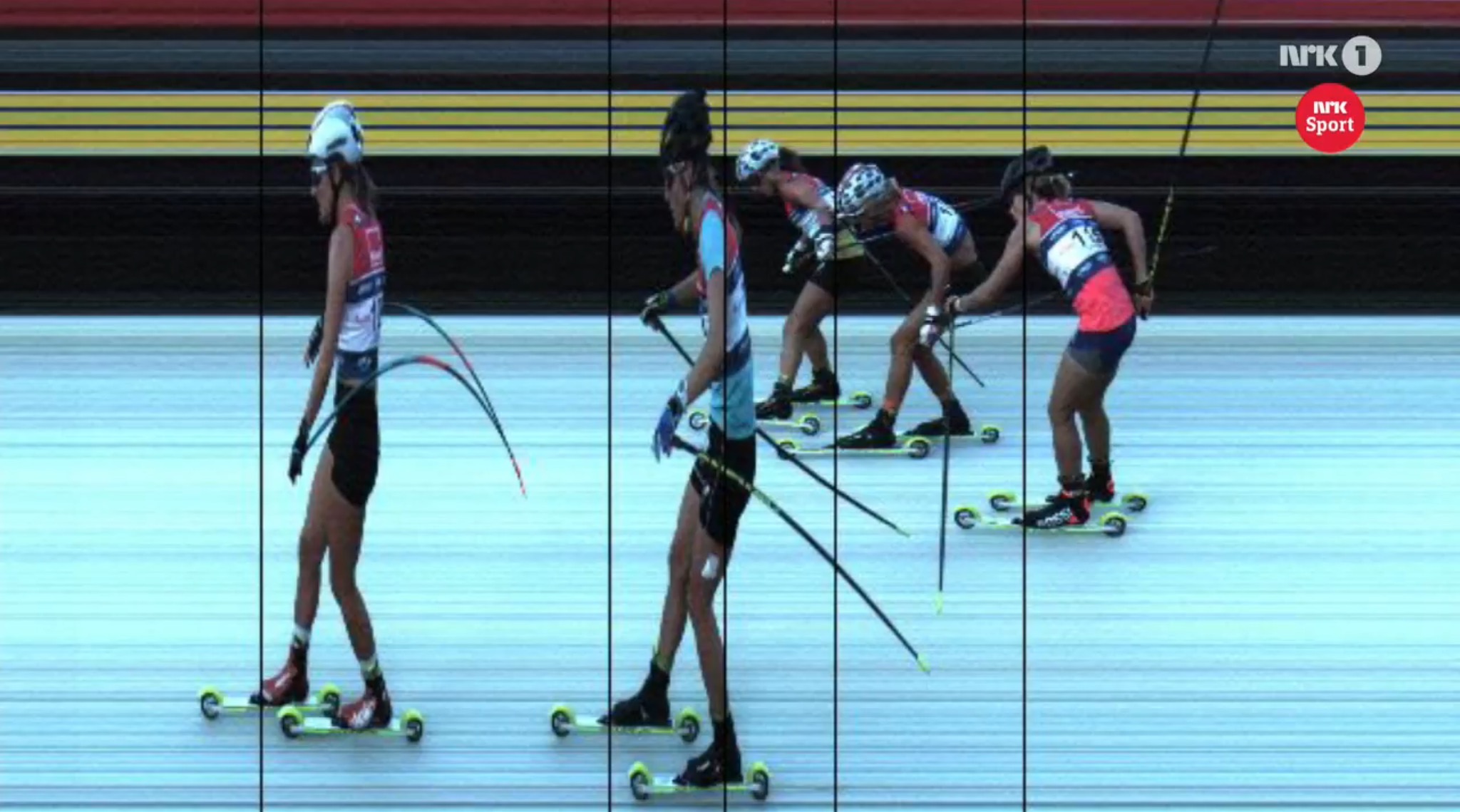
    In a true photo finish (left to right) Norway’s Barbro Kvaale won the women’s sprint on Day 2 of the 2017 Toppidrettsveka rollerski mini tour in Trondheim, Norway, ahead of Sweden’s Linn Sömskar in second, Norway’s Heidi Weng in third, Norway’s Kathrine Rolsted Harsem in fourth, and Switzerland’s Laurien Van Der Graaff in fifth. (Screenshot: NRK broadcast)

    The women’s sprint final went to Norway’s Barbro Kvåle in a time of 2:46.04, who placed sixth in the final the day before. She edged Sömskar by just 0.08 seconds and Weng was another hundredth of a second back in third (+0.09). Harsem placed fourth (+0.25), and Switzerland’s Laurien Van Der Graaff, who led until the final meters of the race, finished fifth (+0.37). In the overall standings, Weng spent the night in the lead, ahead of Sömskar, Jacobsen and Harsem.

    Day 3: Trondheim Pursuit/Mass Start

    The mini tour concluded Saturday with classic races in Trondheim. However, with a smaller field of 37 athletes for the last women’s race, the points collected in the prior three events were not converted into time gaps before the final stage. Instead, athletes started together for a 12-kilometer mass start and the overall results and time back from the winner were computed after the race.

    In rainy weather (with many of the spectators sporting ponchos), the short-sleeved athletes persistently circled their laps around the city course. The top group got smaller and smaller, and after 7.5 k, only 10 women remained within three seconds of the lead. That group dwindled to six by the finishing stretch, where Haag outlunged Jacobsen by 0.2 seconds for the win and Sömskar crossed another 0.4 seconds back in third (+0.6). Three Norwegians followed, with Harsem in fourth (+1.2), Weng in fifth (+1.5) and Lovise Hemdal in sixth (+2.0). Fifteen seconds later, Kvåle in seventh (+16.7) led the next four finishers across the line.

    After computing the overall Toppidrettsveka standings, Weng was deemed the winner for the second-straight year. Sömskar placed second, 34.1 seconds back (she only had one weaker stage in the long mass start where she finished 11th, almost six minutes behind Weng), and Jacobsen was just another 1.6 seconds back in third (+35.7). Harsem finished the tour in fourth (+46.7), and Haag placed fifth (+59.5).

    “I was impressed with myself actually,” Weng told NRK in a finish-line interview, according to a translation. “That I managed to keep up so well despite some very stiff arms … I don’t know if I am on a better way than last year, but yes, I feel really quite good.”

    On the conditions, which Jacobsen called “dangerous“, Weng was pleased everyone played it safe.

    “We took it very easy, and it was good that we all kept it a bit safe, there were some very slippery spots, but it went well,” Weng said.

    With more in the men’s field, the men raced a 15 k pursuit, with Halfvarsson starting first, 12 seconds ahead of Klæbo in second, and 50 seconds ahead of Cologna in third. Trøan left the gate 1 minute back and Brandsdal started 2 seconds later.

    Despite the heavy rain, which had worsened since the women’s race, Halfvarsson increased his lead on Klæbo. By 5.1 k, the Swede was more than 40 seconds clear of Klæbo, and Cologna came through the checkpoint 1:13 back. Having to ski through puddles of standing water at times, Halfvarsson extended his lead on Klæbo to over a minute by 11.2 k. Another 30 seconds behind Klæbo, Northug led a large chase group of about 20 racers after the pack had caught Cologna.

    Halfvarsson held his comfortable lead through the finish, completing the final stage in a time of 34:08.4 for the overall victory. Klæbo had to fight a lot harder to hold onto second place, crossing the line 1:14.7 back and only a few meters ahead of the chase group. Northug outlasted the pack in a finishing sprint for third place (+1:18.5), while Bransdal missed the podium by half a second in fourth (+1:19.0), as did Niskanen in fifth (+1:19.0) and Trøan in sixth (+1:20.0).

    https://www.instagram.com/p/BX–n2hD61y/?hl=en&taken-by=toppidrettsveka,

    “Today, it was pretty easy,” Halfvarsson told NRK, according to a translation. “I had the goal to go out hard, and knew I was going to get it when Johannes had problems to follow.”

    “[My] days are over, there is a new kid in town,” 13-time world champion Northug said in English in a finish-line interview with NRK, referencing Klæbo standing next to him.

    “He is the one who is absolutely the fastest of all of us,” Halfvarsson agreed in his interview with NRK when asked about the upcoming season. “Petter will be strong if he can find the shape for the winter, but it’s Johannes who I fear the most.”

    “He is just saying that,” Klæbo told NRK. “I think there are many Norwegians that are going to go fast this winter.”

    The best time of the final stage was posted by Great Britain’s Andrew Musgrave in 33:33.8, while Halfvarsson’s time ranked 25th. Musgrave finished eighth overall (+1:20.4).

    For the stage, Newell placed 53rd and Bolger 64th. Overall, Newell finished the tour in 56th (+2:28.7) and Bolger placed 67th (+3:01.2).

    https://www.instagram.com/p/BYAMQlkBwkn/?hl=en&taken-by=andynewellskier

    Complete results

  • Nilsson Back to Winning Ways in Drammen Classic Sprint; Caldwell Top American in 9th

    Nilsson Back to Winning Ways in Drammen Classic Sprint; Caldwell Top American in 9th

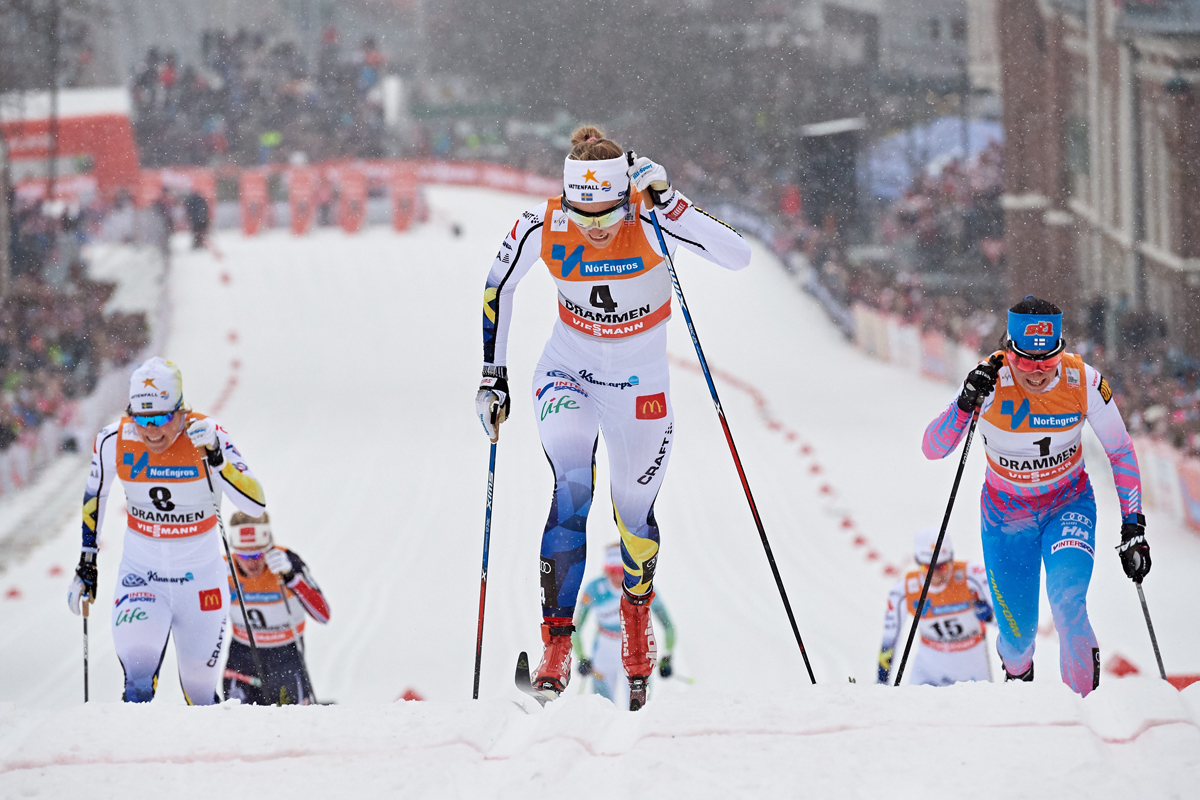
    Sweden’s Stina Nilsson charging to her eighth World Cup victory of the season in Wednesday’s 1.2 k classic sprint final in Drammen, Norway. She finished first, ahead of Finland’s Krista Pärmäkoski (r) in second and her Swedish teammate Hanna Falk (l) in third. (Photo: Fischer/NordicFocus)

    Drammen is one of those staples on the World Cup, appearing on the circuit late each season and remembered for its trademark uphill finish in the middle of a city of 63,000 inhabitants, just 40 kilometers west of Oslo, Norway.

    “It tends to be fairly predictable snow,” U.S. Ski Team Women’s Coach Matt Whitcomb told FasterSkier during an in-person interview in Drammen on Wednesday. “It’s generally clean [snow]. It’s generally some sort of klister.”

    But that doesn’t make Drammen easy. Finding the ideal balance of kick and glide on the city’s 1.2-kilometer course, marked by a steady uphill out of the start, followed by a 60-second downhill, and finally, one last climb to the finish, is key and something even the most seasoned World Cup skiers can struggle with at this venue, Whitcomb explained.

    “We tend to see athletes focusing a little bit too much on the climbs, getting those good sensations and not enough gliding … out on the downhills,” he said. “That’s where the heart of this course really lies.”

    For instance, consider Maiken Caspersen Falla. Coming off an individual skate-sprint victory at 2017 Lahti World Championships, the Norwegian didn’t ski fast enough to qualify for the heats on Wednesday. She finished 31st, 0.34 seconds out of qualifying in 30th but 6.49 seconds off the top qualifying time set by Finland’s Krista Pärmäkoski. With Falla usually qualifying first or close to it in sprints (and Pärmäkoski better known for her distance skiing), it was a shakeup that confused even Falla — Drammen’s three-time defending classic-sprint winner.

    “I think it is weird,” Falla told NRK, according to a translation. “I do not know what’s going on. I was thinking I was going pretty well. I’m not far behind [the top 30], but I have no idea. Maybe I didn’t have the best skis or maybe I left far too much time in a turn. I am very unsure of what’s going on; the body has worked great the last few days.”

    American Kikkan Randall, who placed third in the world-champs freestyle sprint behind Falla, was in the same boat. She finished 52nd out of 56 women in Wednesday’s sprint qualifier, 12.76 seconds out of first.

    Whitcomb said that was likely due to too much kick and too little glide. Drammen as a downtown sprint poses an additional challenge for athletes and wax techs, allowing just 20 minutes for testing on race day.

    “Every athlete’s working out of one depot so you have basically 100 people, male athletes and female athletes, and just trying to control the chaos as much as possible,” he said. “But I feel like our athletes, I can trust them to ask for more kick and know that it’s not gonna compromise their glide. Sometimes it does, it’s just the risk that you have to make because on this course, you spend a fair amount of time gliding and if you’re not close to having enough grip, you’ll be too tired in the finish.”

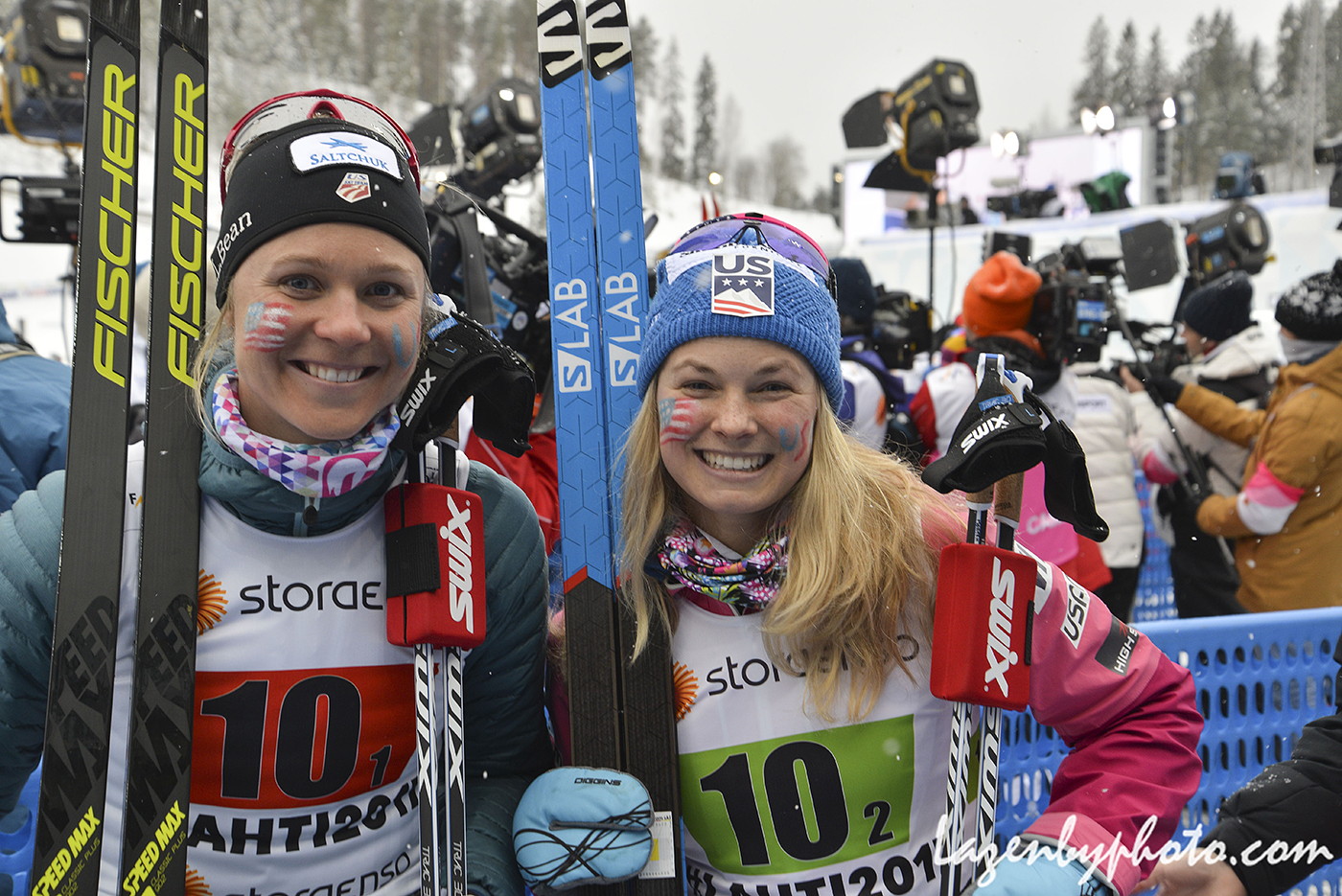
    U.S. teammates Sadie Bjornsen (l) and Jessie Diggins after placing third for bronze in the women’s classic team sprint at 2017 World Championships in Lahti, Finland. (Photo: John Lazenby/Lazenbyphoto.com)

    One U.S. Ski Team member thrilled with her skis was Jessie Diggins, who qualified sixth (+2.12) behind her teammate Sadie Bjornsen in fifth (+1.63). Behind them, Sophie Caldwell was the third American to qualify in 11th (+2.95).

    While Diggins and Bjornsen went on to finish sixth and fifth in their quarterfinals, respectively, and did not advance to the semifinals, Diggins said that in her case, it wasn’t for a lack of speed. After some physical contact at the top of the course got her fired up and surging into first on the long descent, Diggins slipped back to the middle of the pack coming out of the downhill draft and broke a pole around the last hairpin corner before the long, uphill finishing straight.

    “Jessie came into the final corner with too much traffic and a pole broke somehow,” Whitcomb said. “If it had been made out of steel, it would’ve bent, but it was loud and unfortunately none of us could get to her because there were too many cameras and fences in the way.”

    “I was just ready to fight on that final climb,” Diggins reflected. “I knew I was strong because even after skiing with a broken pole, I caught back up to [the group] at the end so I mean, I did everything I could.”

    She finished 5.11 seconds behind the winner of that quarterfinal, Sweden’s Stina Nilsson, who would go on to win the day.

    “I was so stoked with my skis,” Diggins added. “They were fast, they had good kick and I know they had good kick because I had one pole and I was like, ‘Wow! They really nailed it!’ ”

    While Diggins raced in the second quarterfinal, Bjornsen was one of the guinea pigs, so to speak, in the first heat of the day. Whitcomb explained that coaches and athletes routinely watch the first women’s quarterfinal on sprint days to figure out the course and determine strategies for the remaining rounds.

    While Bjornsen skied in third for much of her quarterfinal behind Norway’s Mari Eide, who led for most of it, the American bronze medalist in the world-champs classic team sprint (with Diggins) positioned herself closer to second entering the final climb to the finish.

    While the last few hundred meters of the race were shaping into a four-way fight for first between Eide, Bjornsen, Sweden’s Hanna Falk, and Slovenia’s Anamarija Lampič, Bjornsen in the far right tracks suddenly found herself behind a V-board when the course narrowed from four tracks to three across, and her tracks ended. She jumped to the left, slotting in behind Eide, and ran out of room to make any more moves to end up fifth, 2.52 seconds behind Falk in first.

    “I felt really strong in the qualifier, had some great skis, and was so excited for the heats,” Bjornsen said, according to a U.S. Ski Team press release. “Unfortunately in the final stretch, I chose a lane that didn’t go to the finish, so I had to stop and go in behind the others — which simply didn’t work. That was an expensive mistake, and cost a day full of great feelings. Fortunately I feel really good right now, and I am so excited to keep racing and get my chance.”

    Sophie Caldwell (U.S. Ski Team) striding to 11th in the women’s 1.2 k classic sprint qualifier at Wednesday’s World Cup in Drammen, Norway. She went on to place ninth overall. (Photo: Fischer/NordicFocus)

    Bjornsen and Diggins ended up 21st and 26th on the day, respectively. Leading their team, Caldwell reached the semifinals and ultimately placed ninth overall.

    In an in-person interview after the race, she told FasterSkier that she was particularly pleased with her qualifier considering her past results in Drammen. Before Wednesday, had never cracked the top 10 there.

    “The first three years I raced in Drammen, it was just a really hard course for me for some reason and I found myself not qualifying, but not even close to qualifying, like, back in the end of the pack,” Caldwell said. “Last year I figured out how to qualify and I was just thrilled to have qualified so this year it was one step further making the semis so I’m really happy with that.

    “It’s still a tough course for me,” she added. “It’s so gradual that it’s a really good course for power skiers and that’s been something I’ve been working on a lot, but power skiing for classic for sure isn’t my strength. … I think that’s probably why it’s been so difficult for me in the past but I’m really happy with today.”

    Third in her quarterfinal, just 0.79 seconds behind Norway’s Ingvild Flugstad Østberg, who won it, and half a second behind another Norwegian, Kathrine Rolsted Harsem, who automatically advanced in second, Caldwell reached the semifinals as a lucky loser — along with Finland’s Aino-Kaisa Saarinen in fourth (+0.95) in that heat.

    Caldwell went on to place fifth in the second semifinal, 1.44 seconds behind Sweden’s Ida Ingemarsdotter in first. The American had put herself in third behind Pärmäkoski and Harsem before Ingemarsdotter hammered up the finishing straight to take the win.

    “There was a little jostling around both on the downhill and up the final stretch,” Caldwell explained. “I kind of tried to cut inside Ida on the downhill and she moved in front of me so then I switched to the other side, then coming back up this way, Ida sort of hopped in the track in front of me so I went to move to the other one without knowing [Slovenia’s Katja Višnar] was coming up on the side so I had to bop back. There was a lot of bouncing around, but that’s part of the game. You want to be aggressive, but you want to be fair, and I think that’s something I’ve always tried to do.”

    Also for the U.S., Rosie Brennan finished 37th in the qualifier and Ida Sargent was 42nd. Canada’s lone woman racing on Wednesday, Dahria Beatty, who turned 23 on Tuesday, finished 48th.

    The women’s 1.2 k classic sprint podium at Wednesday’s World Cup in Drammen, Norway, with Sweden’s Stina Nilsson (c) in first, Finland’s Krista Pärmäkoski (l) in second and Sweden’s Hanna Falk (r) in third. (Photo: Fischer/NordicFocus)

    As the day progressed, Sweden’s Nilsson continued to pick up steam. Coming off a World Championships in which she earned one medal (silver in the 4 x 5 k relay) and placed 12th in the freestyle sprint, the world’s second-ranked sprinter (behind Falla) had something to prove.

    She started by posting the fourth-fastest qualifying time, 1.54 seconds behind Pärmäkoski, then won her quarterfinal and first semifinal before dusting her competition in the final. While Nilsson followed the lead of fellow Swede Linn Sömskar in the quarterfinal and drafted off Diggins on the downhill to slingshot to first before the finishing stretch, Nilsson took a backseat to Østberg in the semifinal. With energy to spare, Nilsson and her teammate Falk pounced on the long grind to the finish, placing first and second, respectively, while Østberg dropped to fourth behind Lampič in third.

    In the final, Nilsson didn’t bother with games. She led out of the start, with Harsem following in second up the first double-pole section of the initial climb. While Nilsson continued to lead over the top, Falk and Pärmäkoski ended up duking it out for second place. Pärmäkoski double poled hard up the finishing straight to move into second, which she took by 0.84 seconds over Falk for her first World Cup sprint podium. Nilsson powered to the win in 3:07.57 minutes, 0.42 seconds clear of Pärmäkoski and 1.42 seconds ahead of Falk.

    The remaining finalists, Harsem finished fourth (+3.27), Ingemarsdotter was fifth (+4.86), and Lampič, the U23 World Cup leader, placed sixth (+9.67).

    The victory was Nilsson’s eighth of the season and puts her 42 points behind Falla with one sprint to go — a freestyle sprint in Quebec City next Friday, where 50 points for a win are on the line.

    “I thought I could win and this feels really great,” Nilsson told the International Ski Federation (FIS), according to a press release. “I was sure Maiken would win the sprint globe today. I don’t think it’s possible still to win it, but there is still a chance and I will travel to Quebec and try my best.”

    For Pärmäkoski, the podium showed her continued momentum after two World Championships medals (second in the 15 k skiathlon and third in the relay).

    “I am really happy,” she told FIS. “I wasn’t sure how I would feel after the championships but I felt really strong today.”

    Falk is third in the overall sprint standings, 154 points behind Nilsson and 29 points ahead of Norway’s Heidi Weng in fourth. At World Championships, Falk missed a medal in the skate sprint in fourth.

    “This makes up a little bit for my fourth place finish at the World Championships, so it feels good to come here today and get a podium,” Falk said.

    The last European World Cup races of the season will take place Saturday and Sunday with the famous Holmenkollen 30/50 k mass starts near Oslo. This year, those races are classic technique. The men race on Saturday at 12:45 p.m. Central European Time (6:45 a.m. Eastern Standard Time) and women start at noon CET (5 a.m. Eastern Daylight Time) on Sunday.

    — Jason Albert and Harald Zimmer contributed

    Results | Sprint World Cup standings

    Kikkan Randall (U.S. Ski Team) during the women’s 1.2 k classic sprint qualifier on Wednesday at the World Cup in Drammen, Norway. (Photo: Fischer/NordicFocus)
  • Nilsson Ousts Kalla for Bruksvallarna Sprint Win; Taugbøl Tops Swedes in Men’s Race

    Nilsson Ousts Kalla for Bruksvallarna Sprint Win; Taugbøl Tops Swedes in Men’s Race

    Stina Nilsson celebrates at 2013 Junior World Championships in Liberec, Czech Republic. The Swede won gold in both the individual freestyle sprint and team relay in Liberec. (Photo: Liberec2013)
    Stina Nilsson celebrates at 2013 Junior World Championships in Liberec, Czech Republic. The Swede won gold in both the individual freestyle sprint and team relay in Liberec. (Photo: Liberec2013)

    Stina Nilsson sent a pretty clear message Sunday: Charlotte Kalla isn’t the only Swede to watch out for this season. The three-time silver medalist at 2015 World Championships (in the classic sprint, freestyle team sprint and team relay), Nilsson, 22, prevented Kalla’s weekend sweep of the International Ski Federation (FIS) races in Bruksvallarna, Sweden, winning Sunday’s freestyle sprint ahead of Kalla in second.

    “It was a good race and my tactics worked. I’m really pleased,” Nilsson told Sydsvenskan.se, according to a translation. “The best thing was that I had to make four good races and get used to the high speed.”

    Nilsson, who placed second to Kalla in the 10 k freestyle on Saturday, was pleased about the progress she made this offseason.

    “I have become more durable and can withstand longer distances,” she explained.

    Sweden's Charlotte Kalla racing to gold in the 10 k freestyle individual start at 2015 World Championships in Falun, Sweden. (Photo: Fischer/NordicFocus)
    Sweden’s Charlotte Kalla racing to gold in the 10 k freestyle individual start at 2015 World Championships in Falun, Sweden. This past weekend, she won the first two FIS races of the season in Bruksvallarna, Sweden, and placed second in Sunday’s skate sprint. (Photo: Fischer/NordicFocus)

    While nobody likes to lose, Kalla, a 28-year-old 2015 world champion in the 10 k skate, was gracious after the race. She reached the final as a lucky loser after finishing fourth in her semifinal. Ida Ingemarsdotter fell short in the semis and did not advance.

    The favorite to win, Falk moved to the front of the final around a long outside corner, but found herself fourth coming toward the finish. Nilsson entered the stadium first to win easily, while Kalla held off Falk by one-hundredth of a second, according to VG.

    “I have competed three consecutive days in Bruksvallarna and to [finish with] a sprint race was important,” Kalla told Sydsvenskan. “I am super happy with second place in the final with so many talented skiers … [but] the races here did not have the same [level of competition] as the World Cup. Then, the heat will be on from the quarterfinals.”

    Forty three women raced in Bruksvallarna on Sunday, hailing from five different countries (Sweden, Slovenia, Norway, Latvia, and Great Britain).

    After qualifying in second, 0.93 seconds behind Sweden’s qualifier winner Linn Sömskar, Falk reached the podium. Behind her in the all-Swedish final, Jonna Sundling placed fourth, Maja Dahlqvist was fifth and Sömskar finished sixth.

    In the men’s race, 22-year-old Norwegian Havard Solås Taugbøl upset the Swedes on their home turf, beating Karl-Johan Westberg, of Sweden’s Boraas ski club, by millimeters.

    According to VG, coming into the homestretch, it appeared Westberg had won it ahead of Swedish national-team member Teodor Peterson. But Taugbøl knew differently: “It was me! It was me!” he shouted across the finish. And it was: he edged Westberg by nine-hundredths of a second. Peterson was third, 0.23 seconds back.

    “It’s nice to get a win so early in the season,” Taugbøl told VG. “I’m not used to beating people like [Sweden’s Emil] Jönsson and Peterson and stuff.”

    The qualifying winner, Simon Persson of Sweden placed fourth (+0.47), Jönsson finished fifth (+1.12), and 20-year-old Even Northug of Norway placed sixth (+7.06). Northug lost contact with the leaders early and entered the stadium after them, yet sixth was a big jump from his 15 k freestyle finish on Saturday, when he was 76th.

    “I thought he was the best in classical, but he is also good in skating,” Taugbøl said of Even, Petter Northug’s youngest brother.

    Northug’s other younger brother, Tomas Northug, 25, led his semifinal into the stadium, but soon found himself in third behind Jönsson and Persson. He ended up fifth and did not advance to the final, while Taugbøl narrowly made it through as a lucky loser in third in that heat.

    Nearly 100 men competed in the sprint from seven different nations (including Slovakia, Italy, Australia, and Iceland).

    Results:

    Women’s final | Qualifying

    Men’s final | Qualifying