From the FasterSkier archive — posts syndicated from athletes’ and coaches’ own blogs between 2004 and 2012, kept online as published. Current coverage is at fasterskier.com.
This coverage is made possible through the generous support of Marty and Kathy Hall and A Hall Mark of Excellence Award. To learn more about A Hall Mark of Excellence Award, or to learn how you can support FasterSkier’s coverage, please contact info@fasterskier.com.
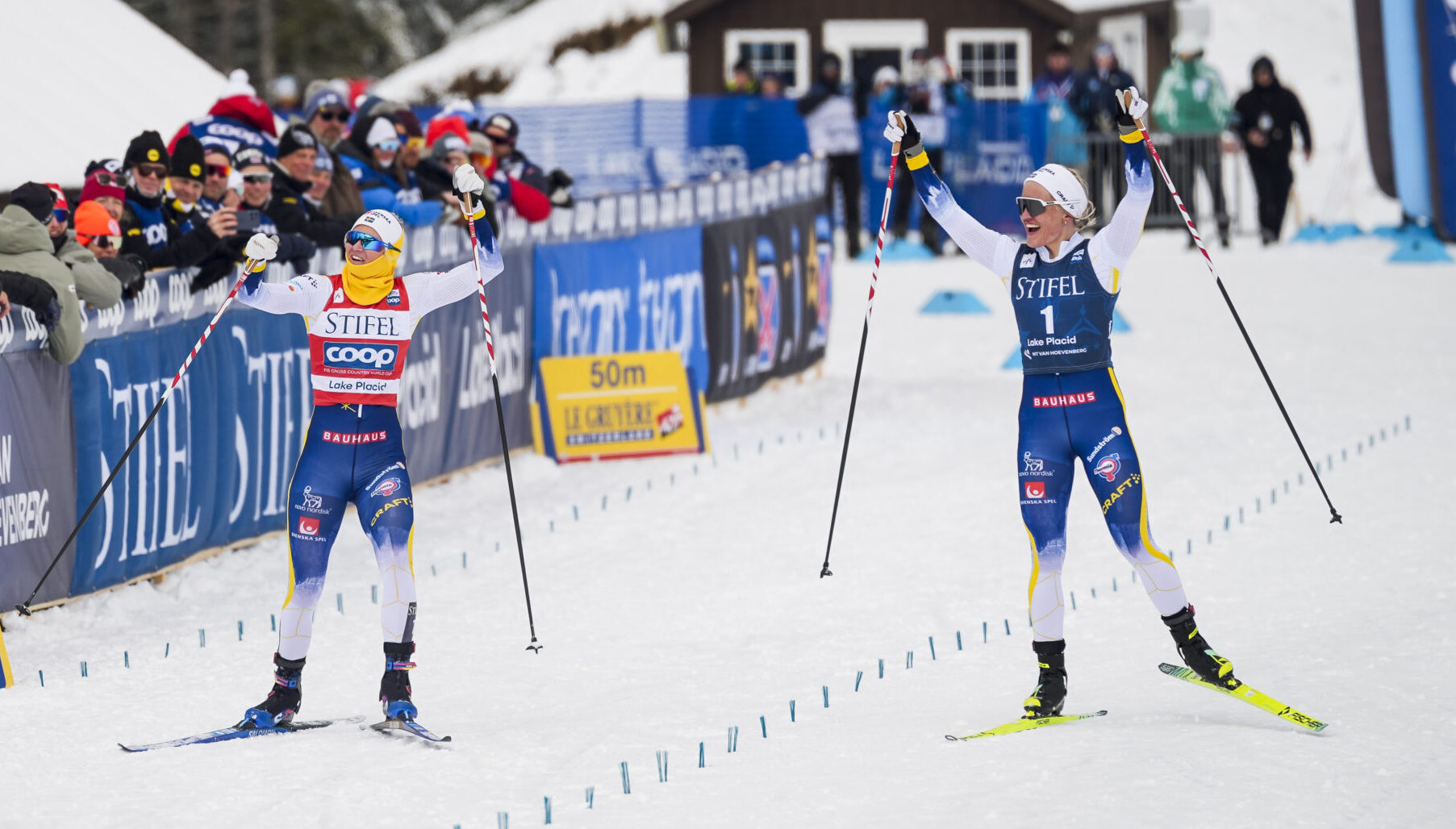
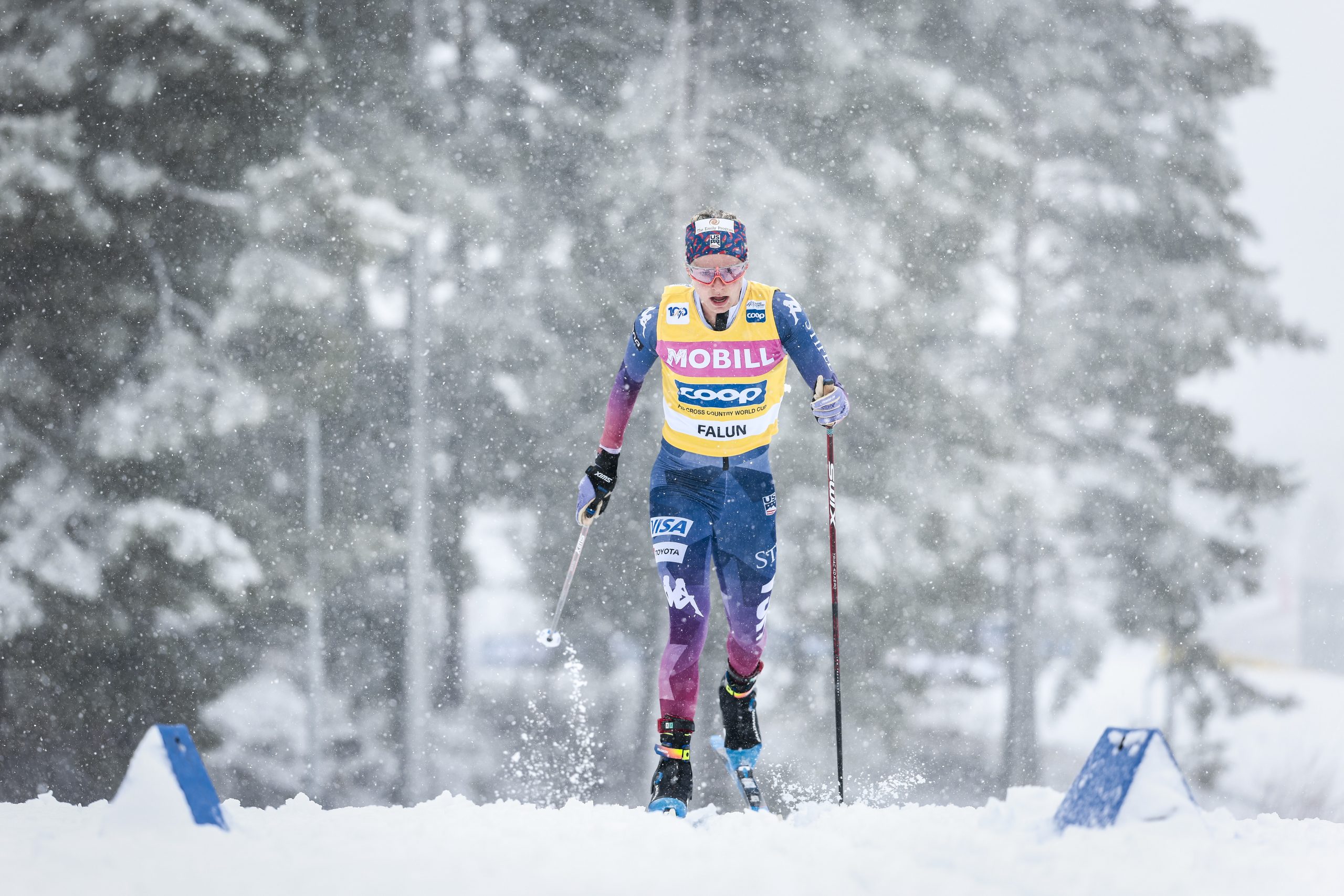
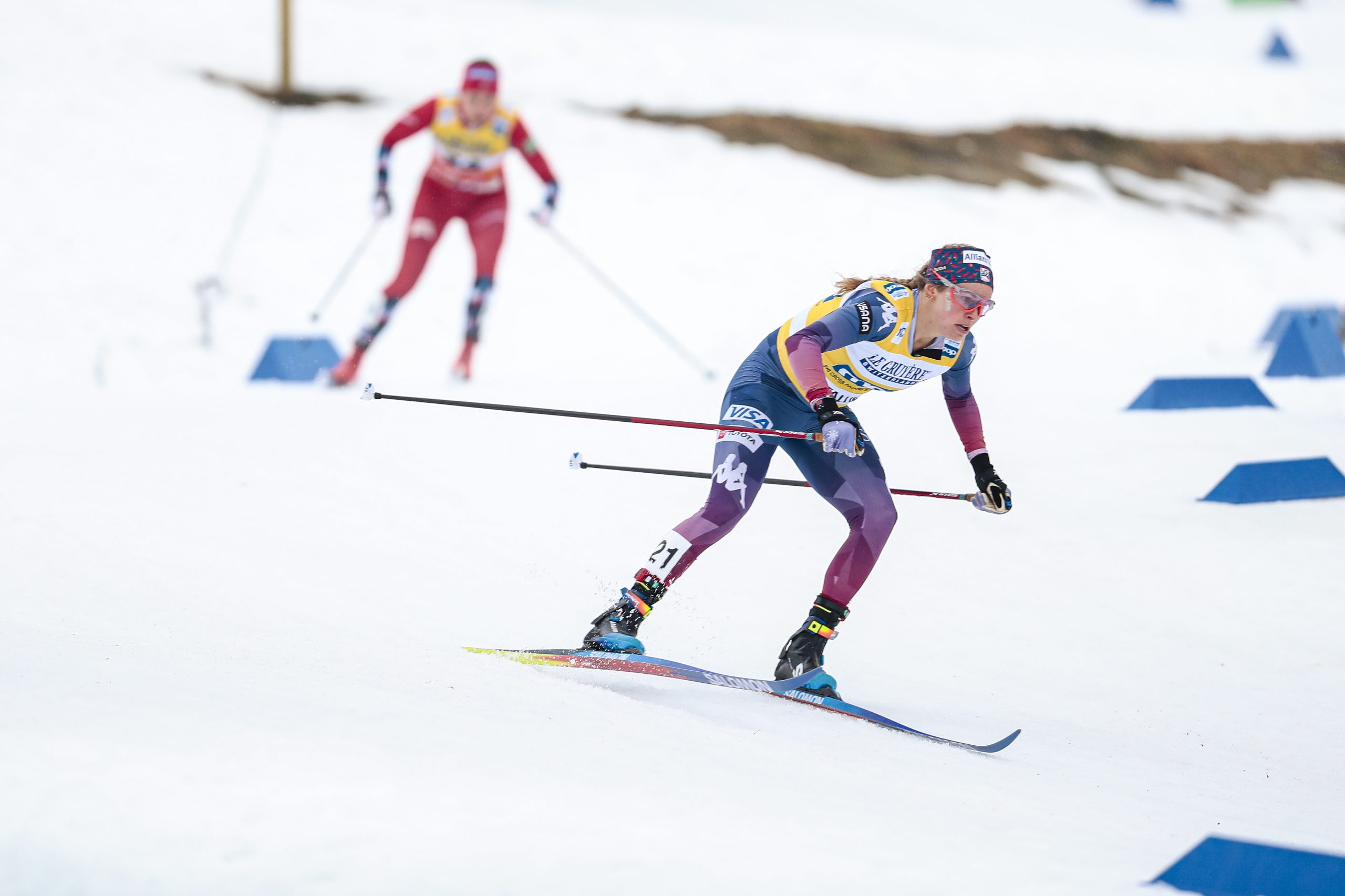
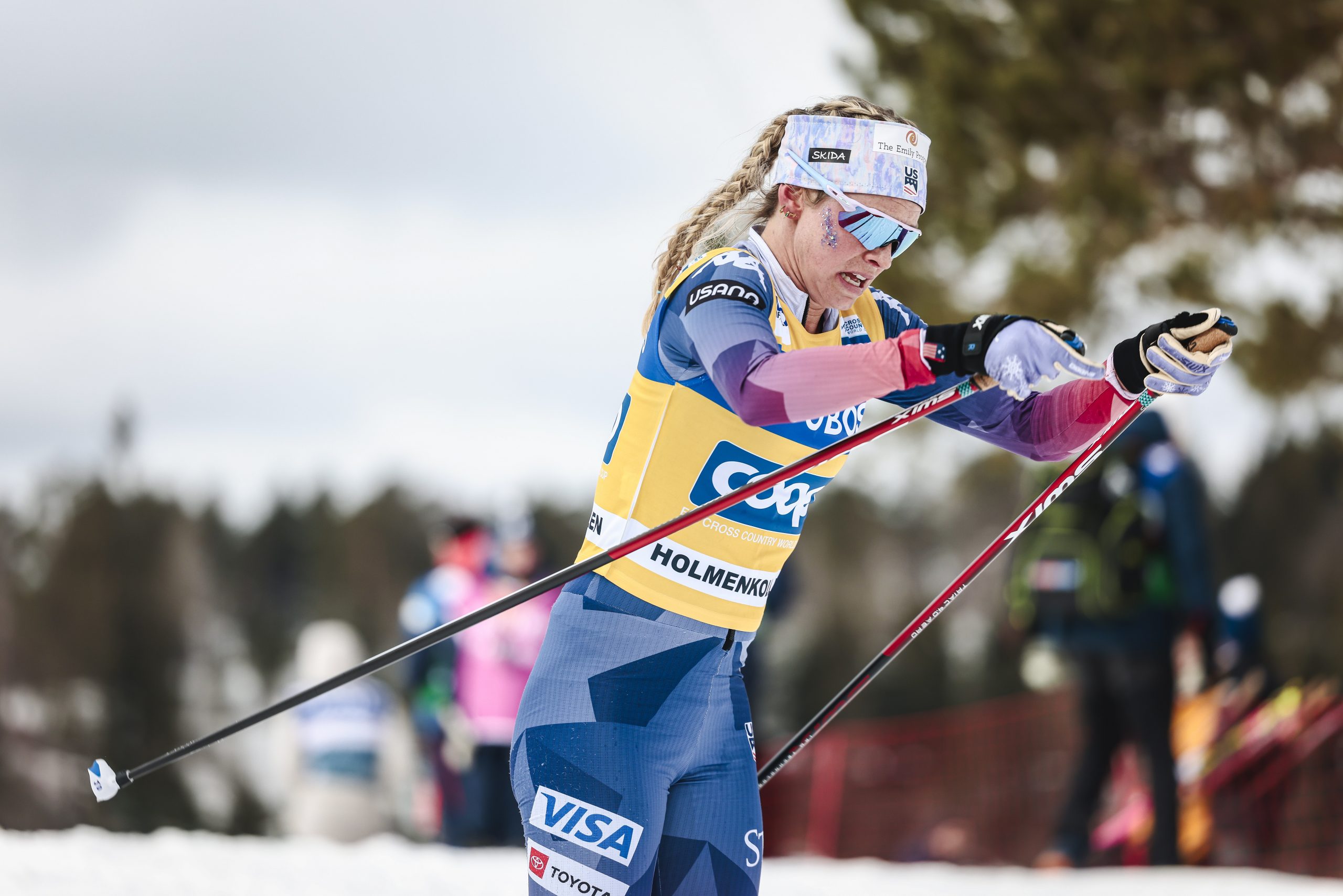
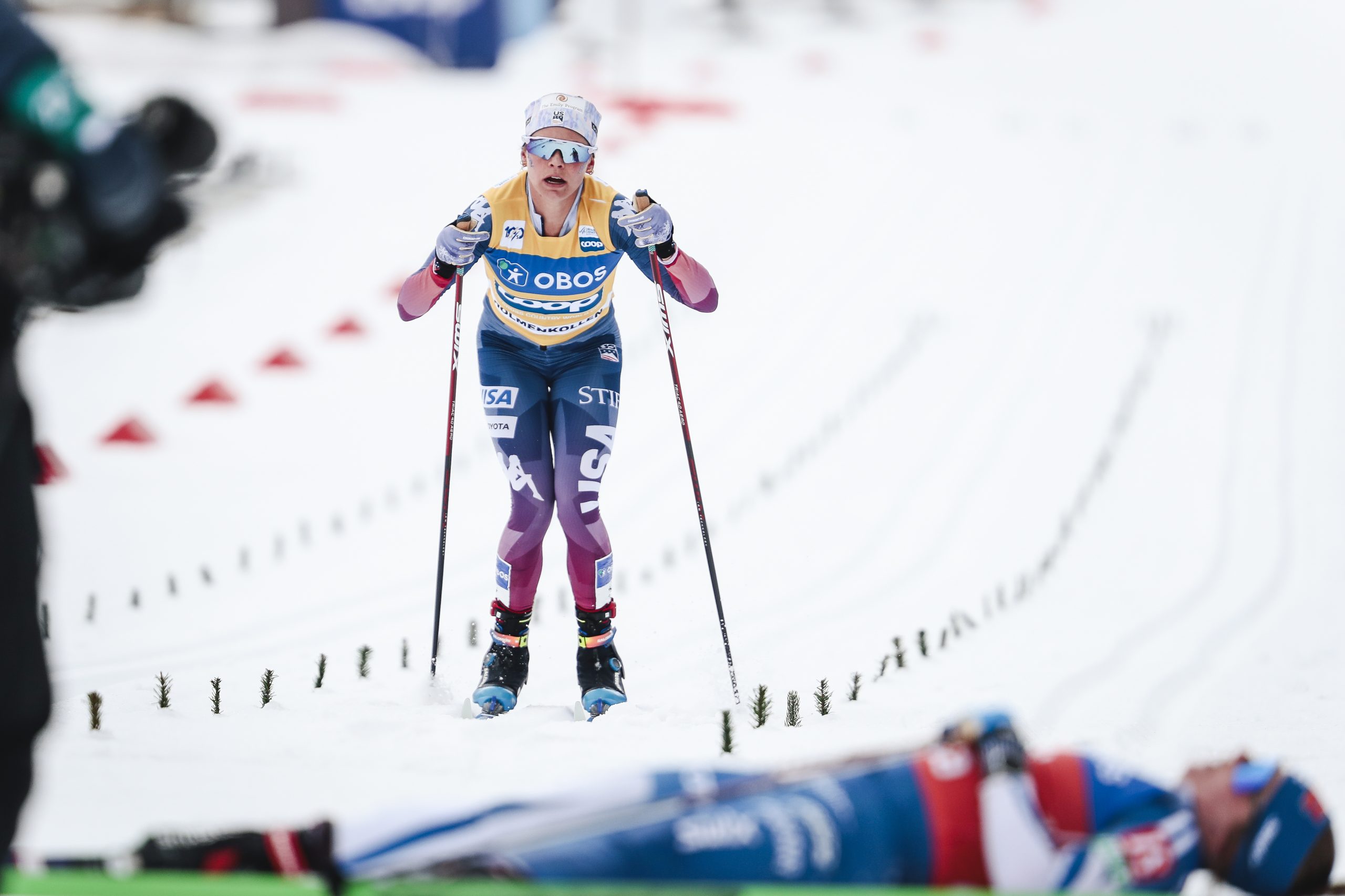
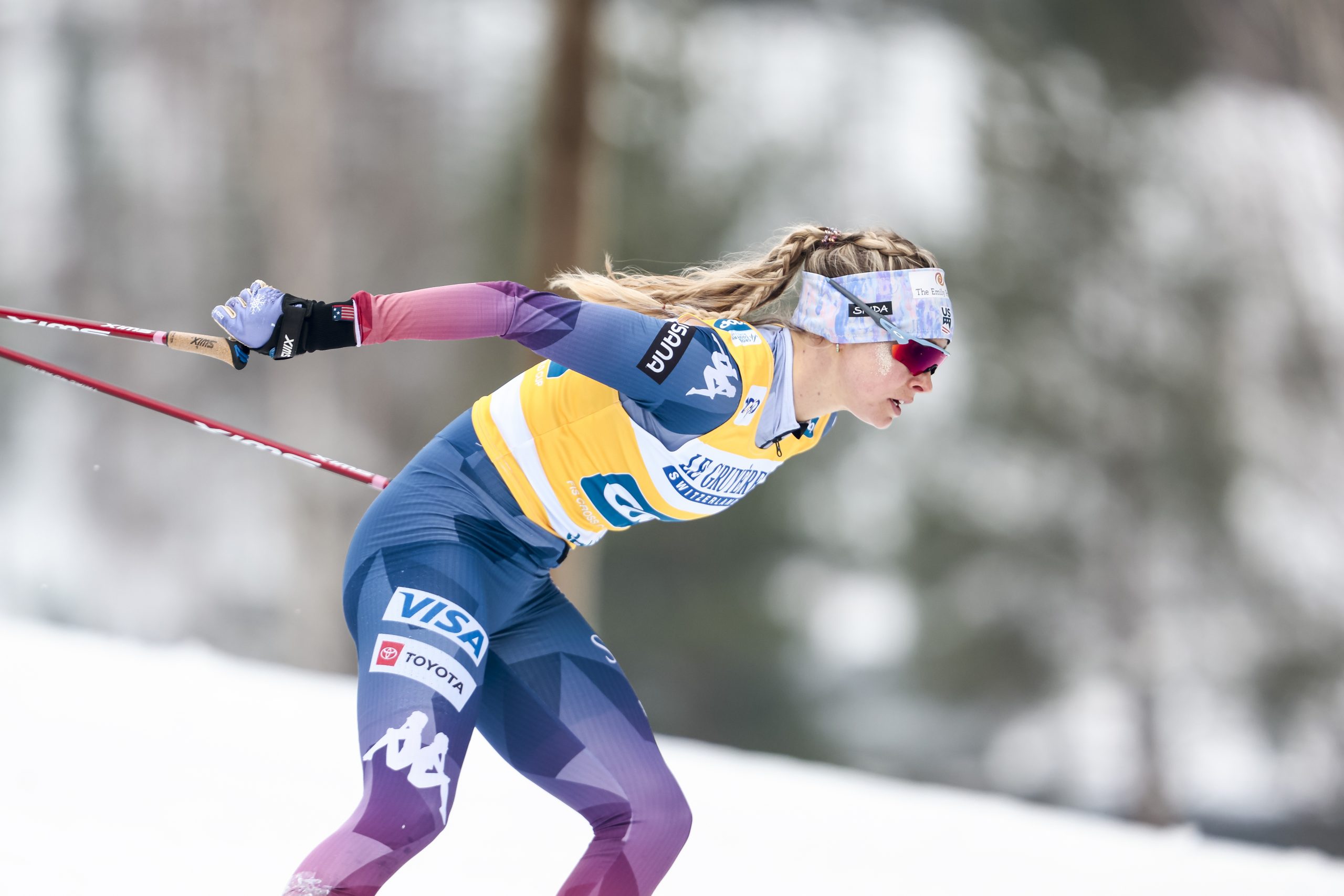
Jessie Diggins during the quarterfinals of the Freestyle Sprint on Saturday in Lake Placid, New York, USA. (Photo: Voisin / FasterSkier)
Lake Placid, N.Y. — The French coaches had questions. Two days before racing began at Mount Van Hoevenberg, they were standing in Saranac Lake — 55 degrees, windy, woods in every direction — wondering who exactly was going to show up to watch cross-country skiing in the middle of the Adirondacks.
By Saturday, an estimated — rumored to be fair — 14,000 people had answered.
Today, as Jessie Diggins lines up for the 20-kilometer mass start freestyle, the final race of her career, this corner of upstate New York will try to top itself one more time.
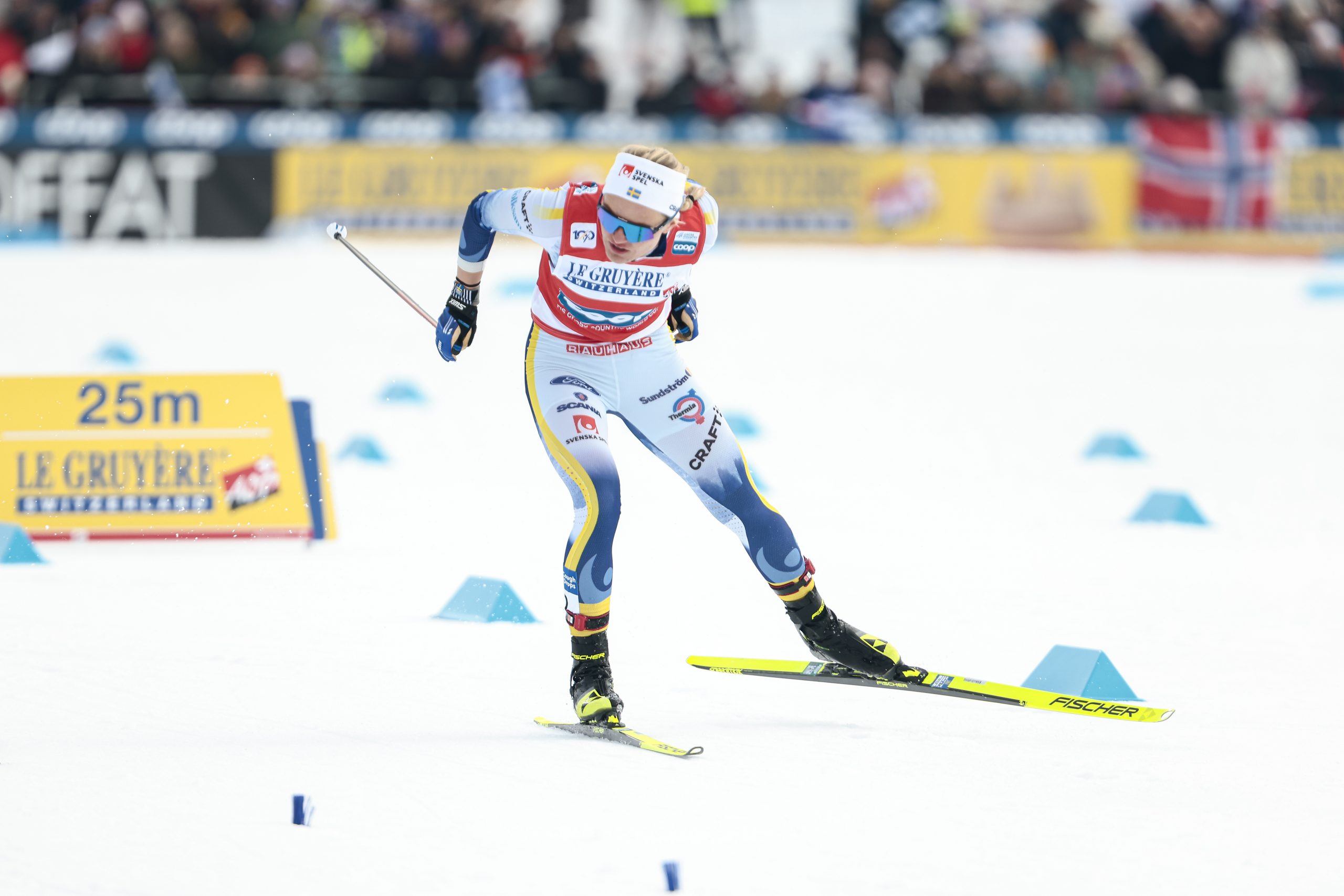
Screaming fans, chainsaws, flags, signs, and glitter all over the course in Lake Placid, New York, USA. (Photo: Voisin / FasterSkier)
A Weekend That Kept Building
The first sign that Lake Placid was going to be different came Friday, and it wasn’t entirely smooth. With an initial estimate of 10,000 fans on Friday, the transportation system to and from Van Hoevenberg buckled under the demand. Some fans waited over two hours to get to the venue.
US Head Coach, Matt Whitcomb, after the races yesterday in Lake Placid was really happy because the standout performance was not one of his athletes, but instead the North American ski community that showed up in droves and created an electric atmosphere. (Photo: Voisin / FasterSkier)
“Only Holmenkollen and Minneapolis”
U.S. Ski Team head coach Matt Whitcomb has been on the World Cup circuit for years. He said the only events throughout his career that have ever rivaled the atmosphere here this weekend in Lake Placid are the Holmenkollen in Oslo — the sport’s grand prix if you will — and Minneapolis two years ago.
That’s the company Lake Placid is keeping. And for those who were in Minneapolis, the comparison lands. Diggins said earlier this week that Minneapolis was the most special day of her career.
“It was the most I’ve ever cried,” she said at Wednesday’s press conference. “I got to race in front of some of my grandparents who haven’t been able to travel overseas. They got to see me race for the very first time in a World Cup. And having so many friends and family and getting to share the thing that I love doing with them — that is the most incredible thing ever.”
She paused, then added: “I think this weekend’s probably going to join that.”
College skiers from all over the Northeast came in force to the trailside in Lake Placid, New York, for the races this weekend. (Photo: Voisin / FasterSkier)
The Scene on the Ground
What the numbers don’t capture is the texture. Young kids running around the venue in their NNF fan bibs — the ones with athletes’ faces printed on them — clutching Sharpies, hoping to meet their heroes. Fans who drove and flew from Vermont, from Alaska, from Minnesota, who planned vacations around this weekend months ago. The school buses that became part of the story, ferrying the faithful up the mountain road when the original plan couldn’t hold.
This is what U.S. cross-country skiing looks like when it gets the stage. Not a packed NFL stadium or a sellout basketball arena — but thousands of people standing in the woods, screaming themselves hoarse for athletes from every country, because they love this sport and they know how rare these weekends are.
The fans — especial the college skiers — made it sound like the race was happening in Davos, Switzerland with the chainsaws out on course. (Photo: Voisin / FasterSkier)
One More Race
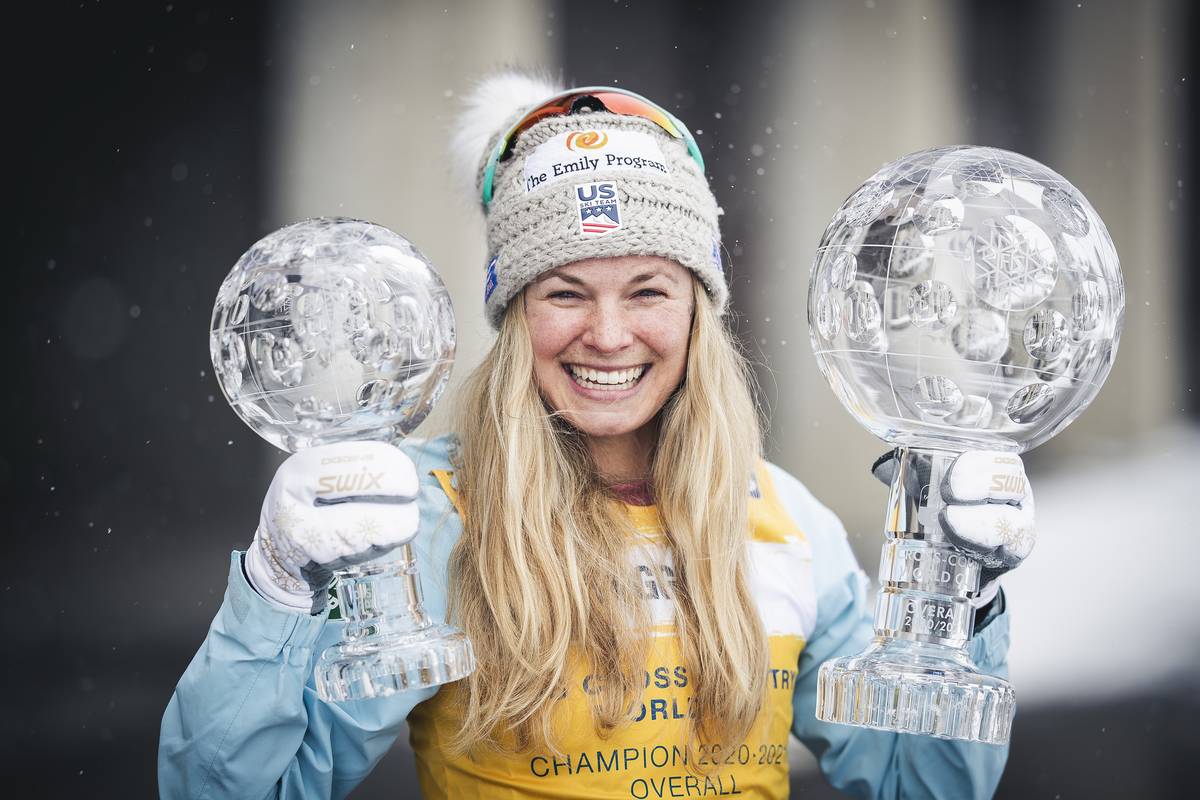
Diggins has spent this weekend doing exactly what she said she would — being present, soaking it in, putting on a show. She clinched the Crystal Globe on Friday. She raced the sprint on Saturday. And now there’s one more.
At Wednesday’s press conference, she talked about the way her mindset around suffering has evolved — how she’s learned to see the pain cave not as something to dread but as confirmation that she’s doing what she came to do.
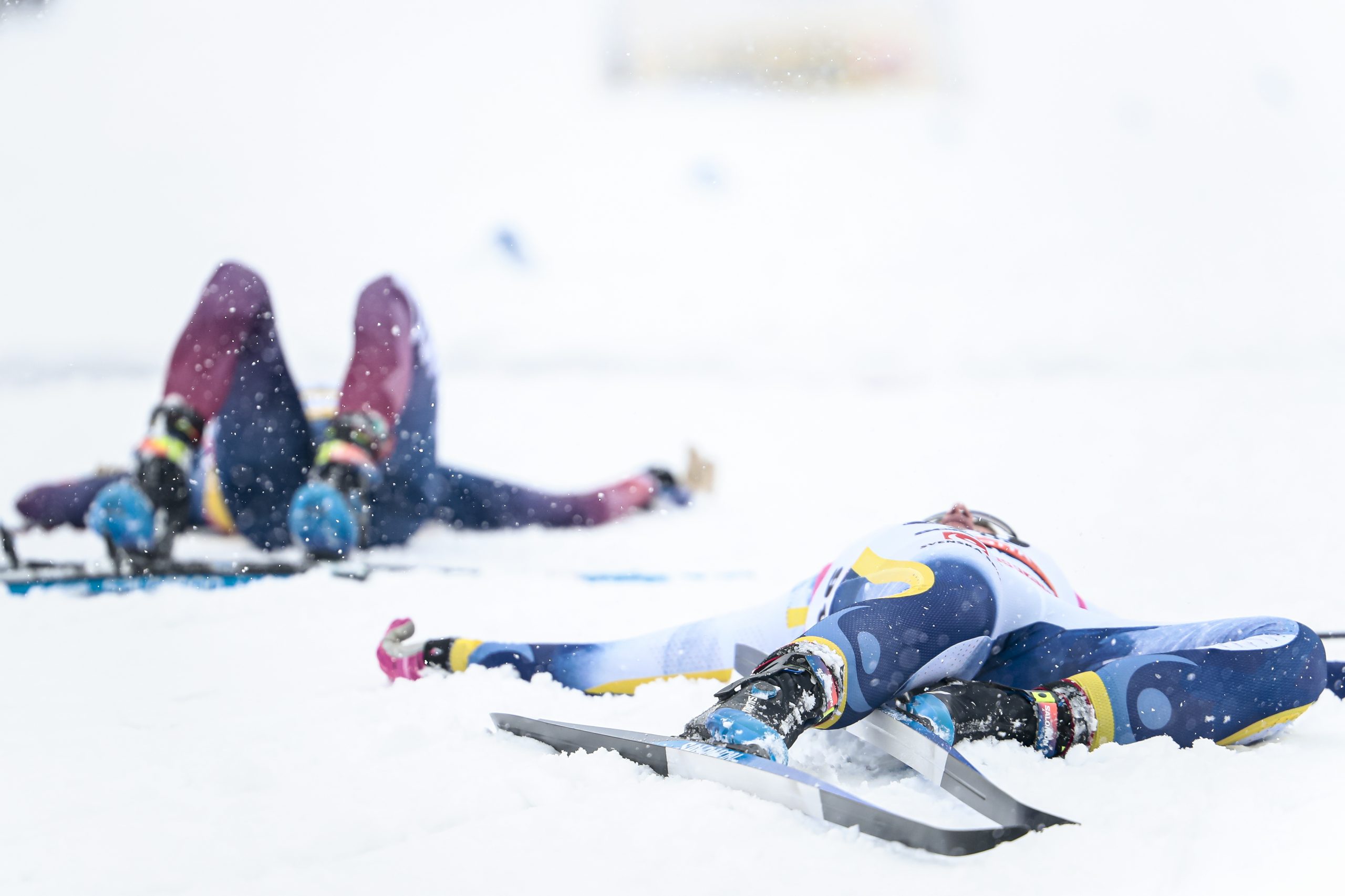
“This is what 100 percent feels like,” she said. “And sometimes this is what it looks like, and it’s some ugly scene, but that’s okay. It just has to be all heart and all effort, and that’s what I have to give in that moment.”
She also made one thing clear about the team she’s leaving behind: “The team is going to be just fine without me. And I feel like that’s how I know I did my job.”
Then, with a smile: “I’m excited to be a fan on the other side of the fence and get to cheer for them.”
Today, in just ten minutes, Jessie Diggins will clip into her bindings for the last time as a World Cup racer. The 20-kilometer Mass Start Freestyle.
And based on everything this weekend has shown us, “no one” will be watching.
Love Stories Like This? Help Keep Them Coming.
Feature stories like this one take time, access, and care to produce. If you value thoughtful storytelling and independent ski journalism, please consider becoming a Voluntary Subscriber. Your support directly fuels the work we do to cover the people, places, and moments that make our sport special.
This coverage is made possible through the generous support of Marty and Kathy Hall and A Hall Mark of Excellence Award. To learn more about A Hall Mark of Excellence Award, or to learn how you can support FasterSkier’s coverage, please contact info@fasterskier.com.
Team . . . Maja Dahlqvist (SWE) wins the Sprint Crystal Globe, Linn Svahn (SWE) takes the World Cup Sprint win. (Photo: Thibaut/NordicFocus)
Team Sweden must face tricky circumstances in selecting its team for World Cup Sprint events, but their dilemma is made simpler by the apparent set of protocols the team follows when deciding who will race. Typically, Sweden brings only those skiers who can earn spots on the podium. Everyone else is racing back home in what we can only imagine must be the must competitive B-Team event in the world of women’s sports. In Lake Placid’s Freestyle Sprint, Sweden’s roster consisted of Jonna Sundling, Linn Svahn, Johanna Hagstroem, Maia Dahlqvist, Moa Ilar, and Emma Ribom (who did not start today’s Freestyle Sprint). That’s a fairly impressive set of starters: Sundling is 2022 Olympic Champion (and world champ from 2025), Svahn is 2026 Olympic Champion, Dahlqvist leads the World Cup Sprint standings, and Hagstroem is poised to win this year’s World Cup if Dahlqvist were to falter. Put those skiers on the starting line of a Sprint final, and it will be very difficult for any other nation to truly challenge them.
And that is precisely what Team Sweden did . . . though not without needing to come through a chaotic and unexpectedly close Freestyle Sprint final. In the end, Svahn notched her second victory of the weekend (after yesterday’s 10 k Classic victory) ahead of Sundling and Dahlqvist (who claimed her fourth World Cup Sprint Crystal Globe). Team Sweden swept its second straight podium of the World Cup final . . . with one race (tomorrow’s 20 k Mass Start) still to be run.
“It was so much fun—all these people, all this cheering—it’s amazing,” said Sundling.
“Honestly, I was just trying to do as good race as I could for the day,” said Dahlqvist. “The bonus would just be the points for the overall. I just wanted a good race for today.”
“It’s like my second home, honestly! So many people screaming my name,” said Dahlqvist.” It was really cool.”
Twelve Americans entered Lake Placid’s Freestyle Sprint qualifying: Jessie Diggins, Samantha Smith, Julia Kern, Alayna Sonnesyn, Lauren Jortberg, Rosie Brennan, Erin Bianco, Hailey Swirbul, Ava Thurston, Renae Anderson, Emma Albrecht, and Nina Schamberger. Diggins, Smith, and Kern all advanced beyond qualifying with Diggins advancing into the semifinals.
Jessie Diggins (USA) continues to cherish every finish line. Her retirement is a celebration, but one fans wish could be delayed a bit longer. (Photo: Thibaut/NordicFocus)
Freestyle Sprint
Diggins drew the first heat where she would meet up with Sundling and Faehndrich. That top-heavy field seemed to insure that this would be a fast heat, one likely to produce a lucky loser or two. Diggins’ strategy throughout the season has remained consistent: use her speed to keep heats fast, claim at least a lucky loser spot, and rely on her endurance to give her chances later in the heats when pure sprinters may be spent.
Diggins bobbled a bit out of the start gate, allowing Sundling to burst forward to set the early pace (Sundling is typically a fast-starter and aggressive pace-setter; she was likely to try that, anyway). Diggins needed to work a bit to get around Julie Myhre (NOR) on the first uphill, but from then on it was a three-woman race. That triad was interrupted when Diggins stepped on Faehndrich’s pole basket, sending the Swiss woman tumbling in a hairpin right-hand turn. Diggins lost some speed behind the tangle of skis and poles, but she would recover before the finishing straightaway. Faehndrich would pull off a miraculous recovery of her own, hopping back to her feet after her fall, chasing down the pack, and sprinting past Diggins into the third spot. The two of them would wait to see if their times would be fast enough to advance as lucky losers.
Svahn led a moderate-paced Heat 2, confident that no one else would be eager to lead. Jasmi Joensuu (FIN) went to the front in the loose snow of the final uphill, only to find her efforts eclipsed by Svahn swooshing out of the draft on the subsequent downhill. Svahn would advance easily, followed by Joensuu. Slow heat . . . Faehndrich and Diggins still safe.
Kern re-entered the World Cup scene after a few idle weeks following the Olympic Games where she had begun feeling some pulmonary stress. She appeared recoved with an impressive 17th place qualifier, but her performance in theheats made it clear that she may still be a bit rusty. Kern got pinched out of position numerous times in the quarterfinal, then lost her balance rather dramatically on the last right-hander before the finishing straightaway. Her speed having been lost, Kern would cross the line sixth. Her day would end with a mnmnmnmn place finish. For Faehndrich and Diggins . . . so far, so good.
Smith has repeated a pattern in recent world Cup Sprints, dropping to the rear early in each heat, only to unleash a torrential sprint in the closing meeters. Smith found an open lane to drive forward on the first uphill, puling even with Maia Dahlqvist (SWE) at the summit. Smith once again found a lane on the final uphill, hop-skating past Lotta Udnes Weng (NOR) before expertly pinching her out of second position. Smith entered the downhill well positioned on the tails of Dahlqvist. Smith’s good tactics would not continue as the field reached the final flats. Weng was able to wind past her, as well as Federica Cassol (ITA) who crowded Smith into abbreviated skate strokes in the finishing meters. Smith would finish fourth in the heat, and mnmnmnmnm in the day. Faehndrich and Diggins? Still in lucky loser positions with only one quarterfinal remaining.
Faehndrich and Diggins kept their fingers crossed that the final heat would be a slow one. It was a nervous position to occupy: Hagstroem highlighted the Quarterfinal 5; she’s a skier who often ignites the pace to exhaust her rivals . . . but her first strokes out of the start gate indicated that would not be her strategy on this day. Hagstroem would hold the lead across the finish line ahead of Coletta Rydzek whose clever footwork allowed her to sprint forward to claim the second automatic advancement spot. Hagstroem’s languid pace allowed the advancement of both Faehndrich and Diggins. the home-crowd breathed a sigh of relief.
Semifinals
Diggins lucky loser journey continude in Semifinal 1 where her desire to push the pace found itself in the backseat compared to the similar desires of Svahn and Sundling. The Swedish pair rocketed to the front as Diggins trailed the field. But it quickly became apparent that Sundling and Svahn had no interest in setting a fast pace—they only wanted to clog the front, daring others to take the lead. On Lake Placid’s Sprint course, taking the lead had proven to be a self-destructive tactic, while attacking from behind had proven to be a risky one. Diggins found an open lane on the final climb, but found the pace too high to allow her to advance.
The Swedes had looked supernaturally calm and relaxeda t the front, but on the final downhill the dangers of Lake Placid’s Sprint course revealed themselves again as Svahn was absorbed by skiers rushing from the rear, and Sundling found herself edged out of the lead by Anja Weber (SUI). The Swedes would call upon their superior speed to fight back into the lead before the finish line. Myhre would cross third, followed by Joensuu in fourth. Diggins would cross fifth to finish ??? on the day. The Swedes apeared relieved—and a little bit shell-shocked—in the finish area. They’d be unlikely to commit those tactical errors again.
Dahlqvist and Faehndrich—#1 and #2 in the current World Cup Sprint standings would face off in the second semifinal. After the grinning embarassment of an initial false start, Dahlqvist would allow her teammate, Hagstroem, to vault into the lead, followed closely by Faehndrich and Rydzek. Hoping to distance herself from Dahlqvist, Faehndrich drove to the front on the final uphill. using Hagstroem as a way to block any other pursuit. Faehndrich and Dahlqvist would cross the finish line togehter, followed by lucky losers, Hagstroem and Rydzek.
Linn Svahn and Jonna Sundling led the Swedish sweep at Mt. Van Hoevenberg. (Photo: Thibaut/NordicFocus)
Sprint Final
Svahn, Sundling, Hagstroem, and Dahlqvist highlighted the Sprint final, where they were joined by Faehndrich and Rydzek. With three closely-bunched contenders (Dahlqvist, Hagstroem, and Faehndrich) in the year-long Sprint World Cup competition all being present in the final, the Crystal Globe would be decided in this race. Sundling an Svahn set the pace, Faehndrich and Dahlqvist marked them closely. Hagstroem and Rydzek trailed. With Dahlqvist leading by only six points over Hagstroem—and with Faehndrich only a few more points behind them—the mathematical possibility existed for the cup to change hands at the finish line. In the end, Svahn pulled away from Sundling, and Dahlqvist separated herself from Faehndrich. Sweden would sweep the podium, and Dahlqvist would cross the finish line with arms raised as the winner of the Sprint Crystal Globe.
World Cup Final Women’s Freestyle Sprint QUALIFYING
Love Stories Like This? Help Keep Them Coming.
Feature stories like this one take time, access, and care to produce. If you value thoughtful storytelling and independent ski journalism, please consider becoming a Voluntary Subscriber. Your support directly fuels the work we do to cover the people, places, and moments that make our sport special.
This coverage is made possible through the generous support of Marty and Kathy Hall and A Hall Mark of Excellence Award. To learn more about A Hall Mark of Excellence Award, or to learn how you can support FasterSkier’s coverage, please contact info@fasterskier.com.
Linn Svahn (SWE) showed that she is no one-dimensional sprinter, holding off the season’s dominant Distance skier —Swedish teammate, Frida Karlsson—for the win in the FIS World Cup Final 10 k Classic Interval Start in Lake Placid. (Photo: Modica/NordicFocus)
FasterSkier’s reporters watch every single race of the World Cup and Olympic season, so we have our own ideas regarding what may happen on any given race-day. We’ve followed who has been progressing up the standings, who has been fading, who has been injured or ill and how their recovery has progressed. And we follow the amazing and durable actions of Jessie Diggins (USA) who has competed in every single race of the season (That’s right, isn’t it? Someone check the record . . .). Alone among all World Cup competitors, Diggins continues to devote herself to performing at the highest levels on every available race day. If she’s tired, she deals with it. If she gets sick, she overcomes it. If she’s injured, she races through it. If there’s a start line and a finish line, drawn on the snow Diggins is racing. While it may be argued that she might’ve performed even better if she took a day off from time to time, evidently it’s impossible for her to just sit out those race opportunities. And Diggins is also one of only two skiers in the world (along with Johannes Hoesflot Klaebo) who has an honest chance to win on any given day, regardless of distance or discipline. And the reward for such devotion and fortitude?
All eyes were on Jessie Diggins (USA) whose career is winding down to retirement, but not before another excellent top-five performance in the 10 k Classic, and the clinching of another World Cup Crystal Globe. (Photo: Thibaut/NordicFocus)
Any day’s race coverage begins with a check of the start list; that’s how we see the first inclinations of how the story might unfold. Here’s the context of today’s 10 k Classic Interval Start: perennial contenders, Ebba Andersson (SWE) and Kerttu Niskanen (FIN) have chosen to stay home home, Krista Parmakoski (FIN) retired at eh Holmenkollen finish line, and Dariya Nepryaeva (AIN) wasn’t allowed into the country (no American visas issued to Russian citizens) . . . The rest of the contenders appeared to be present. Among the logical contenders within the women’s field were those whose performances shined brightest this season, but whose illnesses and injuries kept them from contention in the year-long FIS World Cup competitions. Frida Karlsson (SWE) is undoubtedly the fastest skier in the world today as she proved repeatedly in the Olympic Winter Games and the recent Holmenkolen 50 k. She is joined by a list of other Distance contenders including Heidi Weng (NOR), Astrid Oeyre Slind (NOR) Karoline Simpson-Larson (NOR), Jonna Sundling (SWE), Moa Ilar (SWE), and Olympic Sprint champion Linn Svahn (SWE).
Host-nation USA was allowed additional entries. In addition to the much-anticipated participation of Diggins, the American roster included Emma Reeder, Alayna Sonnesyn, Katey Houser, Renae Anderson, Emma Albrecht, Samantha Smith, Novie McCabe, Kendall Kramer, and Rosie Brennan.
“It’s really awesome to know how many people care about skiing in America,” Kramer said in response to the crowds of eager spectators gather around the course. “It’s heart warming!”
“I love racing at home!” said Brennan. “It’s so awesome. I had many moments when I was second-guessing myself out there. then Id get to a hill and everyone was going nuts, yelling my name, and I was like ‘Okay, I got this! I got this!” ‘
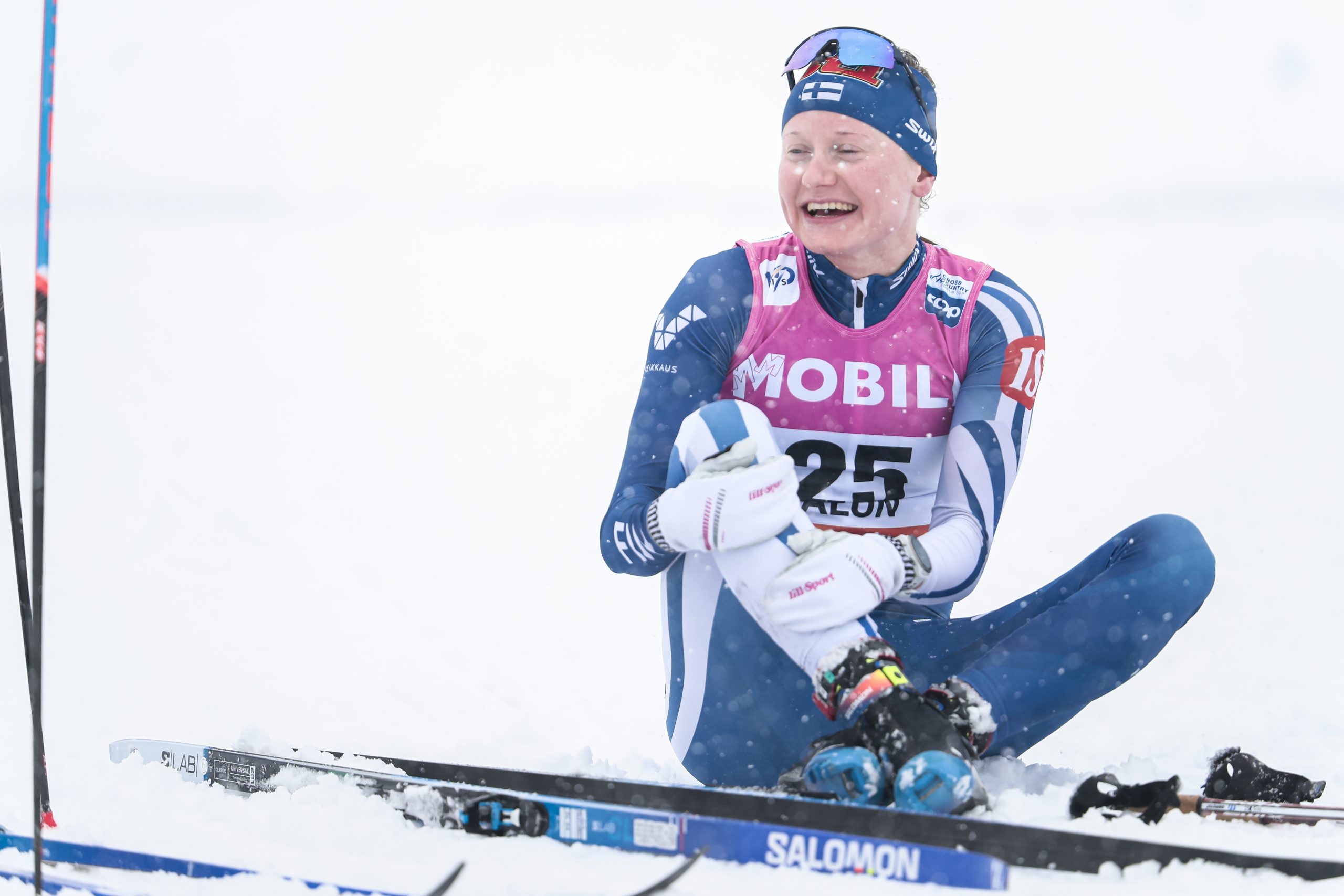
“Honestly, I don’t care about the results,” beamed Diggins after the finish. “I just wanted to enjoy the crowd, and feel the love and the excitement, and just go as hard as I could! Laying in the snow there at the end, I was like ‘That was one of the best 10ks of my life.’”
In the end, it was Svahn winning a back-and-forth battle with her good friend, Karlsson. Sweden would top the podium, but Heidi Weng would prove the best of the rest, finishing 22 seconds behind the winner. Diggins would battle through the falling snow to secure a fifth place finish in the final interval start race of her career.
Frida Karlsson (SWE) surged to a mid-race lead, but it was not enough to overcome the momentum of her teammate, Linn Svahn. (Photo: Modica/NordicFocus)
Not Yet Spring
While the field—and the spectators—may have been hoping for sunny and mild spring conditions. Wouldn’t that have been nice? But Lake Placid sits at an elevation of 2200 feet—quite high for the east coast—and spring is notoriously late to arrive in these Adirondack mountains. Race day dawned with dense cloud and swirling snow, conditions that seemed likely to challenge ski technicians and skiers, alike.
The 10 k Classic would be skied over two five kilometer laps climbing immediately from the stadium into the woods. Svahn was the revelation among early starters, totally gapping the rest of the field at all early check points. At the halfway mark of the race, Svahn led all earlier starters by nearly a minute! Later starters among the top seed would begin whittling into Svahn’s times, but even Karlsson would trail by eleven seconds at the first checkpoint, with her teammate, Sundling, another five seconds behind.
Diggins started in bib 58. She would trail Svahn by 23 seconds at the first checkpoint (13 seconds behind Karlsson, 10 seconds behind Slind). The contenders’ splits were bunched near the front, but it was definitely Svahn who appeared strongest. Svahn continued to hold that lead over Karlsson at the 3.8 kilometer checkpoint, by which time Diggins had managed to take six seconds out of Svahn’s lead.
Svahn would surge again in the middle kilometers to put another six seconds into Diggins, but the splits identified the next serious challenger as Slind pulled within just a few seconds. And that’s when Karlsson made her move, pulling even with Svahn at 6.7 kilometers. Had Svahn gone out too fast?
Svahn has won 14 Sprint races in her career, but it is less known that she’s also won three Distance races. She is certainly no slouch when it comes to long events, and she obviously possess great endurance ability. That’s what she must’ve drawn upon in the later kilometers as—despite the charge from Karlsson—Svahn would finish in a dominant 29:04, surging to the victory by 1.4 seconds to claim the first Individual Start Distance victory of her career.
Diggins would thrill her fans with another gutsy performance, giving her all—as she has always been known to do—in finishing fifth on the day. She extended her lead in the Overall World Cup standings over her closest rival, Sweden’s Moa Ilar, virtually closing out that competition for the fourth time in Diggins’ illustrious career.
Feature stories like this one take time, access, and care to produce. If you value thoughtful storytelling and independent ski journalism, please consider becoming a Voluntary Subscriber. Your support directly fuels the work we do to cover the people, places, and moments that make our sport special.
Frida Karlsson (SWE) gave it her all in Lake Placid, only to fall just short of the performance of her good friend, Linn Svahn. (Photo: Thibaut/NordicFocus)
World Cup racing continues from Lake Placid this weekend:
Saturday, March 21
10:30 am | Women’s Sprint Qualification Free
11:05 am | Men’s Sprint Qualification Free
1:00 pm | Women’s Sprint Final Free
1:00 pm | Men’s Sprint Final Free
Sunday, March 22
12:30 pm | Men’s 20km Mass Start Free
2:30 pm | Women’s 20km Mass Start Free
4:30 pm | ONE LAST LAP w/Jessie Diggins & the Retiring Stars
This coverage is made possible through the generous support of Marty and Kathy Hall and A Hall Mark of Excellence Award. To learn more about A Hall Mark of Excellence Award, or to learn how you can support FasterSkier’s coverage, please contact info@fasterskier.com.
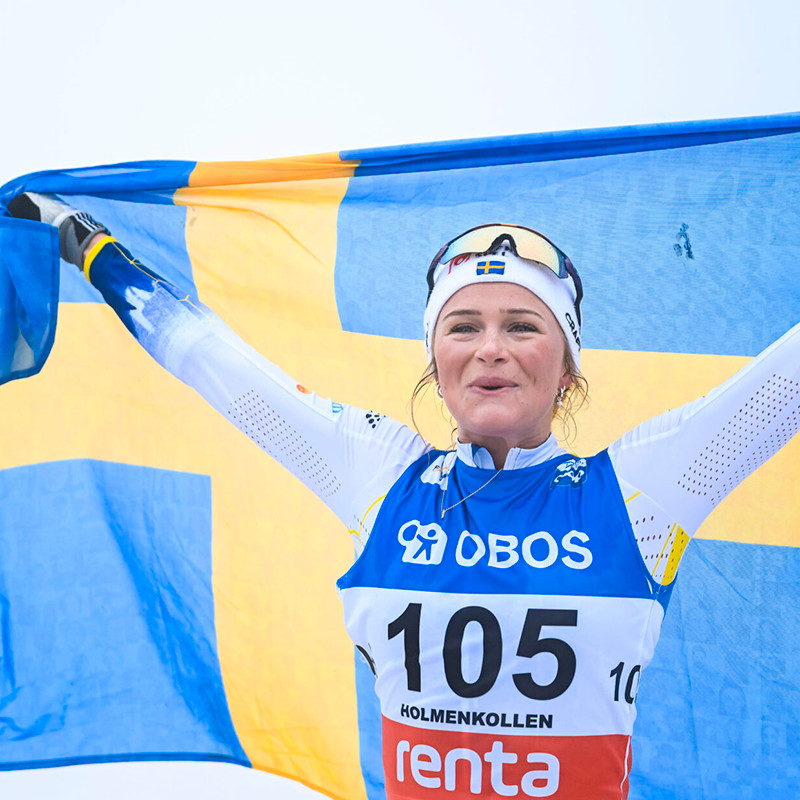
Frida Karlsson (SWE) claimed her third Holmenkollen win, her second at the 50 kilometer distance. (Photo: Authamayou/NordicFocus)
The prize for winning Oslo’s Holmenkollen 50 k is lifelong bragging rights. Such is the nature of the prestige afforded this event within the Nordic ski community. Norwegian fans, especially, remember certain years, certain races, certain rivalries; especially those that are memorable for the racing conditions that challenged the athletes. Fans are likely to remember this 2026 edition, and the thick, stubborn fog that enveloped the racers throughout the 50 kilometer distance. Stadium announcers regularly reminded the audience that racers were entering the stadium . . . otherwise, fans might not have known. The fog may have appeared thicker and soupier through the lens of broadcast cameras, but it’s certain that the fog hung close to the ground, obscuring skiers’ views of the course, of the crowds, and of their competitors. Perhaps that had something to do with the more measured pace the leaders selected. By the halfway point of the race, the entire women’s field was still together (not at all the normally expected state of affairs in women’s mass-start Distance racing). The regular cast of contenders remained at the front—Frida Karlsson (SWE), Ebba Andersson (SWE), Heidi Weng (NOR), Astrid Oeyre Slind (NOR), Jonna Sundling (SWE), and Jessie Diggins (USA)—but none of them seemed eager to race off alone.
Karlsson would emerge from the fog first, crossing the finish line all alone to claim her third Holmenkollen race, and her third at the 50 kilometer distance. Behind Karlsson, her Swedish teammates—Linn Svahn and Jonna Sundling—would sprint across the line in second and third, just ahead of Heidi Weng (NOR), Nora Sanness (NOR) and Jessie Diggins (USA).
“It’s such a magic day for our team,” beamed Karlsson. “It’s our first “triple” in the distance, and it’s sick!”
Alison Mackie (CAN) followed up a win at the U23 World Championships with a 14h place debut in the Holmenkollen 50 k. (Photo: Authamayou/NordicFocus)
Canada’s Alison Mackie remained in the top 10 through the halfway mark, and continued to make her presence felt throughout the 50 kilometer distance. . A young skier with a bright future, Mackie was certainly making he most of her first Holmenkollen. She would finish the day in 14th, sandwiched between established distance-racing stars Kristin Austgulen Fosnaes NOR) and Astrid Oeyre Slind (NOR).
Kendall Kramer (USA started 45th (out of 50 starters), but in the close company of the 46th starter, Delphine Claudel (FRA), a world class Freestyle competitor. If they could work together, they could make up many places in a hurry. By the five kilometer mark, Claudel had managed to work her way all the way up to the front . . . but Kramer was nowhere to be seen. Claudel would hang on to finish 28th. Kramer would cross the line 41st.
Clearly the best . . . Frida Karlsson (SWE) raced away from her rivals, exiting the fog to claim victory in Holmenkollen’s historic 50 k Freestyle. (Photo: Authamayou/NordicFocus)
Holmenkollen 50 k Freestyle
The Holmenkollen 50 k consists of six laps of an 8.3 kilometer loop, demanding 1000 feet of climbing per lap. And this day in Oslo, race organizers elected to stage the race in a manner that put both the women’s field and the men’s field on the course at the same time, albeit separated by half a lap’s distance. The men’s field would come through at the end of the bonus points at 19.6 kilometers just before the women started, providing a head start of approximately a four kilometers. Stragglers from the men’s field would ultimately be caught by the women. Likewise, stragglers from the men’s field would later be caught by the women. In the thick fog that hovered over the course during today’s race, there was plenty of opportunity for mild confusion.
Karlsson Weng, Andersson, and Slind would ease to the front, providing the early pace, but not going straight to the accelerator as they might have done on a normal day. Behind them, another predictable tier of racers followed, including Nepryaeva, Sundling, and Diggins. The men’s field had already passed through 20 kilometers in a massive, cohesive unit. It was possible that the bizarre conditions on the day would influence the women’s field to do the same.
Diggins won the bonus points at the three kilometer check point, gaining another 12 points over her closest rival in the chase for the Crystal Globe, Moa Ilar (SWE). Diggins would again remain ahead of Ilar at the 11.3 bonus points line. Diggins would collect eight points by crossing the line fourth.
Just before the end of the second lap, Slind stumbled and fell. She would need to spend extra energy to rejoin the leaders, if she was even able to. The field would slow a bit in the feed zone, but Slind would still have a gap of nearly eight seconds to make up . . . and Weng, Andersson, Karlsson, and Diggins continued to make the pace at the front.
Karlsson upped the pace as they approached the 27.9 bonus points line, gapping he rest of the field in the company of Weng and Karoline Groetting (NOR). Diggins led the rest just nine seconds behind, but it seemed that a gap was forming. Diggins would use the technical downhills of the Holmenkollen course to rejoin the leaders, though she also dragged other sprinters forward. With twenty kilometers remaining, the leaders had yet to get rid of Sundling and her Swedish teammate, Olympic Sprint champion, Linn Svahn. Karlsson and Weng would’ve known that their chances of victory relied on their ability to drop those sprinters. All the leaders opted to switch skis at the end of the lap. They would all be on new skis for the final two laps.
Karlsson used the first uphill of the fifth lap to break away. She was followed briefly by Groetting, bu by the top of the slope, Karlsson was away, disappearing into the fog at the front. Groetting would dangle alone in the fog ahead of a chase group led by Svahn. Diggins would continue to bob at the back—on again, off again—repeatedly showing her ability to close gaps and make up ground.
With 12 kilometers to go, Karlsson was away, in full flight, and powering through the fog. Her lead would continue to grow: ten seconds, 15 seconds, 30 seconds, ultimately extending to nearly two minutes. The solo chaser, Groetting, would be caught by the chase group that now consisted of six: Weng, Svahn, Sundling, Groetting, Nora Sanness (NOR), and Diggins. Diggins may be leading the World Cup Distance standings, but Karlsson was continuing to prove that she is the premier Distance skier in the world.
Linn Svahn (SWE), Frida Karlsson (SWE), Jonna Sundling (SWE) made up what Karlsson described as “Our first triple” in World Cup Distance podiums. (Photo: Authamayou/NordicFocus)
Karlsson would ski the last lap alone to claim her second Holmenkollen 50 k victory. The chase group would decide the podium with a sprint to the line, in which Svahn would outsprint Sundling. Weng would cross fourth, ahead of Sanness and Diggins.
Karlsson had shown the potential to exit the recent Olympic Games in possession of four gold medals . . . her performances would deliver only two (the Skiathlon, and the 10 k Freestyle). After the disastrous tumble of Ebba Andersson in the Team Relay (which allowed Norway to steal away the gold medal), and Karlsson’s own illness that kept her from competing in the 50 k, Karlsson appeared still to have something to prove when she toed the Holmenkollen starting line in Oslo. She would ski away from the rest of the best, stamping her authority on this historic race and claiming the sort of lifelong bragging rights that only the Holmenkollen can provide.
Feature stories like this one take time, access, and care to produce. If you value thoughtful storytelling and independent ski journalism, please consider becoming a Voluntary Subscriber. Your support directly fuels the work we do to cover the people, places, and moments that make our sport special.
Good luck finding the finish line . . . Linn Svahn (SWE) and Jonna Sundling (SWE) race through Holmenkollen’s thick fog toward the Swedish flag held aloft by race winner, Frida Karlsson (SWE). (Photo: Authamayou/NordicFocus)
We had to take a break after our three-week Olympic sprint, but we’re back to catch up on a couple of weeks of World Cup racing.
Devon and Nat take a quick run-through of events in Sweden, Finland and Norway. We’ll be back after the marathons at Holmenkollen.
Reach us at devon[at]fasterskier.com and nat[at]fasterskier.com.
A reminder: This is a homegrown podcast done by two guys working long hours and late nights. We also paid real money to be in Italy for the Olympics. If you can, support the show and FasterSkier’s ongoing coverage with a voluntary membership.
Help Support Our Olympic Coverage!
FasterSkier had our own Nat Herz on the ground at the Olympics, which, to be honest, was a very big financial lift for us. If you value the thoughtful work and access FasterSkier provides at championships like this one, please consider becoming a Voluntary Subscriber. Your support directly fuels the work we do to cover the people, places, and moments that make our sport special.
This coverage is made possible through the generous support of Marty and Kathy Hall and A Hall Mark of Excellence Award. To learn more about A Hall Mark of Excellence Award, or to learn how you can support FasterSkier’s coverage, please contact info@fasterskier.com.
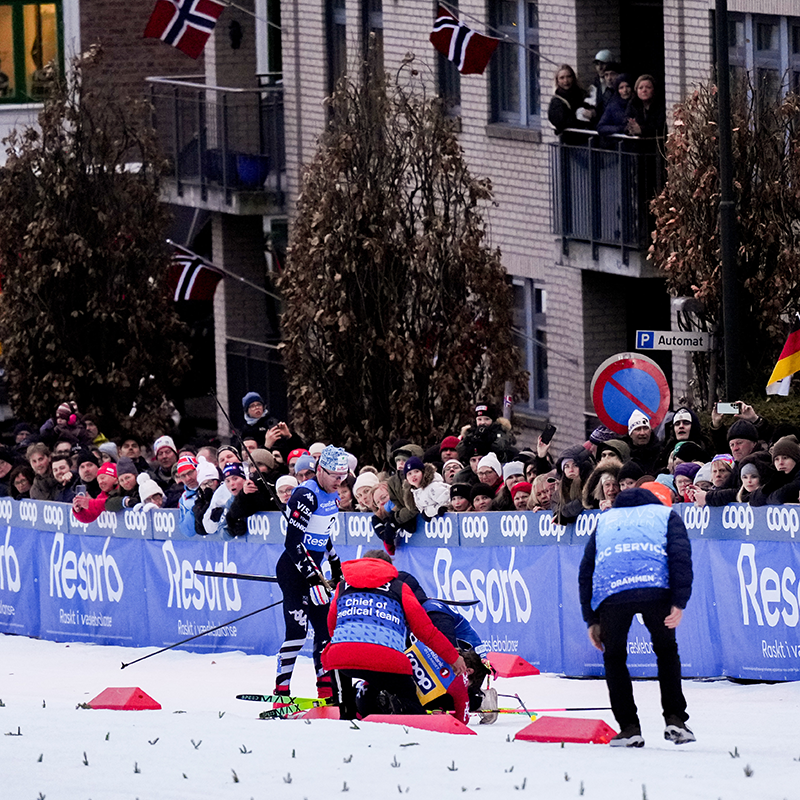
The women’s sprint final comes into the finish in Drammen, Norway with: Laura Gimmler (GER), Ane Appelkvist Stenseth (NOR), Jonna Sundling (SWE), Nadine Faehndrich (SUI), Johanna Hagstroem (SWE), and Kristine Stavaas Skistad (NOR), (l-r). (Photo: Nordnes/NordicFocus)
The snow was trucked in, the rock band was playing near the finish, and Norwegian children cheered from second-story windows along the course. On a rare midweek World Cup race day in Drammen — a small city just southwest of Oslo where the sprint course loops through the streets, wraps around an old fountain, and finishes on the snow-covered steps of an iconic church — Jonna Sundling of Sweden took home another World Cup sprint victory.
Sundling won the women’s classic sprint, going stride for stride with Norway’s Kristine Stavaas Skistad before pulling away in the final meters. Switzerland’s Nadine Faehndrich, racing her final classic sprint before retirement, earned the bronze.
It was Sundling’s fifth individual World Cup victory of the season and the latest chapter in an intensifying rivalry with Skistad that has captivated ski fans, especially Scandinavian ones, for the last few seasons. From the World Championship final in Trondheim last year to the Olympic final in Milano Cortina, Sundling, with the rest of the Swedish sprinters, and Skistad have been locked in a tactical chess match. On Thursday in Drammen, it was Sundling who played the final move.
Quarterfinal number one heads up the first climb with: Barbora Antosova (CZE), Mathilde Myhrvold (NOR), Jessie Diggins (USA), Melissa Gal (FRA), (l-r). (Photo: Nordnes/NordicFocus)
Qualification and Quarterfinals
Sweden’s Linn Svahn, the reigning Olympic sprint champion, posted the fastest qualification time at 2:41.87 — nearly three seconds clear of Sundling’s 2:44.39. But qualification speed, as World Cup sprinting always reminds us, is only the entry ticket.
Two Americans advanced to the heats. Jessie Diggins, the overall World Cup leader wearing the yellow bib in what she called a “full circle moment,” qualified 17th in 2:50.91. Rosie Brennan, seeded 28th, also made the top 30.
Diggins chose Quarterfinal 1 alongside Sundling and Skistad — a loaded heat. Skistad took the win with Sundling second via a photo finish, just 0.18 seconds separating them. Diggins fought hard for third, advancing as a lucky loser after finishing just 0.22 seconds behind Sundling.
Rosie Brennan (USA) said after the race, “Drammen is one of my favorite races, it’s a fun course and always has a lively atmosphere.” (Photo: Nordnes/NordicFocus)
Brennan’s day ended in the quarterfinals. Racing in Heat 3, she bobbled heading into the downhill and lost the draft, which was a costly moment on a course where the slipstream effect was enormous all afternoon. She finished fifth in her heat.
“I was happy to get a chance in the rounds, but the conditions were very tough,” Brennan said. “They salted the course, and it was skiing great in the qualifier and then got really icy for the rounds. Anyway, I bobbled into the downhill and lost the draft and then just don’t have the power I need to pass that many people up the finish stretch, so I was disappointed to not be more in the mix.”
Meanwhile, Svahn survived a scare of her own… as her quarterfinal rounded the fountain that anchors the bottom of the course behind the start gates, five of the six athletes ended up in a pile and Svahn seemingly had the most bodies and equipment to navigate as she got back out on the course, but somehow recovered to advance. The Olympic champion’s troubles, however, were only beginning.
Maja Dahlqvist (SWE) and Jessie Diggins (USA), (l-r) during the second semifinal. (Photo: Nordnes/NordicFocus)
Semifinals
The two semifinals told entirely different stories, and the contrast between them shaped the final.
In Semifinal 1, Skistad took the win with Sundling second, just 0.20 seconds back. Both advanced automatically. Behind them, Svahn finished third and would not advance.
Semifinal 2 was a different race entirely. Johanna Hagstroem and Ane Appelkvist Stenseth pushed the pace from the gun, stringing the field out over the first climb. But on the long downhill, the draft did its work. Faehndrich and Laura Gimmler of Germany surged past, using the slipstream to slingshot into the lead.
Nadine Faehndrich (SUI), who is planning to retire after the season, found a little extra Drammen magic today as she finished on the podium in third. (Photo: Nordnes/NordicFocus)
Faehndrich won the heat decisively. Gimmler was second. The fast overall times meant Hagstroem would advance along with Stenseth, who just out-lunged Diggins for fourth and the second lucky loser position.
For Diggins, the day ended in 10th. But she left Drammen at peace.
“This was really cool because the Drammen area was my first ever World Cup start and it was a skate sprint,” Diggins said. “So it’s kind of a very full circle moment to close it out with a classic sprint here as the last classic sprint of my career.”
She had tried something new in the heats, sitting in the draft instead of going to the front, a departure from her usual aggressive approach. “Normally, because literal strength is not my strength, I usually just try to go really, really hot and try to go off the front,” she said. “I was like, nope, I don’t think that’s gonna work for me here with the crazy draft and slingshot effect. I was taking a lot of notes in warm-up, and in the quarterfinal, I had the smallest tuck of my life. It was just really fun to try to believe in myself as more of a pure sprinter and to try to be a little more tactical.”
She acknowledged she ran out of power in the semifinal, but had no regrets. “I still felt like I executed my plan to the best of my ability, and that’s always a cool feeling.”
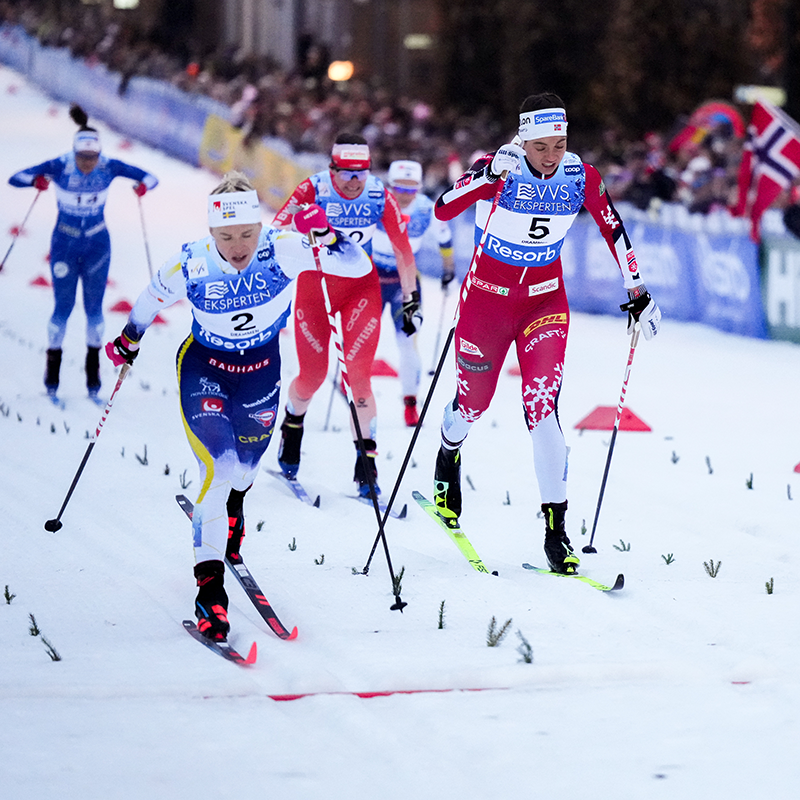
Jonna Sundling (SWE) crosses the finish line just ahead of Kristine Stavaas Skistad (NOR) for the win in Drammen, Norway. (Photo: Nordnes/NordicFocus)
The Final
Six women lined up for the final: Sundling and Hagstroem for Sweden, Skistad and Stenseth for Norway, Faehndrich for Switzerland, and Gimmler for Germany. Svahn and Maja Dahlqvist, the Olympic gold and bronze medalists in the sprint classic, were both absent.
On the opening climb, Skistad sat behind Sundling in a familiar posture — patient, conserving, waiting for the right moment. As Kikkan Randall mentioned on the broadcast, Skistad almost never leads into a downhill. She baited Gimmler into taking the front position, then tucked into her slipstream.
Coming off the descent and around the final hairpin, Faehndrich made her bid, surging past Gimmler and into third. But the race was between the two women everyone expected.
Sundling and Skistad skied side by side on the final climb, and what followed was a scene that encapsulated their rivalry. Stride for stride, shoulder to shoulder, neither yielding a centimeter. Sundling’s transition from double pole to striding was fractionally sharper — she carried more momentum through the final meters — and she crossed the line with a small advantage.
“It is usually very tight in Drammen, but today it was extremely tight,” Sundling said on air afterward. “Till the last meter. I was like, okay, I need to continue all the way over the finish line. It was tough, but I’m happy that I was the first person over the line.”
For Faehndrich, the bronze was a fitting farewell. The 30-year-old Swiss racer, who announced her retirement this season, now sits third in the sprint World Cup standings at 700 points — just behind Hagstroem (708) and within striking distance of leader Dahlqvist (720) heading into the final sprint of the season in Lake Placid next weekend.
Jessie Diggins (USA) gave her fans something to cheer about during her quarterfinal when she charged to the finish line. (Photo: Nordnes/NordicFocus)
Looking Ahead
Diggins continues to lead the overall World Cup standings with 1,961 points, 275 points ahead of Sweden’s Moa Ilar, a margin that appears insurmountable with four races remaining. The distance globe, too, seems firmly in her grasp. But the sprint crystal globe race is wide open: Dahlqvist, Hagstroem, and Faehndrich are separated by just 20 points at the top of the standings, and the final sprint in Lake Placid could decide everything.
For Diggins, there’s another milestone ahead — she’s only a few nights away from sleeping in her own bed before racing in front of an American crowd at the World Cup Finals. “Very, very, very excited about that,” she said.
The World Cup moves to the historic Holmenkollen venue in Oslo on Saturday for the Women’s 50 k Freestyle Mass Start, before the season concludes in Lake Placid, New York, March 20-22.
Feature stories like this one take time, access, and care to produce. If you value thoughtful storytelling and independent ski journalism, please consider becoming a Voluntary Subscriber. Your support directly fuels the work we do to cover the people, places, and moments that make our sport special.
This coverage is made possible through the generous support of Marty and Kathy Hall and A Hall Mark of Excellence Award. To learn more about A Hall Mark of Excellence Award, or to learn how you can support FasterSkier’s coverage, please contact info@fasterskier.com.
Jessie Diggins (USA) on her way to third place in the 10 k Classic Individual Start in Lahti, Finland. (Photo: Authamayou/NordicFocus)
As Jessie Diggins climbed the final hills in Lahti on Sunday, she could hear something unusual rising above the crowd noise. Scattered along the course were hand-made signs held by Finnish fans and young skiers. Many carried the same simple message: “Thank you, Jessie.”
For Diggins, racing through what has increasingly become a farewell tour of World Cup venues that have defined her career, the moment carried emotional weight. Lahti has not always been a place where the American felt the course played to her strengths, particularly in classic technique. But on Sunday, she delivered one of her most meaningful performances there, skiing to third place in the women’s 10-kilometer classic interval start.
“There were so many people out on the course with signs saying ‘Thank you, Jessie,’ and it was really emotional in the best way,” Diggins said afterward. “It was incredibly touching. Seeing all the little kids in glitter after the race was just really special.”
Frida Karlsson (SWE) on her way to the 10 k Classic win in Lahti, Finland. (Photo: Authamayou/NordicFocus)
Sweden’s Frida Karlsson powered to the victory in 25:57.6, edging teammate Linn Svahn by just over four seconds. Diggins followed in third, 6.2 seconds behind the winner, securing the 90th World Cup podium of her career — a milestone that came in her 375th World Cup start.
The podium also represented a breakthrough for Diggins in a discipline she has spent years working on. Despite her long list of accomplishments, Sunday marked her first World Cup podium in a standalone 10-kilometer classic interval start.
“The Lahti course hasn’t always suited my strengths in classic skiing,” Diggins said. “So it felt really cool to pull it together a bit more today.”
The result allowed Diggins to maintain control of both major season-long competitions. With only three World Cup stops remaining this winter, she continues to lead Sweden’s Moa Ilar by 264 points in the Overall World Cup standings and by 188 points in the Distance standings, positioning herself strongly in the race for the sport’s coveted crystal globes.
Moa Ilar (SWE) and Linn Svahn (SWE), (l-r) reflecting at the finish. (Photo: Authamayou/NordicFocus)
Svahn Sets the Early Benchmark, Karlsson Finishes the Job
With the interval format — one athlete starting every 30 seconds — stretching the field across the Lahti course, the first major time to chase appeared almost immediately.
Sweden’s Linn Svahn, starting with bib 5, was among the earliest contenders onto the course and quickly posted the fastest times through the early checkpoints. Known primarily as one of the World Cup’s dominant sprinters, Svahn skied aggressively over the opening kilometers and established the benchmark that much of the field would spend the next hour chasing.
Her time held atop the standings as racer after racer attempted to match it.
Later in the race, however, another Swede began to close the gap. Frida Karlsson, wearing bib 40, remained within seconds of Svahn through the intermediate checkpoints before edging ahead in the final kilometers.
“I was just trying to stay in my own skiing,” Karlsson said afterward. “I heard it was between me and Linn, and I was super excited to get that fight.”
Karlsson ultimately crossed the line in 25:57.6, securing the victory by 4.1 seconds over her teammate.
The win came after a brief illness, which prevented her from competing in the Olympic 50 k, but Karlsson said she was eager to keep racing despite the setback.
“I was sick after the Olympics, but I was really excited to keep racing and just do what I know best,” she said. “So I’m super glad to be here.”
Diggins, starting shortly after Karlsson, kept herself in contention throughout the race, skiing within striking distance of the Swedish pair at each checkpoint before finishing 6.2 seconds back in third place.
Linn Svahn (SWE) on her way to second place. (Photo: Authamayou/NordicFocus)
Three Different Approaches to the Same Race
The split times revealed three distinct pacing strategies among the podium finishers.
Svahn, starting fifth, set the tone early. She posted the fastest time through the opening 1.1 kilometers and maintained the lead at the 3.4-kilometer checkpoint, immediately putting pressure on the rest of the field as they left the start gate.
Karlsson, starting later in bib 40, remained just seconds behind through the early checkpoints, skiing a controlled opening before gradually closing the gap. By the middle of the race, she had moved into contention, and over the final kilometers, she proved strongest of all, ultimately pulling ahead to secure the victory.
Diggins, meanwhile, delivered perhaps the most evenly paced effort of the three. She remained within striking distance of the leaders at every checkpoint — fifth at 1.1 kilometers, third by 3.4 kilometers, and still in podium position through the final lap.
That steadiness proved decisive in the final standings. While the two Swedes battled for the win, Diggins’ consistent pace allowed her to secure third place and another important podium in the fight for the season-long crystal globes.
Jessie Diggins (USA) sprints for the finish line. (Photo: Authamayou/NordicFocus)
Diggins’ Classic Progress
Diggins’ podium also reinforced one of the season’s quieter developments: the continued evolution of her classic technique.
For much of her career, the American’s greatest moments have come in skating events, where her aggressive pacing and powerful finishing speed often prove decisive. But this season she has shown remarkable consistency in classic distance races, finishing in the top ten in every classic distance event on the World Cup calendar.
Conditions in Lahti — warming temperatures and increasingly soft tracks — placed an additional premium on ski preparation, something Diggins was quick to acknowledge after the race.
“I had great skis, which is a huge part of the equation, especially when the conditions get slushy,” Diggins said. “This podium really belongs to the team. I’m so grateful for all the hard work they put in.”
Rosie Brennan (USA) on her way to 12th place. (Photo: Authamayou/NordicFocus)
Brennan Continues Return to Form
A bit further down the results list, fellow American Rosie Brennan continued a gradual return toward form after a long battle with illness that has affected much of her season.
Brennan finished 12th (+38.6) in Lahti, a result that reflected both solid skiing and a cautious approach early in the race.
“This whole process has really been a game of time,” Brennan said. “There have been many moments when I’ve wondered if I’ll ever feel normal again in my life. But the last three days are the most normal I’ve felt racing since December 2024.”
The Lahti course, known for its steep climbs and technical demands, offered a test of efficiency in classic technique — a challenge Brennan felt she handled well.
“Lahti requires really good technical skiing,” she said. “I felt like if I could relax and focus on my classic technique, that would give me the best chance.”
Kendall Kramer (USA) working her way up one of the many Lahti climbs. (Photo: Authamayou/NordicFocus)
Kramer Finds Lessons in the Lahti Hills
For American Kendall Kramer — 42nd in 27:40.8 (+1:43.2) — the Lahti race presented a different kind of challenge: starting first.
Wearing bib 1, Kramer had the advantage of pristine tracks before the course began to break down as temperatures warmed. But the early start also meant racing without reference splits from the rest of the field.
“I was actually okay starting with bib 1 today, given the state of the tracks,” Kramer said. “They tend to break down as the race goes on, and the corners can get icy, so it was nice to have cleaner conditions early.”
Without other athletes on course to gauge pacing against, Kramer said the race became more about skiing freely and trusting her own effort.
“Racing without reference splits definitely makes pacing tougher, but at the same time it lets you ski freely and focus on your own race.”
The steep Lahti climbs also highlighted the technical demands of classic skiing at the World Cup level.
“The punchy hills were fun because I could really bound up them, which is something I haven’t done much in World Cup racing so far,” Kramer said. “But the sections where it turns into pure power striding showed me I still have a lot to work on.”
Despite the challenges, Kramer described the experience as valuable for understanding the technical standards required to compete consistently at the highest level.
“I’ve learned so much from racing here this season,” she said. “At the World Cup, every strength and every weakness gets highlighted, and that really helps show what to work on heading into the summer.”
Julia Kern (USA) catches a rest from both the climbs and the sunlight. (Photo: Authamayou/NordicFocus)
Kern Heading Home Early to Recover
Julia Kern, who finished 51st — 28:11.4 (+2:13.8) — today, said she will return home early from the World Cup circuit as she continues working through health issues that have lingered since the Olympic races.
“I’ve been battling my body on various fronts since the Olympics,” Kern said in a team media statement. “One of my strengths is showing up and continuing to try and believe despite the challenges, while also being patient and smart.”
Kern added that she will take additional time to recover while seeking answers about her condition, with hopes of returning to competition at the Stifel World Cup Finals in Lake Placid later this month.
“Right now, my body needs more time to recover and is in search of answers, so I’m headed home early with the hopes of being in a place to race in Lake Placid.”
Lauren Jortberg (USA) and Katherine Weaver (CAN), (l-r) charge for the line. (Photo: Authamayou/NordicFocus)
Jortberg Gets a Front-Row Look at Karlsson’s Pace
For American Lauren Jortberg — 55th in 28:32.7 (+2:35.1) — the Lahti race offered a unique opportunity to measure herself against one of the sport’s best.
Early in the race, Jortberg found herself skiing behind Sweden’s Frida Karlsson for several kilometers as the eventual winner was completing her second lap while Jortberg was still on her first.
“I skied with Frida for about three kilometers, which was really cool,” Jortberg said. “She’s obviously a beast, and it was cool to hang with her and get a taste of what that pace actually feels like.”
Jortberg said the experience offered valuable insight into the demands of racing a 10-kilometer interval start at the World Cup level, where pacing often means pushing near maximum effort from the start.
“Ten-k pacing on the World Cup is basically as hard as you can go the whole way,” she said. “It’s about learning how to navigate that kind of effort and still ski your own race.”
She added that the race reinforced both the progress she has made in classic technique and the areas she hopes to continue developing as she gains more experience at the international level.
“I’m really proud of how my classic skiing is coming along,” Jortberg said. “There’s still a lot to work on, but it was definitely a good first start in a distance race.”
Jortberg said she hopes to carry the fitness and lessons from Lahti into the next stop on the World Cup circuit in Drammen, Norway.
Emma Albrecht (USA) giving it everything she can all the way to the finish. (Photo: Authamayou/NordicFocus)
Albrecht Sees the Margins Up Close
Further back in the start order, fellow American Emma Albrecht — 58th in 28:50.7 (+2:53.1) — experienced firsthand just how tight the margins can be in World Cup distance racing.
“The tight margins were shown by skiers finishing at similar times,” Albrcht said after the race. “For me, I was not passed, and I did not pass anyone. Which meant the skiers in front and behind me were skiing at a similar pace to me.”
Like Kramer, Albrecht said the steep Lahti climbs emphasized the technical demands of classic technique, particularly the efficiency required to stride uphill without losing grip.
“The uphill sections are the most technical and demanding here,” she said. “The climbs in Lahti are steep, and striding up efficiently requires really good technique to avoid slipping.”
For Albrecht, the race served as a clear reminder of the areas she hopes to refine moving forward.
“One of my biggest takeaways is that I want to keep working on my striding technique and get better at adjusting my tempo based on the terrain.”
Dariya Nepryaeva (AIN) and Novie Mccabe (USA), (l-r) come to the line. (Photo: Authamayou/NordicFocus)
Other North Americans in the Field
Novie McCabe raced her way to 43rd in 27:45.0 (+1:47.4) in the 64-skier field.
For Canada, Jasmine Drolet led the team in 41st place with a time of 27:39.8 (+1:42.2). Liliane Gagnon finished 46th in 27:56.4 (+1:58.8), and Katherine Weaver placed 59th in 29:00.9 (+3:03.3). Teammate Olivia Bouffard-Nesbitt, who had been listed on the start sheet, did not start the race.
Take a bow, Jessie Diggins (USA) . (Photo: Authamayou/NordicFocus)
The Season’s Final Push
Sunday’s race in Lahti brought us even closer to the end of the season, now with only two sprint races and three distance races remaining until the sport’s biggest prizes will ultimately be decided.
For Diggins, the third-place finish represented more than another podium in an already historic career. It also reinforced the remarkable consistency that has defined her season. With top-10 finishes in every classic distance race this winter, she has transformed what was once considered a relative weakness into one of the foundations of her bid for both the Overall and Distance crystal globes.
Three stops remain on the calendar: the classic city sprint in Drammen, Norway, the iconic 50-kilometer race at Holmenkollen in Oslo, and the Stifel World Cup Finals in Lake Placid, New York.
For Diggins, those races now carry both competitive stakes and emotional significance. As the American continues what has increasingly felt like a farewell tour across the World Cup circuit, the crowds that gathered along the Lahti course on Sunday offered a glimpse of how much her career has meant to fans of the sport, not just in the United States, but all around the world.
And as Diggins pushed across the final climbs toward the stadium — signs waving, glitter-clad children cheering from the side of the course — she did what she has done so often over the past decade: she kept fighting for every second and left everything she had, once again, on the course.
Feature stories like this one take time, access, and care to produce. If you value thoughtful storytelling and independent ski journalism, please consider becoming a Voluntary Subscriber. Your support directly fuels the work we do to cover the people, places, and moments that make our sport special.
Linn Svahn (SWE), Frida Karlsson (SWE), and Jessie Diggins (USA), (l-r) share the 10 k Classic podium in Lahti, Finland. (Photo: Authamayou/NordicFocus)
This coverage is made possible through the generous support of Marty and Kathy Hall and A Hall Mark of Excellence Award. To learn more about A Hall Mark of Excellence Award, or to learn how you can support FasterSkier’s coverage, please contact info@fasterskier.com.
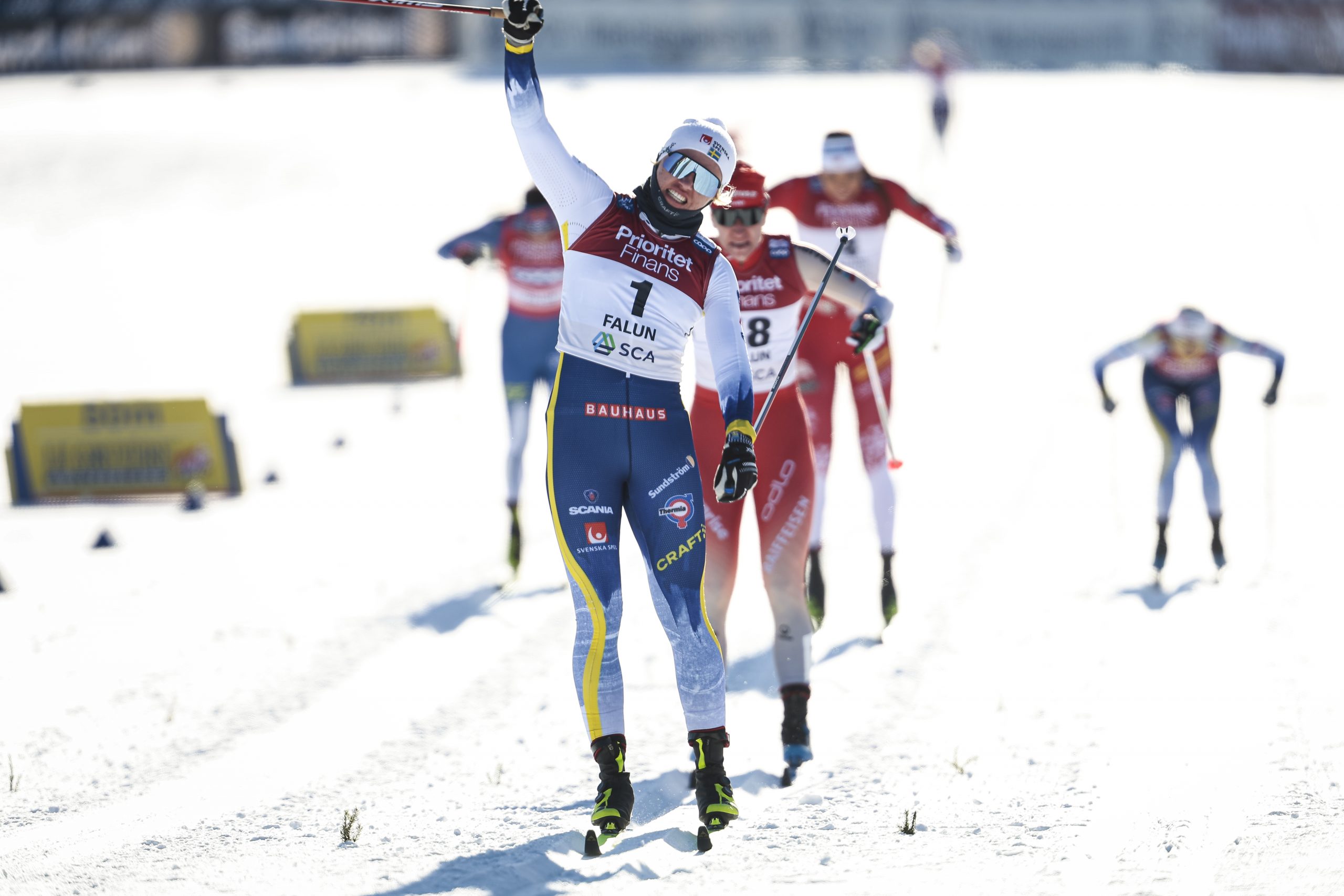
Linn Svahn (SWE) can afford to ignore all the recommended tactics normally employed on Falun’s infamous Sprint course. She’s just too fast. (Photo: Thibaut/NordicFocus)
Falun’s Sprint course rewards experience . . . but not every skier who possesses that experience pays very close attention. Skiers can get distracted by how they feel, by how their heat is shaping up, by the tactics of others. Sometimes, that sort of counter-punching can prove profitable. Not in Falun . . . not on most days anyway.
In Falun, skiers prepare for an infamous and well-known draft on the penultimate downhill . . . they either deal with that draft, or they find themselves out of contention. By now, every skier should know that whomever is leading at the top of the significant downhill is almost certain to be swallowed up by the field. Leading is a mistake, and it appears nearly impossible to establish enough of a lead to overcome the advantage gained by skiers speeding up from behind. Falun represents perhaps the most tactical—and most obvious—of all World Cup Sprint courses. And it will manufacture that same crucial factor next year when the World Championships are staged on this very same course. If skiers take advantage of watching replays of these races, they’ll begin to see that there’s only one tactic to employ in Falun . . . unless, of course, you just happen to be lots faster than everyone else, like Linn Svahn.
In the Sprint final, Svahn found herself forced to the front by a cagey Kristine Stavaas Skistad who positioned herself to take advantage of Falun’s infamous draft. What Skistad did not anticipate was the raw speed that Svahn would bring to the Final. Stuck as she was at the front, Svahn simply engaged the after-burners on the course’s penultimate uphill—a tactical decision that had proven disastrous for every other skier in Falun’s Sprint heats. Accelerate there, and you’re all but certain to get caught on the downhill. But Svahn is riding the crest of a wave that has carried her to the very top of the Sprinting world. The same speed she employed to claim dominant wins in both the Classic Sprint and Team Sprint in the Olympics a week ago continued to propel her to the top step of the podium in Falun. Skistad set things up well in the Sprint Final, but Svahn was simply too strong.
Nadine Faehndrich (SUI) continued her recent podium run in third place ahead of Coletta Rydzek (GER), Maia Dahlqvist (SWE) and Johanna Hagstroem (SWE).
Americans qualified two skiers into the heats—Jessie Diggins and Sammie Smith—both of whom would find themselves undone by Falun’s infamous draft in their quarterfinal heats. Diggins would finish the day 17th, Smith 23rd.
Canada’s Liliane Gagnon would qualify seventh, confirming her arrival on the international Sprint scene by advancing to the semifinal where she wold finish tenth on the day.
Liliane Gagnon (CAN) announced her arrival as a World Cup Sprint contender with a brilliant 10th place finish in Falun. (Photo: Authamayou/NordicFocus)
After the Olympics . . .
The Olympics are over, the biggest pressure is off, the medals are stowed safely away. Now it’s back to the re-start of the World Cup season that these skiers began months ago. Returning, as the skiers do now, to the post-Olympic season, this is a time when we may find out who is truly worn out from the Games, contrasted with who may have mis-calculated their peak for the Olympics, but may now find themselves in top shape as all those who collected Olympic medals are strangely and uniquely vulnerable.
The weeks following the biggest competitions are sometimes full of surprises, especially when a few of the medal-winners and event-dominators choose to stay home. Who can blame them? They spent weeks and months and years and careers building up to those Olympic Games. And those who succeed in claiming the medals that the media expected must then run the loving gauntlet of media attention and sponsor responsibilities that accompany Olympic success. After the Lake Placid Olympics in 1980, where the immortal speedskater Eric Heiden had proven to be unbeatable (winning all five of the five speedskating events), Heiden signed up for the All-Around World Championships, where he promptly got beat. Lesson learned: just because you’re the best one week doesn’t guarantee you’ll be the best every week . . . not after the insistent press, the pressing sponsorship responsibilities, and the adoring crowds have gotten done with you, anyway.
Diggins entry into the Falun’s World Cup Freestyle Sprint was significant for another reason: after today, she stands alone as the skier who has recorded more individual World Cup starts than any other. (Photo: Jason Cork/FasterSkier)
Switzerland has one of its medalists on the starting line, but not the other. Nadine Faehndrich is here, but no Nadja Kaelin (medalist in both the Team Sprint—with Faehndrich—and the 50 k). Sweden has its newly crowned Sprint Queen, Linn Svahn, in the lineup, but Jonna Sundling—Sweden’s former Sprint Queen—has stayed home. And of course the USA’s Jessie Diggins was here . . . isn’t she always here? Every weekend, every event, every starting line, Jessie Diggins lines up to race. That’s why she’s seemed nearly impossible to best in the season-long World Cup standings: she’s almost always signed up to race, and she’s almost never out of contention. It’s an astonishing level of durability and prolonged excellence, one that we’ll be able to enjoy and appreciate for only a few more weeks until her retirement . . . until that racer who we’ve known would always be there is no longer there. Believe me, we’ll miss Jessie Diggins terribly in seasons to come.
But, for the time being, Diggins has a World Cup Overall title to defend . . . a defense that would benefit from a few more Sprint points. Her fourth place qualifying time would reward her efforts, but she would ski impatiently in her quarterfinal, fining herself undone by the strategic draft that heat-leaders give up on Falun’s Sprint course. Diggins would finish fourth in a heat that was not fast enough to offer advancement as a lucky loser.
“It was my 357th World Cup start,” said Diggins. “It was just a really cool chance to feel extra grateful to my team, to look back on why that was possible, and to look at the bigger message for me here, that asking for help with my mental health got my physical health to a place where I could race this hard for this long . . . And the season isn’t over yet!”
Samantha Smith (USA) just keeps getting stronger week after week. (She would qualify 19th, and finish the day 23rd). Photo: Thibault/NordicFocus)
Tactics on Display
The first quarterfinal involved Skistad and Svahn. Skistad dangled at the back mid-heat, but glided forward on the final downhill to finish second behind Svahn.
Liliane Gagnon (CAN) qualified seventh at the start of the day, and she skied strongly in the second quarterfinal (won by Switzerland’s Nadine Faehndrich) to claim a lucky loser spot, and a space in the semifinal.
Diggins headlined Quarterfinal 3. She led from the start but seemed hindered by slower skis onthe significant downhill. Diggins ran out of gas in the final straightaway as the heat was taken by Coletta Ryzek (GER) ahead of Moa Ilar (SWE).
Sammie Smith (USA) began the day aas the 19th qualifier, continuing to show the form that saw her named to the US Olympic Team. Smith lined up in Quarterfinal 5 where Julie Myhre (NOR) and Johanna Hagstroem (SWE) provided the early pace. Smith has begun to reveal a strategic preference: allowing herself to drop back into the field early on, then charging forward late in the race. She did that again in Falun, storming up the final climb. Unfortunately, experience suggests that the draft given up on Falun’s Sprint course is often the deciding factor, and Smith (like Diggins before her) found herself swallowed up on the descent. Hagstroem would take the heat win, ahead of Julie Bjervig Drivenes (NOR).
“I felt like I skied the hills really strong today and was disappointed with some of my tactical decisions,” said Smith. “Unfortunately, Falun is notorious for a large draft on the final downhill. I was trying to ski to my strengths today, but I should have been more patient and tried to tuck behind other skiers so I didn’t get drafted so much.”
“The more time I have on skis, the more races I get to do, the better I feel,” Smith continued. “I’m really looking forward to the last few weeks of the season.”
Kristine Stavaas Skistad (NOR) showed that she understood the tactics that Falun’s Sprint course dictates, but Linn Svahn (SWE) was just too fast. (Photo: Authamayou/NordicFocus)
Tactics Confirmed—Sprint Semifinals
Semifinal 1 offered Skistad a chance at Redepption after a disappointing fifth place finish in the Olympic Classic Sprint,and she perhaps better than anyone else seemed to understand the importance of utilizing Falun’s draft. Gagnon streaked forward to contend with Svahn and Faehndrich, while Skistad and Rydzek—famously fast closers—lingered at the back. Skistad easily coasted back into contention in the draft of the long downhill, and was able to get to the tails of Svahn before the finish line. Those two would move on to the final while Rydzek and Faehndrich would wait to see if they would move forward as luckylosers.
The second semifinal involved a slate of Swedes: Moa Ilar, Moa Lundgren, Hagstroem, and the cagey veteran, Dahlqvist, who rarely leads in the early stages of heats. True to form, Dahlqvist hovered around third or fourth. Hagstroem would ski the downhill draft section to perfection, launching into the lead at the bottom, and followed across the line by Dahlqvist. Again, experience ahead of speed.
Linn Svahn (SWE) established a gap ahead of Kristine Stavaas Skistad (NOR) in the Sprint final. Usually, Falun’s course would not reward such audacity, but Svahn was able to hold her advantage to the end. (Photo: Authamayou/NordicFocus)
Tactics Defied
In the ongoing defense of her lead in the season-long Sprint standings, Dahlqvist had done her job in just getting to the Final. Her lead would be protected for another week in her quest to finish the season wearing the Sprint leader’s red bib. But the other skiers in the Final had other challenges in mind. Team Sweden’s Hagstroem, Svahn, and Dahlqvist matched up against Skistad, Faehndrich, and Rydzek. Skistad went to the front, where it appeared she would control the pace (and force others to go around her into the lead). Her tactic seemed to be working as Svahn found herself at the front. Skistad must’ve been pretty satisfied with that positioning . . . satisfied, that is, until Svahn applied the power. In just a few strokes, Svahn accelerated up the hill where no one else dared acccelerate, creating a massive gap that left Skistad in an unexpected panic.
While Skistad may be one of the fastest sprinters in the world, her strength is definitely not in quick acceleration. Though Skistad would chase gamely, Svahn was gone, the finish line photo making the result appear far closer than it really was. Faehndrich would hold on for third ahead of a fast-charging Rydzek. Dahlqvist would finish fifth, holding her lead in the World Cup standings, but seeing her lead shrink in the wake of Faehndrich’s podium performance. That season-long race is definitely tightening, and appears likely to be decided in the final World Cup weekend in Lake Placid.
Feature stories like this one take time, access, and care to produce. If you value thoughtful storytelling and independent ski journalism, please consider becoming a Voluntary Subscriber. Your support directly fuels the work we do to cover the people, places, and moments that make our sport special.
This article was made possible through the generous support of our voluntary subscribers who have helped put our Nat Herz on the ground at the Olympics. If you value coverage like this, please support FasterSkier with a voluntary subscription.
Norway claimed the Team Relay gold medal in the Olympics of Milano-Cortina. Heidi Weng (NOR) skied the anchor leg all alone . . . she never would’ve expected that. (Photo: Vanzetta/NordicFocus)
On paper, no one beats Sweden. After the first three events of these Olympics, Sweden had won all three gold medals. Before the games began, most ski-experts gave few other nations a chance of grabbing any gold in Women’s Cross-Country . . . especially not in the relay. Just consider Sweden’s roster: Linn Svahn, Ebba Andersson, Frida Karlsson, Jonna Sundling. Svahn is the world’s best sprinter. With two silver medals thus far, Andersson has proven herself the second best distance skier at these Olympics. The first two gold medals in Olympic distance races have been won in peerless fashion by Karlsson. And Sundling has been Sprint racing’s World Championship and Olympic Gold medalist. If you wanted to construct a relay team that was certain to win gold, those are the names you’d print on your entry.
On paper, no one beats Sweden, but cross-country ski racing is a sport that regularly refuses to follow the script, and Olympic medals aren’t handed out based on which team submits the most impressive set of skier résumés. Ski racing happens out on a snow covered course between start lines and finish lines: punishing uphills, treacherous downhills, sharp curves, and variable snow. It’s not a running race . . . and the challenges of racing at high speeds on long, flexible skis with no metal edges means that just about anything can happen.
And it did . . .
The field of the 2026 4 x 7.5 k Olympic Relay leaves the starting line. Drama would be soon to follow. (Photo: Barbieri/NordicFocus)
Scramble
Skiers call Leg 1 of the relay the “Scramble Leg,” a self-evident appellation that often finds teams assigning a capable sprinter to the task. The first kilometer of Leg 1 can be a crowded scrum—shoulders rubbed, elbows thrown, ski tails trod upon, poles at risk. The job of the Leg 1 skier is simple: weave through traffic, stay out of trouble, don’t get dropped. The Val di Fiemme course has already shown that it challenges racers with its tight turns and slushy snow. Falls have been common and consequential in Nordic events thus far in the Olympics. And a race day that offered 40 degree temperatures and light rain made the waxing a bit of a tricky prospect for the first two Classic legs.
Racers would ski two laps of 3.75 kilometers each. Though the field endured the rippling effects of a crash in the opening kilometers, the race settled quickly into a pack of 12 contenders. By the second lap of Leg 1, Svahn had begun to open a gap—not so much a breakaway as it was a demonstration of a team racing at a different level. Norway’s Kristen Austgulen Fosnaes and Italy’s Iris di Martin Pinter gave chase, but it appeared that the expected Swedish dominance had begun.
Julia Kern (USA) maintained her position in the top 12, but seemed to be struggling a bit to do so. The American team has struggled with slow Classic skis thus far in these Olympics, but Kern appeared determined to keep her team in contention.
Ebba Andersson (SWE) had a nightmare of a day on the course of the Olympic Relay. (Photo: Vanzetta/NordicFocus)
Leg 2
Kern had continued moving forward through the field, and tagged Rosie Brennan with Team USA in seventh place. Early in the second leg, Andersson suffered an awkward fall that allowed Norway’s Astrid Oeyre Slind to move to the front. Slind and Italy’s Caterina Ganz did their best to add to their advantage as Andersson struggled to overcome the deficit. Just like that, Sweden had a problem: Slind was now racing to win, and Ganz was racing in her home country. Both appeared energized and fresh.
Andersson ultimately reeled in Ganz, but Slind continued to widen the gap. Behind her, the brilliant Classic technician, Kerttu Niskanen had worked Finland back into the race alongside Italy. Brennan continued to maintain USA’s place in the top seven, as Andersson continued working her way back toward the front. Team Swedn knew htat if it could get back to Slind, then Karlsson and Sundling would likely still be able to deliver victory.
And then the wheels fell off the Swedish juggernaut . . . and in most spectacular fashion. Andersson had often appeared uncomfortable during her relay leg. Then, on a fast slushy downhill, she caught the tentative outer edge of a high-speed snowplow, somersaulting her across the course in a violent, end-over-end crash that left her briefly stunned and scattered. Andersson scrambled quickly to her feet, only to find herself standing on only one ski, the other one coasting down the slope with a broken binding. Andersson sprinted forward to collet her ski, but the damage to the binding was too severe. Only one thing left to do: run for it. Cradling her crippled ski in her arms, Andersson began frantically scooter-pushing her way up the course. There are plenty of places on a world-class ski course where coaches and team personnel wait with spare poles (just in case one gets snapped). When skiers break a pole, it’s definitely going to affect their progress and their placing, but those poles will likely be replaced pretty quickly. A broken ski is another matter, entirely . . . and the likelihood of a coach standing in the right place wearing skis preppred with decent race wax is not all that high. Andersson knew her team’s chances were fading, and she ran for her life. Eventually, a coach appeared with a ski that must’ve been a decent match, and Andersson was able to get back into the race.
“Yeah, it was a lot of emotions going through my whole body and the mind at that moment,” said Andersson in post-race interviews. “And, yeah, it was a completely disaster. And first I was thinking, ‘oh, I need to fix it by myself.’ But then I understood that, okay, I won’t be able to do it. So then I just tried to go as fast as possible down the hill and to one of our coaches that was running with a new one. After that, I just tried to minimize the disaster that was already done.”
But the damage had been done. Sweden now trailed by over a minute, and a rejuvenated Team Norway was forcing the pace at the front.
Frida Karlsson (SWE) overcame much of the deficit created by Andersson’s disastrous fall, but the gap was simply too great. Sweden would settle for silver. (Photo: Barbieri/NordicFocus)
Leg 3
Karlsson would start with a deficit of 1:18. She’d start whittling away at that gap as soon as she took to the course. Slind would hand Karoline Simpson-Larsen a lead of 23 seconds over Finland and Switzerland. But every fan’s attention would have been directed to Karlsson as she began Leg 3 with a deficit of 1:18. Karlsson appears to be in tby far the best form of any of the distance skiers at these Olympics, but so wide a gap would be nearly impossible to solve. Nonetheless, she set off in pursuit.
Novie McCabe skied brilliantly to move Team USA into fifth place, but even as she did she found her position eclipsed by the flashing white suit of Karlsson who appeared determined to bring Sweden back into medal position. Like Karlsson, Martina diCenta turned up the speed to overtake Switzerland’s Marina Kaelin, moving the host nation back into third place as the field neared the stadium.
Joy at the finish line: Heidi Weng (NOR) celebrates Norway’s unlikely victory in the Olympic 4 x 7.5 Relay. (Photo: Vanzetta/NordicFocus)
Anchor Leg
Simpson-Larsen handed Weng a lead of 48 seconds, followed another nine seconds later by Italy. Yet another nine seconds later, Karlsson tagged Sundling, who set off in pursuit of the medals. Finland’s Jasmi Joensuu held second place, and Italy’s Federica Cassol clung stubbornly third . . . but Sundling was flying, and Italy and Finland would have no answers for a hard-charging World and Olympic champion.
The anchor leg played out in three segments. At the front, Weng continued to race on alone, checking her speed on each downhill curve, but working the uphills and flats like the former World Cup champion she is. In the medal chase, Sundling was storming forward through the contenders, having already caught Italy, and reeling in Finland before the beginning of the penultimate lap. Behind the medal struggle, Diggins led a small group of chasers poised to claim prizes if any other disasters befell the leaders.
In the end, Weng would hold on to Norway’s lead, jubilantly sprinting across the line even with a lead that needed no such efforts. She screamd with joy at the finish line where she was immediately embraced by her teammates. Norway had felled Goliath, and proved the experts wrong. Behind them, Sundling would shed Joensuu and coast across the line for silver. Sundling skied into the embrace of her teammates, but their posture was anything but celebratory. Finland would claim bronze, followed by Germany, United States, and Italy.
On paper, no one beats Sweden. But cross-country ski racing is a sport raced on snow rather than paper, and Olympic medals are won, not given. Sweden can be proud of an Olympic sliver medal in the Team Relay, but the gold that Norway takes home will be one that will be treasured and remembered for ages.
FasterSkier will have our own Nat Herz on the ground at the Olympics, which, to be honest, is a very big financial lift for us. If you value the thoughtful work and access FasterSkier provides at championships like this one, please consider becoming a Voluntary Subscriber. Your support directly fuels the work we do to cover the people, places, and moments that make our sport special.
This article was made possible through the generous support of our voluntary subscribers who have helped put our Nat Herz on the ground at the Olympics. If you value coverage like this, please support FasterSkier with a voluntary subscription.
Linn Svahn (SWE) has long looked like the best sprinter in the world, but she has only rarely had the chance to prove it. After years of injury and delay, finally she earns Olympic gold. (Photo: Barbieri/NordicFocus)
PREDAZZO, ITALY — Checking today’s ESPN home page makes it clear that the Olympics don’t seem to occupy the American imagination like they once did. I remember the Olympics as being a bigger deal—a set of events that captured the imagination of the world, an international spectacle that occupied the media spotlight. Life magazine, Time magazine, Sports Illustrated: all devoted their covers and countless pages to Olympic events when they were upcoming, to the results when they became available, to the impact that these performances had on the viewing public. There was something bigger about it, something that seemed to separate it from mere sport, something that seemed to elevate it above mere commercialism. These weren’t just athletes; these were Olympians.
They still are . . . Over in Italy, the Olympians are parading in ceremonies and competing in events and collecting medals while national anthems resonate in the crisp mountain air … but ESPN covers only the sports that matter to most Americans: NFL Football and NBA basketball and NHL hockey and MLB baseball and PGA golf, followed by men’s college basketball and women’s college basketball and college softball and MLS soccer and WCW Wrestling and the lingering stories surrounding Super Bowl commercials and Super Bowl halftime shows. And waaaaay beneath all that, we find a mention of the American gold medal in Team Figure Skating and the final helicopter flight of Lindsey Vonn’s legendary career. Thus far in Milano-Cortina, Olympic performances haven’t proven sufficient to capture the attention of a jaded viewing public. The only story American’s are likely to follow in cross-country skiing is that of reigning World Cup Champion, Jessie Diggins. Even with that accolade in hand—even being a defending medalist in the Olympic Sprint—Diggins does not find herself appearing often in the daily conversation that dominates column inches over at ESPN.
Strength and grit, tactics and tenacity: Julia Kern (USA) earned her way through to the Olympic Sprint final. (Photo: Vanzetta/NordicFocus)
And it really is too bad that ESPN may overlook another tremendous story that unfolded in the Women’s Classic Sprint, as the long-suffering Linn Svahn—whose history of injury and ill-fortune has repeatedly interrupted what could’ve been a legendary career—finally grabbed the medal that has always appeared to be within her reach. Svahn led a Swedish sweep of the podium ahead of Olympic and World Champion, Jonna Sundling and the ever-crafty veteran, Maia Dahlqvist. Svahn delivered a performance that cements her place in the history of cross-country skiing. After a long, long wait, Linn Svahn is Olympic champion.
Though it appeared that Americans were still struggling with waxing issues in the soft snow of Val di Fiemme, Team USA saw four skiers advance through qualifying: Jessie Diggins (20th), Sammy Smith (26th), Julia Kern (28th), and Lauren Jortberg (30th). Those qualifying placings did not inspire a tremendous amount of confidence in what was likely to be a lightning-fast day of sprinting. Ultimately, it was Kern who would ski with power and grace in advancing to the Olympic Sprint final where she would finish sixth. Diggins may still be suffering the effects of her crash in Saturday’s Olympic Skiathlon; Diggins skied bravely, but could be seen clutching her injured ribs after placing fourth in her quarterfinal. She would finish the day in 17th.
“My qualifier didn’t go as well as planned,” said Kern. “But it was enough to qualify, and I always get stronger in the rounds. And I had really good skis and played to my strategy and knew I had a strong finish and really never gave up and was hanging really tough when I was pretty tired. And so I went the lucky loser route today, which was my strategy. And that obviously has a cost. So come the final, I was completely spent, but I didn’t know it, and I really gave it my all, tried to be in the mix, and I had left everything on the course to get to the final. And I don’t have any regrets about that. I think that’s what I needed to do to get there. And that’s where I’m skiing right now.”
“Obviously it was 30th, but I think it still wasn’t really, like, my best qualifier,” said Jortberg. “I think there’s still a lot of room to move there, which is cool. And I think had it not been in such a stacked heat, I think it would have maybe been a slightly different quarterfinal for me, but we’re still really proud of how I skied. I think I made a couple tactical errors out there.”
Ultimately, the final American placings were Kern 6th, Diggins 17th, Smith 19th, Jortberg 30th.
“Really exciting to have my Olympic debut,” said Smith. “And I wish I would have done a few things differently in that heat. Like what? I mean, I think I tried to make a move on the left side on the hill. I could have potentially been able to make more time over the top, but it’s pretty incredible opportunity and just excited to be out here and racing.”
Smith explained the challenge and the complexity of competing in the Olympics while simultaneously enrolled at Stanford: “I’m taking material science and engineering. I’m taking environmental law class. I’m taking a creative nonfiction class, doing an independent study as well with a psychology professor,” said Smith. “And then I’m also taking physics. Stanford probably has more Olympians per capita than most places. It’s actually pretty cool. We have four winter Olympians from Sanford this year. So Eileen Gu is competing for China in big air and slope style, Zoe Atkin in half pipe and big air, and then Brandon Kim in speed skating. So it’s pretty cool that there’s four of us. The school’s been incredibly supportive, and I’m excited for all of us to compete.”
Sprint Quarterfinals
Jortberg and Smith lined up together in a quarterfinal that was packed with stars and contenders including Sundling, Kristine Stavass Skistad (NOR), and 2025 World Cup Sprint champion, Jasmi Joensuu (FIN). Sundling went to the front, setting the pace ahead of Skistad, providing a possible preview of the tactics likely to define the Sprint final. Jortberg and Smith dropped to the back where they appeared incapable of overcoming the blistering pace set by Sundling. Over the top of the ultimate downhill, Sundling led Joenssu as Skistad appeared to struggle. But the finish line lies at the far end of a straight downhill, and Skistad’s fast skis and gliding ability were able to dismantle Joensuu. Skistad would follow Sundling across the line to claim automatic spots in the semifinal. Smith would finish fourth to sit in a lucky loser position after the first quarterfinal.
Quarterfinal 2 included Kern, Nadine Faehndrich (SUI), and the day’s top qualifier, Svahn. Faehndrich and Svahn made the pace in the heat, though Faehndrich would fade from contention in the late stages. The suprising Italian, Caterina Ganz, would drive forward to claim the second spot to advance to the semifinal behind Svahn; Kern was able to hold her position in the pack moving forward into third place, a status that would allow her to claim a lucky loser spot in the semifinal.
Johanna Matintalo (FIN) took the third quarterfinal ahead of Laura Gimmler (GER). Julie Bjervig Driveness (NOR) would move into the fastest lucky loser, spot pushing Kern down a spot, but allowing her to remain in contention with two heats remaining.
Still sore from a crash in Saturday’s Skiathlon, Jessie Diggins (USA) gave her all in her Olympic Sprint quarterfinal. (Photo: Vanzetta/NordicFocus)
Diggins started in the fourth quarterfinal alongside Maia Dahlqvist (SWE). They appeared to be the strongest in their heat, and Diggins sprinted directly to the front to set the pace. But the snow in Val di Fiemme was unusually slow, which did not favor the leaders, especially with the course profile that descended steadily to the finish line. Diggins paid the price for leading early, finding herself passed by the field, and unable to improve her position in the finishing straightaway. Diggins would end her day with a fourth place finish in the quarterfinal from which Dahlqvist and Federica Cassol (ITA) would advance.
“I didn’t realize it right after it crashed, when I bruised my ribs,” said Diggins. “But then afterwards, you feel it; right now they really hurt. So I’m doing the best I can. I know I’m in good shape and I really want to make the team proud and I’m just trying the best I can . . . I needed to figure out how to manage this for Thursday. I hope that my body’s feeling better, but my energy is good and I’m excited to be here. I think I’M not a best shape in my life. I just need everything to come together in the right moment. But I know there’s possibility there. So I’m going to keep coming and bring my best.”
Sprint Semifinals
Kern found herself in a semifinal crowded by the résumés of Svahn, Sundling, and Skistad. Sundling and Svahn would claim hte automatic qualifying spots, while Kern would overcome a mid-race loss of speed to finish fourth (behind Skistad) to reside in a lucky loser spot (behind Skistad) with one semifinal remaining. Ultimately, the second semifinal involved fewer stars, and a field that seemed less likely to produce fast times and lucky losers. Driveness and Dahlqvist advanced out of the second semifinal, allowing lucky loser spaces for Skistad and Kern.
Linn Svahn (SWE) streaking toward her Olympic Sprint gold medal. (Photo: Barbieri/NordicFocus)
Olympic Classic Sprint Final
Six months ago, FasterSkier’s Editor-in-Chief made a bold and confident confident call, predicting that Julia Kern would qualify for the Olympic Sprint final. While that early prediction may have been a reflection of the proud Massuchessetts roots he shares with Kern, it also reflected his knowledge of World Cup and Olympic skiing, and his understanding of just what it takes to ski and compete at this level. The Editor knows his stuff, and Kern has proven herself entirely deserving. That Kern advanced to the Olympic Classic Sprint final came as no surprise to Fasterskier.
But Kern was not alone in the final. The cast of characters in this Sprint drama was one that left no room for pretenders or understudies. Kern lined up alongside Skistad, Sundling, Svahn, Dahlqvist, and Driveness. At the crack of the starter’s pistol, Team Sweden began to assert itself as Sundling drove straight to the front. This has been the tactic that has earned Sundling World and Olympic championships, and it came as no surprise to see her at the front. She was followed by Svahn as Skistad appeared overcome by the early pace. At the mid-race point, Dahlqvist eased her way past Skistad, and Team Sweden headed for the podium. At the finish, it was the power of Svahn that drove across the line ahead of Sundling and Dahlqvist. Linn Svahn’s long path had finally delivered her to the destination that fans had always imagined. After years of injury and disappointment, after seasons of patience and impatience, Linn Svahn finally wears the Olympic gold medal.
Julia Kern (USA) used all her experience and every bit of her energy to advance to the Sprint fFinal. (Photo: Barbieri/NordicFocus)
“I am really happy with today,” said Kern. “It’s been a challenging season. I haven’t made it out of the quarterfinals this year. So to make it to the finals of the Olympics Is a huge accomplishment, and I’m really proud of it because I fought really hard today.
The typical ESPN viewer may find other events to be more compelling, but the thrill of competing in an Olympic Games is not lost on the athletes: “I’ve never raced with the rings on my bib,” said Jortberg. “There’s a lot going on, which is super cool, and I feel like I just feed off that.”
On the ground reporting by FasterSkier’s Nat Herz.
Help Support Our Olympic Coverage!
FasterSkier has our own Nat Herz on the ground at the Olympics, which is a significant financial lift for us. If you value the thoughtful work and access FasterSkier provides at championships like this one, please consider becoming a Voluntary Subscriber. Your support directly fuels our work to cover the people, places, and moments that make our sport special.
This coverage is made possible through the generous support of Marty and Kathy Hall and A Hall Mark of Excellence A Hall Mark of Excellence Award. To learn more about A Hall Mark of Excellence Award, or to learn how you can support FasterSkier’s coverage, please contact info@fasterskier.com.
Maja Dahlqvist (SWE) and Laura Gimmler (GER), (l-r) with Jessie Diggins (USA) just behind during the Classic Sprint heats in Goms, Switzerland. (Photo: Authamayou/NordicFocus)
By the time the women clicked into their classic skis in the upper Rhône Valley on Saturday morning, the sprint course in Goms had already made its argument. This would not be a day for pure glide, or pure kick. It would be a day for the awkward in-between—the calculus of wax, confidence, and courage. The kind of skiing that rewards athletes who keep their heads when the track changes mid-lap, when the fastest line is also the most exposed. Here, “relaxed” and “hard” have to mean the same thing.
The official report called the surface “hard packed.” Air was just above freezing (0.4°C). Snow was far colder (-8.0°C). This split-temperature setup can turn one polished corner into a skating rink, and one kick zone into a question you must answer at speed.
With Milano Cortina looming—the last World Cup weekend before Olympic racing in Val di Fiemme—every answer carried extra weight. Sweden, in particular, arrived with a familiar burden: racing to win and also to clarify which few women might fill the nation’s four Olympic start spots in the classic sprint. The day’s story was not just about who won. It was about the ones who looked ready to be chosen.
At the center of it all was Linn Svahn—back on top of a World Cup sprint after what she described, in a post-race on-air interview with FIS, as a challenging year.
“So nice to be back and compete again,” Svahn said. “It’s been like a roller coaster year… It’s one of my favorite courses of the whole World Cup. But it was tough.”
She looked more than “back.” She looked inevitable.
Lauren Jortberg (USA) during qualification. (Photo: Authamayou/NordicFocus)
Qualification: fast snow, sharp edges, and a fraction too much ice
Svahn set the tone immediately, winning the qualification in 3:46.07, with Switzerland’s Nadine Fähndrich second (+1.84) and Finland’s Jasmi Joensuu third (+4.35).
For the Americans, the qualification round was both encouraging and cruel, as sprint prologues often are: three into the top 30, one out by a place.
Jessie Diggins qualified 6th in 3:54.81 (+8.74).
Julia Kern qualified 15th in 3:58.58 (+12.51).
Samantha Smith qualified 26th in 4:00.71 (+14.64).
Lauren Jortberg—was so close—finishing 31st, 4:01.74 (+15.67), one spot out of the heats.
Jortberg’s own description of the qualification captured the emotional violence of that single place. Her plan, she said, was to ski “as relaxed and smoothly as I can,” then push the fast pieces—downhills and turns—hard. She believed she executed that plan almost everywhere.
Except, crucially, at the top of the major climb.
“It was way icier… than when we were warming up on it, and I wasn’t anticipating that at all,” Jortberg said. “I lost a ton of time. I nearly fell because I slipped so much—so that’s really brutal, especially being 31st.”
Her immediate feeling, she admitted, was a strange split: “both devastation and almost like tears of joy,” because of how much she had struggled in classic sprinting in the past—and because, on this day, she could finally feel the gap closing. “There’s more to come,” she said. “I’m really excited to keep working on my classic skiing and showing that I’m a threat in both classic and skate.”
On paper, it reads like a line item: 31st, not qualified. In the body, it feels like something very positive is brewing from many years of hard work.
Julia Kern (USA) and Samantha Smith (USA), (l-r) during the Classic Sprint quarterfinals in Goms, Switzerland. (Photo: Authamayou/NordicFocus)
The heats: Sweden’s depth, Switzerland’s home-course fire, and the shape of the final
The women’s sprint in Goms unfolded in the standard format: five quarterfinal heats of six, two automatic qualifiers from each, plus two “lucky losers” on time; then two semifinals with the same rule; then a final of six.
What made Saturday distinct was how quickly the day shifted from “times” to “tactics.” Goms is not a flat drag race. It’s a course that asks athletes to make decisions—when to risk the inside line, when to conserve, when to surge. Kern noted afterward that those decisions are hard to replicate outside racing.
“For me, nothing beats the effort of racing head-to-head to practice digging really deep,” Kern said. “Those surges and tactics are hard to emulate in training.”
That mattered because Kern arrived at this World Cup period still chasing a particular feeling—what she has described as race sharpness—after time back home training.
On Saturday, she said, she finally felt it.
“Today I felt sharper than I have in any sprint so far this season,” Kern said. Even in a moment when she was sixth over the top of the first climb, she believed she could re-enter the race: “I knew I could charge the second climb and that I wasn’t out of it.”
Kern also described the way she is trying to reprogram the smallest pieces of sprint execution—especially the opening of the qualifier, where she has struggled.
“One of my goals was to start faster in the qualifier… and I did today,” she said. In the heats, the goals shifted: “continue to believe and never count myself out,” keep technique cues in mind, “send the downhill,” and practice cornering. And the most important sign, to her, was the feeling on the second climb: “I felt my second hill surge… and that’s encouraging for the last bit of training before the games.”
Kern ultimately exited in the quarterfinals, finishing 15th overall on the day. But the quote that lingered was not about the placing—it was about learning to believe, again and again, in the middle of the heat, when the race tries to convince you you’re done.
Smith also advanced out of qualification and into the quarters—another solid marker in a season where her trajectory has been trending upward. She finished 23rd overall.
Her takeaway was precise and practical, the kind of detail you can only identify when you’re close enough to feel time leak out of the run.
“Looking ahead, the next few weeks, I’m really going to prioritize transition moments because I felt like I lost a lot of time there on the course,” Smith said. “But I know it’s something I can practice and sharpen with some intentionality.”
She also pointed to tactics: “I think there’s a lot I can improve tactically, and definitely walking away from today’s race with some stuff to focus on for the next few weeks.”
Her plan between now and the Games is a familiar championship build: “I’m going to use the next two weeks as an opportunity to build volume before sharpening with some faster and higher-intensity workouts,” she said, adding that she’ll keep her preparation similar to what has worked for her before major championships.
Maja Dahlqvist (SWE), Jessie Diggins (USA), Nicole Monsorno (ITA), and Magdalena Scherz (AUT), (l-r) stride up one of the two long climbs on the sprint course in Goms, Switzerland. (Photo: Authamayou/NordicFocus)
For Diggins, the day held a different kind of meaning. She arrived in Goms wearing the World Cup leader’s yellow bib, but approached the classic sprint less as a referendum on form and more as a laboratory — a chance to learn, adapt, and sharpen instincts under pressure.
In the quarterfinals, Diggins said her skis felt “a little bit slick,” prompting an adjustment before the semifinals as conditions continued to glaze over. “We added more for the semi, which I was super, super happy about,” she said, noting how quickly the track changed as the day wore on. “I was really impressed with the team’s ability to shift mid-round when it turns out, like, oh, it’s getting a little more glazy.”
Rather than fight the conditions, Diggins leaned into them. She said she made a conscious decision to seek out firmer, faster snow and to corner aggressively, skiing where the surface had stayed icy instead of getting churned into powder. “Downhills are my strength, so I was like, I’m going to play my strengths here,” she said. “I was really psyched about that — and also really impressed with my ski speed. I’m really, really grateful to our team.”
Diggins qualified sixth, advanced through the rounds, and finished 7th overall, exiting in the semifinals. In a day defined by razor edges, she looked close. The difference between “final” and “semis” felt less like fitness, and more like the thousand small interactions between ski feel, kick security, and how aggressively you can take space in traffic.
Diggins framed the race as part of a broader Olympic preparation, even with the acknowledgement that racing under training load makes the experience different than what awaits in Val di Fiemme. “I was really just seeing this as great practice for the Olympics,” she said. “You can still learn so much — learn where your strengths are, what you think you need, how you might want to pace.”
She described the day as “a learning mission,” an expedition of sorts to gather information she can use over the final weeks before the Games. While the classic sprint is not her primary Olympic focus, Diggins said that doesn’t change how she approaches it. “If I’m going to do it, I want to really go for it and give it the best that I can.”
Technically, Diggins said the Goms sprint offered a valuable reminder of what she is still actively refining in classic skiing. On a long sprint course with slow, natural snow early in the day, her focus was on what she called “relaxed power.”
“I was thinking a lot about not skiing frantically,” Diggins said, describing cues she used throughout the race — staying tall on the steep sections instead of folding forward at the waist, leading with her hands when fatigue set in, and prioritizing efficiency over force. “Lots of little cues,” she said, all aimed at skiing as economically as possible when the course demanded patience as much as aggression. I
Maja Dahlqvist (SWE), Johanna Matintalo (FIN), Laura Gimmler (GER), Linn Svahn (SWE), and Nadine Faehndrich (SUI), (l-r) come down the home stretch. (Photo: Authamayou/NordicFocus)
The final: Svahn returns, and the podium reshapes itself
By the time the final arrived, the field had taken on an instructive shape: three Swedes (Svahn, Dahlqvist, Emma Ribom), a Swiss home favorite (Fähndrich), a German (Laura Gimmler), and a Finn (Johanna Matintalo).
If Sweden came to Goms needing clarity, this was the clearest possible argument: depth, multiplied.
Svahn won the final in 3:46.07. Behind her, Gimmler took second at +10.54, with Fähndrich third at +12.38 (listed as +1.84 behind Gimmler in the results display). Dahlqvist finished fourth, Matintalo fifth, and Ribom sixth.
For Svahn, the victory read like both a return and a resolution. In that FIS on-air interview, she framed the months since then as having reshaped her perspective.
“I think [the nerves are] quite all right,” she said of the Olympic approach. “It feels like the last year has given me a lot of challenges. So [it] feels like I’m just happy to be back racing.”
The subtext—the thing everyone in sprint skiing understands without saying—is that “happy” is not the same as “soft.” Sometimes it’s the opposite. Sometimes it’s what happens when fear gets replaced by appetite.
Jessie Diggins (USA) battled her way to 7th place in Goms, Switzerland. (Photo: Authamayou/NordicFocus)
What the Americans take from Goms
For the U.S., Saturday offered a compact set of truths:
Diggins is still Diggins—top-six in qualification, semifinal caliber in classic sprinting, and moving through the day with the poise of someone who is not guessing anymore.
Kern’s sharpness is arriving at the right time, and she can feel it—not as a vague confidence, but as the ability to surge when the race says you can’t.
Smith is identifying controllable time, the kind that can realistically be found in the last weeks before a championship: transitions, tactical decisions, and intentional sharpening.
Jortberg is at the door, close enough that a single icy misread becomes the whole story—and also close enough that “devastation” can coexist with proof of progress.
That last point may be the most emotionally resonant, because sprinting is brutally literal: it doesn’t care how well you’ve been training, or how much you’ve improved, or what you deserve. It cares what happened on the one lap, on the one climb, when the track turned slicker than it was ten minutes earlier.
Still, if you listened carefully to Jortberg, you could hear the deeper shift: the sense that classic sprinting is no longer a weakness she is managing, but a skill she is building. “There’s more to come,” she said—and she didn’t sound like she was trying to convince herself.
It was a close battle to the line of the finals between Maja Dahlqvist (SWE), Laura Gimmler (GER), Linn Svahn (SWE), and Nadine Faehndrich (SUI) (l-r). (Photo: Authamayou/NordicFocus)
A last World Cup weekend, and the feeling of the calendar tightening
The phrase “before the Olympics” can make everything sound ceremonial. In reality, it makes everything feel compressed. It turns a ski change into an existential decision. It turns a quarterfinal exit into either a warning or a reassurance, depending on your mood, your coaches, and your confidence in the training you still need to do.
In Goms, the course didn’t let anyone hide from that compression. It asked for kick and glide, yes—but also for willingness: willingness to trust your skis when the track changes, willingness to believe you’re not out of it when you crest a climb in sixth, willingness to keep choosing speed through corners, through transitions, through the parts of the course where time disappears quietly.
Svahn won because she looked like someone who had already made peace with the hard months—and decided to race anyway. Diggins moved through the day like someone who understands exactly what she needs and what she doesn’t. Kern sounded like an athlete who could finally feel the race returning to her body. Smith sounded like an athlete who knows where the seconds are. Jortberg sounded like an athlete who knows how thin the line is between “in” and “out”—and how much it matters that she’s standing on it at all.
Diggins also spoke with pride about the broader U.S. team atmosphere in Goms, describing the rounds as collaborative as much as competitive. She said she and Julia Kern spent time discussing tactics and strategies between heats, and she pointed to Samantha Smith’s growing confidence as a highlight of the weekend.
“Seeing Sammy gain confidence and get into the rounds with a really great strike rate has been so cool for me to see,” Diggins said. “I’m just incredibly proud.” She added that the momentum extended across the team, noting breakthroughs on the men’s side as well — moments she described as “really beautiful to see.”
The Olympics, when they arrive, will not care about any of this context. They will simply happen. But if Goms offered any preview, it was this: the women who will matter most in Val di Fiemme are the ones who can treat uncertainty not as a threat, but as part of the job.
And on a hard-packed, split-temperature day in Switzerland—on a course Svahn calls her favorite, on a climb that turned to ice without warning—you could see who is learning to do exactly that.
Goms World Cup Women’s Freestyle Team Sprint RESULTS
Help Support Our Olympic Coverage!
FasterSkier will have our own Nat Herz on the ground at the Olympics, which is a very big financial lift. If you value the thoughtful work FasterSkier provides at championships like this one, please consider becoming a Voluntary Subscriber.
Laura Gimmler (GER), Linn Svahn (SWE), and Nadine Faehndrich (SUI), (l-r) share the Classic Sprint podium in Goms, Switzerland. (Photo: Authamayou/NordicFocus)
This coverage is made possible through the generous support of Marty and Kathy Hall and A Hall Mark of Excellence Award. To learn more about A Hall Mark of Excellence Award, or to learn how you can support FasterSkier’s coverage, please contact info@fasterskier.com.
The night sprint in Davos has a way of making the sport feel louder than it usually allows itself to be. The course is short, the laps repeat, the crowd sees the same faces twice, and the organizers lean into the spectacle—music, lights, flames—until the whole thing starts to resemble a winter street festival that happens to include the fastest skiers in the world. “They deliberately design this event to feel like a rock concert,” U.S. head coach Matt Whitcomb said, pointing to the night racing, the lighting, and the two-lap format that keeps the athletes close and visible.
But the women’s sprint on Saturday didn’t need help finding drama. It had its own: a final that turned into a study in timing and patience, a surprise runner-up, a home-country podium that felt like the whole point of staging a race like this in the first place, and an American women’s team day that—depending on where you stood—looked either like incremental progress or a reminder of how narrow the margins are when you’re trying to turn good skiing into the kind of skiing that survives the heats.
At the front, Jonna Sundling (Sweden) won the women’s sprint free in 2:31.86, edging Mathilde Myhrvold (Norway) by 0.08 seconds (2:31.94). Nadine Fähndrich (Switzerland) rounded out the podium in third at +2.60, a result made sweeter by the route she took to get there: she advanced into the final as a lucky loser and still skied her way onto the podium when it mattered most.
Behind them, the final was saturated with familiar sprint power: Maja Dahlqvist (Sweden) finished fourth, Linn Svahn (Sweden) fifth, and Laura Gimmler (Germany) sixth—three Swedes in a Davos final, again, in a venue that has long amplified Sweden’s particular talent for fast, hard, repeated efforts under bright lights.
Kristine Stavaas Skistad (NOR), Laura Gimmler (GER), Jonna Sundling (SWE), Nadine Faehndrich (SUI), (l-r) during the sprint heats in Davos (SUI). (Photo: Vanzetta/NordicFocus)
A course that asks for control more than courage
Davos is not a long sprint, but it’s demanding in the way short races can be demanding: there’s nowhere to hide, and every mistake is immediate. The compact two-lap circuit rewards rhythm and positioning—especially on the downhill into the technical corner that has been a recurring storyline in Davos when the surface hardens.
Whitcomb, talking about the venue more broadly, framed Davos as a place where experience matters —not only experience racing hard, but racing smart: managing altitude, managing risk, and understanding that “good” in Davos can disappear fast if you’re constantly reacting rather than shaping.
That’s why Sundling’s win felt so Sundling: not flamboyant, not chaotic, but efficient—an athlete with enough power to force the pace and enough composure to let the final come to her.
Mathilde Myhrvold (NOR) and Jonna Sundling (SWE), (l-r) lunge for the sprint final finish line in Davos (SUI). (Photo: Vanzetta/NordicFocus)
The final: Sundling’s patience, Myhrvold’s moment, Fähndrich’s home lift
If you didn’t know the result, you might have expected a Swedish one-two. Sundling and Dahlqvist were both in the final, and Sweden brought three athletes onto the start line. But sprint finals aren’t always about the most decorated name; they’re about who can keep their speed intact after a day of qualifiers, quarters, and semis—after the accumulation of small sprints that feel, by the end, like one long race done in pieces.
Sundling and Myhrvold made the final feel like a contest of timing. Sundling’s skiing had the taut confidence of someone who knows exactly what she wants from the last 200 meters; Myhrvold skied like someone who believed she could take it from her. They hit the line separated by less than a tenth of a second.
And then there was Fähndrich—third, at home, on a night designed for the crowd to matter. If Sundling’s win was clinical, Fähndrich’s podium was emotional in a quieter Swiss way: the sense that the event’s atmosphere wasn’t just decoration; it was fuel.
Julia Kern (USA) and Nicole Monsorno (ITA), (l-r) in the quarterfinals in Davos (SUI). (Photo: Vanzetta/NordicFocus)
The U.S. women: progress, frustration, and the line between them
For the U.S. women, Davos was not the same kind of headline day the men had produced a few hours earlier. But it also wasn’t empty. It was the kind of day coaches talk about carefully: pieces moving in the right direction, while also acknowledging that “right direction” still has to show up in a bracket.
Whitcomb didn’t sugarcoat the overall result. “Honestly, a little lackluster on the women’s side today,” he said, adding that the athletes themselves would agree with that assessment. At the same time, he pointed to specific positives—the kind that matter in the arc of a season.
He said Jessie Diggins “skied competitively” and “narrowly missed advancing,” and he emphasized that the difference between making semifinals and missing them is often a single decision in a single corner. He also singled out Julia Kern as an athlete whose level is rising: “Julia is definitely skiing on another level than she has been for the first couple of weekends,” Whitcomb said, framing it less as a sudden leap and more as a build—more weekends of consistent racing, more reps in heats, more time at speed until the pieces become routine.
Kern’s own description of her day fit that exact narrative: detailed plan, sharper qualifier, more of a feeling of normalcy returning—plus the kind of bad luck sprinting specializes in.
“I’m proud of making a detailed race plan and starting faster in the qualifier today,” Kern said. “I felt much more like myself out there and was able to play the tactical game with some good moves, even though it ended with an obstruction by another athlete. I’m excited to take this fresher energy into tomorrow and build on the endurance base I feel like I have going into the distance race.”
It’s a very Kern quote: pragmatic, technical, forward-looking. Not a lament—more a calibration.
The deeper truth of sprinting is that it doesn’t always reward “feeling better” immediately. Sometimes it rewards it tomorrow, or next week, or in the next venue where a better qualifier and a cleaner first heat finally align. That’s why Whitcomb’s view was pointed but not pessimistic: he sees the level rising, and he sees that the team standard is higher than the day’s outcome.
“We should be putting multiple women in the semifinals,” he said. “And it’s time to start doing that.”
Jessie Diggins (USA) during qualification in Davos (SUI). (Photo: Modica/NordicFocus)
Why Davos matters beyond the podium
Davos is always a little odd in the calendar. It arrives after the first wave of races has introduced the season’s storylines, but before the season has fully decided what it wants to be. It’s high enough to punish sloppy energy management, tight enough to punish poor positioning, and loud enough to make athletes feel—at least for one night—that they’re racing in an arena rather than on a trail.
That can be destabilizing, in a good way. It can pull surprise finalists into the light. It can elevate a lucky-loser path into a podium. It can turn a planned, steady day into a messy one. And it can expose the difference between skiing fast and getting through rounds—a difference that isn’t always about fitness.
For Sweden, Davos once again looked like a venue built for their sprint depth: three in the final, the winner on top. For Norway, Myhrvold’s second place was a reminder that the sport is always producing new sprint threats, even in an era dominated by familiar names. For Switzerland, Fähndrich’s third place felt like the perfect use of home advantage and crowd energy.
And for the U.S. women, it was a day that asked a familiar question: how close is “close,” really?
Kern’s answer—embedded in her quote—was that she’s trending toward the skier she knows she is, and she’s carrying that energy forward into the distance race. Whitcomb’s answer was both sharper and more structural: good signs are not the same as results, but good signs are still worth something if they’re backed by consistent racing.
Recap: Women’s Sprint Free, Davos
Jonna Sundling (SWE) — 2:31.86
Mathilde Myhrvold (NOR) — +0.08
Nadine Fähndrich (SUI) — +2.60
Maja Dahlqvist (SWE)
Linn Svahn (SWE)
Laura Gimmler (GER)
Mathilde Myhrvold (NOR), Jonna Sundling (SWE), and Nadine Faehndrich (SUI), (l-r) share the sprint podium in Davos (SUI). (Photo: Vanzetta/NordicFocus)
The quieter ending Davos can leave you with
By the time the final ends, the flames are still there, the music is still there, and the crowd is still leaning over the fencing as if the night could produce one more surprise. But the athletes are already drifting toward tomorrow—toward the distance race, toward the next chance to turn “better” into “through,” toward the next bracket that won’t care how good your plan was unless it shows up as a place on the right side of the line.
That’s the strange promise of Davos: it amplifies everything. It amplifies winners. It amplifies near-misses. It amplifies the feeling that a season can pivot in a single night sprint—sometimes in front of flames and floodlights, sometimes in a quiet tactical mistake that only the skier can feel.
Sundling won because she was the best sprinter on the night and skied like she knew it. Myhrvold took second because she refused to concede the finish until the last step. Fähndrich climbed onto the podium because sprinting still leaves room for the athlete who keeps the door open long enough to walk through it.
And the U.S. women left Davos with a different kind of narrative—less celebratory, more unfinished. Kern put it plainly: she felt more like herself, she played the tactical game, and she’s taking that energy into tomorrow. In a season built out of weekends, that’s how momentum often begins: not with a single clean headline, but with the gradual return of a feeling an athlete recognizes—and a plan that, sooner or later, stops being interrupted.
Feature stories like this one take time, access, and care to produce. If you value thoughtful storytelling and independent ski journalism, please consider becoming a Voluntary Subscriber. Your support directly fuels the work we do to cover the people, places, and moments that make our sport special.
For some, the season opening races in Sweden and Norway, especially, are tuneups. For others, they’re effectively athletes’ ‘one shot’ to qualify for the World Cup races that also operate as qualifiers for Olympic teams.
Devon and Nat are back with recaps from Beitostolen and Gallivare, plus notes on early season conditions and Devon’s lonely but filling med student dinner in Oslo. Reach us at devon[at]fasterskier.com and nat[at]fasterskier.com. We’re also looking for presenting sponsors for the season and for our on-site coverage of the Olympics — if you’re interested in exploring that, please contact matthew[at]fasterskier.com.
Love Stories Like This? Help Keep Them Coming.
Feature interviews like this one take time, access, and care to produce. If you value thoughtful storytelling and independent ski journalism, please consider becoming a Voluntary Subscriber. Your support directly fuels the work we do to cover the people, places, and moments that make our sport special.
This coverage is made possible through the generous support of Marty and Kathy Hall and A Hall Mark of Excellence Award. To learn more about A Hall Mark of Excellence Award, or to learn how you can support FasterSkier’s coverage, please contact info@fasterskier.com.
Linn Svahn (SWE) was the dominant World Cup Sprinter before injury derailed her young career. With her confident win in the Falun Classic Sprint, she appears to have returned to form just in time for the upcoming World Championships. (Photo: Modica/NordicFocus)
As followers of cross country skiing, we may be some of the most spoiled fans in the entire sports world. Nordic skiing is incredibly taxing and exhausting, and the World Cup tour is a non-stop whirlwind of uphills and downhills, airplanes and hotel rooms, foreign foods and unpredictable winter weather. Still, what we expect (as fans) is that skiers will continue to show up each weekend to entertain us in this unscripted drama unfolding across the forests and snowfields of northern Europe. What they do, week in and week out, is simply amazing. Little surprise then, that some of them eventually need a break. Over the past few weeks, some notable stars have been conspicuous by their limited appearances. Consider the lists of the injured: Kristine Stavaas Skistad (NOR) and Jessie Diggins (USA). The ill or exhausted: Linn Svahn (SWE) and Maja Dahlqvist (SWE). And the recently returned: Julia Kern (USA). In Falun, Sweden, nearly all of the serious Sprint contenders—including the durable every-weekers like Jasmi Joensu (FIN), Johanna Hagstroem (SWE) and Nadine Faehndrich (SUI)—were gathered for the Classic Sprint. With only Sweden’s Jonna Sundling being absent, the crowd in Falun would be in for a treat.
Americans Jessie Diggins, Julia Kern, and Sammy Smith advanced to quarterfinals by qualifying 8th, 10th, and 14th respectively. Diggins and Kern would advance to semifinals, ultimately finishing 7th and 8th. Smith would bow out in her quarterfinal, earning a 30th place finish. Other American finishers included Erin Bianco 33rd, Kate Oldham 34th, Emma Albrecht 41st.
Back from an extended break following the Tour de Ski, Julia Kern (USA) showed great speed in her quarterfinal heat, advancing easily to the semifinal where she would earn an eighth place finish on the day. (Photo: Modica/NordicFocus)
Falun Classic Sprint
Fans had not seen Svahn since January’s Tour de Ski. In Falun, she was able to move easily through Quarterfinal 2, showing a bit of the spark and tactical control that epitomized her early career (where she had already won 12 World Cup Sprints). Skistad and Joensu moved on from Quarterfinal 1 while Kern (also recently returned to the World Cup field after a lengthy absence) dominated Quarterfinal 3 in which Dahlqvist overcame a broken pole to chase down the entire field and storm from behind in the closing meters to claim a space in the semifinals. Diggins led Quarterfinal 4 early on, to finish in second behind Faehndrich. Hagstroem and Julie Myhre (NOR) advanced out of Quarterfinal 5.
Semifinal 1
The first semifinal pitted Skistad against Joensu, Svahn, Kern, Coletta Rydzek (GER), and Mathilde Myhrvold (NOR). Skistad would go quickly to the lead, but did not seem eager to push the pace. Joensu volunteered to lead the significant downhill with Svahn wisely tucked in behind, from which position she was able to surge forward for the heat win (ahead of Skistad). Kern found herself off the back early on, but was able to recover for fourth in the heat. Joensu would advance to the final as a lucky loser, but Kern would find herself bumped out of the final position by finishers in Semifinal 2.
Semifinal 2
Diggins would line up for the second semifinal against Myhre, Hagstroem, Faehndrich, Dahlqvist, and Gimmler. After a slow start, Diggins would weave her way through the field, but was never able to advance farther than fourth (behind Dahlqvist, Faehndrich and Hagstroem, all of whom would advance to the final).
Kristine Stavaas Skistad (NOR) relies on power in sprinting. Today in Falun, her form appeared slightly off, but still good enough for third place in the World Cup Classic Sprint. (Photo: Authamayou/NordicFocus)
Sprint Final
Skistad drove quickly to the front in the Women’s Sprint Final, marked by Svahn who accelerated impressively over the top of the course’s steepest climb. Up the first climb, Skistad dropped back behind Faehndrich while Dahlqvist and Hagstroem trailed the field. Svahn would power to the line for her 13th World Cup Sprint win, demonstrating that she is back at full strength as the field looks forward to the World Championships two weeks from now in Trondheim. Faehndrich would hold on for a hard-earned second, while Skistad settled for third, just holding off a hard-charging Dahlqvist in the final meters.
A beaming Linn Svahn (SWE) is joined by Nadine Faehndrich (SUI) and Kristine Stavaas Skistad (NOR) on the World Cup Classic Sprint podium in Falun, Sweden. (Photo: Authamayou/NordicFocus)
Reports of our demise are greatly exaggerated. Apologies for the tardiness of this episode, but we’re back with a wrap from Falun, the last World Cup weekend of the season. It’s just Devon and Nat kicking it old school again here, but we’ll return soon with some guests. Seriously.
Send us your 2025 predictions, Russian troll comments and Gjøran Tefre memes: devon@fasterskier.com and nat@fasterskier.com. Thanks for hanging out with us for the whole World Cup season.
This coverage is made possible through the generous support of Marty and Kathy Hall and A Hall Mark of Excellence Award. To learn more about A Hall Mark of Excellence Award, or to learn how you can support FasterSkier’s coverage, please contact info@fasterskier.com.
Falling snow and challenging track conditions could not deter Jessie Diggins (USA) in her pursuit of the FIS World Cup Overall championship. Her fifth place finish in Falun, Sweden extended her lead over her closest rival, Linn Svahn (SWE). (Photo: Modica/NordicFocus)
Jessie Diggins has worn the FIS World Cup Overall Leader’s bib for over 100 days of the 2024 World Cup season. With only two days of racing remaining in the World Cup season (Saturday’s 10 k Individual Start, and Sunday’s 20 k Freestyle Mass Start), the story dominating women’s World Cup racing is whether Diggins will continue leading at season’s end. A significant chapter in that story was written today in Falun, Sweden with the contesting of the Women’s 10 k Classic Individual Start. Having entered the day with a dwindling 41 point lead over Linn Svahn (SWE), Diggins skied courageously to a fifth place finish, actually increasing her lead over Svahn (who would finish 18th) by an additional 34 points. Diggins takes a 75 point lead into tomorrow’s season-ending race—finally a confidence-inspiring points-lead after recent weeks of doubt and stress.
In Friday’s Sprint quarterfinal, Diggins had looked uncharacteristically tense and rigid at the starting line: smiling, but forced—definitely not the bubbly facade her fans have come to expect. Lately, she’s commented often about choosing not to be weighed down by the pressure of looming World Cup challenges, choosing instead to focus on joy, on gratitude, on the support of her teammates. But it looked like the pressure of the moment on Sprint morning might’ve caught her by surprise.
In Falun, the Swedes were racing on home soil, fielding the world’s strongest team, with the sport’s best ski techs, the industry’s fastest skis, and a coaching staff notably adept at delivering year-long performances and late-season results. Those advantages appeared to tilt things in Svahn’s favor . . . but Diggins is not an athlete who seems to be affected by appearances. She’ll go out and race her hardest every day; anyone chasing her must know they’ll pay a hefty price to catch her. Today, Diggins drove to an impressive fifth place finish—more than a minute ahead of Svahn—in a race that was won by Finland’s Classic specialist, Kertuu Niskanen. At the age of 35, Niskanen has delivered her best-ever World Cup campaign with her third victory of the season, and the sixth victory of her career. Joining Niskanen on the podium were Johanna Matintalo (FIN) and Jonna Sundling (SWE).
American finishers included Rosie Brennan 12th, Sophia Laukli 21st, Novie McCabe 44th, Julia Kern 48th, Sammy Smith 54th, Haley Brewster 56th. Canadian finishers included Liliane Gagnon 59th, and Sonjaa Schmidt 63rd.
Leading at every mid-race checkpoint, Kerttu Niskanen (FIN) confirmed her dominance in Classic distance racing with her third win of the 2024 season. (Photo: Modica/NordicFocus)
10 k Classic Individual Start
An overcast day greeted World Cup racers and fans, as snow clouds sat low on the hills above Falun. At race time, temperatures hovered around zero degrees centigrade, with gusting winds and blowing snow. Many recreational skiers would choose to remain indoors on such a day: the Classic skiing would kind of stink (Klister? Too sticky in the new snow. Zeros? Too much drag in the glide). Skiing today doesn’t look like very much fun.
In a pre-race interview, Maja Dahlqvist (SWE) assumed that her ski techs would recommend “zeros” (skis specially prepared by roughing the kick zone with sand paper) for today’s racing conditions. If most racers opted for zeros, that could serve to even out the advantages that ski prep sometimes creates. Falun offered a winding course following a 2.5 k loop and two 3.7 k loops to make the ten kilometer distance. One “killer hill” challenges racers 7.5 k into the race. No matter which technical solution might work best, today was likely to produce challenging racing for winners and also-rans, alike.
Jessie Diggins (USA) may be feeling the pressure of the season-long World Cup race, but she’s choosing to focus on other more inspiring facets of her successful season. (Photo: Modica/NordicFocus)
In the race-within-a-race that attracted the most attention—Diggins vs. Svahn—Svahn’s start position (52nd starter) well behind Diggins (34th starter), would give Svahn the advantage of hearing Diggins’ splits while on course. It didn’t seem to matter . . . Diggins races as if she’s on a mission, and today was no exception. As Diggins drove forward into the snow-streaked Swedish forest, Svanh’s pursuit of the World Cup overall seemed to be faltering. At 6.3 kilometers, Diggins was ahead of Svahn, Frida Karlsson (SWE), Ebba Andersson (SWE), Krista Parmakoski (FIN), and trailed only Niskanen and Sundling. Diggins’ skis appeared to be running at least even with those of her rivals . . . but, really, her race on this day would be all against Svahn. In that all-important two-person race, Diggins continued to extend her lead at each checkpoint, leading Svahn by six seconds at 1.2 k, by 24 seconds at 4.3 kilometers, by 36 seconds at 6.3 kilometers, by 55 seconds at 7.7 kilometers, by more than a minute at 9.1 kilometers.
As she always does, Jessie Diggins (USA) (l) finished “with nothing left,” besting her Swedish rivals and extending her lead in the World Cup overall standings with only one race remaining in the 2024 season. (Photo: Modica/NordicFocus)
Diggins powered down the home stretch, barely even making it across the finish line before crumpling in an exhausted heap. Known for leaving all her energy out on the race course, Diggins left no doubt on this day when so much was riding on her ability—and her willingness—to do so once again. In the finish area, Diggins continued to lie prone in the snow for many minutes after her race had concluded.
“My only goal—just like always—was to finish with nothing left,” Diggins commented after the race. “I’m really proud of myself for making sure that my last classic race of the year was everything that I had.”
Johanna Matintalo (FIN) smiles at the finish line of Falun’s 10 k Classic Individual Start where she earned a career-best second place. (Photo: Modica/NordicFocus)
Niskanen—the race winner—led at every checkpoint on the 10 k course. The surprise of the day was the race put together by Johanna Matintalo (FIN) who was at or near the top at every checkpoint. Ultimately, Matintalo would finish second (a career-first World Cup podium) just ahead of Sundling.
Diggins collected 80 points for fifth place, while Svahn collected only 46 points for 18th. Diggins will enter tomorrow’s 20 k Mass Start Freestyle with a lead of 75 points, and the ability to ski head-to-head her closest pursuer through the entire distance. Even if Svahn were able to win Sunday’s 20 k, Diggins would need to finish no worse than 28th in order to secure the World Cup Overall championship.
Diggins performance in Falun’s 10 k Classic also secured her hold on the World Cup Distance globe. But it is the race tomorrow—the 20 k Mass Start Freestyle—that will determine just how much total space Diggins needs to clear in her trophy case.
This coverage is made possible through the generous support of Marty and Kathy Hall and A Hall Mark of Excellence Award. To learn more about A Hall Mark of Excellence Award, or to learn how you can support FasterSkier’s coverage, please contact info@fasterskier.com.
Jessie Diggins (USA) finished 18th in Falun’s Classic sprint. Her lead in the Overall competition is now only 41 points. (Photo: NordicFocus)
It’s hard to believe, but this weekend in Falun, Sweden, marks the final weekend of competition in the FIS World Cup season. The strong showing by the American team in the first period of racing—and Jessie Diggins’ (USA) early domination of Distance racing and the Tour de Ski—seem like a lifetime ago. The results for the Women’s Overall Championship rest upon this weekend’s outcome in Falun.
Diggins carried a 102 point lead in the Overall Crystal Globe competition into today’s Classic Sprint race. Chasing her was Linn Svahn (SWE), who secured the Sprint Crystal Globe Sprint championship last weekend in Drammen. While Diggins entered the race with the Overall lead—and would hope to preserve that lead going in tomorrow’s Classic 10-kilometer Individual Start—Svahn entered the weekend with the momentum, as she has been steadily chipping away at Diggins’ margin. But Svahn would need a strong showing today to keep her in the hunt for the Overall trophy.
Linn Svahn (SWE) (r) did everything she needed to do today except beat Kristine Stavaas Skistad (NOR) (c). (Photo: NordicFocus)
Securing the Sprint championship last weekend gave Svahn the freedom to throw caution to the wind if she so desired. She would also have the support of the home crowd as she tried to claw away at Diggins’ lead. Another factor in Svahn’s favor was that Sweden took full advantage of the host nation’s quota, fielding 12 skiers. Svahn would have lots of support on and off the snow. In a sense, she was playing with house money today: nothing to lose, everything to gain.
The qualifying round went Svahn’s way as she finished second (earning 12 points). Diggins finished 21st and didn’t receive any points. Before the heats had even begun, Diggins’ lead was reduced to 90 points. Also qualifying and joining Diggins in the heats were teammates Julia Kern, and Rosie Brennan.
But Diggins couldn’t manage to advance out of the quarterfinals and finished 18th. Kristine Stavaas Skistad (NOR) took the victory with Svahn finishing second and Jonna Sundling (SWE) finishing third. Svahn’s second place—combined with Diggins’ less-than-stellar 18th—was exactly what Svahn had needed to do to close the gap on Diggins.
Jessie Diggins (USA) raced hard but seemed to have trouble with her kick wax. (Photo: NordicFocus)
“My goals and priorities might be different than the ones other people have for me,” Diggins remarked after her quarterfinal heat. “Out of everything I can control, I’m proud of how I skied. Last year I probably wouldn’t have even qualified. I definitely need to get stronger at double pole.”
“For me the most important thing is that I don’t let other people’s priorities take away my joy from ski racing,” said Diggins. “Sometimes that’s hard to do, and that’s what I’m focused on.”
“I just told Linn good luck, cause she’s having a great year,” said Diggins. “I hope she has coaches and people in her life who say the things my coaches say to me. ‘We’re still going to love you if you’re dead last.’ I think that’s way more important. That’s how I cope.”
After all of the mathematics were completed, Diggins still leads going into tomorrow’s Individual Start Classic race by a scant 41points. The stage has been set for what promises to be two tense days of racing.
Rosie Brennan (USA) after her podium in Drammen was unable to advance out of the quarterfinals. (Photo: NordicFocus)
Seven American women competed today. Other American finishers were Rosie Brennan 20th, Julia Kern 24th, Sammy Smith 39th, Erin Bianco 44th, Haley Brewster 51st, and Renae Anderson 54th. For Brewster, it was her first World Cup race outside of North America, and today marked Anderson’s second World Cup in Europe.
For Canada, the top finisher was Sonjaa Schmidt in 45. Liliane Gagnon finished 48th.
On the men’s side of the race, Johannes Hoesflot Klaebo (NOR) had wrapped up the Sprint Crystal Globe last week. Today’s race was a battle for second place in the Sprint competition with Erik Valnes (NOR) coming into the race holding a 35 point lead over Lucas Chanavat (FRA) for the second spot. With bonus points available for Sprint qualification, the race for second place was wide open.
Klaebo once again demonstrated why he is the best Sprinter in history as he chose whatever tactics suited him in the heats, and easily captured first place in the final. Lauri Vuorinen (FIN) took second place for his first World Cup podium. Harald Oestberg Amundsen (NOR) was third.
“It was a hard one,” Klaebo commented after the race. When asked about winning the Sprint competition he replied that, “the Crystal Globes are always part of the goals. This has been one of my best Sprint seasons in my career.”
Valnes finished sixth and Chanavat finished tenth, meaning that the battle for second place in the Sprint standings went to Valnes with Chanavat settling for third.
Seven American men raced in Falun, and three qualified for the heats. JC Schoonmaker was the top American man finishing ninth. Other American finishers were Gus Schumacher 19th, Zanden McMullen 20th, Zak Ketterson 53rd, Luke Jager 57th, Kevin Bolger 61st, and Michael Earnhart 64th.
The top Canadian finisher was Antoine Cyr in 23rd. Other Canadian finishers were Xavier McKeever 29th, Sasha Masson 54th, and Pierre Grall-Johnson 59th.
After the race, Schumacher commented on the warm course conditions.”It’s warm and they salted the course,” he said. “So it makes it harder. It’s honestly skiing pretty well, my skis are good, but it’s kind of funky.”
Women’s Quarterfinals
In the first heat, Sundling continued with her usual strategy of going quickly to the lead. She developed a huge gap on the field early while Skistad finished second. It was a repeat of a formula which has been witnessed often this season in the Sprints: Sundling going off like a rocket and Skistad doing only what she needs in order to advance.
Svahn was in the second heat along with Brennan, Frida Karlsson (SWE) and Julie Myhre (NOR). Svahn went out to the lead in a controlled fashion along with Myhre and Johanna Matintalo (FIN). Svahn maintained her position at the front and easily won the heat. Brennan finished fourth and did not advance.
With Svahn’s advance, the pressure was now on Diggins in the next heat to keep pace. Diggins would face off against Tiril Udnes Weng (NOR), Moa Lundgren (SWE) and Laura Gimmler (GER). Immediately after the start, Diggins was at the back of the pack but quickly moved up to the middle of the group. She was visibly slipping up the steep hills, and every slip cost her precious time sending her behind the leaders. But there appeared to be a glimmer of hope as after the biggest downhill she was able to move herself back into third place and used the draft to gain on the leaders. Diggins took an outside line into the final stretch and had an unobstructed path to the finish line, but she couldn’t keep up with the double pole pace. Finishing fourth, her day was over. No matter what happened next, her lead in the Overall competition would further erode as Svahn advanced.
Julia Kern (USA) finished fifth in her quarterfinal. (Photo: NordicFocus)
Julia Kern was in the fourth quarterfinal. She would face Emma Ribom (SWE) who had been disqualified in the last Sprint race for interference. Kern maintained pace with the lead group early and was fourth half-way through the race. But then Ribom took control of the race and went to the lead distancing herself from the field. She went into the stadium with a large lead and coasted to the finish. Kern finished fifth and would not advance. And just like that, the day was over for the American women.
In the fifth heat, Maerta Rosenberg (SWE) went out to an early lead. The 21 year old raised the excitement level for the Swedish fans as they cheered a youngster trying to hold off a veteran World Cup field. The fairy tale ended in the stadium as the field swallowed up Rosenberg: she finished sixth. Desiree Steiner (SUI) and Coletta Rydzek (GER) took first and second.
Women’s Semifinal
Svahn was in the first semifinal where she was joined by Sundling, Gimmler, Skistad, Myhre, and Anna Svendsen (NOR). It was a very tough field for Svahn to try and advance through. Sundling and Skistad went out to the lead early, but Svahn quickly passed\ Skistad to move into second. It was a perilous position for Svahn who was in danger of being out-dueled at the finish by Skistad. As they entered the final stretch, all three skiers were together. Svahn was able to surge to the lead, and once again Skistad exerted the least amount of energy possible to eke out second place over Sundling. Svahn would advance to the finals and was now guaranteed to take a sizeable chunk out of Diggins’ lead.
In the second semifinal Ribom took a commanding lead early and was never seriously challenged. Nadine Faehndrich (SUI) was able to join Ribom at the finish line for second. The two advanced to the finals with no one from the heat getting a lucky loser position.
Kristine Stavaas Skistad (NOR) dominated the Sprints and literally silenced the Swedish crowd. (Photo: NordicFocus)
Women’s Finals
The women’s finals consisted of Svahn, Ribom, Skistad, Faehndrich, Sundling, and Gimmler. Entering the final, the question was would Skistad’s strategy of skiing conservatively in the heats pay dividends for her in the finals? In a total change of tactics, Skistad went into the lead early. Sundling tucked in behind her, then passed her on the first climb. Sundling was then joined by Svahn who also passed Skistad, and the three women quickly gapped the field. Sundling, Svahn and Skistad skied together in a trio into the final long downhill. Then Skistad was able to easily blast by the two Swedes and shot into the lead. She maintained her lead coming into the stadium and created a large gap, winning easily. As Skistad crossed the finish line she pressed her index finger to her mouth miming the “shush” gesture at the crowd. Svahn finished second to get the second most possible points out of the heats. For Svahn, it was mission accomplished; she is now within striking distance of Diggins.
James Clinton Schoonmaker (USA) was the top American finisher. (Photo: NordicFocus)
Men’s Quarterfinals
Schumacher was in the first heat and was in the unenviable position of going up against Klaebo and Valnes. Anton Grahn (SWE), a 19 year old junior went to the front early, but the field was unconcerned by his outburst. Klaebo— as is usual for him— remained calm and pushed to the front group. Schumacher then contended for the lead, but as the group entered the stadium the Norwegians glided by him, and he dropped to third. Valnes won the heat with Klaebo finishing second. Schumacher finished fourth and would have to wait on a lucky loser spot.
The men’s Overall leader, Amundsen, was in the second heat. He immediately went into the lead along with Vuorinen. The two took a large lead into the stadium and easily advanced. It was a fast heat which meant that Schumacher lost the lucky loser’s position.
Schoonmaker was in the third heat. Halfway through, he moved to the front and pressed the pace as he was able to develop a large gap. As the field entered the final stretch they began to close on him. Schoonmaker was able to stay with the field as there was a three-way photo finish. After the review, Schoonmaker was awarded first place and he would automatically advance. Edvin Anger (SWE) took second. Schoonmaker would be the first American of the day to advance.
Cyr was in the fourth heat alongside Federico Pellegrino (ITA), Even Northug (NOR), and Sivert Wiig (NOR). Wiig took the victory with Northug finishing second. Cyr would not advance.
McMullen was in the fifth heat. In that race, Marcus Grate (SWE) and Emil Danielsson (SWE) immediately went to the lead. They were quickly joined by Ondrej Cerny (CZE). McMullen skied well tactically and went into the lead two-thirds through the race. He maintained the lead going into the stadium as a five way double pole sprint to the finish took place. In another photo-finish it was Cerny and Chanavat taking first and second. McMullen finished fourth and would not advance.
Johannes Hoesflot Klaebo (NOR) took home the Sprint Crystal Globe after his performance on Friday in Falun. (Photo: NordicFocus)
Men’s Semifinals
Schoonmaker was in the first semifinal along with Klaebo, Valnes, and Amundsen. Amundsen went to the front early and kept the tempo very quick. Halfway through it was five skiers in a big pack with Amundsen leading it. Entering the final climb, Klaebo and Valnes blew past Amundsen. Klaebo took the lead and leisurely double poled across the finish line in first. Valnes was second. Amundsen and Vuorinen would wait for a lucky loser positions. Schoonmaker finished fifth and would not advance.
In the second semifinal the field went out extremely leisurely in what quickly developed into a tactical race. Finally, more than halfway through, Chanavat put in a couple of quick strides to create a gap near the final stretch. But it was still a five-way grouping coming into the stadium. Johan Haeggstroem (SWE) and Northug advanced to the finals.
Johannes Hoesflot Klaebo (NOR) waved to the fans through the fog. (Photo: NordicFocus)
Men’s Finals
Klaebo, Haeggstroem, Valnes, Northug, Amundsen, and Vuorinen were in the men’s finals, which saw a change of strategy from the heats. Klaebo and Amundsen went early to the front. Klaebo lead up the final climb as something unusual then happened—he had a slight slip. That minor miscue allowed Amundsen to shoot to the front. But Klaebo didn’t panic, he was able to pass his teammate on the final large downhill, put in an incredible turn of speed, and in seconds created a gigantic gap. He didn’t even have to kick or double pole for the last 20 meters of the race. It was a scene of complete domination. Klaebo easily took the win with Vuorinen finishing second for his first World Cup podium. Amundsen ended up third, providing an excellence defense of his lead over Klaebo in the World Cup overall points chase.
Lauri Vuorinen (FIN), Johannes Hoesflot Klaebo (NOR), Harald Oestberg Amundsen (NOR), (l-r)
This coverage is made possible through the generous support of Marty and Kathy Hall and A Hall Mark of Excellence Award. To learn more about A Hall Mark of Excellence Award, or to learn how you can support FasterSkier’s coverage, please contact info@fasterskier.com.
Jessie Diggins (USA) will need to contend with a surging Linn Svahn (SWE) and a pair of Classic races to secure the Crystal Globe. (Photo: NordicFocus)
It’s always exciting when the season of any professional sport comes down to the last weekend of competition. But for U.S. cross-country fans, and fans of Jessie Diggins, it’s definitely excitement they could do without. It seems like a lifetime ago, but back in early February Diggins’ lead in the Overall Crystal Globe competition was 340 points. However, her once healthy lead in the Overall competition has been whittled down by Linn Svahn (SWE) to 102 points. Perhaps it’s because there has been such a precipitous decline in the lead that there is now anxiety amongst her fans. Going into the final weekend of racing, Diggins’ lead is still substantial, but it’s also within Svahn’s striking distance.
Here’s how it all breaks down for the final weekend of racing in Falun and how a couple of scenarios could play out. Also, here’s a disclaimer, this is not in any way an attempt to predict what will happen, it’s simply an illustration of how Diggins’ lead is far from safe, and to show that there will be precious little margin of error in the weekend to come.
Linn Svahn (SWE) must excel in Friday’s Sprint, or her chances for the Crystal Globe are all but over. (Photo: NordicFocus)
Friday—Classic Sprint
There will be a total of 115 points available Friday. The Sprint winner will receive 100 points. Additionally, the racer who finishes first in qualifying will receive an additional 15 points. Going into Friday, Svahn will be the Sprint leader and has been sprinting well. It’s very possible that she could win the Sprint and take the 15 qualifying bonus points.
If Diggins finishes out of the finals and ends up, say 10th, she would receive 63 points. Assuming she didn’t receive any qualifying points, Svahn would gain 52 points on Diggins and her Overall lead would be reduced to 50 points.
So, Diggins’ mission on Friday will be to make the finals and thereby finish no worse than sixth which would earn a minimum of 75 points. Should that happen—and Diggins doesn’t take any qualifying points—Svahn would then be 62 points behind Diggins after Friday’s race.
Linn Svahn (SWE) will need to improve upon her Holmenkollen performance if she wants to reel in Jessi Diggins. Jessie Diggins (USA), Frida Karlsson (SWE), Linn Svahn (SWE), Victoria Carl (GER), (l-r) (Photo: NordicFocus)
Saturday—10 k Classic Individual Start
Saturday’s race is an individual start, and therefore doesn’t offer any bonus points. So, the most points anyone can earn for the day is 100. Svahn finished 11th and 12th in her last two Classic distance races. Let’s say she finishes 11th Saturday and earns 60 points.
Diggins finished 11th and 21st in her last two Classic races. Let’s say she finishes 15th Saturday. She would earn 52 points; eight less than Svahn. If that happens then in the two scenarios from Friday, Diggins’ lead would be reduced to 42 or 54 points going into the final race Sunday.
Jessie Diggins (USA) won the 15 k Mass Start in Canmore. She hopes to have things wrapped up before Sunday’s Mass start. (Photo: NordicFocus)
Sunday—20 k Freestyle Mass Start
Sunday’s race offers a total of 130 points; 100 points to the winner, and two bonus sections worth 15 points each. It is a format in which Diggins excels. Diggins has already proven extremely proficient in grabbing bonus points in longer races. Assume she wins both bonus sections and takes all 30 bonus points. But assume grabbing all of the bonus points takes something out of her and she ends up finishing sixth. She would receive 75 points for the sixth place finish, for a total of 105 for the day.
If Svahn finishes third and is second at all of the bonus sections, she would receive 114 points (90 for the first place finish, and 24 for the two second place bonus sprints). This would chip into Diggins’ lead by nine points, and Diggins wins the championship by 33 to 45 points if you stick with the two earlier scenarios.
But the outcome would be different if things go slightly off course for Diggins. If Svahn finishes third and wins all of the bonus points, then she would receive 120 points. If Diggins has a bad day and finishes 10th, and fourth in both bonus sections, then she would get 79 points. Svahn gains 41 points on the day. Depending on which scenarios above play out, Diggins might win by one point!
If Jessie Diggins (USA) wants to get her hands on the big globe again, she’ll need to fend off Linn Svahn (SWE). (Photo: NordicFocus)
That’s just how tight things could get over the weekend. Not to raise the anxiety level of Team USA supporters, but it could be one of the most exciting weekends of racing in recent memory. Or, Diggins could just go out and crush it and make things academic by Saturday afternoon. Either way, the World Cup events this weekend will be racing worth following.
This coverage is made possible through the generous support of Marty and Kathy Hall and A Hall Mark of Excellence Award. To learn more about A Hall Mark of Excellence Award, or to learn how you can support FasterSkier’s coverage, please contact info@fasterskier.com.
Jessie Diggins (USA) did what she needed to at Holmenkollen to defend her Crystal Globe lead. In typical Diggins fashion, she left nothing on the course. (Photo: NordicFocus)
As the World Cup season begins drawing to a conclusion, the two biggest questions remaining are who would win the women’s Overall Crystal Globe, and who would win the Holmenkollen 50-kilometer Classic race. Winning Holmenkollen is one of the biggest achievements possible on any racer’s resume. Win it, and your name will be known forever in racing lore. Today, the Holmenkollen question was answered emphatically as Frida Karlsson broke from the field with 20 kilometers to go and skied the chase group into submission to take the Holmenkollen victory. The answer to the other question became more clearly defined when Jessie Diggins finished 11th beating her main competition for the Crystal Globe—Sweden’s Linn Svahn—by almost 50 seconds (though only by a single placing) to maintain her lead in the Overall competition.
“[My] skis were good, which is awesome,” Diggins commented after the race. “I was focused and skiing with the best technique that I could in the moment, [though I ] was really struggling with cramping the last half of the race, and couldn’t control my muscles. Every muscle in my body started cramping at one point or another and I just kept thinking about moving the part of my body that I could in the moment. I’m proud of myself for hanging tough and doing what I could. It was a tough race, but for me it was a really good step forward in my Classic skiing; I’m proud of myself.”
With 190 total points up for grabs in today’s race—and Diggins leading by 162 points at the start—today’s race could have swung the chase for the Overall title to Svahn. But Diggins did exactly what she needed to do, keeping an eye on Svahn all day and eventually outpacing her rival.
With temperatures around freezing, and rising slightly throughout the race, ski performance and wax choice were critical. With one ski change allowed, timing the tactics of when to exchange skis would also play a factor as racers contested the eight lap course, the most difficult challenge they would face all year.
In a race that saw Diggins and Svahn fiercely contesting each bonus points section early on, the tone quickly changed after the first ski exchange when the race fractured into two separate contests. Frida Karlsson was out front on a solo break after 30-kilometers racing for the victory, while Diggins and Svahn were behind the chase group fighting for the Crystal Globe.
After the ski exchange, Diggins lost contact with the lead group; more importantly, she maintained a lead on Svahn who struggled mightily after the ski exchange and was never a factor after that. Toward the end of the race, Ebba Andersson (SWE) broke away from the chase group to finish second, while Katharine Hennig (GER) and Teressa Stadlober AUT) sprinted into the stadium together with Hennig taking third place.
Karlsson clearly relished her victory. “It was super fun,” she said after the race. “I went so hard, the last lap; I was exhausted.”
Early on in the race, Diggins flipped the script on Svahn and made her the hunted as she kept the Swede in sight throughout the entire race, marking every move that Svahn made, and fighting her for early bonus points. After a long day of racing, Diggins’ lead survived mostly intact, as Svahn had managed to only whittle it down by only three points (Diggins lead now stands at 159). Diggins also maintained her lead in the Distance Cup which now stands at 177 points over Ebba Andersson (SWE).
Katharina Hennig (GER) celebrated after her Holmenkollen podium finish. (Photo: NordicFocus)
Rosie Brennan (USA) was trying to gain ground in the standings for the Distance competition, but was unable to do so finishing 13th, and dropping down to sixth in the Distance competition, 134 points out of third place. “I thought my skis were pretty good today,” Brennan commented after the race. ” I’ve had some health struggles, so I chose to go out at a little more conservative pace and see what my body had later on. The 50 K here is an extremely challenging race, and I wanted to do my best to find a pace that I could hold for the whole race. I think I did that quite well, and I was pleased to have a little bit of fight in the second half of the race, of course I wonder if I should’ve done more to stay with that front pack from the beginning but it’s hard to start a 50 K when you really aren’t sure where your body is. Overall, I’m pretty happy with the race. No race is defined by the results, there’s so much more that goes into having a performance and finding your best self and for me today that was a result I’m proud of.”
It was Sophia Laukli’s (USA) first time skiing a 50-kilometer race. Before the race she said, she was, “looking forward to long race but not necessarily a Classic race.” Laukli ended up finishing 25th while her teammate, Novie McCabe (USA), finished 28th. The only Canadian racer was Sonjaa Schmidt who finished 37th.
Jessie Diggins (USA) fought early for bonus points, but by the half-way point was not in a position to worry about bonuses. (Photo: NordicFocus)
Holmenkollen 50 k Classic
The race began as expected with Diggins and Svahn fighting for every inch. It was good news at the first bonus Sprint section for Diggins, as she and Svahn appeared to tie for the first bonus sprint. Later it was adjusted to put Svahn first and Diggins second, but this resulted in only a three point loss to Diggins, well within the margin of what she needed to do today.
After the bonus section, Karlsson went to the front and immediately broke up the field with most of the favorites forming the lead group. It turned out this would be a harbinger of things to come as Karlsson took the opportunity to see how the field would respond to her early turn of pace.
As Karlsson continued to set a brisk early pace, at 6.8 kilometers Diggins had dropped down to 15th place, but only 7 seconds behind Karlsson. More importantly, she was doing exactly what she needed to do by sticking by Svahn’s side.
Linn Svahn (SWE) contested bonus points early, but she faltered after the ski exchange. (Photo: NordicFocus)
The next bonus section was at 11.3-kilometers. As they approached, Diggins put in a quick burst and moved to the front of the pack. But Svahn followed her to the front, where the two went into an all-out sprint as Svahn lunged to take the 15 bonus points. Diggins was second, earning 12 points. It was an incredible turn of pace put in by both athletes in the midst of a 50 kilometer race.
Immediately after the sprint, Diggins dropped to the back of the lead pack. Fans have seen this strategy employed by Diggins several times this season in distance races where she would conserve energy between bonus sections, then sprint hard to the points line to grab as many points as possible.
As the race progressed temperatures began to rise slightly; questions regarding potential ski changes began to come into play.
Entering the stadium for the second time, Kerttu Niskanen (FIN) went to the front and increased the tempo. This strung out the field even further. Now the lead group was down to 15 women. Diggins and Brennan were still in the lead group, while Laukli had drifted back to 21st and was already over one minute behind the leaders. Niskanen’s diagonal stride looked elegant and efficient as she moved the pack along.
Frida Karlsson (SWE) went for a mid-race breakaway, and the field could not respond. (Photo: NordicFocus).
The next bonus section came at 19.6-kilometers. By then, neither Diggins nor Svahn were near the front. Diggins managed to cross the bonus line tenth, giving her one bonus point while Svahn collected none. The Sprint had taken its toll on the field, and the lead group was now reduced to 12 skiers with Diggins and Svahn at the back. The sprinting for bonus points was clearly affecting both Diggins and Svahn as both were now struggling to maintain contact with the lead pack.
As the racers entered the stadium for the third time, there was speculation about whether anyone would change skis. At the stadium entrance, Jonna Sundling (SWE) significantly picked up the pace as she decided to exchange skis, which led to a long procession of all the lead pack skiers deciding to make a ski change. With every racer now standing on a fresh pair of skis, the race took on a tone of almost starting new again.
Shortly after the exchange, the script quickly changed as Svahn was struggling mightily to keep contact with the leaders. At the 27.1-kilometer mark, Svahn was nowhere to be seen as she had dropped to 12th and was suddenly 40 seconds behind Diggins. The ski exchange had clearly not gone well for her.
But just as Diggins seemed to have slayed the Svahn dragon, she planted a pole between her skis and fell in soft snow as she was going up a steep hill just before the next bonus section. It could have been catastrophic, but the good news for Diggins was her equipemt remained intact (no broken pole) while Svahn’s struggles were continuing, and actually getting worse. Svahn appeared to be fading on every step and couldn’t take advantage of Diggins miscue. Clearly the ski exchange had cost Svahn dearly. It appeared that Svahn’s hopes of cutting into Diggins’s Overall lead were not going to materialize.
Then, at 30.5 kilometers, it was Karlsson’s turn to put her stamp onto the race. She went to the front and established a gap on the field. With 20 kilometers remaining, it was early to go out on her own, but Karlsson kept the pace up. One kilometer later, Karlsson had a six second gap on the field. Karlsson had thrown down the gauntlet and she was not looking back.
Now the race had been clearly defined. Karlsson going for the early break, and Diggins and Svahn were having their own race off the back of the leaders contesting for the Overall Globe lead. But Svahn’s struggles continued as she had dropped to 13th and was now almost a minute behind Diggins. Brennan had moved into 14th and was in a group with Heidi Weng (NOR) and Svahn.
Karlsson’s move to the front was dramatic; by 33.2-kilometers she had established a 16 second lead. It was a quick and impressive turn of pace that had broken the field and driven the chase group into submission. No one could even try to respond to Karlsson’s tempo as her flawless technique carried her away from the field.
At this point, bonus points were now irrelevant as Svahn and Diggins were both too far behind to contest for them. The only remaining issue in the Diggins-Svahn race was whether with 15 kilometers left Svahn could rally and not lose points to Diggins.
Karlsson continued to put on a clinic as she increased her lead at every time check. The chase group had abandoned any thoughts of catching her and with 14 kilometers still to go were positioning for second and third place.
Frida Karlsson (SWE) possessed a gear no one else could match as she celebrated at the finish line. (Photo: NordicFocus).
The numbers Karlsson was putting up were stunning. At 39.1 kilometers, she had increased her lead to over a minute, a big enough lead that she could calmly drink her nutrition at the aid station. Barring a major mistake, no one was going to come close to catching her, and there was now no doubt that the race in the group of eight chasers was for second and third.
Back behind the chase group, Diggins was now in 11th, 2:51 off the lead, but she had still almost a minute lead over Svahn. Diggins could now ski securely knowing that her main competitor was all but vanquished.
With a little more than six kilometers to go, Ebba Andersson (SWE) made her move for second place and broke from the chase group. She was able to put about an eight second gap on the chase group in less than half a kilometer. By the time the skiers reached the final bonus section at 44.5-kilometers, Karlsson was 1:17 ahead of Andersson, who had extended her lead over Victoria Carl (GER) and Niskanen to over 14 seconds. Andersson appeared very determined not to allow the race for second to come down to a sprint.
With two kilometers to go Teresa Stadlober (AUT) moved to the front of the chase group to set the pace for third. Stadlober and Hennig made a break from the chase group to fight for third and to try to reel in Andersson who was still maintaining the gap for second place.
Rosie Brennan (USA) struggled to maintain contact with the lead group and couldn’t improve her standings in the Distance competition. (Photo: NordicFocus)
As Karlsson approached the stadium her lead was so comfortable that she was able to receive a Swedish flag and double poled across the finish line with her country’s flag in hand. Andersson was able to dig deep and maintain her lead over Stadlober and Hennig as she cruised into the stadium in second.
Hennig and Stadlober had a double pole duel at the finish with Hennig taking third.
Linn Svahn (SWE) and Rosie Brennan (USA) sprinted to the finish. (Photo: NordicFocus)
It was a brilliant day for Sweden going 1-2 on Norwegian soil. As the Swedes celebrated Diggins crossed the finish line by herself in 11th place. But more importantly to her, she was way ahead of her Overall rival Svahn by almost 50 seconds. Svahn came in 12th in a battle to the finish line with Brennan who she edged out by less than a second.
This coverage is made possible through the generous support of Marty and Kathy Hall and A Hall Mark of Excellence Award. To learn more about A Hall Mark of Excellence Award, or to learn how you can support FasterSkier’s coverage, please contact info@fasterskier.com.
Jessie Diggins (USA) has a clear path to the Overall title. But there are dangers lurking. (Photo: NordicFocus)
With only three weekends of racing and five races left, the 2024 World Cup Season is entering its home-stretch run, and fans of team USA are hoping that Jessie Diggins can hang on to her lead in the race for the Overall standings and capture the Crystal Globe award. Diggins has had a commanding lead since the Tour de Ski ended and has successfully protected that lead by consistently having top finishes and claiming bonus points in Mass Start races.
Also of season long interest has been Rosie Brennan’s efforts to try and reach the podium in the Distance competition.
What Does Diggins Need To Do?
After last weekend, Diggins’ lead in the Overall competition shrank substantially when she failed to qualify for the Sprint finals, and Linn Svahn (NOR)— who is currently sitting behind her in second place— finished fourth, and was second in the qualifying rounds. Svahn earned an additional 12 points for the Sprint qualification, while Diggins earned none. Svahn also gained 63 points on Diggins for her fourth place finish. So, in one quick morning of racing, the Swede cut into Diggins’ lead by 75 points. It goes to show how quickly points can evaporate in the World Cup. Diggins now leads in the Overall standings by 162 points. Remember that number. For those pundits who have been saying for weeks that the race for the Crystal Globe was over, they need to do some math.
Linn Svahn (SWE) made up a lot of ground on Diggins last weekend, and is now within striking distance. (Photo: NordicFocus)
In an interesting asterisk, Diggins was helped in the points race when Frida Karlsson (SWE) was disqualified Sunday for interference. After the disqualification, Karlsson was removed from the finishing list, which moved Diggins up one spot, and earned her an additional two points. In a format in which only the top 30 qualifiers move on to the heats, Diggins was put into the statistically anomalous situation of finishing 30th and not making the quarterfinals.
As a result of the weekend’s points shuffle, Diggins’ once comfortably padded lead while still significant, now looks vulnerable.
Here’s why there’s some reason for anxiety in the American fan base. With five races remaining in the season there are 500 points up for grabs just based on who finishes first in a race. Two of the remaining races are Sprints. First place in a Sprint qualification earns an additional 15 points, which adds 30 more points into the mix.
Then there’s the 500 pound gorilla in the room; the Holmenkollen Classic. This is where things get tricky. To begin with, the motivation to win Holmenkollen is immense, so every skier will be giving it their all. The competition just to get into the top ten will be intense. Then there are the bonus points. Since Holmenkollen is 50-kilometers, that means that there will be six bonus sections up for grabs. That adds up to an additional 90 points being available in bonus points just in that race. So Holmenkollen alone offers potentially 190 points to a skier who can win the race and take all the bonus points.
Throw in the bonus points for the 20-kilometer Mass Start on the last day of racing for the season in Falun, and that adds in another 30 points into the equation.
Add everything up, and there are still 650 points to be fought over. That’s a lot. But figuring out whether Diggins’ lead is safe takes more than simply seeing how many points are left. Barring some catastrophe, Diggins will receive some points in every race. But it doesn’t take too many wild out of the box scenarios to see her lead disappear.
Jessie Diggins (USA) will hope to improve on last week’s 21st place finish in the Lahti Classic race when she heads to Holmenkollen. (Photo: NordicFocus)
Here’s an example. If Svahn finishes fourth in Holmenkollen and takes every bonus section, she would receive 175 points. Assume Diggins stumbles and finishes 21st—like last week’s Individual Start Classic race in Lahti—and doesn’t get any bonus points; she would get 40 points total. That’s a 135 point swing. Now remember that 162 points lead that Diggins was starting with; that would vanish into a scant 27 point lead going into the remaining two weekends of racing, where there will still be 460 points available. To state the obvious, doing well in Holmenkollen is key to winning the Crystal Globe.
Is such an outcome probable, or even possible? Well, Svahn finished fourth in the 30-kilometer Classic Mass Start in the 2023 World Cup, and as mentioned, Diggins finished 21st in last week’s 20-kilometer Individual Start Classic race. So, both racers have had the exact same outcomes as what was just described.
A 50-kilometer Classic race is a long way and almost anything can happen. The math reveals that Diggins, and her fans, can’t afford to take anything for granted. The odds are still in her favor and she has already shown herself to be a shrewd tactician at picking up bonus points in Distance races while not necessarily using energy to contest the podium. She might employ a similar strategy at Holmenkollen.
But Svahn is skiing very well right now and could try and use a similar strategy. All Svahn needs to do is take a big bite out of Diggins’ lead and then let things play out in the last two weekends of racing. With 460 available points over the last two weekends—and two of the races are Sprints, Svahn is the current Sprint leader— if Svahn can reduce Diggins’ lead to the neighborhood of 50 points after Holmenkollen, she would have a legitimate shot at the Championship. And there’s an old saying that, “it is better to be the hunter than the hunted.” Diggins is definitely the hunted.
After the U.S team’s rough outing last weekend with less than optimal skis, the tension will be extra high to make sure that performances on both ends of the equation—ski preparation, and athlete performance—are at their very best.
Rosie Brennan’s (USA) formula to find the podium for third in the Distance competition is simple: gain ground on Ebba Andersson (SWE), and don’t let the followers catch her. (Photo: NordicFocus)
What Does Brennan Need to Do?
Rosie Brennan’s situation is very different, and even more tenuous. After last weekend, she was in fourth, only 46 points behind Ebba Andersson (SWE) for third place in the Distance standings, and 68 points behind Victoria Carl (GER) for second. She is 284 behind Diggins who also holds the lead in the Distance Cup chase. But Brennan is in the unenviable position of being chased by Karlsson, Heidi Weng (NOR), and Kerttu Niskanen (FIN), all of whom are within 14 points of her, and all of whom can “bring it” at any time in a Distance race.
Ebba Andersson (SWE) stands between Rosie Brennan (USA) and third place in the Distance standings. (Photo: NordicFocus)
For Brennan, finishing in the top three in the Distance Competition would be hugely satisfying in a season which saw her competing early on for the Overall Competition, but now has her in fifth place, over 200 points out of third, in the Overall standings. Unlike Diggins, Brennan won’t have to engage in any complex mathematical variables. Her mission is simple; she needs to stay ahead of all of the women who are behind her and beat out Andersson by enough in the three remaining Distance races to grab the 46 points she needs. If she can do that, she’ll end the season on a high note, and come away with a Distance top three. It will go a long way to lessen the disappointment of what has been an admittedly frustrating second half of her season.
The math for the next couple of weeks might be a little confusing, but it’s an equation for racing which promises to be intense, strategic, and compelling down to the final minute.
Rosie Brennan needs to make sure that Frida Karlsson (SWE-above) doesn’t gain any ground on her. (Photo: NordicFocus)

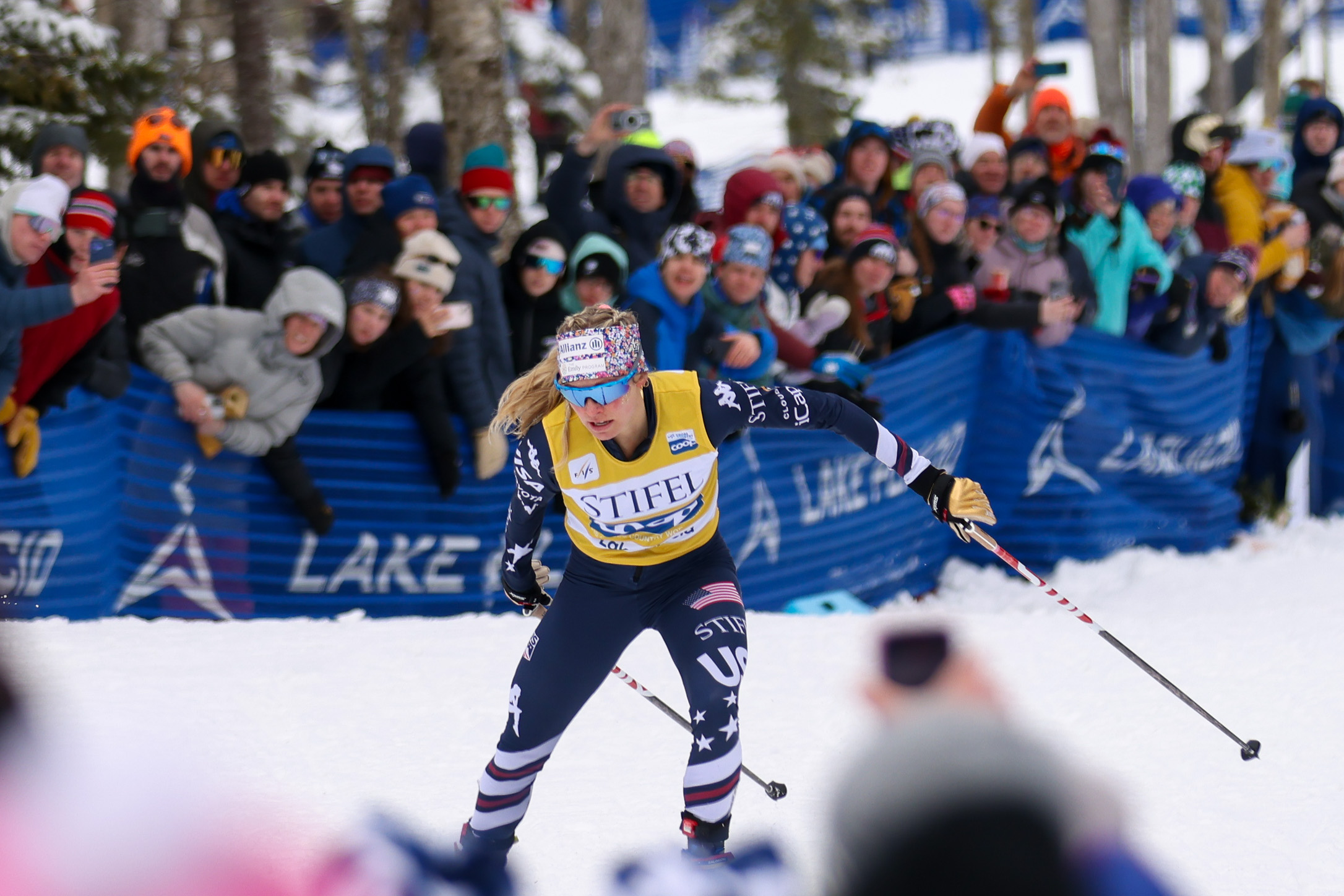
 This coverage is made possible through the generous support of Marty and Kathy Hall and A Hall Mark of Excellence Award. To learn more about A Hall Mark of Excellence Award, or to learn how you can support FasterSkier’s coverage, please contact info@fasterskier.com.