Tag: Lisa Larsen

  • Randall Makes Racing 10 k at Altitude Look Easy, Clinches Second SuperTour Finals Win

    Randall Makes Racing 10 k at Altitude Look Easy, Clinches Second SuperTour Finals Win

    U.S. Ski Team veterans Kikkan Randall (Alaska Pacific University) leads Liz Stephen (Burke Mountain Academy) in Friday's 10 k classic mass start at 2013 SuperTour Finals at Auburn Ski Club in Soda Springs, Calif. Randall went on to win by 36.6 seconds, and Stephen was 47 seconds behind in third. (Photo: Mark Nadell/MacBeth Graphics)
    U.S. Ski Team veterans Kikkan Randall (Alaska Pacific University) leads Liz Stephen (Burke Mountain Academy) in Friday’s 10 k classic mass start at 2013 SuperTour Finals at Auburn Ski Club in Soda Springs, Calif. Randall went on to win by 36.6 seconds, and Stephen was 47 seconds behind in third. (Photo: Mark Nadell/MacBeth Graphics)

    FasterSkier’s coverage of SuperTour Finals and U.S. Distance Nationals is brought to you by the generous support of Concept2, the leading manufacturer of indoor rowers, racing oars, and the SkiErg.

    SODA SPRINGS, Calif. – Housemates for the week, Kikkan Randall and Liz Stephen talked tactics before Friday’s 10-kilometer classic mass start at SuperTour Finals.

    That morning, with temperatures in the high 30s, was expected to warm quickly to nearly 50 degrees Fahrenheit, even at elevations exceeding 7,000 feet on Donner Summit. That’s where U.S. Ski Team (USST) veterans Randall and Stephen and the rest of the women’s field would race at Auburn Ski Club at 10:30 a.m. after the men’s 15 k.

    Stephen, a Burke Mountain Academy alum spending the week with Alaska Pacific University (with ski-waxing help from the Craftsbury Green Racing Project), bounced some strategy ideas off Randall.

    “I was like, ‘Maybe we should go really hard off the front and try to break up the pack,’ because those corners, you don’t want to ski them with seventy other people,” Stephen said. “But Kikkan kind of warned me, she’s like, ‘I don’t know if you really want to do that Liz. I think you’re gonna blow up.’ And I was like, ‘Yeah, you’re probably right.’ ”

    Stephen, 27, heeded the 30-year-old Randall’s advice and initially held back. Meanwhile, Randall led the up the A-climb around 3 k, keeping her head down and staying smooth while the rest of the pack tried to follow. When she got to the top, Randall heard she had an eight-second lead.
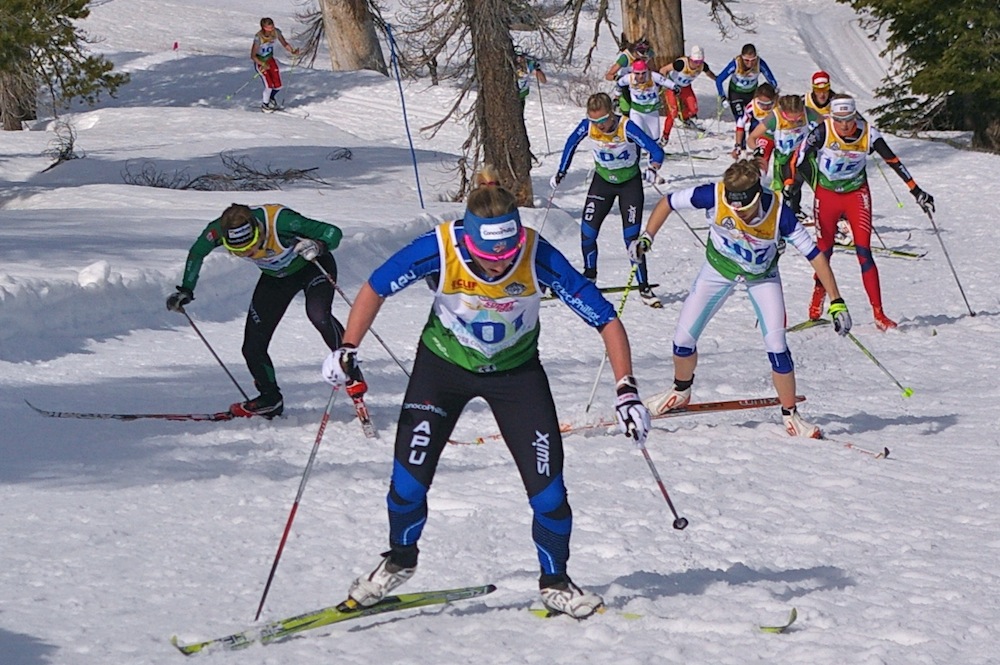
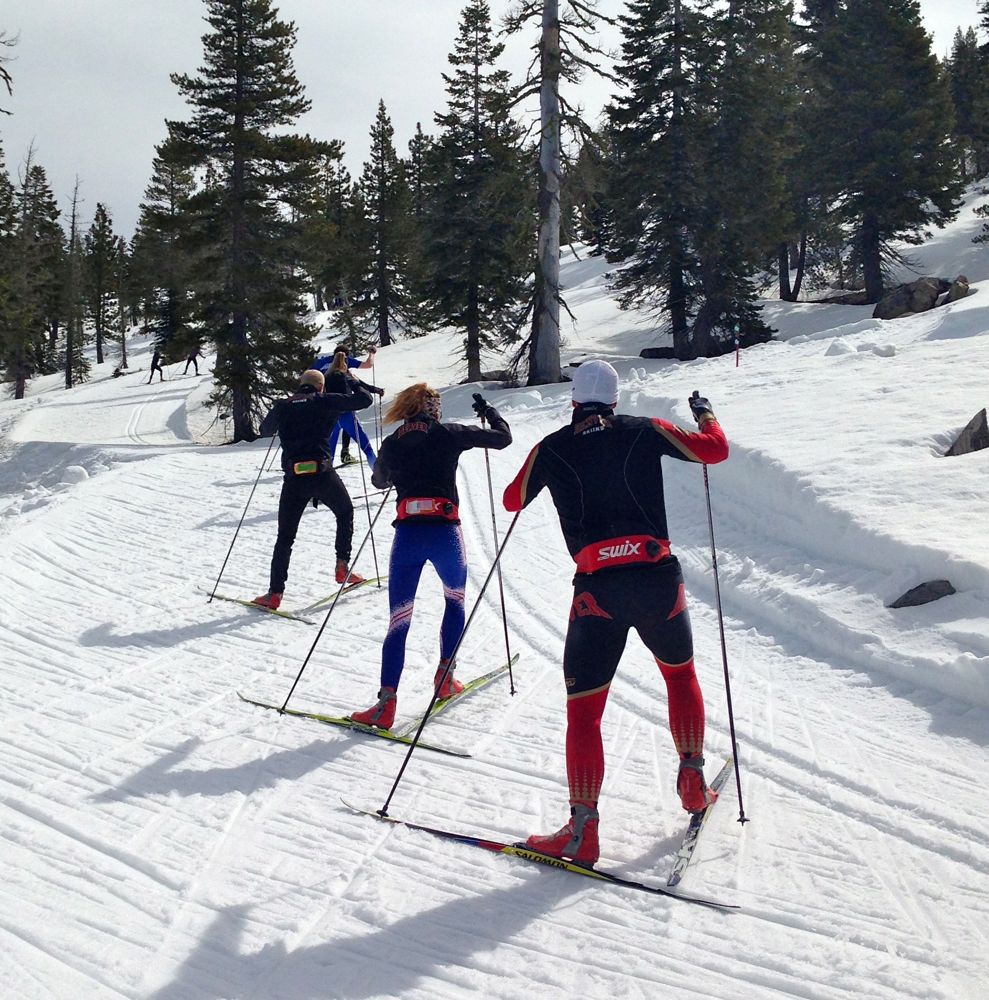
    Kikkan Randall leads Sweden's Lisa Larsen (l) and Liz Stephen (r) and the rest of the women in Friday's 10 k classic mass start the first time up the A-climb at 2013 SuperTour Finals at Auburn Ski Club in Soda Springs, Calif.
    Kikkan Randall leads Sweden’s Lisa Larsen (l) and Liz Stephen (r) and the rest of the women in Friday’s 10 k classic mass start the first time up the A-climb at 2013 SuperTour Finals at Auburn Ski Club in Soda Springs, Calif.

    “I was like, ‘What?’ ” Randall recalled. “I felt like I was keeping it really controlled.”

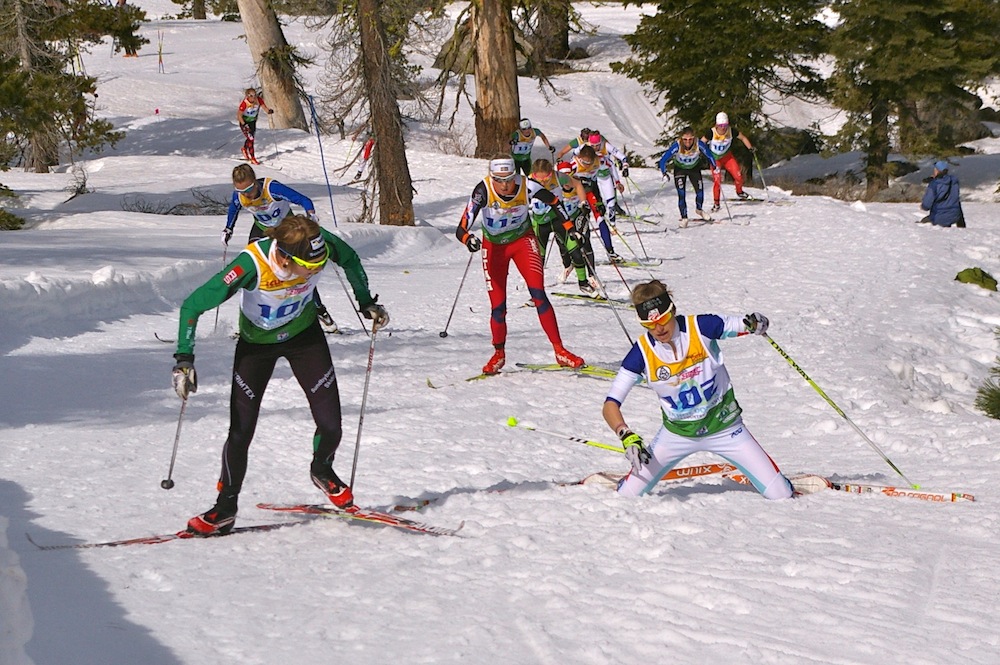
    What she didn’t realize was that Stephen and Sweden’s Lisa Larsen (Sundbybergs IK), who were closest to her the first time up the hill, had stumbled in the slushy snow.

    Both fell forward: Larsen first, then Stephen (Larsen stepped on Stephen’s ski while recovering). Regaining their composure, they held their own and pushed the last few meters to the top ahead of Sweden’s Maria Graefnings (Falun Borlange SK) and Sadie Bjornsen (APU/USST).

    For Randall, the two-time World Cup sprint champion and this year’s overall bronze medalist, the win was essentially in the bag. She didn’t think of it that way.

    “The last bit, I wasn’t focused on the gap anymore, I was just focused on trying to hold it together and ski as well as I could,” Randall said. “I knew I was getting sloppy.”

    The spectators watching her round the 5 k course might have witnessed otherwise. Despite the conditions, Randall appeared to be on form and en route to her second-straight victory in as many races at SuperTour Finals. She won Thursday’s 3.3 k freestyle prologue in damp and windy conditions, besting every competitor – male or female – except Erik Bjornsen (APU/USST) in the individual start. To be fair, she said, the men had snowier conditions.

    “It would be one thing if we knew the conditions were really a little more equal,” she said. “Then I’d be like, ‘Oh OK. I’m giving the boys a run for their money.’ It’s still fun to be able to heckle the guys a little bit and be able to show that a little weather conditions and we’re right there with them!”
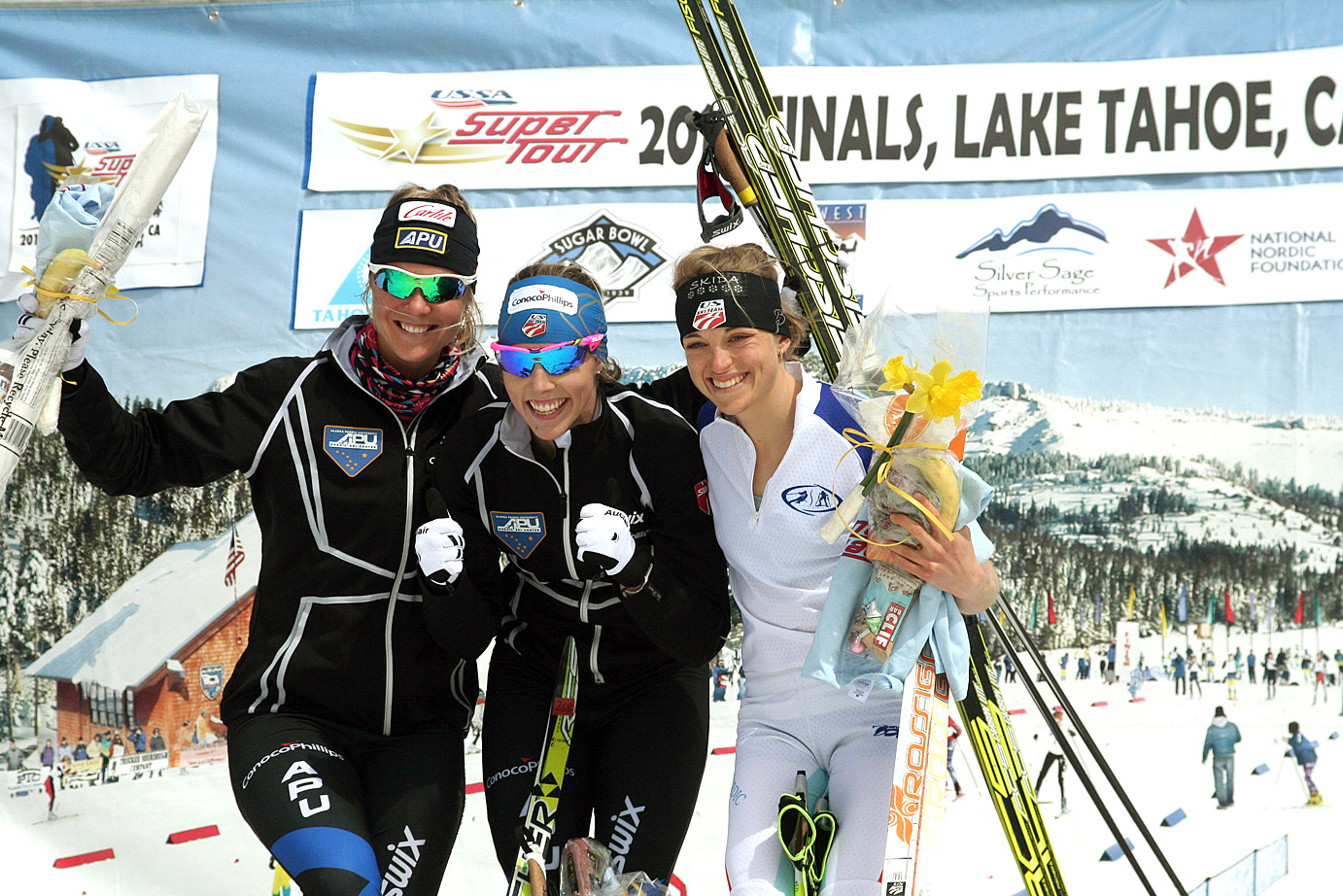
    The women's 10 k classic mass start podium at 2013 SuperTour Finals. From left to right: runner-up Sadie Bjornsen (APU/USST), winner Kikkan Randall (APU/USST), and bronze-medalist Liz Stephen (BMA/USST). (Photo: Mark Nadell/MacBeth Graphics)
    The women’s 10 k classic mass start podium at 2013 SuperTour Finals. From left to right: runner-up Sadie Bjornsen (APU/USST), winner Kikkan Randall (APU/USST), and bronze-medalist Liz Stephen (BMA/USST). (Photo: Mark Nadell/MacBeth Graphics)

    Randall went on to win Friday’s 10 k classic on a dry and sunny day without much trouble, finishing 36.6 seconds ahead of runner-up Bjornsen in 31:40.8. But it didn’t come easy, she said.

    “The second lap, things were getting a little slower and a little softer and it was kind of hard to hold together,” Randall said. “The way this altitude works, it definitely starts creeping up on you. I knew I just needed to keep a good rhythm and the energy was pretty good.”

    Her lead grew from about 18 seconds after the first lap to more than half a minute on the second.

    “I was definitely fighting through some heavy muscles that last two k,” she said. “Really kind of a surprising race today. I didn’t expect to get off the front like that.”

    It wasn’t so much of a shock to those who finished behind her.

    “She went for the preem over the top of the hill and clearly got it and just never looked back,” Stephen said after taking third, 47 seconds behind Randall and 11.3 seconds ahead of Larsen in fourth. “She was stronger today, for sure.”
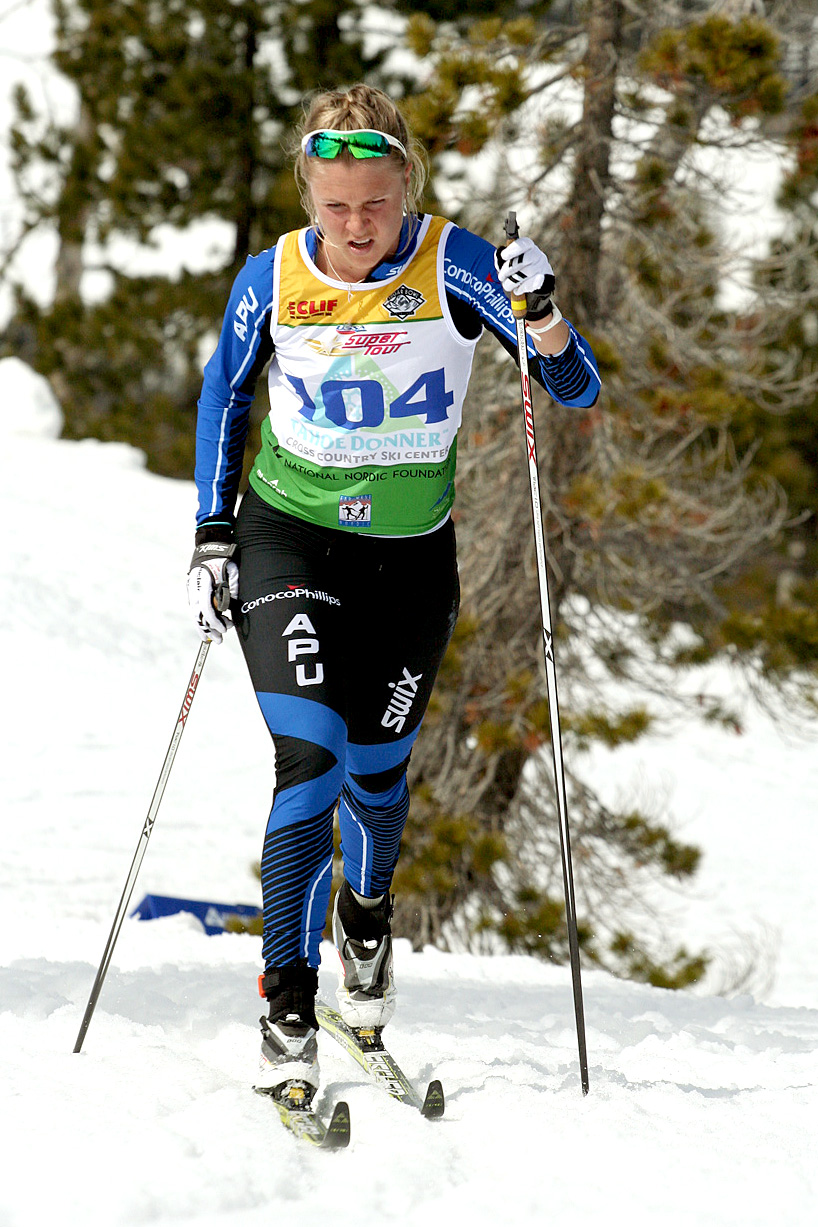
    Sadie Bjornsen (APU/USST) racing to second in Friday's 10 k classic mass start at SuperTour Finals in Soda Springs, Calif. (Photo: Mark Nadell/MacBeth Graphics)
    Sadie Bjornsen (APU/USST) racing to second in Friday’s 10 k classic mass start at SuperTour Finals in Soda Springs, Calif. (Photo: Mark Nadell/MacBeth Graphics)

    Bjornsen broke open the chase group on the second lap to claim silver, capitalizing on Larsen’s late crash on the second lap. After falling for a second time as well, Stephen also passed the Swede on the descent before the stadium.

    “On the last hill, I think I was so tired I couldn’t control my limbs and I just fell down,” Stephen said. “It’s really hard out there, but honestly I’d rather have it soft like this than bullet-proof ice any day. I think racing this high at altitude and this time in the season is gonna be hard no matter what the conditions are.”

    She said the 15 k, like the upcoming 30 k classic mass start, which will be held at Royal Gorge next Wednesday, was all about pacing with so little oxygen to pull from.

    “I actually had one brief thought in the race about the 30 k,” Stephen said. “It was at one of my lowest points out there, and I was just like, ‘Oh my gosh, that’s gonna be a long race,’ [but] it’s April and we’ve had the dream season and I’m just enjoying it. It’s fun to be in the sun in California.”

    After finishing third in the opening prologue, Bjornsen put herself in second behind Randall in the SuperTour Finals standings. With a goal of sitting tight the first lap, the 23-year-old from Anchorage said she saved her legs as much as possible up the A-climb while staying in the top five.

    “The second lap, I went in the front of the chase pack and just tried to break as many people off the back as I could,” Bjornsen said. “I knew it wasn’t the most tactically smart thing, but I could see that Kikkan was just going for it so I wanted to try to chase back to her.”

    She came closer than anybody else, refusing to let up on the last lap and eventually passing Larsen for second.
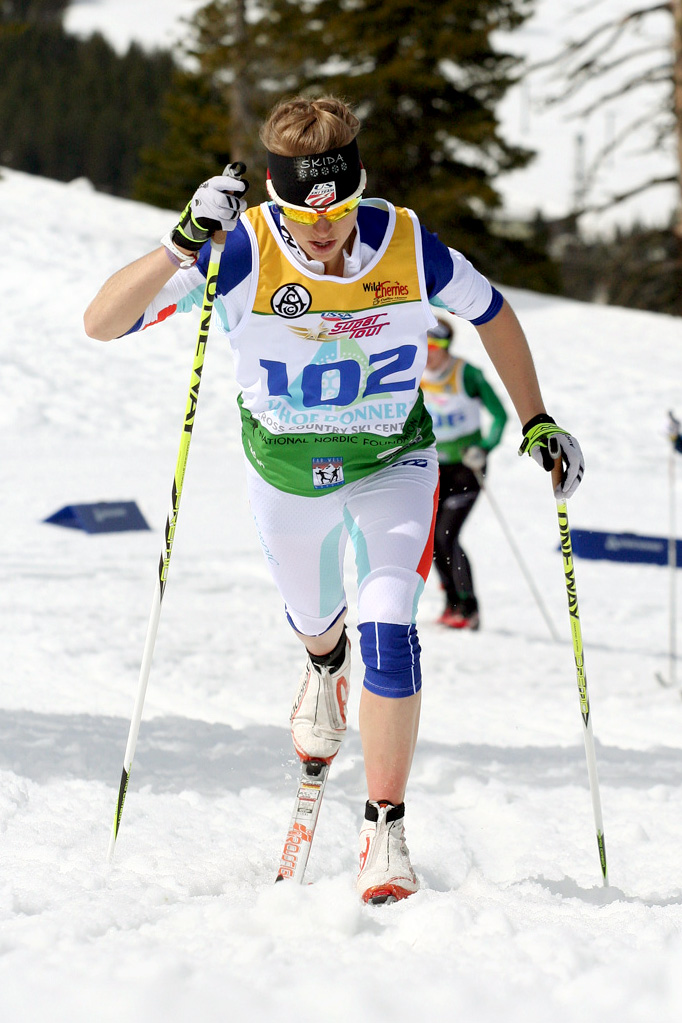
    Liz Stephen (Burke Mountain Academy/U.S. Ski Team) striding to third in Friday's 10 k classic mass start at SuperTour Finals in Soda Springs, Calif. (Photo: Mark Nadell/MacBeth Graphics)
    Liz Stephen (Burke Mountain Academy/U.S. Ski Team) striding to third in Friday’s 10 k classic mass start at SuperTour Finals in Soda Springs, Calif. (Photo: Mark Nadell/MacBeth Graphics)

    “Once I hit the climb, it was just survival mode to the end,” Bjornsen said. “Liz took herself out on the last hill and I think Lisa maybe red-lined it a little bit too hard over the top. … It’s too bad those girls weren’t able to stay on their feet all the way to the end because it would’ve been a good drag race down here to the finish line.”

    Barely making it over the finish before collapsing like most others, Larsen, 22, said she was satisfied with her race – one of her best at altitude. But that didn’t take the sting away from her second crash.

    “I fell so hard on my chest this last downhill,” Larsen said. “It was no so good, but I’m not very used to this altitude.”

    Placing 19th in the prologue the day before, Larsen said she learned her lesson after going too hard on the A-climb.

    “I decided not to go with Kikkan up there [today] because it would be so hard, that hill,” she said. “I pushed it too hard there yesterday and I lost so much time down the hill.”

    The women’s prologue runner-up, Jessie Diggins (Stratton Mountain T2 Team/USST) finished 18th (+3:01.5) on Friday.

    “I bonked and my stomach cramped up on the first lap on the hill,” Diggins said. “I was kind of walking, like, folded over in half. … It would’ve felt really good to get a good puke in there at the top of the hill. It was definitely not a good feeling today.”

    She reminded herself that not every race was destined to be great. Diggins didn’t feel good before the start on Friday and was unsure how she’d fare for the rest of the series, but wasn’t too concerned.
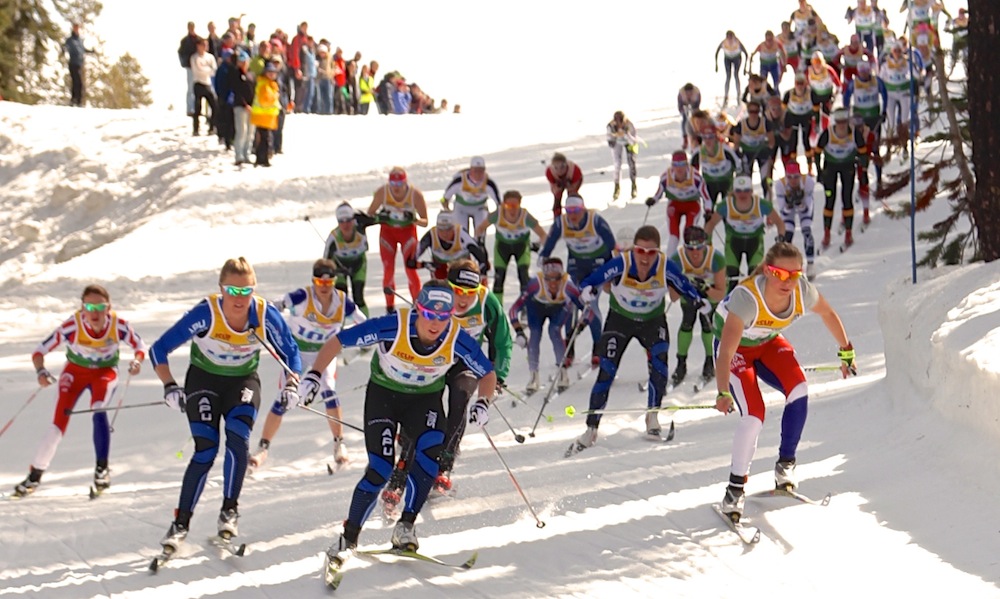
    U.S. Ski Team members Sadie Bjornsen (second from l), Kikkan Randall (c) and Jessie Diggins (r) lead early in the women's 10 k classic mass start at 2013 SuperTour Finals. (Photo: Ryan Scott)
    U.S. Ski Team members Sadie Bjornsen (second from l), Kikkan Randall (c) and Jessie Diggins (r) lead early in the women’s 10 k classic mass start at 2013 SuperTour Finals. (Photo: Ryan Scott)

    “If you’re not acclimated yet and you’re not used to racing at altitude very well, then you’re gonna struggle, I think,” she said. “The nice thing about racing here is I’m not putting any pressure on myself. The goal is to have fun racing here at the end of the season. I don’t have crazy, like, I need to win or else!”

    Last year at SuperTour Finals in Craftsbury, Vt., Diggins said she felt differently.

    “Racing at sea level and having the 30 k be a skate race, I was definitely putting a lot more pressure on myself,” she said. “This year I’m kind of learning that I need to just stop putting that kind of pressure on myself because it takes the fun right out of it. I think I’m doing a lot better with just, relax and soak up some Vitamin D.”

    Rounding out the top 10 on Friday, Graefnings placed fifth, Ida Sargent  (CGRP/USST) was sixth, Sophie Caldwell (SMST2) took seventh, and Rosie Brennan (APU) was eighth.

    In her first classic race since Spring Series last year, U.S. Biathlon’s Annelies Cook (Maine Winter Sports Center) notched ninth. Swiss National Team member Bettina Gruber placed 10th, and two other U.S. national team biathletes Hannah Dreissigacker and Susan Dunklee finished 11th and 12th, respectively.

    — Audrey Mangan contributed reporting
    Results

    Liz Stephen (r) struggles to get back on her feet the first time up the A-climb in Friday's 10 k classic mass start at SuperTour Finals at Auburn Ski Club. Sweden's Lisa Larsen (l) stumbled just before her on the hill, and both crashed again on the second lap in the slushy conditions.
    Liz Stephen (r) struggles to get back on her feet the first time up the A-climb in Friday’s 10 k classic mass start at SuperTour Finals at Auburn Ski Club. Sweden’s Lisa Larsen (l) stumbled just before her on the hill, and both crashed again on the second lap in the slushy conditions.

    For more photos, visit Mark Nadell’s MacBeth Graphics photo gallery.
  • SuperTour Finals Preview: A Prologue to ‘Separate the Boys from the Men’

    SuperTour Finals Preview: A Prologue to ‘Separate the Boys from the Men’

    Athletes climb to the high point of the prologue course at the Auburn Ski Club.
    Athletes climb to the high point of the prologue course at the Auburn Ski Club during training on Wednesday.

    FasterSkier’s coverage of SuperTour Finals and U.S. Distance Nationals is brought to you by the generous support of Concept2, the leading manufacturer of indoor rowers, racing oars, and the SkiErg.

    TRUCKEE, Calif. — When skiers think of northern California, they think of the sun, deep snowpack, forested trails, and long, ridge-line ski routes. Unusual weather led to smaller snow banks than usual this April, but the hundreds of athletes and coaches in town for the 2013 SuperTour Finals and U.S. Distance Nationals will nonetheless be getting their racing’s worth starting on Thursday.

    Truckee’s reputation for spring skiing precedes it. This year it’s drawn skiers to the race series from as far away as Sweden, Switzerland and Norway.

    “Four girls from Sweden decided to come here to race, like an adventure,” said Hanna Falk, a Swede with a handful World Cup starts this season. “We’re really happy to be here. This is the first time in the U.S. for me, ever.”

    “We heard that this venue was one of the best in the U.S., so we wanted to come,” added fellow Lisa Larsen, a member of Sweden’s 2013 World Championship squad. “We talked with Kikkan [Randall] and Jessie [Diggins] and they said, ‘You must come to California!’ So we decided late to come.”

    The foreigners add an extra level of excitement and competition to this edition of SuperTour Finals. In addition to the Europeans, a handful of Canadians are on the start lists, as is the regular domestic field, and handful of dedicated college and junior skiers, most of the US Ski Team back from the World Cup and a few biathletes.

    “This is a nice opportunity to ski and have fun and be in the sun,” said Annelies Cook of the U.S. Biathlon team and Maine Winter Sports Center. “And I don’t get to classic race ever. Last year was the last time I classic skied and I loved it, so it was just kind of fun to see what happened. I never go hard but I still love it.”

    For the athletes, the plethora of SuperTour points up for grabs in each race make the stakes high for skiers currently in contention for the lead. But most everyone is looking forward to five relatively laid-back races in between catching up with friends and enjoying California. Some were perhaps hoping for a bit more snow on the backcountry trails, though — like the course at Tahoe Donner Cross Country, where three races were supposed to take place this week, the usually snow-abundant routes along the mountain ridges are pretty bare this year.

    “I was hoping to take people on some of the sweet trails they have here up high,” said Truckee native Matt Gelso (Sun Valley Ski Education Foundation).

    “But this is nice,” he added, indicating the snow around him at the Auburn Ski Club, where Thursday’s prologue will take place. “It’s nice being in Truckee, I like the trails here, I like the setup, I like the spring corn wet skiing.”

    Precipitation is in the forecast this week, but the warmth and blue skies on Wednesday before the first race contributed to a relaxed atmosphere in the stadium.

    “It’s hard to get worked up at this point in the season,” said Alaska Pacific University’s Rosie Brennan, who currently leads the women’s SuperTour. “With double SuperTour points, there’s quite a bit riding on [these races]… but at this point in the season everyone’s just tired. Racing in the West is my favorite thing, so I just enjoy it.”

    Brennan primarily wants to keep her spot on the list in order to get back to Europe for World Cups next fall.

    “I just want to make it through all the races and keep the SuperTour lead,” she said. “So I don’t really care which race goes well as long as a couple of them do!”

    The first step towards that goal is the first race of the series on Thursday, a 3.3 k prologue. Though it’s short, there are just as many points awarded for winning it as there are in the longer events. The course on tap is being described as deceptively challenging. There is nothing illusory about the steepness of the focal point, an A-climb that was built in the last few days specifically for this race, but before and after it there are rolling transitions that will force skiers to stay on their toes where they might not expect it.

    “I’ve never raced this course,” Gelso said. “The climb is new — they put that in a few days ago and this is the third iteration of it. It’s pretty serious. It’s long and steep at the top. You can’t blow it out otherwise you could really not have a good race.”

    The venue sits just over 7,000 feet above sea level, which is good news for athletes who are used to the height at not so good for the unacclimated.

    “I’m excited,” said Sylvan Ellefson of Ski & Snowboard Club Vail/Team HomeGrown. “I haven’t race here since JOs in 2005, and back then the hills certainly seemed a lot bigger than they do now. The A-climb that they just put in is serious and it’s tough and I think it’ll definitely weed out the boys from the men. …  All the hay’s in the barn, so whatever hay is there will hopefully be enough to finish up the season.”

    There are a few notable absences in both the men’s and women’s fields this week. Noah Hoffman (SSCV/USST) just had surgery on his shoulder and is recovering at home in Colorado. Last year’s prologue winner, Simi Hamilton (SVSEF/USST), is having tonsil and sinus surgery next week and decided to skip the series. Holly Brooks (APU/USST) went home to rest after a tiring season in order to be ready for the national team’s first training camp in May.

    The rest of the SuperTour regulars and USST members are in Truckee, however, and are ready to race.

    On the women’s side, the hilly prologue course should be right up Kikkan Randall’s alley. The World Champion and two-time World Cup sprint champion improved her prologue skiing at the end of this season and Thursday’s contest will most certainly be hers to lose.

    “I’m feeling pretty psyched,” Randall said. “It is so great to be back in the USA and good to be skiing in the sun and to see everybody.”

    As for the course?

    “It’s going to be fun,” she said. “It’s deceptively hard. You’ve got the big climb but still a lot of skiing after that and not a lot of rest. And being at altitude, it’s going to be a good challenge.”

    Randall’s teammate was of the same mind.

    “It’s going to make us work,” said Sadie Bjornsen. “It has a lot of hills which at least keeps you awake and working, but there’s also mysterious places where you forget to work, like at the top of the hill where it keeps climbing but at a gradual rate.”

    When it comes time to put on a race bib on Thursday, athletes will ultimately be doing all they always do — going out to see what they’re capable of.

    “It’s fun to go into a race series and not have any specific goals, but more just see what we can do with what we have,” Bjornsen said. “If you do well then it’s super exciting, of course. But you know, it’s more fun to see what we can make of it.”

    Start lists

    SuperTour overall standings: women | men

  • Atomic Develops New World Cup Classic SDS

    Atomic Develops New World Cup Classic SDS

    Good Gracious Almighty! What Has Atomic Gone And Done Now?

    Atomic is to classic marathons what Ferrari is to Formula One. For the last thirty years, the long distance events have been dominated by Atomic athletes and the tenacious Austrian ski company is not about to let that change. Atomic’s racing focus has always been on the Marathons because these are the races that have proven to be the best testing ground for equipment. For the next two months, the world’s top nordic retailers will be reviewing and testing one of the most innovative and successful classic race skis ever made.

    What do skiers want out of a classic ski? They want fast glide and they want easy grip. Traditionally, fast glide meant a stiff classic ski that was hard to kick. And easy grip meant a soft ski with kick wax that might drag. Atomic’s Roman Toferer and his crew of artful rascals scoffed at this old rule of thumb. They came up with a classic ski that glides as if you forgot to put on the kick wax, yet the kick is extremely easy and you will feel like you are kicking down a compliant touring ski.

    ATOMIC’S HEAD OF R & D, ROMAN TOFERER, ADDRESSING A MEMBER OF THE US SKI TEAM. A DEFIANT ENGINEER WHO FINDS CONVENTIONAL THOUGHT DISTASTEFUL.

    How does it work? How does this ski obtain such fast glide with such an easy kick? It was not easy and the testing has taken many years. Atomic created a highly elastic insert made of ABS that is placed in the kick zone of the new ski. Strips of carbon with high rebound qualities are laminated above the ABS. This makes the kick zone a very strong bridge that keeps the grip wax riding well above the snow. Even though the skis have a low camber, the kick stays high during the glide phase. This means the pressure zones in front of and behind the kick zone are static, their location does not change. The end result is that there is no drag at all on the part of the kick wax. However, the elastic qualities of the ABS allow the ski to be easily collapsed without  much pressure during the kick. It is surprisingly easy to get the kick down and have excellent grip. Go out with your friends, you will still be getting kick on a steep uphill when they are all switching to herringbone. Get in a tuck coming down that hill and you will still be gliding while they are standing up and double poling. The new ski is simply called the WORLDCUP CLASSIC SDS.  The SDS stands for SHORT DISTANCE STEP.

    THE YELLOW STRIP ILLUSTRATES THE LOCATION OF THE ABS. THE GRAY ZONES REPRESENT THE STATIC PRESSURE ZONES. THE CAMBER REMAINS LOW WITHOUT AFFECTING THE GLIDE.
    PERHAPS A BETTER ILLUSTRATION. YOU CAN SEE THE BRIGHT YELLOW INSERT THAT IS THE ABS. THIS IS WHAT GIVES THE KICK ZONE IT ELASTICITY. THE SHORT DISTANCE STEP.
    TROND NYSTAD AND THE NORWEGIAN WAXING TEAM CAME TO ATOMIC’S RACE ROOM FOR A BRIEFING ON THE NEW CLASSIC TECHNOLOGY. THEY LEFT IN AWE.
    NORWAY’S MOST PROMISING YOUNG CLASSIC RACER, MARTHE KRISTOFFERSEN, REVIEWING THE TECHNOLOGY WITH ROMAN TOFERER. MARTHE AND THE NEW SDS WILL DEFINITELY MAKE IT TO THE PODIUM TOGETHER IN SOCHI.
    LISA LARSEN OF SWEDEN USING SDS ON THE WORLDCUP. IF THE TOP YOUNG SKIERS OF NORWARY ARE USING THIS SKI, YOU CAN BE SURE THE YOUNG SWEDES WILL AS WELL.
  • U.S. Ski Team Ups the Intensity in Sun Valley

    U.S. Ski Team Ups the Intensity in Sun Valley

    U.S. Ski Team member Andy Newell leads Ida Sargent (Craftsbury Green Racing Project) in a skate speed. Photo, National Cross-Country Ski Education Foundation, NCCSEF.org

    Evidence of autumn abounds at the U.S. Ski Team’s camp in Sun Valley. Temperatures on Thursday struggled to break 50 degrees, there’s snow in the mountains outside town, and with three time trials over the next week and a half, the team’s training focus has shifted from volume to intensity.

    But despite the signs of the inexorable creep towards winter, nobody’s getting ahead of themselves.

    “We’ve got a lot of work to do, still,” said coach Matt Whitcomb. “[The] coaches are patient, and athletes are patient.”

    The Sun Valley camp kicked off Wednesday, with members of the U.S. Ski Team (USST) joining athletes from the Sun Valley Ski Education Foundation (SVSEF) for freestyle rollerski speeds. Five of the USST’s seven members are in attendance, with Kris Freeman and Kikkan Randall opting out.

    Right to left: Sargent, Morgan Arritola (USST), Jessie Diggins (CXC), and Liz Stephen (USST) in a training session. Photo, National Cross-Country Ski Education Foundation, NCCSEF.org

    After a distance workout on Thursday, the camp really heats up on Friday with a sprint race simulation—with a twist. Instead of a running a qualification round followed by six-man heats, each athlete will race four times individually.

    USST member Simi Hamilton said that starting athletes one-by-one would allow the teams to access more challenging terrain. But Whitcomb added that the unique format would also keep the strongest sprinters from coasting through the heats to the finals.

    “The individual start is going to drive very high effort level all day,” he said. “It’s going to be really interesting [to see] who’s skiing fast at what point in the race—who can endure, essentially, a qualifying round effort every heat.”

    In addition to butting heads with the SVSEF athletes, Hamilton and his teammates will also be tested by three promising young skiers—Tad Elliott, Jessie Diggins, and Ida Sargent—who are also attending the camp at the invitation of the USST. Torin Koos and Sam Naney of the Methow Olympic Development team arrived in Idaho on Thursday as well, and Swedish U-23 skier Lisa Larsen—29th at last year’s Tour de Ski—is in town, too, staying with her aunt.

    The crowd of visitors is much appreciated by Hamilton, who trains with the SVSEF Olympic Development Team and lives in nearby Ketchum. Hamilton said that the intensity of his workouts had leapt up a notch with the start of September, and any time that happens, “it’s super-nice to have other people there, to be able to get through the suffer together.”

    Over the next ten days, two more time trials—a 3.75 k/2.5 k prologue and a 10 k classic—will follow the sprint race.

    The scenery in Sun Valley. Photo, National Cross-Country Ski Education Foundation, NCCSEF.org

    While there have been few prologue-length races held in the U.S. and Canada, the event is being raced more and more on the other side of the Atlantic—especially with the increasing popularity of tour-style racing. According to Whitcomb, the USST is making an effort to adapt to the format, first with the time trial in Sun Valley, then with another scheduled for the team’s next camp in October in Lake Placid.

    “I think we’ve got to nail this prologue distance,” Whitcomb said. “We just feel like this event is showing up on more and more calendars.”

    There aren’t quite as many opportunities for sightseeing and adventuring in Sun Valley as there were during the USST’s last camp in New Zealand. But according to Whitcomb, there’s still plenty of time for bonding over team dinners. And the team’s sports psychologist, Jon Hammermeister, arrived Thursday night—he’ll hold sessions with team members both individually, and as a group.

    The camp wraps up Sunday, at which point the athletes go their separate ways until the USST’s fourth and final dryland camp of the year, in Lake Placid in October. From there, it’s just three weeks until the team takes off for Europe in early November, for the start of the race season.