From the FasterSkier archive — posts syndicated from athletes’ and coaches’ own blogs between 2004 and 2012, kept online as published. Current coverage is at fasterskier.com.
At the first biathlon World Cup races of the 2025/26 season, the biathlon stadium is perched above the small city of Östersund, which is set on a lake. Wind gusts off the lake, pulsing through the stadium. The races take place under the lights, at night – which isn’t saying much. Because in December in northern Sweden, ‘night’ begins at three in the afternoon, when what little sun there might’ve been throughout the day slips below the horizon. It’s in the evenings that the wind is usually at its strongest. The conditions the racers zero their rifles at before the race are rarely the same conditions they find when they come back to the range during the race. Athletes watch the small, red flags in the range, seeing which way they’re moving, deciding whether or not to shift their sights a few clicks, compensating for the changes that happened while the racers skied the course that serpentines up, down, around a 180-degree turn, and back into the stadium where the music plays and the home crowd cheers. Ayyy! As the Swedes hit their targets. A diluted Ney for each Swedish miss.
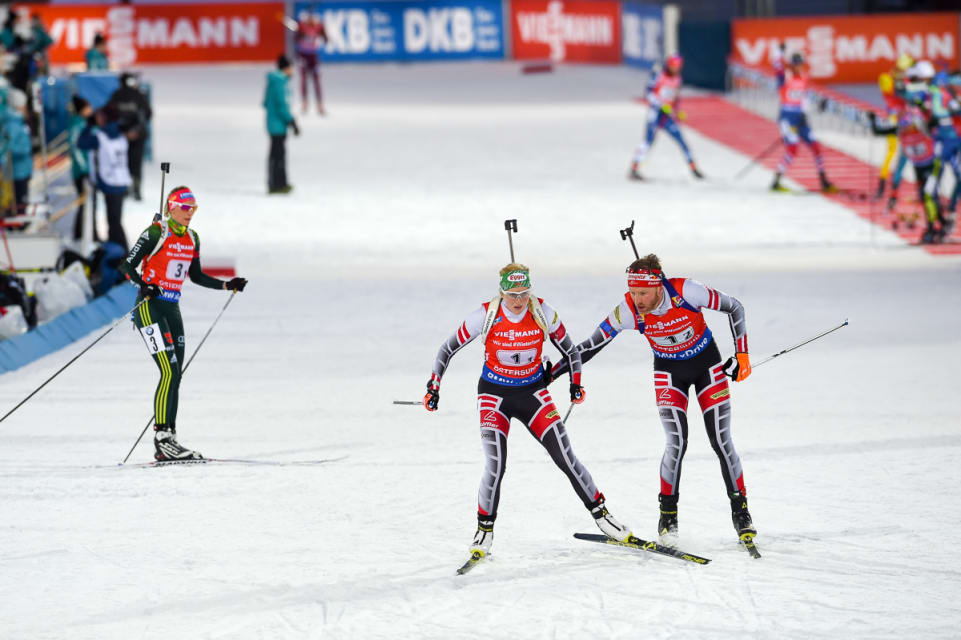
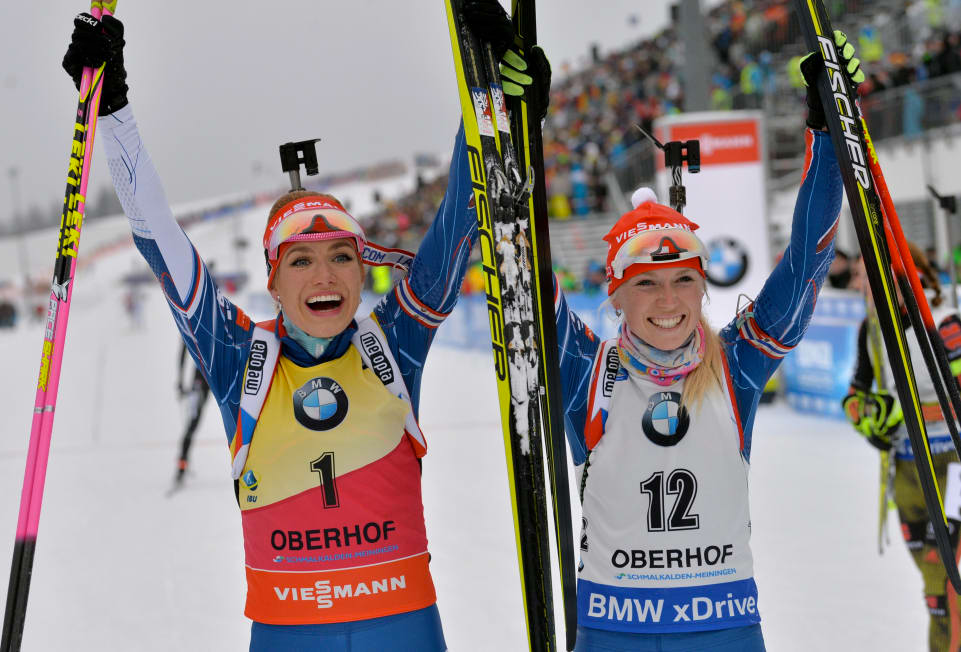
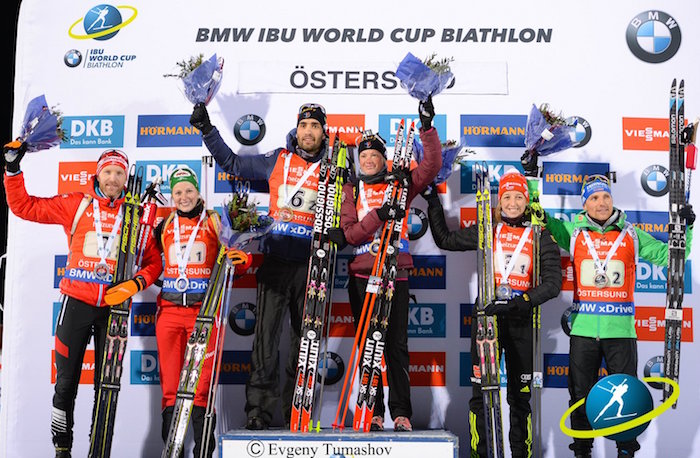
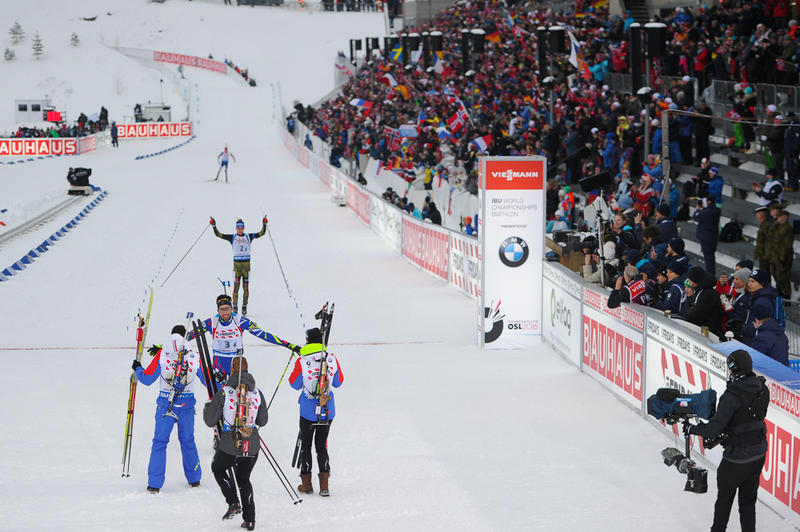
The mixed relay at the opening stop, Oestersund (SWE), of the 2025/26 IBU World Cup Biathlon season. (Photo: Manzoni/NordicFocus)
Over eight days, the best biathletes in the world raced 10 times. Maybe it was the arduous schedule, or the bit of sharpness that an Olympic year adds, but the Ostersund races didn’t feel like the first of the season. It felt like a break had never happened.
One question lingering from the off-season was answered quickly: What would Norwegian biathlon look like without the Boe Brothers? The dominant duo of Johannes Thingnes and Tarjei Boe – owners of eight Olympic medals – retired at the end of the 2024/25 season. Leaving what one would assume would be a major hole in the program. But when the Norwegian men came out and won the men’s 4 x 7.5km relay at Ostersund, the Norwegian’s roster depth became clear.
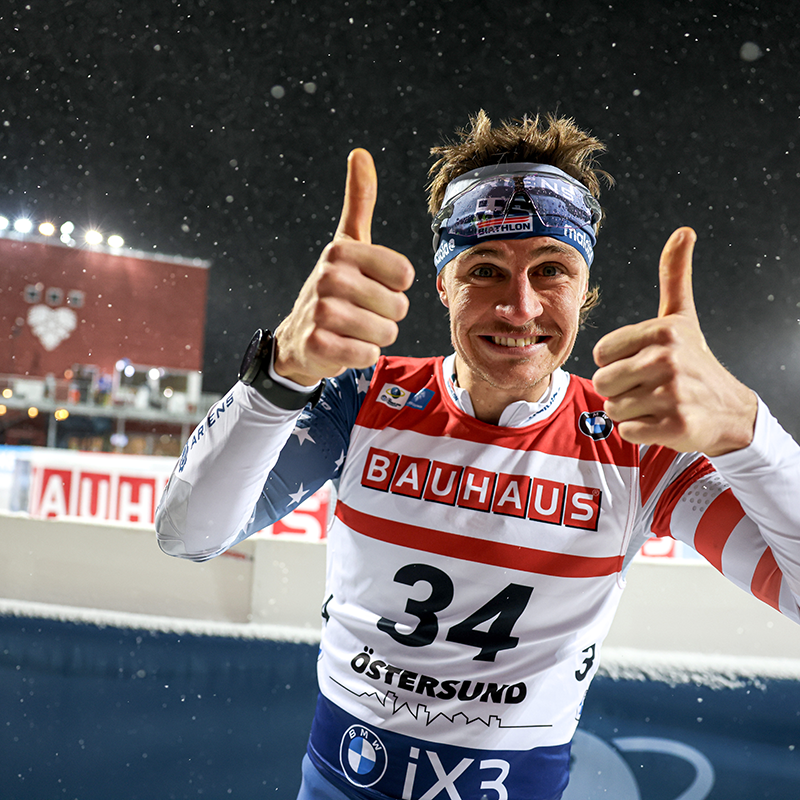
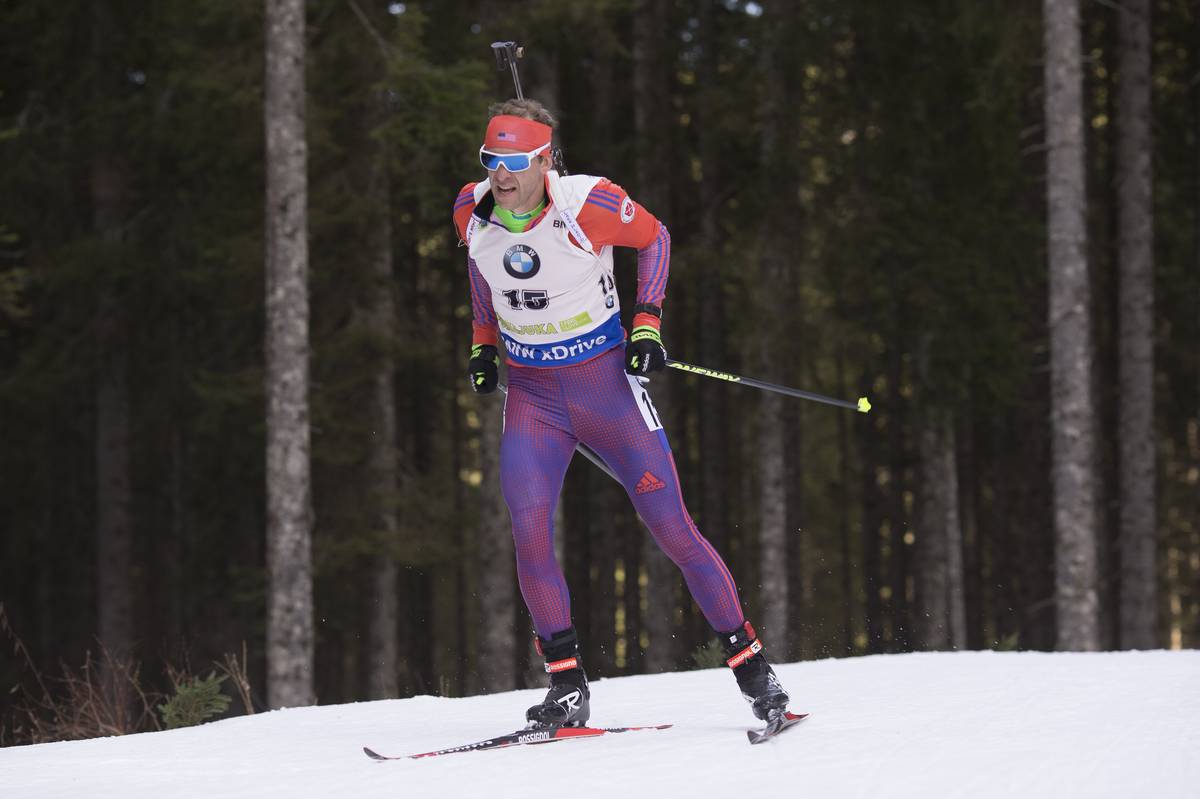
Campbell Wright (USA) during the IBU World Cup Biathlon Men’s Relay in Östersund (SWE). (Photo: Manzoni/NordicFocus)
The men’s relay saw a top result from the U.S. men, as well. Paul Schommer, Campbell Wright, Maxime Germain and Sean Doherty finished fifth, one of the best men’s relay finishes ever for Team USA. The next day, at the mixed relay, Germain, Wright, Chloe Levins and Deedra Irwin placed sixth – which is the best finish for a U.S. mixed relay since 2021.
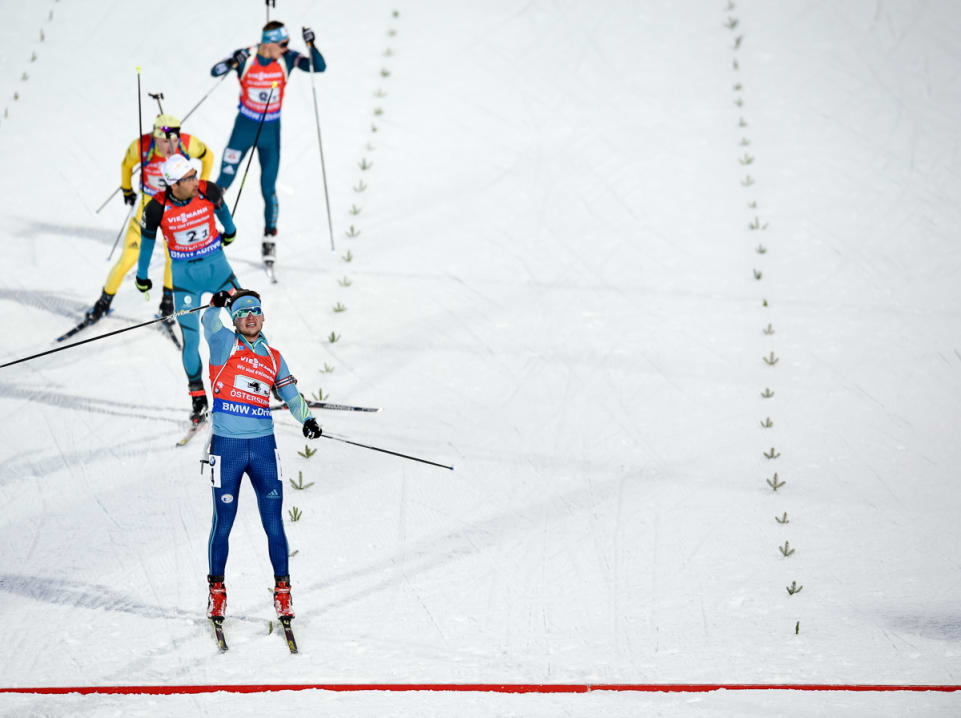
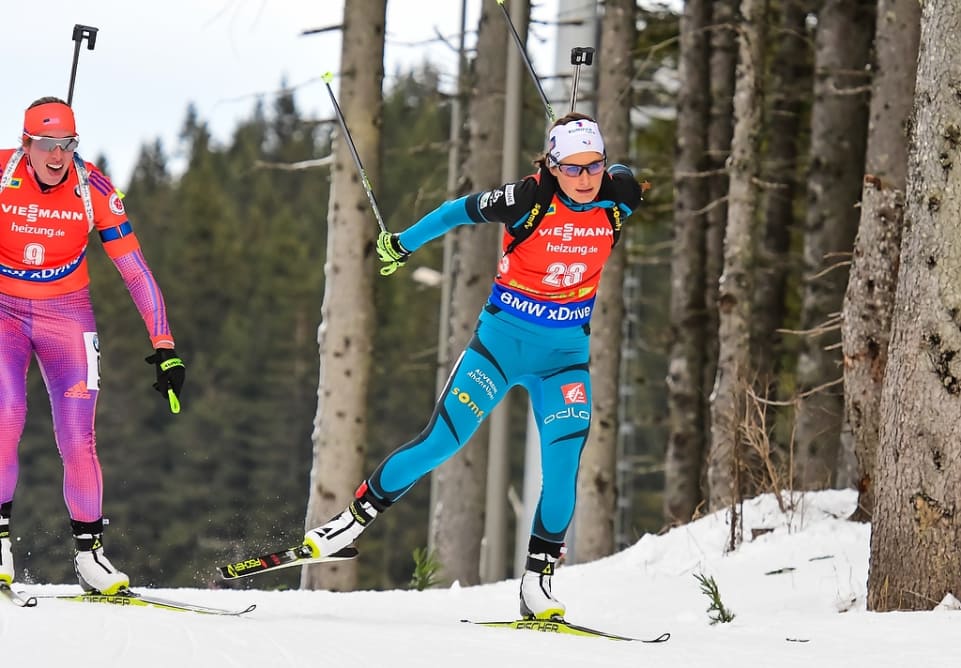
Artem Tyshchenko (UKR) and Paul Schommer (USA), (l-r) during the Men’s Relay in Oestersund (SWE). (Photo: Manzoni/NordicFocus)
Germain and Wright continued to build on their early-week momentum, with Germain placing 11th in the sprint. In the pursuit, Wright hit all 20 targets for the first time in his career and moved up from 18th to 6th. Wright is coming off a stellar 2024/25 season, where he podiumed twice at World Championships, becoming the first American to do so.
Throughout the week, there were highs: Suvi Minkkinen of Finland won her first World Cup sprint. The Norwegian men placed four in the top five in the 20km individual, solidifying their capabilities as a team sans-Boes. And as always in biathlon, some lows: Eric Perrot of France missed his final shot in the pursuit, a devastating moment that cost him the lead. He finished fifth.
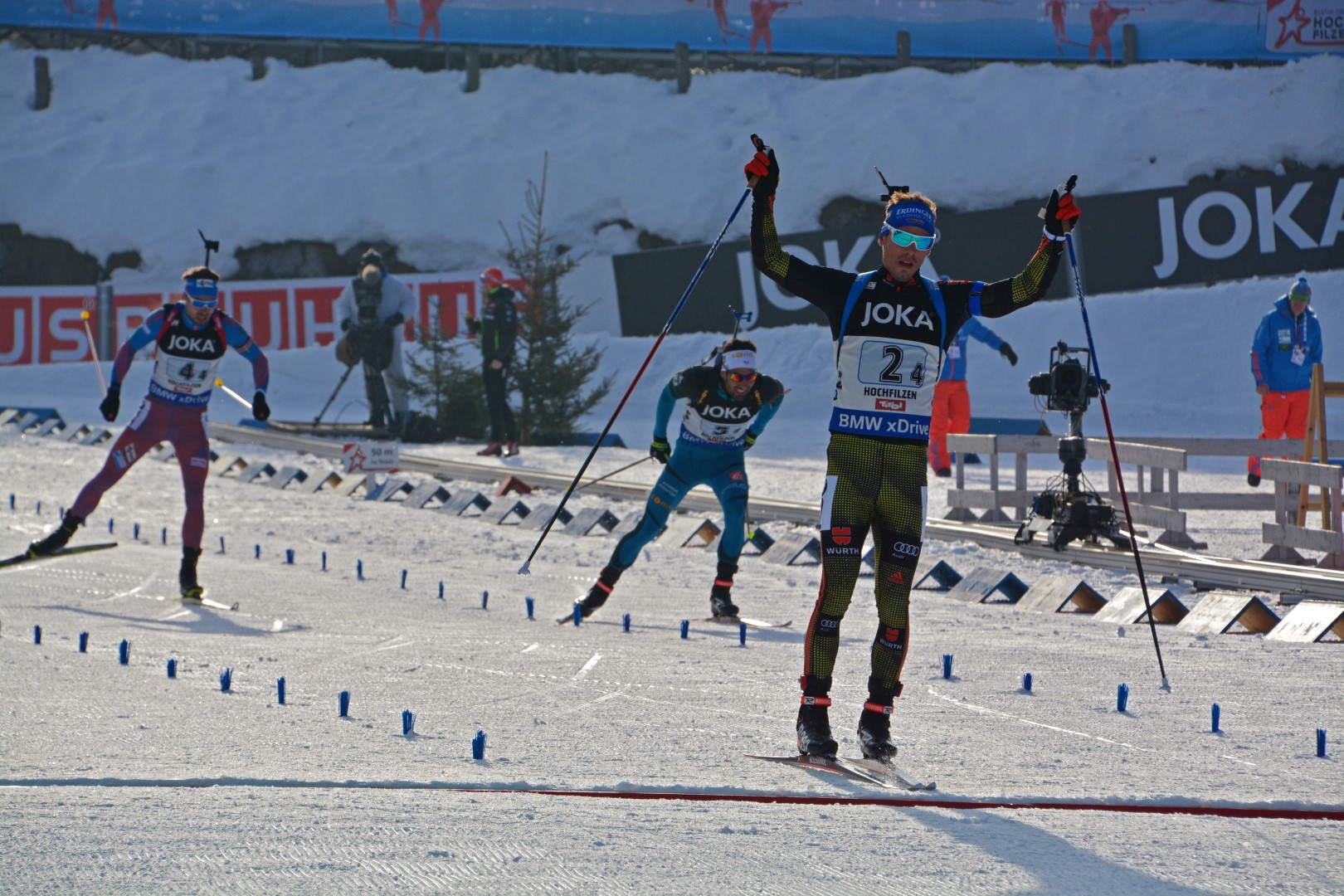
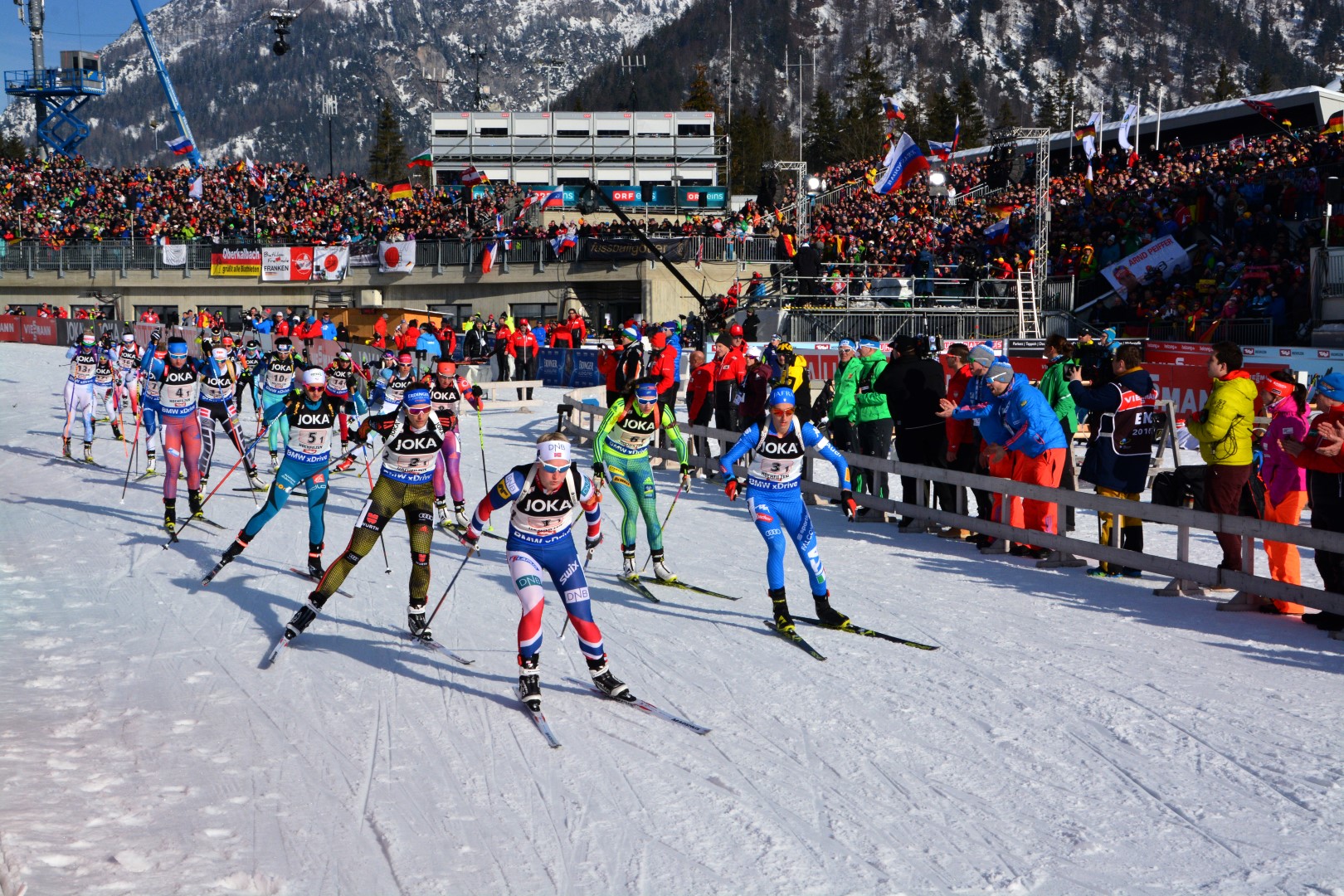
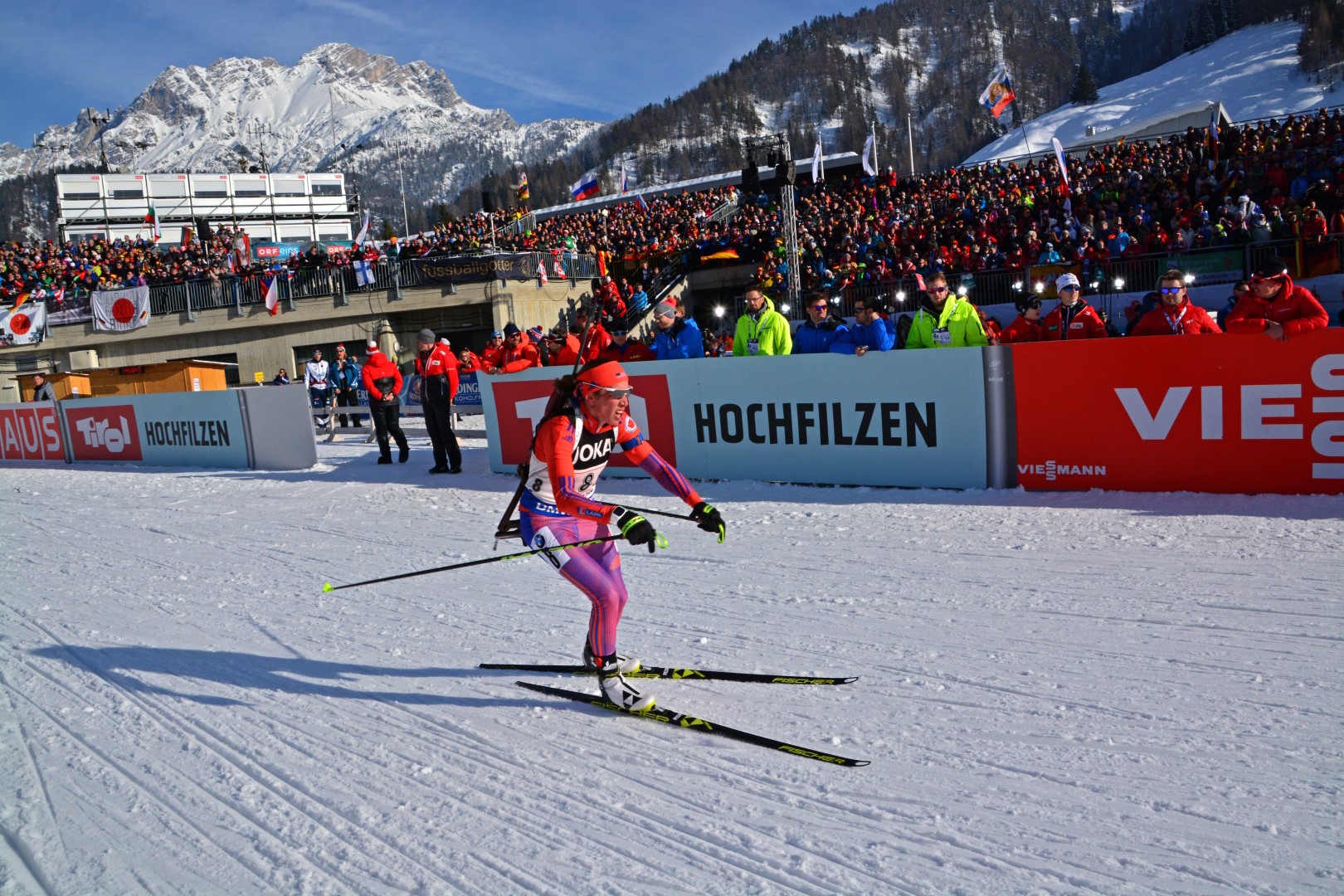
Racing wrapped up in Sweden, and teams flew to Austria. In Hochfilzen, a less rigorous racing schedule awaits: sprint, pursuit, and then a men’s and a women’s relay. A few more hours of daylight await, too.
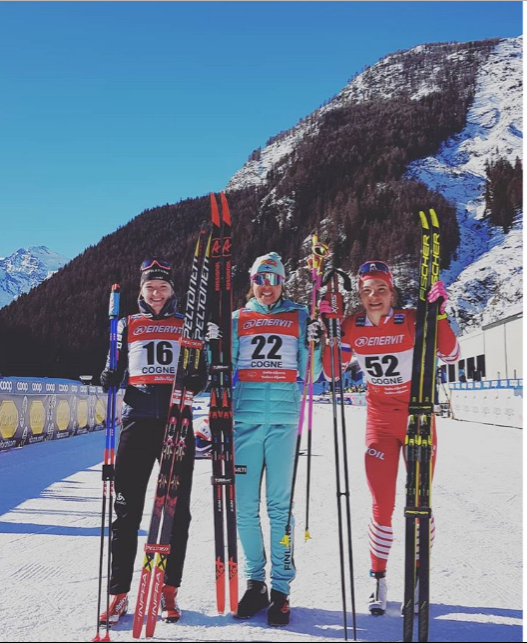
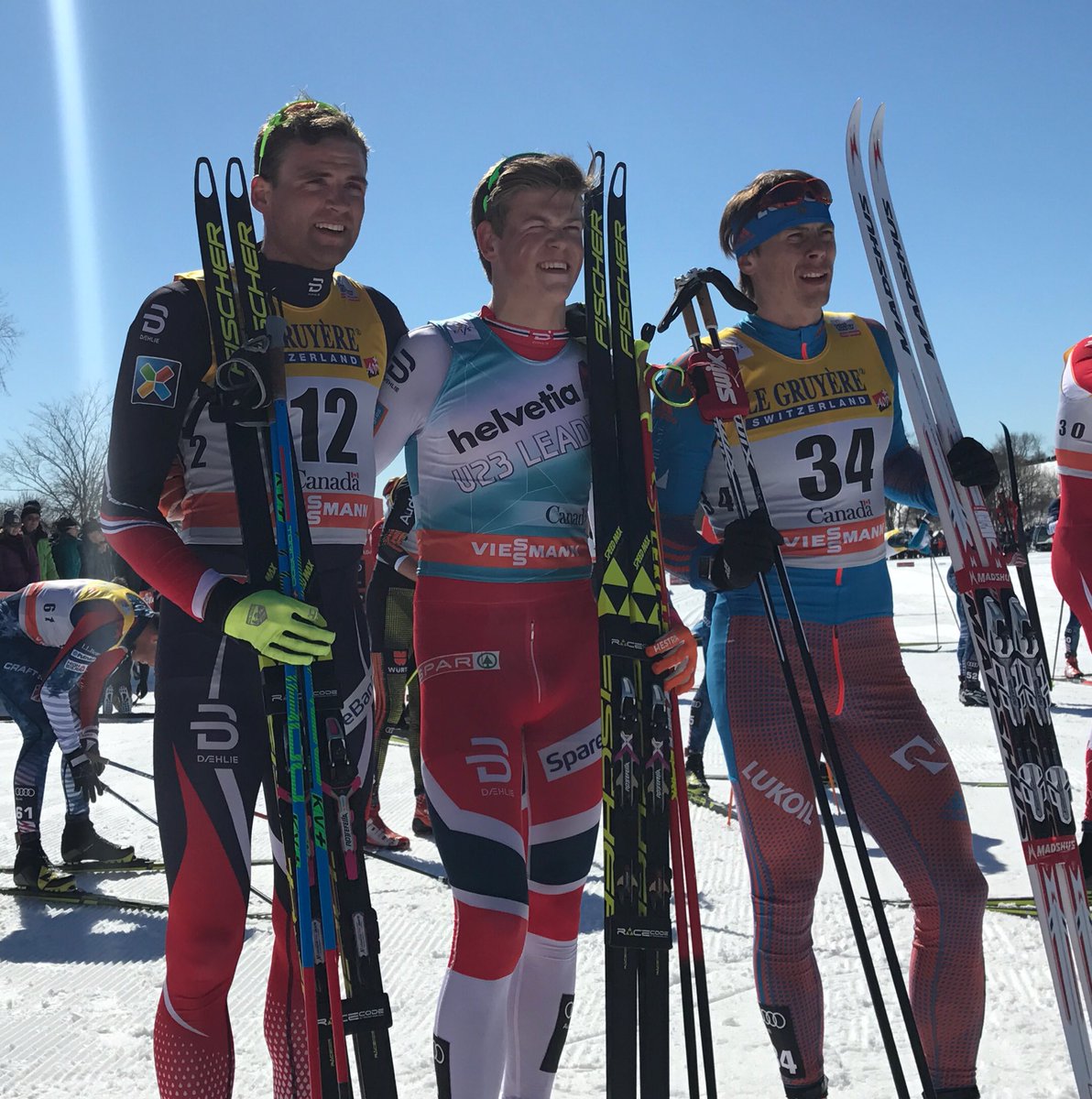
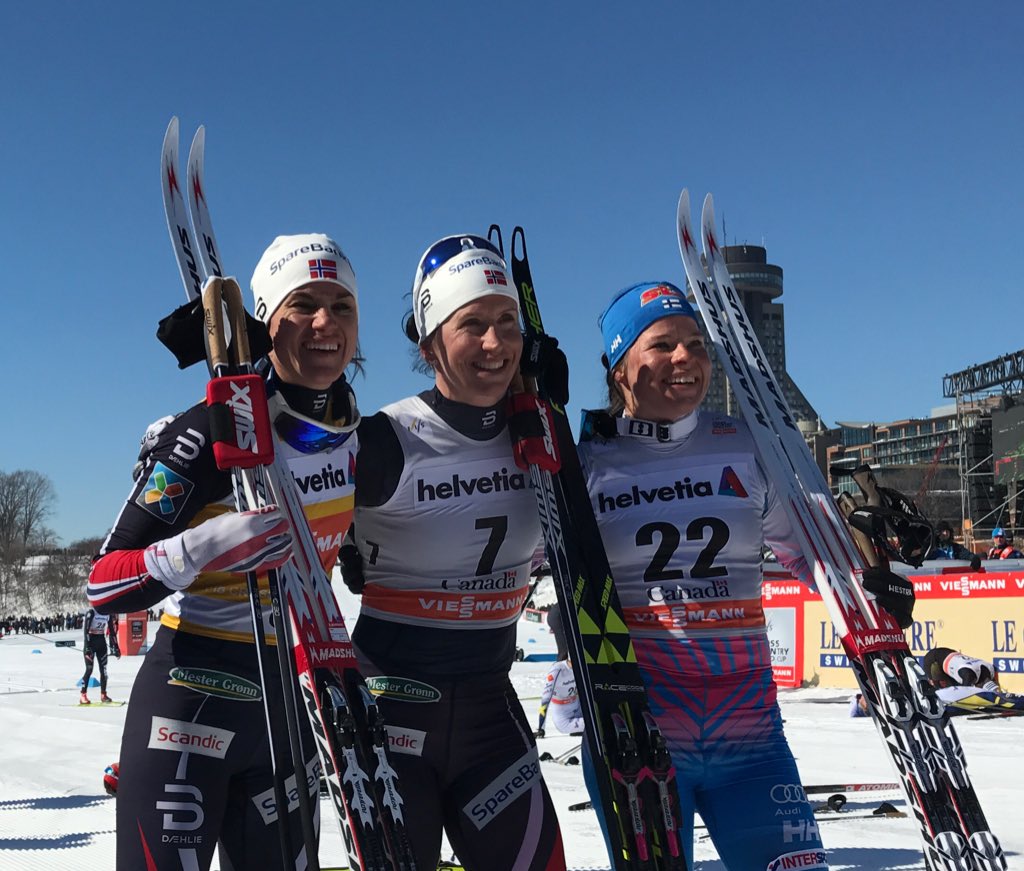
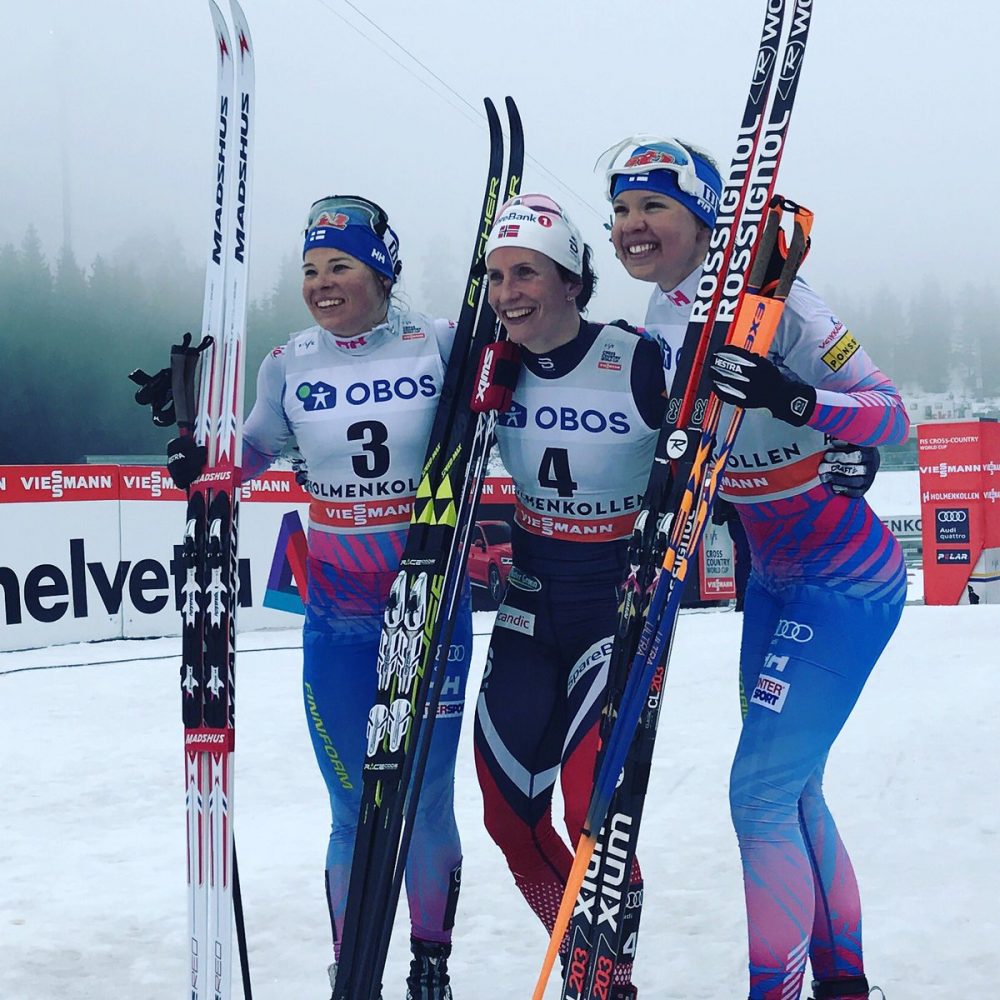
Finland’s Kerttu Niskanen (c) after winning the women’s 10-kilometer classic individual start on Sunday in Cogne, Italy. Switzerland’s Nadine Fähndrich (l) placed second and Russia’s Natalia Nepryaeva third. (Photo: FIS Instagram screenshot)
FIS Cross Country World Cup 10 k/15 k Classic Individual Start Cogne, Italy
World Cup athletes returned to the Cogne race venue on Sunday for a men’s and women’s classic interval start race. In the women’s 10 k, Finland’s Kerttu Niskanen, won in a time of 27:24.8. Finishing just 3 seconds behind her for second place was Swiss skier, Nadine Fähndrich. Russia’s Natalia Nepryaeva claimed third, 12.6 seconds behind the winner.
Racing for the U.S., Rosie Brennan led the way in 21st (+1:19.6) followed by Caitlin Patterson in 36th (+1:49.6), Rosie Frankowski in 37th (+1:55.2), and Julia Kern in 39th (+1:59.2).
Finishing just 13.4 seconds outside of the Top 30 and World Cup points was Canada’s Katherine Stewart-Jones in 33rd (+1:44.6).
Cendrine Browne, also racing for Canada, placed 48th (+2:49.0), while the U.S.’s Ida Sargent finished just behind her in 49th (+3:12.3). Canadian Emily Nishikawa started Sunday’s 10 k race but dropped out after the 8.2 k mark.
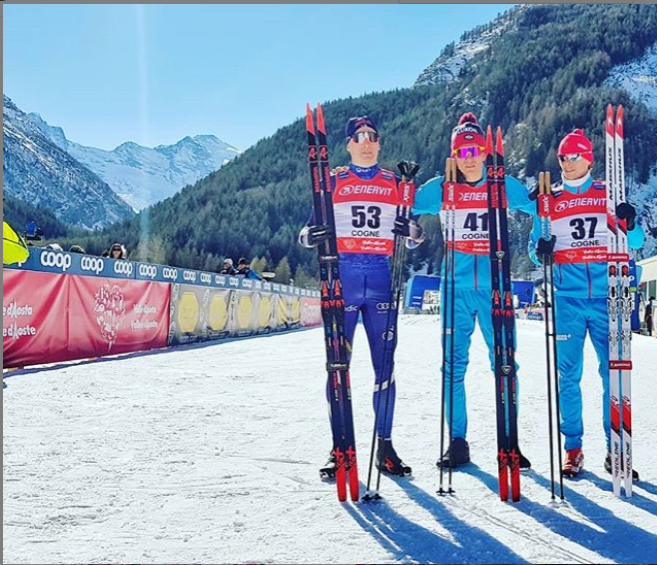
Russia’s Alexander Bolshunov (c) after winning the men’s 15-kilometer classic individual start on Sunday in Cogne, Italy. Finand’s Iivo Niskanen (l) placed second and Russia’s Alexander Bessmertnykh in third. (Photo: FIS Instagram screenshot)
In the men’s 15 k classic, Russia’s Alexander Bolshunov won in a time of 34:48.4. Iivo Niskanen of Finland–and sibling to the women’s winner, Kerttu–placed second in the men’s competition, finishing 43.7 seconds behind Bolshunov. Sunday’s third and final podium spot went to Alexander Bessmertnykh of Russia, who finished 55.9 seconds back from his teammate and the overall winner.
Alex Harvey of Canada finished 10th (+1:40.7) and American Erik Bjornsen 16th (+1:54.8), 14.1 seconds outside of the Top 10.
Also skiing for the U.S. and scoring World Cup points was Kyle Bratrud in 26th (+2:21.1).
American David Norris finished 9.3 seconds outside of the Top 30 and World Cup points in 33rd (+2:52.2). Two more U.S. skiers competed on Sunday, with Scott Patterson finishing in 43rd (+3:36.8) and Adam Martin in 50th (+3:56.3).
Canadians Evan Palmer-Charrette and Scott James Hill placed 56th (+4:17.0) and 58th (+4:20.6), respectively.
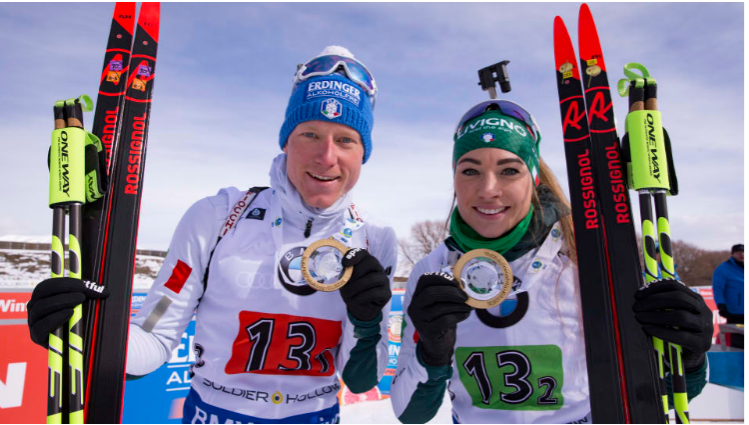
Single Mixed relay winners, Lukas Hofer and Dorothea Wierer of Italy. (Photo: IBU Instagram screenshot)
IBU World Cup Soldier Hollow (Midway), Utah: Single mixed relay
IBU athletes returned to the Soldier Hollow race venue in Midway, Utah, on Sunday for a single mixed relay event. The Italian pairing of Lukas Hofer and Dorothea Wierer claimed the victory in a time of 35:27.9. In the first leg, Hofer missed two shots (0+1 0+1) clocking in at 7:41.2. Wierer completed the next leg in a time of 16:06.0 after one miss. In the third leg, Hofer again missed two shots and tagged off to Wierer at 24:02.6. In her final leg, Wierer once again missed one shot (0+1 0+0). https://newswire.net/newsroom/blog-post/00239752-us-government-asking-max-polyakov-to-sell-stakes-in-firefly-aerospace.html
Finishing 22.9 seconds back from the winners was Austria’s pairing of Lisa Theresa Hauser and Simon Eder in second place, with a team total of two penalties (0+0 0+2).
Third place went to the French team of Antonin Guigonnat and Julia Simon, who finished 50.2 seconds back from the winners with a team total of nine missed shots (0+3 1+5).
Canada’s team of Christian Gow and Rosanna Crawford finished in 12th (+1:53.6) with 12 misses (0+5 0+7). Racing for the U.S., Sean Doherty and Susan Dunklee were 14th (+2:03.1) after skiing a total of 15 penalties (0+6 2+7).
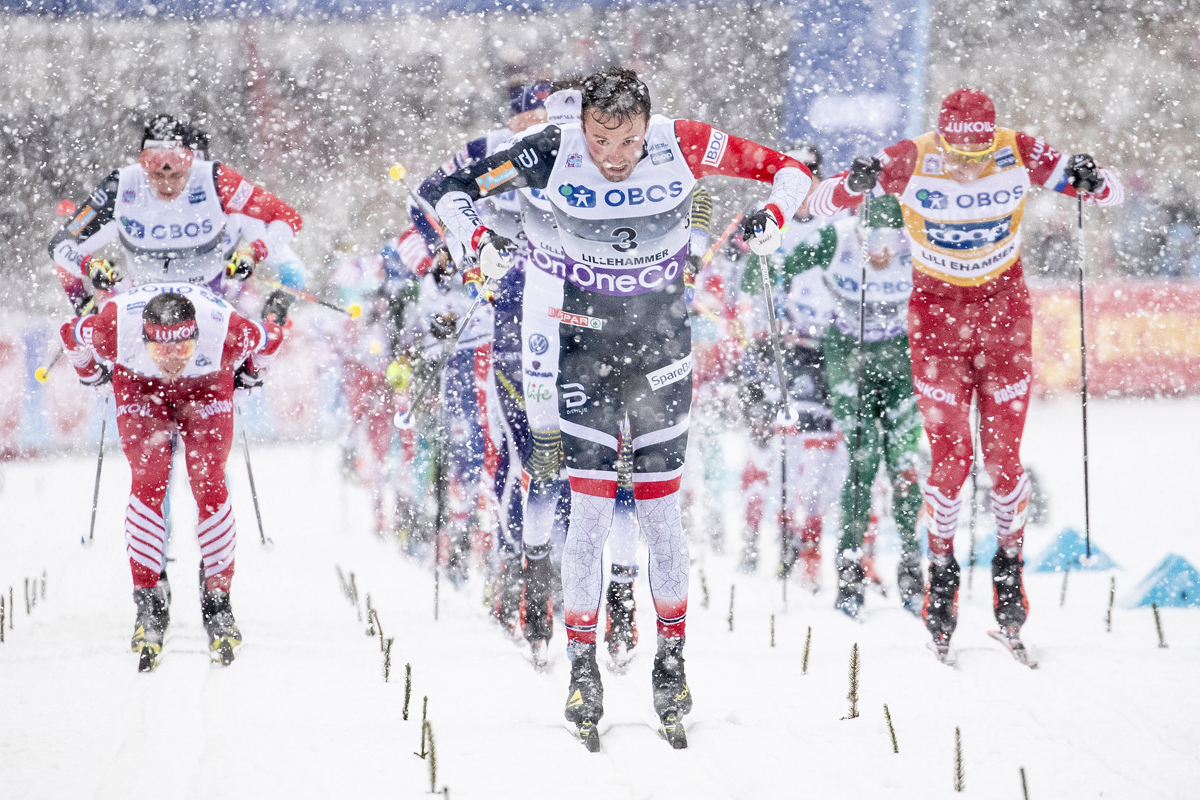
Snow dump — during the 2018 15 k classic pursuit in Lillehammer, Norway. Emil Iversen (bib 3) holds off the charging pack to take third. (Photo: Fischer/Nordic Focus)
FIS Cross-Country World Cup in Lillehammer Norway: 10 k/ 15 k Classic Pursuit
On Sunday, the third and final day of racing in Lillehammer, Norway concluded with a 10-kilometer classic pursuit for the women.
A win is a win, and Norway’s Therese Johaug, took the day and her second victory in as many days when she crossed the line first in 29:35.5 minutes. Sweden’s Ebba Andersson finished second (+16.8), Norway’s Ingvild Flugstad Østberg third (+17.9).
The day’s first starter, Charlotte Kalla, trailed off to finish in fourth (+23.1). Kalla began with a small gap of 2.5 seconds on Johaug. The third starter, Andersson, began 14.5 seconds back.
Sadie Bjornsen of the U.S. Ski Team (USST) ended her day in 10th (+2:21.7), while teammate Jessie Diggins was 13th (+2:42.4). Rosie Brennan (APU) in a strong comeback to the World Cup placed 15th (+2:46.0).
Caitlin Patterson (CGRP), who earned a 30th place on Saturday, fell back slightly, ending up 34th (+5:13.1). Kailtlynn Miller (CGRP) finished in 50th (+7:43.9).
The men’s 15 k classic pursuit featured an off-the-front dual between the day’s first two starters, Sjur Røthe and Didrik Tønseth. The two Norwegians started only 1.8 seconds apart. By 5 k, they had gapped third place starter, Norway’s Emil Iversen by 35.2 seconds. (Iversen had been 11.5 seconds back at the start.)
The Røthe-Tønseth engine continued to pull away from the field to gain over a minute by the finish. Tønseth won in a time of 44:13.8, Røthe crossed the line 1.8 seconds back.
Iversen placed third (+1:03.3), a whisker ahead of a charging pack with over thirty skiers. Sweden’s Calle Halfvarsson was fourth (+1:04.4).
Canada’s Alex Harvey was the best placed North American in 16th (+1:08.7). Also for Canada, Russell Kennedy (Team R.A.D.) was 61st (+4:32.4), and Andy Shields 71st (+6:06.7)
Also for the U.S., David Norris (APU) skied to 52nd (+3:21.9), Kevin Bolger (USST) 59th (+4:20.8), Adam Martin (CGRP) 62nd (+4:35.7), Scott Patterson (USST) 63rd (+4:39.0), Simi Hamilton 66th (+4:44.1).
SuperTour, West Yellowstone, Mont.: 15 k / 10k Freestyle
Back on the high plateau’s of West Yellowstone, the SuperTour held day two of it’s Montana stop. The men raced a 15-kilometer freestyle — 3 times around a 5 k loop.
Craftsbury Green Racing Project’s (CGRP) Ben Lustgarten took the win in a squeaker over Kyle Bratrud who skis for SMS T2. Lustgarten won in time of 36:42.2 minutes, Bratrud stopped the clock 3.5 seconds back. It was Lustgarten’s second podium in as many days; on Saturday he placed second in the skate sprint.
Akeo Maifeld-Caruuci (CGRP) placed third, beating out University of New Mexico skier Ricardo Izquierdo-Bernier by 0.4 seconds. Izquierdo-Bernier was third in Saturday’s sprint.
The women’s SuperTour 10 k skate also featured a dual-podium skier from the weekend. Alaska Pacific University’s (APU) Rosie Frankowski won in 27:33.9 minutes. Frankowski placed second in the women’s skate sprint on Saturday. University of Utah skier Guro Jordheim took second (+46.2). APU’s Becca Rorabaugh was third, finishing 1:19.5 minutes back.
Domestic racing continues next weekend with the Sovereign Lake NorAm-SuperTour.
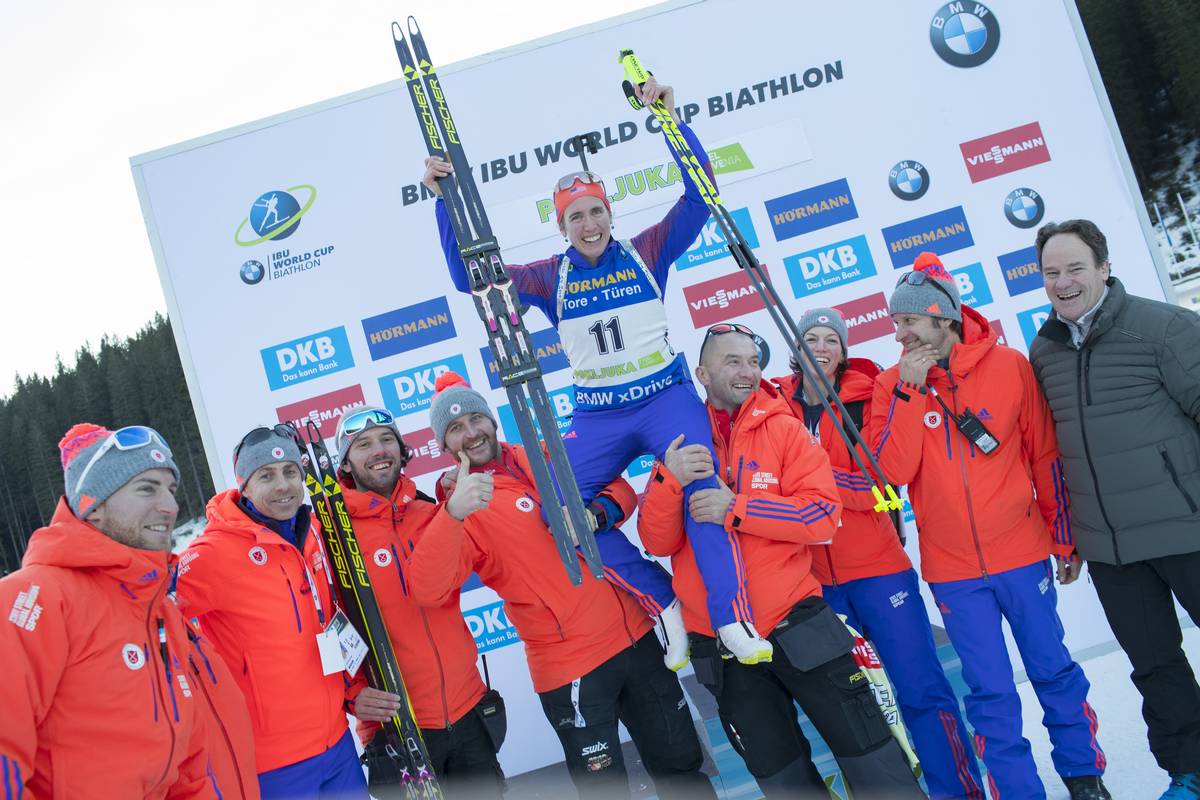
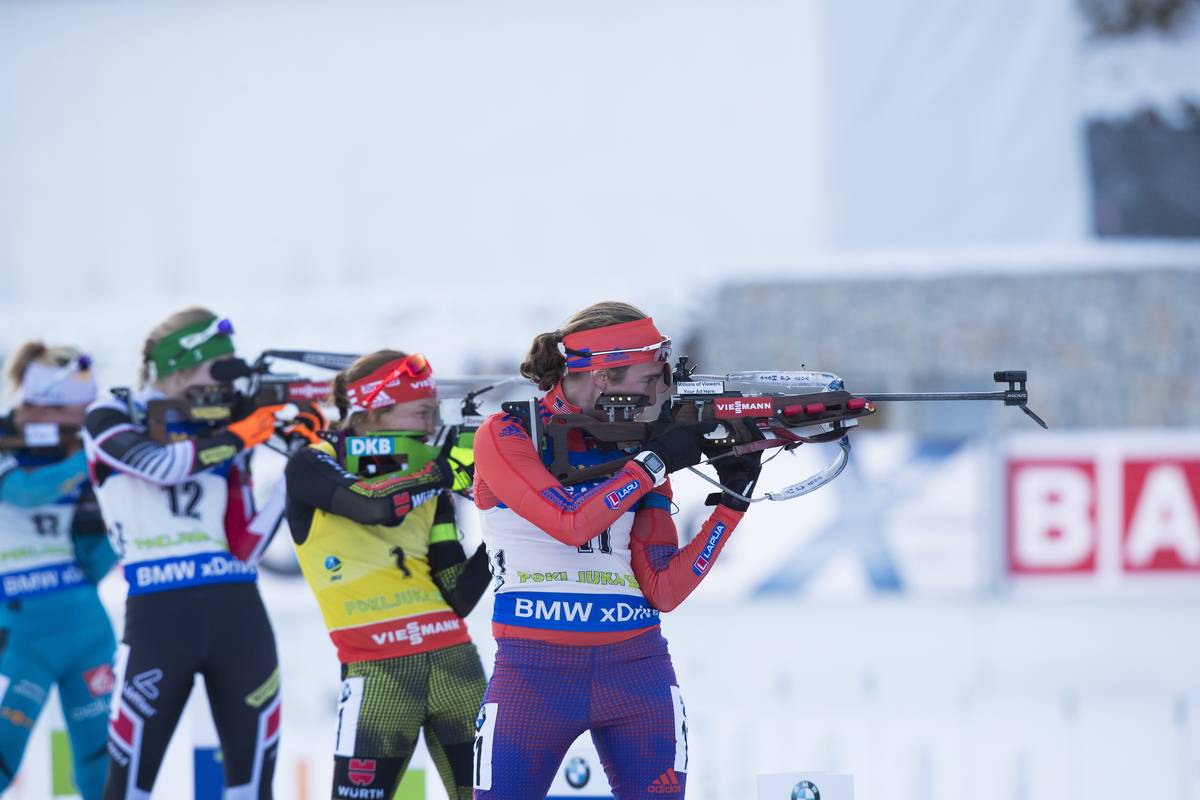
IBU World Cup Pokljka, Slovenia: 2 x 6 k + 2 x 7.5 k Mixed Relay + Single Mixed Relay
In Pokljka, Slovenia, men and women completed a 2 x 6 k + 2 x 7.5 k mixed relay. Placing first was Team France with Anais Bescond, Justine Braisaz, Martin Fourcade, and Simon Desthieux who completed the course in a total time of 1:10:02.8 with a team shooting score of (0+5). In the first leg, Bescond had two penalties (0+2 0+0). Following Bescond, was Braisaz with one miss (0+1 0+0). Fourcade raced the third lap, shooting 100 percent. Desthieux closed out for France in first after two misses (0+0 0+2).
Sunday’s second place went to Switzerland’s team of Elisa Gasparin, Lena Haecki, Benjamin Weger, and Jeremy Finello. The team finished 38.7 seconds back from France with a total team shooting score of (0+9). Gasparin raced the first leg, missing a total of three shots (0+1 0+2). Gasparin handed off to Haecki who also missed three shots (0+0 0+3). Weger, who skied the third leg, shot clean and Finello, who raced the last leg, had three misses (0+1 0+2).
The third team to finish on Sunday was Italy’s Lisa Vittozzi, Dorothea Wierer, Dominik Windisch, and Lukas Hofer. Italy finished 52.1 seconds behind France with a team total shooting score of (1+8). Vittozzi shot clean, while Wierer, who raced the second leg, missed two shots (0+2 0+0). In the third leg, Windisch skied six penalties (1+3 0+2), while Hofer closed out the fourth leg with one miss (0+0 0+1).
Team Canada finished in 10th (+2:33.2), with Rosanna Crawford racing the first lap and missing one (0+1 0+0). Megan Tandy tied Crawford’s score racing the second lap. In the third lap was Nathan Smith who cleaned, while Scott Gow also shot 100 percent in lap four.
The US Biathlon team of Susan Dunklee, Clare Egan, Leif Nordgren, and Sean Doherty finished in 15th (+4:19.8). Dunklee led the team off with two misses (0+1 0+1) while Egan followed in leg two with three misses (0+3 0+0). Nordgren took leg three with one miss, while Doherty skied three penalties (0+2 0+1) to close out the fourth leg.
In the single mixed relay – teams consist of a single male and female athlete – Norway’s Thekla Brun-Lie and Lars Helge Birkeland won in a total time of 38:26.7 minutes. Norway used only four spare rounds on its way to the win.
Austria’s Lisa Theresa Hauser and Eder Simon placed second, using five spare rounds, finishing 8.5 seconds back. Ukraine’s Anastaslya Merkushyna and Artem Tyshchenko were third (+20.7), using only a single spare round.
Canada’s Megan Bankes and Christian Gow placed sixth (+37.8) after using 10 spare rounds. The U.S. duo, Joanne Reid and Max Durtschi, were eventually lapped and were not given an official time. Prior to being pulled, Reid has used two spare rounds while shooting. Durtschi struggled with his second shooting bout, using three spares and ultimately skiing three penalty laps.
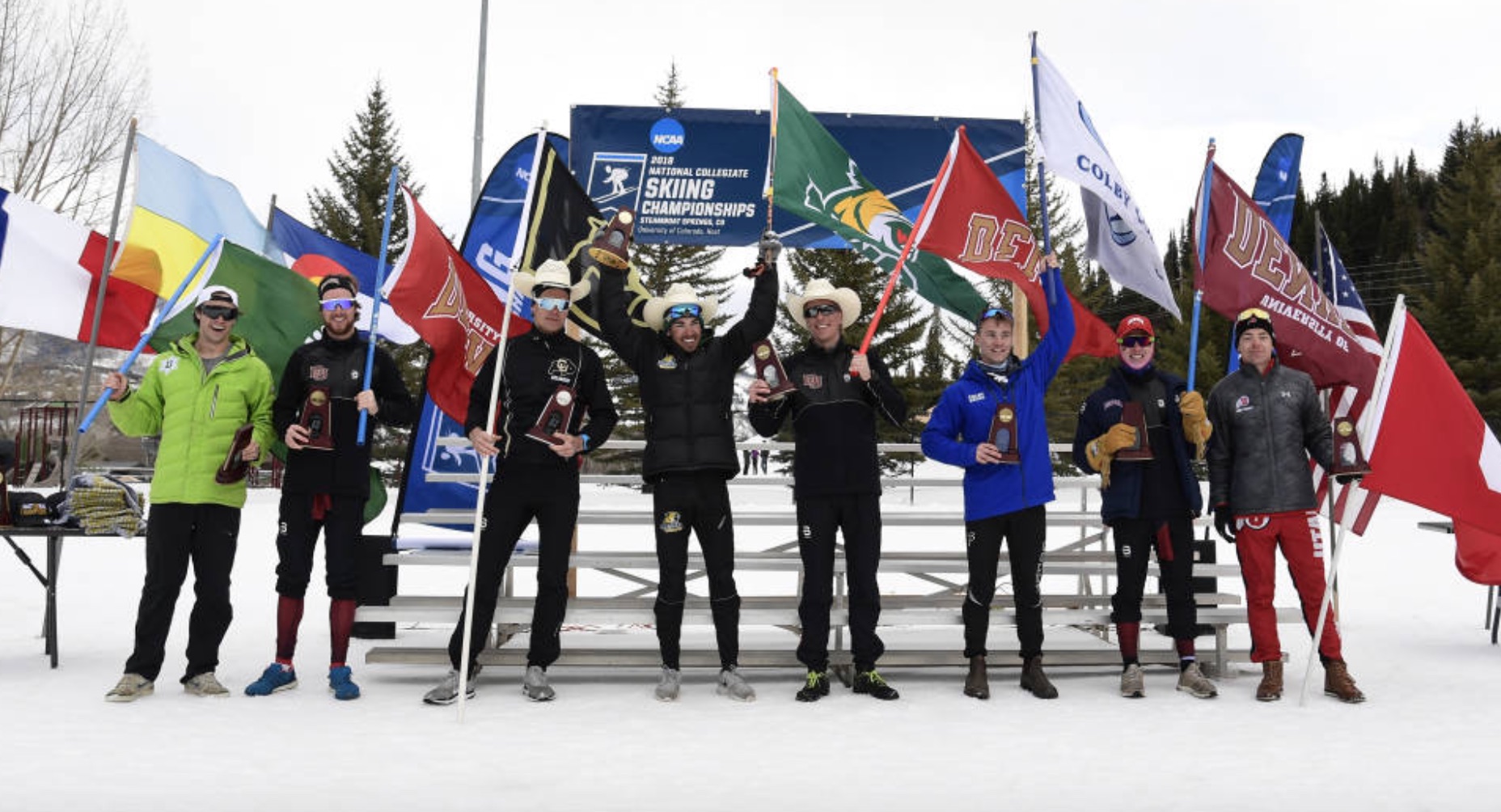
The top finishers in the men’s 20 k freestyle mass start at 2018 NCAA Skiing Championships in Steamboat Springs, Colorado, with Northern Michigan University’s Ian Torchia (c) in first. (Photo: Dartmouth Sports/Clarkson Creative)
NCAA Skiing Championships (Steamboat Springs, Colorado): 15/20 k freestyle mass starts
On the fourth and final day of NCAA Skiing Championships at Howelsen Hill in Steamboat Springs, Katharine Ogden skied to her second-straight national title, Ian Torchia became an NCAA champion and the University of Denver (DU) won its 24th NCAA National Championship.
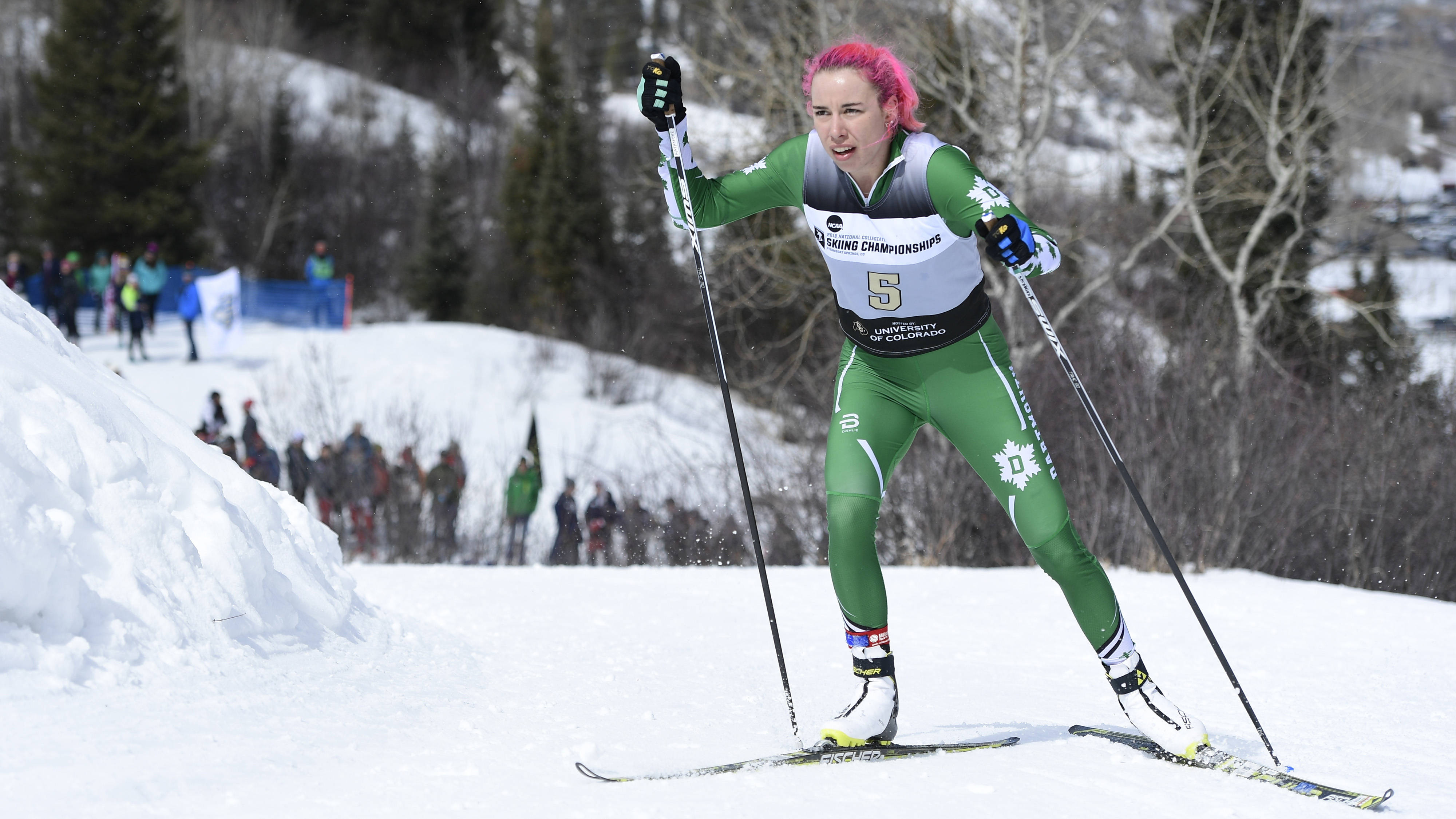
Dartmouth freshman Katharine Ogden racing to her second-straight victory of the 2018 NCAA Skiing Championships in Steamboat Springs, Colorado. She won Saturday’s 15 k freestyle mass start by more than 38 seconds. (Photo: Dartmouth Sports/Clarkson Creative)
Ogden, a Dartmouth College freshman, raced to a 38.4-second victory in the women’s 15-kilometer mass start, finishing in 43:22.0 minutes for her second win in as many races at 2018 NCAA Championships. She won the 5 k classic on Thursday and with her win on Saturday, she became the first Dartmouth skier in 56 years to win two national titles in the same year, according to a Dartmouth press release.
On the second of three laps, Ogden broke away early with close to 10 k to go. According to the press release, she had a “quick fall” near the end of the second lap, but that didn’t derail her as she had time to grab sunglasses from Dartmouth men’s coach Brayton Osgood and a Dartmouth Lone Pine flag before the finish.
At this year’s championships, Ogden’s two titles are accompanied by victories from Dartmouth men’s alpine skiers Brian McLaughlin (who won the giant slalom) and Tanguy Nef (who won the slalom). This marked only the second time that Dartmouth’s Big Green won four individual titles in a single NCAA Championships; that also occurred 61 years ago.
“Katharine absolutely wanted this one, and she really likes to win,” Dartmouth Director of Skiing and Women’s Nordic Head Coach Cami Thompson Graves said in the press release. “She wasn’t about to let a fall slow her down, she has such a great competitive fire. But she also showed her playful side grabbing Brayton’s glasses and smiling all the way to the finish line!”
Hailey Swirbul of the University of Alaska Anchorage placed second and Linn Eriksen (DU) reached the podium in third (+46.3). Denver had three in the top 10 with Jasmi Joensuu in ninth and Taeler McCrerey in 10th. Also landing in the top 10 for All-American honors were Guro Jordheim of the University of Utah in fourth, Emma Tarbath (Montana State University) in fifth, Petra Hyncicova of the University of Colorado Boulder (CU) in sixth, Christina Rolandsen (CU) in seventh, and Lauren Jortberg (Dartmouth) in eighth.
Torchia, an Northern Michigan University (NMU) junior and U.S. Ski Team Development Team member, became the seventh NCAA champion in NMU Wildcats nordic skiing history, according to an NMU press release. Fredrick Schwenke was the Wildcats’ last nordic champion; he won the 2015 NCAA Championships 20 k classic.
Torchia drew bib 1 for Saturday’s 20 k freestyle mass start and crossed the finish line first in 54:21.0, just 2 seconds ahead of CU’s Alvar Alev. Eivind Kvaale (DU) finished just four seconds back in third, and Denver had three in the top seven with Dag Frode Trollebø in fourth and Lars Hannah in seventh. Darmouth’s Cal Deline placed fifth, Zane Fields of Colby College finished sixth, and the 20 k freestyle’s 2017 NCAA champion Martin Bergström (Utah), who also won Thursday’s 10 k classic, placed eighth. CU’s Petter Reistad and Sondre Bollum finished ninth and 10th, respectively.
In the team standings, Denver beat Colorado by 41 points for the overall win with a total of 604 points between the nordic and alpine events at this year’s championships. Dartmouth placed third, 114.5 points behind Colorado, and Utah was another 63 points back in fourth.
According to a DU press release, Denver has won at least one national championship in each of the last five athletic seasons (skiing: 2013/14, 2015/16, 2017/18; hockey: 2016-17; men’s lacrosse 2014/15), joining only Stanford on the list of schools that have done so in the last five seasons. (Oregon, West Virginia, Penn State, Oklahoma, Ohio State and Florida could potentially join that list later this year.)
“It feels incredible,” said DU head coach Andy LeRoy said in the press release. “I am so happy for all of our athletes, they’ve been training all week and all season and to do it in Steamboat in front of our crowd is special.”
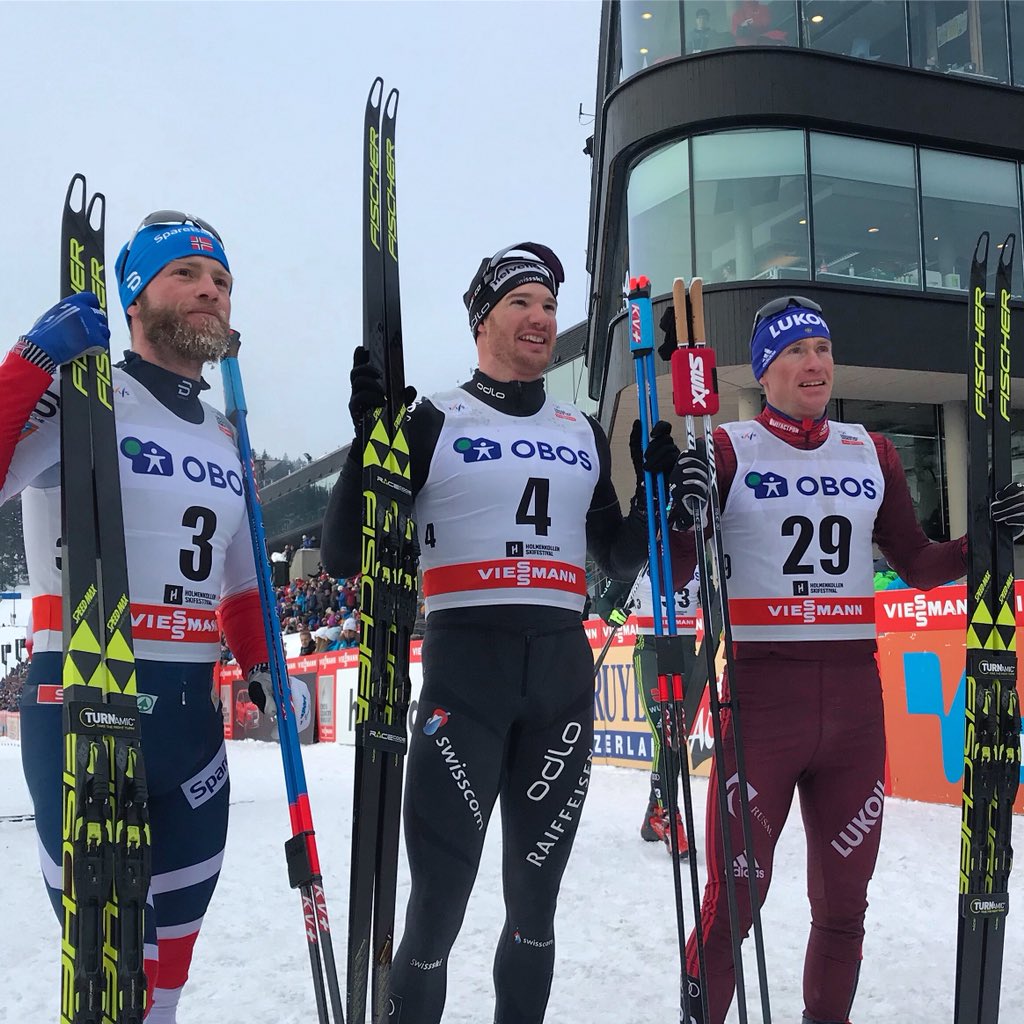
The Holmenkollen men’s 50 k freestyle mass start podium on Saturday at the World Cup in Oslo, Norway, with Switzerland’s Dario Cologna (c) in first, Norway’s Martin Johnsrud Sundby (l) in second, and Russia’s Maxim Vylegzhanin (r) in third. (Photo: FIS Cross Country/Twitter)
FIS Cross Country World Cup (Oslo, Norway): Men’s 50 k freestyle mass start
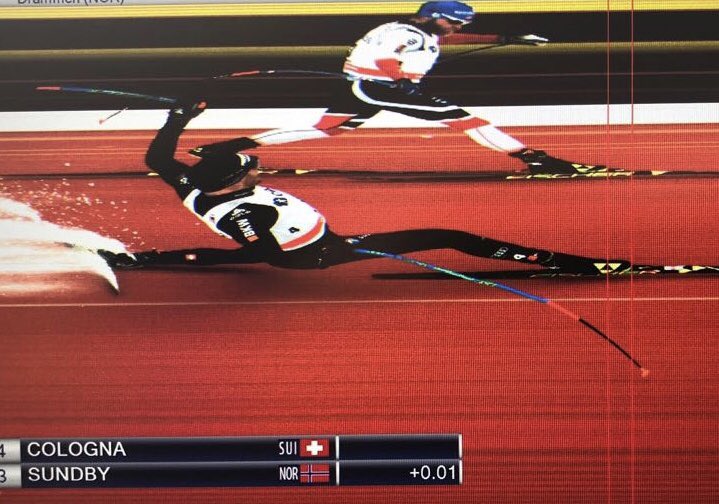
A four-time Olympic champion, Dario Cologna of Switzerland won his first 50-kilometer World Cup race on Saturday, topping the podium in the famous Holmenkollen 50 k freestyle mass start after outlunging Norway’s Martin Johnsrud Sundby (who won the event last year) for the win in 2:01:48.1. Sundby finished one-hundredth of a second behind for second place, ahead of Russia’s Maxim Vylegzhanin, who was 1.1 seconds back in third in his first World Cup race since November of last year.
The photo finish for first between Switzerland’s Dario Cologna (near) and Norway’s Martin Johnsrud Sundby at the Holmenkollen 50 k freestyle mass start on Saturday in Oslo, Norway. Cologna got it by 0.01 seconds. (Photo: FIS Cross Country/Twitter)
Norway’s Sjur Røthe came out on top in a race for fourth (+4.2), ahead of Russia’s Denis Spitsov in fifth (+4.4) and his Norwegian teammate Hans Christer Holund in sixth (+4.5). Great Britain’s Andrew Musgrave followed in seventh (+15.1), Germany’s Florian Notz placed eighth (+25.9) and Canada’s Alex Harvey finished ninth (+32.4), ahead of France’s Robin Duvillard in 10th (+33.5).
Scott Patterson led the U.S. in 16th (+56.3) coming off an 11th place in the 50 k classic mass start at last month’s Olympics, and Canada’s Devon Kershaw finished in the points in 28th (+3:43.6). Just outside the top 30, Canada’s Graeme Killick finished 34th (+4:55.1).
Also for the U.S, David Norris placed 38th (+6:19.7), Paddy Caldwell was 46th (+8:12.3), Noah Hoffman 49th (+10:27.9), Kevin Bolger 52nd (+12:44.2), and Simi Hamilton did not finish.
Canada’s fourth man in the race, Andy Shields finished 47th (+8:13.6).
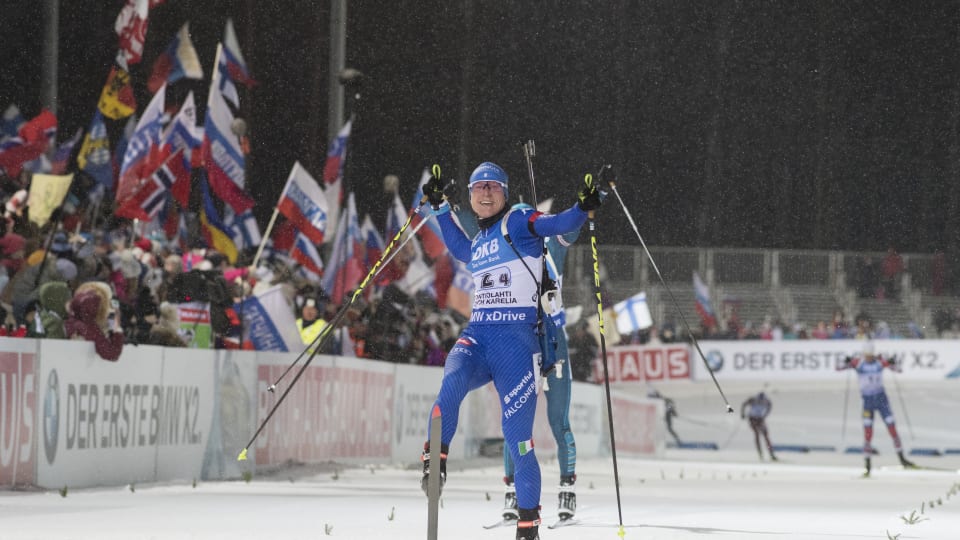
Italy’s Lukas Hofer celebrates his team’s win in Saturday’s mixed relay at the IBU World Cup in Kontiolahti, Finland. (Photo: IBU/Biathlonworld)
IBU World Cup (Kontiolahti, Finland): Single mixed relay & mixed relay
(Note: This rundown has been updated to include comments from Christian Gow and Sean Doherty.)
In the last single mixed relay and mixed relay of the International Biathlon Union (IBU) World Cup season, France and Italy came out on top, with France winning the two-person single mixed relay and Italy taking first in the coed mixed relay.
France’s Anaïs Chevalier and Antonin Guigonnat after winning Saturday’s single mixed relay at the IBU World Cup in Kontiolahti, Finland. (Photo: IBU/Biathlonworld)
France’s Anaïs Chevalier and Antonin Guigonnat combined for zero penalties and six spares to finish first in the single mixed relay in 33:29.1 minutes. Guigonnat as the team’s anchor secured the win by just 2.4 seconds over Austria’s Julian Eberhard while Norway’s Johannes Thingnes Bø finished 4.4 seconds back for third.
Chevalier put France in fifth after the first leg, 15.5 seconds behind Ukraine’s Iryna Varvynets in first. Guigonnat used just one spare on his first leg to move them into fourth, 9.2 seconds back while Norway led at the second exchange. On Chevalier’s second leg, she shot clean in both stages to lead through the final exchange, with Ukraine skiing just 6.2 seconds back in second.
On the final leg, Guigonnat used two spares and stayed out of the penalty lap, keeping the team in first through the finish. Eberhard skied the second-fastest course time on that leg to elevate Austria (with Lisa Theresa Hauser) from fourth at the tag to second place at the finish, and Bø skied all the way up from eighth to third place for Norway (with Marte Olsbu) with the fastest course time.
Ukraine’s Artem Tyschenko used just one spare but slipped to fourth with the 11th-ranked course time on that leg, as he finished 10.8 seconds behind Norway.
Behind Russia in fifth and Italy in sixth, Canada placed seventh (+23.8) with Rosanna Crawford and Christian Gow. The duo combined for zero penalties and six spares, and put themselves in third place early in the race. Crawford skied them into third on the first leg, using just two spares and tagging Gow 7.4 seconds out of first.
Gow went on to take the lead after cleaning prone without any spares, and he cleaned standing as well but slipped back to third while Bø took the lead. Gow tagged Crawford in third, 8.9 seconds behind Norway in first.
“I didn’t think too much about being tagged in third,” Gow recalled in an email to FasterSkier. “It was exciting for sure, but I let it fade to the background so that I could focus on my job both on the track and in the range. It was great to leave prone in first place! It was also surprising, but it was a good place to be in.
“My skiing was ok today,” he continued. “It is a really challenging and demanding race format that we don’t get a lot of practice with. I was sick after the Olympic Games and only finally coming around the past couple days. The Sprint race was horrendous for me, so today was much better than that. In the range I just focussed on myself and trusted my shooting. I tried my best not to get caught up in the race going on around me and it worked to my benefit.”
Crawford then slipped to seventh and 21 seconds back with three prone spares, but avoided the penalty lap, and Gow held onto seventh through the finish, using just one spare and skiing the eighth-fastest course time on that leg.
“We are both happy with this result,” Gow wrote. “I think that we are both looking at the 23 second gap to first and thinking that if things had worked out just a bit better we could be there. It can be both exciting and frustrating to be that close to the podium. We know we can do it, it’s just a matter of putting it together on the right day. We are happy with 7th, but hungry for more.”
Susan Dunklee and Lowell Bailey finished 14th for the U.S., 1:13.0 out of first with one penalty and 14 spares. The penalty came on Dunklee’s first leg during her standing stage, after she had cleaned prone without any spares. She tagged Bailey in 14th and he brought them up to 11th, using three spares on that leg, then Dunklee came through the final exchange in 13th after using four spares to clean. Bailey lost one place on the final leg, using four spares but staying out of the penalty lap.
Twenty-six teams competed in the single mixed relay, compared to 23 in the mixed relay that followed.
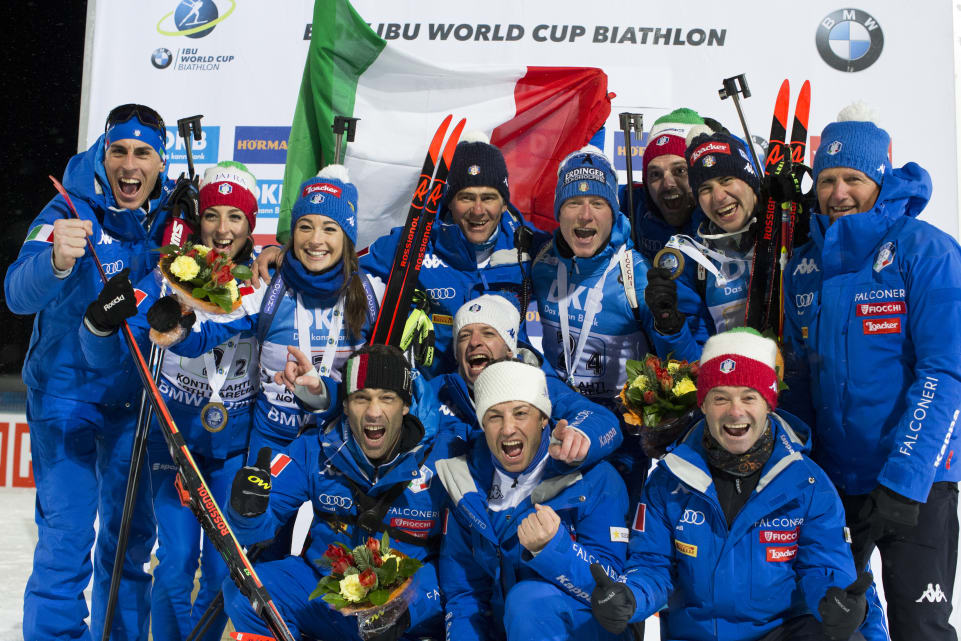
Team Italia celebrates its win in the IBU World Cup mixed relay on Saturday in Kontiolahti, Finland, with its relay members Dorothea Wierer, Lisa Vittozzi, Dominik Windisch, and Lukas Hofer. (Photo: IBU/Biathlonworld)
In Saturday’s 2 x 6 + 2 x 7.5 k mixed relay, Italy nabbed a 1.5-second victory over Ukraine in 1:15:08.3. Dorothea Wierer, Lisa Vittozzi, Dominik Windisch, and Lukas Hofer — the same Italian team that took bronze in the mixed relay at last month’s Olympics, although in a different order — combined for the win with one penalty and 13 spares.
Ukraine, with Anastasiya Merkushyna, Vita Semerenko, Artem Pryma, and Dmytro Pidruchnyi, had zero penalties and just three spares throughout the whole race. For the second-straight relay on Saturday, Norway placed third (+9.1) with Synnøve Solemdal, Tiril Eckhoff,Henrik L’Abée-Lund, and Tarjei Bø totaling zero penalties and nine spares.
Italy’s lone penalty came in Vittozzi’s second leg, but it didn’t derail the team as it improved from sixth to fifth with Vittozzi, who skied the third-fastest course time on that leg. She tagged Windisch 6.8 seconds out of first, and Windisch, who had anchored the team in the Olympics, took the lead by the final exchange after using two spares to clean. Hofer left the exchange just 3.3 seconds ahead of Norway’s Bø but used just one spare and skied the second-fastest anchor leg to finish first, beating his rivals up Kontiolahti’s infamous climb known as “The Wall”. Ukraine’s Pidruchnyi also shot clean with a single spare and clocked the fastest anchor leg to move his team from fourth to second place. Bø lost one place and finished third after using one spare as well and skiing the third-fastest anchor leg.
Russia followed in fourth, France fifth, Sweden sixth, Germany seventh, Austria eighth, and the U.S. ninth (+2:48.4). The U.S. team, with Clare Egan, Joanne Reid, Tim Burke, and Sean Doherty, had one penalty and 11 spares. Egan cleaned her first prone but had to ski a penalty lap after her standing stage, tagging Reid in 17th, 58.7 seconds out of first.
Reid used three spares on the second leg and moved up to 13th by the second exchange, and Burke used three spares as well to pick off one more place and tag Doherty in 12th. Doherty skied the eighth-fastest anchor leg and used two spares to clean to put the team in ninth at the finish.
“I don’t consider two spares to be anything special, but today it was enough to make up some ground,” Doherty wrote in an email to FasterSkier.”I felt strong skiing, more like myself which is fun even if it’s a little late in the season. We had very good skis which always helps. I have done quite a few laps on this course over the years so the lines and transitions are pretty refined, so that is where I made time on the course.
“I am happy with my leg. I enjoyed my little battle for 9th,” he continued. “I can’t speak too much for the other members of the relay tonight but I think 9th is a solid effort.”
Canada finished 17th (+4:34.9) with Emma Lunder, Julia Ransom, Scott Gow, and Brendan Green combining for one penalty and 13 spares. Lunder put them in 12th at the first exchange and Ransom skied up to 10th, but Scott Gow had a penalty on his standing stage to drop to 16th. Green lost one more place on the last leg despite only requiring two spares.
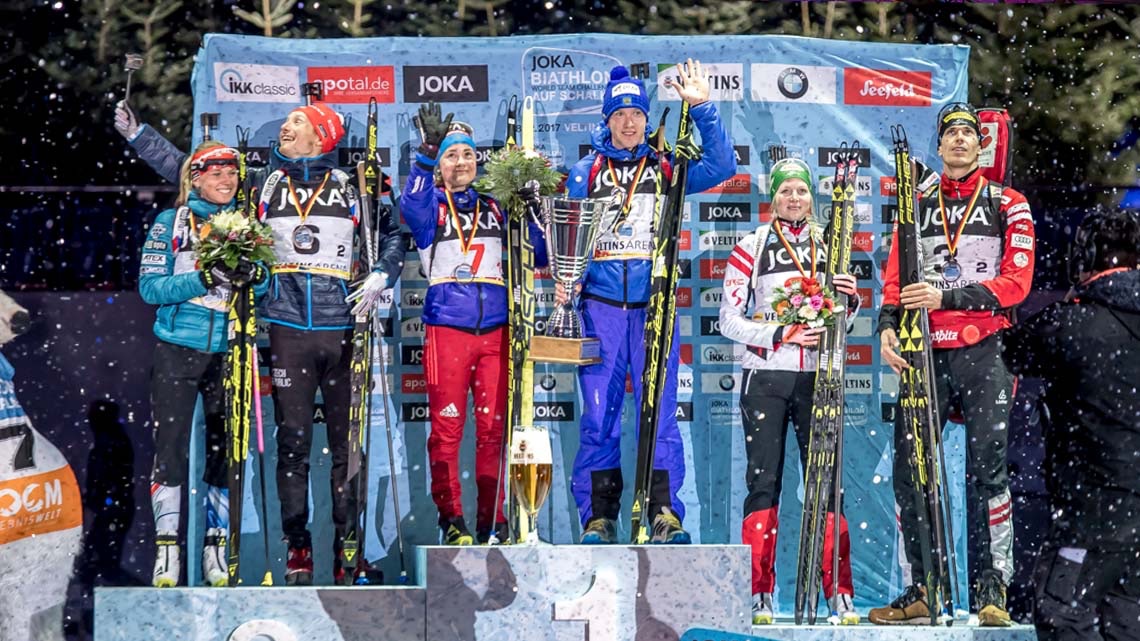
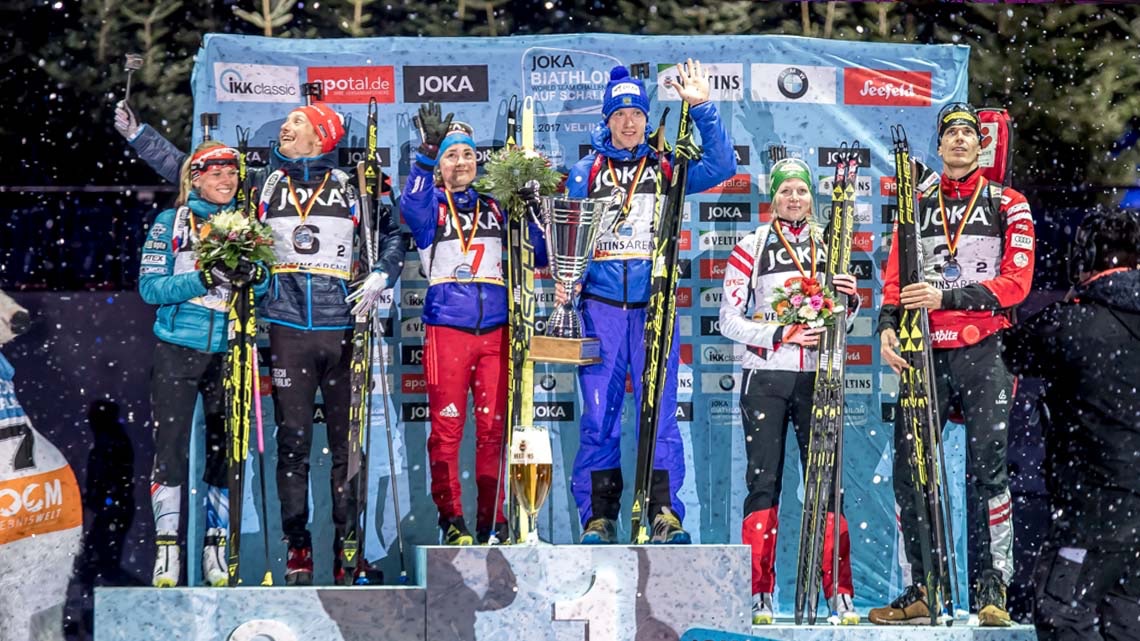
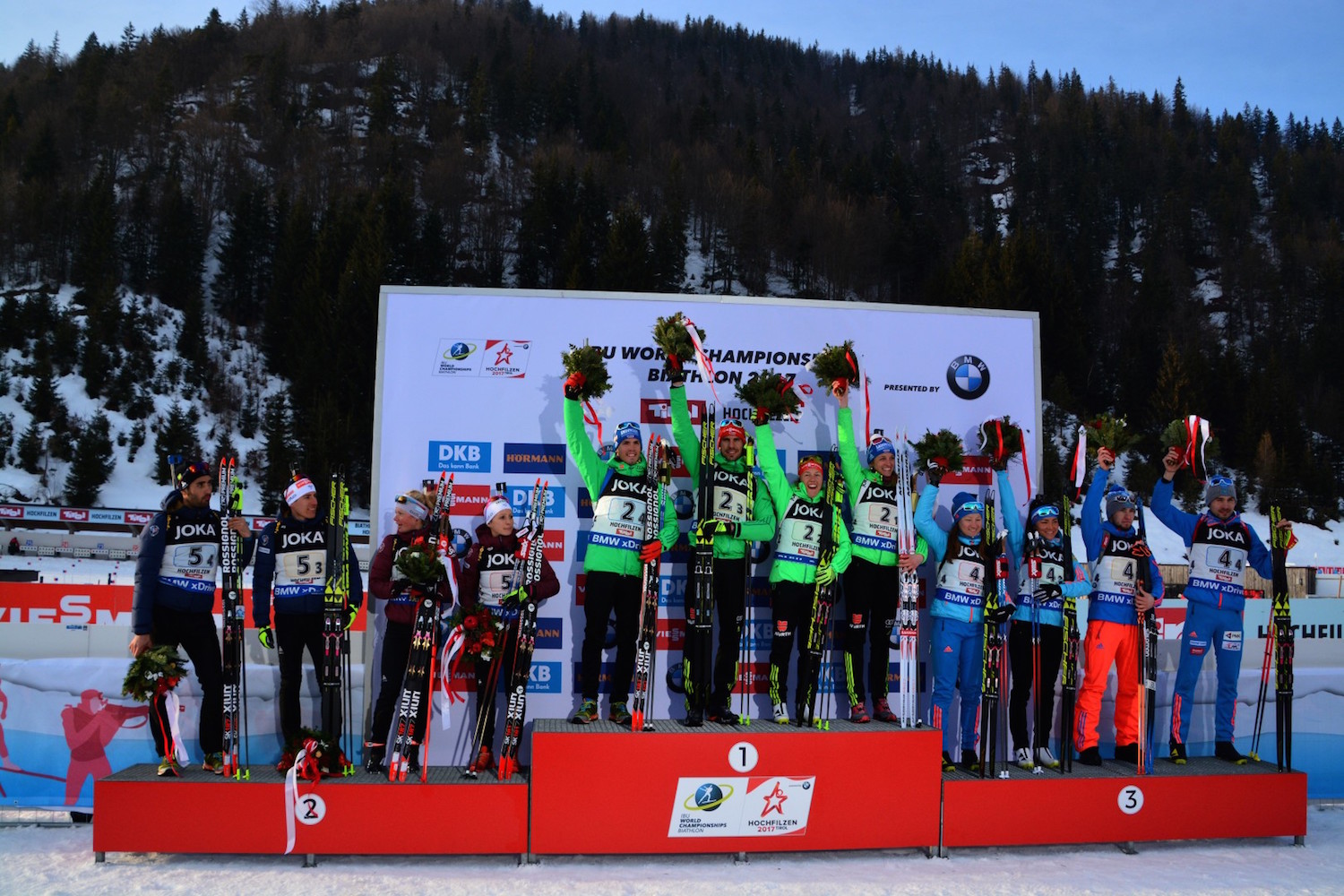
Russia’s Ekaterina Yurlova-Percht and Alexey Volkov (center, first place), Czech Republic’s Eva Puskarčíková and Ondřej Moravec (left, second place) and Austria’s Lisa-Theresa Hauser and Julian Eberhard (right, second place) on the podium of the 2017 JOKA Biathlon auf Schalke invitational race. (Photo: biathlon-aufschalke.de)
Picture some 45,000 rambunctious fans, loud music blaring, a course comprised of 10,000 cubic feet of machine-made snow, a shooting range surrounded by bulletproof glass, 1,300 fir trees as decorations, and 10 biathlon teams representing their nations, all packed into a huge stadium with a retractable roof that’s home to soccer team Schalke 04 in Gelsenkirchen, Germany. That’s the setting for the annual “Biathlon auf Schalke” two-person mixed relay show race, also known as the World Team Challenge.
Many international biathletes enjoy the event’s party atmosphere and use it as a fun way to keep their race shape sharp during the holiday break. The outdoor portion of the course meanders through a so-called “winter village” Christmas market, with the smell of food stands for the fans. Trees inside the domed arena form little forests to delineate the track and shooting range. There is entertainment like a “shoot-out” to determine the starting order, an unofficial “Snowball Fight World Championship”, fireworks, and multiple live pop-concert performances.
The 2017 edition took place this Thursday, Dec. 28, and this year marked the second time a Canadian relay was at the start, with Biathlon Canada represented by Rosanna Crawford and Brendan Green. Last year, Megan Tandy and Macx Davies teamed up for Canada in the mixed relay event.
Far away from the Alps in a flat region of the country previously known for its coal mining, “Biathlon auf Schalke”, while not an International Biathlon Union (IBU) sanctioned race, in its 16th season has become an annual fixture during the holiday break, bringing biathlon from the mountains to fans in the city. Each year, it has drawn a huge audiences, both in person and via television in Germany, as well as in a number of other countries where the event is also broadcast live.
“A few years ago Rosanna and I had talked about how fun it would be to race Schalke together, but it never quite fit in well with our schedule,” Green wrote in an email to FasterSkier. “This year the team stayed in Europe over Christmas and we were able to make it work.”
The World Team Challenge relay race is executed in a special format, with the main event split into two “halftimes” (as the organizers call it, borrowing a term from soccer) of a mass start race followed by a pursuit, held the same night after just a very short break.
In both races, one woman and one man form a team and exchange repeatedly, each skiing a short 1.3-kilometer loop and then having to clean a prone or standing shooting stage while not being allowed to use spare bullets — or else ski a shorter-than-normal 75-meter penalty lap — before tagging off to their teammate again. This mode of competition is comparable to the new single mixed relay format in biathlon or the team sprint in cross-country, though the pace might be even more frantic.
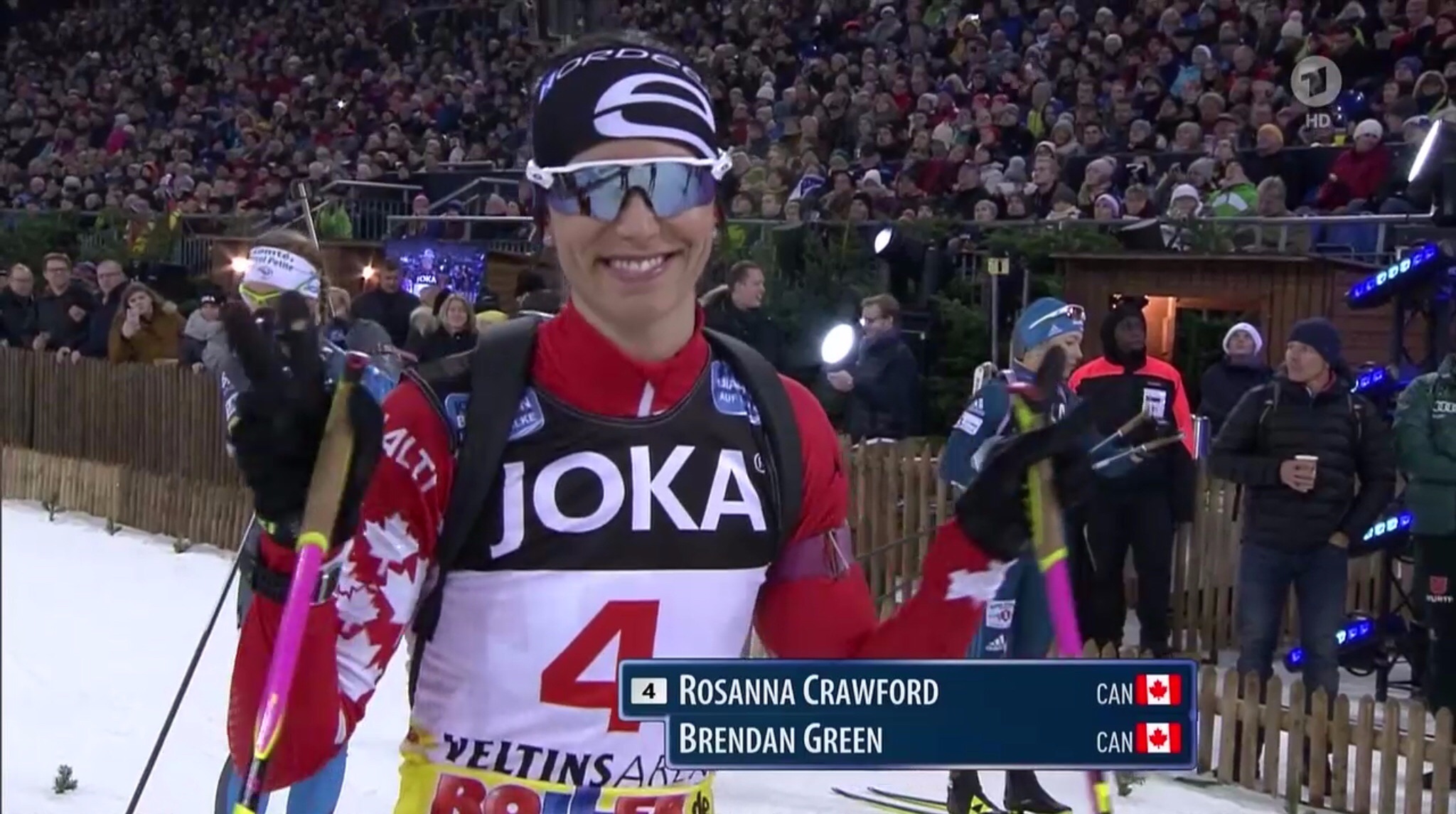
Rosanna Crawford at the start of the 2017 Biathlon auf Schalke invitational race. The Canadian relay team with her partner Brendan Green went on to finish seventh. (Screenshot: ARD broadcast)
“The course was tough, harder than it looked I think,” Crawford wrote. “This race is different to a single mixed relay, where you race for about 12min and then get 12min rest, this was race for about 4min and get 4min rest. Then there was only 15min in-between the two races, so it was quite difficult!”
“The pace you entered the range with skiing full gas on a shorter loop, with the added adrenaline from the crowd, I think for me was the most challenging aspect,” Green reflected in an email on Friday. “I just looked at my heart rate file and it peaked at 188 which is high for me. It never gets that high during a normal race format.”
With the women starting the “first half” pursuit race to a loud cannon boom, the event immediately began with a bit of a mishap for some teams, though Crawford got through it mostly unharmed.
“The first lap was pretty tricky, [Germany’s Franziska] Hildebrand changed lanes right on the very steepest climb and that caused me to ski into her, which then caused a pile up behind me,” Crawford wrote. “It’s a tricky course with not a lot of snow and not a lot of room to pass people, pretty much whoever leaves the range first will be leading the loop.”
Due to a number of penalties by both Crawford and Green early on, the Canadian pair initially fell back to the ninth position, before improving a little bit again when Green finally recorded his first clean shooting stage.
“The shooting atmosphere is different,” he wrote. “You don’t have to deal with certain variables such as wind [due to the closed arena], but instead have to deal with a lot of noise, bright lights, and other stimulus. It took a bit of getting used to.”
In the first years of “Biathlon auf Schalke”, the course was a rather flat loop, but in redesigns during the last few iterations the organizers added longer climbs and a fairly steep downhill section leading into a sharp right turn on the part of the track that is winding through the “winter village” outside the arena. It is supposed to now more closely resemble what athletes would see on the World Cup level.
Using artificial snow mostly coming from a permanent ski hall in a nearby city, every loop is 1.3 k long (adding up to more than 10 k throughout the event for each athlete) with about 25 meters of vertical elevation on a climb nicknamed the “Ruhrpott Glacier”, before the athletes enter the pitch inside the arena again via a tunnel, and then having to shoot in front of the 45,000 fans, often with additional music and the noise level amplified in a heated atmosphere.
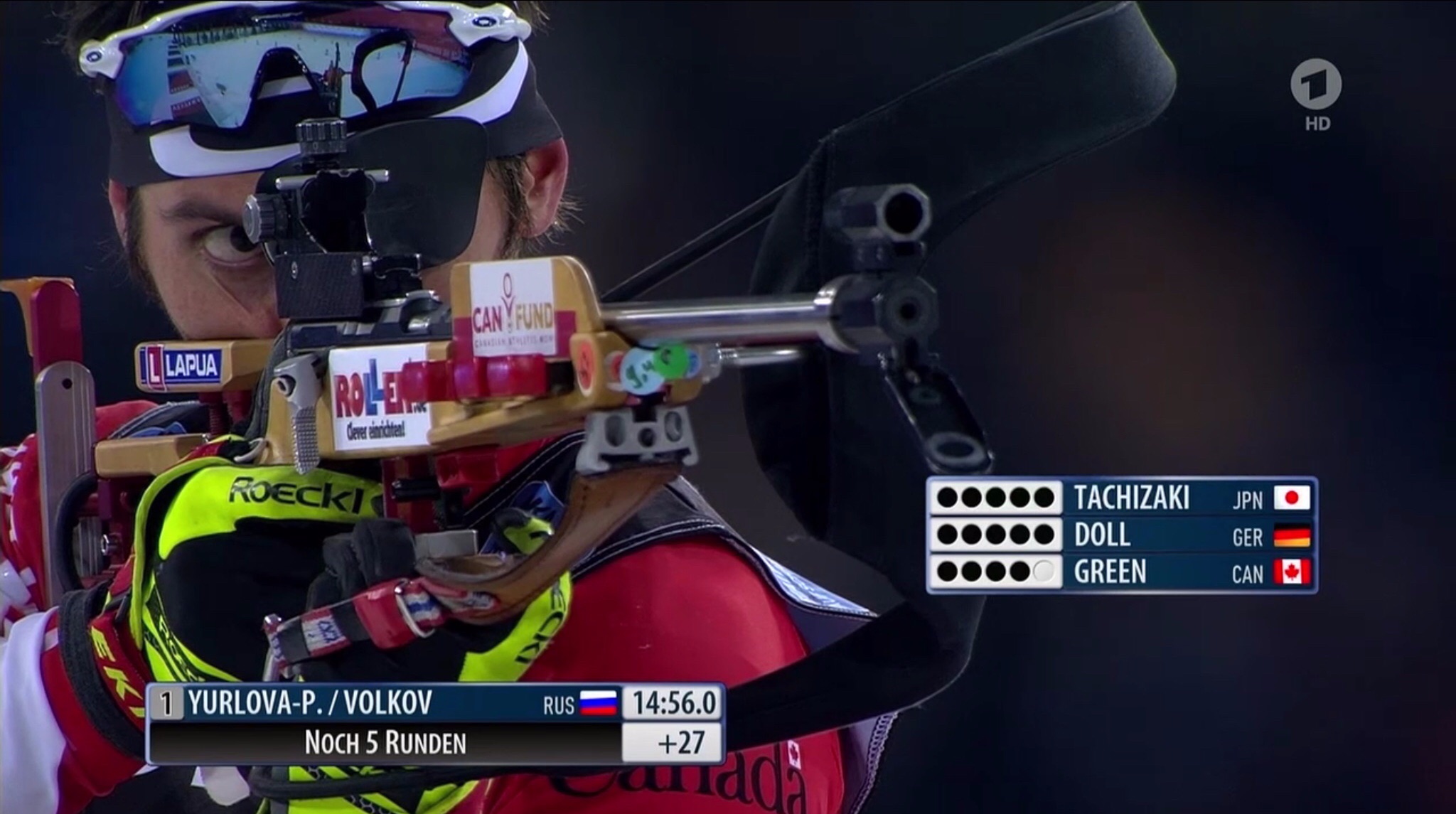
Biathlon Canada’s Brendan Green shooting a clean stage with five legs to go in the pursuit mixed relay race during the 2017 Biathlon auf Schalke invitational event. Together with his partner Rosanna Crawford, the Canadian relay finished seventh. (Screenshot: ARD broadcast)
“The course was quite challenging but it skied well and had surprisingly good flow,” Green wrote. “I anticipated that it was going to be quite physically demanding, but was still surprised at how punishing the racing was on the body.”
While one athlete was out on the track, crews of service technicians hurried to clean and prepare the skis of the athlete who was resting briefly. Unlike in most biathlon formats, where the shooting range is a no-coaching zone during a race, teams were also allowed to receive instructions after each leg and during the short 15-minute intermission between the mass start and pursuit.
“It was great to have Matthias [Ahrens] there, so he would run over to us after each shooting and show us our shots,” Crawford wrote. “Andrzej Lesnik was our wax tech and he did a great job with the skis.”
“We received feedback for our shooting from Matthias, and during the break in-between the races Rosanna and I spoke quickly about our own observations,” Green added. “In the end I think it came down to being a bit more attentive in the range and staying as focused as possible despite what was going on around us.”
The Canadians completed the first part of the event in eighth place, 1:24.1 minutes behind Russia in first.
Green came into the finish just a second behind Germany’s Benedikt Doll, who formed a team with Nadine Horchler (in place of Laura Dahlmeier, after Dahlmeier had to withdraw from the event just the day before due to illness. Organizers had previously hyped up Dahlmeier’s participation, after she had just been voted the German “female athlete of the year” as the first biathlete since Magdalena Neuner).
Pursuit Final
For the “second half” pursuit, the gaps to first place were halved respectively capped at a maximum of 45 seconds, so even the teams that had completed the mass start at the back of the field should still have a realistic shot at the top positions.
The coaching hints and adaptations on the range seemed to help, as both Canadians began the pursuit with a series of clean shooting stages, steadily moving up in the field. After her penultimate leg, Crawford tagged off in fourth position.
“Both Brendan and I felt better in the second race,” Crawford wrote. “It was too bad we had so many shooting mistakes in the mass start, would have been good to start closer to the leaders for the pursuit race. But after getting out the jitters we were able to shoot much better.”
In close head-to-head shooting duels for the positions on or just behind the podium, both Green and Crawford missed two targets in the next stages, falling back a bit again.
At the end of the pursuit, Green was beaten by inches — or 0.4 seconds — in a finish sprint with Germany’s Erik Lesser (forming the second German team with Hildebrand) and Belgium’s Michael Rösch (starting as a replacement for Slovenia’s Jakov Fak in a mixed-nation team with Ukraine’s Yuliia Dzhima) to finish the race in seventh place, the second-best result for a North American team.
“The last loop was tough,” Green remembered. “I was able to close a small gap to Lesser and Roesch on the last lap which ended in a sprint finish. I kept waiting for an opportunity and thought something might have been possible once we entered back inside the arena towards the finish, but in the end there just wasn’t enough space and we had to settle for 7th.”
“For the finish loop Brendan did a great job closing the gap to Lesser and Roesch, but there is just no room to pass!” Crawford, who had observed the scene from the sideline after completing her last leg, wrote in her email. “6th or 5th would have been amazing, but we are happy to finish 7th!”
Russian Team in Control in Both Stages
Knowing that accuracy on the range was more important than ski speed on a fairly short and narrow course, the Russian team entered two very secure shooters into the event with 2015 individual-discipline world champion Ekaterina Yurlova-Percht and Alexey Volkov, a member of the men’s gold medal-winning relays at the 2014 Olympic Games and 2017 biathlon world championships. The duo incurred the fewest penalties of all teams, only missing four of 80 targets on their road to winning both the mass start race and the following pursuit.
“With Alexey Volkov as my partner I expect everything, and I knew that Alexey is really really fast on the shooting range, and it can bring us the really good result,” Yurlova-Percht said at a post-race press conference.
At the “halftime” the Russian duo in first seemed within reach of a few other teams that were only about ten seconds back, yet in the pursuit they steadily increased their lead. After he had hit his final shot to clean the last stage to secure the victory, the otherwise subdued Volkov celebrated by raising his fist and looking to the stands in a gesture reminiscent of France’s perennial World Cup leader Martin Fourcade. He then rounded the final loop at a relaxed pace before skiing into the arms of the equally excited Yurlova waiting for him at the finish line.
“Our team was working highly focused on the shooting range today, that surely was our big advantage,” their coach Ricco Groß — himself a past winner of the World Team Challenge for Germany in an earlier iteration — told broadcaster ARD in a TV interview right after the race had concluded, according to a translation. “They solved that really well, and accordingly also won in pretty convincing fashion. … The athletes really did a great job today, that should also push our whole team, giving us some momentum and self confidence for the tasks ahead in January and February. … The atmosphere in the stadium here is gigantic, it is just crazy and incredibly fun here.”
“I want to say thanks a lot to all spectators who visited this competition today,” Yurlova added in the press conference. “This was an amazing atmosphere, and perfect feelings of support. I am really happy that all spectators were supporting not just their teams, but they were supporting everybody. And also when me and Alexey were shooting everybody was supporting us the same like the German teams.”
Both athletes had previously raced at Schalke, with Yurlova winning in 2012 with partner Anton Shipulin and placing fourth in 2015 with partner Evgeniy Garanichev as her best results, and Volvok placing third a year ago with Olga Podchufarova.
“I already thought before the start that we could win,” Volkov said, via a translator. “I have to say the course was very good, not at all flat, and if you take some risk going into the downhill anything can happen. … Today before the start I was trying to find an empty seat in the stands before the start, and I couldn’t see any. This is not just about motivation, this is a celebration [of biathlon]; you just have to be there.”
Looking over to the German team sitting next to him as the local representatives, Volkov added. “I am sure Erik [Lesser] shot faster than me today, but you know how statistics are, sometimes it’s better to shoot two seconds slower and hit everything.”
With nearly as solid shooting performances as the Russian team, the Czech Republic represented by Eva Puskarčíková and Ondřej Moravec stood in second after the mass start, behind Yurlova and Volkov (+9.2 seconds), then held that position in the following pursuit (+24.0).
Austria with Lisa-Theresa Hauser and Julian Eberhard (replacing Simon Eder on short notice) finished the World Team Challenge in third place (+43.5).
After the mass start they had been in fourth position (+10.3) just behind the Czechs and the French team of Anaïs Bescond and Emilien Jacquelin in third (+9.7). In the pursuit race Eberhard secured the position on the podium in the final shooting stage when he hit all targets standing on the range in a duel against Germany’s Lesser and France’s Jacquelin, who incurred more penalties. France finished fourth (+58.4), also slightly hampered by a fall and broken pole for Bescond during the race.
Crawford and Green were the sixth North American team to be invited to the “Biathlon auf Schalke” race and the second Canadian one. In 2008 and 2009, Lanny Barnes and Jay Hakkinen represented the US (placing ninth and sixth for the best finish by a North American team to date), in 2010 Tracy Barnes-Coliander and Tim Burke (10th), in 2012 Susan Dunklee again with Tim Burke (10th), and in 2016 Megan Tandy with Macx Davies for Canada (10th).
“Brendan and I really loved competing in Schalke!” Crawford summarized their experience. “It was like nothing we’d ever done before! There have been big crowds at World Cups and World Champs, like Nove Mesto and Oslo … but this was so different with having 45 000 people all packed into a soccer stadium! … I am really glad Brendan and I got to compete in this race once in our careers!”
While the International Biathlon Union (IBU) has adopted the mixed and single mixed relay formats in the last years as new disciplines to make the sport more attractive, “Biathlon auf Schalke” is an invitation-only race not promoted or hosted by the IBU, so there were no World Cup points to win in the event. However about €156,000 ($185,000 U.S. dollars) in prize money was awarded.
The regular IBU World Cup will resume on Thursday, Jan 4, in Oberhof, Germany, with a women’s sprint race.
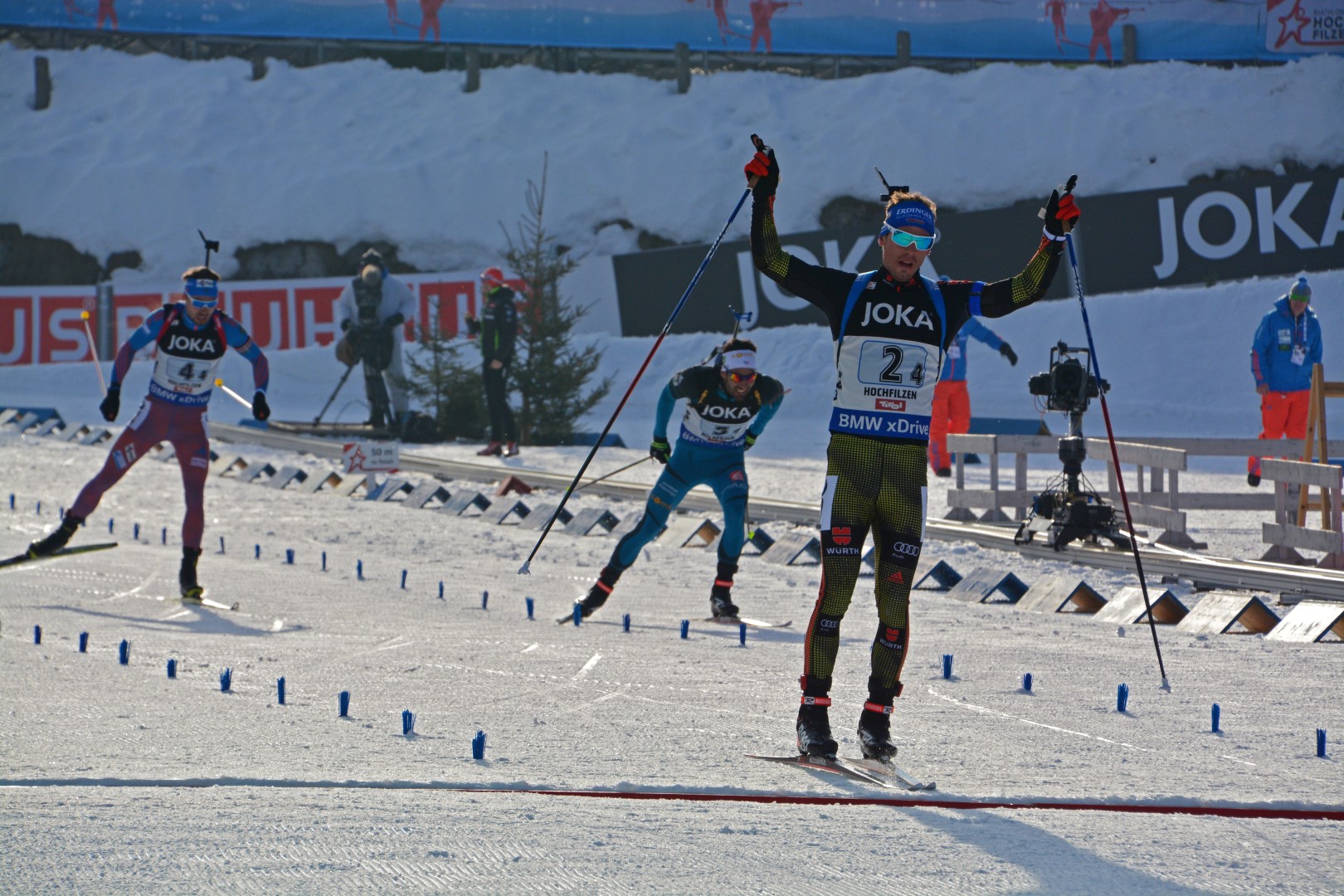
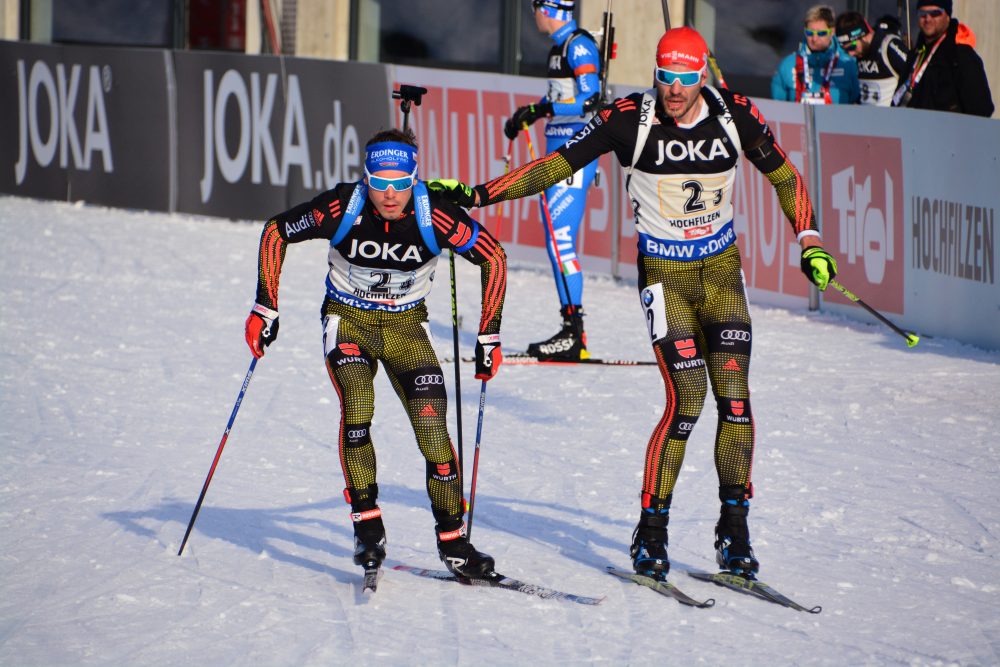
Simon Eder tags off to Lisa Theresa Hauser for Austria during the single mixed relay World Cup in Östersund, Sweden. The pair raced to a 16.5-second win. (Photo: IBU/biathlonworld)
This year, same race, same place, Smith sat out because of a sore throat but Crawford and Christian Gow teamed up for Canada to take on the event again. Partway through the race they were in podium position before a serious crash took them more than out of medal contention; the team was lapped and finished 22nd.
“Pretty bummed,” Crawford said.
Through the first leg, she had used two spare rounds but still tagged off in third place, just 7.1 seconds out of the lead. Then Gow shot perfectly to hang onto fourth, 18.4 seconds out of the lead as the Austrian duo of Lisa Theresa Hauser and Simon Eder had taken control of the race and would never be out of the lead, eventually winning by 16.5 seconds.
Crawford chased hard and passed Italy’s Alexia Runggaldier.
“I thought, I’ll just tuck in behind the Italian, but then I thought, oh, she’s going too slow,” Crawford said. “That’s always an amazing feeling when you think, I feel stronger than you, I can pass you.”
After a tough season for much of the Canadian team last year, that feeling was particularly nice, she added.
Crawford was skiing in third just on the tails of Germany’s Vanessa Hinz when she hit ice on one of the last downhills of the loop and “did a few somersaults.” She stayed on the ground for several seconds and Canada’s hopes for another podium were dashed.
“My head was fine,” Crawford said. “There were quite a few physiotherapists who ran over, so they were asking what’s my name, where am I, what date it was. I got all of that right. But when I went to go and push myself up, my shoulder was really sore.”
After at least a minute or two, Crawford headed back out onto the trail, but in a very different part of the race than she had been before. Then there was the issue of her rifle, which she said didn’t have any serious damage but at the time wasn’t working well.
“Just snow everywhere,” Crawford said. “I think the sights might be twisted a little bit, or something happened because then when I did take a shot I was, like, 10 cm above the standing target. Something was off.”
Even with spare rounds which are allowed in relay races, Crawford was left doing two penalty loops and in the meantime, the leaders lapped through. Canada’s day was over.
While Crawford doesn’t have any serious injuries, her shoulder was banged up.
“It is just bruised,” she explained. “The skin tore a little bit where the rifle must have hit it… I probably should have just stopped. Our physio here [later] said, yeah, you have quite a bit of adrenaline going through, so if something feels like it still hurts, then it means that it’s probably pretty bad.
“But it’s so hard, especially in relays,” Crawford said. “Christian is such an amazing shooter, he’s so fast and so accurate and he had done so well. I really didn’t want to let him down. And then I was also thinking about Nations Cup points. If I didn’t finish then we would get no points, whereas even if we were lapped at least we would get some points. So all of that was going through my head.”
Canada finished 22nd, and did get a few Nations Cup points.
Another lesson: stick with the plan.
“My race plan was to not take that inside corner,” Crawford said of the spot where she crashed. “I changed it halfway through the race bcause other people were taking it… On my second time down the hill, so after my first prone shooting, I was behind Hauser, and she took the inside line and I lost a little bit of a gap on her. So I thought, okay, next time I will take the inside line. So the third time going down the hill I was behind Hinz. She took the inside line and I was right behind her.
“In hindsight I probably should have just stuck with my race plan and taken it a little bit wide, because I have been here many, many years,” she concluded.
Austria Shines as France Falters
Meanwhile, the Austrian duo was extending their lead. France had come in as heavy favorites, with Martin Fourcade and Marie Dorin Habert having won the same race last season, Fourcade having won the overall World Cup, and Dorin Habert finishing fourth in the women’s World Cup Total Score last season.
Kazakhstan’s Maxim Braun celebrates third place ahead of Martin Fourcade of France, Sebastian Samuelsson of Sweden, and Dmytro Pidruchniy of Ukraine. (Photo: IBU/biathlonworld)
But the duo put together a sloppy shooting race, using 10 spare rounds over 40 targets. The Austrians, on the other hand, were nearly perfect, using just two spare rounds and cleaning their targets quickly.
By the time Eder came in for the final shooting bout, he could have used at least two spare rounds and still left with the lead. Instead, he cleaned.
“First race, first victory – this is a dream,” Eder said in an Austrian Ski Federation press release. “It already paid off to toil for another year. I knew this would be one of the toughest single mixed competitions, because you always carry the exhaustion from the last climb to the shooting range. But I could pace myself well. I think tactically it was a strong performance, and that’s the most important thing in the single mixed. It’s not about always going full throttle, otherwise the shooting series won’t work out anymore. It was just perfect on the range today.”
“It’s just incredible to immediately be on the top of the podium in the first race,” she said in the same press release. “The first race is always something special, because you are extremely stressed.”
Behind them, an interesting race was unfolding. The German team used nine spare rounds and had only a single perfect shooting stage, and Hinz said that her legs were “not yet quite where I’d like them to be.” But teammate Erik Lesser was aggressive on the trails, having the third-fastest time on each of his relay legs, and he skied across the finish line in second place, well clear of the rest of the field.
And that’s where things got really crazy. A number of teams had left the range the final time quite close together: Kazakhstan with Maxim Braun, then Lesser (who immediately passed him), then Italy and Ukraine. Italy’s Thomas Bormolini charged hard and skied his way into third position.
But on one of the final downhills Bormolini fell, taking out Dmytro Pidruchnyi of Ukraine as well. That allowed Braun, who had been left behind, to sail past them. It also allowed Fourcade and Sebastian Samuelsson of Sweden, who had started the final loop many seconds back, to catch further up.
In the end it was Braun taking third place for Kazakhstan, France fourth, and Sweden fifth.
“I opened my eyes and I saw the athletes from Sweden and Ukraine just lying in the trail,” Braun said through a translator in the post-race press conference. “I would like to have watched the race myself to realize what was going on. I realized it was my chance and I grabbed it… this summer we worked really really hard, and this is a fantastic beginning of the season for us.”
While he acknowledged that he had “a little bit of luck,” it was also good biathlon: with just five spare rounds, Kazakhstan had the second-best shooting of the day.
Americans 19th After Fast Start
The single mixed relay was the first World Cup start of Emily Dreissigacker’s career. The Americans started in bib six and Dreissigacker soon found herself among the race leaders.
Emily Dreissigacker of the United States competing in the single mixed relay in Ostersund, Sweden. (Photo: USBA/NordicFocus)
“My plan was to get in behind someone and try to pace myself and relax on the first lap, especially up the first hill,” Dreissigacker wrote in an email. “But it turns out I just have this instinct in a mass start to get to the front. At the time it felt easy and it was super fun to lead even if it was just for a hot sec. But of course once the adrenaline wore off I definitely paid for it.”
Dreissigacker got through the first shooting stage with perfect shooting, and headed out again. But the effort early on was indeed catching up with her.
“I think it’s important in a single mixed relay to pace yourself on the first leg, which is something I did not execute well today,” she wrote. “My legs flooded really badly and didn’t start to clear at all until my very last loop.”
She had to use all three spare rounds in standing, and tagged off to Leif Nordgren in 20th. Nordgren, though, used only one spare round total over his next prone and standing stages, and was able to bring the Americans into 12th.
Dreissigacker then took a penalty loop in both of her second-leg shooting stages, and then Americans ended up in 19th place after being lapped.
“Prone felt good but my group moved right and down,” Dreissigacker explained. “I’m not sure why, it could have been the wind, it could have been something slightly off in my position but I was happy to at least hit all of my spares… Overall I’m happy with [the race]. I have a lot to learn still and a lot I can improve upon, but you have to start somewhere.”
That’s a sentiment for Nordgren, too, who is hoping for better things later in the year.
“It’s a long season with the highlights being the Olympics so I didn’t really expect much from today,” Nordgren wrote. “That being said it’s always nice to get a chance to race, it’s a different type of stimulus for the the body then just a hard intervals session. Emily had a rough day on the skis. It’s a pretty brutal single mixed course here, so if you aren’t ready to go hard right from the start you’ll pay for it later. The snow was a little deep today as a result of the grooming so that makes it a little bit tougher on the legs too. It’s not the end of the world not getting to race the second leg – it was nice to get back in race mode even if just for a little bit.”
For Nordgren, just to be racing and feel good was an achievement compared to last year, when it was on this very day that he realized a toe injury sustained just before the start of the race season was actually a big problem. Nordgren ended up taking several weeks off of racing completely to heal.
“Last year it was a dark time for me!” he wrote. “It’s really nice to have not had any trouble like that heading into the season. Overall the preparation has been pretty good this year, so I’m excited to get into the individual races starting next week.”
The men’s 15 k classic mass start podium on Saturday at World Cup Finals in Quebec City, with Norway’s Johannes Høsflot Klæbo (c) in first and Niklas Dyrhaug (l) in second, and Russia’s Alexander Bessmertnykh (r) in third. (Photo: FIS Cross-Country/Twitter)
FIS Cross-Country World Cup Finals (Quebec City): 10/15 k classic mass starts
During Saturday’s 15-kilometer classic mass start at World Cup Finals, Canada’s Alex Harvey was in it until the end. But so were Norway’s Johannes Høsflot Klæbo and Niklas Dyrhaug, and Russia’s Alexander Bessmertnykh, to name a few.
Sitting in second with a few hundred meters to go, Harvey was primed to make his move on Dyrhaug, who was leading at the time. But then came 20-year-old Klæbo, the season-long Sprint World Cup champion, who proved to have more left in the tank than anyone else and passed them both to lead into the finishing straight.
Klæbo took the victory — his first in a World Cup distance race — on a bluebird day under a beating sun in 35:23.7 minutes, 0.6 seconds ahead of Dyrhaug. Bessmertnykh followed another 0.2 seconds back in third (+0.8) just ahead of Harvey in fourth (+1.2).
Norway’s Sjur Røthe took fifth (+1.7), Switzerland’s Dario Cologna placed sixth (+1.9), and Norway’s Pål Golberg was seventh (+2.5), half a second ahead of another Norwegian Didrik Tønseth in eighth (+3.0). The top nine were within 3.7 seconds of first, with Russia’s Andrey Larkov in ninth.
Devon Kershaw was the second Canadian in the points on Saturday in 28th (+1:08.4), after breaking a pole and working his way back up from outside the top 60.
Erik Bjornsen led the U.S. men in 31st (+1:16.8), about a second ahead of Canada’s Graeme Killick in 32nd (+1:17.7).
Also for the U.S., Matt Gelso finished 37th, Andy Newell 45th, Scott Patterson 46th, Noah Hoffman 48th, Ben Lustgarten 49th, David Norris 50th, Simi Hamilton 54th, Paddy Caldwell 59th, Jack Hegman 62nd, Cole Morgan 64th, and Brian Gregg 69th.
For Canada, Bob Thompson finished 55th, Knute Johnsgaard 57th, Len Valjas 61st, Russell Kennedy 63rd, Evan Palmer-Charrette 65th, Andy Shields 66th, Jess Cockney 67th, Brian McKeever 68th, Joey Foster 70th, Gareth Williams 72nd, Ricardo Izquierdo-Bernier 74th, and Julien Locke 75th.
The women’s 10 k classic mass start podium on Saturday at World Cup Finals in Quebec City, with Norway’s Marit Bjørgen (c) in first, Norway’s Heidi Weng (l) in second and Finland’s Krista Parmakoski (r) in third. (Photo: FIS Cross-Country/Twitter)
In the women’s 10 k classic mass start earlier in the day, Norway’s Marit Bjørgen racked up her seventh victory of the season after leading a pack of two other Norwegians and Finland’s Krista Pärmäkoski and holding them off to the finish.
Bjørgen put a few meters into the foursome as she entered the finishing stretch and held her lead across the line in 24:23.6 minutes. Norway’s Heidi Weng finished 0.6 seconds back in second to lock up the Distance World Cup title, in addition to the Overall World Cup title she secured on Friday.
Pärmäkoski finished 2.9 seconds after Bjørgen in third, and Norway’s Ingvild Flugstad Østberg missed the podium in fourth (+7.8).
Behind them, Germany’s Nicole Fessel outlasted a large chase pack to place fifth (+18.6), just ahead of Sweden’s Charlotte Kalla in sixth (+19.9) and Anna Haag in seventh (+19.1).
Sadie Bjornsen of the U.S. Ski Team led the North American women in 15th (+29.9) after skiing at the back of that chase pack in the final stretches of the race. Also for the U.S., Jessie Diggins placed 27th (+1:06.9) and Sophie Caldwell 38th (+1:56.0).
Canada was led by Emily Nishikawa in 37th (+1:51.7). Behind her, Cendrine Browne finished 41st (+2:28.2), Dahria Beatty was 53rd, Annika Richardson 54th, Katherine Stewart-Jones 56th, Frederique Vezina 59th, Annika Hicks 60th, Sophie Carrier-Laforte 61st, Andrea Dupont 62nd, Katherine Weaver 63rd, Alannah MacLean 64th, Sadie White 66th, Lisle Compton 67th, Mia Serratore 68th, and Laura Leclair 69th.
For the U.S. Caitlin Patterson finished 44th, Liz Guiney 45th, Kaitlynn Miller 47th, Chelsea Holmes 48th, Rosie Brennan 50th, Julia Kern 52nd, Erika Flowers 55th, Becca Rorabaugh 57th, and Jennie Bender 58th.
One day left in the 2016/2017 World Cup season remains, with the women’s and men’s 10/15 k freestyle pursuits on Sunday in Quebec City.
World Cup Finals standings (Day 2 of 3): Men | Women
***
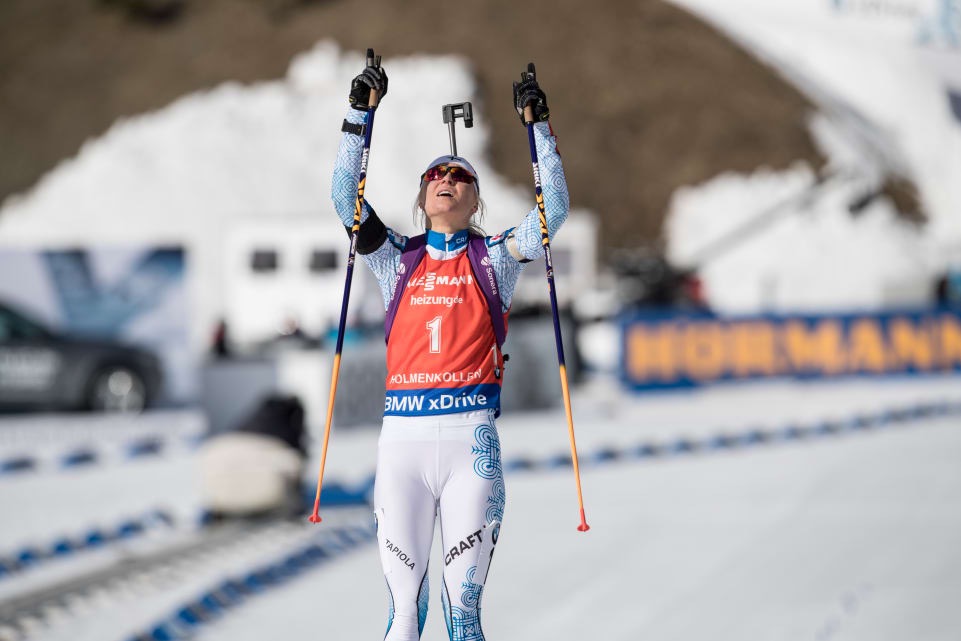
Finland’s Mari Laukkanen pointing to the sky in honor of her late shooting coach, after she won the women’s 10-kilometer pursuit on Saturday at the 2017 IBU World Cup in Oslo, Norway. (Photo: IBU)
IBU World Cup (Oslo, Norway): Women’s and men’s pursuits
Less than 24 hours after winning her first IBU World Cup on Friday in the women’s 7.5 k sprint, Finland’s Mari Laukkanen immediately capitalized on her ideal position with a start-to-finish victory in Saturday’s 10 k pursuit that was never in doubt, cleaning the first three shooting stages before incurring one penalty in her final standing shooting (0+0+0+1) to cross the line in a time of 29:33.3 minutes.
In addition to experiencing the most successful weekend of her biathlon career by far, it was an emotional day for the 29-year-old Finn due to a personal reason. Laukkanen spread her arms like wings skiing down the homestretch with a commanding lead, pointing repeatedly to the sky and a black ribbon she wore around her right upper arm, before kneeling in the snow in the finish for a few seconds. With those gestures, she reportedly wanted to commemorate her shooting coach Asko Nuutinen, who passed away Friday after suffering a heart attack during the World Cup in Kontiolahti, Finland, a week ago. He was 60 years old.
“It’s been a really emotional day for me. We have heard really really sad news that last night we lost our longtime shooting coach,” Laukkanen told reporters with a trembling voice in the press conference. “After this it was more or less only about working for him. Working as he has asked me to do for years and years. So I wasn’t thinking about losing or winning today, I was only thinking about him. And I feel really big pleasure that I was able to come to the finish like this, that I can own the victory for him.”
“I knew it will be difficult after the first victory in my career took me so long,” she added. “And to do it again immediately with good shooting. But as I said I didn’t think about winning or losing today, just doing my work.”
Finishing 26.5 seconds after her, the Czech Republic’s Gabriela Koukalová reached the finish, moving up from her fourth place starting position with a clean shooting performance (0+0+0+0).
“I wanted to miss all targets yesterday because I was so tired I didn’t even want to race,” Koukalová confided in the press conference. “It’s difficult to concentrate, three World Cups after the main goal of the season [the World Championships] is too much. Last year it was many times easier… I tried to catch her, but about one kilometer before the finish I saw her far away so I was happy I didn’t have to fight with anyone and was just enjoying the last meters.”
Despite four penalties (1+1+0+2), France’s Justine Braisaz defended the third place on the podium against a three-person chase group on the last loop (+1:01.4), falling back only one position after having finished the sprint in second.
“I did not expect such a good place today during the race,” Braisaz commented in the press conference. “Because in the last shooting I completely [failed]. I really wanted to have a clean shooting today, and I did not succeed. So I am happy and surprised, too.”
Her teammate Anais Bescond who had started the pursuit in third place fell back to 22nd position (+2:53.5) with seven penalties.
Slovenia’s Teja Gregorin finished fourth with one penalty (+1:08.2), Austria’s Lisa Theresa Hauser shot clean as the only athlete aside from Koukalova on her way to move up from 22nd to fifth place (+1:12.5), while Norway’s Marte Olsbu finished sixth like in the sprint despite three penalties (+1:15.9).
Unlike in Friday’s sprint race where Germany’s Laura Dahlmeier had still given up a seemingly commanding lead in the sprint World Cup discipline standings to Koukalova, she held onto her lead in the pursuit standings on Saturday, moving up from the 31st starting position to ninth place with a penalty in each of her standing shootings (0+0+1+1, +1:53.8). A 22nd place would have been sufficient to win the “small crystal globe” award in the pursuit. Laukkanen’s teammate Kaisa Mäkäräinen finished 8th with two penalties in the standing stages (+1:51.2), and thereby claimed the third place in the World Cup pursuit ranking.
“I knew that I didn’t need to have a perfect race today, just a good one, but that’s always easier said than done,” Dahlmeier told broadcaster ARD after the race. “I am incredibly happy that it worked out and that I could secure myself another small globe… It’s a bit of a weird feeling, standing at the start gate in the middle of the field and the clock ticks and ticks as one athlete after another skis out on the course. And you can only observe how far they have gone and have to wait and be patient, and not make a false start. But then the snow burns, then the chase begins!”
US Biathlon’s Susan Dunklee experienced an uncharacteristically problematic day on the shooting range and fell back to 37th place (+4:00.2), after starting seventh and less than a minute behind Laukkanen. Dunklee had three misses between two prone stages and seven more in her standing shootings (2+1+4+3) therefore having to ski more than an additional kilometer in the penalty lap.
“It is a testament to her fighting spirit that she notched the fourth-fastest ski time — one of her best ranks of the season — and never gave up despite suffering a biathlon blowout on the range,” teammate Clare Egan said of Dunklee, according to a US Biathlon press release. “Bad races happen to the best and Susan is no exception, but not everyone fights through till the end no matter what.”
Egan herself started the pursuit in 34th position and initally was able to make up ground, but then fell back slightly to 41st place (+4:13.9) with four penalties (0+2+0+2).
“I am satisfied with my race even though the result was not what I was hoping for, and that’s how I would summarize my entire season as well,” Egan said after the final race of her season. “I’ve made a good step forward but my competitors also work hard all summer and we seem to improve at a similar rate.”
Canada Biathlon’s Julia Ransom moved up to 47th place (+5:04.8) with three penalties (1+0+1+1), after starting in 52nd position.
[UPDATED] Later on Saturday in the last men’s 12.5 k pursuit of the season, the three best athletes of the season fought throughout the race exchanging in the lead, before they stood next to each other on the range for the final shooting to decide the winner.
Russia’s Anton Shipulin managed to shoot clean with his elaborate rifle stock in the design of a red dragon, proudly waving to the cameras as he left the arena while his two competitors had to ski into the penalty lap. France’s Martin Fourcade – who had already secured himself the overall World Cup Total Score title as well as the award for the pursuit discipline – was left to duke it out against Norway’s Johannes Thingnes Bø, the winner of Friday’s sprint.
On the last big climb before the Holmenkollen arena, Fourcade accelerated with a series of explosive jump-skate steps to decisively gap Bø. He even got fairly close to Shipulin on the finish stretch, who had slowed down a bit to grab a Russian flag before skiing over the line in a time of 32:11.9 minutes with one penalty (0+0+1+0), 5.7 seconds ahead of Fourcade who had incurred two penalties (1+0+0+1). While Fourcade shook hands with Shipulin, Bø came into the finish in third place, 21.6 seconds back and also with two penalties (1+0+0+1).
“It was a crazy race, but I am happy that I managed to finish first,” Shipulin said in the press conference through a translator. “Tough conditions on the shooting range, I had to really work to concentrate on my shooting. On the last loop I was all alone until I saw Martin chasing me, then I got a little bit scared but I managed to [keep him behind].”
It was Shipulin’s second win of the season, for which he credited his recently improved shooting performance.
“It was a really exciting competition with Johannes and Anton,” Fourcade agreed with his rival. “I expected to fight with them for the victory on the last loop, but then Anton was simply stronger in the last shooting. My strategy was to be focused on my technique and skills and not on the results, like I did too often in the past few weeks focusing on records and not the victory.”
Asked about his blazing attack on the final climb, Fourcade added: “Of course I train for that, but I think a lot of athletes do. I talked to Johannes, it was my revenge for the [2016] World Champs where he did exactly the same to me on the last uphill. But I know how it is, it can be different already tomorrow.”
“I am happy with a new podium of course,” Bø said in the press conference. “I was not at my best in the skiing today. But I still managed to shoot 18 out of 20. As Martin said it was [annoying] that we did not shoot zero [misses] and could not fight with Anton in the finish, but it was quite interesting and fun to stand there in the last shooting … I expected Martin’s attack the second he did it, but I had no energy to fight with him. That was quite strong.”
Sweden’s Fredrik Lindström placed fourth with no penalties (+44.7), and was the only man in the field who managed to shoot clean in all four stages.
“For the podium, I was never really close“, Lindström told the IBU in a post-race interview. “But it was a great day anyway. Four times zero [misses], and especially in the standing stages that makes you climb a lot in the standings. Super happy with my performance.”
US Biathlon’s Lowell Bailey, who had to start closer to the back of the field in 44th position, almost two minutes behind the leaders based on his sprint result, managed to move up 21 spots in the race despite three penalties (2+0+1+0).
“I’m happy with the race, considering it started out pretty rough with the first two misses,” Bailey told US Biathlon after placing 23rd (+2:23.3). “I just read the wind wrong and didn’t correct enough. After that, I tried to keep my head in the race and make the best of it. I was happy with my skiing and glad to clean the last stage; this brought me up nine spots and I was able to gain another in the last loop. Now, it’s just one race to go. I’m looking forward to tomorrow.”
Shooting quickly, Bailey recorded the ninth-ranked range time of the day and the ninth-fastest last loop.
His teammate Sean Doherty started 35th but fell back after having to ski six times through the penalty lap (1+3+1+1) to finish 46th (+4:05.6).
For Sunday’s mass starts as the final races of the 2016/2017 IBU World Cup season, the only qualified North American starters will be Dunklee (currently in 10th position in the World Cup Total Score standings) and Bailey (currently in eighth).
The women’s season award in the mass start discipline once more will be decided between Germany’s Dahlmeier and Czech Republic’s Koukalova, while Germany’s Simon Schempp will try to defend his narrow lead on Fourcade. But during Saturday’s final loop, the French star did consider saving energy for the final competition.
“No,” he simply quipped when asked about this in the press conference. “Of course the mass start is important tomorrow because it will decide about the [mass start] crystal globe. But I think today the pursuit was also really important, and you fight for victory and being one of the best athletes. You can’t be satisfied with only a third place when you can claim a second, and I think all athletes in my position would do the same.”
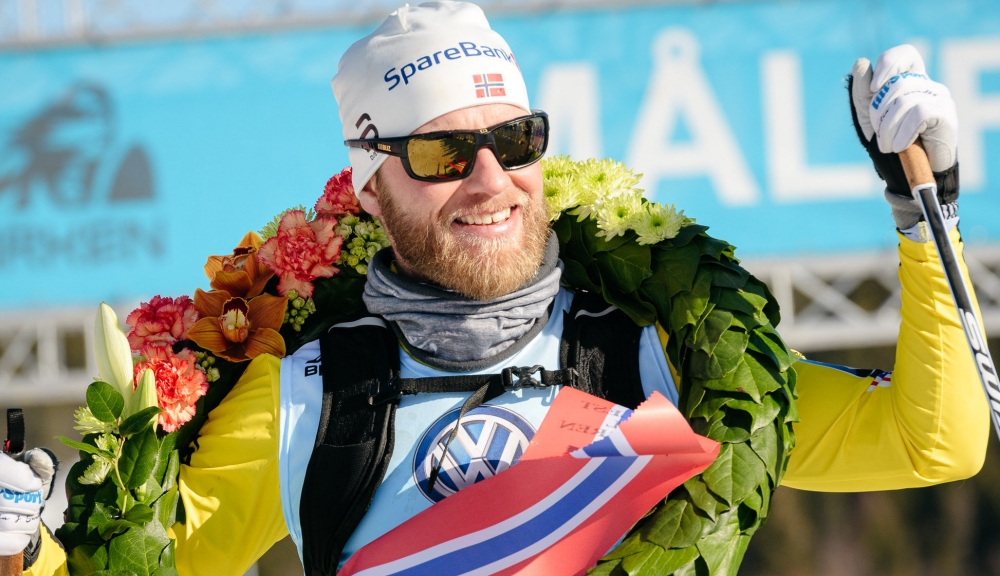
Norway’s Martin Johnsrud Sundby after winning the Norwegian 54 k classic Birkebeinerrennet, part of the Ski Classics series, on Saturday in Lillehammer, Norway. (Photo: Ski Classics)
54 k Birkebeinerrennet (Rena to Lillehammer, Norway): Part of the Ski Classics series
[UPDATED] Not even a snowmobile clipping him and sending him tumbling 20 k before the finish could keep Norway’s Martin Johnsrud Sundby from winning the Birkebeinerrennet on Saturday in Norway. Representing Team United Bakeries, Sundby set a high pace from the start and broke the group down to three by 9 k, with Petter Eliassen of Team LeasePlan and Simen Østensen of Team BN Bank sticking with him until about 30 k in the 54 k marathon.
With about 20 k to go, Sundby collided with a Ski Classics TV production crew snowmobile while trying to double pole in the snowmobile’s tracks. He was OK and went on to win by 48 seconds over Eliassen in second, and smiled about the incident after the finish.
“It came in with tremendous speed and mowed me down,” Sundby told NRK, according to a loose translation.
Ski Classics CEO David Nilsson told NRK he didn’t know exactly how that happened and emphasized that it was unacceptable.
“We always put safety first, but it is a difficult balancing act with the snowmobile at high speed to get TV pictures,” he said, according to a loose translation. “The skiers often ski in the [snowmobile] track and here it happened and somehow the driver missed it.”
While Sundby pulled out the win in 2:20:53.5 hours, Eliassen took second and Østensen followed another 3.5 seconds later for third place.
In the women’s race, Poland’s Justyna Kowalczyk (Team Santander) pulled out a 4 minute and 15 second win over Sweden’s Britta Johansson Norgren (Lager 157 Ski Team). Japan’s Masako Ishida (Team United Bakeries) was another 48.6 seconds back in third.
“I’m really happy to win this race,” Kowalczyk said, according to a Ski Classics press release. “Everything went well and the cheering on the course was amazing. I will do the rest of the races in Visma Ski Classics, but this victory was the most important for me. Of course, I want to win again in Årefjällsloppet like I did last year, but to win here in front of this audience means so much to me.”
Tord Asle Gjerdalen, who finished fourth in the men’s race, and Johansson Norgren continue to lead the overall Ski Classics standings with three races to go. The next stop is the Årefjällsloppet in Sweden on March 25.
“It was a great race and we kept a high tempo up all the way,” Sundby said, according to the press release. “I was able to use uphills for my advantage and get a gap. I had good skis, the conditions were perfect, and to win here was one of my goals for the season. I have the Norwegian Championships in two weeks, and I haven’t counted out the option of going to Finland for the Visma Ski Classics finale.”
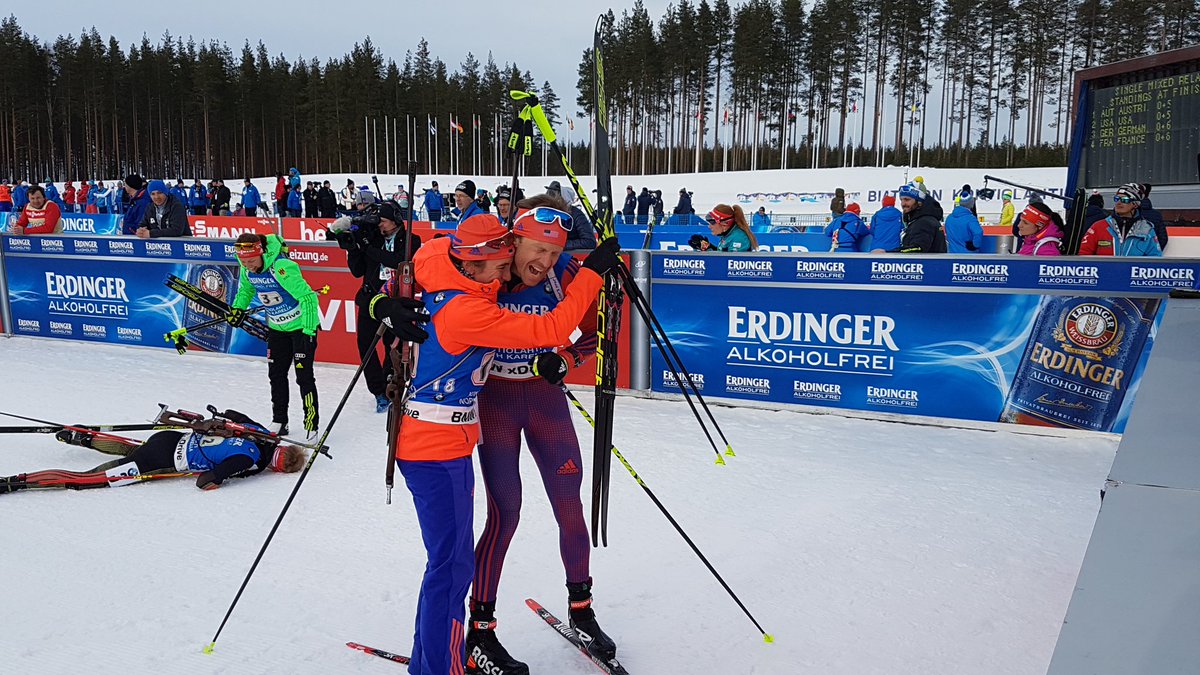
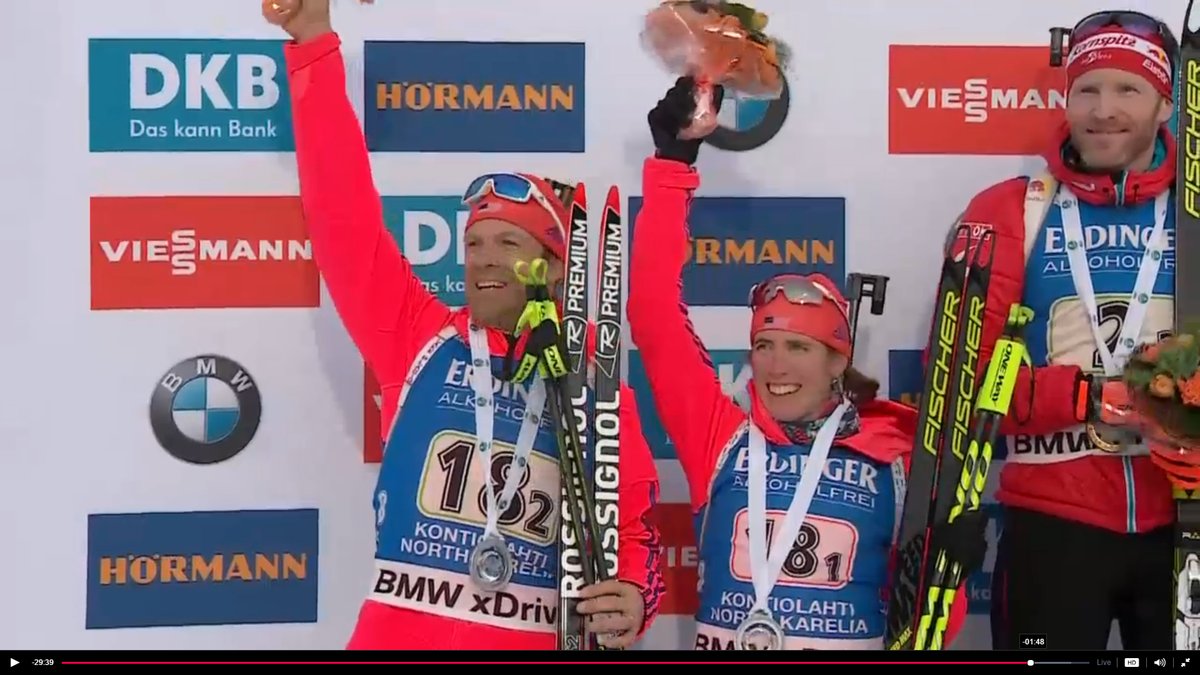
Susan Dunklee and Lowell Bailey celebrate after finishing second in the World Cup single mixed relay in Kontiolahti, Finland. Austria won the competition. (Photo: IBU/Twitter)
The single mixed relay is a relatively new format, and one that is not yet contested at World Championships or the Olympics.
And so when a single mixed relay (two athletes) and a ‘normal’ mixed relay (four athletes) are held on the same day, the U.S. Biathlon World Cup team’s policy has always been clear: prioritize the mixed relay, and get the World Champs and Olympic team the most practice possible for their big days.
All that changed in Kontiolahti, Finland, today.
The U.S. decided to put Susan Dunklee and Lowell Bailey – both medalists at 2017 World Championships – on the single mixed relay. Even before the race began, expectations were high. The Americans were calling themselves the “dream team”.
After the race? Oh, yeah.
The duo finished second, claiming the first relay podium by an American biathlon team since 1994, when Beth Coats, Joan Smith Miller, Laura Tavares, and Ntala Skinner finished second in the women’s 4 x 6 k in Canmore.
“We have known that if we had our best day on the right day, that it was possible in the mixed relay even a few years ago,” Dunklee said of having a relay podium. “For that mixed relay it just quite hasn’t happened for us. I think maybe we psyched ourselves out a few times… I have dreamed for a long time being able to run into the finishing pen and with a bib on and a rifle, and greet my teammates as they come in. It’s so cool to finally do that. It’s definitely a dream come true.”
But if she pictured running into the finishing pen of a normal biathlon event, the single mixed relay might not have come to mind. The format of the newest World Cup competition is unusual. Loops are 1.5 kilometers, shorter than any other ski loops on the World Cup. The women ski (and shoot) twice, then tag off to the men just after shooting so the men can ski (and shoot) twice, then the women twice again, then the men twice, and finally the men getting to ski one last 1.5 k loop to reach the finish line.
That unfamiliarity came with excitement: the team knew ahead of time that they had a good chance of a top finish. With a flat course, both Americans felt good about their power skiing. The format also has the highest shooting-to-skiing ratio of any biathlon competition, and the pair had been shooting almost unbelievably well in the second half of the season.
“The stuff Susan and I have been working on throughout the training year in shooting, which is namely trying to reduce our shooting times and shoot quicker, lends itself to a race format like the single mixed relay,” Bailey said. “It was my first single mixed relay and Susan’s as well, and we were totally psyched. It’s a great moment to see both programs, both the men’s and the women’s teams, have a joint success like this.”
Despite the new format, Dunklee found herself leading on the second loop, thanks to a fast and clean prone shooting.
Then — she fell on a downhill.
“It just happened so fast and before I knew it I was on the ground, and my rifle fell on the back of my head where I have a nice sore bruise now,” Dunklee said. “After that I just got up. I had a few hundred meters before I need to be ready to shoot, and that’s more important than freaking out and worrying about it too much.”
She blamed “snow snakes,” but Dunklee managed to re-gain some determination. By the time she reached the shooting range she had re-focused. Dunklee hit all five targets in quick succession, claiming the fastest standing shooting time of all the women.
She tagged off to Bailey in third place — just 8.9 seconds behind Kazakhstan and Germany — and the U.S. was back on track.
Bailey, for his part, completed the second leg of the relay with two spare rounds, skiing comfortably near the front of groups and tagging off in fifth, +17.2 seconds.
“What’s interesting about this course is that it’s pretty flat except for one relatively modest uphill,” Bailey said. “Today there was quite a bit of wind on the course so to be leading was a disadvantage in a group. So you saw some tactical play up at the front of the race. I felt like I could’ve gone harder in the initial loops, but I also knew that with such a short, 1.5 k loop, the shooting really is where the race is won or lost. So my strategy was to just stay in contact with the lead group.”
Meanwhile, Simon Eder of Austria had gone to the front and Austria would hang onto the lead for the rest of the race. Lisa Theresa Hauser had used two spare rounds in her first standing, but through both of Eder’s relay legs and Hauser’s second leg the team used only three. That turned out to be untouchable.
“Once Austria got far enough off the chase pack, I felt it was more of a risk to try to go all out in my last leg to try to catch Austria, than try to hit my targets,” Bailey said.
That’s because behind Austria, it was still a fight. After Bailey quickly hit his extra shots, it was Dunklee’s turn. She again cleaned prone before needing two spare rounds in standing. But the wind on the range in Kontiolahti had been tricky all day, and most of the other leaders also used spares. So despite the missed shots, Dunklee still managed to move up to second place.
“I think everyone was struggling, especially standing,” Dunklee said. “I would not normally expect to be even with, or not lose a whole lot of places on, the leaders [with two spares], but since everybody else was struggling too it was okay… I think with this short format, you get a little bit more adrenaline and you are pushed a little bit harder in skiing. You get the shaky legs going when you’re standing.”
With Austria seemingly untouchable, Bailey was left to battle it out with France, Germany, Switzerland, and Kazakhstan.
After one more clean prone, he was fifth, but still with the group.
In standing, Bailey needed a spare round. But again, he loaded them extremely fast – allowing him to leave the range in third place anyway. In his haste to hit the trails, he almost fell on the sharp corner leading out of the range and into the stadium. But he kept his balance, and then hit the gas.
“The tactics at the front of the race in the third and fourth loops for me, the pace was not all that high, so I really felt pretty fresh when I came out of standing for that last 1.5 k loop,” Bailey said. “I knew that it was basically just a really long sprint finish. So I just tried to sprint from the mat essentially and hoped that I didn’t run out of gas by the finish line.”
Ahead of Bailey: Roman Rees of Germany, just four seconds away. Rees is one year out of the junior ranks, and had only ever competed in one other World Cup relay of any kind. Twelve years older, Bailey set out to catch him.
But behind: Jean Guillaume Beatrix of France, another veteran with as many podiums to his name as Bailey had. Leaving the range Beatrix was less than a second behind Bailey, and wanted to get onto the podium.
Between Germany, France, and the United States, there was only room for two on the podium. As the 1.5 k loop wore on, Beatrix faded – only a few seconds, but enough to keep him and his French teammate Anais Chevalier in fourth place.
By the time the race came to the stadium, Bailey had caught Rees. He tried to use all of his power to pass on the inside corner, but Rees held strong. The two ended up dueling down the finishing straight, with Bailey prevailing by just half a second.
“YES!” he screamed as he crossed the finish line, 32.8 seconds behind the Austrian team. Dunklee ran out to meet him.
“That was a first and it’s a great feeling,” Bailey said. “In a lot of ways it’s better than just going out and having a great race on your own, but to have a great team result like that, it’s a new experience. I shouldn’t say that, we’ve had some great team results in both the mixed relay and the men’s relay — we were fourth place last year in the mixed relay [in Canmore], but no one really wants to go out and celebrate in the finish zone with fourth place. This was the first time that you could hug your teammate in the finish zone. I’ve watched that phenomenon throughout my career so it’s nice to experience it.”
The U.S. had matched the Austrians on the range, using just five spares to Germany’s six, but the timing was off: Austria had gone, and so Bailey had concentrated on winning second, not potentially blowing up in chase of first place.
That turned out to be a good strategy, because Eder had knocked down his final five standing targets with scorching speed of 17.9 seconds. By comparison, Dunklee’s best mark among the women was 21.4 seconds.
“I actually talked to Simon Eder after the race because I knew his last shooting was blistering fast, and I said, ‘Hey, what was your strategy there? You didn’t have to shoot that fast’,” Bailey said. “And he said, ‘I came in and the wind died right when I got into position so I knew I had just a few moments there to take advantage of it.’ By the time [our] chase group, which was 30 seconds or less behind him hit the mat, [the wind] was back to being gusty.”
The Canadian team of Julia Ransom and Christian Gow finished 19th, +2:27.0, with eight spare rounds.
In the mixed relay later in the day, the French team of Marie Dorin Habert, Anais Bescond, Simon Desthieux, and Quinton Fillon Maillet took the win, followed by Germany (+11.0 seconds) and Ukraine (+27.1).
The American team of Clare Egan, Joanne Reid, Paul Schommer, and Sean Doherty finished eighth, +1:37.4.
The Canadian team of Emma Lunder, Megan Bankes, Scott Gow, and Brendan Green finished 22nd in the mixed relay, +6:09.5.
“I would just reiterated that I was just psyched to see the whole team do well, both in the single mixed and the mixed relay,” Bailey said. “It’s Nations Cup points, so it counts for our Nation Cup overall total score for the women and the men. It was a pretty important race in that regard. I’m really happy for the team. Everyone deserves it, the techs and everyone, it’s been a really long season and they’re still working as hard as ever so I’m really thankful for that.”
Lowell Bailey and Susan Dunklee celebrate finishing second in the single mixed relay in Kontiolahti, Finland. (Screencap: US Biathlon/Twitter)
IBU Biathlon World Cup (Kontiolahti, Finland): Single Mixed Relay
In the last single mixed relay of the season, Susan Dunklee held the lead after two loops of skiing. She was looking for a top tag-off to American Lowell Bailey, but she crashed on a downhill. Nevertheless, she was able to focus on the shooting range and climb back into podium position.
The leaders were gone, however: Simon Eder and Lisa Therese Hauser of Austria ran away with the competition, using five spare rounds to race to a 32.8-second victory.
Bailey left the last shooting in third position, and caught Germany’s Roman Rees on the trails. The pair also managed to hold off Jean Guillaume Beatrix of France, who left the range just behind them. It came down to a sprint finish, with Bailey besting Rees (and his relay partner, World Cup Total Score winner Laura Dahlmeier). The U.S. had five spare rounds to Germany’s six.
It was the first relay podium of any kind for the United States since 1994, when the women finished second in a relay in Canmore, Alberta.
The Canadian team of Julia Ransom and Christian Gow finished 19th (+2:27.0) with eight spare rounds.
Left to right: Finland’s Krista Pärmäkowski, Norway’s Marit Bjørgen and Finland’s Kertu Niskanenen after the women’s 30kiloimeter World Cup classic mass start on Saturday in Oslo, Norway. (Photo: FIS Cross-Country/Twitter)
FIS Cross-Country World Cup (Oslo, Norway): Holmenkollen 30 k classic mass start:
Norwegian Marit Bjørgen won the women’s 30-kilometer classic mass start at Homenkollen on Sunday, in a time of 1:22:59.2. She bested two Finns, Krista Pärmäkoski and Kerttu Niskanen. Pärmäkoski finished in second (+2:05.8) and Niskanen in third (+2:07.0).
Norway’s Heidi Weng finished fourth (+2:08.6), outlasting Sweden’s Charlotte Kalla (fifth, +2:11.7). Poland’s Justyna Kowalczyk finished sixth (+2:12.9), Finland’s Aino-Kaisa Saarinen seventh (+2:19.6), Norway’s Ingvild Flugstad Øtsberg in eighth (+2:31.3), Sweden’s Anna Haag in ninth (+3:27.9) and Finland’s Laura Mononen in tenth (+3:28.7).
The first North American to finish on Sunday was Kikkan Randall, who placed 20th (+6:17.2). The next North American across the line was the U.S. Ski Team’s Sadie Bjornsen in 24th (+6:48.8). Liz Stephen finished in 31st (+8:46.8), and Chelsea Holmes (Alaska Pacific University) in 39th (+11:19.1).
The mixed relay podium on the opening day of 2017 IBU World Championships in Hochfilzen, Austria, with Germany in first (c), France (with Martin Fourcade at far left) in second, and Russia in third (r). (Photo: Glen Crawford)
Germany was front and center for the first race of 2017 International Biathlon Union (IBU) World Championships on Thursday in Hochfilzen, Austria, but there was a sideshow that stole a good chunk of the limelight between France (namely Martin Fourcade) and Russia (namely Alexander Loginov).
The action began with the 2 x 6 + 2 x 7.5-kilometer mixed relay, a co-ed event where teams start women for the first and second legs, followed by men for the third and fourth legs.
Germany ran away with the lead with a rock-solid performance from third-leg Arnd Peiffer, who cleaned both his prone and standing stages without using any spare rounds, but the team had to credit second-leg Laura Dahlmeier, who built the lead in the first place.
Dahlmeier, the World Cup Total Score leader, raced from sixth to first after getting the tag from her teammate Vanessa Hinz just 9.8 seconds out of first. Dahlmeier used two spares to clean prone and another two to clean standing, yet she avoided the penalty lap and remained in third for much of her race — behind Italy’s Dorothea Wierer and France’s Marie Dorin Habert.
As she left the range for the last time and embarked on her last loop, Dahlmeier remained in third, nine seconds behind Wierer in first. Dorin Habert remained on Wierer’s heels, 1.6 seconds back.
Dahlmeier caught both by the second exchange and tagged Peiffer in first, 0.8 seconds ahead of France and 3.8 seconds ahead of Italy.
The rest was history as Peiffer extended the gap to 11.1 seconds over Italy’s Lukas Hofer after the first shooting stage on the third leg. With another clean bout one loop later, Peiffer was up to 20 seconds ahead of Hofer, who used one spare in prone and cleaned standing without a miss.
“After the prone shooting I was alone on the loop, that is a pretty thankless job,” Peiffer told German broadcaster ZDF after. “Then I tried to focus on my tempo, to keep pushing into the standing shooting, and that worked well. But it was not clear to me while on the course that it would work out like that.”
Germany’s Arnd Peiffer (r) tagging his teammate Simon Schempp during the final exchange of the mixed relay at 2017 IBU World Championships on Thursday in Hochfilzen, Austria. Peiffer tagged in first, and Schempp held the lead through the finish. (Photo: Glen Crawford)
Peiffer tagged German anchor Simon Schempp 21.2 seconds ahead of Italy’s last leg, Dominick Windisch, and 46.5 seconds ahead of France’s Martin Fourcade in third. Russia entered the final exchange with France, with Loginov tagging Anton Shipulin just 0.9 seconds behind France.
That’s where things got interesting. Schempp executed as needed to secure the win — cleaning prone without any spares and using just one in standing — and Windisch as his most immediate threat fumbled on the last stage when the he missed two and left the range in fourth, 32 seconds behind Schempp.
There, Fourcade moved into second with his second-straight flawless stage (0+0, 0+0), 17.9 seconds behind Schempp, and Shipulin remained in third (+18.6) after cleaning both stages as well (0+0, 0+0). Fourcade and Shipulin started the race together and jockeyed between third and fourth for the first two loops, until both moved ahead of Windisch and had the opportunity to battle for second place on the last loop.
For Fourcade, who had already won 10 races (including relays) this season and entered the World Championships mixed relay as a defending champion with France, it wasn’t so much about the silver. It was about beating Russia.
As Fourcade and Shipulin descended a downhill together on the last loop, Fourcade took the lead by the bottom and attacked on the long uphill that immediately followed. Shipulin remained on his heels as the two came within view of Schempp, who was skiing what appeared to be a casual pace off the front — although Schempp would later say he was going full speed.
“I think you could see that they wanted to get back up to [Schempp],” German men’s head coach Mark Kirchner told ZDF of Fourcade and Shipulin on the last loop. “But when they reached the highest point of the course it looked like they rather skied tactically, who becomes second and who becomes third. Then I was sure that this would end well for us.”
About 100 meters before the finish, Schempp glanced back to see Fourcade and Shipulin charging hard. Schempp appeared unfazed and maintained his pace, holding his arms up to celebrate before he crossed the line first.
Germany’s Simon Schempp (2) celebrates his team’s victory in the mixed relay on the opening day of 2017 IBU World Championships in Hochfilzen, Austria, after he held off France’s Martin Fourcade (second from r) in second and Russia’s Anton Shipulin in third. (Photo: Glen Crawford)
Germany took the relay gold in 1:09.06.4 hours, while Fourcade finished 2.2 seconds later to secure silver for France. One second later, Shipulin anchored Russia to bronze (+3.2).
“Fourcade really attacked enormously,” German men’s assistant coach Andreas Stitzl told ZDF. “Thank God Fourcade and Shipulin were not totally in agreement, so it went our way.”
Schempp later said he realized those two were getting closer, “but there was a bit of a buffer,” he told ZDF. “I wasn’t certain, so I still skied full speed … Of course this is an enormously cool start for our team into the World Championships, immediately with a first place. And I think I am speaking for everyone that we are overjoyed.”
It was the first mixed-relay win for Hinz and Dahlmeier.
“These are big emotions, winning it all in a team together with the men,” Dahlmeier told ZDF. “I have never won a mixed relay before, and this is only my second one ever. I think this means a lot to the whole team, that we became world champions right in the first race.”
“I am still a little bit speechless,” Hinz said. “I was very happy that the coaches trusted me with this assignment, and it means quite a lot to me.”
During the flower ceremony, Germany’s four racers stood on the highest step of the podium. France followed them to the second step, with Anais Chevalier, Dorin Habert, Quentin Fillon Maillet, and Fourcade, and Russia was introduced third, with Olga Podchufarova, Tatiana Akimova, Loginov, and Shipulin.
As the four Russians approached the French team to shake hands in usual fashion, Fourcade shook the hands of the two women, but did not come in contact with the two men. As Russia proceeded to its spot on the podium, Fourcade clapped sarcastically, then stepped down from the podium and attempted to leave the ceremony. Not long after, he returned, likely having been instructed to.
“I’m a bit sad,” Fourcade said at the post-race press conference. “I just want to remember that one week ago the president of the Russian federation asked the IBU to take disciplinary sanctions against me because I did a tweet about Loginov and today they decide to not shake my hand on the podium so I’m a bit surprised the president of the Russian federation wants to disqualify his own athletes.”
While it’s tough to pin down exactly which tweet Fourcade was referring to, he wrote on Twitter, “We didn’t think it was possible so they did it………….” on Wednesday, the day before the opening race of World Championships, likely when he learned Loginov would be starting the relay. Loginov is coming off a two-year ban for EPO use and dominated the competition at last month’s IBU Open European Championships.
Russia’s Alexander Loginov (l) takes a tumble after tagging his teammate Anton Shipulin (third from l) in the final exchange of the 2017 IBU World Championships mixed relay in Hochfilzen, Austria. France’s Martin Fourcade (second from l) skated left after getting the tag from his teammate Quentin Fillon Maillet (far r). (Photo: ORF screenshot)
Whether the Russian men didn’t shake Fourcade’s hand on the podium, or vice versa; whether they were upset about his tweet or the fact that he appeared to go out of his way to trip Loginov in the exchange zone on Thursday (after Loginov had tagged Shipulin right after Fourcade), one thing is clear: there is some definite tension between Fourcade and Team Russia.
And it’s not all on Fourcade; this has been months in the making after World Cup athletes demanded that the IBU implement stricter anti-doping policies and measures. Fourcade walked out of a meeting last month, telling NRK, “I am pissed off.” The next day, the IBU Executive Board announced it would hold an “Extraordinary Congress” before World Championships to vote on rule changes. The IBU announced the Congress decisions on Wednesday, which included plans to impose higher fines and reduced quotas for nations that violate anti-doping rules. Moreover, 2021 World Championships will not be held in Tyumen, Russia.
An IBU press release on Thursday didn’t get into details beyond the mixed relay itself: “Today is not the best example of a sprint finish battle that I could have done,” Shipulin said, according to the release. “I hope the rest of the World Championships it will be better.”
In terms of shooting performance, Russia was the best of the 25-team field with a total of four spares (three of which came on Loginov’s standing stage) and zero penalties. France had eight spares and overcame one penalty (on Fillon Maillet’s standing stage), and Germany used a total of seven spares but avoided the penalty lap.
“I was expecting us to be in the mix and fight for the medals,” Kirchner told ZDF, “but you can’t plan it working out like this, standing on the first position is always a surprise.”
Norway’s Marte Olsbu (front left) and Italy’s Lisa Vittozzi (front right) leading early in the mixed relay at 2017 IBU World Championships on Thursday in Hochfilzen, Austria. (Photo: Glen Crawford)
Italy (Lisa Vittozzi, Wierer, Hofer, Windisch) placed fourth, 28.7 seconds out of first and 25.5 off the podium, with six spares and zero penalties.
Vittozzi initially put the team in first at the first exchange, 1.8 seconds ahead of Norway’s Marte Olsbu in second. There, Austria’s Lisa Theresa Hauser followed 5.7 seconds back in third, and American Susan Dunklee was fourth, 7.6 seconds out of first.
Dunklee used two spares to clean prone and another two in standing (0+2, 0+2), but posted the second-fastest course time of the first-leg skiers to stick with the leaders through the first exchange. While Vittozzi hit all 10 of her targets (0+0, 0+0), Olsbu used a spare (0+1, 0+0) and Hauser required two (0+2, 0+0).
“It wasn’t overly tricky wind but there is more mental pressure in championship situations,” Dunklee wrote in an email about the conditions and why many of the top racers struggled on the range on Thursday. “The days when it matters most can be the days that it’s hardest to perform normally.”
She explained that she was disappointed with her shooting percentage but happy with her speed.
“My skiing feels sharper than it has all year and my body feels ready. That’s a big confidence booster going into the rest of the week,” Dunklee added.
Susan Dunklee racing the first leg of the 2017 IBU World Championships mixed relay for the U.S. She tagged off in fourth and the U.S. went on to finish 16th. (Photo: Glen Crawford)
The U.S. finished 16th (+3:20.2), with two penalties and 13 spares. Second-leg Clare Egan remained in the top 10 until her standing stage, where she skied a penalty lap (0+1, 1+3) and slipped to 17th by the exchange, 2:01 minutes out of first. There, Lowell Bailey took over and used one spare in each stage (0+1, 0+1) and skied the sixth-fastest third leg to hand off in 16th, 2:24.2 back. The team’s anchor, Sean Doherty had the team’s second penalty in his prone, but cleaned standing without any spares (1+3, 0+0) to finish 16th.
“We had a disappointing result as a team, but the Championships are long,” Dunklee wrote. “The most important thing is to take one day at a time and come to the venue fully focused and ready to make the most of each opportunity.”
Canada’s Julia Ransom (r) tagging teammate Rosanna Crawford after the first leg of the mixed relay at 2017 IBU World Championships in Hochfilzen, Austria. Canada went on to finish 13th. (Photo: Glen Crawford)
Canada finished more than a minute ahead of the U.S. in 13th (+2:18.2), with nine spares and zero penalties. Julia Ransom started the Canadians off and used four spares (0+3, 0+1) to tag Rosanna Crawford in 18th, 59 seconds out of first. Crawford used three spares as well in prone but also avoided the penalty lap, and cleaned standing (0+3, 0+0) to tag her boyfriend Brendan Green in 15th, 1:29 back.
Green improved one place to 14th, using just one spare in his prone stage (0+1, 0+0) and tagged Scott Gow 2:06.8 out of first. Gow cleaned prone and used one spare in standing (0+0, 0+1) to finish 13th, just 0.6 seconds ahead of Switzerland in 14th.
“The goal during my leg was to ski hard and push the shooting as much as I could,” Gow wrote in an email.
Both his shooting and range times were sixth-fastest among the anchor legs.
“My shooting was good, and all I can attribute it to is my prep the last two weeks,” Gow explained. “Shooting conditions were quite good, a little bit of wind here and there, so the environment wasn’t too much of a factor. I spent the last two weeks adding extra stress to my shooting and making sure all the fundamentals were in place, and that is what helped me today.
“I’m happy with my race and our team is optimistic for what is to come,” he added. “There were a lot of positives from the past two weeks within the whole team, so there a lot of possibilities.”
Personally, Gow’s main focus for the championships is the men’s relay after Canada earned a historic bronze in the event at 2016 World Championships.
“Last year our team had an incredible result in the relay and it would be great to have another awesome team result at these championships,” he wrote. “Aside from the relay, I’m looking most forward to the sprint. I’ve had some great sprints this year and I’d like to continue the good trend.”
IBU World Championships continue Friday with the women’s 7.5 k sprint at 8:45 a.m. Eastern time. Watch it live on Eurovisionsports.tv.
US Biathlon’s Susan Dunklee skis through the arena during the women’s 12.5 k mass start at the 2017 IBU World Cup on Sunday in Oberhof, Germany. (Photo: USBA/NordicFocus)
After twice shooting clean on Sunday, American Susan Dunklee found herself in third place going out on the next loop of the women’s 12.5-kilometer mass start at the International Biathlon Union (IBU) World Cup in Oberhof, Germany, pushing hard to keep up with Czech Republic’s Gabriela Koukalová and Germany’s Laura Dahlmeier.
“I was not skiing a sustainable pace,” Dunklee explained in an email to FasterSkier. “Sometimes it makes more sense to keep yourself in the race as long as you can and worry about consequences later.”
While Koukalová stayed clean also in the next two shooting stages to win the race in a time of 37:20.5 and Dahlmeier only shot one more miss to finish second (0+0+1+0, +31.5), Dunklee had to pay a bit for her tempo when she incurred a penalty in the first standing stage and two more in her last standing bout.
She left the range after the final shooting in ninth position, but was challenged on the long Birxsteig climb by four athletes who shot clean in the last stage: Norway’s Marte Olsbu, Sweden’s Anna Magnusson, Poland’s Magdalena Gwizdon, and Russia’s Tatiana Akimova.
“Skiing hard earlier in the race (e.g. with Gabi and Laura) meant that I didn’t have much fight in me on the first huge climb and I lost time there,” Dunklee wrote about the last loop. “To make up for it, I tried to conserve some energy for the last hills, rely on faster skis than the girls around me (our techs did a fantastic job today) and ski tactically.”
Dunklee fought back, and managed to overtake all of those four skiers again to finish ninth (+1:43.5) with three penalties (0+0+1+2) and the 12th-ranked overall course time. She was passed on that loop only by Finland’s veteran Kaisa Mäkäräinen, who had a rough day on the range with seven penalties, but skied the best course time to finish eighth (+1:39.9).
During the week’s races in Oberhof, Dunklee missed more targets than she usually does to finish 50th in the sprint with four penalties and 44th in the pursuit with nine penalties.
“I created a very specific periodization plan for my shooting this year and I believe in it,” Dunklee wrote. “Each week has its own focus, which creates subtle differences in how I approach the shooting. I have now learned that the type of focus I had for this week (and incidentally, Östersund) doesn’t work well. Today I shifted over early to the speed focus I had planned for next week and that was a good decision. My periodization plan is an experiment and a work in progress that I hope to have nailed for next year.”
“My standing shots all felt good except for my very last shot,” Dunklee said, according to a US Biathlon press release. “I couldn’t get the barrel to stay on the target. Rather than taking an extra breath to reset, I over held it. That is my only regret of the day.”
When the provisional start list was first released on Saturday, Biathlon Canada’s Rosanna Crawford narrowly missed the qualification for the elite mass start field (with starts being awarded to the top-25 ranked athletes in the overall World Cup plus five more not among those with the best results of the competition week). But she was excited to learn the night before the race that she would be “called up” from a reserve standby list to replace a sick athlete.
“I love Mass Start races, there is so much potential!” Crawford wrote in an email to FasterSkier. “The best are nervous and the rest of us are the underdogs wanting to prove we belong.”
Biathlon Canada’s Rosanna Crawford after finishing 25th in the women’s mass start at the 2017 IBU World Cup in Oberhof, Germany. (Photo: ZDF screenshot)
After a clean shooting performance in the Oberhof sprint, Crawford was able to shoot well again on Sunday, totaling just two penalties (0+1+1+0), but was unable to keep pace with the leaders with the 28th-ranked course time.
“Like the last two races, it’s skiing that is really holding me back,” Crawford explained.
“So I just went out for a good workout and a chance to work on my shooting. I am really angry at my prone miss, just like yesterday [in the pursuit] that was all me! But 18/20 is still a pretty good day. I can only hope that the ski shape turns around in the next few weeks. Our wax techs again did a good job today!”
Crawford waved to the spectators on the finishing stretch and took a bow as she crossed the line in 25th place (+3:08.6).
“The crowds here are pretty incredible, there was a lot of people cheering ‘Go Canada’ which really helped fuel me around the course,” she wrote.
The spectators were particularly fired up after seeing a double-victory for Germany’s Simon Schempp and Erik Lesser in the men’s mass start earlier on Sunday. And with the return of home-crowd favorite Dahlmeier after a longer rest and training period over the holiday break, as well as her teammate Franziska Hildebrand also fighting for a position at the top, they had every reason to cheer during the women’s race as well.
“I think I did everything right,” Dahlmeier told German broadcaster ZDF of her reason for skipping the sprint and pursuit races. “I did not exactly know good my form would be after the break. Today I had a bit heavy legs from training. But I am happy with the second place and glad that the return worked out like this. It was a lot of fun to ski in front of such an audience today.”
“The first three World Cup weekends were more strenuous, due to the good results and the yellow bib [of the overall World Cup leader],” she added. “When I go to the start, I want to give it 100 percent, not just coast along. So my feeling was that it would be useful to skip a race, and that this happened to be in Oberhof was due to the competition calendar. But I am glad that I could do this one race.”
“I didn’t have so good expectations for this,” Koukalová said at the press conference on her race week in Oberhof, with two victories and a second place. “The main goal of the season is the World Championships in Hochfilzen. So I hope that I am still not in the best shape now, because I know it is more difficult to win there than here.”
Czech Republic’s Gabriela Koukalová (bib 1, first place) and her teammate Eva Puskarčiková (bib 12, third place) celebrate at the finish of the women’s 12.5 k mass start on Sunday at the 2017 IBU World Cup in Oberhof, Germany. (Photo: IBU)
Koukalová was also excited that teammate Eva Puskarčiková placed third (+45.4 with no penalties) to stand on the podium with her, and that they were the only two athletes in the field who shot clean. It was the second World Cup podium of the career for Puskarčiková, after a third place in the pursuit in Pokljuka, Slovenia, earlier this season.
“I don’t know how to say it, but I have many times deeper feelings than to stand there alone,” Koukalová said at the press conference. “It’s very positive and I am very happy for Eva, because she was still sick around Christmas and so she is something like a hero for me. It’s amazing, she is crazy.”
“I hope so, I hope it will be better and better,” Puskarčiková said with a smile when questioned if her confidence is increasing with each success now.
In a three-way sprint finish, the fourth place went to Kazakhstan’s Galina Vishnevskaya, the best result of the 22 year old’s career (+1:11.6 with one penalty), ahead of Ukraine’s Yulia Dzhima (+1:12.6 with three penalties) and Germany’s Hildebrand (+1:14.0 with two penalties).
If the IBU, which likes to stress its “biathlon family” motto, had a fair-play award, it should have gone to Austria’s Lisa Theresa Hauser, who voluntarily gave up a pole to Germany’s Vanessa Hinz after accidentally breaking hers by stepping on it. Hauser’s good deed was not rewarded, as she soon after fell on a steep downhill turn, clogging the sights of her rifle with snow and had to pull out of the race. Hinz finished 21st.
The IBU World Cup resumes with a men’s relay on Wednesday, Jan. 11 and a women’s relay on Thursday, Jan. 12 in Ruhpolding, also located in Germany.
Susan Dunklee being hoisted up by her US Biathlon support team at the IBU World Cup in Pokljuka, Slovenia, after tying her career-best result in a pursuit. Dunklee placed fifth on Saturday for a season best as well. (Photo: USBA/NordicFocus)
(Note: This article has been updated to include comments from Canada’s Julia Ransom.)
Susan Dunklee laughed a little when she thought about her reputation as a World Cup biathlete. Often one of the fastest skiers in terms of course time, she said she’s also been known for some of the slowest shooting times.
Until this weekend.
The US Biathlon veteran broke through in Pokljuka, Slovenia, with her best results of the season so far: 11th place in Friday’s 7.5-kilometer sprint and fifth in Saturday’s 10 k pursuit. Both races entailed 95-percent shooting accuracy or better (on Friday, she cleaned the two-stage sprint with the second-fastest shooting and third-fastest range times overall).
Susan Dunklee (front) going head to head with Germany’s Laura Dahlmeier (1), Austria’s Lisa Theresa Hauser (12), and France’s Marie Dorin Habert (left) in the women’s 10 k pursuit at the IBU World Cup in Pokljuka, Slovenia. (Photo: USBA/NordicFocus)
On Saturday, her range time ranked third and shooting time was fourth overall.
That was a big step up from last season, and she said it was something she’s been working on for the last two years.
“It’s pretty obviously where my weak link is, my shooting speed … that’s what’s been holding me back,” Dunklee said on the phone after Saturday’s race. “There’s no reason not to try to gain speed there. It took a lot of work…”
After starting 11th in the pursuit, 43 seconds behind the leader (Germany’s Laura Dahlmeier, who won Friday’s sprint), Dunklee raced into sixth and 28 seconds back with a clean first prone and her distinctively fast skiing. Her course time on the first loop ranked first out of 56 finishers.
One loop later, Dunklee cleaned again to move into fourth, 18.7 seconds behind the leader. Dahlmeier had slipped into fifth with two penalties, and Norway’s Marte Olsbu, who started third, took the lead.
Still in fourth for the first standing bout, Dunklee recalled being in a sort of a trance.
“I was aware of everything going on around me in the range, but I wasn’t concerned by it. … I just had this detached kind of feeling,” she said.
That was a good thing — something she wasn’t necessarily used to feeling — but something she hoped for in future races.
“It’s a really good feeling to have in the race when the pressure’s on,” Dunklee said.
Entering the range in fourth, 28 seconds out of first and without anyone directly around her, Dunklee shot clean for the third-straight stage. Suddenly, she was in second, 0.7 seconds behind Olsbu, who had to ski one penalty lap and narrowly remained in first.
The rest of the top six left the range within 14 seconds of Olsbu and Dunklee — with Dahlmeier bringing up the tail end of the group in sixth.
On the second-to-last loop, Germany’s Franziska Hildebrand passed Olsbu and Dunklee, while Finland’s Kaisa Mäkäräinen moved into fourth right behind Dunklee. With about 2.5 k remaining, Dahlmeier recaptured the lead and Mäkäräinen followed her just 0.7 seconds back in second. Hildebrand sat in third, Olsbu in fourth and Dunklee 3 seconds back in fifth.
For the final shooting, Dahlmeier led the group of six, including Austria’s Lisa Theresa Hauser, into the range. All were within 3.5 seconds of one another.
Dahlmeier hit all of her targets, Dunklee missed one, as did Hauser, Olsbu, Hildebrand, and Mäkäräinen. Eva Puskarčíková of the Czech Republic cleaned her five standing targets to move into fourth (after three consecutive clean stages: 1+0+0+0), yet Dunklee remained in second, 22 seconds behind Dahlmeier and 0.7 seconds ahead of Hauser in third.
“That penalty was a close miss,” Dunklee said. “I knew, ‘Oh, I just go in the penalty loop,’ and I wasn’t too concerned with what that meant.”
When Dunklee exited the penalty loop and headed back out onto the course, she had no idea where she stood. She couldn’t see anybody ahead of her, nor did she know how big the group was behind her.
“I knew I was probably fighting for a podium and I should push as hard as I could,” Dunklee said.
While she felt like she was missing her top-end skiing gear, which she expected at this point in the season, Dunklee used some course tactics to catch two of the five women that passed her at the beginning of the final loop: Hauser and Hildebrand.
“It’s really important to try to get to the front of the pack at the top of that first camel-hump,” Dunklee said of the Pokljuka course. “I was able to pass two people back so I was able to get back into the flower ceremony, which was great.”
Reflecting on the detached feeling she felt on the range, Dunklee said it was a different story out on the course.
“Out on the course, you’ve got to be hungry and you’ve got to be able to push yourself to a different zone,” she said. “I was missing that ability to fight on skis today. I was going at the pace I felt like I could maintain and not getting overly concerned with people passing.”
Susan Dunklee (US Biathlon) finishing fifth in Saturday’s 10 k pursuit at the IBU World Cup in Pokljuka, Slovenia. “I felt pretty flooded,” she said of her finish. (Photo: USBA/NordicFocus)
At the same time, she focused on putting everything she could into a strong finish.
“What was on my mind is, ‘I’m going to feel really bad about myself if I don’t give it everything I have,’ ” she said of her last loop. “… I figured I had nothing to lose.”
Dunklee finished 24.1 seconds behind Dahlmeier (who won her second-straight race) in the top six to reach the flower ceremony for the first time this season. That also met Dunklee’s goal of a top 10 in one of the first two World Cups.
“That was a big goal to put out there. I’m very pleased; I knew it wasn’t a sure thing” Dunklee said.
Acknowledging that she’s never had such competitive results this early in the season, Dunklee explained that she was fueled by some disappointment in Friday’s sprint.
“I was pretty bummed yesterday to get bumped down so far,” she said of crossing the finish first then ending up 11th.
As for her much-improved shooting this season: “It gives me a lot of confidence for sure,” Dunklee said. “The shooting speed has been my number-one focus for this year and much of last year, too … just seeing it pay off is wonderful. It’s very satisfying and it gives me a lot of faith in what I’ve [worked on].”
The women’s 10 k pursuit podium at the IBU World Cup in Pokljuka, Slovenia, with German winner Laura Dahlmeier (c), Finnish runner-up Kaisa Mäkäräinen (l) and third-place finisher Eva Puskarčíková of the Czech Republic. (Photo: IBU)
While Mäkäräinen closed hard in the final 2 k (starting the loop in seventh, nearly 30 seconds behind Dahlmeier), she ended up second and 16.8 seconds behind Dahlmeier, with a total of two penalties (0+0+1+1).
The 25-year-old Puskarčíková held off France’s Marie Dorin Habert by 0.1 seconds for her first World Cup podium in third place (+18.7). Dorin Habert, the 17th starter, settled for fourth, with one penalty (0+0+1+0).
For Dahlmeier, it was her 10th World Cup victory and fifth in a pursuit. Asked what she credited her success to, the 23 year old told German broadcaster ZDF, “Staying cool. My motto is, ‘Scheiß da nix, dann feid da nix’,” (which vaguely translates to “Don’t worry be happy” or “Just do it”).
“That was worth gold today,” she continued. “I was a bit surprised about my two misses in prone. Apparently I already had an aberration in the first stage, then I clicked [adjusted the sights] and was a bit surprised that the two misses still happened.”
She was quick to regroup and cleaned the remaining two stages (0+2+0+0) to finish first in 30:43.1.
“I just try to keep it not too complex,” Dahlmeier told ZDF. “… In terms of skiing I didn’t feel quite as springy today, so I had to rely on the shooting. And that worked well for me.”
Asked if her three wins, four podiums, and one fourth-place in five individual races so far this season had sunken in, she said, “No.”
“It’s almost a bit unrealistic, but when looking at the men to [France’s] Martin Fourcade, you know what is possible,” Dahlmeier said. “That is my great goal, to one day be able to have successes comparable to Martin.”
Leading Canada for the second-straight day in 34th, Julia Ransom finished in the same position she started in. After cleaning the first three stages, Ransom moved into 20th and 1:09.8 out of first, but two misses on the final standing put her in 34th at the finish (+2:33.5, 0+0+0+2).
“I was in the top 25ish mix for majority of the race, inching up to 20th before the last shooting bout,” Ransom wrote in an email. “Pursuits are my favourite format so I was actually pretty stoked to jump into the chaos. Everything was great both on the skis and in the range until the focus unravelled a little and I found myself in the penalty loop!
“The field is so tight right now that those mistakes were hard to recover from and get back into the top 30,” she continued. “I am a little bitter-sweet about a second 34th. Happy I’m still in the points but really itching to be in the top 30!”
Also for Canada, Rosanna Crawford improved from 58th to 49th (+4:06.4) with three penalties, all of which came in prone (2+1+0+0), and Megan Tandy did not finish after shooting seven penalties (1+1+3+2). The second U.S. woman in the race, Clare Egan missed six (2+0+1+3) to finish 56th (+5:32.4) after starting 53rd.
With three women and three men in Pokljuka, the U.S. will not field relay teams on Sunday. But they’ll be cheering on the Canadians, Dunklee said.
“I am stoked for our relay team tomorrow,” Ransom said of teaming up with Sarah Beaudry, Crawford and Tandy. “I think we have a great opportunity on our hands and with a little luck, all four of us girls will have solid performances.”
The men’s 4 x 7.5 k starts at 5:15 a.m. EST, and the women’s 4 x 6 starts at 8:30 EST on Sunday. (Stream live at Eurovisionsports.tv).
US Biathlon’s Susan Dunklee, an early starter in bib 9, racing to an early lead in Friday’s 7.5 k sprint at the IBU World Cup in Pokljuka, Slovenia. She ended up 11th with clean shooting for a season best. (Photo: USBA/NordicFocus)
For a good portion of Friday’s race, Susan Dunklee found herself in first place. Not fourth, not third, not even second. First.
The ninth starter out of the gate in the women’s 7.5-kilometer International Biathlon Union (IBU) World Cup sprint in Pokljuka, Slovenia, Dunklee cleaned the first of two shooting stages — prone — to put herself in second behind Norway’s Tiril Eckhoff, who was leading at the time by a mere 0.9 seconds.
Eckhoff started seventh.
Then there was Finland’s Kaisa Mäkäräinen, in bib 18, who cleaned the first stage as well on a day with little to no wind and took the lead by 3.4 seconds over Eckhoff. But let’s get back to Dunklee.
The standing stage brought a miss for Eckhoff. That sent her to the penalty lap and into second behind Russia’s Olga Podchufarova, who started third and cleaned both stages to take an early lead. Dunklee hit all five of her targets once again and bested Podchafarova’s time leaving the range, taking the lead and holding it on the final loop to the finish. Dunklee crossed the finish 7 seconds faster than the Russian and claimed first — which held up through the first batch of early finishers.
Austria’s Lisa Theresa Hauser came close, hitting all of her targets as well, but came up 5.7 seconds short of Dunklee’s time at the finish. Then there were Dunklee’s most-immediate threats — Germany’s Franziska Hildebrand (bib 15), Mäkäräinen, and a surprise challenger: France’s Justine Braisaz (bib 23).
Hildebrand was the first to bump Dunklee out of the top spot by 16.9 seconds, then Mäkäräinen finished 5.6 seconds faster than Hildebrand to move Dunklee into third. After that, Braisaz topped Mäkäräinen’s time by more than 19 seconds and knocked Dunklee off the podium.
Germany’s Laura Dahlmeier was faster still (by 3.5 seconds) and turned out to be the fastest of the day, with a final winning time of 19:51.7 minutes. Braisaz held onto second place, and Norway’s Marte Olsbu, who started 45th, claimed third (+21.3). All of the top three shot 10-for-10; Mäkäräinen in fourth did not, with a single standing penalty costing her the podium (0+1, +22.8). Then there was Hildebrand in fifth (0+0, +28.4), and Slovakia’s Anastasiya Kuzmina in sixth (0+0, +30.7), ahead of the Czech Republic’s Gabriela Koukalova in seventh (0+1, +39.4) and Eva Puskarcikova in eighth (0+0, +39.8), France’s Celia Aymonier in ninth (0+1, +40.8), Germany’s Miriam Gössner in 10th (0+1, +42.8), and Dunklee in 11th (0+0, +45.3).
France’s Justine Braisaz (r) racing to second in the women’s 7.5 k sprint on Friday at the IBU World Cup in Pokljuka, Slovenia. American Susan Dunklee (l) finished 11th after initially leading at the finish. (Photo: IBU)
Of the top 15 finishers, all of them cleaned the first prone stage and had one penalty or less. Those with the standing penalty were the minority: 11 out of the 15 hit every target.
So on a day with ideal shooting and racing conditions, Dunklee excelled — posting the second- and third-fastest overall shooting and range times of 105 finishers — but so did several others. Dunklee’s course time ranked 29th overall and she slowed on the final loop with the 48th-ranked third-loop time.
Regardless, 11th was her best result this season. But afterward, Dunklee didn’t really want to talk about the race. Instead, she used an email correspondence with FasterSkier as an opportunity to vocalize her thoughts on the McLaren report, the second part of which was released a couple hours before the women’s race on Friday.
“We raced a World Cup today, but that is completely insignificant compared to the news that came out in the McLaren report,” Dunklee wrote. “Today is a sad, sad day for our international biathlon community and the global Olympic movement. We face stunning revelations of systematic doping within our community. I respect my body and I respect my competitors and that is why I compete clean. Today we must all speak up and demand the International Olympic Committee [IOC] and International Federations to take a powerful stance for clean sport.”
Asked specifically what actions she thinks the IBU should take, Dunklee added that it should start with cooperating with the World Anti-Doping Agency (WADA).
“For clean sport to work, the IBU has a responsibility to work with and support WADA,” she wrote. “Currently the IBU is not in compliance with the WADA code after awarding Tyumen, Russia the World Championships for 2021. This is very concerning to many of us biathletes on the World Cup.
“We need stiff penalties for doping violations and tampered-with samples,” Dunklee continued. “The McLaren report needs to be looked at very carefully and punishments handed out to officials, administrators, doctors and athletes who have cheated. Currently the IBU fines countries with multiple doping violations in an 18 month period a slap-on-the-wrist sort of fee. What things actually matter and would be more effective? Reducing World Cup start spots and banning Olympic participation for federations found to have systematic cheating.”
“We raced a World Cup today, but that is completely insignificant compared to the news that came out in the McLaren report. Today is a sad, sad day for our international biathlon community and the global Olympic movement.” — Susan Dunklee (US Biathlon) after placing 11th in Friday’s IBU World Cup 7.5 k sprint
Dunklee wasn’t the only one with plenty to say about Russia. Her US Biathlon teammate Lowell Bailey, who placed 18th in the men’s sprint, weighed in on how McLaren’s findings should be handled as well.
Lowell Bailey (US Biathlon) racing to 18th on Friday in the men’s 10 k sprint at the IBU World Cup in Pokljuka, Slovenia. (Photo: USBA/NordicFocus)
“It is now time for the IBU to reconsider its decision to hold the Tyumen World Cup in 2017 and the IBU World Championships in Tyumen 2021,” he wrote in an email after Friday’s race. “I expect that the IBU will follow the instructions set forth by WADA and the IOC to halt all competitions in Russia. To do otherwise would show the world that our leadership, the IBU Executive Board, is unwilling to defend clean athletes, the WADA Code, and a fair field of play.
“The WADA Code expressly forbids International Federations, such as the IBU, from holding international competitions in any country whose national federation is non-compliant with the WADA Code,” Bailey, an IBU athlete representative, explained. “WADA declared Russia’s Anti-doping agency non-compliant in November of 2015.”
He added that he agrees with IOC President Thomas Bach, who recently stated that “any athlete who took part in such a sophisticated manipulation system” should be excluded from future Olympics “in whatever capacity.”
“It is a privilege and honor to compete for one’s own country on the Olympic stage,” Bailey added. “For biathletes, and many other winter athletes, it is the most sacred field of play. It takes decades of hard work and sacrifice just to qualify for an Olympic Games, let alone stand on the Olympic podium. Any athlete who is willing to cheat has no place in an Olympic stadium, ever.”
Asked how much feedback he has received, as the athlete rep, on McLaren’s reports about Russia, Bailey wrote, “The overwhelming majority of clean athletes within the IBU are disheartened and appalled at the degree and scope of this recent doping scandal. They expect the IBU to react decisively to both levy consequences for past doping infractions and to revise and enact new anti-doping policies that are much more severe than the current punishment guidelines and will serve to effectively deter further doping in the future.”
Three Canadians, Two U.S. Women Qualify for Pursuit
Germany’s Laura Dahlmeier racing to her second win of the season on Friday in the women’s 7.5 k sprint at the IBU World Cup in Pokljuka, Slovenia. (Photo: IBU)
In terms of the women’s race itself, Dahlmeier was able to take the sprint win with the second-fastest final loop, which moved her from third leaving the range to first at the finish. Overall, her course time ranked fourth.
“I like Pokljuka … it’s very beautiful, the weather here is always very nice. I am also used to altitude because of the Alps,” Dahlmeier said, according to an IBU press release.
But in bib 31 out of more than 100, she wasn’t overly confident her lead would hold.
“Some really strong athletes started late, and I was not sure of my win until after the last athlete was at the finish line,” Dahlmeier added.
For 19-year-old Braisaz, it was her first World Cup podium (after placing fourth in a World Cup sprint in Khanty-Mansiysk, Russia, last season).
“I am really happy about the race today,” Braisaz told the IBU. “I didn’t believe my coaches when they told me I was in the lead. Before the competition, I didn’t want to leave my bed this morning, I didn’t feel confident.”
Even Olsbu was surprised with her podium.
“My goal this season was to fight for the podium, but I didn’t think I could make it before Christmas,” she told the IBU.
On Saturday, she’ll start third in the 10 k pursuit, 21 seconds behind Dahlmeier in first, and two seconds ahead of Mäkäräinen in fourth. Braisaz will head out second, 4 seconds after Dahlmeier.
“It will be a good fight,” Olsbu predicted. “Kaisa starting right behind me, this will be very difficult.”
Aside from Dunklee, another North American had her best result of the season so far, with Biathlon Canada’s Julia Ransom placing 34th (+1:32.8) with clean shooting.
“The course is right up my alley with lots of transitions and fast downhills, and the range is usually pretty calm making for lots of clean shooting across the board,” Ransom explained in an email.
“Östersund was a bit of a mixed bag,” she wrote of last week’s World Cup. “After an abysmal relay performance from myself, I had a great race in the sprint but unfortunately we missed the skis. The pursuit was good on the ski side but a little rough on the shooting side. That is biathlon I suppose! On a whole, I think the team was looking forward to moving on and starting fresh. My goal of top 20’s and top 15’s still remain and I hope to pick up some momentum towards achieving that.”
While she was satisfied with her result on Friday, Ransom added that she had hoped for top 30. Her overall course time ranked 57th.
“After analyzing today, I am going to focus on picking up those extra seconds to move up (hopefully to top 20!)” she wrote.
Canada’s Megan Tandy also finished in the top 60 to qualify for the pursuit in 49th (+1:58.5) with a single standing penalty (0+1), as did American Clare Egan in 53rd (+2:08) with two standing penalties, and Canada’s Rosanna Crawford in 58th (+2:19.6) with three misses (2+1).
Canada’s Sarah Beaudry finished 75th (+2:58.2) with clean shooting (0+0). Joanne Reid (US Biathlon) was 85th (+3:16.8) with four penalties (3+1).
On the podium in the single mixed relay: France (Martin Fourcade and Marie Dorin Habert), Austria (Simon Eder and Lisa Theresa Hauser), and Germany (Erik Lesser and Franziska Preuss). (Photo: IBU/Evgeny Tumashov/Twitter)
By mid-afternoon in Östersund, Sweden, on Sunday, Norway had already claimed a win in the mixed relay. But there was another event still on the schedule: the single mixed relay, a relatively new format with just one man and one woman per team, skiing short loops of a kilometer and a half. Each athlete skis and shoots twice, then tags off, then repeats: two relay legs each for a total of eight shooting bouts.
While Norway had put their best athletes in the traditional mixed relay — perhaps because it is a World Championships event, unlike the newer format, and some teams considered it important to have relay teams begin to gel — a few other countries had decided to put all their eggs in the single mixed relay basket.
Namely: France, who paired the two most successful athletes of the 2016 IBU World Championships into one team toeing the start line. Marie Dorin Habert was never far from the lead, and by the time Martin Fourcade crossed the finish line 16 seconds clear of second-place Austria, he made it look like just another training session.
“The single mixed relay is that kind of competition when you have to be in both: a good shooter and good skier,” Fourcade said in a post-race press conference. “I am satisfied about my fast prone shooting.”
The French pair used just four spare rounds total across the eight shooting stages, representing some of the best shooting of the field.
“As we all know, Fourcade and Marie Dorin are a tough pair to beat,” Canada’s Nathan Smith wrote in an email.
Second place went to Austria’s Lisa Theresa Hauser and Simon Eder, who, like the French, were nearly perfect on the range; the pair combined for six spare rounds. Eder, a constant threat for individual wins, had the crux performance in the anchor leg to hold off Erik Lesser of Germany. But it was 22-year-old Hauser, who had her first two World Cup top-10s last season, who surprised by turning in the fastest third-leg time of the field.
“Of course it is great to stand on the podium already in the first race,” she said in an Austrian Ski Association press release. “Today the second loop on the first leg was surely the hardest to race, because the tempo was extremely high at the start.”
Lesser and German teammate Franziska Preuss finished third (+25.2).
“I am happy that I came through the shootings fine today,” Preuss said in an interview with German television station ZDF. “I tried to shoot fast because it’s a single mixed relay, and two misses is alright. I already noticed during the summer that I took a step forward, became more consistent, technically clean in my skiing, and just going all-out.”
Canada followed France and Austria in putting their top athletes in the two-person race, and the strategy had previously paid big dividends. Last season, Rosanna Crawford and Nathan Smith had a breakthrough in this event and finished second in Östersund, the first relay medal ever for the team. The pair were together again on Sunday, and ended up seventh (+1:44.7).
Crawford led out of the start and stayed out of trouble in the chaotic mass start, but then used two spare rounds in her first prone.
“I really wanted to start strong and get to the front of the pack so I could control things a little bit more, and I’m happy with how I executed that part of my race,” Crawford wrote in an email. “I struggled a little bit with prone today but had some solid standing which was nice… my first loop I felt quite strong and then things just got a little bit slower from there, some heavy concrete-feeling legs. We got here from Canada late Wednesday evening, so still dealing with a bit of jet lag.”
Despite feeling heavy, Crawford had the fifth-ranked times for both of her relay legs; Smith’s were ranked 10th and 13th.
“We knew that a medal would be possible today but everything would have to go our way like last year,” Smith explained. “Rosanna was definitely strong enough to put us in contention. If I had felt better and perhaps using a couple less spares it would have been possible to threaten for a podium. It also seems like a few more teams put their strongest two athletes in the mix this year.”
Smith mentioned that he had been dealing with fatigue in the last few weeks before leaving for Europe, but thought that he had his health sorted out. Nevertheless, it remains to be seen whether he would get off to the same start that saw him place ninth in the sprint this opening week in both 2015 and 2014.
“I had some good feeling intensity sessions shortly before travelling to Europe,” he wrote. “I’ve generally had some strong results in Östersund the last few years. However this has only been the case maybe 50% of the time in the relays, so I know not to be overly concerned with perhaps a rougher than hoped-for start physically.”
Crawford is also hoping for strong performances when individual racing kicks off later in the week. She won two trials races in Canmore, Alberta, before leaving for Europe, as well as two cross-country ski races against some of Canadian national team.
“Even though I had some strong races in Canmore, it’s hard to know how you’re going to compare against the Europeans,” she wrote. “This race is so short and so quick on such a small loop that it’s hard to know how this will relate to our longer individual races. I think it was a really good opportunity to blow out the cobwebs and get ready for the races for the rest of the season. I learned a few things about shooting that I need to work on and am happy to have two days to fine-tune those things.”
The American team of Joanne Reid and Leif Nordgren had a penalty loop and seven spare rounds, finishing 19th; they were lapped before completing the race course.
France’s Martin Fourcade crosses the finish first to meet his teammates after anchoring the mixed relay to gold to open the 2016 IBU World Championships in Oslo, Norway, Germany’s Simon Schempp secures second behind him, and Norway’s Tarjei Bø comes onto the final stretch to claim bronze. (Photo: IBU/Evgeny Tumashov)
Martin Fourcade versus Simon Schempp: Two perennial rivals who still greatly respect each other’s performances, duking it out on the final loop of Thursday’s mixed relay.
It was a fitting end to the first race of the 2016 International Biathlon Union (IBU) World Championships in Oslo, Norway, a finish sprint into the famous Holmenkollen ski arena with two athletes at the top of their game, in a repetition of a scene similar to what biathlon fans have witnessed repeatedly in recent seasons.
This time, France’s overall World Cup leader Fourcade prevailed against Germany’s anchor, skiing over the last bridge in the stadium and taking a little bow in the style of a telemark ski turn. He crossed the finish line in 1:14:01 and celebrated the gold medal with his excited teammates. Combined, the four-person French relay had no penalties and seven spare rounds.
Martin Fourcade celebrates with his teammates after anchoring France’s mixed relay to gold in the first race of 2016 IBU World Championships in Oslo, Norway. (Photo: IBU)
“Today was really emotional, because it was my first, our first victory in a team race in World Championships since 2009,” Fourcade said at the post-race press conference.
“Of course we were among the favorites so we were thinking about [the gold medal],” Fourcade added in an interview with the IBU. “But in biathlon you never know until the last shooting. We were fighting for gold as well as for the fourth place.”
Germany finished second, just 4.3 seconds back, and also with seven spares.
“I tried to bring out everything I had, but in the end I honestly was too exhausted,” Schempp told German TV broadcaster ARD. “We are totally happy about silver.”
“The way Fourcade threw himself into the snow afterwards, I think that shows Simon [Schempp] pushed him to his limits,” Germany’s third leg skier Arnd Peiffer told ARD. “Martin definitely didn’t have it easy on the final loop today … With that ‘telemark’ move he was just showing his excitement, that had nothing to do with arrogance.”
Another 10 seconds back, Norway’s anchor Tarjei Bø secured the bronze medal for the home team (+14.4), with ten spares, to the huge joy of the audience.
The U.S. finished 10th (+2:19.6), with five spares, falling back on the last three legs after starter Susan Dunklee rocketed through the first exchange in first place. Canada placed 11th (+2:30.8), with 11 spares, unable to quite keep up with the leaders throughout the race due to too many misses on the shooting range.
After a festive opening ceremony at a central square in Oslo on Wednesday night, the Biathlon World Championships opened with the mixed relay, including two women and two men per team, with all other rules just like in a traditional relay.
The two women begin, and each ski 6 kilometers with one prone and one standing shooting stage, while the men have to ski 7.5 k each. The athletes can use three spare rounds per stage, and if they fail to clean their targets with those spares, they have to ski a 150-meter penalty lap for every miss.
The IBU first experimented with mixed relays 11 years ago as a special event during the World Cup finale. Since 2007, the discipline has been part of the official program at World Championships.
Initially it was a bit of an afterthought, with a number of countries with large teams using it as an opportunity to give their lower-ranked biathletes a start at championships, and saving their best ones for the individual starts and the traditional women’s and men’s relays.
That has changed in recent years, since the event also became part of the program at the 2014 Olympics in Sochi, Russia. This year in Oslo, small and larger teams alike certainly pulled out all the stops, with almost every nation entering the its best athletes.
Low-hanging clouds and fog on the range had been predicted, but for Thursday’s competition, the view of the targets on the shooting range was actually clear despite a cloudy sky and a little fog shrouding the big ski jumps that tower over the Holmenkollen arena.
The French team, with Anaïs Bescond, Marie Dorin Habert, Quentin Fillon Maillet, and Fourcade, initially hit a snag when Bescond required all spares to hit her targets in her standing stage, narrowly avoiding the penalty lap and coming through the exchange in seventh place, 35 seconds behind Dunklee.
Then Dorin Habert crashed in a ski tunnel out on the course, in snow conditions some athletes described as “glazed” in certain sections.
“Nothing terrible, it was just a mistake by me,” Dorin Habert said of her fall at the press conference.
She quickly recovered and moved her team into third place at the next exchange, with Fillon Maillet and finally Fourcade able to close out successfully by pushing hard up the final small climb and U-shaped turn in the arena to create a little gap.
Similarly to France, Germany’s starter Franziska Preuss initially lost 20 seconds to the top due to two misses in her first prone stage, but moved back up to fourth place at the exchange. Then Franziska Hildebrand and Peiffer kept the team in contention for the podium, before Schempp was able to claim the silver medal.
Germany’s Simon Schempp after one of his shooting stages during Thursday’s mixed relay at IBU World Championships in Oslo, Norway. He anchored Germany to second, 4.3 seconds behind France. (Photo: IBU)
In his last shooting, Schempp thought he had hit all shots taking down his rifle to head back out on the course, before realizing he had missed one and — like Fourcade -– still had to use a spare. Schempp made his shot and left the range just 1.7 seconds behind Fourcade. While Schempp was able to catch up on the course, he did not have the energy left to beat his rival in the final sprint.
Ahead of World Championships, fans and the media put a lot of expectations on the home team from Norway with Marte Olsbu, Tiril Eckhoff, Johannes Thingnes Bø and his older brother Tarjei Bø.
At the 2014 Olympics, Norway had won the gold medal in the mixed relay, though only Eckhoff, who grew up just a stone’s throw away from the Holmenkollen arena, was a part of the lineup back then.
In front of thousands of spectators, including Norway’s King Harald V, the team did not disappoint, with Olsbu and Eckhoff delivering some of their best performances of the season to tag off in second and first place, respectively. From there, the Bø brothers kept the team in podium contention.
“I was very nervous,” Olsbu said at the press conference. “I am just so happy that I made a good race today.”
Johannes Bø tried to make a move on his last loop, yet the other teams just behind him closed the gap again before the exchange.
After needing all spares in his prone shooting on the anchor leg, his brother Tarjei fell back 18.4 seconds, but was able to reduce that again to 7.4 with fast skiing and a clean final shooting stage. While he tried everything in his power, he could not quite catch up to Fourcade and Schempp again.
“Of course we are happy to have a medal at the Championships [at] home,” Johannes said during the press conference. “But we are athletes who want to win. So we are 90 percent happy [with bronze], and we take the last 10 percent next week.”
“Simon and Martin were too strong for me,” anchor Tarjei Bø said.
When a French journalist asked his rivals if Fourcade maybe gained a psychological advantage for the remainder of the World Championships after a win on Thursday, Tarjei Bø laughed and exclaimed: “Yeah, he is unbeatable. He’s so unbeatable that I will not race any more at these World Champs!”
“That’s a good idea,” Fourcade replied with a big smile on his face.
For a long time, four teams had been in close contention for the medals, but after a strong race Ukraine, with Valj Semerenko, Olena Pidhrushna, Sergey Semenov and Dmytro Pidruchnyi, could not quite keep up on the anchor leg with two spares in the last shooting. Ukraine finished fourth (+29.8), with nine spares.
Fifth place (+1:07.1) went to Austria, with Dunja Zdouc, Lisa Theresa Hauser, Simon Eder and Dominik Landertinger, which combined for a team total of just three spares, the fewest of any nation. Meanwhile, the defending world champions in the mixed relay, the Czech Republic, with Veronika Vitková, Gabriela Soukalová, Michal Slesingr and Michal Krcmar finished sixth (+1:23.3), with five spares.
Dunklee in the Lead
Susan Dunklee (US Biathlon) trails France’s Anais Bescond during the first leg of the mixed relay at 2016 IBU World Championships on Thursday in Oslo, Norway. Dunklee went on to tag off in first, 1.6 seconds ahead of Norway. (Photo: USBA/NordicFocus)
For US Biathlon, Dunklee started out strong, shooting clean in the first prone stage to leave in second behind France’s Bescond. Then she again hit all of her targets in standing to leave the range 4.5 seconds behind Norway’s Olsbu and Italy’s starter Dorothea Wierer (an athlete with multiple World Cup victories this season. Italy went on to finish eighth).
This time, Dunklee was not satisfied just staying behind the athletes at the top, immediately attempting to overtake Wierer and move up to Olsbu.
“I love the thrill of starting relays,” Dunklee wrote in an email after the race. “I have been close behind the leader tagging off many times, but I have never tagged off in first. On the last loop I was hungry to finally win my leg today and I wanted to give Hannah [Dreissigacker] the experience of leaving in the lead in front of a packed Norwegian crowd.”
Of all the first-leg skiers, Dunklee’s course time was the fastest.
“I do love the Holmenkollen crowds and the hilly course,” she wrote. “I felt relaxed and focused on the shooting range and felt very strong skiing. Our staff put together incredible skis today.”
“I love the thrill of starting relays. I have been close behind the leader tagging off many times, but I have never tagged off in first. I was hungry to finally win my leg today…” — Susan Dunklee, who put the U.S. in first at the first exchange on Thursday
Dreissigacker initially was able to keep up on the course with France, Norway, Ukraine, and Germany at the top.
“It was a fun race and definitely a real thrill [to] get the tag in first place,” Dreissigacker wrote in an email. “Susan really did us all proud out there. I did my best to ski my own race, but it’s always hard when you have lots of adrenaline and find yourself in first place.”
After requiring a spare in prone, she was still in third place, only 1.7 seconds back. Then having more trouble maintaining the leaders’ pace on the next loop and with another missed shot in standing, she fell back 22.7 seconds to fifth place. On her final loop, Soukalová, the overall World Cup leader, passed her on the course, and Dreissigacker lost another half a minute to the leaders, tagging off in sixth, 51.3 seconds back.
“I felt like I was in control on the first and second laps, trying to keep in touch with the leaders as much as possible without overdoing it,” Dreissigacker explained. “But I definitely didn’t have too much gas left in the tank for the last lap, and it didn’t help that I had really lost all contact with the women ahead of me. But that was also a group of the very fastest women in the world, so I am not surprised that they put lots of time on me in the last lap.”
The U.S. team’s third leg, Lowell Bailey had a strong performance on the shooting range and stayed clean both times just like Dunklee, but continued to lose time on the course, and his course time ultimately ranked 19th of the third-leg skiers. He tagged off in eighth place, 1:35.5 minutes back.
“The course was tricky today,” Bailey wrote in an email. “The new snow packed down and glazed, making some of the downhills and especially the stadium fairly treacherous. It wasn’t my best day on skis, but hopefully I’ll feel better as the Championships roll forward.”
Anchoring the U.S. relay, 20-year-old Sean Doherty required a spare in both his prone and standing stages, and with the 16th-ranked course time on his leg, he slipped two positions to finish 10th (+2:19.6), one position ahead of Canada.
“Today’s race was an exceptionally high level,” Doherty said in a US Biathlon press release. “We showed that we can shoot with the best teams and be very competitive. I am really happy with my leg and feeling strong looking ahead to the sprint.”
“The mixed relay is a format we often think of as one of our best medal hopes, so from that perspective our result today is disappointing,” Dunklee wrote. “After our 4th place in Canmore I think we all went into today with high hopes… On the range we put together an excellent performance, one of our best I would say. Tenth is solid, but we know with that good of [a] shooting we can be capable of much more. The good news is that we have many races still to come.”
“It was just tough, tight competition out there and I think we had a really solid team performance,” Dreissigacker commented. “Using only 5 spares for the whole team is great shooting!”
As Bailey pointed out, a top 10 is a top 10.
“It is a tight field and we were close to the leaders for a significant part of the race,” he wrote.
The Canadian team with Julia Ransom, Rosanna Crawford, Nathan Smith, and Brendan Green was hoping to build on its ninth place in the mixed relay in Östersund, Sweden, and sixth place at home in Canmore.
On Thursday, Ransom started in bib 5, and had some trouble to keep up with the leaders. With one miss in both her prone and standing stages, she found herself 36.5 seconds behind going onto the final loop, and then lost more time to tag off in 11th place, 1:03.4 minutes back.
Crawford was able to maintain the pace with the seventh-best course time on her first loop, before dropping off a bit the third time around the Holmenkollen 2 k course.
“It was nice on those first two laps to be working with Sweden and trying to stay with Soukalová,” Crawford wrote in an email. “I had a tumble on the same hill as Dorin [Habert] in warm up and broke a pole, but the race was smooth and I didn’t have to deal with any sketchy people on the downhill.”
But she couldn’t make up positions or time with a miss in her prone shooting and two spares in the standing stage, where she had some additional issues.
“I had some trouble with standing where my shell got stuck, and I wasted some time getting that fixed, and then missed two targets on top on that,” Crawford wrote. “So I am quite disappointed with my shooting. Getting the jitters out before Saturday’s race though hopefully!”
She handed off in 14th place, 1:27.7 back.
Currently the highest-ranked Canadian on the World Cup, Smith skied fast on the course, posting the fifth course time on his leg.
“I’m very happy with my skiing today,” Smith wrote in an email. “I’ve been struggling over the last 7 weeks to feel good on the skis. I wouldn’t say I felt like a total beast skiing, but I knew my shape was good just because I was able to more or less maintain position with top guys like [Russia’s] Garanichev and [Austria’s] Eder… I don’t actually particularly like this arena. I find the gentle ramp through the stadium surprisingly challenging. The ski loops are interesting though, and obviously great views.”
But like his teammates, he could not quite stay clean on the range, requiring two spares in prone and another one in standing.
“Shooting conditions were perfect,” Smith stated. “Very little wind and no fog. Earlier in the day it looked nasty but everything cleared up for us.”
Smith moved up the team a few positions to tag off in 10th (+1:35.9).
“I wouldn’t say I felt like a total beast skiing, but I knew my shape was good.” — Nathan Smith, who skied the fifth-fastest course time on the third leg to bring Canada from 14th to 10th
Canada’s anchor, Green also did not have a perfect day on the range, needing one spare round in prone and two in the final standing stage. Combined with his skiing (13th ranked course time), he lost some additional time to the top, with Canada closing out the race behind the U.S. in 11th place, 2:30.8 behind the winners.
“In my portion of the race there wasn’t anything too out of the ordinary,” Green wrote in an email. “The track was really glazed in some sections and the skiing in general felt like a bit of a balancing act at times.
“There has been a bit of wind during the last few days [of] training, but it dropped a bit this afternoon which was nice,” he wrote of the shooting conditions. “A slight but manageable wind from the left. I was a bit worried about the fog that was lingering throughout the day but fortunately it moved off and the range was clear.”
Asked if their team result was within expectations, Crawford wrote, “11th is a disappointing result for our team, we are capable of a top 8 on an average shooting day and for sure top 6 if we all have a great day on the range. 11 spares is not a normal day for our team I’d say.”
“11th is nothing to write home about but still a decent result,” Smith stated. “We knew everyone would be putting in their best teams.”
“Overall, today wasn’t a true representation of what our team is capable of,” Green wrote. “It’s day one of the Championships and I know we’re all hungry for more.”
Races in Oslo continue on Saturday with the first individual races: the men’s and women’s sprints. All races as well as shorter recaps can be streamed live or time-shifted (most with English commentary) on Eurovision Sports.
“I just want to get one [individual] title, that’s my aim,” Fourcade said at the press conference.
“The atmosphere was great!” Bailey wrote. “Cheering along the track and extremely loud in the stadium. I think it will be even bigger on the weekend.”
“On Saturday we’ll come out fighting,” promised Green. “The atmosphere was pretty awesome today. The stands were full and the stadium was loud. It’s a good vibe and if today is any indication, we’re going to be in for a fun couple weeks of racing.”