From the FasterSkier archive — posts syndicated from athletes’ and coaches’ own blogs between 2004 and 2012, kept online as published. Current coverage is at fasterskier.com.
FasterSkier’s Coverage of the Biathlon World Championships is made possible through the generous support of the Craftsbury Outdoor Center: New England’s finest snowmaking, world class race venues and touring trails, healthy food in abundance, comfortable accommodations at Craftsbury: Sports, Sustainability, Stewardship.
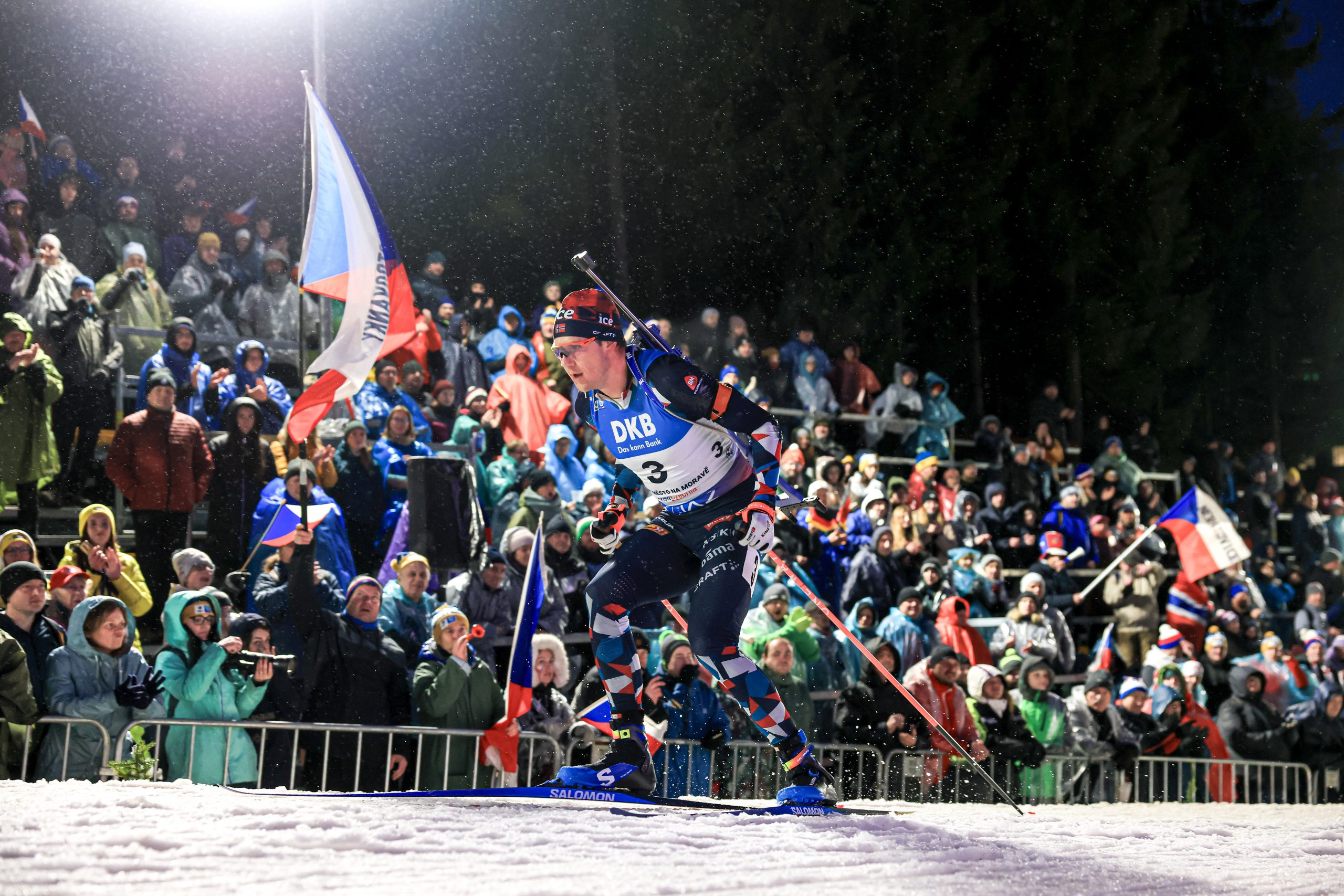
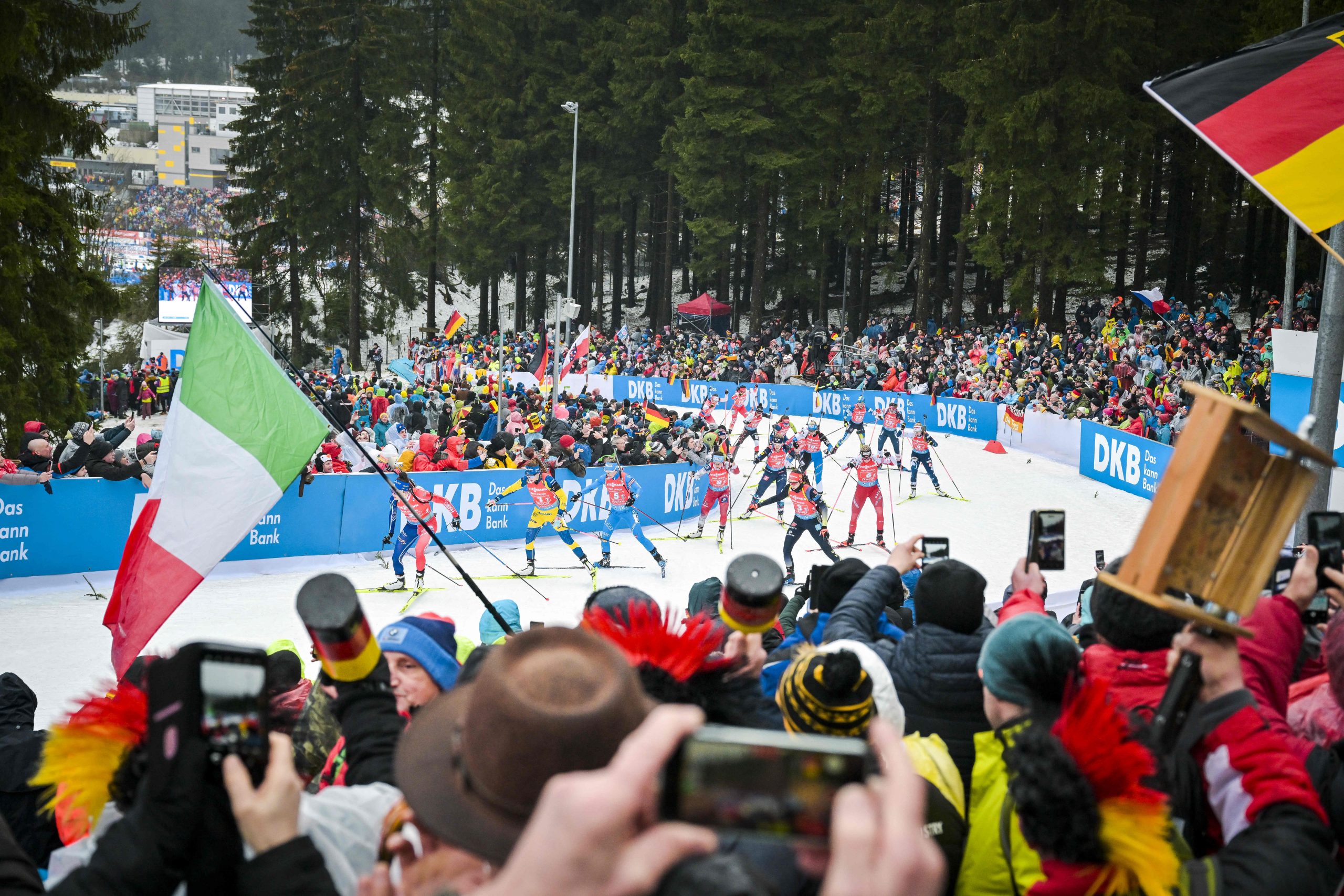
The start of the Single-Mixed Relay in the Vysocina Arena in Nove Mesto na Morave, Czech Republic. (Photo: NordicFocus)
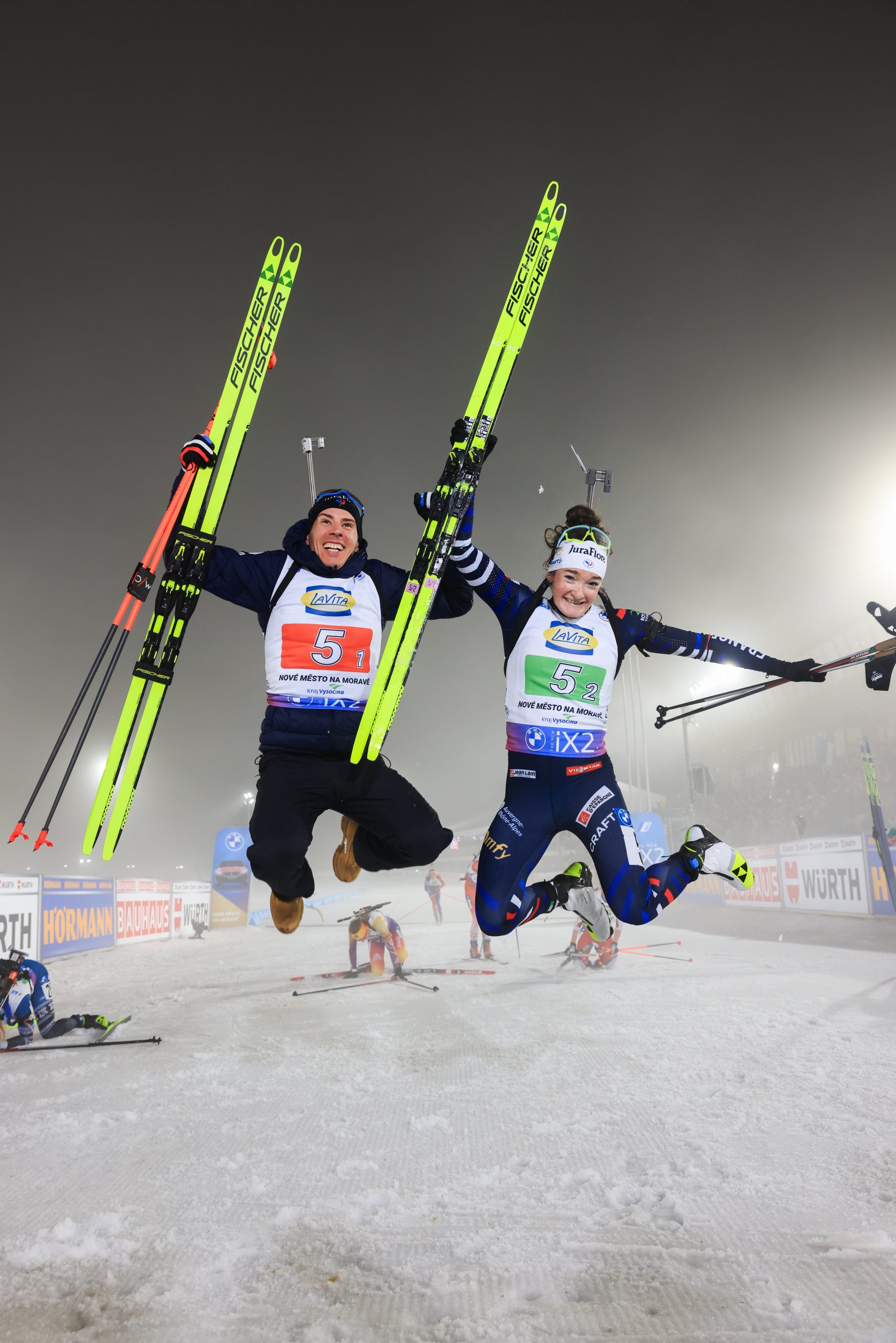
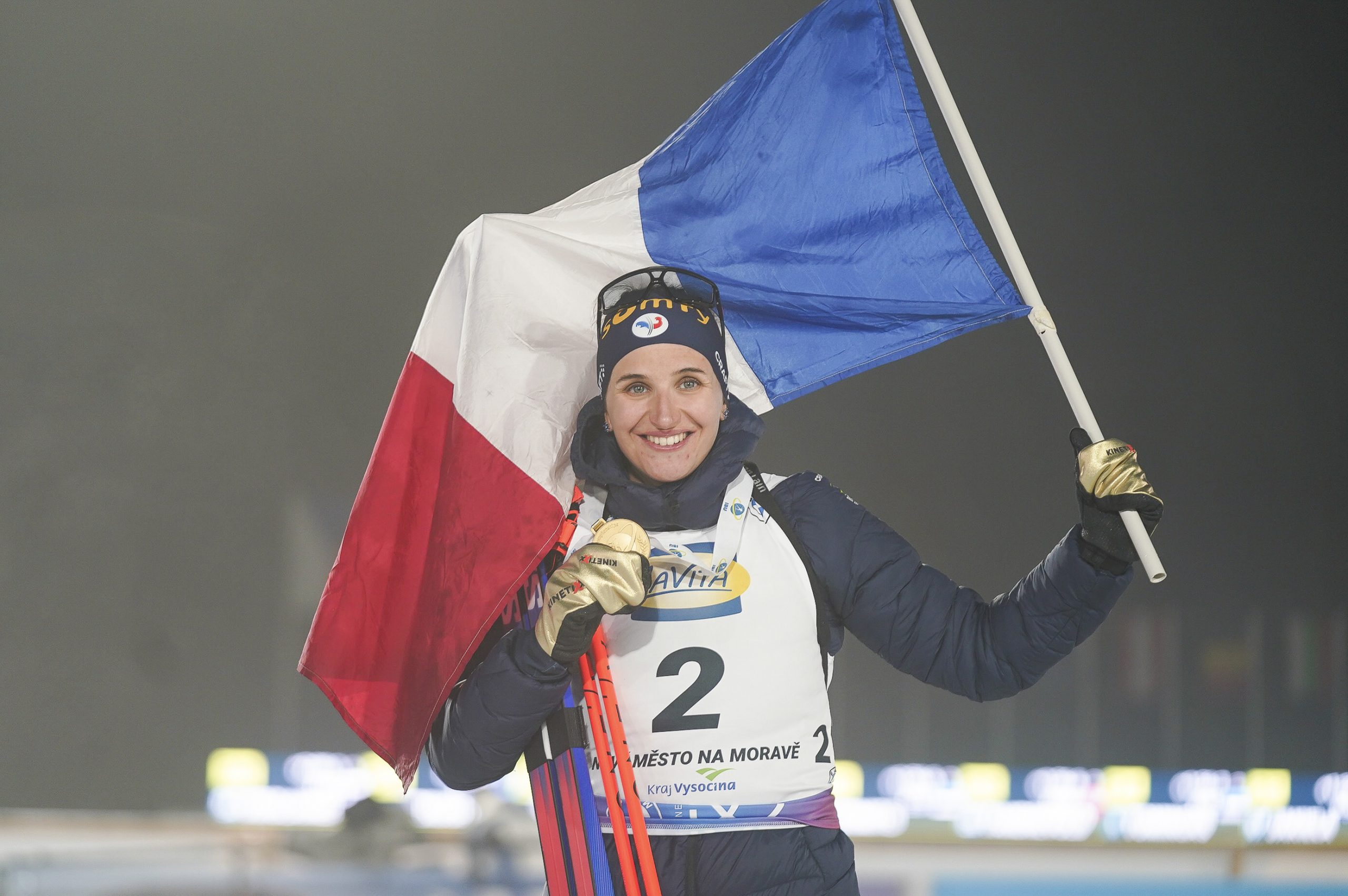
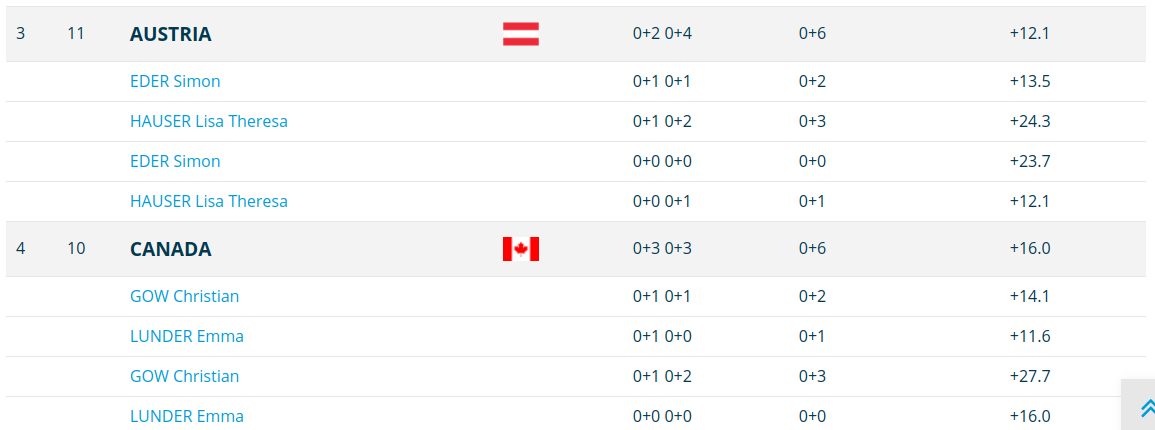
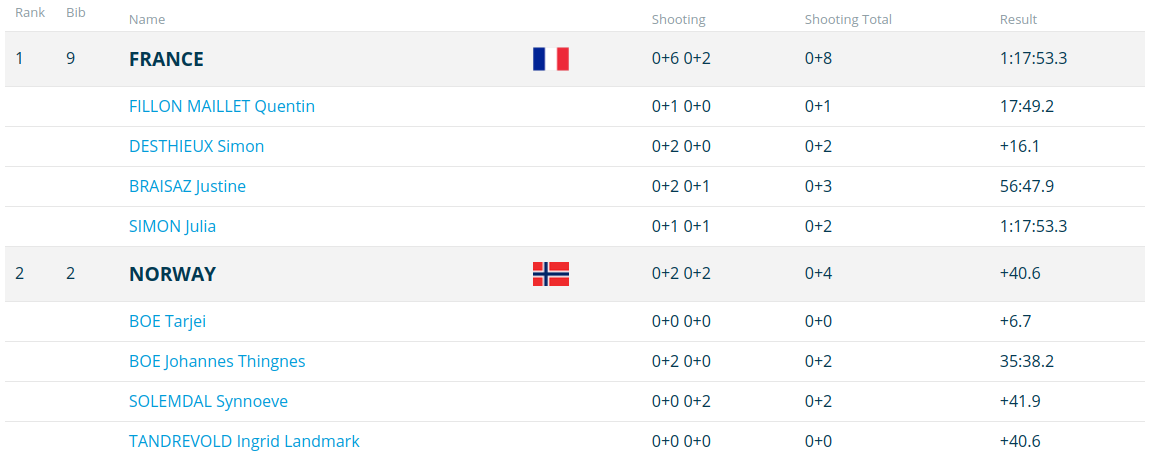
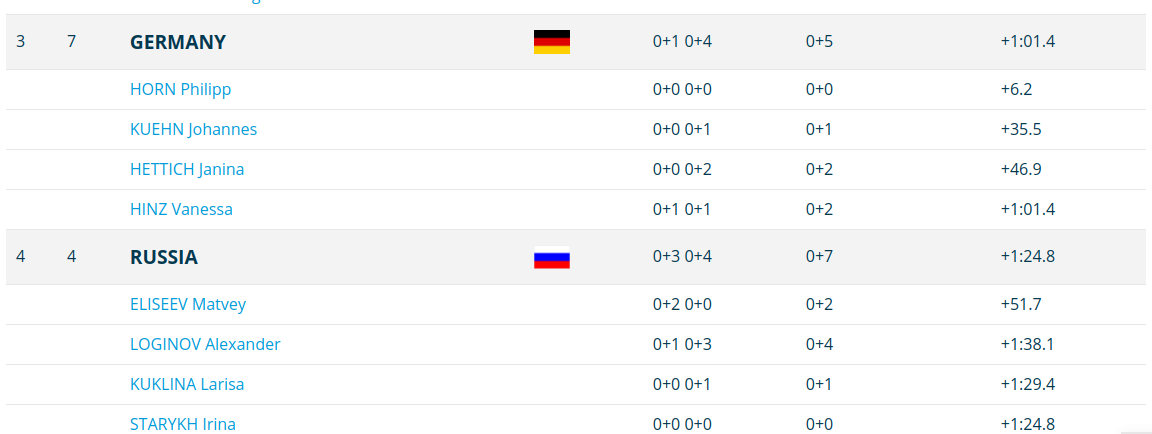
Twenty-eight nations started the Single-Mixed Relay on Thursday at Biathlon World Championships in Nove Mesto na Morave, Czech Republic. After just over 35 minutes of fast and furious racing, France claimed the gold, last year’s bronze medalists from Italy the silver, and the defending champions of Norway the bronze.
The Single-Mixed Relay combines the performances of one man and one woman who each ski two short biathlon races, tagging off in between. The importance of shooting speed and accuracy is magnified in this format because the ski loop is only 1.5 k; there is relatively little distance over which to recover lost time. As in all biathlon relays, athletes can use up to three spare rounds per stage to hit their five targets, but loading each spare takes precious time, and if targets remain un-hit, the penalty loop awaits. The event is a wildly unpredictable fan favorite.
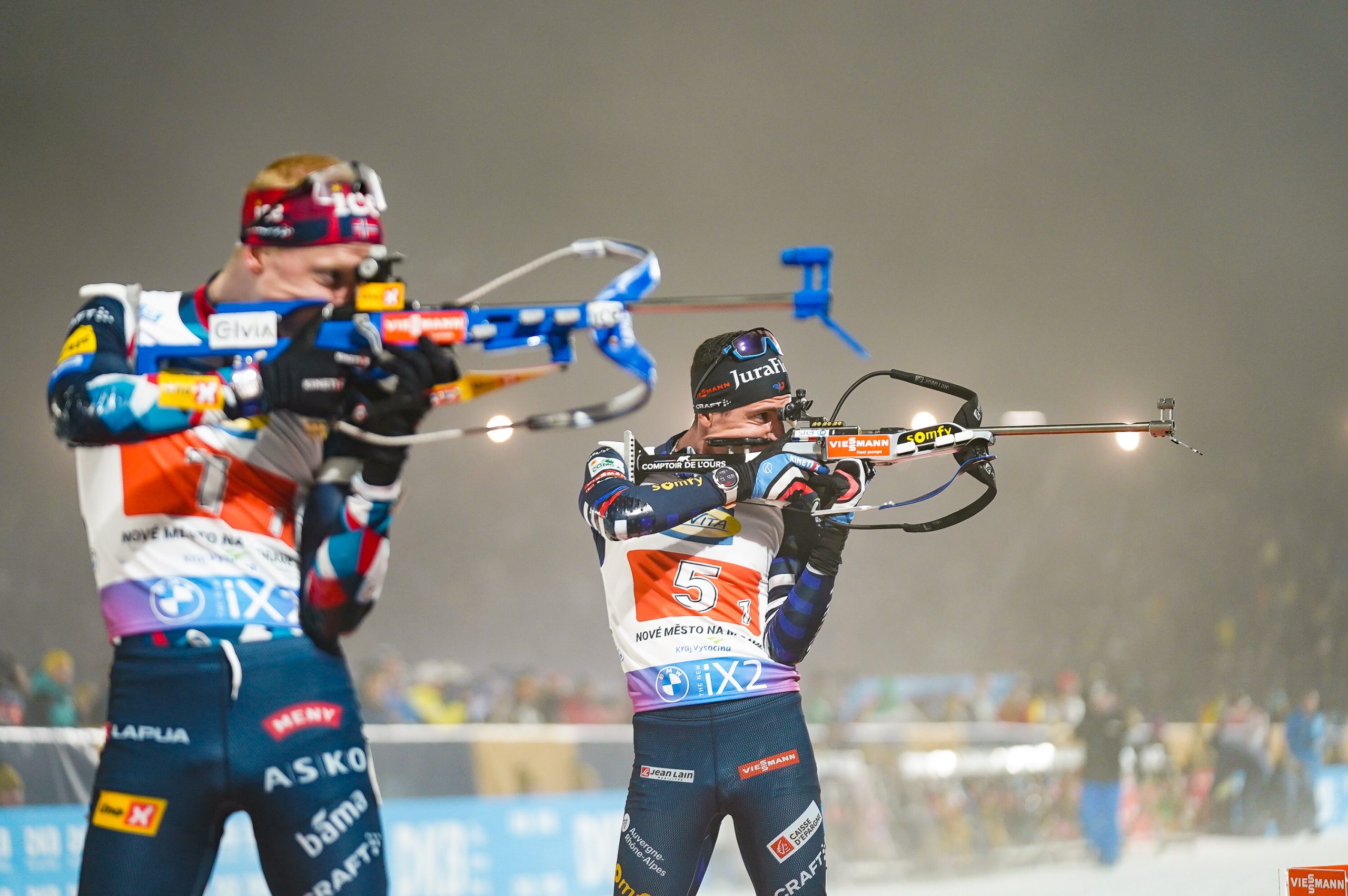
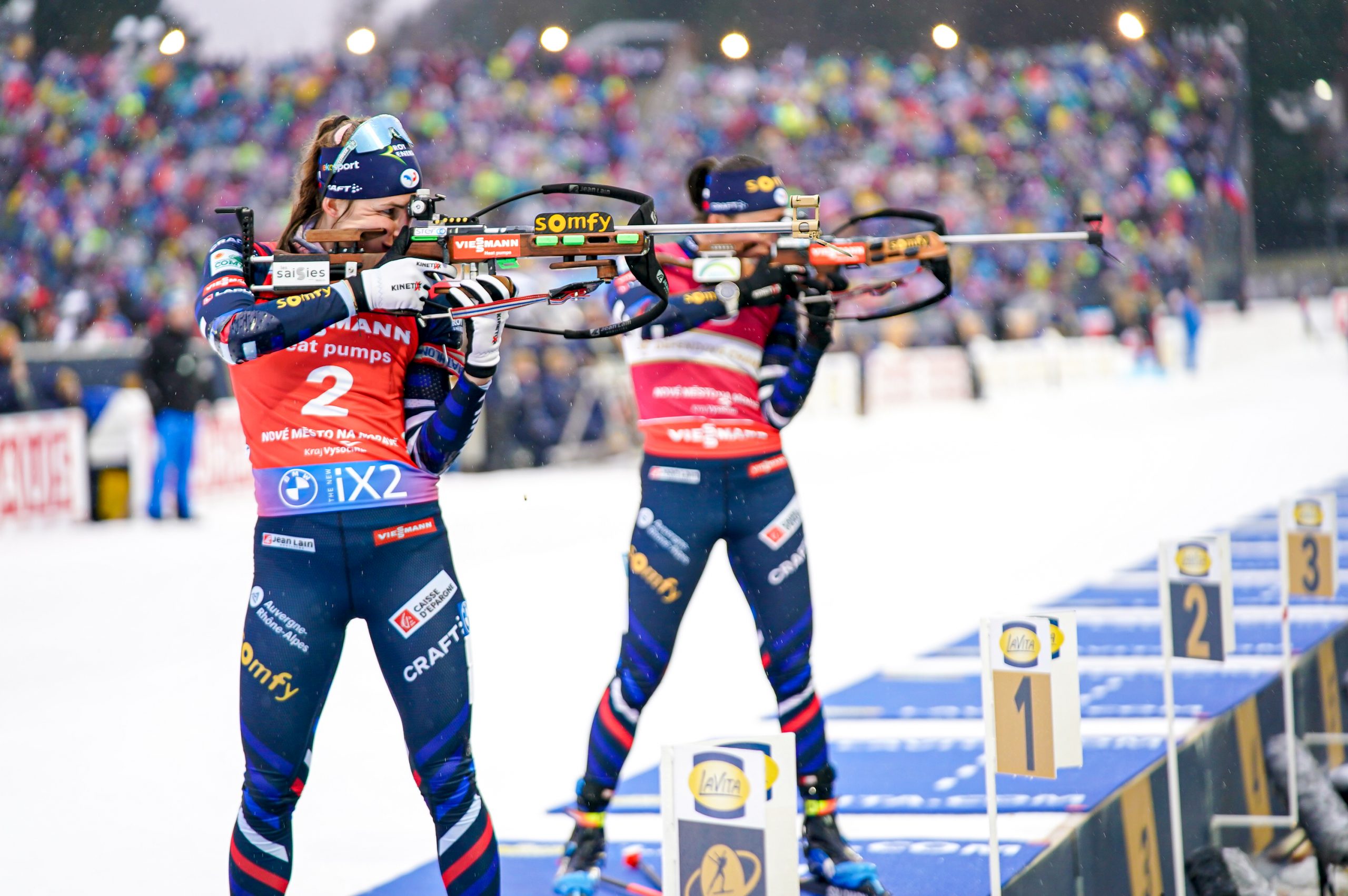
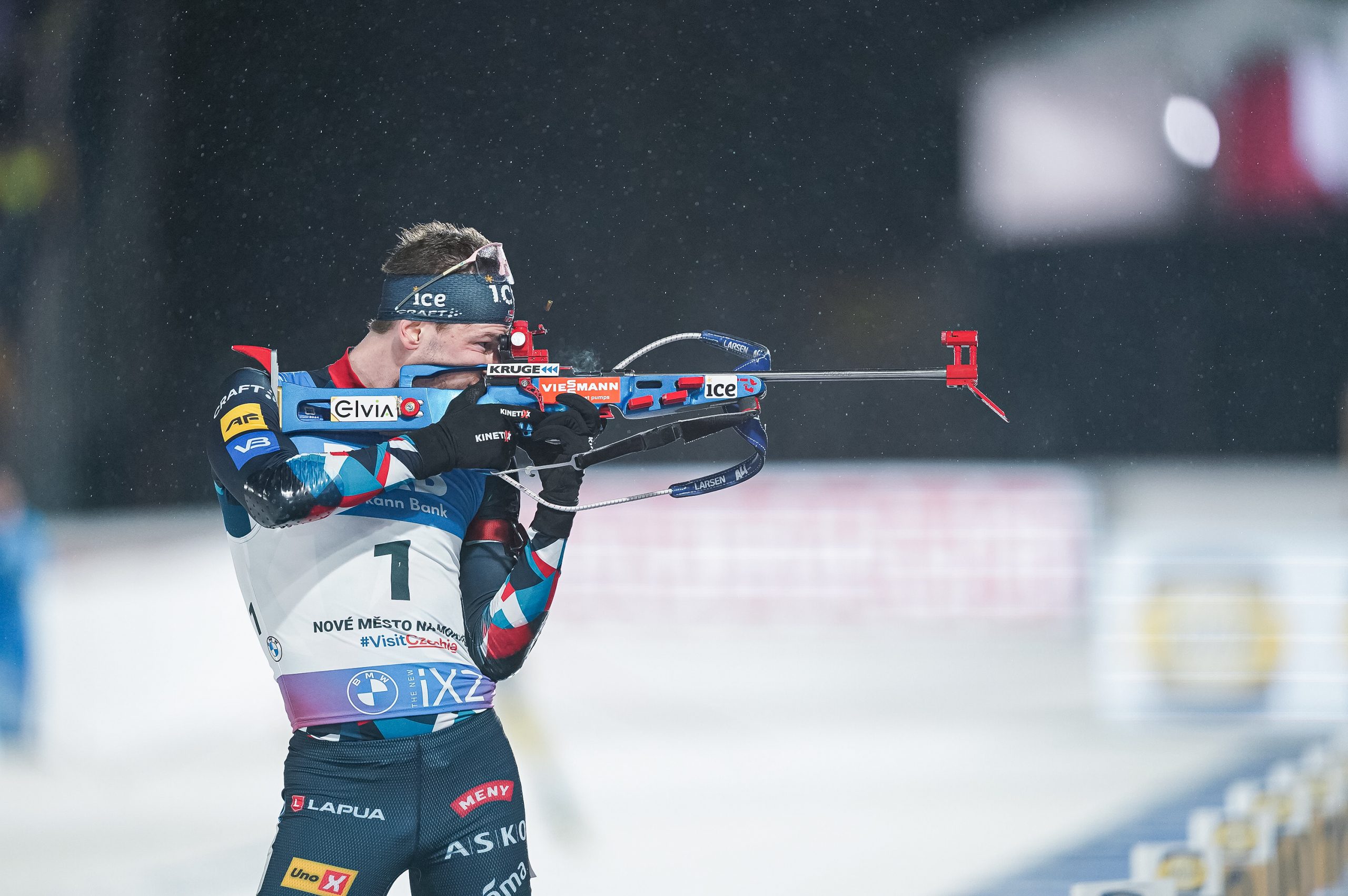
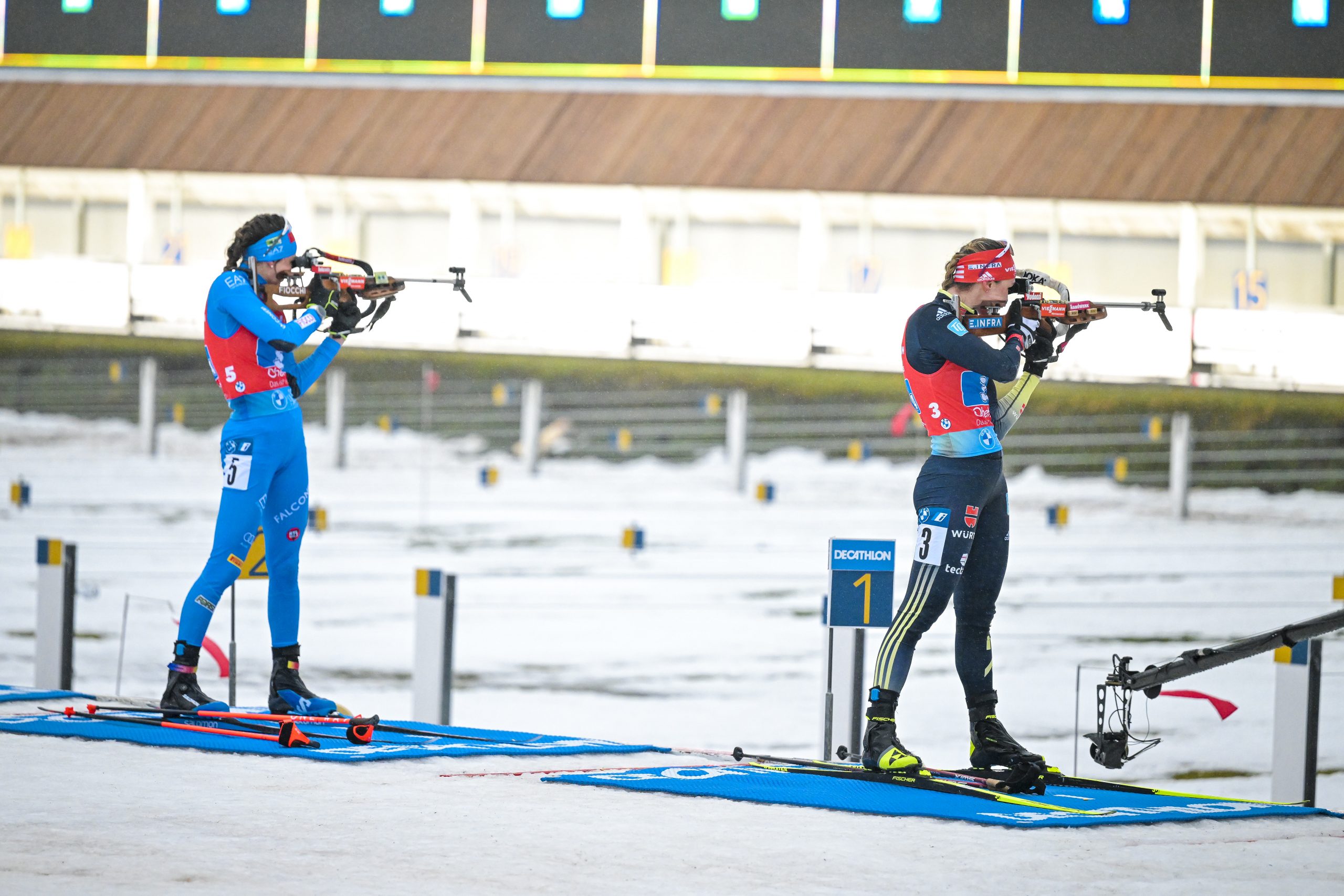
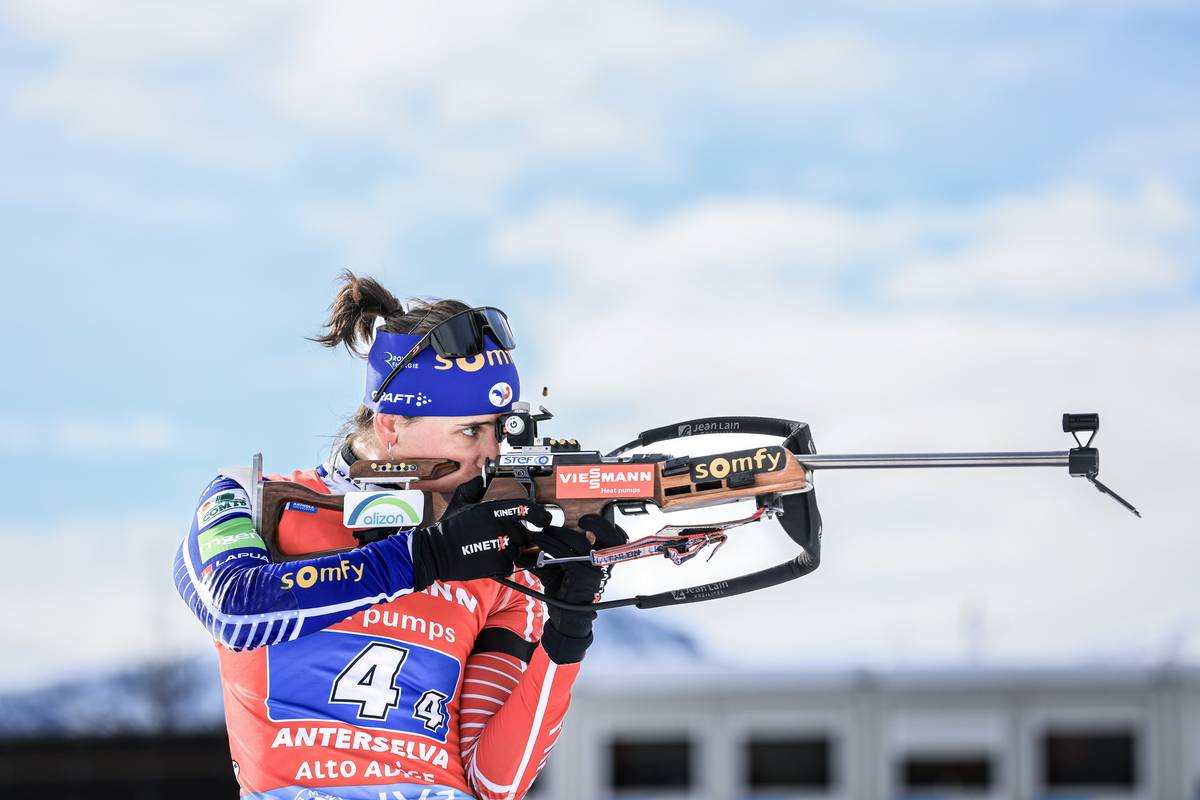
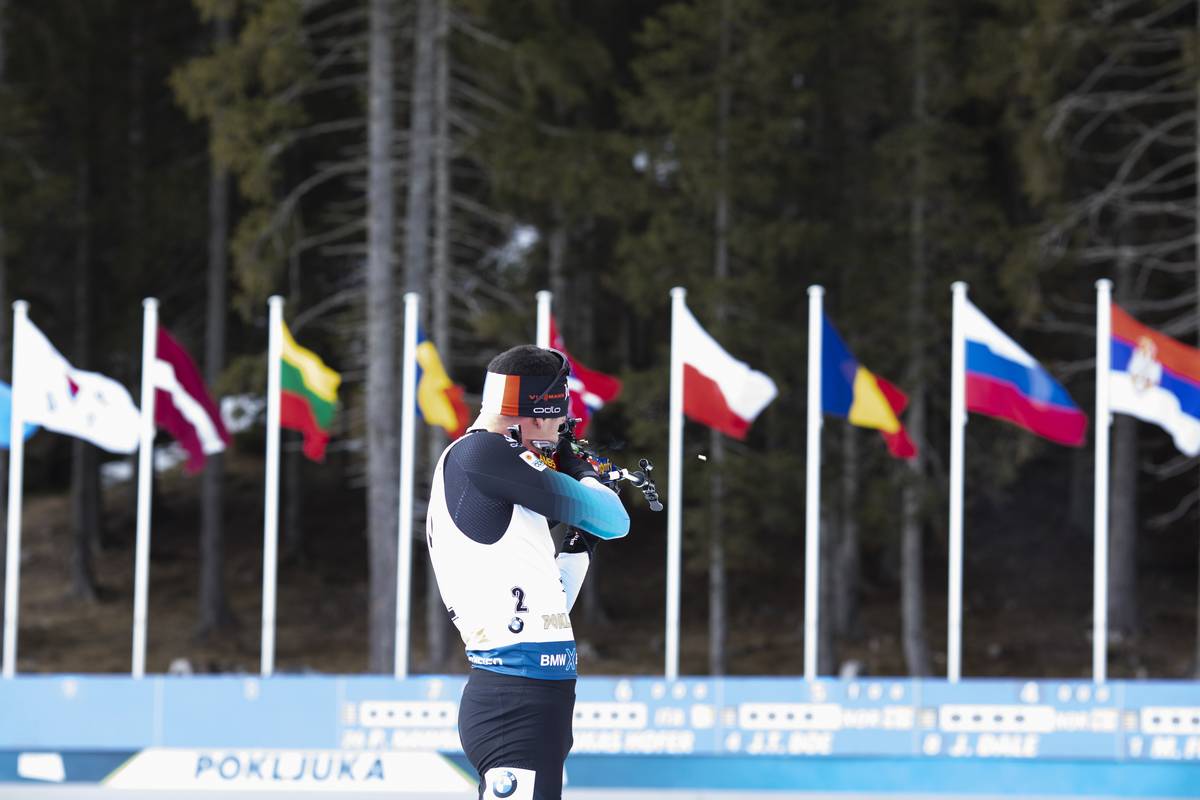
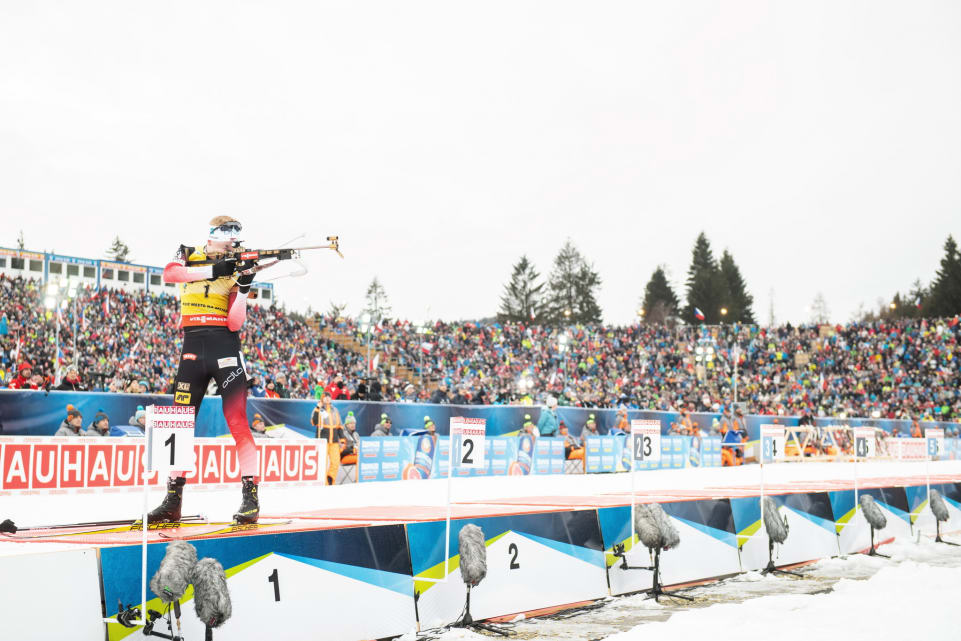
Johannes Thingnes Boe (NOR) and Quentin Fillon Maillet (FRA) (l-r) shoot on lanes one and two in the Single-Mixed Relay. (Photo: NordicFocus)
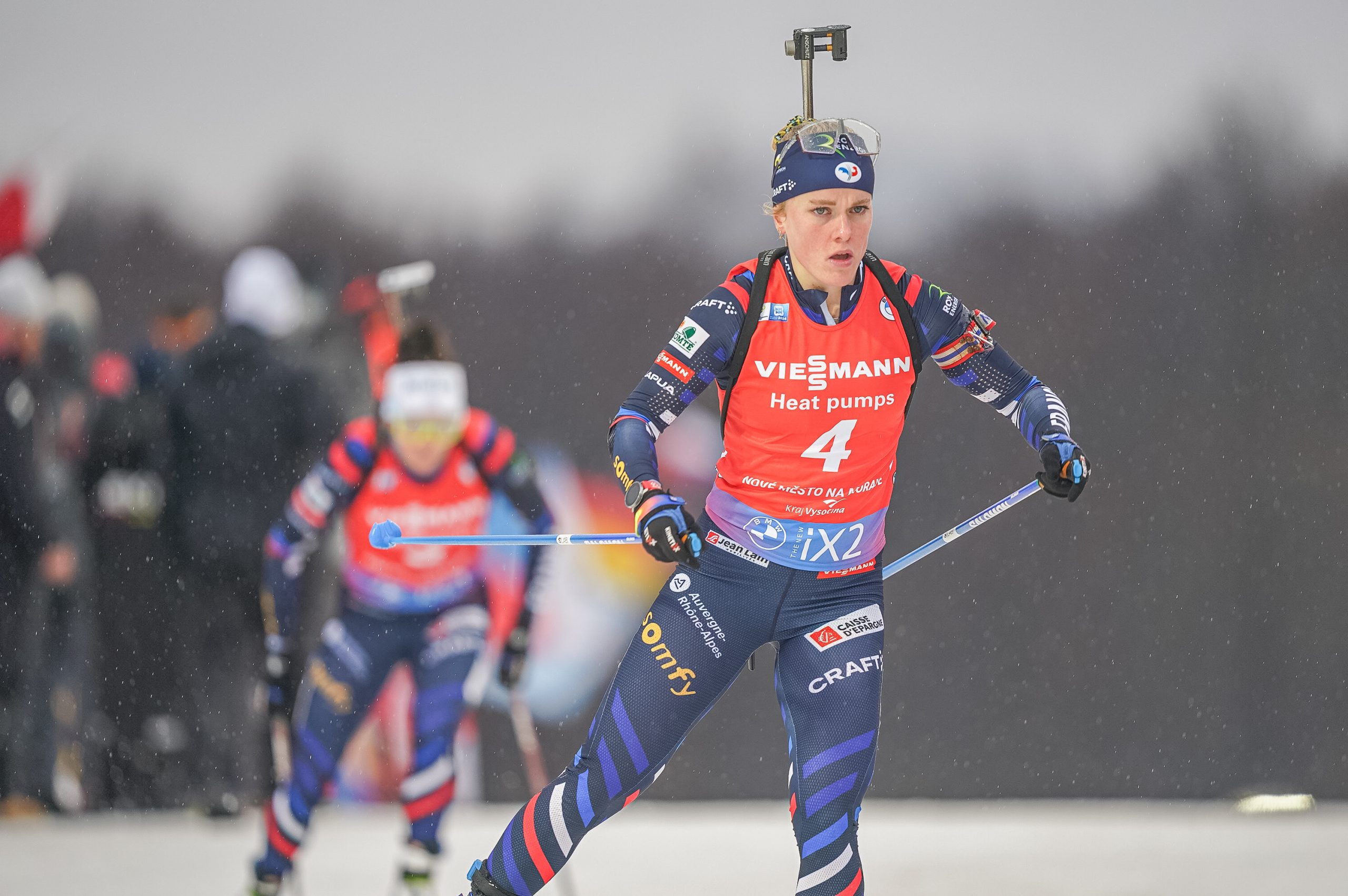
The field was stacked. Team Norway comprised the two current World Cup Overall leaders, Johannes Thinges Boe and Ingrid Tandrevold. But Tandrevold’s standing shooting has been hit or miss at World’s—more often miss than hit. For France, Lou Jeanmonnot got called up to race with Quentin Fillon Maillet. France’s top star, Julia Simon, decided to sit out and rest after winning three golds and a silver in the first four events of the Championships. But Jeanmonnot has been fantastic in her own right, finishing third, sixth, and seventh in the non-team competitions here in Nove Mesto. Italy put forward one of the strongest women in the field, Lisa Vittozzi, fresh off a victory in the 15 k Individual. Her partner, Tommaso Giacomel, has been 15th, 20th, and 45th in non-team competitions, combining reliable ski speed with less reliable shooting, but the same duo was a successful pairing in 2023 when they took bronze.
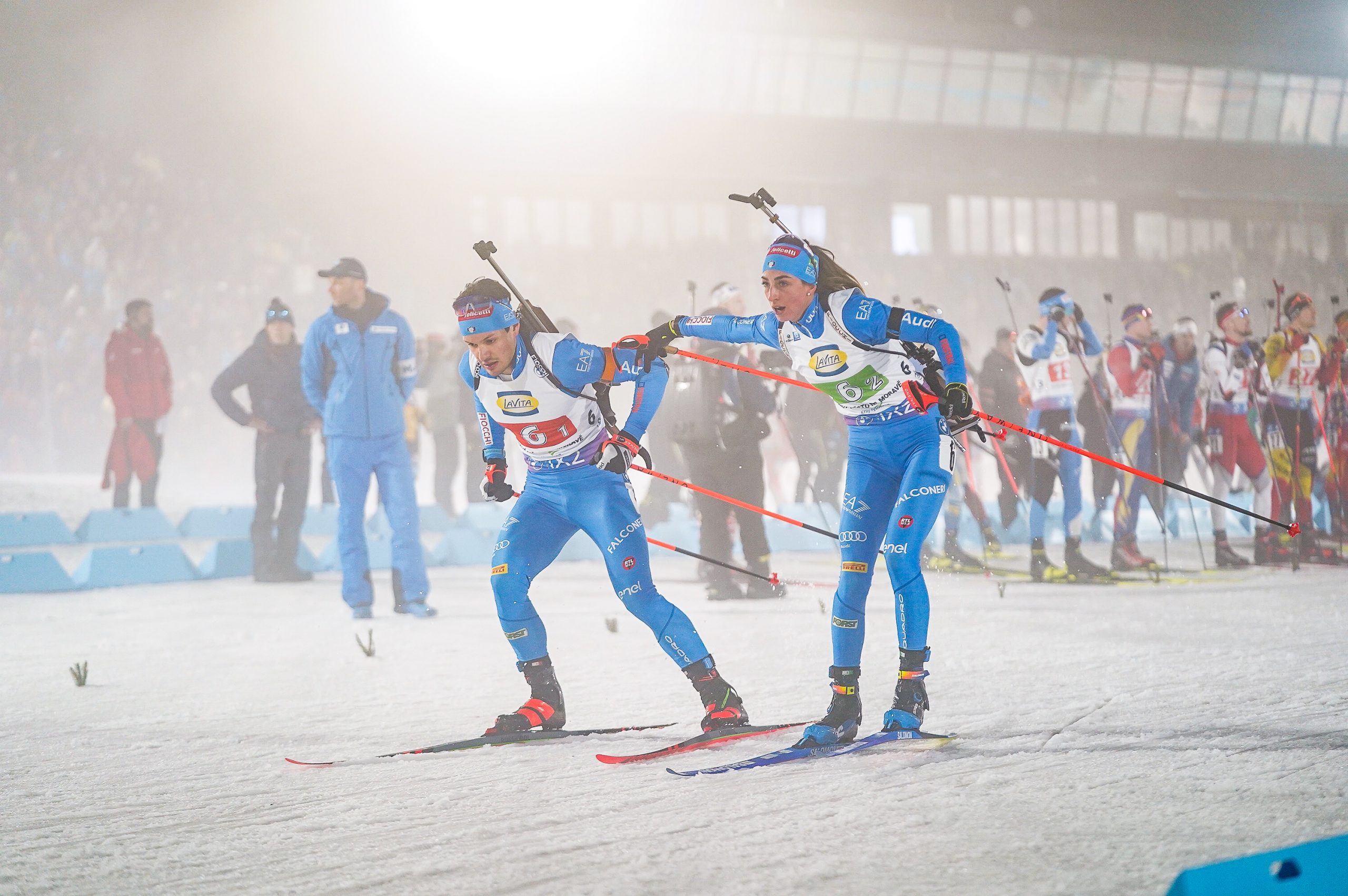
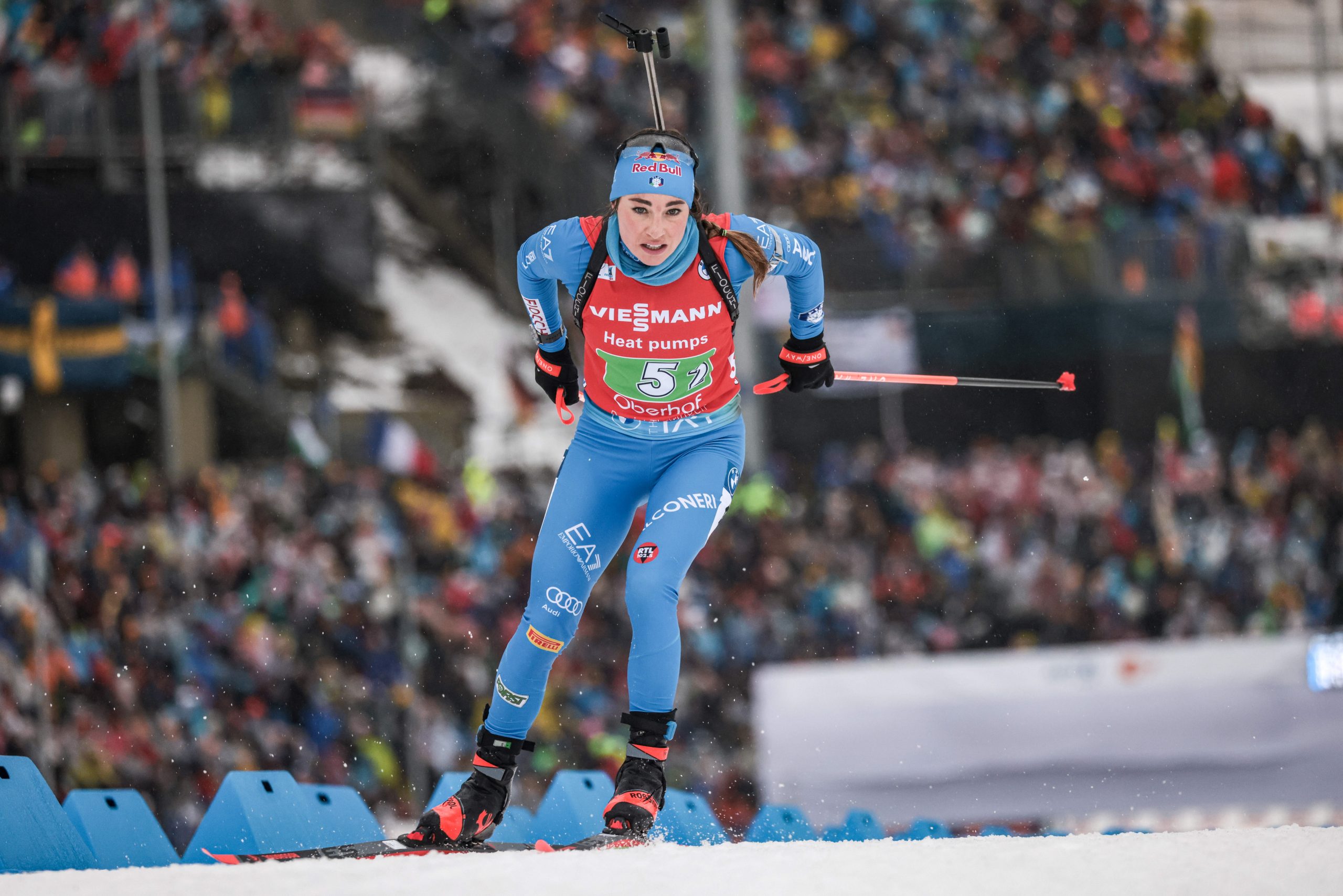
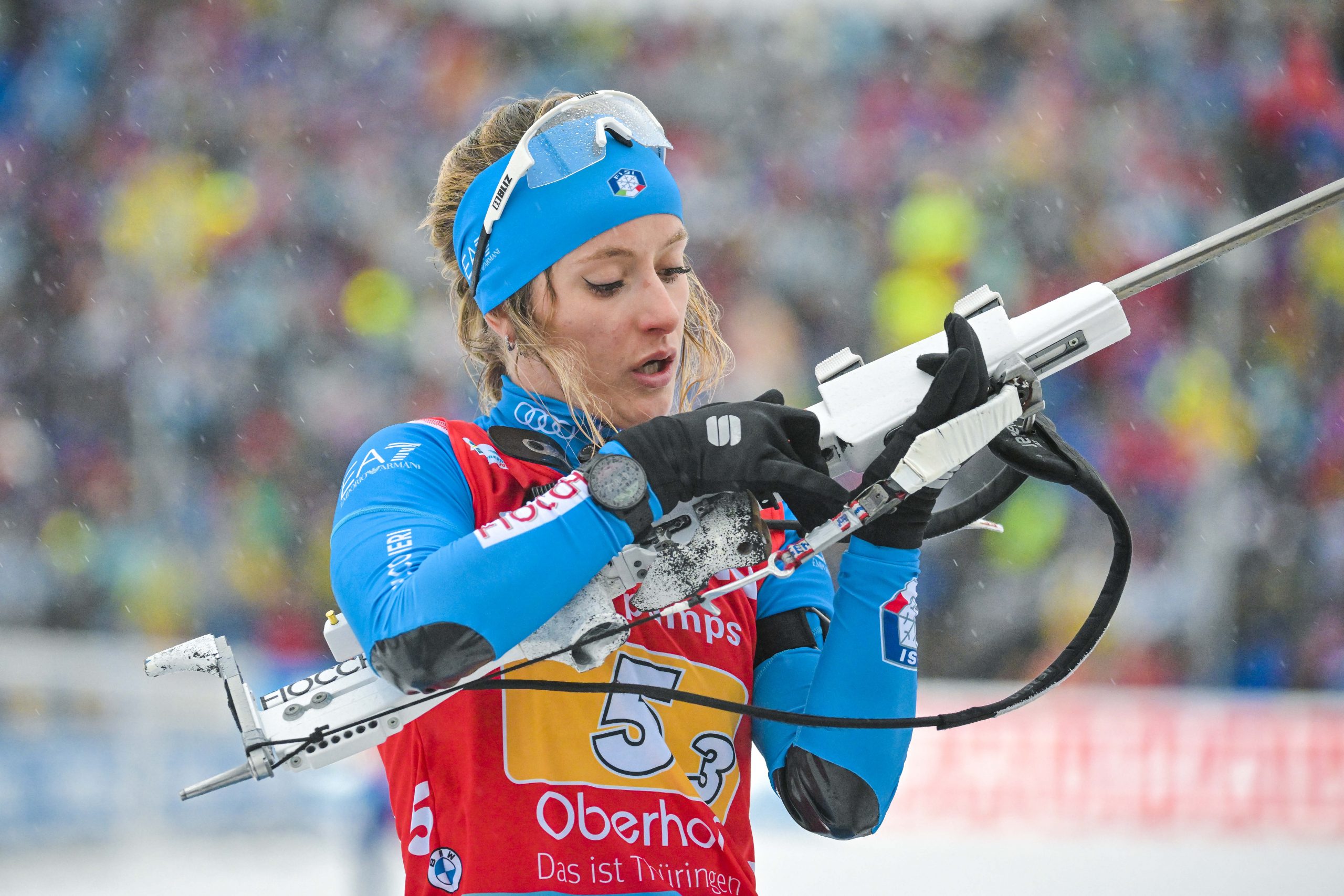
2023 bronze medalists from Italy, Lisa Vittozzi and Tommaso Giacomel, paired up again to take silver in 2024 in the Single-Mixed Relay. (Photo: NordicFocus)
Germany’s team combined the two most accurate shooters in the World Cup field. Sweden is always a threat, and Switzerland put forward two of the fastest shooters and the most likely person to demolish the last lap: Lena Haecki. For more discerning fans, the US was also a solid pick for the day: Campbell Wright and Deedra Irwin showed their potential in this event in January in Antholz, Italy, when they stayed in podium contention through the first half and eventually finished ninth in a very tight race, just 1:09 out of the lead.
The lead constantly changes in the Single-Mixed Relay as the athletes make their way through a combined eight shooting stages and nine course loops. At the first exchange, France was in the lead but the eventual silver-medalists from Italy were down in 14th, with fourth place finishers Sweden following behind them in 15th. Wright shot 10/10 on the first leg to tag Irwin in fourth. At the second and third exchanges, France and Norway continued to trade the lead, while the US, Germany, Switzerland, and Finland shuffled around the next four places and Italy and Sweden gradually moved up.
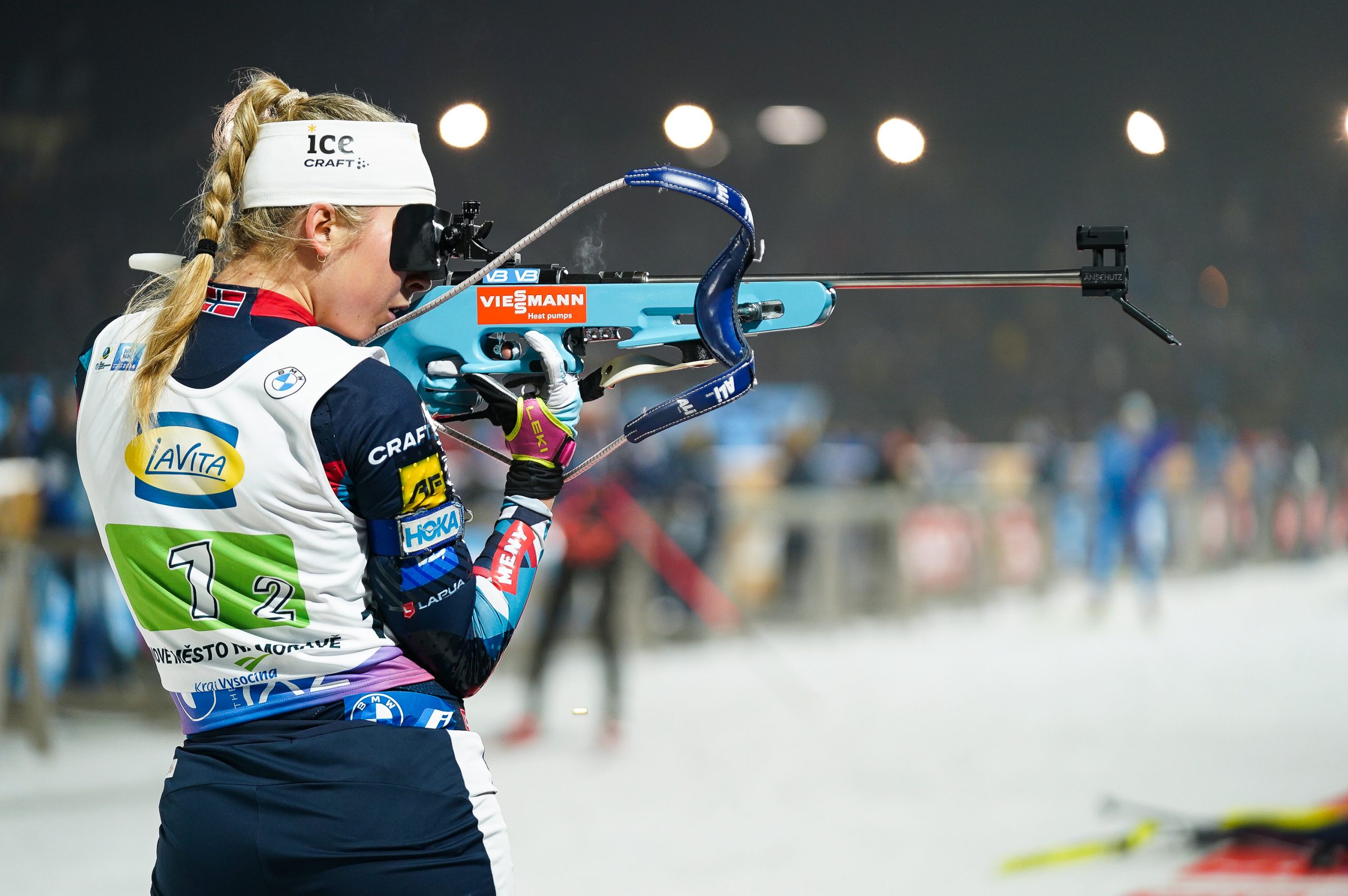
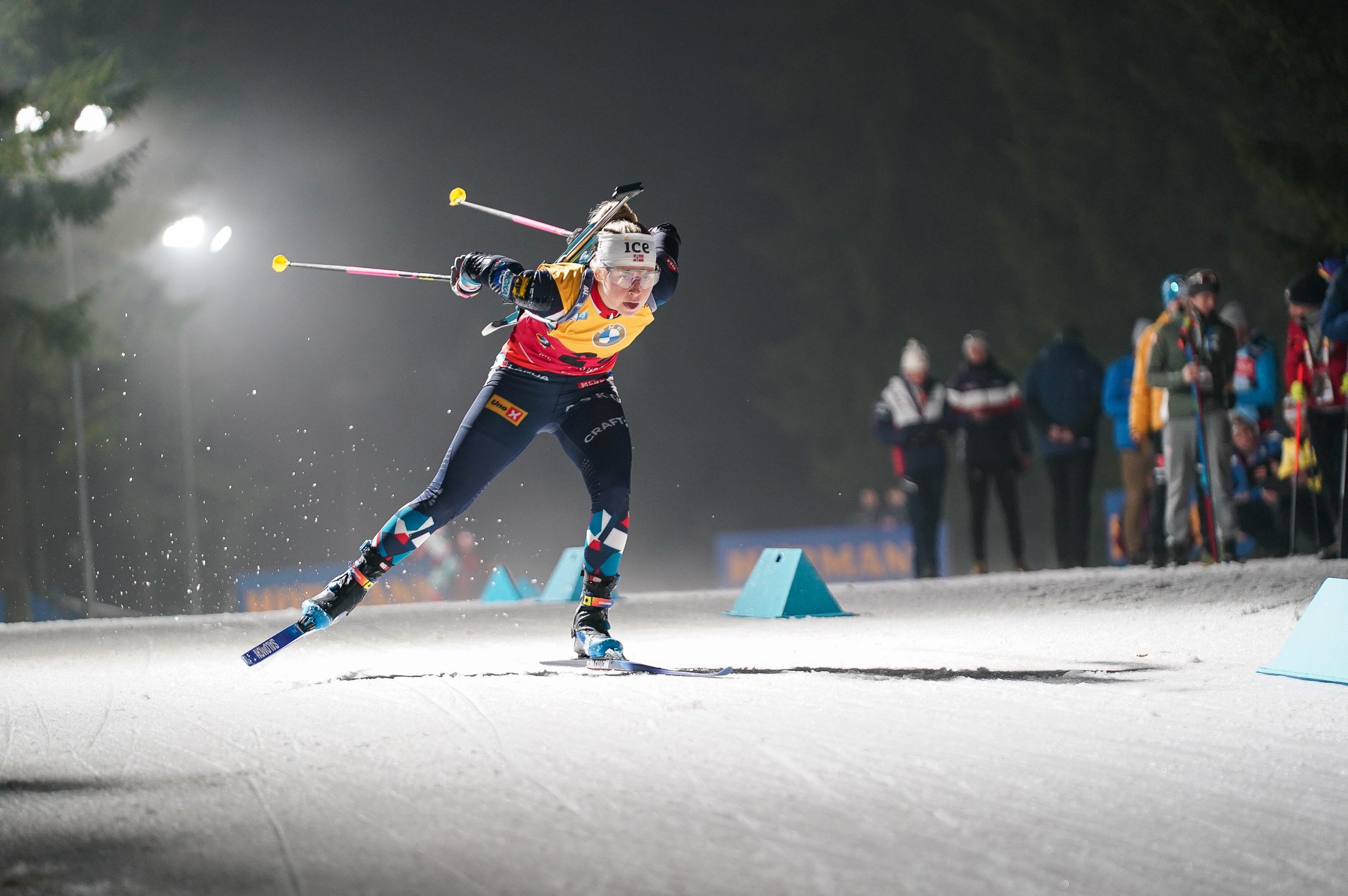
Ingrid Landmark Tandrevold (NOR) incurred a penalty loop on the final shooting, falling from first to third. (Photo: NordicFocus)
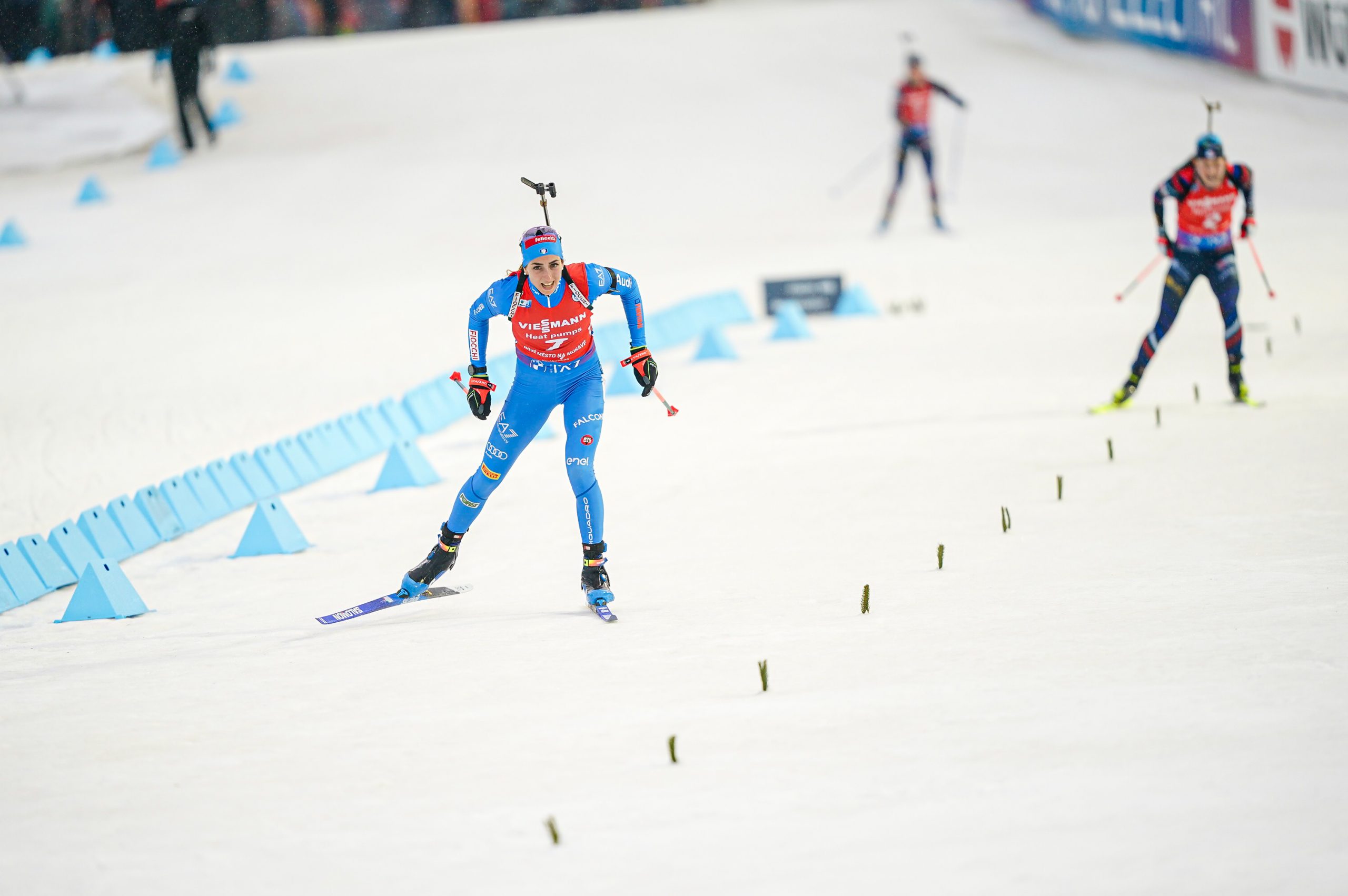
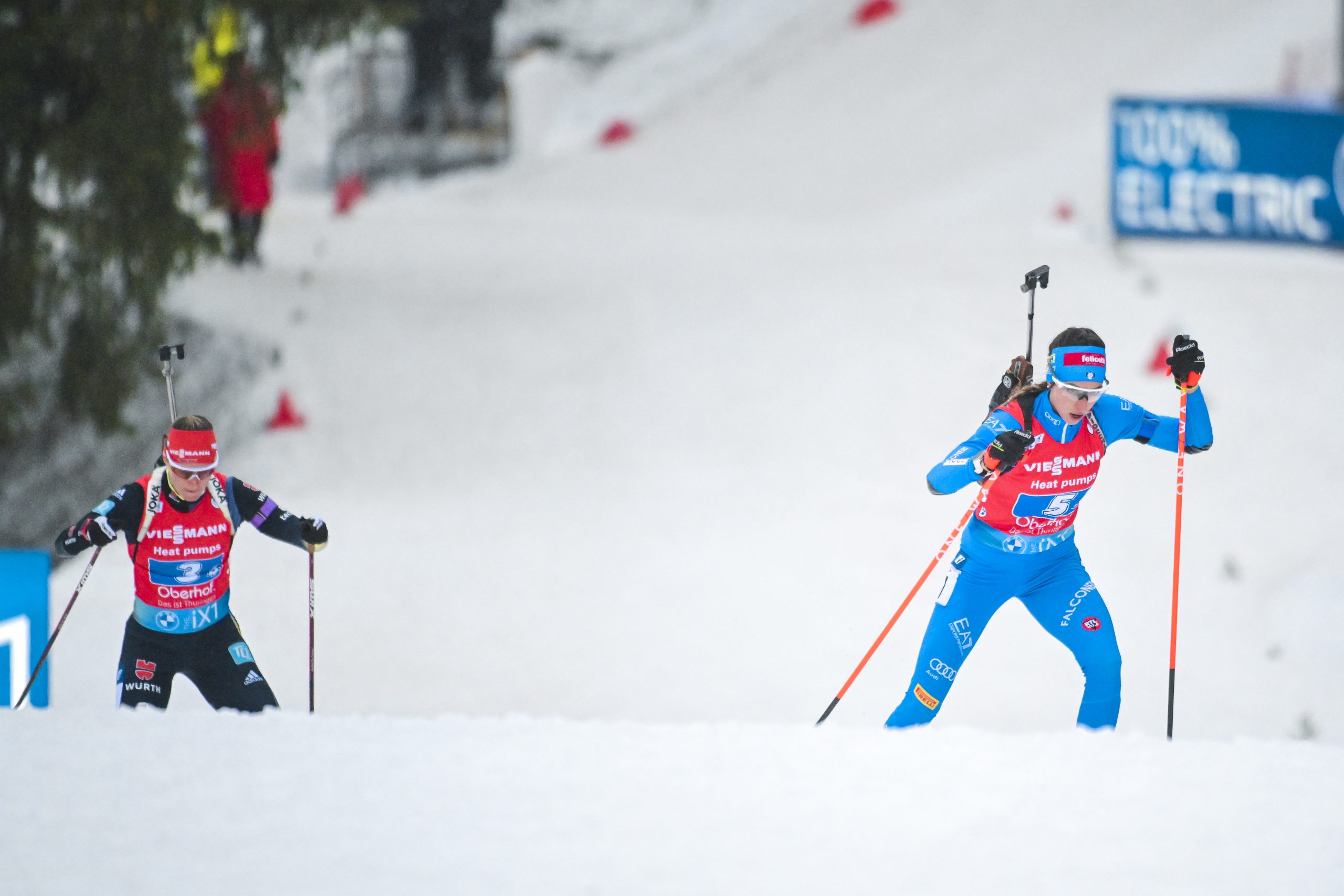
In the defining final stage of the race, Tandrevold, a lefty, stood on lane one, face to face with Jeanmonnot on lane two, in a shooting dual for the gold. Jeanmonnot shot with confidence, hitting 4/5 targets and her spare round in a total of just 28 seconds. But Tandrevold needed all three spares and still had to ski a penalty loop, opening the door for Vittozzi to leave the range in second after a flawless 19.6-second shooting bout. While Jeannmonnot skied to a decisive victory, Tandrevold caught and passed Vittozzi part way through the last lap, only to be convincingly out-sprinted by Vittozzi in the final two hundred meters. About thirty seconds behind that trio, Irwin shot clean and left the range in fourth, but three teams followed within the next nine seconds. The athletes from Sweden (H. Oeberg), Switzerland (Haecki), and Germany (Voigt) skied three of the four fastest course times on the last loop to push the USA down to seventh.
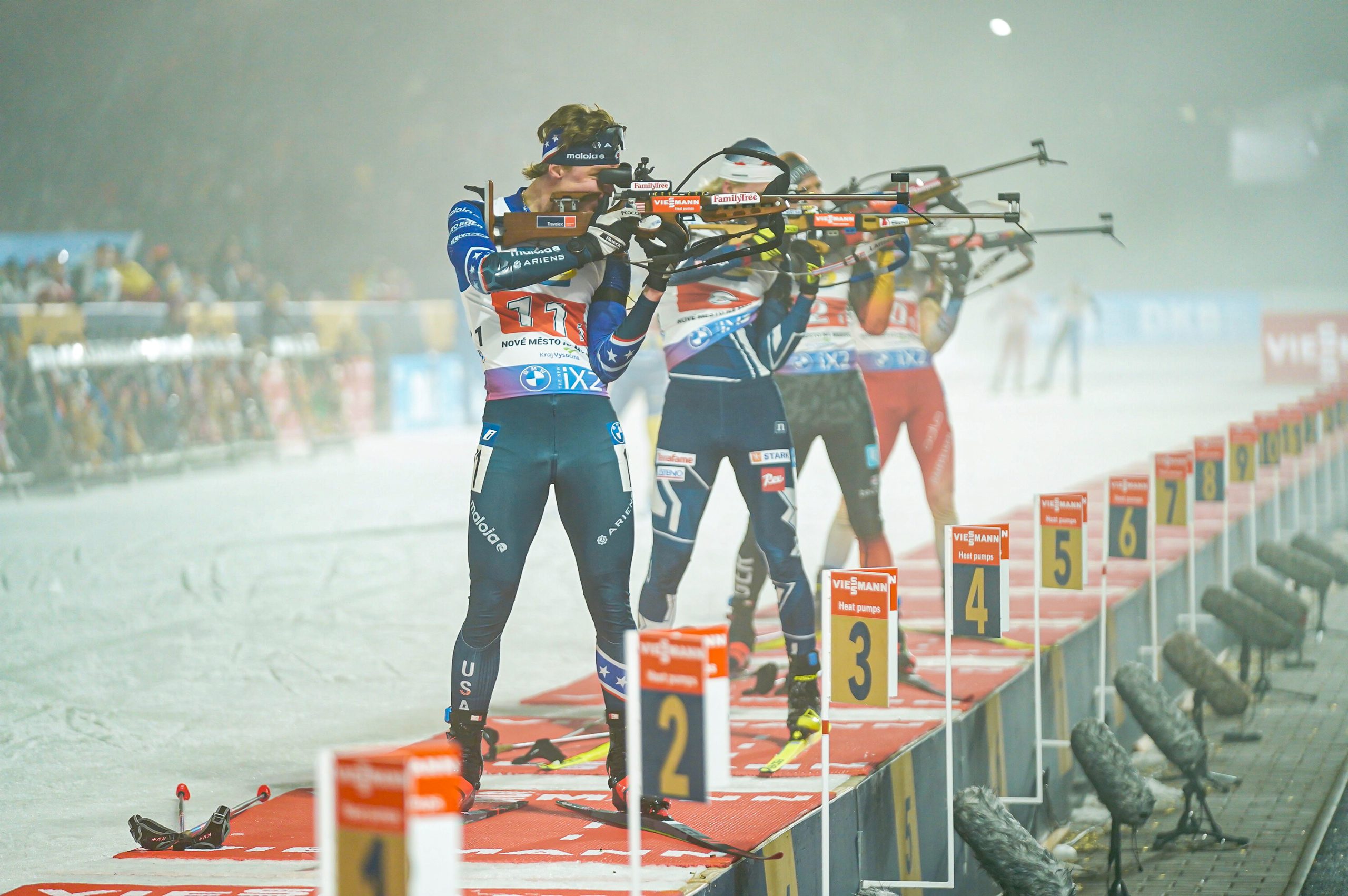
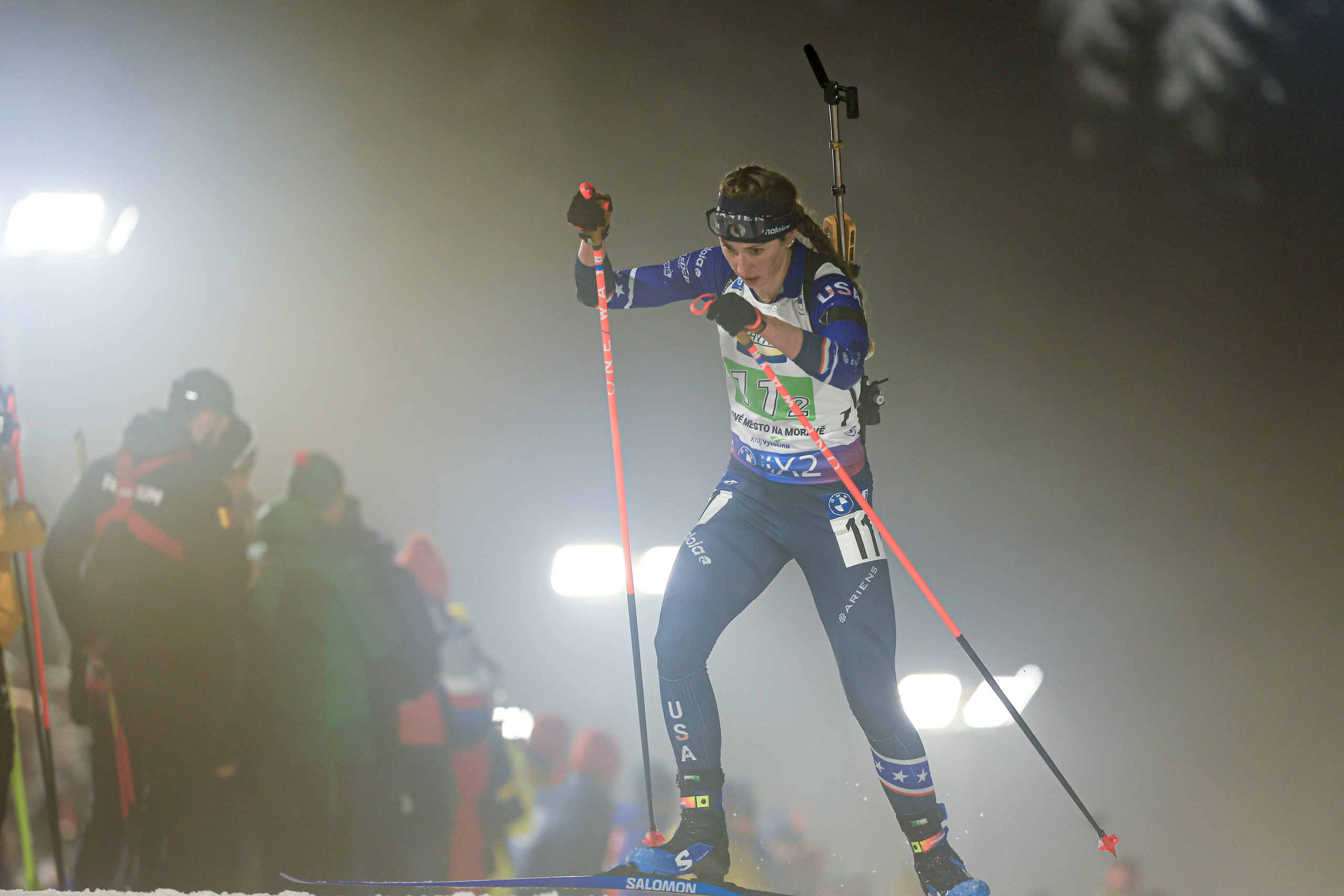
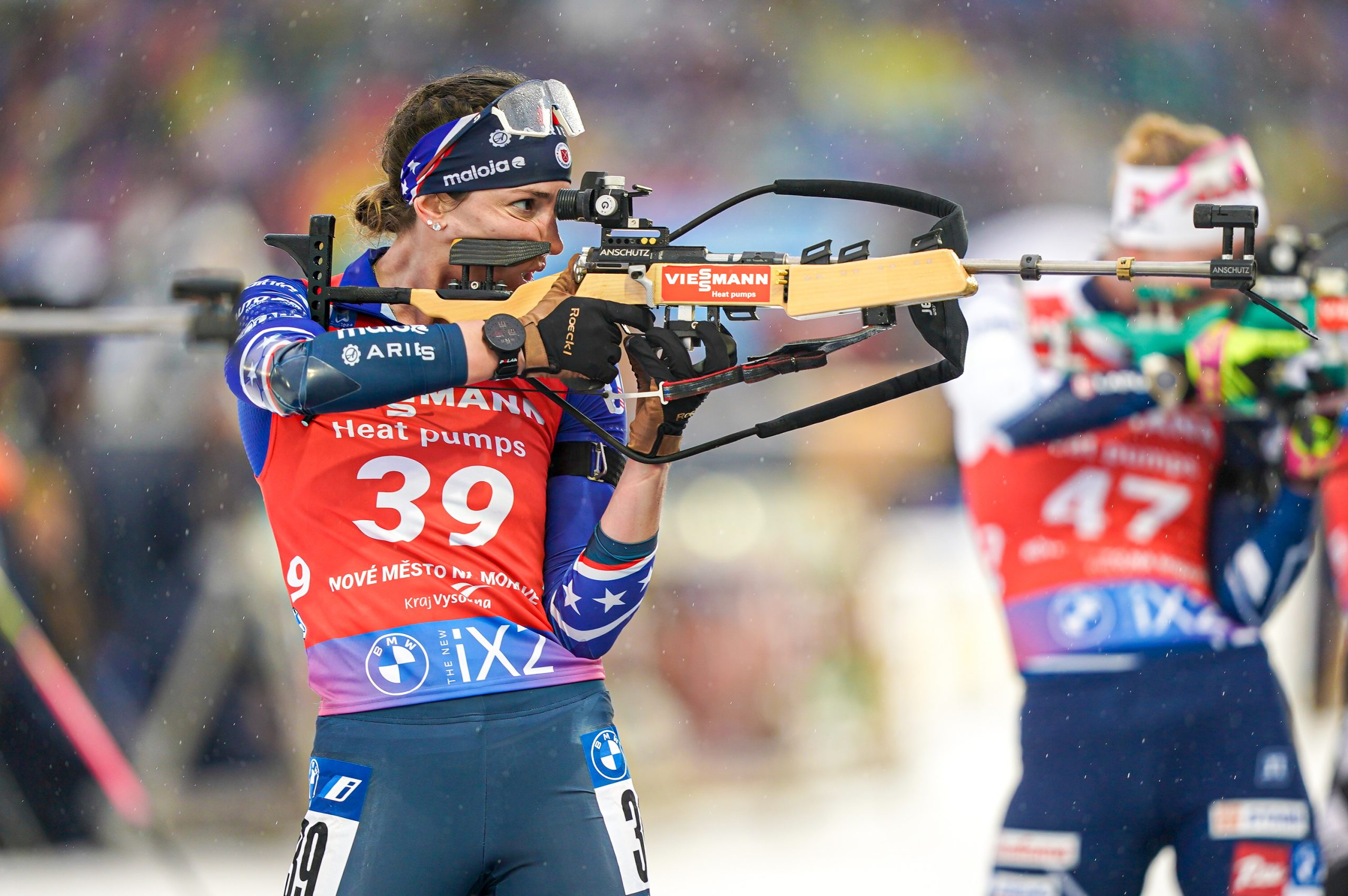
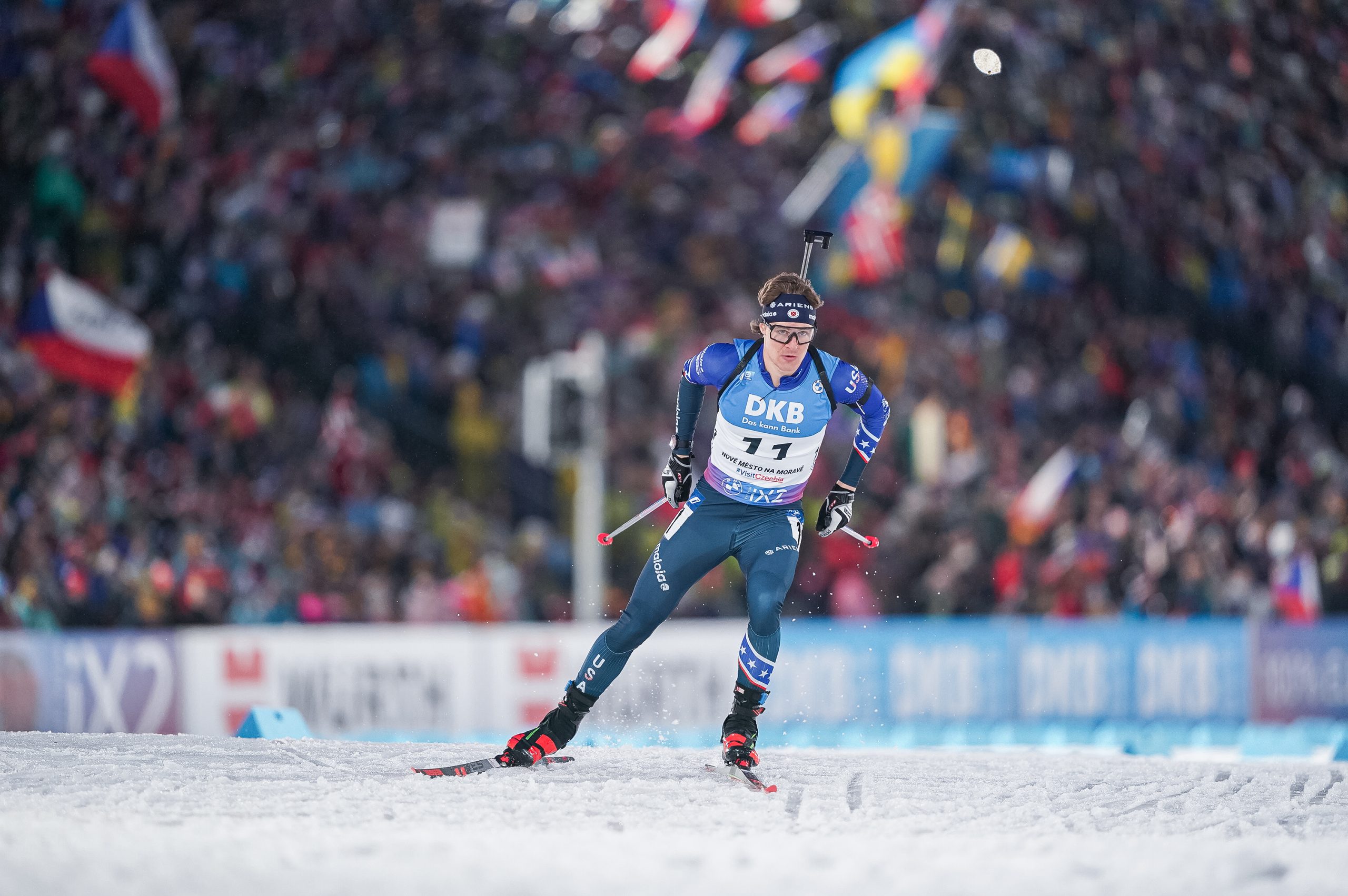
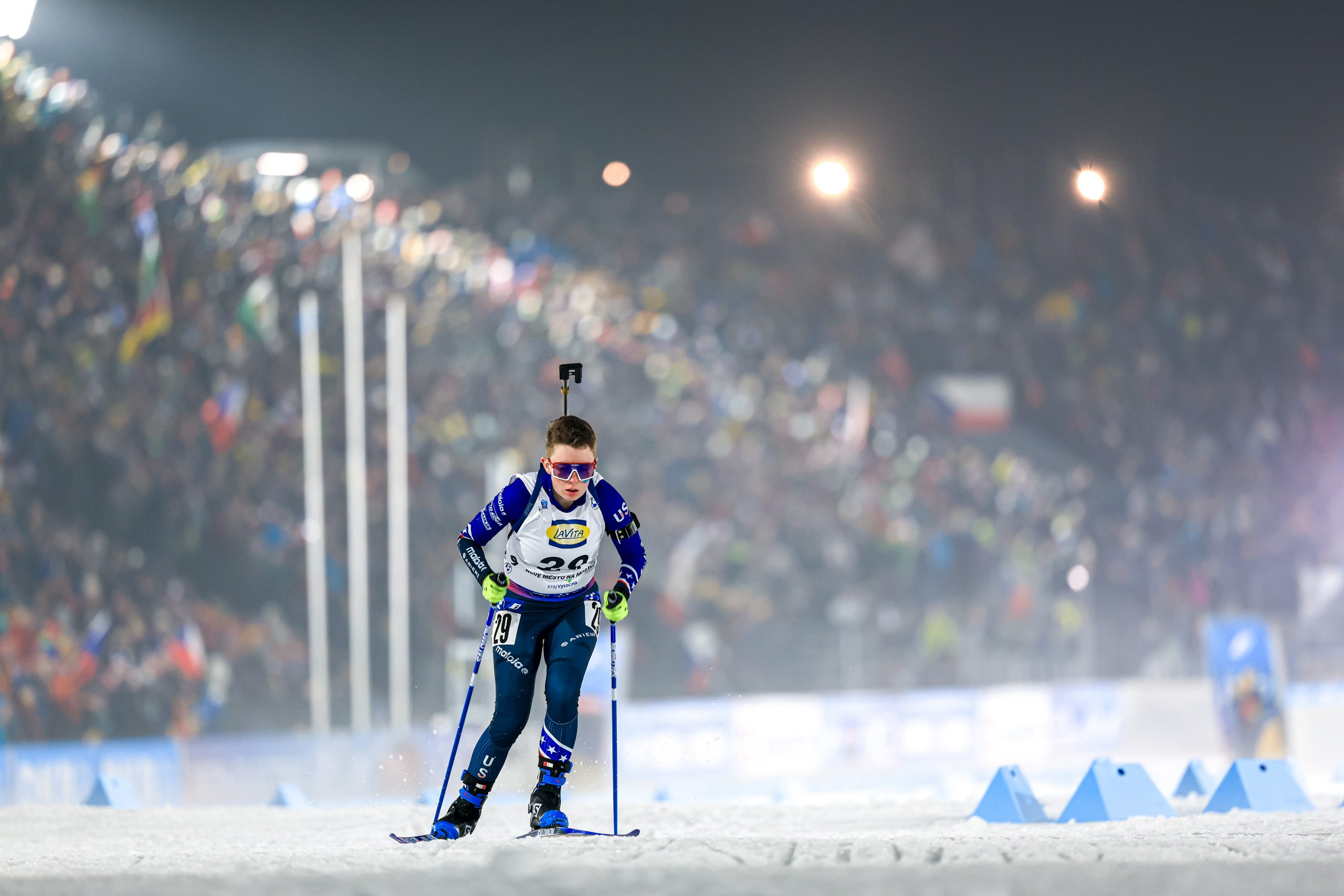
Campbell Wright (USA) shoots on lane four in the Single-Mixed Relay. This year’s relays are his first since previously as the only New Zealand athlete on the circuit he didn’t have teammates with which to compete. (Photo: NordicFocus)
For US Biathlon’s Campbell Wright, this season’s relays are a first. Wright is a dual citizen who grew up in New Zealand and competed for that country up through last season. As the only top Kiwi biathlete, he never had teammates with whom to race relays. Speaking of his experience shooting clean and tagging in fourth at the World Championships, Wright said, “I’m lovin’ it. I know I can ski well at the moment so it’s not as stressful skiing with fast people.” At just 21 years old, Wright is still coming to terms with the fact that he is one of the “fast people.” This was Wright’s second-ever Single-Mixed Relay after the one Antholz in January where he had a great start but then had to ski a penalty loop. Today’s shooting was different, he said, “because I had less pressure because Deedra was on the last leg!” He added, “That last leg is bloody hard.”
Deedra Irwin (USA) shot clean on the final shooting to leave the range in fourth. (Photo: NordicFocus)
Irwin performed magnificently in the last leg on Thursday. Coming into the final stage in fourth, shooting for a chance at a World Championship medal, she cleared all five targets in a smooth and deliberate rhythm. “I went into the last standing thinking, ‘I have to be super aggressive,” she said. “On the first standing, I took my time, but everyone is shooting so fast and clean. That mindset worked which was awesome.” After the final shooting, Irwin was shocked when she saw Norway and Sweden skiing around the penalty loop and realized how well she was doing. But she was also aware that she left range, as she put it, “with all these people on my ass.” Irwin felt her best in January, but then was sick during the pre-World Championships training camp and has been doing a heavy load of racing as the top American woman, so she doesn’t feel quite as sharp now. But, she said, “I’m still in the best shape of my life this year.” Although it was frustrating to be passed on the final loop, Irwin was still content about her performance against some of biathlon’s top talents. “It’s very humbling and cool to fight against them. I’m never gonna complain about a top eight.”
FasterSkier’s Coverage of the Biathlon World Championships is made possible through the generous support of the Craftsbury Outdoor Center: New England’s finest snowmaking, world class race venues and touring trails, healthy food in abundance, comfortable accommodations at Craftsbury: Sports, Sustainability, Stewardship.
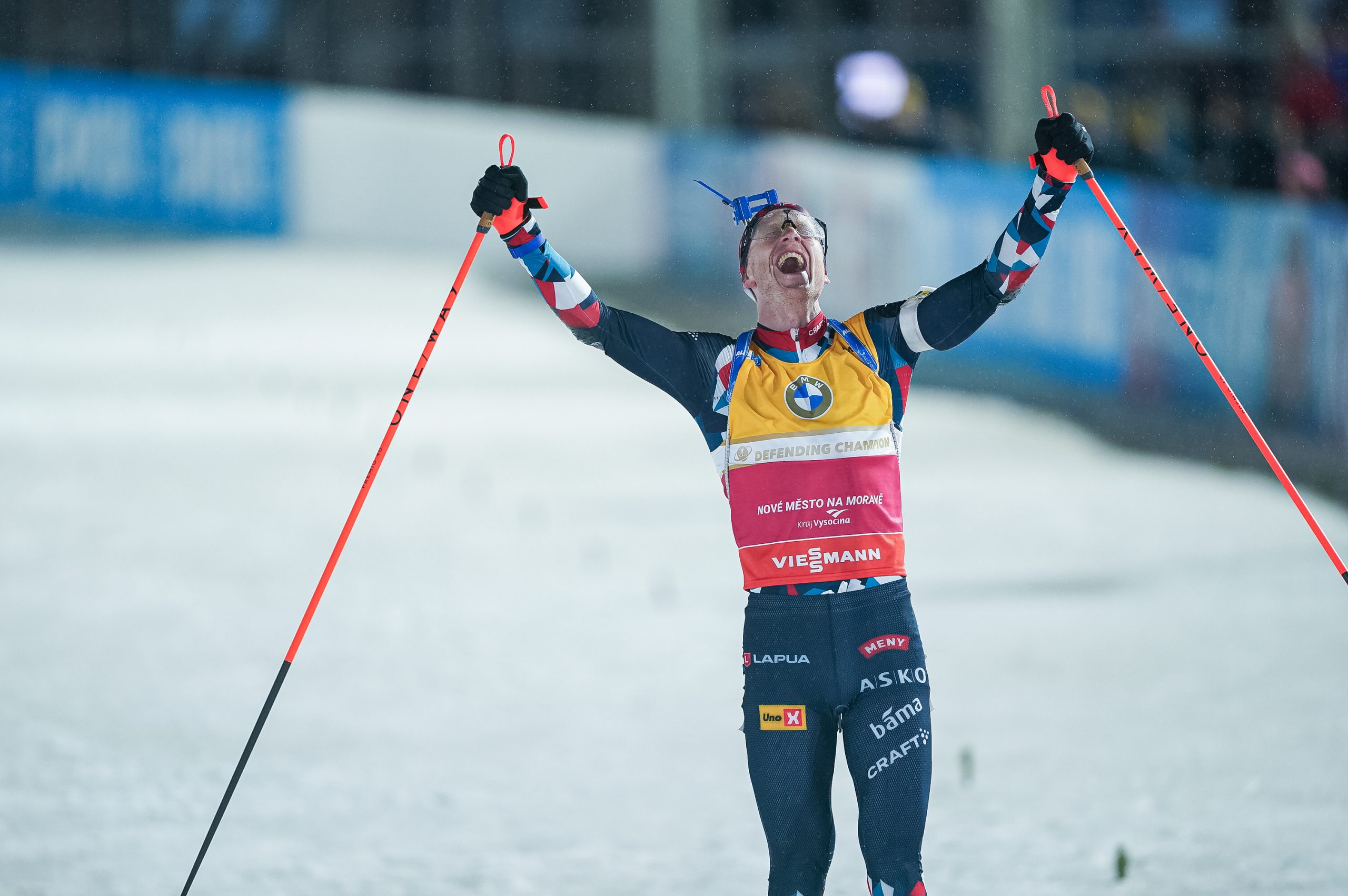
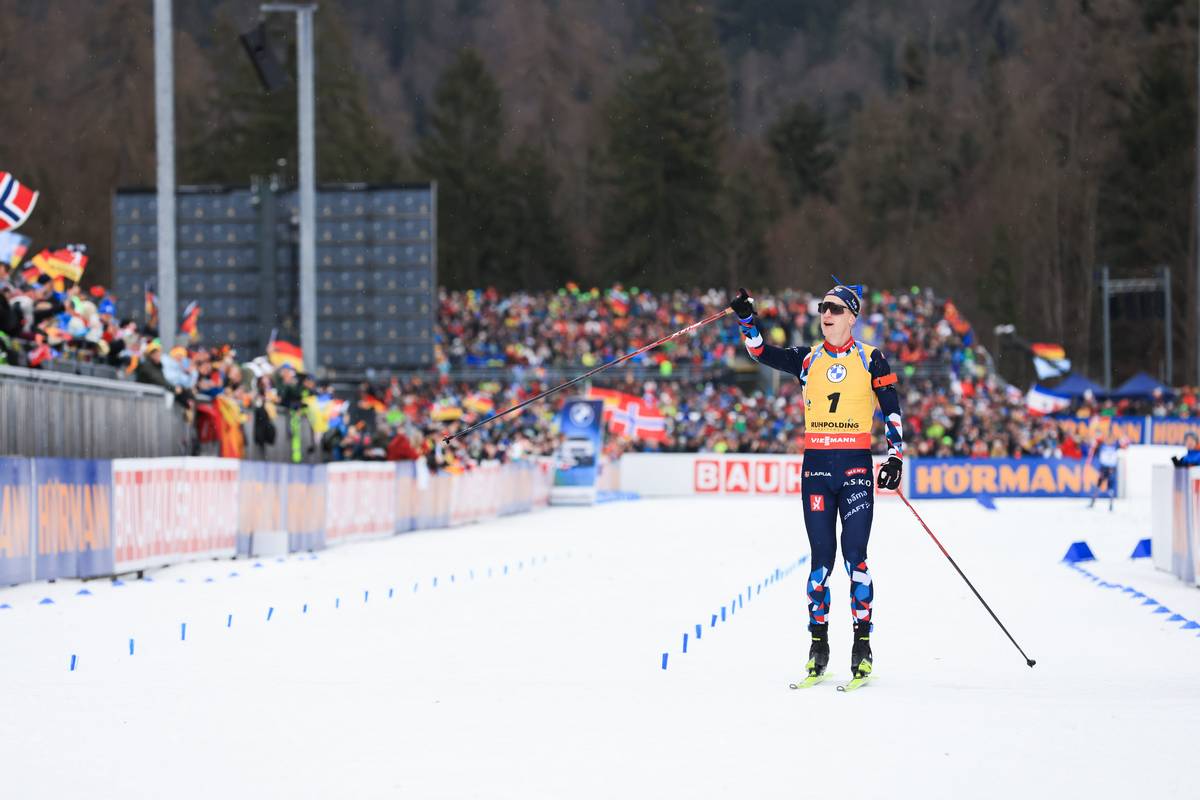
After finishing second in Saturday’s Sprint, Johannes Thingnes Boe (NOR) moved up into first in Sunday’s Pursuit, defending his 2023 title .
On a rainy Sunday afternoon in Nove Mesto na Morave, Czech Republic, 30,000 fans packed the Vysocina Arena for the women’s and men’s Pursuit competitions of the 2024 Biathlon World Championships. The weather has been dismal for the first five days of the event, meaning a lot of soggy boots, sink laundry, and rifle cleaning for the athletes, and long, cold, days for team staff and event organizers. But it has not dampened the spirits of the biathlon fans who continue to make the atmosphere bright.
French teammates Justine Braisaz-Bouchet (foreground) and Julia Simon shoot head-to-head in the Pursuit. (Photo: NordicFocus)
Women’s 10 k Pursuit
Simon defends world title, Vittozzi moves up from seventh to silver, and Braisaz-Bouchet keeps her podium streak alive.
In the women’s Pursuit, Julia Simon of France defended her 2023 World Championship Pursuit title as well as her Sprint victory from Friday. Last year, Simon started the Pursuit wearing bib 10 and overcame a deficit of more than one minute to take the gold, but today’s defense of Friday’s Sprint gold was also impressive. Only four women in the past ten years have won both the Sprint and Pursuit at the World Championships or Olympics: Marie Dorin-Habert (FRA) in 2015, Laura Dahlmeier (GER) in 2018, Tiril Eckhoff (NOR) in 2021, and Marte Olsbu-Roeiseland (NOR) in 2022.
Lisa Vittozzi (ITA) fights to the finish line, moving up from seventh to silver ahead of bib 2 Justine Braisaz-Bouchet (FRA). (Photo: NordicFocus)
Simon started with a negligible five second advantage over teammate Justine Braisaz-Bouchet, who is the fastest skier in the field but a slower and less-accurate shooter than Simon. A gap of nearly 40 seconds separated those two leaders from the third starter, Lou Jeanmonnot (FRA), but then six women all started within about 30 seconds. Simon and Braisaz-Bouchet matched one another’s shooting (0,1) on the first two stages to hold their lead over the chasers. But then on the third stage, Simon cleaned while Braisaz Bouchet missed two, opening the door for bib 7, Italy’s Lisa Vittozzi, to move into second with her 15/15 shooting through stage three of the race.
Sophie Chauveau (FRA) finished fourth in the Sprint and Pursuit. (Photo: NordicFocus)
In the final stage, Simon closed with the same perfect shooting we’ve now seen in three of three races at World Championships, nailing all five targets in 21.5 seconds—somewhat tame for Simon but still the fastest in the 60-person field. Behind her, Vittozzi missed her only shot of the day, creating an opening for Braisaz-Bouchet and bib 4, Sophie Chauveau. But luckily for Vittozzi, both of them missed one as well. Chauveau left the range a few seconds ahead of Braisaz-Bouchet, and for a moment it looked like the 24-year old might take her first World Championship medal after finishing a bittersweet fourth in the Sprint. But Braisaz-Bouchet out-skied Chauveau on the final lap to take the bronze, leaving Chauveau in fourth again. To put things in perspective, Chauveau won her first medal (a bronze) in January of this year, and her two fourth places so far at World’s are her next-best results.
Deedra Irwin was the top American in the Pursuit, finishing 46th with four misses. (Photo: NordicFocus)
From the US, Deedra Irwin started in bib 39 and fell back to place 46 with four misses. Tara Geraghty-Moats started in bib 58 but was lapped after the second shooting in her first-ever Pursuit.
Sturla Holm Laegreid’s (NOR) clean standing shooting earned him the silver medal in the Pursuit. (Photo: NordicFocus)
Men’s 12.5 k Pursuit
J.T. Boe shuffles the sprint podium to defend World title while the USA’s Wright and Doherty finish 12th and 26th.
In the men’s 12.5 k Pursuit, the Norwegian podium sweep from Saturday’s Sprint grew to a monstrous top-five sweep. Johannes Thingnes Boe (NOR) overcame three prone misses with flawless standing shooting to win his eighth individual World title—his 34th World Championship medal. (If you include Olympic results, Sunday’s victory was Boe’s 11th title and 42nd medal.) After winning Saturday’s Sprint with his signature perfect shooting, Sturla Holm Laegreid (NOR) uncharacteristically missed two in the first stage of the Pursuit but then hit the rest of his targets to fight back for the silver medal. Vetle Christiansen (NOR) led the race early on when he cleared all his prone targets and J.T. Boe and Laegreid both missed. But then two misses on his final stage set him back. He left the range a few seconds ahead of Laegreid but was caught in the final lap.
Vetle Sjaastad Christiansen (NOR) finished third in both the Sprint and Pursuit. (Photo: NordicFocus)
The fight for the top-six flowers was marked by some surprising shooting melt-downs. Having hit all his targets through the third stage, Tarjei Boe came into the final shoot tied for second with his younger brother Johannes, just nine seconds behind race leader Christiansen and a full 30 seconds ahead of the chasing group. But he missed a heart-wrenching four out of five targets and fell to fifth. Meanwhile, his teammate Johannes Dale moved up into fourth by clearing his final five, recovering from a messy three misses on the third stage. Behind Dale and T. Boe, Sebastian Samuelsson (SWE) kept his wits about him and shot 17/20 to complete the flower ceremony in sixth.
Campbell Wright (USA) was the top American in the Pursuit finishing 12th with two misses. (Photo: NordicFocus)
For the US, Campbell Wright in bib 11 missed one shot each in the prone stages but then cleared all 10/10 standing targets, finishing 12th. His 11th-place finish in the Sprint was a personal-best and this 12th place ties his previous personal-best. With these two results, Wright is almost guaranteed a start spot in next weekend’s 30-person Mass Start featuring the top 30 athletes of the Championships.
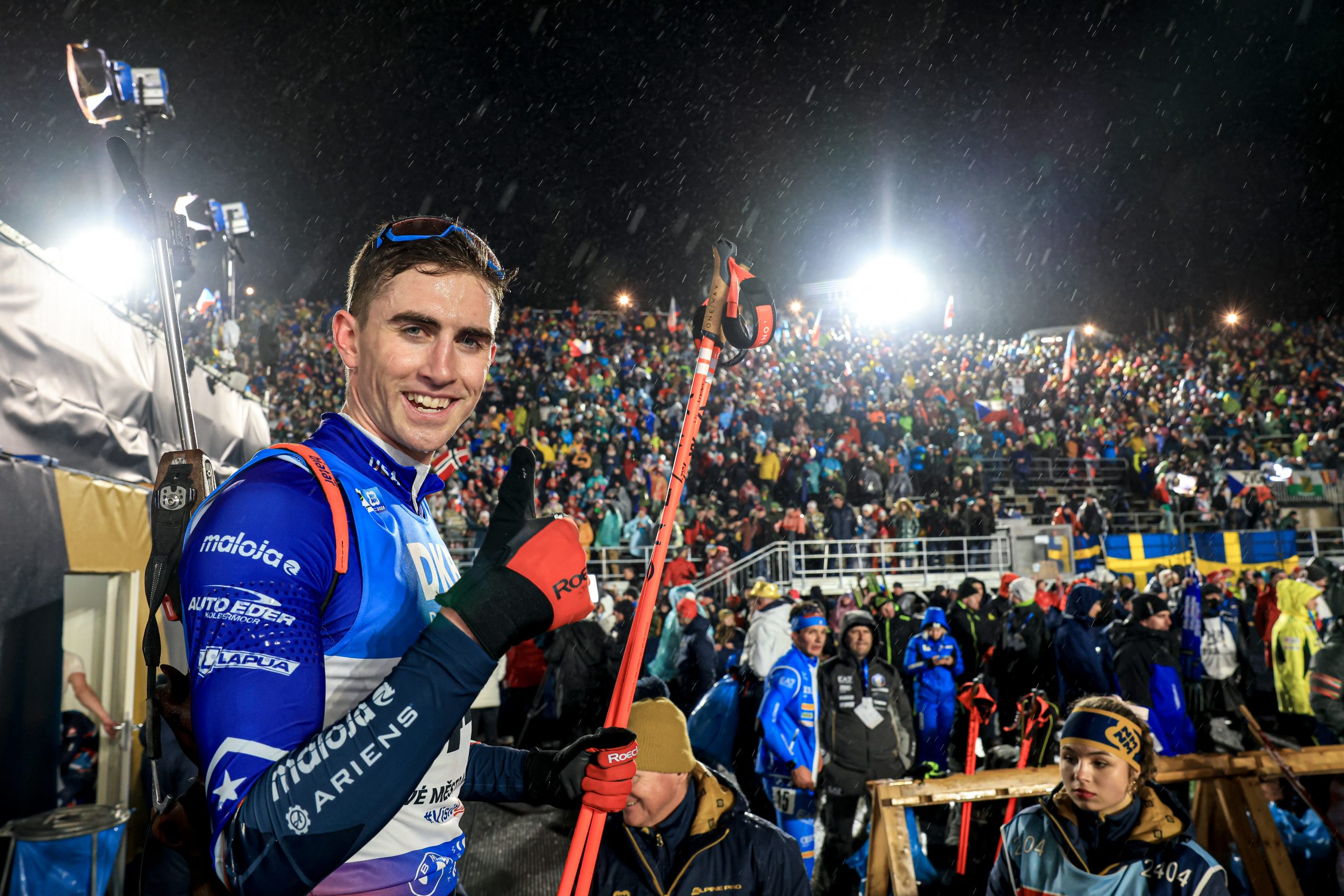
Sean Doherty (USA) happy in the finish area after moving up 18 places from 44th to 26th. (Photo: NordicFocus)
Sean Doherty was one of the biggest climbers of the day, moving from 44th to 26th with just a single miss in the first standing stage. Jake Brown started 38th and finished 37th with four misses, skiing the fastest of the three Americans in the race, 1:11 off the pace set by J.T. Boe.
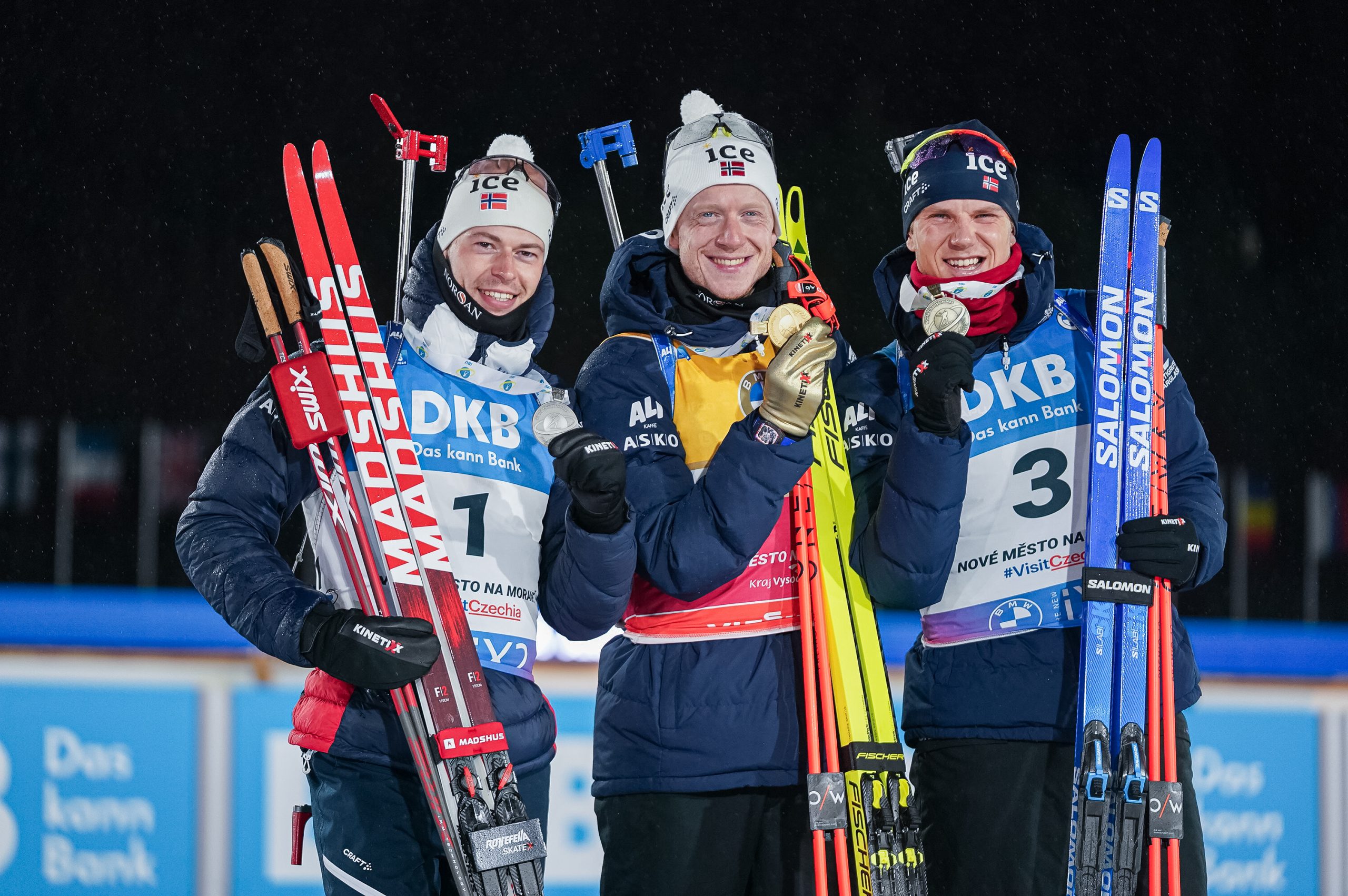
Sturla Holm Laegreid, Johannes Thingnes Boe, and Vetle Sjaastad Christiansen, (l-r) shuffled their podium sweep from Saturday’s Sprint in Sunday’s Pursuit. (Photo: NordicFocus)
FasterSkier’s Coverage of the Biathlon World Championships is made possible through the generous support of the Craftsbury Outdoor Center: New England’s finest snowmaking, world class race venues and touring trails, healthy food in abundance, comfortable accommodations at Craftsbury: Sports, Sustainability, Stewardship.
France swept places 1-4 in the Sprint at the 2024 Biathlon World Championships. (Photo: NordicFocus)
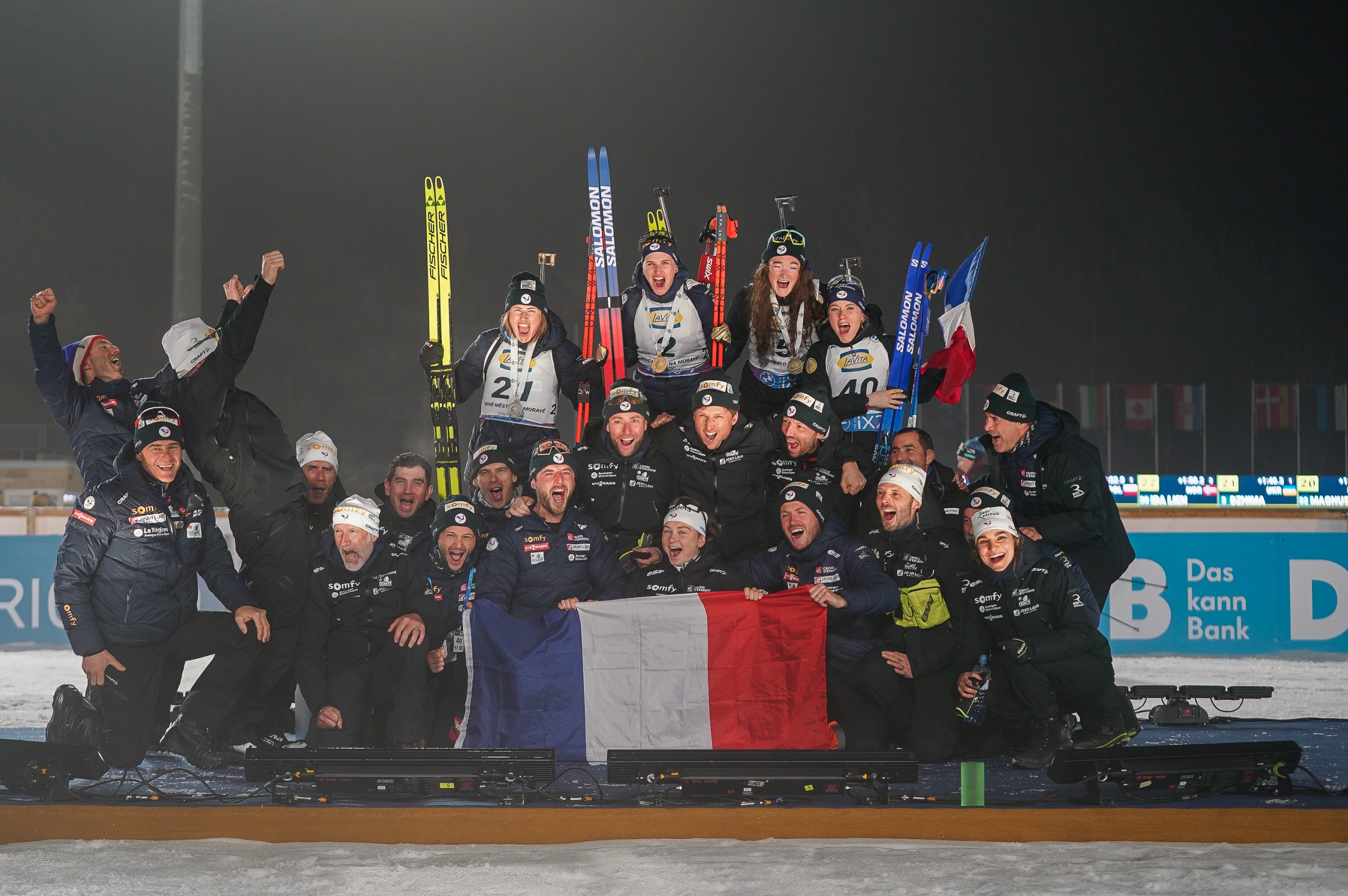
Ever since France upset Norway to win the opening Mixed Relay of the 2024 Biathlon World Championships, their magnificent esprit de corps has been on display. After that race, the entire team gathered around the podium and belted “La Marseillaise” in the rain as the French flag was raised in the Vysocina Arena in Nove Mesto na Morave, Czech Republic. That same winning energy pulsed through the French women’s team Friday as they delivered an historic sweep of the first four places—a feat not seen since the inaugural Women’s Biathlon World Championships in 1984 when the Soviet Union swept the 10 k Individual. (American Kari Swenson was fifth.) There were 35 finishers in that race. In Friday’s 7.5 k Sprint, The French quartet of Julia Simon, Justine Braisaz-Bouchet, Lou Jeanmonnot, and Sophie Chauveau bested a field of nearly 100.
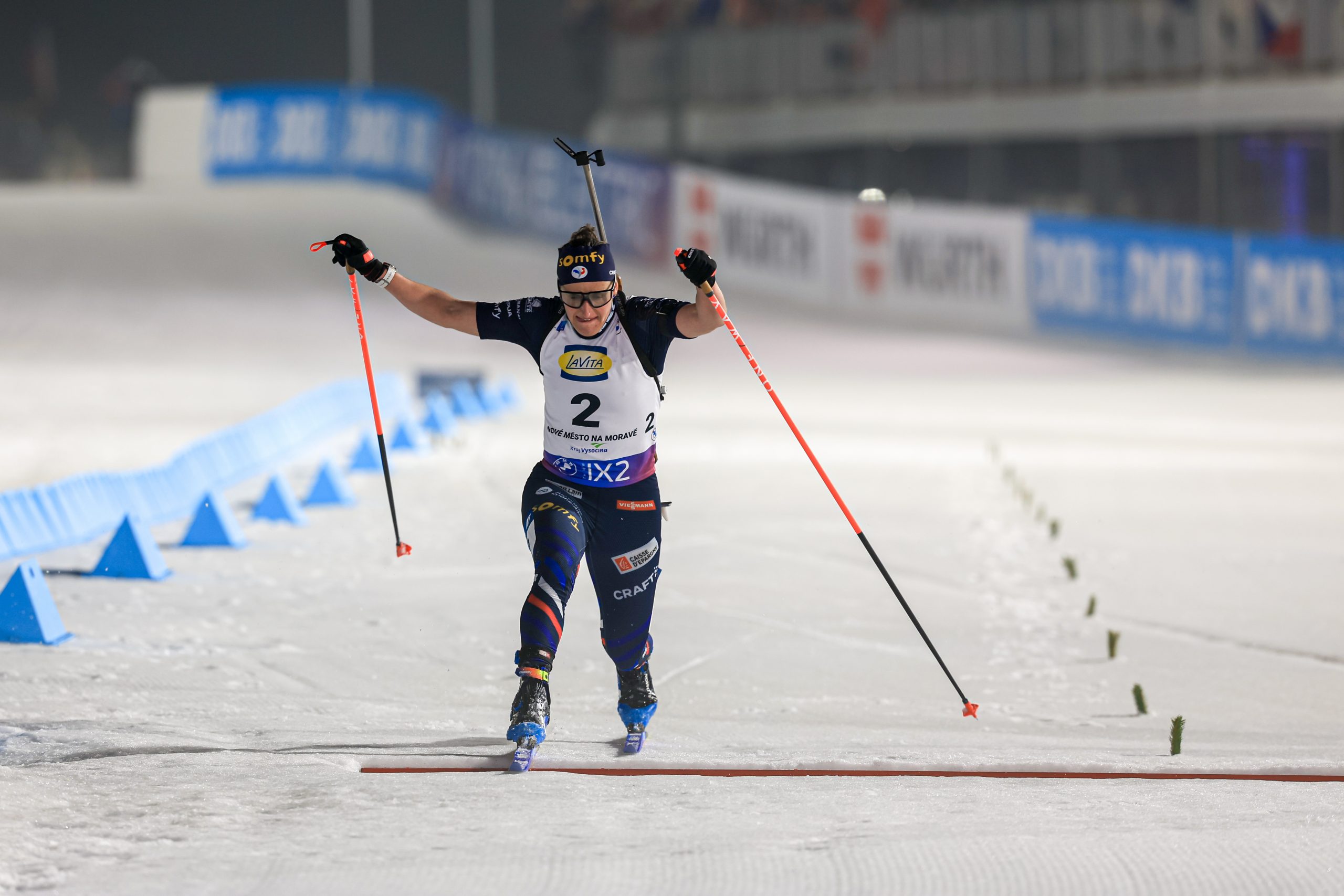
Early starter Julia Simon (FRA) crosses the finish line, setting the time to beat in the Women’s Sprint. (Photo: NordicFocus)
All eyes were on Simon, wearing bib 2, to set the time to beat for the day. After laying down a perfect anchor leg in Wednesday’s Mixed Relay, she picked up where she left off with another 10/10 performance, leaving little room for any challengers. Simon’s ski time ranked fourth and her total shooting time of 42 seconds for prone and standing was the fastest of the day. It was a dominant Sprint performance from the 2023 World Cup Overall champion, who is better known for her head-to-head racing.
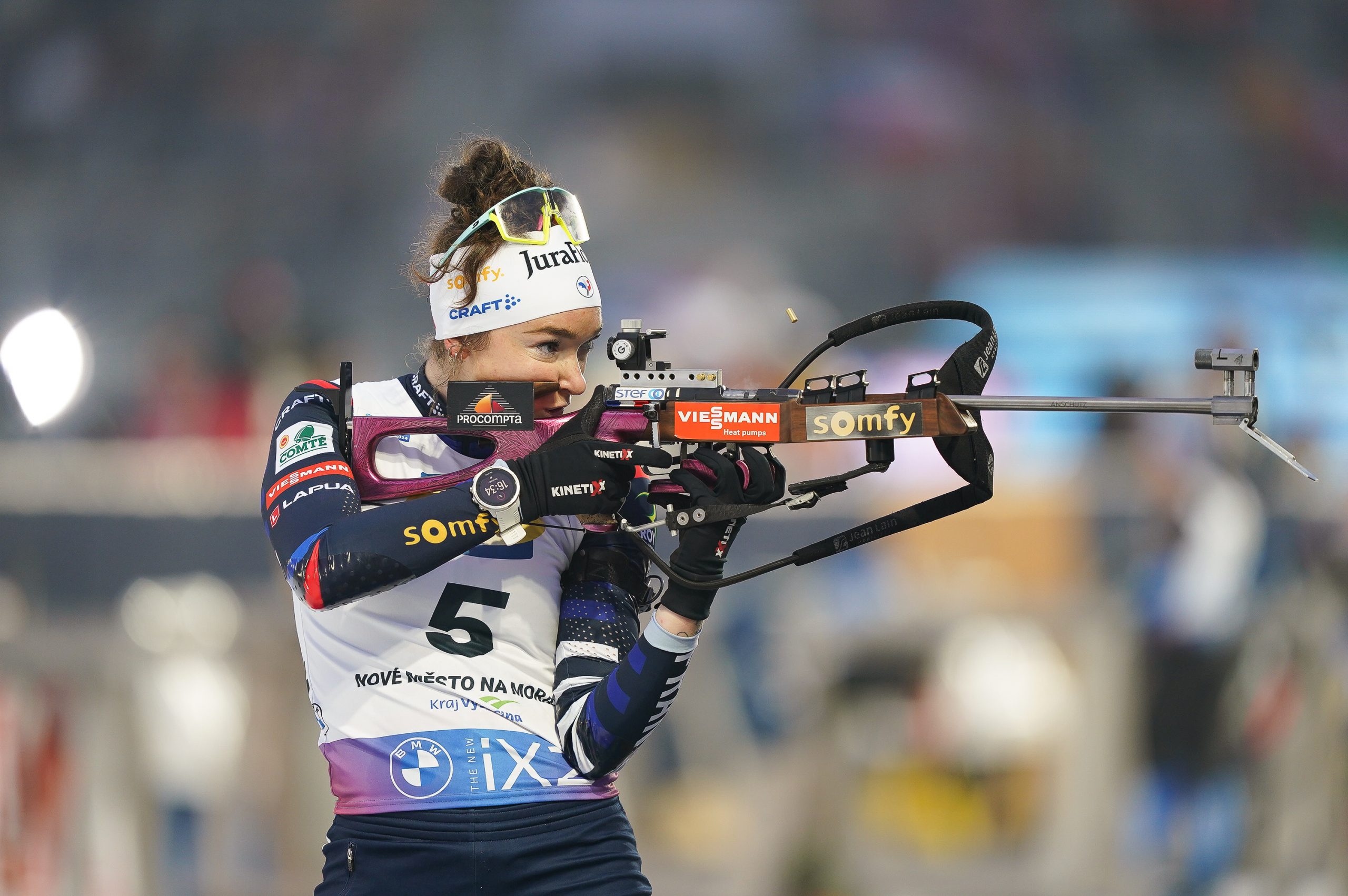
Lou Jeanmonnot (FRA) shot 9/10 to land on her first World Championships podium, taking home the bronze for France. (Photo: NordicFocus)
Another early starter, Jeanmonnot in bib 5 matched Simon’s speed on the course but lost some time to her on the range (like everyone else) and missed one target in standing, eventually finishing 40 seconds back. It seemed inevitable that other competitors would fill that gap, but as the race went on it became clear that the only athletes skiing fast enough to challenge the French women were their own teammates.
Justin Braisaz-Bouchet (FRA) outskied the field by nearly 30 seconds to take silver despite one miss. (Photo: NordicFocus)
Out-skiing the field by over 30 seconds in Wednesday’s Mixed Relay, Braisaz-Bouchet demonstrated that she is one of very few athletes who can ski a penalty loop and still fight for gold. That scenario nearly played out in Friday’s Sprint, as Braisaz-Bouchet gapped the field by 28 seconds, missed one in prone but then hit all of her standing targets, leaving the range with just a 13-second deficit to clean-shooting Simon. She closed the gap in the final kilometers but couldn’t quite catch Simon, crossing the line just 4.9 seconds behind.
World Cup Overall leader Ingrid Landmark Tandrevold (NOR) led the race after the first shooting but then fell to 25th after a disastrous three misses in standing. (Photo: NordicFocus)
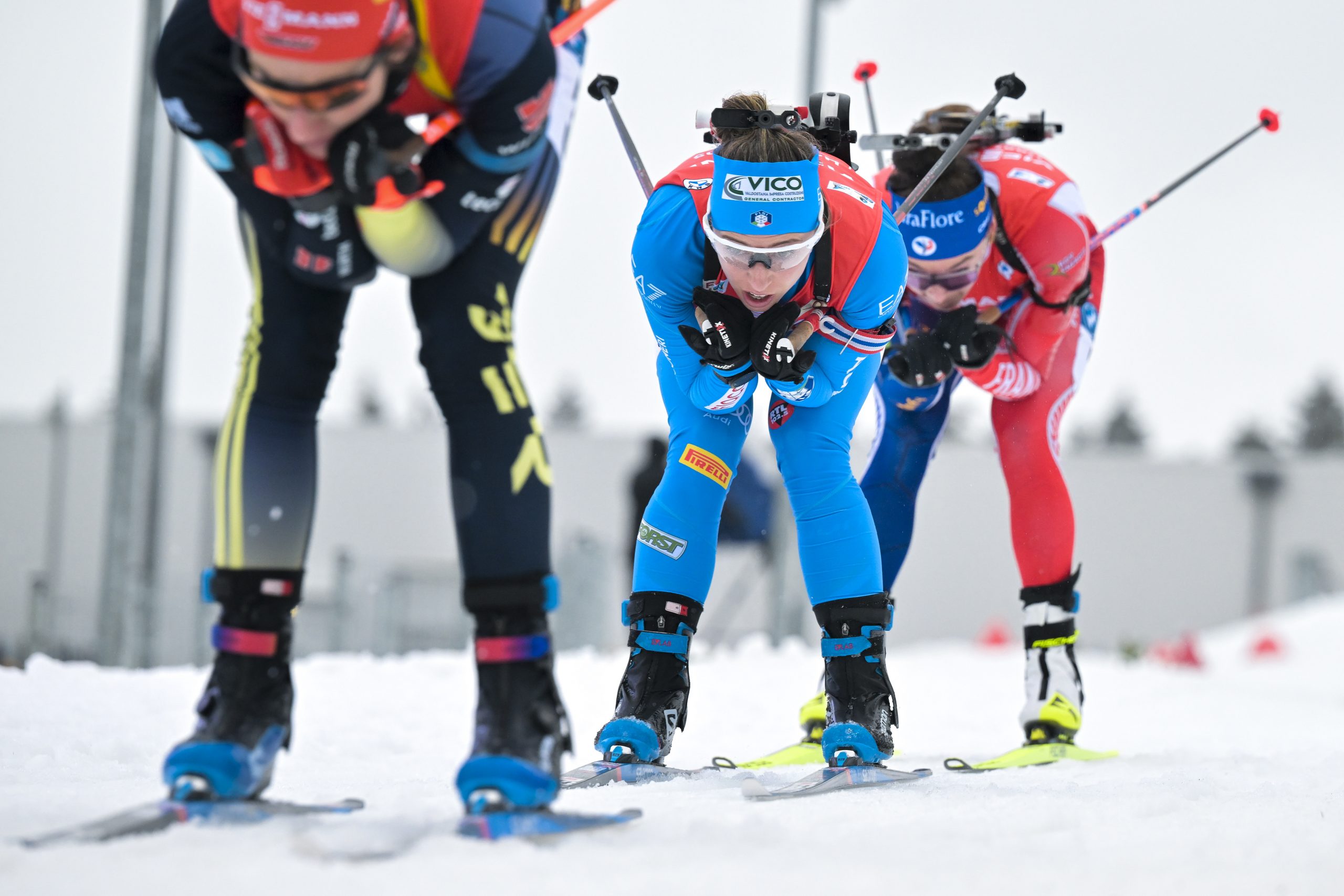
The two Italian stars, Lisa Vittozzi and Dorothea Wierer, were early challengers for the podium, both showing their trademark poise on the range with 10/10 hits, but they didn’t have the ski speed to keep up with the French women and ended up seventh and tenth. Swedish sisters Hanna and Elvira Oeberg did the reverse; they skied well but both missed in standing and dropped to eighth and ninth.
The only other athlete who could challenge Simon for the gold was World Cup Overall leader Ingrid Landmark Tandrevold (NOR) in bib 26. She came through the prone shooting in the lead, 1.5 seconds ahead of Simon, but then suffered a disastrous standing bout, missing three targets and falling to 25th place—her worst result of the season.
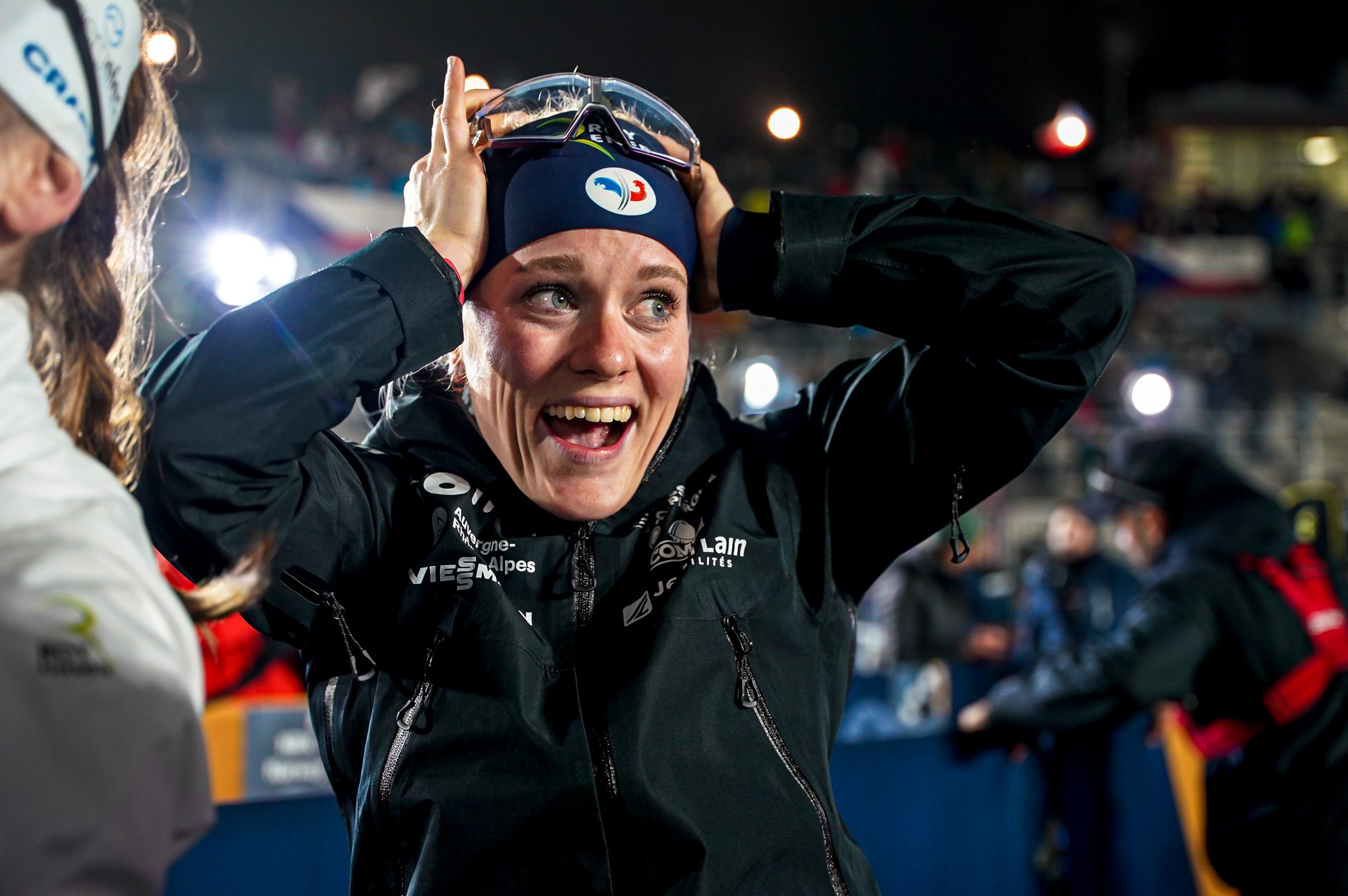
Sophie Chauveau (FRA) reacts to her team’s one-through-four sweep. (Photo: NordicFocus)
The podium positions seemed secure until Chauveau, wearing bib 40, nearly overtook Jeanmonnot. Chauveau found herself down in 30th after a miss in prone but then launched into podium contention with her clean standing shooting and third-ranked course time. In the finish she was a mere four seconds off the podium.
Simon’s gold is her first Sprint podium of the season and only her second-ever Sprint victory. Braisaz-Bouchet, who skipped last season to have her first child, had never finished better than 25th in a World Championships Sprint, despite taking part in every edition since 2015 and winning a list of World Cup races and an Olympic gold medal in Beijing along the way. Jeanmonnot’s bronze is her first World Championship medal, and Chauveau’s fourth place ties her second-best career finish. She earned her first World Cup medal, a bronze, in January of this year.
While the French women shot exceptionally well, they owe their sweep to their ski speed. Four of the top-five fastest skiers in the Sprint were French. The other was 2021 cross-country World Cup Overall Sprint champion, Anamarija Lampic of Slovenia, who missed five and finished 36th. Reflecting on the role that ski preparation played today, US Biathlon ski technician Federico Fontana said, “The dirt and the wet in Nove Mesto is always challenging. The French had incredible skis.”
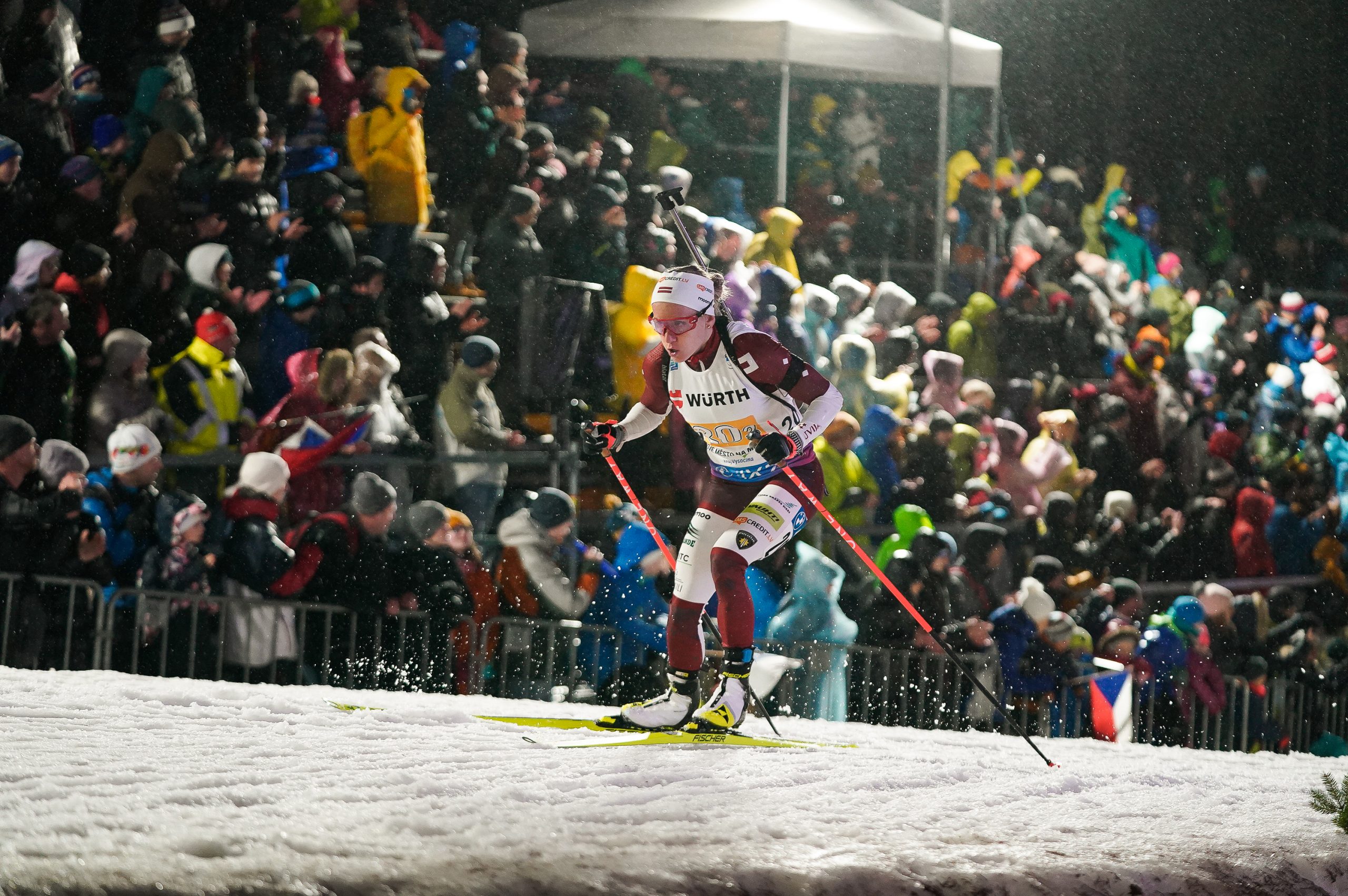
Baiba Bendika (LAT) skied the seventh-fastest course time and hit 9/10 to tie her career-best finish of fifth. (NordicFocus).
The surprise of the day was Latvia’s Baiba Bendika, who finished fifth to match her career-best result, having given birth to her first child in October—just four months ago. She had a chance to break up the French sweep but missed her last shot. Franziska Preuss of Germany completed the Flower Ceremony, also with one standing miss.
Irwin and Geraghty-Moats Qualify for Pursuit
Deedra Irwin was the top American in the Sprint, finishing 39th with one miss each in prone and standing. She wrote on her Instagram account, “It isn’t what I wanted but then I realized that it is my personal best World Champs Sprint finish!” Irwin has consistently been scoring World Cup points in the top 40 this season and has the potential to move up significantly in Sunday’s Pursuit. She’ll be joined in the Pursuit for the first time by teammate Tara Geraghty-Moats, who sneaked into the top-60 qualifiers with a new personal-best of 58th.
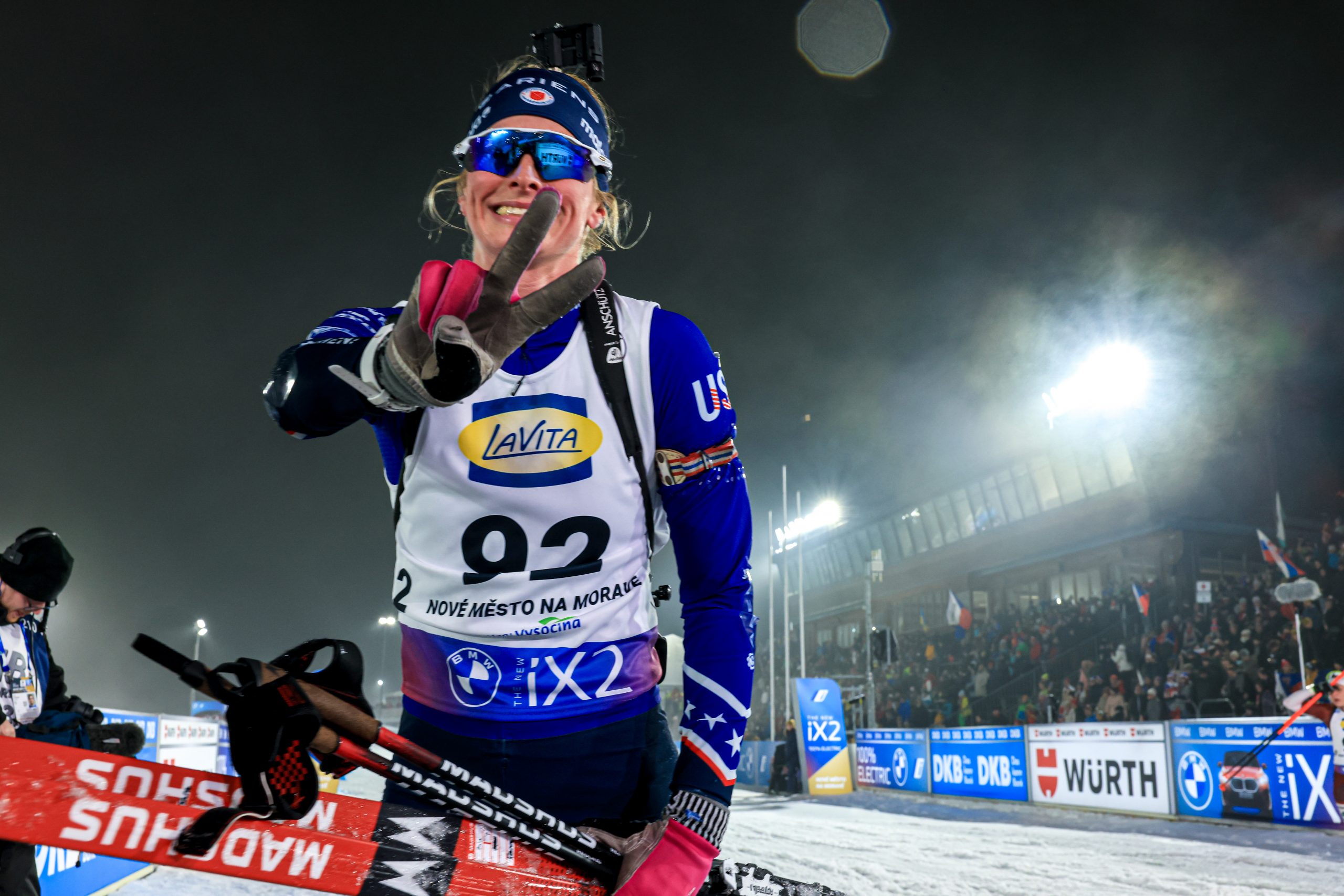
Tara Geraghty-Moats (USA) smiling in the finish line after setting a new personal-best of 58th to qualify for her first Pursuit. (Photo: NordicFocus)
Geraghty-Moats cited her start position as playing a role in her qualification. “I had good course conditions with the second-to-last starting bib. With the warm temperatures, I thought the course would degrade a lot by the time I raced but it didn’t.” She had the advantage of watching earlier athletes go through, and drawing on their energy. “It looked so epic. It made me super excited to go out there. With the results I’ve had this winter I didn’t think I would make the Pursuit so I just wanted to have a race where I executed my plan well.”
Jackie Garso (USA) racing in her first World Championships. (Photo: NordicFocus)
Chloe Levins and Jackie Garso completed the US roster in Friday’s race. Levins echoed Geraghty-Moats’ comments about the atmosphere in the stadium: “The energy under the lights in Nove Mesto was electrifying tonight.” Levins, who finished 80th with two misses, is coming off a training season that was interrupted by a number of health issues. “I’m nowhere near satisfied with my result, but continue to gain great experience and feel myself racing back into shape.” Garso, competing in her first World Championships, finished 87th with three misses. She, too, was shocked by the crowds: “It’s unbelievably loud! You can’t even hear yourself breathe.”
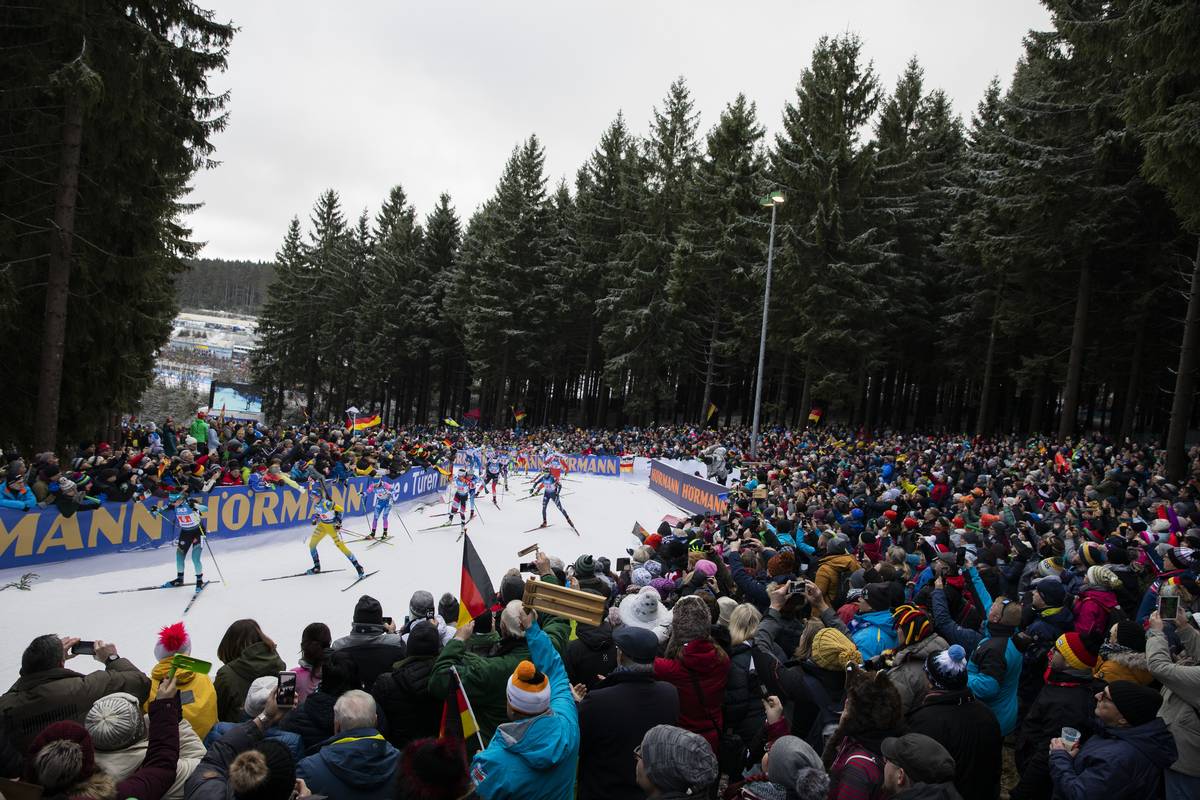
Fans line the famous Birxsteig climb during the Women’s Relay at the IBU World Championships in Oberhof, Germany. (Photo: NordicFocus)
If there’s one competition to watch from the 2023 Biathlon World Championships, it’s the Women’s 4 x 6 k Relay. (Replay available here.) In a dazzling display of biathlon mastery, the Italian quartet knocked down 40 targets with 42 bullets, excelling one after another under pressure in difficult conditions to capture Italy’s first-ever Women’s Relay title. The “Blues” have been investing heavily in biathlon development with their sites set on the 2026 home Olympic Games, and it shows. But they didn’t run away with the win; it came down to a nail-biter final shooting, pitting Lisa Vittozzi of Italy against hometown favorite, Denise Herrmann of Germany. Vittozzi’s fast and flawless shooting clinched the win in spectacular fashion, while Herrmann faltered but held onto silver for Germany over third-place Sweden.
Lisa Vittozzi (ITA) and Denise Herrmann-Wick (GER), (l-r) shooting head to head for the gold medal in the final shooting stage of the IBU World Championships Women’s Relay. (Photo: NordicFocus)
After gusty winds caused drama at the shooting range in Saturday morning’s Men’s Relay, the conditions for the Women’s Relay eased a bit, though the compromise for lighter wind was heavier rain. On the first leg, two women shot clean: Vanessa Voigt of Germany’s 2022 Olympic bronze medal-winning relay squad, and Samuela Comola of Italy. Coming into these Championships, Comola’s best World Cup finish was 20th, but as one of three women to hit 20/20 in last Wednesday’s 15 k Individual she claimed a new personal best of fourth. Continuing her breakout week and clean shooting streak, she arrived at the first exchange in the lead pack with Sweden, Czech Republic, and Norway. Thirteen teams tagged within one minute, with the top seven all within 30 seconds.
Vanessa Voigt (GER), Samuela Comola (ITA), and Lou Jeanmannot (FRA) in the first leg of the Women’s Relay at IBU World Championships in Oberhof. (Photo: NordicFocus)
In the second leg, two-time World Cup Overall winner Dorothea Wierer of Italy kept a low profile at first, hanging onto the back of a four-person lead pack. But in the standing shooting stage she used just one spare on Lane 4 and passed everyone to blow open a 26-second lead. France went into the penalty loop and never quite recovered, eventually finishing fourth. Norway suffered three penalty loops and fell even farther back, taking sixth in the end. Sweden had two penalty loops but made gains in the second half of the race to stay in the mix. From this point on, Italy never gave up the lead.
Dorothea Wierer (ITA) used just one spare in standing to take the lead at the halfway point in the Women’s Relay at IBU World Championships in Oberhof, Germany. (Photo: NordicFocus).
At the halfway point, 32-year-old Wierer (ITA) handed off to her 21-year-old teammate, Hannah Auchentaller, who was originally named to the Italian World Championships team as an alternate and has only competed in a handful of World Cup races, including just one relay. No one knew what to expect from the young athlete in this high-stakes situation. Chloe Chevalier of France caught Auchentaller from 20 seconds back in the approach to the prone shooting, but Auchentaller confidently skied her own pace and kept her calm on the range. She cleaned her targets with no spares, skiing away with a 30-second advantage while Chevalier used all three spares. Arriving on Lane 1 for standing, all eyes and cameras were on Auchentaller. In the moment when it counted most, she performed brilliantly, using only one spare to hit her targets like a seasoned professional. After leading the whole third leg, Auchentaller handed off five seconds ahead of Germany.
Hannah Auchentaller (ITA) setting up in the standing position in the Women’s Relay at the IBU World Championships. (Photo: NordicFocus).
The last leg was set up perfectly for a high-octane head-to-head battle between two superstars: Lisa Vittozzi of Italy and Denise Herrmann of Germany. Both women are ranked in the top five of the World Cup Overall: third-ranked Vittozzi has a slightly higher shooting percentage, while fifth-ranked Herrmann tends to be slightly faster on the tracks. Both athletes cleaned prone, but Vittozzi did so five seconds faster than Herrmann. Statistics played out as Herrmann caught Vittozzi on the tracks and led into the final shooting. In yet another display of incredible composure and expertise from the Italian team, Vittozzi blazed through her five targets with five hits in 20 seconds. Herrmann hesitated after the third hit and then missed the final two shots, eventually needing 53 seconds to clear her targets with two spares. Though she avoided the penalty loop she left the range 31 seconds behind Vittozzi.
Denise Herrmann-Wick (GER) chasing down Lisa Vittozzi (ITA) before the final shooting in the Women’s Relay at the IBU World Championships in Oberhof, Germany. (Photo: NordicFocus)
Vittozzi crossed the finish line in triumph and was met by her three ecstatic teammates—the new World Champions. Herrmann, her teammates, and the German crowd all seemed satisfied with their silver medal performance, and Hanna Oeberg (SWE) brought home the bronze for Sweden, perhaps a slight disappointment for the race favorites, but a World Championship medal nonetheless. Julia Simon of France crossed in fourth, looking underwhelmed.
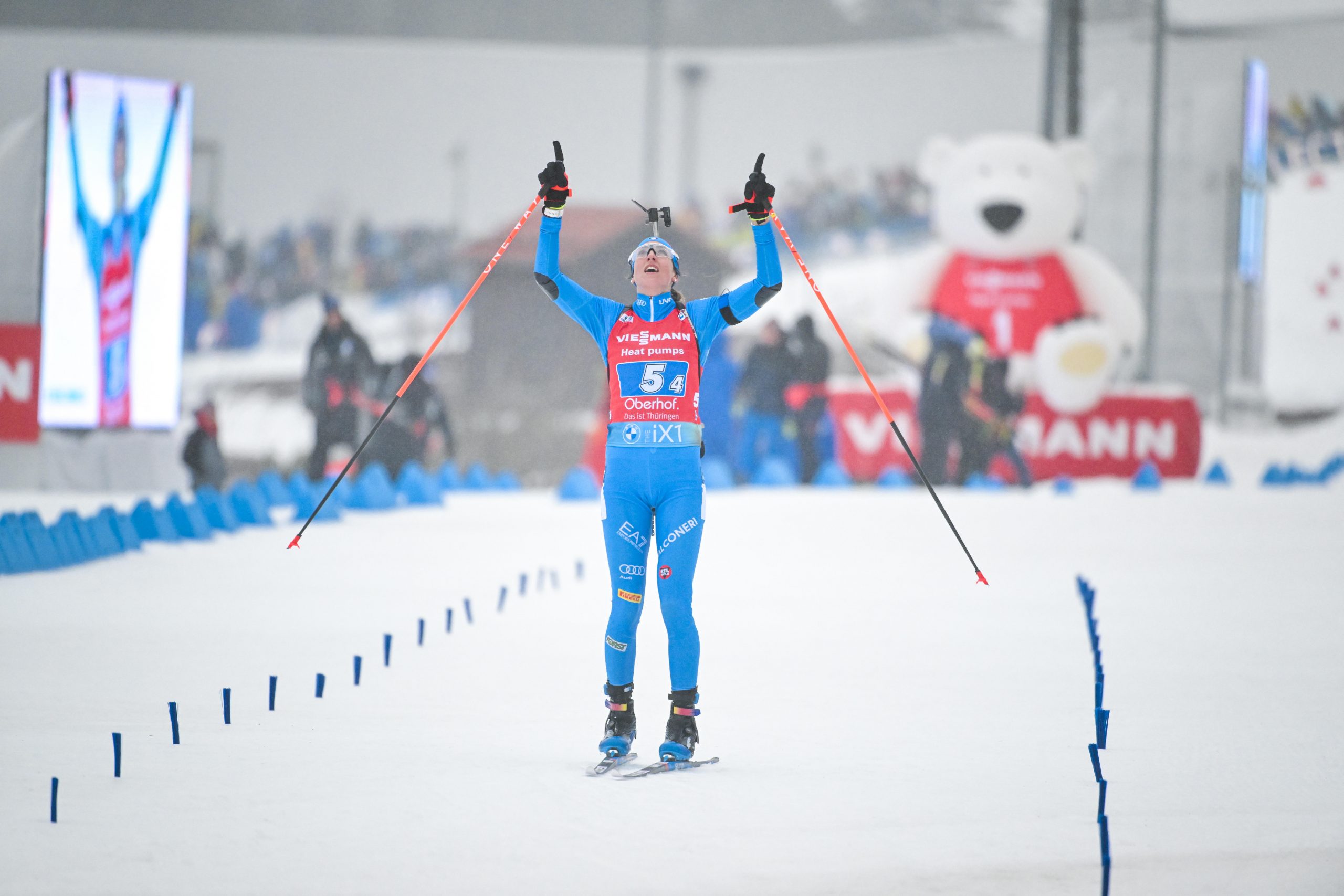
Lisa Vittozzi (ITA) celebrates as she crosses the finish line to claim Italy’s first ever gold in a Women’s Relay at the IBU World Championships in Oberhof, Germany. (Photo: NordicFocus)
From North America, Canada finished 11th and the US was 15th. Canada’s Nadia Moser had a solid first leg to tag in ninth just 46 seconds out of the lead. For the US, Deedra Irwin struggled on both the range and the tracks, using all six spares and incurring one penalty loop to hand off in 15th, 2:10 back. Joanne Reid (USA) moved the team up to 12th while Canada fell to 15th at the halfway point. On the third leg, Chloe Levins (USA) held onto twelfth and tagged twenty seconds ahead of Canada in 13th. Skiing the anchor leg for team USA, Kelsey Dickinson dropped down to 15th, while Canada’s Emma Lunder finished strong, bringing the Canadians up to 11th.
Joanne Reid (USA) brought the US from 15th two 12th in the second leg of the Women’s Relay at the IBU World Championships. (Photo: NordicFocus).
The Canadians had a final shooting score of 1 (penalty loop) +10 (spare rounds), while the US had 1+15. The winners from Italy had 0+2, highlighting the importance of the shooting and the exceptional caliber of their performance. Though it wasn’t a day to write home about for either North American team, US Biathlon Team Head Coach and proud father, Armin Auchentaller of Italy, certainly had reason to celebrate. His daughter and her three teammates were simply superb.
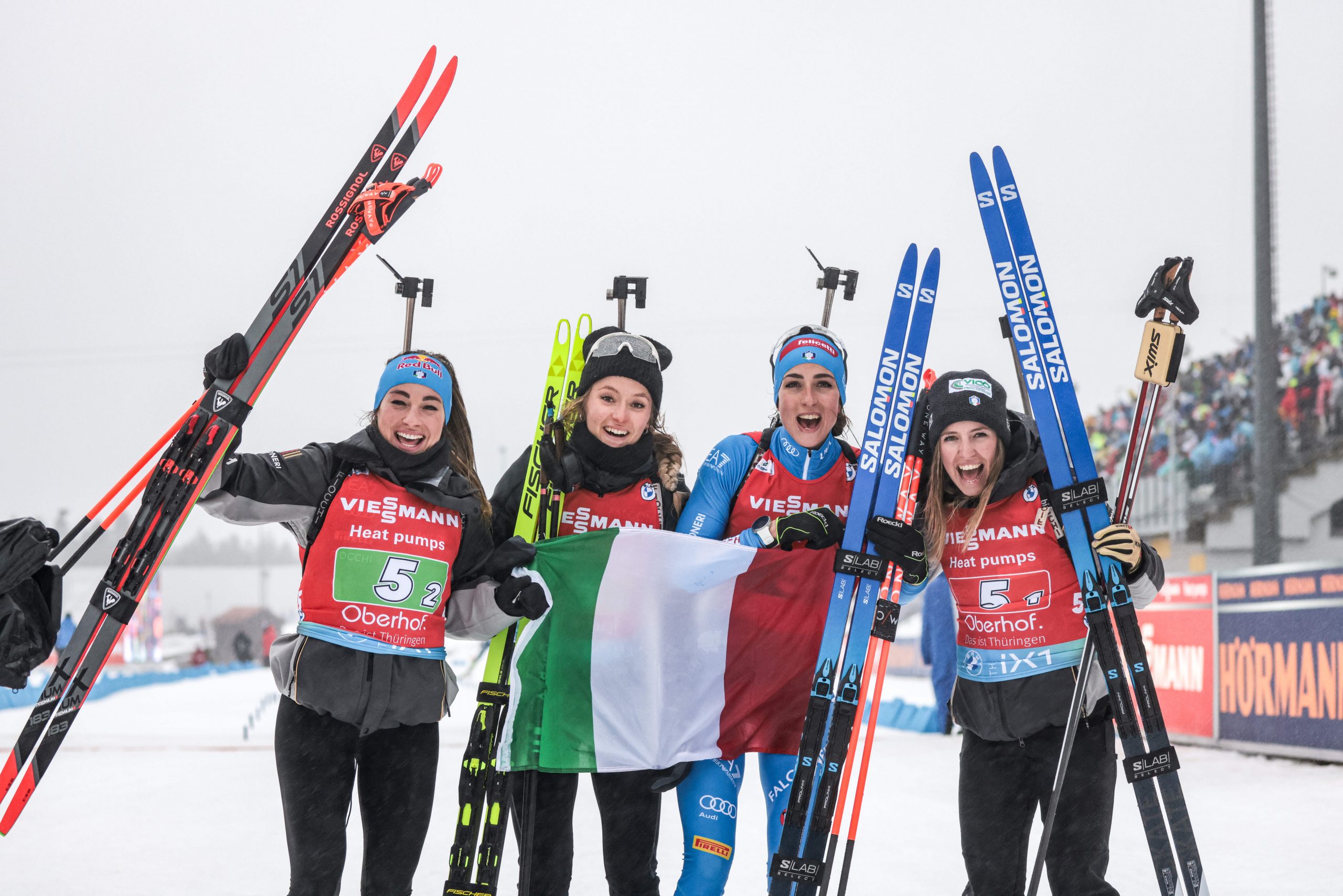
Dorothea Wierer (ITA), Hannah Auchentaller (ITA), Lisa Vittozzi (ITA), Samuela Comola (ITA), (l-r) celebrating Italy’s first ever gold medal in the Women’s Relay at the IBU World Championships in Oberhof,Germany. (Photo: NordicFocus).
Ever since Hanna Oeberg burst onto the podium for the first time, winning Olympic gold in the 15km Individual at the 2018 Olympics in Pyeongchang, she has been a consistent force in the event. She defended her title at the 2019 World Championships, just missed the podium in fourth in 2020, and took silver in 2021. After faltering slightly in the 2022 Olympics in Beijing with a 16th place finish, Oeberg came back today to win her third Championship-level gold, in spite of one miss. Oeberg’s teammate, Linn Persson, shot 20/20 for the silver medal, and Italy’s Lisa Vittozzi missed only her last shot to finish third.
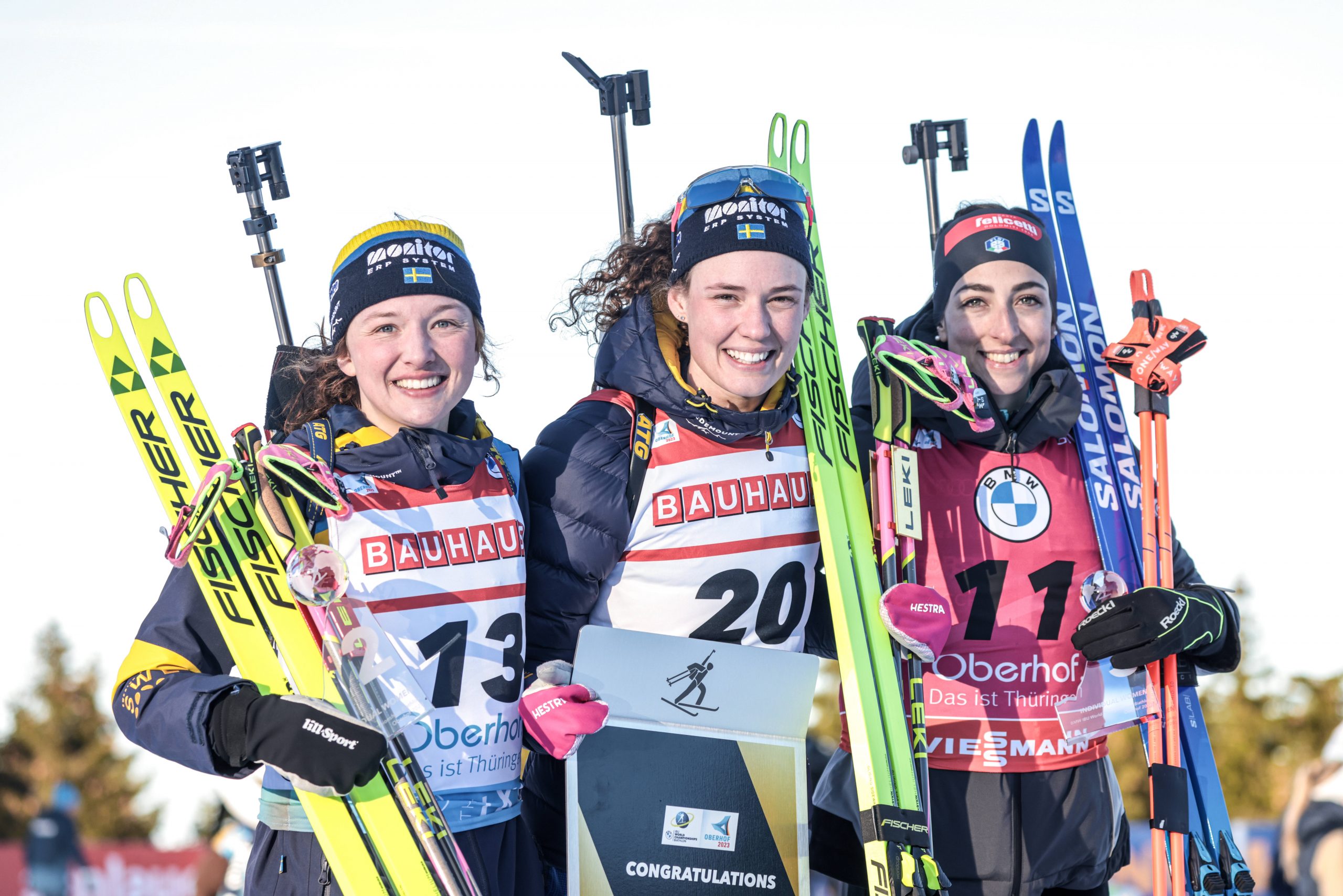
Medalists in the IBU World Championships 15km Individual: Linn Persson (SWE), Hanna Oeberg (SWE), Lisa Vittozzi (ITA), (l-r). (Photo: NordicFocus)
Dorothea Wierer (ITA) was an early leader, wearing bib four and missing only once in the first three stages. But disaster struck on the final stage when she missed three, sending her three minutes down in the results. A few minutes later wearing bib 11, Wierer’s Italian teammate Lisa Vittozzi came through in the lead, having shot 15/15 in the first three stages. Vittozzi was fifth in last Friday’s Sprint but then came down with a cold on Saturday and had to skip the Pursuit. Despite returning from illness, she managed to ski the sixth-fastest course time today and carried a big lead into the final shooting stage. She hit the first four shots but then missed the last, opening up a door for Linn Persson of Sweden. Persson also shot clean through the first three stages and was holding Vittozzi’s pace; the two were separated by only .6 after Shooting 3. Persson hit the perfect 20/20 to take the lead, leaving the range with a huge smile on her face.
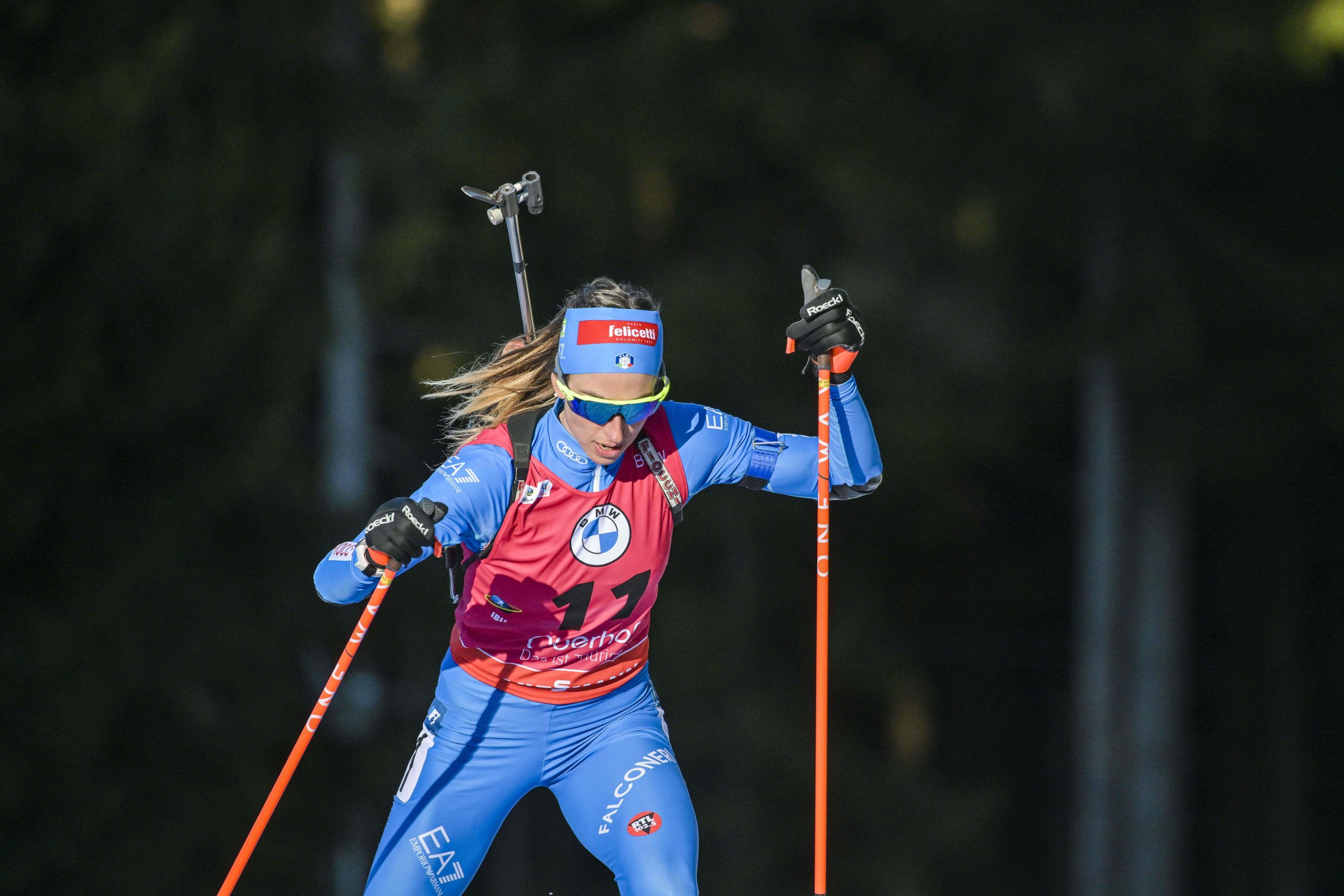
Lisa Vittozzi (ITA) on her way to a bronze medal finish in the IBU World Championships Individual. (Photo: NordicFocus)
Persson crossed the finish line in first place, but her teammate Hanna Oeberg was chasing her down. With one miss in the first stage but then clean shooting for the rest of the race, Oeberg left the range after the final stage with a 14-second deficit to clean-shooting Persson. Knowing that the gold medal was on the line, Oeberg outskied Persson by nearly 25 seconds over the last three-kilometer loop to claim the World Championship title.
Linn Persson (SWE) shot the perfect 20/20 to take silver in the IBU World Championship Individual in Oberhof , Germany. (Photo: NordicFocus)
Persson was one of just three women to shoot the perfect score today. The others, Samuela Comola (ITA) and Suvi Minkkinen (FIN), both set new personal bests, finishing fourth and eighth, respectively. Joining Comola in the Flower Ceremony were World Cup Overall leader, Julia Simon of France in fifth, and Tuuli Tomingas of Estonia, whose sixth place finish is the highest ever for an Estonian woman at a World Championships.
Deedra Irwin (USA) racing in a t-shirt due to uncharacteristically warm and sunny conditions at the IBU World Championships in Oberhof, Germany. (Photo, NordicFocus)
From the USA, Deedra Irwin found her groove today. After sickness and tricky range conditions hampered her efforts in the Sprint and Pursuit, Irwin pulled together her best focus today to finish 20th—her third-best career result and best this season. Of 90 starters in today’s race, only three shot clean and only four hit 19/20; Irwin was one of them, missing one from the standing position in the second stage. “I’m just glad I was able to keep it together on the range,” said Irwin, who couldn’t train normally in the lead up to the Championships due to illness. “I feel flat, but it’s getting better every race.” Lucky for Irwin, she has two more races in the next three days to keep the positive momentum going. Irwin’s parents are supporting her on-site; they made the big trip from Wisconsin to see their first international biathlon races and are wearing Green Bay Packers gear with pride. Look for the cheesehead on the live stream!
Emma Lunder (CAN) on her way to 25th in the IBU World Championships Individual in Oberhof, Germany (Photo: NordicFocus).
Emma Lunder of Canada finished 20 seconds behind Irwin in 25th, in spite of three penalties. With 11th and 30th place finishes from the Sprint and Pursuit, Lunder has comfortably qualified for next Sunday’s Mass Start. In the two Mass Starts this winter she has finished 9th and 11th, and she is skiing faster now than she was earlier in the season so she has podium potential.
Kelsey Dickinson (USA) made her IBU World Championships debut, shooting 90% to finish 67th. (Photo: NordicFocus)
Nadia Moser of Canada finished 58th with five penalties. Joanne Reid skied just nine seconds slower than Irwin but had difficulty on the range, missing three in the first standing stage and six overall to finish 61st. In her World Championships debut, Kelsey Dickinson (USA) had excellent shooting, missing only two, but felt like she couldn’t push into her highest gear and ended up 67th. Right behind Dickinson was Chloe Levins (USA) who had a total of four misses and finished 68th. Also with four misses, Benita Peiffer of Canada was 69th.
Four races down, three to go!
IBU World Championships Women’s 15km Individual RESULTS
UP NEXT:
Thursday at 9:10AM Eastern Time: Single-Mixed Relay
Saturday at 5:45AM Eastern Time: Men’s 4 x 7.5k Relay
Saturday at 9:00AM Eastern Time: Women’s 4 x 6k Relay
Sunday at 6:30AM Eastern Time: Men’s 15k Mass Start
Sunday at 9:30AM Eastern Time: Women’s 12.5 Mass Start
Denise Herrmann-Wick (GER) shooting from the standing position at the IBU World Championships Sprint in Oberhof, Germany. (Photo: NordicFocus)
Biathlon fans anticipated that the women’s 7.5km Sprint would be one of the most tightly-contested races of the BMW IBU World Championships, and it did not disappoint. In the end, only 2.2 seconds separated the new World Champion, Denise Herrmann-Wick of Germany, from the silver medalist, Hanna Oeberg of Sweden. Oeberg’s teammate, Linn Persson, finished third. These athletes will start at the front of Sunday’s 60-person Pursuit and try to stave off the chasers for another chance at a World Championship medal.
Hanna Oeberg (SWE) leaving the range in the lead of the IBU World Championships Sprint in Oberhof, Germany. (Photo: NordicFocus)
Fourteen women from seven nations have landed on the podium this winter. But among all those contenders, arguably no one had more pressure on them today than hometown favorite, Denise Herrmann-Wick. Ranked first in the World Cup Sprint standings, the 34-year-old revealed in Wednesday’s Mixed Relay that she has peaked perfectly for these races. Even with nine out ten hits, Herrmann-Wick is skiing fast enough that she could have a chance at a podium finish, but today she left nothing chance. Unfazed by tens of thousands of spectators cheering in unison after each shot, Herrmann-Wick steadily cleared ten out of ten targets. One word came to mind: impressive.
But the race wasn’t over. A few minutes later, Hanna Oeberg of Sweden managed the same perfect shooting, leaving the range for the final 2.5km loop with a nine second advantage over Herrmann-Wick. A hush of collective anxiety came over the full stadium of German fans. By the top of Oberhof’s signature Birxsteig climb, Oeberg’s advantage had dwindled to a near tie. It wasn’t until the final meters of the race, when Oeberg’s time ticked above Herrmann-Wick’s winning mark of 21:19.7, that the Thuringen Arena burst into cheers.
Denise Herrmann-Wick (GER) celebrates after winning the IBU World Championships Sprint in Oberhof, Germany. (Photo: NordicFocus)
The battle for gold was not limited to those two athletes. Wearing bib number two, Anamarija Lampic of Slovenia cleaned her prone targets, leaving the audience wondering if today might be the day for the former cross-country skier to break onto her first podium. But that kind of biathlon magic wasn’t to be; Lampic’s inexperience came through when she missed four targets in standing. With the 17th-ranked course time, she narrowly managed to qualify for Sunday’s Pursuit in 58th. It was Lampic’s teammate, Polona Klemencic, who stepped up and shined for Slovenia with the perfect shooting score to take her first career top-10 in 8th place.
Ingrid Tandrevold of Norway led the race after Shooting 1, showing once again that her ski speed and prone shooting skills are there. But the standing shooting slump which has been bothering her since January persisted and she missed two on her way to a 14th place finish. Lisa Vittozzi of Italy missed just one in standing but skied fast enough to briefly take the lead from Marketa Davidova of Czech Republic, who had hit 100% as she so often does in championship races.
The defending Olympic Champion in the Sprint, Marte Olsbu Roeiseland, was sitting way back in 26th after missing one in prone, but with a clean standing bout and the second-ranked course time, she pulled her way back to fourth, just five seconds shy of the bronze medal. She’ll be motivated for more in the Pursuit. The World Cup Overall leader, Julia Simon, was well on her way to a podium finish with eight hits before she missed the last two. Simon thrives in head-to-head races and will be a threat in the Pursuit even starting 1:02 back in 10th place.
Emma Lunder (CAN) following Marte Olsbu Roiseland (NOR) in the IBU World Championships Sprint in Oberhof, Germany, where they finished 11th and 4th, respectively. (Photo: NordicFocus).
Less than one second behind Simon, Emma Lunder of Canada posted her best-ever Championship result in 11th. After a season-best ski performance on Wednesday in the Mixed Relay, Lunder knew anything was possible in today’s Sprint. “I was a bag of nerves,” she said. “I was more nervous for this than the Olympics, because I knew I had a chance.” Once she started, her good preparation kicked in and with a clear mind she executed to near perfection, with just one prone miss and a top-15 course time. Lunder attributes her excellent shape to staying healthy. She hasn’t been sick since last year’s Olympics, so she has been able to train continuously and make steady gains. She also credited her ski technicians for fast skis. In Sunday’s Pursuit, only 1:03 will separate Emma from Herrmann-Wick. To the podium, it’s just 37 seconds.
Nadia Moser (CAN) on her way to 48th in the IBU World Championships Sprint in Oberhof, Germany. Photo: (NordicFocus)
Two other North Americans qualified for the Pursuit. Nadia Moser (CAN) finished 48th with one penalty, and Deedra Irwin (USA) finished 55th with two. “I’ve barely trained for the last two weeks,” said Irwin after the race, referencing a sickness she came down with in January which required a round of antibiotics. “And this course is so hard. The headwind on that straightaway was brutal.” Some athletes were luckier than others, finding themselves in position to draft for the 500m windy straightaway approach to the range. Lunder put in a hard sprint to catch someone there. Chloe Levins, the second American today in 73rd, was alone every time on that section, but she performed well on the range, hitting nine of ten.
Joanne Reid (USA) shot clean in prone but suffered three penalties in standing to finish 75th. Competing in her first biathlon World Championships race, former Nordic Combined athlete Tara Geraghty-Moats (USA) similarly cleaned prone but struggled in standing, missing four to finish 86th. Canada’s Benita Peiffer rounded out their squad, missing five to finish 93rd.
Chloe Levins (USA) hit nine out of ten to finish 73rd in the IBU World Championships Sprint in Oberhof, Germany. (Photo: NordicFocus)
The women will be back in action on Sunday, but first it’s the men’s sprint, Saturday at 8:30AM Eastern Time.
IBU World Championships women’s Sprint podium: Denise Herrmann-Wick (GER) in first, Hanna Oeberg SWE) in second at left, and Linn Persson (SWE) in third. Oberhof, Germany. (Photo: NordicFocus)
Biathletes racing in Oberhof, Germany in January of 2019. (Photo: NordicFocus)
The 2023 BMW IBU Biathlon World Championships kick off on Wednesday, February 8th in Oberhof, Germany. Let’s start with reasons why to watch:
Why Watch?
Watch because it’s free and easy. This winter, all biathlon World Championship, World Cup, Junior World Championship, and even IBU Cup (World Cup feeder circuit) races and are free to stream live with English commentary on Eurovision’s website.
Watch because on the men’s side, Johannes Thignes Boe’s domination so far this winter has sparked talk of “G.O.A.T.” status. That is saying something, given that the 29-year-old Norwegian has “only” three World Cup Overall titles and 66 individual victories to his name. Boe’s compatriot, the original “King of Biathlon” Ole Einar Bjorndalen, won 95 races, and more recently, French star Martin Fourcade won 85 races and seven consecutive Overall titles. But winning 11 out of 14 individual competitions already this season, Boe is catching up at an extraordinary rate. Outpacing his competitors by ridiculous margins and hitting 90% of his targets on average, there’s no doubt Boe will put on a show to remember in Oberhof.
On the women’s side, watch because—in contrast to the Boe Show—we’ve seen eight different winners from five countries so far this season: none yet from Norway. It’s truly anyone’s game. The depth of competition on the women’s side all but guarantees the kind of high-drama shooting and down-to-the-wire finishes that we all love.
Watch to support Nordic skiers getting paid. World Championships have the biggest viewership draw and consequently the biggest prize money purse of the biathlon season, with each event winner taking home 25,000 Euros. The payout reaches all the way down to 30th place, and women and men are paid equally.
Watch because—for the first time since 2020—spectators will be allowed to attend the season’s highlight event. Oberhof’s Thuringen Arena is expected to draw over 160,000 die-hard biathlon fans from one of the sport’s core regions. Watch because if you can’t be there in person, the live stream is next best!
Biathlon World Cup Women’s Pursuit in Oberhof , Germany in January 2021. (Photo: NordicFocus)
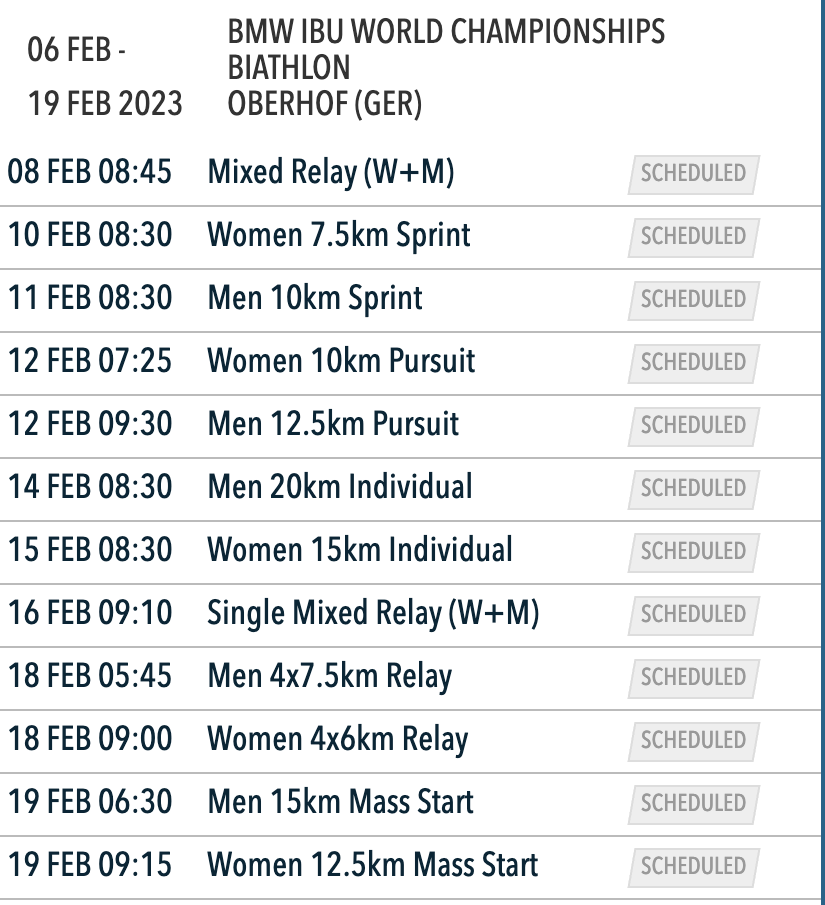
February 8-19. See competition schedule below in Eastern Time. Full season schedule and results available at: www.biathlonresults.com
What to Watch?
For those new to biathlon, check out any of the relays, the Pursuit, or the Mass Start. Those races are easiest to follow because they are head-to-head.
To see North Americans in the front of the pack, watch the Single-Mixed Relay. One woman and one man each do two short biathlon races, tagging off in between. The Canadian couple of Emma Lunder and Christian Gow have a World Cup best of fourth in the event and Americans Deedra Irwin and Paul Schommer finished sixth just a few weeks ago. No matter how they do, this speed shooting and sprint skiing frenzy is entirely enjoyable to watch.
Watch for those same four athletes in the 15/20km Individual as well. They each have scored at least one top-10 result in biathlon’s longest event format, known for its brutal one-minute time penalty per miss. If any of them can hit 18 targets or more out of 20, expect to see them on the live stream and—if they’re lucky—on the podium.
Emma Lunder and Christian Gow (CAN) at the IBU World Cup Biathlon in Kontiolahti, Finland in December 2022. (Photo: NordicFocus)
Who to Watch?
International Women:
Julia Simon (FRA): currently leads the World Cup Overall and Mass Start standings. Watch for her to blaze through five targets in 19 seconds and then throw down a heroic last lap for a come-from-behind win. Not to be overlooked: her three teammates who have also landed on the podium this winter.
Elvira Oeberg (SWE): Second in the Overall and first in the U25 and Pursuit standings, it’s easy to forget she’s only 23 years old. Like France, Sweden has also put four women on the podium this winter. Watch for those two nations to battle it out in the Women’s Relay.
Lisa Vittozzi (ITA): Following a season in which she inexplicably alternated between hitting all five or missing all five in any given prone stage, Vittozzi is back to her best form on the range and on skis. She currently leads the 15km Individual standings.
Dorothea Wierer (ITA): Quietly ranked fourth in the Overall behind the above three, she took her first win of the season just a few weeks ago and is a perennial favorite at championships.
Denise Herrmann-Wick (GER): Sprint standings leader and Olympic medalist in both biathlon and cross-country skiing, the 34-year-old is currently ranked fifth in the Overall and is Germany’s best chance for an at-home win.
Marte Olsbu Roiselend (NOR): Last year’s World Cup Overall winner returned to competition in January following an autumn illness and went straight into the flower ceremony with a 4th and 5th. She won five Olympic medals in Beijing last winter and seven at World’s in 2020. Bet on her.
Wildcard—Anamarija Lampic (SLO): For cross-country ski fans looking for a dark horse podium contender, the former FIS Sprint Globe winner will make her Biathlon World Championships debut. In her three World Cup outings so far she has placed 5th, 5th and 69th.
Julia Simon (FRA) racing the IBU World Cup Biathlon Relay in Antholz, Italy in January 2023. (Photo: NordicFocus)
North American Women:
Emma Lunder (CAN): Ranked 26th in the Overall standings, Lunder came oh-so-close to landing her first podium when she set new personal bests of 4th and 5th in December. In the two Mass Start races this season she placed 9th and 11th, so let’s hope she can qualify for the premier 30-woman event in Oberhof.
Nadia Moser (CAN): After tragically breaking her leg just before the Olympics last year, Moser fought back and is now having a career-best season, notching three top-30’s including a new personal best of 23rd.
Deedra Irwin (USA): Returning from a breakout season in which she smashed into the top-ten for the first time at the Olympics and qualified for her first Mass start, Irwin may be on track for a similarly well-timed peak. In January her ski times sharpened and she scored her first top-25 of the winter.
Joanne Reid (USA): After finishing 26th in a Sprint in December, Reid struggled with illness in January but don’t count her out. Her top three career results are all from championship events, including 10th and 15th at the 2019 World’s. Chances are good she’ll shine in the women’s and mixed relays.
Johannes Thingnes Boe (NOR) racing the IBU World Cup Biathlon Mass Start in Ruhpolding, Germany in January 2023. (Photo: NordicFocus)
International Men:
Team Norway: Five of them (J. Boe, S. Laegreid, V. Christiansen, J. Dale, T. Boe) are ranked in the top eight of the World Cup Overall standings. We’ll see all of them compete in Oberhof thanks to a new rule which extends the normal limit of four athletes per nation to five as long as they are ranked in the top 15. In particular:
Johannes Thignes Boe (NOR): won 11 of 14 individual races this season. Currently leads the Overall standings and all of the event standings. More than once this winter, he has outskied the next-fastest competitor by over forty seconds— in a 10k! Come for the biathlon, stay for the exceptional cross-country skiing.
Sturla Holm Laegreid (NOR): If it weren’t for Boe’s total domination we’d be talking about Laegreid. He’s finished 2nd in the Overall standings for the last two years and has been on the podium in all but three races this season. His worst (!) finish so far this winter is 6th. In contrast to Boe, Laegreid’s superpower is his shooting. The 25-year-old is currently running a 98% hit rate in prone.
Martin Ponsiluoma (SWE): the only non-Norwegian to win a race this winter. In January he was consistently the second-fastest skier behind J. Boe and therefore one of the few people with any chance of beating him. Ponsiluoma’s weakness is shooting accuracy but Oberhof’s windy range could level the playing field to his advantage.
Quentin Fillon Maillet (FRA): Last winter’s World Cup Overall winner, currently ranked 4th, never gives up.
Niklas Hartweg (SUI): At just 22 years old, the U25 leader is having a breakout season which started with a silver medal in the 20km Individual in November. Winner of the 2019-20 Junior Cup, Hartweg is on a near vertical trajectory at the senior level, ascending from 74th in the World Cup Overall standings last year to 12th currently.
Wildcard— Simon Eder (AUT): the 39-year-old proved he’s still in great form when he earned his 99th and 100th career individual top-ten results in January. He recently ended a prone hit streak of over 110 shots which he had started last March.
Paul Schommer (USA) and Adam Runnalls (CAN), (l-r) racing the IBU World Cup Biathlon Pursuit in Annecy-Le Grand Bornand in December 2022. (Photo: NordicFocus)
North American Men:
Sean Doherty (USA): Coming off a banner summer season in which he took 2nd at the Martin Fourcade Nordic Festival and 6th at Summer Biathlon World Championships, Doherty landed his best result since the 18-19 season in December with a new Sprint best of 11th.
Christian Gow (CAN): a lighting fast and reliable shooter coming into form with two top-25 results in January.
Adam Runnalls (CAN): 24-year-old having a breakout season with two top-20s so far including a new personal-best of 13th in the Sprint in January.
Paul Schommer (USA): has finished in the points (top-40) in all but two races this season, showing high-level consistency, especially on the range where his 87% hit rate ranks among the best.
Jake Brown (USA): 12th in the Sprint at 2021 World’s proves he can make it happen when it counts. Watch for Jake to put up a sneaky excellent Men’s Relay leg.
Keep following fasterskier.com for on-site coverage from Oberhof.
You can find the full US Biathlon World Championships team roster here.
You can find the full Biathlon Canada World Championships team roster here.
Today marked the beginning of the World Cup Biathlon season for the women. The women raced the 15-kilometer individual start format in Kontiolahti, Finland, skiing 5 laps on a 3-kilometer course. Missing from the start line were common pre-race favorites, Norwegian’s Marte Olsbu Roiseland and Tiril Eckoff, allowing other known stars to dominate the podium: Sweden’s Hanna Oeberg finished first, Norway’s Ingrid Landmark Tandrevold second, and Italy’s Lisa Vittozzi third. The U.S was represented by Deedra Irwin (25th), Joanne Reid (48th), Chloe Levins (56th), Kelsey Dickinson (61st), and Tara Geraghty-Moats (87th) who had recently switched from Nordic Combined and received her World Cup biathlon initiation.
Norwegian, Ingrid Landmark Tandrevold shot clean on the day, finishing second behind the skiing prowess of Sweden’s Hannah Oeberg at the IBU World Cup Biathlon, individual women, in Kontiolahti, Finland. (Photo: NordicFocus)
The Race
Wednesday’s individual start format saw racers starting every 15 seconds in conditions that were a pleasant 26 degrees (-3 Celsius). But by the beginning of the race, 2:15 p.m. local time, the Arctic night had taken hold, and the sunlight had disappeared. Skiers raced under the lights. Wind is always an issue for the shooting portion of biathlon and the race began with relatively calm conditions of 2.5 mph (4km/h). The leadoff skier was Italian biathlon superstar Dorothea Wierer. She would set the early pace by clearing all five targets in her initial shooting (prone) in under 25 seconds.
Wierer’s strong start was quickly eclipsed by Swedish star Hanna Oeberg who left the first stage having shot clean. The majority of the early racers went clean shooting, as well. The race quickly turned into a family duel as Sweden’s Oeberg sisters, Hanna and Elvira, were separated by only five seconds after the first shoot.
Much to the relief of the Italian team, bronze medalist, Lisa Vittozzi (ITA), overcame last year’s problems in prone shooting, hitting four of her first five shots. (Photo: NordicFocus).
But charging hard was Ingrid Tandrevold of Norway who shot clean through two rounds and was also skiing well. Coming into the third shoot she continued her streak and shot clean, keeping her in the hunt.
Coming out of the third shoot, Hanna Oeberg’s ski speed and clean shooting put her on top, followed by Linn Persson (Sweden) and Tandrevold. Elvira Oeberg missed one shot on her third round, ending the sibling rivalry, for this day at least.
Coming into the final shoot, the outcome was still in doubt. But Wierer fell out of contention when she missed three targets.
Tandrevold skied at a controlled pace and ended up shooting clean on her final round, and for the day. She emerged from the fourth shoot in the lead, but many others had yet to shoot.
Hanna Oeberg came into the final shoot knowing that five out of five would all but guarantee her the victory. She opened the door slightly by missing her fourth shot, but her quick skiing kept her in the lead. She put the hammer down after her fourth shoot and put a little extra time on the competition.
The sighs of relief continued from the Italian camp as Vittozzi shot clean in her final shoot; hopefully putting an end to her epic shooting woes from last season.
The final standings mirrored the results of the standings at the end of the fourth shoot, with Hanna Oeberg slightly extending her lead over Tandrevold and Vittozzi.
After the race, Hanna Oeberg related that her main goal for the day was to put the pieces together with the shooting and the skiing, and she was happy with both.
Let’s catch up with the IBU World Cup and the action from Saturday and Sunday in Pokljuka, Slovenia.
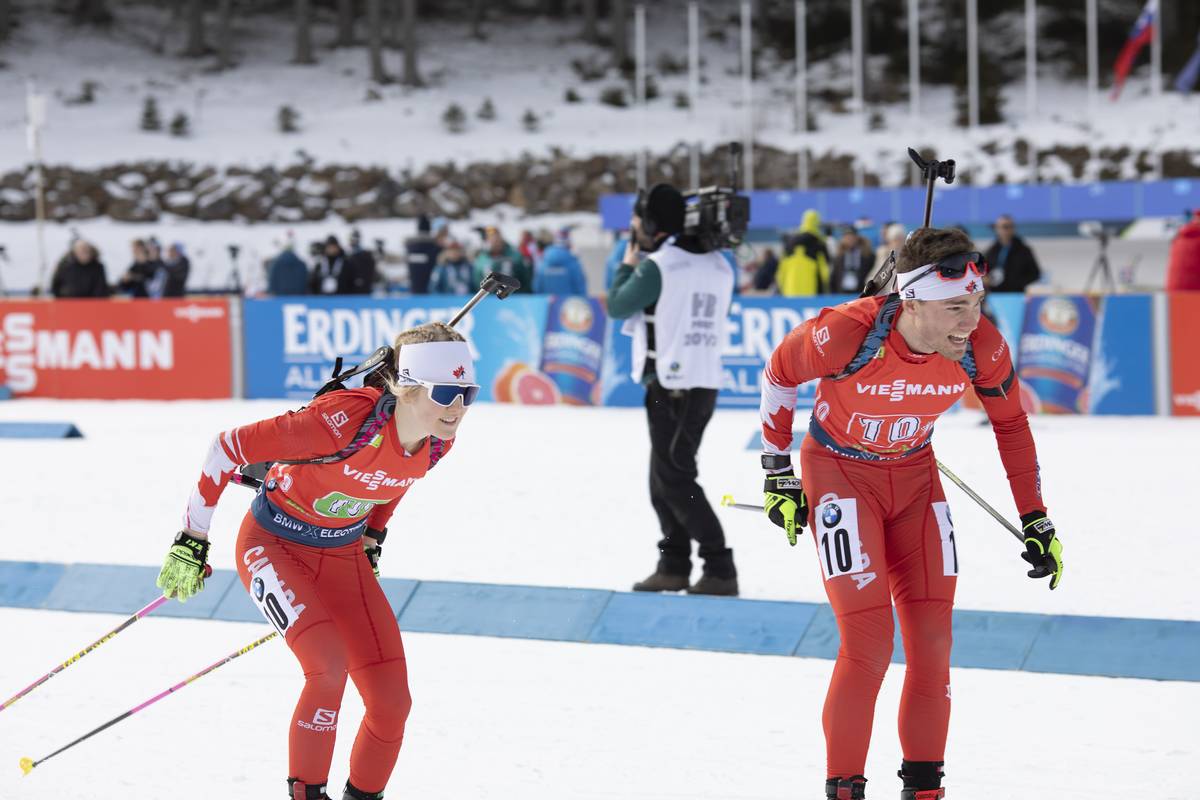
Emma Lunder and Christian Gow, (l-r) during the IBU World Cup biathlon, single mixed relay, in Pokljuka (SLO). The team placed fourth overall. (Photo: NordicFocus)
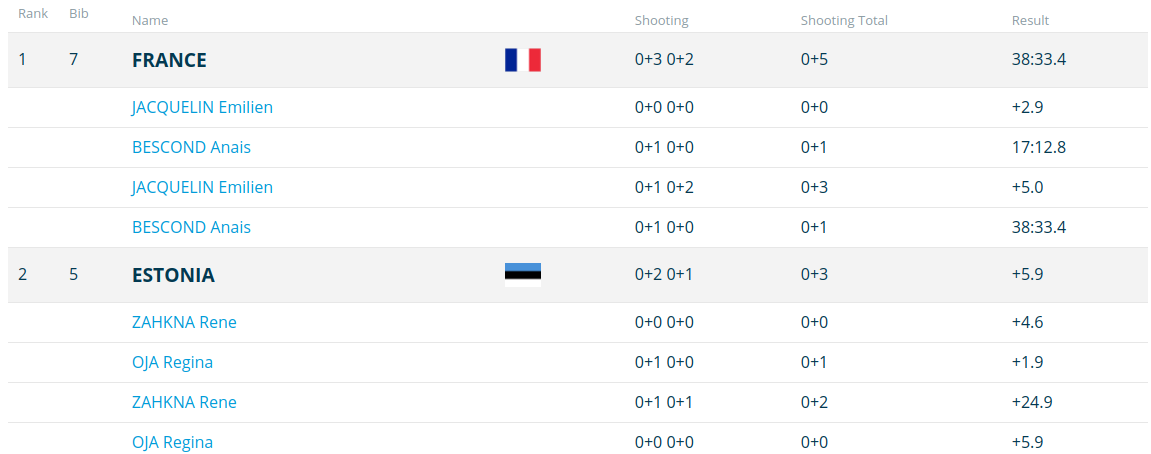
First up, the single mixed relay, in which teams of two are paired with each skier racing two legs and shooting two stages per leg. France took the win in 38:33.4 minutes shooting 0+5. The big news from the relay for North America, was Canada’s fourth place result. Christian Gow and Emma Lunder were 16 seconds back from first place France after shooting 0+6.
Jake Brown and Joanne Reid for the U.S. placed 23rd (+4:15.1; 0+14).
And it is worth mentioning, 26 different nations comprised the 26 team field. Which brings to mind a cool post on Twitter from the International Biathlon Union, and it speaks to the exciting nature of the sport. The Estonian team included Rene Zahkna, who placed 101st in last Thursday’s 20 k individual race. Two days later it was podium time.
Next up, the 4 x 7.5 k mixed relay, which France won in 1:17:53.3 making it a clean sweep for the nation on relay day.
The U.S. team of Leif Nordgren, Sean Doherty, Susan Dunklee, and Clare Egan placed 12th (+4:10.6; 2+12). Canada’s Jules Burnotte, Scott Gow, Emily Dickson, and Megan Bankes raced to 18th (+6:47.5; 4+10).
The relay had 25 teams from 25 different nations represented.
France’s Quentin Fillon Maillet won Sunday’s 15 k mass start in Pokljuka, Slovenia. (Photo: NordicFocus)
And… on Sunday in Pokljuka, the racing began with the men’s 15 k mass start. No Johannes Thingnes Bø or Martin Fourcade on the podium’s top step: France’s Quentin Fillon Maillet placed first in 36:21.5 shooting 0+0+1+0. Germany’s Benedikt Doll placed second (+10.0 0+1+0+0), and yes, Johannes Thingnes Bø was on the podium in third (+10.3; 1+0+0+1).
Fourcade retains the IBU World Cup’s leader’s bib with 601 points. Fillon Maillet is second with 532 points, and Bø is third with 482. Bø sat out much of January’s racing for the birth of his first child.
No North American men qualified for the mass start race.
Egan raced to 26th (+3:31.8; 0+1+1+1) and Lunder to 29th (+4:12.5; 2+1+1+0).
Norway’s Tiril Eckhoff still leads the World Cup overall with 524 points, Dorothea Wierer of Italy is in second with 509 points, and Öberg sits in third with 456 points.
Racing on the IBU World Cup takes a hiatus for a bit. The 2020 IBU World Championships begin in Antholz, Italy on February 12th.
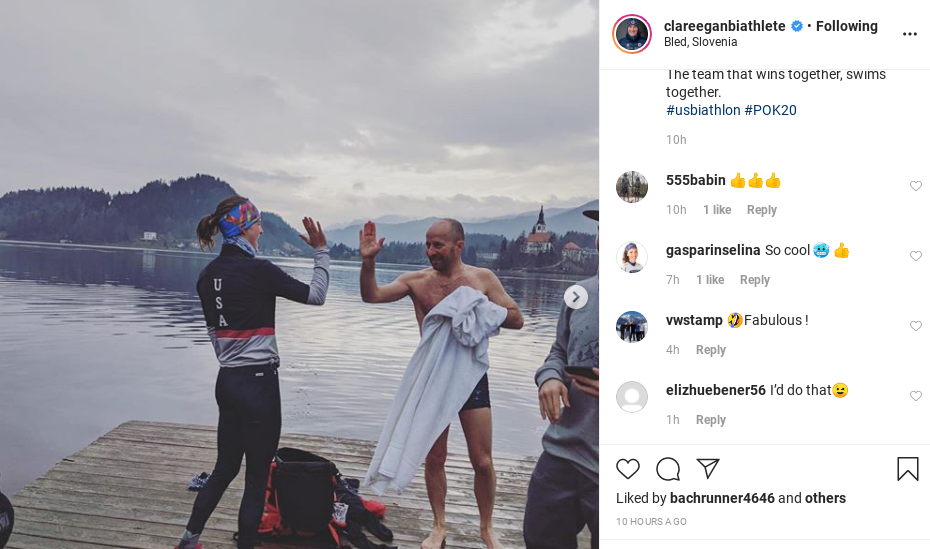
So we will leave on a light note as we piggyback on Egan’s Instagram account. She noted that U.S. Biathlon’s women’s coach Armin Auchentaller made a bet that he would “jump in the lake if anyone gets a top-10!”.
He took the plunge after Egan’s 6th place. Auchentaller may be onto something, The New Yorker recently called cold plunges a subversive joy.
The cold plunge. (photo: from @clareeganbiathlete on Instagram)
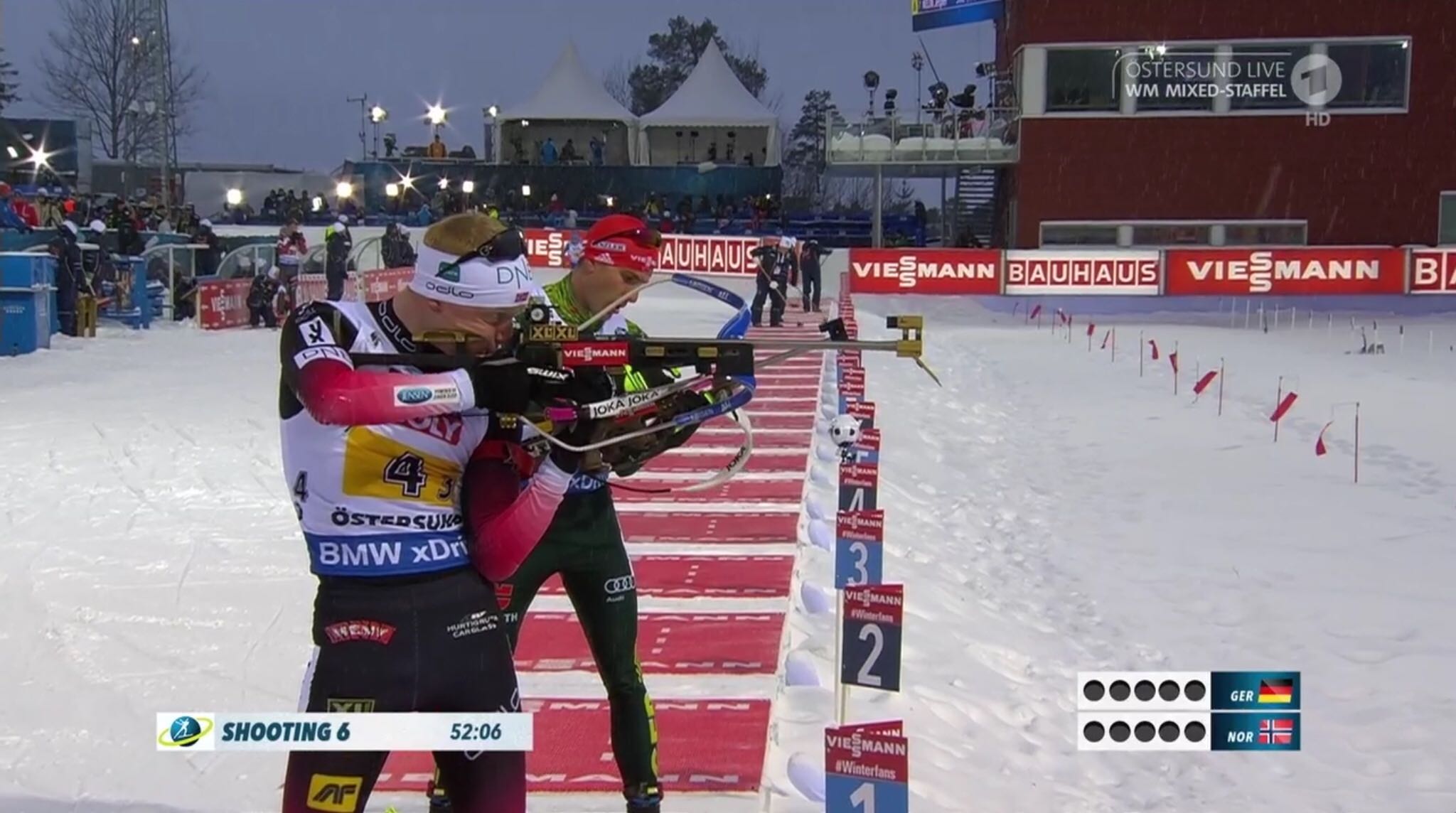
Johannes Thingnes Bø of Norway (bib 4) during the mixed relay at the 2019 IBU World Championships. (Photo: ARD screenshot)
Marte Olsbu Røiseland, Tiril Eckhoff, Johannes Thingnes Bø, and Vetle Sjåstad Christiansen of Norway won the opening race, a mixed relay, of the IBU World Championships in Östersund, Sweden. The foursome won the race in 1:17:41.3 hours.
The race format requires women to contest the first two legs, or 2 x 6-kilometers, whereas as the men ski the final two legs, or 2 x 7.5 k. On the way to the win, Norway used seven spares.
Germany’s Vanessa Hinz, Denise, Herrmann, Arnd Peiffer, and Benedikt Doll placed second, 13.1 seconds behind after using nine spares total. Herrmann’s skiing prowess, she is a former World Cup cross-country skier for Germany, brought her team into the lead as she tagged Peiffer.
The Norwegians ultimately took control of the race as they gapped Germany in second place, and put 1:09.6 minutes into Italy’s Lisa Vittozzi, Dorothea Wierer, Lukas Hofer, and Dominik Windisch for third overall.
Canada’a Rosanna Crawford, Sarah Beaudry, Christian Gow, and Scott Gow placed 16th overall (+4:35.5). The team had one penalty while using eight spares.
Susan Dunklee, Clare Egan, Sean Doherty, and Leif Nordgren of the U.S. placed 19th (+7:21.2). The U.S. team accrued three penalties while using 13 spares.
Racing continues tomorrow for the women with a 7.5 k sprint.
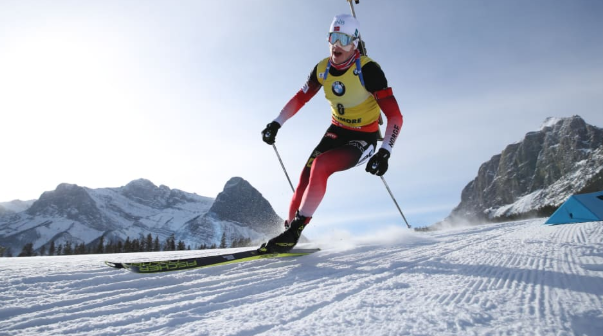
Johannes Thingnes Bø of Norway shot clean and skied fast in Canmore’s 15 k short individual race on Thursday. (Photo: biathlonworld.com screenshot)
IBU World Cup Canmore, Canada 15 k/ 12.5 k Short Individual Races
Sun, mountains, and what may have seemed like relatively warm temps allowed the IBU World Cup events to proceed on Thursday in Canmore, Canada. It’s been Polar Vortex cold in Canmore. Cold enough to thwart the original plans for traditional length 20-kilometer and 15 k individual races, for men and women respectively. With cold temperatures predicted all week, and a window of legal-limit warmer weather punching through on Thursday, the races were shortened to provide enough time during the warming window to hold both races.
For the men, this fill in the blank is easy: _________________ dominated the day in the men’s 15 k short individual race as he shot clean and skied faster than all the others.
Johannes Thingnes Bø of Norway did shoot clean. And he skied fast. And he won in a time of 35:27.9 minutes. For the twenty-four-year-old Bø, it was his 12th win of the season as he continues to cement his grip on the IBU World Cup overall.
His Norwegian teammate Vetle Sjåstad Christiansen, finished second (+2:10.2, 1+0+0+1), with Alexander Loginov in third (+2:41.0, 1+1+0+0).
Canada’s Chirstian Gow posted a career best 10th place. Gow stopped the clock 3:05.4 minutes after the winning time, as he went 0+1+0+0 for a single penalty on the shooting range.
“I didn’t treat the race any differently,” Gow emailed when considering the 15 k format. “It is still an Individual where each penalty is a major set-back so I knew I needed to keep the same focus for the race. It was something new, so a bit more of an unknown going in to it … I actually started a bit harder than I normally would. I wasn’t sure if I could keep the pace going, but in the end I managed it so I’m happy that it worked out!”
For the U.S., Sean Doherty was the second best North American in 27th. Doherty finished 4:29.0 minutes behind, and went 0+1+0+1 on the range.
“Today the shortened format was welcome as the snow conditions were very abrasive and slow. as far as a tactics go the shorter distance is just a bit more aggressive pacing but that’s about it,” Doherty wrote FasterSkier to explain how the shortened race might impact his race strategy.
Much of the past week was prohibitively cold for athletes. Some ventured outdoors for training, with many making due with local gyms and indoor training facilities.
“The cold temperatures as we are dealing with here have some added challenges,” Doherty added. “The biggest one being keeping your hands warm. Lots of people have their own tricks but you usually sacrifice some dexterity in the range but it is necessary because it is even harder to shoot with numb fingers. The other thing you see is the tape on our faces to try to protect frostbite prone areas. Then it’s all about layers and you end up doing a lot of fussing around with all the clothing you are wearing.”
For the U.S., Leif Nordgren raced to 43rd (+5:48.3, 0+1+0+1), Max Durtschi 71st (+7:52.5, 0+2+1+2), Travis Cooper 73rd (+8:01.0, 1+1+1+2).
Also for Canada, Scott Gow placed 40th (+5:42.6), Jules Burnotte 57th (+7:00.2, 3+1+2+0), Aidan Millar 81st (+8:34.0, 2+1+1+2).
The women’s 12.5 k short individual race was run with increasing cloud cover and temperatures hovering around 10 degrees Fahrenheit.
Norway’s Tiril Eckhoff took the win in 36:32.9 minutes with a single penalty. It was Eckhoff’s first career IBU World Cup win in the individual event.
The Czech Republic’s Marketa Davidova raced to second as she cleaned her shooting stages and finished 9.2 seconds back. Lisa Vittozzi of Italy was third, 20.9 seconds behind, while also shooting clean.
Megan Bankes was the top placed Canadian in 26th (+3:14.5, 1+0+1+0). Canmore’s local biathlete Rosanna Crawford was 29th (+3:21.7, 0+1+0+1). Sarah Beaudry was 34th (+3:36.5, 1+0+1+0), and Emma Lunder 63rd (+5:51.3, 1+0+4+1).
Clare Egan was he top American in 43rd (+4:17.5, 1+0+1+2). Joanne Reid skied to 64th (+5:55.9, 0+2+1+1), Emily Dreissigacker 66th (+6:07.1, 0+0+0+2).
Johannes Thingnes Bø of Norway has dominated the win column. So far this season, he has 12 victories to his name and leads the IBU men’s overall standings. (Photo: biathonworld.com)
With six of the nine stops on the International Biathlon Union (IBU) World Cup circuit complete, IBU athletes will take a brief hiatus from Europe this February and venture across the Atlantic for a race tour in North America.
The first stop for biathletes, coaches and fans will be Canmore, Albert. Canada–the last World Cup races having taken place there in 2016. Following Canmore, the IBU will head for U.S. soil: The Soldier Hollow Nordic Center (SoHo) in Midway, Utah. The 2019 IBU World Cup races will be the first major biathlon event held at the SoHo venue since the Salt Lake City Winter Olympic Games.
With 15 competitions already in the bag this season, the men’s IBU World Cup is currently led by Norwegian Johannes Thinges Bø, who has accumulated a total of 836 points for the coveted top-dog position.
Bø kicked off his World Cup season with back-to-back wins in Pokljuka, Slovenia, claiming first in the IBU’s opening sprint and then winning the following day’s pursuit. (He placed seventh in the men’s individual 20 k that weekend). In Hochfilzen, Austria, the 25 year old won the sprint before placing ninth in the next day’s pursuit. In Nové Město, Czech Republic he completed a hat trick win, sweeping the sprint, pursuit and mass start.
He dropped a position in the Oberhof, Germany sprint, finishing second, only to reclaim his position at the top in the pursuit. Ruhpolding, Germany once again found him with a triple win: in the men’s relay, one in the sprint and one in the mass start.
Johannes Thingnes Bø scored his 10th IBU World Cup win of the season in the 10 k sprint in Antholz, Italy. (Photo: biathlon world.com screenshot)
By the time he competed in Antholz, Italy–the final European destination before the North IBU’s American tour–Bø had accumulated two more wins and one second place. All told, the Norwegian has won 12 of the 16 IBU World Cup competitions he has entered this season and missed the podium twice.
Following Bø on the the men’s IBU World Cup Top 3 this season is France’s Martin Fourcade in second place with 554 points. Fourcade was the overall leader last season, ahead of Bø who was second. This year, Fourcade is currently trailing Bø by 288 points. At the age of 30, Fourcade has accrued a grand total of 76 individual victories over the course of his career, while Bø, five years younger than Fourcade, has 33. Third in the 2018/2019 IBU World Cup overall standings is Russian Alexander Loginov with 548 points.
Scoring 183 points and ranked 28th in the overall, Canada’s Christian Gow currently leads the North American men on the IBU World Cup. Gow opened his season with three Top 20 finishes in Pokljuka, placing 16th in the individual, 17th in the sprint and 14th in the pursuit. He had a career best finish in the Ruhpolding mass start, racing to 11th place. Altogether, Gow has finished in the Top 30 11 times this year.
Behind Gow, American Sean Doherty is ranked 37th and Canadian Scott Gow, Christian Gow’s brother, is 47th. Leif Nordgren and Jake Brown of the U.S. are ranked 57th and 88th respectively, while Canada’s Jules Burnotte currently sits in 73rd.
Norway’s Marte Olsbu Røiseland out skiing Italy’s Dorothea Wierer on Satrday’s 10 k pursuit in Nové Město, Czech Republic. (Photo: biathlonworld.com)
On the women’s side, Italy’s Dorothea Wierer is the woman to watch–or watch out for–thus far this season, currently ranked first in the overall standings with 632 points. The 28-year-old-Wierer earned three victories this season, winning the Hochfilzen sprint and relay then later the Antholz pursuit. Including those wins, Wierer has landed on the podium six times during the 2018/2019 IBU World Cup race year. Last season, Wierer finished fifth in the overall standings.
The Italian women have proven themselves in good form this year with Italy’s Lisa Vittozzi taking up second in the standings behind Wierer with 598 points. At 23-years-of-age, Vittozzi earned the first wins of her career this season, claiming first in the Oberhof sprint and pursuit.
Behind the Italians, Norway’s Marte Olsbu Røiseland is presently ranked third in the standings with 508 points.
Team USA’s Clare Egan has had a banner IBU World Cup race season, ranked 22nd at present with 258 points. Egan’s World Cup success this season began in Pokljuka where she had a career best sixth place finish in the women’s pursuit.
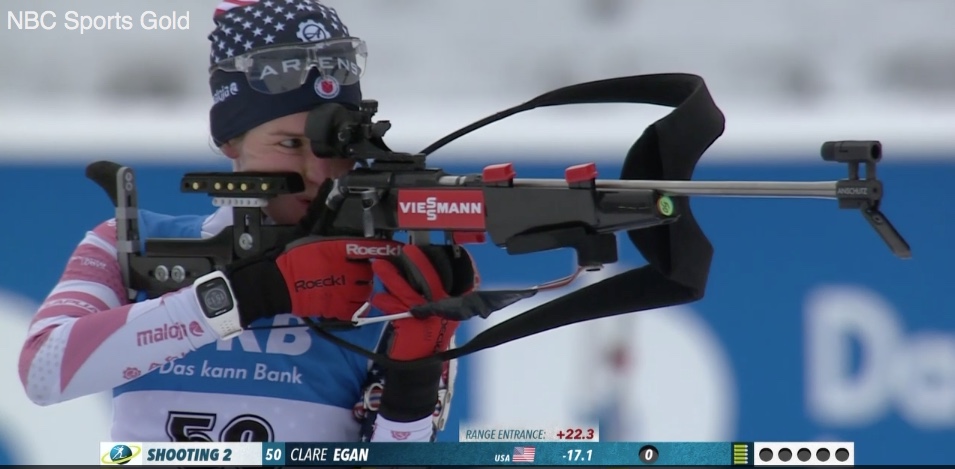
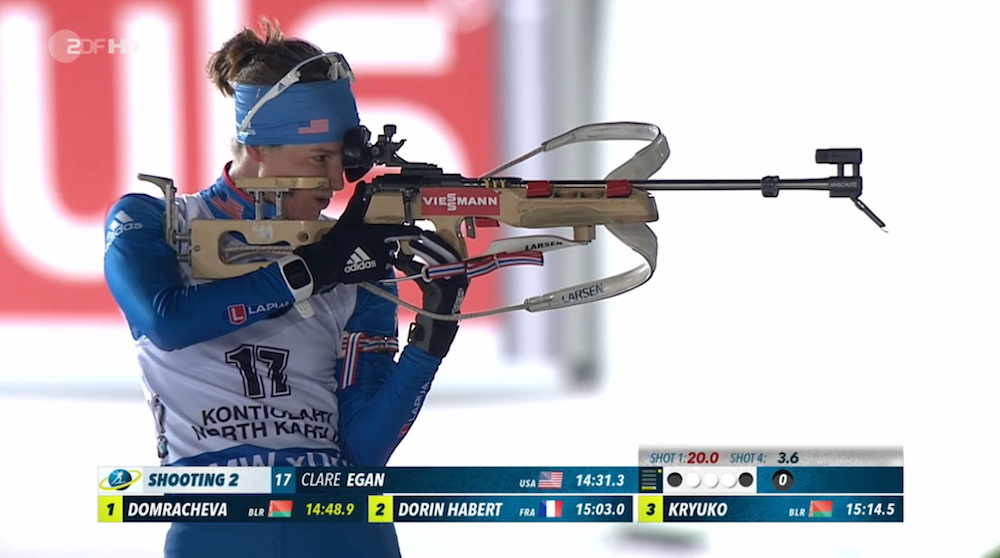
Clare Egan during her second shooting stage in Oberhof’s sprint on Thursday. (Photo: NBC Gold screenshot)
“I am frankly amazed with my skiing,” the 31 year old Egan had written in an email to FasterSkier after the Pokljuka race weekend. “I knew I was in great shape, but this week my ski times were 11, 6 and today 1st. I think small changes and improvements in my training are coming together to make this big difference. The most important factor in my performance is our new women’s coach, Armin Auchentaller. He is the right coach for me.”
Following her sixth place, Egan has had 11 Top 30 performances this season, three of those coming from relays, the rest individual. Egan, who began competing in the sport six years ago, made a visibly large jump season, having finished last year’s overall standings ranked 63rd.
Susan Dunklee is the next highest ranked North American woman in 31st (154 points). Over the course of her biathlon career, Dunklee has accumulated 5 IBU World Cup podiums and one silver World Championships medal, though her top performance this season was seventh in the Oberhof pursuit.
Canada’s Rosanna Crawford is ranked 53rd, Sarah Beaudry 57th, Emma Lunder 58th, and Megan Bankes 73rd. A third American, Joanne Reid, is currently 55th.
The U20 World Juniors 4 x 5 k relay first place team from the U.S, (l-r) Johnny Hagenbuch, Ben Ogden, Luke Jager, and Gus Schumacher. (Photo: JWSC2019 / Mikaela Takala)
2019 U23 World Ski Championships in Lahti, Finland 4 x 3 k and 4x 5 k relay
In a historic first for the U.S., the U20 men’s team won the 4 x 5-kilometer relay today in Lahti, Finland at the 2019 World Junior Ski Championships. Luke Jager skied the first classic leg for the U.S., Ben Ogden skied the second classic, Johnny Hagenbuch skied the first initial skate leg and Gus Schumacher raced the anchor leg.
The foursome won in a time of 45:34.7 minutes, and beat second-place Russia by 3.8 seconds.
Russia’s team was comprised of Egor Trefilov, Andrey Kuznetsov, Yaroslav Egoshin, and Alexander Terentev.
Germany’s team of Jakob Milz, Florian Knopf, Anian Sossau, and Friedrich Moch took third finishing 6.3 seconds behind.
For Canada, Remi Drolet , Sam Hendry, Xavier McKeever, and Thomas Stephen skied to 11th (+2:29.7).
In the 4 x 3.3 k U20 women’s race, Norway’s Kristin Austgulen Fosnaes, Astrid Stav, Helene Marie Fossesholm, and Kristine Stavås Skistad won at the line in 35:24.7 minutes.
Russia’s Anastasia Faleeva, Kristina Kuskova, Veronika Stepanova, and Anna Grukhvina were a close second, stopping the clock 1.0 seconds back.
Louise Lindström, Frida Karlsson, Tilde Baangman, and Lin Svahn for Sweden placed third (+33.3).
The U.S. team of Mara McCollor, Kendall Kramer, Sydney Palmer-Leger and Novie McCabe skied to fourth place, 40.5 seconds back.
For Canada, Anne-Marie Petitclerc, Jasmine Drolet, Anna Pryce, and Molly Miller placed 11th, 3:01.4 minutes behind.
FIS Cross Country World Cup Ulricehamn, Sweden 10/15 k freestyle
In what is his skiing canvas, the 15 k freestyle, France’s thirty-two-year-old Maurice Manificat won his first World Cup of the season in Ulricehamn, Sweden today in 34:55.4 minutes. It was a tight race in that Norway’s Simen Hegstad Krüger Simen Hegstad Krüger who placed second finished 1.1 seconds back. Teammate Didrik Tønseth was third (+8.7).
Canada’s Alex Harvey was the best placed North American in ninth (+31.4). Lenny Valjas skied to 57th (+2:32.1), and Bob Thompson 77th (+4:16.6).
For the U.S., Scott Patterson finished 35th (+1:26.5), David Norris 53rd (+2:11.3), Ben Lustgarten 64th (+3:04.7).
Norway’s Therese Johaug kept her distance win streak alive at eight wins in eight starts on the World Cup this season. She won the women’s 10 k skate race in 25:48.2 minutes, with teammate Astrid Uhrenholdt Jacobsen in second, 22.8 seconds back. Third place went to Sweden’s Ebba Andersson, 24.9 seconds behind.
The U.S. Ski Team’s Jessie Diggins skied to fourth place (+38.3), while teammate Sadie Bjornsen was 15th (+1:25.1). Caitlin Paterson (CGRP) had her best World Cup result of the season, skiing to 23rd (+1:49.9). Rosie Brennan (APU) placed 28th (+2:03.2), and Rosie Frankowski 42nd (+2:28.0).
Dahria Beatty was the only Canadian entered. She finished 56th (+3:54.7).
In the women’s 10 k pursuit, Italy’s Dorothea Wierer won in a time of 29:20.1 after skiing two penalties (1+0+0+1). Second place went to Germany’s Laura Dahlmeier, who finished 6.0 seconds after Wierer after one missed shot (0+0+1+0). Saturday’s third place went to another Italian, Lisa Vittozzi, who finished 16.2 seconds behind the winner after tying Wierer’s shooting score.
Clare Egan led the way for the U.S., racing to 11th (+1:31.9) after skiing two penalties (0+0+0+2).
“I’m really happy with my race today,” Egan wrote in an email. “The wind and altitude are always a challenge here, but I took my time on the range and capitalized on the fast glide of my skis to save energy on course. I made a costly and dumb mistake on my last shot but still came away with my second-best career result. I’ll take what I learned from today and go for it again tomorrow in the mass start! Can’t wait!”
Joanna Reid was the next American to finish, placing 29th (+2:55.2) after three missed shots (1+0+0+2).
For Canada, Rosanna Crawford finished 34th (+3:30.8) after skiing five penalties (2+1+1+1) and her teammate Megan Bankes finished 39th (+3:37.1) with five misses (1+0+3+1). Also skiing for Canada, Sarah Beaudry placed 46th (+5:07.5), also with five penalties (4+0+1+0).
In the men’s 12.5 k pursuit, Norway’s Johannes Thingnes Bø
won in a time of 31:33.7 after skiing three penalties (1+1+0+1). France’s Antonin Guigonnat raced to second place, 34.8 seconds behind with one missed shot (0+0+1+0). The third and final podium spot on Saturday went to France’s Quentin Fillon Maillet, who skied two penalties (1+0+0+1) and finished 40.6 seconds back from the winning time.
Sean Doherty for the U.S. placed 47th (+4:39.1, 3+2+1+0). Jake Brown was lapped and was not given an official time.
For Canada, Jules Burnotte skied to 54th (+5:42.8, 1+3+1+1), and Scott Gow 55th (+6:39.7, 4+0+2+3).
Canada’s Antoine Briand (CNEPH) was the fastest qualifier on the day in 3:14.71 minutes and won the men’s final. Dominique Moncion-Groulx (Nakkertok) placed second in the final, with Ben Saxton (SMS T2) in third.
Saxton was the second fastest qualifier, with Oliver Hamel (CNEPH) third fastest.
For the women, Sophie Caldwell (USST/SMS T2) scorched the qualifier in 3:40.44 minutes with Jessica Yeaton (APU/Australian National Team) qualifying in second (3:50.49). Dartmouth’s Katharine Ogden qualified third (3:51.79).
Caldwell went on to win the final in 3:37.06, with Yeaton in second and Kelsey Phinney (SMS T2) in third.
The brothers Bø. Norway’s Johannes Thingnes Bø (right) of Norway with the sprint in Ruhpolding, Germany. His brother Tarjei (left) placed second. (Photo: biathlonworld.com screen capture)
IBU World Cup Biathlon Ruhpolding, Germany 10 k / 7.5 k sprint
Cutting to the chase: it has been dumping in certain regions of the alps. Ruhpolding, Germany, site of this week’s International Biathlon Union (IBU) World Cup’s has been no exception.
The men’s 10-kilometer sprint that went off today under clear skies had been postponed, it was scheduled to run Wednesday. Race officials postponed the race due to a weather related (read heavy snowfall) state of emergency in the district of Traunstein, where Ruhpolding is located.
With a bit more rest in their legs, Norway’s Bø went one and two in the results.
The younger of the brothers, twenty-five-year-old Johannes Thingnes Bø won in a time of 22:56.3 minutes after skiing a single penalty lap. Johannes Bø cleaned his prone stage, while missing one target while standing.
The elder Bø, thirty-year-old Tarjei Bø placed second (+7.9) after cleaning both shooting stages. It was Tarjei’s second individual podium of the season. Benedikt Doll of Germany was third (+10.5), with one penalty while standing. France’s perennial biathlon star Martin Fourcade was fourth (+15.9) with no penalties.
Sean Doherty of the U.S. was the best placed North American in 23rd (+1:10.2, 1+0). As of late, Doherty has been racing consistently in the top-30.
Also for the U.S., Jake Brown shot clean to finish 47th, 1:40.8 minutes back. Leif Nordgren placed 50th (+1:45.3, 0+0), and Max Durtschi 103rd (+3:29.0, 2+2).
Canada’s Scott Gow skied to 42nd (+1:36.0, 0+1). His brother Christian Gow placed 56th (+1:52.7, 0+1), Jules Burnotte skied and shot to 67th (+2:01.5, 1+0), and Aidan Millar 102nd (+3:26.4).
Friday’s racing in Ruhpolding will feature a 4 x 7.5 k and 4 x 6 k relays for the men and women respectively.
Anatasiya Kuzmina won the women’s 7.5 k sprint on Thursday in a time of 19:15.1 minutes. It was Kuzmina’s second win of the 2018/2019 IBU World Cup season. Kuzmina’s day was made a bit easier as she cleaned both her prone and standing shooting stages.
Italy’s Lisa Vittozzi placed second 11.5 seconds behind Kuzmina. Vittozzi also shot clean. In third place was Sweden’s clean shooting HannahÖberg. She finished 29.1 seconds back.
Susan Dunklee for the U.S. placed 20th overall, 1:11.3 minutes behind with a single penalty. Teammate Clare Egan, placed 35th (+1.44.6, 2+0). Also for the U.S., Joanne Reid finished two places back in 37th (+1:45.2, 1+0).
Rosanna Crawford was the top Canadian in 27th. She skied a single penalty loop to cross the finish line 1:32.3 minutes behind. Megan Bankes placed 68th (+2:32.7, 1+1), Emma Lunder 88th (+3:17.9, 3+2), and Sarah Beaudry 96th (+3:40.3, 1+3).
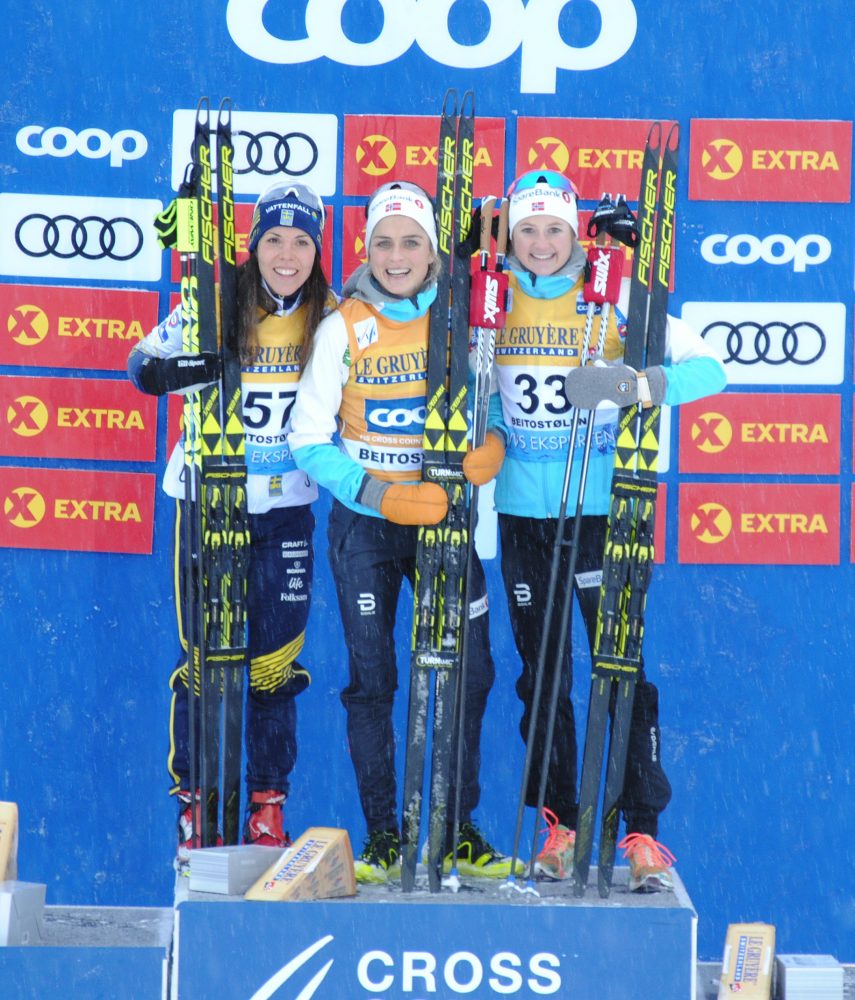
The Women’s podium from the World Cup 15 k freestyle in Beitostølen, Norway. Norwegian Theresa Johaug (center) was first, Sweden’s Charlotte Kalla (left) second, and Ingvild Flugstad Østberg (right) of Norway third.
FIS World Cup Beitostolen, Norway 15 k/30k Freestyle Individual Start
With snow falling and trees covered with fresh snow, Beitostølen, Norway’s wintery essence was on full display during the women’s 15-kilometer freestyle individual start on Saturday.
Keeping her distance win-streak alive was Norway’s Therese Johaug who won her fourth World Cup distance race of the season making it four for four in 2018/2019.
Jessie Diggins of the U.S. Ski Team on her way to eighth place during Saturday’s 15 k freestyle in Beitostølen, Norway.
Johaug won in a time of 38:39.8 minutes. The only blip of egalitarianism on the tracks was at the first time check at 1 k, where Johaug was tied for the best time with Russia’s Natalia Nepryaeva. Otherwise, Johaug gradually pulled away from the fifty-eight finishers by the time she crossed the finish line.
Sweden’s Charlotte Kalla placed second (+1:05.9), and Ingvild Flugstad Østberg of Norway was third (+1:06.1).
U.S. Ski Team (USST) athlete Jessie Diggins finished in eighth (+1:29.6) for her first top-10 result of the season. Sadie Bjornsen (USST) placed 13th (+2:22.9), Rosie Brennan 15th (+2:33.9), Caitlin Patterson (CGRP) 32nd (+3:46.0), and Kaitlynn Miller 50th (+5:02.8).
Canada entered a women’s team for the first time this season. Emily Nishikawa of the Canadian National Team (CNT) was the best placed Canadian in 34th (+4:01.6). Cendrine Brown (CNST) was 38th (+4:16.4).
Sitting atop the men’s overall World Cup this season after Saturday’s racing is Russia’s Alexander Bolshunov. The young skier is a killer in the sprints and distance events. But it is perhaps Norway’s Sjur Røthe who has impressed the most this season in the distance events. Røthe has a slight seven-point lead in the distance overall.
The men’s podium from the 30 k freestyle individual start in Beitostølen, Norway. Sjur Røthe (center) placed first, teammate Martin Johnsrud Sundby (left) second, and Russia’s Andrey Melnichenko (right) third.
Røthe won Saturday’s 30 k skate individual start in a time of 1:09:53.5. It was his second World Cup victory this year. Teammate Martin Johnsrud Sundby, with his first podium of the season, placed second (+35.2), Russia’s Andrey Melnichenko was third (+49.2). For the twenty-six-year-old Melnichenko, it was his first career World Cup podium.
Canada’s Alex Harvey was the best placed North American in 13th (+1:49.8). Also skiing for Canada, Andy Shields finished in 63rd (+7:05.6).
Scott Patterson (USST)was the best-positioned skier for the U.S., placing 47th (+4:32.7). David Norris (APU)skied to 51st (+5:13.3.) Erik Bjornsen (USST) was 52nd (+5:14.9), Adam Martin (CGRP) 59th (+6:14.8).
Egan Leads North Americans in 15th Place in Pokljuka Sprint.
Just before her race on Saturday, US Biathlon’s Clare Egan seemed to be in a relaxed mood and could be seen on the broadcast joking with other athletes and posing for pictures in the warm-up zone. Starting into the women’s 7.5-kilometer sprint in an early group in bib 26, Egan began the race fast and still managed to shoot clean in her prone stage.
She kept near the top at the split times during this early phase of the race.
“I am skiing way faster than I have in past years,” Egan commented on her improved course time in an email to FasterSkier, which in past seasons occasionally had prevented her from achieving positions in the points or qualifying for pursuit and mass start races. “I think my previous best ski time was in the 20’s, but my average was probably in the 50’s. So to have 11th ski time in the Individual [on Thursday] and the 6th today is a very significant improvement for me. It means that I can now aim for the flower ceremony, and even the top of the podium.”
In the standing shooting stage she then missed her very last shot of the race, having to ski once through the 150-meter penalty lap. After another fast final loop she came to the finish in fourth place. But after several athletes who began the race later finished ahead, she was pushed down in the standings, ultimately ending her day in 15th position (+1:08.8, 0+1). According to Egan she only narrowly missed a career-best result, having finished in 13th place in the sprint in Kontiolahti, Finland, during the last season.
“Today I would have been 4th or 5th if I had hit my last shot,” Egan wrote. “Overall my shooting is there, and now my skiing is too, so I just need some more races to get comfortable in this position. I really fought for my last two shots today and I got the 9th one and I’m very happy about that. Also my prone was perfect and I don’t take that for granted. I am focusing on the positive things and learning what I can to do better next time… which is tomorrow!”
Behind Egan, her teammate Susan Dunklee also had drawn a spot in the first start group starting early in bib 2, and remained clean in the prone stage as well. But in her second shooting she incurred two penalty laps, and ultimately ended her race day finishing in 45th place (+1:50.4, 0+2). The third U.S. starter, Joanne Reid, finished 57th with two penalties (+2:06.8, 1+1).
“Our whole women’s team did excellent training and it is paying off: last year at World Cup 1, zero American women qualified for the pursuit, whereas all three of us did today,” Egan commented.
She also credited their revamped coaching staff around which centers around Armin Auchentaller. Auchentaller spent the last few seasons coaching the Swiss women’s team.
“And it’s worth noting that with Susan’s 11th place in the Individual, we’ve now had two women go in the top-15 already in the first two races of the year (which is likely a first for US Biathlon). We are proud of ourselves and motivated to keep climbing. As usual, our ski service team is on fire. Tomorrow we’ll go for it again in the pursuit!”
For Biathlon Canada it was a difficult day on the shooting range overall, with Megan Tandy posting the best result in 73rd place (+2:46.6, 0+2). Her teammates Rosanna Crawford finished 77th with four penalties (+2:52.1, 2+2), Nadia Moser was 88th (+3:42.1, 2+2) and Megan Bankes was 99th (+4:39.6, 1+4). All missed qualifying for the pursuit on Sunday.
About a minute ahead of Egan, the race was won by Finland’s Kaisa Mäkäräinen in a time of 20:08.1 minutes, with no penalties.
“I enjoyed today,” last season’s Overall World Cup winner Mäkäräinen commented in thepress conference. “I really tried to be confident. … Of course it gives you a lot more energy when you shoot clean. I know if I shoot clean that I can fight for the top positions. … But I still had to work hard and had a good last loop.”
In the finish she was 14.8 seconds ahead of Italy’s Dorothea Wierer, who also had no miss and recorded the fastest shooting time on the range on Saturday, but couldn’t match her Finnish rival on the course. Hitting all targets as well, Justine Braisaz of France finished third (+42.1, just two days after ending the individual race only in 82nd place with seven penalties. That’s the ups and downs of biathlon. Also shooting clean and just off the podium was Braisaz’s teammate Julia Simon in fourth place (+44.6), for her first top-ten result in a World Cup. Wierer’s teammate Lisa Vittozzi was fifth with one penalty (+46.9, 0+1).
Julia Kern (SMS) leads Dahria Beatty (CNST) into the final straight in the A final. (Photo: Peggy Hung)
Sovereign Lake Noram/SuperTour, Vernon, BC
North American racing resumed with free technique sprints at Sovereign Lake. The first weekend of the NorAm series was also the second weekend in the SuperTour.
SMS’s first year senior Julia Kern continued her strong start to the season, winning the qualifier and the A final and looking dominant throughout. National team member Dahria Beatty kicked off her season with a crash in the qualifier, but got up to finish 7th. Dartmouth and AWCA’s Laura Jortberg was in third, followed by national team member Maya MacIsaac-Jones. APU’s Hannah Halvorsen was fifth and Stratton Mountain School’s (SMS) Erika Flowers trailed in last after breaking a pole on the final downhill corner.
Andy Newell leads Antoine Briand into the finish straight in the A final. (Photo: Peggy Hung)
On the men’s side, Andy Newell (SMS) continued the American domination, winning the qualifier in 2:15.180, 4.050 seconds ahead of APU’s Logan Hanneman, before winning all of his heats comfortably. Antoine Briand represented for Canada and the Centre National d’Entrainment Pierre Harvey (CNEPH), placing second to Newell in every heat. Ben Saxton (SMS) completed the podium, edging out APU’s Logan Hanneman in a four way battle for third. Antoine Cyr (CNST) and Ben Lustgarten (Craftsbury Green Racing) trailed in two ski lengths behind.
“It was a cascade of issues,” jury member Dave Dyer told FasterSkier.
The short, short version is that the timing system has a number of redundant systems to detect errors. While the timing team was working on an unrelated issue, two athletes tied exactly. There are two sets of results zone4: the provisional (timed to 1/1000ths of a second) and the official (timed to 1/100th of a second). The bib list was generated from one list and the zone4 live timing database was populated from the other, with the two skiers who were tied shown in different order. From this point on, all the backup systems indicated errors and everything had to be hand checked. The results were right, the right athletes advanced, but live timing was switched off and delays ensued.
Full details and video interviews will be in Monday’s event wrap-up.
Clare Egan receives a pole from US Biathlon Chief of Sport Bernd Eisenbichler during the first leg of the women’s relay at Holmenkollen.
OSLO, Norway — In the last relay of French star Marie Dorin Habert’s career, she turned in a crucial performance to bring her team to the front. Anaïs Bescond extended the gap and France took the win in the women’s 4 x 6-kilometer relay here at Holmenkollen by 14.4 seconds over Germany.
Was she nervous going into the last team event she will ever race?
“I wasn’t really nervous,” Dorin Habert, 31, said in a press conference. “I think it’s a special thing to know that there is no more starts and no more relays for me, so I just wanted to fight and struggle hard like every relay. I think I did my best today.”
Dorin Habert won two gold medals, in the individual and the pursuit, here at World Championships two years ago. So Oslo is a special place.
“It’s so nice to end this way, to share it with all of the team, and the beautiful sun, and all the French people,” Dorin Habert said. “It’s a wonderful day for me. I would like to thank a lot, well, everyone, for being there in the biathlon family. I’m really happy to have this career, and I’m really happy for everything.
The Italian duo of Lisa Vittozzi and Dorothea Wierer put their team in first place at the halfway point, and it was their teammate Nicole Gontier whom Dorin Habert passed to pull France into first. Gontier stuck with her, and Italy was only 2.2 seconds back at the last exchange.
The German anchor, Laura Dahlmeier, charged past Italian skier Federica Sanfilippo. She was unable to catch Bescond, but Germany finished second with seven spare rounds to six by the French, and Italy placed third with eight spare rounds (+33.2).
The Italian and French teams joking in the press conference.
Norway placed fourth with a penalty loop and 10 spares (+1:26.5), Switzerland fifth with eight spare rounds (+1:54.2), and Sweden sixth with a remarkable three spare rounds (+2:27.2).
The Canadian team skied an even race, with Sarah Beaudry leading off in 12th, Julia Ransom tagging in 14th, Emma Lunder in 15th, and then Rosanna Crawford bringing the team up to 11th.
“I love coming from behind and chasing girls down, and I just looked at it as practice for tomorrow,” said Crawford, who will start Sunday’s pursuit in bib 38. “I was within somewhat contact with the other women around me, so that was nice. People to chase, people to ski with.”
It wasn’t the result the team knew they were capable of, with 11 spare rounds. But it has been a long season.
“Of course everyone is tired, every team is tired,” Crawford said. “But our fast isn’t as fast as the fastest, so our slow is, well, a lot slower. I felt so good through Finland, and I really thought the ski speed was going to hold, but then it wasn’t there in the sprint. And also, today was slightly better, but not what I had last weekend. It’s so frustrating to be up and down.”
The U.S. team started off with a tough leg by Clare Egan, who used all of her spare rounds in both prone and standing and had two penalty laps. She tagged off at the first exchange in 21st and last place.
“This is I think the worst race of my career,” she said after the finish. “I’m really embarrassed. It is the worst possible thing to do it in a relay. I hate letting everyone down. It’s a really terrible feeling.”
Her teammates, though, were more circumspect.
“I never, ever, want to hear a teammate apologizing for tagging off far back like that,” said Susan Dunklee, who took the tag from Egan. “The only thing they can apologize for is if they didn’t try. And Clare was out there and trying her best. So I have nothing but respect for that.
“What I yelled at Clare, when she was at the top corner and I was warming up, I yelled, ‘We love you and we think you’re awesome!’ ” Dunklee continued. “She was in last place, and we still do love her. You just have to know that your teammates have all been there, they have all done the same thing in the relay, and they know exactly how you feel. Usually, there’s a piece of our relay that we can look at and get really excited about, so we will do that today.”
For Egan, though, it was a race that just came apart. The team started with bib 22, one of the last in the field, but she move up 10 places to 12th by the first shooting.
Then, spare rounds and penalty laps.
“I’ve never had a penalty loop in prone, in the World Cup [in a relay], but to do that in the first stage and immediately be like a minute behind everyone – no, I didn’t lose hope,” Egan said. “I knew that anything can happen in the standing. And I actually, I didn’t come into the range last. I had passed one person. But, you know, with another [penalty lap] in standing, I was just trying to get as fast as I could to the finish because … I just hoped that my teammates all would get a chance to do the race. If we get lapped then we get pulled. That’s it.”
She also lost part of a pole early on in the race, and the replacement process did not go smoothly.
“I just had to get a new one, but then the new one was shorter than my own pole,” Egan explained. “So when I went by a coach I meant to switch out the shorter pole for a spare that was the right height, and I gave him my own pole. So then I finished the race and I was like, ‘What the heck? I still have this stupid pole.’ ”
As the relay continued, Dunklee had the seventh-fastest second leg time, and Reid the eighth-fastest third leg time; by the third exchange, the U.S. was in 17th place.
“The shooting didn’t feel really sharp today,” said Dunklee, who used three spare rounds in total. “I don’t know what the times were but I don’t think they were very fast. I just felt sluggish and, a little out of it, really.”
Reid used only one spare round, a performance she was excited about.
“It’s always easier to start from behind and work your way up because there’s no pressure,” she said. “Whereas if you come into the range in first and have to shoot on point one, and everyone is staring at you, that’s really hard. Today was low-pressure shooting.”
Emily Dreissigacker anchored the team, and used four spare rounds to move up to 15th. She caught the team from Kazakhstan and held off a challenge from Korea in a three-way sprint finish, chasing Austria who finished jut 2.1 seconds ahead.
“I don’t know when the last time I actually had to sprint for the finish was, but it was great!” she said.
China and Slovenia were disqualified, and Bulgaria and Lithuania were lapped. But despite being the last team on the first leg, the U.S. women avoided that fate by a large margin.
“I definitely went out hard,” Dreissigacker said. “I knew we were sort of in the danger zone for getting lapped, but actually, the skiing felt really good the first two laps. I kind of died at the end, so I was glad I was able to come through at the finish.”
“I think we’ve all been through some ups and downs this season and struggling with that,” Dunklee said of Egan’s relay leg. “It’s important to remember that biathlon isn’t everything. There’s other stuff going on in our daily lives that is meaningful to us. It’s important to never lose sight of that.”
The Holmenkollen women’s 30 k freestyle mass start podium on Sunday in Oslo, Norway, with Jessie Diggins (l) in second, and Norway’s Marit Bjørgen (c) in first and Ragnhild Haga (r) in third. (Photo: FIS Cross Country/Twitter)
FIS Cross Country World Cup (Oslo, Norway): Women’s 30 k freestyle mass start
Marit Bjørgen, the Norwegian queen of distance cross-country events, racked up another victory at Holmenkollen in the women’s 30-kilometer freestyle mass start on Sunday for her seventh win in the World Cup’s ultimate distance event at the famed Norwegian venue. (She had previously won in 2005, 2010, 2012, 2014, 2015 and 2017).
But she did so in not-so-typical fashion. Instead of breaking the field mid-race and skiing to a comfortable win, like she did in the last race of the 2018 Olympics in PyeongChang, South Korea (a 30 k classic mass start), Bjørgen came from behind to win Sunday’s Holmenkollen 30 k and wasn’t able to let off too much before finish. She didn’t take the lead until less than a kilometer to go and put just enough time into her competition to take the win in 1:18:12.4 hours, while American Jessie Diggins outlasted the chase group of three to place second (becoming the first American woman to reach the Holmenkollen podium), 3.6 seconds behind Bjørgen. Norway’s Ragnhild Haga edged Sweden’s Charlotte Kalla by 0.1 seconds for third place (+4.3), while Kalla settled for fourth (+4.4).
The rest of the field was strung out, with Norway’s Astrid Uhrenholdt Jacobsen finishing fourth (+11.5) and Ingvild Flugstad Østberg nearly another 1 1/2 minutes back in fifth (+1:39.5). Finland’s Krista Pärmäkoski placed seventh (+1:51.7), Germany’s Stefani Böhler notched eighth (+2:10.2), Austria’s Teresa Stadlober ninth (+2:10.2), and Sweden’s Ebba Andersson 10th (+2:11.9). Less than a second behind Sweden’s Ida Ingemarsdotter in 11th (+2:22.8) was American Sadie Bjornsen in 12th (+2:23.4).
In the Distance World Cup standings, Diggins gained some valuable points to keep herself in third, now 63 points ahead of Pärmäkoski in fourth. Heidi Weng, who finished 18th on Sunday, still leads the distance standings by 104 points and Østberg is second, 51 points ahead of Diggins.
In the Overall World Cup, Weng leads by 153 points over Østberg. Diggins is another 104 points back in third, 100 points ahead of Pärmäkoski in fourth. At World Cup Finals next week in Falun, Sweden, a total of 300 points is up for grabs for the winners (50 for freestyle sprint, 50 for classic individual start, and 200 for freestyle pursuit).
The U.S. had three in the top 20 and four in the points (top 30) in Sunday’s 30 k, with Kikkan Randall in 19th (+3:21.9) and Caitlin Patterson in 28th (+4:13.1). Rosie Frankowski (Alaska Pacific University) missed the top 30 by about 28 seconds in 31st (+4:45.4), Liz Stephen placed 51st (+10:01.7) and Kaitlynn Miller (Craftsbury Green Racing Project) finished 53rd (+16:05.0).
Cendrine Browne led four Canadian women in 36th (+6:16.1), Emily Nishikawa was 44th (+7:36.1), Zina Kocher (Foothills Nordic) finished 47th (+8:52.0), and Dahria Beatty placed 49th (+9:45.1).
Germany’s Vanessa Hinz celebrates her first IBU World Cup win and podium in the women’s 12.5 k mass start on Sunday in Kontiolahti, Finland. (Photo: IBU/Biathlonworld)
IBU World Cup (Kontiolahti, Finland): Men’s and women’s mass starts
(Note: This rundown has been updated to include comments from Lowell Bailey and Rosanna Crawford.)
Germany’s Vanessa Hinz won her first International Biathlon Union (IBU) World Cup race (and achieved her first World Cup podium) and Austria’s Julian Eberhard won his first race of the season (and first mass start of his career) in the women’s 12.5 k and men’s 15 k mass starts on Sunday in Kontiolahti.
Germany’s Vanessa Hinz celebrates her first IBU World Cup win and podium in the women’s 12.5 k mass start on Sunday in Kontiolahti, Finland. (Photo: IBU/Biathlonworld)
Hinz shot an impressive 20-for-20 with the third-fastest range time and fifth-fastest shooting time to take the win in 35:47.9 minutes. Third after the first prone stage, she moved into second, then third after cleaning the next two stages. After knocking down her final five targets in the last standing, Hinz left the range almost 24 seconds ahead of France’s Anaïs Chevalier in second and 26 seconds ahead of Italy’s Lisa Vittozzi in third. Hinz stayed ahead of her challengers on the final loop, finishing 13.5 seconds clear of Vittozzi, who claimed second. Chevalier finished third, 16.8 seconds back, while Finland’s Kaisa Mäkäräinen was next across the line in fourth (+43.4) with a gap to Sweden’s Hanna Öberg in fifth (+1:02.1).
Vittozzi and Chevalier both cleaned the first three stages then had to ski a penalty lap after the last standing bout (0+0+0+1). Mäkäräinen missed three (1+0+1+1) yet skied the second-fastest course time on her home course, and Öberg missed two (0+0+2+0). The fastest course time of the day was clocked by Darya Domracheva of Belarus, who had to ski five penalty laps (0+1+1+3) and ended up 10th (+1:18.2).
“I always dreamed of shooting four times clean and today I did it,” Hinz, 25, said, according to an IBU press release. “I was so often close to the podium. I knew I could do it. Today, I said, ‘OK, let’s try it and if it works, it is OK … and if not there is another season waiting and other races.’ Now I am on top of the podium and it is crazy.”
Vittozzi, who placed fourth in the mass start at the 2018 Olympics, was glad to improve on a third-place finish in Friday’s sprint by placing second on Sunday.
“I have been third so many times and that was not satisfying for me,” Vittozzi said, one day after she won the mixed relay with her team in Kontiolahti. “Today I am very happy about my second place.”
For Chevalier, it was her first individual podium of the season and it came a day after she and Antonin Guigonnat won the single mixed relay. Chevalier, 25, was severely injured when she was hit by a car last spring, according to an IBU press release.
“I am very happy to be here today, because it was a very hard season,” she told the IBU. “I forgot how nice it is to be on the podium … I forgot that it was not easy, so I am very happy … I did my best on the last lap; [Vittozzi] was faster, but I am third and happy with that!”
Canada’s Rosanna Crawford shot 19-for-20 to place 13th (+1:25.9) with her only miss coming in the second prone stage (0+1+0+0). Her overall shooting and range times were 10th fastest of the 30-woman field, compared to her 26th-ranked ski time. Crawford had been in 11th after cleaning the final standing stage, then slipped two spots to finish 13th in her second mass start of the season.
“Since the skiing wasn’t feeling great today I made sure I was super focused in the range,” Crawford wrote in an email to FasterSkier. “I knew that was my only chance to get a good result today. My one prone miss was a bad trigger pull, but the rest were nice solid hits. I made sure to have a solid set up and then just trusted my rhythm and shooting.
“I knew that I wanted that top 15, so I just kept fighting and trying to stick with the women when they caught me,” she wrote of her last loop. “The last time up the wall I managed to stay close to [France’s] Anais Bescond, and hold off the two people behind me. Really happy to be in the top 15 again.”
Clare Egan was the lone American woman to qualify for Sunday’s mass start, and it was the second mass start of her career. She was on track for a top-15 result after missing just one target in the first three stages, but she had to ski three penalty laps on the last standing (0+1+0+3), which put her in 23rd by the finish (+2:05.6). Notably, she skied the 14th-fastest overall course time.
“I didn’t have quite the same energy level tonight as the last two days, but I still had the 14th rank course time and that means anything is possible in the race,” Egan wrote in an email to FasterSkier. “To put it in perspective, the winner of the race, Hinz, had the 13th rank, just 2 seconds faster than me. This is the first time I’ve felt totally comfortable skiing with the fastest women, and I certainly hope I can maintain this speed for one more week of World Cup racing.”
Egan was pleased with her 9-for-10 prone shooting and her clean standing stage (“which is the first time I’ve cleaned a standing stage in an individual race this entire year, believe it our not,” Egan wrote).
“But when I missed my second shot on the final stage, I let that throw me off my game, and really blew the rest of the stage,” she explained. “It’s so hard to keep 100% focus in every scenario, and I find it gets harder and harder towards the end of the race when I’m not necessarily the most lucid. I know that I have to work on so I have a goal to manage the final stage better next week and in the future.”
Her 23rd-place finish was one better than her previous World Cup mass start finish, which was 24th last season in Hochfilzen, Austria.
“In my only other mass start, which was last year at World Championships, I felt like an imposter,” Egan reflected. “Maybe because I was the first ‘reserve’ to get called up when one of the top women [did not start]. But this was totally different. I knew I deserved to be there today and was confident about competing with the other top women.”
“In my only other mass start, which was last year at World Championships, I felt like an imposter … This was totally different. I knew I deserved to be there today and was confident about competing with the other top women.” — Clare Egan (US Biathlon) on Sunday’s mass start
While the women raced Sunday night, the men’s 15 k mass start took place in the afternoon, when Eberhard passed the likes of France’s Martin Fourcade and Russia’s Anton Shipulin after a tangle late in the race to take the win.
The Austrian team celebrating Julian Eberhard’s fourth career victory, his first this season and his first in a mass start on Sunday after the IBU World Cup men’s 15 k mass start in Kontiolahti, Finland. (Photo: IBU/Biathlonworld)
The Austrian had cleaned the first two prone stages to move into third by the race’s halfway point, behind Germany’s Benedikt Doll and Arnd Peiffer in first and second, respectively. Eberhard missed one in the next standing stage, yet left the range in second, 15 seconds behind Peiffer (who cleaned) in first, while Doll missed one as well to slip into third, 19 seconds back.
With two loops to go, Fourcade was coming back from two early prone penalties and found himself in fifth after a clean standing stage, less than a second behind Shipulin in fourth. On the next standing stage, Fourcade cleaned to take the lead and left the range about five seconds ahead of Shipulin (who also cleaned) in second.
Eberhard missed one yet remained in contention in third, 17 seconds behind Fourcade. On the last loop, Shipulin caught Fourcade before the course’s notorious climb known as “The Wall”, and Eberhard closed on the two frontrunners as they ascended it. Still several seconds behind over the top, he caught Shipulin on the bridge before the stadium, but the two tangled skis and Shipulin fell. Eberhard stayed upright and pulled even with Fourcade, passing him to take the win in 38:04.8. Fourcade finished second (+6.9) and Shipulin third (+19.3).
Austria’s Julian Eberhard (l) and Russia’s Anton Shipulin after the finish of the men’s 15 k mass start the IBU World Cup in Kontiolahti, Finland. Shipulin fell when his skis tangled with Eberhard’s. While Eberhard raced to the win, Shipulin placed third. (Photo: IBU/Biathlonworld)
“I wanted to be in a sprint with all three, but the bridge is too small for this,” Eberhard said, according to an IBU press release. “I came up the bridge with too much speed. Anton and I were in the same track and there was an accident. I apologized to Anton at the finish but he said these things can happen and it was OK with him.”
“I hold no grudge against Julian,” Shipulin told the IBU. “This can happen in sports and is all fair … I am in good shape and want to preserve this and perform my best in the last World Cups.”
Fourcade explained that illness caused him to sit out Thursday’s sprint, and he was only able to train three hours this week.
“It is really difficult to race in this situation without any feeling or training,” Fourcade told the IBU. “I did not know what to expect today but I am quite satisfied. I would have liked to win, but I used too much energy trying to come back in the early laps and had no energy when it was time to attack.”
Behind them, Doll picked off one place on the final loop to finish fourth (+21.9), passing his German teammate Erik Lesser, who finished fifth (+23.9). Peiffer followed in sixth (+27.1) as Germany had three in the top six.
American Lowell Bailey raced to 14th (+1:06.3) with two penalties, both of which came in the standing stages (0+0+1+1). Bailey had been fourth after cleaning the second prone, 16 seconds behind Doll in first, but slipped to 10th after missing one on the next bout. He had to ski another penalty lap on the last stage, and left the range in 14th.
Overall, Bailey posted the 10th-fastest shooting time, 15th-fastest range time and 18th-fastest course time.
“I finally felt like I was back in the spot that I ended last season,” Bailey wrote in an email when asked about his consistency. “I felt controlled and able to keep the pace with the top of the field throughout the race. It was nice to be back in the mix.
“Although I would have liked to see this ski speed a few weeks ago, better late than never!” he continued.
Next week’s World Cup in Oslo, Norway, will be his last of the season and his career.
“After nearly two decades of international racing, Oslo will be my final World Cup as a U.S. Biathlete,” Bailey wrote. “I’m sure it will be emotional but I hope to end my World Cup career on a high note!”
The top finishers in the men’s 20 k freestyle mass start at 2018 NCAA Skiing Championships in Steamboat Springs, Colorado, with Northern Michigan University’s Ian Torchia (c) in first. (Photo: Dartmouth Sports/Clarkson Creative)
NCAA Skiing Championships (Steamboat Springs, Colorado): 15/20 k freestyle mass starts
On the fourth and final day of NCAA Skiing Championships at Howelsen Hill in Steamboat Springs, Katharine Ogden skied to her second-straight national title, Ian Torchia became an NCAA champion and the University of Denver (DU) won its 24th NCAA National Championship.
Dartmouth freshman Katharine Ogden racing to her second-straight victory of the 2018 NCAA Skiing Championships in Steamboat Springs, Colorado. She won Saturday’s 15 k freestyle mass start by more than 38 seconds. (Photo: Dartmouth Sports/Clarkson Creative)
Ogden, a Dartmouth College freshman, raced to a 38.4-second victory in the women’s 15-kilometer mass start, finishing in 43:22.0 minutes for her second win in as many races at 2018 NCAA Championships. She won the 5 k classic on Thursday and with her win on Saturday, she became the first Dartmouth skier in 56 years to win two national titles in the same year, according to a Dartmouth press release.
On the second of three laps, Ogden broke away early with close to 10 k to go. According to the press release, she had a “quick fall” near the end of the second lap, but that didn’t derail her as she had time to grab sunglasses from Dartmouth men’s coach Brayton Osgood and a Dartmouth Lone Pine flag before the finish.
At this year’s championships, Ogden’s two titles are accompanied by victories from Dartmouth men’s alpine skiers Brian McLaughlin (who won the giant slalom) and Tanguy Nef (who won the slalom). This marked only the second time that Dartmouth’s Big Green won four individual titles in a single NCAA Championships; that also occurred 61 years ago.
“Katharine absolutely wanted this one, and she really likes to win,” Dartmouth Director of Skiing and Women’s Nordic Head Coach Cami Thompson Graves said in the press release. “She wasn’t about to let a fall slow her down, she has such a great competitive fire. But she also showed her playful side grabbing Brayton’s glasses and smiling all the way to the finish line!”
Hailey Swirbul of the University of Alaska Anchorage placed second and Linn Eriksen (DU) reached the podium in third (+46.3). Denver had three in the top 10 with Jasmi Joensuu in ninth and Taeler McCrerey in 10th. Also landing in the top 10 for All-American honors were Guro Jordheim of the University of Utah in fourth, Emma Tarbath (Montana State University) in fifth, Petra Hyncicova of the University of Colorado Boulder (CU) in sixth, Christina Rolandsen (CU) in seventh, and Lauren Jortberg (Dartmouth) in eighth.
Torchia, an Northern Michigan University (NMU) junior and U.S. Ski Team Development Team member, became the seventh NCAA champion in NMU Wildcats nordic skiing history, according to an NMU press release. Fredrick Schwenke was the Wildcats’ last nordic champion; he won the 2015 NCAA Championships 20 k classic.
Torchia drew bib 1 for Saturday’s 20 k freestyle mass start and crossed the finish line first in 54:21.0, just 2 seconds ahead of CU’s Alvar Alev. Eivind Kvaale (DU) finished just four seconds back in third, and Denver had three in the top seven with Dag Frode Trollebø in fourth and Lars Hannah in seventh. Darmouth’s Cal Deline placed fifth, Zane Fields of Colby College finished sixth, and the 20 k freestyle’s 2017 NCAA champion Martin Bergström (Utah), who also won Thursday’s 10 k classic, placed eighth. CU’s Petter Reistad and Sondre Bollum finished ninth and 10th, respectively.
In the team standings, Denver beat Colorado by 41 points for the overall win with a total of 604 points between the nordic and alpine events at this year’s championships. Dartmouth placed third, 114.5 points behind Colorado, and Utah was another 63 points back in fourth.
According to a DU press release, Denver has won at least one national championship in each of the last five athletic seasons (skiing: 2013/14, 2015/16, 2017/18; hockey: 2016-17; men’s lacrosse 2014/15), joining only Stanford on the list of schools that have done so in the last five seasons. (Oregon, West Virginia, Penn State, Oklahoma, Ohio State and Florida could potentially join that list later this year.)
“It feels incredible,” said DU head coach Andy LeRoy said in the press release. “I am so happy for all of our athletes, they’ve been training all week and all season and to do it in Steamboat in front of our crowd is special.”
The Holmenkollen men’s 50 k freestyle mass start podium on Saturday at the World Cup in Oslo, Norway, with Switzerland’s Dario Cologna (c) in first, Norway’s Martin Johnsrud Sundby (l) in second, and Russia’s Maxim Vylegzhanin (r) in third. (Photo: FIS Cross Country/Twitter)
FIS Cross Country World Cup (Oslo, Norway): Men’s 50 k freestyle mass start
A four-time Olympic champion, Dario Cologna of Switzerland won his first 50-kilometer World Cup race on Saturday, topping the podium in the famous Holmenkollen 50 k freestyle mass start after outlunging Norway’s Martin Johnsrud Sundby (who won the event last year) for the win in 2:01:48.1. Sundby finished one-hundredth of a second behind for second place, ahead of Russia’s Maxim Vylegzhanin, who was 1.1 seconds back in third in his first World Cup race since November of last year.
The photo finish for first between Switzerland’s Dario Cologna (near) and Norway’s Martin Johnsrud Sundby at the Holmenkollen 50 k freestyle mass start on Saturday in Oslo, Norway. Cologna got it by 0.01 seconds. (Photo: FIS Cross Country/Twitter)
Norway’s Sjur Røthe came out on top in a race for fourth (+4.2), ahead of Russia’s Denis Spitsov in fifth (+4.4) and his Norwegian teammate Hans Christer Holund in sixth (+4.5). Great Britain’s Andrew Musgrave followed in seventh (+15.1), Germany’s Florian Notz placed eighth (+25.9) and Canada’s Alex Harvey finished ninth (+32.4), ahead of France’s Robin Duvillard in 10th (+33.5).
Scott Patterson led the U.S. in 16th (+56.3) coming off an 11th place in the 50 k classic mass start at last month’s Olympics, and Canada’s Devon Kershaw finished in the points in 28th (+3:43.6). Just outside the top 30, Canada’s Graeme Killick finished 34th (+4:55.1).
Also for the U.S, David Norris placed 38th (+6:19.7), Paddy Caldwell was 46th (+8:12.3), Noah Hoffman 49th (+10:27.9), Kevin Bolger 52nd (+12:44.2), and Simi Hamilton did not finish.
Canada’s fourth man in the race, Andy Shields finished 47th (+8:13.6).
Italy’s Lukas Hofer celebrates his team’s win in Saturday’s mixed relay at the IBU World Cup in Kontiolahti, Finland. (Photo: IBU/Biathlonworld)
IBU World Cup (Kontiolahti, Finland): Single mixed relay & mixed relay
(Note: This rundown has been updated to include comments from Christian Gow and Sean Doherty.)
In the last single mixed relay and mixed relay of the International Biathlon Union (IBU) World Cup season, France and Italy came out on top, with France winning the two-person single mixed relay and Italy taking first in the coed mixed relay.
France’s Anaïs Chevalier and Antonin Guigonnat after winning Saturday’s single mixed relay at the IBU World Cup in Kontiolahti, Finland. (Photo: IBU/Biathlonworld)
France’s Anaïs Chevalier and Antonin Guigonnat combined for zero penalties and six spares to finish first in the single mixed relay in 33:29.1 minutes. Guigonnat as the team’s anchor secured the win by just 2.4 seconds over Austria’s Julian Eberhard while Norway’s Johannes Thingnes Bø finished 4.4 seconds back for third.
Chevalier put France in fifth after the first leg, 15.5 seconds behind Ukraine’s Iryna Varvynets in first. Guigonnat used just one spare on his first leg to move them into fourth, 9.2 seconds back while Norway led at the second exchange. On Chevalier’s second leg, she shot clean in both stages to lead through the final exchange, with Ukraine skiing just 6.2 seconds back in second.
On the final leg, Guigonnat used two spares and stayed out of the penalty lap, keeping the team in first through the finish. Eberhard skied the second-fastest course time on that leg to elevate Austria (with Lisa Theresa Hauser) from fourth at the tag to second place at the finish, and Bø skied all the way up from eighth to third place for Norway (with Marte Olsbu) with the fastest course time.
Ukraine’s Artem Tyschenko used just one spare but slipped to fourth with the 11th-ranked course time on that leg, as he finished 10.8 seconds behind Norway.
Behind Russia in fifth and Italy in sixth, Canada placed seventh (+23.8) with Rosanna Crawford and Christian Gow. The duo combined for zero penalties and six spares, and put themselves in third place early in the race. Crawford skied them into third on the first leg, using just two spares and tagging Gow 7.4 seconds out of first.
Gow went on to take the lead after cleaning prone without any spares, and he cleaned standing as well but slipped back to third while Bø took the lead. Gow tagged Crawford in third, 8.9 seconds behind Norway in first.
“I didn’t think too much about being tagged in third,” Gow recalled in an email to FasterSkier. “It was exciting for sure, but I let it fade to the background so that I could focus on my job both on the track and in the range. It was great to leave prone in first place! It was also surprising, but it was a good place to be in.
“My skiing was ok today,” he continued. “It is a really challenging and demanding race format that we don’t get a lot of practice with. I was sick after the Olympic Games and only finally coming around the past couple days. The Sprint race was horrendous for me, so today was much better than that. In the range I just focussed on myself and trusted my shooting. I tried my best not to get caught up in the race going on around me and it worked to my benefit.”
Crawford then slipped to seventh and 21 seconds back with three prone spares, but avoided the penalty lap, and Gow held onto seventh through the finish, using just one spare and skiing the eighth-fastest course time on that leg.
“We are both happy with this result,” Gow wrote. “I think that we are both looking at the 23 second gap to first and thinking that if things had worked out just a bit better we could be there. It can be both exciting and frustrating to be that close to the podium. We know we can do it, it’s just a matter of putting it together on the right day. We are happy with 7th, but hungry for more.”
Susan Dunklee and Lowell Bailey finished 14th for the U.S., 1:13.0 out of first with one penalty and 14 spares. The penalty came on Dunklee’s first leg during her standing stage, after she had cleaned prone without any spares. She tagged Bailey in 14th and he brought them up to 11th, using three spares on that leg, then Dunklee came through the final exchange in 13th after using four spares to clean. Bailey lost one place on the final leg, using four spares but staying out of the penalty lap.
Twenty-six teams competed in the single mixed relay, compared to 23 in the mixed relay that followed.
Team Italia celebrates its win in the IBU World Cup mixed relay on Saturday in Kontiolahti, Finland, with its relay members Dorothea Wierer, Lisa Vittozzi, Dominik Windisch, and Lukas Hofer. (Photo: IBU/Biathlonworld)
In Saturday’s 2 x 6 + 2 x 7.5 k mixed relay, Italy nabbed a 1.5-second victory over Ukraine in 1:15:08.3. Dorothea Wierer, Lisa Vittozzi, Dominik Windisch, and Lukas Hofer — the same Italian team that took bronze in the mixed relay at last month’s Olympics, although in a different order — combined for the win with one penalty and 13 spares.
Ukraine, with Anastasiya Merkushyna, Vita Semerenko, Artem Pryma, and Dmytro Pidruchnyi, had zero penalties and just three spares throughout the whole race. For the second-straight relay on Saturday, Norway placed third (+9.1) with Synnøve Solemdal, Tiril Eckhoff,Henrik L’Abée-Lund, and Tarjei Bø totaling zero penalties and nine spares.
Italy’s lone penalty came in Vittozzi’s second leg, but it didn’t derail the team as it improved from sixth to fifth with Vittozzi, who skied the third-fastest course time on that leg. She tagged Windisch 6.8 seconds out of first, and Windisch, who had anchored the team in the Olympics, took the lead by the final exchange after using two spares to clean. Hofer left the exchange just 3.3 seconds ahead of Norway’s Bø but used just one spare and skied the second-fastest anchor leg to finish first, beating his rivals up Kontiolahti’s infamous climb known as “The Wall”. Ukraine’s Pidruchnyi also shot clean with a single spare and clocked the fastest anchor leg to move his team from fourth to second place. Bø lost one place and finished third after using one spare as well and skiing the third-fastest anchor leg.
Russia followed in fourth, France fifth, Sweden sixth, Germany seventh, Austria eighth, and the U.S. ninth (+2:48.4). The U.S. team, with Clare Egan, Joanne Reid, Tim Burke, and Sean Doherty, had one penalty and 11 spares. Egan cleaned her first prone but had to ski a penalty lap after her standing stage, tagging Reid in 17th, 58.7 seconds out of first.
Reid used three spares on the second leg and moved up to 13th by the second exchange, and Burke used three spares as well to pick off one more place and tag Doherty in 12th. Doherty skied the eighth-fastest anchor leg and used two spares to clean to put the team in ninth at the finish.
“I don’t consider two spares to be anything special, but today it was enough to make up some ground,” Doherty wrote in an email to FasterSkier.”I felt strong skiing, more like myself which is fun even if it’s a little late in the season. We had very good skis which always helps. I have done quite a few laps on this course over the years so the lines and transitions are pretty refined, so that is where I made time on the course.
“I am happy with my leg. I enjoyed my little battle for 9th,” he continued. “I can’t speak too much for the other members of the relay tonight but I think 9th is a solid effort.”
Canada finished 17th (+4:34.9) with Emma Lunder, Julia Ransom, Scott Gow, and Brendan Green combining for one penalty and 13 spares. Lunder put them in 12th at the first exchange and Ransom skied up to 10th, but Scott Gow had a penalty on his standing stage to drop to 16th. Green lost one more place on the last leg despite only requiring two spares.
Clare Egan (US Biathlon) racing to a career-best 13th in the women’s 7.5 k sprint at Friday’s IBU World Cup in Kontiolahti, Finland. (Photo: USBA/NordicFocus)
IBU World Cup (Kontiolahti, Finland): Women’s 7.5 k sprint
Darya Domracheva of Belarus raced to her third World Cup victory of the season on Friday, and American Clare Egan tallied a career best in 13th, just behind Canada’s Rosanna Crawford in 12th in the International Biathlon Union (IBU) World Cup women’s 7.5 k sprint in Kontiolahti.
The women’s 7.5 k sprint podium at the IBU World Cup in Kontiolahti, Finland, with Belarus’s Darya Domracheva (c) in first, Germany’s Franziska Hildebrand (l) in second, and Italy’s Lisa Vittozzi (r) in third. (Photo: IBU/Biathlonworld)
Domracheva started 16th and shot a perfect 5-for-5 in prone, then missed one in her standing bout, but skied to first with the fastest overall course time. Her position in the leader’s chair looked secure until Germany’s Franziska Hildebrand, who started 49th, shot clean in both stages and headed out on her last loop with a 17.6-second lead on Domracheva’s time. But Hildebrand couldn’t match Domracheva’s pace and finished 0.5 seconds short of the winning time of 20:56.8 at the finish.
“I really like to compete here in Kontiolahti,” Domracheva said, according to an IBU press release. She won two gold medals there at 2005 Youth/Junior World Championships and went on to win her first two World Cup races there in 2010.
“This is a tough track, always very difficult but it always a good chance to take some seconds if you are in good shape,” she said. “I have some good memories from here…”
“I am very proud of myself,” Hildebrand said of her race, according to the IBU. “Dasha made a really strong last loop and I tried to do it as well. It was very close but I am happy to be second … I had to concentrate and have the confidence that I could shoot clean today.”
Italy’s Lisa Vittozzi started 24th and came within 5.5 seconds of Domracheva’s time, after missing one standing target (0+1), to place third, 5 seconds behind Hildebrand.
Vittozzi achieved her first career podium in Kontiolahti last year.
“This is an amazing place for me,” she told the IBU. “I like this track so much and feel in good shape. I tried to do my best in the shooting range and finally I did it.”
Ukraine’s Yuliia Dzhima shot clean but was 11.7 seconds short of the podium in fourth place (+17.2), Germany’s Laura Dahlmeier followed in fifth (+19.4; one penalty), Veronika Vitkova of the Czech Republic placed sixth (+21.0; no penalties), Ukraine’s Vita Semerenko was seventh (+21.0; no penalties), France’s Marie Dorin Habert eighth (+32.0; no penalties), Germany’s Maren Hammerschmidt ninth (+33.9; one penalty), Finland’s Kaisa Makarainen 10th (+34.4; two penalties), and Belarus’s second woman in the top 11, Nadezhda Skardino 11th (+35.3; no penalties).
Rosanna Crawford (Biathlon Canada) leaving the range during the women’s IBU World Cup sprint earlier this season in Annecy, France. . (Photo: Glen Crawford)
Crawford led Canada in 12th (+46.5) with a single prone penalty (1+0) for her best sprint result since the 2014/2015 season. Also this season, Crawford raced to a career-best third place in a 15 k individual and fourth in a 12.5 k mass start.
“It was a little bit windy and some fresh snow made for a soft track, but I had amazing skis from our techs and was feeling good skiing,” Crawford wrote in an email. “I’m really happy with how I executed my race today, I really tried to channel my inner Jessie Diggins and never stop fighting! The hills are steep and long here, something I usually struggle with, but I tried to push them mentally aside and focus on what I am good at, there are a lot of flat sections where my two skate one skate is really strong, and on the big up hills I just tried to stick with whoever was around me.
“I had a lot of fun out there tonight, something I didn’t think I would ever say about this race course!” she continued. “… I am really happy to have some good ski speed in a spring finally!”
Egan, of the U.S., achieved her best World Cup result in 13th (+46.9) with a single standing miss (0+1) and the 14th-fastest overall course time. Her previous best was 16th in a sprint four year ago.
After the Olympics, Egan explained in an email that she rented an apartment in Helsinki and spent the first part of the off-week spending some alone time and doing “some serious R&R. I don’t think I realized how chaotic the Olympics were until I had peace and quiet for the first time in 3 weeks,” she wrote.
“After a week of mostly easy skiing on my own I was really antsy to race today,” Egan added. “I also felt motivated coming off my season-best performance in the women’s relay in Pyeongchang. My individual results have been really mediocre this year so I was looking to take the momentum and confidence from the relay and carry that into today’s race.”
Clare Egan (US Biathlon) during her standing shooting of the IBU World Cup women’s 7.5 k sprint in Kontiolahti, Finland. (Screenshot: ZDF broadcast)
During Friday’s sprint, she noticed her skis were running really well.
“I can say without any doubt that we had the fastest skis today and that played a big role in my ski time,” Egan wrote. “I had a personal best ski time (rank) by at least 10 places today.”
After starting one bib and 30 seconds behind Domracheva, Egan knew she was having a good race when she could see the eventual winner for most of the first loop.
“Our skis were so fast that I honestly had to adjust my technique to account for the extra glide– exceptional!” she added. “On my last loop, I realized I was still ahead of Laura Dahlmeier, who started :30 seconds behind me, and I fought super hard to hold her off all the way to the finish line!
“I was shocked to have a career best with one miss,” Egan concluded. “But I had a major PR on my ski time rank, and this is biathlon! I’m very, very happy to have a great result, but happier about the performance behind the result.”
With their results on Friday, both Egan and Crawford earned starts in Sunday’s 12.5 k mass start, according to a provisional start list.
“I’ll have another opportunity tomorrow in the mixed relay and Sunday in the mass start, which is only the second of my career,” Egan wrote.
“I was pretty disappointed to not qualify for the mass start at the Olympics,” Crawford wrote. “My bad sprint had many far-reaching consequences. So I am glad I get another chance to go out there and fight with the best!”
Also for the U.S., Susan Dunklee finished 36th (+1:27.0) with three penalties (1+2), Emily Dreissigacker was 62nd (+2:15.7) with two misses (2+0), and Joanne Reid was 74th (+2:38.7) with two misses (0+2) as well.
Canada’s Emma Lunder finished 43rd (+1:48.0) with one miss (1+0), Julia Ransom was 58th (+2:07.9) with two penalties (1+1), and Sarah Beaudry finished 66th (+2:20.3) with two misses (1+1) as well.
This year’s Kontiolahti World Cup does not include a pursuit race. The single mixed relay and mixed relay are set for Saturday, followed by men’s and women’s mass starts on Sunday.
The Belarusian women’s biathlon team, with (from left to right) Nadezhda Skardino, Iryna Kryuko, Dzinara Alimbekava, and Darya Domracheva, celebrates winning a historic gold for their nation in the 4 x 6 relay at the 2018 Olympics in PyeongChang, South Korea. They were ranked 10th coming into the day. (Photo: IBU/Biathlonworld)
PYEONGCHANG, South Korea — Some things were the same on Thursday night: the attention-grabbing biathlon stadium announcer generating an atmosphere of stoke, thumping house music, and shivering yet engaged fans. Making it feel like true winter, a heavy snow squall settled in over the Alpensia Biathlon Center for the women’s 4 x 6-kilometer relay.
Ultimately, Belarus won gold in a time of 1:12:03.4 hours with Nadezhda Skardino, Iryna Kryuko, Dzinara Alimbekava, Darya Domracheva. Sweden’s Linn Persson, Mona Brorsson, Anna Magnusson, and Hanna Öberg took silver (+10.7), while France’s Anaïs Chevalier, Marie Dorin Habert, Justine Braisaz, and Anaïs Bescond claimed bronze (+17.6).
For the first few legs, however, all three medaling teams seemed an outside shot at the podium. On a windy and, for the first time at the Olympics, snowy evening, the win was up for grabs from the start.
After the first lap, a rainbow of suits came into the shooting range together, 7.8 seconds separating the leader from the field’s tail. America’s lead-off skier, Susan Dunklee, skied out of the range first after shooting clean in prone. The U.S. skier was followed by Ukraine, 2.9 seconds back. And Canada’s Sarah Beaudry had also cleaned without any spares to put her team in third, 7.1 seconds back.
Dunklee held her lead through the 2.9 k checkpoint and by 3.6 k, she was up to 8.1 seconds ahead of Japan chasing in second. Canada had fallen to 12th, 14.9 seconds back. With dumping snow and blustery wind before their second shooting round, it was Dunklee all entering the range all alone that was featured on the stadium’s jumbotron.
For her standing stage, Dunklee missed one target, but cleaned it with one spare. She left the range 5.2 second behind Italy’s Lisa Vittozzi, who had also cleaned with one spare. After the first leg’s final shooting stage, the field started to spread out. Beaudry used three spares to clean standing and avoided the penalty lap, returning to the course in 13th, 50.5 seconds out of first.
Susan Dunklee skiing the first leg of the mixed relay on Tuesday at the 2018 Olympics in PyeongChang, South Korea. She tagged the team in fifth and they went on to place 15th. On Thursday, she skied the U.S. women’s 4 x 6 k relay into second by the first exchange. (Photo: FlyingPointRoad)
“There’s some, as a friend of mine would call it, Disneyland snow, falling from the sky so it makes it exciting in the relay,” Beaudry told FasterSkier after her race. “Everyone shoots at the same time so I wouldn’t say anything is unfair. It makes opportunity. So hopefully my teammates can take advantage of that.”
Dunklee came through the 5.6 k checkpoint trailing Vittozzi by 7.2 seconds. At the first exchange, Italy tagged off first and Dunklee handed off to Clare Egan 7.6 seconds back in second.
“It has been a tough Games. We came in here with a lot of expectations and certainly haven’t really lived up to them,” Dunklee told FasterSkier after her leg. “It’s extremely frustrating. To think about every decision you make in your life over four years, with your best training in mind and your best performance in mind, and then getting sick at the wrong time is tough. The guys have struggled.
“We have had some bright spots with the girls; Emily and Joanne have carried us, they have had PR’s here. That is exciting,” Dunklee added, before looking up at the screen to see Egan skiing in third. “And this is exciting today. This is really exciting! Anything is possible.”
Beaudry tagged Canada’s Julia Ransom in 15th, 1:15 minutes out of first.
“I was really happy with my first lap and my prone,” Beaudry said after her first Olympic relay. “I tried to keep with the group on my second lap and I think that left me a little shaky in standing. I’m not too pleased with my two spares, but I mean, I missed three and I didn’t miss a spare, so at least shoot a spare, hit a spare.”
After the first loop of the second leg, Italy was still in first, with Dorothea Wierer at the helm. In prone, there was a reshuffling of leaders as Slovakia’s Anastasiya Kuzmina cleaned with one spare to move into first, 15.3 seconds ahead of Norway’s Tiril Eckhoff, who had cleaned with a single spare, in second. Egan cleaned without a miss and left the range in third (+17.3). Meanwhile, Wierer still had two targets standing after using all three spares, leaving her with two costly penalty laps and 1:11 minutes back in 13th.
Finland’s Kaisa Mäkäräinen shot clean to put her team in fourth, 23.9 seconds behind Kuzmina. France was sixth (+32.6), and Belarus ninth (+46.6). Canada’s Ransom shot clean without any spares and left the range in 12th (+1:08.3) while Sweden was 15th (+1:16.4).
While Kaisa Mäkäräinen moved into second behind Kuzmina on the next loop, Eckhoff and Egan followed them into the range in third and fourth, respectively. There, during an especially blustery standing stage, Kuzmina missed her first three shots and ended up with a penalty lap, which put her 20 seconds back in eighth. Wierer cleaned to reclaim first for Italy, just 0.9 seconds ahead of Mäkäräinen in second, who used two spares to avoid a penalty. Belarus’s Kryuko shot clean to leave the range in third (+7.9), and Egan hit five more shots without any spares to follow her in fourth (+10.7).
Ransom used three spares to avoid the penalty lap and headed back on the course in 10th (+44.2) for her final 2 k loop.
“Oh my gosh, I was really due for this,” Egan said after. “It’s by far my best race of the season so I couldn’t be more happy with my race.”
By the time the skiers came in for the second exchange, the order had changed again. Finland handed off in first, Italy second, 14.2 seconds back, Slovakia third (+16.1) and U.S. fourth (+16.8). Canada came through in 10th (+1:09.5).
“Kuzmina kept being behind me and then passing me,” Egan reflected. “I think every lap Kuzmina passed me so there is a lot of really fast skiers, most teams put their fastest skiers on their second legs. I tried to stay with them, but I can’t always do that. I did have people around me the whole time though so I was able to keep fighting.”
“All you can do is just leave it all on the track no matter what it is,” Ransom said of her race. “My standing was a little bit precarious, missing three from the clip. But I’m happy I was able to hit the precious spares. It was very gusty.”
Egan tagged off to Joanne Reid for the third of four legs. Reid slipped to sixth on her first loop and during her first prone shooting, she used three spares and had to ski a penalty lap, returning to the course in ninth, 33.6 seconds behind Italy’s Nicole Gontier, who cleaned with three spares, in first. Gontier skied just 0.4 seconds ahead of Slovakia’s Terezia Poliakova, who used one spare to clean.
Belarus had moved into third (+2.4), France into seventh (+19.2), while the Swedes sat in 11th (+1:33.6) and Canada, with Emma Lunder who had to ski a penalty, was still in 12th (+1:45.7).
As the leaders came in for their standing bout, it was Italy, France, Belarus, Norway, Finland, Slovakia, Poland, and U.S.A. Belarus’s Alimbekava took the lead after using one spare, Poland chased in second (+6.2), Slovakia was next, followed by Italy. The U.S. was back up to fifth (+28.1) after Reid used one spare to clean. France was sixth (+29.2) and Sweden eighth (+1:10). Lunder cleaned to put Canada in 11th (+1:24.7).
“I had a pretty good standing, but we need every second we can get,” Reid said after. “You never know what will happen in the next stage and the wind picking up. So even if we’re in fifth you never know. I was just trying to hang on on that uphill and give it everything I had.”
“I didn’t feel amazing, skiing, but I ripped off my standing with no spares, like, record fast, so I was really pumped about that,” Lunder reflected. “I moved up like a ton in the range there. So I think I tagged Rosanna in a decent position to be with some girls and fight a bit.”
Poland’s Krystyna Guzik caught Belarus’s Alimbekava and by the final exchange, it was Poland in first, France in second, Italy in third, and Belarus in fourth. Reid handed off to Emily Dreissigacker in sixth (+21.4) while Lunder tagged Rosanna Crawford in 13th (+1:22.6). Sweden exchanged in eighth (+59.1)
The skiers had maintained their order as they approached the range for the seventh round of shooting. Belarus’s anchor leg, Domracheva, shot clean to take the lead. France was now in second, Poland third, and the U.S. in seventh (+41.1), after Dreissigacker used two spares to clean. Sweden was back in ninth (+41.9), while Crawford cleaned with one spare and out for her second loop in 12th (+1:28.6).
Coming into the final shooting shooting round, Belarus teetered on a lock for gold, 24.8 seconds ahead of France in second. Poland still clung to third, 34.5 seconds back, while Sweden was now ranked seventh, 56.4 seconds back. The U.S. had moved back to tenth, while Canada was right behind them in 11th.
Domracheva missed three targets standing, but used three spares to clean and avoid any penalties to hang onto first. France’s Bescond needed three spares to clean but stayed out of the penalty lap and headed out on the final loop in second (+6.4). Sweden’s Öberg cleaned her second-straight stage without any misses to move all the way up into third (+10.9).
For the U.S., Dreissigacker used her three spares to clean standing, but experiencing unsteady winds, took her time to steady her shot and left the range in 12th (+1:20.2). Canada’s Crawford used one spare to clean and moved up to 11th (+1:19.9).
“It was really windy for my standing,” Crawford noted. “I really waited it out.”
“It wasn’t great,” Dreissigacker, a first-time Olympian, said of her race. “I didn’t feel that great skiing, might’ve went out a little hard, and the shooting just wasn’t good either. I was happy to at least hit them all with my spares, but standing especially, I took all three spares and the wind came up like crazy, right before I started shooting my spares, so I had to like stand there and wait out the wind, which cost me a lot of time.”
The Belarusian women’s biathlon team, with Nadezhda Skardino, Iryna Kryuko, Dzinara Alimbekava, and Darya Domracheva, snaps a podium selfie after winning their first relay gold on Thursday at the 2018 Olympics in PyeongChang, South Korea. (Photo: IBU/Biathlonworld)
Over the last 2 k of the race, Domracheva kept her competition behind her and crossed the line first for Belarus’s first relay gold in 1:12.03.4 (after its mixed relay team placed fifth two days ago).
Öberg passed Bescond to claim silver for Sweden, 10.7 seconds back, while Bescond anchored France to bronze (+17.6), ahead of Norway in fourth (+29.7), Slovakia in fifth (+38.4), Switzerland in sixth (+43.5), Poland in seventh (+43.6), Germany in eighth (+53.9), Italy in ninth (+1:04.1), and Canada in 10th (+1:33.4). The U.S. finished 13th (+2:01.9) of 18th teams.
With the first-place finish, Domracheva is the most decorated female biathlete in Olympic history, with six medals (four golds, a silver and a bronze) between three Olympics. Her husband, Ole Einar Bjørndalen of Norway, is the most successful Olympic biathlete of all time with 13 medals.
“I didn’t think that before you said it,” Domracheva, 31, said of her medal record during the post-race press conference. “Of course it was a lot of challenges for me on the way. Such days and such medals mean that it’s important to believe in yourself, important to believe in your team and overcome some difficulties, and then all doors are open for you.”
In the last four Winter Olympics, France has claimed three relay medals. Before Thursday’s bronze, their most recent was silver in 2010 and prior to that, bronze in 2006.
Sweden’s silver medal was its first in the women’s 4 x 6 k relay at the Olympics.
“This team worked together really hard for the last couple of years,” said Öberg, who won her first medal — gold — in the 15 k individual race earlier in the Games. “That we are here today is unbelievable. I’m really happy to share this medals with the rest of the girls.”
Crawford caught Ukraine’s Anastasiya Merkushyna in her final lap to anchor Canada to 10th while the U.S. finished three places later in 13th.
“My last loop I could hear Julia [Ransom] and Sarah [Beaudry] all around the course,” Crawford told FasterSkier. “They managed to be everywhere really cheering me on, and that fueled me to catch the Ukrainian.
“I’m just so proud of this women’s team,” Crawford added. “We fought so hard out there today. We’ve been through a lot this summer and really supported each other. And I’m just really proud of the team and I think biathlon in Canada has the potential to have a bright future.”

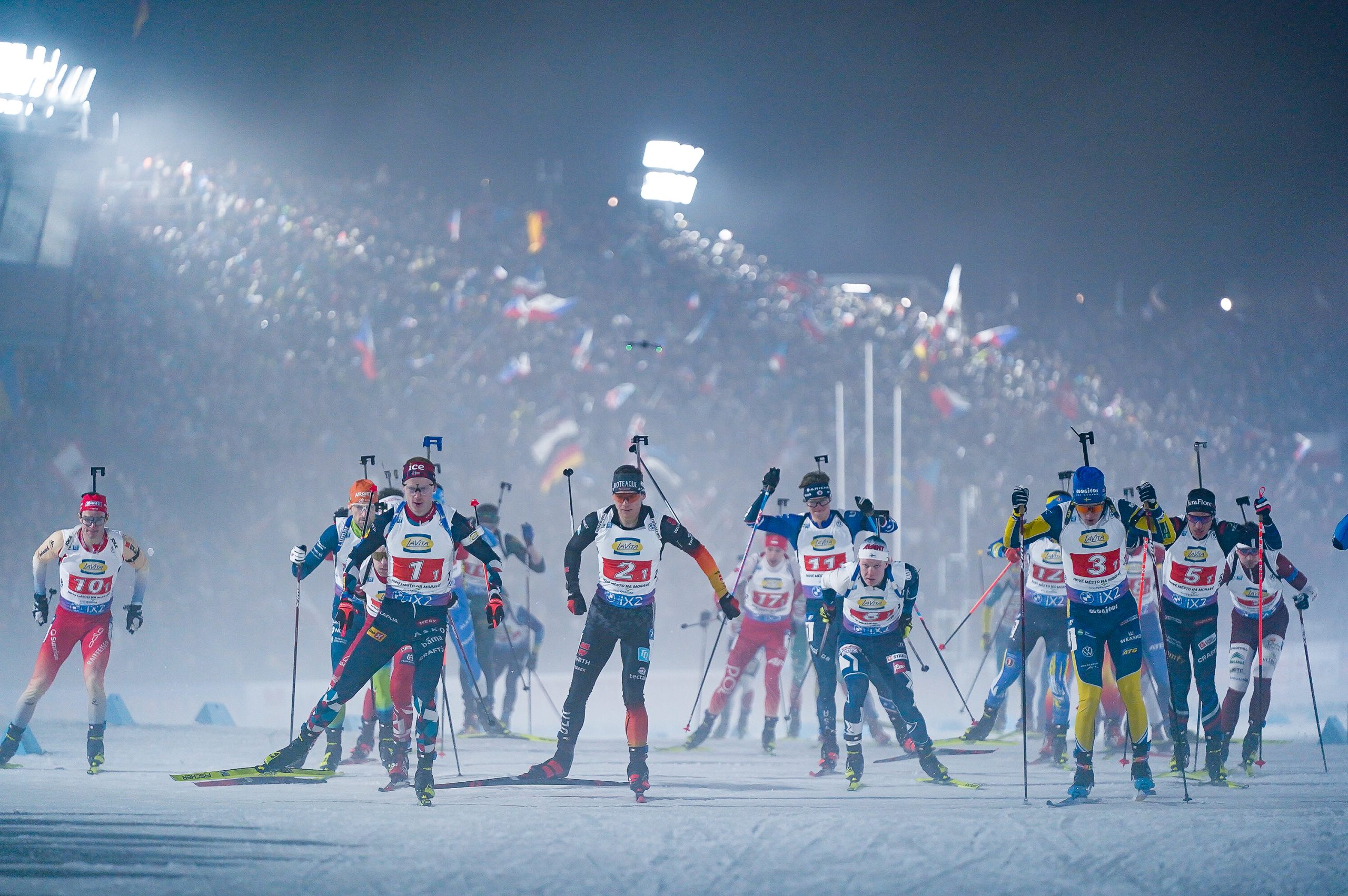
 FasterSkier’s Coverage of the Biathlon World Championships is made possible through the generous support of the Craftsbury Outdoor Center: New England’s finest snowmaking, world class race venues and touring trails, healthy food in abundance, comfortable accommodations at Craftsbury: Sports, Sustainability, Stewardship.