Tag: Livigno

  • Kern and Brennan Combine for 3rd, Sweden and France Win Livigno Team Sprints

    Kern and Brennan Combine for 3rd, Sweden and France Win Livigno Team Sprints

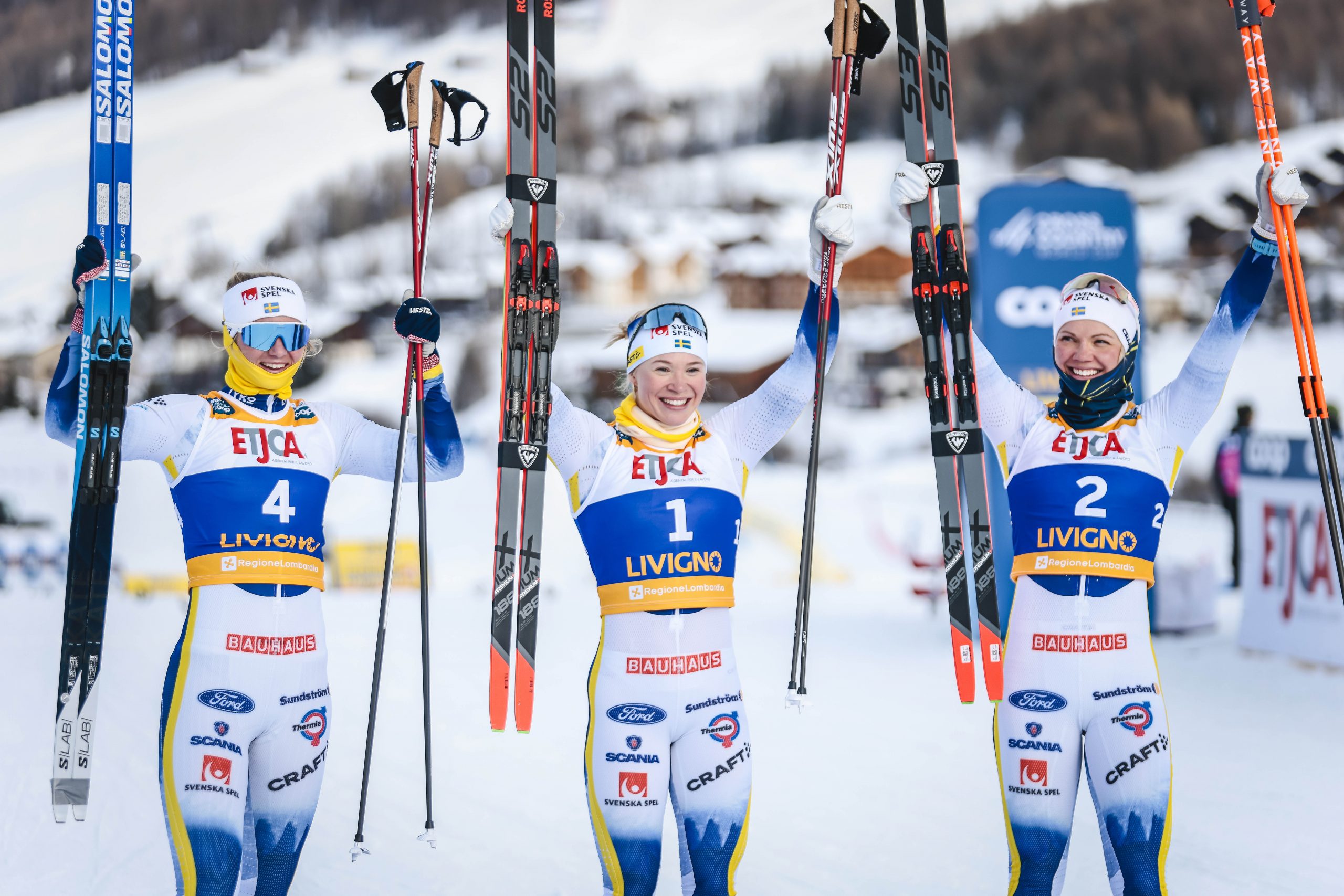
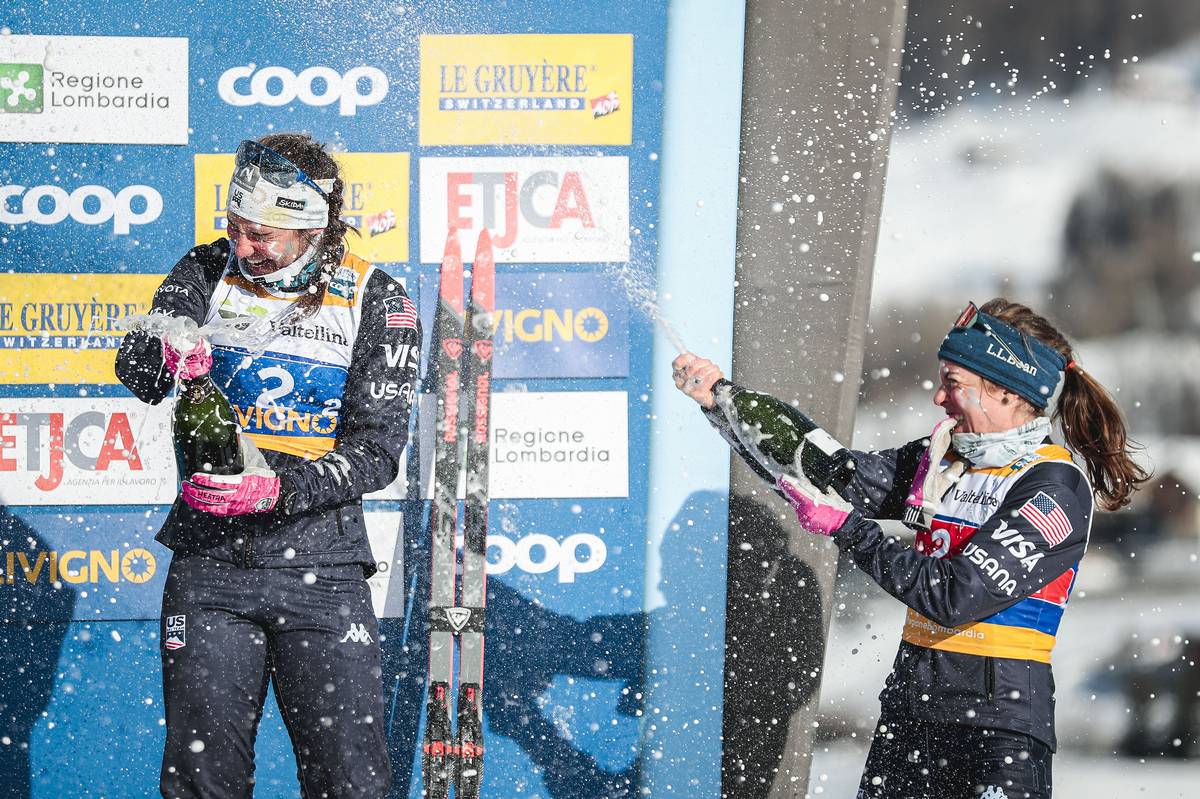
    Julia Kern (USA) and Rosie Brennan (USA) celebrate after a third place finish in Sunday’s Team Sprint. (Photo: Nordic Focus)

    The high alpine valley containing Livigno, Italy is as beautiful and sublime as any place on Earth, seemingly heaven-sent to feature the high drama of the FIS Cross Country World Cup; for the first time, Livigno was hosting World Cup races this weekend.

    That idyllic scene made Sunday’s Team Sprint all the stranger, since so many of the usual players and storylines were absent from the World Cup. As FasterSkier reported on yesterday’s Sprint, many factors affected the participation in Livigno: the staging of Norwegian National Championships, athletes taking planned breaks in their racing schedules, untimely illnesses, Livigno’s daunting elevation  (Livigno sits at an elevation of 6000ft), and upcoming World Championships in Planica, Slovenia. Johannes Hoesflot Klaebo (NOR) had packed his bags and returned to Norway after his victory in Saturday’s individual Sprints. Jessie Diggins (USA) was taking a break from racing to refine her training. The field of U23 athletes had largely abandoned the World Cup in preparation for U23 World Championships in Whistler starting next week.

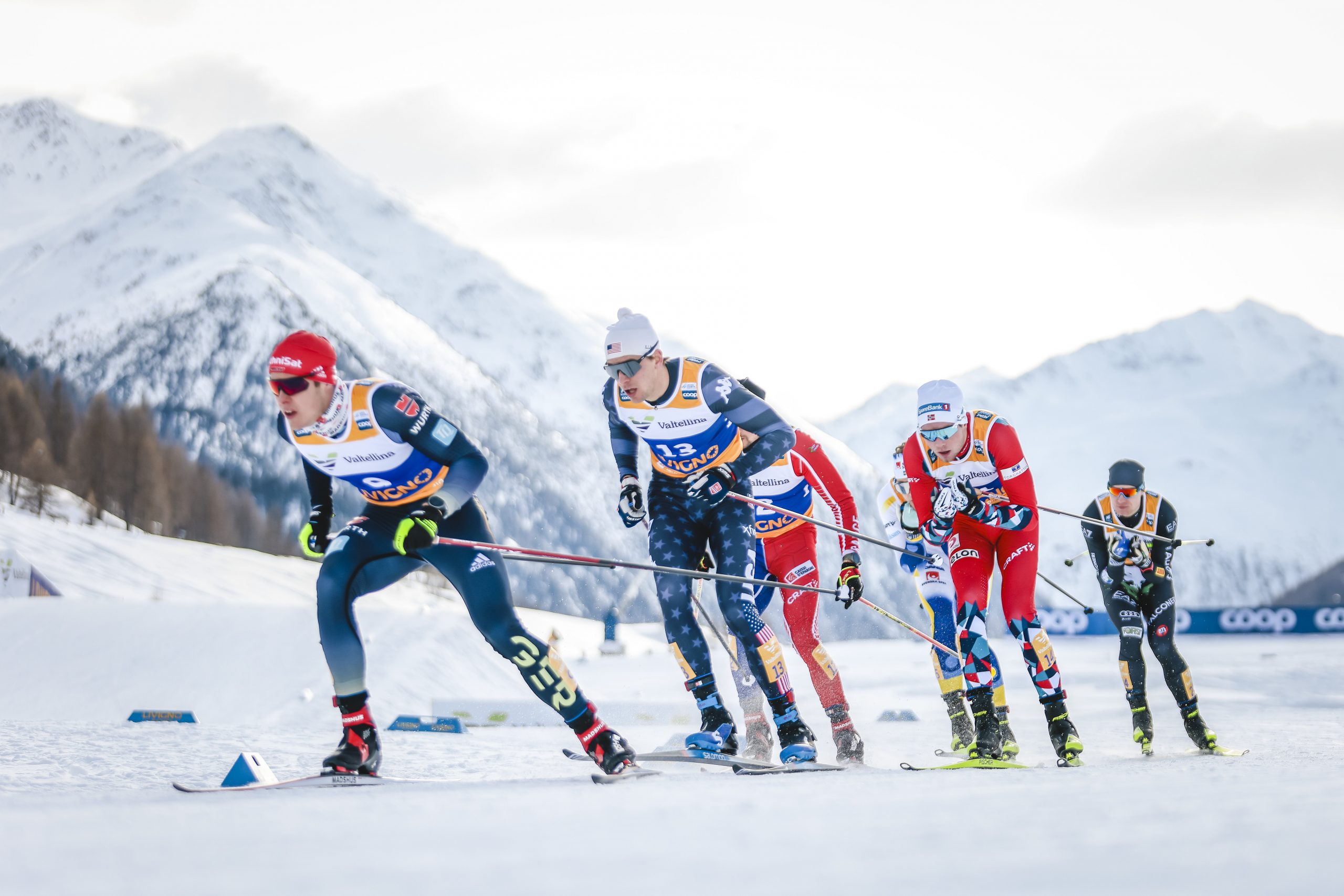
    What was left in Livigno then? Well, the mountains towered, the sun shone down without a cloud in the sky, the snow was good, and the Italian fans were ready. It was, in other words, still a perfect scene for a ski race, and so those who had stayed on the World Cup—along with a few who were making their first appearances in it—gathered for a Skate Team Sprint in which partners skied three legs apiece on a 1.2 k loop around the valley floor.
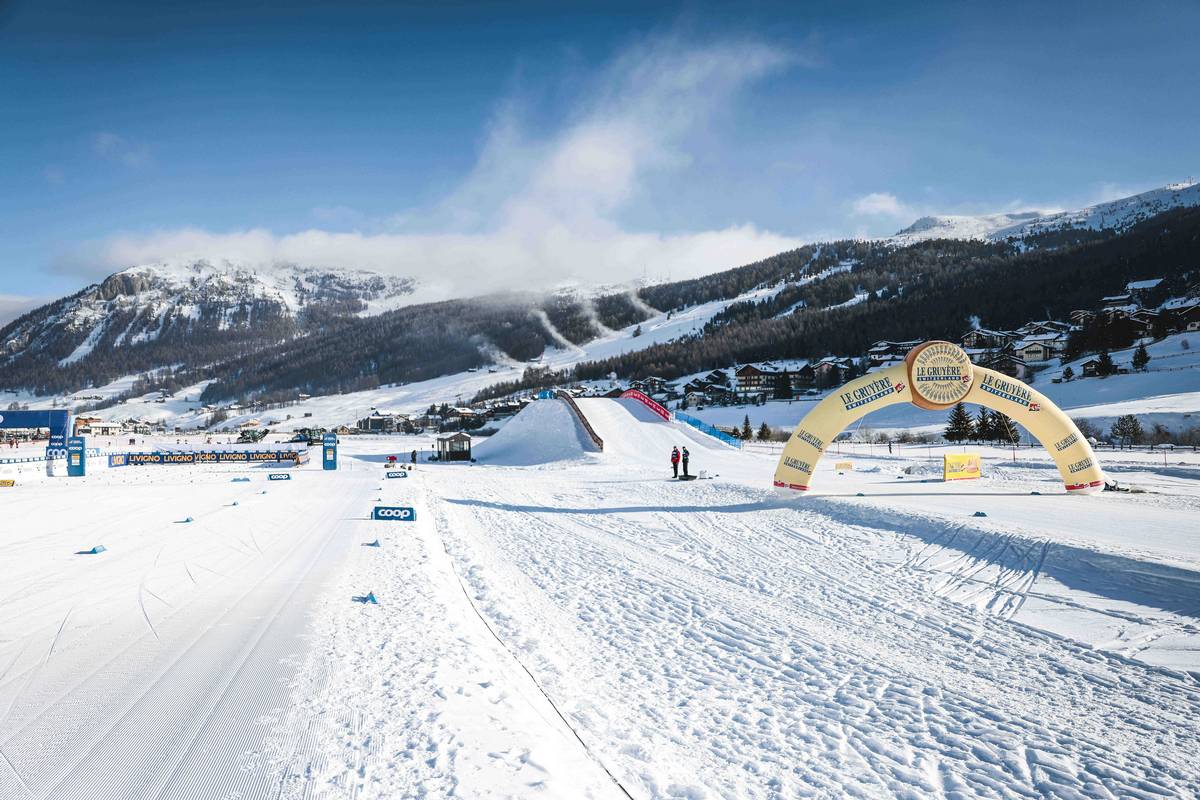
    The Alpine valley of Livigno, Italy hosted its first World Cup this weekend. (Photo: NordicFocus)
    Women’s Race

    In a weekend marked by a lull in the World Cup, there was one glaring irony: the front of the women’s field was marked by top skiers trying to re-establish themselves in the World Cup standings. For all their dominance, it has been a difficult year for the Swedish women’s team. A shoulder injury has kept Linn Svahn out for much of the season, and persistent illnesses have struck Jonna Sundling andEmma Ribom early in the World Cup season. In Livigno, the Swedes were looking for an opportunity to return to high-level competition. In selecting their teams, the Swedes split the Beijing Olympic Team Sprint Silver Medal duo of Maja Dahlqvist and Jonna Sundling, and paired both with new partners. Dahlqvist joined up with Linn Svahn to form Sweden II, and Sundling joined with Emma Ribom to form Sweden I. 
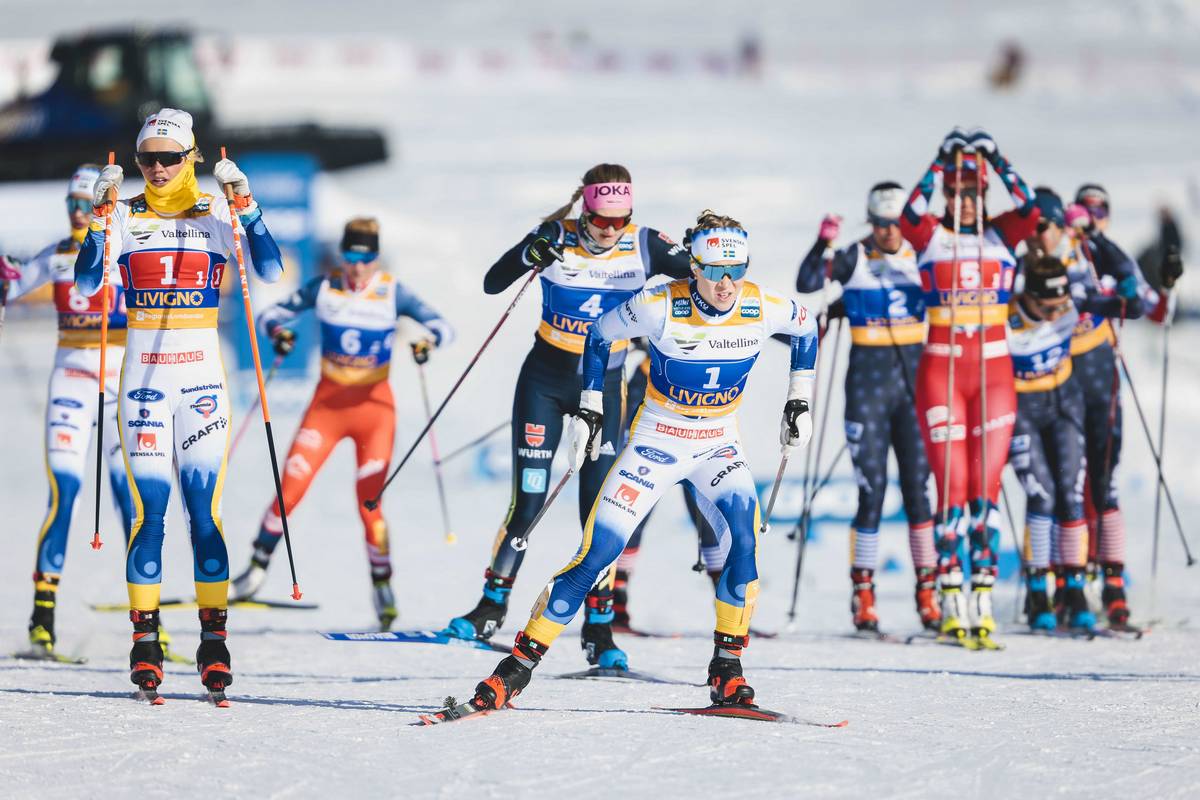
    Jonna Sundling (SWE) heads out from the exchange after the tag from Emma Ribom (SWE). (Photo: NordicFocus)

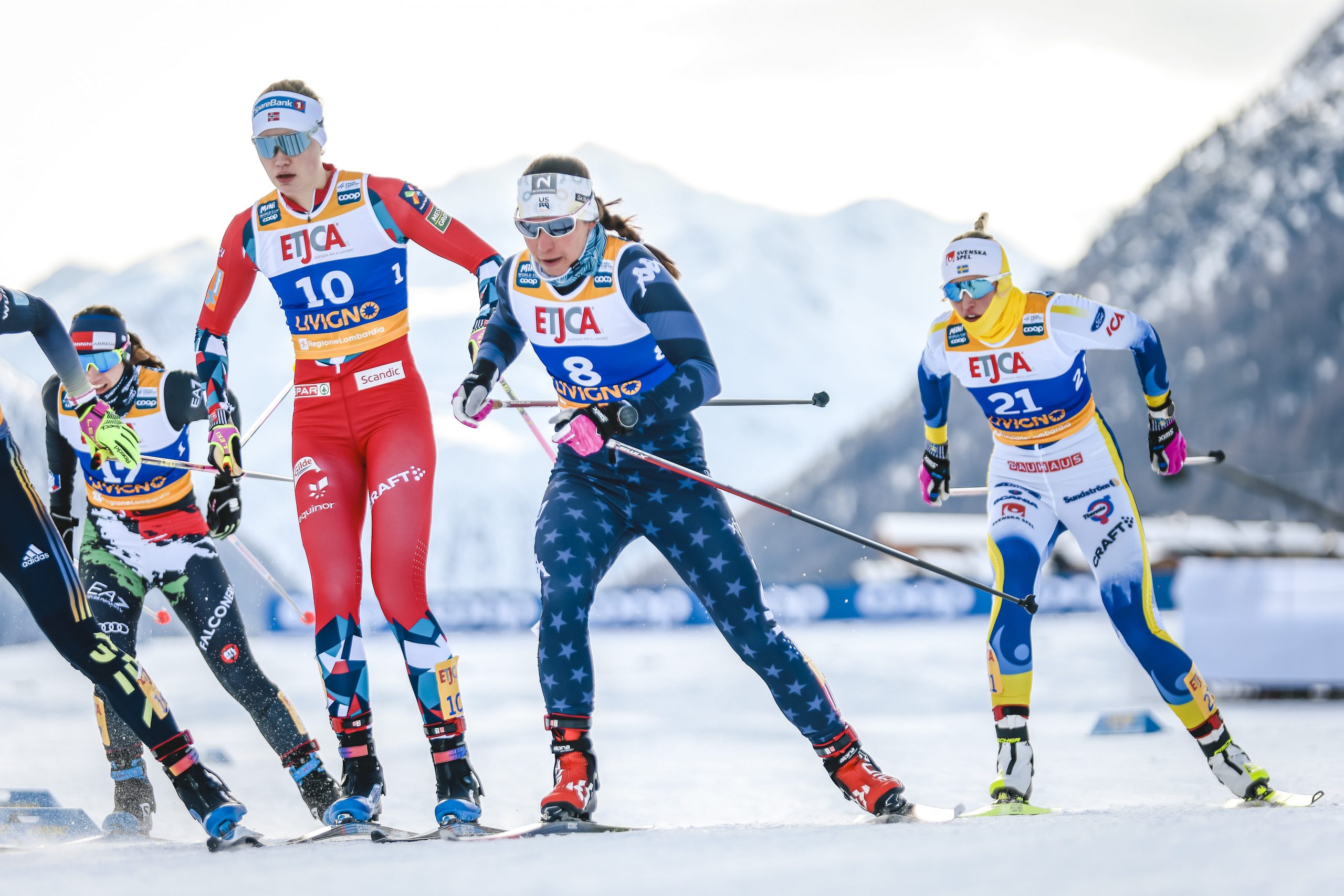
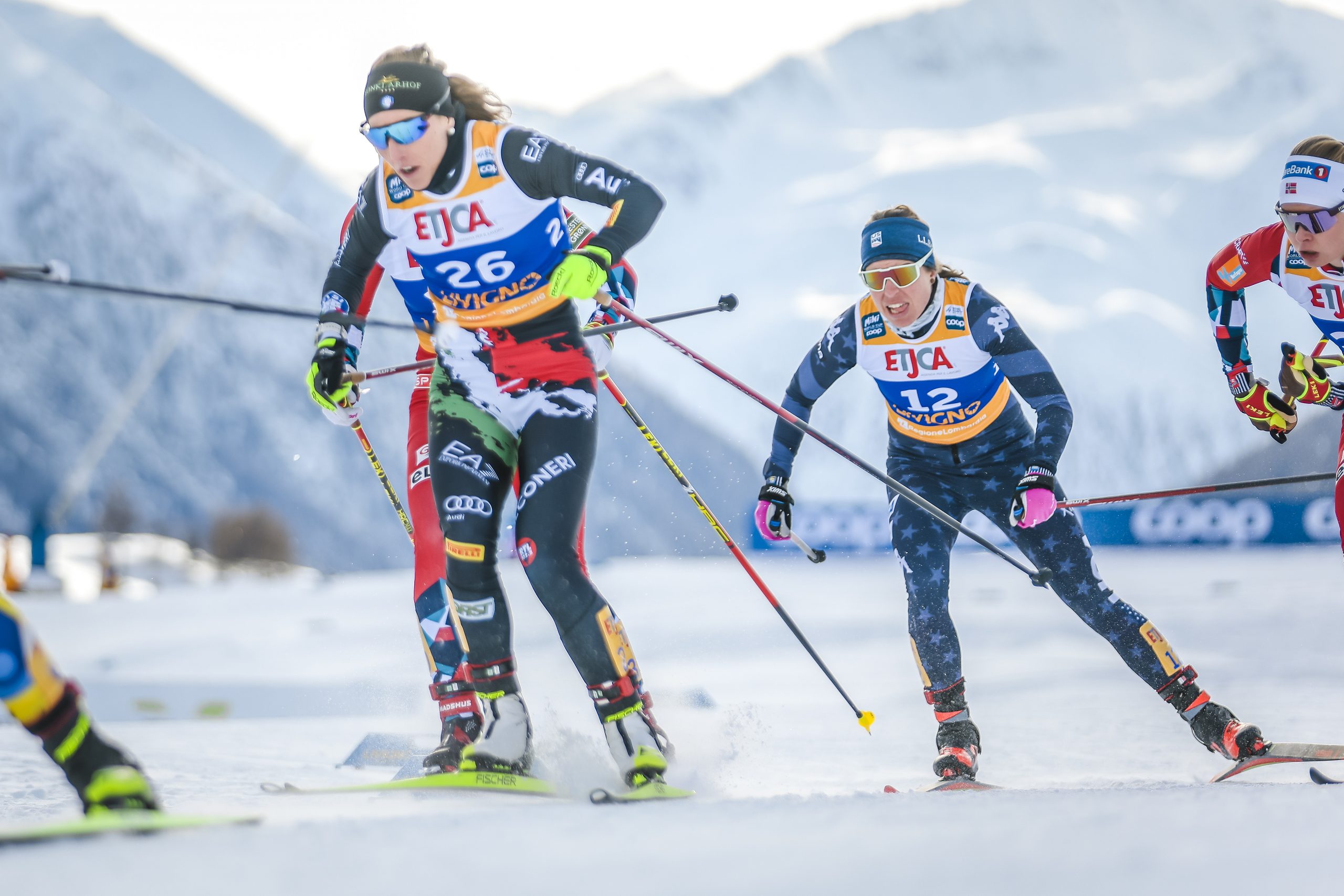
    There was little to separate the field on the relatively flat Livigno course; through most of the race, the field remained largely intact. Out of the third exchange (entering the fourth lap) the Swedish pair of Dahlqvist and Sundling started to up the tempo on their persistent V2. Only two teams followed: Germany and the United States. The United States I team was represented in the move by Julia Kern, who paired up with Rosie Brennan to form a strong unit for the US. The USA II team of Lauren Jortberg and Alayna Sonnesyn were also in the final today, but had not quite bridged the gap to the front pack. Germany was represented by the pairing of Sofie Krehl and Laura Gimmler.

    The pack of four teams—Sweden I, Sweden II, Germany I, and United States I—held through the fifth lap. The move to win was made by Maja Dahlqvist on the only true feature of the course—a short, steep, pitch where she unleashed a powerful V1 that led her to the win over Sundling who sprinted to second place for Sweden I. Behind the pair of Swedish sprinters, Kern had affected the same high-tempo attack for third, and beat out the German anchor skier, Gimmler. 
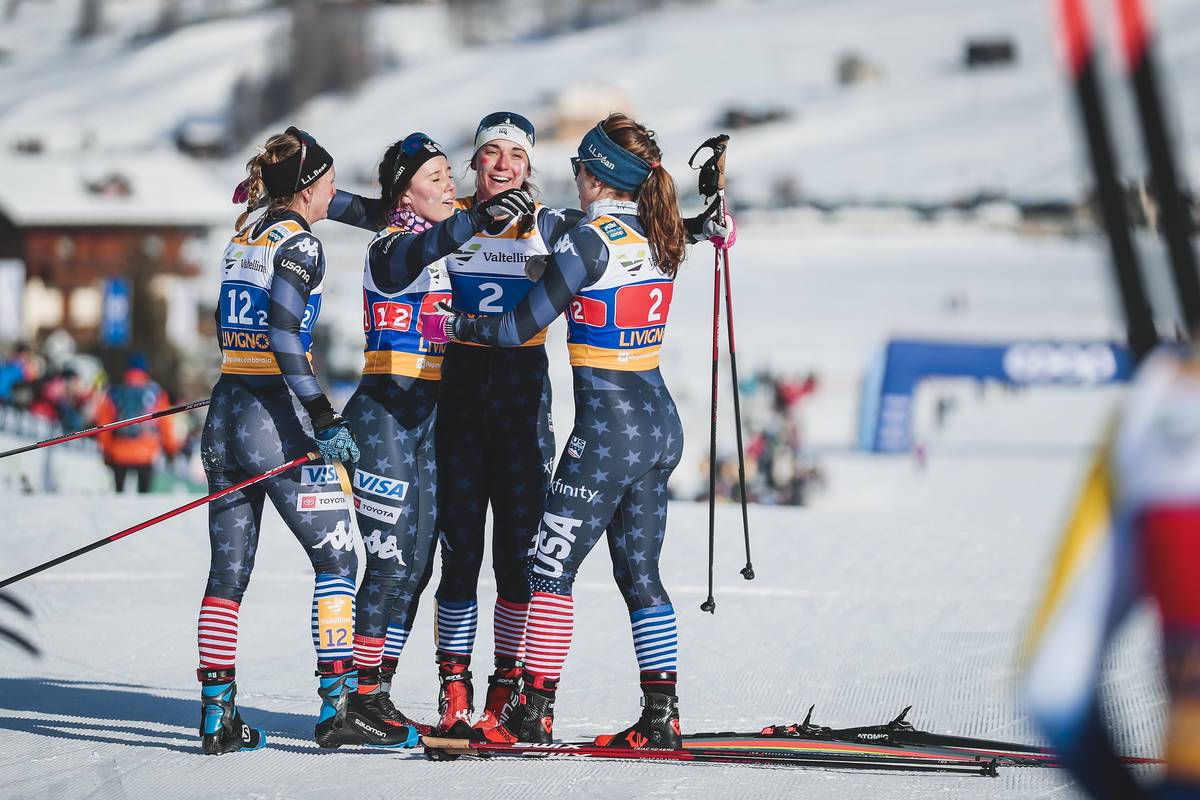
    American women celebrate after United States I—Rosie Brennan and Julia Kern—finished third in Sunday’s Team Sprint. (Photo: NordicFocus)
    Men’s Race

    The unusual scenes of this World Cup brought some welcome novelty, especially for American ski fans, in the Men’s race. A pair of American men even younger than the skiers who are now becoming the familiar faces on the US Ski Team made their World Cup debut in the Individual Sprint yesterday, and paired with more experienced teammates in comprising the Team Sprint duos today. That included Adam Witkowski—a native of upstate New York now skiing for Michigan Tech—who paired with Logan Diekmann to form the United States II team. The team rosters also included Will Koch—the Vermonter and University of Colorado Buffalo—skiing with veteran Kevin Bolger on United States I. United States I advanced to the Final.
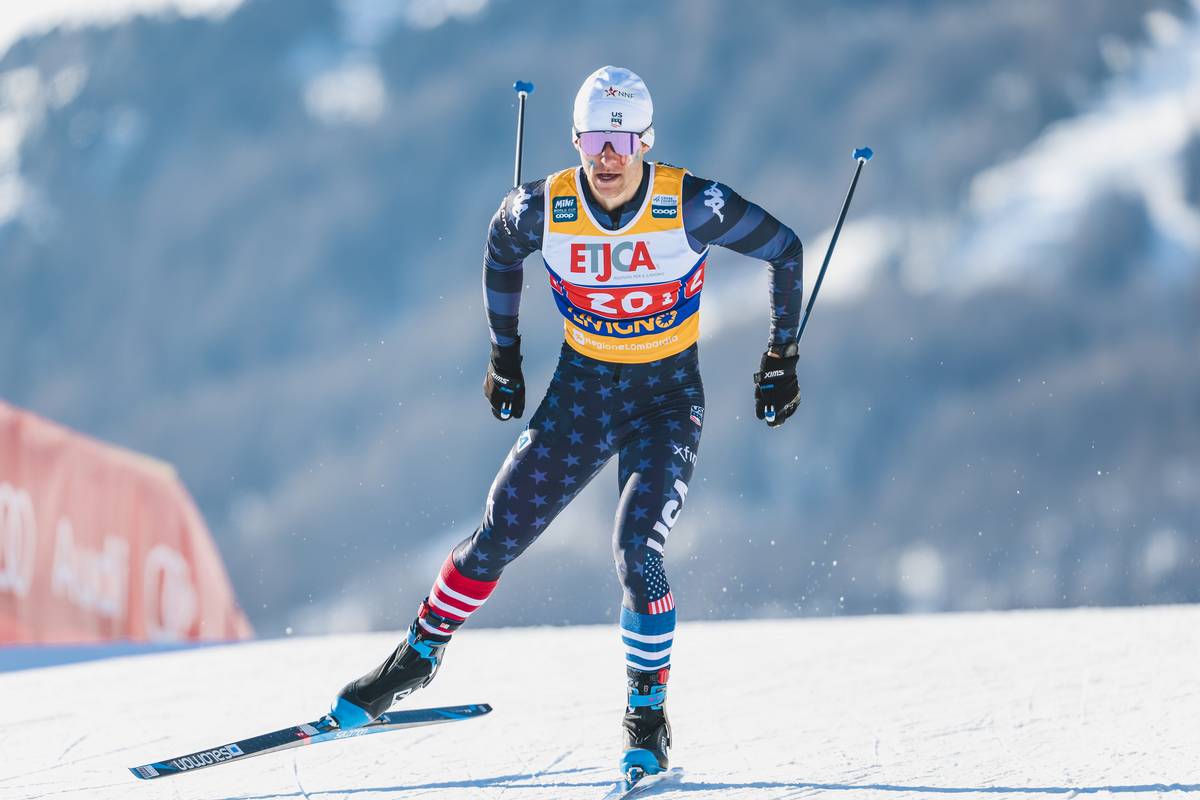
    Adam Witkowski (USA) made his first World Cup starts in Livigno this weekend. Witkowski and Logan Diekmann (USA) combined to form USA II in the Team Sprint. (Photo: NordicFocus)

    Focus on who might win the Men’s race was firmly turned towards those teams hailing from the surrounding Alps. The Italians, on home soil, fielded the strong team of Francesco De Fabiani and anchor Federico Pellegrino. The French, too, fielded reigning Sprint champion Richard Jouve in the anchor leg, paired with Renaud Jay. 

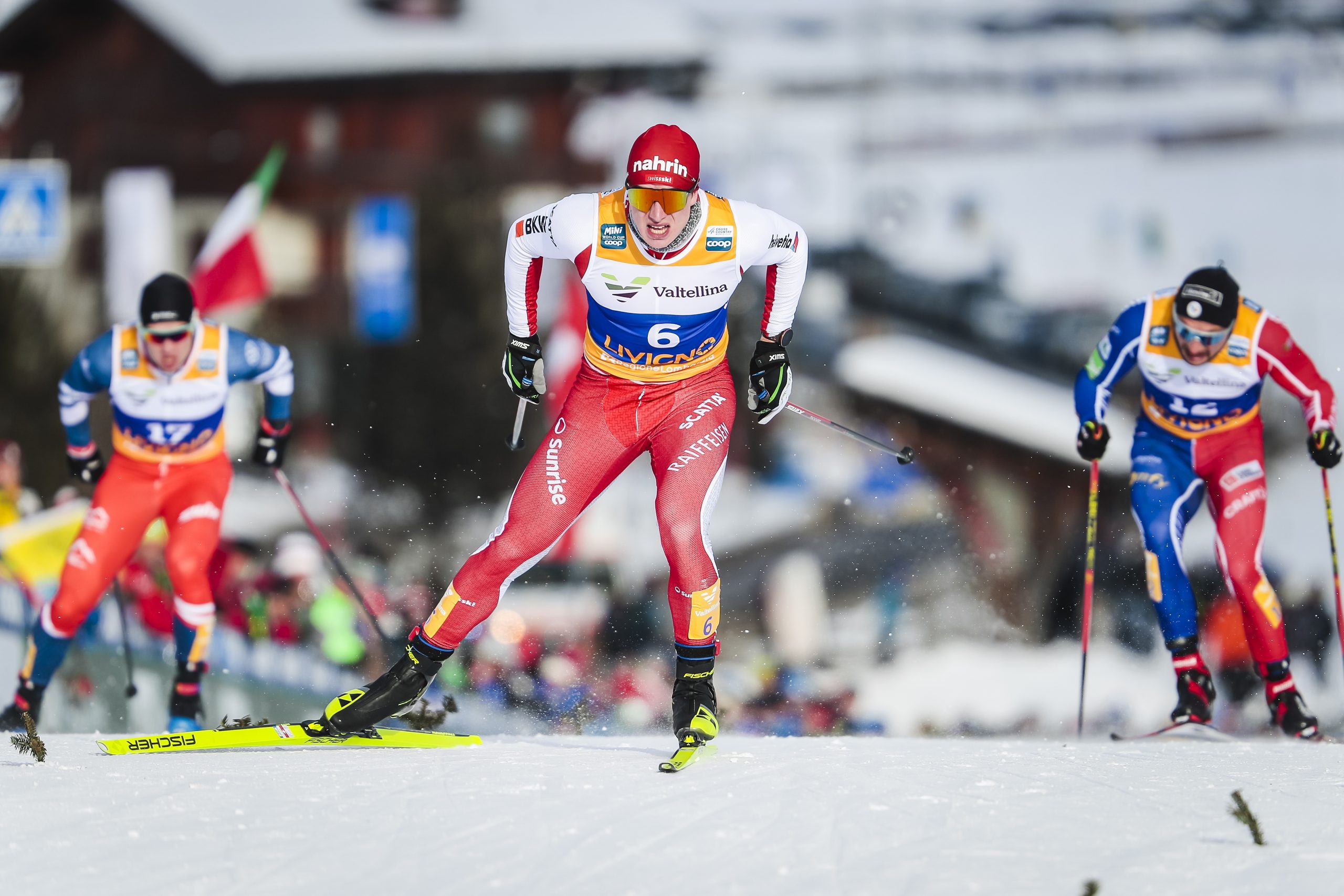
    The men’s field remained tightly woven and tense throughout the course of the six lap race. Skiers looked for a track to gain a place, or test out a high-tempo attack. It wasn’t really until the last leg—the anchor’s anchor leg—that Richard Jouve and Federico Pellegrino moved on the only sharp incline on course and made it a sprint. Jouve gained a slight advantage in doing so, and it was enough to seal the win for France, as Pellegrino brought Italy to a second place finish on the day. Behind the battle for first and second, it was Valerio Grond (SUI) who escaped the pack to earn the bronze with his partner, Janik Riebli (Saturday’s Individual Sprint bronze medallist). 
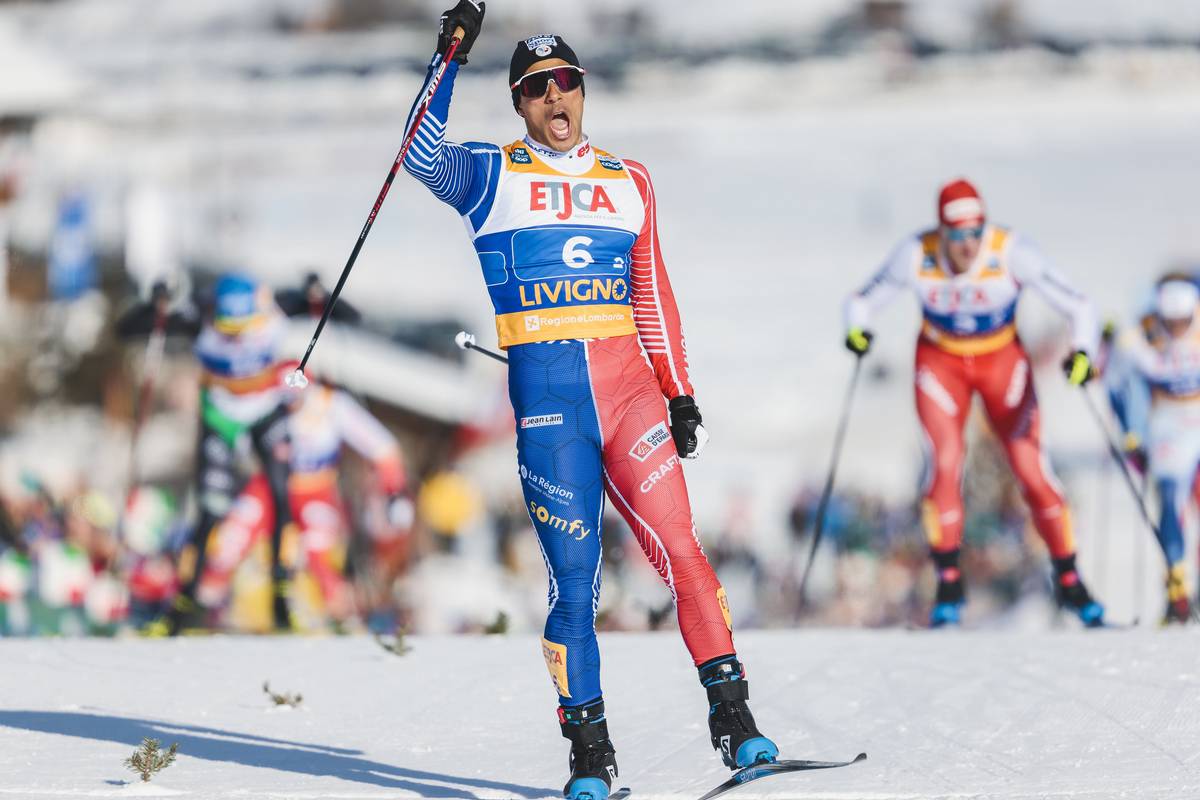
    Richard Jouve (FRA) brings home the win with teammate Renaud Jay (FRA). The French head towards a race on home soil in Les Rousses next weekend. (Photo: NordicFocus)

    The pairing of Koch and Bolger for the United States finished in 12th place on the day, but just 20 seconds off the leaders. The combination of the experienced Bolger alongside the younger Koch underscored the range and depth that the American program has fostered over the past decade. Koch’s first start on the World Cup extends the scope of that accomplishment across time too, as he joins Novie McCabe in being the second generation of his family to have skied on the World Cup for the United States.
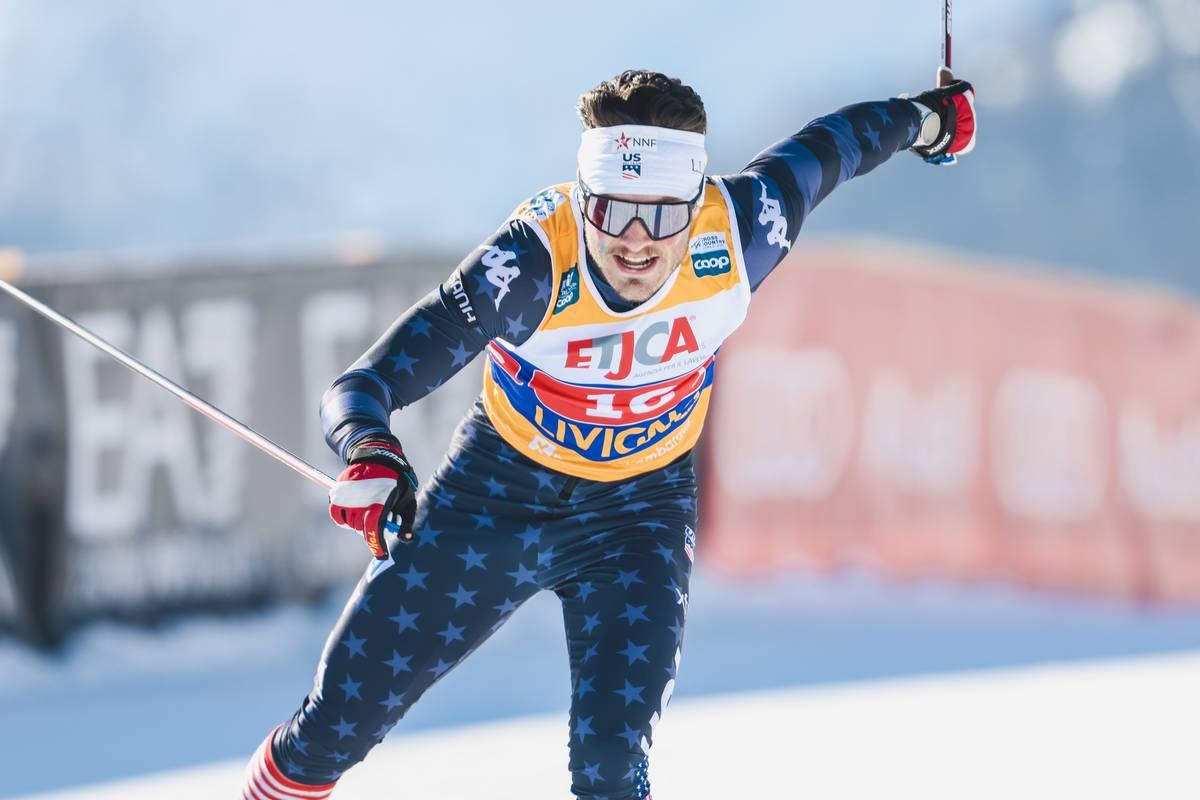
    Will Koch (USA) teamed with Kevin Bolger (USA) in Sunday’s Team Sprint. (Photo: NordicFocus)
    On to Les Rousses

    With familiar pieces of the World Cup scattered to the winds during this weekend in Livigno, perhaps the biggest story going forward is just who might be on the start line next weekend when the World Cup travels from Italy to France. The French will finally be able to host a World Cup in Les Rousses after Covid restrictions and insufficient snow coverage forced cancellation two years ago. It’s a reminder that the World Cup is subject to the whims of life, weather, sickness, and all else. There’s never absolute certainty, which only heightens the experience when the sun is shining, the snow is plentiful, and the best athletes in the world converge to ski race for ski racing’s sake.
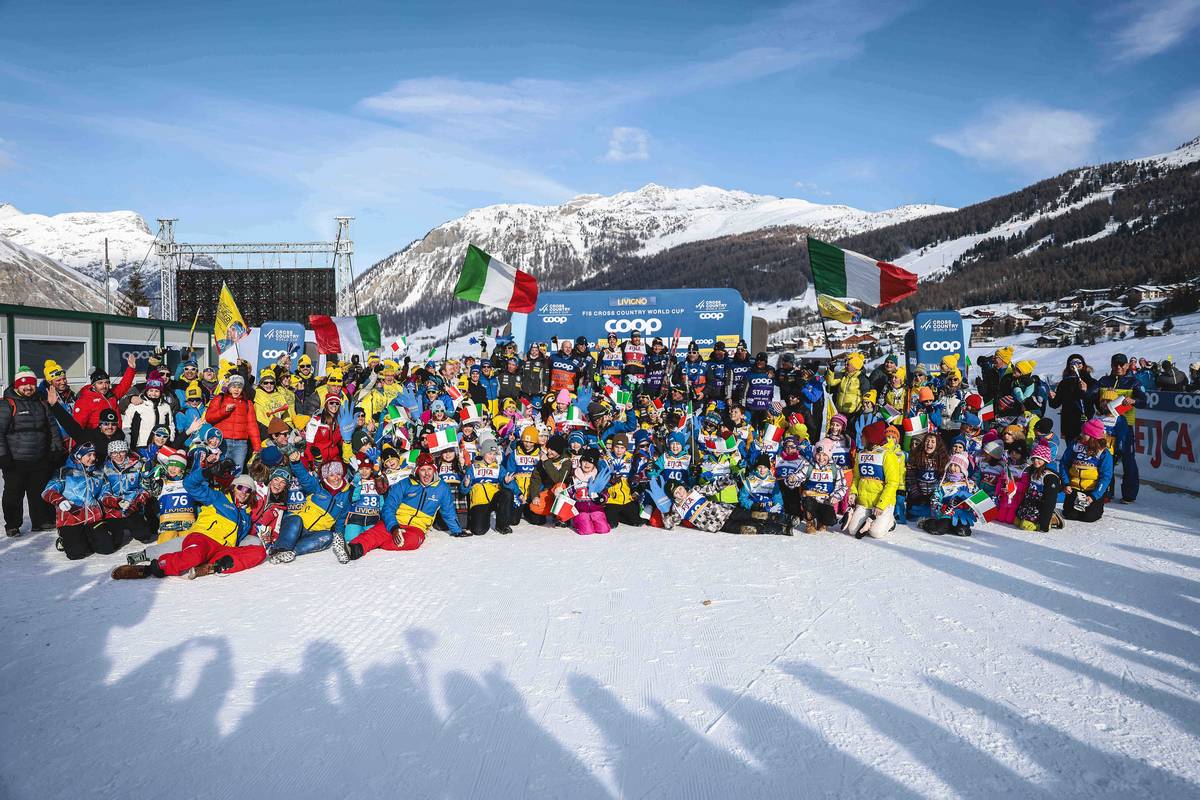
    The Italians celebrate a successful World Cup weekend in Livigno, Italy. (Photo: NordicFocus).
    Full Results from Sunday’s Team Sprint

    Women

    Men

  • Swedes Sweep Podium in Livigno Freestyle Sprints.  No One Can Stop Klaebo

    Swedes Sweep Podium in Livigno Freestyle Sprints. No One Can Stop Klaebo

    This World Cup coverage is made possible through the generous support of Marty and Kathy Hall and A Hall Mark of Excellence  Award.  To learn more about A Hall Mark of Excellence Award, or to learn how you can support FasterSkier’s coverage, please contact info@fasterskier.com.
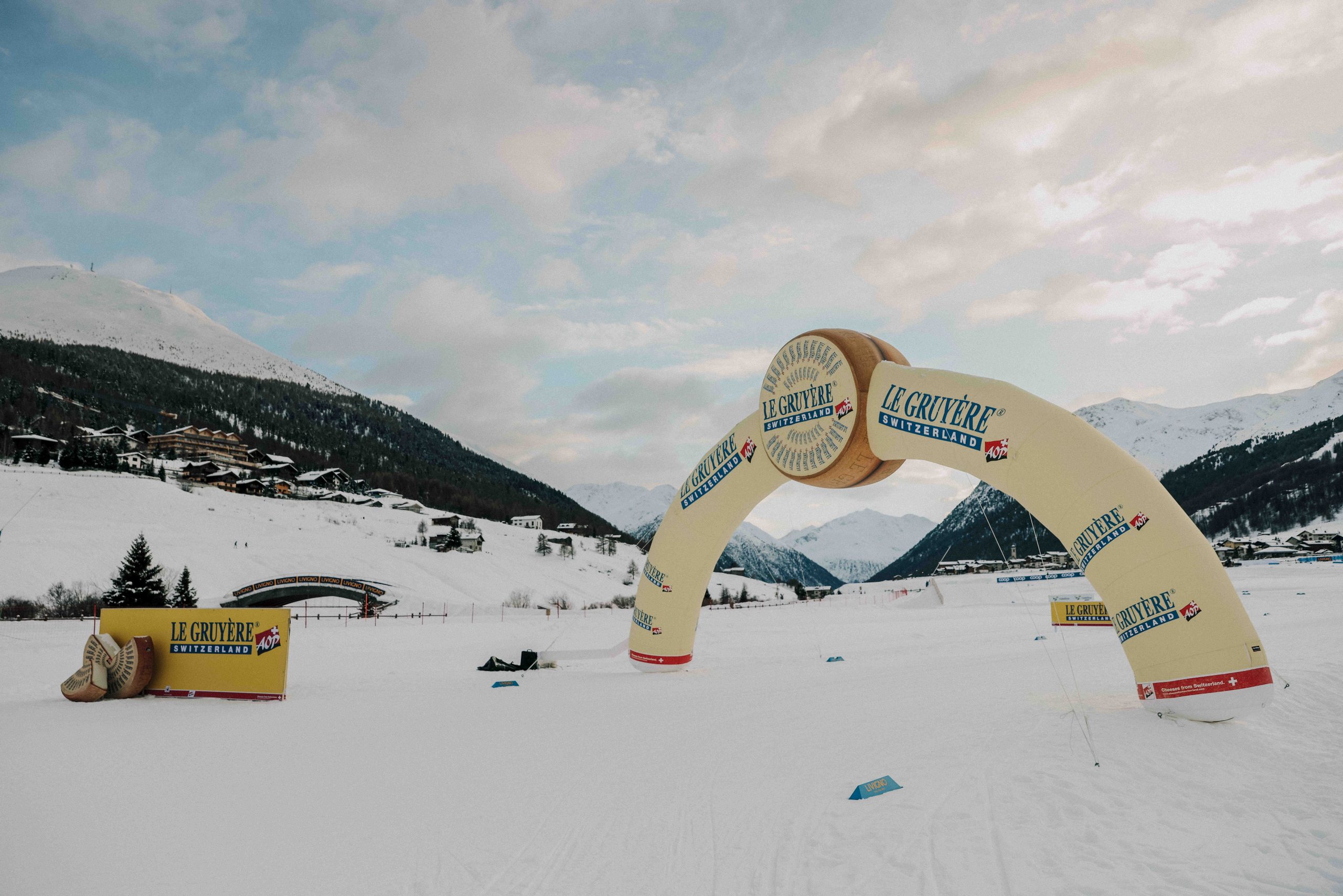
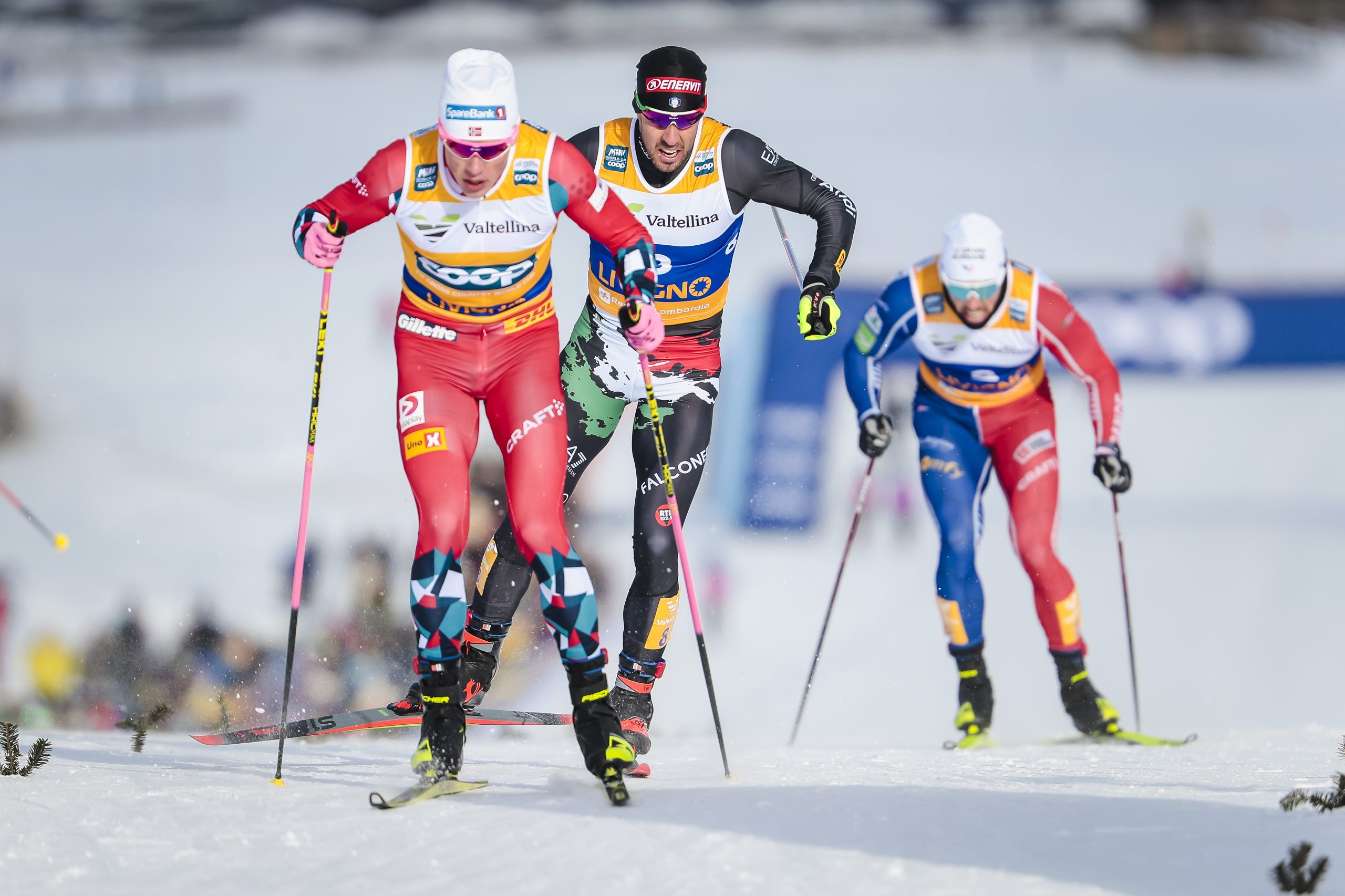
    After taking a weekend off to recover from the grueling Tour de Ski, the World Cup returned to its traditional format this weekend. Today, in Livigno, Italy, the freestyle sprints were contested. It’s the first time Livigno has hosted a World Cup event. Livigno sits just below 6,000 feet, which would press the FIS (International Ski Federation) rules on altitude.

    The pleasant sight of natural snow welcomed racers in Livigno, Italy. (Photo: NordicFocus)

    The storyline on the men’s side should have been straight forward:  Would Johannes Klaebo (NOR) continue his season, and career long, sprint domination? Over half of Klaebo’s individual World Cup victories have been in sprints, and he is riding a very hot hand having won nine out of ten of the last sprints he’s competed in. The primary threat to Klaebo was likely to come from Lucas Chanavat (FRA) who is currently second in the sprint rankings. Also hoping to topple Klaebo were Richard Jouve (FRA), and Federico Pellegrino (ITA). Pellegrino would have the benefit of being able to draw support from his home country’s fans. Pellegrino beat Klaebo in a shocking outcome in Davos, back in the middle of December. While a strong sprinter, Jouve’s strength is in the classic technique sprint.

    Johannes Klaebo (NOR) on the way to another sprint victory. (Photo: NordicFocus)

    Klaebo is in a pitched battle with countryman Paal Golberg (NOR) for the overall cup standings. While Golberg doesn’t usually have Klaebo’s sprint prowess, (he is fifth overall in the sprints), he would need a strong performance to keep him in the overall cup hunt.

    However, the narrative became scrambled due to a schedule conflict with the Norwegian national championships. This led to Paal Golberg racing Thursday in Gjovik, Norway and then heading over to Italy for the weekend. Other men pulled double duty racing both the Norwegian championships and the World cup, including Erik Valnes and Even Northug. Valnes ended up winning his country’s sprint championship. It remained to be seen what effect the extra racing would have on Golberg and the others. Klaebo did not race in the Norwegian Championships.

    The U.S. side of the men’s sprint story was also dominated by who was absent. Going into the race, Ben Ogden was in seventh place in the sprint standings (ninth overall). However, Ogden did not race today. U.S. coach Matt Whitcomb told FasterSkier that the time off was planned for Ogden. Also not racing today to prepare for the world U-23 championships were J.C. Schoonmaker (University of Alasaka-Anchorage), and Gus Schumacher (Alaska Winter Stars)

    On the Women’s side, the biggest story again was who wasn’t racing. There were only 38 women who competed in the qualifying round. A morning of racing for the qualifiers was spent eliminating only 8 skiers. This should be a point of concern for FIS.  Whitcomb shared the concern about depth of competition. “There’s a lot of stress coming up to altitude, and racing a sprint without being acclimated, and there’s a lot of pressure to race at [Norwegian] nationals. You really have to choose your battles.” The scheduling is far from ideal.  Whitcomb noted that he is concerned with the depth, particularly of the women’s field. “One of the big issues is that it doesn’t make a lot of physiological sense when preparing for World Championships to go up to altitude for four days…and then come down.” He noted that it’s a problem that needs fixing.

    Many of the top Norwegian women also chose to race the Norwegian championships or skipped Livigno. Tiril Udnes Weng, Heidi Weng, Lotta Udnes Weng, Ragnhild Haga, Helene Fossesholm, and Ingvild Flugstad Oestberg all chose to skip Italy. Frida Karlsson (SWE) also did not race today.

    Emma Ribom (SWE) had dominated the sprints early in the season, but a bout with Covid may have prevented her from achieving similar successes lately. It remained to be seen whether she could regain her early season form. Today would also be a return to World Cup racing for Linn Svahn (SWE) who has had an extended absence from the World Cup due to injury.

    The start list shuffling left the door wide open for American Julia Kern, who has been having an impressive sprint season. She is currently sixth in the sprint standings.  Going into the race, third through sixth overall were only separated by 56 points. Given the sparse starting field, Kern had the opportunity to gain significant ground.

    Julia Kern (USA) raced her way into a World Cup sprint final for the first time this season. (Photo: NordicFocus)

    Jessie Diggins is fourth in the overall cup standings, only 15 points behind Kerttu Niskanen (FIN) who sits in third. But Diggins joined the long list of women not racing today. It was a strategic decision for Diggins who chose to prioritize rest prior to the World Championships over chasing World Cup points. U.S. coach Matt Whitcomb told FasterSkier that “Jessie’s doing great.  She had a great training camp in Seefeld and stayed there with a bunch of athletes…because we knew she needed a break it was going to be either this weekend or Les Rousses, France [next weekend’s World Cup race].  Whitcomb continued that “The focus is now on World Championships, much more than points.”

    Also not racing was U.S. National’s champion Hailey Swirbul. Swirbul won every race two weekends ago in Houghton, MI and had expected to race this weekend. However, Whitcomb informed FasterSkier that Swirbul had gotten sick almost immediately after arriving in Europe.  “She’ll head straight to Les Rousses as soon as she is feeling good.”

    Going into the race, Rosie Brennan was sixth in the overall standings, and she would be trying to help her cause by gaining points in the sprint. Brennan has had her ups and downs in sprints this year. She’s made the finals in Davos but has also had her difficulties. She seems to have put her early season illness behind her, so hopes would be riding high for the Alaskan.

    An all Sweden podium in Livigno (l-r : Maja Dahlqvist, Jonna Sundling, Emma Ribom) (Photo: NordicFocus).
    The Results

    It ended up being team Sweden dominating the Livigno podium. Finishing first was Jonna Sundling (SWE), followed by Maja Dahlqvist (SWE), and Emma Ribom (SWE).  The top American women were Julia Kern, who finished sixth, and Rosie Brennan in 11th.

    Other American finishers were Alayna Sonnesyn, 24th, and Lauren Jortberg, 29th.

    On the Men’s side the Klaebo train continued to chug along as he beat out Richard Jouve in a close finals race.  In third place was a surprising Janik Riebli (SUI).

    Janik Riebli (SUI) on the way to a podium performance (Photo: NordicFocus)

    The top American male was Kevin Bolger, 12th.  He was followed by Logan Diekmann, 38th,  Will Koch, 41st, and Adam Witkowski 42nd.

    The Race

    In the women’s heats Brennan went in having qualified in 12th spot. She skied her quarterfinal heat strategically, sitting in fourth most of the way. She ultimately finished third in her heat and would have to wait for a lucky loser spot. She was rewarded for her work and ultimately advanced via the lucky loser route.

    Kern skied very controlled in her quarterfinal and pushed herself to the front of the pack taking the lead with about 30 seconds to go and cruised comfortably to finish first.

    Julia Kern navigating through the field on the way to the finals in Livigno. (Photo: NordicFocus)

    Alayna Sonnesyn was not able to advance out of her heat.

    Brennan and Kern both raced in the second semi-final. Brennan pushed immediately from the start setting a fast early pace. However, she was unable to hold the quick tempo and was passed about halfway through the race.  Kern took an alternative strategy holding back early and then pushing to the front in the final half. Kern ended up second to advance to the finals. Brennan’s strategy of going out hard did not work for her as she continued to fade through the race and ended up last in her heat.

    “I took a chance in my semi to ski a bit more aggressively and unfortunately, I completely ran out of power on the long uphill finish.”           Rosie Brennan.

    Rosie Brennan (USA) (number 12) gave it everything she had in the heats, but ultimately ran out of steam. (Photo: NordicFocus)

    The difference in approach was based upon what the racers experienced in the quarterfinals. Whitcomb said that “Julia felt like she was knocked around a little out of the start…there’s always a risk when you’re playing your cards from fifth or sixth.  We wanted her in the semifinal to be in a [higher position], so she had less traffic to deal with.”  Regarding Brennan, Whitcomb said that “People drafted by her, and she kind of ran out of energy.”

    On the men’s side, Klaebo—who qualified with the fastest time—comfortably won his quarterfinal. Jouve, Chanavat, and Pellegrino also advanced comfortably.

    The only American man to qualify for the heats was Kevin Bolger. He skied a very efficient quarterfinal and ended up winning his heat.

    In the men’s first semifinal it was Klaebo and Jouve taking first and second.  In Bolger’s semifinal he went to the front from the start. With most of the pre-race favorites going in the first heat, it was a good strategy.  But just like with Brennan, he faded toward the finish and ended up finishing last in his semifinal.

    Kevin Bolger  (USA) (number 13) would have an outstanding day in Livigno, finishing 12th. (Photo: NordicFocus)

    In the finals, the only American left was Julia Kern. She held back toward the rear of the pack at the start with four Swedes out front.  Faehndrich tried to meticulously worked her way through the crowd of Swedes, but was unable to join the front grouping. Kern was never able to find the speed to challenge and ended up sixth. It was still her best sprint result of the year. At the end of the day, It was all Sweden with Sundling, Dahlqvist, and Ribom going 1-2-3.

    In the men’s final Klaebo held back at the start sitting in fifth place, and then easily moved himself to the front about a minute into the race.  He then asserted himself at the front, content to let others try to find a way around him. At the finish Klaebo turned on the afterburners and was able to just beat out Jouve at the finish line. It was a close finish, but at the end of the day no one had solved the puzzle of how to beat Klaebo in a sprint race. Not bad for a guy who pulled into the venue the night before the race.

    An interesting byproduct of the scheduling was the U.S. and Norwegian teams shared wax facilities this weekend. Whitcomb said that, “Because Norway kept so much of its infrastructure in Norway because of the nationals, they needed some help. It was a great opportunity to partner up…we had the Norwegians in our truck today.”  It turned out that Klaebo’s skis were waxed in the American truck by Norwegian technicians.  Whitcomb emphasized the value of sharing ideas and was excited about the partnership. The teams have a history of helping each other when one needs help. In addition to sharing physical space, the teams shared testing data as well. “We have a great relationship with the Norwegian team…I’m very proud of our small staff’s ability to plug in with the Norwegians and figure out a seamless working machine.  It was a great team accomplishment.”

    FULL RESULTS


  • Saturday Rundown: Lillehammer, Östersund & West Yellowstone (Updated x 4)

    Saturday Rundown: Lillehammer, Östersund & West Yellowstone (Updated x 4)

    Jessie Diggins (U.S. Ski Team) won the second individual World Cup of her career on Saturday in the women's 5 k freestyle in Lillehammer, Norway, beating four Norwegians by 4.8 seconds or more. (Photo: USSA Nordic/Twitter)
    Jessie Diggins (U.S. Ski Team) won the second individual World Cup of her career on Saturday in the women’s 5 k freestyle in Lillehammer, Norway, beating four Norwegians by 4.8 seconds or more. (Photo: USSA Nordic/Twitter)

    Welcome to The Rundown, your quick primer of need-to-know information about the day’s racing. We’ll be updating this digest as the day goes on with additional results, photos and quotes. The Rundown is NOT a race report; stay tuned for complete race reports later today with interviews from the day’s top racers.

    ***

    U.S. SuperTour opener in West Yellowstone: Freestyle sprints

    [UPDATE] The U.S. domestic season opened in West Yellowstone, Mont., with 1.3-kilometer freestyles on Saturday, and Matt Gelso and Jennie Bender emerged as the day’s winners.

    Gelso, of the Sun Valley Ski Education Foundation (SVSEF) Gold Team, won the men’s final, and two Alaska Pacific University (APU) skiers, Tyler Kornfield and Reese Hanneman, joined him on the podium in second and third, respectively.

    In the women’s final, Bender, of the Bridger Ski Foundation (BSF), held off Stratton Mountain School (SMS) T2 teammates Erika Flowers and Anne Hart, who placed second and third, respectively.

    Results: Qualifier | Women’s Final | Men’s Final

    ***

    IBU World Cup in Östersund: 7.5/10 k sprints

    [UPDATE] Americans Lowell Bailey and Susan Dunklee led their teams in 13th and 27th, respectively, and five North American men and four women finished in the top 60 of Saturday’s sprint to qualify for Sunday’s pursuits in Östersund, Sweden. Oh, and France’s Martin Fourcade won his third-straight race (in as many races this season) and his second individual race for his 51st career victory. France made it a double with Marie Dorin Habert winning the women’s sprint.

    Men’s report | Women’s report

    ***

    FIS Cross-Country World Cup in Lillehammer: 5/10 k classic

    Women’s report | Men’s report

    There aren’t many 5-kilometer skate races on the World Cup schedule. But when they do come around, Jessie Diggins makes sure to capitalize.

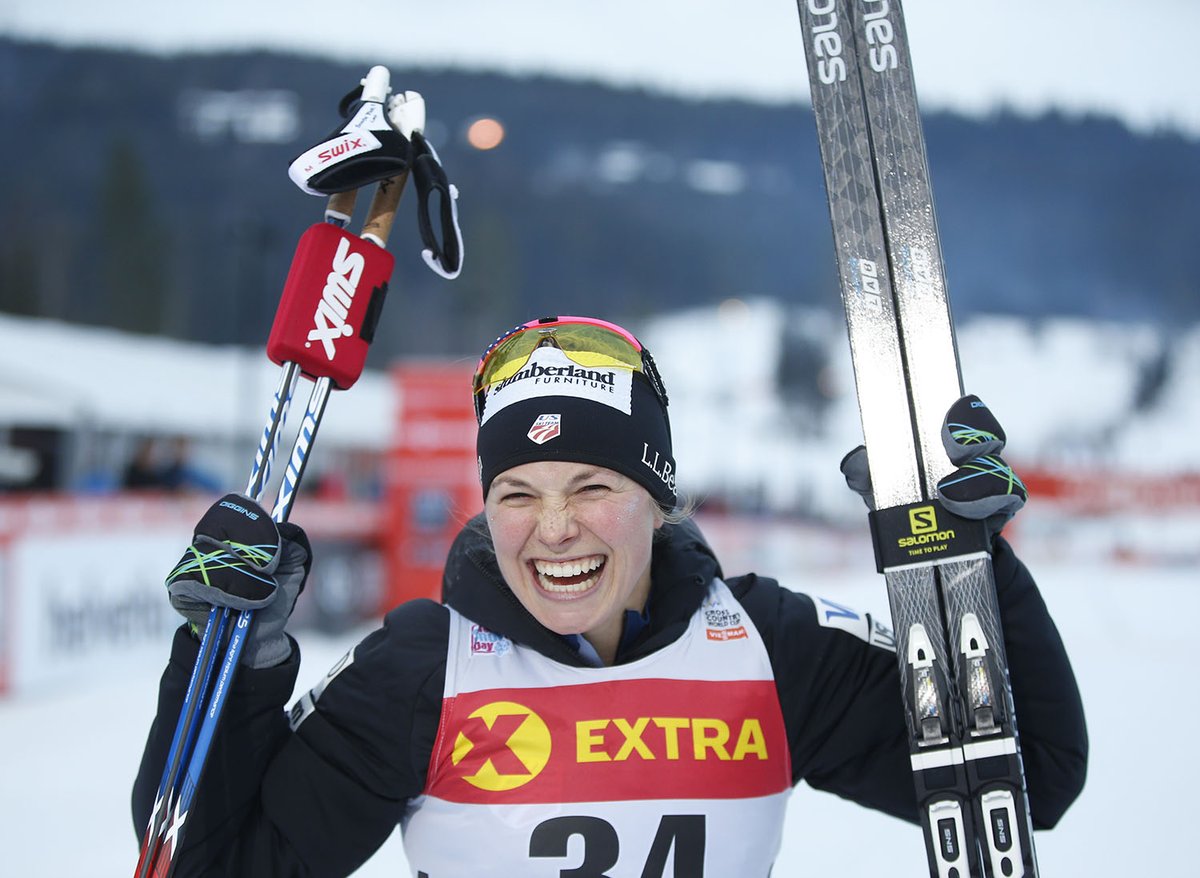
    The 25-year-old U.S. Ski Team member and Minnesota native rocketed to the second victory of her World Cup career on Saturday, winning the women’s 5 k freestyle in Lillehammer, Norway, in 12:40.3 minutes and by nearly 5 seconds ahead of anyone else.

    After winning her first individual World Cup last season in a 5 k freestyle in Toblach, Italy (then reaching the podium three more times in individual races through March 2016), Diggins achieved her first podium of the season in the fourth race of 2016/2017.

    She started 34th of 76 finishers, with top-dog Norwegians like Heidi Weng (who won Friday’s classic sprint) and Marit Bjørgen behind her. Diggins trailed slightly at the first 0.8 k checkpoint, but she drew the race’s attention at 2.2 k, where she overtook Norwegian Astrid Uhrenholdt Jacobsen’s time by 2.1 seconds. At the finish, Diggins bumped Jacobsen out of the leader’s chair by 16.4 seconds, and the American would sit in that seat for the rest of the day.

    Except she didn’t sit much. Diggins chatted with teammates and team staff, smiled and waved at cameras, and bustled about the finishing area. After her closest challenging, Weng in bib 60, finished 4.8 seconds off her time in second place, Diggins knew she had done it. Bjørgen had already finished and was third (+15.8), Jacobsen fourth (+16.4), and yet another Norwegian, Ingvild Flugstad Østberg fifth (+17.2).

    She hugged Weng and told her she had a great race at the finish.

    “Before I started, I knew it!” Weng said to her of Diggins’s win.

    Diggins smiled, and later stood on the podium between Weng and Bjørgen.

    “I’m so happy with my day today. I’m so lucky to have the most amazing team,” Diggins said in a televised interview with FIS. “When you get to train with such cool people, that belief, that confidence, it opens up opportunities. And I had such a great opportunity.

    “My coaches and staff work so hard. so when they gave me this opportunity I really had to take it,” she continued. “… It means a lot that when everything goes right you can ski with the best in the world. Hopefully this will mean a lot back home because I’m not special or different in any way. If I can do it, all the little kids back home, they can do it, too!”

    While Norway occupied four of the top five, the team had six in the top 10, with Ragnhild Haga in eighth (+31.2) and Kari Øyre Slind in ninth (+32.0). Finland’s Krista Parmakoski placed sixth (+26.9) and Laura Mononen was 10th (+36.1), and Russia’s Yulia Tchekaleva placed seventh (+27.7).

    The second U.S. woman in the top 15, Sadie Bjornsen broke through her pattern of 17th in the last three races and place 14th (+41.8). Liz Stephen (USST) scored points in 26th (+51.2) in her first “distance” race of the season.

    Caitlin Patterson placed 38th for the U.S., Rosie Brennan (USST) was 48th, and Sophie Caldwell (USST) 59th, and Ida Sargent (USST) 67th.

    Canada’s Cendrine Browne (NST U25 Team) 50th, Emily Nishikawa (World Cup B-team) 52nd, and Dahria Beatty (NST U25 Team) 62nd.

    Diggins is now third in the mini-tour standings through two days of racing (21.6 seconds behind Weng in first and 0.9 seconds behind Østberg in second), with just Sunday’s 10 k classic pursuit to go, and Bjornsen improved to 12th.

    Calle Halfvarsson (c) gets the win for the second day in a row, while teammate Marcus Hellner (l) is pleased to be on the podium for the first time this year. Russia's Sergey Ustiugov third in the 10 k skate in Lillehammer. (Photo: FIS Cross Country/Twitter)
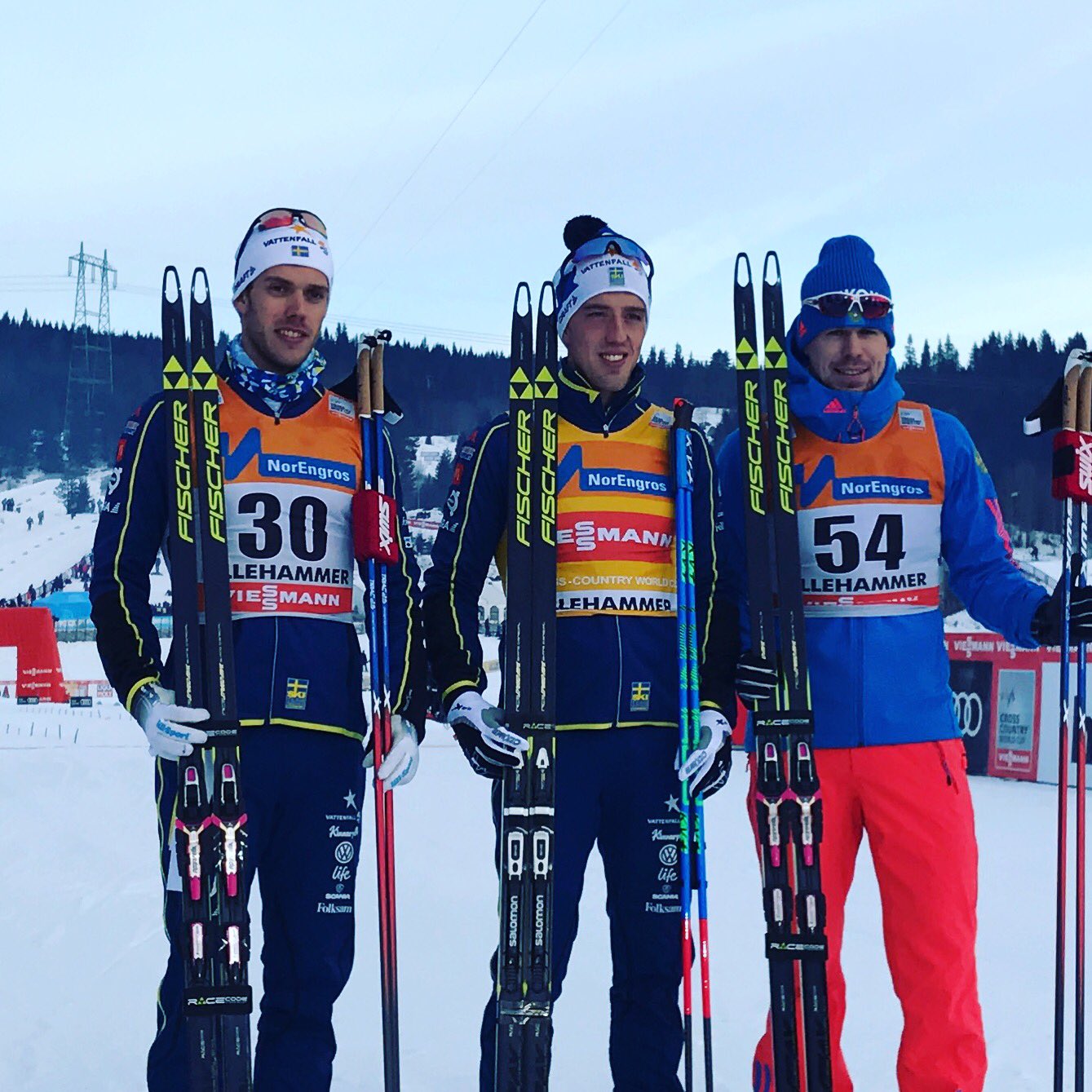
    Calle Halfvarsson (c) gets the win for the second day in a row, while teammate Marcus Hellner (l) is pleased to be on the podium for the first time this year. Russia’s Sergey Ustiugov third in the 10 k skate in Lillehammer. (Photo: FIS Cross Country/Twitter)

    In the men’s 10 k classic to start the day, Calle Halfvarsson of Sweden made it two in a row, winning the first distance race of the mini tour by 0.8 seconds over teammate Marcus Hellner. The competition is the second day of the World Cup mini-tour, which will conclude on Sunday with a classic pursuit. Halfvarsson also won the classic sprint on the first day of racing. For Hellner, it’s a strong result for the former World Champion after two straight seasons where he only stood on the podium once a apiece.

    Russia’s Sergey Ustiugov slotted into third with a hard closing kilometer, moving from fifth place and nearly nine seconds back at 8.3 k to the podium and only 6.7 seconds behind Halfvarsson at the finish.

    That left Norway off the podium, but the home team swept the next three places with Finn Hagen Krogh (+7.4), Simen Hegsted Kruger (+13.2), and Martin Johnsrud Sundby (+13.5).

    Alex Harvey was the top Canadian in 10th place (+23.5). Devon Kershaw and Lenny Valjas finished 40th (+1:16.7) and 42nd (+1:19.1), respectively, with Graeme Killick 64th (+1:46.6) and Knute Johnsgaard 73rd (+2:22.0). Bob Thompson and Andy Shields rounded out the Canadian roster in 88th and 89th.

    Noah Hoffman led the way for the U.S. men, just outside the points in 33rd (+1:08.6). Erik Bjornsen was 45th (+1:22.2), followed by Simi Hamilton 69th (+1:55.8) and Eric Packer 78th (+2:28.7).

    Results: Women’s 5 k classic | Women’s mini-tour standingsMen’s 10 k classic |Men’s mini-tour standings

    ***

    Visma Ski Classics: La Sgambeda 30 k Classic in Livigno

    Tord Asle Gjerdalen (Team Santander) crosses the finish line first in Sgambeda in Livigno, Italy, on Dec. 3, 2016. (Photo: Visma Ski Classics)
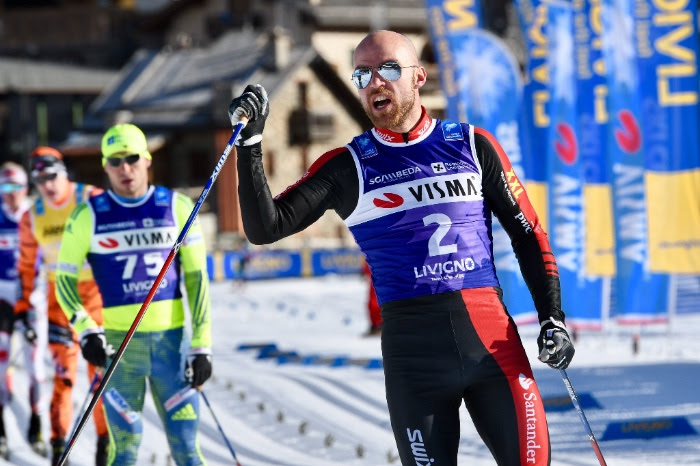
    Tord Asle Gjerdalen (Team Santander) crosses the finish line first in Sgambeda in Livigno, Italy, on Dec. 3, 2016. (Photo: Visma Ski Classics)

    The Visma Ski Classics series began last weekend in Pontresina, Switzerland, with 8 k time trials. Racing continued this weekend just down the road in Livigno, Italy, where racers competed in the second race in the series, La Sgambeda. Skiers encountered superb conditions and firm tracks following cold temperatures the night before.

    In the women’s race, a mass start over five laps of a 6 k course, Britta Johansson Norgren of Team Lager 157 took the narrow victory over Katerina Smutná of Team Santander, reversing their finishing positions from Pontresina a week before. Norgren finished 1.3 seconds ahead of Smutná after the two of them broke away from the main pack on the course’s final hill. Sara Lindborg of Team Serneke secured third, 17.4 back of Norgren.

    The men raced on the same five-lap, 30 k course as the women. The men’s race also came down to a breakaway on the final climb. Tord Asle Gjerdalen of Team Santander took the narrow victory, rebounding from his sixth-place finish in the Pontresina prologue. Ilya Chernousov of Team Pioneer Investments was 1.3 seconds back. Team Leaseplan’s Petter Eliassen was third (+2.7) after leading most of the race.

    Norgren and Gjerdalen are now leading the individual standings, with Gjerdalen’s Team Santander the top team, as the Ski Classics series approaches a month-long holiday break. Racing resumes in early 2017.

    Results

  • Johaug Tests Positive for Anabolic Steroid After Using Sunburn Cream Recommended by Team Doctor

    Johaug Tests Positive for Anabolic Steroid After Using Sunburn Cream Recommended by Team Doctor

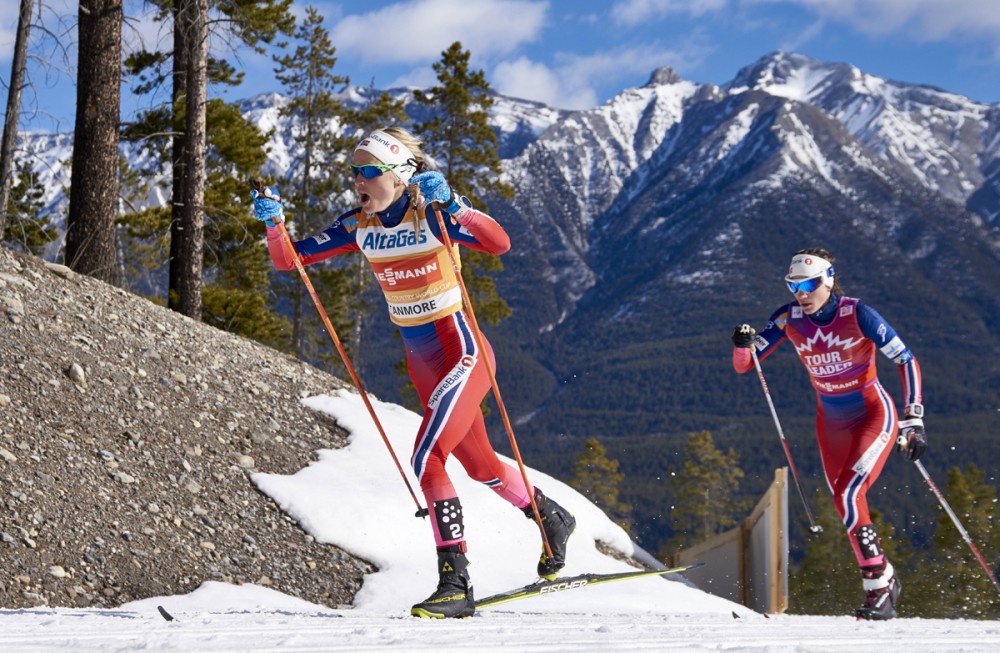
    Therese Johaug and Norwegian teammate Heidi Weng during the women's 15 k skiathlon  in Canmore, Alberta. The competition was part of the Ski Tour Canada, one of many World Cup events Johaug won last season. (Photo: Fischer/NordicFocus)
    Therese Johaug (l) and Norwegian teammate Heidi Weng during the women’s 15 k skiathlon in Canmore, Alberta. The competition was part of the Ski Tour Canada, one of many World Cup events Johaug won last season. (Photo: Fischer/NordicFocus)

    The Norwegian Ski Federation has announced that cross-country skier Therese Johaug, an Olympic and World Championships gold medalist and two-time winner of the overall World Cup title, has had a positive drug test.

    According to the federation, Johaug had severely sunburned her lips while training at high altitude in Seiser Alm, Italy, in August.

    The damage can still be seen in a photo she posted to Instagram over the weekend.

    Tok med jordbærpikenes kyllingsalat hjem til Dalsbygda #minfavoritt #høst #makeitpossible #huaweinorge

    A photo posted by Therese (@johaugtherese) on

    After the team moved to nearby Livigno for a mid-elevation camp, team doctor Fredrik Bendiksen noticed Johaug’s condition. He bought two creams at an Italian pharmacy and assured Johaug that neither contained substances on World Anti-Doping Agency’s Prohibited List.

    The first cream she used did not help her sunburn. So she switched to the second. It helped – but it also contained clostebol, an androgenic anabolic steroid which is in fact banned.

    Johaug was visited by doping control officers on September 16 – where she declared the lip cream, called Trofodermin, on a form listing what medications she was using – and was informed of her positive test on October 3. The test was ordered by Anti-Doping Norway, which will proceed with her case.

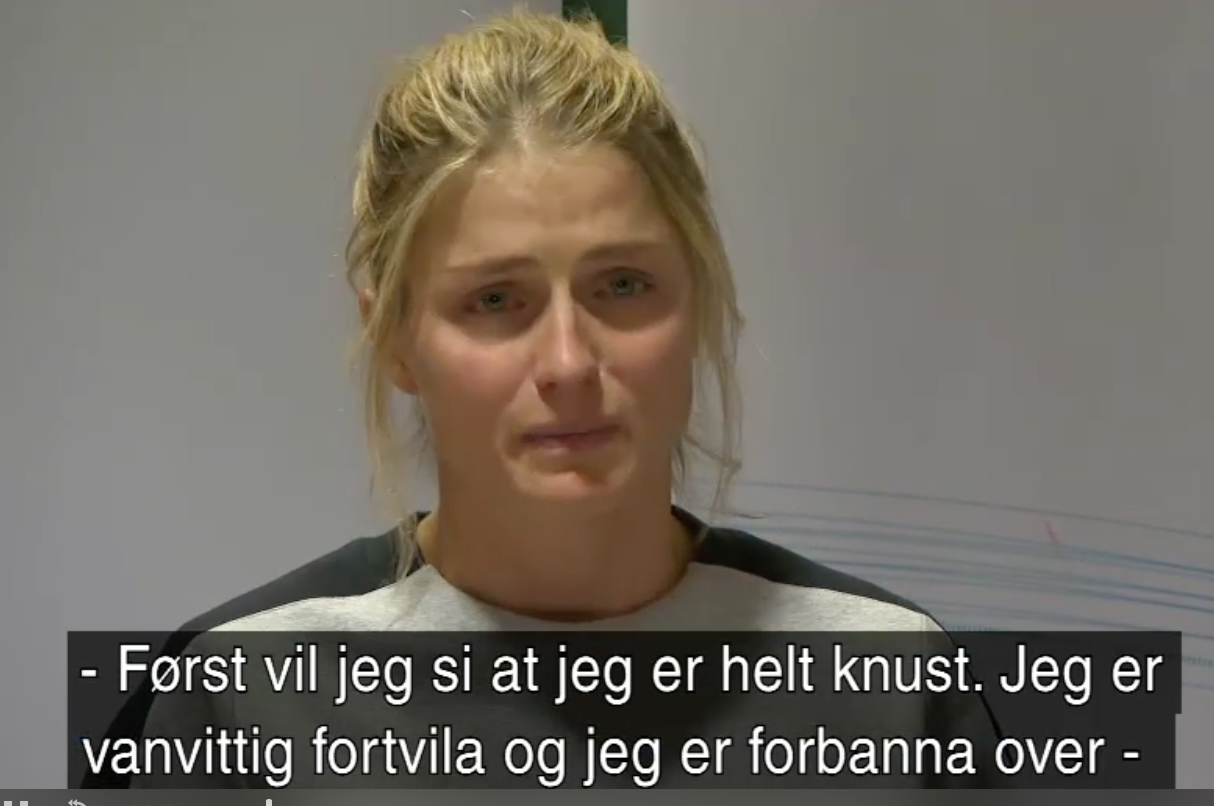
    Therese Johaug during a press conference on Thursday announcing her positive doping test.
    Therese Johaug during a press conference on Thursday announcing her positive doping test.

    The news was made public by the ski federation on Thursday morning. Johaug had a live press conference on NRK, Norwegian state television, around noon (Norwegian time) on Thursday.

    In the statement released Thursday morning by the federation, Johaug described her feelings.

    “I am completely devastated and in despair to have ended up in this very demanding and to me unreal situation,” she said, according to a translation by the International Ski Federation.” I see this as unfair and totally undeserved, even though I am obviously aware of the liability that I have as an athlete for the medication that I use.”

    In the press conference, she said that this had been “the worst week of my life.”

    Clostebol is commonly used to treat skin conditions. But it is also performance-enhancing. Clostebol was initially developed in East Germany and used by athletes there to gain an athletic advantage. It is a derivative of testosterone, but is considered a weak anabolic agent compared to some other steroids.

    A number of athletes across nationalities and sports – ranging from professional baseball and soccer to international Olympic sports like track and field, weightlifting, and beach volleyball – have tested positive for the clostebol.

    The test for clostebol is fairly sensitive, and a number of athletes have tested positive despite never taking the drug as a medication. For instance, the drug is also used to promote growth in livestock (particularly in countries where the use of growth hormones is prohibited) and there are documented cases of test subjects who had never taken the drug having it show in urine samples after eating meat from animals raised on the substance.

    Clostebol also has applications for gynecological care, and there are other documented cases where an individual has tested positive after having sexual intercourse with a partner who is using the drug in a medication.

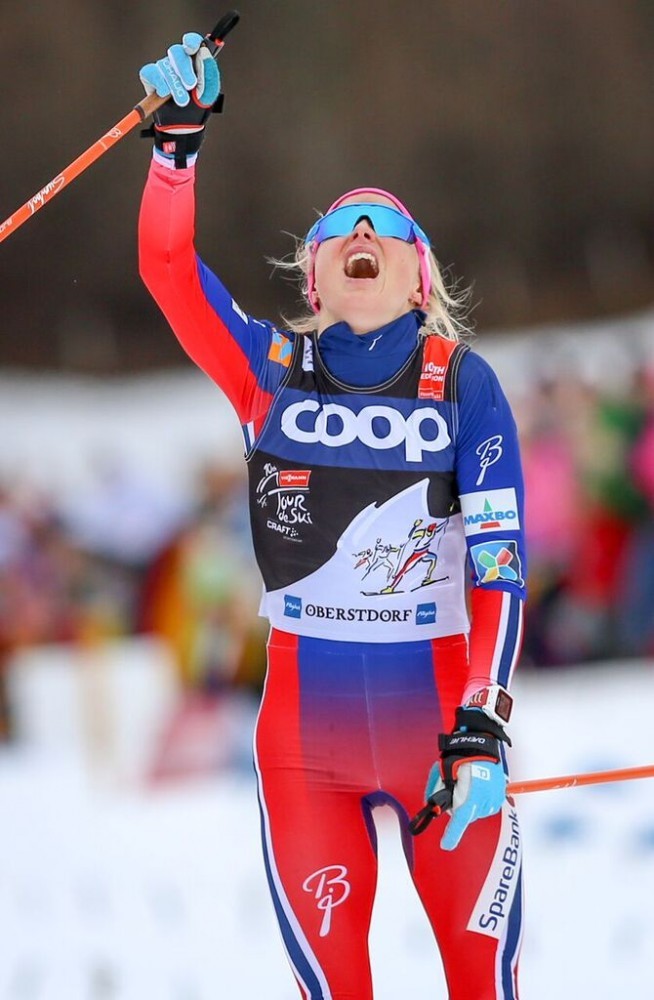
    Norway's Therese Johaug after winning the 10 k classic mass start at Stage 5 of the Tour de Ski in Oberstdorf, Germany, in January. (Photo: Marcel Hilger)
    Norway’s Therese Johaug after winning the 10 k classic mass start at Stage 5 of the Tour de Ski in Oberstdorf, Germany, in January. (Photo: Marcel Hilger)

    But a number of cases have been the result of athletes simply using topical skin creams without checking to see whether any of the ingredients were prohibited. In this case, it is clear that Bendiksen made a mistake in obtaining the medication. A simple online search would have revealed that clostebol was an active component of Trofodermin.

    Bendiksen has taken complete responsibility for the mistake.

    “Therese is an amazing, conscientious person and performer who is careful and precise in everything that she does,” he said, according to a translation. “The most important thing for me to do now, is to do everything I can to make sure she is not punished for using a cream which I assured her was legal to use.”

    At the same time, Johaug said that she took responsibility for following Bendiksen’s recommendation. She explained that she had asked whether the cream had any prohibited substances in it, was told that it did not, and trusted her team doctor.

    She tried to strike a balance by saying that she was responsible for the decision not to check the drug’s contents against the WADA list herself, she also “has zero guilt.”

    “To get an undeserved positive test, it’s an athlete’s worst nightmare,” Johaug said.” But I will fight everything I can and show that I am innocent in this matter.”

    Norwegian team doctors believe that Johaug would not have had enough of the substance in her system to affect her performance anyway. The case is ongoing and a suspension has not been issued, but a case from 2005 before the International Swimming Federation (FINA) resulted in a reduced sentence for a 15-year-old swimmer who had used the medication in a skin cream and successfully argued that she did not gain any performance advantage from it.

    The federation reportedly canceled a major season kickoff event scheduled for Thursday. Instead, the cross-country committee is meeting to decide how to handle the situation.

    For Norway, the news comes after a long summer of doping controversy. Several-time men’s World Cup winner Martin Johnsrud Sundby was suspended for two months for using a too-high dose of the asthma medication salbutamol.

    When that made news – 18 months after the positive tests had taken place, generating widespread outrage – several other Norwegian athletes came forward to say that they had been instructed to take the same doses of medication despite the fact that they did not even have asthma.

    The ski federation is clearly trying a different crisis management strategy this time around. Rather than delaying, Johaug held the press conference soon after learning the news herself.

    Whether that is due to the preferences of the federation or the athlete is unclear. The federation had reportedly urged Sundby to go public earlier in his appeals process, but he had refused.

    Now, after months of denying responsibility for the high doses of asthma medication he had been prescribed by a team doctor, Sundby has apologized and said he was “100% responsible”.

    The ski federation, meanwhile, is facing a nightmare. President Erik Røste said in the press statement that he was “concerned that Norwegian cross country have again ended up in such a demanding situation.”

    And once again, it appears that the doping violation was the result of an athlete following advice of a team doctor. Røste said that the federation would look into how to prevent the problem from continuing.

    The news also comes at a bad time for Norway as their Minister for Culture, Linda Hofstad Helleland, is bidding to become the vice president of the World Anti-Doping Agency.

    For Johaug, Seiser Alm has become quite a significant place for her, and not in a positive way: in 2015, she broke her hand while running there.

  • The Canadians at Altitude: Livigno to the Stelvio and Back

    The Canadians at Altitude: Livigno to the Stelvio and Back

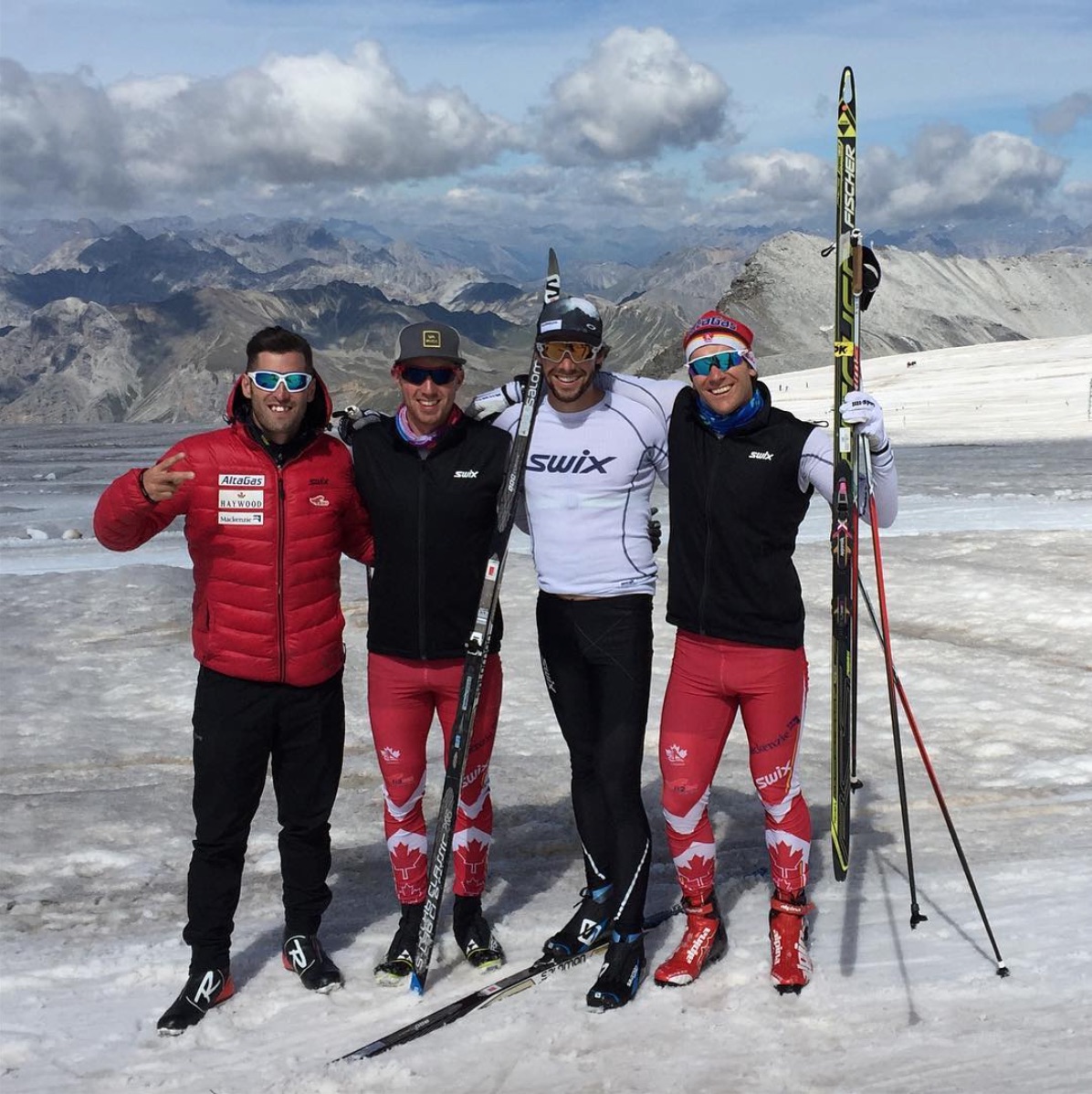
    Part of the Canadian crew at Stelvio Pass in northern Italy, with Devon Kershaw (r), Alex Harvey (second from r), Graeme Killick (second from l) and wax technician, Nic. "Beauty first ski on the Stelvio with #squad Thanks to our new Italian-stallion tech Nic for joining and showing us how's it's done up here! #3400m," Kershaw captioned the photo on Instagram. (Photo: Devon Kershaw/Instagram)
    Part of the Canadian crew at Stelvio Pass in northern Italy, with Devon Kershaw (r), Alex Harvey (second from r), Graeme Killick (second from l) and wax technician, Nic Bonetti, earlier this month. “Beauty first ski on the Stelvio with #squad,” Kershaw captioned the photo. “Thanks to our new Italian-stallion tech Nic for joining and showing us how’s it’s done up here! #3400m.” (Photo: Devon Kershaw/Instagram)

    It’s up and it’s down with the Canadian men’s World Cup Team. 

    Four of its athletes are wrapping up an altitude training camp based out of Livigno, Italy. In separate emails, team veterans Alex Harvey and Devon Kershaw elaborated on the details of the camp. They were accompanied by teammates Lenny Valjas and Graeme Killick, and Louis Bouchard and Ivan Babikov split coaching duties.

    The camp, perched in the Italian Alps and a ridge away from Switzerland, allows the team to stress the body in an oxygen-depleted environment. Livigno sits at roughly 6,000 feet above sea level.

    The team spent a full week in Livigno rollerskiing, running and working on strength — the trifecta of dryland training. Then it was into thin air. From Sept. 1-5, the team spent five days and four nights living at 2,760 meters (9,000 feet) on the Stelvio Pass. They shuttled another 600 meters up to ski on snow while dipping down to the valley lowlands on some afternoons for dryland workouts. The three week camp began on August 24th and ends September 15th.

    Kershaw explained that this type of camp has had positive benefits for him historically. “I think altitude camps have been a big reason for my success in the winter seasons over my career,” Kershaw wrote. “The stimulus you get – the load that your body is under while at higher elevations – is just better than what you can get at home (either in Canmore at 1400m or at sea level now in Oslo). To change the stimulus – put your body in different environments that stress your systems a little differently than you do at home, allows you to adapt to those changes and get (hopefully) better!”

    Systematically stressing the body with oxygen scarcity, followed by ample recovery in a relatively thick oxygen-rich soup, is a vital part of the Canadians’ build up to the World Cup season.

    “I think one random altitude camp wouldn’t do much for preparation but we really try to align 2-3 camps before the season, then 2-3 again with shorter exposure during the season,” Harvey clarified about their altitude-camp methodology. “So after this camp, I will have 3 weeks at home [in Quebec] at sea level, then 3 weeks living at 2400m and training in Park City, then 3 more weeks at home before I go for 10 more days in Davos living at 1600. In the Winter, we will spend Christmas in Davos and spent some time in Livigno too before World Champs, that way we get some links between each altitude exposure and really get to use the benefits of the altitude for a lot of the season.”

    Mid-September is an opportune time to gauge fitness. According to Kershaw, his teammates are in impressive form.

    “To be honest, I think that Graeme and Lenny have made a BIG step up in this off season,” Kershaw wrote. “They are like different people. Their shape seems all-time best at this time of the year, so I am really excited to see them race this winter. Alex is always at a very, very high level over the last years – so no surprises there as he is strong and it’s been nice to have Ivan here for a couple days now – he flew over for the week we are with the Norwegian team to learn and ask questions with their crew – as he is a new coach. Louis [Bouchard] has been the leader here for the camp and has done an excellent job.”

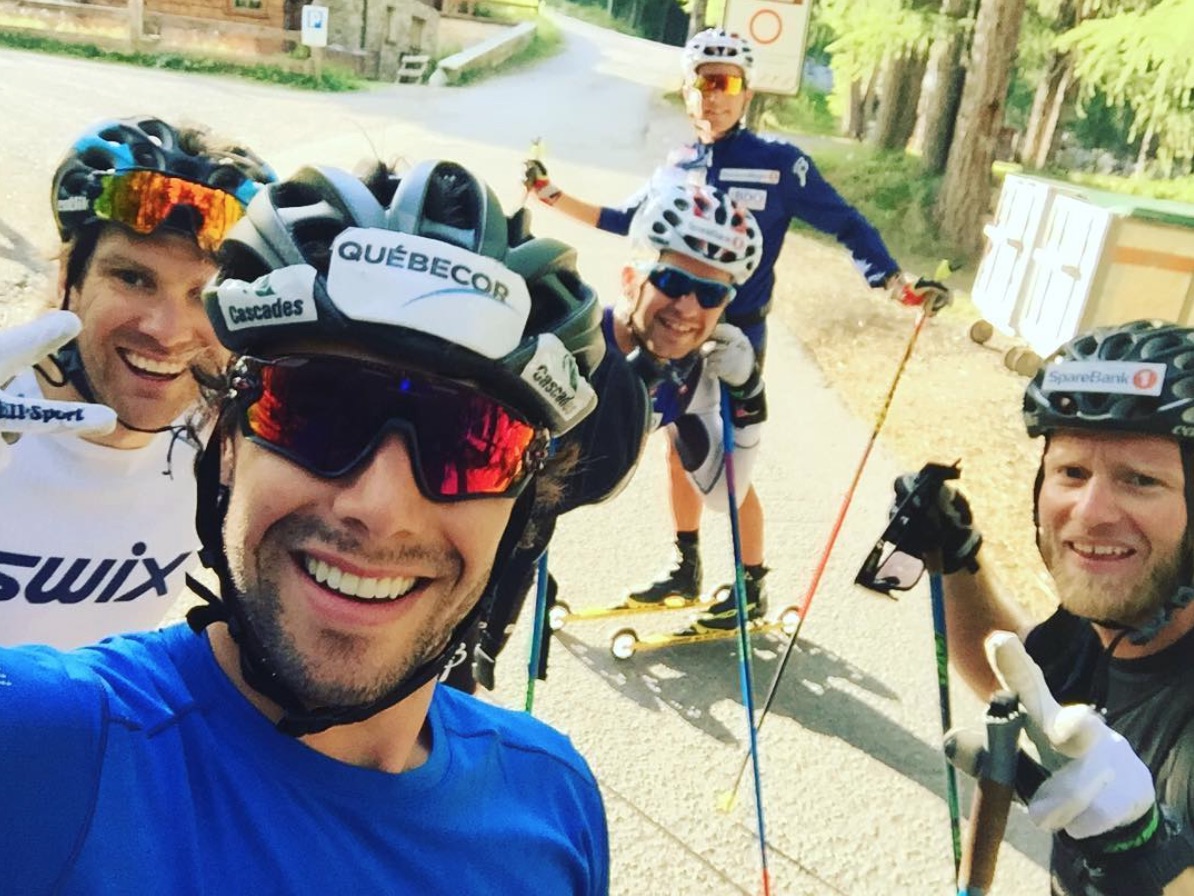
    Alex Harvey (front) takes a selfie during a rollerski workout in Livigno, Italy, with Canadian teammate Devon Kershaw (l) and some members of the Norwegian national team, including Martin Johnsrud Sundby (r). "Intervals in AM, skate ski in PM with this crew. / Intervalles ce matin et ski en PM avec ce groupe!" Harvey captioned the photo. (Photo: Alex Harvey/Instagram)
    Alex Harvey (front) takes a selfie during a rollerski workout in Livigno, Italy, with Canadian teammate Devon Kershaw (l) and some members of the Norwegian national team, including Martin Johnsrud Sundby (r). “Intervals in AM, skate ski in PM with this crew. / Intervalles ce matin et ski en PM avec ce groupe!” Harvey captioned the photo. (Photo: Alex Harvey/Instagram)

    For Harvey, this is his first full uninterrupted season of training since his iliac artery surgery in April 2015.

    “It feels good right now,” Harvey wrote of his fitness coming into the Italy camp. “I’ve been able to start May with normal training, so intervals, strength and distance, which is a bit different than last year where I was only allowed distance training to keep the blood pressure low in the iliac artery.

    “I definitely feel stronger in the gym and on the skis,” he added. “This camp is also a good way to compare ourselves with the best in world (ie. the Norwegians). Last Winter we talked about having a camp with them and it worked out perfectly, it’s a good way to monitor where you are in your training especially in a sport like ours where you don’t have lap times like on a track or wattage numbers like on a bike.”

    As Harvey alluded to in his email, access to international training partners outside the Canadian Team was one reason for the trip. Most notable of the international teams is Norway and its star Martin Johnsrud Sundby. While approaching the end of his two-month competition ban for improper asthma medication use, Sundby trained with the Canadians.

    “We are doing some sessions with the World Cup boss – Sundby – and as expected he is unbelievably strong,” Kershaw wrote. “In level one training there’s not much difference really – we all train the same speed give-or-take (although some sessions he is using a 12lb weight vest), but it’s in the intensity that the level smacks us in the face. We did a level 3 double poling session a couple days ago and he was on another planet dropping everyone else like they were kids. So – not to worry – he looks poised to be dominant again this winter, haha. What we can learn from him is of course his professionalism and also his technique is near flawless – so to be exposed to that and learn has been really cool.”

    According to Harvey, Sundby has been a source for training ideas as well as a fitness barometer.

    “Martin is actually a pretty chill guy and super easy to talk to,” he wrote. “I’ve been asking him a bunch of questions about his training since 2014 and he’s always open to help out others figure out a better way to train. Of course, not many people can handle the total load he does but it’s nice to be able to pick his brain and get a bit more knowledge. The other big advantage of being able to train with Martin is that you know that if you can follow him on a hard workout, you’re probably in good shape! So that’s nice for confidence!”

    Maintaining confidence is like walking a tightrope during the run-up to and during the four-month-long World Cup season. Kershaw noted that younger skiers should understand that altitude training, like the Canadian camp in Italy, should not be emulated without guidance.

    “Altitude training is great and can be a real benefit – but only if you know what you are doing and are looking for that last little bit,” Kershaw cautioned. “If you are minutes and minutes behind don’t expect altitude training to turn you into Sundby overnight. It takes good planning and support to train at higher elevations and making sure you are monitoring your energy well is also paramount. Many a skier’s seasons over the years has been destroyed by going crazy training like a beast at altitude – so for those younger skiers reading this and wanting to try something new – just remember to plan, monitor, and execute smartly/well to get the most out of this type of thing. Also – the science shows that there are some athletes that are just plain ‘non-responders’ to altitude too – so you never really know if it’s right for you!”

    “Many a skier’s seasons over the years has been destroyed by going crazy training like a beast at altitude – so for those younger skiers reading this and wanting to try something new – just remember to plan, monitor, and execute smartly/well to get the most out of this type of thing.” — Devon Kershaw, Canadian World Cup Team

    As for Harvey, he had this lighthearted parting note as he and his Canadian team prepare for their next international camp in October in Park City, Utah, alongside the U.S. Team:

    “It’s just really fun for us to get to train with the Norwegian boys and get to know a bit more about our sport! (We’re also excited to get to train with the Yankees soon, Hoff, EBJ, we’re coming!)”

    Harvey will be in Park City from October 6th-25th. Kershaw arrives on October 10th and stays until the 26th.


  • Ski Classics Opens with Doubleheader in Italy 

    Ski Classics Opens with Doubleheader in Italy 

    Last year's Team Tempo Prologue in Livigno, Italy, which Team Coop won. This year, the team prologue will again open the Ski Classics series in Livigno on Saturday, followed by the shortened La Sgambeda classic race on Sunday. (Photo: Visma Ski Classics)
    Last year’s Team Tempo Prologue in Livigno, Italy, which Team Coop (in bib 1) won. This year, the team prologue will again open the Ski Classics series in Livigno on Saturday, followed by the shortened La Sgambeda classic race on Sunday. (Photo: Visma Ski Classics)

    The 2016 Ski Classics kicks off with a doubleheader in Italy on Saturday and Sunday, and the marathon regulars are chomping at the bit to get started with the long-distance race series.

    The 15-kilometer Proteam Prologue in Livigno, Italy, on Saturday opens the show for the marathon series, now called the Visma Ski Classics (with a new title sponsor in place of Swix), which has been extended to nine venues this season.

    Seraina Boner of Switzerland and Team Coop/Exspirit after winning the 2014 La Sgambeda in Italy last season. (Photo: Ski Classics)
    Seraina Boner of Team Coop (now called Team Exspirit) after winning the 2014 La Sgambeda in Italy last season. (Photo: Ski Classics)

    On the women’s side, last season’s Ski Classics champion Katerina Smutna of the Czech Republic will be on the start line for the first races this weekend, but she will face plenty of competition. Team Exspirit’s Seraina Boner of Switzerland is eager to take back the overall title, which she has earned three times (2011, 2013 and 2014), beginning with La Sgambeda.

    Poland’s World Cup star and the queen of the FIS Tour de Ski, Justyna Kowalczyk, will be doing several of the Ski Classics long-distance events this season with the Norwegian Team Santander headed by the Aukland brothers. And Britta Johansson Norgren of Sweden, who was on the podium at several of the Ski Classics events last season, is one to keep an eye on. Last season, she raced with the all women’s team Ski Pro Am, and this year she is a part of Sweden’s Lager 157 Ski Team, with teammates such as three-time Vasaloppet champion Jörgen Brink of Sweden.

    Among the men, 2015 Ski Classics overall champion Petter Eliassen of Norway makes his season debut in Italy this weekend. He will have to fend off a large and deep field of competitors such as Norway’s 43-year-old marathon veteran Anders Aukland and his Santander teammates, including younger brother Jørgen Aukland, and former World Cup skiers Tord Asle Gjerdalen of Norway and Johan Olsson of Sweden.

    Norwegian stayers such as Johan Kjölstad, Øystein Pettersen, Eldar Rønning, and John Kristian Dahl of Team United Bakeries, as well as Ski Classics veterans of Team Exspirit, including Daniel Richardsson, Anders Södergren and Jimmie Johnsson of Sweden and Norway’s Morten Eide Pedersen, will certainly do their best to make it a tough season opener from Day 1.

    Two unique competitions in Livigno

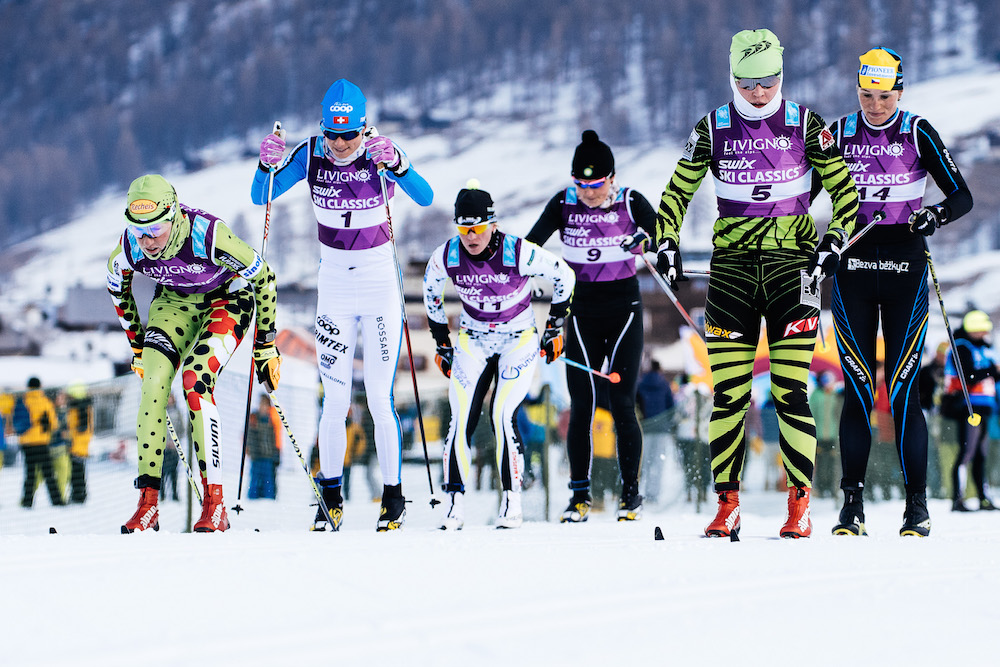
    The Prologue, in which the teams must field at least three racers to compete, was added last year, and is a team effort where the third person’s time determines the team result. The next day, on Sunday, the skiers embark on the first distance event, the now-24-kilometer classic technique La Sgambeda.

    Team Santander's Anders Aukland (c) after winning the 2014 La Sgambeda in Livigno, Italy. Johan Kjølstad  (l) and Øystein Pettersen (r) both of Team United Bakeries, placed second and third, respectively.  (Photo: Ski Classics)
    Team Santander’s Anders Aukland (c) after winning the 2014 La Sgambeda in Livigno, Italy. Johan Kjølstad (l) and Øystein Pettersen (r) both of Team United Bakeries, placed second and third, respectively. (Photo: Ski Classics)

    Team Exspirit (previously known as Team Coop) won the prologue last year and is aiming to defend the title this year.

    “We have had great preparations here in Livigno, skiing on the race course and acclimatizing to the high altitude,” team member Jimmie Johnsson said in a press release on Friday. “Of course, we’re aiming to defend our victory and we’re faster this season than ever before.”

    Team Exspirit’s Seraina Boner won La Sgambeda last year after breaking away from the field on the hard climb at the turning point of the course. This year, the course is shortened to from 35 k to 24 k due to lack of snow and is also flatter. While Boner prefers more elevation gain, she was still optimistic before the race.

    “The tougher course fits me better than the flatter one we have now,” she said. “But I will do my best, and I am really excited to finally start the long distance season together with my teammates.”

    While the Team Prologue is only open to professional teams registered with the 2016 Ski Classics, La Sgambeda on Sunday is open to amateurs and pros alike.

    Saturday’s Prologue will be held on the original course, but due to lack of snow in Livigno, the classic marathon on Sunday will be run on 6 k loops.

    “Last season, seven of the nine Ski Classics events had to change their courses due to weather issues,” Ski Classics CEO David Nilsson in a press release earlier this week. “We can just cross our fingers that the political leaders at the environmental summit in Paris this week are able to make the right decision.”

    For the 2016 season, there are 28 pro teams registered for the Ski Classics series.

    After the season opener in Italy, the Ski Classics takes a break until the Jizerská Padesatka in Liberec, Czech Republic, on January 10, 2016. The race series concludes April 2 with Årefjällsloppet in Sweden as the season finale, as it has been for years. New this year is the Toblach/Dobbiaco Cortina, a 50 k classic race in Italy on Feb. 13.

    Vasaloppet matters most

    For Madshus racer John Kristian Dahl of Norway, who won the Vasaloppet two years ago, the 90 k race from Sälen to Mora in Sweden is the main goal for the 2016 season.

    “It’s the longest and one of the oldest races in the circuit, and very special with the flats. That package makes it very unique, and difficult to win, too. In our world, it’s the championships in marathon skiing, and I’m happy that we have it every year,” Dahl said in an interview with Ski Classics earlier this fall.

    Live streaming in English

    In order for fans to follow the action live, Visma Ski Classics has launched the Live Streaming “Season Pass” available with English commentary on the app or the Tour Live Center at Visma skiclassics.com.
    2016 Ski Classics Schedule

    1. Dec. 5, 2015: Proteam Tempo Prologue, 15 k classic, Italy
    2. Dec. 6, 2015: La Sgambeda, 24 k classic, Italy
    3. Jan. 10, 2016: Jizerská Padesatka, 50 k classic, Czech Republic
    4. Jan. 23, 2016: La Diagonela, 65 k classic, Switzerland
    5. Jan. 31, 2016: Marcialonga, 70 k classic, Italy
    6. Feb. 7, 2016: König Ludwig Lauf, 50 k classic, Germany
    7. Feb. 13, 2016: Toblach/Dobbiaco Cortina, 50 k classic, Italy
    8. March 6, 2016: Vasaloppet, 90 k classic, Sweden
    9. March 19, 2016: Birkebeinerrennet, 54 k classic, Norway
    10. April 2, 2016: Årefjällsloppet, 65 k classic, Sweden

    For race recaps, follow FasterSkier’s marathon blog.

  • Marit the Mom: Before and After Baby

    Marit the Mom: Before and After Baby

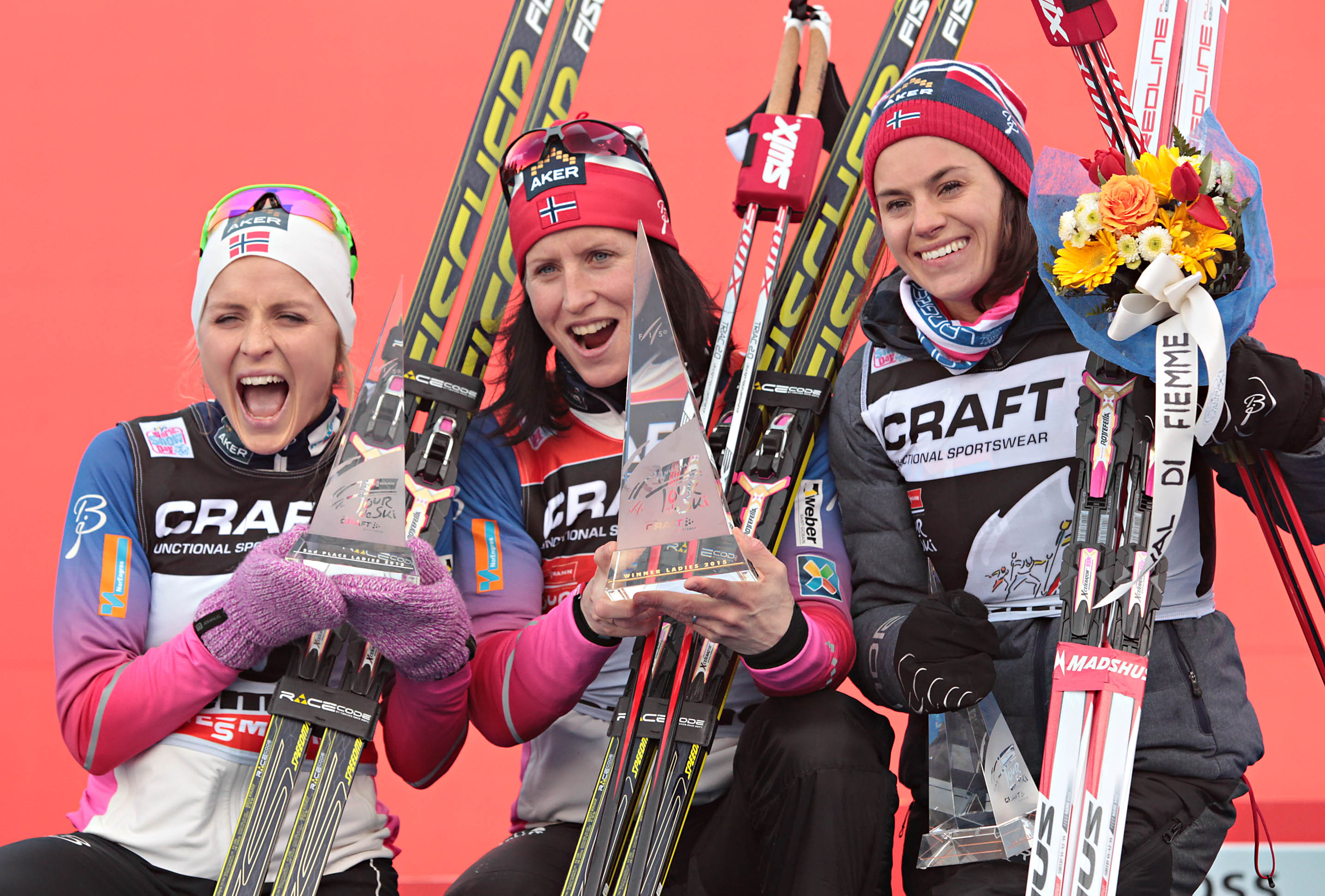
    Therese Johaug, Marit Bjørgen, and Heidi Weng (l-r) sweeping the podium of the 2015 Tour de Ski (Photo: Val di Fiemme/www.fiemmeworldcup.com)
    Marit Bjørgen (c) led a Norwegian sweep of the 2015/2016 Tour de Ski podium, with teammates Therese Johaug (l) and Heidi Weng (r) placing second and third, respectively. They finished the season in that order as well, with Bjørgen winning the overall World Cup, Johaug placing second and Weng placing third. (Photo: Val di Fiemme World Cup)

    Lately, life is looking a little different for Marit Bjørgen, Norway’s most decorated female cross-country skier. The six-time Olympic gold medalist and 14-time world champion is due to have her first child in December. While Bjørgen, 35, won’t officially be a mom until then, if you ask her teammates, she’s already filled the role.

    Heidi Weng grew up watching Bjørgen. Now 24, Weng as one of the most competitive women on Norway’s national team is hoping to make the next leap in the overall World Cup standings without Bjørgen to contend with.

    “I’ve learned from a lot of people, but I think I’ve learned the most from Marit,” Weng told the Norwegian newspaper Aftenposten in August. Weng finished third overall last season; Bjørgen won the 2015/2016 World Cup outright and their teammate Therese Johaug placed second.

    “Heidi has always been very close to Marit Bjørgen. Bjørgen is like a mom to her,” Weng’s mother, May Bente Weng, said.

    “I think it’s like that for a lot of us on the team,” Weng explained. “[Marit] is the one who has been in the game the longest, and she has solid routines for everything. She is very confident. It’s not just me saying this, most of us think that.”

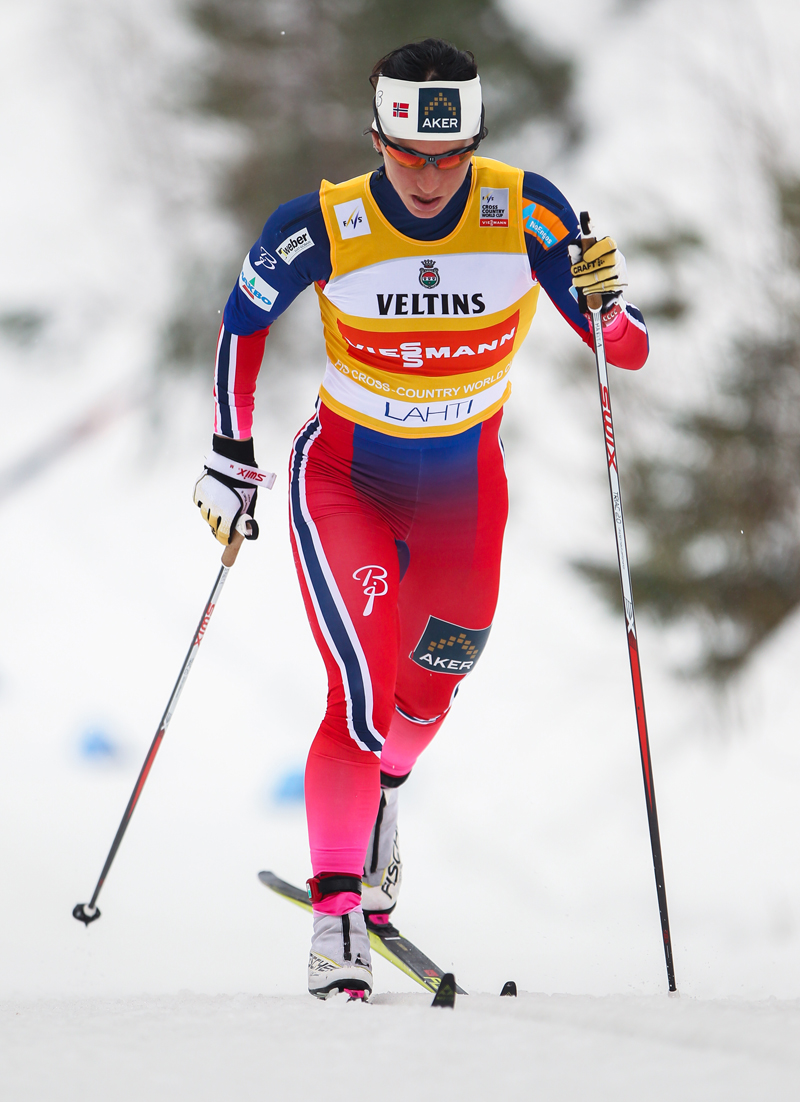
    Norway's Marit Bjørgen striding to a 17-second win on March 8 in the final classic distance race of the season, the women's 10 k classic at the World Cup in Lahti, Finland. (Photo: Fischer/NordicFocus)
    Norway’s Marit Bjørgen striding to a 17-second win in the final classic distance race of the 2014/2015 season, the women’s 10 k classic on March 8 at the World Cup in Lahti, Finland. (Photo: Fischer/NordicFocus)

    Like most of her teammates, Weng has learned from Bjørgen by chasing her in workouts and mimicking her technique.

    “Technically, I’ve become a much better skier. Skiing behind her has helped me a lot,” said Weng, who’s focusing on the Tour de Ski in January and the Canadian World Cup tour in March.

    Meanwhile, Bjørgen, headed into her third trimester of pregnancy, has backed off the hard workouts and, according to Aftenposten, plans to join a few more camps before easing off more.

    “I think we’ll do fine without her,” Weng said. “It’s not like we lose her. But it will be strange that she’s not there on all the workouts and that she wont be winning all the races.”

    But she will be back — with 2017 World Championships as her main target — and plans to compete again as soon as 10 weeks after giving birth.

    “I hope to be back as early as March,” Bjørgen told NRK last week during a team camp in Livigno, Italy.

    “I think it certainly is possible, but it is difficult to say in advance,” she said more specifically of her return to racing in that time. “I am in very good shape, and I don’t think it will mean much losing three months of training.”

    She’ll focus on racing closer to home first, which means the Tour of Canada is probably out. Bjørgen told NRK she thought it was a “shame” to have the final World Cup races in Canada.

    “It could instead be in Holmenkollen, Falun and Lahti in March, but that’s not the case this year,” she said, according to a translation. “To travel to Canada with a little one … I will probably be back in Norway.”

    She added that it’s tough to prepare for the unknown.

    “I’m going into something completely new,” she said. “Getting a small child means a new life. It changes a lot. But I have a plan to get back to the World Championships in Lahti.”

  • Johaug Breaks Other Hand in Livigno Running Fall

    Johaug Breaks Other Hand in Livigno Running Fall

    Although she has won hill climbs and had fun appearing on television shows like Top Gear, Therese Johaug has had some bad luck this training season. (Photo: Bymiljoetaten/Flickr)
    Although she has won hill climbs and had fun appearing on television shows like Top Gear, Therese Johaug has had some bad luck this training season. (Photo: Bymiljøetaten/Flickr)

    Therese Johaug’s summer of training woes continues: at a camp in Italy, the Norwegian cross-country skiing star took a fall while running downhill and broke her right hand.

    Six weeks ago she fell while running in Seiser Alm, Italy, and broke her left hand. That break required surgery and kept her from competing in the Blink summer ski festival, where she typically is one of the best competitors in the Lysebotn Opp ski race.

    She recently resumed rollerskiing with both poles, and competed at the Toppidrettsveka ski festival in northern Norway, where she won the uphill running race by a landslide and finished the weekend second overall to teammate Heidi Weng.

    It appeared that Johaug was almost back on track, with the initial break representing a minimal training setback.

    But when the Norwegian team headed to Livigno, Italy, this week for a rare joint training camp with the men and the women, bad luck hit again. This time it was her right hand.

    “Therese was a bit unlucky on the tour today,” Norwegian national team coach Egil Kristiansen told NRK, the Norwegian broadcaster who had happened to be on site for filming and interviews. “[She] has been to radiology. The examination shows that there is a small fracture.”

    As with the last incident, Kristiansen does not believe that it will take a major toll on Johaug’s preparations for the upcoming race season.

    I do not think this will have serious consequences at all,” Kristiansen said. “She can run and get trained.”

    But he emphasized that until a specialist came back with recommendations, nobody could be sure what the treatment time would be before Johaug could use both poles again.

    Meanwhile, Aftenbladet reported that Johaug had been driven the three hours to Zürich and was flying home to Oslo. There, she will meet with a specialist to assess the damage and develop a recovery plan.

    After the first break earlier this summer, Johaug had surgery which inserted screws into her finger. If the recovery time is similar, Kristiansen guessed that it would mean two weeks of alternative training.

    “She had maximum bad luck,” said teammate Marit Bjørgen, who was in Livigno continuing to train with the team through her first pregnancy.

    Maiken Caspersen Falla agreed, but said that if anything it might make Johaug even more fearsome come winter.

    Although it sucks that it’s so close to season’s start, she will only become even more focused,” Falla told Aftenbladet.

  • Newlywed Kershaw Jumps from Livigno Training Camp to Toppidrettsveka

    Newlywed Kershaw Jumps from Livigno Training Camp to Toppidrettsveka

    Canadians (l-r) Jesse Cockney, Alex Harvey, and Devon Kershaw after a rollerski session in Italy. (Photo: Devon Kershaw)
    Canadians (l-r) Jesse Cockney, Alex Harvey, and Devon Kershaw after a rollerski session in Italy. (Photo: Devon Kershaw)

    Fresh off of marrying his new wife Kristin Størmer Steira in northern Norway, Devon Kershaw drove to Oslo and then jetted off for a training camp with his Canadian teammates and buddies, Jesse Cockney and Alex Harvey.

    “After the wedding we stayed up in Lofoten for some days together with friends and family before driving the long drive back to Oslo (20+ hours) and then we had two nights there before I flew to the Italian Alps,” Kershaw wrote in an email explaining how he ended up spending the traditional honeymoon period with male teammates. “We will do a ‘honeymoon’ in the autumn – either Italy or Copenhagen or something, but since Kristin was injured and I was really sick we took a pre-honeymoon to the Seychelles in March together which was amazing.”

    With some of his teammates already in Europe for the wedding, it made sense to try to put together a training camp. So they headed to Livigno, Italy, to do some dryland training at elevation. Kershaw answered a few questions over email on his way from Oslo to Aure, Norway, after the camp.

    He’s the lone Canadian competing in the Toppidrettsvecka festival there, where he finished 16th in the uphill running race on Thursday morning.

    Alex Harvey and Jesse Cockney after climbing the famous Stelvio pass. (Photo: Devon Kershaw)
    Alex Harvey and Jesse Cockney after climbing the famous Stelvio pass. (Photo: Devon Kershaw)

    FasterSkier: Italy hasn’t been a staple of your summer schedule in the past, if I remember right – what was the motivation to go there?

    Devon Kershaw: The camp was actually in Livigno – we didn’t do any summer skiing on the Stelvio glacier (instead we just did one workout roller skiing up the fabled pass)…. the motivation was to do a proper altitude camp in the summer again – and Livigno is a great place for higher altitude living and training. Alex was really keen for this, and was the driving force to make it happen. I was really happy to join him (Alex) and Jess – both training under Louis Bouchard (who was the coach at the camp) for the 16 days.

    FS: What was the goal of the training block?

    DK: For me the goal was to continue to get back to a“normal” training load. After being sick for almost three months I’ve had to be a lot more patient than any other season in my career thus far. In May I hadn’t done any training in over 8 weeks, and was still not 100%, so I started the year conservatively (lower hours, no intensity whatsoever) and have been building slowly from there. I didn’t do any harder (level 4) training until July, and even in July with my wedding it was only two sessions (the other interval sessions were still only level 3), so I am behind where I normally would be at the moment.

    Jesse Cockney hitting the Italian meadows for a workout. (Photo: Devon Kershaw)
    Jesse Cockney hitting the Italian meadows for a workout. (Photo: Devon Kershaw)

    In Livigno the goal was to do a couple 25hr (roughly) weeks  and the two main focuses were longer days of training (4-5hr) and secondly to have some great quality interval sessions with Alex and Jess. It’s good to be pushed and see where I am compared to those guys at this time of year and how I am recovering from the big illnesses (I had both whooping cough and pneumonia in the spring (which is why I didn’t compete in any races in February or March of 2015)).

    FS: Any favorite highlights or trips from Italy?

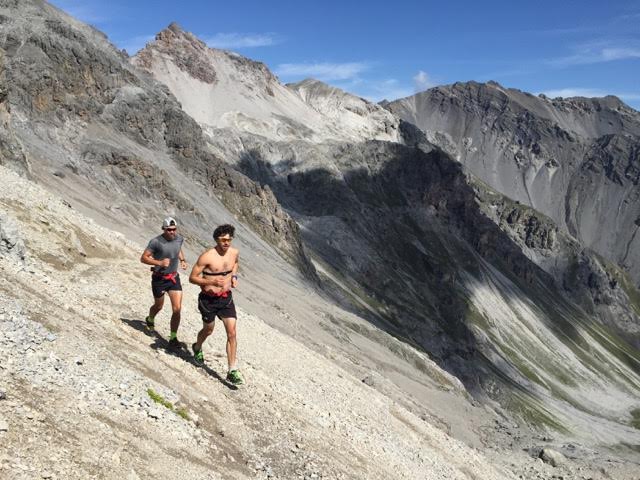
    DK: For sure the highlights in Italy were roller skiing the Stelvio – those famous 48 switchbacks are amazing. Also, we did a tough skate interval session up the Mortirolo which some professional road cyclists have dubbed “the hardest pass in Italy to race up” – and I can attest it was VERY steep and difficult! Those were the two rollerski highlights, and running we had some great highlights running some stellar passes and gorgeous trails. All in all – a great camp!

    Alex Harvey and Jesse Cockney checking out some rockier terrain for a trail run. (Photo: Devon Kershaw)
    Alex Harvey and Jesse Cockney checking out some rockier terrain for a trail run. (Photo: Devon Kershaw)

    FS: Is the whole men’s team in Norway for the races this week, or is this something you’re doing on your own thanks to Norway connections?

    DK: I am the lone Canadian competing this weekend in Norway. Alex and Jess went home and Graeme, Lenny and Ivan are all in Canmore where they have been all summer. With our decimated budget the Livigno camp was a “pay to play” deal, and Alex and Jess have been in Europe since July 20th, so they headed home. As I am based more in Oslo now, this was a good opportunity to do some rollerski competitions – something I have never really done other than the two in the Blink festival in the South-West of Norway last year – so it’s just a fun way to do some hard sessions after a taxing altitude camp. The Americans are here though, as are a lot of the best skiers in the world – so it will be a tough but exciting three days of competitions.

    FS: How is training and the body feeling so far this summer?


    DK: As I mentioned above, it’s been a very different summer so far of training… I am usually in quite good shape in the summer over the last years (Babs, Harv and Lenny even gave me the nickname “summer Kersh” because I am usually quite strong in time trials and intervals throughout the summer), but this year is different. I don’t have that high-end fitness right now. I’ve had to be careful and I am stuck to my plan to come back properly so that I can be 100% ready come winter.

    I have done a lot less level 4 work and my first “race-pace” effort since Rybinsk in January will be tomorrow here in Aure, NOR. That’s not normal. That said, I do feel as though I am getting stronger and better week by week which is encouraging. The motivation is still there and very high and I am really happy with the work and feelings coming out of the altitude camp in Livigno. Still, I’m down in hours for the year (I’m just over 300hr so far), I have more longer level 3 sessions, and less max or level 4 sessions. If it keeps trending up like this I am happy!

    FS:When are you heading back to Canada next?

    DK: I will be in Canada on September 11th for a week before our team goes for our altitude camp in Park City, UT (which runs from Sept 19 – Oct 9th) which will be nice to check in on the house in Canmore and see some friends before I head out until March and the Canada Tour!

  • Wild Card on the FIS Marathon Cup, Brooks 2nd in La Sgambeda

    Wild Card on the FIS Marathon Cup, Brooks 2nd in La Sgambeda

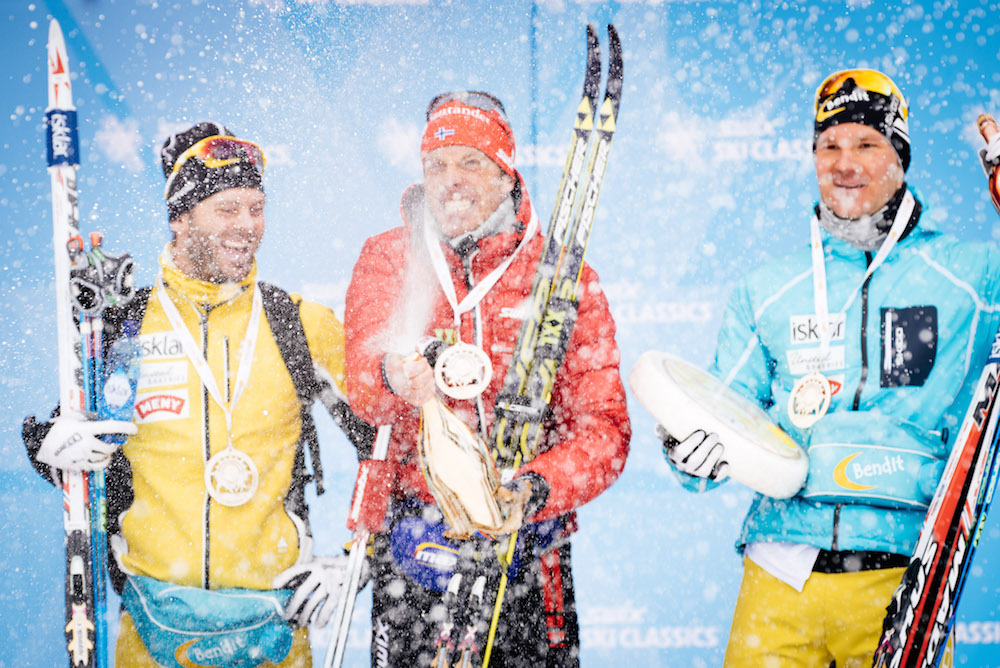
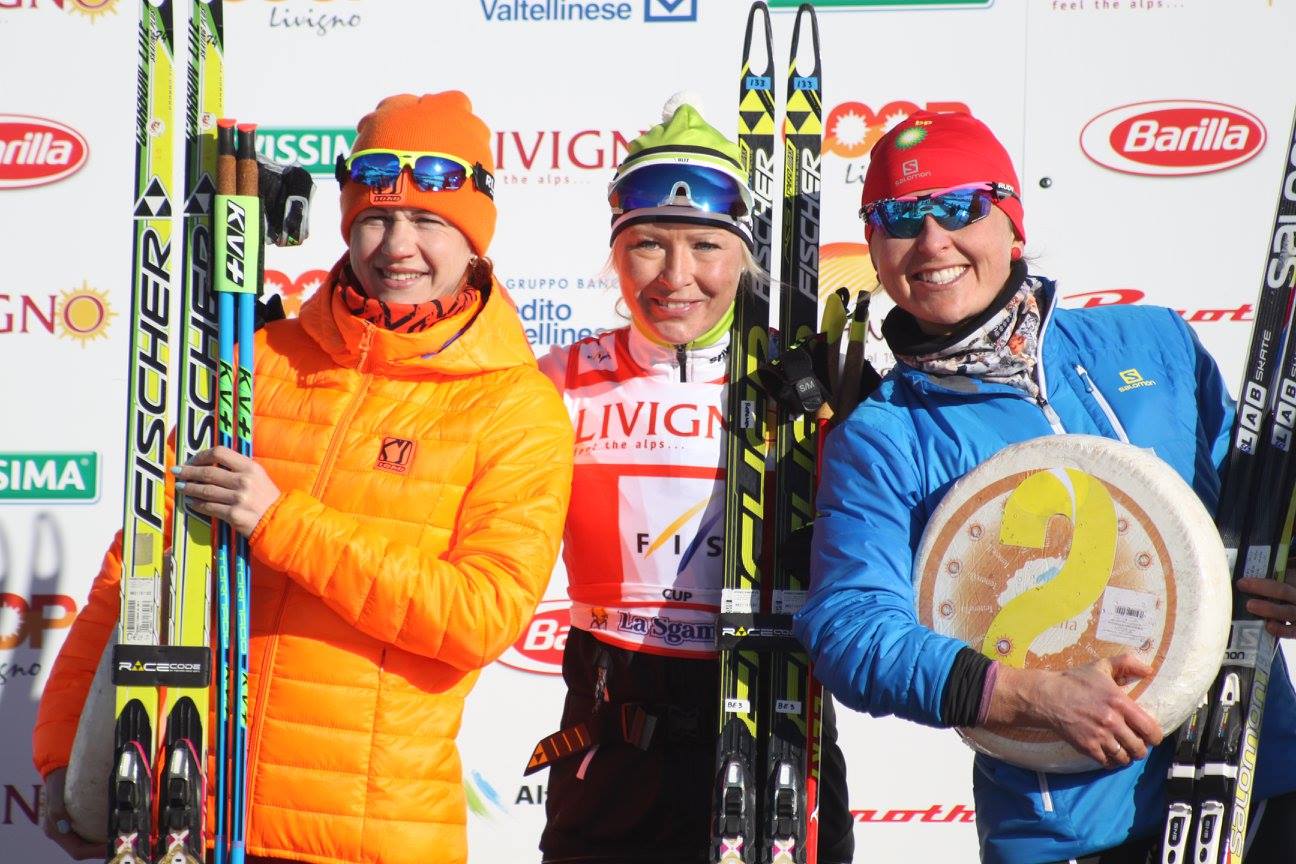
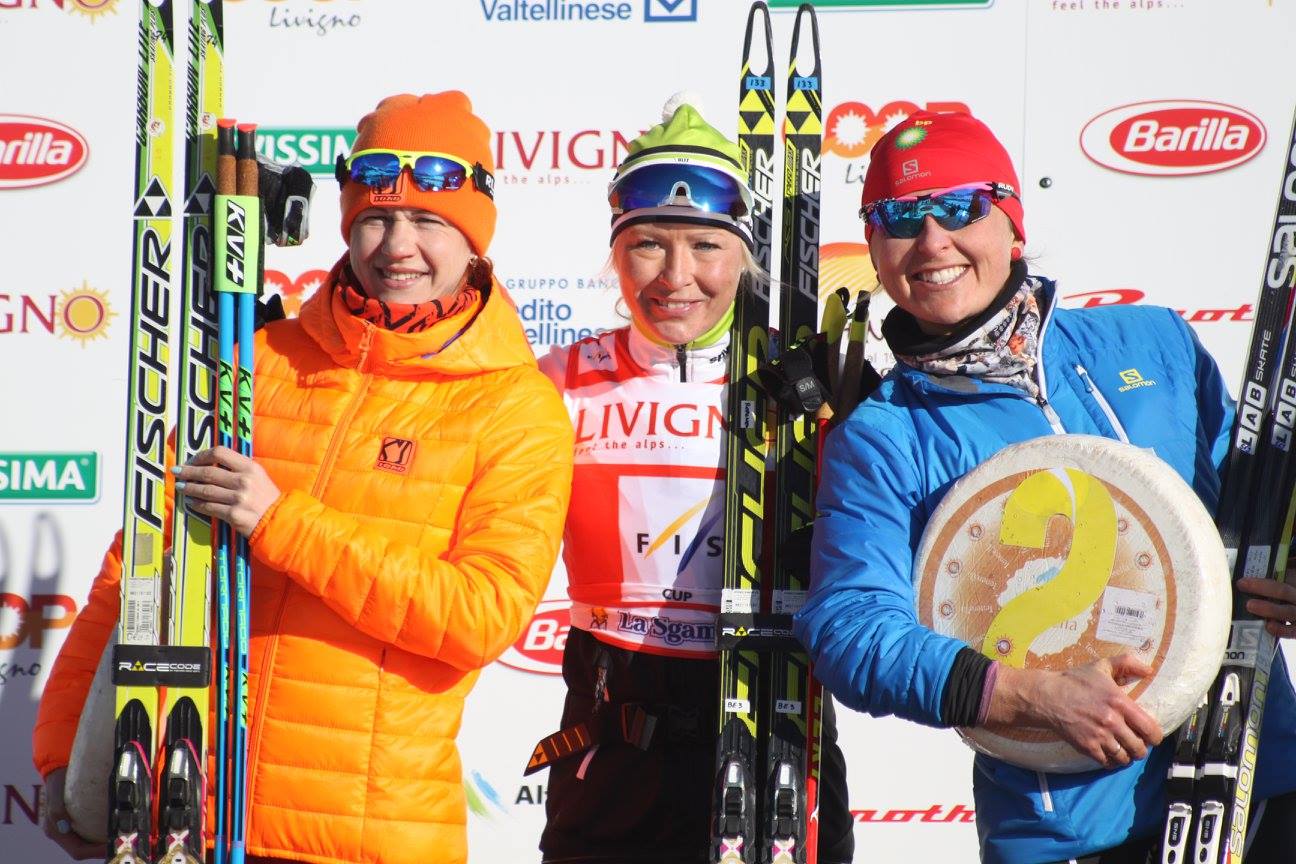
    The La Sgambeda women's podium on Friday in Livigno, Italy: with Finnish winner Riitta-Liisa Roponen (c), who notched her third-consecutive victory at La Sgambeda, American Holly Brooks (r) in second, and Ekaterina Rudakova of Belarus in third. (Photo: Worldloppet/FIS Marathon Cup)
    The La Sgambeda women’s podium on Friday in Livigno, Italy: with Finnish winner Riitta-Liisa Roponen (c), who notched her third-consecutive victory at La Sgambeda, American Holly Brooks (r) in second, and Ekaterina Rudakova of Belarus in third. (Photo: Worldloppet/FIS Marathon Cup Facebook)

    They called her a wild card — the International Ski Federation (FIS), that is. And according to Holly Brooks, she wasn’t sure what she was capable of, either.

    “The marathon world is a new can of worms for me, and I’m essentially going to a race which I know nothing about,” Brooks, a two-time Olympic cross-country skier and former U.S. Ski Team member, explained in an email earlier this week.

    “I don’t have a team, or a regular wax tech for that matter,” she added. “But, I’ve met some great people through the process already, and I have a certain amount of faith that it will all work out.”

    Without an early season race to test the waters, Brooks, 32, dove right into La Sgambeda on Friday: a 42-kilometer freestyle mass start in Livigno, Italy.

    “I was nervous!” she reflected after the race. “It was the first race of the season for me and I usually don’t wait this long to start racing.”

    She flew into Zurich last Saturday and spent her first few days training in Davos, acclimating to the time difference from Anchorage, Alaska.

    “It almost felt like ‘coming home’ because of all places in Europe, I’ve spent a lot of time in Davos,” she wrote in an email. “It was also really nice to see all my World Cup friends and of course the U.S. team. It provided a nice transition before heading out into the ‘unknown.’ ”

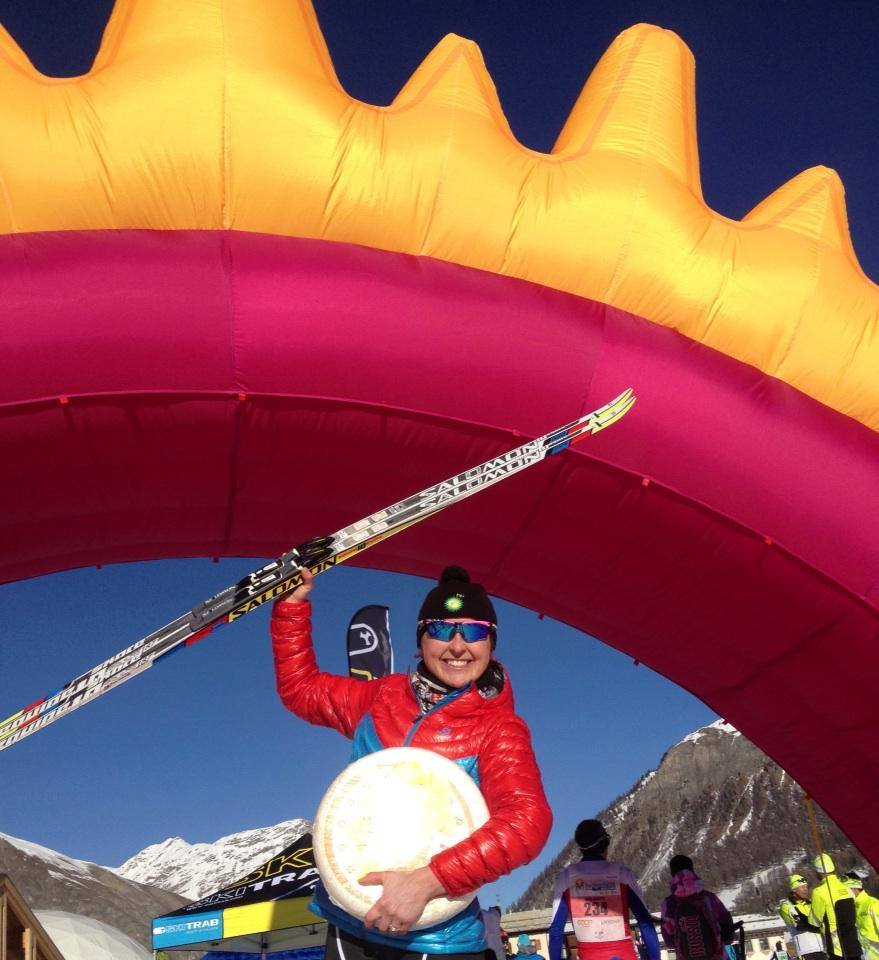
    La Sgambeda runner-up Holly Brooks with her skis and the 15-pound wheel of cheese, which she received as a prize on Friday in Livigno, Italy. (Photo: Holly Brooks/Facebook)
    La Sgambeda runner-up Holly Brooks with her skis and the 15-pound wheel of cheese, which she received as a prize on Friday in Livigno, Italy. (Photo: Holly Brooks/Facebook)

    For Brooks, that mysterious-and-nerve-racking first race was all about chasing Finland’s Riitta-Liisa Roponen, the defending FIS Marathon Cup champion who had one the two previous La Sgambedas.

    “Unfortunately I was never in contact with Riita Lisa,” Brooks explained. “She had a faster start than me and she got lost in the crowd of men. There were tons of people between the two of us and I couldn’t weave through to catch her.

    “Many of these marathons don’t have women’s waves so a big part of the race is eluding the other women,” she added. “I would prefer our own wave but in the meantime I will have to work on my mixed-gender racing tactics.  Once gaps open up in the big groups, it’s impossible to ‘ski up’ without a good draft.”

    Brooks managed to ski up to second-best for second place overall. While she was 3 minutes, 12.1 seconds behind Roponen (who won in 1:40.42.8), Brooks outlasted Ekaterina Rudakova of Belarus by 8 seconds for silver and a 15-pound cheese wheel.

    Three-and-a-half seconds later, Olga Mikhailova of the Russian marathon team finished fourth (+3:23.6) and France’s Aurelie Dabyduk took fifth (+3:39.4).

    “Whenever you land on the podium it’s a good day,” Brooks wrote. “After a couple years of racing World Cup you forget what it feels like and honestly, it’s really fun.”

     “After a couple years of racing World Cup you forget what it feels like and honestly, it’s really fun.” — Holly Brooks, after placing 2nd in first marathon of season at La Sgambeda on Friday

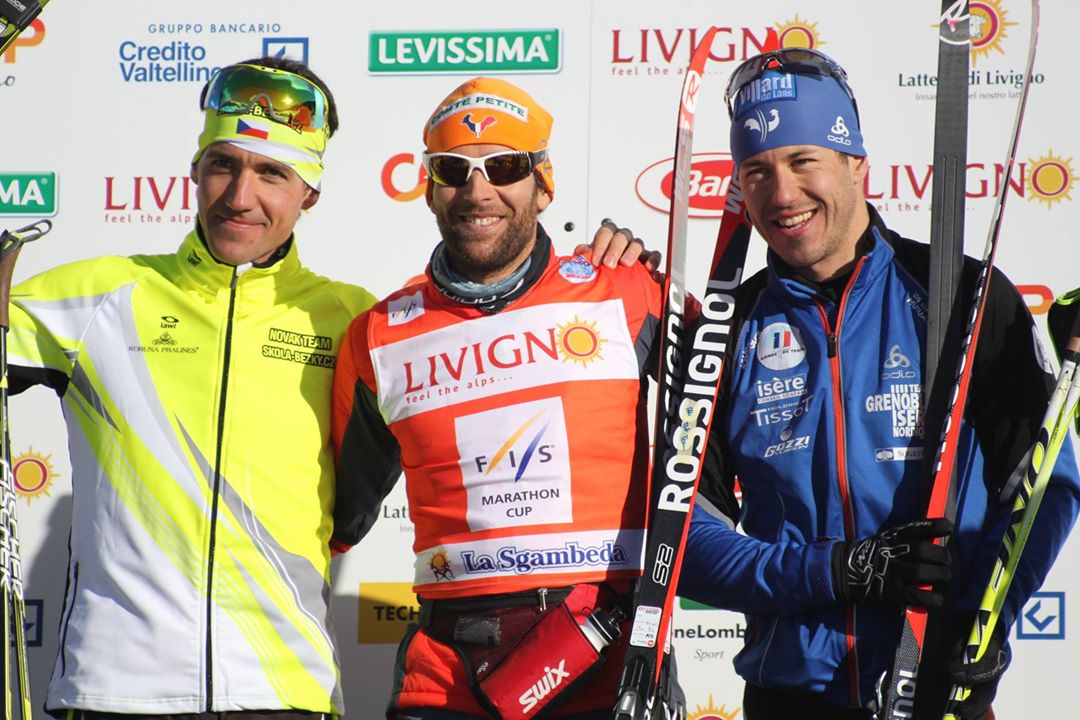
    Benoit Chauvet claimed the La Sgambeda men’s crown in 1:32.11.4, just four-hundredths of a second ahead of fellow Frenchman Robin Duvillard and the Czech Republic’s Petr Novak, who tied for second.

    The La Sgambeda men's podium on Friday in Livigno, Italy: with French winner Benoit Chauvet (c), Petr Novak (l) of the Czech Republic and France's Robin Duvillard, who tied for second. (Photo: Worldloppet/FIS Marathon Cup Facebook)
    The La Sgambeda men’s podium on Friday in Livigno, Italy: with French winner Benoit Chauvet (c), Petr Novak (l) of the Czech Republic and France’s Robin Duvillard, who tied for second. (Photo: Worldloppet/FIS Marathon Cup Facebook)

    Switzerland’s Toni Livers was another 0.6 seconds back in fourth, Sergei Dolidovich of Belarus was fifth (+1.9), and the top-11 men all finished within 8.8 seconds of one another.

    “The conditions were AMAZING,” Brooks explained. “Livigno is picturesque – perfect!  Pure sun, gorgeous mountains, really perfect.  My skis were awesome too… but it was a stressful situation leading up to having great skis.”

    The night before the race at the captain’s meeting, she still wasn’t sure who would wax her skis. Fortunately, she found some “local Italians” who were up for the job — a man named Enzo, who spent 16 years on Italy’s national-ski team, was one of them, she explained. She repaid him with an iPhone.

    Brooks, who switched from the World Cup circuit to the Worldloppet and FIS Marathon Cup this season, is one of the racers receiving a lot of international attention on the eve of the Marathon Cup opening.

    “It will be interesting to see how Holly Brooks, who is fully concentrating on the long-distance scene this season, will do,” a FIS and Worldloppet press release stated before the first race of the season.

    Marathon weekend

    There are three races this weekend, including the 15 k ProTeam Tempo classic “prologue” on Saturday and 35 k classic on Sunday, both of which are part of the Swix Ski Classics.

    Brooks is competing in all three, after recently signing with a Pro Swix Ski Classics team. “But more on that later,” she wrote. Before she knew she’d race the prologue, she was aware two marathons in one weekend was ambitious.

    “Sunday’s race course is somewhat of a double-pole derby, and honestly, I’m looking at it as more of a training race for me,” she explained. “Many of those girls train specifically for double-pole, which I do not do.”

    While Brooks is viewed as a serious contender for the long-distance events, she’ll have plenty of experienced competition in her quest for an overall podium at the end of the season.

    Italy’s Antonella Confortola, who has competed on the FIS Marathon Cup for years, is no doubt hungry for the overall title and reported to be in killer shape again.

    Veteran favorite Seraina Boner of Switzerland will definitely be a very strong contestant for the overall title, but how she does could depend on how many races she enters. The same goes for Roponen, last year’s overall FIS Marathon Cup winner, according to FIS.

    Men’s outlook

    On the men’s side, last year’s overall winner Tom Reichelt of Germany is not racing after his team dissolved in September. Chauvet, who won Friday’s La Sgambeda and was second overall last year, is eager to make it to the top of the overall podium this season. So is Novak, who was second at last year’s La Sgembeda and second again on Friday.

    Aliaksei Ivanou of Belarus, who was third last year, Italy’s Sergio Bonaldi and Simone Paredi, as well as France’s Christophe Perrillat Colomb and Adrien Mougel also raced Friday and all of them finished in the top 15 (with the exception of Paredi in 25th).

    Including the World Cup racers

    Scheduling La Sgambeda for the day before the World Cup in Davos, Switzerland, on Saturday and Sunday allows World Cup racers to race La Sgambeda, as Davos is fewer than 70 kilometers from Livigno.

    Accordingly, several World Cup skiers entered the race this year. France’s Jean Marc Gaillard followed teammate Duvillard (who was second) in sixth. The two teamed up for bronze from last year’s sprint relay at the Sochi Olympics. Livers is another World Cup regular, along with Dolidovitch, Spain’s Imanol Rojo, Denmark’s Martin Moeller, and Estonia’s Madis Vaikmaa.

    Norway’s Peter Northug won the race last year but did not compete on Friday — no Norwegians did.

    Tough but scenic course

    The 42 k marathon consisted of two laps on a 21 k course that runs along the Spöl river and winds through all the villages along it: Florin, Pont Lonc, Limina, Tresenda, and runs as far as Campaciol. From the Hotel Forcola at 12.5 k, the course turns back toward the cross-country stadium, which marks the start, finish and halfway point.

    Livigno, normally known as having snow from early November on, had to work hard last year to put the 21 k course together as snow was hard to come by. However, this year, conditions were notably better.

    “Livingo is amazing. More North Americans should come here!” Brooks summed up.

    Next FIS Marathon Cup: The Dolomitenlauf 42 k freestyle on Jan. 18 in Austria

    In total more than 220,000 Euros ($274,000 dollars) will be distributed as prize money this season. Each race offers a minimum of 21,000 Euros ($26,150 dollars) worth of prize money per race. Additional prize money of over 31,000 Euros ($38,600 dollars) will be handed out to the top six men and women in the overall FIS Marathon Cup at the end of the season.

    Like every year, the FIS Marathon Cup kicked off with La Sgambeda in the Italian valley of Livigno.

    This season, the FIS Marathon Cup consists of nine races total, with a new final in Russia: the Ugra Ski Marathon 50 k skate in Khanty-Mansiysk, Siberia, caps the season in mid-April. Khanty-Mansiysk is best known for its biathlon World Cups and World Championships.

    Friday’s La Sgambeda results: women | men

    FIS Marathon Cup 2014/2015 calendar

    1. La Sgambeda (Italy)
    Friday, Dec. 12
    42 k freestyle

    2. Dolomitenlauf (Austria)
    Jan. 18, 2015
    60 k freestyle

    3. Marcialonga (Cavalese/Val di Fiemme, Italy)
    Jan. 25
    70 k classic

    4. La Transjurassienne (France)
    Feb. 7
    56 k classic

    5. Tartu Marathon (Estonia)
    Feb. 15
    63 k classic

    6. American Birkebeiner (Cable/Hayward, USA) 
    Feb. 21
    50 k freestyle

    7. Bieg Piastow (Poland) 
    Feb. 28
    50 k classic

    8. Engadin Ski-marathon (Switzerland)
    March 8
    42 k freestyle

    9. Ugra Ski Marathon (Russia)
    April 11
    50 k freestyle