From the FasterSkier archive — posts syndicated from athletes’ and coaches’ own blogs between 2004 and 2012, kept online as published. Current coverage is at fasterskier.com.
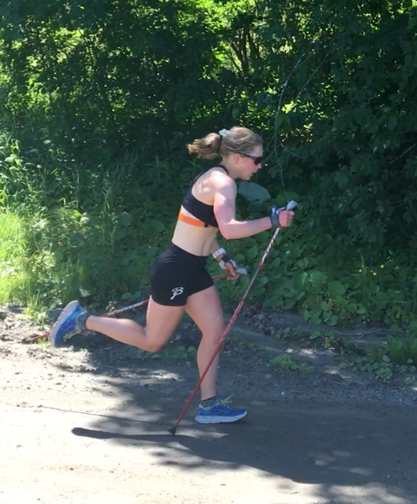
Craftsbury Green Racing Project nordic skiers and biathletes doing uphill running intervals on a dirt road in Craftsbury, Vermont. (Photo: Pepa Miloucheva)
For a mid-summer Wednesday Workout, we reached out to Craftsbury Green Racing Project head coach Pepa Miloucheva. In addition to sharing a running workout, Miloucheva told us what and who is new to the team based out of Craftsbury, Vermont.
“All is good here in Craftsbury, everyone is healthy and training is going well,” she wrote in an email in early July. The nordic team joined last month’s U.S. Ski Team (USST) training camp in Lake Placid, N.Y., and also plans to attend the USST’s on-snow New Zealand camp in late August.
Ida Sargent, of the Craftsbury Green Racing Project and U.S. Ski Team, during dirt-road running intervals in Craftsbury, Vt. (Photo: Pepa Miloucheva)
Craftsbury’s roster additions include Corey Stock and Akeo Maifeld-Carucci. Returning to the nordic squad are Ida Sargent (U.S. Ski Team), Caitlin Patterson, Kaitlynn Miller, Liz Guiney, Adam Martin, and Ben Lustgarten.
The workout itself, one Miloucheva explained the team does this time of year, is 6-8 x 10-minute running intervals with poles. They do so on a gradual, mile-plus-long hill on a dirt road in Craftsbury. To replicate, find a climb that takes at least 10 minutes to run up, and repeat six to eight times.
“This is a lactate threshold workout, important for improving our sustainable speed,” Miloucheva wrote. “Threshold workout improves both lactate production/recruiting more fast twitch units and lactate removal, ability to minimize the negative effects of lactate while having the benefits.”
“Athletes run with poles up and I drive them down as quickly as possible to shorten the time between the interval,” she explained. “Goal is to maintain speed for all intervals and keep lactate between 3-5mmol/l, depending on the athlete.”
Male and female athletes all start at once, just at different starting points so they finish in the same place. Miloucheva recommends focusing on controlling speed during this workout to ensure a productive 50-plus-minute workout at Level 3.
Upon repeating the workout later in the training season, athletes are instructed to push the pace at the end of the interval to Level 4.
The workout: 6-8 x 10-minute running intervals with poles
Need: A hill that takes at least 10 minutes to run up, poles.
Warmup: 30 minutes easy running, with a few accelerations and functional movements
Then: Run uphill for 10 minutes at Level 3, return to starting point, repeat 6 to 8 times. Pace at end of interval can be increased to Level 4 later in the season.
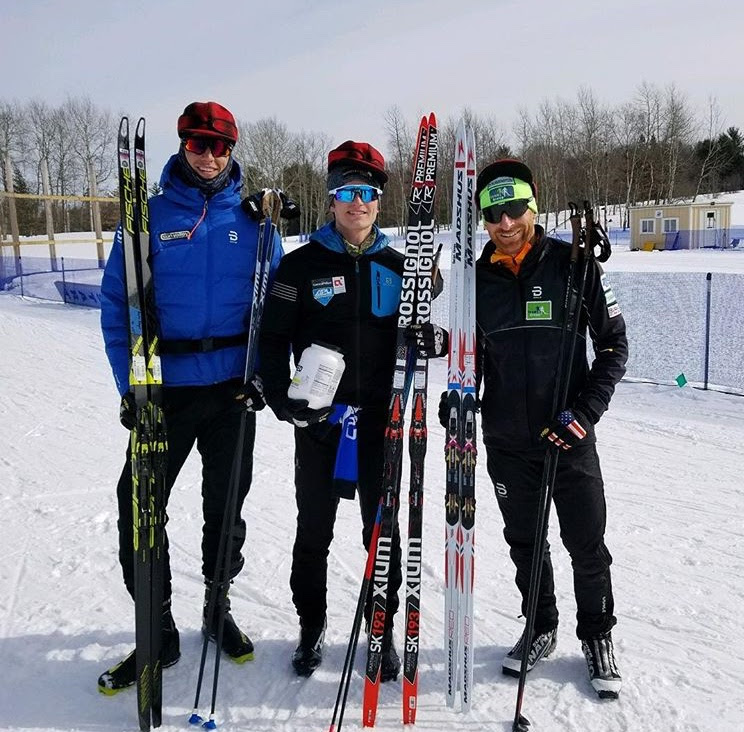
The SuperTour men’s 20 k freestyle podium on Saturday, Feb. 17 in Ishpeming, Michigan, with David Norris (c) in first, Kevin Bolger (l) in second, and Brian Gregg (r) in third. (Photo: APU)
U.S. SuperTour (Ishpeming, Michigan): Friday, Saturday and Sunday
The SuperTour circuit ventured to the Al Quaal Recreation Area in Ishpeming, Michigan, this past Friday, Saturday and Sunday for three days of racing Feb. 16-19.
Day 1
In Friday’s 1.6-kilometer freestyle sprints, Kevin Bolger of the Sun Valley Ski Education Foundation (SVSEF) posted a 2.69-second victory in the men’s final over his teammate Jack Hegman in second and 3.02 seconds ahead of David Norris of Alaska Pacific University (APU) in third.
Bolger started the day by qualifying first in 3:43.04 minutes (2.41 seconds ahead of Hegman in second). Eighteen men entered the race, all of which advanced to four quarterfinals. Bolger went on to win his quarterfinal and semifinal before ultimately winning the final in 3:38.45.
Kris Freeman (Caldwell Sport) finished fourth in the final (+6.4), Forrest Mahlen (APU) took fifth (+10.07), and Eric Packer (APU) was sixth (+10.1).
In the women’s sprint, Northern Michigan University (NMU) sophomore Anikken Gjerde Alnæs edged Erika Flowers of the Stratton Mountain School (SMS) T2 Team by 0.1 seconds for the win in 4:09.87. Alnæs, of Norway, had previously won the qualifier in 4:22.88, 1.72 seconds ahead of Flowers in second.
With 10 women entering the qualifier, all 10 were seeded in two semifinals. Alnæs won the first semi in 4:20.24, and APU’s Chelsea Holmes won the second semi in 4:14.18.
In the final, Alnæs shared the podium with Flowers in second and Kaitlynn Miller of the Craftsbury Green Racing Project (CGRP) in third (+6.75). Holmes placed fourth (+7.49), Liz Guiney (CGRP) was fifth (+2.13), and Canada’s Sophie Carrier-Laforte finished sixth (+7.3).
Day 2
The SuperTour women’s 15 k freestyle podium on Feb. 17 in Ishpeming, Michigan, with Chelsea Holmes (c) in first, Caitlin Gregg (l) in second and Erika Flowers (r) in third. (Photo: APU)
On Saturday, APU reigned, with Holmes winning the women’s 15-kilometer freestyle and Norris topping the men’s 20 k skate.
In the women’s race, Holmes and Caitlin Gregg (CXC Team/Loppet Nordic Racing/Team Gregg) broke away from the field and duked it out for first, with Holmes taking it by 5.9 seconds in 42:37.1. Almost two minutes back, Flowers placed third (+1:58.4) to return to the podium. Kristen Bourne (NMU) placed fourth (+1:59.7), Miller was fifth (+2:01.2), Guiney sixth (+2:01.6), and NMU had two more in the top eight with Nicole Schneider in seventh (+2:02.5) and Alnæs in eighth (+2:07.5), respectively. Carrier-Laforte finished ninth (+2:25.3) and another Canadian Alannah MacLean (NTDC Thunder Bay) was 10th (+2:45.7) out of 43 women.
In the men’s race, the top-eight finishers were separated by less than 10 seconds, with Norris taking the win by 2.9 seconds over Bolger in 50:01.7. Brian Gregg (CXC Team/LNR/Team Gregg) placed third (+5.9), 1 second ahead of Ben Lustgarten (CGRP) in fourth (+6.9). In a photo finish for fifth (+7.2), Tad Elliott (Ski Club Vail) took it by 0.1 seconds over Adam Martin (CGRP) in sixth (+7.3) and Hegman in seventh (+7.3). Ian Torchia (NMU) finished eighth (+9.9), Canada’s Evan Palmer-Charrette (NTDC Thunder Bay) was ninth (+16.0), and Kyle Bratrud (CXC Team/LNR) 10th (+18.1) out of 62 finishers.
Day 3
On Sunday, Norris raced to his second-straight win (and third in as many distance races since winning the 15 k classic pursuit on Feb. 4 at the NorAm/SuperTour in Gatineau, Quebec). With a time of 24:42.7, Norris skied 28.2 seconds faster than Lustgarten in second place, and Freeman joined them on the podium in third (+32.4). Martin followed in fourth (+34.5), Hegman was fifth (+35.9), Bolger sixth (+39.3), Zak Ketterson (NMU) seventh (+42.5), Bratrud eighth (+42.8), Elliott ninth (+1:00.5), and Torchia 10th (+1:02.2).
Miller won the women’s 5 k classic on Sunday in 14:53.9, just 2.7 seconds ahead of her Craftsbury teammate Guiney in second. Holmes returned to the podium in third (+7.8), and was followed by Felicia Gesior (CXC Team/Peak Nordic) in fourth (+32.4), Vivian Hett (NMU) in fifth (+36.5), Flowers in sixth (+46.5), Bourne in seventh (+58.5), MacLean in eighth (+1:00.8), Alnæs in ninth (+1:05.3), and Carrier-Laforte in 10th (+1:05.3).
Rosie Frankowski (APU) racing to a 2-second win in the women’s 10 k classic pursuit on Sunday, the final day of 2018 Eastern Canadian Championships in Gatineau, Quebec. (Photo: Rob Smith)
NorAm Eastern Canadian Championships (Gatineau, Quebec): 10/15 k classic pursuits
Rosie Frankowski defended her lead and tallied her second-straight win on Sunday, the final day of Eastern Canadian Championships, both a NorAm and a SuperTour. Meanwhile, David Norris overcame a 10-second starting deficit to make it all Alaska Pacific University (APU) atop the podium in the classic pursuits.
Frankowski started the women’s 10 k pursuit 47 seconds clear of her APU teammate Becca Rorabaugh in second and held Rorabaugh off by 2 seconds at the finish, crossing the line first in 1:00:32.6 hours on a warmer day around 0 degrees Celsius with heavy snow in Gatineau. Kaitlynn Miller of the Craftsbury Green Racing Project (CGRP) was the third American on the podium, racing up from seventh to third, 21.3 seconds behind Frankowski.
Olivia Bouffard-Nesbitt (Rocky Mountain Racers) led the Canadians in fourth (+3:09.2), up from sixth at the start, and Frédérique Vézina, of the Pierre-Harvey National Training Centre (CNEPH), followed in fifth (+3:15.2), after starting fourth.
Another 4.6 seconds back was Liz Guiney (CGRP) in sixth (+3:19.8). Felicia Gesior (CXC Team) finished seventh (+4:05.6), Corey Stock (Bridger Ski Foundation) placed eighth (+4:05.8), Annika Hicks of the Alberta World Cup Academy (AWCA) was ninth (+4:40.8), and Alannah Maclean of the National Team Development Centre (NTDC) Thunder Bay finished 10th (+5:25.9).
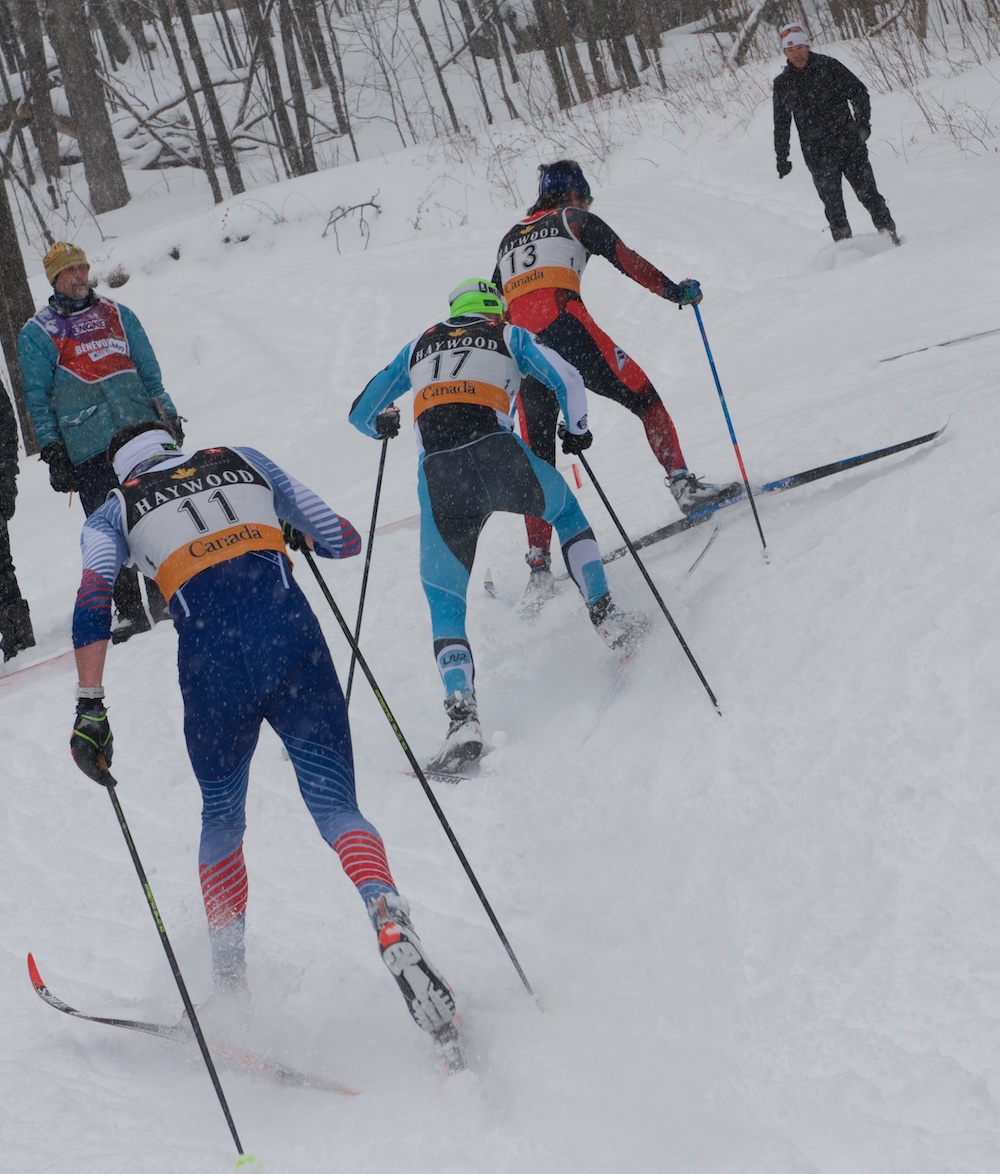
Tad Elliott (13) leads Brian Gregg (17) and Jack Hegman (11) up a climb during the men’s 15 k classic pursuit on Sunday at 2018 Eastern Canadian Championships in Gatineau, Quebec. Gregg went on to edge Elliott in a photo finish for third and Hegman followed in fifth. (Photo: Rob Smith)
In the men’s 15 k, Norris started second and caught leader Jack Hegman, of the Sun Valley Ski Education Foundation (SVSEF) early then raced alone to the victory in 1:19.26, while Ben Lustgarten (CGRP) followed 1:17.8 minutes later in second. Lustgarten started the race in sixth and Brian Gregg (Team Gregg/Loppet Nordic Racing/CXC) started seventh, with Gregg edging Tad Elliott (Ski Club Vail) by less than a tenth of a second in a photo finish for third (+1:38.5). Elliott had started third.
Hegman finished fifth (+1:42.6), his Sun Valley teammate Kevin Bolger was next across the line in sixth (+1:59.1), Adam Martin (CGRP) finished seventh (+2:01.2), Rogan Brown (SVSEF) was eighth (+2:02.9), Scott Hill (Barrie Cross Country) was the top Canadian in ninths (+2:22.5), and Jack Carlyle (AWCA) finished 10th (+2:44.2).
Nordic Combined World Cup (Hakuba, Japan): Large hill/10 k Gundersen
In the final nordic combined World Cup competition before the Olympics, Norway’s Jan Schmid came from 1:14 minutes behind at the start of Sunday’s 10 k to win the individual large hill/10 k event by 6.6 seconds in 25:36.5.
Schmid started the race in seventh, based on his competition jump, 1:14 behind Estonia’s Kristjan Ilves in first. Ilves had jumped to first and started the race 13 seconds ahead of Japan’s Yuto Nakamura in second, but while Nakamura dropped to 18th (+2:21.2) at the finish, Schmid moved all the way up to first with the fourth-fastest course time.
Japan’s Akito Watabe, who won Saturday’s large hill/10 k competition, took the final spot on the podium after a photo finish with the Czech Republic’s Tomas Portyk. They finished 11.1 and 11.2 seconds behind Schmid in third and fourth, respectively.
American Adam Loomis achieved his best individual result in three years, placing 24th (+3:03.4), after jumping to 30th and starting 3:20 out of first. Loomis skied the eighth-fastest course time.
His USA Nordic teammate Ben Berend placed 31st (+4:28.4) after ranking 28th in the jump.
Nordic Combined Continental Cup (Planica, Slovenia): Saturday and Sunday
Meanwhile on the Nordic Combined Continental Cup, Americans Bryan and Taylor Fletcher reached the podium on both Saturday and Sunday in Planica, Slovenia.
Bryan won back-to-back individual large hill/10 k Gundersen starts, while Taylor placed second on Saturday and third on Sunday.
On Saturday, Bryan jumped to third on the 139-meter large hill and started the 10 k race 22 seconds behind Germany’s Anton Schlüter in first. Taylor jumped to 14th and started 1:35 minutes out of first and posted the fastest course time in the 10 k to finish second to his older brother, 59.4 seconds back.
Bryan skied the third-fastest 10 k to take first in 26:24.1 minutes. About a minute behind Taylor, Austria’s Martin Fritz placed third (+1:58.8). Schlüter ended up 15th (+3:51.5).
Also for the U.S., Jasper Good raced from 26th in the jump to eighth overall (+3:08) with the fifth-fastest course time. Grant Andrews did not finish after posting the 38th-ranked jump.
Canada’s Nathaniel Mah placed 28th (+5:41.5) after starting 27th based on his jump.
On Sunday, Fritz jumped to first and finished between the Fletcher brothers in second place, 39.7 seconds behind Bryan, who repeated in first.
Bryan had jumped to second and started the 10 k just 9 seconds back. He skied the fourth-fastest course time en route to the win in 25:01.6.
Taylor’s jump put him in 15th and 1:40 back at the start of Sunday’s race, and he passed 12 competitors to claim third (+1:25.0) with the second-fastest course time.
Good finished 17th (+3:12), up from 23rd in the jump, with the ninth-fastest 10 k time, and Andrews placed 22nd (+3:38.2), up from 24th.
Mah finished 34th (+5:38.7) after jumping to 21st.
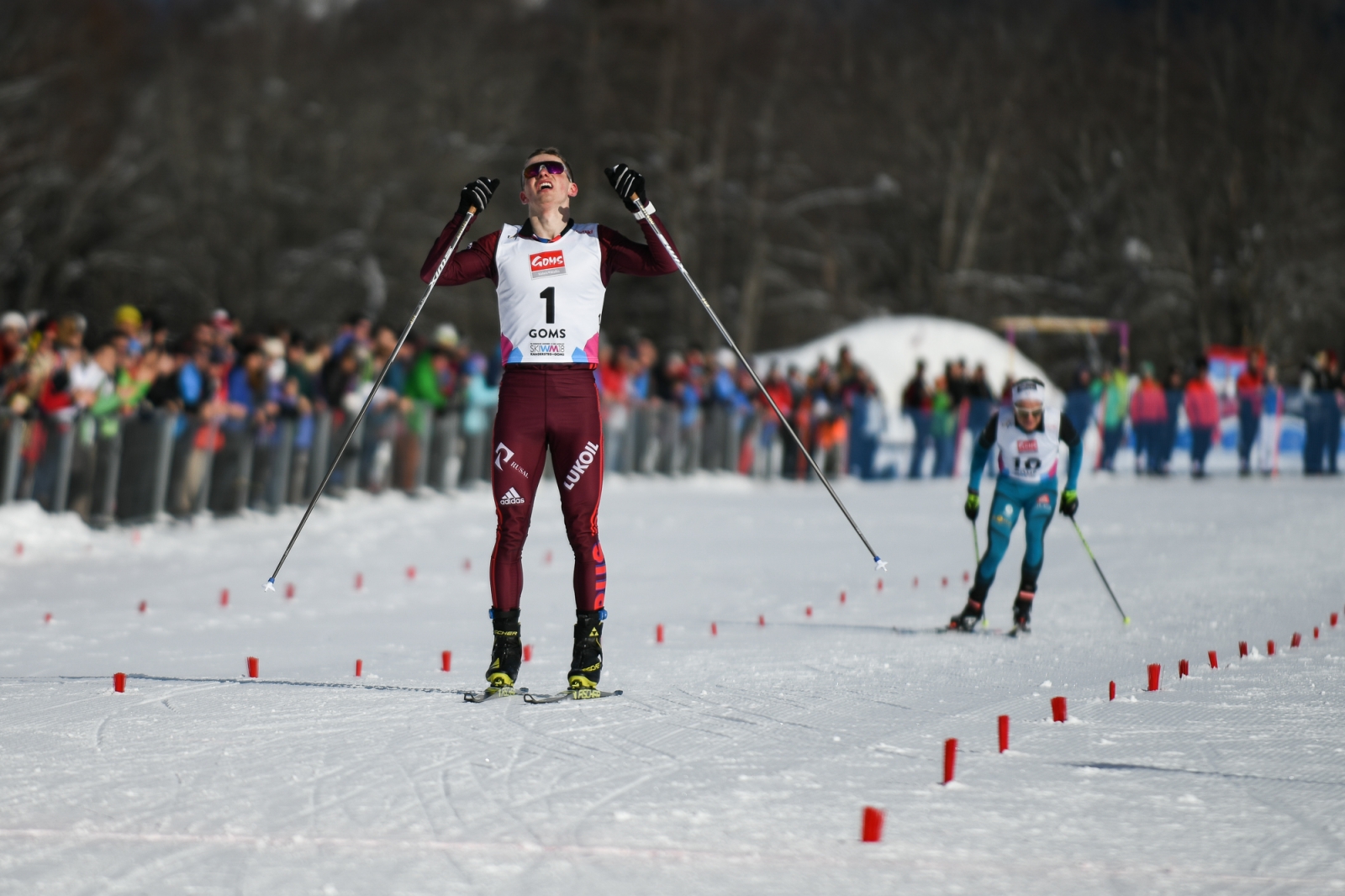
Russia’s Denis Spitsov celebrates his first U23 World Championships gold on Friday ahead of France’s Jules Lapierre in the men’s 30 k skiathlon in Goms, Switzerland. (Photo: JWSC2018.ch)
(Note: This article has been updated to include comments from Americans Lauren Jortberg and Ian Torchia.)
U23 World Championships (Goms, Switzerland): 15/30 k skiathlons
On the final day of U23 World Championships racing in Goms, Russia stole the show in the women’s and men’s skiathlons.
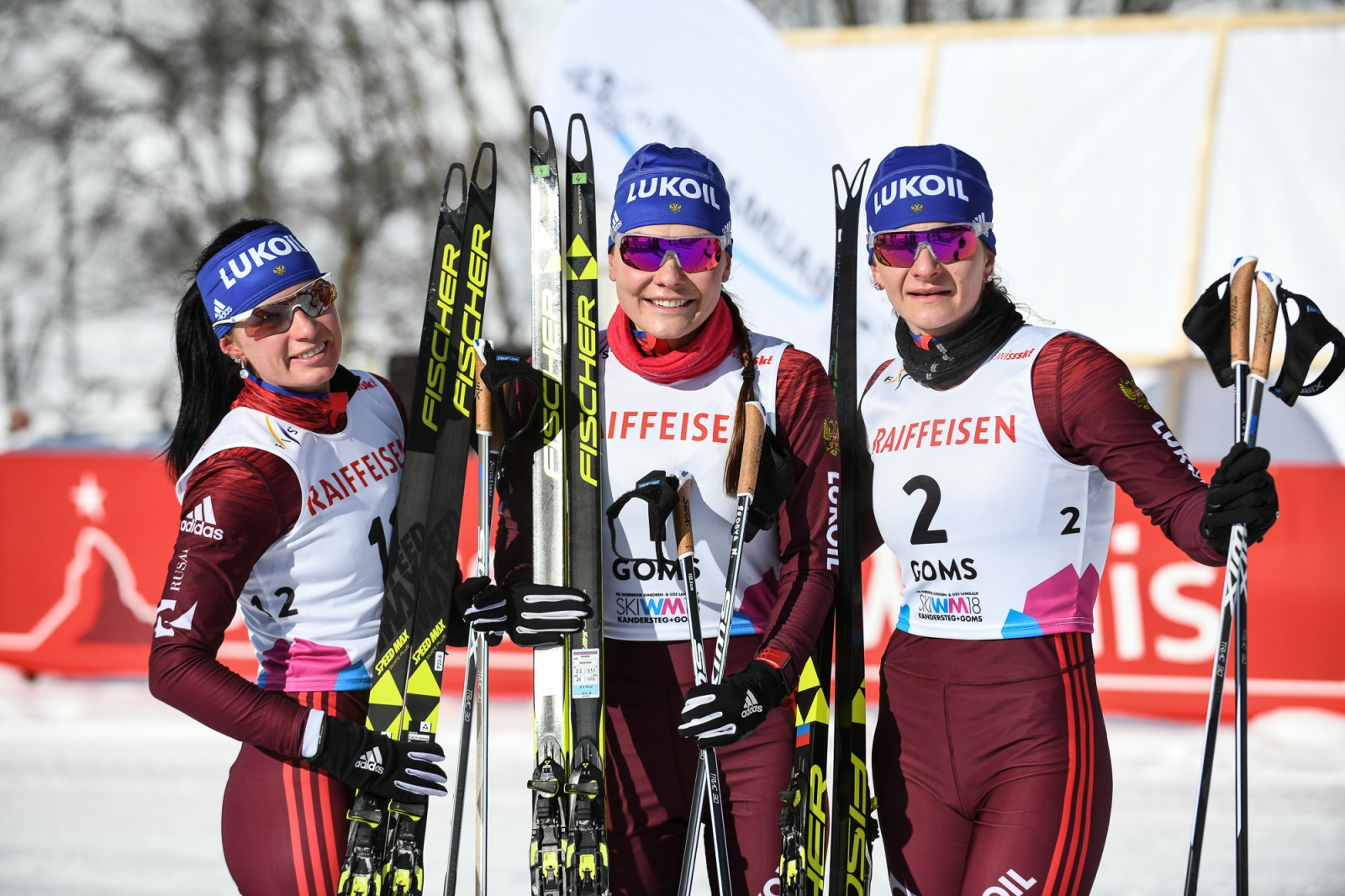
The all-Russian women’s 15 k skiathlon podium at U23 World Championships on Friday in Goms, Switzerland, with Anastasia Sedova (c) in first, Natalia Nepryaeva (l) in second and Yulia Belorukova (r) in third. (Photo: JWSC2018.ch)
Anastasia Sedova led them in the first race of the day on Friday, the women’s 15-kilometer skiathlon, which she won in 44:03.6 minutes. Russia swept the podium and had four in the top five with Natalia Nepryaeva in second (+10.7) and Yana Kirpichenko in third (+37.2), and Yulia Belorukova in fourth (+1:58.0). Germany’s Pia Fink placed fourth (+1:33.5).
The race was the first of the week for the 22-year-old Sedova, a World Cup regular, and it was her second individual gold medal at her second U23 World Championships (she won the 10 k classic in 2016).
“Good preparation for the Olympic Games,” Sedova said during an in-arena interview after the race. “I am very lucky today. Good atmosphere, good weather today.”
Kirpichenko won the 10 k classic earlier this week and Nepryaeva placed third in the freestyle sprint in Goms.
“It’s hard to say how to describe the race, but Anastasia is a really good skier,” Nepryaeva said after. “She was really good today. So for me it was hard to support her during the race. Today she was much better than me.”
American Lauren Jortberg (Dartmouth Ski Team) led the North Americans in 29th (+5:29.9) for her best distance result at the Junior/U23 World Championships level.
“Early in the race I was right over 30th place, and I was trying to maintain contact with the big group ahead of me,” Jortberg, a Dartmouth sophomore from Boulder, Colorado, wrote in an email. “The pace of the classic leg was really fast. A couple of the girls in the race are heading to the Olympics in a few days so it was a really hot start!”
She came through the transition at the race’s halfway point in 31st, about 3:47 behind the leaders.
“I am a much better skater so I felt like I really put the hammer down on the skate leg and moved up a lot,” Jortberg wrote. “The skate course was much easier than the classic course, but I feel like I skied the massive climbs better than the girls around me. I focused on having a really high tempo over the hills and skiing the downhills technically well because there was no rest on the course.
“I’m pleased with my performance today, and I’m excited about my results this week as a whole,” she added. “I’m definitely leaving here hungry for more because I don’t think it was my best week, but I think it was really solid. This is the most competitive field I’ve ever raced against so it feels really good to know that I’m not too far off their level!”
Also for the U.S., Lydia Blanchet placed 38th (+7:11.1) and Nicole Schneider was 40th (+8:04.3). Julia Kern did not finish.
Canada’s Katherine Stewart-Jones (Canadian National U25 Team/NTDC Thunder Bay) placed 31st (+5:39.0) and Maya MacIsaac-Jones was 42nd (+8:08.8), while Laura Leclair and Sophie Carrier-Laforte were lapped.
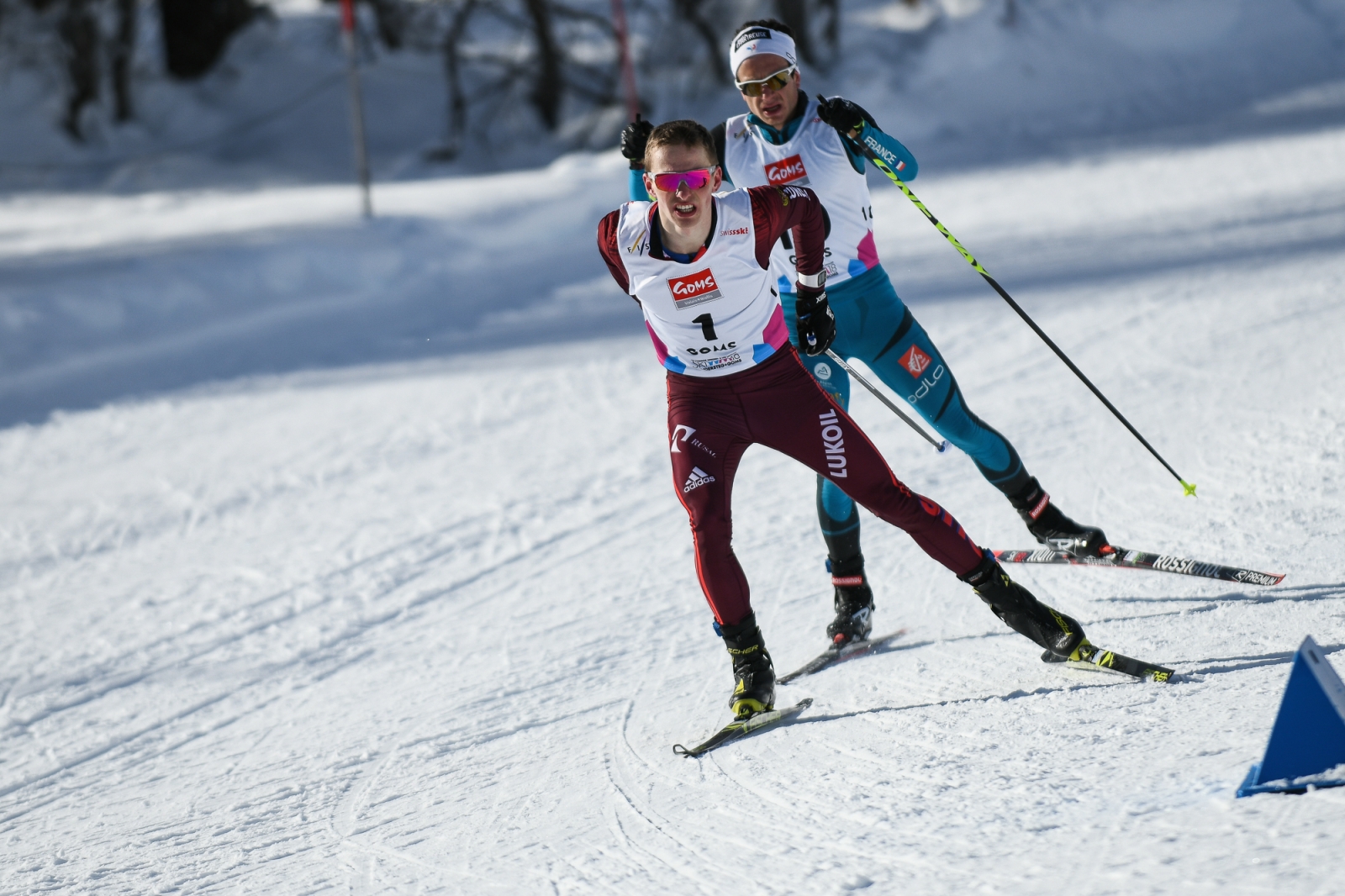
Russia’s Denis Spitsov leads France’s Jules Lapierre during the men’s 30 k skiathlon on Friday at 2018 U23 World Championships in Goms, Switzerland. Spitsov went on to win by 2.9 seconds over Lapierre. (Photo: JWSC2018.ch)
In the men’s 30 k, Russia’s Denis Spitsov took the win in 1:18:14.9 hours, just 2.9 seconds ahead of France’s Jules Lapierre. Norway’s Ole Jørgen Bruvoll placed third (+21.5), ahead of Russia’s Ivan Yakimushkin in fourth (+23.2), and Andorra’s Irineu Esteve Altimiras in fifth (+36.4).
The gold was the first for Spitsov, 21, who previously placed second in the 15 k classic earlier this week. He has two individual bronze medals from last year’s U23 Worlds (in the 30 k skiathlon and 15 k freestyle).
American Ian Torchia (U.S. Ski Team/Northern Michigan University) placed 27th on Friday (+6:05.7). Only 33 men finished, and he was the only North American that didn’t get lapped.
“Between the 3700 feet of climbing, a 2.5km loop, and the top dogs having World Cup podiums…half the field got lapped,” Torchia wrote in an email. “Definitely added some motivation in the final 2 laps to see Spitsov and Lapierre slowly catching up.
“I felt I skied technically better in skate and struggled on the classic leg,” Torchia explained. “Took a hard tumble halfway through the classic leg and had to take half a lap to recover from that. Found a hole in my suit close to my groin afterward which was a little unnerving!”
At the end of the week, he noted that he felt “more fired up than coming in. Funny how being 6 minutes back can do that,” he wrote. “It was an eye-opening experience to get back on the international stage after 2 years and I will take these lessons of racing to the rest of the season in the Ishpemimg Super Tour, Steamboat NCAA’s, and Craftsbury Spring Series. Also already thinking of ideas on how to change and optimize my training to make the jump to the top level.”
Americans Andrew Egger, Zak Ketterson and Thomas O’Harra also competed, as did Canada’s Alexis Dumas, Gareth Williams, Philippe Boucher, and Ricardo Izquierdo-Bernier.
Stratton’s Ben Saxton (l) edging Julien Locke (r) by eight-hundredths of a second for the win in the men’s 1.4 k classic sprint A-final on Friday at Eastern Canadian Championships in Gatineau, Quebec. (Photo: Becca Rorabaugh (APU) on her way to winning the women’s 1.3 k classic sprint qualifier on Friday at 2018 Eastern Canadian Championships in Gatineau, Quebec. (Photo: Rob Smith/CCC)
NorAm Eastern Canadian Championships (Gatineau, Quebec): Classic sprints
Eastern Canadian Championships opened in Gatineau on Friday with classic sprinting, and Americans Becca Rorabaugh and Ben Saxton ended the day with wins in the women’s and men’s A-finals, respectively.
Becca Rorabaugh (APU) on her way to winning the women’s 1.3 k classic sprint qualifier on Friday at 2018 Eastern Canadian Championships in Gatineau, Quebec. (Photo: Rob Smith/CCC)
For Rorabaugh, the win is her second straight after the Alaska Pacific University (APU) skier won the women’s 5-kilometer freestyle at last weekend’s SuperTour in Craftsbury, Vermont. She edged last weekend’s classic-sprint winner, Kaitlynn Miller, of the Craftsbury Green Racing Project (CGRP), by 0.41 seconds for the win in 3:23.15 minutes in Friday’s 1.3 k classic sprint final. It was an all-American podium (and all-American final) with Erika Flowers, of the Stratton Mountain School (SMS) T2 Team, just another three-hundredths of a second back in third (+0.44). Liz Guiney (CGRP) followed in fourth (+2.51), Rosie Frankowski (APU) was fifth (+3.88), and Corey Stock (Bridger Ski Foundation) placed sixth (+6.1).
Rorabaugh had started the day by qualifying first in 3:26.95, then won both her quarterfinal and semifinal. Miller qualified third and won her quarterfinal and semifinal as well.
In the men’s 1.4 k classic sprint, Saxton (SMST2) nipped Julien Locke (Canadian U25 Team/Black Jack) at the line by 0.08 seconds for the win in 3:04.54. Patrick Stewart-Jones (Alberta World Cup Academy) placed third (+5.53), Kris Freeman (Caldwell Sport) was fourth (+5.94), Kevin Bolger (Sun Valley Ski Education Foundation) fifth (+7.42), and Julian Smith (NTDC Thunder Bay) sixth (+11.63).
Locke initially won the qualifier in 3:08.37, then won the first quarterfinal and first semifinal as well. Saxton qualified sixth, then advanced in second in his quarterfinal about a second behind Smith, and Saxton won the second semifinal.
Easterns continue Saturday with 10/15 k freestyle races and conclude Sunday with 10/15 k classic pursuits.
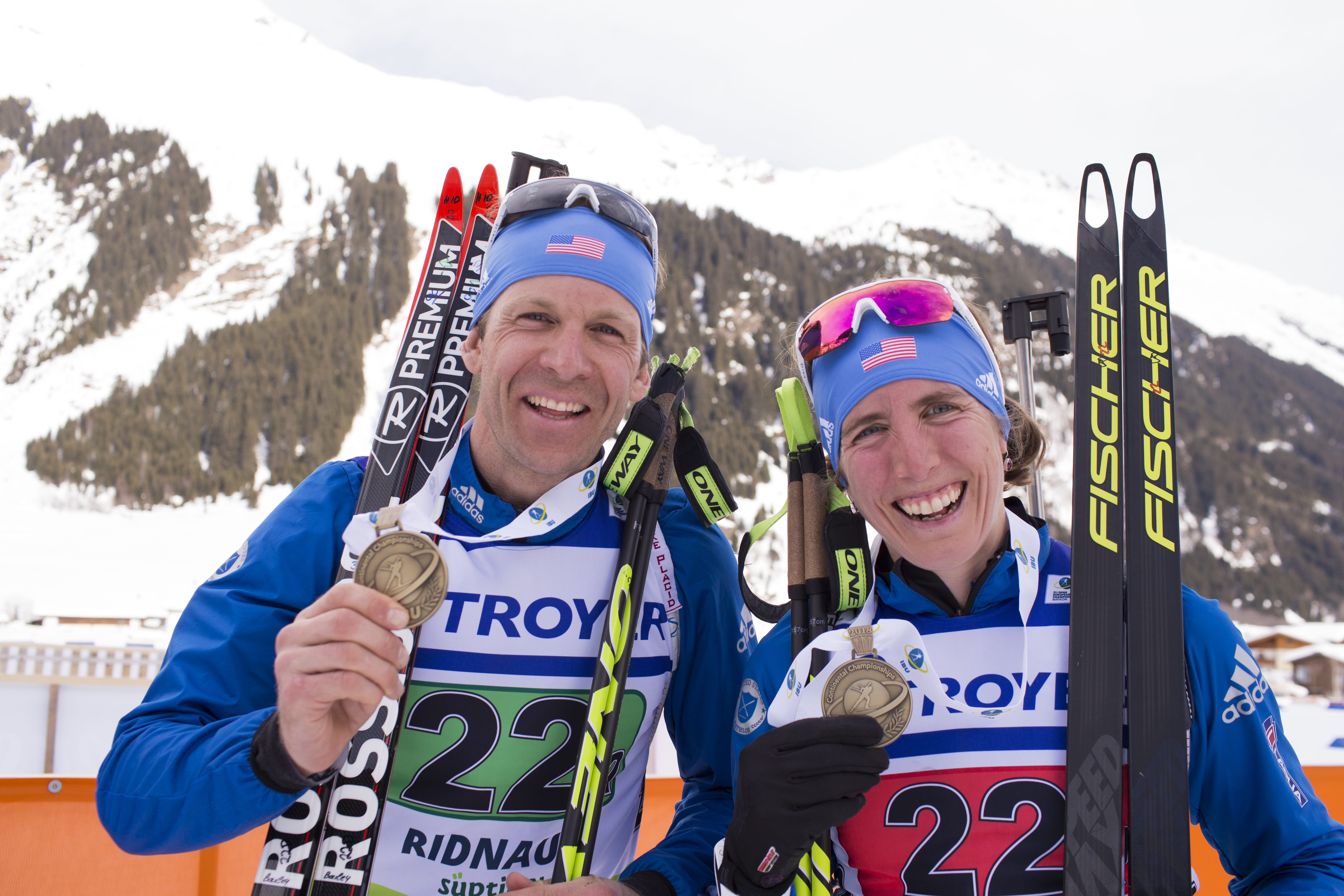
US Biathlon’s Lowell Bailey (l) and Susan Dunklee after teaming up for bronze in the single mixed relay at 2018 IBU Open European Championships on Sunday in Ridnaun, Italy. (Photo: Manzoni/NordicFocus)
IBU Open European Championships (Ridnaun-Val Ridanna, Italy): Single mixed & mixed relays
Susan Dunklee and Lowell Bailey teamed up for the final day of the 2018 International Biathlon Union (IBU) Open European Championships in Ridnaun, Italy, and raced to a bronze medal in the single mixed relay.
The American duo, both of which earned individual medals at last year’s IBU World Championships, finished just 9.1 seconds out of first, which went to Norway’s Thelka Brun-Lie and Vetle Sjåstad Christiansen. The Norwegians won in 35:39.6 with zero penalties and six spares. They took the lead after Brun-Lie’s second leg, where she cleaned both stages without spares.
France placed second, 8.6 seconds back, with Julia Simon and Emilien Jacquelin, who combined for no penalties and 11 spares. They led the first half of the race, but slipped to second behind Norway on Simon’s second leg.
Dunklee put the Americans off in second on her first leg, which she cleaned with a spare in each stage, then they slipped one place to third on Bailey’s first leg, where he cleaned as well and used three spares. In all, they used 10 spares and avoided the penalty loop, and finished half a second out of second place.
“Over Christmas, we trained a little bit with the French athletes, including Jacquelin,” Bailey said, according to a US Biathlon press release. “So I know that he has quite a fast finish, and I thought I am kind of an old man here, I should maybe try to go harder on the first part of the lap. But he stayed with me all the time and had me in the end.”
“It was a good opportunity to tune up the race shape, build some confidence and find that sharp feeling heading into the Olympics,” Dunklee told US Biathlon. “The single mixed relay is one of my favorite race formats and today was a blast!”
Canada’s Sarah Beaudry and Carsen Campbell placed eighth of 24 teams in the single mixed relay, finishing 1:03.6 out of first with just eight spares and zero penalties. In 11th after the first leg, they moved into eighth on Campbell’s first leg, which he cleaned with one spare. Beaudry then cleaned her second leg without any spares, and Campbell anchored them to eighth.
The U.S. entered a team in the mixed relay that followed, with Chloe Levins, Deedra Irwin, Paul Schommer, and Alex Howe placing 17th (+5:55.5) of 19 teams with no penalties and 12 spares.
Ukraine won the mixed relay to conclude the championships, with Yuliia Zhuravok, Iryna Varvynets, Artem Pryma, and Dmytro Pidruchnyi combining for zero penalties and six spares and finishing in 1:11:40.1.
Russia placed second (+11.7) with Victoria Slivko, Anastasia Zagoruiko, Evgeniy Garanichev, and Alexander Loginov combining for zero penalties and nine spares.
Norway followed in third (+33.2) with Emilie Ågheim Kalkenberg, Kaia Wøien Nicolaisen, Håvard Gutuboe Bogetveit, and Fredrik Gjesbakk combing for no penalties and just four spares.
U.S. SuperTour (Craftsbury, Vermont): 5/10 k freestyle
Two Alaska Pacific University (APU) athletes topped the podium on Sunday at the SuperTour in Craftsbury, Vermont, with David Norris winning the men’s 10-kilometer freestyle individual start in 21:54.9 and Becca Rorabaugh topping the women’s 5 k freestyle in 12:06.4.
Norris won the men’s race by 6 seconds over Canada’s Andy Shields (Lappe Nordic) and Kevin Bolger of the Sun Valley Ski Education Foundation (SVSEF) placed third (+15.8). Kris Freeman (Caldwell Sport) was the third American in fourth overall (+23.7), and three Canadians took fifth through seventh with Michael Somppi (Lappe Nordic) in fifth (+27.9), Evan Palmer-Charrette (NTDC Thunder Bay) in sixth (+37.5) and Scott Hill (Barrie Cross Country) in seventh (+37.6), ahead of Brian Gregg (Team Gregg/LNR/CXC) in eighth (+39.4), Tad Elliott (Ski Club Vail) in ninth (+44.3) and Jack Hegman in 10th (+50.4).
Rorabaugh won the women’s race by just 2.2 seconds over her APU teammate Rosie Frankowski in second, and Erika Flowers of the Stratton Mountain School (SMS) T2 Team placed third (+4.6). Two Craftsbury Green Racing Project (CGRP) skiers finished fourth and fifth, with Kaitlynn Miller in fourth (+12.1) and Liz Guiney in fifth (+22.5), Kelsey Phinney (SVSEF) was sixth (+25.8), and Canadians Olivia Bouffard-Nesbitt (Rocky Mountain Racers) seventh (+26.4) and Frederique Vezina (Pierre-Harvey National Training Centre) eighth (+36.0). Corey Stock, of the Bridger Ski Foundation (BSF) placed ninth (+39.9), and Felicia Geisor (CXC Team) was 10th (+44.4).
On Saturday, the Craftsbury Outdoor Center hosted its 37th annual Craftsbury Marathon, with Nils Koons winning the 48 k men’s race in 2:28:51.0 hours and Hannah Dreissigacker winning the 48 k women’s race in 3:01.48.7.
Hannah Halvorsen of the U.S. Ski Team and APU on the start line in Ulrichen, Switzerland, after finishing fifth in the sprint qualifier. (FIS screencap)
FIS Cross Country World Junior Championships (Ulrichen, Switzerland): Freestyle sprints
World Junior Championships kicked off today with freestyle sprints in Ulrichen, Switzerland. Moa Lundgren of Sweden claimed with women’s title by 1.89 seconds over Kristine Stavås Skistad of Norway in the final, with Sweden’s Frida Karlsson finishing third (+1.89).
Hannah Halvorsen of the United States qualified in fifth place before skiing to second in her quarterfinal heat. Halvorsen hovered around third or fourth place through much of her semifinal and was unable to snipe any spots in the finishing straight, ending up fourth in the heat and eighth on the day.
Fellow Americans Margaret Gellert and Sofia Shomento also made the quarterfinals, finishing 18th and 23rd, and Canada’s Hannah Mehain wound up 29th on the day.
The new men’s junior world champion is Tom Mancini of France, who nipped Norway’s Jørgen Lippert by just 0.10 seconds to take the win. Valerie Grond gave the Swiss crowd a thrill by making it all the way to the final and taking home bronze, despite qualifying in just 21st position. The Swiss junior narrowly edged France’s Vincent Buiatti for the final step on the podium.
Canada’s Graham Ritchie finished second in his quarterfinal after qualifying in 28th position, earning an automatic spot in the semifinals. There he finished sixth (+9.30 behind Mancini), winding up 12th on the day. Teammate Antoine Cyr also made the quarterfinals where he had an impressive crash, slinging off the trail and into the infield, finishing 30th on the day. For the U.S., Gus Schumacher was the lone qualifier for the heats. He finished fourth in his quarterfinal and was just 0.22 seconds away from a “lucky loser” spot in the semifinals. Schumacher finished 19th on the day.
In the junior women’s race, Hannah Rudd of the United States finished 35th in qualification, +18.15. For Canada, Annika Richardson finished 52nd (+24.09), Catherine Reed-Metayer 56th (+28.25), and Alexandra Racine 69th (+37.27).
In the junior men’s sprint, Canada’s Reed Godfrey finished a tough 31st, just 0.21 seconds out of making the quarterfinals. Etienne Hebert rounded out the Canadian finishers in 36th place (+11.81) in the qualifier. Canyon Tobin was 41st in qualification for the U.S. (+13.46), followed by Karl Schulz in 54th (+16.90) and Luke Jager in 60th (+18.15).
FIS Nordic Combined World Cup (Seefeld, Austria): Individual normal hill/15 k
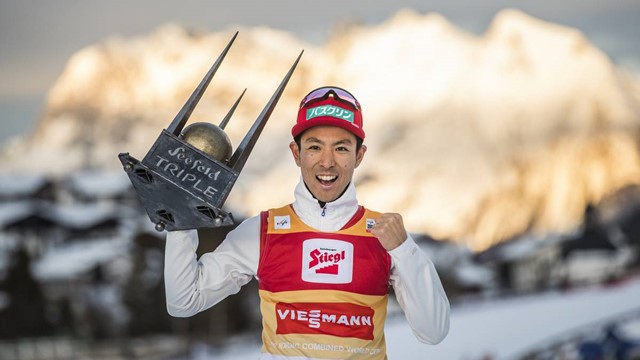
Japan’s Akito Watabe after winning the 2018 Seefeld Triple Nordic Combined World Cup. He is the only athlete besides Germany’s Eric Frenzel to win the event. (Photo: FIS Nordic Combined)
On the final day of the Seefeld Triple, Japan’s Akito Watabe completed his sweep of the three-day weekend and Norway’s Jarl Magnus Riiber reached the podium for the third-straight day, placing second. Germany’s Fabian Rießle placed third for his second podium in the last two days.
Watabe jumped to first on the normal hill and started the 15 k Gundersen 48 seconds ahead of Riiber in second. He went on to win the race by 1:14.9 minutes in 34:58.6, becoming the only man besides Germany’s Eric Frenzel to win the Seefeld Triple in its five-year history.
After jumping to fifth, Rießle won a photo finish for third (+1:57.9), edging Germany’s Vinzenz Geiger by less than a tenth of a second. Geiger moved up from ninth in the jump to fourth overall (+1:57.9).
Norway’s Jørgen Graabak followed in fifth (+2:02.4),Frenzel placed sixth (+2:07.4), Norway’s Jan Schmid was seventh (+2:09.8), Finland’s Eero Hirvonen eighth (+2:13.5), Norway’s Espen Andersen ninth (+2:28.0), and Austria’s Mario Seidl 10th (+2:42.1) out of 28 finishers.
No Americans contested the final day of the Triple, the last World Cup before the 2018 Winter Olympics in PyeongChang, South Korea.
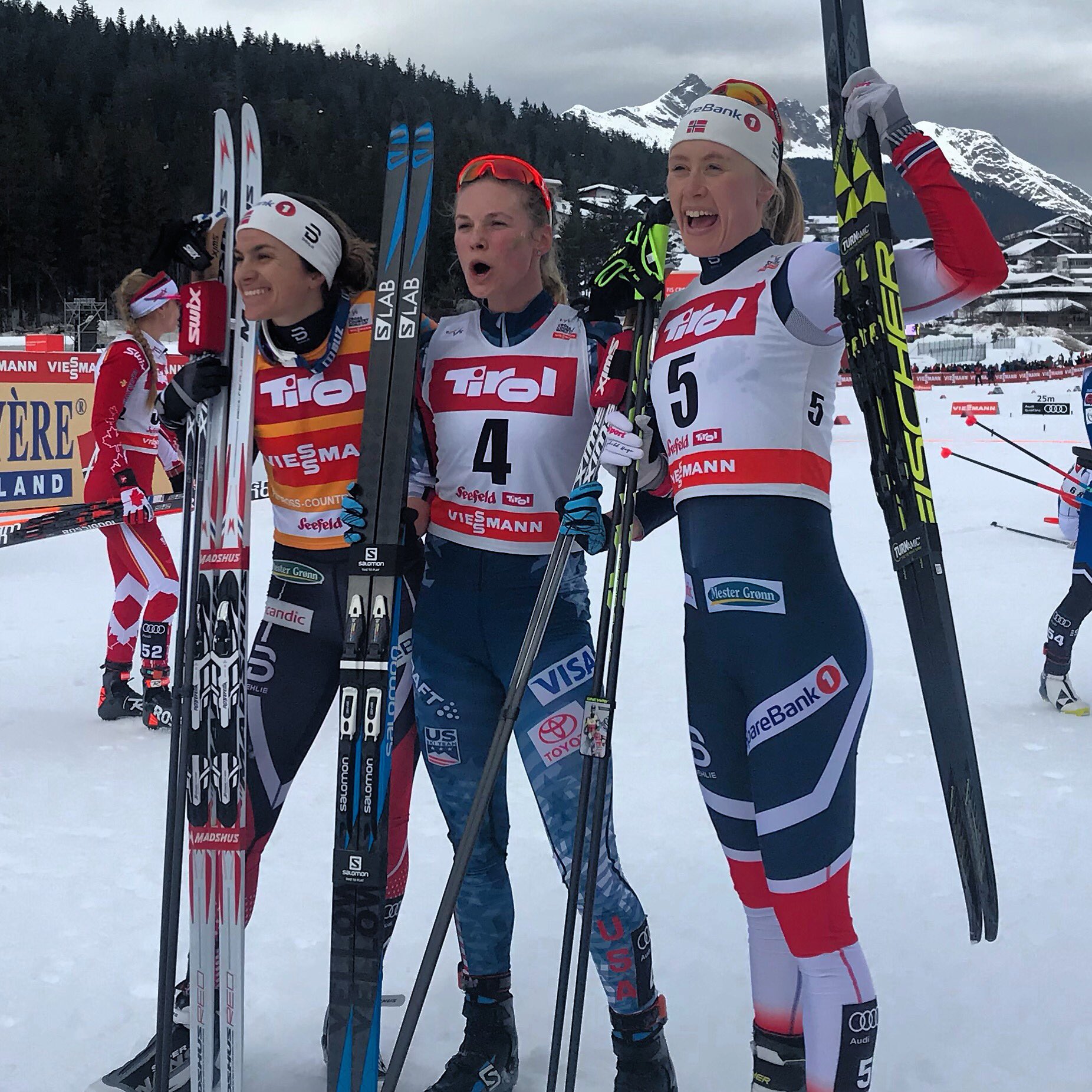
Jessie Diggins of the U.S. Ski Team (center) celebrates after winning the 10 k mass start freestyle in Seefeld, Austria, over Heidi Weng (left) and Ragnhild Haga of Norway. (Photo: FIS Cross Country/Twitter)
FIS Cross Country World Cup (Seefeld, Austria): 10/15 k mass start freestyle
In the final World Cup race before the 2018 Olympics, Jessie Diggins achieved the ultimate goal to give herself the utmost confidence heading into PyeongChang — winning the women’s 10-kilometer freestyle mass start at the World Cup in Seefeld, Austria, on Sunday.
The win was her first of the season and fourth individual victory of her career. Diggins, a 26-year-old U.S. Ski Team member, pulled it off by attacking on a long climb and leaving Norway’s Heidi Weng, Ragnhild Haga and Ingvild Flugstad Østberg chasing. While Diggins was several seconds ahead over the top and all alone on the long descent that followed, Weng and Haga worked to close the gap — and nearly did in the finishing stretch. But Diggins held them off, winning by 0.7 seconds over Weng in second place and 1 second ahead of Haga in third, and threw her fists down in celebration as she crossed the line first in 23:08.5 minutes.
“I just put my head down and it wasn’t pretty, but I just hammered,” Diggins told the International Ski Federation (FIS) in a televised post-race interview.
She was the only non-Norwegian in the top five, with Østberg in fourth (+8.7) and Marit Bjørgen in fifth (+16.7). Austria’s Teresa Stadlober placed sixth (+16.9), Norway’s Kari Øyre Slind was seventh (+19.1), and American Sadie Bjornsen placed eighth (+20.5), ahead of Switzerland’s Nathalie von Siebenthal in ninth (+30.3).
The U.S. had three in the top 15 with Kikkan Randall (U.S. Ski Team) in 14th (+48.5), and two more women in the top 30, with Caitlin Patterson (Craftsbury Green Racing Project) in 23rd (+1:00.7) and Liz Stephen (USST) in 29th (+1:18.2). Rosie Brennan (USST) finished 53rd (+2:26.9).
Emily Nishikawa led the Canadians in 35th (+1:36.5), followed closely by teammate Cendrine Browne in 37th (+1:36.6). Dahria Beatty finished 45th (+1:58.9).
Dario Cologna of Switzerland (center) won the men’s 15 k skate mass start in Seefeld, Austria, over Alex Harvey of Canada (left) and Martin Johnsrud Sundby of Norway (right). (Photo: FIS Cross Country/Twitter)
The Olympics are nearing and so Switzerland’s Olympic legend Dario Cologna is ramping up: after winning the Tour de Ski, he took another win in the 15 k mass start skate in Seefeld, Austria, on Sunday.
With much of the field staying relatively close together until the finish, Cologna nabbed the win by 1.4 seconds over Canada’s Alex Harvey, who took his second podium of the season in addition to also finishing third in the overall Tour de Ski.
Norway’s Martin Johnsrud Sundby was third (+2.9), then teammate Didrik Tønseth in fourth (+5.9) and France’s Maurice Manificat in sixth (+7.5).
The U.S. Ski Team’s Erik Bjornsen had a breakthrough day finishing ninth (+9.3), followed by Simi Hamilton in 12th (+12.4). Behind them, Scott Patterson placed 27th (+23.4), then Patrick Caldwell 49th (+1:26.2), Ben Lustgarten 55th (+1:42.7), and Tyler Kornfield 77th (+3:00.0).
Canada’s Devon Kershaw and Graeme Killick finished 30th (+26.5) and 31st (+27.4), respectively. Len Valjas placed 58th (+1:53.1), Knute Johnsgaard 82nd (+3:23.1), Bob Thompson 87th (+4:27.5), and Julien Locke 92nd (+4:56.9).
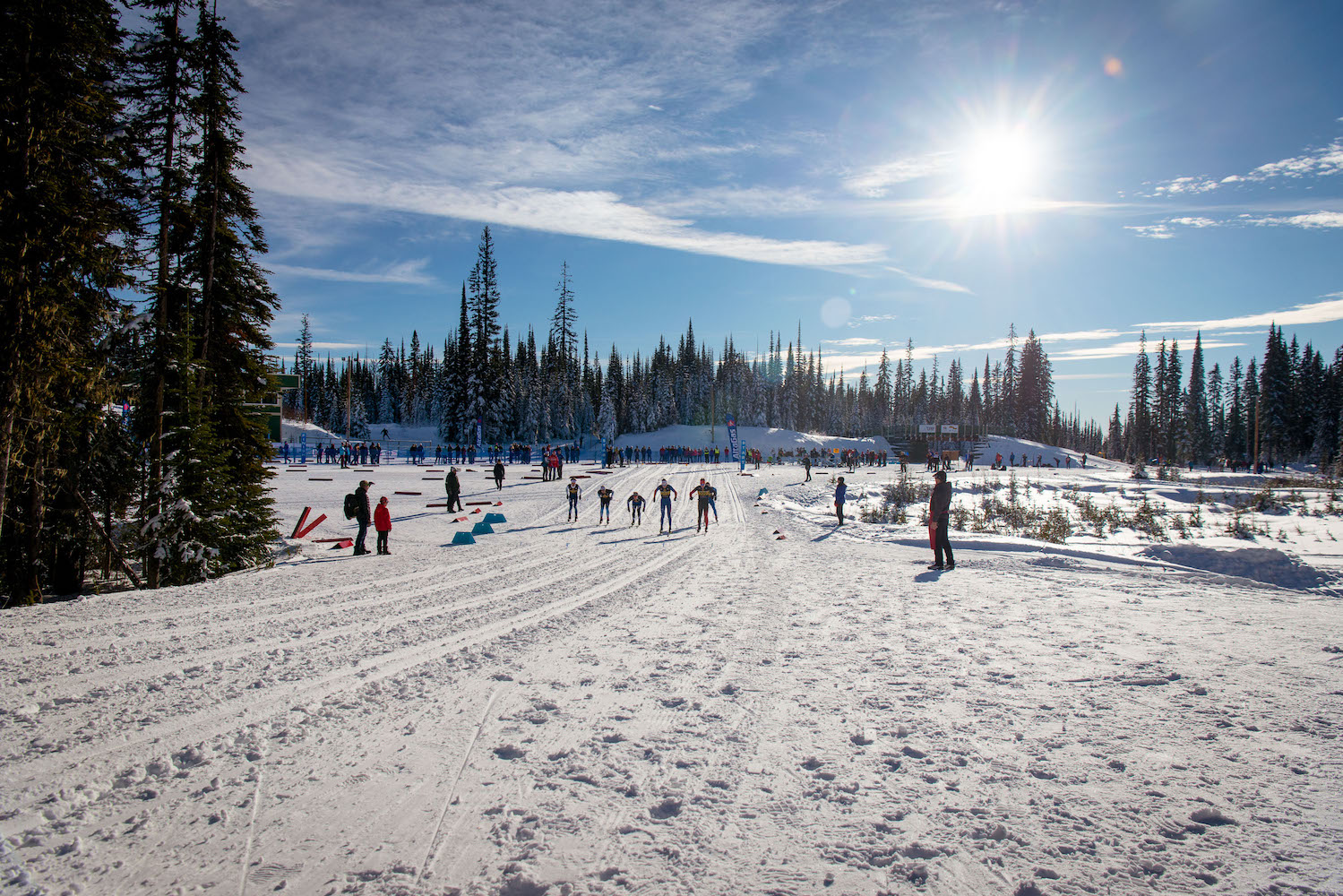
Classic sprint day at the Sovereign Lake Nordic Centre on Saturday, Dec. 9. The NorAm opening weekend also counted as SuperTour races. (Photo: SilverStar Mountain Resort)
VERNON, British Columbia — For the second consecutive year, the Sovereign Lake NorAm was combined with the SuperTour for an expanded field of racers. The warm, sunny, and windless conditions on both days were a welcome change from the previous season’s cold weather and falling snow. What didn’t change was the ‘south of the border’ feel to the leaderboard.
The race formats were similar to that of the Davos World Cup, just nine time zones later: Saturday was a classic sprint (Davos was a skate sprint) and Sunday included 10- and 15-kilometer freestyle interval starts.
With temperatures around -2 degree Celsius and dry, untransformed snow, the waxing was straightforward both days with ski choice dominating the discussions. More than 400 racers competed, including 140 men and 84 women in the open categories.
Classic Sprint
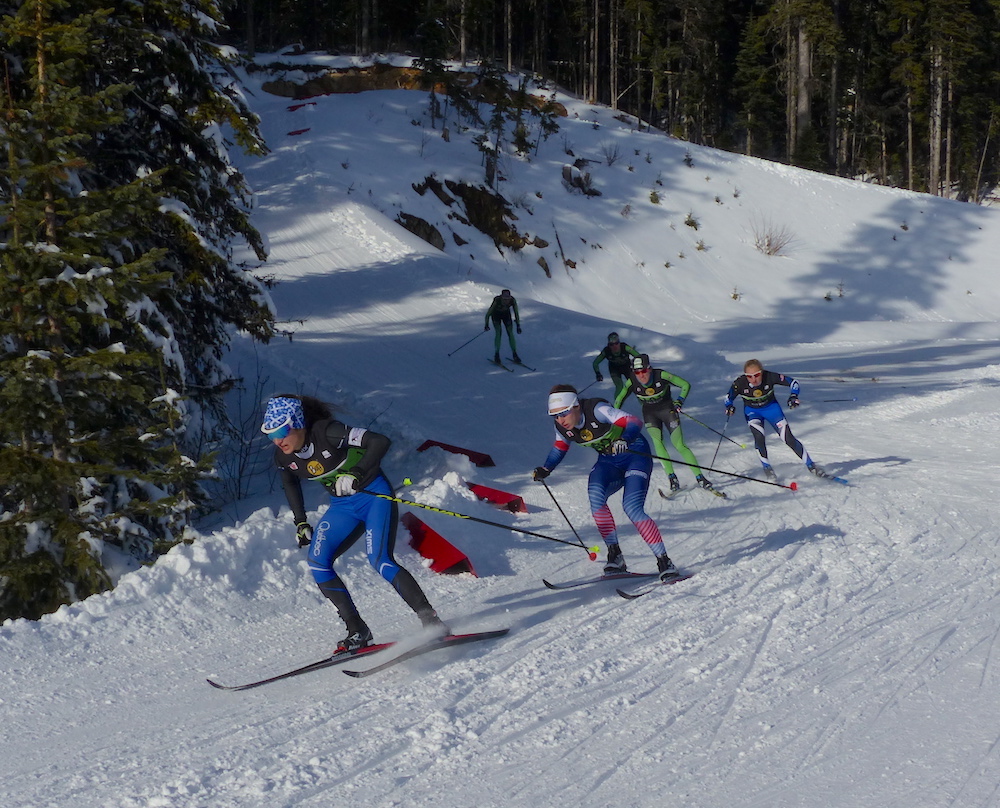
Sophie Carrier-Laforte (Pierre-Harvey National Training Centre) leading the women’s classic sprint final at the Sovereign Lake NorAm/SuperTour on Dec. 9, ahead of Sun Valley’s Kelsey Phinney (second from l), Craftsbury’s Kaitlynn Miller (third from l) and APU’s Hannah Halvorsen (far r). (Photo: Peggy Hung)
Sovereign’s 1.3-kilometer sprint course doesn’t feature large climbs, but it does reward good tactics. There were a few minor incidents off the start when the six tracks became four, and the final 270-degree turn off the bridge into the finishing straight punished tired legs and tight groups.
American Kaitlynn Miller of the Craftsbury Green Racing Project (CGRP) dominated the open women’s sprint, winning the qualifier and all of her heats. In the A-final, Canadian Sophie Carrier-Laforte, of the Pierre-Harvey National Training Centre (CNEPH), pushed the pace from the start, using her double-poling power to stretch the field over the first three climbs. Miller was last into the hole and used the big climb to work her way to the front, where she was able to control the group through the tricky final turn and get first lane choice to take the win in 2:57.53 minutes. Miller’s teammate, Caitlin Patterson powered past Hannah Halvorsen, of Alaska Pacific University (APU) and the U.S. Ski Team (USST) D-team, to take second, 0.93 seconds behind Miller. Halvorsen claimed third (+2.59), Kelsey Phinney, of the Sun Valley Ski Education Foundation (SVSEF) took fourth (+2.59), and a third Craftsbury skier Liz Guiney placed fifth (+3.53). The lone Canadian in the women’s final, Carrier-Laforte, finished sixth (+4.38).
The ‘technique zone’, where only diagonal stride or herringbone techniques are permitted, wasn’t a factor for the women. Finland’s Jasmi Joensuu, a junior at the University of Denver, had tested early in the week and decided to use grip wax for the one steep climb. Joensuu added some excitement the B-final, as she changed clothes and switched to skate skis for her planned cooldown before discovering that the NorAm series does B-finals. Luckily, her classic race skis were still in the start area and she was able to finish third in that heat for ninth overall.
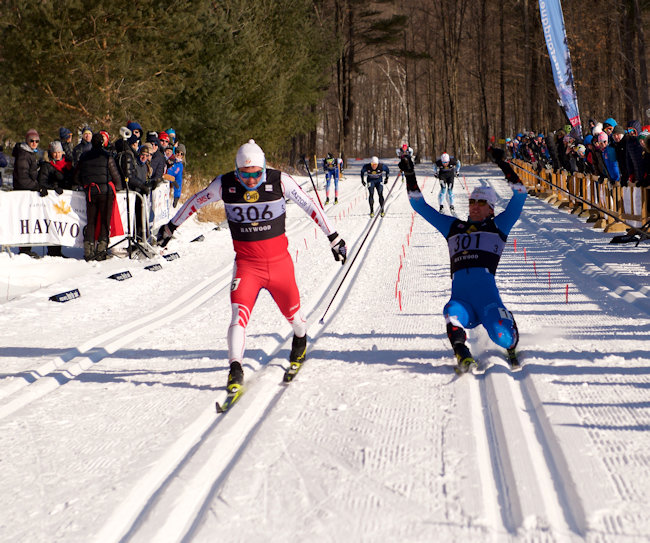
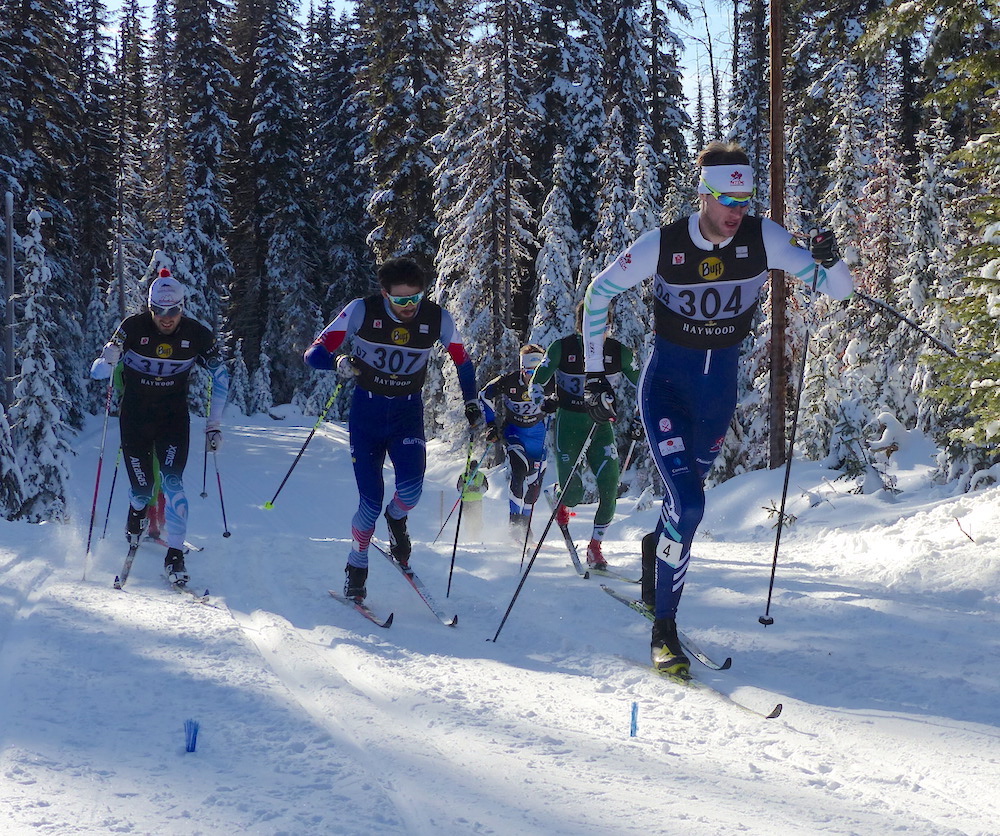
Bob Thompson (304) of NTDC Thunder Bay leading Sun Valley’s Jack Hegman (307) and Patrick Stewart-Jones (317) of the AWCA during their quarterfinal of the NorAm men’s 1.3 k classic sprint on Saturday at Sovereign Lake near Vernon, B.C. (Photo: Peggy Hung)
In the men’s race, Bob Thompson, of the National Team Development Centre (NTDC) Thunder Bay, salvaged Canadian pride with a win after qualifying fourth and placing second in his quarter and semi heats. Thompson was the only Canadian in the A-final, closing a gap to the leading three on the bridge turn and double poling from fourth to first to finish in 2:29.31. American Ben Saxton of the Stratton Mountain School (SMS) Elite Team finished just three-hundredths of a second back for second place, and Cole Morgan edged out his SVSEF teammate Jack Hegman by 0.03 seconds for third (+0.48). APU’s Reese Hanneman and Tyler Kornfield followed in fifth (+7.75) and sixth (+ 7.90), respectively, after being gapped early and losing the battle for the four lanes on the first hill.
In the B-final, the lone Canadian in that heat, Evan Palmer-Charrette (NTDC Thunder Bay) recovered from finishing sixth in his semifinal to take the win (for seventh overall) and earn some important series points.
The technique zone was a larger challenge for the men as they carried more speed into the start of the zone, keeping the jury busy, although only one athlete was disqualified. Many of the top men used just enough grip wax to prevent ‘gliding herringbone’ and the resulting DQ. There were broken poles and one protest at the merge to four lanes off the start, resulting in one verbal warning from the jury, along with a few quarterfinal crashes on the final turn.
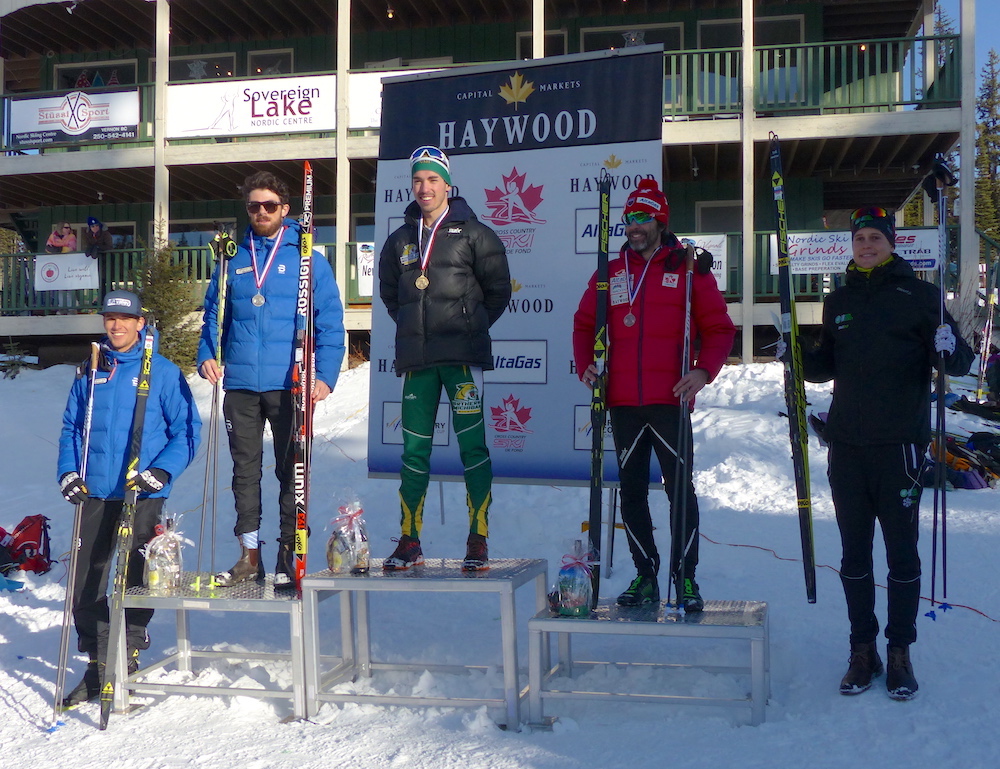
The men’s 15 k freestyle podium on Day 2 of the NorAm opening weekend at Sovereign Lake near Vernon,B.C., with (pictured) Ian Torchia (NMU/USST D-Team) in first, Jack Hegman (SVSEF) in second, Brian McKeever (Canadian Para-Nordic Team) in third, Kevin Bolger (SVSEF) in fourth (far left), Adam Martin (CGRP) in fifth (far right). (Photo: Peggy Hung)
The 5-kilometer ‘Upper World Cup’ course is not obviously difficult to someone casually skiing it in Zone 1; there is one mildly challenging corner, one steep climb (‘the wall’), and the total climb is at the lower limit of the International Ski Federation (FIS) homologation range. But racing it is another story, as evidenced by several top finishers after Sunday’s 10/15 k freestyle interval starts who used words like “nightmare”, “hardest”, and “most painful” in post-race interviews.
In the men’s 15 k, Ian Torchia, a Northern Michigan University (NMU) junior and member of the USST D-team, was on fire, ranking fourth after two of three laps. He described suffering on the last lap and relying on a ride to keep his speed up, but still managed to ski the fastest final lap (in 12:15.7) to take the victory in 36:29.7.
Hegman placed second, 19.0 seconds back, improving on his fourth place from the sprint. Canadian Para-Nordic skier Brian McKeever, who skipped the Canmore International Paralympic Committee (IPC) World Cup to race at Sovereign, notched third (+22.6). Sun Valley’s Kevin Bolger skied three very even laps (11-second variation from fastest to slowest) to finish fourth. Craftsbury’s Adam Martin took fifth (+28.3), just edging out Para-Nordic guide Graham Nishikawa, who led Torchia into the finish and placed sixth (+29.1).
A perennial podium threat at Sovereign and the previous weekend’s SuperTour distance winner, Brian Gregg, of Team Gregg, Central Cross Country (CXC) and Loppet Nordic Racing (LNR), took the lead after Lap 1 with a time of 11:49.8. But by the end of Lap 2, he was visibly losing power, clocking the 18th-fastest lap time, before his 13:10.4 final lap ranked 45th for 16th overall (+1:09).
Thompson, wearing the NorAm leader’s bib after his victory on Saturday, finished 19th (+1:17.2). The combined NorAm and SuperTour fields made for a highly competitive event, with the top 40 men finishing within two minutes of first.
Caitlin Patterson (Craftsbury Green Racing Project) racing to the win in the women’s 10 k freestyle on Dec. 10 at the Sovereign Lake NorAm/SuperTour. (Photo: XTS Photography)
In the women’s 10 k, Patterson moved up from her sprint second place to notch her first win of the season in 27:13.0. She was 30.7 seconds clear of runner-up Rosie Frankowski (APU), and Frankowski claimed second by just one second over Caitlin Gregg (CXC/LNR/Team Gregg) in third.
Katherine Ogden, a Dartmouth College freshman and member of the Stratton Mountain School (SMS) and USST D-team, placed fourth (+50.1), just ahead of Becca Rorabaugh (APU) in fifth (+52.7) and Mary Rose (SVSEF) in sixth (+1:00.9).
Retired biathlete Zina Kocher was the top Canadian in eighth (+1:31.2). Kocher (who raced at Frozen Thunder in November under her new married name of Lawson) will compete as Kocher this season as FIS requires a new passport to register a name change. Not surprisingly for a former biathlete, she enjoyed the skate distance race much more than the classic sprint.
CNEPH’s distance specialist Frédérique Vézina was the second Canadian in 12th overall (+2:03.3).
If you didn’t get your fill of video links above, the local tv station visited the day before the sprints and presciently chose Thompson for their first interview. They also talked to APU’s Erik Flora.
Sprint Photos
The junior men descending after the second climb. (Photo: Anna Sellers)
Men’s X final drops off the bridge into the 270. (Photo: Anna Sellers)
Sunshine on the third descent. (Photo: Anna Sellers)
Ben Saxton leads the way to the bridge. (Photo: Anna Sellers)
Top of the last climb. (Photo: Anna Sellers)
(Photo: Anna Sellers)
Bob Thompson leads early in the men’s A final. (Photo: Peggy Hung)
The men’s A final in the finishing straight. (Photo: Peggy Hung)
Ben Saxton (l) leads Bob Thompson (r) with 50m to go. (Photo: Peggy Hung)
Sophie Carrier-Laforte was pushing hard on the double-pole climbs. (Photo: Peggy Hung)
Caitlin Patterson leads the A final. (Photo: Peggy Hung)
Distance Photos
For more distance photos, find XTS Photography on FaceBook.
This is what retirement looks like for Brittany Webster. (Photo: Peggy Hung)
Caitlin Gregg leads Mary Rose. (Photo: Peggy Hung)
Recovery time for Caitlin Gregg and Mary Rose
. (Photo: Peggy Hung)
Dakota Blackhorse-von Jess on the wall climb. (Photo: Peggy Hung)
Evan Palmer-Charrette (l) chases American Thomas O’Harra in the 15 k skate at the Sovereign Lake NorAm near Vernon, B.C. (Photo: Peggy Hung)
A sparkling race
for biathlete Karen Messenger. (Photo: Peggy Hung)
Photo: Peggy Hung)
Seeing double? Nope, this is Chad Gregg. (Photo: Peggy Hung)
Graham Nishikawa opened a gap on Ian Torchia on the wall climb. (Photo: Peggy Hung)
The trains were forming. (Photo: Peggy Hung)
Former biathlete Zina Kocher likes skate distance more than classic sprints, and the selection race schedule might not work in the current NorAm leader’s favor. (Photo: Peggy Hung)
Looking down from the wall climb. (Photo: Peggy Hung)
Caitlin Patterson is ready to start. (Photo: XTS Photography)
Local national team junior Hannah Mehain entering the stadium. (Photo: XTS Photography)
Brian McKeever blasting the final short climb. (Photo: XTS Photography)
Ian Torchia leads a group on his way to the win. (Photo: XTS Photography)
Jack Hegman chasing the podium. (Photo: XTS Photography)
Jack Hegman has his focus. (Photo: XTS Photography)
Are there photos we are missing? Share with info@fasterskier.com and include photo credit information.
Bob Thompson (304) of NTDC Thunder Bay leading Sun Valley’s Jack Hegman (307) and Patrick Stewart-Jones (317) of the AWCA during their quarterfinal of the NorAm men’s 1.3 k classic sprint on Saturday at Sovereign Lake near Vernon, B.C. (Photo: Peggy Hung)
NorAm/SuperTour (Sovereign Lake near Vernon, British Columbia): Classic sprints
On the opening day of the NorAm Continental Cup series in Canada (which doubled as a U.S. SuperTour), American Kaitlynn Miller of the Craftsbury Green Racing Project (CGRP) started Saturday with a nearly three-second win in the classic-sprint qualifier at the Sovereign Lake Nordic Centre, then went on to win her quarterfinal and semifinal before topping the final as well.
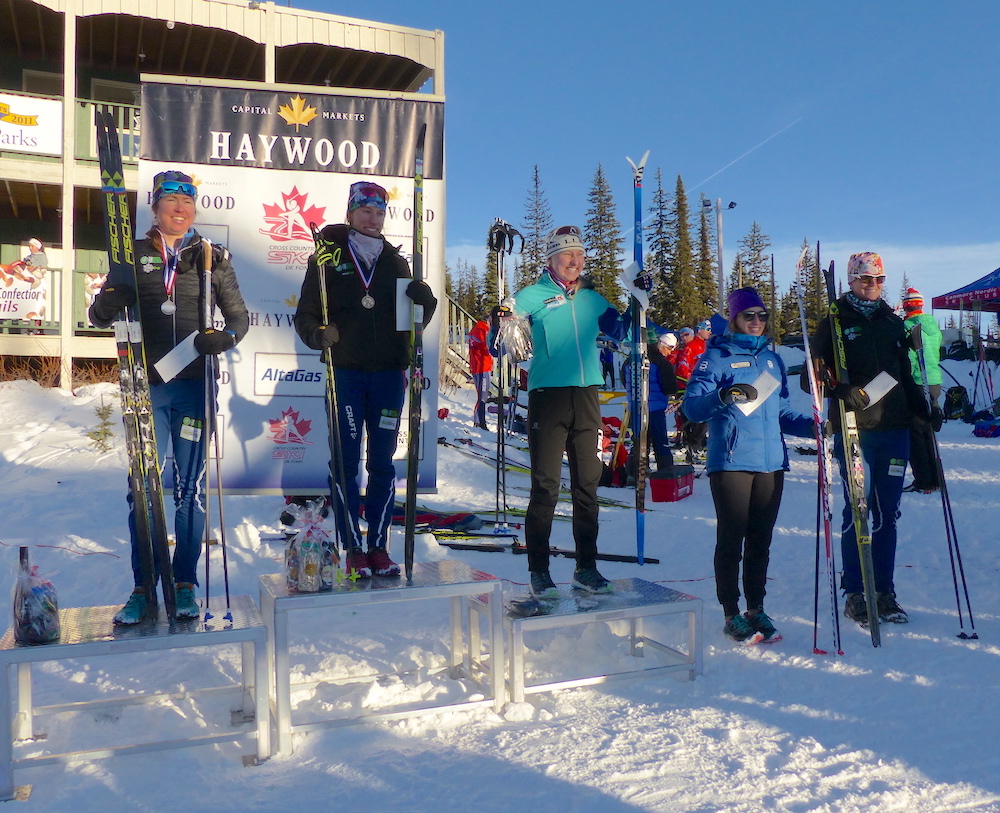
The women’s 1.3 k classic sprint podium and top five at the first NorAm of the season on Saturday at Sovereign Lake near Vernon, B.C., with (from left to right) Caitlin Patterson (CGRP) in second, Kaitlynn Miller (CGRP) in first, Hannah Halvorsen (APU/USST) in third, Kelsey Phinney (SVSEF) in fourth, and Liz Guiney (CGRP) in fifth. (Photo: Peggy Hung)
Miller was the fastest women’s qualifier by 2.87 seconds on the 1.3-kilometer course with a time of 2:59.39. Ultimately, she won the final in 2:57.53, 0.93 seconds ahead of her teammate Caitlin Patterson in second and 2.59 seconds clear of the third American on the podium, Hannah Halvorsen of Alaska Pacific University (APU) and the U.S. Ski Team (USST) D-team, in third place.
Halvorsen previously qualified third behind Kelsey Phinney, of the Sun Valley Ski Education Foundation (SVSEF) in second. Phinney finished fourth in the final (+2.85), while a third Craftsbury skier, Liz Guiney placed fifth (+3.53). The lone Canadian in the six-woman final, Sophie Carrier-Laforte of the Pierre-Harvey National Training Centre (CNEPH) placed sixth (+4.38).
Thompson Fends Off Five Americans
Of the six racers in the men’s 1.3 k freestyle sprint final, five of them were American. Bob Thompson, of the Thunder Bay National Team Development Centre (NTDC), bested them all for the win in 2:29.31, just 0.03 seconds ahead of Ben Saxton, of the Stratton Mountain School (SMS) Elite Team, in second place. Cole Morgan (SVSEF), the qualifying winner who had so far dominated all of his heats, ended up third overall, 0.48 seconds behind Thompson.
Sun Valley and APU each had two athletes reach the men’s final with Jack Hegman (SVSEF) taking fourth (+0.51), and APU’s Reese Hanneman and Tyler Kornfield placing fifth (+7.75) and sixth (+7.9), respectively.
To start the day, Morgan posted the fastest men’s qualifying time in 2:31.00, while last weekend’s SuperTour skate sprint winner Nick Michaud, of the Bridger Ski Foundation (BSF), qualified in second, 0.78 seconds back. Americans took the top-three qualifying spots with Logan Hanneman (APU) in third (+1.59), whileThompsonwas the top Canadian qualifier in fourth (+2.34).
Morgan won both his quarterfinal and the first semifinal to advance to the final, along with Thompson who placed second in that semifinal (and placed second to Hegman in the quarterfinals).Saxtonwon the second semifinal (after finishing second to Logan Hanneman in the quarterfinals) andKornfield was second behind Saxton in that semifinal to automatically advance to the final. Reese Hanneman and Hegman made it to the final as lucky losers after placing third and fourth, respectively, in the first semifinal.
Norway’s Johannes Thingnes Bø notched his second-straight win in Hochfilzen after Martin Fourcade of France missed three on the final shooting stage of the men’s 12.5 k pursuit on Saturday. Bø, who started the race 12 seconds ahead of Fourcade in second, cleaned the final standing stage to leave the range nearly a minute ahead of Slovenia’s Jakov Fak in second. Meanwhile, Fourcade, who had been skiing in first just ahead of Bø before the last stage, dropped 1:19 minutes back to fifth.
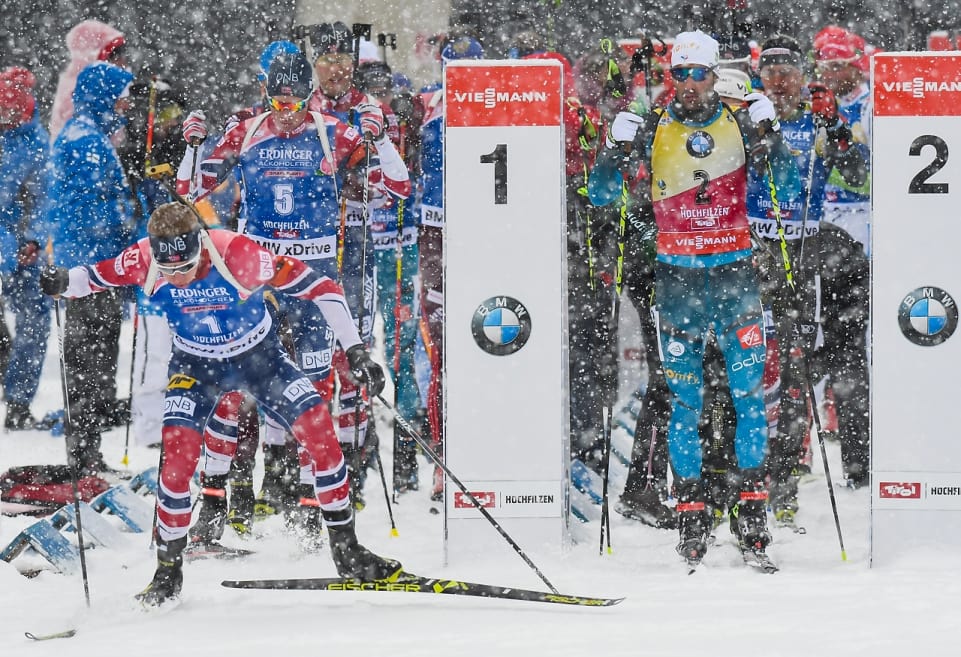
Norway’s Johannes Thingnes Bø (1) heading out of the start, 12 seconds ahead of the second starter, France’s Martin Fourcade (yellow bib), on Saturday in the IBU World Cup men’s 12.5 k pursuit in Hochfilzen, Austria. (Photo: IBU/biathlonworld)
While Bø skied the win in 36:41.1 minutes and Fak, the third starter, finished 58.8 seconds later in second place, Fourcade made up two places on the final loop to place third (+1:10.0) after passing Germany’s Simon Schempp and Russia’s Maxim Tsvetkov.
Schempp settled for fourth (+1:10.5), and Bø’s older brother, Tarjei Bø, passed Tsvetkov as well to claim fifth (+1:11.9), while Tsvetkov finished sixth (+11:12.3).
On another snowy afternoon in Hochfilzen, Johannes Bø had three penalties, two of which came in the first stage (2+0+1+0). Fak was one of four men in the race with just one miss (0+0+1+0) — no one cleaned — while Fourcade missed five (1+0+1+3). Schempp had four penalties (3+1+0+0) but held onto his starting position in fourth, Tarjei Bø improved from 14th at the start to fifth with just two misses (1+0+1+0) and Tsvetkov raced up from 20th to sixth with a single miss (1+0+0+0).
American Sean Doherty tied his second-best World Cup result in 17th (+2:12.8) after starting 23rd and 1:39 out of first. He had two penalties (1+0+1+0).
Canada’s top finisher, Nathan Smith placed 31st (+3:02.2) after starting 19th and missing three shots (1+1+0+1). His teammate Brendan Green rose to 33rd (+3:15.7), up from 52nd at the start, with three penalties as well (1+0+1+1).
Four Canadians qualified for the pursuit, with Scott Gow placing 48th (+5:08.4) with seven penalties (1+1+3+2). His younger brother Christian Gow crossed next in 49th (+5:13.7) after missing five (+5:13.7).
The other American man in the race, Lowell Bailey placed 36th (+3:20.6), up from 53rd, with three misses (0+2+1+0).
Kuzmina Gets First Win in Three Years
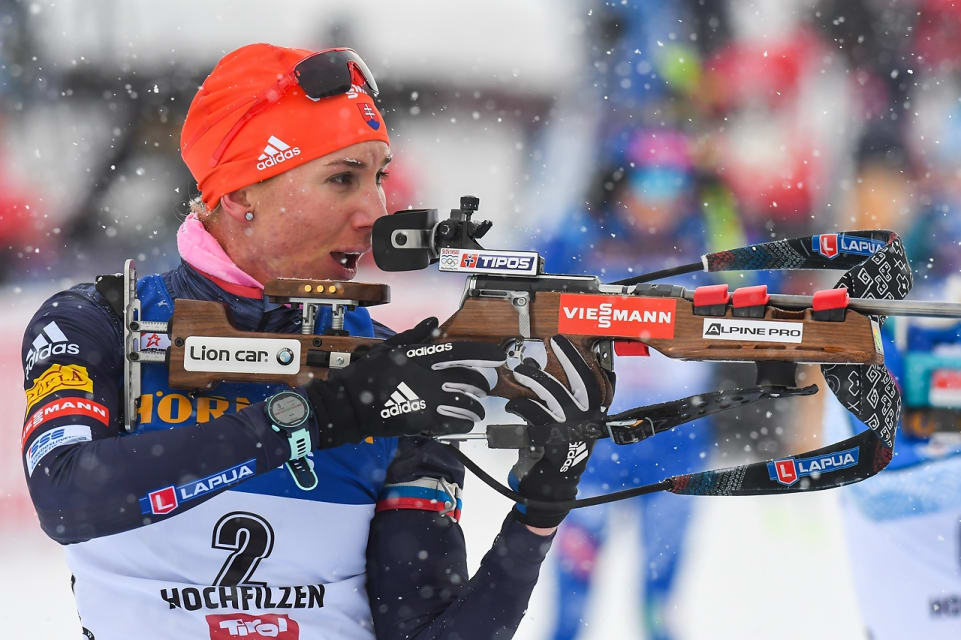
Slovakia’s Anastasia Kuzmina cleaning one of two standing stages in the women’s 10 k pursuit at the IBU World Cup in Hochfilzen, Austria, en route to a 10-second win. (Photo: IBU/biathlonworld)
In the women’s 10 k pursuit that followed, Slovakia’s Anastasia Kuzmina overcame a 22-second starting deficit to win her first race in three and a half years, shooting 19-for-20 (1+0+0+0) and finishing in 34:31.2. Kuzmina (the sister of Russia’s Anton Shipulin) started second behind Friday’s sprint winner Darya Domracheva of Belarus. Domracheva had a single miss as well in Saturday’s pursuit (0+0+1+0) but slipped to second after her penalty in the first standing stage, while Kuzmina cleaned the last three stages to take the win.
Domracheva settled for third (+11.8) and Finland’s Kaisa Mäkäräinen rose to second (+10.2) after shooting 18-for-20 (1+0+0+1) and skiing the fastest course time to rise from her starting position in sixth.
Italy’s Dorothea Wierer slipped one place to fourth (+51.6) after starting third and missing two (1+0+0+1), while Norway’s Marte Olsbu raced up from 13th to fifth (+58.2) with a single penalty (1+0+0+0). Ukraine’s Yuliia Dzhima improved from 20th to sixth (+1:08) with one miss as well (0+0+0+1).
Canada’s Emma Lunder achieved her second-best career World Cup result in 27th (+2:31.6) after starting 42nd and cleaning three stages after missing one in the first prone (1+0+0+0). Her teammate Rosanna Crawford improved from 49th at the start to 39th at the finish (+3:44.3) with four penalties, one in each stage (1+1+1+1).
The U.S. had one woman qualify for the race, Clare Egan, who finished 53rd (+5:21.6) with seven penalties (2+2+2+1).
For the third and final day of World Cup racing in Hochfilzen, the men’s and women’s relays will be held Sunday.
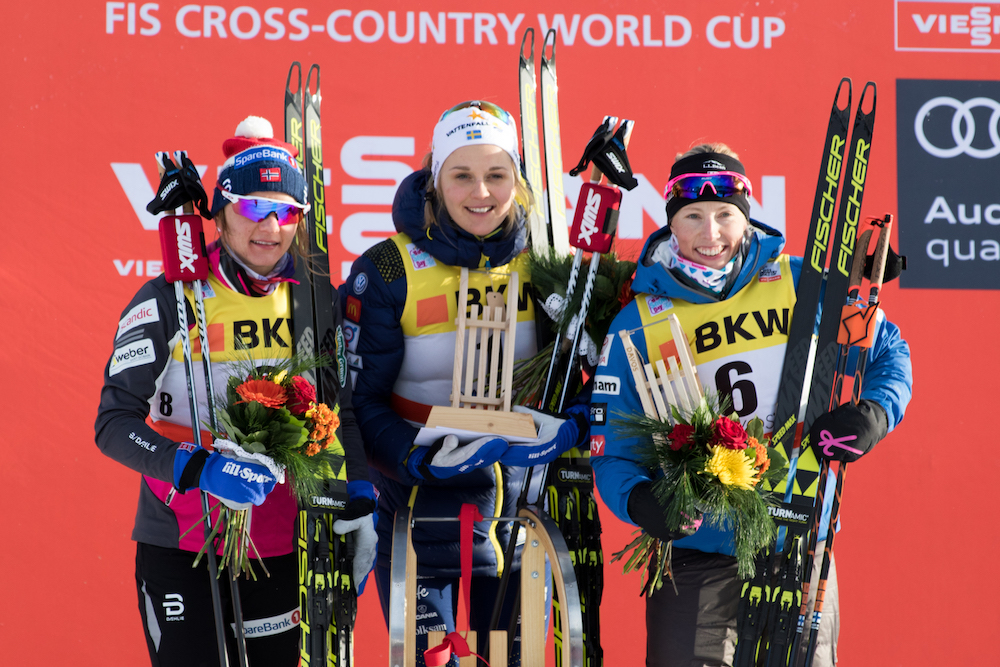
The women’s skate sprint podium at Saturday’s World Cup in Davos, Switzerland, with Kikkan Randall (r) of the U.S. Ski Team in third place, Sweden’s Stina Nilsson (c) in first, and Norway’s Maiken Caspersen Falla (l) in second. (Photo: Reese Brown/US Ski & Snowboard)
Kikkan Randall returned to the podium on Saturday in the first freestyle sprint of the 2017/2018 World Cup season, placing third in the women’s 1.5-kilometer skate sprint behind Sweden’s Stina Nilsson and Norway’s Maiken Caspersen Falla, respectively, in Davos, Switzerland.
Americans made up half of the women’s final, with Jessie Diggins racing to fourth and Ida Sargent sixth, with Norway’s Ingvild Flugstad Østberg between them in fifth.
Nilsson started the day by winning the qualifier in 2:51.71 minutes, while Østberg had the second-fastest qualifing time, 2.57 seconds back. Switzerland’s Nadine Fähndrich posted the third fastest qualifying time (+2.73), and for the U.S., Diggins qualified fourth (+3.37), Sargent fifth (+3.78), Randall sixth (+4.11), Sophie Caldwell ninth (+4.87), and Sadie Bjornsen in 11th (+5.38).
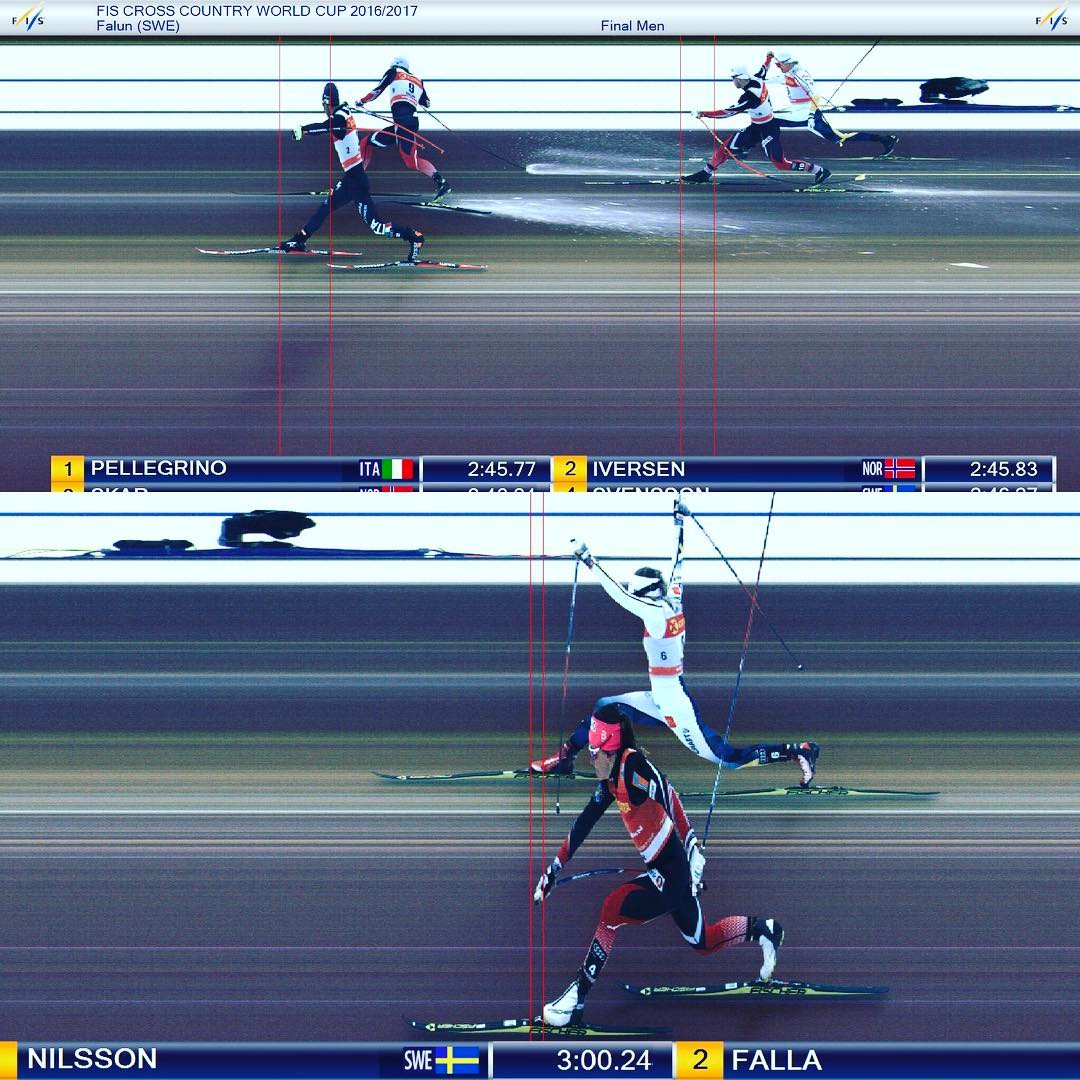
Nilsson then won her quarterfinal and the first semifinal before outlunging Falla by eight-hundredths of a second for the final win in 2:47.99. Randall (who won her quarterfinal and advanced to the final as a lucky loser in third in the first semifinal) finished 2.53 seconds after Nilsson for third overall, and Diggins (who won both her quarterfinal and the second semifinal) was 4.41 seconds back in fourth. Østberg finished 5.62 seconds back in fifth, and Sargent crossed the line 14.49 seconds back in sixth.
Caldwell placed eighth overall after winning her quarterfinal then placing fourth in the second semifinal, behind Diggins, Sargent and Germany’s Sandra Ringwald, respectively. Ringwald did not advance to the final, either, for seventh overall. Bjornsen placed 13th on the day after finishing third in her quarterfinal.
Also for the U.S., Julia Kern (U.S. Ski Team D-team) finished in 57th in the qualifying round, 16.55 seconds out of first.
Dahria Beatty was the top Canadian in 53rd (+15.53), followed by Katherine Stewart-Jonesin 55th (+16.18) and Cendrine Browne in 64th (+18.27).
In the men’s 1.5 k skate sprint, Norway’s Johannes Høsflot Klæbo rocketed to his sixth-straight win in as many World Cup races this season, topping the qualifier in 2:23.10 (by 1.27 seconds over France’s Lucas Chanavat and 1.73 seconds over Italy’s Federico Pellegrino in third) then winning his quarterfinal and semifinal comfortably before capping the day with a victory in the final in 2:28.07. Pellegrino placed second in the final, 1.8 seconds back, and Russia’s Alexander Bolshunov tallied his third podium of the season in third place (+4.64). Finland’s Ristomatti Hakola placed fourth (+5.39), France’s Richard Jouve was fifth (+8.65) and Russia’s Gleb Retivykh was sixth in the final (+18.34).
Americans Andy Newell and Simi Hamilton both qualified for the heats in 10th and 12th, respectively. Hamilton went on to place ninth overall after finishing second in his quarterfinal (behind France’s Renaud Jay) and fifth in the second semifinal (which Hakola won). Newell’s day ended in the quarterfinals, where he placed fifth, 2.44 seconds behind Klæbo, who won that heat. Overall, Newell was 21st.
Canada’s Alex Harvey qualified for the heats in 21st and went on to place 23rd overall after finishing fifth in his quarterfinal, 1.14 seconds behind Retivykh in first.
Also for Canada, Julien Locke missed qualifying in the top 30 by 1.07 seconds in 36th (+7.84). Russell Kennedy placed 48th (+9.39), Knute Johnsgaard was 52nd (+10.35), Jess Cockney 54th (+10.83), Devon Kershaw 63rd (+11.78).
For the U.S., Erik Bjornsen finished 58th (+11.12) and Paddy Caldwell 108th (+24.04) in the qualifier.
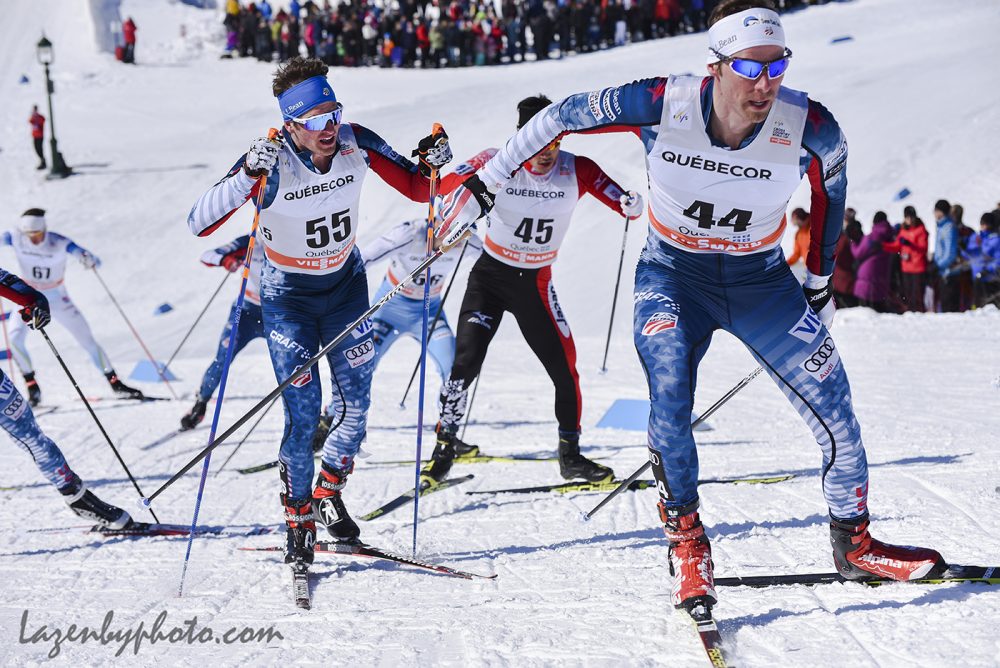
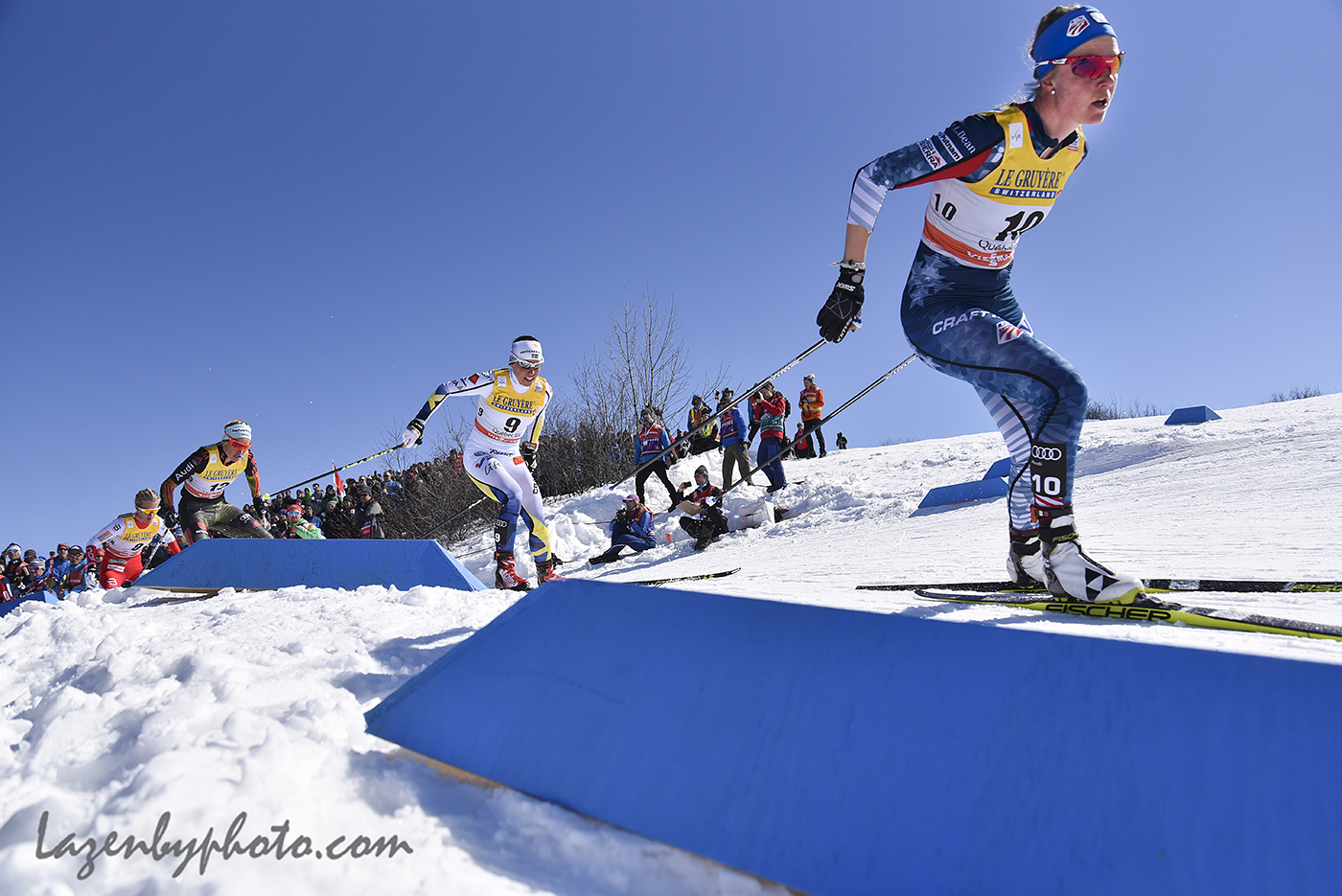
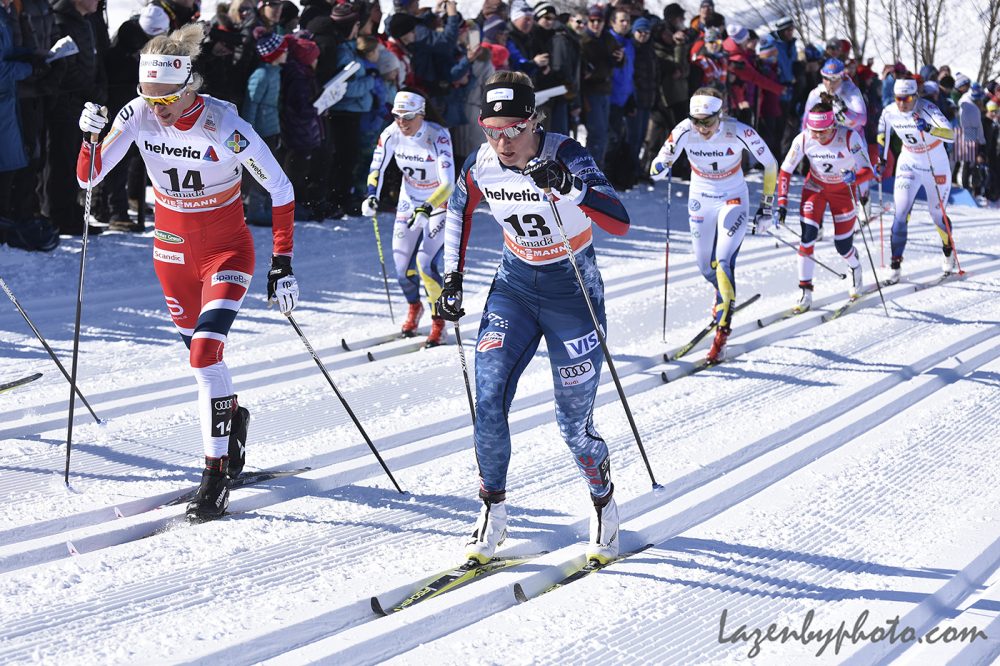
Andy Newell (44) skiing with fellow American David Norris (55) during the men’s 15 k freestyle pursuit at World Cup Finals on Sunday in Quebec City. Norris finished the World Cup Finals mini tour in 43rd overall, but placed 27th for time of day, while Newell held his starting position in 44th. (Photo: John Lazenby/Lazenbyphoto.com)
After the 2017 World Cup Finals mini tour drew nearly 60 North American competitors and tens of thousands of spectators to Quebec City two weekends ago, it’s only fitting that we share the quotes from some of the athletes you haven’t heard from yet (and some you have). Here is a collection of some of the most interesting comments from the U.S. World Cup and Nation’s Group skiers at World Cup Finals. There were 27 in total, although two women — Kikkan Randall and Liz Stephen — did not race due to feeling under the weather.
And here are our race reports (with links to results at the bottom of each) from March 17-19:
“It’s actually like a dream come true. It’s so so much fun. I wish I could do this every day because it’s the best experience I have ever had.” — Erika Flowers (Stratton Mountain School Elite Team)
“I was a little bummed out last year. I was pretty close but didn’t get to come [to the Ski Tour Canada], but it feels good to be here. Last time I came to be Quebec it was super awesome, mind-blowing awesome, so it’s nice.” — Becca Rorabaugh (Alaska Pacific University), who last raced World Cups in 2012 in Quebec and Canmore
On making the jump to the World Cup:
“This is my first World Cup weekend, feels awesome. It was a great experience to be in front of the home crowd of familiar faces, and now for next time I have goals and expectations and it will be really fun.” — Julia Kern (USST D-team/SMS Elite), after the pursuit
On racing close(r) to home:
“It’s so awesome to be back here in North America. I feel like every fourth person here knows my name and it’s an incredible atmosphere. This season hasn’t been what I was hoping for, but it’s just fun to finish it off in a place like this.” — Noah Hoffman (USST/Ski Club Vail)
“It’s really awesome. We only live, like, four hours away from here so we drove up, and it’s really nice to have people cheer for you on course people who that know your name.” — Liz Guiney (Craftsbury Green Racing Project)
“Certainly any time I was struggling I could tune into some American voices shouting my name or coaches and various fans. It’s really great. A good atmosphere our here.” — Caitlin Patterson (CGRP)
“I think I might be closer to Europe than home still. Still have a long ways to go, but I am really excited to head home tomorrow.” — Rosie Brennan (USST/APU)
On goals for World Cup Finals:
“I wanted to ski with confidence because I think it is really easy to get intimated out here, so kind of just went into it with, ‘Today is my race. I am going to ski my race and enjoy the day.’ And I was trying to really good technique and not put myself out of it from the get-go. So it was good. I felt great.” — Flowers, after the mass start
“I’m just trying to finish my season strong, but I feel like I haven’t really recovered from Europe at all, still pretty tired, but I thought I skied well. I almost crashed here but I managed to stay on my feet. I don’t feel like I am skiing super fast right now so I am just trying to do everyhting I can to do as well as I can.” — Ben Lustgarten (CGRP), after the sprint
“Try to hang in there, see what I can do. I haven’t done a World Cup distance race in quite a long time.” — Rorabaugh
“My goal is to improve on where I was last year.” — Kaitlynn Miller (CGRP), who finished last year’s Ski Tour Canada in 41st overall (she placed 52nd in this year’s World Cup Finals mini tour)
On mini-tour formats:
“Yesterday was just really bad, and when there are only three days in a tour, it’s hard to make up for one really bad day. But I am really happy with getting in the sprint heats, and today was a little better.” — Brennan, after the pursuit
“My only goal today was not get lapped, so went out hot for three laps and kind of puttered it in, but finished, and that was the goal. I’m more of a sprinter so it was good to just get through this tour.” — Cole Morgan (Sun Valley Ski Education Foundation), after the pursuit
Sophie Caldwell (17), of the U.S. Ski Team and SMS Elite Team, racing to 38th in the 10 k classic mass start on March 18 at World Cup Finals in Quebec City. Switzerland’s Nathalie von Siebenthal (30) went on to finish 35th.(Photo: John Lazenby/Lazenbyphoto.com)
On mass starts:
“Dude, that’s what I am excited for. … We’ve got a lot of fast distance skiers [on the U.S. team], and hopefully we can work together and push each other.” — Lustgarten, after the sprint
“I tend to prefer classic races and I think a mass start is going to be really exciting.” — Kaitlynn Miller (CGRP), after the sprint
“We knew to expect the accordions and it still caught me completely off guard when we were going into that little bump up there and we came to a complete stop. I think that might’ve been one of the first times in a race that I’ve really come to a complete stop. I know it happens in the guys’ field a lot when they’re all together, but somehow usually the women spread out. So that was a little dicey.” — Caitlin Patterson, after the mass start
“Honestly, I made a rookie mistake and thought that we had four laps, so we turned into the finish and I was like, ‘What? We’re done?’ But it was a good experience and it is good to practice that because in a big fast field like this. it starts hot and you just have to be ready to go and hopefully we can bring that back to the SuperTour and practice that a bit more often.” — Flowers
“It was fun to mix it up. It was pretty hard with the mass start, starting toward the back. There were definitely a couple times where I came to a complete stop, but it was a good experience.” — Jack Hegman (SVSEF)
On pursuits:
“This was definitely one of my favorite events. Really fun to have a cool format with the pursuit and chasing people down.” — Paddy Caldwell (USST D-team/SMS Elite)
“[This was] probably the worst race I’ve had all year, but that’s what happens sometimes. … I had a good race yesterday and today it just wasn’t going.” — Matt Gelso (SVSEF)
On starting in a pursuit wave:
“It was fun. For how small the wave was it was still rather hectic. The course is narrow in parts, which makes it really hard, and I probably expended more energy than I needed to. Maybe I went a little too frantic in that. But it was good though, it’s a really beautiful day here, and they have done a really good job, and I am super pumped. Our techs worked super hard. Yeah, everything was great.” — Chelsea Holmes (APU)
“I wanted to basically think of it as a mass start race from the wave and it was good. I felt like I was able to make the breaks where I wanted to.” — Brian Gregg (Team Gregg/Loppet Nordic Racing)
On skiing with teammates:
“I was working with David [Norris] and Scott [Patterson] for most of the race, and two other guys so that was really fun, and fun to work as group and try to put down a fast time.” — Paddy Caldwell, after the pursuit
“I started three people in front of the wave, so I knew they were going to catch me, but that was fun because we got to ski a pretty fun 15 k with a lot of U.S. competitors. Me and Simi skied a lot together and Brian Gregg and it was fun to finish it off in the sun with some teammates skiing 15 k.” — Andy Newell (USST/SMS Elite), after the pursuit
“I was actually skiing with my teammates, Simi and Andy, for a while. We were rotating through and trying to catch some of the guys ahead of us and make sure the big pack right behind us wasn’t going to catch us.” — Gregg, after the pursuit
“It was super fun skiing with all the U.S. girls in a pack together.” — Kern, after the pursuit
On idols:
“The highlight was definitely being in a sprint heat with Jessie, ’cause I really look up to her and growing up she was my idol. To race with her in my first Wold Cup was really fun.” — Kern, after the pursuit
On falling down and getting back up:
“I fell twice … I fell right out of the start and caught up on someone’s pole, and then on one of the downhills slid out on someone’s ski. The first time I was like, ‘Oh, I can come back from this?’ The second time was like, ‘You’ve got to be kidding me!’ Ugh. But overall this weekend has been pretty fun. It’s so fun to race in Canada, and the conditions could not be better. So I kind of have to get over my own poor race and enjoy the process.” — Jennie Bender (Bridger Ski Foundation), after the pursuit
Sadie Bjornsen (U.S. Ski Team) leads Sweden’s Charlotte Kalla and the rest of a chase pack during the women’s 10 k freestyle pursuit on the last day of 2017 World Cup Finals, where she placed 10th overall with the fifth-fastest time of day. (Photo: John Lazenby/Lazenbyphoto.com)
On the course:
“The course is really different than what we are used to skiing. These are not World Cup-designed trails. There are not the huge hills that we are used to. [They’re] really punchy, short, steep hills. It probably doesn’t suit my strengths super well, but it is the type of skiing I need to be able to do and its such a great atmosphere right here in the city and I wouldn’t want to be anywhere else.” — Hoffman, after the mass start
“I like that there were short, punchy climbs where you had to put your head down and hammer, and then fun downhills.” — Guiney, after the mass start
“The course was really great. It’s kind of a technical course, so you have to think about how you’re going to ski each area and between this headwind, tailwind, all the corners, crests of hills, and I think I skied it fairly well. Smoothly. I felt like I was missing a little bit of power out there, so it wasn’t the best of sprint qualifiers, but it was OK.” — Caitlin Patterson, after the sprint
“The course is awesome, and it’s really fast out right now so it skis really smooth. It’s a really fun qualifier, so I am sure it would be really fun heats. The course for the distances races look good, too. They’re going to be nice with 3 k laps.” — Rorabaugh, after the sprint
“It was pretty flat, lots of double pole and it was a good course.” — Hegman, after the mass start
On conditions:
“These really firm tracks made it harder to track-hop, especially on the fast downhills because you’re just kind of wobbly and it’s a little bit sketchy, so you’re always looking for the fastest line but also having to keep in the tracks. It was a little tricky. Always a mental game and a physical game out there.” — Caitlin Patterson, after the classic mass start
“I think it was hard to nail the kick yesterday as it was warming up quickly. Today I had really fast skis, they were like stupid-fast, which was awesome. Just great conditions to ski in.” — Sophie Caldwell (USST/SMS Elite), after the skate pursuit
“They have been great all weekend. Pretty consistent, fast, and the snow is transforming a bit today. A little different than yesterday … but overall it has been really good.” — Flowers, after the pursuit
“It did the same thing it did yesterday, got a little wetter and a little slower throughout, but I had good skis so it was nice. Just had to get up those tough climbs and glide out the downhills.” — Morgan
“It was all right, felt pretty slow, especially finishing, you’re like, ‘Man, someone’s gonna come by me,’ but it was just slow for everyone. It was hard work out there. Not too many hills, but snow made you work.” — Scott Patterson
On finishing out the season:
“No great results this weekend, but last year at this time and previous year, I was just totally dying off, so one of my goals this year was to try to build through the season, and my fitness is definitely not dropping, if anything it is still building right now. So I am happy. Even though I am not skiing where I want to right now, it gives me a good platform for next year, and that’s kind of what I wanted for this year.” — Newell, after the pursuit
“It’s hard to complain when your racing in blue-bird skies and it’s fast snow and there’s 10,000 North American fans out here so it was really cool. I just focused on catching some good rides and ski hard where I could and having fun.” — Simi Hamilton (USST/SMS Elite), after the pursuit
On season highlights:
“Toblach, for sure, that was the highlight of the year for me. I love racing there and I felt great that weekend. I felt great going into Worlds, but that was obviously really frustrating with falling in that corner … that was for sure a bummer, but it was still a great experience being at Worlds at Lahti. Every season, there’s always bumps and ups and downs, but … I have had seasons in the past by the end of the year I am ready to take a serious period kind of away from training and racing and right now I feel a little bit different. I am ready for a break but also ready for the training season, and I know some really specific, concrete things I need to work on, so I am psyched to start tackling those and just get back to it.” — Hamilton, who placed second in the World Cup freestyle sprint on Jan. 14 in Toblach, Italy, for his fourth-career individual podium
On their season overall:
“I am really satisfied with it. It was really solid. I don’t think there was that one standout result that can sometimes make a season, but I think I had very consistently good results and that’s something I’m proud of, and I look forward to building up off that.” — Sophie Caldwell
“Overall I actually had a really good season. In February I got a concussion so the last month has been a bit rough, but I am trying to finish out strong.” — Bender, who had a non-skiing related injury when a hockey puck struck the back of her head
“It’s been up and down. I think I had some great results and that’s really fun, and then definitely some days where I’d like to improve off for next year.” — Flowers
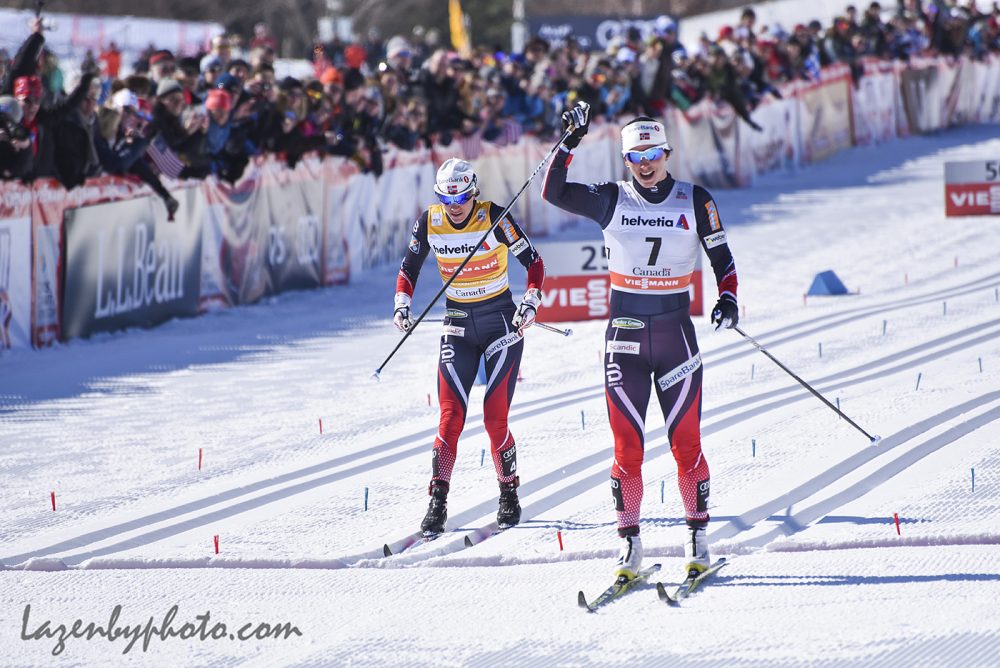
Marit Bjørgen (7) celebrates her victory over Norwegian teammate Heidi Weng during the women’s 10 k classic mass start on Saturday at World Cup Finals in Québec City. (Photo: John Lazenby/Lazenbyphoto.com)
When it comes to distance classic events, at least this season, Norway’s Marit Bjørgen is calling the shots. She completed her undefeated streak in 10-kilometer classic competitions (in both individual or mass starts), winning her fourth in a row on Saturday at World Cup Finals in Québec City.
Starting in bib No. 7, Saturday’s eventual mass-start winner was skiing just outside of the top 10 for the first kilometer, following two U.S. skiers, Sadie Bjornsen in eighth and Jessie Diggins in fifth. Setting the pace from the front were Norwegian teammates Heidi Weng and Ingvild Flugstad Østberg.
In another half a kilometer, Bjørgen moved to an outside lane and tucked past Sweden’s Ida Ingemarsdotter and Stina Nilsson. The maneuver moved her from 12th to fourth by the bottom of the third major downhill. And within the next climb, the classic queen had changed tracks and strode her way to the front, overtaking Weng.
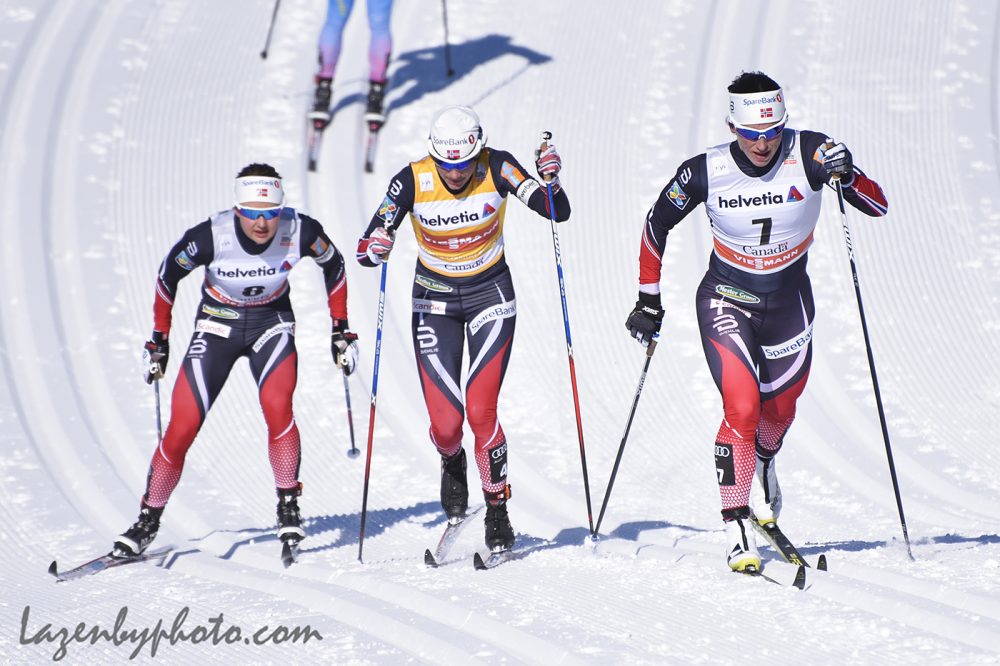
Right to left: Norway’s Marit Bjørgen leads her teammates Heidi Weng and Ingvild Flugstad Østberg during the women’s 10 k classic mass start on Saturday at World Cup Finals in Québec City. (Photo: John Lazenby/Lazenbyphoto.com)
From there, the race for the win became one about Bjørgen.
While the Norwegian stayed put up front, Finland’s Krista Pärmäkoski, who started the day ranked 22nd in the mini tour, began gaining ground from the back. At 3.3 k the eventual third-place finisher, Pärmäkoski, who had crashed earlier in the race, was skiing 8.1 seconds back from the leader in 21st. In another kilometer, she had moved up ten places and was within 5.3 seconds of Bjørgen.
“I fell today after the start and I had to fight hard to ski back to the leading group,” Pärmäkoski said during an International Ski Federation (FIS) interview.
While Pärmäkoski managed to move up, Diggins, who had been within striking range of the podium, had slipped 19th. The American explained that, while her energy felt good throughout the race, the real struggle came from her lack of kick.
“I had many races when I had outstanding skis this year, arguably the best in the world,” Diggins said. “I guess at some point, it was natural to fall on the other side of that. You can’t nail it every time.”
Despite ideal conditions for spectators — clear, blue skies and a strong sun that sent temperatures soaring into the mid-30’s Fahrenheit (about 2 degrees Celsius) by midday — it was a tricky one for classic waxing.
“Our wax techs work so hard, they are under incredible pressure,” Diggins added. “We did the best we could, we tested as well as we could, and it was a huge struggle for me out there today. But I’m ready for tomorrow. I know at the end of the season, everyone is tired, I just want a good race to finish it off. In skating, you don’t have to worry about kick, so I’ll go out and fight.”
As Diggins dropped back, a trio of Norwegians spearheaded the front. Around the halfway point, Bjørgen, Weng and Østberg began their breakaway, foreshadowing an all-Norwegian podium.
But what they hadn’t counted on, least of all Østberg, was Pärmäkoski. The Finn had decreased her distance from the Norwegians within the next kilometer by another 4 seconds, now merely a meter away from the top three.
“I was really fighting and hoping for a podium,” Østberg told FasterSkier. “I actually felt strong and strong enough but there was three girls stronger than me so, fourth is also good.”
With less than four kilometers to go, Østberg took a pull at the front, but it wasn’t long before the lead was back to Bjørgen.
“I think Marit and I did an awesome job in the front,” Østberg said. “Marit for sure did most of the job, but I tried to help and tried to keep up the speed in the leading group because there was someone chasing behind and I knew that she had some power left at the end of the last lap.”
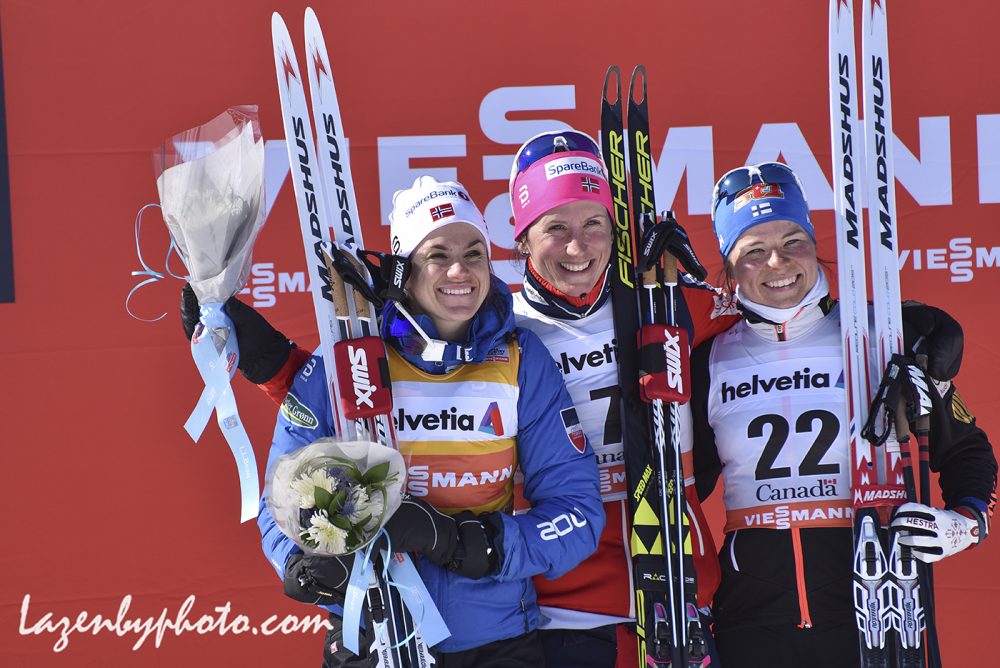
Left to right: Norwegians Heidi Weng and Marit Bjørgen and Finland’s Krista Pärmäkoski on the podium for the women’s 10-kilometer classic mass start on Saturday at World Cup Finals in Québec City. (Photo: John Lazenby/Lazenbyphoto.com)
As the four headed into their final kilometer, Bjørgen and Weng steamed off the front, while Pärmäkoski passed Østberg and locked into third. The two Norwegians cornered into the finishing stretch together, but Bjørgen’s double pole proved too strong for Weng and she crossed first in a time of 24:23.6.
Weng crossed 0.6 seconds later for second place, and Pärmäkoski finished 2.9 seconds back in third, while Østberg was 4.9 seconds off the podium in fourth.
“I have been winning all of the distance, so I’m happy with that,” Bjørgen said. “I was fighting for my position from the beginning, so I wasn’t in front before 2 kilometers, and then I wanted to speed up and then I saw the group was smaller and smaller. A good finish, so I am happy.”
A day after Weng locked up the Overall World Cup title, she clinched the Distance World Cup season-long title as well on Saturday. For Sunday’s pursuit, the last World Cup race of the season, Weng has a 1-second head start on Bjørgen in the 10 k freestyle pursuit.
Bjornsen Top American in 15th; Nishikawa Top Canadian in 37th
The top North American woman on Saturday was U.S. Ski Team (USST) member Sadie Bjornsen in 15th (+29.9).
Bjornsen and Diggins had been skiing with the top 10 for the first 3.3 k loop. As Diggins began to fall back, Bjornsen continued to race within and around the top 10. Bjornsen, like Diggins, also explained she had trouble slipping.
“I just couldn’t get up that hill,” Bjornsen said, referring to one of the course’s final climbs. “I started slipping so much, I was trying to keep it together. I made the mistake of wanting to go on the steep part of the climb, because I wanted to follow Kalla, but it was super hard to kick there, so it was a bit of a mistake … But I didn’t lose too much time on the group in front of me for tomorrow, so I’m excited.”
American Sadie Bjornsen (13) racing alongside Norway’s Kathrine Rolsted Harsem (14), ahead of Sweden’s Charlotte Kalla (27) and Stina Nilsson (1) and Norway’s Maiken Caspersen Falla (2), during the women’s 10 k classic mass start on Saturday at World Cup finals in Québec City. Bjornsen went on to place 15th. (Photo: John Lazenby/Lazenbyphoto.com)
Bjornsen will start Sunday’s pursuit 1:10.4 minutes after Weng. While she admitted that classic races used to be her favorite, Bjornsen has embraced the fact that she can perform well in either discipline and attributed part of that newfound confidence to the depth of the women’s team.
“In 2011, we knew that Kikkan was good, but we didn’t know that we could be good,” Bjornsen said. “Each year, a new person on the team is discovering that they have podium potential, and they belong here. Yesterday, for example, for Rosie to make it into the heats is just crazy, the lift it gives the team, or Julia making her first World Cup points.
“We talk a lot about what we can do to improve together, and that’s different from 2011, because we’re not like, ‘OK, we have to do what Kikkan is doing,’ ” she continued. “Now we can speak with each other, and have an idea of what we can do.”
Diggins finished Saturday’s mass start in 27th (+1:06.9) followed by her teammate Sophie Caldwell in 38th (+1:56.0).
“I felt pretty good. I haven’t done much distance racing this year so it was fun to hop in one,” Caldwell said.
Following Caldwell, was Caitlin Patterson crossing in 44th (+2:39.9), Liz Guiney 45th (+2:43.3), Kaitlynn Miller 47th (+2:46.5), Chelsea Holmes 48th (+2:48.4), Rosie Brennan 50th (+2:48.8), Julia Kern 52nd (+3:05.5), Erika Flowers 55th (+3:37.2), Becca Rorabaugh 57th (+3:39.5), and Jennie Bender 58th (+3:41.9).
“I was happy with the result,” Guiney said. “I got in a little bit of a pile out of the start. I didn’t expect it to stop, but other than that it was good. I had fast skis and good kick so I was happy.”
Brennan explained that she broke a pole on her first lap.
“I was fighting my skis a lot and fighting myself, then fell and broke a pole and then it was not a good race,” she said.
For Canada, Emily Nishikawa led the team in 37th (+1:51.7). She explained that while she once again finished outside the points (top 30), a result is not so much her ultimate goal as a feeling.
“I have just been out of the top 30 a lot this year … it has been really close” Nishikawa said. “Everyone always bases it on top 30 is good and anything other than that is not that good. But I just kind of focus on my own self and if I have been skiing well I am happy with that.”
Nishikawa further indicated that being able to race the final World Cup competitions in front of a home crowd is indescribable.
“I can’t wipe out the smile of my face, it’s hard to put into words just how special it is to race in your home country,” she said.
Cendrine Browne, of the Canadian U25 Team and CNEPH, after finishing 41st in the women’s 10 k classic mass start on Saturday at World Cup Finals in Québec City. (Photo: John Lazenby/Lazenbyphoto.com)
Following Nishikawa was Cendrine Browne in 41st (+2:28.2). Despite getting caught early on in the competition, Browne is satisfied with her position heading into tomorrow’s pursuit and hopes to move up into the top 30.
“Unfortunately, I got stuck behind on the first uphill, which prevented me from staying with the leading group,” Browne said. “I felt I could of stayed with them, I felt strong and relaxed. At the start of the last lap though, I was leading my pack, which made it harder for me. I still managed to distance myself from the skiers behind, but I was unable to catch those in front. I was caught up between two groups. Anyway, it’s good news for tomorrow.”
Also competing for Canada, Dahria Beatty finished 53rd (+3:15.4), Annika Richardson 54th (+3:36.3), Katherine Stewart-Jones 56th (+3:38.1), Frédérique Vézina 59th (+3:43.6), Annika Hicks 60th (+3:45.6), Sophie Carrier-Laforte 61st (+4:05.9), Andrea Dupont 62nd (+4:05.9), Katherine Weaver 63rd (+4:27.9), Alannah MacLean 64th (+4:29.4), Sadie White 66th (+5:31.1), Lisle Compton 67th (+5:34.3), Mia Serratore 68th (+5:58.6), and Laura Leclair 69th (+6:46.2).
Alex Harvey racing in the men’s 15 k freestyle pursuit at Stage 4 of the Ski Tour Canada last year in Quebec City. (Photo: FlyingPointRoad.com/NNF)
For the second-straight year, the World Cup’s season-ending races will be held in Canada, with Québec City hosting 2017 World Cup Finals, this Friday through Sunday. Canada initially announced a roster of 30 (15 women, 15 men) for the three-day mini tour, and the U.S. selected 27 (15 women and 12 men), with both countries maximizing their Nation’s Group “home” quota for the event in downtown Québec City.
Note: On Tuesday, Cross Country Canada (CCC) announced it would be releasing a revised roster “due to some CPL points errors in calculations,” according to a press release. On Thursday, FasterSkier confirmed that the list included the same 15 women and 15 men that were originally published on FasterSkier.
And on Wednesday, Quebec organizers announced that the times of each race would be moved back an hour “upon FIS recommendation” to satisfy international broadcast schedules. The updated times are listed below.
2017 World Cup Finals race schedule (updated Wednesday):
(All times Eastern Daylight Time)
Friday, March 17: Freestyle sprint (qualifier starts at 11:45 a.m.; heats at 2:15 p.m.)
(Note: Jenn Jackson of Lappe Nordic declined her spot)
Men:
Alex Harvey (World Cup A-team)
Devon Kershaw (World Cup A-team)
Len Valjas (World Cup A-team)
Jess Cockney (World Cup B-team)
Graeme Killick (World Cup B-team)
Knute Johnsgaard (NST U25 Team/AWCA)
Russell Kennedy (Canmore Nordic/Team R.A.D.)
Gareth Williams (Junior NST/Telemark)
Andy Shields (Lappe Nordic)
Bob Thompson (NTDC Thunder Bay)
Joey Foster (Team Hardwood)
Julien Locke (NST U25 Team/AWCA)
Evan Palmer-Charrette (NTDC Thunder Bay)
Brian McKeever (Canadian Para-Nordic Ski Team)
Ricardo Izquierdo-Bernier (CNEPH)
USA
Women:
Kikkan Randall (U.S. Ski Team A-team/APU)
Sadie Bjornsen (USST A-team/APU)
Liz Stephen (USST A-team)
Caitlin Patterson (CGRP)
Rosie Brennan (USST B-team/APU)
Erika Flowers (SMS Elite)
Jennie Bender (BSF)
Julia Kern (USST D-team/SMS Elite)
Liz Guiney (CGRP)
Kaitlynn Miller (CGRP)
Chelsea Holmes (APU)
Becca Rorabaugh (APU)
Jessie Diggins (USST A-team/SMS Elite)
Sophie Caldwell (USST A-team/SMS Elite)
Ida Sargent (USST A-team/CGRP)
(Note: Katharine Ogden, of the SMS Elite Team and U.S. Ski Team D-team, declined her spot due to “ongoing stomach issues,” according to U.S. head coach Chris Grover. Guiney was the first alternate as she was next on the SuperTour list.)
Men:
Andy Newell (USST A-team/SMS Elite)
Noah Hoffman (USST B-team/Ski Club Vail)
Erik Bjornsen (USST B-team/APU)
Matt Gelso (SVSEF)
David Norris (APU)
Ben Lustgarten (CGRP)
Cole Morgan (SVSEF)
Patrick Caldwell (USST D-team/SMS Elite)
Jack Hegman (SVSEF)
Brian Gregg (Team Gregg/Loppet Nordic Racing)
Scott Patterson (APU)
Simi Hamilton (USST A-team/SMS Elite)
A view from the steep hill on the sprint course with the stadium area in background, as seen during training last year in Quebec City, one day before the third stage of the 2016 Ski Tour Canada. (Photo: John Lazenby/Lazenbyphoto.com)
The women’s World Cup 15 k skiathlon podium on Saturday in PyeongChang, South Korea, with Poland’s Justyna Kowalczyk (c) in first, American Liz Stephen (l) in second, and Japan’s Masako Ishida (r) in third. (Photo: Fischer/NordicFocus)
Multiple race warmup and cool downs, managing hydration and caloric intake, moving at her max sprinting speed — more than once. It’s not often that American Liz Stephen feels the lingering effects of a World Cup sprint day. Her most recent memory was three years ago, when she qualified 22nd in Szklarska Poreba, Poland.
But this weekend’s three-day competition series in PyeongChang, South Korea, challenged the distance specialist once again. With a smaller World Cup field than usual, Stephen qualified 29th in Friday’s classic sprint and advanced quarterfinals, where she raced in the first heat of the day.
In what ended up being the fastest women’s quarterfinal, Stephen pushed through Friday’s hill-dominant sprint course and crossed fifth for 25th overall. The back-to-back sprint experience, however, left the 30-year-old Stephen with a little less energy than she would have liked as she entered Saturday’s 15-kilometer skiathlon.
American Liz Stephen (2) skiing at the front of the women’s 15 k skiathlon on Saturday, alongside Norway’s Silje Øyre Slind (1) and Poland’s Justyna Kowalczyk (3), at the World Cup in PyeongChang, South Korea. (Photo: Fischer/NordicFocus)
“I think I was feeling yesterday’s sprint race a bit, as I did twice as many rounds as I usually do!” Stephen joked in an email.
Yet, standing at the start in bib 2, behind Norway’s Silje Øyre Slind in bib 1, Stephen wasn’t going to let a little soreness stop her from racing to Saturday’s skiathlon podium.
After Poland’s Justyna Kowalczykgapped the front by close to 20 seconds in the first two kilometers of the classic leg, the American held on tight to the lead chase group, striding even with a medley of skiers, including Slind, Japan’s Masako Ishida, Norway’s Anna Svendsen, Sweden’s Maria Nordström, and Germany’s Elisabeth Schicho.
Stephen came through the exchange in fifth position, a little over a minute behind the race leader Kowalczyk and 12 seconds back from the second place skier, Ishida.
“I was afraid I skied little too hard in the classic portion,” Stephen said, according to an International Ski Federation (FIS) press release. “I wanted to stay with the leading group in the classical part not to fall back.”
Skate skis on, Stephen quickly caught and surpassed Svendsen and Schicho by the 8.4 k mark, rejoining Ishida. With over a minute separating her and Ishida from Kowalczyk, the battle for second began. Around the 10 k mark, Stephen made her move. Powering past Masako, Stephen started her second hunt, this time for the Polish skier.
But Kowalczyk’s early classic-leg surge and strong skating staved off any attempts from Stephen.
“Liz was able to take some time out of her, but not significant time,” USST Head Coach Chris Grover said on the phone. “So that was impressive racing by Kowalczyk.”
Poland’s Justyna Kowalczyk winning her first World Cup in three years on Saturday, the women’s 15 k skiathlon at in PyeongChang, South Korea. (Photo: Fischer/Nordic Focus)
“It has been a long time since I have been on the World Cup podium,” Kowalczyk said, according to FIS. “I was quite surprised to see how well I skated.”
Finishing exactly 56 seconds behind Kowalczyk was Stephen in second place. The result was Stephen’s best individual result since 2015, when she placed second in the 10 k freestyle race in Rybinsk, Russia.
“It’s hard not to feel happy when you get a podium finish!” she said, according to a U.S. Ski Team press release. “However, I didn’t feel like I had as much energy as I wanted to have today, but it was enough to hold onto second.”
In her first podium appearance since 2009, Ishida finished 18.8 seconds after Stephen in third (+1:14.8).
Just missing the podium by 6.6 seconds was American Caitlin Patterson in fourth (+1:21.4). Though a tangle on the first hill of her classic leg pushed Patterson back to 13th, the 27-year-old Craftsbury Green Racing Project skier was able to reconnect with the top 1o by the 2 k mark.
Unconcerned with Kowalczyk’s blistering pace, Patterson focused on the chase pack. By the time she reached the ski change, she was positioned in seventh. Her transition to skate skis smooth and energy still strong, Patterson began to pick people off.
She caught Nordström, who had been 10 seconds ahead of her at the exchange, as well as Schicho and Svendsen, both of whom were close to 30 seconds ahead of her when they switched to skate skis.
Caitlin Patterson (Craftsbury Green Racing Project) en route to a career-best World Cup result of fourth in the women’s 15 k skiathlon in PyeongChang, South Korea. (Photo: Fischer/NordicFocus)
“Caitlin Patterson was really impressive,” Grover said. “She was kind of hovering around seventh or eighth for most of the race, and then really in the last lap, really started to pick people off, including right at the very end to get all the way up to fourth.”
Feeling fairly well adjusted to the time difference, and appreciative of the low-altitude racing, Patterson was proud of her race effort. Her only issue being the seconds that separated her from the podium.
“When I look at the results and see how close third place was ahead of me, I can’t help but wish I could have somehow gone faster sooner!” Patterson wrote in an email. “A true sign of how much this makes me hungry for more, though I know I gave it everything I had out there today.”
The third American woman on Saturday was Liz Guiney in 13th (+2:21.7). The PyeongChang World Cup marks Guiney’s third week of World Cup racing and, while this weekend’s field is not as strong as the ones she recently raced against in Sweden, the result was still a little unexpected for Guiney.
“I’m very happy with my race today!” Guiney, 25, wrote in an email. “With the weaker World Cup field, it was a good opportunity to score some points, but I think I surprised myself by being within reach of the top 10.”
The last two races mark Guiney’s first World Cup points, with her best individual finish prior to this weekend 49th in the Falun 15 k classic mass start.
“Last weekend in the Falun 15k, I got a little too excited out of the start and paid for it later in the race, so my goal today was to ski my own race,” Guiney wrote. “I was really psyched to cross the line and find out that Liz Stephen placed 2nd and Caitlin (my GRP teammate) was 4th, which is a big breakout result for her!”
Two Canadian women also earned their first World Cup top 30’s on Saturday, with Annika Hicks (Alberta World Cup Academy) placing 26th (+5:17.8) followed by Sadie White (NTDC Thunder Bay)in 29th (+6:54.7).
Racers return to the race venue tomorrow for Sunday’s freestyle team sprint.
The Russian men finishing in unison to take first, second and third in the men’s 30 k skiathlon, the final race of 2017 U23 World Championships at Soldier Hollow in Midway, Utah. Alexander Bolshunov (8) was deemed the winner, Alexey Chervotkin (1) was second, and Denis Spitsov (11) third. (Photo: FlyingPointRoad.com)
FIS Nordic Combined Junior World Championships (Park City and Midway, Utah): Normal hill/5 k
American Ben Loomis (6) leads Norway’s Lars Ivar Skaarset (7) during the third leg of the nordic-combined 4 x 5 k team event on Thursday at 2017 Nordic Junior Worlds at Soldier Hollow in Midway, Utah. Loomis brought the U.S. from ninth to seventh, and his team ultimately finished seventh. (Photo: FlyingPointRoad.com)
[UPDATED] In the individual normal hill/5-kilometer Gundersen on Saturday, the last nordic-combined competition of 2017 Nordic Junior World Championships, American Ben Loomis captured his first top 10 in his third Junior Worlds in ninth place.
Eighteen-year-old Loomis jumped to 10th then picked off one place in the 5 k to finish ninth, 1:22.3 minutes behind the winner, Germany’s Vinzenz Geiger.
Geiger led after the jump and started the ski race 4 seconds ahead of Japan’s Yuto Nakamura in second. Geiger was able to hold off Finland’s hard-charging Arttu Mäkiaho, who raced from ninth to second, by 22.6 seconds. France’s Laurent Muhlethaler raced from fifth to third (+23.9) for the final spot on the podium, while Nakamura slipped to fourth (+42.8).
The U.S. had two in the top 15 with Stephen Schumann in 15th (+1:44.3), up from 20th after the jump. Grant Andrews placed 33rd (+2:40.0) and Tucker Hoefler finished 46th (+3:56.9).
FIS Nordic U23 World Championships (Midway, Utah): 15/30 k skiathlon
It was a Russian affair and a head scratcher for the photo-finish crew at U23 World Championships on Saturday, with three Russians putting enough time on the rest of the field in the men’s 30-kilometer skiathlon that they had time to slow to a stop and inch across the line in unison.
The jury ultimately had to decide who won, awarding it to Alexander Bolshunov in 1:15:31.5 hours, 0.2 seconds ahead of Alexey Chervotkin in second. Denis Spitsov was listed as third (+0.5). France’s Jules Lapierre came closest to the Russians in fourth, finishing 11 seconds later.
The field was considerably strung out by the end of the race, with Switzerland’s Jason Rueesh finishing 14.3 seconds out of first in fifth and Norway’s Gaute Kvaale crossing the line in sixth (+33.0), ahead of France’s Valentin Chauvin in seventh (+49.1), and Andorra’s Irineu Esteve Altimiras in eighth (+56.8).
American Paddy Caldwell (SMS/USST) placed ninth for the second-straight race at U23s, finishing 1:24.4 behind the winner.
The U.S. men had three in the top 15 for their best day of the championships, with John Hegman (SVSEF) placing a 11th (+1:53.5) and Adam Martin (NMU) 15th (+2:23.3) for their best results at U23 Worlds.
Evan Palmer-Charrette (NTDC Thunder Bay) led the Canadian men in 26th (+5:44.6). Alexis Dumas (CNEPH) finished 33rd (+9:02.7) out of 36 finishers. Several North Americans did not finish, including Canada’s Julien Lamoureux and Julien Smith, and American Cal Deline.
In the women’s 15 k skiathlon, Lotta Udnes Weng achieved her first gold of U23 Worlds, holding off Finland’s Johanna Matintalo by 3.8 seconds and crossing the line in 40:50.9 minutes. Russia’s Yana Kirpichenko reached the podium in third (+13.9), fewer than two seconds ahead of Weng’s twin sister, Tiril Udnes Weng in fourth (+15.6).
Dahria Beatty, of the Alberta World Cup Academy and Canadian National U25 Team, led the North Americans in 19th (+2:18.1), and teammate Katherine Stewart-Jones (NTDC Thunder Bay/NST U25 Team) was 21st (+2:29.3) for her best U23 Worlds result.
The Czech Republic’s Petra Hyncicova (University of Colorado-Boulder) followed in 22nd (+2:30.7), and three Canadian women finished in the top 30 with Frederique Vezina (CNEPH) in 29th (+3:36.2). Jenn Jackson did not finish.
Jesse Knori (University of Colorado-Boulder) was the top American in 30th (+3:40.1), Alayna Sonnesyn followed in 31st (+3:42.5), Nichole Bathe (University of Alaska Fairbanks) in 33rd (+4:36.9), and Corey Stock (Bridger Ski Foundation) in 36th (+5:42.1).
Mathilde Petitjean, who races for her native Togo but trains with the Quebec-based CNEPH, finished 38th (+6:04.8) of 38 finishers.
FIS Cross-Country World Cup (PyeongChang, South Korea): 15/30 k skiathlon
The women’s 15 k skiathlon podium at the PyeongChang World Cup in South Korea, with Poland’s Justyna Kowalczyk (c) in first, American Liz Stephen (l) in second, and Japan’s Masako Ishida in third. (Photo: FIS Cross Country/Twitter)
The second day of World Cup racing in PyeongChang, South Korea, took place this Saturday, with a skiathlon event for both genders. The women raced a total of 15 kilometers, the first 7.5 k leg classic and the second 7.5 k leg freestyle. Poland’s Justyna Kowalczyk came away with the women’s win (her first in three years), getting back to her old ways of breaking away from the pack to finish first in 43:54.7 minutes. Liz Stephen of the U.S. Ski Team (USST) claimed second place (+56.0), while Japan’s Masako Ishida took third (+1:14.8).
For Stephen, second matched her best individual result in a from two years ago, when she placed second in a 10 k freestyle in Rybinsk, Russia. This year at the Tour de Ski, Stephen posted the second-fastest time up the final climb in Val di Fiemme, Italy. For Ishida, it was her first podium since 2009.
Caitlin Patterson, racing for the U.S., finished just off the podium with a career-best fourth (+1:21.4) for her first top 20 on the World Cup, and American Liz Guiney placed 13th (2:21.7) for her first top 20 as well. Jessica Yeaton, who trains with Alaska Pacific University and races for Australia, came in 24th (4:58.6).
Two Canadian women competed with Annika Hicks leading the team in 26th (+5:17.8) followed by Sadie White in 29th (+6:54.7) for their first World Cup top 30s.
In the men’s 30 k skiathlon that followed, Russia’s Petr Sedov broke away during the skate leg to take a decisive victory over Norway’s Daniel Stock and Mathias Rundgreen, finishing in 1:18:49.6 hours, 22.5 seconds clear of second place. It was Sedov’s first World Cup win and podium, and the first individual podiums for Stock and Rundgreen as well.
Rundgreen edged Russia’s Konstantin Glavatskikh for the final spot on the podium, with both being listed as 42.1 seconds behind Sedov.
While Rundgreen held off three others for third place, including Sweden’s Gustav Eriksson in fifth (+46.8), Japan’s Keishin Yoshida in sixth (+47.1), and Russia’s Alexander Utkin in seventh (+49.0), American Noah Hoffman kept his distance ahead of the second chase group to finish eighth (+1:06.2) for his best result in a non-World Cup stage since placing eighth in a 2012 skiathlon in Canmore, Alberta. (Hoffman won the time of day in the 15 k pursuit four years ago in Kuusamo, Finland.)
Also for the U.S., Scott Patterson was next across the line in ninth (+1:28.4) for his first World Cup points, and Matt Gelso finished 19th (+5:00.8) for his first top 20.
Brian McKeever of Canada’s Para-Nordic Ski Team was the lone Canadian finisher in 29th (+8:48.9). Bob Thompson was listed as placing 32nd of 37 after being lapped, and Simon Lapointe did not finish.
NorAm Eastern Canadian Championships (Cantley, Quebec): Classic interval start
The NorAm mini tour at the Nakkertok Nordic Centre continued on Saturday with Eastern Canadian Championships with classic individual start races.
In the men’s 15 kilometre, Lappe Nordic’s Andy Shields took a lead in the first lap and held on to win in 39:14.7, just 0.7 seconds ahead of CNEPH’s Ricardo Izquierdo-Bernier. Team R.A.D.’s Russell Kennedy collected his second bronze of the weekend, 24.7 seconds back.
SMS Elite’s Anne Hart won the women’s 10 k in a reversal of Friday’s sprint podium. Hart’s 30:03.3 finish gave her a 9.3 second edge on CNEPH’s Sophie Carrier-Laforte and 20.0 seconds on AWCA’s Maya MacIsaac-Jones.
For the 123 men and 77 women doing the full distance, the weekend is a mini tour. For the younger categories, it is three separate events allowing the kids who couldn’t skip school on Friday to race Saturday and Sunday.
There should be over 700 finishers today with 768 on the start list. The volunteers will have more hours of work even after the open categories have finished.
Results will update continuously as more categories start.
The women’s 1.4 k classic sprint podium on Friday at the pre-Olympic PyeongChang World Cup in South Korea, with Slovenia’s Anamarija Lampič (c) in first, Norway’s Silje Øyre Slind (l) in second, and American Ida Sargent (r) in third. It was the first time on the World Cup podium for all three athletes. (Photo: FIS Cross-Country/Twitter)
(Note: This article has been updated to include comments from Liz Guiney, Caitlin Patterson and Jessica Yeaton.)
Sometimes just being there is half the battle, as the saying goes.
No Maiken Caspersen Falla. No Stina Nilsson. On Friday at the site of next year’s Olympic Winter Games in PyeongChang, South Korea, three athletes who had never made it to a World Cup podium before prevailed in the women’s 1.4-kilometer classic sprint.
And right there was Ida Sargent of the U.S. Ski Team (USST) in third place, smiling together with Slovenia’s Anamarija Lampič, who won her first sprint final in a time of 3:41.97 minutes (just 1.79 seconds ahead of Sargent), and Norway’s Silje Øyre Slind rounding out the picture in second place (+1.60).
“I’m really excited about the podium and it hasn’t really set in yet,” Sargent commented on the best result of her career in an email to FasterSkier, instantly thinking of those who helped her get there. “I feel so grateful to have such an awesome team behind me both on the USST and at home in Craftsbury.”
Ida Sargent racing earlier this season at the World Cup in Lillehammer, Norway. (Photo: Toko/NordicFocus)
Sargent has started in over 100 individual World Cup races, three International Ski Federation (FIS) World Championships, and the 2014 Winter Olympics. But this was the first podium finish for the 29-year-old Vermont native, and it had been a long time in the making.
Sure, not all of the best skiers made the long trip to South Korea. In fact, while a number of the best sprinters still packed their ski bags, none of the top-25 ranked athletes in the women’s overall World Cup standings before this weekend did, including Norway’s Falla and Sweden’s Nilsson, who combined have also won 13 out of the last 15 sprint races.
Those athletes opted to prepare for the upcoming World Championships in Lahti, Finland, by taking a training break or starting at the Norwegian and Swedish national championships also going on this week. But that was their choice, while the women smiling atop of the podium in PyeongChang had decided differently.
As any professional in a regular job can relate to, “showing up is 80 percent of life” – a quote commonly attributed to filmmaker Woody Allen.
And the shrunken field should not distract from the exciting heats and convincing fashion in which Sargent, along with her teammate Sophie Caldwell, qualified and advanced through the rounds in the night race under floodlights, in a beautiful and brand-new arena for the first cross-country World Cup event ever hosted by South Korea.
Both have proven before that they can hang with the best, even when all World Cup regulars stand at the start line. Sargent has achieved five top-10 sprint finishes in her career, including a fifth place in Kuusamo, Finland, for the 2014 season opening. Caldwell won a classic sprint during the Tour de Ski last season in Oberstdorf, Germany. (The other athlete to break the streak of Falla and Nilsson was Norway’s Heidi Weng, who in December 2016 won the classic sprint in Lillehammer, Norway.)
Earlier in the day, Caldwell had the fastest qualifying time around the 1.4 k course, which features a steady climb out of the arena soon followed by a tricky right downhill turn into the next steep climb that later gave a number of athletes problems during the heats, and another downhill back into the stadium with a sharp corner that caused some athletes to ski wide left out of the V-boards marking the course.
“It’s probably the hardest sprint course for women that maybe we’ve ever encountered,” U.S. Ski Team (USST) Head Coach Chris Grover said in a phone interview from Korea with FasterSkier. “It almost has no flat on it except for some double poling out of the start and some double poling into the finish. You really just are spending all your time climbing. And such a small difference between the women’s course and the men’s course.”
Sargent qualified in fifth, 4.76 seconds back from Caldwell. She had to put up a bit of a fight in her quarterfinal, coming onto the finishing stretch with three other athletes still close by and spreading out into the lanes. Sargent poled hard and prevailed to win the heat in a photo finish by 0.03 seconds against Russia’s Elena Soboleva, keeping Slind and Slovenia’s Katja Višnar at bay all within less than half a second.
Russia’s Elena Soboleva leads Norway’s Silje Øyre Slind (second from r), American Ida Sargent (second from l) and Slovenia’s Katja Visnar during their quarterfinal of the women’s classic sprint at the World Cup in PyeongChang, South Korea. (Photo: Fischer/NordicFocus)
Then, Sargent placed second in her semifinal behind Lampič, edging Russia’s Alisa Zhambalova in third with both timed at 0.5 seconds back, though the third place would also have been sufficient to advance.
“Both of the lucky losers came out of my quarterfinal and then the semifinal so the heats were really fast from the start, but I was able to learn a little with each one and tweak my strategy,” Sargent wrote of her progression through the heats.
“Ida just kept herself toward the front, and had some good double-pole finishes to keep advancing through the rounds,” Grover said. “And yeah, it was just the right course, the right day, good skis, great kick, great glide, it was just the right combo.”
Caldwell had even fewer problems than Sargent in her quarterfinal, quickly gapping the rest of the pack with Sweden’s Maria Nordström up the first climb out of the arena and finishing the heat in first place.
But then things did not fall her way in the semifinal.
“I’m really frustrated with how I skied the last corner of my semi,” Caldwell wrote in an email. “I was determined to make the final and was pretty mad with myself for giving it up on that last corner.”
Her main obstacle: Justyna Kowalczyk. The 34-year-old Polish ski star certainly carries a big name on the international scene with two Olympic gold medals, but due to persistent back problems, she has had to reduce her World Cup appearances in the last seasons, mostly focusing on a few classic races and ski marathons starting for the Norwegian professional team Santander.
But on Friday she was at the start in PyeongChang, qualifying in second position just 1.84 seconds behind Caldwell before winning her quarterfinal. In the semifinal, the two raced head to head. Initially Caldwell skied with Kowalczyk, but then lost all momentum when Sweden’s Nordström in front of her stumbled a bit and the rest of the pack caught up to them.
American Sophie Caldwell chasing Sweden’s Maria Nordström in Friday’s 1.4 k classic sprint at the PyeongChang World Cup in South Korea. Caldwell finished the day in eighth overall, behind Nordström in seventh. (Photo: Fischer/NordicFocus)
“There was a moment of panic coming off the downhill into that second hill when the Swede and Kowalczyk almost fell and I was right behind them,” Caldwell explained. “I got bumped into a pretty far track on the outside and we had lost most of our speed at that point.”
But Caldwell kept fighting and managed to catch back up to Kowalczyk on the final downhill into the arena with the best curve technique and good skis, but ran onto her when they both took the same lane into the finish, not able to speed up as much as she had wanted to. She got passed outside by Slind who advanced in second place as well as by Nordström, who like Caldwell also missed out on the best two lucky loser times.
“I pushed well over the top and carried my speed through the corners, positioning myself exactly where I wanted to be in the inside track,” Caldwell wrote. “Going up and over the little bump in the stadium, I let Kowalczyk get just enough ahead of me so that she was able to cut in front of me before the finish lanes and then two other people whipped by. I wish I could do it again and realize that’s part of ski racing, but it’s a bummer to screw it up tactically on a day I was feeling good and skiing well.”
“For Sophie to win the qualifier was cool,” Grover said. “I believe that was the first time she has won the qualifier.”
The Final
Lampič was already smiling broadly in the start gate of her quarterfinal and semifinal, where she advanced in second and first, respectively. But back then she couldn’t yet know that her day would turn out even better.
Slovenia’s Anamarija Lampic (10) celebrating her first World Cup victory and podium on Friday in the as she wins the women’s 1.4 k classic sprint final in PyeongChang, South Korea, while Ida Sargent (directly behind Lampic) races for a career-best third. (Photo: Fischer/Nordic Focus)
In the final, initially the others let Sargent set the tempo out of the arena, but Lampič passed her by on the penultimate hill, with Slind and Kowalczyk also pushing hard to create a small gap.
“She skied powerful over the top of the second big climb and set herself up for the downhill,” Grover said. “There’s a really tough downhill corner coming into the stadium, and she skied that great. She really carried her momentum well through that … Other people crashed, other people went outside the V-boards because they couldn’t control the corner there.”
“I had figured out a good line on that last downhill and I also had very fast skis so I used it as a chance to move up each time,” Sargent wrote of the race situation. “I think I was behind Kowalczyk in the final at that part but I was hoping if I skied it well I could gain back some time.”
Turning the last corner into the finishing stretch, Lampič was several meters ahead with none of her competitors able to challenge her anymore.
“It is unbelievable I won today,” Lampič said, according to a FIS press release. “I hoped to make it to the final but to win, it’s a dream. I skied well in the downhill. I managed to get a gap on the other girls. After the curve in the stadium I knew I had a lead and I could enjoy the home stretch.”
With her win, Lampič currently also leads the U23 standings in the World Cup.
As they double poled hard the finish, Slind passed Sargent on the lane to her right on the last meters, but Sargent held off the final charge from Kowalczyk by half a second to claim the third place and her first World Cup podium.
“It was tough today, the course was hard but it was hard for everybody,” the 28-year-old Slind, who is not a regular member of Norway’s senior national team on the World Cup, told FIS. “I got tired in the big climb but managed to ski the downhill well. I had some power left and was pushing hard on the homestretch.”
Kowalczyk finished fourth (+2:35), Russia’s Alisa Zhambalova placed fifth (+4.24), and Lampic’s teammate Višnar was sixth (+17.10).
A jubilant Sargent raised her arms as she crossed the finish line, and on the small victory lap of the podium finishers she skied to the side fence to hug with Caldwell and her other teammates, who had waited in the arena to watch her final heat.
“It was pretty incredible to watch Ides get her first podium,” Caldwell wrote. “We were all lining the finish stretch cheering for her and of course I had to go congratulate her. Your first podium is something you remember forever and Ida is a hard worker who deserved that and I was happy I could be there to see it!”
In recent years, the U.S. Ski Team has put a number of female athletes onto the podium. Kikkan Randall. Jessie Diggins. Sophie Caldwell. Liz Stephen posted some of the best hill-climb times in several editions of the Tour de Ski. And a month ago, Sadie Bjornsen also reached a third place. Now, Sargent joined their ranks.
“It has been a goal of mine for a long time to be on the podium so it was a very special day!” Sargent wrote. “I’ve been inspired by so many fast teammates, so happy to follow in their footsteps!”
All five U.S. women in the heats
But it was not just a good race day for Sargent and Caldwell, with the U.S. team managing to put all of its starters into the heats.
“It was a really small women’s field,” Grover noted, “so it was not a huge surprise that all of those five [women] made it in. But there were some massive spreads in times. You saw right away in the quarterfinals that they were getting pretty spaced out.”
Sargent’s Craftsbury Green Racing Project teammate Liz Guiney qualified in 25th (+20.74 to Caldwell). She then went on to place fifth in her quarterfinal (+2:18), keeping Finland’s Mona Liisa Nousiainen behind her to finish the day in 24th place overall. It was the best individual result in her first season of World Cup races so far.
“It’s really exciting to score World Cup points for the first time!” Guiney wrote in an email. “I recognize that this field is not the same as a normal World Cup field, but I guess you have to show up to score the points. … My season has been a bit up and down this year, so I’m hoping that this race was a good sign that things are headed in the up direction!”
In terms of the sprint course, she described it as both fun and hard.
“The climbs on the sprint course are pretty steep and sustained, which I think is great for a classic sprint, to discourage double poling without kick wax,” Guiney wrote. “The first downhill is fine since it’s banked, but conditions were fast on the second downhill and it definitely felt different (faster) than skiing it the previous days. I actually skidded, and a few people fell, but the most successful skiers in the rounds were picking a good line and stepping it to carry momentum.”
Liz Stephen of the USST was the highest-ranked athlete in the overall World Cup standings, male or female, who made the trip to Korea (but with Slind’s second place, she surpassed Stephen).
Stephen, a distance specialist, will focus on Saturday’s skiathlon, but took the opportunity for a sprint race on Friday and qualified in 29th (+23.59). It was the first time she managed to qualify for the heats in three seasons. Smiling and waving to the fans at the start of her fast quarterfinal heat together with the eventual finalists Sargent, Slind and Visnar, she quickly fell to the back of the pack and eventually finished fifth (+19.10) for the 25th place overall.
The third Craftsbury member, Caitlin Patterson qualified in 20th (+17.90) and placed sixth in her quarterfinal (+21.81), which included the eventual winner Lampič as well as the finalist Zhambalova. With that, she achieved 27th place overall and the fourth top-30 result of her career, though her race day could have gone even better.
“I am a notorious slow starter, and I was determined to start quickly, but I still ended up in 6th place by the bottom of the first hill,” Patterson wrote in an email. “I was frustrated near the top of that hill, as I was boxed in behind the 4th and 5th place women, who were moving a little slowly, as the top 3 gapped us. After taking a bad line on the first downhill, I got stuck behind the same two girls on the 2nd hill, then jumped to an outer track and moved around them, accelerating to the top of the course and building a gap behind me.
“The 3 women leading the heat were a ways in front of me, but I was determined to do everything I could to close the gap, so I took the curvy downhill into the stadium really fast with no speed checking. I swung wide at the bottom, I think caught some grabby corduroy there, and before I knew it, crashed right at the bottom of the corner,” she continued. “I consider myself fairly good at downhills, but I think I was too focused on the women I was trying to catch, and not quite focused enough on the snow under my own feet. … It was a great experience to be in a heat on this level, but I was very frustrated with the fact that I took myself out, not to mention the poor positioning from earlier in the heat prior to the crash.”
Her goal to start the day had been to qualify and make the most of an opportunity to race in World Cup heats.
“I can’t say I expected that it would be easy to make the heats, even with the reduced field there are still lots of fast people here,” Patterson wrote. “I did believe that it would be possible though, and I met the goal of qualifying with a solid 22nd place.
“It’s fun to be in the top 30, but I don’t think it means a whole lot here at this Korean World Cup,” she wrote of her overall result. “The field is undoubtedly weak, and just top 30 doesn’t really make a splash compared to the many fantastic results of the strong US women’s team right now.”
Also racing in the heats was Jessica Yeaton of Alaska Pacific University, who internationally skis for Australia. She qualified in 30th (+26.29) and also finished 30th after placing sixth behind Stephen in the first quarterfinal (+20.1).
“Going into the race it was my goal to make the heats once I saw that the start list was smaller than usual,” Yeaton wrote in an email. “I thought it would be an awesome opportunity to practice skiing heats, and thought I might actually have a shot at it given the size of the field.
“My quarterfinal was fast, and I struggled to stay with the group over the top of the first hill,” she explained, “Although I am happy with my effort overall. Skiing head to head with some of the fastest qualifiers helped me realize my weaknesses with striding, and I am inspired to work on these as the Olympics approach.
“This result is very special for me, as skiing in the heats has always been a goal of mine that I have worked hard towards achieving,” she added.
Canada’s Annika Hicks (Alberta World Cup Academy) in 32nd (+32.96 to Caldwell’s time in the qualifier) and Sadie White (NTDC Thunder Bay) in 34th (+38.96) missed qualifying for the heats.
Due to the time difference, the athletes aside from Sargent and Caldwell could not be reached for comment before press time.
Racing continues on Saturday with the women’s and men’s 15/30 k skiathlons, followed by freestyle team sprints on Sunday.
“I’m not racing tomorrow and will rest up to race the team sprint on Sunday with Sophie,” Sargent wrote regarding her plans for the weekend.
Katharine Ogden (SMS/USST) finishing third for bronze in the women’s 10 k skiathlon on Friday at 2017 Junior World Championships at Soldier Hollow in Midway, Utah. She is the first American to reach the podium in a Junior World Championships. (Photo: FlyingPointRoad.com)
FIS Nordic Junior World Championships (Midway, Utah): 10/20 k skiathlon
A Junior World Championships medal has been on Katharine Ogden’s mind for some time — two years, to be exact.
“Every day in training, it’s kind of something that I think about. It’s the little thing that helps me push myself,” Ogden, a 19-year-old member of the Stratton Mountain School and U.S. Ski Team D-team, said in a post-race interview with the U.S. Ski Team on Friday. “Even in the middle of June, I’ll be like, ‘You know what I want to be? On the podium at World Juniors.’ ”
She did just that on Friday, racing to third in the women’s 10-kilometer skiathlon at 2017 Junior World Championships at Soldier Hollow in Midway, Utah. In doing so, she became the most successful American at World Juniors, surpassing Lindsey Williams’s previous best of fourth place in 2003.
Ogden finished 10.4 seconds behind the winner, Norway’s Marte Mæhlum Johansen, who finished first in 27:17.3 minutes. Sweden’s Ebba Andersson took second, 6.6 seconds back. Behind Ogden, Italy’s Anna Comarella placed fourth (+51.6) ahead of Finland’s Eveliina Piippo in fifth (+58.7).
Hailey Swirbul (University of Alaska Anchorage) was the second U.S. woman in 24th (+2:21.0), while Natalie Hynes (Whitehorse) led Canada in 28th (+3:11.3).
Also for Canada, India McIsaac (Rocky Mountain Racers) finished 30th (+3:13.8), Lisle Compton (NTDC Thunder Bay) was 33rd (+3:45.5) and Annika Richardson (NTDC Thunder Bay) 41st (+4:49.3).
Also for the U.S., Lauren Jortberg (Dartmouth) finished 37th (+4:04.5) and Taeler McCrerey (University of Denver) 38th (+4:07.5).
[UPDATED] In the men’s 20 k skiathlon that followed, Russia’s Vladislav Vechkanov notched his second gold of the week in 49:40.5, outlasting Norway’s Thomas Helland Larsen by 1.9 seconds. Norway had two on the podium with Harald Østberg Amundsen in third (+2.2).
Canada’s Gareth Williams (Telemark Race Team) was the top North American in 11th (+1:24.0) for his best result at his first Junior Worlds.
American Wyatt Gebhardt (Steamboat Springs WSC) followed in 12th (+1:42.7) for his second-straight top 20 and Hunter Wonders (Alaska Pacific University) also finished in the top 20 for the second-straight race in 18th (+1:57.9).
Canada’s Philippe Boucher (CNEPH) was 22nd (+3:15.7), Ryan Jackson (Team Hardwood) 31st (+3:52.5), and Remi Drolet (Black Jack) 49th (+6:57.3).
Also for the U.S., Kam Husain (SMS) placed 50th (+6:59), and Logan Diekmann (University of Utah) was 53rd (+7:47.3).
NorAm Eastern Canadian Championships (Cantley, Quebec): Classic sprint
The NorAm series resumed at the Nakkertok Nordic Centre on Friday with Eastern Canadian Championships with classic technique sprints.
Alberta World Cup Academy’s Maya MacIsaac-Jones returned from U23s in time to win the 1.3 k A-final in 3:42.06, after qualifying sixth. Top qualifier Sophie Carrier-Laforte was second for CNEPH at her home event, 0.66 seconds behind. SMS Elite’s Anne Hart rounded out the podium at 3.40 seconds back.
On the men’s side, AWCA’s Dominique Moncion-Groulx qualified first before winning every heat on his way to victory in 3:14.84 on a slightly longer 1.4 k course. NTDC Thunder Bay’s Angus Foster was a close second, 0.09 seconds behind. Team R.A.D.’s Russell Kennedy was a comfortable third, 2.75 seconds back, on a day marked by some surprising eliminations.
The elite field is slightly smaller than usual with some athletes away in Soldier Hollow and PyeongChang. As many younger racers were stuck in school for the day, there are only about 500 starters for what is usually the largest FIS event in Canada.
FIS Cross-Country World Cup (PyeongChang, South Korea): Classic sprint
The women’s 1.4 k classic sprint podium on Friday at the pre-Olympic PyeongChang World Cup in South Korea, with Slovenia’s Anamarija Lampič (c) in first, Norway’s Silje Øyre Slind (l) in second, and American Ida Sargent (r) in third. It was the first time on the World Cup podium for all three athletes. (Photo: FIS Cross-Country/Twitter)
In the last month, we’ve seen two U.S. Ski Team members — Jessie Diggins and Sadie Bjornsen — on the World Cup podium. Add Ida Sargent to that list.
On Friday, the Vermont native raced to third in the women’s 1.4-kilometer classic sprint at the first-ever World Cup in PyeongChang, South Korea. It was the first of three days of racing in PyeongChang, which will host the 2018 Winter Olympics next season.
Sargent qualified fifth (4.76 seconds behind her teammate Sophie Caldwell, who won the qualifier in 3:40.89 minutes) and went on to win her quarterfinal in a photo finish, then placed second her semifinal (also in a photo finish), edging Russia’s Alisa Zhambalova in third by less than 0.01 seconds.
Both advanced to the final, where Sargent ultimately finished third, 1.79 seconds behind Slovenia’s Anamarija Lampič, who won in 3:41.97. Norway’s Silje Øyre Slind took second (+1.6), just 0.19 seconds ahead of Sargent. For all three women, it was their first time on a World Cup podium.
Sargent beat out Poland’s Justyna Kowalczyk for third by 0.56 seconds. Zhambalova finished fifth and Slovenia’s Katja Visnar was sixth (+17.1).
“I’m really excited about the podium and it hasn’t really set in yet,” Sargent wrote in an email on Friday. “It has been a goal of mine for a long time to be on the podium so it was a very special day! I’ve been inspired by so many fast teammates so happy to follow in their footsteps!”
All five U.S. women racing on Friday finished in the top 30 to qualify for the heats. Caldwell won the qualifier by 1.84 seconds over Kowalczyk, Caitlin Patterson qualified 22nd, Liz Guiney 25th and Liz Stephen 29th (Stephen’s first time making the heats in three years).
Jessica Yeaton, who races for Australia but trains with Alaska Pacific University, took the last qualifying spot in 30th (+26.29).
Canada’s Annika Hicks and Sadie White missed qualifying in 32nd (+32.96) and 34th (+38.96), respectively, out of 36 women.
Caldwell won her quarterfinal but finished fourth in her semifinal (behind Slind, Kowalczyk, and Sweden’s Maria Nordström, respectively) to miss advancing to the final. She placed eighth overall.
Guiney placed 24th overall after finishing fifth in her quarterfinal, Stephen was 25th after taking fifth in the same quarterfinal as Sargent (where Yeaton finished sixth for 30th overall), and Patterson was 27th after finishing sixth in her quarterfinal.
***
Both Canada’s Len Valjas and American Andy Newell reached the final in the men’s 1.5 k classic sprint on Friday, where they raced to fourth and sixth, respectively.
Valjas started the day by qualifying in second, 1.97 seconds behind Russia’s Alexander Panzhinskiy, who topped the qualifier in 3:26.78. The Canadian went on to advance in second from his quarterfinal and fourth as a lucky loser from the first semifinal. In the final, he missed out on the podium in a photo finish with Russia’s Andrey Parfenov, who took third, 0.01 seconds ahead of him.
Meanwhile, Newell qualified seventh (+5.18) and took second in both his quarterfinal and semifinal (finishing the second semifinal 0.34 seconds behind Panzhinskiy in first).
In the final, Russia’s 25-year-old Gleb Retivykh pulled off his first World Cup victory and podium with a 0.3-second win over Norway’s Sondre Turvoll Fossli in 3:30.79. Retivykh qualified sixth (+4.53) then won his quarterfinal and placed third in the same semifinal as Valjas, advancing as the other lucky loser.
“I had wait six years for my first victory and it is great,” Retivykh said, according to an International Ski Federation (FIS) press release.
Russia had two on the podium with Parfenov in third (+0.73), just ahead of Valjas. The third Russian in the final, Panzhinsky ended up fifth (+1.49), ahead of Newell in sixth (+17.19)
Three Canadian men qualified for the heats, with Jess Cockney in 16th (+10.24) and Simon Lapointe in 25th (+14.15). Bob Thompson missed 30th by one-hundredth of a second in 31st (+16.95), and Julien Locke was 36th (+17.9).
Three Americans qualified as well, with Simi Hamilton in 12th (+8.26) and Matt Gelso in 29th (+16.66). Distance skiers Scott Patterson and Noah Hoffman finished 44th (+24.21) and 48th (+25.28) out of 55.
Cockney reached the semifinals after winning his quarterfinal. In the second semifinal with Newell, he placed fifth, 5.44 seconds behind Panzhinskiy, for 10th overall.
In Cockney’s quarterfinal, Hamilton crashed and finished fourth (+41.9) for 17th overall.
Canada’s 23-year-old Lapointe finished sixth in his quarterfinal to place 27th, besting his previous World Cup best by 43 places. Gelso took 29th for his first-ever World Cup points after placing sixth in his quarterfinal.
“We are 7 hours behind you in Pacific time (and a day ahead),” U.S. Ski Team Head Coach Chris Grover wrote in an email from South Korea on Monday. But as his email hints, tracking time and day when criss-crossing time zones and arranging a phone call can be befuddling. So another way of stating what Grover wrote is that KST, or Korea Standard Time, is 17 hours ahead of the time at this reporter’s location in Bend, Ore.
The call went down on Monday at 5 p.m. Pacific Standard Time. Just so we’re all straight, that was Tuesday, 10 a.m. KST.
With all that travel, staying rested, staying fast and staying healthy are primary concerns for athletes and coaches traveling on the usually Eurocentric World Cup.
“When you look at the U.S. team it is primarily a European-based team,” Grover said on the phone. Many U.S. athletes have been in Central Europe since mid-November. Maybe there’s a +1 hour difference from Central European Time (CET) when a race is hosted in, say, Finland. Most athletes haven’t had to deal with constant time-change jolts.
As a pre-Olympic World Cup (the 2018 Winter Games will be held in PyeongChang, South Korea), organizers wanted athletes and team support to have an easy transition upon arrival. The races — a classic sprint on Friday, skiathlon on Saturday and freestyle team sprint on Sunday — are being held in the late afternoon or evening; at times compatible with Europe’s television market.
Although the Korean times are atypical for Euro-based World Cups, they do correspond to the “physiological” times dictating when skiers are primed for racing. A 6 p.m. KST race is the equivalent of a 10 a.m. race in France.
“It actually plays well for athletes coming from Europe because they can acclimate less because they can sleep in,” Grover said of how the time-zone change shouldn’t be a dramatic shift for the U.S. team. “They can sleep in for quite a while, get up late, have a late lunch, race, and then have a late dinner and shift their whole normal schedule further back in the day. So I’d say the primary strategy we are employing, but not every athlete can do it, or do it super effectively, but we are trying basically to keep these guys on a European time zone as much as possible while they are over here.”
Yet remaining healthy while traveling and living abroad has been a puzzle for many skiers. On the flight over and while staying in hotels, Grover preaches good hygiene: wash hands and use hand sanitizer when hand washing isn’t convenient. The U.S. also asks that hosting hotels take precautions like disinfecting rooms prior to team’s arrival to help minimize germ exposure. In addition to these precautions, Grover had athletes consult face to face with a U.S. Ski Team (USST) nutritionist when the athletes were in Ulricehamn, Sweden, in mid-February. It was another aspect of monitoring athlete health.
“[The nutritionist was] making sure everybody was doing OK nutritionally, making sure they are doing OK with their body composition,” Grover said. “It is one thing to monitor those things in the U.S. when everybody is in the training mode, it is another things when you move to Europe and all of sudden you are on a different diet pretty much every week and you are competing full time. … So everybody had a good check in there. If people needed a supplement of vitamin D or iron, or what have you, or to improve part of their nutritional program, then we addressed that a couple weeks ago. That’s one way that we are trying to stay healthy.”
Another aspect of the quick-turnaround PyeongChang trip is transporting gear and making good and efficient use of the USST ski techs’ time while on the ground at the future Olympic venue.
“We brought all of our own equipment; we had nothing here,” Grover explained. “This is the first time we have been here during the winter. That was of course one of the challenges is the logistics and the expense of moving all of our necessary gear over here. And all teams are obviously in that same boat.”
The three U.S. coaches (Grover, Matt Whitcomb and Jason Cork) and four techs that made the trip to PyeongChang are there first to prepare athletes and skis for the three-race stop. But it’s also double duty in terms of Olympic prep. The USST staff will remain an extra day, the athletes depart for Europe next Monday, to further advance their venue-specific data set. Grover said this trip will remain the only USST testing trip prior to the 2018 Games.
“We have definitely taken lessons that we have learned from Vancouver [and] from Sochi,” Grover said of the team’s de-emphasis on longer term, on-site testing. “You can definitely over test a bit in a place and kind of get heading in wrong directions that are not so applicable a year later when you have a different composition on the track between, say, manmade and natural snow, for example. … So the testing that we really want to do is important, but it is more on the fundamentals of structure of grinds, of base layers, that sort of thing.”
The U.S. brought six current USST athletes to South Korea: Sophie Caldwell, Ida Sargent, Liz Stephen, Andy Newell, Simi Hamilton, and Noah Hoffman. Grover stated the remaining national-team members opted for a different schedule and did not make the trip.
Matt Gelso and Liz Guiney earned start rights as Period 1 SuperTour leaders. According to Grover, the U.S. team invited two additional athletes as well, Caitlin Patterson (Craftsbury Green Racing Project) and her brother Scott Patterson (Alaska Pacific University).
Neither of the Patterson siblings were selected for the upcoming World Championships in Lahti, Finland. Yet Grover stated he believed both deserved PyeongChang starts — specifically in the skiathlon.
“They both had been sick immediately prior to the nationals and then actually the first part of the nationals as well. Especially in Scott’s particular case,” Grover explained. “But both had been skiing well not only in the early season this year, but also in the late season last year. Caitlin was taking World Cup points distance at the end of last year and at the beginning of this year in Kuusamo as well.”
In Scott’s case, Grover mentioned he remained one of the top U.S. distance skiers behind USST members Erik Bjornsen and Hoffman.
“The next guy that was getting close to perhaps breaking through to the top 30,” Grover said. “We wanted to find an opportunity to give them a distance start and to see what they could do.”
The Canadians have also arrived in Asia. Coach Charles Castonguay, of the Pierre-Harvey National Training Centre, will be leading the team in South Korea, assisted by five Canadian team World Cup techs and Tom Holland, Cross Country Canada’s high-performance director.
Representing Canada in the women’s races will be Annika Hicks (Alberta World Cup Academy) and Sadie White (NTDC Thunder Bay).
On the men’s side, national-team members Len Valjas and Jess Cockney, Para-Nordic Ski Team member Brian McKeever, Bob Thompson (NTDC Thunder Bay), Julian Locke (Alberta World Cup Academy/National U25 Team), and Simon Lapointe (CNEPH) were slated to start Friday’s sprint in South Korea.
In an email, Castonguay explained that team selection was premised on two criteria: 1. World Cup results (such as a top 30, which Len Valjas achieved), and 2. Classic sprint results and distance results from U.S. nationals last month (excluding athletes who were selected for Junior and U23 World Championships).
“Some athletes, who were also selected for senior [World Championships] in Lahti declined PyeongChang, like Knute [Johnsgaard], to get a better preparation for Lahti,” Castonguay wrote. “So we went down the rank list to select people for Korea.”
Racing begins on Friday with the men’s and women’s classic sprints.
Norway’s Marit Bjørgen celebrates her 105th individual World Cup win on Sunday after finishing first, ahead of teammate Ingvild Flugstad Østberg, in the women’s 15-kilometer classic mass start in Falun, Sweden. (Photo: Fischer/NordicFocus)
*Note: this article has been updated to include comments from U.S. women’s head coach Matt Whitcomb as of Monday, Jan. 30.
After sealing her 105th individual World Cup victory on Sunday, and her second distance win in a row, Marit Bjørgen is shutting out any doubt. The 36-year-old Norwegian was the first across the line in the women’s 15-kilometer classic mass start in Falun, Sweden, besting her teammate Ingvild Flugstad Østberg by half of a second, as well as the current overall World Cup leader, Heidi Weng, also of Norway.
“It’s great to be able to win World Cups still,” Bjørgen said according to an International Ski Federation (FIS) press release. “The young girls are strong, so it feels good to be able to come out with a win.
Starting in bib 5, Bjørgen wasted no time putting her teammates and the field to work. By 1.5 k she was in the lead, pulling Østberg and Weng, as well as Sweden’s Stina Nilsson — yesterday’s sprint winner — and Finland’s Krista Pärmäkoski.
Norway’s Marit Bjørgen (5) leads her teammates Ingvild Flugstad Østberg (3) and Heidi Weng during the World Cup women’s 15 k classic mass start on Sunday in Falun, Sweden. (Photo: Fischer/NordicFocus)
Also within firing range was American Jessie Diggins, skiing in seventh, along with Norway’s Astrid Uhrenholdt Jacobsen and Maiken Caspersen Falla, and Sweden’s Charlotte Kalla.
However, within another four kilometers, the Norwegians had broken away, a close to seven-second gap forming from them to Nilsson and Pärmäkoski.
While Bjørgen led for the first third of the race, Østberg took over by 10 k and Weng continued to follow in third.
With 1.8 k to go, Bjørgen was back to the front, Nilsson the closest challenger to the Norwegians just over 30 seconds behind.
“I thought Stina might catch me, so I am very happy to make the podium today,” Weng said, according to a FIS press release.
As the three headed into the second-to-last major climb, Østberg pushed to the front, Bjørgen trailing back. But coming into the final climb, Bjørgen moved back into first as she herringboned to the far outside right of Østberg, almost departing the marked course.
“I didn’t ski the final climb well … Marit got a gap and I wasn’t able to close it,” Østberg said according to FIS. “I wasn’t satisfied with yesterday’s sprint result, so it’s good to be back on the podium today.”
Left to right: Norway’s Ingvild Flugstad Østberg, Marit Bjørgen and Heidi Weng celebrate an all-Norwegian podium in the women’s 15-kilometer classic mass start on Sunday at the World Cup in Falun, Sweden. (Photo: Fischer/NordicFocus)
In a double-pole sprint to the finish, Bjørgen held off Østberg for the win in a time of 41:28.8. Østberg finished half a second later for second place, followed by Weng in third (+8.1).
The first American across the line was Diggins in 10th (+1:37.5) wearing bib 4. While the Afton, Minn., native explained that Sunday’s sugary conditions are some of her least favorite, the opportunity to put her classic striding to the test was something she welcomed.
After losing the leaders, the 25-year-old Diggins skied with a mix of Finnish skiers, including Laura Mononen, Anne Kyllönen, and Kerttu Niskanen, as well as Norway’s Falla.
“Early on I tried to go with the leaders but then settled into a great pack of girls to ski with and it came down to an exciting sprint out,” Diggins wrote in an email. “I’m really looking forward to some rest and then a quality training camp with some family time in Valadalen [Sweden] for the next few weeks! My boyfriend is here cheering me on and coming to camp with me, and then my parents come next week so I have so many great things to look forward to!”
The second U.S. woman across the line was Sadie Bjornsen in 21st (+2:43.6). A known lover of all-things-classic, Bjornsen was disappointed when she found herself tired during Sunday’s race. The 27 year old, however, was happy that she made it through the mental and physical challenge.
“Today I literally gave everything I had, and while I am not stoked on the number or result, I am really proud that I kept fighting through that wall in front of my face,” Bjornsen wrote. “It was really challenging classic skiing out there, which I love, so I am sad to have missed an opportunity to fight in those tricky conditions. Big shoutout to our team for giving me good skis! I am looking forward to some rest and recovery to rebuild for a big and important block of racing to come!”
American Caitlin Patterson (33) and Canadian Cendrine Browne (45) racing the women’s 15-kilometer classic mass start on Sunday in Falun, Sweden, along with Germany’s Elisabeth Schicho (38) and Italy’s Giulia Stuerz (25). (Photo: Fischer/NordicFocus)
Two other American women also scored World Cup points, including Rosie Brennan in 24th (+2:57.0) and Liz Stephen in 29th (+3:24.5).
Despite the sugary conditions and deteriorated tracks due to the men’s race, Brennan explained that Sunday’s snow was what she was looking for coming into the 15 k.
“I actually really enjoy skiing in this kind of condition so I was optimistic about today’s race,” the 28-year-old Brennan wrote in an email. “I felt that I was fighting a bit of fatigue out there and only really had one speed, luckily it was a decent speed and I was able to hold consistent throughout the race.”
Also competing for the U.S. finishing just outside the points was Caitlin Patterson in 32nd (+3:47.6) and Ida Sargent in 34th (+4:02.8).
“Today was a solid day for the team,” U.S. women’s head coach, Matt Whitcomb wrote in an email. “We fought hard, and nearly accomplished what I will consider to be a huge achievement for the women, and that will be when we regularly can score our full national quota (6) in the points. Today we had 4, with a close 32nd and 34th. That’s close to where I know we can be.”
Canada’s lone competitor in the women’s race, Cendrine Browne crossed in 46th (+5:41.4) and American Liz Guiney finished 49th (+6:22.6).
Sweden’s Stina Nilsson (l) and Norway’s Maiken Caspersen Falla (r) pushing for the win in the finishing stretch of the women’s 1.4 k freestyle sprint final on Saturday in Falun, Sweden. Nilsson won by 0.01 seconds. (Photo: Fischer/NordicFocus)
This was a definitive comment on the FIS Cross-Country Skiing Facebook page: “literally 1mm of toenail.”
Photo finish doesn’t fully describe the women’s final of the World Cup 1.4-kilometer freestyle sprint on Saturday in Falun, Sweden. Yes, it was a photo finish. Yes, it would take a high-speed, high-definition camera to differentiate first from second place.
But here was the scene after Sweden’s Stina Nilsson and Norway’s Maiken Caspersen Falla flew across the finish line: it seemed like you could hear a snowflake fall. In front of a capacity and often frenzied, but now silenced, Swedish crowd, Nilsson lay on the ground gasping for breath. The race judges focused their nearsighted vision to determine who stretched the farthest in this nailbiter.
The roar of the home crowd was the first sign. Then Nilsson’s immediate leap from the snow made clear what viewers couldn’t immediately determine themselves: Nilsson had won the day by 0.01 seconds over Falla and taken her first win World Cup win on Swedish snow.
The photo finish for first in the men’s and women’s finals on Saturday, with Sweden’s Stina Nilsson and Norway’s Maiken Caspersen Falla (bottom) lunging for the win in the women’s final and Italy’s Federico Pellegrino (top left) winning the men’s final in Falun, Sweden. (Photo: FIS Cross Country/Instagram)
“I really didn’t know if I had won at the finish,” Nilsson told the International Ski Federation (FIS). “I had hoped, but didn’t want to react until it was official. It was so great to win here in Sweden with the crowd.”
Prior to Saturday’s sprint, 46 regular-season World Cup women’s races had been held in Falun — none of them until won by a Swede, until Saturday. However, Falun’s appetite for homegrown winners was satiated when Sweden’s Charlotte Kalla won the 2015 Falun World Championships 10 k skate.
Saturday’s drama came between the two athletes dominating freestyle sprints on the World Cup: either Falla or Nilsson has won in nine of the last 10 World Cup skate sprints. After today, they’re even at five wins apiece.
“I have begun to train harder again and knew that I didn’t feel so good in Toblach two weeks ago,” Falla said, according to FIS. (Falla placed second in the Toblach, Italy, skate sprint by 0.08 seconds in another photo finish.) “So I am very happy with today’s result. I feel that my shape is coming back and that my speed is good. I was pretty sure that I was second place at the finish.”
Norway’s overall World Cup leader Heidi Weng finished third (+1.88), and Finland’s Krista Parmakoski (second overall in the World Cup standings) placed fourth (+1.99).
And in a remarkable return from a year off to have a child, three-time winner of the Sprint Crystal Globe Kikkan Randall of the U.S. Ski Team (USST) placed fifth (+2.56). It was Randall’s first sprint final since March 7, 2015, when she placed third in a skate sprint in Lahti, Finland. Sweden’s Jonna Sundling rounded out the final, placing sixth (+8.02) and claimed the World Cup under-23 leader’s bib.
Sweden’s Stina Nilsson celebrates her first World Cup victory at home in Sweden on Saturday in the women’s 1.4 k freestyle sprint in Falun, Sweden. (Photo: Fischer/NordicFocus)
Count them: Five USST Women in the Heats
Falun’s sprint course profile is unrelenting. Three punchy climbs made up the spine of the course: the first a bit taller than the second, with a third kicker thrown in just to get athletes to burning-fumes level before the finishing straight.
From the get-go, the U.S. women were in it. Sophie Caldwell (USST) qualified in third (+1.23) behind Norway’s Marit Bjørgen, who skied the fastest qualifier in 3:00.64.
Jessie Diggins (USST) qualified fifth (+2.39), Sadie Bjornsen (USST) 17th (+5.04), Randall 26th (+6.64), and Ida Sargent (USST) popped the qualifying bubble as the last qualifier in 30th (+8.28). Rosie Brennan (USST) finished 37th (+10.9), and Liz Guiney (Craftsbury Green Racing Project) 56th (+32.87).
The sprint narrative begins with the 56 starters. Then the 30 qualifiers play a bit of bracketology from the quarterfinals to the semifinals and ultimately the finals. And for North American fans, it was a quarterfinal spectacle — five quarters and a different U.S. skier in each.
Sargent
Let’s start with Sargent.
“Today left me confident in my fitness but very frustrated with some of the tactical decisions that I made today and really wish that I could have a redo,” Sargent wrote in an email.
She explained she “exploded” in the qualifier by starting too full throttle.
“I was actually pretty surprised that I made it considering how I skied the last few hundred meters. So I was just happy to have snuck in with the 30th spot and happy to have another shot in the heats,” she added.
In her heat, Sargent said she believed Nilsson, the day’s winner, and Norway’s Ingvild Flugstad Østberg would have set a more sustained and blistering pace. The U.S. skier’s tactic was to temper her off-the-line pace, ski relaxed, find openings, and improve her position on the hills.
“Unfortunately that didn’t turn out to be the case and I couldn’t ever find an opening,” Sargent wrote. “Our heat felt like it was a slow pace with surges which was not what I was expecting with Ingvild and Stina in it … It was so much stop and go and I felt like I skied twice as far as everyone else in the heat trying to find somewhere to go.”
Sargent placed 25th overall after finishing fifth in her heat. (The Vermont-based skier is also ranked 25th on the overall World Cup sprint list).
Bjornsen
From the gun, Bjornsen was controlled in her effort.
“I decided to not be as aggressive off the start, but kind of be just toward the front of the pack,” Bjornsen said on the phone. “But unfortunately I just kept getting behind traffic jams.”
U.S. Ski Team Women’s Coach Matt Whitcomb reiterated Bjornsen’s sentiments.
“The target was to kind of have a medium-fast start, which we define as ending up third out of the start,” Whitcomb said. “It puts you in a good move to respond to attacks, you’re not the tail of the dog, you can drive your own pace, and make your own decisions, rather than respond to what everybody else does.”
The course appeared to congest skiers rather than spread them out. If a skier could not kill off the front, it was a poker-like gambit of where to ski and when to make a move. Add into the sprinting calculus five other bodies and 10 other skis swinging in wide-V formation. Room to maneuver was scarce.
“I have tried a lot of different tactics in sprinting this year,” Bjornsen said of what she’d take away from the day. “I have tried times where I have been leading and then hadn’t had the sprint at the end. I have tried time where I don’t go as aggressive at the start and try to find it at the end, and I feel like I haven’t yet figured out what works best for me yet.”
The post-race quarterbacking is fruitful in that it allows athletes to reflect on positive outcomes the next time out. But right down to the wire, Bjornsen’s heat was tight, and it’s hard to fathom what type of distance a sprinter covers in a fleeting 0.64 seconds. But that’s how close fourth place Bjornsen was to the heat winner Weng.
“I haven’t had a huge success in sprinting yet this year, but I also know that .64 seconds is such a small margin,” Bjornsen reflected. “As soon as I figure that out I know things are going to work, because I think I have a tendency in my past to get stronger in each heat. I guess I am just waiting for that … or more like figure out what exactly is my strength in sprinting and where to make the most value of it.”
Bjornsen finished 19th on the day and is currently 18th in the overall World Cup.
Caldwell
Sophie Caldwell (U.S. Ski Team) racing to third in the qualifier of Saturday’s 1.4 k freestyle sprint in Falun, Sweden. She went on to finish 16th overall (Photo: Fischer/NordicFocus)
Earlier in the week, Caldwell wrote in an email she was feeling a bit tired. The later half of her week was easy. Yesterday consisted of a few speeds and ski testing.
“I felt great in speeds and felt like my energy had come around, so I was looking forward to today,” Caldwell explained.
The body may be a prescient crystal ball: the Vermonter charged in the qualifier and chose to contest the fifth heat. That heat featured Bjørgen and Parmakoski.
“I wanted to position myself well in the start and stay in the top half of the group going into the long downhill where there was quite a draft,” Caldwell noted.
Caldwell remained near the front up and over the first two climbs. Bjørgen being Bjørgen made a go on the second climb. But Caldwell received a perceptive tip prior to her heat.
“My tech, Oleg, had talked to me before the heat and said it was important to be patient because people were standing up and free skating too early, but if you stayed in your tuck, you could suck people up on the second half of the flat,” Caldwell wrote of the guidance. Off that second hill Caldwell remained slipstream-low and she sucked up the ground to Bjørgen.
“I think I executed that well, but in hindsight, I should have moved to the side of Marit to try to make a pass or at the very least block the people who were benefiting from the draft behind me,” Caldwell wrote.
On the last hill Parmakoski passed Caldwell and then it was a fight in the remaining meters to the finish. Caldwell ended up fourth in her heat (+0.79) for 16th on the day..
Whitcomb, who had a moment to process the race, had some insight into skier tactics moving forward.
“I think where [Sophie] ran into trouble was coming into the stadium on Marit,” Whitcomb said. “I think she needed to check her mirrors a little bit — she had a train that was catching up that had covered a 20 meter gap, and when you cover a gap like that you come in with some speed, and she really needed to shut down the lane on the left, not in an unethical way, but she needed to occupy that space so she didn’t get shut down herself later.”
Caldwell is currently 11th in the sprint standings.
“I’m confident in my fitness right now and was really happy with my qualifier,” she wrote in an email. “I went for it on a hard course and I got a little tired, but it was still a solid day with some positive takeaways.”
And then there were two
Kikkan Randall (U.S. Ski Team) racing in Saturday’s World Cup freestyle sprint in Falun, Sweden, where she ultimately placed fifth for her best result since March 2015. (Photo: Fischer/Nordic Focus)
Of the five USST skiers in the heats, two advanced to the semis: Diggins and Randall.
Diggins’s year has been defining. She’s fifth overall in the World Cup. That ranking means one thing — consistency. And when it comes to a turbocharged gear, Diggins doesn’t disappoint
In her quarterfinal, she crested the first hill in third.
“She had an incredible move in her quarterfinals, after a slow start she saw a window, and was able to move into the three/four spot at the top of the course,” Whitcomb said. “And that’s a hard thing to do in a World Cup field, especially in the quarterfinals where everybody is still fresh.”
Before the second hill, Diggins V2’d into second, and almost matched Falla’s speed to the top. For the remainder, Falla and Diggins were untouchable. Onto the semis.
In Randall’s quarterfinal heat, she skied big and smooth. Until about 2:30 into the race, Randall hadn’t made her decisive move. But when she did, she gained a spot from third to second and accelerated on the final hill. She finished second.
Paired in the semifinals, Diggins and Randall both appeared poised to advance to the final round. Then cresting a hill, Diggins’s skis simply went too wide and she was down. Sweden’s Hanna Falk then got tangled in her skis. After picking herself up Diggins finished fifth in the heat, ahead of a still-recovering Falk, and landed 10th overall.
“I’m really proud of how I skied today,” Diggins emailed. “My energy felt awesome, my tactics worked well and I felt like my leg speed was where it needs to be with the World Championships coming up! Of course, with my eyes on the podium it would have been awesome to NOT have a spill, but overall I’m happy with where my body is.”
Jessie Diggins (U.S. Ski Team) during the women’s qualifier of Saturday’s 1.4 k freestyle sprint in Falun, Sweden. She ended up 10th overall on the day. (Photo: Salomon/NordicFocus)
Whitcomb noted Diggins’s ability to be in control of her destiny as she navigates a six-skier race.
“It was really encouraging to see that she’s in absolute control of where she is in this pack, and it came down to a silly error at the end, and fortunately we can laugh about it, and move on,” he said.
Randall placed second in the semifinal, earning an automatic spot in the final, where she ended up fifth (+2.56).
“We were seeing responses out of Kikkan, she put the pedal down, almost like what she was used to when she was winning globes, and getting an actual speed response,” Whitcomb said. “She’s getting very close.”
Winner of three sprint globes, Randall knows fast and she knows sustained fast. And according to her, that speed is coming.
“I just kind of skied tactically made sure to have good energy for the second half of the race and felt like I had just another gear today in terms of that real high end sprint speed,” Randall said on the phone. “And that’s a gear that was definitely missing earlier in the season. So still not back to full strength, but I am getting more and more glimpses of the shape that I used to have a couple of years ago.”
Kikkan Randall (U.S. Ski Team) en route to a season-best fifth on Saturday at the World Cup skate sprint in Falun, Sweden. (Photo: Fischer/Nordic Focus)
The unknowns have been many. Will there be a return to form for Randall? And if so, how long until she’s there?
Asked if she had nerves or questions in her first final in nearly 24 months, Randall affirmed she is answering questions that undoubtedly have been on her mind.
“It is a really funny position to be in because I certainly know what’s possible for myself, having had the success in the past,” Randall said. “But it has been very much a rebuilding year starting from the ground up this season, so every race I go into I am not sure what gears are going to be there. So going in, I was just ecstatic to be in the final … but I would say my race feeling and my confidence is still building. This one makes a really good difference now that we go into a bit of training block and World Championships is just a month away.”
It’s a big step forward for the Alaskan mom.
Racing continues Sunday in Falun with the men’s and women’s classic mass starts.
Sweden’s Stina Nilsson celebrates her second-straight World Cup sprint victory on Saturday after winning the 1.4 k freestyle sprint at home in Falun, Sweden.
FIS Cross-Country World Cup (Falun, Sweden): Men’s & women’s freestyle sprints
[UPDATED] Kikkan Randall reached the final for the first time since March 2015 on Saturday in the women’s 1.4-kilometer freestyle sprint at the World Cup in Falun, Sweden. The American qualified 26th and went on to advance in second out of her quarterfinal and semifinal to reach the six-woman final, where she ended up fifth.
Sweden’s Stina Nilsson won the final by one-hundredth of a second over Norway’s Maiken Caspersen Falla, finishing in 3:00.24 minutes. Nilsson had started the day by qualifying in sixth, 2.52 seconds behind Norway’s Marit Bjørgen, who won the qualifier in 3:00.64. This is Nilsson’s second-straight World Cup sprint win after skipping the freestyle sprint in Toblach, Italy, following the Tour de Ski.
While Bjørgen went on to win her quarterfinal, she finished fifth in her semifinal to end up ninth on the day.
Norway had two on the women’s podium with Heidi Weng in third, 1.88 seconds behind Nilsson. Finland’s Krista Parmakoski placed fourth (+1.99), and Randall was fifth (+2.56) for her best result in two years (she took last season off to have a baby). Sweden’s Jonna Sundling reached the final as well and finished sixth (+8.02).
Five U.S. women qualified for the heats, with Jessie Diggins qualifying fifth and ultimately crashing in her semifinal, where she finished fifth. That put her 10th overall on the day. Sophie Caldwell qualified third and finished fourth in her quarterfinal for 16th on the day, Sadie Bjornsen qualified 17th and also finished fourth in her quarterfinal for 19th overall, and Ida Sargent made the top-30 qualifying cutoff in 30th, then placed fifth in her quarterfinal for 25th overall.
Bjørgen topped the freestyle sprint qualifier on Saturday morning, clocking the fastest time around the 1.4 k course by just 0.08 seconds over Hanna Falk of Sweden.Caldwell qualified third (+1.23),Digginsqualified fifth (+2.39),Bjornsen17th (+5.04),Randall26th (+6.64), andSargent 30th (+8.28). Rosie Brennan (U.S. Ski Team) missed the cut in 37th (+10.90) and Liz Guiney finished 56th (+32.87). The lone Canadian woman racing on Saturday, Cendrine Browne placed 46th (+14.02).
In the men’s 1.4 k freestyle sprint final, Italy’s Federico Pellegrino held off three Norwegians and two Swedes to win in 2:45.77. The defending Sprint World Cup champion qualified second and went on to win his quarterfinal and semifinal before taking the final by six-hundredths of a second.
Norway took the remaining spots on the podium with Emil Iversen in second (+0.06) and Sindre Bjørnestad Skar in third (+0.47). Sweden’s Oskar Svensson was three-hundredths of a second off the podium in fourth (+0.50). The fastest qualifier in 2:34.49, Norway’s Johannes Høsflot Klæbo reached the final and ultimately took fifth (+1.32), and Sweden’s Teodor Peterson placed sixth (+2.08).
Canada’s Len Valjas was the top North American in 10th. He qualified 20th, advanced in second from his quarterfinal and finished fifth in his semifinal.
American Andy Newell was 16th after qualifying in 25th and finishing third in his quarterfinal. U.S. teammate Simi Hamilton followed in 18th, after qualifying 13th and finishing fourth in his quarterfinal.
In the men’s qualifier, Klæbo was 1.05 seconds faster thanPellegrinoand another 0.02 seconds faster than Russia’s Sergey Ustiugov in third.
For the U.S., Hamiltonqualified 13th (+4.52) andNewell qualified 25th (+6.74). Erik Bjornsen placed 43rd (+9.30) and Matt Gelso 59th (+13.12).
Valjaswas the lone Canadian man to make the heats, qualifying 20th (+6.22). The only other starter, Alex Harvey, placed 46th (+9.71).
IBU Open European Championships (Duszniki-Zdrój, Poland): Men’s & women’s pursuits
The men’s pursuit podium at 2017 IBU Open European Championships on Saturday in Duszniki-Zdrój, Poland, with Russia’s Alexander Loginov (c) in first, Evgeniy Garanichev (l) in second, and Latvia’s Andrejs Rastorgujevs (r) in third. (Photo: IBU)
Russia’s Alexander Loginov racked up his second win of the 2017 International Biathlon Union (IBU) Open European Championships on Saturday in the mens’ 12.5-kilometer pursuit in Duszniki-Zdrój, Poland.
After starting second, 5 seconds behind Bulgaria’s Vladimir Iliev, who won Friday’s sprint, Loginov proceeded to clean three straight stages before missing one on his final standing to cross the line first in 31:46.2 minutes.
“It was not as easy as it seemed, because from the first loop Vladimir set a really good speed,” Loginov said, according to an IBU press release. “Today we had great sunny and windless weather again, so I managed to shoot well. Probably that is why it [looked] so easy.”
Russia took first and second place with Evgeniy Garanichev following 27.8 seconds later, after starting 17th (56 seconds out of first) and shooting 19-for-20 (0+0+1+0).
“After yesterday’s sprint, I managed to work well and to show good result in pursuit, so I’m sure glad to win the silver medal,” Garanichev said, according to the IBU.
Latvia’s Andrejs Rastorgujevs improved on his fourth place in the sprint to reach the pursuit podium in third (+59.5) despite four penalties (0+1+1+2).
“On the last loop I had the information about the guys who were behind me and in front of me,” Rastorgujevs said, according to the IBU. “I was just fighting and did all I could do to get to the podium.”
Bulgaria’s Krasimir Anev, who started third, slipped to fifth (+1:28.6) with two penalties (0+1+1+0), behind Russia’s third man in the top four, Alexey Volkov in fourth (+1:01.6). Iliev as the first starter ended up 11th (+1:41.7) with six penalties (2+2+0+2).
The two Americans who had qualified for the pursuit by placing in the top 60 of Friday’s sprint, Paul Schommer and Alex Howe improved to 48th (+5:07.1) and 51st (+5:42.3), respectively.
Schommer started 58th, just ahead of Howe in 59th, and missed five targets, all in his first two prone stages (3+2+0+0). Howe accumulated four penalties (1+2+1+0).
No Canadians qualified for the pursuit.
[UPDATED] In the women’s 10 k pursuit that followed, Russia’s Irina Starykh picked up her second win and third consecutive podium of the championships, with clean shooting en route to a 19.8-second victory in 30:04.4.
Starykh started third, 38 seconds behind Ukraine’s Juliya Dzhyma and 11 seconds after her Russian teammate Svetlana Sleptsova, respectively. Dzhima missed two on her last two standing stages (0+0+1+1) to slip to second, and Sleptsova dropped one place to third (+32.1) with one prone penalty (0+1+0+0).
Veronika Vítková of the Czech Republic improved from seventh to fourth (+47.8) with two penalties (0+1+1+0), and Russia’s Svetlana Mironova moved all the way up from 13th to fifth (+1:29.6) with three misses (0+1+1+1). Just 0.2 seconds behind her, Poland’s Monika Hojnisz improved from 16th at the start to sixth (+1:29.6) with one penalty (0+0+0+1).
No North Americans qualified for the pursuit.
Open European Championships conclude Sunday with the single mixed and mixed relay.
The Canadian men’s relay after placing third for Canada’s best World Cup result in the 4 x 7.5 k, with (from left to right), Lenny Valjas, Alex Harvey, Knute Johnsgaard, and Devon Kershaw. (Photo: Salomon/NordicFocus)
Last weekend’s first-ever World Cup in Ulricehamn, Sweden, was one Canada will remember for a long time, after Alex Harvey won Saturday’s 15-kilometer freestyle individual start for his second-straight World Cup victory (after winning the freestyle team sprint with Len Valjas the weekend before) then reached the podium again in the men’s 4 x 7.5 k relay on Sunday — which was a first for the Canadian men. Safe to say, Canada is riding some serious momentum, as are the U.S. women, which missed the podium by 0.2 seconds in the Ulricehamn 4 x 5 k.
“I love Sweden, so I kind of get into my happy place when I enter this country and the fans today really brought out the happy in me. It was really amazing out there.”
— Liz Stephen (U.S. Ski Team), 16th
“Competing in Ulricehamn was pretty awesome today. The course was packed with some of the most enthusiastic fans I’ve ever seen!”
— Kikkan Randall (U.S. Ski Team), 40th
“An awesome Swedish vibe.”
— Sadie Bjornsen (U.S. Ski Team), 12th
“I’ve been so impressed with the venue, the spectators and especially the enthusiasm and hard work from the organizers and volunteers here in Ulricehamn! We haven’t had a course this packed with energized fans all year long, so it was a really special atmosphere out there!”
— Jessie Diggins (U.S. Ski Team), 7th
On getting to know a new venue:
“We got here on Thursday … we went skiing Thursday afternoon, and that was the first time on the course. Then yesterday we skied again and did some race prep on it. Yesterday was actually quite different from today, it was slushy and really soft, but it was still a fast course. Even though the 5 k loop is longer than five kilometers, 5.1 k or something so at the end that makes it a 15.5 k … even though it was a longer loop, we thought with our race prep was pretty fast, covering the distance pretty fast, so we knew it was going to be a fast race. Then looking at the girls race this morning, it was 24 minutes for a 10 k, that’s really fast. Devon and I were like, ‘Yes! It’s going to hurt a little less longer than other 15 k’s.’ ”
— Alex Harvey (Canadian World Cup Team), 1st
“It was a pretty cool course too. Deceptively hard with a lot of gradual terrain and not many places to recover.”
— Randall
On pacing and ski style:
“In the team meeting, we said that we thought it was going to be hard to gain time in the last lap, so it was important to open hard, but still steady, not kill yourself, just be in it from the beginning. We thought it would be hard to come from behind.”
— Harvey
“For Alex, it is a really good course. There is that one big uphill but the rest of it is kind of rolling, super punchy, you have to be really proactive, really aggressive everywhere. Good speed, good glide, and with a good power. And that is exactly his technique, and today it just clicked together.”
— Ivan Babikov (Canadian World Cup coach)
“It was great to have [Sadie Bjornsen] pull me into the finish the last few kilometers, especially when they like flat like that are often challenging for me so it was great to like follow her and see how she races and have a strong finish.”
— Rosie Brennan (U.S. Ski Team), 24th
On not quite getting it right:
“Devon, it didn’t work out perfectly. He had a really good first split and then maybe had to take a break in the middle of the race. But he was still satisfied and he said that there was good moments and bad moments. It is really important in this kind of course, and this kind of race, that you have someone to ski with, and unfortunately he didn’t have anyone today and had to work by himself the whole time.”
— Babikov
On steady improvement:
“Fifteen k individual start has been my weak event for a long time, but over the last two seasons, it’s been coming along nicely. I was second in Kuusamo, and a few top tens in 15 ks, so I knew it was coming along.”
— Harvey
“I think the Tour left me in a good zone, mentally and physically, and I am just psyched. We have five weeks till World Champs, and four of those weeks I will be in Sweden and one week in Asia so I have a pretty fun situation coming up and I think it will leave me in a good mental state going to World Champs.”
— Stephen
“Skating has been going well this year. I have a lot more confidence every time I start a race, so that is fun.”
— Bjornsen
On team spirit:
“Alex is just lifting everyone’s spirits. Of course it’s Alex’s thing, he won it, but its not only for him. It’s for our whole team, our whole country, Team Canada and everyone. It’s just the best for everyone. Like, the waxers are super psyched, coaches, everybody, and other skiers back home, it’s just a big boost for all of us.”
— Babikov
“To witness a performance like that, it has really invigorated the whole team and staff … It was a beautiful performance to cement his legacy. Simply fantastic skiing.”
— Devon Kershaw (Canadian World Cup Team), 38th
“You actually had all the American ladies, all four of those, all really close to each other at the track if not skiing actually in a pack at times, so it was pretty fun.”
— Chris Grover (U.S. Ski Team head coach)
On a one-person women’s team:
“That was kind of last minute decision between Louis [Bouchard] and [Cendrine Browne]. There was opportunity, there were spots, and she was one that was kind of close to the points and showing good shape before [Christmas]. Today again, she proved that she is mature — she had a really good race. She started really aggressive, and maybe at the end it just wasn’t enough. This was more for training to get in shape as well for the World Champs.”
— Babikov
Canada’s Alex Harvey (44) racing to the win in the men’s 15 k freestyle on Jan. 21 at the World Cup in Ulricehamn, Sweden, followed by Japan’s Keishin (directly behind), American Noah Hoffman (in blue), and his Canadian teammate Lenny Valjas (back left). (Photo: Salomon/NordicFocus)
Canada’s Alex Harvey (44) racing to the win in the men’s 15 k freestyle on Jan. 21 at the World Cup in Ulricehamn, Sweden, followed by Japan’s Keishin (21), American Noah Hoffman (in blue), and his Canadian teammate Lenny Valjas (back left). (Photo: Salomon/NordicFocus)
Alex Harvey (Canadian World Cup Team) on his way to winning the World Cup men’s 15 k freestyle on Jan. 21 in Ulricehamn, Sweden. (Photo: Salomon/NordicFocus)
Alex Harvey (Canadian World Cup Team) on his way to winning the World Cup men’s 15 k freestyle on Jan. 21 in Ulricehamn, Sweden. (Photo: Salomon/NordicFocus)
The men’s 15 k freestyle podium at Saturday’s World Cup in Ulricehamn, Sweden, with Canadian winner Alex Harvey (c), Norwegian runner-up Martin Johnsrud Sundby (l), and Sweden’s Marcus Hellner (r) in third. (Photo: Fischer/NordicFocus)
Alex Harvey (Canadian World Cup Team) after winning the World Cup men’s 15 k freestyle on Jan. 21 in Ulricehamn, Sweden. (Photo: Salomon/NordicFocus)
(Photo: Salomon/Nordic Focus)
Alex Harvey (Canadian World Cup Team) after winning the World Cup men’s 15 k freestyle on Jan. 21 in Ulricehamn, Sweden. (Photo: Salomon/NordicFocus)
Alex Harvey (Canadian World Cup Team) after winning the World Cup men’s 15 k freestyle on Jan. 21 in Ulricehamn, Sweden. (Photo: Salomon/NordicFocus)
Jessie Diggins (U.S. Ski Team) on her way to seventh in the World Cup women’s 10 k freestyle on Saturday in Ulricehamn, Sweden. (Photo: Salomon/NordicFocus)
Devon Kershaw (Canadian World Cup Team) racing to 38th in the World Cup men’s 15 k freestyle on Jan. 21 in Ulricehamn, Sweden. (Photo: Fischer/NordicFocus)
Sweden’s Charlotte Kalla racing to third in the World Cup women’s 10 k freestyle on Jan. 21 in Ulricehamn, Sweden. (Photo: Fischer/NordicFocus)
Sweden’s Marcus Hellner (46) on his way to third in the World Cup men’s 15 k freestyle on Jan. 21 in Ulricehamn, Sweden. (Photo: Fischer/Nordic Focus)
“It was a really special moment, [head wax technician] Yves [Bilodeau] was crying, Ivan was crying, too — he’s actually raced relays with us so many times, and we were fifth or seventh, which was not stellar, but he was still able to live it on the other side of the fence as a coach … it was great.”
— Harvey
“Today was a special day. It was my dream for a long time. When I was racing it was my number one priority of my career to be on the relay podium, so it is really emotional for all of us, especially me. We finally achieved it .”
— Babikov
“It was a career highlight for me, and one of the best days of my life.”
— Knute Johnsgaard (Canadian U25 Team)
“It means everything to us — and for me as well. We had NEVER hit the podium in arguably cross-country skiing’s marquee event on the men’s side. It’s incredible that it’s taken this long, but my whole career this was something I have dreamed of being involved in. I remember all the talk and dreams as a young senior with George, Stef, Drew, Chris, Gord, Dan, etc… and then again only five years ago when we had four guys (Len, Alex, myself, and Babs) skiing at an insanely high level together in individual races, but not being able to get it done together … So to break through and do it was just incredible. “
— Kershaw
On pre-race confidence:
“At the team meeting last night we were all saying that there is no expectation, no matter what we do, good day, or bad day, there’s no expectation, which is pretty nice, but then this morning, I’m rooming with Knute, the young guy, and we both woke up, and were like, ‘This is the day.’ We were both confident that neither of us would let the group go.”
— Len Valjas (Canadian World Cup Team)
“We knew we had a really good chance. I knew last week when I decided to come to Sweden, I knew that Len and Alex won the team sprint last weekend in Toblach, and I knew the guys were in really good shape.”
— Johnsgaard
On doing it against the odds:
“We have been in a tough situation with our budget lately, and I don’t just mean our operating budget. The burden on the individual athletes right now in Canadian skiing is extremely debilitating and the worst I have ever seen. All except Alex in the country are paying tens of thousands of dollars to do this, so to be at that kind of disadvantage compared to the rest of the world could obviously be just too much. Yet, despite the situation, to still break through and stand on the podium with the likes of Norway and Sweden is a testament to our team as a whole. It’s just incredible. I hope this is the beginning and that we can be fighting for relay medals for years to come now that we know we can do it.”
— Kershaw
On ski-community support:
“These four guys did this, they made it possible, but it’s also only because they have these amazing people behind them; all the wax techs, the people back home, the cross-country ski community, they care so much. You should have seen the amount of emails and texts I got from random people who care so much. It was very special, and amazing.”
— Babikov
On getting your mojo back:
“I wish we had some more skate races coming up this weekend, because I feel like I’m getting my skate legs under me again. It will be fun to see if I can get some classic legs under me, too.”
— Stephen
On Germany hitting the podium:
“Over the years we’ve become good friends with the German team, and if anybody was going to step onto the podium above us, it was fun to see them. Because similar to the the American team, they are not just dominating every weekend. It takes more of a really neat day to put everything together, and it was cool to see them do that. I think the last time they would have been on the podium was the Olympics, so it was fun to see how well they did.”
— Bjornsen
“I think all of us feel the same way, and even Norway, who wins a lot. It’s nice to see new people on the podium. We’re close with the Germans, as [our coach] Matt [Whitcomb] is dating one of them, and they’re really friendly, smiley, and it was really nice to see them on the podium. I was trying to think when the last time I saw the German team on a relay podium was, and so I asked Steffi Böhler — and she said, ‘I don’t know!’ … You always want it to be you up there, but it’s good to see people equally joyful and excited about being up there as you are.”
— Stephen
On keeping perspective:
“I got overwhelmed a few times with the whole World Cup scene, but just tried to focus on little things like testing skis, and getting in my warm-up and getting to the start, and just remembering that it’s still a ski race like any other one.”
— Liz Guiney (Craftsbury Green Racing Project)
“Those guys [the U.S. women’s team] raced great. They had something like the fifth, second, fourth, and then the fastest leg times. Of course it was all really close being so fast out there, especially on the skate side. In fact Jessie, Sandra Ringwald, and Hanna Falk were all within the same second for their ski times. And of course, Ringwald and Falk both raced incredibly well yesterday too, so they are clearly in good shape. Those were some daunting competitors for her at the end. So obviously, it’s super tight and they raced great.”
— Grover
On the men’s race:
“That was disappointing, just to lose contact. On a different day I think we could have been in contact for a lot longer. It was the kind of day where if you could keep the contact it was pretty easy to stay in it, but if you’re all by yourself, you’re just out by yourself. [We] definitely suffered from that.”
— Grover
On crazy pre-race logistics:
“Skis were great all day, which was really a testament to how good of a job the wax team did. Because it was a tough day. It did not freeze last night, and because of that they did not open the course on time as planned, they delayed it. The women were never allowed to skate on the course before the relay. The men maybe just for a little bit. We ended up trying to do all of our testing, kick and all of the glide testing, and work with athletes testing skis, all in about an hour before the start. And make all the skis, with two [women’s] relay teams. Which was incredibly crazy. And then there were only 25 minutes of open track between the women’s race and the men’s race. There’s no natural snow here, so they just had a really tiny 300 meter test track. It was a real challenging day for the wax team and they did an awesome job of being able to produce great skis for these guys and keep everybody in contention.”
— Grover
“The snow conditions held up really well for the skate legs. We were not allowed on the course, it was completely partitioned off, so being the fourth or fifth person on the course, I thought it was great! I’m sure it slowed down significantly for the men, and maybe even for the fourth-leg skiers, I don’t know, but it was pristine when I was out there.”
— Stephen
On future plans:
“The race I would have liked to target in Period II is next weekend in Falun (30km mass start classic), but with my wife Kristin expecting (the due date is next Saturday), I doubt I will toe the line there… Too much stress! I will put in some great training coming up here ahead of Otepaa and World Champs and Norwegian Nationals are actually only a 1:15h drive from Oslo — so I have signed up for two races there — but with the arrival of our first child, it’s all about ‘baby-watch’ now. Can’t make too many long-term plans with regards to a race schedule.”
— Kershaw
“I’m really excited — I love Falun! I love Sweden and I’m psyched to be staying in this country. And then I get to go to Asia for the first time ever after that, which will be very exciting as well, and then coming back to Sweden for the pre-World Championships camp, so I’m in a good mental spot right now. Sweden always brings out my happy, and the fans and the organizers did a phenomenal job and really made this weekend what it was.”
— Stephen
Marit Bjørgen crossing the finish line first for Norway in the World Cup women’s 4 x 5 k relay on Jan. 22 in Ulricehamn, Sweden. (Photo: Fischer/NordicFocus)
The World Cup women’s 4 x 5 k podium on Jan. 22 in Ulricehamn, Sweden, with (from left to right) Germany (Stefanie Boehler, Sandra Ringwald, Victoria Carl, Katharina Hennig) in second, Norway (Ingvild Flugstad Østberg, Heidi Weng, Astrid Uhrenholdt Jacobsen, Marit Bjørgen) in first, and Sweden in third (Ida Ingemarsdotter, Sofia Henriksson, Charlotte Kalla, Hanna Falk). (Photo: Fischer/Nordic Focus)
The World Cup men’s 4 x 7.5 k relay on Jan. 22 in Ulricehamn, Sweden, with (from left to right) Sweden in second (Daniel Rickardsson, Johan Olsson, Marcus Hellner, Calle Halfvarsson), Norway in first (Simen Hegstad Krueger, Martin Johnsrud Sundby, Anders Gløersen, Finn Haagen Krogh), and Canada in third (Len Valjas, Alex Harvey, Knute Johnsgaard, Devon Kershaw).
(Photo: Salomon/NordicFocus)
Marit Bjørgen taking Norway home for a win in the 4 x 5 k relay in Ulricehamn, Sweden. (Photo: Fischer/Nordic Focus)
Another women’s 4 x 5 k World Cup relay, another Norwegian win.
Yawn? Not so fast. While the team of Ingvild Flugstad Østberg, Heidi Weng, Astrid Jacobsen, and Marit Bjørgen may have picked up the victory, the women’s race in Ulricehamn, Sweden, was anything but dull.
For one thing, it was the closest race in 23 months, going all the way back to the 2014 Olympics where Sweden took gold. The top four teams all finished within 10 seconds of one another – a far cry from the more recent Norwegian victories by 30 or 40 seconds or even well over a minute.
And for another thing, the race for second place was a nailbiter. After trailing the leaders by 11 seconds at the first exchange, the German and American teams had clawed their way back into the fight for the podium. So by the time 19 kilometers had gone by, it was Hanna Falk of Sweden, Sandra Ringwald of Germany, and Jessie Diggins of the United States flying into the stadium to the finish together.
All were highly motivated. It is Falk’s home course, and the very first time her club has hosted a World Cup.
“It was again a great experience,” Falk told FIS. “I was motivated by the audience.”
For Germany, being in that group of three meant the potential for the team’s best finish in three or even seven years.
And for the United States? Well, the U.S. women are always game for a relay, and Diggins is always game for a fight.
Jessie Diggins skiing the anchor leg for the United States. (Photo: Salomon/Nordic Focus)
In the end, though, Diggins was boxed at the back of the group coming into the finishing straight. She had to choose an outside lane and couldn’t quite catch Ringwald and Falk.
The German edged the hometown favorite for second place, earning Germany their best relay finish since 2010.
“It was in my head that I absolutely did not want to become fourth today,” Ringwald told German broadcaster ZDF. “And then I just thought: killer instinct for the end, just keep at it! When Hanna [Falk] started her first attack I tried to somehow fight, and then on the last meters I knew that finish stretch suits me pretty well. And I just gave it all I had, and then it worked out for a second place.”
She crossed the line 8.8 seconds behind Bjørgen and Norway. Falk took Sweden to third, +9.0, and Diggins and the United States were left in fourth, +9.2.
“Of course we were hoping to be on the podium,” U.S. Ski Team Head Coach Chris Grover said in an interview. “So it’s hard when you’re that close to the podium, within a few hundredths of a second, and then not able to be on the podium. But all the women skied really well.”
U.S. Women Strong, But Can’t Crush the Course
The consensus from the U.S. team was that all four members of the first squad – the U.S. also fielded a second team, which finished 12th – skied well, but that the course wasn’t especially suited to them.
The classic portion of the relay (the first and second skiers) did ascend a major climb that had featured in the individual 10 and 15 k freestyle races on Saturday. But the skate course skipped that hill, and instead was rolling and flatter.
Sadie Bjornsen bringing the U.S. back up toward the leaders on leg two. (Photo: Fischer/Nordic Focus)
Rosie Brennan kicked things off for the U.S. She lost contact with the lead group (both Norwegian teams, Ida Ingemarsdotter of Sweden, and Anamarija Lampic of Slovenia), but tagged in fifth place, just 11 seconds back.
“I didn’t have the best start, but found my groove about half way through and was able to pull back some time in the second half,” Brennan said in a USSA press release. “I will always want more when it’s a relay because I want to be the best for my teammates, but I am satisfied with today and now know exactly where I need to put in some work to be better next time.”
From there, Sadie Bjornsen took over.
“I knew I needed to be somewhat patient closing that gap,” Bjornsen said. “Thinking back to Lillehammer when a similar thing happened, I tried to close the gap in one kilometer and I exploded. I was trying to be a bit more conservative for the first part today, and it all worked out well.”
By partway around the loop, Bjornsen and Germany’s Steffi Boehler had bridged up to the chase group. Heidi Weng of Norway had taken off, putting 15 seconds on the rest of the field – Norway never faltered after that – but the American and German teams were now skiing with Sweden, Slovenia, and the second Norwegian team.
“Once we finally did catch the group it was a bit challenging because there really wasn’t anywhere you could pass,” Bjornsen said. “There were just two lanes.”
Coming into the stadium she took the lead, but it still wasn’t what she had hoped for – and she wasn’t able to drop the other skiers.
“I was double poling as hard as I could coming down that hill, while others were tucking,” Bjornsen said. “It was the only way to get around. It was impossible to pass, which I knew the classic legs were the only places to make a break, so for that reason I was wondering how it could be possible to go around those girls, but yeah. It was what it was.”
“The goal is always to be as close as possible after the classic leg, and to put our skaters in contention for the podium,” Grover said. “Rosie and Sadie did exactly that. They brought it in right in contact with the second-place team.”
The inability to create gaps was something that would come back to haunt the Americans on the next two legs, as the race transitioned to skating. Charlotte Kalla of Sweden tried to move and break up the chase group, but the U.S. racer Liz Stephen stayed right on her – and then the rest of the group caught up too.
Charlotte Kalla of Sweden and Liz Stephen of the United States trying to make a break for it. (Photo: Fischer/Nordic Focus)
“Kalla took it out hot — I tried to stay with her, and then Ragnhild [Haga, of Norway] and [Germany’s] Victoria Carl caught up,” Stephen said. “It was a really hard course to pass on because the draft was pretty amazing. There’s just no real long hill to showcase fitness, or to make any moves on, and I think you saw that in both the men’s and women’s races today. But it was a really fun race to do, and I feel like I skied really well, especially tactically well, which is not always my strong suit.”
Later, Stephen tried to up the pace herself, but similarly failed to get a gap. On the particularly fast course, the draft effect was just too strong.
“Today I had to think about the best way for me to ski the course,” she explained. “I skied the uphills really well, and as fast as I could. But we weren’t able to fully break the group, Charlotte and I. I led some of the downhill, flat stuff, and I felt like I was really moving,and speeding people out — but then there were three people right up on me again. Once you realize what’s going on, you have to play to your strengths, so I knew that I needed to just hang with the girls.”
By the time Stephen tagged off, Slovenia had dropped out of the group and it was a four-way race for second place, about 16 seconds behind the leading Norwegian team.
Diggins took the tag and the lead of the group. But she, too, was unable to ski away from her competitors, although Kari Øyre Slind of the second Norwegian team did drop back.
“For my leg, it felt like a chess match,” Diggins wrote in an email. “After watching Charlotte and Liz racing so well but seeing the drafters in their pack still clinging on, I knew my usual strategy of going all out was unlikely to work. I did the best I could with how it played out, but I feel like my fitness wasn’t reflected well in this particular race. It was a huge drafting course and it was exceedingly hard to drop people in the skate leg.”
Coming down the final downhill to the finish, Diggins was in back of Falk and Ringwald and trying to get past. She couldn’t, and dropping down to the finishing straight didn’t have an immediately obvious choice of finishing lanes. She eventually had to swing wide to the left. Despite a hard sprint to the finish, Ringwald and Falk got there first.
“In the sprint finish, we fell short by a quarter of a second,” U.S. Ski Team women’s coach Matt Whitcomb said in a USSA press release. “Jessie felt like she made a tactical mistake with her positioning, but she also did a lot right out there. She skied great. We’ll take a look at the footage to learn from the race for each athlete. I know she’d like to do it again, and the good news is that she will.”
While the U.S. didn’t make the podium – a goal which had been made easier by a disastrous start by Finland, almost always a podium contender – the women seemed philosophical about the day.
“We all had these little things that we wish we could have improved, but the thing about the U.S. relay team is that the harder the course is, the better for us,” Bjornsen said. “Today was a challenging course; it was really hard to make breaks on the skate legs. On the classic legs, I think if it would have been an even more challenging course it would have been better. Every course is different, and you want to be the best on every single course, but I think all four of us, all eight of us, really, finished the race today feeling… we wanted to be on the podium, of course, but feeling no crush of confidence out there. We all feel confident going into the next relay.”
A Second U.S. Team Toes the Line
It’s not often that the U.S. has two relay teams in a race, but that happened in Ulricehamn. Kikkan Randall, Ida Sargent, Sophie Caldwell, and SuperTour leader Liz Guiney finished 12th, +3:03.0, after losing a finishing-stretch battle with the Russia I team.
Sophie Caldwell skiing leg three for the second U.S. team. (Photo: Fischer/Nordic Focus)
“It was really cool,” Grover said. “We had eight women so we were really hoping to field two teams, but you’re always worried that somebody’s going to get sick or something. But we were lucky that everyone was healthy and ready to go. That was cool. I wish we could do that more often.”
Randall had been 10th at the first tag, just 29 seconds behind the leaders and 18 seconds behind fifth-place teammate Brennan.
Sargent then took over and skied the eighth-fastest time among second-leg skiers, losing only 24.6 more seconds on Weng.
“I was really happy with how I felt today and had a lot of fun racing,” Sargent wrote in an email. “I skied solo for the whole race except for when [Finland’s Anne] Kylloenen caught me around the 4km mark, so we skied the last kilometer together. It was a very tough course to ski by yourself because there was a lot of flat and some long gradual downhill sections that would have been a lot easier to be in the draft or working with someone else during those sections… Considering that I was skiing solo I was really happy with how close I stayed to the leaders. I haven’t done many distance races this year so I wasn’t sure what to expect.”
After that, Sophie Caldwell brought the team to 11th, and Guiney, in her first World Cup relay, to 12th.
“I think the travel and excitement of the weekend caught up to me a bit,” Guiney wrote in an email. “I was mostly excited to be able to start on a World Cup relay, so I didn’t have any expectations beyond getting to the finish as fast as I possibly could. Skiing alone in a relay is always tough, so I just tried to focus on skiing each section as well as I could. Of course, I was really hoping to stay in front of the Russian team, but their last leg caught me with around 1 k to go. While I was able to stick with her until the finish, I didn’t quite have the sprint to get around her in the lanes.”
“Being on a team with Liz Guiney in her first World Cup weekend was also a blast!” Sargent, a Craftsbury Green Racing Project teammate of Guiney’s, wrote.