Tag: Liz Sptehen

  • USST Wraps Up Successful Lake Placid Camp

    USST Wraps Up Successful Lake Placid Camp

    USST Lake Placid Camp Speeds Friday Sept. 5, 2014
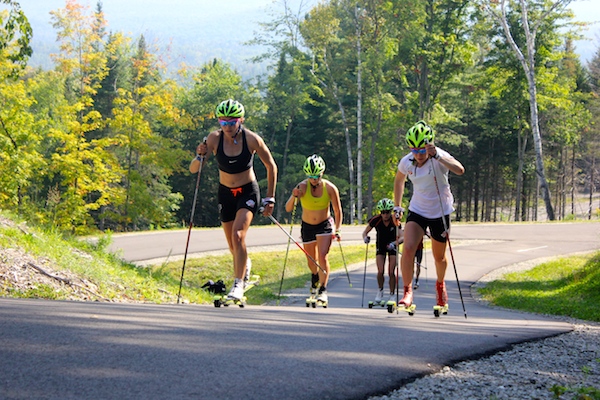
    Sophie Caldwell, Ida Sargent, Jessie Diggins, and Liz Stephen stride up a hill at the Olympic Jumping Complex as part of a classic speed workout at the USST Lake Placid Training Camp.

    LAKE PLACID, N.Y. – There’s no doubt that the U.S. Ski Team (USST) has grown in results and popularity in recent years. While the team has been advancing the stars and stripes abroad, the sport has gained traction on the home front.

    While no single factor can claim credit to the humble rise of nordic skiing in America, some often-unseen pieces of the puzzle are the USST camps held throughout the offseason.

    As the first week of September came to a close, the USST concluded its annual training camp in Lake Placid, N.Y. The camp, which started Aug. 25, had a large emphasis on intensity and included a classic-rollerski sprint simulation, various speed workouts, and the challenging Climb to the Castle rollerski race up nearby Whiteface Mountain.

    While many western skiers were missing from the lineup, USST athletes Jessie Diggins, Ida Sargent, Liz Stephen, Sophie Caldwell, Ben Saxton, Paddy Caldwell, Andy Newell, and Simi Hamilton were in attendance for the majority of the camp.

    For Paddy Caldwell, this was the first time that the Dartmouth sophomore had trained with a near-full team since he was named to the USST this spring.

    “It’s nice to have a focused group together and a cohesive connection,” Caldwell said. “In particular this camp has been nice to get to know the guys.”
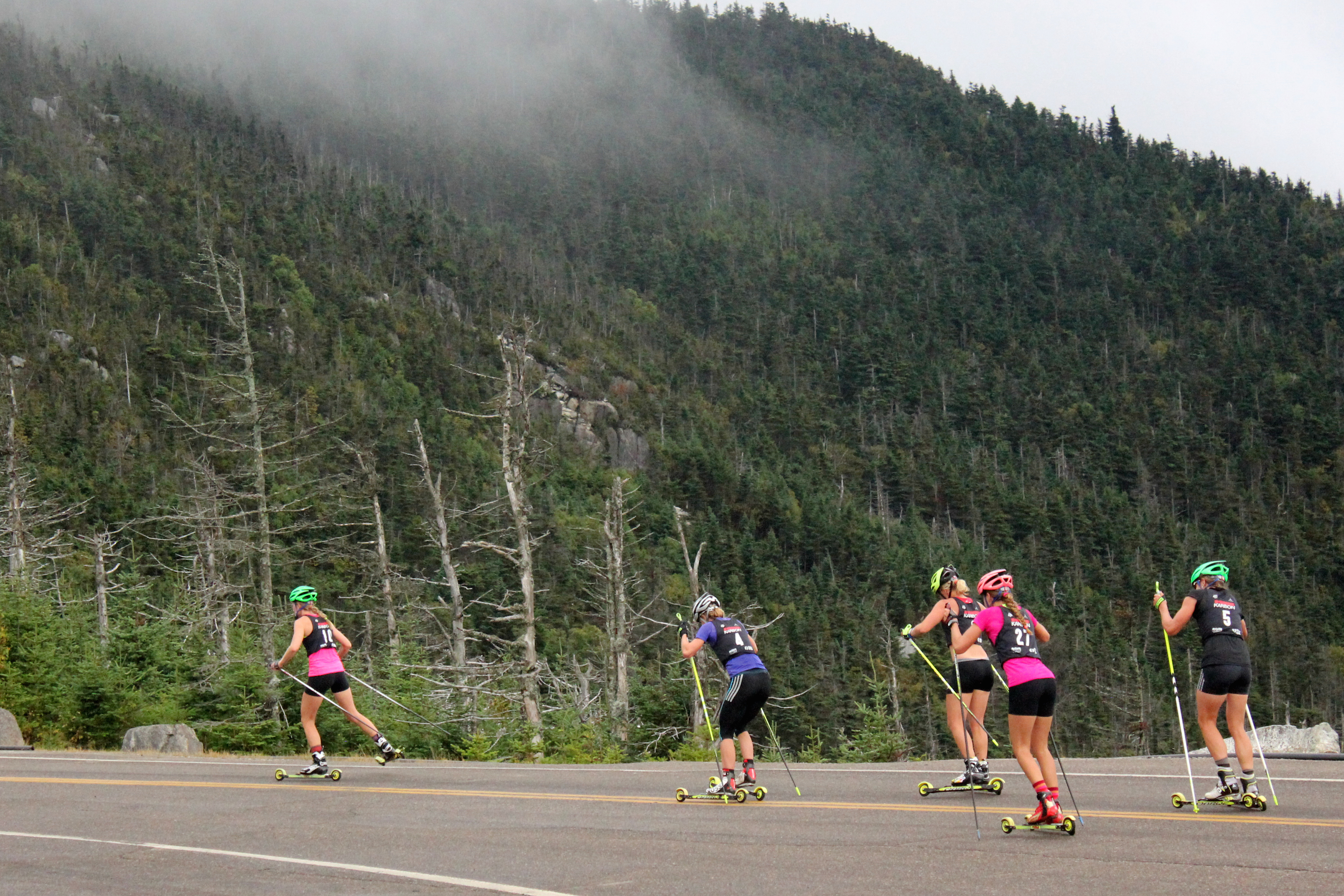
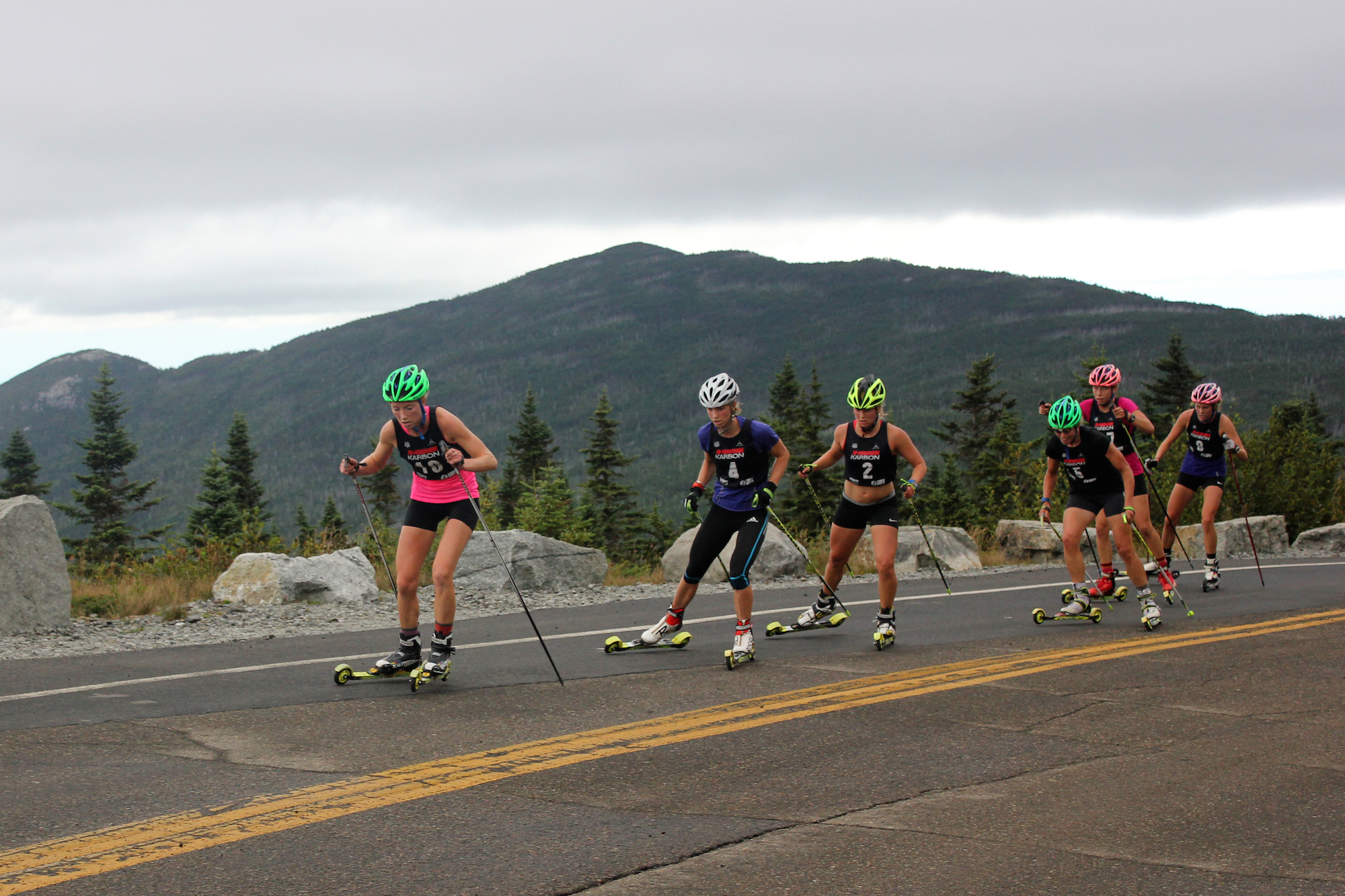
    Erika Flowers (SMST2) leads the chase pack. She is followed by Annelies Cook (USBA), Jessie Diggins (USST/SMST2), Susan Dunklee (USBA), Katharine Ogden (SMS), and Mary Rose (SVSEF).
    Erika Flowers (SMST2) leads the chase pack. She is followed by Annelies Cook (USBA), Jessie Diggins (USST/SMST2), Susan Dunklee (USBA), Katharine Ogden (SMS), and Mary Rose (SVSEF).

    Caldwell, who took classes and trained at Dartmouth for most of the summer, was injured in late July with a torn disk or muscle in his mid-to-lower back. The 20 year old said that while he wasn’t doing any high-impact activities such as intervals, he felt that the camp was helping him get back into his normal training routine.

    He predicted he would be fully recovered by the time the USST travelled to Park City, Utah, for its fall altitude camp in October.

    In addition to the USST, a trove of athletes from the Stratton Mountain School (SMS), Craftsbury Green Racing Project (CGRP), Sun Valley Ski Education Foundation (SVSEF), and various other clubs across the country made the trip for the two-week event.

    One such athlete was Caitlin Gregg of Team Gregg who, after claiming the overall SuperTour title last March, is gearing up to start on the World Cup this fall.

    “The level of training has been really high for every session,” Gregg said. “The weather’s been awesome which has been a super plus here in the East. It can get kind of rainy but we’ve had some sunny days.”
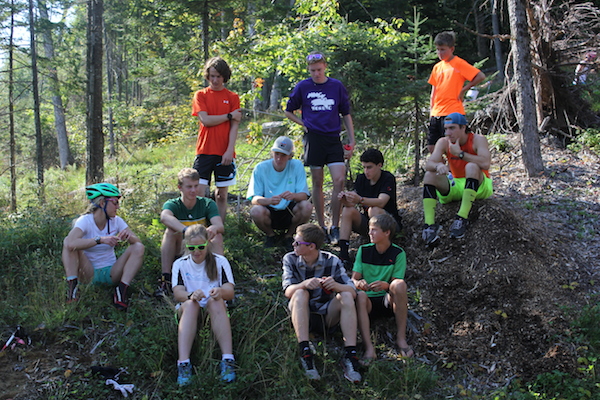
    USST Lake Placid Camp Speeds Friday Sept. 5, 2014
    Caitlin Gregg (Team Gregg) takes a break to talk with spectators from the Green Mountain Valley School.

    The Lake Placid camp created a daily routine for its participants. Before each session skiers would gather to watch World Cup footage to stimulate the athletes’ minds before hitting the pavement. In many cases, they would watch Norway’s Marit Bjørgen double pole or Petter Northug start.

    Once a rollerski workout was over, athletes received video clips of themselves from the workout to allow for reflection and thoughts on future improvement.

    While technique advice from the coaching staff was a key part of the camp, the goal was to create an environment where athletes could conquer their technique difficulties on their own.

    “Some camps we spend a lot of time talking about technique, but I think it’s really important to build the infrastructure and let them figure it out on their own at some camps,” U.S. Ski Team Women’s Coach Matt Whitcomb said. “We provide them the tools to figure out their technique projects. “

    Many times that means relying on fellow athletes for technique improvements.

    It’s something that Whitcomb has seen advance in recent years and he believes it’s a positive development for his athletes and the sport.

    “Different people recognize each other’s strengths and they know that they themselves are used as a demonstration,” he said. “Everyone has their strengths that they are expected to share.”

    Whitcomb likes to remove himself as the source of all coaching, and believes that a healthy level of self-coaching can often lead to greater development.
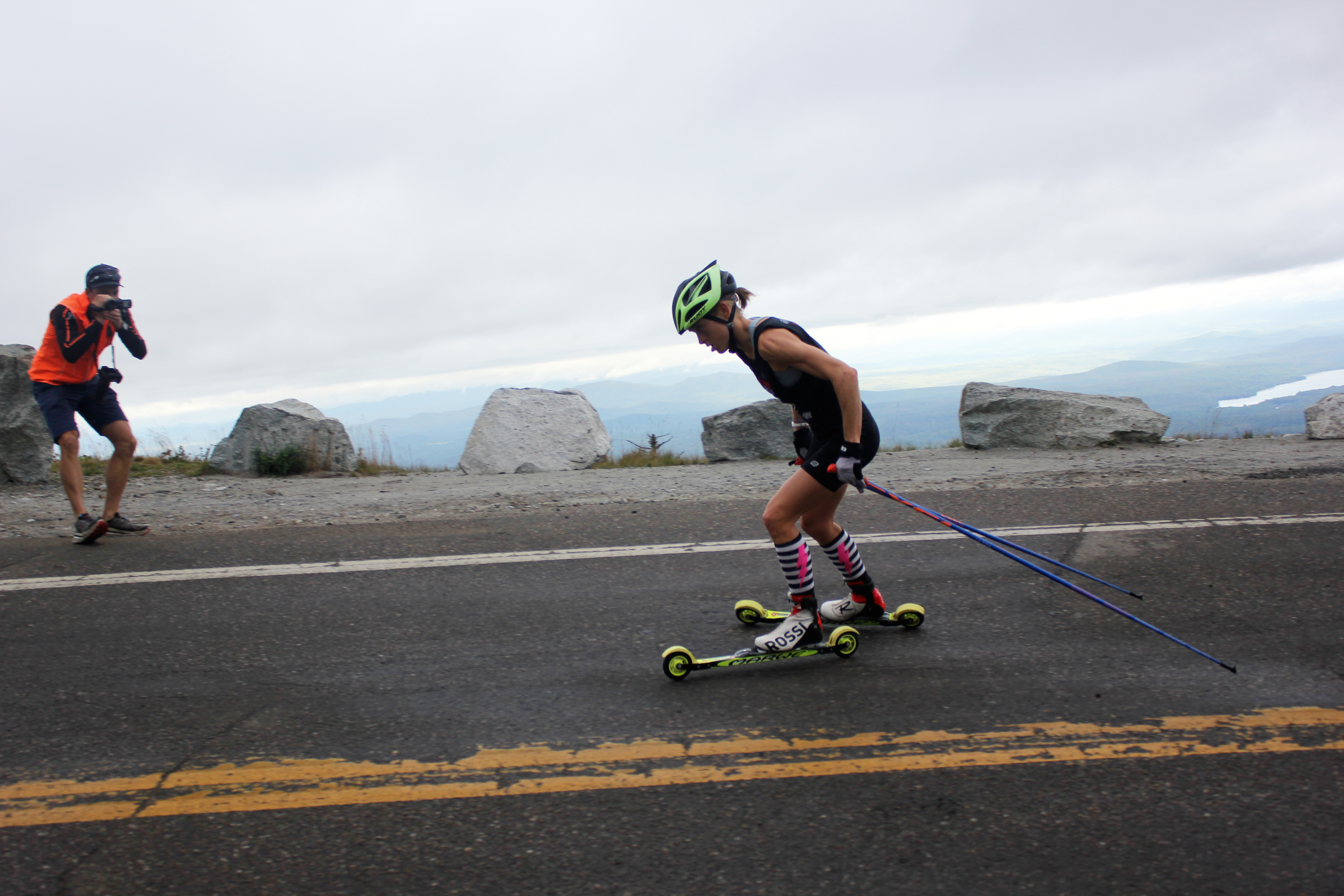
    Liz Stephen (USST/Burke) sporting pink lightening bolts on her socks as she rockets her way to her fourth Climb to the Castle win in four years.
    Liz Stephen (USST/Burke) sporting pink lightening bolts on her socks as she rockets her way to her fourth Climb to the Castle win in four years.

    “When too much coaching happens – and that can be too much technique coaching or too much psychological coaching – the athletes learns to really depend on the coach and it becomes a crutch. They stop learning on their own,“ he said.

    While the camp was focused on intensity, it also provided a means to improve tactical skiing in a group setting.

    According to Whitcomb, it’s often easy for athletes to focus on building capacity, speed and a strong mindset, which are all incredibly important. However, in focusing on the big-picture improvements, athletes can miss what Whitcomb calls the “low-hanging fruit.”

    With skiers like Kikkan Randall, Hamilton and Newell — considered some of the best technical skiers in the world — Whitcomb believes the U.S. has the unique opportunity to increase its technical ability.

    “They are assets on our team that we can use in workouts to set the bar as well as refining their own skills,” he said. “Learning to ski these transitions doesn’t take more energy. It actually takes less energy to take a better line. We’re trying to move away from having the fastest hill climbers and the most powerful skiers to the most well-rounded skiers.”

    When asked how the USST coaches balance the addition of other elite team athletes in the camp, Whitcomb said that it’s been something the team as been working on for several years.

    In past camps, Whitcomb said that there were too many participants and many of the workouts would lose their value.

    “We’ve always been about the partnerships and we’ve known that that’s the way to take a fractured ski culture in the U.S. and bring it together,” he said. “But what has snuck away from us at a camp here and there was that we were almost being too open. The most competitive workouts in the nation were too open and thus the target was too big.”

    Whitcomb said this year’s Lake Placid camp had a stable balance where the national team and additional elite skiers were able to create an environment where everyone was able to bring something to the table.

    Now that the sea-level camp is over, athletes will travel back to their respective clubs and partake in a much-needed rest period. As the intensity from the late summer begins to set in, they will continue to build volume until the USST gathers again in Park City, Utah, on Oct. 4. There, they will participate in a three-week altitude camp that takes them from the U.S. Ski & Snowboard Association’s Center of Excellence (COE) to Frozen Thunder in Canmore, Alberta.

    FasterSkier’s On-Site Coverage of the 2014 USST Lake Placid Training Camp
    Friday’s Speed Workout | Photos

    Climb to the Castle Recap | Photos

  • Diggins Leads Three in the Top-20 In Davos for U.S. Women

    Diggins Leads Three in the Top-20 In Davos for U.S. Women

    Kikkan Randall was on the bench for the 10km freestyle in Davos, Switzerland on Sunday, but once again demonstrating their depth, the U.S. women still placed three skiers in the top-20.

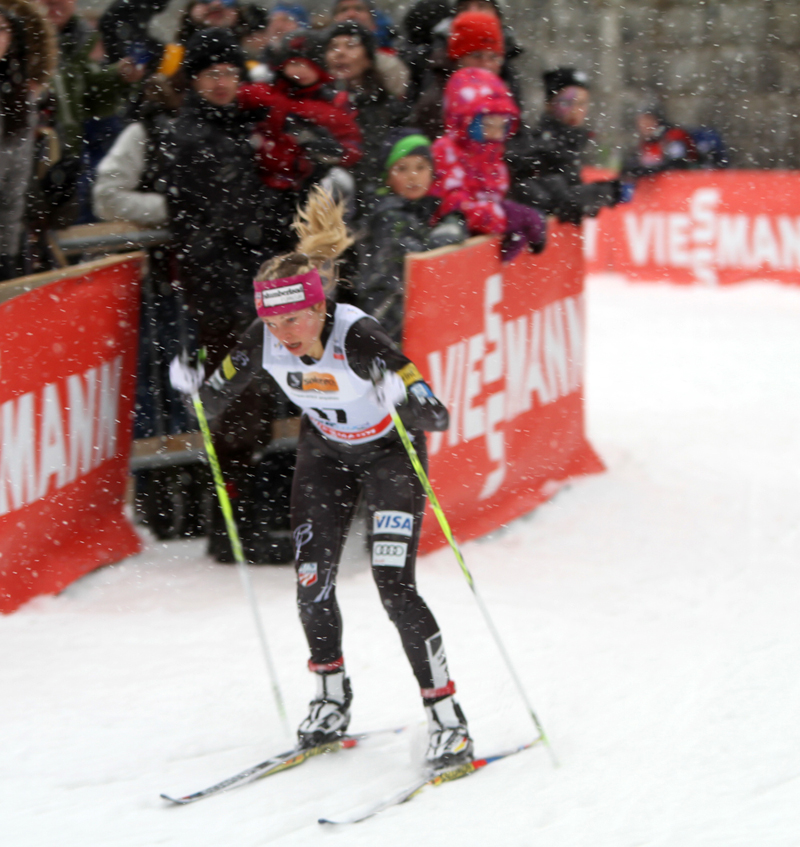
    With Randall opting to rest with World Championships just days away, Jessie Diggins led the way, placing 14th, just 4.2 seconds and one place in front of teammate Liz Stephen.

    Holly Brooks rounded out the squad in 20th, her second consecutive race well inside the points.

    While the performance marked the best distance finish of the year for Diggins, it could have been even better.

    At the halfway point she was in 4th, but a combination of fatigue and a late crash dropped her down the results sheet.

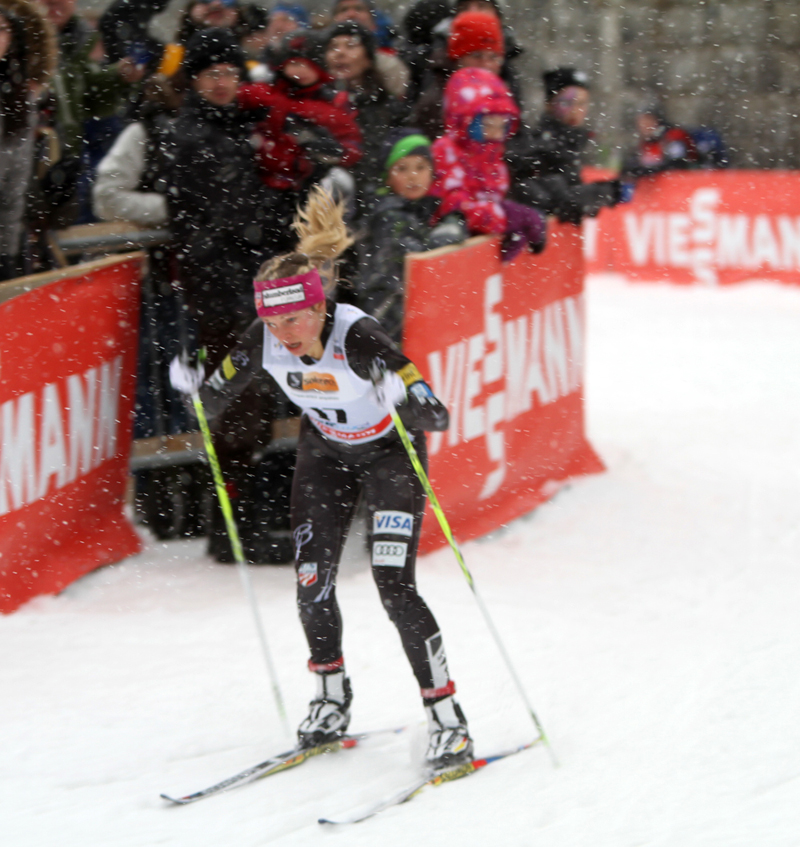
    Jessie Diggins racing on the World Cup earlier this season.
    Jessie Diggins racing on the World Cup earlier this season.

    “My second lap the wheels definitely started to come off, and I lost some valuable time crashing on the corner about 1km from the finish,” Diggins wrote in an email to FasterSkier.

    She ended up 54.9 second behind winner Therese Johaug (NOR).

    U.S. Ski Team (USST) Women’s Coach Matt Whitcomb was pleased with his young skier’s performance, and sees the strong 5k time as a positive sign.

    “Out of the three girls she probably took it out the hottest and had an outstanding first lap…which is a great sign that she could be a good candidate for a team sprint for us, and also for a leg in the relay,” Whitcomb told FasterSkier.

    He described her ability to hold on for a top-15, despite fading hard as “pretty remarkable.”

    Diggins was aware of the need to pace on a challenging Davos course, one she described as lacking steep climbs, but with no significant rest.

    “You need to really work the gradual down sections and then on the steeper downhills there were two different 180 degree corners! So I was trying hard to ski smart, not just all-out,” Diggins wrote.

    While she may not have pulled off ideal pacing, she said she “felt much better” than the day before, and is ready to go for World Championships.

    “It is a hard course, a lot of grinding and altitude,” Whitcomb said. “It claims a lot of people that take it a little bit too hard on the first lap.”

    Stephen executed a very different race strategy though ended up with a similar result.

    She moved up at every time check in the individual start event, ranking 22nd at 1.6k, 18th at 5k and 17th at 7k before finishing 15th.

    “For Liz, Davos presents some challenges in that the course skis as a long gradual uphill grind. She tends to excel in steeper  V1 terrain and today I saw some patient and powerful V2 out of her on course. This has been a missing gear for Liz and today we saw it working,” Whitcomb said in a USST press release.

    Brooks, after placing 23rd in the classic sprint, was once again in the points. The day marked her best World Cup distance result since placing 11th in the Tour de Ski prologue in Oberhof, Germany, back at the end of December.

    And the last time she bettered today’s 20th in a race of 5k or more was her 18th in the 5k freestyle as part of the Kuusamo mini-tour on December 1st.

    “She has done a great job listening to some signs that she was tired, starting in Russia and starting to taper a little bit sooner than she might have otherwise liked,” Whitcomb said of Brooks. “It has paid off with a twentieth place today, which was a huge result for her and great confirmation that things are turning around and going in the right direction.”

    Brooks sprinted well in Sochi, Russia two weeks ago, placing 16th, but struggled in the skiathlon, finishing 41st.

    Looking ahead to World Championships, Whitcomb was happy with what he saw on Sunday.

    “They made a significant jump, good energy out there, really solid results, we’re psyched with what we saw today,” he said.

    — Audrey Mangan contributed reporting

  • Red Group Rides Again

    Red Group Rides Again

    The Tour de Ski kicks off on Saturday in Oberhof, Germany with a 3.1/4.0 kilometer skate prologue, marking the start of the second World Cup period of the 2013 season.

    At the end of every World Cup period a new sprint and distance Red Group is released for next period.

    As a quick refresher, the Red Group is about one thing, and one thing only, money.

    Transportation and lodging are covered for Red Group skiers for World Cup weekends, providing a significant boon to national programs and self-supporting skiers alike.

    The Red Group rankings are tabulated based on World Cup points for the previous calendar year. At the completion of a period, the corresponding period from the previous season is dropped.

    This means the Red Group does not always consist of the current 30 fastest skiers.

    Take for example the case of American athlete Holly Brooks.

    Brooks is currently ranked 20th in the overall World Cup standings and 14th in the distance rankings.

    Yet she is 41st on the distance Red Group list, 69 points out of the top-30. Brooks is hurt by the fact her best results last year came in period I, and those are now off the list.

    Brooks is the type of skier who would be most helped by being in the Red Group. As a member of the United States B Team, Brooks is responsible for her own travel and lodging expenses.

    Other “close but no cigar” skiers include Ida Sargent (USA) who is 32nd on the sprint list, just three points out. Sargent will skip the Tour de Ski, but with two post-Tour sprint races, in Liberec, Czech Republic, and Sochi, Russia that Sargent may race, she will have a chance to move up.

    Next period she will drop just two points off the back-end from last year’s period II.

    Perianne Jones (CAN) is 33rd on the sprint list another three points behind Sargent, and like the American, will not start the Tour.

    On the positive side of the Red Group 30, Kikkan Randall leads the charge, ranked 1st on the sprint list, one of just two women to score World Cup points in every race covered.

    Canadians Chandra Crawford in 19th and Dasha Gaiazova in 25th join Randall in the top-30.

    On the distance side Randall is 7th, Jessie Diggins 25th and Liz Stephen 29th, with Brooks the next closest in 41st.

    Gaiazova and Jones are the only Canadian women with World Cup distance points in the last year, but with a total of 12 points between the two, neither is in contention for the top-30.

    Diggins is also ranked 36th on the sprint list with 64 points. Making the cut on both lists is advantageous, as sprint and distance World Cup events are considered separately. For example, a skier in the distance Red Group will not have expenses covered for a sprint-only World Cup weekend.

    Devon Kershaw (CAN) leads the North American men on the distance list, ranking second despite a slow start to the season. Teammate Alex Harvey is 11th.

    Ivan Babikov (CAN), however, just missed, and is ranked 31st, eight points from 30th.

    The top Americans are Noah Hoffman in 42nd, and Kris Freeman in 45th. The pair stand with 97 and 96 points respectively.

    Len Valjas (CAN) is 52nd, primarily on the strength of his strong World Cup finals last season.

    In sprinting, Andy Newell (USA) is 9th, Kershaw 11th, Valjas 12th and Harvey 15th.

    They are joined by Simi Hamilton (USA) in 29th.

    Other Rankings

    Other rankings provide no immediate return, but hold more cachet at the end of the season. World Cup overall, Sprint and Distance Cups and Nations Cup are all based only on the current season.

    The following is a quick summary of the top North Americans in each category.

    World Cup Overall Men:
    27. Babikov (CAN)
    28. Newell (USA)
    30. Hoffman (USA)

    Distance Cup Men:
    19. Babikov (CAN)
    20. Hoffman (USA)
    27. Freeman (USA)

    Sprint Cup Men:
    6. Newell (USA)
    19. Valjas (CAN)
    24. Jesse Cockney (CAN)

    World Cup Overall Women:
    2. Randall (USA)
    19. Sargent (USA)
    20. Brooks (USA)
    25. Stephen (USA)

    Distance Cup Women:
    5. Randall (USA)
    14. Brooks (USA)
    20. Stephen (USA)

    Sprint Cup Women:
    1. Randall (USA)
    12. Sargent (USA)
    15. Jones (CAN)
    18. Crawford (CAN)
    23. Gaiazova (CAN)
    25. Sophie Caldwell (USA)

    Nation Cup Overall (Men+Women):
    4. U.S.A.
    9. Canada

    Nation Cup Women:
    2. U.S.A.
    9. Canada

    Nation Cup Men:
    7. Canada
    11. U.S.A.