From the FasterSkier archive — posts syndicated from athletes’ and coaches’ own blogs between 2004 and 2012, kept online as published. Current coverage is at fasterskier.com.
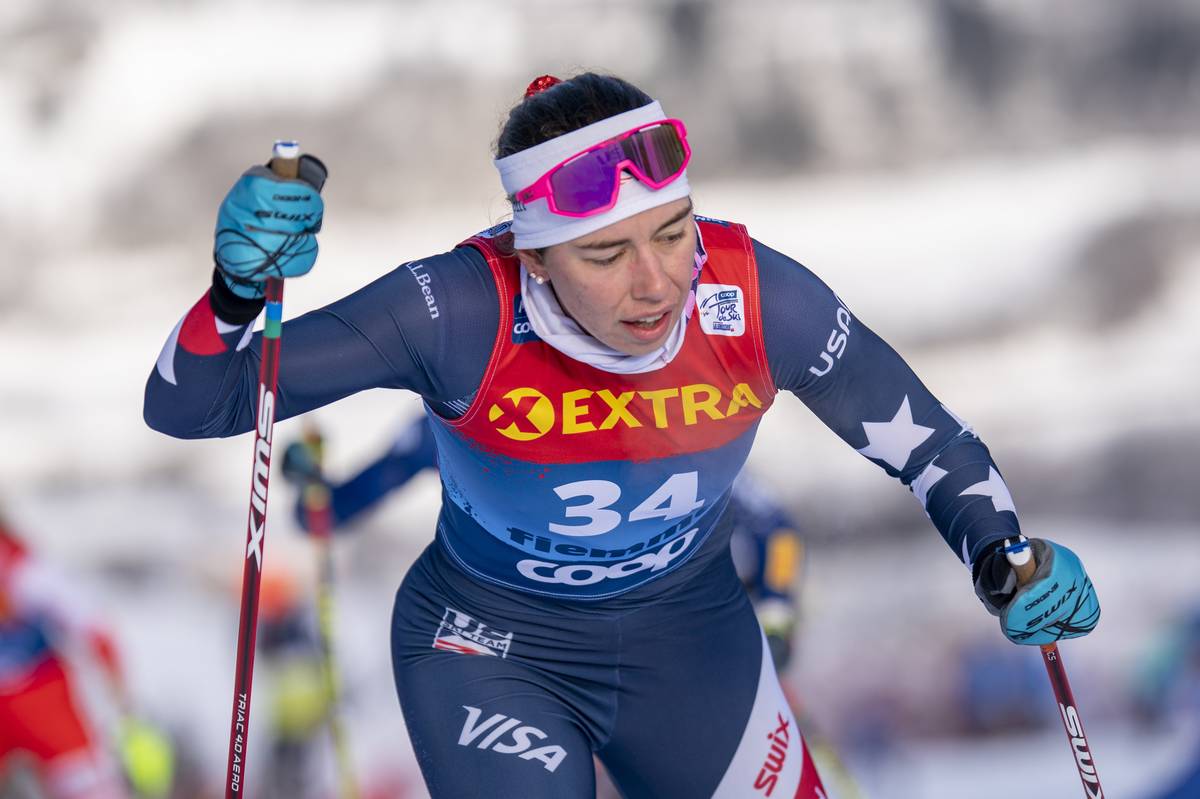
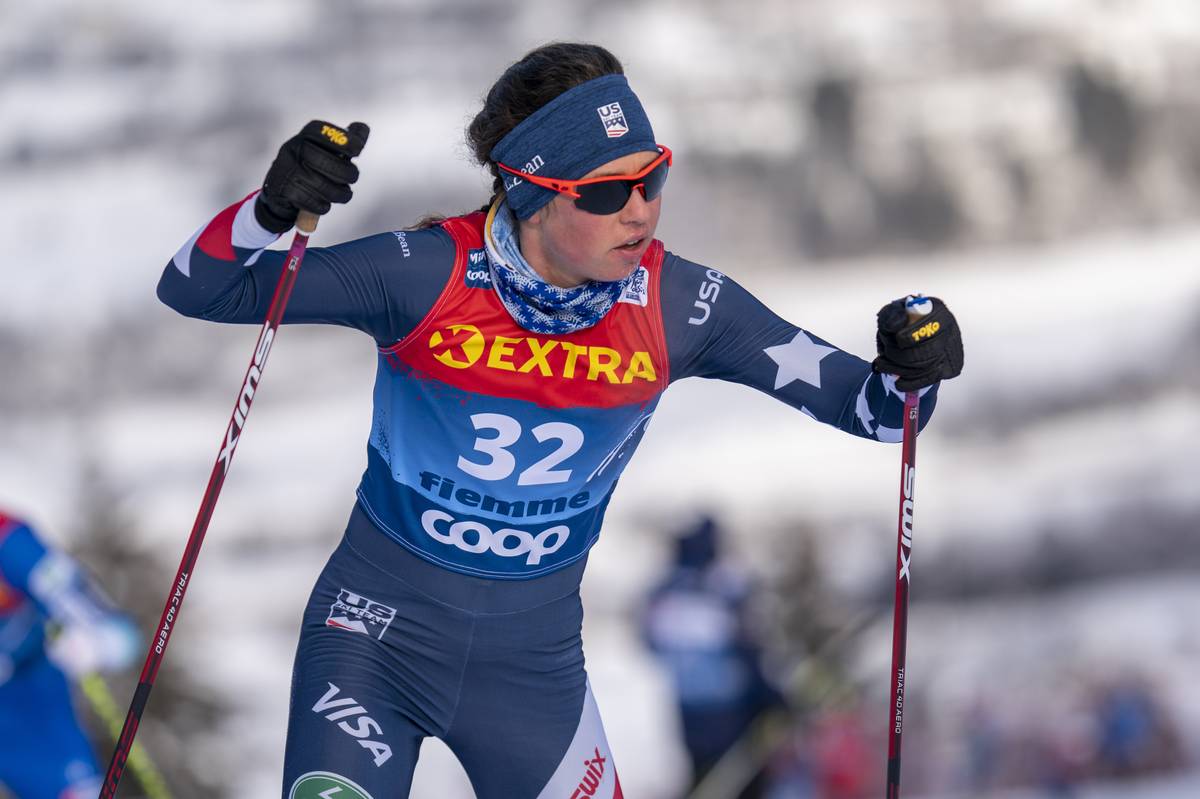
On a late-October morning, Julia Kern sat in San Diego, sunlight spilling through the window after cradling her infant nephew. “He’s a cutie for sure,” she laughed. In a few short weeks, she’ll trade baby giggles for the squeak of ski pole baskets on the cold Finnish snow, but the warmth in her voice already says a lot about where she is mentally this Olympic year: grounded, grateful, and still having fun.
“It’s been a really good lead-up this year,” Kern said. “I’ve been able to stay healthy. I’ve done a lot of physical therapy on my back from my injury last year, and that’s finally going well. So being able to link consistent training together without major disruptions has been the biggest difference this year. That makes me really excited to see what will happen this season.”
Cycling gives Julia Kern a place to turn her mental rhythm and flow into motion. (Courtesy Photo)
The Year of Steady Rhythm
After an injury-plagued 2024 season, Kern’s return to full health has been both physical and psychological. She’s worked closely with physical therapist Brie Beckwith and coaches Kristen Bourne and Colin Rogers to rebuild her movement patterns and ski technique. “A lot of what I’m doing from my back rehab is retraining movement patterns—learning to actually use my glutes, push through the right way, fully transfer weight,” she explained. “Part of it is having less pain, which lets me move more fluidly. But it’s also about translating that from the gym to skiing.”
For the first time, she spent a full three-week training block with Bourne in New Zealand, where daily feedback deepened their connection. “That was really cool because I’ve never had that before,” Kern said. “It’s one thing to text once a week; it’s another to work together every single day. We built a real rhythm.”
That word—rhythm—is perhaps the throughline of Kern’s 2025 Olympic campaign. Rhythm in training, in recovery, in how she manages a long World Cup season without burning out. Her “don’t reinvent the wheel” approach to the Olympic year reflects a maturity hard-won through injury and experience. “You do what’s working well,” she said. “Changing things is always a risk.”
Jessie Diggins and Julia Kern flank their US Ski Team coaches Jason Cork (kneeling) and Kristen Bourne (standing) at their annual on-snow training camp in New Zealand. (Courtesy Photo)
Learning the Language of the Body
If Kern’s early career was marked by her ability to push, her recent evolution is defined by knowing when to pull back. “Recovery is a big one,” she said. “Not just lying in bed—but mental recovery, physical therapy, fueling, hydration. As I get older, I spend more time on that. I’ve learned what works and what doesn’t, and how to read cues—whether I’m ‘good tired‘ or ‘bad tired.’“
Her typical week includes two or three intensity sessions, distance training, and strength work, but with flexibility to fit around life: weddings, visits home, mountain-bike trips. “Working around the life schedule is what makes it rewarding,“ she said. “You’re excited to go do it, and you also feel like you can do all those fun life things too.”
That balance shows in how she approaches her mental game. Kern has worked with the same sports psychologist for over five years, meeting weekly or monthly. Together, they’ve developed what she calls a “good energy“ framework: a way to make decisions rooted in joy rather than obligation. “It doesn’t mean bouncing off the walls,“ she explained. “It means asking: What makes me feel good in skiing? If I’m dreading something because I’m missing an important life event, that probably isn’t bringing me good energy. So I make decisions based on that.”
Patience, she says, has been her greatest teacher. “Everyone has their bumps in the road,“ she said. “Taking those as learning experiences rather than failures is huge. Setbacks force you to approach things differently, and you can actually learn a lot about yourself that way.”
Spending time being active and relaxing with friends and family is a cornerstone to Julia Kern’s success. (Courtesy Photo)
A Culture of Team First
If there’s a single quality that defines Kern, according to U.S. Ski Team Head Coach Matt Whitcomb, it’s her blend of positivity and perseverance. “She’s had a hard road,“ Whitcomb said. “Even as a junior, she battled compartment syndrome, mono, back troubles, shoulder troubles, nerve issues—you name it. That would defeat most athletes. But despite it all, Julia goes on to win World Cup and World Championship podiums.”
Whitcomb sees her as both a survivor and a student. “She had incredible leaders to follow—Sophie, Liz, Kikkan, Sadie—and she was always listening, always learning,“ he said. “Julia’s a scholar. Her parents are scholars, her sister’s a scholar. She comes from a learning family. And now she’s the sum of all those experiences. She reminds me so much of Kikkan Randall—so driven individually, but without a team to celebrate it with, she’d quit skiing. Julia’s the same way: such a team-oriented person.”
That team ethos is something Kern now passes along to younger teammates, such as Kate Oldham. “I really appreciated when older athletes just showed by doing,“ Kern said. “Now I try to do the same. When we do race prep, anyone who wants can join. Like at World Champs—Kate, Jessie, Rosie, and I practiced that final corner together. It was so slushy and tricky, and Kate ended up being the best one out of all of us. So we said, ‘Okay, we’re learning from her here.‘ Everyone has value on this team.”
It’s a culture built not on hierarchy, but on collaboration—crafting beaded bracelets during camps, sharing meals, and creating ways to connect off the snow. “It’s easy to be isolated in hotel rooms,“ Kern said. “We make time for activities that bring us together. Everyone brings something.”
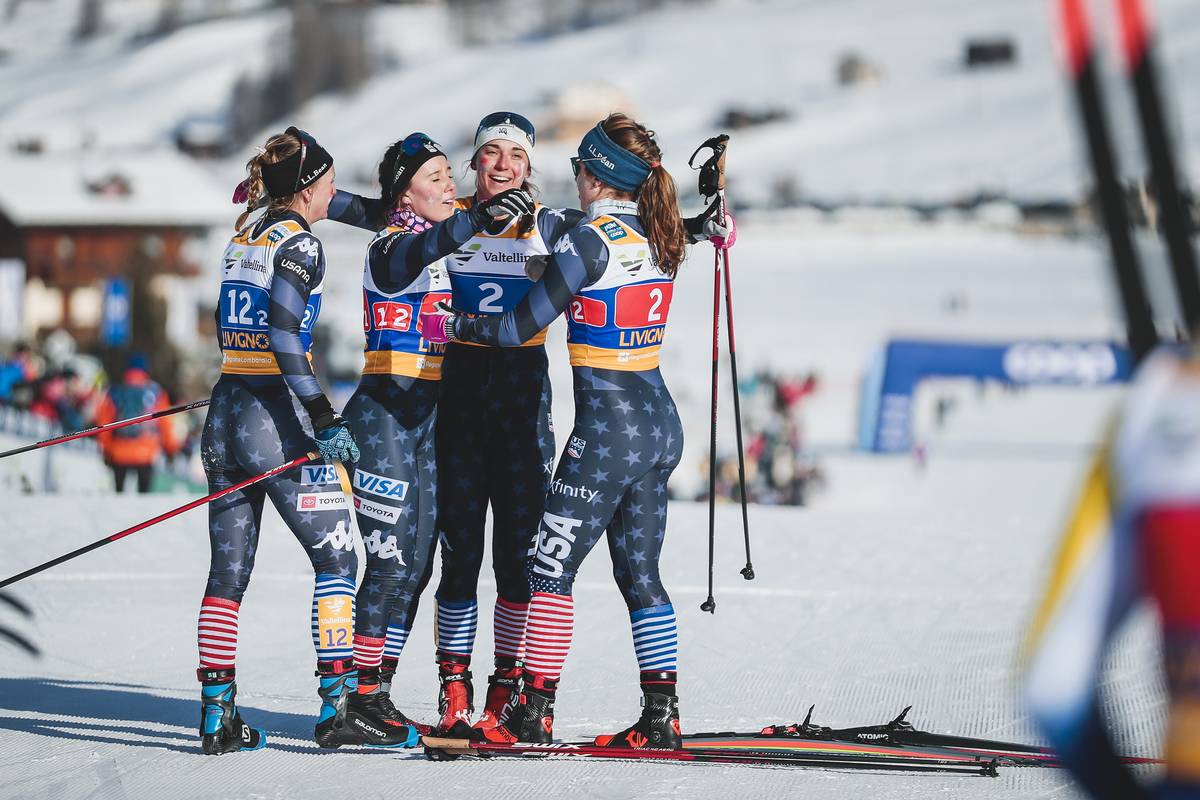
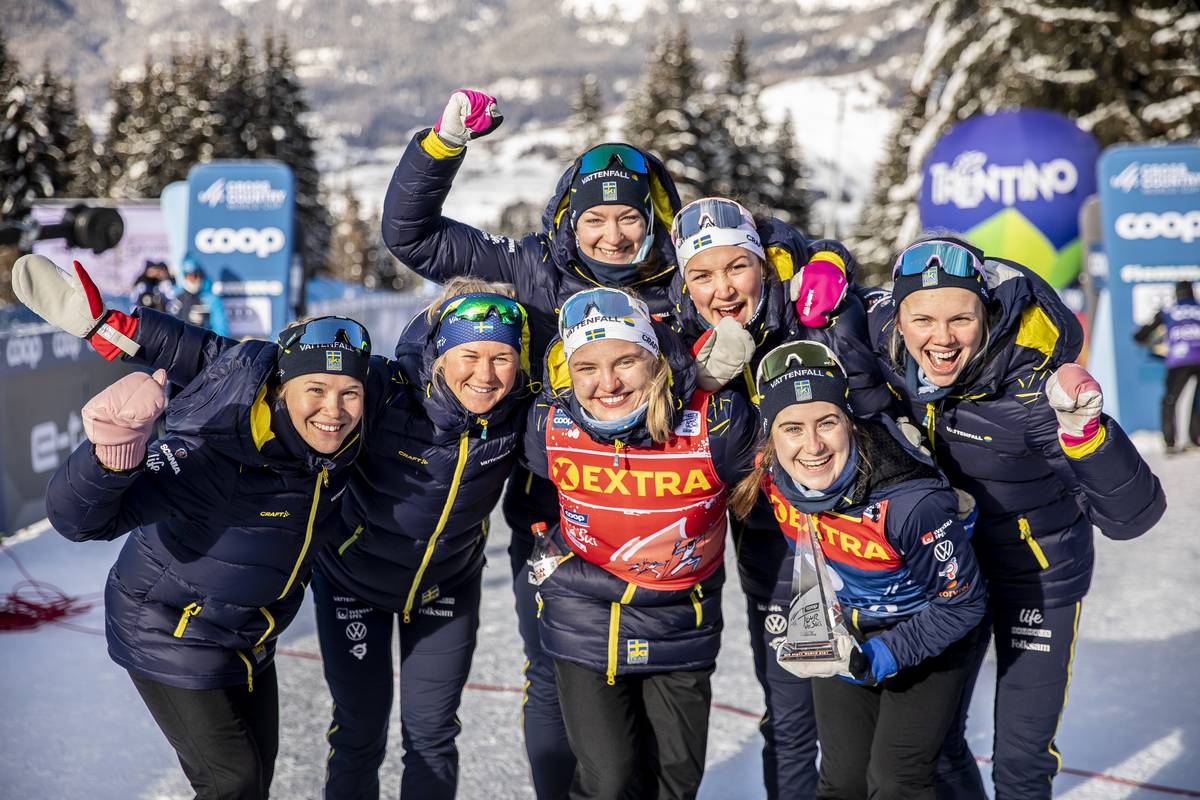
The American women celebrate after United States I – Rosie Brennan and Julia Kern – finished 3rd in a Team Sprint in 2023. (Photo: Nordic Focus).
Learning from Leaders, Leading by Example
When asked what she’s learned from her longtime teammates Rosie Brennan and Jessie Diggins, Kern doesn’t hesitate. “Rosie’s been such a great example of someone who’s had more adversity than maybe anyone I know and still shows up for the team,“ Kern said. “When I was first named to the team and had compartment-syndrome surgery, Rosie—who I didn’t even know—emailed me. She told me it would be tough but that I’d get through it. That stuck with me.”
From Diggins, Kern learned the art of curiosity. “Jessie never goes around thinking, ‘I’m the fastest in the world, I know everything,‘” she said. “She’s always got a growth mindset—always wanting to follow someone, to learn something. That’s really rare for someone at the top.”
Whitcomb has noticed the same instinct. “Julia’s evolved from someone who needed guidance into someone others now look to,“ he said. “She embodies that positive feedback loop of mentorship that defines this team.”
Mental Toughness in the Grind
On the World Cup circuit, there’s little room for reflection. Races pile up; travel blurs weeks together. Kern’s approach to a long season is both pragmatic and optimistic. “I love to race,“ she said. “The World Cup is part of the bigger plan. Early season, we’re still training on the road. You’re not trying to peak at Ruka. It’s about understanding where you are in the load of the season.”
She deliberately builds in breaks—two weeks at home after the Tour de Ski, Christmas with her boyfriend, family visiting during the Olympics. “Those resets make all the difference,“ she said. “They help you stay excited.”
You’re probably already following Kern on Instagram, but if you aren’t, you are missing out on a lot of delicious food inspiration. Cooking has become another activity for her to recover and connect with her friends and family. (Courtesy Photo)
Her outcome goals are clear: make sprint finals consistently, push into the top-10 in distance races, and—if everything lines up—fight for a team-sprint medal at the Olympics. “That’s what I think about during hard intervals,“ she admitted. “The team sprint is a big goal of mine.”
But Kern’s definition of success extends well beyond medals. “A successful season for me,“ she said, “is staying healthy, enjoying the process, and feeling good about how I carried myself. Pressure is a privilege. I want to soak up the experience and make it fun again.”
Beyond the Podium
For Kern, the sport’s meaning has broadened. As an athlete representative to FIS and an advocate with Protect Our Winters, she’s become a voice for climate responsibility and athlete well-being. During the 2025 World Championships, when environmental protests threatened to disrupt races, Kern helped mediate between activists and organizers. “We agreed that protesting during the race wasn’t the way to send a strong message,“ she said. “Now we have an open dialogue. These things take time, but they’re moving.”
Her motivation, she said, “is less about results and more about impact.“ She wants younger athletes to know that skiing fast can be both a platform and a privilege. “I feel grateful that I had such an active childhood and want that for the next generation,“ she said. “Clean air affects everyone. Being outside isn’t something we can take for granted anymore.”
Using her success as a platform to make a lasting impact on children has become a priority for Kern. (Courtesy Photo)
The Joy of Motion
Talk to Kern for long enough, and you realize skiing is just one part of her athletic identity. She’s an all-around mover—mountain biking, surfing, beach volleyball. “I’ve always loved doing every sport imaginable,“ she said. “Even as a kid, I just wanted to move. There’s so much value in being active and having fun. You don’t have to specialize too early. Playing lots of sports keeps it fresh and helps you avoid burnout.”
Cooking has become her creative outlet. “My boyfriend and I love to cook together,“ she said. “We have a CSA, so we get creative with whatever veggies we have. It’s like art—making the food look pretty, connecting with what we eat. It’s a kind of recovery, too.”
From the Gym to the World Stage
Whitcomb sees this blend of drive and joy as Kern’s secret strength. “Julia’s positivity isn’t surface-level,“ he said. “It’s a choice she makes every day despite setbacks. That’s what makes her such an anchor on this team.”
For her part, Kern sees the season ahead not as a culmination, but as another chapter in a long-term process. “Fourteen-year-old me would be surprised I’m still ski racing,“ she said, laughing. “Back then, I thought junior nationals were the pinnacle. I didn’t even know what the World Cup was. I think she’d be proud that I’m still doing this—and still having fun with it.”
Enjoyment is what keeps Kern chasing perfect rhythm through the snow, trusting that good energy leads to good skiing, and that joy and excellence can, in fact, coexist.
Kern seems fully ready to send it this season. (Courtesy Photo)
Love Stories Like This? Help Keep Them Coming.
Feature interviews like this one take time, access, and care to produce. If you value thoughtful storytelling and independent ski journalism, please consider becoming a Voluntary Subscriber. Your support directly fuels the work we do to cover the people, places, and moments that make our sport special.
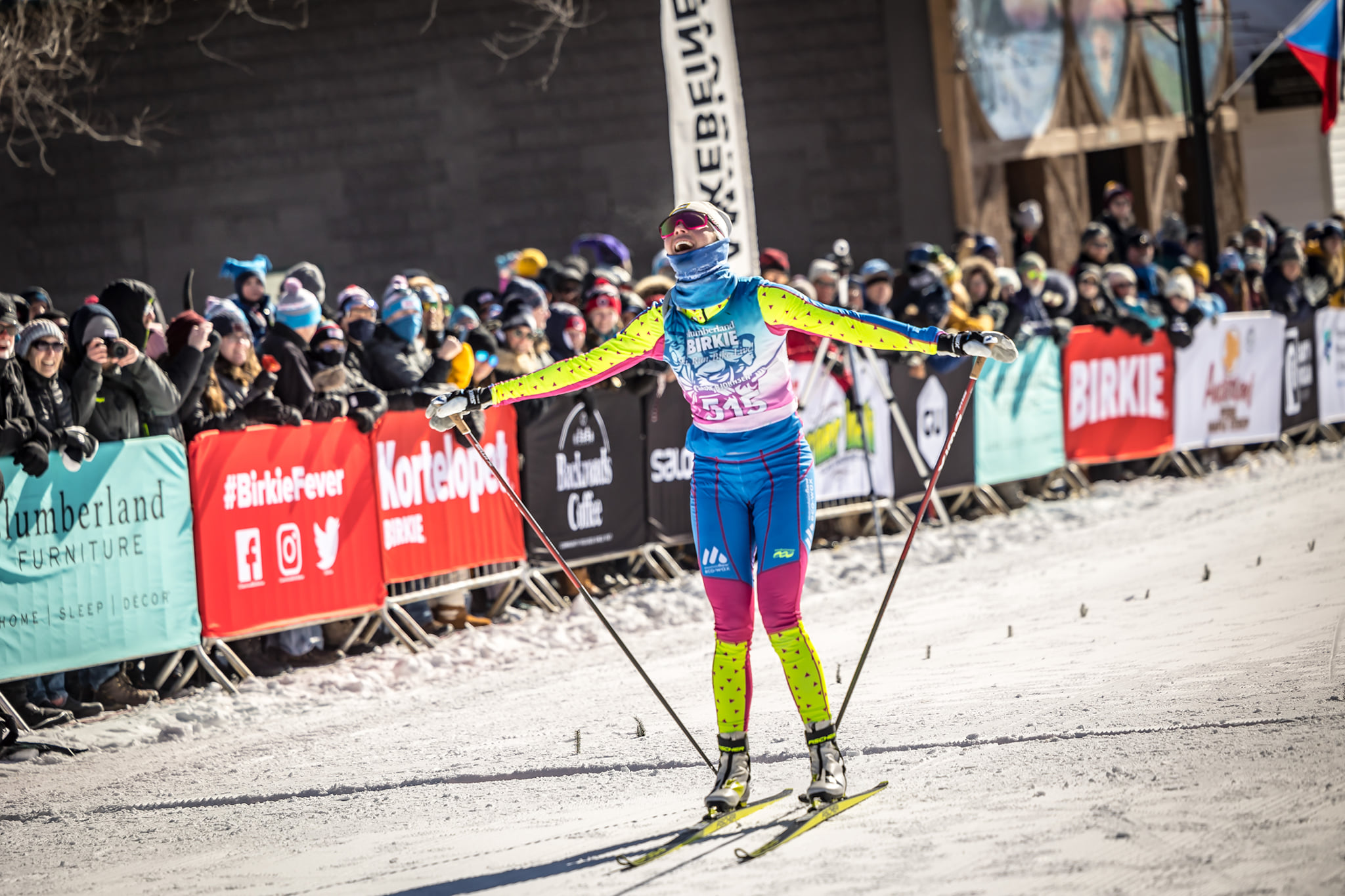
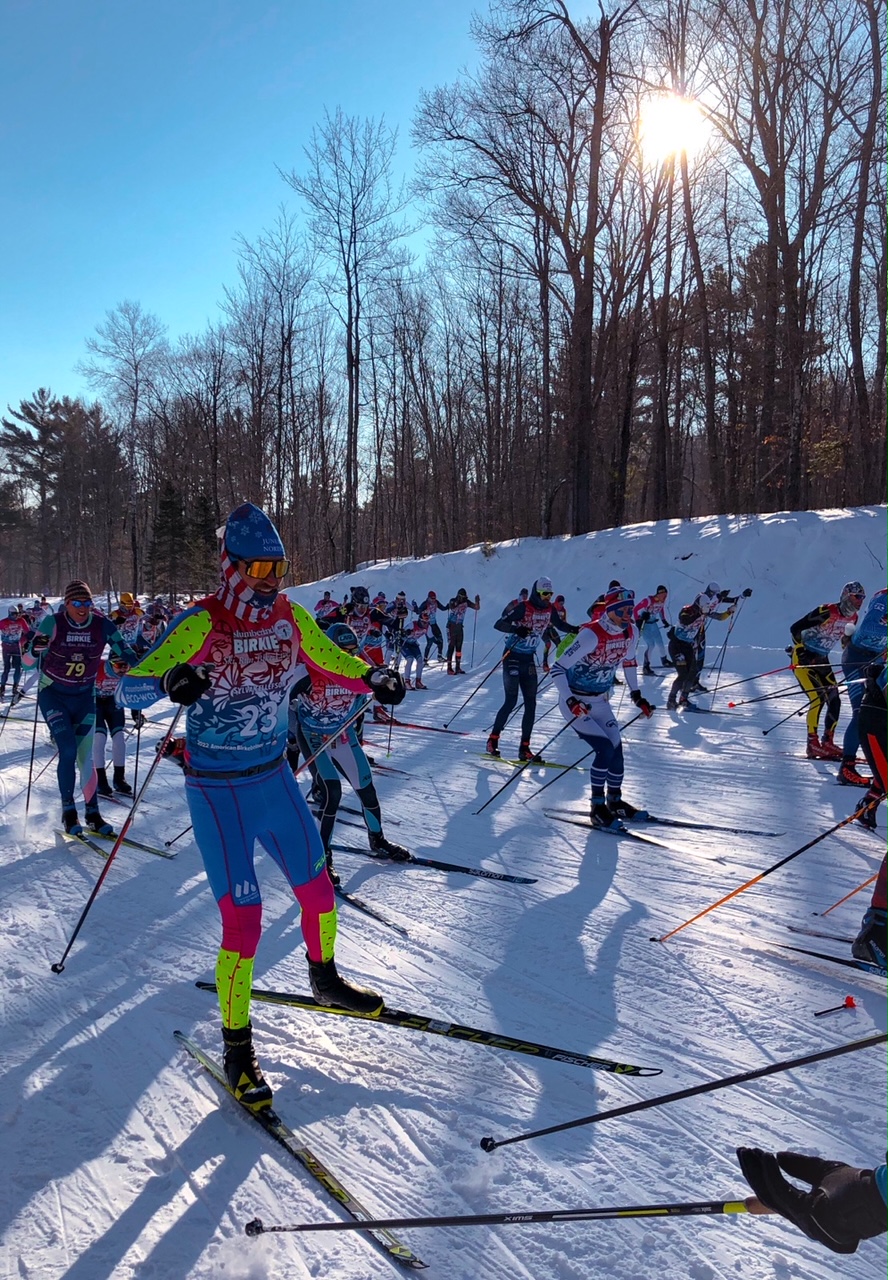
Just over a month ago, the American cross country ski community descended upon the small town of Hayward, Wisconsin. Skies were clear, the snow was cold and firm, and lycra was everywhere. But one set of race suits stood out, both because of the noteworthy athletes wearing them and for their bold neon colors. It was the MountainFLOW Eco Wax race team of Simi and Sophie Hamilton, Sylvan Ellefson, Sadie Maubet Bjornsen, Erik Bjornsen, Matt Gelso, and Liz Stephen.
While most reading FasterSkier will recognize these names without introduction, this is a “band” of retirees who have each, at minimum, raced on the World Cup. Five are Olympians, and one has a collection of top-10 results in World Championship and Olympic sprint results. In short, they’re good skiers who also happen to be good friends.
Racing the Birkie wasn’t about stacking a fast team; leading into the event, mountainFLOW founder Peter Arlein said it would be “super fun, and maybe not super serious.” As the photos suggest, a lot of fun was had, but some fast racing – on skis waxed with mountainFLOW products – happened too.
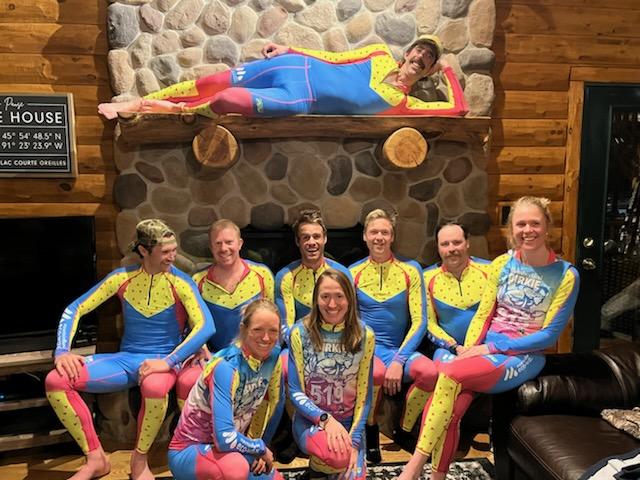
The mountainFLOW eco wax team was “all business” at the Birkie. (Courtesy photo)
“A trip down memory lane,” wrote Erik Bjornsen after the race. “Super fun to get a crew together and pretend to be athletes again. We are all at different fitness levels, one thing in common though: far from our best. It was fun to try and forget that for a weekend, and go live the athlete lifestyle. It’s been a busy winter in the retail industry, so it was nice to have a little break from work and hang out with friends. No beers were consumed… nothing but business at the mountainFlow house.”
(Side note: they may have been spotted at the Moccasin Bar post race.)
As he alluded, there was a range of fitness levels and race objectives, but the prominent theme seemed to be that becoming some of the best American cross country skiers of their generation correlates strongly with good technique and a high level of residual fitness.
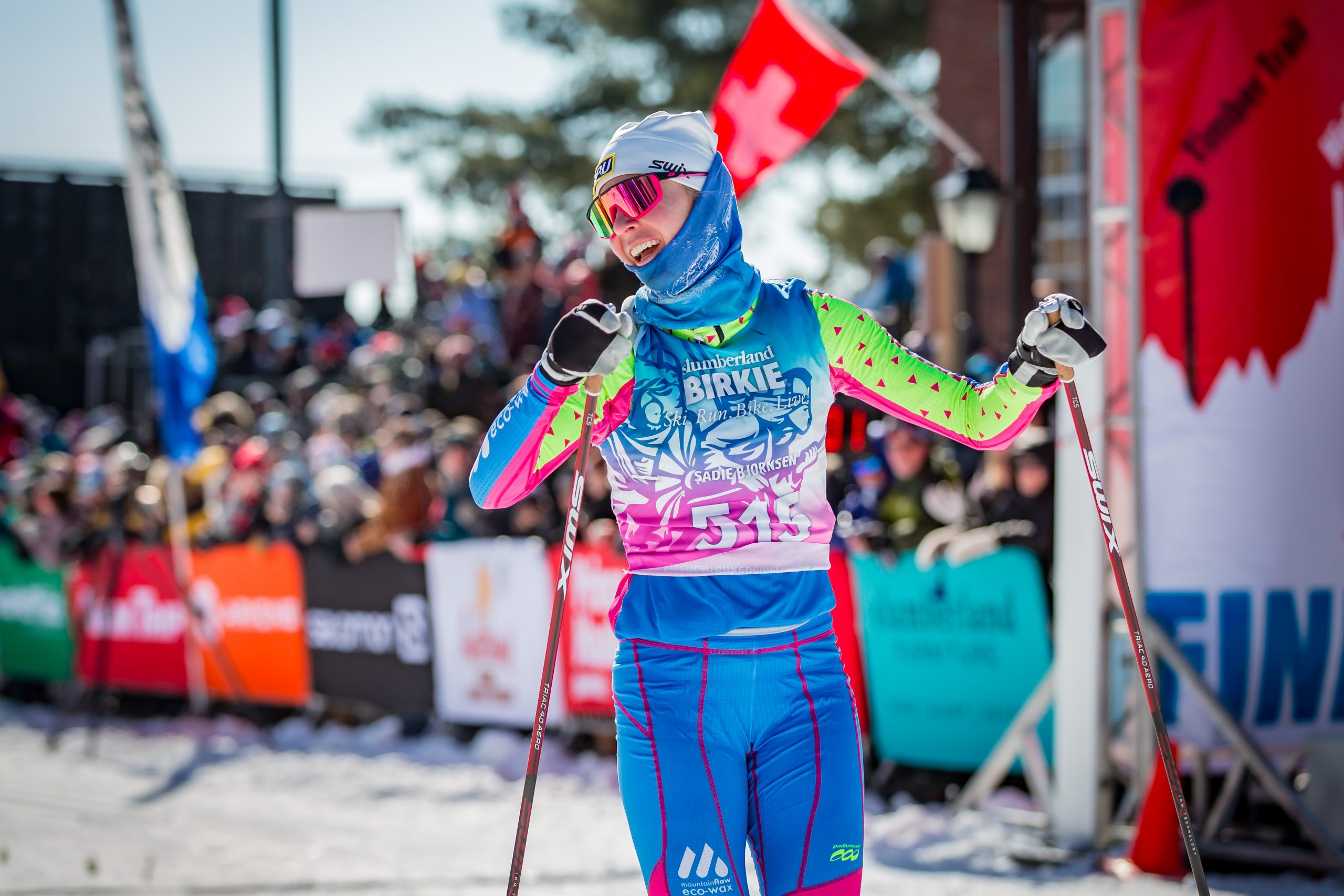
Taking the top result was Sadie Maubet-Bjornsen, who finished fifth in the women’s race, just over two minutes behind winner Alayna Sonnesyn. Erik Bjornsen was the top male racer in 9th (+2:59.05), with Simi Hamilton finishing roughly four minutes behind in 16th. The remaining skiers finished in pairs, with Sylvan Ellefson crossing with Matt Gelso in 121st in the men’s division, and Sophie Hamilton finishing alongside Liz Stephen in 123rd and 124th.
“It was amazing to get the band back together!” wrote Maubet-Bjornsen. “My husband’s family is from Hayward, so after visiting them this summer, we were already committed to doing the Birkie simply to be considered valid members of the Berrard family. When Simi mentioned he was forming a fun team with some of my favorite previous teammates, I was all in. Having jumped full force into this new life, preparing for a 50k couldn’t have been more different than it would have looked in the past. My new way of exercising is waking up at 5:30AM, and hitting the ski trails from my doorstep from 6-7AM.
“Two weeks [before the race], I called in Rosie Brennan to give me some last minute interval workouts to train my brain to accept physical pain again. Four interval sessions later, I showed up and joined the dance. It was pretty fun to ski with the girls, and just witness the gift of fitness that comes out of all those years of hard work. As the top ladies skied away about 35 k in, I no longer could fake the fitness anymore, but still enjoyed every second of skiing it home.”
Adding to the message that more so than lingering fitness, these athletes have maintained a love of the sport and the friendships made through their time immersed in it, Maubet-Bjornsen continued, “I look forward to many more years ahead of joining various classic American races throughout the country that I never had the chance to participate in [while racing on the World Cup]. I feel lucky that my ‘band’ and family that I created in the past ten years is just as excited to jump into a 50 k race, despite the fact we are no longer the pro athletes we were before.”
Sylvan Ellefson in the wild, wearing his neon mountainFLOW race suit. (Courtesy photo)
“For me, cross country ski racing transcends so much more than competition,” wrote Ellefson post-race. “I’ve formed my family and life around the experiences I’ve had and the friends I’ve made along the way. To me the Birkebeiner is an event that encapsulates this cross country ski culture in the US. The people racing at the Birkebeiner are truly the backbone of the ski community and I think for them to see former World Cup and Olympic level skiers helps affirm that in the US, this sport is one giant family.”
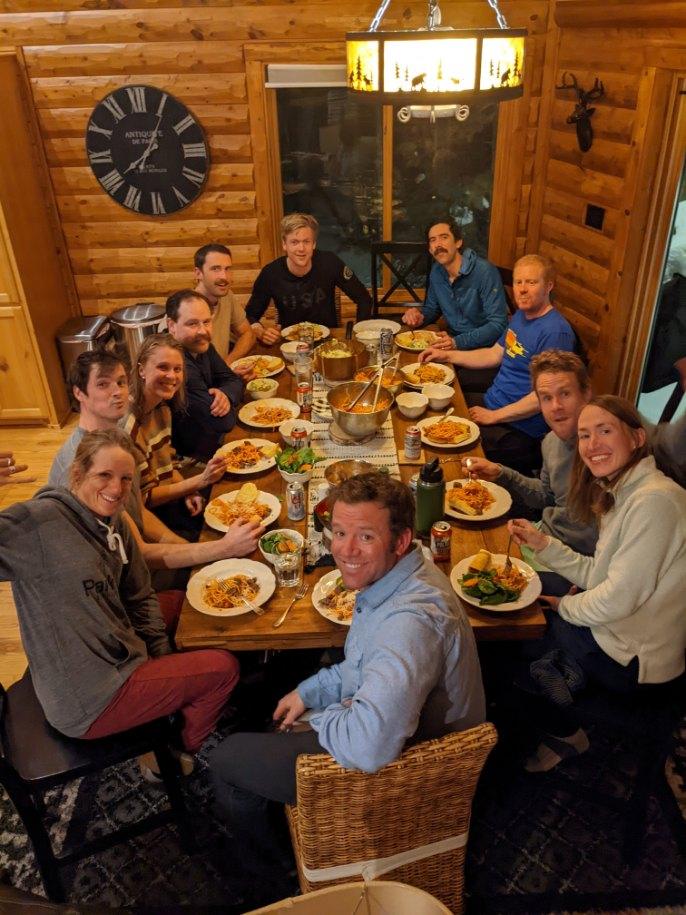
The mountainFLOW Eco Wax team carboloads for the Birkie. (Courtesy photo)
Commenting on the mountainFLOW products and ethos, Ellefson added, “Our waxes were fantastic and I’ve loved using something other than what we’ve been accustomed to using for so long. I’ve tested a couple out now and they truly are not just a great wax, but also a great brand. Getting to spend time with Peter and Brian showed me the culture mountainFlow is trying to create in a space in the industry that is much needed.”
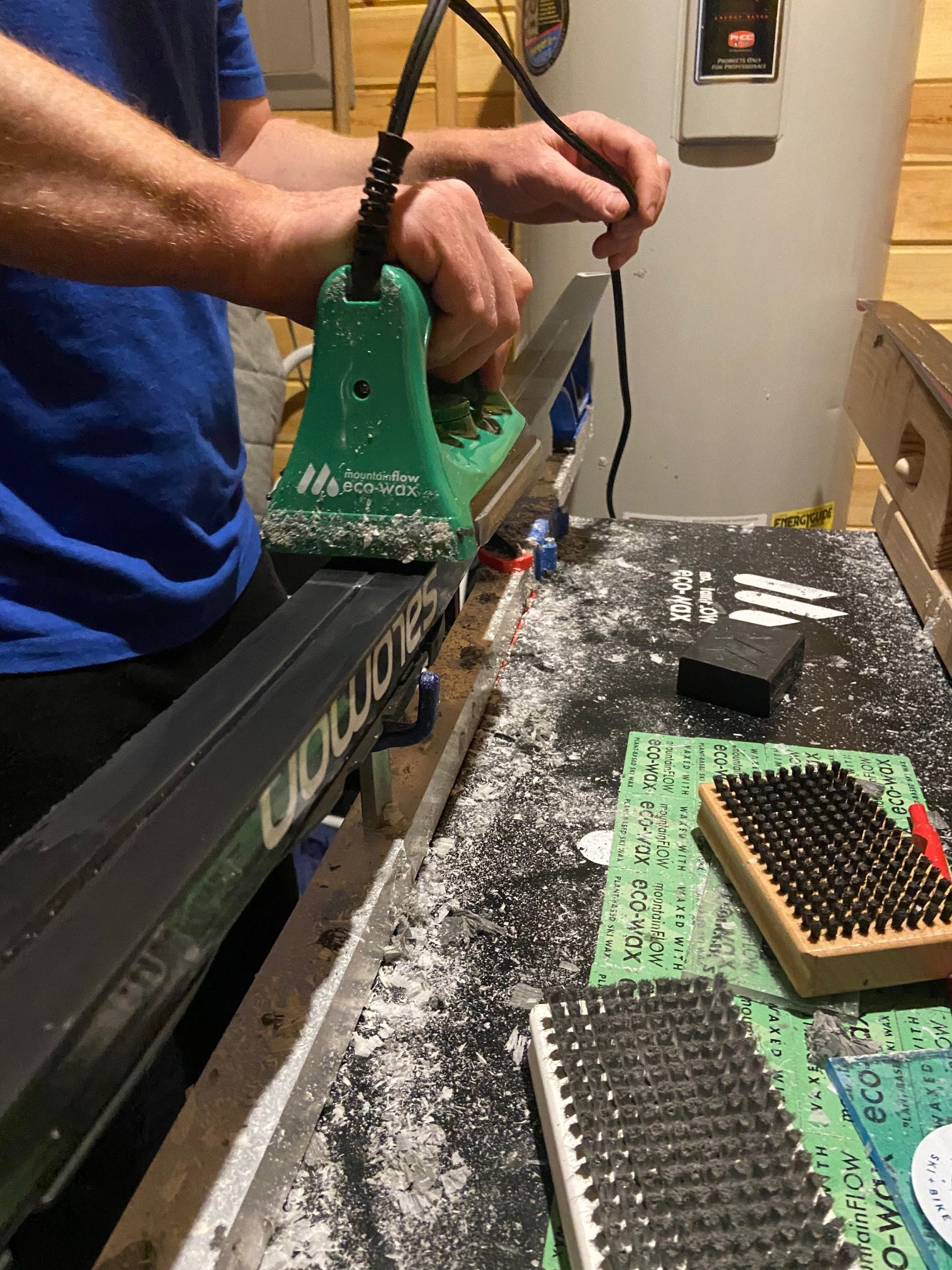
Matt Gelso prepares his skis with mountainFLOW cold wax at the 2022 American Birkie. (Courtesy photo)
More to come, as the coach of non-affiliated French athlete Celine Chopard-Lallier, who took sixth in the women’s race, shares his review of mountainFLOW products, on which Chopard-Lallier also raced at the Birkie. Note that this content is not sponsored by mountainFLOW.
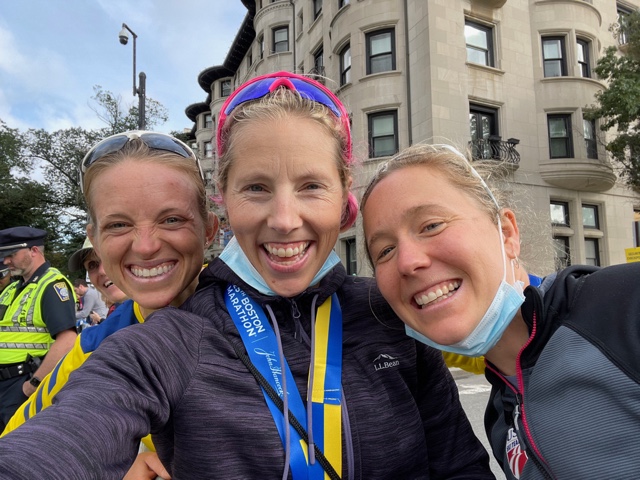
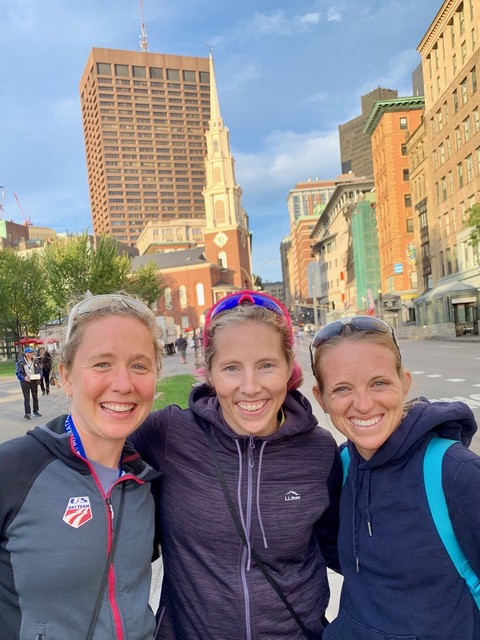
Lining up for their second marathon on behalf of Aktiv Against Cancer, Ida Sargent, Kikkan Randall, and Liz Stephen took on the 2021 Boston Marathon. (Courtesy photo)
While no one would wish for the circumstances, a fall running of the Boston Marathon is perhaps a skier’s dream. The iconic foot race is on many a bucket list; however, the third Monday in April is early for those who spend the winter strapped to skinny skis rather than pounding pavement.
After cancelling the April, 2020, running in light of the descending COVID-19 pandemic, and deciding against an April date for the 2021 event, the Boston Athletics Association (BAA) set its sights on October 11th, 2021, for a return to racing. 30 months without the Boston Marathon; it was go-time in Boston on Monday morning. The Red Sox even put on a show to celebrate, beating the Tampa Bay Rays 6-5 to win the ALDS in dramatic fashion later that evening.
Among the 15,716 individuals making their way from Hopkinton to the finish line on Boylston Street in Boston were three familiar faces: former teammates, U.S. Ski Team members, and Olympians Kikkan Randall, Ida Sargent, and Liz Stephen. The threesome ran on behalf of Aktiv Against Cancer, which promotes physical activity as an integral part of cancer treatment.
According to Aktiv’s mission statement, “Recent research indicates the benefits of physical activity extend beyond controlling symptoms and side-effects of cancer therapy; it is shown to reduce cancer progression and improve a patient’s response to anticancer therapy.”
Nearly two years ago in November, 2019, these women lined up together for the NYC Marathon, each achieving their goal of finishing under three hours. At the time, Randall was only one year beyond her own cancer treatment journey. After receiving the diagnosis of Stage 2 breast cancer in June of 2018, Randall underwent six rounds of chemotherapy, infusions of the drug Herceptin, and a lumpectomy. All the while, she remained active, sharing her journey openly through daily video updates and social media.
Randall shared her Boston Marathon race experience via email.
“We’re all hobbling around today but also basking in the glow after a hard race and fun experience!! After meeting up for the NYC marathon two years ago, when the opportunity to run Boston in October came up (versus April) we jumped at the chance to get together and once again shine the spotlight on an organization near and dear to our hearts, AKTIV Against Cancer.
“All of us have had close contacts with cancer in our personal lives and as athletes recognize how important physical activity is for tackling the treatment. So to be able to raise funds for important research and outreach, we jumped at the chance. We were able to raise over $17,000 collectively toward the cause!”
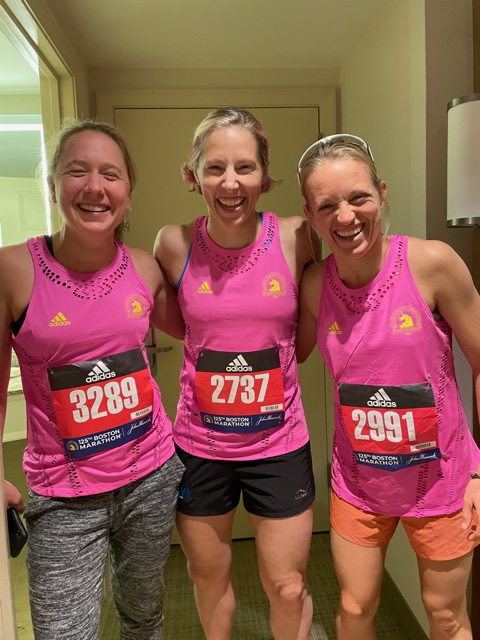
Dressed in hot pink and having no fun at all, Ida Sargent, Kikkan Randall, and Liz Stephen lace up for the 2021 Boston Marathon on behalf of Aktiv Against Cancer. (Courtesy photo)
In 2019, Randall checked the box on her sub-3 goal with a time of 2:55:12. This year, she was just shy with a net time of 3:00:27.
“When we decided to do this back in April/May, I think all of us had ambitions to prepare for this race more seriously. But as we’re all finding post-racing, life is busy and I think we all came in a little under prepared. Regardless, it was going to be a great excuse to meet up with best friends.”
Two minutes behind Randall, Sargent crossed the line in 3:02:26. Sargent also remarked that she felt under-trained at the start line, but the experience and opportunity outweighed the feeling of the final 10k.
“We plan to do these races as a little reunion and an opportunity to see and run with each other and support Aktiv,” wrote Sargent. “Today was so much fun but also a beast. The energy out on course of these big races is also so incredible. I hadn’t trained or run much at all leading up to the race so I really wasn’t sure what to expect but I was very excited that my legs felt great for so long. The last four or five miles were tough but I just told myself that I couldn’t walk and that kept me going through to the finish line.”
Happy 26.2 finishers: Ida Sargent (left) and Kikkan Randall (right). (Courtesy Photo)
Despite being veterans when it comes to endurance racing, Randall shared that the women were perhaps lured out too quickly, leaving them a little too dinged up when they faced the Newton hills late in the race. Runners face the infamous “Hearbreak Hill” at mile 20, steadily climbing for half a mile on tired legs.
Though all three women positive-split the race, Stephen bled the least amount of time in the second half; she clocked 1:25 through the first half, losing five minutes over the second to finish in 2:55:48.
“The downhill start was really fun for the first 10km,” wrote Randall. “At points we were on-pace for a sub-2:45. But being Boston rookies, and light on the running mileage, that early fast pace took its toll on all of us at different points. Liz made it under 3-hours, I was just a smidge over and Ida had a great day at 3:02. The last 10km was incredibly tough and I think we were all missing those gliding sections you get in ski races to recover and recharge.”
The fun didn’t stop when they reached the painted yellow and blue finish line emblazoned with the Boston Athletics Association unicorn.
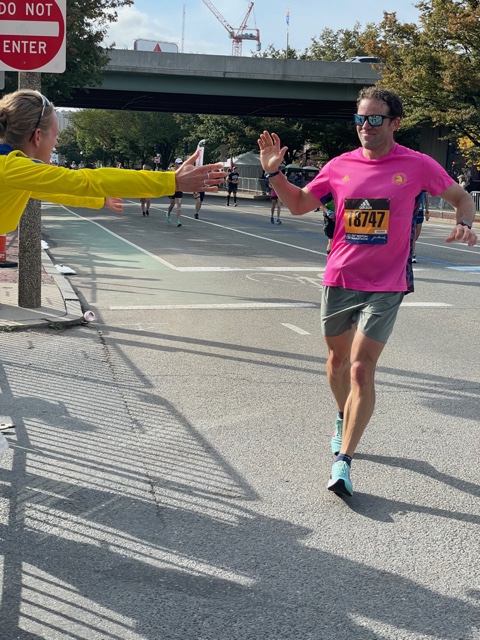
Liz Stephen extends a high five to her partner, Jeff Bland, as he makes his way to Boylston Street during the 2021 Boston Marathon. (Courtesy photo)
“Liz’s partner Jeff [Bland] also ran the race and fundraised for AKTIV with us,” Randall explained. “So after the three girls finished, we went back out to cheer him on. (Bland finished in 4:19:59.) We figured we ended up walking another 7 miles, which was painful — but also maybe a little helpful to keep from tightening up.”
What’s the next race-reunion? According to Randall, they’re looking for ideas!
“I think we’re all looking forward to not running for a while and yet we can’t help but wonder, what should we do next?!”
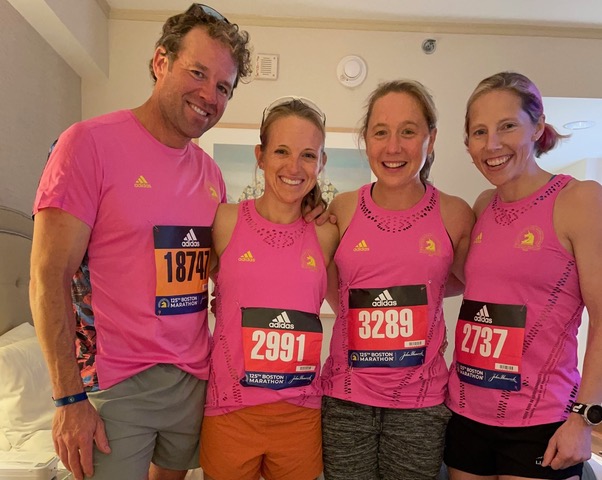
2021 Boston Marathon racers. From left to right, Jeff Bland, Liz Stephen, Ida Sargent, and Kikkan Randall. (Courtesy photo)
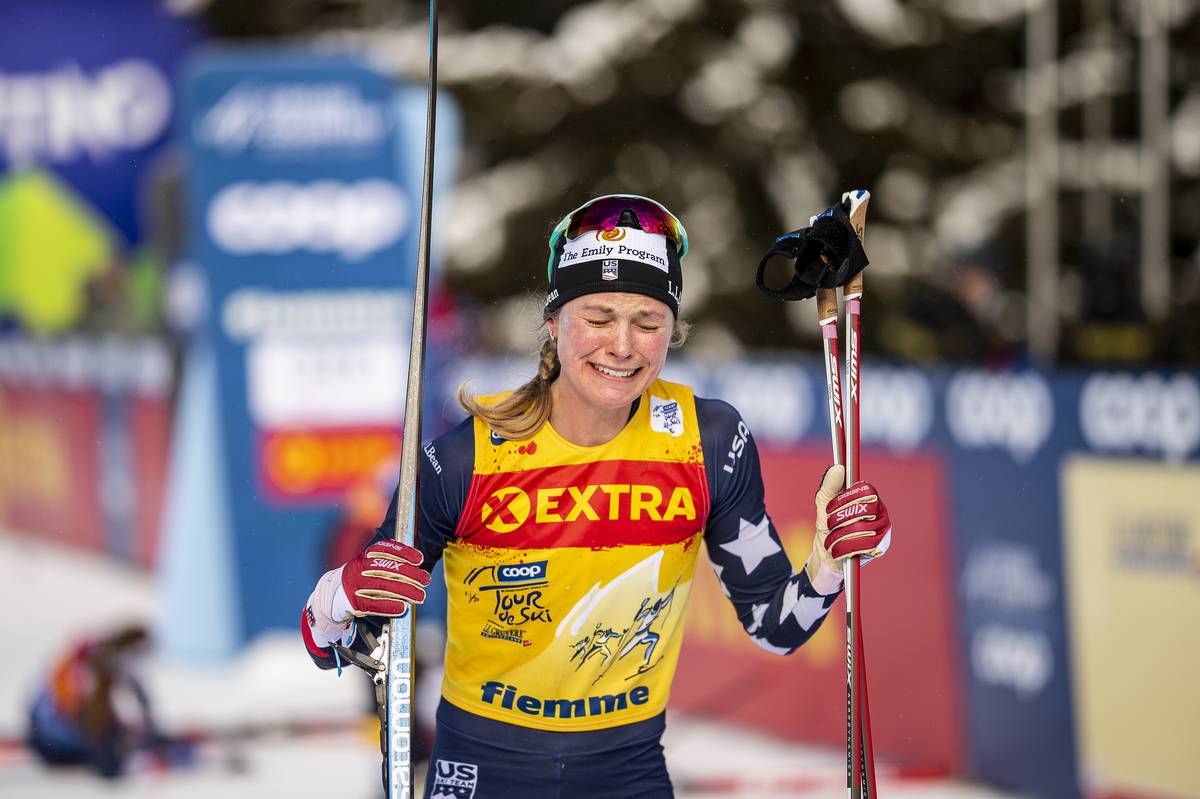
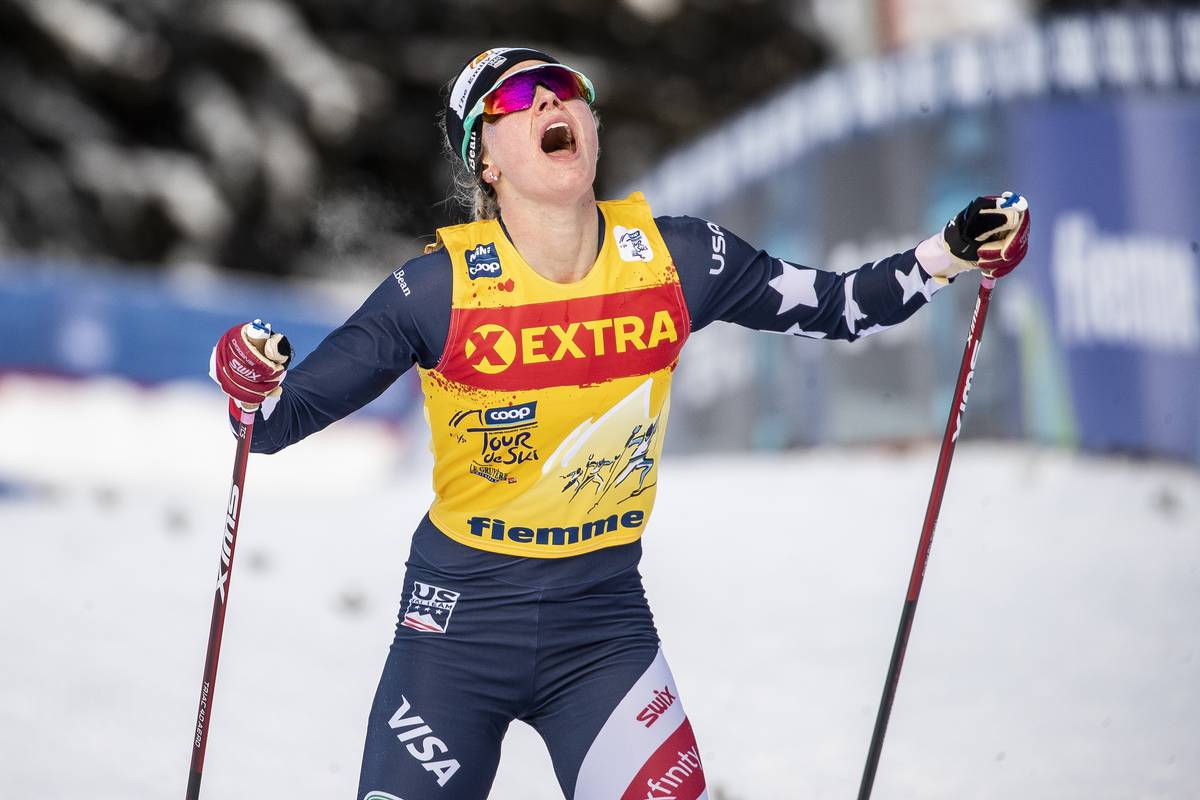
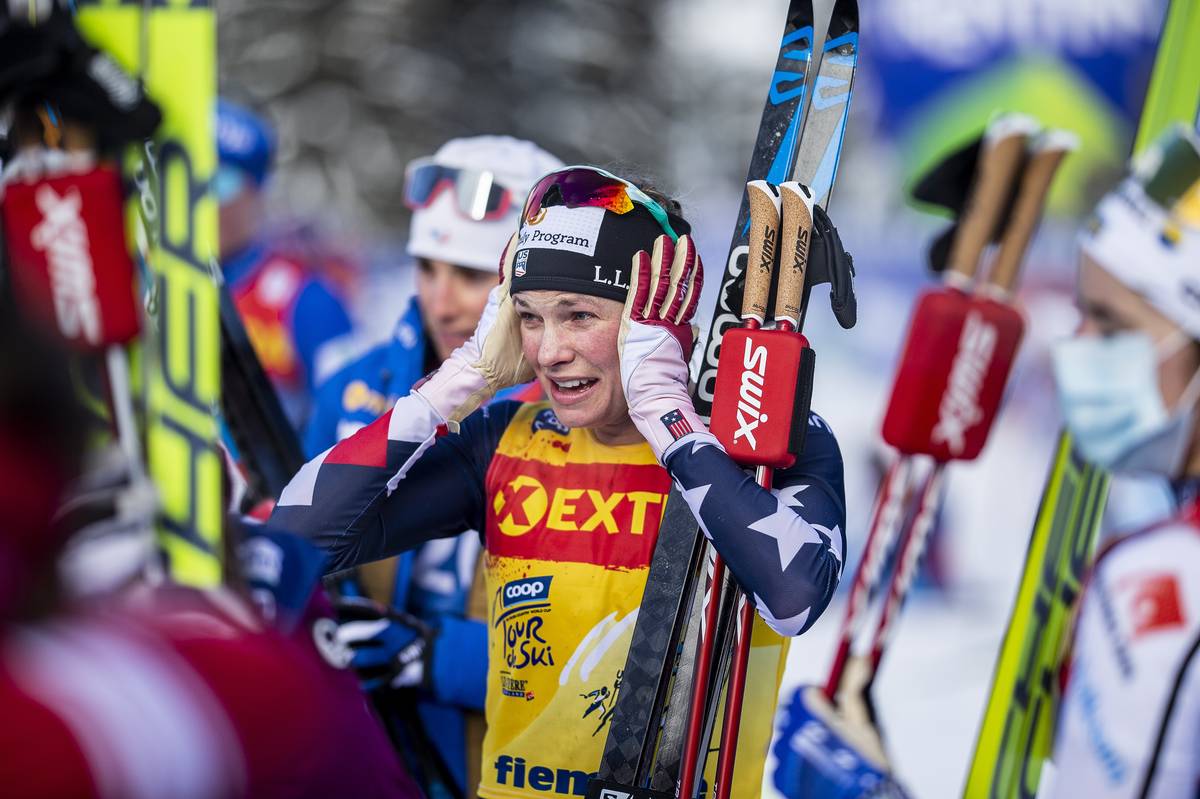
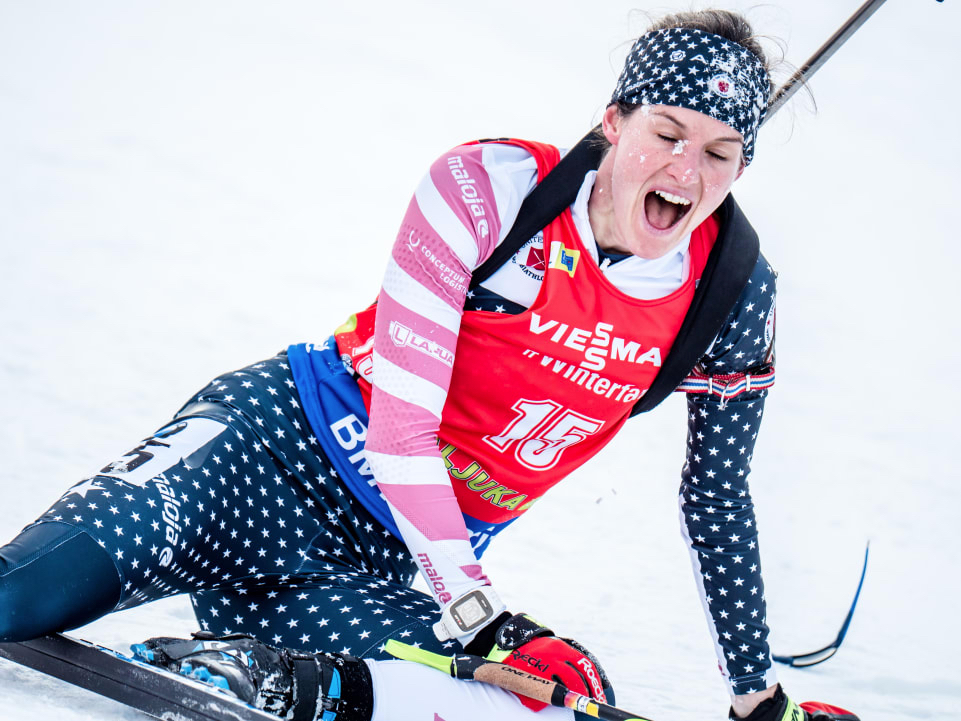
Raw emotion as Jessie Diggins becomes the first North American to win the overall Tour de Ski. (Photo: NordicFocus)
This World Cup coverage is made possible through the generous support of Marty and Kathy Hall and their A Hall Mark of Excellence Award. To learn more about A Hall Mark of Excellence Award or to learn how you can support FasterSkier’s coverage please contact info@fasterskier.com.
Though Devon Kershaw might fairly say “It’s not really cross country skiing,” as a viewer, the grueling climb up the Alpe Cermis is the crown jewel of the Tour de Ski. Sure, it is both impressive and visually appealing to watch beautiful technique and tactical racing, but there is nothing quite like watching racers toil through the lactic burn of grinding their way 400 meters up a ski area, at times with over 40% grade. Wheels come off, gaps close quickly, anything can happen.
Here’s how today shook out.
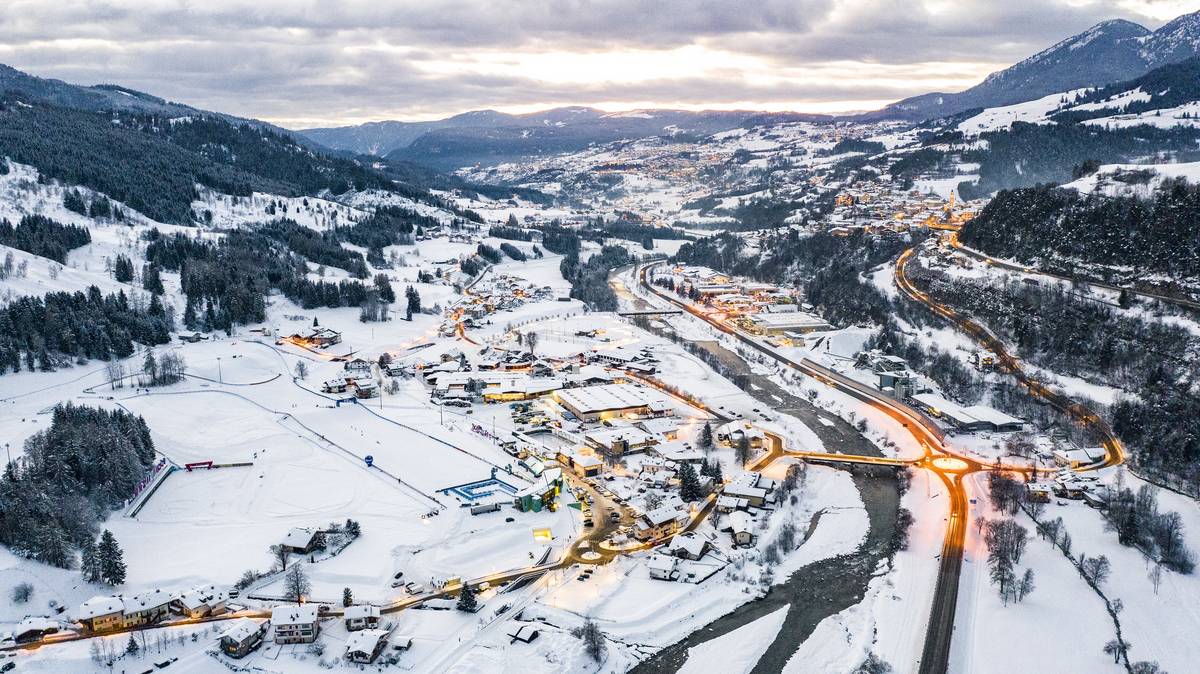
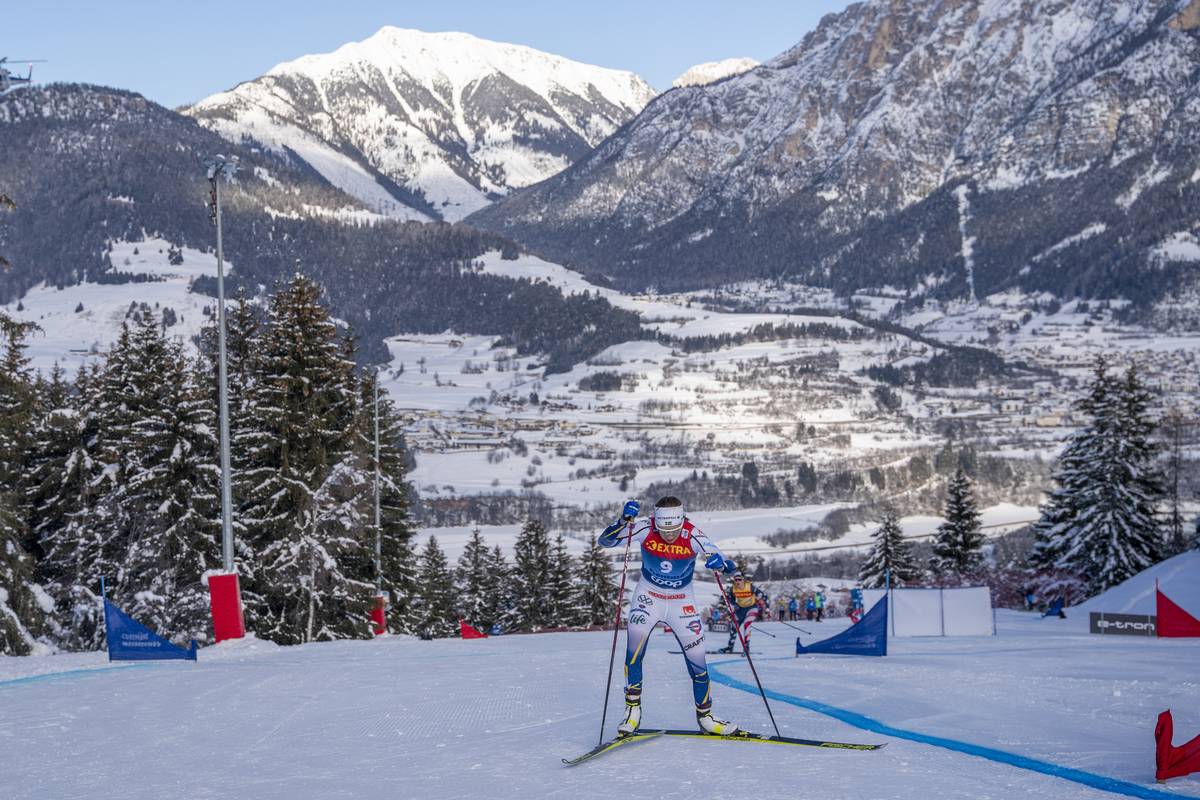
After nearly 50 kilometers of racing over seven stages, skiers take to the tracks one last time in Val di Fiemme, first for a lap of the sprint course, then soaring along the river banks along the narrow winding track of the Marcialonga, Italy’s WorldLoppet series classic. And, as camera angles altered from shots of the Swedes that set pace down the valley, controlling the narrative from the front while still conserving energy for the climb over the final 2k, to breathtaking aerial views of the frosted valley, it is clear why Marcialonga organizers refer to Val di Fiemme as a “Italian cradle of cross-country skiing”.
An aerial view of the storied venue in Val di Fiemme, Italy. (Photo: NordicFocus)
After a thrilling set of four podium finishes, including back-to-back distance wins in Toblach, all eyes were on Jessie Diggins. She entered the final stage wearing the yellow bib with a lead of 55 seconds in the overall standings. Given the beastly nature of the climb, this time margin certainly did not indicate that Diggins had her first Tour de Ski win in the bag.
To add to the energy, two sprint opportunities for bonus points were available at the 2.5 and 6.6 k checkpoints, this alternate leaderboard adding interest and incentive for sprinters to remain in the Tour.
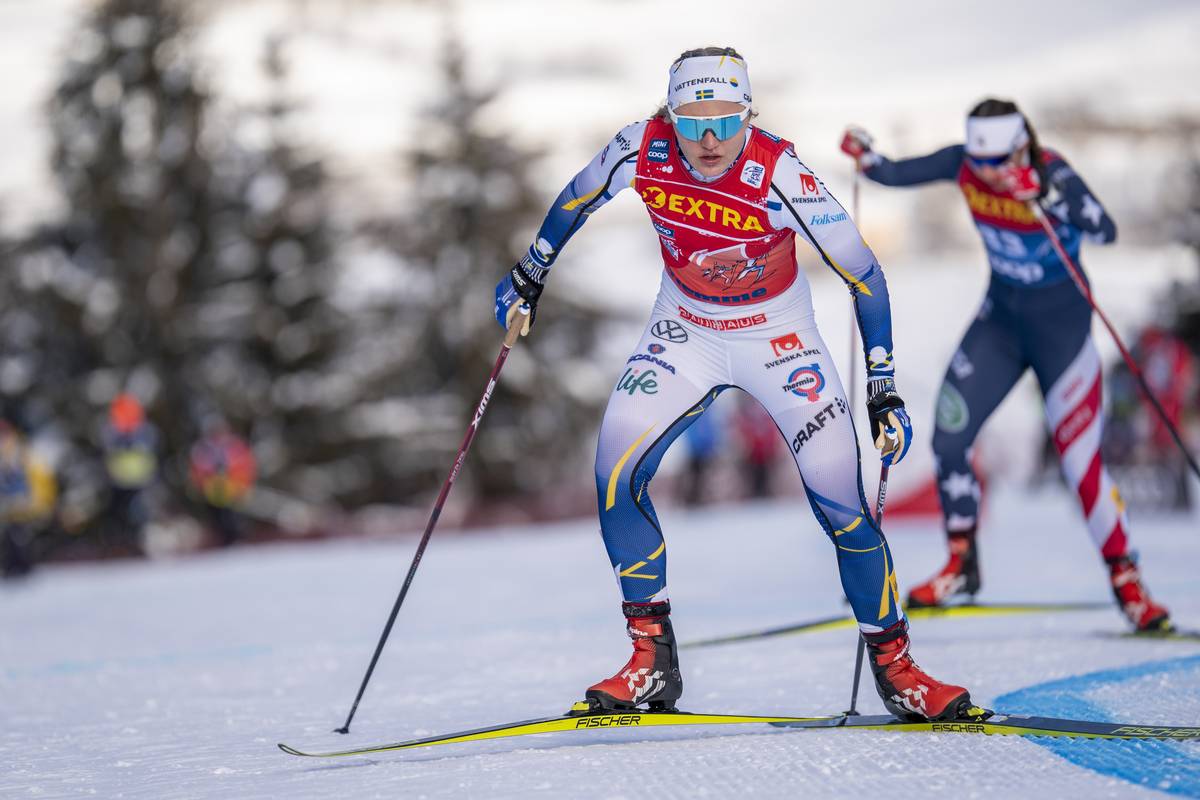
Linn Svahn on the Alpe Cermis- she helped pace Andersson early in the stage and won three stages in this edition of the Tour. (Photo: NordicFocus)
Point leader and winner of both sprint stages, Sweden’s Linn Svahn charged off the front of the pack at the 2.5 k mark, collecting 15 bonus points with her teammate Ebba Andersson hot on her tails. The two quickly allowed the pack to close the nearly 4-second gap, but Andersson remained at the front, pulling away to create a gap of over 10 seconds at the 6.6 k mark, which she kept as the grade inclined.
Perhaps trying to lure Diggins to push too hard too soon, perhaps she had her eye on the TdS podium, or perhaps just looking to be the queen of the hill and win her first World Cup, it was clear that Andersson wanted to dictate the pace from the front in the back half of the mass start event.
Sweden’s Ebba Andersson takes the stage win, and placed third overall in the Tour. (Photo: NirdicFocus)
Andersson was the epitome of steady as she worked her way up the climb. She could V2 when the grade was humane, and smoothly transitioned between her V1 and the “coach’s skate” required to keep skis gliding on the steepest pitches.
While the Swede remained composed, Diggins displayed the grit and perseverance for which she is beloved as a racer. Though Andersson was more than two minutes back in cumulative time heading into the final stage and the remainder of the field behind her, Diggins left nothing to chance, giving her all as she pushed every meter. Holding her ground, the American kept her time back on the leader even and tight, hovering around nine seconds throughout the climb.
Like everyone, even Diggins rides the struggle bus up the Alpe Cermis. Diggins, however, motored to a Tour de Ski overall win on Sunday. (Photo: NordicFocus)Jessie Diggins racing to second on the stage and first overall in the Tour de Ski atop the Alpe Cermis. (Photo: NordicFocus)
With less than a kilometer to go, head coach Matt Whitcomb cheered from a switchback as Diggins passed, his excited shouts leaving him nearly as breathless as the athletes. Pine boughs tucked into the snow to create the final lanes as Andersson and Diggins headed toward the inflated arch that offered relief from the pain in their bodies.
Ebba Andersson (SWE) chugging along in front for the Stage 8 win. (Photo: NordicFocus)
With the end in sight, Andersson with a poker face V2’ed through the finish while a slack-jawed Diggins held together in V1 to cross the final meters and collapse over the finish line.
Finally, the Tour de Ski victory was hers and she could simply lie in the snow, chest rising and falling with her labored gasps for air. More than a win, this achievement makes Diggins the first American — in fact, the first non-European — man or woman winner in the 15-year history of the Tour. She also sits atop the leaderboard for Overall World Cup standings.
Victory and relief, Jessie Diggins completes the climb up the Alpe Cermis to win the overall 2021 Tour de Ski. (Photo: NordicFocus)Exhausted, Jessie Diggins crosses the line second in the stage to hold onto her lead in the overall Tour de Ski. (Photo: NordicFocus)
“This was a lifelong goal,” Diggins told FIS after her race. “We had an amazing team atmosphere this whole time, and amazing support and help, and so many cheers from around the world — it really gave me wings up the hill today.”
The interviewer asked what this result meant in light of a World Championship season, as completing the arduous Tour in such a year could be seen as a risk. If an athlete cannot recover properly in the subsequent six weeks, their potential on the championship stage could be compromised. Diggins’ answer looked through a wide-angle lens.
“It means so much. I think it’s so cool for our country to show that it’s possible. And now I’m looking forward to resting.”
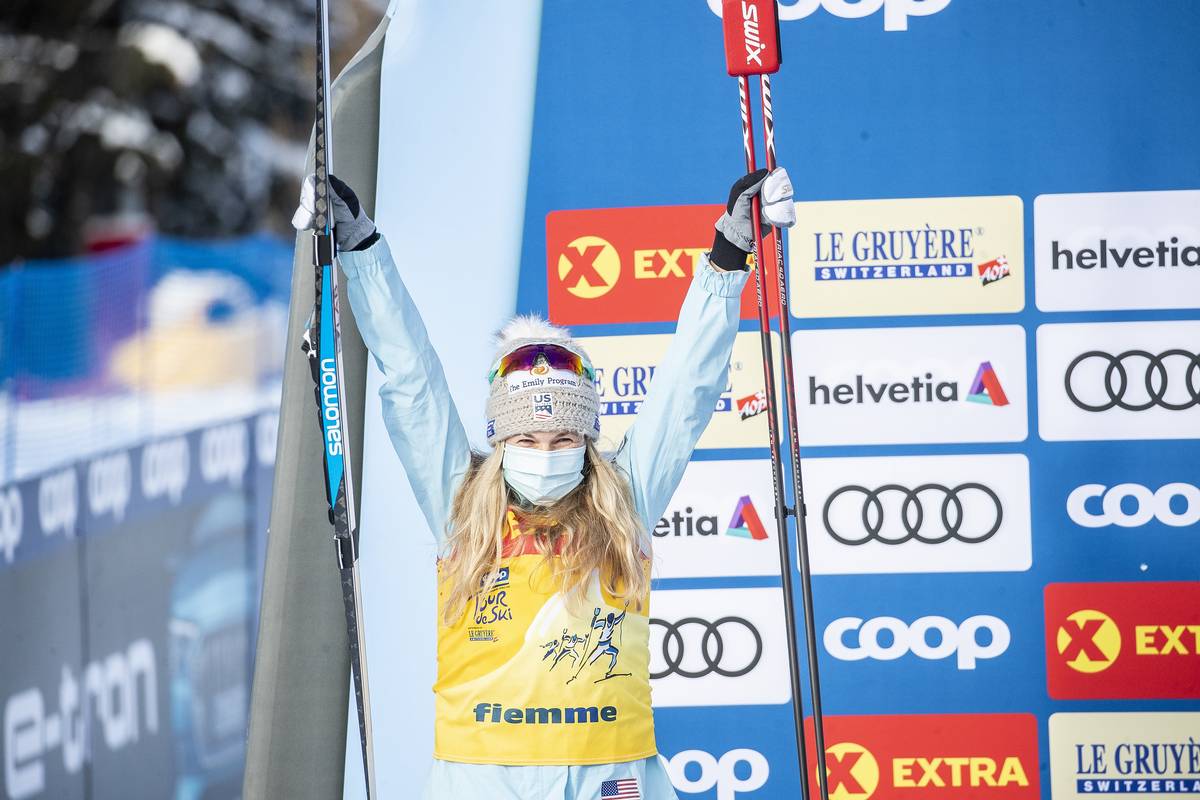
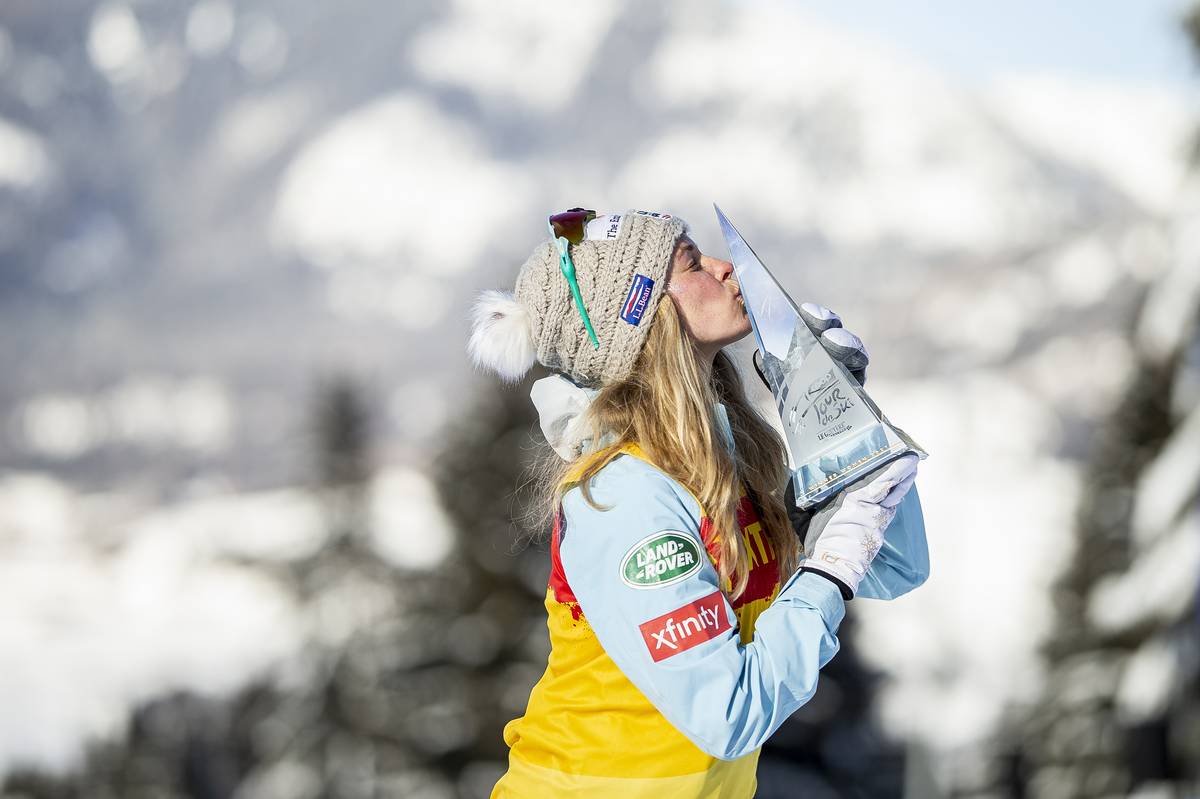
Jessie Diggins wins the overall 2021 Tour de Ski and sits at the top of the overall World Cup standings. (Photo: NordicFocus)On the top step of the podium, Jessie Diggins is the 2021 Tour de Ski winner. (Photo: NordicFocus)Jessie Diggins becomes the first North American skier to win the Tour de Ski in its 15 year history. (Photo: NordicFocus)
Behind the two leaders, France’s Delphine Claudel crossed the line in 3rd (+32.6). Evidencing the “anything can happen on the Alpe Cermis” sentiment, Claudel sat in 19th in the overall standings leading into the final stage and had never before earned a World Cup podium, though she was 7th in the 10 k skate in Stage 4. The 24-year-old overtook Russia’s Yulia Stupak in the final kilometer, closing a 12 second gap and creating a nearly 8 second one of her own.
Stupak held on for 4th place (+40.0), followed after a gap by teammate Tatiana Sorina (+1:04.3) rounding out the top five.
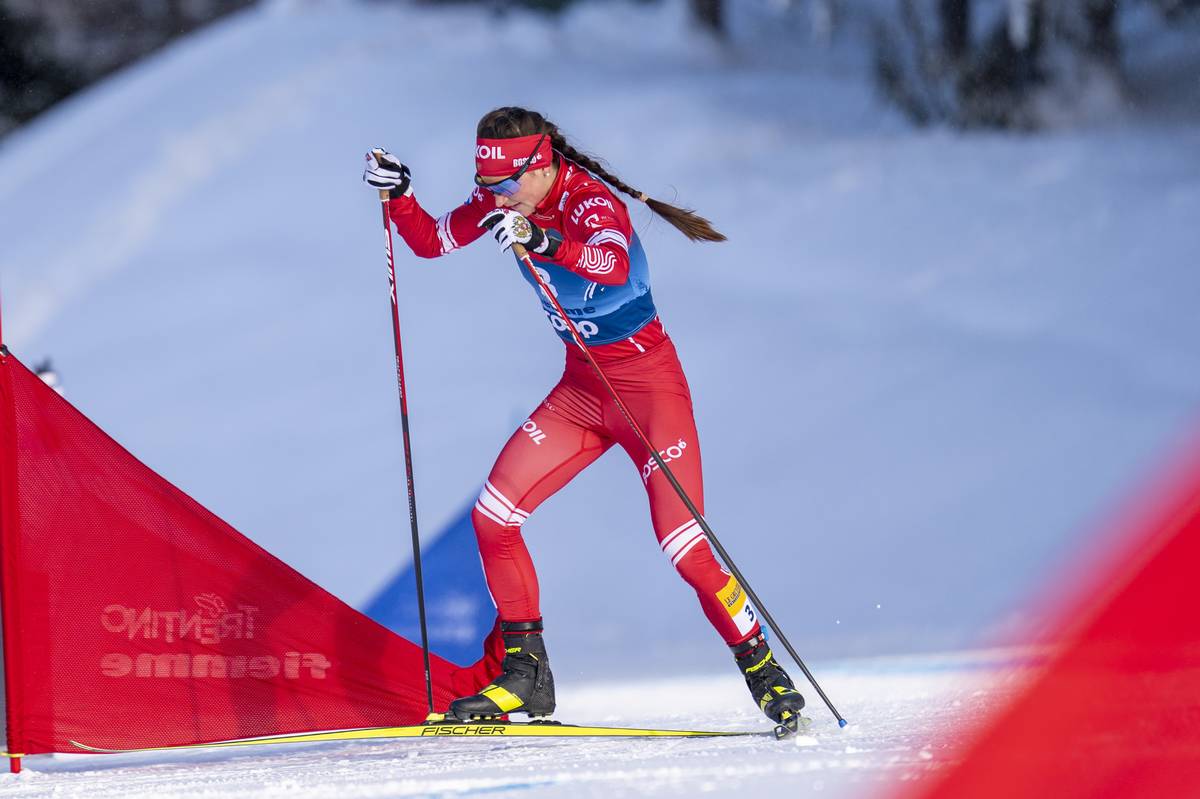
Yulia Stupak of Russia here on the Alpe Cermis, placed second overall in the Tour. She won two stages, and podiumed in four others. (Photo: NordicFocus)
With this result, Stupak held her ground in second place for the overall TdS standings, finishing 1:24.8 behind Diggins in cumulative time. Andersson’s outstanding climb was a springboard, advancing her from 6th to 3rd (+2:00.8). Recall that Andersson did not make the heats in Stage 1 of the Tour and finished 12th and 18th, respectively, in the second and third stages. Landing on the podium four times in the final five stages fueled her steady rise through the ranks.
Today’s queen of the Alpe Cermis, Sweden’s Ebba Anderson set the fastest time in the final stage of the 2021 Tour de Ski. (Photo: NordicFocus)A good day for Sweden, Ebba Andersson wins Stage 8 of the Tour de Ski to finish 3rd overall, while Linn Svahn takes home the victory in the point standings. (Photo: NordicFocus)
Adding reason for Swedish team celebration, Svahn was the winner in the point totals, with Diggins in second and Slovenia’s Anamarija Lampic in third.
Rosie Brennan, here in the Alpe Cermis, animated this Tour and finishes a career best 6th overall. (Photo: NordicFocus)
Closing out a career best finish in the Tour de Ski, Rosie Brennan was the 7th woman up the hill (+1:17.8) to finish 6th in the overall standings. Brennan’s previous best finishes in the TdS overall were 15th last season and 24th the season prior.
“I love the final climb because of its simplicity and the feeling of accomplishment of reaching the top,” wrote Brennan in an email after the race. “I knew there was an opportunity to make up some places today so I set out with intention. Unfortunately, I stuck a tip in the powder on the side of the trail on the Marcialonga portion leading into the climb and took another digger. Luckily, I didn’t lose much time, but was then at the back of the pack and knew that if I was going to make the most of the climb, I needed to be ready for the breaks as soon as we hit the bottom. I worked really hard to make up the places that I could and then really went for it when we reached the climb to try to get into the leading group. It was my only option at the time, but definitely took a little more energy than I had hoped. I had a moment of weakness when I hit the first steep pitch and lost the ride I needed to take. I was able to recollect myself and hold strong, but frustratingly missed top 5 by a mere 4 seconds. 6th place is absolutely a career best and I am proud of my effort of fighting back after the disaster that was stage 6, but I always want more of myself and those 4 seconds certainly sting a bit.”
The end in sight, Rosie Brennan finishes 7th in the hill climb and 6th in the overall Tour de Ski. (Photo: NordicFocus)
“It was inspiring to watch Jessie put so much fight in every day and that certainly inspires me to find more,” Brennan continued. “I couldn’t think of a better person to take the yellow bib off my back. I am also really excited to hold onto the red [World Cup distance leader] bib! The Tour de Ski is always a new experience and always requires a lot of fight. I am thankful to have been able to race the event this year and am really looking forward to some recovery!”
Antonia Fraebel (GER) and Hailey Swirbul (USA) behind, during Stage 8. (Photo: NordicFocus)
Hailey Swirbul skied the 15th fastest time today, bumping her up to 18th in the overall Tour standings. The 22-year-old is in good company with this result, considering the only other American women to finish in the top-20 of the Tour de Ski are Jessie Diggins, Kikkan Randall, Rosie Brennan, Sadie Maubet Bjornsen, and Liz Stephen.
Hailey Swirbul, another American high point, placed 15th on the day and 18th overall. (Photo: NordicFocus)
Katharine Ogden finished 24th (+2:34.5) up the climb for 23rd overall in the Tour, while Caitlin Patterson rounded out the Americans in the top-30 finishing 27th (+2:42.9) in Stage 8. Patterson was 34th in the overall TdS standings.
Katharine Ogden V1-grinding on the Stage 8 final climb. (Photo: NordicFocus)Caitlin Patterson climbs to 27th in the final stage of the 2021 Tour de Ski. (Photo: NordicFocus)
Finally, Julia Kern skied to 37th today (+3:41.3) to end the Tour in 38th.
– Gavin Kentch contributed
This story will be updated with additional comments from athletes when available.
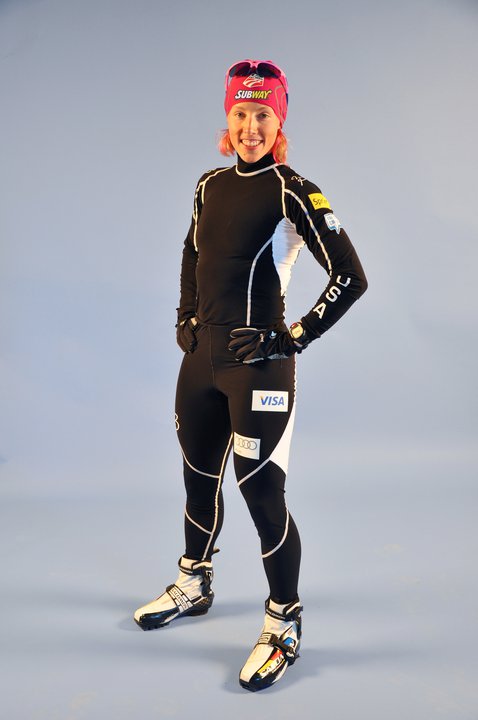
From October 2010: Kikkan Randall modeling the U.S. Ski Team suit for the 2010-2011 season. Photo courtesy of the U.S. Ski and Snowboard Association.
A national team uniform for cross-country skiing has to do a lot of things. At the most utilitarian level, it has to wick sweat and aid performance while an athlete pursues one of the world’s most demanding sports at temperatures between –4 F and 40, in steady snow or driving rain or anything in between. At the functional level, it has to let spectators and coaches identify where their athlete is out on the course, while distinguishing them from athletes from other countries. And at the symbolic level, it lets the athlete know that he or she is competing on behalf of their country, for everything that that means. Ask a skier who has represented the United States in international competition what it meant to them to pull on a national uniform for the first time. They’ll probably be able to tell you.
(And if they ever forget, this detailing from Craft and L.L. Bean on the American uniforms, ca. 2015/2016, is there to remind them. “You are representing the United States of America,” a slogan intones, above a martial-looking eagle, with a U.S. Ski Team master mark for its aegis, gripping an olive branch (?) in its dexter claw and a skis and ski poles fasces in its sinister. “Pretty fun to be representing an American brand with our American uniforms!,” wrote Sadie Bjornsen in a blog post describing the uniforming process.)
For whatever reason, the period roughly one decade ago represented the highwater mark for domestic and global coverage of ski uniforms on this website. There was “US Ski Team Brings Suit Consistency,” from Jan. 2009 (lede: “After years of a remarkable level of wardrobe schizophrenia, the US Ski Team has ushered in a new era of racing suit consistency that should make it easier to follow our favorite US athletes on the race course.”); “The costume disciplinarian speaks: Is it better to look good than to ski fast?” from July 2009; “The Best and Worst (Suits) of the Olympics,” from Feb. 2010; and “USST Goes Black for 2010-2011,” from Oct. 2010 (lede: “In the sport of cross-country skiing, most people would agree that competing with New Zealand is probably smarter than picking a fight with Norway.”).
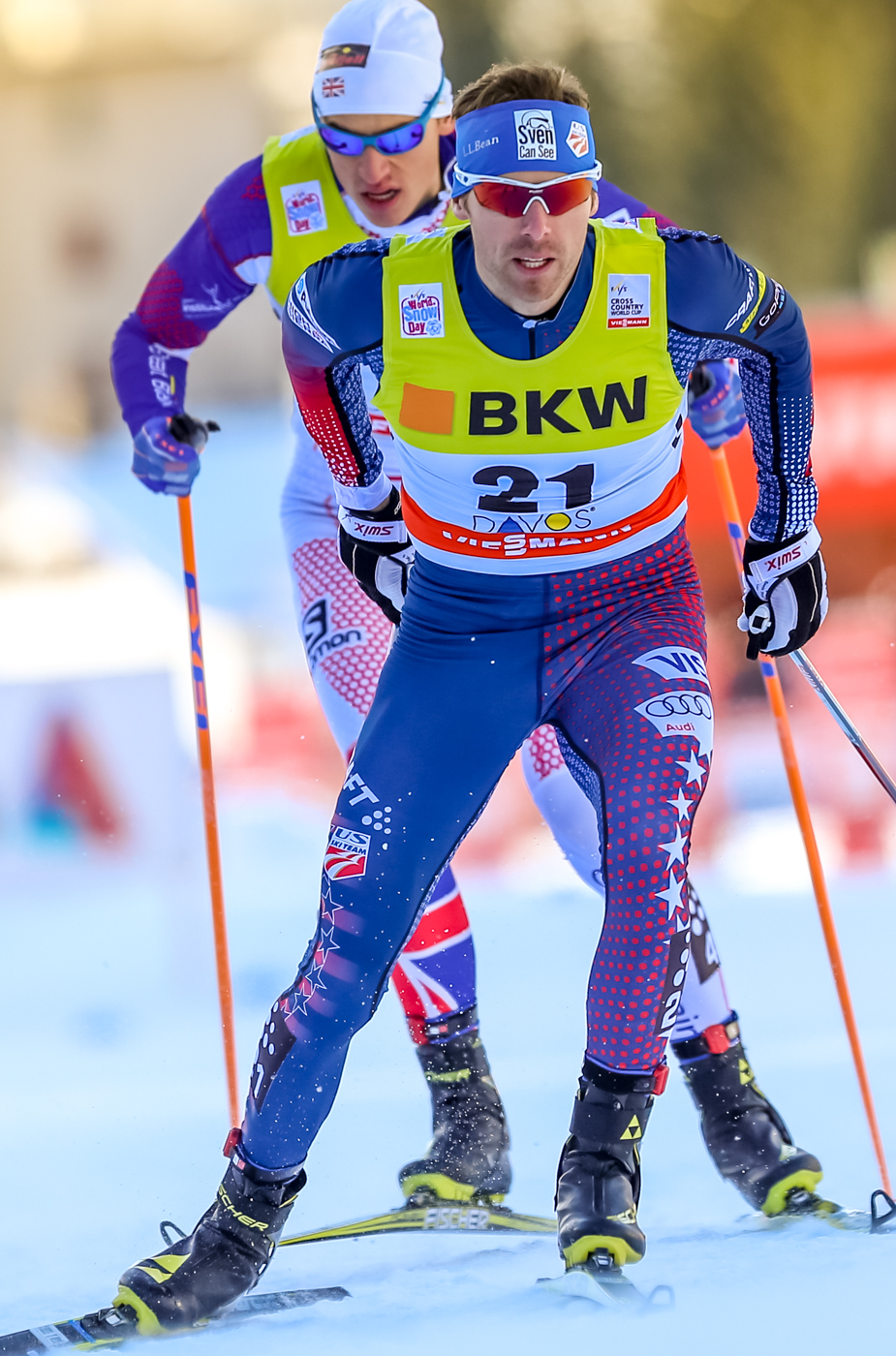
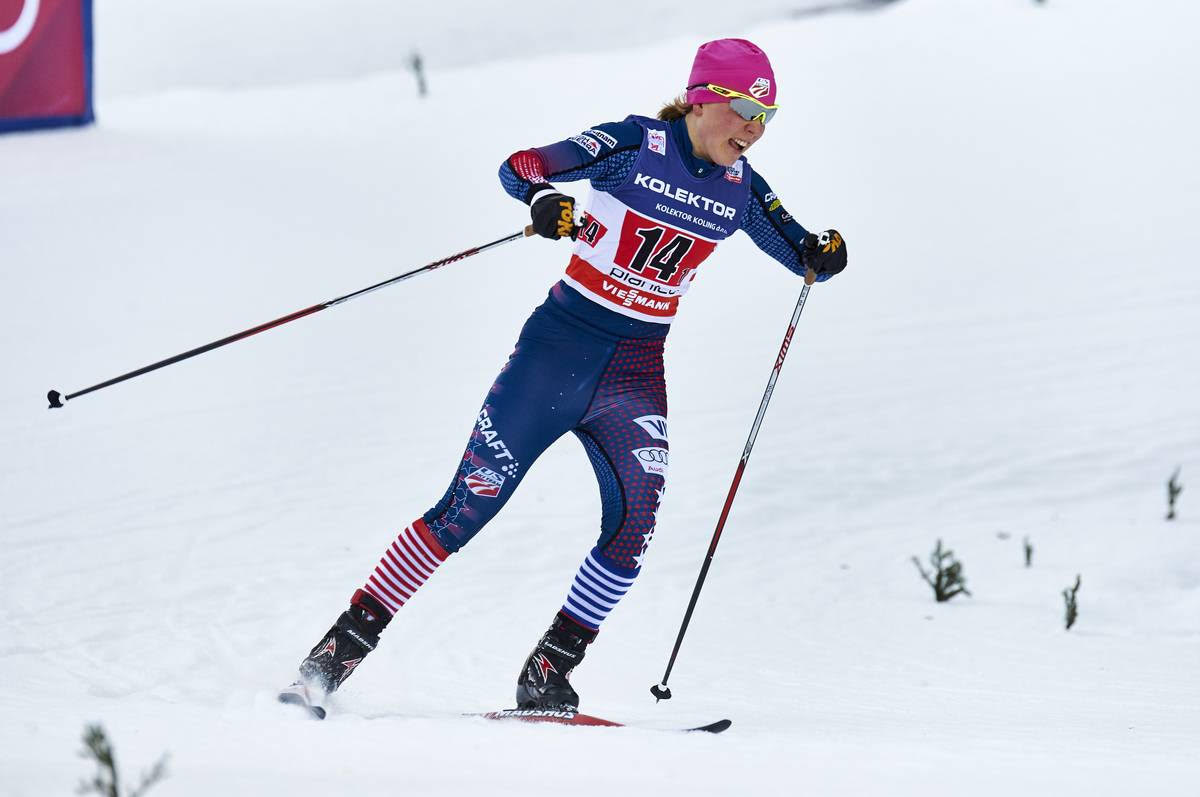
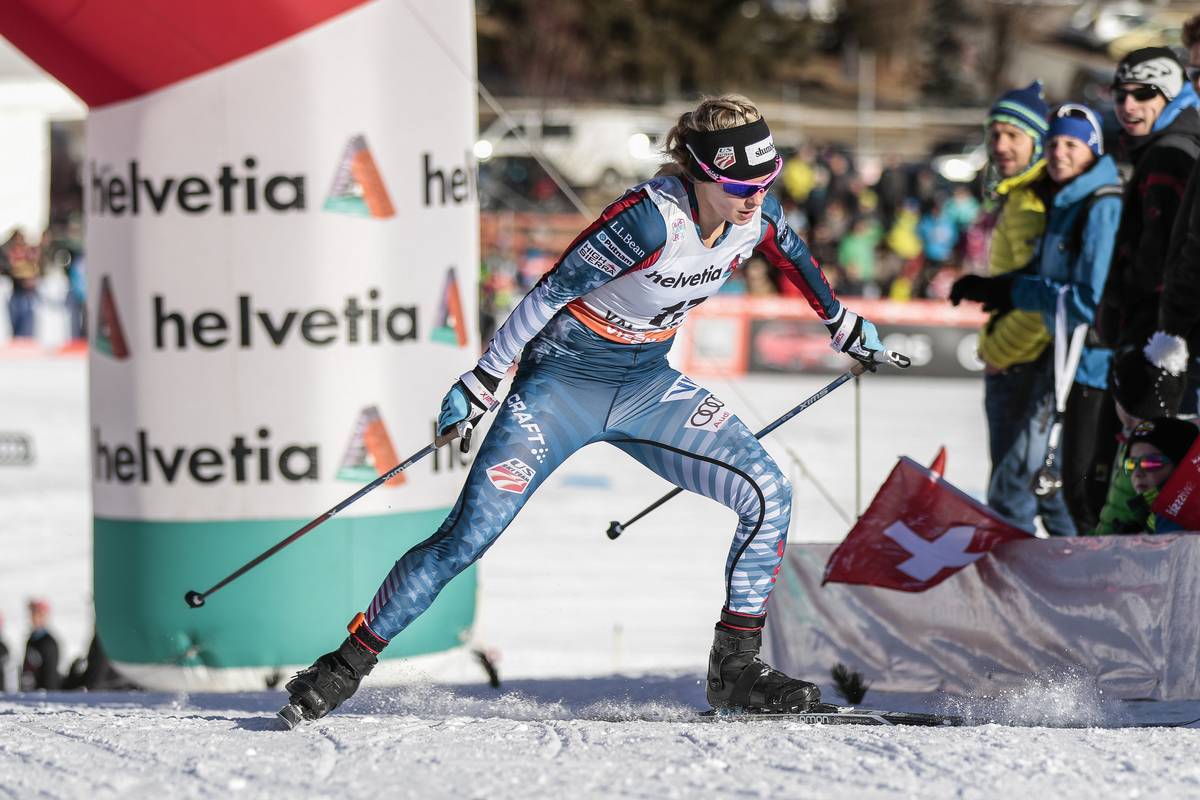
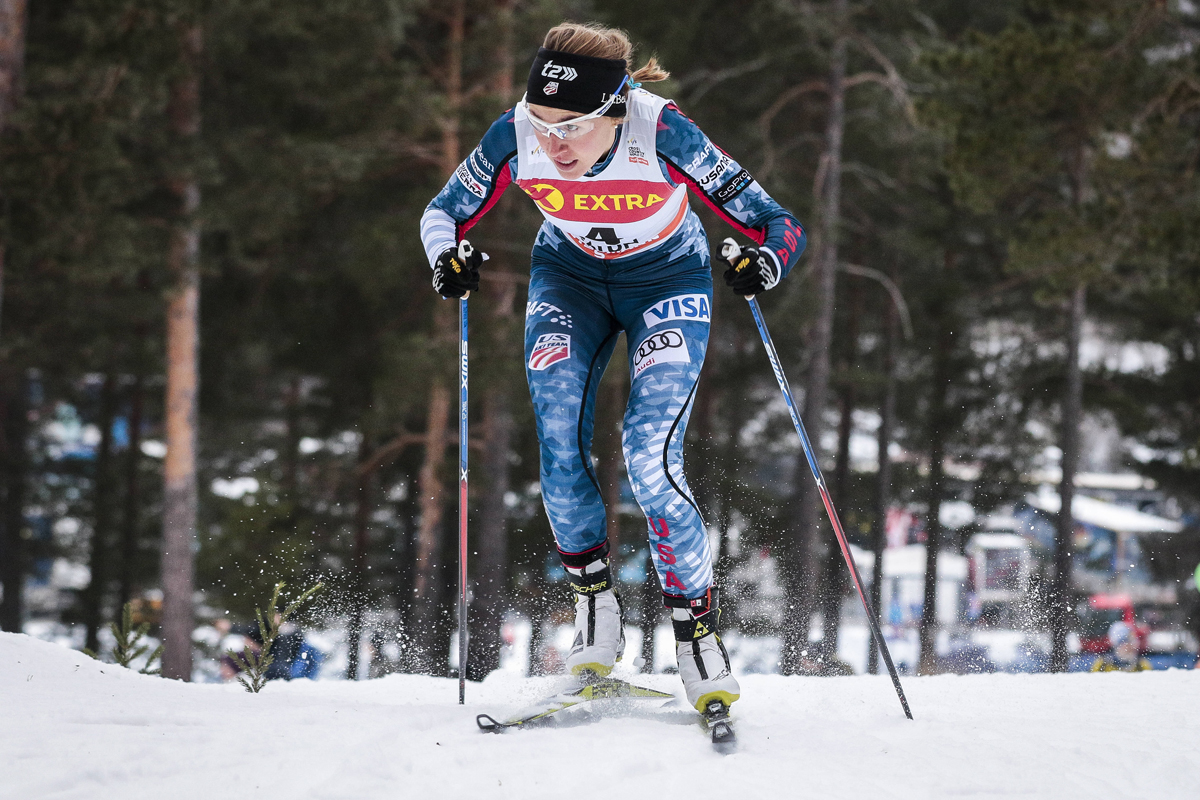
So it seems to have been nearly 10 years since the last sustained attention to the uniforms of the Davis U.S. Cross Country National Team Program (néeU.S. Ski Team). To fill that gap, FasterSkier hereby presents A Visual History of the United States Ski Team National Team Uniform, 2008–2019.
(Why 2008 for the starting point? Mostly for the simple logistical reason that the image library in the current FasterSkier content management system, WordPress, only goes back to 2008, so this article can be written while using only images that FasterSkier may legitimately post on this site. To go back to closer to the start of this century would require a lot of external links to Getty Images and not that many photos to actually look at on this website. That said, this piece from 2009 has a nice visual roundup of the plethora of different USST designs worn from 2006–2008, which takes you back two more years. Before that, well, just imagine Kikkan Randall and a lot of other skiers you probably haven’t thought about for a while — Wendy Wagner, anyone? Rebecca Dussault? Sarah Konrad? — wearing various iterations of early-aughts red and black.)
2008/2009 World Cup season: Red
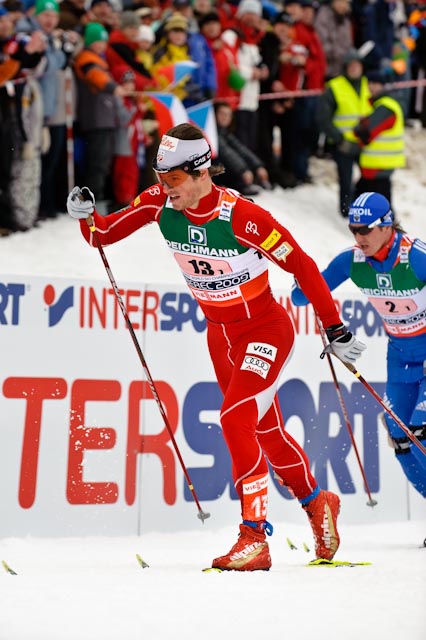
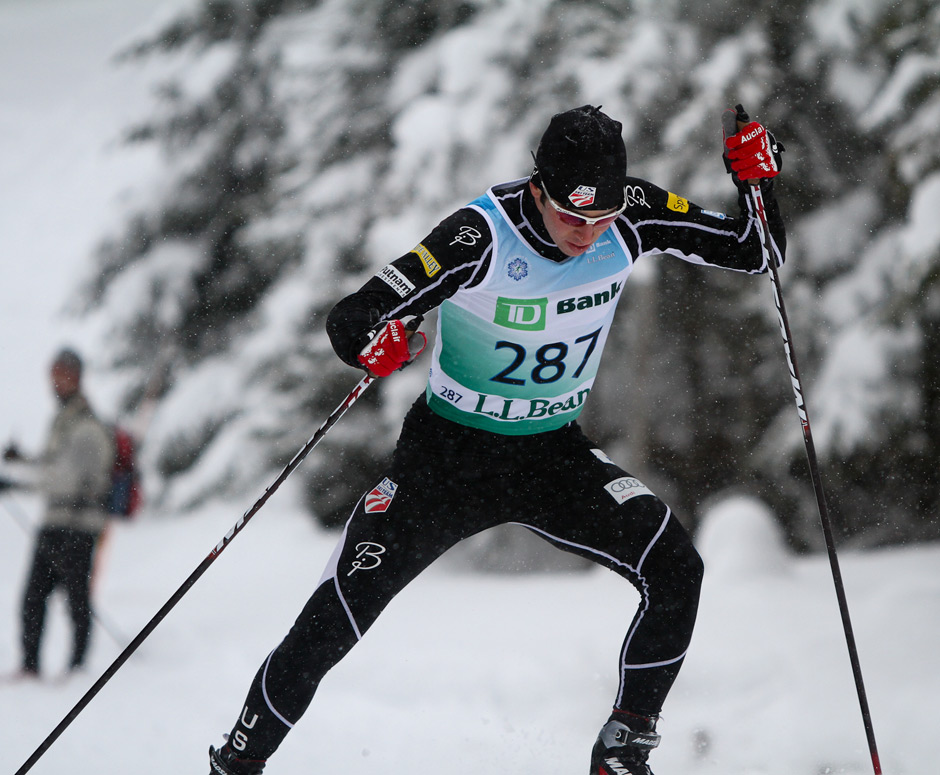
January 2009: No question who is from the US here… Kikkan Randall in the women’s Team Sprint in Whistler
January 2009: Kris Freeman preferred the orange to silver in the men’s pursuit
As a contemporary uniform article explained, “There are currently two suit variations being used by US Ski Team athletes, and athletes racing for the US in international events. They are so similar, that for practical purposes (identifying US skiers in a race) they may as well be the same. Both suits are predominantly red, with one version having patches of orange, and the other silver.” Both were manufactured by Norwegian company Bjørn Dæhlie.
There appears to have been no change to the basic World Cup design for the 2009 World Championships in Liberec, Czech Republic:
Freeman at the 2009 World Championships in Liberec. (Photo: Swix Sport)
2009/2010: Still red Bjørn Dæhlie
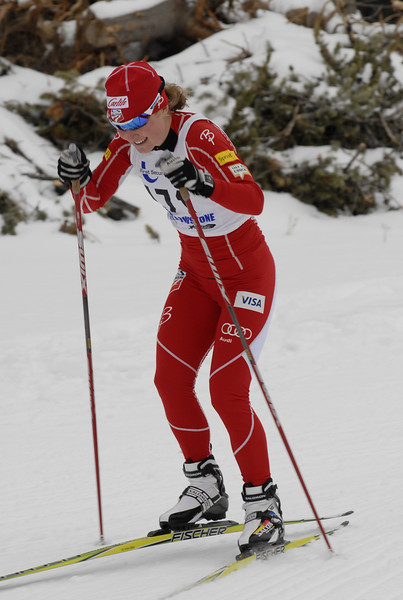
November 2009: Tazlina Mannix (APU, USST) racing in West Yellowstone.
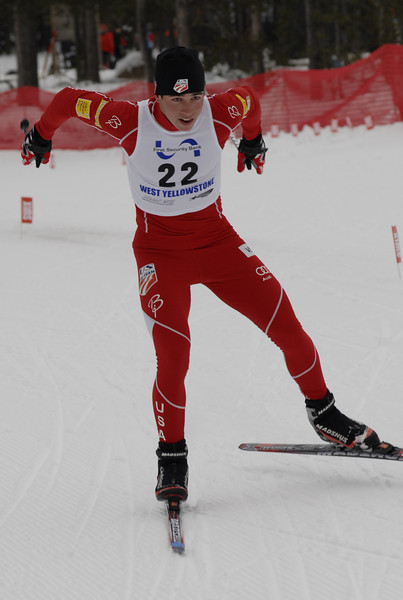
November 2009: A very young Noah Hoffman (USST) racing to 3rd in a distance race in West Yellowstone.
Honorable mention, domestic suits division:
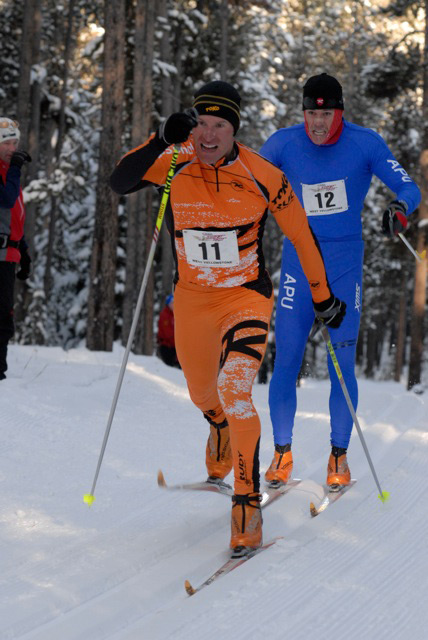
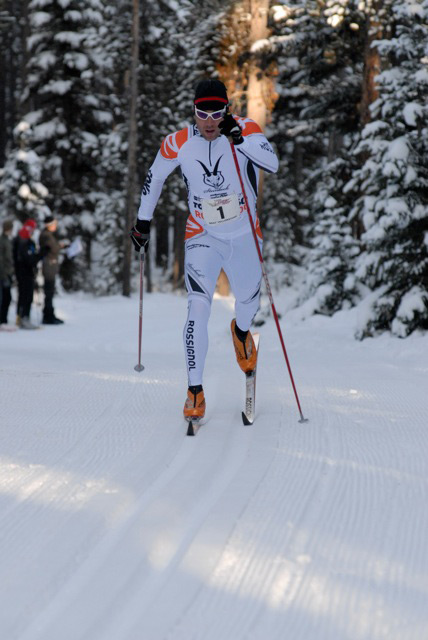
November 2009: This is a very orange suit. Kevin Hochtl (Rossignol) – 32nd – leads Anders Haugen (APU) – 7th – to the finish in a West Yellowstone race.
November 2009: This is one hell of an ibex. Chris Cook (Steinbock Racing) – 12th – sporting the new Steinbock Racing uniform
2010 Winter Olympics, Vancouver: Red and silver
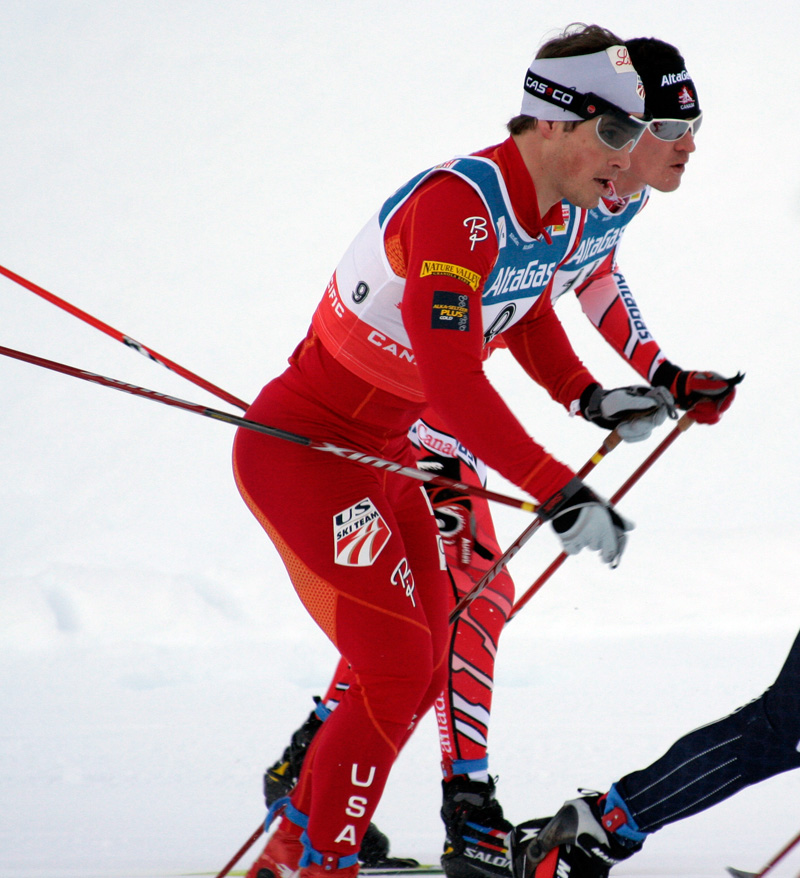
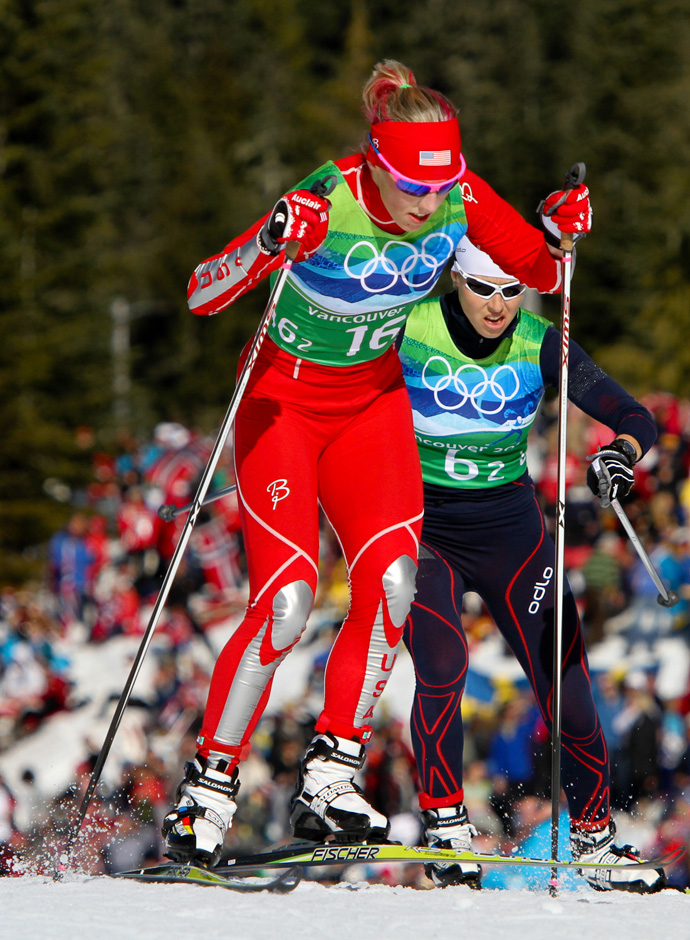
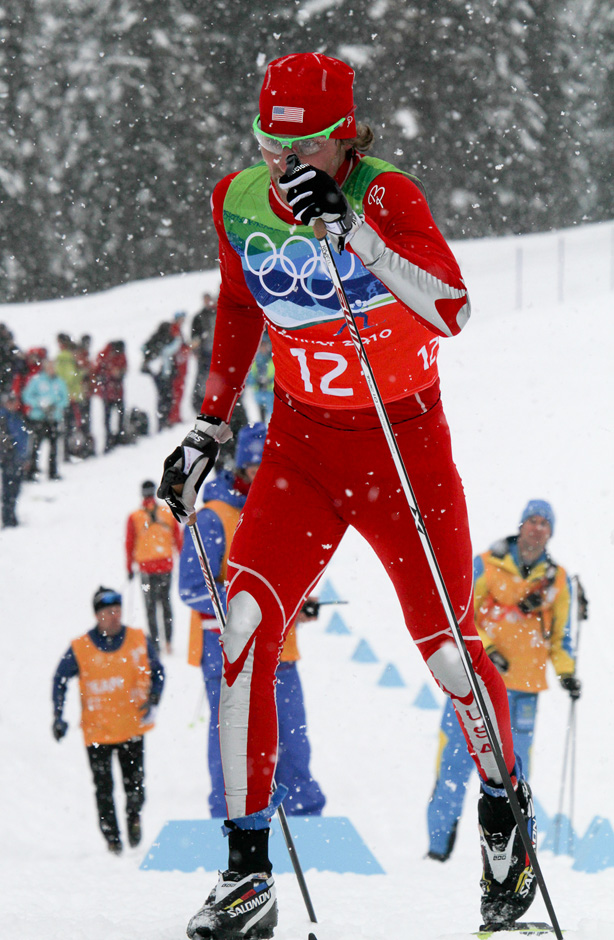
For the Olympics, the Americans appear to have taken their World Cup template – Bjørn Dæhlie suit, largely red – but have changed it by, inter alia, lightening the shade of red, adding “USA” on the right arm and left leg, adding silver accents, and of course removing all sponsor logos. Kikkan, already skiing in her third Olympics, coordinated with a red headband, red gloves, and her famous pink highlights. Andy Newell went with the red hat (he may not have had a choice), but was otherwise somewhat less vermilion.
Feb. 2010: Kikkan RandallFeb. 2010: Andy Newell on the big climb during the men’s 4 x 10 k relay.
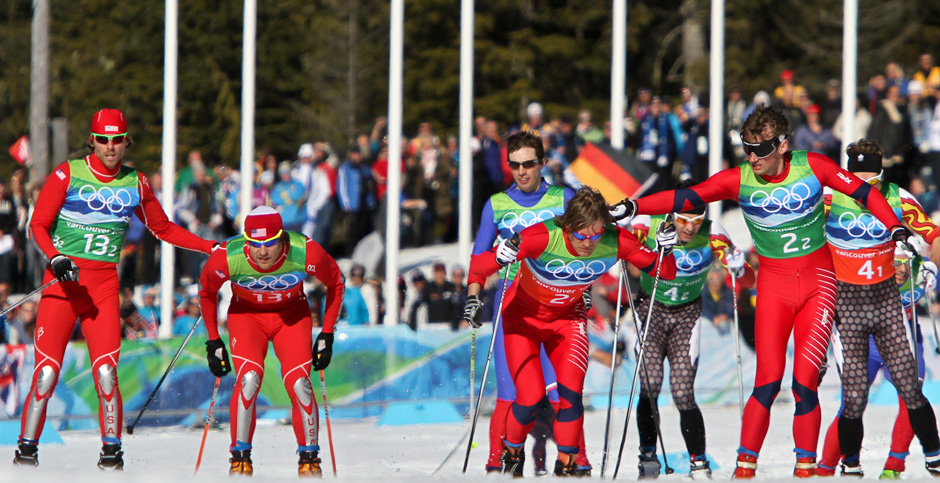
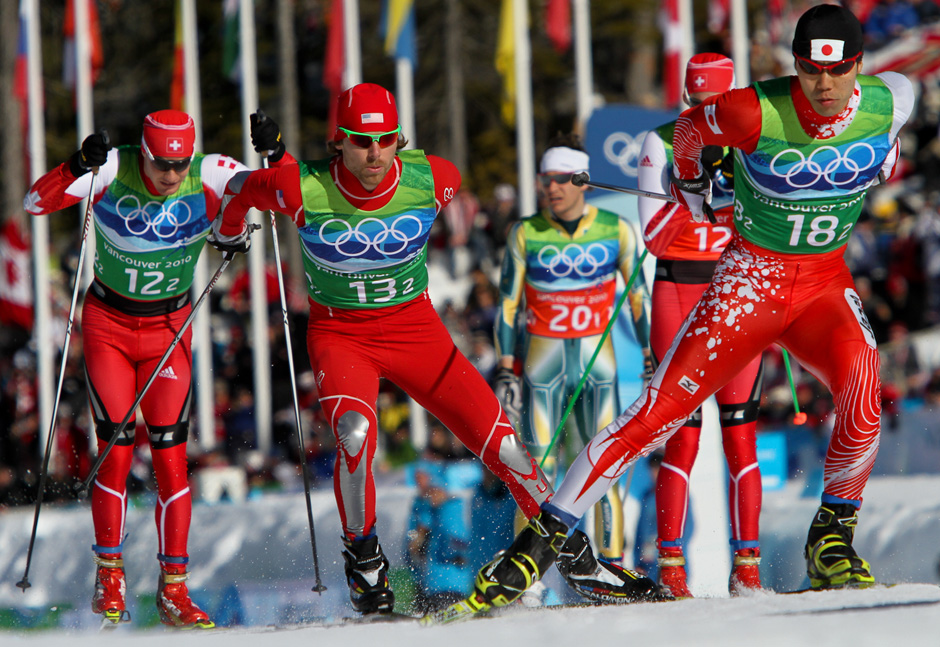
There was a lot of red in Vancouver. For example, here’s Andy Newell (far left, bib no. 13-2) tagging Korin Koos for the U.S. in the team sprint, while Petter Northug (far right, bib no. 2-2) tags Øystein Pettersen (middle right, bib no. 2-1) for Norway. (An entire standalone article could likely be written on the Canadians’ infamous kit (bib no. 4, back right).)
Newell tags Koos (left) and Northug tags Pettersen (right) at the 2010 Vancoulver Olympics.
Or here’s Newell in the middle, between Switzerland’s Dario Cologna (bib no. 12) and Yuichi Onda of Japan (bib no. 18):
Newell in the semis of the skate sprint: 2010 Vancouver Olympics.
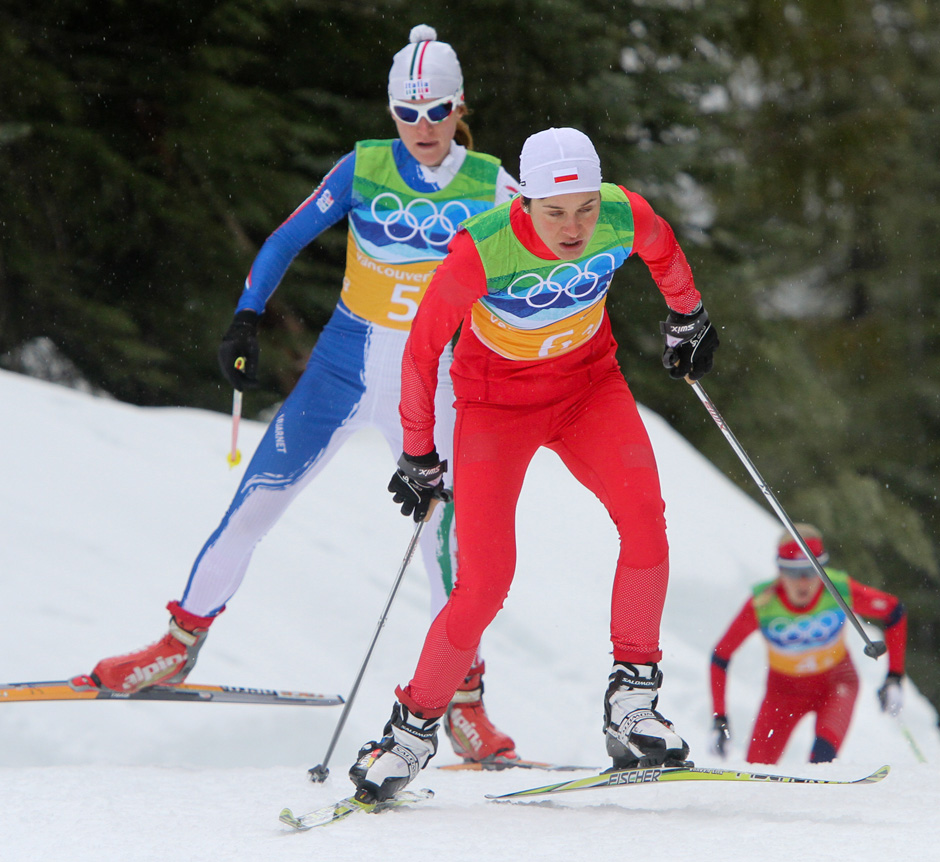
Finally, Poland (shown here: Sylwia Jaśkowiec, bib no. 6) was just red:
Poland 2, 2010 Vancouver Olympics.
2010/2011: The black era begins
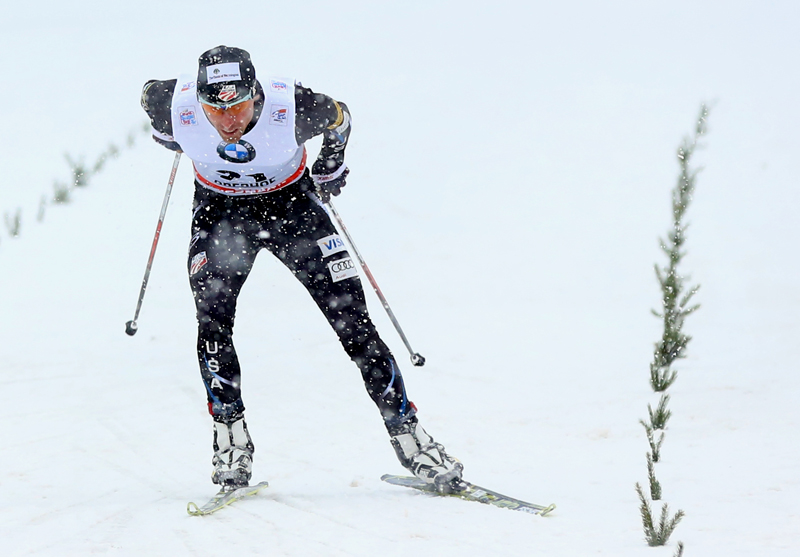
Perhaps as a natural reaction to the dominance of a single color across multiple nations, the U.S. made a significant shift for the 2010/2011 World Cup season: black. The color does not appear on the national flag or in other common American iconography, but it is certainly distinctive. Bjørn Dæhlie remained the suit manufacturer.
Or, as then-FasterSkier reporter Nat Herz wrote in fall 2010, “After any number of years of being drowned out by a sea of Norwegian crimson, U.S. Ski and Snowboard Association Nordic Director John Farra said that the USST will be ‘distinctly not red’ for the 2010-2011 season—including at World Championships in Oslo. ‘We went in a very different direction, in part from our experience in Oslo, where they [Norway] have a nation’s group of ten, and we can barely see our athletes in the group,’ he said.”
January 2011: A 21-year-old Sadie Bjornsen races to 17th at U23 World Championships in Otepää, Estonia.
January 2011: Jessie Diggins, then aged 19, races to 7th at Junior World Championships in Otepää.
January 2011: Noah Hoffman at a SuperTour race in Lake Placid.
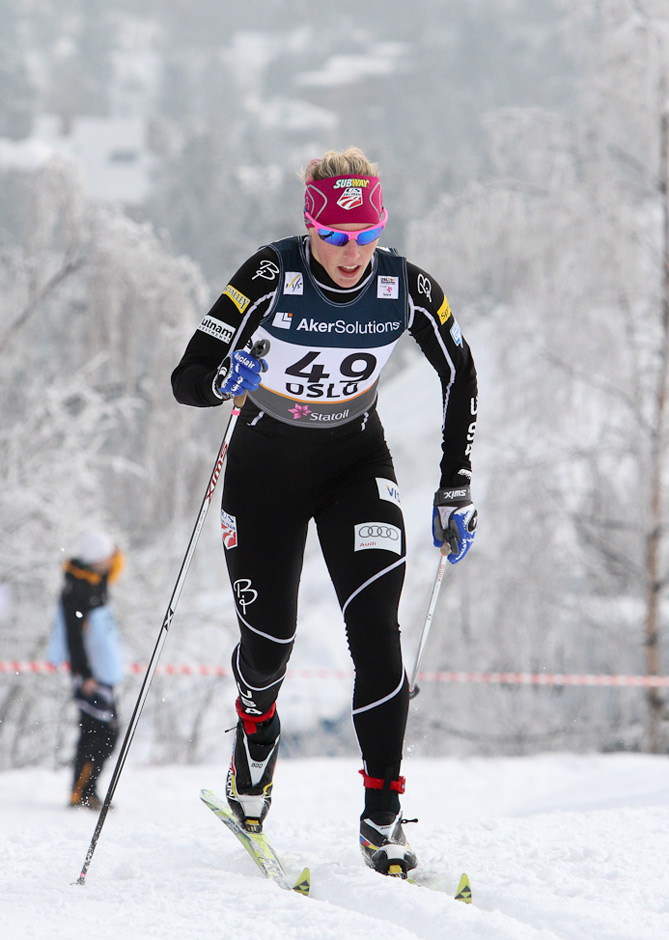
February 2011: No change for World Champs: Kikkan Randall racing at 2011 World Championships in Oslo.
2011/2012: Still black Bjørn Dæhlie
December 2011: Kikkan Randall sprinting during the Tour de Ski.
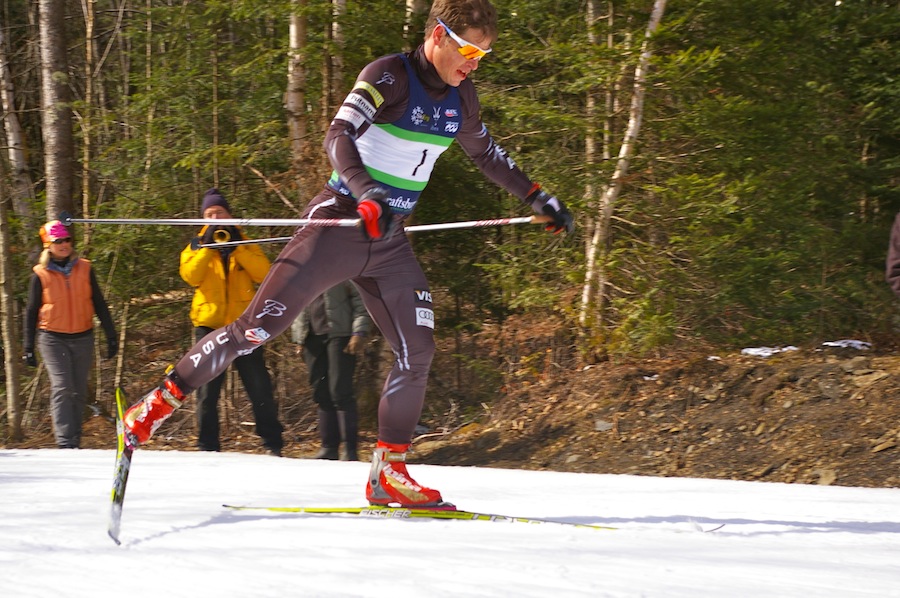
March 2012: Kris Freeman (SSCV/USST) on his way to claiming the US Distance Nationals 50 k freestyle title on Saturday morning in Craftsbury.
2012/2013: Still black
December 2012: Noah Hoffman in the Tour de Ski.
December 2012: Kikkan Randall blasting to victory in the Tour de Ski opening prologue on Saturday. She skied to 14th in the pursuit on Sunday and is leading the U.S. women in the Tour de Ski standings after two stages. Photo: Marcel Hilger.
February 2013: Diggins and Randall won gold in the team sprint at 2013 World Championships in Val di Fiemme, Italy, which was awesome, but, for purposes of this article, mostly relevant for the addition of the epochal relay socks but otherwise no change to the standard World Cup uniform.
2013/2014: Yup, still black
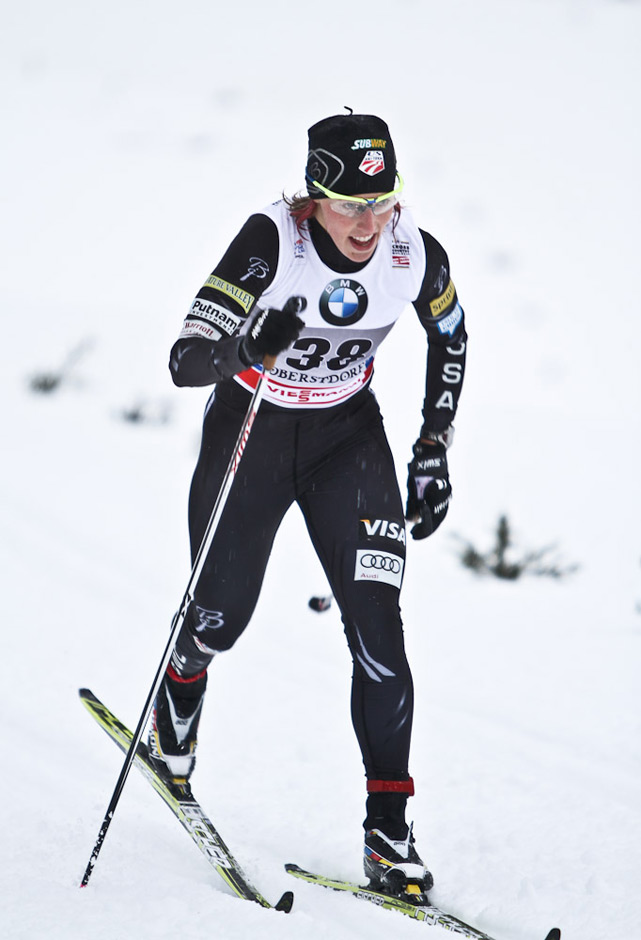
December 2013: Liz Stephen (U.S. Ski Team) on her way to 34th in Saturday’s 3 k freestyle prologue at the first stage of the Tour de Ski in Oberhof, Germany. (Photo: Marcel Hilger)
December 2013: Andy Newell (U.S. Ski Team) qualified 12th and finished 10th overall in Sunday’s freestyle sprint. (Photo: Marcel Hilger)
2014 Winter Olympics, Sochi: Stars and stripes
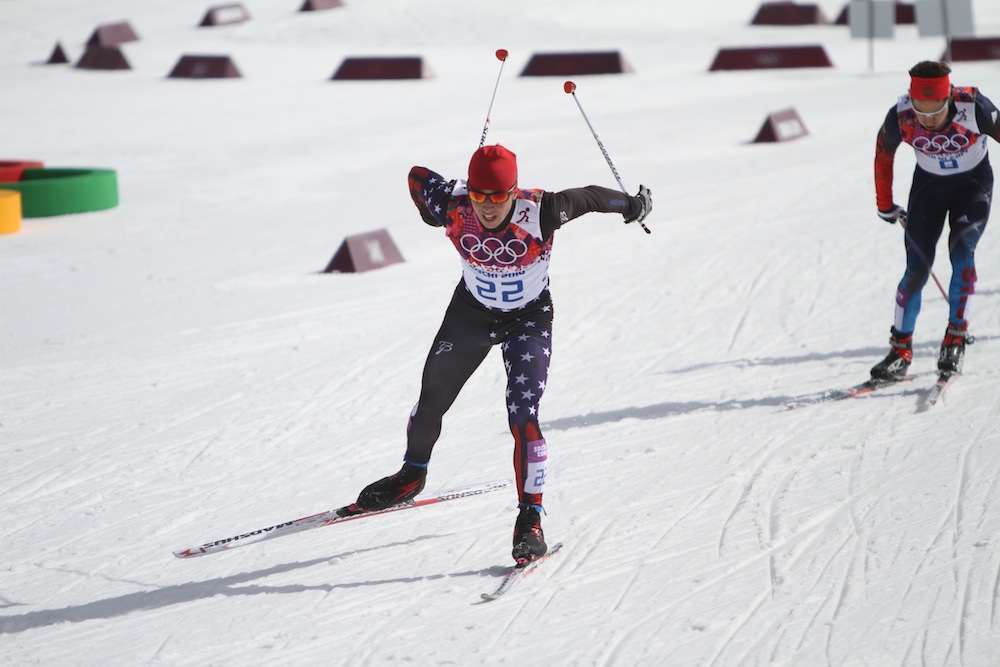
The 2014 Winter Olympics, in Sochi, Russia, were known at the time for Kikkan Randall’s disappointing result in the individual skate sprint, and after the fact for the revelation that Russia was engaged in a massive state-sponsored doping scheme and cover-up. They were also significant for a change in uniforms: stars and stripes on the right arm and left leg, and a large “USA” on the right leg. The left arm was relatively plain. Also, several of the U.S. women drew attention for racing sleeveless in warm temperatures. Bjørn Dæhlie continued to be the brand logo featured on the upper right quad. (Pictured below: Noah Hoffman, in a solo race, and Sadie Bjornsen, in the women’s relay.)
2014/2015: Stars and stripes redux
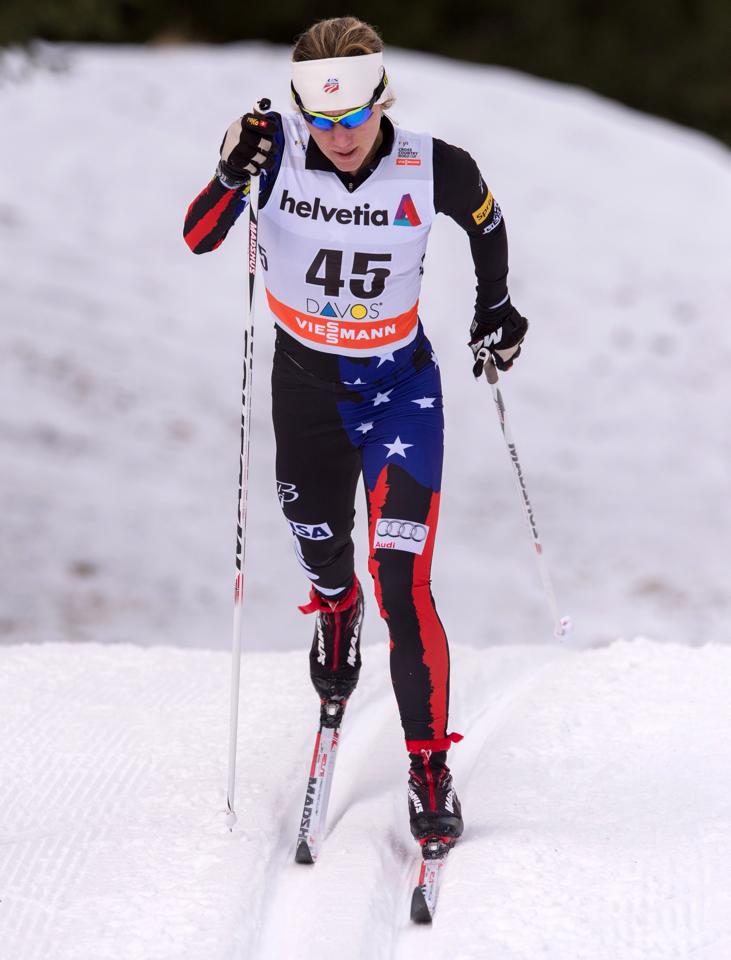
Athletes took to the trails next season with a slightly modified version of the recent Olympics uniform: Larger stars on the left upper quad, with a deeper blue background. The stripes on the left leg became more pronounced and stretched farther up the race suit, to above the knee. Also, once the non-commercial period of the Olympics had passed, there was space for sponsor patches on the arms and legs.
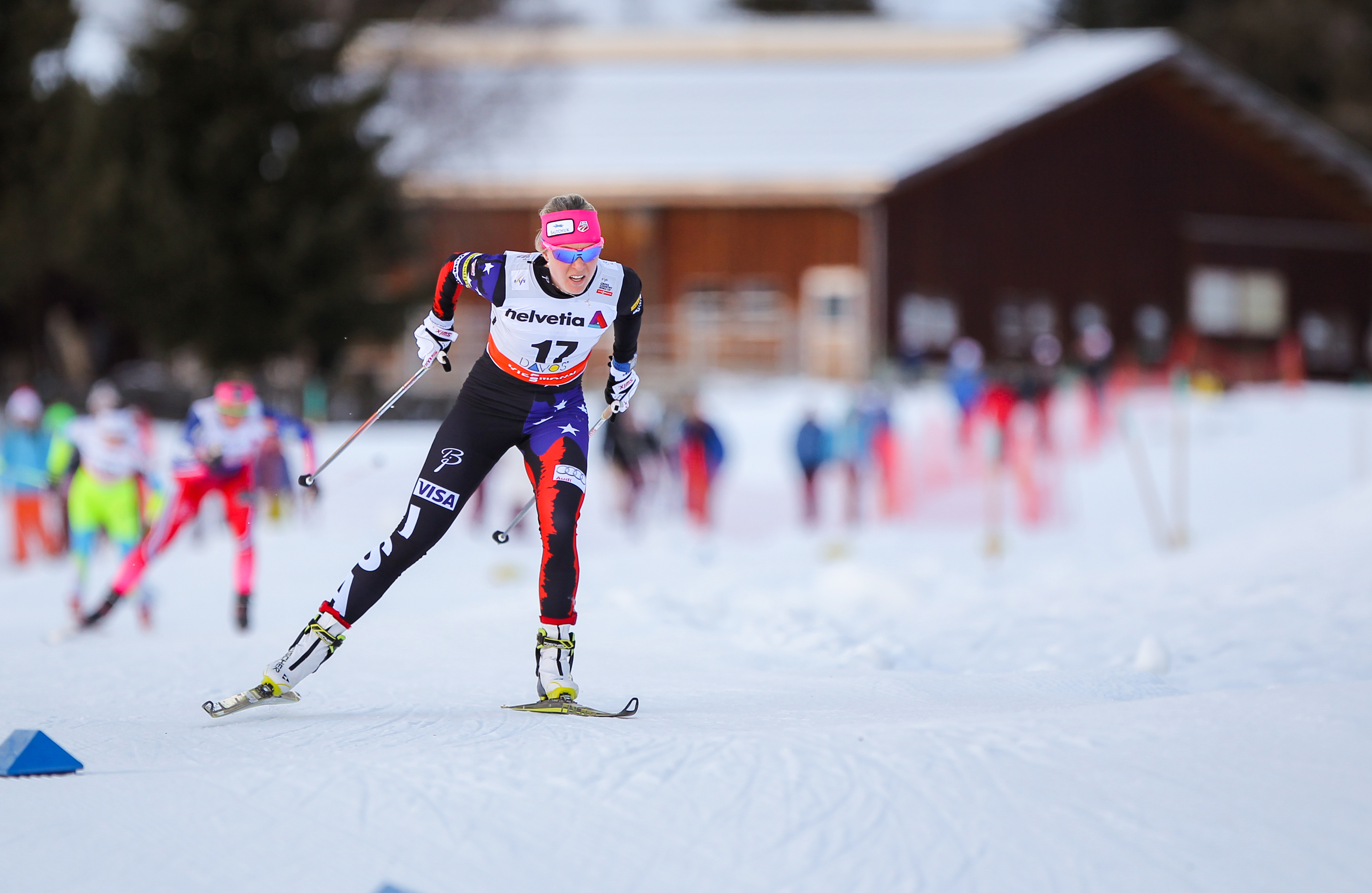
December 2014: Caitlin Gregg (Team Gregg) skiing to 56th place in the Davos World Cup 10 k classic, Dec. 13. (Photo: Toko)
USST’s Sadie Bjornsen racing to 29th in the Davos World Cup 10 freestyle, Dec. 20, 2014. (Photo: Fischer/Nordic Focus)
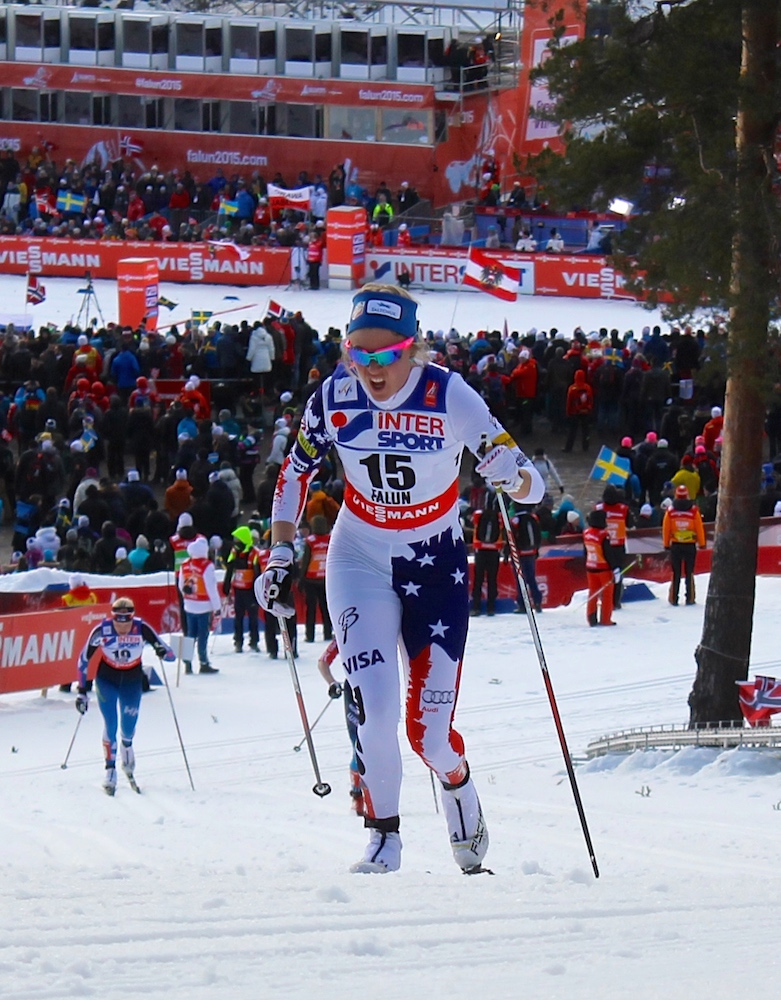
World Championships, in Falun, Sweden, brought a mostly-white version of the uniform, helpful for the warm temperatures and soupy conditions that characterized many of the races. Here’s Sadie Bjornsen in Falun in February 2015:
2015/2016: Red, white, and blue
By fall 2015, the move away from black, and towards red, white, and blue, was complete. Athletes now had the option of being attired in a predominantly white color scheme, which would aid in preventing overheating on warm days, while thankfully solving the transparency issues that had plagued recent all-white suits for Sweden or Italy. An alternate version had roughly the same patterning, but with blue as the primary color. Notably, the Americans also moved to a race suit manufactured by the Swedish company Craft for the first time in this survey.
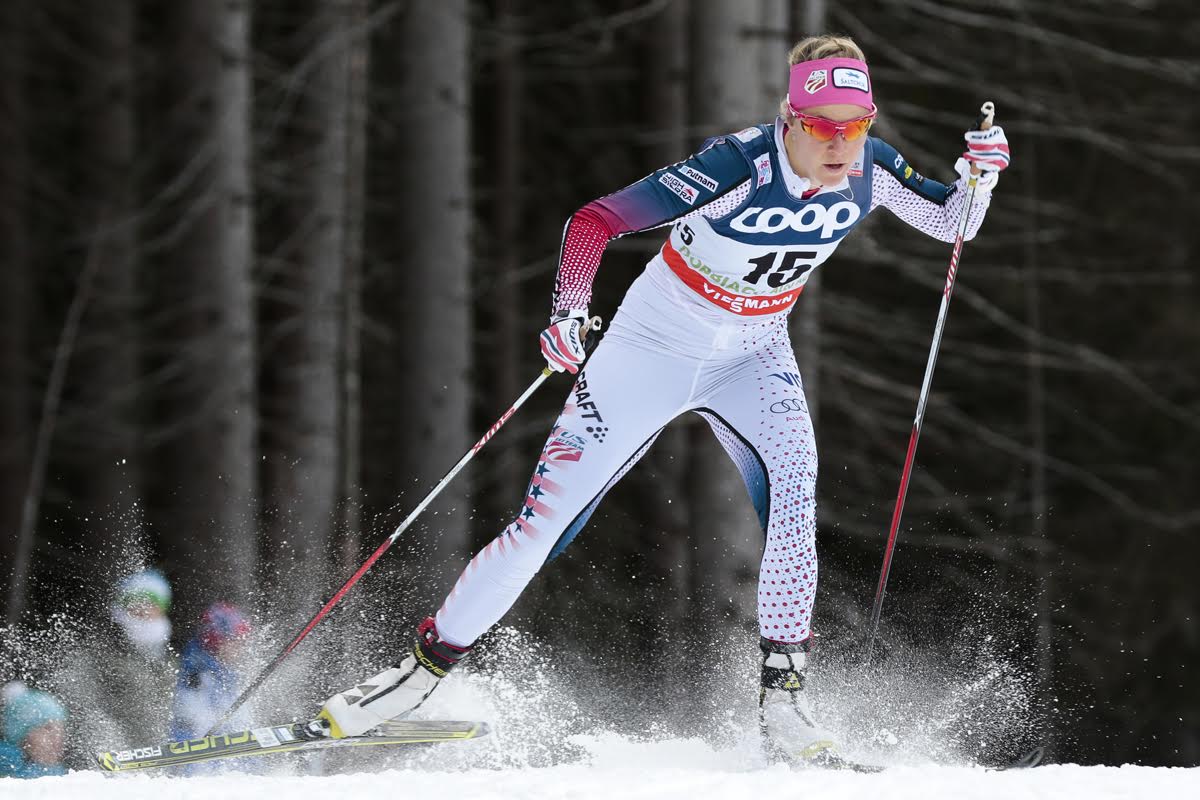
December 2015: Sadie Bjornsen (U.S. Ski Team) racing to her best-ever sprint qualifier in sixth at the World Cup freestyle sprint in Toblach, Italy. She went on to make the semifinals and place 10th overall. (Photo: Fischer/NordicFocus)
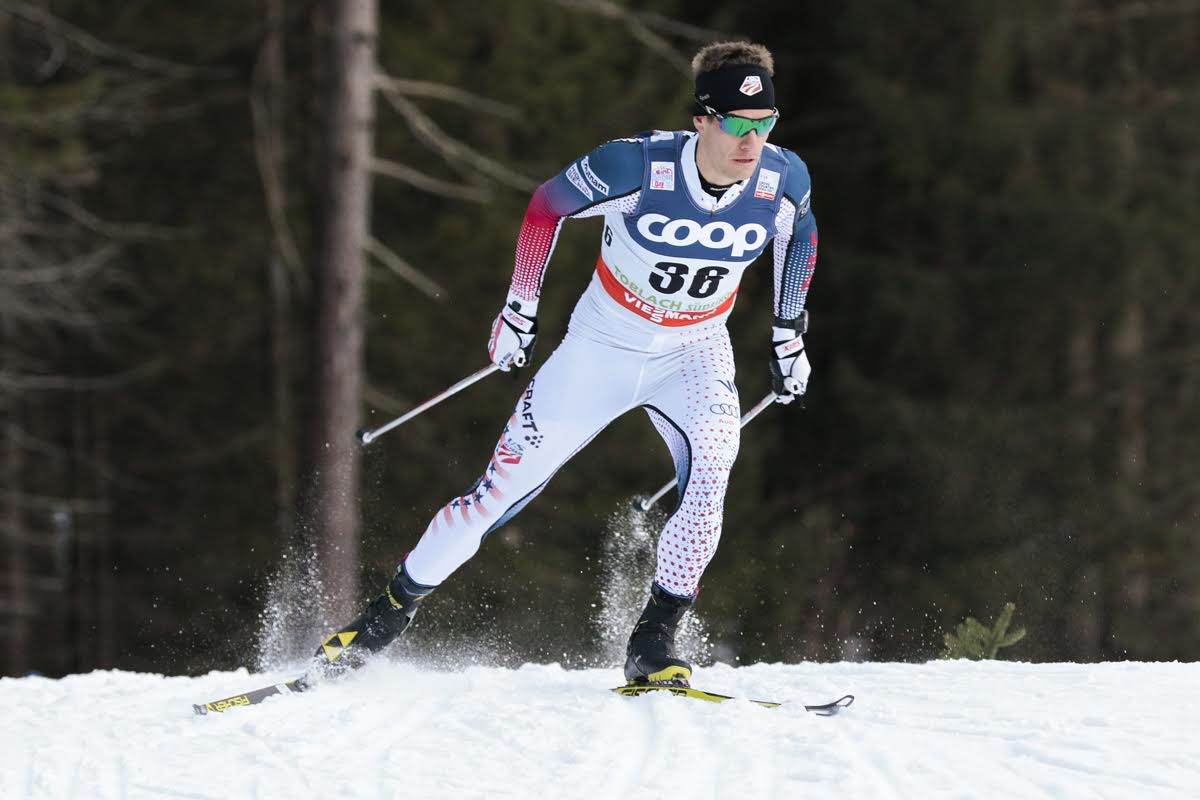
December 2015: Simi Hamilton (U.S. Ski Team) racing to his first non-stage World Cup podium on Saturday in Toblach, Italy, where he placed second in the freestyle sprint. (Photo: Fischer/NordicFocus)
December 2015: American Andy Newell (r) and Great Britain’s Andrew Young (c) trail Norway’s Håvard Solås Taugbøl (2) in the quarterfinal at the Davos World Cup freestyle sprint on Sunday in Switzerland. Taugbøl won the heat, Young placed third, and Newell was fifth after missing out on a photo finish for fourth. Newell finished the day 23rd overall. (Photo: Marcel Hilger)
January 2016: Ida Sargent (U.S. Ski Team) teamed up with Sophie Caldwell (not shown) to place fifth in the 6 x 1.2 k freestyle team sprint at the World Cup in Planica, Slovenia. (Photo: Madshus/NordicFocus)
Honorable mention: Trending towards “purple cobras” for American biathlon but not there yet.
American Claire Waichler started 58th and finished 33rd in the youth women’s pursuit on Sunday at IBU Youth/Junior World Championships in Cheile Gradistei, Romania. (Photo: IBU YJWCH Cheile Gradistei 2016/Facebook)
2016/2017: More red, white, and blue
An interpretation of red, white, and blue, still on a Craft suit, remained in place for the 2016/2017 World Cup season, which was marked within the team by Randall and her husband, Jeff Ellis, traveling the European race circuit with a newborn in tow. The changes to the USST uniform were less dramatic than Randall’s familial status: Still red, white, and blue, though now with blue as the dominant color. The entire left leg, and the bottom half of the right leg, had markings, somewhere between subtle striations and full-on stripes, that evoked the stripes of the American flag. (Let’s put aside for the moment the fact that the stripes on the actual flag are white and red, not white and blue.) The pattern was repeated on the lower right arm. An understated evocation of blue or white stars marked both lower legs, with more pronounced stars scattered around the bottom of the torso (possibly the top as well, but nearly all of one’s torso is typically covered by the standard race bib). The left arm and left leg both proclaimed “USA” in red lettering.
The vehicular logo on the legs remained that of Audi, as it had been since the start of this history.
There appears to have been no change for the 2017 World Championships. At least to the uniforms; on the race course, the Americans won an unprecedented three medals.
December 2016: Jessie Diggins (U.S. Ski Team) racing to ninth in Saturday’s 1.5 k freestyle sprint qualifier in Val Müstair, Switzerland. Diggins went on to place sixth in the final. (Photo: Salomon/NordicFocus)
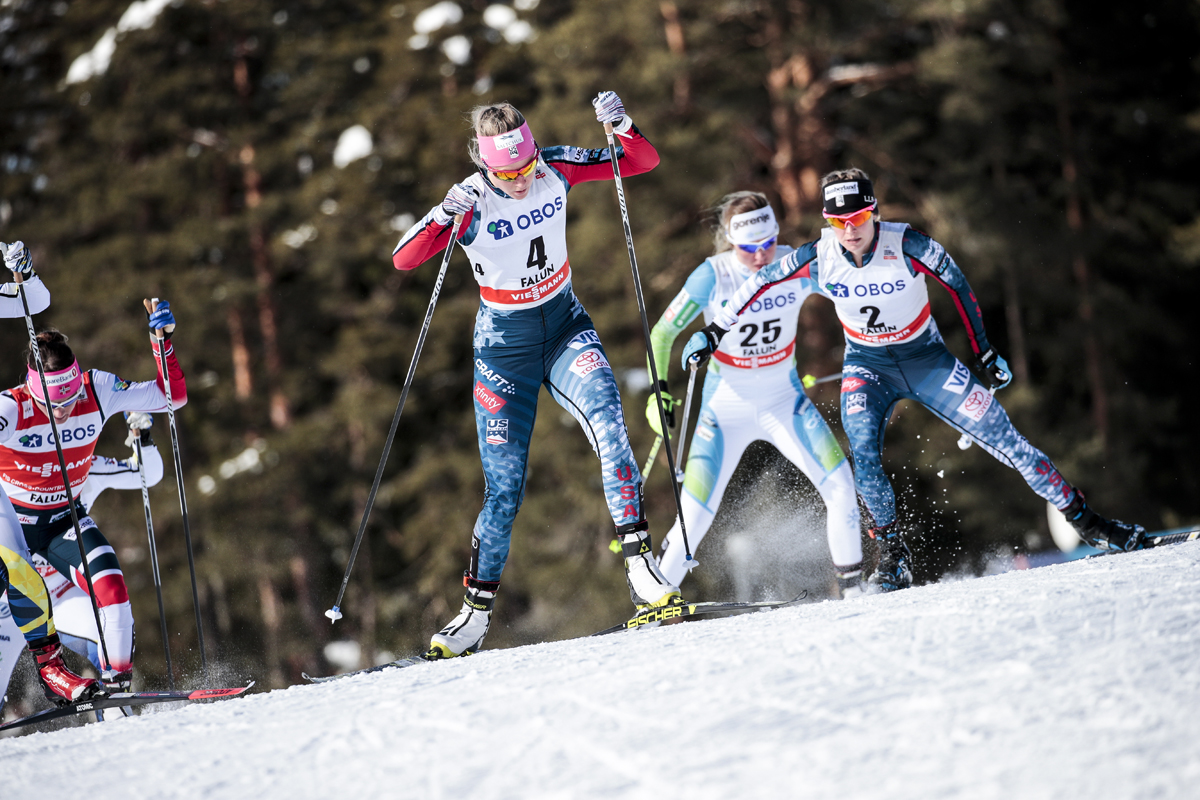
January 2017: Sophie Caldwell (U.S. Ski Team) racing to third in the qualifier of Saturday’s 1.4 k freestyle sprint in Falun, Sweden. She went on to finish 16th overall (Photo: Fischer/NordicFocus)
February 2017: Kikkan Randall (U.S. Ski Team) racing to 26th in the women’s 10-kilometer classic individual start at the 2017 Nordic World Championships on Tuesday in Lahti, Finland (Photo: John Lazenby/Lazenbyphoto.com)
Meanwhile, biathlon saw the advent of the beloved “purple cobras” era:
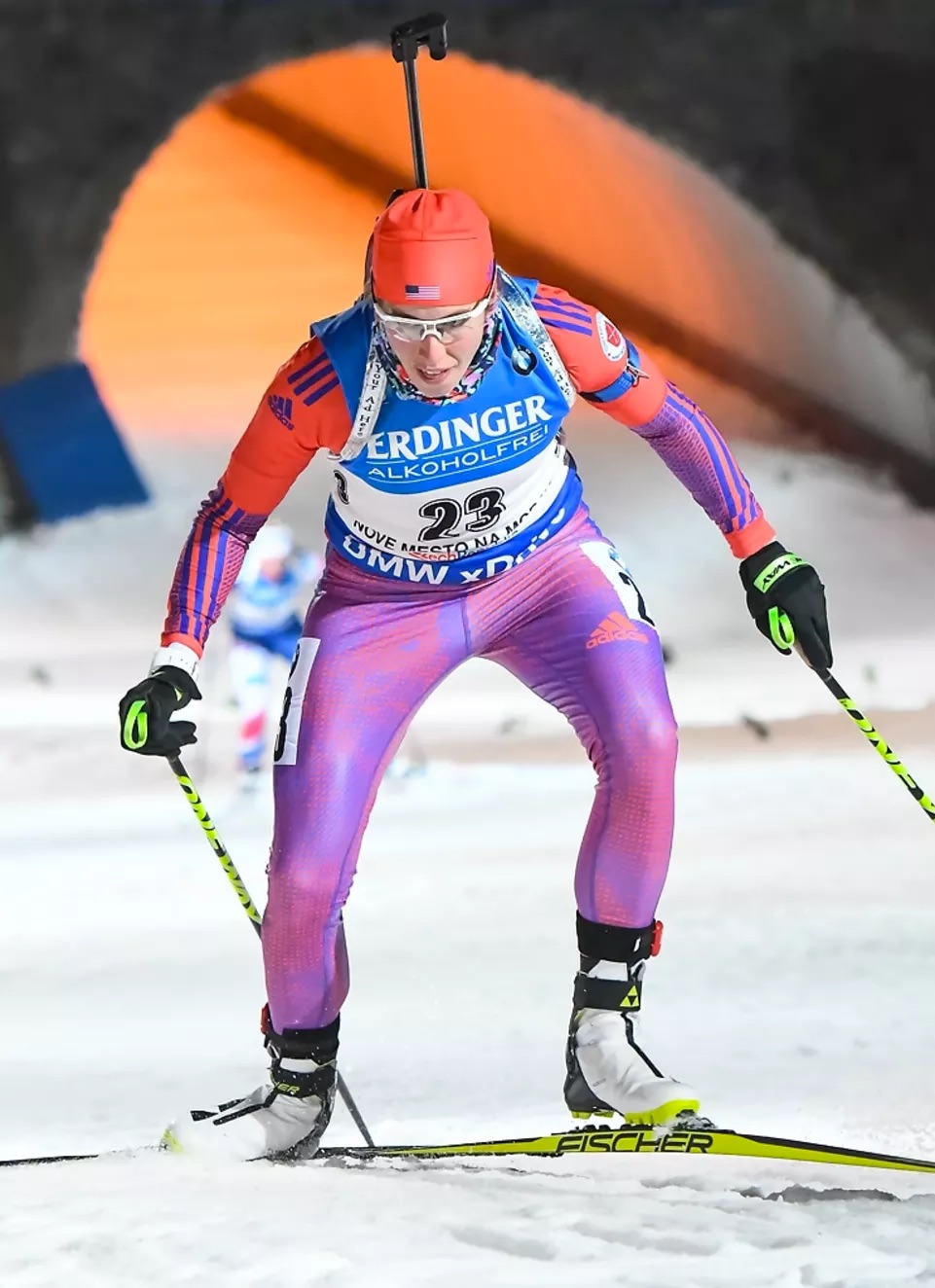
US Biathlon’s Susan Dunklee on her way to finishing third in the women’s sprint at the IBU World Cup in Nove Mesto, Czech Republic. It was the third podium of her career. (Photo: IBU)
2017/2018: Red, white, and blue redux
There appears to have been no change for the 2017/2018 World Cup season: still red, white, and blue, but mostly blue, on a Craft suit. The most notable change may have been to the car sponsor… for the first time since at least the scope of this article, a Toyota logo was on the leg, not Audi. Nichts ist unmöglich (“Nothing is impossible”), as the company’s European slogan proclaims.
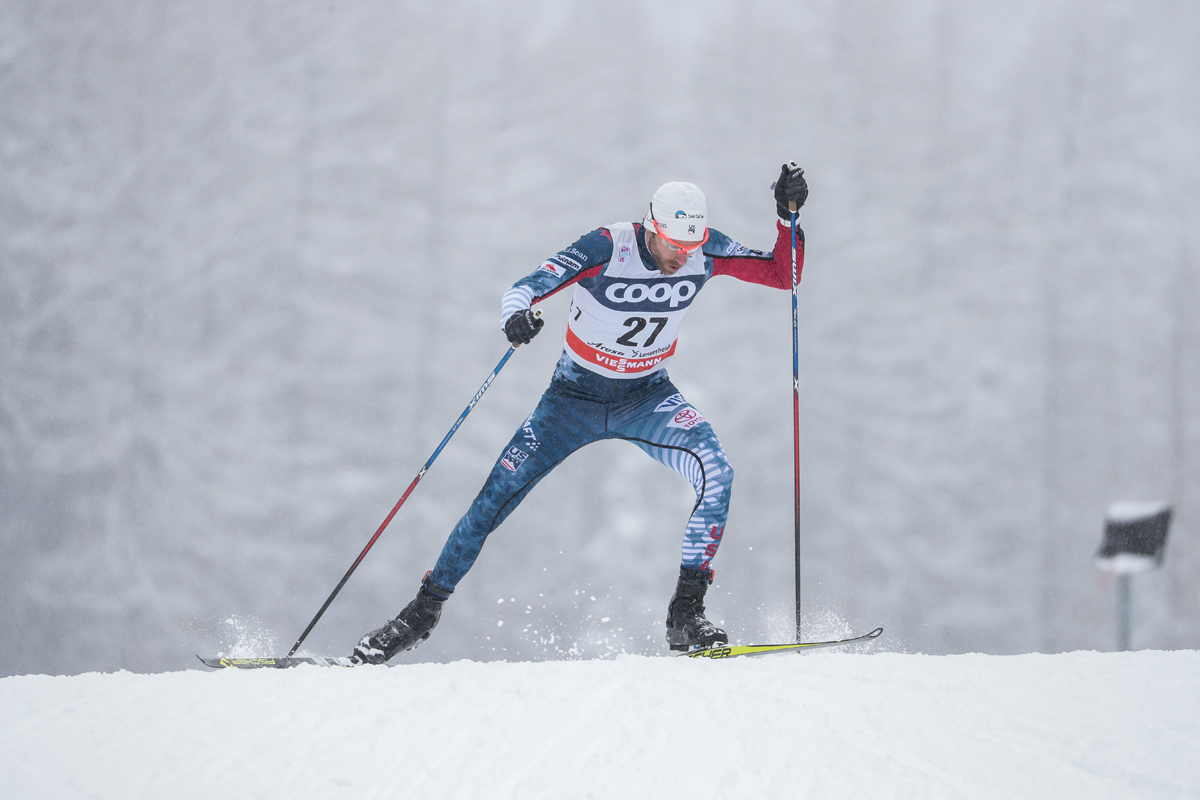
American Andy Newell racing the men’s 1.5 k freestyle-sprint qualifier at Stage 1 of the Tour de Ski on Saturday in Lenzerheide, Switzerland. He qualified 20th and went on to finish 19th overall. (Photo: Fischer/Nordic Focus)
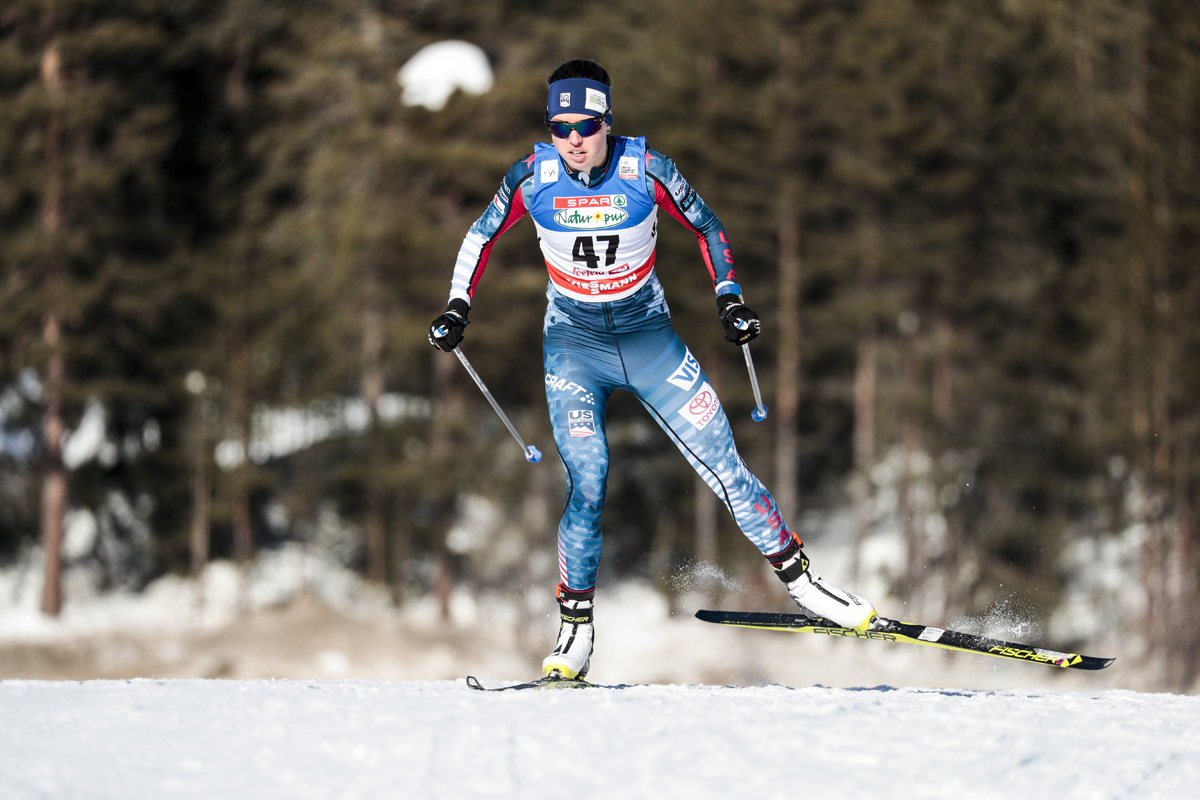
Caitlin Patterson (Craftsbury Green Racing Project) racing to 52nd in the freestyle sprint qualifier at the last World Cup on Jan. 27 in Seefeld, Austria. The next day, she placed 23rd in the 10 k freestyle mass start. (Photo: Fischer/NordicFocus)
2018 Winter Olympics, Pyeonchang: Red, white, and blue, and a lot of stripes
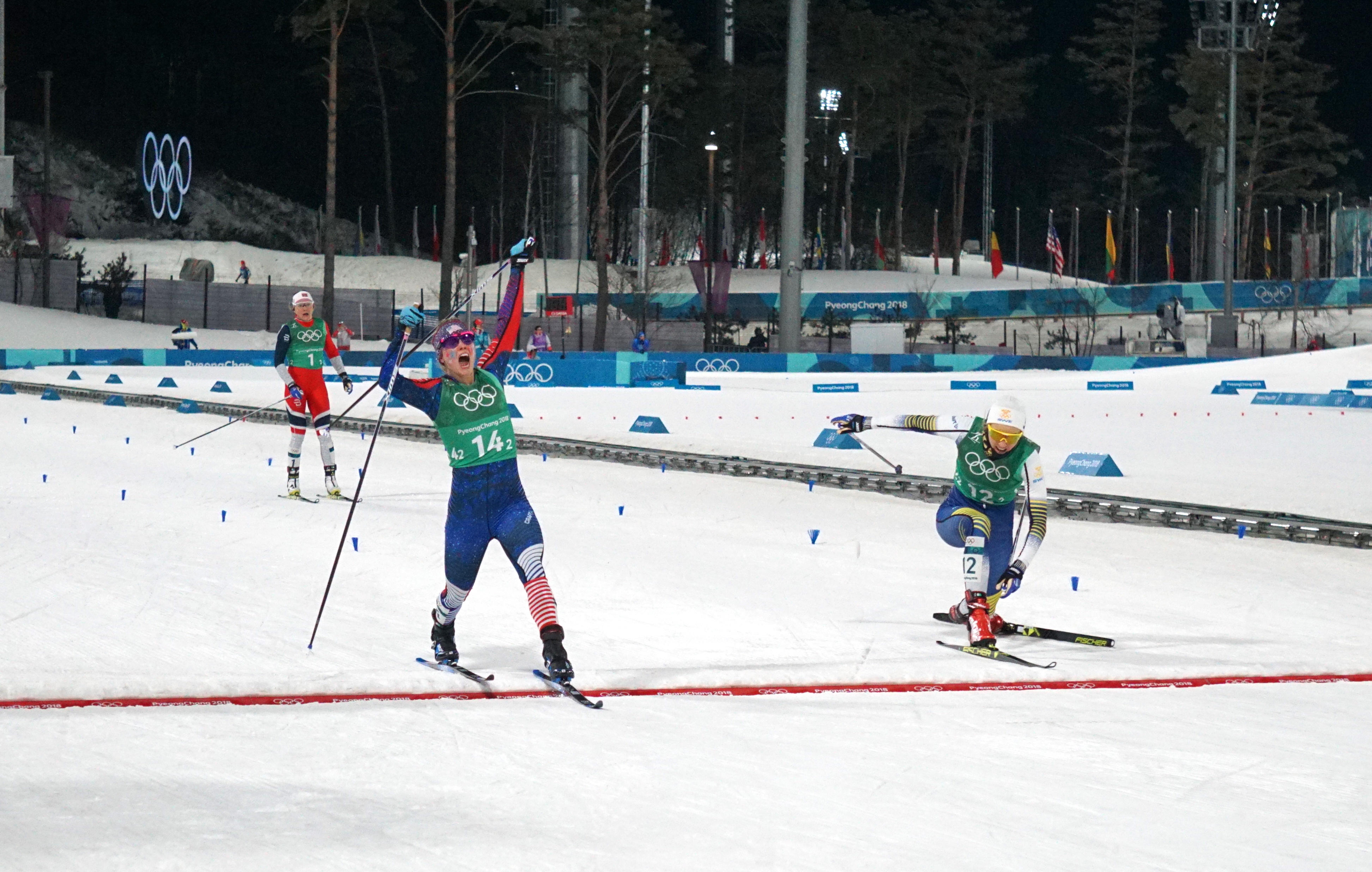
There is a somewhat famous picture from the 2018 Winter Olympics that you may already be familiar with. In the picture, Jessie Diggins, on the lefthand side of the frame, stretches her left foot across the finish line to secure an historic Olympic gold medal for the United States. Her left arm mirrors the gesture, punching the air above her in what is presumably an instinctual counterbalance to the lunge but also appears, in a frozen moment in time, to be a triumphant fist-pump. In the middle, her face is rent in a rictus of exertion and triumph. On the righthand side of the frame, Stina Nilsson of Sweden lunges as well, 0.19 seconds behind Diggins. Mute V-boards and still flags fill in the background of the image, as Maiken Caspersen Falla of Norway appears to stand up and stop skiing in order to watch the finish unfold.
It was a few seconds before 7:16 p.m. in Pyeongchang, 4:16 a.m. in Afton, Minnesota, and 1:16 a.m. in Anchorage, Alaska. If you’re reading this website, you may remember where you were at that moment.
February 2018: Jessie Diggins (14) edges Sweden’s Stina Nilsson (r) for gold, while Norway’s Maiken Caspersen Falla (far left) races to bronze, in the women’s freestyle team sprint final at the 2018 Olympics in PyeongChang, South Korea. (Photo: Noah Hoffman)
But let’s talk about the uniform. Another Craft product, the dominant impression is once again blue; in the photo above, taken at whatever distance from the finish Noah Hoffman was allowed to stand while there was a race on, there is a whole lot of blue approaching the finish line between the American suit and the Swedish one. Some white stripes are visible around the knee of Diggins’s suit, trending down the lower leg, though they are soon subsumed by The Relay Socks.
On closer inspection, however (see next picture, below), there are a lot of stripes going on in this uniform. The entire legs are striped, with stronger white stripes on the sides of the torso fading to fainter stripes at the top of the leg. The knees have white stripes on a blue background, with the width of the white stripes gradually decreasing and the extent of the blue interstices gradually increasing across the course of the knee. As shown in more detail here, the patterning gives way to thin red stripes against a blue background, on the lower right leg, and a bold white “USA,” on the lower left.
The right arm has white splotches, potentially stellar in nature, against a blue background. The left arm has red and white stripes to midway down the biceps, which then transition to blue and red stripes.
The torso has a subtle blue and black patterning perhaps best described as “Swedish forest camo.”
Finally, although it is not apparent in either picture, “USA” was written in white letters against a blue background on both the right arm and lower left leg, as shown in the images available here (lettering on arm) and here (lettering on leg).
February 2018: Jessie Diggins (l) and Kikkan Randall soak up their win in the women’s freestyle team sprint on Wednesday at the 2018 Olympics in PyeongChang, South Korea. (Photo: FIS Cross Country/Twitter)
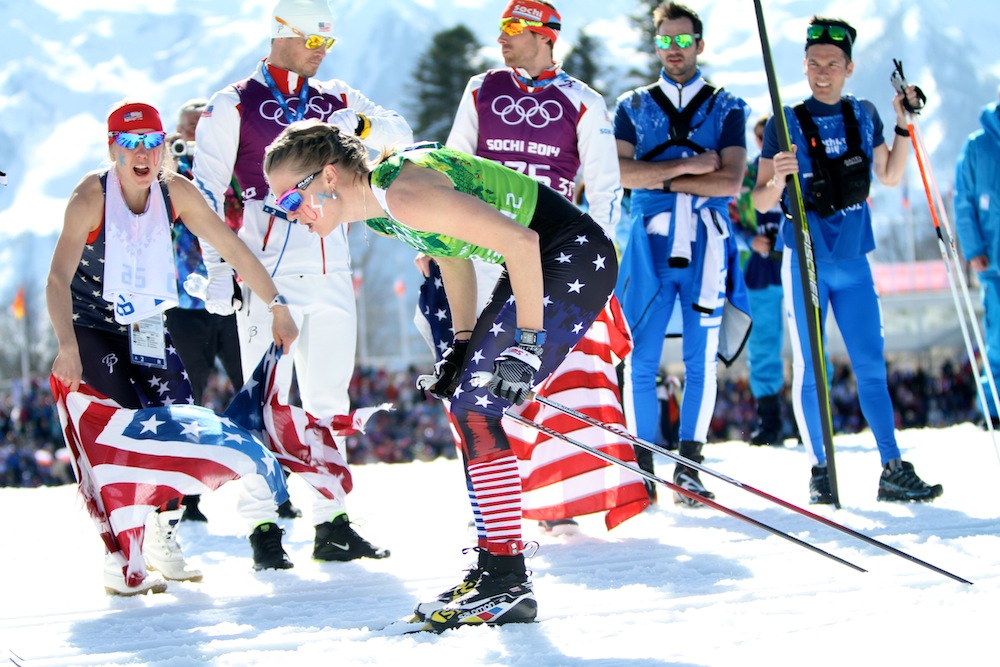
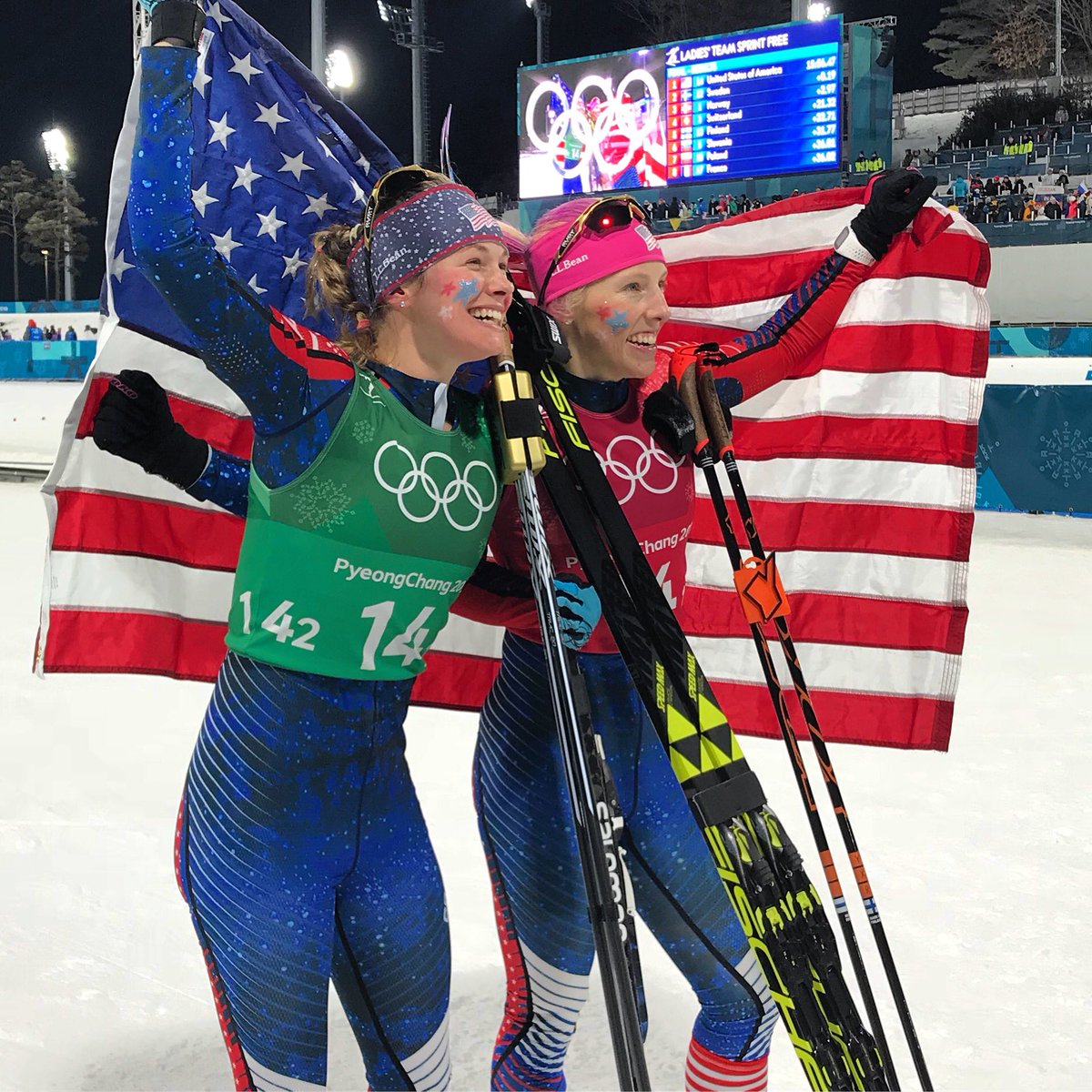
Here is another fine picture of Diggins and Randall from the evening of February 21, 2018. This one does not show the famous American relay socks, but does show the equally renowned facepaint and glitter. As Diggins has written, in what is both a pro-glitter cri de cœur and “a brief message for [the] high school officials” who harshed on her glitter as a junior racer, “Putting on glitter before my race is a salute to the little girl who just wants to ‘go super speed!!!’ It’s a promise to myself that I will race my absolute hardest that day. It’s a ritual that gets me in the right mindset to get out of the start gate and give it everything I have. It’s harmless, doesn’t negatively impact anyone, but to me it’s a huge part of my race morning. . . . And on relay days? Oh man. I get so excited about relay days. I get to paint the flag, ‘USA’ and stars on the faces of my teammates, and one of them will paint it on me as well. Then I put glitter over everything! It’s a special time when everyone is nervous, and excited, to be representing our country and we get together early in the morning to help each other get ready and deal with our pre-race nerves. It’s a little bit like our special striped relay socks…it’s part of what we do, as a team.”
End of the 2017/2018 season: Farewell tour
Honorable mention for the 2017/2018 season, World Cup edition: Randall and Liz Stephen’s outfits for their final World Cup race (standard Craft base, but with a whole lot of flair):
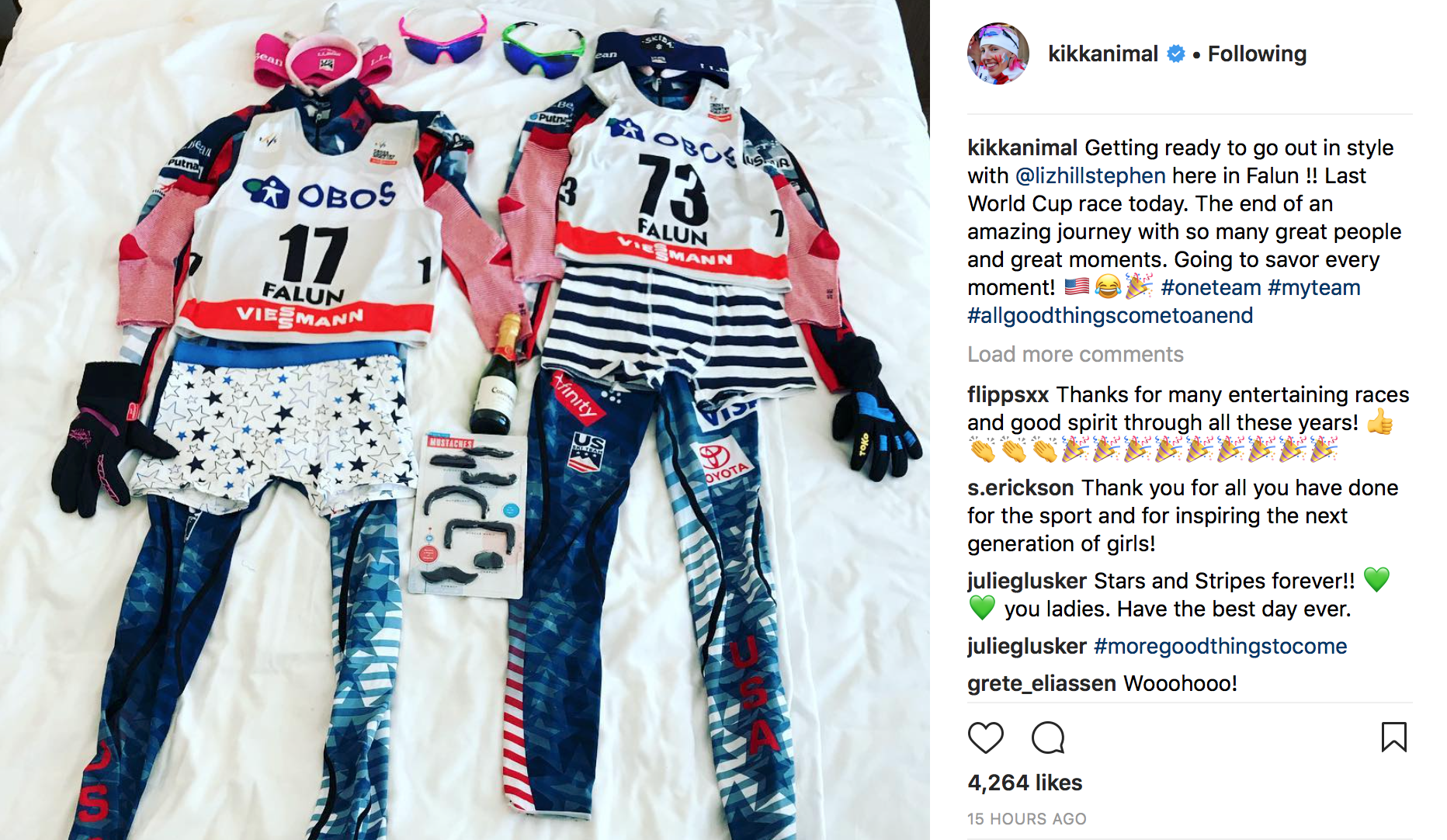
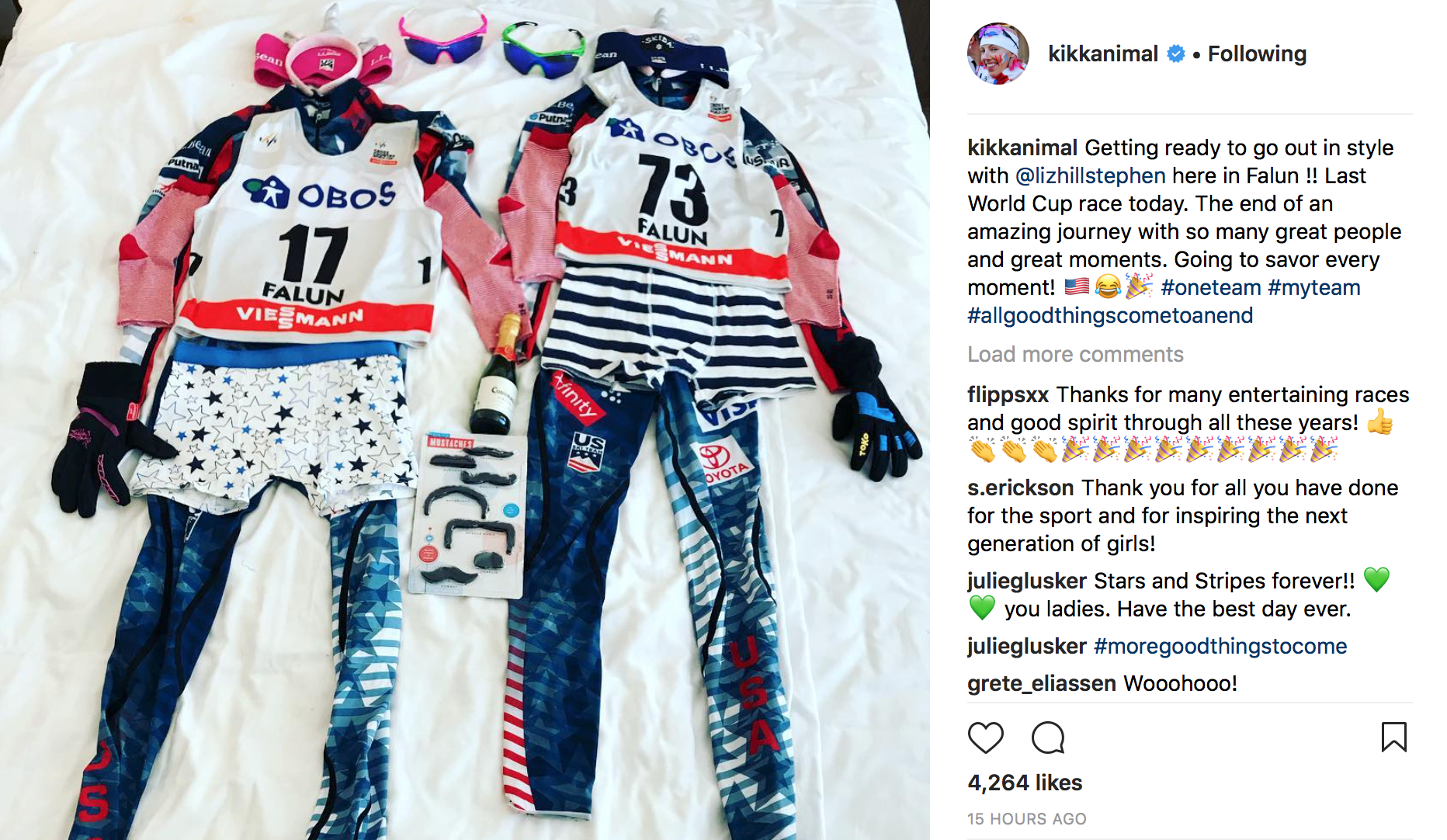
March 2018: The last-race outfits worn by Kikkan Randall and Liz Stephen for Sunday’s World Cup Finals pursuit. (Photo: Kikkan Randall/Instagram)
Honorable mention, domestic edition: Randall’s bespoke pink and blue Craft USST/APU suit (essentially the Olympics suit but with different patterning) that she wore for her final race as a professional skier, at Spring Series in Craftsbury. The suit said “USA” on the right arm and left leg, “APU” (for Alaska Pacific University, her club team of 19 years) on the left arm, and “Kikkan” on the left arm and right upper leg.
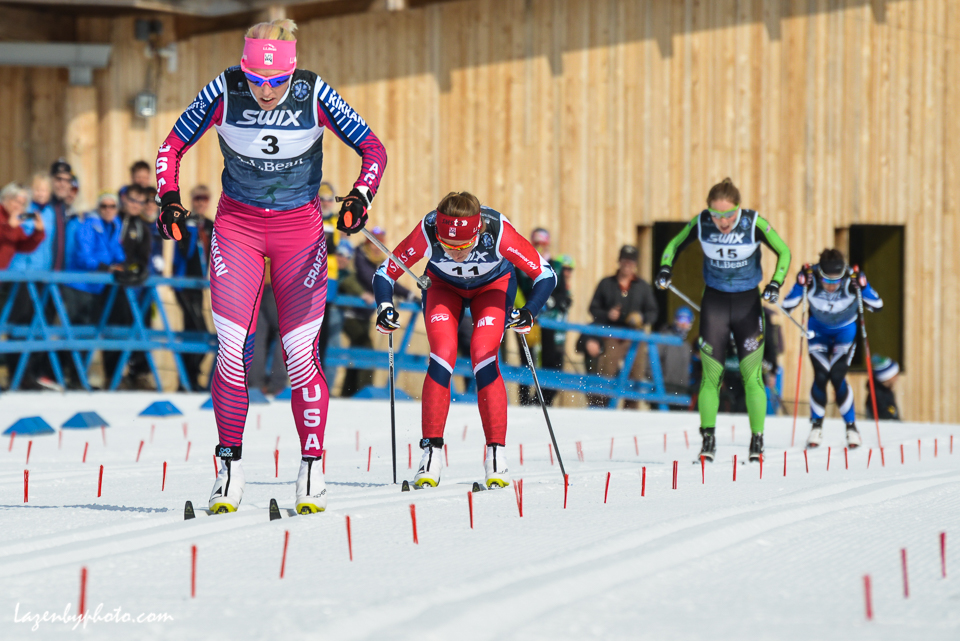
March 2018: Kikkan Randall (3) racing for third place in the women’s 30 k classic mass start at 2018 U.S. Distance Nationals in Craftsbury, Vt., ahead of Sophie Caldwell (second from l), Ida Sargent (second from r), and Rosie Frankowski (r). (Photo: John Lazenby/Lazenbyphoto.com)
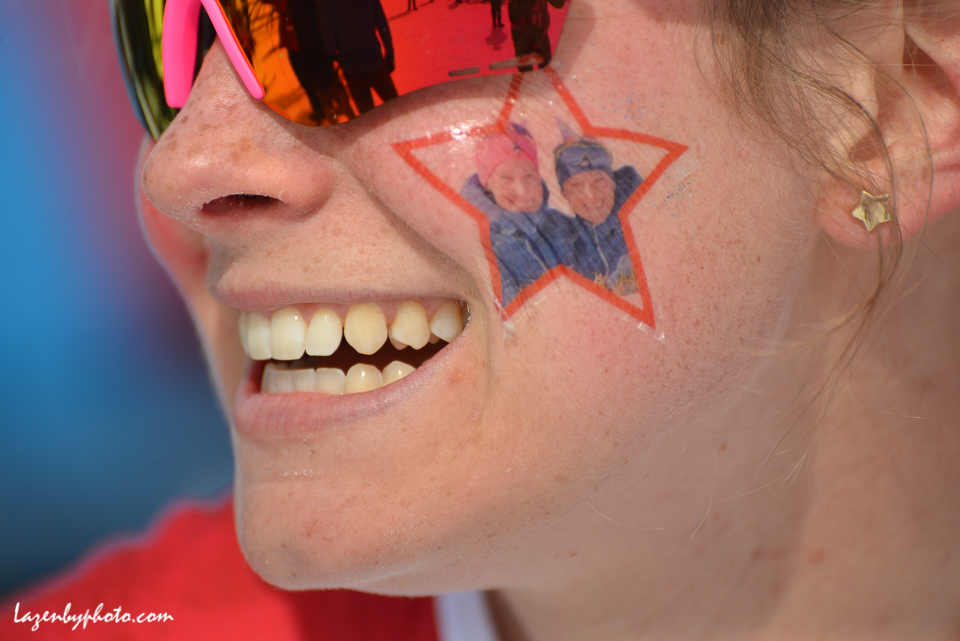
Honorable mention, face paint edition: This remarkable evocation of Randall and Stephen on Diggins’s left cheek at Spring Series.
March 2018: Jessie Diggins with a photo of her retiring U.S. Ski Team teammates Kikkan Randall and Liz Stephen on her cheek at 2018 U.S. Distance Nationals in Craftsbury, Vt. (Photo: John Lazenby/Lazenbyphoto.com)
2018/2019: Red, white, and blue, but with larger color blocks. Also, a move to Swix.
Randall retired. Stephen retired. Randall got breast cancer. Randall was treated for breast cancer. Diggins worked hard to — successfully — bring a World Cup ski race to Minneapolis. And the Americans kept racing in red, white, and blue, albeit now with a move from Craft to Swix for the suit manufacturer. This year’s interpretation of the theme brought a shift to white as the dominant color, with blue through the torso and upper legs, as well as on the arms. Red was the least-pronounced color this year, limited to accents alongside the larger blocks of blue.
While the Americans continued their perhaps now-accustomed success at the World Cup level, American juniors served notice at World Juniors that they were a force to be reckoned with, taking a gold in the men’s relay, a fourth in the women’s relay, two fourths in classic distance races, and multiple other top-tens. Here are two shots from a frigid Lahti:
January 2019: Luke Jager (middle left, hands in air) after tagging off to Ben Ogden (bib 2, middle right, pink hat) in the U20 men’s 4 x 5 k relay at Junior Worlds in Lahti, Finland. (Photo: Doug Stephen)
January 2019: Kendall Kramer on her way to fourth place in the U20 15 k classic mass start at World Juniors in Lahti, Finland. (Photo: Doug Stephen)
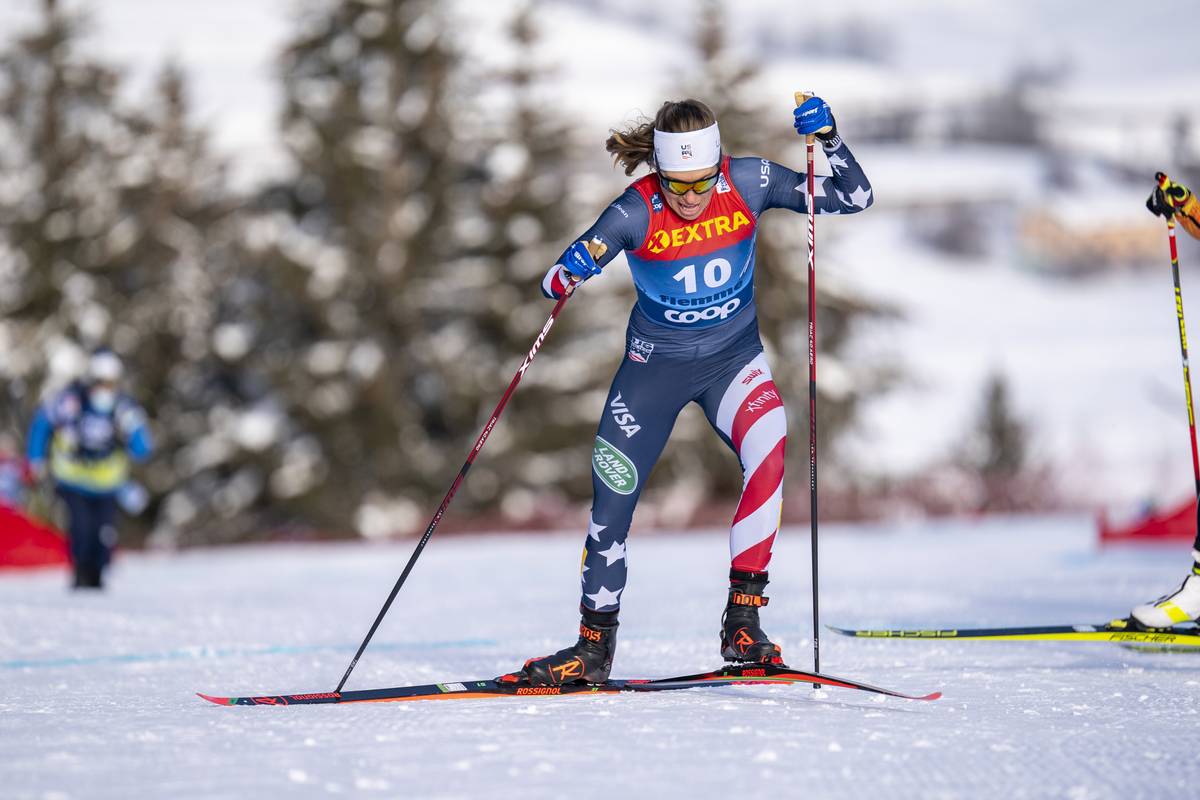
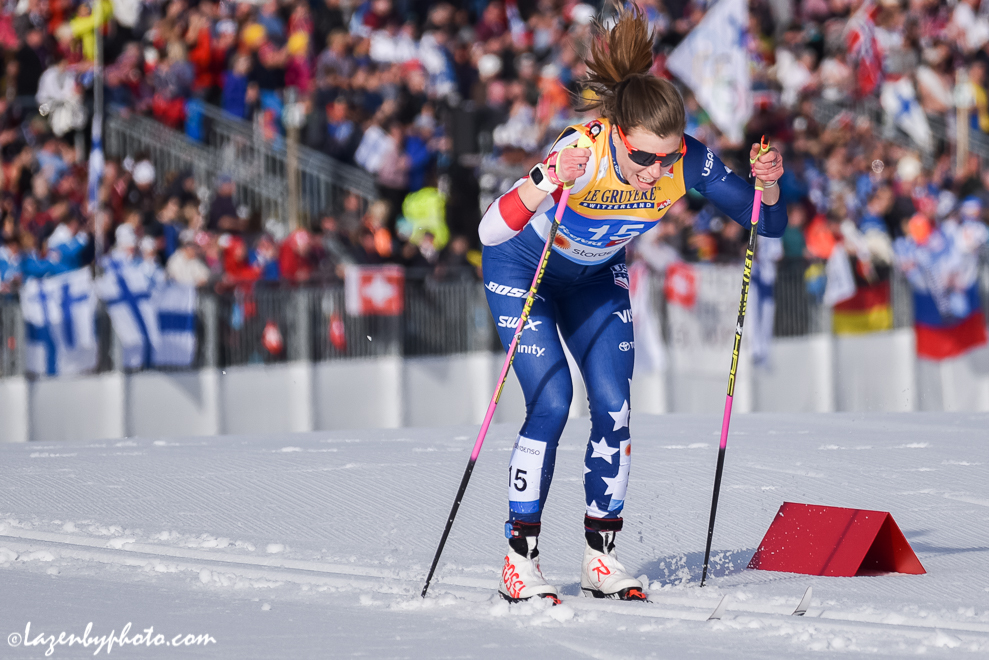
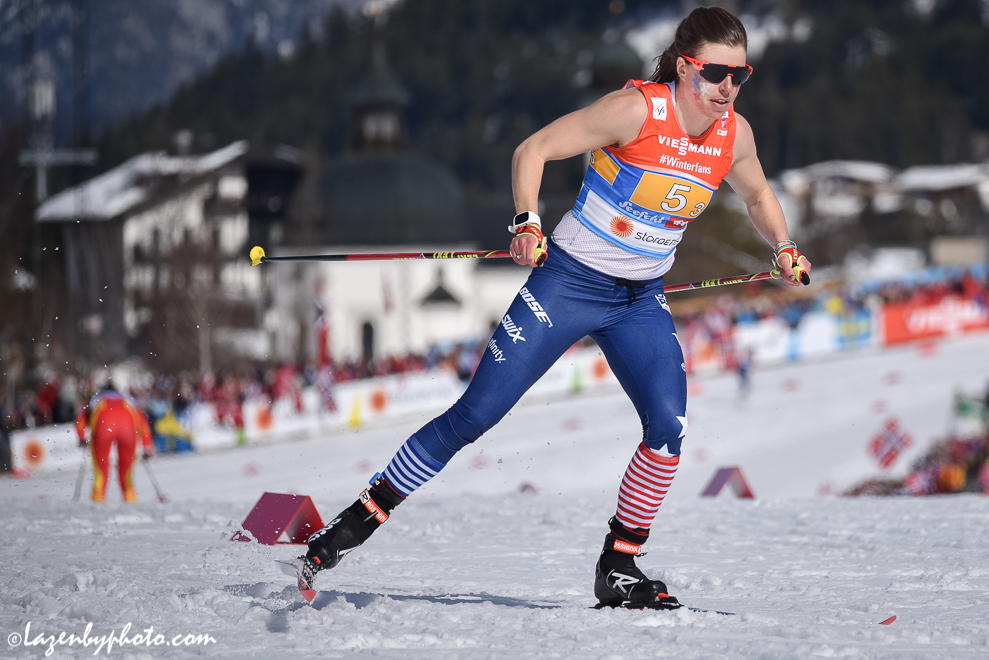
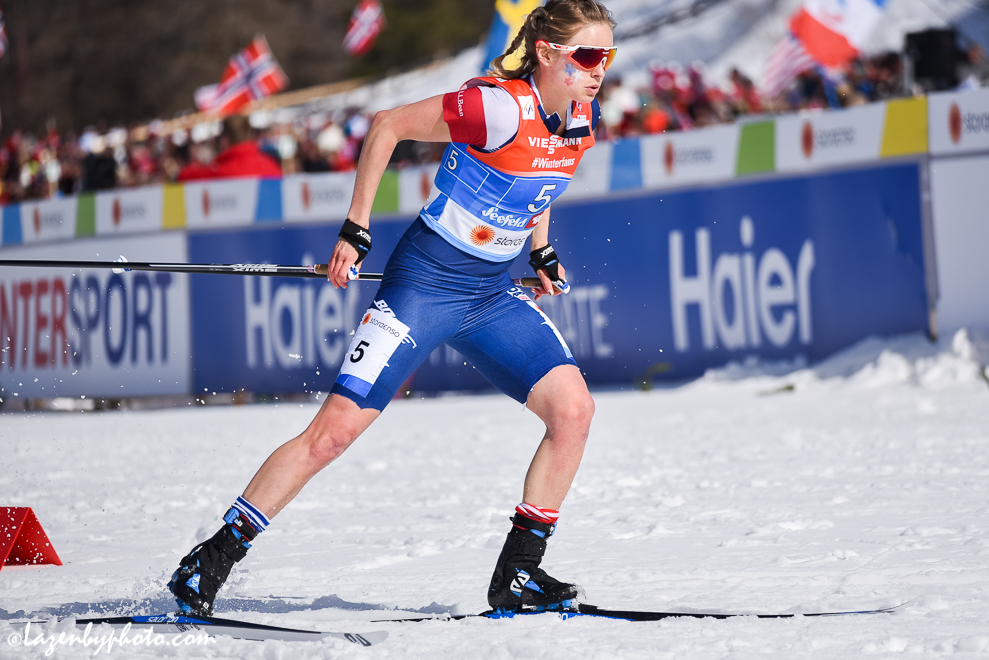
Back to the World Cup (where senior athletes wore the same uniform shown above on the juniors for the regular season), 2019 World Championships, in Seefeld, Austria, brought something new. The dominant hue in the race suit was now blue instead of white, and the large color blocks of the 2018/2019 World Cup regular season were gone. White stars were added to the lower left leg, making the evocation of the American flag far more apparent. Red and white stripes, on the right arm, continued the vexillological theme. While the four sponsor logos on the legs remained the same (Bose, Xfinity, Visa, and Toyota), the Swix logo shifted from the lowest position on the left leg to the middle position on the right.
A Swix press release about the new suits advised: “Featuring bold stars and sharp American colors, the focus was on visibility in mass start events and an iconic look.”
February 2019: Rosie Brennan races in Seefeld.
Honorable mention: Bare arms and cutoffs. It was hot in Seefeld. Like, over 50° F hot. Erik Bjornsen raced the 15 k classic with nothing underneath his race bib (sun’s out…), attire typically befitting Eagle Glacier in July more so than Austria in February. Brennan raced the relay with only a t-shirt on top, and no gloves. And Jessie Diggins drew widespread attention for her DIY cutoff look for the relay (which still featured the iconic relay socks, albeit rolled down so they wouldn’t counteract the shorts by covering most of her lower leg).
As Diggins later wrote on her blog a month after World Champs: “Let me start by saying this; no, I was not cold racing in shorts and short sleeves, yes, you should try it sometime, and yes, it was refreshing to have the cold slush hitting my legs! Somehow, the sight of me racing in a short suit was more interesting and befuddling to most reporters than the actual race itself. Clearly, they haven’t ever experienced a Minnesota cold snap. Now THAT is cold weather! … Honestly, it’s hard to describe the amount of distress overheating puts me in, but let me put it this way; racing is already one of the most painful things you can do. If I have to deal with being incredibly uncomfortable, dizzy, and feeling my body start to shut down because I’m way too hot, it becomes even harder to continue pushing my body to the limit, because it’s already that much closer to the limit! And besides, everyone needed the laughs by the time we got to the end of the races.”
Erik Bjornsen of the U.S. skiing to 17th overall during the 15 k classic at the 2019 World Championships in Seefeld, Austria. (Photo: John Lazenby/lazenbyphoto.com)
Rosie Brennan of the U.S. during the third leg of the 2019 World Championship 4 x 5 k relay in Seefeld, Austria. (Photo: John Lazenby/lazenbyphoto.com)
Custom race suit for Jessie Diggins of the U.S. She anchored the fifth place U.S. team during the 2019 World Championship 4 x 5 k relay in Seefeld, Austria. (Photo: John Lazenby/lazenbyphoto.com)
2019/2020: Candy cane stripes!
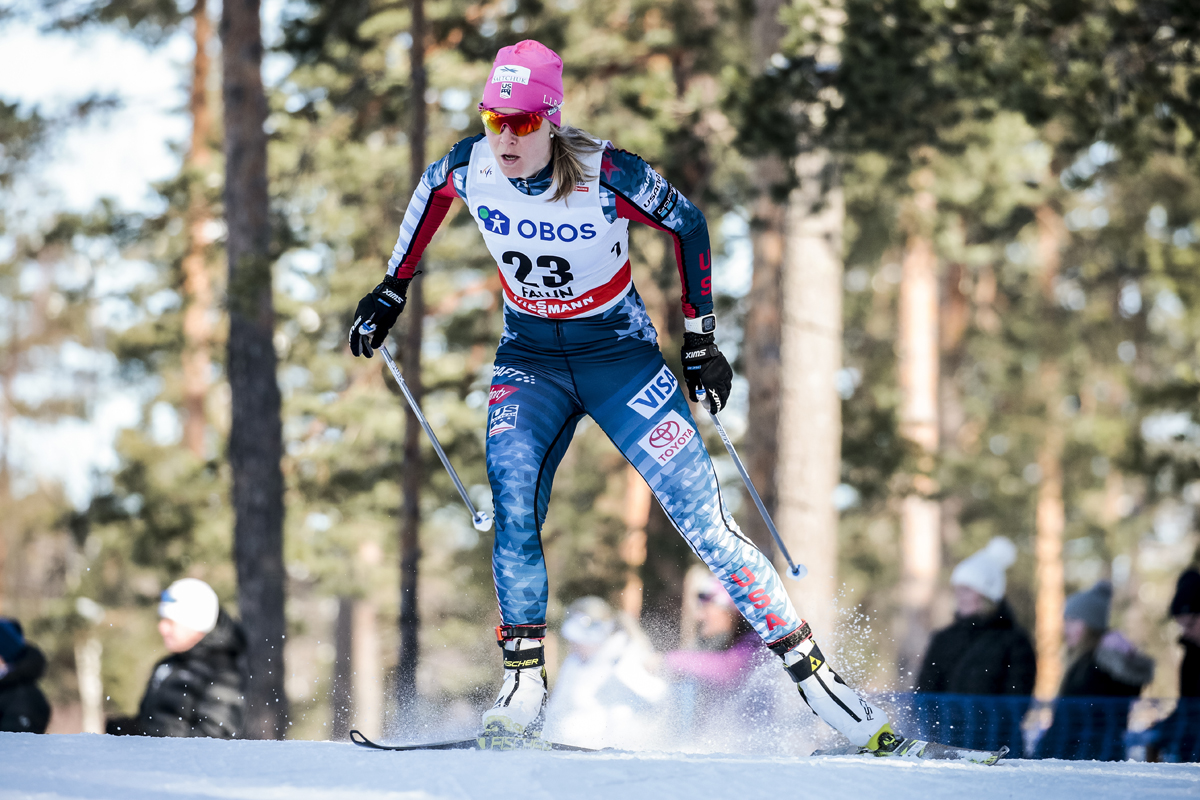
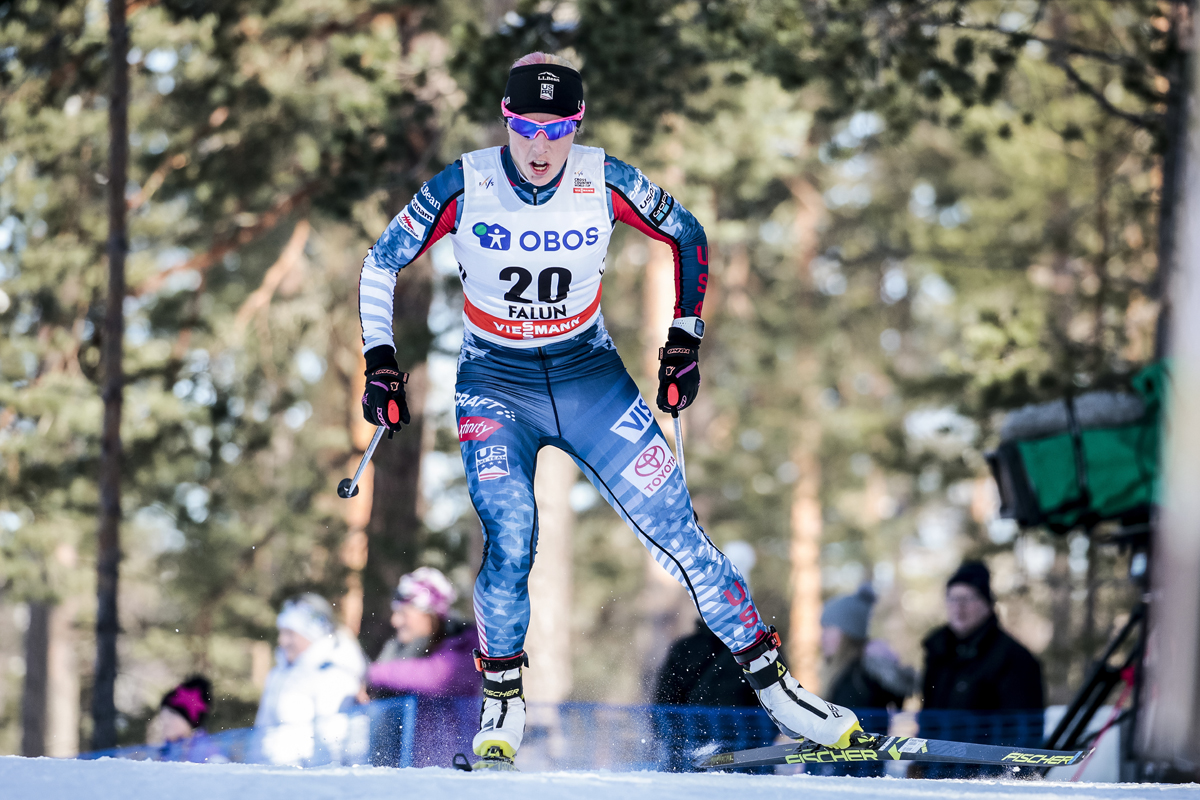
Finally, the start of this season brought the dawn of what has variously been called the “candy cane stripes” or “barber pole stripes” suit (#wellactually a barber’s pole historically has alternating red and blue stripes, not just red stripes as on the current U.S. suit). The left leg features red and white stripes, in a color-appropriate rendition of the American flag. The right leg has white stars on a blue background, again in patterning true to the actual flag. The stars are repeated on the left arm, and the stripes are briefly evoked on the right.
The car sponsor has once again changed, this time to Land Rover.
Here’s Kelley Roche, Soft Goods Product Manager for Swix Sport US, explaining the backstory for this year’s suit design in an email to FasterSkier: “Swix worked with Garen Riedel who owns his own design firm, Riedel Creative in New York. Garen worked closely with the athletes to design a suit that graphically works and they were excited to compete in. The goal is to design a suit that you can pick out of the pack and immediately and know it is a US athlete! This is important for the fan but really important for the coaches who support the athlete during the race. We ended up going with an asymmetric design, a continuation of the Seefeld suit design from 2019 and a retro reference to some of the suits of old, leveraging the iconic and patriotic American flag color palette with a slight color fade across the body.”
Roche added that the suit itself is made out of mesh, which in addition to being flexible and breathable “acts likedimples on a golf ball, balancing the lift and drag of the athlete.”
December 2019: Erik Bjornsen during the skate leg of the 2019 30 k skiathlon in Lillehammer, Norway. (Photo: NordicFocus)
December 2019: Lillehammer, Norway (NOR): Rosie Brennan (USA). (Photo: NordicFocus)
If you have read this far: For one, congratulations. For another, there is a wealth of historical material available in the FasterSkier archives. If you would have any interest in future compilations with a different focus — American biathlon, say, or best and worst of domestic American race suits over the past decade — please comment below, or email the author directly: gavin (at) fasterskier (dot) com. Thanks, and thanks for reading.
West Yellowstone remains an early season magnet for training. In good snow years, the grooming is otherworldly. In thin times, the fact that several trails are seeded with grass and legendary Rendezvous Ski Trails groomer Doug Edgerton turns water into wine means even meager snow can seem dreamy. And yes, there’s always the higher altitude South Plateau Rd. which comes into play when the winter blanket in town is lacking.
From Nov. 26-30, the Yellowstone Ski Festival will offer skiers new to the sport and those sporting dated Lycra or the latest fashion trends an opportunity to ski, mingle, and learn.
Liz Stephen (U.S. Ski Team) racing to 12th in the women’s 10 k freestyle mass start at 2018 SuperTour Finals in Craftsbury, Vt. (Photo: John Lazenby/Lazenbyphoto.com)
A few Festival highlights are worth mentioning. Former U.S. Ski Team member Liz Stephen will speak the evening of Nov. 29. This woman is formidable. She remains the high-turnover motor of her past World Cup days. Her value to the community persists as she espouses principles that ensure those around her are taken care of: she’s the consummate teammate. Walk of fame worthy in the cross-country community? Indeed. Worth hearing speak? Unequivocally.
Science writer Christie Aschwanden, author of the book “Good to Go: What the Athlete in All of Us Can Learn From the Strange Science of Recovery”, will speak on Nov. 27, the day before Thanksgiving. Aschwanden is known for her fastidious research. Her book is rife with nuggets dispelling what many believe are scientifically proven recovery methods.
Seriously, take a break from the cryotherapy on that Wednesday evening. Maybe shorten the foam rolling session: Aschwanden is the goods.
If you are looking for a one-stop, walk-to-the-trails ski vacation, where you can take a clinic, learn about waxing from Toko’s guru Ian Harvey, learn to shoot a biathlon rifle, test the early season fitness with a race, begin each morning with a yoga session, this could be your Thanksgiving destination.
Let’s circle back to note beginners are welcome. You’ll no doubt see plenty of carbon fiber poles, boots, and skis, and patch upon patch sublimated onto custom team clothing. It may look like an overly serious scene for something coined a festival. Remember, everybody was a beginner at some point – and West Yellowstone is the place to start.
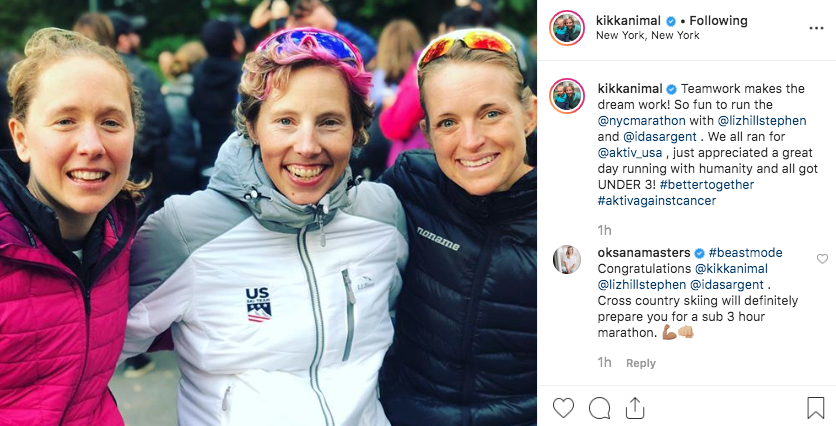
FasterSkier previously reported on four boldface names, former Winter Olympians all, who were planning on racing the 2019 New York City Marathon: Brian Gregg, Kikkan Randall, Ida Sargent, and Liz Stephen. Gregg had announced plans to run a 2:40 to 2:45 marathon. The three women were all planning to break 3 hours. All four runners met their goal.
In chronological order:
Brian Gregg logged an official time of 2:44:30 (all times discussed in this article are chip times; in a field of 50,000, it takes even top-1,000 finishers some time to reach the starting line, making the gun time somewhat unfair), meeting his goal with 30 seconds to spare. He was 336th among 30,000-plus men, and 360th overall. He went through the halfway mark in 1:19:37 before slowing somewhat over the final miles.
Kikkan Randall crossed the finish line in 2:55:12, good for 51st woman (out of nearly 23,000 women) and just inside the top thousand overall (990th). She exhibited textbook pacing, recording a half-marathon split of 1:29:09 before speeding up over the final miles. Her slowest mile after the 20-mile mark was mile 22, which took her 6:41. She ran mile 26 in 6:21, and the final 0.2 miles at a 6:18 pace.
Liz Stephen ran nearly the entire race with Randall and Sargent; she and Randall had the same time through mile 25. At that point Randall pressed ahead slightly, putting 25 seconds on her friend and teammate by the finish line. Stephen ran mile 26 in “only” 6:35 en route to finishing in 2:55:37. Stephen was 55th among women and 1,031st overall.
Ida Sargent ran with Randall and Stephen through mile 22 before dropping off the pace slightly. She finished less than two minutes back of Stephen in 2:57:22, good for 75th woman and 1,209th overall.
New York Road Runners reports that the average finishing time for the 2018 NYC Marathon was 4:40:22.
Among Randall’s copious media appearances in the days leading up to Sunday’s race, she appeared on Ari Ofsevit’s BirkieGuide.com Podcast, along with Brian Gregg, early last week. Gregg at one point discussed his transition to running for the marathon buildup, then frankly observed, “Running is hard.” Randall concurred, “Amen!”
Statistically speaking, only 2% of people who enter a marathon will finish under three hours. The 2019 TCS New York City Marathon was a bit above average, with nearly 3% (1,563 of 53,508 runners) breaking the elusive three hour barrier. Yesterday, four familiar cross country skiers joined the speedy club of athletes who have achieved this result.
Brian Gregg was first across the line, stopping the clock at 2:44:30 (6:17 per mile average). Next came a trio of Kikkan Randall, Liz Stephen, and Ida Sargent who worked together until the final miles. Randall finished in 2:55:12 (6:41 pace) followed by Stephen who was just 25 seconds behind. Fading behind her former teammates as they cruised through Central Park, Sargent made her way to 67th Street in 2:57:22.
A lot has changed for Randall since the 2018 TCS New York City Marathon where she stood in the crowd watching Stephen run by wishing she were out there too. FasterSkier caught up with Randall shortly before she headed to New York from her home in Penticton, BC to reflect on her experience with cancer treatment, marathon training, and what lies ahead now that she is back to feeling strong and healthy.
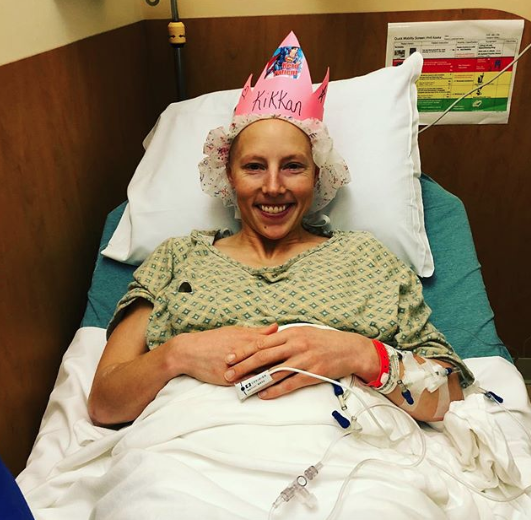
Randall was diagnosed with Stage 2 breast cancer in June of 2018 after discovering a lump in her breast on Mother’s day. She underwent six rounds of chemotherapy from July to October, followed by a lumpectomy in November. She continued to receive infusions of the Herceptin infusions every three weeks through July 2019 to stop the proliferation of the cancerous tissue. Though she is now finished with treatment, she will remain on anti-hormone medication for the next five to ten years to reduce the likelihood that the cancer will return.
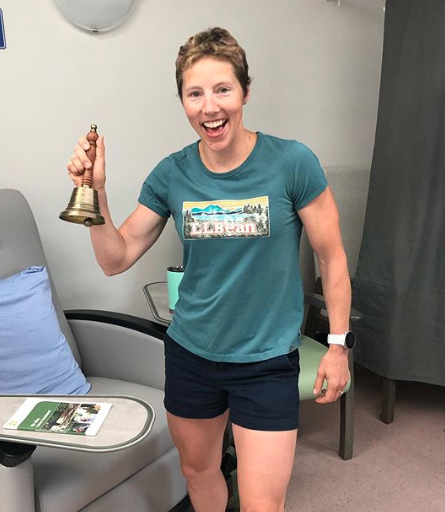
Kikkan Randall rings the bell marking her final Herceptin infusion in July 2019. (Photo: Instagram @kikkanimal)
In her typical fashion, Randall stayed active and positive all the while. With the support of her medical team, she explored the boundaries of what was possible physically during treatment. She explained that her doctors told her, “If I felt good, go for it.” And she committed to staying active, even if it was just for ten minutes each day or as simple as playing with her son, Breck.
Randall shared her journey openly throughout in order to inspire and encourage others going through similar challenges. She posted daily video updates for the first five months of her treatment on her website and continues to share her experiences through her Instagram and other social media outlets.
“I think back to where I was a year ago and I just feel incredibly grateful for how good I feel and the fact that everything has gone so well,” said Randall. “ Now I’m just staying optimistic that it’s going to stay that way.”
Randall explained that it is difficult to say whether her experience with treatment and how her body responded was what she expected.
“Cancer is something I really never had on my radar until I was getting that diagnosis. So not knowing what to expect, chemo was for sure the hardest part of it. It just knocks you down. It knocked my immune system down and I felt fluish between rounds. Overall, I still think I faired fairly well.”
She continued that she was relieved to be finished with chemo last October. As the lumpectomy was a minimally invasive surgery, she was able to recover quickly and began to feel as though she was getting back on her feet, despite continuing with radiation.
Kikkan Randall models her positivity through cancer treatment, heading into a lumpectomy “with good vibes”. (Photo: Instagram @kikkanimal)
“Some people said, ‘Oh, you’d be surprised how tired you get.’ So I was ready to be heavily fatigued and set up my lifestyle around the fact that if I needed to sleep a lot and not be accountable to too much, I was ready to do that. But I actually had the opposite effect.
“I was getting further from chemo, so feeling better and better as I went through radiation and I was in Anchorage, so I was able to ski a lot which was awesome. I did a 10k ski race the second to last week [of treatment].”
That is not to say Randall was immune to the effects of seven months of cancer treatment.
“I think by the time I got to the Birkie and did that, I didn’t feel awesome in the race. I felt like my legs were just really empty and I didn’t have a lot of power climbing on the hills. I think that was maybe the point where I went, ‘Oh, maybe there is a little bit of lingering fatigue.’ It wasn’t like I could barely make it through the day, it was just when I went to access that gear that I’ve always had, it just wasn’t quite as strong as I was used to.”
Randall finished 12th female in a time of 2:48:19.4.
Her version of retirement has not seemed to involve the change of pace one associates with the word. At the cessation of her treatments, Randall hit the gas, resuming her involvement in organizations like Fast and Female as well as saying “yes” to many speaking opportunities. This has created a busy schedule laden with frequent travel. Randall explained that she is navigating how to balance these opportunities alongside her desire to stay active and also have quality time with her family.
“For so much of the last 20 years, I had to be so in tune to getting enough sleep and rest so that every moment that I was training was effective. Now it’s more about, if I can exercise, it’s a bonus. I ultimately want to keep myself healthy, but that’s kind of a baseline, and there’s a lot of other responsibilities now.”
She continued that since training is no longer her primary focus, she is less concerned about the recovery aspects of her former lifestyle. She does not dwell on staying up late before waking up early if it means creating time for her family or other responsibilities.
“Which I think in some ways has come back to bite me,” Randall laughed. “I appreciate now why we take such good care of ourselves as athletes, why we get enough sleep, and have good nutrition, because it makes you feel so much better. So when I let myself get busy and don’t focus on that as much, after a week or two I start to feel it and snap back around.”
Randall expressed gratitude for the many intriguing opportunities she has been presented, from motivational speaking events to podcasts to traveling to China and hopping into a city sprint event on the streets of Beijing. Case in point: at the time of the call she had recently returned from the U.S. Ski Team Gold Medal Gala in New York City only to return the following week for the marathon. She acknowledged that she does not aspire to always be this busy, but after being somewhat on lockdown through treatment, she was “excited to finally do things again.”
She went on to describe the very relatable experience of fitting in her marathon training around all of this travel. One noteworthy experience took place this summer aboard a Royal Princess cruise ship. Randall was a guest speaker on the cruise from Vancouver to Ketchikan.
Kikkan Randall runs laps around the deck of a Princess Cruise ship to fit in her marathon training while on board as a motivational speaker. (Photo: Instagram @kikkanimal)
“I had to do my two-hour long run on the track around the deck, which wasn’t ideal but it’s the way I fit it in. I’ve been getting up at 5 am to get in workouts before I travel or before a day of appearances. I’ve just been trying to be creative — it hasn’t been ideal, but it’s been good enough.”
The TCS New York City Marathon on behalf of Aktiv Against Cancer has been on Randall’s radar for quite some time. She explained that her affiliation with Aktiv began in 2012 when the U.S. Ski Team was racing in Oslo, Norway. The organization invited Randall to an event and each subsequent year, the USST would go to partner hospitals in Oslo and workout with cancer patients in the exercise rooms that Aktiv funded.
“When I learned about the organization, I really believed in what they’re doing and that’s getting physical activity to be a prescriptive part of treatment, because I’ve learned through several experiences is a great way to deal with challenges… It was always incredibly inspirational and powerful to see the camaraderie [the patients] developed.”
Because of these experiences, she and her teammates, Liz Stephen and Ida Sargent, who were all slated to retire at the end of the 2018 season committed to racing that fall.
“That was the plan last spring when I came out of my career, then the co-founder of Aktiv actually called me and told me that were having an awards luncheon a couple days before the marathon and wanted to honor me with an award for the work that I had done.”
Randall accepted this invitation and expressed that she would be humbled by the award.
“A couple of weeks later, I got my cancer diagnosis, which was completely out of the blue. So I called them back and said, ‘You know what? I think our connection just got a lot deeper. I’m about to start treatment, so I’m not sure what’s going to happen, but I hope to be able to come to the luncheon.’”
Randall entertained the idea of still trying to run the marathon despite being in treatment, but quickly realized after a couple of rounds of chemotherapy that it would not be smart to push herself in that way. She still attended the luncheon and spectated to support Stephen in her run.
“It was so inspirational to see so many people out there running and at that point I had just finished chemotherapy, so it was just a chance to watch the racers come in and think, ‘Okay, next year I want to be back here. I want to be racing. I’m just going to believe that I’m going to be feeling good again.”
This optimism motivated her to raise money for Aktiv throughout her treatment.
“Along the way when I was going through treatment, I was wearing these brightly colored running shoes to remind myself to stay positive and hopeful through the process, and my husband came up with the idea to come up with some happy sock that would capture that same idea and be something we’d be able to pass out to other people going through a challenge.”
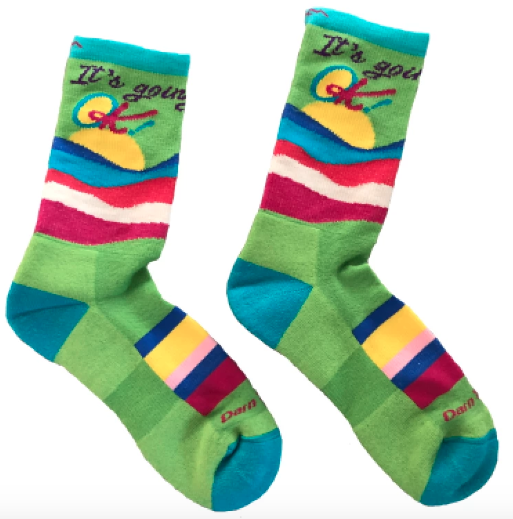
Kikkan Randall raised over $10,000 for Aktiv Against Cancer through the sales of her “It’s Going to Be OK” socks, made through a partnership with Darn Tough. (Photo: Instagram @kikkanimal)
The couple came up with the slogan, “It’s going to be OK” with a signature hot pink K. They collaborated with the Vermont based company Darn Tough to design brightly patterned socks and with USST sponsor LL Bean to create blue and pink headbands, which were sold through Randall’s website. $2 from each purchase goes to Aktiv.
“Through that project, we’ve been able to raise over $10,000 for Aktiv. We’ve sold over 5000 pairs of socks. It’s been so cool to see that these socks have been giving people hope.”
Though running often accounts for many hours of a yearly ski training program, Randall had not been spending much time on the roads during her career and consequently entered a marathon training program cautiously.
“I knew that the biggest thing to respect for the marathon was going to be getting enough running in — getting my legs ready to handle the pounding. And I knew that this would be quite a bit of an increase [in running volume] from what I had been doing in ski training.”
She contacted her former high school running coach who wrote her a training plan and began to slowly increase her mileage beginning in April.
“That’s been really helpful because I think it’s built up at an appropriate progression. And because I was able to stay pretty close to that plan all the way through, and I’ve made it through without any injuries — knock on wood.”
Kikkan Randall completed a one mile open water swim across Lake Washington in Seattle to on behalf of Swim Across America. (Photo: Instagram @kikkanimal)
While long runs and track workouts have largely taken the place of the multisport nature of her former regimen, Randall has continued to dabble in other physical challenges throughout her marathon buildup. At the beginning of September, Randall traveled to Seattle for a one mile open swim across Lake Washington with the organization Swim Across America, which raises money for cancer research and clinical trials through the Seattle Cancer Care Alliance.
Since this event, Randall has locked eyes on the marathon, even dropping the regular strength training sessions she completed until early October. As a test of her fitness, she ran the Okanagan Half Marathon on October 20th, taking the win for women with a time of 1:23:47.
She has enjoyed the new challenge, but will also be happy to vary her modes of exercise.
“I have to say — I’ve rollerskied three times this summer, and each time, I was like, ‘Oh my gosh, I love this.’ Because I’ve been prioritizing the running training, I haven’t been on rollerskis as much, I haven’t been on my mountain bike as much, so I miss that and I’m looking forward to getting back to that before the snow flies, then ski a lot this winter.”
What’s next on Randall’s athletic calendar after the marathon? She explained that she is hoping for a few new ski experiences this year, possibly including the Ski to the Sun race in Mazama, Washington, which last year was raved about by winner Liz Stephen. Randall is also interested in returning to the Birkie to see what she could do in good health.
“Then next summer, trying some new things — maybe an off-road triathlon or a mountain bike stage race or something fun. I do love racing, I love preparing for things, and I am loving these events where I get to meet up with teammates and friends and get to go out and hurt so good.”
Kikkan Randall gets out for a ski with her son, Breck. (Photo: Instagram @kikkanimal)
Ski racing aside, what Randall is looking forward to most is spending quality time with her husband and son.
“I’m just excited to be out on the snow with my family this winter. Breck is three and a half, so he’s excited to get out on snow.”
Though Randall could not have predicted the turn of events that unfolded after her retirement, the opportunity to inspire others through her cancer journey is aligned with how she originally envisioned using her gold medal platform.
“Coming off my career, I had hoped to be active in different causes and bringing awareness to the power of positivity and a lot of things that I learned through my athletic career that can be applied to the things we tackle in daily life. I thought it was going to center more on being a mom, training through pregnancy and coming back after, and how to balance being an athletic mom. I also was heavily involved with Fast and Female, so it was going to be focused on keeping girls in sports, and my position with the IOC.
“Now I have this cancer experience thrown into the mix as well. I’ve always enjoyed being able to share my stories of what I’ve learned through my ski career to help motivate and inspire others, so I had hoped to do some public speaking and I’ve had some really cool opportunities since I finished treatment to be out sharing my experiences, both as an Olympic athlete and as a cancer survivor now and as a mom.”
Randall plans to continue accepting motivational speaking positions, remaining involved with the IOC and U.S. Olympic and Paralympic Committee (USOPC), and collaborating with her partners.
She also hopes to stay involved in cross country skiing in a more hands on level. This summer she had the opportunity to work with a few junior programs, including the national junior camp in Park City. She is also on the board of the National Nordic Foundation (NNF).
“I’ve got a lot of different balls in the air right now and a lot of fun projects to be involved with, and I’m realizing that there is a limit in what is physically possible, especially with things that involve so much travel. I think over the next couple of years it’s going to be finding which opportunities I can make the most impact in and trying to find the right balance.”
Needless to say, cross-country athletes have big motors.
Let’s start with The Rut 50-kilometer mountain run in Big Sky, Montana. With 10,000 feet of climbing and descending, it’s a burly affair.
On September 1st, Erika Flowers, cross-country skier of note and Bozeman local, won the women’s 50 k overall in a time of 6:51:52.41 hours. This was Flowers’ first 50 k running race.
Elevation profile of The Rut 50 k. Pure burly. (Photo: runtherut.com)
South of rugged Montana, in the thin air of Colorado, Liz Stephen won The North Face Grand Traverse mountain run on August, 31st. She claimed the 40.7 mile women’s win in a time of 7:17:46 hours. According to the Trail Run Project, the GT running course features 6,1976 feet of climbing as runners traverse portions of the Elk Mountains on the way from Crested Butte to Aspen.
And way south in New Zealand, Jessie Diggins and Julia Kern, both U.S. Ski Team members, captured podiums at the New Zealand Winter Games.
In a fitting setting for the the inaugural Ski to the Sun Marathon and Relay, hundreds of skiers emerged from a fog-blanketed morning dreamscape in Mazama, Washington as they cruised down the Methow Valley to brilliant sunshine and the finish at Sun Mountain Lodge. Kent Murdoch, who splits his time between Mazama and Fall City, Washington, took advantage of his familiarity with the final climb to lead the marathon field over the 41 km course, passing a fading Liz Stephen in the last kilometer, to finish in 2:09:30.7. Stephen, the recently retired three-time Olympian who hails from Park City, UT, lead the women’s field in 2:10:20.4.
Men’s winner Kent Murdoch leads women’s winner Liz Stephen in the final kilometer. (Photo: Steve Mitchell/mitchellimage.com)
Rounding out the podium in the men’s division were Logan Wetzel of Bellingham, Washington in 2:09:56.2 and former NCAA All-American for the University of Denver and National Championship runner-up Mike Hinckley, who also resides in Bellingham, in 2:10:32.7. For the women, all three steps were filled with past Olympians as Methow locals Laura McCabe and Leslie Hall crossed the line in 2:10:43.3 and 2:25:43.0, respectively.
In the relay division, Chomper Bomper, a group of four junior skiers from the Methow Valley Nordic Team – Garrett Butts, Travis Grialou, Bodhi Kuzyk and Walker Hall – lead from the first kilometer to finish in 2:03:38.3, besting Shasey a duo of former national team biathlete Casey Smith and local mountain guide Michael Hutchins.
Despite fading at the end of the final climb – a 12 km stretch that stair-stepped its way from the floor of the Methow Valley up 1000 feet (300 meters) to the finish at 2,890 feet above sea level – Stephen glowed about the event, saying “we could not have hoped for a more beautiful day, more beautiful weather or more perfect tracks… I couldn’t be more excited to be here, especially with it being like a winter wonderland…. [The Methow has] been on my shortlist of places to [visit] for a long time. The race went off so smoothly… It was so fun and beautiful to ski through the trees and to end at such a perfect place like the Sun Mountain Lodge.”
Throughout the entire field, the buzz at the finish line was much the same, as smiling competitor after smiling competitor exalted about the weather, the course and the conditions. Jim Kelly, a veteran of twenty-two American Birkebeiners – the largest cross country ski race in North America – agreed with Stephen, saying “it was awesome out there… it was like a Birkie!”
For many, the course, which showcased the variety of natural beauty in the Methow Valley, was a real highlight. Todd Eastman of Putney, VT and US Race Program Director for Madshus skis commented: “Stunning scenery, beautiful course and track, and an honest challenge.”
All smiles in a sunny Methow. (Photo: Steve Mitchell/mitchellimage.com)
“I think it might be the best way to experience the Methow trail system and get to know the valley,” said Jenny Abraham of Boise, Idaho. “The trails are so beautiful meandering through the trees and along the river, and getting cheers from volunteers all along the course and seeing the relay teams at exchange zones was really fun.”
Her friend Larissa Swain from Leavenworth, Washington agreed, saying, “I loved how the low sun showed through the middle section, streaming across the snow. And it was so fun to have the course pop out of the woods near the river with the sun lighting up the whole valley! But,” she added, “my favorite part was skiing it together, enjoying each other’s company on a beautiful winter day.”
Jim Gregg, father of 2014 Olympian Brian Gregg, and a resident and racer in the Methow Valley for decades agreed about the camaraderie on the trail, commenting “that was a true citizen’s race.”
The event was organized through a partnership of Methow Trails, the nonprofit that grooms and manages 200+ kilometers (120+ miles) of trails in the Methow Valley, and Methow Valley Nordic Ski Educational Foundation, another nonprofit that focuses on delivering skier programs from classes, clinics and camps, to junior learn-to-ski and cross-country and biathlon racing programs. The vision for the event was a hybrid of ideas from the two organizations: create a marathon event that is a true testament to the level of skiing in the valley with a relay that has opportunities for skiers of all abilities to participate. A true community-based ski event.
For Methow Trails Executive Director, James DeSalvo, the collaboration not just between the two nonprofits, but the entire community was a critical aspect of the event, noting “The most thrilling part for me was seeing our trail community sharing a very high impact and fun experience. Everyone who makes our trail system possible was represented and enjoying the trails together; landowners, kids, pass holders, visitors, business members, board members, ski instructors and agency partners. The vastness of our 120-mile trail network typically encourages trail users to find their own little piece of trail to enjoy. While I wouldn’t give this up, there is something very inspiring about seeing hundreds of trail users all moving together, smiling and sharing their joy of the trails.”
The event’s appeal was clear to those on the sidelines as well. Kathy Dalton, who was filming the start and finish, said it made her want to begin racing, and she jumped into a local training group within days after the event..
For more experienced racers, the event had the draw of an annual highlight. Brad Bauer of Edmonds, WA exclaimed, “The Pacific Northwest has found its signature race!”
Runner-up Wetzel agreed, “It feels like something that’s been missing for us. Every other major ski destination has their big event. This is ours.”
With just shy of 400 competitors and a successful start in its first edition, the second Ski to the Sun Marathon and Relay is slated for late January or early February 2020. Stay tuned to methowtrails.org and methowvalleynordic.com for more info.
The women’s field cresting a hill during the scramble leg of the World Cup 4 x 5 k relay in Beitostølen, Norway.
FIS World Cup Beitostølen, Norway 4 x 5 k / 4 x 7.5 k Relay
Sunday in Beitostølen, Norway the women raced a 4 x 5-kilometer relay on firm tracks and under partly cloudy skies — Saturday’s races featured fresh snowfall.
Norway I took the win in a total time of 57:23.6 minutes. In order of relay legs, Heidi Weng, Therese Johaug, Ragnhild Haga, and Ingvild Flugstad Østberg comprised the team that raced at the sharp end of the race for all but the first leg.
Weng, the first leg skier for Norway, tagged Johaug in fourth, 7.3 seconds behind Russia’s Yulia Belorukova who scrambled for Russia I. From then on, Norway I set the speed benchmark.
Despite Russia I’s star power, it was Russia II that took second place Sunday. Lidia Durkina, Anna Zherebyateva, Mariya Istomina, and Elena Soboleva, having been gapped by Norway I, could pack-ski until the final stretch to slot over the line .5 seconds ahead of third place Finland I. (Russia II finished 37.3 seconds behind Norway I.)
Russia I’s anchor, Anna Nechaevskaya, fell in the final downhill turn losing several places for her team.
Finland I, the third-place team on the day, featured Johanna Matintalo, Krista Pärmäkoski, Ritta-Liisa Roponen, and Eveliina Piippo. Finland I finished 37.8 seconds behind winner Norway I.
The U.S. I team placed fifth (+48.0) in a performance that saw them out dual Sweden and Norway II in the closing moments of the race. Sadie Bjornsen, Rosie Brennan, Caitlin Patterson, and Jessie Diggins skied for the U.S. on a roster absent some names that were longtime staples of the U.S. team’s relay quartet — both Kikkan Randall and Liz Stephen retired from racing last season.
The U.S. had planned on fielding a second team featuring the U.S. Ski Team’s (USST) Sophie Caldwell (USST), Ida Sargent (USST), Kelsey Phinney (SMS T2), and Kaitlynn Miller (CGRP), however, they did not start.
Norway I held on for the win in the men’s 4 x 7.5 k relay today in Beitostølen in a time of 57:23.6 minutes. This was head-to-head racing at its finest. After 30 k of racing, the final standings came down to a lunge at the finish between Norway I and Russia I. Russia I placed second (+0.7).
Emil Iversen, Martin JohnsrudSundby,Sjur Røthe, and Finn Hågen Krogh formed the Norway I team. The Russia I team included Evgeniy Belov, Alexander Bolshunov, Denis Spitsov, and Andrey Melnichenko.
Norway II’s Didrik Tønseth, Hans Christer Holund, Magne Haga, and Simen Hegstad Krueger placed third (+53.4).
The U.S. team of Erik Bjornsen, Kevin Bolger, Scott Patterson, and Simi Hamilton placed 12th (+3:22.7).
IBU World Cup, Pokljuka, Slovenia 7.5 k / 12.5 k Pursuit
Looking smooth across the finish line, Norway’s Johannes Thingnes Bø, won the men’s 12.5 k pursuit in Pokljuka, Slovenia in a time of 30:20.4 minutes. That smoothness was matched in a photo finish with France’s Quentin Fillon Maillet who placed second, 0.1 seconds behindBø. Maillet cleaned his four shooting stages.
Bø looked in control for the last portions of the race. His strong skiing gave him a 50-second lead as he began his final shooting stage. There, the Norwegian missed two targets, allowing the chasers to latch back on during the final lap. In total, Bø missed three targets, one during his first prone stage, and two during his second standing stage.
Russia’s Alexander Loginov was third in the sprint, finishing 1.9 seconds back. Loginov missed one target in his first standing bout, otherwise, he shot clean.
Canada’s Christian Gow placed 14th (+1:09.1) while shooting clean. No other Canadians qualified for the pursuit.
For the U.S., Leif Nordgren was the best placed American in 33rd (+2:39.1, 0+2+1+0). Sean Doherty was 39th (+3:07.9, 0+0+2+2),
Kaisa Mäkäräinen of Finland won the women’s 10 k sprint in a time of 29:16.9 minutes. Mäkäräinen shot clean during the competition. Italy’s Dorothea Wierer was second, finishing 41.3 seconds behind while also shooting clean during all four shooting bouts.
Third place went to Paulina Fialkova of Slovenia. Fialkova finished 59.2 seconds back and shot clean for the day.
Clare Egan after placing sixth in the IBU World Cup’s 10 k pursuit in Pokljuka, Slovenia. (Photo: Biathlonworld.com)
For the U.S., Clare Egan placed a career-best sixth (+1:22.4, 0+0+1+0). Egan missed a single target during the race.
“I knew the pieces were there,” Egan told IBU TV after the race. “I had clean shooting in a [preseason] race at the Austrian trials before the World Cup. And then I had just awesome ski times this week, so I knew it was coming. I just had really good focus today, and I love competing head to head, so pursuit is a great race for me. I thought I was… I wasn’t sure if I was in fifth or sixth, and this Norwegian skier [Marte Olsbu Røiseland], really good, just got me at the finish. So I was so happy when I looked up and saw that I was in sixth in the flower ceremony.”
Also for the U.S., Susan Dunklee placed 39th (+3:36.3 0+1+0+1), and Joanne Reid 43rd (+3:51., 0+0+1+0).
CNST teammates Dahria Beatty (l) and Katherine Stewart-Jones charge the last hill of the 10km on their way to 6th and 1st respectively. (Photo: Peggy Hung)
Sovereign Lake NorAm/SuperTour 5k/10k Classic
The Sovereign Lake weekend wrapped up with individual start classic distance races and a more neighbourly distribution of results.
Katherine Stewart-Jones (CNST) won the women’s 10km in 31:48.4, hanging on in the last lap to finish ahead of APU’s Becca Rorabaugh (+7.1) and SMS’ Julia Kern (+7.8). APU’s Hailey Swirlbul snatched 4th at 10.9 seconds with Dahria Beatty (CNST) in 5th, 26.7 seconds back.
Kyle Bratrud on his way to victory in the 15km (Photo: Peggy Hung)
Kyle Bratrud (SMS T2) won the battle in the men’s 15km in 41:59.3, 3.8 seconds ahead of Ben Lustgarten (CGRP) and 34.7 seconds ahead of Ricardo Izquierdo-Bernier (NMU/CNEPH). Sam Hendry (CJNST) edged out Andy Newell (SMS T2) for fifth.
Individual start results are here with the full weekend here. Photos and interviews are coming in the Noram/SuperTour wrap-up.
Jessie Diggins (U.S. Ski Team) racing to 10th in the 2018 World Cup women’s 10 k classic in Planica, Slovenia. (Photo: Salomon/NordicFocus)
Welcome to FasterSkier’s World Cup Preview, where we check in with the top-10 teams from last year’s FIS Cross Country World Cup tour before the season starts. The World Cup begins with a classic sprint in Ruka, Finland on Nov. 24th.
***
United States
Overall in Nations Cup Last Year: 5th
Women’s Ranking 2017/2018:3rd
Men’s Ranking 2017/2018:11th
U.S. Skiers to Watch:
The high note last season was the gold medal team sprint performance by Jessie Diggins and Kikkan Randall. That pinnacle proved U.S. Ski Team (USST) coaches, wax techs, support staff, and of course athletes, could position themselves to succeed on the quadrennial winter sport prime-time stage. Time to exhale.
On both the men’s and women’s side, countless standout performances are vivid. Yet the collective success on the U.S. women’s team will remain a generational benchmark. It’s a good hunch, with the imminent 2018-2019 season, the women’s team has not hit it’s apogee.
This much is for certain: despite the retirements ofRandall and Liz Stephen, the U.S. women’s team remains loaded. Sophie Caldwell was the third ranked sprinter in the world last season. Sadie Bjornsen was top-10 in both the distance and sprint rankings, and sixth in the overall. Ida Sargent, despite breaking her thumb prior to the Olympics, finished 23rd in the sprint cup.
Although Rosie Brennan was not renamed to the 2018-2019 USST, she appears fully recovered from mono and will be starting the season on the World Cup as a discretionary selection.
Each World Cup weekend last year was time to check results and determine not if any of the women’s team had shined but who. The individual milestones were many.
Diggins’ season was a non-stop stream of highlights. In a post-Marit Bjørgen landscape, the Norwegian legend has retired, Diggins is poised to become even more of a force.
Not that anyone ever doubted Diggins, but watching Diggins charge and string out the field on January 28, during the 10-kilometer mass start freestyle in Seefeld, Austria was pure aerobic theater. She set the pace. She dictated the narrative. The move didn’t resemble an athlete taking a chance, but an athlete shifting into their top race gear and accelerating to the line. Pure confidence. For the remainder of Diggins’ season, there was no doubt.
Even with a skipped World Cup weekend in Lahti, Finland to manage media obligations back in the U.S. after the Olympic Gold, Diggins finished second overall on the World Cup.
Simi Hamilton (U.S. Ski Team) racing to 13th in the men’s freestyle sprint qualifier at 2018 World Cup Finals in Falun, Sweden. He went on to finish the day in 14th overall. (Photo: Fischer/NordicFocus)
On the U.S. men’s team, Andy Newellstepped down from full-time World Cup racing with a goal of making the 2019 World Championship team. Noah Hoffman retired and attends university. Simi Hamilton, the 17th ranked sprinter on the World Cup last season, is the veteran. Deep into his international career, Hamilton brings poise and power to the sprint roster. Paired with Erik Bjornsen, Hamilton co-leads a team sprint contender. After the duo placed sixth in the Olympic team sprint, Hamilton and Bjornsen are a possible breakthrough team for the Seefeld, World Championships.
Erik Bjornsen posted 13 top-30’s with an individual best of ninth place in the Seefeld 15 k mass start.
Scott Patterson comes off an Olympics and Holmenkollen 50 k where his ability to perform under pressure cemented him as a premier male long-distance skier. He placed 18th in the Olympic 30 k skiathlon and 11th in the marquee 50 k classic — a best U.S. men’s result since 1976. Patterson reinforced that performance with a 16th in the Holmenkollen 50 k skate.
New to the USST is Kevin Bolger. This season will be his first full-time European based campaign. Bolger more than impressed when he placed an astounding 11th overall in Lahti’s skate sprint last March. It was Bolger’s first career World Cup.
Paddy Caldwell will begin the season on the World Cup. He had several standout time of day performances in skate races last season.
Non-USST skiers starting on the World Cup will include overall SuperTour leaders David Norris and Kaitlynn Miller.
Caitlin Patterson (CGRP) and Kelsey Phinney (SMS T2) were discretioned as distance and sprint athletes respectively for early season World Cups. Adam Martin (CGRP) was a discretionary selection for the men’s distance races, his start rights begin in Lillehammer, Norway. Ben Saxton is scheduled to race only the classic sprint in Ruka, Finland.
News of Note from USST Head Coach Chris Grover:
On the men’s team: “The men have been in great shape this summer and fall,” Grover emailed FasterSkier. “Look for great results right away from Simi and Erik; both have had very productive preparation periods. Kevin Bolger has also had a great summer of training and looked very good in our October Park City camp. Scott Patterson had a broken toe to deal with for much of the summer but is doing well now. As you suggest, he’ll bring more experience to his WC campaign this season. You’ll see him in action first at the FIS opener in Beitostølen on Sunday, Nov. 18 (15 km F). Paddy Caldwell has been wrestling with occasional elbow tendonitis ever since New Zealand camp, so there is a decent chance that he has a slower start to the World Cup.”
Season goals: “The women’s team is a veteran squad that all now understand what it takes for them individually to be in top fitness in February. Our goal for Seefeld (women and men) is 3 medals and we have targeted 5-6 race days where we have good chances to win those medals. And I believe this World Cup season will be one of our best, if not the best. It’s going to be a great season to be a fan of USA cross country ski racing.”
On leadership: “Although we are missing Kikkan, Andy and Liz, and their strong leadership, we’ve had an excellent team atmosphere this preparation season, and we’ve had a lot of fun. Multiple athletes are stepping up to fill the leadership vacuum left by our retiring veterans. I’m really looking forward to getting on the road with this team (both USST and invited discretionary athletes) and watching this new squad in action.”
Norway’s Marit Bjørgen celebrates her overall win in the last race of 2018 World Cup Finals, the 10 k freestyle pursuit, on March 18 in Falun, Sweden. Bjørgen officially announced her retirement from skiing last Friday, April 6. (Photo: Svenska Skidspelen/Instagram)
You’ve probably heard the news by now: Marit Bjørgen, the Norwegian queen of cross-country skiing, has decided to retire. The 38 year old made the announcement a week ago after winning the first race of Norwegian nationals, the 5-kilometer classic, on April 6.
“In reality it has been a long process,” she told NRK that day, according to a translation. “I had almost decided before the competitive season started. I feel that I lack the motivation and desire required to be right there in the top. I also have a little boy at at home, who is beginning to understand more and more, that I’d like to spend time with. That time I can never have again. It’s also a little frightening. This is been half of my life. This is emotional.”
The most decorated Winter Olympian of all time across all sports with 15 medals, five of which came at the 2018 Olympics in PyeongChang (two golds, a silver, and two bronze), Bjørgen closed her season on Saturday, April 7 with a second-place finish behind teammate Ragnhild Haga in the national 30 k freestyle in Alta, Norway.
“I’m proud of what I’ve achieved in my career, but I’ve also been privileged to have been able to win top-level sports,” Bjørgen said in Norwegian team press release. “I am very much thankful to amazing team friends, teammates, coaches, medical team, service team, managers and the whole support crew that have been around me. You have a great deal of credit for my results.”
Teammates Marit Bjørgen (r) and Ingvild Flugstad Østberg after placing first and second, respectively, in the women’s 5 k classic at Norwegian nationals in Alta on April 6. (Screenshot: NRK broadcast)
Norway’s head coach Vidar Løfshus described Bjørgen as a “team captain” who was “always there for the girls,” according to an interview with NRK.
He added that she was also a valuable coaching consult.
“For me, she’s been a good sparring partner; when tough things happening internally, I often call Marit,” Løfshus said, according to a translation. “Now there will be one less coach in my team. There are a lot of good coaches in the association, but … [none that have] won so many medals. She knows more about cross country skiing then I do, Sju, Ole and Roar combined, almost.
“We can’t let a woman like that disappeared through the back door,” he said of his desire to keep Bjørgen involved with the team. “But now we’re gonna let her exhale and enjoy her time with [her son] Marius and [partner] Fred Børre. She has not had enough time for that. And after that I know she will contribute again.”
Bjørgen shared emotional moments with her teammates at nationals.
“She has been a role model to me for many many years,” Ingvild Flugstad Østberg told NRK.
“One day has to be the last,” Heidi Weng said. “We’ve had a lot of fun with Marit. She’s a legend. She has been the security blanket and the mother in the team. It’s frustrating not to have mommy at the starting line, someone to joke around with and calm your nerves. Someone who is supportive.”
Who else is on our list of notable cross-country retirements so far? (For our biathlon list, which should also include the additions of Norway’s Ole Einar Bjørndalen and Emil Hegle Svendsen, click here.)
Kikkan Randall (l) and Liz Stephen after the last race of their professional careers, the 30 k classic mass start at 2018 U.S. Distance Nationals in Craftsbury, Vt. (Photo: John Lazenby/Lazenbyphoto.com)
From the U.S., we have U.S. Ski Team members Kikkan Randall and Liz Stephen, who said ‘so long’ to international racing, while another team veteran Andy Newell told FasterSkier that he plans to continue racing, but apart from the national team and likely outside of the World Cup circuit.
Former national-team members Noah Hoffman and Kris Freeman have also announced their retirements from professional skiing. On the domestic side, Annie Hart has stated this was the last season of her ski career as she plans to begin law school.
There has been talk of a few of Canada’s World Cup Team members retiring, but the only one FasterSkier has confirmed so far is Graeme Killick.
Zina Kocher, a 2006, 2010 and 2014 Olympic biathlete who came out of retirement to make a bid for the 2018 Olympics in cross-country skiing, has stated that it’s really over this time after her comeback season.
“As I reflect on the last 16 years that I trained full-time and competed at an international level I’m flooded with a lot of memories,” Kocher, 35, wrote in a blog post last week. “If someone had told me when I started biathlon in ’98 that I would be a ‘lifer’ (aka someone who does the sport & can’t give it up till they’re an old veteran in their 30’s), I would have laughed and said ‘yea right’. But here I am, finally saying goodbye!”
Michael Somppi, of the Alberta World Cup Academy, is also retiring after 16 years of competitive skiing. Somppi, 29, a former member of Canada’s senior development team, won three national titles and World Cup start rights as Canada’s NorAm overall leader at the end of the 2014/2015 season.
“I didn’t accomplish everything I wanted to in my ski career, but I am really proud of all that I did accomplish,” Somppi wrote in a blog post on Sunday. “I feel I got all I could out of myself given the circumstances I faced and the system I worked in. Thinking back to when I started out ski racing in high school, I am amazed how far I’ve come. ‘Started at the bottom, now we here!’ I picked up racing late and was never the most talented. I worked hard with extreme motivation and focus to become one of the top skiers in Canada.”
“One of the highlights of my career was certainly the team sprint with my brother Dario at the Olympic Winter Games in Sochi,” Gianluca wrote in a Facebook post announcing his retirement, according to a translation. “We reached the 5th place and could take home an [Olympic] diploma. It was not only a highlight because of the 5th rank, but also because our parents were there to witness it live. I never dreamed of anything like that when I was a little boy.”
Sweden’s Emil Jönsson celebrates a 2013 World Cup victory in Lahti, Finland. (Photo: Fischer/NordicFocus)
The Swedish team is seeing the exit of Anna Haag, Emil Jönsson and Martin Johansson. Haag, 31, won gold with the Swedish women’s relay at the 2014 Olympics in Sochi, Russia, and has four medals from the last three Olympics. Jönsson, 32, Haag’s longtime partner and an internationally renowned sprinter, earned two Olympic bronze medals in 2014.
From Finland, four-time World Championships gold medalist Aino-Kaisa Saarinen is stepping away from competitive skiing at age 39.
“I have done this 20 years, what I really wanted, and I have raced my goals and even more,” Saarinen told FasterSkier after the last race of World Cup Finals in Falun, Sweden. “This skiing family is the thing what I’m going to miss the most, and of course, I love the competitions. I don’t know any other job where you can feel so high and so low, so, maybe those are the feelings right now, what I’m going to really miss the most.”
Poland’s 35-year-old Justyna Kowalczyk, a two-time Olympic champion and two-time World Champion, has announced her retirement as well.
Then there’s Aurore Jean, 32, who became the second French woman to reach the cross-country World Cup podium with a second-place skate-sprint finish in 2013.
And last but not least (for now), we have heard news of Russia’s Alexander Legkov — the controversial 2014 Olympic champion who was not allowed to compete at this year’s Games because of Russia’s systematic doping in Sochi — officially retiring.
“You have all been with me in the course of many years of my professional career and I truly love you all,” the 35-year-old Legkov said at a sports tournament in Khanty-Mansiysk, Russia, on April 6, according to the Russian News Agency. “… I will see all of you later, not at international tournaments, but perhaps at domestic tournaments or marathon. I am announcing the end of my international sports career.”
At the Sochi Games, Legkov won the 50 k freestyle mass start and took bronze with his teammates his the men’s 4 x 10 k relay. He ended his ski-racing career on March 3 in Rybinsk, Russia, where he placed fourth in the 50 k freestyle Demino Skimarathon.
Stay tuned for more retirement announcements as they are made public.
Kikkan Randall (r) sprays her U.S. Ski Team teammates Jessie Diggins (c) and Sadie Bjornsen (l) with champagne on the podium of the 30 k classic mass start at U.S. Distance Nationals in Craftsbury, Vt. Diggins won, Bjornsen placed second and Randall finished third. (Photo: John Lazenby/Lazenbyphoto.com)
2018 U.S. Distance Nationals (Craftsbury, Vermont): 30 k classic mass start
Jessie Diggins swept SuperTour Finals once again, after doing so last year in Fairbanks, Alaska, and winning every individual race at 2016 SuperTour Finals the year before in Craftsbury, Vt.
Back in Craftsbury on Tuesday, and coming off three-straight victories in the classic sprint, 10-kilometer freestyle mass start and mixed relay with her Stratton Mountain School (SMS) T2 Team teammates, Diggins, 26, pulled out her fourth-straight win in her last race of the season: the women’s 30 k classic mass start, which is part of U.S. Distance Nationals.
Jessie Diggins (r) edging her U.S. Ski Team teammate Sadie Bjornsen at the line for the win in the women’s 30 k classic mass start at 2018 U.S. Distance Nationals in Craftsbury, Vt. (Photo: John Lazenby/Lazenbyphoto.com)
She did so in an all-out effort to the line, beating her fellow U.S. Ski Team (USST) member Sadie Bjornsen by just 0.4 seconds in 1:25:27.2 hours. Diggins, Bjornsen of Alaska Pacific University (APU), and another USST member Sophie Caldwell (SMST2) broke away from the pack on the first of five laps at the Craftsbury Outdoor Center. Caldwell dropped off the pace around 10 k and skied on her own for the next 15-plus kilometers before being caught by a chase group of six, led by Kikkan Randall (APU/USST), on the final lap.
Meanwhile, Diggins and Bjornsen skied together, trading the lead for the rest of the race. On the final short climb up to the stadium, Diggins pulled ahead slightly then extended her lead in the finishing straight. After finishing first and second, respectively, Diggins and Bjornsen laid on the ground for what seemed like a long time, particularly spent from the effort, before congratulating each other. Behind them, Randall outlasted the chase pack for third (+2:21.7), Caldwell followed just behind her in fourth (+2:23.1), Ida Sargent of the Craftsbury Green Racing Project (CGRP) and USST placed fifth (+2:26.5) and Rosie Frankowski (APU) finished sixth (+2:29.2).
Also in the top 10, Liz Stephen (USST) finished the last race of her professional career in seventh (+3:10.9), Caitlin Patterson (CGRP) eighth (+3:27.2), Kaitlynn Miller (CGRP) ninth (+3:56), and Chelsea Holmes (APU) 10th (+4:45.3).
Stratton had two wins on the day with Charlotte Ogden (SMS) winning the junior women’s 20 k classic mass start in 1:04:33.9. Canada’s Catherine Reed-Metayer (Skibec Nordique) placed second (+11.8), Waverly Gebhardt (Steamboat Springs Winter Sports Club) finished third (+33.8), and Phoebe Sweet (Craftsbury Nordic) was the third American junior in fourth overall (+1:10.2).
Spring Series concludes with the men’s 50 k classic mass start on Wednesday, starting at 9 a.m. EDT. Watch the races live on the SuperTour live stream.
The start of the women’s 30 k classic mass start at 2018 U.S. Distance Nationals in Craftsbury, Vt. (Photo: John Lazenby/Lazenbyphoto.com)
Jessie Diggins (1) leading the women’s 30 k classic mass start at 2018 U.S. Distance Nationals in Craftsbury, Vt. (Photo: John Lazenby/Lazenbyphoto.com)
Sadie Bjornsen (2) leading the women’s 30 k classic mass start at 2018 U.S. Distance Nationals in Craftsbury, Vt. (Photo: John Lazenby/Lazenbyphoto.com)
Sadie Bjornsen (2) leading the women’s 30 k classic mass start at 2018 U.S. Distance Nationals in Craftsbury, Vt. (Photo: John Lazenby/Lazenbyphoto.com)
Sadie Bjornsen (2) leading Jessie Diggins (c) and Sophie Caldwell (l) during the women’s 30 k classic mass start at 2018 U.S. Distance Nationals in Craftsbury, Vt. (Photo: John Lazenby/Lazenbyphoto.com)
Ida Sargent (15) leads Kikkan Randall. Caitlin Patterson, Liz Stephen (yellow bib) and others in a chase pack during the women’s 30 k classic mass start at 2018 U.S. Distance Nationals in Craftsbury, Vt. (Photo: John Lazenby/Lazenbyphoto.com)
Sadie Bjornsen (2) and Jessie Diggins (1) racing for first in the women’s 30 k classic mass start at 2018 U.S. Distance Nationals in Craftsbury, Vt. (Photo: John Lazenby/Lazenbyphoto.com)
Kikkan Randall (3) racing for third place in the women’s 30 k classic mass start at 2018 U.S. Distance Nationals in Craftsbury, Vt., ahead of Sophie Caldwell (second from l), Ida Sargent (second from r), and Rosie Frankowski (r). (Photo: John Lazenby/Lazenbyphoto.com)
Jessie Diggins (l), Liz Stephen (c) and Rosie Frankowski (r) at the finish of the women’s 30 k classic mass start at 2018 U.S. Distance Nationals in Craftsbury, Vt. (Photo: John Lazenby/Lazenbyphoto.com)
Jessie Diggins with a photo of her retiring U.S. Ski Team teammates Kikkan Randall and Liz Stephen on her cheek at 2018 U.S. Distance Nationals in Craftsbury, Vt. (Photo: John Lazenby/Lazenbyphoto.com)
Kikkan Randall (l) and Liz Stephen after the last race of their professional careers, the 30 k classic mass start at 2018 U.S. Distance Nationals in Craftsbury, Vt. (Photo: John Lazenby/Lazenbyphoto.com)
The women’s 30 k classic mass start podium at 2018 U.S. Distance Nationals in Craftsbury, Vt., with Jessie Diggins (c) in first, Sadie Bjornsen (l) in second and Kikkan Randall (r) in third. (Photo: John Lazenby/Lazenbyphoto.com)
The women’s 10 k freestyle pursuit podium on the last day of 2018 World Cup Finals in Falun, Sweden, with Norway’s Marit Bjørgen (c) in first, and Americans Jessie Diggins (l) and Sadie Bjornsen (r) in second and third, respectively. (Photo: Fischer/NordicFocus)
FALUN, Sweden — NOR. USA. USA.
Looking at the results monitor, those were the tri-letter country codes that popped into the top three at the end of the women’s 10-kilometer freestyle pursuit at World Cup Finals on Sunday.
The “NOR” belonged to Marit Bjørgen of Norway, who ended her 2017/2018 World Cup season with yet another win. In Sunday’s pursuit, the 37 year old led from start to finish and ended where she started, in first after covering the course in a time of 24:18.9 minutes.
For many who follow the World Cup, a Norwegian name — like Bjørgen, who has won more than 110 individual World Cup races — at the top of the results is nothing new. All due respect.
But the pressure for Scandinavia to hold off an American entourage is mounting; Sunday’s race presenting itself as a prime example.
A 41-second gap separated American Jessie Diggins from Bjørgen by the time she flipped past the start wand, her characteristic cheek sparkles visible from the stands. As the third starter on course, Diggins had sewn shut the 5 seconds that the day’s second starter, Ingvild Flugstad Østberg of Norway, had on the American and within the first kilometer, was establishing herself as Bjørgen’s main threat.
“I had 45 seconds in the total time at Mördarbacken the first time,” Bjørgen reflected in a post-race interview with FasterSkier. “And then it was 30 and then 20, then I was a little bit stressed. I thought, ‘Aha, I have to work harder a little bit.’ I feel like on the uphill I was the same speed as Jessica, but she was better than me on the easier part of the tracks. And I’m really happy to make it. I had to push hard in the end.”
Norway’s Marit Bjørgen leading off the front during the women’s 10-kilometer freestyle pursuit on Sunday at World Cup Finals in Falun, Sweden. (Photo: Fischer/NordicFocus) (Photo: Fischer/Nordic Focus)
After catching Østberg, Diggins led the Norwegian and eventually dropped her by 17 seconds at 3.75 k. On Bjørgen, she had gained just over five seconds in time. By the 5 k mark, Diggins was a little less than 30 seconds back, and had put 13.4 more seconds into the race leader.
“I was grateful to feel so good today,” Diggins told FasterSkier. “We had amazing skis and that was really important. Especially on a course with so much gradual climbing and gradual working downhills, you needed to have good skis, and our techs delivered. And they gave us the tools we needed to have a good day.”
At the 7.5 k mark, 20 seconds separated the American from the win. By the time Diggins crossed the finish line in second, she was 16.7 seconds behind Bjørgen. The effort from Diggins gave her the fastest time of day in 23:54.4 minutes, which was 24.5 seconds faster than Bjørgen’s time.
“It’s a sport of patience,” Diggins said. “I feel like I’ve been coming into my own with the confidence to know that any race I start, I can be trying to fight for the podium and racing like I can win. Instead of racing like, ‘Oh, I’m going to try to just see what I can do,’ it’s like, ‘No, I’m going to try to win.’ ”
But Diggins was not the only American hunting and holding off Norwegians. Her U.S. teammate Sadie Bjornsen, who had gone out hot in Saturday’s race in hopes of a podium, earned it on Sunday in a sprint finish for third (+1:11.5) between herself and Norway’s Ragnild Haga and Astrid Uhrenholdt Jacobsen.
In the finishing stretch, Bjornsen, Haga and Jacobsen had gone head to head, with the American outlunging Haga — the gold medalist from this year’s Olympic 10 k state — by exactly half a second and beating Jacobsen by 1.3 seconds for the final spot on the podium.
American Sadie Bjornsen earning third in the women’s 10-kilometer freestyle pursuit on Sunday at 2018 World Cup Finals in Falun, Sweden. (Photo: Fischer/NordicFocus)
“Coming into the final stretch I was like, ‘OK, that is the last time you get to do the final stretch this year and make it count,’ ” Bjornsen told FasterSkier. “It ended up working out for me, and that turned into quite the dream day.
“I think the step I made this year is one step closer to being in a place where Jessie is racing right now,” Bjornsen continued. “To have a teammate who is just pushing the bar just every single day and making me believe that in order to be the best racer in the world, you have to have no fear. Jessie is a great example of that and it is certainly contagious.”
On Sunday, Bjornsen had started 21 seconds behind Østberg and 29 seconds ahead of Haga. By 7.5 k Haga had caught the group battling for third, which included Bjornsen, Finland’s Krista Pärmäkoski, Østberg, Sweden’s Charlotte Kalla, and Jacobsen. The group stayed together until the downhill back toward the stadium.
“I was like, ‘OK, I have to be smart here and keep pushing the pace hard enough that we do not get caught from behind, but conserve for that final sprint and then when I came into the sprint lap,’ ” Bjornsen reflected.
Along with being a podium threat in Sunday’s race, the Americans are also gunning full-speed ahead toward the top three in the overall, sprint or distance World Cup standings. On Friday, Sophie Caldwell of the U.S. claimed third in the season-long Sprint World Cup. On Sunday, Diggins stood on the podium in second in the Overall World Cup and third in the Distance World Cup.
“We are really showing that we are a skiing nation, and it’s taken so many years and so much hard work from a lot of people, but I think it’s so cool to show that we can be in the fight,” Diggins said.
The women’s 10 k freestyle pursuit podium on the last day of 2018 World Cup Finals in Falun, Sweden, with Norway’s Marit Bjørgen (c) in first, and Americans Jessie Diggins (l) and Sadie Bjornsen (r) in second and third, respectively. (Photo: Fischer/NordicFocus)
“It’s been a many year goal of ours to be ranked in the top three for the women’s team and we secured that for the first time today,” U.S. Ski Team Women’s Coach Matt Whitcomb told FasterSkier of his team’s best-ever Nations Cup ranking. “We’ve come into [past] finals, I believe, ranked third and then come out of finals ranked fourth. We’ve been fifth. And I think as an entire team, men and women combined, … I think we’ve finished fifth, which would be exceptional. It was really quite an achievement for both our men’s and women’s teams.”
In the decade leading up to the past two World Cup seasons, podiums from American women peppered the circuit, but predominantly in sprints. Kikkan Randall holds most of those, having recorded 28 individual podiums before 2016, only five being in a distance greater than 2 k. Sophie Caldwell broke through with a third-place sprint finish in 2014.
American Liz Stephen had also reached the World Cup podium four times in distance races prior to 2016 — twice outright and twice for time of day.
From 2016 on, the number of podiums that have gone to U.S. women has only increased. Caldwell earned three podiums this season alone. Diggins has racked up a total of 14 individual World Cup podiums since her first (which was also a first place) in 5 k freestyle in Toblach, Italy, in 2016. Bjornsen now has a total of five podiums over the course of two seasons. Stephen added two more to her name, one time of day and one outright, and Randall another top three in this past December’s Davos sprint.
Whitcomb was quick to point out that much of this success, started with U.S. Ski Team veterans Randall and Stephen, who skied the last World Cup races of their careers on Sunday. Randall finished the race in 43rd (+4:33.3) with the 29th-fastest time of day, and Stephen 50th (+4:57.2).
“Honestly I start crying every time I think about it,” Whitcomb said, referring to the fact that Randall and Stephen will be retiring after this season. “It’s been a day that I have feared for my whole career, basically since I started working with Kikkan and Liz, really since they started working with us.
“I know we are not saying goodbye forever, but definitely we are saying goodbye in a certain capacity to two of the most important people that have ever set foot on the U.S. Ski Team,” he added.
The two spoke with Fasterskier after their last race together, perhaps fitting as Stephen joined the team in 2006, only a year after Randall. The pair have worked with Whitcomb for the past 12 years.
“As your whole career flashes before your eyes, it’s the people that are the best part,” Randall, 35, said.
In their career final World Cup race on Sunday, both Randall and Stephen donned unicorn headbands, pink arm warmers and spandex boyshorts inscribed with the words “Thank You!!” across the backend. During their pre-race morning run, they felt something was missing and made a spur-of-the-moment stop at a store to purchase a few “costume pieces” for the race. Their outfits sparked smiles as they completed the race, and there was no denying the message they hoped to send off as they departed the ski-racing world: the energy and enthusiasm of a strong team.
(Article continues below)
The last-race outfits worn by Kikkan Randall and Liz Stephen for Sunday’s World Cup Finals pursuit. (Photo: Kikkan Randall/Instagram)
“We are all most proud of the team we built,” Randall said. “To see it at such a good point and to know just because we are leaving the scene doesn’t mean it’s going away; these girls are going to continue to carry the torch, the young girls coming in.”
“I would second that,” Stephen, 31, said. “One of the main things was that we wanted to leave a program that sustain itself, and I think that we both feel very happy and confident that that is going to happen. Like Kikkan said, Jessiewon more points this year alone than we used ever see in an entire season men and women combined, you know, 10 years ago, and so I think that is a testament of the success that we have been able to create for one another.”
Both Randall and Stephen were also given the opportunity to take a victory lap after the race, alongside Finland’s Aino-Kaisa Saarinen and Sweden’s Anna Haag, who sported a Disney Princess bath towel as a superhero cap, as well as a bejeweled crown (in an interview with FasterSkier, Haag explained the outfit had not been coordinated with the Americans, but was rather a coincindence. The Americans and Swedish skier are longtime friends and shared a nonalcoholic-champagne beverage in the finish area after the race).
“I certainly wasn’t expecting a send-off like that,” Stephen said. “That was really special, that the four of us were able to do that together.”
“I have done this 20 years … and I have raced my goals and even more,” Saarinen told FasterSkier. “Actually this skiing family is the thing what I’m going to miss the most.”
Also racing for the U.S. on Sunday, Caitlin Patterson finished the pursuit in 35th (+3:58.4) with the 22nd-fastest time of day, Caldwell finished in 36th (+4:00.7), Rosie Frankowski 46th (+4:41.3), Kaitlynn Miller 56th (+6:13.8), and Ida Sargent 57th (+7:06.4).
“It’s been a really unexpected good season, and I am really happy with it,” Miller said. “Today was awesome seeing Sadie and Jessie finish out the World Cup season like that.”
The Canadians were led by Cendrine Browne, who finished 39th (+4:14.4) with the 27th-fastest course time, followed by Emily Nishikawa in 48th (+4:43.7), Dahria Beatty in 54th (+6:04.3) and Zina Kocher in 60th (+9:28.4).
“I love the course, it is perfect for me,” Browne wrote in an email to FasterSkier. “Steep up hills and one skate sections are what I prefer best! I was suprised yes!!! All season I was trying so hard to get into the top 30. Maybe I was trying to hard and putting to much pressure on myself. Today, I decided to have fun and to forget everything and it just happened!”
“I am really happy about my season even if it was filled with so many emotions,” Browne continued. “Going to the Olympics and placing 33rd at my first Olympic race is definitely a highlight. Also, my 36th place in Holmenkollen is a huge accomplishment for me. Even if I fell twice and should have been in the top 30, it was an awesome race. And today’s 27th place is definitely the best thing that happened this season. Finishing the season like this fills my heart with joy and hope for next season.”
***
Norway’s Marit Bjørgen finishing first in the women’s 10 k freestyle pursuit at 2018 World Cup Finals in Falun, Sweden, while American Jessie Diggins (in background) chases for second place. (Photo: Fischer/NordicFocus)
Notes: While there has been a lot of discussion about retirements, Bjørgen isn’t saying it’s over.
“I want to finish [the season] in a good way, but I think I’ve been at my very best. I’ve passed it [my peak],” Bjørgen said in a loosely translated interview with NRK on Friday.
So will she race next winter? Bjørgen estimated she would need to train at least 850 hours if she wanted to compete with her teammate Therese Johaug, who will be returning to the World Cup next season.
“It’s going to be a lot of training, and you have to prioritize a lot. That’s the toughest thing,” Bjørgen said. “But when I’m at work, it’s no problem. I’m here to do the job. Should I do one more year, I will not do it halfway [half-hearted].”
The women’s 10 k classic mass start podium at 2018 World Cup Finals in Falun, Sweden, with Finland’s Krista Pärmäkoski (c) in first, Norway’s Marit Bjørgen (l) in second and Ingvild Flugstad Østberg (r) in third. (Photo: FIS World Cup Svenska Skidspelen/Facebook)
FIS Cross Country World Cup Finals (Falun, Sweden): 10/15 k classic mass starts
Day 2 of World Cup Finals in Falun entailed 10- and 15-kilometer classic mass starts on Saturday, and in the first race of the day, Finland’s Krista Pärmäkoski pulled out a thrilling finishing-sprint victory over Norway’s Marit Bjørgen.
After American Jessie Diggins led early in the first 2.5 k loop, Bjørgen set the tone from the front for most of the race. With less than a kilometer to go, Norwegian powered up the final horseshoe-shaped climb in first, with Pärmäkoski and Bjørgen’s Norwegian teammate Ingvild Flugstad Østberg just behind her. The three had dropped the field while lapping through the stadium around the 7.5 k.
While Østberg fell off the pace on that final uphill, Bjørgen accelerated as she took a few quick strides over the top, gaining a few meters on Pärmäkoski as they headed into the descent. The finishing stretch is long in Falun, and Pärmäkoski was able to come on strong just before she and Bjørgen entered the final 100 meters before the finish. There, Pärmäkoski’s double-pole speed not only matched Bjørgen, but beat her, as Pärmäkoski passed her with several meters to go and took the win by 0.2 seconds in 26:00.5 minutes. It was Pärmäkoski’s second win of the season and fourth of her career (including time-of-day pursuit stage wins).
Just behind Pärmäkoski and Bjørgen, who congratulated each other immediately at the finish, Østberg finished 5.1 seconds back in third. Five women fought for fourth place, with Sweden’s Ebba Andersson taking it (+14.5) ahead of Japan’s Masako Ishida in fifth (+14.8), Sweden’s Charlotte Kalla in sixth (+15.2), Austria’s Teresa Stadlober in seventh (+15.4), and Diggins in eighth (+15.5).
Norway’s Astrid Uhrenholdt Jacobsen was the next finisher across the line in ninth (+24.8), then Finland’s Kerttu Niskanen in 10th (+26.2) and American Sadie Bjornsen in 11th (+26.3).
Canada’s Emily Nishikawa was the next North American in 36th (+1:31.1), and she led her teammates Cendrine Browne, who placed 50th (+2:05.7), Dahria Beatty in 61st (+2:46.6) and Zina Kocher in 69th (+6:12).
For the U.S., Sophie Caldwell finished 41st (+1:36.1), Rosie Frankowski 44th (+1:43.7), Caitlin Patterson 47th (+1:54.8), Ida Sargent 52nd (+2:10.2), Liz Stephen 54th (+2:20.0), Kikkan Randall 57th (+2:34.1), and Kaitlynn Miller 64th (+2:50.7). Rosie Brennan did not start.
The men’s 15 k classic mass start podium at 2018 World Cup Finals in Falun, Sweden, with Russia’s Alexander Bolshunov (c) in first, Sweden’s Calle Halfvarsson (l) in second, and Italy’s Francesco de Fabiani (r) in third. (Photo: : FIS World Cup Svenska Skidspelen/Facebook)
In the men’s 15 k classic mass start on Saturday afternoon, Russia’s 21-year-old Alexander Bolshunov notched his first-career World Cup win after reaching the podium seven other times this season (placing third in six of those seven races).
Bolshunov hung in the pack and took the lead at the start of the final lap at 11.25 k, ahead of four of his Russian teammates, Alexey Chervotkin in second, Evgeniy Belov in third, Andrey Larkov in fourth, and Maxim Vylegzhanin in fifth. Behind them, Switzerland’s Dario Cologna skied just ahead of Norway’s Martin Johnsrud Sundby and Canada’s Alex Harvey, who were among 29 skiers within four seconds of first.
While Sweden’s Calle Halfvarsson led the final climb before the stadium, Bolshunov caught him on the downhill and out-double-poled him in the finishing stretch, taking first by 1.3 seconds in 36:59.8. Halfvarsson finished second and Italy’s Francesco de Fabiani scored his second World Cup podium of the season in third (+3.1).
Kazakhstan’s Alexey Poltoranin missed the podium by 0.6 seconds in fourth (+3.7), Chervotkin followed in fifth (+5.2), ahead of Cologna in sixth (+5.6) and Italy’s Federico Pellegrino in seventh (+5.6), after they finished together. Sundby and his Norwegian teammate Niklas Dyrhaug also crossed the line at the same time in eighth (+6.3) and ninth (+6.3), respectively, just 0.1 seconds ahead of another one of their teammates, Sjur Røthe, in 10th (+6.4).
Less than five seconds later, Harvey finished 20th (+10.7), ahead of Norway’s Johannes Høsflot Klæbo in 22nd (+13.6). Klæbo slipped out of contention on the third of four laps, as he dropped from fourth to 22nd in less than two kilometers.
Canada’s Devon Kershaw finished 26th (+14.6) for his fourth-straight race in the top 30 (including his 26th-place finish in the Olympic 50 k classic mass start), Graeme Killick placed 41st (+1:13) and Julien Locke was 81st (+3:29).
Erik Bjornsen was the top American man in 52nd (+1:47.1), Simi Hamilton finished 62nd (+2:06.4), Kevin Bolger was 69th (+2:27.1), David Norris 70th (+2:31.2), Scott Patterson 71st (+2:40.6), Paddy Caldwell 75th (+2:52.7), and Andy Newell 86th (+4:47).
World Cup Finals conclude with 10/15 k freestyle pursuits on Sunday.
France won the International Biathlon Union (IBU) World Cup women’s 4 x 6 k relay to start the day at Holmenkollen, ahead of Germany and Italy, while the Canadian women’s team (Sarah Beaudry, Julia Ransom, Emma Lunder, and Rosanna Crawford) placed 11th and the U.S. (Clare Egan, Susan Dunklee, Joanne Reid, and Emily Dreissigacker) came back from 21st to finish 15th.
In the men’s 12.5 k pursuit that followed, France’s Martin Fourcade won his 10th race at Holmenkollen, putting himself 49 points ahead of Norway’s Johannes Thingnes Bø with three individual races in Tyumen, Russia, remaining. US Biathlon’s Sean Doherty tied his second-best result this season in 17th and his teammate Lowell Bailey raced up to 28th with the 19th-fastest time of day. Leif Nordgren placed 40th and Tim Burke was 47th, while Canada’s Scott Gow finished 51st and Christian Gow was 54th.
The women’s 1.4 k freestyle sprint podium at 2018 World Cup Finals in Falun, Sweden, with (from left to right) Sweden’s Jonna Sundling in second, Sweden’s Hanna Falk in first and Norway’s Marit Bjørgen. (Photo: Fischer/NordicFocus)
FALUN, Sweden — Even the sky had predictions for Sweden. Without a cloud in sight, cerulean blue and a golden sun served as Falun’s backdrop for the opening race of the 2017/2018 World Cup Finals on Friday: the 1.4-kilometer freestyle sprint.
Exactly nine weeks ago in the city sprint held in Dresden, Germany, Sweden’s Hanna Falk was showing shades of greatness. In the first race of the new year, the 28-year-old Swede claimed the Dresden freestyle sprint title for her first World Cup victory since 2010.
With the final sprint of the season taking place on the Falun ski trails, where Falk — a member of Sweden’s national team — spends most of her time training, the statistics were levied. All signs pointed to Sweden, in particular, Falk.
With one group of fans holding a banner that read “Falk för President” and still more waving the national flag, Falk won Friday’s Falun sprint final in 3:08.25 minutes, finishing the last sprint of the season the same way she started the new year: in first.
“This is just great to win here in Sweden. It’s my second victory this season and I am so happy that my parents are here to see it,” Falk said, according to an International Ski Federation (FIS) press release.
Falk started Friday with the fastest qualifying time of 2:59.88 (she remained the only woman to dip below the three-minute mark throughout the entirety of the day on the 1.4 k course).
Later, when Falk learned that the season’s overall sprint leader, Norway’s Maiken Caspersen Falla, would not advance to the final (American Sophie Caldwell and Norway’s Silje Øyre Slind snagged the two lucky loser spots in the final instead), Falk took a calculated approach for the final heat. She would be in control.
“With Maiken not in the final I knew that the pace might not be so high so I went for it on the second climb to make sure I had a good gap on the long downhill,” Falk told FIS.
From the start, Falk set the pace, leading through the first hill while Sweden’s Jonna Sundling and Anna Dyvik, Norway’s Marit Bjørgen, Slind, and Caldwell followed.
In the first descent, Falk maintained her position at the front, while Dyvik swung to her outside left and Bjørgen, Sundling and Caldwell clung just behind. Slind tucked in just behind in sixth.
Heading into the second uphill, Falk remained at the front with Dyvik matching her pace. Just before the crest of the hill, the eventual race winner visibly slowed, the rest of the field following suit. A half second later, Falk burst back to life, snapping over the top of the climb and putting close to two meters between herself and the group as they cornered back to the stadium.
Sweden’s Hanna Falk (r) smiles as she wins the fourth World Cup race of her career and first race in Falun, Sweden, with a victory in the women’s freestyle sprint at 2018 World Cup Finals on Friday. Her teammate Jonna Sundling (l) placed second while Norway’s Marit Bjørgen finished third. (Photo: Svenska Skidspelen/Instagram)
Chasing Falk on the descent was Bjørgen, then Dyvik and Sundling. Slind raced just behind them in fifth and Caldwell behind her in sixth. Coming into the final stretch, it was Falk in first, now at least three meters ahead. Sundling had moved around Dyvik and Bjørgen into second, leaving those two to battle for third.
Falk ultimately crossed first for her fourth-career individual World Cup victory, 0.53 seconds ahead of Sundling in second. Holding off a charge from Dyvik, Bjørgen crossed third, 1.4 seconds behind Falk.
In fourth was Dyvik (+1.72), followed by Slind in fifth (+4.30) and Caldwell in sixth (+6.99). The sprint finish marked Caldwell’s ninth World Cup top 10 this season. Additionally, the American finished eighth in the classic sprint at the Olympics last month in PyeongChang, South Korea.
Caldwell reached Friday’s final by qualifying in 16th, then winning the fourth quarterfinal and taking third in a photo finish with Slind (who followed in fourth) in the second semifinal. The top-four women from that semi all advanced to the final was fast-enough times.
Caldwell Achieves Goal of Top 3 in Sprint World Cup
While Falk’s win boosted the Swede from fifth to fourth in the final Sprint World Cup standings, Caldwell retained her podium position ahead of her in third. For the first time in her career, the 28-year-old Caldwell finished in the top-three of the overall Sprint World Cup.
Thinking back two years, Caldwell could remember a conversation she had with U.S. Ski Team Women’s Coach Matt Whitcomb about race goals. Whitcomb wanted Caldwell to write down goal in particular: to be in the Sprint World Cup overall top three.
“At the time I was like, ‘Eh, no, that seems pretty far off,’” Caldwell reflected in a post-race interview with FasterSkier.
“I remember she was a bit sheepish when we suggested it,” Whitcomb told FasterSkier on Friday.
The 2017/2018 women’s Sprint World Cup podium with Norway’s Maiken Caspersen Falla (c) in first, Sweden’s Stina Nilsson (l) in second and American Sophie Caldwell (r) in third. (Photo: Fischer/NordicFocus)
Yet on Friday, Caldwell looked on from the podium as an American flag rose in honor of her third-place finish in the overall sprint standings. With a total of 396 points, Caldwell claimed third behind Sweden’s Stina Nilsson, who had 495 points for second, and Norway’s Falla in first with 573 points.
“We were really psyched that she took after it because, all of us coaches, really believed it could be done,” Whitcomb said.
“I was of course thrilled to be up there today,” Caldwell said. “It’s been a good season with some really good results, but I think maybe what I am most proud of is just the consistency of my season — making it into the semifinals almost every sprint and skiing with confidence throughout the year.”
Though Caldwell expressed that results can be gratifying, they are not the be-all and end-all of her ski career nor what she attributes to her and the U.S. team’s momentum.
“My hope is that people back home see this team not only for our results, but also for the friendships we have and the atmosphere we have going on in this team,” Caldwell said. “I think this team has come so far … It started with Kikkan [Randall] sneaking into the top 30, then Kikkan finding herself on the podium, then Kikkan winning. She sort of showed us all that we could do it, too, and pulled us up with her, believed in us so that we could believe in ourselves. Now on any given weekend it could be any one of us on that podium, which is really cool.”
Falla, who finished Friday’s sprint in eighth after being eliminated in the semifinals, won the overall sprint title for the third-straight season, this time by 78 points over Nilsson in second after Nilsson missed Friday’s sprint due to illness.
“For sure I wanted to be able to fight for the podium today but I made a mistake in the semifinal and I wasn’t able to get back into position to advance,” Falla told FIS after finishing fourth in the first semifinal behind Falk, Sundling and American Jessie Diggins, respectively. “But I can’t be too upset as I have won my third Crystal Globe and I am very proud of that.”
Three Americans in Top 10
Rounding out the rest of Friday’s freestyle-sprint top 10 was Diggins in seventh, her U.S. teammate Sadie Bjornsen in ninth and Sweden’s Ida Ingemarsdotter in 10th.
Sadie Bjornsen (4) racing in Friday’s freestyle sprint semifinal with her U.S. teammate Jessie Diggins (2) and Slovenia’s Anamarija Lampic (25) while chasing Norway’s Maiken Caspersen Falla (left, pink headband), among others. (Photo: Fischer/NordicFocus)
After racing to second place in the first quarterfinal behind Falk, Bjornsen automatically advanced to the first semifinal. Diggins won the third quarterfinal to advance to the first semifinal as well.
In the semis, Diggins finished third, 0.42 seconds behind Falk in first and just 0.08 seconds behind Sundling, who automatically advanced in second.
Bjornsen followed in fifth, 0.87 seconds out of first, behind Falla in fourth (+0.68). Aside from the top two in that first semifinal, no one from that heat advanced to the final.
American Sadie Bjornsen racing to fourth in the women’s 1.4 k freestyle sprint qualifier at World Cup Finals in Falun, Sweden. She went on to finish the day in ninth overall. (Photo: Fischer/NordicFocus) (Photo: Fischer/Nordic Focus)
To start the day, Diggins had qualified for the rounds with the second-fastest time, 1.65 seconds behind Falk, while Bjornsen qualified in fourth (+2.96).
“I definitely felt really good about how my body feels. I guess I was wishing for a bit more today,” Bjornsen told FasterSkier after. “For the last sprint of the year it was a fun way to end, leaving something to hope for.”
The last World Cup sprint of her career, American Kikkan Randall qualified for the heats in 18th before advancing to the same quarterfinal as Diggins. While Diggins gapped the field by the final downhill back toward the stadium and won the heat, Randall remained in contention to automatically advance in second until the last lunge to the line. There, Randall finished third, 3.14 seconds behind Diggins and just 0.1 seconds shy of second place, which went to Ingemarsdotter.
“I did not feel good in the first half of that heat; my body just wasn’t quite warm yet,” Randall told FasterSkier after. “I just tried to keep myself in there.”
Randall was disappointed not to advance past the quarterfinals in her last sprint, but when asked to reflect on the season as a whole, the 35 year old remained thoughtful.
American Kikkan Randall racing to 18th in the women’s 1.4-kilometer sprint qualifier at World Cup Finals in Falun, Sweden. She went on to finish the day in 15th overall. (Photo: Fischer/NordicFocus
“I was really happy to be able to start a family and come back. I think that went as well as I could have hoped,” Randall said. “And even though it took some patience at times … and the season didn’t go exactly as I planned, with the foot injury mid-season, I came around big at the Olympics this year and happy that I was able to get back in form when I needed to.
“I’m glad I stuck with it this long,” she continued. “I’m just trying to enjoy the last bit of time with my teammates, my staff and all the World Cup friends.”
After the disqualification of Russia’s Natalia Nepryaeva for her second yellow card (due to a false start in her quarterfinal), American Ida Sargent finished the day in 36th, followed by Rosie Brennan in 49th, Caitlin Patterson in 63rd, Liz Stephen in 66th, Kaitlynn Miller in 69th, and Rosie Frankowski in 75th. Emily Nishikawa was the top Canadian woman in 40th, Dahria Beatty finished 48th, Cendrine Browne 60th, and Zina Kocher 71st.
Norway’s Marit Bjørgen celebrates her seventh Holmenkollen 30 k victory on Sunday in Oslo, Norway, ahead of American Jessie Diggins, Norway’s Ragnhild Haga (not shown) and Sweden’s Charlotte Kalla. (Photo: Fischer/NordicFocus)
*Update: This article previously stated that Jessie Diggins was the first American woman to reach a podium at the Holmenkollen. Diggins is actually the first American woman to reach the Holmenkollen podium in the 30 k distance, second woman to podium at a Holmenkollen in history. In 1980, American Allison Owen reached the podium in the 10 k distance.
OSLO, Norway — Some pointed to the broadcast screen in disbelief. Others began waving their Norwegian flags with revitalized vigor. Twenty minutes earlier, Norway’s Marit Bjørgen appeared to be out of the running for another win in the women’s 30-kilometer mass start at Holmenkollen.
She had lost nine seconds to the leaders by the 11 k mark and another 17.9 seconds had dissipated between her and the the leaders as they passed 13.3 k. A little over the halfway point, at 16.3 k, the 37-year-old Bjørgen was down 36 seconds.
For any spectator familiar with Bjørgen’s race tactics, she does not favor come-from-behind style skiing. In this year’s Olympic 30 k classic mass start, she pulled away from the field in the first 8 k and went on to claim gold by a close to a two-minute gap.
Exactly one year ago, in the 2017 Holmenkollen 30 k classic, she had put 33 seconds into the field by 8 k, tripling that in the following 10 k, before crossing the finish line more than two minutes ahead of the rest of the field. If racing to win, Bjørgen usually starts by burying the competition.
Sweden’s Charlotte Kalla leads American Jessie Diggins and Norway’s Ragnhild Haga during the Holmenkollen women’s 30 k freestyle mass start at the World Cup in Oslo, Norway. (Photo: Fischer/NordicFocus)
So when Sunday’s top three — Sweden’s Charlotte Kalla, Norway’s Ragnhild Haga and American Jessie Diggins — broke free, the predictions for the podium went with them.
“I thought I was fighting for the fourth place,” Bjørgen said at a post-race press conference.
With Bjørgen out of the driver’s seat, the attention from the teleprompter and crowd turned to Diggins, Kalla and Haga. For the most part, the three skied in a line, with Kalla and Diggins exchanging leads.
Still anytime the Swede pulled at the front, her effort appeared to be a byproduct of Diggins. Every uphill churn from the Swede seemed like an attempt to stave off the American. Diggins continually reinstated herself ahead of Kalla in first: stars and stripes unmistakably spearheading the way.
On a course that is fabled for Norway, in a sport that is historically Scandinavian, the U.S. skier repeatedly put the iconic suits of Sweden and Norway behind her. But this seemed to be more than just the dogged-skiing characteristic of Diggins’s race style. The 26-year-old Minnesota native was not just being gutsy. She was making a point.
“I think there has been this myth that Americans, OK, maybe they can win short distances, and maybe Jessie can win a 5 k but there is no way she can hang in a 30 k,” Diggins told FasterSkier during an in-person interview after. “I was setting out to debunk some myths today.”
For the first 8 k, Diggins charged the field of 54 skiers. Along with Kalla, she spurred the lead group’s gap that formed at the 13 k mark. In another 5 k from there, she had broken free of Bjørgen. Without looking back, Diggins was chasing down a Holmenkollen master head on.
“Maybe it wasn’t smart to be leading so much, but I was thinking this is my only shot and so I got to go for it,” Diggins said. “It was an incredible feeling to be leading the Holmenkollen … for me, trying to be competitive in every race that I enter has been a goal for a long time. I don’t want to be a specialist, I want to be a medal threat in every race that I do.”
As Diggins continued to pose a threat in the front, danger lurked behind. Bjørgen cut through the course, the dreaded dorsal fin gradually on the rise.
At 18.3 k, the gap from Bjørgen to the leaders was 32 seconds. In two kilometers, that was reduced to 26 seconds. Another 2 k and Bjørgen was four seconds closer. Over the course of 5 k, Bjørgen had cut her time back from the leaders in half; another 5 k still remained and 15 seconds separated her from the top three.
A wave of surprise and simultaneous excitement rolled over the spectators. Six seconds separated her from the lead group at 27 k. The Norwegian pushed closer and closer, and with 1.5 k left in the race, she was back in contact with the front pack.
“It was amazing that I did it,” Bjørgen said. “I haven’t thought it was possible … but when we passed the stadium, the last time, before we go off Gratishaugen … I thought … I wonder if they want to change skis and they didn’t.
Norway’s Marit Bjørgen leading teammate Astrid Uhrenholdt Jacobsen in the Holmenkollen 30 k freestyle mass start at the World Cup in Oslo, Norway. (Photo: Fischer/Nordic Focus)
At 13.3 k Bjørgen stopped to switch skis, as did her Norwegian teammate Astrid Uhrenholdt Jacobsen. Kalla, Diggins and Haga did not. After the top three bypassed the ski exchange, one thing was on the Bjørgen’s mind.
“I thought I had to push hard,” Bjørgen said.
Fueled by the energy of her home crowd, Bjørgen went on to pass Haga, Diggins and Kalla in the final kilometer. Alone, she raced toward the final stretch and crossed the finish line first in a time of 1:18:12.4 hours, earning her seventh Holmenkollen title in historic fashion. She now also holds the record for most Holmenkollen victories of any woman.
“I haven’t won a competition like this, so it’s all so very special,” Bjørgen said. “To win at Hollmenkollen … for sure it’s the biggest you can do after the World [Championships] and the Olympics.”
Crossing 3.6 seconds behind Bjørgen was Diggins in second place. She became the first American woman to reach the podium at Holmenkollen in the 30 k distance. 1980, American Allison Owen reached the podium in the Holmenkollen, which was raced as a 10 k.
“I didn’t know who it was [chasing the top three] I just heard that the gap was shrinking,” Diggins said. “I felt I was just sprinting the last 4 k. That was my only shot. We didn’t change skis which maybe was a mistake, but also you make the best call that you can at the time.”
The Holmenkollen women’s 30 k freestyle mass start podium on Sunday in Oslo, Norway, with Jessie Diggins (l) in second, and Norway’s Marit Bjørgen (c) in first and Ragnhild Haga (r) in third. (Photo: Fischer/Nordic Focus)
While she held off Haga and Kalla, those two battled for third. Haga outlunged Kalla by a just one-tenth of a second for the final spot on the podium (+4.3).
“I am very happy with my sprint, my finish against Charlotte,” Haga said. “I regretted that we didn’t switch skis when I heard that Marit caught many seconds there, but suddenly she just came up and, yeah, she is always there when it matters. So Marit is amazing today as well.”
Rounding out the women’s top 10 was Kalla in fourth (+4.4), Jacobsen in fifth (+11.6), Ingvild Flugstad Østberg in sixth (+1:39.5), Finland’s Krista Pärmäkoski in seventh (+1:51.7), Germany’s Stefanie Böhler in eighth (+2:10.2), Austria’s Teresa Stadlober in ninth (+2:11.6) and Sweden’s Ebba Andersson in 10th (+2:11.9).
U.S. skier Sadie Bjornsen finished 11.5 seconds outside the top 10 in 12th (+2:23.4) in what she described as her “best Holmenkollen finish.”
“I was really looking forward to today. I had not too many awesome feelings lately,” Bjornsen told FasterSkier after. “I was just looking forward to the simplicity of a skate race. I had a ton of fun out there.”
American Kikkan Randall (19) leading Canada’s Cendrine Browne and Russia’s Alisa Zhambalova during the Holmenkollen women’s 30 k freestyle mass start on Sunday in Oslo, Norway. (Photo: Fischer/NordicFocus)
Following Bjornsen, U.S. skier Kikkan Randall placed 19th (+3:21.9) in what will be her final Holmenkollen race. The first time Randall raced at Holmenkollen was in 2007. As she reflected on her years of racing there, the 35-year-old Olympic gold medalist remained humble of the time she had spent on the historically challenging trail.
“This is probably one of the coolest places to race, with the atmosphere and the spectators,” Randall said. “It was definitely hard, but I really enjoyed it … there’s something that’s hard to put into words about pushing yourself over the course of an hour and twenty minutes. It just kind of feels good to finish a little bit empty.”
After a photo finish with French skier, Anouk Faivre-Picon, American Caitlin Patterson finished 28th (+4:13.1), just behind Faivre-Picon in 27th. Sunday’s race was Patterson’s second Holmenkollen freestyle race, and the 27-year-old Craftsbury Green Racing Project member was happy to spend the first two-thirds of it with a large group of racers that included Randall.
“This one was way better because I was actually in it. That other year I was just blown out,” Patterson said, referring to her previous Holmenkollen skate race, in 2015, when she placed 53rd. In last year’s Holmenkollen 30 k classic, she finished 36th.
“Today my goal was to stay more relaxed and as much as I wanted to stay with the lead pack, but not burn all the matches right at the start,” Patterson added.
“I switched my skis the last lap, with the snow starting to come down … and for better or worse, it did mean I lost the pack,” she continued. “But then I was able to ski with Anouk for the last lap and we reeled in that Norwegian and a Russian. … I always feel a lot better about races if I finish strong, whatever the place is.”
Also for the U.S., Rosie Frankowski, of Alaska Pacific University, finished in 31st (+4:45.4), 28.3 seconds outside the top 30.
Canada’s Cendrine Browne finished 36th (+6:16.1) followed by Emily Nishikawa in 44th (+7:36.1) and Dahria Beatty in 49th (+9:45.1).
For the U.S., Liz Stephen finished 51st (+10:01.7) and Kaitlynn Miller 53rd (+16:05.0).
Along with Randall, Stephen also completed her final Holmenkollen on Sunday. Stephen had her parents cheering her on after they made the trek to Norway to watch her race in person. Her closing words on her final time around the historic course were full of emotion, both happy and sad.
“I think this is actually the first race that I have ever looked at Matt [Whitcomb] in the eye during the race and thanked him for the feed and kept going,” Stephen, 31, said. “It’s bittersweet. It’s certainly not the way I was hoping to end it but … it was really special watching Noah [Hoffman] hug his dad yesterday.
“I mean this sport has been our life and it is hard to leave, but it is time,” she added, referring to her retirement at the end of the season. “And I am really lucky to have had such a good run with it. And to have an amazing team to let go forward.”
Norway’s 27-year-old Ragnhild Haga racing to gold, her first Olympic medal, in the 10 k skate at the 2018 Olympics in PyeongChang, South Korea. (Photo: FlyingPointRoad)
FasterSkier would like to thank Fischer Sport USA, Madshus USA, Concept2, Boulder Nordic Sport, and Swix Sport US for their generous support, which made this coverage possible. PYEONGCHANG, South Korea —Be honest. Who chose Norway’s Ragnhild Haga as Thursday’s gold medal favorite?
In pre-race hearsay, the 26 year old seemed an outside shot for the win. On the Olympic stage, other names openly circulated the 10-kilometer freestyle race. Sweden’s Charlotte Kalla was one.
The 30-year-old Swede had already proven her form — and Olympic intent — by opening the 2018 Pyeongchang Winter Games with a skiathlon win. Even with that hardware tucked away, Kalla was by no means overzealous to have her sights set on another distance gold medal. She’s well known on the World Cup for her 10 k podium performances. Two Olympic cycles ago, she collected gold in the Vancouver 10 k skate race.
If not Kalla, then the Norwegian name ‘Marit Bjørgen’ was certainly heard. Haga’s teammate, Bjørgen, has been first or second in all but five World Cup 10 k skate races she’s entered over the past decade. At the Vancouver 2010 Winter Olympiad, the Norwegian finished two places behind Kalla to take the 10 k freestyle bronze.
Sweden’s Charlotte Kalla racing to second at the 2018 Olympics in PyeongChang, South Korea. (Photo: FlyingPointRoad)
After Kalla and Bjørgen, another name to consider was Norway’s Ingvild Flugstad Østberg. At one time perhaps considered a sprint specialist, Østberg is more a cross-country all-arounder. She has three 10 k freestyle World Cup wis, one from 2016 and two from this season.
Add to the medley Finland’s Krista Pärmäkoski, who, with numerous second and third place 10 k World Cup podiums, was plenty hungry to take a freestyle win (she earned her first 10 k classic victory earlier this year in Planica, Slovenia). Another name tossed around in the stands and over the loudspeaker was Jessie Diggins of the U.S.A.
Prior to PyeongChang, Diggins made it palpably clear twice, if not more, that striving for a medal is a goal of hers at these Winter Games. Her gutsy win the Seefeld 10 k freestyle mass start — the final World Cup event before the 2018 Olympics — was the first performance nod to the direction she hoped to head in South Korea.
Her second sign off came in a Jan. 29 blog post titled “Brave Enough”.
Jessie Diggins after placing fifth in the women’s 10 k freestyle at the 2018 Olympics in PyeongChang, South Korea. It was her second top-five and her third top-six of the Games. (Photo: FlyingPointRoad)
In that post, Diggins makes it clear that it is not necessarily whether the suitcase she packs at the end of the games includes a gold, silver, or bronze disc strung with blue-ribbon. It is the idea that as she watches the smoke clear from the closing ceremony’s firework display and stands to depart the 2018 Olympic venue, she leaves knowing that she went after that prize the best that she could.
“I want to know that I was brave enough to want it,” she writes, of achieving the first women’s cross-country Olympic medal.
In the line just before, she writes, “I know it’s not impossible, after all.”
A 2015 World Championships silver medalist in the 10 k freestyle and known for her ability to grind through grueling uphills in skating events to the top of the field, it would be imprudent to say that Diggins was not a medal contender. By the start of Thursday’s 10 k, the 26-year-old Afton, Minnesota, native had securely nailed a spot in the polls. No one was pulling your ear.
Not necessarily in the predictions was Haga — until the Norwegian’s stats were pulled up on paper. In 10 k freestyle events, Haga has had seven top-five World Cup performances. Three of those were podiums (second or third place) that came in the past two months.
Still, while Haga has been racing the World Cup since 2010, none of those eight years produced an outright win. The Norwegian’s best performance to date was in this year’s Ruka 10 k pursuit, where she finished with the top time of day. The PyeongChang Games mark Haga’s Olympic debut and Thursday’s 10 k skate is her second only Olympic race. Last Sturday she crossed 15th in the skiathlon, which she personally described as “just a bad day.”
“It is easy to get a little bit uncertain about my shape and skis and everything,” Haga said during a press conference after Thursday’s 10 k. “We didn’t know exactly what happened, but I just tried to put it behind me.”
Norway’s Marit Bjørgen racing to a tie for third with Finland’s Kris Parmakoski (not shown) in the women’s 10 k skate in the PyeongChang Games. (Photo: FlyingPointRoad)
Redemption came knocking. Haga covered Thursday’s 10 k course in a time of 25:00.5, which put her in the leaders chair, and later, the top of the podium with gold.
Haga didn’t start the day as number 1, but in bib 50, exactly two minutes ahead of Kalla.
At first, Kalla had the fastest splits, besting Bjørgen, who had started earlier in bib 32, by almost five seconds and Pärmäkoski (bib 48) by six seconds at the 1.4 k checkpoint. At the 5 k mark, Kalla had doubled her lead on both the Finn and the Norwegian.
“I tried to ski very offensive from the first lap,” Kalla said at the press conference. “I knew that it will be very tough today. When you are on the bottom of the long downhill you will work very hard until you are there the next time. It was hard to keep up a good technique today, because I became very tired. It was hard to get recovery.”
Østberg in bib 58 was skiing in third by the halfway point. Diggins, who started in bib 56, had moved from seventh to fifth by 5 k, 13.5 seconds away from the win and 4.5 seconds away from third.
Jessie Diggins racing to fifth at the 2018 Olympics in PyeongChang, South Korea. (Photo: FlyingPointRoad)
Backtracking to the first 1.4 k, Haga had the fourth-fastest time, before moving into second behind Kalla at the halfway mark.
In another kilometer, everything shuffled. Kalla’s pace dropped in rank and she moved back into second. Haga’s pace came out 1.7 seconds faster than the Swede’s to take the lead. Diggins was now in third, skiing 17.9 seconds out from the win and 0.7 seconds ahead of Bjørgen in fourth. At 6.2 k, Pärmäkoski lingered in fifth, 2.6 seconds away from Diggins.
All five skiers held their positions over the next 2.2 k.
“I wanted to start first in the group because, I thought that maybe after the first lap I could go out with Ingvild Flugstad Østberg or Heidi Weng,” Bjørgen explained at the press conference.
While she waited in the finishing pen, Diggins, Kalla, Haga and Pärmäkoski were still on course.
“I heard after 5 k that I was close up to the medals,” Bjørgen continued. “The problem for me was that I was losing in the middle of the race, like I have done this winter.”
With less than two kilometers left in the race, Haga buried her competition. With legs that looked fresh, the Norwegian headed up the final climb and finished 31.9 seconds faster than Bjørgen.
“I think I had a better start than usual,” Haga said at the press conference. “I felt very good and got good messages from the coaches, that I was only a few seconds behind. On the last lap I was very afraid that some of the others were going to speed up. So I increased my speed and got some more seconds. I just focused on staying on my feet on the last downhill and to give it all to the finish line.”
Jessie Diggins pushing toward the finish in the Olympic 10 k skate. (Photo: FlyingPointRoad)
Back out on course, the American was visibly working every turn, every hill, to her max.
“Of course you want a medal, you always want a medal, that’s why we are here, that’s like the point of the Olympics,” Diggins told FasterSkier after the 10 k. “But there are other things that are also really important besides the actual hardware. I think it’s important to not put other people’s expectations on me. To be that close and to be skiing with the best in the world. I have looked up to Marit my entire life.”
To take a quick tick back in history, Diggins was born eight years before Bjørgen’s World Cup debut in 1999. The American came onto the World Cup circuit in 2011. When Bjørgen competed in her first Olympics at the Salt Lake City 2002 winter games, Diggins was 11 years old.
Bjørgen would go on to compete at four more Winter Games and take home six Olympic gold medals before tallying her 12th Olympic medal on Thursday. The 37-year-old Norwegian is a nordic-powerhouse presence, one that Diggins, and many others, idolized growing up. The only difference is now Diggins finds herself vying for the same Olympic step.
On Thursday, she tied that result, placing fifth (+35.2) in the 10 k. This time around, she was 3.3 seconds away from third (shared by Bjørgen and Pärmäkoski) and 3.3 seconds away from the bronze medal.
“I could not have gone any harder,” Diggins reflected. “I can honestly look back and say, I don’t know where I would have found those seconds. I pushed my body way past its limit, I killed myself out there, and I thought I was gonna pass out on that last climb. I was completely locked up. That’s a really good feeling to know you gave it everything that you had and more than you thought you could give. I’m really proud of today.”
The women’s 10 k freestyle podium on Thursday at the 2018 Olympics in PyeongChang, South Korea, with (from left to right) Sweden’s Charlotte Kalla in second, Norway’s Ragnhild Haga in first, and Norway’s Marit Bjørgen and Finland’s Krista Parmakoski tied for third. (Photo: FlyingPointRoad)
Diggins was bumped into fifth due to a tie finish between Bjørgen and Pärmäkoski. The Finn and the Norwegian were each awarded an Olympic bronze medal.
“I think that it’s better that both of us stand on the place today,” Pärmäkoski said at the press conference. “Of course Marit is one of my idols when I was younger. It’s really nice to stand on the same podium today.”
The Olympic medal is the 27-year-old Pärmäkoski’s third, after she placed third in the skiathlon last Saturday and second in the relay at the 2014 Olympics in Sochi, Russia. .
“I am really happy for a bronze today,” Bjørgen said at the press conference. “I can still sit there and think about that I could do something better there, but I have no chance to do it again, so I’m really happy to sit there and share it with Krista.”
In second with silver and her second medal of the 2018 Games was Kalla.
“It was for sure a different feeling from the mass start. In the mass start you know exactly what position you have. Today you have to work hard all the time,” Kalla said. “I fight the hardest that I could, and I’m satisfied with my performance.”
Haga retained the top time through them all, earning her first Olympic medal at her first Olympics in the color of gold.
“It was just a perfect day,” Haga said, adding with a laugh, “My uncle was in the Olympics and I think he finished eighth once. I wanted to beat his result.” Her uncle, Anders Bakken, raced in the 1980 Olympic Winter Games in Lake Placid, New York, according to her Olympic bio. “So now maybe I’m best in the family, too.”
Three Americans in Top 20
Following Diggin’s fifth place, her fellow U.S. Ski Team members Sadie Bjornsen placed 15th (+1:42.1) and Kikkan Randall finished 16th (+1:49.9).
Sadie Bjornsen racing to 15th in the women’s 10 k freestyle at the 2018 Olympics in PyeongChang, South Korea. (Photo: FlyingPointRoad)
“I decided I was not gooing to pace, just go on sending mode and see what I could do, see if I could hold it,” Bjornsen told FasterSkier. “I guess I wasn’t able to hold it as much as I would have liked, but I still am really happy. I think that’s my best Olympics result yet, and I think there is more yet to come, some awesome races still around the corner.”
Bjornsen actually finished one place better in Tuesday’s classic sprint, where she was 14th overall.
The third-best American on Thursday, Randall may have earned her spot in the U.S. women’s relay on Saturday.
Kikkan Randall racing to 16th in the women’s 10 k freestyle at the 2018 Olympics in PyeongChang, South Korea. (Photo: FlyingPointRoad)
“I was looking at pictures of Breck on the way up [to the race venue] and just knowing that if I skied happy and skied my own race I would perform well and I think it worked,” she told FasterSkier after Thursday’s 10 k. “I know my skate shape has been good all year, so just was happy to be able to lay it down after kind of a frustrating end to the skiathlon. The team events are the ones I look forward to the most over the last four years and would love to be in a position to go for it.”
Liz Stephen was the fourth American finisher on Thursday, finishing in 30th (+2:35.4).
“I think you did something wrong if you get to this point and your not smiling at least. I mean it’s the Olympics,” Stephen said to FasterSkier while smiling in the mixed zone. “I definitely didn’t have the best race I was hoping for, but I mean, our team has so much good to focus on, and that’s what I plan on doing.”
Liz Stephen racing to 30th in the women’s 10 k freestyle at the 2018 Olympics in PyeongChang, South Korea. (Photo: FlyingPointRoad)
PyeongChang marks Stephen’s third Olympics. For a moment after the race, the 31 year old reflected on the fact that it is most likely her last.
“It is a little emotional for sure,” Stephen said of the significance of the moment. “I definitely had thoughts out there like, ‘Hey, this could be your last race, this could be your last ever Olympic race, don’t leave anything out there,’ so that’s motivational in a good way. It wasn’t ever a negative, like, ‘Oh, this is going to be my last race. I don’t want to end this way.’ It was like, ‘This is maybe my last race, let’s go get it.’ So we will see, maybe I will get another one, but if I didn’t, goddamn, this has been fun.”
Emily Nishikawa racing to 32nd in the women’s 10 k freestyle at the 2018 Olympics in PyeongChang, South Korea. (Photo: FlyingPointRoad)
Competing for Canada, Emily Nishikawa (+2:41.) led the way in 32nd. Dahria Beatty (+2:48.4) was 37th, Cendrine Brown (+3:11.9) 43rd, and Anne-Marie Comeau (+4:10.8) 62nd.
“I had all these little process goals just to ski each section of the course the best I could,” Nishikawa told FasterSkier. “I think I really did that. I just focused on technical aspects and just little things like pushing over the tops and working the corners well, and I think I did a really good job of that so I am really, really happy with my race today.”
For more quotes and photos from Thursday’s 10 k, click here.
Women return to the race venue for the 4 x 5-kilometer relay Saturday.
— Jason Albert, Ian Tovell, Chelsea Little, Harald Zimmer, and Alex Kochon contributed
Norway’s Marit Bjørgen congratulates her teammate Ragnhild Haga on Haga’s win in the women’s 10 k freestyle on Thursday at the 2018 Olympics in PyeongChang, South Korea. (Photo: FlyingPointRoad)
The women’s 10 k freestyle podium on Thursday at the 2018 Olympics in PyeongChang, South Korea, with (from left to right) Sweden’s Charlotte Kalla in second, Norway’s Ragnhild Haga in first, and Norway’s Marit Bjørgen and Finland’s Krista Parmakoski tied to third. (All photos: FlyingPointRoad)
PYEONGCHANG, South Korea — Ragnhild Haga put herself front and center stage on Thursday in the women’s 10-kilometer freestyle individual start, winning by 20.3 seconds over Sweden’s Charlotte Kalla and establishing herself as the latest Norwegian gold medalist on the Olympic scene. Behind them, Norway’s longtime powerhouse Marit Bjørgen tied Finland’s Krista Pärmäkoski for third. That’s right, there were four women on the podium on Thursday in PyeongChang. And American Jessie Diggins was next in line in fifth for her second-straight fifth place and third top six at these 2018 Games.
While we’re working on a report that will bring you the full details of that cross-country race, here are some quotes and FlyingPointRoad.com photos to hold you over:
Ragnhild Haga (Norway), 1st:
“I am not sure if I have dreamt of the gold medal, but I managed to take it today so I’m very happy.”
“I think I had a better start than usually. I felt very good and got good messages from the coaches, that I was only a few seconds behind. On the last lap I was very afraid that some of the others were going to speed up so I increased my speed and got some more seconds. I just focused on staying on my feet on the last downhill, and to give it all to the finish line. It was just a perfect day.”
Charlotte Kalla (Sweden), 2nd:
“I tried to ski very offensive from the first lap. I knew that it will be very tough today. When you are on the bottom of the long downhill, you will work very hard until you are there the next time. It was hard to keep up a good technique today because I became very tired. It was hard to get recovery. I fight the hardest that I could, and I’m satisfied with my performance.”
Krista Pärmäkoski (Finland), 3rd:
“I think that it’s better that both of us stand on the place today. Of course Marit is one of my idols when I was younger. It’s really nice to stand on the same podium today.”
Marit Bjørgen (Norway), 3rd:
“Today I’m happy to take a medal. I thought that I was out of the podium in the 8 km, but we had a good finish, both me and Krista, I can see that we were racing the same, actually, all the way. So I’m really happy. To share it with Krista, it’s good for me.”
Jessie Diggins (USA), 5th:
“To have three top-six finishes at the Games, in totally different events, is like a dream come true for me. And yeah, of course you want a medal, you always want a medal, that’s why we are here, that’s like the point of the Olympics. But there are other things that are also really important besides the actual hardware. And I think it’s important to not put other people’s expectations on me.”
“To be that close and to be skiing with the best in the world — I have looked up to Marit my entire life, and to be, I don’t know how many seconds I was from her, like four or five … it’s so awesome, and I could not have gone any harder. I can honestly look back and say: I don’t know where I would have found those seconds. I pushed my body way past its limit, I killed myself out there, and I thought I was gonna pass out on that last climb. I was completely locked up. That’s a really good feeling to know you gave it everything that you had and more than you thought you could give, and I’m really proud of today.”
Sadie Bjornsen (USA), 15th:
“It was definitely a fun day out there today. It’s pretty much the most perfect conditions that South Korea has delivered yet so it was really fun skiing. Certainly a tough course. I went out there and just tried, you know, no pressure, no expectations, see what I could do. It was fun. Definitely I wouldn’t say it’s the greatest moment ever, but the greatest moment is yet to come in these Games.”
Kikkan Randall (USA), 16th:
“I was really happy today to be able to focus on my own pacing. I think what got me at the skiathlon the other day was exploding with that fast pace of the start so I wanted to just ski it in four sections, kind of pick up speed as I went. I think I started nice and controlled but maybe started a little fast so that middle section was kind of tough to keep it together, and Haga passed me and tried to stay with her, but she was clearly skiing on another level. I am just happy that it felt like I paced it well, I skied it ’til the end where I had not much left in my legs, and that was the feeling I was going for today.”
“It’s certainly been heartbreaking for Jessie because she’s clearly skiing at the top level and just skiing her heart out every single race … I know she has been laying all out there. She has had such a great happy demeanor that we are all feeding off of so it’s tough to see her … not quite get there, but I know all of us seem to rise to an occasion when the relays come around, and it’s what we’ve all been looking forward to. I think it would be pretty special to be able to do it [get a medal] in the relay, but there is obviously going to be some tough competition out there, a lot of countries are putting a lot of people in the top 10 there. It’s going to be challenge, but I think we can ski right in there if we have the right day.”
Liz Stephen (USA), 30th:
“I definitely didn’t have the best race I was hoping for, but I mean our team has so much good to focus on, and that’s what I plan on doing.”
“I think of this [10 k skate individual start] as maybe my strong suit because I do so much training by myself, so I went out with the focus of pacing it and not ever like completely blowing up, because when I blow up its like seconds on seconds I lose, so I tried to pace it really conservatively in the beginning and then work into it a little bit. I didn’t blow up until maybe like the second-to-last hill, but I think I skied the best that I could ski it so I am happy with the performance. You always want the result to be just like a ‘1’ or something, but yeah, it’s not, only one person gets that.”
Emily Nishikawa (Canada), 32nd:
“I had all these little process goals just to ski each section of the course the best I could. I think I really did that. I just focused on technical aspects and just little things like pushing over the tops and working the corners well, and I think I did a really good job of that so I am really, really happy with my race today.”
Dahria Beatty (Canada), 37th:
“I was really happy with today’s race. I just really tried to focus on pushing hard and getting into that hurt locker today and skiing smoothly there. It was defintley the best race so far for me, the first 5 k felt really good and in control, lost a little bit of time in the end, but I was still pushing really hard and I was really satisfied to have a top 40 and feel like I gave everything I had when I crossed the finish line.”
Cendrine Browne (Canada), 43rd:
“… First 5 k was really good, I felt good, I was top 20 for the first 5 k, so I was like, ‘Yes, this will be a great race,’ but then I died unfortunately, so I lost 20 places in 5 k so I am a little bummed right now, but I gave everything I had. I pushed really hard so there’s some days that are just like that. Your body doesn’t respond like you want it to, but I still did my best.”
Anne-Marie Comeau (Canada), 62nd:
“I’m happy about just starting the race, like, I am happy about skiing with all the other skiers and to see how fast it is and to get experience each time, so I am not happy with the result, but I am just excited for the next one and happy to be here and compete with all the other skiers.”