Tag: Liz Stephens

  • High Winds and Montreal’s Chaotic Mass Start: Johaug Survives and Thrives for Stage 2 Win

    High Winds and Montreal’s Chaotic Mass Start: Johaug Survives and Thrives for Stage 2 Win

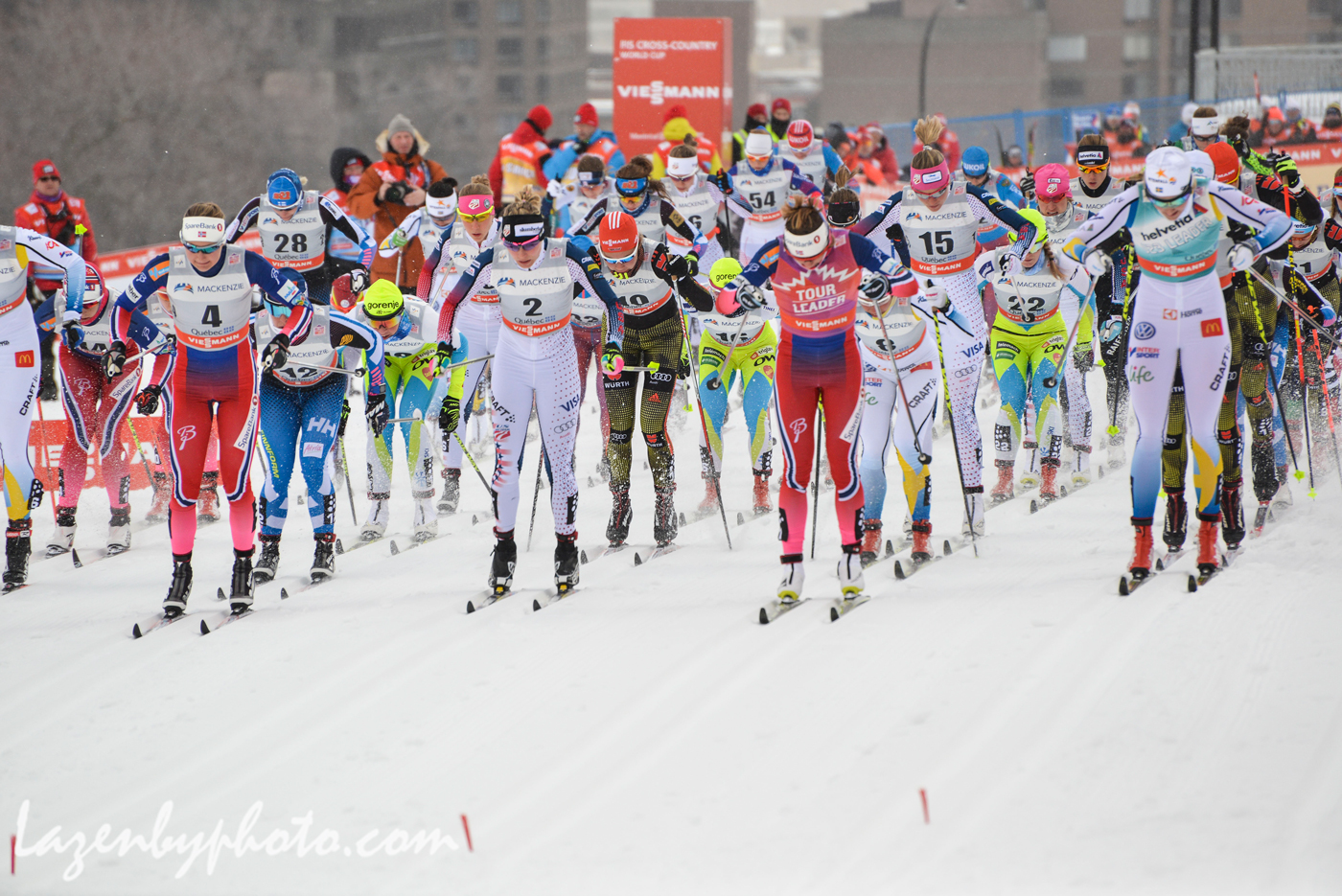
    The start of the women's 10.5 k classic mass start at Stage 2 of the Ski Tour Canada on Wednesday in Montreal, Quebec, with (from left to right, front row) Norway's Ingvild Flugstad Østberg (4), American Jessie Diggins (2), Norway's Maiken Caspersen Falla (red leader's bib), and Sweden's Stina Nilsson leading the pack out. (Photo: John Lazenby/Lazenbyphoto.com)
    The start of the women’s 10.5 k classic mass start at Stage 2 of the Ski Tour Canada on Wednesday in Montreal, Quebec, with (from left to right, front row) Norway’s Ingvild Flugstad Østberg (4), American Jessie Diggins (2), Norway’s Maiken Caspersen Falla (red leader’s bib), and Sweden’s Stina Nilsson leading the pack out. (Photo: John Lazenby/Lazenbyphoto.com)

    If any World Cup athletes forgot that cross-country skiing is a winter sport, they received a stark reminder on Wednesday in Montreal, Quebec, for the second day of the Ski Tour Canada.

    While this season has been characterized by ribbons of manmade snow across a brown landscape and unseasonably warm temperatures, the plunge back to frigid conditions and fresh snow during the classic mass start at Stage 2 of the Tour brought back the balaclavas.
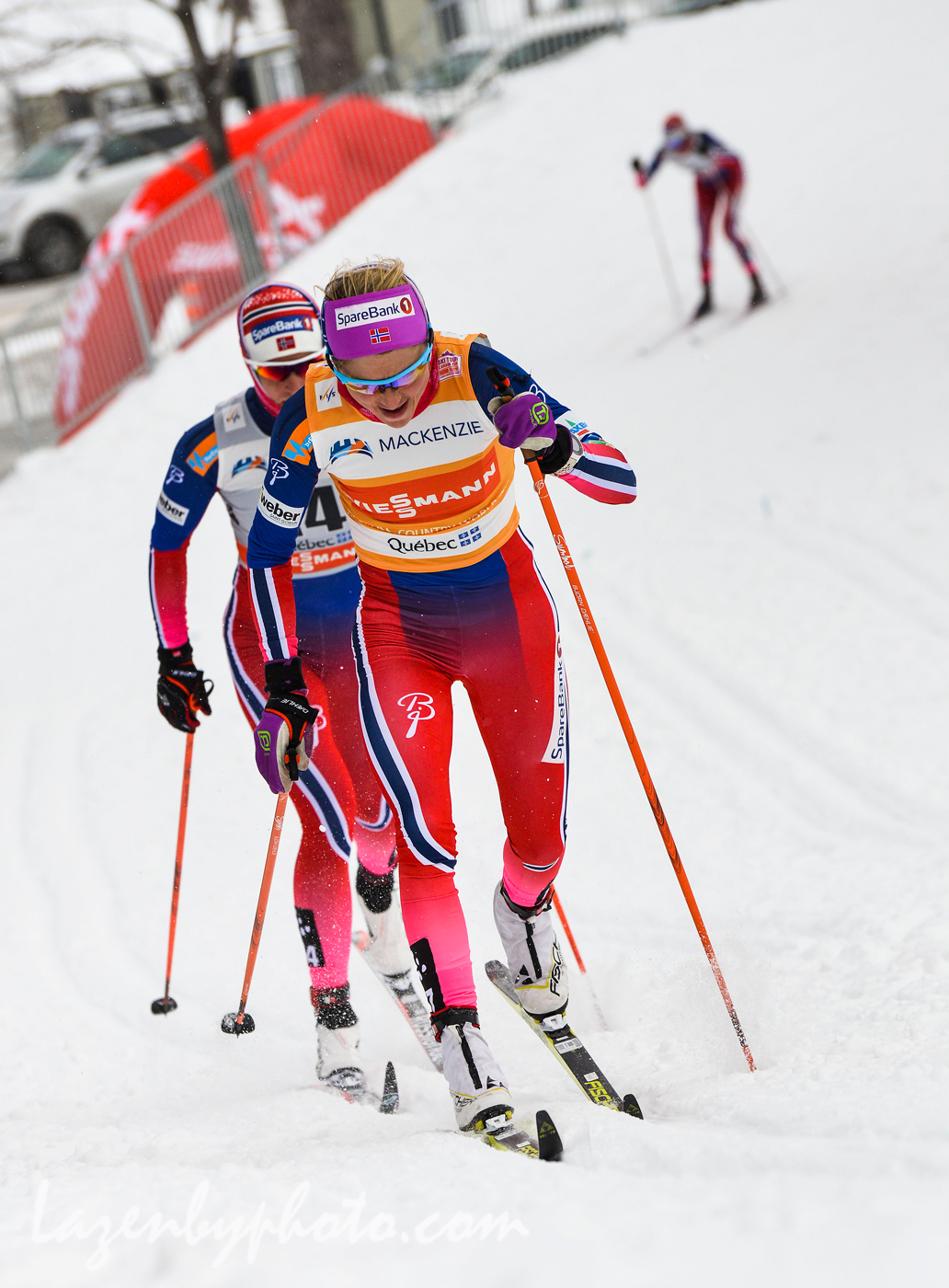
    Therese Johaug leads fellow Norwegian Astrid Uhrenholdt Jacobsen early in the women's 10.5 k classic mass start while another Norwegian, Heidi Weng chases in third. (Photo: John Lazenby/Lazenbyphoto.com)
    Therese Johaug leads fellow Norwegian Astrid Uhrenholdt Jacobsen early in the women’s 10.5 k classic mass start while another Norwegian, Heidi Weng chases in third. (Photo: John Lazenby/Lazenbyphoto.com)

    At race time, temperatures hovered around 16 degrees Fahrenheit, but a brutal 20 to 30 mile-per-hour winds made it downright frigid. In addition to the wind, a steady snowfall made for a soft course in the unique race venue at Parc du Mont-Royal. Dating back to 1879, it is the oldest skiing site in Canada located in the midst Quebec’s largest city of Montreal.

    The course was windy and narrow with several areas likely to cause bottlenecks in a mass start event with a large (72-woman) field. This factor made start position and staying out of trouble big factors in staying in the hunt.

    Racers were issued bib numbers based on their overall Tour standings from Tuesday’s sprint, giving Diggins a front-row start while overall World Cup leader Therese Johaug started four rows back in bib 27 — a spot she is not accustomed to.

    Johaug’s start position spared the field the relentless pace she usually pushes from the gun. At the 1 kilometer mark, the field remained bunched on the narrow course with Sweden’s Charlotte Kalla and Norwegians Heidi Weng and Maiken Caspersen Falla leading the charge. Americans Jessie Diggins and Sadie Bjornsen asserted themselves near the front, maintaining position in the top 10.

    “I was a little bit nervous before the start today because my start position was not where I was used to,” Johaug said in a post-race press conference. “It was really tough in the beginning there because there was so many girls and it was crazy behind there so I have to focus on myself and take it step by step.”

    Within two kilometers, Johaug had found her niche at the front as the field began to string out. But Norwegian teammates Astrid Uhrenholdt Jacobsen and Weng were not going to let her go without a fight as they attempted to match Johaug’s pace. By the 3.5 k checkpoint, Jacobsen and Johaug had established a 20-second gap on the field while Weng dangled eight seconds behind the two.

    However, Johaug’s pace was relentless and Jacobsen soon conceded to reconvene with Weng by the 5.5 k mark, 27 seconds behind Johaug. Despite being dropped by Johaug, the pair maintained a 30-second gap on the rest of the field. Meanwhile, a chase group of 15, including Diggins and Bjornsen, fought for the only skied-in tracks as the snow accumulated.
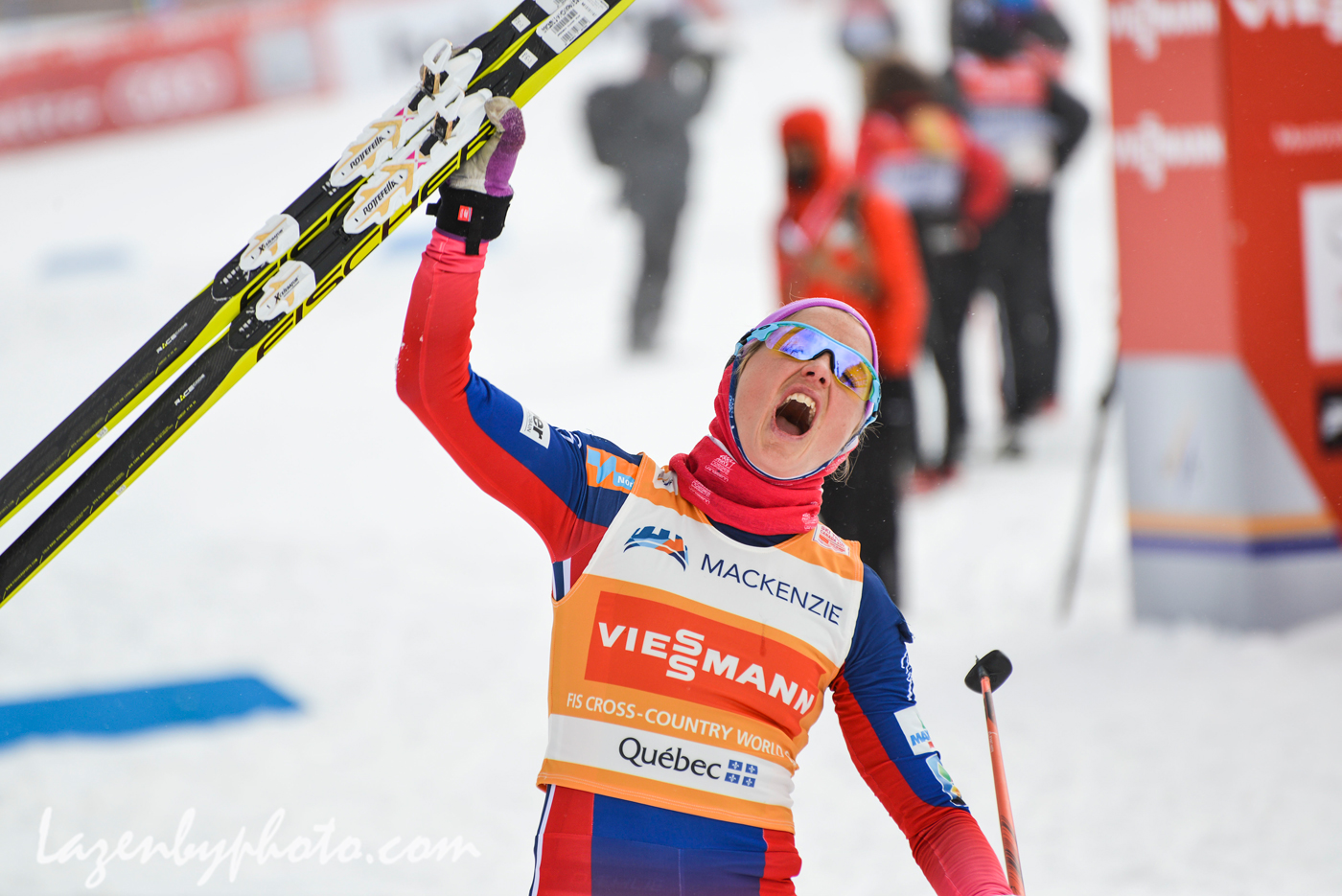
    Norway's Therese Johaug celebrates her one-minute victory in the women's 10.5 k classic mass start at Stage 2 of the Ski Tour Canada. The win put her first in the Tour standings, 26.8 seconds ahead of teammate Heidi Weng. (Photo: John Lazenby/Lazenbyphoto.com)
    Norway’s Therese Johaug celebrates her one-minute victory in the women’s 10.5 k classic mass start at Stage 2 of the Ski Tour Canada. The win put her first in the Tour standings, 26.8 seconds ahead of teammate Heidi Weng. (Photo: John Lazenby/Lazenbyphoto.com)

    Johaug showed no mercy during the second half of the three-lap race as she continued to extend her lead. She posted a time of 30:05.6 over 10.5 k to win by a full minute over Weng. In the final kilometers, Weng distanced herself from Jacobsen to secure second, 1:00.3 behind Johaug and 9.5 seconds ahead of Jacobsen in third.

    “When I [decided to] go, I hoped that me and Astrid can take some seconds to Therese, but Astrid was very tired,” Weng recalled in the press conference. “I thought that, ‘OK I can go and maybe she hang on,’ but I got some seconds.”

    Still, after finishing a minute behind Johaug, Weng trails her by 26 seconds in the Tour standings — a big gap to overcome with four of the six remaining stages being distance races.

    “I was very good yesterday,” Weng said of the sprint, where she placed fourth. “But when you lose one minute and Therese gets all of the bonus seconds … I must be better in the distance and train more.”

    Johaug’s dominant win puts her in the overall lead in the Tour, back in bib 1. She holds a 26.8 second lead over Weng and 1:10.8 over Jacobsen in third heading into Friday’s freestyle sprint in Quebec City.

    “I’m really happy that I did not think that I should be in front in just 200 meters, but I used the first kilometer to go up in front,” Johaug said. “My skis today were so good and the shape is also really good at the moment. I can just push the whole way and I know that I must also push all the way because I need all the seconds I can get in front of the Tour.”

    Finishing 30 to 40 seconds after Jacobsen, the remainder of the top-10 positions were determined in a congested push to the finish with Falla taking advantage of her sprinting prowess to secure fourth, 1:42 behind Johaug and 32.2 seconds off the podium. Just 0.8 seconds behind Falla, Poland’s Justyna Kowalczyk placed fifth and Norway’s Ingvild Flugstad Østberg finished another 0.2 seconds back in sixth.

    Double poling toward the finish near the back of the five-woman chase pack, Diggins essentially ran out of room without any place to move around the racers ahead of her, as the group double poled in side-by-side rows to the finish. She finished eighth (+1:43.5), two-hundredths of a second behind Finland’s Kerttu Niskanen in seventh and just 1.5 seconds behind Falla.

    The U.S. Ski Team's leading women in Wednesday's 10.5 k classic mass start, Jessie Diggins (front) and Sadie Bjornsen (behind) on their way to placing eighth and 16th, respectively, in the second stage of the Ski Tour Canada. (Photo: Flyingpointroad.com/NNF)
    The U.S. Ski Team’s leading women in Wednesday’s 10.5 k classic mass start, Jessie Diggins (front) and Sadie Bjornsen (behind) on their way to placing eighth and 16th, respectively, in the second stage of the Ski Tour Canada. (Photo: Flyingpointroad.com/NNF)

    Diggins’ finish put her fifth in the overall Tour after claiming third in the freestyle sprint on Tuesday. She sits just 9.5 seconds behind Falla in fourth and 1:23.7 behind Johaug in the overall standings.

    “That was a very different race than we have had in a long time,” said Diggins in an in-person interview after Wednesday’s race. “The wind gusts were incredible. It became pretty tactical because really only one of the tracks was skied in so if you found yourself outside of it you were working twice as hard. So that in itself was a bit part of the race.”

    Eighth place stood as her second-best classic result in a World Cup since finishing fifth in last month’s 5 k classic in Falun, Sweden.

    “I was really pleased with it,” Diggins said of Wednesday’s race. “A couple years ago I never could have done that on a day like today with super-tricky kick. It took finesse on those gradual uphills to try make your skis work. It was hard out there for everyone but I think I had great skis.”

    Despite holding position in the top 10 for the first two of three laps, Bjornsen lost contact with the larger chase group to finish 16th (+2:04.2).

    “The first couple of laps were good, and then I started sort of stressing and slipping a lot and fell back a ways,” Bjornsen said afterward. “But I was definitely happy with how it felt the first couple laps.”

    Americans Liz Stephen and Rosie Brennan also scored World Cup points in the top 30, placing 22nd (+2:44.3) and 28th (+3:05.8), respectively.

    “It was good, a decent place to be, I think, at this point of the Tour,” Brennan said after tying her season best (she placed 28th in a World Cup 10 k freestyle in January in Nove Mesto, Czech Republic). “The Tour is long; it’s about every day, not one day, but I am always psyched to be in the points.”

    Poland's Justyna Kowalczyk (r) leads two Norwegians, Ingvild Flugstad Østberg and Maiken Caspersen Falla, and Americans Jessie Diggins (third from left) and Sadie Bjornsen (l) during a blustery 10.5 k classic mass start at Stage 2 of the Ski Tour Canada in Montreal, Quebec. (Photo: Flyingpointroad.com/NNF)
    Poland’s Justyna Kowalczyk (r) leads two Norwegians, Ingvild Flugstad Østberg and Maiken Caspersen Falla, and Americans Jessie Diggins (third from left) and Sadie Bjornsen (l) during a blustery 10.5 k classic mass start at Stage 2 of the Ski Tour Canada in Montreal, Quebec. (Photo: Flyingpointroad.com/NNF)

    For racers starting farther back in the field, the mass start on the narrow course posed a significant challenge to navigate.

    “Because we knew there were going to be some bottlenecks, we talked to all the women about trying to get a pretty fast start and move up a few places to get in front of some of the bottlenecks,” U.S. Ski Team Head Coach Chris Grover explained in a post-race phone interview.

    In theory, it was a great strategy, but certainly easier said than done. One of the woman most successful at pulling this off was Stephen, who started in bib 59 and successfully navigated the chaos of the mass start  to move into the top 25 in the first half of the race. Over the last few kilometer, she picked off a few more places to finish 22nd.

    “I was lucky to avoid all the crashes that happened in the first lap,” Stephen said in a phone interview. “The start was crazy and the course was really fun once it was more spread out, but it was a really tough course to have a mass start on because of the steep ups and downs and narrow track with the snowy conditions. I am happy with my race today as I was feeling strong the whole time and was able to push my head and my body.”

    Also competing for the U.S. was Chelsea Holmes (APU) 38th, Kaitlynn Miller (CGRP) 39th, Ida Sargent (CGRP/USST) 40th, Sophie Caldwell (SMST2/USST) 42nd, Caitlin Gregg (Team Gregg/USST) 47th, Jennie Bender (BSF) 51st, Katherine Ogden (SMS/USST) 59th, and Annie Hart (SMST2) 61st.

    While many of the U.S. women were able to stay out of trouble, there were a number of crashes on the congested course. Both Sargent and Hart fell victim to race-altering crashes.

    Sargent broke a ski after crashing into Sweden’s Hanna Falk, who fell in front of her. But she was able to finish the race after quickly receiving a new ski from a coach and went on to finish 40th.

    “Ida was really bummed because she saw this as an opportunity to have a really good classic distance race,” Grover said. “It is ironic because Falk is who crashed in front of her yesterday in the sprint. She did a great job of clawing back place by place.”

    Hart’s race was also thwarted when she became tangled in a pileup at the start.

    “It was pretty crazy, about 500 meters in there was a gigantic pileup that I had the liberty of being on the bottom of,” Hart said in an in-person interview. “I’ve never quite been underneath ten girls. That felt a little bit frustrating, but after that I just tried not to panic and just tried to pick people off. So, it was an experience.“

    Emily Nishikawa of the Canadian Senior Development Team was also involved in the same crash, but recovered to lead the Canadian women in 45th place (+4:39.7).

    “I fell off the trail, I had my skis tangled up in the fence and I hit the fence pretty hard,” Nishikawa said afterward. “I was the very last person leaving that corner so I had to make up a lot of ground, but I think after that I skied well.”

    Canadian coach Justin Wadsworth commended Nishikawa’s recovery following the incident.

    “She probably lost about 45 seconds or a minute just trying to get onto the trail again,” he said. “I was trying to even help her and it was a real mess. I think she skied a very good race, especially regaining her composure.”

    She was followed by Canadians Cendrine Browne (CNEPH/CNST) 48th, Katherine Stewart-Jones (NDC Thunder Bay) 52nd, Olivia Bouffard-Nesbitt (CNST) 53rd, Andrea Dupont (RMR) 57th, Annika Hicks (Canmore Nordic) 60th, Jennifer Jackson (NDC Thunder Bay) 63rd, Alannah MacLean (NDC Thunder Bay) 64th, Dahria Beatty (AWCA/CNST) 65th, Maya Macisaac-Jones (RMR) 67th, Sophie Carrier-Laforte (CNEPH) 68th, and Marie Corriveau (CNEPH/National Junior Team) 72nd.

    With a large, young contingent of Canadians racing, the Tour is the unique opportunity to race on the highest level in their home country.

    “I think today was an experience for the best racers in the world, who have been racing many years on the World Cup,” Wadsworth said.”So for the younger athletes, it was a real eye opener. It was very hard conditions, with the wind and the snow and the course. Most of them seem to have pretty good attitudes about it, so hopefully they get some good learning out of it.”

    Results | Tour standings (through Stage 2)

    — Gerry Furseth, François Léger Dionne, Jason Albert, Harald Zimmer, and Alex Kochon contributed 

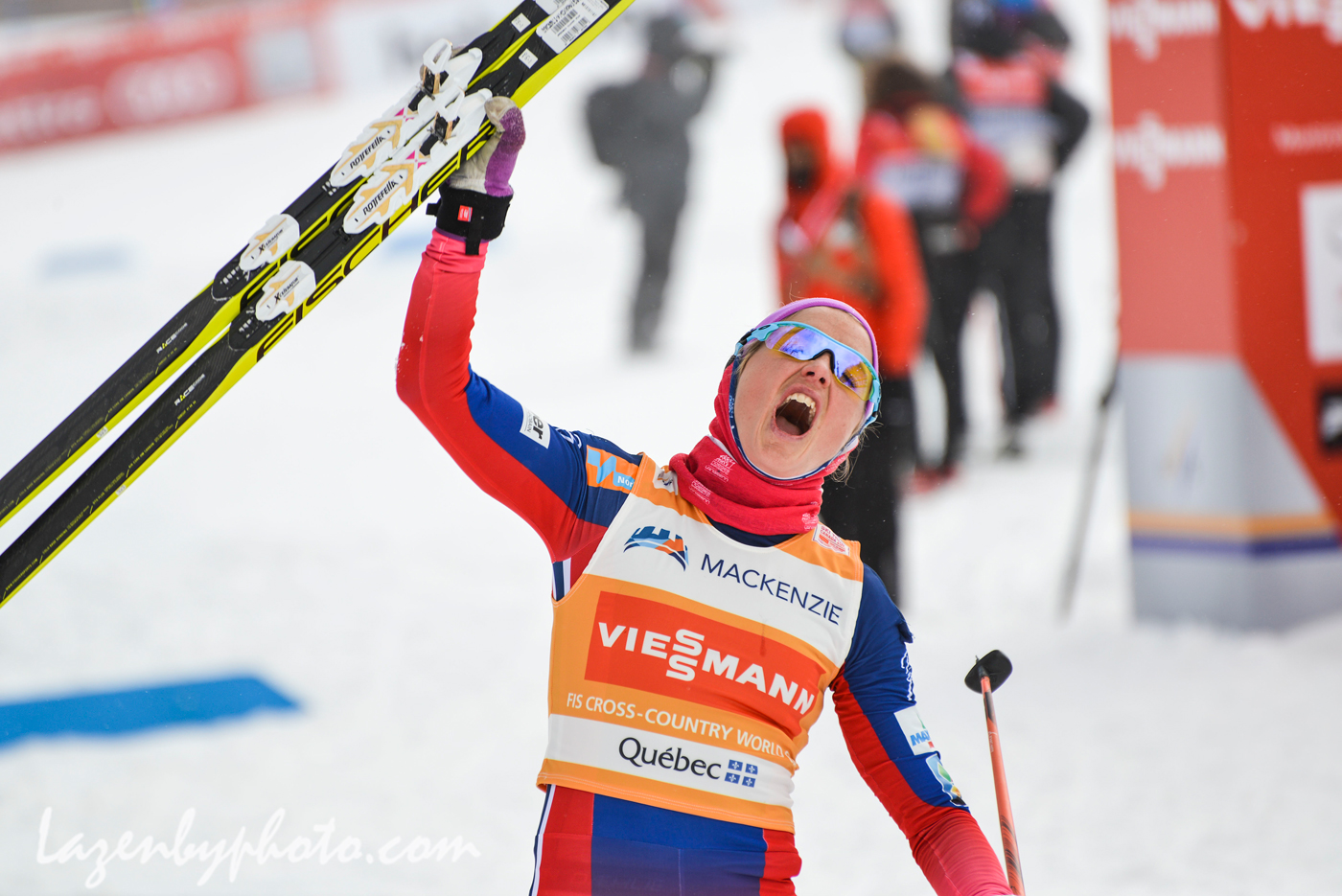
    Therese Johaug celebrates her decisive victory in the second stage of the Ski Tour Canada, the 10.5 k classic mass start on Wednesday in Montreal, Quebec. (Photo: Flyingpointroad.com/NNF)
    Therese Johaug celebrates her decisive victory in the second stage of the Ski Tour Canada, the 10.5 k classic mass start on Wednesday in Montreal, Quebec. (Photo: Flyingpointroad.com/NNF)
  • Johaug Wins 14th World Cup; Diggins Fourth in Gutsy Falun 10 k Skate

    Johaug Wins 14th World Cup; Diggins Fourth in Gutsy Falun 10 k Skate


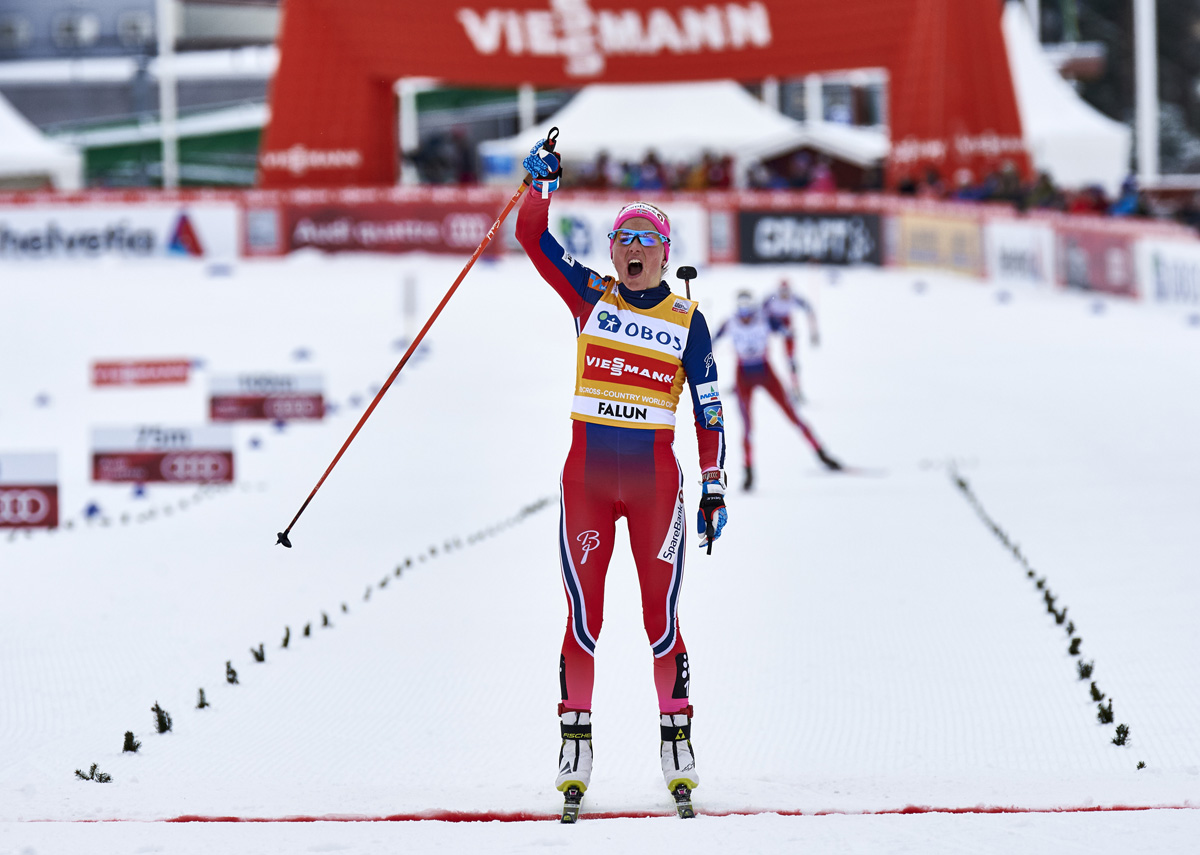
    Norway's Therese Johaug celebrates her 14th World Cup victory in the 10 k freestyle mass start on Sunday in Falun, Sweden. Johaug led her teammates Heidi Weng and Astrid  Uhrenholdt Jacobsen in a Norwegian podium sweep and American Jessie Diggins placed fourth. (Photo: Fischer/NordicFocus)
    Norway’s Therese Johaug celebrates her 14th World Cup victory in the 10 k freestyle mass start on Sunday in Falun, Sweden. Johaug led her teammates Heidi Weng and Astrid Uhrenholdt Jacobsen in a Norwegian podium sweep and American Jessie Diggins placed fourth. (Photo: Fischer/NordicFocus)

    Note: This article has been updated to include comments from Liz Stephen and Caitlin Patterson.

    Therese Johaug dared anyone to match her as she drove a punishing pace from the gun of the 10-kilometer freestyle mass start on Sunday in Falun, Sweden. But five other women, including American Jessie Diggins, took her up on the challenge and the race was on.

    The fast pace from the gun strung out the 72 women in the field quickly and within minutes, a lead group of six was formed. Johaug was shadowed by her Norwegian teammates Heidi Weng, Ingvild Flugstad Østberg , and Astrid Uhrenholdt Jacobsen as well as Diggins and Sweden’s Charlotte Kalla as they ascended the infamous Mörderbacken climb in the first two kilometers of the race.

    There was no trading of leads as Johaug churned away with her characteristic high tempo in the front. By 3.2 k, Johaug, Weng and Østberg had a five-second gap on Jacobsen and Diggins. Kalla fell back to the chase group, ceding the potential to repeat on the podium after she won the 10 k freestyle at Falun World Championships last year.

    However, a day after notching fifth in the 5 k classic, Diggins was not going to let the Norwegian trio ski away without a fight. She took advantage of her strengths on the gliding sections of the rolling terrain the second half of the 5-kilometer lap. She overtook a fading Østberg and caught Jacobsen who tucked in behind her. She continued to hammer, bridging to Johaug and Weng.

    Coming through the stadium after the first lap at 5 k, Diggins was just 3.6 seconds from the lead pair. However, when Jacobsen took her turn leading, she shifted gears to a pace Diggins couldn’t match. In pursuit of her teammates up the trail, Jacobsen put 11.2 seconds on Diggins in 1.7 k.

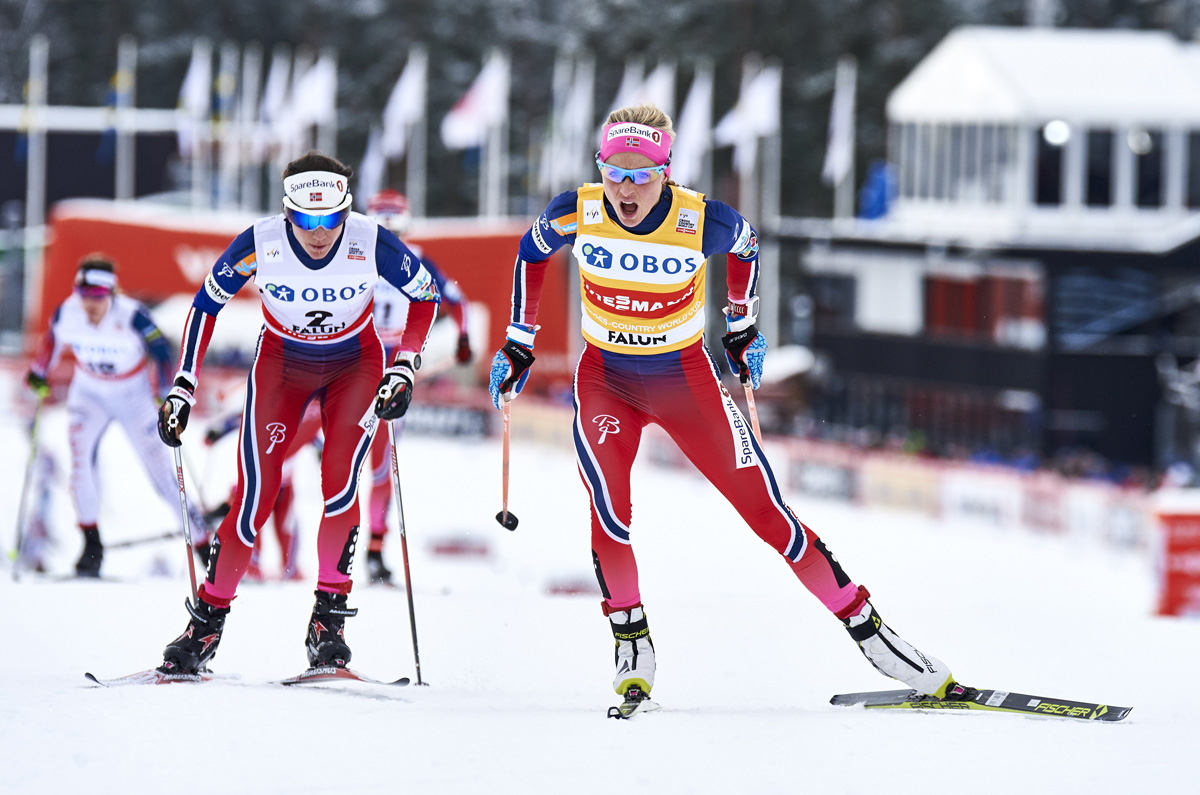
    In contrast to Johaug’s usual untouchable domination, Weng shadowed her stride for stride for over half of the race. However, at 6.7 k, the second time up Mörderbacken, Johaug delivered an attack that Weng could not match.

    Therese Johaug (r) leads Norwegian teammate Heidi Weng during the women's 10 k freestyle mass start at the World Cup in Falun, Sweden. The duo went on to place first and second, respectively. (Photo: Fischer/NordicFocus)
    Therese Johaug (r) leads Norwegian teammate Heidi Weng during the women’s 10 k freestyle mass start at the World Cup in Falun, Sweden. The duo went on to place first and second, respectively, while American Jessie Diggins (back left) placed fourth. (Photo: Fischer/NordicFocus)

    Johaug entered the stadium clear of Weng, winning in 23:28.0 for her 14th World Cup win matching Norwegian Bente Skari’s record for the most wins in a season. Weng secured second place, 8.8 seconds back, and Jacobsen placed third (+13.9).

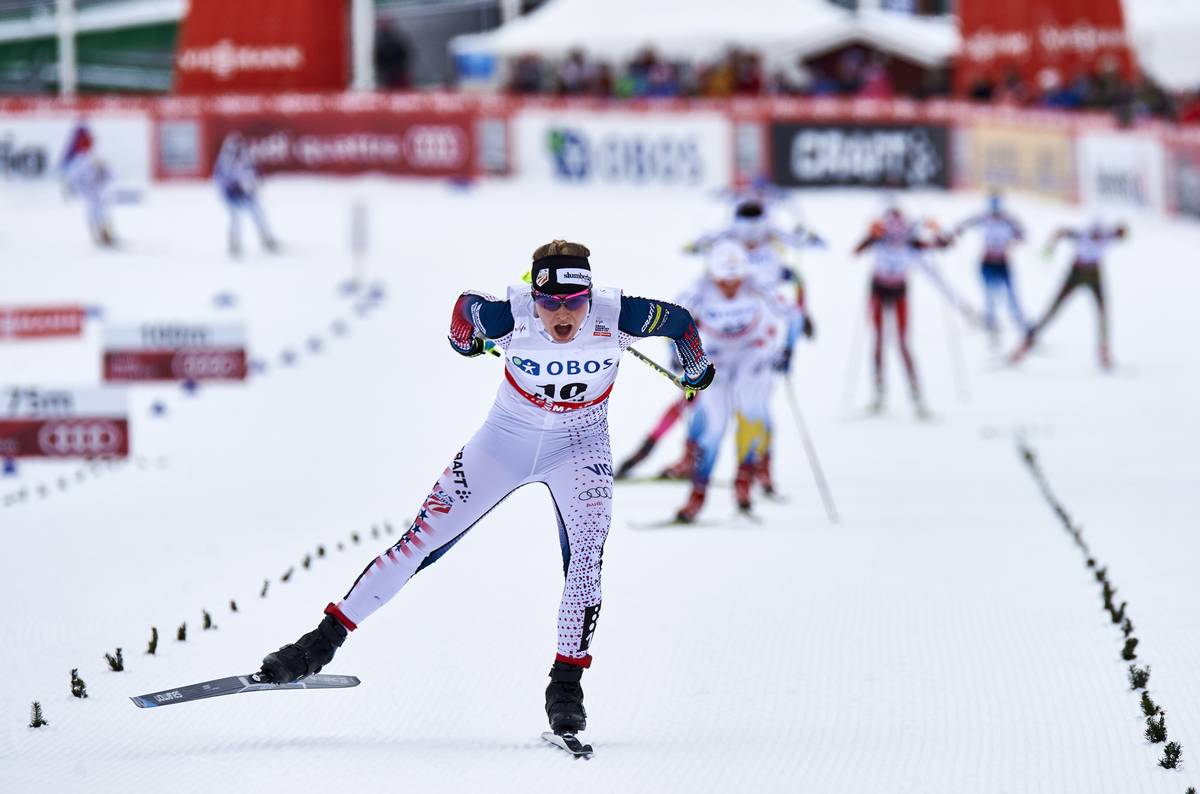
    Meanwhile, Diggins skied alone in fourth place trying to hold off a charging chase pack. She made it to the line just four seconds ahead of the chase pack to secure fourth (+29.0). Norway’s Maria Rydqvist and Ragnhild Haga led the group behind her into the finish in fifth (+33.3) and sixth (+34.0), respectively.

    Despite skiing in the lead pack early, the early pace took its toll and Østberg faded to ninth (+35.0).

    After the race, Johaug explained she pulled off her race plan perfectly, although Weng held on longer than she anticipated.

    “My goal was to go my own race, and go hard and smoothly from the start,”Johaug told NRK, according to a translation. “I would ‘punch’ to the last part of the hill, and it finally succeeded … I was a little nervous, for Heidi hung so well.” 

    According to Weng, Johaug “started like it was a sprint so there weren’t many of us from the beginning,” she told FIS. “I tried to stay with her as long as I could but my legs started to get stiff and I just focused on my technique to make sure that I still got to the finish in second place.”

    Jacobsen described her battle with Diggins as mostly amicable. “We actually had some cooperation on the first lap. I have never really had that before,” she told FIS. “She told me that she would take the lead on the big downhill and then we start to catch Ingvild in the stadium and Jessie went by her quickly. I hesitated and Jessie got away, but I was able to catch her on the Mörderbacken and I pushed again on the final climb to stay ahead of her.”

    Fewer than 10 seconds behind the chase group, American Liz Stephen finished 14th (+43.7), and 26-year-old Caitlin Patterson, of the Craftsbury Green Racing Project, placed 25th (+1:14.6) for her World Cup points in 11 starts.

    Diggins ‘Going for Broke’

    One year after Diggins and Caitlin Gregg claimed their historic podium finishes at the Falun World Championships, Diggins had her sights set high for the 10 k freestyle event.

    “My strategy for the day was — I had a good race yesterday, I know I am in good shape — I am just going to go for broke and see what happens,” she said on the phone afterward.

    Jessie Diggins charges to the finish of the World Cup 10 k freestyle mass start on Sunday in Falun, Sweden. Diggins held off a closing chase pack to secure fourth place. (Photo: Fischer/NordicFocus)
    Jessie Diggins charges to the finish of the World Cup 10 k freestyle mass start on Sunday in Falun, Sweden. Diggins held off a closing chase pack to secure fourth place. (Photo: Salomon/NordicFocus)

    “I knew it was a little bit risky, but I was trying to hang with that lead group as long as I could,” Diggins said.

    As long as she could turned into more than half the race as she trailed Johaug by just 3.6 seconds at 5 k.

    “In a mass start, I’ve never been in this position before, it was so exciting,” Diggins said.

    Although she was in contention for a podium at 5 k, she soon realized the effort wasn’t sustainable and decided to cut her losses.

    “I was totally pegged, I was going as hard as I possibly could,” she recalled. “I thought I could try to hold on to Therese and Heidi but then I might blow up and lose twenty spots, but if I can race smart I could for sure get top five.”

    Keeping her position meant holding off a charging chase pack of 15 skiers who were able to draft each other. Despite this advantage, Diggins was confident she could hold them.

    “I wasn’t too concerned because the last couple kilometers are my strength and I usually close down a race hard,” she said. “I felt like I would be able to hold it, but still it was still motivating and I knew I just couldn’t make a mistake.”

    U.S. Women’s Coach Matt Whitcomb commended Diggins’ gutsy racing.

    “She gave herself a chance to win today, she believed that she could, and she did everything she could and fell just shy,” he said on the phone “But this is the kind of approach to racing that we just love to see — aggressive and full of the belief that she could make it happen.”

    For Diggins, Falun remains one of her favorite places to race. “I’m so happy — I love racing here, the crowds are great, the atmosphere is fun, and I had wonderful skis,” she said.

    In a World Cup schedule with few mass starts, Falun was the first freestyle mass start of the season so far.  Although Diggins still considers individual starts to be her favorite format because it is just “you, your mind and the course,” she considers mass starts a fun change and a great learning opportunity.

    “In some ways, it was more fun to ski it with other people because you can see where the leaders are and you can see where they are putting time on you,” she said. “It is a really good way to learn about your style of racing and how that fits into the field.” 

    Stephen Navigates Mass Start for Season Best

    Although there are advantages to the immediate feedback in mass starts, they can also pose challenges for skiers starting farther in the back in the field. The congestion on the course presents frustrating, but surmountable challenges for skiers like Stephen.

    Starting in the middle of the field in bib 23, Stephen had to navigate the field on a narrow course and look for openings. However, when the field opened up, Stephen delivered as she moved from 21st place at 5 k to finish in 14th for her best World Cup result this season.  

    “It is really good to see Liz looking like herself again,” Whitcomb said.  “I think had today been an interval start race, you would have seen a really impressive result out of Liz. She struggled a bit with a later start, getting swallowed up, the course is a little bit narrow and she spent a lot of time waiting for an opening.”

    “Today was a really good feeling to leave Europe on and take home with me to prepare for Canada. I had the best energy I have felt all year today,” Stephen said in a USSA press release.

    Patterson in the points

    Another highlight for the Americans included Patterson’s 25th place, her first World Cup top 30 and best result since placing 36th in the Holmenkollen 30 k classic mass start last weekend.

    “We are really excited for that,” Whitcomb said. “In many ways, that is one of the real successes of the day when you see a new athlete score her first World Cup points. It’s not even one point, it is a handful of them with a really solid 25th place.”

    Patterson’s aggressive start paid off as she was able to establish a position in the top 20 within the first three kilometers. “My game plan was to start fast and aggressively, always on the offensive to move up rather than getting shuffled back, cling onto packs or other skiers whenever possible, and ski efficiently but not afraid to push hard,” explained Patterson.

    “I was actually astonished to find that the pace up the Morderbakken the first time seemed within reason, I could hold with people, and actually even still see Johaug way up ahead, which was exciting!” Patterson said.

    The depth of the U.S. women’s field has been illustrated this year as Patterson was the seventh women this year to score points in a distance race. This is a testament to the progress of the U.S. women’s cross country skiing and bodes well for the future.

    As Patterson shared, “I think now that I’m over here in Europe, it helps that I have trained with Ida, and with other USST women at fall camps, and to have seen that my fitness is close to theirs in training sessions, to help me convince myself that if I can ski with them, and they can ski with the best in the world, then maybe I can ski with the best in the world too.”

    Rosie Brennan and Ida Sargent also represented the U.S., taking 48th (+2:05.4) and 67th (+3:26.3), respectively.

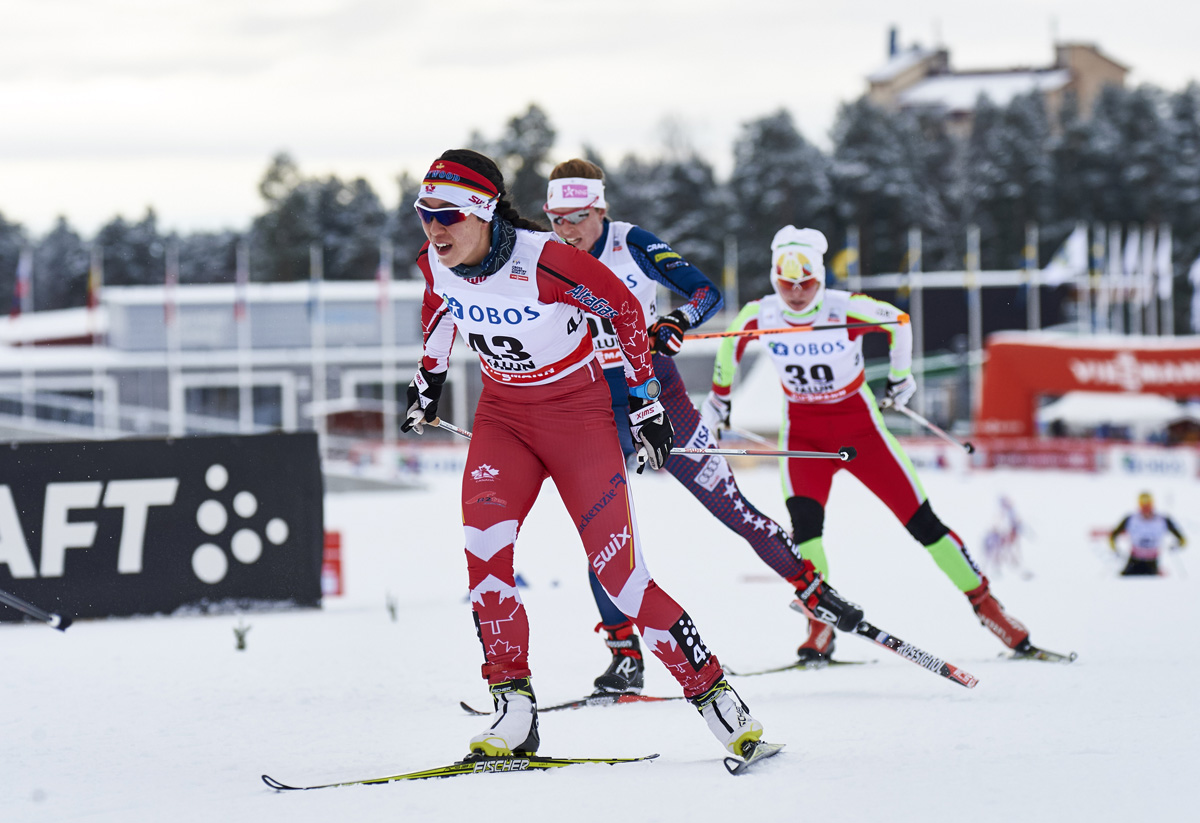
    Emily Nishikawa of Canada skis to 39th place in the Falun mass start skate event (Photo credit: Fischer/NordicFocus)
    Canada’s Emily Nishikawa racing to 39th in the 10 k freestyle mass start at Sunday’s World Cup in Falun, Sweden.(Photo: Fischer/NordicFocus)

    Canadian Emily Nishikawa was 14 seconds out of the points in 39th (+1:34.9) and Andrea Dupont (Rocky Mountain Racers) placed 69th (+3:46.5). 

    “The pack with the top 30 was just over 10 seconds ahead of me on the last lap, so it was a little frustrating that I didn’t have a little bit more in me to push and bridge up to that group,” Nishikawa wrote in an email. “Overall, it was much better than yesterday [in the 5 k classic], and I’m looking forward to going home to recharge before the Ski tour Canada where I hope to have my best races of the season.”